CN102906095A - Pyrrolopyrazine derivatives as SYK and JAK inhibitors - Google Patents
Pyrrolopyrazine derivatives as SYK and JAK inhibitors Download PDFInfo
- Publication number
- CN102906095A CN102906095A CN2011800250196A CN201180025019A CN102906095A CN 102906095 A CN102906095 A CN 102906095A CN 2011800250196 A CN2011800250196 A CN 2011800250196A CN 201180025019 A CN201180025019 A CN 201180025019A CN 102906095 A CN102906095 A CN 102906095A
- Authority
- CN
- China
- Prior art keywords
- optionally substituted
- cycloalkyl
- compound
- heteroaryl
- heterocycloalkyl
- Prior art date
- Legal status (The legal status is an assumption and is not a legal conclusion. Google has not performed a legal analysis and makes no representation as to the accuracy of the status listed.)
- Pending
Links
- 0 BC1=CN[C@@](C(CC2C=O)*=C)C2=N1 Chemical compound BC1=CN[C@@](C(CC2C=O)*=C)C2=N1 0.000 description 7
- AILKHAQXUAOOFU-UHFFFAOYSA-N CCCCCC#N Chemical compound CCCCCC#N AILKHAQXUAOOFU-UHFFFAOYSA-N 0.000 description 1
- HERJCJRIDHRCKG-WDSKDSINSA-N N[C@@H](CCC1)[C@@H]1C#N Chemical compound N[C@@H](CCC1)[C@@H]1C#N HERJCJRIDHRCKG-WDSKDSINSA-N 0.000 description 1
Classifications
-
- C—CHEMISTRY; METALLURGY
- C07—ORGANIC CHEMISTRY
- C07D—HETEROCYCLIC COMPOUNDS
- C07D487/00—Heterocyclic compounds containing nitrogen atoms as the only ring hetero atoms in the condensed system, not provided for by groups C07D451/00 - C07D477/00
- C07D487/02—Heterocyclic compounds containing nitrogen atoms as the only ring hetero atoms in the condensed system, not provided for by groups C07D451/00 - C07D477/00 in which the condensed system contains two hetero rings
- C07D487/04—Ortho-condensed systems
-
- A—HUMAN NECESSITIES
- A61—MEDICAL OR VETERINARY SCIENCE; HYGIENE
- A61K—PREPARATIONS FOR MEDICAL, DENTAL OR TOILETRY PURPOSES
- A61K31/00—Medicinal preparations containing organic active ingredients
- A61K31/33—Heterocyclic compounds
- A61K31/395—Heterocyclic compounds having nitrogen as a ring hetero atom, e.g. guanethidine or rifamycins
- A61K31/495—Heterocyclic compounds having nitrogen as a ring hetero atom, e.g. guanethidine or rifamycins having six-membered rings with two or more nitrogen atoms as the only ring heteroatoms, e.g. piperazine or tetrazines
- A61K31/4985—Pyrazines or piperazines ortho- or peri-condensed with heterocyclic ring systems
-
- A—HUMAN NECESSITIES
- A61—MEDICAL OR VETERINARY SCIENCE; HYGIENE
- A61P—SPECIFIC THERAPEUTIC ACTIVITY OF CHEMICAL COMPOUNDS OR MEDICINAL PREPARATIONS
- A61P1/00—Drugs for disorders of the alimentary tract or the digestive system
-
- A—HUMAN NECESSITIES
- A61—MEDICAL OR VETERINARY SCIENCE; HYGIENE
- A61P—SPECIFIC THERAPEUTIC ACTIVITY OF CHEMICAL COMPOUNDS OR MEDICINAL PREPARATIONS
- A61P1/00—Drugs for disorders of the alimentary tract or the digestive system
- A61P1/04—Drugs for disorders of the alimentary tract or the digestive system for ulcers, gastritis or reflux esophagitis, e.g. antacids, inhibitors of acid secretion, mucosal protectants
-
- A—HUMAN NECESSITIES
- A61—MEDICAL OR VETERINARY SCIENCE; HYGIENE
- A61P—SPECIFIC THERAPEUTIC ACTIVITY OF CHEMICAL COMPOUNDS OR MEDICINAL PREPARATIONS
- A61P11/00—Drugs for disorders of the respiratory system
-
- A—HUMAN NECESSITIES
- A61—MEDICAL OR VETERINARY SCIENCE; HYGIENE
- A61P—SPECIFIC THERAPEUTIC ACTIVITY OF CHEMICAL COMPOUNDS OR MEDICINAL PREPARATIONS
- A61P11/00—Drugs for disorders of the respiratory system
- A61P11/06—Antiasthmatics
-
- A—HUMAN NECESSITIES
- A61—MEDICAL OR VETERINARY SCIENCE; HYGIENE
- A61P—SPECIFIC THERAPEUTIC ACTIVITY OF CHEMICAL COMPOUNDS OR MEDICINAL PREPARATIONS
- A61P17/00—Drugs for dermatological disorders
-
- A—HUMAN NECESSITIES
- A61—MEDICAL OR VETERINARY SCIENCE; HYGIENE
- A61P—SPECIFIC THERAPEUTIC ACTIVITY OF CHEMICAL COMPOUNDS OR MEDICINAL PREPARATIONS
- A61P17/00—Drugs for dermatological disorders
- A61P17/02—Drugs for dermatological disorders for treating wounds, ulcers, burns, scars, keloids, or the like
-
- A—HUMAN NECESSITIES
- A61—MEDICAL OR VETERINARY SCIENCE; HYGIENE
- A61P—SPECIFIC THERAPEUTIC ACTIVITY OF CHEMICAL COMPOUNDS OR MEDICINAL PREPARATIONS
- A61P17/00—Drugs for dermatological disorders
- A61P17/06—Antipsoriatics
-
- A—HUMAN NECESSITIES
- A61—MEDICAL OR VETERINARY SCIENCE; HYGIENE
- A61P—SPECIFIC THERAPEUTIC ACTIVITY OF CHEMICAL COMPOUNDS OR MEDICINAL PREPARATIONS
- A61P19/00—Drugs for skeletal disorders
-
- A—HUMAN NECESSITIES
- A61—MEDICAL OR VETERINARY SCIENCE; HYGIENE
- A61P—SPECIFIC THERAPEUTIC ACTIVITY OF CHEMICAL COMPOUNDS OR MEDICINAL PREPARATIONS
- A61P19/00—Drugs for skeletal disorders
- A61P19/02—Drugs for skeletal disorders for joint disorders, e.g. arthritis, arthrosis
-
- A—HUMAN NECESSITIES
- A61—MEDICAL OR VETERINARY SCIENCE; HYGIENE
- A61P—SPECIFIC THERAPEUTIC ACTIVITY OF CHEMICAL COMPOUNDS OR MEDICINAL PREPARATIONS
- A61P25/00—Drugs for disorders of the nervous system
-
- A—HUMAN NECESSITIES
- A61—MEDICAL OR VETERINARY SCIENCE; HYGIENE
- A61P—SPECIFIC THERAPEUTIC ACTIVITY OF CHEMICAL COMPOUNDS OR MEDICINAL PREPARATIONS
- A61P25/00—Drugs for disorders of the nervous system
- A61P25/28—Drugs for disorders of the nervous system for treating neurodegenerative disorders of the central nervous system, e.g. nootropic agents, cognition enhancers, drugs for treating Alzheimer's disease or other forms of dementia
-
- A—HUMAN NECESSITIES
- A61—MEDICAL OR VETERINARY SCIENCE; HYGIENE
- A61P—SPECIFIC THERAPEUTIC ACTIVITY OF CHEMICAL COMPOUNDS OR MEDICINAL PREPARATIONS
- A61P29/00—Non-central analgesic, antipyretic or antiinflammatory agents, e.g. antirheumatic agents; Non-steroidal antiinflammatory drugs [NSAID]
-
- A—HUMAN NECESSITIES
- A61—MEDICAL OR VETERINARY SCIENCE; HYGIENE
- A61P—SPECIFIC THERAPEUTIC ACTIVITY OF CHEMICAL COMPOUNDS OR MEDICINAL PREPARATIONS
- A61P3/00—Drugs for disorders of the metabolism
-
- A—HUMAN NECESSITIES
- A61—MEDICAL OR VETERINARY SCIENCE; HYGIENE
- A61P—SPECIFIC THERAPEUTIC ACTIVITY OF CHEMICAL COMPOUNDS OR MEDICINAL PREPARATIONS
- A61P3/00—Drugs for disorders of the metabolism
- A61P3/08—Drugs for disorders of the metabolism for glucose homeostasis
- A61P3/10—Drugs for disorders of the metabolism for glucose homeostasis for hyperglycaemia, e.g. antidiabetics
-
- A—HUMAN NECESSITIES
- A61—MEDICAL OR VETERINARY SCIENCE; HYGIENE
- A61P—SPECIFIC THERAPEUTIC ACTIVITY OF CHEMICAL COMPOUNDS OR MEDICINAL PREPARATIONS
- A61P35/00—Antineoplastic agents
-
- A—HUMAN NECESSITIES
- A61—MEDICAL OR VETERINARY SCIENCE; HYGIENE
- A61P—SPECIFIC THERAPEUTIC ACTIVITY OF CHEMICAL COMPOUNDS OR MEDICINAL PREPARATIONS
- A61P35/00—Antineoplastic agents
- A61P35/02—Antineoplastic agents specific for leukemia
-
- A—HUMAN NECESSITIES
- A61—MEDICAL OR VETERINARY SCIENCE; HYGIENE
- A61P—SPECIFIC THERAPEUTIC ACTIVITY OF CHEMICAL COMPOUNDS OR MEDICINAL PREPARATIONS
- A61P37/00—Drugs for immunological or allergic disorders
-
- A—HUMAN NECESSITIES
- A61—MEDICAL OR VETERINARY SCIENCE; HYGIENE
- A61P—SPECIFIC THERAPEUTIC ACTIVITY OF CHEMICAL COMPOUNDS OR MEDICINAL PREPARATIONS
- A61P37/00—Drugs for immunological or allergic disorders
- A61P37/02—Immunomodulators
-
- A—HUMAN NECESSITIES
- A61—MEDICAL OR VETERINARY SCIENCE; HYGIENE
- A61P—SPECIFIC THERAPEUTIC ACTIVITY OF CHEMICAL COMPOUNDS OR MEDICINAL PREPARATIONS
- A61P37/00—Drugs for immunological or allergic disorders
- A61P37/02—Immunomodulators
- A61P37/06—Immunosuppressants, e.g. drugs for graft rejection
-
- A—HUMAN NECESSITIES
- A61—MEDICAL OR VETERINARY SCIENCE; HYGIENE
- A61P—SPECIFIC THERAPEUTIC ACTIVITY OF CHEMICAL COMPOUNDS OR MEDICINAL PREPARATIONS
- A61P37/00—Drugs for immunological or allergic disorders
- A61P37/08—Antiallergic agents
-
- A—HUMAN NECESSITIES
- A61—MEDICAL OR VETERINARY SCIENCE; HYGIENE
- A61P—SPECIFIC THERAPEUTIC ACTIVITY OF CHEMICAL COMPOUNDS OR MEDICINAL PREPARATIONS
- A61P5/00—Drugs for disorders of the endocrine system
- A61P5/14—Drugs for disorders of the endocrine system of the thyroid hormones, e.g. T3, T4
-
- A—HUMAN NECESSITIES
- A61—MEDICAL OR VETERINARY SCIENCE; HYGIENE
- A61P—SPECIFIC THERAPEUTIC ACTIVITY OF CHEMICAL COMPOUNDS OR MEDICINAL PREPARATIONS
- A61P9/00—Drugs for disorders of the cardiovascular system
Landscapes
- Health & Medical Sciences (AREA)
- Chemical & Material Sciences (AREA)
- Organic Chemistry (AREA)
- General Health & Medical Sciences (AREA)
- Veterinary Medicine (AREA)
- Public Health (AREA)
- Medicinal Chemistry (AREA)
- Pharmacology & Pharmacy (AREA)
- Life Sciences & Earth Sciences (AREA)
- Animal Behavior & Ethology (AREA)
- Nuclear Medicine, Radiotherapy & Molecular Imaging (AREA)
- General Chemical & Material Sciences (AREA)
- Chemical Kinetics & Catalysis (AREA)
- Engineering & Computer Science (AREA)
- Bioinformatics & Cheminformatics (AREA)
- Immunology (AREA)
- Diabetes (AREA)
- Pulmonology (AREA)
- Hematology (AREA)
- Dermatology (AREA)
- Neurosurgery (AREA)
- Neurology (AREA)
- Biomedical Technology (AREA)
- Rheumatology (AREA)
- Obesity (AREA)
- Physical Education & Sports Medicine (AREA)
- Endocrinology (AREA)
- Emergency Medicine (AREA)
- Pain & Pain Management (AREA)
- Hospice & Palliative Care (AREA)
- Cardiology (AREA)
- Transplantation (AREA)
- Psychiatry (AREA)
- Oncology (AREA)
- Heart & Thoracic Surgery (AREA)
- Orthopedic Medicine & Surgery (AREA)
- Epidemiology (AREA)
- Pharmaceuticals Containing Other Organic And Inorganic Compounds (AREA)
- Nitrogen Condensed Heterocyclic Rings (AREA)
Abstract
Description
本发明涉及新的吡咯并吡嗪衍生物的用途,其为JAK和SYK抑制剂,并且选择性地抑制JAK3和用于治疗自身免疫疾病和炎性疾病。The present invention relates to the use of novel pyrrolopyrazine derivatives which are JAK and SYK inhibitors and selectively inhibit JAK3 and for the treatment of autoimmune and inflammatory diseases.
蛋白激酶构成人类酶中的最大家族之一,并且通过将磷酸基团加到蛋白质上而调节许多不同的信号传导过程;特别是酪氨酸激酶使蛋白质在酪氨酸残基的醇部分上磷酸化。酪氨酸激酶家族包括控制细胞生长、迁移和分化的成员。异常的激酶活性已经牵涉于多种人类疾病中,所述的疾病包括癌症、自身免疫疾病和炎性疾病。由于蛋白激酶属于细胞信号传导的关键调节物,因此它们提供用小分子激酶活性抑制剂调节细胞功能的手段,并因此成为良好的药物设计靶点。除了治疗激酶-介导的疾病过程之外,有选择性的和有效的激酶活性抑制剂也可以用于研究细胞信号传导过程和识别具有治疗意义的其它细胞靶点。Protein kinases constitute one of the largest families of human enzymes and regulate many different signaling processes by adding phosphate groups to proteins; in particular tyrosine kinases phosphorylate proteins on the alcohol moieties of tyrosine residues change. The tyrosine kinase family includes members that control cell growth, migration and differentiation. Aberrant kinase activity has been implicated in a variety of human diseases including cancer, autoimmune and inflammatory diseases. Since protein kinases are among the key regulators of cellular signaling, they provide a means to modulate cellular function with small molecule inhibitors of kinase activity and thus represent good targets for drug design. In addition to treating kinase-mediated disease processes, selective and potent inhibitors of kinase activity can also be used to study cell signaling processes and identify other cellular targets of therapeutic interest.
JAK(JAnus激酶)是细胞质蛋白酪氨酸激酶的家族,其包括JAK1、JAK2、JAK3和TYK2。每种JAK优先与离散的细胞因子受体的胞质内部分缔合(Annu.Rev.Immunol.16(1998),pp.293-322)。在配体结合后JAK被活化,并且通过将细胞因子受体磷酸化而启动信号传导,所述细胞因子受体本身缺乏内在激酶活性。此磷酸化在受体上产生用于称作STAT蛋白(信号转导蛋白和转录激活因子)的其它分子的停泊位点,并且磷酸化的JAK结合多种STAT蛋白。STAT蛋白、或STAT是通过酪氨酸残基磷酸化而活化的DNA结合蛋白,并且同时起到信号传导分子和转录因子的作用,并且最终结合到在细胞因子-应答基因的启动子中存在的特异性DNA序列上(Leonard等,(2000),J.Allergy Clin.Immunol.105:877-888)。JAKs (JAnus kinases) are a family of cytoplasmic protein tyrosine kinases that include JAK1, JAK2, JAK3 and TYK2. Each JAK associates preferentially with the intracytoplasmic portion of a discrete cytokine receptor (Annu. Rev. Immunol. 16 (1998), pp. 293-322). JAKs are activated upon ligand binding and initiate signaling by phosphorylating cytokine receptors, which themselves lack intrinsic kinase activity. This phosphorylation creates docking sites on the receptor for other molecules called STAT proteins (signal transducers and activators of transcription), and phosphorylated JAKs bind a variety of STAT proteins. STAT proteins, or STATs, are DNA-binding proteins activated by phosphorylation of tyrosine residues, and function as both signaling molecules and transcription factors, and ultimately bind to the On specific DNA sequences (Leonard et al., (2000), J. Allergy Clin. Immunol. 105:877-888).
JAK/STAT信号传导已经牵涉到许多异常的免疫应答的调节,例如变态反应、哮喘、自身免疫疾病如移植(同种异体移植物)排斥、风湿性关节炎、肌萎缩侧索硬化和多发性硬化,以及牵涉到实体和血液癌,例如白血病和淋巴瘤。JAK/STAT signaling has been implicated in the regulation of many abnormal immune responses such as allergy, asthma, autoimmune diseases such as transplant (allograft) rejection, rheumatoid arthritis, amyotrophic lateral sclerosis and multiple sclerosis , and implicated in solid and blood cancers such as leukemia and lymphoma.
因此,JAK和STAT是多种潜在的交联的信号转导途径的成分(Oncogene 19(2000),pp.5662-5679),这表明了在不干扰其它信号转导路径的情况下特异性靶向于JAK-STAT路径的一个元件的难度。Thus, JAKs and STATs are components of multiple potentially cross-linked signal transduction pathways (Oncogene 19 (2000), pp.5662-5679), suggesting specific target pathways without interfering with other signal transduction pathways. Difficulty toward a component of the JAK-STAT pathway.
JAK激酶(包括JAK3)在患有急性淋巴母细胞白血病的儿童的初级白血病细胞中大量表达,所述急性淋巴母细胞白血病是儿童癌症的最常见形式,并且研究已经将某些细胞中的STAT活化与调节细胞凋亡的信号相关联(Demoulin等,(1996),Mol.Cell.Biol.16:4710-6;Jurlander等,(1997),Blood.89:4146-52;Kaneko等,(1997),Clin.Exp.Immun.109:185-193;和Nakamura等,(1996),J.Biol.Chem.271:19483-8)。还知道它们对于淋巴细胞分化、功能和存活是重要的。JAK3特别在淋巴细胞、巨噬细胞和肥大细胞的功能中发挥基本作用。考虑到该JAK激酶的重要性,调节JAK路径的化合物(包括对JAK3有选择性的那些化合物)可以用于治疗涉及淋巴细胞、巨噬细胞或肥大细胞功能的疾病或病症(Kudlacz等,(2004)Am.J.Transplant 4:51-57;Changelian(2003)Science 302:875-878)。预期可有效治疗其中靶向于JAK路径或调节JAK激酶(特别是JAK3)的病症,所述的病症包括:白血病、淋巴瘤、移植排斥(例如胰岛移植排斥、骨髓移植应用(例如移植物抗宿主病)、自身免疫疾病(例如糖尿病)和炎症(例如哮喘、变态反应)。下面更详细地论述能够受益于JAK3的抑制的病症。JAK kinases, including JAK3, are abundantly expressed in primary leukemia cells of children with acute lymphoblastic leukemia, the most common form of childhood cancer, and studies have activated STATs in some cells Associated with signals regulating apoptosis (Demoulin et al., (1996), Mol. Cell. Biol. 16:4710-6; Jurlander et al., (1997), Blood.89:4146-52; Kaneko et al., (1997) , Clin. Exp. Immun. 109: 185-193; and Nakamura et al., (1996), J. Biol. Chem. 271: 19483-8). They are also known to be important for lymphocyte differentiation, function and survival. JAK3 plays a fundamental role in the function of lymphocytes, macrophages and mast cells in particular. Given the importance of this JAK kinase, compounds that modulate the JAK pathway, including those selective for JAK3, may be useful in the treatment of diseases or conditions involving lymphocyte, macrophage, or mast cell function (Kudlacz et al., (2004 ) Am. J. Transplant 4:51-57; Changelian (2003) Science 302:875-878). It is expected to be effective in the treatment of disorders in which the JAK pathway is targeted or JAK kinases (particularly JAK3) are modulated, including: leukemia, lymphoma, transplant rejection (e.g. islet transplant rejection, bone marrow transplant applications (e.g. graft-versus-host diseases), autoimmune diseases (eg, diabetes), and inflammation (eg, asthma, allergies). Conditions that can benefit from inhibition of JAK3 are discussed in more detail below.
然而,与JAK1、JAK2和Tyk2的相对普遍存在的表达相比,JAK3具有更加受到限制和调节的表达。尽管某些JAK(JAK1、JAK2、Tyk2)被各种细胞因子受体使用,但是JAK3仅被在它们的受体中含有γc的细胞因子使用。因此,JAK3在细胞因子的细胞因子信号传导中发挥作用,迄今表明细胞因子受体使用普通的γ链;IL-2、IL-4、IL-7、IL-9、IL-15和IL-21。其中JAK1与细胞因子IL-2、IL-4、IL-7、IL-9和IL-21的受体相互作用,而其中JAK2与IL-9和TNF-α的受体相互作用。通过某些细胞因子结合到它们的受体上(例如IL-2、IL-4、IL-7、IL-9、IL-15和IL-21),发生受体低聚化,导致结合的JAK激酶的胞质尾区接近并且帮助在JAK激酶上的酪氨酸残基的磷酸根转移。该磷酸根转移导致JAK激酶的活化。However, JAK3 has a more restricted and regulated expression compared to the relatively ubiquitous expression of JAK1, JAK2 and Tyk2. While certain JAKs (JAK1, JAK2, Tyk2) are used by various cytokine receptors, JAK3 is used only by cytokines that contain γc in their receptors. Thus, JAK3 plays a role in cytokine signaling for cytokines, and cytokine receptors have so far been shown to use a common gamma chain; IL-2, IL-4, IL-7, IL-9, IL-15 and IL-21 . Among them, JAK1 interacts with the receptors of cytokines IL-2, IL-4, IL-7, IL-9 and IL-21, while among them, JAK2 interacts with the receptors of IL-9 and TNF-α. Receptor oligomerization occurs through binding of certain cytokines to their receptors (e.g., IL-2, IL-4, IL-7, IL-9, IL-15, and IL-21), resulting in bound JAK The cytoplasmic tail of the kinase accesses and facilitates phosphate transfer of tyrosine residues on JAK kinases. This phosphate transfer results in the activation of JAK kinases.
动物实验已经指出JAK3不仅在B和T淋巴细胞成熟中发挥关键作用,而且JAK3对于维持T细胞功能是组成性所需的。通过这种新机理调节免疫活性,能够证明可用于治疗T细胞增殖病症(如移植排斥)和自身免疫疾病。Animal experiments have indicated that not only does JAK3 play a critical role in B and T lymphocyte maturation, but that JAK3 is constitutively required for maintaining T cell function. Modulation of immune activity through this novel mechanism could prove useful in the treatment of T cell proliferation disorders such as transplant rejection and autoimmune diseases.
特别地,JAK3已经牵涉到多种生物过程。例如,已经表明由IL-4和IL-9诱导的鼠肥大细胞的增殖和存活依赖于JAK3-和γ链-信号传导(Suzuki等,(2000),Blood 96:2172-2180)。JAK3也在IgE受体-介导的肥大细胞脱颗粒响应中发挥关键作用(Malaviya等,(1999),Biochem.Biophys.Res.Commun.257:807-813),并且已经表明JAK3激酶的抑制预防I型超敏性反应(包括过敏反应)(Malaviya等,(1999),J.Biol.Chem.274:27028-27038)。也表明JAK3抑制导致同种异体移植物排斥的免疫抑制(Kirken,(2001),Transpl.Proc.33:3268-3270)。JAK3激酶也牵涉到涉及以下疾病的机理:早期和晚期的风湿性关节炎(Muller-Ladner等,(2000),J.Immun.164:3894-3901);家族性肌萎缩侧索硬化(Trieu等,(2000),Biochem Biophys.Res.Commun.267:22-25);白血病(Sudbeck等,(1999),Clin.Cancer Res.5:1569-1582);蕈样肉芽肿病,T-细胞淋巴瘤的一种形式(Nielsen等,(1997),Prac.Natl.Acad.Sci.USA 94:6764-6769);和异常的细胞生长(Yu等,(1997),J.Immunol.159:5206-5210;Catlett-Falcone等,(1999),Immunity 10:105-115)。In particular, JAK3 has been implicated in various biological processes. For example, the proliferation and survival of murine mast cells induced by IL-4 and IL-9 has been shown to be dependent on JAK3- and gamma chain-signaling (Suzuki et al., (2000), Blood 96:2172-2180). JAK3 also plays a key role in the IgE receptor-mediated mast cell degranulation response (Malaviya et al., (1999), Biochem. Biophys. Res. Commun. 257:807-813), and it has been shown that inhibition of JAK3 kinase prevents Type I hypersensitivity reactions (including anaphylaxis) (Malaviya et al. (1999), J. Biol. Chem. 274:27028-27038). JAK3 inhibition has also been shown to lead to immunosuppression of allograft rejection (Kirken, (2001), Transpl. Proc. 33:3268-3270). JAK3 kinases have also been implicated in mechanisms involving early and late stages of rheumatoid arthritis (Muller-Ladner et al., (2000), J.Immun.164:3894-3901); familial amyotrophic lateral sclerosis (Trieu et al. , (2000), Biochem Biophys.Res.Commun.267:22-25); Leukemia (Sudbeck et al., (1999), Clin.Cancer Res.5:1569-1582); Mycosis fungoides, T-cell lymphoid A form of tumor (Nielsen et al., (1997), Prac.Natl.Acad.Sci.USA 94:6764-6769); and abnormal cell growth (Yu et al., (1997), J.Immunol.159:5206- 5210; Catlett-Falcone et al. (1999), Immunity 10: 105-115).
JAK3抑制剂作为免疫抑制剂用于器官移植、异种移植、狼疮、多发性硬化、风湿性关节炎、银屑病、I型糖尿病和来自糖尿病的并发症、癌症、哮喘、特应性皮炎、自身免疫性甲状腺病症、溃疡性结肠炎、克罗恩病、阿尔茨海默病、白血病和需要免疫抑制的其它适应症的有效治疗。JAK3 Inhibitors as Immunosuppressants for Organ Transplantation, Xenotransplantation, Lupus, Multiple Sclerosis, Rheumatoid Arthritis, Psoriasis, Type I Diabetes and Complications from Diabetes, Cancer, Asthma, Atopic Dermatitis, Autologous Effective treatment for autoimmune thyroid disorders, ulcerative colitis, Crohn's disease, Alzheimer's disease, leukemia and other indications requiring immunosuppression.
JAK3的非造血系统表达也已经被报道,尽管其功能上的意义还有待阐明(J.Immunol.168(2002),pp.2475-2482)。由于用于SCID的骨髓移植是有疗效的(Blood 103(2004),pp.2009-2018),JAK3似乎不可能在其它组织或器官中具有必需的非冗余功能。因此,与免疫抑制药物的其它靶点相反,JAK3的受限制的分布是理想的。作用于具有限制于免疫系统的表达的分子靶点的药物可能导致最佳的效能:毒性比。因此,靶向JAK3理论上将在需要时提供免疫抑制(即作用于活跃地参与免疫应答的细胞),而在这些细胞群体之外不产生任何作用。虽然在各种STAT-/-株系中已经描述了缺陷的免疫应答(J.Investig.Med.44(1996),pp.304-311;Curr.Opin.Cell Biol.9(1997),pp.233-239),但是STAT的普遍分布和那些分子缺乏可以用小分子抑制剂靶向的酶活性的事实,已经使它们不作为免疫抑制的关键靶点的选择。Non-hematopoietic expression of JAK3 has also been reported, although its functional significance remains to be elucidated (J. Immunol. 168 (2002), pp. 2475-2482). Since bone marrow transplantation for SCID is curative (Blood 103 (2004), pp. 2009-2018), it seems unlikely that JAK3 has an essential non-redundant function in other tissues or organs. Thus, in contrast to other targets of immunosuppressive drugs, a restricted distribution of JAK3 is desirable. Drugs acting on molecular targets with expression restricted to the immune system are likely to result in an optimal efficacy:toxicity ratio. Thus, targeting JAK3 would theoretically provide immunosuppression (ie, acting on cells actively participating in the immune response) when needed, while having no effect outside of these cell populations. Although defective immune responses have been described in various STAT -/- strains (J. Investig. Med. 44 (1996), pp. 304-311; Curr. Opin. Cell Biol. 9 (1997), pp. 233-239), but the ubiquitous distribution of STATs and the fact that those molecules lack enzymatic activity that can be targeted with small-molecule inhibitors have kept them from being a key target of choice for immunosuppression.
SYK(脾酪氨酸激酶)是非受体酪氨酸激酶,其对于经BCR信号的B细胞活化很重要。在与磷酸化的BCR结合后SYK变为活化的,并因此在BCR活化之后启动早期信号传导事件。SYK缺陷的小鼠表现出B细胞发育的早期阻断(Cheng等人Nature 378:303,1995;Turner等人Nature 378:298,1995)。因此,抑制细胞中SYK的酶活性被建议用于治疗自身免疫疾病,这是通过其在自身抗体生成中的作用而达到。SYK (spleen tyrosine kinase) is a non-receptor tyrosine kinase that is important for B cell activation via BCR signaling. SYK becomes active upon binding to phosphorylated BCR and thus initiates early signaling events following BCR activation. SYK-deficient mice exhibit an early block in B cell development (Cheng et al. Nature 378:303, 1995; Turner et al. Nature 378:298, 1995). Therefore, inhibition of the enzymatic activity of SYK in cells is suggested for the treatment of autoimmune diseases through its role in autoantibody production.
除了SYK在BCR信号传导和B细胞活化中的作用外,其还在FcεRI介导的肥大细胞脱颗粒作用和嗜酸性粒细胞活化中起关键作用。因此,SYK涉及包括哮喘在内的过敏性病症(在Wong等人Expert Opin InvestigDrugs 13:743,2004中综述)。SYK通过其SH2域结合于FcεRI的磷酸化的γ链上,并且对于下游信号传导是必要的(Taylor等人Mol.Cell.Biol.15:4149,1995)。SYK缺陷的肥大细胞表现出有缺陷的脱颗粒、花生四烯酸和细胞因子分泌(Costello等人Oncogene 13:2595,1996)。还显示了在肥大细胞中的抑制SYK活性的药理学药物(Yamamoto等人J Pharmacol ExpTher 306:1174,2003)。用SYK反义寡核苷酸类药物的治疗抑制在哮喘动物模型中抗原诱发的嗜酸细胞和嗜中性粒细胞的浸润(Stenton等人JImmunol 169:1028,2002)。SYK缺陷的嗜酸细胞还显示出响应于FcεR刺激的受损的活化(Lach-Trifilieffe等人Blood 96:2506,2000)。因此,SYK的小分子抑制剂将对于治疗过敏诱发的包括哮喘在内的炎性疾病有用。In addition to the role of SYK in BCR signaling and B cell activation, it also plays a key role in FcεRI-mediated mast cell degranulation and eosinophil activation. Thus, SYK has been implicated in allergic conditions including asthma (reviewed in Wong et al. Expert Opin Investig Drugs 13:743, 2004). SYK binds to the phosphorylated gamma chain of FcεRI through its SH2 domain and is essential for downstream signaling (Taylor et al. Mol. Cell. Biol. 15:4149, 1995). SYK-deficient mast cells exhibit defective degranulation, arachidonic acid, and cytokine secretion (Costello et al. Oncogene 13:2595, 1996). Pharmacological agents that inhibit SYK activity in mast cells have also been shown (Yamamoto et al. J Pharmacol ExpTher 306:1174, 2003). Treatment with SYK antisense oligonucleotides inhibits antigen-induced infiltration of eosinophils and neutrophils in animal models of asthma (Stenton et al. J Immunol 169:1028, 2002). SYK-deficient eosinophils also display impaired activation in response to FcεR stimulation (Lach-Trifilieffe et al. Blood 96:2506, 2000). Therefore, small molecule inhibitors of SYK would be useful in the treatment of allergy-induced inflammatory diseases including asthma.
考虑到预期受益于涉及调节JAK和/或SYK路径的治疗的多种病症,很明显的是,调节JAK和/或SYK路径的新化合物和使用这些化合物的方法将为很多患者提供实质上的治疗益处。本文所提供的是新的吡咯并吡嗪衍生物,其用于治疗针对JAK和/或SYK路径或抑制JAK和/或SYK激酶、特别是JAK3的病症,并且其在治疗自身免疫疾病和炎性疾病中是治疗有效的。Considering the variety of conditions expected to benefit from treatments involving modulation of the JAK and/or SYK pathways, it is clear that novel compounds and methods of using these compounds that modulate the JAK and/or SYK pathways will provide substantial treatment for many patients benefit. Provided herein are novel pyrrolopyrazine derivatives for use in the treatment of disorders directed against the JAK and/or SYK pathway or inhibiting JAK and/or SYK kinases, particularly JAK3, and in the treatment of autoimmune diseases and inflammatory It is effective in treating diseases.
本文所提供的新的吡咯并吡嗪衍生物选择性抑制JAK3,并且可用于治疗自身免疫疾病和炎性疾病。本发明的化合物调节JAK和/或SYK路径并且是可用于治疗自身免疫疾病和炎性疾病的新的吡咯并吡嗪衍生物,其中优选的化合物选择性抑制JAK3。例如,本发明的化合物可以抑制JAK3和SYK,其中优选的化合物对于JAK激酶中的JAK3具有选择性,并且是可用于治疗自身免疫疾病和炎性疾病的新的吡咯并吡嗪衍生物。5H-吡咯并[2,3-b]吡嗪类的7位上的酰胺连接体与在该位置上具有其他基团的5H-吡咯并[2,3-b]吡嗪类相比,为式I和I’化合物提供了意料不到的对于抑制JAK和Syk激酶的增强的活性。此外,本发明的化合物可以抑制JAK3和JAK2,其中优选的化合物对于JAK激酶中的JAK3具有选择性,并且是可用于治疗自身免疫疾病和炎性疾病的新的吡咯并吡嗪衍生物。类似地,本发明的化合物可以抑制JAK3和JAK1,其中优选的化合物对于JAK激酶中的JAK3具有选择性,并且是可用于治疗自身免疫疾病和炎性疾病的新的吡咯并吡嗪衍生物。The novel pyrrolopyrazine derivatives provided herein selectively inhibit JAK3 and are useful in the treatment of autoimmune and inflammatory diseases. Compounds of the present invention modulate JAK and/or SYK pathways and are novel pyrrolopyrazine derivatives useful in the treatment of autoimmune and inflammatory diseases, wherein preferred compounds selectively inhibit JAK3. For example, the compounds of the present invention can inhibit JAK3 and SYK, wherein preferred compounds are selective for JAK3 among JAK kinases, and are novel pyrrolopyrazine derivatives useful in the treatment of autoimmune and inflammatory diseases. The amide linker at the 7-position of 5H-pyrrolo[2,3-b]pyrazines compared with 5H-pyrrolo[2,3-b]pyrazines with other groups at this position Compounds of Formula I and I' provided unexpected enhanced activity against JAK and Syk kinases. In addition, the compounds of the present invention can inhibit JAK3 and JAK2, wherein preferred compounds are selective for JAK3 among JAK kinases, and are novel pyrrolopyrazine derivatives useful in the treatment of autoimmune and inflammatory diseases. Similarly, compounds of the present invention can inhibit JAK3 and JAK1, wherein preferred compounds are selective for JAK3 among JAK kinases, and are novel pyrrolopyrazine derivatives useful in the treatment of autoimmune and inflammatory diseases.
本申请提供式I的化合物或其可药用盐,The application provides a compound of formula I or a pharmaceutically acceptable salt thereof,

其中:in:
R1是H或OH;R 1 is H or OH;
R2是苯基、杂环烷基、杂芳基或环烷基,其各自任选地被一个或多个R2’取代;R 2 is phenyl, heterocycloalkyl, heteroaryl, or cycloalkyl, each of which is optionally substituted by one or more R 2 ′;
每个R2’独立地是羟基、卤素、氧代、低级烷基、低级链烯基、低级炔基、低级卤代烷基、低级烷氧基、低级卤代烷氧基、低级羟基烷基、氨基、低级烷基氨基、低级二烷基氨基、氰基、低级氰基烷基、环烷基、杂环烷基、C(=O)R3或S(=O)2R3;Each R2 ' is independently hydroxy, halogen, oxo, lower alkyl, lower alkenyl, lower alkynyl, lower haloalkyl, lower alkoxy, lower haloalkoxy, lower hydroxyalkyl, amino, lower Alkylamino, lower dialkylamino, cyano, lower cyanoalkyl , cycloalkyl, heterocycloalkyl, C(=O) R3 or S(=O) 2R3 ;
每个R3独立地是OH、环烷基或低级烷基;each R is independently OH, cycloalkyl, or lower alkyl;
Q是Q2、Q3或Q4;Q is Q2 , Q3 or Q4 ;
Q2是杂环烷基、环烷基、环烯基、杂环烷基苯基、杂芳基、双环芳基或杂双环芳基,其各自任选地被一个或多个Q2a取代; Q is heterocycloalkyl, cycloalkyl, cycloalkenyl, heterocycloalkylphenyl, heteroaryl, bicyclic aryl or heterobicyclic aryl, each of which is optionally substituted by one or more Q 2a ;
Q2a是Q2b或Q2c;Q 2a is Q 2b or Q 2c ;
Q2b是卤素、氧代、羟基、–CN、–SCH3、–S(O)2CH3或–S(=O)CH3;Q 2b is halogen, oxo, hydroxyl, -CN, -SCH 3 , -S(O) 2 CH 3 or -S(=O)CH 3 ;
Q2c是Q2d或Q2e;Q 2c is Q 2d or Q 2e ;
或两个Q2a一起形成双环系统,任选地被一个或多个Q2b或Q2c取代;or two Q 2a together form a bicyclic ring system, optionally substituted by one or more Q 2b or Q 2c ;
Q2d是–O(Q2e)、–S(=O)2(Q2e)、–C(=O)N(Q2e)2、–S(O)2(Q2e)、–C(=O)(Q2e)、–C(=O)O(Q2e)、–N(Q2e)C(=O)(Q2e)、–N(Q2e)C(=O)O(Q2e)或–N(Q2e)C(=O)N(Q2e)2;Q 2d is –O(Q 2e ), –S(=O) 2 (Q 2e ), –C(=O)N(Q 2e ) 2 , –S(O) 2 (Q 2e ), –C(= O)(Q 2e ), –C(=O)O(Q 2e ), –N(Q 2e )C(=O)(Q 2e ), –N(Q 2e )C(=O)O(Q 2e ) or –N(Q 2e )C(=O)N(Q 2e ) 2 ;
每个Q2e独立地是H或Q2e’;each Q 2e is independently H or Q 2e ';
每个Q2e’独立地是低级烷基、苯基、苄基、低级卤代烷基、环烷基、环烯基、杂环烷基或杂芳基,任选地被一个或多个Q2f取代;Each Q 2e ' is independently lower alkyl, phenyl, benzyl, lower haloalkyl, cycloalkyl, cycloalkenyl, heterocycloalkyl or heteroaryl, optionally substituted by one or more Q 2f ;
Q2f是Q2g或Q2h;Q 2f is Q 2g or Q 2h ;
Q2g是卤素、羟基、氰基、氧代或–C(=O)(Q2h);Q 2g is halogen, hydroxyl, cyano, oxo or -C(=O)(Q 2h );
Q2h是低级烷基、低级卤代烷基、低级烷氧基、氨基、苯基、苄基、环烷基、杂环烷基或杂芳基,任选地被一个或多个Q2i取代;Q 2h is lower alkyl, lower haloalkyl, lower alkoxy, amino, phenyl, benzyl, cycloalkyl, heterocycloalkyl or heteroaryl, optionally substituted by one or more Q 2i ;
Q2i是卤素、羟基、氰基、低级烷基、低级卤代烷基或低级烷氧基;Q 2i is halogen, hydroxy, cyano, lower alkyl, lower haloalkyl or lower alkoxy;
Q3是–O-Q3a、–S-Q3a、–C(=O)(Q3a)、–O(CH2)mC(=O)(Q3a)、–S(=O)(Q3a)、–S(=O)2(Q3a)、–N(Q3a)2、–N(Q3a)S(=O)2(Q3a)、–N(Q3a)C(=O)(Q3a)、–C(=O)N(Q3a)2、N(Q3a)C(=O)N(Q3a)2或–N(Q3a)(CH2)mC(=O)N(Q3a)2;Q 3 is –OQ 3a , –SQ 3a , –C(=O)(Q 3a ), –O(CH 2 ) m C(=O)(Q 3a ), –S(=O)(Q 3a ), –S(=O) 2 (Q 3a ), –N(Q 3a ) 2 , –N(Q 3a )S(=O) 2 (Q 3a ), –N(Q 3a ) C(=O)(Q 3a ), –C(=O)N(Q 3a ) 2 , N(Q 3a )C(=O)N(Q 3a ) 2 or –N(Q 3a )(CH 2 ) m C(=O)N (Q 3a ) 2 ;
每个Q3a独立地是Q3b或Q3c;each Q 3a is independently Q 3b or Q 3c ;
m是0、1或2;m is 0, 1 or 2;
Q3b是H;Q 3b is H;
Q3c是低级烷基、低级卤代烷基、苯基、环烷基、杂环烷基或杂芳基,任选地被一个或多个Q3d取代;Q 3c is lower alkyl, lower haloalkyl, phenyl, cycloalkyl, heterocycloalkyl or heteroaryl, optionally substituted by one or more Q 3d ;
每个Q3d独立地是Q3e或Q3f;each Q 3d is independently Q 3e or Q 3f ;
Q3e是卤素或羟基;Q 3e is halogen or hydroxy;
Q3f是低级烷基、低级烷氧基、低级卤代烷基、苯基、环烷基、杂环烷基或杂芳基,任选地被一个或多个Q3g取代;Q 3f is lower alkyl, lower alkoxy, lower haloalkyl, phenyl, cycloalkyl, heterocycloalkyl or heteroaryl, optionally substituted by one or more Q 3g ;
或两个Q3f一起形成环烷基、杂环烷基或杂芳基,任选地被一个或多个Q3g取代;or two Q 3f taken together to form a cycloalkyl, heterocycloalkyl or heteroaryl, optionally substituted by one or more Q 3g ;
每个Q3g独立地是卤素、羟基、低级烷基、低级羟基烷基、低级卤代烷基、酰胺基或低级烷氧基;Each Q is independently halogen, hydroxy, lower alkyl, lower hydroxyalkyl, lower haloalkyl, amido, or lower alkoxy;
Q4是Q4a或Q4b; Q4 is Q4a or Q4b ;
Q4a是羟基、卤素或氰基;Q 4a is hydroxy, halogen or cyano;
Q4b是低级烷基、低级烷氧基、低级炔基、低级链烯基、低级羟基烷基、氨基或低级卤代烷基,任选地被一个或多个Q4c取代;Q 4b is lower alkyl, lower alkoxy, lower alkynyl, lower alkenyl, lower hydroxyalkyl, amino or lower haloalkyl, optionally substituted by one or more Q 4c ;
Q4c是Q4d或Q4e;Q 4c is Q 4d or Q 4e ;
每个Q4d独立地是卤素、羟基或氰基;each Q 4d is independently halogen, hydroxy or cyano;
每个Q4e独立地是低级烷基、低级卤代烷基、低级烷氧基、氨基、环烷基、苯基、杂环烷基或杂芳基,任选地被一个或多个Q4f取代;并且Each Q 4e is independently lower alkyl, lower haloalkyl, lower alkoxy, amino, cycloalkyl, phenyl, heterocycloalkyl or heteroaryl, optionally substituted by one or more Q 4f ; and
每个Q4f独立地是羟基、卤素、低级烷基、低级链烯基、氧代、低级卤代烷基、低级烷氧基、低级羟基烷基或氨基。Each Q 4f is independently hydroxy, halogen, lower alkyl, lower alkenyl, oxo, lower haloalkyl, lower alkoxy, lower hydroxyalkyl or amino.
本申请提供了治疗炎性或自身免疫性疾病的方法,其包含向对其有需要的患者施用治疗有效量的式I的化合物。The application provides a method of treating an inflammatory or autoimmune disease comprising administering a therapeutically effective amount of a compound of formula I to a patient in need thereof.
本申请提供药物组合物,其包含与至少1种可药用的载体、赋形剂或稀释剂混合的式I的化合物。The application provides a pharmaceutical composition, which comprises a compound of formula I mixed with at least one pharmaceutically acceptable carrier, excipient or diluent.
定义definition
本文所用的用语“一种”实体是指一个或多个该实体;例如,一种化合物是指一个或多个化合物或至少一个化合物。因此,术语“一种”、“一个或多个”和“至少一个”在本文能够互换使用。As used herein, the term "a" entity refers to one or more of that entity; for example, a compound refers to one or more compounds or at least one compound. Accordingly, the terms "a", "one or more" and "at least one" are used interchangeably herein.
术语“如上文所定义的”是指发明概述中所提供的每一组的最宽泛的定义或者最宽泛的权利要求。在下文所提供的所有其他实施方案中,能够出现在每一个实施方案中的和未明确定义的取代基保持发明概述中所提供的最宽泛的定义。The term "as defined above" refers to the broadest definition or broadest claim for each group provided in the Summary of the Invention. In all other embodiments provided below, substituents that can occur in each embodiment and are not explicitly defined retain the broadest definition provided in the Summary of the Invention.
如在本说明书中所用的,不论是在过渡性用语中或是在权利要求中,术语“包含”和“包括”被解释为具有开放终点的含义。即,该术语被解释为与术语“至少具有”或“至少包括”含义相同。当用于方法的文字中时,术语“包含”是指该方法至少包括所述的步骤,但是可以包括其他的步骤。当用于化合物或组合物的文字中时,术语“包含”是指该化合物或组合物至少包括所述的特征或组分,但是也可以包括其他的特征或组分。As used in this specification, whether in transitional language or in the claims, the terms "comprises" and "comprises" are to be interpreted as having an open-ended meaning. That is, the term is interpreted as having the same meaning as the term "has at least" or "includes at least". When used in the context of a method, the term "comprising" means that the method includes at least the recited steps, but may include additional steps. When used in the context of a compound or composition, the term "comprising" means that the compound or composition includes at least the stated features or components, but may also include other features or components.
如本文所用的,除非另有特殊说明,词语“或”是以“和/或”的“包括性”含义使用,而不是“或”的“排除性”含义。As used herein, unless specifically stated otherwise, the word "or" is used in the "inclusive" sense of "and/or" rather than the "exclusive" sense of "or".
本文使用的术语“独立地”是指变量适用于任意一种情况,而不必考虑在相同的化合物中具有相同或不同的定义的变量是否存在。因此,在化合物中,其中R"出现了2次并且被定义为“独立地是碳或氮”时,2个R"都能够是碳,2个R"都能够是氮或者一个R"能够是碳而另一个是氮。As used herein, the term "independently" means that the variable applies to any one instance, regardless of the presence or absence of the variable with the same or a different definition in the same compound. Thus, in a compound where R" occurs twice and is defined as "independently carbon or nitrogen", both R" can be carbon, both R" can be nitrogen or one R" can be carbon and the other is nitrogen.
当任意的变量(例如R1、R2或Q)在描述本发明所用的或请求保护的化合物的任意部分或化学式中出现1次以上时,在每一种情况下其在各个情况下的定义是相互独立的。而且,取代基和/或变量的组合只有在该化合物得到稳定的化合物时才是允许的。When any variable (such as R 1 , R 2 or Q) occurs more than once in any moiety or formula describing a compound used or claimed in the invention, in each case its definition in each case are independent of each other. Also, combinations of substituents and/or variables are permissible only if such compounds result in stable compounds.
键末端的符号“*”或者穿过键的“------”都表示将官能团或其他化学部分连接到分子的其他部分上的点。因此,例如MeC(=O)OR4,其中

插入环系统的键(其与连接在不同的端点的键不同)表示该键可以连接到任意的合适的环原子上。A bond inserted into a ring system (as distinct from a bond attached at a different endpoint) indicates that the bond can be attached to any suitable ring atom.
如本文所用的术语“任选的”或“任选地”是指其后所述的事件或情形可以、但非必需发生,并且该表述包括事件或情形发生的情况和事件或情形未发生的情况。例如,“任选地取代的”是指任选地取代的部分可以代表氢或取代基。As used herein, the term "optional" or "optionally" means that the event or circumstance described thereafter can, but need not, occur, and that the expression includes instances where the event or circumstance occurs and instances where the event or circumstance does not occur Condition. For example, "optionally substituted" means that the optionally substituted moiety can represent hydrogen or a substituent.
如本文所用的用语“一起形成双环系统”是指连接从而形成双环系统,其中每一个环可以由4-7个碳原子或4-7个碳和杂原子组成,并且可以是饱和的或不饱和的。As used herein, the phrase "together to form a bicyclic ring system" refers to linking to form a bicyclic ring system, wherein each ring may consist of 4-7 carbon atoms or 4-7 carbon and heteroatoms, and may be saturated or unsaturated of.
术语“约”用于本文是指近似地、在其左右、粗略地或在周围。当术语“约”连同数字范围使用时,其通过扩展所述的数值的上下边界修饰该范围。通常,本文使用术语“约”是指所述值的上下差异20%的数值。The term "about" as used herein means approximately, around, roughly or around. When the term "about" is used in conjunction with a numerical range, it modifies that range by extending the boundaries above and below the numerical values recited. Generally, the term "about" is used herein to refer to a numerical value that is within 20% of the stated value.
可以结合本文所述的定义从而形成化学上相关的组合,例如“杂烷基芳基”、“卤代烷基杂芳基”、“芳基烷基杂环基”、“烷基羰基”、“烷氧基烷基”、“环烷基烷基”等。当术语“烷基”用作在另一个术语之后的后缀时,如在“苯基烷基”或“羟基烷基”中,这是指上文所定义的烷基基团,其被1-2个选自另一个明确命名的基团的取代基取代。因此,例如,“苯基烷基”是指具有1-2个苯基取代基的烷基基团,并且因此其包括苄基、苯乙基和联苯基。“烷基氨基烷基”是具有1-2个烷基氨基取代基的烷基基团。“羟基烷基"包括2-羟基乙基、2-羟基丙基、1-(羟甲基)-2-甲基丙基、2-羟基丁基、2,3-二羟基丁基、2-(羟甲基)、3-羟基丙基等。因此,如本文所用的,使用术语“羟基烷基”定义以下所定义的杂烷基基团的亚组。术语-(芳)烷基是指未被取代的烷基或芳烷基。术语(杂)芳基是指芳基或杂芳基基团。The definitions described herein can be combined to form chemically related combinations, for example "heteroalkylaryl", "haloalkylheteroaryl", "arylalkylheterocyclyl", "alkylcarbonyl", "alk Oxyalkyl", "Cycloalkylalkyl", etc. When the term "alkyl" is used as a suffix after another term, as in "phenylalkyl" or "hydroxyalkyl", this refers to an alkyl group as defined above which is replaced by 1- Substitution with 2 substituents selected from another explicitly named group. Thus, for example, "phenylalkyl" refers to an alkyl group having 1-2 phenyl substituents, and thus includes benzyl, phenethyl and biphenyl. "Alkylaminoalkyl" is an alkyl group having 1-2 alkylamino substituents. "Hydroxyalkyl" includes 2-hydroxyethyl, 2-hydroxypropyl, 1-(hydroxymethyl)-2-methylpropyl, 2-hydroxybutyl, 2,3-dihydroxybutyl, 2- (Hydroxymethyl), 3-hydroxypropyl, etc. Thus, as used herein, the term "hydroxyalkyl" is used to define a subset of the heteroalkyl groups defined below. The term -(ar)alkyl refers to an unsubstituted alkyl or aralkyl group. The term (hetero)aryl refers to an aryl or heteroaryl group.
式I的化合物可以表现出互变异构现象。互变异构的化合物能够存在2种或多种互变的种类。共价结合的氢原子在2个原子之间迁移导致了质子异变的互变异构体。互变异构体通常处于平衡,并且分离单独的互变异构体的企图通常得到混合物,混合物的化学和物理性质与化合物的混合物一致。平衡点取决于分子内的化学性质。例如,在许多脂肪族醛和酮中,例如乙醛,酮式占优势;而在酚中,烯醇式占优势。常见的质子异变的互变异构体包括酮/烯醇(-C(=O)-CH-与-C(-OH)=CH-)、酰胺/亚氨酸(-C(=O)-NH-与-C(-OH)=N-)和脒(-C(=NR)-NH-与-C(-NHR)=N-)互变异构体。后2种在杂芳基和杂环中特别常见,并且本发明包括化合物的所有互变异构形式。Compounds of formula I may exhibit tautomerism. Tautomeric compounds can exist in two or more interconverting species. Migration of a covalently bound hydrogen atom between 2 atoms results in tautomers with different protons. Tautomers are usually in equilibrium, and attempts to isolate the individual tautomers usually result in mixtures whose chemical and physical properties are consistent with the mixture of compounds. The equilibrium point depends on the chemical properties within the molecule. For example, in many aliphatic aldehydes and ketones, such as acetaldehyde, the keto form predominates; in phenols, the enol form predominates. Common prototropic tautomers include keto/enol (-C(=O)-CH- and -C(-OH)=CH-), amide/imidic acid (-C(=O) -NH-with-C(-OH)=N-) and amidine (-C(=NR)-NH-with-C(-NHR)=N-) tautomers. The latter two are particularly common in heteroaryls and heterocycles, and the invention includes all tautomeric forms of the compounds.
除非另有说明,本文所用的技术和科学术语具有本发明所属的领域的技术人员所通常理解的含义。本文参考本领域的技术人员已知的各种方法学和文献材料。阐述药理学的一般原理的标准参考文献包括Goodman和Gilman的The Pharmacological Basis of Therapeutics,第10版,McGrawHill Companies Inc.,纽约(2001)。技术人员已知的任意合适的材料和/或方法能够用于实施本发明。然而,记载了优选的材料和方法。除非另有说明,在以下的说明书和实施例中参考的材料、试剂等可以从商业来源得到。Unless defined otherwise, technical and scientific terms used herein have the meaning commonly understood by one of ordinary skill in the art to which this invention belongs. Reference is made herein to various methodologies and literature materials known to those skilled in the art. Standard references addressing the general principles of pharmacology include Goodman and Gilman, The Pharmacological Basis of Therapeutics, 10th Edition, McGrawHill Companies Inc., New York (2001). Any suitable materials and/or methods known to those of skill can be used in the practice of the present invention. However, preferred materials and methods are described. Materials, reagents, etc. referred to in the following specification and examples can be obtained from commercial sources unless otherwise stated.
本文所用的术语“酰基”是指式-C(=O)R的基团,其中R是氢或如本文所定义的低级烷基。本文所用的该术语或“烷基羰基”是指式C(=O)R的基团,其中R是如本文所定义的烷基。术语C1-6酰基是指-C(=O)R基团含有6个碳原子。如本文所用的术语“芳基羰基”是指式C(=O)R的基团,其中R是芳基基团;如本文所用的术语“苯甲酰基”是指其中R是苯基的“芳基羰基”基团。本文所用的术语“羰基”是指式C(=O)的基团。本文所用的术语“氧代”是指式(=O)的基团,其可以连接在碳原子或杂原子上。The term "acyl" as used herein refers to a group of formula -C(=O)R, wherein R is hydrogen or lower alkyl as defined herein. The term or "alkylcarbonyl" as used herein refers to a group of formula C(=0)R, wherein R is alkyl as defined herein. The term C 1-6 acyl refers to a -C(=0)R group containing 6 carbon atoms. The term "arylcarbonyl" as used herein refers to a group of formula C(=O)R, wherein R is an aryl group; the term "benzoyl" as used herein refers to a ""arylcarbonyl" group. As used herein, the term "carbonyl" refers to a group of formula C(=O). As used herein, the term "oxo" refers to a group of formula (=0), which may be attached to a carbon atom or a heteroatom.
本文所用的术语“烷基”是指含有1-10个碳原子的无支链的或有支链的链状的、饱和的、一价的烃基。术语“低级烷基”是指含有1-6个碳原子的直链的或有支链的链状烃基。本文所用的“C1-10烷基”是指由1-10个碳组成的烷基。烷基基团的实例非限制性地包括低级烷基,包括甲基、乙基、丙基、异丙基、正丁基、异丁基、叔丁基或戊基、异戊基、新戊基、己基、庚基和辛基。The term "alkyl" as used herein refers to an unbranched or branched chain, saturated, monovalent hydrocarbon group containing 1 to 10 carbon atoms. The term "lower alkyl" refers to a straight or branched chain hydrocarbon group containing 1 to 6 carbon atoms. As used herein, "C 1-10 alkyl" refers to an alkyl group consisting of 1-10 carbons. Examples of alkyl groups include, but are not limited to, lower alkyl groups including methyl, ethyl, propyl, isopropyl, n-butyl, isobutyl, t-butyl or pentyl, isopentyl, neopentyl base, hexyl, heptyl and octyl.
当术语“烷基”用作在另一个术语之后的后缀时,如在“苯基烷基”或“羟基烷基”中,这是指被1-2个选自其他明确命名的基团的取代基取代的如上所定义的烷基基团。因此,例如,“苯基烷基”是指R'R"-基,其中R'是苯基基团,并且R"是如本文所定义的亚烷基,可以理解苯基烷基部分的连接点将在亚烷基上。芳基烷基的实例非限制性地包括苄基、苯乙基、3-苯基丙基。类似地解释术语“芳基烷基”或“芳烷基”,其中R'是芳基。类似地解释术语“杂芳基烷基”,其中R'任选地是芳基或杂芳基。When the term "alkyl" is used as a suffix after another term, as in "phenylalkyl" or "hydroxyalkyl", it means Alkyl groups as defined above substituted by substituents. Thus, for example, "phenylalkyl" refers to an R'R"-group wherein R' is a phenyl group and R" is an alkylene group as defined herein, with the understanding that the phenylalkyl moiety is attached The point will be on the alkylene. Examples of arylalkyl include, but are not limited to, benzyl, phenethyl, 3-phenylpropyl. The terms "arylalkyl" or "aralkyl" where R' is aryl are interpreted similarly. The term "heteroarylalkyl", wherein R' is optionally aryl or heteroaryl, is interpreted similarly.
本文所用的术语“卤代烷基”是指如上所定义的无支链的或有支链的链状烷基基团,其中1、2、3或更多个氢原子被卤素取代。术语“低级卤代烷基”是指含有1-6个碳原子的直链的或有支链的链状烃残基,其中1、2、3或更多个氢原子被卤素取代。实例是1-氟甲基、1-氯甲基、1-溴甲基、1-碘甲基、二氟甲基、三氟甲基、三氯甲基、三溴甲基、三碘甲基、1-氟乙基、1-氯乙基、1-溴乙基、1-碘乙基、2-氟乙基、2-氯乙基、2-溴乙基、2-碘乙基、2,2-二氯乙基、3-溴丙基或2,2,2-三氟乙基。The term "haloalkyl" as used herein refers to an unbranched or branched chain alkyl group as defined above wherein 1, 2, 3 or more hydrogen atoms are replaced by halogen. The term "lower haloalkyl" refers to a straight or branched chain hydrocarbon residue containing 1 to 6 carbon atoms, wherein 1, 2, 3 or more hydrogen atoms are replaced by halogen. Examples are 1-fluoromethyl, 1-chloromethyl, 1-bromomethyl, 1-iodomethyl, difluoromethyl, trifluoromethyl, trichloromethyl, tribromomethyl, triiodomethyl , 1-fluoroethyl, 1-chloroethyl, 1-bromoethyl, 1-iodoethyl, 2-fluoroethyl, 2-chloroethyl, 2-bromoethyl, 2-iodoethyl, 2 , 2-dichloroethyl, 3-bromopropyl or 2,2,2-trifluoroethyl.
除非另有说明,如本文所用的术语"亚烷基"是指1-10个碳原子的二价的饱和的直链烃基(例如(CH2)n)或2-10个碳原子的支链的饱和的二价烃基(例如-CHMe-或-CH2CH(i-Pr)CH2-)。除了亚甲基的情况,亚烷基基团的开放价不连接到相同的原子上。亚烷基的实例非限制性地包括亚甲基、亚乙基、亚丙基、2-甲基-亚丙基、1,1-二甲基-亚乙基、亚丁基、2-乙基亚丁基。Unless otherwise stated, the term "alkylene" as used herein refers to a divalent saturated straight-chain hydrocarbon group (such as (CH 2 ) n ) of 1-10 carbon atoms or a branched chain of 2-10 carbon atoms A saturated divalent hydrocarbon group (eg -CHMe- or -CH 2 CH(i-Pr)CH 2 -). Except in the case of methylene, the open valences of an alkylene group are not attached to the same atom. Examples of alkylene include, but are not limited to, methylene, ethylene, propylene, 2-methyl-propylene, 1,1-dimethyl-ethylene, butylene, 2-ethyl Butylene.
本文所用的术语“烷氧基”是指-O-烷基基团,其中烷基如上所定义,例如甲氧基、乙氧基、正丙氧基、异丙氧基、正丁氧基、异丁氧基、叔丁氧基、戊氧基、己氧基,包括其异构体。本文所用的“低级烷氧基”是指具有如前所定义的“低级烷基”基团的烷氧基基团。本文所用的“C1-10烷氧基”是指-O-烷基,其中烷基是C1-10。As used herein, the term "alkoxy" refers to an -O-alkyl group, wherein alkyl is as defined above, for example, methoxy, ethoxy, n-propoxy, isopropoxy, n-butoxy, Isobutoxy, tert-butoxy, pentyloxy, hexyloxy, including isomers thereof. As used herein, "lower alkoxy" refers to an alkoxy group having a "lower alkyl" group as previously defined. As used herein, "C 1-10 alkoxy" refers to -O-alkyl, wherein alkyl is C 1-10 .
本文所用的术语“羟基烷基”是指如本文所定义的烷基,其中在不同的碳原子上的1-3个氢原子被羟基基团代替。The term "hydroxyalkyl" as used herein refers to an alkyl group as defined herein wherein 1 to 3 hydrogen atoms on different carbon atoms are replaced by hydroxy groups.
本文所用的术语“环烷基”是指含有3-8个碳原子的饱和的碳环,即环丙基、环丁基、环戊基、环己基、环庚基或环辛基。本文所用的"C3-7环烷基"是指在碳环中由3-7个碳组成的环烷基。The term "cycloalkyl" as used herein refers to a saturated carbocyclic ring containing 3-8 carbon atoms, ie cyclopropyl, cyclobutyl, cyclopentyl, cyclohexyl, cycloheptyl or cyclooctyl. As used herein, "C 3-7 cycloalkyl" refers to a cycloalkyl group consisting of 3-7 carbons in a carbocyclic ring.
除非另外指明,术语“环烯基”是指包含5-7个碳原子的部分不饱和的碳环,且在环中具有碳碳双键。例如C5-6环烯基是指具有5-6个碳原子的环烯基基团。在某些实施方案中,环烯基基团在环中具有一个碳碳双键。在某些实施方案中,环烯基基团在环中具有多个碳碳双键。但是,环烯基环不是芳香性的。环烯基基团可以任选地被一个或多个取代基取代。环烯基的实例包括但不限于环戊烯基和环己烯基。Unless otherwise indicated, the term "cycloalkenyl" refers to a partially unsaturated carbocyclic ring containing 5-7 carbon atoms and having a carbon-carbon double bond in the ring. For example C 5-6 cycloalkenyl refers to a cycloalkenyl group having 5-6 carbon atoms. In certain embodiments, cycloalkenyl groups have one carbon-carbon double bond in the ring. In certain embodiments, cycloalkenyl groups have multiple carbon-carbon double bonds in the ring. However, cycloalkenyl rings are not aromatic. A cycloalkenyl group can be optionally substituted with one or more substituents. Examples of cycloalkenyl groups include, but are not limited to, cyclopentenyl and cyclohexenyl.
本文所用的术语“卤素”是指氟、氯、溴或碘。The term "halogen" as used herein refers to fluorine, chlorine, bromine or iodine.
如本文所用的术语“氨基”包括-NR2,其中R基团各自独立地是H或低级烷基,其中低级烷基如本文所定义。氨基基团的实例包括二甲基氨基、甲基氨基和NH2。The term "amino" as used herein includes -NR2 , wherein each R group is independently H or lower alkyl, wherein lower alkyl is as defined herein. Examples of amino groups include dimethylamino, methylamino and NH2 .
如本文所用的术语“芳基”是指单环或双环(还称作“双环芳基(biaryl)”)的取代或未取代的碳环芳香基团。芳基基团的实例是苯基、萘基等。The term "aryl" as used herein refers to a monocyclic or bicyclic (also referred to as "biaryl") substituted or unsubstituted carbocyclic aromatic group. Examples of aryl groups are phenyl, naphthyl and the like.
本文所用的术语“杂芳基”是指5-18个环原子的单环、双环(杂双环芳基(heterobiaryl))或三环基团,其具有至少一个芳香环,每个环含有4-8个原子,包含一个或多个N、O或S杂原子,其他的环原子是碳,可以理解的是杂芳基的连接点将在芳香环上。如本领域的技术人员所熟知的,杂芳基环具有比其全碳的对应部分较少的芳香性。因此,出于本发明的目的,杂芳基基团仅需要具有某些程度的芳香性。杂芳基部分的实例包括具有5-6个环原子和1-3个杂原子的单环芳香杂环,其非限制性地包括吡啶基、嘧啶基、吡嗪基、吡咯基、吡唑基、咪唑基、吲哚基、


除非另有说明,本文所用的术语“杂环烷基”、“杂环基”或“杂环”是指一价的饱和的环状基,其由一个或多个环、优选1-2或3个环组成,每个环有3-8个原子,包含一个或多个环碳原子和一个或多个环杂原子(选自N、O或S(=O)0-2),其中连接点能够通过碳原子或杂原子,并且其能够任选地独立地被一个或多个、优选1或2或3个取代基取代,所述的取代基选自羟基、氧代、氰基、低级烷基、低级烷氧基、低级卤代烷氧基、烷硫基、卤素、卤代烷基、羟基烷基、硝基、烷氧基羰基、氨基、烷基氨基、烷基磺酰基、芳基磺酰基、烷基氨基磺酰基、芳基氨基磺酰基、烷基磺酰基氨基、芳基磺酰基氨基、烷基氨基羰基、芳基氨基羰基、烷基羰基氨基、芳基羰基氨基。杂环基的实例非限制性地包括氮杂环丁基、吡咯烷基、六氢氮杂


用语“器官排斥反应”包括在血管化和/或非血管化(例如骨髓、胰岛细胞)的移植物的情况中的急性同种异体移植或异种移植排斥反应和慢性同种异体移植或异种移植排斥反应。The term "organ rejection" includes acute allograft or xenograft rejection and chronic allograft or xenograft rejection in the case of vascularized and/or nonvascularized (e.g. bone marrow, islet cells) transplants reaction.
JAK和Syk抑制剂JAK and Syk Inhibitors
在式I或I’的一个变通方案中,R2是苯基、环烷基或杂环烷基,其各自任选地被一个或多个R2’取代。In one variation of formula I or I', R 2 is phenyl, cycloalkyl or heterocycloalkyl, each of which is optionally substituted with one or more R 2 '.
在式I或I’的一个变通方案中,R2是苯基、环烷基、四氢吡喃基、四氢呋喃基、哌啶基或吡咯烷基,其各自任选地被一个或多个R2’取代。In one variation of formula I or I', R is phenyl, cycloalkyl, tetrahydropyranyl, tetrahydrofuranyl, piperidinyl, or pyrrolidinyl, each optionally replaced by one or more R 2 ' replaced.
在式I或I’的一个变通方案中,R1是H,R2是苯基或杂环烷基,其各自任选地被一个或多个R2’取代,且Q是环烷基或杂芳基。In one variation of formula I or I', R1 is H, R2 is phenyl or heterocycloalkyl, each of which is optionally substituted with one or more R2 ', and Q is cycloalkyl or heteroaryl.
在式I或I’的一个变通方案中,R2是杂环烷基,R2’是C(=O)R3或S(=O)2R3,且R3是低级烷基。In one variation of formula I or I', R 2 is heterocycloalkyl, R 2 ' is C(=O)R 3 or S(=O) 2 R 3 , and R 3 is lower alkyl.
在式I或I’的一个变通方案中,R1是H。In one variation of formula I or I', R1 is H.
在式I或I’的一个变通方案中,Q是环烷基或杂芳基,其各自任选地被一个或多个Q2a取代。In one variation of formula I or I', Q is cycloalkyl or heteroaryl, each of which is optionally substituted with one or more Q 2a .
在式I或I’的一个变通方案中,Q是环烷基,杂芳基或–O-Q3a,其中Q3a是苯基,任选地被一个或多个Q3d取代。In one variation of formula I or I', Q is cycloalkyl, heteroaryl or -OQ3a , wherein Q3a is phenyl, optionally substituted with one or more Q3d .
在式I或I’的一个变通方案中,Q是环烷基或吡唑基,其各自任选地被一个或多个Q2a取代。In one variation of formula I or I', Q is cycloalkyl or pyrazolyl, each of which is optionally substituted with one or more Q 2a .
在式I或I’的一个变通方案中,Q是环烷基或吡唑基,其各自任选地被低级烷基取代。In one variation of formula I or I', Q is cycloalkyl or pyrazolyl, each of which is optionally substituted with lower alkyl.
在式I或I’的一个变通方案中,Q是环烷基或杂芳基,其各自任选地被一个或多个Q2a取代,且R1是H。In one variation of formula I or I', Q is cycloalkyl or heteroaryl, each optionally substituted with one or more Q 2a , and R 1 is H.
在式I或I’的一个变通方案中,Q是环烷基,任选地被一个或多个Q2a取代。In one variation of formula I or I', Q is cycloalkyl, optionally substituted with one or more Q 2a .
在式I或I’的一个变通方案中,Q是环丙基。In one variation of formula I or I', Q is cyclopropyl.
在式I或I’的一个变通方案中,Q是环烷基,任选地被一个或多个Q2a取代,且R1是H。In one variation of formula I or I', Q is cycloalkyl, optionally substituted with one or more Q 2a , and R 1 is H.
在式I或I’的一个变通方案中,Q是杂芳基,任选地被一个或多个Q2a取代。In one variation of formula I or I', Q is heteroaryl, optionally substituted with one or more Q 2a .
在式I或I’的一个变通方案中,Q是杂芳基,任选地被一个或多个Q2a取代,且R1是H。In one variation of formula I or I', Q is heteroaryl, optionally substituted with one or more Q 2a , and R 1 is H.
在式I或I’的一个变通方案中,Q3d是卤素或两个Q3d一起形成环烷基,任选地被一个或多个Q3g取代。In a variation of formula I or I', Q 3d is halogen or two Q 3d together form a cycloalkyl, optionally substituted with one or more Q 3g .
在式I或I’的一个变通方案中,Q3g是酰胺基。In one variation of formula I or I', Q 3g is amido.
在式I或I’的一个变通方案中,R2是苯基或杂环烷基,其各自任选地被一个或多个R2’取代。In one variation of formula I or I', R2 is phenyl or heterocycloalkyl, each of which is optionally substituted with one or more R2 '.
在式I或I’的一个变通方案中,R2是苯基,任选地被一个或多个R2’取代。In one variation of formula I or I', R2 is phenyl, optionally substituted with one or more R2 '.
在式I或I’的一个变通方案中,R2是杂环烷基,任选地被一个或多个R2’取代。In one variation of formula I or I', R 2 is heterocycloalkyl, optionally substituted with one or more R 2 '.
在式I或I’的一个变通方案中,R2是苯基,任选地被一个或多个R2’取代,且R1是H。In one variation of formula I or I', R2 is phenyl, optionally substituted with one or more R2 ', and R1 is H.
在式I或I’的一个变通方案中,R2是杂环烷基,任选地被一个或多个R2’取代,且R1是H。In one variation of formula I or I', R 2 is heterocycloalkyl, optionally substituted with one or more R 2 ', and R 1 is H.
在式I或I’的一个变通方案中,Q是环烷基或杂芳基,其各自任选地被一个或多个Q2a取代,R2是杂环烷基,任选地被一个或多个R2’取代,且R1是H。In one variation of formula I or I', Q is cycloalkyl or heteroaryl, each of which is optionally substituted by one or more Q 2a , R 2 is heterocycloalkyl, optionally substituted by one or more Multiple R 2 ' substitutions and R 1 is H.
在式I或I’的一个变通方案中,R2是杂芳基或环烷基,其各自任选地被一个或多个R2’取代。In one variation of formula I or I', R 2 is heteroaryl or cycloalkyl, each of which is optionally substituted with one or more R 2 '.
在式I或I’的一个变通方案中,R2是杂芳基,任选地被一个或多个R2’取代。In one variation of formula I or I', R2 is heteroaryl, optionally substituted with one or more R2 '.
在式I或I’的一个变通方案中,R2是环烷基,任选地被一个或多个R2’取代。In one variation of formula I or I', R 2 is cycloalkyl, optionally substituted with one or more R 2 '.
在式I或I’的一个变通方案中,R2是杂芳基,任选地被一个或多个R2’取代,且R1是H。In one variation of formula I or I', R2 is heteroaryl, optionally substituted with one or more R2 ', and R1 is H.
在式I或I’的一个变通方案中,R2是环烷基,任选地被一个或多个R2’取代,且R1是H。In one variation of formula I or I', R2 is cycloalkyl, optionally substituted with one or more R2 ', and R1 is H.
在式I或I’的一个变通方案中,Q是环烷基或杂芳基,其各自任选地被一个或多个Q2a取代,R2是杂芳基或环烷基,其各自任选地被一个或多个R2’取代,且R1是H。In one variation of formula I or I', Q is cycloalkyl or heteroaryl, each of which is optionally substituted with one or more Q 2a , R 2 is heteroaryl or cycloalkyl, each of which is optionally is optionally substituted with one or more R2 ', and R1 is H.
在式I或I’的一个变通方案中,R2’是羟基、低级烷基、低级卤代烷基、低级羟基烷基、氰基、C(=O)R3或S(=O)2R3。In one variation of formula I or I', R 2 ' is hydroxy, lower alkyl, lower haloalkyl, lower hydroxyalkyl, cyano, C(=O)R 3 or S(=O) 2 R 3 .
在式I或I’的一个变通方案中,R2’是C(=O)R3或S(=O)2R3,且R3是低级烷基。In one variation of formula I or I', R 2 ' is C(=O)R 3 or S(=O) 2 R 3 , and R 3 is lower alkyl.
在式I或I’的一个变通方案中,R2’是C(=O)R3,且R3是低级烷基。In one variation of formula I or I', R 2 ' is C(=O)R 3 , and R 3 is lower alkyl.
在式I或I’的一个变通方案中,R2’是S(=O)2R3,且R3是低级烷基。In one variation of formula I or I', R 2 ' is S(=O) 2 R 3 , and R 3 is lower alkyl.
在式I或I’的一个变通方案中,R2’是C(=O)R3或S(=O)2R3,R3是低级烷基,且R1是H。In one variation of formula I or I', R 2 ' is C(=O)R 3 or S(=O) 2 R 3 , R 3 is lower alkyl, and R 1 is H.
在式I或I’的一个变通方案中,R2’是C(=O)R3,R3是低级烷基,且R1是H。In one variation of formula I or I', R 2 ' is C(=O)R 3 , R 3 is lower alkyl, and R 1 is H.
在式I或I’的一个变通方案中,R2’是S(=O)2R3,R3是低级烷基,且R1是H。In one variation of formula I or I', R 2 ' is S(=O) 2 R 3 , R 3 is lower alkyl, and R 1 is H.
在式I或I’的一个变通方案中,Q是环烷基或杂芳基,其各自任选地被一个或多个Q2a取代,R2’是C(=O)R3或S(=O)2R3,R3是低级烷基,且R1是H。In one variation of formula I or I', Q is cycloalkyl or heteroaryl, each of which is optionally substituted with one or more Q 2a , R 2 ' is C(=O)R 3 or S( =O) 2 R 3 , R 3 is lower alkyl, and R 1 is H.
在式I或I’的一个变通方案中,Q是环烷基或杂芳基,其各自任选地被一个或多个Q2a取代,R2’是C(=O)R3,R3是低级烷基,且R1是H。In one variation of formula I or I', Q is cycloalkyl or heteroaryl, each optionally substituted with one or more Q 2a , R 2 ' is C(=O)R 3 , R 3 is lower alkyl, and R 1 is H.
在式I或I’的一个变通方案中,Q是环烷基或杂芳基,其各自任选地被一个或多个Q2a取代,R2’是S(=O)2R3,R3是低级烷基,且R1是H。In one variation of formula I or I', Q is cycloalkyl or heteroaryl, each of which is optionally substituted with one or more Q 2a , R 2 ' is S(=O) 2 R 3 , R 3 is lower alkyl, and R 1 is H.
本申请提供了式I’化合物或其可药用盐,The application provides a compound of formula I' or a pharmaceutically acceptable salt thereof,

其中:in:
R1是H或OH;R 1 is H or OH;
R2是苯基、杂环烷基、杂芳基或环烷基,其各自任选地被一个或多个R2’取代;R 2 is phenyl, heterocycloalkyl, heteroaryl, or cycloalkyl, each of which is optionally substituted by one or more R 2 ′;
R2’各自独立地是羟基、卤素、氧代、低级烷基、低级链烯基、低级炔基、低级卤代烷基、低级烷氧基、低级卤代烷氧基、低级羟基烷基、氨基、低级烷基氨基、低级二烷基氨基、氰基、环烷基、杂环烷基、C(=O)R3或S(=O)2R3;Each R 2 ' is independently hydroxy, halogen, oxo, lower alkyl, lower alkenyl, lower alkynyl, lower haloalkyl, lower alkoxy, lower haloalkoxy, lower hydroxyalkyl, amino, lower alkane Baseamino, lower dialkylamino, cyano, cycloalkyl, heterocycloalkyl, C(=O)R 3 or S(=O) 2 R 3 ;
R3各自独立地是OH或低级烷基; Each R3 is independently OH or lower alkyl;
Q是Q2、Q3或Q4;Q is Q2 , Q3 or Q4 ;
Q2是杂环烷基、环烷基、环烯基、杂环烷基苯基、杂芳基、双环芳基或杂双环芳基,任选地被一个或多个Q2a取代; Q is heterocycloalkyl, cycloalkyl, cycloalkenyl, heterocycloalkylphenyl, heteroaryl, bicyclic aryl or heterobicyclic aryl, optionally substituted by one or more Q 2a ;
Q2a是Q2b或Q2c;Q 2a is Q 2b or Q 2c ;
Q2b是卤素、氧代、羟基、–CN、–SCH3、–S(O)2CH3或–S(=O)CH3;Q 2b is halogen, oxo, hydroxyl, -CN, -SCH 3 , -S(O) 2 CH 3 or -S(=O)CH 3 ;
Q2c是Q2d或Q2e;Q 2c is Q 2d or Q 2e ;
或两个Q2a一起形成双环系统,任选地被一个或多个Q2b或Q2c取代;or two Q 2a together form a bicyclic ring system, optionally substituted by one or more Q 2b or Q 2c ;
Q2d是–O(Q2e)、–S(=O)2(Q2e)、–C(=O)N(Q2e)2、–S(O)2(Q2e)、–C(=O)(Q2e)、–C(=O)O(Q2e)、–N(Q2e)C(=O)(Q2e)、–N(Q2e)C(=O)O(Q2e)或–N(Q2e)C(=O)N(Q2e)2;Q 2d is –O(Q 2e ), –S(=O) 2 (Q 2e ), –C(=O)N(Q 2e ) 2 , –S(O) 2 (Q 2e ), –C(= O)(Q 2e ), –C(=O)O(Q 2e ), –N(Q 2e )C(=O)(Q 2e ), –N(Q 2e )C(=O)O(Q 2e ) or –N(Q 2e )C(=O)N(Q 2e ) 2 ;
Q2e各自独立地是H或Q2e’;Q 2e are each independently H or Q 2e ';
Q2e’各自独立地是低级烷基、苯基、苄基、低级卤代烷基、环烷基、环烯基、杂环烷基或杂芳基,任选地被一个或多个Q2f取代;Q 2e ' are each independently lower alkyl, phenyl, benzyl, lower haloalkyl, cycloalkyl, cycloalkenyl, heterocycloalkyl or heteroaryl, optionally substituted by one or more Q 2f ;
Q2f是Q2g或Q2h;Q 2f is Q 2g or Q 2h ;
Q2g是卤素、羟基、氰基、氧代或–C(=O)(Q2h);Q 2g is halogen, hydroxyl, cyano, oxo or -C(=O)(Q 2h );
Q2h是低级烷基、低级卤代烷基、低级烷氧基、氨基、苯基、苄基、环烷基、杂环烷基或杂芳基,任选地被一个或多个Q2i取代;并且Q 2h is lower alkyl, lower haloalkyl, lower alkoxy, amino, phenyl, benzyl, cycloalkyl, heterocycloalkyl or heteroaryl, optionally substituted by one or more Q 2i ; and
Q2i是卤素、羟基、氰基、低级烷基、低级卤代烷基或低级烷氧基;Q 2i is halogen, hydroxy, cyano, lower alkyl, lower haloalkyl or lower alkoxy;
Q3是–O-Q3a、–S-Q3a、–C(=O)(Q3a)、–O(CH2)mC(=O)(Q3a)、–S(=O)(Q3a)、–S(=O)2(Q3a)、–N(Q3a)2、–N(Q3a)S(=O)2(Q3a)、–N(Q3a)C(=O)(Q3a)、–C(=O)N(Q3a)2、N(Q3a)C(=O)N(Q3a)2或–N(Q3a)(CH2)mC(=O)N(Q3a)2;Q 3 is –OQ 3a , –SQ 3a , –C(=O)(Q 3a ), –O(CH 2 ) m C(=O)(Q 3a ), –S(=O)(Q 3a ), –S(=O) 2 (Q 3a ), –N(Q 3a ) 2 , –N(Q 3a )S(=O) 2 (Q 3a ), –N(Q 3a ) C(=O)(Q 3a ), –C(=O)N(Q 3a ) 2 , N(Q 3a )C(=O)N(Q 3a ) 2 or –N(Q 3a )(CH 2 ) m C(=O)N (Q 3a ) 2 ;
Q3a各自独立地是Q3b或Q3c;Each Q 3a is independently Q 3b or Q 3c ;
m是0、1或2;m is 0, 1 or 2;
Q3b是H;Q 3b is H;
Q3c是低级烷基、低级卤代烷基、苯基、环烷基、杂环烷基或杂芳基,任选地被一个或多个Q3d取代;并且Q 3c is lower alkyl, lower haloalkyl, phenyl, cycloalkyl, heterocycloalkyl or heteroaryl, optionally substituted by one or more Q 3d ; and
Q3d各自独立地是Q3e或Q3f;Q 3d are each independently Q 3e or Q 3f ;
Q3e是卤素或羟基;Q 3e is halogen or hydroxy;
Q3f是低级烷基、低级烷氧基、低级卤代烷基、苯基、环烷基、杂环烷基或杂芳基,任选地被一个或多个Q3g取代;并且Q 3f is lower alkyl, lower alkoxy, lower haloalkyl, phenyl, cycloalkyl, heterocycloalkyl or heteroaryl, optionally substituted by one or more Q 3g ; and
Q3g各自独立地是卤素、羟基、低级烷基、低级羟基烷基、低级卤代烷基或低级烷氧基; Q3g is each independently halogen, hydroxy, lower alkyl, lower hydroxyalkyl, lower haloalkyl or lower alkoxy;
Q4是Q4a或Q4b; Q4 is Q4a or Q4b ;
Q4a是羟基、卤素或氰基;Q 4a is hydroxy, halogen or cyano;
Q4b是低级烷基、低级烷氧基、低级炔基、低级链烯基、低级羟基烷基、氨基或低级卤代烷基,任选地被一个或多个Q4c取代;Q 4b is lower alkyl, lower alkoxy, lower alkynyl, lower alkenyl, lower hydroxyalkyl, amino or lower haloalkyl, optionally substituted by one or more Q 4c ;
Q4c是Q4d或Q4e;Q 4c is Q 4d or Q 4e ;
Q4d各自独立地是卤素、羟基或氰基;Each Q 4d is independently halogen, hydroxy or cyano;
Q4e各自独立地是低级烷基、低级卤代烷基、低级烷氧基、氨基、环烷基、苯基、杂环烷基或杂芳基,任选地被一个或多个Q4f取代;Q 4e are each independently lower alkyl, lower haloalkyl, lower alkoxy, amino, cycloalkyl, phenyl, heterocycloalkyl or heteroaryl, optionally substituted by one or more Q 4f ;
Q4f各自独立地是羟基、卤素、低级烷基、低级链烯基、氧代、低级卤代烷基、低级烷氧基、低级羟基烷基或氨基。Q 4f are each independently hydroxy, halogen, lower alkyl, lower alkenyl, oxo, lower haloalkyl, lower alkoxy, lower hydroxyalkyl or amino.
本申请提供治疗炎性或自身免疫疾病的方法,其包含向对其有需要的患者施用治疗有效量的式I或I’的化合物。The application provides a method of treating an inflammatory or autoimmune disease comprising administering a therapeutically effective amount of a compound of Formula I or I' to a patient in need thereof.
本申请提供上述的方法,其进一步地包含施用另外的治疗剂,所述的治疗剂选自化学治疗或抗增殖剂、抗炎剂、免疫调节或免疫抑制剂、神经营养因子、治疗心血管疾病的药剂、治疗糖尿病的药剂或治疗免疫缺陷性疾病的药剂。The present application provides the above-mentioned method, which further comprises administration of another therapeutic agent selected from chemotherapy or anti-proliferative agents, anti-inflammatory agents, immunomodulatory or immunosuppressive agents, neurotrophic factors, treatment of cardiovascular disease agents for the treatment of diabetes, or agents for the treatment of immunodeficiency diseases.
本申请提供治疗炎性疾病的方法,其包含向对其有需要的患者施用治疗有效量的式I或I’的化合物。The application provides a method for treating an inflammatory disease, comprising administering a therapeutically effective amount of a compound of formula I or I' to a patient in need thereof.
本申请提供治疗风湿性关节炎的方法,其包含向对其有需要的患者施用治疗有效量的式I或I’的化合物。The application provides a method for treating rheumatoid arthritis, comprising administering a therapeutically effective amount of a compound of formula I or I' to a patient in need thereof.
本申请提供治疗哮喘的方法,其包含向对其有需要的患者施用治疗有效量的式I或I’的化合物。The application provides a method for treating asthma, comprising administering a therapeutically effective amount of a compound of formula I or I' to a patient in need thereof.
本申请提供抑制T-细胞增殖性疾病的方法,其包含向对其有需要的患者施用治疗有效量的式I或I’的化合物。The application provides a method of inhibiting a T-cell proliferative disease comprising administering a therapeutically effective amount of a compound of Formula I or I' to a patient in need thereof.
本申请提供抑制T-细胞增殖性疾病的方法,其包含向对其有需要的患者施用治疗有效量的式I或I’的化合物。The application provides a method of inhibiting a T-cell proliferative disease comprising administering a therapeutically effective amount of a compound of Formula I or I' to a patient in need thereof.
本申请提供上述的方法,其中增殖性疾病是癌。The present application provides the above method, wherein the proliferative disease is cancer.
本申请提供治疗B-细胞增殖性疾病的方法,其包含向对其有需要的患者施用治疗有效量的式I或I’的化合物。The application provides a method of treating a B-cell proliferative disorder comprising administering a therapeutically effective amount of a compound of Formula I or I' to a patient in need thereof.
本申请提供治疗免疫疾病的方法,其包含向对其有需要的患者施用治疗有效量的式I或I’的化合物,所述的免疫疾病包括狼疮、多发性硬化症、风湿性关节炎、银屑病、I型糖尿病、器官移植并发症、异种移植、糖尿病、癌、哮喘、特应性皮炎、自身免疫性甲状腺病、溃疡性结肠炎、克罗恩病、阿尔茨海默病和白血病。The application provides a method for treating immune diseases, which comprises administering a therapeutically effective amount of a compound of formula I or I' to a patient in need thereof, said immune diseases including lupus, multiple sclerosis, rheumatoid arthritis, silver Psoriasis, type 1 diabetes, organ transplant complications, xenotransplantation, diabetes, cancer, asthma, atopic dermatitis, autoimmune thyroid disease, ulcerative colitis, Crohn's disease, Alzheimer's disease, and leukemia.
本申请提供预防或治疗所有形式的器官排斥反应的方法,其包含向对其有需要的患者施用式I或I’的化合物,所述的器官排斥反应包括血管化或非血管化的移植物的急性同种异体移植或异种移植排斥反应和慢性同种异体移植或异种移植排斥反应。The application provides a method of preventing or treating all forms of organ rejection comprising administering a compound of formula I or I' to a patient in need thereof, said organ rejection including vascularized or non-vascularized grafts Acute allograft or xenograft rejection and chronic allograft or xenograft rejection.
本申请提供抑制JAK3活性的方法,其包含施用式I或I’的化合物,其中该化合物在JAK3活性的体外生化试验中表现出50微摩尔浓度或更低的IC50。The present application provides a method for inhibiting JAK3 activity, which comprises administering a compound of formula I or I', wherein the compound exhibits an IC 50 of 50 micromolar concentration or lower in an in vitro biochemical assay of JAK3 activity.
本申请提供上述的方法,其中该化合物在JAK3活性的体外生化试验中表现出100纳摩尔浓度或更低的IC50。The present application provides the above method, wherein the compound exhibits an IC 50 of 100 nanomolar concentration or lower in an in vitro biochemical assay of JAK3 activity.
本申请提供上述的方法,其中该化合物在JAK3活性的体外生化试验中表现出10纳摩尔浓度或更低的IC50。The present application provides the above method, wherein the compound exhibits an IC 50 of 10 nanomolar concentration or lower in an in vitro biochemical assay of JAK3 activity.
本申请提供抑制SYK活性的方法,其包含施用式I或I’的化合物,其中该化合物在SYK活性的体外生化试验中表现出50微摩尔浓度或更低的IC50。The present application provides a method for inhibiting SYK activity, which comprises administering a compound of formula I or I', wherein the compound exhibits an IC 50 of 50 micromolar concentration or lower in an in vitro biochemical assay of SYK activity.
本申请提供上述的方法,其中该化合物在SYK活性的体外生化试验中表现出100纳摩尔浓度或更低的IC50。The present application provides the above method, wherein the compound exhibits an IC 50 of 100 nanomolar concentration or lower in an in vitro biochemical assay of SYK activity.
本申请提供上述的方法,其中该化合物在SYK活性的体外生化试验中表现出10纳摩尔浓度或更低的IC50。The present application provides the above method, wherein the compound exhibits an IC 50 of 10 nanomolar concentration or lower in an in vitro biochemical assay of SYK activity.
本申请提供治疗炎性病症的方法,其包含向对其有需要的患者联合施用治疗有效量的抗炎化合物和式I或I’的化合物。The application provides a method for treating an inflammatory disorder, comprising administering a therapeutically effective amount of an anti-inflammatory compound and a compound of formula I or I' in combination to a patient in need thereof.
本申请提供治疗免疫疾病的方法,其包含向对其有需要的患者联合施用治疗有效量的免疫抑制化合物和式I或I’的化合物。The present application provides a method for treating immune diseases, which comprises co-administering a therapeutically effective amount of an immunosuppressive compound and a compound of formula I or I' to a patient in need thereof.
本申请提供药物组合物,其包含与至少1种可药用的载体、赋形剂或稀释剂相混合的式I或I’的化合物。The application provides a pharmaceutical composition, which comprises a compound of formula I or I' mixed with at least one pharmaceutically acceptable carrier, excipient or diluent.
本申请提供上述的式I或I’的药物组合物,其进一步包含另外的治疗剂,所述的治疗剂选自化学治疗或抗增殖剂、抗炎剂、免疫调节或免疫抑制剂、神经营养因子、治疗心血管疾病的药剂、治疗糖尿病的药剂和治疗免疫缺陷性疾病的药剂。The application provides the above-mentioned pharmaceutical composition of formula I or I', which further comprises another therapeutic agent selected from chemotherapy or antiproliferative agents, anti-inflammatory agents, immunomodulators or immunosuppressants, neurotrophic Factors, agents for the treatment of cardiovascular diseases, agents for the treatment of diabetes, and agents for the treatment of immunodeficiency diseases.
本申请提供了用于治疗炎性或自身免疫疾病的上文所述化合物。The application provides compounds described above for use in the treatment of inflammatory or autoimmune diseases.
本申请提供了用于治疗任何一种上文所述疾病的上文所述化合物。The application provides compounds described above for use in the treatment of any of the diseases described above.
本申请提供式I或I’的化合物在制备治疗炎性疾病的药物中的用途。The application provides the use of a compound of formula I or I' in the preparation of a medicament for treating inflammatory diseases.
本申请提供式I或I’的化合物在制备治疗自身免疫疾病的药物中的用途。The application provides the use of the compound of formula I or I' in the preparation of medicines for the treatment of autoimmune diseases.
本申请提供了如本文所述的化合物或方法。The application provides compounds or methods as described herein.
以下的表中提供了本发明所包括的和在本发明的范围内的代表性化合物的实例。以下提供这些实例和制备例是为了使本领域的技术人员能够更清楚地理解和实施本发明。它们不应被理解为限制本发明的范围,而仅仅是其举例说明和代表。Examples of representative compounds encompassed by and within the scope of the invention are provided in the following Tables. These examples and preparation examples are provided below to enable those skilled in the art to understand and implement the present invention more clearly. They should not be construed as limiting the scope of the invention, but merely as illustration and representation thereof.
通常,本申请中所用的命名法是基于AUTONOMTM v.4.0,用于生成IUPAC系统命名法的Beilstein Institute电脑化系统。如果在描绘的结构和结构所给的名称之间存在不一致,以描绘的结构为准。此外,如果结构或部分结构的立体化学没有用例如粗体或虚线标明,则将该结构或部分结构解释为包括其全部立体异构体。In general, the nomenclature used in this application is based on AUTONOM™ v.4.0, the Beilstein Institute computerized system used to generate IUPAC systematic nomenclature. In the event of an inconsistency between a depicted structure and a designation given to the structure, the depicted structure controls. Furthermore, if the stereochemistry of a structure or a partial structure is not indicated, for example, in bold or with dashed lines, the structure or partial structure is interpreted to include all stereoisomers thereof.
表I描述了根据式I的举例性的化合物。Table I describes exemplary compounds according to Formula I.


以下的流程、制备和实施例说明了本发明范围内的化合物的制备和生物学评价。提供以下这些实施例和制备是为了使本领域的技术人员能够更加清楚地理解和实施本发明。它们不应理解为限制本发明的范围,而仅仅是其举例说明和代表。The following schemes, preparations and examples illustrate the preparation and biological evaluation of compounds within the scope of the invention. The following examples and preparations are provided to enable those skilled in the art to more clearly understand and practice the present invention. They should not be construed as limiting the scope of the invention, but merely as illustration and representation thereof.
合成synthesis
吡咯并吡嗪上的多种基团的引入在2009年2月20日提交的美国申请系列号12/378,837、2009年2月20日提交的12/378,869、2009年2月20日提交的12/378,971、2009年2月20日提交的12/378,977和2009年2月20日提交的12/378,978中公开,其各自清楚地引入本文作为参考。Introduction of Various Groups on Pyrrolopyrazines U.S. Application Serial Nos. 12/378,837, filed February 20, 2009, 12/378,869, filed February 20, 2009, 12 /378,971, 12/378,977, filed February 20, 2009, and 12/378,978, filed February 20, 2009, each of which is expressly incorporated herein by reference.
具体而言,上文提及的申请中的合成内容,以及在流程1中提出的方法和那些在下文提出的方法和实施例,描述了合成细节,从而能够引入多种包括在下文通用结构式I的Q位的基团。Specifically, the syntheses in the above-mentioned applications, as well as the methods set forth in Scheme 1 and those set forth below and the examples, describe synthetic details enabling the introduction of a variety of compounds included in the general formula I below The group at the Q position.

例如,美国申请系列号12/378,837公开了吡咯并吡嗪化合物,其中Q可以是H、羟基、氰基或卤素;或低级烷基、低级链烯基、低级炔基、低级羟基烷基、氨基或低级卤代烷基,其各自任选被取代。For example, U.S. Application Serial No. 12/378,837 discloses pyrrolopyrazine compounds wherein Q can be H, hydroxy, cyano, or halogen; or lower alkyl, lower alkenyl, lower alkynyl, lower hydroxyalkyl, amino or lower haloalkyl, each of which is optionally substituted.
例如,美国申请系列号12/378,869公开了吡咯并吡嗪化合物,其中Q可以是被两个取代基取代的苯基,所述取代基一起形成杂环或杂芳基环系,其各自任选被取代。For example, U.S. Application Serial No. 12/378,869 discloses pyrrolopyrazine compounds wherein Q can be phenyl substituted by two substituents which together form a heterocyclic or heteroaryl ring system, each of which is optionally was replaced.
例如,美国申请系列号12/378,971公开了吡咯并吡嗪化合物,其中Q可以是–O-Q3a、–S-Q3a、–C(=O)(Q3a)、–O(CH2)mC(=O)(Q3a)、–S(=O)(Q3a)、–S(=O)2(Q3a)、–N(Q3a)2、–N(Q3a)S(=O)2(Q3a)、–N(Q3a)C(=O)(Q3a)、–C(=O)N(Q3a)2或–N(Q3a)C(=O)N(Q3a)2,其中m是0、1或2,且Q3a各自独立地是低级烷基、低级卤代烷基、苯基、环烷基、杂环烷基或杂芳基,其各自任选被取代,或H。For example, U.S. Application Serial No. 12/378,971 discloses pyrrolopyrazine compounds wherein Q can be -OQ 3a , -SQ 3a , -C(=O)(Q 3a ), -O(CH 2 ) m C(= O)(Q 3a ), –S(=O)(Q 3a ), –S(=O) 2 (Q 3a ), –N(Q 3a ) 2 , –N(Q 3a )S(=O) 2 (Q 3a ), –N(Q 3a )C(=O)(Q 3a ), –C(=O)N(Q 3a ) 2 or –N(Q 3a )C(=O)N(Q 3a ) 2 , wherein m is 0, 1 or 2, and each Q3a is independently lower alkyl, lower haloalkyl, phenyl, cycloalkyl, heterocycloalkyl or heteroaryl, each of which is optionally substituted, or H.
例如,美国申请系列号12/378,977公开了吡咯并吡嗪化合物,其中Q可以是苯基或吲哚基,其各自任选被取代。For example, US Application Serial No. 12/378,977 discloses pyrrolopyrazine compounds wherein Q can be phenyl or indolyl, each of which is optionally substituted.
例如,美国申请系列号12/378,978公开了吡咯并吡嗪化合物,其中Q可以是环烷基、环烯基、杂环烷基或杂芳基,其各自任选被取代。For example, US Application Serial No. 12/378,978 discloses pyrrolopyrazine compounds wherein Q can be cycloalkyl, cycloalkenyl, heterocycloalkyl, or heteroaryl, each of which is optionally substituted.
在流程1的合成细节以及下文所提出的方法和实施例中,描述了能够引入包括在上文通用结构的R1和R2位置的基团的合成制备方法。In the synthetic details of Scheme 1 and in the methods and examples presented below, synthetic preparations capable of introducing groups included in the R1 and R2 positions of the general structure above are described.
制备本发明化合物的代表性方法通过下文流程1进行概括:A representative method for preparing compounds of the invention is outlined by Scheme 1 below:
在上文流程1中,R1可以是H或OH;R2可以是苯基、杂环烷基、杂芳基或环烷基,其各自任选地被一个或多个R2’取代;R2’可以各自独立地是羟基、卤素、氧代、低级烷基、低级链烯基、低级炔基、低级卤代烷基、低级烷氧基、低级卤代烷氧基、低级羟基烷基、氨基、低级烷基氨基、低级二烷基氨基、氰基、环烷基、杂环烷基、C(=O)R3或S(=O)2R3;R3可以各自独立地是OH或低级烷基;Q可以是Q2、Q3或Q4;Q2可以是杂环烷基、环烷基、环烯基、杂环烷基苯基、杂芳基、双环芳基或杂双环芳基,任选地被一个或多个Q2a取代;Q2a可以是Q2b或Q2c;Q2b可以是卤素、氧代、羟基、–CN、–SCH3、–S(O)2CH3或–S(=O)CH3;Q2c可以是Q2d或Q2e;或两个Q2a一起形成双环系统,任选地被一个或多个Q2b或Q2c取代;Q2d可以是–O(Q2e)、–S(=O)2(Q2e)、–C(=O)N(Q2e)2、–S(O)2(Q2e)、–C(=O)(Q2e)、–C(=O)O(Q2e)、–N(Q2e)C(=O)(Q2e)、–N(Q2e)C(=O)O(Q2e)或–N(Q2e)C(=O)N(Q2e)2;Q2e可以各自独立地是H或Q2e’;Q2e’可以各自独立地是低级烷基、苯基、苄基、低级卤代烷基、环烷基、环烯基、杂环烷基或杂芳基,任选地被一个或多个Q2f取代;Q2f可以是Q2g或Q2h;Q2g可以是卤素、羟基、氰基、氧代或–C(=O)(Q2h);Q2h可以是低级烷基、低级卤代烷基、低级烷氧基、氨基、苯基、苄基、环烷基、杂环烷基或杂芳基,任选地被一个或多个Q2i取代;且Q2i可以是卤素、羟基、氰基、低级烷基、低级卤代烷基或低级烷氧基;Q3可以是–O-Q3a、–S-Q3a、–C(=O)(Q3a)、–O(CH2)mC(=O)(Q3a)、–S(=O)(Q3a)、–S(=O)2(Q3a)、–N(Q3a)2、–N(Q3a)S(=O)2(Q3a)、–N(Q3a)C(=O)(Q3a)、–C(=O)N(Q3a)2、N(Q3a)C(=O)N(Q3a)2或–N(Q3a)(CH2)mC(=O)N(Q3a)2;Q3a可以各自独立地是Q3b或Q3c;m可以是0、1或2;Q3b可以是H;Q3c可以是低级烷基、低级卤代烷基、苯基、环烷基、杂环烷基或杂芳基,任选地被一个或多个Q3d取代;且Q3d可以各自独立地是Q3d可以是Q3e或Q3f;Q3e可以是卤素或羟基;Q3f可以是低级烷基、低级烷氧基、低级卤代烷基、苯基、环烷基、杂环烷基或杂芳基,任选地被一个或多个Q3g取代;且Q3g可以各自独立地是卤素、羟基、低级烷基、低级羟基烷基、低级卤代烷基或低级烷氧基;Q4可以是Q4a或Q4b;Q4a可以是羟基、卤素或氰基;Q4b可以是低级烷基、低级烷氧基、低级炔基、低级链烯基、低级羟基烷基、氨基或低级卤代烷基,任选地被一个或多个Q4c取代;Q4c可以是Q4d或Q4e;Q4d可以各自独立地是卤素、羟基或氰基;Q4e可以各自独立地是低级烷基、低级卤代烷基、低级烷氧基、氨基、环烷基、苯基、杂环烷基或杂芳基,任选地被一个或多个Q4f取代,且Q4f可以各自独立地是羟基、卤素、低级烷基、低级链烯基、氧代、低级卤代烷基、低级烷氧基、低级羟基烷基或氨基。In Scheme 1 above, R 1 can be H or OH; R 2 can be phenyl, heterocycloalkyl, heteroaryl or cycloalkyl, each of which is optionally substituted by one or more R 2 ′; R2 ' can each independently be hydroxyl, halogen, oxo, lower alkyl, lower alkenyl, lower alkynyl, lower haloalkyl, lower alkoxy, lower haloalkoxy, lower hydroxyalkyl, amino, lower Alkylamino, lower dialkylamino, cyano, cycloalkyl, heterocycloalkyl, C(=O)R 3 or S(=O) 2 R 3 ; R 3 can each independently be OH or lower alkane Q can be Q 2 , Q 3 or Q 4 ; Q 2 can be heterocycloalkyl, cycloalkyl, cycloalkenyl, heterocycloalkylphenyl, heteroaryl, bicyclic aryl or heterobicyclic aryl , optionally substituted by one or more Q 2a ; Q 2a can be Q 2b or Q 2c ; Q 2b can be halogen, oxo, hydroxyl, -CN, -SCH 3 , -S(O) 2 CH 3 or -S(=O) CH3 ; Q 2c may be Q 2d or Q 2e ; or two Q 2a together form a bicyclic ring system, optionally substituted by one or more Q 2b or Q 2c ; Q 2d may be -O (Q 2e ), –S(=O) 2 (Q 2e ), –C(=O)N(Q 2e ) 2 , –S(O) 2 (Q 2e ), –C(=O)(Q 2e ), –C(=O)O(Q 2e ), –N(Q 2e )C(=O)(Q 2e ), –N(Q 2e )C(=O)O(Q 2e ), or –N( Q 2e )C(=O)N(Q 2e ) 2 ; Q 2e can each independently be H or Q 2e '; Q 2e ' can each independently be lower alkyl, phenyl, benzyl, lower haloalkyl, Cycloalkyl, cycloalkenyl, heterocycloalkyl or heteroaryl, optionally substituted by one or more Q 2f ; Q 2f can be Q 2g or Q 2h ; Q 2g can be halogen, hydroxy, cyano, Oxo or -C(=O)(Q 2h ); Q 2h can be lower alkyl, lower haloalkyl, lower alkoxy, amino, phenyl, benzyl, cycloalkyl, heterocycloalkyl or heteroaryl radical, optionally substituted by one or more Q 2i ; and Q 2i can be halogen, hydroxyl, cyano, lower alkyl, lower haloalkyl or lower alkoxy; Q 3 can be —OQ 3a , —SQ 3a , –C(=O)(Q 3a ), –O(CH 2 ) m C(=O)(Q 3a ), –S(=O)(Q 3a ), –S(=O) 2 (Q 3a ), –N(Q 3a ) 2 , –N(Q 3a )S(=O) 2 (Q 3a ), –N(Q 3a )C(=O)(Q 3a ), –C(=O)N (Q 3a ) 2 , N(Q 3a )C(=O)N(Q 3a ) 2 or –N(Q 3a )(CH 2 ) m C(=O)N(Q 3a ) 2 ; Q 3a can each independently be Q 3b or Q 3c ; m can be 0, 1 or 2; Q 3b can be H; Q 3c can be is lower alkyl, lower haloalkyl, phenyl, cycloalkyl, heterocycloalkyl or heteroaryl, optionally substituted by one or more Q 3d ; and Q 3d can each independently be Q 3d can be Q 3e or Q 3f ; Q 3e can be halogen or hydroxy; Q 3f can be lower alkyl, lower alkoxy, lower haloalkyl, phenyl, cycloalkyl, heterocycloalkyl or heteroaryl, optionally One or more Q 3g are substituted; and Q 3g can each independently be halogen, hydroxy, lower alkyl, lower hydroxyalkyl, lower haloalkyl or lower alkoxy; Q 4 can be Q 4a or Q 4b ; Q 4a Can be hydroxy, halogen or cyano; Q 4b can be lower alkyl, lower alkoxy, lower alkynyl, lower alkenyl, lower hydroxyalkyl, amino or lower haloalkyl, optionally replaced by one or more Q 4c is substituted; Q 4c can be Q 4d or Q 4e ; Q 4d can be independently halogen, hydroxyl or cyano; Q 4e can be independently lower alkyl, lower haloalkyl, lower alkoxy, amino, Cycloalkyl, phenyl, heterocycloalkyl or heteroaryl, optionally substituted by one or more Q 4f , and each Q 4f can be independently hydroxyl, halogen, lower alkyl, lower alkenyl, oxygen Substitute, lower haloalkyl, lower alkoxy, lower hydroxyalkyl or amino.
以下制备例公开并例证了本发明中间体化合物的制备方法。提供以下制备例使得本领域技术人员能更加清晰的理解并实施本发明。The following preparations disclose and exemplify the preparation of intermediate compounds of the invention. The following preparation examples are provided so that those skilled in the art can understand and implement the present invention more clearly.
制备例1Preparation Example 1

方法AMethod A
步骤1step 1
向2-溴-5H-吡咯并[2,3-b]吡嗪(5.0g,25.2mmol)在1,4-二
步骤2step 2
向(2-溴-7-羟基甲基-吡咯并[2,3-b]吡嗪-5-基)-甲醇(5.65g,21.9mmol)在THF(150mL)的混悬液中加入2.0M的NaOH水溶液(33mL,66mmol)。将该均质的反应混合物搅拌过夜,随后减压除去有机物。将水性残余物用1.0M的HCl水溶液调至pH4。将所得沉淀经过滤收集,并用H2O冲洗,得到3.68g黄色固体。将滤液用EtOAc萃取(2x),并将有机物减压浓缩,得到其它0.92g黄色固体。总产量是4.60g(92%)的(2-溴-5H-吡咯并[2,3-b]吡嗪-7-基)-甲醇。To a suspension of (2-bromo-7-hydroxymethyl-pyrrolo[2,3-b]pyrazin-5-yl)-methanol (5.65 g, 21.9 mmol) in THF (150 mL) was added 2.0 M aqueous NaOH (33 mL, 66 mmol). The homogeneous reaction mixture was stirred overnight, then the organics were removed under reduced pressure. The aqueous residue was adjusted to pH 4 with 1.0 M aqueous HCl. The resulting precipitate was collected by filtration and rinsed with H2O to yield 3.68 g of a yellow solid. The filtrate was extracted with EtOAc (2x), and the organics were concentrated under reduced pressure to afford an additional 0.92 g of a yellow solid. The total yield was 4.60 g (92%) of (2-bromo-5H-pyrrolo[2,3-b]pyrazin-7-yl)-methanol.
步骤3step 3
通过小心将浓H2SO4(2.3mL)加入CrO3(2.67g)中,随后用H2O稀释成10mL来制备琼斯试剂的储备液(2.67M)。向(2-溴-5H-吡咯并[2,3-b]吡嗪-7-基)-甲醇(4.6g,20.1mmol)在丙酮(300mL)的部分混悬液中缓慢加入琼斯试剂(9mL,24.0mmol)。加入过程中原料逐步溶解,并形成浓稠的绿色沉淀。将反应混合物搅拌15分钟,随后用i-PrOH(2mL)猝灭,并用硅藻土过滤,用丙酮冲洗。将滤液浓缩,得到4.76g的2-溴-5H-吡咯并[2,3-b]吡嗪-7-甲醛,为黄-橙色固体,其不经进一步纯化直接使用。在0°C下向该固体在DMF(50mL)的溶液中加入NaH(60%在矿物油中的溶液,1.2g,30.1mmol)。将反应混合物在室温下搅拌30分钟,随后冷却至0°C,并缓慢加入2-(三甲基硅烷基)乙氧基甲基氯(4.3mL,24.1mmol)。将反应混合物加温至室温,并搅拌1小时,随后用H2O萃取,并用EtOAc萃取(3x)。将合并的有机物用H2O(3x)和盐水洗涤,随后用MgSO4干燥,并浓缩。将残余物经SiO2色谱纯化(20%-30%EtOAc/己烷),以分离3.82g(53%)的2-溴-5-(2-三甲基硅烷基-乙氧基甲基)-5H-吡咯并[2,3-b]吡嗪-7-甲醛,为黄色固体。A stock solution of Jones' reagent (2.67M) was prepared by carefully adding concentrated H2SO4 (2.3 mL ) to CrO3 ( 2.67 g), followed by dilution to 10 mL with H2O . To a partial suspension of (2-bromo-5H-pyrrolo[2,3-b]pyrazin-7-yl)-methanol (4.6 g, 20.1 mmol) in acetone (300 mL) was slowly added Jones reagent (9 mL ,24.0mmol). The starting material gradually dissolved during the addition and a thick green precipitate formed. The reaction mixture was stirred for 15 min, then quenched with i-PrOH (2 mL), and filtered through celite, rinsing with acetone. The filtrate was concentrated to afford 4.76 g of 2-bromo-5H-pyrrolo[2,3-b]pyrazine-7-carbaldehyde as a yellow-orange solid which was used without further purification. To a solution of this solid in DMF (50 mL) was added NaH (60% solution in mineral oil, 1.2 g, 30.1 mmol) at 0°C. The reaction mixture was stirred at room temperature for 30 minutes, then cooled to 0° C., and 2-(trimethylsilyl)ethoxymethyl chloride (4.3 mL, 24.1 mmol) was added slowly. The reaction mixture was warmed to room temperature and stirred for 1 h, then extracted with H2O and extracted with EtOAc (3x). The combined organics were washed with H2O (3x) and brine, then dried over MgSO4 , and concentrated. The residue was purified by SiO2 chromatography (20%-30% EtOAc/hexanes) to isolate 3.82 g (53%) of 2-bromo-5-(2-trimethylsilyl-ethoxymethyl) -5H-pyrrolo[2,3-b]pyrazine-7-carbaldehyde as a yellow solid.
方法BMethod B
步骤1step 1
在干燥的圆底烧瓶中,将2-溴-5H-吡咯并[2,3-b]吡嗪(5.0g,25.2mmol)溶于DMF(50mL)。将反应混合物冷却至0°C,并加入氢化钠(60%矿物油中的分散体系,1.22g,30.6mmol)。将反应混合物加温至室温,并搅拌15分钟,随后冷却至0°C,并缓慢加入SEM-Cl(5.4mL,30.4mmol)。加完后,移去冰浴,并将反应混合物在室温下搅拌1.5小时。将反应混合物用50mL水猝灭,并用150mL乙醚(2次)萃取。将合并的有机层用30mL水洗涤两次,并用30mL盐水洗涤一次,随后用硫酸钠干燥,过滤并浓缩。将残余物吸收在~20g SiO2上,并经200g的SiO2用EtOAc/己烷(梯度洗脱:0-15%EtOAc)色谱分离。合并全部包含产物的流份,并浓缩得到6.61g(80%)的2-溴-5-(2-三甲基硅烷基-乙氧基甲基)-5H-吡咯并[2,3-b]吡嗪,为浅黄色油状物,其逐渐固化。In a dry round bottom flask, 2-bromo-5H-pyrrolo[2,3-b]pyrazine (5.0 g, 25.2 mmol) was dissolved in DMF (50 mL). The reaction mixture was cooled to 0° C. and sodium hydride (60% dispersion in mineral oil, 1.22 g, 30.6 mmol) was added. The reaction mixture was warmed to room temperature and stirred for 15 minutes, then cooled to 0° C., and SEM-Cl (5.4 mL, 30.4 mmol) was added slowly. After the addition was complete, the ice bath was removed and the reaction mixture was stirred at room temperature for 1.5 hours. The reaction mixture was quenched with 50 mL of water and extracted with 150 mL of diethyl ether (2 times). The combined organic layers were washed twice with 30 mL of water and once with 30 mL of brine, then dried over sodium sulfate, filtered and concentrated. The residue was absorbed on ~20 g Si02 and chromatographed over 200 g of Si02 with EtOAc/hexanes (gradient elution: 0-15% EtOAc). All fractions containing product were combined and concentrated to give 6.61 g (80%) of 2-bromo-5-(2-trimethylsilyl-ethoxymethyl)-5H-pyrrolo[2,3-b ] Pyrazine as a pale yellow oil which gradually solidifies.
步骤2step 2
在圆底烧瓶中,将2-溴-5-(2-三甲基硅烷基-乙氧基甲基)-5H-吡咯并[2,3-b]吡嗪(6.58g,20.0mmol)溶于氯仿(戊烯稳定化的,120mL)中,并加入氯亚甲基二甲基氯化铵(10.3g,80.2mmol)。反应混合物回流搅拌8小时并将稳定的氮气流通过反应混合物。将该深褐色溶液冷却至室温并搅拌过夜。将反应混合物用~100mL饱和NaHCO3溶液小心猝灭(注意:放热),并随后用200mL乙醚萃取两次。合并有机层,用硫酸钠干燥,过滤并浓缩。将残余物吸收在~20g SiO2上,并经200g的SiO2用EtOAc/己烷(梯度洗脱:0-25%EtOAc)色谱分离。合并全部包含产物的流份,并浓缩得到5.92g(83%)的2-溴-5-(2-三甲基硅烷基-乙氧基甲基)-5H-吡咯并[2,3-b]吡嗪-7-甲醛和2-氯-5-(2-三甲基硅烷基-乙氧基甲基)-5H-吡咯并[2,3-b]吡嗪-7-甲醛的约3:1的混合物,为黄色固体。In a round bottom flask, dissolve 2-bromo-5-(2-trimethylsilyl-ethoxymethyl)-5H-pyrrolo[2,3-b]pyrazine (6.58 g, 20.0 mmol) in chloroform (pentene stabilized, 120 mL) and added chloromethylene dimethyl ammonium chloride (10.3 g, 80.2 mmol). The reaction mixture was stirred at reflux for 8 hours and a steady stream of nitrogen was passed through the reaction mixture. The dark brown solution was cooled to room temperature and stirred overnight. The reaction mixture was carefully quenched with ~100 mL of saturated NaHCO 3 solution (Caution: exotherm), and then extracted twice with 200 mL of diethyl ether. The organic layers were combined, dried over sodium sulfate, filtered and concentrated. The residue was absorbed on ~20 g Si02 and chromatographed over 200 g of Si02 with EtOAc/hexanes (gradient elution: 0-25% EtOAc). All fractions containing product were combined and concentrated to give 5.92 g (83%) of 2-bromo-5-(2-trimethylsilyl-ethoxymethyl)-5H-pyrrolo[2,3-b ]pyrazine-7-carbaldehyde and about 3 : 1 mixture, as a yellow solid.
制备例2Preparation example 2

在烧瓶中,将2-溴-5-(2-三甲基硅烷基乙氧基甲基)-5H-吡咯并[2,3-b]吡嗪-7-甲醛(3.11g,8.74mmol)溶于二烷(120mL)和H2O(30mL)中,并将该混合物冷却至0°C。加入氨基磺酸(5.09g,52.4mmol),随后经另外的漏斗历经15分钟加入亚氯酸钠(1.28g,11.4mmol)和磷酸二氢钾(14.3g,104.9mmol)在H2O(75mL)中的溶液。历经2小时将该混合物加温至室温。将所得黄色固体滤出,用H2O和己烷洗涤并干燥。随后将滤液用EtOAc萃取,并将合并的有机物用盐水洗涤,用MgSO4干燥并浓缩,得到另一批产物。得到总量3.71g的2-溴-5-(2-三甲基硅烷基乙氧基甲基)-5H-吡咯并[2,3-b]吡嗪-7-甲酸,为黄色固体。In a flask, 2-bromo-5-(2-trimethylsilylethoxymethyl)-5H-pyrrolo[2,3-b]pyrazine-7-carbaldehyde (3.11g, 8.74mmol) Soluble in two alkane (120 mL) and H 2 O (30 mL), and the mixture was cooled to 0°C. Sulfamic acid (5.09 g, 52.4 mmol) was added followed by sodium chlorite (1.28 g, 11.4 mmol) and potassium dihydrogen phosphate (14.3 g, 104.9 mmol) in H 2 O (75 mL) over 15 minutes via an additional funnel. ) in the solution. The mixture was warmed to room temperature over 2 hours. The resulting yellow solid was filtered off, washed with H2O and hexanes and dried. The filtrate was then extracted with EtOAc, and the combined organics were washed with brine, dried over MgSO4 and concentrated to give another crop of product. A total of 3.71 g of 2-bromo-5-(2-trimethylsilylethoxymethyl)-5H-pyrrolo[2,3-b]pyrazine-7-carboxylic acid were obtained as a yellow solid.
制备例3Preparation example 3

步骤1step 1
将2-溴-5-(2-三甲基硅烷基-乙氧基甲基)-5H-吡咯并[2,3-b]吡嗪-7-甲醛(0.33g,0.93mmol)、环丙基硼酸(0.12g,1.39mmol)、三环己基膦(0.026g,0.09mmol)、乙酸钯(II)(0.01g,0.046mmol)和磷酸三钾(0.63g,2.97mmol)在4mL甲苯和0.5mL水的混合物中通入氩气5分钟,随后在100°C加热18小时。将冷却的混合物经硅藻土柱过滤,用EtOAc洗涤,并减压浓缩。将残余物经硅胶色谱用10%EtOAc/己烷洗脱纯化,得到0.24g(81%)的2-环丙基-5-(2-三甲基硅烷基-乙氧基甲基)-5H-吡咯并[2,3-b]吡嗪-7-甲醛,为黄色粉末。2-Bromo-5-(2-trimethylsilyl-ethoxymethyl)-5H-pyrrolo[2,3-b]pyrazine-7-carbaldehyde (0.33g, 0.93mmol), cyclopropane Boronic acid (0.12g, 1.39mmol), tricyclohexylphosphine (0.026g, 0.09mmol), palladium (II) acetate (0.01g, 0.046mmol) and tripotassium phosphate (0.63g, 2.97mmol) in 4mL toluene and 0.5 A mixture of mL of water was bubbled with argon for 5 minutes, followed by heating at 100 °C for 18 hours. The cooled mixture was filtered through a celite column, washed with EtOAc, and concentrated under reduced pressure. The residue was purified by silica gel chromatography eluting with 10% EtOAc/hexanes to afford 0.24 g (81%) of 2-cyclopropyl-5-(2-trimethylsilyl-ethoxymethyl)-5H -Pyrrolo[2,3-b]pyrazine-7-carbaldehyde as a yellow powder.
步骤2step 2
在0°C下向2-环丙基-5-(2-三甲基硅烷基-乙氧基甲基)-5H-吡咯并[2,3-b]吡嗪-7-甲醛(0.24g,0.75mmol)在1,4-二
药物组合物和给药Pharmaceutical Composition and Administration
可以将本发明的化合物配制到各种口服给药剂型和载体中。口服给药的形式可以是片剂、包衣片、糖衣丸、硬和软明胶胶囊、溶液剂、乳剂、糖浆剂或混悬剂。本发明的化合物当由其他的给药途径(包括连续(静脉滴注)局部肠胃外的、肌肉内的、静脉内的、皮下的、经皮的(其可以包括渗透促进剂)、经颊的、经鼻的、吸入和栓剂给药等)给药时是有效的。优选的给药方式通常是使用方便的每日给药方案的口服,能够根据痛苦的程度和患者对活性成分的反应对其进行调节。The compounds of the invention can be formulated into a variety of oral administration forms and carriers. The forms for oral administration can be tablets, coated tablets, dragees, hard and soft gelatin capsules, solutions, emulsions, syrups or suspensions. Compounds of the present invention are administered by other routes of administration (including continuous (intravenous infusion) topical parenteral, intramuscular, intravenous, subcutaneous, transdermal (which may include a penetration enhancer), buccal , nasal, inhalation and suppository administration, etc.) administration is effective. The preferred mode of administration is generally oral using a convenient daily dosing regimen which can be adjusted according to the degree of distress and the patient's response to the active ingredient.
可以将本发明的化合物及其可药用盐与1种或多种常规的赋形剂、载体或稀释剂一起制成药物组合物和单位剂型。药物组合物和单位剂型可以由常规比例的常规成分组成,具有或没有另外的活性化合物或物质,并且单位剂型可以含有与预计使用的每日剂量范围相匹配的任意合适的有效量的活性成分。药物组合物可以以固体(例如片剂或填充的胶囊)、半固体、粉末、缓释制剂或液体(例如溶液、混悬剂、乳剂、酏剂或口服的填充的胶囊)使用;或者以用于直肠或阴道给药的栓剂的形式;或者以肠胃外使用的无菌注射液的形式。典型的制剂将含有约5%至约95%的活性化合物(w/w)。术语“制剂”或“剂型”包括活性化合物的固体和液体制剂,并且本领域的技术人员将理解活性成分能够依据靶器官或组织和依据需要的剂量和药物代谢动力学参数而存在于不同的制剂中。The compounds of the present invention and their pharmaceutically acceptable salts can be formulated into pharmaceutical compositions and unit dosage forms together with one or more conventional excipients, carriers or diluents. Pharmaceutical compositions and unit dosage forms may consist of ingredients in conventional proportions, with or without additional active compounds or substances, and unit dosage forms may contain any suitable effective amount of the active ingredient commensurate with the intended daily dosage range. The pharmaceutical composition can be administered as a solid (e.g. tablet or filled capsule), semi-solid, powder, sustained release formulation or liquid (e.g. solution, suspension, emulsion, elixir or oral filled capsule); or in the form of suppositories for rectal or vaginal administration; or in the form of sterile injectable solutions for parenteral use. A typical preparation will contain from about 5% to about 95% active compound (w/w). The term "formulation" or "dosage form" includes solid and liquid formulations of the active compound, and those skilled in the art will appreciate that the active ingredient can be present in different formulations depending on the target organ or tissue and on the desired dosage and pharmacokinetic parameters. middle.
本文所用的术语“赋形剂”是指用于制备药物组合物的化合物,其通常是安全的、无毒的并且既不是生物学上的也不是其它方面不希望的,并且其包括可兽用和可人药用的赋形剂。本发明的化合物能够单独给药,但是通常与根据预计的给药途径和标准的制药实践选择的1种或多种合适的药物赋形剂、稀释剂或载体混合给药。As used herein, the term "excipient" refers to a compound used in the preparation of a pharmaceutical composition, which is generally safe, non-toxic and neither biologically nor otherwise undesirable, and which includes and pharmaceutically acceptable excipients. The compounds of the present invention can be administered alone, but are generally administered in admixture with one or more suitable pharmaceutical excipients, diluents or carriers selected with regard to the intended route of administration and standard pharmaceutical practice.
“可药用的”是指其可用于制备药物组合物,其通常是安全的、无毒的并且既不是生物学上的也不是其它方面不希望的,并且其包括可兽用和可人药用。"Pharmaceutically acceptable" means that it is useful in the preparation of pharmaceutical compositions which are generally safe, non-toxic and neither biologically nor otherwise undesirable, and which includes veterinary and human pharmaceuticals use.
活性成分的“可药用盐”形式也可以最初赋予活性成分在非盐的形式中所没有的需要的药物代谢动力学性质,甚至可以在其体内治疗活性方面正面地影响活性成分的药效学。用语化合物的“可药用盐”是指可药用的并且具有需要的母体化合物的药理活性的盐。所述盐包括:(1)与无机酸(例如盐酸、氢溴酸、硫酸、硝酸、磷酸等)形成的或与有机酸(例如乙酸、丙酸、己酸、环戊烷丙酸、羟基乙酸、丙酮酸、乳酸、丙二酸、琥珀酸、苹果酸、马来酸、富马酸、酒石酸、柠檬酸、苯甲酸、3-(4-羟基苯甲酰基)苯甲酸、肉桂酸、扁桃酸、甲磺酸、乙磺酸、1,2-乙烷-二磺酸、2-羟基乙磺酸、苯磺酸、4-氯苯磺酸、2-萘磺酸、4-甲苯磺酸、樟脑磺酸、4-甲基二环[2.2.2]-辛-2-烯-1-甲酸、葡庚糖酸、3-苯基丙酸、三甲基乙酸、叔丁基乙酸、十二烷基硫酸、葡糖酸、谷氨酸、羟萘甲酸、水杨酸、硬脂酸、粘康酸等)形成的酸加成盐;或(2)当母体化合物中所存在的酸性质子被金属离子(例如碱金属离子、碱土离子或铝离子)代替或与有机碱(例如乙醇胺、二乙醇胺、三乙醇胺、氨基丁三醇、N-甲基葡糖胺等)配位时所形成的盐。The "pharmaceutically acceptable salt" form of an active ingredient can also initially confer desirable pharmacokinetic properties on the active ingredient not found in the non-salt form, and can even positively influence the pharmacodynamics of the active ingredient in terms of its therapeutic activity in vivo . The term "pharmaceutically acceptable salt" of a compound refers to a salt that is pharmaceutically acceptable and possesses the desired pharmacological activity of the parent compound. Said salts include: (1) formed with inorganic acids (such as hydrochloric acid, hydrobromic acid, sulfuric acid, nitric acid, phosphoric acid, etc.) or with organic acids (such as acetic acid, propionic acid, caproic acid, cyclopentanepropionic acid, glycolic acid , pyruvic acid, lactic acid, malonic acid, succinic acid, malic acid, maleic acid, fumaric acid, tartaric acid, citric acid, benzoic acid, 3-(4-hydroxybenzoyl)benzoic acid, cinnamic acid, mandelic acid , methanesulfonic acid, ethanesulfonic acid, 1,2-ethane-disulfonic acid, 2-hydroxyethanesulfonic acid, benzenesulfonic acid, 4-chlorobenzenesulfonic acid, 2-naphthalenesulfonic acid, 4-toluenesulfonic acid, Camphorsulfonic acid, 4-methylbicyclo[2.2.2]-oct-2-ene-1-carboxylic acid, glucoheptonic acid, 3-phenylpropionic acid, trimethylacetic acid, tert-butylacetic acid, dodecyl (2) when the acidic protons present in the parent compound are replaced by Salts formed when metal ions (such as alkali metal ions, alkaline earth ions or aluminum ions) replace or coordinate with organic bases (such as ethanolamine, diethanolamine, triethanolamine, tromethamine, N-methylglucamine, etc.) .
固体形式制剂包括粉末剂、片剂、丸剂、胶囊、扁囊剂、栓剂和可分散的颗粒剂。固体载体可以是1种或多种物质,其也可以作为稀释剂、矫味剂、增溶剂、润滑剂、助悬剂、粘合剂、防腐剂、片剂崩解剂或包囊材料。在粉末剂中,载体通常是细碎的固体,其是与细碎的活性成分的混合物。在片剂中,活性成分通常以合适的比例与具有必要的结合容量的载体混合,并且压制成需要的形状和尺寸。合适的载体非限制性地包括碳酸镁、硬脂酸镁、滑石粉、糖、乳糖、果胶、糊精、淀粉、明胶、黄蓍胶、甲基纤维素、羧甲基纤维素钠、低熔点蜡、可可脂等。除了活性成分,固体形式制剂还可以含有着色剂、矫味剂、稳定剂、缓冲剂、人造和天然甜味剂、分散剂、增稠剂、增溶剂等。Solid form preparations include powders, tablets, pills, capsules, cachets, suppositories, and dispersible granules. A solid carrier can be one or more substances, which may also act as diluents, flavoring agents, solubilizers, lubricants, suspending agents, binders, preservatives, tablet disintegrating agents, or an encapsulating material. In powders, the carrier is usually a finely divided solid, which is in a mixture with the finely divided active component. In tablets, the active ingredient usually is mixed with the carrier having the necessary binding capacity in suitable proportions and compacted in the shape and size desired. Suitable carriers include, but are not limited to, magnesium carbonate, magnesium stearate, talc, sugar, lactose, pectin, dextrin, starch, gelatin, tragacanth, methylcellulose, sodium carboxymethylcellulose, low Melting point wax, cocoa butter, etc. Solid form preparations may contain, in addition to the active ingredient, coloring agents, flavoring agents, stabilizers, buffers, artificial and natural sweeteners, dispersants, thickeners, solubilizers, and the like.
液体制剂也适用于口服给药,液体制剂包括乳剂、糖浆剂、酏剂、水溶液、水性混悬剂。这些包括预计在使用前转化为液体形式制剂的固体形式制剂。乳剂可以在溶液中、例如在水性丙二醇溶液中进行制备,或者其可以含有乳化剂,例如卵磷脂、去水山梨糖醇单油酸酯或阿拉伯胶。水溶液能够通过将活性成分溶解于水中并且加入合适的着色剂、矫味剂、稳定剂和增稠剂进行制备。水性混悬剂能够通过将细碎的活性成分分散于含有粘性材料(例如天然或合成的胶、树脂、甲基纤维素、羧甲基纤维素钠和其他已知的助悬剂)的水中进行制备。Liquid formulations are also suitable for oral administration, and liquid formulations include emulsions, syrups, elixirs, aqueous solutions, and aqueous suspensions. These include solid form preparations which are intended to be converted to liquid form preparations before use. Emulsions may be prepared in solutions, for example, in aqueous propylene glycol solutions or they may contain emulsifying agents such as lecithin, sorbitan monooleate, or acacia. Aqueous solutions can be prepared by dissolving the active component in water and adding suitable colorants, flavors, stabilizing, and thickening agents. Aqueous suspensions can be prepared by dispersing the finely divided active ingredient in water with viscous material, such as natural or synthetic gums, resins, methylcellulose, sodium carboxymethylcellulose, and other known suspending agents .
本发明的化合物可以配制用于肠胃外给药(例如通过注射,例如推注或连续输注)并且其可以是在安瓿、预填充注射器、小容量输液中或在具有添加的防腐剂的多剂量容器中的单位剂型。组合物可以采用如混悬剂、溶液剂或在油性或水性载体中的乳剂的形式,例如在水性聚乙二醇中的溶液剂。油性或非水性载体、稀释剂、溶剂或溶媒的实例包括丙二醇、聚乙二醇、植物油(例如橄榄油)和可注射的有机酯(例如油酸乙酯),并且其可以含有配方剂,例如防腐剂、润湿剂、乳化剂或助悬剂、稳定剂和/或分散剂。或者,活性成分可以是在使用前用合适的溶媒(例如无菌、无热源的水)重构的粉末形式,其通过无菌固体的无菌分离或通过溶液的冷冻干燥而得到。The compounds of the invention may be formulated for parenteral administration (e.g., by injection, e.g., bolus injection or continuous infusion) and it may be presented in ampoules, prefilled syringes, small volume infusions or in multiple doses with an added preservative. Unit dosage form in a container. The compositions may take such forms as suspensions, solutions, or emulsions in oily or aqueous vehicles, for example solutions in aqueous polyethylene glycol. Examples of oily or non-aqueous carriers, diluents, solvents or vehicles include propylene glycol, polyethylene glycol, vegetable oils such as olive oil, and injectable organic esters such as ethyl oleate, and they may contain formulation agents such as Preservatives, wetting agents, emulsifying or suspending agents, stabilizing and/or dispersing agents. Alternatively, the active ingredient may be in powder form for reconstitution with a suitable vehicle (eg sterile, pyrogen-free water) before use, obtained by aseptic isolation of sterile solid or by lyophilization of solution.
本发明的化合物可以配制用于以软膏剂、乳膏剂或洗液或者以透皮贴剂向表皮局部给药。例如,软膏剂和乳膏剂可以与添加了合适的增稠剂和/或胶凝剂的水性或油性基进行配制。洗液可以与水性或油性基进行配制并且通常也将含有1种或多种乳化剂、稳定剂、分散剂、助悬剂、增稠剂或着色剂。适合于在口中局部给药的制剂包括:在矫味的基质(通常是蔗糖和阿拉伯胶或西黄蓍胶)中包含活性剂的锭剂;在惰性基质(例如明胶和甘油或者蔗糖和阿拉伯胶)中包含活性成分的软锭剂;和在合适的液体载体中包含活性成分的漱口剂。The compounds of the invention may be formulated for topical administration to the epidermis as ointments, creams or lotions, or as a transdermal patch. Ointments and creams, for example, may be formulated with an aqueous or oily base with the addition of suitable thickening and/or gelling agents. Lotions may be formulated with an aqueous or oily base and will generally also contain one or more emulsifying, stabilizing, dispersing, suspending, thickening or coloring agents. Formulations suitable for topical administration in the mouth include: lozenges containing the active agent in a flavored base, usually sucrose and acacia or tragacanth; inert bases such as gelatin and glycerin or sucrose and acacia; ) comprising the active ingredient in pastilles; and a mouthwash comprising the active ingredient in a suitable liquid carrier.
本发明的化合物可以配制用于以栓剂给药。首先将低熔点蜡(例如脂肪酸甘油酯和可可脂的混合物)熔化并且使活性成分均匀分散,例如通过搅拌。然后将熔融的均一的混合物倒入常规尺寸的模具,使其冷却和固化。The compounds of the invention may be formulated for administration as suppositories. A low melting wax such as a mixture of fatty acid glycerides and cocoa butter is first melted and the active ingredient is dispersed homogeneously, for example by stirring. The molten homogeneous mixture is then poured into conventional sized molds, allowed to cool and solidify.
本发明的化合物可以配制用于阴道给药。本领域已知,除了活性成分、还含有这些载体的阴道栓剂、填塞剂、乳膏、凝胶剂、糊剂、泡沫剂或喷雾剂是合适的。The compounds of the invention may be formulated for vaginal administration. Pessaries, tampons, creams, gels, pastes, foams or sprays containing, in addition to the active ingredient, such carriers are known in the art to be suitable.
本发明的化合物可以配制用于经鼻给药。通过常规的方法,例如用滴管、吸量管或喷雾器,溶液剂和混悬剂可以直接应用于鼻腔。可以以单或多剂量形式提供制剂。在滴管或吸量管的后一种情况中,这可以通过患者施用合适的、预定体积的溶液或混悬液来实现。在喷雾器的情况中,这可以例如通过计量雾化喷雾泵来实现。The compounds of the invention may be formulated for nasal administration. Solutions and suspensions can be applied directly to the nasal cavity by conventional means, eg, with a dropper, pipette or spray. Formulations may be presented in single or multiple dose form. In the latter case of a dropper or pipette, this can be achieved by the patient administering a suitable, predetermined volume of the solution or suspension. In the case of nebulizers, this can be achieved, for example, by means of metered atomizing spray pumps.
本发明的化合物可以配制用于气雾剂给药、特别是向呼吸道给药,并且其包括鼻内给药。化合物通常具有小粒径,例如5微米或更小的量级。该粒径可以通过本领域已知的方法得到,例如通过微粉化。以具有合适的抛射剂的加压包装提供活性成分,抛射剂例如氯氟烃(CFC),例如二氯二氟甲烷、三氯氟甲烷、或二氯四氟乙烷、或二氧化碳或其他合适的气体。气雾剂也可以适宜地含有表面活性剂,例如卵磷脂。通过量阀可以控制药物的剂量。或者可以以干粉的形式提供活性成分,例如在合适的粉末基质(例如乳糖、淀粉、淀粉衍生物(例如羟丙甲基纤维素)和聚乙烯吡咯烷酮(PVP))中的化合物的粉末混合物。粉末载体在鼻腔中将形成凝胶。粉末组合物可以是单位剂量形式,例如以如明胶的胶囊或药盒或泡罩包装,可以通过吸入器从其中施用粉末。The compounds of the invention may be formulated for aerosol administration, particularly to the respiratory tract, and this includes intranasal administration. Compounds typically have small particle sizes, for example on the order of 5 microns or less. This particle size can be obtained by methods known in the art, for example by micronization. The active ingredient is supplied in a pressurized pack with a suitable propellant, such as a chlorofluorocarbon (CFC), such as dichlorodifluoromethane, trichlorofluoromethane, or dichlorotetrafluoroethane, or carbon dioxide or other suitable gas. Aerosol formulations may also conveniently contain a surfactant, such as lecithin. The dosage of the drug can be controlled by the dosage valve. Alternatively the active ingredient may be presented in dry powder form, for example a powder mix of the compound in a suitable powder base such as lactose, starch, starch derivatives such as hydroxypropylmethylcellulose and polyvinylpyrrolidone (PVP). The powder carrier will form a gel in the nasal cavity. Powder compositions may be in unit dosage form, for example, in capsules of, for example, gelatin or cartridges or blister packs, from which the powder may be administered by means of an inhaler.
当需要的时候,制剂能够用适合于活性成分的缓释或控释给药的肠包衣进行制备。例如,本发明的化合物能够配制到经皮或皮下药物递送装置中。当化合物的缓释是必需的时和当患者对治疗方案顺应性是至关重要的时,这些给药系统是有优势的。在经皮给药系统中的化合物经常附着到粘附皮肤的固体支撑物上。目的化合物也能够与渗透促进剂(例如氮酮(1-十二烷基氮杂-环庚-2-酮))联合。通过手术或注射将缓释给药系统皮下插入到皮下层。皮下植入物在脂溶性膜(例如硅酮橡胶)或生物可降解聚合物(例如聚乳酸)中包裹化合物。When desired, formulations can be prepared with enteric coatings suitable for slow or controlled release administration of the active ingredient. For example, compounds of the invention can be formulated into transdermal or subcutaneous drug delivery devices. These delivery systems are advantageous when sustained release of the compound is required and when patient compliance with the treatment regimen is critical. Compounds in transdermal delivery systems are often attached to a solid support that adheres to the skin. The compound of interest can also be combined with a penetration enhancer such as azone (1-dodecylazepine-cycloheptan-2-one). The sustained release drug delivery system is inserted subcutaneously into the subcutaneous layer by surgery or injection. Subcutaneous implants encapsulate the compound in a fat-soluble membrane such as silicone rubber or a biodegradable polymer such as polylactic acid.
具有药物载体、稀释剂和赋形剂的合适的制剂记载于由E.W.Martin编辑的Remington:The Science and Practice of Pharmacy 1995,MackPublishing Company,第19版,Easton,宾夕法尼亚州。有经验的制剂科学家在说明书的教导下可以改变制剂从而提供用于特定的给药途径的大量制剂,但不会致使本发明的组合物不稳定或损害其治疗活性。Suitable formulations with pharmaceutical carriers, diluents and excipients are described in Remington: The Science and Practice of Pharmacy 1995, edited by E.W. Martin, Mack Publishing Company, 19th ed., Easton, PA. The skilled formulation scientist, guided by the instructions, can vary the formulation to provide a wide variety of formulations for a particular route of administration without rendering the composition of the invention unstable or compromising its therapeutic activity.
例如,通过微小的改变(成盐、酯化等)可以容易地实现本发明的化合物的改变从而使其在水或其他溶媒中更稳定,这属于本领域的普通技术。为了控制本发明的化合物的药物代谢动力学从而使患者体内的有益效果最大化,可改变特定的化合物的给药途径和剂量方案,这也属于本领域的普通技术。For example, the modification of the compounds of the present invention to make them more stable in water or other solvents can be easily achieved through minor changes (salt formation, esterification, etc.), which belongs to the ordinary skill in the art. It is also within the ordinary skill in the art to manipulate the pharmacokinetics of the compounds of the invention to maximize the beneficial effect in patients, and to alter the route of administration and dosage regimen of a particular compound.
本文所用的术语“治疗有效量”是指为了减少个体中的疾病的症状所需的量。根据每一种特定的情况中的个体需求调整剂量。剂量能够在宽范围内变化,这取决于大量因素,例如所治疗的疾病的严重性、患者的年龄和总体健康状况、患者接受治疗的同时所用的其他药物、给药途径和形式、和参与的医师的偏好和经验。对于口服给药,在每天约0.01到约1000mg/kg体重之间的每日剂量应当适用于单一疗法和/或联合治疗。优选的每日剂量是在约0.1和约500mg/kg体重之间,更优选的是在每天0.1和约100mg/kg体重之间,最优选的是在每天1.0和约10mg/kg体重之间。因此,对于向70kg的人给药,剂量范围将是每天约7mg至0.7g。每日剂量能够以单一剂量或分开的剂量施用,通常每天给药在1和5次之间。通常,治疗以低于化合物的最佳剂量的较小的剂量开始。其后,以小的增量来增加剂量直至达到各患者的最佳效果。治疗本文所述的疾病的普通技术人员不需要过度的实验,依赖其个人的知识、经验和本申请的内容,将能够确定对给定的疾病和患者的本发明化合物的治疗有效量。The term "therapeutically effective amount" as used herein refers to the amount required to reduce the symptoms of a disease in an individual. Dosage is adjusted according to the individual requirements in each particular case. The dosage can vary widely, depending on a large number of factors, such as the severity of the disease being treated, the age and general health of the patient, other drugs the patient is being treated with, the route and form of administration, and the involved Physician preference and experience. For oral administration, a daily dosage of between about 0.01 and about 1000 mg/kg body weight per day should be suitable for monotherapy and/or combination therapy. A preferred daily dosage is between about 0.1 and about 500 mg/kg body weight, more preferably between 0.1 and about 100 mg/kg body weight per day, most preferably between 1.0 and about 10 mg/kg body weight per day. Thus, for administration to a 70 kg human, the dosage range would be about 7 mg to 0.7 g per day. The daily dose can be administered in a single dose or in divided doses, usually administered between 1 and 5 times per day. Generally, treatment is initiated with smaller doses which are less than the optimum dose of the compound. Thereafter, the dosage is increased by small increments until the optimum effect for each patient is achieved. One of ordinary skill in treating the diseases described herein will be able to determine, without undue experimentation, a therapeutically effective amount of a compound of the invention for a given disease and patient, relying on his personal knowledge, experience and the teachings of this application.
药物制剂优选是单位剂量形式。以这种形式,将制剂再分成含有合适的量的活性成分的单位剂量。单位剂量形式能够是包装的制剂,所述的包装含有离散数量的制剂,例如包裹的片剂、胶囊、和小瓶或安瓿中的粉末。单位剂量形式本身也能够是胶囊、片剂、扁囊剂或锭剂,或者其能够是以包装形式的合适数量的任意的这些形式。The pharmaceutical formulations are preferably in unit dosage form. In such form, the preparation is subdivided into unit doses containing appropriate quantities of the active component. The unit dosage form can be a packaged preparation, the package containing discrete quantities of preparation, such as packeted tablets, capsules, and powders in vials or ampoules. Also, the unit dosage form can be a capsule, tablet, cachet, or lozenge itself, or it can be the appropriate number of any of these in packaged form.
适应症和治疗方法Indications and Treatment
本文提供的新的吡咯并吡嗪衍生物选择性的抑制JAK3,并用于治疗自身免疫和炎性疾病。本发明化合物调节JAK和/或SYK路径并且是可用于治疗自身免疫疾病和炎性疾病的新的吡咯并吡嗪衍生物,其中优选的化合物选择性抑制JAK3。例如,本发明的化合物可以抑制JAK3和SYK,其中优选的化合物对于JAK激酶中的JAK3具有选择性,并且是可用于治疗自身免疫疾病和炎性疾病的新的吡咯并吡嗪衍生物。5H-吡咯并[2,3-b]吡嗪类的7位上的酰胺连接体与在该位置上具有其他基团的5H-吡咯并[2,3-b]吡嗪类相比,为式I和I’化合物提供了意料不到的对于抑制JAK和Syk激酶的增强的活性。此外,本发明的化合物可以抑制JAK3和JAK2,其中优选的化合物对于JAK激酶中的JAK3具有选择性,并且是可用于治疗自身免疫疾病和炎性疾病的新的吡咯并吡嗪衍生物。类似地,本发明的化合物可以抑制JAK3和JAK1,其中优选的化合物对于JAK激酶中的JAK3具有选择性,并且是可用于治疗自身免疫疾病和炎性疾病的新的吡咯并吡嗪衍生物。The novel pyrrolopyrazine derivatives provided herein selectively inhibit JAK3 and are useful in the treatment of autoimmune and inflammatory diseases. Compounds of the present invention modulate JAK and/or SYK pathways and are novel pyrrolopyrazine derivatives useful in the treatment of autoimmune and inflammatory diseases, wherein preferred compounds selectively inhibit JAK3. For example, the compounds of the present invention can inhibit JAK3 and SYK, wherein preferred compounds are selective for JAK3 among JAK kinases, and are novel pyrrolopyrazine derivatives useful in the treatment of autoimmune and inflammatory diseases. The amide linker at the 7-position of 5H-pyrrolo[2,3-b]pyrazines compared with 5H-pyrrolo[2,3-b]pyrazines with other groups at this position Compounds of Formula I and I' provided unexpected enhanced activity against JAK and Syk kinases. In addition, the compounds of the present invention can inhibit JAK3 and JAK2, wherein preferred compounds are selective for JAK3 among JAK kinases, and are novel pyrrolopyrazine derivatives useful in the treatment of autoimmune and inflammatory diseases. Similarly, compounds of the present invention can inhibit JAK3 and JAK1, wherein preferred compounds are selective for JAK3 among JAK kinases, and are novel pyrrolopyrazine derivatives useful in the treatment of autoimmune and inflammatory diseases.
本申请提供了治疗炎性或自身免疫疾病的方法,其包含向对其有需要的患者施用治疗有效量的式I的化合物。The application provides a method of treating an inflammatory or autoimmune disease comprising administering a therapeutically effective amount of a compound of formula I to a patient in need thereof.
本申请提供了上述的方法,其进一步地包含施用另外的治疗剂,所述的治疗剂选自化学治疗或抗增殖剂、抗炎剂、免疫调节或免疫抑制剂、神经营养因子、治疗心血管疾病的药剂、治疗糖尿病的药剂或治疗免疫缺陷性疾病的药剂。The application provides the above method, which further comprises administering another therapeutic agent selected from chemotherapy or anti-proliferative agents, anti-inflammatory agents, immunomodulatory or immunosuppressive agents, neurotrophic factors, therapeutic cardiovascular An agent for a disease, an agent for treating diabetes, or an agent for treating an immunodeficiency disease.
本申请提供了治疗炎性病症的方法,其包含向对其有需要的患者施用治疗有效量的式I的化合物。The application provides a method of treating an inflammatory disorder comprising administering a therapeutically effective amount of a compound of Formula I to a patient in need thereof.
本申请提供了抑制T-细胞增殖性疾病的方法,其包含向对其有需要的患者施用治疗有效量的式I的化合物。The application provides a method of inhibiting a T-cell proliferative disorder comprising administering a therapeutically effective amount of a compound of Formula I to a patient in need thereof.
本申请提供抑制T-细胞增殖性疾病的方法,其包含向对其有需要的患者施用治疗有效量的式I的化合物。The application provides a method of inhibiting a T-cell proliferative disorder comprising administering a therapeutically effective amount of a compound of Formula I to a patient in need thereof.
本申请提供上述的方法,其中增殖性疾病是癌。The present application provides the above method, wherein the proliferative disease is cancer.
本申请提供治疗B-细胞增殖性疾病的方法,其包含向对其有需要的患者施用治疗有效量的式I的化合物。The application provides a method of treating a B-cell proliferative disorder comprising administering a therapeutically effective amount of a compound of Formula I to a patient in need thereof.
本申请提供治疗免疫疾病的方法,其包含向对其有需要的患者施用治疗有效量的式I的化合物,所述的免疫疾病包括狼疮、多发性硬化症、风湿性关节炎、银屑病、I型糖尿病、器官移植并发症、异种移植、糖尿病、癌、哮喘、特应性皮炎、自身免疫性甲状腺病、溃疡性结肠炎、克罗恩病、阿尔茨海默病和白血病。The application provides a method for treating immune diseases, which comprises administering a therapeutically effective amount of a compound of formula I to a patient in need thereof, said immune diseases including lupus, multiple sclerosis, rheumatoid arthritis, psoriasis, Type 1 diabetes, organ transplant complications, xenotransplantation, diabetes, cancer, asthma, atopic dermatitis, autoimmune thyroid disease, ulcerative colitis, Crohn's disease, Alzheimer's disease, and leukemia.
本申请提供预防或治疗所有形式的器官排斥反应的方法,其包含向对其有需要的患者施用式I的化合物,所述的器官排斥反应包括血管化或非血管化的移植物的急性同种异体移植或异种移植排斥反应和慢性同种异体移植或异种移植排斥反应。The application provides a method of preventing or treating all forms of organ rejection, which comprises administering a compound of formula I to a patient in need thereof, including acute allograft of vascularized or nonvascularized grafts Allograft or xenograft rejection and chronic allograft or xenograft rejection.
本申请提供抑制JAK3活性的方法,其包含施用式I的化合物,其中该化合物在JAK3活性的体外生化试验中表现出50微摩尔浓度或更低的IC50。The present application provides a method for inhibiting JAK3 activity, which comprises administering a compound of formula I, wherein the compound exhibits an IC 50 of 50 micromolar concentration or lower in an in vitro biochemical assay of JAK3 activity.
本申请提供上述的方法,其中该化合物在JAK3活性的体外生化试验中表现出100纳摩尔浓度或更低的IC50。The present application provides the above method, wherein the compound exhibits an IC 50 of 100 nanomolar concentration or lower in an in vitro biochemical assay of JAK3 activity.
本申请提供上述的方法,其中该化合物在JAK3活性的体外生化试验中表现出10纳摩尔浓度或更低的IC50。The present application provides the above method, wherein the compound exhibits an IC 50 of 10 nanomolar concentration or lower in an in vitro biochemical assay of JAK3 activity.
本申请提供抑制SYK活性的方法,其包含施用式I的化合物,其中该化合物在SYK活性的体外生化试验中表现出50微摩尔浓度或更低的IC50。The present application provides a method for inhibiting SYK activity, which comprises administering a compound of formula I, wherein the compound exhibits an IC 50 of 50 micromolar concentration or lower in an in vitro biochemical assay of SYK activity.
本申请提供上述的方法,其中该化合物在SYK活性的体外生化试验中表现出100纳摩尔浓度或更低的IC50。The present application provides the above method, wherein the compound exhibits an IC 50 of 100 nanomolar concentration or lower in an in vitro biochemical assay of SYK activity.
本申请提供上述的方法,其中该化合物在SYK活性的体外生化试验中表现出10纳摩尔浓度或更低的IC50。The present application provides the above method, wherein the compound exhibits an IC 50 of 10 nanomolar concentration or lower in an in vitro biochemical assay of SYK activity.
本申请提供了治疗炎性病症的方法,其包含向对其有需要的患者联合施用治疗有效量的抗炎化合物和式I的化合物。The present application provides a method of treating an inflammatory disorder comprising co-administering a therapeutically effective amount of an anti-inflammatory compound and a compound of formula I to a patient in need thereof.
本申请提供了治疗免疫疾病的方法,其包含向对其有需要的患者联合施用治疗有效量的免疫抑制化合物和式I的化合物。The present application provides a method for treating immune diseases, which comprises co-administering a therapeutically effective amount of an immunosuppressive compound and a compound of formula I to a patient in need thereof.
以下的实施例举例说明本发明范围内的化合物的制备和生物学评价。提供以下这些实施例和制备是为了使本领域的技术人员能够更加清楚地理解和实施本发明。它们不应理解为限制本发明的范围,而仅仅是其举例说明和代表。The following examples illustrate the preparation and biological evaluation of compounds within the scope of the invention. The following examples and preparations are provided to enable those skilled in the art to more clearly understand and practice the present invention. They should not be construed as limiting the scope of the invention, but merely as illustration and representation thereof.
实施例Example
缩写abbreviation
常用的缩写词包括:乙酰基(Ac)、偶氮-二-异丁腈(AIBN)、大气压(Atm)、9-硼杂双环[3.3.1]壬烷(9-BBN或BBN)、叔丁氧基羰基(Boc)、二碳酸二叔丁酯或Boc酐(Boc2O)、苄基(Bn)、丁基(Bu)、化学文摘登记号(CASRN)、苄氧基羰基(CBZ或Z)、羰基二咪唑(CDI)、1,4-二氮杂二环[2.2.2]辛烷(DABCO)、二乙基氨基三氟化硫(DAST)、二苄叉丙酮(dba)、1,5-二氮杂二环[4.3.0]壬-5-烯(DBN)、1,8-二氮杂二环[5.4.0]十一碳-7-烯(DBU)、N,N'-二环己基碳二亚胺(DCC)、1,2-二氯乙烷(DCE)、二氯甲烷(DCM)、偶氮二甲酸二乙酯(DEAD)、偶氮二甲酸二异丙酯(DIAD),二异丁基氢化铝(DIBAL或DIBAL-H)、二异丙基乙基胺(DIPEA)、N,N-二甲基乙酰胺(DMA)、4-N,N-二甲基氨基吡啶(DMAP)、N,N-二甲基甲酰胺(DMF)、二甲基亚砜(DMSO)、1,1'-双-(二苯基膦基)乙烷(dppe)、1,1'-双-(二苯基膦基)二茂铁(dppf)、1-(3-二甲基氨基丙基)-3-乙基碳二亚胺盐酸盐(EDCI)、乙基(Et)、乙酸乙酯(EtOAc)、乙醇(EtOH)、2-乙氧基-2H-喹啉-1-甲酸乙酯(EEDQ)、乙醚(Et2O)、O-(7-氮杂苯并三唑-1-基)-N,N,N’N’-四甲基脲

实施例1Example 1
2-环丙基-5H-吡咯并[2,3-b]吡嗪-7-甲酸[1-(1-羟基-1-甲基-乙基)-环戊基]-酰胺2-Cyclopropyl-5H-pyrrolo[2,3-b]pyrazine-7-carboxylic acid [1-(1-hydroxy-1-methyl-ethyl)-cyclopentyl]-amide

步骤1step 1
在150mL圆底烧瓶中,将1-叔丁氧基羰基氨基-环戊烷甲酸(1.00g,4.36mmol)溶于丙酮(30mL)。加入碳酸钾(1.51g,10.9mmol),随后加入碘甲烷(0.41mL,6.54mmol)。将反应混合物回流加热过夜,随后冷却至室温并过滤。减压浓缩滤液,并将残余物在乙醚和H2O之间分配。将水层用乙醚萃取。将合并的有机物用H2O和盐水洗涤,并随后用Na2SO4干燥,过滤并浓缩,得到1.1g(99%)的1-叔丁氧基羰基氨基-环戊烷甲酸甲酯,为白色固体。In a 150 mL round bottom flask, 1-tert-butoxycarbonylamino-cyclopentanecarboxylic acid (1.00 g, 4.36 mmol) was dissolved in acetone (30 mL). Potassium carbonate (1.51 g, 10.9 mmol) was added followed by methyl iodide (0.41 mL, 6.54 mmol). The reaction mixture was heated at reflux overnight, then cooled to room temperature and filtered. The filtrate was concentrated under reduced pressure, and the residue was partitioned between ether and H2O . The aqueous layer was extracted with ether. The combined organics were washed with H2O and brine, and then dried over Na2SO4 , filtered and concentrated to afford 1.1 g (99%) of methyl 1-tert-butoxycarbonylamino-cyclopentanecarboxylate as white solid.
步骤2step 2
在50mL的3颈圆底烧瓶中,将1-叔丁氧基羰基氨基-环戊烷甲酸甲酯(0.60g,2.47mmol)溶于THF(16mL)。将该溶液冷却至0°C,并历经10分钟逐滴加入甲基溴化镁(3.0M的Et2O溶液,3.0mL,9.0mmol)。将反应混合物缓慢加温至室温过夜。将反应混合物冷却至0°C,并用饱和NH4Cl水溶液猝灭。用1.0M的HCl水溶液稀释,并用EtOAc(2x)萃取。将合并的有机物用H2O和盐水洗涤,随后用Na2SO4干燥并浓缩。将残余物经24g的SiO2色谱用EtOAc/己烷(梯度洗脱:0-20%EtOAc)纯化,得到0.31g(51%)的[1-(1-羟基-1-甲基-乙基)-环戊基]-氨基甲酸叔丁基酯,为白色固体。In a 50 mL 3-neck round bottom flask, 1-tert-butoxycarbonylamino-cyclopentanecarboxylic acid methyl ester (0.60 g, 2.47 mmol) was dissolved in THF (16 mL). The solution was cooled to 0° C., and methylmagnesium bromide (3.0 M in Et 2 O, 3.0 mL, 9.0 mmol) was added dropwise over 10 min. The reaction mixture was slowly warmed to room temperature overnight. The reaction mixture was cooled to 0 °C and quenched with saturated aqueous NH4Cl . Diluted with 1.0M aqueous HCl and extracted with EtOAc (2x). The combined organics were washed with H2O and brine, then dried over Na2SO4 and concentrated. The residue was purified by chromatography on 24 g of SiO2 with EtOAc/hexanes (gradient elution: 0-20% EtOAc) to afford 0.31 g (51%) of [1-(1-hydroxy-1-methyl-ethyl )-cyclopentyl]-tert-butyl carbamate as a white solid.
步骤3step 3
在25mL圆底烧瓶中,将[1-(1-羟基-1-甲基-乙基)-环戊基]-氨基甲酸叔丁基酯(0.31g,1.27mmol)溶于1.0M HCl的MeOH溶液(8.2mL,8.2mmol)中。将反应混合物在50°C搅拌4小时,随后冷却至室温,并减压浓缩,得到0.23g(96%)的2-(1-氨基-环戊基)-丙烷-2-醇盐酸化物,为灰白色泡沫,其不经进一步纯化直接使用。In a 25 mL round bottom flask, [1-(1-Hydroxy-1-methyl-ethyl)-cyclopentyl]-carbamic acid tert-butyl ester (0.31 g, 1.27 mmol) was dissolved in 1.0 M HCl in MeOH solution (8.2mL, 8.2mmol). The reaction mixture was stirred at 50° C. for 4 hours, then cooled to room temperature, and concentrated under reduced pressure to afford 0.23 g (96%) of 2-(1-amino-cyclopentyl)-propan-2-ol hydrochloride as Off-white foam which was used without further purification.
步骤4step 4
在圆底烧瓶中,将2-环丙基-5-(2-三甲基硅烷基-乙氧基甲基)-5H-吡咯并[2,3-b]吡嗪-7-甲酸(150mg,0.45mmol)、2-(1-氨基-环戊基)-丙烷-2-醇盐酸化物(115mg,0.64mmol)、EDC(95mg,0.50mmol)和HOBt(67mg,0.50mmol)混合。随后,加入DMF(2mL),然后加入i-Pr2NEt(0.20mL,1.12mmol)。将反应混合物在室温下搅拌过夜,随后用H2O猝灭,并用EtOAc(3x)萃取。将合并的有机物用H2O(3x)和盐水洗涤,随后用Na2SO4干燥并浓缩。将残余物经12g的SiO2色谱用EtOAc/己烷(梯度洗脱:0-30%EtOAc)纯化,得到209mg(96%)的2-环丙基-5-(2-三甲基硅烷基-乙氧基甲基)-5H-吡咯并[2,3-b]吡嗪-7-甲酸[1-(1-羟基-1-甲基-乙基)-环戊基]-酰胺,为浅黄色油状物。In a round bottom flask, 2-cyclopropyl-5-(2-trimethylsilyl-ethoxymethyl)-5H-pyrrolo[2,3-b]pyrazine-7-carboxylic acid (150mg , 0.45mmol), 2-(1-amino-cyclopentyl)-propan-2-ol hydrochloride (115mg, 0.64mmol), EDC (95mg, 0.50mmol) and HOBt (67mg, 0.50mmol) were mixed. Subsequently, DMF (2 mL) was added followed by i-Pr 2 NEt (0.20 mL, 1.12 mmol). The reaction mixture was stirred at room temperature overnight, then quenched with H2O , and extracted with EtOAc (3x). The combined organics were washed with H2O ( 3x) and brine, then dried over Na2SO4 and concentrated. The residue was purified by chromatography on 12 g of SiO2 with EtOAc/hexanes (gradient elution: 0-30% EtOAc) to afford 209 mg (96%) of 2-cyclopropyl-5-(2-trimethylsilyl -ethoxymethyl)-5H-pyrrolo[2,3-b]pyrazine-7-carboxylic acid [1-(1-hydroxy-1-methyl-ethyl)-cyclopentyl]-amide, for Pale yellow oil.
步骤5step 5
在10mL圆底烧瓶中,将2-环丙基-5-(2-三甲基硅烷基-乙氧基甲基)-5H-吡咯并[2,3-b]吡嗪-7-甲酸[1-(1-羟基-1-甲基-乙基)-环戊基]-酰胺(207mg,0.45mmol)溶于CH2Cl2(5mL)。加入三氟乙酸(1.7mL),并将该浅黄色反应混合物在室温下搅拌2小时,随后浓缩。将残余物溶于甲苯(5mL),浓缩并随后高真空干燥。将残余物溶于CH2Cl2(2.5mL),并加入乙二胺(2.5mL)。将反应混合物在室温下搅拌1小时,随后加入H2O和EtOAc。将水层用EtOAc萃取。将合并的有机物用H2O和盐水洗涤,用Na2SO4干燥并浓缩。将残余物经12g的SiO2色谱用EtOAc/己烷(梯度洗脱:0-90%EtOAc)纯化,得到79mg(53%)的2-环丙基-5H-吡咯并[2,3-b]吡嗪-7-甲酸[1-(1-羟基-1-甲基-乙基)-环戊基]-酰胺,为白色固体。MS:(M+H)+=329;mp=232.0-234.0。In a 10 mL round bottom flask, 2-cyclopropyl-5-(2-trimethylsilyl-ethoxymethyl)-5H-pyrrolo[2,3-b]pyrazine-7-carboxylic acid [ 1-(1-Hydroxy-1-methyl-ethyl)-cyclopentyl]-amide (207 mg, 0.45 mmol) was dissolved in CH2Cl2 ( 5 mL). Trifluoroacetic acid (1.7 mL) was added, and the pale yellow reaction mixture was stirred at room temperature for 2 hours, then concentrated. The residue was dissolved in toluene (5 mL), concentrated and then dried under high vacuum. The residue was dissolved in CH2Cl2 (2.5 mL ), and ethylenediamine (2.5 mL) was added. The reaction mixture was stirred at room temperature for 1 h, then H2O and EtOAc were added. The aqueous layer was extracted with EtOAc. The combined organics were washed with H2O and brine, dried over Na2SO4 and concentrated. The residue was purified by chromatography on 12 g of SiO2 with EtOAc/hexanes (gradient elution: 0-90% EtOAc) to afford 79 mg (53%) of 2-cyclopropyl-5H-pyrrolo[2,3-b ]pyrazine-7-carboxylic acid [1-(1-hydroxy-1-methyl-ethyl)-cyclopentyl]-amide as a white solid. MS: (M+H) + =329; mp=232.0-234.0.
实施例2.Example 2.
2-环丙基-5H-吡咯并[2,3-b]吡嗪-7-甲酸[1-(1-羟基-1-甲基-乙基)-环丁基]-酰胺2-Cyclopropyl-5H-pyrrolo[2,3-b]pyrazine-7-carboxylic acid [1-(1-hydroxy-1-methyl-ethyl)-cyclobutyl]-amide

步骤1step 1
向1-氨基-1-环丁烷-甲酸乙酯盐酸化物(1.20g,6.67mmol)在DMF(13mL)的溶液中加入二碳酸二叔丁基酯(1.61g,7.35mmol)。逐滴加入三乙胺(1.12mL,8.04mmol),并将反应混合物在室温下搅拌3.5小时,随后加入水和乙醚。将水层用乙醚萃取。将合并的有机层用1.0M HCl、水和盐水洗涤,随后用Na2SO4干燥并浓缩,得到1.58g(97%)的1-叔丁氧基羰基氨基-环丁烷甲酸乙酯,为灰白色固体。To a solution of 1-amino-1-cyclobutane-carboxylate ethyl ester hydrochloride (1.20 g, 6.67 mmol) in DMF (13 mL) was added di-tert-butyl dicarbonate (1.61 g, 7.35 mmol). Triethylamine (1.12 mL, 8.04 mmol) was added dropwise, and the reaction mixture was stirred at room temperature for 3.5 hours, followed by the addition of water and diethyl ether. The aqueous layer was extracted with ether. The combined organic layers were washed with 1.0M HCl, water and brine, then dried over Na2SO4 and concentrated to give 1.58 g (97%) of ethyl 1-tert-butoxycarbonylamino-cyclobutanecarboxylate as Off-white solid.
步骤2step 2
按照实施例1的步骤2-5中所概括的方法制备2-环丙基-5H-吡咯并[2,3-b]吡嗪-7-甲酸[1-(1-羟基-1-甲基-乙基)-环丁基]-酰胺,用1-叔丁氧基羰基氨基-环丁烷甲酸乙酯代替1-叔丁氧基羰基氨基-环戊烷甲酸甲酯。MS:(M+H)+=315;mp=264.0-266.0。2-Cyclopropyl-5H-pyrrolo[2,3-b]pyrazine-7-carboxylic acid [1-(1-hydroxy-1-methyl) was prepared according to the method outlined in steps 2-5 of Example 1 -ethyl)-cyclobutyl]-amide, replacing methyl 1-tert-butoxycarbonylamino-cyclopentanecarboxylate with ethyl 1-tert-butoxycarbonylamino-cyclobutanecarboxylate. MS: (M+H) + =315; mp=264.0-266.0.
实施例3.Example 3.
2-环丙基-5H-吡咯并[2,3-b]吡嗪-7-甲酸[1-(1-羟基-1-甲基-乙基)-环己基]-酰胺2-Cyclopropyl-5H-pyrrolo[2,3-b]pyrazine-7-carboxylic acid [1-(1-hydroxy-1-methyl-ethyl)-cyclohexyl]-amide

步骤1step 1
在圆底烧瓶中,将1-氨基-1-环己烷甲酸(1.00g,7.0mmol)悬浮于二氯甲烷(26mL)和MeOH(13mL)中。逐滴加入(三甲基硅烷基)重氮甲烷(2.0M的己烷溶液,6.0mL,12.0mmol),将其在室温下搅拌过夜,反应混合物逐渐变为均质。将反应混合物用少量的乙酸猝灭,并减压浓缩。将残余物溶于二氯甲烷,并用饱和Na2CO3水溶液洗涤。将水层用二氯甲烷萃取,并将合并的有机物用Na2SO4干燥并浓缩,得到1.15g的1-氨基-1-环己烷甲酸甲酯,为浅黄色油状物。In a round bottom flask, 1-amino-1-cyclohexanecarboxylic acid (1.00 g, 7.0 mmol) was suspended in dichloromethane (26 mL) and MeOH (13 mL). (Trimethylsilyl)diazomethane (2.0 M in hexane, 6.0 mL, 12.0 mmol) was added dropwise and it was stirred at room temperature overnight, the reaction mixture gradually became homogeneous. The reaction mixture was quenched with a small amount of acetic acid, and concentrated under reduced pressure. The residue was dissolved in dichloromethane and washed with saturated aqueous Na2CO3 . The aqueous layer was extracted with dichloromethane, and the combined organics were dried over Na2SO4 and concentrated to afford 1.15 g of methyl 1-amino-1-cyclohexanecarboxylate as a light yellow oil.
步骤2step 2
向1-氨基-1-环己烷甲酸甲酯(1.15g,7.0mmol,步骤1中得到的粗物质)在CH2Cl2(20mL)的溶液中加入二碳酸二叔丁酯(1.77g,8.1mmol)。将反应混合物在室温下搅拌过夜,随后用CH2Cl2稀释,并用1.0M HCl和水洗涤。将水层用CH2Cl2萃取,并将合并的有机物用Na2SO4干燥并浓缩,得到2.07g的1-叔丁氧基羰基氨基-环己烷甲酸甲酯,为浅黄色油状物,其不经进一步纯化直接使用。To a solution of methyl 1-amino-1-cyclohexanecarboxylate (1.15 g, 7.0 mmol, crude material obtained in step 1) in CH2Cl2 (20 mL) was added di-tert-butyl dicarbonate (1.77 g, 8.1 mmol). The reaction mixture was stirred at room temperature overnight , then diluted with CH2Cl2 and washed with 1.0M HCl and water. The aqueous layer was extracted with CH2Cl2 , and the combined organics were dried over Na2SO4 and concentrated to afford 2.07 g of methyl 1 - tert-butoxycarbonylamino-cyclohexanecarboxylate as a pale yellow oil, It was used directly without further purification.
步骤3step 3
按照实施例1的步骤2-5中所概括的方法制备2-环丙基-5H-吡咯并[2,3-b]吡嗪-7-甲酸[1-(1-羟基-1-甲基-乙基)-环己基]-酰胺,用1-叔丁氧基羰基氨基-环己烷甲酸甲酯代替1-叔丁氧基羰基氨基-环戊烷甲酸甲酯。MS:(M+H)+=343;mp=228.0-230.0。2-Cyclopropyl-5H-pyrrolo[2,3-b]pyrazine-7-carboxylic acid [1-(1-hydroxy-1-methyl) was prepared according to the method outlined in steps 2-5 of Example 1 -ethyl)-cyclohexyl]-amide, replacing methyl 1-tert-butoxycarbonylamino-cyclopentanecarboxylate with methyl 1-tert-butoxycarbonylamino-cyclohexanecarboxylate. MS: (M+H) + =343; mp=228.0-230.0.
实施例4.Example 4.
2-环丙基-5H-吡咯并[2,3-b]吡嗪-7-甲酸[3-(1-羟基-1-甲基-乙基)-吡咯烷-3-基]-酰胺盐酸化物2-Cyclopropyl-5H-pyrrolo[2,3-b]pyrazine-7-carboxylic acid [3-(1-hydroxy-1-methyl-ethyl)-pyrrolidin-3-yl]-amide hydrochloride compounds

步骤1step 1
在圆底烧瓶中,3-氨基吡咯烷-1,3-二甲酸1-叔丁酯(0.20g,0.87mmol)溶于二氯甲烷(3.2mL)和MeOH(1.6mL)中。逐滴加入(三甲基硅烷基)重氮甲烷(2.0M的己烷溶液,0.75mL,1.5mmol),并将反应混合物在室温下搅拌5小时。将反应混合物用少量的乙酸猝灭,并减压浓缩。将残余物溶于二氯甲烷,并用饱和Na2CO3水溶液洗涤。将水层用二氯甲烷萃取,并将合并的有机物用Na2SO4干燥并浓缩,得到0.218g的3-氨基-吡咯烷-1,3-二甲酸1-叔丁酯3-甲酯,为浅黄色油状物。In a round bottom flask, 1-tert-butyl 3-aminopyrrolidine-1,3-dicarboxylate (0.20 g, 0.87 mmol) was dissolved in dichloromethane (3.2 mL) and MeOH (1.6 mL). (Trimethylsilyl)diazomethane (2.0 M in hexane, 0.75 mL, 1.5 mmol) was added dropwise, and the reaction mixture was stirred at room temperature for 5 hours. The reaction mixture was quenched with a small amount of acetic acid, and concentrated under reduced pressure. The residue was dissolved in dichloromethane and washed with saturated aqueous Na2CO3 . The aqueous layer was extracted with dichloromethane, and the combined organics were dried over Na2SO4 and concentrated to give 0.218 g of 1-tert-butyl 3-methyl 3-amino-pyrrolidine-1,3-dicarboxylate, It is light yellow oil.
步骤2step 2
在圆底烧瓶中,将2-环丙基-5-(2-三甲基硅烷基-乙氧基甲基)-5H-吡咯并[2,3-b]吡嗪-7-甲酸(180mg,0.54mmol)、3-氨基-吡咯烷-1,3-二甲酸1-叔丁酯3-甲酯(214mg,0.87mmol)、EDC(114mg,0.59mmol)和HOBt(80mg,0.59mmol)混合。最后加入DMF(2.4mL),然后加入i-Pr2NEt(0.14mL,0.80mmol)。将反应混合物在室温下搅拌过夜,随后用H2O猝灭,并用Et2O(2x)萃取。将合并的有机物用H2O(2x)和盐水洗涤,随后用Na2SO4干燥并浓缩。将残余物经24g的SiO2色谱用EtOAc/己烷(梯度洗脱:0-40%EtOAc)纯化,得到276mg(91%)的3-{[2-环丙基-5-(2-三甲基硅烷基-乙氧基甲基)-5H-吡咯并[2,3-b]吡嗪-7-羰基]-氨基}-吡咯烷-1,3-二甲酸1-叔丁酯3-甲酯,为灰白色泡沫。In a round bottom flask, 2-cyclopropyl-5-(2-trimethylsilyl-ethoxymethyl)-5H-pyrrolo[2,3-b]pyrazine-7-carboxylic acid (180mg , 0.54mmol), 3-amino-pyrrolidine-1,3-dicarboxylic acid 1-tert-butyl 3-methyl ester (214mg, 0.87mmol), EDC (114mg, 0.59mmol) and HOBt (80mg, 0.59mmol) mixed . Finally DMF (2.4 mL) was added followed by i-Pr 2 NEt (0.14 mL, 0.80 mmol). The reaction mixture was stirred overnight at room temperature, then quenched with H2O and extracted with Et2O (2x). The combined organics were washed with H2O ( 2x) and brine, then dried over Na2SO4 and concentrated. The residue was purified by chromatography on 24 g of SiO2 with EtOAc/hexanes (gradient elution: 0-40% EtOAc) to afford 276 mg (91%) of 3-{[2-cyclopropyl-5-(2-tris Methylsilyl-ethoxymethyl)-5H-pyrrolo[2,3-b]pyrazine-7-carbonyl]-amino}-pyrrolidine-1,3-dicarboxylic acid 1-tert-butyl ester 3- Methyl ester, as off-white foam.
步骤3step 3
在圆底烧瓶中,将3-{[2-环丙基-5-(2-三甲基硅烷基-乙氧基甲基)-5H-吡咯并[2,3-b]吡嗪-7-羰基]-氨基}-吡咯烷-1,3-二甲酸1-叔丁酯3-甲酯(0.27g,0.48mmol)溶于THF(4mL)。将该溶液冷却至0°C,并历经10分钟逐滴加入甲基溴化镁(3.0M的Et2O溶液,0.6mL,1.8mmol)。将反应混合物缓慢加温至室温过夜。将反应混合物冷却至0°C,用饱和NH4Cl水溶液猝灭,并用EtOAc(2x)萃取。将合并的有机物用H2O和盐水洗涤,随后用Na2SO4干燥并浓缩。将残余物经24g的SiO2色谱用EtOAc/己烷(梯度洗脱:0-50%EtOAc)纯化,得到0.122g(45%)的3-{[2-环丙基-5-(2-三甲基硅烷基-乙氧基甲基)-5H-吡咯并[2,3-b]吡嗪-7-羰基]-氨基}-3-(1-羟基-1-甲基-乙基)-吡咯烷-1-甲酸叔丁基酯,为浅黄色油状物.In a round bottom flask, 3-{[2-cyclopropyl-5-(2-trimethylsilyl-ethoxymethyl)-5H-pyrrolo[2,3-b]pyrazine-7 -Carbonyl]-amino}-pyrrolidine-1,3-dicarboxylic acid 1-tert-butyl 3-methyl ester (0.27 g, 0.48 mmol) was dissolved in THF (4 mL). The solution was cooled to 0° C., and methylmagnesium bromide (3.0 M in Et 2 O, 0.6 mL, 1.8 mmol) was added dropwise over 10 min. The reaction mixture was slowly warmed to room temperature overnight. The reaction mixture was cooled to 0 °C, quenched with saturated aqueous NH4Cl , and extracted with EtOAc (2x). The combined organics were washed with H2O and brine, then dried over Na2SO4 and concentrated. The residue was purified by chromatography on 24 g of SiO2 with EtOAc/hexanes (gradient elution: 0-50% EtOAc) to afford 0.122 g (45%) of 3-{[2-cyclopropyl-5-(2- Trimethylsilyl-ethoxymethyl)-5H-pyrrolo[2,3-b]pyrazine-7-carbonyl]-amino}-3-(1-hydroxy-1-methyl-ethyl) -Pyrrolidine-1-carboxylic acid tert-butyl ester, as light yellow oil.
步骤4step 4
在10mL圆底烧瓶中,将3-{[2-环丙基-5-(2-三甲基硅烷基-乙氧基甲基)-5H-吡咯并[2,3-b]吡嗪-7-羰基]-氨基}-3-(1-羟基-1-甲基-乙基)-吡咯烷-1-甲酸叔丁基酯(118mg,0.21mmol)溶于CH2Cl2(1mL)。加入三氟乙酸(0.8mL),并将浅黄色反应混合物在室温下搅拌2小时,随后浓缩。将残余物溶于甲苯(3mL)中,浓缩,并随后高真空干燥。将残余物溶于CH2Cl2(1mL)中,并加入乙二胺(1mL)。将反应混合物在室温下搅拌1小时,随后加入H2O和EtOAc。将水层用EtOAc萃取。将合并的有机物用H2O和盐水洗涤,用Na2SO4干燥并浓缩。将残余物用EtOAc研磨,得到37mg(48%)的2-环丙基-5H-吡咯并[2,3-b]吡嗪-7-甲酸[3-(1-羟基-1-甲基-乙基)-吡咯烷-3-基]-酰胺,为黄色固体。In a 10 mL round bottom flask, 3-{[2-cyclopropyl-5-(2-trimethylsilyl-ethoxymethyl)-5H-pyrrolo[2,3-b]pyrazine- 7-Carbonyl]-amino}-3-(1-hydroxy-1-methyl-ethyl)-pyrrolidine-1-carboxylic acid tert-butyl ester (118 mg, 0.21 mmol) was dissolved in CH2Cl2 ( 1 mL). Trifluoroacetic acid (0.8 mL) was added, and the pale yellow reaction mixture was stirred at room temperature for 2 hours, then concentrated. The residue was dissolved in toluene (3 mL), concentrated, and then dried under high vacuum. The residue was dissolved in CH2Cl2 ( 1 mL), and ethylenediamine (1 mL) was added. The reaction mixture was stirred at room temperature for 1 h, then H2O and EtOAc were added. The aqueous layer was extracted with EtOAc. The combined organics were washed with H2O and brine, dried over Na2SO4 and concentrated. The residue was triturated with EtOAc to afford 37 mg (48%) of 2-cyclopropyl-5H-pyrrolo[2,3-b]pyrazine-7-carboxylic acid[3-(1-hydroxy-1-methyl- Ethyl)-pyrrolidin-3-yl]-amide as a yellow solid.
步骤5step 5
在0°C下向2-环丙基-5H-吡咯并[2,3-b]吡嗪-7-甲酸[3-(1-羟基-1-甲基-乙基)-吡咯烷-3-基]-酰胺(37mg,0.11mmol)在MeOH(0.3mL)的溶液中加入HCl(1.0M的MeOH溶液,0.17mL,0.17mmol)。将反应混合物在室温下搅拌5分钟,随后浓缩。将残余物用Et2O研磨,得到34mg(92%)的2-环丙基-5H-吡咯并[2,3-b]吡嗪-7-甲酸[3-(1-羟基-1-甲基-乙基)-吡咯烷-3-基]-酰胺盐酸化物,为黄色固体。MS:(M+H)+=330;mp=200.0-203.0。To 2-cyclopropyl-5H-pyrrolo[2,3-b]pyrazine-7-carboxylic acid [3-(1-hydroxyl-1-methyl-ethyl)-pyrrolidine-3 at 0°C To a solution of -yl]-amide (37 mg, 0.11 mmol) in MeOH (0.3 mL) was added HCl (1.0 M in MeOH, 0.17 mL, 0.17 mmol). The reaction mixture was stirred at room temperature for 5 minutes, then concentrated. The residue was triturated with Et2O to afford 34 mg (92%) of 2-cyclopropyl-5H-pyrrolo[2,3-b]pyrazine-7-carboxylic acid [3-(1-hydroxy-1-methanol <RTI ID=0.0>Ethyl-ethyl)-pyrrolidin-3-yl]-amide</RTI> hydrochloride as a yellow solid. MS: (M+H) + =330; mp=200.0-203.0.
实施例5.Example 5.
2-环丙基-5H-吡咯并[2,3-b]吡嗪-7-甲酸[3-(1-羟基-1-甲基-乙基)-四氢-呋喃-3-基]-酰胺2-Cyclopropyl-5H-pyrrolo[2,3-b]pyrazine-7-carboxylic acid [3-(1-hydroxy-1-methyl-ethyl)-tetrahydro-furan-3-yl]- Amide
按照实施例4的步骤1-4中所概括的方法制备,用3-氨基四氢呋喃-3-甲酸代替3-氨基吡咯烷-1,3-二甲酸1-叔丁酯。MS:(M+H)+=331;mp=213.0-215.0。Prepared according to the method outlined in steps 1-4 of Example 4, substituting 3-aminotetrahydrofuran-3-carboxylic acid for 1-tert-butyl 3-aminopyrrolidine-1,3-dicarboxylate. MS: (M+H) + =331; mp=213.0-215.0.
实施例6.Example 6.
2-环丙基-5H-吡咯并[2,3-b]吡嗪-7-甲酸(1-甲磺酰基-吡咯烷-3-基)-酰胺2-Cyclopropyl-5H-pyrrolo[2,3-b]pyrazine-7-carboxylic acid (1-methylsulfonyl-pyrrolidin-3-yl)-amide

步骤1step 1
在15mL圆底烧瓶中,将3-(叔丁氧基羰基氨基)吡咯烷(0.50g,2.68mmol)溶于CH2Cl2(5mL)。加入三乙胺(0.45mL,3.22mmol),并将反应混合物冷却至0°C。逐滴加入甲磺酰氯(0.25mL,3.22mmol),并将反应混合物缓慢加温至室温,并搅拌过夜。将反应物用CH2Cl2(20mL)稀释,并用1.0M的HCl(5mL)水溶液猝灭。将水层用CH2Cl2萃取,随后将合并的有机物用Na2SO4干燥,过滤并浓缩,得到0.90g的(1-甲磺酰基-吡咯烷-3-基)-氨基甲酸叔丁基酯,为浅褐色固体,其不经进一步纯化直接使用。In a 15 mL round bottom flask, 3-(tert-butoxycarbonylamino)pyrrolidine (0.50 g, 2.68 mmol) was dissolved in CH2Cl2 ( 5 mL). Triethylamine (0.45 mL, 3.22 mmol) was added and the reaction mixture was cooled to 0°C. Methanesulfonyl chloride (0.25 mL, 3.22 mmol) was added dropwise, and the reaction mixture was slowly warmed to room temperature and stirred overnight. The reaction was diluted with CH2Cl2 (20 mL) and quenched with 1.0 M aqueous HCl (5 mL). The aqueous layer was extracted with CH2Cl2 , then the combined organics were dried over Na2SO4 , filtered and concentrated to afford 0.90 g of (1-methylsulfonyl-pyrrolidin-3-yl)-carbamic acid tert-butyl The ester, as a beige solid, was used without further purification.
步骤2step 2
在10mL圆底烧瓶中,将(1-甲磺酰基-吡咯烷-3-基)-氨基甲酸叔丁基酯(0.18g,0.68mmol)溶于1.0M氯化氢在MeOH(3.2mL,3.2mmol)的溶液中。将反应混合物在50°C搅拌3小时,然后冷却至室温,并浓缩,得到137mg的1-甲磺酰基-吡咯烷-3-基胺盐酸化物,为浅黄色固体,其不经进一步纯化直接使用。In a 10 mL round bottom flask, (1-Methanesulfonyl-pyrrolidin-3-yl)-carbamic acid tert-butyl ester (0.18 g, 0.68 mmol) was dissolved in 1.0 M hydrogen chloride in MeOH (3.2 mL, 3.2 mmol) in the solution. The reaction mixture was stirred at 50° C. for 3 hours, then cooled to room temperature, and concentrated to give 137 mg of 1-methanesulfonyl-pyrrolidin-3-ylamine hydrochloride as a light yellow solid which was used without further purification .
步骤3step 3
在圆底烧瓶中,将2-环丙基-5-(2-三甲基硅烷基-乙氧基甲基)-5H-吡咯并[2,3-b]吡嗪-7-甲酸(130mg,0.39mmol)、1-甲磺酰基-吡咯烷-3-基胺盐酸化物(134mg,0.66mmol)、EDC(82mg,0.43mmol)和HOBt(58mg,0.43mmol)混合。然后加入DMF(1.7mL),随后加入i-Pr2NEt(0.17mL,1.0mmol)。将反应混合物在室温下搅拌过夜,然后用H2O猝灭,并用Et2O(2x)萃取。将合并的有机物用H2O(2x)和盐水洗涤,随后用Na2SO4干燥并浓缩。将残余物经12g的SiO2色谱用EtOAc/己烷(梯度洗脱:0-90%EtOAc)纯化,得到179mg(96%)的2-环丙基-5-(2-三甲基硅烷基-乙氧基甲基)-5H-吡咯并[2,3-b]吡嗪-7-甲酸(1-甲磺酰基-吡咯烷-3-基)-酰胺,为无色油状物。In a round bottom flask, 2-cyclopropyl-5-(2-trimethylsilyl-ethoxymethyl)-5H-pyrrolo[2,3-b]pyrazine-7-carboxylic acid (130mg , 0.39mmol), 1-methanesulfonyl-pyrrolidin-3-ylamine hydrochloride (134mg, 0.66mmol), EDC (82mg, 0.43mmol) and HOBt (58mg, 0.43mmol) were mixed. Then DMF (1.7 mL) was added followed by i-Pr 2 NEt (0.17 mL, 1.0 mmol). The reaction mixture was stirred overnight at room temperature, then quenched with H2O and extracted with Et2O (2x). The combined organics were washed with H2O ( 2x) and brine, then dried over Na2SO4 and concentrated. The residue was purified by chromatography on 12 g of SiO2 with EtOAc/hexanes (gradient elution: 0-90% EtOAc) to afford 179 mg (96%) of 2-cyclopropyl-5-(2-trimethylsilyl -Ethoxymethyl)-5H-pyrrolo[2,3-b]pyrazine-7-carboxylic acid (1-methylsulfonyl-pyrrolidin-3-yl)-amide as a colorless oil.
步骤4step 4
在10mL圆底烧瓶中,将2-环丙基-5-(2-三甲基硅烷基-乙氧基甲基)-5H-吡咯并[2,3-b]吡嗪-7-甲酸(1-甲磺酰基-吡咯烷-3-基)-酰胺(177mg,0.37mmol)溶于CH2Cl2(3mL)。加入三氟乙酸(1.1mL),并将该浅黄色反应混合物在室温下搅拌2小时,然后浓缩。将残余物溶于甲苯(5mL),浓缩并随后高真空干燥。将残余物溶于CH2Cl2(2.5mL),并加入乙二胺(1.5mL)。将反应混合物在室温下搅拌过夜,然后用MeOH稀释,并经过滤收集该固体沉淀。将该固体残余物用热水和EtOAc冲洗,然后高真空干燥,得到56mg(43%)的2-环丙基-5H-吡咯并[2,3-b]吡嗪-7-甲酸(1-甲磺酰基-吡咯烷-3-基)-酰胺,为白色固体。MS:(M+H)+=350;mp>300。In a 10 mL round bottom flask, 2-cyclopropyl-5-(2-trimethylsilyl-ethoxymethyl)-5H-pyrrolo[2,3-b]pyrazine-7-carboxylic acid ( 1-Methanesulfonyl-pyrrolidin-3 - yl)-amide (177 mg, 0.37 mmol) was dissolved in CH2Cl2 (3 mL). Trifluoroacetic acid (1.1 mL) was added, and the pale yellow reaction mixture was stirred at room temperature for 2 hours, then concentrated. The residue was dissolved in toluene (5 mL), concentrated and then dried under high vacuum. The residue was dissolved in CH2Cl2 (2.5 mL ), and ethylenediamine (1.5 mL) was added. The reaction mixture was stirred overnight at room temperature, then diluted with MeOH, and the solid precipitated was collected by filtration. The solid residue was rinsed with hot water and EtOAc, then dried under high vacuum to afford 56 mg (43%) of 2-cyclopropyl-5H-pyrrolo[2,3-b]pyrazine-7-carboxylic acid (1- Methanesulfonyl-pyrrolidin-3-yl)-amide as a white solid. MS: (M+H) + =350; mp>300.
实施例7.Example 7.
2-环丙基-5H-吡咯并[2,3-b]吡嗪-7-甲酸(1-乙酰基-吡咯烷-3-基)-酰胺2-Cyclopropyl-5H-pyrrolo[2,3-b]pyrazine-7-carboxylic acid (1-acetyl-pyrrolidin-3-yl)-amide
按照实施例6中所概括的方法制备,在步骤1中用乙酰氯代替甲磺酰氯。MS:(M+H)+=314;mp 242.0-245.0。Prepared as outlined in Example 6, substituting acetyl chloride for methanesulfonyl chloride in Step 1. MS: (M+H) + =314; mp 242.0-245.0.
实施例8.Example 8.
2-环丙基-5H-吡咯并[2,3-b]吡嗪-7-甲酸(1-甲磺酰基-哌啶-4-基)-酰胺2-Cyclopropyl-5H-pyrrolo[2,3-b]pyrazine-7-carboxylic acid (1-methylsulfonyl-piperidin-4-yl)-amide
按照实施例6中所概括的方法制备,在步骤1中用4-(叔丁氧基羰基氨基)哌啶代替3-(叔丁氧基羰基氨基)吡咯烷。MS:(M+H)+=364;mp278.0-280.0。Prepared as outlined in Example 6, substituting 4-(tert-butoxycarbonylamino)piperidine for 3-(tert-butoxycarbonylamino)pyrrolidine in Step 1. MS: (M+H) + =364; mp278.0-280.0.
实施例9.Example 9.
2-环丙基-5H-吡咯并[2,3-b]吡嗪-7-甲酸(1-乙酰基-哌啶-4-基)-酰胺2-Cyclopropyl-5H-pyrrolo[2,3-b]pyrazine-7-carboxylic acid (1-acetyl-piperidin-4-yl)-amide

按照实施例6中所概括的方法制备,在步骤1中用4-(叔丁氧基羰基氨基)哌啶代替3-(叔丁氧基羰基氨基)吡咯烷,且用乙酰氯代替甲磺酰氯。MS:(M+H)+=328;mp 273.0-275.0。Prepared as outlined in Example 6, substituting 4-(tert-butoxycarbonylamino)piperidine for 3-(tert-butoxycarbonylamino)pyrrolidine and substituting acetyl chloride for methanesulfonyl chloride in Step 1 . MS: (M+H) + =328; mp 273.0-275.0.
实施例10Example 10

步骤1step 1
在10mL圆底烧瓶中装入2-环丙基-5-((2-(三甲基硅烷基)乙氧基)甲基)-5H-吡咯并[2,3-b]吡嗪-7-甲酸(300mg,0.90mmol)、1-Boc-3-氨基哌啶(252mg,1.25mmol)、HOBT(134mg,1.0mmol)和EDC(190mg,1.0mmol)。然后加入DMF(4mL),随后加入N,N-二异丙基乙基胺(0.24mL,1.35mmol)。经该黄色反应混合物在室温下搅拌2天,然后用H2O(5mL)猝灭,并用Et2O(2x 50mL)萃取。将合并的有机层用H2O洗涤两次,并用盐水洗涤一次,然后用Na2SO4干燥,过滤并浓缩。将残余物经24g SiO2色谱用EtOAc/己烷(梯度洗脱:0-40%EtOAc)纯化,得到438mg(94%)的3-{[2-环丙基-5-(2-三甲基硅烷基-乙氧基甲基)-5H-吡咯并[2,3-b]吡嗪-7-羰基]-氨基}-哌啶-1-甲酸叔丁基酯,为灰白色泡沫。A 10 mL round bottom flask was charged with 2-cyclopropyl-5-((2-(trimethylsilyl)ethoxy)methyl)-5H-pyrrolo[2,3-b]pyrazine-7 - Formic acid (300 mg, 0.90 mmol), 1-Boc-3-aminopiperidine (252 mg, 1.25 mmol), HOBT (134 mg, 1.0 mmol) and EDC (190 mg, 1.0 mmol). Then DMF (4 mL) was added followed by N,N-diisopropylethylamine (0.24 mL, 1.35 mmol). The yellow reaction mixture was stirred at room temperature for 2 days, then quenched with H2O (5 mL) and extracted with Et2O (2 x 50 mL). The combined organic layers were washed twice with H2O and once with brine, then dried over Na2SO4 , filtered and concentrated. The residue was chromatographed on 24 g SiO2 with EtOAc/hexanes (gradient elution: 0-40% EtOAc) to afford 438 mg (94%) of 3-{[2-cyclopropyl-5-(2-trimethyl tert-butyl silyl-ethoxymethyl)-5H-pyrrolo[2,3-b]pyrazine-7-carbonyl]-amino}-piperidine-1-carboxylate as an off-white foam.
步骤2step 2
在25mL圆底烧瓶中,将3-{[2-环丙基-5-(2-三甲基硅烷基-乙氧基甲基)-5H-吡咯并[2,3-b]吡嗪-7-羰基]-氨基}-哌啶-1-甲酸叔丁基酯(0.435g,0.84mmol)溶于MeOH(7mL)。将该溶液冷却至0°C,并历经10分钟逐滴加入乙酰氯(1.2mL,16.8mmol)。移去冰浴,并将反应混合物在室温下搅拌1.5小时。室温下蒸发溶剂,并将残余物在高真空下干燥,得到402mg的2-环丙基-5-(2-三甲基硅烷基-乙氧基甲基)-5H-吡咯并[2,3-b]吡嗪-7-甲酸哌啶-3-基酰胺盐酸化物,为浅黄色泡沫,其不经进一步纯化直接使用。In a 25 mL round bottom flask, 3-{[2-cyclopropyl-5-(2-trimethylsilyl-ethoxymethyl)-5H-pyrrolo[2,3-b]pyrazine- 7-Carbonyl]-amino}-piperidine-1-carboxylic acid tert-butyl ester (0.435 g, 0.84 mmol) was dissolved in MeOH (7 mL). The solution was cooled to 0° C., and acetyl chloride (1.2 mL, 16.8 mmol) was added dropwise over 10 minutes. The ice bath was removed, and the reaction mixture was stirred at room temperature for 1.5 hours. The solvent was evaporated at room temperature and the residue was dried under high vacuum to give 402 mg of 2-cyclopropyl-5-(2-trimethylsilyl-ethoxymethyl)-5H-pyrrolo[2,3 -b] Pyrazine-7-carboxylic acid piperidin-3-ylamide hydrochloride as pale yellow foam which was used without further purification.
步骤3step 3
在15mL圆底烧瓶中,将2-环丙基-5-(2-三甲基硅烷基-乙氧基甲基)-5H-吡咯并[2,3-b]吡嗪-7-甲酸哌啶-3-基酰胺盐酸化物(200mg,0.44mmol)溶于CH2Cl2(3mL),并冷却至0°C。加入三乙胺(0.12mL,0.88mmol),然后加入甲磺酰氯(0.04mL,0.48mmol)。将反应混合物在室温下搅拌6小时,然后用30mL的CH2Cl2稀释,并用水(5mL)洗涤。将水层用CH2Cl2(30mL)萃取,并将合并的有机层用Na2SO4干燥,过滤并浓缩。将残余物经12g SiO2色谱用EtOAc/己烷(梯度洗脱:0-100%EtOAc)纯化,得到174mg(89%)的2-环丙基-5-(2-三甲基硅烷基-乙氧基甲基)-5H-吡咯并[2,3-b]吡嗪-7-甲酸(1-甲磺酰基-哌啶-3-基)-酰胺,为白色泡沫。In a 15 mL round-bottom flask, 2-cyclopropyl-5-(2-trimethylsilyl-ethoxymethyl)-5H-pyrrolo[2,3-b]pyrazine-7-carboxylic acid piper Pyridin-3-ylamide hydrochloride (200 mg, 0.44 mmol) was dissolved in CH 2 Cl 2 (3 mL) and cooled to 0°C. Triethylamine (0.12 mL, 0.88 mmol) was added followed by methanesulfonyl chloride (0.04 mL, 0.48 mmol). The reaction mixture was stirred at room temperature for 6 hours, then diluted with 30 mL of CH2Cl2 and washed with water (5 mL). The aqueous layer was extracted with CH2Cl2 (30 mL), and the combined organic layers were dried over Na2SO4 , filtered and concentrated . The residue was purified by chromatography on 12 g SiO2 with EtOAc/hexanes (gradient elution: 0-100% EtOAc) to afford 174 mg (89%) of 2-cyclopropyl-5-(2-trimethylsilyl- Ethoxymethyl)-5H-pyrrolo[2,3-b]pyrazine-7-carboxylic acid (1-methylsulfonyl-piperidin-3-yl)-amide as white foam.
步骤4step 4
在10mL圆底烧瓶中,将2-环丙基-5-(2-三甲基硅烷基-乙氧基甲基)-5H-吡咯并[2,3-b]吡嗪-7-甲酸(1-甲磺酰基-哌啶-3-基)-酰胺(173mg,0.35mmol)溶于CH2Cl2(1.4mL)。加入三氟乙酸(1.1mL),并将该浅黄色反应混合物在室温下搅拌2小时,然后浓缩。将残余物溶于甲苯(3mL),浓缩,并随后高真空干燥。将残余物溶于CH2Cl2(1.4mL),并加入乙二胺(1.4mL)。将反应混合物在室温下搅拌2小时,然后加入H2O和EtOAc。将所得混悬液过滤,用H2O和EtOAc冲洗,并高真空干燥,得到103mg(81%)的2-环丙基-5H-吡咯并[2,3-b]吡嗪-7-甲酸(1-甲磺酰基-哌啶-3-基)-酰胺,为灰白色固体。MS:(M+H)+=364;mp=284.0-287.0。In a 10 mL round bottom flask, 2-cyclopropyl-5-(2-trimethylsilyl-ethoxymethyl)-5H-pyrrolo[2,3-b]pyrazine-7-carboxylic acid ( 1-Methanesulfonyl-piperidin-3-yl)-amide (173 mg, 0.35 mmol) was dissolved in CH2Cl2 (1.4 mL ). Trifluoroacetic acid (1.1 mL) was added, and the pale yellow reaction mixture was stirred at room temperature for 2 hours, then concentrated. The residue was dissolved in toluene (3 mL), concentrated, and then dried under high vacuum. The residue was dissolved in CH2Cl2 (1.4 mL ), and ethylenediamine (1.4 mL) was added. The reaction mixture was stirred at room temperature for 2 hours, then H2O and EtOAc were added. The resulting suspension was filtered, rinsed with H2O and EtOAc, and dried under high vacuum to afford 103 mg (81%) of 2-cyclopropyl-5H-pyrrolo[2,3-b]pyrazine-7-carboxylic acid (1-Methanesulfonyl-piperidin-3-yl)-amide as an off-white solid. MS: (M+H) + =364; mp=284.0-287.0.
实施例11.Example 11.
2-环丙基-5H-吡咯并[2,3-b]吡嗪-7-甲酸(1-乙酰基-哌啶-3-基)-酰胺2-Cyclopropyl-5H-pyrrolo[2,3-b]pyrazine-7-carboxylic acid (1-acetyl-piperidin-3-yl)-amide
按照实施例10中所概括的方法制备,在步骤3中用乙酰氯代替甲磺酰氯。MS:(M+H)+=328;mp 215.0-218.0。Prepared as outlined in Example 10, substituting acetyl chloride for methanesulfonyl chloride in step 3. MS: (M+H) + =328; mp 215.0-218.0.
实施例12.Example 12.
2-环丙基-5H-吡咯并[2,3-b]吡嗪-7-甲酸(1-乙磺酰基-哌啶-3-基)-酰胺2-Cyclopropyl-5H-pyrrolo[2,3-b]pyrazine-7-carboxylic acid (1-ethylsulfonyl-piperidin-3-yl)-amide

按照实施例10中所概括的方法制备,在步骤3中用乙磺酰氯代替甲磺酰氯。MS:(M+H)+=378;mp 266.0-269.0。Prepared as outlined in Example 10, substituting ethanesulfonyl chloride for methanesulfonyl chloride in step 3. MS: (M+H) + =378; mp 266.0-269.0.
实施例13.Example 13.
2-环丙基-5H-吡咯并[2,3-b]吡嗪-7-甲酸[1-(丙烷-1-磺酰基)-哌啶-3-基]-酰胺2-Cyclopropyl-5H-pyrrolo[2,3-b]pyrazine-7-carboxylic acid [1-(propane-1-sulfonyl)-piperidin-3-yl]-amide
按照实施例10中所概括的方法制备,在步骤3中用1-丙烷磺酰氯代替甲磺酰氯。MS:(M+H)+=392;mp 228.0-230.0。Prepared as outlined in Example 10, substituting 1-propanesulfonyl chloride for methanesulfonyl chloride in step 3. MS: (M+H) + =392; mp 228.0-230.0.
实施例14.Example 14.
2-环丙基-5H-吡咯并[2,3-b]吡嗪-7-甲酸[1-(丙烷-2-磺酰基)-哌啶-3-基]-酰胺2-Cyclopropyl-5H-pyrrolo[2,3-b]pyrazine-7-carboxylic acid [1-(propane-2-sulfonyl)-piperidin-3-yl]-amide
按照实施例10中所概括的方法制备,在步骤3中用2-丙烷磺酰氯代替甲磺酰氯。MS:(M+H)+=392;mp 255.0-258.0。Prepared as outlined in Example 10, substituting 2-propanesulfonyl chloride for methanesulfonyl chloride in step 3. MS: (M+H) + =392; mp 255.0-258.0.
实施例15.Example 15.
2-环丙基-5H-吡咯并[2,3-b]吡嗪-7-甲酸((R)-1-甲磺酰基-哌啶-3-基)-酰胺2-Cyclopropyl-5H-pyrrolo[2,3-b]pyrazine-7-carboxylic acid ((R)-1-methylsulfonyl-piperidin-3-yl)-amide

按照实施例10中所概括的方法制备,在步骤1中用(R)-1-Boc-3-氨基哌啶代替1-Boc-3-氨基哌啶。MS:(M+H)+=364;mp 277.0-280.0。Prepared as outlined in Example 10, substituting (R)-1-Boc-3-aminopiperidine for 1-Boc-3-aminopiperidine in Step 1. MS: (M+H) + =364; mp 277.0-280.0.
实施例16.Example 16.
2-环丙基-5H-吡咯并[2,3-b]吡嗪-7-甲酸((S)-1-甲磺酰基-哌啶-3-基)-酰胺2-Cyclopropyl-5H-pyrrolo[2,3-b]pyrazine-7-carboxylic acid ((S)-1-methylsulfonyl-piperidin-3-yl)-amide

按照实施例10中所概括的方法制备,在步骤1中用(S)-1-Boc-3-氨基哌啶代替1-Boc-3-氨基哌啶。MS:(M+H)+=364;mp 278.0-281.0。Prepared as outlined in Example 10, substituting (S)-1-Boc-3-aminopiperidine for 1-Boc-3-aminopiperidine in step 1. MS: (M+H) + =364; mp 278.0-281.0.
实施例17.Example 17.
2-环丙基-5H-吡咯并[2,3-b]吡嗪-7-甲酸环己基酰胺2-Cyclopropyl-5H-pyrrolo[2,3-b]pyrazine-7-carboxylic acid cyclohexylamide
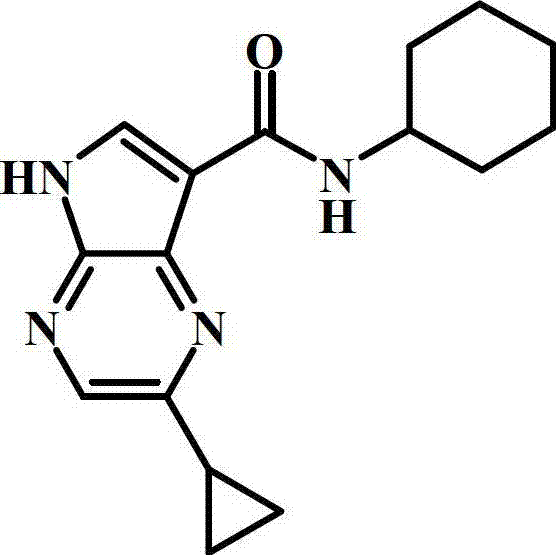
步骤1step 1
向2-环丙基-5-((2-(三甲基硅烷基)乙氧基)甲基)-5H-吡咯并[2,3-b]吡嗪-7-甲酸(80mg,0.24mmol)在THF(2.0mL)的溶液中加入1,1’-羰基二咪唑(47mg,0.29mmol)。将反应混合物在60°C搅拌45分钟,然后冷却至室温。加入环己基胺(0.27mL,2.4mmol),并将反应混合物在室温下搅拌1.5小时。加入水和EtOAc,并将水层用EtOAc萃取。将合并的有机物用水和盐水洗涤,随后用Na2SO4干燥并浓缩。将残余物经8g SiO2色谱用EtOAc/己烷(梯度洗脱:0-30%EtOAc)纯化,得到106mg的2-环丙基-5-(2-三甲基硅烷基-乙氧基甲基)-5H-吡咯并[2,3-b]吡嗪-7-甲酸环己基酰胺,为白色固体。To 2-cyclopropyl-5-((2-(trimethylsilyl)ethoxy)methyl)-5H-pyrrolo[2,3-b]pyrazine-7-carboxylic acid (80mg, 0.24mmol ) To a solution in THF (2.0 mL) was added 1,1'-carbonyldiimidazole (47 mg, 0.29 mmol). The reaction mixture was stirred at 60° C. for 45 minutes, then cooled to room temperature. Cyclohexylamine (0.27 mL, 2.4 mmol) was added, and the reaction mixture was stirred at room temperature for 1.5 hours. Water and EtOAc were added, and the aqueous layer was extracted with EtOAc. The combined organics were washed with water and brine, then dried over Na2SO4 and concentrated. The residue was purified by 8 g SiO2 chromatography with EtOAc/hexanes (gradient elution: 0-30% EtOAc) to afford 106 mg of 2-cyclopropyl-5-(2-trimethylsilyl-ethoxymethyl base)-5H-pyrrolo[2,3-b]pyrazine-7-carboxylic acid cyclohexylamide as a white solid.
步骤2step 2
在10mL圆底烧瓶中,将2-环丙基-5-(2-三甲基硅烷基-乙氧基甲基)-5H-吡咯并[2,3-b]吡嗪-7-甲酸环己基酰胺(94mg,0.23mmol)溶于CH2Cl2(0.9mL)。加入三氟乙酸(0.7mL),并将该浅黄色反应混合物在室温下搅拌2小时,然后浓缩。将残余物溶于甲苯(3mL),浓缩,并随后高真空干燥。将残余物溶于CH2Cl2(0.9mL),并加入乙二胺(0.9mL)。将反应混合物在室温下搅拌2小时,然后加入H2O和EtOAc。将所得混悬液过滤,用H2O和EtOAc冲洗,并高真空干燥,得到55mg(85%)的2-环丙基-5H-吡咯并[2,3-b]吡嗪-7-甲酸环己基酰胺,为白色固体。MS:(M+H)+=285;mp>300.0。In a 10 mL round-bottomed flask, 2-cyclopropyl-5-(2-trimethylsilyl-ethoxymethyl)-5H-pyrrolo[2,3-b]pyrazine-7-carboxylic acid cyclo Hexylamide (94 mg, 0.23 mmol) was dissolved in CH2Cl2 ( 0.9 mL). Trifluoroacetic acid (0.7 mL) was added, and the pale yellow reaction mixture was stirred at room temperature for 2 hours, then concentrated. The residue was dissolved in toluene (3 mL), concentrated, and then dried under high vacuum. The residue was dissolved in CH2Cl2 (0.9 mL ), and ethylenediamine (0.9 mL) was added. The reaction mixture was stirred at room temperature for 2 hours, then H2O and EtOAc were added. The resulting suspension was filtered, rinsed with H2O and EtOAc, and dried under high vacuum to afford 55 mg (85%) of 2-cyclopropyl-5H-pyrrolo[2,3-b]pyrazine-7-carboxylic acid Cyclohexylamide, a white solid. MS: (M+H) + =285; mp>300.0.
实施例18.Example 18.
2-环丙基-5H-吡咯并[2,3-b]吡嗪-7-甲酸环戊基酰胺2-Cyclopropyl-5H-pyrrolo[2,3-b]pyrazine-7-carboxylic acid cyclopentylamide

按照实施例17中所概括的方法制备,在步骤1中用环戊基胺代替环己基胺。MS:(M+H)+=271;mp>300.0。Prepared as outlined in Example 17, substituting cyclohexylamine for cyclopentylamine in Step 1. MS: (M+H) + =271; mp>300.0.
实施例19.Example 19.
2-环丙基-5H-吡咯并[2,3-b]吡嗪-7-甲酸((顺式)-2-氰基-环戊基)-酰胺2-Cyclopropyl-5H-pyrrolo[2,3-b]pyrazine-7-carboxylic acid ((cis)-2-cyano-cyclopentyl)-amide

步骤1step 1
室温下向氢化钠(60%在矿物油中的溶液,1.54g,38.6mmol)在THF(70mL)的混悬液中缓慢加入己二腈(4.0mL,35.1mmol)。将反应混合物回流加热过夜,然后冷却至室温,用水猝灭,并用EtOAc(2x)萃取。将合并的有机层用MgSO4干燥并浓缩。将残余物用己烷研磨,得到3.9g的2-氨基-环戊-1-烯甲腈,为橙色固体。To a suspension of sodium hydride (60% in mineral oil, 1.54 g, 38.6 mmol) in THF (70 mL) was slowly added adiponitrile (4.0 mL, 35.1 mmol) at room temperature. The reaction mixture was heated at reflux overnight, then cooled to room temperature, quenched with water, and extracted with EtOAc (2x). The combined organic layers were dried over MgSO 4 and concentrated. The residue was triturated with hexanes to afford 3.9 g of 2-amino-cyclopent-1-enecarbonitrile as an orange solid.
步骤2step 2
在圆底烧瓶中装入乙酸(16mL),并冷却至0°C。小心加入硼氢化钠(0.57g,15mmol),并将反应物搅拌直至气体停止产生。然后加入2-氨基-环戊-1-烯甲腈(0.54g,5.0mmol),并将反应混合物在室温下搅拌3小时。蒸发溶剂,并将残余物溶于CH2Cl2,并用饱和Na2CO3水溶液洗涤。将水层用CH2Cl2再萃取,并将合并的有机物用Na2SO4干燥并浓缩,得到309mg(56%)的2-氨基-环戊烷甲腈,为黄色油状物。NMR分析显示顺式和反式异构体的~5:1混合物。该物质不经进一步纯化直接使用。A round bottom flask was charged with acetic acid (16 mL) and cooled to 0°C. Sodium borohydride (0.57 g, 15 mmol) was added carefully and the reaction was stirred until gas evolution ceased. Then 2-amino-cyclopent-1-enecarbonitrile (0.54 g, 5.0 mmol) was added and the reaction mixture was stirred at room temperature for 3 hours. The solvent was evaporated, and the residue was dissolved in CH2Cl2 and washed with saturated aqueous Na2CO3 . The aqueous layer was re - extracted with CH2Cl2 , and the combined organics were dried over Na2SO4 and concentrated to afford 309 mg (56%) of 2 - amino-cyclopentanecarbonitrile as a yellow oil. NMR analysis showed ~5:1 mixture of cis and trans isomers. This material was used without further purification.
步骤3step 3
2-环丙基-5H-吡咯并[2,3-b]吡嗪-7-甲酸((顺式)-2-氰基-环戊基)-酰胺是按照实施例1的步骤4-5中所概括的方法制备,在步骤4中用2-氨基-环戊烷甲腈代替2-(1-氨基-环戊基)-丙烷-2-醇盐酸化物。MS:(M+H)+=296;mp>300.0.2-Cyclopropyl-5H-pyrrolo[2,3-b]pyrazine-7-carboxylic acid ((cis)-2-cyano-cyclopentyl)-amide was obtained according to steps 4-5 of Example 1 Prepared as outlined in , substituting 2-amino-cyclopentanecarbonitrile for 2-(1-amino-cyclopentyl)-propan-2-ol hydrochloride in step 4. MS: (M+H) + =296; mp>300.0.
实施例20.Example 20.
2-环丙基-5H-吡咯并[2,3-b]吡嗪-7-甲酸(1-氰基甲基-环戊基)-酰胺2-Cyclopropyl-5H-pyrrolo[2,3-b]pyrazine-7-carboxylic acid (1-cyanomethyl-cyclopentyl)-amide

步骤1step 1
环戊亚基乙腈是按照J.Org.Chem.1990,55,4381中所述的方法制备。Cyclopentylideneacetonitrile was prepared as described in J. Org. Chem. 1990, 55, 4381.
步骤2step 2
将环戊亚基乙腈(1.4g,13.0mmol)在29%氨水(15mL)和MeOH(5mL)中的溶液在密封的压力试管中在100°C加热24小时。将反应混合物冷却至室温并浓缩。将残余物经60g SiO2色谱用MeOH/CH2Cl2(梯度洗脱:0-10%MeOH)纯化,得到088g(54%)的(1-氨基-环戊基)-乙腈,为黄色油状物。A solution of cyclopentylideneacetonitrile (1.4 g, 13.0 mmol) in 29% aqueous ammonia (15 mL) and MeOH (5 mL) was heated at 100° C. for 24 hours in a sealed pressure tube. The reaction mixture was cooled to room temperature and concentrated. The residue was purified by chromatography on 60 g of SiO2 with MeOH/ CH2Cl2 (gradient elution: 0-10% MeOH) to afford 088 g (54% ) of (1-amino-cyclopentyl)-acetonitrile as a yellow oil things.
步骤3step 3
2-环丙基-5H-吡咯并[2,3-b]吡嗪-7-甲酸(1-氰基甲基-环戊基)-酰胺是按照实施例1的步骤4-5中所概括的方法制备,在步骤4中用(1-氨基-环戊基)-乙腈代替2-(1-氨基-环戊基)-丙烷-2-醇盐酸化物。MS:(M+H)+=310;mp=280.0-281.0。2-Cyclopropyl-5H-pyrrolo[2,3-b]pyrazine-7-carboxylic acid (1-cyanomethyl-cyclopentyl)-amide was as outlined in steps 4-5 of Example 1 Prepared by the method of (1-amino-cyclopentyl)-acetonitrile in step 4 instead of 2-(1-amino-cyclopentyl)-propan-2-ol hydrochloride. MS: (M+H) + =310; mp=280.0-281.0.
实施例21.Example 21.
2-环丙基-5H-吡咯并[2,3-b]吡嗪-7-甲酸(2,2-二甲基-环己基)-酰胺2-Cyclopropyl-5H-pyrrolo[2,3-b]pyrazine-7-carboxylic acid (2,2-dimethyl-cyclohexyl)-amide

步骤1step 1
在50mL烧瓶中,将2,2-二甲基环己酮(0.50g,4.0mmol)溶于EtOH(10mL)。加入盐酸羟胺(1.04g,15.0mmol)、H2O(4mL)和20%的NaOH水溶液(4mL),并将反应混合物回流加热2天,然后冷却至室温过夜。减压除去溶剂。将残余物溶于H2O中,并过滤收集203mg(36%)的(E/Z)-2,2-二甲基环己酮肟,为白色固体。将滤液用CH2Cl2(2x)萃取。将合并的有机物用Na2SO4干燥并浓缩,得到其余34mg(6%)产物,为白色固体。In a 50 mL flask, 2,2-dimethylcyclohexanone (0.50 g, 4.0 mmol) was dissolved in EtOH (10 mL). Hydroxylamine hydrochloride (1.04 g, 15.0 mmol), H 2 O (4 mL) and 20% aqueous NaOH (4 mL) were added, and the reaction mixture was heated at reflux for 2 days, then cooled to room temperature overnight. The solvent was removed under reduced pressure. The residue was dissolved in H 2 O and 203 mg (36%) of (E/Z)-2,2-dimethylcyclohexanone oxime was collected by filtration as a white solid. The filtrate was extracted with CH2Cl2 ( 2x ). The combined organics were dried over Na2SO4 and concentrated to afford the remaining 34 mg (6%) of product as a white solid.
步骤2step 2
在干燥的50mL的3颈圆底烧瓶中,将2,2-二甲基环己酮肟(0.235g,1.66mmol)溶于THF(10mL)。室温下历经15分钟逐滴加入氢化铝锂(1.0M的THF溶液,4.0mL,4.0mmol)。将反应混合物在60°C搅拌过夜,然后冷却至室温,并用10mL饱和罗谢尔盐水溶液小心猝灭。将两相混合物在室温下搅拌过夜,然后用2x50mL的CH2Cl2萃取。将合并的有机层用Na2SO4干燥,过滤,并浓缩,得到151mg(71%)的2,2-二甲基环己基胺,为黄色油状物,其不经进一步纯化直接使用。In a dry 50 mL 3-neck round bottom flask, 2,2-dimethylcyclohexanone oxime (0.235 g, 1.66 mmol) was dissolved in THF (10 mL). Lithium aluminum hydride (1.0 M in THF, 4.0 mL, 4.0 mmol) was added dropwise over 15 min at room temperature. The reaction mixture was stirred overnight at 60 °C, then cooled to room temperature and carefully quenched with 10 mL of saturated aqueous Rochelle's salt solution. The biphasic mixture was stirred overnight at room temperature, then extracted with 2x50 mL of CH2Cl2 . The combined organic layers were dried over Na 2 SO 4 , filtered, and concentrated to afford 151 mg (71%) of 2,2-dimethylcyclohexylamine as a yellow oil, which was used without further purification.
步骤3step 3
2-环丙基-5H-吡咯并[2,3-b]吡嗪-7-甲酸(2,2-二甲基-环己基)-酰胺是按照实施例1的步骤4-5中所概括的方法制备,在步骤4中用2,2-二甲基环己基胺代替2-(1-氨基-环戊基)-丙烷-2-醇盐酸化物。MS:(M+H)+=313;mp=295.0-297.0。2-Cyclopropyl-5H-pyrrolo[2,3-b]pyrazine-7-carboxylic acid (2,2-dimethyl-cyclohexyl)-amide was as outlined in steps 4-5 of Example 1 Prepared by the method of 2,2-dimethylcyclohexylamine in step 4 instead of 2-(1-amino-cyclopentyl)-propan-2-ol hydrochloride. MS: (M+H) + =313; mp=295.0-297.0.
实施例22.Example 22.
2-环丙基-5H-吡咯并[2,3-b]吡嗪-7-甲酸(2,2-二甲基-环戊基)-酰胺2-Cyclopropyl-5H-pyrrolo[2,3-b]pyrazine-7-carboxylic acid (2,2-dimethyl-cyclopentyl)-amide

按照实施例21中所概括的方法制备,在步骤1中用2,2-二甲基环戊酮代替2,2-二甲基环己酮。MS:(M+H)+=299;mp>300.0.Prepared as outlined in Example 21, substituting 2,2-dimethylcyclohexanone for 2,2-dimethylcyclohexanone in step 1. MS: (M+H) + =299; mp>300.0.
实施例23.Example 23.
2-环丙基-5H-吡咯并[2,3-b]吡嗪-7-甲酸(1-甲磺酰基-4,4-二甲基-哌啶-3-基)-酰胺2-Cyclopropyl-5H-pyrrolo[2,3-b]pyrazine-7-carboxylic acid (1-methylsulfonyl-4,4-dimethyl-piperidin-3-yl)-amide

步骤1step 1
向4,4-二甲基哌啶-2,6-二酮(2.0g,14.2mmol)在丙酮(50mL)的溶液中加入K2CO3(3.92g,28.3mmol),然后加入(溴甲基)苯(1.85mL,15.6mmol)。将反应混合物在50°C加热4小时,然后冷却至室温并搅拌过夜。经过滤移出出现的浓稠白色沉淀,用丙酮冲洗。将滤液浓缩,并经SiO2色谱(10%至50%EtOAc/己烷)纯化,得到3.0g(92%)的1-苄基-4,4-二甲基哌啶-2,6-二酮,为白色固体。To a solution of 4,4-dimethylpiperidine-2,6-dione (2.0 g, 14.2 mmol) in acetone (50 mL) was added K 2 CO 3 (3.92 g, 28.3 mmol), followed by (methyl bromide yl) benzene (1.85 mL, 15.6 mmol). The reaction mixture was heated at 50° C. for 4 hours, then cooled to room temperature and stirred overnight. The thick white precipitate that appeared was removed by filtration and rinsed with acetone. The filtrate was concentrated and purified by SiO2 chromatography (10% to 50% EtOAc/hexanes) to afford 3.0 g (92%) of 1-benzyl-4,4-dimethylpiperidine-2,6-di Ketone, a white solid.
步骤2step 2
在-78°C下向1-苄基-4,4-二甲基哌啶-2,6-二酮(1.00g,4.32mmol)在THF(20mL)的溶液中加入LiHMDS(1.0M的THF溶液,4.8mL,4.8mmol)。将所得浓稠白色浆体在-78°C搅拌20分钟,然后逐滴加入亚硝酸异戊酯(0.70mL,5.20mmol),其导致鲜橙色出现。将反应混合物在-78°C搅拌30分钟,然后历经1小时逐渐加温至室温,并用饱和NH4Cl水溶液猝灭。将该二相混合物剧烈搅拌5分钟,然后用H2O稀释,并用EtOAc(2x)萃取。将合并的有机物用MgSO4干燥并浓缩。将粗的残余物经SiO2色谱(20%至50%EtOAc/己烷)纯化,第一个分离得到340mg(30%)的(Z)-1-苄基-4,4-二甲基哌啶-2,3,6-三酮3-肟,为白色固体,然后得到280mg(25%)的(E)-1-苄基-4,4-二甲基哌啶-2,3,6-三酮3-肟,为白色固体。To a solution of 1-benzyl-4,4-dimethylpiperidine-2,6-dione (1.00 g, 4.32 mmol) in THF (20 mL) was added LiHMDS (1.0 M in THF) at -78° C. solution, 4.8mL, 4.8mmol). The resulting thick white slurry was stirred at -78 °C for 20 minutes, then isoamyl nitrite (0.70 mL, 5.20 mmol) was added dropwise, which resulted in the appearance of a bright orange color. The reaction mixture was stirred at -78 °C for 30 min, then gradually warmed to room temperature over 1 h and quenched with saturated aqueous NH4CI . The biphasic mixture was stirred vigorously for 5 min, then diluted with H2O and extracted with EtOAc (2x). The combined organics were dried over MgSO4 and concentrated. The crude residue was purified by SiO2 chromatography (20% to 50% EtOAc/hexanes) to give 340 mg (30%) of (Z)-1-benzyl-4,4-dimethylpiperene in the first isolation Pyridine-2,3,6-trione 3-oxime as a white solid followed by 280 mg (25%) of (E)-1-benzyl-4,4-dimethylpiperidine-2,3,6 -Triketone 3-oxime as a white solid.
步骤3step 3
在0°C下向(Z)-1-苄基-4,4-二甲基哌啶-2,3,6-三酮3-肟(490mg,1.88mmol)在THF(5mL)的溶液中缓慢加入LiAlH4(1.0M的THF溶液,9.4mL,9.4mmol)。加完后,将反应混合物加温至室温,并搅拌2小时,然后在60°C加热过夜。将反应混合物冷却至0°C,并通过分批加入固体Na2SO4.10H2O小心猝灭,直至气体停止产生。将该混合物用EtOAc稀释,并在室温下剧烈搅拌1小时,然后过滤,用EtOAc和MeOH冲洗。将滤液浓缩,并将残余物经SiO2色谱(0%至10%MeOH/CH2Cl2(0.5%NH4OH))纯化,得到210mg(51%)的1-苄基-4,4-二甲基哌啶-3-胺,为红色油状物。To a solution of (Z)-1-benzyl-4,4-dimethylpiperidine-2,3,6-trione 3-oxime (490 mg, 1.88 mmol) in THF (5 mL) at 0 °C LiAlH 4 (1.0 M in THF, 9.4 mL, 9.4 mmol) was added slowly. After the addition was complete, the reaction mixture was warmed to room temperature and stirred for 2 hours, then heated at 60° C. overnight. The reaction mixture was cooled to 0 °C and carefully quenched by portionwise addition of solid Na2SO4.10H2O until gas evolution ceased. The mixture was diluted with EtOAc and stirred vigorously at room temperature for 1 h, then filtered, rinsing with EtOAc and MeOH. The filtrate was concentrated and the residue was purified by SiO 2 chromatography (0% to 10% MeOH/CH 2 Cl 2 (0.5% NH 4 OH)) to afford 210 mg (51%) of 1-benzyl-4,4- Dimethylpiperidin-3-amine, a red oil.
步骤4step 4
在25mL烧瓶中,将2-环丙基-5-((2-(三甲基硅烷基)乙氧基)甲基)-5H-吡咯并[2,3-b]吡嗪-7-甲酸(150mg,0.45mmol)、1-苄基-4,4-二甲基哌啶-3-胺(147mg,0.68mmol)和HATU(188mg,0.50mmol)混合。然后加入DMF(3mL),随后加入N,N-二异丙基乙基胺(0.24mL 1.35mmol)。将该黄色反应混合物在室温下搅拌3小时,然后用H2O猝灭,并用EtOAc(3x)萃取。将合并的有机物用H2O(3x)洗涤,用MgSO4干燥并浓缩。将粗的残余物经SiO2色谱(30%至80%EtOAc/己烷)纯化,得到197mg(82%)的N-(1-苄基-4,4-二甲基哌啶-3-基)-2-环丙基-5-((2-(三甲基硅烷基)乙氧基)甲基)-5H-吡咯并[2,3-b]吡嗪-7-甲酰胺,为白色泡沫。In a 25 mL flask, 2-cyclopropyl-5-((2-(trimethylsilyl)ethoxy)methyl)-5H-pyrrolo[2,3-b]pyrazine-7-carboxylic acid (150mg, 0.45mmol), 1-benzyl-4,4-dimethylpiperidin-3-amine (147mg, 0.68mmol) and HATU (188mg, 0.50mmol) were mixed. DMF (3 mL) was then added followed by N,N-diisopropylethylamine (0.24 mL 1.35 mmol). The yellow reaction mixture was stirred at room temperature for 3 hours, then quenched with H2O and extracted with EtOAc (3x). The combined organics were washed with H2O (3x), dried over MgSO4 and concentrated. The crude residue was purified by SiO2 chromatography (30% to 80% EtOAc/hexanes) to afford 197 mg (82%) of N-(1-benzyl-4,4-dimethylpiperidin-3-yl )-2-cyclopropyl-5-((2-(trimethylsilyl)ethoxy)methyl)-5H-pyrrolo[2,3-b]pyrazine-7-carboxamide, white Foam.
步骤5step 5
向N-(1-苄基-4,4-二甲基哌啶-3-基)-2-环丙基-5-((2-(三甲基硅烷基)乙氧基)甲基)-5H-吡咯并[2,3-b]吡嗪-7-甲酰胺(197mg,0.37mmol)在MeOH(10mL)的溶液中加入20%Pd(OH)2/碳(40mg,0.06mmol)。将反应混合物在H2(1大气压)中搅拌5小时,然后经硅藻土过滤,用EtOAc冲洗。将滤液浓缩,得到灰白色泡沫,将其溶于CH2Cl2(6mL),并冷却至0°C,然后加入三乙胺(77μL,0.55mmol),随后加入甲磺酰氯(32μL,0.41mmol)。将反应混合物在0°C搅拌2.5小时,然后用H2O猝灭,并用CH2Cl2萃取。将合并的有机物用MgSO4干燥并浓缩。将粗的残余物经色谱(50%至90%EtOAc/己烷)纯化,以分离193mg(74%)的2-环丙基-N-(4,4-二甲基-1-(甲基磺酰基)哌啶-3-基)-5-((2-(三甲基硅烷基)乙氧基)甲基)-5H-吡咯并[2,3-b]吡嗪-7-甲酰胺,为白色泡沫。To N-(1-benzyl-4,4-dimethylpiperidin-3-yl)-2-cyclopropyl-5-((2-(trimethylsilyl)ethoxy)methyl) - 5H-pyrrolo[2,3-b]pyrazine-7-carboxamide (197 mg, 0.37 mmol) in MeOH (10 mL) was added 20% Pd(OH) 2 /carbon (40 mg, 0.06 mmol). The reaction mixture was stirred under H2 (1 atm) for 5 h, then filtered through celite, rinsing with EtOAc. The filtrate was concentrated to give an off-white foam which was dissolved in CH2Cl2 (6 mL) and cooled to 0 °C, then triethylamine (77 μL, 0.55 mmol ) was added followed by methanesulfonyl chloride (32 μL, 0.41 mmol) . The reaction mixture was stirred at 0° C. for 2.5 hours, then quenched with H 2 O and extracted with CH 2 Cl 2 . The combined organics were dried over MgSO4 and concentrated. The crude residue was purified by chromatography (50% to 90% EtOAc/hexanes) to isolate 193 mg (74%) of 2-cyclopropyl-N-(4,4-dimethyl-1-(methyl Sulfonyl)piperidin-3-yl)-5-((2-(trimethylsilyl)ethoxy)methyl)-5H-pyrrolo[2,3-b]pyrazine-7-carboxamide , as white foam.
步骤6step 6
向2-环丙基-N-(4,4-二甲基-1-(甲基磺酰基)哌啶-3-基)-5-((2-(三甲基硅烷基)乙氧基)甲基)-5H-吡咯并[2,3-b]吡嗪-7-甲酰胺(143mg,0.27mmol)在CH2Cl2(5mL)的溶液中加入TFA(2.0mL,26.0mmol)。将该黄色反应混合物搅拌3小时,然后浓缩。残余物再次溶于CH2Cl2(5mL),并加入乙二胺(0.5mL,7.4mmol)。将反应混合物搅拌1小时,然后浓缩。将残余物经SiO2色谱(50%至100%EtOAc/己烷至5%MeOH/EtOAc)纯化,以分离66mg(62%)的2-环丙基-5H-吡咯并[2,3-b]吡嗪-7-甲酸(1-甲磺酰基-4,4-二甲基-哌啶-3-基)-酰胺,为白色固体。MS:(M+H)+=392。To 2-cyclopropyl-N-(4,4-dimethyl-1-(methylsulfonyl)piperidin-3-yl)-5-((2-(trimethylsilyl)ethoxy )methyl)-5H - pyrrolo[2,3-b]pyrazine-7-carboxamide (143 mg, 0.27 mmol) in CH2Cl2 (5 mL) was added TFA (2.0 mL, 26.0 mmol). The yellow reaction mixture was stirred for 3 hours, then concentrated. The residue was redissolved in CH2Cl2 (5 mL), and ethylenediamine (0.5 mL, 7.4 mmol ) was added. The reaction mixture was stirred for 1 hour, then concentrated. The residue was purified by SiO2 chromatography (50% to 100% EtOAc/hexanes to 5% MeOH/EtOAc) to isolate 66 mg (62%) of 2-cyclopropyl-5H-pyrrolo[2,3-b ] Pyrazine-7-carboxylic acid (1-methylsulfonyl-4,4-dimethyl-piperidin-3-yl)-amide as a white solid. MS: (M+H) + =392.
实施例24.Example 24.
2-环丙基-5H-吡咯并[2,3-b]吡嗪-7-甲酸(4,4-二甲基-四氢-呋喃-3-基)-酰胺2-Cyclopropyl-5H-pyrrolo[2,3-b]pyrazine-7-carboxylic acid (4,4-dimethyl-tetrahydro-furan-3-yl)-amide
步骤1step 1
将叔丁氧基羰基氨基-乙酸叔丁基酯(1.93g,8.35mmol)溶于70mL四氯化碳中。加入N-溴琥珀酰亚胺(1.6g,9.19mmol),并将反应物回流。2小时后,将烧瓶冷却至0°C,过滤并蒸发至约2.7g粗的溴-叔丁氧基羰基氨基-乙酸叔丁基酯,将其直接用于下一步骤。tert-Butoxycarbonylamino-acetic acid tert-butyl ester (1.93 g, 8.35 mmol) was dissolved in 70 mL of carbon tetrachloride. N-Bromosuccinimide (1.6 g, 9.19 mmol) was added and the reaction was refluxed. After 2 hours, the flask was cooled to 0 °C, filtered and evaporated to about 2.7 g of crude bromo-tert-butoxycarbonylamino-acetic acid tert-butyl ester, which was used directly in the next step.
步骤2step 2
将溴-叔丁氧基羰基氨基-乙酸叔丁基酯(1.5g,4.8mmol)溶于40mL的二氯甲烷中,并随后在干冰/丙酮浴中冷却。加入甲基三甲基硅烷基二甲基乙烯酮缩醛(1.9mL,9.6mmol)在二氯甲烷(5mL)中的溶液,然后缓慢加入氯化钛(IV)(0.57mL,5.28mmol)在二氯甲烷(5mL)中的溶液,并随后加入三乙胺(0.73mL,5.28mmol)在二氯甲烷(10mL)中的溶液。将反应混合物加温至室温,并搅拌16小时。加入柠檬酸水溶液(~11g/100mL),并将反应混合物短暂搅拌。分离各层,并将水层再次用二氯甲烷萃取。将合并的二氯甲烷层用碳酸氢钠溶液洗涤,并用硫酸钠干燥。蒸发后,将残余物经硅胶色谱(乙酸乙酯/己烷)纯化,得到206mg(13%)的3-叔丁氧基羰基氨基-2,2-二甲基-琥珀酸4-叔丁酯1-甲酯。Bromo-tert-butoxycarbonylamino-acetic acid tert-butyl ester (1.5 g, 4.8 mmol) was dissolved in 40 mL of dichloromethane and then cooled in a dry ice/acetone bath. A solution of methyltrimethylsilyldimethylketene acetal (1.9 mL, 9.6 mmol) in dichloromethane (5 mL) was added, followed by slow addition of titanium(IV) chloride (0.57 mL, 5.28 mmol) in A solution in dichloromethane (5 mL) and then a solution of triethylamine (0.73 mL, 5.28 mmol) in dichloromethane (10 mL) was added. The reaction mixture was warmed to room temperature and stirred for 16 hours. Aqueous citric acid (-11 g/100 mL) was added and the reaction mixture was stirred briefly. The layers were separated, and the aqueous layer was extracted again with dichloromethane. The combined dichloromethane layers were washed with sodium bicarbonate solution and dried over sodium sulfate. After evaporation, the residue was purified by silica gel chromatography (ethyl acetate/hexane) to give 206 mg (13%) of 4-tert-butyl 3-tert-butoxycarbonylamino-2,2-dimethyl-succinate 1-methyl ester.
步骤3step 3
将3-叔丁氧基羰基氨基-2,2-二甲基-琥珀酸4-叔丁酯1-甲酯和3-叔丁氧基羰基氨基-2,2-二甲基-琥珀酸二甲酯(0.47g,1.53mmol)的混合物溶于二氯甲烷(3mL),并冷却至-78°C。缓慢加入二异丁基氢化铝(3.4mL的1M二氯甲烷溶液,3.4mmol)。将反应混合物加温至室温,并搅拌16小时。再历经24小时分批加入另外的二异丁基氢化铝(总量6.8mL的1M溶液,6.8mmol),直至薄层色谱显示起始原料全部消耗。将氯化铵水溶液和乙酸乙酯加入该反应物,分离各层,并将水层再次用乙酸乙酯萃取。将合并的有机层用氯化钠水溶液洗涤,并用硫酸钠干燥。蒸发后,将残余物经硅胶色谱(乙酸乙酯/己烷)纯化,得到104mg(29%)的(3-羟基-1-羟基甲基-2,2-二甲基-丙基)-氨基甲酸叔丁基酯。3-tert-butoxycarbonylamino-2,2-dimethyl-succinic acid 4-tert-butyl ester 1-methyl ester and 3-tert-butoxycarbonylamino-2,2-dimethyl-succinic acid di A mixture of methyl esters (0.47 g, 1.53 mmol) was dissolved in dichloromethane (3 mL) and cooled to -78°C. Diisobutylaluminum hydride (3.4 mL of a 1M solution in dichloromethane, 3.4 mmol) was added slowly. The reaction mixture was warmed to room temperature and stirred for 16 hours. Additional diisobutylaluminum hydride (total 6.8 mL of a 1 M solution, 6.8 mmol) was added in portions over 24 hours until thin layer chromatography showed complete consumption of the starting material. Aqueous ammonium chloride solution and ethyl acetate were added to the reaction, the layers were separated, and the aqueous layer was extracted again with ethyl acetate. The combined organic layers were washed with aqueous sodium chloride and dried over sodium sulfate. After evaporation, the residue was purified by silica gel chromatography (ethyl acetate/hexane) to afford 104 mg (29%) of (3-hydroxy-1-hydroxymethyl-2,2-dimethyl-propyl)-amino tert-Butyl formate.
步骤4step 4
将(3-羟基-1-羟基甲基-2,2-二甲基-丙基)-氨基甲酸叔丁基酯(104mg,0.44mmol)溶于二氯甲烷(2.2mL)。加入三苯基膦(0.115g,0.44mmol),并随后加入偶氮二甲酸二乙酯(azodiethylcarboxylate)(0.16mL,0.88mmol)。30分钟后,加入另外的三苯基膦(0.115g,0.44mmol)和偶氮二甲酸二乙酯(0.16mL,0.88mmol),并将反应混合物搅拌72小时。蒸发溶剂,并将残余物经硅胶色谱(乙酸乙酯/己烷)纯化,得到70mg(74%)的(4,4-二甲基-四氢-呋喃-3-基)-氨基甲酸叔丁基酯。(3-Hydroxy-1-hydroxymethyl-2,2-dimethyl-propyl)-carbamic acid tert-butyl ester (104 mg, 0.44 mmol) was dissolved in dichloromethane (2.2 mL). Triphenylphosphine (0.115 g, 0.44 mmol) was added, followed by azodiethylcarboxylate (0.16 mL, 0.88 mmol). After 30 minutes, additional triphenylphosphine (0.115 g, 0.44 mmol) and diethyl azodicarboxylate (0.16 mL, 0.88 mmol) were added and the reaction mixture was stirred for 72 hours. The solvent was evaporated and the residue was purified by silica gel chromatography (ethyl acetate/hexane) to afford 70 mg (74%) of (4,4-dimethyl-tetrahydro-furan-3-yl)-tert-butylcarbamate base ester.
步骤5step 5
将(4,4-二甲基-四氢-呋喃-3-基)-氨基甲酸叔丁基酯(70mg,0.32mmol)溶于3mL冷却的4M HCl/二
步骤6step 6
2-环丙基-5H-吡咯并[2,3-b]吡嗪-7-甲酸(4,4-二甲基-四氢-呋喃-3-基)-酰胺是按照实施例1的步骤4-5中所概括的方法制备,在步骤4中用4,4-二甲基-四氢-呋喃-3-基胺盐酸化物代替2-(1-氨基-环戊基)-丙烷-2-醇盐酸化物。MS:(M+H)+=301;mp>300;元素分析:计算值C 63.98,H 6.71,N18.65,实测值C 63.68,H 6.57,N 18.30。2-Cyclopropyl-5H-pyrrolo[2,3-b]pyrazine-7-carboxylic acid (4,4-dimethyl-tetrahydro-furan-3-yl)-amide is according to the steps of Example 1 Prepared by the method outlined in 4-5, substituting 4,4-dimethyl-tetrahydro-furan-3-ylamine hydrochloride for 2-(1-amino-cyclopentyl)-propane-2 in step 4 -alcohol hydrochloride. MS: (M+H) + =301; mp>300; elemental analysis: calculated value C 63.98, H 6.71, N 18.65, found value C 63.68, H 6.57, N 18.30.
实施例25.Example 25.
2-环丙基-5H-吡咯并[2,3-b]吡嗪-7-甲酸((反式)-2-羟基-2-甲基-环戊基)-酰胺2-Cyclopropyl-5H-pyrrolo[2,3-b]pyrazine-7-carboxylic acid ((trans)-2-hydroxy-2-methyl-cyclopentyl)-amide

步骤1step 1
在微波小瓶中放入甲基-1,2-环戊烯氧化物(0.50g,5.1mmol)、4-乙氧基苄基胺(1.5mL,11.5mmol)和水(1.5mL)。将小瓶密封,并将该二相混合物在微波反应器中于130°C加热1小时。将反应物用水稀释,并用CH2Cl2萃取。将有机层用MgSO4干燥并浓缩。将残余物经SiO2色谱(0%至8%MeOH/CH2Cl2(0.5%NH4OH))纯化,得到0.69g(57%)的反式-2-(4-乙氧基苄基氨基)-1-甲基-环戊醇,为白色固体。In a microwave vial were placed methyl-1,2-cyclopentene oxide (0.50 g, 5.1 mmol), 4-ethoxybenzylamine (1.5 mL, 11.5 mmol) and water (1.5 mL). The vial was sealed and the biphasic mixture was heated in a microwave reactor at 130° C. for 1 hour. The reaction was diluted with water and extracted with CH2Cl2 . The organic layer was dried over MgSO 4 and concentrated. The residue was purified by SiO 2 chromatography (0% to 8% MeOH/CH 2 Cl 2 (0.5% NH 4 OH)) to afford 0.69 g (57%) of trans-2-(4-ethoxybenzyl amino)-1-methyl-cyclopentanol as a white solid.
步骤2step 2
向反式-2-(4-乙氧基苄基氨基)-1-甲基-环戊醇(0.32g,1.36mmol)在MeOH(10mL)的溶液中加入20%Pd(OH)2/碳(40mg)。将反应混合物在H2(气球)下搅拌16小时,然后经硅藻土过滤,用EtOAc冲洗。将滤液浓缩,得到反式-2-氨基-1-甲基-环戊醇,为灰白色固体,其不经进一步纯化直接使用。To a solution of trans-2-(4-ethoxybenzylamino)-1-methyl-cyclopentanol (0.32 g, 1.36 mmol) in MeOH (10 mL) was added 20 % Pd(OH)/carbon (40mg). The reaction mixture was stirred under H2 (balloon) for 16 h, then filtered through celite, rinsing with EtOAc. The filtrate was concentrated to afford trans-2-amino-1-methyl-cyclopentanol as an off-white solid which was used without further purification.
步骤3step 3
2-环丙基-5H-吡咯并[2,3-b]吡嗪-7-甲酸((反式)-2-羟基-2-甲基-环戊基)-酰胺是按照实施例1的步骤4-5中所概括的方法制备,在步骤4中用反式-2-氨基-1-甲基-环戊醇代替2-(1-氨基-环戊基)-丙烷-2-醇盐酸化物。MS:(M+H)+=301;mp=260.0-262.0。2-Cyclopropyl-5H-pyrrolo[2,3-b]pyrazine-7-carboxylic acid ((trans)-2-hydroxy-2-methyl-cyclopentyl)-amide according to Example 1 Prepared by the method outlined in steps 4-5, substituting trans-2-amino-1-methyl-cyclopentanol for 2-(1-amino-cyclopentyl)-propan-2-ol hydrochloride in step 4 compounds. MS: (M+H) + =301; mp=260.0-262.0.
实施例26.Example 26.
2-环丙基-5H-吡咯并[2,3-b]吡嗪-7-甲酸(四氢-吡喃-3-基)-酰胺2-Cyclopropyl-5H-pyrrolo[2,3-b]pyrazine-7-carboxylic acid (tetrahydro-pyran-3-yl)-amide

按照实施例1的步骤4-5中所概括的方法制备,在步骤4中用四氢-吡喃-3-基胺代替2-(1-氨基-环戊基)-丙烷-2-醇盐酸化物。MS:(M+H)+=287;mp>300.0。Prepared as outlined in steps 4-5 of Example 1, substituting tetrahydro-pyran-3-ylamine for 2-(1-amino-cyclopentyl)-propan-2-ol hydrochloride in step 4 compounds. MS: (M+H) + =287; mp>300.0.
实施例27.Example 27.
2-环丙基-5H-吡咯并[2,3-b]吡嗪-7-甲酸(3-氰基-苯基)-酰胺2-Cyclopropyl-5H-pyrrolo[2,3-b]pyrazine-7-carboxylic acid (3-cyano-phenyl)-amide

步骤1step 1
将2-环丙基-5-((2-(三甲基硅烷基)乙氧基)甲基)-5H-吡咯并[2,3-b]吡嗪-7-甲酸(100mg,0.30mmol)溶于乙腈(2mL)。加入N,N-二异丙基乙基胺(0.15mL,0.9mmol)、O-苯并三唑-1-基-N,N,N’,N’-四甲基脲
步骤2step 2
向2-环丙基-5-(2-三甲基硅烷基-乙氧基甲基)-5H-吡咯并[2,3-b]吡嗪-7-甲酸(3-氰基-苯基)-酰胺(113mg,0.26mmol)在CH2Cl2(2.6mL)的溶液中加入三氟乙酸(1mL)。在室温下搅拌2小时,然后用NaHCO3水溶液中和,并用EtOAc萃取。将有机层用盐水洗涤,用Na2SO4干燥并浓缩。将残余物溶于EtOH,并加入NaOAc(0.7g)。将反应混合物在60°C搅拌过夜,然后冷却至室温,并加入水和EtOAc。将水层用EtOAc萃取,并将合并的有机物用盐水洗涤,用Na2SO4干燥并浓缩。将残余物经硅胶色谱(MeOH/CH2Cl2)纯化,得到22mg(28%)的2-环丙基-5H-吡咯并[2,3-b]吡嗪-7-甲酸(3-氰基-苯基)-酰胺。MS:(M+H)+=304;mp=272.0-274.0。To 2-cyclopropyl-5-(2-trimethylsilyl-ethoxymethyl)-5H-pyrrolo[2,3-b]pyrazine-7-carboxylic acid (3-cyano-phenyl )-amide (113 mg, 0.26 mmol) To a solution of CH2Cl2 (2.6 mL) was added trifluoroacetic acid (1 mL). It was stirred at room temperature for 2 hours, then neutralized with aqueous NaHCO 3 and extracted with EtOAc. The organic layer was washed with brine, dried over Na2SO4 and concentrated. The residue was dissolved in EtOH and NaOAc (0.7 g) was added. The reaction mixture was stirred overnight at 60 °C, then cooled to room temperature, and water and EtOAc were added. The aqueous layer was extracted with EtOAc, and the combined organics were washed with brine, dried over Na2SO4 and concentrated. The residue was purified by silica gel chromatography (MeOH/CH 2 Cl 2 ) to afford 22 mg (28%) of 2-cyclopropyl-5H-pyrrolo[2,3-b]pyrazine-7-carboxylic acid (3-cyano base-phenyl)-amide. MS: (M+H) + =304; mp=272.0-274.0.
实施例28.Example 28.
2-环丙基-5H-吡咯并[2,3-b]吡嗪-7-甲酸(3-三氟甲基-苯基)-酰胺2-Cyclopropyl-5H-pyrrolo[2,3-b]pyrazine-7-carboxylic acid (3-trifluoromethyl-phenyl)-amide

按照实施例27中所概括的方法制备,在步骤1中用3-氨基-三氟甲基苯代替3-氨基苄腈。MS:(M+H)+=347;mp=271.1-272.9。Prepared as outlined in Example 27, substituting 3-aminobenzonitrile in Step 1 for 3-amino-trifluoromethylbenzene. MS: (M+H) + =347; mp=271.1-272.9.
实施例29.Example 29.
2-环丙基-5H-吡咯并[2,3-b]吡嗪-7-甲酸(5-氰基-2-甲基-苯基)-酰胺2-Cyclopropyl-5H-pyrrolo[2,3-b]pyrazine-7-carboxylic acid (5-cyano-2-methyl-phenyl)-amide
按照实施例27中所概括的方法制备,在步骤1中用3-氨基-4-甲基-苄腈代替3-氨基苄腈。MS:(M+H)+=318;mp=280.0-284.0。Prepared as outlined in Example 27, substituting 3-aminobenzonitrile in Step 1 for 3-amino-4-methyl-benzonitrile. MS: (M+H) + =318; mp=280.0-284.0.
实施例30.Example 30.
2-环丙基-5H-吡咯并[2,3-b]吡嗪-7-甲酸(4-羟基甲基-四氢-吡喃-4-基)-酰胺2-Cyclopropyl-5H-pyrrolo[2,3-b]pyrazine-7-carboxylic acid (4-hydroxymethyl-tetrahydro-pyran-4-yl)-amide

步骤1step 1
向2-环丙基-5-(2-三甲基硅烷基-乙氧基甲基)-5H-吡咯并[2,3-b]吡嗪-7-甲酸(0.20g,0.59mmol)在CH2Cl2(5mL)的溶液中加入EDC(0.14g,0.72mmol)、4-(二甲基氨基)吡啶(0.088g,0.72mmol)和(4-氨基四氢吡喃-4-基)-甲醇(0.094g,0.72mmol)。将反应混合物在室温下搅拌过夜,然后用H2O稀释,并用CH2Cl2萃取。将合并的有机物用盐水洗涤,用Na2SO4干燥并浓缩。将残余物经SiO2色谱(60%EtOAc/己烷)纯化,得到0.15g(57%)的2-环丙基-5-(2-三甲基硅烷基-乙氧基甲基)-5H-吡咯并[2,3-b]吡嗪-7-甲酸(4-羟基甲基-四氢-吡喃-4-基)-酰胺,为油状物。To 2-cyclopropyl-5-(2-trimethylsilyl-ethoxymethyl)-5H-pyrrolo[2,3-b]pyrazine-7-carboxylic acid (0.20g, 0.59mmol) in To a solution of CH 2 Cl 2 (5 mL) was added EDC (0.14 g, 0.72 mmol), 4-(dimethylamino)pyridine (0.088 g, 0.72 mmol) and (4-aminotetrahydropyran-4-yl) - Methanol (0.094 g, 0.72 mmol). The reaction mixture was stirred overnight at room temperature, then diluted with H2O and extracted with CH2Cl2 . The combined organics were washed with brine, dried over Na2SO4 and concentrated. The residue was purified by SiO2 chromatography (60% EtOAc/hexanes) to afford 0.15 g (57%) of 2-cyclopropyl-5-(2-trimethylsilyl-ethoxymethyl)-5H -pyrrolo[2,3-b]pyrazine-7-carboxylic acid (4-hydroxymethyl-tetrahydro-pyran-4-yl)-amide as an oil.
步骤2step 2
向2-环丙基-5-(2-三甲基硅烷基-乙氧基甲基)-5H-吡咯并[2,3-b]吡嗪-7-甲酸(4-羟基甲基-四氢-吡喃-4-基)-酰胺(0.15g,0.33mmol)在CH2Cl2(7.5mL)的溶液中加入三氟乙酸(1.5mL)。将反应混合物在室温搅拌过夜,然后浓缩。将残余物溶于MeOH(10mL)和H2O(1mL)中,并加入Et3N(2mL)。将反应混合物在室温下搅拌过夜,然后浓缩。将残余物用Et2O研磨,得到96mg(92%)的2-环丙基-5H-吡咯并[2,3-b]吡嗪-7-甲酸(4-羟基甲基-四氢-吡喃-4-基)-酰胺,为灰白色固体。MS:(M+H)+=317;mp=294.0-296.0。To 2-cyclopropyl-5-(2-trimethylsilyl-ethoxymethyl)-5H-pyrrolo[2,3-b]pyrazine-7-carboxylic acid (4-hydroxymethyl-tetra To a solution of hydro-pyran-4-yl)-amide (0.15 g, 0.33 mmol) in CH2Cl2 (7.5 mL ) was added trifluoroacetic acid (1.5 mL). The reaction mixture was stirred overnight at room temperature, then concentrated. The residue was dissolved in MeOH (10 mL) and H2O (1 mL), and Et3N (2 mL) was added. The reaction mixture was stirred overnight at room temperature, then concentrated. The residue was triturated with Et2O to afford 96 mg (92%) of 2-cyclopropyl-5H-pyrrolo[2,3-b]pyrazine-7-carboxylic acid (4-hydroxymethyl-tetrahydro-pyridine pyran-4-yl)-amide as an off-white solid. MS: (M+H) + =317; mp=294.0-296.0.
实施例31.Example 31.
2-环丙基-5H-吡咯并[2,3-b]吡嗪-7-甲酸(四氢-吡喃-4-基)-酰胺2-Cyclopropyl-5H-pyrrolo[2,3-b]pyrazine-7-carboxylic acid (tetrahydro-pyran-4-yl)-amide

按照实施例30中所概括的方法制备,在步骤1中用4-氨基四氢吡喃代替(4-氨基四氢吡喃-4-基)-甲醇。MS:(M+H)+=287;mp>300.0。Prepared as outlined in Example 30, substituting 4-aminotetrahydropyran for (4-aminotetrahydropyran-4-yl)-methanol in Step 1. MS: (M+H) + =287; mp>300.0.
实施例32.Example 32.
2-环丙基-5H-吡咯并[2,3-b]吡嗪-7-甲酸(1-羟基甲基-环戊基)-酰胺2-Cyclopropyl-5H-pyrrolo[2,3-b]pyrazine-7-carboxylic acid (1-hydroxymethyl-cyclopentyl)-amide

按照实施例30中所概括的方法制备,在步骤1中用1-氨基-1-环戊烷-甲醇代替(4-氨基四氢吡喃-4-基)-甲醇。MS:(M+H)+=317;mp=272.0-274.0。Prepared as outlined in Example 30, substituting 1-amino-1-cyclopentane-methanol for (4-aminotetrahydropyran-4-yl)-methanol in Step 1 . MS: (M+H) + =317; mp=272.0-274.0.
实施例33.Example 33.
2-环丙基-5H-吡咯并[2,3-b]吡嗪-7-甲酸(1-氰基-环丙基)-酰胺2-Cyclopropyl-5H-pyrrolo[2,3-b]pyrazine-7-carboxylic acid (1-cyano-cyclopropyl)-amide
按照实施例30中所概括的方法制备,在步骤1中用1-氨基-环丙烷甲腈代替(4-氨基四氢吡喃-4-基)-甲醇。MS:(M+H)+=268;mp>300.0。Prepared as outlined in Example 30, substituting 1-amino-cyclopropanecarbonitrile for (4-aminotetrahydropyran-4-yl)-methanol in Step 1 . MS: (M+H) + =268; mp>300.0.
实施例34.Example 34.
2-环丙基-5H-吡咯并[2,3-b]吡嗪-7-甲酸(2,2-二甲基-四氢呋喃-3-基)-酰胺2-Cyclopropyl-5H-pyrrolo[2,3-b]pyrazine-7-carboxylic acid (2,2-dimethyl-tetrahydrofuran-3-yl)-amide

步骤1step 1
在0°C下向(四氢-2-氧代-3-呋喃基)-氨基甲酸叔丁基酯(2.1g,10.4mmol)在THF(12mL)的溶液中缓慢加入甲基溴化镁(3.0M的Et2O溶液,14.5mL,43.5mmol)。将反应混合物在室温下搅拌过夜,然后小心用水猝灭。将反应混合物经硅藻土过滤,用CH2Cl2冲洗。将滤液用盐水洗涤,用硫酸钠干燥,并浓缩,得到1.65g(68%)的2-羟基-1-(2-羟基-乙基)-2-甲基-丙基]-氨基甲酸叔丁基酯,为白色固体,其不经进一步纯化直接使用。To a solution of (tetrahydro-2-oxo-3-furyl)-carbamic acid tert-butyl ester (2.1 g, 10.4 mmol) in THF (12 mL) was slowly added methylmagnesium bromide ( 3.0 M in Et2O , 14.5 mL, 43.5 mmol). The reaction mixture was stirred overnight at room temperature, then carefully quenched with water. The reaction mixture was filtered through Celite, rinsing with CH2Cl2 . The filtrate was washed with brine, dried over sodium sulfate, and concentrated to give 1.65 g (68%) of tert-butyl 2-hydroxy-1-(2-hydroxy-ethyl)-2-methyl-propyl]-carbamate The base ester, a white solid, was used without further purification.
步骤2step 2
在0°C下向2-羟基-1-(2-羟基-乙基)-2-甲基-丙基]-氨基甲酸叔丁基酯(498mg,2.13mmol)和三乙胺(0.45mL,3.23mmol)在CH2Cl2(21mL)的溶液中加入甲磺酰氯(0.20mL,2.58mmol)。将反应混合物加温至室温,并搅拌2小时。将反应物用3M的NaOH水溶液、水和盐水洗涤,然后用Na2SO4干燥,并浓缩,得到627mg甲磺酸3-叔丁氧基羰基氨基-4-羟基-4-甲基-戊基酯,为浅黄色油状物,其不经进一步纯化直接使用。2-Hydroxy-1-(2-hydroxy-ethyl)-2-methyl-propyl]-carbamic acid tert-butyl ester (498mg, 2.13mmol) and triethylamine (0.45mL, 3.23 mmol) To a solution of CH2Cl2 (21 mL ) was added methanesulfonyl chloride (0.20 mL, 2.58 mmol). The reaction mixture was warmed to room temperature and stirred for 2 hours. The reaction was washed with 3M aqueous NaOH, water and brine, then dried over Na2SO4 , and concentrated to give 627 mg of 3-tert-butoxycarbonylamino-4-hydroxy-4-methyl-pentyl methanesulfonate The ester, as a light yellow oil, was used without further purification.
步骤3step 3
向甲磺酸3-叔丁氧基羰基氨基-4-羟基-4-甲基-戊基酯(627mg,2.0mmol,得自步骤2的粗产物)在NMP(5mL)的溶液中加入氰化钠(0.98g,20mmol)。将反应混合物在85°C加热过夜,然后冷却至室温,并在水和乙醚之间分配。将有机层用盐水洗涤,用Na2SO4干燥,并浓缩。将残余物经SiO2色谱(20%至50%EtOAc/己烷)纯化,得到268mg(62%)的(2,2-二甲基-四氢-呋喃-3-基)-氨基甲酸叔丁基酯,为白色固体。To a solution of 3-tert-butoxycarbonylamino-4-hydroxy-4-methyl-pentyl methanesulfonate (627 mg, 2.0 mmol, crude product from step 2) in NMP (5 mL) was added cyanide Sodium (0.98g, 20mmol). The reaction mixture was heated at 85°C overnight, then cooled to room temperature and partitioned between water and ether. The organic layer was washed with brine, dried over Na2SO4 , and concentrated. The residue was purified by SiO2 chromatography (20% to 50% EtOAc/hexanes) to afford 268 mg (62%) of (2,2-dimethyl-tetrahydro-furan-3-yl)-tert-butylcarbamate base ester as a white solid.
步骤4step 4
将(2,2-二甲基-四氢-呋喃-3-基)-氨基甲酸叔丁基酯(266mg,1.10mmol)溶于HCl在MeOH(从MeOH(8mL)和乙酰氯(2mL)中预产生)的溶液中,并在室温下搅拌过夜。将反应混合物浓缩,得到193mg的2,2-二甲基-四氢呋喃-3-基胺盐酸化物,为吸湿性白色固体,其不经进一步纯化直接使用。(2,2-Dimethyl-tetrahydro-furan-3-yl)-carbamic acid tert-butyl ester (266 mg, 1.10 mmol) was dissolved in HCl in MeOH (from MeOH (8 mL) and acetyl chloride (2 mL) pre-produced) solution and stirred overnight at room temperature. The reaction mixture was concentrated to afford 193 mg of 2,2-dimethyl-tetrahydrofuran-3-ylamine hydrochloride as a hygroscopic white solid which was used without further purification.
步骤5step 5
2-环丙基-5H-吡咯并[2,3-b]吡嗪-7-甲酸(2,2-二甲基-四氢呋喃-3-基)-酰胺是按照实施例30中所概括的方法制备,在步骤1中用2,2-二甲基-四氢呋喃-3-基胺盐酸化物代替(4-氨基四氢吡喃-4-基)-甲醇。MS:(M+H)+=301;mp>300.0。2-Cyclopropyl-5H-pyrrolo[2,3-b]pyrazine-7-carboxylic acid (2,2-dimethyl-tetrahydrofuran-3-yl)-amide was according to the method outlined in Example 30 Preparation, substituting 2,2-dimethyl-tetrahydrofuran-3-ylamine hydrochloride for (4-aminotetrahydropyran-4-yl)-methanol in step 1. MS: (M+H) + =301; mp>300.0.
实施例35.Example 35.
2-环丙基-5H-吡咯并[2,3-b]吡嗪-7-甲酸((3R,4S)-3-羟基-四氢-吡喃-4-基)-酰胺2-Cyclopropyl-5H-pyrrolo[2,3-b]pyrazine-7-carboxylic acid ((3R,4S)-3-hydroxy-tetrahydro-pyran-4-yl)-amide

按照实施例1的步骤4-5中所概括的方法制备,在步骤4中用(3R,4S)-4-氨基-四氢-吡喃-3-醇代替2-(1-氨基-环戊基)-丙烷-2-醇盐酸化物。MS:(M+H)+=303。Prepared as outlined in steps 4-5 of Example 1, substituting (3R,4S)-4-amino-tetrahydro-pyran-3-ol for 2-(1-amino-cyclopentyl in step 4 base)-propan-2-ol hydrochloride. MS: (M+H) + =303.
实施例36.Example 36.
2-环丙基-5H-吡咯并[2,3-b]吡嗪-7-甲酸(1-环丙烷羰基-环戊基)-酰胺2-Cyclopropyl-5H-pyrrolo[2,3-b]pyrazine-7-carboxylic acid (1-cyclopropanecarbonyl-cyclopentyl)-amide

步骤1step 1
向3-环丙基-3-氧代丙酸甲酯(2.0g,14mmol)在DMF(70mL)的溶液中加入氢化钠(60%在矿物油中的溶液,1.41g,35mmol)。将反应混合物搅拌10分钟,然后缓慢加入1,4-二溴丁烷(1.85mL,15mmol)。将反应混合物搅拌2.5小时,然后用水小心猝灭,并用乙醚萃取(2x)。将合并的有机物用水(2x)和盐水洗涤,随后用Na2SO4干燥并浓缩。将残余物经60g SiO2色谱(0%至10%EtOAc/己烷)纯化,得到0.63g(23%)的1-环丙烷羰基-环戊烷甲酸甲酯,为无色油状物。To a solution of methyl 3-cyclopropyl-3-oxopropanoate (2.0 g, 14 mmol) in DMF (70 mL) was added sodium hydride (60% solution in mineral oil, 1.41 g, 35 mmol). The reaction mixture was stirred for 10 minutes, then 1,4-dibromobutane (1.85 mL, 15 mmol) was added slowly. The reaction mixture was stirred for 2.5 hours, then carefully quenched with water and extracted with diethyl ether (2x). The combined organics were washed with water ( 2x) and brine, then dried over Na2SO4 and concentrated. The residue was purified by chromatography on 60 g of SiO2 (0% to 10% EtOAc/hexanes) to afford 0.63 g (23%) of methyl 1-cyclopropanecarbonyl-cyclopentanecarboxylate as a colorless oil.
步骤2step 2
向1-环丙烷羰基-环戊烷甲酸甲酯(0.62g,3.1mmol)在EtOH(10mL)的溶液中加入LiOH·H2O(0.53g,12.6mmol)和水(3mL)。将反应混合物在室温下搅拌过夜,然后用水稀释,并用Et2O洗涤。将水层用浓HCl酸化至pH=2,然后用Et2O(2x)萃取。将合并的有机萃取物用Na2SO4干燥并浓缩,得到0.36g(64%)的1-环丙烷羰基-环戊烷甲酸,为浅黄色油状物。To a solution of methyl 1-cyclopropanecarbonyl-cyclopentanecarboxylate (0.62 g, 3.1 mmol) in EtOH (10 mL) was added LiOH·H 2 O (0.53 g, 12.6 mmol) and water (3 mL). The reaction mixture was stirred overnight at room temperature, then diluted with water and washed with Et2O . The aqueous layer was acidified with conc. HCl to pH=2, then extracted with Et2O (2x). The combined organic extracts were dried over Na2SO4 and concentrated to afford 0.36 g (64%) of 1-cyclopropanecarbonyl-cyclopentanecarboxylic acid as a light yellow oil.
步骤3step 3
向1-环丙烷羰基-环戊烷甲酸(0.36g,2.0mmol)在t-BuOH(10mL)的溶液中加入三乙胺(0.33mL,2.4mmol),然后加入二苯基磷酰基叠氮化物(0.47mL,2.2mmol)。将反应混合物回流下搅拌6小时,然后冷却至室温,并倒入饱和NaHCO3水溶液中。将水层用EtOAc(3x)萃取。将合并的有机物用Na2SO4干燥并浓缩。将残余物经24g SiO2色谱(0%至30%EtOAc/己烷)纯化,得到63mg(13%)的(1-环丙烷羰基-环戊基)-氨基甲酸叔丁基酯,为白色固体。To a solution of 1-cyclopropanecarbonyl-cyclopentanecarboxylic acid (0.36 g, 2.0 mmol) in t-BuOH (10 mL) was added triethylamine (0.33 mL, 2.4 mmol) followed by diphenylphosphoryl azide (0.47 mL, 2.2 mmol). The reaction mixture was stirred at reflux for 6 h, then cooled to room temperature and poured into saturated aqueous NaHCO 3 . The aqueous layer was extracted with EtOAc (3x). The combined organics were dried over Na2SO4 and concentrated. The residue was purified by SiO chromatography (0% to 30% EtOAc/hexanes) on 24 g to afford 63 mg (13%) of (1-cyclopropanecarbonyl-cyclopentyl)-carbamic acid tert-butyl ester as a white solid .
步骤4step 4
在10mL圆底烧瓶中,将(1-环丙烷羰基-环戊基)-氨基甲酸叔丁基酯(61mg,0.24mmol)溶于1.0M HCl的MeOH溶液(1.5mL,1.5mmol)中。将反应混合物在室温下搅拌过夜,然后减压浓缩,得到45mg(98%)的(1-氨基-环戊基)-环丙基-甲酮盐酸化物,为白色固体。In a 10 mL round bottom flask, (1-cyclopropanecarbonyl-cyclopentyl)-tert-butyl carbamate (61 mg, 0.24 mmol) was dissolved in 1.0 M HCl in MeOH (1.5 mL, 1.5 mmol). The reaction mixture was stirred at room temperature overnight, then concentrated under reduced pressure to afford 45 mg (98%) of (1-amino-cyclopentyl)-cyclopropyl-methanone hydrochloride as a white solid.
步骤5step 5
2-环丙基-5H-吡咯并[2,3-b]吡嗪-7-甲酸(1-环丙烷羰基-环戊基)-酰胺是按照实施例1的步骤4-5中所概括的方法制备,在步骤4中用(1-氨基-环戊基)-环丙基-甲酮盐酸化物代替2-(1-氨基-环戊基)-丙烷-2-醇盐酸化物。MS:(M+H)+=339;mp=296.0-299.0。2-Cyclopropyl-5H-pyrrolo[2,3-b]pyrazine-7-carboxylic acid (1-cyclopropanecarbonyl-cyclopentyl)-amide was as outlined in steps 4-5 of Example 1 Method preparation, replacing 2-(1-amino-cyclopentyl)-propane-2-ol hydrochloride with (1-amino-cyclopentyl)-cyclopropyl-methanone hydrochloride in step 4. MS: (M+H) + =339; mp=296.0-299.0.
实施例37.Example 37.
2-苯氧基-5H-吡咯并[2,3-b]吡嗪-7-甲酸环己基酰胺2-Phenoxy-5H-pyrrolo[2,3-b]pyrazine-7-carboxylic acid cyclohexylamide
步骤1step 1
将2-溴-5-(2-三甲基硅烷基-乙氧基甲基)-5H-吡咯并[2,3-b]吡嗪-7-甲醛(3.29g,9.23mmol)、苯酚(1.04g,11.08mmol)、K3PO4(3.92g,18.46mmol)、[2'-(二叔丁基膦基)-联苯-2-基]-二甲基-胺(0.157g,0.46mmol),Pd(OAc)2(0.103g,0.46mmol)和脱气的甲苯(50mL)的混合物在氮气中在密封的试管里于150°C搅拌过夜。将反应混合物冷却至室温,并在乙酸乙酯和水之间分配。将水层用乙酸乙酯萃取,并将合并的有机层用MgSO4干燥,过滤并浓缩。将残余物经SiO2柱色谱(0-30%EtOAc/己烷)纯化,得到2.09g(61%)的2-苯氧基-5-(2-三甲基硅烷基-乙氧基甲基)-5H-吡咯并[2,3-b]吡嗪-7-甲醛,为浅褐色固体。2-Bromo-5-(2-trimethylsilyl-ethoxymethyl)-5H-pyrrolo[2,3-b]pyrazine-7-carbaldehyde (3.29g, 9.23mmol), phenol ( 1.04g, 11.08mmol), K 3 PO 4 (3.92g, 18.46mmol), [2'-(di-tert-butylphosphino)-biphenyl-2-yl]-dimethyl-amine (0.157g, 0.46 mmol), Pd(OAc) 2 (0.103 g, 0.46 mmol) and degassed toluene (50 mL) was stirred overnight at 150 °C in a sealed tube under nitrogen. The reaction mixture was cooled to room temperature and partitioned between ethyl acetate and water. The aqueous layer was extracted with ethyl acetate, and the combined organic layers were dried over MgSO 4 , filtered and concentrated. The residue was purified by SiO2 column chromatography (0-30% EtOAc/hexanes) to afford 2.09 g (61%) of 2-phenoxy-5-(2-trimethylsilyl-ethoxymethyl )-5H-pyrrolo[2,3-b]pyrazine-7-carbaldehyde as a beige solid.
步骤2step 2
通过将浓H2SO4(2.3mL)小心加入CrO3(2.67g)中,随后用H2O稀释至10mL来制备琼斯试剂(2.67M)的储备溶液。在0°C下向2-苯氧基-5-(2-三甲基硅烷基-乙氧基甲基)-5H-吡咯并[2,3-b]吡嗪-7-甲醛(2.35g,6.37mmol)在丙酮(75mL)的溶液中逐滴加入琼斯试剂(5mL,13.4mmol)。将反应混合物在室温下搅拌2小时,然后用i-PrOH(2mL)猝灭,用EtOAc稀释,并用硅藻土过滤,用EtOAc冲洗。将滤液用冷水(3x)和盐水洗涤,然后用MgSO4干燥,并浓缩。将残余物经SiO2柱色谱(30-70%EtOAc/己烷)纯化,得到1.59g(65%)的2-苯氧基-5-(2-三甲基硅烷基-乙氧基甲基)-5H-吡咯并[2,3-b]吡嗪-7-甲酸,为浅黄色固体。A stock solution of Jones reagent (2.67M) was prepared by carefully adding concentrated H2SO4 (2.3 mL ) to CrO3 (2.67 g), followed by dilution to 10 mL with H2O . 2-phenoxy-5-(2-trimethylsilyl-ethoxymethyl)-5H-pyrrolo[2,3-b]pyrazine-7-carbaldehyde (2.35g , 6.37mmol) was added dropwise to a solution of Jones reagent (5mL, 13.4mmol) in acetone (75mL). The reaction mixture was stirred at room temperature for 2 h, then quenched with i-PrOH (2 mL), diluted with EtOAc, and filtered through celite, rinsing with EtOAc. The filtrate was washed with cold water (3x) and brine, then dried over MgSO 4 and concentrated. The residue was purified by SiO2 column chromatography (30-70% EtOAc/hexanes) to afford 1.59 g (65%) of 2-phenoxy-5-(2-trimethylsilyl-ethoxymethyl )-5H-pyrrolo[2,3-b]pyrazine-7-carboxylic acid as a pale yellow solid.
步骤3step 3
向2-苯氧基-5-(2-三甲基硅烷基-乙氧基甲基)-5H-吡咯并[2,3-b]吡嗪-7-甲酸(0.115g,0.30mmol)、4-二甲基氨基吡啶(0.048g,0.39mmol)和(3-二甲基氨基-丙基)-乙基-碳二亚胺(0.075g,0.39mmol)在CH2Cl2(2mL)的溶液中加入环己基胺(0.039g,0.39mmol)在CH2Cl2(0.5mL)中的溶液。将反应混合物在室温下搅拌过夜,然后用水猝灭,并用乙酸乙酯(3x)萃取。将有机层用水和饱和NaCl溶液洗涤,用MgSO4干燥,过滤并浓缩,得到2-苯氧基-5-(2-三甲基硅烷基-乙氧基甲基)-5H-吡咯并[2,3-b]吡嗪-7-甲酸环己基酰胺,其不经进一步纯化直接使用。To 2-phenoxy-5-(2-trimethylsilyl-ethoxymethyl)-5H-pyrrolo[2,3-b]pyrazine-7-carboxylic acid (0.115g, 0.30mmol), 4-Dimethylaminopyridine (0.048 g, 0.39 mmol) and (3-dimethylamino-propyl)-ethyl-carbodiimide (0.075 g, 0.39 mmol) in CH 2 Cl 2 (2 mL) To the solution was added a solution of cyclohexylamine (0.039 g, 0.39 mmol) in CH2Cl2 (0.5 mL ). The reaction mixture was stirred overnight at room temperature, then quenched with water and extracted with ethyl acetate (3x). The organic layer was washed with water and saturated NaCl solution, dried over MgSO , filtered and concentrated to give 2-phenoxy-5-(2-trimethylsilyl-ethoxymethyl)-5H-pyrrolo[2 ,3-b] Pyrazine-7-carboxylic acid cyclohexylamide which was used without further purification.
步骤4step 4
向步骤3的2-苯氧基-5-(2-三甲基硅烷基-乙氧基甲基)-5H-吡咯并[2,3-b]吡嗪-7-甲酸环己基酰胺的二氯甲烷(0.7mL)溶液中加入三氟乙酸(0.7mL)。在室温下搅拌反应混合物过夜,并浓缩。残余物用THF(1mL)、水(0.5mL)和Et3N(0.5mL)搅拌2小时并浓缩。残余物在乙酸乙酯和水之间分配,水层用乙酸乙酯萃取。合并的有机层用MgSO4干燥并浓缩。残余物用SiO2柱色谱纯化(0%-80%EtOAc/己烷),接着用Et2O研磨,得到0.022g(22%,2步)的2-苯氧基-5H-吡咯并[2,3-b]吡嗪-7-甲酸环己基酰胺,为白色固体。MS:(M+H)+=337;mp=255.0-257.0。To the di To the solution in methyl chloride (0.7 mL) was added trifluoroacetic acid (0.7 mL). The reaction mixture was stirred overnight at room temperature and concentrated. The residue was stirred with THF (1 mL), water (0.5 mL) and Et3N (0.5 mL) for 2 hours and concentrated. The residue was partitioned between ethyl acetate and water, and the aqueous layer was extracted with ethyl acetate. The combined organic layers were dried over MgSO4 and concentrated. The residue was purified by SiO 2 column chromatography (0%-80% EtOAc/Hexanes) followed by trituration with Et 2 O to afford 0.022 g (22%, 2 steps) of 2-phenoxy-5H-pyrrolo[2 ,3-b] pyrazine-7-carboxylic acid cyclohexylamide as a white solid. MS: (M+H) + =337; mp=255.0-257.0.
实施例38.Example 38.
2-(2,4-二氟-苯氧基)-5H-吡咯并[2,3-b]吡嗪-7-甲酸环己基酰胺2-(2,4-Difluoro-phenoxy)-5H-pyrrolo[2,3-b]pyrazine-7-carboxylic acid cyclohexylamide

按照实施例37中所概括的方法制备,在步骤1中用2,4-二氟苯酚代替苯酚。MS:(M+H)+=373;mp=245.0-247.0。Prepared as outlined in Example 37, substituting 2,4-difluorophenol for phenol in step 1. MS: (M+H) + =373; mp=245.0-247.0.
实施例39.Example 39.
2-(1-乙基-1H-吡唑-4-基)-5H-吡咯并[2,3-b]吡嗪-7-甲酸(2,2-二甲基-环己基)-酰胺2-(1-Ethyl-1H-pyrazol-4-yl)-5H-pyrrolo[2,3-b]pyrazine-7-carboxylic acid (2,2-dimethyl-cyclohexyl)-amide

步骤1step 1
向2-溴-5-((2-(三甲基硅烷基)乙氧基)甲基)-5H-吡咯并[2,3-b]吡嗪-7-甲醛(1.33g,3.73mmol)和1-乙基-4-(4,4,5,5-四甲基-1,3,2-二氧杂硼杂环戊烷-2-基)-1H-吡唑(995mg,4.48mmol)在1,2-DME(20mL)的溶液中加入Pd(Ph3P)4(0.22g,0.19mmol)和2.0M的K2CO3水溶液(5.6ml,11.2mmol)。将反应混合物经鼓入N2脱气15分钟,然后在100°C加热过夜。将所得栗色反应混合物冷却,并用H2O稀释,然后用EtOAc(2x)萃取。将合并的有机物用MgSO4干燥,并浓缩。将粗的残余物经SiO2色谱(30%至80%EtOAc/己烷)纯化,得到1.12g(81%)的2-(1-乙基-1H-吡唑-4-基)-5-((2-(三甲基硅烷基)乙氧基)甲基)-5H-吡咯并[2,3-b]吡嗪-7-甲醛,为浅橙-褐色固体。To 2-bromo-5-((2-(trimethylsilyl)ethoxy)methyl)-5H-pyrrolo[2,3-b]pyrazine-7-carbaldehyde (1.33g, 3.73mmol) and 1-ethyl-4-(4,4,5,5-tetramethyl-1,3,2-dioxaborolan-2-yl)-1H-pyrazole (995mg, 4.48mmol ) to a solution of 1,2-DME (20 mL) were added Pd(Ph 3 P) 4 (0.22 g, 0.19 mmol) and 2.0 M aqueous K 2 CO 3 (5.6 ml, 11.2 mmol). The reaction mixture was degassed by bubbling N2 for 15 min, then heated at 100 °C overnight. The resulting maroon reaction mixture was cooled and diluted with H2O , then extracted with EtOAc (2x). The combined organics were dried over MgSO 4 and concentrated. The crude residue was purified by SiO2 chromatography (30% to 80% EtOAc/hexanes) to afford 1.12 g (81%) of 2-(1-ethyl-1H-pyrazol-4-yl)-5- ((2-(Trimethylsilyl)ethoxy)methyl)-5H-pyrrolo[2,3-b]pyrazine-7-carbaldehyde as a light orange-brown solid.
步骤2step 2
在0°C下向2-(1-乙基-1H-吡唑-4-基)-5-((2-(三甲基硅烷基)乙氧基)甲基)-5H-吡咯并[2,3-b]吡嗪-7-甲醛(1.12g,3.01mmol)在1,4-二
步骤3step 3
2-(1-乙基-1H-吡唑-4-基)-5H-吡咯并[2,3-b]吡嗪-7-甲酸(2,2-二甲基-环己基)-酰胺是按照实施例1的步骤4-5中所概括的方法制备,在步骤4中用2-(1-乙基-1H-吡唑-4-基)-5-((2-(三甲基硅烷基)乙氧基)甲基)-5H-吡咯并[3,2-b]吡嗪-7-甲酸代替2-环丙基-5-(2-三甲基硅烷基-乙氧基甲基)-5H-吡咯并[2,3-b]吡嗪-7-甲酸,并且用2,2-二甲基环己基胺[实施例21,步骤1-2]代替2-(1-氨基-环戊基)-丙烷-2-醇盐酸化物。MS:(M+H)+=367。2-(1-Ethyl-1H-pyrazol-4-yl)-5H-pyrrolo[2,3-b]pyrazine-7-carboxylic acid (2,2-dimethyl-cyclohexyl)-amide is Prepared according to the method outlined in steps 4-5 of Example 1, using 2-(1-ethyl-1H-pyrazol-4-yl)-5-((2-(trimethylsilane) in step 4 base)ethoxy)methyl)-5H-pyrrolo[3,2-b]pyrazine-7-carboxylic acid instead of 2-cyclopropyl-5-(2-trimethylsilyl-ethoxymethyl )-5H-pyrrolo[2,3-b]pyrazine-7-carboxylic acid, and 2-(1-amino- Cyclopentyl)-propan-2-ol hydrochloride. MS: (M+H) + =367.
JAK试验信息JAK Trial Information
Janus激酶(JAK)抑制的IC50的测定:Determination of IC50 for Janus Kinase (JAK) Inhibition:
所使用的酶和肽底物如下所述:The enzymes and peptide substrates used are described below:
JAK1:来自Invitrogen的重组人激酶域(Cat#PV4774)JAK1: recombinant human kinase domain from Invitrogen (Cat#PV4774)
JAK3:来自Millipore(Cat#14-629)的或制备的重组人激酶域JAK3: recombinant human kinase domain from Millipore (Cat#14-629) or prepared
JAK2:来自Millipore的重组人激酶域(Cat#14-640)JAK2: Recombinant human kinase domain from Millipore (Cat#14-640)
底物:N-末端生物素化的14-氨基酸的肽,其来自JAK1的活化环,具有肽底物序列:生物素-KAIETDKEYYTVKDSubstrate: N-terminally biotinylated 14-amino acid peptide from the activation loop of JAK1 with peptide substrate sequence: Biotin-KAIETDKEYYTVKD
所使用的试验条件如下所述:The experimental conditions used are as follows:
试验缓冲液:JAK激酶缓冲液:50mM Hepes[pH 7.2],10mM MgCl2,1mM DTT,1mg/ml BSA。在该缓冲液中进行试验。Assay buffer: JAK kinase buffer: 50 mM Hepes [pH 7.2], 10 mM MgCl 2 , 1 mM DTT, 1 mg/ml BSA. Test in this buffer.
试验安排:全部3种JAK激酶的激酶活性都使用放射性的终点分析和痕量的33P-ATP进行测量。试验在96-孔聚丙烯板中进行。Assay setup: Kinase activity of all 3 JAK kinases was measured using radioactive endpoint assays and trace amounts of 33P-ATP. Assays were performed in 96-well polypropylene plates.
实验方法:experimental method:
所有浓度都是在反应混合物中的最终浓度并且所有的孵育都在室温进行。试验步骤如下所述:All concentrations are final concentrations in the reaction mixture and all incubations were performed at room temperature. The test procedure is as follows:
将化合物逐次稀释在100%DMSO中,通常以1mM的10x起始浓度。在反应中的DMSO的最终浓度是10%。Compounds were serially diluted in 100% DMSO, typically at a 10x starting concentration of 1 mM. The final concentration of DMSO in the reaction was 10%.
化合物与酶(0.5nM JAK3(市售),0.2nM JAK3(制备),1nM JAK2,5nM JAK1)预孵育10分钟。Compounds were pre-incubated with enzymes (0.5 nM JAK3 (commercial), 0.2 nM JAK3 (prepared), 1 nM JAK2, 5 nM JAK1) for 10 min.
通过加入2种底物的混合物(在JAK激酶缓冲液中预混合的ATP和肽)启动反应。在JAK2/JAK3试验中,ATP和肽分别以1.5uM和50uM的浓度使用。JAK1试验是在10uM的ATP浓度和50uM的肽浓度下进行。Reactions were initiated by adding a mixture of 2 substrates (ATP and peptide premixed in JAK kinase buffer). In the JAK2/JAK3 assay, ATP and peptide were used at concentrations of 1.5 uM and 50 uM, respectively. The JAK1 assay was performed at an ATP concentration of 10 uM and a peptide concentration of 50 uM.
JAK2和JAK3的试验持续时间是20分钟。JAK1试验进行40分钟。使用全部3种酶,通过加入0.5M EDTA达到100mM的最终浓度来终止反应。The test duration for JAK2 and JAK3 was 20 minutes. The JAK1 assay was performed for 40 minutes. With all 3 enzymes, the reaction was stopped by adding 0.5M EDTA to a final concentration of 100mM.
将25ul终止的反应物移至在96-孔、1.2um MultiScreen-BV滤板中的150ul在不含MgCl2-和CaCl2、含有50mM EDTA的1x磷酸盐缓冲盐水中的7.5%(v/v)链霉抗生物素包被的琼脂糖珠的浆体中。Transfer 25ul of the terminated reaction to 150ul of 7.5% (v/v ) in a slurry of streptavidin-coated agarose beads.
在30分钟的孵育之后,在真空下用以下的缓冲液洗涤珠:After 30 minutes of incubation, the beads were washed under vacuum with the following buffers:
用200ul的2M NaCl洗涤3-4次。Wash 3-4 times with 200ul of 2M NaCl.
用200ul的2M NaCl+1%(v/v)磷酸洗涤3-4次。Wash 3-4 times with 200ul of 2M NaCl+1% (v/v) phosphoric acid.
用水洗涤1次。Wash with water once.
洗涤过的板在60℃烘箱中干燥1-2小时。The washed plates were dried in a 60°C oven for 1-2 hours.
向滤板的每一个孔加入70ul的Microscint 20闪烁液,并且在至少30分钟的孵育之后,在Perkinelmer微板闪烁计数器中测量放射性计数。70 ul of Microscint 20 scintillation fluid was added to each well of the filter plate, and after at least 30 minutes of incubation, radioactive counts were measured in a Perkinelmer microplate scintillation counter.
代表性的IC50结果在以下表II中:Representative IC50 results are in Table II below:
表II.Table II.
SYK试验信息SYK test information
测定脾酪氨酸激酶(SYK)抑制的IC50 Determination of IC 50 for Spleen Tyrosine Kinase (SYK) Inhibition
SYK激酶试验是调整为适用96孔板模式的标准激酶试验。该实验以96孔模式进行,用于以8个样品进行IC50测定,所述样品代表10个半对数稀释液和40μL反应体积。该试验测量掺入到N-末端生物素化的肽底物中的33P γATP,所述生物素化的肽底物衍生自天然存在的磷酸化受体共有序列(生物素-11aa DY*E)。在用EDTA终止反应和加入链霉抗生物素包被的小珠后,测定磷酸化的产物。代表性的结果在上表II中。The SYK kinase assay is a standard kinase assay adapted to the 96-well format. The experiment was performed in a 96-well format for IC50 determination with 8 samples representing 10 half-log dilutions and a 40 μL reaction volume. This assay measures 33P γATP incorporated into an N-terminal biotinylated peptide substrate derived from a naturally occurring phosphorylated receptor consensus sequence (biotin-11aa DY*E ). Phosphorylated products were assayed after termination of the reaction with EDTA and addition of streptavidin-coated beads. Representative results are in Table II above.
试验板:96-孔MultiScreen 0.65um滤板(Millipore目录号:MADVNOB10)Assay plate: 96-well MultiScreen 0.65um filter plate (Millipore catalog number: MADVNOB10)
链霉抗生物素包被的小珠:链霉抗生物素琼脂糖TM,混悬液5.0mL,在50mM EDTA/PBS中稀释(1:100),(Amersham,目录号:17-5113-01)Streptavidin-coated beads: Streptavidin Sepharose™, suspension 5.0 mL, diluted (1:100) in 50 mM EDTA/PBS, (Amersham, catalog number: 17-5113-01 )
化合物:10mM,在100%二甲基亚砜(DMSO)中,终浓度:化合物在10%DMSO中为0.003-100uMCompound: 10mM in 100% dimethyl sulfoxide (DMSO), final concentration: 0.003-100uM of compound in 10% DMSO
酶:SYK RPA纯化的、截短的脾酪氨酸激酶aa 360-635的构建体,储存液1mg/mL,MW:31.2KDa,终浓度:0.0005μM。Enzyme: SYK RPA purified, truncated construct of spleen tyrosine kinase aa 360-635, stock solution 1mg/mL, MW: 31.2KDa, final concentration: 0.0005μM.
肽1:生物素化的肽衍生自天然存在的磷酸化受体共有序列(生物素-EPEGDYEEVLE),来自QCB的特殊订单,储存液20mM,终浓度:5.0μM。Peptide 1: Biotinylated peptide derived from naturally occurring phosphorylated receptor consensus sequence (biotin-EPEGDYEEVLE), special order from QCB, stock solution 20 mM, final concentration: 5.0 μM.
ATP:腺苷-5’-三磷酸酯20mM,(ROCHE目录号:93202720),终浓度:20μMATP: Adenosine-5'-triphosphate 20 mM, (ROCHE catalog number: 93202720), final concentration: 20 μM
缓冲液:HEPES:2-羟基乙基哌嗪-2-乙磺酸(Sigma,目录号:H-3375)终浓度:50mM HEPES pH7.5Buffer: HEPES: 2-Hydroxyethylpiperazine-2-ethanesulfonic acid (Sigma, catalog number: H-3375) Final concentration: 50 mM HEPES pH7.5
BSA:牛血清白蛋白组分V,无脂肪酸(Roche Diagnostics GmbH,目录号9100221),稀释至终浓度为0.1%BSA: bovine serum albumin fraction V, fatty acid-free (Roche Diagnostics GmbH, catalog number 9100221), diluted to a final concentration of 0.1%
EDTA:EDTA储存液500mM,(GIBCO,目录号:15575-038)终浓度:0.1mMEDTA: EDTA stock solution 500mM, (GIBCO, catalog number: 15575-038) final concentration: 0.1mM
DTT:1,4-二巯苏糖醇(Roche Diagnostics GmbH,目录号:197777),终浓度:1mMDTT: 1,4-dimercaptothreitol (Roche Diagnostics GmbH, catalog number: 197777), final concentration: 1 mM
MgCl2x 6H2O:MERCK,目录号:105833.1000,终浓度:10mMMgCl 2 x 6H 2 O: MERCK, catalog number: 105833.1000, final concentration: 10 mM
试验稀释缓冲液(ADB):50mM HEPES,0.1mM EGTA,0.1mM钒酸钠,0.1mM β-甘油磷酸酯,10mM MgCl2,1mM DTT,0,1%BSA,pH 7.5Assay dilution buffer (ADB): 50mM HEPES, 0.1mM EGTA, 0.1mM sodium vanadate, 0.1mM β-glycerophosphate, 10mM MgCl 2 , 1mM DTT, 0,1%BSA, pH 7.5
珠洗涤缓冲液:10g/L PBS(磷酸盐缓冲盐水),含2M NaCl+1%磷酸。Bead washing buffer: 10g/L PBS (phosphate-buffered saline), containing 2M NaCl+1% phosphoric acid.
试验方法:experiment method:
以40μL体积,将26μL的ADB稀释的纯化重组人SYK360-635[0.5nM]与4μL在[10%]DMSO中的10X浓度的试验化合物[通常100μM-0.003μM]混合,并将该混合物在室温孵育10分钟。In a 40 µL volume, mix 26 µL of ADB-diluted purified recombinant human SYK360-635 [0.5 nM] with 4 µL of a 10X concentration of test compound [usually 100 µM-0.003 µM] in [10%] DMSO, and place the mixture at room temperature Incubate for 10 minutes.
激酶反应通过加入10μL 4x底物混合物而起始,所述底物混合物包含DYE肽底物[0或5μM]、ATP[20μM]和33PγATP[2μCi/rxn]。在30°C孵育15分钟后,通过将25μL的反应样品转移至含有200μL 5mM EDTA和20%在PBS中的链霉抗生物素包被的小珠的96孔0.65μm MilliporeMADVNOB膜/板中来终止反应。Kinase reactions were initiated by adding 10 μL of 4x substrate mix containing DYE peptide substrate [0 or 5 μM], ATP [20 μM] and 33 PγATP [2 μCi/rxn]. After incubation for 15 min at 30 °C, stop by transferring 25 μL of the reaction sample to a 96-well 0.65 μm MilliporeMADVNOB membrane/plate containing 200 μL of 5 mM EDTA and 20% streptavidin-coated beads in PBS reaction.
未结合的放射性核酸在真空下用3x 250μL 2M NaCl;2x250μL 2MNaCl+1%磷酸;1x250μL H2O洗涤。在最后一次洗涤后,将膜/板转移至转换板,60°C热干燥15分钟,向各孔加入50μL闪烁混合物,并在4小时后在酶标仪中对放射性的量进行计数。Unbound radioactive nucleic acids were washed under vacuum with 3x 250 μL 2M NaCl; 2x 250 μL 2M NaCl + 1% phosphoric acid; 1 x 250 μL H2O . After the last wash, the membrane/plate was transferred to a transition plate, heat-dried at 60°C for 15 min, 50 μL of scintillation mix was added to each well, and the amount of radioactivity was counted in a microplate reader after 4 h.
根据未抑制的酶比率来计算百分抑制率:Calculate percent inhibition from the ratio of uninhibited enzyme:
%抑制率=100/(1+(IC50/抑制剂浓度)n)% inhibition rate=100/(1+(IC 50 /inhibitor concentration) n )
使用XLfit软件(ID Business Solution Ltd.,Guilford,Surrey,UK),用非线性曲线拟合计算IC50值。 IC50 values were calculated with non-linear curve fitting using XLfit software (ID Business Solution Ltd., Guilford, Surrey, UK).
为了清楚和理解的目的,通过举例说明和实施例已经详细地记载了上述的发明。很明显的,本领域的技术人员可以在所附的权利要求的范围内进行改变和变换。因此,可以理解以上的说明书是为了举例说明而非限制。因此,本发明的范围不应根据以上的说明书来确定,而应当根据以下所附的权利要求以及与所述的权利要求等价的全部范围来确定。The foregoing invention has been described in detail by way of illustration and example for purposes of clarity and understanding. It is obvious that a person skilled in the art may make changes and transformations within the scope of the appended claims. Accordingly, it is to be understood that the foregoing description is by way of illustration and not limitation. Accordingly, the scope of the present invention should be determined not from the above description but should be determined from the following appended claims along with the full range of equivalents to said claims.
本申请中所引用的全部专利、专利申请和出版物都以其整体引入本文作为参考,用于所有目的,其程度正如同每一个单独的专利、专利申请或出版物各自被引用一样。All patents, patent applications, and publications cited in this application are hereby incorporated by reference in their entirety for all purposes to the same extent as if each individual patent, patent application, or publication was individually incorporated by reference.
Claims (27)


Applications Claiming Priority (5)
| Application Number | Priority Date | Filing Date | Title |
|---|---|---|---|
| US34650210P | 2010-05-20 | 2010-05-20 | |
| US61/346,502 | 2010-05-20 | ||
| US201161475286P | 2011-04-14 | 2011-04-14 | |
| US61/475,286 | 2011-04-14 | ||
| PCT/EP2011/057910 WO2011144584A1 (en) | 2010-05-20 | 2011-05-17 | Pyrrolopyrazine derivatives as syk and jak inhibitors |
Publications (1)
| Publication Number | Publication Date |
|---|---|
| CN102906095A true CN102906095A (en) | 2013-01-30 |
Family
ID=44168843
Family Applications (1)
| Application Number | Title | Priority Date | Filing Date |
|---|---|---|---|
| CN2011800250196A Pending CN102906095A (en) | 2010-05-20 | 2011-05-17 | Pyrrolopyrazine derivatives as SYK and JAK inhibitors |
Country Status (11)
| Country | Link |
|---|---|
| US (1) | US8329699B2 (en) |
| EP (1) | EP2571881A1 (en) |
| JP (1) | JP2013526558A (en) |
| KR (1) | KR20130083387A (en) |
| CN (1) | CN102906095A (en) |
| AR (1) | AR081203A1 (en) |
| CA (1) | CA2798970A1 (en) |
| MX (1) | MX2012013194A (en) |
| RU (1) | RU2012152354A (en) |
| TW (1) | TWI496785B (en) |
| WO (1) | WO2011144584A1 (en) |
Cited By (2)
| Publication number | Priority date | Publication date | Assignee | Title |
|---|---|---|---|---|
| CN105777756A (en) * | 2014-07-02 | 2016-07-20 | 广东东阳光药业有限公司 | Heteroaryl compound and application thereof in medicines |
| CN106336413A (en) * | 2015-07-09 | 2017-01-18 | 广东东阳光药业有限公司 | Compounds used as JAK inhibitor, and use of compounds |
Families Citing this family (43)
| Publication number | Priority date | Publication date | Assignee | Title |
|---|---|---|---|---|
| CA3013000C (en) | 2008-12-19 | 2022-12-13 | Vertex Pharmaceuticals Incorporated | Pyrazine derivatives useful as inhibitors of atr kinase |
| EP2569286B1 (en) | 2010-05-12 | 2014-08-20 | Vertex Pharmaceuticals Inc. | Compounds useful as inhibitors of atr kinase |
| JP2013526538A (en) | 2010-05-12 | 2013-06-24 | バーテックス ファーマシューティカルズ インコーポレイテッド | Compounds useful as ATR kinase inhibitors |
| EP2569289A1 (en) | 2010-05-12 | 2013-03-20 | Vertex Pharmaceuticals Incorporated | Pyrazines useful as inhibitors of atr kinase |
| NZ603478A (en) | 2010-05-12 | 2014-09-26 | Vertex Pharma | 2 -aminopyridine derivatives useful as inhibitors of atr kinase |
| US9334244B2 (en) | 2010-05-12 | 2016-05-10 | Vertex Pharmaceuticals Incorporated | Compounds useful as inhibitors of ATR kinase |
| NZ603477A (en) | 2010-05-12 | 2014-09-26 | Vertex Pharma | Compounds useful as inhibitors of atr kinase |
| WO2011163527A1 (en) | 2010-06-23 | 2011-12-29 | Vertex Pharmaceuticals Incorporated | Pyrrolo- pyrazine derivatives useful as inhibitors of atr kinase |
| KR20140027974A (en) | 2011-04-05 | 2014-03-07 | 버텍스 파마슈티칼스 인코포레이티드 | Aminopyrazine compounds useful as inhibitors of tra kinase |
| WO2012178123A1 (en) | 2011-06-22 | 2012-12-27 | Vertex Pharmaceuticals Incorporated | Compounds useful as inhibitors of atr kinase |
| WO2012178124A1 (en) * | 2011-06-22 | 2012-12-27 | Vertex Pharmaceuticals Incorporated | Compounds useful as inhibitors of atr kinase |
| US9309250B2 (en) | 2011-06-22 | 2016-04-12 | Vertex Pharmaceuticals Incorporated | Substituted pyrrolo[2,3-b]pyrazines as ATR kinase inhibitors |
| KR20140074912A (en) | 2011-09-01 | 2014-06-18 | 에프. 호프만-라 로슈 아게 | Pyrrolopyrazine kinase inhibitors |
| KR20140084112A (en) | 2011-09-30 | 2014-07-04 | 버텍스 파마슈티칼스 인코포레이티드 | Compounds useful as inhibitors of atr kinase |
| CN103957917A (en) | 2011-09-30 | 2014-07-30 | 沃泰克斯药物股份有限公司 | Treatment of pancreatic cancer and non-small cell lung cancer with ATR inhibitors |
| EP2751088B1 (en) | 2011-09-30 | 2016-04-13 | Vertex Pharmaceuticals Incorporated | Compounds useful as inhibitors of atr kinase |
| EP3878851A1 (en) | 2011-09-30 | 2021-09-15 | Vertex Pharmaceuticals Incorporated | Process for making compounds useful as inhibitors of atr kinase |
| US8853217B2 (en) | 2011-09-30 | 2014-10-07 | Vertex Pharmaceuticals Incorporated | Compounds useful as inhibitors of ATR kinase |
| EP2773645A1 (en) | 2011-11-01 | 2014-09-10 | F.Hoffmann-La Roche Ag | Imidazopyridazine compounds |
| EP2776420A1 (en) | 2011-11-09 | 2014-09-17 | Vertex Pharmaceuticals Incorporated | Pyrazine compounds useful as inhibitors of atr kinase |
| WO2013071090A1 (en) | 2011-11-09 | 2013-05-16 | Vertex Pharmaceuticals Incorporated | Compounds useful as inhibitors of atr kinase |
| WO2013071088A1 (en) | 2011-11-09 | 2013-05-16 | Vertex Pharmaceuticals Incorporated | Compounds useful as inhibitors of atr kinase |
| EP2776419B1 (en) | 2011-11-09 | 2016-05-11 | Vertex Pharmaceuticals Incorporated | Pyrazine compounds useful as inhibitors of atr kinase |
| WO2013071094A1 (en) | 2011-11-09 | 2013-05-16 | Vertex Pharmaceuticals Incorporated | Compounds useful as inhibitors of atr kinase |
| KR20140108594A (en) | 2012-01-10 | 2014-09-11 | 에프. 호프만-라 로슈 아게 | Pyridazine amide compounds and their use as syk inhibitors |
| HK1205028A1 (en) | 2012-04-05 | 2015-12-11 | 沃泰克斯药物股份有限公司 | Compounds useful as inhibitors of atr kinase and combination therapies thereof |
| EP2904406B1 (en) | 2012-10-04 | 2018-03-21 | Vertex Pharmaceuticals Incorporated | Method for measuring atr inhibition mediated increases in dna damage |
| WO2014062604A1 (en) | 2012-10-16 | 2014-04-24 | Vertex Pharmaceuticals Incorporated | Compounds useful as inhibitors of atr kinase |
| HRP20180859T1 (en) | 2012-12-07 | 2018-07-13 | Vertex Pharmaceuticals Incorporated | 2-Amino-6-fluoro-N- (5-fluoro-4- (4- (4- (3-oxetanyl-yl) piperazine-1-carbonyl) piperidin-1-yl) pyridin-3-yl) pyrazolo [ 1,5ALFA] PIRIMIDINE-3-CARBOXAMIDE AS ATR KINASE INHIBITOR |
| EP2970286A1 (en) | 2013-03-15 | 2016-01-20 | Vertex Pharmaceuticals Inc. | Fused pyrazolopyrimidine derivatives useful as inhibitors of atr kinase |
| CA2914620C (en) * | 2013-06-05 | 2021-06-15 | C&C Research Laboratories | Heterocyclic derivatives and use thereof |
| HRP20192183T1 (en) | 2013-12-06 | 2020-02-21 | Vertex Pharmaceuticals Inc. | COMPOUND 2-AMINO-6-FLUORO-N- [5-FLUORO-PYRIDIN-3-YL] PYRAZOLO [1,5-A] PYRIMIDINE-3-CARBOXAMIDE USEFUL AS AN ATR KINASE INHIBITOR, ITS PREPARATION, VARIOUS DIFFERENT MARKED DERIVATIVES |
| EP3152212B9 (en) | 2014-06-05 | 2020-05-27 | Vertex Pharmaceuticals Inc. | Radiolabelled derivatives of a 2-amino-6-fluoro-n-[5-fluoro-pyridin-3-yl]- pyrazolo[1,5-a]pyrimidin-3-carboxamide compound useful as atr kinase inhibitor, the preparation of said compound and different solid forms thereof |
| EP3157566B1 (en) | 2014-06-17 | 2019-05-01 | Vertex Pharmaceuticals Incorporated | Method for treating cancer using a combination of chk1 and atr inhibitors |
| HK1258570A1 (en) | 2015-09-30 | 2019-11-15 | Vertex Pharmaceuticals Inc. | Method for treating cancer using a combination of dna damaging agents and atr inhibitors |
| US20170100396A1 (en) | 2015-10-07 | 2017-04-13 | F. Hoffmann-La Roche Ag | Pyrrolopyrazine derivatives for use in the treatment, amelioration or prevention of influenza |
| EP4483875A3 (en) | 2016-05-10 | 2025-04-02 | C4 Therapeutics, Inc. | Spirocyclic degronimers for target protein degradation |
| EP3720441A1 (en) * | 2017-12-04 | 2020-10-14 | H. Hoffnabb-La Roche Ag | Pyrrolo[2,3-b]pyrazine compounds as cccdna inhibitors for the treatment of hepatitis b virus (hbv) infection |
| WO2020092015A1 (en) | 2018-11-02 | 2020-05-07 | University Of Rochester | Therapeutic mitigation of epithelial infection |
| JP2022526713A (en) | 2019-03-21 | 2022-05-26 | オンクセオ | Dbait molecule in combination with a kinase inhibitor for the treatment of cancer |
| JP2023500906A (en) | 2019-11-08 | 2023-01-11 | インサーム(インスティテュ ナシオナル ドゥ ラ サンテ エ ドゥ ラ ルシェルシェ メディカル) | Methods of treating cancers with acquired resistance to kinase inhibitors |
| JP2023507138A (en) | 2019-12-20 | 2023-02-21 | ファイザー・インク | benzimidazole derivative |
| WO2021148581A1 (en) | 2020-01-22 | 2021-07-29 | Onxeo | Novel dbait molecule and its use |
Citations (8)
| Publication number | Priority date | Publication date | Assignee | Title |
|---|---|---|---|---|
| CN1615873A (en) * | 1999-12-24 | 2005-05-18 | 阿文蒂斯药物有限公司 | Azaindoles compound |
| CN1665809A (en) * | 2001-06-21 | 2005-09-07 | 艾文蒂斯药品有限公司 | Azaindoles |
| CN1925855A (en) * | 2003-12-19 | 2007-03-07 | 普莱希科公司 | Compounds and methods for development of Ret modulators |
| WO2009106443A1 (en) * | 2008-02-25 | 2009-09-03 | F. Hoffmann-La Roche Ag | Pyrrolopyrazine kinase inhibitors |
| WO2009106445A1 (en) * | 2008-02-25 | 2009-09-03 | F. Hoffmann-La Roche Ag | Pyrrolopyrazine kinase inhibitors |
| WO2009106444A1 (en) * | 2008-02-25 | 2009-09-03 | F. Hoffmann-La Roche Ag | Pyrrolopyrazine kinase inhibitors |
| WO2009106441A1 (en) * | 2008-02-25 | 2009-09-03 | F. Hoffmann-La Roche Ag | Pyrrolopyrazine kinase inhibitors |
| WO2009106442A1 (en) * | 2008-02-25 | 2009-09-03 | F. Hoffmann-La Roche Ag | Pyrrolopyrazine kinase inhibitors |
Family Cites Families (10)
| Publication number | Priority date | Publication date | Assignee | Title |
|---|---|---|---|---|
| DE60316542T2 (en) | 2002-03-28 | 2008-07-03 | Eisai R&D Management Co., Ltd. | 7-AZAINDOLE AS INHIBITORS C-JUN N-TERMINAL KINASES FOR THE TREATMENT OF NEURODEGENERATIVE DISORDER |
| US7456289B2 (en) | 2004-12-31 | 2008-11-25 | National Health Research Institutes | Anti-tumor compounds |
| EP2251341A1 (en) | 2005-07-14 | 2010-11-17 | Astellas Pharma Inc. | Heterocyclic Janus kinase 3 inhibitors |
| TWI423976B (en) | 2006-01-17 | 2014-01-21 | Vertex Pharma | Azaindoles useful as inhibitors of janus kinases |
| CL2007002617A1 (en) | 2006-09-11 | 2008-05-16 | Sanofi Aventis | COMPOUNDS DERIVED FROM PIRROLO [2,3-B] PIRAZIN-6-ILO; PHARMACEUTICAL COMPOSITION THAT INCLUDES SUCH COMPOUNDS; AND ITS USE TO TREAT INFLAMMATION OF THE ARTICULATIONS, Rheumatoid Arthritis, TUMORS, LYMPHOMA OF THE CELLS OF THE MANTO. |
| WO2008063888A2 (en) | 2006-11-22 | 2008-05-29 | Plexxikon, Inc. | Compounds modulating c-fms and/or c-kit activity and uses therefor |
| PE20121126A1 (en) | 2006-12-21 | 2012-08-24 | Plexxikon Inc | PIRROLO [2,3-B] PYRIDINES COMPOUNDS AS KINASE MODULATORS |
| US20100105661A1 (en) | 2007-01-12 | 2010-04-29 | Astellas Pharma Inc. | Condensed pyridine compound |
| ATE523511T1 (en) | 2007-05-25 | 2011-09-15 | Elan Pharm Inc | PYRAZOLOPYRROLIDINES AS INHIBITORS OF GAMMA SECRETASE |
| US8481541B2 (en) * | 2010-03-22 | 2013-07-09 | Hoffmann-La Roche Inc. | Pyrrolopyrazine kinase inhibitors |
-
2011
- 2011-05-17 TW TW100117245A patent/TWI496785B/en not_active IP Right Cessation
- 2011-05-17 CA CA2798970A patent/CA2798970A1/en not_active Abandoned
- 2011-05-17 MX MX2012013194A patent/MX2012013194A/en active IP Right Grant
- 2011-05-17 WO PCT/EP2011/057910 patent/WO2011144584A1/en not_active Ceased
- 2011-05-17 KR KR1020127033012A patent/KR20130083387A/en not_active Withdrawn
- 2011-05-17 CN CN2011800250196A patent/CN102906095A/en active Pending
- 2011-05-17 EP EP11721743A patent/EP2571881A1/en not_active Withdrawn
- 2011-05-17 JP JP2013510591A patent/JP2013526558A/en active Pending
- 2011-05-17 RU RU2012152354/04A patent/RU2012152354A/en not_active Application Discontinuation
- 2011-05-18 US US13/110,053 patent/US8329699B2/en not_active Expired - Fee Related
- 2011-05-18 AR ARP110101697A patent/AR081203A1/en unknown
Patent Citations (8)
| Publication number | Priority date | Publication date | Assignee | Title |
|---|---|---|---|---|
| CN1615873A (en) * | 1999-12-24 | 2005-05-18 | 阿文蒂斯药物有限公司 | Azaindoles compound |
| CN1665809A (en) * | 2001-06-21 | 2005-09-07 | 艾文蒂斯药品有限公司 | Azaindoles |
| CN1925855A (en) * | 2003-12-19 | 2007-03-07 | 普莱希科公司 | Compounds and methods for development of Ret modulators |
| WO2009106443A1 (en) * | 2008-02-25 | 2009-09-03 | F. Hoffmann-La Roche Ag | Pyrrolopyrazine kinase inhibitors |
| WO2009106445A1 (en) * | 2008-02-25 | 2009-09-03 | F. Hoffmann-La Roche Ag | Pyrrolopyrazine kinase inhibitors |
| WO2009106444A1 (en) * | 2008-02-25 | 2009-09-03 | F. Hoffmann-La Roche Ag | Pyrrolopyrazine kinase inhibitors |
| WO2009106441A1 (en) * | 2008-02-25 | 2009-09-03 | F. Hoffmann-La Roche Ag | Pyrrolopyrazine kinase inhibitors |
| WO2009106442A1 (en) * | 2008-02-25 | 2009-09-03 | F. Hoffmann-La Roche Ag | Pyrrolopyrazine kinase inhibitors |
Cited By (4)
| Publication number | Priority date | Publication date | Assignee | Title |
|---|---|---|---|---|
| CN105777756A (en) * | 2014-07-02 | 2016-07-20 | 广东东阳光药业有限公司 | Heteroaryl compound and application thereof in medicines |
| CN105777756B (en) * | 2014-07-02 | 2019-03-01 | 广东东阳光药业有限公司 | Heteroaromatic compounds and their application in medicine |
| CN106336413A (en) * | 2015-07-09 | 2017-01-18 | 广东东阳光药业有限公司 | Compounds used as JAK inhibitor, and use of compounds |
| CN106336413B (en) * | 2015-07-09 | 2021-04-20 | 广东东阳光药业有限公司 | Compounds as JAK inhibitors and their uses |
Also Published As
| Publication number | Publication date |
|---|---|
| US20110288097A1 (en) | 2011-11-24 |
| KR20130083387A (en) | 2013-07-22 |
| TWI496785B (en) | 2015-08-21 |
| JP2013526558A (en) | 2013-06-24 |
| TW201204730A (en) | 2012-02-01 |
| MX2012013194A (en) | 2013-01-22 |
| CA2798970A1 (en) | 2011-11-24 |
| EP2571881A1 (en) | 2013-03-27 |
| WO2011144584A1 (en) | 2011-11-24 |
| US8329699B2 (en) | 2012-12-11 |
| AR081203A1 (en) | 2012-07-04 |
| RU2012152354A (en) | 2014-06-27 |
Similar Documents
| Publication | Publication Date | Title |
|---|---|---|
| CN102906095A (en) | Pyrrolopyrazine derivatives as SYK and JAK inhibitors | |
| CN101945877B (en) | Pyrrolopyrazine kinase inhibitors | |
| CN101952294B (en) | Pyrrolopyrazine kinase inhibitors | |
| CN102232076B (en) | Pyrrolopyrazinyl urea kinase inhibitors | |
| CN101952296B (en) | Pyrrolopyrazine kinase inhibitors | |
| CN102471346B (en) | Tricyclic inhibitors of JAK | |
| CN102812029A (en) | Pyrrolopyrazine derivatives and their use as JAK and SYK inhibitors | |
| JP5368484B2 (en) | Pyrrolopyrazine kinase inhibitor | |
| MX2012013378A (en) | Pyrrolo [2, 3 - b] pyrazine - 7 - carboxamide derivatives and their use as jak and syk inhibitors. | |
| KR101481872B1 (en) | Inhibitors of jak | |
| CN102803265A (en) | Pyrrolopyrazine kinase inhibitors | |
| ES2370589T3 (en) | PIRROLOPIRAZINE QUINASA INHIBITORS. | |
| HK1178534A (en) | Pyrrolopyrazine derivatives and their use as jak and syk inhibitors |
Legal Events
| Date | Code | Title | Description |
|---|---|---|---|
| C06 | Publication | ||
| PB01 | Publication | ||
| C10 | Entry into substantive examination | ||
| SE01 | Entry into force of request for substantive examination | ||
| AD01 | Patent right deemed abandoned |
Effective date of abandoning: 20160420 |
|
| C20 | Patent right or utility model deemed to be abandoned or is abandoned |