CN102905721A - Diagnosis and treatment of cancer based on AVL9 - Google Patents
Diagnosis and treatment of cancer based on AVL9 Download PDFInfo
- Publication number
- CN102905721A CN102905721A CN2011800146440A CN201180014644A CN102905721A CN 102905721 A CN102905721 A CN 102905721A CN 2011800146440 A CN2011800146440 A CN 2011800146440A CN 201180014644 A CN201180014644 A CN 201180014644A CN 102905721 A CN102905721 A CN 102905721A
- Authority
- CN
- China
- Prior art keywords
- peptide
- cell
- cells
- cancer
- tumor
- Prior art date
- Legal status (The legal status is an assumption and is not a legal conclusion. Google has not performed a legal analysis and makes no representation as to the accuracy of the status listed.)
- Granted
Links
Images


Classifications
-
- C—CHEMISTRY; METALLURGY
- C07—ORGANIC CHEMISTRY
- C07K—PEPTIDES
- C07K7/00—Peptides having 5 to 20 amino acids in a fully defined sequence; Derivatives thereof
-
- A—HUMAN NECESSITIES
- A61—MEDICAL OR VETERINARY SCIENCE; HYGIENE
- A61K—PREPARATIONS FOR MEDICAL, DENTAL OR TOILETRY PURPOSES
- A61K38/00—Medicinal preparations containing peptides
- A61K38/16—Peptides having more than 20 amino acids; Gastrins; Somatostatins; Melanotropins; Derivatives thereof
- A61K38/17—Peptides having more than 20 amino acids; Gastrins; Somatostatins; Melanotropins; Derivatives thereof from animals; from humans
- A61K38/1703—Peptides having more than 20 amino acids; Gastrins; Somatostatins; Melanotropins; Derivatives thereof from animals; from humans from vertebrates
- A61K38/1709—Peptides having more than 20 amino acids; Gastrins; Somatostatins; Melanotropins; Derivatives thereof from animals; from humans from vertebrates from mammals
-
- A—HUMAN NECESSITIES
- A61—MEDICAL OR VETERINARY SCIENCE; HYGIENE
- A61K—PREPARATIONS FOR MEDICAL, DENTAL OR TOILETRY PURPOSES
- A61K35/00—Medicinal preparations containing materials or reaction products thereof with undetermined constitution
- A61K35/12—Materials from mammals; Compositions comprising non-specified tissues or cells; Compositions comprising non-embryonic stem cells; Genetically modified cells
- A61K35/14—Blood; Artificial blood
- A61K35/17—Lymphocytes; B-cells; T-cells; Natural killer cells; Interferon-activated or cytokine-activated lymphocytes
-
- A—HUMAN NECESSITIES
- A61—MEDICAL OR VETERINARY SCIENCE; HYGIENE
- A61K—PREPARATIONS FOR MEDICAL, DENTAL OR TOILETRY PURPOSES
- A61K38/00—Medicinal preparations containing peptides
- A61K38/16—Peptides having more than 20 amino acids; Gastrins; Somatostatins; Melanotropins; Derivatives thereof
- A61K38/17—Peptides having more than 20 amino acids; Gastrins; Somatostatins; Melanotropins; Derivatives thereof from animals; from humans
- A61K38/39—Connective tissue peptides, e.g. collagen, elastin, laminin, fibronectin, vitronectin, cold insoluble globulin [CIG]
-
- A—HUMAN NECESSITIES
- A61—MEDICAL OR VETERINARY SCIENCE; HYGIENE
- A61K—PREPARATIONS FOR MEDICAL, DENTAL OR TOILETRY PURPOSES
- A61K38/00—Medicinal preparations containing peptides
- A61K38/16—Peptides having more than 20 amino acids; Gastrins; Somatostatins; Melanotropins; Derivatives thereof
- A61K38/43—Enzymes; Proenzymes; Derivatives thereof
- A61K38/46—Hydrolases (3)
- A61K38/48—Hydrolases (3) acting on peptide bonds (3.4)
- A61K38/4886—Metalloendopeptidases (3.4.24), e.g. collagenase
-
- A—HUMAN NECESSITIES
- A61—MEDICAL OR VETERINARY SCIENCE; HYGIENE
- A61K—PREPARATIONS FOR MEDICAL, DENTAL OR TOILETRY PURPOSES
- A61K39/00—Medicinal preparations containing antigens or antibodies
-
- A—HUMAN NECESSITIES
- A61—MEDICAL OR VETERINARY SCIENCE; HYGIENE
- A61K—PREPARATIONS FOR MEDICAL, DENTAL OR TOILETRY PURPOSES
- A61K39/00—Medicinal preparations containing antigens or antibodies
- A61K39/0005—Vertebrate antigens
- A61K39/0011—Cancer antigens
-
- A—HUMAN NECESSITIES
- A61—MEDICAL OR VETERINARY SCIENCE; HYGIENE
- A61K—PREPARATIONS FOR MEDICAL, DENTAL OR TOILETRY PURPOSES
- A61K40/00—Cellular immunotherapy
- A61K40/10—Cellular immunotherapy characterised by the cell type used
- A61K40/11—T-cells, e.g. tumour infiltrating lymphocytes [TIL] or regulatory T [Treg] cells; Lymphokine-activated killer [LAK] cells
-
- A—HUMAN NECESSITIES
- A61—MEDICAL OR VETERINARY SCIENCE; HYGIENE
- A61P—SPECIFIC THERAPEUTIC ACTIVITY OF CHEMICAL COMPOUNDS OR MEDICINAL PREPARATIONS
- A61P35/00—Antineoplastic agents
-
- C—CHEMISTRY; METALLURGY
- C07—ORGANIC CHEMISTRY
- C07K—PEPTIDES
- C07K14/00—Peptides having more than 20 amino acids; Gastrins; Somatostatins; Melanotropins; Derivatives thereof
- C07K14/435—Peptides having more than 20 amino acids; Gastrins; Somatostatins; Melanotropins; Derivatives thereof from animals; from humans
- C07K14/705—Receptors; Cell surface antigens; Cell surface determinants
-
- C—CHEMISTRY; METALLURGY
- C07—ORGANIC CHEMISTRY
- C07K—PEPTIDES
- C07K14/00—Peptides having more than 20 amino acids; Gastrins; Somatostatins; Melanotropins; Derivatives thereof
- C07K14/435—Peptides having more than 20 amino acids; Gastrins; Somatostatins; Melanotropins; Derivatives thereof from animals; from humans
- C07K14/705—Receptors; Cell surface antigens; Cell surface determinants
- C07K14/70503—Immunoglobulin superfamily
- C07K14/7051—T-cell receptor (TcR)-CD3 complex
-
- C—CHEMISTRY; METALLURGY
- C07—ORGANIC CHEMISTRY
- C07K—PEPTIDES
- C07K14/00—Peptides having more than 20 amino acids; Gastrins; Somatostatins; Melanotropins; Derivatives thereof
- C07K14/435—Peptides having more than 20 amino acids; Gastrins; Somatostatins; Melanotropins; Derivatives thereof from animals; from humans
- C07K14/705—Receptors; Cell surface antigens; Cell surface determinants
- C07K14/70503—Immunoglobulin superfamily
- C07K14/70539—MHC-molecules, e.g. HLA-molecules
-
- C—CHEMISTRY; METALLURGY
- C07—ORGANIC CHEMISTRY
- C07K—PEPTIDES
- C07K16/00—Immunoglobulins [IGs], e.g. monoclonal or polyclonal antibodies
- C07K16/18—Immunoglobulins [IGs], e.g. monoclonal or polyclonal antibodies against material from animals or humans
- C07K16/28—Immunoglobulins [IGs], e.g. monoclonal or polyclonal antibodies against material from animals or humans against receptors, cell surface antigens or cell surface determinants
- C07K16/2803—Immunoglobulins [IGs], e.g. monoclonal or polyclonal antibodies against material from animals or humans against receptors, cell surface antigens or cell surface determinants against the immunoglobulin superfamily
- C07K16/2833—Immunoglobulins [IGs], e.g. monoclonal or polyclonal antibodies against material from animals or humans against receptors, cell surface antigens or cell surface determinants against the immunoglobulin superfamily against MHC-molecules, e.g. HLA-molecules
-
- C—CHEMISTRY; METALLURGY
- C07—ORGANIC CHEMISTRY
- C07K—PEPTIDES
- C07K7/00—Peptides having 5 to 20 amino acids in a fully defined sequence; Derivatives thereof
- C07K7/04—Linear peptides containing only normal peptide links
- C07K7/06—Linear peptides containing only normal peptide links having 5 to 11 amino acids
-
- C—CHEMISTRY; METALLURGY
- C07—ORGANIC CHEMISTRY
- C07K—PEPTIDES
- C07K7/00—Peptides having 5 to 20 amino acids in a fully defined sequence; Derivatives thereof
- C07K7/04—Linear peptides containing only normal peptide links
- C07K7/08—Linear peptides containing only normal peptide links having 12 to 20 amino acids
-
- C—CHEMISTRY; METALLURGY
- C12—BIOCHEMISTRY; BEER; SPIRITS; WINE; VINEGAR; MICROBIOLOGY; ENZYMOLOGY; MUTATION OR GENETIC ENGINEERING
- C12N—MICROORGANISMS OR ENZYMES; COMPOSITIONS THEREOF; PROPAGATING, PRESERVING, OR MAINTAINING MICROORGANISMS; MUTATION OR GENETIC ENGINEERING; CULTURE MEDIA
- C12N15/00—Mutation or genetic engineering; DNA or RNA concerning genetic engineering, vectors, e.g. plasmids, or their isolation, preparation or purification; Use of hosts therefor
- C12N15/09—Recombinant DNA-technology
- C12N15/63—Introduction of foreign genetic material using vectors; Vectors; Use of hosts therefor; Regulation of expression
-
- C—CHEMISTRY; METALLURGY
- C12—BIOCHEMISTRY; BEER; SPIRITS; WINE; VINEGAR; MICROBIOLOGY; ENZYMOLOGY; MUTATION OR GENETIC ENGINEERING
- C12N—MICROORGANISMS OR ENZYMES; COMPOSITIONS THEREOF; PROPAGATING, PRESERVING, OR MAINTAINING MICROORGANISMS; MUTATION OR GENETIC ENGINEERING; CULTURE MEDIA
- C12N5/00—Undifferentiated human, animal or plant cells, e.g. cell lines; Tissues; Cultivation or maintenance thereof; Culture media therefor
- C12N5/06—Animal cells or tissues; Human cells or tissues
- C12N5/0602—Vertebrate cells
- C12N5/0634—Cells from the blood or the immune system
- C12N5/0636—T lymphocytes
- C12N5/0638—Cytotoxic T lymphocytes [CTL] or lymphokine activated killer cells [LAK]
-
- C—CHEMISTRY; METALLURGY
- C12—BIOCHEMISTRY; BEER; SPIRITS; WINE; VINEGAR; MICROBIOLOGY; ENZYMOLOGY; MUTATION OR GENETIC ENGINEERING
- C12P—FERMENTATION OR ENZYME-USING PROCESSES TO SYNTHESISE A DESIRED CHEMICAL COMPOUND OR COMPOSITION OR TO SEPARATE OPTICAL ISOMERS FROM A RACEMIC MIXTURE
- C12P21/00—Preparation of peptides or proteins
-
- G—PHYSICS
- G01—MEASURING; TESTING
- G01N—INVESTIGATING OR ANALYSING MATERIALS BY DETERMINING THEIR CHEMICAL OR PHYSICAL PROPERTIES
- G01N33/00—Investigating or analysing materials by specific methods not covered by groups G01N1/00 - G01N31/00
- G01N33/48—Biological material, e.g. blood, urine; Haemocytometers
- G01N33/50—Chemical analysis of biological material, e.g. blood, urine; Testing involving biospecific ligand binding methods; Immunological testing
- G01N33/5005—Chemical analysis of biological material, e.g. blood, urine; Testing involving biospecific ligand binding methods; Immunological testing involving human or animal cells
- G01N33/5008—Chemical analysis of biological material, e.g. blood, urine; Testing involving biospecific ligand binding methods; Immunological testing involving human or animal cells for testing or evaluating the effect of chemical or biological compounds, e.g. drugs, cosmetics
- G01N33/5044—Chemical analysis of biological material, e.g. blood, urine; Testing involving biospecific ligand binding methods; Immunological testing involving human or animal cells for testing or evaluating the effect of chemical or biological compounds, e.g. drugs, cosmetics involving specific cell types
- G01N33/5047—Cells of the immune system
- G01N33/505—Cells of the immune system involving T-cells
-
- A—HUMAN NECESSITIES
- A61—MEDICAL OR VETERINARY SCIENCE; HYGIENE
- A61K—PREPARATIONS FOR MEDICAL, DENTAL OR TOILETRY PURPOSES
- A61K39/00—Medicinal preparations containing antigens or antibodies
- A61K2039/51—Medicinal preparations containing antigens or antibodies comprising whole cells, viruses or DNA/RNA
- A61K2039/515—Animal cells
- A61K2039/5158—Antigen-pulsed cells, e.g. T-cells
-
- A—HUMAN NECESSITIES
- A61—MEDICAL OR VETERINARY SCIENCE; HYGIENE
- A61K—PREPARATIONS FOR MEDICAL, DENTAL OR TOILETRY PURPOSES
- A61K39/00—Medicinal preparations containing antigens or antibodies
- A61K2039/57—Medicinal preparations containing antigens or antibodies characterised by the type of response, e.g. Th1, Th2
- A61K2039/572—Medicinal preparations containing antigens or antibodies characterised by the type of response, e.g. Th1, Th2 cytotoxic response
-
- A—HUMAN NECESSITIES
- A61—MEDICAL OR VETERINARY SCIENCE; HYGIENE
- A61K—PREPARATIONS FOR MEDICAL, DENTAL OR TOILETRY PURPOSES
- A61K39/00—Medicinal preparations containing antigens or antibodies
- A61K2039/58—Medicinal preparations containing antigens or antibodies raising an immune response against a target which is not the antigen used for immunisation
- A61K2039/585—Medicinal preparations containing antigens or antibodies raising an immune response against a target which is not the antigen used for immunisation wherein the target is cancer
-
- C—CHEMISTRY; METALLURGY
- C07—ORGANIC CHEMISTRY
- C07K—PEPTIDES
- C07K2319/00—Fusion polypeptide
-
- C—CHEMISTRY; METALLURGY
- C12—BIOCHEMISTRY; BEER; SPIRITS; WINE; VINEGAR; MICROBIOLOGY; ENZYMOLOGY; MUTATION OR GENETIC ENGINEERING
- C12N—MICROORGANISMS OR ENZYMES; COMPOSITIONS THEREOF; PROPAGATING, PRESERVING, OR MAINTAINING MICROORGANISMS; MUTATION OR GENETIC ENGINEERING; CULTURE MEDIA
- C12N2510/00—Genetically modified cells
Landscapes
- Health & Medical Sciences (AREA)
- Life Sciences & Earth Sciences (AREA)
- Chemical & Material Sciences (AREA)
- Immunology (AREA)
- Engineering & Computer Science (AREA)
- Organic Chemistry (AREA)
- General Health & Medical Sciences (AREA)
- Medicinal Chemistry (AREA)
- Biomedical Technology (AREA)
- Genetics & Genomics (AREA)
- Zoology (AREA)
- Bioinformatics & Cheminformatics (AREA)
- Biochemistry (AREA)
- Molecular Biology (AREA)
- Veterinary Medicine (AREA)
- Animal Behavior & Ethology (AREA)
- Public Health (AREA)
- Cell Biology (AREA)
- Pharmacology & Pharmacy (AREA)
- Microbiology (AREA)
- Biotechnology (AREA)
- Wood Science & Technology (AREA)
- Epidemiology (AREA)
- Proteomics, Peptides & Aminoacids (AREA)
- Hematology (AREA)
- Biophysics (AREA)
- General Engineering & Computer Science (AREA)
- Gastroenterology & Hepatology (AREA)
- Mycology (AREA)
- Urology & Nephrology (AREA)
- Toxicology (AREA)
- Chemical Kinetics & Catalysis (AREA)
- General Chemical & Material Sciences (AREA)
- Physics & Mathematics (AREA)
- Oncology (AREA)
- Nuclear Medicine, Radiotherapy & Molecular Imaging (AREA)
- Pathology (AREA)
- Tropical Medicine & Parasitology (AREA)
- General Physics & Mathematics (AREA)
- Analytical Chemistry (AREA)
Abstract
本发明涉及用于免疫治疗方法的肽、核酸和细胞。特别是,本发明涉及癌症的免疫疗法。本发明还涉及单独使用或与其他肿瘤相关肽(刺激抗肿瘤免疫应答疫苗复合物的活性药物成分)联合使用的肿瘤相关细胞毒性T辅助细胞(CTL)肽表位。本发明涉及95种新型肽序列及其变体,它们源自可用于引发抗肿瘤免疫应答的疫苗组合物中的人肿瘤HLA-I类分子。The present invention relates to peptides, nucleic acids, and cells for use in immunotherapy. In particular, the present invention relates to cancer immunotherapy. The present invention also relates to tumor-associated cytotoxic T helper cell (CTL) peptide epitopes, used alone or in combination with other tumor-associated peptides as active pharmaceutical ingredients of vaccine compositions that stimulate anti-tumor immune responses. The present invention relates to 95 novel peptide sequences and variants thereof derived from human tumor HLA class I molecules that can be used in vaccine compositions that elicit anti-tumor immune responses.
Description
本发明涉及用于免疫治疗方法的肽、核酸和细胞。特别是,本发明涉及癌症的免疫疗法。本发明还涉及单独使用或与其他肿瘤相关肽(刺激抗肿瘤免疫应答疫苗复合物的活性药物成分)联合使用的由CD8+T细胞识别的肿瘤相关表位。本发明涉及33种新型肽序列及其变体,它们源自可用于引发抗肿瘤免疫应答的疫苗组合物中的人肿瘤HLA-I类分子,尤其是细胞毒性T细胞免疫应答。The present invention relates to peptides, nucleic acids and cells for use in immunotherapeutic methods. In particular, the invention relates to immunotherapy of cancer. The present invention also relates to tumor-associated epitopes recognized by CD8+ T cells alone or in combination with other tumor-associated peptides (active pharmaceutical ingredients of vaccine complexes that stimulate anti-tumor immune responses). The present invention relates to 33 novel peptide sequences and variants thereof derived from human tumor HLA class I molecules useful in vaccine compositions for eliciting anti-tumor immune responses, especially cytotoxic T cell immune responses.
发明背景Background of the invention
胃癌是恶性细胞在胃壁形成的一种疾病。胃癌可发生于胃部的任何部分,可能扩散到整个胃部以及其他器官;尤其是食道、肺和肝脏。胃癌是全球第四最常见的癌症,2002年有93万确诊病例。胃癌具有高死亡率(每年~80万),使之成为全球仅次于肺癌导致癌症死亡的第二大最常见原因。此病较常见于男性,更常见于亚洲国家和发展中国家。(http://www.who.int/mediacentre/factsheets/fs297/en/.)Stomach cancer is a disease in which malignant cells form in the lining of the stomach. Stomach cancer can start in any part of the stomach and may spread throughout the stomach and to other organs; especially the esophagus, lungs, and liver. Gastric cancer is the fourth most common cancer worldwide, with 930,000 cases diagnosed in 2002. Gastric cancer has a high mortality rate (~0.8 million per year), making it the second most common cause of cancer death worldwide after lung cancer. The disease is more common in men and is more common in Asian countries and developing countries. (http://www.who.int/mediacentre/factsheets/fs297/en/.)
在美国,胃癌约占每年所有新发癌症病例的2%(25500例),但在其他国家更常见。在韩国,胃癌是位于第一位的癌症,占恶性肿瘤的20.8%。在日本,胃癌仍是男性最常见的癌症。在美国,每年约有8000名男性和13000女性被诊断患有胃癌。大部分患者为70岁以上。Stomach cancer accounts for about 2% (25,500) of all new cancer cases each year in the United States, but is more common in other countries. In Korea, gastric cancer is the number one cancer, accounting for 20.8% of malignant tumors. Stomach cancer remains the most common cancer in men in Japan. In the United States, approximately 8,000 men and 13,000 women are diagnosed with stomach cancer each year. Most patients are over 70 years old.
胃癌是全球第四大常见癌症,仅次于肺癌、乳腺癌、结肠癌和直肠癌。此外,胃癌仍是第二大最常见癌症死因。据美国癌症协会估计,2007年有一百万新发病例,其中近70%发生在发展中国家,大约80万例死亡。(http://www.cancer.org/downloads/STT/Global_Facts_and_Figures_2007_rev2.pdf.)Gastric cancer is the fourth most common cancer worldwide, after lung, breast, colon, and rectal cancers. Furthermore, gastric cancer remains the second most common cause of cancer death. The American Cancer Society estimates that in 2007 there were one million new cases, nearly 70 percent of which occurred in developing countries, and about 800,000 deaths. (http://www.cancer.org/downloads/STT/Global_Facts_and_Figures_2007_rev2.pdf.)
此疾病的全球发病率中存在巨大的地域差异。该疾病的发病率在亚洲和南美洲部分地区最高,在北美最低。根据记录,该疾病的死亡率在智利、日本、南美和前苏联最高。There are large geographic differences in the global incidence of the disease. The incidence of the disease is highest in Asia and parts of South America and lowest in North America. Death rates from the disease have been recorded highest in Chile, Japan, South America and the former Soviet Union.
除了日本通常进行早期检测外(在韩国以有限的方式进行),世界大部分地区均不进行筛查,因此,胃癌在得到确诊时通常已为晚期。因而,胃癌仍然对医疗保健专业人士带来重大挑战。胃癌的危险因素为幽门螺杆菌(H.pylori)感染、吸烟、摄入高量盐分、以及其他饮食因素。少数胃癌(1%至3%)与胃癌遗传易感性症候群相关。在弥漫型胃癌常染色体显性遗传易感性家族中,大约25%发生上皮钙黏蛋白基因突变。这一亚群胃癌被称为遗传性弥漫性胃癌。12提供遗传咨询,并考虑在种系截断的年轻无症状携带者中进行预防性胃切除术可能是有益的。Screening is not performed in most parts of the world, except in Japan where early detection is usually done (and in a limited way in South Korea), so stomach cancer is often diagnosed at an advanced stage. Thus, gastric cancer remains a significant challenge for healthcare professionals. Risk factors for gastric cancer are Helicobacter pylori (H. pylori) infection, smoking, high salt intake, and other dietary factors. A small number of gastric cancers (1% to 3%) are associated with gastric cancer genetic predisposition syndrome. Mutations in the E-cadherin gene occur in approximately 25% of families with autosomal dominant susceptibility to diffuse gastric cancer. This subgroup of gastric cancers is called hereditary diffuse gastric cancer. 12 Offer genetic counseling and consider prophylactic gastrectomy in young asymptomatic carriers of germline truncation may be beneficial.
胃壁由3层组织组成:粘膜(最内)层、肌(中间)层和浆膜(最外)层。胃癌首先发生于粘膜层内壁,随着生长而扩散至外层。有四种标准治疗方法可治疗胃癌。胃癌治疗方法包括手术、化疗、放疗或放化疗。手术是胃癌的主要治疗方法。手术的目的是进行完全切除,并使切缘为阴性(R0切除)。但是,大约有50%局部胃癌不能进行R0切除。R1切除表示在显微镜下可发现残留癌细胞(切缘阳性),R2切除表示有肉眼可见的残留癌细胞,但疾病未向远处转移。患者结果取决于诊断时发现的最初期别(NCCN肿瘤学临床实践指南TM)。The stomach wall is made up of 3 layers of tissue: the mucosal (innermost) layer, the muscular (middle) layer, and the serosa (outermost) layer. Stomach cancer starts on the inner lining of the mucous membrane layer and spreads to the outer layer as it grows. There are four standard treatments for stomach cancer. Stomach cancer treatments include surgery, chemotherapy, radiation therapy, or chemoradiotherapy. Surgery is the main treatment for stomach cancer. The goal of surgery is complete resection with negative margins (R0 resection). However, about 50% of localized gastric cancers cannot be resected with R0. R1 resection indicates that residual cancer cells can be found under the microscope (positive margin), and R2 resection indicates that there are residual cancer cells visible to the naked eye, but the disease has not metastasized to distant sites. Patient outcome depends on the initial stage found at diagnosis (NCCN Oncology Clinical Practice GuidelinesTM ).
对于II期疾病的患者,治疗性手术切除后的5年生存率为30-50%,III期患者为10-25%。这些患者局部及全身复发的可能性极高。80-90%的胃癌患者均会发生转移,在较早期别得到确诊的患者中6个月生存率为65%,而在较晚期确诊的患者中不到15%。The 5-year survival rate after curative surgical resection is 30-50% for patients with stage II disease and 10-25% for patients with stage III disease. These patients are at high risk of local and systemic recurrence. Metastasis occurs in 80-90% of gastric cancer patients, and the 6-month survival rate is 65% in patients diagnosed at an early stage, but less than 15% in patients diagnosed at a later stage.
因此,仍然需要对以下癌症患者实施安全有效、并且在不使用化疗药物或可能导致严重副作用的药物即可提升患者健康的新型治疗方案:胃癌、摄护腺(上皮)癌、口腔癌、口腔鳞状细胞癌(OSCC)、急性髓性白血病(AML)、幽门螺旋杆菌引起的MALT淋巴瘤、结肠(上皮)癌/结直肠癌、胶质母细胞瘤、非小细胞肺癌(NSCLC)、宫颈(上皮)癌、人乳腺癌、摄护腺癌、结肠癌、胰腺癌、胰腺导管腺癌、卵巢癌、肝细胞癌、肝癌、不同表型的脑肿瘤、急性淋巴细胞白血病(ALL)等白血病、肺癌、尤因氏肉瘤、子宫内膜癌、头颈部鳞状细胞癌、喉上皮癌、食管癌、口腔(上皮)癌、膀胱癌、卵巢(上皮)癌、肾细胞癌、非典型脑膜瘤、乳头状甲状腺癌、脑肿瘤、涎腺导管癌、宫颈癌、结外型T/NK细胞淋巴瘤、非霍奇金淋巴瘤、肺癌和乳腺癌等恶性实体瘤、以及其他肿瘤。Therefore, there is still a need for new treatment options that are safe, effective, and that can improve patient health without the use of chemotherapy drugs or drugs that may cause serious side effects for patients with the following cancers: gastric cancer, prostate (epithelial) cancer, oral cancer, oral squamous cell carcinoma, Stem cell carcinoma (OSCC), acute myeloid leukemia (AML), MALT lymphoma caused by Helicobacter pylori, colon (epithelial) cancer/colorectal cancer, glioblastoma, non-small cell lung cancer (NSCLC), cervical ( Epithelial) carcinoma, human breast cancer, prostate cancer, colon cancer, pancreatic cancer, pancreatic ductal adenocarcinoma, ovarian cancer, hepatocellular carcinoma, liver cancer, different phenotypes of brain tumors, acute lymphoblastic leukemia (ALL) and other leukemias, Lung cancer, Ewing's sarcoma, endometrial cancer, head and neck squamous cell carcinoma, laryngeal epithelial cancer, esophageal cancer, oral cavity (epithelial) cancer, bladder cancer, ovarian (epithelial) cancer, renal cell carcinoma, atypical meningioma , papillary thyroid cancer, brain tumor, salivary duct carcinoma, cervical cancer, extranodal T/NK cell lymphoma, non-Hodgkin's lymphoma, malignant solid tumors such as lung and breast cancer, and other tumors.
本发明采用刺激免疫系统的肽以一种无创方式作为抗肿瘤制剂。The present invention uses peptides that stimulate the immune system as anti-tumor agents in a non-invasive manner.
发明内容 Contents of the invention
是否能刺激免疫应答取决于是否存在被宿主免疫系统视为异物的抗原。发现肿瘤相关抗原的存在增加了运用宿主免疫系统干预肿瘤生长的可能性。对于癌症免疫疗法,目前正在探索各种利用免疫系统的体液和细胞免疫作用的机制,用于癌症免疫治疗。The ability to stimulate an immune response depends on the presence of antigens that are considered foreign by the host immune system. The discovery of the presence of tumor-associated antigens raises the possibility of harnessing the host immune system to intervene in tumor growth. For cancer immunotherapy, various mechanisms that exploit the humoral and cellular immunity of the immune system are currently being explored for cancer immunotherapy.
细胞免疫应答的特定元素能特异性地识别和破坏肿瘤细胞。从肿瘤浸润细胞群或外周血中分离出的细胞毒性T-细胞(CTL)表明,这些细胞在癌症的天然免疫防御中发挥了重要作用。特别是CD8阳性T细胞(TCD8+)在这种反应中发挥重要作用,TCD8+能识别通常8至10个源自蛋白或位于细胞质的缺损核糖体产物(DRIP)的氨基酸残基的主要组织兼容性复合体(MHC)所载的肽中所含的I类分子。人MHC分子也称为人白细胞-抗原(HLA)。Specific elements of the cellular immune response specifically recognize and destroy tumor cells. Cytotoxic T-cells (CTLs) isolated from tumor-infiltrating cell populations or peripheral blood suggest that these cells play an important role in the innate immune defense against cancer. In particular, CD8-positive T cells (TCD8 + ), which recognize a major histocompatibility of usually 8 to 10 amino acid residues derived from proteins or from defective ribosomal products (DRIP) located in the cytoplasm , play an important role in this response. Class I molecules contained in peptides carried by the sexual complex (MHC). Human MHC molecules are also known as human leukocyte-antigens (HLA).
MHC分子有两类:大部分有细胞核的细胞上都可发现的MHC-I类分子。MHC分子分别由一条α重链和β-2-微球蛋白(MHC-I类受体)或α和β链(MHC-II类受体)组成。其三维构造形成一个结合槽,用于与肽进行非共价相互作用。MHCI类分子提呈的肽主要为内源性的蛋白、DRIPS和较大肽裂解生成的。MHC II类分子主要发现于专业抗原提呈细胞(APC)上,它们主要提呈在内吞作用过程中由APC占据且随后被加工的外源性或跨膜蛋白的肽。肽和MHC I类分子的复合体由负载相应T细胞受体(TCR)的CD8阳性细胞毒性T淋巴细胞进行识别,而肽和MHC II类分子的复合体由负载相应TCR的CD4阳性辅助T细胞进行识别。本领域已熟知其中的TCR、肽和MHC按1:1:1的化学计量比例而存在。There are two classes of MHC molecules: MHC class I molecules found on most cells with a nucleus. The MHC molecule consists of an alpha heavy chain and beta-2-microglobulin (MHC class I receptors) or alpha and beta chains (MHC class II receptors), respectively. Its three-dimensional conformation forms a binding groove for non-covalent interactions with peptides. The peptides presented by MHC class I molecules are mainly generated by cleavage of endogenous proteins, DRIPS and larger peptides. MHC class II molecules are primarily found on professional antigen-presenting cells (APCs), where they primarily present peptides of exogenous or transmembrane proteins that are occupied by APCs during endocytosis and subsequently processed. Complexes of peptides and MHC class I molecules are recognized by CD8-positive cytotoxic T lymphocytes loaded with the corresponding T-cell receptor (TCR), whereas complexes of peptides and MHC class II molecules are recognized by CD4-positive helper T cells loaded with the corresponding TCRs. to identify. It is well known in the art that TCR, peptide and MHC are present in a stoichiometric ratio of 1:1:1.
对于引发细胞免疫应答的肽,它必须与MHC分子结合。这一过程依赖于MHC分子的等位基因以及肽氨基酸序列的特异性多态性。MHC-I类-结合肽的长度通常为8-12个氨基酸残基,并且在其与MHC分子相应结合沟槽相互作用的序列中通常包含两个保守残基(「锚」)。这样,每个MHC的等位基因都有「结合基序」,从而确定哪些肽能与结合沟槽特异性结合。For a peptide to elicit a cellular immune response, it must bind to an MHC molecule. This process relies on the alleles of the MHC molecules as well as specific polymorphisms in the amino acid sequences of the peptides. MHC-class I-binding peptides are typically 8-12 amino acid residues in length, and typically contain two conserved residues ("anchors") in their sequence that interacts with the corresponding binding groove of the MHC molecule. In this way, each MHC allele has a "binding motif" that determines which peptides specifically bind to the binding groove.
在MHC-I类依赖性免疫应答中,肽不仅能与肿瘤细胞表达的某些MHC-I类分子结合,而且它们还必须能被带有T细胞特异性受体的T细胞(TCR)识别。In an MHC class I-dependent immune response, peptides must not only bind to certain MHC class I molecules expressed by tumor cells, but they must also be recognized by T cells (TCRs) bearing T cell-specific receptors.
肿瘤特异性CTL所识别的抗原,即它们的表位,可以是源自所有蛋白类型的分子,如酶、受体、转录因子等,它们在相应肿瘤的细胞中被表达,并且与同源未变的细胞相比,其表达上调。The antigens recognized by tumor-specific CTLs, i.e. their epitopes, can be molecules derived from all protein types, such as enzymes, receptors, transcription factors, etc. Its expression was up-regulated compared with altered cells.
目前将肿瘤相关肽分类为以下主要几组:Tumor-associated peptides are currently classified into the following main groups:
a)癌-睾丸抗原:T细胞能够识别的最先确认的TAA属于这一类抗原,由于其成员表达于组织学相异的人肿瘤中、正常组织中、仅在睾丸的精母细胞/精原细胞中、偶尔在胎盘中,因此,它最初被称为癌-睾丸(CT)抗原。由于睾丸细胞不表达HLA I类和II类分子,所以,在正常组织中,这些抗原不能被T细胞识别,因此在免疫学上可考虑为具有肿瘤特异性。CT抗原大家熟知的例子是MAGE家族成员或NY-ESO-1。a) Cancer-testis antigens: The first identified TAAs recognized by T cells belong to this class of antigens, since their members are expressed in histologically different human tumors, in normal tissues, and only in spermatocytes/sperm cells of the testis. In primary cells and occasionally in the placenta, it was, therefore, originally called the carcinoma-testis (CT) antigen. Since testicular cells do not express HLA class I and class II molecules, these antigens cannot be recognized by T cells in normal tissues and can therefore be considered immunologically tumor-specific. Well known examples of CT antigens are members of the MAGE family or NY-ESO-1.
b)分化抗原:肿瘤和正常组织(肿瘤源自该组织)都含有TAA,大多数TAA发现于黑色素瘤和正常黑色素细胞中。许多此类黑色素细胞谱系相关蛋白参与黑色素的生物合成,因此这些蛋白不具有肿瘤特异性,但是仍然被广泛用于癌症的免疫治疗。实例包括,但不仅限于,黑色素瘤的酪氨酸酶和Melan-A/MART-1或摄护腺癌的PSA。b) Differentiation antigens: TAAs are contained in both tumors and normal tissues from which the tumors originate, most TAAs are found in melanoma and normal melanocytes. Many of these melanocyte lineage-associated proteins are involved in the biosynthesis of melanin, so these proteins are not tumor-specific, but are still widely used in cancer immunotherapy. Examples include, but are not limited to, tyrosinase and Melan-A/MART-1 for melanoma or PSA for prostate cancer.
c)过量表达的TAA:在组织学相异的肿瘤中以及许多正常组织中都检测到了基因编码被广泛表达的TAA,一般表达水平较低。有可能许多由正常组织加工和潜在提呈的表位低于T细胞识别的阈值水平,而它们在肿瘤细胞中的过量表达能够透过打破先前确立的耐受性而引发抗癌反应。这类TAA的典型实例为Her-2/neu、生存素、端粒酶或WT1。c) Overexpressed TAAs: Genes encoding widely expressed TAAs have been detected in histologically different tumors as well as in many normal tissues, generally at low expression levels. It is possible that many epitopes processed and potentially presented by normal tissues are below the threshold level for T cell recognition, and that their overexpression in tumor cells can elicit anticancer responses by breaking previously established tolerance. Typical examples of such TAAs are Her-2/neu, survivin, telomerase or WT1.
d)肿瘤特异性抗原:这些独特的TAA产生于正常基因(如β-联蛋白、CDK4等)的突变。这些分子变化中有一些与致瘤性转化和/或进展相关。肿瘤特异性抗原一般可在不对正常组织带来自体免疫应答风险的情况下诱导很强的免疫应答。另一方面,这些TAA在多数情况下只与其上确认了有TAA的确切肿瘤相关,并且通常在许多个体肿瘤之间并非共享TAA。d) Tumor-specific antigens: These unique TAAs arise from mutations in normal genes (such as β-catenin, CDK4, etc.). Some of these molecular changes are associated with neoplastic transformation and/or progression. Tumor-specific antigens generally induce strong immune responses without risking an autoimmune response to normal tissues. On the other hand, these TAAs are in most cases only associated with the exact tumor on which the TAA was identified, and often TAAs are not shared among many individual tumors.
e)由异常转译后修饰产生的TAA:此类TAA可能由肿瘤中既不具有特异性也不过量表达的蛋白产生,但其仍然具有肿瘤相关性(该相关性由主要对肿瘤具有活性的转译后加工所致)。此类TAA产生于变糖基化模式的改变,导致肿瘤产生针对MUC1的新型表位或在降解过程中导致诸如蛋白拼接的事件,这可能具有也可能不具有肿瘤特异性。e) TAAs arising from aberrant post-translational modifications: Such TAAs may be produced by proteins that are neither specific nor overexpressed in tumors, but are still tumor-associated (associated by mainly tumor-active translational proteins). due to post-processing). Such TAAs arise from altered glycosylation patterns leading to novel epitopes directed against MUCl by the tumor or to events such as protein splicing during degradation, which may or may not be tumor specific.
f)肿瘤病毒蛋白:这些TTA是病毒蛋白,可在致癌过程中发挥关键作用,并且由于它们是外源蛋白(非人源蛋白),所以能够激发T细胞应答。这类蛋白的例子有人乳头状瘤16型病毒蛋白、E6和E7,它们在宫颈癌中表达。f) Oncoviral proteins: These TTAs are viral proteins that play a key role in carcinogenesis and, since they are foreign (non-human), are able to elicit T cell responses. Examples of such proteins are the human papilloma 16 virus proteins, E6 and E7, which are expressed in cervical cancer.
对于被细胞毒性T淋巴细胞识别为肿瘤特异性抗原或相关性抗原以及用于治疗的蛋白质,必须具备特殊的先决条件。该抗原应主要由肿瘤细胞表达,而不由正常健康组织表达,或表达数量相对较少。更为适宜的情况是,该相应抗原不仅出现于一种肿瘤中,而且浓度(即每个细胞的相应肽拷贝数目)高。肿瘤特异性抗原和肿瘤相关抗原往往是源自直接参与因细胞周期控制或凋亡抑制中的一项功能而发生的正常细胞向肿瘤细胞转化的蛋白。另外,这些直接导致转化事件的蛋白的下游靶标可能会被上调,因此可能与肿瘤间接相关。这些肿瘤间接相关抗原也可能是预防接种方法的靶标(Singh-Jasuja H.,Emmerich N.P.,Rammensee H.G.,Cancer Immunol.Immunother.2004 Mar;453(3):187-95)。在这两种情况中,至关重要的是,都要存在抗原氨基酸序列的表位,所以这种来自肿瘤相关抗原的肽(「免疫原性肽」)可导致体外或体内T细胞应答。For proteins to be recognized by cytotoxic T lymphocytes as tumor-specific or associated antigens and for therapeutic use, special prerequisites must be in place. The antigen should be mainly expressed by tumor cells, but not expressed by normal healthy tissues, or expressed in a relatively small amount. More desirably, the corresponding antigen is present in not only one tumor but at a high concentration (ie, the number of copies of the corresponding peptide per cell). Tumor-specific and tumor-associated antigens are often derived from proteins that are directly involved in the transformation of normal cells to tumor cells as a function of cell cycle control or inhibition of apoptosis. In addition, downstream targets of these proteins that directly lead to transformation events may be upregulated and thus may be indirectly associated with tumors. These tumor-associated antigens may also be targets for vaccination approaches (Singh-Jasuja H., Emmerich N.P., Rammensee H.G., Cancer Immunol. Immunother. 2004 Mar;453(3):187-95). In both cases, it is crucial that an epitope of the amino acid sequence of the antigen is present so that such a peptide from the tumor-associated antigen ("immunogenic peptide") can elicit a T-cell response in vitro or in vivo.
基本上,任何能与MHC分子结合的肽都可能充当一个T细胞表位。诱导体外或体内T细胞应答的前提是存在具有相应TCR的T细胞并且不存在对该特定表位的免疫耐受性。Basically, any peptide that can bind to an MHC molecule can potentially serve as a T cell epitope. A prerequisite for inducing a T cell response in vitro or in vivo is the presence of T cells with the corresponding TCR and the absence of immune tolerance to that particular epitope.
因此,TAA是研发肿瘤疫苗的起点。识别和表征TAA的方法基于可从患者或健康受试者分离出来的CTL的使用情况,或基于肿瘤与正常组织肽之间差别转录特性或差别表达模式的产生。Therefore, TAA is the starting point for the development of tumor vaccines. Methods to identify and characterize TAAs are based on the use of CTLs that can be isolated from patients or healthy subjects, or on the generation of differential transcriptional properties or differential expression patterns between tumor and normal tissue peptides.
然而,对肿瘤组织或人肿瘤细胞株中过量表达或选择性表达的基因的识别并不提供在免疫疗法中使用这些基因所转录抗原的准确信息。这是因为,有着相应TCR的T细胞必须要存在而且对这个特定表位的免疫耐受性必须不存在或为最低水平,因此,这些抗原的表位只有一部分适合这种应用。因此,只选择那些蛋白过量表达或选择性表达的肽,并且这些肽是与可找到对抗性功能性T细胞的MHC分子结合在一起被提呈,这一点非常重要。这种功能性T细胞被定义为在以特异性抗原刺激后能够克隆地扩展并能够执行效应子功能的T细胞(「效应子T细胞」)。However, the identification of overexpressed or selectively expressed genes in tumor tissues or human tumor cell lines does not provide accurate information on the antigens transcribed by these genes for use in immunotherapy. This is because only a fraction of the epitopes of these antigens are suitable for this application because T cells with corresponding TCRs must be present and immune tolerance to this particular epitope must be absent or minimal. It is therefore important to select only those peptides whose proteins are overexpressed or selectively expressed and which are presented in conjunction with MHC molecules where antagonistic functional T cells can be found. Such functional T cells are defined as T cells capable of clonally expanding upon stimulation with a specific antigen and capable of performing effector functions ("effector T cells").
辅助T细胞在编排抗肿瘤免疫的CTL效应子功能中发挥着重要作用。触发TH1细胞应答的辅助T细胞表位支援CD8阳性杀伤T细胞的效应子功能,其中包括直接作用于肿瘤细胞的细胞毒性功能(该类肿瘤细胞表面显示有肿瘤相关肽/MHC复合体)。这样,单独形式的或与其他肿瘤相关肽形成组合物的肿瘤相关T辅助细胞肽表位可作为刺激抗肿瘤免疫应答疫苗组合物的活性药物成分。Helper T cells play an important role in orchestrating CTL effector functions of antitumor immunity. Helper T cell epitopes that trigger T H1 cell responses support effector functions of CD8-positive killer T cells, including direct cytotoxic functions on tumor cells that display tumor-associated peptide/MHC complexes on their surface. Thus, tumor-associated T helper cell peptide epitopes, alone or in combination with other tumor-associated peptides, can be used as active pharmaceutical ingredients in vaccine compositions that stimulate anti-tumor immune responses.
附图说明 Description of drawings
图1:证实CDC2-001提呈于原发性肿瘤样本GC2464的代表性质谱。NanoESI-LCMS在从GC样本2464中洗脱所得的肽库上进行。质量色谱m/z597.3501±0.001Da、z=2显示肽在保留时间151.63分钟时达到峰值。B)质量色谱中在151.63分钟时检测到峰值显示,信号在MS谱中为m/z 597.3501。C)nanoESI-LCMS实验中指定保留时间时所记录的选定前体的碰撞诱导衰变质谱为m/z597.3501,证实了GC2464肿瘤样本中提呈CDC2-001。D)合成CDC2-001参考肽的破碎模式进行了记录,并且与C所示的自然TUMAP破碎模式以验证序列。Figure 1: Representative mass spectrum demonstrating CDC2-001 presentation in primary tumor sample GC2464. NanoESI-LCMS was performed on the peptide library eluted from GC sample 2464. The mass chromatogram m/z597.3501±0.001Da, z=2 showed that the peptide reached the peak at the retention time of 151.63 minutes. B) The peak detected at 151.63 minutes in the mass chromatogram shows that the signal is m/z 597.3501 in the MS spectrum. C) The collision-induced decay mass spectrum of the selected precursor recorded at the specified retention time in the nanoESI-LCMS experiment was m/z 597.3501, confirming the presentation of CDC2-001 in the GC2464 tumor sample. D) The fragmentation pattern of the synthetic CDC2-001 reference peptide was recorded and compared with the natural TUMAP fragmentation pattern shown in C to verify the sequence.
图2:选定蛋白的mRNA在正常组织和25份胃癌样本中的表达谱Figure 2: mRNA expression profiles of selected proteins in normal tissues and 25 gastric cancer samples
a)CDC2(Probeset ID:203213_at)a) CDC2 (Probeset ID: 203213_at)
b)ASPM(Probeset ID:219918_s_at)b) ASPM (Probeset ID: 219918_s_at)
图3:I类TUMAP肽特异性体外免疫原性的典型结果。CD8+T细胞用分别载有相关(左图)和不相关肽(右图)的人工抗原提呈细胞引入。经过3个周期的刺激后,用相关和不相关的A*2402-多聚体二重染色法对肽反应性细胞进行检测。所示细胞在活CD8+淋巴细胞上得到门控,图中数字代表多聚体阳性细胞的百分比。Figure 3: Typical results of class I TUMAP peptide-specific in vitro immunogenicity. CD8+ T cells were introduced with artificial antigen-presenting cells loaded with relevant (left panel) and irrelevant peptides (right panel), respectively. After 3 cycles of stimulation, peptide-responsive cells were detected by double staining with associated and irrelevant A*2402-polymers. The indicated cells were gated on live CD8+ lymphocytes, and the numbers in the graph represent the percentage of multimer-positive cells.
具体实施方式 Detailed ways
除非另有说明,否则本文使用的所有术语定义如下。本文所用「肽」这一术语,系指一系列氨基酸残基,通常以α-氨基酸与相邻氨基酸的羰基团之间的肽键相互连接。这些肽的长度优选为9个氨基酸,但至短可为8个氨基酸长度,最长可为10、11、12、13或14个氨基酸长度。Unless otherwise stated, all terms used herein are defined below. The term "peptide" as used herein refers to a series of amino acid residues, usually linked to each other by peptide bonds between α-amino acids and the carbonyl groups of adjacent amino acids. These peptides are preferably 9 amino acids in length, but can be as short as 8 amino acids in length and as long as 10, 11, 12, 13 or 14 amino acids in length.
本文使用的术语「寡肽」是指一系列氨基酸残基,通常以α-氨基酸与相邻氨基酸的羰基团之间的肽键相互连接。寡肽的长度对于本发明来说并不十分关键,只要在寡肽中保持正确的表位即可。通常,寡肽长度约小于30个氨基酸残基,约长于14个氨基酸。The term "oligopeptide" as used herein refers to a series of amino acid residues, usually linked to each other by peptide bonds between α-amino acids and the carbonyl groups of adjacent amino acids. The length of the oligopeptide is not critical to the invention as long as the correct epitope is maintained in the oligopeptide. Typically, oligopeptides are less than about 30 amino acid residues and longer than about 14 amino acids in length.
「多肽」这一术语是指一系列氨基酸残基,通常以α-氨基酸与相邻氨基酸的羰基团之间的肽键相互连接。多肽的长度对于本发明来说并不十分关键,只要保持正确的表位即可。与术语肽或寡肽相对,「多肽」这一术语是指包含多于约30个氨基酸残基的分子。The term "polypeptide" refers to a series of amino acid residues, usually linked to each other by peptide bonds between alpha-amino acids and the carbonyl groups of adjacent amino acids. The length of the polypeptide is not critical to the invention as long as the correct epitope is maintained. The term "polypeptide" refers to a molecule comprising more than about 30 amino acid residues, as opposed to the term peptide or oligopeptide.
一种肽、寡肽、蛋白质或编码该分子的核苷酸如果能诱导免疫应答,则具有「免疫原性」(因此是本发明中的一种「免疫原」)。在本发明的场合,免疫原性的更具体定义是诱导T细胞应答的能力。因此,「免疫原」是一种能够诱导免疫应答的分子,并且在本发明的情况下,是一种能诱导T细胞应答的分子。A peptide, oligopeptide, protein, or nucleotide encoding the molecule is "immunogenic" (and thus an "immunogen" in the context of the present invention) if it induces an immune response. A more specific definition of immunogenicity in the context of the present invention is the ability to induce a T cell response. Thus, an "immunogen" is a molecule capable of inducing an immune response, and in the case of the present invention, a T cell response.
T细胞「表位」要求的是一种结合至MHC I类受体上的短肽,从而形成一种三元复合体(MHC I类α链、β-2-微球蛋白和肽),其可由载有以相应亲和力结合至MHC/肽复合体的匹配T细胞受体的一种T细胞进行识别。结合至MHC I类分子的肽的典型长度为8-14个氨基酸,最典型为9个氨基酸长度。T cell "epitopes" require a short peptide that binds to the MHC class I receptor, forming a ternary complex (MHC class I alpha chain, beta-2-microglobulin, and peptide) whose Recognition can be made by a T cell bearing a matched T cell receptor that binds to the MHC/peptide complex with the corresponding affinity. Peptides bound to MHC class I molecules are typically 8-14 amino acids in length, most typically 9 amino acids in length.
在人类中,有三种编码MHC I类分子的不同基因位点(人MHC分子也是指定的人白细胞抗原(HLA)):HLA-A、HLA-B和HLA-C。HLA-A*01、HLA-A*02和HLA-A*024是可从这些基因位点表达的不同MHC I类等位基因的实例。In humans, there are three distinct genetic loci that encode MHC class I molecules (human MHC molecules are also designated human leukocyte antigens (HLA)): HLA-A, HLA-B, and HLA-C. HLA-A*01, HLA-A*02, and HLA-A*024 are examples of different MHC class I alleles that can be expressed from these loci.
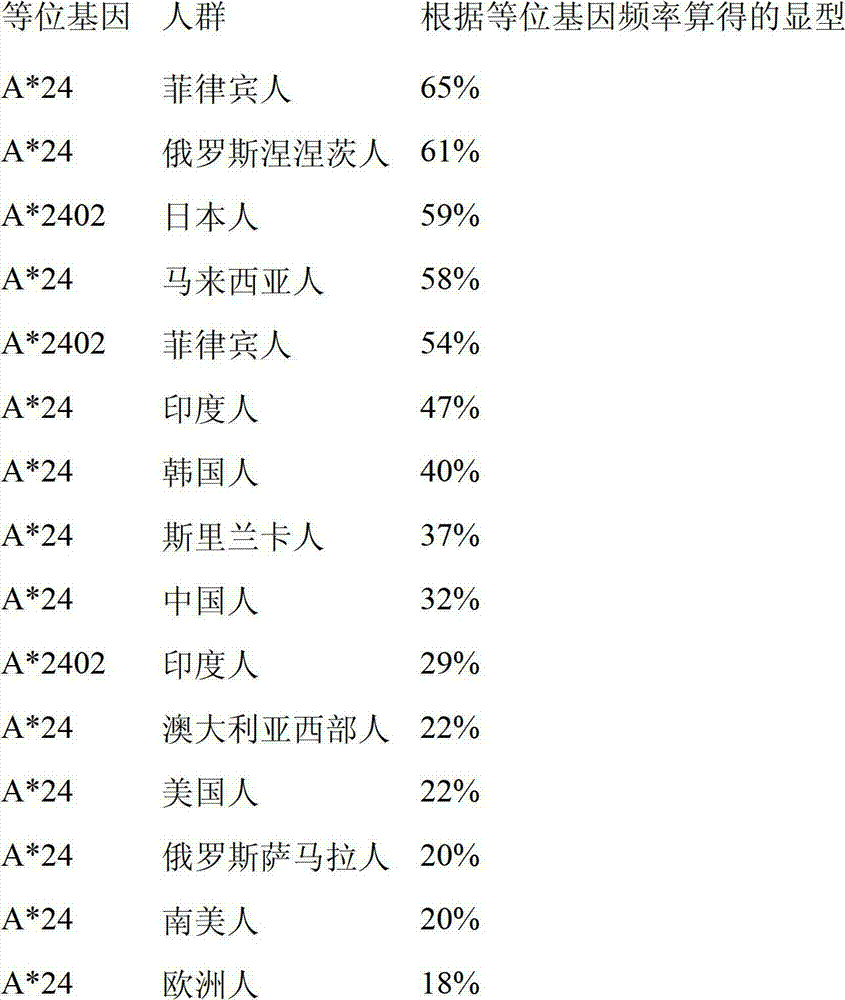
表1:HLA-A*024和最常见HLA*A02402血清类型的表达频率F。频率根据Mori等人(Mori et al.1017-27)使用的Hardy-Weinberg公式F=1-(1-Gf)2改编,从美国人群范围内的单体型频率中推导出。有关详细信息,请参阅Chanock等人的文献(Chanock et al.1211-23)。Table 1: Expression frequency F of HLA-A*024 and most common HLA*A02402 serotypes. Frequencies were derived from US population-wide haplotype frequencies adapted from the Hardy-Weinberg formula F=1-(1-G f )2 used by Mori et al. (Mori et al. 1017-27). See Chanock et al. (Chanock et al. 1211-23) for details.
全球血清型HLA*24和A*2402的表达频率Global expression frequency of serotypes HLA*24 and A*2402
本文提到的DNA序列既包括单链DNA也包括双链DNA。因此,除非本文另有所指,否则具体的序列是该序列的单链DNA、该序列与其互补序列的双工(双链DNA)以及该序列的互补序列。「编码区」这一术语是指在基因的天然基因组环境中天然或正常编码该基因的表达产物的那部分基因,即,体内编码该基因的天然表达产物的区域。References to DNA sequences herein include both single- and double-stranded DNA. Thus, unless otherwise indicated herein, a particular sequence is the single-stranded DNA of that sequence, the duplex of that sequence with its complement (double-stranded DNA), and the complement of that sequence. The term "coding region" refers to that portion of a gene that natively or normally encodes the expression product of that gene in its native genomic environment, ie, the region in vivo that encodes the native expression product of that gene.
编码区可来自非突变(「正常」)基因、突变基因或异常基因,甚至还可以来自DNA序列,完全可在实验室中使用本领域熟知的DNA合成方法合成。The coding region can be derived from a non-mutated ("normal") gene, a mutated or abnormal gene, or even a DNA sequence, completely synthesized in the laboratory using DNA synthesis methods well known in the art.
术语「核苷酸序列」系指脱氧核苷酸的杂聚物。The term "nucleotide sequence" refers to a heteropolymer of deoxynucleotides.
编码特定肽、寡肽或多肽的核苷酸序列可为天然核苷酸序列,也可为合成核苷酸序列。一般来说,编码肽、多肽以及本发明蛋白的DNA片段由cDNA片段和短寡核苷酸衔接物,或一系列寡核苷酸组成,以提供一种合成基因,该基因能够在包含源自微生物或病毒操纵子的调节元素的重组转录单元中被表达。The nucleotide sequence encoding a specific peptide, oligopeptide or polypeptide may be a natural nucleotide sequence or a synthetic nucleotide sequence. In general, DNA segments encoding peptides, polypeptides, and proteins of the invention consist of cDNA segments and short oligonucleotide adapters, or series of oligonucleotides, to provide a synthetic gene that can be derived from Regulatory elements of microbial or viral operons are expressed in recombinant transcription units.
「表达产物」这一术语是指多肽或蛋白,它是基因和遗传码退化并因而编码同样的氨基酸所造成的任何核酸序列编码同等物的转译产物。The term "expression product" refers to a polypeptide or protein which is the translation product of any nucleic acid sequence encoding equivalent resulting from the degradation of the gene and genetic code and thus encoding the same amino acids.
「片断」这一术语,当指的是一种编码序列时,表示包含非完整编码区的DNA的一部分,其表达产物与完整编码区表达产物基本上具有相同的生物学功能或活性。The term "fragment", when referring to a coding sequence, refers to a part of DNA that includes a non-complete coding region, and its expression product has substantially the same biological function or activity as the expression product of the complete coding region.
「DNA片段」这一术语是指一种DNA聚合物,以单独的片段形式或一种较大DNA结构的组分形式存在,它们从至少分离过一次的DNA中以基本纯净的形式获得,即不含污染性内源性材料,并且获得的数量或浓度能够使用标准生化方法,例如使用克隆载体,进行识别、操纵和回收该片段及其组分核苷酸序列。此等片段以开放阅读框架(未被内部未转译序列打断)或内含子(通常提呈于真核基因中)的形式存在。未转译DNA序列可能存在于开放阅读框架的下游,在那里其不会干预编码区的操纵或表达。The term "DNA fragment" refers to a polymer of DNA, either as individual fragments or as components of a larger DNA structure, obtained in substantially pure form from DNA that has been isolated at least once, i.e. Free of contaminating endogenous material and obtained in quantities or concentrations that enable the identification, manipulation and recovery of the fragment and its component nucleotide sequences using standard biochemical methods, such as the use of cloning vectors. These fragments exist as open reading frames (uninterrupted by internal untranslated sequences) or introns (usually present in eukaryotic genes). Untranslated DNA sequences may exist downstream of the open reading frame where they do not interfere with the manipulation or expression of the coding region.
「引物」这一术语表示一种短核酸序列,其可与一个DNA链配对,并在DNA聚合酶开始合成脱氧核糖核酸链之处提供一个游离的3′-OH末端。The term "primer" refers to a short nucleic acid sequence that pairs with a DNA strand and provides a free 3'-OH terminus where DNA polymerase begins synthesis of the deoxyribonucleic acid strand.
「启动子」这一术语表示参与RNA聚合酶的结合从而启动转录的DNA区域。The term "promoter" refers to a region of DNA that participates in the binding of RNA polymerase to initiate transcription.
术语「分离」表示一种物质从其原来的环境(例如,如果是天然发生的则是天然环境)中被移走。例如,活体动物中的天然核苷酸或多肽不是分离的,但是,从天然系统中一些或所有共存物质中分离出来的核苷酸或多肽是分离的。此类多核苷酸可能是载体的一部分和/或此类多核苷酸和多肽可能是一种组合物的一部分,并且由于该载体或组合物不是其天然环境的一部分,因此它仍然是分离的。The term "isolated" means that a substance is removed from its original environment (eg, the natural environment if naturally occurring). For example, a nucleotide or polypeptide naturally occurring in a living animal is not isolated, but a nucleotide or polypeptide isolated from some or all of the coexisting materials in the natural system is isolated. Such polynucleotides may be part of a vector and/or such polynucleotides and polypeptides may be part of a composition and, since the vector or composition is not part of its natural environment, it remains isolated.
本发明中披露的多核苷酸和重组或免疫原性多肽也可能以「纯化」的形式存在。术语「纯化」并非要求绝对的纯度;它只是一个相对的定义,可以包括高度纯化或部分纯化的制剂,相关领域技术人员能理解这些术语。例如,各个从已用传统方法纯化为具有电泳同质性的cDNA库中分离出的各种克隆物。明确考虑到将起始材料或天然物质纯化至少一个数量级,优选为两或三个数量级,更优选为四或五个数量级。此外,明确考虑到所述多肽的纯度优选为99.999%,或至少为99.99%或99.9%;更适宜者为以重量计99%或更高。The polynucleotides and recombinant or immunogenic polypeptides disclosed herein may also be in "purified" form. The term "purified" does not require absolute purity; it is a relative definition that can include highly purified or partially purified preparations, as such terms will be understood by those skilled in the relevant art. For example, individual clones isolated from cDNA libraries that have been conventionally purified to electrophoretic homogeneity. Purification of the starting material or natural material by at least one order of magnitude, preferably two or three orders of magnitude, more preferably four or five orders of magnitude is expressly contemplated. Furthermore, it is expressly contemplated that the polypeptide is preferably 99.999% pure, or at least 99.99% or 99.9% pure; more suitably 99% by weight or higher.
根据本发明公开的核酸和多肽表达产物,以及包含此类核酸和/或多肽的表达载体可能以「浓缩的形式」存在。本文使用的术语「浓缩」是指材料的浓度至少是其自然浓度的大约2、5、10、100或1000倍,有优势的是,按重量计为0.01%,优选为至少0.1%。也考虑了按重量计约为0.5%、1%、5%、10%和20%的浓缩制剂。序列、构型、载体、克隆物以及包含本发明的其他材料可有优势地以浓缩或分离的形式存在。The nucleic acid and polypeptide expression products disclosed in accordance with the present invention, as well as expression vectors comprising such nucleic acids and/or polypeptides, may be present in "condensed form". The term "concentrated" as used herein means that the concentration of the material is at least about 2, 5, 10, 100 or 1000 times its natural concentration, advantageously 0.01%, preferably at least 0.1% by weight. Concentrated formulations of about 0.5%, 1%, 5%, 10% and 20% by weight are also contemplated. Sequences, constructs, vectors, clones, and other materials comprising the invention may advantageously be present in concentrated or isolated form.
「活性片段」这一术语是指产生免疫应答的片段(即具有免疫原性活性),不论是单独或可选地与合适的佐剂一起给予一种动物,比如哺乳动物,例如兔子或小鼠,也包括人;这种免疫应答采用的形式是在接受动物(如:人)体内刺激T细胞应答。或者,「活性片段」也可用于诱导体外T细胞应答。The term "active fragment" refers to a fragment that produces an immune response (i.e. has immunogenic activity), whether administered alone or optionally with a suitable adjuvant to an animal, such as a mammal, such as a rabbit or mouse , including humans; this immune response takes the form of stimulating a T cell response in the recipient animal (eg, human). Alternatively, "active fragments" can also be used to induce T cell responses in vitro.
本文使用的「部分」(portion)、「节段」(segment)、「片段」(fragment)这几个术语,当与多肽相关地使用时是指残基的连续序列,比如氨基酸残基,其序列形成一个较大序列的子集。例如,如果一个多肽以任一种肽链内切肽酶(如胰蛋白酶或糜蛋白酶)进行处理,则该处理获得的寡肽会代表起始多肽的部分、节段或片段。这表示,任何此类片段必定包含与SEQ ID NO:1至33序列基本相同(如果不是完全相同)的一个节段、片段或部分作为其氨基酸序列的一部分,其对应于SEQ IDNO:1至33的天然蛋白或「亲本」蛋白。当与多核苷酸相关地使用时,这些术语系指用任何共同核酸内切酶处理所述多核苷酸产生的产物。The terms "portion", "segment" and "fragment" as used herein, when used in relation to polypeptides, refer to a contiguous sequence of residues, such as amino acid residues, whose Sequences form a subset of a larger sequence. For example, if a polypeptide is treated with any of the endopeptidases such as trypsin or chymotrypsin, the oligopeptides obtained from this treatment will represent parts, segments or fragments of the starting polypeptide. This means that any such fragment must contain as part of its amino acid sequence a segment, fragment or part substantially identical (if not identical) to the sequence of SEQ ID NO: 1 to 33, which corresponds to SEQ ID NO: 1 to 33 native or "parental" protein. When used in relation to polynucleotides, these terms refer to the products resulting from treatment of said polynucleotides with any of the common endonucleases.
根据本发明,术语「百分等同度」或「百分等同性」,如果指的是序列,则表示在待对比序列(「被对比序列」)与所述序列或权利要求的序列(「参考序列」)对准之后将被对比序列与所述序列或权利要求的序列进行比较。然后根据下列公式计算百分等同度:According to the present invention, the term "percent identity" or "percent identity", if it refers to a sequence, means that the sequence to be compared ("compared sequence") and the sequence described or claimed ("reference sequence") Sequences") Alignment compares the compared sequence with the described or claimed sequence. The percent equivalence is then calculated according to the following formula:
百分等同度=100[I-(C/R)]Percent equivalent=100[I-(C/R)]
其中C是参考序列与被对比序列之间对准长度上参考序列与被对比序列之间的差异数量,其中where C is the number of differences between the reference sequence and the compared sequence on the alignment length between the reference sequence and the compared sequence, where
(i)参考序列中每个硷基或氨基酸序列在被对比序列中没有对应的对准硷基或氨基酸;(i) Each base or amino acid sequence in the reference sequence has no corresponding aligned base or amino acid in the compared sequence;
(ii)参考序列中每个空隙,以及(ii) each gap in the reference sequence, and
(iii)参考序列中每个对准硷基或氨基酸与被比对比序列中对准硷基或氨基酸不同,即构成一个差异;并且R是参考序列与被对比序列对准长度上在参考序列中产生任何空隙也计算为一个硷基或氨基酸的参考序列中的硷基或氨基酸数目。(iii) Each aligned base or amino acid in the reference sequence is different from the aligned base or amino acid in the compared sequence, which constitutes a difference; and R is the length of the alignment between the reference sequence and the compared sequence in the reference sequence Any gaps created are also counted as the number of bases or amino acids in the reference sequence for one base or amino acid.
如果「被对比序列」和「参考序列」之间存在的一个对准按上述计算的百分等同度大致等于或大于指定的最低百分等同度,则被对比序列与参考序列具有指定的最低百分等同度,虽然可能存在按本文上述计算的百分等同度低于指定百分等同度的对准。A compared sequence has the specified minimum percent identity with the reference sequence if an alignment exists between the "compared sequence" and the "reference sequence" with a percent identity calculated as above that is approximately equal to or greater than the specified minimum percent identity. points of equivalence, although there may exist alignments where the percent identity calculated as described above is lower than the specified percent identity.
如果没有另外说明,那么本文公开的原始肽可以透过在肽链内的不同(可能为选择性)位点上取代一个或多个残基而被修饰。此取代可能是保守性的,例如,其中一个氨基酸被具有类似结构和特点的另一个氨基酸所取代,比如其中一个疏水性氨基酸被另一个疏水性氨基酸取代。更保守的取代是具有相同或类似的大小和化学性质的氨基酸间的取代,例如,亮氨酸被异亮氨酸取代。在天然同源蛋白质家族序列变异的研究中,某些氨基酸的取代往往比其他氨基酸更具有耐受性,这些氨基酸往往表现出与原氨基酸的大小、电荷、极性和疏水性之间的相似性相关,这是确定「保守取代」的基础。If not stated otherwise, the original peptides disclosed herein may be modified by substitution of one or more residues at different (possibly selective) positions within the peptide chain. The substitution may be conservative, for example, where one amino acid is replaced by another amino acid having similar structure and characteristics, such as where one hydrophobic amino acid is replaced by another hydrophobic amino acid. More conservative substitutions are between amino acids of the same or similar size and chemical properties, eg, leucine is replaced by isoleucine. In the study of sequence variation in natural homologous protein families, substitutions of certain amino acids are often more tolerated than others, and these amino acids tend to show similarities in size, charge, polarity, and hydrophobicity to the original amino acids This is the basis for determining "conservative substitutions".
在本文中,保守取代定义为在以下五种基团之一的内部进行交换:基团1-小脂肪族、非极性或略具极性的残基(Ala,Ser,Thr,Pro,Gly);基团2-极性、带负电荷的残基及其酰胺(Asp,Asn,Glu,Gln);基团3-极性、带正电荷的残基(His,Arg,Lys);基团4-大脂肪族非极性残基(Met,Leu,Ile,Val,Cys)以及基团5-大芳香残基(Phe,Tyr,Trp)。In this context, a conservative substitution is defined as an exchange within one of the following five groups: Group 1 - Small aliphatic, nonpolar or slightly polar residues (Ala, Ser, Thr, Pro, Gly ); Group 2-polar, negatively charged residues and their amides (Asp,Asn,Glu,Gln); Group 3-polar, positively charged residues (His,Arg,Lys); Group 4 - large aliphatic nonpolar residues (Met, Leu, Ile, Val, Cys) and group 5 - large aromatic residues (Phe, Tyr, Trp).
较不保守的取代可能涉及一个氨基酸被另一个具有类似特点但在大小上有所不同的氨基酸所取代,如:丙氨酸被异亮氨酸残基取代。高度不保守的取代可能涉及一个酸性氨基酸被另一个具有极性或甚至具有碱性性质的氨基酸所取代。然而,这种「激进」取代不能认为是无效的而不予考虑,因为化学作用是不完全可预测的,激进的取代可能会带来其简单化学原理中无法预见的偶然效果。Less conservative substitutions may involve the substitution of one amino acid for another that has similar characteristics but differs in size, eg, an alanine is replaced by an isoleucine residue. Highly non-conservative substitutions may involve the replacement of one acidic amino acid by another that has polar or even basic properties. However, such "radical" substitutions cannot be dismissed as ineffective, since chemistry is not entirely predictable and radical substitutions may introduce accidental effects that cannot be foreseen in their simple chemistry.
当然,这种取代可能涉及普通L-氨基酸之外的其他结构。因此,D-氨基酸可能被本发明的抗原肽中常见的L-氨基酸取代,也仍在本公开的范围之内。此外,具有非标准R基团的氨基酸(即,除了天然蛋白的20个常见氨基酸之外的R基团)也可以用于取代之目的,以生产根据本发明的免疫原和免疫原性多肽。Of course, such substitutions may involve structures other than ordinary L-amino acids. Therefore, D-amino acids may be substituted by L-amino acids commonly found in the antigenic peptides of the present invention and still be within the scope of the present disclosure. In addition, amino acids with non-standard R groups (ie, R groups other than the 20 common amino acids of natural proteins) can also be used for substitution purposes to produce immunogens and immunogenic polypeptides according to the invention.
如果在一个以上位置上的取代发现导致肽的抗原活性基本上等于或大于以下定义值,则对这些取代的组合进行测试,以确定组合的取代是否产生对肽抗原性的叠加或协同效应。肽内被同时取代的位置最多不能超过4个。If substitutions at more than one position are found to result in an antigenic activity of the peptide substantially equal to or greater than the values defined below, combinations of these substitutions are tested to determine whether the combined substitutions produce an additive or synergistic effect on the antigenicity of the peptide. No more than 4 positions can be substituted at the same time in the peptide.
术语「T细胞应答」是指由一种肽在体外或体内诱导的效应子功能的特异性扩散和启动。对于MHC I类限制性CTL,效应子功能可能为溶解肽脉冲的、肽前体脉冲的或天然肽提呈的靶细胞、分泌细胞因子,优选为肽诱导的干扰素-γ、TNF-α或IL-2,分泌效应分子、优选为肽或脱颗粒作用诱导的颗粒酶或穿孔素。The term "T cell response" refers to the specific spread and initiation of effector functions induced by a peptide in vitro or in vivo. For MHC class I-restricted CTLs, effector functions may be lytic peptide-pulsed, peptide precursor-pulsed, or native peptide-presented target cells, secreting cytokines, preferably peptide-induced interferon-γ, TNF-α, or IL-2, secreted effector molecules, preferably peptides or degranulation-induced granzymes or perforin.
优选情况是,当SEQ ID NO:1至33任何序列的肽特异性CTL相比于取代肽受到检测时,如果取代肽在相对于背景肽溶解度增加达到最大值的一半,则该肽浓度不超过约1mM,优选为不超过约1μM,更优选为不超过约1nM,再优选为不超过约100pM,最优选为不超过约10pM。另一个优选的情形为,取代肽被一个以上的CTL识别,最少为2个,更优选为3个。Preferably, when peptide-specific CTLs of any of SEQ ID NO: 1 to 33 are detected compared to the substituted peptide, if the substituted peptide achieves half the maximum increase in solubility relative to the background peptide, the concentration of the peptide does not exceed About 1 mM, preferably no more than about 1 μM, more preferably no more than about 1 nM, even more preferably no more than about 100 pM, most preferably no more than about 10 pM. Another preferred situation is that the substituted peptide is recognized by more than one CTL, at least 2, more preferably 3.
因此,本发明所述的表位可能与天然肿瘤相关表位或肿瘤特异性表位相同,也可能包括来自参考肽的不超过4个残基的不同肽,只要它们有基本相同的抗原活性即可。Therefore, the epitopes described in the present invention may be the same as natural tumor-associated epitopes or tumor-specific epitopes, and may also include different peptides of no more than 4 residues from the reference peptide, as long as they have substantially the same antigenic activity. Can.
免疫治疗方法Immunotherapy
是否能刺激免疫应答取决于是否存在被宿主免疫系统视为异物的抗原。发现肿瘤相关抗原的存在增加了运用宿主免疫系统干预肿瘤生长的可能性。对于癌症免疫疗法,目前正在探索控制免疫系统中的体液和细胞免疫的各种机制。The ability to stimulate an immune response depends on the presence of antigens that are considered foreign by the host immune system. The discovery of the presence of tumor-associated antigens raises the possibility of harnessing the host immune system to intervene in tumor growth. For cancer immunotherapy, various mechanisms controlling both humoral and cellular immunity in the immune system are currently being explored.
细胞免疫应答的特定元素能特异性地识别和破坏肿瘤细胞。从肿瘤浸润细胞群或外周血中分离出的细胞毒性T-细胞(CTL)表明,这些细胞在癌症的天然免疫防御中发挥了重要作用。特别是CD8阳性T细胞在这种反应中发挥重要作用,它能识别通常8至12个源自蛋白或位于细胞质的缺损核糖体产物(DRIP)的氨基酸残基的主要组织兼容性复合体(MHC)所带有的肽中所含的I类分子。人MHC分子也称为人白细胞-抗原(HLA)。Specific elements of the cellular immune response specifically recognize and destroy tumor cells. Cytotoxic T-cells (CTLs) isolated from tumor-infiltrating cell populations or peripheral blood suggest that these cells play an important role in the innate immune defense against cancer. In particular, CD8-positive T cells play an important role in this response, recognizing the major histocompatibility complex (MHC) of usually 8 to 12 amino acid residues derived from proteins or defective ribosomal products (DRIP) located in the cytoplasm. ) class I molecules contained in peptides. Human MHC molecules are also known as human leukocyte-antigens (HLA).
MHC-I类分子,在细胞核提呈因主要内源性、细胞质或细胞核蛋白质、DRIPS和较大肽蛋白裂解产生的肽的细胞上都能发现此类分子。然而,源自内体结构或外源性来源的肽也经常在MHC-I类分子上发现。这种I-类分子非经典提呈方式在文献中被称为交叉提呈。MHC class I molecules, which are found on cells whose nucleus presents peptides resulting from the proteolysis of major endogenous, cytoplasmic, or nuclear proteins, DRIPS, and larger peptides. However, peptides derived from endosomal structures or exogenous sources are also frequently found on MHC class I molecules. This non-classical presentation of class I molecules is known in the literature as cross-presentation.
对于被细胞毒性T淋巴细胞识别为肿瘤特异性抗原或相关性抗原以及用于治疗的蛋白质,必须具备特殊的先决条件。该抗原应主要由肿瘤细胞表达,而正常健康组织根本不表达或表达数量较少。更为适宜的情况是,该相应抗原不仅出现于一种肿瘤中,而且浓度(即每个细胞的相应肽拷贝数目)高。肿瘤特异性抗原和肿瘤相关抗原通常是源于由于细胞周期调控或凋亡等功能在正常细胞转化为肿瘤细胞中直接涉及的蛋白。另外,这些直接导致转化的蛋白的下游靶标也可能会被上调,因此间接与肿瘤相关。这些间接肿瘤相关抗原也可能是预防接种方法的靶标。至关重要的是,在这两种情况中,都存在抗原氨基酸序列的表位,所以这种来自肿瘤相关抗原的肽(「免疫原性肽」)可导致体外或体内T细胞应答。For proteins to be recognized by cytotoxic T lymphocytes as tumor-specific or associated antigens and for therapeutic use, special prerequisites must be in place. The antigen should be expressed predominantly by tumor cells and not at all or in small amounts by normal healthy tissue. More desirably, the corresponding antigen is present in not only one tumor but at a high concentration (ie, the number of copies of the corresponding peptide per cell). Tumor-specific antigens and tumor-associated antigens are generally derived from proteins that are directly involved in the transformation of normal cells into tumor cells due to functions such as cell cycle regulation or apoptosis. In addition, downstream targets of these proteins that directly lead to transformation may also be upregulated and thus indirectly associated with tumors. These indirect tumor-associated antigens may also be targets for vaccination approaches. Crucially, in both cases, an epitope of the amino acid sequence of the antigen is present, so that such peptides from tumor-associated antigens ("immunogenic peptides") can lead to T-cell responses in vitro or in vivo.
基本上,任何能与MHC分子结合的肽都可能充当一个T细胞表位。诱导体外或体内T细胞应答的前提是存在具有相应TCR的T细胞并且不存在对该特定表位的免疫耐受性。Basically, any peptide that can bind to an MHC molecule can potentially serve as a T cell epitope. A prerequisite for inducing a T cell response in vitro or in vivo is the presence of T cells with the corresponding TCR and the absence of immune tolerance to that particular epitope.
因此,TAA是研发肿瘤疫苗的起点。识别和表征TAA的方法基于对患者或健康受试者CTL的使用情况,或基于肿瘤与正常组织肽之间差别转录特性或差别表达模式的产生(Lemmel et al.450-54;Weinschenk et al.5818-27)。Therefore, TAA is the starting point for the development of tumor vaccines. Methods to identify and characterize TAAs are based on the use of CTLs from patients or healthy subjects, or on the generation of differential transcriptional properties or differential expression patterns between tumor and normal tissue peptides (Lemmel et al. 450-54; Weinschenk et al. 5818-27).
然而,对肿瘤组织或人肿瘤细胞株中过量表达或选择性表达的基因的识别并不提供在免疫疗法中使用这些基因所转录抗原的准确信息。这是因为,有着相应TCR的T细胞必须存在且对这个特定表位的免疫耐受性必须不存在或为最低水平,因此,这些抗原的表位只有一部分适合这种应用。因此,只选择那些蛋白过量表达或选择性表达的肽,并且这些肽是与可找到对抗性功能性T细胞的MHC分子结合在一起被提呈,这一点非常重要。这种功能性T细胞被定义为在以特异性抗原刺激后能够克隆地扩展并能够执行效应子功能的T细胞(「效应子T细胞」)。However, the identification of overexpressed or selectively expressed genes in tumor tissues or human tumor cell lines does not provide accurate information on the antigens transcribed by these genes for use in immunotherapy. This is because only a fraction of the epitopes of these antigens are suitable for this application because T cells with corresponding TCRs must be present and immune tolerance to this particular epitope must be absent or minimal. It is therefore important to select only those peptides whose proteins are overexpressed or selectively expressed and which are presented in conjunction with MHC molecules where antagonistic functional T cells can be found. Such functional T cells are defined as T cells capable of clonally expanding upon stimulation with a specific antigen and capable of performing effector functions ("effector T cells").
辅助T细胞在安排抗肿瘤免疫的CTL效应子功能中发挥着重要作用。触发TH1细胞应答的辅助T细胞表位支援CD8阳性杀伤T细胞的效应子功能,其中包括直接作用于肿瘤细胞的细胞毒性功能(该类肿瘤细胞表面显示有肿瘤相关肽/MHC复合体)。这样,肿瘤相关T辅助细胞表位单独使用或与其他肿瘤相关肽结合使用可作为刺激抗肿瘤免疫应答的疫苗化合物的活性药物成分。Helper T cells play an important role in orchestrating CTL effector functions of antitumor immunity. Helper T cell epitopes that trigger T H1 cell responses support effector functions of CD8-positive killer T cells, including direct cytotoxic functions on tumor cells that display tumor-associated peptide/MHC complexes on their surface. Thus, tumor-associated T helper cell epitopes alone or in combination with other tumor-associated peptides can be used as active pharmaceutical ingredients in vaccine compounds that stimulate anti-tumor immune responses.
由于CD8及CD4依赖型反应共同和协同促进抗肿瘤作用,因此,CD8阳性CTL(MHC-I分子)或CD4阳性CTL(MHC-II类分子)对肿瘤相关抗原的识别和鉴定对研发肿瘤疫苗非常重要。因此,提出含有与任一类MHC复合体结合的肽组合物是本发明的一个目标。Since CD8 and CD4-dependent responses jointly and synergistically promote anti-tumor effects, the recognition and identification of tumor-associated antigens by CD8-positive CTLs (MHC-I molecules) or CD4-positive CTLs (MHC-II molecules) is very important for the development of tumor vaccines. important. Therefore, it is an object of the present invention to propose compositions containing peptides that bind to either class of MHC complex.
考虑到治疗癌症相关的严重副作用和费用,迫切需要更好的预后和诊断方法。因此,通常有必要确定代表癌症生物标志物的其他因子,尤其是胃癌。此外,通常有必要确定可用于治疗癌症的因子,尤其是胃癌。Given the serious side effects and costs associated with treating cancer, better prognostic and diagnostic methods are urgently needed. Therefore, it is often necessary to identify additional factors that represent biomarkers for cancer, especially for gastric cancer. Furthermore, it is often necessary to identify factors that can be used in the treatment of cancer, especially gastric cancer.
此外,还没有确定的治疗设计,可用于根治性摄护腺切除术后生化性复发的胃癌患者,复发通常是由原发部位残留的肿瘤出现局部晚期肿瘤生长所致。需要能够降低发病率且疗效与现有治疗方法相当的新型治疗方法。Furthermore, there is no established treatment design for gastric cancer patients with biochemical recurrence after radical prostatectomy, usually due to locally advanced tumor growth from residual tumor at the primary site. Novel treatments that reduce morbidity and are comparable in efficacy to existing treatments are needed.
本发明提出了有利于治疗胃癌以及其他过量表达本发明肽的肿瘤肽。这些肽由质谱分析法直接显示出,而由HLA分子自然提呈于人原发性胃癌样本中(请参见实施例1和图1)。The present invention proposes peptides that are beneficial for the treatment of gastric cancer and other tumors that overexpress the peptides of the present invention. These peptides were directly revealed by mass spectrometry and were naturally presented by HLA molecules in human primary gastric cancer samples (see Example 1 and Figure 1).
衍生肽源基因在胃癌、肾细胞癌、结肠癌、非小细胞肺癌、腺癌、摄护腺癌、良性肿瘤和恶性黑色素瘤中与正常组织相比显示出高度过量表达(请参见实施例2和图2),这表明这些肽与肿瘤关联程度高,即这些肽大量提呈于肿瘤组织,而不提呈于正常组织。Derived peptide-derived genes were shown to be highly overexpressed in gastric cancer, renal cell carcinoma, colon cancer, non-small cell lung cancer, adenocarcinoma, prostate cancer, benign tumors and malignant melanoma compared to normal tissues (see Example 2 and Figure 2), which indicates that these peptides are highly associated with tumors, that is, these peptides are abundantly presented in tumor tissues but not in normal tissues.
HLA结合肽能够被免疫系统识别,特别是被T淋巴细胞/T细胞识别。T细胞可破坏提呈被识别的HLA/肽复合体的细胞(如:提呈衍生肽的胃癌细胞)。HLA-binding peptides are recognized by the immune system, in particular by T lymphocytes/T cells. T cells can destroy cells presenting the recognized HLA/peptide complex (eg, gastric cancer cells presenting the derived peptide).
本发明的所有与确认平台兼容的肽(见实例3)已被证明具有刺激T细胞应答的能力(参见实例3和图3)。因此,该等肽可用于在患者中产生免疫应答,从而能够杀死肿瘤细胞。患者的免疫应答能够透过直接给予患者所述肽或前体物质(如,加长肽、蛋白或编码这些肽的核酸),较理想是与加强免疫原性的制剂相结合,而进行诱导。源自该治疗性疫苗的免疫应答预期能够高度特异性地对抗肿瘤细胞,因为本发明的目标肽在正常组织上提呈的复制数目较少,防止患者发生对抗正常细胞的不良自体免疫应答的风险。All peptides of the invention compatible with the validated platform (see Example 3) have demonstrated the ability to stimulate T cell responses (see Example 3 and Figure 3). Therefore, these peptides can be used to generate an immune response in a patient, thereby being able to kill tumor cells. An immune response in a patient can be induced by directly administering the peptide or precursors (eg, lengthened peptides, proteins, or nucleic acids encoding these peptides) to the patient, ideally in combination with an immunogenicity-enhancing agent. The immune response derived from this therapeutic vaccine is expected to be highly specific against tumor cells because the target peptides of the invention are presented in lower copy numbers on normal tissues, preventing the patient from the risk of developing an adverse autoimmune response against normal cells .
药物组合物包括游离形式或以一种药用盐形式存在的肽。此处使用的「药用盐」系指所公开的肽的一种衍生物,其中该肽由制被备药剂酸式或碱式盐进行改性。例如,酸式盐采用自由基(通常其中药物的中性形式具有一种中性-NH2基团)透过与合适酸发生反应而制得。适合制备酸盐的酸包括有机酸,如:乙酸、丙酸、羟基酸、丙酮酸、草酸、苹果酸、丙二酸、丁二酸、马来酸、富马酸、酒石酸、柠檬酸、苯甲酸酸、肉桂酸、扁桃酸、甲磺酸、甲磺酸、苯磺酸、水杨酸等等、以及无机酸,如:盐酸、氢溴酸、硫酸、硝酸和磷酸等。相反,可在一种肽上提呈的酸性基团的碱式盐制剂使用药用硷基进行制备,如氢氧化钠、氢氧化钾、氢氧化铵、氢氧化钙、三甲胺等等。Pharmaceutical compositions include the peptide in free form or in the form of a pharmaceutically acceptable salt. As used herein, "pharmaceutically acceptable salt" refers to a derivative of the disclosed peptide wherein the peptide is modified by preparing an acidic or basic salt. For example, acid salts are prepared using free radicals (usually where the neutral form of the drug has a neutral -NH2 group) by reaction with a suitable acid. Acids suitable for the preparation of acid salts include organic acids such as: acetic acid, propionic acid, hydroxy acids, pyruvic acid, oxalic acid, malic acid, malonic acid, succinic acid, maleic acid, fumaric acid, tartaric acid, citric acid, benzene Formic acid, cinnamic acid, mandelic acid, methanesulfonic acid, methanesulfonic acid, benzenesulfonic acid, salicylic acid, etc., and inorganic acids such as hydrochloric acid, hydrobromic acid, sulfuric acid, nitric acid, and phosphoric acid. In contrast, basic salt formulations of acidic groups that can be presented on a peptide are prepared using pharmaceutically acceptable bases such as sodium hydroxide, potassium hydroxide, ammonium hydroxide, calcium hydroxide, trimethylamine, and the like.
在特别优选的实施例中,药物组合物包括乙酸(醋酸盐)或盐酸(氯化物)形式的肽。In particularly preferred embodiments, the pharmaceutical composition comprises the peptide in the form of acetic acid (acetate) or hydrochloric acid (chloride).
本发明的肽除了用于治疗癌症,也可用于诊断。由于肽由胃癌细胞产生,并且已确定这些肽在正常组织中不存在,因此这些肽可用于诊断癌症是否存在。In addition to the use of the peptides of the present invention in the treatment of cancer, they can also be used in diagnosis. Since the peptides are produced by gastric cancer cells and it has been determined that these peptides are absent in normal tissues, these peptides can be used to diagnose the presence or absence of cancer.
组织切片中含专利申请范围的肽,可有助于病理师诊断癌症。用抗体、质谱或其他本领域内已知的方法检测某些肽可使病理师判断该组织为恶性的、炎症还是一般病变。肽基团的存在使得能对病变组织进行分类或进一步分成子类。Patent-pending peptides in tissue sections could help pathologists diagnose cancer. Detection of certain peptides using antibodies, mass spectrometry, or other methods known in the art allows the pathologist to determine whether the tissue is malignant, inflammatory, or generally diseased. The presence of peptide groups enables the classification or further subdivision of diseased tissue.
对病变标本中肽的检测使得能对免疫系统治疗方法的利益进行判断,特别是如果T-淋巴细胞已知或预计与作用机制有关。MHC表达的缺失是一种机制,充分说明了哪些受感染的恶性细胞逃避了免疫监视。因此,肽的存在表明,分析过的细胞并没有利用这种机制。Detection of peptides in lesion specimens allows judgment of benefit of immune system therapy, especially if T-lymphocytes are known or predicted to be involved in the mechanism of action. Loss of MHC expression is a mechanism that amply illustrates which infected malignant cells evade immune surveillance. Thus, the presence of the peptide indicates that the analyzed cells are not utilizing this mechanism.
肽可用于分析淋巴细胞对肽的反应(如T细胞应答),或抗体对肽或MHC分子络合的肽发生的反应。这些淋巴细胞应答可以作为预后指标,决定是否采取进一步的治疗措施。这些反应也可以用作免疫疗法中的替代指标,旨在以不同方式诱导淋巴细胞应答,如接种蛋白疫苗、核酸、自体材料、淋巴细胞过继转移。基因治疗中,淋巴细胞对肽发生的反应可以在副作用的评估中考虑。淋巴细胞应答监测也可能成为移植疗法随访检查中的一种有价值的工具,如,用于检测移植物抗宿主和宿主抗移植物疾病。Peptides can be used to analyze lymphocyte responses to peptides (such as T cell responses), or antibody responses to peptides or peptides complexed with MHC molecules. These lymphocyte responses can be used as prognostic indicators to decide whether to take further therapeutic measures. These responses can also be used as surrogate indicators in immunotherapy aimed at inducing lymphocyte responses in different ways, such as vaccination with proteins, nucleic acids, autologous materials, adoptive transfer of lymphocytes. In gene therapy, the response of lymphocytes to peptides can be considered in the assessment of side effects. Lymphocyte response monitoring may also become a valuable tool in the follow-up examination of transplant therapy, eg, for the detection of graft-versus-host and host-versus-graft disease.
肽可用于生成和研发出针对MHC/肽复合体的特定抗体。这些抗体可用于治疗,将毒素或放射性物质靶向病变组织。这些抗体的另一用途是为了成像之目的(如PET)将放射性核素靶向病变组织。这可有助于检测小转移灶或确定病变组织的大小和准确位置。Peptides can be used to generate and develop specific antibodies against the MHC/peptide complex. These antibodies can be used therapeutically to target toxins or radioactive substances to diseased tissue. Another use of these antibodies is to target radionuclides to diseased tissue for imaging purposes such as PET. This can help detect small metastases or determine the size and exact location of diseased tissue.
此外,可用它们在活检样本的基础上验证病理师对癌症的诊断。Furthermore, they can be used to verify a pathologist's diagnosis of cancer on the basis of biopsy samples.
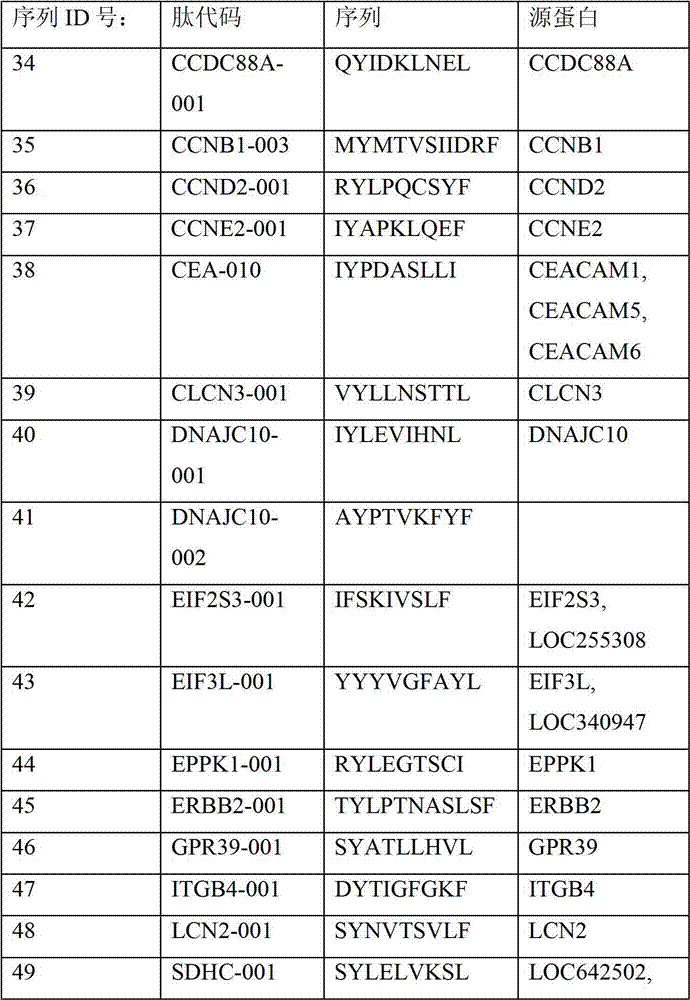
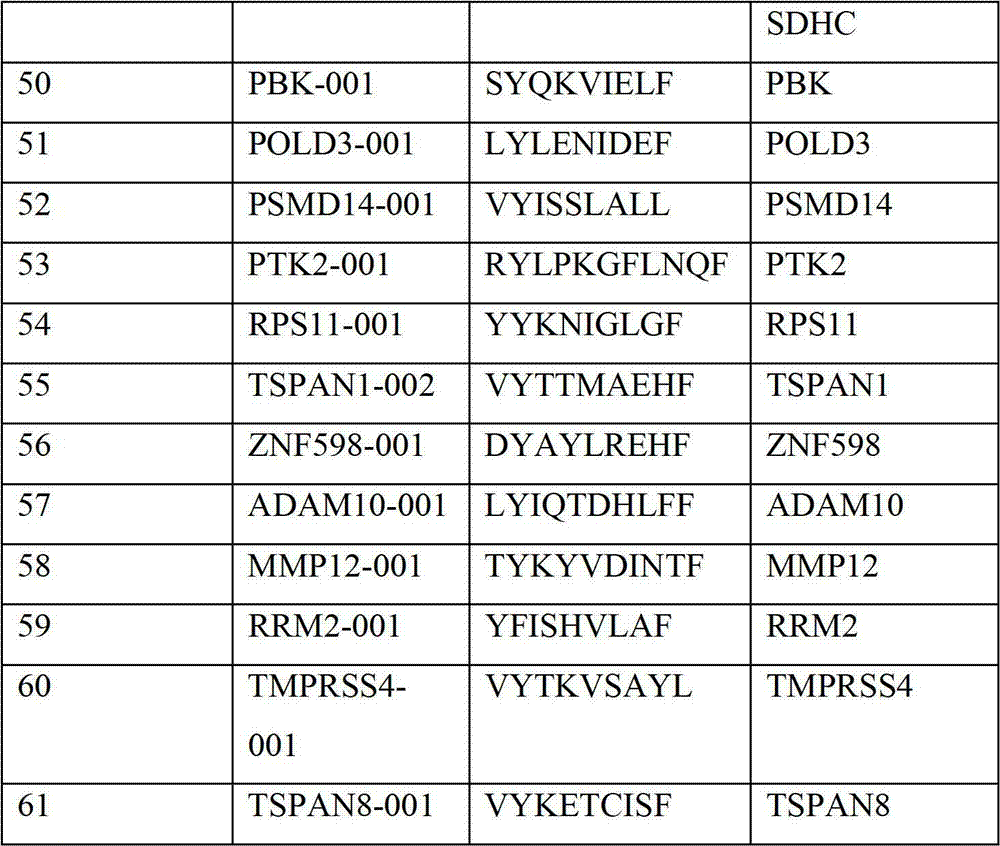
表2显示了根据本发明的肽、它们各自的SEQ ID NO、以及可能产生这些肽的源蛋白。所有肽均与HLA A*024等位基因结合。Table 2 shows the peptides according to the invention, their respective SEQ ID NOs, and the source protein from which these peptides may be produced. All peptides bind the HLA A*024 allele.
表2:本发明中的肽Table 2: Peptides in the present invention
本发明进一步令人感兴趣的HLA A*024肽Further interesting HLA A*024 peptides of the invention
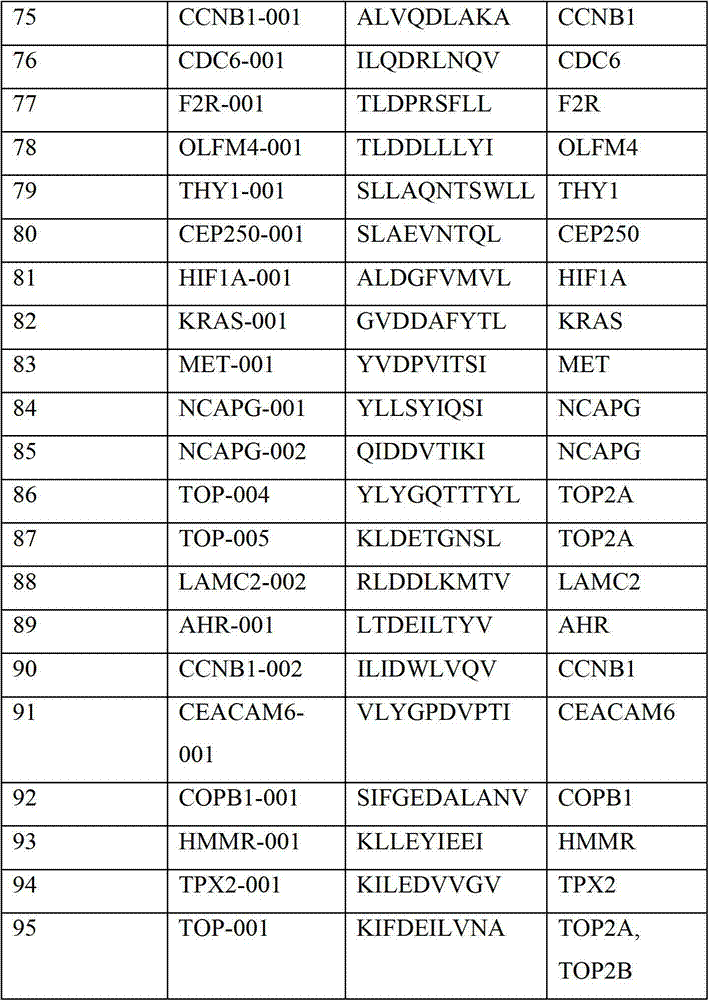
在本发明的另一个实施例中,披露了针对胃癌的HLA A*02结合肽。对A*02和/或A*24阳性人群来说,所披露的肽混合物可用来治疗胃癌。优选的为2到20个肽混合物以及2,3,4,5,6,7,8,9,10,11,12,13,14,15,16,17,18,19和20肽混合物。In another embodiment of the present invention, HLA A*02 binding peptides against gastric cancer are disclosed. For A*02 and/or A*24 positive people, the disclosed peptide mixture can be used to treat gastric cancer. Preferred are 2 to 20 peptide mixtures and 2, 3, 4, 5, 6, 7, 8, 9, 10, 11, 12, 13, 14, 15, 16, 17, 18, 19 and 20 peptide mixtures.

细胞分裂周期2蛋白(CDC2)
CDC2,也称为Cdk1(细胞周期蛋白依赖性激酶1),在细胞周期调控中发挥着关键作用。它是细胞从G2期至M期转换的主要调节基因。在间期结束时,它结合到A-型细胞周期蛋白。核膜破裂后,A-型细胞周期蛋白被B型细胞周期蛋白取代,形成有丝分裂促进因子(MPF),而Cdc2.MPF对于促进细胞完成有丝分裂至关重要。CDC2, also known as Cdk1 (cyclin-dependent kinase 1), plays a key role in cell cycle regulation. It is the main regulatory gene for the transition of cells from G2 phase to M phase. At the end of interphase, it binds to A-type cyclins. After nuclear membrane rupture, A-type cyclins are replaced by B-type cyclins to form mitosis-promoting factor (MPF), and Cdc2.MPF is essential for promoting cells to complete mitosis.
Cdc2在有丝分裂的功能不具有冗余性,因此其他Cdk(如Cdk2、4和6)的活性不能对其进行补偿。与此相反,据报导,Cdc2在细胞周期的其他期别(如G1/S转换期)行使功能,并能够替代「相间激酶」。因此,有人提出Cdc2是细胞周期的唯一基本Cdk。The function of Cdc2 in mitosis is not redundant, so it cannot be compensated by the activity of other Cdk (such as Cdk2, 4 and 6). In contrast, Cdc2 has been reported to function in other phases of the cell cycle, such as the G1/S transition, and can replace "interphase kinases". Therefore, it has been suggested that Cdc2 is the only essential Cdk of the cell cycle.
在多种癌症中发现有Cdc2过量表达,通常与不良预后相关。其中的癌症类型包括摄护腺癌、口腔癌、口腔鳞状癌(OSCC)、急性髓性白血病(AML)(Qian et al.),幽门螺旋杆菌引起的MALT淋巴瘤(Banerjee et al.217-25)和结肠癌(Yasui et al.36-41)。在胃癌中,已报告有过量表达和/或活性增强,可以有致病作用。Cdc2和其他Cdk的抑制剂被视为癌症治疗的候选药物(Shapiro 1770-83)。Overexpression of Cdc2 has been found in various cancers and is often associated with poor prognosis. Cancer types included prostate cancer, oral cavity cancer, oral squamous carcinoma (OSCC), acute myeloid leukemia (AML) (Qian et al.), MALT lymphoma caused by Helicobacter pylori (Banerjee et al.217- 25) and colon cancer (Yasui et al. 36-41). In gastric cancer, overexpression and/or enhanced activity have been reported, which may have pathogenic effects. Inhibitors of Cdc2 and other Cdks are considered as drug candidates for cancer therapy (Shapiro 1770-83).
异常纺锤状小头畸形相关蛋白(ASPM)Abnormal spindle-shaped microcephaly-associated protein (ASPM)
异常纺锤状小头畸形相关(ASPM)是果蝇异常纺锤(asp)蛋白的人直系同源基因。它牵涉到神经形成调节,且突变引起常染色体隐性原发性小头畸形。ASPM在有丝分裂期间位于纺锤体两极。有人建议将ASPM用作标志物和皮胶质细胞瘤的潜在的治疗靶标。siRNA介导的抑制而对ASPM的抑制性抑制了肿瘤细胞增殖和神经干细胞增殖。ASPM过度表达还可能预测扩散/转移可能性增加,肿瘤提前复发和肝细胞癌的不良预后。ASPM在永生细胞和非小细胞肺癌组织中表达上调(Jung,Choi,and Kim 703-13)。Abnormal spindle microcephaly associated (ASPM) is the human ortholog of the Drosophila abnormal spindle (asp) protein. It is implicated in the regulation of neurogenesis, and mutations cause autosomal recessive primary microcephaly. ASPM is located at the spindle poles during mitosis. ASPM has been suggested as a marker and a potential therapeutic target for glioblastoma. siRNA-mediated inhibition of ASPM inhibited tumor cell proliferation and neural stem cell proliferation. ASPM overexpression may also predict increased likelihood of spread/metastasis, early tumor recurrence and poor prognosis in HCC. ASPM is upregulated in immortalized cells and non-small cell lung cancer tissues (Jung, Choi, and Kim 703-13).
基质金属蛋白酶3(MMP3)Matrix metalloproteinase 3 (MMP3)
MMP3,也称为明胶酶原或基质分解素1,是一种能够切割细胞外基质(ECM)成份的肽链内切酶,如纤维连接蛋白、层粘连蛋白、弹性蛋白,蛋白多糖核心蛋白和胶原非螺旋区。MMP对于需要ECM重新排列的几种生理过程非常重要,如:胚胎发育和组织重构期间的细胞迁移、血管形成、哺乳乳腺复旧和伤口愈合。MMP3还对血小板聚集起作用。涉及MMP3表达和分泌增强的病理条件包括自身免疫性炎症性条件和癌症。MMP3在有些肿瘤中过量表达,且在上皮间质转化(EMT)中起作用。它可能也有助于致癌的早期步骤,因为它触发基因外变化,导致产生恶性表型(Lochter et al.180-93)。与表达水平有关的MMP3启动子的被证明对某些癌症的风险和预后有影响,如食管腺癌(Bradbury et al.793-98)和口腔鳞状细胞癌(OSCC)(Vairaktaris et al.4095-100)(Liu et al.430-35)。MMP3-和MMP7血清水平升高的幽门螺杆菌阳性胃癌患者中显示出较高的淋巴结浸润性以及较短的生存期。在一组74例胃癌患者中,27%的病例有MMP3表达(Murray et al.791-97)。MMP3, also known as progelatinase or matrix lysin 1, is an endopeptidase capable of cleaving extracellular matrix (ECM) components such as fibronectin, laminin, elastin, proteoglycan core protein and Collagen non-helical region. MMPs are important for several physiological processes that require ECM rearrangement, such as: cell migration during embryonic development and tissue remodeling, angiogenesis, lactation mammary gland involution, and wound healing. MMP3 also acts on platelet aggregation. Pathological conditions involving enhanced expression and secretion of MMP3 include autoimmune inflammatory conditions and cancer. MMP3 is overexpressed in some tumors and plays a role in epithelial-mesenchymal transition (EMT). It may also contribute to the early steps of carcinogenesis, as it triggers extragenic changes leading to malignant phenotypes (Lochter et al. 180-93). The expression level of the MMP3 promoter has been shown to have an impact on the risk and prognosis of certain cancers, such as esophageal adenocarcinoma (Bradbury et al.793-98) and oral squamous cell carcinoma (OSCC) (Vairaktaris et al.4095 -100) (Liu et al. 430-35). pylori-positive gastric cancer patients with elevated MMP3- and MMP7 serum levels showed higher lymph node invasion and shorter survival. In a cohort of 74 gastric cancer patients, 27% of the cases had MMP3 expression (Murray et al. 791-97).
c-Metc-Met
c-Met介导肝细胞生长因子(HGF)分散因子的潜在致癌活性,包括促进细胞生长、运动、生存、细胞外基质溶解、和血管生成。HGF的结合启动下游信号事件,包括ras、磷脂酰肌醇3′-激酶、磷脂酶Cγ和丝裂原活化蛋白激酶相关途径(Dong et al.5911-18;Furge et al.10722-27;Furge,Zhang,and Vande Woude 5582-89;Montesano et al.355-65;Naldini et al.501-04;Ponzetto et al.4600-08)。c-Met主要在上皮细胞中表达。c-MET的致瘤启动(也出现在非上皮肿瘤组织中)可由扩增/过表达、启动突变、HGF/c-Met自分泌环的获得,或组成的磷酸化造成(Di Renzo et al.147-54;Ferracini et al.739-49;Fischer et al.733-39;Koochekpour et al.5391-98;Li et al.8125-35;Maulik et al.41-59;Qian et al.589-96;Ramirez et al.635-44;Tuck et al.225-32)(Nakaigawa et al.3699-705)。c-Met在HGF过量表达的转基因小鼠中的组成性活化促进形成了广泛的致瘤性(Takayama et al.701-06;Wang et al.1023-34)。沉默MET导致肿瘤生长和转移的抑制(Corso et al.684-93)。MET扩增与人胃癌进展相关(Lin et al.5680-89),(Yokozaki,Yasui,and Tahara 49-95)。c-Met mediates the potential oncogenic activities of hepatocyte growth factor (HGF) scatterers, including promotion of cell growth, motility, survival, extracellular matrix lysis, and angiogenesis. Binding of HGF initiates downstream signaling events, including ras, phosphatidylinositol 3′-kinase, phospholipase Cγ, and mitogen-activated protein kinase-related pathways (Dong et al.5911-18; Furge et al.10722-27; Furge , Zhang, and Vande Woude 5582-89; Montesano et al. 355-65; Naldini et al. 501-04; Ponzetto et al. 4600-08). c-Met is mainly expressed in epithelial cells. Oncogenic initiation of c-MET (which also occurs in non-epithelial tumor tissues) can result from amplification/overexpression, promoter mutations, acquisition of the HGF/c-Met autocrine loop, or constitutive phosphorylation (Di Renzo et al. 147-54;Ferracini et al.739-49;Fischer et al.733-39;Koochekpour et al.5391-98;Li et al.8125-35;Maulik et al.41-59;Qian et al.589- 96; Ramirez et al. 635-44; Tuck et al. 225-32) (Nakaigawa et al. 3699-705). Constitutive activation of c-Met in HGF-overexpressing transgenic mice promotes widespread tumorigenicity (Takayama et al. 701-06; Wang et al. 1023-34). Silencing of MET leads to inhibition of tumor growth and metastasis (Corso et al. 684-93). MET amplification is associated with human gastric cancer progression (Lin et al. 5680-89), (Yokozaki, Yasui, and Tahara 49-95).
泛素羧基末端水解酶L5(UCHL5)Ubiquitin carboxy-terminal hydrolase L5 (UCHL5)
UCHL5,也称为泛素C-末端水解酶(UCH37)或INO80R,是与蛋白酶体相关的脱泛素酶。它透过切割C-端Cys76和Lys48之间的异肽键而使蛋白连接多聚泛素链与远端分开(Nishio et al.855-60)。在细胞核中,UCHL5也与Ino80染色质重构复合体相关。蛋白酶体结合后,它被启动并可能有助于转录调节或表明由Ino80和蛋白酶体介导的DNA修复。UCHL5, also known as ubiquitin C-terminal hydrolase (UCH37) or INO80R, is a deubiquitinase associated with the proteasome. It separates the protein-linked polyubiquitin chain from the distal end by cleaving the isopeptide bond between Cys76 and Lys48 at the C-terminus (Nishio et al. 855-60). In the nucleus, UCHL5 is also associated with the Ino80 chromatin remodeling complex. Upon proteasome binding, it is initiated and may contribute to transcriptional regulation or indicate DNA repair mediated by Ino80 and the proteasome.
泛素特异性蛋白酶,如UCHL5参与了细胞周期进展的控制、分化、DNA复制和修复、转录、蛋白质质量控制、免疫应答和细胞凋亡等几个过程。UCHL5可能对恶性转化有贡献。UCHL5在人宫颈癌组织中的活性与相邻正常组织相比已被证明为上调。它能够去泛素化,并使TGF-β受体及其下游调节因子Smad稳定,从而增强TGF-β信号传导。TGF-β信号传导增强在癌症进展晚期充当一种肿瘤启动子,尽管它具有双重功能、并且在癌症早期和启动之前也可能是一种肿瘤抑制因子(Bierie and Moses 29-40;Horton et al.138-43;Wicks et al.8080-84;Wicks et al.761-63)。Ubiquitin-specific proteases such as UCHL5 are involved in several processes such as the control of cell cycle progression, differentiation, DNA replication and repair, transcription, protein quality control, immune response and apoptosis. UCHL5 may contribute to malignant transformation. UCHL5 activity has been shown to be upregulated in human cervical cancer tissues compared with adjacent normal tissues. It deubiquitinates and stabilizes the TGF-β receptor and its downstream regulator Smad, thereby enhancing TGF-β signaling. Enhanced TGF-β signaling acts as a tumor promoter late in cancer progression, although it has a dual function and may also act as a tumor suppressor early and prior to cancer initiation (Bierie and Moses 29-40; Horton et al. 138-43; Wicks et al. 8080-84; Wicks et al. 761-63).
巨噬细胞刺激蛋白受体(MST1R)Macrophage stimulating protein receptor (MST1R)
MST1R(别名RON)受体是细胞表面受体酪氨酸激酶Met家族的一员,主要表达于上皮细胞和巨噬细胞上。作为对其配体的应答,MST1R能够诱导细胞迁移、侵袭、增殖和生存。在体外以及动物模型体内试验中已显示致癌活性。它通常在人癌症中被解调控(Dussault and Bellon,2009)。临床研究表明,MST1R过量表达与诊断不佳以及转移相关。MST1R在胃癌组织和相应的瘤旁组织表达显著,但未在正常胃黏膜中观察到(Zhou et al.236-40)。与体外以及肿瘤生长降低和原位移植到体内摄护腺后微血管密度下降的MST1R表达细胞相比,摄护腺癌细胞中的MST1R抑制可导致体内血管内皮细胞趋化作用降低并降低肿瘤生长和原位移植到体内摄护腺后微血管密度。与对照细胞相比,在高度致瘤性结肠癌细胞系中,siRNA介导的MST1R抑制可导致增殖下降。The MST1R (alias RON) receptor is a member of the Met family of cell surface receptor tyrosine kinases, mainly expressed on epithelial cells and macrophages. In response to its ligands, MST1R is able to induce cell migration, invasion, proliferation and survival. Carcinogenic activity has been shown in vitro and in vivo in animal models. It is often deregulated in human cancers (Dussault and Bellon, 2009). Clinical studies have shown that MST1R overexpression is associated with poor diagnosis and metastasis. MST1R was significantly expressed in gastric cancer tissues and corresponding paratumoral tissues, but not in normal gastric mucosa (Zhou et al. 236-40). MST1R inhibition in prostate cancer cells resulted in decreased vascular endothelial cell chemotaxis in vivo and reduced tumor growth and Microvessel density after orthotopic transplantation into the prostate in vivo. siRNA-mediated inhibition of MST1R resulted in decreased proliferation in highly tumorigenic colon cancer cell lines compared with control cells.
驱动蛋白样蛋白质(KIF2C)Kinesin-like protein (KIF2C)
KIF2C是一种微管解离酶,在纺锤体形成过程中调节动粒-微管的适当连结。它对细胞分裂后期染色体分离很重要,微管在动粒处连结的扰动导致染色体分离不当和非整倍性,这已在大多数实体瘤中观察到(Maney et al.67-131;Moore andWordeman 537-46)。KIF2C在乳腺癌细胞(Shimo et al.62-70)、结肠癌、结直肠癌和胃癌(Nakamura et al.543-49)中过量表达。与模拟转染细胞相比,稳定表达KIF2C的胃癌细胞株(AZ521)显示增殖和迁移增加。KIF2C在胃癌组织中表达升高可能与淋巴管浸润、淋巴结转移和预后差相关。用干扰KIF2C的小RNA治疗乳腺癌细胞可抑制了其生长。KIF2C is a microtubule dissociating enzyme that regulates proper kinetochore-microtubule association during spindle formation. It is important for chromosome segregation during anaphase, and perturbation of microtubule junctions at kinetochores leads to improper chromosome segregation and aneuploidy, which has been observed in most solid tumors (Maney et al.67-131; Moore and Wordeman 537-46). KIF2C is overexpressed in breast cancer cells (Shimo et al.62-70), colon, colorectal and gastric cancer (Nakamura et al.543-49). A gastric cancer cell line (AZ521) stably expressing KIF2C showed increased proliferation and migration compared to mock-transfected cells. The elevated expression of KIF2C in gastric cancer tissues may be associated with lymphatic invasion, lymph node metastasis and poor prognosis. Treatment of breast cancer cells with a small RNA that interferes with KIF2C suppressed their growth.
染色体结构维持蛋白4(SMC4)Chromosomal structure maintenance protein 4 (SMC4)
SMC蛋白是染色体ATP酶,在高级染色体的组织和动力学方面发挥作用。SMC4是凝聚蛋白的核心组成部分,在染色质凝聚中发挥作用,还与细胞核仁分离、DNA修复和染色质支架的维持相关。现已发现,SMC4基因在正常摄护腺和唾液腺中呈高表达,在结肠、胰腺和小肠中表达很弱,在其他组织中无表达。RNA在很多癌细胞系和癌症标本中呈高表达,包括乳腺癌、摄护腺癌、结肠癌和胰腺癌(Egland et al.5929-34)。SMC proteins are chromosomal ATPases that play a role in the organization and dynamics of higher chromosomes. SMC4, a core component of condensin, plays a role in chromatin condensation and is also associated with cellular nucleolus segregation, DNA repair, and maintenance of chromatin scaffolding. It has been found that the SMC4 gene is highly expressed in normal prostate and salivary glands, weakly expressed in colon, pancreas and small intestine, and not expressed in other tissues. RNA is highly expressed in many cancer cell lines and cancer specimens, including breast, prostate, colon, and pancreatic cancers (Egland et al. 5929-34).
Ephrin蛋白A型受体2(EPAH2)Ephrin protein type A receptor 2 (EPAH2)
Eph受体是受体酪氨酸激酶(RTK)的独特家族,在正常胚胎形成过程中,对胚胎模式建立、神经元靶向作用和血管发育起着关键作用。配体(ephrin-A1)对EphA2的刺激导致EphA2自磷酸化,刺激逆转致癌转化。Eph受体及其配体ephrin通常在各种癌症中过量表达,EphA2受体酪氨酸激酶在侵袭性肿瘤细胞中通常呈高表达和功能性改变,并被认为透过加强细胞-细胞外基质的粘附、增加锚定依赖性生长和促进血管生成而促进肿瘤生长。这些变化可促使形成转移性特征。Eph受体在肿瘤细胞和肿瘤微观环境(即,肿瘤基质和肿瘤血管)中均介导细胞之间的相互作用。在胃肿瘤中,已证明EphA2和EphrinA-1有过度表达,与肿瘤浸润的深度、肿瘤淋巴结转移(TNM)分期、淋巴结转移以及不良预后呈正相关性(Yuan et al.2410-17)。Eph receptors are a unique family of receptor tyrosine kinases (RTKs) that play critical roles in embryonic patterning, neuronal targeting, and vascular development during normal embryogenesis. Stimulation of EphA2 by a ligand (ephrin-A1) results in EphA2 autophosphorylation and stimulation reverses oncogenic transformation. The Eph receptor and its ligand ephrin are often overexpressed in various cancers, and the EphA2 receptor tyrosine kinase is often highly expressed and functionally altered in aggressive tumor cells and is thought to strengthen the cell-extracellular matrix Adhesion, increase anchorage-dependent growth and promote angiogenesis to promote tumor growth. These changes can contribute to the development of metastatic features. Eph receptors mediate cell-cell interactions both in tumor cells and in the tumor microenvironment (ie, tumor stroma and tumor blood vessels). In gastric tumors, it has been demonstrated that EphA2 and EphrinA-1 are overexpressed and positively correlated with the depth of tumor invasion, tumor lymph node metastasis (TNM) stage, lymph node metastasis, and poor prognosis (Yuan et al. 2410-17).
ATAD2ATAD2
ATAD2(也称作ANCCA)是AAA+ATP酶家族蛋白的新成员。它增强抗原受体(AR)和雌激素受体(ER)的转录活性,分别导致包括IGF1R、IRS-2、SGK1基因的转录和存活(AR)以及cyclin D1、c-myc和E2F1(ER)的基因转录。ATAD2 (also known as ANCCA) is a new member of the AAA+ATPase family of proteins. It enhances the transcriptional activity of antigen receptor (AR) and estrogen receptor (ER), leading to the transcription and survival (AR) of genes including IGF1R, IRS-2, SGK1 and cyclin D1, c-myc and E2F1 (ER), respectively gene transcription.
ATAD2在几种人肿瘤中呈高表达,如乳腺癌、摄护腺癌和骨肉瘤。表达与不良预后相关。ATAD2 is highly expressed in several human tumors, such as breast cancer, prostate cancer, and osteosarcoma. Expression correlates with poor prognosis.
AVL9AVL9
令人惊讶的是,该蛋白为源蛋白,关于AVL9蛋白和相应基因功能的相关资料非常少和有限。Surprisingly, this protein is the source protein, and there is very little and limited information about the function of AVL9 protein and the corresponding gene.
胶原蛋白α-1(XII)链蛋白(Col12A1)Collagen alpha-1(XII) catenin (Col12A1)
胶原蛋白α-1(XII)链是由COL12A1基因编码的人类蛋白。该基因编码XII型胶原蛋白的α链,而XII型胶原蛋白是FACIT(三螺旋区不连续的纤维相关性胶原蛋白)胶原蛋白的家族成员。XII型胶原蛋白是I型胶原蛋白中存在的一种同源三聚体,被认为可修饰胶原蛋白I纤维与周围基质之间的相互作用。另外也确定了编码不同异构体的剪接转录变体。Collagen alpha-1(XII) chain is a human protein encoded by the COL12A1 gene. This gene encodes the alpha chain of collagen type XII, a member of the FACIT (fibril-associated collagen with discontinuous triple helix region) family of collagens. Type XII collagen is a homotrimer present in type I collagen and is thought to modify the interaction between collagen I fibers and the surrounding matrix. In addition, splice transcript variants encoding different isoforms were also identified.
胶原蛋白α-3(VI)链蛋白(COL6A3)Collagen alpha-3(VI) catenin (COL6A3)
COL6A3编码VI型胶原三种α链之一的α-3链。该蛋白结构域已被证明与细胞外基质蛋白相结合,这是一种相互作用,可说明此胶原在组织基质成分中的重要性。在卵巢癌细胞中表达促进顺铂耐药的VI型胶原而重组细胞外基质。胶原VI是否存在与肿瘤分级相关,它是卵巢癌的一种预后因子(Sherman-Baust et al.377-86)。COL6A3在结直肠肿瘤(Smith et al.1452-64)、唾液腺癌(Leivo et al.104-13)中过量表达,在胃癌中表达有差异(Yang et al.1033-40)。COL6A3已被确定为含肿瘤特异性剪接变体的七种基因之一。经验证的肿瘤特异性剪接变化高度一致,从而能够使正常和癌症样本明显区分,甚至可明确区分肿瘤不同分期(Thorsen et al.1214-24)。COL6A3 encodes the α-3 chain of one of the three α-chains of type VI collagen. This protein domain has been shown to associate with extracellular matrix proteins, an interaction that illustrates the importance of this collagen as a constituent of the tissue matrix. Expression of type VI collagen that promotes cisplatin resistance in ovarian cancer cells reorganizes the extracellular matrix. The presence or absence of collagen VI correlates with tumor grade and is a prognostic factor in ovarian cancer (Sherman-Baust et al. 377-86). COL6A3 is overexpressed in colorectal tumors (Smith et al.1452-64), salivary gland carcinomas (Leivo et al.104-13), and differentially expressed in gastric carcinomas (Yang et al.1033-40). COL6A3 has been identified as one of seven genes containing tumor-specific splice variants. The proven tumor-specific splicing changes are highly concordant, enabling clear distinction between normal and cancer samples, and even between different tumor stages (Thorsen et al. 1214-24).
范可尼贫血,互补群I(FANCI)Fanconi anemia, complementation group I (FANCI)
作为对DNA损伤的应答,范可尼蛋白局限于染色质中并与DNA修复有关(Smogorzewska et al.289-301)。范可尼基因的突变引起范可尼贫血,这是一种遗传上非均一的退化性疾病,其特征是细胞遗传不稳定、对DNA交联剂过度敏感、染色体断裂增加以及DNA修复缺陷。范可尼替代拼接造成两个编码不同同形的转录变体。In response to DNA damage, Fanconi proteins localize in chromatin and are involved in DNA repair (Smogorzewska et al. 289-301). Mutations in the Fanconi gene cause Fanconi anemia, a genetically heterogeneous degenerative disorder characterized by cytogenetic instability, hypersensitivity to DNA cross-linking agents, increased chromosome breakage, and defective DNA repair. Fanconi alternative splicing results in two transcript variants encoding different isomorphs.
热休克蛋白90kDa β成员蛋白1(HSP90B1)Heat shock protein 90kDa β member protein 1 (HSP90B1)
HSP90(亦称为葡萄糖调节的蛋白94,Grp94)是一种人伴侣蛋白。它参与ER相关的进程:转译、蛋白质量控制和ER相关的降解(ERAD)、ER压力感应以及ER中钙结合/钙滞留(Christianson et al.272-82;Fu and Lee 741-44),HSP90包含ER蛋白典型的KDEL序列,但它也出现在肿瘤细胞表面(Altmeyer et al.340-49)以及细胞外。HSP已知从坏死(但未凋亡)的细胞以及受各种刺激(如热休克和氧化应激)的细胞中释放,并且可发生于循环中(Basu et al.1539-46;Tsan and Gao 274-79)。在细胞外,HSP90调节(主要是刺激)免疫应答,并参与抗原提呈。HSP90 (also known as glucose-regulated protein 94, Grp94) is a human chaperone protein. It is involved in ER-related processes: translation, protein quality control and ER-associated degradation (ERAD), ER stress sensing, and calcium binding/retention in ER (Christianson et al. 272-82; Fu and Lee 741-44), HSP90 Contains the KDEL sequence typical of ER proteins, but it also occurs on the surface of tumor cells (Altmeyer et al. 340-49) as well as extracellularly. HSPs are known to be released from necrotic (but not apoptotic) cells, as well as cells subjected to various stimuli such as heat shock and oxidative stress, and can occur in the circulation (Basu et al. 1539-46; Tsan and Gao 274-79). Extracellularly, HSP90 regulates (primarily stimulates) immune responses and is involved in antigen presentation.
在细胞表面,它可作为病原体进入和/或信号传导的受体(Cabanes et al.2827-38),在肿瘤特异性细胞表面表达或释放时,可诱导抗肿瘤免疫性(Zheng et al.6731-35)。在预防和治疗方案中,基于HSP90的疫苗已被证明对癌症和感染有免疫作用(见(Bolhassani and Rafati 1185-99;Castelli et al.227-33;Murshid,Gong,andCalderwood 1019-30)的评论)。On the cell surface, it acts as a receptor for pathogen entry and/or signaling (Cabanes et al. 2827-38), and when expressed or released on the surface of tumor-specific cells, induces antitumor immunity (Zheng et al. 6731 -35). In preventive and therapeutic scenarios, HSP90-based vaccines have been shown to be immune to cancer and infection (see reviews in (Bolhassani and Rafati 1185-99; Castelli et al. 227-33; Murshid, Gong, and Calderwood 1019-30) ).
但是,HSP90还可视为肿瘤治疗的靶标,因为:1)它与肿瘤进展密切相关,并导致对细胞凋亡的抵抗,这也取决于放疗或化疗治疗方法,2)它在很多肿瘤中过量表达,包括胃癌、骨肉瘤(Guo et al.62-67)、乳腺癌(Hodorova et al.31-35),HSP90的过量表达与胃癌侵袭性行为和预后差相关(Wang,Wang,and Ying 35-41;Zheng etal.1042-49)。HSP90在胃癌中表达下调导致癌细胞凋亡(Sheu,Liu,and Lan e1096)。However, HSP90 can also be considered as a target for tumor therapy because: 1) it is strongly associated with tumor progression and leads to resistance to apoptosis, which also depends on radiotherapy or chemotherapy treatment, and 2) it is present in excess in many tumors Expression, including gastric cancer, osteosarcoma (Guo et al.62-67), breast cancer (Hodorova et al.31-35), overexpression of HSP90 is associated with aggressive behavior and poor prognosis of gastric cancer (Wang, Wang, and Ying 35 -41; Zheng et al. 1042-49). Downregulation of HSP90 in gastric cancer leads to cancer cell apoptosis (Sheu, Liu, and Lan e1096).
Muc 6
MUC6在黏膜细胞中表达。其主要功能被认为是保护易受伤害的上皮表面免受不断暴露于各种内源性腐蚀剂或蛋白水解剂的破坏性影响(Toribara et al.,1997)。MUC6可能在上皮器官形成中也发挥著作用(Reid and Harris,1999),在正常的胃黏膜中发现了MUC6的表达。它在一些癌组织呈过量表达,如肠腺瘤和癌、肺癌(Hamamoto et al.891-96)、大肠息肉(Bartman et al.210-18)、以及乳房癌(Pereira et al.210-13),尽管在以上各自正常组织中并不表达。MUC6在黏液癌中的高表达率表明,它可能作为癌性扩散的屏障,使其细胞生物学行为的侵袭性下降(Matsukita et al.26-36)。MUC6在胃癌中的表达低于在腺瘤或正常粘膜中的表达并且与肿瘤大小、浸润深度、淋巴管和静脉侵犯、淋巴结转移和UICC分期呈负相关。MUC6的表达下调可能促进胃上皮细胞的恶性转化,并成为胃癌生长、浸润、转移和分化的分子学基础(Zheng et al.817-23)。还有证据表明,胃癌主要原因之一的幽门螺杆菌感染与MUC6表达降低有关(Kang et al.29-35;Wang and Fang 425-31)。MUC6 is expressed in mucosal cells. Its primary function is thought to be to protect the vulnerable epithelial surface from the damaging effects of constant exposure to various endogenous corrosive or proteolytic agents (Toribara et al., 1997). MUC6 may also play a role in epithelial organogenesis (Reid and Harris, 1999), and expression of MUC6 was found in normal gastric mucosa. It is overexpressed in some cancer tissues, such as intestinal adenoma and carcinoma, lung cancer (Hamamoto et al.891-96), colorectal polyps (Bartman et al.210-18), and breast cancer (Pereira et al.210-13 ), although not expressed in the above respective normal tissues. The high expression rate of MUC6 in mucinous carcinoma suggests that it may act as a barrier to cancerous spread, making its cell biology less aggressive (Matsukita et al. 26-36). The expression of MUC6 in gastric cancer was lower than that in adenoma or normal mucosa and negatively correlated with tumor size, depth of invasion, lymphatic and venous invasion, lymph node metastasis, and UICC stage. The down-regulation of MUC6 may promote the malignant transformation of gastric epithelial cells and serve as the molecular basis for the growth, invasion, metastasis and differentiation of gastric cancer (Zheng et al.817-23). There is also evidence that H. pylori infection, one of the leading causes of gastric cancer, is associated with decreased expression of MUC6 (Kang et al. 29-35; Wang and Fang 425-31).
动粒蛋白Nuf2kinetochore protein Nuf2
NUF2(CDCA-1)基因编码一种与酵母Nuf2非常类似的蛋白,这是与着丝粒相关的一种保守蛋白复合物的组成部分。在减数分裂前期,当着丝粒与纺锤极体断开连接时,酵母Nuf2从着丝粒中消失,并在染色体分离中发挥着调节作用。研究表明,生存素和hNuf2 csiRNA暂时抑制其mRNA,分别透过阻滞有丝分裂导致多核化和细胞死亡(Nguyen et al.394-403)。Nuf2和Hec1均是外板稳定微管正端微管结合点组织时所需要的,而这些结合点需要动粒蛋白中双轴取向所需的持续极向力(DeLuca et al.519-31)。The NUF2 (CDCA-1) gene encodes a protein very similar to yeast Nuf2, which is part of a conserved protein complex associated with centromeres. Yeast Nuf2 disappears from the centromere when it becomes disconnected from the spindle pole body during meiotic prophase and plays a regulatory role in chromosome segregation Studies have shown that survivin and hNuf2 csiRNAs temporarily inhibit their mRNA, leading to multinucleation and cell death by arresting mitosis, respectively (Nguyen et al. 394-403). Both Nuf2 and Hec1 are required for the outer plate to stabilize the organization of microtubule plus-end microtubule junctions that require the sustained poleward force required for biaxial orientation in kinetochore proteins (DeLuca et al. 519-31) .
已发现Nuf2蛋白在NSCLC中呈过量表达,与预后不良有关(Hayama et al.10339-48),并在宫颈癌中过量表达(Martin et al.333-59)。在手术切除胃癌组织(弥漫型,6;肠型,4)中,2种NUF2变体表达上调。在本研究中发现的两种选择性剪接变体表明,这些变体可能用作抗癌疗法的诊断标志物和/或新型靶标(Ohnuma et al.57-68)。Nuf2 protein has been found to be overexpressed in NSCLC and associated with poor prognosis (Hayama et al. 10339-48) and in cervical cancer (Martin et al. 333-59). Two NUF2 variants were upregulated in surgically resected gastric cancer tissues (diffuse type, 6; intestinal type, 4). The discovery of two alternative splicing variants in this study suggests that these variants may be useful as diagnostic markers and/or novel targets for anticancer therapies (Ohnuma et al. 57-68).
现已发现,siRNA介导的对NUF2的抑制可抑制细胞增殖以及在NSCLC、卵巢癌、宫颈癌、胃癌、结直肠癌和神经胶质瘤中抑制细胞凋亡的诱发(Kaneko et al.1235-40)。siRNA-mediated inhibition of NUF2 has been found to inhibit cell proliferation and induction of apoptosis in NSCLC, ovarian, cervical, gastric, colorectal and glioma (Kaneko et al. 1235- 40).
磷酸酯磷酸水解酶2(PPAP2C)Phosphate phosphohydrolase 2 (PPAP2C)
磷脂酸磷酸酶(PAP)将磷脂酸转化为甘油二酯,并在新合成甘油脂以及磷脂酶D介导的受体启动信号转导中发挥作用。已经报告有三种编码不同异构体的选择性剪接转录变体。PPAP2C在转化的原发性成人间质干细胞(MSC)以及许多癌症中上调。可能需要提升细胞增殖。PPAP2C的过表达,但不是一个催化不活动的诱变剂,造成过早进入S相,并伴有细胞周期蛋白A的过早积聚。抑制透过延迟进入S相而降低细胞增殖(Flanagan et al.249-60)。Phosphatidic acid phosphatase (PAP) converts phosphatidic acid to diglycerides and plays a role in newly synthesized glycerolipids as well as in phospholipase D-mediated receptor-initiated signal transduction. Three alternatively spliced transcript variants encoding different isoforms have been reported. PPAP2C is upregulated in transformed primary adult mesenchymal stem cells (MSCs) as well as in many cancers. Increased cell proliferation may be required. Overexpression of PPAP2C, but not a catalytically inactive mutagen, causes premature S phase entry with premature accumulation of cyclin A. Inhibition reduces cell proliferation by delaying entry into S phase (Flanagan et al. 249-60).
40S核糖体蛋白S11是一种蛋白(RPS11)40S ribosomal protein S11 is a protein (RPS11)
核糖体由一种小的40S亚基和一个大的60S亚基构成。这些亚基由4种RNA和约80种结构不同的蛋白质组成。RPS11基因编码一种核糖体蛋白,40S亚基是其组成部分。RPS11是在筛选基于粪便RNA标志物用于结直肠癌诊断中发现的六个基因之一。具体来说,它是在癌症患者的结肠细胞中发现的(Yajima et al.1029-37)。Ribosomes are composed of a small 40S subunit and a large 60S subunit. These subunits consist of 4 RNAs and about 80 structurally different proteins. The RPS11 gene encodes a ribosomal protein of which the 40S subunit is a component. RPS11 was one of six genes identified in a screen for fecal RNA-based markers for colorectal cancer diagnosis. Specifically, it was found in colon cells from cancer patients (Yajima et al. 1029-37).
E3泛素蛋白连接酶SIAH2(Seven in absentia homolog 2)E3 ubiquitin protein ligase SIAH2 (Seven in absentia homolog 2)
SIAH2是一种E3泛素连接酶。其基质中有β-catenin、TRAF2、和DCC(结直肠癌中缺失)(Habelhah et al.5756-65;Hu and Fearon 724-32;Nakayama,Qi,and Ronai443-51)。SIAH2也导致核蛋白质repp86的退化,造成由这种蛋白过量表达诱导的有丝分裂阻滞的消失(Szczepanowski et al.485-90)。SIAH2透过两种主要途径具有促进肿瘤和转移的属性,见综述(Nakayama,Qi,and Ronai 443-51):SIAH2 is an E3 ubiquitin ligase. Its stroma contains β-catenin, TRAF2, and DCC (deleted in colorectal cancer) (Habelhah et al. 5756-65; Hu and Fearon 724-32; Nakayama, Qi, and Ronai 443-51). SIAH2 also causes degradation of the nuclear protein repp86, resulting in abolishment of the mitotic arrest induced by overexpression of this protein (Szczepanowski et al. 485-90). SIAH2 has tumor-promoting and metastatic properties through two major pathways, reviewed (Nakayama, Qi, and Ronai 443-51):
首先,它导致组织缺氧应答通道中的蛋白质的泛素化和降解,因而导致组织缺氧可诱导的因子(HIF)的转录活性增强(Nakayama,Qi,and Ronai 443-51)。第二,它抑制Sprouty2,Sprouty2是Ras/ERK信号传导的一种特异性抑制因子。SIAH2的活性可能透过其对Ras信号的正面影响而与胰腺肿瘤的发展相关(Nakayama,Qi,andRonai 443-51)。First, it leads to ubiquitination and degradation of proteins in hypoxia-response pathways, thus leading to increased transcriptional activity of hypoxia-inducible factor (HIF) (Nakayama, Qi, and Ronai 443-51). Second, it inhibits Sprouty2, a specific inhibitor of Ras/ERK signaling. SIAH2 activity may be associated with pancreatic tumor development through its positive effect on Ras signaling (Nakayama, Qi, and Ronai 443-51).
尽管SIAH2在癌症方面的作用是有一些争议的,有些报告显示,SIAH2低水平与不良预后或治疗反应有关(Confalonieri et al.2959-68)(Jansen et al.263-71),其他报告则显示其有致癌功能(Frasor et al.13153-57)。SIAH2抑制已被当作一种抗癌治疗,并已被证明能够抑制黑色素瘤小鼠模型移植瘤(Qi et al.16713-18;Shah et al.799-808)、嫁接至裸鼠的人肺癌细胞株的生长(Ahmed et al.1606-29)。Although the role of SIAH2 in cancer is somewhat controversial, with some reports linking low levels of SIAH2 to poor prognosis or response to treatment (Confalonieri et al. 2959-68) (Jansen et al. 263-71), others It has carcinogenic functions (Frasor et al. 13153-57). SIAH2 inhibition has been used as an anticancer therapy and has been shown to inhibit xenografts in mouse models of melanoma (Qi et al. 16713-18; Shah et al. 799-808), human lung cancer grafted into nude mice Growth of cell lines (Ahmed et al. 1606-29).
钠和氯依赖性牛磺酸转运体(SLC6A6)Sodium and chloride-dependent taurine transporter (SLC6A6)
SLC6A6是一种钠和氯依赖性牛磺酸报导因子(TauT)(Han et al.,2006)。牛磺酸报导因子剔除(taut-/-)小鼠因牛磺酸缺乏而罹患慢性肝病,这可能涉及线粒体功能障碍(Warskulat et al.,2006)。SLC6A6 is a sodium- and chloride-dependent taurine reporter (TauT) (Han et al., 2006). Taurine reporter knockout (taut-/-) mice suffer from chronic liver disease due to taurine deficiency, which may involve mitochondrial dysfunction (Warskulat et al., 2006).
SLC6A6的表达受p53肿瘤抑制基因的抑制,并且被WT1、c-Jun和c-Myb等原癌基因反式启动。SLC6A6的过量表达保护肾细胞免受顺铂引起的肾毒性影响(Han et al.,2006;Han and Chesney,2009)。在人肠上皮Caco-2细胞中,SLC6A6mRNA的表达被肿瘤坏死因子α(TNF-α)上调(Mochizuki et al.,2005)。The expression of SLC6A6 is repressed by the p53 tumor suppressor gene and turned on in trans by proto-oncogenes such as WT1, c-Jun and c-Myb. Overexpression of SLC6A6 protects renal cells from cisplatin-induced nephrotoxicity (Han et al., 2006; Han and Chesney, 2009). In human intestinal epithelial Caco-2 cells, the expression of SLC6A6 mRNA was upregulated by tumor necrosis factor α (TNF-α) (Mochizuki et al., 2005).
泛醇-细胞色素c还原酶结合蛋白(UQCRB)Ubiquinol-cytochrome c reductase binding protein (UQCRB)
UQCRB-基因编码的蛋白是泛醇-细胞色素c氧化还原酶复合物的一部份。它与泛醇结合,并参与电子转移。此基因的突变与线粒体复合物III缺乏相关。在X染色体上已经描述有一种假基因。The protein encoded by the UQCRB-gene is part of the ubiquinol-cytochrome c oxidoreductase complex. It binds ubiquinol and participates in electron transfer. Mutations in this gene are associated with mitochondrial complex III deficiency. A pseudogene has been described on the X chromosome.
UQCRB基因可能是胰腺导管腺癌中一种潜在的癌基因或肿瘤抑制基因(Haradaet al.13-24)。它被发现在肝细胞癌中过量表达(Jia et al.1133-39)。The UQCRB gene may be a potential oncogene or tumor suppressor gene in pancreatic ductal adenocarcinoma (Harada et al. 13-24). It was found to be overexpressed in hepatocellular carcinoma (Jia et al. 1133-39).
人表皮生长因子受体3(ERBB3)Human epidermal growth factor receptor 3 (ERBB3)
ERBB3编码受体酪氨酸激酶的表皮生长因子受体(EGFR)家族的一员。它被神经调节蛋白、其他ERBB和非ERBB受体、以及其他激酶、并以新颖机制启动。在其下游,其明显与磷酸肌醇3-激酶/AKT生存/促有丝分裂途径存在交互作用,而且还与GRB、SHC、SRC、ABL、rasGAP、SYK和转录调节因子EBP1相互作用(Sithanandam and Anderson 413-48)。现已发现,ERBB3在很多癌症包括胃癌中过量表达,其中它可能一个关键的病因作用并对预后产生负面影响(Kobayashi et al.1294-301)(Slesak et al.2727-32)。(Zhang et al.2112-18)发现,ERBB3过量表达在弥散性胃癌(26.2%)中比在肠型(5.0%)中更常见。癌症治疗中以ERBB3为靶标的方法包括RNA核酸适体到细胞外结构域(Chen et al.9226-31),合成转录因子阻断其基因表达(Lund et al.9082-91)、小分子抑制剂如维他命E异构体γ-生育三烯酚(Samant andSylvester 563-74)、miRNA(Scott et al.1479-86)和siRNA(Sithanandam et al.1847-59)。ERBB3 encodes a member of the epidermal growth factor receptor (EGFR) family of receptor tyrosine kinases. It is activated by neuregulin, other ERBB and non-ERBB receptors, and other kinases, and by novel mechanisms. Downstream, it clearly interacts with the phosphoinositide 3-kinase/AKT survival/mitogenic pathway and also interacts with GRB, SHC, SRC, ABL, rasGAP, SYK and the transcriptional regulator EBP1 (Sithanandam and Anderson 413 -48). ERBB3 has been found to be overexpressed in many cancers including gastric cancer, where it may have a key etiological role and negatively affect prognosis (Kobayashi et al. 1294-301) (Slesak et al. 2727-32). (Zhang et al. 2112-18) found that ERBB3 overexpression was more common in diffuse gastric cancer (26.2%) than in intestinal type (5.0%). Approaches targeting ERBB3 in cancer therapy include RNA aptamers to the extracellular domain (Chen et al.9226-31), blockage of its gene expression by synthetic transcription factors (Lund et al.9082-91), small molecule inhibitory Agents such as vitamin E isomer γ-tocotrienol (Samant and Sylvester 563-74), miRNA (Scott et al. 1479-86) and siRNA (Sithanandam et al. 1847-59).
Prominin 1(Prom1)Prominin 1 (Prom1)
功能:Prominin-1,也称为CD133,被认为是CD34+造血祖细胞的一种特定分子(Yin et al.,1997),并被证明是各种组织正常干细胞和癌干细胞(CSC)的一种标志物。它主要位于浆膜的突出部位,可能涉及膜局部解剖学的组织或浆膜脂质组成的维持。有人指出,称为AC133-2的prominin-1的剪接异构体且缺少一个27氨基酸外显子可能是更佳的干细胞标志物(Mizrak et al.,2008;Bidlingmaier et al.,2008)。Function: Prominin-1, also known as CD133, is considered a specific molecule of CD34+ hematopoietic progenitor cells (Yin et al., 1997) and has been shown to be a kind of normal stem cells and cancer stem cells (CSC) in various tissues landmark. It is predominantly located in prominent parts of the serosa and may be involved in the organization of membrane topography or maintenance of the lipid composition of the serosa. It has been suggested that a splice isoform of prominin-1 called AC133-2 and lacking a 27 amino acid exon may be a better stem cell marker (Mizrak et al., 2008; Bidlingmaier et al., 2008).
只有一小部分肿瘤细胞的prominin-1通常为阳性,预期作为一种CSC标志物。根据不同肿瘤类型,每个肿瘤阳性细胞数达到1至15%,主要为2%左右。Prominin-1已被与肿瘤生长、血官生成和化学抗性有关(Zhu et al.,2009a)(Bruno et al.,2006;Hilbe et al.,2004)(Bertolini et al.,2009)。但是,Prominin-1阳性细胞可能被免疫系统侵入,正如它们可被NK细胞灭杀一样(Castriconi et al.,2007;Pietra et al.,2009)and cytotoxic T cells(Brown et al.,2009)。Only a small fraction of tumor cells are usually positive for prominin-1, expected as a CSC marker. According to different tumor types, the number of positive cells in each tumor reaches 1 to 15%, mainly about 2%. Prominin-1 has been implicated in tumor growth, hematopoiesis and chemoresistance (Zhu et al., 2009a) (Bruno et al., 2006; Hilbe et al., 2004) (Bertolini et al., 2009). However, Prominin-1 positive cells may be invaded by the immune system, just as they can be killed by NK cells (Castriconi et al., 2007; Pietra et al., 2009) and cytotoxic T cells (Brown et al., 2009).
尽管对很多癌症实体来说,已经证明,Prominin-1阳性细胞功能上为CSC,且表达通常与预后不良相关,但是,仍然有争议。有的报告指出,对于识别CSC来说,它既非必要,也不充分(Cheng et al.,2009;Wu and Wu,2009)。很可能,prominin-1与其他分子如CD44组合,甚至多种组合,如prom1(+),CD34(+),CD44(+),CD38(-),CD24(-)可作为更佳的CSC标志物(Zhu et al.,2009b;Fulda andPervaiz,2010)。Although it has been demonstrated for many cancer entities that Prominin-1 positive cells are functionally CSCs and that expression is often associated with poor prognosis, it remains controversial. It has been reported that it is neither necessary nor sufficient for the identification of CSC (Cheng et al., 2009; Wu and Wu, 2009). It is likely that the combination of prominin-1 with other molecules such as CD44, or even multiple combinations, such as prom1(+), CD34(+), CD44(+), CD38(-), CD24(-) can be used as a better CSC marker substances (Zhu et al., 2009b; Fulda and Pervaiz, 2010).
在弥漫性GC中,硅片分析表明有PROM1表达(Katoh and Katoh,2007),并且(Smith et al.,2008)报导了在蛋白水瓶上与正常胃组织相比在GC中过量表达。然而,(Boegl and Prinz,2009)报告了prominin-1表达在GC中降低,尤其是在胃癌后期,并声称prominin-1表达与血管生成密切相关,在后期也降低,而与肿瘤生长无关。使用胃癌细胞株的一项研究(Takaishi et al.1006-20)声称,CD44是GC中的一种CSC标志物,而prominin-1不是。In diffuse GC, in silico analysis demonstrated PROM1 expression (Katoh and Katoh, 2007), and (Smith et al., 2008) reported overexpression in GC on protein water bottles compared to normal gastric tissue. However, (Boegl and Prinz, 2009) reported that prominin-1 expression was decreased in GC, especially at later stages of gastric cancer, and claimed that prominin-1 expression, which is closely related to angiogenesis, was also decreased at later stages, independent of tumor growth. A study using a gastric cancer cell line (Takaishi et al. 1006-20) claimed that CD44 is a CSC marker in GC, whereas prominin-1 is not.
基质金属蛋白酶11(MMP11)Matrix metalloproteinase 11 (MMP11)
与其他MMP一样,MMP11是一种带有在需要组织再造过程中需要的功能的肽联内切酶,如发育、伤口愈合和瘢痕形成。它可能透过脂肪细胞分化而负调控脂肪的动态平衡。与其他的MMP相反,它不能以裂解典型性细胞外基质分子-胶原VI除外。然而,已确认了其他基质,如α2-巨球蛋白,某些丝氨酸蛋白酶抑制剂(serpin),包括α1抗胰蛋白酶、胰岛素样生长因子结合蛋白1和层粘连蛋白受体。Like other MMPs, MMP11 is an endopeptidase with functions required in processes requiring tissue remodeling, such as development, wound healing, and scarring. It may negatively regulate fat homeostasis through adipocyte differentiation. In contrast to other MMPs, it is incapable of cleaving typical extracellular matrix molecules - with the exception of collagen VI. However, other substrates have been identified, such as α2-macroglobulin, certain serine protease inhibitors (serpins), including α1 antitrypsin, insulin-like growth factor binding protein 1, and the laminin receptor.
癌症中,MMP11大多在癌症周围的基质细胞中表达。这一点已为无数实体瘤所证实。研究指出,MMP11在大多数浸润性人癌症的基质中过量表达,但在肉瘤和其他非上皮肿瘤中很少表达,在大多数但并非所有场合,MMP11主要表达于与肿瘤直接相邻的基质细胞中,而肿瘤本身、正常组织和肿瘤远处的基质细胞为阴性。MMP11水平较高与恶性表型/较高侵袭性及预后不良相关。然而,在乳头状甲状腺癌中,MMP11表达与浸润性特点呈负相关。MMP11发现于肿瘤组织以及胃癌患者血清中,并且表达与转移相关(Yang et al.)。此外,(Deng et al.274-81)证明,MMP11在胃癌肿瘤细胞系和原发肿瘤中呈高表达,与其他类型癌症相反,它并非仅在基质中表达,并且MMP11似乎提高肿瘤细胞增殖。In cancer, MMP11 is mostly expressed in the stromal cells surrounding the cancer. This has been confirmed by numerous solid tumors. MMP11 is overexpressed in the stroma of most invasive human cancers, but rarely in sarcomas and other non-epithelial tumors, and on most but not all occasions, MMP11 is predominantly expressed in stromal cells directly adjacent to the tumor , while the tumor itself, normal tissue and distant stromal cells were negative. Higher MMP11 levels were associated with a malignant phenotype/more aggressiveness and poor prognosis. However, in papillary thyroid carcinoma, MMP11 expression was inversely correlated with invasive features. MMP11 is found in tumor tissue and serum of patients with gastric cancer, and its expression is associated with metastasis (Yang et al.). Furthermore, (Deng et al. 274-81) demonstrated that MMP11 is highly expressed in gastric cancer cell lines and primary tumors, in contrast to other types of cancer, it is not expressed exclusively in the stroma, and MMP11 appears to enhance tumor cell proliferation.
核转录因子Y亚基β(NFYB)Nuclear factor Y subunit beta (NFYB)
NFYB,也称为CBF-B或CBF-A,除了NFYA和NFYC外,其他均是异三聚体基础转录因子NF-Y(也是CCAAT结合因子或CBF)的一部分,与许多基因启动子和增强子中的CCAAT基序(或反向基序ATTGG,称为Y-box)结合。NF-Y靶标基因为MHC II类基因、PDGFβ受体、若干热休克蛋白、错配修复基因hMLH1以及拓扑异构酶IIα。NFYB, also known as CBF-B or CBF-A, with the exception of NFYA and NFYC, is part of the heterotrimeric basal transcription factor NF-Y (also a CCAAT-binding factor or CBF), associated with many gene promoters and enhancers The CCAAT motif (or the reverse motif ATTGG, known as the Y-box) in the subunit binds. NF-Y target genes are MHC class II genes, PDGFβ receptors, several heat shock proteins, mismatch repair gene hMLH1, and topoisomerase IIα.
NFYB并不是经典的致癌基因,但其作用可能有助于肿瘤发生。首先,许多细胞周期,如:细胞周期蛋白A、细胞周期蛋白B1、Aurora A和cdk1均是NF-Y的靶标。细胞阻滞于G2/M期而无功能性NFYB。(Park et al.)显示,结直肠腺癌中细胞周期蛋白B2和其他细胞周期相关基因的上调是由于NF-Y的活性造成的。其次,NF-Y活性抵消了凋亡。由于p53的启动和启动子(如Bcl-2)含CCAAT-box的抗凋亡基因转录下降,缺乏NF-Y的细胞凋亡(Benatti et al.1415-28)。第三,其致瘤特性在与其他转录因子结合时增强。例如,突变p53与NF-Y和p300蛋白结合,这增加了NF-Y诱导的细胞周期基因的表达。NFYB is not a classical oncogene, but its role may contribute to tumorigenesis. First, many cell cycles, such as: cyclin A, cyclin B1, Aurora A, and cdk1 are targets of NF-Y. Cells are arrested in G2/M phase without functional NFYB. (Park et al.) showed that the upregulation of cyclin B2 and other cell cycle-related genes in colorectal adenocarcinoma was due to the activity of NF-γ. Second, NF-γ activity counteracts apoptosis. Cells lacking NF-Y undergo apoptosis due to p53 activation and decreased transcription of CCAAT-box-containing anti-apoptotic genes from promoters such as Bcl-2 (Benatti et al. 1415-28). Third, its oncogenic properties are enhanced when combined with other transcription factors. For example, mutant p53 binds NF-γ and p300 proteins, which increases the expression of NF-γ-induced cell cycle genes.
ABL1ABL1
酪胺酸激酶蛋白C-Abl在核和细胞质室之间穿梭。细胞核c-Abl参与细胞生长抑制和细胞凋亡,而c-Abl在形态形成和F-肌动蛋白动力学发挥作用,并且在生长因子和整合素配体等细胞外刺激诱导的信号传导中发挥作用。据报告,细胞质c-Abl可促进有丝分裂。The tyrosine kinase protein C-Abl shuttles between the nuclear and cytoplasmic compartments. Nuclear c-Abl is involved in cell growth inhibition and apoptosis, while c-Abl plays a role in morphogenesis and F-actin dynamics, and in signaling induced by extracellular stimuli such as growth factors and integrin ligands effect. Cytoplasmic c-Abl has been reported to promote mitosis.
c-Abl蛋白的活性受其SH3域负调节,并且SH3域缺失使ABL1成为一种癌基因。在慢性骨髓性白血病(CML)中,该基因在22号染色体上的BCR(断点簇区)基因内易位而被启动。这使融合蛋白BCR-ABL易位到胞液中并使细胞增殖而不受细胞因子调节(Zhao et al.)。c-Abl活性在实体瘤中也被上调,如乳腺癌和NSCLC所显示。过量表达未达到充分的程度,并且组成性激酶活性需要蛋白磷酸化。在乳腺癌细胞中,c-Abl磷酸化由细胞膜酪氨酸激酶(包括SFK、EGFR家族成员和IGF-1受体)诱导。在实体肿瘤中没有发现ABL融合蛋白(Lin and Arlinghaus,2008)。ABL1已被证明在胃癌和相关的微血管中表达,表明可能在血管生成过程中起作用。值得注意的是,幽门螺杆菌细胞毒素相关的基因A(CagA)导致c-Abl的启动,这随后又磷酸化EGFR,因此阻断内吞作用(Bauer,Bartfeld,and Meyer 156-69)。几种酪氨酸抑制剂或多或少都对Abl有特异性。Imatinib(Gleevec)被用作CML的一线治疗,并被批准用于晚期胃肠基质瘤(GIST)患者,因为它也以KIT为靶标(Pytel et al.66-76)(Croom and Perry,2003)。用于癌症治疗的其他抑制剂有达沙替尼和尼罗替尼(Pytel et al.66-76)(Deremer,Ustun,and Natarajan 1956-75)。The activity of c-Abl protein is negatively regulated by its SH3 domain, and loss of SH3 domain makes ABL1 an oncogene. In chronic myelogenous leukemia (CML), the gene is turned on by a translocation within the BCR (Breakpoint Cluster Region) gene on chromosome 22. This translocates the fusion protein BCR-ABL into the cytosol and allows cell proliferation independent of cytokine regulation (Zhao et al.). c-Abl activity is also upregulated in solid tumors, as shown in breast cancer and NSCLC. Overexpression is insufficient and protein phosphorylation is required for constitutive kinase activity. In breast cancer cells, c-Abl phosphorylation is induced by membrane tyrosine kinases, including SFK, EGFR family members, and IGF-1 receptors. ABL fusion proteins are not found in solid tumors (Lin and Arlinghaus, 2008). ABL1 has been shown to be expressed in gastric cancer and associated microvessels, suggesting a possible role in angiogenesis. Notably, H. pylori cytotoxin-associated gene A (CagA) leads to initiation of c-Abl, which in turn phosphorylates EGFR, thus blocking endocytosis (Bauer, Bartfeld, and Meyer 156-69). Several tyrosine inhibitors are more or less specific for Abl. Imatinib (Gleevec) is used as first-line treatment for CML and is approved for patients with advanced gastrointestinal stromal tumor (GIST) because it also targets KIT (Pytel et al.66-76) (Croom and Perry, 2003) . Other inhibitors used in cancer therapy are dasatinib and nilotinib (Pytel et al. 66-76) (Deremer, Ustun, and Natarajan 1956-75).
Polo样激酶4(Plk4)Polo-like kinase 4 (Plk4)
Polo激酶家族成员(Plk1-4)在细胞分裂过程中非常重要,在有丝分裂过程中调节几个步骤。Plk4是中心体形成和复制的组织者(Rodrigues-Martins et al.1046-50)。尽管Plk1是明确的癌症基因,Plk4在癌症方面的作用却很模糊。Plk4下调以及过量表达与人体、小鼠和苍蝇中癌症相关(Cunha-Ferreira et al.43-49)。例如,在结直肠癌中,Plk4被发现过度表达,但有少数患者显示很强的Plk4下调(Macmillan et al.729-40)。这可透过这样的事实来解释,即过量表达和不足均会导致异常中心粒形成,造成常常在肿瘤细胞中被检测到的异常中心体数目和结构,并对引起染色体分离不当和非整倍性的有丝分裂异常有贡献(Peel et al.834-43)(Kuriyama et al.2014-23)(Korzeniewski et al.6668-75)。Members of the Polo kinase family (Plk1-4) are important during cell division, regulating several steps during mitosis. Plk4 is an organizer of centrosome formation and duplication (Rodrigues-Martins et al. 1046-50). While Plk1 is a well-established cancer gene, the role of Plk4 in cancer is murky. Plk4 downregulation as well as overexpression is associated with cancer in humans, mice and flies (Cunha-Ferreira et al. 43-49). For example, in colorectal cancer, Plk4 was found to be overexpressed, but a few patients showed strong Plk4 downregulation (Macmillan et al. 729-40). This can be explained by the fact that both overexpression and underexpression lead to abnormal centriole formation, resulting in abnormal centrosome number and structure often detected in tumor cells and contributing to inappropriate chromosome segregation and aneuploidy Sexual mitotic abnormalities contribute (Peel et al.834-43)(Kuriyama et al.2014-23)(Korzeniewski et al.6668-75).
含GTP酶启动蛋白3的IQ基序(IQGAP3)IQ motif containing GTPase promoter protein 3 (IQGAP3)
IQGAP参与细胞信号通路以及细胞骨架结构和细胞粘附。它们含有与RasGAP相似序列的域,因此,与小GTP酶结合。然而,尽管它们有这样的名称,但是没有一个具有GTP酶启动活性。对于IQGAP1和IQGAP2,现已证明,它们甚至可稳定Rac1和Cdc42的GTP结合状态,并且IQGAP3被认为可稳定启动的Ras(Nojima etal.971-78;White,Brown,and Sacks 1817-24)。透过它们的IQ域,它们与钙/钙调蛋白结合,并透过调甯蛋白同源域与肌动蛋白丝结合(White,Brown,and Sacks 1817-24)。(Wang et al.567-77)报告IQGAP3在大脑中表达,与肌动蛋白丝以及Rac1和Cdc42相关。它积聚于轴突的远端区域,并促进Rac1/Ccd42依赖型轴突向外生长。IQGAP与癌症相关。IQGAP1被视为一种致癌基因。它增强了多个与癌症相关的通道,如MAP激酶、β-catenin和VEGR介导的信号传导并在很多肿瘤中过量表达。IQGAP2似乎起着抑制肿瘤的作用,且在预后差的胃癌中下降(White,Brown,andSacks 1817-24)。关于IQGAP3的信息很少。(Skawran et al.505-16)发现它是一种在肝细胞癌显著上调的基因。两项研究报导,IQGAP3在小鼠小肠、结肠和肝脏的增殖(Ki67+)细胞中特异表达(Nojima et al.971-78)(Kunimoto et al.621-31)。IQGAP is involved in cell signaling pathways as well as cytoskeletal structure and cell adhesion. They contain domains of similar sequence to RasGAP and, therefore, bind small GTPases. However, despite their names, none have GTPase-initiating activity. For IQGAP1 and IQGAP2, it has been shown that they even stabilize the GTP-bound state of Rac1 and Cdc42, and IQGAP3 is thought to stabilize activated Ras (Nojima et al. 971-78; White, Brown, and Sacks 1817-24). Through their IQ domains, they bind calcium/calmodulin and actin filaments through the calponin homology domain (White, Brown, and Sacks 1817-24). (Wang et al. 567-77) reported that IQGAP3 is expressed in the brain, associated with actin filaments as well as Rac1 and Cdc42. It accumulates in the distal region of axons and promotes Rac1/Ccd42-dependent axonal outgrowth. IQGAP is associated with cancer. IQGAP1 is considered an oncogene. It enhances multiple cancer-associated pathways such as MAP kinase, β-catenin and VEGR-mediated signaling and is overexpressed in many tumors. IQGAP2 appears to act as a tumor suppressor and is decreased in poor-prognosis gastric cancer (White, Brown, and Sacks 1817-24). There is little information on IQGAP3. (Skawran et al.505-16) found it to be a significantly upregulated gene in HCC. Two studies reported that IQGAP3 is specifically expressed in proliferating (Ki67+) cells of the mouse small intestine, colon, and liver (Nojima et al. 971-78) (Kunimoto et al. 621-31).
含88a的卷曲螺旋结构域(CCDC88A)Coiled-coil domain containing 88a (CCDC88A)
CCDC88A是一种肌动蛋白结合的Akt底物,在肌动蛋白组织和Akt依赖性成纤维细胞细胞活力方面起作用。CCDC88A/Akt通路在VEGF-介导的新生期后血管生成方面也很关键。CCDC88A is an actin-bound Akt substrate that functions in actin organization and Akt-dependent fibroblast cell viability The CCDC88A/Akt pathway is also critical in VEGF-mediated post-neoplastic angiogenesis.
CCDC88A也在各种人类恶性组织中高度表达,包括乳癌、结肠癌、肺癌和宫颈癌。它在Akt信号通路异常启动时的肿瘤进展方面起到重要作用。CCDC88A is also highly expressed in various human malignancies, including breast, colon, lung, and cervical cancers. It plays an important role in tumor progression when the Akt signaling pathway is aberrantly activated.
Cyclin B1(CCNB1)Cyclin B1 (CCNB1)
CCNB1在有丝分裂G2/M期受到诱导,形成有丝分裂促进因子(MPF)和细胞周期蛋白依赖性激酶1(Cdk1)/Cdc2。过度表达见于各种肿瘤,常与预后不良相关,例如乳腺癌(Aaltonen et al.,2009;Agarwal et al.,2009;Suzuki et al.,2007)、成神经管细胞瘤(de et al.,2008)、NSCLC(Cooper et al.,2009)、宫颈癌(Zhao et al.,2006)和其他肿瘤。它是在包括在11基因签名中的其中一个基因,这种基因签名据发现可预测12种不同类型的癌症患者疾病复发的短期间隔(Glinsky,2006)。未发现有关胃癌的特定信息。CCNB1 is induced during G2/M phase of mitosis to form mitosis-promoting factor (MPF) and cyclin-dependent kinase 1 (Cdk1)/Cdc2. Overexpression is found in various tumors and is often associated with poor prognosis, such as breast cancer (Aaltonen et al., 2009; Agarwal et al., 2009; Suzuki et al., 2007), medulloblastoma (de et al., 2008), NSCLC (Cooper et al., 2009), cervical cancer (Zhao et al., 2006) and other tumors. It is one of the genes included in an 11-gene signature that was found to predict short-term intervals between disease recurrence in patients with 12 different types of cancer (Glinsky, 2006). No specific information was found for gastric cancer.
细胞周期蛋白D2(CCND2)Cyclin D2 (CCND2)
与其他D型细胞周期蛋白(D1和D3)一样,CCND2结合并启动细胞周期蛋白依赖性激酶4(Cdk4)或Cdk6。这是G1/S转换所需要的。据发现CCND2在很多肿瘤中过度表达,包括睾丸和卵巢肿瘤(Sicinski et al.,1996)、血液恶性肿瘤(Hoglund etal.,1996;Gesk et al.,2006)和胃癌,胃癌可能是由幽门螺杆菌感染引起的,CCND2与预后不良相关(Yu et al.,2003)(Yu et al.,2001)(Oshimo et al.,2003)(Takano et al.,1999)(Takano et al.,2000)Like other D-type cyclins (D1 and D3), CCND2 binds and activates cyclin-dependent kinase 4 (Cdk4) or Cdk6. This is required for the G1/S transition. CCND2 has been found to be overexpressed in many tumors, including testicular and ovarian tumors (Sicinski et al., 1996), hematological malignancies (Hoglund et al., 1996; Gesk et al., 2006) and gastric cancer, which may be caused by the Helicobacter pylori Caused by bacterial infection, CCND2 is associated with poor prognosis (Yu et al., 2003) (Yu et al., 2001) (Oshimo et al., 2003) (Takano et al., 1999) (Takano et al., 2000)
细胞周期蛋白E2(CCNE2)Cyclin E2 (CCNE2)
与其他E型细胞周期蛋白CCNE1一样,CCNE2结合并启动Cdk2。这种活性在G1/S周期转换时达到峰值。在健康状况下,CCNE2在静止期细胞中不可测,仅可见于活跃分裂组织(Payton and Coats,2002)。它常在肿瘤中异常表达,如乳腺癌,与预后不良相关(Desmedt et al.,2006;Ghayad et al.,2009;Payton et al.,2002;Sieuwertset al.,2006),以及转移性前列腺癌(Wu et al.,2009)。Like the other E-type cyclin CCNE1, CCNE2 binds and activates Cdk2. This activity peaks at the G1/S cycle transition. Under healthy conditions, CCNE2 is undetectable in quiescent cells and is only found in actively dividing tissues (Payton and Coats, 2002). It is often aberrantly expressed in tumors such as breast cancer, which is associated with poor prognosis (Desmedt et al., 2006; Ghayad et al., 2009; Payton et al., 2002; Sieuwerts et al., 2006), and metastatic prostate cancer (Wu et al., 2009).
癌胚抗原相关的细胞黏附分子1、5和6(CEACAM 1、5和6)Carcinoembryonic antigen-associated
CEACAM是膜锚定糖蛋白,介导细胞相互作用并启动整联蛋白信号通路(Chanand Stanners,2007)。它们也起到大肠杆菌等病菌受体的作用(Berger et al.,2004)(Hauck et al.,2006),并参与免疫调节(Shao et al.,2006)。CEACAMs are membrane-anchored glycoproteins that mediate cellular interactions and initiate integrin signaling pathways (Chanand Stanners, 2007). They also function as receptors for pathogens such as E. coli (Berger et al., 2004) (Hauck et al., 2006), and are involved in immune regulation (Shao et al., 2006).
CEACAM5和CEACAM6具有促癌功能。它们抑制失巢凋亡现象(Ordonez et al.,2000),促进转移(Marshall,2003;Ordonez et al.,2000),并破坏细胞极化和组织结构(Chan and Stanners,2007)。CEACAM1在癌症中的作用不明。它在早期可能是肿瘤抑制剂,并在后期有助于形成转移、肿瘤免疫逃避和血管生成(Hokari et al.,2007;Liu et al.,2007;Moh and Shen,2009)。其功能作用依赖于亚型,因为CEACAM1有11种剪接变体,其比例决定信号转导结果(Gray-Owen and Blumberg,2006;Leung etal.,2006;Neumaier et al.,1993;Nittka et al.,2008)。剪接变体的比例在肿瘤中可能改变(Gaur et al.,2008)。CEACAM5 and CEACAM6 have tumor-promoting functions. They inhibit the phenomenon of anoikis (Ordonez et al., 2000), promote metastasis (Marshall, 2003; Ordonez et al., 2000), and disrupt cell polarization and tissue architecture (Chan and Stanners, 2007). The role of CEACAM1 in cancer is unknown. It may be a tumor suppressor in the early stage and contribute to the formation of metastasis, tumor immune evasion and angiogenesis in the later stage (Hokari et al., 2007; Liu et al., 2007; Moh and Shen, 2009). Its functional role is isoform-dependent, as CEACAM1 has 11 splice variants, the ratio of which determines the signal transduction outcome (Gray-Owen and Blumberg, 2006; Leung et al., 2006; Neumaier et al., 1993; Nittka et al. ,2008). The proportion of splice variants may vary in tumors (Gaur et al., 2008).
CEACAM5或CEACAM6或两者同时均在多达70%的所有人类肿瘤中过度表达,常与预后不良相关(Chan and Stanners,2007;Chevinsky,1991)。血清CEACAM5是一种确定的结肠和直肠癌临床标志物,高水平表明预后不良或复发(Chevinsky,1991;Goldstein and Mitchell,2005)。它也被建议用作包括胃癌在内的其他实体肿瘤的标志物,然而预后能力有限(Victorzon et al.,1995)。CEACAM1可在肿瘤中得到上调或下调,取决于实体瘤(Kinugasa et al.,1998)(Dango et al.,2008)(Simeone et al.,2007)。(Han et al.,2008)在9种胃癌细胞系中发现高水平的CEACAM5和CEACAM6,而CEACAM1检测不到。相比之下,对222例患者的原发肿瘤样本的分析显示了CEACAM1的细胞质或细胞膜染色。膜结合型与血管生成增强有关(Zhou et al.,2009)。(Kinugasa et al.,1998)的研究也显示在胃腺癌中呈上调。CEACAM5 or CEACAM6, or both, are overexpressed in up to 70% of all human tumors and are often associated with poor prognosis (Chan and Stanners, 2007; Chevinsky, 1991). Serum CEACAM5 is an established clinical marker for colon and rectal cancer, with high levels indicating poor prognosis or recurrence (Chevinsky, 1991; Goldstein and Mitchell, 2005). It has also been suggested as a marker for other solid tumors including gastric cancer, however with limited prognostic power (Victorzon et al., 1995). CEACAM1 can be upregulated or downregulated in tumors, depending on the solid tumor (Kinugasa et al., 1998) (Dango et al., 2008) (Simeone et al., 2007). (Han et al., 2008) found high levels of CEACAM5 and CEACAM6 in nine gastric cancer cell lines, while CEACAM1 was undetectable. In contrast, analysis of primary tumor samples from 222 patients showed cytoplasmic or membrane staining for CEACAM1. The membrane-bound form is associated with enhanced angiogenesis (Zhou et al., 2009). (Kinugasa et al., 1998) studies also showed upregulation in gastric adenocarcinoma.
在某些肿瘤中,CEACAM1在肿瘤细胞中呈下调,导致VEGF上调,VEGF或缺氧条件可能相邻内皮中诱导CEACAM1。相应地,抗CEACAM1的单克隆抗体阻止VEGF诱导的内皮血管生成(Oliveira-Ferrer et al.,2004;Tilki et al.,2006;Ergun etal.,2000)。In some tumors, CEACAM1 is downregulated in tumor cells, leading to upregulation of VEGF, and VEGF or hypoxic conditions may induce CEACAM1 in adjacent endothelium. Accordingly, monoclonal antibodies against CEACAM1 prevent VEGF-induced endothelial angiogenesis (Oliveira-Ferrer et al., 2004; Tilki et al., 2006; Ergun et al., 2000).
特别是,CEACAM5已与其他物质一起作为抗癌药物靶标透过疫苗技术进行试验。这些研究表明CEACAM5可成为细胞免疫反应的靶标(Cloosen et al.,2007;Marshall,2003)。有关CEACAM5T细胞表位的综述见(Sarobe et al.,2004)。In particular, CEACAM5 has been tested together with other substances as an anticancer drug target through vaccine technology. These studies suggest that CEACAM5 can be a target of cellular immune responses (Cloosen et al., 2007; Marshall, 2003). For a review of CEACAM5T cell epitopes see (Sarobe et al., 2004).
氯离子通道3(CLCN3)Chloride channel 3 (CLCN3)
CLCN3是一种Cl-通道,可体积门控,有助于调节性体积减少(RVD),RVD是一种对细胞周期或低渗状况时细胞体积增加的反应(Lemonnier et al.,2004;Sardini etal.,2003)。然而,这一点引起了争论(Wang et al.,2004),并且细胞凋亡时启动的体积减少通道与CLCN3不同(Okada et al.,2006)。CLCN3 is a Cl-channel that is volume-gated and contributes to regulatory volume loss (RVD), a cell volume increase in response to cell cycle or hypotonic conditions (Lemonnier et al., 2004; Sardini et al., 2003). However, this point has been debated (Wang et al., 2004), and the volume-reducing channel initiated by apoptosis is different from that of CLCN3 (Okada et al., 2006).
CLCN3表达在细胞周期期间有所变化,在S期达到峰值(Wang et al.,2004)。CLCN3电流可能在对CLCN3上调的神经胶质瘤等实体肿瘤的癌症相关过程起到重要作用:肿瘤细胞需要处理增殖性体积增加,遭遇低渗状况,如瘤周水肿(Ernest etal.,2005;Olsen et al.,2003;Sontheimer,2008)。CLCN3 expression varies during the cell cycle and peaks in S phase (Wang et al., 2004). CLCN3 currents may play an important role in cancer-related processes in solid tumors such as gliomas where CLCN3 is upregulated: tumor cells need to deal with increased proliferative volume and encounter hypotonic conditions such as peritumoral edema (Ernest et al., 2005; Olsen et al., 2003; Sontheimer, 2008).
此外,据报导CLCN3透过增加晚期细胞内吞小体的酸度从而提高依托泊苷耐药性(Weylandt et al.,2007)。在体外试验中,siRNA介导的CLCN3抑制减少鼻炎癌细胞迁移(Mao et al.,2008)。In addition, CLCN3 has been reported to enhance etoposide resistance by increasing the acidity of late endosomes (Weylandt et al., 2007). In vitro, siRNA-mediated inhibition of CLCN3 reduced rhinitis cancer cell migration (Mao et al., 2008).
DNAJC10DNAJC10
DNAJC10是内质网相关降解(ERAD)超分子复合物的一部分,识别并展开折叠错误的蛋白,使其有效地逆向易位(Ushioda et al.,2008)。据证明该蛋白在肝细胞癌中水平升高(Cunnea et al.,2007)。在神经外胚层肿瘤细胞中siRNA抑制DNAJC10,增加对化疗药物芬维A胺的细胞凋亡反应(Corazzari et al.,2007)。据证明ERdj5透过下调未折叠蛋白反应(UPR)降低成神经细胞瘤存活率(Thomas and Spyrou,2009)。DNAJC10 is part of the endoplasmic reticulum-associated degradation (ERAD) supramolecular complex that recognizes and unfolds misfolded proteins for efficient retrotranslocation (Ushioda et al., 2008). This protein has been shown to be elevated in hepatocellular carcinoma (Cunnea et al., 2007). Inhibition of DNAJC10 by siRNA in neuroectodermal tumor cells increased the apoptotic response to the chemotherapeutic drug fenretinide (Corazzari et al., 2007). ERdj5 has been shown to reduce neuroblastoma survival by downregulating the unfolded protein response (UPR) (Thomas and Spyrou, 2009).
真核细胞转译起始因子2,亚基3γ(EIF2S3)Eukaryotic
EIF2S3是蛋白复合物(EIF2)的最大的亚基,可将起始的甲硫氨酰-tRNA招募至40S核糖体亚基(Clemens,1997)。RNA依赖性蛋白激酶(PKR)等下调EIF活性的激酶的活动可能促进细胞凋亡并抑制肿瘤(Mounir et al.,2009)。据报导胃癌中存在较高水平的磷酸化和未磷酸化的EIF2,并观察到在细胞核中的重新分配。这种调控异常表明eIF2α与胃肠癌相关(Lobo et al.,2000)。EIF2S3 is the largest subunit of the protein complex (EIF2) that recruits the initiator methionyl-tRNA to the 40S ribosomal subunit (Clemens, 1997). The activity of kinases that down-regulate EIF activity, such as RNA-dependent protein kinase (PKR), may promote apoptosis and suppress tumors (Mounir et al., 2009). Higher levels of phosphorylated and unphosphorylated EIF2 were reported in gastric cancer and redistribution in the nucleus was observed. This dysregulation suggests that eIF2α is associated with gastrointestinal cancer (Lobo et al., 2000).
真核细胞转译起始因子3亚基L(EIF3L)Eukaryotic translation initiation factor 3 subunit L (EIF3L)
EIF3L是EIF3的10-13个亚基之一,与核糖体小亚基有关。EIF3在阻止核糖体大亚基过早结合方面起到重要作用。EIF3L是已报导对于EIF3形成并不关键的五种亚基之一(Masutani et al.,2007)。用反义文库筛查表明下调EIFL促进5-氟尿嘧啶对肝细胞癌细胞的抗肿瘤活性(Doh,2008)。EIF3L is one of the 10-13 subunits of EIF3 and is associated with the small ribosomal subunit. EIF3 plays an important role in preventing premature binding of large ribosomal subunits. EIF3L is one of five subunits reported to be not critical for EIF3 formation (Masutani et al., 2007). Screening with an antisense library showed that downregulation of EIFL promoted the antitumor activity of 5-fluorouracil against hepatocellular carcinoma cells (Doh, 2008).
Epiplakin1(EPPK1)Epiplakin1 (EPPK1)
EPPK1是一种血小板溶素家族基因,具有很多未知功能。血小板溶素基因已知起到使细胞骨架细丝相互连接并使其锚定在浆膜相关的黏附连接点处的作用(Yoshida et al.,2008)。EPPK1 is a thrombolysin family gene with many unknown functions. Thrombolysin genes are known to function to interconnect cytoskeletal filaments and anchor them at serosa-associated adherens junctions (Yoshida et al., 2008).
G蛋白偶联受体39(GPR39)G protein-coupled receptor 39 (GPR39)
GPR39是一种Gq蛋白偶联受体,据认为参与胃肠和代谢功能(Yamamoto et al.,2009)。其信号传导启动cAMP和血清应答元件(Holst et al.,2004)。GPR39的内源性配体可能是锌(Chen and Zhao,2007)。GPR39是一种新的细胞死亡抑制剂,可能提供参与细胞凋亡和内质网应激如癌症过程相关的治疗靶标(Dittmer et al.,2008)。据发现GPR39在人胎儿肾脏HFK和芽基富集的干细胞状wilms移植瘤的微阵列中均上调(Metsuyanim et al.,2009),在海马细胞系中抵抗各种细胞死亡刺激物(Dittmer etal.,2008)。GPR39 is a Gq protein-coupled receptor thought to be involved in gastrointestinal and metabolic functions (Yamamoto et al., 2009). Its signaling initiates cAMP and serum response elements (Holst et al., 2004). The endogenous ligand of GPR39 may be zinc (Chen and Zhao, 2007). GPR39 is a novel inhibitor of cell death that may provide a therapeutic target associated with processes involved in apoptosis and ER stress such as cancer (Dittmer et al., 2008). GPR39 was found to be upregulated in microarrays of human fetal kidney HFK and sprout-enriched stem cell-like Wilms xenografts (Metsuyanim et al., 2009), and in hippocampal cell lines resistant to various cell death stimuli (Dittmer et al. ,2008).
ERBB2/HER2/NEUERBB2/HER2/NEU
ERBB2是受体酪氨酸激酶的EGFR家族的一员。其配体未知,但它是HER家族其他成员的异源二聚化的首选伴侣(Olayioye,2001)。在癌中,HER2起到致癌基因的作用,主要是由于该基因在细胞膜中高水平扩增诱导蛋白过度表达,并随后获得对恶性细胞有利的特点(Slamon et al.,1989)。据观察在包括胃癌在内的很多癌症中出现过度表达,占有一定的百分数。它通常与预后不良相关(Song et al.,2010)(Yonemura et al.,1991)(Uchino et al.,1993)(Mizutani et al.,1993)。ERBB2 is a member of the EGFR family of receptor tyrosine kinases. Its ligand is unknown, but it is the preferred partner for heterodimerization of other members of the HER family (Olayioye, 2001). In cancer, HER2 functions as an oncogene, mainly due to high levels of amplification of the gene in the cell membrane inducing protein overexpression and subsequent acquisition of characteristics favorable to malignant cells (Slamon et al., 1989). It has been observed that overexpression occurs in many cancers including gastric cancer, accounting for a certain percentage. It is often associated with poor prognosis (Song et al., 2010) (Yonemura et al., 1991) (Uchino et al., 1993) (Mizutani et al., 1993).
ERBB2是单克隆抗体曲妥珠单抗(商品名为赫塞汀),已建议其联合化疗作为HER2阳性晚期胃癌患者的治疗选择(Meza-Junco et al.,2009;Van Cutsem et al.,2009)。另一种单克隆抗体帕妥珠单抗抑制HER2和HER3受体的二聚化,正处于后期临床试验阶段(Kristjansdottir and Dizon,2010)。HER2和HER3在两者组织学类型的胃癌(肠型和扩散型)中的选择性过度表达与预后不良紧密相关(Zhang et al.,2009)。ERBB2 is the monoclonal antibody trastuzumab (trade name Herceptin), which has been suggested in combination with chemotherapy as a treatment option for patients with HER2-positive advanced gastric cancer (Meza-Junco et al., 2009; Van Cutsem et al., 2009 ). Another monoclonal antibody, Pertuzumab, which inhibits dimerization of HER2 and HER3 receptors, is in late-stage clinical trials (Kristjansdottir and Dizon, 2010). Selective overexpression of HER2 and HER3 in both histological types of gastric cancer (intestinal and diffuse) is closely associated with poor prognosis (Zhang et al., 2009).
β-4整联蛋白(ITGB4)beta-4 integrin (ITGB4)
整联蛋白介导细胞黏附作用以及由外到内和由内到外的信号转导。整联蛋白β-4亚基与α-6亚基异源二聚化。所得整联蛋白促进细胞内角蛋白细胞骨架和基膜之间形成半桥粒(Giancotti,2007)。整联蛋白β-4在癌中具有双重功能,因为一方面它能介导稳定黏附,另一方面介导促侵袭信号转导(包括Ras/Erk和PI3K信号转导)和血管生成(Giancotti,2007;Raymond et al.,2007)。它在很多肿瘤以及血管生成内皮细胞中过度表达,常与进展和转移相关。已证明在胃癌中有高水平表达,尤其是在基质侵袭细胞中(Giancotti,2007;Tani et al.,1996)。然而,它在未分化类型的胃癌中下调,因为这种肿瘤侵袭较深,可能是由于逐渐的上皮-间质转换,因为β-4整联蛋白是一种上皮整联蛋白(Yanchenko et al.,2009)。Integrins mediate cell adhesion and outside-in and inside-out signal transduction. Integrin β-4 subunits heterodimerize with α-6 subunits. The resulting integrins promote the formation of hemidesmosomes between the intracellular keratin cytoskeleton and the basement membrane (Giancotti, 2007). Integrin β-4 has a dual function in cancer as it mediates stable adhesion on the one hand and pro-invasive signaling (including Ras/Erk and PI3K signaling) and angiogenesis on the other (Giancotti, 2007; Raymond et al., 2007). It is overexpressed in many tumors and in angiogenic endothelial cells, often associated with progression and metastasis. High levels of expression have been demonstrated in gastric cancer, especially in stromal-invasive cells (Giancotti, 2007; Tani et al., 1996). However, it is downregulated in the undifferentiated type of gastric cancer, which is more deeply invasive, possibly due to a gradual epithelial-mesenchymal transition, as β-4 integrin is an epithelial integrin (Yanchenko et al. ,2009).
脂质运载蛋白(LCN2)Lipocalin (LCN2)
LCN2或嗜中性粒细胞明胶酶相关脂质运载蛋白(NGAL)是一种铁调节蛋白,存在形式为单体、同源二聚体或二硫键连接的与MMP9形成的异源二聚体(Coles et al.,1999;Kjeldsen et al.,1993)。在多种癌中表达增加,某些情况下与进展相关。从机制上来看,它可稳定MMP9并改变E-钙黏着蛋白介导的细胞间黏附作用,因此增加侵袭。MMP-9与LCN2的复合物与胃癌存活恶化相关(Kubben et al.,2007)(Hu et al.,2009)。虽然在人多种肿瘤中观察到促肿瘤效应,但某些研究已证明LCN2可抑制促肿瘤因子HIF-1α、FA激酶磷酸化,也抑制VEGF合成,因此提示,在其他条件下,LCN2在癌症方面也反常地具有抗肿瘤和抗转移效应,例如结肠癌、卵巢癌和胰腺癌。(Bolignano et al.,2009;Tong et al.,2008)。对于表现出ras启动的癌,LCN2可能有助于抑制肿瘤血管生成,还有助于抑制肿瘤转移(Venkatesha et al.,2006)。LCN2, or neutrophil gelatinase-associated lipocalin (NGAL), is an iron-regulating protein that exists as a monomer, homodimer, or disulfide-linked heterodimer with MMP9 (Coles et al., 1999; Kjeldsen et al., 1993). Expression is increased in a variety of carcinomas, in some cases associated with progression. Mechanistically, it stabilizes MMP9 and alters E-cadherin-mediated cell-cell adhesion, thereby increasing invasion. The complex of MMP-9 and LCN2 is associated with worse survival in gastric cancer (Kubben et al., 2007) (Hu et al., 2009). Although tumor-promoting effects have been observed in a variety of human tumors, some studies have demonstrated that LCN2 can inhibit the phosphorylation of tumor-promoting factors HIF-1α, FA kinase, and VEGF synthesis, thus suggesting that, in other conditions, LCN2 plays a role in cancer Aspects also paradoxically have antineoplastic and antimetastatic effects, such as colon, ovary, and pancreatic cancers. (Bolignano et al., 2009; Tong et al., 2008). For cancers exhibiting ras priming, LCN2 may contribute to the inhibition of tumor angiogenesis and also contribute to the inhibition of tumor metastasis (Venkatesha et al., 2006).
琥珀酸脱氢酶复合物,亚基C(SDHC)Succinate dehydrogenase complex, subunit C (SDHC)
SDHC是琥珀酸脱氢酶(线粒体复合物II)四种核编码的亚基之一,该酶将电子从琥珀酸转移至泛醌,生成富马酸和泛醇。琥珀酸脱氢酶缺乏症可能引起GIST(McWhinney et al.,2007)。家族性胃肠道间质瘤可能是亚基基因SDHB、SDHC和SDHD突变引起的,与胃肠道肿瘤相关的腹腔神经节细胞瘤可能是唯一由SDHC突变引起的(Pasini et al.,2008)。转基因小鼠SDHC突变蛋白产生氧化应激并可促进核DNA损伤、诱变作用并最终生成肿瘤(Ishii et al.,2005)。据认为琥珀酸脱氢酶是一种肿瘤抑制剂(Baysal,2003;Gottlieb and Tomlinson,2005)。这种酶复合物的水平下降可能导致肿瘤发生(Eng et al.,2003)。SDHC is one of four nuclear-encoded subunits of succinate dehydrogenase (mitochondrial complex II), an enzyme that transfers electrons from succinate to ubiquinone to produce fumarate and ubiquinol. Succinate dehydrogenase deficiency may cause GIST (McWhinney et al., 2007). Familial gastrointestinal stromal tumors may be caused by mutations in the subunit genes SDHB, SDHC, and SDHD, and celiac ganglioneuroma associated with gastrointestinal tumors may be uniquely caused by mutations in SDHC (Pasini et al., 2008) . SDHC mutant proteins in transgenic mice produce oxidative stress and can promote nuclear DNA damage, mutagenesis, and ultimately tumorigenesis (Ishii et al., 2005). Succinate dehydrogenase is thought to be a tumor suppressor (Baysal, 2003; Gottlieb and Tomlinson, 2005). Decreased levels of this enzyme complex may contribute to tumorigenesis (Eng et al., 2003).
PDZ连接激酶(PBK)PDZ-linked kinase (PBK)
PBK是一种MEK3/6相关的MAPKK,启动p38MAP激酶,如生长因子受体下游(Abe et al.,2000;Ayllon and O′connor,2007)。JNK可能是一个次要靶标(Oh et al.,2007)。由于在成人体内PBK在睾丸中表达(见下文),因此已提出其具有精子发生功能(Abe et al.,2000;Zhao et al.,2001)。除此以外,它有助于肿瘤细胞增殖和凋亡抑制:它在有丝分裂期间受到磷酸化并启动,这是纺锤体形成和胞质分裂所必需的(Gaudet et al.,2000;Matsumoto et al.,2004;Park et al.,2009)(Abe et al.,2007)。其他促生长和抗细胞凋亡功能包括p53下调和组胺磷酸化(Park et al.,2006;Zykova et al.,2006)(Nandi et al.,2007)。已将PBK划分为癌-睾丸抗原(Abe et al.,2000;Park et al.,2006),据发现其在很多癌中过度表达。PBK is a MEK3/6-associated MAPKK that initiates p38 MAP kinases, such as downstream of growth factor receptors (Abe et al., 2000; Ayllon and O'connor, 2007). JNK may be a secondary target (Oh et al., 2007). Since PBK is expressed in the testis in adults (see below), it has been proposed to have a spermatogenesis function (Abe et al., 2000; Zhao et al., 2001). Among other things, it contributes to tumor cell proliferation and apoptosis inhibition: it is phosphorylated and initiated during mitosis, which is required for spindle formation and cytokinesis (Gaudet et al., 2000; Matsumoto et al. , 2004; Park et al., 2009) (Abe et al., 2007). Other growth-promoting and anti-apoptotic functions include p53 downregulation and histamine phosphorylation (Park et al., 2006; Zykova et al., 2006) (Nandi et al., 2007). PBK has been classified as a cancer-testis antigen (Abe et al., 2000; Park et al., 2006) and is found to be overexpressed in many carcinomas.
聚合酶(DNA指导的),δ3,辅助亚基(POLD3)Polymerase (DNA-directed), δ3, accessory subunit (POLD3)
DNA聚合酶δ复合物参与DNA复制和修复。它由增殖细胞核抗原(PCNA)、多亚基复制因子C和4亚基聚合酶复合物组成,此复合物包括:POLD1、POLD2,、POLD3和POLD4(Liu and Warbrick,2006)。POLD3在DNA复制延伸期聚合酶δ的结合-解离循环中PCNA的有效回收方面发挥关键作用(Masuda et al.,2007)。The DNA polymerase delta complex is involved in DNA replication and repair. It consists of proliferating cell nuclear antigen (PCNA), multi-subunit replicator C, and a 4-subunit polymerase complex including: POLD1, POLD2, POLD3, and POLD4 (Liu and Warbrick, 2006). POLD3 plays a key role in the efficient recycling of PCNA during the association-dissociation cycle of polymerase δ during the elongation phase of DNA replication (Masuda et al., 2007).
蛋白酶体(前体,巨蛋白因子)26S亚基,14(PSMD14)Proteasome (precursor, megalin factor) 26S subunit, 14 (PSMD14)
PSMD14是26S蛋白酶体的一个元件。它属于19S复合物(19S帽状蛋白;PA700),该复合物负责蛋白酶体降解期间的底物去泛素化(Spataro et al.,1997)。PSMD14在哺乳细胞中过度表达影响细胞增殖和对长春硷、顺铂、多柔比星等细胞毒性药物的应答(Spataro et al.,2002)。siRNA在HeLa细胞中抑制PSMD14,导致细胞活力下降和多泛素化蛋白水平升高(Gallery et al.,2007)。siRNA对PSMD14的下调对细胞活力有明显影响,在G0-G1期造成细胞抑制,最终导致衰老(Byrne et al.,2010)。PSMD14 is an element of the 26S proteasome. It belongs to the 19S complex (19S cap protein; PA700), which is responsible for the deubiquitination of substrates during proteasomal degradation (Spataro et al., 1997). Overexpression of PSMD14 in mammalian cells affects cell proliferation and response to cytotoxic drugs such as vinblastine, cisplatin, and doxorubicin (Spataro et al., 2002). siRNA inhibited PSMD14 in HeLa cells, resulting in decreased cell viability and increased levels of polyubiquitinated proteins (Gallery et al., 2007). Downregulation of PSMD14 by siRNA has a pronounced effect on cell viability, causing cytostatic arrest in the G0-G1 phase and ultimately senescence (Byrne et al., 2010).
蛋白酶体(前体,巨蛋白因子)26S亚基,ATP酶2(PSMC2)Proteasome (precursor, megalin factor) 26S subunit, ATPase 2 (PSMC2)
PSMC2是26S蛋白酶体系统的一部分。它是ATP酶3A家族的一员,具有类分子伴侣活性。已有研究表明该亚基可与数种基础转录因子作用,因此除参与蛋白酶体功能外,该亚基可能还参与转录调节。有研究表明骨骼肌中的26S蛋白酶体系统可由TNF-α启动(Tan et al.,2006)。HBx转基因小鼠种系携带B型肝炎调节基因HBx并患有HCC,PSMC2和其他蛋白酶体亚基在肿瘤组织中上调(Cui et al.,2006)。在癌性恶病质中,19S复合物的ATP酶亚基PSMC2的mRNA水平升高(Combaret et al.,1999)。PSMC2 is part of the 26S proteasome system. It is a member of the ATPase 3A family and has chaperone-like activity. Studies have shown that this subunit can interact with several basic transcription factors, so in addition to participating in proteasome function, this subunit may also participate in transcriptional regulation. Studies have shown that the 26S proteasome system in skeletal muscle can be activated by TNF-α (Tan et al., 2006). In HBx transgenic mice whose germline carries the hepatitis B regulatory gene HBx and suffers from HCC, PSMC2 and other proteasome subunits are upregulated in tumor tissues (Cui et al., 2006). In cancer cachexia, mRNA levels of the ATPase subunit PSMC2 of the 19S complex are elevated (Combaret et al., 1999).
蛋白酪氨酸激酶2(PTK2)Protein tyrosine kinase 2 (PTK2)
PTK2是一种非受体酪氨酸激酶,调节整联蛋白信号转导并可促进肿瘤生长、进展和转移((Giaginis et al.,2009);(Hauck et al.,2002);(Zhao and Guan,2009))。研究表明PTK2是一种癌发生和癌进展的标志物(Su et al.,2002;Theocharis et al.,2009;Jan et al.,2009)。其过度表达和/或活性增加见于包括胃癌在内的很多人类癌症。PTK2也转导促胃液素受体下游信号,有助于胃癌细胞增殖(Li et al.,2008b)。已有研究表明8%的胃癌携带EB病毒(EBV)。EBV干扰的人胃癌细胞系亚系呈现PTK2磷酸化增多(Kassis et al.,2002)。cagA阳性的幽门螺旋杆菌产物使胃上皮细胞中PTK2酪氨酸磷酸化水平下降。PTK2 is a non-receptor tyrosine kinase that regulates integrin signaling and can promote tumor growth, progression and metastasis ((Giaginis et al.,2009);(Hauck et al.,2002);(Zhao and Guan, 2009)). Studies have shown that PTK2 is a marker of carcinogenesis and cancer progression (Su et al., 2002; Theocharis et al., 2009; Jan et al., 2009). Its overexpression and/or increased activity is seen in many human cancers including gastric cancer. PTK2 also transduces signals downstream of the gastrin receptor, contributing to gastric cancer cell proliferation (Li et al., 2008b). Studies have shown that 8% of gastric cancers carry Epstein-Barr virus (EBV). Sublines of human gastric cancer cell lines interfered with by EBV showed increased phosphorylation of PTK2 (Kassis et al., 2002). cagA-positive H. pylori products decreased PTK2 tyrosine phosphorylation in gastric epithelial cells.
四跨膜蛋白1(TSPAN1)和四跨膜蛋白8(TSPAN8)Tetraspanin 1 (TSPAN1) and tetraspanin 8 (TSPAN8)
TSPAN1和TSPAN8属于四跨膜蛋白家族,其特征在于四个跨膜区和一个细胞外N末端与一个C末端,在许多过程中发挥作用,包括细胞黏附、运动、启动和肿瘤侵袭。它们常在细胞表面与整联蛋白等其他蛋白形成大分子复合物(Tarrant et al.,2003;Serru et al.,2000)。TSPAN1的功能尚不清楚,可能包括分泌作用(Scholz et al.,2009)。TSPAN1在多种癌中过度表达,常与分期、进展和临床结局恶化相关。特别是,据报导其在86例胃癌中过度表达率为56.98%,过度表达与临床分期、浸润和淋巴结状况呈正相关,与存活率和肿瘤分化程度呈负相关(Chen et al.,2008)。已有研究报导TSPAN8是一种存在于很多类型肿瘤中的转移相关基因(PMID:16467180)。在胃肠癌中,TSPAN8表达与预后不良相关(PMID:16849554)。TSPAN1 and TSPAN8 belong to the tetraspanin family, characterized by four transmembrane domains and an extracellular N-terminus and a C-terminus, and play a role in many processes, including cell adhesion, motility, initiation, and tumor invasion. They often form macromolecular complexes with other proteins such as integrins on the cell surface (Tarrant et al., 2003; Serru et al., 2000). The function of TSPAN1 is unknown and may include secretion (Scholz et al., 2009). TSPAN1 is overexpressed in a variety of cancers and is often associated with stage, progression, and worsening clinical outcomes. In particular, it was reported that its overexpression rate was 56.98% in 86 cases of gastric cancer, and overexpression was positively correlated with clinical stage, invasion, and lymph node status, and negatively correlated with survival rate and tumor differentiation (Chen et al., 2008). It has been reported that TSPAN8 is a metastasis-associated gene in many types of tumors (PMID: 16467180). In gastrointestinal cancer, TSPAN8 expression is associated with poor prognosis (PMID: 16849554).
锌指蛋白598(ZNF598)Zinc finger protein 598 (ZNF598)
ZNF598是一种功能尚不清楚的锌指蛋白。ZNF598 is a zinc finger protein whose function is still unclear.
一种解离素和金属蛋白酶10(ADAM10)A disintegrin and metalloproteinase 10 (ADAM10)
ADAM10在血管生成、进展和肿瘤发生方面起作用。它在胃癌中过度表达。抑制ADAM-10的选择性ADAM抑制剂正在进行治疗癌症的临床试验。(PMID:19408347)。ADAM10 plays a role in angiogenesis, progression and tumorigenesis. It is overexpressed in gastric cancer. Selective ADAM inhibitors that inhibit ADAM-10 are in clinical trials for the treatment of cancer. (PMID: 19408347).
基质金属蛋白酶12(MMP12)Matrix metalloproteinase 12 (MMP12)
MMP12是一种锌肽链内切酶,降解弹性蛋白和很多其他基质及非基质蛋白,参与巨噬细胞迁移和血管生成抑制(Chakraborti et al.,2003;Chandler et al.,1996;Sang,1998)。它在组织破坏的病理过程中发挥作用,如哮喘、肺气肿与慢性阻塞性肺病(COPD)、类风湿性关节炎和肿瘤生长(Cataldo et al.,2003;Wallace et al.,2008)。有研究讨论将MMP12作为这些疾病的治疗药物(Churg et al.,2007;Norman,2009)。MMP12常在癌中过度表达,其在癌中可能具有的功能不明。尽管它可能参与基质溶解,因此参与转移,但它也透过产生血管抑制素抑制肿瘤生长,血管抑制素对肿瘤发生有不利影响。据报告GC中存在MMP12表达增强,据证明是有利的:它与微血管密度、VEGF、肿瘤分化程度、血管浸润、淋巴结转移和复发呈负相关。MMP12过度表达的患者存活率显著更高(Cheng et al.,2010;Zhang et al.,2007b;Zhang et al.,2007a)。MMP12 is a zinc endopeptidase that degrades elastin and many other matrix and nonmatrix proteins and is involved in macrophage migration and angiogenesis inhibition (Chakraborti et al., 2003; Chandler et al., 1996; Sang, 1998 ). It plays a role in pathological processes of tissue destruction, such as asthma, emphysema and chronic obstructive pulmonary disease (COPD), rheumatoid arthritis, and tumor growth (Cataldo et al., 2003; Wallace et al., 2008). Studies have discussed MMP12 as a therapeutic drug for these diseases (Churg et al., 2007; Norman, 2009). MMP12 is often overexpressed in cancer, and its possible function in cancer is unknown. Although it may be involved in matrix dissolution and thus metastasis, it also inhibits tumor growth through the production of angiostatin, which has an adverse effect on tumorigenesis. Enhanced expression of MMP12 was reported in GC and proved to be favorable: it was inversely correlated with microvessel density, VEGF, degree of tumor differentiation, vascular invasion, lymph node metastasis and recurrence. Patients with MMP12 overexpression had a significantly higher survival rate (Cheng et al., 2010; Zhang et al., 2007b; Zhang et al., 2007a).
核苷酸还原酶M2(RRM2)Nucleotide reductase M2 (RRM2)
RRM2是核苷酸还原酶的两个亚基之一,此酶用核苷酸生成脱氧核苷酸。RRM2过度表达已见于包括胃癌在内的肿瘤中,可提高转移的可能性(PMID:18941749)(PMID:19250552)。在很多物种体内(小鼠、大鼠、猴)RRM2的siRNA抑制使肿瘤生长变缓(PMID:17929316)(PMID:17404105)。RRM2 is one of two subunits of nucleotide reductase, an enzyme that generates deoxynucleotides from nucleotides. Overexpression of RRM2 has been seen in tumors including gastric cancer and increases the likelihood of metastasis (PMID:18941749)(PMID:19250552). siRNA inhibition of RRM2 slows tumor growth in multiple species (mouse, rat, monkey) (PMID:17929316)(PMID:17404105).
跨膜丝氨酸蛋白酶4(TMPRSS4)Transmembrane Serine Protease 4 (TMPRSS4)
TMPRSS4是一种II型跨膜丝氨酸蛋白酶,发现于细胞表面,在多种肿瘤组织中高度表达,包括胰腺癌、结肠癌和胃癌。TMPRSS4在癌中的生物学功能尚不清楚。TMPRSS4有四种剪接变体(Scott et al.,2001;Sawasaki et al.,2004)。其在卵巢癌中的表达与分期相关(Sawasaki et al.,2004)。TMPRSS4在肺癌组织中升至高水平,在肺和结肠癌细胞系中透过小干扰RNA治疗实现TMPRSS4的siRNA抑制,与细胞侵袭、细胞-基质黏附以及细胞增殖调节减少相关(Jung et al.,2008)。TMPRSS4 is a type II transmembrane serine protease found on the cell surface and highly expressed in a variety of tumor tissues, including pancreatic, colon, and gastric cancers. The biological function of TMPRSS4 in cancer remains unclear. TMPRSS4 has four splice variants (Scott et al., 2001; Sawasaki et al., 2004). Its expression in ovarian cancer correlates with stage (Sawasaki et al., 2004). TMPRSS4 is elevated to high levels in lung cancer tissues, and siRNA inhibition of TMPRSS4 by small interfering RNA therapy in lung and colon cancer cell lines was associated with decreased cell invasion, cell-matrix adhesion, and regulation of cell proliferation (Jung et al., 2008 ).
II型脱碘酶碘化甲腺氨酸(DIO2)Type II deiodinase iodothyronine (DIO2)
DIO2将前激素甲状腺素(T4)转换为具有生物活性的3,3′,5-三碘甲状腺原氨酸(T3)。它在甲状腺中高度表达,发现其表达和/或活性在甲状腺癌中调控失常(deSouza Meyer et al.,2005)(Arnaldi et al.,2005)。然而,它也见于其他组织,如正常的肺和肺癌(Wawrzynska et al.,2003),以及脑肿瘤中(Murakami et al.,2000)。DIO2 converts the prohormone thyroxine (T4) to the biologically active 3,3′,5-triiodothyronine (T3). It is highly expressed in the thyroid and its expression and/or activity was found to be dysregulated in thyroid cancer (deSouza Meyer et al., 2005)(Arnaldi et al., 2005). However, it is also found in other tissues, such as normal lung and lung cancer (Wawrzynska et al., 2003), and in brain tumors (Murakami et al., 2000).
胰岛素样生长因子2mRNA结合蛋白3(IGF2BP3)Insulin-
IGF2BP3主要存在于细胞核中,在核中它结合IGF2mRNA并使其转录受到抑制。它在胚胎发生方面起作用,在成人组织中下调。在肿瘤细胞中它可上调,因此,被视为一种癌胚蛋白(Liao et al.2005)。在包括胃癌在内的很多癌中发现其过度表达,与预后不良相关(Jeng et al.2009)(Jiang et al.2006)。在癌疫苗研究中对由IGF2BP3得到的肽类进行试验(Kono et al.2009)。IGF2BP3 mainly exists in the nucleus, where it binds to IGF2mRNA and represses its transcription. It functions in embryogenesis and is downregulated in adult tissues. It is upregulated in tumor cells and, therefore, considered an oncogenic protein (Liao et al. 2005). Its overexpression is found in many cancers including gastric cancer and is associated with poor prognosis (Jeng et al. 2009) (Jiang et al. 2006). Peptides derived from IGF2BP3 were tested in cancer vaccine research (Kono et al. 2009).
核纤层蛋白B1(LMNB1)Lamin B1 (LMNB1)
核纤层蛋白B1是一种核纤层基质蛋白,与核稳定性、染色质结构和基因表达有关。在细胞凋亡早期,核纤层蛋白降解(Neamati et al.1995)(Sato et al.2008b;Satoet al.2008a;Sato et al.2009)。LMNB1基本上在所有正常体细胞中有一定程度的表达,初步研究表明在包括胃癌在内的某些癌的发病机制中它可受到降解(Moss et al.1999)。在肝细胞癌等某些癌中,据发现LMNB1上调,与肿瘤分期、大小和结节数量呈正相关(Lim et al.2002)。Lamin B1 is a nuclear lamin matrix protein involved in nuclear stability, chromatin structure and gene expression. During early apoptosis, lamins are degraded (Neamati et al. 1995) (Sato et al. 2008b; Sato et al. 2008a; Sato et al. 2009). LMNB1 is basically expressed to a certain extent in all normal somatic cells, and preliminary studies have shown that it can be degraded in the pathogenesis of some cancers including gastric cancer (Moss et al.1999). In certain cancers, such as hepatocellular carcinoma, LMNB1 was found to be upregulated and positively correlated with tumor stage, size and number of nodules (Lim et al. 2002).
无翅型MMTV整合位点家族,成员5AThe wingless MMTV integration site family, member 5A
WNT5A是一种分泌信号蛋白,与进展过程和肿瘤发生相关。经过卷曲蛋白和LRP5/LRP6受体的经典WNT5A信号转导使干细胞和祖细胞得到维持,而经过卷曲蛋白和ROR2/PTK/RYK受体的非经典WNT5A信号转导控制细胞极性、细胞黏附或运动,如在肿瘤-基质界面,导致侵袭(Katoh and Katoh,2007)。它可能是某些癌的肿瘤抑制剂,但在包括胃癌在内的其他癌中上调,并有助于进展和转移,导致预后不良(Li et al.,2010)(Yamamoto et al.,2009)(Kurayoshi et al.,2006)。WNT5A is a secreted signaling protein associated with progression and tumorigenesis. Canonical WNT5A signaling through Frizzled and LRP5/LRP6 receptors maintains stem and progenitor cells, while non-canonical WNT5A signaling through Frizzled and ROR2/PTK/RYK receptors controls cell polarity, cell adhesion or Movement, as at the tumor-stroma interface, leads to invasion (Katoh and Katoh, 2007). It may be a tumor suppressor in some cancers, but is upregulated in others, including gastric cancer, and contributes to progression and metastasis, leading to poor prognosis (Li et al.,2010)(Yamamoto et al.,2009) (Kurayoshi et al., 2006).
成纤维细胞启动蛋白α(FAP)Fibroblast activation protein alpha (FAP)
FAP是一种整合酶明胶酶。其假设的丝氨酸酶活性可能在发生、组织修复和上皮癌发生过程中控制成纤维细胞生长或上皮间质相互作用方面起作用(Scanlan et al.1994)。FAP可能在借助细胞黏附和迁移过程的癌生长、转移和血管生成以及ECM组件迅速降解方面发挥作用。它见于侵袭ECM的肿瘤细胞、活性癌相关成纤维细胞和参与血管生成的上皮细胞,但未见于相同类型的不活跃细胞。(Dolznig et al.2005;Kennedy et al.2009;Rettig et al.1993;Rettig et al.1994;Scanlan et al.1994;Zhang et al.2010)。FAP表达已见于胃癌细胞和相关的间质成纤维细胞(Zhi et al.2010)(Chen et al.2006)(Mori et al.2004;Okada et al.2003)。在小鼠模型中显示FAP表达细胞是肿瘤微环境的一种非多余的免疫抑制元件(Kraman et al.2010)。在肿瘤疫苗接种小鼠模型中,FAP成功用作CD8+和CD4+T细胞应答的靶标(Loeffler et al.2006;Wen et al.2010)(Lee et al.2005)(Fassnacht et al.2005)。FAP is an integrase gelatinase. Its putative serinase activity may play a role in the control of fibroblast growth or epithelial-mesenchymal interactions during carcinogenesis, tissue repair, and epithelial carcinogenesis (Scanlan et al. 1994). FAP may play a role in cancer growth, metastasis and angiogenesis through the process of cell adhesion and migration, and the rapid degradation of ECM components. It is seen in tumor cells invading the ECM, active cancer-associated fibroblasts, and epithelial cells involved in angiogenesis, but not in inactive cells of the same type. (Dolznig et al. 2005; Kennedy et al. 2009; Rettig et al. 1993; Rettig et al. 1994; Scanlan et al. 1994; Zhang et al. 2010). FAP expression has been seen in gastric cancer cells and related stromal fibroblasts (Zhi et al. 2010) (Chen et al. 2006) (Mori et al. 2004; Okada et al. 2003). FAP-expressing cells were shown in a mouse model to be a non-redundant immunosuppressive element of the tumor microenvironment (Kraman et al. 2010). In tumor vaccination mouse models, FAP was successfully used as a target for CD8+ and CD4+ T cell responses (Loeffler et al. 2006; Wen et al. 2010) (Lee et al. 2005) (Fassnacht et al. 2005).
外被体蛋白复合物γ亚基(COPG);Coat protein complex gamma subunit (COPG);
外被体蛋白复合物γ亚基2(COPG2);Coat protein complex gamma subunit 2 (COPG2);
外被体蛋白复合物β亚基1(COPB1);Coat protein complex beta subunit 1 (COPB1);
COPG、COPG2和COPB1是外被体复合物(也称作外壳蛋白复合物1(COPI))的亚基,与非网格蛋白包被小泡有关。COPI包被小泡介导从高尔基体逆向转运回内质网和高尔基体内转运(Watson et al.,2004)。它们可能也参与正向转运(Nickel et al.,1998)。逆向运输调节EGFR的EGF依赖性核转运,EGFR与COPG结合(Wang etal.,2010)。据发现COPG在肺癌细胞和肺癌相关的微血管内皮细胞中过度表达(Parket al.,2008)。COPG, COPG2, and COPB1 are subunits of the coat complex, also known as coat protein complex 1 (COPI), associated with nonclathrin-coated vesicles. COPI-coated vesicles mediate retrograde transport from the Golgi apparatus back to the ER and intra-Golgi transport (Watson et al., 2004). They may also be involved in forward transport (Nickel et al., 1998). Reverse trafficking regulates EGF-dependent nuclear translocation of EGFR, which binds COPG (Wang et al., 2010). COPG was found to be overexpressed in lung cancer cells and in lung cancer-associated microvascular endothelial cells (Park et al., 2008).
泛表达的COPG2的序列与GOPG有80%相同(Blagitko et al.,1999)。COPG2可形成COPI样复合物,取代在功能上可能多余的GOPG(Futatsumori et al.,2000)。The sequence of ubiquitously expressed COPG2 is 80% identical to GOPG (Blagitko et al., 1999). COPG2 can form a COPI-like complex, displacing the possibly functionally redundant GOPG (Futatsumori et al., 2000).
表达细胞系的囊性纤维化跨膜传导调节因子(CFTR)中的COPB1的抑制表明,外被体复合物参与CPTR转运至浆膜的过程(Denning et al.,1992)(Bannykh et al.,2000)。Inhibition of COPB1 in cystic fibrosis transmembrane conductance regulator (CFTR) expressing cell lines indicated that the coat complex is involved in the translocation of CPTR to the serosa (Denning et al., 1992) (Bannykh et al., 2000).
泛素结合酶E2S(UBE2S)Ubiquitin-conjugating enzyme E2S (UBE2S)
UBE2S是后期促进复合物(APC)的一个辅助因子,该复合物是一种E3泛素连接酶,透过定位细胞周期调控因子调控有丝分裂退出和G1。在其他组件将底物预泛素化后,UBE2S使泛素链延长(Wu et al.,2010)。UBE2S也为与蛋白酶体相关的降解定位VHL蛋白,从而稳定HIF-1α(Lim et al.,2008),并可能支持增殖、上皮细胞-间质转变和转移(Chen et al.,2009)(Jung et al.,2006)。UBE2S在数种实体瘤中过度表达。UBE2S is a cofactor of the anaphase-promoting complex (APC), an E3 ubiquitin ligase that regulates mitotic exit and G1 by localizing cell cycle regulators. UBE2S elongates the ubiquitin chain after other modules have preubiquitinated the substrate (Wu et al., 2010). UBE2S also localizes VHL proteins for proteasome-associated degradation, thereby stabilizing HIF-1α (Lim et al., 2008), and may support proliferation, epithelial-mesenchymal transition, and metastasis (Chen et al., 2009) (Jung et al., 2006). UBE2S is overexpressed in several solid tumors.
驱动蛋白家族成员11(KIF11)Kinesin family member 11 (KIF11)
KIF11是双极有丝分裂纺锤体组装必需的。已有研究发现其在多种癌中上调,常与临床病理学参数相关(Liu et al.,2010)(Peyre et al.,2010)。KIF11样S-三苯甲基-L-半胱氨酸(STLC)的小分子抑制剂在有丝分裂中使细胞停滞并促进癌细胞凋亡,已作为潜在抗癌药进行研发(Tsui et al.,2009)(Wiltshire et al.,2010)(Ding et al.,2010)。在临床上,KIF11抑制剂仅显示出适度的活性(Kaan et al.,2010;Tunquist etal.,2010;Wiltshire et al.,2010;Zhang and Xu,2008)。KIF11 is required for bipolar mitotic spindle assembly. Studies have found that it is upregulated in various cancers, often associated with clinicopathological parameters (Liu et al., 2010) (Peyre et al., 2010). Small-molecule inhibitors of KIF11-like S-trityl-L-cysteine (STLC), which arrest cells in mitosis and promote apoptosis in cancer cells, have been developed as potential anticancer agents (Tsui et al., 2009) (Wiltshire et al., 2010) (Ding et al., 2010). In the clinic, KIF11 inhibitors have shown only modest activity (Kaan et al., 2010; Tunquist et al., 2010; Wiltshire et al., 2010; Zhang and Xu, 2008).
一种解离素和金属蛋白酶结构域8(ADAM8)A disintegrin and metalloproteinase domain 8 (ADAM8)
最初认为ADAM8是一种免疫特异性ADAM,但也见于其他细胞类型,常在与炎症和ECM重建有关的状况下见到,包括癌症和哮喘等呼吸疾病(Koller et al.2009)。很多ADAM类型,包括AMAM8,在人恶性肿瘤中表达,其中它们参与生长因子活性调控,导致促进细胞生长和侵袭,尽管这些活动的精确机制目前尚不清楚(Mochizuki and Okada 2007)。在小鼠胃肿瘤中,ADAM8和其他ADAM水平升高,可能是由于EGFR信号转导增强的原因(Oshima et al.2011)。ADAM8 was originally thought to be an immune-specific ADAM, but is also found in other cell types, often in conditions associated with inflammation and ECM remodeling, including cancer and respiratory diseases such as asthma (Koller et al. 2009). Many ADAM types, including AMAM8, are expressed in human malignancies, where they participate in the regulation of growth factor activity leading to promotion of cell growth and invasion, although the precise mechanisms of these activities are currently unknown (Mochizuki and Okada 2007). In mouse gastric tumors, levels of ADAM8 and other ADAMs are elevated, possibly as a result of enhanced EGFR signaling (Oshima et al. 2011).
细胞分裂周期6同源物(酿酒酵母)(CDC6)
CDC6是DNA复制起始所必需的。它在G1期停留在核内,但S期开始时转移至细胞质。CDC6透过与ATR相互作用也调控复制检控点启动(Yoshida et al.2010)。CDC6调控失常可能引起INK4/ARF基因座失活,该基因座编码三个重要的肿瘤抑制基因:p16INK4a和p15INK4b,和ARF两者均是成视网膜细胞瘤通路的启动剂;,一种p53启动剂(Gonzalez et al.2006)。CDC6的siRNA抑制能阻止增殖并促进细胞凋亡(Lau et al.2006)。CDC6在包括胃癌在内的癌中上调(Nakamura et al.2007)(Tsukamoto et al.2008)。CDC6 is required for initiation of DNA replication. It stays in the nucleus during G1 phase but translocates to the cytoplasm at the onset of S phase. CDC6 also regulates replication checkpoint initiation by interacting with ATR (Yoshida et al. 2010). Dysregulation of CDC6 may cause inactivation of the INK4/ARF locus, which encodes three important tumor suppressor genes: p16INK4a and p15INK4b, and ARF, both promoters of the retinoblastoma pathway; , a p53 promoter (Gonzalez et al. 2006). siRNA inhibition of CDC6 prevents proliferation and promotes apoptosis (Lau et al. 2006). CDC6 is upregulated in cancers including gastric cancer (Nakamura et al. 2007) (Tsukamoto et al. 2008).
F2R凝血因子II(凝血酶)受体(F2R)F2R Factor II (thrombin) receptor (F2R)
F2R也称为蛋白酶启动受体(PAR1),是一种G蛋白偶联受体。PAR1、PAR2和PAR4的信号可调控钙释放或丝裂原活化蛋白激酶活化并导致血小板聚集、血管舒张、细胞增殖、细胞因子释放和炎症(Oikonomopoulou et al.2010)。据认为F2R参与内皮和肿瘤细胞增殖和血管生成,在很多类型的侵袭性和转移性肿瘤中过度表达。表达水平与癌侵袭程度直接相关(Garcia-Lopez et al.2010)(Lurje et al.2010)。在胃癌细胞中,F2R启动可触发一系列反应,促进肿瘤细胞生长和侵袭,如NF-kappaB、EGFR和Tenascin-C(TN-C)的过度表达(Fujimoto et al.2010)。相应地,据发现胃癌中F2R表达与壁侵袭、腹膜传播和预后不良相关(Fujimoto et al.2008).小鼠单克隆抗人PAR1抗体(ATAP-2)识别凝血酶受体N末端内的表位(SFLLRNPN),与PAR1激动肽TFLLRNPNDK一同被描述(Hollenberg and Compton 2002;Mari et al.1996;Xu et al.1995)。F2R, also known as protease-initiated receptor (PAR1), is a G protein-coupled receptor. Signaling from PAR1, PAR2, and PAR4 can regulate calcium release or mitogen-activated protein kinase activation and lead to platelet aggregation, vasodilation, cell proliferation, cytokine release, and inflammation (Oikonomopoulou et al. 2010). F2R is thought to be involved in endothelial and tumor cell proliferation and angiogenesis, and is overexpressed in many types of invasive and metastatic tumors. The expression level is directly related to the degree of cancer invasiveness (Garcia-Lopez et al. 2010) (Lurje et al. 2010). In gastric cancer cells, F2R activation can trigger a series of responses that promote tumor cell growth and invasion, such as the overexpression of NF-kappaB, EGFR, and Tenascin-C (TN-C) (Fujimoto et al. 2010). Correspondingly, F2R expression in gastric cancer was found to correlate with mural invasion, peritoneal dissemination, and poor prognosis (Fujimoto et al. 2008). Mouse monoclonal anti-human PAR1 antibody (ATAP-2) recognizes the expression within the N-terminus of the thrombin receptor Bit (SFLLRNPN), described together with the PAR1 agonist peptide TFLLRNPNDK (Hollenberg and Compton 2002; Mari et al.1996; Xu et al.1995).
嗅质蛋白4(OLFM4)Olfactory protein 4 (OLFM4)
OLFM4在发炎的结肠上皮和大量人肿瘤类型(特别是消化系统类型)中过度表达,其功能大部分未知(Koshida et al.,2007)。OLFM4是一种人肠干细胞的良好标志物,标志一种结肠直肠癌细胞的亚群(van der Flier et al.,2009)。OLFM4抑制促凋亡蛋白GRIM-19(Zhang et al.,2004)(Huang et al.,2010),调控细胞周期并促进癌细胞增殖时的S期过渡。此外,OLFM4还与癌黏附和转移相关(Yu et al.,2011b)。OLFM4在鼠前列腺肿瘤细胞中强制过度表达,使同基因宿主中肿瘤更快形成(Zhang et al.,2004)。据发现OLFM4在GC中过度表达(Aung et al.,2006)。在胃癌细胞中在细胞毒性药存在的情况下OLFM4表达抑制可诱导细胞凋亡(Kim et al.,2010)。术前GC患者体内的血清OLFM4浓度也比健康献血者高(Oue et al.,2009)。有研究将OLFM4确定为视黄酸(RAs)和去甲基化剂(RA)5-氮杂-2′-脱氧胞苷的新靶标。这两种药物已证明可有效治疗某些骨髓性白血病患者(Liu et al.,2010)。OLFM4 is overexpressed in inflamed colonic epithelium and a large number of human tumor types, especially digestive types, and its function is largely unknown (Koshida et al., 2007). OLFM4 is a good marker of human intestinal stem cells and marks a subset of colorectal cancer cells (van der Flier et al., 2009). OLFM4 inhibits the proapoptotic protein GRIM-19 (Zhang et al., 2004) (Huang et al., 2010), regulates the cell cycle and promotes the S-phase transition during cancer cell proliferation. In addition, OLFM4 is also associated with cancer adhesion and metastasis (Yu et al., 2011b). Forced overexpression of OLFM4 in murine prostate tumor cells resulted in faster tumor formation in syngeneic hosts (Zhang et al., 2004). OLFM4 was found to be overexpressed in GC (Aung et al., 2006). Inhibition of OLFM4 expression in gastric cancer cells in the presence of cytotoxic drugs induces apoptosis (Kim et al., 2010). Serum OLFM4 concentrations were also higher in preoperative GC patients than in healthy blood donors (Oue et al., 2009). Studies have identified OLFM4 as a novel target of retinoic acids (RAs) and the demethylating agent (RA) 5-aza-2′-deoxycytidine. These two drugs have proven effective in treating some patients with myeloid leukemia (Liu et al., 2010).
Thy-1细胞表面抗原(THY1)Thy-1 cell surface antigen (THY1)
Thy-1(CD90)是一种GPI锚定糖蛋白,见于很多细胞类型,包括T细胞、神经元、内皮细胞和成纤维细胞。Thy-1参与的过程包括黏附、神经再生、肿瘤生长、肿瘤抑制、迁移、细胞死亡和T细胞启动。(Rege and Hagood 2006b;Rege andHagood 2006a)(Jurisic et al.2010)。Thy-1似乎是成人的标志物,但不标志胚胎血管生成(Lee et al.1998)。而且,有研究将其视为各种干细胞(间质干细胞、肝干细胞(“卵圆细胞”)(Masson et al.2006)、角质形成细胞干细胞(Nakamura et al.2006)和造血干细胞(Yamazaki et al.2009))的标志物。Thy-1在包括胃癌和GIST在内的多种癌中上调,有研究提出它是这些癌的标志物(Yang and Chung 2008;Zhang et al.2010)(Oikonomou et al.2007)。Thy-1 (CD90) is a GPI-anchored glycoprotein found in many cell types, including T cells, neurons, endothelial cells, and fibroblasts. Thy-1 is involved in processes including adhesion, nerve regeneration, tumor growth, tumor suppression, migration, cell death, and T cell priming. (Rege and Hagood 2006b; Rege and Hagood 2006a)(Jurisic et al. 2010). Thy-1 appears to be a marker for adult but not embryonic angiogenesis (Lee et al. 1998). Moreover, it has been studied as various stem cells (mesenchymal stem cells, hepatic stem cells (“oval cells”) (Masson et al. 2006), keratinocyte stem cells (Nakamura et al. al.2009)). Thy-1 is upregulated in various cancers including gastric cancer and GIST, and it has been proposed as a marker of these cancers (Yang and Chung 2008; Zhang et al. 2010) (Oikonomou et al. 2007).
中心体蛋白250kDa(CEP250)Centrosomal protein 250kDa (CEP250)
Cep250在微管组织中心内聚方面发挥作用(Mayor et al.,2000)。它也称为中心体Nek2关联蛋白或C-Nap1,因为它Cep250 plays a role in the cohesion of microtubule organizing centers (Mayor et al., 2000). It is also known as centrosomal Nek2-associated protein or C-Nap1 because it
与丝氨酸/苏氨酸激酶Nek2共位且是其底物。Nek2激酶及其底物调控中心体之间的连接(Bahmanyar et al.,2008)。在有丝分裂开始时,中心体分离以形成双极纺锤体,C-Nap1被磷酸化,随后从中心体解离。体外试验表明Cep250过度表达损害中心体微管组织(Mayor et al.,2002)。Colocalizes with and is a substrate of the serine/threonine kinase Nek2. Nek2 kinases and their substrates regulate linkages between centrosomes (Bahmanyar et al., 2008). At the onset of mitosis, centrosomes separate to form a bipolar spindle, and C-Nap1 is phosphorylated and subsequently dissociated from the centrosome. In vitro experiments have shown that overexpression of Cep250 impairs centrosome microtubule organization (Mayor et al., 2002).
缺氧诱导因子1,α亚基(碱性-螺旋-环-螺旋转录因子)(HIF1A)Hypoxia-inducible factor 1, alpha subunit (basic-helix-loop-helix transcription factor) (HIF1A)
HIF1A是缺氧诱导因子(HIF)的氧敏感亚基,HIF是一种缺氧条件下活跃的转录因子,在肿瘤中常见。它介导与存活、葡萄糖代谢、侵袭、转移和血管生成(如VEGF)相关的60多种基因的转录。HIF1在很多癌中过度表达,常与预后不良相关,据认为是一种令人感兴趣的药理操纵靶标(Griffiths et al.2005;Quintero et al.2004;Stoeltzing et al.2004)(Zhong et al.1999)。HIF1A is the oxygen-sensitive subunit of hypoxia-inducible factor (HIF), a transcription factor active under hypoxia and commonly found in tumors. It mediates the transcription of more than 60 genes related to survival, glucose metabolism, invasion, metastasis and angiogenesis (such as VEGF). HIF1 is overexpressed in many cancers, is often associated with poor prognosis, and is considered an interesting target for pharmacological manipulation (Griffiths et al. 2005; Quintero et al. 2004; Stoeltzing et al. 2004) (Zhong et al .1999).
在胃癌中,HIF1A有助于血管生成(Nam et al.2011),与肿瘤大小、低分化、肿瘤分期、存活期短(Qiu et al.2011)和转移(Wang et al.2010)(Han et al.2006;Kim etal.2009;Oh et al.2008;Ru et al.2007)相关。也有研究认为它透过抑制药物诱导的细胞凋亡并减少细胞外药物累积,导致对5-FU等化疗药物的耐药性(Nakamura et al.2009)(Liu et al.2008)。HIF-1α-抑制剂2-甲基-雌二醇显著降低胃癌细胞的转移性(Rohwer et al.2009)。In gastric cancer, HIF1A contributes to angiogenesis (Nam et al.2011), and is associated with tumor size, poor differentiation, tumor stage, short survival (Qiu et al.2011) and metastasis (Wang et al.2010)(Han et al. al.2006; Kim et al.2009; Oh et al.2008; Ru et al.2007). There are also studies that it inhibits drug-induced apoptosis and reduces extracellular drug accumulation, leading to drug resistance to chemotherapy drugs such as 5-FU (Nakamura et al.2009)(Liu et al.2008). The HIF-1α-inhibitor 2-methyl-estradiol significantly reduced the metastatic properties of gastric cancer cells (Rohwer et al. 2009).
v-Ki-ras2Kirsten大鼠肉瘤病毒癌基因同源物(KRAS)v-Ki-ras2Kirsten Rat Sarcoma Virus Oncogene Homolog (KRAS)
KRAS是小GTP酶超家族的一员,是一种参与很多信号转导通路早期步骤的原癌基因,如MAPK-和AKT介导的通路,这些通路可能致癌。单个氨基酸取代导致启动突变,生成一种转化蛋白,它在包括胃癌在内的各种恶性肿瘤中起到关键作用(Capella et al.,1991)。KRAS的致癌突变在胃癌中不常见。在一种胃癌亚型中,KRAS基因座扩增,导致KRAS蛋白过度表达。因此,基因扩增可能构成胃癌中KRAS过度表达的分子基础(Mita et al.,2009)。KRAS突变等位基因有助于缺氧驱动的VEGF诱导(Kikuchi et al.,2009;Zeng et al.,2010)。在胃癌患者血清或血浆中也检出KRAS突变体,因此有研究提出其是一种容易获得的肿瘤标志物(Sorenson,2000)。肽KRAS-001是仅从两种剪接突变体中的一种-NP_004976(188氨基酸)得到的,从剪接突变体-NP_203524(189氨基酸)未得到肽KRAS-001。这两种剪接突变体的最后一个外显子不同,KRAS-001位于其上。KRAS, a member of the small GTPase superfamily, is a proto-oncogene involved in the early steps of many signal transduction pathways, such as MAPK- and AKT-mediated pathways, that may be oncogenic. Single amino acid substitutions lead to initiating mutations that generate a transforming protein that plays a key role in various malignancies, including gastric cancer (Capella et al., 1991). Oncogenic mutations in KRAS are uncommon in gastric cancer. In a subtype of gastric cancer, the KRAS locus is amplified, resulting in overexpression of the KRAS protein. Therefore, gene amplification may constitute the molecular basis of KRAS overexpression in gastric cancer (Mita et al., 2009). KRAS mutant alleles contribute to hypoxia-driven VEGF induction (Kikuchi et al., 2009; Zeng et al., 2010). KRAS mutants are also detected in the serum or plasma of patients with gastric cancer, so some studies have suggested that it is a readily available tumor marker (Sorenson, 2000). Peptide KRAS-001 was obtained from only one of the two splice mutants - NP_004976 (188 amino acids), peptide KRAS-001 was not obtained from the splice mutant - NP_203524 (189 amino acids). The two splice mutants differ in the last exon, on which KRAS-001 is located.
非SMC凝聚蛋白复合物亚基G(NCAPG)Non-SMC cohesin complex subunit G (NCAPG)
NCAPG是凝聚蛋白I复合物的一部分,钙复合物由染色体结构维持(SMC)蛋白和非SMC蛋白构成,调控有丝分裂期间的染色体凝聚和分离(Seipold et al.,2009)。NCAPG过度表达见于包括鼻咽癌、肝细胞癌(Satow et al.,2010)和黑素瘤(Ryu etal.,2007)在内的多种肿瘤(Li et al.,2010)。在正常组织中,NCAPG在睾丸中表达水平最高。有研究提出其在癌症方面是一种可能的增殖标志物和可能的预后指标(Jager et al.,2000)。NCAPG is part of the condensin I complex, a calcium complex composed of chromosome structure maintenance (SMC) proteins and non-SMC proteins that regulates chromosome condensation and segregation during mitosis (Seipold et al., 2009). Overexpression of NCAPG is found in various tumors including nasopharyngeal carcinoma, hepatocellular carcinoma (Satow et al., 2010) and melanoma (Ryu et al., 2007) (Li et al., 2010). Among normal tissues, NCAPG was expressed at the highest level in testis. It has been proposed as a possible proliferation marker and possible prognostic indicator in cancer (Jager et al., 2000).
拓扑异构酶(DNA)II α(TOP2A)和拓扑异构酶(DNA)II β(TOP2B)Topoisomerase (DNA) II α (TOP2A) and Topoisomerase (DNA) II β (TOP2B)
TOP2A和TOP2B编码一种DNA拓扑异构酶高度相似的亚型,该酶在转录期间控制并改变DNA的拓扑状态并参与染色体浓缩、染色单体分离、复制和转录。拓扑异构酶是蒽环类药物等数种抗癌药的靶标,已有研究表明大量突变与耐药相关(Kellner et al.,2002)(Jarvinen and Liu,2006)。TOP2A(非TOP2B)对细胞增殖很关键。其位点接近HER2致癌基因并在绝大多数HER2扩增的乳腺肿瘤中扩增,但也在很多无HER2扩增的肿瘤(Jarvinen and Liu,2003)和很多其他实体瘤中扩增。在小部分胃癌中,发现TOP2A常与HER2一起扩增并过度表达(Varis et al.,2002)(Lianget al.,2008)。TOP2A and TOP2B encode a highly similar isoform of DNA topoisomerase, which controls and changes the topological state of DNA during transcription and is involved in chromosome condensation, chromatid segregation, replication and transcription. Topoisomerase is the target of several anticancer drugs such as anthracyclines, and a large number of mutations have been shown to be associated with drug resistance (Kellner et al., 2002) (Jarvinen and Liu, 2006). TOP2A (not TOP2B) is critical for cell proliferation. Its locus is close to the HER2 oncogene and is amplified in the vast majority of HER2-amplified breast tumors, but is also amplified in many non-HER2-amplified tumors (Jarvinen and Liu, 2003) and many other solid tumors. In a small number of gastric cancers, it was found that TOP2A was often amplified and overexpressed together with HER2 (Varis et al., 2002) (Lianget al., 2008).
层黏连蛋白γ2(LAMC2)Laminin gamma 2 (LAMC2)
层黏连蛋白是基膜的主要非胶原组分。它们参与细胞黏附、分化、迁移、信号转导和转移。γ2链与α3和β3链一同构成层黏连蛋白5.LAMC2在体外促进人肿瘤细胞侵袭性生长。它在侵袭前沿由人癌高度表达,其表达与预后不良相关(Tsubota et al.,2010)。层黏连蛋白5的一种MMP-2产生的裂解产物能启动EGFR信号转导并促进细胞运动(Schenk et al.,2003)。在胃癌中,LAMC2可受到EGFR家族成员或Wnt5a的诱导,研究显示侵袭活动依赖于LAMC2(Tsubota et al.,2010)(Yamamoto et al.,2009)。Laminin is the major non-collagenous component of the basement membrane. They are involved in cell adhesion, differentiation, migration, signal transduction and metastasis. The γ2 chain together with the α3 and β3 chains constitute laminin 5.LAMC2 promotes the invasive growth of human tumor cells in vitro. It is highly expressed by human carcinomas at the invasive front, and its expression correlates with poor prognosis (Tsubota et al., 2010). An MMP-2-derived cleavage product of
芳烃受体(AHR)Aryl hydrocarbon receptor (AHR)
AHR连接TCDD(2,3,7,8-四氯二苯并-p-二恶英)等平面芳烃,介导基因转录,包括细胞色素P450酶在内的外源物代谢酶。它也在细胞周期进程中也发挥作用(Barhoover et al.2010)。据认为AhR与二恶英的肿瘤促进活性部分相关,因为它具有促增殖和抗细胞凋亡功能,并可能导致细胞间接触调控失常、去分化和运动增强(Watabe et al.2010)(Dietrich and Kaina 2010)(Marlowe et al.2008)。AHR可受到TGF-β的下调(Dohr and Abel 1997;Wolff et al.2001)并受到Wnt或β连环蛋白信号的诱导(Chesire et al.2004)。AHR过度表达见于包括胃癌在内的很多癌症,其中它与CYP1A1频繁表达相关(Ma et al.2006)。胃癌中的AHR表达和核移位高于正常组织,在癌发生期间表达逐渐增多(Peng et al.2009a)。AhR通路可能透过MMP-9的c-Jun依赖性诱导增强胃癌细胞侵袭力(Peng et al.2009b)。在小鼠模型中,组成性活性突变体的芳烃受体(CA-AhR)使胃部肿瘤发生,与活动增加相关(Andersson et al.2002;Kuznetsov et al.2005)。AhR在癌中的功能不明,因为某些研究也指向肿瘤抑制活性(Gluschnaider et al.2010)(Fan et al.2010)。AHR links planar aromatic hydrocarbons such as TCDD (2,3,7,8-tetrachlorodibenzo-p-dioxin) to mediate gene transcription, xenobiotic metabolizing enzymes including cytochrome P450 enzymes. It also plays a role in cell cycle progression (Barhoover et al. 2010). AhR is thought to be partly involved in the tumor-promoting activity of dioxins due to its pro-proliferative and anti-apoptotic functions and may lead to dysregulation of cell-cell contacts, dedifferentiation and enhanced motility (Watabe et al. 2010)(Dietrich and Kaina 2010) (Marlowe et al. 2008). AHR can be downregulated by TGF-β (Dohr and Abel 1997; Wolff et al. 2001) and induced by Wnt or β-catenin signaling (Chesire et al. 2004). Overexpression of AHR is seen in many cancers including gastric cancer, where it is associated with frequent expression of CYP1A1 (Ma et al. 2006). AHR expression and nuclear translocation are higher in gastric cancer than in normal tissues, and the expression gradually increases during carcinogenesis (Peng et al. 2009a). The AhR pathway may enhance the invasiveness of gastric cancer cells through the c-Jun-dependent induction of MMP-9 (Peng et al.2009b). In mouse models, a constitutively active mutant of the aryl hydrocarbon receptor (CA-AhR) induces gastric tumorigenesis, associated with increased activity (Andersson et al. 2002; Kuznetsov et al. 2005). The function of AhR in cancer is unclear, as some studies also point to tumor suppressor activity (Gluschnaider et al. 2010) (Fan et al. 2010).
透明质酸介导的运动性受体(RHAMM)(HMMR)Hyaluronan-mediated motility receptor (RHAMM) (HMMR)
HMMR可出现在细胞表面,其中它结合透明质酸(HA)并与HA受体CD44相互作用。这种相互作用在细胞运动、伤口愈合和侵袭等过程中发挥作用(Gares andPilarski,2000)。在细胞内部,HMMR结合细胞骨架、微管、中心体和有丝分裂纺锤体,并有助于控制有丝分裂纺锤体完整。HMMR在多种实体瘤中过度表达(Sohrand Engeland,2008)。有研究提出HA包括肿瘤细胞免受免疫攻击。转移患者体内血清HA常升高(Delpech et al.,1997)。有研究将HMMR确定为有希望的肿瘤相关抗原和可能的AML与CLL预后因子。从HMMR得到的肽已用于抗白血病疫苗。也检测了HMMR-001的体外免疫原性,但未用于疫苗接种(Tzankov et al.,2011)(Greineret al.,2010;Schmitt et al.,2008;Tabarkiewicz and Giannopoulos,2010)(Greiner et al.,2005)。HMMR过度表达也见于多种其他癌症,常与预后不良相关。HMMR也常在胃癌中与CD44一同过度表达,据认为有利于侵袭和转移(Li et al.,1999)(Li et al.,2000a)(Li et al.,2000b)。HMMR can be found on the cell surface where it binds hyaluronic acid (HA) and interacts with the HA receptor CD44. This interaction plays a role in processes such as cell motility, wound healing and invasion (Gares and Pilarski, 2000). Inside the cell, HMMR binds the cytoskeleton, microtubules, centrosomes, and the mitotic spindle and helps control mitotic spindle integrity. HMMR is overexpressed in a variety of solid tumors (Sohrand Engeland, 2008). Studies have suggested that HA includes tumor cells from immune attack. Serum HA is often elevated in metastatic patients (Delpech et al., 1997). Studies have identified HMMR as a promising tumor-associated antigen and a possible prognostic factor for AML and CLL. Peptides derived from HMMR have been used in vaccines against leukemia. HMMR-001 was also tested for in vitro immunogenicity but was not used for vaccination (Tzankov et al., 2011) (Greiner et al., 2010; Schmitt et al., 2008; Tabarkiewicz and Giannopoulos, 2010) (Greiner et al ., 2005). HMMR overexpression is also seen in a variety of other cancers and is often associated with poor prognosis. HMMR is also often overexpressed together with CD44 in gastric cancer and is thought to favor invasion and metastasis (Li et al., 1999)(Li et al., 2000a)(Li et al., 2000b).
TPX2,微管关联同源物(非洲有爪蟾蜍)(TPX2)TPX2, microtubule-associated homologue (Xenopus laevis) (TPX2)
TPRX2是一种增殖相关蛋白,在细胞周期的S、G(2)和M期表达,据认为是一种增殖标志物(Cordes et al.,2010)。TPRX2 is a proliferation-associated protein that is expressed in the S, G(2) and M phases of the cell cycle and is considered a proliferation marker (Cordes et al., 2010).
它是正常微管成核现象所必需的,如有丝分裂纺锤体的组装。TPX2招募并活化Aurora A(Bird and Hyman,2008;Moss et al.,2009)。Polo样激酶1使TPX2磷酸化,可增强期活化Aurora A的能力(Eckerdt et al.,2009)。TPX2也在很多肿瘤类型中过度表达并常与Aurora A一同过度表达(Asteriti et al.,2010)。发现的TPX2过度表达(常与预后不良或较后期相关)的例子为脑膜瘤(Stuart et al.,2010)、肺癌(Kadaraet al.,2009)(Lin et al.,2006;Ma et al.,2006)(Manda et al.,1999)和肝细胞癌(Shigeishiet al.,2009b)(Satow et al.,2010)(Wang et al.,2003)。It is required for normal microtubule nucleation phenomena such as assembly of the mitotic spindle. TPX2 recruits and activates Aurora A (Bird and Hyman, 2008; Moss et al., 2009). Phosphorylation of TPX2 by Polo-like kinase 1 enhances the ability to activate Aurora A (Eckerdt et al., 2009). TPX2 is also overexpressed in many tumor types and often together with Aurora A (Asteriti et al., 2010). Examples of TPX2 overexpression (often associated with poor prognosis or later stage) found are meningioma (Stuart et al., 2010), lung cancer (Kadara et al., 2009) (Lin et al., 2006; Ma et al., 2006) (Manda et al., 1999) and hepatocellular carcinoma (Shigeishie et al., 2009b) (Satow et al., 2010) (Wang et al., 2003).
因此,本发明涉及一种肽,包含选自SEQ ID No.1至SEQ ID No.95组的一个序列或该序列与SEQ ID No.1至SEQ ID No.95具有80%同源性的一种变体,或诱导与所述变异肽发生T细胞交叉反应的一种变体,其中,所述肽不是全长多肽。Therefore, the present invention relates to a peptide comprising a sequence selected from the group of SEQ ID No.1 to SEQ ID No.95 or a sequence having 80% homology with SEQ ID No.1 to SEQ ID No.95 A variant, or a variant that induces T cell cross-reactivity with said variant peptide, wherein said peptide is not a full-length polypeptide.
本发明进一步涉及一种肽,包含选自SEQ ID No.1至SEQ ID No.95组的一个序列、或与SEQ ID No.1至SEQ ID No.95具有至少80%同源性的一种变体,其中所述肽或变体的总长度为8至100个、优选为8至30个、最优选为8至14个氨基酸。The present invention further relates to a peptide comprising a sequence selected from the group of SEQ ID No.1 to SEQ ID No.95, or one having at least 80% homology to SEQ ID No.1 to SEQ ID No.95 Variant, wherein said peptide or variant has a total length of 8 to 100, preferably 8 to 30, most preferably 8 to 14 amino acids.
本发明进一步涉及先前所述肽,其具有与主要组织兼容性复合体(MHC)I或II类分子结合的能力。The present invention further relates to the aforementioned peptides having the ability to bind to major histocompatibility complex (MHC) class I or II molecules.
本发明进一步涉及先前所述肽,其中该肽系由或基本系由根据SEQ ID NO 1至SEQ ID NO 95的一个氨基酸序列组成。The present invention further relates to the previously described peptide, wherein the peptide consists or essentially consists of an amino acid sequence according to SEQ ID NO 1 to
本发明进一步涉及先前所述肽,其中该肽被修饰和/或包含非肽键。The present invention further relates to the previously described peptides, wherein the peptides are modified and/or contain non-peptide bonds.
本发明进一步涉及先前所述肽,其中该肽为融合蛋白,特别是含HLA-DR抗原相关不变链(Ii)的N-端氨基酸。The present invention further relates to the previously described peptide, wherein the peptide is a fusion protein, in particular comprising the N-terminal amino acid of the HLA-DR antigen-associated invariant chain (Ii).
本发明进一步涉及一种核酸,其编码先前所述肽,前提是该肽并非完整的人蛋白。The invention further relates to a nucleic acid encoding the aforementioned peptide, provided that the peptide is not a fully human protein.
本发明进一步涉及一种先前所述的核酸,为DNA、cDNA、PNA、CAN、RNA,也可能为其组合物。The invention further relates to a nucleic acid as previously described, being DNA, cDNA, PNA, CAN, RNA, possibly also combinations thereof.
本发明进一步涉及一种能表达先前所述核酸的表达载体。The present invention further relates to an expression vector capable of expressing the aforementioned nucleic acid.
本发明进一步涉及供药物中使用的一种先前所述肽、一种先前所述核酸或一种先前所述表达载体。The invention further relates to a previously described peptide, a previously described nucleic acid or a previously described expression vector for use in medicine.
本发明进一步涉及含前述核酸或前述表达载体的一种宿主细胞。The present invention further relates to a host cell containing the aforementioned nucleic acid or the aforementioned expression vector.
本发明进一步涉及为一种抗原提呈细胞的所述宿主细胞。The invention further relates to said host cell being an antigen presenting cell.
本发明进一步涉及所述宿主细胞,其中抗原提呈细胞为树突状细胞。The present invention further relates to said host cells, wherein the antigen-presenting cells are dendritic cells.
本发明进一步涉及一种配制一种所述肽的方法,该方法包括培养所述宿主细胞和从宿主细胞或其培养基中分离肽。The invention further relates to a method of formulating a said peptide, which method comprises culturing said host cell and isolating the peptide from the host cell or its culture medium.
本发明进一步涉及一种体外制备启动的细胞毒性T淋巴细胞(CTL)的方法,该方法包括将CTL与载有抗原的人I或II类MHC分子进行体外连接,这些分子在合适的抗原提呈细胞表面表达足够长的一段时间从而以抗原特异性方式启动CTL,其中所述抗原为任何一种所述肽。The present invention further relates to a method for preparing activated cytotoxic T lymphocytes (CTLs) in vitro, which method comprises in vitro linking CTLs to antigen-loaded human class I or II MHC molecules, which are presented in the presence of suitable antigens. Cell surface expression for a sufficient period of time to prime CTLs in an antigen-specific manner, wherein the antigen is any one of the peptides.
本发明进一步涉及所述方法,其中抗原透过与足够量的含抗原提成细胞的抗原结合被载入表达于合适抗原提呈细胞表面的I或II类MHC分子。The invention further relates to said method, wherein the antigen is loaded onto MHC class I or II molecules expressed on the surface of a suitable antigen-presenting cell by binding to a sufficient amount of the antigen comprising the antigen-presenting cell.
本发明进一步涉及所述方法,其中该抗原提呈细胞包括一个表达载体,该载体有能力表达含SEQ ID NO 1至SEQ ID NO 33的肽或所述变体氨基酸序列。The present invention further relates to said method, wherein said antigen presenting cell comprises an expression vector capable of expressing a peptide comprising SEQ ID NO 1 to SEQ ID NO 33 or said variant amino acid sequence.
本发明进一步涉及以所述方法制备的启动细胞毒性T淋巴细胞(CTL),该淋巴细胞有选择性地识别一种细胞,该细胞异常表达含一种所述氨基酸序列的多肽。The present invention further relates to activated cytotoxic T lymphocytes (CTL) prepared by said method, said lymphocytes selectively recognizing a cell abnormally expressing a polypeptide comprising said amino acid sequence.
本发明进一步涉及一种杀伤患者靶细胞的方法,其中患者的靶细胞异常表达含所述任何氨基酸序列的多肽,该方法包括给予患者上面定义的有效量的毒性T淋巴细胞(CTL)。The present invention further relates to a method for killing target cells of a patient, wherein the target cells of the patient abnormally express the polypeptide containing any of the amino acid sequences, the method comprising administering to the patient an effective amount of toxic T lymphocytes (CTL) as defined above.
本发明进一步涉及任何所述的肽、所述的一种核酸、所述的一种表达载体、所述的一种细胞、所述的一种作为药剂或制造药剂的启动细胞毒性T淋巴细胞的用途。The present invention further relates to any of said peptide, said one of nucleic acid, said one of expression vector, said one of cell, said one of activated cytotoxic T lymphocytes as a medicament or for making a medicament use.
本发明进一步涉及一种所述使用方法,其中药剂为一种疫苗。The invention further relates to such a method of use, wherein the medicament is a vaccine.
本发明进一步涉及一种所述使用方法,其中药剂具有抗癌活性。The invention further relates to such a method of use, wherein the medicament has anticancer activity.
本发明进一步涉及一种所述用途,其中所述癌细胞为胃癌细胞、胃肠道癌细胞、结直肠癌细胞、胰腺癌细胞、肺癌细胞或肾癌细胞。The present invention further relates to the use, wherein the cancer cells are gastric cancer cells, gastrointestinal cancer cells, colorectal cancer cells, pancreatic cancer cells, lung cancer cells or kidney cancer cells.
本发明进一步涉及可用于胃癌预后的特殊标志物蛋白。The present invention further relates to specific marker proteins that can be used for the prognosis of gastric cancer.
此外,本发明涉及这些供癌症治疗使用的新靶标。Furthermore, the present invention relates to these novel targets for use in cancer therapy.
正如本文所述,与文献中正常胃组织和其他重要组织(如肝脏、肾脏、心脏)相比,被ABL1,ADAM10,AHR,CCND2,CDC6,CDK1,CEACAM1,CEACAM5,CEACAM6,CEACAM6,COL6A3,EIF2S3,LOC255308,EPHA2,ERBB2,ERBB3,F2R,FAP,HMMR,HSP90B1,IGF2BP3,ITGB4,KIF2C,KRAS,LAMC2,LCN2,MET,MMP11,MMP12,MMP3,MST1R,NUF2,OLFM4,PROM1,RRM2,THY1,TMPRSS4,TOP2A,TSPAN1,WNT5A,HIF1A以及PTK2编码的所述蛋白质在胃癌中过量表达。As described in this paper, compared with normal gastric tissue and other important tissues (such as liver, kidney, heart) in the literature, ABL1, ADAM10, AHR, CCND2, CDC6, CDK1, CEACAM1, CEACAM5, CEACAM6, CEACAM6, COL6A3, EIF2S3 ,LOC255308,EPHA2,ERBB2,ERBB3,F2R,FAP,HMMR,HSP90B1,IGF2BP3,ITGB4,KIF2C,KRAS,LAMC2,LCN2,MET,MMP11,MMP12,MMP3,MST1R,NUF2,OLFM4,PROM1,RRM2,THY1,TMPRSS4 , the proteins encoded by TOP2A, TSPAN1, WNT5A, HIF1A and PTK2 were overexpressed in gastric cancer.
被ABL1,ADAM10,ADAM8,AHR,ASPM,CDC2ATAD2,CCDC88A,CCNB1,CCND2,CCNE2,CDC6,CDK1,CEACAM1,CEACAM5,CEACAM6,CEACAM6,CLCN3,COL6A3,EPHA2,ERBB2,ERBB3,F2R,FAP,HIF1A,HMMR,HSP90B1,IGF2BP3,IQGAP3,ITGB4,KIF11,KIF2C,KRAS,LAMC2,LCN2,MET,MMP11,MMP3,MST1R,MUC6,NCAPG,NFYB,NUF2,OLFM4,PBK,PLK4,PPAP2C,PROM1,PTK2,RRM2,SIAH2,THY1,TOP2A,TPX2,TSPAN1,TSPAN8,UBE2S,UCHL5,以及WNT5A编码的蛋白质显示在肿瘤发生中发挥重要作用,因为它们参与恶性转化、细胞生长、增殖、血管生成或侵袭入正常组织。另外,对为DNAJC10,EIF2S3,EIF3L,POLD3,PSMC2,PSMD14和TMPRSS4所编码的蛋白质来说,有一些证据表明它们具有与癌症相关的功能。ABL1, ADAM10, ADAM8, AHR, ASPM, CDC2ATAD2, CCDC88A, CCNB1, CCND2, CCNE2, CDC6, CDK1, CEACAM1, CEACAM5, CEACAM6, CEACAM6, CLCN3, COL6A3, EPHA2, ERBB2, ERBB3, F2R, FAP, HIF1A, HMMR ,HSP90B1,IGF2BP3,IQGAP3,ITGB4,KIF11,KIF2C,KRAS,LAMC2,LCN2,MET,MMP11,MMP3,MST1R,MUC6,NCAPG,NFYB,NUF2,OLFM4,PBK,PLK4,PPAP2C,PROM1,PTK2,RRM2,SIAH2 , THY1, TOP2A, TPX2, TSPAN1, TSPAN8, UBE2S, UCHL5, and WNT5A encode proteins that have been shown to play important roles in tumorigenesis as they participate in malignant transformation, cell growth, proliferation, angiogenesis, or invasion into normal tissues. In addition, for the proteins encoded by DNAJC10, EIF2S3, EIF3L, POLD3, PSMC2, PSMD14, and TMPRSS4, there is some evidence for cancer-related functions.
被PROM1、WNT5A、SMC4、PPAP2C、GPR38,OLFM4和THY1编码的蛋白质显示在干细胞或癌干细胞中高度表达。虽然资料尚有争议,PROM1已被作为胃癌干细胞标志物加以讨论。癌症干细胞是一种肿瘤细胞亚群,具有肿瘤持续生长所需的自我更新潜能。这些细胞存在于专门的和高度组织的结构中,即所谓的癌症干细胞巢,它们是维持癌症干细胞自我更新潜能所必需的。Proteins encoded by PROM1, WNT5A, SMC4, PPAP2C, GPR38, OLFM4 and THY1 were shown to be highly expressed in stem or cancer stem cells. Although the data are still controversial, PROM1 has been discussed as a marker of gastric cancer stem cells. Cancer stem cells are a subset of tumor cells that possess the self-renewal potential required for continued tumor growth. These cells are present in specialized and highly organized structures, so-called cancer stem cell niches, and they are required to maintain the self-renewal potential of cancer stem cells.
肿瘤中蛋白AHR,ASPM,ATAD2,CCNB1,CCND2,CCNE2,CDK1(CDC2),CEACAM 1,CEACAM5,CEACAM6,CEACAM6,COL6A3,EPHA2,ERBB2,ERBB3,F2R,FAP,HIF1A,HMMR,HSP90B1,IGF2BP3,ITGB4,KIF11,KIF2C,KRAS,LAMC2,LCN2,LMNB1,MET,MMP11,MMP3,MST1R,PROM1,MMP11,MUC6,NCAPG,NUF2,OLFM4,PBK,PPAP2C,ABL1,NUF2,MUC6,EPHA2PROM1,PTK2,TMPRSS4,TPX2,TSPAN1和WNT5A过量表达已被证明与疾病期别的晚期以及患者预后较差相关。Tumor proteins AHR, ASPM, ATAD2, CCNB1, CCND2, CCNE2, CDK1 (CDC2), CEACAM 1, CEACAM5, CEACAM6, CEACAM6, COL6A3, EPHA2, ERBB2, ERBB3, F2R, FAP, HIF1A, HMMR, HSP90B1, IGF2BP3, ITGB4 ,KIF11,KIF2C,KRAS,LAMC2,LCN2,LMNB1,MET,MMP11,MMP3,MST1R,PROM1,MMP11,MUC6,NCAPG,NUF2,OLFM4,PBK,PPAP2C,ABL1,NUF2,MUC6,EPHA2PROM1,PTK2,TMPRSS4,TPX2 , TSPAN1 and WNT5A overexpression have been shown to be associated with advanced disease stages and poor patient prognosis.
因此,本发明提出了识别一种动物的方法,优选为可能有胃癌的人类。在一个实施例中,该可能性确定为80%至100%。一种此类方法包括确定来自受试动物肿瘤样本中的蛋白MST1R、UCHL5、SMC4、NFYB、PPAP2C、AVL9、UQCRB和MUC6中至少一种蛋白的水平。在一个实施例中,样本透过根治性手术获得。在另一个实施例中,样本透过针刺活检获得。Therefore, the present invention proposes a method for identifying an animal, preferably a human, who is likely to have gastric cancer. In one embodiment, the probability is determined to be between 80% and 100%. One such method comprises determining the level of at least one of the proteins MST1R, UCHL5, SMC4, NFYB, PPAP2C, AVL9, UQCRB, and MUC6 in a tumor sample from the subject animal. In one embodiment, the sample is obtained by curative surgery. In another embodiment, the sample is obtained by needle biopsy.
当MST1R、UCHL5、SMC4、NFYB、PPAP2C、AVL9、UQCRB或MUC6测定的水平相对于同一标本的良性上皮细胞中的测定水平上调20%或以上时,则该受试动物被确定为可能有胃癌。When the measured levels of MST1R, UCHL5, SMC4, NFYB, PPAP2C, AVL9, UQCRB or MUC6 are up-regulated by 20% or more relative to the measured levels in benign epithelial cells of the same specimen, the test animal is determined to have gastric cancer.
由MST1R、UCHL5、SMC4、NFYB、PPAP2C、AVL9、UQCRB和MUC6组成的一组蛋白中不同蛋白上调越多,则受试动物有有胃癌的可能性越高。The more different proteins in the group consisting of MST1R, UCHL5, SMC4, NFYB, PPAP2C, AVL9, UQCRB and MUC6 are up-regulated, the higher the possibility that the tested animal has gastric cancer.
在一个实施例中,MST1R、UCHL5、SMC4、NFYB、PPAP2C、AVL9、UQCRB或MUC6水平在原位测定。在另一个实施例中,MST1R、UCHL5、SMC4、NFYB、PPAP2C、AVL9、UQCRB或MUC6水平在体外测定。在另一个实施例中,MST1R、UCHL5、SMC4、NFYB、PPAP2C、AVL9、UQCRB或MUC6水平在体内测定。在一优选实施例中,MST1R、UCHL5、SMC4、NFYB、PPAP2C、AVL9、UQCRB或MUC6水平采用激光捕获显微镜结合免疫印迹法测定。In one embodiment, the level of MST1R, UCHL5, SMC4, NFYB, PPAP2C, AVL9, UQCRB or MUC6 is determined in situ. In another embodiment, the level of MST1R, UCHL5, SMC4, NFYB, PPAP2C, AVL9, UQCRB or MUC6 is determined in vitro. In another embodiment, the level of MST1R, UCHL5, SMC4, NFYB, PPAP2C, AVL9, UQCRB or MUC6 is determined in vivo. In a preferred embodiment, the levels of MST1R, UCHL5, SMC4, NFYB, PPAP2C, AVL9, UQCRB or MUC6 are determined by laser capture microscopy combined with Western blotting.
在一个优选实施例中,MST1R、UCHL5、SMC4、NFYB、PPAP2C、AVL9、UQCRB或MUC6水平采用MST1R、UCHL5、SMC4、NFYB、PPAP2C、AVL9、UQCRB或MUC6的特异抗体测定。在一个优选实施例中,MST1R、UCHL5、SMC4、NFYB、PPAP2C、AVL9、UQCRB或MUC6水平以含引物的PCR方法测定,其中引物为编码MST1R、UCHL5、SMC4、NFYB、PPAP2C、AVL9、UQCRB或MUC6的mRNA的特异引物。在另一优选实施例中,MST1R、UCHL5、SMC4、NFYB、PPAP2C、AVL9、UQCRB或MUC6水平以含引物的核苷酸探针测定,其中探针为编码MST1R、UCHL5、SMC4、NFYB、PPAP2C、AVL9、UQCRB或MUC6的mRNA的特异探针。在一此类实施例中,MST1R、UCHL5、SMC4、NFYB、PPAP2C、AVL9、UQCRB或MUC6水平使用Northern印迹法测定。在另一个实施例中,MST1R、UCHL5、SMC4、NFYB、PPAP2C、AVL9、UQCRB或MUC6水平使用核糖核酸酶保护法测定。在其他实施例中,如酶联免疫吸附法(ELISA)、放射性免疫测定(RIA)以及Western印迹法等免疫学测试可能用于检测体液样本(如血液、血清、痰液、尿液或腹腔液)中的MST1R、UCHL5、SMC4、NFYB、PPAP2C、AVL9、UQCRB和MUC6多肽。检体、组织样本和细胞样本(如卵巢、淋巴结、卵巢表面上皮细胞碎屑、肺检体,肝检体、以及任何含有细胞的液体样本(如腹腔液、痰液和胸腔积液)均可透过分解和/或溶解组织或细胞样本以及使用免疫法(如:ELISA、RIA或Western印迹法)检测多肽而进行测试。此类细胞或组织样本也可使用基于核酸的方法分析,例如,反转录聚合酶链反应(RT-PCR)扩增,Northern杂交,或槽或点印迹法。为了能看到肿瘤细胞在组织样本中的分布,可分别使用保存样本组织结构的诊断测试(例如,免疫组织化学染色、RNA原位杂交或原位RT-PCR技术)来检测胃癌标志物多肽或mRNA。对于肿瘤的体内定位,可使用影像学检查,如磁共振成像(MRI),向受试者导入一种与MST1R、UCHL5、SMC4、NFYB、PPAP2C、AVL9、UQCRB或MUC6多肽(尤其是局限于细胞表面的多肽)特异性结合的抗体,其中所述抗体共价结合或以其他方式耦合到顺磁示踪剂(或其他合适的可检测基元,这取决于所使用的影像技术);另外,未标记的肿瘤标志物特异性抗体的位置可使用与可检测到的基元耦合的二抗检测。In a preferred embodiment, the levels of MST1R, UCHL5, SMC4, NFYB, PPAP2C, AVL9, UQCRB or MUC6 are determined using specific antibodies to MST1R, UCHL5, SMC4, NFYB, PPAP2C, AVL9, UQCRB or MUC6. In a preferred embodiment, the level of MST1R, UCHL5, SMC4, NFYB, PPAP2C, AVL9, UQCRB or MUC6 is determined by PCR method containing primers, wherein the primers are mRNA-specific primers. In another preferred embodiment, the levels of MST1R, UCHL5, SMC4, NFYB, PPAP2C, AVL9, UQCRB or MUC6 are determined with primer-containing nucleotide probes, wherein the probes are encoding MST1R, UCHL5, SMC4, NFYB, PPAP2C, Specific probes for mRNA of AVL9, UQCRB or MUC6. In one such embodiment, the levels of MST1R, UCHL5, SMC4, NFYB, PPAP2C, AVL9, UQCRB or MUC6 are determined using Northern blotting. In another embodiment, the level of MST1R, UCHL5, SMC4, NFYB, PPAP2C, AVL9, UQCRB or MUC6 is determined using a ribonuclease protection method. In other embodiments, immunological tests such as enzyme-linked immunosorbent assay (ELISA), radioimmunoassay (RIA), and Western blot may be used to detect bodily fluid samples (such as blood, serum, sputum, urine, or peritoneal fluid). ) MST1R, UCHL5, SMC4, NFYB, PPAP2C, AVL9, UQCRB and MUC6 polypeptides. Specimens, tissue samples, and cell samples (such as ovaries, lymph nodes, ovarian surface epithelial cell debris, lung samples, liver samples, and any fluid samples containing cells (such as peritoneal fluid, sputum, and pleural effusion) are acceptable Tests are performed by disintegrating and/or lysing tissue or cell samples and detecting peptides using immunoassays such as ELISA, RIA or Western blotting. Such cell or tissue samples can also be analyzed using nucleic acid-based methods, e.g. Transcription-polymerase chain reaction (RT-PCR) amplification, Northern hybridization, or slot or dot blot. In order to be able to see the distribution of tumor cells in the tissue sample, a diagnostic test that preserves the tissue structure of the sample can be used respectively (for example, Immunohistochemical staining, RNA in situ hybridization or in situ RT-PCR technology) to detect gastric cancer marker polypeptides or mRNA. For tumor localization in vivo, imaging examinations, such as magnetic resonance imaging (MRI), can be used to test subjects Introduction of an antibody that specifically binds to a MST1R, UCHL5, SMC4, NFYB, PPAP2C, AVL9, UQCRB, or MUC6 polypeptide (especially a polypeptide that is localized to the cell surface), wherein the antibody is covalently bound or otherwise coupled to a cis Magnetic tracers (or other suitable detectable motifs, depending on the imaging technique used); alternatively, the location of unlabeled tumor marker-specific antibodies can be achieved using a secondary antibody coupled to the detectable motif detection.
此外,本发明进一步提出了组成MST1R、UCHL5、SMC4、NFYB、PPAP2C、AVL9、UQCRB或MUC6多肽、及其片段(包括功能性、蛋白裂解性和抗原性片段)的嵌合/融合蛋白/肽。In addition, the present invention further proposes chimeric/fusion proteins/peptides comprising MST1R, UCHL5, SMC4, NFYB, PPAP2C, AVL9, UQCRB or MUC6 polypeptides, and fragments thereof (including functional, proteolytic and antigenic fragments).
杂合分子的融合伙伴或片段提供了刺激CD4+T细胞的适当表位。CD4+刺激表位为本领域所熟知,并包括破伤风类毒素中确定的表位。在进一步优选的实施例中,所述肽为融合蛋白,尤其包含HLA-DR抗原相关不变链(Ii)的N-端氨基酸。在一个实施例中,本发明的肽为一蛋白片段和另一多肽部分(如果人体多肽部分含有一个多个发明的氨基酸序列)的一种截短型人蛋白或融合蛋白。The fusion partner or fragment of the hybrid molecule provides the appropriate epitope to stimulate CD4 + T cells. CD4 + stimulating epitopes are well known in the art and include epitopes identified in tetanus toxoid. In a further preferred embodiment, the peptide is a fusion protein, especially comprising the N-terminal amino acid of the HLA-DR antigen-associated invariant chain (Ii). In one embodiment, the peptide of the invention is a truncated human protein or a fusion protein of a protein fragment and another polypeptide part (if the human polypeptide part contains more than one amino acid sequence of the invention).
本发明还包括MST1R、UCHL5、SMC4、NFYB、PPAP2C、AVL9、UQCRB或MUC6多肽的抗体,MST1R、UCHL5、SMC4、NFYB、PPAP2C、AVL9、UQCRB或MUC6多肽组成的嵌合/融合蛋白的抗体,以及MST1R、UCHL5、SMC4、NFYB、PPAP2C、AVL9、UQCRB或MUC6多肽片段(包括蛋白裂解性和抗原性片段)的抗体以及组成这些片段的嵌合/融合蛋白/肽的抗体。此外,针对癌症、特别是针对胃癌预后的这些抗体的使用方法也是本发明的一部分。The present invention also includes antibodies to MST1R, UCHL5, SMC4, NFYB, PPAP2C, AVL9, UQCRB or MUC6 polypeptides, antibodies to chimeric/fusion proteins composed of MST1R, UCHL5, SMC4, NFYB, PPAP2C, AVL9, UQCRB or MUC6 polypeptides, and Antibodies to fragments of MST1R, UCHL5, SMC4, NFYB, PPAP2C, AVL9, UQCRB or MUC6 polypeptides (including proteolytic and antigenic fragments) and to chimeric/fusion proteins/peptides comprising these fragments. Furthermore, methods of use of these antibodies against the prognosis of cancer, especially gastric cancer, are also part of the invention.
本发明的抗体可为多克隆抗体、单克隆抗体和/或嵌合抗体。产生本发明单克隆抗体的永生细胞株也是本发明的一部分。Antibodies of the invention may be polyclonal antibodies, monoclonal antibodies and/or chimeric antibodies. Immortal cell lines producing the monoclonal antibodies of the invention are also part of the invention.
本领域的普通技术人会明白,在某些情况下,作为肿瘤标志物基因的MST1R、UCHL5、SMC4、NFYB、PPAP2C、AVL9、UQCRB或MUC6较高表达提示患有胃癌的受试者预后较差。例如,MST1R、UCHL5、SMC4、NFYB、PPAP2C、AVL9、UQCRB或MUC6较高水平的表达可能提示肿瘤体积相对较大、肿瘤负荷较高(例如,更多转移)、或者肿瘤表型恶性程度相对较高。Those of ordinary skill in the art will understand that, in some cases, higher expression of MST1R, UCHL5, SMC4, NFYB, PPAP2C, AVL9, UQCRB or MUC6 as tumor marker genes indicates that a subject with gastric cancer has a poorer prognosis . For example, higher expression of MST1R, UCHL5, SMC4, NFYB, PPAP2C, AVL9, UQCRB, or MUC6 may indicate relatively larger tumor volume, higher tumor burden (e.g., more metastases), or a tumor phenotype that is relatively less malignant. high.
由MST1R、UCHL5、SMC4、NFYB、PPAP2C、AVL9、UQCRB或MUC6组成的一组蛋白中,过量表达不同蛋白越多,预后越差。In a panel consisting of MST1R, UCHL5, SMC4, NFYB, PPAP2C, AVL9, UQCRB, or MUC6, the more different proteins were overexpressed, the worse the prognosis.
本发明的诊断和预后方法涉及使用已知的方法,例如:基于抗体的方法,以检测MST1R、UCHL5、SMC4、NFYB、PPAP2C、AVL9、UQCRB和MUC6多肽,以及核酸杂交和/或基于扩增的方法来检测MST1R、UCHL5、SMC4、NFYB、PPAP2C、AVL9、UQCRB和MUC6的mRNA。The diagnostic and prognostic methods of the present invention involve the use of known methods, such as: antibody-based methods to detect MST1R, UCHL5, SMC4, NFYB, PPAP2C, AVL9, UQCRB and MUC6 polypeptides, as well as nucleic acid hybridization and/or amplification-based method to detect the mRNA of MST1R, UCHL5, SMC4, NFYB, PPAP2C, AVL9, UQCRB and MUC6.
此外,由于肿瘤细胞快速破坏往往导致自身抗体产生,本发明的胃癌肿瘤标志物可用于血清学检测(例如,受试者血清的ELISA测试),以检测受试者中抗MST1R、UCHL5、SMC4、NFYB、PPAP2C、AVL9、UQCRB或MUC6的自身抗体。MST1R、UCHL5、SMC4、NFYB、PPAP2C、AVL9、UQCRB和MUC6多肽特异性抗体的水平比对照样本至少约高3倍(优选为至少5倍或7倍,最优选为至少10倍或20倍),该水平提示有胃癌。In addition, since the rapid destruction of tumor cells often leads to the production of autoantibodies, the gastric cancer tumor marker of the present invention can be used in serological detection (for example, ELISA test of the subject's serum) to detect anti-MST1R, UCHL5, SMC4, Autoantibodies to NFYB, PPAP2C, AVL9, UQCRB, or MUC6. The levels of antibodies specific for MST1R, UCHL5, SMC4, NFYB, PPAP2C, AVL9, UQCRB and MUC6 polypeptides are at least about 3-fold (preferably at least 5-fold or 7-fold, most preferably at least 10-fold or 20-fold) higher than in a control sample, This level indicates gastric cancer.
细胞表面局部、细胞内、和分泌的MST1R、UCHL5、SMC4、NFYB、PPAP2C、AVL9、UQCRB和MUC6多肽都可能用于活检分析,例如,组织或细胞样本(包括诸如从腹腔液中获得的液体样本)以确定含有胃癌细胞的组织或细胞检体。检体可作为完整的组织或整个细胞样本进行分析,组织或细胞样本也可能按特定类型诊断测试所需被分解和/或溶解。例如,检体或样本可能对MST1R、UCHL5、SMC4、NFYB、PPAP2C、AVL9、UQCRB和MUC6多肽或mRNA水平进行整个组织或整个细胞分析,方法为原位法、免疫组织化学法、原位杂交mRNA法或原位RT-PCR。技术人员知道如何处理组织或细胞进行多肽或mRNA水平分析,使用方法为免疫方法(如ELISA、免疫印迹或等效方法),或使用基于核酸的分析方法(如RT-PCR、Northern杂交或槽或斑点印迹法)分析mRNA水平。Cell surface localized, intracellular, and secreted MST1R, UCHL5, SMC4, NFYB, PPAP2C, AVL9, UQCRB, and MUC6 polypeptides are all likely to be used in the analysis of biopsies, e.g., tissue or cell samples (including fluid samples such as those obtained from peritoneal fluid ) to identify tissues or cell samples containing gastric cancer cells. Specimens may be analyzed as whole tissue or whole cell samples, which may also be disassembled and/or lysed as required for certain types of diagnostic tests. For example, a specimen or sample may be subjected to whole tissue or whole cell analysis for MST1R, UCHL5, SMC4, NFYB, PPAP2C, AVL9, UQCRB, and MUC6 polypeptide or mRNA levels by in situ, immunohistochemistry, in situ hybridization mRNA method or in situ RT-PCR. The skilled person knows how to process tissues or cells for analysis of polypeptide or mRNA levels, using immunological methods such as ELISA, Western blot, or equivalent methods, or using nucleic acid-based analytical methods such as RT-PCR, Northern blot or trough or dot blot) to analyze mRNA levels.
测量MST1R、UCHL5、SMC4、NFYB、PPAP2C、AVL9、UQCRB和MUC6表达水平的试剂盒。Kits for measuring expression levels of MST1R, UCHL5, SMC4, NFYB, PPAP2C, AVL9, UQCRB and MUC6.
本发明提出了检测作为受试者胃癌标志物基因的MST1R、UCHL5、SMC4、NFYB、PPAP2C、AVL9、UQCRB和MUC6表达水平升高所用的试剂盒。一种检测胃癌标志物多肽的试剂盒优选包含一种特异性结合选定的胃癌标志物多肽的抗体。一种检测胃癌标志物mRNA的试剂盒最好包含可特异性与MST1R、UCHL5、SMC4、NFYB、PPAP2C、AVL9、UQCRB和MUC6 mRNA杂交的一个或多个核酸(例如,一个或多寡核苷酸引物或探针、DNA探针、RNA探针、或产生RNA的探针模板)。The present invention proposes a kit for detecting the increased expression levels of MST1R, UCHL5, SMC4, NFYB, PPAP2C, AVL9, UQCRB and MUC6 as gastric cancer marker genes of subjects. A kit for detecting a gastric cancer marker polypeptide preferably comprises an antibody that specifically binds to a selected gastric cancer marker polypeptide. A kit for detecting gastric cancer marker mRNA preferably comprises one or more nucleic acids (for example, one or more oligonucleotide primers) that can specifically hybridize to MST1R, UCHL5, SMC4, NFYB, PPAP2C, AVL9, UQCRB and MUC6 mRNA or probes, DNA probes, RNA probes, or probe templates that generate RNA).
特别地,基于抗体的试剂盒可用于检测是否存在、和/或测量与抗体或其免疫应答性片段特异性结合的MST1R、UCHL5、SMC4、NFYB、PPAP2C、AVL9、UQCRB和MUC6。该试剂盒可包含与抗原反应的抗体以及检测含抗原的抗体的反应。该试剂盒可为ELISA试剂盒,可包含对照(例如,指定量的特定胃癌标志物多肽)、一抗和二抗(适当时)、任何其他上文所述必需的试剂,如:可检测基元、酶底物和有色试剂。另外,诊断试剂盒可为一般由本文所述的成分和试剂组成的免疫印迹试剂盒。In particular, antibody-based kits can be used to detect the presence, and/or measure, of MST1R, UCHL5, SMC4, NFYB, PPAP2C, AVL9, UQCRB, and MUC6 that specifically bind to antibodies or immunoresponsive fragments thereof. The kit may comprise an antibody reactive with the antigen and detect the reaction of the antigen-containing antibody. The kit can be an ELISA kit, and can include a control (for example, a specified amount of a specific gastric cancer marker polypeptide), primary and secondary antibodies (as appropriate), any other necessary reagents as described above, such as: detectable gene Elements, enzyme substrates and colored reagents. Additionally, the diagnostic kit may be an immunoblotting kit generally composed of the components and reagents described herein.
基于核酸的试剂盒可用于透过检测和/或测量样本中(如组织或细胞检体)中的BMST1R、UCHL5、SMC4、NFYB、PPAP2C、AVL9、UQCRB和MUC6的mRNA,而检测和/或测量出MST1R、UCHL5、SMC4、NFYB、PPAP2C、AVL9、UQCRB和MUC6的表达水平。例如,检测MST1R、UCHL5、SMC4、NFYB、PPAP2C、AVL9、UQCRB和MUC6表达升高的RT-PCR试剂盒优选为包含足够的寡核苷酸引物以将胃癌mRNA反转录为cDNA以及对胃癌标志物cDNA进行PCR扩增,还优选为包含对照PCR模板分子和引物以对量化进行适当的阴性和阳性对照以及内部对照。本领域的普通技术人会明白如何选择合适的引物以进行反转录和PCR反应,以及合适的对照反应。该指南可发现于,例如,F.Ausubel等所着的《Current Protocols in Molecular Biology》,New York,N.Y.,1997。RT-PCR的许多突变体为本领域熟知。可将免疫毒素靶向传递至MST1R、UCHL5、SMC4、NFYB、PPAP2C、AVL9、UQCRB和MUC6,作为胃癌防治的治疗性靶标。例如:一种特异性结合细胞表面局限性MST1R、UCHL5、SMC4、NFYB、PPAP2C、AVL9、UQCRB和MUC6多肽的抗体分子可与放射性同位素或其他有毒化合物共价结合。给予受试者抗体共轭物以便该抗体与其同源胃癌多肽的结合导致治疗性化合物向胃癌细胞靶向传递,从而治疗卵巢癌。Nucleic acid-based kits can be used to detect and/or measure mRNAs for BMST1R, UCHL5, SMC4, NFYB, PPAP2C, AVL9, UQCRB, and MUC6 in samples such as tissue or cell samples The expression levels of MST1R, UCHL5, SMC4, NFYB, PPAP2C, AVL9, UQCRB and MUC6 were displayed. For example, an RT-PCR kit for detecting elevated expression of MST1R, UCHL5, SMC4, NFYB, PPAP2C, AVL9, UQCRB, and MUC6 preferably contains enough oligonucleotide primers to reverse transcribe gastric cancer mRNA into cDNA and detect gastric cancer markers. For PCR amplification of target cDNA, it is also preferred to include control PCR template molecules and primers for appropriate negative and positive controls and internal controls for quantification. One of ordinary skill in the art will understand how to select appropriate primers for reverse transcription and PCR reactions, as well as appropriate control reactions. Such guidelines can be found, for example, in "Current Protocols in Molecular Biology" by F. Ausubel et al., New York, N.Y., 1997. Many mutants for RT-PCR are well known in the art. Targeted delivery of immunotoxins to MST1R, UCHL5, SMC4, NFYB, PPAP2C, AVL9, UQCRB, and MUC6 as therapeutic targets for gastric cancer prevention and treatment. For example, an antibody molecule that specifically binds cell surface-restricted MST1R, UCHL5, SMC4, NFYB, PPAP2C, AVL9, UQCRB, and MUC6 polypeptides can be covalently bound to radioisotopes or other toxic compounds. Administration of the antibody conjugate to a subject such that binding of the antibody to its cognate gastric cancer polypeptide results in targeted delivery of a therapeutic compound to gastric cancer cells thereby treating ovarian cancer.
治疗成分可以是毒素、放射性同位素、药物、化学物质或蛋白质(参见,例如,Bera et al.″Pharmacokinetics and antitumor activity of a bivalent disulfide-stabilizedFv immunotoxin with improved antigen binding to erbB2″Cancer Res.59:4018-4022(1999)).例如,该抗体可链结或共价结合至一种细菌毒素(如:白喉毒素、绿脓杆菌外毒素A、霍乱毒素)或植物毒素(如蓖麻毒素),以将毒素靶向传递至表达MST1R、UCHL5、SMC4、NFYB、PPAP2C、AVL9、UQCRB和MUC6的细胞。这种免疫毒素可被传递至细胞,并且一旦与细胞表面局限性胃癌标志物多肽结合,共轭至胃癌标志物特异性抗体的毒素将被传递至该细胞。Therapeutic components can be toxins, radioisotopes, drugs, chemicals, or proteins (see, e.g., Bera et al. "Pharmacokinetics and antitumor activity of a bivalent disulfide-stabilized Fv immunotoxin with improved antigen binding to erbB2" Cancer Res.59:4018- 4022 (1999)). For example, the antibody may be linked or covalently bound to a bacterial toxin (e.g. diphtheria toxin, Pseudomonas exotoxin A, cholera toxin) or a plant toxin (e.g. ricin) to Toxin targeted delivery to cells expressing MST1R, UCHL5, SMC4, NFYB, PPAP2C, AVL9, UQCRB and MUC6. This immunotoxin can be delivered to the cell, and once bound to the cell surface localized gastric cancer marker polypeptide, the toxin conjugated to the gastric cancer marker specific antibody will be delivered to the cell.
此外,对于任何含有特定配体(例如:与细胞表面局限性蛋白结合的配体)的任何MST1R、UCHL5、SMC4、NFYB、PPAP2C、AVL9、UQCRB和MUC6多肽,该配体均可取代抗体以将毒性化合物靶向作用于胃癌细胞,如上文所述。In addition, for any MST1R, UCHL5, SMC4, NFYB, PPAP2C, AVL9, UQCRB, and MUC6 polypeptides that contain a specific ligand (eg, a ligand that binds to a cell surface-restricted protein), the ligand can be substituted for the antibody to Toxic compounds target gastric cancer cells, as described above.
本文中术语「抗体」为广义上的定义,既包括多克隆也包括单克隆抗体。除了完整的免疫球蛋白分子,「抗体」这一术语还包括这些免疫球蛋白分子和人源化免疫球蛋白分子的片段或聚合物,只要它们表现出本文所述的任何期望属性(例如,胃癌标志物多肽的特异性结合、将毒素传递给胃癌标志物基因表达水平增加时的胃癌细胞和/或胃癌标志物多肽的活性)。The term "antibody" is used herein in a broad sense, including both polyclonal and monoclonal antibodies. In addition to intact immunoglobulin molecules, the term "antibody" also includes fragments or polymers of these immunoglobulin molecules and humanized immunoglobulin molecules, so long as they exhibit any of the desired properties described herein (e.g., gastric cancer Specific binding of the marker polypeptide, delivery of toxin to gastric cancer cells and/or activity of the gastric cancer marker polypeptide when the expression level of the gastric cancer marker gene is increased).
只要有可能,本发明的抗体可从商业来源购买。本发明的抗体也可能使用已知的方法制得。技术人员会了解全长胃癌标志物多肽或其片段可用于制备本发明的抗体。用于产生本发明抗体的多肽可部分或全部地由天然源经纯化而得,也可利用重组DNA技术生产。例如,编码MST1R、UCHL5、SMC4、NFYB、PPAP2C、AVL9、UQCRB和MUC6多肽的cDNA或其中一个片段,可在原核细胞中(如:细菌)或真核细胞(如:酵母、昆虫或哺乳动物细胞)中表达,之后,可纯化重组蛋白,并用于产生一种特异性结合用于产生该抗体的胃癌标志物多肽的单克隆或多克隆抗体制剂。Antibodies of the invention can be purchased from commercial sources whenever possible. Antibodies of the invention may also be prepared using known methods. The skilled person will understand that the full-length gastric cancer marker polypeptide or fragments thereof can be used to prepare the antibodies of the present invention. The polypeptides used to produce the antibodies of the present invention may be partially or wholly purified from natural sources, and may also be produced using recombinant DNA techniques. For example, cDNAs encoding MST1R, UCHL5, SMC4, NFYB, PPAP2C, AVL9, UQCRB, and MUC6 polypeptides or a fragment thereof can be expressed in prokaryotic cells (such as: bacteria) or eukaryotic cells (such as: yeast, insect or mammalian cells) ), after which the recombinant protein can be purified and used to generate a monoclonal or polyclonal antibody preparation that specifically binds to the gastric cancer marker polypeptide used to generate the antibody.
本领域的技术人员会明白,两种或两种以上不同集合的单克隆抗体或多克隆抗体能最大限度地增加获得一种含预期用途所需的特异性和亲和力(例如,ELISA法、免疫组织化学、体内成像、免疫毒素疗法)的抗体的可能性。根据抗体的用途,用已知的方法对其期望活性进行测试(例如,ELISA法、免疫组织化学、免疫治疗等;要获取产生和测试抗体的进一步指导,请参阅,例如,Harlow and Lane,Antibodies:A Laboratory Manual,Cold Spring Harbor Laboratory Press,Cold SpringHarbor,N.Y.,1988)。例如,该抗体可用ELISA法、免疫印迹法、免疫组织化学染色福尔马林固定的胃癌样本或冰冻的组织切片进行检测。在初次体外表征后,用于治疗或体内诊断用途的抗体根据已知的临床测试方法进行检测。Those skilled in the art will appreciate that two or more different collections of monoclonal or polyclonal antibodies can maximize the specificity and affinity required for an intended use (e.g., ELISA, immune tissue chemistry, in vivo imaging, immunotoxin therapy) antibody possibilities. Depending on the intended use of the antibody, test its expected activity by known methods (e.g., ELISA, immunohistochemistry, immunotherapy, etc.; for further guidance on generating and testing antibodies, see, e.g., Harlow and Lane, Antibodies : A Laboratory Manual, Cold Spring Harbor Laboratory Press, Cold Spring Harbor, N.Y., 1988). For example, the antibody can be detected by ELISA, Western blotting, immunohistochemical staining of formalin-fixed gastric cancer samples or frozen tissue sections. After initial in vitro characterization, antibodies for therapeutic or in vivo diagnostic use are tested according to known clinical testing methods.
此处使用的术语「单克隆抗体」系指从大量同质抗体中获得的一种抗体,即,由相同的抗体组成的抗体群,但可能少量提呈的自然突变除外。此处所述的单克隆抗体具体包括「嵌合」抗体,其中一部分重链和/或轻链与从特定物种中获得的抗体或属于特定抗体类型和分类型抗体的相应序列相同(同质),同时,剩余链与从其他物种中获得的抗体或属于特定抗体类型和子类型抗体的相应序列以及这些抗体的片段相同(同质),只要它们表现出预期的拮抗活性(美国4816567号专利)。The term "monoclonal antibody" as used herein refers to an antibody obtained from a population of homogeneous antibodies, ie, a population of antibodies consisting of identical antibodies, except for natural mutations that may be present in minor amounts. The monoclonal antibodies described herein specifically include "chimeric" antibodies in which a portion of the heavy and/or light chains are identical (homogeneous) to the corresponding sequences of antibodies obtained from a particular species or belonging to a particular antibody class and class , at the same time, the remaining chains are identical (homogeneous) to the corresponding sequences of antibodies obtained from other species or antibodies belonging to specific antibody classes and subclasses, as well as fragments of these antibodies, as long as they exhibit the expected antagonistic activity (US Pat. No. 4,816,567).
本发明的单克隆抗体可能使用杂交瘤方法制得。在杂交瘤方法中,小鼠或其他适当的宿主动物,通常用免疫制剂以引发产生或能产生将特异性结合至免疫制剂的抗体。或者,淋巴细胞可在体外进行免疫。Monoclonal antibodies of the invention may be made using the hybridoma method. In the hybridoma approach, a mouse, or other suitable host animal, is typically immunized with an immunization agent to elicit or be capable of producing antibodies that will specifically bind to the immunization agent. Alternatively, lymphocytes can be immunized in vitro.
单克隆抗体也可由DNA重组方法制得,如:美国4816567号专利所述。编码本发明单克隆抗体的DNA可很容易地使用传统程序进行分离和测序(例如:透过使用能与编码鼠抗体重链和轻链的基因特异性结合的寡核苷酸探针)。Monoclonal antibodies can also be produced by recombinant DNA methods, as described in US Patent No. 4,816,567. DNA encoding the monoclonal antibodies of the invention can be readily isolated and sequenced using conventional procedures (eg, by using oligonucleotide probes that bind specifically to genes encoding the heavy and light chains of murine antibodies).
体外方法也适用于制备单价抗体。抗体消化以产生抗体的片段,尤其是Fab片段,可以透过使用本领域已知的常规技术完成。例如,可以透过使用木瓜蛋白酶完成消化。木瓜蛋白酶消化的例子在1994年12月22日公布的WO 94/29348和美国4342566号专利中有描述。抗体的木瓜蛋白酶消化通常产生两种相同的抗原结合性片段,称为Fab片段(每个片段都有一个抗原结合点)和残余Fe片段。胃蛋白酶处理产生一个片段,它有两个抗原结合位点,并仍具有交联抗原的能力。In vitro methods are also suitable for preparing monovalent antibodies. Digestion of antibodies to produce antibody fragments, especially Fab fragments, can be accomplished using routine techniques known in the art. For example, digestion can be accomplished through the use of papain. Examples of papain digestion are described in WO 94/29348, published December 22, 1994, and in U.S. Patent No. 4,342,566. Papain digestion of antibodies typically yields two identical antigen-binding fragments, called Fab fragments (each with an antigen-binding site), and a residual Fc fragment. Pepsin treatment yields a fragment that has two antigen-combining sites and still has the ability to cross-link antigen.
抗体片段,不论其是否附着于其他序列,均可包括特定区域或特定氨基酸残基的插入、删除、替换、或其他选择性修饰,但前提是,片段的活性与非修饰的抗体或抗体片段相比没有显著的改变或损害。这些修饰可提供一些额外的属性,如:删除/添加可与二硫键结合的氨基酸,以增加其生物寿命、改变其分泌特性等。在任何情况下,抗体片段必须拥有生物活性的特性,如:结合活性、调节结合域的结合力等。抗体的功能性或活性区域可透过蛋白特定区域的基因突变、随后表达和测试所表达的多肽进行确定。这些方法为本行业技术人员所熟知,可包括编码抗体片段的核酸的特定位点基因突变。Antibody fragments, whether or not attached to other sequences, may include insertions, deletions, substitutions, or other selective modifications of specific regions or specific amino acid residues, provided that the activity of the fragment is comparable to that of the non-modified antibody or antibody fragment. than no significant change or damage. These modifications can provide some additional properties, such as: deletion/addition of amino acids that can be combined with disulfide bonds to increase its biological lifespan, change its secretion properties, etc. In any case, the antibody fragment must possess biologically active properties, such as: binding activity, modulating the binding force of the binding domain, etc. The functional or active region of an antibody can be determined by genetic mutation of specific regions of the protein, subsequent expression and testing of the expressed polypeptide. These methods are well known to those skilled in the art and may include site-specific genetic mutations of nucleic acids encoding antibody fragments.
本发明的抗体可进一步包括人源化抗体或人抗体。非人(如:鼠)抗体的人源化形式为嵌合抗体免疫球蛋白、免疫球蛋白链或其片段(如:Fv、Fab、Fab′或抗体的其他抗原结合序列),其中包含从非人免疫球蛋白中获得的最小序列。人源化抗体包括人免疫球蛋白(受体抗体),其中来自受体互补决定区(CDR)的残基被来自非人物种(供体抗体)(如具有与其特异性、亲和力和能力的小鼠、大鼠或兔子)CDR的残基取代。在某些情况下,人类免疫球蛋白的Fv框架(FR)残基被相应的非人残基取代。人源化抗体可能还包括既非受体抗体、也非输入CDR或框架序列中发现的残基。一般来说,人源化抗体将包括几乎所有的至少一个、通常为二个可变域,其中,全部或几乎全部的CDR区域均对应于非人免疫球蛋白的区域并且全部或几乎全部的FR区域均为人免疫球蛋白相同序列的区域。理想情况是,人源化抗体还将包括至少免疫球蛋白恒定区(Fc)的一部分,通常是人免疫球蛋白的恒定区的一部分。The antibodies of the present invention may further include humanized antibodies or human antibodies. Humanized forms of non-human (e.g., murine) antibodies are chimeric antibody immunoglobulins, immunoglobulin chains or fragments thereof (e.g., Fv, Fab, Fab' or other antigen-binding sequences of antibodies), which contain The smallest sequence obtained in human immunoglobulin. Humanized antibodies include human immunoglobulins (recipient antibodies) in which residues from the complementarity-determining regions (CDRs) of the recipient have been replaced with those from a non-human species (donor antibody) (e.g., with small mouse, rat or rabbit) residue substitutions in CDRs. In certain instances, Fv framework (FR) residues of the human immunoglobulin are replaced by corresponding non-human residues. Humanized antibodies may also include residues which are found neither in the recipient antibody nor in the imported CDR or framework sequences. In general, a humanized antibody will comprise substantially all of at least one, and usually two, variable domains, in which all or substantially all of the CDR regions correspond to those of a non-human immunoglobulin and all or substantially all of the FR regions The regions are all regions of the same sequence as human immunoglobulins. Ideally, the humanized antibody will also comprise at least a portion of an immunoglobulin constant region (Fc), typically that of a human immunoglobulin.
人源化非人抗体的方法为本行业所熟知。一般来说,人源化抗体具有一个或多个从非人源引入的氨基酸残基。这些非人氨基酸残基往往被称为「输入」残基,通常从「输入」可变域中获得。人源化基本上可以透过将啮齿动物CDR或CDR序列取代为相应的人抗体序列而完成。因此,这种「人源化」抗体为嵌合抗体(美国4816567号专利),其中大大少于完整的人可变域被来自于非人物种的相应序列取代。在实践中,人源化抗体通常为人抗体,其中有些CDR残基以及可能的一些FR残基被来自啮齿动物抗体中的类似位点的残基取代。Methods of humanizing non-human antibodies are well known in the art. In general, humanized antibodies have one or more amino acid residues that have been introduced from a source that is non-human. These non-human amino acid residues are often referred to as "import" residues and are usually obtained from an "import" variable domain. Humanization can essentially be accomplished by substituting rodent CDRs or CDR sequences with the corresponding human antibody sequences. Thus, such "humanized" antibodies are chimeric antibodies (US Patent No. 4,816,567) in which substantially less than an intact human variable domain is replaced by the corresponding sequence from a non-human species. In practice, humanized antibodies are typically human antibodies in which some CDR residues and possibly some FR residues are substituted by residues from analogous sites in rodent antibodies.
可使用免疫后在内源性免疫球蛋白产生缺失时能产生完整人抗体的转基因动物(如:小鼠)。例如,它被描述为,嵌合和种系突变小鼠中的抗体重链连接区域基因的纯合性缺失导致内源性抗体生成的完全抑制。在此种系变种小鼠中人种系免疫球蛋白基因阵列的转移在抗原挑战后将导致人抗体的生成。人抗体也可在噬菌体展示库中产生。Transgenic animals (eg, mice) that produce fully human antibodies following immunization in the absence of endogenous immunoglobulin production can be used. For example, it has been described that homozygous deletion of the antibody heavy-chain joining region gene in chimeric and germ-line mutant mice results in complete inhibition of endogenous antibody production. Transfer of the human germline immunoglobulin gene array in this germline mutant mouse will result in the production of human antibodies following antigenic challenge. Human antibodies can also be produced in phage display libraries.
本发明的抗体优选为透过药用载体的形式给予受试者。通常,在制剂中使用适量的药用盐,以使制剂等渗。药用载体的例子包括生理盐水、林格氏液和葡萄糖溶液。溶液的pH值优选为约5至8,更优选为约7至7.5。此外,载体还包括缓释制剂,如:含有抗体的固体疏水性聚合物半透性基质,其中基质为有形物品形式,如:薄膜、脂质体或微粒。本行业的技术人员熟知,某些载体可能为更优选,取决于例如,抗体的给药途径和浓度。The antibody of the present invention is preferably administered to a subject in the form of a pharmaceutically acceptable carrier. Generally, appropriate amounts of pharmaceutically acceptable salts are used in the formulation to render the formulation isotonic. Examples of pharmaceutically acceptable carriers include physiological saline, Ringer's solution and dextrose solution. The pH of the solution is preferably about 5 to 8, more preferably about 7 to 7.5. In addition, carriers also include sustained-release preparations, such as antibody-containing solid hydrophobic polymer semipermeable matrices, wherein the matrix is in the form of a tangible article, such as a film, liposome, or microparticle. It is well known to those skilled in the art that certain carriers may be more preferred depending, for example, on the route of administration and concentration of the antibody.
该抗体可透过注射(如:静脉内、腹腔内、皮下、肌肉内)或透过输注等其他方法给予受试者、患者或细胞,确保其以有效的形式传输到血液中。这些抗体也可以透过瘤内或瘤周途径给予,从而发挥局部和全身的治疗作用。局部或静脉注射为优选。The antibody can be administered to a subject, patient or cell by injection (e.g. intravenous, intraperitoneal, subcutaneous, intramuscular) or by other methods such as infusion to ensure that it is delivered into the blood in an effective form. These antibodies can also be administered by intratumoral or peritumoral routes to exert local and systemic therapeutic effects. Topical or intravenous injection is preferred.
抗体给药的有效剂量和时间表可根据经验确定,并且作出此类决定属本行业的技术范围内。本行业的技术人员会明白,必须给予的抗体剂量根据以下因素会有所不同,例如:接受抗体的受试者、给药途径、使用的抗体以及其他正在使用的药物的特定类型。单独使用的抗体的通常日剂量可能为约1μg/kg至最多100mg/kg体重或更多,这取决于上述因素。给予抗体治疗胃癌后,治疗抗体的疗效可透过技术人员熟知的不同方法评估。例如:接受治疗的受试者胃癌的大小、数量和/或分布可使用标准肿瘤成像技术进行监测。因治疗而给予的抗体与不给予抗体时的病程相比,可阻止肿瘤生长、导致肿瘤缩小、和/或阻止新肿瘤的发展,这样的抗体是一种有效治疗胃癌的抗体。Effective doses and schedules for antibody administration can be determined empirically, and making such determinations is within the skill of the industry. Those skilled in the art will appreciate that the dose of antibody that must be administered will vary depending on factors such as: the subject receiving the antibody, the route of administration, the particular type of antibody used and other drugs being used. Usual daily dosages of antibodies used alone may range from about 1 μg/kg up to 100 mg/kg body weight or more, depending on the factors mentioned above. After administration of antibodies to treat gastric cancer, the efficacy of the therapeutic antibodies can be assessed by different methods well known to the skilled artisan. For example, the size, number and/or distribution of gastric cancer in a treated subject can be monitored using standard tumor imaging techniques. Antibodies administered as a result of treatment that prevent tumor growth, cause tumor shrinkage, and/or prevent the development of new tumors compared to the course of the disease when the antibody is not administered are effective in the treatment of gastric cancer.
由于蛋白质ABL1,ADAM10,AHR,CCND2,CDC6,CDK1,CEACAM1,CEACAM5,CEACAM6,CEACAM6,COL6A3,EIF2S3,LOC255308,EPHA2,ERBB2,ERBB3,F2R,FAP,HMMR,HSP90B1,IGF2BP3,ITGB4,KIF2C,KRAS,LAMC2,LCN2,MET,MMP11,MMP12,MMP3,MST1R,UCHL5,SMC4,NFYB,PPAP2C,AVL9,UQCRBNUF2,OLFM4,PROM1,RRM2,THY1,TMPRSS4,TOP2A,TSPAN1,WNT5A,HIF1和PTK2已被证明,与正常组织相比,至少在胃癌的一个亚组中高度表达,它们的表达或活性的抑制可整合到任何治疗方案中,以治疗或预防胃癌。Due to the proteins ABL1, ADAM10, AHR, CCND2, CDC6, CDK1, CEACAM1, CEACAM5, CEACAM6, CEACAM6, COL6A3, EIF2S3, LOC255308, EPHA2, ERBB2, ERBB3, F2R, FAP, HMMR, HSP90B1, IGF2BP3, ITGB4, KIF2C, KRAS, LAMC2, LCN2, MET, MMP11, MMP12, MMP3, MST1R, UCHL5, SMC4, NFYB, PPAP2C, AVL9, UQCRBNUF2, OLFM4, PROM1, RRM2, THY1, TMPRSS4, TOP2A, TSPAN1, WNT5A, HIF1 and PTK2 have been shown to be Highly expressed in at least a subset of gastric cancers compared to normal tissues, inhibition of their expression or activity can be integrated into any therapeutic regimen to treat or prevent gastric cancer.
反义治疗的原理是基于这样的假设:基因表达的序列特异性抑制(透过转录或转译)可能是透过基因组DNA或mRNA与互补反义物种之间的杂交而实现。这种杂交核酸双链体的形成干扰目标肿瘤抗原编码基因组DNA的转录,或目标肿瘤抗原mRNA的加工/运输/转译和/或稳定性。The rationale for antisense therapy is based on the assumption that sequence-specific inhibition of gene expression (by transcription or translation) may be achieved through hybridization between genomic DNA or mRNA and a complementary antisense species. The formation of such hybrid nucleic acid duplexes interferes with the transcription of the genomic DNA encoding the target tumor antigen, or the processing/transportation/translation and/or stability of the target tumor antigen mRNA.
反义核酸可用各种方法传递。例如,反义寡核苷酸或反义RNA可以让肿瘤细胞吸收的方式直接给予(例如,透过静脉注射)受试者。另外,编码反义RNA(或RNA片段)的病毒或质粒载体可导入体内细胞。还可透过有义序列诱发反义效果;然而,表型变化的程度大不相同。透过有效的反义治疗诱导的表型变化可根据,例如,靶mRNA水平、靶蛋白水平、和/或靶蛋白活性水平的变化进行评估。Antisense nucleic acids can be delivered by a variety of methods. For example, antisense oligonucleotides or antisense RNA can be administered directly (eg, intravenously) to a subject in a manner that allows for uptake by tumor cells. Alternatively, viral or plasmid vectors encoding antisense RNA (or RNA fragments) can be introduced into cells in vivo. Antisense effects can also be induced by sense sequences; however, the degree of phenotypic change varies widely. Phenotypic changes induced by effective antisense therapy can be assessed in terms of, for example, changes in target mRNA levels, target protein levels, and/or target protein activity levels.
在一个具体的实例中,可透过直接向受试者给予反义胃癌标志物RNA而实现反义基因治疗抑制胃癌标志物的功能。肿瘤标志物反义RNA可透过任何标准技术制造和分离,但最容易的制造方法是在控制高效启动子(例如,T7启动子)的情况下使用肿瘤标志物反义cDNA经体外转录制得。肿瘤标志物反义RNA给到细胞可透过下文所述的核酸直接给药方法中的任何一种进行。In a specific example, antisense gene therapy can inhibit the function of gastric cancer markers by directly administering antisense gastric cancer marker RNA to the subject. Tumor marker antisense RNA can be produced and isolated by any standard technique, but is most easily produced by in vitro transcription using tumor marker antisense cDNA under the control of a highly efficient promoter (eg, T7 promoter) . The tumor marker antisense RNA can be administered to cells by any one of the nucleic acid direct administration methods described below.
使用基因治疗方法抑制MST1R、UCHL5、SMC4、NFYB、PPAP2C、AVL9、UQCRB或MUC6的可选策略涉及抗-MST 1R、UCHL5、SMC4、NFYB、PPAP2C、AVL9、UQCRB或MUC6抗体或抗-MST 1R、UCHL5、SMC4、NFYB、PPAP2C、AVL9、UQCRB或MUC6抗体一部分的细胞内表达。例如,在核酸表达载体内,编码特异性结合至MST1R、UCHL5、SMC4、NFYB、PPAP2C、AVL9、UQCRB或MUC6多肽并抑制其生物活性的单克隆抗体的基因(或基因片段)被置于一个特异性(例如:组织特异性或肿瘤特异性)基因调节序列的转录控制之下。然后,载体给予受试者,以便被胃癌细胞或其他细胞吸收,之后,这些细胞分泌抗-MST1R、UCHL5、SMC4、NFYB、PPAP2C、AVL9、UQCRB或MUC6抗体而且阻滞MST1R、UCHL5、SMC4、NFYB、PPAP2C、AVL9、UQCRB和MUC6多肽的生物活性。优选情况是,MST1R、UCHL5、SMC4、NFYB、PPAP2C、AVL9、UQCRB和MUC6出现于胃癌细胞的细胞外表面。Alternative strategies to inhibit MST1R, UCHL5, SMC4, NFYB, PPAP2C, AVL9, UQCRB, or MUC6 using gene therapy approaches involve anti-MST1R, UCHL5, SMC4, NFYB, PPAP2C, AVL9, UQCRB, or MUC6 antibodies or anti-MST1R, Intracellular expression of a portion of UCHL5, SMC4, NFYB, PPAP2C, AVL9, UQCRB or MUC6 antibodies. For example, in a nucleic acid expression vector, a gene (or gene fragment) encoding a monoclonal antibody that specifically binds to MST1R, UCHL5, SMC4, NFYB, PPAP2C, AVL9, UQCRB or MUC6 polypeptide and inhibits its biological activity is placed in a specific under the transcriptional control of regulatory sequences of a specific (e.g., tissue-specific or tumor-specific) gene. The vector is then administered to the subject for uptake by gastric cancer cells or other cells, after which these cells secrete anti-MST1R, UCHL5, SMC4, NFYB, PPAP2C, AVL9, UQCRB or MUC6 antibodies and block MST1R, UCHL5, SMC4, NFYB , PPAP2C, AVL9, UQCRB and MUC6 polypeptide biological activities. Preferably, MST1R, UCHL5, SMC4, NFYB, PPAP2C, AVL9, UQCRB and MUC6 are present on the extracellular surface of gastric cancer cells.
在上述方法中,其中包括将外源性DNA给入受试者的细胞并被其吸收(即基因转导或转染),本发明的核酸可为裸露DNA形式或核酸可位于载体中将核酸传递至细胞以抑制胃癌标志物蛋白的表达。该载体可以是一种市售的制剂,如腺病毒载体(量子生物技术公司,Laval,Quebec,Canada)。核酸或载体可透过多种机制传递至细胞中。例如,可使用市售的脂质体,如:LIPOFECTIN、LIPOFECTAMINE(GIBCO-25BRL公司,Gaithersburg,Md.)、SUPERFECT(Qiagen公司,Hilden,Germany)和TRANSFECTAM (Promega Biotec公司,Madison,Wis.)以及根据本领域标准程序研发的其他脂质体,透过这些脂质体传递。此外,本发明的核酸或载体可透过体内电穿孔传递,该技术可从Genetronics公司(San Diego,Calif.)获得,以及透过SONOPORATION机(ImaRx制药公司,Tucson,Arizona)的方式传递。In the above method, which involves the administration of exogenous DNA into and uptake by cells of a subject (i.e., gene transduction or transfection), the nucleic acid of the invention may be in the form of naked DNA or the nucleic acid may be in a vector incorporating the nucleic acid Delivered to cells to inhibit the expression of gastric cancer marker proteins. The vector can be a commercially available preparation such as an adenoviral vector (Quantum Biotech, Laval, Quebec, Canada). Nucleic acids or vectors can be delivered into cells by a variety of mechanisms. For example, commercially available liposomes such as LIPOFECTIN, LIPOFECTAMINE (GIBCO-25BRL Company, Gaithersburg, Md.), SUPERFECT (Qiagen Company, Hilden, Germany) and TRANSFECTAM (Promega Biotec Company, Madison, Wis.) and Other liposomes developed according to standard procedures in the art, are delivered through these liposomes. In addition, nucleic acids or vectors of the invention can be delivered by in vivo electroporation, which is available from Genetronics, Inc. (San Diego, Calif.), and by means of a SONOPORATION machine (ImaRx Pharmaceuticals, Tucson, Arizona).
例如,载体可透过病毒系统(如可包裹重组逆转录病毒基因组的逆转录病毒载体系统)传递。重组逆转录病毒可用于感染,从而传递至抑制MST1R、UCHL5、SMC4、NFYB、PPAP2C、AVL9、UQCRB或MUC6表达的受感染细胞反义核酸。当然,将改变的核酸准确地导入至哺乳动物细胞内并不限于使用逆转录病毒载体。对于这一程序有广泛的其他技术可供使用,包括使用腺病毒载体、腺相关病毒(AAV)载体、慢病毒载体、假型逆转录病毒载体。也可使用物理转导技术,如脂质体传递和受体介导的及其他内吞作用机制。本发明可与这些技术或其他常用基因转移方法中的任何方法配合使用。For example, vectors can be delivered via viral systems such as retroviral vector systems that package recombinant retroviral genomes. Recombinant retroviruses can be used for infection to deliver antisense nucleic acids to infected cells that inhibit the expression of MST1R, UCHL5, SMC4, NFYB, PPAP2C, AVL9, UQCRB or MUC6. Of course, the precise introduction of altered nucleic acids into mammalian cells is not limited to the use of retroviral vectors. A wide range of other techniques are available for this procedure, including the use of adenoviral vectors, adeno-associated viral (AAV) vectors, lentiviral vectors, pseudotyped retroviral vectors. Physical delivery techniques such as liposome delivery and receptor-mediated and other endocytosis mechanisms can also be used. The present invention can be used in conjunction with any of these techniques or other commonly used methods of gene transfer.
该抗体也可用于体内诊断实验。一般来说,抗体用放射性核素标记(如:111In、99Tc、14C、131I、3H、32P或35S),从而可使用免疫闪烁扫描法使肿瘤局限化。在一个实施例中,其中的抗体或片段与两个或两个以上MST1R、UCHL5、SMC4、NFYB、PPAP2C、AVL9、UQCRB和MUC6靶标的细胞外域结合,并且亲和力值(Kd)低于1x10μM。The antibodies can also be used in in vivo diagnostic assays. Typically, the antibody is labeled with a radionuclide (eg, 111 In, 99 Tc, 14 C, 131 I, 3 H, 32 P, or 35 S) to localize the tumor using immunoscintigraphy. In one embodiment, the antibody or fragment thereof binds to the extracellular domains of two or more MST1R, UCHL5, SMC4, NFYB, PPAP2C, AVL9, UQCRB and MUC6 targets with an affinity value (Kd) lower than 1×10 μM.
诊断用抗体可透过各种影像学方法使用适合检测的探针进行标记。探针检测方法包括但不限于荧光、光、共聚焦和电镜方法;磁共振成像和光谱学技术;透视、计算机断层扫描和正电子发射断层扫描。合适的探针包括但不限于荧光素、罗丹明、曙红及其他荧光团、放射性同位素、黄金、钆和其他镧系元素、顺磁铁、氟-18和其他正电子发射放射性核素。此外,探针可能是双功能或多功能的,并且用一种以上的上述方法可进行检测。这些抗体可用所述的探针直接或间接进行标记。抗体与探针的连接包括探针的共价连接、将探针融合入抗体、以及螯合化合物的共价连接从而结合探针、以及其他本行业熟知的方法。对于免疫组织化学方法,疾病组织样本可能是新鲜或冷冻或可能包埋于石蜡中以及用福尔马林等防腐剂固定。固定或包埋的切片包括与标记一抗和二抗接触的样本,其中该抗体用于原位检测MST1R、UCHL5、SMC4、NFYB、PPAP2C、AVL9、UQCRB和MUC6蛋白的表达。Diagnostic antibodies can be labeled with probes suitable for detection by various imaging methods. Probe detection methods include, but are not limited to, fluorescence, optical, confocal, and electron microscopy methods; magnetic resonance imaging and spectroscopy techniques; fluoroscopy, computed tomography, and positron emission tomography. Suitable probes include, but are not limited to, fluorescein, rhodamine, eosin and other fluorophores, radioisotopes, gold, gadolinium and other lanthanides, paramagnets, fluorine-18 and other positron emitting radionuclides. In addition, probes may be bifunctional or multifunctional and detectable by more than one of the above methods. These antibodies can be directly or indirectly labeled with the probes described. Attachment of the antibody to the probe includes covalent attachment of the probe, fusion of the probe to the antibody, and covalent attachment of a chelating compound to bind the probe, among other methods well known in the art. For immunohistochemical methods, diseased tissue samples may be fresh or frozen or may be embedded in paraffin and fixed with a preservative such as formalin. Fixed or embedded sections included samples exposed to labeled primary and secondary antibodies for in situ detection of MST1R, UCHL5, SMC4, NFYB, PPAP2C, AVL9, UQCRB, and MUC6 protein expression.
因此,本发明提供一种肽,其包含选自SEQ ID NO:1至SEQ ID NO:95的组的一个序列或该序列的与SEQ ID NO:1至SEQ ID NO:9585%同源的变体,优选为90%,更优选为96%,或该序列的可诱导T细胞与所述肽发生交叉反应的变体。Accordingly, the present invention provides a peptide comprising a sequence selected from the group of SEQ ID NO: 1 to SEQ ID NO: 95 or a variant of this sequence that is 85% homologous to SEQ ID NO: 1 to SEQ ID NO: 95 A variant, preferably 90%, more preferably 96%, or a variant of this sequence that induces T cells to cross-react with the peptide.
本发明所诉的肽具有与主要组织兼容性复合体(MHC)I类分子结合的能力。The peptides of the present invention have the ability to bind to major histocompatibility complex (MHC) class I molecules.
在本发明中,「同源性」一词系指两个氨基酸序列之间的同一度,如肽或多肽序列。前文所述的「同源」是透过将理想条件下调整的两个序列与待比较序列进行比对后确定的。此处,待比较序列可能在两个序列的最佳对准中有增加或删除(例如,空隙等)。此类序列同源性可透过使用ClustalW等算法创建一个排列而进行计算。也可用使用一般序列分析软件,更具体地说,是Vector NTI、GENETYX或由公共数据库提供的分析工具。In the present invention, the term "homology" refers to the degree of identity between two amino acid sequences, such as peptide or polypeptide sequences. The "homology" mentioned above is determined by comparing the two sequences adjusted under ideal conditions with the sequence to be compared. Here, the sequences being compared may have additions or deletions (eg, gaps, etc.) in the optimal alignment of the two sequences. Such sequence homology can be calculated by creating an alignment using an algorithm such as ClustalW. Sequence analysis software in general, more specifically Vector NTI, GENETYX, or analysis tools provided by public databases may also be used.
本领域技术人员能评估特定肽变体诱导的T细胞是否可与该肽本身发生交叉反应(Fong et al.8809-14);(Appay et al.1805-14;Colombetti et al.2730-38;Zaremba et al.4570-77)。Those skilled in the art can assess whether T cells induced by a particular peptide variant may cross-react with the peptide itself (Fong et al. 8809-14); (Appay et al. 1805-14; Colombetti et al. 2730-38; Zaremba et al. 4570-77).
发明人用给定氨基酸序列的「变体」表示一个或多个氨基酸残基等的侧链透过被另一个天然氨基酸残基的侧链或其他侧链取代而发生改变,这样,这种肽仍然能够以含有给定氨基酸序列SEQ ID NO:1至33的肽大致同样的方式与HLA分子结合。例如,一种肽可能被修饰以便至少维持(如果不提升的话)其与HLA-A或-DR等合适MHC分子的结合槽相互作用和结合,以及至少维持(如果不提升的话)其与启动CTL的TCR结合。The inventors use a "variant" of a given amino acid sequence to mean that one or more amino acid residues, etc., have a side chain altered by substitution with a side chain of another naturally occurring amino acid residue or other such that the peptide Still able to bind to HLA molecules in much the same way as peptides containing the given amino acid sequence SEQ ID NO: 1 to 33. For example, a peptide might be modified to at least maintain (if not enhance) its interaction and binding with the binding groove of an appropriate MHC molecule such as HLA-A or -DR, and at least maintain (if not enhance) its association with a priming CTL TCR binding.
随后,这些CTL可与细胞和杀伤细胞发生交叉反应,这些细胞表达多肽(其中包含本发明中定义的同源肽的天然氨基酸序列)。正如科学文献(Rammensee,Bachmann,and Stevanovic)和数据库(Rammensee et al.213-19)中所述,HLA结合肽的某些位点通常为锚定残基,可形成一种与HLA结合槽的结合基序相称的核心序列,其定义由构成结合槽的多肽链的极性、电物理、疏水性和空间特性确定。因此,本领域技术人员能够透过保持已知的锚残基来修饰SEQ ID No:1至95提出的氨基酸序列,并且能确定这些变体是否保持与MHC-I或II类分子结合的能力。本发明的变体保持与启动CTL的TCR结合的能力,随后,这些CTL可与表达一种包含本发明定义的同源肽的天然氨基酸序列的多肽细胞发生交叉反应并杀死此等细胞。These CTLs can then cross-react with cells and killer cells expressing polypeptides comprising native amino acid sequences of homologous peptides as defined in the present invention. As described in the scientific literature (Rammensee, Bachmann, and Stevanovic) and in databases (Rammensee et al. 213-19), certain sites in HLA-binding peptides are usually anchor residues that form a kind of binding to the HLA-binding groove. A core sequence commensurate with the binding motif, defined by the polar, electrophysical, hydrophobic and steric properties of the polypeptide chains that make up the binding groove. Thus, one skilled in the art can modify the amino acid sequences set forth in SEQ ID Nos: 1 to 95 by maintaining known anchor residues, and can determine whether these variants retain the ability to bind MHC-class I or II molecules. The variants of the invention retain the ability to bind to the TCR that activates CTLs which can then cross-react with and kill cells expressing a polypeptide comprising a native amino acid sequence of a homologous peptide as defined in the invention.
这些基本不与T细胞受体互动的氨基酸残基可透过取代另一个几乎不影响T细胞应答并不妨碍与相关MHC结合的氨基酸而得到修饰。因此,除了特定限制性条件外,本发明的肽可能为任何包括给定氨基酸序列或部分或其变体的肽(发明人所用的这个术语包括寡肽或多肽)。These amino acid residues that do not substantially interact with the T cell receptor can be modified by substituting another amino acid that has little effect on the T cell response and does not interfere with binding to the relevant MHC. Thus, except for certain limitations, a peptide of the invention may be any peptide (a term used by the inventors that includes oligopeptides or polypeptides) comprising the given amino acid sequence or moiety or variants thereof.
表3:根据SEQ ID NO:1至33的肽變體和基序Table 3: Peptide variants and motifs according to SEQ ID NO: 1 to 33

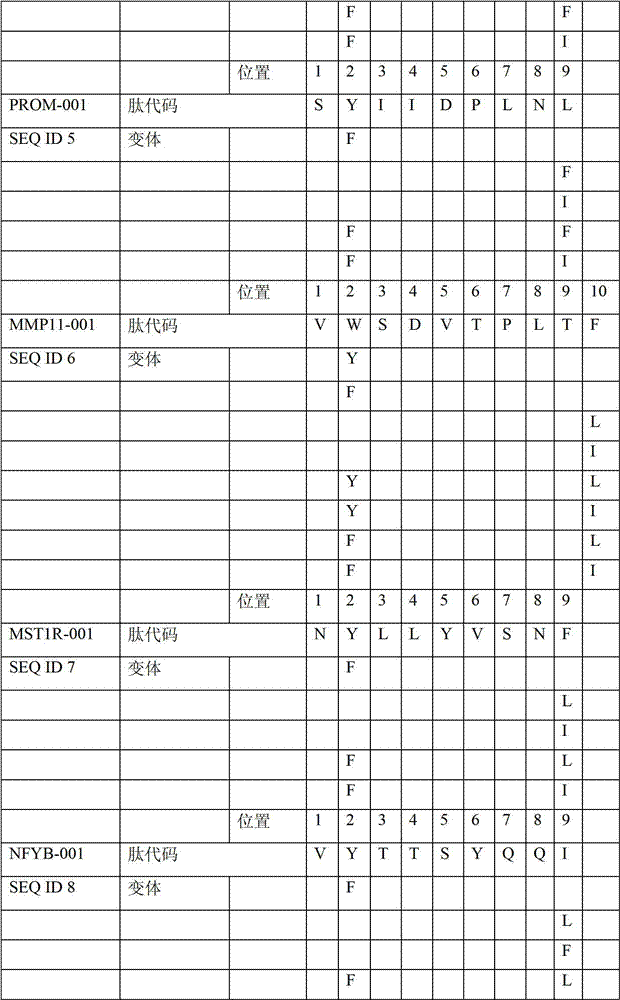
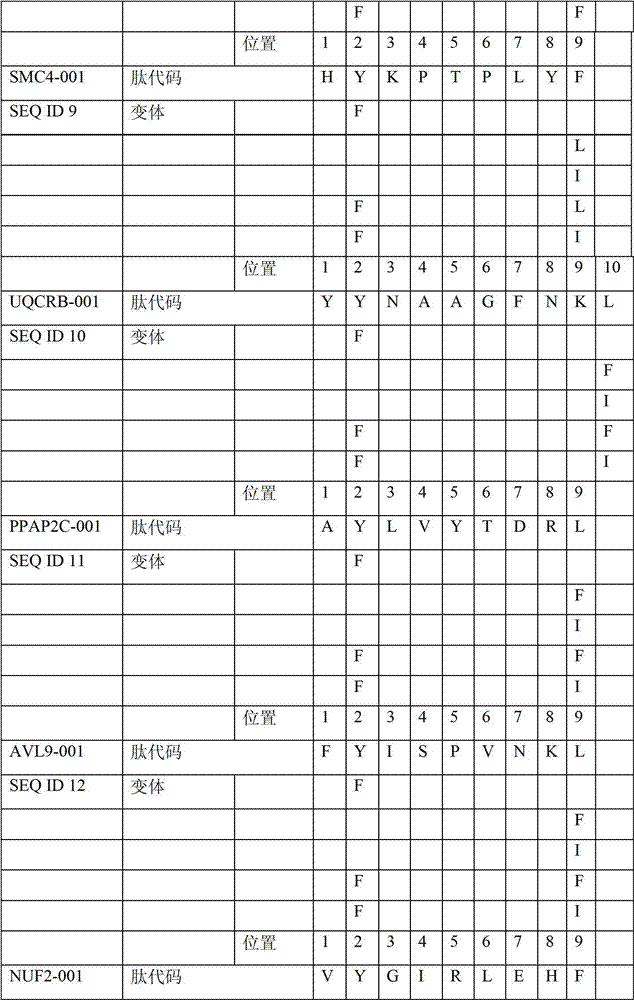


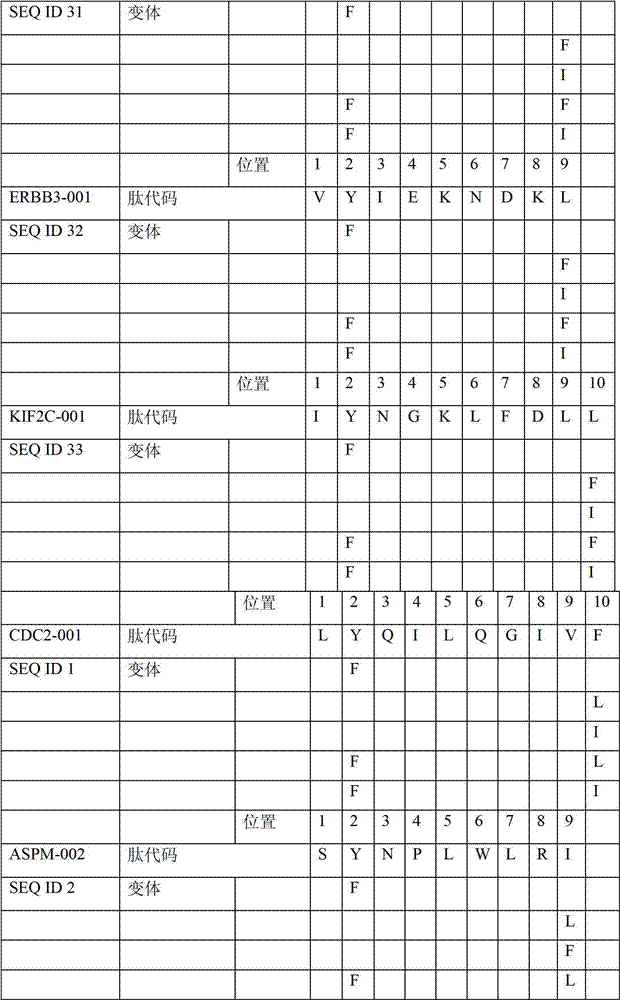
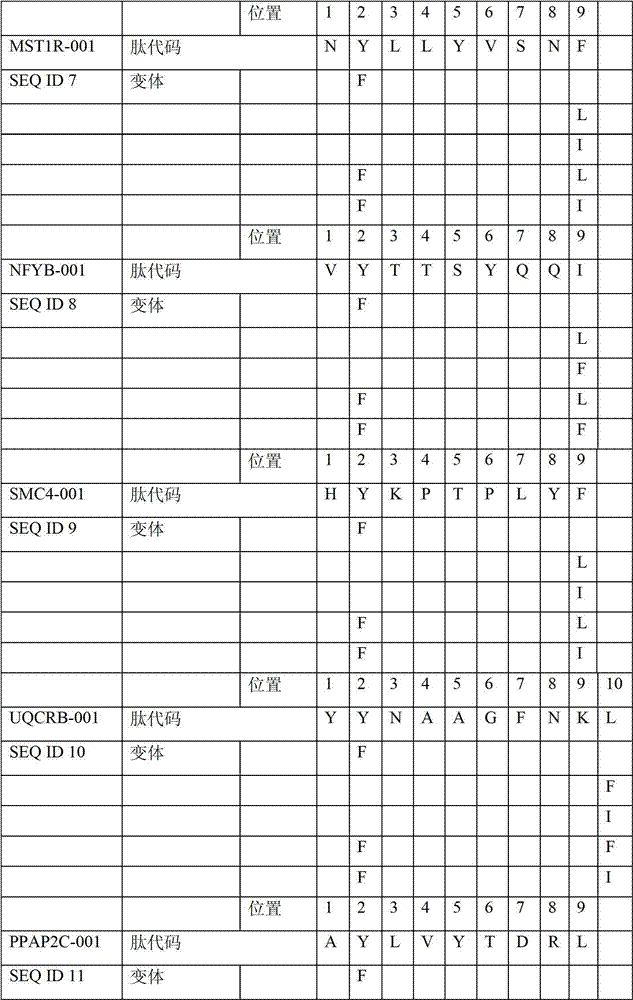
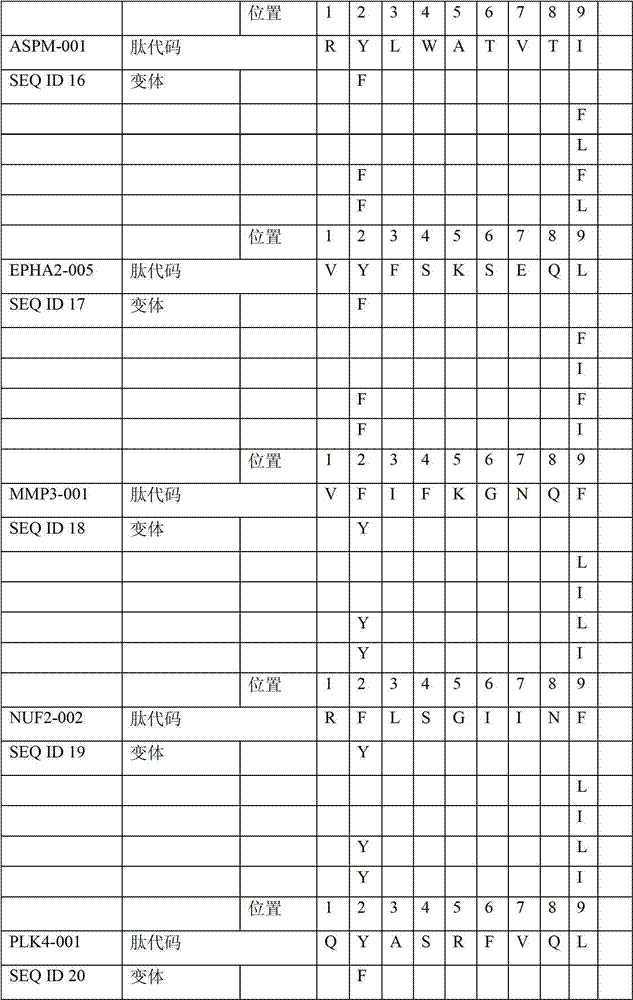

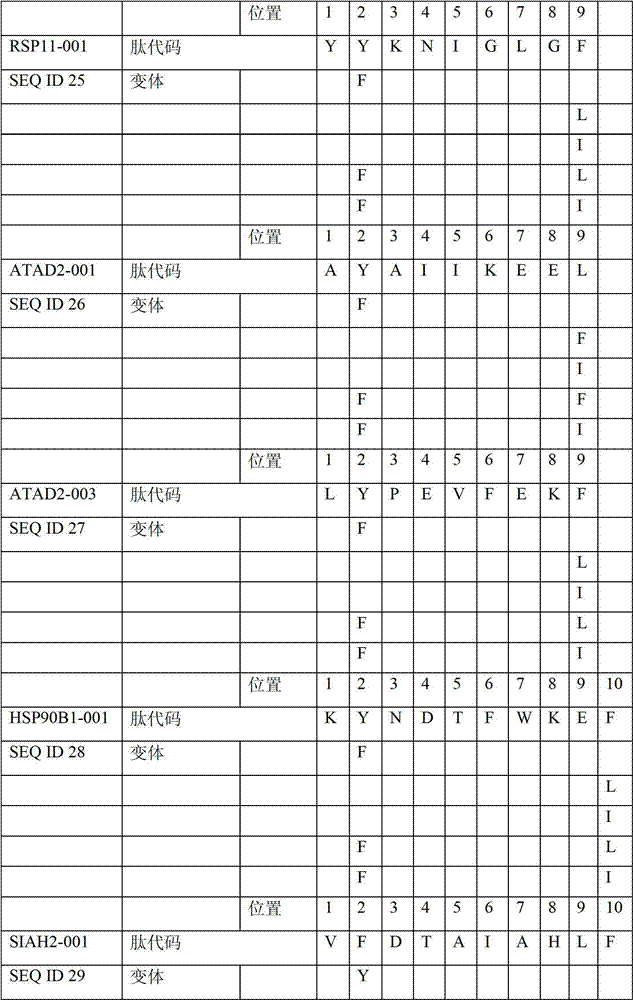
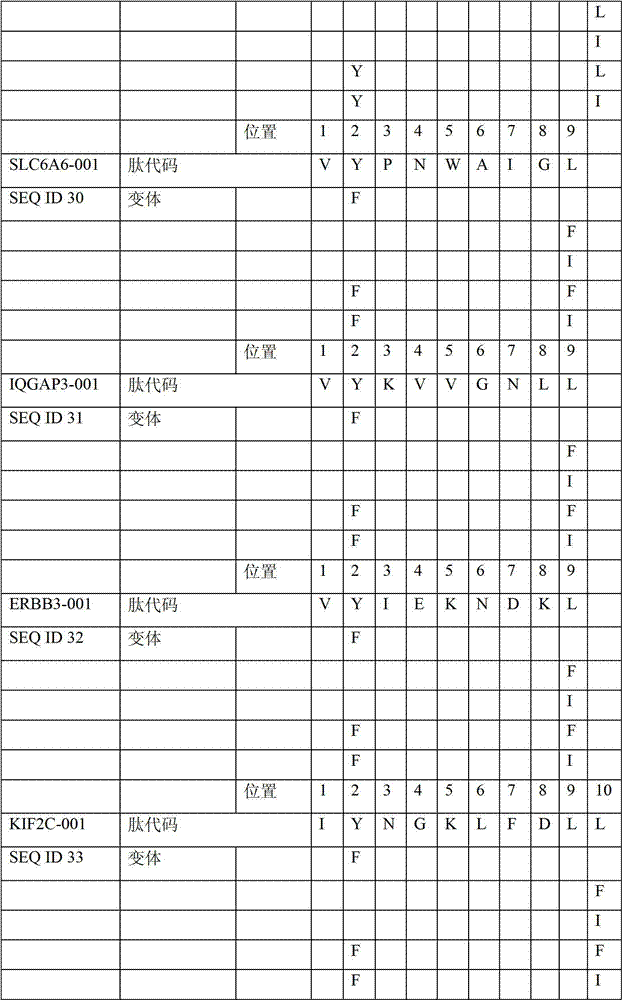
较长的肽也可能适合。MHC I类表位(通常长度为8至11个氨基酸)也可能由肽从较长的肽或包含实际表位的蛋白中加工而产生。两侧有实际表位的残基优选为在加工过程中几乎不影响暴露实际表位所需蛋白裂解的残基。Longer peptides may also be suitable. MHC class I epitopes (typically 8 to 11 amino acids in length) may also arise from peptide processing from longer peptides or proteins containing the actual epitope. The residues flanking the actual epitope are preferably residues that have little effect on the proteolytic cleavage required to expose the actual epitope during processing.
因此,本发明还提出了MHC I类表位的肽和变体,其中所述肽或抗体的总长度为8至100个、优选为8至30个、最优选为8至14个(即8、9、10、11、12、13、14个)氨基酸。Therefore, the present invention also proposes peptides and variants of MHC class I epitopes, wherein said peptides or antibodies have a total length of 8 to 100, preferably 8 to 30, most preferably 8 to 14 (i.e. 8 , 9, 10, 11, 12, 13, 14) amino acids.
当然,本发明的肽或变体能与人主要组织兼容性复合体(MHC)I或II类分子结合。肽或变体与MHC复合体的结合可用本领域内的已知方法进行测试。Of course, the peptides or variants of the invention are capable of binding to human major histocompatibility complex (MHC) class I or II molecules. Binding of peptides or variants to MHC complexes can be tested using methods known in the art.
在本发明的一个特别优选实施例中,肽系由或基本系由根据SEQ ID NO:1至SEQ ID NO:95的氨基酸組成。In a particularly preferred embodiment of the invention, the peptide consists or consists essentially of amino acids according to SEQ ID NO: 1 to SEQ ID NO: 95.
「基本由...构成」系指本发明的肽,除了根据SEQ ID NO:1至SEQ ID NO:95中的任一序列或其变体构成外,还含有位于其他N和/或C端延伸处的氨基酸,而它们不一定能形成作为MHC分子表位的肽。"Consisting essentially of" means that the peptide of the present invention, in addition to being formed according to any sequence in SEQ ID NO: 1 to SEQ ID NO: 95 or variants thereof, also contains other N and/or C-terminal amino acids at stretches that do not necessarily form peptides that are epitopes of MHC molecules.
但这些延伸区域对有效将本发明中的肽引进细胞具有重要作用。在本发明的一个实施例中,肽为融合蛋白,含来自NCBI、GenBank登录号X00497的HLA-DR抗原相关不变链(p33,以下称为「Ii」)的80个N-端氨基酸等。However, these extended regions play an important role in efficiently introducing the peptides of the present invention into cells. In one embodiment of the present invention, the peptide is a fusion protein containing 80 N-terminal amino acids from the HLA-DR antigen-associated invariant chain (p33, hereinafter referred to as "Ii") from NCBI, GenBank accession number X00497, and the like.
此外,该肽或变体可进一步修饰以提高稳定性和/或与MHC分子结合,从而引发更强的免疫应答。肽序列的该类优化方法是本领域内所熟知的,包括,例如,反式肽键和非肽键的引入。In addition, the peptide or variant can be further modified to increase stability and/or bind to MHC molecules, thereby eliciting a stronger immune response. Methods for such optimization of peptide sequences are well known in the art and include, for example, the introduction of trans-peptide bonds and non-peptide bonds.
在反式肽键氨基酸中,肽(-CO-NH-)并未连接其残基,但是其肽键是反向的。这种逆向反向模拟肽(retro-inverso peptidomimetics)可透过本领域已知的方法制备,例如:Meziere等人(1997)在《免疫学杂志》(J.Immunol.159,3230-3237)中所述的方法,此处以引用的方式纳入本文。这种方法涉及制备包含骨架(而并非侧链)改变的模拟肽。Meziere等人(1997)的研究显示,这些类比肽有利于MHC的结合和辅助性T细胞的应答。以NH-CO键替代CO-NH肽键的逆向反向肽大大地提高了抗水解性能。In trans-peptide bonded amino acids, the peptide (-CO-NH-) is not linked to its residues, but its peptide bond is reversed. Such retro-inverso peptidomimetics can be prepared by methods known in the art, for example: Meziere et al. (1997) in "Journal of Immunology" (J.Immunol.159, 3230-3237) The methods described are incorporated herein by reference. This approach involves making peptidomimetics that contain changes in the backbone (rather than the side chains). Studies by Meziere et al. (1997) have shown that these analog peptides facilitate MHC binding and helper T cell responses. The reverse reverse peptide with NH-CO bond instead of CO-NH peptide bond greatly improves the hydrolysis resistance.
非肽键为-CH2-NH、-CH2S-、-CH2CH2-、-CH=CH-、-COCH2-、-CH(OH)CH2-和-CH2SO-等。美国4897445号专利提出了多肽链中非肽键(-CH2-NH)的固相合成法,该方法涉及按标准程序合成的多肽以及透过氨基醛和一种含NaCNBH3的氨基酸相互作用而合成的非肽键。Non-peptide bonds are -CH 2 -NH, -CH 2 S-, -CH 2 CH 2 -, -CH=CH-, -COCH 2 -, -CH(OH)CH 2 -, -CH 2 SO-, and the like. U.S. Patent No. 4,897,445 proposes a solid-phase synthesis method for non-peptide bonds (-CH 2 -NH) in polypeptide chains . Synthetic non-peptide bonds.
含上述序列的肽可与其氨基和/或羧基末端的其他化学基团进行合成,从而提高肽的稳定性、生物利用度、和/或亲和力等。例如,苄氧羰基、丹酰基等疏水基团或叔丁氧羰基团可加入肽的氨基末端。同样,乙酰基或9-芴甲氧羰基可能位于肽的氨基末端。此外,疏水基团、叔丁氧羰基团或氨基团都可能被加入肽的羧基末端。The peptide containing the above sequence can be synthesized with other chemical groups at its amino and/or carboxyl terminal, so as to improve the stability, bioavailability, and/or affinity of the peptide. For example, hydrophobic groups such as benzyloxycarbonyl, dansyl, or tert-butoxycarbonyl can be added to the amino terminus of the peptide. Likewise, an acetyl or 9-fluorenyl moxycarbonyl group may be located at the amino terminus of the peptide. In addition, hydrophobic groups, tert-butoxycarbonyl groups or amino groups may be added to the carboxyl terminus of the peptide.
另外,本发明中的所有肽都可能经合成而改变其空间构型。例如,可能使用这些肽的一个或多个氨基酸残基的右旋体,通常不是其左旋体。更进一步地,本发明中肽的至少一个氨基酸残基可被熟知的一个非天然氨基酸残基取代。诸如此类的改变可能有助于增加本发明肽的稳定性、生物利用度和/或结合作用。In addition, all peptides in the present invention may be synthesized to change their spatial configuration. For example, it is possible to use the dextrorotatory form of one or more amino acid residues of these peptides, usually not the levorotatory form thereof. Furthermore, at least one amino acid residue of the peptide of the present invention may be substituted by a well-known unnatural amino acid residue. Alterations such as these may help to increase the stability, bioavailability and/or binding of the peptides of the invention.
同样,本发明中的肽或变体可在合成肽之前或之后透过特异氨基酸的反应而进行化学修饰。此类修饰的实例为本领域所熟知,例如,在R.Lundblad所着的《Chemical Reagents for Protein Modification》(3rd ed.CRC Press,2005)中有概述,此处透过引用将其纳入本文。虽然氨基酸的化学修饰方法无限制,但其包括(但不限于)透过以下方法修饰:酰基化、脒基化、赖氨酸吡哆基化、还原烷基化、以2,4,6-三硝基苯磺酸(TNBS)三硝基苯基化氨基团、透过将半胱氨酸过甲酸氧化为磺基丙氨酸而对羧基团和巯基进行氨基修饰、形成易变衍生物、与其他巯基化合物形成混合二硫化合物、与马来酰亚胺反应,与碘乙酸或碘乙酰胺羧甲基化、在碱性pH值下与氰酸盐甲氨酰化。在这方面,建议熟练技术人员参考《Current Protocols InProtein Science》(Eds.Coligan et al.(John Wiley&Sons NY 1995-2000))中第15章所述的在蛋白质化学修饰相关的广泛方法。Likewise, the peptides or variants of the present invention can be chemically modified by specific amino acid reactions before or after peptide synthesis. Examples of such modifications are well known in the art and are, for example, outlined in "Chemical Reagents for Protein Modification" by R. Lundblad (3rd ed. CRC Press, 2005), which is hereby incorporated by reference. Although the method of chemical modification of amino acids is not limited, it includes, but is not limited to, modification by the following methods: acylation, amidinylation, lysine pyridoxylation, reductive alkylation, 2,4,6- Trinitrobenzenesulfonic acid (TNBS) trinitroshenylates amino groups, amino modification of carboxyl and sulfhydryl groups by oxidation of cysteine performic acid to sulfoalanine, formation of labile derivatives, Forms mixed disulfides with other mercapto compounds, reacts with maleimides, carboxymethylates with iodoacetic acid or iodoacetamide, carbamylates with cyanates at alkaline pH. In this regard, the skilled person is advised to refer to
简言之,修饰蛋白质的精氨酰残基等往往基于与邻二羰基化合物(如苯甲酰甲醛、2,3-丁二酮以及1,2-烯巳二酮)的反应而形成加合物。另一个实例是丙酮醛与精氨酸残基的反应。半胱氨酸可在赖氨酸和组氨酸等亲核位点不作随同修饰的情况下就得到修饰。因此,有大量试剂可进行半胱氨酸的修饰。Sigma-Aldrich(http://www.sigma-aldrich.com)等公司的网站含有具体试剂的信息。In short, the modification of arginyl residues of proteins, etc. is often based on the reaction with o-dicarbonyl compounds (such as phenylglyoxal, 2,3-butanedione and 1,2-enedione) to form adducts things. Another example is the reaction of methylglyoxal with arginine residues. Cysteine can be modified without concomitant modification of nucleophilic sites such as lysine and histidine. Thus, a large number of reagents are available for cysteine modification. The websites of companies such as Sigma-Aldrich (http://www.sigma-aldrich.com) contain information on specific reagents.
蛋白质中二硫键的选择性还原也很普遍。二硫键可在生物制药热处理中形成和氧化。Selective reduction of disulfide bonds in proteins is also widespread. Disulfide bonds can be formed and oxidized during thermal processing of biopharmaceuticals.
伍德沃德氏试剂K可用于修饰特定的谷氨酸残基。N-(3-二甲氨基丙基)-N′-乙基-碳二亚胺可用于形成赖氨酸残基和谷氨酸残基的分子内交联。Woodward's reagent K can be used to modify specific glutamic acid residues. N-(3-Dimethylaminopropyl)-N'-ethyl-carbodiimide can be used to form intramolecular crosslinks of lysine and glutamic acid residues.
例如:焦碳酸二乙酯是修饰蛋白质组氨酸残基的试剂。组氨酸也可使用4-羟基-2-壬烯醛进行修饰。For example: Diethyl pyrocarbonate is a reagent for modifying histidine residues in proteins. Histidine can also be modified with 4-hydroxy-2-nonenal.
赖氨酸残基与其他α-氨基团的反应,例如,有利于肽结合到蛋白/肽的表面或交联处。赖氨酸是聚(乙烯)乙二醇的附着点,也是蛋白质糖基化的主要修饰位点。Reaction of lysine residues with other α-amino groups, for example, facilitates peptide binding to protein/peptide surfaces or cross-links. Lysine is the attachment point of poly(ethylene)glycol and the main modification site of protein glycosylation.
蛋白质的蛋氨酸残基可透过碘乙酰胺、溴乙胺、氯胺T等被修饰。The methionine residues of proteins can be modified by iodoacetamide, bromoethylamine, chloramine T, etc.
四硝基甲烷和N-乙酰基咪唑可用于酪氨酸残基的修饰。经二酪氨酸形成的交联可透过过氧化氢/铜离子完成。Tetranitromethane and N-acetylimidazole can be used for the modification of tyrosine residues. Crosslinking via dityrosine can be accomplished via hydrogen peroxide/copper ions.
对色氨酸修饰的最近研究中使用了N-溴代琥珀酰亚胺、2-羟基-5-硝基苄溴或3-溴-3-甲基-2-(2-硝苯巯基)-3H-吲哚(BPNS-粪臭素)。Recent studies on the modification of tryptophan have used N-bromosuccinimide, 2-hydroxy-5-nitrobenzyl bromide or 3-bromo-3-methyl-2-(2-nitrophenylmercapto)- 3H-indole (BPNS-skatole).
当蛋白与戊二醛、聚乙二醇二丙烯酸酯和甲醛的交联用于配制水凝胶时,治疗性蛋白和含聚乙二醇的肽的成功修饰往往可延长循环半衰期。用于免疫治疗的变态反应原化学修饰往往透过氰酸钾的氨基甲酰化实现。Successful modification of therapeutic proteins and PEG-containing peptides often results in increased circulating half-life when cross-linking of proteins with glutaraldehyde, PEG diacrylate, and formaldehyde is used to formulate hydrogels. Chemical modification of allergens for immunotherapy is often achieved through carbamylation with potassium cyanate.
一种肽或变体,其中肽被修饰或含非肽键,优选为本发明的实施例。一般来说,肽和变体(至少含氨基酸残基之间的肽联接)可使用Lu等人(1981年)以及此处列出的参考文献所披露的固相肽合成Fmoc-聚酰胺模式进行合成。芴甲氧羰基(Fmoc)基团对N-氨基提供临时保护。使用N,N-二甲基甲酰胺中的20%二甲基呱啶中对这种硷高度敏感的保护基团进行重复分裂。由于它们的丁基醚(在丝氨酸苏氨酸和酪氨酸的情况下)、丁基酯(在谷氨酸和天门冬氨酸的情况下)、叔丁氧羰基衍生物(在赖氨酸和组氨酸的情况下)、三苯甲基衍生物(在半胱氨酸的情况下)及4-甲氧基-2,3,6-三甲基苯磺酰基衍生物(在精氨酸的情况下),侧链功能可能会受到保护。只要谷氨酰胺和天冬酰胺为C-末端残基,侧链氨基功能保护所使用的是4,4′-二甲氧基二苯基团。固相支撑基于聚二甲基丙烯酰胺聚合物,其由三个单体二甲基丙烯酰胺(骨架单体)、双丙烯酰乙烯二胺(交联剂)和N-丙烯酰肌胺酸甲酯(功能剂)构成。使用的肽-树脂联剂为酸敏感的4-羟甲基苯氧乙酸衍生物。所有的氨基酸衍生物均作为其预制对称酸酐衍生物加入,但是天冬酰胺和谷氨酰胺除外,它们使用被逆转的N,N-二环己基碳二亚胺/1-羟基苯并三唑介导的耦合程序而加入。所有的耦合和脱保护反应用茚三酮、硝基苯磺酸或isotin测试程序监测。合成完成后,用浓度为95%含50%清道夫混合物的三氟醋酸,在同时去除侧链保护基团的情况下从树脂支承物中裂解肽。常用的清道夫混合物包括乙二硫醇、苯酚、苯甲醚和水,准确的选择依据合成肽的氨基酸组成。此外,固相和液相方法结合使用对肽进行合成是可能的(请参阅,例如(Bruckdorfer,Marder,and Albericio 29-43)以及其中所引用之文献)。A peptide or variant wherein the peptide is modified or contains non-peptide bonds is a preferred embodiment of the invention. In general, peptides and variants (containing at least peptide linkages between amino acid residues) can be performed using the Fmoc-polyamide format for solid-phase peptide synthesis as disclosed by Lu et al. (1981) and references listed here synthesis. The fluorenylmethoxycarbonyl (Fmoc) group provides temporary protection for the N-amino group. Repeated cleavage of this base-sensitive protecting group was performed using 20% dimethylpiperidine in N,N-dimethylformamide. Due to their butyl ethers (in the case of serine threonine and tyrosine), butyl esters (in the case of glutamic acid and aspartic acid), tert-butoxycarbonyl derivatives (in the case of lysine and histidine), trityl derivatives (in the case of cysteine) and 4-methoxy-2,3,6-trimethylbenzenesulfonyl derivatives (in the case of arginine acid), the side chain functionality may be preserved. As long as glutamine and asparagine are C-terminal residues, side chain amino function protection uses the 4,4'-dimethoxydiphenyl group. The solid phase support is based on polydimethylacrylamide polymer, which consists of three monomers dimethylacrylamide (backbone monomer), bisacryloylethylenediamine (crosslinker) and N-acryloylsarcosine Ester (functional agent) composition. The peptide-resin coupling agent used is an acid-sensitive 4-hydroxymethylphenoxyacetic acid derivative. All amino acid derivatives are added as their prefabricated symmetrical anhydride derivatives, with the exception of asparagine and glutamine, which use a reversed N,N-dicyclohexylcarbodiimide/1-hydroxybenzotriazole intermediate Guided coupling program and join. All coupling and deprotection reactions were monitored with ninhydrin, nitrobenzenesulfonic acid or isotin test procedures. After the synthesis was complete, the peptide was cleaved from the resin support with a concentration of 95% trifluoroacetic acid containing 50% scavenger mixture with simultaneous removal of side chain protecting groups. Commonly used scavenger mixtures include ethanedithiol, phenol, anisole, and water, the exact choice being based on the amino acid composition of the synthetic peptide. Furthermore, peptide synthesis is possible using a combination of solid-phase and solution-phase methods (see, eg, (Bruckdorfer, Marder, and Albericio 29-43) and references cited therein).
三氟乙酸在真空中蒸发、随后用二乙基乙醚研磨,即得粗肽。用简单萃取程序(水相冻干后,该程序制得不含清道夫混合物的肽)清除任何存在的清道夫混合物。肽合成试剂一般可从Calbiochem-Novabiochem(英国)公司(NG72QJ,英国)获得。Evaporation of trifluoroacetic acid in vacuo followed by trituration with diethyl ether afforded the crude peptide. Any scavenger mixture present was removed with a simple extraction procedure (which yielded peptides free of the scavenger mixture after lyophilization of the aqueous phase). Peptide synthesis reagents are generally available from Calbiochem-Novabiochem (UK) Company (NG72QJ, UK).
纯化可透过以下技术的任何一种或组合方法进行,如:再结晶法、体积排阻色谱法、离子交换色谱法、疏水作用色谱法以及(通常)反相高效液相色谱法(如使用乙腈/水梯度分离)。Purification can be performed by any one or combination of the following techniques, such as: recrystallization, size exclusion chromatography, ion exchange chromatography, hydrophobic interaction chromatography and (usually) reversed-phase high performance liquid chromatography (if using acetonitrile/water gradient).
肽分析可使用以下方法进行:薄层色谱法、电泳法、特别是毛细管电泳法、固相萃取法(CSPE)、反相高效液相色谱法、酸水解后的氨基酸分析、快原子轰击(FAB)质谱分析法以及MALDI、ESI-Q-TOF质谱分析法。Peptide analysis can be performed using the following methods: thin layer chromatography, electrophoresis, especially capillary electrophoresis, solid phase extraction (CSPE), reversed-phase high performance liquid chromatography, amino acid analysis after acid hydrolysis, fast atom bombardment (FAB ) mass spectrometry and MALDI, ESI-Q-TOF mass spectrometry.
另一方面,本发明提出了一种编码本发明中肽或肽变体的核酸(如多聚核苷酸)。多聚核苷酸可能为,例如,DNA、cDNA、PNA、CNA、RNA或其组合物,它们可为单链和/或双链、或多聚核苷酸的原生或稳定形式(如:具有硫代磷酸骨架的多聚核苷酸),并且只要它编码肽,就可能包含也可能不包含内含子。当然,多聚核苷酸只能编码加入天然肽键并含有天然氨基酸残基的肽。另一个方面,本发明提出了一种可根据本发明表达多肽的表达载体。In another aspect, the invention provides a nucleic acid (such as a polynucleotide) encoding a peptide or peptide variant of the invention. The polynucleotide may be, for example, DNA, cDNA, PNA, CNA, RNA, or combinations thereof, which may be single-stranded and/or double-stranded, or in native or stabilized form (e.g., with A polynucleotide with a phosphorothioate backbone) and may or may not contain introns as long as it encodes a peptide. Of course, a polynucleotide can encode only peptides incorporating natural peptide bonds and containing natural amino acid residues. In another aspect, the present invention provides an expression vector capable of expressing a polypeptide according to the present invention.
对于连接多核苷酸,已经研发出多种方法,尤其是针对DNA,可透过向载体补充可连接末端等方法进行连接。例如,可向DNA片段加入补充性均聚物束,之后DNA片段被插入到载体DNA。然后,透过补充性均聚物尾巴的氢键结合,将载体和DNA片段结合,从而形成重组DNA分子。For ligating polynucleotides, various methods have been developed, especially for DNA, which can be ligated by adding ligatable ends to the vector and so on. For example, complementary homopolymer bundles can be added to the DNA segment before it is inserted into the vector DNA. The vector and DNA fragments are then combined by hydrogen bonding of complementary homopolymer tails to form recombinant DNA molecules.
含有一个或多个限制性酶切位点的合成接头为DNA片段与载体连接提供了另一种方法。含各种限制性核酸内切酶的合成接头可透过多种渠道购得,其中包括从国际生物技术公司(International Biotechnologies Inc,New Haven,CN,美国)购得。Synthetic adapters containing one or more restriction sites provide an alternative method for ligating DNA fragments to vectors. Synthetic adapters containing various restriction endonucleases are commercially available from various sources, including from International Biotechnologies Inc (New Haven, CN, USA).
编码本发明多肽的DNA理想修饰方法是使用(Saiki et al.487-91)所采用的聚合酶链反应方法。此方法可用于将DNA引入合适的载体(例如,透过设计合适的限制性酶切位点),也可用于本领域已知的其他有用方法修饰DNA。如果使用病毒载体,痘病毒载体或腺病毒载体为优选。An ideal method of modification of the DNA encoding the polypeptide of the present invention is to use the polymerase chain reaction method employed by (Saiki et al. 487-91). This method can be used to introduce the DNA into a suitable vector (for example, by designing appropriate restriction sites), as well as to modify the DNA in other useful ways known in the art. If viral vectors are used, poxviral vectors or adenoviral vectors are preferred.
之后,DNA(或在逆转录病毒载体情况下,RNA)可能表达于合适的宿主,从而制成含本发明肽或变体的多肽。因此,可根据已知技术使用编码本发明肽或变体的DNA,用本文所述方法适当修饰后,构建表达载体,然后表达载体用于转化合适宿主细胞,从而表达和产生本发明中的多肽。这些方法包括下列美国专利中披露的方法:4,440,859、4,530,901、4,582,800、4,677,063、4,678,751、4,704,362、4,710,463、4,757,006、4,766,075和4,810,648。The DNA (or in the case of retroviral vectors, RNA) may then be expressed in a suitable host to produce a polypeptide comprising the peptide or variant of the invention. Therefore, the DNA encoding the peptide or variant of the present invention can be used according to known techniques, and after being appropriately modified by the method described herein, an expression vector is constructed, and then the expression vector is used to transform a suitable host cell, thereby expressing and producing the polypeptide of the present invention . These methods include those disclosed in the following US Patents: 4,440,859, 4,530,901, 4,582,800, 4,677,063, 4,678,751, 4,704,362, 4,710,463, 4,757,006, 4,766,075, and 4,810,648.
编码含本发明化合物多肽的DNA(或在逆转录病毒载体情况下,RNA)可能被加入到其他多种DNA序列,从而引入到合适的宿主中。同伴DNA将取决于宿主的性质、DNA引入宿主的方式、以及是否需要保持为游离体还是要相互结合。The DNA (or in the case of retroviral vectors, RNA) encoding a polypeptide comprising a compound of the present invention may be incorporated into various other DNA sequences for introduction into a suitable host. Companion DNA will depend on the nature of the host, how the DNA is introduced into the host, and whether it needs to remain episomal or be associated with each other.
一般来说,DNA可以适当的取向和正确的表达阅读框架附着到一种表达载体(如质粒)中。如有必要,该DNA可能与所需宿主所识别的相应转录和转译调节控制核苷酸序列连接,尽管表达载体中一般存在此类控制功能。然后,该载体透过标准方法被引入宿主。一般来说,并不是所有的宿主都会被载体转化。因此,有必要选择转化过的宿主细胞。选择方法包括用任何必要的控制元素向表达载体插入一个DNA序列,该序列对转化细胞中的可选择性属性(如抗生素耐药性)进行编码。In general, DNA can be attached to an expression vector (such as a plasmid) in the proper orientation and in the correct reading frame for expression. If necessary, the DNA may be linked to appropriate transcriptional and translational regulatory control nucleotide sequences recognized by the desired host, although such control functions are generally present in expression vectors. The vector is then introduced into the host by standard methods. In general, not all hosts will be transformed by the vector. Therefore, it is necessary to select transformed host cells. Selection methods involve inserting into the expression vector, with any necessary control elements, a DNA sequence that encodes a selectable attribute (such as antibiotic resistance) in transformed cells.
另外,有这种选择属性的基因可在另外一个载体上,该载体用来协同转化所需的宿主细胞。Alternatively, the gene for this selection property can be on another vector which is used to co-transform the desired host cell.
然后,本发明中的重组DNA所转化的宿主细胞在本文中所述本领域技术人员熟悉的合适条件下培养足够长的时间,从而表达之后可回收的肽。The host cells transformed with the recombinant DNA of the present invention are then cultured under suitable conditions familiar to those skilled in the art as described herein for a time sufficient to express the peptide which can then be recovered.
有许多已知的表达系统,包括细菌(如大肠杆菌和枯草芽孢杆菌)、酵母(如酵母菌)、丝状真菌(如曲霉菌)、植物细胞、动物细胞及昆虫细胞。该系统可优选为哺乳动物细胞,如来自ATCC细胞生物学库(Cell Biology Collection)中的CHO细胞。There are many known expression systems, including bacteria (such as E. coli and Bacillus subtilis), yeast (such as Saccharomyces spp.), filamentous fungi (such as Aspergillus), plant cells, animal cells, and insect cells. The system may preferably be mammalian cells, such as CHO cells from the ATCC Cell Biology Collection.
典型的哺乳动物细胞组成型表达载体质粒包括CMV或含一个合适的多聚A尾巴的SV40启动子以及抗性标志物(如新霉素)。一个实例为从Pharmacia公司(Piscataway,新泽西,美国)获得的pSVL。一种可诱导型哺乳动物表达载体的例子是pMSG,也可以从Pharmacia公司获得。有用的酵母质粒载体是pRS403-406和pRS413-416,一般可从Stratagene Cloning Systems公司(La Jolla,CA 92037,美国)获得。质粒pRS403、pRS404、pRS405和pRS406是酵母整合型质粒(YIp),并插入了酵母可选择性标记物HIS3、TRP1、LEU2和URA3。pRS413-416质粒为酵母着丝粒质粒(Ycp)。基于CMV启动子的载体(如,来自于Sigma-Aldrich公司)提供了瞬时或稳定的表达、胞浆表达或分泌,以及FLAG、3xFLAG、c-myc或MATN不同组合物中的N-端或C-端标记。这些融合蛋白可用于检测、纯化及分析重组蛋白。双标记融合为检测提供了灵活性。Typical constitutive expression vector plasmids for mammalian cells include the CMV or SV40 promoter with an appropriate poly-A tail and a resistance marker (such as neomycin). An example is pSVL obtained from Pharmacia Corporation (Piscataway, NJ, USA). An example of an inducible mammalian expression vector is pMSG, also available from Pharmacia. Useful yeast plasmid vectors are pRS403-406 and pRS413-416, generally available from Stratagene Cloning Systems, Inc. (La Jolla, CA 92037, USA). Plasmids pRS403, pRS404, pRS405 and pRS406 are yeast integrating plasmids (YIp) and have inserted the yeast selectable markers HIS3, TRP1, LEU2 and URA3. The pRS413-416 plasmid is a yeast centromere plasmid (Ycp). CMV promoter-based vectors (e.g., from Sigma-Aldrich) provide transient or stable expression, cytoplasmic expression or secretion, and N-terminal or C - end markers. These fusion proteins can be used for detection, purification and analysis of recombinant proteins. Dual-label fusion provides flexibility in detection.
强劲的人巨细胞病毒(CMV)启动子调控区使得COS细胞中的组成蛋白表达水平高达1mg/L。对于较弱的细胞株,蛋白水平一般低于0.1mg/L。SV40复制原点的出现将导致DNA在SV40复制容纳性COS细胞中高水平复制。例如,CMV载体可包含细菌细胞中的pMB1(pBR322的衍生物)复制原点、细菌中进行氨苄青霉素抗性选育的β-内酰胺酶基因、hGH polyA和f1的原点。含前胰岛素原引导(PPT)序列的载体可使用抗FLAG抗体、树脂和板引导FLAG融合蛋白分泌到进行纯化的培养基中。其他与各种宿主细胞一起应用的载体和表达系统是本领域众所周知的。The robust human cytomegalovirus (CMV) promoter regulatory region enables constitutive protein expression levels as high as 1mg/L in COS cells. For weaker cell lines, protein levels are generally below 0.1 mg/L. The presence of the SV40 origin of replication will lead to high levels of DNA replication in SV40 replication-accommodating COS cells. For example, CMV vectors may contain the pMB1 (derivative of pBR322) origin of replication in bacterial cells, the β-lactamase gene for ampicillin resistance selection in bacteria, the hGH polyA and f1 origins. Vectors containing preproinsulin target (PPT) sequences can be used to direct secretion of FLAG fusion proteins into culture medium for purification using anti-FLAG antibodies, resins and plates. Other vectors and expression systems for use with various host cells are well known in the art.
本发明还涉及一种宿主细胞,其以本发明的多核苷酸载体构建转化而来。宿主细胞可为原核细胞,也可为真核细胞。在有些情况下,细菌细胞为优选原核宿主细胞,典型为大肠杆菌株,例如,大肠杆菌菌株DH5(从Bethesda ResearchLaboratories公司(Bethesda,MD,美国)获得)和RR1(从美国菌种保藏中心(ATCC,Rockville,MD,美国),ATCC编号31343获得)。首选的真核宿主细胞包括酵母、昆虫和哺乳动物细胞,优选为脊椎动物细胞,如:小鼠、大鼠、猴子或人成纤维细胞和结肠癌细胞株中的细胞。酵母宿主细胞包括YPH499、YPH500和YPH501,一般可从Stratagene Cloning Systems公司(La Jolla,CA 92037,美国)获得。首选哺乳动物宿主细胞包括中国仓鼠卵巢(CHO)细胞为ATCC中的CCL61细胞、NIH瑞士小鼠胚胎细胞NIH/3T3为ATCC中的CRL 1658细胞、猴肾源性COS-1细胞为ATCC中的CRL 1650细胞以及人胚胎肾细胞的293号细胞。首选昆虫细胞为Sf9细胞,可用杆状病毒表达载体转染。有关针对表达选择合适宿主细胞的概要,可从教科书(Paulina Balbás and Argelia Lorence《Methods in Molecular BiologyRecombinant Gene Expression,Reviews and Protocols》Part One,Second Edition,ISBN978-1-58829-262-9)和本领域技术人员熟知的其他文献中查到。The present invention also relates to a host cell transformed with the polynucleotide vector of the present invention. Host cells can be prokaryotic or eukaryotic. In some cases, bacterial cells are preferred prokaryotic host cells, typically E. coli strains, for example, E. coli strains DH5 (obtained from Bethesda Research Laboratories, Inc. (Bethesda, MD, USA)) and RR1 (obtained from the American Type Culture Collection (ATCC) , Rockville, MD, USA), obtained under ATCC No. 31343). Preferred eukaryotic host cells include yeast, insect and mammalian cells, preferably vertebrate cells such as those in mouse, rat, monkey or human fibroblast and colon cancer cell lines. Yeast host cells include YPH499, YPH500 and YPH501, generally available from Stratagene Cloning Systems, Inc. (La Jolla, CA 92037, USA). Preferred mammalian host cells include Chinese hamster ovary (CHO) cells as CCL61 cells in ATCC, NIH Swiss mouse embryonic cells NIH/3T3 as CRL 1658 cells in ATCC, monkey kidney-derived COS-1 cells as CRL in ATCC 1650 cells and 293 cells of human embryonic kidney cells. The preferred insect cells are Sf9 cells, which can be transfected with baculovirus expression vectors. An overview of selecting suitable host cells for expression can be found in textbooks (Paulina Balbás and Argelia Lorence "Methods in Molecular Biology Recombinant Gene Expression, Reviews and Protocols" Part One, Second Edition, ISBN978-1-58829-262-9) and in the field It can be found in other literatures well known to those skilled in the art.
含本发明DNA结构的适当宿主细胞的转化可使用大家熟知的方法完成,通常取决于所使用载体的类型。对于原核宿主细胞的转化,可参阅,如:Cohen等人(1972)在Proc.Natl.Acad.Sci.USA 1972,69,2110中以及Sambrook等人(1989)所着《Molecular Cloning,A Laboratory Manual》Cold Spring Harbor Laboratory,ColdSpring Harbor,NY中使用的方法。酵母细胞的转化在Sherman等人(1986)的Methods In Yeast Genetics,A Laboratory Manual,Cold Spring Harbor,NY中有描述。Beggs(1978)Nature 275,104-109中所述方法也很有用。对于脊椎动物细胞,转染这些细胞的试剂等,例如,磷酸钙和DEAE-葡聚糖或脂质体配方,可从StratageneCloning Systems公司或Life Technologies公司(Gaithersburg,MD 20877,美国)获得。电穿孔也可用于转化和/或转染细胞,是本领域用于转化酵母细胞、细菌细胞、昆虫细胞和脊椎动物细胞大家熟知的方法。Transformation of appropriate host cells containing the DNA constructs of the present invention can be accomplished using well-known methods, generally depending on the type of vector used. For transformation of prokaryotic host cells, see, for example: Cohen et al. (1972) in Proc. Natl. Acad. Sci. USA 1972,69, 2110 and Sambrook et al. "The method used in Cold Spring Harbor Laboratory, Cold Spring Harbor, NY. Transformation of yeast cells is described in Methods In Yeast Genetics, A Laboratory Manual, Cold Spring Harbor, NY, by Sherman et al. (1986). The method described in Beggs (1978) Nature 275, 104-109 is also useful. For vertebrate cells, reagents for transfection of these cells, for example, calcium phosphate and DEAE-dextran or liposome formulations, are available from Stratagene Cloning Systems or Life Technologies (Gaithersburg, MD 20877, USA). Electroporation can also be used to transform and/or transfect cells and is a method well known in the art for transforming yeast cells, bacterial cells, insect cells and vertebrate cells.
被成功转化的细胞(即含本发明DNA结构的细胞)可用大家熟知的方法(如PCR)进行识别。另外,上清液中存在的蛋白可使用抗体进行检测。Successfully transformed cells (i.e., cells containing the DNA construct of the present invention) can be identified by well-known methods such as PCR. Alternatively, proteins present in the supernatant can be detected using antibodies.
应了解,本发明中的某些宿主细胞用于制备本发明中的肽,例如细菌细胞、酵母细胞和昆虫细胞。但是,其他宿主细胞可能对某些治疗方法有用。例如,抗原提呈细胞(如树突状细胞)可用于表达本发明中的肽,使它们可以加载入相应的MHC分子中。因此,本发明提出了含本发明中核酸或表达载体的一种宿主细胞。It will be appreciated that certain host cells of the invention are used to produce the peptides of the invention, such as bacterial cells, yeast cells and insect cells. However, other host cells may be useful for certain therapeutic approaches. For example, antigen-presenting cells (such as dendritic cells) can be used to express the peptides of the invention so that they can be loaded into the corresponding MHC molecules. Accordingly, the present invention proposes a host cell comprising a nucleic acid or expression vector of the present invention.
在一个优选实施例中,宿主细胞为抗原提呈细胞,尤其是树突状细胞或抗原提呈细胞。目前,载有含摄护腺酸性磷酸酶(PAP)重组融合蛋白的APC正在针对用于治疗摄护腺癌(Sipuleucel-T)而进行研究(Rini et al.67-74;Small et al.3089-94)。In a preferred embodiment, the host cell is an antigen-presenting cell, especially a dendritic cell or an antigen-presenting cell. Currently, APCs carrying a recombinant fusion protein containing prostate acid phosphatase (PAP) are being studied for the treatment of prostate cancer (Sipuleucel-T) (Rini et al.67-74; Small et al.3089 -94).
另一方面,本发明提出了一种配制一种肽及其变体的方法,该方法包括培养宿主细胞和从宿主细胞或其培养基中分离肽。In another aspect, the invention provides a method of formulating a peptide and variants thereof comprising culturing a host cell and isolating the peptide from the host cell or its culture medium.
在另一个实施例中,本发明中的肽、核酸或表达载体用于药物中。例如,肽或其变体可制备为静脉(i.v.)注射剂、皮下(s.c.)注射剂、皮内(i.d.)注射剂、腹腔(i.p.)注射剂、肌肉(i.m.)注射剂。肽注射的优选方法包括s.c、i.d.、i.p.、i.m.和i.v.注射。DNA注射的优选方法为i.d.、i.m.、s.c、i.p.和i.v.注射。例如,给予50μg至1.5mg,优选为125μg至500μg的肽或DNA,这取决于具体的肽或DNA。上述剂量范围在以前的试验中成功使用(Brunsvig et al.1553-64;Staehler et al.)。In another embodiment, the peptides, nucleic acids or expression vectors of the present invention are used in medicine. For example, peptides or variants thereof can be prepared as intravenous (i.v.) injections, subcutaneous (s.c.) injections, intradermal (i.d.) injections, intraperitoneal (i.p.) injections, intramuscular (i.m.) injections. Preferred methods of peptide injection include s.c, i.d., i.p., i.m. and i.v. injections. Preferred methods of DNA injection are i.d., i.m., s.c, i.p. and i.v. injection. For example, 50 [mu]g to 1.5 mg, preferably 125 [mu]g to 500 [mu]g of the peptide or DNA is administered, depending on the particular peptide or DNA. The above dose ranges have been used successfully in previous trials (Brunsvig et al. 1553-64; Staehler et al.).
本发明的另一方面包括一种体外制备启动的T细胞的方法,该方法包括将T细胞与载有抗原的人MHC分子进行体外连接,这些分子在合适的抗原提呈细胞表面表达足够的一段时间从而以抗原特异性方式启动T细胞,其中所述抗原为根据本发明所述的一种肽。优选情况是足够量的抗原与抗原提呈细胞一同使用。Another aspect of the invention includes an in vitro method of producing primed T cells comprising in vitro ligation of the T cells to antigen-loaded human MHC molecules expressing a sufficient segment of the molecule on the surface of a suitable antigen-presenting cell. time to prime T cells in an antigen-specific manner, wherein said antigen is a peptide according to the invention. Preferably a sufficient amount of antigen is used with the antigen presenting cells.
优选情况是,哺乳动物细胞的TAP肽转运载体缺乏或水平下降或功能降低。缺乏TAP肽转运载体的适合细胞包括T2、RMA-S和果蝇细胞。TAP是与抗原加工相关的转运载体。Preferably, the mammalian cell lacks or has reduced levels or reduced function of the TAP peptide transporter. Suitable cells lacking the TAP peptide transporter include T2, RMA-S and Drosophila cells. TAP is a transport vehicle associated with antigen processing.
人体肽载入的缺陷细胞株T2可从美国菌种保藏中心(ATCC,12301 ParklawnDrive,Rockville,Maryland 20852,美国)获得,目录号CRL1992;果蝇细胞株Schneider 2号株从属ATCC目录CRL 19863;小鼠RMA-S细胞株在Karre et al 1985中有描述。The human peptide loading-deficient cell line T2 can be obtained from the American Type Culture Collection (ATCC, 12301 Parklawn Drive, Rockville, Maryland 20852, USA), catalog number CRL1992; the Drosophila cell line Schneider No. 2 belongs to the ATCC catalog CRL 19863; The mouse RMA-S cell line is described in Karre et al 1985.
优选情况是,宿主细胞在转染前基本上不表达MHC I类分子。刺激因子细胞还优选为表达对T细胞共刺激信号起到重要作用的分子,如,B7.1、B7.2、ICAM-1和LFA 3中的任一种分子。大量MHC I类分子和共刺激分子的核酸序列可从GenBank和EMBL数据库中公开获得。Preferably, the host cell does not substantially express MHC class I molecules prior to transfection. The stimulator cells are also preferably expressing molecules that play an important role in T cell co-stimulatory signals, such as any molecule in B7.1, B7.2, ICAM-1 and LFA 3. The nucleic acid sequences of a large number of MHC class I molecules and co-stimulatory molecules are publicly available from the GenBank and EMBL databases.
当MHC I类表位用作一种抗原时,T细胞为CD8阳性CTL。When MHC class I epitopes are used as an antigen, T cells are CD8 positive CTLs.
如果抗原提呈细胞受到转染而表达这种表位,则优选的细胞包括一个表达载体,该载体有能力表达含SEQ ID NO:1至SEQ ID NO:95的肽或其变体氨基酸序列。If antigen-presenting cells are transfected to express such epitopes, preferred cells include an expression vector capable of expressing the amino acid sequence of a peptide comprising SEQ ID NO: 1 to SEQ ID NO: 95 or a variant thereof.
可使用其他一些方法来体外生成CTL。例如,可使用Peoples等人(1995)描述的方法和Kawakami等人(1992)使用自体肿瘤浸润性淋巴细胞生成CTL的方法。Plebanski等人在(1995)使用自体外周血淋巴细胞(PLB)制得CTL。Jochmus等人(1997)描述了用肽或多肽脉冲处理树突状细胞或透过与重组病毒感染而制成自体CTL。Hill等人(1995)和Jerome等人(1993)使用B细胞制成自体CTL。此外,用肽或多肽脉冲处理或用重组病毒感染的巨噬细胞可用于配制自体CTL。Walter等人在2003年描述了透过使用人工抗原提呈细胞(aAPC)体外启动T细胞,这也是生成作用于所选肽的T细胞的一种合适方法。在这项研究中,根据生物素:链霉素生物化学方法透过将预制的MHC:肽复合物耦合到聚苯乙烯颗粒(微球)而生成aAPC。该系统实现了对aAPC上的MHC密度进行精确调节,这使得可以在血液样本中选择性地引发高或低亲合力的高效抗原特异性T细胞应答。除了MHC:肽复合物外,aAPC还应携运含共刺启动性的其他蛋白,如耦合至表面的抗-CD28抗体。此外,此类基于aAPC的系统往往需要加入适当的可溶性因子,例如,诸如白细胞介素-12的细胞因子。Several other methods can be used to generate CTLs in vitro. For example, the method described by Peoples et al. (1995) and the method of Kawakami et al. (1992) using autologous tumor infiltrating lymphocytes for CTL generation can be used. Plebanski et al. (1995) used autologous peripheral blood lymphocytes (PLB) to generate CTL. Jochmus et al. (1997) describe the generation of autologous CTL by pulsed dendritic cells with peptides or polypeptides or by infection with recombinant viruses. Hill et al. (1995) and Jerome et al. (1993) used B cells to generate autologous CTL. In addition, macrophages pulsed with peptides or polypeptides or infected with recombinant viruses can be used to formulate autologous CTLs. In 2003, Walter et al. described priming T cells in vitro through the use of artificial antigen-presenting cells (aAPCs), which is also a suitable method to generate T cells acting on selected peptides. In this study, aAPCs were generated by coupling prefabricated MHC:peptide complexes to polystyrene particles (microspheres) according to biotin:streptomycin biochemistry. This system enables precise tuning of the MHC density on aAPCs, which allows selective eliciting of high- or low-avidity highly efficient antigen-specific T-cell responses in blood samples. In addition to MHC:peptide complexes, aAPCs should also carry other proteins with co-stimulation initiation, such as anti-CD28 antibodies coupled to the surface. Furthermore, such aAPC-based systems often require the addition of appropriate soluble factors, eg, cytokines such as interleukin-12.
也可用同种异体细胞制得T细胞,在WO 97/26328中详细描述了一种方法,此处透过引用将其纳入本文。例如,除了果蝇细胞和T2细胞,也可用其他细胞来提呈肽,如CHO细胞、杆状病毒感染的昆虫细胞、细菌、酵母、牛痘感染的靶细胞。此外,也可使用植物病毒(例如,参阅Porta等人(1994)描述的将豇豆花叶病毒研发为一种提呈外来肽的高产系统。T cells can also be made from allogeneic cells, a method described in detail in WO 97/26328, which is hereby incorporated by reference. For example, in addition to Drosophila cells and T2 cells, other cells can be used to present peptides, such as CHO cells, baculovirus-infected insect cells, bacteria, yeast, vaccinia-infected target cells. In addition, plant viruses can also be used (see, for example, Porta et al. (1994) describing the development of cowpea mosaic virus as a high-yield system for presenting foreign peptides.
被启动的T细胞直接针对本发明中的肽,有助于治疗。因此,本发明的另一方面提出了用本发明前述方法制得的启动T细胞。Primed T cells are directed against the peptides of the present invention, facilitating therapy. Therefore, another aspect of the present invention proposes activated T cells produced by the aforementioned method of the present invention.
按上述方法制成的启动T细胞将会有选择性地识别异常表达含SEQ ID NO:1至95氨基酸序列一种多肽的细胞。The activated T cells prepared by the above method will selectively recognize cells abnormally expressing a polypeptide containing the amino acid sequence of SEQ ID NO: 1 to 95.
优选情况是,T细胞透过与其含HLA/肽复合物的TCR相互作用(如,结合)而识别该细胞。T细胞是杀伤患者靶细胞方法中有用的细胞,其靶细胞异常表达含本发明中氨基酸序列的多肽。对此类患者给予有效量的启动T细胞。给予患者的T细胞可能源自该患者,并按上述方法启动(即,它们为自体T细胞)。或者,T细胞不是源自该患者,而是来自另一个人。当然,优选情况是该供体为健康人。发明人使用「健康个人」系指一个人一般状况良好,优选为免疫系统合格,更优选为无任何可很容易测试或检测到的疾病。Preferably, the T cell recognizes the cell by interacting with (eg, binding to) its TCR containing the HLA/peptide complex. T cells are useful cells in the method of killing target cells of patients whose target cells abnormally express the polypeptide containing the amino acid sequence of the present invention. An effective amount of primed T cells is administered to such patients. T cells administered to a patient may be derived from that patient and primed as described above (ie, they are autologous T cells). Alternatively, the T cells do not originate from that patient, but from another person. Of course, it is preferred that the donor is a healthy person. By "healthy individual" the inventors mean a person who is generally in good condition, preferably with a competent immune system, more preferably free of any readily testable or detectable disease.
根据本发明,CD8阳性T细胞的体内靶细胞可为肿瘤细胞(有时表达MHC I类抗原)和/或肿瘤周围的基质细胞(肿瘤细胞)(有时也表达MHC I类抗原;(Dengjel et al.4163-70))。According to the present invention, the in vivo target cells of CD8-positive T cells can be tumor cells (sometimes expressing MHC class I antigens) and/or stromal cells (tumor cells) around the tumor (sometimes also expressing MHC class I antigens; (Dengjel et al. 4163-70)).
本发明所述的T细胞可用作治疗性组合物中的活性成分。因此,本发明也提出了一种杀伤患者靶细胞的方法,其中患者的靶细胞异常表达含本发明中氨基酸序列的多肽,该方法包括给予患者上述有效量的T细胞。T cells according to the invention can be used as active ingredients in therapeutic compositions. Therefore, the present invention also proposes a method for killing target cells of a patient, wherein the target cells of the patient abnormally express the polypeptide containing the amino acid sequence of the present invention, and the method includes administering the above-mentioned effective dose of T cells to the patient.
发明人所用的「异常表达」的意思还包括,与正常表达水平相比,多肽过量表达,或该基因在源自肿瘤的组织中未表达,但是在该肿瘤中却表达。「过量表达」系指多肽水平至少为正常组织中的1.2倍;优选为至少为正常组织中的2倍,更优选为至少5或10倍。"Aberrant expression" as used by the inventors also means overexpression of a polypeptide compared to normal expression levels, or the gene is not expressed in tumor-derived tissues, but is expressed in the tumor. "Overexpression" means that the level of polypeptide is at least 1.2 times that in normal tissue; preferably at least 2 times that in normal tissue, more preferably at least 5 or 10 times.
T细胞可用本领域已知的方法制得(如,上述方法)。T cells can be generated by methods known in the art (eg, methods described above).
T细胞过继转移方案为本领域所熟知的方案并可在以下参考文献中找到,例如:(Dudley et al.850-54;Dudley et al.2346-57;Rosenberg et al.889-97;Rosenberg etal.1676-80;Yee et al.16168-73);综述见(Gattinoni et al.383-93)和(Morgan et al.)。T cell adoptive transfer protocols are well known in the art and can be found in the following references, for example: (Dudley et al. 850-54; Dudley et al. 2346-57; Rosenberg et al. 889-97; Rosenberg et al. .1676-80; Yee et al. 16168-73); for reviews, see (Gattinoni et al. 383-93) and (Morgan et al.).
本发明的任一分子(即肽、核酸、表达载体、细胞,启动CTL、T细胞受体或编码核酸)都有益于治疗疾病,其特点在于细胞逃避免疫应答的打击。因此,本发明的任一分子都可用作药剂或用于制造药剂。这种分子可单独使用也可与本发明中的其他分子或已知分子联合使用。Any of the molecules of the invention (ie, peptides, nucleic acids, expression vectors, cells, activating CTLs, T cell receptors, or encoding nucleic acids) are beneficial in the treatment of diseases characterized by cells evading the onslaught of an immune response. Accordingly, any molecule of the invention may be used as a medicament or in the manufacture of a medicament. Such molecules may be used alone or in combination with other or known molecules of the present invention.
本发明中所述的药剂优选为一种疫苗。该疫苗可直接给到患者的受影响器官,也可i.d.、i.m.、s.c.、i.p.和i.v.注射方式全身给药,或体外应用到来自患者或其细胞株的细胞(随后再将这些细胞注入到患者中),或体外用于从来自患者的免疫细胞的一个细胞亚群(然后再将细胞重新给予患者)。如果核酸体外注入细胞,可能有益于细胞转染,以共同表达免疫刺激细胞因子(如白细胞介素-2)。肽可完全单独给药,也可与免疫刺激佐剂相结合(见下文)、或与免疫刺激细胞因子联合使用、或以适当的输送系统给药(例如脂质体)。该肽也可共轭形成一种合适的载体(如钥孔虫戚血蓝蛋白(KLH)或甘露)中(参阅WO 95/18145及Longenecker1993)。该肽也可进行标记、或可能是一种融合蛋白或是杂合分子。本发明中给出肽序列的肽预期会刺激CD4或CD8T细胞。但是,有CD4T辅助细胞提供帮助时,对CD8CTL的刺激更为有效。因此,对于刺激CD8CTL的MHC I类表位,一种杂合分子的融合伙伴或片段提供了刺激CD4阳性T细胞的适当表位。CD4-和CD8刺激表位为本领域所熟知、并包括本发明中确定的表位。The medicament described in the present invention is preferably a vaccine. The vaccine can be administered directly to the affected organ of the patient, administered systemically by i.d., i.m., s.c., i.p. and i.v. in), or in vitro for a subpopulation of immune cells from a patient (the cells are then re-administered to the patient). Transfection of cells to co-express immunostimulatory cytokines such as interleukin-2 may be beneficial if the nucleic acid is injected into cells in vitro. Peptides can be administered entirely alone, in combination with immunostimulatory adjuvants (see below), or in combination with immunostimulatory cytokines, or in an appropriate delivery system (eg liposomes). The peptide may also be conjugated to a suitable carrier such as keyhole limpet hemocyanin (KLH) or manna (see WO 95/18145 and Longenecker 1993). The peptide may also be tagged, or may be a fusion protein or hybrid molecule. Peptides of the present invention given peptide sequences are expected to stimulate CD4 or CD8 T cells. However, stimulation of CD8 CTLs was more effective with the help of CD4 T helper cells. Thus, for MHC class I epitopes that stimulate CD8 CTLs, a fusion partner or fragment of a hybrid molecule provides the appropriate epitopes to stimulate CD4-positive T cells. CD4- and CD8 stimulating epitopes are well known in the art and include the epitopes identified in the present invention.
一方面,疫苗包括至少含有SEQ ID NO:1至33中提出的一种肽以及至少另外一种肽,优选为2至50个、更优选为2至25个、再优选为2至15个、最优选为2、3、4、5、6、7、8、9、10、11、12或13个肽。肽可能从一个或多个特定TAA中衍生,并且可能与MHC I类分子结合。In one aspect, the vaccine comprises at least one peptide set forth in SEQ ID NO: 1 to 33 and at least one other peptide, preferably 2 to 50, more preferably 2 to 25, even more preferably 2 to 15, Most preferably 2, 3, 4, 5, 6, 7, 8, 9, 10, 11, 12 or 13 peptides. Peptides may be derived from one or more specific TAAs and may bind to MHC class I molecules.
多聚核苷酸可为基本纯化形式,也可包被于载体或输送系统。核酸可能为DNA、cDNA、PNA、CNA、RNA,也可能为其组合物。这种核酸的设计和引入方法为本领域所熟知。例如,文献中有其概述(Pascolo et al.117-22)。多核苷酸疫苗很容易制备,但这些载体诱导免疫应答的作用模式尚未完全了解。合适的载体和输送系统包括病毒DNA和/或RNA,如基于腺病毒、牛痘病毒、逆转录病毒、疱疹病毒、腺相关病毒或含一种以上病毒元素的混合病毒的系统。非病毒输送系统包括阳离子脂质体和阳离子聚合物,是DNA输送所属领域内熟知的系统。也可使用物理输送系统,如透过「基因枪」。肽或核酸编码的肽可以是一种融合蛋白,例如,含刺激T细胞进行上述CDR的表位。The polynucleotide may be in substantially purified form, or it may be coated on a vector or delivery system. A nucleic acid may be DNA, cDNA, PNA, CNA, RNA, or combinations thereof. Methods for the design and introduction of such nucleic acids are well known in the art. For example, it is outlined in the literature (Pascolo et al. 117-22). Polynucleotide vaccines are readily prepared, but the mode of action by which these vectors induce immune responses is not fully understood. Suitable vectors and delivery systems include viral DNA and/or RNA, such as systems based on adenoviruses, vaccinia viruses, retroviruses, herpes viruses, adeno-associated viruses or hybrid viruses containing elements from more than one virus. Non-viral delivery systems include cationic liposomes and cationic polymers, and are systems well known in the art of DNA delivery. Physical delivery systems can also be used, such as via a "gene gun". Peptides or nucleic acid encoded peptides may be a fusion protein, for example, containing epitopes that stimulate T cells to carry out the above-mentioned CDRs.
本发明的药剂也可能包括一种或多种佐剂。佐剂是那些非特异性地增强或加强免疫应答的物质(例如,透过CTL和辅助T(TH)细胞介导的对一种抗原的免疫应答,因此被视为对本发明的药剂有用。适合的佐剂包括但不限于1018ISS、铝盐、Amplivax

据报导,CpG免疫刺激寡核苷酸可提高佐剂在疫苗中的作用。如果没有理论的约束,CpG寡核苷酸可透过Toll样受体(TLR)(主要为TLR9)启动先天(非适应性)免疫系统从而起作用。CpG引发的TLR9活化作用提高了对各种抗原的抗原特异性体液和细胞应答,这些抗原包括肽或蛋白抗原、活病毒或被杀死的病毒、树突状细胞疫苗、自体细胞疫苗以及预防性和治疗性疫苗中的多糖结合物。更重要的是,它会增强树突状细胞的成熟和分化,导致TH1细胞的活化增强以及细胞毒性T淋巴细胞(CTL)生成加强,甚至CD4T细胞帮助的缺失。甚至有疫苗佐剂的存在也能维持TLR9活化作用诱发的TH1偏移,这些佐剂如:正常促进TH2偏移的明矾或弗氏不完全佐剂(IFA)。CpG寡核苷酸与以下其他佐剂或配方一起制备或联合给药时,表现出更强的佐剂活性,如微粒、纳米粒子、脂肪乳或类似制剂,当抗原相对较弱时,这些对诱发强反应尤为必要。它们还能加速免疫应答,使抗原剂量减少约两个数量级,在有些实验中,对不含CpG的全剂量疫苗也能产生类似的抗体反应(Krieg 471-84)。美国6406705B1号专利对CpG寡核苷酸、非核酸佐剂和抗原结合使用促使抗原特异性免疫应答进行了描述。一种CpG TLR9拮抗剂为Mologen公司(德国柏林)的dSLIM(双干环免疫调节剂),这是本发明药物组合物的优选成分。也可使用其他如TLR结合分子,如:RNA结合TLR7、TLR8和/或TLR9。CpG immunostimulatory oligonucleotides have been reported to enhance the effect of adjuvants in vaccines. Without being bound by theory, CpG oligonucleotides act by priming the innate (non-adaptive) immune system through Toll-like receptors (TLRs), primarily TLR9. CpG-triggered TLR9 activation enhances antigen-specific humoral and cellular responses to a variety of antigens, including peptide or protein antigens, live or killed virus, dendritic cell vaccines, autologous cell vaccines, and prophylactic and polysaccharide conjugates in therapeutic vaccines. More importantly, it enhances dendritic cell maturation and differentiation, leading to enhanced T H1 cell activation and enhanced cytotoxic T lymphocyte (CTL) generation, even in the absence of CD4 T cell help. TLR9 activation-induced TH1 shifts were maintained even in the presence of vaccine adjuvants such as alum or incomplete Freund's adjuvant (IFA) that normally promote TH2 shifts. CpG oligonucleotides exhibit stronger adjuvant activity when prepared or co-administered with other adjuvants or formulations such as microparticles, nanoparticles, lipid emulsions or similar preparations, which are more effective when the antigen is relatively weak It is especially necessary to induce a strong response. They also accelerate the immune response, reducing the antigen dose by about two orders of magnitude and, in some experiments, produced a similar antibody response to a full-dose vaccine without CpG (Krieg 471-84). US Patent No. 6406705B1 describes the combined use of CpG oligonucleotides, non-nucleic acid adjuvants and antigens to promote antigen-specific immune responses. A CpG TLR9 antagonist is dSLIM (Double Stem Loop Immunomodulator) from Mologen (Berlin, Germany), which is a preferred component of the pharmaceutical composition of the present invention. Other molecules such as TLR binding can also be used, such as: RNA binding TLR7, TLR8 and/or TLR9.
其他有用的佐剂例子包括但不限于化学修饰性CpG(如CpR、Idera)、dsRNA模拟物,如,Poly(I:C)及其衍生物(如:AmpliGen

优选佐剂为咪喹莫特、resiquimod、GM-CSF、环磷酰胺、舒尼替尼、贝伐单抗、干扰素-α、CpG寡核苷酸和衍生物、聚(I:C)和衍生物、RNA、西地那非、以及PLG的微粒制剂或病毒颗粒。Preferred adjuvants are imiquimod, resiquimod, GM-CSF, cyclophosphamide, sunitinib, bevacizumab, interferon-alpha, CpG oligonucleotides and derivatives, poly(I:C) and Derivatives, RNA, sildenafil, and microparticle formulations or virus particles of PLG.
本发明药物组合物的一个优选实施例中,佐剂从含集落刺激因子制剂中选择,如粒细胞巨噬细胞集落刺激因子(GM-CSF,沙格司亭)、咪喹莫特、resiquimod和干扰素-α。In a preferred embodiment of the pharmaceutical composition of the present invention, the adjuvant is selected from preparations containing colony stimulating factors, such as granulocyte macrophage colony stimulating factor (GM-CSF, sargragrastim), imiquimod, resiquimod and Interferon-alpha.
本发明药物组合物的一个优选实施例中,佐剂从含集落刺激因子制剂中选择,如粒细胞巨噬细胞集落刺激因子(GM-CSF,沙格司亭)、咪喹莫特和resimiquimod。In a preferred embodiment of the pharmaceutical composition of the present invention, the adjuvant is selected from preparations containing colony stimulating factors, such as granulocyte macrophage colony stimulating factor (GM-CSF, sargragrastim), imiquimod and resimiquimod.
在本发明药物组合物的一个优选实施例中,佐剂为咪喹莫特或resiquimod。In a preferred embodiment of the pharmaceutical composition of the present invention, the adjuvant is imiquimod or resiquimod.
此组合药物为非肠道注射使用,如皮下、皮内、肌肉注射,也可口服。为此,肽和其他选择性分子在药用载体中分解或悬浮,优选为水载体。此外,组合物可包含辅料,如:缓冲剂、结合剂、冲击剂、稀释剂、香料、润滑剂等。这些肽也可与免疫刺激物质合用,如:细胞因子。可用于此类组合物的更多辅料可从A.Kibbe所着的Handbook of Pharmaceutical Excipients(第3版,2000年,美国医药协会和制药出版社)等书中获知。此组合药物可用于阻止、预防和/或治疗腺瘤或癌性疾病。EP2113253中有示例制剂。This combination drug is given parenterally, such as subcutaneously, intradermally, intramuscularly, or orally. To this end, peptides and other selective molecules are dissolved or suspended in a pharmaceutically acceptable carrier, preferably an aqueous carrier. In addition, the composition may contain auxiliary materials, such as buffers, binders, impact agents, diluents, fragrances, lubricants and the like. These peptides can also be administered in combination with immunostimulatory substances such as cytokines. Further excipients that can be used in such compositions are known from, among others, Handbook of Pharmaceutical Excipients by A. Kibbe (3rd ed., 2000, American Medical Association and Pharmaceutical Press). This combination drug can be used to prevent, prevent and/or treat adenomatous or cancerous diseases. Exemplary formulations are found in EP2113253.
本发明提出了一种药剂,其有利于治疗癌症,尤其是胃癌、肾细胞癌、结肠癌、非小细胞肺癌、腺癌、摄护腺癌、良性肿瘤和恶性黑色素瘤。The present invention proposes an agent that is beneficial in the treatment of cancers, especially gastric cancer, renal cell carcinoma, colon cancer, non-small cell lung cancer, adenocarcinoma, prostate cancer, benign tumors and malignant melanoma.
本发明的一个试剂盒还包括:A kit of the present invention also includes:
(a)一个容器,包含上述溶液或冻干粉形式的药物组合物;(a) a container comprising the above-mentioned pharmaceutical composition in the form of a solution or lyophilized powder;
(b)可选的第二个容器,其含有冻干粉剂型的稀释剂或重组溶液;以及(b) an optional second container containing a diluent or reconstitution solution in the lyophilized powder dosage form; and
(c)可选项,(i)使用溶液或(ii)重组和/或使用冻干粉剂型的说明书。(c) Optionally, instructions for (i) using a solution or (ii) reconstituting and/or using a lyophilized powder dosage form.
该试剂盒还进一步包括一个或多个(iii)缓冲剂,(iv)稀释剂,(v)过滤液,(vi)针,或(v)注射器。容器优选为瓶子、西林瓶、注射器或试管;也可为多用途容器。药物组合物优选为冻干粉剂。The kit may further comprise one or more of (iii) buffer, (iv) diluent, (v) filtrate, (vi) needle, or (v) syringe. The container is preferably a bottle, vial, syringe or test tube; it may also be a multi-purpose container. The pharmaceutical composition is preferably a lyophilized powder.
本发明中的试剂盒优选包含一种置于合适容器中的冻干制剂以及重组和/或使用说明。适当的容器包括,例如瓶子、西林瓶(如双室瓶)、注射器(如双室注射器)和试管。该容器可能由多种材料制成,如玻璃或塑胶。优选情况是,试剂盒和/或容器上有说明,表明重组和/或使用的指示。例如,标签可能表明冻干剂型要重组为上述肽浓度。该标签可进一步表明该制剂用于皮下注射。The kits of the present invention preferably comprise a lyophilized preparation in a suitable container together with instructions for reconstitution and/or use. Suitable containers include, for example, bottles, vials (eg, dual chamber bottles), syringes (eg, dual chamber syringes), and test tubes. The container may be made of a variety of materials, such as glass or plastic. Preferably, there are instructions on the kit and/or container showing instructions for reconstitution and/or use. For example, the label may indicate that the lyophilized dosage form is to be reconstituted to the above peptide concentrations. The label may further indicate that the formulation is intended for subcutaneous injection.
存放制剂的容器可使用多次使用西林瓶,使得可重复给予(例如,2-6次)重组剂型。该试剂盒可进一步包括装有合适稀释剂(如碳酸氢钠溶液)的第二个容器。The container for holding the formulation may be a multi-use vial, allowing repeated (eg, 2-6) administration of the reconstituted dosage form. The kit may further comprise a second container containing a suitable diluent, such as sodium bicarbonate solution.
稀释液和冻干制剂混合后,重组制剂中的肽最终浓度优选为至少0.15mg/mL/肽(=75μg),不超过3mg/mL/肽(=1500μg)。该试剂盒还可包括商业和用户角度来说可取的其他材料,包括其他缓冲剂、稀释剂,过滤液、针头、注射器和带有使用说明书的包装插页。After mixing the diluent and the lyophilized formulation, the final concentration of peptide in the reconstituted formulation is preferably at least 0.15 mg/mL/peptide (=75 μg) and not more than 3 mg/mL/peptide (=1500 μg). The kit may also include other materials that are commercially and user desirable, including other buffers, diluents, filtrates, needles, syringes and package inserts with instructions for use.
本发明中的试剂盒可能有一个单独的容器,其中包含本发明所述的药物组合物制剂,该制剂可有其他成分(例如,其他化合物或及其药物组合物),也可无其他成分,或者每种成分都有其不同容器。The kits of the present invention may have a single container containing a preparation of the pharmaceutical composition of the present invention with or without other ingredients (e.g., other compounds or pharmaceutical compositions thereof), Or each ingredient has its own container.
优选情况是,本发明的试剂盒包括与本发明的一种制剂,包装后与第二种化合物(如佐剂(例如GM-CSF)、化疗药物、天然产品、激素或拮抗剂、抗血管生成剂或抑制剂、凋亡诱导剂或螯合剂)或其药物组合物联合使用。该试剂盒的成分可进行预络合或每种成分在给予患者之前可放置于单独的不同容器。该试剂盒的成分可以是一种或多种溶液,优选为水溶液,更优选为无菌水溶液。该试剂盒的成分也可为固体形式,加入合适的溶剂后转换为液体,最好放置于另一个不同的容器中。Preferably, the kit of the invention comprises a formulation of the invention packaged with a second compound such as an adjuvant (e.g. GM-CSF), a chemotherapeutic drug, a natural product, a hormone or antagonist, an anti-angiogenic agent or inhibitor, apoptosis inducer or chelator) or a pharmaceutical composition thereof. The components of the kit may be pre-complexed or each component may be placed in a separate distinct container prior to administration to the patient. The components of the kit may be one or more solutions, preferably aqueous solutions, more preferably sterile aqueous solutions. The components of the kit may also be in solid form, which will convert to a liquid with the addition of a suitable solvent, preferably in a different container.
治疗试剂盒的容器可能为西林瓶、试管、烧瓶、瓶子、注射器、或任何其他盛装固体或液体的工具。通常,当成分不只一种时,试剂盒将包含第二个西林瓶或其他容器,使之可以单独定量。该试剂盒还可能包含另一个装载药用液体的容器。优选情况是,治疗试剂盒将包含一个设备(如,一个或多个针头、注射器、滴眼器、吸液管等),使得可注射本发明的药物(本试剂盒的组合物)。The container of the therapeutic kit may be a vial, test tube, flask, bottle, syringe, or any other means for holding solid or liquid. Typically, when there is more than one component, the kit will contain a second vial or other container to allow for separate dosing. The kit may also contain another container of medicinal liquid. Preferably, the therapeutic kit will contain a device (eg, one or more needles, syringes, eye droppers, pipettes, etc.) to allow injection of the drug of the invention (composition of the kit).
本发明的药物配方适合以任何可接受的途径进行肽给药,如口服(肠道)、鼻内、眼内、皮下、皮内、肌内,静脉或经皮给药。优选为皮下给药,最优选为皮内给药,也可透过输液泵给药。The pharmaceutical formulations of the present invention are suitable for administering the peptides by any acceptable route, such as oral (enteral), intranasal, intraocular, subcutaneous, intradermal, intramuscular, intravenous or transdermal administration. Administration is preferably subcutaneous, most preferably intradermal, or via an infusion pump.
由于源自MST1R、UCHL5、SMC4、NFYB、PPAP2C、AVL9、UQCRB和MUC6的本发明中的肽从胃癌中分离而得,因此,本发明的药剂优选用于治疗胃癌。Since the peptides of the present invention derived from MST1R, UCHL5, SMC4, NFYB, PPAP2C, AVL9, UQCRB, and MUC6 are isolated from gastric cancer, the agent of the present invention is preferably used for the treatment of gastric cancer.
下列描述优选方案的实施例将对本发明进行说明(但是不仅限于此)。为了本发明之目的,所有参考文献均透过引用以其完整形式纳入本文。The following examples, describing preferred embodiments, illustrate (but do not limit) the invention. For the purposes of the present invention, all references are hereby incorporated by reference in their entirety.
实例example
实例1:Example 1:
细胞表面提呈的肿瘤相关肽的识别Recognition of tumor-associated peptides presented on the cell surface
组织样本tissue sample
患者肿瘤组织由日本大阪的京都府立医科大学(KPUM)、日本大阪的大阪市立大学医学研究生院(OCU)和德国图宾根大学医院提供。所有患者在手术前都获得了书面知情同意。手术后立即用液态氮对组织进行冷休克处理,分离TUMAP前储存于-80℃下。Patient tumor tissues were provided by Kyoto Prefectural University of Medicine (KPUM), Osaka, Japan, Osaka City University Graduate School of Medicine (OCU), Osaka, Japan, and University Hospital Tübingen, Germany. All patients obtained written informed consent before surgery. Immediately after surgery, the tissue was cold-shocked with liquid nitrogen and stored at -80°C before isolating TUMAPs.
从组织样本中分离HLA肽Isolation of HLA peptides from tissue samples
根据方案略加修改,使用HLA-A、HLA-B、HLA-C特异性抗体W6/32、HLA-A*02-特异性抗体BB7.2、CNBr活化的琼脂糖凝胶、酸处理和超滤方法以固体组织的免疫沉淀法获得了冷休克组织样本的HLA肽库(Falk,K.1991;Seeger,F.H.T1999)。With a slight modification of the protocol, HLA-A, HLA-B, HLA-C-specific antibody W6/32, HLA-A*02-specific antibody BB7.2, CNBr-activated agarose gel, acid treatment, and supernatant The HLA peptide library of cold-shock tissue samples was obtained by immunoprecipitation of solid tissues by filtration method (Falk, K.1991; Seeger, F.H.T1999).
方法method
获得的HLA肽库根据其疏水性用反相色谱(nanoAcquity UPLC system,Waters)分离,洗脱肽用装有电喷雾源的LTQ-Orbitrap混合质谱(ThermoFisher Scientific)进行了分析。肽库被直接载入填充有1.7μm C18反相材料(Waters)的分析用熔炼石英微毛细管柱(75μm内径x 250mm),应用流速为400nL每分钟。随后,使用来自流速为300nL每分钟、浓度为10%至33%溶剂B中的两步180分钟二元梯度法对肽进行分离。梯度由溶剂A(含0.1%甲酸的水)和溶剂B(含0.1%甲酸的乙腈)构成。金镀膜玻璃毛细管(PicoTip,New Objective)用于引入到纳升电喷雾源。使用前5(TOP5)策略在资料依赖模式下操作LTQ-Orbitrap质谱仪。简言之,首先以高精确质量完全扫描在orbitrap开始一个扫描周期(R=30000),之后用先前选定离子的动态排除技术在orbitrap中对5种含量最为丰富的前体离子进行MS/MS扫描(R=7500)。串联质谱以SEQUEST和另外的手动控制进行解读。生成的自然肽破碎模式与合成序列相同参考肽的破碎模式进行比较后,确保了被识别的肽序列。图1显示了从肿瘤组织中获得的MHC I类相关肽CDC2-001的一个典型谱及其在UPLC系统中的洗脱谱。The obtained HLA peptide library was separated according to its hydrophobicity by reversed-phase chromatography (nanoAcquity UPLC system, Waters), and the eluted peptides were analyzed by LTQ-Orbitrap hybrid mass spectrometer (ThermoFisher Scientific) equipped with an electrospray source. The peptide library was loaded directly onto an analytical fused-quartz microcapillary column (75 μm id x 250 mm) packed with 1.7 μm C18 reversed-phase material (Waters) at an applied flow rate of 400 nL per minute. Peptides were then separated using a two-step 180 min binary gradient from 10% to 33% solvent B at a flow rate of 300 nL per min. The gradient consisted of solvent A (water with 0.1% formic acid) and solvent B (acetonitrile with 0.1% formic acid). Gold-coated glass capillaries (PicoTip, New Objective) were used for introduction into the nano-electrospray source. The LTQ-Orbitrap mass spectrometer was operated in data-dependent mode using the top 5 (TOP5) strategy. Briefly, MS/MS of the 5 most abundant precursor ions was performed in orbitrap using dynamic exclusion of previously selected ions to start a scan cycle in orbitrap (R=30000) with a full scan at high accurate mass Scan (R=7500). Tandem mass spectra were interpreted with SEQUEST and additional manual controls. The fragmentation pattern of the generated native peptide was compared with that of a reference peptide of the same synthetic sequence, ensuring the sequence of the identified peptide. Figure 1 shows a typical profile of the MHC class I-related peptide CDC2-001 obtained from tumor tissue and its elution profile in the UPLC system.
实例2:Example 2:
编码本发明肽的基因的表达谱Expression profiles of genes encoding peptides of the invention
并不是所有确定为由MHC分子提呈于肿瘤细胞表面的肽都适合用于免疫治疗,这是因为这些肽大部分都由许多类型细胞表达的正常细胞蛋白衍生而来。这些肽只有很少一部分具有肿瘤相关性,并可能能够诱导对其来源肿瘤识别有高特异性的T细胞。为了确定这些肽并最大限度地降低这些肽接种所诱导的自身免疫风险,发明人主要采用从过量表达于肿瘤细胞上(与大多数正常组织相比)的蛋白中所获得的肽。Not all peptides identified as being presented by MHC molecules on the surface of tumor cells are suitable for immunotherapy because most of these peptides are derived from normal cellular proteins expressed by many types of cells. Only a small fraction of these peptides are tumor-associated and may be able to induce T cells highly specific for their tumor-of-origin recognition. In order to identify these peptides and minimize the risk of autoimmunity induced by vaccination with these peptides, the inventors mainly used peptides obtained from proteins overexpressed on tumor cells compared to most normal tissues.
理想的肽来源于对该肿瘤独一无二且不出现于其他组织的蛋白中。为了确定具有与理想基因相似表达谱的基因所产生的肽,确定的肽被分别分配到蛋白和基因中,从中获得基因并生成这些基因的表达谱。Ideal peptides are derived from proteins that are unique to the tumor and not found in other tissues. In order to identify peptides produced by genes with expression profiles similar to ideal genes, the identified peptides were assigned to proteins and genes, respectively, from which genes were obtained and expression profiles of these genes were generated.
RNA来源与制备RNA source and preparation
手术切除组织标本由不同的临床中心(参见实例1)在获得每名患者的书面知情同意后提供。手术后立即在液态氮中速冻肿瘤组织标本,之后在液态氮中用杵臼匀浆。使用TRI试剂(Ambion公司,Darmstadt,德国)之后用RNeasy(QIAGEN公司,Hilden,德国)清理从这些样本中制备的总RNA;这两种方法都根据制造商的方案进行。Surgically resected tissue samples were provided by different clinical centers (see Example 1) after obtaining written informed consent from each patient. Immediately after surgery, the tumor tissue samples were frozen in liquid nitrogen, and then homogenized in liquid nitrogen with a pestle. Total RNA prepared from these samples was cleaned up using TRI reagent (Ambion, Darmstadt, Germany) followed by RNeasy (QIAGEN, Hilden, Germany); both methods were performed according to the manufacturer's protocol.
健康人体组织中的总RNA从商业途径获得(Ambion公司,Huntingdon,英国;Clontech公司,海德堡,德国;Stratagene公司,阿姆斯特丹,荷兰;BioChain公司,Hayward,CA,美国)。混合数个人(2至123个人)的RNA,从而使每个人的RNA得到相等的权重。白细胞从4个健康志愿者的血液样本中分离获得。Total RNA from healthy human tissues was obtained from commercial sources (Ambion, Huntingdon, UK; Clontech, Heidelberg, Germany; Stratagene, Amsterdam, The Netherlands; BioChain, Hayward, CA, USA). The RNAs of a number of individuals (2 to 123 individuals) are mixed so that each individual's RNA gets equal weight. Leukocytes were isolated from blood samples of 4 healthy volunteers.
所有RNA样本的质量和数量都在Agilent 2100 Bioanalyzer分析仪(Agilent公司,Waldbronn,德国)上使用RNA 6000 Pico LabChip Kit试剂盒(Agilent公司)进行评估。The quality and quantity of all RNA samples were assessed on an Agilent 2100 Bioanalyzer analyzer (Agilent, Waldbronn, Germany) using the RNA 6000 Pico LabChip Kit (Agilent).
微阵列实验Microarray experiment
所有肿瘤和正常组织的RNA样本都使用Affymetrix Human Genome(HG)U133A或HG-U133 Plus 2.0Affymetrix寡核苷酸芯片(Affymetrix公司,SantaClara,CA,美国)进行基因表达分析。所有步骤都根据Affymetrix手册进行。简言之,如手册中所述,使用SuperScript RTII(Invitrogen公司)以及oligo-dT-T7引物(MWG Biotech公司,Ebersberg,德国)从5-8μg RNA中合成双链cDNA。用BioArray High Yield RNA Transcript Labelling Kit(ENZO Diagnostics公司,Farmingdale,NY,美国)进行U133A测定或用GeneChip IVT Labelling Kit(Affymetrix公司)进行U133 Plus 2.0测定,之后用链霉亲和素-藻红蛋白和生物素化抗链霉素蛋白抗体(Molecular Probes公司,Leiden,荷兰)进行破碎、杂交和染色,这样完成体外转录。用Agilent 2500A GeneArray Scanner(U133A)或AffymetrixGene-Chip Scanner 3000(U133Plus 2.0)对图像进行扫描,用GCOS软件(Affymetrix公司)在所有参数默认设置情况下对资料进行分析。为了实现标准化,使用了Affymetrix公司提供的100种管家基因(housekeeping gene)。相对表达值用软件给定的signal log ratio进行计算,正常肾组织样本的值任意设置为1.0。All tumor and normal tissue RNA samples were analyzed for gene expression using Affymetrix Human Genome (HG) U133A or HG-U133 Plus 2.0 Affymetrix oligonucleotide chips (Affymetrix Corporation, Santa Clara, CA, USA). All steps were performed according to the Affymetrix manual. Briefly, double-stranded cDNA was synthesized from 5–8 μg RNA using SuperScript RTII (Invitrogen) with oligo-dT-T7 primers (MWG Biotech, Ebersberg, Germany) as described in the manual. Use BioArray High Yield RNA Transcript Labeling Kit (ENZO Diagnostics Company, Farmingdale, NY, USA) for U133A determination or GeneChip IVT Labeling Kit (Affymetrix Company) for U133 Plus 2.0 determination, and then use streptavidin-phycoerythrin and In vitro transcription was accomplished by disruption, hybridization and staining with biotinylated anti-streptavidin antibody (Molecular Probes, Leiden, The Netherlands). The images were scanned with Agilent 2500A GeneArray Scanner (U133A) or Affymetrix Gene-Chip Scanner 3000 (U133Plus 2.0), and the data were analyzed with GCOS software (Affymetrix Company) under the default settings of all parameters. For normalization, 100 housekeeping genes provided by Affymetrix were used. The relative expression value was calculated with the signal log ratio given by the software, and the value of normal kidney tissue samples was arbitrarily set to 1.0.
本发明的源基因在胃癌中高度过量表达的表达谱如图2所示。The highly overexpressed expression profile of the source gene of the present invention in gastric cancer is shown in FIG. 2 .
实例3:Example 3:
IMA941MHC-I类提呈肽的体外免疫原性In vitro immunogenicity of peptides presented by IMA941 MHC-class I
为了获知关于本发明的TUMAP免疫原性方面的信息,我们使用了Walter,S、Herrgen,L、Schoor,O、Jung,G、Wernet,D、Buhring,HJ、Rammensee,HG和Stevanovic,S等人2003年在Cutting edge:predetermined avidity of human CD8 T cellsexpanded on calibrated MHC/anti-CD28-coated microspheres,J.Immunol.,171,4974-4978一文中所述的被广为接受的体外刺激平台进行了研究。利用这一系统,可对本发明的54种测试的HLA-A*2402限制TUMAP中的47个以及3种测试的HLA-A*0201限制TUMAP中的3个证明明确的免疫源性(即特异T细胞扩展)。这表明这些肽为对抗人CD8+前体T细胞的T细胞表位(表4)。To obtain information on the immunogenicity of TUMAPs of the present invention, we used Walter, S, Herrgen, L, Schoor, O, Jung, G, Wernet, D, Buhring, HJ, Rammensee, HG and Stevanovic, S et al. In 2003, the widely accepted in vitro stimulation platform described in Cutting edge:predetermined avidity of human CD8 T cells expanded on calibrated MHC/anti-CD28-coated microspheres, J. Immunol., 171, 4974-4978 was studied . Using this system, clear immunogenicity (i.e. specific T cell expansion). This suggests that these peptides are T cell epitopes against human CD8+ precursor T cells (Table 4).
CD8+T细胞体外启动In vitro priming of CD8+ T cells
为了用载有肽-MHC复合物(pMHC)和抗CD28抗体的人工抗原提呈细胞(aAPC)进行体外刺激,我们首先从Tuebingen血库中获取健康供体白细胞清除术后新鲜HLA-A*24产物或从HLA-A*2白细胞层分离出CD8T细胞。For in vitro stimulation with artificial antigen-presenting cells (aAPCs) loaded with peptide-MHC complexes (pMHC) and anti-CD28 antibodies, we first obtained fresh HLA-A*24 products after leukapheresis from healthy donors from the Tuebingen blood bank Or isolate CD8 T cells from HLA-A*2 buffy coat.
然后,直接富集CD8T细胞,或首先运用标准梯度分离介质(PAA公司,
pMHC/抗-CD28涂层珠的生成、T细胞的刺激和读出方法如前所述(Walter et al.4974-78)并作微小改动。简言之,制备了缺乏跨膜域和在重链羧基端生物素化的生物素化载肽重组HLA-A*2402和HLA-A*0201分子。纯化的共刺激小鼠IgG2a抗人CD28抗体9.3(Jung,Ledbetter,and Muller-Eberhard 4611-15)使用制造商(Perbio公司,波恩,德国)推荐的N-羟基琥珀酰亚胺生物素进行化学生物素化处理。所用珠为5.6μm的大链霉抗生物素蛋白包裹的多聚苯乙烯颗粒(Bangs Labooratories,伊利诺州,美国)。作为高低免疫原对照的pMHC分别为A*0201/MLA-001(从Melan-A/MART-1中修饰制得的肽ELAGIGILTV)和A*0201/DDX5-001(从DDX5中获得的YLLPAIVHI)。Generation of pMHC/anti-CD28 coated beads, stimulation of T cells and readout methods were as previously described (Walter et al. 4974-78) with minor modifications. Briefly, biotinylated peptide-loaded recombinant HLA-A*2402 and HLA-A*0201 molecules lacking the transmembrane domain and biotinylated at the carboxyl terminus of the heavy chain were prepared. Purified co-stimulatory mouse IgG2a anti-human CD28 antibody 9.3 (Jung, Ledbetter, and Muller-Eberhard 4611-15) was used for chemical biology using N-hydroxysuccinimide biotin as recommended by the manufacturer (Perbio, Bonn, Germany). prime treatment. The beads used were 5.6 μm large streptavidin-coated polystyrene particles (Bangs Laboratories, IL, USA). The pMHC used as high and low immunogen controls were A*0201/MLA-001 (peptide ELAGIGILTV modified from Melan-A/MART-1) and A*0201/DDX5-001 (YLLPAIVHI obtained from DDX5).
800.000珠/200μl包被于96孔板,以600ng生物素抗CD28+200ng相关生物素pMHC(高密度珠)存在。在37℃以及5%CO2和95%相对溼度下,在含5ng/ml IL-12(PromoCell)的200μl TCM中共培养1x10⁶CD8+T细胞与2x10⁵的清洗涂层珠3至4天,从而在96孔板中启动刺激。之后,一半培养基与补充80U/ml IL-2的新鲜TCM进行交换,并且在37℃下持续培养3至4天。这种刺激周期总共进行3次。800.000 beads/200 μl coated in 96-well plate in the presence of 600ng biotin anti-CD28 + 200ng related biotin pMHC (high density beads). Co-culture 1x10 6 CD8+ T cells with 2x10 5 wash-coated beads in 200 μl TCM containing 5 ng/ml IL-12 (PromoCell) at 37°C with 5% CO 2 and 95% relative humidity for 3 to 4 days, Stimulation was thus initiated in the 96-well plate. Afterwards, half of the medium was exchanged with fresh TCM supplemented with 80 U/ml IL-2, and culture was continued at 37°C for 3 to 4 days. This stimulation cycle was performed a total of 3 times.
最后,用fluorescent A*0201或A*2402HLA多聚体(生产方法如{Altman,1996ALTMAN1996/id}所述)和CD8-FITC抗体克隆SK1(BD公司,Heidelberg,德国)或另外用一个生存力标记物(Live/dead-Aqua或-紫色染色剂(Invitrogen,Karlsruhe,德国))染色细胞而执行多聚体分析。分析使用四色FACSCalibur(BD)或LSRII SORP细胞仪(BD;18色,分别配备有蓝色(488nm)、紫色(405nm)、红色(640nm)和绿色(532nm))进行。肽特异性细胞以占总CD8+细胞的百分比形式进行计算。多聚体分析结果使用FCSExpress或FlowJo软件(Tree Star公司,Oregon,美国)进行评估。特定多聚体+CD8+淋巴细胞的体外填装用适当的门控技术并与阴性对照刺激组比较而进行检测,如果健康供体中的至少一个可评价的体外刺激孔在体外刺激后发现含有特异性CD8+T细胞(即该孔多聚体+细胞群体部份包含至少1%的
IMA941肽的体外免疫原性In vitro immunogenicity of IMA941 peptide
对于受到测试的54个A*2402肽中的47个肽以及受到测试的3个HLA-A*0201肽中的3个肽,可透过肽特异性T细胞株的生成证明体外免疫原性。TUMAP特异性多聚体对本发明的两种肽染色后流式细胞仪检测的典型结果如图3所示,同时也含有相应的阴性对照信息。本发明54A*2402和3A*0201肽的结果汇总于表4。For 47 of the 54 A*2402 peptides tested and 3 of the 3 HLA-A*0201 peptides tested, in vitro immunogenicity could be demonstrated by the generation of peptide-specific T cell lines. The typical results of the flow cytometry detection of the two peptides of the present invention stained by TUMAP-specific polymers are shown in FIG. 3 , and corresponding negative control information is also included. The results for the 54A*2402 and 3A*0201 peptides of the invention are summarized in Table 4.
表4:本发明中HLA I类肽的体外免疫原性Table 4: In vitro immunogenicity of HLA class I peptides of the present invention
Immatics所做的体外免疫原性实验的结果显示了可评估受测试阳性供体和板孔的百分比。每个肽至少有四个供体和48个板孔可评估。The results of the in vitro immunogenicity assays performed by Immatics show the percentage of donors and wells that were evaluable for test positive. At least four donors and 48 wells per peptide can be evaluated.
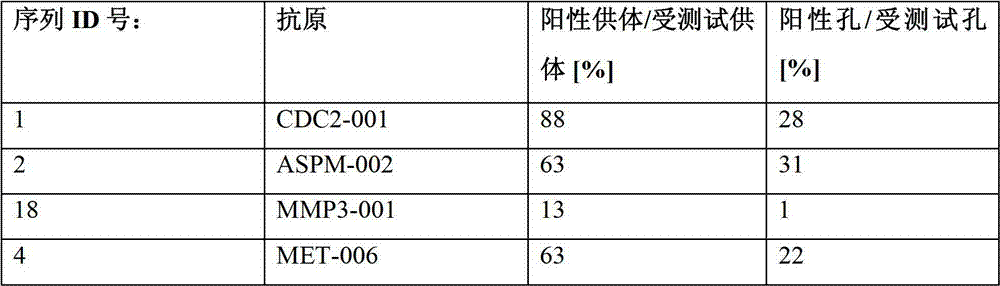
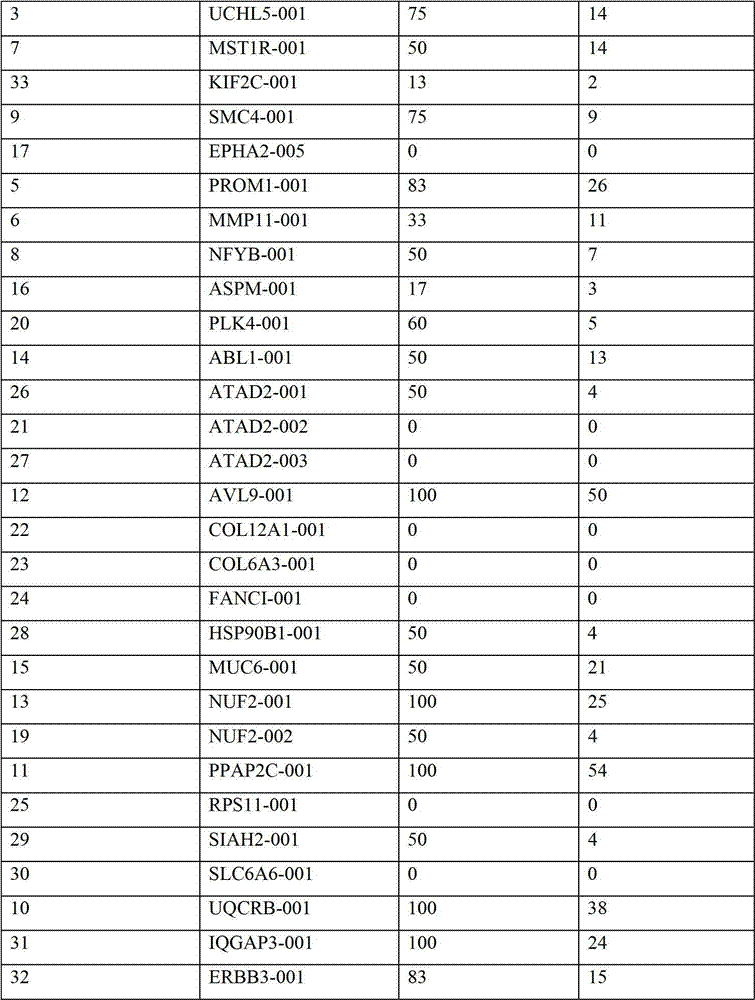
下面的肽已由immatics在其他应用中进行了描述并包括在IMA901(MET-001和TOP-001)、IMA910(MET-001和TOP-001)以及IMA950(IGF2BP3-001)疫苗中。例如,MET-001达到极佳的体内反应,此处的资料可被认为表明了本发明肽的临床有用性。The following peptides have been described by immatics in other applications and are included in the IMA901 (MET-001 and TOP-001), IMA910 (MET-001 and TOP-001) and IMA950 (IGF2BP3-001) vaccines. For example, MET-001 achieved excellent in vivo responses, and the data herein can be considered to demonstrate the clinical usefulness of the peptides of the invention.

引用文献列表Citation list
Ahmed,A.U.,et al.″Effect of disrupting seven-in-absentia homolog 2 function on lungcancer cell growth.″J Natl.Cancer Inst.100.22(2008):1606-29.Ahmed, AU, et al. "Effect of disrupting seven-in-
Allison,J.P.and M.F.Krummel.″The Yin and Yang of T cell costimulation.″Science270.5238(1995):932-33.Allison, JPand MFKrummel. "The Yin and Yang of T cell costimulation." Science 270.5238(1995):932-33.
Altmeyer,A.,et al.″Tumor-specific cell surface expression of the-KDEL containing,endoplasmic reticular heat shock protein gp96.″Int J Cancer 69.4(1996):340-49.Altmeyer, A., et al. "Tumor-specific cell surface expression of the-KDEL containing, endoplasmic reticular heat shock protein gp96." Int J Cancer 69.4(1996):340-49.
Appay,V.,et al.″Decreased specific CD8+T cell cross-reactivity of antigen recognitionfollowing vaccination with Melan-A peptide.″Eur.J Immunol.36.7(2006):1805-14.Appay,V.,et al.″Decreased specific CD8+T cell cross-reactivity of antigen recognition following vaccination with Melan-A peptide.″ Eur.J Immunol. 36.7(2006):1805-14.
Banerjee,S.K.,et al.″Expression of cdc2 and cyclin B1 in Helicobacter pylori-associatedgastric MALT and MALT lymphoma:relationship to cell death,proliferation,andtransformation.″Am J Pathol.156.1(2000):217-25.Banerjee, SK, et al. "Expression of cdc2 and cyclin B1 in Helicobacter pylori-associated gastric MALT and MALT lymphoma: relationship to cell death, proliferation, and transformation." Am J Pathol. 156.1(2000):217-25.
Bartman,A.E.,et al.″Aberrant expression of MUC5AC and MUC6 gastric mucin genesin colorectal polyps.″Int J Cancer 80.2(1999):210-18.Bartman, AE, et al. "Aberrant expression of MUC5AC and MUC6 gastric mucin genesin colorectal polyps." Int J Cancer 80.2(1999):210-18.
Basu,S.,et al.″Necrotic but not apoptotic cell death releases heat shock proteins,whichdeliver a partial maturation signal to dendritic cells and activate the NF-kappa B pathway.″Int Immunol.12.11(2000):1539-46.Basu, S., et al. "Necrotic but not apoptotic cell death releases heat shock proteins, which deliver a partial maturation signal to dendritic cells and activate the NF-kappa B pathway." Int Immunol. 12.11(2000):1539-46.
Bauer,B.,S.Bartfeld,and T.F.Meyer.″H.pylori selectively blocks EGFR endocytosisvia the non-receptor kinase c-Abl and CagA.″Cell Microbiol.11.1(2009):156-69.Bauer, B., S. Bartfeld, and TFMeyer. "H. pylori selectively blocks EGFR endocytosis via the non-receptor kinase c-Abl and CagA." Cell Microbiol. 11.1(2009):156-69.
Benatti,P.,et al.″A balance between NF-Y and p53 governs the pro-and anti-apoptotictranscriptional response.″Nucleic Acids Res 36.5(2008):1415-28.Benatti, P., et al. "A balance between NF-Y and p53 governs the pro-and anti-apoptotic transcriptional response." Nucleic Acids Res 36.5(2008):1415-28.
Bertolini,G.,et al.″Highly tumorigenic lung cancer CD133+cells display stem-likefeatures and are spared by cisplatin treatment.″Proc Natl.Acad.Sci.U.S.A 106.38(2009):16281-86.Bertolini, G., et al. "Highly tumorigenic lung cancer CD133+cells display stem-like features and are spared by cisplatin treatment." Proc Natl. Acad. Sci. USA 106.38(2009):16281-86.
Bierie,B.and H.L.Moses.″TGF-beta and cancer.″Cytokine Growth Factor Rev.17.1-2(2006):29-40.Bierie, B. and HLMoses. "TGF-beta and cancer." Cytokine Growth Factor Rev. 17.1-2(2006):29-40.
Bitoun,E.and K.E.Davies.″The robotic mouse:unravelling the function of AF4 in thecerebellum.″Cerebellum.4.4(2005):250-60.Bitoun, E. and KEDavies. "The robotic mouse: unravelling the function of AF4 in the cerebellum." Cerebellum. 4.4(2005):250-60.
Bolhassani,A.and S.Rafati.″Heat-shock proteins as powerful weapons in vaccinedevelopment.″Expert.Rev.Vaccines.7.8(2008):1185-99.Bolhassani, A. and S. Rafati. "Heat-shock proteins as powerful weapons in vaccine development." Expert. Rev. Vaccines. 7.8(2008):1185-99.
Borset,M.,et al.″The role of hepatocyte growth factor and its receptor c-Met in multiplemyeloma and other blood malignancies.″Leuk.Lymphoma 32.3-4(1999):249-56.Borset, M., et al. "The role of hepatocyte growth factor and its receptor c-Met in multiple myeloma and other blood malignancies." Leuk. Lymphoma 32.3-4(1999):249-56.
Bradbury,P.A.,et al.″Matrix metalloproteinase 1,3 and 12 polymorphisms andesophageal adenocarcinoma risk and prognosis.″Carcinogenesis 30.5(2009):793-98.Bradbury, PA, et al. "Matrix metalloproteinase 1,3 and 12 polymorphisms and esophageal adenocarcinoma risk and prognosis." Carcinogenesis 30.5(2009):793-98.
Brown,C.E.,et al.″Recognition and killing of brain tumor stem-like initiating cells byCD8+cytolytic T cells.″Cancer Research 69.23(2009):8886-93.Brown, CE, et al. "Recognition and killing of brain tumor stem-like initiating cells by CD8+cytolytic T cells." Cancer Research 69.23(2009):8886-93.
Brunsvig,P.F.,et al.″Telomerase peptide vaccination:a phase I/II study in patients withnon-small cell lung cancer.″Cancer Immunol.Immunother.55.12(2006):1553-64.Brunsvig, PF, et al. "Telomerase peptide vaccination: a phase I/II study in patients with non-small cell lung cancer." Cancer Immunol. Immunother. 55.12(2006):1553-64.
Cabanes,D.,et al.″Gp96 is a receptor for a novel Listeria monocytogenes virulence factor,Vip,a surface protein.″EMBO J 24.15(2005):2827-38.Cabanes, D., et al. "Gp96 is a receptor for a novel Listeria monocytogenes virulence factor, Vip, a surface protein." EMBO J 24.15(2005):2827-38.
Calzado,M.A.,et al.″An inducible autoregulatory loop between HIPK2 and Siah2 at theapex of the hypoxic response.″Nat.Cell Biol.11.1(2009):85-91.Calzado, MA, et al. "An inducible autoregulatory loop between HIPK2 and Siah2 at the apex of the hypoxic response." Nat. Cell Biol. 11.1(2009):85-91.
Castelli,C.,et al.″Heat shock proteins:biological functions and clinical application aspersonalized vaccines for human cancer.″Cancer Immunol.Immunother.53.3(2004):227-33.Castelli, C., et al. "Heat shock proteins: biological functions and clinical application aspersonalized vaccines for human cancer." Cancer Immunol. Immunother. 53.3(2004):227-33.
Castriconi,R.,et al.″Both CD133+and C.″Eur.J Immunol.37.11(2007):3190-96.Castriconi, R., et al. "Both CD133+ and C." Eur. J Immunol. 37.11(2007):3190-96.
Chanock,S.J.,et al.″HLA-A,-B,-Cw,-DQA1 and-DRB1 Alleles in a CaucasianPopulation from Bethesda,USA.″Hum.Immunol.65(2004):1211-23.Chanock, SJ, et al. "HLA-A, -B, -Cw, -DQA1 and-DRB1 Alleles in a Caucasian Population from Bethesda, USA." Hum. Immunol. 65(2004):1211-23.
Chen,C.H.,et al.″Inhibition of heregulin signaling by an aptamer that preferentially bindsto the oligomeric form of human epidermal growh factor receptor-3.″Proc Natl.Acad.Sci.U.S.A 100.16(2003):9226-31.Chen, CH, et al. "Inhibition of heregulin signaling by an aptamer that preferentially binds to the oligomeric form of human epidermal growth factor receptor-3." Proc Natl. Acad. Sci. USA 100.16(2003):9226-31.
Chen,Z.and J.J.O′Shea.″Regulation of IL-17 production in human lymphocytes.″Cytokine 41.2(2008):71-78.Chen, Z. and JJO'Shea. "Regulation of IL-17 production in human lymphocytes." Cytokine 41.2(2008):71-78.
Cho,S.O.,et al.″Helicobacter pylori in a Korean Isolate Expressed Proteins Differentiallyin Human Gastric Epithelial Cells.″Dig.Dis.Sci.(2009).Cho, SO, et al. "Helicobacter pylori in a Korean Isolate Expressed Proteins Differentially in Human Gastric Epithelial Cells." Dig. Dis. Sci. (2009).
Christianson,J.C.,et al.″OS-9 and GRP94 deliver mutant alpha1-antitrypsin to the Hrd1-SEL1L ubiquitin ligase complex for ERAD.″Nat.Cell Biol.10.3(2008):272-82.Christianson, JC, et al. "OS-9 and GRP94 deliver mutant alpha1-antitrypsin to the Hrd1-SEL1L ubiquitin ligase complex for ERAD." Nat. Cell Biol. 10.3(2008):272-82.
Cisek,L.J.and J.L.Corden.″Phosphorylation of RNA polymerase by the murinehomologue of the cell-cycle control protein cdc2.″Nature 339.6227(1989):679-84.Cisek, LJ and JL Corden. "Phosphorylation of RNA polymerase by the murine homologue of the cell-cycle control protein cdc2." Nature 339.6227(1989):679-84.
Colombetti,S.,et al.″Prolonged TCR/CD28 engagement drives IL-2-independent T cellclonal expansion through signaling mediated by the mammalian target of rapamycin.″J Immunol.176.5(2006):2730-38.Colombetti, S., et al. "Prolonged TCR/CD28 engagement drives IL-2-independent T cellclonal expansion through signaling mediated by the mammalian target of rapamycin." J Immunol. 176.5(2006):2730-38.
Confalonieri,S.,et al.″Alterations of ubiquitin ligases in human cancer and theirassociation with the natural history of the tumor.″Oncogene 28.33(2009):2959-68.Confalonieri, S., et al. "Alterations of ubiquitin ligases in human cancer and their association with the natural history of the tumor." Oncogene 28.33(2009):2959-68.
Corso,S.,et al.″Silencing the MET oncogene leads to regression of experimental tumorsand metastases.″Oncogene 27.5(2008):684-93.Corso, S., et al. "Silencing the MET oncogene leads to regression of experimental tumors and metastases." Oncogene 27.5(2008):684-93.
Cox,C.V.,et al.″Expression of CD133 on leukemia-initiating cells in childhood ALL.″Blood 113.14(2009):3287-96.Cox, CV, et al. "Expression of CD133 on leukemia-initiating cells in childhood ALL." Blood 113.14(2009):3287-96.
Cunha-Ferreira,I.,et al.″The SCF/Slimb ubiquitin ligase limits centrosome amplificationthrough degradation of SAK/PLK4.″Curr.Biol.19.1(2009):43-49.Cunha-Ferreira, I., et al. "The SCF/Slimb ubiquitin ligase limits centrosome amplification through degradation of SAK/PLK4." Curr. Biol. 19.1(2009):43-49.
DeLuca,J.G.,et al.″Hec1 and nuf2 are core components of the kinetochore outer plateessential for organizing microtubule attachment sites.″Mol.Biol.Cell 16.2(2005):519-31.DeLuca, JG, et al. "Hec1 and nuf2 are core components of the kinetochore outer plateessential for organizing microtubule attachment sites." Mol. Biol. Cell 16.2(2005):519-31.
Deng,H.,et al.″Matrix metalloproteinase 11 depletion inhibits cell proliferation in gastriccancer cells.″Biochem.Biophys.Res Commun.326.2(2005):274-81.Deng, H., et al. "Matrix metalloproteinase 11 depletion inhibits cell proliferation in gastric cancer cells." Biochem. Biophys. Res Commun. 326.2(2005):274-81.
Dengjel,J.,et al.″Unexpected Abundance of HLA Class II Presented Peptides in PrimaryRenal Cell Carcinomas.″Clin Cancer Res.12.14(2006):4163-70.Dengjel, J., et al. "Unexpected Abundance of HLA Class II Presented Peptides in Primary Renal Cell Carcinomas." Clin Cancer Res. 12.14(2006):4163-70.
Deremer,D.L.,C.Ustun,and K.Natarajan.″Nilotinib:a second-generation tyrosinekinase inhibitor for the treatment of chronic myelogenous leukemia.″Clin Ther.30.11(2008):1956-75.Deremer, DL, C. Ustun, and K. Natarajan. "Nilotinib: a second-generation tyrosinekinase inhibitor for the treatment of chronic myelogenous leukemia." Clin Ther. 30.11(2008):1956-75.
Di Renzo,M.F.,et al.″Overexpression and amplification of the met/HGF receptor geneduring the progression of colorectal cancer.″Clin.Cancer Res.1.2(1995):147-54.Di Renzo, MF, et al. "Overexpression and amplification of the met/HGF receptor generating the progression of colorectal cancer." Clin. Cancer Res. 1.2(1995):147-54.
Dong,G.,et al.″Hepatocyte growth factor/scatter factor-induced activation of MEK andPI3K signal pathways contributes to expression of proangiogenic cytokines interleukin-8and vascular endothelial growth factor in head and neck squamous cell carcinoma.″Cancer Res.61.15(2001):5911-18.Dong, G., et al. "Hepatocyte growth factor/scatter factor-induced activation of MEK and PI3K signal pathways contributes to expression of proangiogenic cytokines interleukin-8 and vascular endothelial growth factor in head and neck squamous cell carcinoma. "61 Cancer Res. 2001):5911-18.
Dudley,M.E.,et al.″Cancer regression and autoimmunity in patients after clonalrepopulation with antitumor lymphocytes.″Science 298.5594(2002):850-54.Dudley, ME, et al. "Cancer regression and autoimmunity in patients after clonal repopulation with antitumor lymphocytes." Science 298.5594(2002):850-54.
Dudley,M.E.,et al.″Adoptive cell transfer therapy following non-myeloablative butlymphodepleting chemotherapy for the treatment of patients with refractory metastaticmelanoma.″J.Clin.Oncol.23.10(2005):2346-57.Dudley, ME, et al. "Adoptive cell transfer therapy following non-myeloablative butlymphodepleting chemotherapy for the treatment of patients with refractory metastatic melanoma." J. Clin. Oncol. 23.10(2005):2346-57.
Duong,C.,et al.″Pretreatment gene expression profiles can be used to predict response toneoadjuvant chemoradiotherapy in esophageal cancer.″Ann Surg Oncol 14.12(2007):3602-09.Duong, C., et al. "Pretreatment gene expression profiles can be used to predict response toneoadjuvant chemoradiotherapy in esophageal cancer." Ann Surg Oncol 14.12(2007):3602-09.
Egland,K.A.,et al.″High expression of a cytokeratin-associated protein in manycancers.″Proc Natl.Acad.Sci.U.S.A 103.15(2006):5929-34.Egland, KA, et al. "High expression of a cytokeratin-associated protein in cancers." Proc Natl. Acad. Sci. USA 103.15(2006):5929-34.
Eramo,A.,et al.″Identification and expansion of the tumorigenic lung cancer stem cellpopulation.″Cell Death Differ 15.3(2008):504-14.Eramo, A., et al. "Identification and expansion of the tumorigenic lung cancer stem cell population." Cell Death Differ 15.3(2008):504-14.
Esashi,F.,et al.″CDK-dependent phosphorylation of BRCA2 as a regulatory mechanismfor recombinational repair″Nature 434.7033(2005):598-604.Esashi, F., et al. "CDK-dependent phosphorylation of BRCA2 as a regulatory mechanism for recombinational repair" Nature 434.7033(2005):598-604.
Escobar,M.A.,et al.″Profiling of nuclear extract proteins from human neuroblastoma celllines:the search for fingerprints.″J Pediatr.Surg 40.2(2005):349-58.Escobar, MA, et al. "Profiling of nuclear extract proteins from human neuroblastoma cells: the search for fingerprints." J Pediatr. Surg 40.2(2005):349-58.
Ferracini,R.,et al.″The Met/HGF receptor is over-expressed in human osteosarcomas andis activated by either a paracrine or an autocrine circuit″Oncogene 10.4(1995):739-49.Ferracini, R., et al. "The Met/HGF receptor is over-expressed in human osteosarcomas and is activated by either a paracrine or an autocrine circuit" Oncogene 10.4(1995):739-49.
Fischer,J.,et al.″Duplication and overexpression of the mutant allele of the MET proto-oncogene in multiple hereditary papillary renal cell tumours.″Oncogene 17.6(1998):733-39.Fischer, J., et al. "Duplication and overexpression of the mutant allele of the MET proto-oncogene in multiple hereditary papillary renal cell tumors." Oncogene 17.6(1998):733-39.
Flanagan,J.M.,et al.″Genomics screen in transformed stem cells reveals RNASEH2A,PPAP2C,and ADARB1 as putative anticancer drug targets.″Mol.Cancer Ther.8.1(2009):249-60.Flanagan, JM, et al. "Genomics screen in transformed stem cells reveals RNASEH2A, PPAP2C, and ADARB1 as putative anticancer drug targets." Mol. Cancer Ther. 8.1(2009):249-60.
Fong,L.,et al.″Altered peptide ligand vaccination with Flt3 ligand expanded dendriticcells for tumor immunotherapy.″Proc.Natl.Acad.Sci.U.S.A 98.15(2001):8809-14.Fong, L., et al. "Altered peptide ligand vaccination with Flt3 ligand expanded dendritic cells for tumor immunotherapy." Proc. Natl. Acad. Sci. USA 98.15(2001):8809-14.
Frasor,J.,et al.″Estrogen down-regulation of the corepressor N-CoR:mechanism andimplications for estrogen derepression of N-CoR-regulated genes.″Proc Natl.Acad.Sci.U.S.A 102.37(2005):13153-57.Frasor, J., et al. "Estrogen down-regulation of the corepressor N-CoR: mechanism and implications for estrogen derepression of N-CoR-regulated genes." Proc Natl. Acad. Sci. USA 102.37(2005):13153-57 .
Frew,I.J.,et al.″Generation and analysis of Siah2 mutant mice.″Mol.Cell Biol.23.24(2003):9150-61.Frew, IJ, et al. "Generation and analysis of Siah2 mutant mice." Mol. Cell Biol. 23.24(2003):9150-61.
Fu,Y.and A.S.Lee.″Glucose regulated proteins in cancer progression,drug resistanceand immunotherapy.″Cancer Biol.Ther.5.7(2006):741-44.Fu, Y. and AS Lee. "Glucose regulated proteins in cancer progression, drug resistance and immunotherapy." Cancer Biol. Ther. 5.7(2006):741-44.
Furge,K.A.,et al.″Suppression of Ras-mediated tumorigenicity and metastasis throughinhibition of the Met receptor tyrosine kinase.″Proc.Natl.Acad.Sci.U.S.A 98.19(2001):10722-27.Furge, KA, et al. "Suppression of Ras-mediated tumorigenicity and metastasis through inhibition of the Met receptor tyrosine kinase." Proc. Natl. Acad. Sci. USA 98.19(2001):10722-27.
Furge,K.A.,Y.W.Zhang,and G.F.Vande Woude.″Met receptor tyrosine kinase:enhanced signaling through adapter proteins.″Oncogene 19.49(2000):5582-89.Furge, KA, YW Zhang, and GF Vande Woude. "Met receptor tyrosine kinase: enhanced signaling through adapter proteins." Oncogene 19.49(2000):5582-89.
Gattinoni,L.,et al.″Adoptive immunotherapy for cancer:building on success.″Nat.Rev.Immunol.6.5(2006):383-93.Gattinoni, L., et al. "Adoptive immunotherapy for cancer: building on success." Nat. Rev. Immunol. 6.5(2006):383-93.
Gherardi,E.and M.Stoker.″Hepatocyte growth factor--scatter factor:mitogen,motogen,and met.″Cancer Cells 3.6(1991):227-32.Gherardi, E. and M. Stoker. "Hepatocyte growth factor--scatter factor: mitogen, motogen, and met." Cancer Cells 3.6(1991):227-32.
Glen,A.,et al.″iTRAQ-facilitated proteomic analysis of human prostate cancer cellsidentifies proteins associated with progression.″J Proteome.Res 7.3(2008):897-907.Glen, A., et al. "iTRAQ-facilitated proteomic analysis of human prostate cancer cellsidentifies proteins associated with progression." J Proteome. Res 7.3(2008):897-907.
Gnjatic,S.,et al.″NY-CO-58/KIF2C is overexpressed in a variety of solid tumors andinduces frequent T cell responses in patients with colorectal cancer.″Int J Cancer(2009).Gnjatic, S., et al. "NY-CO-58/KIF2C is overexpressed in a variety of solid tumors and induces frequent T cell responses in patients with colorectal cancer." Int J Cancer (2009).
Guo,W.C.,et al.″Expression and its clinical significance of heat shock protein gp96 inhuman osteosarcoma.″Neoplasma 57.1(2010):62-67.Guo, WC, et al. "Expression and its clinical significance of heat shock protein gp96 inhuman osteosarcoma." Neoplasma 57.1(2010):62-67.
Habelhah,H.,et al.″Stress-induced decrease in TRAF2 stability is mediated by Siah2.″EMBO J 21.21(2002):5756-65.Habelhah, H., et al. "Stress-induced decrease in TRAF2 stability is mediated by Siah2." EMBO J 21.21(2002):5756-65.
Hamamoto,A.,et al.″Aberrant expression of the gastric mucin MUC6 in humanpulmonary adenocarcinoma xenografts.″Int J Oncol 26.4(2005):891-96.Hamamoto, A., et al. "Aberrant expression of the gastric mucin MUC6 in human pulmonary adenocarcinoma xenografts." Int J Oncol 26.4(2005):891-96.
Harada,T.,et al.″Genome-wide analysis of pancreatic cancer using microarray-basedtechniques.″Pancreatology.9.1-2(2009):13-24.Harada, T., et al. "Genome-wide analysis of pancreatic cancer using microarray-based techniques." Pancreatology. 9.1-2(2009):13-24.
Harper,L.J.,et al.″Stem cell patterns in cell lines derived from head and neck squamouscell carcinoma.″J Oral Pathol.Med 36.10(2007):594-603.Harper, LJ, et al. "Stem cell patterns in cell lines derived from head and neck squamous cell carcinoma." J Oral Pathol. Med 36.10(2007):594-603.
Hayama,S.,et al.″Activation of CDCA1-KNTC2,members of centromere proteincomplex,involved in pulmonary carcinogenesis.″Cancer Research 66.21(2006):10339-48.Hayama, S., et al. "Activation of CDCA1-KNTC2, members of centromere protein complex, involved in pulmonary carcinogenesis." Cancer Research 66.21(2006):10339-48.
Hayashi,M.,et al.″High expression of HER3 is associated with a decreased survival ingastric cancer.″Clinical Cancer Research 14.23(2008):7843-49.Hayashi, M., et al. "High expression of HER3 is associated with a decreased survival ingastric cancer." Clinical Cancer Research 14.23(2008):7843-49.
Heike,M.,et al.″Expression of stress protein gp96,a tumor rejection antigen,in humancolorectal cancer.″Int J Cancer 86.4(2000):489-93.Heike, M., et al. "Expression of stress protein gp96, a tumor rejection antigen, in human colorectal cancer." Int J Cancer 86.4(2000):489-93.
Hodorova,I.,et al.″Gp96 and its different expression in breast carcinomas.″Neoplasma55.1(2008):31-35.Hodorova, I., et al. "Gp96 and its different expression in breast carcinomas." Neoplasma 55.1(2008):31-35.
Horton,R.A.,et al.″A substrate for deubiquitinating enzymes based on time-resolvedfluorescence resonance energy transfer between terbium and yellow fluorescent protein.″Anal.Biochem.360.1(2007):138-43.Horton, RA, et al. "A substrate for deubiquitinating enzymes based on time-resolved fluorescence resonance energy transfer between terbium and yellow fluorescent protein." Anal. Biochem. 360.1(2007):138-43.
House,C.M.,A.Moller,and D.D.Bowtell.″Siah proteins:novel drug targets in the Rasand hypoxia pathways.″Cancer Research 69.23(2009):8835-38.House, CM, A. Moller, and DDBowtell. "Siah proteins: novel drug targets in the Rasand hypoxia pathways." Cancer Research 69.23(2009):8835-38.
Howard,E.W.,et al.″Decreased adhesiveness,resistance to anoikis and suppression ofGRP94 are integral to the survival of circulating tumor cells in prostate cancer.″Clin Exp.Metastasis 25.5(2008):497-508.Howard, EW, et al. "Decreased adhesiveness, resistance to anoikis and suppression of GRP94 are integral to the survival of circulating tumor cells in prostate cancer." Clin Exp. Metastasis 25.5(2008):497-508.
Hu,G.and E.R.Fearon.″Siah-1 N-terminal RING domain is required for proteolysisfunction,and C-terminal sequences regulate oligomerization and binding to targetproteins.″Mol.Cell Biol.19.1(1999):724-32.Hu, G. and ERFearon. "Siah-1 N-terminal RING domain is required for proteolysis function, and C-terminal sequences regulate oligomerization and binding to target proteins." Mol. Cell Biol. 19.1(1999):724-32.
Huang,Y.,et al.″Characterization of GPR56 protein and its suppressed expression inhuman pancreatic cancer cells.″Mol.Cell Biochem.308.1-2(2008):133-39.Huang, Y., et al. "Characterization of GPR56 protein and its suppressed expression in human pancreatic cancer cells." Mol. Cell Biochem. 308.1-2(2008):133-39.
Jansen,M.P.,et al.″Downregulation of SIAH2,an ubiquitin E3 ligase,is associated withresistance to endocrine therapy in breast cancer.″Breast Cancer Res Treat.116.2(2009):263-71.Jansen, MP, et al. "Downregulation of SIAH2, an ubiquitin E3 ligase, is associated resistance to endocrine therapy in breast cancer." Breast Cancer Res Treat. 116.2(2009):263-71.
Jia,H.L.,et al.″Gene expression profiling reveals potential biomarkers of humanhepatocellular carcinoma.″Clinical Cancer Research 13.4(2007):1133-39.Jia, HL, et al. "Gene expression profiling reveals potential biomarkers of human hepatocellular carcinoma." Clinical Cancer Research 13.4(2007):1133-39.
Jucker,M.,et al.″The Met/hepatocyte growth factor receptor(HGFR)gene isoverexpressed in some cases of human leukemia and lymphoma.″Leuk.Res.18.1(1994):7-16.Jucker, M., et al. "The Met/hepatocyte growth factor receptor (HGFR) gene is overexpressed in some cases of human leukemia and lymphoma." Leuk. Res. 18.1(1994):7-16.
Jung,G.,J.A.Ledbetter,and H.J.Muller-Eberhard.″Induction of cytotoxicity in restinghuman T lymphocytes bound to tumor cells by antibody heteroconjugates.″Proc Natl Acad Sci U S A 84.13(1987):4611-15.Jung, G., JALedbetter, and HJMuller-Eberhard. "Induction of cytotoxicity in resting human T lymphocytes bound to tumor cells by antibody heteroconjugates." Proc Natl Acad Sci U S A 84.13(1987):4611-15.
Jung,H.M.,S.J.Choi,and J.K.Kim.″Expression profiles of SV40-immortalization-associated genes upregulated in various human cancers.″J Cell Biochem.106.4(2009):703-13.Jung, HM, SJ Choi, and JK Kim. "Expression profiles of SV40-immortalization-associated genes upregulated in various human cancers." J Cell Biochem. 106.4(2009):703-13.
Kaneko,N.,et al.″siRNA-mediated knockdown against CDCA1 and KNTC2,bothfrequently overexpressed in colorectal and gastric cancers,suppresses cell proliferation andinduces apoptosis.″Biochem.Biophys.Res Commun.390.4(2009):1235-40.Kaneko, N., et al. "siRNA-mediated knockdown against CDCA1 and KNTC2, both frequently overexpressed in colorectal and gastric cancers, suppresses cell proliferation and induces apoptosis." Biochem. Biophys. Res Commun. 390.4(2009):1235-40.
Kang,H.M.,et al.″Effects of Helicobacter pylori Infection on gastric mucin expression.″J Clin Gastroenterol.42.1(2008):29-35.Kang, HM, et al. "Effects of Helicobacter pylori Infection on gastric mucin expression." J Clin Gastroenterol. 42.1(2008):29-35.
Ko,M.A.,et al.″Plk4 haploinsufficiency causes mitotic infidelity and carcinogenesis.″Nat.Genet.37.8(2005):883-88.Ko, MA, et al. "Plk4 haploinsufficiency causes mitotic infidelity and carcinogenesis." Nat. Genet. 37.8(2005):883-88.
Kobayashi,M.,et al.″Activation of ErbB3-PI3-kinase pathway is correlated withmalignant phenotypes of adenocarcinomas.″Oncogene 22.9(2003):1294-301.Kobayashi, M., et al. "Activation of ErbB3-PI3-kinase pathway is correlated with malignant phenotypes of adenocarcinomas." Oncogene 22.9(2003):1294-301.
Koochekpour,S.,et al.″Met and hepatocyte growth factor/scatter factor expression inhuman gliomas.″Cancer Res.57.23(1997):5391-98.Koochekpour, S., et al. "Met and hepatocyte growth factor/scatter factor expression in human gliomas." Cancer Res. 57.23(1997):5391-98.
Korzeniewski,N.,et al.″Cullin 1 functions as a centrosomal suppressor of centriolemultiplication by regulating polo-like kinase 4 protein levels.″Cancer Research 69.16(2009):6668-75.Korzeniewski, N., et al. "Cullin 1 functions as a centrosomal suppressor of centriole multiplication by regulating polo-like kinase 4 protein levels." Cancer Research 69.16(2009):6668-75.
Krieg,A.M.″Therapeutic potential of Toll-like receptor 9 activation.″Nat.Rev.Drug Discov.5.6(2006):471-84.Krieg, AM "Therapeutic potential of Toll-like receptor 9 activation." Nat. Rev. Drug Discov. 5.6(2006):471-84.
Kunimoto,K.,et al.″Involvement of IQGAP3,a regulator of Ras/ERK-related cascade,inhepatocyte proliferation in mouse liver regeneration and development.″J Cell Physiol220.3(2009):621-31.Kunimoto, K., et al. "Involvement of IQGAP3, a regulator of Ras/ERK-related cascade, inhibitor proliferation in mouse liver regeneration and development." J Cell Physiol 220.3(2009):621-31.
Kuriyama,R.,et al.″Gamma-tubulin-containing abnormal centrioles are induced byinsufficient Plk4 in human HCT116 colorectal cancer cells.″J Cell Sci.122.Pt 12(2009):2014-23.Kuriyama, R., et al. "Gamma-tubulin-containing abnormal centrioles are induced by insufficient Plk4 in human HCT116 colorectal cancer cells." J Cell Sci. 122.Pt 12(2009):2014-23.
Lee,H.S.,et al.″MUC1,MUC2,MUC5AC,and MUC6 expressions in gastric carcinomas:their roles as prognostic indicators.″Cancer 92.6(2001):1427-34.Lee, HS, et al. "MUC1, MUC2, MUC5AC, and MUC6 expressions in gastric carcinomas: their roles as prognostic indicators." Cancer 92.6(2001):1427-34.
Leivo,I.,et al.″Characterization of gene expression in major types of salivary glandcarcinomas with epithelial differentiation.″Cancer Genet.Cytogenet.156.2(2005):104-13.Leivo, I., et al. "Characterization of gene expression in major types of salivary gland carcinomas with epithelial differentiation." Cancer Genet. Cytogenet. 156.2(2005):104-13.
Lemmel,C.,et al.″Differential quantitative analysis of MHC ligands by massspectrometry using stable isotope labeling.″Nat.Biotechnol.22.4(2004):450-54.Lemmel, C., et al. "Differential quantitative analysis of MHC ligands by massspectrometry using stable isotope labeling." Nat. Biotechnol. 22.4(2004):450-54.
Li,G.,et al.″Downregulation of E-cadherin and Desmoglein 1 by autocrine hepatocytegrowth factor during melanoma development.″Oncogene 20.56(2001):8125-35.Li, G., et al. "Downregulation of E-cadherin and Desmoglein 1 by autocrine hepatocyte growth factor during melanoma development." Oncogene 20.56(2001):8125-35.
Lim,S.O.,et al.″Expression of heat shock proteins(HSP27,HSP60,HSP70,HSP90,GRP78,GRP94)in hepatitis B virus-related hepatocellular carcinomas and dysplasticnodules.″World J Gastroenterol.11.14(2005):2072-79.Lim, SO, et al. "Expression of heat shock proteins (HSP27, HSP60, HSP70, HSP90, GRP78, GRP94) in hepatitis B virus-related hepatitis and dysplastic nodules." World J Gastroenterol. 11.14(2005):2072-79 .
Lin,W.,et al.″Tyrosine kinases and gastric cancer.″Oncogene 19.49(2000):5680-89.Lin, W., et al. "Tyrosine kinases and gastric cancer." Oncogene 19.49(2000):5680-89.
Liu,B.and Z.LI.″Endoplasmic reticulum HSP90b1(gp96,grp94)optimizes B-cellfunction via chaperoning integrin and TLR but not immunoglobulin.″Blood 112.4(2008):1223-30.Liu, B. and Z. LI. "Endoplasmic reticulum HSP90b1(gp96,grp94) optimizes B-cell function via chaperoning integrin and TLR but not immunoglobulin." Blood 112.4(2008):1223-30.
Liu,S.Y.,et al.″Requirement of MMP-3 in anchorage-independent growth of oralsquamous cell carcinomas.″J Oral Pathol.Med 36.7(2007):430-35.Liu, SY, et al. "Requirement of MMP-3 in anchorage-independent growth of oral squamous cell carcinomas." J Oral Pathol. Med 36.7(2007):430-35.
Lochter,A.,et al.″The significance of matrix metalloproteinases during early stages oftumor progression.″Ann N.Y.Acad.Sci.857(1998):180-93.Lochter, A., et al. "The significance of matrix metalloproteinases during early stages of tumor progression." Ann NYAcad. Sci. 857(1998):180-93.
Lund,C.V.,et al.″Zinc finger transcription factors designed for bispecific coregulation ofErbB2 and ErbB3 receptors:insights into ErbB receptor biology.″Mol.Cell Biol.25.20(2005):9082-91.Lund, CV, et al. "Zinc finger transcription factors designed for bispecific coregulation of ErbB2 and ErbB3 receptors: insights into ErbB receptor biology." Mol. Cell Biol. 25.20(2005):9082-91.
Ma,S.,et al.″Identification and characterization of tumorigenic liver cancerstem/progenitor cells.″Gastroenterology 132.7(2007):2542-56.Ma, S., et al. "Identification and characterization of tumorigenic liver cancer stem/progenitor cells." Gastroenterology 132.7(2007):2542-56.
MacLeod,R.J.,M.Hayes,and I.Pacheco.″Wnt5a secretion stimulated by theextracellular calcium-sensing receptor inhibits defective Wnt signaling in colon cancercells.″Am J Physiol Gastrointest.Liver Physiol 293.1(2007):G403-G411.MacLeod, RJ, M. Hayes, and I. Pacheco. "Wnt5a secretion stimulated by the extracellular calcium-sensing receptor inhibits defective Wnt signaling in colon cancer cells." Am J Physiol Gastrointest. Liver Physiol 293.1(2007):G403-G411.
Macmillan,J.C.,et al.″Comparative expression of the mitotic regulators SAK and PLK incolorectal cancer.″Ann Surg Oncol 8.9(2001):729-40.Macmillan, JC, et al. "Comparative expression of the mitotic regulators SAK and PLK in colorectal cancer." Ann Surg Oncol 8.9(2001):729-40.
Maney,T.,et al.″The kinetochore of higher eucaryotes:a molecular view.″Int Rev.Cytol.194(2000):67-131.Maney, T., et al. "The kinetochore of higher eucaryotes: a molecular view." Int Rev. Cytol. 194(2000):67-131.
Martin,C.M.,et al.″Gene expression profiling in cervical cancer :identification of novelmarkers for disease diagnosis and therapy.″Methods Mol.Biol.511(2009):333-59.Martin, CM, et al. "Gene expression profiling in cervical cancer: identification of novelmarkers for disease diagnosis and therapy." Methods Mol. Biol. 511(2009):333-59.
Matsukita,S.,et al.″Expression of mucins(MUC1,MUC2,MUC5AC and MUC6)inmucinous carcinoma of the breast:comparison with invasive ductal carcinoma.″Histopathology 42.1(2003):26-36.Matsukita, S., et al. "Expression of mucins (MUC1, MUC2, MUC5AC and MUC6) inmucinous carcinoma of the breast: comparison with invasive ductal carcinoma." Histopathology 42.1(2003):26-36.
Maulik,G.,et al.″Role of the hepatocyte growth factor receptor,c-Met,in oncogenesisand potential for therapeutic inhibition.″Cytokine Growth Factor Rev.13.1(2002):41-59.Maulik, G., et al. "Role of the hepatocyte growth factor receptor, c-Met, in oncogenesis and potential for therapeutic inhibition." Cytokine Growth Factor Rev. 13.1(2002):41-59.
Mizrak,D.,M.Brittan,and M.Alison.″CD133:molecule of the moment.″J Pathol.214.1(2008):3-9.Mizrak, D., M. Brittan, and M. Alison. "CD133: molecule of the moment." J Pathol. 214.1(2008):3-9.
Montesano,R.,et al.″Differential effects of hepatocyte growth factor isoforms onepithelial and endothelial tubulogenesis.″Cell Growth Differ.9.5(1998):355-65.Montesano, R., et al. "Differential effects of hepatocyte growth factor isoforms onepithelial and endothelial tubulogenesis." Cell Growth Differ. 9.5(1998):355-65.
Monzani,E.,et al.″Melanoma contains CD133 and ABCG2 positive cells with enhancedtumourigenic potential.″Eur.J Cancer 43.5(2007):935-46.Monzani,E.,et al. "Melanoma contains CD133 and ABCG2 positive cells with enhancedtumourigenic potential." Eur.J Cancer 43.5(2007):935-46.
Moore,A.and L.Wordeman.″The mechanism,function and regulation of depolymerizingkinesins during mitosis.″Trends Cell Biol.14.10(2004):537-46.Moore, A. and L. Wordeman. "The mechanism, function and regulation of depolymerizing kinesins during mitosis." Trends Cell Biol. 14.10(2004):537-46.
Morgan,R.A.,et al.″Cancer Regression in Patients After Transfer of GeneticallyEngineered Lymphocytes.″Science (2006).Morgan, RA, et al. "Cancer Regression in Patients After Transfer of Genetically Engineered Lymphocytes." Science (2006).
Mori,M.,et al.″HLA gene and haplotype frequencies in the North American population:the National Marrow Donor Program Donor Registry.″Transplantation 64.7(1997):1017-27.Mori, M., et al. "HLA gene and haplotype frequencies in the North American population: the National Marrow Donor Program Donor Registry." Transplantation 64.7(1997):1017-27.
Murray,G.I.,et al.″Matrix metalloproteinases and their inhibitors in gastric cancer.″Gut43.6(1998):791-97.Murray, GI, et al. "Matrix metalloproteinases and their inhibitors in gastric cancer." Gut 43.6(1998):791-97.
Murshid,A.,J.Gong,and S.K.Calderwood.″Heat-shock proteins in cancer vaccines:agents of antigen cross-presentation.″Expert.Rev.Vaccines.7.7(2008):1019-30.Murshid, A., J. Gong, and SK Calderwood. "Heat-shock proteins in cancer vaccines: agents of antigen cross-presentation." Expert. Rev. Vaccines. 7.7(2008):1019-30.
Nakaigawa,N.,et al.″Inactivation of von Hippel-Lindau gene induces constitutivephosphorylation of MET protein in clear cell renal carcinoma.″Cancer Res.66.7(2006):3699-705.Nakaigawa, N., et al. "Inactivation of von Hippel-Lindau gene induces constitutive phosphorylation of MET protein in clear cell renal carcinoma." Cancer Res. 66.7(2006):3699-705.
Nakamura,Y.,et al.″Clinicopathological and biological significance of mitoticcentromere-associated kinesin overexpression in humang astric cancer.″Br.J Cancer 97.4(2007):543-49.Nakamura, Y., et al. "Clinicopathological and biological significance of mitotic centromere-associated kinesin overexpression in human astric cancer." Br. J Cancer 97.4(2007):543-49.
Nakayama,K.,J.Qi,and Z.Ronai.″The ubiquitin ligase Siah2 and the hypoxia response.″Mol.Cancer Res 7.4(2009):443-51.Nakayama, K., J. Qi, and Z. Ronai. "The ubiquitin ligase Siah2 and the hypoxia response." Mol. Cancer Res 7.4(2009):443-51.
Naldini,L.,et al.″Hepatocyte growth factor(HGF)stimulates the tyrosine kinase activityof the receptor encoded by the proto-oncogene c-MET.″Oncogene 6.4(1991):501-04.Naldini, L., et al. "Hepatocyte growth factor (HGF) stimulates the tyrosine kinase activity of the receptor encoded by the proto-oncogene c-MET." Oncogene 6.4(1991):501-04.
Nguyen,Q.N.,et al.″Light controllable siRNAs regulate gene suppression andphenotypes in cells.″Biochim.Biophys.Acta 1758.3(2006):394-403.Nguyen, QN, et al. "Light controllable siRNAs regulate gene suppression and phenotypes in cells." Biochim. Biophys. Acta 1758.3(2006):394-403.
Nishio,K.,et al.″Crystal structure of the de-ubiquitinating enzyme UCH37(human UCH-L5)catalytic domain.″Biochem.Biophys.Res Commun.390.3(2009):855-60.Nishio, K., et al. "Crystal structure of the de-ubiquitinating enzyme UCH37(human UCH-L5) catalytic domain." Biochem. Biophys. Res Commun. 390.3(2009):855-60.
Nojima,H.,et al.″IQGAP3 regulates cell proliferation through the Ras/ERK signallingcascade.″Nat.Cell Biol.10.8(2008):971-78.Nojima, H., et al. "IQGAP3 regulates cell proliferation through the Ras/ERK signaling cascade." Nat. Cell Biol. 10.8(2008):971-78.
Nomura,H.,et al.″Enhanced production of matrix metalloproteinases and activation ofmatrix metalloproteinase 2(gelatinase A)in human gastric carcinomas.″Int J Cancer 69.1(1996):9-16.Nomura, H., et al. "Enhanced production of matrix metalloproteinases and activation of matrix metalloproteinase 2(gelatinase A) in human gastric carcinomas." Int J Cancer 69.1(1996):9-16.
Nomura,H.,et al.″Network-based analysis of calcium-binding protein genes identifiesGrp94 as a target in human oral carcinogenesis.″Br.J Cancer 97.6(2007):792-801.Nomura, H., et al. "Network-based analysis of calcium-binding protein genes identifies Grp94 as a target in human oral carcinogenesis." Br.J Cancer 97.6(2007):792-801.
Ohnuma,S.,et al.″Cancer-associated splicing variants of the CDCA1 and MSMB genesexpressed in cancer cell lines and surgically resected gastric cancer tissues.″Surgery 145.1(2009):57-68.Ohnuma, S., et al. "Cancer-associated splicing variants of the CDCA1 and MSMB genes expressed in cancer cell lines and surgically resected gastric cancer tissues." Surgery 145.1(2009):57-68.
Park,Y.H.,et al.″Capecitabine in combination with Oxaliplatin(XELOX)as a first-linetherapy for advanced gastric cancer.″Cancer Chemother.Pharmacol.(2007).Park, YH, et al. "Capecitabine in combination with Oxaliplatin (XELOX) as a first-line therapy for advanced gastric cancer." Cancer Chemother. Pharmacol. (2007).
Pascolo,S.,et al.″The non-classical HLA class I molecule HFE does not influence theNK-like activity contained in fresh human PBMCs and does not interact with NK cells.″Int.Immunol.17.2(2005):117-22.Pascolo, S., et al. "The non-classical HLA class I molecule HFE does not influence the NK-like activity contained in fresh human PBMCs and does not interact with NK cells." Int. Immunol. 17.2(2005):117- twenty two.
Peel,N.,et al.″Overexpressing centriole-replication proteins in vivo induces centrioleoverduplication and de novo formation.″Curr.Biol.17.10(2007):834-43.Peel, N., et al. "Overexpressing centriole-replication proteins in vivo induces centriole overduplication and de novo formation." Curr. Biol. 17.10(2007):834-43.
Pereira,M.B.,et al.″Immunohistochemical study of the expression of MUC5AC andMUC6 in breast carcinomas and adjacent breast tissues.″J Clin Pathol.54.3(2001):210-13.Pereira, MB, et al. "Immunohistochemical study of the expression of MUC5AC and MUC6 in breast carcinomas and adjacent breast tissues." J Clin Pathol. 54.3(2001):210-13.
Pietra,G.,et al.″Natural killer cells kill human melanoma cells with characteristics ofcancer stem cells.″Int Immunol.21.7(2009):793-801.Pietra, G., et al. "Natural killer cells kill human melanoma cells with characteristics of cancer stem cells." Int Immunol. 21.7(2009):793-801.
Poller,D.N.,et al.″Production and characterization of a polyclonal antibody to the c-erbB-3 protein:examination of c-erbB-3 protein expression in adenocarcinomas.″J Pathol.168.3(1992):275-80.Poller, DN, et al. "Production and characterization of a polyclonal antibody to the c-erbB-3 protein: examination of c-erbB-3 protein expression in adenocarcinomas." J Pathol. 168.3(1992):275-80.
Pons,E.,C.C.Uphoff,and H.G.Drexler.″Expression of hepatocyte growth factor and itsreceptor c-met in human leukemia-lymphoma cell lines.″Leuk.Res.22.9(1998):797-804.Pons, E., CCUphoff, and HG Drexler. "Expression of hepatocyte growth factor and its receptor c-met in human leukemia-lymphoma cell lines." Leuk. Res. 22.9(1998):797-804.
Ponzetto,C.,et al.″A novel recognition motif for phosphatidylinositol 3-kinase bindingmediates its association with the hepatocyte growth factor/scatter factor receptor.″Mol.Cell Biol.13.8(1993):4600-08.Ponzetto, C., et al. "A novel recognition motif for phosphatidylinositol 3-kinase binding mediates its association with the hepatocyte growth factor/scatter factor receptor." Mol. Cell Biol. 13.8(1993):4600-08.
Poppe,M.,et al.″Phosphorylation of Helicobacter pylori CagA by c-Abl leads to cellmotility.″Oncogene 26.24(2007):3462-72.Poppe, M., et al. "Phosphorylation of Helicobacter pylori CagA by c-Abl leads to cellmotility." Oncogene 26.24(2007):3462-72.
Pytel,D.,et al.″Tyrosine kinase blockers:new hope for successful cancer therapy.″Anticancer Agents Med Chem.9.1(2009):66-76.Pytel, D., et al. "Tyrosine kinase blockers: new hope for successful cancer therapy." Anticancer Agents Med Chem. 9.1(2009):66-76.
Qi,J.,et al.″The ubiquitin ligase Siah2 regulates tumorigenesis and metastasis by HIF-dependent and-independent pathways.″Proc Natl.Acad.Sci.U.S.A 105.43(2008):16713-18.Qi, J., et al. "The ubiquitin ligase Siah2 regulates tumorigenesis and metastasis by HIF-dependent and-independent pathways." Proc Natl. Acad. Sci. USA 105.43(2008):16713-18.
Qian,C.N.,et al.″Met protein expression level correlates with survival in patients withlate-stage nasopharyngeal carcinoma.″Cancer Res.62.2(2002):589-96.Qian, CN, et al. "Met protein expression level correlates with survival in patients with late-stage nasopharyngeal carcinoma." Cancer Res. 62.2(2002):589-96.
Qian,Z.,et al.″Cytogenetic and genetic pathways in therapy-related acute myeloidleukemia.″Chem.Biol.Interact.(2009).Qian, Z., et al. "Cytogenetic and genetic pathways in therapy-related acute myeloidleukemia." Chem. Biol. Interact. (2009).
Ramirez,R.,et al.″Over-expression of hepatocyte growth factor/scatter factor(HGF/SF)and the HGF/SF receptor(cMET)are associated with a high risk of metastasis andrecurrence for children and young adults with papillary thyroid carcinoma.″Clin Endocrinol.(Oxf)53.5(2000):635-44.Ramirez, R., et al. "Over-expression of hepatocyte growth factor/scatter factor(HGF/SF) and the HGF/SF receptor(cMET) are associated with a high risk of metastasis and recurrence for children and young adults with papillary thyroid carcinoma.″ Clin Endocrinol. (Oxf) 53.5 (2000):635-44.
Rammensee,H.G.,et al.″SYFPEITHI:database for MHC ligands and peptide motifs.″Immunogenetics 50.3-4(1999):213-19.Rammensee, HG, et al. "SYFPEITHI: database for MHC ligands and peptide motifs." Immunogenetics 50.3-4(1999):213-19.
Rammensee,H.G.,J.Bachmann,and S.Stevanovic.MHC Ligands and Peptide Motifs.Springer-Verlag,Heidelberg,Germany,1997.Rammensee, HG, J. Bachmann, and S. Stevanovic. MHC Ligands and Peptide Motifs. Springer-Verlag, Heidelberg, Germany, 1997.
Rappa,G.,O.Fodstad,and A.Lorico.″The stem cell-associated antigen CD133(Prominin-1)is a molecular therapeutic target for metastatic melanoma.″Stem Cells 26.12(2008):3008-17.Rappa, G., O. Fodstad, and A. Lorico. "The stem cell-associated antigen CD133(Prominin-1) is a molecular therapeutic target for metastatic melanoma." Stem Cells 26.12(2008):3008-17.
Richardson,G.D.,et al.″CD133,a novel marker for human prostatic epithelial stemcells.″J Cell Sci.117.Pt 16(2004):3539-45.Richardson, GD, et al.″CD133, a novel marker for human prostatic epithelial stemcells.″ J Cell Sci. 117.Pt 16(2004):3539-45.
Rini,B.I.,et al.″Combination immunotherapy with prostatic acid phosphatase pulsedantigen-presenting cells(provenge)plus bevacizumab in patients with serologicprogression of prostate cancer after definitive local therapy.″Cancer 107.1(2006):67-74.Rini, BI, et al. "Combination immunotherapy with prostatic acid phosphatase pulsed antigen-presenting cells (provenge) plus bevacizumab in patients with serologic progression of prostate cancer after definitive local therapy." Cancer 107.1(2006):67-74.
Rodrigues-Martins,A.,et al.″Revisiting the role of the mother centriole in centriolebiogenesis.″Science 316.5827(2007):1046-50.Rodrigues-Martins, A., et al. "Revisiting the role of the mother centriole in centriolebiogenesis." Science 316.5827(2007):1046-50.
Rosenberg,S.A.,et al.″A progress report on the treatment of 157 patients with advancedcancer using lymphokine-activated killer cells and interleukin-2 or high-dose interleukin-2alone.″N.Engl.J.Med.316.15(1987):889-97.Rosenberg, SA, et al. "A progress report on the treatment of 157 patients with advanced cancer using lymphokine-activated killer cells and interleukin-2 or high-dose interleukin-2alone." N. Engl. J. Med. 316.15(1987) :889-97.
Rosenberg,S.A.,et al.″Use of tumor-infiltrating lymphocytes and interleukin-2 in theimmunotherapy of patients with metastatic melanoma.A preliminary report.″N.Engl.J Med 319.25(1988):1676-80.Rosenberg, SA, et al. "Use of tumor-infiltrating lymphocytes and interleukin-2 in the immunotherapy of patients with metastatic melanoma. A preliminary report." N. Engl. J Med 319.25(1988):1676-80.
Rott,R.,et al.″Monoubiquitylation of alpha-synuclein by seven in absentia homolog(SIAH)promotes its aggregation in dopaminergic cells.″J Biol.Chem.283.6(2008):3316-28.Rott, R., et al. "Monoubiquitylation of alpha-synuclein by seven in absentia homolog (SIAH) promotes its aggregation in dopaminergic cells." J Biol. Chem. 283.6(2008):3316-28.
Rutella,S.,et al.″Cells with characteristics of cancer stem/progenitor cells express theCD133 antigen in human endometrial tumors.″Clinical Cancer Research 15.13(2009):4299-311.Rutella, S., et al. "Cells with characteristics of cancer stem/progenitor cells express the CD133 antigen in human endometrial tumors." Clinical Cancer Research 15.13(2009):4299-311.
Samant,G.V.and P.W.Sylvester.″gamma-Tocotrienol inhibits ErbB3-dependentPI3K/Akt mitogenic signalling in neoplastic mammary epithelial cells.″Cell Prolif.39.6(2006):563-74.Samant, GV and PWSylvester. "gamma-Tocotrienol inhibits ErbB3-dependent PI3K/Akt mitogenic signaling in neoplastic mammary epithelial cells." Cell Prolif. 39.6(2006):563-74.
Sanidas,E.E.,et al.″Expression of the c-erbB-3 gene product in gastric cancer.″Int J Cancer 54.6(1993):935-40.Sanidas, EE, et al. "Expression of the c-erbB-3 gene product in gastric cancer." Int J Cancer 54.6(1993):935-40.
Scott,G.K.,et al.″Coordinate suppression of ERBB2 and ERBB3 by enforced expressionofmicro-RNA miR-125a or miR-125b.″J Biol.Chem.282.2(2007):1479-86.Scott, GK, et al. "Coordinate suppression of ERBB2 and ERBB3 by enforced expression of micro-RNA miR-125a or miR-125b." J Biol. Chem. 282.2(2007):1479-86.
Sergina,N.V.,et al.″Escape from HER-family tyrosine kinase inhibitor therapy by thekinase-inactive HER3.″Nature 445.7126(2007):437-41.Sergina, NV, et al. "Escape from HER-family tyrosine kinase inhibitor therapy by the kinase-inactive HER3." Nature 445.7126(2007):437-41.
Shah,M.,et al.″Inhibition of Siah2 ubiquitin ligase by vitamin K3(menadione)attenuateshypoxia and MAPK signaling and blocks melanoma tumorigenesis.″Pigment Cell Melanoma Res 22.6(2009):799-808.Shah, M., et al. "Inhibition of Siah2 ubiquitin ligase by vitamin K3(menadione) attenuateshypoxia and MAPK signaling and blocks melanoma tumorigenesis." Pigment Cell Melanoma Res 22.6(2009):799-808.
Shapiro,G.I.″Cyclin-dependent kinase pathways as targets for cancer treatment.″J Clin Oncol 24.11(2006):1770-83.Shapiro, GI "Cyclin-dependent kinase pathways as targets for cancer treatment." J Clin Oncol 24.11(2006):1770-83.
Sherman-Baust,C.A.,et al.″Remodeling of the extracellular matrix throughoverexpression of collagen VI contributes to cisplatin resistance in ovarian cancer cells.″Cancer Cell 3.4(2003):377-86.Sherman-Baust, CA, et al. "Remodeling of the extracellular matrix throughout expression of collagen VI contributes to cisplatin resistance in ovarian cancer cells." Cancer Cell 3.4(2003):377-86.
Sheu,M.L.,S.H.Liu,and K.H.Lan.″Honokiol induces calpain-mediated glucose-regulated protein-94 cleavage and apoptosis in human gastric cancer cells and reducestumor growth.″PLoS.ONE.2.10(2007):e1096.Sheu, ML, SHLiu, and KHLan. "Honokiol induces calpain-mediated glucose-regulated protein-94 cleavage and apoptosis in human gastric cancer cells and reduce tumor growth." PLoS.ONE. 2.10(2007):e1096.
Shimo,A.,et al.″Involvement of kinesin family member 2C/mitotic centromere-associatedkinesin overexpression in mammary carcinogenesis.″Cancer Sci.99.1(2008):62-70.Shimo, A., et al. "Involvement of kinesin family member 2C/mitotic centromere-associated kinesin overexpression in mammary carcinogenesis." Cancer Sci. 99.1(2008):62-70.
Singh,S.K.,et al.″Identification of a cancer stem cell in human brain tumors.″Cancer Res.63.18(2003):5821-28.Singh, SK, et al. "Identification of a cancer stem cell in human brain tumors." Cancer Res. 63.18(2003):5821-28.
Singh,S.K.,et al.″Identification of human brain tumour initiating cells.″Nature 432.7015(2004):396-401.Singh, SK, et al. "Identification of human brain tumor initiating cells." Nature 432.7015(2004):396-401.
Sithanandam,G.and L.M.Anderson.″The ERBB3 receptor in cancer and cancer genetherapy.″Cancer Gene Ther.15.7(2008):413-48.Sithanandam, G. and LM Anderson. "The ERBB3 receptor in cancer and cancer genetherapy." Cancer Gene Ther. 15.7(2008):413-48.
Sithanandam,G.,et al.″Inactivation of ErbB3 by siRNA promotes apoptosis andattenuates growth and invasiveness of human lung adenocarcinoma cell line A549.″Oncogene 24.11(2005):1847-59.Sithanandam, G., et al. "Inactivation of ErbB3 by siRNA promotes apoptosis and attenuates growth and invasiveness of human lung adenocarcinoma cell line A549." Oncogene 24.11(2005):1847-59.
Skawran,B.,et al.″Gene expression profiling in hepatocellular carcinoma:upregulation ofgenes in amplified chromosome regions.″Mod.Pathol.21.5(2008):505-16.Skawran, B., et al. "Gene expression profiling in hepatocellular carcinoma: upregulation of genes in amplified chromosome regions." Mod. Pathol. 21.5(2008):505-16.
Slesak,B.,et al.″Expression of epidermal growth factor receptor family proteins(EGFR,c-erbB-2 and c-erbB-3)in gastric cancer and chronic gastritis.″Anticancer Res 18.4A(1998):2727-32.Slesak, B., et al. "Expression of epidermal growth factor receptor family proteins (EGFR, c-erbB-2 and c-erbB-3) in gastric cancer and chronic gastritis." Anticancer Res 18.4A(1998):2727- 32.
Small,E.J.,et al.″Placebo-controlled phase III trial of immunologic therapy withsipuleucel-T(APC8015)in patients with metastatic,asymptomatic hormone refractoryprostate cancer.″J Clin Oncol.24.19(2006):3089-94.Small, EJ, et al. "Placebo-controlled phase III trial of immunological therapy with sipuleucel-T(APC8015) in patients with metastatic, asymptomatic hormone refractory prostate cancer." J Clin Oncol. 24.19(2006):3089-94.
Smith,L.M.,et al.″CD133/prominin-1 is a potential therapeutic target for antibody-drugconjugates in hepatocellular and gastric cancers.″Br.J Cancer 99.1(2008):100-09.Smith, LM, et al. "CD133/prominin-1 is a potential therapeutic target for antibody-drug conjugates in hepatocellular and gastric cancers." Br.J Cancer 99.1(2008):100-09.
Smith,M.J.,et al.″Analysis of differential gene expression in colorectal cancer andstroma using fluorescence-activated cell sorting purification.″Br.J Cancer 100.9(2009):1452-64.Smith, MJ, et al. "Analysis of differential gene expression in colorectal cancer and stroma using fluorescence-activated cell sorting purification." Br.J Cancer 100.9(2009):1452-64.
Smogorzewska,A.,et al.″Identification of the FANCI protein,a monoubiquitinatedFANCD2 paralog required for DNA repair.″Cell 129.2(2007):289-301.Smogorzewska, A., et al. "Identification of the FANCI protein, a monoubiquitinated FANCD2 paralog required for DNA repair." Cell 129.2(2007):289-301.
Staehler,M.,Stenzl,A.,Dietrich,P.Y.,Eisen,T.,Haferkamp,A.,Beck,J.,Mayer,A.,Walter,S.,Singh-Jasuja,H.,and Stief,C.A phase I study to evaluate safety,immunogenicity and anti-tumor activity of the multi-peptide vaccine IMA901 in renal cellcarcinoma patients(RCC).Journal of Clinical Oncology,2007 ASCO Annual MeetingProceedings Part I Vol 25,No.18S(June 20 Supplement),2007:5098.20-6-2007.Ref Type:AbstractStaehler, M., Stenzl, A., Dietrich, P.Y., Eisen, T., Haferkamp, A., Beck, J., Mayer, A., Walter, S., Singh-Jasuja, H., and Stief, C.A. phase I study to evaluate safety,immunogenicity and anti-tumor activity of the multi-peptide vaccine IMA901 in renal cellcarcinoma patients(RCC).Journal of Clinical Oncology,2007 ASCO Annual MeetingProceedings
Stemmann,O.,et al.″Dual inhibition of sister chromatid separation at metaphase.″Cell107.6(2001):715-26.Stemmann, O., et al. "Dual inhibition of sister chromatid separation at metaphase." Cell 107.6(2001):715-26.
Suetsugu,A.,et al.″Characterization of CD133+hepatocellular carcinoma cells as cancerstem/progenitor cells.″Biochem.Biophys.Res.Commun.351.4(2006):820-24.Suetsugu, A., et al. "Characterization of CD133+hepatocellular carcinoma cells as cancerstem/progenitor cells." Biochem. Biophys. Res. Commun. 351.4(2006):820-24.
Suva,M.L.,et al.″Identification of Cancer Stem Cells in Ewing′s Sarcoma.″Cancer Research (2009).Suva, ML, et al. "Identification of Cancer Stem Cells in Ewing's Sarcoma." Cancer Research (2009).
Swallow,C.J.,et al.″Sak/Plk4 and mitotic fidelity.″Oncogene 24.2(2005):306-12.Swallow, CJ, et al. "Sak/Plk4 and mitotic fidelity." Oncogene 24.2(2005):306-12.
Szczepanowski,M.,et al.″Regulation of repp86 stability by human Siah2.″Szczepanowski, M., et al. "Regulation of repp86 stability by human Siah2."
Biochem.Biophys.Res Commun.362.2(2007):485-90. Biochem. Biophys. Res Commun. 362.2(2007):485-90.
Tajima,Y.,et al.″Gastric and intestinal phenotypic marker expression in earlydifferentiated-type tumors of the stomach:clinicopathologic significance and geneticbackground.″Clinical Cancer Research 12.21(2006):6469-79.Tajima, Y., et al. "Gastric and intestinal phenotypic marker expression in early differentiated-type tumors of the stomach: clinicopathologic significance and genetic background." Clinical Cancer Research 12.21(2006):6469-79.
Takaishi,S.,et al.″Identification of gastric cancer stem cells using the cell surface markerCD44.″Stem Cells 27.5(2009):1006-20.Takaishi, S., et al. "Identification of gastric cancer stem cells using the cell surface marker CD44." Stem Cells 27.5(2009):1006-20.
Takayama,H.,et al.″Diverse tumorigenesis associated with aberrant development in miceoverexpressing hepatocyte growth factor/scatter factor.″Proc.Natl.Acad.Sci.U.S.A 94.2(1997):701-06.Takayama, H., et al. "Diverse tumorigenesis associated with aberrant development in mice overexpressing hepatocyte growth factor/scatter factor." Proc. Natl. Acad. Sci. USA 94.2(1997):701-06.
Teofili,L.,et al.″Expression of the c-met proto-oncogene and its ligand,hepatocytegrowth factor,in Hodgkin disease.″Blood 97.4(2001):1063-69.Teofili, L., et al. "Expression of the c-met proto-oncogene and its ligand, hepatocyte growth factor, in Hodgkin disease." Blood 97.4(2001):1063-69.
Thorsen,K.,et al.″Alternative splicing in colon,bladder,and prostate cancer identified byexon array analysis.″Mol.Cell Proteomics.7.7(2008):1214-24.Thorsen, K., et al. "Alternative splicing in colon, bladder, and prostate cancer identified by exon array analysis." Mol. Cell Proteomics. 7.7(2008):1214-24.
Tirino,V.,et al.″The role of CD133 in the identification and characterisation of tumour-initiating cells in non-small-cell lung cancer.″Eur.J Cardiothorac.Surg 36.3(2009):446-53.Tirino, V., et al. "The role of CD133 in the identification and characterization of tumor-initiating cells in non-small-cell lung cancer." Eur.J Cardiothorac.Surg 36.3(2009):446-53.
Todaro,M.,et al.″Colon cancer stem cells dictate tumor growth and resist cell death byproduction of interleukin-4.″Cell Stem Cell 1.4(2007):389-402.Todaro, M., et al. "Colon cancer stem cells dictate tumor growth and resist cell death by production of interleukin-4." Cell Stem Cell 1.4(2007):389-402.
Topol,L.,et al.″Wnt-5a inhibits the canonical Wnt pathway by promoting GSK-3-independent beta-catenin degradation.″J Cell Biol.162.5(2003):899-908.Topol, L., et al. "Wnt-5a inhibits the canonical Wnt pathway by promoting GSK-3-independent beta-catenin degradation." J Cell Biol. 162.5(2003):899-908.
Toribara,N.W.,et al.″Human gastric mucin.Identification of a unique species byexpression cloning.″J Biol.Chem.268.8(1993):5879-85.Toribara, NW, et al. "Human gastric mucin. Identification of a unique species by expression cloning." J Biol. Chem. 268.8(1993):5879-85.
Tsan,M.F.and B.Gao.″Heat shock protein and innate immunity.″Cell Mol.Immunol.1.4(2004):274-79.Tsan, MF and B. Gao. "Heat shock protein and innate immunity." Cell Mol. Immunol. 1.4(2004):274-79.
Tuck,A.B.,et al.″Coexpression of hepatocyte growth factor and receptor(Met)in humanbreast carcinoma.″Am.J.Pathol.148.1(1996):225-32.Tuck, AB, et al. "Coexpression of hepatocyte growth factor and receptor (Met) in human breast carcinoma." Am. J. Pathol. 148.1(1996):225-32.
Vairaktaris,E.,et al.″Association of-1171 promoter polymorphism of matrixmetalloproteinase-3 with increased risk for oral cancer.″Anticancer Res 27.6B(2007):4095-100.Vairaktaris, E., et al. "Association of-1171 promoter polymorphism of matrixmetalloproteinase-3 with increased risk for oral cancer." Anticancer Res 27.6B(2007):4095-100.
Vandenbroeck,K.,E.Martens,and I.Alloza.″Multi-chaperone complexes regulate thefolding of interferon-gamma in the endoplasmic reticulum.″Cytokine 33.5(2006):264-73.Vandenbroeck, K., E. Martens, and I. Alloza. "Multi-chaperone complexes regulate the folding of interferon-gamma in the endoplasmic reticulum." Cytokine 33.5(2006):264-73.
Walter,S.,et al.″Cutting edge:predetermined avidity of human CD8T cells expanded oncalibrated MHC/anti-CD28-coated microspheres.″J.Immunol.171.10(2003):4974-78.Walter, S., et al. "Cutting edge:predetermined avidity of human CD8T cells expanded oncalibrated MHC/anti-CD28-coated microspheres." J. Immunol. 171.10(2003):4974-78.
Wang,Q.,et al.″Overexpression of endoplasmic reticulum molecular chaperone GRP94and GRP78 in human lung cancer tissues and its significance.″Cancer Detect.Prev.29.6(2005):544-51.Wang, Q., et al. "Overexpression of endoplasmic reticulum molecular chaperone GRP94 and GRP78 in human lung cancer tissues and its significance." Cancer Detect. Prev. 29.6(2005):544-51.
Wang,R.,et al.″Activation of the Met receptor by cell attachment induces and sustainshepatocellular carcinomas in transgenic mice.″J.Cell Biol.153.5(2001):1023-34.Wang, R., et al. "Activation of the Met receptor by cell attachment induces and sustainshepatocellular carcinomas in transgenic mice." J. Cell Biol. 153.5(2001):1023-34.
Wang,R.Q.and D.C.Fang.″Effects of Helicobacter pylori infection on mucin expressionin gastric carcinoma and pericancerous tissues.″J Gastroenterol.Hepatol.21.2(2006):425-31.Wang, RQ and DCFang. "Effects of Helicobacter pylori infection on mucin expression in gastric carcinoma and pericancerous tissues." J Gastroenterol. Hepatol. 21.2(2006):425-31.
Wang,S.,et al.″IQGAP3,a novel effector of Rac1 and Cdc42,regulates neuriteoutgrowth.″J Cell Sci.120.Pt 4(2007):567-77.Wang, S., et al.″IQGAP3, a novel effector of Rac1 and Cdc42, regulates neuriteoutgrowth.″ J Cell Sci. 120.Pt 4(2007):567-77.
Wang,X.,et al.″Immunolocalisation of heat shock protein 72 and glycoprotein 96 incolonic adenocarcinoma.″Acta Histochem.110.2(2008):117-23.Wang, X., et al. "Immunolocalization of heat shock protein 72 and glycoprotein 96 incolonic adenocarcinoma." Acta Histochem. 110.2(2008):117-23.
Wang,X.P.,et al.″Expression and significance of heat shock protein 70 and glucose-regulated protein 94 in human esophageal carcinoma.″World J Gastroenterol.11.3(2005):429-32.Wang,XP,et al. "Expression and significance of
Wang,X.P.,et al.″Correlation between clinicopathology and expression of heat shockprotein 70 and glucose-regulated protein 94 in human colonic adenocarcinoma.″World J Gastroenterol.11.7(2005):1056-59.Wang, XP, et al. "Correlation between clinicopathology and expression of
Wang,X.P.,Q.X.Wang,and X.P.Ying.″Correlation between clinicopathology andexpression of heat shock protein 72 and glycoprotein 96 in human gastricadenocarcinoma.″Tohoku J Exp.Med 212.1(2007):35-41.Wang,XP,QXWang,and XPYing.″Correlation between clinicopathology and expression of heat shock protein 72 and glycoprotein 96 in human gastricadenocarcinoma.″ Tohoku J Exp.Med 212.1(2007):35-41.
Weinschenk,T.,et al.″Integrated functional genomics approach for the design of patient-individual antitumor vaccines.″Cancer Res.62.20(2002):5818-27.Weinschenk, T., et al. "Integrated functional genomics approach for the design of patient-individual antitumor vaccines." Cancer Res. 62.20(2002):5818-27.
White,C.D.,M.D.Brown,and D.B.Sacks.″IQGAPs in cancer:a family of scaffoldproteins underlying tumorigenesis.″FEBS Lett.583.12(2009):1817-24.White, CD, MDBrown, and DBSacks. "IQGAPs in cancer: a family of scaffold proteins underlying tumorigenesis." FEBS Lett. 583.12(2009):1817-24.
Wicks,S.J.,et al.″Reversible ubiquitination regulates the Smad/TGF-beta signallingpathway.″Biochem.Soc Trans.34.Pt 5(2006):761-63.Wicks, SJ, et al. "Reversible ubiquitination regulates the Smad/TGF-beta signaling pathway." Biochem. Soc Trans. 34. Pt 5(2006):761-63.
Wicks,S.J.,et al.″The deubiquitinating enzyme UCH37 interacts with Smads andregulates TGF-beta signalling.″Oncogene 24.54(2005):8080-84.Wicks, SJ, et al. "The deubiquitinating enzyme UCH37 interacts with Smads and regulates TGF-beta signaling." Oncogene 24.54(2005):8080-84.
Yajima,S.,et al.″Expression profiling of fecal colonocytes for RNA-based screening ofcolorectal cancer.″Int J Oncol 31.5(2007):1029-37.Yajima, S., et al. "Expression profiling of fecal colonocytes for RNA-based screening of colorectal cancer." Int J Oncol 31.5(2007):1029-37.
Yang,L.,et al.″IL-21 and TGF-beta are required for differentiation of human T(H)17cells.″Nature (2008).Yang, L., et al. "IL-21 and TGF-beta are required for differentiation of human T(H)17cells." Nature (2008).
Yang,S.,et al.″Molecular basis of the differences between normal and tumor tissues ofgastric cancer.″Biochim.Biophys.Acta 1772.9(2007):1033-40.Yang, S., et al. "Molecular basis of the differences between normal and tumor tissues of gastric cancer." Biochim. Biophys. Acta 1772.9(2007):1033-40.
Yao,D.F.,et al.″Abnormal expression of HSP gp96 associated with HBV replication inhuman hepatocellular carcinoma.″Hepatobiliary.Pancreat.Dis.Int 5.3(2006):381-86.Yao, DF, et al. "Abnormal expression of HSP gp96 associated with HBV replication inhuman hepatocellular carcinoma." Hepatobiliary. Pancreat. Dis. Int 5.3(2006):381-86.
Yasui,W.,et al.″Increased expression of p34cdc2 and its kinase activity in human gastricand colonic carcinomas.″Int J Cancer 53.1(1993):36-41.Yasui, W., et al. "Increased expression of p34cdc2 and its kinase activity in human gastric and colonic carcinomas." Int J Cancer 53.1(1993):36-41.
Yee,C.,et al.″Adoptive T cell therapy using antigen-specific CD8+T cell clones for thetreatment of patients with metastatic melanoma:in vivo persistence,migration,andantitumor effect oftransferred T cells.″Proc.Natl.Acad.Sci.U.S.A 99.25(2002):16168-73.Yee, C., et al. "Adoptive T cell therapy using antigen-specific CD8+T cell clones for the treatment of patients with metastatic melanoma: in vivo persistence, migration, and antitumor effect of transferred T cells." Proc. Natl. Acad. Sci .USA 99.25(2002):16168-73.
Yin,S.,et al.″CD133 positive hepatocellular carcinoma cells possess high capacity fortumorigenicity.″Int.J Cancer 120.7(2007):1444-50.Yin, S., et al. "CD133 positive hepatocellular carcinoma cells possess high capacity fortumorigenicity." Int. J Cancer 120.7(2007):1444-50.
Yokozaki,H.,W.Yasui,and E.Tahara.″Genetic and epigenetic changes in stomachcancer.″Int Rev.Cytol.204(2001):49-95.Yokozaki, H., W. Yasui, and E. Tahara. "Genetic and epigenetic changes in stomach cancer." Int Rev. Cytol. 204(2001):49-95.
Yuan,W.,et al.″Expression of EphA2 and E-cadherin in gastric cancer:correlated withtumor progression and lymphogenous metastasis.″Pathol.Oncol Res 15.3(2009):473-78.Yuan, W., et al. "Expression of EphA2 and E-cadherin in gastric cancer: correlated with tumor progression and lymphogenous metastasis." Pathol. Oncol Res 15.3(2009):473-78.
Yuan,W.J.,et al.″Over-expression of EphA2 and EphrinA-1 in human gastricadenocarcinoma and its prognostic value for postoperative patients.″Dig.Dis.Sci.54.11(2009):2410-17.Yuan, WJ, et al. "Over-expression of EphA2 and EphrinA-1 in human gastricadenocarcinoma and its prognostic value for postoperative patients." Dig. Dis. Sci. 54.11(2009):2410-17.
Zaremba,S.,et al.″Identification of an enhancer agonist cytotoxic T lymphocyte peptidefrom human carcinoembryonic antigen.″Cancer Res.57.20(1997):4570-77.Zaremba, S., et al. "Identification of an enhancer agonist cytotoxic T lymphocyte peptide from human carcinoembryonic antigen." Cancer Res. 57.20(1997):4570-77.
Zhang,X.,R.M.Kedl,and J.Xiang.″CD40 ligation converts TGF-beta-secretingtolerogenic CD4-8-dendritic cells into IL-12-secreting immunogenic ones.″Biochem.Biophys.Res Commun.379.4(2009):954-58.Zhang, X., RM Kedl, and J. Xiang. "CD40 ligation converts TGF-beta-secreting tolerogenic CD4-8-dendritic cells into IL-12-secreting immunogenic ones." Biochem. Biophys. Res Commun. 379.4(2009):954 -58.
Zhang,X.L.,et al.″Comparative study on overexpression of HER2/neu and HER3 ingastric cancer.″World J Surg 33.10(2009):2112-18.Zhang, XL, et al. "Comparative study on overexpression of HER2/neu and HER3 ingastric cancer." World J Surg 33.10(2009):2112-18.
Zhao,C.,et al.″Hedgehog signalling is essential for maintenance of cancer stem cells inmyeloid leukaemia.″Nature (2009).Zhao, C., et al. "Hedgehog signaling is essential for maintenance of cancer stem cells inmyeloid leukemia." Nature (2009).
Zheng,H.,et al.″Cell surface targeting of heat shock protein gp96 induces dendritic cellmaturation and antitumor immunity.″J Immunol.167.12(2001):6731-35.Zheng, H., et al. "Cell surface targeting of heat shock protein gp96 induces dendritic cellmaturation and antitumor immunity." J Immunol. 167.12(2001):6731-35.
Zheng,H.,et al.″MUC6 down-regulation correlates with gastric carcinoma progressionand a poor prognosis:an immunohistochemical study with tissue microarrays.″J Cancer Res Clin Oncol 132.12(2006):817-23.Zheng, H., et al. "MUC6 down-regulation correlates with gastric carcinoma progression and a poor prognosis: an immunohistochemical study with tissue microarrays." J Cancer Res Clin Oncol 132.12(2006):817-23.
Zheng,H.C.,et al.″Overexpression of GRP78 and GRP94 are markers for aggressivebehavior and poor prognosis in gastric carcinomas.″Hum.Pathol.39.7(2008):1042-49.Zheng,HC,et al. "Overexpression of GRP78 and GRP94 are markers for aggressive behavior and poor prognosis in gastric carcinomas." Hum. Pathol. 39.7(2008):1042-49.
Zhou,G.,et al.″2D differential in-gel electrophoresis for the identification of esophagealscans cell cancer-specific protein markers.″Mol.Cell Proteomics.1.2(2002):117-24.Zhou, G., et al. "2D differential in-gel electrophoresis for the identification of esophageal scans cell cancer-specific protein markers." Mol. Cell Proteomics. 1.2(2002):117-24.
Zhou,L.,et al.″TGF-beta-induced Foxp3 inhibits T(H)17 cell differentiation byantagonizing RORgammat function.″Nature 453.7192(2008):236-40.Zhou, L., et al. "TGF-beta-induced Foxp3 inhibits T(H)17 cell differentiation by antagonizing RORgammat function." Nature 453.7192(2008):236-40.
Zhu,K.J.,et al.″Imiquimod inhibits the differentiation but enhances the maturation ofhuman monocyte-derived dendritic cells.″Int Immunopharmacol.9.4(2009):412-17.Zhu,KJ,et al. "Imiquimod inhibits the differentiation but enhances the maturation of human monocyte-derived dendritic cells." Int Immunopharmacol. 9.4(2009):412-17.
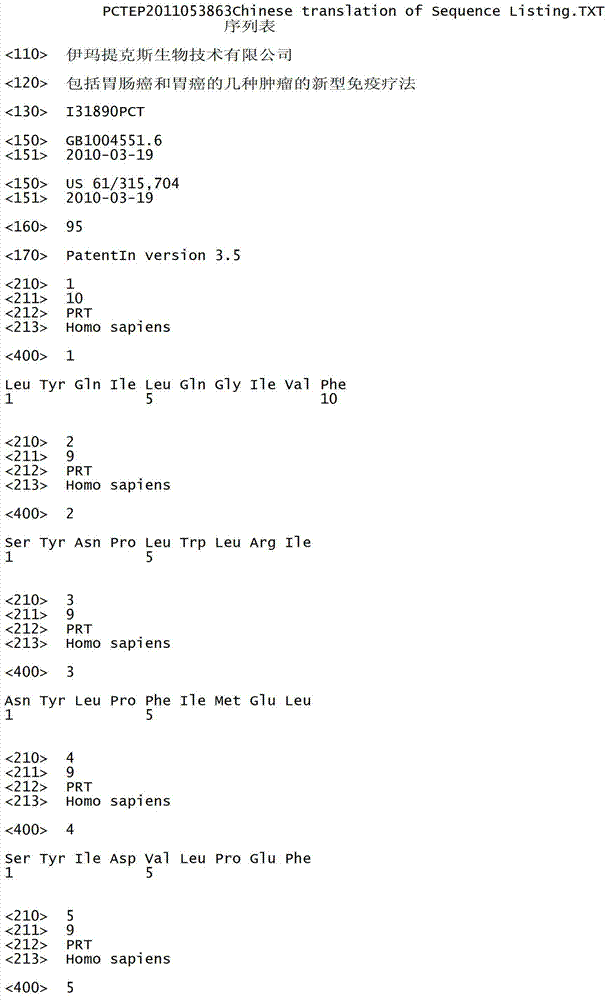
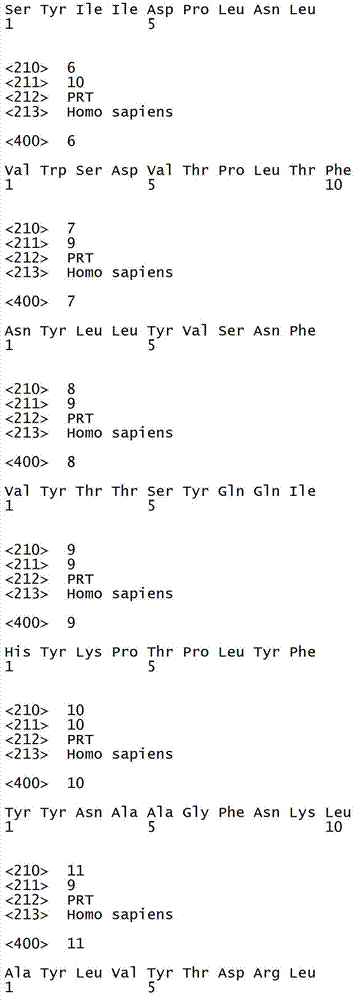
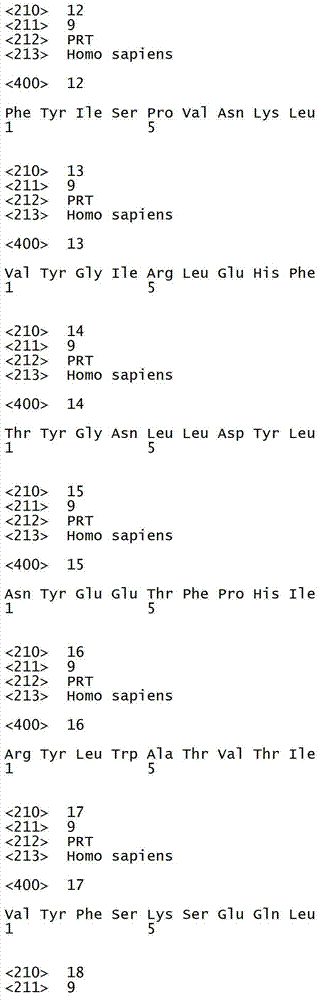
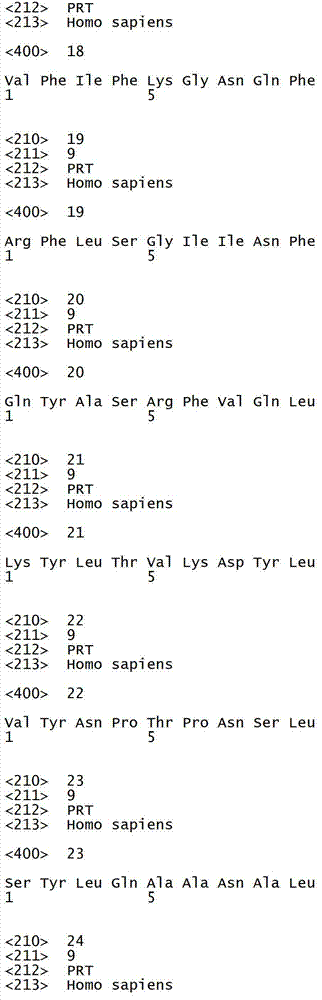
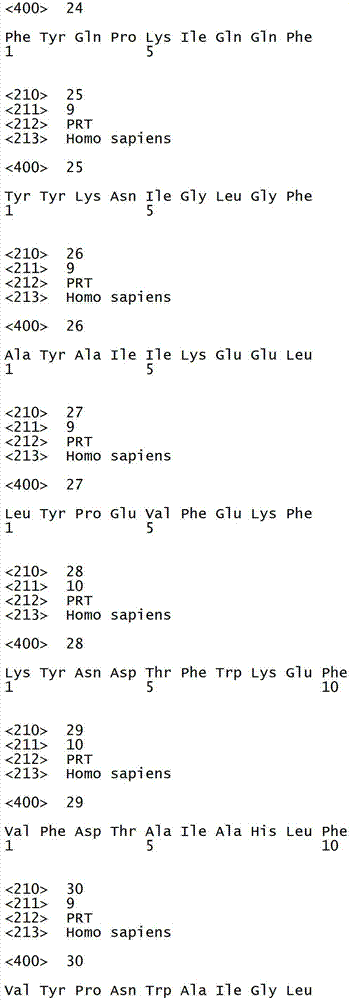
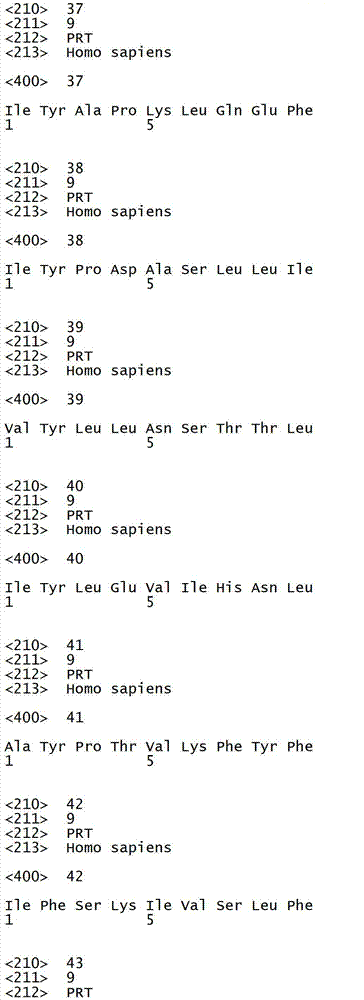

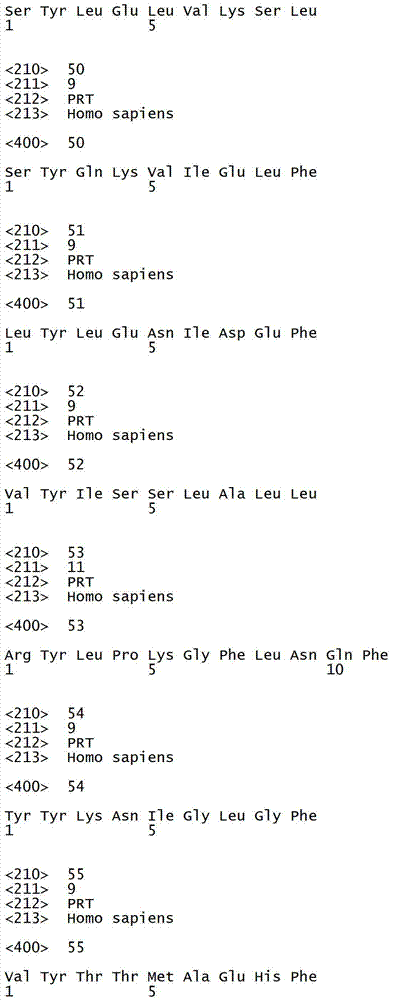
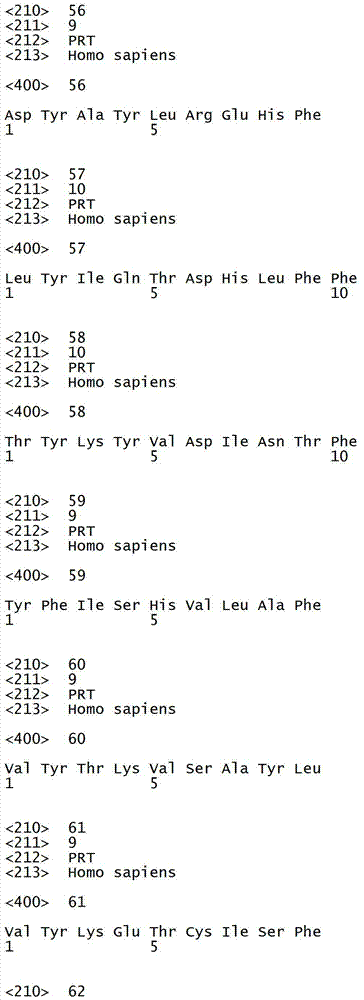
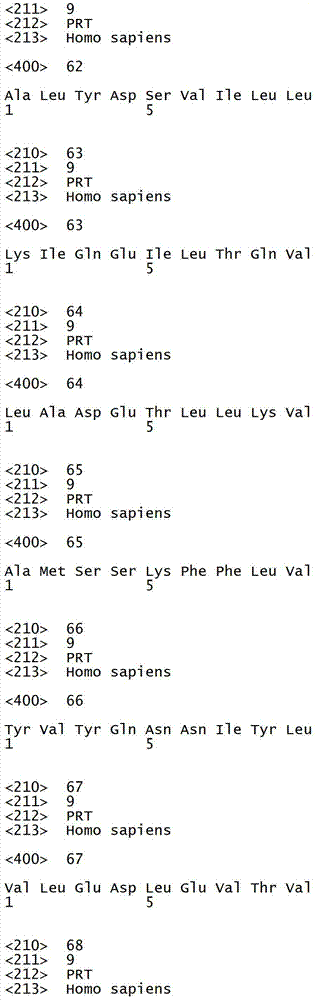
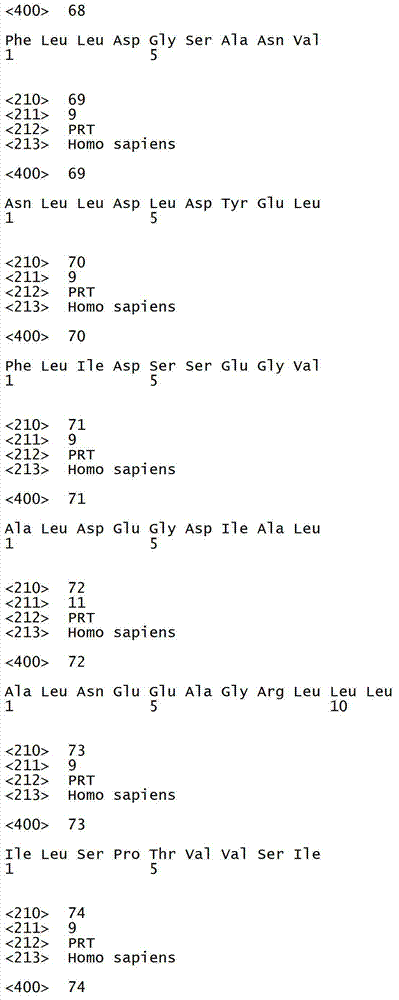

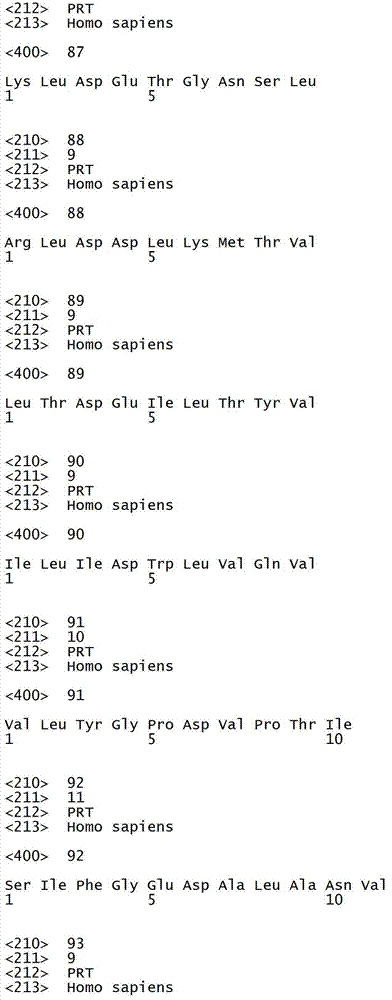

Claims (23)
Priority Applications (7)
| Application Number | Priority Date | Filing Date | Title |
|---|---|---|---|
| CN202011079575.9A CN112409452A (en) | 2010-03-19 | 2011-03-15 | Novel immunotherapy for several tumors including gastrointestinal and gastric cancers |
| CN201810105798.4A CN108456242A (en) | 2010-03-19 | 2011-03-15 | The novel immune therapy of several tumours including human primary gastrointestinal cancers and gastric cancer |
| CN202011080388.2A CN112430255A (en) | 2010-03-19 | 2011-03-15 | Novel immunotherapy for several tumors including gastrointestinal and gastric cancers |
| CN202011079527.XA CN112457390A (en) | 2010-03-19 | 2011-03-15 | Novel immunotherapy for several tumors including gastrointestinal and gastric cancers |
| CN201510354965.5A CN105001339B (en) | 2010-03-19 | 2011-03-15 | Novel immunotherapy for several tumors including gastrointestinal and gastric cancers |
| CN202011079539.2A CN112409451B (en) | 2010-03-19 | 2011-03-15 | Novel immunotherapy of several tumors including gastrointestinal cancer and gastric cancer |
| CN202011080378.9A CN112409453A (en) | 2010-03-19 | 2011-03-15 | Novel immunotherapy for several tumors including gastrointestinal and gastric cancers |
Applications Claiming Priority (5)
| Application Number | Priority Date | Filing Date | Title |
|---|---|---|---|
| US31570410P | 2010-03-19 | 2010-03-19 | |
| GBGB1004551.6A GB201004551D0 (en) | 2010-03-19 | 2010-03-19 | NOvel immunotherapy against several tumors including gastrointestinal and gastric cancer |
| US61/315,704 | 2010-03-19 | ||
| GB1004551.6 | 2010-03-19 | ||
| PCT/EP2011/053863 WO2011113819A2 (en) | 2010-03-19 | 2011-03-15 | Novel immunotherapy against several tumors including gastrointestinal and gastric cancer |
Related Child Applications (7)
| Application Number | Title | Priority Date | Filing Date |
|---|---|---|---|
| CN202011079527.XA Division CN112457390A (en) | 2010-03-19 | 2011-03-15 | Novel immunotherapy for several tumors including gastrointestinal and gastric cancers |
| CN202011079539.2A Division CN112409451B (en) | 2010-03-19 | 2011-03-15 | Novel immunotherapy of several tumors including gastrointestinal cancer and gastric cancer |
| CN202011079575.9A Division CN112409452A (en) | 2010-03-19 | 2011-03-15 | Novel immunotherapy for several tumors including gastrointestinal and gastric cancers |
| CN201810105798.4A Division CN108456242A (en) | 2010-03-19 | 2011-03-15 | The novel immune therapy of several tumours including human primary gastrointestinal cancers and gastric cancer |
| CN202011080388.2A Division CN112430255A (en) | 2010-03-19 | 2011-03-15 | Novel immunotherapy for several tumors including gastrointestinal and gastric cancers |
| CN202011080378.9A Division CN112409453A (en) | 2010-03-19 | 2011-03-15 | Novel immunotherapy for several tumors including gastrointestinal and gastric cancers |
| CN201510354965.5A Division CN105001339B (en) | 2010-03-19 | 2011-03-15 | Novel immunotherapy for several tumors including gastrointestinal and gastric cancers |
Publications (2)
| Publication Number | Publication Date |
|---|---|
| CN102905721A true CN102905721A (en) | 2013-01-30 |
| CN102905721B CN102905721B (en) | 2015-09-23 |
Family
ID=42227949
Family Applications (8)
| Application Number | Title | Priority Date | Filing Date |
|---|---|---|---|
| CN202011079575.9A Pending CN112409452A (en) | 2010-03-19 | 2011-03-15 | Novel immunotherapy for several tumors including gastrointestinal and gastric cancers |
| CN202011080388.2A Pending CN112430255A (en) | 2010-03-19 | 2011-03-15 | Novel immunotherapy for several tumors including gastrointestinal and gastric cancers |
| CN202011079539.2A Active CN112409451B (en) | 2010-03-19 | 2011-03-15 | Novel immunotherapy of several tumors including gastrointestinal cancer and gastric cancer |
| CN202011079527.XA Pending CN112457390A (en) | 2010-03-19 | 2011-03-15 | Novel immunotherapy for several tumors including gastrointestinal and gastric cancers |
| CN201510354965.5A Active CN105001339B (en) | 2010-03-19 | 2011-03-15 | Novel immunotherapy for several tumors including gastrointestinal and gastric cancers |
| CN201180014644.0A Active CN102905721B (en) | 2010-03-19 | 2011-03-15 | Novel immunotherapy for several tumors including gastrointestinal and gastric cancers |
| CN201810105798.4A Pending CN108456242A (en) | 2010-03-19 | 2011-03-15 | The novel immune therapy of several tumours including human primary gastrointestinal cancers and gastric cancer |
| CN202011080378.9A Pending CN112409453A (en) | 2010-03-19 | 2011-03-15 | Novel immunotherapy for several tumors including gastrointestinal and gastric cancers |
Family Applications Before (5)
| Application Number | Title | Priority Date | Filing Date |
|---|---|---|---|
| CN202011079575.9A Pending CN112409452A (en) | 2010-03-19 | 2011-03-15 | Novel immunotherapy for several tumors including gastrointestinal and gastric cancers |
| CN202011080388.2A Pending CN112430255A (en) | 2010-03-19 | 2011-03-15 | Novel immunotherapy for several tumors including gastrointestinal and gastric cancers |
| CN202011079539.2A Active CN112409451B (en) | 2010-03-19 | 2011-03-15 | Novel immunotherapy of several tumors including gastrointestinal cancer and gastric cancer |
| CN202011079527.XA Pending CN112457390A (en) | 2010-03-19 | 2011-03-15 | Novel immunotherapy for several tumors including gastrointestinal and gastric cancers |
| CN201510354965.5A Active CN105001339B (en) | 2010-03-19 | 2011-03-15 | Novel immunotherapy for several tumors including gastrointestinal and gastric cancers |
Family Applications After (2)
| Application Number | Title | Priority Date | Filing Date |
|---|---|---|---|
| CN201810105798.4A Pending CN108456242A (en) | 2010-03-19 | 2011-03-15 | The novel immune therapy of several tumours including human primary gastrointestinal cancers and gastric cancer |
| CN202011080378.9A Pending CN112409453A (en) | 2010-03-19 | 2011-03-15 | Novel immunotherapy for several tumors including gastrointestinal and gastric cancers |
Country Status (30)
| Country | Link |
|---|---|
| US (25) | US10064913B2 (en) |
| EP (9) | EP3363456B1 (en) |
| JP (10) | JP5891181B2 (en) |
| KR (13) | KR102388577B1 (en) |
| CN (8) | CN112409452A (en) |
| AU (1) | AU2011229199B2 (en) |
| BR (1) | BR112012023692B1 (en) |
| CA (5) | CA2936642C (en) |
| CY (5) | CY1119366T1 (en) |
| DK (6) | DK3363456T3 (en) |
| EA (8) | EA202091233A3 (en) |
| ES (8) | ES2544529T3 (en) |
| GB (1) | GB201004551D0 (en) |
| HK (1) | HK1226297A1 (en) |
| HR (6) | HRP20150867T1 (en) |
| HU (6) | HUE033682T2 (en) |
| LT (5) | LT2845604T (en) |
| ME (3) | ME03569B (en) |
| MX (7) | MX382164B (en) |
| MY (2) | MY178651A (en) |
| NZ (7) | NZ769427A (en) |
| PH (4) | PH12021551360A1 (en) |
| PL (6) | PL2923708T3 (en) |
| PT (6) | PT3329933T (en) |
| RS (6) | RS60765B1 (en) |
| SG (4) | SG183880A1 (en) |
| SI (6) | SI3195873T1 (en) |
| TW (9) | TWI621709B (en) |
| UA (3) | UA126787C2 (en) |
| WO (1) | WO2011113819A2 (en) |
Cited By (9)
| Publication number | Priority date | Publication date | Assignee | Title |
|---|---|---|---|---|
| CN105377290A (en) * | 2013-08-05 | 2016-03-02 | 伊玛提克斯生物技术有限公司 | Novel immunotherapy for the treatment of various tumors such as lung cancer including NSCLC |
| CN107624118A (en) * | 2015-04-24 | 2018-01-23 | 伊玛提克斯生物技术有限公司 | Novel peptides and peptide compositions for immunotherapy of lung cancer, including non-small cell lung cancer and other cancers |
| WO2018094569A1 (en) * | 2016-11-22 | 2018-05-31 | 深圳华大基因研究院 | Polypeptide and application thereof |
| WO2018098715A1 (en) * | 2016-11-30 | 2018-06-07 | 深圳华大基因研究院 | Polypeptide and application thereof |
| TWI641617B (en) * | 2016-03-01 | 2018-11-21 | 英麥提克生物技術股份有限公司 | Peptides, peptide compositions and cell-based drugs for bladder cancer and other cancer immunotherapy |
| CN109475596A (en) * | 2016-03-08 | 2019-03-15 | 伊玛提克斯生物技术有限公司 | Uterine Cancer Treatment |
| CN109748953A (en) * | 2013-08-05 | 2019-05-14 | 伊玛提克斯生物技术有限公司 | Novel immunotherapies for the treatment of multiple tumors, such as lung cancer, including NSCLC |
| CN112409451A (en) * | 2010-03-19 | 2021-02-26 | 伊玛提克斯生物技术有限公司 | Novel immunotherapy for several tumors including gastrointestinal and gastric cancers |
| CN114672559A (en) * | 2014-11-21 | 2022-06-28 | 纪念斯隆凯特琳癌症中心 | Determinants of cancer response to immunotherapy by PD-1 blockade |
Families Citing this family (92)
| Publication number | Priority date | Publication date | Assignee | Title |
|---|---|---|---|---|
| US7604662B2 (en) | 2007-07-13 | 2009-10-20 | Boston Scientific Scimed, Inc. | Endoprostheses containing boride intermetallic phases |
| EP2172211B1 (en) | 2008-10-01 | 2014-12-03 | Immatics Biotechnologies GmbH | Composition of tumor-associated peptides and related anti-cancer vaccine for the treatment of glioblastoma (GBM) and other cancers |
| GB201004575D0 (en) | 2010-03-19 | 2010-05-05 | Immatics Biotechnologies Gmbh | Composition of tumor associated peptides and related anti cancer vaccine for the treatment of gastric cancer and other cancers |
| EP2400035A1 (en) * | 2010-06-28 | 2011-12-28 | Technische Universität München | Methods and compositions for diagnosing gastrointestinal stromal tumors |
| US9040046B2 (en) | 2011-01-31 | 2015-05-26 | Kai Xu | Sodium pump antibody agonists and methods of treating heart disease using the same |
| IN2014CN03922A (en) * | 2011-10-28 | 2015-09-04 | Oncotherapy Science Inc | |
| US10704021B2 (en) | 2012-03-15 | 2020-07-07 | Flodesign Sonics, Inc. | Acoustic perfusion devices |
| WO2013142477A1 (en) * | 2012-03-19 | 2013-09-26 | Stemline Therapeutics, Inc. | Methods for treating and monitoring the status of cancer |
| EP3912634B1 (en) | 2012-05-16 | 2023-10-04 | Stemline Therapeutics Inc. | Cancer stem cell targeted cancer vaccines |
| EP2872532A4 (en) | 2012-07-10 | 2016-04-13 | Oncotherapy Science Inc | PEPTIDES EPITAOPES OF CDCA1 FOR TH1 CELLS AND VACCINES CONTAINING THEM |
| WO2014014518A1 (en) * | 2012-07-18 | 2014-01-23 | Dana-Farber Cancer Institute, Inc. | Methods for treating, preventing and predicting risk of developing breast cancer |
| JP6212249B2 (en) * | 2012-08-08 | 2017-10-11 | 学校法人 京都産業大学 | Screening method for calcium pump regulator and screening method for melanin pigment synthesis inhibitor |
| US9114157B2 (en) * | 2012-08-30 | 2015-08-25 | The Board Of Trustees Of The Leland Stanford Junior University | Anti-tumor T cell immunity induced by high dose radiation |
| EP2876442A1 (en) * | 2013-11-22 | 2015-05-27 | Institut de Cancérologie de l'Ouest | Olfactomedin-4, neudesin and desmoplakin as biomarkers of breast cancer |
| CN105939767B (en) | 2014-01-08 | 2018-04-06 | 弗洛设计声能学公司 | Sound electrophoretic apparatus with alliteration electrophoresis chamber |
| US10532088B2 (en) | 2014-02-27 | 2020-01-14 | Lycera Corporation | Adoptive cellular therapy using an agonist of retinoic acid receptor-related orphan receptor gamma and related therapeutic methods |
| EP3134114A4 (en) * | 2014-04-24 | 2018-03-14 | Rhode Island Hospital | Aspartate-beta -hydroxylase induces epitope-specific t cell responses in tumors |
| US9896441B2 (en) | 2014-05-05 | 2018-02-20 | Lycera Corporation | Tetrahydroquinoline sulfonamide and related compounds for use as agonists of RORγ and the treatment of disease |
| US10189777B2 (en) | 2014-05-05 | 2019-01-29 | Lycera Corporation | Benzenesulfonamido and related compounds for use as agonists of RORγ and the treatment of disease |
| GB201408255D0 (en) * | 2014-05-09 | 2014-06-25 | Immatics Biotechnologies Gmbh | Novel immunotherapy against several tumours of the blood, such as acute myeloid leukemia (AML) |
| KR101644599B1 (en) | 2014-10-14 | 2016-08-16 | 연세대학교 산학협력단 | Construction of mitochondrial UQCRB mutant expressing cells and utilization of the cells for UQCRB assay system thereof |
| GB201423361D0 (en) * | 2014-12-30 | 2015-02-11 | Immatics Biotechnologies Gmbh | Method for the absolute Quantification of naturally processed HLA-Restricted cancer peptides |
| US11497767B2 (en) | 2015-02-18 | 2022-11-15 | Enlivex Therapeutics R&D Ltd | Combination immune therapy and cytokine control therapy for cancer treatment |
| US11596652B2 (en) | 2015-02-18 | 2023-03-07 | Enlivex Therapeutics R&D Ltd | Early apoptotic cells for use in treating sepsis |
| WO2016170541A1 (en) | 2015-04-21 | 2016-10-27 | Enlivex Therapeutics Ltd. | Therapeutic pooled blood apoptotic cell preparations and uses thereof |
| US11304976B2 (en) | 2015-02-18 | 2022-04-19 | Enlivex Therapeutics Ltd | Combination immune therapy and cytokine control therapy for cancer treatment |
| US11000548B2 (en) | 2015-02-18 | 2021-05-11 | Enlivex Therapeutics Ltd | Combination immune therapy and cytokine control therapy for cancer treatment |
| US11318163B2 (en) | 2015-02-18 | 2022-05-03 | Enlivex Therapeutics Ltd | Combination immune therapy and cytokine control therapy for cancer treatment |
| EP3258943B1 (en) | 2015-02-18 | 2021-05-12 | Enlivex Therapeutics Ltd. | Combination immune therapy and cytokine control therapy for cancer treatment |
| MY199500A (en) | 2015-03-17 | 2023-11-01 | Immatics Biotechnologies Gmbh | Novel peptides and combination of peptides for use in immunotherapy against pancreatic cancer and other cancers |
| GB201504502D0 (en) * | 2015-03-17 | 2015-04-29 | Immatics Biotechnologies Gmbh | Novel peptides and combination of peptides for use in immunotherapy against pancreatic cancer and other cancers |
| US11708572B2 (en) | 2015-04-29 | 2023-07-25 | Flodesign Sonics, Inc. | Acoustic cell separation techniques and processes |
| US11377651B2 (en) | 2016-10-19 | 2022-07-05 | Flodesign Sonics, Inc. | Cell therapy processes utilizing acoustophoresis |
| US10421751B2 (en) | 2015-05-05 | 2019-09-24 | Lycera Corporation | Dihydro-2H-benzo[b][1,4]oxazine sulfonamide and related compounds for use as agonists of RORγ and the treatment of disease |
| NL2014935B1 (en) | 2015-06-08 | 2017-02-03 | Applied Immune Tech Ltd | T cell receptor like antibodies having fine specificity. |
| WO2016201225A1 (en) | 2015-06-11 | 2016-12-15 | Lycera Corporation | Aryl dihydro-2h-benzo[b][1,4]oxazine sulfonamide and related compounds for use as agonists of rory and the treatment of disease |
| GB201510771D0 (en) * | 2015-06-19 | 2015-08-05 | Immatics Biotechnologies Gmbh | Novel peptides and combination of peptides for use in immunotherapy and methods for generating scaffolds for the use against pancreatic cancer |
| MX2017016213A (en) * | 2015-06-19 | 2018-03-07 | Immatics Biotechnologies Gmbh | NEW PEPTIDES AND NEW COMBINATIONS OF PEPTIDES FOR USE IN IMMUNOTHERAPY AND METHODS TO CREATE SUPPORTS FOR USE AGAINST CANCER OF PANCREAS AND OTHER TYPES OF CANCER. |
| GB201511546D0 (en) | 2015-07-01 | 2015-08-12 | Immatics Biotechnologies Gmbh | Novel peptides and combination of peptides for use in immunotherapy against ovarian cancer and other cancers |
| MA42294B1 (en) | 2015-07-01 | 2020-11-30 | Immatics Biotechnologies Gmbh | New peptides and combination of peptides for use in immunotherapy against ovarian cancer and other cancers |
| MY189596A (en) * | 2015-07-15 | 2022-02-18 | Immatics Biotechnologies Gmbh | A novel peptides for use in immunotherapy against epithelial ovarian cancer and other cancers |
| TWI796642B (en) | 2015-08-28 | 2023-03-21 | 德商英麥提克生物技術股份有限公司 | Novel peptides, combination of peptides and scaffolds for use in immunotherapeutic treatment of various cancers |
| GB201515321D0 (en) | 2015-08-28 | 2015-10-14 | Immatics Biotechnologies Gmbh | Novel peptides, combination of peptides and scaffolds for use in immunotherapeutic treatment of various cancers |
| US20170136108A1 (en) * | 2015-08-28 | 2017-05-18 | Immatics Biotechnologies Gmbh | Novel peptides, combination of peptides and scaffolds for use in immunotherapeutic treatment of various cancers |
| KR102601499B1 (en) * | 2015-11-06 | 2023-11-13 | 연세대학교 산학협력단 | Method for diagnosing uqcrb related desease by measuring micro rna expression level |
| GB201521746D0 (en) * | 2015-12-10 | 2016-01-27 | Immatics Biotechnologies Gmbh | Novel peptides and combination of peptides for use in immunotherapy against CLL and other cancers |
| BR112018012374A2 (en) | 2015-12-16 | 2018-12-04 | Gritstone Oncology, Inc. | identification, manufacture and use of neoantigen |
| KR20180110141A (en) | 2016-02-18 | 2018-10-08 | 엔리벡스 테라퓨틱스 리미티드 | Combination of immunotherapy and cytokine regulating therapy to treat cancer |
| IL302705A (en) | 2016-03-01 | 2023-07-01 | Immatics Biotechnologies Gmbh | Peptides, combination of peptides, and cell-based medicaments for use in immunotherapy against urinary bladder cancer and other cancers |
| GB201604458D0 (en) * | 2016-03-16 | 2016-04-27 | Immatics Biotechnologies Gmbh | Peptides and combination of peptides for use in immunotherapy against cancers |
| GB201604490D0 (en) | 2016-03-16 | 2016-04-27 | Immatics Biotechnologies Gmbh | Peptides combination of peptides for use in immunotherapy against cancers |
| CR20180551A (en) | 2016-04-21 | 2019-02-12 | Immatics Biotechnologies Gmbh | IMMUNOTHERAPY AGAINST MELANOMA AND OTHER TYPES OF CANCER |
| EP3445383A1 (en) * | 2016-04-21 | 2019-02-27 | Immatics Biotechnologies GmbH | Immunotherapy against melanoma and other cancers |
| US11214789B2 (en) | 2016-05-03 | 2022-01-04 | Flodesign Sonics, Inc. | Concentration and washing of particles with acoustics |
| ZA201900664B (en) | 2016-08-17 | 2021-09-29 | Paul Ehrlich Strasse 15 Tuebingen 72076 Germany | T cell receptors and immune therapy using the same |
| DE102016115246C5 (en) * | 2016-08-17 | 2018-12-20 | Immatics Biotechnologies Gmbh | NEW T-CELL RECEPTORS AND THEIR USE IN IMMUNOTHERAPY |
| MY195101A (en) * | 2016-08-17 | 2023-01-10 | Immatics Biotechnologies Gmbh | Novel T Cell Receptors and Immune Therapy Using the Same |
| DE102016123893A1 (en) | 2016-12-08 | 2018-06-14 | Immatics Biotechnologies Gmbh | T cell receptors with improved binding |
| NZ754222A (en) | 2016-12-08 | 2022-02-25 | Immatics Biotechnologies Gmbh | T cell receptors with improved pairing |
| CN111533797A (en) * | 2017-04-10 | 2020-08-14 | 伊玛提克斯生物技术有限公司 | Peptides for cancer immunotherapy and peptide compositions thereof |
| US11427614B2 (en) | 2017-04-10 | 2022-08-30 | Immatics Biotechnologies Gmbh | Peptides and combination thereof for use in the immunotherapy against cancers |
| DE102017115966A1 (en) | 2017-07-14 | 2019-01-17 | Immatics Biotechnologies Gmbh | Polypeptide molecule with improved dual specificity |
| SG11202000027WA (en) | 2017-07-14 | 2020-02-27 | Immatics Biotechnologies Gmbh | Improved dual specificity polypeptide molecule |
| JP7227237B2 (en) | 2017-10-10 | 2023-02-21 | グリットストーン バイオ インコーポレイテッド | Identification of neoantigens using hotspots |
| DE102017125888A1 (en) * | 2017-11-06 | 2019-05-23 | Immatics Biotechnologies Gmbh | New engineered T cell receptors and their use in immunotherapy |
| WO2019086665A1 (en) | 2017-11-06 | 2019-05-09 | Immatics Biotechnologies Gmbh | Novel engineered t cell receptors and immune therapy using the same |
| KR102905054B1 (en) | 2017-11-22 | 2025-12-29 | 시애틀 프로젝트 코포레이션 | Reduced presentation of junctional epitopes to neoantigens |
| CN114900773A (en) | 2017-12-14 | 2022-08-12 | 弗洛设计声能学公司 | Acoustophoretic system, method for operating acoustophoretic system, and method for controlling acoustic transducer and acoustic system |
| EP4197552A1 (en) | 2018-03-12 | 2023-06-21 | The Children's Hospital of Philadelphia | Methods and compositions for use of tumor self-antigens in adoptive immunotherapy |
| US12195769B2 (en) | 2018-06-19 | 2025-01-14 | Dsm Ip Assets B.V. | Lipolytic enzyme variants |
| US20210380661A1 (en) * | 2018-10-16 | 2021-12-09 | Texas Tech University System | Method to Express, Purify, and Biotinylate Eukaryotic Cell-Derived Major Histocompatibility Complexes |
| US11975025B2 (en) | 2019-05-27 | 2024-05-07 | Immatics US, Inc. | Viral vectors and use thereof in adoptive cellular therapy |
| DE102019114735A1 (en) * | 2019-06-02 | 2020-12-03 | PMCR GmbH | Class I and II HLA tumor antigen peptides for the treatment of breast cancer |
| SG11202112561UA (en) | 2019-06-06 | 2021-12-30 | Immatics Biotechnologies Gmbh | Sorting with counter selection using sequence similar peptides |
| KR102397922B1 (en) * | 2020-02-19 | 2022-05-13 | 서울대학교 산학협력단 | Novel tumor-associated antigen protein OLFM4 and the use thereof |
| WO2022045768A1 (en) | 2020-08-28 | 2022-03-03 | 계명대학교 산학협력단 | Micro rna biomarker for predicting drug response to antidiabetics and use thereof |
| EP4247402A4 (en) * | 2020-11-19 | 2025-03-26 | Board of Regents, The University of Texas System | Methods and compositions comprising mhc class i peptides |
| DE102021100038A1 (en) | 2020-12-31 | 2022-06-30 | Immatics US, Inc. | MODIFIED CD8 POLYPEPTIDES, COMPOSITIONS AND METHODS OF USE THEREOF |
| PE20250846A1 (en) | 2020-12-31 | 2025-03-21 | Immatics Us Inc | CD8 POLYPEPTIDES, COMPOSITIONS AND METHODS OF USE OF THESE |
| KR20240004937A (en) | 2021-05-05 | 2024-01-11 | 이매틱스 바이오테크놀로지스 게엠베하 | BMA031 antigen-binding polypeptide |
| CN114732898B (en) * | 2022-04-01 | 2023-05-09 | 中国人民解放军军事科学院军事医学研究院 | A method for site-specific covalent binding of CpG adjuvant to antigen |
| JP2025515604A (en) | 2022-04-28 | 2025-05-20 | イマティクス ユーエス,アイエヌシー. | Dominant negative TGF beta receptor polypeptides, CD8 polypeptides, cells, compositions, and methods of use thereof |
| IL316515A (en) | 2022-04-28 | 2024-12-01 | Immatics Us Inc | Membrane-bound il-15, cd8 polypeptides, cells, compositions, and methods of using thereof |
| WO2023212655A1 (en) | 2022-04-28 | 2023-11-02 | Immatics US, Inc. | Il-12 polypeptides, il-15 polypeptides, il-18 polypeptides, cd8 polypeptides, compositions, and methods of using thereof |
| WO2023215825A1 (en) | 2022-05-05 | 2023-11-09 | Immatics US, Inc. | Methods for improving t cell efficacy |
| US20240325448A1 (en) * | 2022-09-29 | 2024-10-03 | Jerome Canady Research Institute for Advanced Biological and Technological Sciences | Cold atmopsheric plasma treated pan-cancer epitope peptide within the collagen type vi a-3 (col6a3) protein as cancer vaccine |
| WO2024077071A2 (en) * | 2022-10-05 | 2024-04-11 | The Johns Hopkins University | Nanoparticles for delivery of immunoregulatory materials to t cells |
| EP4661892A1 (en) * | 2023-02-08 | 2025-12-17 | Navigen, Inc. | Tnf-alpha binding agents and methods of using the same |
| CN116102468B (en) * | 2023-02-22 | 2024-07-09 | 中国科学技术大学 | Lead compound targeting human lipocalin 2 or its pharmaceutically acceptable salt and preparation method and application thereof |
| KR20240158819A (en) * | 2023-04-26 | 2024-11-05 | 한국과학기술원 | Immunodominant Epitope Peptides of Fibroblast Activating Proteins, and Uses Thereof |
| US20250134931A1 (en) | 2023-11-01 | 2025-05-01 | Immatics US, Inc. | Membrane-bound il-15, cd8 polypeptides, cells, compositions, and methods of using thereof |
| CN119679951A (en) * | 2025-02-11 | 2025-03-25 | 安徽医科大学 | Application of inhibitory substances of E3 ubiquitin ligase SYVN1 in the preparation of drugs for treating gastric cancer |
Citations (2)
| Publication number | Priority date | Publication date | Assignee | Title |
|---|---|---|---|---|
| WO2002036614A2 (en) * | 2000-11-01 | 2002-05-10 | Insight Biotechnology Limited | Peptides for use in the treatment of alzheimer's disease |
| US20050221350A1 (en) * | 2002-05-29 | 2005-10-06 | Toni Weinschenk | Method for identifying immunoreactive peptides |
Family Cites Families (71)
| Publication number | Priority date | Publication date | Assignee | Title |
|---|---|---|---|---|
| US4440859A (en) | 1977-05-27 | 1984-04-03 | The Regents Of The University Of California | Method for producing recombinant bacterial plasmids containing the coding sequences of higher organisms |
| US4704362A (en) | 1977-11-08 | 1987-11-03 | Genentech, Inc. | Recombinant cloning vehicle microbial polypeptide expression |
| BR7908410A (en) | 1978-12-22 | 1980-09-09 | Biogen Nv | MEDIA FOR DETECTION OF HBV ANTIBODIES IN BLOOD SERUM, AND PROCESS FOR DETECTION OF THE PRESENCE OF HEPATITIS B VIRUS INFECTION IN HUMAN BEINGS |
| US4530901A (en) | 1980-01-08 | 1985-07-23 | Biogen N.V. | Recombinant DNA molecules and their use in producing human interferon-like polypeptides |
| US4342566A (en) | 1980-02-22 | 1982-08-03 | Scripps Clinic & Research Foundation | Solid phase anti-C3 assay for detection of immune complexes |
| US4678751A (en) | 1981-09-25 | 1987-07-07 | Genentech, Inc. | Hybrid human leukocyte interferons |
| US4766075A (en) | 1982-07-14 | 1988-08-23 | Genentech, Inc. | Human tissue plasminogen activator |
| US4582800A (en) | 1982-07-12 | 1986-04-15 | Hoffmann-La Roche Inc. | Novel vectors and method for controlling interferon expression |
| US4816567A (en) | 1983-04-08 | 1989-03-28 | Genentech, Inc. | Recombinant immunoglobin preparations |
| US4757006A (en) | 1983-10-28 | 1988-07-12 | Genetics Institute, Inc. | Human factor VIII:C gene and recombinant methods for production |
| US4677063A (en) | 1985-05-02 | 1987-06-30 | Cetus Corporation | Human tumor necrosis factor |
| US4810648A (en) | 1986-01-08 | 1989-03-07 | Rhone Poulenc Agrochimie | Haloarylnitrile degrading gene, its use, and cells containing the gene |
| US4897445A (en) | 1986-06-27 | 1990-01-30 | The Administrators Of The Tulane Educational Fund | Method for synthesizing a peptide containing a non-peptide bond |
| DE69405102T2 (en) | 1993-06-03 | 1998-01-15 | Therapeutic Antibodies, Inc., Nashville, Tenn. | ANTIBODY FRAGMENTS IN THERAPY |
| AUPM322393A0 (en) | 1993-12-24 | 1994-01-27 | Austin Research Institute, The | Mucin carbohydrate compounds and their use in immunotherapy |
| WO1997026328A1 (en) | 1996-01-17 | 1997-07-24 | Imperial College Innovations Limited | Immunotherapy using cytotoxic t lymphocytes (ctl) |
| US5849589A (en) | 1996-03-11 | 1998-12-15 | Duke University | Culturing monocytes with IL-4, TNF-α and GM-CSF TO induce differentiation to dendric cells |
| US6406705B1 (en) | 1997-03-10 | 2002-06-18 | University Of Iowa Research Foundation | Use of nucleic acids containing unmethylated CpG dinucleotide as an adjuvant |
| US8299321B2 (en) | 1998-06-16 | 2012-10-30 | Monsanto Technology Llc | Nucleic acid molecules and other molecules associated with plants and uses thereof for plant improvement |
| JP2002525382A (en) * | 1998-09-25 | 2002-08-13 | ザ チルドレンズ メディカル センター コーポレイション | Short peptide that selectively regulates protein kinase activity |
| AU3395900A (en) * | 1999-03-12 | 2000-10-04 | Human Genome Sciences, Inc. | Human lung cancer associated gene sequences and polypeptides |
| WO2001041787A1 (en) * | 1999-12-10 | 2001-06-14 | Epimmune Inc. | INDUCING CELLULAR IMMUNE RESPONSES TO HER2/neu USING PEPTIDE AND NUCLEIC ACID COMPOSITIONS |
| JP4310104B2 (en) | 2002-09-28 | 2009-08-05 | 英俊 猪子 | Gene mapping method using microsatellite polymorphism markers |
| US20110131679A2 (en) | 2000-04-19 | 2011-06-02 | Thomas La Rosa | Rice Nucleic Acid Molecules and Other Molecules Associated with Plants and Uses Thereof for Plant Improvement |
| US20070067865A1 (en) | 2000-09-05 | 2007-03-22 | Kovalic David K | Annotated plant genes |
| AU2001279581A1 (en) * | 2000-09-06 | 2002-03-22 | Friederike Muller | Medicament comprising a dna sequence, which codes for the rna-binding koc protein, and comprising a koc protein or dna sequence of the koc promoter |
| JP2004528810A (en) | 2000-10-02 | 2004-09-24 | バイエル コーポレーション | Nucleic acid sequences differentially expressed in cancer tissues |
| US6673549B1 (en) * | 2000-10-12 | 2004-01-06 | Incyte Corporation | Genes expressed in C3A liver cell cultures treated with steroids |
| USH2191H1 (en) | 2000-10-24 | 2007-06-05 | Snp Consortium | Identification and mapping of single nucleotide polymorphisms in the human genome |
| US7919467B2 (en) * | 2000-12-04 | 2011-04-05 | Immunotope, Inc. | Cytotoxic T-lymphocyte-inducing immunogens for prevention, treatment, and diagnosis of cancer |
| US20040236091A1 (en) * | 2001-03-28 | 2004-11-25 | Chicz Roman M. | Translational profiling |
| AU2002303219A1 (en) * | 2001-03-30 | 2002-10-15 | Corixa Corporation | Compositions and methods for the therapy and diagnosis of cancer |
| WO2005024017A1 (en) | 2002-03-15 | 2005-03-17 | Monsanto Technology Llc | Nucleic acid molecules associated with oil in plants |
| DE10225139A1 (en) * | 2002-05-29 | 2004-02-26 | Immatics Biotechnologies Gmbh | Methods for the identification of immunoreactive peptides |
| WO2004014867A2 (en) * | 2002-08-13 | 2004-02-19 | Warner-Lambert Company Llc | Matrix metalloproteinase inhibitors and methods for identification of lead compounds |
| US20060188889A1 (en) * | 2003-11-04 | 2006-08-24 | Christopher Burgess | Use of differentially expressed nucleic acid sequences as biomarkers for cancer |
| WO2005049806A2 (en) * | 2003-03-14 | 2005-06-02 | Nuvelo, Inc. | Novel nucleic acids and polypeptides |
| US20070037204A1 (en) * | 2003-08-08 | 2007-02-15 | Hiroyuki ABURANTAI | Gene overexpressed in cancer |
| WO2005019258A2 (en) * | 2003-08-11 | 2005-03-03 | Genentech, Inc. | Compositions and methods for the treatment of immune related diseases |
| US20070054278A1 (en) | 2003-11-18 | 2007-03-08 | Applera Corporation | Polymorphisms in nucleic acid molecules encoding human enzyme proteins, methods of detection and uses thereof |
| AU2005207882A1 (en) * | 2004-01-27 | 2005-08-11 | Compugen Usa, Inc. | Novel nucleotide and amino acid sequences, and assays and methods of use thereof for diagnosis of breast cancer |
| EP1568383A3 (en) | 2004-02-27 | 2005-11-16 | Antisense Pharma GmbH | Use of an oligonucleotide or its active derivative for the preparation of a pharmaceutical composition for inhibiting the formation of metastases in cancer treatment |
| US20070039069A1 (en) | 2004-03-22 | 2007-02-15 | Rogers James A | Nucleic acid molecules associated with oil in plants |
| WO2005090603A2 (en) | 2004-03-23 | 2005-09-29 | Oncotherapy Science, Inc. | Method for diagnosing non-small cell lung cancer |
| US8435507B2 (en) * | 2004-08-19 | 2013-05-07 | University Of Maryland | Prostate-specific antigen-derived MHC class II restricted peptides and their use in vaccines to treat or prevent prostate cancer |
| AT501014A1 (en) * | 2004-08-19 | 2006-05-15 | Kury & Zeillinger Oeg | METHOD AND KIT FOR THE DIAGNOSIS OF A CANCER DISEASE, METHOD FOR DETERMINING THE APPEAL OF A PATIENT FOR THE TREATMENT OF CANCER DISEASE, THERAPEUTIC AGAINST THE PROPHYLAXIS OR THE TREATMENT OF A CANCER DISEASE |
| WO2007005635A2 (en) * | 2005-07-01 | 2007-01-11 | Government Of The United States Of America, As Represented By The Secretary, Department Of Health And Human Services | Mitotic spindle protein aspm as a diagnostic marker for neoplasia and uses therefor |
| ATE461214T1 (en) * | 2005-09-05 | 2010-04-15 | Immatics Biotechnologies Gmbh | TUMOR-ASSOCIATED PEPTIDES THAT BIND TO DIFFERENT CLASS II HUMAN LEUCOCYTE ANTIGENS |
| PT1760089E (en) * | 2005-09-05 | 2009-10-19 | Immatics Biotechnologies Gmbh | Tumor-associated peptides binding to human leukocyte antigen (hla) class i or ii molecules and related anti-cancer vaccine |
| GB0521958D0 (en) | 2005-10-27 | 2005-12-07 | Ares Trading Sa | vWFA, collagen and kunitz domain containing protein |
| DE102005052384B4 (en) * | 2005-10-31 | 2009-09-24 | Fraunhofer-Gesellschaft zur Förderung der angewandten Forschung e.V. | Method for the detection, labeling and treatment of epithelial lung tumor cells and means for carrying out the method |
| US20080058272A1 (en) * | 2006-08-29 | 2008-03-06 | Juergen Becker | Nonamer Peptides for Cancer Treatment |
| US20090004213A1 (en) * | 2007-03-26 | 2009-01-01 | Immatics Biotechnologies Gmbh | Combination therapy using active immunotherapy |
| HUE025636T2 (en) * | 2007-07-27 | 2016-04-28 | Immatics Biotechnologies Gmbh | New immunogenic epitope for immunotherapy |
| UA117216C2 (en) * | 2007-07-27 | 2018-07-10 | Імматікс Біотекнолоджіс Гмбх | TUMOR ASSOCIATED PEPTIDE AND ITS APPLICATION |
| US7892770B2 (en) * | 2007-08-24 | 2011-02-22 | Van Andel Research Institute | Monoclonal antibody which binds cMet (HGFR) in formalin-fixed and paraffin-embedded tissues and related methods |
| NZ562237A (en) * | 2007-10-05 | 2011-02-25 | Pacific Edge Biotechnology Ltd | Proliferation signature and prognosis for gastrointestinal cancer |
| WO2009075883A2 (en) * | 2007-12-12 | 2009-06-18 | University Of Georgia Research Foundation, Inc. | Glycoprotein cancer biomarker |
| CN101648012A (en) * | 2008-04-24 | 2010-02-17 | 伊玛提克斯生物技术有限公司 | Novel formulations of tumor-associated peptides binding to Human Leukocyte Antigen (HLA) class I or II molecules for use as vaccines |
| KR101184869B1 (en) * | 2008-04-24 | 2012-09-20 | 이매틱스 바이오테크놀로지스 게엠베하 | Novel formulations of tumour-associated peptides binding to human leukocyte antigen hla class i or ii molecules for vaccines |
| ATE462442T1 (en) | 2008-04-30 | 2010-04-15 | Immatics Biotechnologies Gmbh | NOVEL FORMULATIONS OF TUMOR-ASSOCIATED PEPTIDES THAT BIND TO HUMAN LEUKOCYTE ANTIGENS CLASS I OR II FOR VACCINATIONS |
| US8133686B2 (en) * | 2008-05-15 | 2012-03-13 | Van Andel Research Institute | IL-8 as a biomarker for sunitinib resistance |
| TWI526219B (en) * | 2008-06-19 | 2016-03-21 | 腫瘤療法 科學股份有限公司 | Cdca1 epitope peptides and vaccines containing the same |
| EP2172211B1 (en) | 2008-10-01 | 2014-12-03 | Immatics Biotechnologies GmbH | Composition of tumor-associated peptides and related anti-cancer vaccine for the treatment of glioblastoma (GBM) and other cancers |
| WO2010037395A2 (en) * | 2008-10-01 | 2010-04-08 | Dako Denmark A/S | Mhc multimers in cancer vaccines and immune monitoring |
| GB201019331D0 (en) * | 2010-03-19 | 2010-12-29 | Immatics Biotechnologies Gmbh | Methods for the diagnosis and treatment of cancer based on AVL9 |
| GB201004575D0 (en) | 2010-03-19 | 2010-05-05 | Immatics Biotechnologies Gmbh | Composition of tumor associated peptides and related anti cancer vaccine for the treatment of gastric cancer and other cancers |
| GB201004551D0 (en) * | 2010-03-19 | 2010-05-05 | Immatics Biotechnologies Gmbh | NOvel immunotherapy against several tumors including gastrointestinal and gastric cancer |
| GB201006360D0 (en) * | 2010-04-16 | 2010-06-02 | Immatics Biotechnologies Gmbh | Method for differentially quantifying naturally processed HLA-restricted peptides for cancer, autoimmune and infectious diseases immunotherapy development |
| GB201015765D0 (en) * | 2010-09-21 | 2010-10-27 | Immatics Biotechnologies Gmbh | Use of myeloid cell biomarkers for the diagnosis of cancer |
| GB201021289D0 (en) * | 2010-12-15 | 2011-01-26 | Immatics Biotechnologies Gmbh | Novel biomarkers for a prediction of the outcome of an immunotherapy against cancer |
-
2010
- 2010-03-19 GB GBGB1004551.6A patent/GB201004551D0/en not_active Ceased
-
2011
- 2011-03-15 CA CA2936642A patent/CA2936642C/en active Active
- 2011-03-15 HU HUE15154344A patent/HUE033682T2/en unknown
- 2011-03-15 HU HUE17203096A patent/HUE050376T2/en unknown
- 2011-03-15 AU AU2011229199A patent/AU2011229199B2/en not_active Ceased
- 2011-03-15 LT LTEP14184348.2T patent/LT2845604T/en unknown
- 2011-03-15 EA EA202091233A patent/EA202091233A3/en unknown
- 2011-03-15 RS RS20201054A patent/RS60765B1/en unknown
- 2011-03-15 RS RS20150530A patent/RS54182B1/en unknown
- 2011-03-15 CA CA3206214A patent/CA3206214A1/en active Pending
- 2011-03-15 PT PT172030967T patent/PT3329933T/en unknown
- 2011-03-15 EA EA201690511A patent/EA039357B1/en unknown
- 2011-03-15 KR KR1020207026524A patent/KR102388577B1/en not_active Expired - Fee Related
- 2011-03-15 KR KR1020207026530A patent/KR102324500B1/en active Active
- 2011-03-15 NZ NZ769427A patent/NZ769427A/en not_active IP Right Cessation
- 2011-03-15 PH PH1/2021/551360A patent/PH12021551360A1/en unknown
- 2011-03-15 PL PL15154344T patent/PL2923708T3/en unknown
- 2011-03-15 BR BR112012023692-0A patent/BR112012023692B1/en not_active IP Right Cessation
- 2011-03-15 EP EP18156634.0A patent/EP3363456B1/en active Active
- 2011-03-15 HU HUE14184348A patent/HUE032402T2/en unknown
- 2011-03-15 CN CN202011079575.9A patent/CN112409452A/en active Pending
- 2011-03-15 HU HUE18156634A patent/HUE051478T2/en unknown
- 2011-03-15 KR KR1020207026527A patent/KR102388761B1/en not_active Expired - Fee Related
- 2011-03-15 KR KR1020237031847A patent/KR20230141886A/en active Pending
- 2011-03-15 UA UAA201801266A patent/UA126787C2/en unknown
- 2011-03-15 DK DK18156634.0T patent/DK3363456T3/en active
- 2011-03-15 CA CA3076642A patent/CA3076642C/en active Active
- 2011-03-15 DK DK17157398.3T patent/DK3195873T3/en active
- 2011-03-15 ES ES11711292.0T patent/ES2544529T3/en active Active
- 2011-03-15 MX MX2017015735A patent/MX382164B/en unknown
- 2011-03-15 EA EA201792409A patent/EA037019B1/en unknown
- 2011-03-15 NZ NZ72784111A patent/NZ727841A/en not_active IP Right Cessation
- 2011-03-15 SI SI201131804T patent/SI3195873T1/en unknown
- 2011-03-15 WO PCT/EP2011/053863 patent/WO2011113819A2/en not_active Ceased
- 2011-03-15 ES ES17157398T patent/ES2753206T3/en active Active
- 2011-03-15 PL PL14184348T patent/PL2845604T3/en unknown
- 2011-03-15 NZ NZ601438A patent/NZ601438A/en not_active IP Right Cessation
- 2011-03-15 DK DK15154344.4T patent/DK2923708T3/en active
- 2011-03-15 PT PT181566340T patent/PT3363456T/en unknown
- 2011-03-15 ME MEP-2019-287A patent/ME03569B/en unknown
- 2011-03-15 CN CN202011080388.2A patent/CN112430255A/en active Pending
- 2011-03-15 MX MX2012010813A patent/MX2012010813A/en active IP Right Grant
- 2011-03-15 CN CN202011079539.2A patent/CN112409451B/en active Active
- 2011-03-15 PL PL17157398T patent/PL3195873T3/en unknown
- 2011-03-15 RS RS20191340A patent/RS59554B1/en unknown
- 2011-03-15 NZ NZ711296A patent/NZ711296A/en not_active IP Right Cessation
- 2011-03-15 EA EA201201306A patent/EA024497B1/en unknown
- 2011-03-15 SG SG2012065173A patent/SG183880A1/en unknown
- 2011-03-15 EP EP17203096.7A patent/EP3329933B1/en active Active
- 2011-03-15 LT LTEP18156634.0T patent/LT3363456T/en unknown
- 2011-03-15 EA EA202091251A patent/EA202091251A3/en unknown
- 2011-03-15 EP EP20179386.6A patent/EP3738606B1/en active Active
- 2011-03-15 PL PL11711292T patent/PL2547354T3/en unknown
- 2011-03-15 KR KR1020207026525A patent/KR102324498B1/en not_active Expired - Fee Related
- 2011-03-15 RS RS20170980A patent/RS56612B1/en unknown
- 2011-03-15 US US13/635,896 patent/US10064913B2/en active Active
- 2011-03-15 KR KR1020187002782A patent/KR20180014848A/en not_active Ceased
- 2011-03-15 KR KR1020217004318A patent/KR102329791B1/en active Active
- 2011-03-15 ES ES20179386T patent/ES2993310T3/en active Active
- 2011-03-15 DK DK17203096.7T patent/DK3329933T3/en active
- 2011-03-15 SI SI201131293T patent/SI2923708T1/en unknown
- 2011-03-15 JP JP2012557522A patent/JP5891181B2/en not_active Expired - Fee Related
- 2011-03-15 CN CN202011079527.XA patent/CN112457390A/en active Pending
- 2011-03-15 EA EA202091241A patent/EA202091241A3/en unknown
- 2011-03-15 DK DK14184348.2T patent/DK2845604T3/en active
- 2011-03-15 ES ES20179380T patent/ES2992110T3/en active Active
- 2011-03-15 KR KR1020197005246A patent/KR20190033577A/en not_active Ceased
- 2011-03-15 KR KR1020207026532A patent/KR102324499B1/en active Active
- 2011-03-15 HU HUE11711292A patent/HUE027036T2/en unknown
- 2011-03-15 NZ NZ769435A patent/NZ769435A/en not_active IP Right Cessation
- 2011-03-15 ES ES17203096T patent/ES2819861T3/en active Active
- 2011-03-15 ES ES15154344.4T patent/ES2642562T3/en active Active
- 2011-03-15 CN CN201510354965.5A patent/CN105001339B/en active Active
- 2011-03-15 SI SI201131913T patent/SI3329933T1/en unknown
- 2011-03-15 RS RS20201304A patent/RS60993B1/en unknown
- 2011-03-15 DK DK11711292.0T patent/DK2547354T3/en active
- 2011-03-15 KR KR1020217004319A patent/KR102361467B1/en not_active Expired - Fee Related
- 2011-03-15 UA UAA201209114A patent/UA111711C2/en unknown
- 2011-03-15 CA CA2986969A patent/CA2986969C/en active Active
- 2011-03-15 ME MEP-2017-87A patent/ME02692B/en unknown
- 2011-03-15 PT PT171573983T patent/PT3195873T/en unknown
- 2011-03-15 SI SI201130546T patent/SI2547354T1/en unknown
- 2011-03-15 ES ES14184348.2T patent/ES2626798T3/en active Active
- 2011-03-15 UA UAA201512437A patent/UA122047C2/en unknown
- 2011-03-15 SI SI201131927T patent/SI3363456T1/en unknown
- 2011-03-15 EP EP11711292.0A patent/EP2547354B1/en active Active
- 2011-03-15 PT PT141843482T patent/PT2845604T/en unknown
- 2011-03-15 KR KR1020227004088A patent/KR20220025133A/en not_active Ceased
- 2011-03-15 CN CN201180014644.0A patent/CN102905721B/en active Active
- 2011-03-15 EA EA202091242A patent/EA202091242A3/en unknown
- 2011-03-15 SI SI201131182A patent/SI2845604T1/en unknown
- 2011-03-15 PL PL17203096T patent/PL3329933T3/en unknown
- 2011-03-15 NZ NZ627877A patent/NZ627877A/en not_active IP Right Cessation
- 2011-03-15 ME MEP-2015-122A patent/ME02229B/en unknown
- 2011-03-15 EP EP20179380.9A patent/EP3753570B1/en active Active
- 2011-03-15 KR KR1020167023720A patent/KR101826460B1/en active Active
- 2011-03-15 NZ NZ708205A patent/NZ708205A/en not_active IP Right Cessation
- 2011-03-15 PT PT117112920T patent/PT2547354E/en unknown
- 2011-03-15 LT LTEP17203096.7T patent/LT3329933T/en unknown
- 2011-03-15 ES ES18156634T patent/ES2829375T3/en active Active
- 2011-03-15 KR KR1020127027196A patent/KR101656913B1/en active Active
- 2011-03-15 HU HUE17157398A patent/HUE045757T2/en unknown
- 2011-03-15 SG SG10201606771SA patent/SG10201606771SA/en unknown
- 2011-03-15 EP EP16156192.3A patent/EP3058947A3/en not_active Withdrawn
- 2011-03-15 EA EA202091250A patent/EA202091250A3/en unknown
- 2011-03-15 SG SG10201710446PA patent/SG10201710446PA/en unknown
- 2011-03-15 EP EP17157398.3A patent/EP3195873B1/en active Active
- 2011-03-15 EP EP14184348.2A patent/EP2845604B1/en active Active
- 2011-03-15 SG SG10201502093QA patent/SG10201502093QA/en unknown
- 2011-03-15 LT LTEP15154344.4T patent/LT2923708T/en unknown
- 2011-03-15 HR HRP20150867TT patent/HRP20150867T1/en unknown
- 2011-03-15 RS RS20170553A patent/RS56070B1/en unknown
- 2011-03-15 PH PH1/2012/501821A patent/PH12012501821A1/en unknown
- 2011-03-15 EP EP15154344.4A patent/EP2923708B1/en active Active
- 2011-03-15 MY MYPI2012700609A patent/MY178651A/en unknown
- 2011-03-15 PL PL18156634T patent/PL3363456T3/en unknown
- 2011-03-15 CA CA2789857A patent/CA2789857C/en active Active
- 2011-03-15 LT LT17157398T patent/LT3195873T/en unknown
- 2011-03-15 CN CN201810105798.4A patent/CN108456242A/en active Pending
- 2011-03-15 PT PT151543444T patent/PT2923708T/en unknown
- 2011-03-15 CN CN202011080378.9A patent/CN112409453A/en active Pending
- 2011-03-18 TW TW104113109A patent/TWI621709B/en not_active IP Right Cessation
- 2011-03-18 TW TW100109429A patent/TWI486445B/en not_active IP Right Cessation
- 2011-03-18 TW TW109130850A patent/TWI768461B/en not_active IP Right Cessation
- 2011-03-18 TW TW109130852A patent/TWI766362B/en active
- 2011-03-18 TW TW108144354A patent/TWI715332B/en not_active IP Right Cessation
- 2011-03-18 US US13/051,665 patent/US9101585B2/en active Active
- 2011-03-18 TW TW106141450A patent/TWI659967B/en not_active IP Right Cessation
- 2011-03-18 TW TW109130851A patent/TWI766361B/en not_active IP Right Cessation
- 2011-03-18 TW TW107110964A patent/TWI681967B/en not_active IP Right Cessation
- 2011-03-18 TW TW111118219A patent/TW202300509A/en unknown
-
2012
- 2012-09-06 MY MYPI2016002170A patent/MY197710A/en unknown
- 2012-09-19 MX MX2020011672A patent/MX2020011672A/en unknown
- 2012-09-19 MX MX2015001606A patent/MX355074B/en unknown
- 2012-09-19 MX MX2020011674A patent/MX2020011674A/en unknown
- 2012-09-19 MX MX2020011675A patent/MX2020011675A/en unknown
- 2012-09-19 MX MX2020011673A patent/MX2020011673A/en unknown
-
2013
- 2013-07-10 HK HK16114573.8A patent/HK1226297A1/en unknown
-
2015
- 2015-02-06 US US14/615,539 patent/US9717774B2/en active Active
- 2015-08-25 JP JP2015165375A patent/JP6103608B2/en not_active Expired - Fee Related
-
2016
- 2016-05-23 PH PH12016500949A patent/PH12016500949B1/en unknown
- 2016-08-05 JP JP2016154278A patent/JP6238258B2/en not_active Expired - Fee Related
-
2017
- 2017-02-22 JP JP2017030876A patent/JP6535040B2/en active Active
- 2017-05-04 CY CY20171100486T patent/CY1119366T1/en unknown
- 2017-05-12 HR HRP20170718TT patent/HRP20170718T1/en unknown
- 2017-06-28 US US15/636,486 patent/US20170304399A1/en not_active Abandoned
- 2017-06-29 US US15/636,958 patent/US9895415B2/en active Active
- 2017-06-30 US US15/639,310 patent/US9993523B2/en active Active
- 2017-06-30 US US15/639,506 patent/US10357540B2/en active Active
- 2017-10-06 HR HRP20171504TT patent/HRP20171504T1/en unknown
- 2017-10-10 CY CY20171101050T patent/CY1119739T1/en unknown
- 2017-11-22 JP JP2017224260A patent/JP6722644B2/en active Active
-
2019
- 2019-05-22 US US16/419,818 patent/US10420816B1/en active Active
- 2019-07-03 US US16/502,268 patent/US10478471B2/en active Active
- 2019-09-24 PH PH12019502194A patent/PH12019502194A1/en unknown
- 2019-10-14 HR HRP20191859TT patent/HRP20191859T1/en unknown
- 2019-10-18 CY CY20191101092T patent/CY1122235T1/en unknown
- 2019-12-13 US US16/714,098 patent/US10905741B2/en not_active Expired - Fee Related
-
2020
- 2020-06-05 US US16/894,186 patent/US10898546B2/en active Active
- 2020-06-05 US US16/894,212 patent/US10933118B2/en active Active
- 2020-06-19 JP JP2020106500A patent/JP7034505B2/en not_active Expired - Fee Related
- 2020-06-19 JP JP2020106497A patent/JP7107586B2/en active Active
- 2020-09-14 HR HRP20201467TT patent/HRP20201467T1/en unknown
- 2020-09-22 CY CY20201100894T patent/CY1123447T1/en unknown
- 2020-11-02 HR HRP20201770TT patent/HRP20201770T1/en unknown
- 2020-11-04 CY CY20201101040T patent/CY1123762T1/en unknown
-
2021
- 2021-01-28 US US17/161,253 patent/US11077171B2/en active Active
- 2021-02-05 JP JP2021017733A patent/JP7007504B2/en not_active Expired - Fee Related
- 2021-04-23 US US17/238,943 patent/US11850274B2/en active Active
- 2021-05-14 US US17/320,782 patent/US11883462B2/en active Active
- 2021-05-21 US US17/327,116 patent/US11839643B2/en active Active
- 2021-06-25 US US17/358,676 patent/US11969455B2/en active Active
- 2021-07-23 US US17/383,855 patent/US11957730B2/en active Active
- 2021-07-23 US US17/383,892 patent/US11975042B2/en active Active
- 2021-09-24 US US17/484,568 patent/US20220008506A1/en not_active Abandoned
- 2021-09-24 US US17/484,703 patent/US11273200B2/en active Active
- 2021-10-01 US US17/491,742 patent/US12064465B2/en active Active
- 2021-10-01 US US17/492,219 patent/US11298404B2/en active Active
-
2022
- 2022-04-29 US US17/733,260 patent/US11648292B2/en active Active
- 2022-07-06 JP JP2022108874A patent/JP2022141743A/en active Pending
-
2024
- 2024-06-12 JP JP2024095464A patent/JP2024116331A/en active Pending
- 2024-10-18 US US18/920,658 patent/US20250049886A1/en active Pending
Patent Citations (2)
| Publication number | Priority date | Publication date | Assignee | Title |
|---|---|---|---|---|
| WO2002036614A2 (en) * | 2000-11-01 | 2002-05-10 | Insight Biotechnology Limited | Peptides for use in the treatment of alzheimer's disease |
| US20050221350A1 (en) * | 2002-05-29 | 2005-10-06 | Toni Weinschenk | Method for identifying immunoreactive peptides |
Non-Patent Citations (1)
| Title |
|---|
| STEFFEN WALTER ET AL: "Cutting Edge: Predetermined Avidity of Human CD8 T Cells Expanded on Calibrated MHC/Anti-CD28-Coated Microspheres", 《THE JOURNAL OF IMMUNOLOGY》 * |
Cited By (24)
| Publication number | Priority date | Publication date | Assignee | Title |
|---|---|---|---|---|
| CN112409451A (en) * | 2010-03-19 | 2021-02-26 | 伊玛提克斯生物技术有限公司 | Novel immunotherapy for several tumors including gastrointestinal and gastric cancers |
| CN112409451B (en) * | 2010-03-19 | 2024-10-01 | 伊玛提克斯生物技术有限公司 | Novel immunotherapy of several tumors including gastrointestinal cancer and gastric cancer |
| US11939400B2 (en) | 2013-08-05 | 2024-03-26 | Immatics Biotechnologies Gmbh | Immunotherapy against several tumors including lung cancer |
| CN105377290A (en) * | 2013-08-05 | 2016-03-02 | 伊玛提克斯生物技术有限公司 | Novel immunotherapy for the treatment of various tumors such as lung cancer including NSCLC |
| US11939401B2 (en) | 2013-08-05 | 2024-03-26 | Immatics Biotechnologies Gmbh | Immunotherapy against several tumors including lung cancer |
| US11866517B2 (en) | 2013-08-05 | 2024-01-09 | Immatics Biotechnologies Gmbh | Immunotherapy against several tumors including lung cancer |
| CN109748953A (en) * | 2013-08-05 | 2019-05-14 | 伊玛提克斯生物技术有限公司 | Novel immunotherapies for the treatment of multiple tumors, such as lung cancer, including NSCLC |
| US11859017B2 (en) | 2013-08-05 | 2024-01-02 | Immatics Biotechnologies Gmbh | Immunotherapy against several tumors including lung cancer |
| CN105377290B (en) * | 2013-08-05 | 2019-09-03 | 伊玛提克斯生物技术有限公司 | Novel immunotherapies for the treatment of multiple tumors, such as lung cancer, including NSCLC |
| CN109748953B (en) * | 2013-08-05 | 2022-09-02 | 伊玛提克斯生物技术有限公司 | Novel immunotherapies for the treatment of various tumors (e.g., lung cancer including NSCLC) |
| US11814446B2 (en) | 2013-08-05 | 2023-11-14 | Immatics Biotechnologies Gmbh | Immunotherapy against several tumors including lung cancer |
| CN114672559A (en) * | 2014-11-21 | 2022-06-28 | 纪念斯隆凯特琳癌症中心 | Determinants of cancer response to immunotherapy by PD-1 blockade |
| US12485162B2 (en) | 2014-11-21 | 2025-12-02 | Memorial Sloan Kettering Cancer Center | Determinants of cancer response to immunotherapy by pd-1 blockade |
| CN107624118A (en) * | 2015-04-24 | 2018-01-23 | 伊玛提克斯生物技术有限公司 | Novel peptides and peptide compositions for immunotherapy of lung cancer, including non-small cell lung cancer and other cancers |
| TWI641617B (en) * | 2016-03-01 | 2018-11-21 | 英麥提克生物技術股份有限公司 | Peptides, peptide compositions and cell-based drugs for bladder cancer and other cancer immunotherapy |
| US12234276B2 (en) | 2016-03-08 | 2025-02-25 | Immatics Biotechnologies Gmbh | Uterine cancer treatments |
| CN109475596A (en) * | 2016-03-08 | 2019-03-15 | 伊玛提克斯生物技术有限公司 | Uterine Cancer Treatment |
| CN109475596B (en) * | 2016-03-08 | 2024-06-28 | 伊玛提克斯生物技术有限公司 | Uterine Cancer Treatment |
| US12221467B2 (en) | 2016-03-08 | 2025-02-11 | Immatics Biotechnologies Gmbh | Uterine cancer treatments |
| US11466053B2 (en) | 2016-11-22 | 2022-10-11 | Bgi Shenzhen | Polypeptide and use thereof |
| WO2018094569A1 (en) * | 2016-11-22 | 2018-05-31 | 深圳华大基因研究院 | Polypeptide and application thereof |
| CN110167956A (en) * | 2016-11-30 | 2019-08-23 | 深圳华大生命科学研究院 | Polypeptide and its application |
| CN110167956B (en) * | 2016-11-30 | 2023-04-07 | 深圳华大生命科学研究院 | Polypeptide and application thereof |
| WO2018098715A1 (en) * | 2016-11-30 | 2018-06-07 | 深圳华大基因研究院 | Polypeptide and application thereof |
Also Published As
Similar Documents
| Publication | Publication Date | Title |
|---|---|---|
| US11298404B2 (en) | Immunotherapy against several tumors including gastrointestinal and gastric cancer | |
| HK40032806A (en) | Novel immunotherapy against several tumors including gastrointestinal and gastric cancer | |
| HK40032986A (en) | Novel immunotherapy against several tumors including gastrointestinal and gastric cancer | |
| HK1180610B (en) | Novel immunotherapy against several tumors including gastrointestinal and gastric cancer |
Legal Events
| Date | Code | Title | Description |
|---|---|---|---|
| C06 | Publication | ||
| PB01 | Publication | ||
| C10 | Entry into substantive examination | ||
| SE01 | Entry into force of request for substantive examination | ||
| C14 | Grant of patent or utility model | ||
| GR01 | Patent grant |