DE102017115966A1 - Polypeptide molecule with improved dual specificity - Google Patents
Polypeptide molecule with improved dual specificity Download PDFInfo
- Publication number
- DE102017115966A1 DE102017115966A1 DE102017115966.5A DE102017115966A DE102017115966A1 DE 102017115966 A1 DE102017115966 A1 DE 102017115966A1 DE 102017115966 A DE102017115966 A DE 102017115966A DE 102017115966 A1 DE102017115966 A1 DE 102017115966A1
- Authority
- DE
- Germany
- Prior art keywords
- polypeptide
- molecule
- dual specificity
- cell
- binding
- Prior art date
- Legal status (The legal status is an assumption and is not a legal conclusion. Google has not performed a legal analysis and makes no representation as to the accuracy of the status listed.)
- Withdrawn
Links
Images


Classifications
-
- A—HUMAN NECESSITIES
- A61—MEDICAL OR VETERINARY SCIENCE; HYGIENE
- A61P—SPECIFIC THERAPEUTIC ACTIVITY OF CHEMICAL COMPOUNDS OR MEDICINAL PREPARATIONS
- A61P35/00—Antineoplastic agents
-
- A—HUMAN NECESSITIES
- A61—MEDICAL OR VETERINARY SCIENCE; HYGIENE
- A61P—SPECIFIC THERAPEUTIC ACTIVITY OF CHEMICAL COMPOUNDS OR MEDICINAL PREPARATIONS
- A61P31/00—Antiinfectives, i.e. antibiotics, antiseptics, chemotherapeutics
- A61P31/12—Antivirals
- A61P31/14—Antivirals for RNA viruses
- A61P31/18—Antivirals for RNA viruses for HIV
-
- C—CHEMISTRY; METALLURGY
- C07—ORGANIC CHEMISTRY
- C07K—PEPTIDES
- C07K14/00—Peptides having more than 20 amino acids; Gastrins; Somatostatins; Melanotropins; Derivatives thereof
- C07K14/435—Peptides having more than 20 amino acids; Gastrins; Somatostatins; Melanotropins; Derivatives thereof from animals; from humans
- C07K14/705—Receptors; Cell surface antigens; Cell surface determinants
- C07K14/70503—Immunoglobulin superfamily
- C07K14/7051—T-cell receptor (TcR)-CD3 complex
-
- C07K16/1143—
-
- C—CHEMISTRY; METALLURGY
- C07—ORGANIC CHEMISTRY
- C07K—PEPTIDES
- C07K16/00—Immunoglobulins [IGs], e.g. monoclonal or polyclonal antibodies
- C07K16/18—Immunoglobulins [IGs], e.g. monoclonal or polyclonal antibodies against material from animals or humans
- C07K16/28—Immunoglobulins [IGs], e.g. monoclonal or polyclonal antibodies against material from animals or humans against receptors, cell surface antigens or cell surface determinants
- C07K16/2803—Immunoglobulins [IGs], e.g. monoclonal or polyclonal antibodies against material from animals or humans against receptors, cell surface antigens or cell surface determinants against the immunoglobulin superfamily
- C07K16/2809—Immunoglobulins [IGs], e.g. monoclonal or polyclonal antibodies against material from animals or humans against receptors, cell surface antigens or cell surface determinants against the immunoglobulin superfamily against the T-cell receptor (TcR)-CD3 complex
-
- C—CHEMISTRY; METALLURGY
- C07—ORGANIC CHEMISTRY
- C07K—PEPTIDES
- C07K16/00—Immunoglobulins [IGs], e.g. monoclonal or polyclonal antibodies
- C07K16/18—Immunoglobulins [IGs], e.g. monoclonal or polyclonal antibodies against material from animals or humans
- C07K16/28—Immunoglobulins [IGs], e.g. monoclonal or polyclonal antibodies against material from animals or humans against receptors, cell surface antigens or cell surface determinants
- C07K16/2803—Immunoglobulins [IGs], e.g. monoclonal or polyclonal antibodies against material from animals or humans against receptors, cell surface antigens or cell surface determinants against the immunoglobulin superfamily
- C07K16/2833—Immunoglobulins [IGs], e.g. monoclonal or polyclonal antibodies against material from animals or humans against receptors, cell surface antigens or cell surface determinants against the immunoglobulin superfamily against MHC-molecules, e.g. HLA-molecules
-
- C—CHEMISTRY; METALLURGY
- C07—ORGANIC CHEMISTRY
- C07K—PEPTIDES
- C07K2317/00—Immunoglobulins specific features
- C07K2317/20—Immunoglobulins specific features characterized by taxonomic origin
- C07K2317/24—Immunoglobulins specific features characterized by taxonomic origin containing regions, domains or residues from different species, e.g. chimeric, humanized or veneered
-
- C—CHEMISTRY; METALLURGY
- C07—ORGANIC CHEMISTRY
- C07K—PEPTIDES
- C07K2317/00—Immunoglobulins specific features
- C07K2317/30—Immunoglobulins specific features characterized by aspects of specificity or valency
- C07K2317/31—Immunoglobulins specific features characterized by aspects of specificity or valency multispecific
-
- C—CHEMISTRY; METALLURGY
- C07—ORGANIC CHEMISTRY
- C07K—PEPTIDES
- C07K2317/00—Immunoglobulins specific features
- C07K2317/30—Immunoglobulins specific features characterized by aspects of specificity or valency
- C07K2317/32—Immunoglobulins specific features characterized by aspects of specificity or valency specific for a neo-epitope on a complex, e.g. antibody-antigen or ligand-receptor
-
- C—CHEMISTRY; METALLURGY
- C07—ORGANIC CHEMISTRY
- C07K—PEPTIDES
- C07K2317/00—Immunoglobulins specific features
- C07K2317/30—Immunoglobulins specific features characterized by aspects of specificity or valency
- C07K2317/34—Identification of a linear epitope shorter than 20 amino acid residues or of a conformational epitope defined by amino acid residues
-
- C—CHEMISTRY; METALLURGY
- C07—ORGANIC CHEMISTRY
- C07K—PEPTIDES
- C07K2317/00—Immunoglobulins specific features
- C07K2317/50—Immunoglobulins specific features characterized by immunoglobulin fragments
- C07K2317/52—Constant or Fc region; Isotype
-
- C—CHEMISTRY; METALLURGY
- C07—ORGANIC CHEMISTRY
- C07K—PEPTIDES
- C07K2317/00—Immunoglobulins specific features
- C07K2317/50—Immunoglobulins specific features characterized by immunoglobulin fragments
- C07K2317/52—Constant or Fc region; Isotype
- C07K2317/524—CH2 domain
-
- C—CHEMISTRY; METALLURGY
- C07—ORGANIC CHEMISTRY
- C07K—PEPTIDES
- C07K2317/00—Immunoglobulins specific features
- C07K2317/50—Immunoglobulins specific features characterized by immunoglobulin fragments
- C07K2317/52—Constant or Fc region; Isotype
- C07K2317/526—CH3 domain
-
- C—CHEMISTRY; METALLURGY
- C07—ORGANIC CHEMISTRY
- C07K—PEPTIDES
- C07K2317/00—Immunoglobulins specific features
- C07K2317/60—Immunoglobulins specific features characterized by non-natural combinations of immunoglobulin fragments
- C07K2317/64—Immunoglobulins specific features characterized by non-natural combinations of immunoglobulin fragments comprising a combination of variable region and constant region components
-
- C—CHEMISTRY; METALLURGY
- C07—ORGANIC CHEMISTRY
- C07K—PEPTIDES
- C07K2317/00—Immunoglobulins specific features
- C07K2317/70—Immunoglobulins specific features characterized by effect upon binding to a cell or to an antigen
- C07K2317/71—Decreased effector function due to an Fc-modification
-
- C—CHEMISTRY; METALLURGY
- C07—ORGANIC CHEMISTRY
- C07K—PEPTIDES
- C07K2317/00—Immunoglobulins specific features
- C07K2317/70—Immunoglobulins specific features characterized by effect upon binding to a cell or to an antigen
- C07K2317/74—Inducing cell proliferation
-
- C—CHEMISTRY; METALLURGY
- C07—ORGANIC CHEMISTRY
- C07K—PEPTIDES
- C07K2317/00—Immunoglobulins specific features
- C07K2317/70—Immunoglobulins specific features characterized by effect upon binding to a cell or to an antigen
- C07K2317/75—Agonist effect on antigen
-
- C—CHEMISTRY; METALLURGY
- C07—ORGANIC CHEMISTRY
- C07K—PEPTIDES
- C07K2317/00—Immunoglobulins specific features
- C07K2317/90—Immunoglobulins specific features characterized by (pharmaco)kinetic aspects or by stability of the immunoglobulin
- C07K2317/94—Stability, e.g. half-life, pH, temperature or enzyme-resistance
-
- C—CHEMISTRY; METALLURGY
- C07—ORGANIC CHEMISTRY
- C07K—PEPTIDES
- C07K2319/00—Fusion polypeptide
- C07K2319/30—Non-immunoglobulin-derived peptide or protein having an immunoglobulin constant or Fc region, or a fragment thereof, attached thereto
-
- C—CHEMISTRY; METALLURGY
- C07—ORGANIC CHEMISTRY
- C07K—PEPTIDES
- C07K2319/00—Fusion polypeptide
- C07K2319/33—Fusion polypeptide fusions for targeting to specific cell types, e.g. tissue specific targeting, targeting of a bacterial subspecies
Landscapes
- Health & Medical Sciences (AREA)
- Immunology (AREA)
- Chemical & Material Sciences (AREA)
- Life Sciences & Earth Sciences (AREA)
- Organic Chemistry (AREA)
- General Health & Medical Sciences (AREA)
- Medicinal Chemistry (AREA)
- Molecular Biology (AREA)
- Biochemistry (AREA)
- Biophysics (AREA)
- Genetics & Genomics (AREA)
- Proteomics, Peptides & Aminoacids (AREA)
- Chemical Kinetics & Catalysis (AREA)
- General Chemical & Material Sciences (AREA)
- Veterinary Medicine (AREA)
- Public Health (AREA)
- Animal Behavior & Ethology (AREA)
- Pharmacology & Pharmacy (AREA)
- Virology (AREA)
- Nuclear Medicine, Radiotherapy & Molecular Imaging (AREA)
- Tropical Medicine & Parasitology (AREA)
- Cell Biology (AREA)
- Oncology (AREA)
- Communicable Diseases (AREA)
- Toxicology (AREA)
- AIDS & HIV (AREA)
- Gastroenterology & Hepatology (AREA)
- Zoology (AREA)
- Peptides Or Proteins (AREA)
Abstract
Die vorliegende Erfindung bezieht sich auf ein bispezifisches Polypeptidmolekül, das eine erste Polypeptidkette und eine zweite Polypeptidkette umfasst, welche eine Bindungsregion bereitstellen, die von einem T-Zell-Rezeptor (TCR) stammt, der für ein Peptidepitop, das an einen Haupthistokompatibilitätskomplex (MHC) gebunden ist, spezifisch ist und auf eine Bindungsregion, die von einem Antikörper stammt, der in der Lage ist, humane Immuneffektorzellen zu rekrutieren, indem er spezifisch an ein Oberflächenantigen dieser Zellen bindet, sowie Verfahren zur Erzeugung des bispezifischen Polypeptidmoleküls und deren Verwendung.The present invention relates to a bispecific polypeptide molecule comprising a first polypeptide chain and a second polypeptide chain which provide a binding region derived from a T cell receptor (TCR) that is responsible for a peptide epitope attached to a major histocompatibility complex (MHC). is bound to a binding region derived from an antibody capable of recruiting human immune effector cells by binding specifically to a surface antigen of these cells, as well as methods for producing the bispecific polypeptide molecule and their use.
Description
Die vorliegende Erfindung bezieht sich auf ein bispezifisches Polypeptidmolekül, das eine erste Polypeptidkette und eine zweite Polypeptidkette umfasst, welche eine Bindungsregion bereitstellen, die von einem T-Zell-Rezeptor (
Hintergrund der ErfindungBackground of the invention
Durch die Entwicklung der molekularen Klontechnik und dem tiefgehenden Verständnis der Antikörperherstellung stehen verschiedene bispezifische Antikörperformate zur Verfügung, unter denen man wählen kann, um eine optimale biologische Wirkung zu erzielen und das medizinische Ziel zu erreichen. Bei der Krebstherapie wurden bispezifische Antikörper mit dem Ziel entwickelt, die Aktivität der Immuneffektorzellen durch eine erste Bindungsdomäne, die spezifisch für ein Epitop auf Tumorzellen ist und eine zweite Bindungsdomäne, die spezifisch für ein Epitop auf den Immuneffektorzellen ist, auf den Ort des Tumors neu auszurichten. Bispezifische Antikörper für das Retargeting von Immuneffektorzellen wurden in verschiedenen Formaten entwickelt, einschließlich Formaten ohne eine Fragment-kristallisierbare (Fc) Region und von IgG stammenden Formaten mit einem symmetrischen oder asymmetrischen Aufbau. Neben dem Retargeting von Effektorzellen zu dem Krebsort wurden neue Anwendungen für bispezifische Antikörper eingeführt. Bispezifische Moleküle, die zwei korrelierende Signalmoleküle zur selben Zeit inhibieren können, können entwickelt werden, um eine angeborene oder erworbene Resistenz zu überwinden und zu wirksameren Angiogenese-Inhibitoren zu werden. Darüber hinaus können bispezifische Antikörper als vielversprechende immunstimulierende Wirkstoffe zur Behandlung von verschiedenen Krankheiten wie zum Beispiel Krebs verwendet werden. Bispezifische Antikörper können auch verwendet werden, um Hämophilie A durch die Nachahmung der Funktionsweise des Faktor VIII zu behandeln. Bispezifische Antikörper haben Aussichten auf eine breite Anwendung bei Knochenkrankheiten und Infektionen und Erkrankungen des zentralen Nervensystems (besprochen in
Seit jeher diente die Entdeckung und Herstellung von variablen, einzelkettigverbundenen Antikörperdomänen (scFvs, beschrieben von Bird u. a. 1988) als ein Hauptantrieb für die Entwicklung von bispezifischen Antikörpern. Dieses Konzept führte schließlich zur Erzeugung von BiTE-Molekülen und deren klinischer Erprobung als wirksames Arzneimittel zur Behandlung von Leukämie (Baeuerle u. a. 2009). Im Falle einer Krebserkrankung lösen bispezifische Antikörper, welche die CD3-Epsilon-Untereinheit und ein Oberflächenantigen auf der Tumorzelle ineinander eingreifen lassen, das T-Zell-vermittelte Töten der Tumorzelle aus, während die Notwendigkeit des direkten Zusammenwirkens des
Stieglmaier J., u. a. (in:
Jedoch hat man herausgefunden, dass kleine, bispezifische Moleküle wie z.B. BiTEs den Nachteil aufweisen, dass sie nur geringe Produktionsausbeuten ergeben, komplizierte Aufreinigungsverfahren erfordern, zur Aggregation neigen und auch eine sehr kurze Serum-Halbwertszeit aufweisen. Um die inhärenten Beschränkungen dieser Klasse von Molekülen zu überwinden, wurden verschiedene bispezifische Formate auf der Grundlage von humanem IgG entwickelt, ausgehend von dem Konzept der rekombinanten bispezifischen Antikörper, die dem Prototyp Immunglobulin (Ig) G ähnlich sind, wie er vor mehr als zwei Jahrzehnten entwickelt wurde, als Morrison und Kollegen flexible Linker-Peptide mit den C-Termini der schweren Ketten von IgG fusionierten, gefolgt von einzelkettigen variablen Domänen mit verschiedenen Bindungsspezifitäten (
Die Entwicklung von auf IgG basierenden bispezifischen Formaten wurde weiterhin durch das Erscheinen und die Einbeziehung von erzeugten Mutationen gefördert, um die Heterodimerisierung von zwei unterschiedlichen CH3-Domänen zu erleichtern und dadurch zwei unterschiedliche Polypeptidketten zu verbinden. Das grundlegende Konzept wurde durch Ridgway JB u. a. (in:
Weitere Konzepte für das Herstellen von heterodimären Molekülen wurden von Muda u. a. 2011 offenbart, PEDS (Therapeutic assessment of SEED: a new engineered antibody platform designed to generate mono- and bispecific antibodies.); Gunasekaran u. a. 2010, J Biol Chem (Enhancing antibody Fc heterodimer formation through electrostatic steering effects: applications to bispecific molecules and monovalent IgG.); Moore u. a. 2011, MAbs (A novel bispecific antibody format enables simultaneous bivalent and monovalent co-engagement of distinct target antigens.); Von Kreudenstein u. a. 2013, MAbs (Improving biophysical properties of a bispecific antibody scaffold to aid developability: quality by molecular design.) Diese Konzepte werden von Ha u. a. 2016, Front Immunol (Immunoglobulin Fc Heterodimer Platform Technology: From Design to Application in Therapeutic Antibodies and Proteins) und Liu u. a. 2017, Front Immunol (Fc Engineering for Developing Therapeutic Bispecific Antibodies and Novel scaffolds) zusammengefasst und überprüft.Other concepts for producing heterodimeric molecules have been described by Muda et al. a. 2011 discloses PEDS (Therapeutic assessment of SEED: a new engineered antibody platform designed to generate mono- and bispecific antibodies.); Gunasekaran u. a. 2010, J Biol Chem (Enhancing antibody Fc heterodimer formation through electrostatic steering effects: applications to bispecific and monovalent IgG.); Moore u. a. 2011, MAbs (A novel bispecific antibody format enabling simultaneous bivalent and monovalent co-engagement of distinct target antigens.); From Kreudenstein u. a. 2013, MAbs (Improving biophysical properties of a bispecific antibody scaffold to aid developability: quality by molecular design.) These concepts are used by Ha u. a. 2016, Front Immunol (Immunoglobulin Fc Heterodimer Platform Technology: From Design to Application in Therapeutic Antibodies and Proteins) and Liu et al. a. 2017, Front Immunol (Fc Engineering for Developing Therapeutic Bispecific Antibodies and Novel scaffolds) reviewed and reviewed.
Mit der Einbeziehung von Fc-Teilen, die aus Gelenken [Hinges],
Morgan u. a. 1995, Immunology (The N-terminal end of the
Dual Affinity Retargeting (DART) Moleküle werden verwendet, um zum Beispiel eine Zerstörung von B-Zell-Lymphomen durch optimal umgelenkte T-Zellen zu erreichen. Dual Affinity Retargeting (DART) molecules are used, for example, to target the destruction of B cell lymphomas by optimally inverted T cells.
Die originale DART-Technologie ist in Moore u. a. beschrieben (in:
Das aßTCR (
Im Unterschied zu dem full-length
McCormack E, u. a. (in:
Es ist eine Aufgabe der vorliegenden Erfindung, verbesserte bispezifische Moleküle bereitzustellen, die in der Lage sind, sich auf Peptid-MHC-Komplexe auszurichten, die einfach hergestellt werden können, eine hohe Stabilität zeigen und darüber hinaus eine hohe Wirksamkeit entfalten, wenn sie sich an die jeweiligen Antigenepitope binden. Andere Aufgaben und Vorteile der vorliegenden Erfindung werden offensichtlich, wenn man die folgende Beschreibung und deren bevorzugte Ausführungsformen sowie die jeweiligen Beispiele untersucht.It is an object of the present invention to provide improved bispecific molecules capable of targeting peptide-MHC complexes which are easily prepared, show high stability, and moreover exhibit high activity when attached bind the respective antigen epitopes. Other objects and advantages of the present invention will become apparent upon examining the following description and preferred embodiments thereof as well as the respective examples.
Unter einem ersten Aspekt der Erfindung wird die oben aufgeführte Aufgabe dadurch gelöst, dass ein Polypeptidmolekül mit zweifacher Spezifität bereitgestellt wird, das eine erste Polypeptidkette und eine zweite Polypeptidkette umfasst, wobei: die erste Polypeptidkette eine erste Bindungsregion einer variablen Domäne (
Bevorzugt bindet das Polypeptidmolekül mit zweifacher Spezifität gemäß der vorliegenden Erfindung mit hoher Spezifität sowohl an das Immuneffektorzellantigen als auch an ein spezifisches Antigenepitop, das als ein Peptid-MHC-Komplex z. B. mit einer Bindungsaffinität (
Das erfindungsgemäße Polypeptidmolekül mit zweifacher Spezifität gemäß der vorliegenden Erfindung wird hier durch ein Polypeptidmolekül mit zweifacher Spezifität dargestellt, das eine erste Polypeptidkette mit SEQ ID No. 16 und eine zweite Polypeptidkette mit SEQ ID No. 17 umfasst, beispielhaft dargestellt.The double specificity polypeptide molecule of the present invention according to the present invention is represented herein by a double specificity polypeptide molecule comprising a first polypeptide chain of SEQ ID NO. 16 and a second polypeptide chain with SEQ ID NO. 17, exemplified.
Unter einem zweiten Aspekt der Erfindung wird die oben dargestellte Aufgabe gelöst, indem eine Nukleinsäure(n) bereitgestellt werden, die für eine erste Polypeptidkette und / oder eine zweite Polypeptidkette kodieren, wie vorliegend offenbart, oder für einen Expressionsvektor(en), die diese Nukleinsäure umfassen, kodieren. Unter einem dritten Aspekt der Erfindung wird die oben dargestellt Aufgabe gelöst, indem eine Wirtszelle, die einen Vektor / Vektoren umfasst, wie vorliegend definiert, bereitgestellt wird.In a second aspect of the invention, the above object is achieved by providing a nucleic acid (s) encoding a first polypeptide chain and / or a second polypeptide chain, as disclosed herein, or an expression vector (s) containing that nucleic acid include, encode. In a third aspect of the invention, the object set forth above is achieved by providing a host cell comprising a vector / vectors as defined herein.
Unter einem vierten Aspekt der Erfindung wird die oben dargestellte Aufgabe gelöst, indem ein Verfahren zur Herstellung eines Polypeptidmoleküls mit zweifacher Spezifität gemäß der vorliegenden Erfindung bereitgestellt wird, welches die geeignete Expression in einer geeigneten Wirtszelle dieses Expressionsvektors / dieser Expressionsvektoren, welche(r), wie offenbart, die Nukleinsäure(n) umfasst / umfassen, und die geeignete Aufreinigung des Moleküls / der Moleküle von der Zelle und/oder deren Medium umfasst.In a fourth aspect of the invention, the above object is achieved by providing a method of producing a dual specificity polypeptide molecule according to the present invention which comprises appropriate expression in a suitable host cell of said expression vector (s), such as which comprises nucleic acid (s), and comprises the appropriate purification of the molecule (s) from the cell and / or its medium.
Unter einem fünften Aspekt der Erfindung wird die oben dargestellte Aufgabe dadurch gelöst, dass eine pharmazeutische Zusammensetzung bereitgestellt wird, welche das Polypeptidmolekül mit zweifacher Spezifität gemäß der Erfindung, die Nukleinsäure oder den / die Expressionsvektor(en) gemäß der Erfindung oder die Zelle gemäß der Erfindung zusammen mit einem oder mehreren pharmazeutisch annehmbaren Träger(n) oder Hilfsstoff(en) umfasst.In a fifth aspect of the invention, the above object is achieved by providing a pharmaceutical composition comprising the double specificity polypeptide molecule according to the invention, the nucleic acid or the expression vector (s) according to the invention or the cell according to the invention together with one or more pharmaceutically acceptable carrier (s) or excipient (s).
Unter einem sechsten Aspekt der Erfindung bezieht sich die Erfindung auf das Polypeptidmolekül mit zweifacher Spezifität gemäß der Erfindung, die Nukleinsäure(n) oder den / die Expressionsvektor(en) gemäß der Erfindung, die Zelle gemäß der Erfindung oder die pharmazeutische Zusammensetzung gemäß der Erfindung zur medizinischen Verwendung.In a sixth aspect of the invention, the invention relates to the polypeptide molecule having dual specificity according to the invention, the nucleic acid (s) or the expression vector (s) according to the invention, the cell according to the invention or the pharmaceutical composition according to the invention medical use.
Unter einem siebten Aspekt der Erfindung bezieht sich die Erfindung auf das Polypeptidmolekül mit zweifacher Spezifität gemäß der Erfindung, die Nukleinsäure oder den / die Expressionsvektor(en) gemäß der Erfindung, die Zelle gemäß der Erfindung oder die pharmazeutische Zusammensetzung gemäß der Erfindung zur Verwendung bei der Behandlung einer Krankheit oder Störung, wie in dieser Patentschrift offenbart, insbesondere ausgewählt unter Krebserkrankungen und infektiösen Erkrankungen.In a seventh aspect of the invention, the invention relates to the polypeptide molecule of dual specificity according to the invention, the nucleic acid or the expression vector (s) according to the invention, the cell according to the invention or the pharmaceutical composition according to the invention for use in the Treatment of a disease or disorder as disclosed in this patent, especially selected from cancers and infectious diseases.
Unter einem achten Aspekt der Erfindung bezieht sich die Erfindung auf ein Verfahren zur Behandlung einer Krankheit oder Störung, welche das Verabreichen einer therapeutisch wirksamen Menge des Polypeptidmoleküls mit zweifacher Spezifität gemäß der Erfindung, der Nukleinsäure oder des / der Expressionsvektor(en) gemäß der Erfindung, der Zelle gemäß der Erfindung oder der pharmazeutischen Zusammensetzung gemäß der Erfindung umfasst.In an eighth aspect of the invention, the invention relates to a method of treating a disease or disorder comprising administering a therapeutically effective amount of the double specificity polypeptide molecule according to the invention, the nucleic acid or the expression vector (s) according to the invention, the cell according to the invention or the pharmaceutical composition according to the invention.
Wie oben erwähnt, stellt die Erfindung neue und verbesserte Polypeptidmoleküle mit zweifacher Spezifität bereit. Die Moleküle umfassen üblicherweise eine erste Polypeptidkette und eine zweite Polypeptidkette, wobei die Ketten gemeinsam eine variable Domäne eines Antikörpers bereitstellen, die für ein Epitop oder ein Immuneffektorzelloberflächenantigen spezifisch ist, und eine variable Domäne eines
Vor dem Hintergrund der vorliegenden Erfindung werden variable Domänen (
Das Polypeptidmolekül mit zweifacher Spezifität gemäß der vorliegenden Erfindung umfasst eine erste Polypeptid- und eine zweite Polypeptidkette, die eine erste (
Vor dem Hintergrund der vorliegenden Erfindung wird das Polypeptidmolekül mit zweifacher Affinität gemäß der Erfindung durch ein Konstrukt beispielhaft dargestellt, welches das SLYNTVATL-Peptid (SEQ ID No. 7) bindet, wenn dies als ein Peptid-MHC-Komplex präsentiert wird. Nichtsdestotrotz ist das Konzept der Erfindung eindeutig nicht auf dieses spezielle Peptid beschränkt und umfasst im Prinzip jedes krankheits- oder störungsbezogene Epitop, das im Zusammenhang mit dem MHC-Molekül präsentiert wird. Dieses Präsentieren kann sowohl in Bezug auf die MHC-Klasse I oder II erfolgen. Moleküle des Haupthistokompatibilitätskomplexes Klasse I (MHC-I) sind auf der Oberfläche von allen kernhaltigen Zellen vorhanden und zeigen eine große Auswahl an Peptidepitopen für die Überwachung durch das CD8+ T-Zell-Repertoire. CD8+ T-Zell-Antworten sind von essentieller Bedeutung für die Steuerung und Befreiung von Virusinfektionen sowie die Eliminierung von transformierten und tumorerzeugenden Zellen. Beispiele für bevorzugte zu erkennende Peptidepitope sind in der entsprechenden Literatur zu finden und umfassen insbesondere die in den Tabellen 1 bis 5 der
Andere geeignete Epitope können von Datenbanken, wie zum Beispiel der Datenbank für Immunepitope (Zugriff unter http://www.iedb.org/), identifiziert werden.Other suitable epitopes can be identified by databases such as the Immunopitope Database (accessed at http://www.iedb.org/).
Der Begriff „humane Immuneffektorzelle(n)“ bezieht sich auf eine Zelle innerhalb des natürlichen Zellrepertoires im humanen Immunsystem, die, wenn sie aktiviert wird, in der Lage ist, eine Änderung der Lebensfähigkeit einer Zielzelle herbeizuführen. Der Ausdruck „Lebensfähigkeit einer Zielzelle“ kann sich innerhalb des Rahmens der Erfindung auf die Fähigkeit der Zielzelle beziehen, zu überleben, proliferieren und / oder mit anderen Zellen zu interagieren. Diese Interaktion kann entweder direkt erfolgen, zum Beispiel wenn die Zielzelle Kontakt zu einer anderen Zelle hat oder indirekt, zum Beispiel wenn die Zielzelle Substanzen sezerniert, welche einen Einfluss auf die Funktionsfähigkeit einer anderen, entfernten Zelle haben. Bei der Zielzelle kann es sich entweder um eine humane native Zelle oder um eine nicht-humane Zelle handeln. Im Falle, dass die Zelle eine humane native Zelle ist, handelt es sich bei der Zielzelle vorteilhafter Weise um eine Zelle, welche sich verändert hat und zu einer malignen Zelle geworden ist. Bei der nativen Zelle kann es sich zusätzlich um eine pathologisch veränderte native Zelle handeln, zum Beispiel eine native Zelle, die mit einem Organismus, wie z. B. einem Virus, einem Plasmodium oder einem Bakterium infiziert ist. Im Falle, dass die Zelle keine humane, sondern eine nicht-humane Zelle ist, handelt es sich bei der Zielzelle vorteilhafterweise um eine eingedrungene pathogene Zelle, zum Beispiel ein eingedrungenes Bakterium oder Plasmodium.The term "human immune effector cell (s)" refers to a cell within the natural cell repertoire in the human immune system which, when activated, is capable of inducing a change in the viability of a target cell. The term "viability of a target cell" may, within the scope of the invention, refer to the ability of the target cell to survive, proliferate and / or interact with other cells. This interaction can occur either directly, for example when the target cell is in contact with another cell or indirectly, for example when the target cell secretes substances, which have an impact on the functioning of another, remote cell. The target cell may be either a human native cell or a nonhuman cell. In case the cell is a human native cell, the target cell is advantageously a cell that has changed and become a malignant cell. The native cell may additionally be a pathologically altered native cell, for example a native cell associated with an organism, such as an organism. B. a virus, a plasmodium or a bacterium is infected. In the case where the cell is not a human but a non-human cell, the target cell is advantageously an invaded pathogenic cell, for example an invaded bacterium or plasmodium.
Bevorzugt ist das Polypeptidmolekül mit zweifacher Spezifität gemäß der Erfindung, wobei diese ersten und zweiten Polypeptidketten weiterhin mindestens eine Gelenkdomäne (Hingedomäne) und / oder eine Fc-Domäne oder einen Teil davon umfassen. In Antikörpern bezieht sich das „Gelenk“ oder die „Gelenkregion“ oder die „Gelenkdomäne“ auf den flexiblen Teil einer schweren Kette, die sich zwischen der CH1-Domäne und der CH2-Domäne befindet. Sie ist ungefähr 25 Aminosäuren lang und ist in ein „oberes Gelenk“, ein „mittleres Gelenk“ oder ein „Kerngelenk“ und ein „unteres Gelenk“ unterteilt. Eine „Gelenkunterdomäne“ bezieht sich auf das obere Gelenk, das mittlere (oder Kern-) Gelenk oder das untere Gelenk. Die Aminosäuresequenzen der Gelenke eines 

 IgG3:
 ELKTPLGDTTHTCPRCPEPKSCDTPPPCPRCPE216PKSCDTPPPCPRCPAPELLG
 (SEQ ID No. 3)

 IgG3:
 ELKTPLGDTTHTCPRCPEPKSCDTPPPCPRCPE216PKSCDTPPPCPRCPAPELLG
 (SEQ ID No. 3)
Die Kerngelenkregion enthält für gewöhnlich mindestens eine Cysteinbrücke, welche die zwei schweren Ketten verbindet. Darüber hinaus können Mutationen in der unteren Gelenkregion ausgelöst werden, um die unerwünschte antikörperabhängige zellvermittelte Zytotoxizität (
Bevorzugt ist ein Polypeptidmolekül mit zweifacher Spezifität gemäß der vorliegenden Erfindung, das mindestens eine IgG-Domäne mit einem kristallisierbaren Fragment (
In den Polypeptidmolekülen mit zweifacher Spezifität der Erfindung kann diese
Beispiele von bevorzugten zu verwendenden CH2-Teilsequenzen können (vollständig oder teilweise) wie folgt lauten:
 231-
 APPVA-GPSVFLFPPKPKDTLMISRTPEVTCVVVDVSHEDPEVKFNWYVDGVE
 VHNAKTKPREEQYQSTYRWSVLTVLHQDWLNGKEYKCKVSNKALPASIEK-
 334 (SEQ ID No. 5);
und
 231-
 APPVA-GPSVFLFPPKPKDTLMISRTPEVTCVVVDVSHEDPEVKFNWYVDGVE
 VHNAKTKPREEQYNSTYRWSVLTVLHQDWLNGKEYKCKVSNKALPASIEK-
 334 (SEQ ID No. 6)
mit unterstrichenen Änderungen, die an Position
 231-
 APPVA-GPSVFLFPPKPKDTLMISRTPEVTCVVVDVSHEDPEVKFNWYVDGVE
 VHNAKTKPREEQYQSTYRWSVLTVLHQDWLNGKEYKCKVSNKALPASIEK-
 334 (SEQ ID No. 5);
and
 231-
 APPVA-GPSVFLFPPKPKDTLMISRTPEVTCVVVDVSHEDPEVKFNWYVDGVE
 VHNAKTKPREEQYNSTYRWSVLTVLHQDWLNGKEYKCKVSNKALPASIEK-
 334 (SEQ ID No. 6)
with underlined changes in position
In den Polypeptidmolekülen mit zweifacher Spezifität der Erfindung kann diese Fc-Domäne eine CH3-Domäne umfassen, die mindestens eine Mutation enthält, welche die Bildung von Heterodimeren erleichtert. Um die Ausbeute des gewünschten heterodimären Fc-Proteins mit zweifacher Spezifität zu maximieren und die Aufreinigung zu vereinfachen, können in der Fc-Domäne „Knobs-into-holes“ Mutationen erzeugt werden. Fc-Domänen, die diese Struktur aufweisen, werden dazu bewegt, Heterodimere anstelle von den für sie normalen Homodimeren zu bilden, indem vorstehende, sperrige, hydrophobe Reste („knobs“) an einer Kette und komplementäre hydrophobe Taschen („holes“) an der anderen Kette erzeugt werden. Die ,knob‘-Variante kann durch das Ersetzen einer kleinen Aminosäure mit einer größeren für das Einführen in ein hole in der gegenüberliegenden Domäne erhalten werden, das durch das zweckdienliche Ersetzen eines großen Rests mit einem kleineren erzeugt wurde (Ridgway, J.B.B.; Presta, L.G.; Carter, P. „Knobs-into-holes“ engineering of antibody CH3 domains for heavy chain heterodimerization. Protein Eng. 1996, 9, 617-621;
Bevorzugt wird ein Polypeptidmolekül mit zweifacher Spezifität gemäß der Erfindung, wobei diese „Knob-into-hole“-Mutation aus T366W als knob und T366'S, L368'A und Y407'V als hole in der CH3-Domäne ausgewählt wird (siehe, z. B.
Die Polypeptidmoleküle mit zweifacher Spezifität der Erfindung können weiterhin künstlich eingeführte Cysteinbrücken zwischen mindestens einem Cysteinrest an der ersten Polypeptidkette und mindestens einem Cysteinrest an der zweiten Polypeptidkette umfassen, um die Stabilität der Moleküle zu verbessern, optimalerweise ohne die Bindungseigenschaften der bivalenten Moleküle zu beeinträchtigen, und / oder um eine verbesserte Heterodimerisierung zu erreichen. Um zusätzliche Stabilität zu erreichen, kann durch die Hinzufügung eines einzelnen Cysteins in die CH3-Domäne von sowohl den knob- als auch den hole-Ketten eine Disulfidbindung eingeführt werden. Bevorzugt wird ein Polypeptidmolekül mit zweifacher Spezifität gemäß der Erfindung, wobei die Fc-Domäne eine CH3-Domäne umfasst, die mindestens einen zusätzlichen Cysteinrest umfasst, zum Beispiel S354C und / oder Y349C.The dual specificity polypeptide molecules of the invention may further comprise artificially introduced cysteine bridges between at least one cysteine residue on the first polypeptide chain and at least one cysteine residue on the second polypeptide chain to improve the stability of the molecules, optimally without affecting the binding properties of the bivalent molecules, and / or to achieve improved heterodimerization. For additional stability, the addition of a single cysteine to the CH3 domain of both the knob and hole chains can introduce a disulfide bond. Preferred is a polypeptide molecule having dual specificity according to the invention, wherein the Fc domain comprises a CH3 domain comprising at least one additional cysteine residue, for example S354C and / or Y349C.
Bevorzugt wird ein Polypeptidmolekül mit zweifacher Spezifität gemäß der Erfindung, wobei dieses CD-Molekül aus der Gruppe von auf die Immunantwort bezogenen CD-Molekülen CD3 wie z. B. die CD3y, CD3δ und CD3ε-Ketten, CD4, CD7, CD8, CD10, CD11b, CD11c, CD14, CD16, CD18, CD22, CD25, CD28, CD32a, CD32b, CD33, CD41, CD41b, CD42a, CD42b, CD44, CD45RA, CD49, CD55, CD56, CD61, CD64, CD68, CD94, CD90, CD117, CD123, CD125, CD134, CD137, CD152, CD163, CD193, CD203c, CD235a, CD278, CD279, CD287, Nkp46, NKG2D, GITR, FcεRI, TCRalpha/beta, TCRgamma/delta und HLA-DR ausgewählt wird. In Abhängigkeit von der Kombination der zwei antigenbindenden Einheiten des Polypeptidmoleküls mit zweifacher Spezifität gemäß der Erfindung können spezifische Vorteile in Bezug auf die Funktionsweise des Moleküls, insbesondere eine erhöhte Wirksamkeit, erreicht werden.Preference is given to a polypeptide molecule with dual specificity according to the invention, this CD molecule being selected from the group of CD3 CD3 molecules related to the immune response, such as e.g. CD3y, CD3δ and CD3ε chains, CD4, CD7, CD8, CD10, CD11b, CD11c, CD14, CD16, CD18, CD22, CD25, CD28, CD32a, CD32b, CD33, CD41b, CD41b, CD42a, CD42b, CD44, CD45a, CD49, CD55, CD56, CD61, CD64, CD68, CD94, CD90, CD117, CD123, CD125, CD134, CD137, CD153, CD193, CD193, CD203c, CD235a, CD278, CD279, CD287, Nkp46, NKG2D, GITR, FcεRI, TCRalpha / beta, TCRgamma / delta and HLA-DR. Depending on the combination of the two antigen-binding moieties of the dual specificity polypeptide molecule of the invention, specific advantages in terms of the functionality of the molecule, in particular increased efficacy, may be achieved.
Bevorzugt ist das beispielhafte Polypeptidmolekül mit zweifacher Spezifität gemäß der Erfindung, wobei die Regionen in der ersten Polypeptidkette SEQ ID No. 28 für
Bevorzugt ist weiterhin das beispielhafte Polypeptidmolekül mit zweifacher Spezifität gemäß der Erfindung, wobei die FC-Region in der ersten Polypeptidkette SEQ ID No. 26 (
Weiterhin bevorzugt ist das beispielhafte Polypeptidmolekül mit zweifacher Spezifität gemäß der Erfindung, das eine erste Polypeptidkette mit SEQ ID No. 16 (
Noch weiter bevorzugt ist das beispielhafte Polypeptidmolekül mit zweifacher Spezifität gemäß der Erfindung, wobei diese erste Bindungsstelle (
Humanisierte Antikörper sind Antikörper (oder Teile davon) von einer nicht-humanen Spezies, deren Proteinsequenzen modifiziert wurden, um ihre Ähnlichkeit mit Antikörpervarianten zu erhöhen, die unter natürlichen Bedingungen in Menschen produziert werden. Der Prozess der „Humanisierung“ wird für gewöhnlich auf monoklonale Antikörper angewendet, die für die Verabreichung an Menschen entwickelt wurden (zum Beispiel Antikörper, die als Krebsmedikamente entwickelt wurden). Geeignete Verfahren für die Humanisierung sind aus der Literatur bekannt, und werden zum Beispiel in
Im Allgemeinen kann die Affinitätsreifung von
Die Bindungsstellen (
In einer anderen bevorzugten Ausführungsform des Polypeptidmoleküls mit zweifacher Spezifität gemäß der Erfindung trägt dieses Molekül einen Wirkstoff oder einen Teil davon, der mit dem Molekül gekoppelt oder mit diesem konjugiert ist. Dieser Wirkstoff kann aus der Gruppe ausgewählt werden, die aus einer auffindbaren Markierung, einem immunstimulierenden Molekül und einem Therapeutikum besteht.In another preferred embodiment of the dual specificity polypeptide molecule of the invention, said molecule carries an active agent or a portion thereof coupled to or conjugated to the molecule. This agent can be selected from the group consisting of a detectable label, an immunostimulating molecule and a therapeutic.
Die auffindbare Markierung kann aus der Gruppe ausgewählt werden, die aus Biotin, Streptavidin, einem Enzym oder dessen katalytisch aktiven Fragmenten, einem Radionuklid, einem Nanopartikel, einem paramagnetischen Metallion oder einem fluoreszierenden, phosphoreszierenden oder chemilumineszierenden Molekül besteht. Auffindbare Markierungen für diagnostische Zwecke umfassen beispielsweise fluoreszierende Markierungen, Radiomarkierungen, Enzyme, Nukleinsäuresonden und Kontrastmittel.The detectable label may be selected from the group consisting of biotin, streptavidin, an enzyme or its catalytically active fragments, a radionuclide, a nanoparticle, a paramagnetic metal ion or a fluorescent, phosphorescent or chemiluminescent molecule. Detectable labels for diagnostic purposes include, for example, fluorescent labels, radiolabels, enzymes, nucleic acid probes, and contrast agents.
Therapeutika, welche mit den Molekülen der Erfindung in Verbindung gebracht werden können, umfassen Immunmodulatoren, radioaktive Verbindungen, Enzyme (zum Beispiel Perforin), Chemotherapeutika (zum Beispiel Cisplatin) oder ein Toxin. Andere geeignete Therapeutika umfassen niedermolekulare zytotoxische Wirkstoffe, d. h. Verbindungen mit der Fähigkeit, Säugetierzellen zu töten, welche ein Molekulargewicht von weniger als 700 Dalton aufweisen. Solche Verbindungen können auch toxische Metalle enthalten, die eine zytotoxische Wirkung zeigen können. Darüber hinaus wird davon ausgegangen, dass diese niedermolekularen zytotoxischen Wirkstoffe auch Vorstufen enthalten, d. h. Wirkstoffe, die sich zersetzen oder unter physiologischen Bedingungen umgewandelt werden, um zytotoxische Wirkstoffe freizusetzen. Beispiele für solche Wirkstoffe umfassen Cisplatin, Maytansinderivate, Rachelmycin, Calicheamicin, Docetaxel, Etoposid, Gemcitabin, Ifosfamid, Irinotecan, Melphalan, Mitoxantron, Sorfimer Sodiumphotofrin II, Temozolomid, Topotecan, Trimetreat Glucuronat, Auristatin E Vincristin und Doxorubicin; Peptidzytotoxine, d. h. Proteine oder deren Fragmente mit der Fähigkeit, Säugetierzellen abzutöten. Zum Beispiel Ricin, Diphteritoxin, bakterielles Exotoxin A von Pseudomonas, DNase und RNase, Radio-Nuklide, d. h. instabile Isotope von Elementen, welche sich unter gleichzeitiger Aussendung von einem oder mehreren α- oder β-Partikeln oder Gammastrahlen zersetzen. Zum Beispiel können Chelatbildner für Jod
Ein anderer Aspekt der vorliegenden Erfindung bezieht sich dann auf ein Nukleinsäuremolekül, das eine erste Polypeptidkette und / oder eine zweite Polypeptidkette kodiert, wie vorliegend offenbart, oder einen Expressionsvektor, der solch eine Nukleinsäure umfasst. Das Nukleinsäuremolekül kann eine
Die Nukleinsäure (z. B.
Viele Expressionssysteme sind bekannt, einschließlich Bakterien (zum Beispiel E. coli und Bacillus subtilis), Hefen (zum Beispiel Saccharomyces cerevisiae), Fadenpilze (zum Beispiel Aspergillus spec), Pflanzenzellen, Tierzellen und Insektenzellen. Vorzugsweise kann das System aus Säugetierzellen wie z. B. CHO-Zellen bestehen, die bei der ATCC Cell Biology Collection erhältlich sind.Many expression systems are known, including bacteria (for example E. coli and Bacillus subtilis), yeasts (for example Saccharomyces cerevisiae), filamentous fungi (for example Aspergillus spec), plant cells, animal cells and insect cells. Preferably, the system may be of mammalian cells, such as e.g. For example, CHO cells available from the ATCC Cell Biology Collection.
In einer Ausführungsform stellt die Beschreibung ein Verfahren zur Herstellung eines wie vorliegend beschriebenen Moleküls bereit, wobei das Verfahren das Kultivieren einer Wirtszelle umfasst, die in der Lage ist, die Polypeptidkette(n) unter Bedingungen zu exprimieren, die dafür geeignet sind, die Expression dieser Kette(n) zu fördern.In one embodiment, the specification provides a method of producing a molecule as described herein, the method comprising culturing a host cell capable of expressing the polypeptide chain (s) under conditions suitable for expressing them To promote chain (s).
Unter einem Aspekt werden Nukleinsäure-kodierende Polypeptidketten, welche TCR-alpha- und / oder TCR-beta-bindende Domänen umfassen, in Expressionsvektoren geklont, wie zum Beispiel dem Gammaretrovirus oder Lentivirus, um Zellen zu erhalten, welche Moleküle der vorliegenden Beschreibung exprimieren. Unter einem anderen Aspekt werden
Um die Expression zu steigern, können Nukleinsäure-kodierende Ketten der vorliegenden Beschreibung operativ mit starken Promotern verlinkt werden, wie zum Beispiel retroviralen langen terminalen Sequenzwiederholungen (
Die alpha- und beta-bindenden Domänen-Ketten eines Moleküls der vorliegenden Erfindung können durch Nukleinsäuren kodiert werden, die sich in separaten Vektoren befinden oder können durch Polynukleotide kodiert werden, die sich im selben Vektor befinden.The alpha and beta binding domain chains of a molecule of the present invention may be encoded by nucleic acids located in separate vectors or may be encoded by polynucleotides located in the same vector.
In einer Ausführungsform ist eine Wirtszelle dafür konstruiert worden, ein Molekül der vorliegenden Beschreibung zu exprimieren. Wirtszellen der vorliegenden Beschreibung können im Hinblick auf einen zu behandelnden Patienten allogen oder autolog sein. In one embodiment, a host cell has been designed to express a molecule of the present specification. Host cells of the present description may be allogenic or autologous with respect to a patient to be treated.
Noch ein anderer Aspekt der Erfindung bezieht sich auf eine pharmazeutische Zusammensetzung, welche das Polypeptidmolekül mit zweifacher Spezifität gemäß der Erfindung, die Nukleinsäure(n) oder den / die Expressionsvektor(en) gemäß der Erfindung oder die Zelle gemäß der vorliegenden Erfindung zusammen mit einem oder mehreren pharmazeutisch annehmbaren Träger(n) oder Hilfsstoff(en) umfasst. Die Zusammensetzungen der Erfindung umfassen Zusammensetzungen aus der Massenproduktion von Arzneimitteln, die bei der Herstellung von pharmazeutischen Zusammensetzungen (z. B. verunreinigten oder nicht-sterilen Zusammensetzungen) nützlich sind und pharmazeutischen Zusammensetzungen (d. h. Zusammensetzungen, die für die Verabreichung an ein Subjekt oder einen Patienten geeignet sind), welche bei der Herstellung von Dosierungseinheitsformen verwendet werden können. Solche Zusammensetzungen umfassen eine prophylaktisch oder therapeutisch wirksame Menge der prophylaktischen und / oder therapeutischen Polypeptidmoleküle (Wirkstoff) mit zweifacher Spezifität, die vorliegend offenbart werden oder eine Kombination des Wirkstoffs und eines pharmazeutisch annehmbaren Trägers. Bevorzugt umfassen Zusammensetzungen der Erfindung eine prophylaktisch oder therapeutisch wirksame Menge von einem oder mehreren Molekülen der Erfindung und einen pharmazeutisch annehmbaren Träger.Yet another aspect of the invention relates to a pharmaceutical composition comprising the double specificity polypeptide molecule according to the invention, the nucleic acid (s) or expression vector (s) according to the invention or the cell according to the present invention together with one or more a plurality of pharmaceutically acceptable carrier (s) or excipient (s). The compositions of the invention include compositions of the mass production of drugs useful in the preparation of pharmaceutical compositions (e.g., contaminated or non-sterile compositions) and pharmaceutical compositions (ie, compositions suitable for administration to a subject or a patient suitable) which can be used in the preparation of dosage unit forms. Such compositions comprise a prophylactically or therapeutically effective amount of the dual specificity prophylactic and / or therapeutic polypeptide molecules (active ingredient) disclosed herein or a combination of the active ingredient and a pharmaceutically acceptable carrier. Preferably, compositions of the invention comprise a prophylactically or therapeutically effective amount of one or more molecules of the invention and a pharmaceutically acceptable carrier.
Die pharmazeutischen Zusammensetzungen umfassen bevorzugt die Moleküle entweder in freier Form oder als Salz. Vorzugsweise handelt es sich bei den Salzen um pharmazeutisch annehmbare Salze der Moleküle, wie zum Beispiel Chlorid- oder Azetat- (Triflurazetat) Salze. Es muss angemerkt werden, dass die Salze der Moleküle gemäß der vorliegenden Erfindung erheblich von den Molekülen in ihrem Zustand / ihren Zuständen in vivo abweichen, da die Moleküle in vivo nicht als Salze vorliegen.The pharmaceutical compositions preferably comprise the molecules either in free form or as a salt. Preferably, the salts are pharmaceutically acceptable salts of the molecules, such as chloride or acetate (trifluoroacetate) salts. It must be noted that the salts of the molecules according to the present invention deviate significantly from the molecules in their state / conditions in vivo since the molecules are not present as salts in vivo.
Eine Ausführungsform der vorliegenden Erfindung bezieht sich daher auf ein Molekül gemäß der Erfindung, das in der Natur nicht vorkommt, welches als ein pharmazeutisch annehmbares Salz synthetisch hergestellt (z. B. synthetisiert) wurde. Verfahren für die synthetische Herstellung von Peptiden und / oder Polypeptiden sind im Stand der Technik wohlbekannt. Die Salze der Moleküle gemäß der vorliegenden Erfindung unterscheiden sich erheblich von den Molekülen in ihrem Zustand / ihren Zuständen in vivo, da die Moleküle, die erzeugt werden, in vivo nicht als Salze vorliegen. Vorzugsweise handelt es sich bei den Salzen um pharmazeutisch annehmbare Salze der Moleküle. Diese Salze gemäß der Erfindung umfassen Alkali- und Erdalkalisalze, wie zum Beispiel Salze der Hofmeister-Reihe, welche folgende Anionen: PO4 3-, SO4 2-, CH3COO-, CI-, Br-, NO3 -, ClO4 -, I-, SCN- und folgende Kationen NH4 +, Rb+, K+, Na+, Cs+, Li+, Zn2+, Mg2+, Ca2+, Mn2+, Cu2+ und Ba2+ umfassen. Insbesondere werden Salze von (NH4)3PO4, (NH4)2HPO4, (NH4)H2PO4, (NH4)2SO4, NH4CH3COO, NH4Cl, NH4Br, NH4NO3, NH4ClO4, NH4I, NH4SCN, Rb3PO4, Rb2HPO4, RbH2PO4, Rb2SO4, Rb4CH3COO, Rb4Cl, Rb4Br, Rb4NO3, Rb4ClO4, Rb4I, Rb4SCN, K3PO4, K2HPO4, KH2PO4, K2SO4, KCH3COO, KCl, KBr, KNO3, KClO4, Kl, KSCN, Na3PO4, Na2HPO4, NaH2PO4, Na2SO4, NaCH3COO, NaCl, NaBr, NaNO3, NaClO4, Nal, NaSCN, ZnCl2 Cs3PO4, Cs2HPO4, CsH2PO4, Cs2SO4, CsCH3COO, CsCl, CsBr, CsNO3, CsClO4, Csl, CsSCN, Li3PO4, Li2HPO4, LiH2PO4, Li2SO4, LiCH3COO, LiCI, LiBr, LiNO3, LiClO4, Lil, LiSCN, Cu2SO4, Mg3(PO4)2, Mg2HPO4, Mg(H2PO4)2, Mg2SO4, Mg(CH3COO)2, MgCl2, MgBr2, Mg(NO3)2, Mg(ClO4)2, MgI2, Mg(SCN)2, MnCl2, Ca3(PO4), Ca2HPO4, Ca(H2PO4)2, CaSO4, Ca(CH3COO)2, CaCl2, CaBr2, Ca(NO3)2, Ca(ClO4)2, CaI2, Ca(SCN)2, Ba3(PO4)2, Ba2HPO4, Ba(H2PO4)2, BaSO4, Ba(CH3COO)2, BaCl2, BaBr2, Ba(NO3)2, Ba(ClO4)2, BaI2, und Ba(SCN)2 ausgewählt. Insbesondere bevorzugt sind NH-Azetat, MgCl2, KH2PO4, Na2SO4, KCl, NaCl und CaCl2, wie zum Beispiel Chlorid- oder Azetat- (Triflurazetat) Salze.One embodiment of the present invention therefore relates to a molecule according to the invention which does not occur in nature which has been synthetically produced (e.g., synthesized) as a pharmaceutically acceptable salt. Methods for the synthetic production of peptides and / or polypeptides are well known in the art. The salts of the molecules according to the present invention differ significantly from the molecules in their state / conditions in vivo, since the molecules that are generated are not present as salts in vivo. Preferably, the salts are pharmaceutically acceptable salts of the molecules. These salts of the invention include alkali and alkaline, such as salts of the Hofmeister series, which the following anions: PO 4 3-, SO 4 2-, CH 3 COO -, Cl -, Br -, NO 3 -, ClO 4 -, I -, SCN - and the following cations NH 4 +, Rb +, K +, Na +, Cs +, Li +, Zn 2+, Mg 2+, Ca 2+, Mn 2+, Cu 2+, and Include Ba 2+ . In particular, salts of (NH 4 ) 3 PO 4 , (NH 4 ) 2 HPO 4 , (NH 4 ) H 2 PO 4 , (NH 4 ) 2 SO 4 , NH 4 CH 3 COO, NH 4 Cl, NH 4 Br , NH 4 NO 3 , NH 4 ClO 4 , NH 4 I, NH 4 SCN, Rb 3 PO 4 , Rb 2 HPO 4 , RbH 2 PO 4 , Rb 2 SO 4 , Rb 4 CH 3 COO, Rb 4 Cl, Rb 4 Br, Rb 4 NO 3 , Rb 4 ClO 4 , Rb 4 I, Rb 4 SCN, K 3 PO 4 , K 2 HPO 4 , KH 2 PO 4 , K 2 SO 4 , KCH 3 COO, KCl, KBr, KNO 3 , KClO 4 , KI, KSCN, Na 3 PO 4 , Na 2 HPO 4 , NaH 2 PO 4 , Na 2 SO 4 , NaCH 3 COO, NaCl, NaBr, NaNO 3 , NaClO 4 , NaI, NaSCN, ZnCl 2 Cs 3 PO 4 , Cs 2 HPO 4 , CsH 2 PO 4 , Cs 2 SO 4 , CsCH 3 COO, CsCl, CsBr, CsNO 3 , CsClO 4 , CsI, CsSCN, Li 3 PO 4 , Li 2 HPO 4 , LiH 2 PO 4 , Li 2 SO 4 , LiCH 3 COO, LiCl, LiBr, LiNO 3 , LiClO 4 , Lil, LiSCN, Cu 2 SO 4 , Mg 3 (PO 4 ) 2 , Mg 2 HPO 4 , Mg (H 2 PO 4 ) 2 , Mg 2 SO 4 , Mg (CH 3 COO) 2 , MgCl 2 , MgBr 2 , Mg (NO 3 ) 2 , Mg (ClO 4 ) 2 , MgI 2 , Mg (SCN) 2 , MnCl 2 , Ca 3 ( PO 4 ), Ca 2 HPO 4 , Ca (H 2 PO 4 ) 2 , CaSO 4 , Ca (CH 3 COO) 2 , CaCl 2 , CaBr 2 , Ca (NO 3 ) 2 , Ca (ClO 4 ) 2 , CaI 2 , Ca (SCN) 2 , Ba 3 (PO 4 ) 2 , Ba 2 HPO 4 , Ba (H 2 PO 4 ) 2 , BaSO 4 , Ba (CH 3 COO) 2 , BaCl 2 , BaBr 2 , Ba ( NO 3 ) 2 , Ba (ClO 4 ) 2 , BaI 2 , and Ba (SCN) 2 . Particularly preferred are NH acetate, MgCl 2 , KH 2 PO 4 , Na 2 SO 4 , KCl, NaCl and CaCl 2 , such as chloride or acetate (trifluoroacetate) salts.
Die Erfindung umfasst auch pharmazeutische Zusammensetzungen, die ein Polypeptidmolekül der Erfindung mit zweifacher Spezifität und einen therapeutischen Antikörper (z. B. einen tumorspezifischen monoklonalen Antikörper), der für ein bestimmtes Krebsantigen spezifisch ist und einen pharmazeutisch annehmbaren Träger umfassen.The invention also encompasses pharmaceutical compositions comprising a polypeptide molecule of the invention having dual specificity and a therapeutic antibody (eg, a tumor-specific monoclonal antibody) specific for a particular cancer antigen and a pharmaceutically acceptable carrier.
In einer spezifischen Ausführungsform bedeutet der Begriff „pharmazeutisch annehmbar“, dass der pharmazeutisch annehmbare Gegenstand von einer Behörde der Regierung des Bundesstaats oder Staats zugelassen wurde oder in dem U.S. Arzneibuch oder einem anderen allgemein anerkannten Arzneibuch zur Verwendung in Tieren oder speziell bei Menschen gelistet ist. Der Begriff „Träger“ bezieht sich auf einen verdünnenden Hilfsstoff oder ein Vehikel, mit welchem das Therapeutikum verabreicht wird. Solche pharmazeutischen Träger können sterile Flüssigkeiten wie zum Beispiel Wasser und Öle, einschließlich Ölen von mineralischem, tierischem, pflanzlichem oder synthetischem Ursprung wie zum Beispiel Erdnussöl, Sojabohnenöl, Mineralöl, Sesamöl und Ähnliche sein. Wasser ist ein bevorzugter Träger, wenn die pharmazeutische Zusammensetzung intravenös verabreicht wird. Salzlösungen und wässrige Dextrose- und Glycerollösungen können ebenfalls als flüssige Träger verwendet werden, insbesondere für injizierbare Lösungen. Geeignete pharmazeutische Hilfsstoffe umfassen Stärke, Glukose, Laktose, Sucrose, Gelatine, Malz, Reis, Mehl, Kalk, Siliziumgel, Natriumstearat, Glycerolmonostearat, Talk, Natriumchlorid, Natriumphosphat, Natriumazetat, L-Histidin, getrocknete Magermilch, Glycerol, Propylen, Glycol, Wasser, Ethanol und Ähnliches. Die Zusammensetzung kann, falls gewünscht, ebenfalls kleinere Mengen von Benetzungsmitteln oder Emulgatoren oder pH-puffernden Mitteln enthalten. Diese Zusammensetzungen können in der Form von Lösungen, Suspensionen, Emulsionen, Tabletten, Pillen, Kapseln, Pulvern, Formulierungen mit verzögerter Freisetzung und Ähnlichem vorliegen. Allgemein werden die Bestandteile von Zusammensetzungen der Erfindung entweder separat zugegeben oder in Dosierungseinheitsform zusammengemischt, zum Beispiel als ein trocken lyophilisiertes Pulver oder wasserfreies Konzentrat in einem hermetisch versiegelten Behälter wie zum Beispiel einer Ampulle oder einem Sachet, auf welchen die Menge des Wirkstoffs angegeben ist. Wenn die Zusammensetzung mittels einer Infusion verabreicht werden soll, kann sie mit einer Infusionsflasche ausgegeben werden, welche steriles Wasser oder sterile Salzlösung pharmazeutischer Qualität enthält. Wenn die Zusammensetzung mittels einer Injektion verabreicht wird, kann eine Ampulle mit sterilem Wasser oder Salzlösung für die Injektion bereitgestellt werden, so dass die Bestandteile vor dem Verabreichen gemischt werden können.In a specific embodiment, the term "pharmaceutically acceptable" means that the pharmaceutically acceptable article has been approved by a state or state government agency or is listed in the US Pharmacopoeia or other generally accepted pharmacopoeia for use in animals or specifically in humans. The term "carrier" refers to a diluent excipient or vehicle with which the therapeutic agent is administered. Such pharmaceutical carriers may be sterile liquids such as water and oils, including oils of mineral, animal, vegetable or synthetic origin such as peanut oil, soybean oil, mineral oil, sesame oil and the like. Water is a preferred carrier when the pharmaceutical composition is administered intravenously. Saline solutions and aqueous dextrose and glycerol solutions can also be used as liquid carriers, especially for injectable solutions. Suitable pharmaceutical excipients include starch, glucose, lactose, sucrose, gelatin, malt, rice, flour, lime, silica gel, sodium stearate, glycerol monostearate, talc, sodium chloride, sodium phosphate, sodium acetate, L-histidine, dried skimmed milk, glycerol, propylene, glycol, water , Ethanol and the like. If desired, the composition may also contain minor amounts of wetting or emulsifying or pH buffering agents. These compositions may be in the form of solutions, suspensions, emulsions, tablets, pills, capsules, powders, sustained release formulations, and the like. Generally, the ingredients of compositions of the invention are either added separately or mixed together in dosage unit form, for example as a dry lyophilized powder or anhydrous concentrate in a hermetically sealed container such as an ampoule or sachet, on which the amount of active ingredient is indicated. If the composition is to be infused, it may be dispensed with an infusion bottle containing sterile water or pharmaceutical grade sterile saline. When the composition is administered by injection, a vial of sterile water or saline may be provided for injection so that the components may be mixed prior to administration.
Ein anderer Aspekt der vorliegenden Erfindung bezieht sich dann auf das Polypeptidmolekül mit zweifacher Spezifität gemäß der Erfindung, die Nukleinsäure oder den Expressionsvektor gemäß der Erfindung, die Zelle gemäß der Erfindung oder die pharmazeutische Zusammensetzung gemäß der Erfindung zur medizinischen Verwendung. Im Allgemeinen hängt die Verwendung des Polypeptidmoleküls mit zweifacher Spezifität von dem medizinischen Hintergrund des Peptid-Antigens / der Peptid-Antigene ab, das / die durch dieses Molekül erkannt werden, wie dies auch im Folgenden weiter beschrieben wird.Another aspect of the present invention then relates to the polypeptide molecule of dual specificity according to the invention, the nucleic acid or expression vector according to the invention, the cell according to the invention or the pharmaceutical composition according to the invention for medical use. In general, the use of the double specificity polypeptide molecule will depend on the medical background of the peptide antigen (s) recognized by that molecule, as further described below.
Bevorzugt wird das Polypeptidmolekül mit zweifacher Spezifität gemäß der Erfindung, die Nukleinsäure oder der Expressionsvektor gemäß der Erfindung oder die Zelle gemäß der Erfindung oder die pharmazeutische Zusammensetzung gemäß der Erfindung zur Verwendung bei der Behandlung oder Vorbeugung einer Krankheit oder Störung, die unter immunologischen Störungen, Infektionskrankheiten, Vergiftung und Krebserkrankungen ausgewählt wird, einschließlich der Behandlung oder Vorbeugung einer Vielzahl von Krebserkrankungen oder anderen anormalen proliferativen Erkrankungen, einschließlich (aber nicht beschränkt auf) folgende Erkrankungen: Karzinom, einschließlich der Harnblase, Brust, des Darms, der Niere, Leber, Lunge, Eierstöcke, Bauchspeicheldrüse, des Magens, der Prostata, des Gebärmutterhalses, der Schilddrüse und Haut, einschließlich Plattenepithelkarzinom, hämatopoetischen Tumoren lymphoider Abstammung, einschließlich Leukämie, akute lymphozytische Leukämie, akute lymphoblastische Leukämie, B-Zell-Lymphom, T-Zell-Lymphom, Burketts Lymphom, hämatopoetischen Tumoren myeloider Abstammung, einschließlich akuter und chronischer myeloischer Leukämie und Promyelozytenleukämie, Tumoren mesenchymalen Ursprungs, einschließlich Fibrosarkom und Rhabdomyosarkom, anderen Tumoren einschließlich Melanom, Seminom, Teratokarzinom, Neuroblastom und Gliom, Tumoren des zentralen und peripheren Nervensystems, einschließlich Astrozytom, Neuroblastom, Gliom, Schwannomen und Osteosarkom; und anderen Tumoren, einschließlich Melanom, Xenoderma pigmentosum, Keratoakanthom, Seminom, Schilddrüsenkarzinom und Teratokarzinom. Zusätzliche Krebserkrankungen können follikuläres Lymphom, Karzinome mit p53 Mutationen, hormonabhängige Tumoren der Brust, Prostata und Eierstöcke und prekanzeröse Läsionen wie zum Beispiel familiäre adenomatöse Polyposis und myelodysplastische Syndrome umfassen, sind aber nicht darauf beschränkt. In spezifischen Ausführungsformen werden Änderungen bei der Malignität oder dysproliferative Änderungen (wie zum Beispiel Metaplasie und Dysplasie) oder hyperproliferative Krankheiten durch die Verfahren und Zusammensetzungen der Erfindung in den Eierstöcken, der Harnblase, der Brust, des Darms, der Lunge, der Haut, der Bauchspeicheldrüse oder des Uterus behandelt oder verhindert. In anderen spezifischen Ausführungsformen wird Sarkom, Melanom oder Leukämie mit den Verfahren und Zusammensetzungen der Erfindung behandelt.Preferred is the polypeptide molecule of dual specificity according to the invention, the nucleic acid or expression vector according to the invention or the cell according to the invention or the pharmaceutical composition according to the invention for use in the treatment or prevention of a disease or disorder resulting from immunological disorders, infectious diseases , Intoxication and cancers, including the treatment or prevention of a variety of cancers or other abnormal proliferative disorders, including (but not limited to) the following diseases: carcinoma, including the bladder, breast, bowel, kidney, liver, lung, Ovaries, pancreas, stomach, prostate, cervix, thyroid and skin, including squamous cell carcinoma, hematopoietic tumors of lymphoid lineage, including leukemia, acute lymphocytic leukemia, acute lymphoblastic leukemia, B-cell lymphoma, T-cell lymphoma, Burkett's lymphoma, hematopoietic tumors of myeloid lineage, including acute and chronic myelogenous leukemia and promyelocytic leukemia, tumors of mesenchymal origin, including fibrosarcoma and rhabdomyosarcoma, other tumors including melanoma, seminoma, teratocarcinoma, Neuroblastoma and glioma, tumors of the central and peripheral nervous system, including astrocytoma, neuroblastoma, glioma, schwannomas and osteosarcoma; and other tumors, including melanoma, xenoderma pigmentosum, keratoacanthoma, seminoma, thyroid carcinoma and teratocarcinoma. Additional cancers include, but are not limited to, follicular lymphoma, p53 mutant carcinomas, breast hormone-dependent tumors, prostate and ovaries, and precancerous lesions such as familial adenomatous polyposis and myelodysplastic syndromes. In specific embodiments, changes in malignancy or dysproliferative changes (such as metaplasia and dysplasia) or hyperproliferative diseases are presented by the methods and compositions of the invention in the ovaries, bladder, breast, intestine, lung, skin, pancreas or the uterus treated or prevented. In other specific embodiments, sarcoma, melanoma or leukemia are treated with the methods and compositions of the invention.
Die Erfindung stellt auch Verfahren zum Verhindern, Behandeln oder der Linderung von einem oder mehreren Symptomen, die mit einer entzündlichen Erkrankung eines Subjekts verbunden sind, zur Verfügung, weiterhin umfassend das Verabreichen einer therapeutisch oder prophylaktisch wirksamen Menge eines oder mehrerer entzündungshemmender Wirkstoffe gemäß der Erfindung an das Subjekt. Die Erfindung stellt auch Verfahren zum Verhindern, Behandeln oder Linderung von einem oder mehreren Symptomen, die mit einer Autoimmunerkrankung verbunden sind, zur Verfügung, weiterhin umfassend das Verabreichen einer therapeutisch oder prophylaktisch wirksamen Menge eines oder mehrerer immunmodulierenden Wirkstoffe gemäß der Erfindung an das Subjekt. Infektionskrankheiten, die mit den Molekülen der Erfindung behandelt oder verhindert werden können, werden durch Infektionserreger hervorgerufen, einschließlich, aber nicht beschränkt auf: Viren, Bakterien, Fungi, Protozoen und Viren. Viruserkrankungen, die unter Verwendung der Moleküle der Erfindung zusammen mit den Verfahren der vorliegenden Erfindung behandelt oder verhindert werden können umfassen, sind aber nicht beschränkt auf Viruserkrankungen, die durch Hepatitis Typ A, Hepatitis Typ B, Hepatitis Typ C, Grippe, Varicella, Adenovirus, Herpes simplex Typ I (HSV-I), Herpes simplex Typ II (HSV-II), Rinderpest, Rhinovirus, Echovirus, Rotavirus, Respiratorisches Synzytial Virus, Papilloma Virus, Papovavirus, Zytomegalovirus, Echinovirus, Arbovirus, Hantavirus, Coxsackievirus, Mumpsvirus, Masernvirus, Rötelnvirus, Poliovirus, Pocken, Epstein Barr Virus, humanes Immunschwächevirus Typ I (HIV-I), humanes Immunschwächevirus Typ II (HIV-II), und Erreger von Viruserkrankungen, wie zum Beispiel virale Meningitis, Enzephalitis, Denguefieber oder Pocken hervorgerufen werden.The invention also provides methods for preventing, treating or alleviating one or more symptoms associated with an inflammatory disease of a subject, further comprising administering a therapeutically or prophylactically effective amount of one or more anti-inflammatory agents according to the invention the subject. The invention also provides methods of preventing, treating or ameliorating one or more symptoms associated with an autoimmune disease, further comprising administering to the subject a therapeutically or prophylactically effective amount of one or more immunomodulating agents according to the invention. Infectious diseases that can be treated or prevented with the molecules of the invention are caused by infectious agents, including, but not limited to, viruses, bacteria, fungi, protozoa and viruses. Viral diseases that can be treated or prevented using the molecules of the invention in conjunction with the methods of the present invention include, but are not limited to, viral diseases characterized by hepatitis type A, type B hepatitis, Type C hepatitis, influenza, varicella, adenovirus, herpes simplex type I (HSV-I), herpes simplex type II (HSV-II), rinderpest, rhinovirus, echovirus, rotavirus, respiratory syncytial virus, papilloma virus, papovavirus, cytomegalovirus, echinovirus , Arbovirus, hantavirus, coxsackievirus, mumps virus, measles virus, rubella virus, poliovirus, smallpox, Epstein Barr virus, human immunodeficiency virus type I (HIV-I), human immunodeficiency virus type II (HIV-II), and viral pathogens such as viral Meningitis, encephalitis, dengue or smallpox.
Bakterielle Krankheiten, die unter Verwendung der Moleküle der Erfindung zusammen mit den Verfahren der vorliegenden Erfindung behandelt oder verhindert werden können, die durch Bakterien verursacht werden, umfassen, sind aber nicht beschränkt auf Mycobacteria rickettsia, Mycoplasma, Neisseria, Streptococcus pneumoniae, Borrelia burgdorferi (Borreliose), Bacillus antracis (Anthrax), Tetanus, Streptococcus, Staphylococcus, Mycobacterium, Tetanus, Pertussis, Cholera, Pest, Diphtherie, Chlamydien, S. aureus und Legionellen.Bacterial diseases that can be treated or prevented using the molecules of the invention in association with the methods of the present invention caused by bacteria include, but are not limited to, Mycobacteria rickettsia, Mycoplasma, Neisseria, Streptococcus pneumoniae, Borrelia burgdorferi (Lyme disease ), Bacillus antracis (anthrax), tetanus, streptococcus, staphylococcus, mycobacterium, tetanus, pertussis, cholera, plague, diphtheria, chlamydia, S. aureus and legionella.
Protozoenerkrankungen, die unter Verwendung der Moleküle der Erfindung zusammen mit den Verfahren der vorliegenden Erfindung behandelt oder verhindert werden können, die durch Protozoen verursacht werden, umfassen, sind aber nicht beschränkt auf Leishmaniose; Kokzidioa, Trypanosoma oder Malaria. Parasitäre Krankheiten, die unter Verwendung der Moleküle der Erfindung zusammen mit den Verfahren der vorliegenden Erfindung behandelt oder verhindert werden können, die durch Parasiten verursacht werden, umfassen, sind aber nicht beschränkt auf Chlamydien und Rickettsia.Protozoal diseases which can be treated or prevented using the molecules of the invention together with the methods of the present invention caused by protozoa include, but are not limited to, leishmaniasis; Coccidioa, Trypanosoma or malaria. Parasitic diseases that can be treated or prevented using the molecules of the invention in conjunction with the methods of the present invention caused by parasites include, but are not limited to, chlamydia and rickettsia.
Beispiele für infektiöse Erreger und Infektionskrankheiten umfassen, aber sind nicht beschränkt auf Bakterien (z. B. Escherichia coli, Klebsiella pneumoniae, Staphylococcus aureus, Enterococcus faecalis, Candida albicans, Proteus vulgaris, Staphylococcus viridans und Pseudomonas aeruginosa), ein Pathogen (z. B. Blymphotrophisches Papovavirus (LPV); Bordetella pertussis; Borna Disease Virus (BDV); Bovines Coronavirus; Choriomeningitis Virus; Dengue Virus; a Virus, E. coli; Ebola; Echovirus 1; Echovirus-11 (EV); Endotoxin (LPS); Enterobakterien; Entero Orphan Virus; Enteroviren; Katzenleukämievirus; Maul-und-Klauenseuche-Virus; Gibbonaffenleukämievirus (GALV); Gram-negative Bakterien; Helicobacter pylorii; Hepatitis-B-Virus (HBV); Herpes Simplex Virus; HIV-I; humanes Zytomegalovirus; humanes Coronavirus; Influenza A, B und C; Legionella; Leishmania mexicana; Listeria monocytogenes; Masernvirus; Meningococcus; Morbilliviren; murines Hepatitis-Virus; murines Leukämie-Virus; murines Gamma-Herpesvirus; murines Retrovirus; murines Coronavirus murines Hepatitis-Virus; Mycobacterium avium-M; Neisseria gonorrhoeae; Newcastle Disease Virus; Parvovirus B 19; Plasmodium falciparum; Pockenvirus; Pseudomonas; Rotavirus; Salmonella typhiurium; Shigella; Streptococci; T-Zelllymphotropisches Virus 1; Vacciniavirus).Examples of infectious agents and infectious diseases include, but are not limited to, bacteria (e.g., Escherichia coli, Klebsiella pneumoniae, Staphylococcus aureus, Enterococcus faecalis, Candida albicans, Proteus vulgaris, Staphylococcus viridans and Pseudomonas aeruginosa), a pathogen (e.g. Blymphotrophic papovavirus (LPV); Bordetella pertussis; Borna disease virus (BDV); Bovine coronavirus; Choriomeningitis virus; Dengue virus; a Virus, E. coli; Ebola;
Unter noch einem anderen Aspekt der vorliegenden Erfindung bezieht sich die Erfindung auf ein Verfahren zur Behandlung einer Krankheit oder Störung, welche das Verabreichen einer therapeutisch wirksamen Menge des Moleküls mit zweifacher Spezifität gemäß der Erfindung, der Nukleinsäure oder des Expressionsvektors gemäß der Erfindung, der Zelle gemäß der Erfindung oder der pharmazeutischen Zusammensetzung gemäß der Erfindung umfasst.In yet another aspect of the present invention, the invention relates to a method of treating a disease or disorder comprising administering a therapeutically effective amount of the dual specificity molecule according to the invention, the nucleic acid or the expression vector according to the invention to the cell according to of the invention or the pharmaceutical composition according to the invention.
Das Polypeptidmolekül mit zweifacher Spezifität kann in einem Verfahren für das Verhindern oder Behandeln einer Krankheit oder eines Zustands verwendet werden, die / der durch das Verabreichen des Polypeptidmoleküls mit zweifacher Spezifität verbessert wird. Solche Behandlungen können in einer pharmazeutischen Zusammensetzung zusammen mit einem oder mehreren pharmazeutisch annehmbaren Trägern oder Hilfsstoffen bereitgestellt werden. Therapeutische Polypeptidmoleküle mit zweifacher Spezifität werden für gewöhnlich als ein Teil einer sterilen pharmazeutischen Zusammensetzung bereitgestellt, die normalerweise einen pharmazeutisch annehmbaren Träger umfassen wird. Diese pharmazeutische Zusammensetzung kann in jeder geeigneten Form vorliegen (in Abhängigkeit von dem gewünschten Verfahren ihrer Verabreichung an einen Patienten). Es kann in Dosierungseinheitsform bereitgestellt werden und wird im Allgemeinen in einem versiegelten Behälter bereitgestellt und kann als Teil eines Kits bereitgestellt werden. Dieser Kit würde normalerweise (aber nicht notwendigerweise) Gebrauchsanweisungen umfassen. Er kann eine Vielzahl dieser Dosierungseinheitsformen enthalten. Die pharmazeutische Zusammensetzung kann auf jede geeignete Weise an das Verabreichen angepasst werden, wie zum Beispiel auf parenteralem (einschließlich subkutanem, intramuskulärem oder intravenösem) Weg. Diese Zusammensetzungen können durch jedes im Stand der Technik auf dem Gebiet der Pharmazie bekannte Verfahren hergestellt werden, indem der Wirkstoff mit dem / den Träger(n) oder Hilfsstoff(en) unter sterilen Bedingungen gemischt wird.The dual specificity polypeptide molecule can be used in a method for preventing or treating a disease or condition that is enhanced by administering the polypeptide molecule having dual specificity. Such treatments may be provided in a pharmaceutical composition together with one or more pharmaceutically acceptable carriers or excipients. Therapeutic polypeptide molecules having dual specificity are usually provided as part of a sterile pharmaceutical composition which will normally comprise a pharmaceutically acceptable carrier. This pharmaceutical composition may be in any suitable form (depending on the desired method of administration to a patient). It may be provided in unit dosage form and is generally provided in a sealed container and may be provided as part of a kit. This kit would normally (but not necessarily) include instructions for use. It may contain a variety of these dosage unit forms. The pharmaceutical composition may be adapted for administration in any suitable manner, such as parenteral (including subcutaneous, intramuscular or intravenous) routes. These compositions may be prepared by any method known in the art in the pharmaceutical arts by mixing the active ingredient with the carrier (s) or excipient (s) under sterile conditions.
Dosierungen der Polypeptidmoleküle mit zweifacher Spezifität der vorliegenden Erfindung können innerhalb eines weiten Bereichs variieren, in Abhängigkeit von der zu behandelnden Erkrankung oder Störung, dem Alter und dem Zustand des Individuums, das behandelt werden soll, etc. zum Beispiel kann ein geeigneter Dosierungsbereich für ein Polypeptidmolekül mit zweifacher Spezifität zwischen 25 ng/kg und 50 µg/kg liegen. Ein Arzt wird schließlich die geeigneten zu verabreichenden Dosierungen bestimmen.Doses of the dual specificity polypeptide molecules of the present invention may vary within a wide range, depending on the disease or disorder to be treated, For example, the age and condition of the subject to be treated, etc., for example, a suitable dosage range for a polypeptide molecule with dual specificity may be between 25 ng / kg and 50 μg / kg. A doctor will eventually determine the appropriate dosages to administer.
Pharmazeutische Zusammensetzungen, Vektoren, Nukleinsäuren und Zellen der Erfindung können in einer im Wesentlichen reinen Form bereitgestellt werden, zum Beispiel mit einer Reinheit von mindestens 80%, mindestens 85%, mindestens 90%, mindestens 91%, mindestens 92%, mindestens 93%, mindestens 94%, mindestens 95%, mindestens 96%, mindestens 97%, mindestens 98%, mindestens 99% oder 100%.Pharmaceutical compositions, vectors, nucleic acids and cells of the invention may be provided in a substantially pure form, for example having a purity of at least 80%, at least 85%, at least 90%, at least 91%, at least 92%, at least 93%, at least 94%, at least 95%, at least 96%, at least 97%, at least 98%, at least 99% or 100%.
Bevorzugte Merkmale von jedem Aspekt der Erfindung gelten mutatis mutandis für jeden anderen Aspekt. Die vorliegend erwähnten Druckschriften werden in vollem Maße, soweit dies gesetzlich erlaubt ist, einbezogen. Obwohl die vorliegende Erfindung und ihre Vorteile im Einzelnen beschrieben wurden, sollte klargestellt werden, dass verschiedene Änderungen, Ersetzungen und Veränderungen vorliegend vorgenommen werden können, ohne von dem Geist und dem Umfang der in den angehängten Ansprüchen definierten Erfindung abzuweichen. Die vorliegende Erfindung wird in den folgenden Beispielen weiter beschrieben, die nur zum Zweck der Veranschaulichung bereitgestellt werden und nicht dafür bestimmt sind, die Erfindung auf irgendeine Art und Weise zu beschränken.Preferred features of each aspect of the invention apply mutatis mutandis to any other aspect. The documents mentioned herein are fully incorporated, to the extent permitted by law. Although the present invention and its advantages have been described in detail, it should be understood that various changes, substitutions and alterations can be made herein without departing from the spirit and scope of the invention as defined by the appended claims. The present invention will be further described in the following examples, which are provided for the purpose of illustration only and are not intended to limit the invention in any way.
BEISPIELEEXAMPLES
BEISPIEL 1EXAMPLE 1
Struktur von Fc-enthaltenden, bispezifischen TCR / mAb Diabodies und Steuerungsmolekülen.Structure of Fc-containing bispecific TCR / mAb diabodies and control molecules.
Fc-enthaltende, bispezifische
Im Falle von Fc-enthaltenden, bispezifischen
Verschiedene Steuerungsmoleküle, welche dieselben Spezifitäten zeigen, wurden konstruiert, Tabelle 2, wobei diese VH, VL, Valpha und Vbeta-Domänen in Kombinationen mit konstanten Domänen, die von
BEISPIEL 2 EXAMPLE 2
Herstellung und Aufreinigung von Fc-enthaltenden, bispezifischen TCR / mAb Diabodies.Preparation and purification of Fc-containing, bispecific TCR / mAb diabodies.
Vektoren für die Expression von rekombinanten Proteinen wurden als monocistronische pUC19-Derivative erschaffen, die durch Promotorelemente gesteuert werden, die von
Der konditionierte Zellüberstand wurde durch Zentrifugation (4000 x g, 30 Minuten) geerntet und durch Filtration (0,22 µm) gereinigt. Bispezifische Moleküle wurden unter Verwendung eines Äkta Pure 25 L FPLC-Systems (GE Lifesciences) aufgereinigt, das dafür ausgerüstet ist, parallel Affinitäts- und Größenausschlusschromatografie durchzuführen. Affinitätschromatografie wurde auf Protein-A-Säulen (GE Lifesciences) unter Befolgung von Standardprotokollen für die Affinitätschromatografie ausgeführt. Direkt nach der Elution (pH 2,8) von der Affinitätssäule, um hochreine monomerische Proteine zu erhalten, wobei unter Verwendung von Standardprotokollen Superdex 200 pg 16/600 Säulen (GE Lifesciences) verwendet wurden, wurde die Größenausschlusschromatografie durchgeführt. Auf einem NanoDrop System (Thermo Scientific) wurden Proteinkonzentrationen bestimmt, wobei berechnete Extinktionskoeffizienten gemäß den vorhergesagten Proteinsequenzen verwendet wurden. Falls notwendig, wurde die Aufkonzentration und der Austausch des Puffers unter Verwendung von Vivaspin-Geräten (Sartorius) durchgeführt. Schließlich wurden aufgereinigte Moleküle in phosphat-gepufferter Salzlösung bei Konzentrationen von ungefähr 1 mg/ml bei Temperaturen von 2-8°C gelagert.The conditioned cell supernatant was harvested by centrifugation (4000 x g, 30 minutes) and purified by filtration (0.22 μm). Bispecific molecules were purified using an Äkta Pure 25 L FPLC system (GE Lifesciences) equipped to perform parallel affinity and size exclusion chromatography. Affinity chromatography was performed on Protein A columns (GE Lifesciences) following standard protocols for affinity chromatography. Immediately after elution (pH 2.8) from the affinity column to obtain high purity monomeric proteins using
Da therapeutische Proteine bei Einwirkung von Säuren eine angemessene Stabilität zeigen sollen, um robuste industrielle Aufreinigungsprozesse zu erleichtern, wurde der Prozentsatz von monomerem Protein, das von der Säule zum Abfangen von Protein A eluiert, ermittelt (Tabelle 3). Es ist offensichtlich, dass die Einführung von stabilisierenden Mutationen in Moleküle sowie die Auswahl von kennzeichnenden Orientierungen von Bindungsdomänen die Stabilität bei der Einwirkung von Säuren deutlich beeinflusst.
Tabelle 3: Fraktion von monomerischem Protein nach einer sauren Elution von der abfangenden Säule:
Nach der Größenausschlusschromatografie zeigten die aufgereinigten bispezifischen Moleküle eine hohe Reinheit (>93% monomerisches Protein), wie durch HPLC-SEC an MabPac SEC-1-Säulen (5 µm, 7,8x300 mm) bestimmt, die in 50 mM NatriumPhosphat, ph 6,8, 300 mM NaCl innerhalb eines Agilent 1100 System enthaltend, durchlaufen (siehe
BEISPIEL 3 EXAMPLE 3
Spezifische und Zielzellen-abhängige T-Zell-Aktivierung, die durch Fc-enthaltende TCR / mAb Diabodies ausgelöst wird.Specific and target cell-dependent T cell activation triggered by Fc-containing TCR / mAb diabodies.
Die Wirksamkeit von Fc-enthaltenden
Repräsentative Ergebnisse des Wirksamkeits-Assays werden jeweils für auf IgG4-basierende (
BEISPIEL 4EXAMPLE 4
Die Entwicklung von Fc-enthaltenden, bispezifischen TCR / mAb Diabodies als eine molekulare PlattformThe development of Fc-containing, bispecific TCR / mAb diabodies as a molecular platform
Die Ergebnisse des Wirksamkeits-Assays zeigten eine Ziel-abhängige Jurkat Reporter-T-Zell-Aktivierung und minimale unspezifische Wirkung gegen unbeladene T2-Zellen sowohl für variable Antikörperdomänen hUCHT1 (Konstrukt ID_1) und hBMA031 (Konstrukte
BEISPIEL 5EXAMPLE 5
Stabilität von Fc-enthaltenden, bispezifischen TCR / mAb DiabodiesStability of Fc-containing bispecific TCR / mAb diabodies
Die Stabilität der bispezifischen
Studien zur Stabilität unter Belastung wurden durch die Lagerung von aufgereinigten Molekülen durchgeführt, die bei 40°C für bis zu zwei Wochen in PBS gelöst wurden. Proben wurden im Hinblick auf die Integrität der Proteine analysiert, wobei HPLC-SEC verwendet wurde und die Wirksamkeit wurde, wie oben beschrieben, unter Verwendung des T-Zell-Aktivierungsassays (Promega) untersucht.Stress stability studies were performed by storing purified molecules that were dissolved in PBS at 40 ° C for up to two weeks. Samples were analyzed for integrity of the proteins using HPLC SEC and efficacy was assayed as described above using the T cell activation assay (Promega).
Wie erwartet löste die Lagerung bei 40°C die Bildung von Aggregaten / Spezies mit hohem Molekulargewicht aus, wie durch HPLC-SEC Untersuchungen bestimmt (siehe
SEQUENZPROTOKOLLSEQUENCE LISTING
- <110> Immatics biotechnologies<110> Immatics biotechnologies
- <120> Polypeptidmolekül mit verbesserter zweifacher Spezifität<120> Polypeptide molecule with improved dual specificity
- <130> I33034DE<130> I33034DE
- <160> 42<160> 42
- <170> Patentin version 3.5<170> Patent version 3.5
- <210> 1 <211> 21 <212> PRT <213> Homo sapiens<210> 1 <211> 21 <212> PRT <213> Homo sapiens
-
<400> 1
<400> 1

- <210> 2 <211> 19 <212> PRT <213> Homo sapiens<210> 2 <211> 19 <212> PRT <213> Homo sapiens
-
<400> 2
<400> 2

- Ala Gly ProAla Gly Pro
- <210> 3 <211> 53 <212> PRT <213> Homo sapiens<210> 3 <211> 53 <212> PRT <213> Homo sapiens
-
<400> 3
 <400> 3
- <210> 4 <211> 18 <212> PRT <213> Homo sapiens<210> 4 <211> 18 <212> PRT <213> Homo sapiens
-
<400> 4
<400> 4

- Leu GlyLeu Gly
- <210> 5 <211> 103 <212> PRT <213> Homo sapiens<210> 5 <211> 103 <212> PRT <213> Homo sapiens
-
<400> 5
 <400> 5
- <210> 6 <211> 103 <212> PRT <213> Homo sapiens<210> 6 <211> 103 <212> PRT <213> Homo sapiens
-
<400> 6
<400> 6

- <210> 7 <211> 9 <212> PRT <213> Homo sapiens<210> 7 <211> 9 <212> PRT <213> Homo sapiens
-
<400> 7
<400> 7

- <210> 8 <211> 480 <212> PRT <213> Homo sapiens<210> 8 <211> 480 <212> PRT <213> Homo sapiens
-
<400> 8

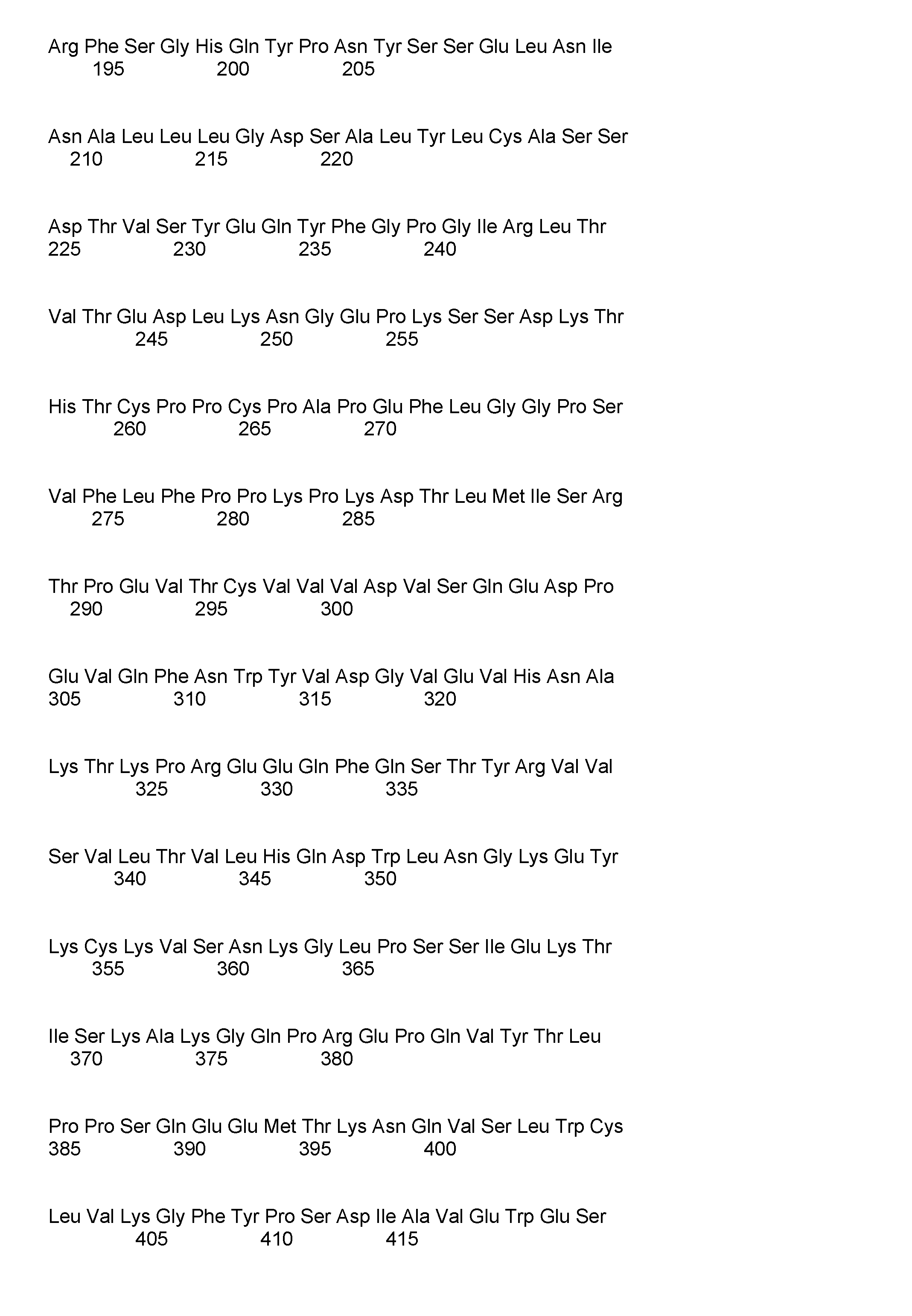 <400> 8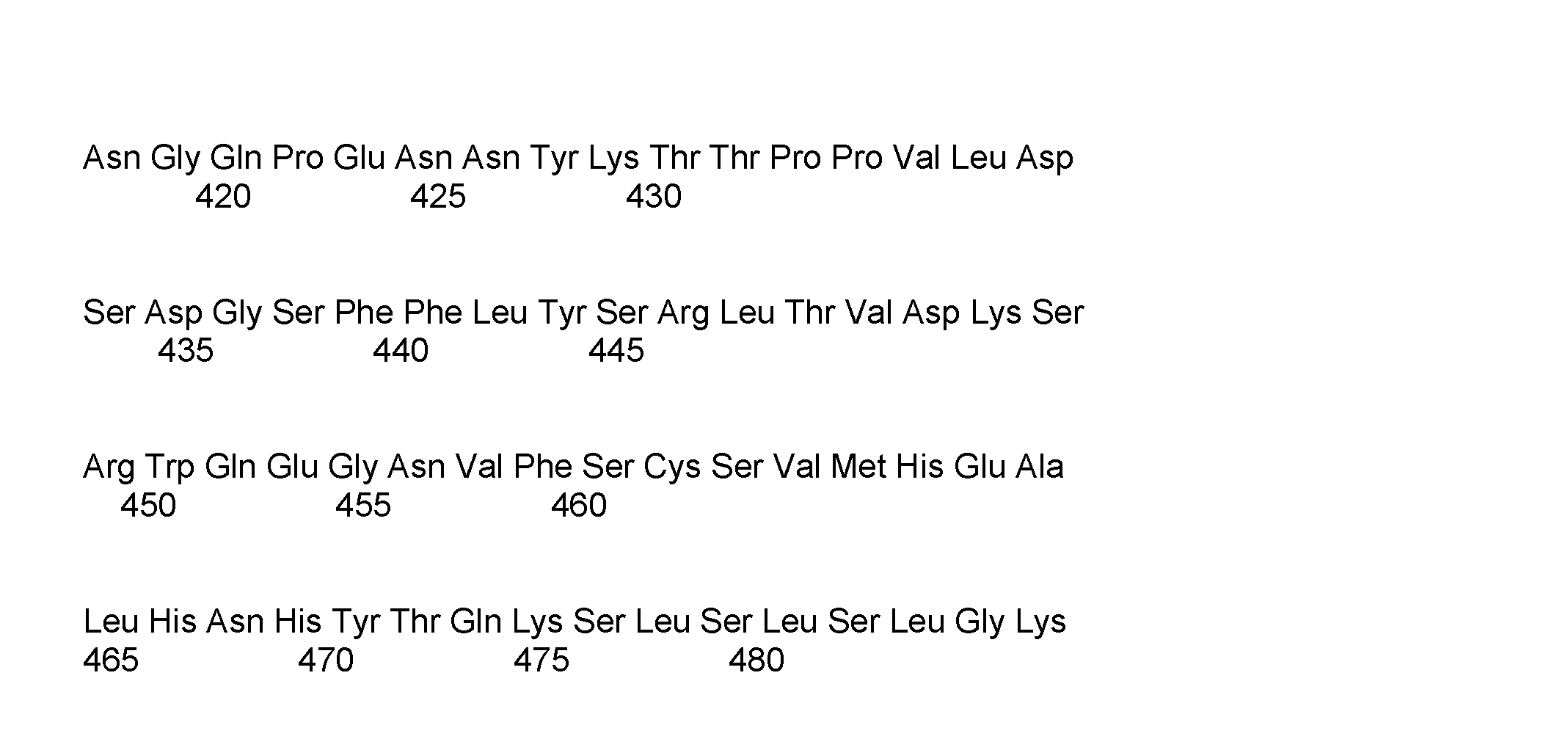
- <210> 9 <211> 461 <212> PRT <213> Homo sapiens<210> 9 <211> 461 <212> PRT <213> Homo sapiens
-
<400> 9
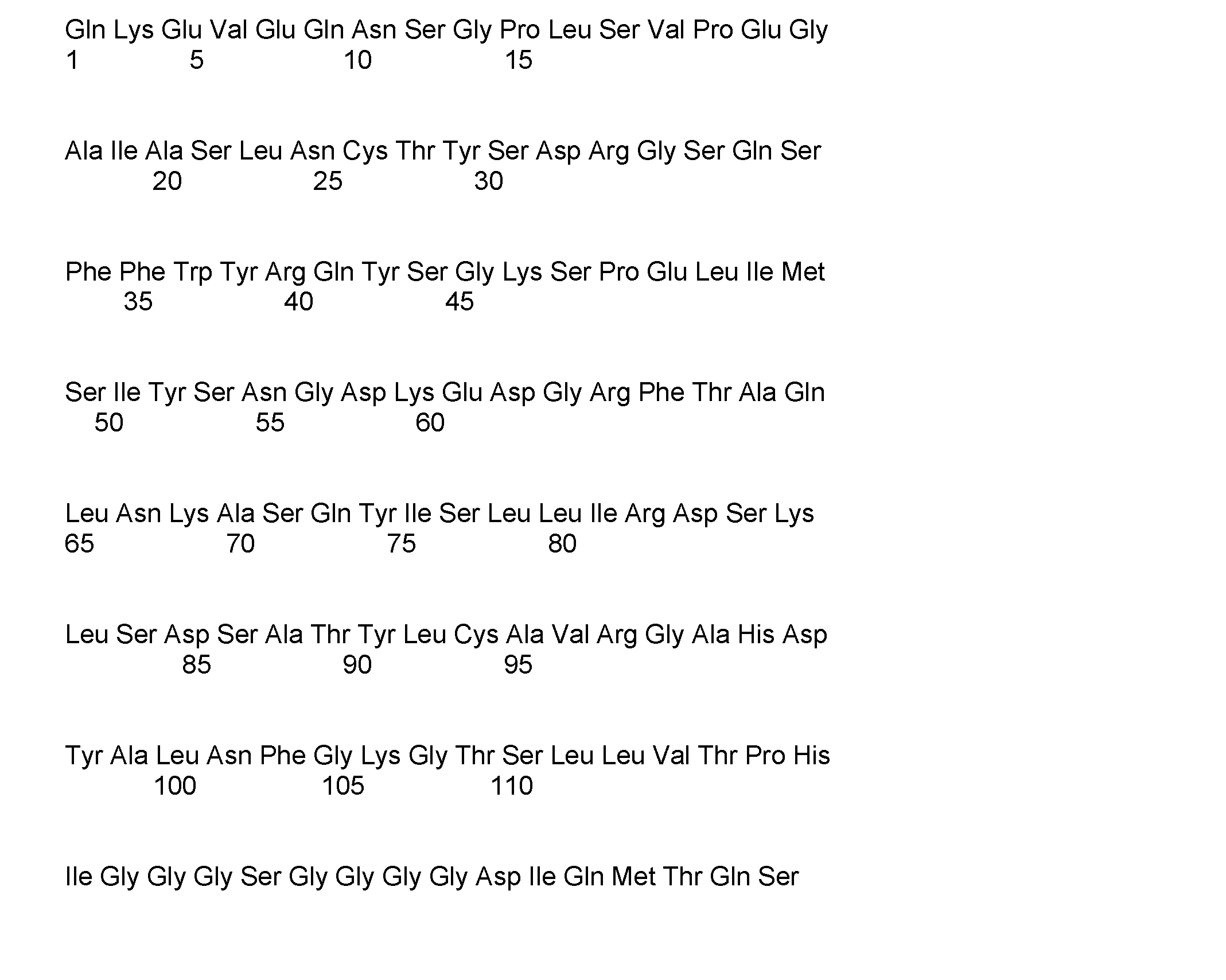
 <400> 9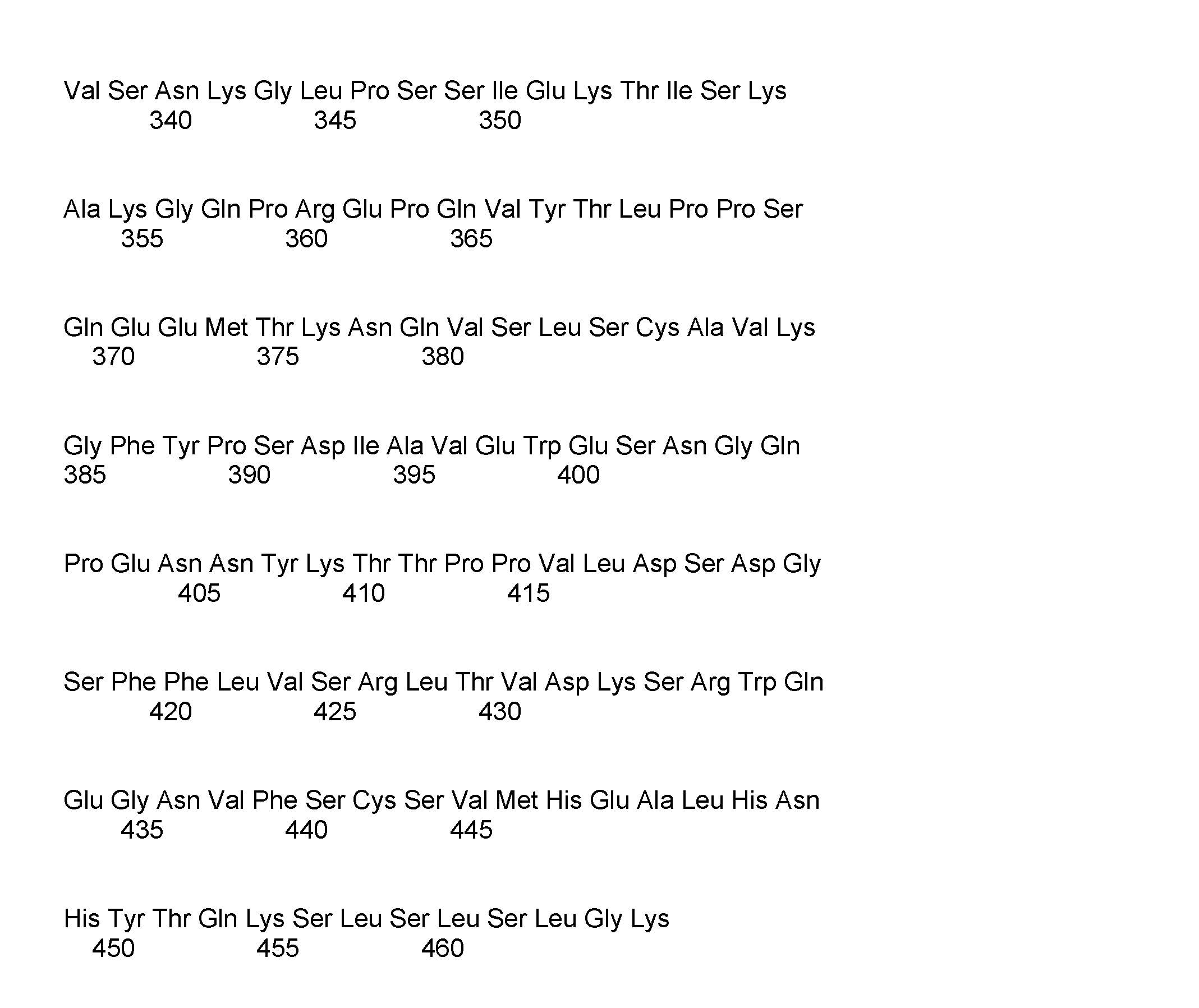
- <210> 10 <211> 478 <212> PRT <213> Homo sapiens<210> 10 <211> 478 <212> PRT <213> Homo sapiens
-
<400> 10

 <400> 10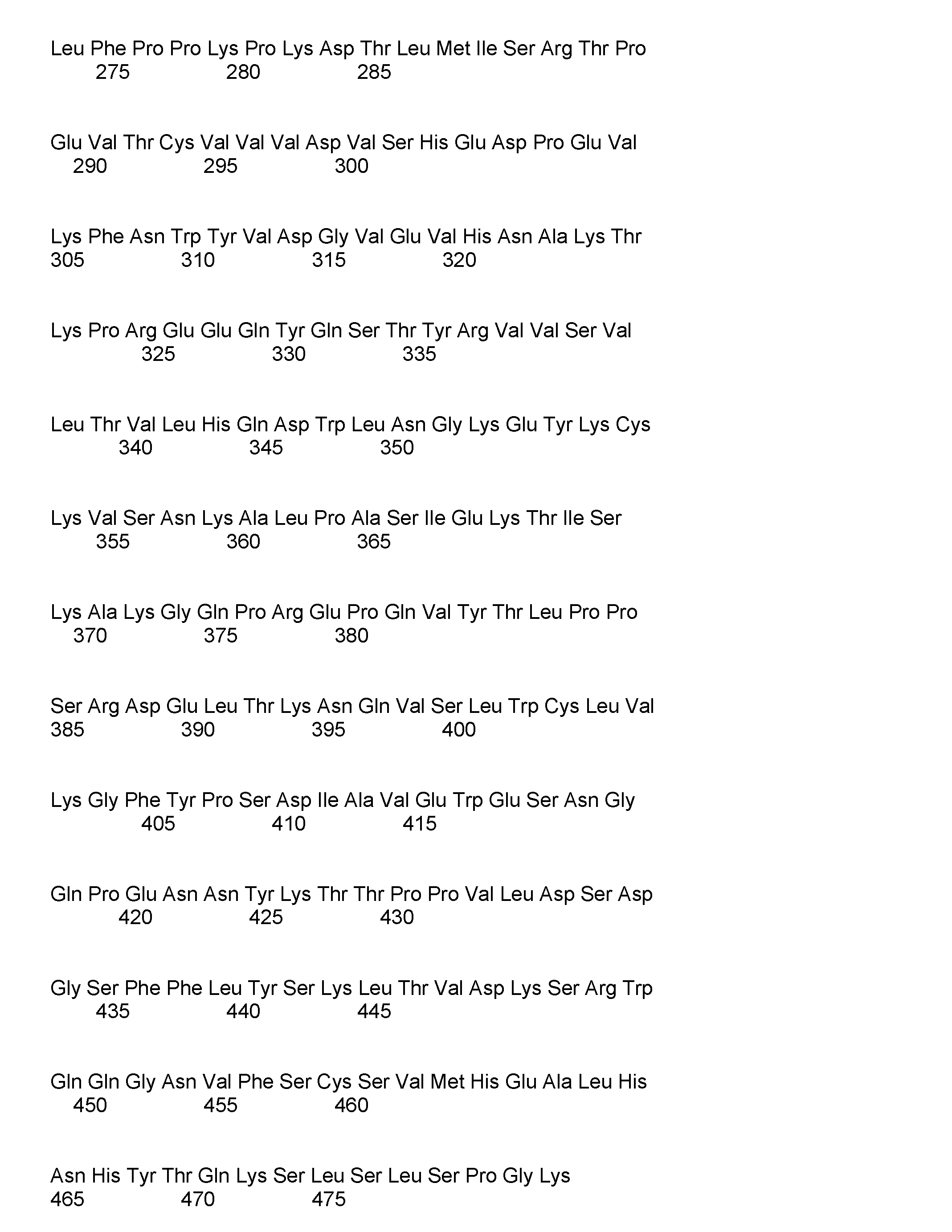
- <210> 11 <211> 459 <212> PRT <213> Homo sapiens<210> 11 <211> 459 <212> PRT <213> Homo sapiens
-
<400> 11

 <400> 11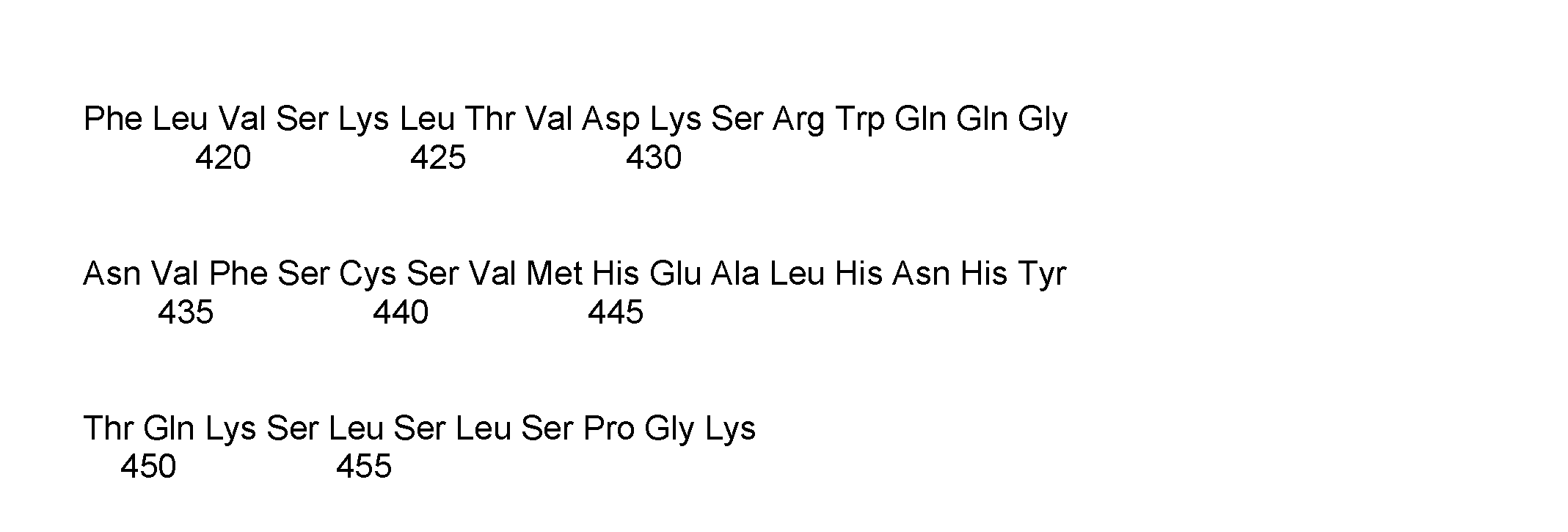
- <210> 12 <211> 478 <212> PRT <213> Homo sapiens<210> 12 <211> 478 <212> PRT <213> Homo sapiens
-
<400> 12

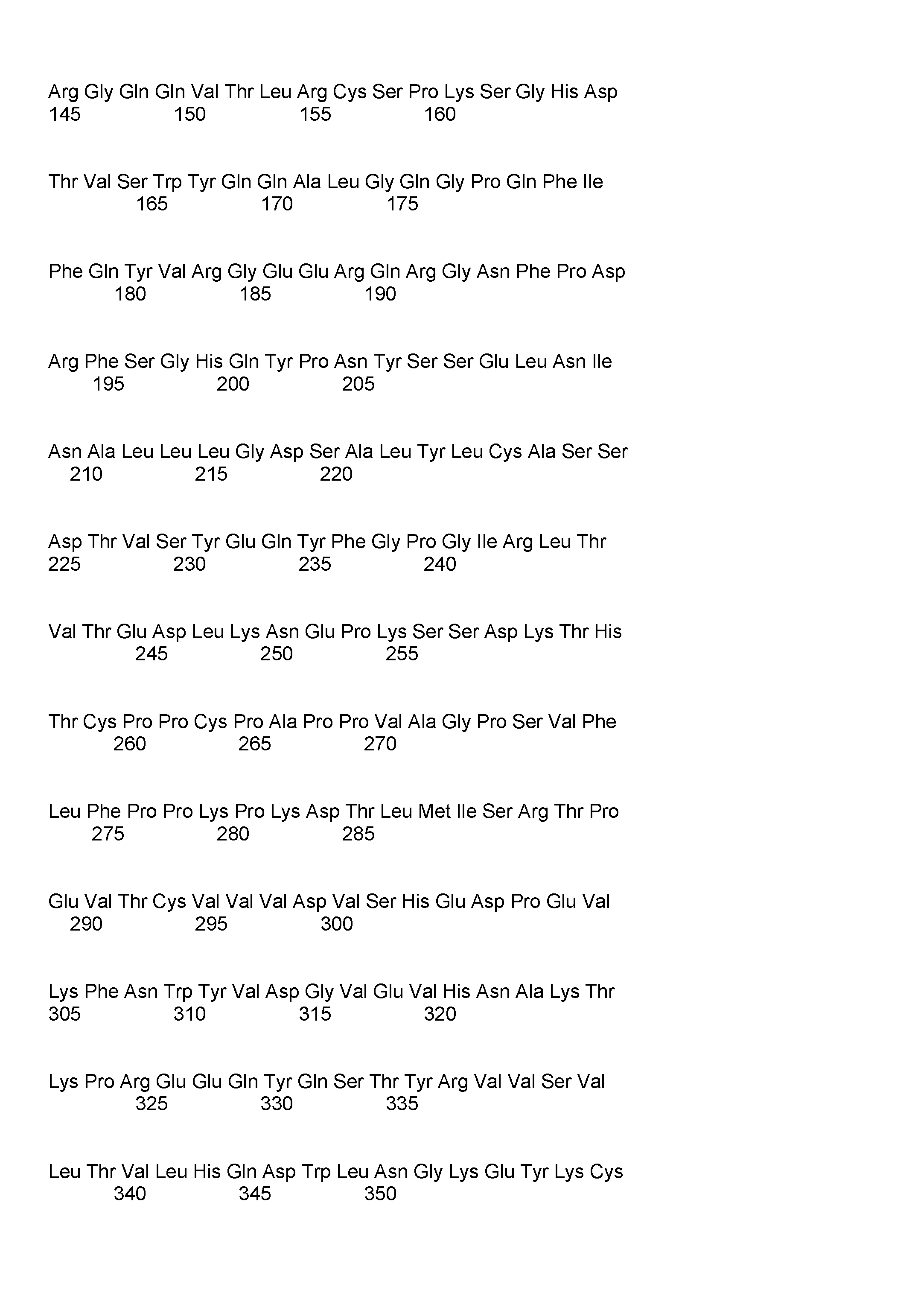 <400> 12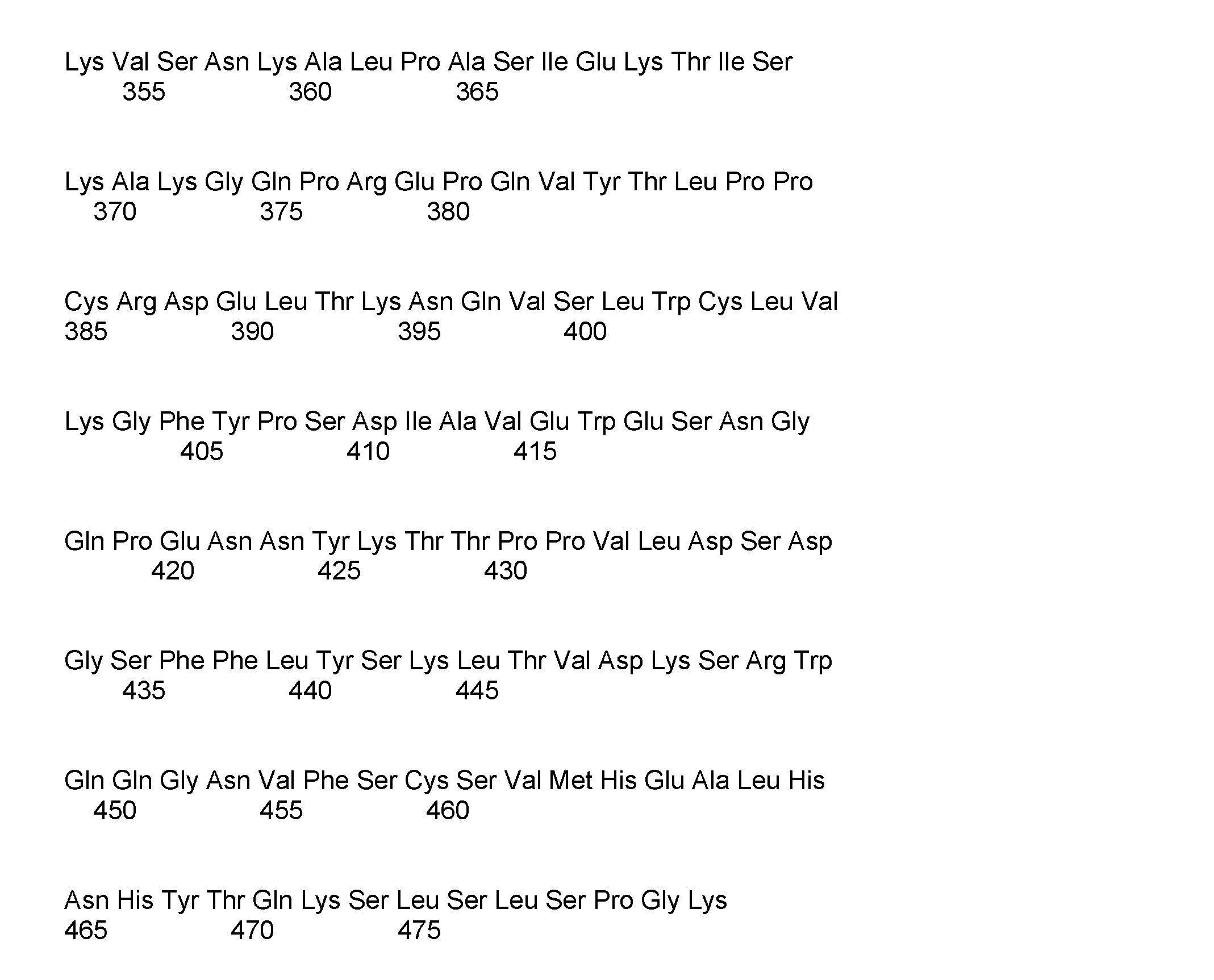
- <210> 13 <211> 459 <212> PRT <213> Homo sapiens<210> 13 <211> 459 <212> PRT <213> Homo sapiens
-
<400> 13

 <400> 13
- <210> 14 <211> 478 <212> PRT <213> Homo sapiens<210> 14 <211> 478 <212> PRT <213> Homo sapiens
-
<400> 14
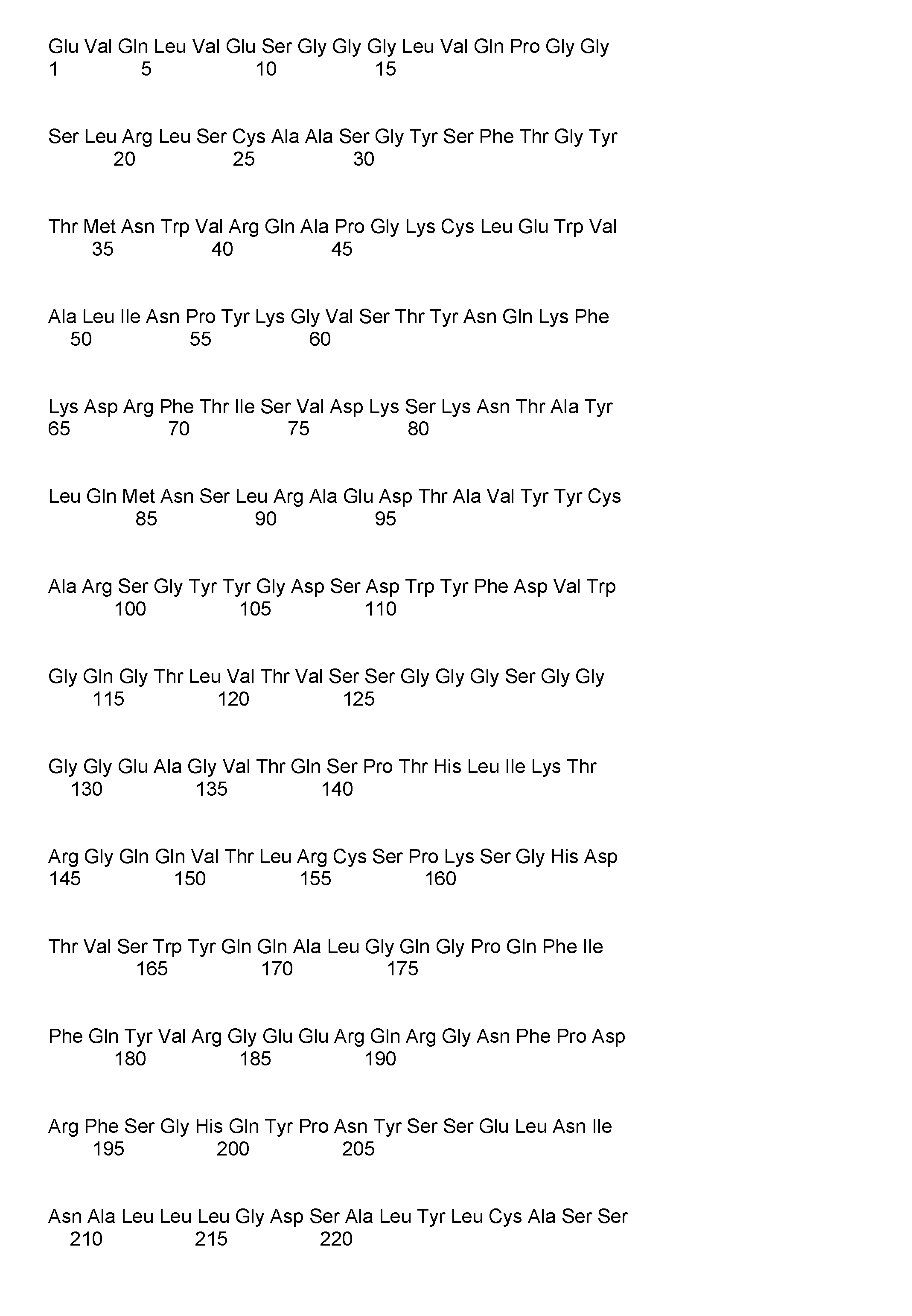
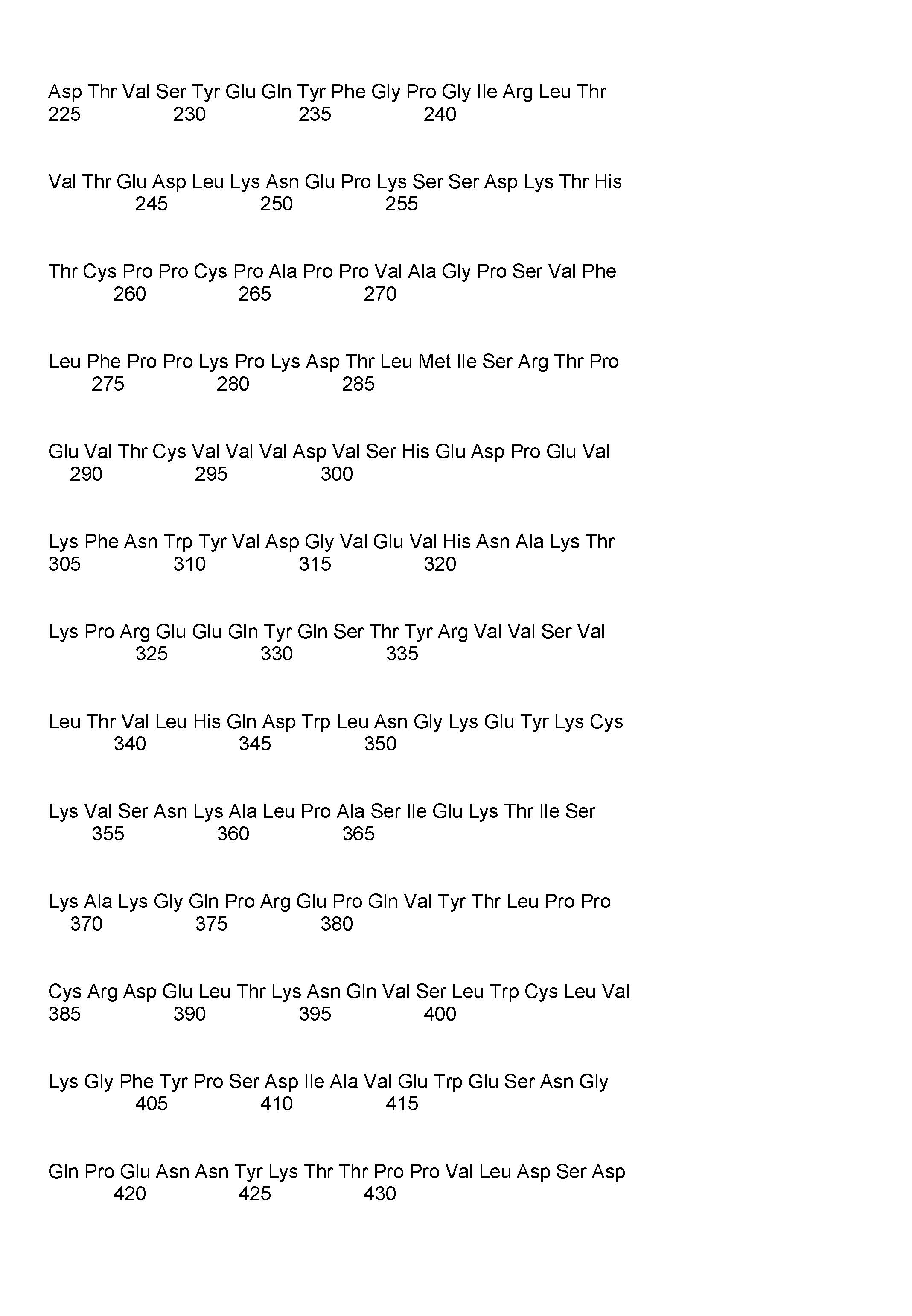 <400> 14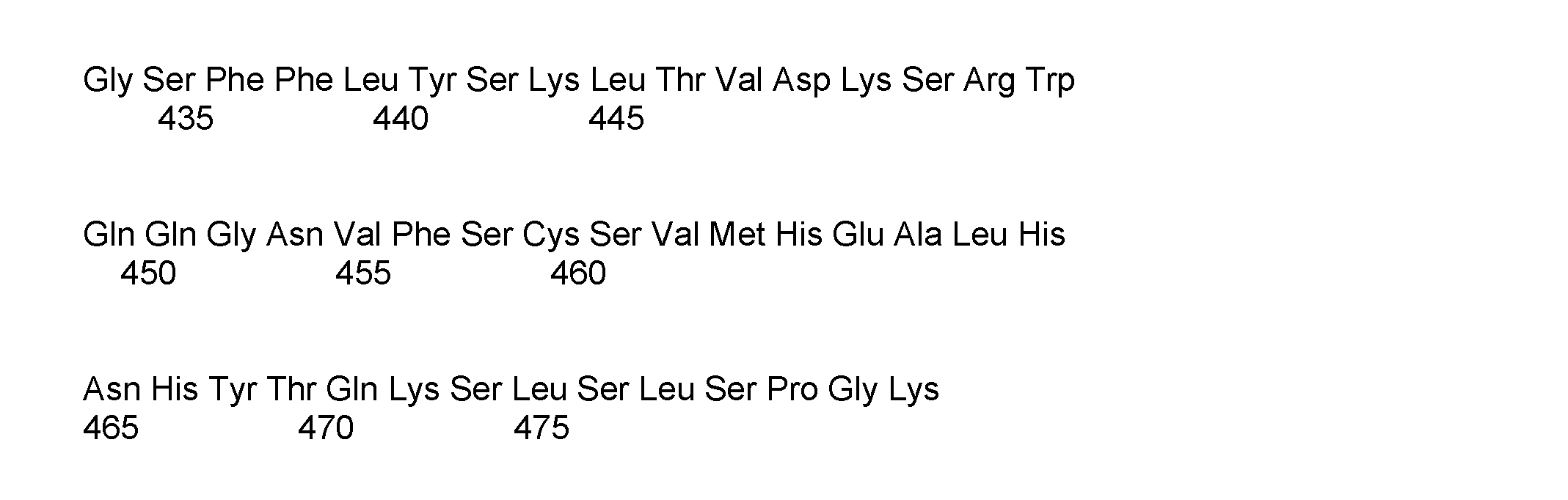
- <210> 15 <211> 459 <212> PRT <213> Homo sapiens<210> 15 <211> 459 <212> PRT <213> Homo sapiens
-
<400> 15
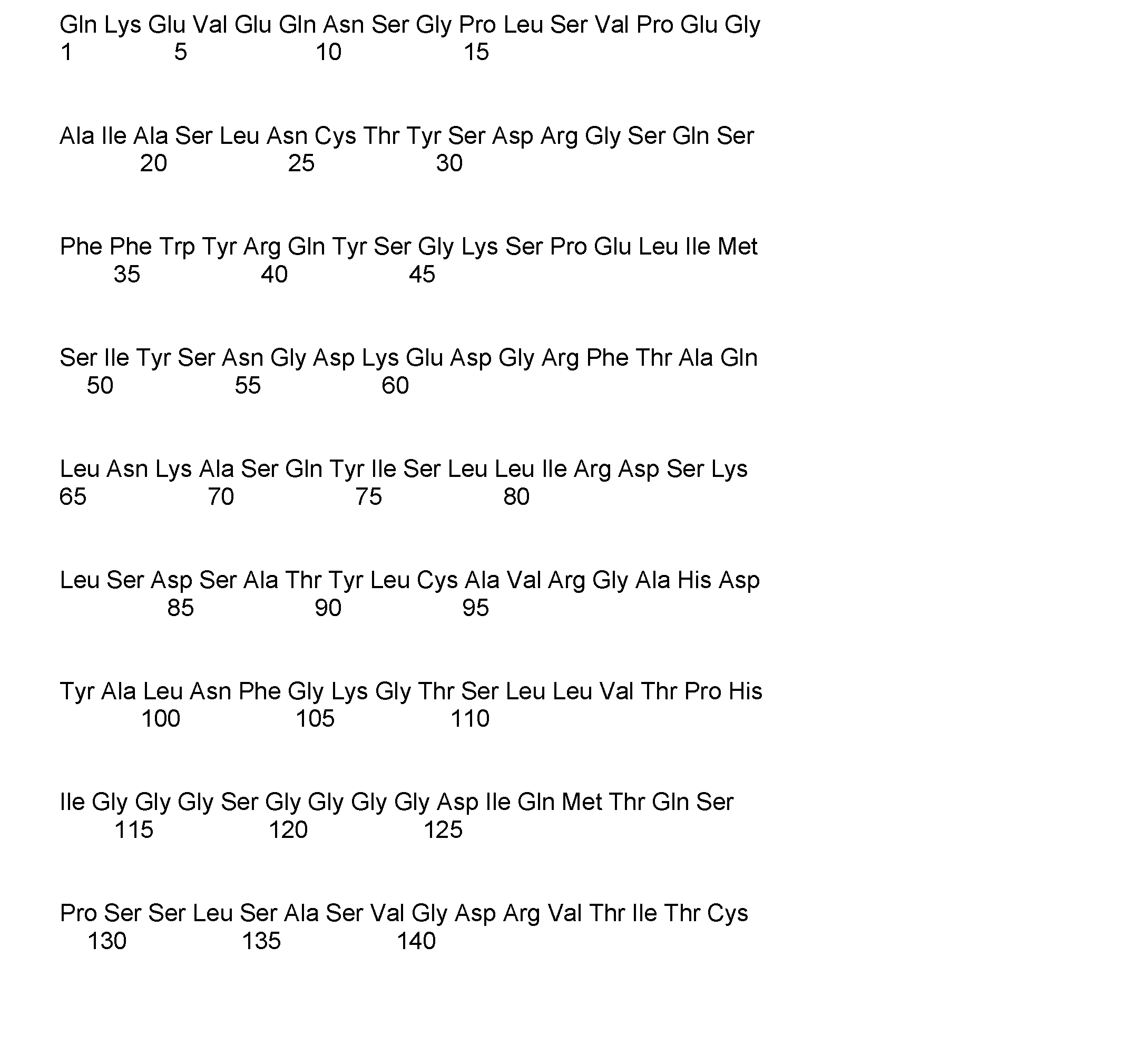
 <400> 15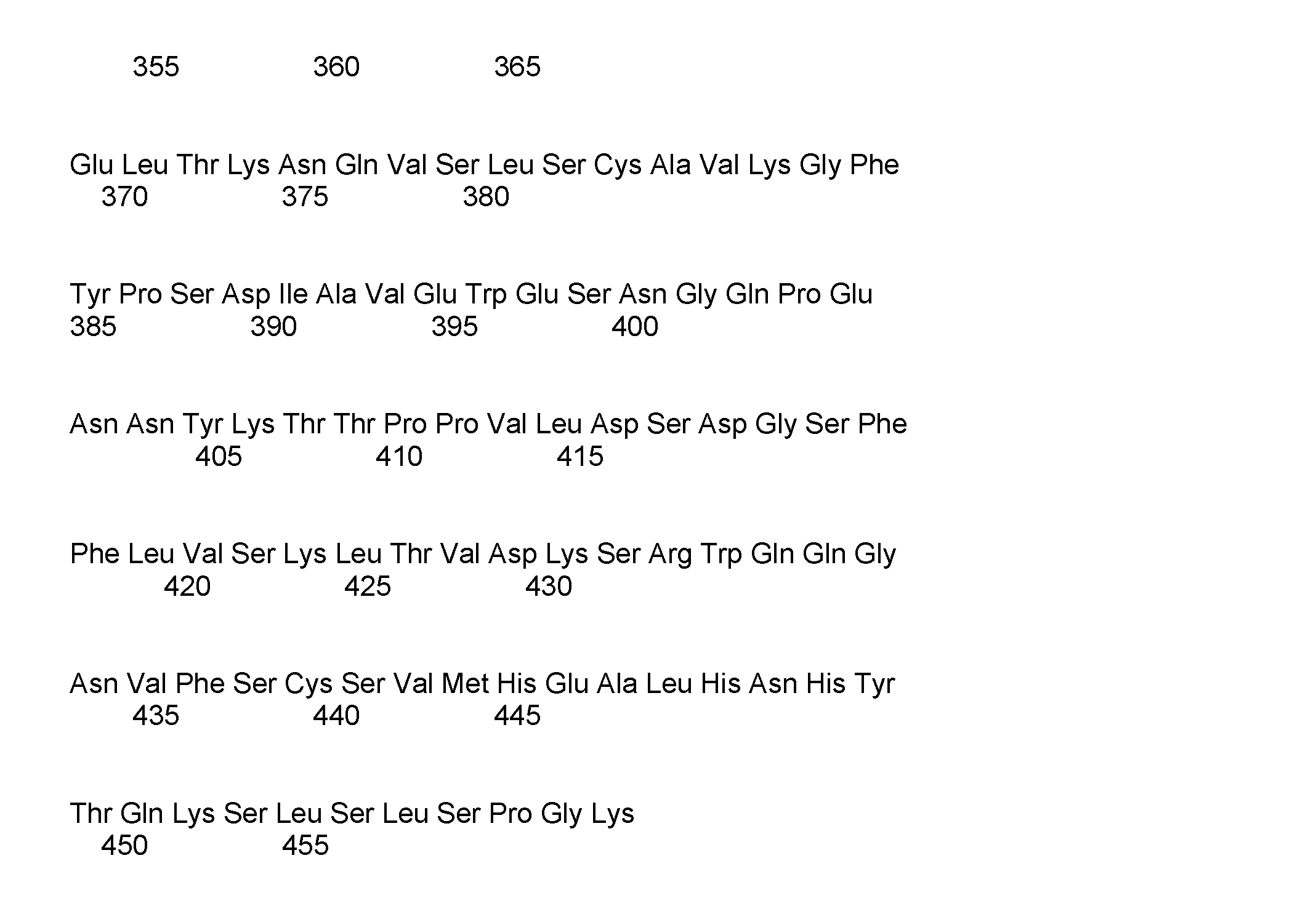
- <210> 16 <211> 474 <212> PRT <213> Homo sapiens<210> 16 <211> 474 <212> PRT <213> Homo sapiens
-
<400> 16

 <400> 16
- <210> 17 <211> 463 <212> PRT <213> Homo sapiens<210> 17 <211> 463 <212> PRT <213> Homo sapiens
-
<400> 17


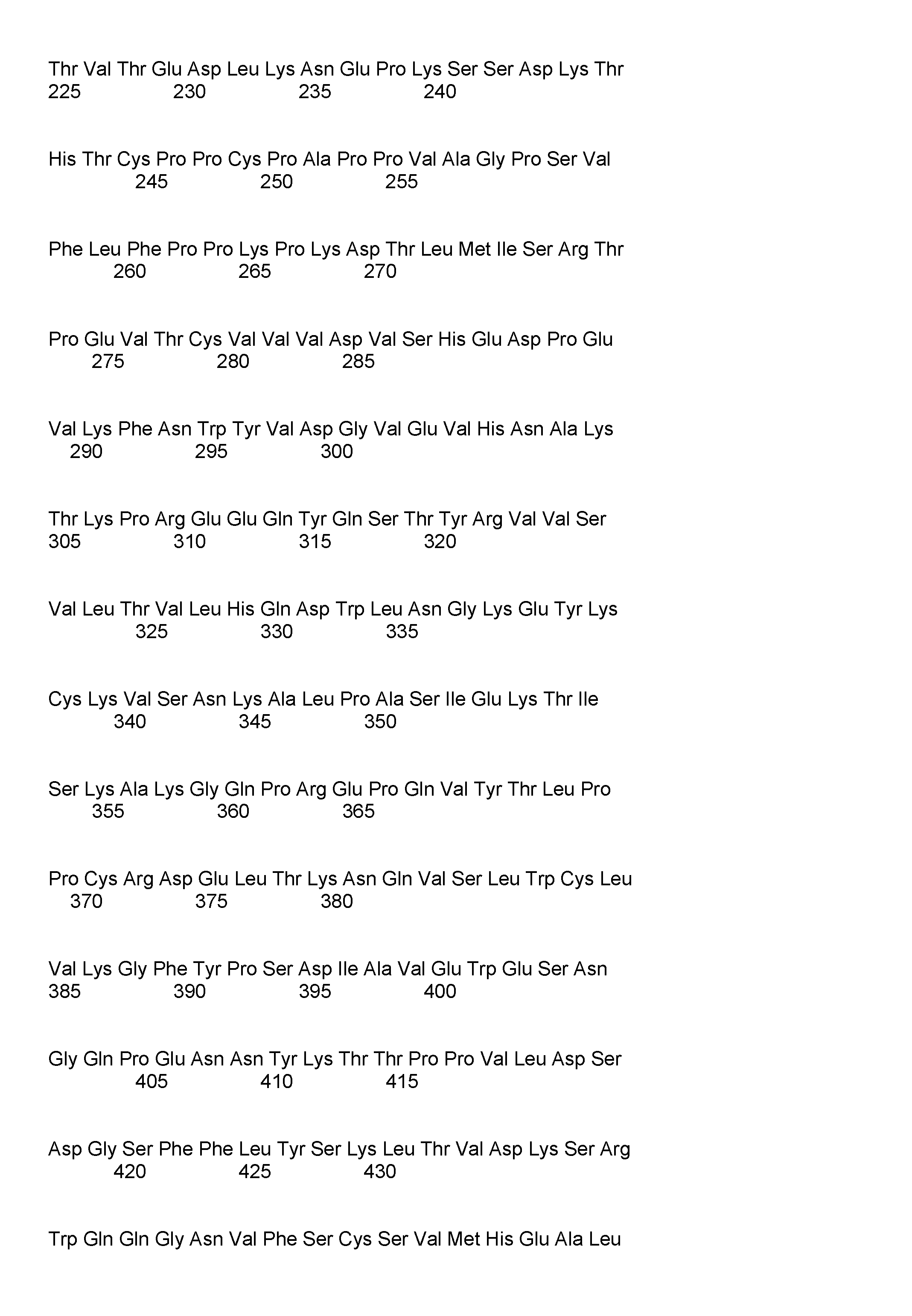 <400> 17
- <210> 18 <211> 462 <212> PRT <213> Homo sapiens<210> 18 <211> 462 <212> PRT <213> Homo sapiens
-
<400> 18
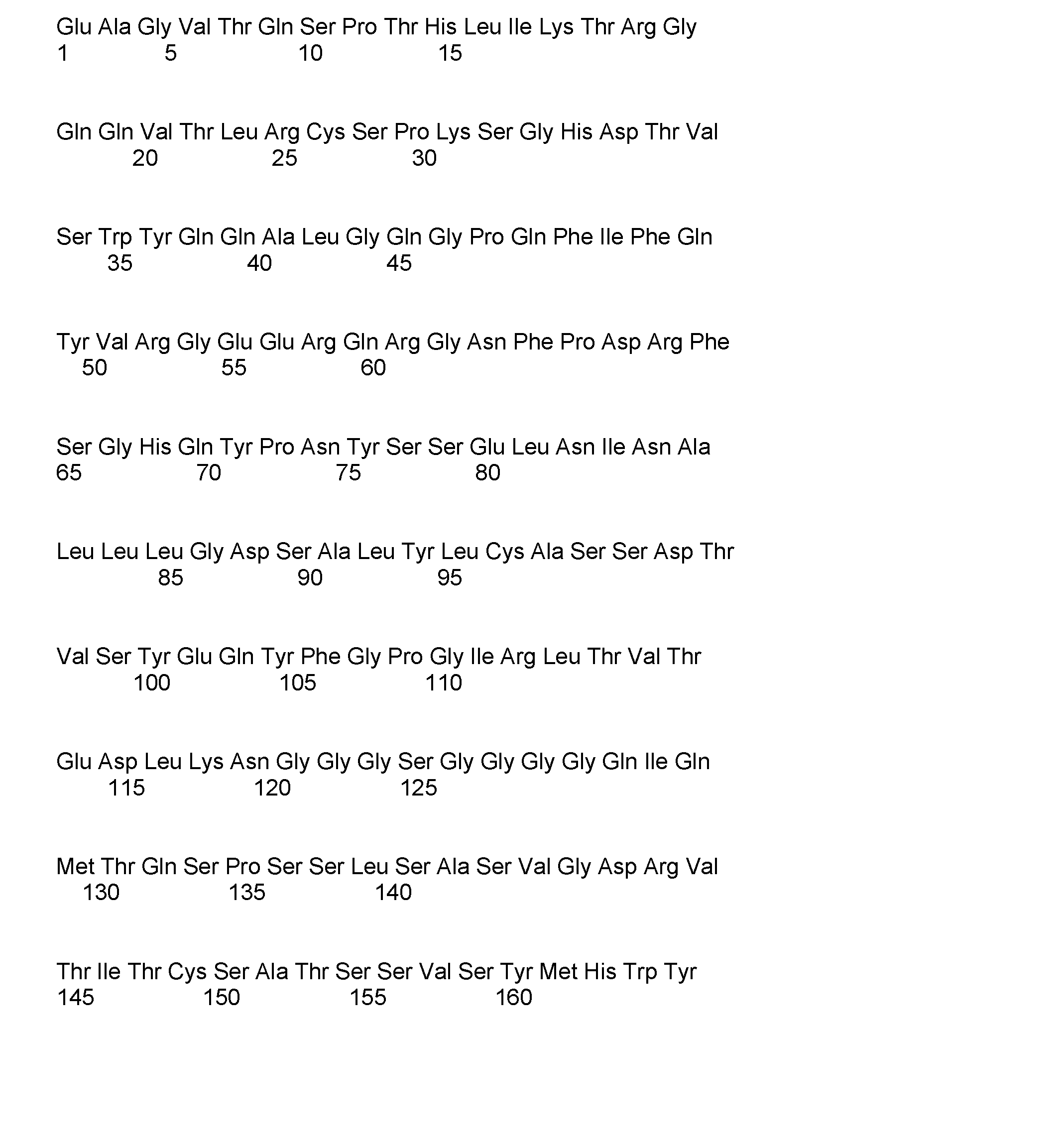
 <400> 18
- <210> 19 <211> 472 <212> PRT <213> Homo sapiens<210> 19 <211> 472 <212> PRT <213> Homo sapiens
-
<400> 19
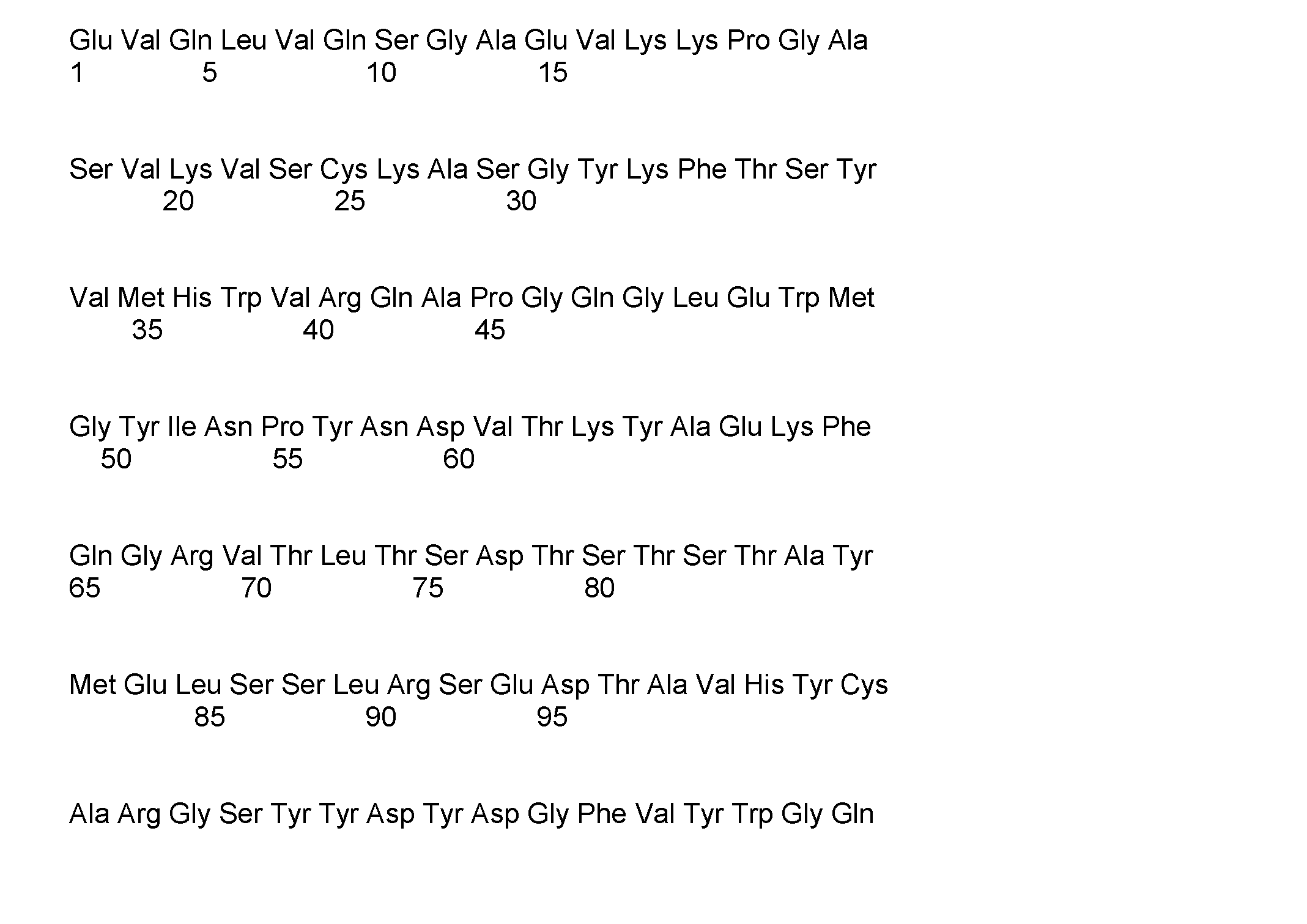
 <400> 19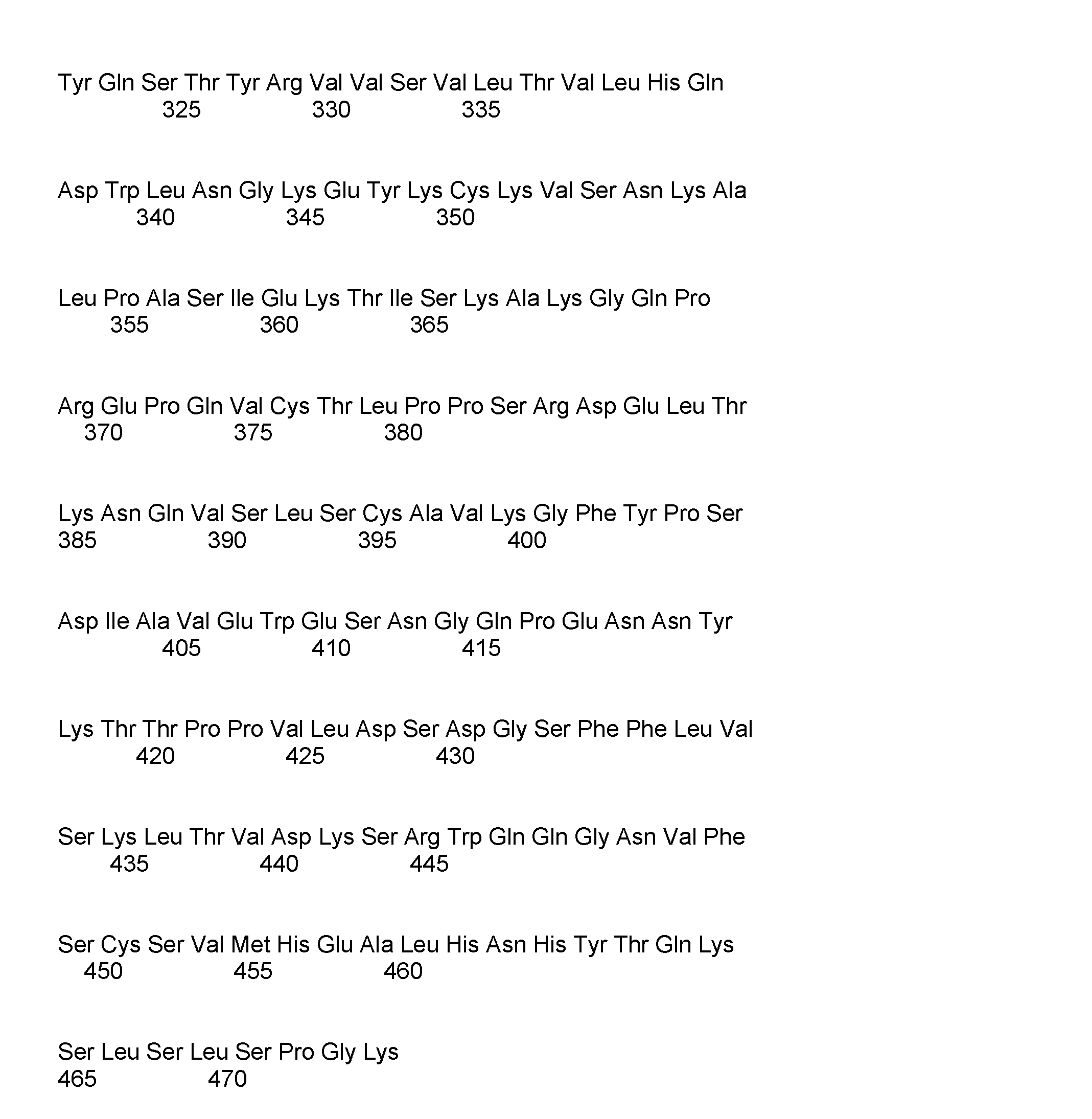
- <210> 20 <211> 467 <212> PRT <213> Homo sapiens<210> 20 <211> 467 <212> PRT <213> Homo sapiens
-
<400> 20

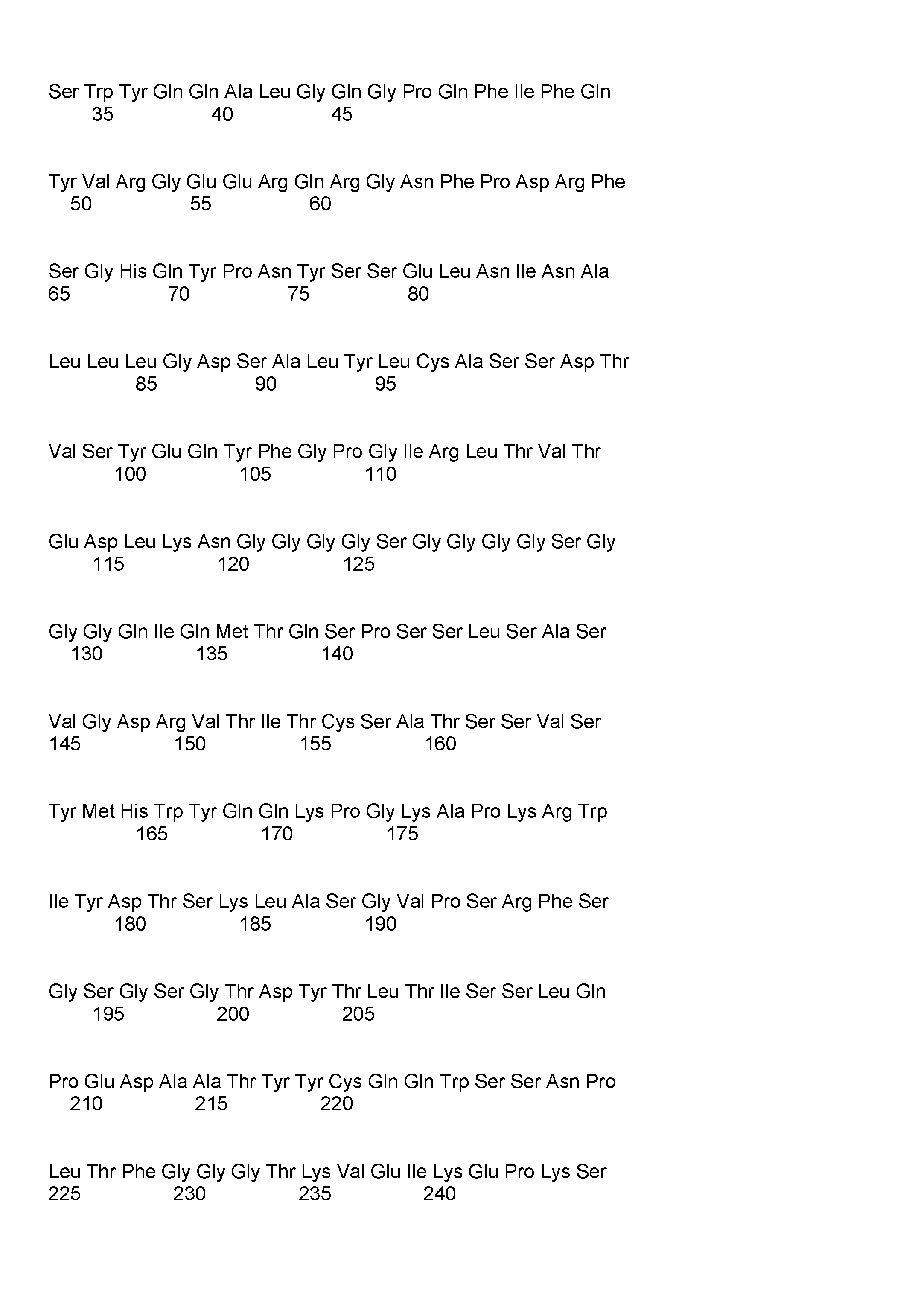
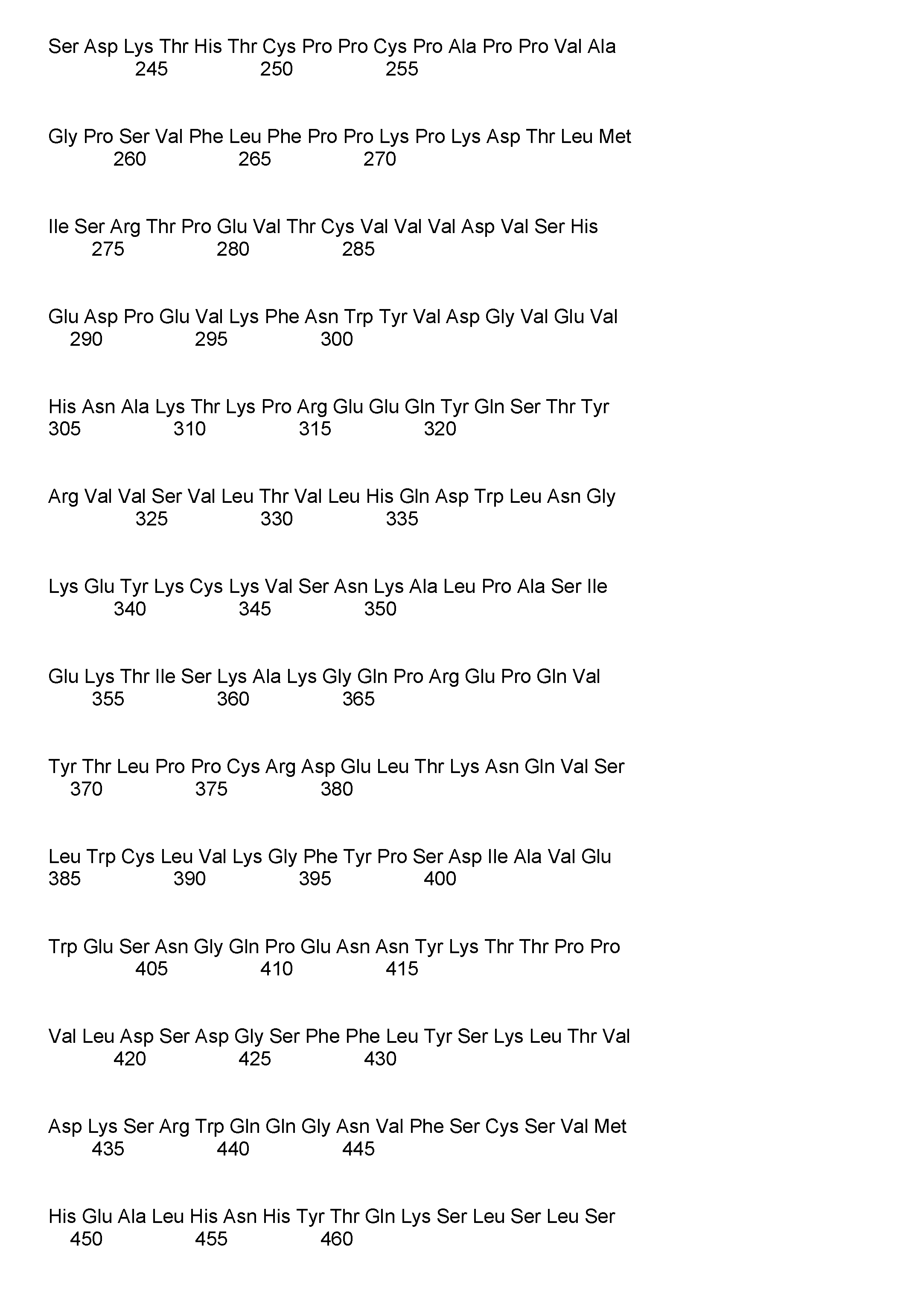 <400> 20
- <210> 21 <211> 472 <212> PRT <213> Homo sapiens<210> 21 <211> 472 <212> PRT <213> Homo sapiens
-
<400> 21
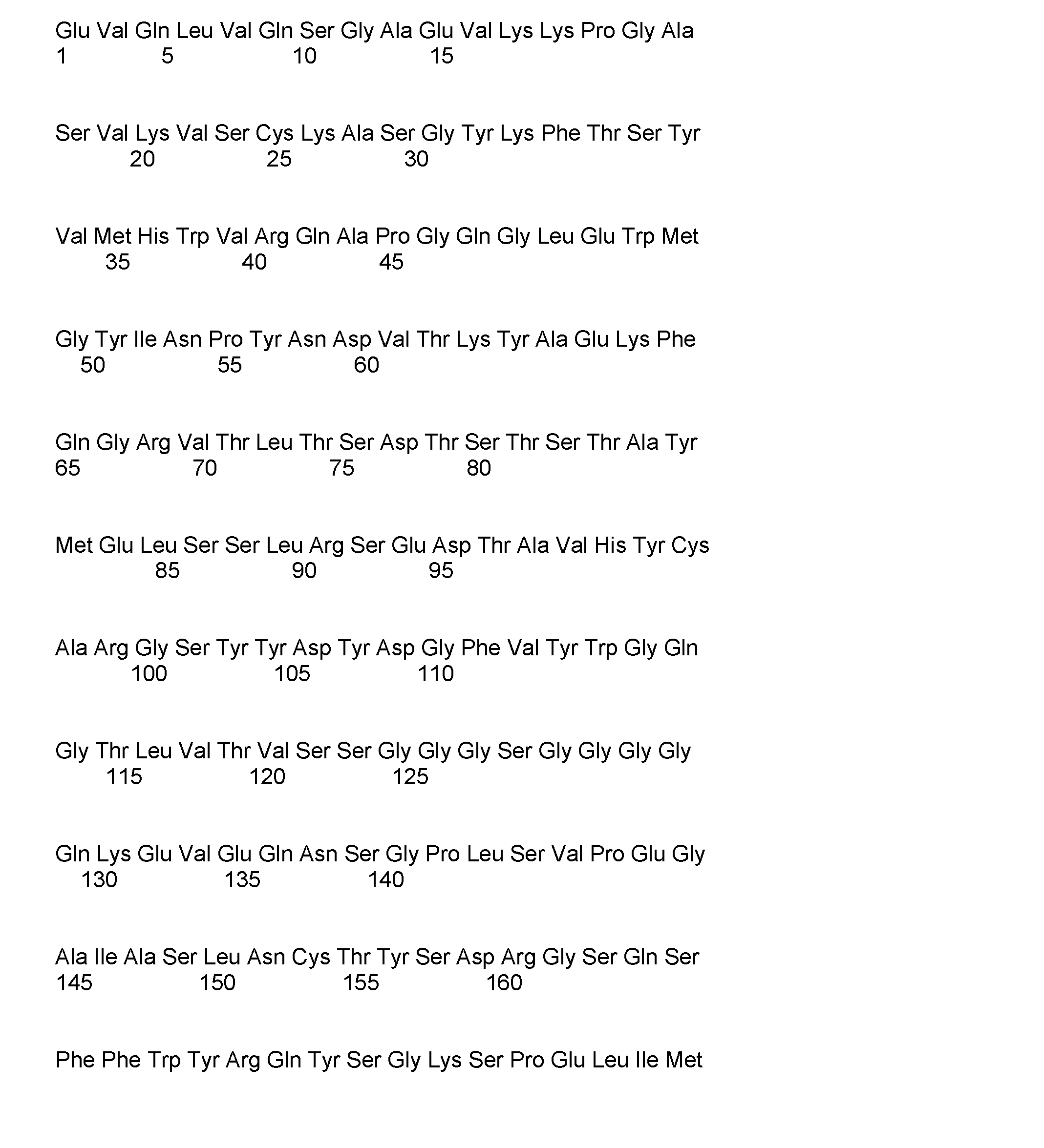
 <400> 21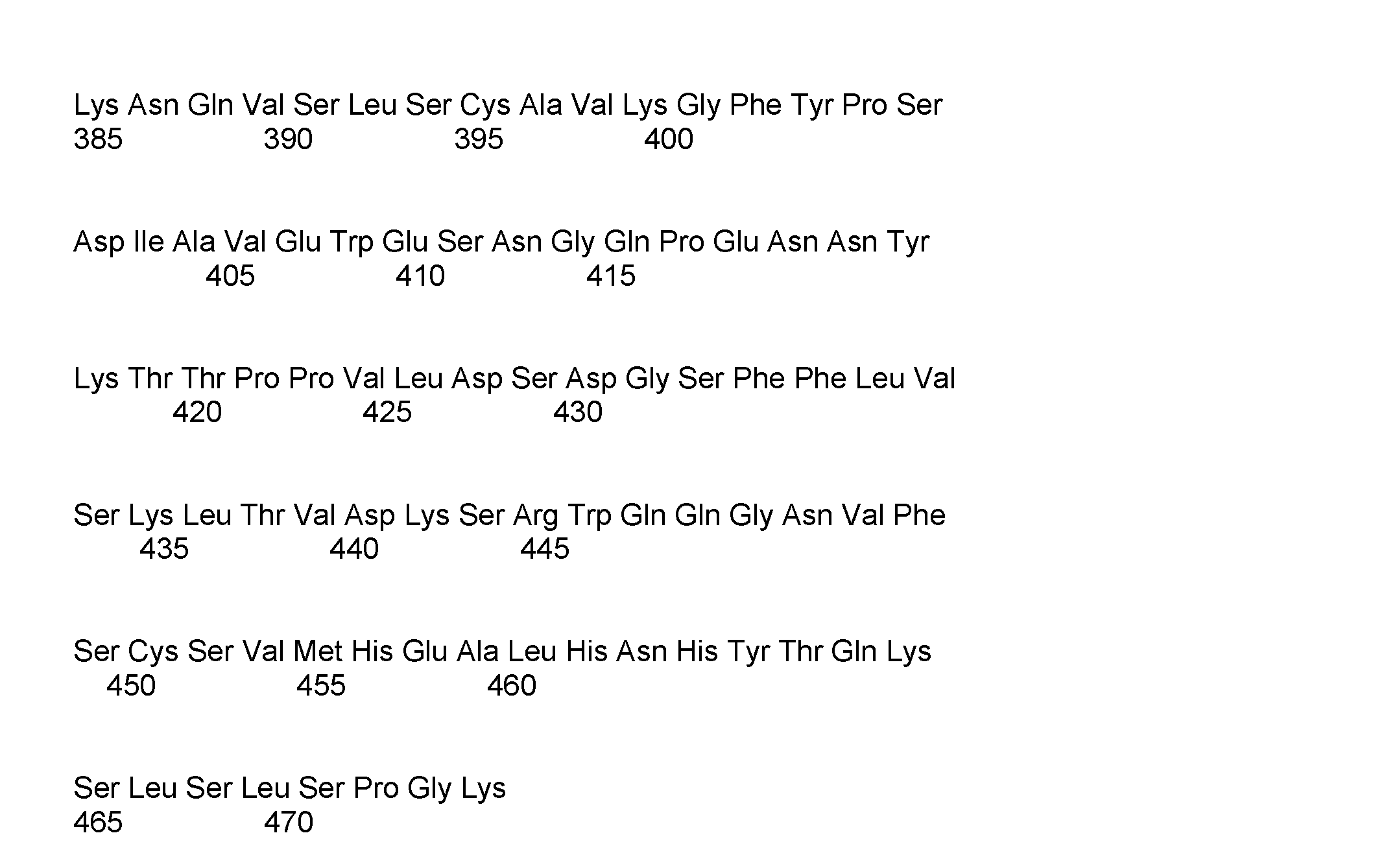
- <210> 22 <211> 462 <212> PRT <213> Homo sapiens<210> 22 <211> 462 <212> PRT <213> Homo sapiens
-
<400> 22
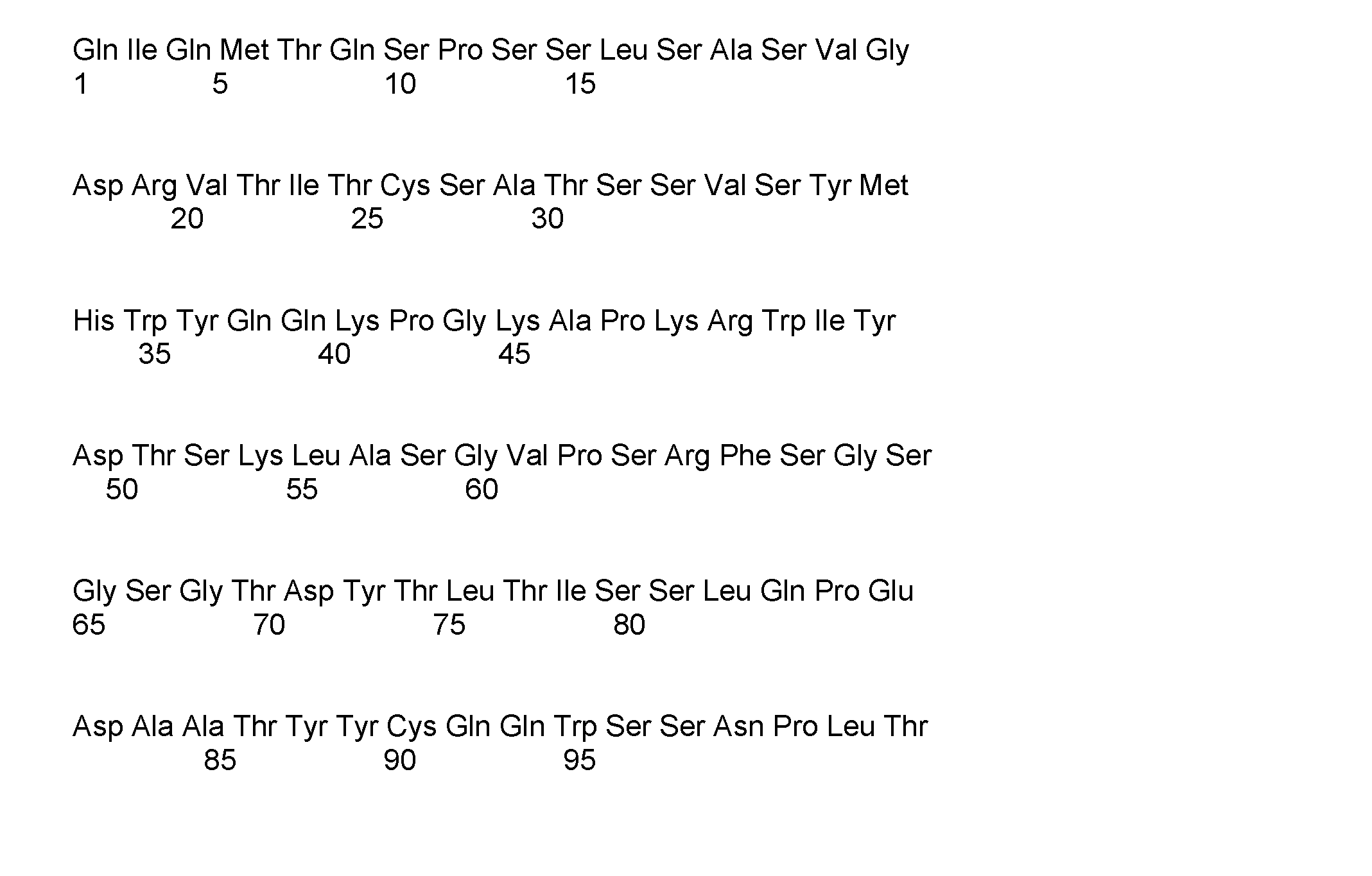
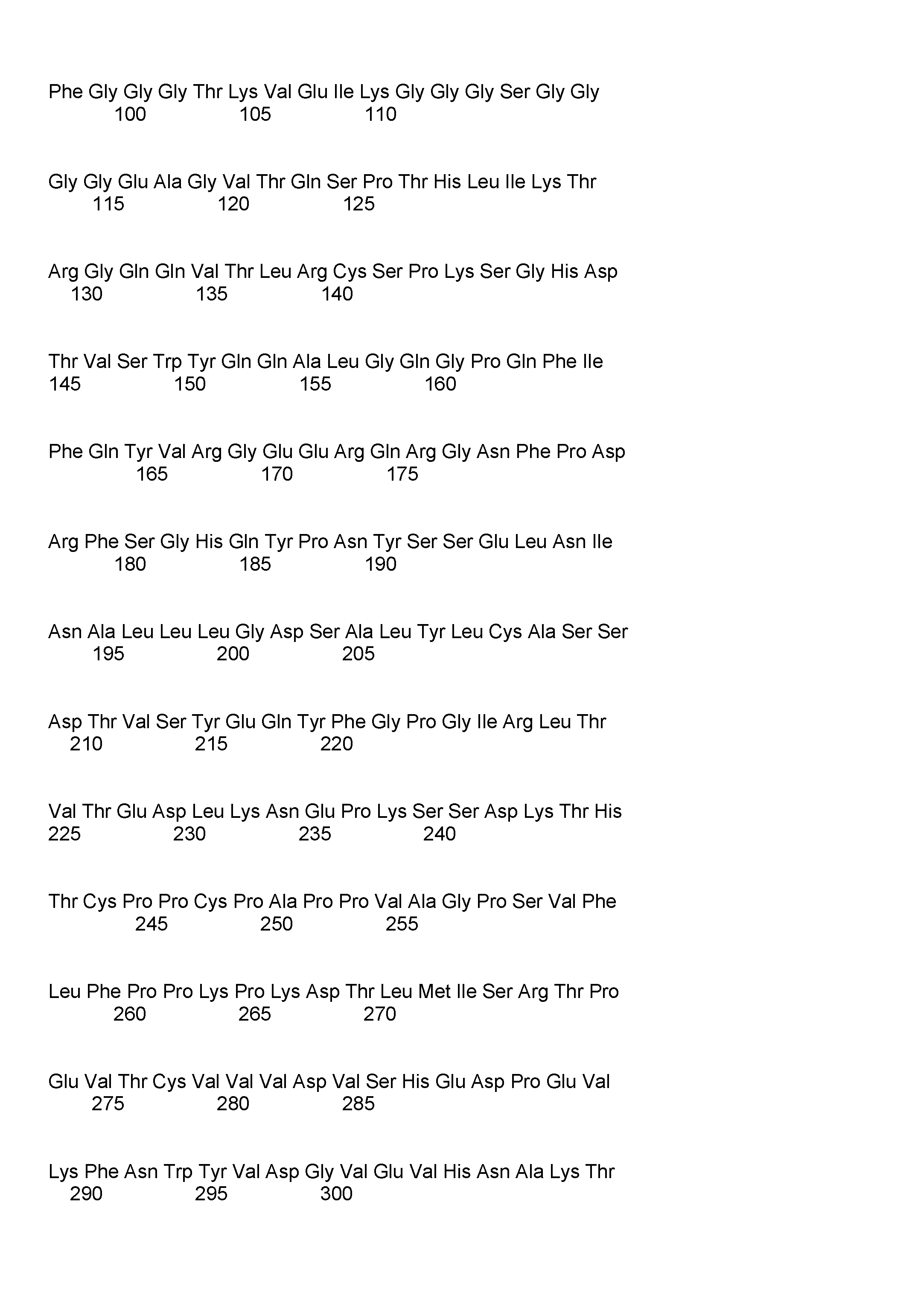 <400> 22
- <210> 23 <211> 472 <212> PRT <213> Homo sapiens<210> 23 <211> 472 <212> PRT <213> Homo sapiens
-
<400> 23
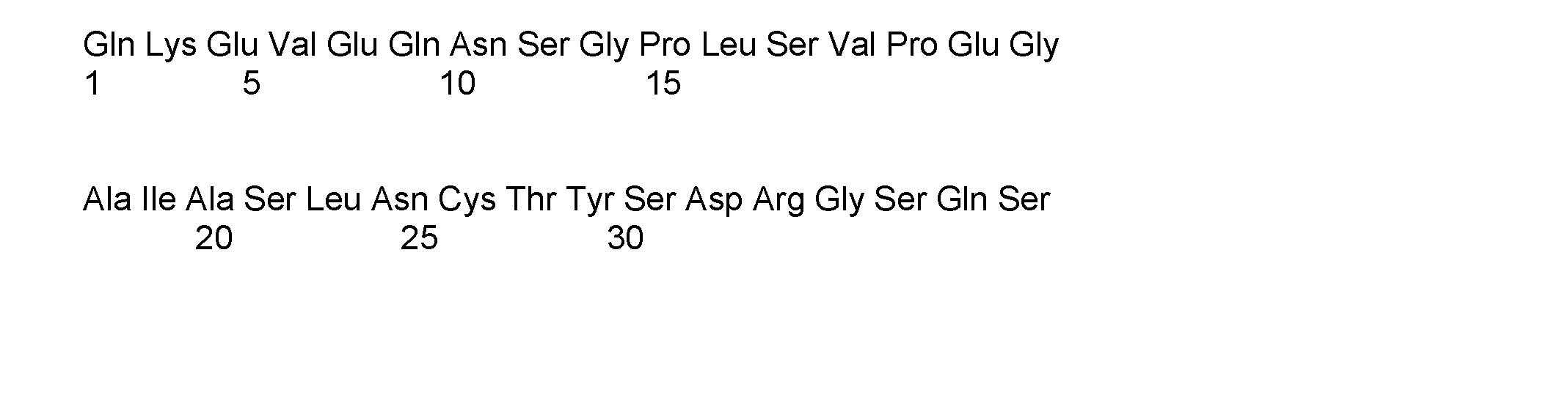
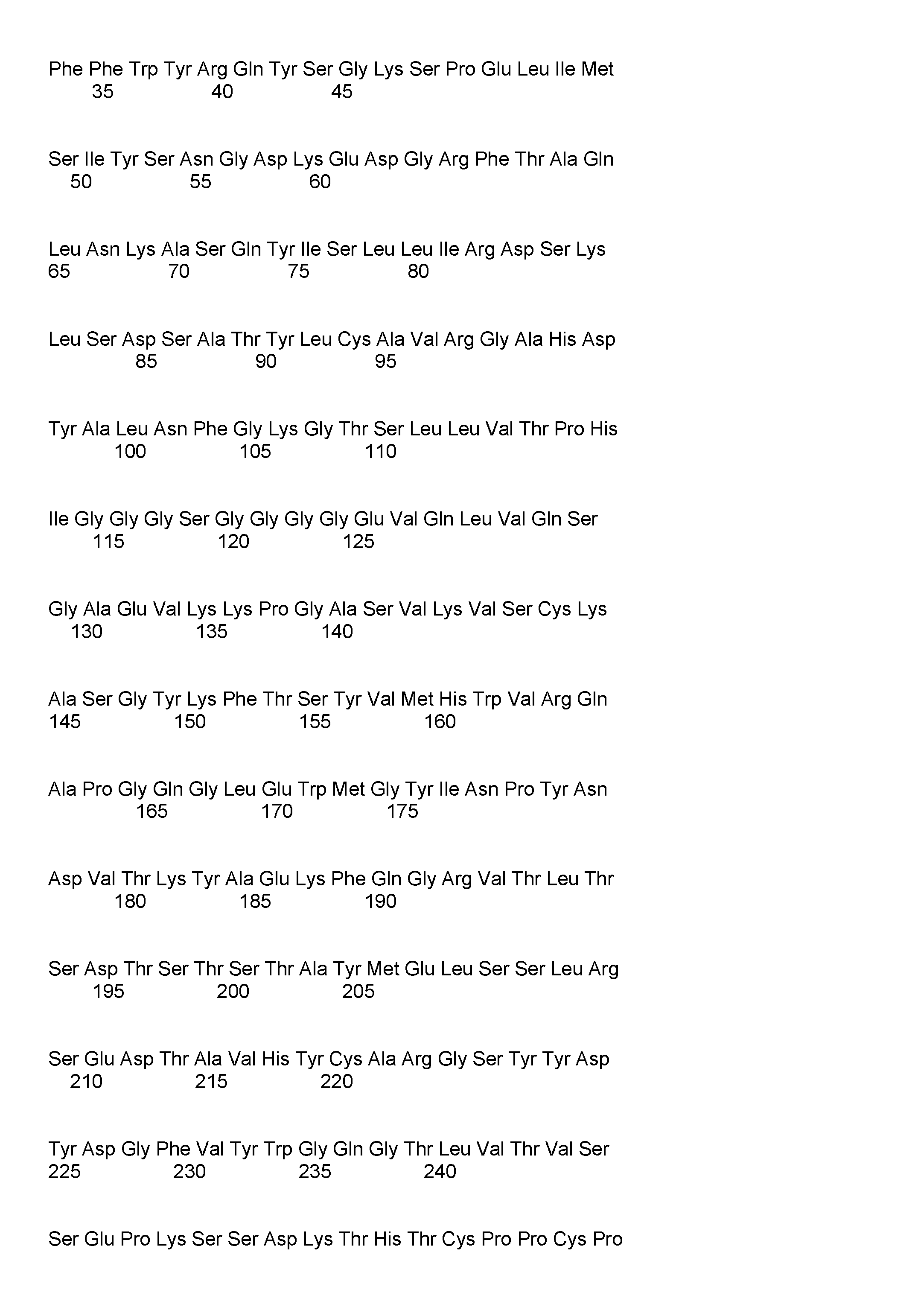
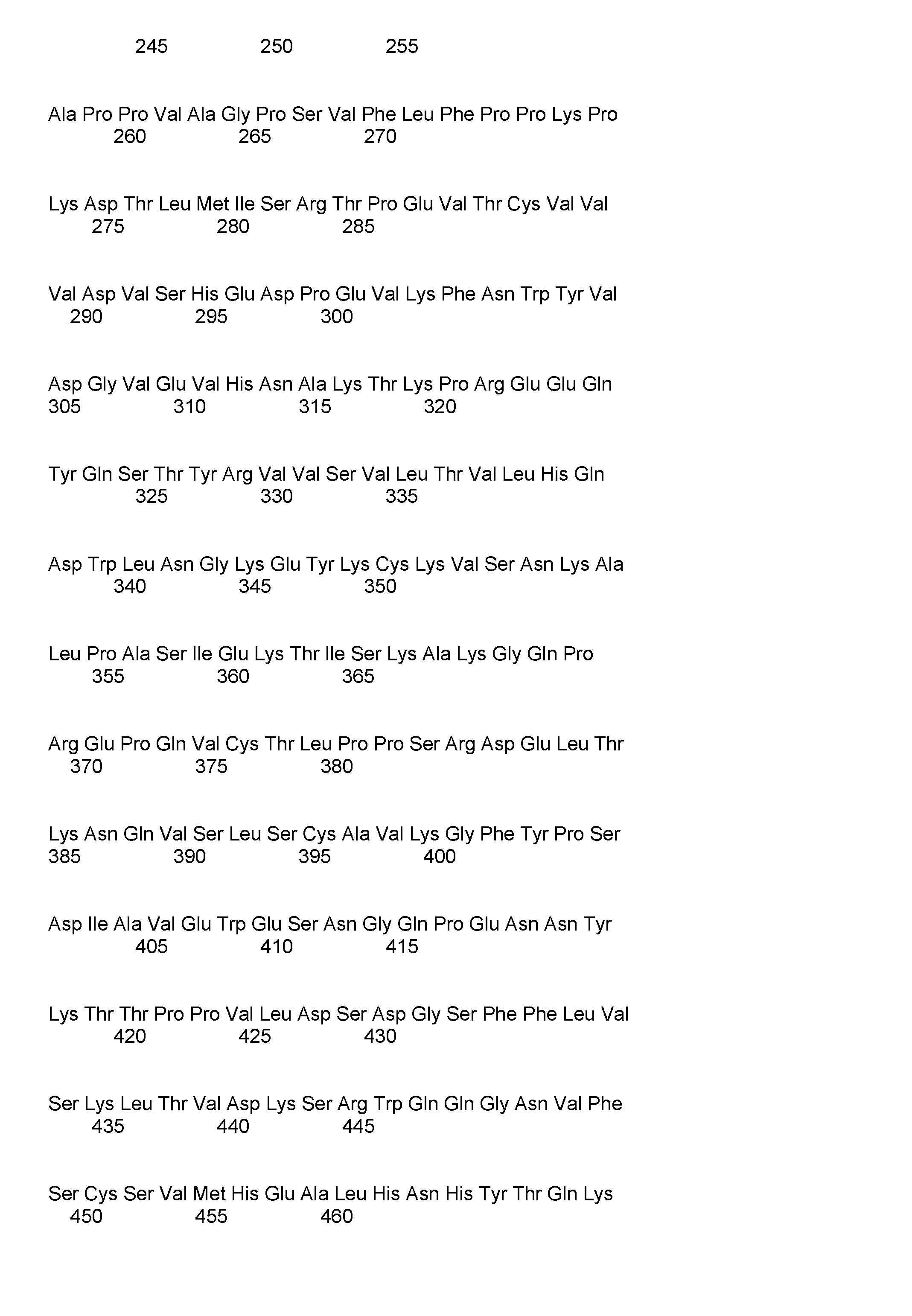 <400> 23
- <210> 24 <211> 468 <212> PRT <213> Homo sapiens<210> 24 <211> 468 <212> PRT <213> Homo sapiens
-
<400> 24
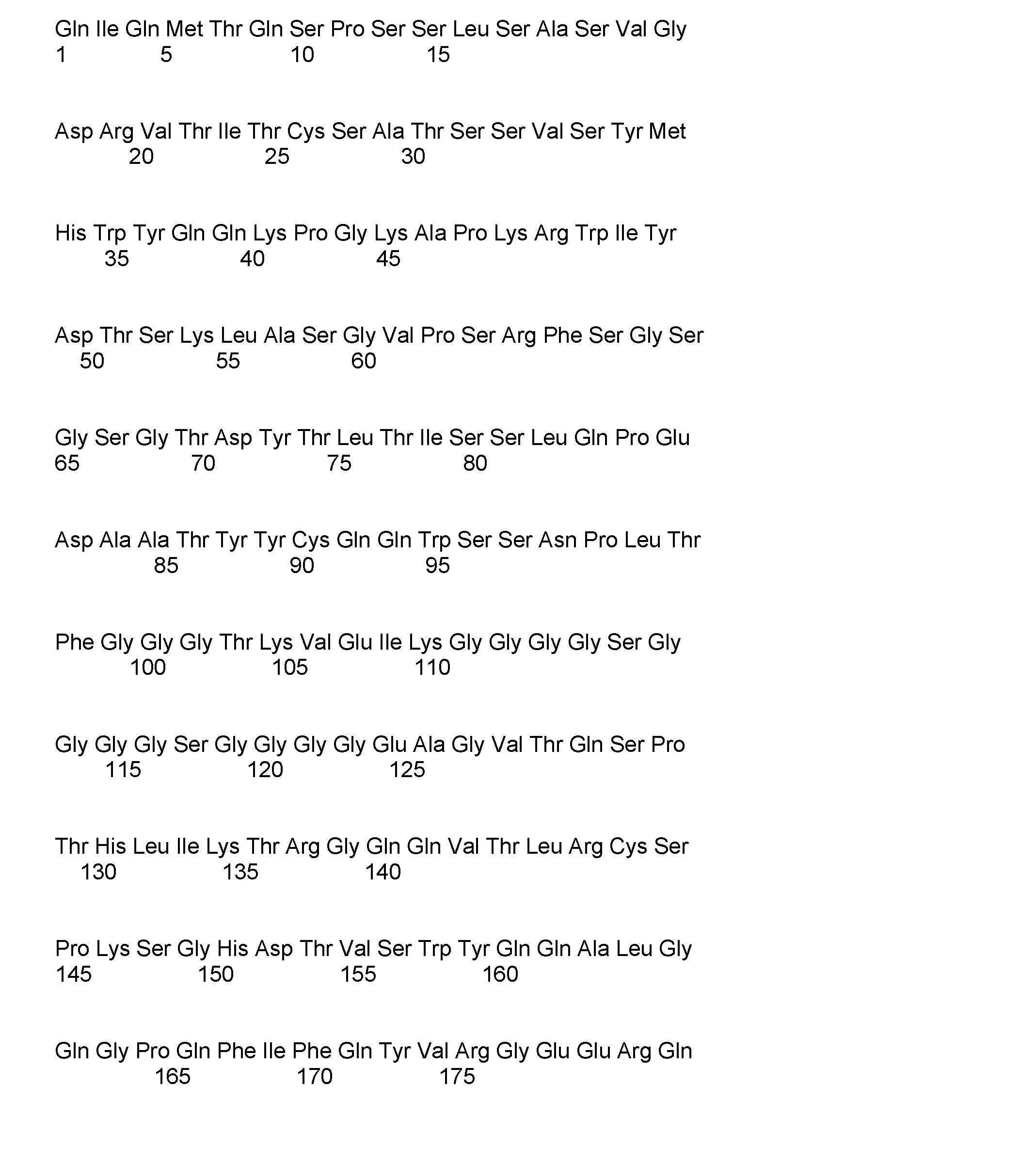
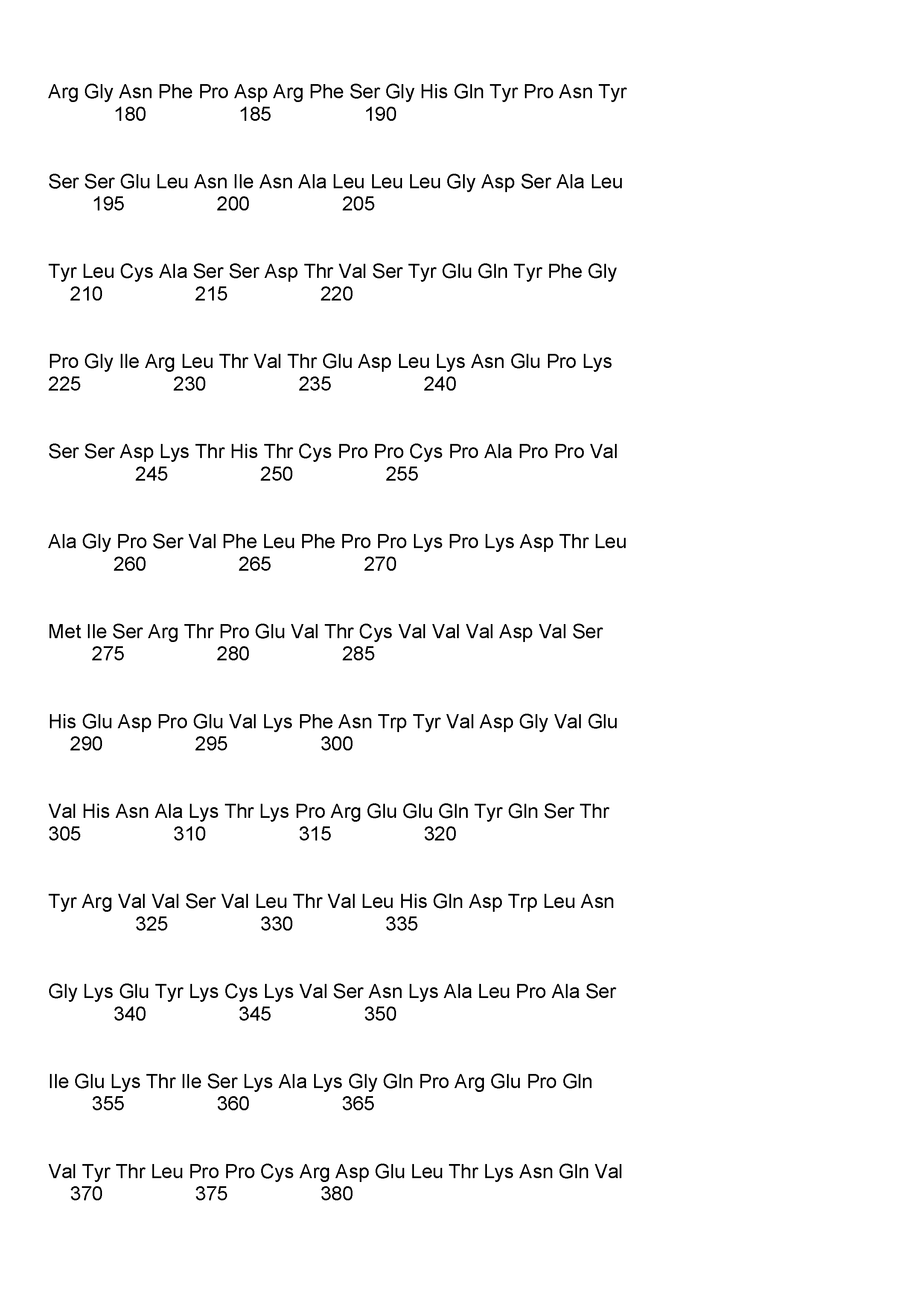 <400> 24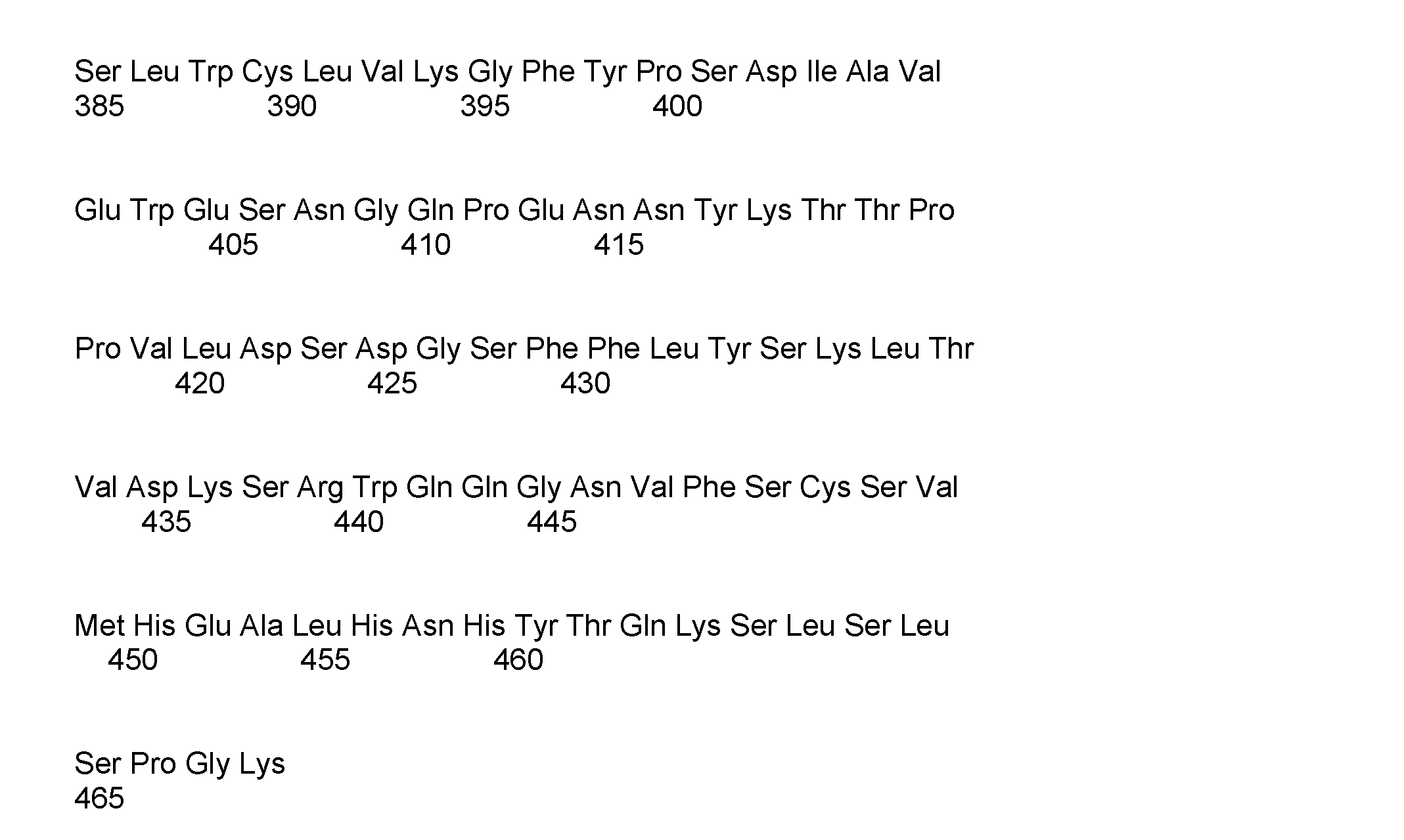
- <210> 25 <211> 472 <212> PRT <213> Homo sapiens<210> 25 <211> 472 <212> PRT <213> Homo sapiens
-
<400> 25

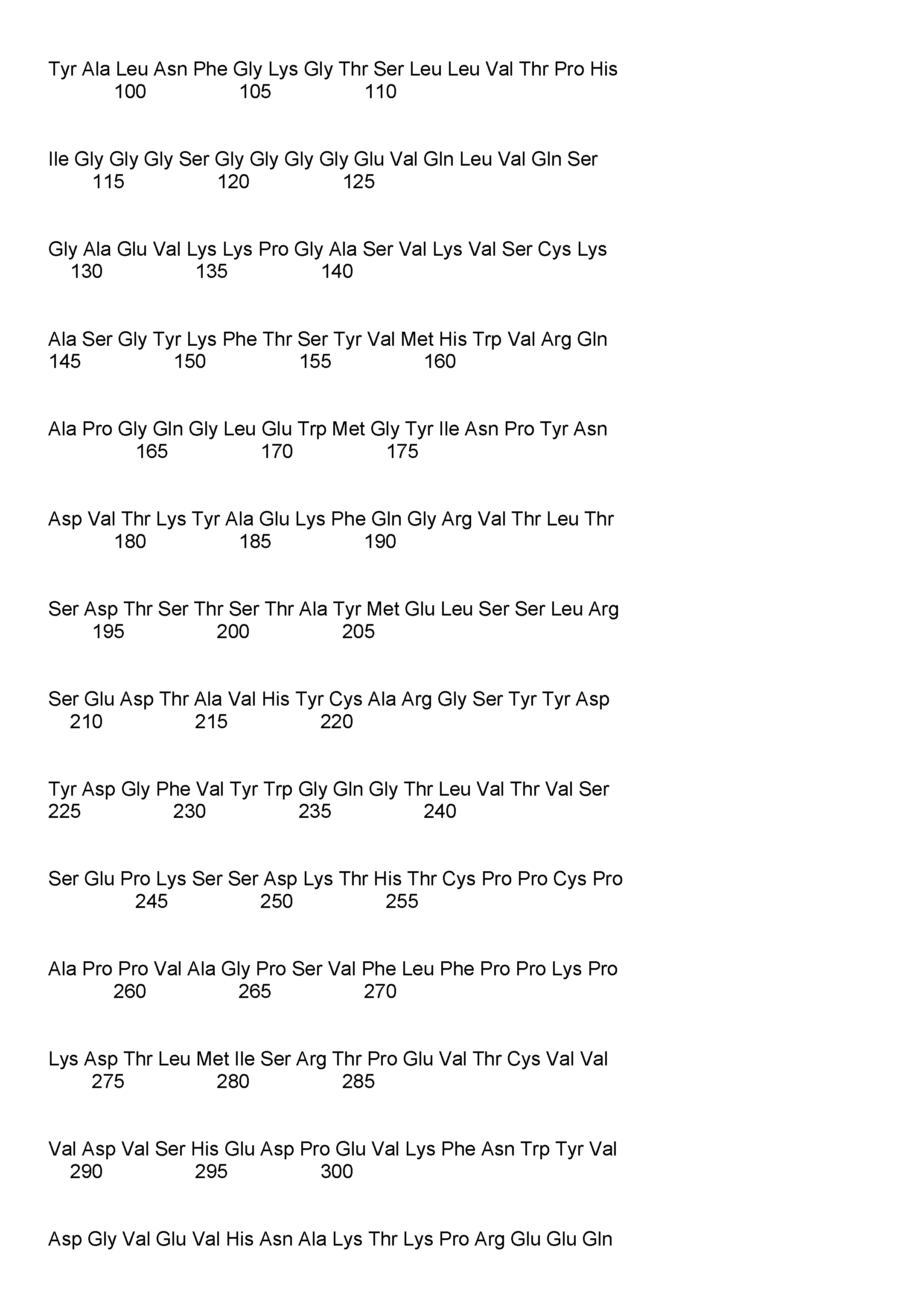 <400> 25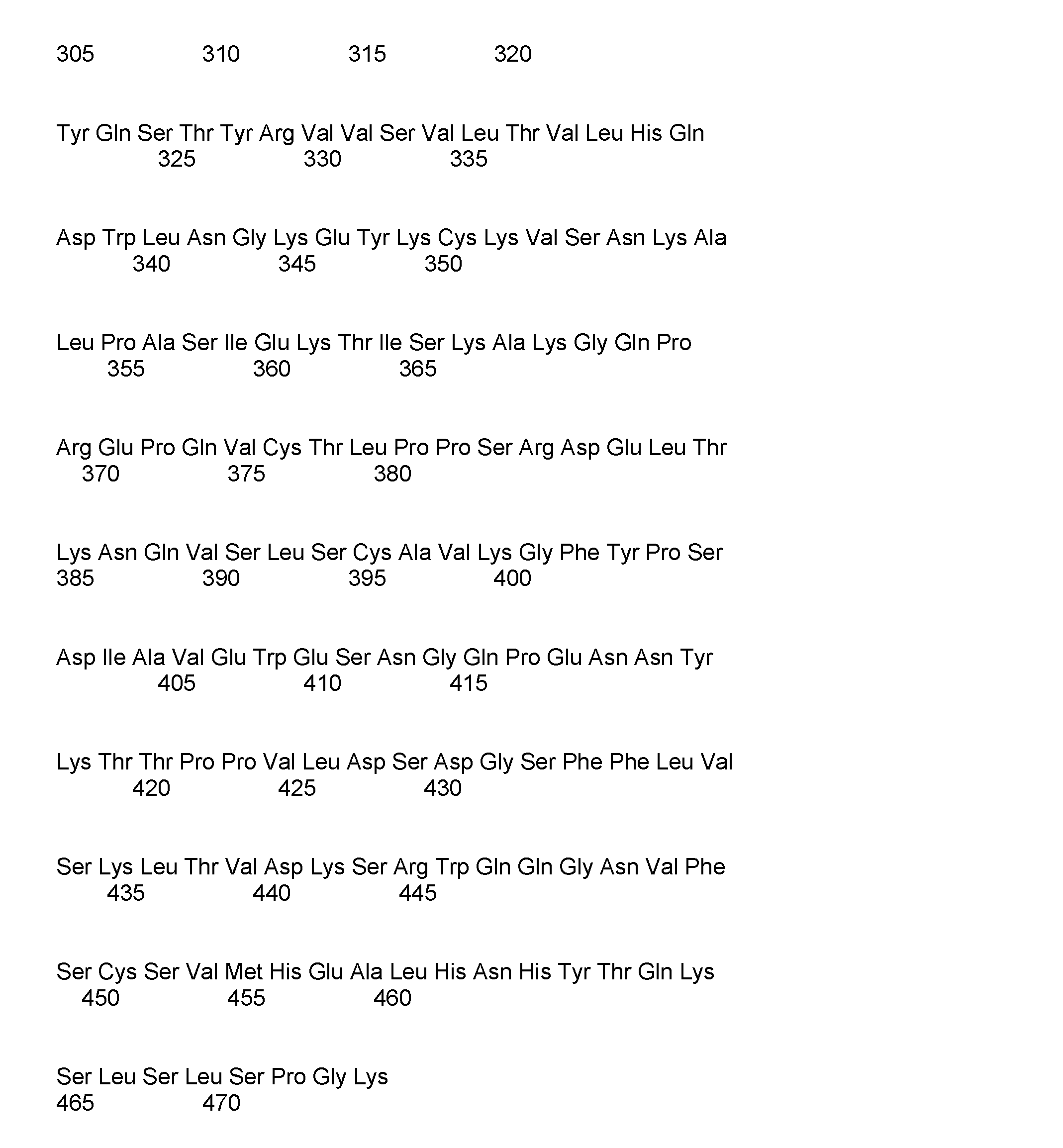
- <210> 26 <211> 231 <212> PRT <213> Homo sapiens<210> 26 <211> 231 <212> PRT <213> Homo sapiens
-
<400> 26
 <400> 26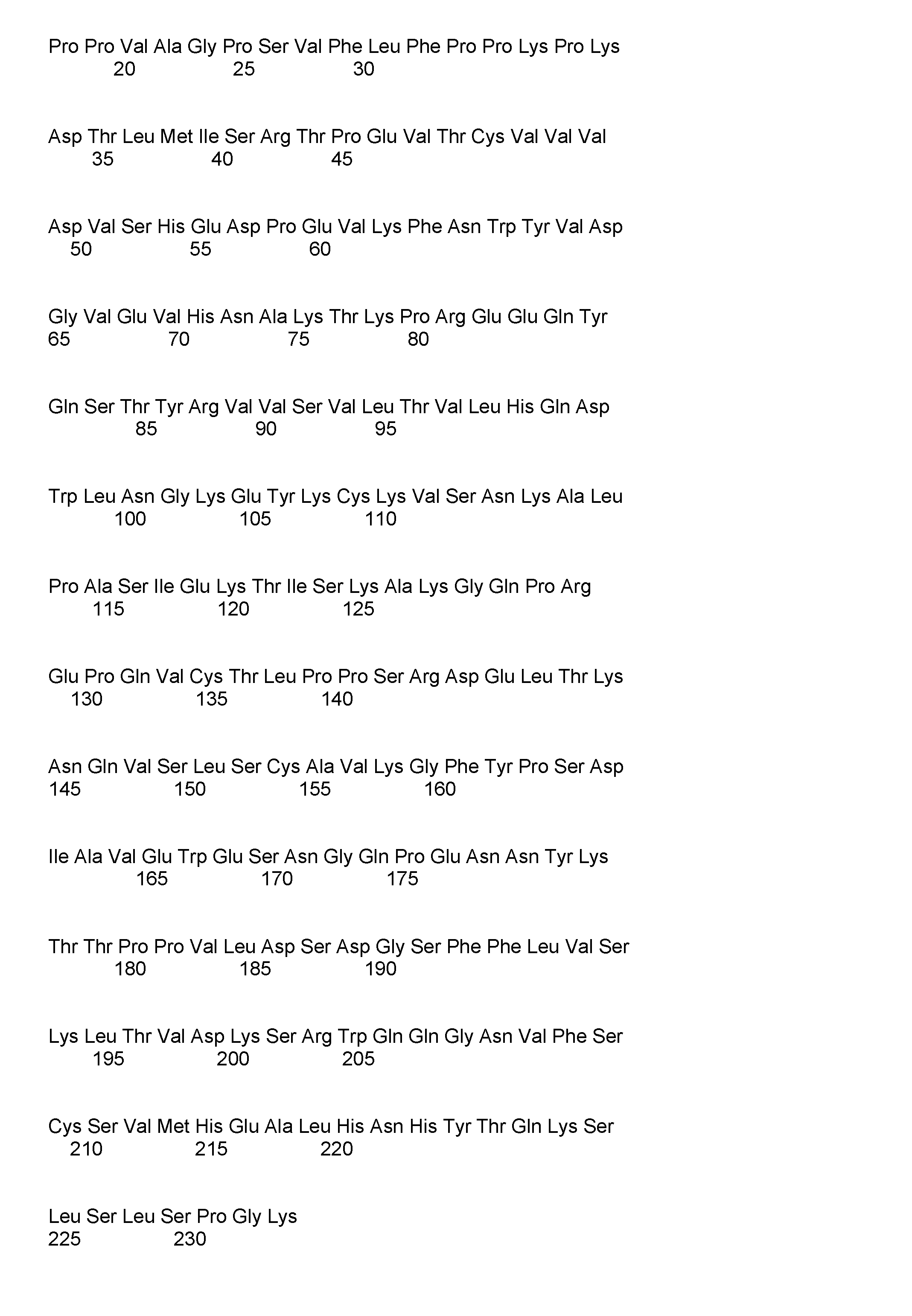
- <210> 27 <211> 231 <212> PRT <213> Homo sapiens<210> 27 <211> 231 <212> PRT <213> Homo sapiens
-
<400> 27
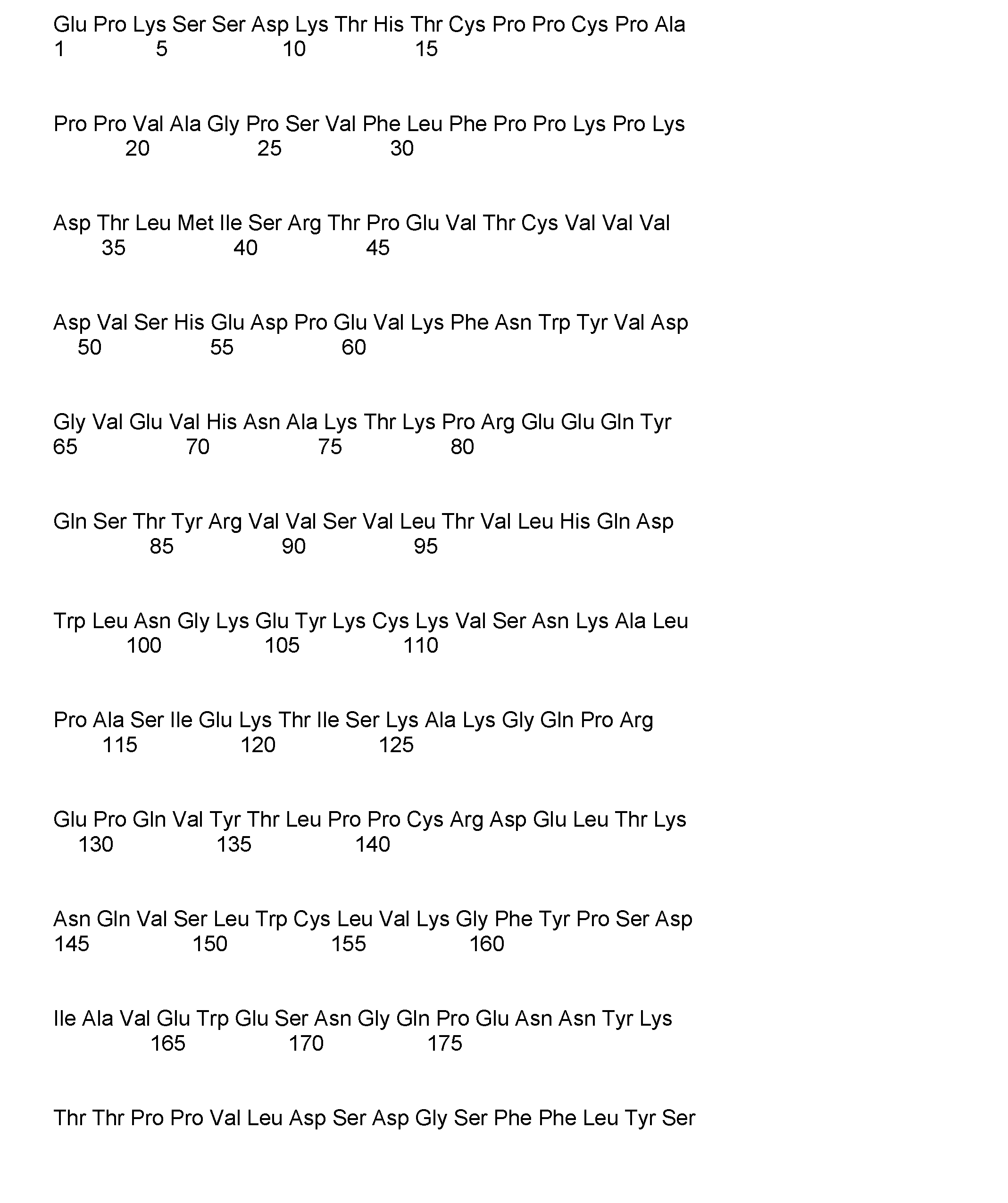 <400> 27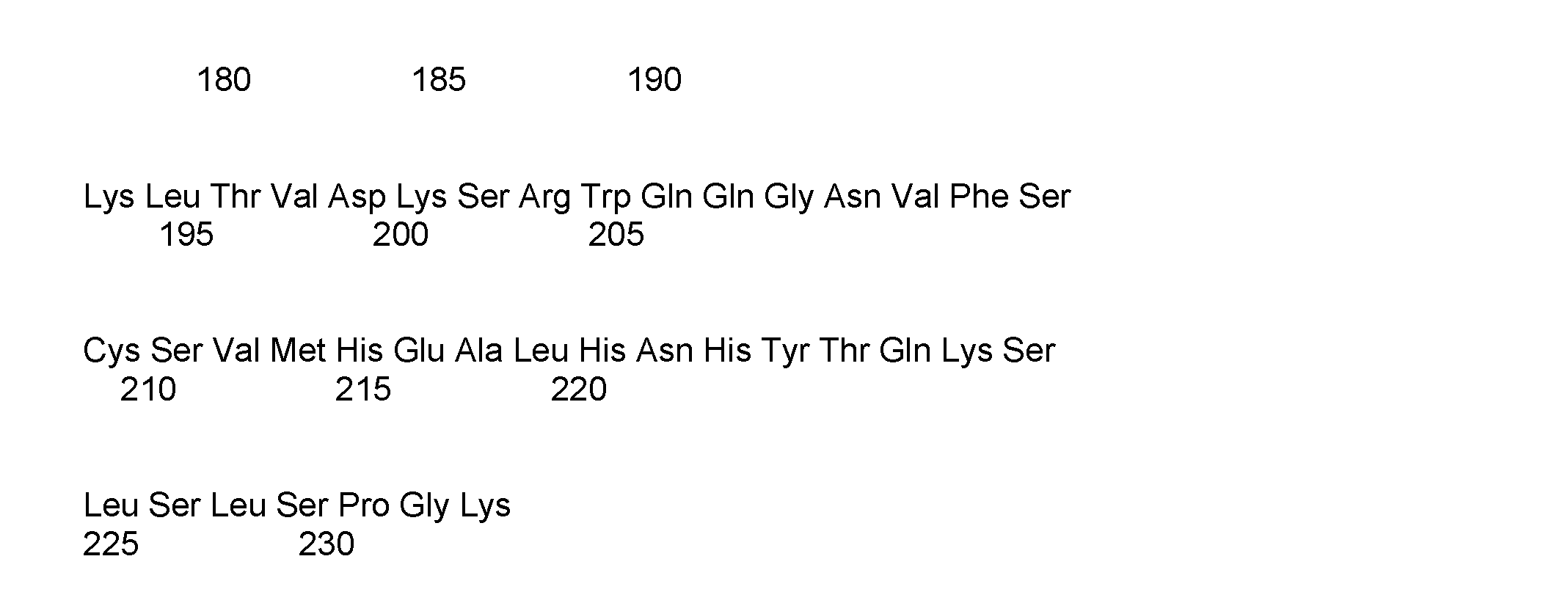
- <210> 28 <211> 113 <212> PRT <213> Homo sapiens<210> 28 <211> 113 <212> PRT <213> Homo sapiens
-
<400> 28
<400> 28
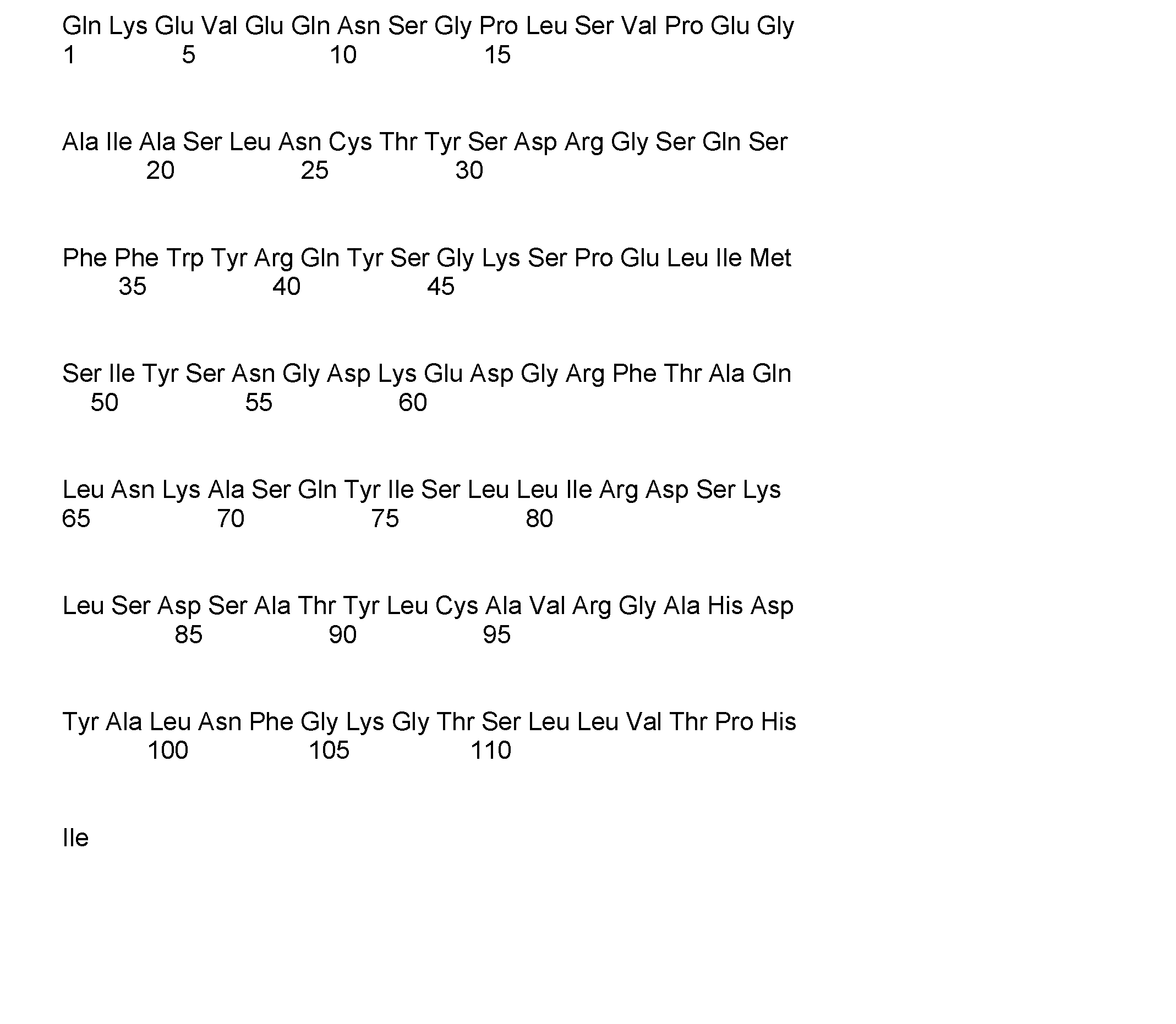
- <210> 29 <211> 122 <212> PRT <213> Homo sapiens<210> 29 <211> 122 <212> PRT <213> Homo sapiens
-
<400> 29
<400> 29
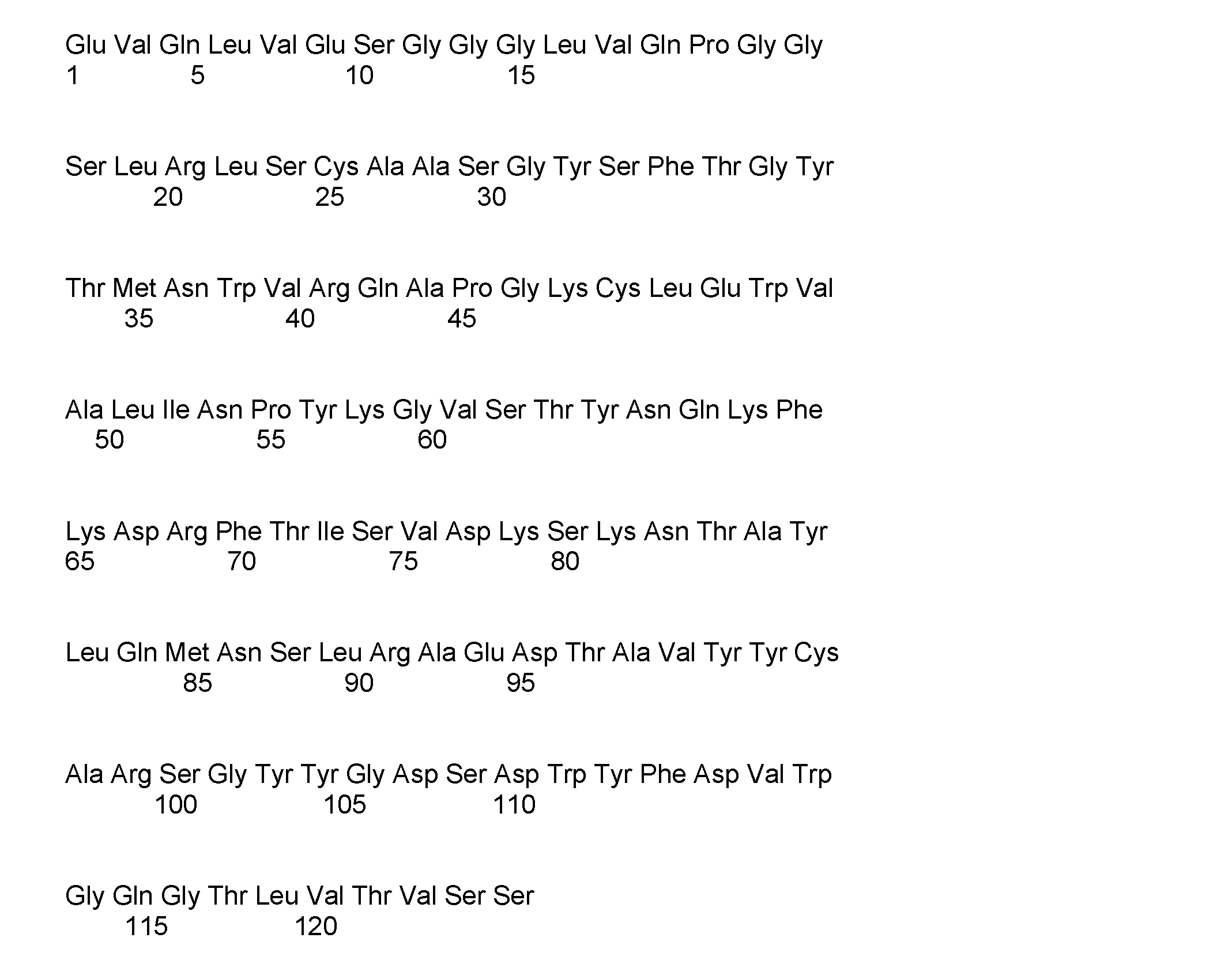
- <210> 30 <211> 8 <212> PRT <213> Homo sapiens<210> 30 <211> 8 <212> PRT <213> Homo sapiens
-
<400> 30
<400> 30

- <210> 31 <211> 117 <212> PRT <213> Homo sapiens <210> 31 <211> 117 <212> PRT <213> Homo sapiens
-
<400> 31
<400> 31

- <210> 32 <211> 107 <212> PRT <213> Homo sapiens<210> 32 <211> 107 <212> PRT <213> Homo sapiens
-
<400> 32
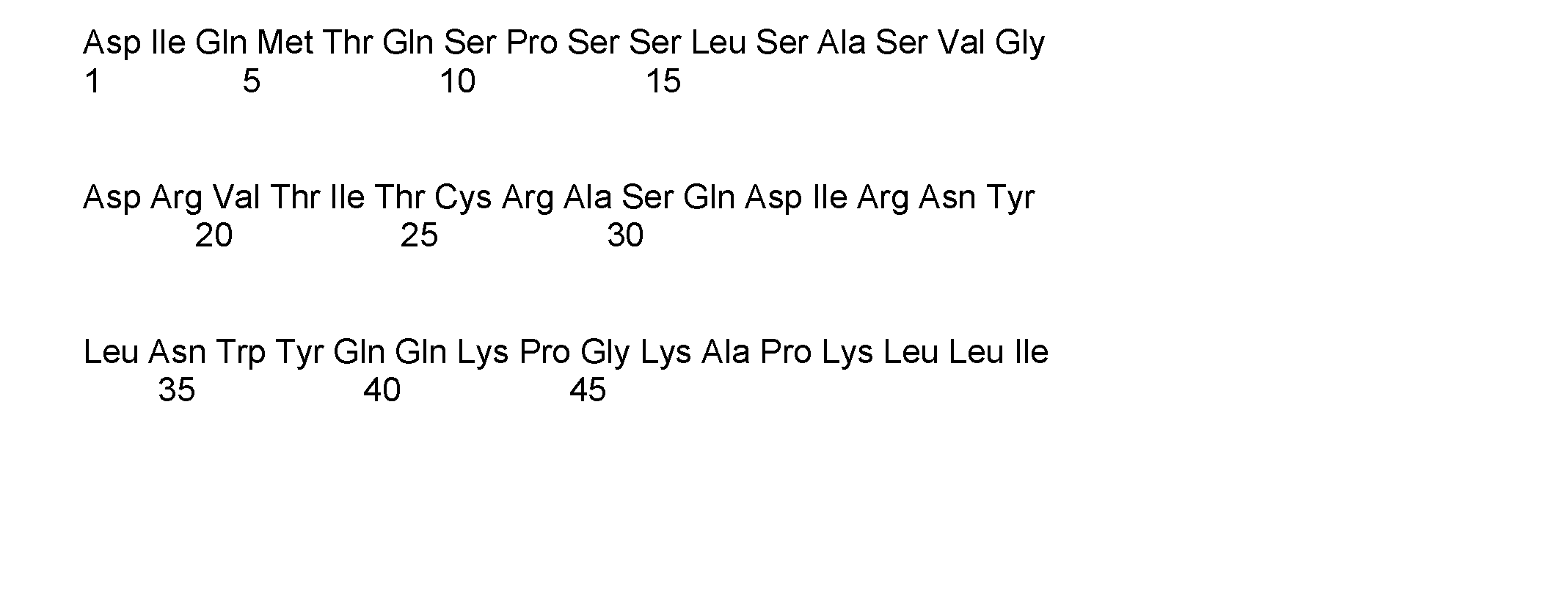 <400> 32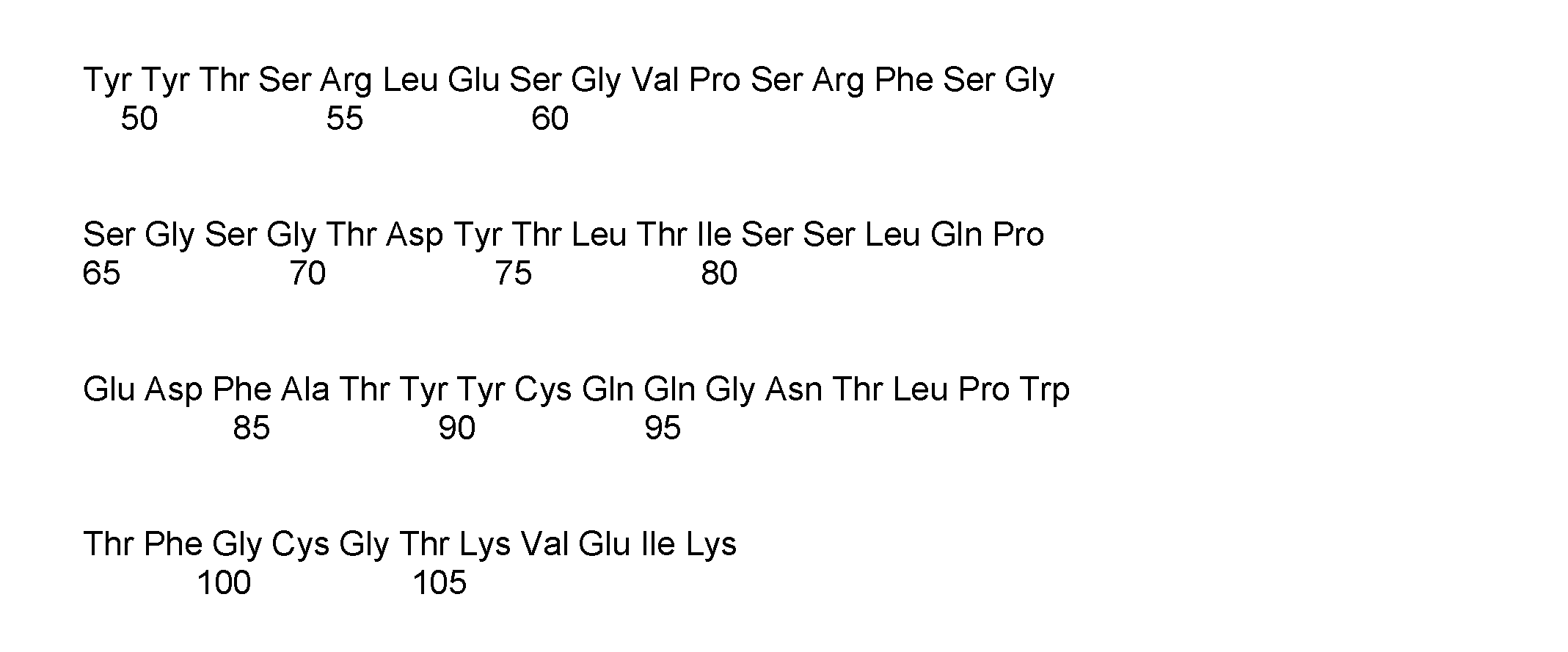
- <210> 33 <211> 478 <212> PRT <213> Homo sapiens<210> 33 <211> 478 <212> PRT <213> Homo sapiens
-
<400> 33
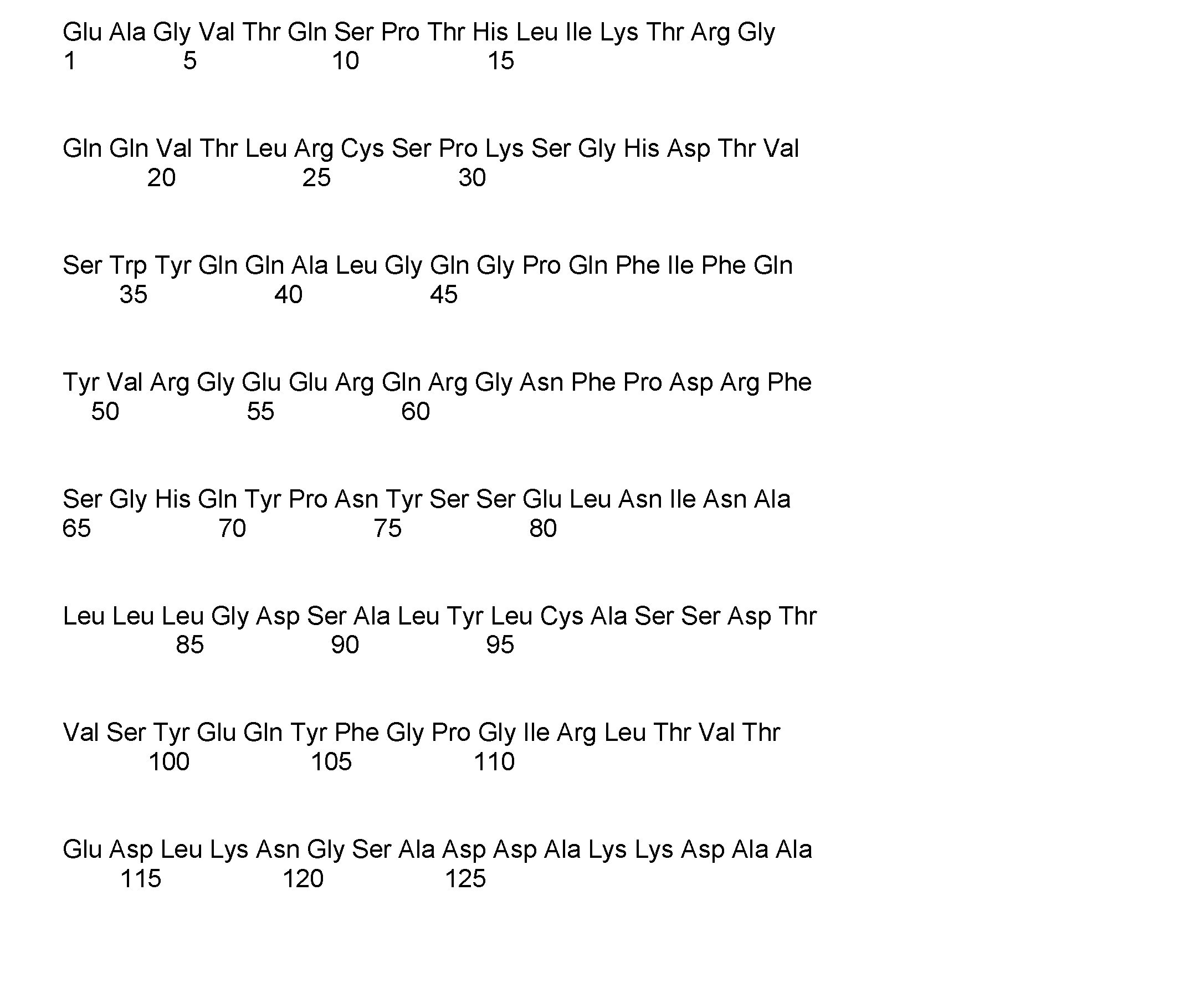
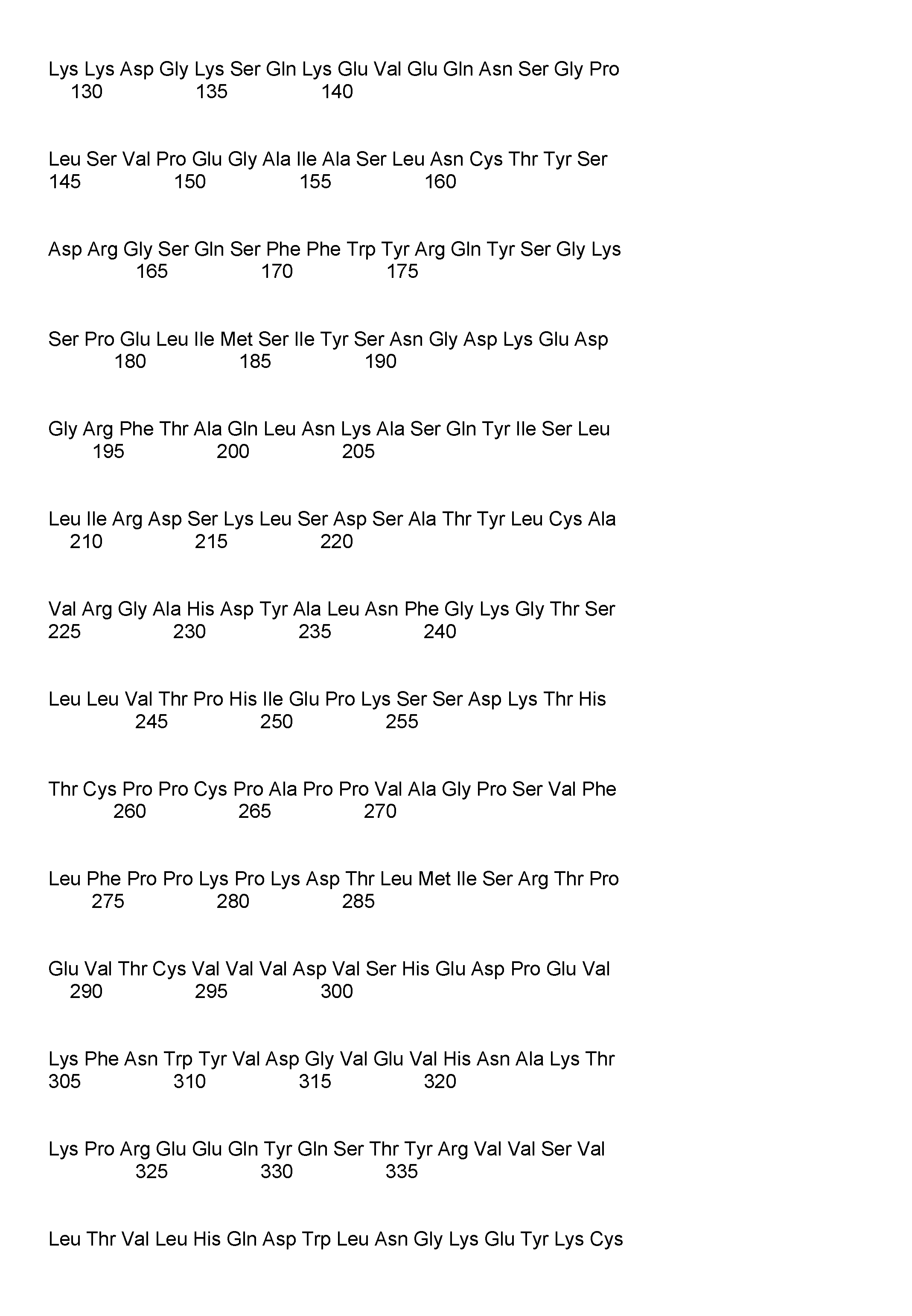 <400> 33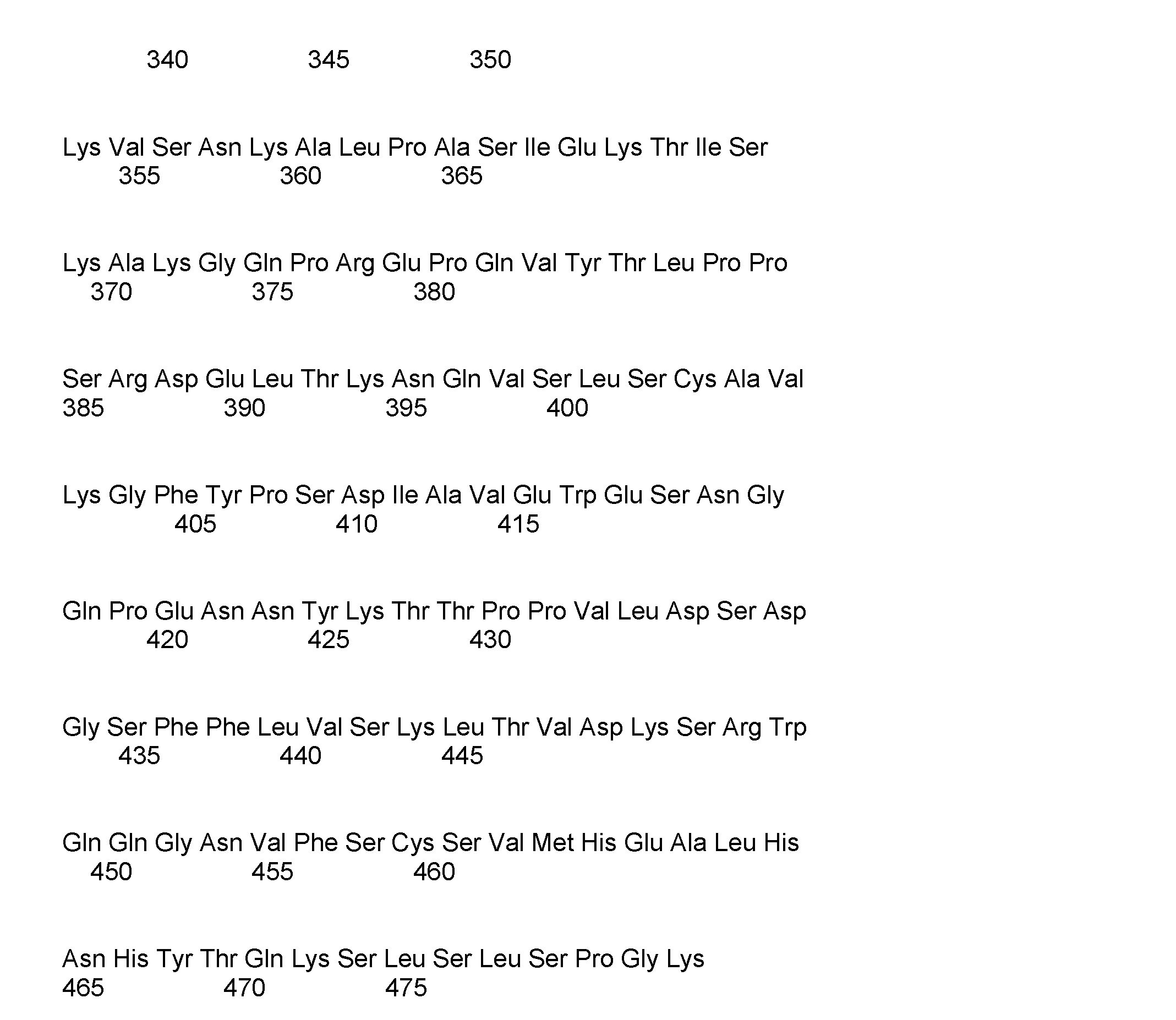
- <210> 34 <211> 451 <212> PRT <213> Homo sapiens<210> 34 <211> 451 <212> PRT <213> Homo sapiens
-
<400> 34
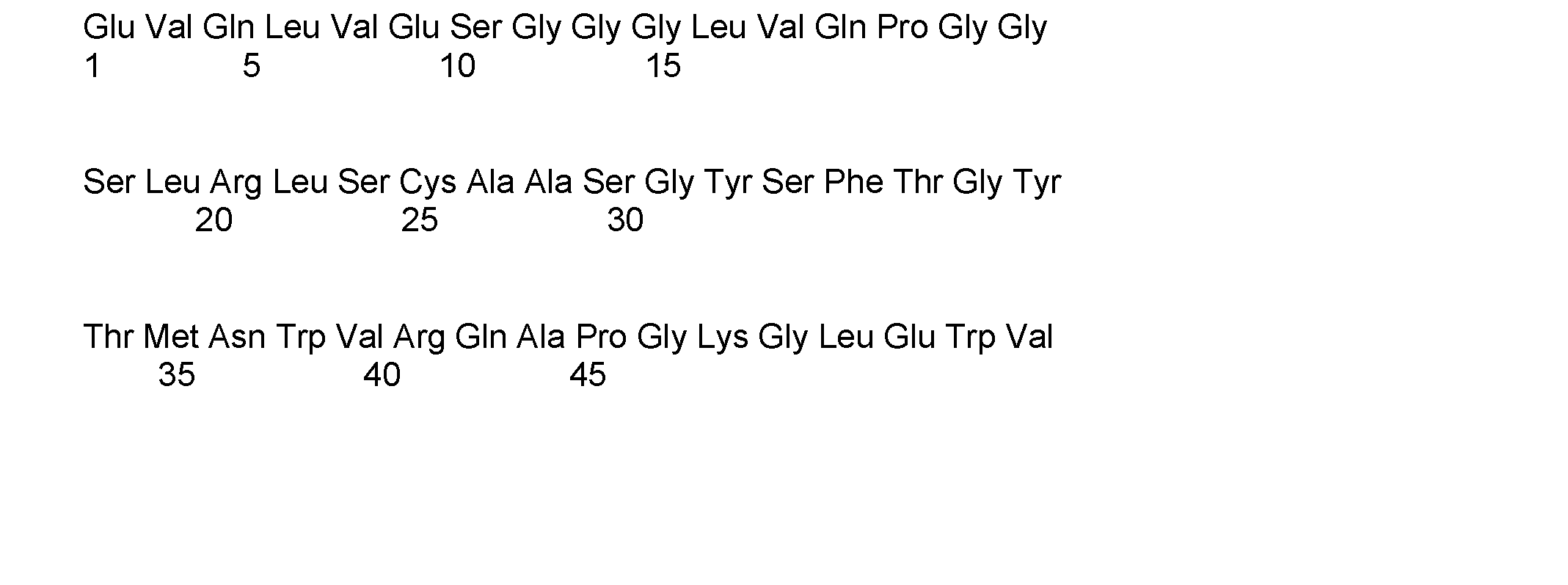
 <400> 34
- <210> 35 <211> 698 <212> PRT <213> Homo sapiens<210> 35 <211> 698 <212> PRT <213> Homo sapiens
-
<400> 35
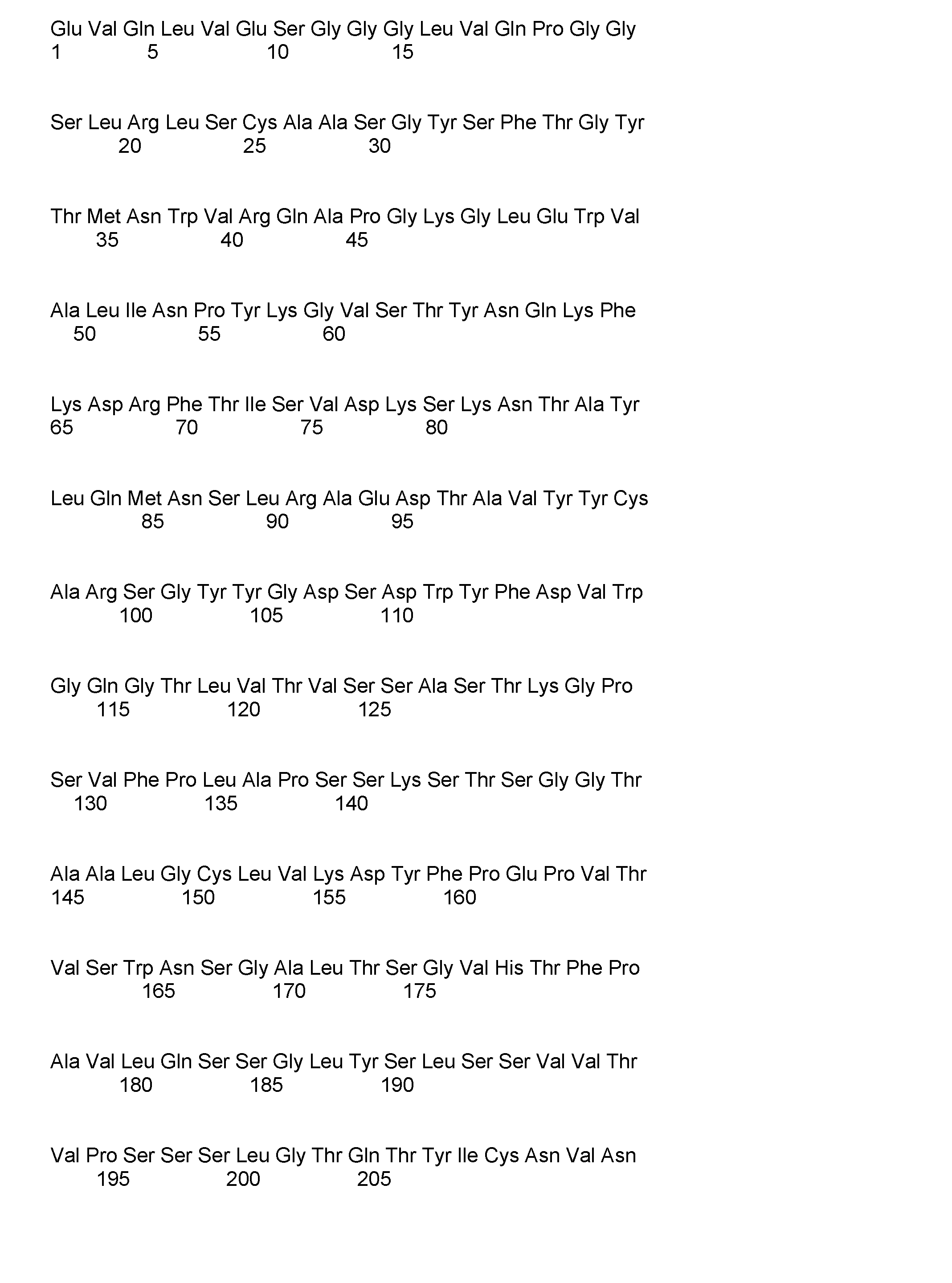

 <400> 35
- <210> 36 <211> 692 <212> PRT <213> Homo sapiens<210> 36 <211> 692 <212> PRT <213> Homo sapiens
-
<400> 36
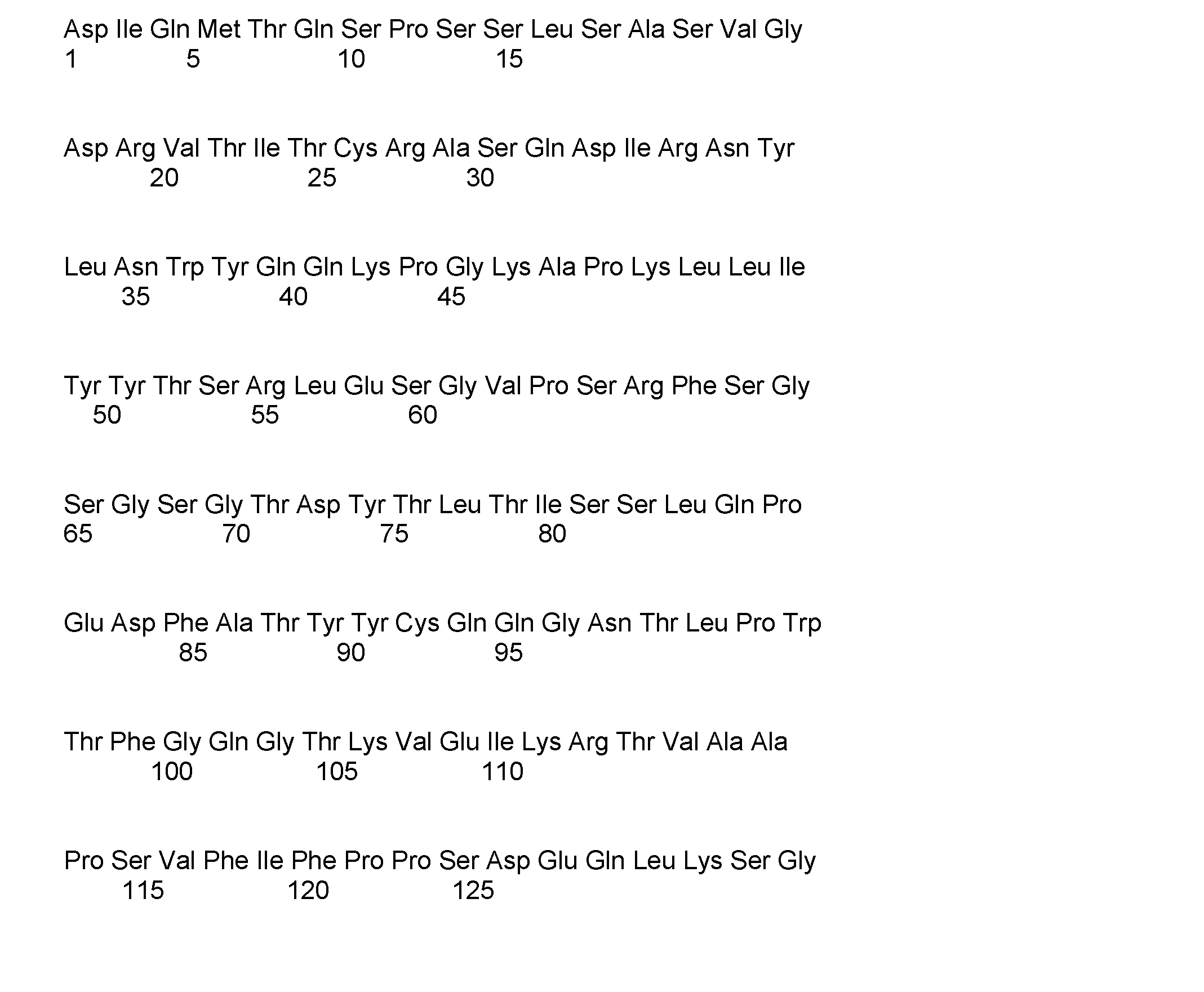
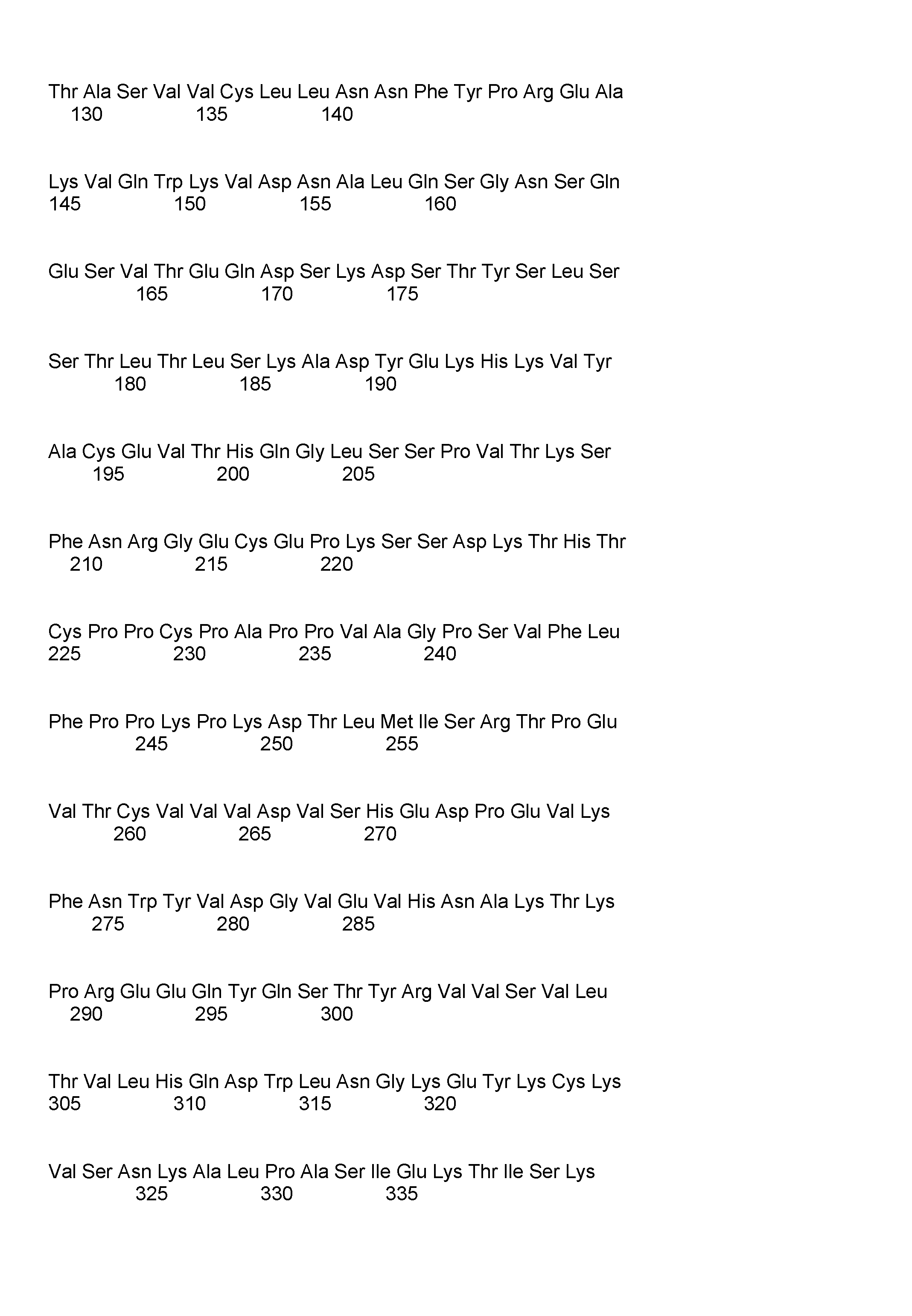
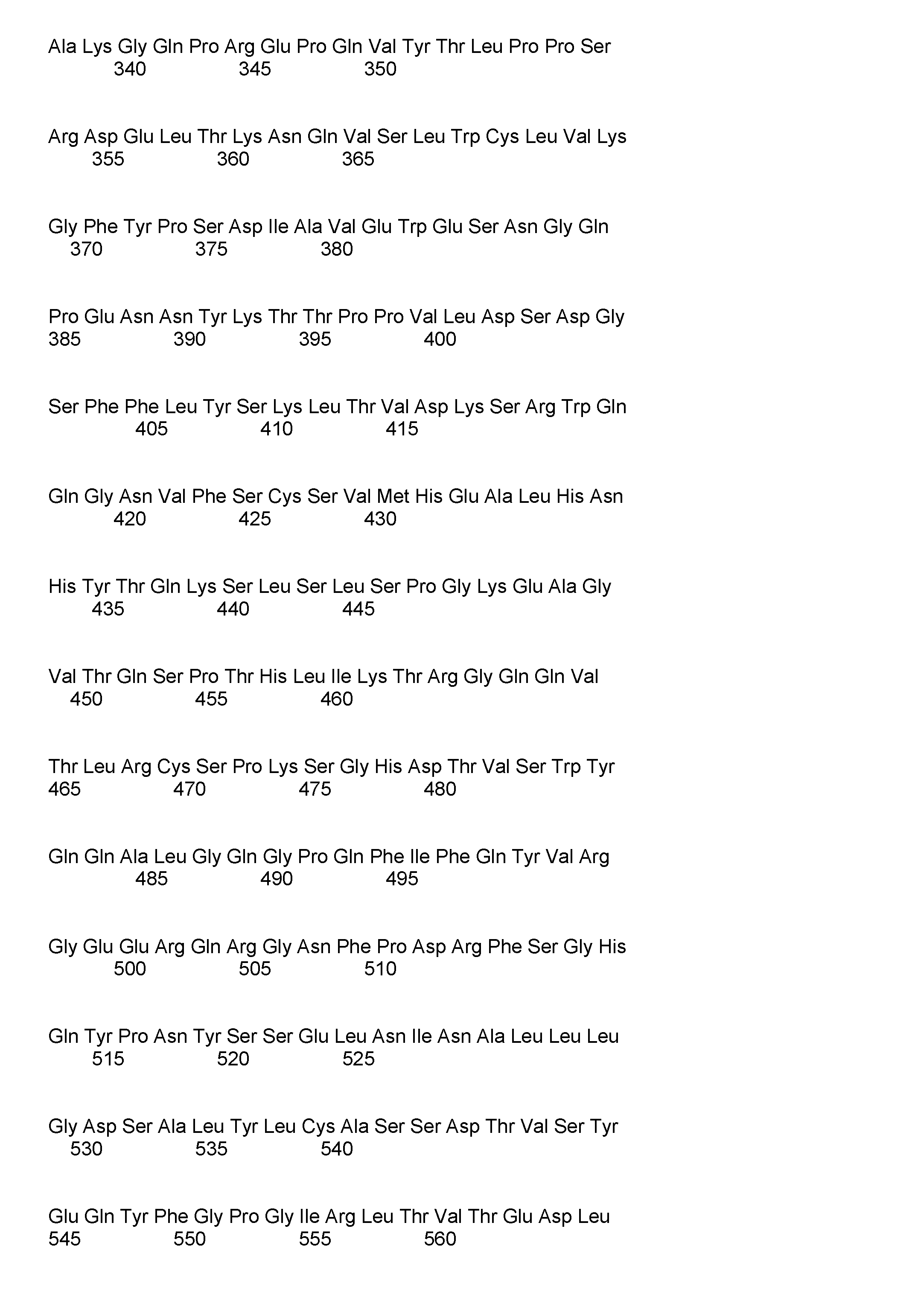 <400> 36
- <210> 37 <211> 698 <212> PRT <213> Homo sapiens<210> 37 <211> 698 <212> PRT <213> Homo sapiens
-
<400> 37

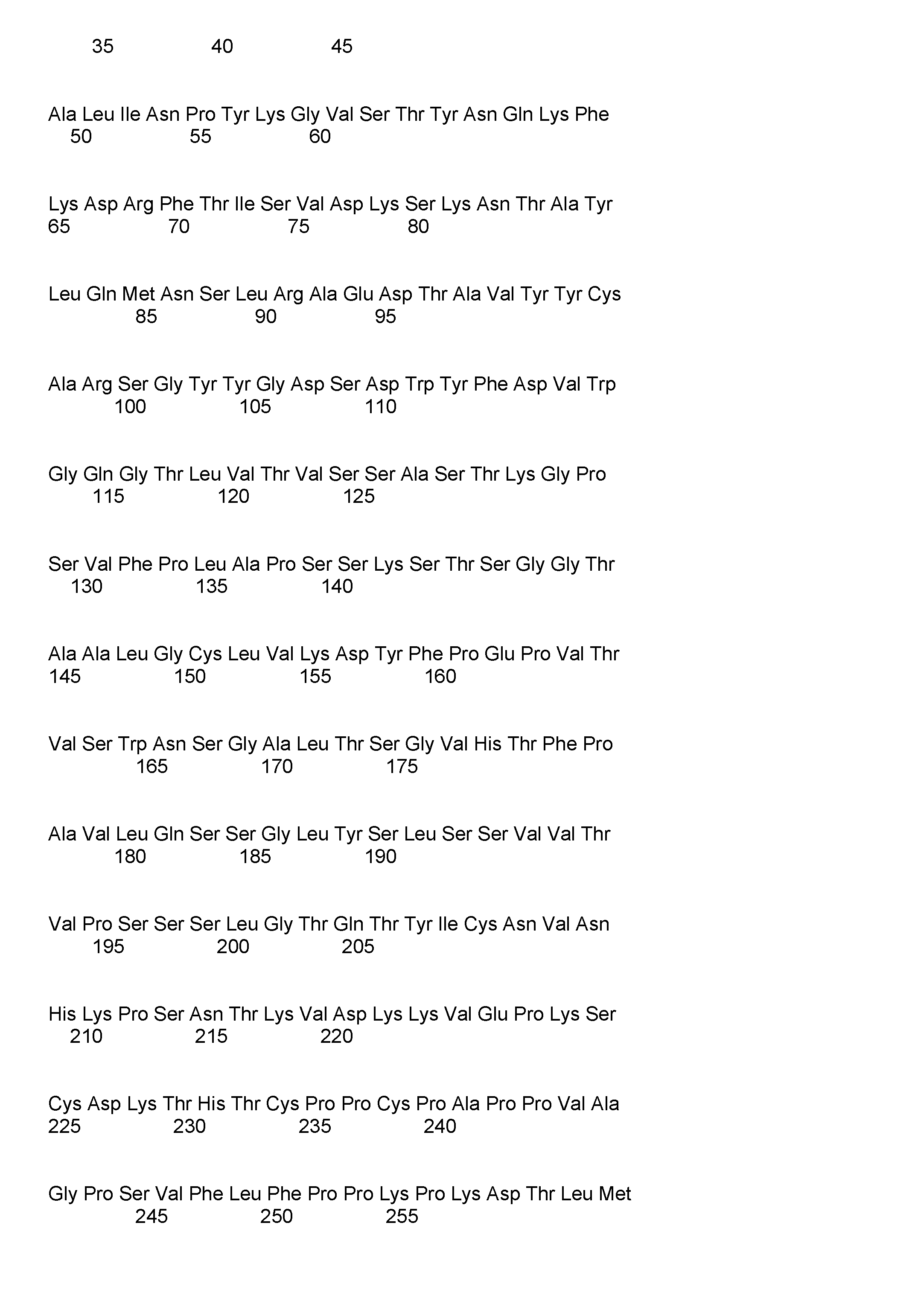

 <400> 37
- <210> 38 <211> 696 <212> PRT <213> Homo sapiens<210> 38 <211> 696 <212> PRT <213> Homo sapiens
-
<400> 38


 <400> 38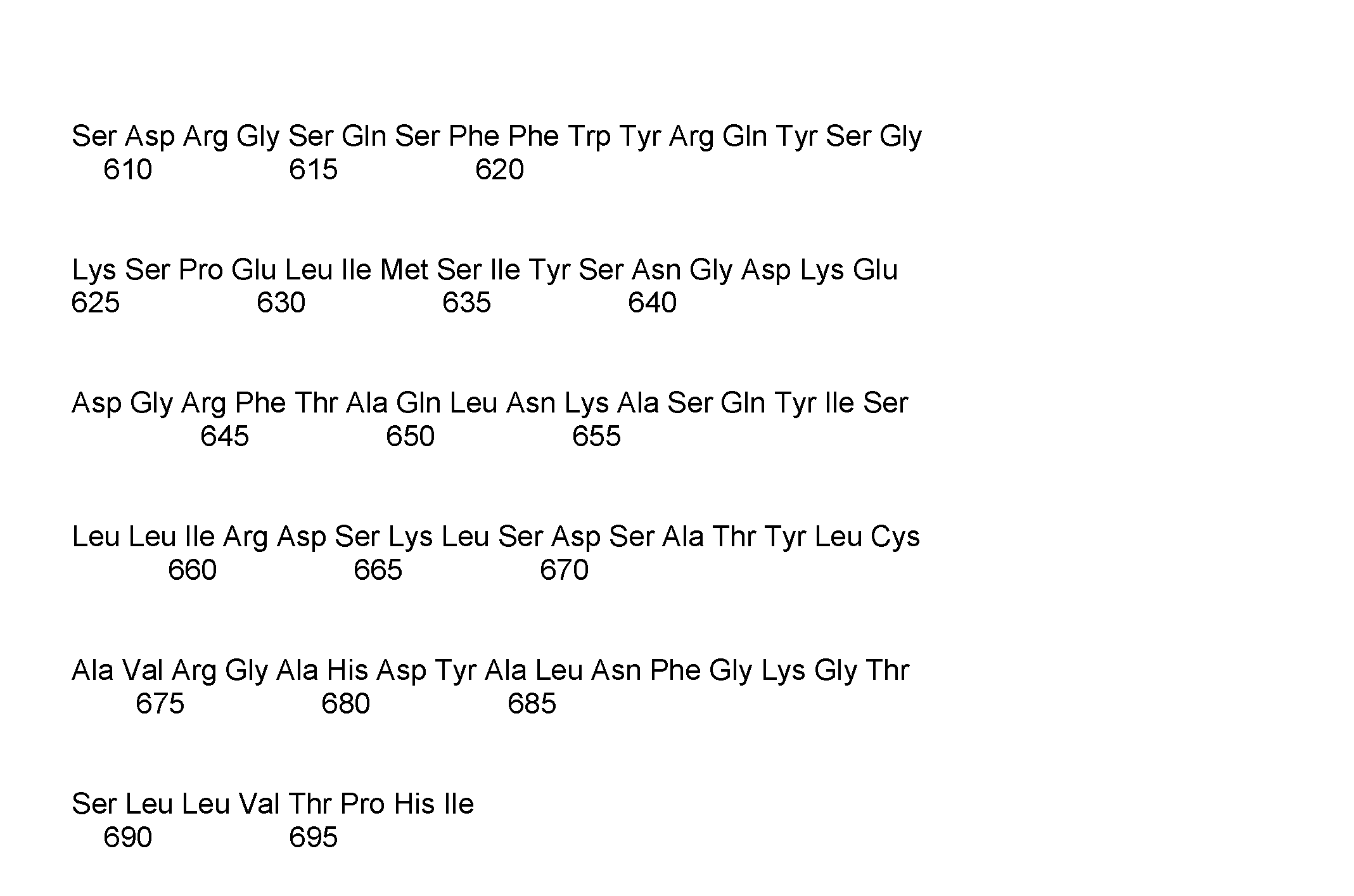
- <210> 39 <211> 690 <212> PRT <213> Homo sapiens<210> 39 <211> 690 <212> PRT <213> Homo sapiens
-
<400> 39


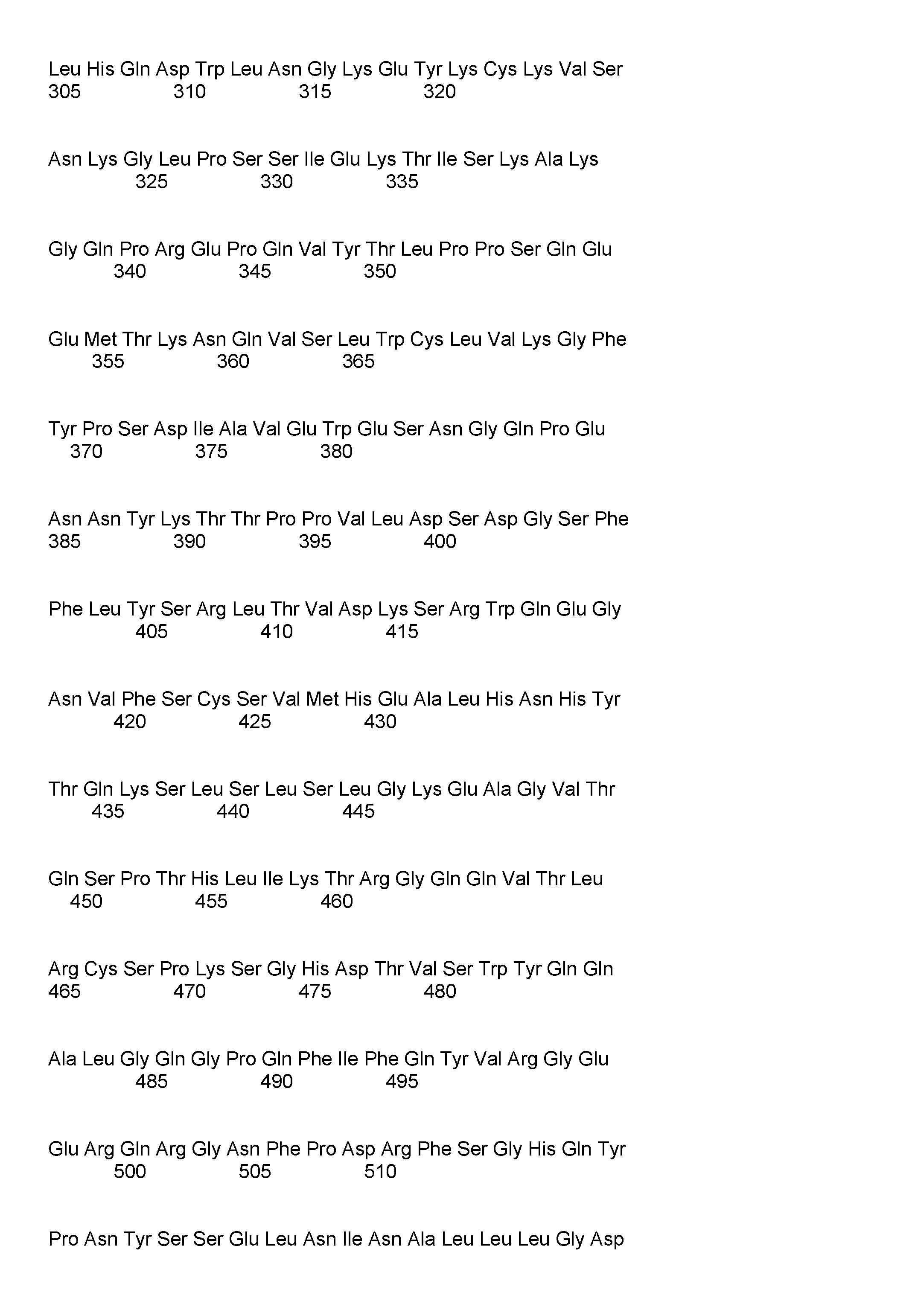 <400> 39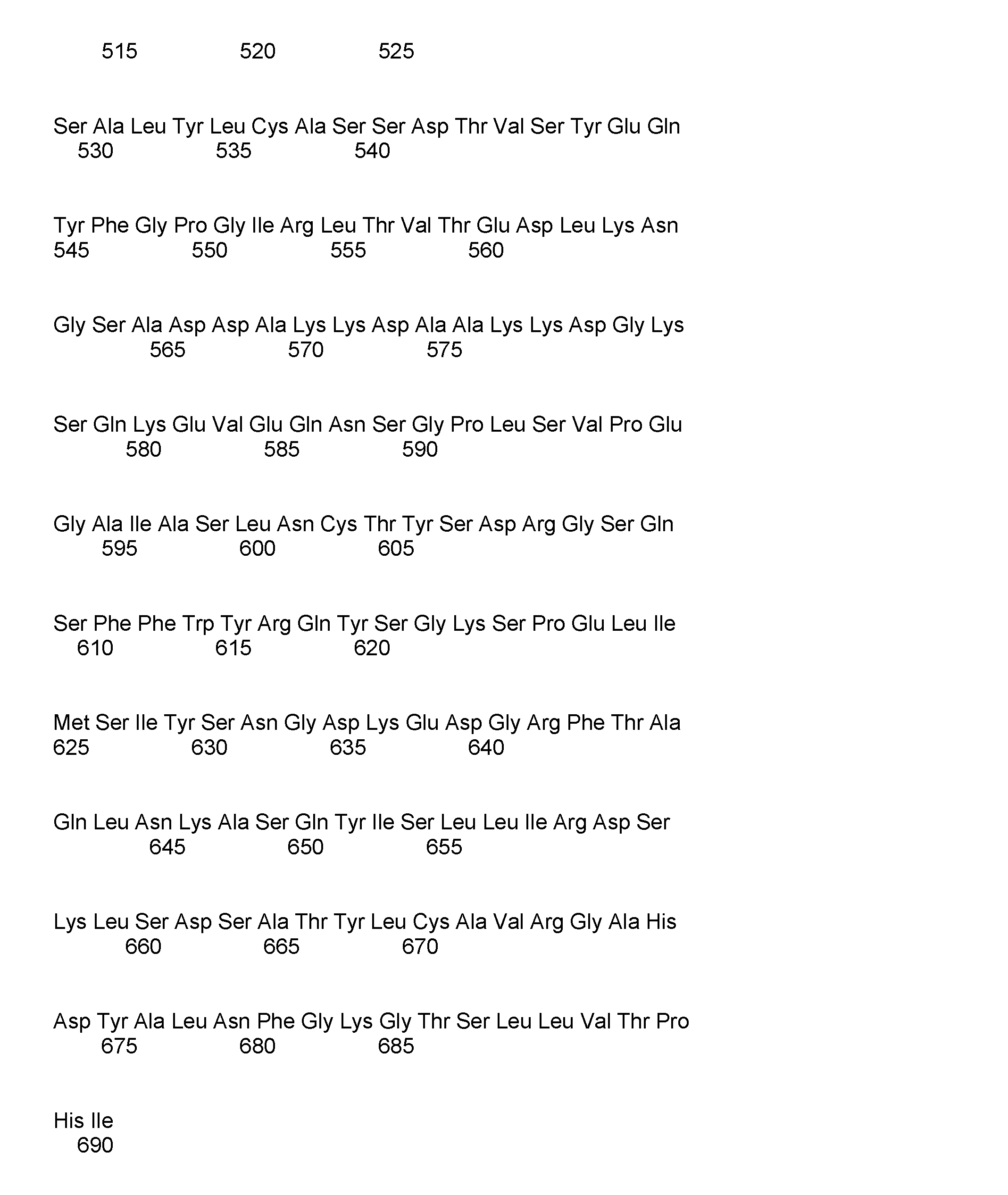
- <210> 40 <211> 428 <212> PRT <213> Homo sapiens<210> 40 <211> 428 <212> PRT <213> Homo sapiens
-
<400> 40
 <400> 40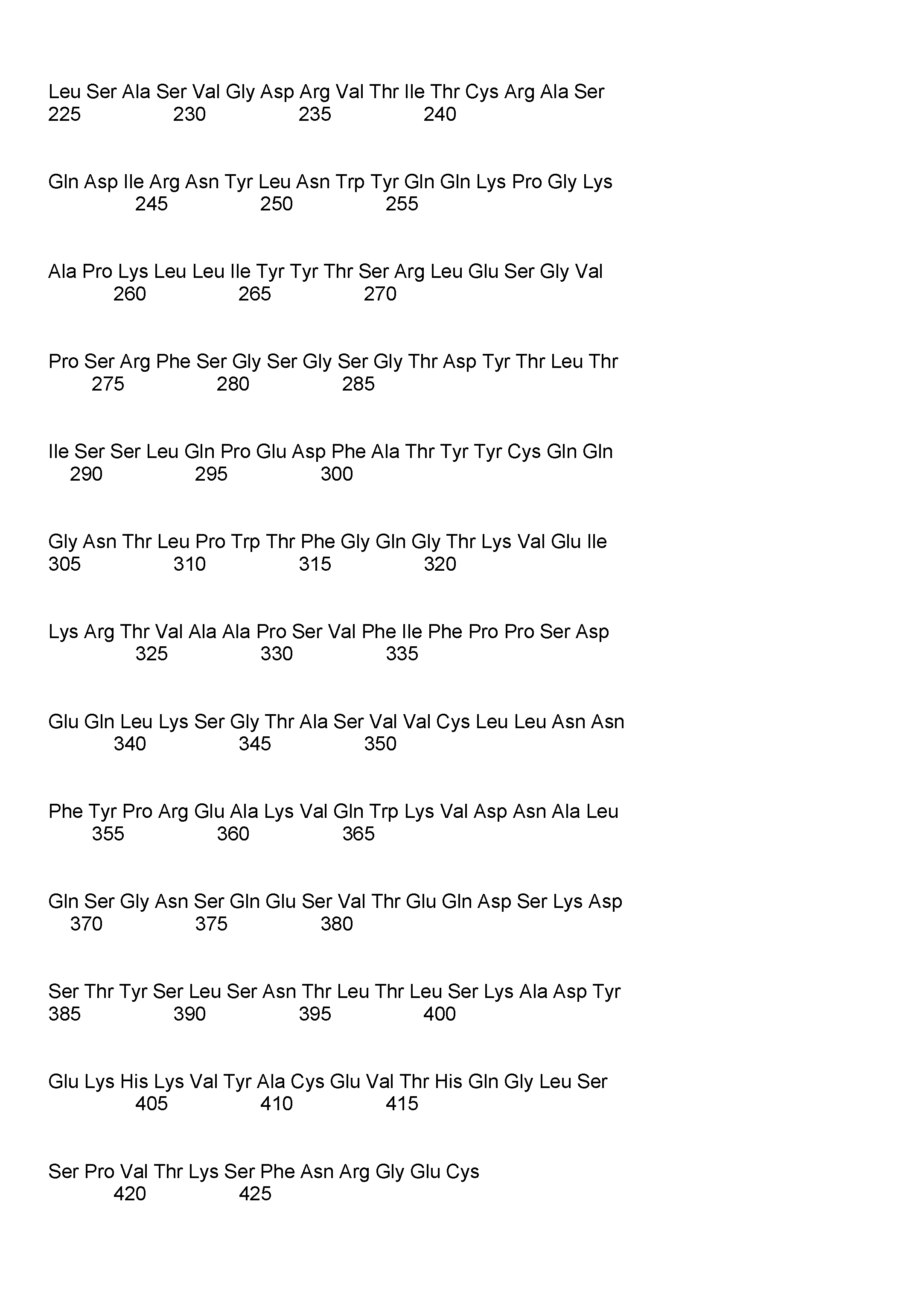
- <210> 41 <211> 1392 <212> PRT <213> Homo sapiens<210> 41 <211> 1392 <212> PRT <213> Homo sapiens
-
<400> 41
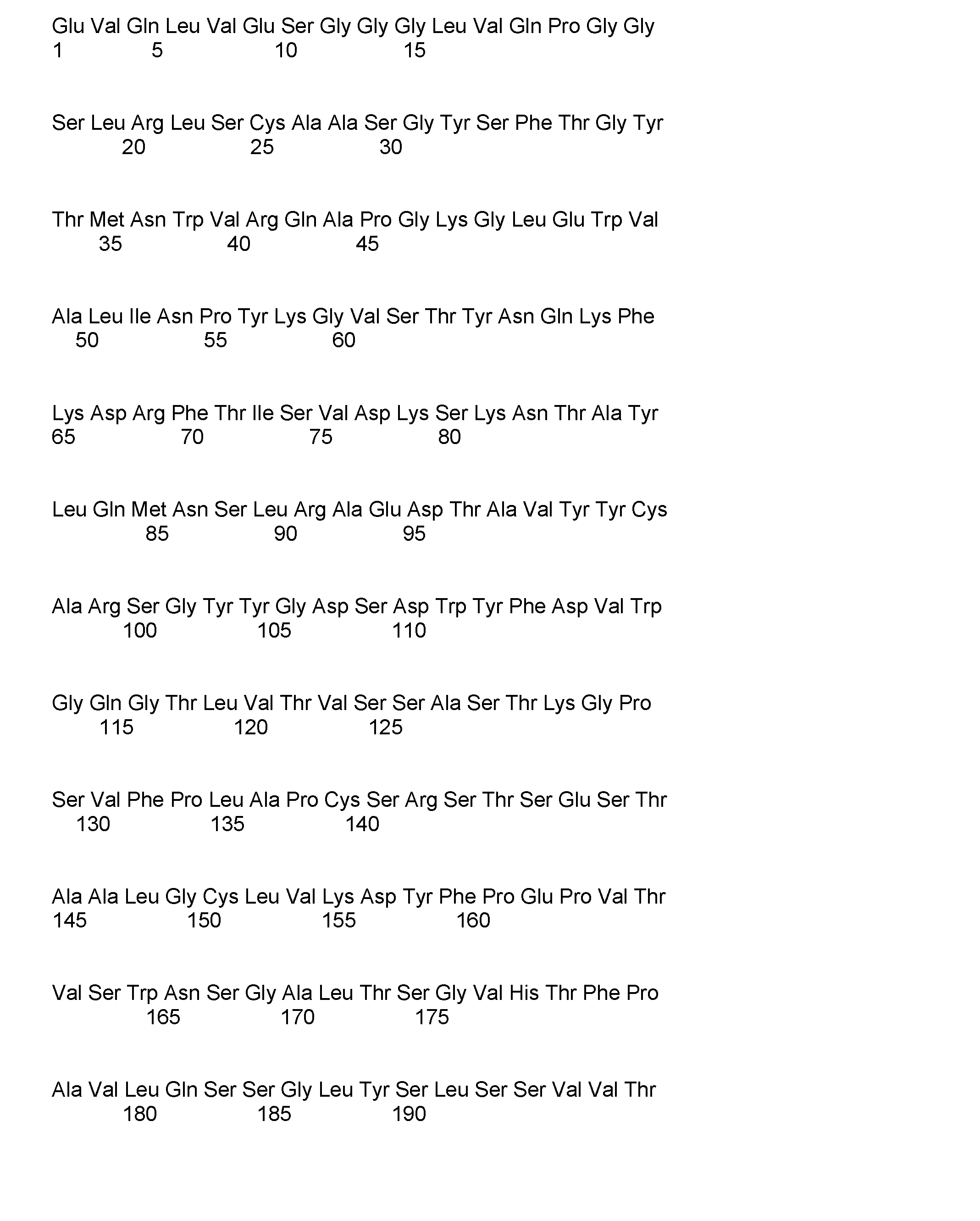
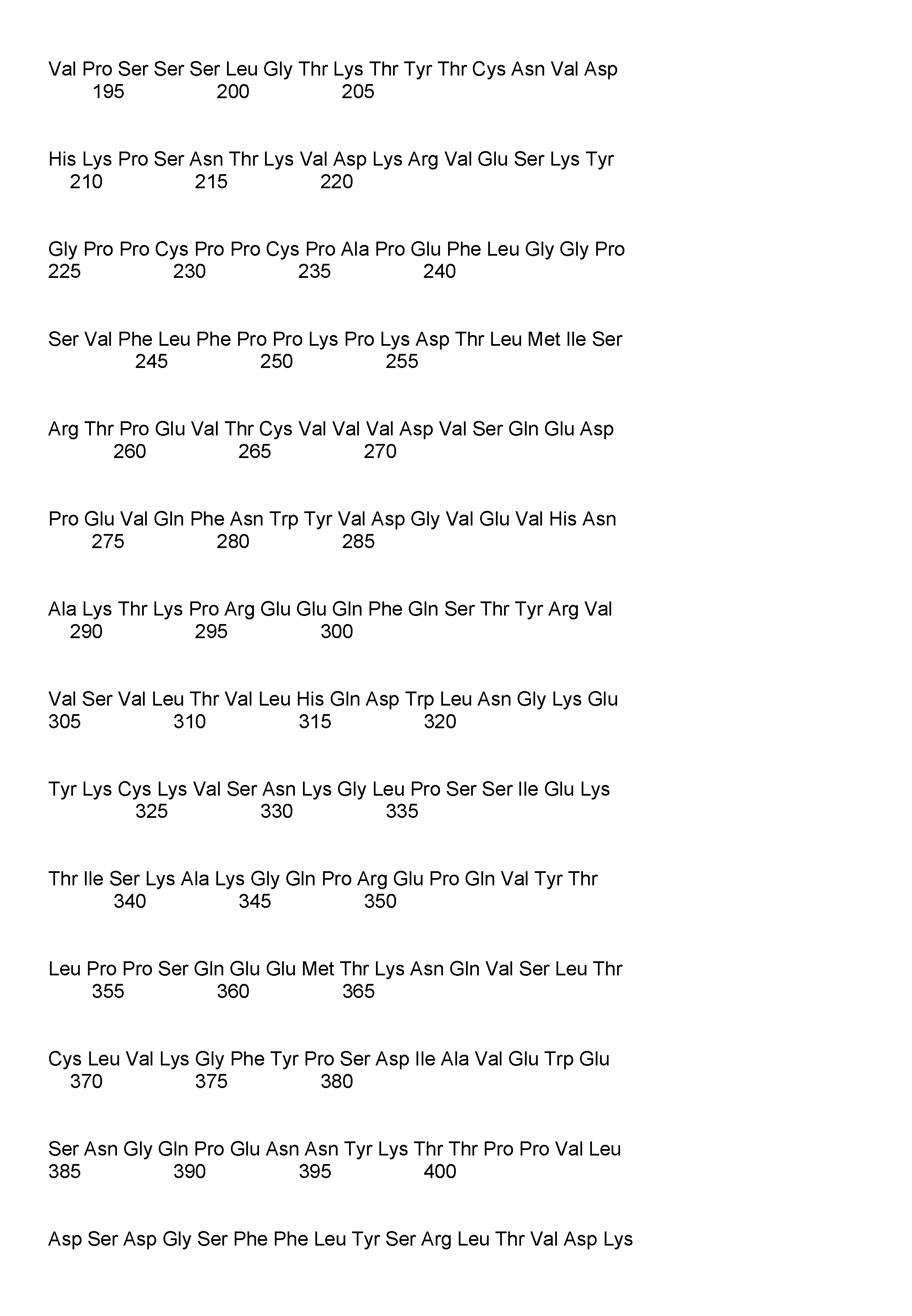


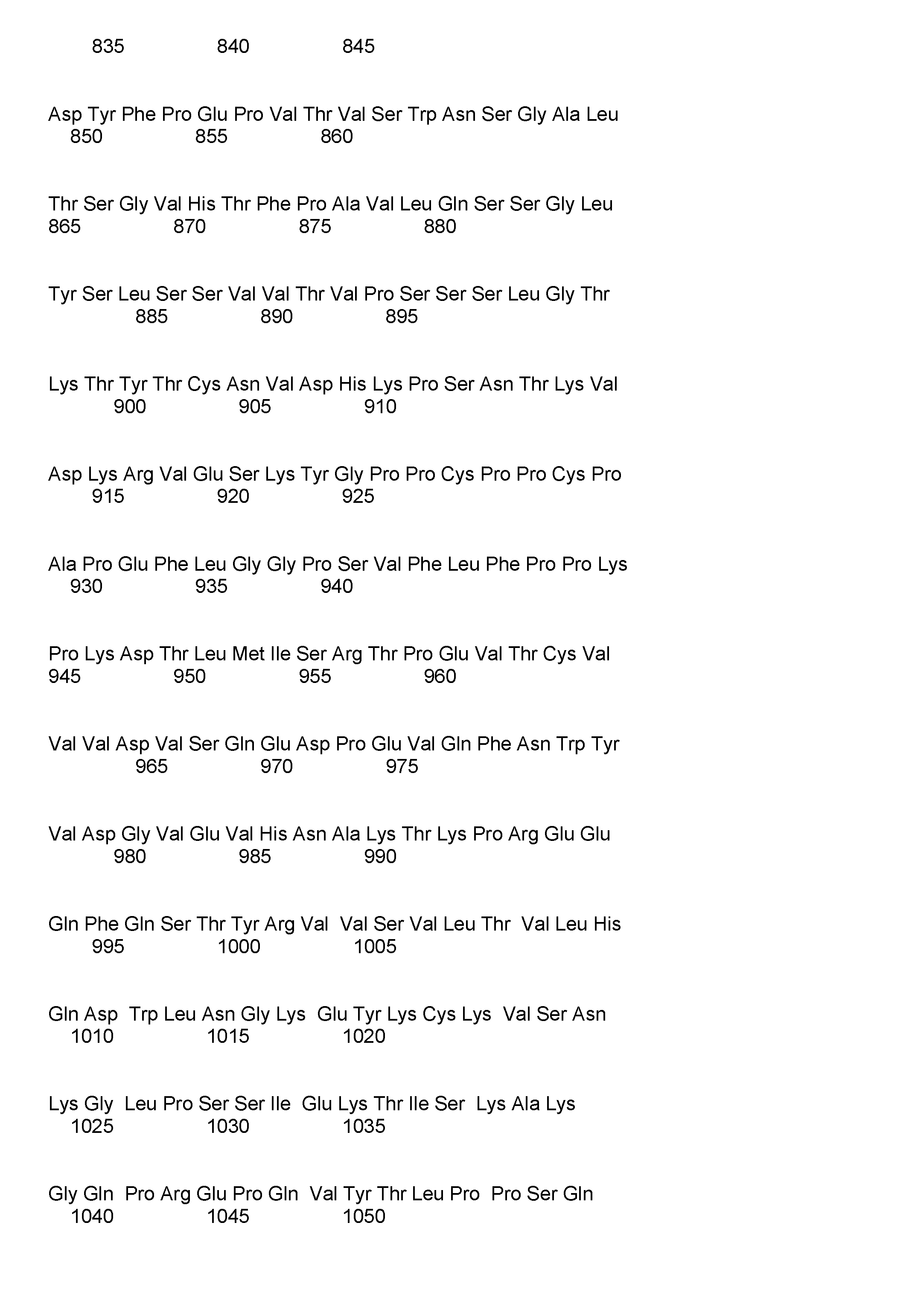
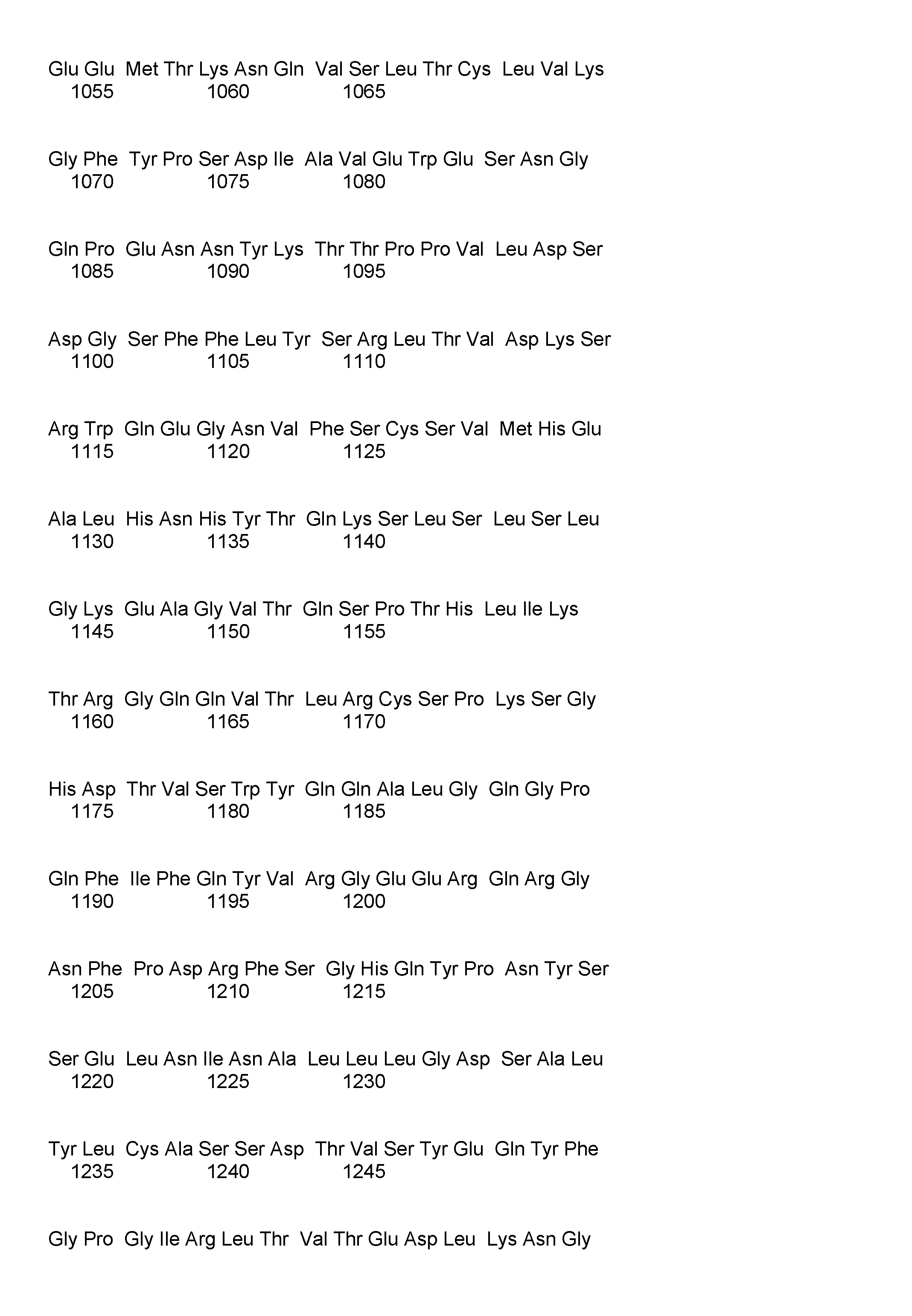 <400> 41
- <210> 42 <211> 214 <212> PRT <213> Homo sapiens<210> 42 <211> 214 <212> PRT <213> Homo sapiens
-
<400> 42
 <400> 42
ZITATE ENTHALTEN IN DER BESCHREIBUNG QUOTES INCLUDE IN THE DESCRIPTION
Diese Liste der vom Anmelder aufgeführten Dokumente wurde automatisiert erzeugt und ist ausschließlich zur besseren Information des Lesers aufgenommen. Die Liste ist nicht Bestandteil der deutschen Patent- bzw. Gebrauchsmusteranmeldung. Das DPMA übernimmt keinerlei Haftung für etwaige Fehler oder Auslassungen.This list of the documents listed by the applicant has been generated automatically and is included solely for the better information of the reader. The list is not part of the German patent or utility model application. The DPMA assumes no liability for any errors or omissions.
Zitierte PatentliteraturCited patent literature
- EP 1075496 [0010, 0037]EP 1075496 [0010, 0037]
- US 20060166875 [0015]US 20060166875 [0015]
- US 20120252742 [0015]US 20120252742 [0015]
- EP 1868650 [0029]EP 1868650 [0029]
- WO 2016/170139 [0031]WO 2016/170139 [0031]
- WO 2016/102272 [0031]WO 2016/102272 [0031]
- WO 2016/156202 [0031]WO 2016/156202 [0031]
- WO 2016/146751 [0031]WO 2016/146751 [0031]
- WO 2011/113819 [0031]WO 2011/113819 [0031]
- WO 2016/156230 [0031]WO 2016/156230 [0031]
- WO 2016/177784 [0031]WO 2016/177784 [0031]
- WO 2016/202963 [0031]WO 2016/202963 [0031]
- WO 2016/207164 [0031]WO 2016/207164 [0031]
- WO 2017/001491 [0031]WO 2017/001491 [0031]
- WO 2017/005733 [0031]WO 2017/005733 [0031]
- WO 2017/021527 [0031]WO 2017/021527 [0031]
- WO 2017/036936 [0031]WO 2017/036936 [0031]
- EP 2016/073416 PCT [0031]EP 2016/073416 PCT [0031]
- WO 2002/002781 [0039]WO 2002/002781 [0039]
- WO 9850431 [0040]WO 9850431 [0040]
Zitierte Nicht-PatentliteraturCited non-patent literature
- Yang F. u. a. Bispecific Antibodies as a Development Platform for New Concepts and Treatment Strategies. Int J Mol Sci. 28. Dezember 206; 18(1) [0002]Yang F. and others a. Bispecific Antibodies as a Development Platform for New Concepts and Treatment Strategies. Int J Mol Sci. December 28, 206; 18 (1) [0002]
- Baeuerle, P.A.; Reinhardt, C. Bispecific T-cell engaging antibodies for cancer therapy. Cancer Res. 2009, 69, 4941-4944 [0003]Baeuerle, P.A .; Reinhardt, C. Bispecific T-cell participating antibodies for cancer therapy. Cancer Res. 2009, 69, 4941-4944 [0003]
- Utilizing the BiTE (bispecific T-cell engager) platform for immunotherapy of cancer. Expert Opin Biol Ther. 2015;15(8):1093-9 [0004]Utilizing the BiTE (bispecific T-cell engager) platform for immunotherapy of cancer. Expert Opin Biol Ther. 2015; 15 (8): 1093-9 [0004]
- Coloma, M.J. und Morrison, S.L. (1997) Design and production of novel tetravalent bispecific antibodies. Nat. Biotechnol. 15, 159-163 [0005]Coloma, M.J. and Morrison, S.L. (1997) Design and production of novel tetravalent bispecific antibodies. Nat. Biotechnol. 15, 159-163 [0005]
- ,Knobs-into-holes' engineering of antibody CH3 domains for heavy chain heterodimerization Protein Eng. 1996 Jul; 9(7):617-21 [0006]'Knobs-into-holes' engineering of CH3 domains for heavy chain heterodimerization Protein Eng. 1996 Jul; 9 (7): 617-21 [0006]
- Application of dual affinity retargeting molecules to achieve optimal redirected T-cell killing of B-cell lymphoma, Blood. 28. Apr. 2011; 117(17):4542-51 [0012]Application of dual affinity retargeting molecules to achieve optimally redirected T-cell killing of B-cell lymphoma, Blood. Apr. 28, 2011; 117 (17): 4542-51 [0012]
- Piepenbrink u. a., The basis for limited specificity and MHC restriction in a T cell receptor interface, Nat Commun, 2013; 4, 1948 [0013]Piepenbrink u. a., The basis for limited specificity and MHC restriction in a T cell receptor interface, Nat Commun, 2013; 4, 1948 [0013]
- Bi-specific TCR-anti CD3 redirected T-cell targeting of NYESO-1- and LAGE-1-positive tumors. Cancer Immunol Immunother. Apr 2013; 62(4):773-85 [0016]Bi-specific TCR-anti CD3 redirected T-cell targeting of NYESO-1 and LAGE-1-positive tumors. Cancer Immunol Immunother. Apr 2013; 62 (4): 773-85 [0016]
- Olimpieri, Pier Paolo, Paolo Marcatili und Anna Tramontano überprüft. „Tabhu: Tools for Antibody Humanization.“ Bioinformatics 31.3 (2015): 434-435 [0047]Olimpieri, Pier Paolo, Paolo Marcatili and Anna Tramontano checked. "Tabhu: Tools for Antibody Humanization." Bioinformatics 31.3 (2015): 434-435 [0047]
- PMC; Safdari Y1, Farajnia S, Asgharzadeh M, Khalili M. Antibody humanization methods - a review and update. Biotechnol Genet Eng Rev. 2013;29:175-86 [0047]PMC; Safdari Y1, Farajnia S, Asgharzadeh M, Khalili M. Antibody humanization methods - a review and update. Biotechnol Genet Eng Rev. 2013; 29: 175-86 [0047]
- Ahmadzadeh V1, Farajnia S, Feizi MA, Nejad RA. Antibody humanization methods for development of therapeutic applications. Monoclon Antib Immunodiagn Immunother. Apr. 2014; 33(2):67-73 [0047]Ahmadzadeh V1, Farajnia S, Feizi MA, Nejad RA. Antibody humanization methods for development of therapeutic applications. Monoclon Antib Immunodiagn Immunother. Apr. 2014; 33 (2): 67-73 [0047]
- Holler PD, u. a. In vitro evolution of a T cell receptor with high affinity for peptide/MHC. Proc Natl Acad Sci USA. 9. Mai 2000; 97(10):5387-92 [0048]Holler PD, u. a. In vitro evolution of a T cell receptor with high affinity for peptide / MHC. Proc Natl Acad Sci USA. 9 May 2000; 97 (10): 5387-92 [0048]
- Boder ET u. a., Directed evolution of antibody fragments with monovalent femtomolar antigenbinding affinity. Proc Natl Acad Sci USA. 26. Sep 2000; 97(20):10701-5 [0048]Boder ET u. a., Directed evolution of antibody fragments with monovalent femtomolar antigen binding affinity. Proc Natl Acad Sci USA. 26 Sep 2000; 97 (20): 10701-5 [0048]
-
Zhao Q, u. a. Affinity maturation of T-cell receptor-like antibodies for Wilms tumor 1 peptide greatly enhances therapeutic potential. Leukemia. 2015; 29(11):2238-2247 [0048]Zhao Q, u. a. Affinity maturation of T-cell receptor-like antibodies for
Wilms tumor 1 peptide greatly enhances therapeutic potential. Leukemia. 2015; 29 (11): 2238-2247 [0048] - T cell activation. J Immunol, 1995, 155, 1903-1910 [0086]T cell activation. J Immunol, 1995, 155, 1903-1910 [0086]
- Construction, expression and characterization of humanized antibodies directed against the human alpha/beta T cell receptor. J Immunol, 1991, 147, 4366-73 [0086]Construction, expression and characterization of humanized antibodies directed against the human alpha / beta T cell receptor. J Immunol, 1991, 147, 4366-73 [0086]
- Identification and engineering of human variable regions that allow expression of stable single-chain T cell receptors. PEDS, 2011, 24, 361 - 372 [0086]Identification and engineering of human variable regions that allow expression of stable single-chain T cell receptors. PEDS, 2011, 24, 361-372 [0086]
- Stabilization of the Fv Fragments in Recombinant Immunotoxins by Disulfide Bonds Engineered into Conserved Framework Regions. Biochemistry, 1994, 33, 5451 - 5459 [0087]Stabilization of the Fv Fragments in Recombinant Immunotoxins by Disulfide Bonds Engineered into Conserved Framework Regions. Biochemistry, 1994, 33, 5451-5459 [0087]
Claims (21)
Priority Applications (73)
| Application Number | Priority Date | Filing Date | Title |
|---|---|---|---|
| DE102017115966.5A DE102017115966A1 (en) | 2017-07-14 | 2017-07-14 | Polypeptide molecule with improved dual specificity |
| SG11202000025SA SG11202000025SA (en) | 2017-07-14 | 2018-07-13 | Improved dual specificity polypeptide molecule |
| EP21191794.3A EP3985029A1 (en) | 2017-07-14 | 2018-07-13 | Improved dual specificity polypeptide molecule |
| CN201880046726.5A CN110914308A (en) | 2017-07-14 | 2018-07-13 | Improved bispecific polypeptide molecules |
| EP18740829.9A EP3652215B1 (en) | 2017-07-14 | 2018-07-13 | Improved dual specificity polypeptide molecule |
| US16/035,420 US20190016803A1 (en) | 2017-07-14 | 2018-07-13 | Dual specificity polypeptide molecule |
| JP2020501174A JP2020530762A (en) | 2017-07-14 | 2018-07-13 | Improved bispecific polypeptide molecule |
| ES18740829T ES2871146T3 (en) | 2017-07-14 | 2018-07-13 | Polypeptide molecule with enhanced dual specificity |
| KR1020207004219A KR102833184B1 (en) | 2017-07-14 | 2018-07-13 | Enhanced dual specificity polypeptide molecules |
| BR112020000762-5A BR112020000762A2 (en) | 2017-07-14 | 2018-07-13 | dual specificity antibody, polypeptide molecules, nucleic acid, host cell, pharmaceutical composition and method of treating a disease or condition |
| CA3069610A CA3069610A1 (en) | 2017-07-14 | 2018-07-13 | Improved dual specificity polypeptide molecule |
| LTEP18740829.9T LT3652215T (en) | 2017-07-14 | 2018-07-13 | Improved dual specificity polypeptide molecule |
| DK18740829.9T DK3652215T3 (en) | 2017-07-14 | 2018-07-13 | IMPROVED DOUBLE SPECIFIC POLYPEPTIME MOLECULE |
| SI201830285T SI3652215T1 (en) | 2017-07-14 | 2018-07-13 | An enhanced polypeptide molecule with dual specificity |
| MA46299A MA46299B1 (en) | 2017-07-14 | 2018-07-13 | Improved dual specificity polypeptide molecule |
| CA3069842A CA3069842A1 (en) | 2017-07-14 | 2018-07-13 | Improved dual specificity polypeptide molecule |
| IL272045A IL272045B2 (en) | 2017-07-14 | 2018-07-13 | Improved dual specificity polypeptide molecule |
| HRP20210759TT HRP20210759T1 (en) | 2017-07-14 | 2018-07-13 | Improved dual specificity polypeptide molecule |
| EP18183508.3A EP3428194B1 (en) | 2017-07-14 | 2018-07-13 | Improved dual specificity polypeptide molecule |
| MDE20190844T MD3428194T2 (en) | 2017-07-14 | 2018-07-13 | Improved dual specificity polypeptide molecule |
| RS20210561A RS61817B1 (en) | 2017-07-14 | 2018-07-13 | Improved dual specificity polypeptide molecule |
| PL18740829T PL3652215T3 (en) | 2017-07-14 | 2018-07-13 | IMPROVED DOUBLE SPECIFIC POLYPEPTIDE PARTICLE |
| DK18183508.3T DK3428194T3 (en) | 2017-07-14 | 2018-07-13 | IMPROVED POLYPEPTIDE MOLECULE WITH DOUBLE SPECIFICITY |
| BR112020000769-2A BR112020000769A2 (en) | 2017-07-14 | 2018-07-13 | dual specificity antibody, polypeptide molecules, nucleic acid, host cell, pharmaceutical composition and method of treating a disease or condition |
| SG11202000027WA SG11202000027WA (en) | 2017-07-14 | 2018-07-13 | Improved dual specificity polypeptide molecule |
| CR20200013A CR20200013A (en) | 2017-07-14 | 2018-07-13 | POLYPEPTIDE MOLECULE WITH ENHANCED DUAL SPECIFICITY |
| LTEP18183508.3T LT3428194T (en) | 2017-07-14 | 2018-07-13 | IMPROVED DUAL SPECIFIC POLYPEPTIDE MOLECULAR |
| CN201880046721.2A CN110914307A (en) | 2017-07-14 | 2018-07-13 | Improved bispecific polypeptide molecules |
| MDE20200533T MD3652215T2 (en) | 2017-07-14 | 2018-07-13 | Improved dual specificity polypeptide molecule |
| RS20211381A RS62544B1 (en) | 2017-07-14 | 2018-07-13 | Improved dual specificity polypeptide molecule |
| ARP180101959 AR112228A1 (en) | 2017-07-14 | 2018-07-13 | POLYPEPTIDE MOLECULE WITH ENHANCED DUAL SPECIFICITY |
| US16/035,403 US11905328B2 (en) | 2017-07-14 | 2018-07-13 | Dual specificity polypeptide molecule |
| PCT/EP2018/069151 WO2019012138A1 (en) | 2017-07-14 | 2018-07-13 | Improved dual specificity polypeptide molecule |
| PCT/EP2018/069157 WO2019012141A1 (en) | 2017-07-14 | 2018-07-13 | Improved dual specificity polypeptide molecule |
| AU2018298881A AU2018298881B2 (en) | 2017-07-14 | 2018-07-13 | Improved dual specificity polypeptide molecule |
| CR20200014A CR20200014A (en) | 2017-07-14 | 2018-07-13 | POLYPEPTIDE MOLECULE WITH ENHANCED DUAL SPECIFICITY |
| PL18183508T PL3428194T3 (en) | 2017-07-14 | 2018-07-13 | IMPROVED DOUBLE SPECIFIC POLYPEPTIDE PARTICLE |
| AU2018298884A AU2018298884A1 (en) | 2017-07-14 | 2018-07-13 | Improved dual specificity polypeptide molecule |
| US16/035,429 US20190016804A1 (en) | 2017-07-14 | 2018-07-13 | Dual specificity polypeptide molecule |
| HRP20211744TT HRP20211744T1 (en) | 2017-07-14 | 2018-07-13 | Improved dual specificity polypeptide molecule |
| PE2020000058A PE20200615A1 (en) | 2017-07-14 | 2018-07-13 | POLYPEPTIDE MOLECULE WITH ENHANCED DUAL SPECIFICITY |
| PT187408299T PT3652215T (en) | 2017-07-14 | 2018-07-13 | Improved dual specificity polypeptide molecule |
| ES18183508T ES2898210T3 (en) | 2017-07-14 | 2018-07-13 | Polypeptide molecule with enhanced dual specificity |
| KR1020207004221A KR20200026995A (en) | 2017-07-14 | 2018-07-13 | Enhanced Bispecific Polypeptide Molecules |
| HUE18183508A HUE057110T2 (en) | 2017-07-14 | 2018-07-13 | An improved dual specificity polypeptide molecule |
| HUE18740829A HUE054568T2 (en) | 2017-07-14 | 2018-07-13 | An improved dual specificity polypeptide molecule |
| PT181835083T PT3428194T (en) | 2017-07-14 | 2018-07-13 | Improved dual specificity polypeptide molecule |
| PE2020000056A PE20200614A1 (en) | 2017-07-14 | 2018-07-13 | POLYPEPTIDE MOLECULE WITH ENHANCED DUAL SPECIFICITY |
| US16/035,412 US20190016802A1 (en) | 2017-07-14 | 2018-07-13 | Dual specificity polypeptide molecule |
| MA49561A MA49561B1 (en) | 2017-07-14 | 2018-07-13 | Dual-specific enhanced polypeptide molecule |
| SI201830456T SI3428194T1 (en) | 2017-07-14 | 2018-07-13 | An enhanced polypeptide molecule with dual specificity |
| TW107124492A TWI762677B (en) | 2017-07-14 | 2018-07-16 | Improved dual specificity polypeptide molecule |
| TW110149543A TWI817302B (en) | 2017-07-14 | 2018-07-16 | Improved dual specificity polypeptide molecule |
| JP2018134424A JP6784724B2 (en) | 2017-07-14 | 2018-07-17 | Improved bispecific polypeptide molecule |
| CL2020000098A CL2020000098A1 (en) | 2017-07-14 | 2020-01-13 | Polypeptide molecule with enhanced dual specificity. |
| CL2020000097A CL2020000097A1 (en) | 2017-07-14 | 2020-01-13 | Polypeptide molecule with enhanced dual specificity. |
| IL272046A IL272046A (en) | 2017-07-14 | 2020-01-14 | Improved protein molecules with dual specificity |
| MX2020011744A MX2020011744A (en) | 2017-07-14 | 2020-01-14 | POLYPEPTIDE MOLECULE WITH IMPROVED DUAL SPECIFICITY. |
| PH12020500098A PH12020500098A1 (en) | 2017-07-14 | 2020-01-14 | Improved dual specific polypeptide molecule |
| PH12020500095A PH12020500095A1 (en) | 2017-07-14 | 2020-01-14 | Improved dual specific polypeptide molecule |
| CONC2020/0001029A CO2020001029A2 (en) | 2017-07-14 | 2020-01-28 | Polypeptide molecule with enhanced dual specificity |
| ZA2020/00636A ZA202000636B (en) | 2017-07-14 | 2020-01-30 | Improved dual specificity polypeptide molecule |
| ZA2020/00842A ZA202000842B (en) | 2017-07-14 | 2020-02-10 | Improved dual specificity polypeptide molecule |
| CONC2020/0001491A CO2020001491A2 (en) | 2017-07-14 | 2020-02-11 | Polypeptide molecule with enhanced dual specificity |
| JP2020177784A JP2021019626A (en) | 2017-07-14 | 2020-10-23 | Improved bispecific polypeptide molecule |
| CY20211100387T CY1124091T1 (en) | 2017-07-14 | 2021-05-06 | IMPROVED DUAL SPECIFICITY POLYPEPTIDE MOLECULE |
| CY20211100934T CY1124835T1 (en) | 2017-07-14 | 2021-11-01 | IMPROVED DUAL SPECIFICITY POLYPEPTIDE MOLECULE |
| US17/686,358 US20220185888A1 (en) | 2017-07-14 | 2022-03-03 | Dual specificity polypeptide molecule |
| US17/693,323 US20220195044A1 (en) | 2017-07-14 | 2022-03-12 | Dual specificity polypeptide molecule |
| JP2023083663A JP2023103451A (en) | 2017-07-14 | 2023-05-22 | Improved bispecific polypeptide molecules |
| US18/331,556 US20230348598A1 (en) | 2017-07-14 | 2023-06-08 | Improved dual specificity polypeptide molecule |
| JP2023198791A JP2024023385A (en) | 2017-07-14 | 2023-11-24 | Improved bispecific polypeptide molecules |
| US19/240,392 US20250361300A1 (en) | 2017-07-14 | 2025-06-17 | Improved dual specificity polypeptide molecule |
Applications Claiming Priority (1)
| Application Number | Priority Date | Filing Date | Title |
|---|---|---|---|
| DE102017115966.5A DE102017115966A1 (en) | 2017-07-14 | 2017-07-14 | Polypeptide molecule with improved dual specificity |
Publications (1)
| Publication Number | Publication Date |
|---|---|
| DE102017115966A1 true DE102017115966A1 (en) | 2019-01-17 |
Family
ID=64745758
Family Applications (1)
| Application Number | Title | Priority Date | Filing Date |
|---|---|---|---|
| DE102017115966.5A Withdrawn DE102017115966A1 (en) | 2017-07-14 | 2017-07-14 | Polypeptide molecule with improved dual specificity |
Country Status (2)
| Country | Link |
|---|---|
| AR (1) | AR112228A1 (en) |
| DE (1) | DE102017115966A1 (en) |
Cited By (3)
| Publication number | Priority date | Publication date | Assignee | Title |
|---|---|---|---|---|
| DE102019121022A1 (en) * | 2019-08-02 | 2021-02-25 | Immatics Biotechnologies Gmbh | Recruiting agent that also binds an MHC molecule |
| CN116650660A (en) * | 2023-07-27 | 2023-08-29 | 上海偌妥生物科技有限公司 | Method for preparing antibody-coupled small molecule drug and application thereof |
| WO2024038183A1 (en) * | 2022-08-18 | 2024-02-22 | Immunocore Limited | Multi-domain binding molecules |
Citations (24)
| Publication number | Priority date | Publication date | Assignee | Title |
|---|---|---|---|---|
| WO1998050431A2 (en) | 1997-05-02 | 1998-11-12 | Genentech, Inc. | A method for making multispecific antibodies having heteromultimeric and common components |
| EP1075496A1 (en) | 1998-05-08 | 2001-02-14 | Cambridge University Technical Services Limited | Binding molecules derived from immunoglobulins which do not trigger complement mediated lysis |
| WO2002002781A1 (en) | 2000-06-30 | 2002-01-10 | Vlaams Interuniversitair Instituut Voor Biotechnologie Vzw | Heterodimeric fusion proteins |
| US6800738B1 (en) * | 1991-06-14 | 2004-10-05 | Genentech, Inc. | Method for making humanized antibodies |
| US20060166875A1 (en) | 2002-10-09 | 2006-07-27 | Avidex Limited | Single chain recombinant t cell receptors |
| EP1868650A2 (en) | 2005-04-15 | 2007-12-26 | Macrogenics, Inc. | Covalent diabodies and uses thereof |
| WO2011044186A1 (en) * | 2009-10-06 | 2011-04-14 | The Board Of Trustees Of The University Of Illinois | Human single-chain t cell receptors |
| WO2011113819A2 (en) | 2010-03-19 | 2011-09-22 | Immatics Biotechnologies Gmbh | Novel immunotherapy against several tumors including gastrointestinal and gastric cancer |
| WO2014083004A1 (en) * | 2012-11-30 | 2014-06-05 | Roche Glycart Ag | Removal of cancer cells by circulating virus-specific cytotoxic t-cells using cancer cell targeted mhc class i comprising multi-function proteins |
| WO2014131711A1 (en) * | 2013-02-26 | 2014-09-04 | Roche Glycart Ag | Bispecific t cell activating antigen binding molecules |
| WO2015077891A1 (en) * | 2013-11-27 | 2015-06-04 | Zymeworks Inc. | Bispecific antigen-binding constructs targeting her2 |
| EP2985291A1 (en) * | 2005-04-01 | 2016-02-17 | Immunocore Ltd. | High affinity hiv t cell receptors |
| WO2016102272A1 (en) | 2014-12-23 | 2016-06-30 | Immatics Biotechnologies Gmbh | Novel peptides and combination of peptides for use in immunotherapy against hepatocellular carcinoma (hcc) and other cancers |
| WO2016146751A1 (en) | 2015-03-17 | 2016-09-22 | Immatics Biotechnologies Gmbh | Novel peptides and combination of peptides for use in immunotherapy against pancreatic cancer and other cancers |
| WO2016156202A1 (en) | 2015-03-27 | 2016-10-06 | Immatics Biotechnologies Gmbh | Novel peptides and combination of peptides for use in immunotherapy against various tumors |
| WO2016156230A1 (en) | 2015-03-31 | 2016-10-06 | Immatics Biotechnologies Gmbh | Novel peptides and combination of peptides and scaffolds for use in immunotherapy against renal cell carcinoma (rcc) and other cancers |
| WO2016170139A1 (en) | 2015-04-24 | 2016-10-27 | Immatics Biotechnologies Gmbh | Novel peptides and combination of peptides for use in immunotherapy against lung cancer, including nsclc and other cancers |
| WO2016177784A1 (en) | 2015-05-06 | 2016-11-10 | Immatics Biotechnologies Gmbh | Novel peptides and combination of peptides and scaffolds thereof for use in immunotherapy against colorectal carcinoma (crc) and other cancers |
| WO2016202963A2 (en) | 2015-06-19 | 2016-12-22 | Immatics Biotechnologies Gmbh | Novel peptides and combination of peptides for use in immunotherapy and methods for generating scaffolds for the use against pancreatic cancer and other cancers |
| WO2016207164A2 (en) | 2015-06-25 | 2016-12-29 | Immatics Biotechnologies Gmbh | Novel cell epitopes and combination of cell epitopes for use in the immuno-therapy of myeloma and other cancers |
| WO2017001491A2 (en) | 2015-07-01 | 2017-01-05 | Immatics Biotechnologies Gmbh | Novel peptides and combination of peptides for use in immunotherapy against ovarian cancer and other cancers |
| WO2017005733A2 (en) | 2015-07-06 | 2017-01-12 | Immatics Biotechnologies Gmbh | Novel peptides and combination of peptides for use in immunotherapy against esophageal cancer and other cancers |
| WO2017021527A2 (en) | 2015-08-05 | 2017-02-09 | Immatics Biotechnologies Gmbh | Novel peptides and combination of peptides for use in immunotherapy against prostate cancer and other cancers |
| WO2017036936A1 (en) | 2015-08-28 | 2017-03-09 | Immatics Biotechnologies Gmbh | Novel peptides, combination of peptides and scaffolds for use in immunotherapeutic treatment of various cancers |
-
2017
- 2017-07-14 DE DE102017115966.5A patent/DE102017115966A1/en not_active Withdrawn
-
2018
- 2018-07-13 AR ARP180101959 patent/AR112228A1/en not_active Application Discontinuation
Patent Citations (25)
| Publication number | Priority date | Publication date | Assignee | Title |
|---|---|---|---|---|
| US6800738B1 (en) * | 1991-06-14 | 2004-10-05 | Genentech, Inc. | Method for making humanized antibodies |
| WO1998050431A2 (en) | 1997-05-02 | 1998-11-12 | Genentech, Inc. | A method for making multispecific antibodies having heteromultimeric and common components |
| EP1075496A1 (en) | 1998-05-08 | 2001-02-14 | Cambridge University Technical Services Limited | Binding molecules derived from immunoglobulins which do not trigger complement mediated lysis |
| WO2002002781A1 (en) | 2000-06-30 | 2002-01-10 | Vlaams Interuniversitair Instituut Voor Biotechnologie Vzw | Heterodimeric fusion proteins |
| US20060166875A1 (en) | 2002-10-09 | 2006-07-27 | Avidex Limited | Single chain recombinant t cell receptors |
| EP2985291A1 (en) * | 2005-04-01 | 2016-02-17 | Immunocore Ltd. | High affinity hiv t cell receptors |
| EP1868650A2 (en) | 2005-04-15 | 2007-12-26 | Macrogenics, Inc. | Covalent diabodies and uses thereof |
| WO2011044186A1 (en) * | 2009-10-06 | 2011-04-14 | The Board Of Trustees Of The University Of Illinois | Human single-chain t cell receptors |
| US20120252742A1 (en) | 2009-10-06 | 2012-10-04 | Kranz David M | Human Single-Chain T Cell Receptors |
| WO2011113819A2 (en) | 2010-03-19 | 2011-09-22 | Immatics Biotechnologies Gmbh | Novel immunotherapy against several tumors including gastrointestinal and gastric cancer |
| WO2014083004A1 (en) * | 2012-11-30 | 2014-06-05 | Roche Glycart Ag | Removal of cancer cells by circulating virus-specific cytotoxic t-cells using cancer cell targeted mhc class i comprising multi-function proteins |
| WO2014131711A1 (en) * | 2013-02-26 | 2014-09-04 | Roche Glycart Ag | Bispecific t cell activating antigen binding molecules |
| WO2015077891A1 (en) * | 2013-11-27 | 2015-06-04 | Zymeworks Inc. | Bispecific antigen-binding constructs targeting her2 |
| WO2016102272A1 (en) | 2014-12-23 | 2016-06-30 | Immatics Biotechnologies Gmbh | Novel peptides and combination of peptides for use in immunotherapy against hepatocellular carcinoma (hcc) and other cancers |
| WO2016146751A1 (en) | 2015-03-17 | 2016-09-22 | Immatics Biotechnologies Gmbh | Novel peptides and combination of peptides for use in immunotherapy against pancreatic cancer and other cancers |
| WO2016156202A1 (en) | 2015-03-27 | 2016-10-06 | Immatics Biotechnologies Gmbh | Novel peptides and combination of peptides for use in immunotherapy against various tumors |
| WO2016156230A1 (en) | 2015-03-31 | 2016-10-06 | Immatics Biotechnologies Gmbh | Novel peptides and combination of peptides and scaffolds for use in immunotherapy against renal cell carcinoma (rcc) and other cancers |
| WO2016170139A1 (en) | 2015-04-24 | 2016-10-27 | Immatics Biotechnologies Gmbh | Novel peptides and combination of peptides for use in immunotherapy against lung cancer, including nsclc and other cancers |
| WO2016177784A1 (en) | 2015-05-06 | 2016-11-10 | Immatics Biotechnologies Gmbh | Novel peptides and combination of peptides and scaffolds thereof for use in immunotherapy against colorectal carcinoma (crc) and other cancers |
| WO2016202963A2 (en) | 2015-06-19 | 2016-12-22 | Immatics Biotechnologies Gmbh | Novel peptides and combination of peptides for use in immunotherapy and methods for generating scaffolds for the use against pancreatic cancer and other cancers |
| WO2016207164A2 (en) | 2015-06-25 | 2016-12-29 | Immatics Biotechnologies Gmbh | Novel cell epitopes and combination of cell epitopes for use in the immuno-therapy of myeloma and other cancers |
| WO2017001491A2 (en) | 2015-07-01 | 2017-01-05 | Immatics Biotechnologies Gmbh | Novel peptides and combination of peptides for use in immunotherapy against ovarian cancer and other cancers |
| WO2017005733A2 (en) | 2015-07-06 | 2017-01-12 | Immatics Biotechnologies Gmbh | Novel peptides and combination of peptides for use in immunotherapy against esophageal cancer and other cancers |
| WO2017021527A2 (en) | 2015-08-05 | 2017-02-09 | Immatics Biotechnologies Gmbh | Novel peptides and combination of peptides for use in immunotherapy against prostate cancer and other cancers |
| WO2017036936A1 (en) | 2015-08-28 | 2017-03-09 | Immatics Biotechnologies Gmbh | Novel peptides, combination of peptides and scaffolds for use in immunotherapeutic treatment of various cancers |
Non-Patent Citations (18)
| Title |
|---|
| ,Knobs-into-holes' engineering of antibody CH3 domains for heavy chain heterodimerization Protein Eng. 1996 Jul; 9(7):617-21 |
| Ahmadzadeh V1, Farajnia S, Feizi MA, Nejad RA. Antibody humanization methods for development of therapeutic applications. Monoclon Antib Immunodiagn Immunother. Apr. 2014; 33(2):67-73 |
| Application of dual affinity retargeting molecules to achieve optimal redirected T-cell killing of B-cell lymphoma, Blood. 28. Apr. 2011; 117(17):4542-51 |
| Baeuerle, P.A.; Reinhardt, C. Bispecific T-cell engaging antibodies for cancer therapy. Cancer Res. 2009, 69, 4941-4944 |
| Bi-specific TCR-anti CD3 redirected T-cell targeting of NYESO-1- and LAGE-1-positive tumors. Cancer Immunol Immunother. Apr 2013; 62(4):773-85 |
| Boder ET u. a., Directed evolution of antibody fragments with monovalent femtomolar antigenbinding affinity. Proc Natl Acad Sci USA. 26. Sep 2000; 97(20):10701-5 |
| Coloma, M.J. und Morrison, S.L. (1997) Design and production of novel tetravalent bispecific antibodies. Nat. Biotechnol. 15, 159-163 |
| Construction, expression and characterization of humanized antibodies directed against the human alpha/beta T cell receptor. J Immunol, 1991, 147, 4366-73 |
| Holler PD, u. a. In vitro evolution of a T cell receptor with high affinity for peptide/MHC. Proc Natl Acad Sci USA. 9. Mai 2000; 97(10):5387-92 |
| Identification and engineering of human variable regions that allow expression of stable single-chain T cell receptors. PEDS, 2011, 24, 361 - 372 |
| Olimpieri, Pier Paolo, Paolo Marcatili und Anna Tramontano überprüft. „Tabhu: Tools for Antibody Humanization." Bioinformatics 31.3 (2015): 434-435 |
| Piepenbrink u. a., The basis for limited specificity and MHC restriction in a T cell receptor interface, Nat Commun, 2013; 4, 1948 |
| PMC; Safdari Y1, Farajnia S, Asgharzadeh M, Khalili M. Antibody humanization methods - a review and update. Biotechnol Genet Eng Rev. 2013;29:175-86 |
| Stabilization of the Fv Fragments in Recombinant Immunotoxins by Disulfide Bonds Engineered into Conserved Framework Regions. Biochemistry, 1994, 33, 5451 - 5459 |
| T cell activation. J Immunol, 1995, 155, 1903-1910 |
| Utilizing the BiTE (bispecific T-cell engager) platform for immunotherapy of cancer. Expert Opin Biol Ther. 2015;15(8):1093-9 |
| Yang F. u. a. Bispecific Antibodies as a Development Platform for New Concepts and Treatment Strategies. Int J Mol Sci. 28. Dezember 206; 18(1) |
| Zhao Q, u. a. Affinity maturation of T-cell receptor-like antibodies for Wilms tumor 1 peptide greatly enhances therapeutic potential. Leukemia. 2015; 29(11):2238-2247 |
Cited By (5)
| Publication number | Priority date | Publication date | Assignee | Title |
|---|---|---|---|---|
| DE102019121022A1 (en) * | 2019-08-02 | 2021-02-25 | Immatics Biotechnologies Gmbh | Recruiting agent that also binds an MHC molecule |
| WO2024038183A1 (en) * | 2022-08-18 | 2024-02-22 | Immunocore Limited | Multi-domain binding molecules |
| CN116650660A (en) * | 2023-07-27 | 2023-08-29 | 上海偌妥生物科技有限公司 | Method for preparing antibody-coupled small molecule drug and application thereof |
| CN116650660B (en) * | 2023-07-27 | 2023-11-03 | 上海偌妥生物科技有限公司 | Method for preparing antibody-coupled small molecule drug and application thereof |
| WO2025020982A1 (en) * | 2023-07-27 | 2025-01-30 | 上海偌妥生物科技有限公司 | Method for preparing antibody-small molecule drug conjugate and use thereof |
Also Published As
| Publication number | Publication date |
|---|---|
| AR112228A1 (en) | 2019-10-02 |
Similar Documents
| Publication | Publication Date | Title |
|---|---|---|
| US20230348598A1 (en) | Improved dual specificity polypeptide molecule | |
| DE102017115966A1 (en) | Polypeptide molecule with improved dual specificity | |
| HK40071054A (en) | Improved dual specificity polypeptide molecule | |
| HK40003407A (en) | Improved dual specificity polypeptide molecule | |
| HK40003407B (en) | Improved dual specificity polypeptide molecule | |
| EA043129B1 (en) | IMPROVED POLYPEPTIDE MOLECULE WITH DOUBLE SPECIFICITY | |
| IL272045B2 (en) | Improved dual specificity polypeptide molecule | |
| EA043319B1 (en) | ADVANCED POLYPEPTIDE MOLECULE WITH DOUBLE SPECIFICITY | |
| HK40029654A (en) | Improved dual specificity polypeptide molecule | |
| HK40029654B (en) | Improved dual specificity polypeptide molecule |
Legal Events
| Date | Code | Title | Description |
|---|---|---|---|
| R012 | Request for examination validly filed | ||
| R082 | Change of representative |
Representative=s name: ZSP PATENTANWAELTE PARTG MBB, DE Representative=s name: ZWICKER SCHNAPPAUF & PARTNER PATENTANWAELTE PA, DE Representative=s name: BOEHMERT & BOEHMERT ANWALTSPARTNERSCHAFT MBB -, DE |
|
| R016 | Response to examination communication | ||
| R082 | Change of representative |
Representative=s name: ZSP PATENTANWAELTE PARTG MBB, DE Representative=s name: ZWICKER SCHNAPPAUF & PARTNER PATENTANWAELTE PA, DE |
|
| R082 | Change of representative |
Representative=s name: ZWICKER SCHNAPPAUF & PARTNER PATENTANWAELTE PA, DE |
|
| R119 | Application deemed withdrawn, or ip right lapsed, due to non-payment of renewal fee |