CN102698263A - Multivalent pcv2 immunogenic compositions and methods of producing such compositions - Google Patents
Multivalent pcv2 immunogenic compositions and methods of producing such compositions Download PDFInfo
- Publication number
- CN102698263A CN102698263A CN2012101417323A CN201210141732A CN102698263A CN 102698263 A CN102698263 A CN 102698263A CN 2012101417323 A CN2012101417323 A CN 2012101417323A CN 201210141732 A CN201210141732 A CN 201210141732A CN 102698263 A CN102698263 A CN 102698263A
- Authority
- CN
- China
- Prior art keywords
- pcv2
- virus
- pigs
- orf2
- porcilis
- Prior art date
- Legal status (The legal status is an assumption and is not a legal conclusion. Google has not performed a legal analysis and makes no representation as to the accuracy of the status listed.)
- Granted
Links
- 230000002163 immunogen Effects 0.000 title claims abstract description 90
- 239000000203 mixture Substances 0.000 title abstract description 156
- 238000000034 method Methods 0.000 title abstract description 95
- 241000282887 Suidae Species 0.000 claims abstract description 232
- 208000015181 infectious disease Diseases 0.000 claims abstract description 157
- 108090000623 proteins and genes Proteins 0.000 claims abstract description 37
- 102000004169 proteins and genes Human genes 0.000 claims abstract description 32
- 241000700605 Viruses Species 0.000 claims description 137
- 239000000427 antigen Substances 0.000 claims description 112
- 108091007433 antigens Proteins 0.000 claims description 112
- 102000036639 antigens Human genes 0.000 claims description 112
- 241000282898 Sus scrofa Species 0.000 claims description 91
- 208000037265 diseases, disorders, signs and symptoms Diseases 0.000 claims description 79
- 201000010099 disease Diseases 0.000 claims description 78
- 241001465754 Metazoa Species 0.000 claims description 67
- 241000701447 unidentified baculovirus Species 0.000 claims description 65
- 208000005342 Porcine Reproductive and Respiratory Syndrome Diseases 0.000 claims description 49
- 239000003795 chemical substances by application Substances 0.000 claims description 43
- 108090000765 processed proteins & peptides Proteins 0.000 claims description 36
- 102000004196 processed proteins & peptides Human genes 0.000 claims description 36
- 229920001184 polypeptide Polymers 0.000 claims description 33
- 210000004369 blood Anatomy 0.000 claims description 24
- 239000008280 blood Substances 0.000 claims description 24
- 230000002779 inactivation Effects 0.000 claims description 22
- 230000029058 respiratory gaseous exchange Effects 0.000 claims description 19
- 229940001442 combination vaccine Drugs 0.000 claims description 18
- 241000589902 Leptospira Species 0.000 claims description 17
- 125000003275 alpha amino acid group Chemical group 0.000 claims description 17
- 230000000694 effects Effects 0.000 claims description 17
- 230000036541 health Effects 0.000 claims description 17
- 239000003085 diluting agent Substances 0.000 claims description 14
- 206010022000 influenza Diseases 0.000 claims description 13
- 241000588724 Escherichia coli Species 0.000 claims description 12
- 230000001900 immune effect Effects 0.000 claims description 12
- 239000000463 material Substances 0.000 claims description 12
- 241000701093 Suid alphaherpesvirus 1 Species 0.000 claims description 11
- 241000607142 Salmonella Species 0.000 claims description 10
- 241000194021 Streptococcus suis Species 0.000 claims description 9
- 239000003550 marker Substances 0.000 claims description 9
- 241000218993 Begonia Species 0.000 claims description 8
- 241000204031 Mycoplasma Species 0.000 claims description 7
- 241000193403 Clostridium Species 0.000 claims description 6
- 210000001072 colon Anatomy 0.000 claims description 6
- 208000009326 ileitis Diseases 0.000 claims description 6
- 241000193449 Clostridium tetani Species 0.000 claims description 5
- 241000186367 Mycobacterium avium Species 0.000 claims description 5
- 241000204045 Mycoplasma hyopneumoniae Species 0.000 claims description 5
- 230000004048 modification Effects 0.000 claims description 5
- 238000012986 modification Methods 0.000 claims description 5
- 241001529453 unidentified herpesvirus Species 0.000 claims description 5
- 241001148534 Brachyspira Species 0.000 claims description 4
- 241001148111 Brucella suis Species 0.000 claims description 4
- 241000606807 Glaesserella parasuis Species 0.000 claims description 4
- 241000710842 Japanese encephalitis virus Species 0.000 claims description 4
- 108091028043 Nucleic acid sequence Proteins 0.000 claims description 4
- 241000702670 Rotavirus Species 0.000 claims description 4
- 230000003834 intracellular effect Effects 0.000 claims description 4
- 230000009467 reduction Effects 0.000 claims description 4
- 206010039083 rhinitis Diseases 0.000 claims description 4
- 241000588779 Bordetella bronchiseptica Species 0.000 claims description 3
- 102100032215 Cathepsin E Human genes 0.000 claims description 3
- 241000193163 Clostridioides difficile Species 0.000 claims description 3
- 241000186810 Erysipelothrix rhusiopathiae Species 0.000 claims description 3
- 101000869031 Homo sapiens Cathepsin E Proteins 0.000 claims description 3
- 241000589929 Leptospira interrogans Species 0.000 claims description 3
- 241000186366 Mycobacterium bovis Species 0.000 claims description 3
- 241000186364 Mycobacterium intracellulare Species 0.000 claims description 3
- 241000293869 Salmonella enterica subsp. enterica serovar Typhimurium Species 0.000 claims description 3
- 241000191982 Staphylococcus hyicus Species 0.000 claims description 3
- 241000725681 Swine influenza virus Species 0.000 claims description 3
- 230000000740 bleeding effect Effects 0.000 claims description 3
- 201000002491 encephalomyelitis Diseases 0.000 claims description 3
- 208000011580 syndromic disease Diseases 0.000 claims description 3
- 241000701161 unidentified adenovirus Species 0.000 claims description 3
- 241000589893 Brachyspira hyodysenteriae Species 0.000 claims description 2
- 241000710777 Classical swine fever virus Species 0.000 claims description 2
- 241001550390 Leptospira interrogans serovar Canicola Species 0.000 claims description 2
- 241000186359 Mycobacterium Species 0.000 claims description 2
- 101710124951 Phospholipase C Proteins 0.000 claims description 2
- 241000191940 Staphylococcus Species 0.000 claims description 2
- 241000194017 Streptococcus Species 0.000 claims description 2
- 241000711975 Vesicular stomatitis virus Species 0.000 claims description 2
- 239000002776 alpha toxin Substances 0.000 claims description 2
- 241000202347 Porcine circovirus Species 0.000 claims 4
- 101710159752 Poly(3-hydroxyalkanoate) polymerase subunit PhaE Proteins 0.000 claims 2
- 101710130262 Probable Vpr-like protein Proteins 0.000 claims 2
- 230000000116 mitigating effect Effects 0.000 claims 2
- 241000606748 Actinobacillus pleuropneumoniae Species 0.000 claims 1
- 101710092462 Alpha-hemolysin Proteins 0.000 claims 1
- 101710197219 Alpha-toxin Proteins 0.000 claims 1
- 241000004176 Alphacoronavirus Species 0.000 claims 1
- 241001522882 Clostridium perfringens A Species 0.000 claims 1
- 241000758977 Clostridium perfringens B Species 0.000 claims 1
- 241001327126 Clostridium perfringens C Species 0.000 claims 1
- 241000283073 Equus caballus Species 0.000 claims 1
- 208000010201 Exanthema Diseases 0.000 claims 1
- 241001575049 Sonia Species 0.000 claims 1
- UELITFHSCLAHKR-UHFFFAOYSA-N acibenzolar-S-methyl Chemical compound CSC(=O)C1=CC=CC2=C1SN=N2 UELITFHSCLAHKR-UHFFFAOYSA-N 0.000 claims 1
- 201000005884 exanthem Diseases 0.000 claims 1
- 210000003000 inclusion body Anatomy 0.000 claims 1
- 206010037844 rash Diseases 0.000 claims 1
- 101100382437 Porcine circovirus 2 Cap gene Proteins 0.000 abstract description 240
- 241001673669 Porcine circovirus 2 Species 0.000 abstract description 229
- 229960005486 vaccine Drugs 0.000 abstract description 138
- 230000001717 pathogenic effect Effects 0.000 abstract description 40
- 108700026244 Open Reading Frames Proteins 0.000 abstract description 17
- 229940124452 immunizing agent Drugs 0.000 abstract 1
- 210000004027 cell Anatomy 0.000 description 152
- 229920002125 Sokalan® Polymers 0.000 description 96
- 244000052769 pathogen Species 0.000 description 81
- 230000003902 lesion Effects 0.000 description 77
- 239000013603 viral vector Substances 0.000 description 77
- 108020004414 DNA Proteins 0.000 description 70
- 239000013598 vector Substances 0.000 description 67
- 208000024891 symptom Diseases 0.000 description 60
- 210000004072 lung Anatomy 0.000 description 55
- 244000144980 herd Species 0.000 description 54
- 238000011282 treatment Methods 0.000 description 53
- 230000002055 immunohistochemical effect Effects 0.000 description 48
- 239000006228 supernatant Substances 0.000 description 45
- 238000012546 transfer Methods 0.000 description 44
- 210000001519 tissue Anatomy 0.000 description 42
- 238000004113 cell culture Methods 0.000 description 40
- 239000002671 adjuvant Substances 0.000 description 39
- 235000021052 average daily weight gain Nutrition 0.000 description 35
- 238000012360 testing method Methods 0.000 description 34
- 206010012735 Diarrhoea Diseases 0.000 description 32
- 230000000415 inactivating effect Effects 0.000 description 32
- 238000011321 prophylaxis Methods 0.000 description 31
- 206010011224 Cough Diseases 0.000 description 30
- 230000034994 death Effects 0.000 description 28
- 231100000517 death Toxicity 0.000 description 28
- 230000028993 immune response Effects 0.000 description 28
- 239000002773 nucleotide Substances 0.000 description 27
- 125000003729 nucleotide group Chemical group 0.000 description 27
- 239000000243 solution Substances 0.000 description 27
- 230000003612 virological effect Effects 0.000 description 24
- 206010000117 Abnormal behaviour Diseases 0.000 description 22
- 241000894006 Bacteria Species 0.000 description 22
- 239000013642 negative control Substances 0.000 description 21
- 238000002255 vaccination Methods 0.000 description 21
- 108010045069 keyhole-limpet hemocyanin Proteins 0.000 description 20
- 230000037396 body weight Effects 0.000 description 19
- 238000010367 cloning Methods 0.000 description 18
- 239000001963 growth medium Substances 0.000 description 18
- 239000000523 sample Substances 0.000 description 18
- 208000028489 postweaning multisystemic wasting syndrome Diseases 0.000 description 17
- XLYOFNOQVPJJNP-UHFFFAOYSA-N water Substances O XLYOFNOQVPJJNP-UHFFFAOYSA-N 0.000 description 17
- 206010035664 Pneumonia Diseases 0.000 description 16
- 229960001438 immunostimulant agent Drugs 0.000 description 16
- AKHNMLFCWUSKQB-UHFFFAOYSA-L sodium thiosulfate Chemical compound [Na+].[Na+].[O-]S([O-])(=O)=S AKHNMLFCWUSKQB-UHFFFAOYSA-L 0.000 description 16
- 235000019345 sodium thiosulphate Nutrition 0.000 description 16
- 101710167800 Capsid assembly scaffolding protein Proteins 0.000 description 15
- 241000238631 Hexapoda Species 0.000 description 15
- 101710113540 ORF2 protein Proteins 0.000 description 15
- 101710090523 Putative movement protein Proteins 0.000 description 15
- 230000000890 antigenic effect Effects 0.000 description 15
- 230000036039 immunity Effects 0.000 description 15
- 230000001965 increasing effect Effects 0.000 description 15
- 238000011887 Necropsy Methods 0.000 description 14
- 206010022095 Injection Site reaction Diseases 0.000 description 13
- 108010008281 Recombinant Fusion Proteins Proteins 0.000 description 13
- 102000007056 Recombinant Fusion Proteins Human genes 0.000 description 13
- 238000001914 filtration Methods 0.000 description 13
- 238000000338 in vitro Methods 0.000 description 13
- 238000004519 manufacturing process Methods 0.000 description 13
- 239000002953 phosphate buffered saline Substances 0.000 description 13
- 102000040430 polynucleotide Human genes 0.000 description 13
- 108091033319 polynucleotide Proteins 0.000 description 13
- 239000002157 polynucleotide Substances 0.000 description 13
- 206010023126 Jaundice Diseases 0.000 description 12
- 150000001413 amino acids Chemical class 0.000 description 12
- 239000012634 fragment Substances 0.000 description 12
- 230000003472 neutralizing effect Effects 0.000 description 12
- FAPWRFPIFSIZLT-UHFFFAOYSA-M Sodium chloride Chemical compound [Na+].[Cl-] FAPWRFPIFSIZLT-UHFFFAOYSA-M 0.000 description 11
- 230000002159 abnormal effect Effects 0.000 description 11
- 238000009472 formulation Methods 0.000 description 11
- 238000002156 mixing Methods 0.000 description 11
- 239000000047 product Substances 0.000 description 11
- 230000000405 serological effect Effects 0.000 description 11
- 235000019786 weight gain Nutrition 0.000 description 11
- 206010030113 Oedema Diseases 0.000 description 10
- 230000004596 appetite loss Effects 0.000 description 10
- 238000003745 diagnosis Methods 0.000 description 10
- LOKCTEFSRHRXRJ-UHFFFAOYSA-I dipotassium trisodium dihydrogen phosphate hydrogen phosphate dichloride Chemical compound P(=O)(O)(O)[O-].[K+].P(=O)(O)([O-])[O-].[Na+].[Na+].[Cl-].[K+].[Cl-].[Na+] LOKCTEFSRHRXRJ-UHFFFAOYSA-I 0.000 description 10
- 239000007924 injection Substances 0.000 description 10
- 238000002347 injection Methods 0.000 description 10
- 208000019017 loss of appetite Diseases 0.000 description 10
- 235000021266 loss of appetite Nutrition 0.000 description 10
- 230000002265 prevention Effects 0.000 description 10
- 230000001850 reproductive effect Effects 0.000 description 10
- 210000002966 serum Anatomy 0.000 description 10
- 241000271566 Aves Species 0.000 description 9
- 241000282412 Homo Species 0.000 description 9
- DNIAPMSPPWPWGF-UHFFFAOYSA-N Propylene glycol Chemical compound CC(O)CO DNIAPMSPPWPWGF-UHFFFAOYSA-N 0.000 description 9
- 230000001154 acute effect Effects 0.000 description 9
- 230000006378 damage Effects 0.000 description 9
- 230000003247 decreasing effect Effects 0.000 description 9
- 239000012530 fluid Substances 0.000 description 9
- 244000005700 microbiome Species 0.000 description 9
- 238000002360 preparation method Methods 0.000 description 9
- JVTIXNMXDLQEJE-UHFFFAOYSA-N 2-decanoyloxypropyl decanoate 2-octanoyloxypropyl octanoate Chemical compound C(CCCCCCC)(=O)OCC(C)OC(CCCCCCC)=O.C(=O)(CCCCCCCCC)OCC(C)OC(=O)CCCCCCCCC JVTIXNMXDLQEJE-UHFFFAOYSA-N 0.000 description 8
- 208000007212 Foot-and-Mouth Disease Diseases 0.000 description 8
- 241000710198 Foot-and-mouth disease virus Species 0.000 description 8
- WSFSSNUMVMOOMR-UHFFFAOYSA-N Formaldehyde Chemical compound O=C WSFSSNUMVMOOMR-UHFFFAOYSA-N 0.000 description 8
- XEEYBQQBJWHFJM-UHFFFAOYSA-N Iron Chemical compound [Fe] XEEYBQQBJWHFJM-UHFFFAOYSA-N 0.000 description 8
- 206010037660 Pyrexia Diseases 0.000 description 8
- 238000009395 breeding Methods 0.000 description 8
- 230000001488 breeding effect Effects 0.000 description 8
- 239000012228 culture supernatant Substances 0.000 description 8
- 230000001747 exhibiting effect Effects 0.000 description 8
- 239000002609 medium Substances 0.000 description 8
- 230000001681 protective effect Effects 0.000 description 8
- 230000000241 respiratory effect Effects 0.000 description 8
- 241000894007 species Species 0.000 description 8
- 239000003381 stabilizer Substances 0.000 description 8
- 238000010186 staining Methods 0.000 description 8
- 208000002254 stillbirth Diseases 0.000 description 8
- 231100000537 stillbirth Toxicity 0.000 description 8
- 238000006467 substitution reaction Methods 0.000 description 8
- 241000283690 Bos taurus Species 0.000 description 7
- 108091026890 Coding region Proteins 0.000 description 7
- 241000711573 Coronaviridae Species 0.000 description 7
- 208000004232 Enteritis Diseases 0.000 description 7
- 241000606856 Pasteurella multocida Species 0.000 description 7
- 208000007107 Stomach Ulcer Diseases 0.000 description 7
- 230000002411 adverse Effects 0.000 description 7
- 125000000539 amino acid group Chemical group 0.000 description 7
- 230000000120 cytopathologic effect Effects 0.000 description 7
- 201000005917 gastric ulcer Diseases 0.000 description 7
- 208000030175 lameness Diseases 0.000 description 7
- 210000004185 liver Anatomy 0.000 description 7
- 210000001165 lymph node Anatomy 0.000 description 7
- 230000008774 maternal effect Effects 0.000 description 7
- 210000004379 membrane Anatomy 0.000 description 7
- 239000012528 membrane Substances 0.000 description 7
- 238000011084 recovery Methods 0.000 description 7
- 238000000926 separation method Methods 0.000 description 7
- 210000000813 small intestine Anatomy 0.000 description 7
- 239000011780 sodium chloride Substances 0.000 description 7
- 239000002689 soil Substances 0.000 description 7
- 239000003053 toxin Substances 0.000 description 7
- 231100000765 toxin Toxicity 0.000 description 7
- 108700012359 toxins Proteins 0.000 description 7
- 206010013975 Dyspnoeas Diseases 0.000 description 6
- LFQSCWFLJHTTHZ-UHFFFAOYSA-N Ethanol Chemical compound CCO LFQSCWFLJHTTHZ-UHFFFAOYSA-N 0.000 description 6
- PEDCQBHIVMGVHV-UHFFFAOYSA-N Glycerine Chemical compound OCC(O)CO PEDCQBHIVMGVHV-UHFFFAOYSA-N 0.000 description 6
- 241001138501 Salmonella enterica Species 0.000 description 6
- HEMHJVSKTPXQMS-UHFFFAOYSA-M Sodium hydroxide Chemical compound [OH-].[Na+] HEMHJVSKTPXQMS-UHFFFAOYSA-M 0.000 description 6
- TWFZGCMQGLPBSX-UHFFFAOYSA-N carbendazim Chemical compound C1=CC=C2NC(NC(=O)OC)=NC2=C1 TWFZGCMQGLPBSX-UHFFFAOYSA-N 0.000 description 6
- 230000003833 cell viability Effects 0.000 description 6
- 230000009849 deactivation Effects 0.000 description 6
- 239000003814 drug Substances 0.000 description 6
- 239000000839 emulsion Substances 0.000 description 6
- 230000012010 growth Effects 0.000 description 6
- 230000002008 hemorrhagic effect Effects 0.000 description 6
- 239000003022 immunostimulating agent Substances 0.000 description 6
- 230000003308 immunostimulating effect Effects 0.000 description 6
- 238000011081 inoculation Methods 0.000 description 6
- 238000007918 intramuscular administration Methods 0.000 description 6
- 238000002955 isolation Methods 0.000 description 6
- -1 isostearyl esters Chemical class 0.000 description 6
- 239000007951 isotonicity adjuster Substances 0.000 description 6
- 210000002540 macrophage Anatomy 0.000 description 6
- 230000001338 necrotic effect Effects 0.000 description 6
- 210000001331 nose Anatomy 0.000 description 6
- 239000003921 oil Substances 0.000 description 6
- 235000019198 oils Nutrition 0.000 description 6
- 229940051027 pasteurella multocida Drugs 0.000 description 6
- 208000006531 swine vesicular disease Diseases 0.000 description 6
- 208000001726 Classical Swine Fever Diseases 0.000 description 5
- 208000000059 Dyspnea Diseases 0.000 description 5
- CEAZRRDELHUEMR-URQXQFDESA-N Gentamicin Chemical compound O1[C@H](C(C)NC)CC[C@@H](N)[C@H]1O[C@H]1[C@H](O)[C@@H](O[C@@H]2[C@@H]([C@@H](NC)[C@@](C)(O)CO2)O)[C@H](N)C[C@@H]1N CEAZRRDELHUEMR-URQXQFDESA-N 0.000 description 5
- 229930182566 Gentamicin Natural products 0.000 description 5
- 206010061218 Inflammation Diseases 0.000 description 5
- 208000008771 Lymphadenopathy Diseases 0.000 description 5
- 208000007101 Muscle Cramp Diseases 0.000 description 5
- 229930182555 Penicillin Natural products 0.000 description 5
- JGSARLDLIJGVTE-MBNYWOFBSA-N Penicillin G Chemical compound N([C@H]1[C@H]2SC([C@@H](N2C1=O)C(O)=O)(C)C)C(=O)CC1=CC=CC=C1 JGSARLDLIJGVTE-MBNYWOFBSA-N 0.000 description 5
- 241001135989 Porcine reproductive and respiratory syndrome virus Species 0.000 description 5
- 206010039101 Rhinorrhoea Diseases 0.000 description 5
- 206010000210 abortion Diseases 0.000 description 5
- 231100000176 abortion Toxicity 0.000 description 5
- 206010003246 arthritis Diseases 0.000 description 5
- 230000003115 biocidal effect Effects 0.000 description 5
- 238000011109 contamination Methods 0.000 description 5
- 230000007423 decrease Effects 0.000 description 5
- 238000013461 design Methods 0.000 description 5
- 238000001514 detection method Methods 0.000 description 5
- 210000003608 fece Anatomy 0.000 description 5
- 229960002518 gentamicin Drugs 0.000 description 5
- 210000003405 ileum Anatomy 0.000 description 5
- 230000003053 immunization Effects 0.000 description 5
- 208000000509 infertility Diseases 0.000 description 5
- 230000036512 infertility Effects 0.000 description 5
- 231100000535 infertility Toxicity 0.000 description 5
- 230000004054 inflammatory process Effects 0.000 description 5
- 231100000516 lung damage Toxicity 0.000 description 5
- 238000001471 micro-filtration Methods 0.000 description 5
- 229940049954 penicillin Drugs 0.000 description 5
- 239000002504 physiological saline solution Substances 0.000 description 5
- 239000011148 porous material Substances 0.000 description 5
- 230000008569 process Effects 0.000 description 5
- 230000000750 progressive effect Effects 0.000 description 5
- 230000002829 reductive effect Effects 0.000 description 5
- 238000011160 research Methods 0.000 description 5
- 238000003860 storage Methods 0.000 description 5
- RTKIYNMVFMVABJ-UHFFFAOYSA-L thimerosal Chemical compound [Na+].CC[Hg]SC1=CC=CC=C1C([O-])=O RTKIYNMVFMVABJ-UHFFFAOYSA-L 0.000 description 5
- 230000004580 weight loss Effects 0.000 description 5
- 208000007407 African swine fever Diseases 0.000 description 4
- NOWKCMXCCJGMRR-UHFFFAOYSA-N Aziridine Chemical compound C1CN1 NOWKCMXCCJGMRR-UHFFFAOYSA-N 0.000 description 4
- 206010011703 Cyanosis Diseases 0.000 description 4
- FBPFZTCFMRRESA-KVTDHHQDSA-N D-Mannitol Chemical compound OC[C@@H](O)[C@@H](O)[C@H](O)[C@H](O)CO FBPFZTCFMRRESA-KVTDHHQDSA-N 0.000 description 4
- 206010011906 Death Diseases 0.000 description 4
- WQZGKKKJIJFFOK-GASJEMHNSA-N Glucose Natural products OC[C@H]1OC(O)[C@H](O)[C@@H](O)[C@@H]1O WQZGKKKJIJFFOK-GASJEMHNSA-N 0.000 description 4
- 206010020843 Hyperthermia Diseases 0.000 description 4
- 241000124008 Mammalia Species 0.000 description 4
- 229930195725 Mannitol Natural products 0.000 description 4
- 206010027256 Meningitis streptococcal Diseases 0.000 description 4
- 206010060860 Neurological symptom Diseases 0.000 description 4
- 206010033546 Pallor Diseases 0.000 description 4
- 206010042434 Sudden death Diseases 0.000 description 4
- 210000001744 T-lymphocyte Anatomy 0.000 description 4
- 206010043376 Tetanus Diseases 0.000 description 4
- 206010052428 Wound Diseases 0.000 description 4
- 208000027418 Wounds and injury Diseases 0.000 description 4
- 239000013543 active substance Substances 0.000 description 4
- 238000013019 agitation Methods 0.000 description 4
- APKFDSVGJQXUKY-INPOYWNPSA-N amphotericin B Chemical compound O[C@H]1[C@@H](N)[C@H](O)[C@@H](C)O[C@H]1O[C@H]1/C=C/C=C/C=C/C=C/C=C/C=C/C=C/[C@H](C)[C@@H](O)[C@@H](C)[C@H](C)OC(=O)C[C@H](O)C[C@H](O)CC[C@@H](O)[C@H](O)C[C@H](O)C[C@](O)(C[C@H](O)[C@H]2C(O)=O)O[C@H]2C1 APKFDSVGJQXUKY-INPOYWNPSA-N 0.000 description 4
- 239000003242 anti bacterial agent Substances 0.000 description 4
- 230000000845 anti-microbial effect Effects 0.000 description 4
- 238000003556 assay Methods 0.000 description 4
- WQZGKKKJIJFFOK-VFUOTHLCSA-N beta-D-glucose Chemical compound OC[C@H]1O[C@@H](O)[C@H](O)[C@@H](O)[C@@H]1O WQZGKKKJIJFFOK-VFUOTHLCSA-N 0.000 description 4
- 210000001217 buttock Anatomy 0.000 description 4
- 238000005119 centrifugation Methods 0.000 description 4
- 210000003022 colostrum Anatomy 0.000 description 4
- 235000021277 colostrum Nutrition 0.000 description 4
- 150000001875 compounds Chemical class 0.000 description 4
- 230000036461 convulsion Effects 0.000 description 4
- 229920001577 copolymer Polymers 0.000 description 4
- 238000012864 cross contamination Methods 0.000 description 4
- 230000018044 dehydration Effects 0.000 description 4
- 238000006297 dehydration reaction Methods 0.000 description 4
- 238000001784 detoxification Methods 0.000 description 4
- 239000008121 dextrose Substances 0.000 description 4
- 238000010790 dilution Methods 0.000 description 4
- 239000012895 dilution Substances 0.000 description 4
- 210000003754 fetus Anatomy 0.000 description 4
- 235000013305 food Nutrition 0.000 description 4
- 230000036449 good health Effects 0.000 description 4
- 210000002216 heart Anatomy 0.000 description 4
- 208000006454 hepatitis Diseases 0.000 description 4
- 231100000283 hepatitis Toxicity 0.000 description 4
- 230000036031 hyperthermia Effects 0.000 description 4
- 238000003364 immunohistochemistry Methods 0.000 description 4
- 229940031551 inactivated vaccine Drugs 0.000 description 4
- 238000011534 incubation Methods 0.000 description 4
- 238000010255 intramuscular injection Methods 0.000 description 4
- 239000007927 intramuscular injection Substances 0.000 description 4
- 229910052742 iron Inorganic materials 0.000 description 4
- 210000002414 leg Anatomy 0.000 description 4
- 208000018555 lymphatic system disease Diseases 0.000 description 4
- 239000000594 mannitol Substances 0.000 description 4
- 235000010355 mannitol Nutrition 0.000 description 4
- 230000001404 mediated effect Effects 0.000 description 4
- 201000008383 nephritis Diseases 0.000 description 4
- 238000006386 neutralization reaction Methods 0.000 description 4
- 235000003715 nutritional status Nutrition 0.000 description 4
- 210000002741 palatine tonsil Anatomy 0.000 description 4
- 208000009305 pseudorabies Diseases 0.000 description 4
- 230000004044 response Effects 0.000 description 4
- 201000001739 streptococcal meningitis Diseases 0.000 description 4
- UCSJYZPVAKXKNQ-HZYVHMACSA-N streptomycin Chemical compound CN[C@H]1[C@H](O)[C@@H](O)[C@H](CO)O[C@H]1O[C@@H]1[C@](C=O)(O)[C@H](C)O[C@H]1O[C@@H]1[C@@H](NC(N)=N)[C@H](O)[C@@H](NC(N)=N)[C@H](O)[C@H]1O UCSJYZPVAKXKNQ-HZYVHMACSA-N 0.000 description 4
- 229940033663 thimerosal Drugs 0.000 description 4
- 239000011534 wash buffer Substances 0.000 description 4
- 241000606750 Actinobacillus Species 0.000 description 3
- 201000008283 Atrophic Rhinitis Diseases 0.000 description 3
- 206010004053 Bacterial toxaemia Diseases 0.000 description 3
- 241001112695 Clostridiales Species 0.000 description 3
- 241000193468 Clostridium perfringens Species 0.000 description 3
- 208000003322 Coinfection Diseases 0.000 description 3
- 108091035707 Consensus sequence Proteins 0.000 description 3
- 206010010904 Convulsion Diseases 0.000 description 3
- 201000004624 Dermatitis Diseases 0.000 description 3
- 238000012286 ELISA Assay Methods 0.000 description 3
- 241000710945 Eastern equine encephalitis virus Species 0.000 description 3
- 206010053759 Growth retardation Diseases 0.000 description 3
- 208000032843 Hemorrhage Diseases 0.000 description 3
- 241000282414 Homo sapiens Species 0.000 description 3
- 241001148567 Lawsonia intracellularis Species 0.000 description 3
- 206010024264 Lethargy Diseases 0.000 description 3
- 201000009906 Meningitis Diseases 0.000 description 3
- 206010067482 No adverse event Diseases 0.000 description 3
- 229910019142 PO4 Inorganic materials 0.000 description 3
- 206010033799 Paralysis Diseases 0.000 description 3
- 241001494479 Pecora Species 0.000 description 3
- 241001661006 Pepper cryptic virus 2 Species 0.000 description 3
- 241000286209 Phasianidae Species 0.000 description 3
- 241000928435 Porcine circovirus 1 Species 0.000 description 3
- 241000711493 Porcine respiratory coronavirus Species 0.000 description 3
- 206010037888 Rash pustular Diseases 0.000 description 3
- 206010039088 Rhinitis atrophic Diseases 0.000 description 3
- 206010039424 Salivary hypersecretion Diseases 0.000 description 3
- 206010039438 Salmonella Infections Diseases 0.000 description 3
- 208000005392 Spasm Diseases 0.000 description 3
- 241000122938 Strongylus vulgaris Species 0.000 description 3
- 208000013222 Toxemia Diseases 0.000 description 3
- 230000003321 amplification Effects 0.000 description 3
- 238000004458 analytical method Methods 0.000 description 3
- 239000003429 antifungal agent Substances 0.000 description 3
- 229940121375 antifungal agent Drugs 0.000 description 3
- 238000013459 approach Methods 0.000 description 3
- 238000011888 autopsy Methods 0.000 description 3
- 230000036760 body temperature Effects 0.000 description 3
- 239000000872 buffer Substances 0.000 description 3
- 239000000969 carrier Substances 0.000 description 3
- 230000001413 cellular effect Effects 0.000 description 3
- 230000001684 chronic effect Effects 0.000 description 3
- 210000004081 cilia Anatomy 0.000 description 3
- 238000012761 co-transfection Methods 0.000 description 3
- 238000000576 coating method Methods 0.000 description 3
- 239000002612 dispersion medium Substances 0.000 description 3
- 239000003937 drug carrier Substances 0.000 description 3
- 150000002148 esters Chemical class 0.000 description 3
- 210000001508 eye Anatomy 0.000 description 3
- 208000006275 fascioliasis Diseases 0.000 description 3
- 235000011187 glycerol Nutrition 0.000 description 3
- 231100000001 growth retardation Toxicity 0.000 description 3
- 238000010438 heat treatment Methods 0.000 description 3
- 238000002649 immunization Methods 0.000 description 3
- 230000000968 intestinal effect Effects 0.000 description 3
- 210000003734 kidney Anatomy 0.000 description 3
- 231100000518 lethal Toxicity 0.000 description 3
- 230000001665 lethal effect Effects 0.000 description 3
- FPYJFEHAWHCUMM-UHFFFAOYSA-N maleic anhydride Chemical compound O=C1OC(=O)C=C1 FPYJFEHAWHCUMM-UHFFFAOYSA-N 0.000 description 3
- 244000000010 microbial pathogen Species 0.000 description 3
- 208000010753 nasal discharge Diseases 0.000 description 3
- 238000003199 nucleic acid amplification method Methods 0.000 description 3
- 102000039446 nucleic acids Human genes 0.000 description 3
- 108020004707 nucleic acids Proteins 0.000 description 3
- 150000007523 nucleic acids Chemical class 0.000 description 3
- 210000000056 organ Anatomy 0.000 description 3
- 239000008188 pellet Substances 0.000 description 3
- 239000008194 pharmaceutical composition Substances 0.000 description 3
- NBIIXXVUZAFLBC-UHFFFAOYSA-K phosphate Chemical compound [O-]P([O-])([O-])=O NBIIXXVUZAFLBC-UHFFFAOYSA-K 0.000 description 3
- 239000010452 phosphate Substances 0.000 description 3
- 210000002826 placenta Anatomy 0.000 description 3
- 208000008423 pleurisy Diseases 0.000 description 3
- 229920000642 polymer Polymers 0.000 description 3
- 230000035935 pregnancy Effects 0.000 description 3
- 239000003755 preservative agent Substances 0.000 description 3
- 239000003223 protective agent Substances 0.000 description 3
- 208000029561 pustule Diseases 0.000 description 3
- 208000023504 respiratory system disease Diseases 0.000 description 3
- 208000026451 salivation Diseases 0.000 description 3
- 206010039447 salmonellosis Diseases 0.000 description 3
- 239000007787 solid Substances 0.000 description 3
- 239000002904 solvent Substances 0.000 description 3
- 208000000995 spontaneous abortion Diseases 0.000 description 3
- PRAKJMSDJKAYCZ-UHFFFAOYSA-N squalane Chemical compound CC(C)CCCC(C)CCCC(C)CCCCC(C)CCCC(C)CCCC(C)C PRAKJMSDJKAYCZ-UHFFFAOYSA-N 0.000 description 3
- 229910001220 stainless steel Inorganic materials 0.000 description 3
- 239000010935 stainless steel Substances 0.000 description 3
- 208000003265 stomatitis Diseases 0.000 description 3
- 239000000126 substance Substances 0.000 description 3
- 239000000758 substrate Substances 0.000 description 3
- 230000008961 swelling Effects 0.000 description 3
- 238000009423 ventilation Methods 0.000 description 3
- 208000005925 vesicular stomatitis Diseases 0.000 description 3
- 230000001018 virulence Effects 0.000 description 3
- GVJHHUAWPYXKBD-UHFFFAOYSA-N (±)-α-Tocopherol Chemical compound OC1=C(C)C(C)=C2OC(CCCC(C)CCCC(C)CCCC(C)C)(C)CCC2=C1C GVJHHUAWPYXKBD-UHFFFAOYSA-N 0.000 description 2
- SMZOUWXMTYCWNB-UHFFFAOYSA-N 2-(2-methoxy-5-methylphenyl)ethanamine Chemical compound COC1=CC=C(C)C=C1CCN SMZOUWXMTYCWNB-UHFFFAOYSA-N 0.000 description 2
- 208000030507 AIDS Diseases 0.000 description 2
- 206010000234 Abortion spontaneous Diseases 0.000 description 2
- NIXOWILDQLNWCW-UHFFFAOYSA-N Acrylic acid Chemical compound OC(=O)C=C NIXOWILDQLNWCW-UHFFFAOYSA-N 0.000 description 2
- 108010088751 Albumins Proteins 0.000 description 2
- 102000009027 Albumins Human genes 0.000 description 2
- GUBGYTABKSRVRQ-XLOQQCSPSA-N Alpha-Lactose Chemical compound O[C@@H]1[C@@H](O)[C@@H](O)[C@@H](CO)O[C@H]1O[C@@H]1[C@@H](CO)O[C@H](O)[C@H](O)[C@H]1O GUBGYTABKSRVRQ-XLOQQCSPSA-N 0.000 description 2
- 241000710929 Alphavirus Species 0.000 description 2
- APKFDSVGJQXUKY-KKGHZKTASA-N Amphotericin-B Natural products O[C@H]1[C@@H](N)[C@H](O)[C@@H](C)O[C@H]1O[C@H]1C=CC=CC=CC=CC=CC=CC=C[C@H](C)[C@@H](O)[C@@H](C)[C@H](C)OC(=O)C[C@H](O)C[C@H](O)CC[C@@H](O)[C@H](O)C[C@H](O)C[C@](O)(C[C@H](O)[C@H]2C(O)=O)O[C@H]2C1 APKFDSVGJQXUKY-KKGHZKTASA-N 0.000 description 2
- IJGRMHOSHXDMSA-UHFFFAOYSA-N Atomic nitrogen Chemical compound N#N IJGRMHOSHXDMSA-UHFFFAOYSA-N 0.000 description 2
- 101000977023 Azospirillum brasilense Uncharacterized 17.8 kDa protein in nodG 5'region Proteins 0.000 description 2
- 101000961984 Bacillus thuringiensis Uncharacterized 30.3 kDa protein Proteins 0.000 description 2
- 102000004506 Blood Proteins Human genes 0.000 description 2
- 108010017384 Blood Proteins Proteins 0.000 description 2
- 241000710780 Bovine viral diarrhea virus 1 Species 0.000 description 2
- 241000589562 Brucella Species 0.000 description 2
- 241000282472 Canis lupus familiaris Species 0.000 description 2
- 241000193466 Clostridium septicum Species 0.000 description 2
- 206010010741 Conjunctivitis Diseases 0.000 description 2
- 102000004127 Cytokines Human genes 0.000 description 2
- 108090000695 Cytokines Proteins 0.000 description 2
- FBPFZTCFMRRESA-FSIIMWSLSA-N D-Glucitol Natural products OC[C@H](O)[C@H](O)[C@@H](O)[C@H](O)CO FBPFZTCFMRRESA-FSIIMWSLSA-N 0.000 description 2
- FBPFZTCFMRRESA-JGWLITMVSA-N D-glucitol Chemical compound OC[C@H](O)[C@@H](O)[C@H](O)[C@H](O)CO FBPFZTCFMRRESA-JGWLITMVSA-N 0.000 description 2
- 101000644901 Drosophila melanogaster Putative 115 kDa protein in type-1 retrotransposable element R1DM Proteins 0.000 description 2
- KCXVZYZYPLLWCC-UHFFFAOYSA-N EDTA Chemical class OC(=O)CN(CC(O)=O)CCN(CC(O)=O)CC(O)=O KCXVZYZYPLLWCC-UHFFFAOYSA-N 0.000 description 2
- 101000747702 Enterobacteria phage N4 Uncharacterized protein Gp2 Proteins 0.000 description 2
- 241000283086 Equidae Species 0.000 description 2
- 101000758599 Escherichia coli Uncharacterized 14.7 kDa protein Proteins 0.000 description 2
- 206010058061 Gastrointestinal oedema Diseases 0.000 description 2
- CPELXLSAUQHCOX-UHFFFAOYSA-N Hydrogen bromide Chemical compound Br CPELXLSAUQHCOX-UHFFFAOYSA-N 0.000 description 2
- XQFRJNBWHJMXHO-RRKCRQDMSA-N IDUR Chemical compound C1[C@H](O)[C@@H](CO)O[C@H]1N1C(=O)NC(=O)C(I)=C1 XQFRJNBWHJMXHO-RRKCRQDMSA-N 0.000 description 2
- 102000014150 Interferons Human genes 0.000 description 2
- 108010050904 Interferons Proteins 0.000 description 2
- 102000015696 Interleukins Human genes 0.000 description 2
- 108010063738 Interleukins Proteins 0.000 description 2
- 208000029523 Interstitial Lung disease Diseases 0.000 description 2
- VQTUBCCKSQIDNK-UHFFFAOYSA-N Isobutene Chemical compound CC(C)=C VQTUBCCKSQIDNK-UHFFFAOYSA-N 0.000 description 2
- 101000768930 Lactococcus lactis subsp. cremoris Uncharacterized protein in pepC 5'region Proteins 0.000 description 2
- GUBGYTABKSRVRQ-QKKXKWKRSA-N Lactose Natural products OC[C@H]1O[C@@H](O[C@H]2[C@H](O)[C@@H](O)C(O)O[C@@H]2CO)[C@H](O)[C@@H](O)[C@H]1O GUBGYTABKSRVRQ-QKKXKWKRSA-N 0.000 description 2
- 101000976302 Leptospira interrogans Uncharacterized protein in sph 3'region Proteins 0.000 description 2
- 101000778886 Leptospira interrogans serogroup Icterohaemorrhagiae serovar Lai (strain 56601) Uncharacterized protein LA_2151 Proteins 0.000 description 2
- 241000589926 Leptospira interrogans serovar Hardjo Species 0.000 description 2
- 208000032923 Lobar pneumonia Diseases 0.000 description 2
- 208000032376 Lung infection Diseases 0.000 description 2
- CERQOIWHTDAKMF-UHFFFAOYSA-N Methacrylic acid Chemical compound CC(=C)C(O)=O CERQOIWHTDAKMF-UHFFFAOYSA-N 0.000 description 2
- 208000001705 Mouth breathing Diseases 0.000 description 2
- 241001148549 Mycoplasma hyosynoviae Species 0.000 description 2
- 241000202934 Mycoplasma pneumoniae Species 0.000 description 2
- 206010028851 Necrosis Diseases 0.000 description 2
- 229920001213 Polysorbate 20 Polymers 0.000 description 2
- 108010076504 Protein Sorting Signals Proteins 0.000 description 2
- 206010037742 Rabies Diseases 0.000 description 2
- 241000700159 Rattus Species 0.000 description 2
- 208000035415 Reinfection Diseases 0.000 description 2
- 206010038687 Respiratory distress Diseases 0.000 description 2
- 208000036071 Rhinorrhea Diseases 0.000 description 2
- 101001121571 Rice tungro bacilliform virus (isolate Philippines) Protein P2 Proteins 0.000 description 2
- 206010040047 Sepsis Diseases 0.000 description 2
- 238000012300 Sequence Analysis Methods 0.000 description 2
- 101000818098 Spirochaeta aurantia Uncharacterized protein in trpE 3'region Proteins 0.000 description 2
- 101001026590 Streptomyces cinnamonensis Putative polyketide beta-ketoacyl synthase 2 Proteins 0.000 description 2
- 241001485053 Suid betaherpesvirus 2 Species 0.000 description 2
- 241000700565 Swinepox virus Species 0.000 description 2
- 101000750896 Synechococcus elongatus (strain PCC 7942 / FACHB-805) Uncharacterized protein Synpcc7942_2318 Proteins 0.000 description 2
- 108010008038 Synthetic Vaccines Proteins 0.000 description 2
- 230000024932 T cell mediated immunity Effects 0.000 description 2
- 208000025865 Ulcer Diseases 0.000 description 2
- 206010046793 Uterine inflammation Diseases 0.000 description 2
- 208000036142 Viral infection Diseases 0.000 description 2
- 206010047700 Vomiting Diseases 0.000 description 2
- 101000916321 Xenopus laevis Transposon TX1 uncharacterized 149 kDa protein Proteins 0.000 description 2
- 101000760088 Zymomonas mobilis subsp. mobilis (strain ATCC 10988 / DSM 424 / LMG 404 / NCIMB 8938 / NRRL B-806 / ZM1) 20.9 kDa protein Proteins 0.000 description 2
- 210000001015 abdomen Anatomy 0.000 description 2
- 206010000269 abscess Diseases 0.000 description 2
- 230000009102 absorption Effects 0.000 description 2
- 238000010521 absorption reaction Methods 0.000 description 2
- 239000002253 acid Substances 0.000 description 2
- 230000004913 activation Effects 0.000 description 2
- 239000000654 additive Substances 0.000 description 2
- 150000001298 alcohols Chemical class 0.000 description 2
- 229910052783 alkali metal Inorganic materials 0.000 description 2
- 229960003942 amphotericin b Drugs 0.000 description 2
- 208000007502 anemia Diseases 0.000 description 2
- 208000022531 anorexia Diseases 0.000 description 2
- 230000000844 anti-bacterial effect Effects 0.000 description 2
- 230000005875 antibody response Effects 0.000 description 2
- 239000004599 antimicrobial Substances 0.000 description 2
- 230000036528 appetite Effects 0.000 description 2
- 235000019789 appetite Nutrition 0.000 description 2
- 239000007864 aqueous solution Substances 0.000 description 2
- 230000002238 attenuated effect Effects 0.000 description 2
- 210000003719 b-lymphocyte Anatomy 0.000 description 2
- 230000001580 bacterial effect Effects 0.000 description 2
- 230000015572 biosynthetic process Effects 0.000 description 2
- 229920001400 block copolymer Polymers 0.000 description 2
- 210000004556 brain Anatomy 0.000 description 2
- 238000004364 calculation method Methods 0.000 description 2
- 125000004432 carbon atom Chemical group C* 0.000 description 2
- 239000006143 cell culture medium Substances 0.000 description 2
- 229940030156 cell vaccine Drugs 0.000 description 2
- 238000006243 chemical reaction Methods 0.000 description 2
- 239000003153 chemical reaction reagent Substances 0.000 description 2
- 230000035606 childbirth Effects 0.000 description 2
- 208000021735 chronic enteritis Diseases 0.000 description 2
- 230000001112 coagulating effect Effects 0.000 description 2
- 210000002808 connective tissue Anatomy 0.000 description 2
- 238000010411 cooking Methods 0.000 description 2
- 210000001151 cytotoxic T lymphocyte Anatomy 0.000 description 2
- 235000021051 daily weight gain Nutrition 0.000 description 2
- GHVNFZFCNZKVNT-UHFFFAOYSA-M decanoate Chemical compound CCCCCCCCCC([O-])=O GHVNFZFCNZKVNT-UHFFFAOYSA-M 0.000 description 2
- 206010061428 decreased appetite Diseases 0.000 description 2
- 230000000994 depressogenic effect Effects 0.000 description 2
- UREBDLICKHMUKA-CXSFZGCWSA-N dexamethasone Chemical compound C1CC2=CC(=O)C=C[C@]2(C)[C@]2(F)[C@@H]1[C@@H]1C[C@@H](C)[C@@](C(=O)CO)(O)[C@@]1(C)C[C@@H]2O UREBDLICKHMUKA-CXSFZGCWSA-N 0.000 description 2
- 239000012153 distilled water Substances 0.000 description 2
- 238000009826 distribution Methods 0.000 description 2
- 208000001848 dysentery Diseases 0.000 description 2
- 230000002497 edematous effect Effects 0.000 description 2
- 239000003995 emulsifying agent Substances 0.000 description 2
- 239000002158 endotoxin Substances 0.000 description 2
- 210000003743 erythrocyte Anatomy 0.000 description 2
- 230000007717 exclusion Effects 0.000 description 2
- 239000002095 exotoxin Substances 0.000 description 2
- 231100000776 exotoxin Toxicity 0.000 description 2
- 238000002474 experimental method Methods 0.000 description 2
- 238000000605 extraction Methods 0.000 description 2
- 210000003414 extremity Anatomy 0.000 description 2
- 238000005755 formation reaction Methods 0.000 description 2
- 230000002496 gastric effect Effects 0.000 description 2
- 210000001035 gastrointestinal tract Anatomy 0.000 description 2
- 238000003306 harvesting Methods 0.000 description 2
- 230000003862 health status Effects 0.000 description 2
- 210000002443 helper t lymphocyte Anatomy 0.000 description 2
- 208000021760 high fever Diseases 0.000 description 2
- 210000003701 histiocyte Anatomy 0.000 description 2
- 125000002887 hydroxy group Chemical group [H]O* 0.000 description 2
- 230000017555 immunoglobulin mediated immune response Effects 0.000 description 2
- 239000002955 immunomodulating agent Substances 0.000 description 2
- 229940121354 immunomodulator Drugs 0.000 description 2
- 238000001727 in vivo Methods 0.000 description 2
- 239000012678 infectious agent Substances 0.000 description 2
- 238000001802 infusion Methods 0.000 description 2
- 229940047124 interferons Drugs 0.000 description 2
- 229940047122 interleukins Drugs 0.000 description 2
- 239000008101 lactose Substances 0.000 description 2
- 238000011031 large-scale manufacturing process Methods 0.000 description 2
- 230000002045 lasting effect Effects 0.000 description 2
- 239000007788 liquid Substances 0.000 description 2
- 244000144972 livestock Species 0.000 description 2
- 239000010871 livestock manure Substances 0.000 description 2
- 238000012423 maintenance Methods 0.000 description 2
- 238000013507 mapping Methods 0.000 description 2
- 208000004396 mastitis Diseases 0.000 description 2
- 208000001118 melena Diseases 0.000 description 2
- 210000000713 mesentery Anatomy 0.000 description 2
- 235000013336 milk Nutrition 0.000 description 2
- 239000008267 milk Substances 0.000 description 2
- 210000004080 milk Anatomy 0.000 description 2
- 208000015994 miscarriage Diseases 0.000 description 2
- 230000035772 mutation Effects 0.000 description 2
- 230000017074 necrotic cell death Effects 0.000 description 2
- 230000002956 necrotizing effect Effects 0.000 description 2
- 239000007764 o/w emulsion Substances 0.000 description 2
- ZQPPMHVWECSIRJ-KTKRTIGZSA-N oleic acid Chemical compound CCCCCCCC\C=C/CCCCCCCC(O)=O ZQPPMHVWECSIRJ-KTKRTIGZSA-N 0.000 description 2
- 201000005737 orchitis Diseases 0.000 description 2
- 230000001314 paroxysmal effect Effects 0.000 description 2
- 206010034674 peritonitis Diseases 0.000 description 2
- 102000013415 peroxidase activity proteins Human genes 0.000 description 2
- 108040007629 peroxidase activity proteins Proteins 0.000 description 2
- 230000002085 persistent effect Effects 0.000 description 2
- 239000013612 plasmid Substances 0.000 description 2
- 229920003023 plastic Polymers 0.000 description 2
- 239000004033 plastic Substances 0.000 description 2
- 239000000256 polyoxyethylene sorbitan monolaurate Substances 0.000 description 2
- 235000010486 polyoxyethylene sorbitan monolaurate Nutrition 0.000 description 2
- 230000002062 proliferating effect Effects 0.000 description 2
- 230000000069 prophylactic effect Effects 0.000 description 2
- 239000012460 protein solution Substances 0.000 description 2
- 230000006798 recombination Effects 0.000 description 2
- 238000005215 recombination Methods 0.000 description 2
- 238000009877 rendering Methods 0.000 description 2
- 230000010076 replication Effects 0.000 description 2
- 230000000717 retained effect Effects 0.000 description 2
- 239000012679 serum free medium Substances 0.000 description 2
- 206010041232 sneezing Diseases 0.000 description 2
- 238000002415 sodium dodecyl sulfate polyacrylamide gel electrophoresis Methods 0.000 description 2
- 239000000600 sorbitol Substances 0.000 description 2
- 210000000130 stem cell Anatomy 0.000 description 2
- 239000008174 sterile solution Substances 0.000 description 2
- 229960005322 streptomycin Drugs 0.000 description 2
- 238000007920 subcutaneous administration Methods 0.000 description 2
- 235000000346 sugar Nutrition 0.000 description 2
- 150000008163 sugars Chemical class 0.000 description 2
- 230000009885 systemic effect Effects 0.000 description 2
- 230000001225 therapeutic effect Effects 0.000 description 2
- 210000002105 tongue Anatomy 0.000 description 2
- 238000001890 transfection Methods 0.000 description 2
- 230000001052 transient effect Effects 0.000 description 2
- 230000014616 translation Effects 0.000 description 2
- 230000036269 ulceration Effects 0.000 description 2
- 210000002700 urine Anatomy 0.000 description 2
- 210000004291 uterus Anatomy 0.000 description 2
- 229940125575 vaccine candidate Drugs 0.000 description 2
- 230000009385 viral infection Effects 0.000 description 2
- 230000008673 vomiting Effects 0.000 description 2
- 238000005406 washing Methods 0.000 description 2
- HDTRYLNUVZCQOY-UHFFFAOYSA-N α-D-glucopyranosyl-α-D-glucopyranoside Natural products OC1C(O)C(O)C(CO)OC1OC1C(O)C(O)C(O)C(CO)O1 HDTRYLNUVZCQOY-UHFFFAOYSA-N 0.000 description 1
- JNYAEWCLZODPBN-JGWLITMVSA-N (2r,3r,4s)-2-[(1r)-1,2-dihydroxyethyl]oxolane-3,4-diol Chemical compound OC[C@@H](O)[C@H]1OC[C@H](O)[C@H]1O JNYAEWCLZODPBN-JGWLITMVSA-N 0.000 description 1
- YYGNTYWPHWGJRM-UHFFFAOYSA-N (6E,10E,14E,18E)-2,6,10,15,19,23-hexamethyltetracosa-2,6,10,14,18,22-hexaene Chemical compound CC(C)=CCCC(C)=CCCC(C)=CCCC=C(C)CCC=C(C)CCC=C(C)C YYGNTYWPHWGJRM-UHFFFAOYSA-N 0.000 description 1
- WRIDQFICGBMAFQ-UHFFFAOYSA-N (E)-8-Octadecenoic acid Natural products CCCCCCCCCC=CCCCCCCC(O)=O WRIDQFICGBMAFQ-UHFFFAOYSA-N 0.000 description 1
- ULQISTXYYBZJSJ-UHFFFAOYSA-N 12-hydroxyoctadecanoic acid Chemical compound CCCCCCC(O)CCCCCCCCCCC(O)=O ULQISTXYYBZJSJ-UHFFFAOYSA-N 0.000 description 1
- XDOFQFKRPWOURC-UHFFFAOYSA-N 16-methylheptadecanoic acid Chemical compound CC(C)CCCCCCCCCCCCCCC(O)=O XDOFQFKRPWOURC-UHFFFAOYSA-N 0.000 description 1
- 101150028074 2 gene Proteins 0.000 description 1
- UPLPHRJJTCUQAY-WIRWPRASSA-N 2,3-thioepoxy madol Chemical compound C([C@@H]1CC2)[C@@H]3S[C@@H]3C[C@]1(C)[C@@H]1[C@@H]2[C@@H]2CC[C@](C)(O)[C@@]2(C)CC1 UPLPHRJJTCUQAY-WIRWPRASSA-N 0.000 description 1
- RFIMISVNSAUMBU-UHFFFAOYSA-N 2-(hydroxymethyl)-2-(prop-2-enoxymethyl)propane-1,3-diol Chemical compound OCC(CO)(CO)COCC=C RFIMISVNSAUMBU-UHFFFAOYSA-N 0.000 description 1
- KIHBGTRZFAVZRV-UHFFFAOYSA-N 2-Hydroxyoctadecanoic acid Natural products CCCCCCCCCCCCCCCCC(O)C(O)=O KIHBGTRZFAVZRV-UHFFFAOYSA-N 0.000 description 1
- WLAMNBDJUVNPJU-UHFFFAOYSA-N 2-methylbutyric acid Chemical compound CCC(C)C(O)=O WLAMNBDJUVNPJU-UHFFFAOYSA-N 0.000 description 1
- 125000003903 2-propenyl group Chemical group [H]C([*])([H])C([H])=C([H])[H] 0.000 description 1
- LQJBNNIYVWPHFW-UHFFFAOYSA-N 20:1omega9c fatty acid Natural products CCCCCCCCCCC=CCCCCCCCC(O)=O LQJBNNIYVWPHFW-UHFFFAOYSA-N 0.000 description 1
- QWVRTSZDKPRPDF-UHFFFAOYSA-N 5-(piperidin-1-ylmethyl)-3-pyridin-3-yl-5,6-dihydro-2h-1,2,4-oxadiazine Chemical compound C1CCCCN1CC(N=1)CONC=1C1=CC=CN=C1 QWVRTSZDKPRPDF-UHFFFAOYSA-N 0.000 description 1
- QSBYPNXLFMSGKH-UHFFFAOYSA-N 9-Heptadecensaeure Natural products CCCCCCCC=CCCCCCCCC(O)=O QSBYPNXLFMSGKH-UHFFFAOYSA-N 0.000 description 1
- 208000004998 Abdominal Pain Diseases 0.000 description 1
- 108010042708 Acetylmuramyl-Alanyl-Isoglutamine Proteins 0.000 description 1
- 244000125300 Argania sideroxylon Species 0.000 description 1
- 208000031504 Asymptomatic Infections Diseases 0.000 description 1
- 241000589968 Borrelia Species 0.000 description 1
- 241000510930 Brachyspira pilosicoli Species 0.000 description 1
- 201000004813 Bronchopneumonia Diseases 0.000 description 1
- 206010006500 Brucellosis Diseases 0.000 description 1
- 241000282465 Canis Species 0.000 description 1
- 241000283707 Capra Species 0.000 description 1
- BVKZGUZCCUSVTD-UHFFFAOYSA-L Carbonate Chemical compound [O-]C([O-])=O BVKZGUZCCUSVTD-UHFFFAOYSA-L 0.000 description 1
- 206010008531 Chills Diseases 0.000 description 1
- 241001227713 Chiron Species 0.000 description 1
- 206010008631 Cholera Diseases 0.000 description 1
- 102000009016 Cholera Toxin Human genes 0.000 description 1
- 108010049048 Cholera Toxin Proteins 0.000 description 1
- 208000017667 Chronic Disease Diseases 0.000 description 1
- 208000014085 Chronic respiratory disease Diseases 0.000 description 1
- 108020004638 Circular DNA Proteins 0.000 description 1
- 241001430149 Clostridiaceae Species 0.000 description 1
- 241000186581 Clostridium novyi Species 0.000 description 1
- 108020004705 Codon Proteins 0.000 description 1
- 206010010774 Constipation Diseases 0.000 description 1
- 208000006069 Corneal Opacity Diseases 0.000 description 1
- 208000001528 Coronaviridae Infections Diseases 0.000 description 1
- 235000001543 Corylus americana Nutrition 0.000 description 1
- 240000007582 Corylus avellana Species 0.000 description 1
- 235000007466 Corylus avellana Nutrition 0.000 description 1
- 206010063057 Cystitis noninfective Diseases 0.000 description 1
- 206010011831 Cytomegalovirus infection Diseases 0.000 description 1
- 102000053602 DNA Human genes 0.000 description 1
- 229940021995 DNA vaccine Drugs 0.000 description 1
- 241000450599 DNA viruses Species 0.000 description 1
- 229920004934 Dacron® Polymers 0.000 description 1
- 240000006497 Dianthus caryophyllus Species 0.000 description 1
- 235000009355 Dianthus caryophyllus Nutrition 0.000 description 1
- 241000255925 Diptera Species 0.000 description 1
- 241000271559 Dromaiidae Species 0.000 description 1
- 206010059866 Drug resistance Diseases 0.000 description 1
- 238000002965 ELISA Methods 0.000 description 1
- 239000006145 Eagle's minimal essential medium Substances 0.000 description 1
- LVGKNOAMLMIIKO-UHFFFAOYSA-N Elaidinsaeure-aethylester Natural products CCCCCCCCC=CCCCCCCCC(=O)OCC LVGKNOAMLMIIKO-UHFFFAOYSA-N 0.000 description 1
- 241000196324 Embryophyta Species 0.000 description 1
- 241000588921 Enterobacteriaceae Species 0.000 description 1
- 101710146739 Enterotoxin Proteins 0.000 description 1
- 201000000297 Erysipelas Diseases 0.000 description 1
- VGGSQFUCUMXWEO-UHFFFAOYSA-N Ethene Chemical compound C=C VGGSQFUCUMXWEO-UHFFFAOYSA-N 0.000 description 1
- 239000005977 Ethylene Substances 0.000 description 1
- 206010015967 Eye swelling Diseases 0.000 description 1
- 241000242711 Fasciola hepatica Species 0.000 description 1
- 241000192125 Firmicutes Species 0.000 description 1
- 241000710781 Flaviviridae Species 0.000 description 1
- 208000005577 Gastroenteritis Diseases 0.000 description 1
- 108090000288 Glycoproteins Proteins 0.000 description 1
- 102000003886 Glycoproteins Human genes 0.000 description 1
- 206010069767 H1N1 influenza Diseases 0.000 description 1
- 241000606790 Haemophilus Species 0.000 description 1
- 206010020112 Hirsutism Diseases 0.000 description 1
- 206010048612 Hydrothorax Diseases 0.000 description 1
- 208000019025 Hypokalemia Diseases 0.000 description 1
- 241001662043 Icterus Species 0.000 description 1
- DGAQECJNVWCQMB-PUAWFVPOSA-M Ilexoside XXIX Chemical compound C[C@@H]1CC[C@@]2(CC[C@@]3(C(=CC[C@H]4[C@]3(CC[C@@H]5[C@@]4(CC[C@@H](C5(C)C)OS(=O)(=O)[O-])C)C)[C@@H]2[C@]1(C)O)C)C(=O)O[C@H]6[C@@H]([C@H]([C@@H]([C@H](O6)CO)O)O)O.[Na+] DGAQECJNVWCQMB-PUAWFVPOSA-M 0.000 description 1
- 206010061216 Infarction Diseases 0.000 description 1
- 101000972623 Kluyveromyces lactis (strain ATCC 8585 / CBS 2359 / DSM 70799 / NBRC 1267 / NRRL Y-1140 / WM37) Killer toxin subunits alpha/beta Proteins 0.000 description 1
- 241001518154 Leptospira kirschneri serovar Grippotyphosa Species 0.000 description 1
- 206010024238 Leptospirosis Diseases 0.000 description 1
- 208000034782 Lid sulcus deepened Diseases 0.000 description 1
- 206010067125 Liver injury Diseases 0.000 description 1
- 206010024870 Loss of libido Diseases 0.000 description 1
- 208000016604 Lyme disease Diseases 0.000 description 1
- 206010067993 Mucosal necrosis Diseases 0.000 description 1
- 206010028124 Mucosal ulceration Diseases 0.000 description 1
- 206010028347 Muscle twitching Diseases 0.000 description 1
- 241000187479 Mycobacterium tuberculosis Species 0.000 description 1
- 206010028470 Mycoplasma infections Diseases 0.000 description 1
- 241000579205 Mycoplasma suis Species 0.000 description 1
- 241000204034 Mycoplasmataceae Species 0.000 description 1
- 125000001429 N-terminal alpha-amino-acid group Chemical group 0.000 description 1
- 238000005481 NMR spectroscopy Methods 0.000 description 1
- 206010028735 Nasal congestion Diseases 0.000 description 1
- 208000008457 Neurologic Manifestations Diseases 0.000 description 1
- 101710138657 Neurotoxin Proteins 0.000 description 1
- 101150009852 ORF2 gene Proteins 0.000 description 1
- 239000005642 Oleic acid Substances 0.000 description 1
- ZQPPMHVWECSIRJ-UHFFFAOYSA-N Oleic acid Natural products CCCCCCCCC=CCCCCCCCC(O)=O ZQPPMHVWECSIRJ-UHFFFAOYSA-N 0.000 description 1
- 208000009620 Orthomyxoviridae Infections Diseases 0.000 description 1
- 241000283973 Oryctolagus cuniculus Species 0.000 description 1
- 206010033733 Papule Diseases 0.000 description 1
- 208000008071 Parvoviridae Infections Diseases 0.000 description 1
- 206010057343 Parvovirus infection Diseases 0.000 description 1
- 102000035195 Peptidases Human genes 0.000 description 1
- 108091005804 Peptidases Proteins 0.000 description 1
- 241000710778 Pestivirus Species 0.000 description 1
- 208000008939 Pneumonic Pasteurellosis Diseases 0.000 description 1
- 229920003171 Poly (ethylene oxide) Polymers 0.000 description 1
- 239000004695 Polyether sulfone Substances 0.000 description 1
- 241001135549 Porcine epidemic diarrhea virus Species 0.000 description 1
- 241000156302 Porcine hemagglutinating encephalomyelitis virus Species 0.000 description 1
- 241000702619 Porcine parvovirus Species 0.000 description 1
- 241000125945 Protoparvovirus Species 0.000 description 1
- 206010037549 Purpura Diseases 0.000 description 1
- 241001672981 Purpura Species 0.000 description 1
- 206010037596 Pyelonephritis Diseases 0.000 description 1
- 241000711798 Rabies lyssavirus Species 0.000 description 1
- 208000035977 Rare disease Diseases 0.000 description 1
- 108020004511 Recombinant DNA Proteins 0.000 description 1
- 208000003142 Retained Placenta Diseases 0.000 description 1
- 206010038758 Retained placenta or membranes Diseases 0.000 description 1
- 108010073443 Ribi adjuvant Proteins 0.000 description 1
- 241000606651 Rickettsiales Species 0.000 description 1
- 241000283984 Rodentia Species 0.000 description 1
- 206010067470 Rotavirus infection Diseases 0.000 description 1
- 206010039509 Scab Diseases 0.000 description 1
- 108010079723 Shiga Toxin Proteins 0.000 description 1
- 108010017898 Shiga Toxins Proteins 0.000 description 1
- 241000256251 Spodoptera frugiperda Species 0.000 description 1
- 108091081024 Start codon Proteins 0.000 description 1
- 241000271567 Struthioniformes Species 0.000 description 1
- CZMRCDWAGMRECN-UGDNZRGBSA-N Sucrose Chemical compound O[C@H]1[C@H](O)[C@@H](CO)O[C@@]1(CO)O[C@@H]1[C@H](O)[C@@H](O)[C@H](O)[C@@H](CO)O1 CZMRCDWAGMRECN-UGDNZRGBSA-N 0.000 description 1
- 229930006000 Sucrose Natural products 0.000 description 1
- NINIDFKCEFEMDL-UHFFFAOYSA-N Sulfur Chemical compound [S] NINIDFKCEFEMDL-UHFFFAOYSA-N 0.000 description 1
- 108020005038 Terminator Codon Proteins 0.000 description 1
- 208000003217 Tetany Diseases 0.000 description 1
- BHEOSNUKNHRBNM-UHFFFAOYSA-N Tetramethylsqualene Natural products CC(=C)C(C)CCC(=C)C(C)CCC(C)=CCCC=C(C)CCC(C)C(=C)CCC(C)C(C)=C BHEOSNUKNHRBNM-UHFFFAOYSA-N 0.000 description 1
- 241000710924 Togaviridae Species 0.000 description 1
- HDTRYLNUVZCQOY-WSWWMNSNSA-N Trehalose Natural products O[C@@H]1[C@@H](O)[C@@H](O)[C@@H](CO)O[C@@H]1O[C@@H]1[C@H](O)[C@@H](O)[C@@H](O)[C@@H](CO)O1 HDTRYLNUVZCQOY-WSWWMNSNSA-N 0.000 description 1
- 241001467018 Typhis Species 0.000 description 1
- 241000251539 Vertebrata <Metazoa> Species 0.000 description 1
- 208000007885 Vesicular Exanthema of Swine Diseases 0.000 description 1
- 229930003427 Vitamin E Natural products 0.000 description 1
- 241000607447 Yersinia enterocolitica Species 0.000 description 1
- NKVLDFAVEWLOCX-GUSKIFEASA-N [(2s,3r,4s,5r,6r)-3-[(2s,3r,4s,5r,6s)-5-[(2s,3r,4s,5r)-4-[(2s,3r,4r)-3,4-dihydroxy-4-(hydroxymethyl)oxolan-2-yl]oxy-3,5-dihydroxyoxan-2-yl]oxy-3,4-dihydroxy-6-methyloxan-2-yl]oxy-4,5-dihydroxy-6-methyloxan-2-yl] (4ar,5r,6as,6br,9s,10s,12ar)-10-[(2r,3r,4s, Chemical compound O([C@H]1[C@H](O)CO[C@H]([C@@H]1O)O[C@H]1[C@H](C)O[C@H]([C@@H]([C@@H]1O)O)O[C@@H]1[C@@H](O)[C@@H](O)[C@@H](C)O[C@H]1OC(=O)[C@]12CCC(C)(C)CC1C1=CCC3[C@@]([C@@]1(C[C@H]2O)C)(C)CCC1[C@]3(C)CC[C@@H]([C@@]1(C)C=O)O[C@@H]1O[C@@H]([C@H]([C@H](O[C@H]2[C@@H]([C@@H](O)[C@H](O)CO2)O)[C@H]1O[C@H]1[C@@H]([C@@H](O)[C@@H](O)[C@@H](CO)O1)O)O)C(=O)NCCCCCCCCCCCC)[C@@H]1OC[C@](O)(CO)[C@H]1O NKVLDFAVEWLOCX-GUSKIFEASA-N 0.000 description 1
- UZQJVUCHXGYFLQ-AYDHOLPZSA-N [(2s,3r,4s,5r,6r)-4-[(2s,3r,4s,5r,6r)-4-[(2r,3r,4s,5r,6r)-4-[(2s,3r,4s,5r,6r)-3,5-dihydroxy-6-(hydroxymethyl)-4-[(2s,3r,4s,5s,6r)-3,4,5-trihydroxy-6-(hydroxymethyl)oxan-2-yl]oxyoxan-2-yl]oxy-3,5-dihydroxy-6-(hydroxymethyl)oxan-2-yl]oxy-3,5-dihydroxy-6-(hy Chemical compound O([C@H]1[C@H](O)[C@@H](CO)O[C@H]([C@@H]1O)O[C@H]1[C@H](O)[C@@H](CO)O[C@H]([C@@H]1O)O[C@H]1CC[C@]2(C)[C@H]3CC=C4[C@@]([C@@]3(CC[C@H]2[C@@]1(C=O)C)C)(C)CC(O)[C@]1(CCC(CC14)(C)C)C(=O)O[C@H]1[C@@H]([C@@H](O[C@H]2[C@@H]([C@@H](O[C@H]3[C@@H]([C@@H](O[C@H]4[C@@H]([C@@H](O[C@H]5[C@@H]([C@@H](O)[C@H](O)[C@@H](CO)O5)O)[C@H](O)[C@@H](CO)O4)O)[C@H](O)[C@@H](CO)O3)O)[C@H](O)[C@@H](CO)O2)O)[C@H](O)[C@@H](CO)O1)O)[C@@H]1O[C@H](CO)[C@@H](O)[C@H](O)[C@H]1O UZQJVUCHXGYFLQ-AYDHOLPZSA-N 0.000 description 1
- 238000009825 accumulation Methods 0.000 description 1
- 239000003929 acidic solution Substances 0.000 description 1
- 150000007513 acids Chemical class 0.000 description 1
- 239000004480 active ingredient Substances 0.000 description 1
- 208000012876 acute enteritis Diseases 0.000 description 1
- 150000001335 aliphatic alkanes Chemical class 0.000 description 1
- 125000001931 aliphatic group Chemical group 0.000 description 1
- 150000001344 alkene derivatives Chemical class 0.000 description 1
- 125000003342 alkenyl group Chemical group 0.000 description 1
- 125000000217 alkyl group Chemical group 0.000 description 1
- 229940086737 allyl sucrose Drugs 0.000 description 1
- HDTRYLNUVZCQOY-LIZSDCNHSA-N alpha,alpha-trehalose Chemical compound O[C@@H]1[C@@H](O)[C@H](O)[C@@H](CO)O[C@@H]1O[C@@H]1[C@H](O)[C@@H](O)[C@H](O)[C@@H](CO)O1 HDTRYLNUVZCQOY-LIZSDCNHSA-N 0.000 description 1
- 230000004075 alteration Effects 0.000 description 1
- 229910052782 aluminium Inorganic materials 0.000 description 1
- XAGFODPZIPBFFR-UHFFFAOYSA-N aluminium Chemical compound [Al] XAGFODPZIPBFFR-UHFFFAOYSA-N 0.000 description 1
- WNROFYMDJYEPJX-UHFFFAOYSA-K aluminium hydroxide Chemical compound [OH-].[OH-].[OH-].[Al+3] WNROFYMDJYEPJX-UHFFFAOYSA-K 0.000 description 1
- 210000001132 alveolar macrophage Anatomy 0.000 description 1
- 229940088710 antibiotic agent Drugs 0.000 description 1
- 206010003230 arteritis Diseases 0.000 description 1
- WXNRAKRZUCLRBP-UHFFFAOYSA-N avridine Chemical compound CCCCCCCCCCCCCCCCCCN(CCCN(CCO)CCO)CCCCCCCCCCCCCCCCCC WXNRAKRZUCLRBP-UHFFFAOYSA-N 0.000 description 1
- 229950010555 avridine Drugs 0.000 description 1
- 239000002585 base Substances 0.000 description 1
- 230000008901 benefit Effects 0.000 description 1
- 230000005540 biological transmission Effects 0.000 description 1
- 230000000903 blocking effect Effects 0.000 description 1
- 210000000988 bone and bone Anatomy 0.000 description 1
- 208000008921 border disease Diseases 0.000 description 1
- 150000001720 carbohydrates Chemical class 0.000 description 1
- 229960001631 carbomer Drugs 0.000 description 1
- 230000015556 catabolic process Effects 0.000 description 1
- 210000004534 cecum Anatomy 0.000 description 1
- 239000012930 cell culture fluid Substances 0.000 description 1
- 230000006037 cell lysis Effects 0.000 description 1
- 239000013553 cell monolayer Substances 0.000 description 1
- 210000002421 cell wall Anatomy 0.000 description 1
- 235000013339 cereals Nutrition 0.000 description 1
- 230000008859 change Effects 0.000 description 1
- 238000013375 chromatographic separation Methods 0.000 description 1
- 210000000078 claw Anatomy 0.000 description 1
- 230000001332 colony forming effect Effects 0.000 description 1
- 238000004590 computer program Methods 0.000 description 1
- 230000021615 conjugation Effects 0.000 description 1
- 238000010276 construction Methods 0.000 description 1
- 230000027326 copulation Effects 0.000 description 1
- 210000004087 cornea Anatomy 0.000 description 1
- 230000008878 coupling Effects 0.000 description 1
- 238000010168 coupling process Methods 0.000 description 1
- 238000005859 coupling reaction Methods 0.000 description 1
- 229920006037 cross link polymer Polymers 0.000 description 1
- 230000009260 cross reactivity Effects 0.000 description 1
- 238000012258 culturing Methods 0.000 description 1
- 230000007123 defense Effects 0.000 description 1
- 230000008260 defense mechanism Effects 0.000 description 1
- 230000002950 deficient Effects 0.000 description 1
- 238000006731 degradation reaction Methods 0.000 description 1
- 230000003111 delayed effect Effects 0.000 description 1
- 238000000326 densiometry Methods 0.000 description 1
- 230000001066 destructive effect Effects 0.000 description 1
- 238000011161 development Methods 0.000 description 1
- 238000010586 diagram Methods 0.000 description 1
- 235000005911 diet Nutrition 0.000 description 1
- 230000000378 dietary effect Effects 0.000 description 1
- 235000014113 dietary fatty acids Nutrition 0.000 description 1
- 239000012470 diluted sample Substances 0.000 description 1
- 231100000676 disease causative agent Toxicity 0.000 description 1
- 208000032625 disorder of ear Diseases 0.000 description 1
- 238000004090 dissolution Methods 0.000 description 1
- 235000020188 drinking water Nutrition 0.000 description 1
- 239000003651 drinking water Substances 0.000 description 1
- 229940079593 drug Drugs 0.000 description 1
- 210000003027 ear inner Anatomy 0.000 description 1
- 210000005069 ears Anatomy 0.000 description 1
- 230000001260 effect on fetus Effects 0.000 description 1
- 230000008030 elimination Effects 0.000 description 1
- 238000003379 elimination reaction Methods 0.000 description 1
- 206010014599 encephalitis Diseases 0.000 description 1
- 206010014665 endocarditis Diseases 0.000 description 1
- 208000010227 enterocolitis Diseases 0.000 description 1
- 239000000147 enterotoxin Substances 0.000 description 1
- 231100000655 enterotoxin Toxicity 0.000 description 1
- 244000309457 enveloped RNA virus Species 0.000 description 1
- 230000007613 environmental effect Effects 0.000 description 1
- 208000001780 epistaxis Diseases 0.000 description 1
- 210000002919 epithelial cell Anatomy 0.000 description 1
- 210000003617 erythrocyte membrane Anatomy 0.000 description 1
- 150000002170 ethers Chemical class 0.000 description 1
- LVGKNOAMLMIIKO-QXMHVHEDSA-N ethyl oleate Chemical compound CCCCCCCC\C=C/CCCCCCCC(=O)OCC LVGKNOAMLMIIKO-QXMHVHEDSA-N 0.000 description 1
- 229940093471 ethyl oleate Drugs 0.000 description 1
- 239000000284 extract Substances 0.000 description 1
- 210000000416 exudates and transudate Anatomy 0.000 description 1
- 208000030533 eye disease Diseases 0.000 description 1
- 210000001097 facial muscle Anatomy 0.000 description 1
- 239000000194 fatty acid Substances 0.000 description 1
- 229930195729 fatty acid Natural products 0.000 description 1
- 150000004665 fatty acids Chemical class 0.000 description 1
- 239000003337 fertilizer Substances 0.000 description 1
- 239000000706 filtrate Substances 0.000 description 1
- MHMNJMPURVTYEJ-UHFFFAOYSA-N fluorescein-5-isothiocyanate Chemical compound O1C(=O)C2=CC(N=C=S)=CC=C2C21C1=CC=C(O)C=C1OC1=CC(O)=CC=C21 MHMNJMPURVTYEJ-UHFFFAOYSA-N 0.000 description 1
- 239000006260 foam Substances 0.000 description 1
- 239000000417 fungicide Substances 0.000 description 1
- WIGCFUFOHFEKBI-UHFFFAOYSA-N gamma-tocopherol Natural products CC(C)CCCC(C)CCCC(C)CCCC1CCC2C(C)C(O)C(C)C(C)C2O1 WIGCFUFOHFEKBI-UHFFFAOYSA-N 0.000 description 1
- 239000007789 gas Substances 0.000 description 1
- 210000003736 gastrointestinal content Anatomy 0.000 description 1
- 238000002523 gelfiltration Methods 0.000 description 1
- 210000003128 head Anatomy 0.000 description 1
- 231100000234 hepatic damage Toxicity 0.000 description 1
- 239000012510 hollow fiber Substances 0.000 description 1
- 210000000003 hoof Anatomy 0.000 description 1
- 125000004435 hydrogen atom Chemical group [H]* 0.000 description 1
- 206010020718 hyperplasia Diseases 0.000 description 1
- 210000000987 immune system Anatomy 0.000 description 1
- 239000000677 immunologic agent Substances 0.000 description 1
- 229940124541 immunological agent Drugs 0.000 description 1
- 230000001939 inductive effect Effects 0.000 description 1
- 230000007574 infarction Effects 0.000 description 1
- 230000002458 infectious effect Effects 0.000 description 1
- 208000037797 influenza A Diseases 0.000 description 1
- 208000014674 injury Diseases 0.000 description 1
- 238000003780 insertion Methods 0.000 description 1
- 230000037431 insertion Effects 0.000 description 1
- 201000006334 interstitial nephritis Diseases 0.000 description 1
- 208000028774 intestinal disease Diseases 0.000 description 1
- 210000000936 intestine Anatomy 0.000 description 1
- 230000035987 intoxication Effects 0.000 description 1
- 231100000566 intoxication Toxicity 0.000 description 1
- 238000001361 intraarterial administration Methods 0.000 description 1
- 238000007912 intraperitoneal administration Methods 0.000 description 1
- 238000007913 intrathecal administration Methods 0.000 description 1
- 238000001990 intravenous administration Methods 0.000 description 1
- 238000011835 investigation Methods 0.000 description 1
- 238000005342 ion exchange Methods 0.000 description 1
- 239000002085 irritant Substances 0.000 description 1
- 231100000021 irritant Toxicity 0.000 description 1
- QXJSBBXBKPUZAA-UHFFFAOYSA-N isooleic acid Natural products CCCCCCCC=CCCCCCCCCC(O)=O QXJSBBXBKPUZAA-UHFFFAOYSA-N 0.000 description 1
- 239000000644 isotonic solution Substances 0.000 description 1
- 230000002147 killing effect Effects 0.000 description 1
- 210000002429 large intestine Anatomy 0.000 description 1
- 230000000670 limiting effect Effects 0.000 description 1
- 210000000088 lip Anatomy 0.000 description 1
- GZQKNULLWNGMCW-PWQABINMSA-N lipid A (E. coli) Chemical compound O1[C@H](CO)[C@@H](OP(O)(O)=O)[C@H](OC(=O)C[C@@H](CCCCCCCCCCC)OC(=O)CCCCCCCCCCCCC)[C@@H](NC(=O)C[C@@H](CCCCCCCCCCC)OC(=O)CCCCCCCCCCC)[C@@H]1OC[C@@H]1[C@@H](O)[C@H](OC(=O)C[C@H](O)CCCCCCCCCCC)[C@@H](NC(=O)C[C@H](O)CCCCCCCCCCC)[C@@H](OP(O)(O)=O)O1 GZQKNULLWNGMCW-PWQABINMSA-N 0.000 description 1
- 229940057995 liquid paraffin Drugs 0.000 description 1
- 230000008818 liver damage Effects 0.000 description 1
- 210000004698 lymphocyte Anatomy 0.000 description 1
- 210000005210 lymphoid organ Anatomy 0.000 description 1
- 210000003563 lymphoid tissue Anatomy 0.000 description 1
- 206010025482 malaise Diseases 0.000 description 1
- 230000003211 malignant effect Effects 0.000 description 1
- 235000013372 meat Nutrition 0.000 description 1
- 230000007246 mechanism Effects 0.000 description 1
- 210000002418 meninge Anatomy 0.000 description 1
- 125000002496 methyl group Chemical group [H]C([H])([H])* 0.000 description 1
- 230000000813 microbial effect Effects 0.000 description 1
- 230000002906 microbiologic effect Effects 0.000 description 1
- 238000000386 microscopy Methods 0.000 description 1
- 230000001617 migratory effect Effects 0.000 description 1
- 239000002480 mineral oil Substances 0.000 description 1
- 235000010446 mineral oil Nutrition 0.000 description 1
- 238000012544 monitoring process Methods 0.000 description 1
- 229940035032 monophosphoryl lipid a Drugs 0.000 description 1
- 241000609532 mosquito-borne viruses Species 0.000 description 1
- 210000004877 mucosa Anatomy 0.000 description 1
- 230000009854 mucosal lesion Effects 0.000 description 1
- 210000004400 mucous membrane Anatomy 0.000 description 1
- 210000003097 mucus Anatomy 0.000 description 1
- 229940031348 multivalent vaccine Drugs 0.000 description 1
- BSOQXXWZTUDTEL-ZUYCGGNHSA-N muramyl dipeptide Chemical compound OC(=O)CC[C@H](C(N)=O)NC(=O)[C@H](C)NC(=O)[C@@H](C)O[C@H]1[C@H](O)[C@@H](CO)O[C@@H](O)[C@@H]1NC(C)=O BSOQXXWZTUDTEL-ZUYCGGNHSA-N 0.000 description 1
- 210000003205 muscle Anatomy 0.000 description 1
- JXTPJDDICSTXJX-UHFFFAOYSA-N n-Triacontane Natural products CCCCCCCCCCCCCCCCCCCCCCCCCCCCCC JXTPJDDICSTXJX-UHFFFAOYSA-N 0.000 description 1
- AFFLGGQVNFXPEV-UHFFFAOYSA-N n-decene Natural products CCCCCCCCC=C AFFLGGQVNFXPEV-UHFFFAOYSA-N 0.000 description 1
- 230000023837 negative regulation of proteolysis Effects 0.000 description 1
- 210000005036 nerve Anatomy 0.000 description 1
- 239000002581 neurotoxin Substances 0.000 description 1
- 231100000618 neurotoxin Toxicity 0.000 description 1
- 210000002445 nipple Anatomy 0.000 description 1
- 229910052757 nitrogen Inorganic materials 0.000 description 1
- 244000309711 non-enveloped viruses Species 0.000 description 1
- 239000002736 nonionic surfactant Substances 0.000 description 1
- 238000010899 nucleation Methods 0.000 description 1
- 235000015097 nutrients Nutrition 0.000 description 1
- 235000016709 nutrition Nutrition 0.000 description 1
- 230000035764 nutrition Effects 0.000 description 1
- WWZKQHOCKIZLMA-UHFFFAOYSA-M octanoate Chemical compound CCCCCCCC([O-])=O WWZKQHOCKIZLMA-UHFFFAOYSA-M 0.000 description 1
- 229940049964 oleate Drugs 0.000 description 1
- 238000006384 oligomerization reaction Methods 0.000 description 1
- 229960005030 other vaccine in atc Drugs 0.000 description 1
- 206010033675 panniculitis Diseases 0.000 description 1
- 239000002245 particle Substances 0.000 description 1
- 230000007918 pathogenicity Effects 0.000 description 1
- 229940021222 peritoneal dialysis isotonic solution Drugs 0.000 description 1
- 210000004303 peritoneum Anatomy 0.000 description 1
- 235000020030 perry Nutrition 0.000 description 1
- 230000002688 persistence Effects 0.000 description 1
- 150000003013 phosphoric acid derivatives Chemical class 0.000 description 1
- 210000003281 pleural cavity Anatomy 0.000 description 1
- 229920001983 poloxamer Polymers 0.000 description 1
- 229920000058 polyacrylate Polymers 0.000 description 1
- 229920006393 polyether sulfone Polymers 0.000 description 1
- 239000005020 polyethylene terephthalate Substances 0.000 description 1
- 229920000223 polyglycerol Polymers 0.000 description 1
- 229920005862 polyol Polymers 0.000 description 1
- 150000003077 polyols Chemical class 0.000 description 1
- 238000011886 postmortem examination Methods 0.000 description 1
- 208000007645 potassium deficiency Diseases 0.000 description 1
- 239000000843 powder Substances 0.000 description 1
- 235000020991 processed meat Nutrition 0.000 description 1
- 238000012545 processing Methods 0.000 description 1
- 208000037821 progressive disease Diseases 0.000 description 1
- 230000002035 prolonged effect Effects 0.000 description 1
- 230000000644 propagated effect Effects 0.000 description 1
- 238000000751 protein extraction Methods 0.000 description 1
- 238000001742 protein purification Methods 0.000 description 1
- 238000001243 protein synthesis Methods 0.000 description 1
- 229940024999 proteolytic enzymes for treatment of wounds and ulcers Drugs 0.000 description 1
- 230000002685 pulmonary effect Effects 0.000 description 1
- 238000000746 purification Methods 0.000 description 1
- 230000009103 reabsorption Effects 0.000 description 1
- 238000010188 recombinant method Methods 0.000 description 1
- 238000004064 recycling Methods 0.000 description 1
- 210000004994 reproductive system Anatomy 0.000 description 1
- 229940038578 respiratory vaccine Drugs 0.000 description 1
- 238000007894 restriction fragment length polymorphism technique Methods 0.000 description 1
- 238000012770 revaccination Methods 0.000 description 1
- WBHHMMIMDMUBKC-XLNAKTSKSA-N ricinelaidic acid Chemical compound CCCCCC[C@@H](O)C\C=C\CCCCCCCC(O)=O WBHHMMIMDMUBKC-XLNAKTSKSA-N 0.000 description 1
- 229960003656 ricinoleic acid Drugs 0.000 description 1
- FEUQNCSVHBHROZ-UHFFFAOYSA-N ricinoleic acid Natural products CCCCCCC(O[Si](C)(C)C)CC=CCCCCCCCC(=O)OC FEUQNCSVHBHROZ-UHFFFAOYSA-N 0.000 description 1
- 210000003296 saliva Anatomy 0.000 description 1
- 150000003839 salts Chemical class 0.000 description 1
- 229930182490 saponin Natural products 0.000 description 1
- 150000007949 saponins Chemical class 0.000 description 1
- 235000017709 saponins Nutrition 0.000 description 1
- 238000013341 scale-up Methods 0.000 description 1
- 210000003786 sclera Anatomy 0.000 description 1
- 208000037921 secondary disease Diseases 0.000 description 1
- 238000012163 sequencing technique Methods 0.000 description 1
- 238000013207 serial dilution Methods 0.000 description 1
- 230000001568 sexual effect Effects 0.000 description 1
- 230000005582 sexual transmission Effects 0.000 description 1
- 238000004904 shortening Methods 0.000 description 1
- 208000013220 shortness of breath Diseases 0.000 description 1
- 239000002356 single layer Substances 0.000 description 1
- 235000020183 skimmed milk Nutrition 0.000 description 1
- 206010040882 skin lesion Diseases 0.000 description 1
- 231100000444 skin lesion Toxicity 0.000 description 1
- 210000004894 snout Anatomy 0.000 description 1
- 229910052708 sodium Inorganic materials 0.000 description 1
- 239000011734 sodium Substances 0.000 description 1
- 238000001179 sorption measurement Methods 0.000 description 1
- 230000007480 spreading Effects 0.000 description 1
- 238000003892 spreading Methods 0.000 description 1
- 229940032094 squalane Drugs 0.000 description 1
- 229940031439 squalene Drugs 0.000 description 1
- TUHBEKDERLKLEC-UHFFFAOYSA-N squalene Natural products CC(=CCCC(=CCCC(=CCCC=C(/C)CCC=C(/C)CC=C(C)C)C)C)C TUHBEKDERLKLEC-UHFFFAOYSA-N 0.000 description 1
- 238000007619 statistical method Methods 0.000 description 1
- 210000004304 subcutaneous tissue Anatomy 0.000 description 1
- 125000001424 substituent group Chemical group 0.000 description 1
- 229940031626 subunit vaccine Drugs 0.000 description 1
- 239000005720 sucrose Substances 0.000 description 1
- VFNGKCDDZUSWLR-UHFFFAOYSA-M sulfo sulfate Chemical compound OS(=O)(=O)OS([O-])(=O)=O VFNGKCDDZUSWLR-UHFFFAOYSA-M 0.000 description 1
- 229910052717 sulfur Inorganic materials 0.000 description 1
- 239000011593 sulfur Substances 0.000 description 1
- 239000013595 supernatant sample Substances 0.000 description 1
- 239000000725 suspension Substances 0.000 description 1
- 201000010740 swine influenza Diseases 0.000 description 1
- 230000002195 synergetic effect Effects 0.000 description 1
- 230000002194 synthesizing effect Effects 0.000 description 1
- 238000007910 systemic administration Methods 0.000 description 1
- 210000002435 tendon Anatomy 0.000 description 1
- 150000003505 terpenes Chemical class 0.000 description 1
- 238000010998 test method Methods 0.000 description 1
- 230000002381 testicular Effects 0.000 description 1
- 210000001550 testis Anatomy 0.000 description 1
- 230000000699 topical effect Effects 0.000 description 1
- 231100000033 toxigenic Toxicity 0.000 description 1
- 230000001551 toxigenic effect Effects 0.000 description 1
- 230000005030 transcription termination Effects 0.000 description 1
- 150000003626 triacylglycerols Chemical class 0.000 description 1
- 239000002753 trypsin inhibitor Substances 0.000 description 1
- 201000008827 tuberculosis Diseases 0.000 description 1
- 210000001944 turbinate Anatomy 0.000 description 1
- 208000019206 urinary tract infection Diseases 0.000 description 1
- 210000001215 vagina Anatomy 0.000 description 1
- 235000015112 vegetable and seed oil Nutrition 0.000 description 1
- 239000008158 vegetable oil Substances 0.000 description 1
- 235000013311 vegetables Nutrition 0.000 description 1
- 230000035899 viability Effects 0.000 description 1
- 125000000391 vinyl group Chemical group [H]C([*])=C([H])[H] 0.000 description 1
- 229920002554 vinyl polymer Polymers 0.000 description 1
- 210000001835 viscera Anatomy 0.000 description 1
- 230000000007 visual effect Effects 0.000 description 1
- 229940046009 vitamin E Drugs 0.000 description 1
- 235000019165 vitamin E Nutrition 0.000 description 1
- 239000011709 vitamin E Substances 0.000 description 1
- 239000007762 w/o emulsion Substances 0.000 description 1
- 208000016261 weight loss Diseases 0.000 description 1
- 230000037303 wrinkles Effects 0.000 description 1
- 238000002424 x-ray crystallography Methods 0.000 description 1
- 238000004383 yellowing Methods 0.000 description 1
- 229940098232 yersinia enterocolitica Drugs 0.000 description 1
Images

Classifications
-
- A—HUMAN NECESSITIES
- A61—MEDICAL OR VETERINARY SCIENCE; HYGIENE
- A61K—PREPARATIONS FOR MEDICAL, DENTAL OR TOILETRY PURPOSES
- A61K39/00—Medicinal preparations containing antigens or antibodies
- A61K39/12—Viral antigens
-
- A—HUMAN NECESSITIES
- A61—MEDICAL OR VETERINARY SCIENCE; HYGIENE
- A61K—PREPARATIONS FOR MEDICAL, DENTAL OR TOILETRY PURPOSES
- A61K39/00—Medicinal preparations containing antigens or antibodies
- A61K39/12—Viral antigens
- A61K39/295—Polyvalent viral antigens; Mixtures of viral and bacterial antigens
-
- A—HUMAN NECESSITIES
- A61—MEDICAL OR VETERINARY SCIENCE; HYGIENE
- A61K—PREPARATIONS FOR MEDICAL, DENTAL OR TOILETRY PURPOSES
- A61K38/00—Medicinal preparations containing peptides
-
- A—HUMAN NECESSITIES
- A61—MEDICAL OR VETERINARY SCIENCE; HYGIENE
- A61K—PREPARATIONS FOR MEDICAL, DENTAL OR TOILETRY PURPOSES
- A61K39/00—Medicinal preparations containing antigens or antibodies
- A61K39/02—Bacterial antigens
- A61K39/04—Mycobacterium, e.g. Mycobacterium tuberculosis
-
- A—HUMAN NECESSITIES
- A61—MEDICAL OR VETERINARY SCIENCE; HYGIENE
- A61K—PREPARATIONS FOR MEDICAL, DENTAL OR TOILETRY PURPOSES
- A61K49/00—Preparations for testing in vivo
- A61K49/0004—Screening or testing of compounds for diagnosis of disorders, assessment of conditions, e.g. renal clearance, gastric emptying, testing for diabetes, allergy, rheuma, pancreas functions
-
- A—HUMAN NECESSITIES
- A61—MEDICAL OR VETERINARY SCIENCE; HYGIENE
- A61P—SPECIFIC THERAPEUTIC ACTIVITY OF CHEMICAL COMPOUNDS OR MEDICINAL PREPARATIONS
- A61P31/00—Antiinfectives, i.e. antibiotics, antiseptics, chemotherapeutics
- A61P31/04—Antibacterial agents
-
- A—HUMAN NECESSITIES
- A61—MEDICAL OR VETERINARY SCIENCE; HYGIENE
- A61P—SPECIFIC THERAPEUTIC ACTIVITY OF CHEMICAL COMPOUNDS OR MEDICINAL PREPARATIONS
- A61P31/00—Antiinfectives, i.e. antibiotics, antiseptics, chemotherapeutics
- A61P31/12—Antivirals
-
- A—HUMAN NECESSITIES
- A61—MEDICAL OR VETERINARY SCIENCE; HYGIENE
- A61P—SPECIFIC THERAPEUTIC ACTIVITY OF CHEMICAL COMPOUNDS OR MEDICINAL PREPARATIONS
- A61P31/00—Antiinfectives, i.e. antibiotics, antiseptics, chemotherapeutics
- A61P31/12—Antivirals
- A61P31/14—Antivirals for RNA viruses
-
- A—HUMAN NECESSITIES
- A61—MEDICAL OR VETERINARY SCIENCE; HYGIENE
- A61P—SPECIFIC THERAPEUTIC ACTIVITY OF CHEMICAL COMPOUNDS OR MEDICINAL PREPARATIONS
- A61P31/00—Antiinfectives, i.e. antibiotics, antiseptics, chemotherapeutics
- A61P31/12—Antivirals
- A61P31/20—Antivirals for DNA viruses
-
- A—HUMAN NECESSITIES
- A61—MEDICAL OR VETERINARY SCIENCE; HYGIENE
- A61P—SPECIFIC THERAPEUTIC ACTIVITY OF CHEMICAL COMPOUNDS OR MEDICINAL PREPARATIONS
- A61P31/00—Antiinfectives, i.e. antibiotics, antiseptics, chemotherapeutics
- A61P31/12—Antivirals
- A61P31/20—Antivirals for DNA viruses
- A61P31/22—Antivirals for DNA viruses for herpes viruses
-
- A—HUMAN NECESSITIES
- A61—MEDICAL OR VETERINARY SCIENCE; HYGIENE
- A61P—SPECIFIC THERAPEUTIC ACTIVITY OF CHEMICAL COMPOUNDS OR MEDICINAL PREPARATIONS
- A61P37/00—Drugs for immunological or allergic disorders
-
- A—HUMAN NECESSITIES
- A61—MEDICAL OR VETERINARY SCIENCE; HYGIENE
- A61P—SPECIFIC THERAPEUTIC ACTIVITY OF CHEMICAL COMPOUNDS OR MEDICINAL PREPARATIONS
- A61P37/00—Drugs for immunological or allergic disorders
- A61P37/02—Immunomodulators
- A61P37/04—Immunostimulants
-
- C—CHEMISTRY; METALLURGY
- C07—ORGANIC CHEMISTRY
- C07K—PEPTIDES
- C07K14/00—Peptides having more than 20 amino acids; Gastrins; Somatostatins; Melanotropins; Derivatives thereof
- C07K14/005—Peptides having more than 20 amino acids; Gastrins; Somatostatins; Melanotropins; Derivatives thereof from viruses
-
- A—HUMAN NECESSITIES
- A61—MEDICAL OR VETERINARY SCIENCE; HYGIENE
- A61K—PREPARATIONS FOR MEDICAL, DENTAL OR TOILETRY PURPOSES
- A61K39/00—Medicinal preparations containing antigens or antibodies
- A61K2039/545—Medicinal preparations containing antigens or antibodies characterised by the dose, timing or administration schedule
-
- A—HUMAN NECESSITIES
- A61—MEDICAL OR VETERINARY SCIENCE; HYGIENE
- A61K—PREPARATIONS FOR MEDICAL, DENTAL OR TOILETRY PURPOSES
- A61K39/00—Medicinal preparations containing antigens or antibodies
- A61K2039/55—Medicinal preparations containing antigens or antibodies characterised by the host/recipient, e.g. newborn with maternal antibodies
- A61K2039/552—Veterinary vaccine
-
- A—HUMAN NECESSITIES
- A61—MEDICAL OR VETERINARY SCIENCE; HYGIENE
- A61K—PREPARATIONS FOR MEDICAL, DENTAL OR TOILETRY PURPOSES
- A61K39/00—Medicinal preparations containing antigens or antibodies
- A61K2039/555—Medicinal preparations containing antigens or antibodies characterised by a specific combination antigen/adjuvant
- A61K2039/55511—Organic adjuvants
- A61K2039/55566—Emulsions, e.g. Freund's adjuvant, MF59
-
- A—HUMAN NECESSITIES
- A61—MEDICAL OR VETERINARY SCIENCE; HYGIENE
- A61K—PREPARATIONS FOR MEDICAL, DENTAL OR TOILETRY PURPOSES
- A61K39/00—Medicinal preparations containing antigens or antibodies
- A61K2039/70—Multivalent vaccine
-
- C—CHEMISTRY; METALLURGY
- C12—BIOCHEMISTRY; BEER; SPIRITS; WINE; VINEGAR; MICROBIOLOGY; ENZYMOLOGY; MUTATION OR GENETIC ENGINEERING
- C12N—MICROORGANISMS OR ENZYMES; COMPOSITIONS THEREOF; PROPAGATING, PRESERVING, OR MAINTAINING MICROORGANISMS; MUTATION OR GENETIC ENGINEERING; CULTURE MEDIA
- C12N2750/00—MICROORGANISMS OR ENZYMES; COMPOSITIONS THEREOF; PROPAGATING, PRESERVING, OR MAINTAINING MICROORGANISMS; MUTATION OR GENETIC ENGINEERING; CULTURE MEDIA ssDNA viruses
- C12N2750/00011—Details
- C12N2750/10011—Circoviridae
- C12N2750/10034—Use of virus or viral component as vaccine, e.g. live-attenuated or inactivated virus, VLP, viral protein
-
- C—CHEMISTRY; METALLURGY
- C12—BIOCHEMISTRY; BEER; SPIRITS; WINE; VINEGAR; MICROBIOLOGY; ENZYMOLOGY; MUTATION OR GENETIC ENGINEERING
- C12N—MICROORGANISMS OR ENZYMES; COMPOSITIONS THEREOF; PROPAGATING, PRESERVING, OR MAINTAINING MICROORGANISMS; MUTATION OR GENETIC ENGINEERING; CULTURE MEDIA
- C12N2750/00—MICROORGANISMS OR ENZYMES; COMPOSITIONS THEREOF; PROPAGATING, PRESERVING, OR MAINTAINING MICROORGANISMS; MUTATION OR GENETIC ENGINEERING; CULTURE MEDIA ssDNA viruses
- C12N2750/00011—Details
- C12N2750/14011—Parvoviridae
- C12N2750/14041—Use of virus, viral particle or viral elements as a vector
- C12N2750/14043—Use of virus, viral particle or viral elements as a vector viral genome or elements thereof as genetic vector
-
- C—CHEMISTRY; METALLURGY
- C12—BIOCHEMISTRY; BEER; SPIRITS; WINE; VINEGAR; MICROBIOLOGY; ENZYMOLOGY; MUTATION OR GENETIC ENGINEERING
- C12N—MICROORGANISMS OR ENZYMES; COMPOSITIONS THEREOF; PROPAGATING, PRESERVING, OR MAINTAINING MICROORGANISMS; MUTATION OR GENETIC ENGINEERING; CULTURE MEDIA
- C12N2770/00—MICROORGANISMS OR ENZYMES; COMPOSITIONS THEREOF; PROPAGATING, PRESERVING, OR MAINTAINING MICROORGANISMS; MUTATION OR GENETIC ENGINEERING; CULTURE MEDIA ssRNA viruses positive-sense
- C12N2770/00011—Details
- C12N2770/10011—Arteriviridae
- C12N2770/10034—Use of virus or viral component as vaccine, e.g. live-attenuated or inactivated virus, VLP, viral protein
Landscapes
- Health & Medical Sciences (AREA)
- Life Sciences & Earth Sciences (AREA)
- Chemical & Material Sciences (AREA)
- General Health & Medical Sciences (AREA)
- Veterinary Medicine (AREA)
- Public Health (AREA)
- Animal Behavior & Ethology (AREA)
- Medicinal Chemistry (AREA)
- Pharmacology & Pharmacy (AREA)
- Virology (AREA)
- Immunology (AREA)
- Organic Chemistry (AREA)
- Epidemiology (AREA)
- Engineering & Computer Science (AREA)
- Communicable Diseases (AREA)
- Nuclear Medicine, Radiotherapy & Molecular Imaging (AREA)
- General Chemical & Material Sciences (AREA)
- Chemical Kinetics & Catalysis (AREA)
- Microbiology (AREA)
- Mycology (AREA)
- Oncology (AREA)
- Molecular Biology (AREA)
- Bioinformatics & Cheminformatics (AREA)
- Proteomics, Peptides & Aminoacids (AREA)
- Gastroenterology & Hepatology (AREA)
- Pulmonology (AREA)
- Biotechnology (AREA)
- Biomedical Technology (AREA)
- Biophysics (AREA)
- Genetics & Genomics (AREA)
- Biochemistry (AREA)
- Diabetes (AREA)
- Endocrinology (AREA)
- Pathology (AREA)
- Rheumatology (AREA)
- Toxicology (AREA)
- Urology & Nephrology (AREA)
- Medicines Containing Antibodies Or Antigens For Use As Internal Diagnostic Agents (AREA)
- Peptides Or Proteins (AREA)
- Medicines Containing Material From Animals Or Micro-Organisms (AREA)
Abstract
本发明涉及多价PCV2免疫原性组合物和制备此类组合物的方法。本发明提供一种用于回收由猪2型圆环病毒可读框2表达的蛋白质的改进方法。还提供一种重组PCV2ORF2蛋白,和包含PCV2ORF2蛋白的免疫原性组合物。此外,提供多价组合疫苗,它们包含能有效减少PCV2感染发病率或减轻其严重性的免疫剂,优选PCV2ORF2蛋白,或者一种包含PCV2ORF2蛋白的免疫原性组合物,以及对抗猪中其它致病生物的至少一种免疫原活性组分。
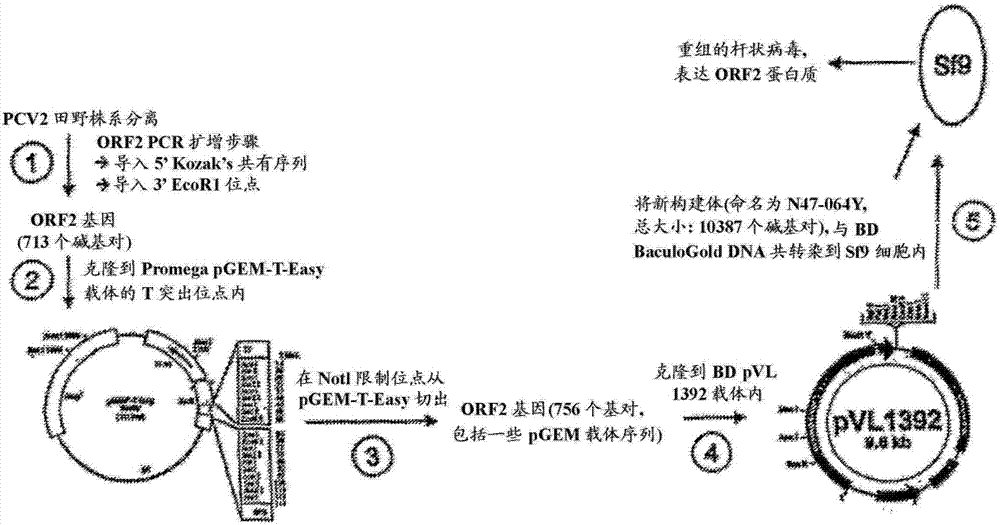
The present invention relates to multivalent PCV2 immunogenic compositions and methods of making such compositions. The present invention provides an improved method for recovering open reading frame 2 protein expressed by porcine circovirus type 2. Also provided are a recombinant PCV2 ORF2 protein, and immunogenic compositions comprising the PCV2 ORF2 protein. In addition, multivalent combination vaccines are provided comprising immunizing agents effective in reducing the incidence or severity of PCV2 infection, preferably PCV2 ORF2 protein, or an immunogenic composition comprising PCV2 ORF2 protein, and against other pathogenic agents in pigs At least one immunogenic active component of an organism.
Description
本申请是申请日为2006年12月28日、中国申请号为200680053576.8、发明名称为“多价PCV2免疫原性组合物和制备此类组合物的方法”的发明申请的分案申请。This application is a divisional application of an invention application with a filing date of December 28, 2006, a Chinese application number of 200680053576.8, and an invention title of "multivalent PCV2 immunogenic composition and method for preparing such composition".
序列表sequence listing
本发明包括纸质和计算机可读的序列表,在此以提述方式并入其教导和内容。The present invention includes both paper and computer readable Sequence Listings, the teachings and contents of which are hereby incorporated by reference.
发明背景Background of the invention
发明领域 field of invention
本发明一方面涉及回收由2型猪圆环病毒(PCV2)之可读框2(ORF2)表达的蛋白质。更具体地说,该蛋白质为由转染病毒表达的重组蛋白质,该转染病毒含有2型猪圆环病毒可读框2的重组编码序列。更具体地说,容许该转染病毒感染将长培养基中的细胞,并在上清液中,而非从细胞内部回收由可读框2表达的蛋白质。再更具体地说,该方法涉及下列步骤:自2型猪圆环病毒扩增可读框2基因,将该经扩增的部分克隆到第一载体内,从该第一载体中切下可读框2,并将其克隆到转移载体内,将转移载体和病毒载体共同转染到生长培养基中的细胞内,使细胞被病毒载体感染并藉此表达可读框2,然后在上清液中回收表达的由可读框2编码的重组蛋白质。One aspect of the present invention relates to the recovery of proteins expressed by the open reading frame 2 (ORF2) of porcine circovirus type 2 (PCV2). More specifically, the protein is a recombinant protein expressed by a transfected virus containing the recombinant coding sequence of open reading frame 2 of porcine circovirus type 2. More specifically, the transfection virus is allowed to infect cells in growth medium and the protein expressed by open reading frame 2 is recovered in the supernatant rather than from within the cells. Still more specifically, the method involves the steps of amplifying the open reading frame 2 gene from porcine circovirus type 2, cloning the amplified portion into a first vector, excising from the first vector Reading frame 2, and clone it into a transfer vector, co-transfect the transfer vector and viral vector into cells in the growth medium, make the cells infected by the viral vector and thereby express open reading frame 2, and then in the supernatant The expressed recombinant protein encoded by open reading frame 2 was recovered from the solution.
另一方面,本发明涉及可有效引起对抗PCV2之免疫反应的免疫组合物,以及产生这些免疫组合物的方法。更具体地说,本发明涉及一种免疫学组合物,它可有效提供免疫反应,该免疫反应保护接受该组合物的动物,并减少与PCV2感染有关的临床症状或降低其严重性。更具体地说,本发明涉及一种基于蛋白质的免疫学组合物,其赋予对抗PCV2感染的有效保护。再更具体地说,本发明涉及一种包含PCV2的ORF2的免疫学组合物,其中PCV2-ORF2的施用导致对抗PCV2感染的保护。最具体的是,本发明涉及可有效地对接受该免疫组合物的猪赋予有效免疫力的免疫组合物,且其中该组合物包含由PCV2的ORF2表达的蛋白质。In another aspect, the invention relates to immune compositions effective to elicit an immune response against PCV2, and methods of producing these immune compositions. More particularly, the present invention relates to an immunological composition effective to provide an immune response which protects an animal receiving the composition and reduces the clinical symptoms or severity associated with PCV2 infection. More specifically, the present invention relates to a protein-based immunological composition conferring effective protection against PCV2 infection. Still more specifically, the present invention relates to an immunological composition comprising ORF2 of PCV2, wherein administration of PCV2-ORF2 results in protection against PCV2 infection. Most particularly, the present invention relates to an immunizing composition effective for conferring effective immunity to a pig receiving the immunizing composition, and wherein the composition comprises a protein expressed by ORF2 of PCV2.
在另一方面,本发明亦提供组合疫苗或多价疫苗。更具体地说,本发明提供可有效引起对抗PCV2及至少一种其它猪致病生物所致感染的免疫反应的免疫组合物。In another aspect, the present invention also provides combination vaccines or multivalent vaccines. More specifically, the present invention provides immunological compositions effective to elicit an immune response against infection by PCV2 and at least one other porcine pathogenic organism.
现有技术描述Description of prior art
2型猪圆环病毒(PCV2)是小型(直径17-22纳米)、二十面体无包膜的DNA病毒,其含有单链的环状基因组。PCV2与1型猪圆环病毒(PCV1)共享大约80%的序列同一性。然而,与通常无毒力的PCV1相反,被PCV2感染的猪显示出一种通常称为小猪断奶后多系统消耗综合征(PMWS)的症状。PMWS的临床特征在于消瘦、皮肤苍白、生长不振(unthriftiness)、呼吸窘迫、腹泻、黄疸(icterus)和黄疸(jaundice)。在一些受累的猪中,出现所有症状的组合,而在其它的猪则仅有这些症状中一者或二者。在尸体剖检中,微观和宏观损害亦出现在多种组织和器官上,淋巴器官是最常见的损害位置。已观测到PCV2核酸或抗原的量与微观淋巴损害严重性之间的强相关性。感染有PCV2的猪的死亡率可达80%。PCV2还与包括下列各项的若干其它感染相关:伪狂犬病、猪生殖及呼吸综合征(PRRS)、格拉塞氏病(Glasser′s disease)、链球菌性脑膜炎、沙门氏菌病、断乳后大肠杆菌病、饮食性肝功能障碍(dietetic hepatosis)及化脓性支气管肺炎。Porcine circovirus type 2 (PCV2) is a small (17-22 nm in diameter), icosahedral non-enveloped DNA virus containing a single-stranded circular genome. PCV2 shares approximately 80% sequence identity with porcine circovirus type 1 (PCV1). However, in contrast to the normally avirulent PCV1, pigs infected with PCV2 displayed a condition commonly known as post-weaning multisystemic wasting syndrome (PMWS). PMWS is clinically characterized by wasting, pallor, unthriftiness, respiratory distress, diarrhea, icterus and jaundice. In some affected pigs, a combination of all symptoms is present, while in others only one or both of these symptoms are present. At autopsy, microscopic and macroscopic lesions were also found on a variety of tissues and organs, with lymphoid organs being the most common location of lesions. A strong correlation between the amount of PCV2 nucleic acid or antigen and the severity of microscopic lymphoid lesions has been observed. The mortality rate of pigs infected with PCV2 can reach 80%. PCV2 has also been associated with several other infections including: pseudorabies, porcine reproductive and respiratory syndrome (PRRS), Glasser's disease, streptococcal meningitis, salmonellosis, postweaning large intestine bacillosis, dietetic hepatitis, and suppurative bronchopneumonia.
PCV2的可读框2(ORF2)蛋白质,当在SDS-PAGE凝胶上电泳时,具有大约30kDa的分子量,从前已经利用它作为PCV2疫苗的抗原性组分。获得用于这类疫苗中的ORF2的典型方法通常由下列步骤组成:扩增编码ORF2的PCV2DNA,以ORF2DNA转染病毒载体,用含有ORF2DNA的病毒载体感染细胞,容许病毒在细胞内表达ORF2蛋白质,并通过细胞溶解,从细胞中提取ORF2蛋白质。这些程序通常在以病毒载体感染细胞之后,需花费多达4天。然而,这些程序的缺点在于提取程序昂贵且耗时。此外,从细胞中回收的ORF2量并不是很高;结果,需要以大量的病毒载体感染大量的细胞,以便获得足量的重组表达的蛋白质供用于疫苗等。The open reading frame 2 (ORF2) protein of PCV2, which has a molecular weight of approximately 30 kDa when electrophoresed on an SDS-PAGE gel, has previously been utilized as an antigenic component of PCV2 vaccines. A typical method for obtaining ORF2 for use in such vaccines generally consists of the following steps: amplifying PCV2 DNA encoding ORF2, transfecting a viral vector with ORF2 DNA, infecting cells with a viral vector containing ORF2 DNA, allowing the virus to express the ORF2 protein in the cell, And through cell lysis, ORF2 protein is extracted from the cells. These procedures usually take up to 4 days after infection of the cells with the viral vector. However, the disadvantage of these procedures is that the extraction procedure is expensive and time-consuming. Furthermore, the amount of ORF2 recovered from cells is not very high; as a result, a large number of cells needs to be infected with a large number of viral vectors in order to obtain sufficient recombinantly expressed protein for use in vaccines and the like.
近来PCV2免疫的手段包括基于DNA的疫苗,如在美国专利第6,703,023号中描述的那些。然而,这类疫苗不能有效地赋予对抗PCV2感染及其相关临床症状的保护性免疫力。Recent approaches to PCV2 immunization include DNA-based vaccines, such as those described in US Patent No. 6,703,023. However, such vaccines are not effective in conferring protective immunity against PCV2 infection and its associated clinical symptoms.
猪生殖与呼吸综合征(PRRS)是由一种病毒引起的,到1991年才首先分离并将其分类为动脉炎病毒(arterivirus)。该疾病症状首先在1980年代中期在美国被发现,并被称为"神秘猪病"。它也曾被称为蓝耳病(blue ear disease)。最近提议的名称为猪动脉炎病毒。PRRS的病毒对巨噬细胞,特别是在肺中找到的那些巨噬细胞有特殊的亲和力。巨噬细胞是身体防御系统的一部分。出现在肺中的那些巨噬细胞又叫做肺泡巨噬细胞(alveolar macrophages)。它们摄取并消除入侵的细菌和病毒,但对PRRS病毒则不然。这种病毒反而在那些巨噬细胞内繁殖,产生更多的病毒,并杀死巨噬细胞。一旦这种病毒进入猪群,便往往无限期地维持存在并保持活性。高达40%的巨噬细胞被破坏,导致身体防御机制丧失了一个重要部分,使得细菌和其它病毒得以增殖并进行破坏。最常见的例子是当生长/肥育猪被PRRS病毒感染时,地方性肺炎的严重性有显著的增加。首次使整个生育畜群(breeding stock)(特别是在大的畜群中)感染可能花费一年时间,而且虽然该病毒在畜群中似乎散播很快,但可能在4-5个月时才会有至少90%的母猪变成血清-阳性。有一些母猪仍保持无经历(naive)。此外,母猪群在感染1-2年之后包含少于20%的血清学阳性动物也是屡见不鲜的。然而,这不一定意味着它们不再具有免疫力,也不意味着它们已经不再传递免疫力给它们的后代。与正在生长的猪(其排泄病毒持续1-2个月)相比较,成年动物排出病毒的时间短很多(14天)。临床情况可随着猪群不同而发生巨大的改变。作为指标,每三个头一次接触PRRS的猪群,就有一个不显示可辨认的疾病,第二个将显示轻微的疾病,而第三个则有中等到严重的疾病。其原因尚未清楚了解。然而,猪群的健康状况越好,疾病的影响就越轻。可能是病毒随着增殖而发生突变,产生一些具有高毒力的株系和一些无毒力的株系。PRRS感染所有类型的猪群,包括良好或普通健康状况的,以及室内和室外的猪群,不论大小。Porcine reproductive and respiratory syndrome (PRRS) is caused by a virus that was first isolated and classified as an arterivirus until 1991. Symptoms of the disease were first identified in the United States in the mid-1980s and became known as "mystery swine disease." It was also known as blue ear disease. A recently proposed name is porcine arteritis virus. The virus of PRRS has a special affinity for macrophages, especially those found in the lung. Macrophages are part of the body's defense system. Those macrophages present in the lungs are also called alveolar macrophages. They ingest and eliminate invading bacteria and viruses, but not PRRS virus. The virus instead multiplies inside those macrophages, producing more virus and killing the macrophages. Once the virus enters a herd, it tends to remain present and active indefinitely. Up to 40 percent of macrophages are destroyed, depriving the body of an important part of its defense mechanism that allows bacteria and other viruses to proliferate and wreak havoc. The most common example is the marked increase in the severity of enzootic pneumonia when growing/finishing pigs are infected with PRRS virus. It may take a year to first infect an entire breeding stock (especially in large herds), and although the virus appears to spread rapidly through a herd, it may not be until 4-5 months old. At least 90% of sows will become sero-positive. Some sows remain naive. Furthermore, it is not uncommon for sow herds to contain less than 20% seropositive animals 1-2 years after infection. However, this does not necessarily mean that they are no longer immune, nor that they have stopped passing immunity to their offspring. Adult animals shed virus for a much shorter period of time (14 days) compared to growing pigs, which shed virus for 1-2 months. The clinical situation can vary greatly from herd to herd. As an indicator, for every three herds exposed to PRRS for the first time, one will show no identifiable disease, a second will show mild disease, and a third will have moderate to severe disease. The reason for this is not clearly understood. However, the better the health of the herd, the less affected the disease will be. It may be that the virus mutates as it proliferates, producing some highly virulent strains and some avirulent ones. PRRS infects all types of herds of good or average health, as well as indoor and outdoor herds, regardless of size.
猪肺炎枝原体(Mycoplasma hyopneumoniae)(M hyo)是一被分类在枝原体科(mycoplasmataceae)中的小型细菌(400-1200nm)。M hyo与地方性肺炎(Enzootic Pneumonia)有关,这是一种在生长和肥育猪中常见的猪呼吸道疾病。M hyo攻击气管和肺上皮细胞的纤毛,引起纤毛停止振动(纤毛静止),且最终引起肺区域的塌陷。依据疾病的程度,被感染猪的每日活增重可能减少多达17%。地方性肺炎在猪群中是广泛流传的,且几乎出现在每个猪群中。M hyo被认为是帮助PRRSV和其它呼吸道病原体进入肺内的主要病原体。已经确定了三种不同株系——232、J和7448的基因组序列(Minion等人,J.Bacteriol.186:7123-33,2004;Vasconcelos等人,J.Bacteriol.187:5568-77,2005)。Mycoplasma hyopneumoniae (M hyo) is a small bacterium (400-1200 nm) classified in the family mycoplasmataceae. M hyo has been linked to Enzootic Pneumonia, a porcine respiratory disease commonly seen in growing and finishing pigs. M hyo attacks the cilia of the tracheal and lung epithelial cells, causing the cilia to stop vibrating (cilium quiescence), and eventually causing the collapse of the lung region. Depending on the extent of the disease, daily live gain of infected pigs may be reduced by as much as 17%. Enzootic pneumonia is widespread in swine herds and occurs in almost every herd. M hyo is thought to be the main pathogen that helps PRRSV and other respiratory pathogens enter the lungs. The genome sequences of three different strains - 232, J and 7448 - have been determined (Minion et al., J. Bacteriol. 186:7123-33, 2004; Vasconcelos et al., J. Bacteriol. 187:5568-77, 2005 ).
猪增殖性肠炎(procine proliferative enteritis)是生长-肥育和年轻种猪常见的腹泻性疾病,其特征在于回肠和结肠的增生和炎症。其通常是轻微且自限的,但有时却引起持续腹泻、严重的坏死性肠炎或出血性肠炎,死亡率很高。病因是一种新近被分类的胞内细菌——细胞内劳索尼亚氏菌(Lawsoniaintracellularis)。该生物仅在细胞培养中培养,而在无细胞培养基中繁殖它的尝试都没有成功。通过将细胞内劳索尼亚氏菌的纯培养物接种在以传统方式饲养的猪内;产生该疾病的典型损害,并再度从损害中分离出了细胞内劳索尼亚氏菌,从而满足了科赫法则。这种疾病的更常见的、非出血形式经常侵袭18-至36-公斤的猪,其特征为突然发作的腹泻。粪便是水状至糊状的,淡褐色或稍带血丝的。在大约2天后,猪可能排出已经在回肠中形成的黄色纤维坏死性(fibrinonecrotic)成形物(casts)。大多数受累的猪会自然恢复,但相当多发展成慢性坏死性肠炎,伴有进行性消瘦。出血形式的特征为皮肤苍白、虚弱并排出血便或黑色、焦油状粪便。怀孕的母猪可能会流产。损害可能出现在小肠下半段、盲肠或结肠中的任何地方,但最常见和明显的是在回肠。小肠壁变厚,且肠系膜可能水肿。肠系膜淋巴结变大。小肠黏膜呈现变厚且多皱纹,可能被淡褐色或黄色的纤维坏死性膜覆盖,而有时有淤斑出血。黄色的坏死性成形物可在回肠中找到,或通过结肠排出。在慢性病例中的弥漫性、完全的黏膜坏死,导致小肠变硬,很像园艺用的软管(garden hose)。增殖性黏膜损害经常发生在结肠中,但仅在尸体剖检时小心检查才能发现。在大量出血的类型中,在结肠中有红或黑色、焦油状的粪便,且在回肠中有凝固的血液。Procine proliferative enteritis is a common diarrheal disease of growing-finishing and young breeding pigs, characterized by hyperplasia and inflammation of the ileum and colon. It is usually mild and self-limited, but sometimes causes persistent diarrhea, severe necrotizing or hemorrhagic enteritis, and is associated with high mortality. The cause is a newly classified intracellular bacterium, Lawsonia intracellularis. The organism has only been grown in cell culture, and attempts to propagate it in cell-free media have been unsuccessful. The science was met by inoculating traditionally raised pigs with a pure culture of L. intracellulare; producing lesions typical of the disease, from which L. intracellulare was again isolated. Hefa rule. The more common, non-hemorrhagic form of the disease frequently affects 18- to 36-kg pigs and is characterized by sudden onset of diarrhea. The stool is watery to mushy, light brown or slightly bloodshot. After about 2 days, pigs may shed yellow fibrinonecrotic casts that had formed in the ileum. Most affected pigs recover spontaneously, but a significant number develop chronic necrotic enteritis with progressive wasting. The hemorrhagic form is characterized by pale skin, weakness, and passing bloody or black, tarry stools. Pregnant sows may abort. Lesions may appear anywhere in the lower small intestine, cecum, or colon, but are most common and prominent in the ileum. The wall of the small bowel is thickened, and the mesentery may be edematous. Enlarged mesenteric lymph nodes. The small bowel mucosa appears thickened and wrinkled, may be covered by a hazel or yellow fibronecrotic membrane, and is sometimes ecchymotic. Yellow necrotic formations can be found in the ileum or pass through the colon. Diffuse, complete mucosal necrosis in chronic cases, resulting in hardening of the small intestine, much like a garden hose. Proliferative mucosal lesions frequently occur in the colon, but are only found on careful examination at necropsy. In the profuse bleeding type, there are red or black, tarry stools in the colon and clotted blood in the ileum.
牛病毒性腹泻病毒(BVD)和边境病(Border’s Disease)是两种病毒,它们与猪瘟(猪霍乱)的病毒同属瘟病病毒(pestivirus)类群,但它们主要分别感染牛和绵羊。它们可进入猪生育畜群中,并引起生殖方面的问题。该疾病并非母猪不孕的常见原因,且从诊断的观点来看,在诸多可能原因中排名也是靠后的。Bovine viral diarrhea virus (BVD) and Border's Disease are two viruses that belong to the same group of pestiviruses as the virus of swine fever (hog cholera), but they mainly infect cattle and sheep respectively. They can enter pig breeding herds and cause reproductive problems. The disease is not a common cause of infertility in sows, and from a diagnostic point of view it is low on the list of possible causes.
钩端螺旋体病是一种动物(包括人类)的接触传染疾病,由各种免疫学上不同的钩端螺旋体血清型引起,这些血清型中的大多数被视为问号钩端螺旋体(Leptospira interrogans)的亚群。在猪中有五种重要的血清型和群:波摩那钩端螺旋体(pomona)、澳大利亚钩端螺旋体(australis)、塔拉索夫钩端螺旋体(tarassovi)、犬钩端螺旋体(canicola)、出血黄疸钩端螺旋体(icterohaemorrhagicae)和流感伤寒钩端螺旋体(grippotyphosa)。感染可能是无症状的,或引起各种征象,包括食欲不振、发热、倦怠、黄疸、流产、死产和其它不明确的生殖问题,以及死亡。在急性感染之后,钩端螺旋体经常局限于肾脏或生殖器官,由局灶性间质性肾炎的零星灰色小病灶组成,并从尿中排出,有时大量排出持续数月或数年。因为钩端螺旋体长时间存活于水表面,该疾病经常是水媒传播的。在美国,该疾病主要起因于哈德焦钩端螺旋体(Leptospira hardjo)、波摩那钩端螺旋体和流感伤寒钩端螺旋体等血清型。诊断可能比较困难,因为抗体效价可能是暂时存在的,持续时间不足一个月。此外,钩端螺旋体亦可在健康的动物中发现。澳大利亚钩端螺旋体布拉提斯拉瓦(Bratislava)血清型最常与生殖问题有关。慢性感染的猪群出现流产,死产和小猪虚弱。Leptospirosis is a contagious disease of animals, including humans, caused by various immunologically distinct Leptospira serotypes, most of which are considered Leptospira interrogans of subgroups. There are five important serotypes and groups in pigs: Pomona, australis, tarassovi, canicola, hemorrhagic icterohaemorrhagicae and grippotyphosa. Infection may be asymptomatic or cause a variety of signs, including loss of appetite, fever, malaise, jaundice, miscarriage, stillbirth, and other unspecified reproductive problems, and death. Following acute infection, Leptospira is often confined to the kidneys or reproductive organs, consists of sporadic small gray foci of focal interstitial nephritis, and is excreted in the urine, sometimes in large quantities for months or years. Because Leptospira persists on water surfaces for extended periods of time, the disease is often waterborne. In the United States, the disease is primarily caused by serotypes of Leptospira hardjo, Leptospira pomona, and Leptospira influenza typhi. Diagnosis may be difficult because antibody titers may be transient, lasting less than a month. In addition, Leptospira can also be found in healthy animals. The Australian Leptospira serotype Bratislava is most commonly associated with reproductive problems. Chronically infected herds experience abortions, stillbirths and weak piglets.
布鲁氏菌病是由布鲁氏菌(Brucella)属的细菌引起,其特征在于流产、胎盘滞留、不孕、公猪的睾丸炎,和母猪严重的子宫炎。在小猪,该疾病之特征为后躯麻痹(posterior paralysis)和跛足(lameness)。该疾病在猪中几乎完全是由猪布鲁氏菌(Brucella suis)生物变型(biovars)1、2和3引起的。许多其它的哺乳动物可携带猪布鲁氏菌并将其传播给猪。在未接种疫苗的猪群中感染迅速地传播并可引起许多流产。传染主要是通过接触其它的猪而发生,虽然性传播是有可能的。血清学诊断可能较困难,因为有一种相对较常见的生物——小肠结肠型耶尔森氏菌(Yersinia enterocolitica)O:9与布鲁氏菌有共同的抗原,且经常引起假阳性的结果。死后损害经常包括子宫炎和睾丸炎,并可包括脓肿,有时在肝脏还有坏死病灶。Brucellosis is caused by bacteria of the Brucella genus and is characterized by abortion, retained placenta, infertility, orchitis in boars, and severe metritis in sows. In piglets, the disease is characterized by posterior paralysis and lameness. The disease is caused almost exclusively in pigs by Brucella suis biovars 1, 2 and 3. Many other mammals can carry and transmit B. suis to pigs. Infection spreads rapidly in unvaccinated herds and can cause many abortions. Infection occurs mainly through contact with other pigs, although sexual transmission is possible. Serological diagnosis can be difficult because a relatively common organism, Yersinia enterocolitica O:9, shares antigens with Brucella and often causes false-positive results. Postmortem lesions frequently include metritis and orchitis and may include abscesses and sometimes necrotic foci in the liver.
梭菌(Clostridium)是普遍存在的革兰氏阳性细菌,属于梭菌科(clostridiaceae),通常在土壤中找到,但也天然存在于大多数动物的肠道中。猪中的艰难梭菌(C.difficile)感染的特征是严重的结肠系膜水肿、腹泻和其它组织的水肿,如水胸。猪的梭菌性肠炎是由产气荚膜梭菌(C.perffingens)引起,其特征是慢性肠炎,伴随有腹泻、体重减轻和发热。被产气荚膜梭菌A、B和C型感染,引起严重的肠炎,痢疾、毒血症,而在幼牛中有高死亡率。B和C型两者皆产生高度致坏死性且致命的β毒素,它是造成严重肠损害的主因。该毒素对蛋白水解酶敏感,而病情与小肠中蛋白水解被抑制有关。已经有人提出,含有胰蛋白酶抑制剂的母猪初乳是年幼小猪易感的因素。该疾病可能引起小于1周龄小猪的突然死亡,最常见的是在出生3天内。在较大的小猪中,梭菌性肠炎引起小肠变厚,使食物和营养不易吸收。小猪通常因感染和缺乏营养的结合而死亡。死亡可能发生在数小时内,但较不严重的病例可存活数天,并可能在数天内恢复。出血性肠炎伴随黏膜溃疡是所有种类中的主要损害。在肉眼观察下,受侵袭的肠道部分为深蓝-紫色,乍看之下似乎是与肠系膜扭转相关的梗塞形成。可检查肠内容物抹片中是否有大量革兰氏-阳性杆状细菌,并制备滤液,检测毒素,然后通过与特异性抗血清的中和作用进行鉴定。Clostridium are ubiquitous Gram-positive bacteria belonging to the family Clostridiaceae that are commonly found in soil but also occur naturally in the gut of most animals. C. difficile infection in pigs is characterized by severe mesocolic edema, diarrhea and edema of other tissues such as hydrothorax. Clostridial enteritis in pigs is caused by Clostridium perfringens (C. perffingens) and is characterized by chronic enteritis with diarrhea, weight loss, and fever. Infection with Clostridium perfringens types A, B, and C causes severe enteritis, dysentery, toxemia, and high mortality in young cattle. Both types B and C produce the highly necrotic and lethal beta toxin, which is responsible for severe intestinal damage. The toxin is sensitive to proteolytic enzymes, and the condition is associated with inhibition of proteolysis in the small intestine. Sow colostrum containing trypsin inhibitors has been suggested as a predisposing factor for young piglets. The disease can cause sudden death in piglets less than 1 week old, most commonly within 3 days of birth. In older piglets, clostridial enteritis causes the small intestine to thicken, making food and nutrients less absorbable. Piglets usually die from a combination of infection and lack of nutrition. Death can occur within hours, but less severe cases can survive and possibly recover within days. Hemorrhagic enteritis with mucosal ulceration is the major lesion in all categories. Grossly, the affected portion of the bowel is dark blue-purple and appears at first glance to be an infarct associated with torsion of the mesentery. Intestinal smears can be examined for large numbers of Gram-positive rod-shaped bacteria and filtrates can be prepared to detect toxins and then identified by neutralization with specific antiserum.
已经怀疑但尚未证实诺氏梭菌(Clostridium novyi)是喂食高水平谷类食物的牛和猪突然死亡的原因,这些牛和猪中检测不到原先存在的肝脏损害。致命且致坏死性毒素(主要是α毒素)伤害肝实质,藉此容许细菌繁殖并产生致命量的毒素。死亡通常突然发生,没有确定的征象。受累的动物往往落在兽群后面,采俯卧姿,并在数小时内死亡。大部分的病例发生在夏季和早秋,此时肝吸虫感染正值高峰期。该疾病在1至4岁大的绵羊中最为盛行,且仅限于感染肝吸虫的动物。可能不易与急性片形吸虫病区别,但动物的极急性(peractute)死亡,在尸体剖检时显示典型的损害,应疑为传染性坏死性肝炎。最具特色的损害是在肝脏中灰黄色的坏死病灶,它们经常依循着幼吸虫的迁移轨迹出现。其它常见的现象是心包囊变大,充满淡黄色的液体,并在腹膜和胸腔中有过量的液体。皮下组织中微血管通常有广泛的破裂,导致邻近皮肤变成黑色(因此俗称为“黑病”)。Clostridium novyi has been suspected but not proven to be the cause of sudden death in cattle and pigs fed high levels of cereals where pre-existing liver damage was undetectable. Lethal and necrotic toxins, primarily alpha toxins, injure the liver parenchyma, thereby allowing the bacteria to multiply and produce lethal amounts of the toxin. Death usually occurs suddenly, without definitive signs. Affected animals tend to fall behind the herd, assume a prone position, and die within hours. Most cases occur in summer and early fall, when liver fluke infections are at their peak. The disease is most prevalent in sheep between 1 and 4 years of age and is restricted to animals infected with liver flukes. It may not be easy to distinguish from acute fascioliasis, but very acute (peractute) deaths of animals, showing typical lesions at necropsy, should suspect infectious necrotizing hepatitis. The most characteristic lesions are gray-yellow foci of necrosis in the liver, which often follow the migratory tracks of larvae. Other common findings are pericardial sacs that become enlarged and filled with yellowish fluid, with excess fluid in the peritoneum and pleural cavity. There is often extensive disruption of capillaries in the subcutaneous tissue, causing the adjacent skin to turn black (hence the colloquial name "black disease").
败毒梭菌(Clostridium septicum)在全世界的土壤以及动物(包括人类)的肠内容物中均有发现。感染通常是通过含有失活组织、土壤或一些其它组织致弱因素(tissue-debilitant)的伤口的污染而发生的。由意外、去势、截尾、不卫生地接种疫苗和分娩引起的伤口都可能被感染。全身性,如食欲不振、中毒和高热,以及局部损害,在致易感性伤害(predisposing injury)之后数小时至数天内出现。局部损害是柔软的肿胀,压下形成凹窝,而且迅速地蔓延,这是因为形成的大量渗出液浸润受累区的皮下和肌肉内的结缔组织。气体的积累较为少见。与撕裂相关的恶性水肿的特征为明显的水肿,严重的毒血症,并在24-48小时内死亡。Clostridium septicum is found worldwide in soil and in the intestinal contents of animals, including humans. Infection usually occurs through contamination of wounds containing devitalized tissue, soil or some other tissue-debilitant. Wounds caused by accidents, castration, censorship, unsanitary vaccinations, and childbirth can all become infected. Systemic, such as anorexia, intoxication, and hyperthermia, and localized lesions appear hours to days after the predisposing injury. Local lesions are soft, dimpled, and spread rapidly because of the formation of profuse exudate that infiltrates the subcutaneous and intramuscular connective tissue in the affected area. Accumulation of gas is less common. Malignant edema associated with tears is characterized by marked edema, severe toxemia, and death within 24-48 hours.
破伤风毒血症是由坏死组织中的破伤风梭菌(Clostridium tetani)产生的特殊的神经毒素引起的。几乎所有的哺乳动物,包括猪,均易受该疾病感染。虽然破伤风分布在全世界,但有些地区,如美国的北落矶山脉,在土壤中很少发现该生物,在那里破伤风几乎不为人知。通常,在各大陆较温暖的地区,破伤风梭菌在土壤中的出现率以及人类感染破伤风的发病率都较高。破伤风梭菌是一种厌氧菌,有终端球状的芽孢,在土壤和肠道中都有发现。在大多数情况下,其通过伤口,特别是深的穿刺伤被导入组织内,伤口为其提供了合适的厌氧环境。Tetanus toxemia is caused by a specific neurotoxin produced by Clostridium tetani in necrotic tissue. Almost all mammals, including pigs, are susceptible to the disease. Although tetanus has a worldwide distribution, there are areas, such as the Northern Rockies in the United States, where the organism is rarely found in soil, where tetanus is virtually unknown. In general, the prevalence of C. tetani in soil and the incidence of tetanus infection in humans is higher in warmer regions of the continents. Clostridium tetani is an anaerobic bacterium with terminal spherical spores that is found in both soil and the intestinal tract. In most cases, it is introduced into the tissue through a wound, especially a deep puncture wound, which provides it with a suitable anaerobic environment.
沙门氏菌属的某些种(Salmonella spp)感染可能在所有年龄的动物中导致腹泻,特别是受到应激、密集饲养或接触严重污染之食物或水源供应的那些动物。沙门氏菌病是由沙门氏菌属(salmonellae)的许多物种引起的,其临床特征为下列主要症状中的一或多种:败血症、急性肠炎和慢性肠炎。发生率随着家畜生产的密集程度而增加。虽然各种类型的沙门氏菌均可能引起猪的感染,在猪中发现的典型沙门氏菌是猪霍乱沙门氏菌(S.choleraesuis)和鼠伤寒沙门氏菌(S.typhimurium)。大多数沙门氏菌所致的临床特征并非截然不同,而沙门氏菌属不同物种在它们的流行病学上有分歧的倾向。质粒谱(plasmid profile)和药物-抗药性模式在流行病学研究中有时是有用的标记。败血性沙门氏菌病通常与猪霍乱沙门氏菌有关。被感染的小猪不愿移动、食欲不振、高热40.5℃-41.6℃,可能还有浅咳。亦可能发现小猪死亡,且四肢发绀。猪霍乱沙门氏菌是能同时引起肺炎和腹泻的少数疾病之一,且被感染小猪的死亡率通常很高。小肠结肠炎通常与更常见的鼠伤寒沙门氏菌有关。感染的特征是黄色或水状腹泻,随着感染进行,可能含有血或黏液。死亡率低,且常与腹泻所致的脱水和钾缺乏有关。被感染动物的粪便可能污染食物和饮水、来自屠宰场的新鲜或加工肉类、用来当作肥料和饲料的植物和动物产品、牧场和牧地,以及许多惰性材料。虽然很少在饲料中发现猪霍乱沙门氏菌。它亦可能直接通过与被感染动物接触而传递。沙门氏菌可在潮湿、温暖的地方存活数个月,如在肥育猪棚或在水井中。啮齿动物和野鸟也是传染来源。感染的盛行程度在不同物种和国家之间有所不同,而且高于临床疾病的发生率,通常由于应激性状况,如突然缺乏食物、运输、干旱、拥挤、分娩,以及某些药物的施用而造成。Salmonella spp infection can cause diarrhea in animals of all ages, especially those that are stressed, intensively housed, or exposed to heavily contaminated food or water supplies. Salmonellosis is caused by a number of species of Salmonellae and is clinically characterized by one or more of the following cardinal symptoms: sepsis, acute enteritis, and chronic enteritis. The incidence increases with the intensity of livestock production. Although various types of Salmonella can cause infections in pigs, the typical Salmonella found in pigs are S. choleraesuis and S. typhimurium. The clinical features caused by most Salmonella species are not distinct, and different Salmonella species tend to diverge in their epidemiology. Plasmid profiles and drug-resistance patterns are sometimes useful markers in epidemiological studies. Septicemic salmonellosis is often associated with S. choleraesuis. Infected piglets are unwilling to move, have poor appetite, high fever of 40.5°C-41.6°C, and may have a shallow cough. Piglets may also be found dead with cyanotic extremities. S. choleraesuis is one of the few diseases that can cause both pneumonia and diarrhoea, and the mortality rate of infected piglets is usually high. Enterocolitis is often associated with the more common Salmonella typhimurium. The infection is characterized by yellow or watery diarrhea that may contain blood or mucus as the infection progresses. Mortality is low and is often associated with dehydration and potassium deficiency from diarrhea. Feces from infected animals can contaminate food and drinking water, fresh or processed meat from slaughterhouses, plant and animal products used as fertilizer and feed, pasture and rangeland, and many inert materials. Although S. choleraesuis is rarely found in feed. It may also be passed directly through contact with infected animals. Salmonella can survive for months in moist, warm places, such as in finishing pig sheds or in wells. Rodents and wild birds are also sources of infection. The prevalence of infection varies between species and countries and is higher than the incidence of clinical disease, often due to stressful situations such as sudden lack of food, transportation, drought, crowding, childbirth, and the administration of certain drugs And caused.
大肠杆菌(Escherichia coli)是肠杆菌科(enterobacteriaceae)的细菌,是天然出现在所有哺乳动物小肠中的细菌的主要类型之一。虽然大肠杆菌通常是无害的,但有些大肠杆菌株系可产生一些外毒素和内毒素,引起感染和疾病。有一些株系主动地产生热不稳定(LT)和热稳定(ST)的外毒素,并这些毒素是引起腹泻的原因。类志贺毒素第II型变种(SLT-IIe)、Stx2e和志贺样毒素(verotoxin)水肿病作用于小动脉壁,结果导致水肿。内毒素,如脂质A,在乳腺炎和尿道感染中扮演某种角色。大肠杆菌感染的特征在于一些不同的症状,视所涉及的具体株系而定,包括腹泻、眼窝凹陷、生长不振(unthriftiness)、可见的体重丧失、生长受阻、抑郁、肠水肿、乳腺炎、膀胱炎、肾盂肾炎和死亡。可根据细胞壁(O抗原)和细毛(fimbriae)(F抗原)将大肠杆菌分类和编码。例如,腹泻通常与大肠杆菌Abbotstown:O147、F4、F5有关,而肠水肿则与F18细毛有关。正确地确认编码,对于选择正确的疫苗是非常重要的。大肠杆菌感染危及猪的免疫系统,而死亡通常是继发感染和疾病的结果。Escherichia coli, a bacterium of the enterobacteriaceae family, is one of the major types of bacteria naturally occurring in the small intestine of all mammals. Although E. coli is generally harmless, some strains of E. coli can produce some exotoxins and endotoxins, causing infection and disease. Some strains actively produce heat-labile (LT) and heat-stable (ST) exotoxins and are responsible for diarrhea. Shiga toxin type II variants (SLT-IIe), Stx2e, and verotoxin edemas act on the arteriolar wall, resulting in edema. Endotoxins, such as lipid A, play a role in mastitis and urinary tract infections. E. coli infection is characterized by a number of different symptoms, depending on the specific strain involved, including diarrhea, sunken eyes, unthriftiness, visible weight loss, growth arrest, depression, intestinal edema, mastitis, bladder inflammation, pyelonephritis, and death. E. coli can be classified and coded according to the cell wall (O antigen) and the fimbriae (F antigen). For example, diarrhea is often associated with E. coli Abbotstown: O147, F4, F5, whereas intestinal edema is associated with F18 capillaries. Correctly confirming the code is very important for selecting the correct vaccine. E. coli infection compromises the pig's immune system, and death is often the result of secondary infection and disease.
猪痘是引起皮肤损害、丘疹、脓疱和痂的疾病。Swine pox is a disease that causes skin lesions, papules, pustules and scabs.
血虫体病(eperythrozoonosis)是立克次氏体(血营养型(haemotrophic))疾病,由猪血虫体(Eperythrozoon suis)引起,猪血虫体是一种细胞外的细菌生物,其附贴在猪红细胞膜上,导致红细胞变形和损伤。该疾病之特征为贫血和黄疸(黏膜、巩膜和内耳变黄色)。它可能导致不优选的怀孕率、其它不明确的生殖问题,甚至死亡。Eperythrozoonosis is a rickettsial (haemotrophic) disease caused by Eperythrozoon suis, an extracellular bacterial organism that attaches to In porcine erythrocyte membranes, causing deformation and damage of erythrocytes. The disease is characterized by anemia and jaundice (yellowing of the mucous membranes, sclera, and inner ear). It can lead to suboptimal pregnancy rates, other unspecified reproductive problems, and even death.
猪瘟也称为经典型猪瘟(Classical Swine Fever,CSF)或非洲猪瘟(ASF),是由一种黄病毒科(Flaviviridae)病毒引起的疾病,该病毒是一种有包膜的RNA病毒;或者,在非洲猪瘟的情况下,是由与痘病毒有亲缘关系的有被膜的DNA病毒引起的。在临床上,CSF和ASF是无法区分的。最先的症状是降低活力和困乏,有一些食欲不振,且猪可能呈现寒颤。在数天内,猪出现明显的发热(41-42℃),有时伴随有皮肤发红。接下来,猪出现结膜炎和便秘,导致淡黄色腹泻。在猪群中,猪表现出寒冷而经常挤在一起。少数的猪在死亡之前可能抽搐。猪只开始死亡时皮肤有蔓延的紫斑,且死亡经常出现在感染后10-20天内。存活的猪常发生严重的生长延迟和弓背。在已确立的猪群中,小猪在怀孕期被母亲传染,结果导致流产、干尸化、畸形、死产和出产小猪虚弱。由感染CSF母猪生下的小猪可能仍然是健康的,但在其一生中持续散布疾病。Classical Swine Fever (CSF) or African Swine Fever (ASF), also known as Classical Swine Fever (CSF), is a disease caused by a virus of the Flaviviridae family, which is an enveloped RNA virus or, in the case of African swine fever, by enveloped DNA viruses related to poxviruses. Clinically, CSF and ASF are indistinguishable. The first symptoms are reduced energy and lethargy, with some loss of appetite and the pig may appear shivering. Within a few days, pigs developed a marked fever (41-42°C), sometimes accompanied by redness of the skin. Next, the pigs developed conjunctivitis and constipation, resulting in yellowish diarrhoea. In herds, pigs appear cold and often huddle together. A small number of pigs may convulse before dying. Pigs begin to die with spreading purpura on the skin, and death often occurs within 10-20 days of infection. Surviving pigs often develop severe growth retardation and arched back. In established herds, piglets are infected by the mother during pregnancy, resulting in abortions, mummification, deformities, stillbirths and weakly delivered piglets. Piglets born to CSF-infected sows may remain healthy but continue to shed disease throughout their lives.
肺炎性巴斯德氏菌症(Pneumonic pasteurellosis)和链球菌病(Streptococci),是由多杀巴斯德氏菌(Pasteurella multocidia)和各种链球菌引起的,最具代表性的是猪链球菌(S.suis)。被病原感染通常代表断奶后呼吸道综合征的最终阶段。临床症状呈现三种类型,急性类型最常与多杀巴斯德氏菌血清型B有关,动物出现呼吸困难、用力呼吸、心跳加剧(thumping)、高热(42.2℃)、虚脱而最后死亡。在一些病例中,腹部变成紫色。第二种类型为亚急性类型,其特征在于胸膜炎、咳嗽和呼吸困难。猪只可能大量丧失体重,并可能生长极差或没有生长,给猪流量(flow)造成严重影响。慢性类型出现偶发的咳嗽、心跳加剧和少量或没有发热。该类型通常影响10-16周龄的猪。Pneumonic pasteurellosis and Streptococci, caused by Pasteurella multocida and various Streptococci, most notably Streptococcus suis (S. suis). Infection with pathogens usually represents the final stage of post-weaning respiratory syndrome. There are three types of clinical symptoms, the acute type is most often related to Pasteurella multocida serotype B, and the animals have dyspnea, labored breathing, thumping, high fever (42.2°C), collapse and finally die. In some cases, the abdomen turns purple. The second type is the subacute type, characterized by pleurisy, cough and dyspnea. Pigs may lose significant body weight and may grow poorly or not at all, with severe impacts on pig flow. The chronic form presents with occasional cough, increased heartbeat, and little or no fever. This type usually affects pigs between 10-16 weeks of age.
链球菌性脑膜炎引起脑膜——即覆盖脑的膜——的炎症反应。在吮乳小猪中,通常是由猪链球菌、副猪嗜血杆菌(Haemophilus parasuis),或有时为诸如大肠杆菌之类的杆菌(bacteria),以及其它的链球菌引起。猪链球菌有许多血清型。在大多数的国家中,猪链球菌第1型在吮乳小猪中是主要的一种,但这在其它国家中则可能不是事实。例如,在丹麦是猪链球菌第7型。猪链球菌亦引起关节问题,特别是第1和14型。猪链球菌可在扁桃腺保留长时间,并可从母猪或从其它小猪传播给吮乳小猪。母猪在初乳中亦提供不同水平的免疫力。在吮乳小猪中,链球菌性脑膜炎散发于小猪个体中。当该生物头一次进入猪群中时,或在其继发于PRRS感染时,在吮乳小猪中链球菌性脑膜炎可能更加恶劣。Streptococcal meningitis causes inflammation of the meninges, the membranes that cover the brain. In suckling piglets, it is usually caused by Streptococcus suis, Haemophilus parasuis, or sometimes bacteria such as E. coli, and other streptococci. There are many serotypes of S. suis. In most countries S. suis type 1 is the predominant species in suckling piglets, but this may not be true in others. For example, in Denmark it is Streptococcus suis type 7. S. suis also causes joint problems, especially types 1 and 14. S. suis can remain in the tonsils for long periods of time and can be transmitted from sows or from other piglets to suckling piglets. Sows also provide varying levels of immunity in colostrum. In suckling piglets, streptococcal meningitis is sporadic in individual piglets. Streptococcal meningitis may be worse in suckling piglets when the organism first enters the herd, or when it is secondary to PRRS infection.
伪狂犬病(Pseudorabies),亦称为猪狂犬病病毒、猪疱疹病毒,其中该病原为有被膜的疱疹DNA病毒。在无经历(naive)猪群中,新生的猪出现严重的中枢神经症状,从阵发痉挛(fitting)到严重的协调问题。后躯麻痹可能导致小猪的坐姿像狗。此外,死亡率高。在断奶的猪中,中枢神经症状可能有所减少,但可能伴随有呼吸道征象的增加。呼吸道疾病时常与继发感染关联。断奶的猪可能发生消耗、生长状况不佳,且经常发育受阻。在生长中的猪中,中枢神经症状进一步减少,而呼吸道症状则增加。呼吸道疾病的程度视继发感染的出现和严重性而定。在成年猪中,主要是生殖系统症状。母猪可能流产,而被感染动物在怀孕末期可能产下死胎或虚弱的小猪。在已确立的猪群中,可能几乎没有临床症状。Pseudorabies (Pseudorabies), also known as porcine rabies virus, porcine herpes virus, in which the pathogen is a herpes DNA virus with an envelope. In naive herds, newborn pigs develop severe central nervous symptoms ranging from fitting to severe coordination problems. Paralysis of the hindquarters can cause piglets to sit like dogs. In addition, the mortality rate is high. In weaned pigs, there may be a decrease in central nervous symptoms, but this may be accompanied by an increase in respiratory signs. Respiratory disease is often associated with secondary infection. Weaned pigs may be wasted, grow poorly and are often stunted. In growing pigs, central nervous symptoms were further reduced, while respiratory symptoms increased. The degree of respiratory disease depends on the presence and severity of secondary infections. In adult pigs, reproductive symptoms are predominant. Sows may abort, and infected animals may give birth to stillborn or weak piglets late in pregnancy. In established herds there may be few clinical signs.
猪流感病毒引起猪流感,并属于甲型流感病毒群。在无经历(naive)兽群中,临床症状可能爆炸性地出现,全部或许多动物同时生病。动物可能出现不活泼、抑郁、挤成一团/蜂拥和食欲不振。动物常以口呼吸,且呼吸费力。在运动时可能接着发生咳嗽。其它的临床症状包括流鼻涕和眼睛肿胀,直肠温度在40.5-41.5℃之间。在生育畜群中的高体温可导致流产、不孕、产下小而弱的幼兽,并增加死产。在已确立的兽群中,出现每年重复感染。Swine influenza viruses cause swine influenza and belong to the influenza A group. In naive herds, clinical signs can appear explosively, with all or many animals becoming sick at the same time. Animals may appear inactive, depressed, huddling/swarming and loss of appetite. Animals often breathe through the mouth, and breathing is labored. Coughing may follow during exercise. Other clinical signs included runny nose and swollen eyes, and rectal temperature between 40.5-41.5°C. Hyperthermia in breeding herds can lead to miscarriages, infertility, small and weak pups, and increased stillbirths. In established herds, annual reinfection occurs.
结肠炎螺旋体是由结肠菌毛样短螺旋体(Brachyspira pilosicoli)细菌引起。该感染通常影响10-20周龄的生长/肥育猪。其特征在于对生长猪为非致命的消耗性腹泻,结果增加了肥育所需的天数。腹泻亦导致饲料效率的降低,并产生水状腹泻或松散的粪便。大约一半的猪可能显示出暂时或持续的水状或黏液样绿至浅棕色的腹泻,不含血。临床症状较常出现在混合和改变饲料之后10-14天。Borrelia colitidis is caused by the bacteria Brachyspira pilosicoli. The infection usually affects growing/finishing pigs of 10-20 weeks of age. It is characterized by wasting diarrhea that is non-fatal to growing pigs and consequently increases the number of days required for finishing. Diarrhea also results in decreased feed efficiency and produces watery diarrhea or loose stools. About half of the pigs may show transient or persistent watery or mucoid green to light brown diarrhea without blood. Clinical symptoms more often appear 10-14 days after mixing and changing feed.
猪痢疾(swine dysentery)是由细菌猪痢疾短螺旋体(Brachyspirahyodysentheriae)引起。目前已知有12种血清型。在已确立的猪群中,临床症状包括腹泻、在一些猪中出现迅速掉膘(loss of condition)、外观多毛、脱水、腹痛,并在其它猪显现任何症状之前有一两只猪死亡。在无经历(naive)猪群中关键性的爆发可能影响从吮乳小猪到成年母猪的所有年龄群。Swine dysentery is caused by the bacterium Brachyspira hyodysentheriae. There are currently 12 known serotypes. In established herds, clinical signs include diarrhea, rapid loss of condition in some pigs, hairy appearance, dehydration, abdominal pain, and death of one or two pigs before other pigs show any symptoms. Critical outbreaks in naive herds can affect all age groups from suckling piglets to adult sows.
传染性胃肠炎是由一种冠状病毒引起的肠道疾病。这种冠状病毒与猪呼吸道冠状病毒、流行性腹泻病毒和凝血性脑脊髓炎病毒属于相同的科。一开始的临床症状是水状腹泻、呕吐和食欲不振。小于21天的小猪通常会死亡,断奶猪变得生长不振,而生长猪、肥育猪和成猪受到的影响通常轻微,若提供适当的水将会存活。Transmissible gastroenteritis is an intestinal disease caused by a coronavirus. This coronavirus belongs to the same family as porcine respiratory coronavirus, epidemic diarrhea virus, and coagulative encephalomyelitis virus. The initial clinical signs are watery diarrhea, vomiting, and loss of appetite. Piglets younger than 21 days usually die and weaners become sluggish, while growers, finishers and adults are usually mildly affected and will survive given proper water.
细小病毒病(parvovirus)是特征为猪生殖系统问题的疾病。病原是小型DAN无-包膜病毒。胎儿是唯一受影响的群体,而对胎儿的影响将视遭感染时的年龄而定。在10-30天大时,感染导致胎儿的死亡和重吸收。在30-70天之间,感染导致死亡和木乃伊化。而从70天到足月,感染导致生下虚弱的小猪和木乃伊化。该疾病能够越过胎盘,然后沿着子宫移往每个胎儿。在母猪中的临床症状为死产、木乃伊化的小猪、死胎、不孕,并产生明显减少的活产后代数目。流产并非细小病毒感染的特征。Parvovirus is a disease characterized by problems with the reproductive system of pigs. The causative agent is a small DAN non-enveloped virus. Fetuses are the only group affected, and the effect on fetuses will depend on the age at the time of infection. At 10-30 days of age, infection leads to death and reabsorption of the fetus. Between 30-70 days, infection leads to death and mummification. And from 70 days to term, infection leads to the birth of weak piglets and mummification. The disease can cross the placenta and travel down the uterus to each fetus. Clinical signs in sows are stillbirth, mummified piglets, stillbirth, infertility, and a markedly reduced number of live-born offspring. Miscarriage is not a feature of parvovirus infection.
放线杆菌性大叶性肺炎,亦称为APP和嗜血性大叶性肺炎,是由细菌大叶性肺炎放线杆菌(Actinobacillus pleuopneumonia)所引起的。目前已描述了15种血清型病毒(serovirus),且临床症状之严重性在不同的血清型病毒之间及其它因素的存在下有所不同。认为血清型病毒1、5、9、10和11是较具毒力的。此外,血清型病毒1、9和11;2、6和8;以及4和7可能有交叉反应。所有年龄的猪均易感。临床症状为突然发病,结果许多动物躺倒,并出现41.5℃的直肠高温。动物通常食欲不振且不喝水,它们肢端发绀且摸起来冰冷。发绀可能扩散至全身,并在死前发生严重的呼吸困难,常用口呼吸。可能在口部和鼻孔看到带血的泡沫,通常死亡发生在24-48小时内。急性临床症状包括群体中高比例的动物不活泼,躺倒、发生40.5-51℃的直肠高温、食欲不振、严重的呼吸窘迫、咳嗽、用口呼吸、发绀、呕吐和流产。亚急性临床症状包括在猪群中有间歇的咳嗽、普通的食欲不振,且生长减退。变体(Cyrovar)第3型出现关节炎、心内膜炎和脓肿。在受到慢性影响的兽群中,每日增重可能不受影响,但可能听到间歇的咳嗽。Actinobacillus lobar pneumonia, also known as APP and haemophilus lobar pneumonia, is caused by the bacterium Actinobacillus pleuopneumonia. Fifteen seroviruses have been described so far, and the severity of clinical symptoms varies between different seroviruses and in the presence of other factors. Serotypes 1, 5, 9, 10 and 11 are considered to be the more virulent. In addition, serotypes 1, 9, and 11; 2, 6, and 8; and 4 and 7 may have cross-reactivity. Pigs of all ages are susceptible. The clinical signs were sudden onset, resulting in many animals lying down and a rectal hyperthermia of 41.5°C. Animals usually lack appetite and water, and their extremities are cyanotic and cold to the touch. Cyanosis may spread to the body, and severe dyspnea occurs before death, often mouth breathing. Bloody foam may be seen at the mouth and nostrils, and death usually occurs within 24-48 hours. Acute clinical signs included a high proportion of animals in the herd who were inactive, lying down, developing rectal hyperthermia of 40.5-51°C, loss of appetite, severe respiratory distress, coughing, mouth breathing, cyanosis, vomiting, and abortion. Subacute clinical signs include intermittent coughing, general loss of appetite, and decreased growth in pigs. Variant (Cyrovar) type 3 develops arthritis, endocarditis, and abscesses. In chronically affected herds, daily gain may not be affected, but intermittent coughing may be heard.
格拉塞氏病(Glassers disease)是由副猪嗜血杆菌(Haemophilusparasuis)(Hps)引起的,其具有至少15种不同的类型。在世界各地均发现它,甚至在极为健康的兽群中亦出现该生物。若兽群是使用SPF或MEW技术建立的且不含Hps,则当它们首次被污染时可能造成极大的破坏,产生类似炭疽的病情,在母猪有高死亡率。在该细菌地方性流行大多数兽群中,母猪产生强的母体免疫,其正常留存它的后代中,直到8至12周龄为止。结果,感染在断奶仔畜中的影响通常是零或极小的。然而,在吮乳小猪中可能出现病情。若猪只仍受到母体抗体的保护,然后刺激它们自己的免疫反应,则通常成为亚临床感染。然而,若母体免疫在它们被感染之前消失,则可能发展出严重的疾病。这通常是在断奶之后。其亦可成为其它主要疾病,特别是地方性肺炎(EP)(肺炎枝原体)的继发病原体。在吮乳小猪中,特别是在小母猪(gilt)群中,有时有疾病爆发。Hps攻击关节的平滑表面、小肠的覆盖部分、肺、心脏和脑,引起肺炎、心包囊感染、腹膜炎和胸膜炎。它是经呼吸传播的。Hps很少在母猪中引起疾病,除非干乳期母猪是无经历的。在小母猪中偶而可见跛足或僵硬、关节和肌腱处稍微肿胀,以及罕有的脑膜炎。在小猪中,急性病情表现为:猪只迅速消沉,体温升高,无食欲,不愿起身。一次2-3下的短咳是典型特征之一。吮乳良好的小猪中的突然死亡并不少见。亦已知Hps在个别病例中引起关节炎和跛足,伴随有发热和无食欲。慢性疾病的特征是猪肤色苍白和生长状态不佳。亦可能发生突然死亡。至于断奶小猪和生长猪,患有格拉塞氏病的猪变得迅速消沉,或可能才发现就死亡了。其它的症状包括体温升高、食欲不振、不愿起身、神经症状,如痉挛和抽搐,包括脑膜炎,常导致猪状况不良、日渐消耗和多毛。在幼龄的生长猪中,下列的症状是最常见的:发热、轻微的脑膜炎、关节炎、跛足、肺炎、心包囊感染、腹膜炎和胸膜炎。同样,一次仅2-3下的短咳是典型的特征。Glassers disease is caused by Haemophilus parasuis (Hps), which has at least 15 different types. It is found all over the world, even in extremely healthy herds. If herds are established using SPF or MEW techniques and do not contain Hps, they can be very destructive when they are first contaminated, producing an anthrax-like condition with high mortality in sows. In most herds where the bacterium is endemic, the sow develops strong maternal immunity, which normally persists in her offspring until 8 to 12 weeks of age. As a result, the effect of infection in weaners is usually zero or minimal. However, disease may occur in suckling piglets. When pigs are still protected by maternal antibodies and then stimulate their own immune response, it is usually a subclinical infection. However, severe disease may develop if maternal immunity wears off before they become infected. This is usually after weaning. It can also be a secondary pathogen of other major diseases, especially enzootic pneumonia (EP) (Mycoplasma pneumoniae). There are sometimes outbreaks of disease among suckling piglets, especially in gilt herds. Hps attacks the smooth surfaces of joints, covering parts of the small intestine, lungs, heart, and brain, causing pneumonia, infection of the pericardial sac, peritonitis, and pleurisy. It is spread by breathing. Hps rarely causes disease in sows unless dry sows are naïve. Lameness or stiffness, slight swelling in joints and tendons, and rarely meningitis are occasionally seen in gilts. In piglets, the acute condition manifests as rapid depression, increased body temperature, loss of appetite and reluctance to get up. A short cough of 2-3 times is one of the typical features. Sudden death in well-suckling piglets is not uncommon. Hps is also known to cause arthritis and lameness in individual cases, accompanied by fever and loss of appetite. The chronic disease is characterized by a pale complexion and poor growth status of pigs. Sudden death may also occur. As with weaners and growing pigs, pigs with Glasser's disease become rapidly depressed, or may die shortly after detection. Other symptoms include elevated body temperature, loss of appetite, reluctance to get up, neurological symptoms such as cramps and convulsions, including meningitis, often leading to poor condition, wasting and hirsutism in pigs. In young growing pigs, the following symptoms are most common: fever, mild meningitis, arthritis, lameness, pneumonia, infection of the pericardial sac, peritonitis and pleurisy. Also, short coughs of only 2-3 blows at a time are typical.
渗出性皮肤炎是由一种细菌——猪葡萄球菌(Staphylococcus hyicus)引起的,其正常生活在皮肤上,不会引起疾病。不知为何它有时加剧,并引起皮肤炎,渗出油腻的液体。其产生毒素,毒素被吸收到体内,并伤害肝脏及肾脏。在吮乳小猪中,疾病通常限于个别的动物,但在新小母猪群和断奶猪中可能造成严重的问题。在即将产仔前的几天内,细菌在母猪的阴道内大量繁殖,使得小猪在出生过程中或出生后不久被感染。母猪的症状包括少见但局限的损害,尤其可见于在眼睛和面部后方。严重受累的小猪将会死亡。小猪中的症状包括胁部上和耳后的局限损害。损害开始时通常是面部四周或在腿上的小型、暗色、局限的感染区。沿着腹侧面和在腿之间的皮肤变成棕色,逐渐累及全身。皮肤起皱纹,伴随着大面积的剥落,并有油腻的触感。在严重的病例中,皮肤因坏死而变黑,且小猪死亡。若母猪将一些免疫力传递给小猪,则可见较局限的状况,直径大约5-10毫米的小型、界限性、不扩展的损害。至于断奶和生长猪,症状通常在断奶后大约3天开始,在脸部四周或在腿上皮肤已经受损之处有局限性的棕色感染区或皮肤炎。其可能溃疡。沿着肚子侧面和在腿之间的皮肤变成棕色,逐渐牵涉到全身。皮肤起皱纹,伴随着大面积的剥落,并发展成暗色油腻的质地,在严重的病例中变成黑色。这类病例通常因葡萄球菌体产生的毒素而死亡。在养殖场中,群体中高达15%可能被累及,且经常发生脱水。Exudative dermatitis is caused by a bacterium, Staphylococcus hyicus, which normally lives on the skin and does not cause disease. For unknown reasons it sometimes intensifies and causes dermatitis that oozes a greasy fluid. It produces toxins, which are absorbed into the body and damage the liver and kidneys. In suckling piglets, disease is usually limited to individual animals but can cause serious problems in new gilt herds and weaners. In the days leading up to farrowing, bacteria proliferate in the sow's vagina, allowing piglets to become infected during or shortly after birth. Symptoms in sows include rare but localized lesions, especially seen behind the eyes and face. Severely affected piglets will die. Symptoms in piglets include localized lesions on the flank and behind the ears. Lesions usually begin as small, dark, localized areas of infection around the face or on the legs. The skin turns brown along the ventral surface and between the legs, gradually involving the whole body. The skin is wrinkled, with extensive flaking, and a greasy feel. In severe cases, the skin turns black from necrosis and the piglets die. If the sow passes on some immunity to the piglets, a more localized condition may be seen, with small, circumscribed, non-extending lesions approximately 5-10 mm in diameter. In weaned and growing pigs, symptoms usually begin about 3 days after weaning with localized brown areas of infection or dermatitis around the face or on the legs where the skin has been damaged. It may ulcerate. The skin along the sides of the belly and between the legs turns brown, gradually involving the whole body. The skin wrinkles, with extensive flaking, and develops a dark greasy texture, which turns black in severe cases. Such cases usually die from the toxin produced by the staphylococcal body. In farms, up to 15% of the population may be affected and dehydration often occurs.
猪丹毒是由细菌猪红斑丹毒丝菌(Erysipelothrix rhusiopathiae)引起的,在大多数但非全部的猪场中发现。高达50%的动物可能在其扁桃腺中带有这种细菌。该细菌总是出现在猪中或环境中,因为它通过唾液、粪便或尿排泄。该细菌亦在许多其它的物种中有发现,包括鸟类和绵羊,并可在猪体外存活数周,而在轻质土中更久。因此,从畜群中除去这种细菌是不可能的。被感染的粪便或许是感染的主要来源,特别是在生长和肥育畜栏中。这种细菌可单独引起该疾病,但若同时有病毒感染,如PRRS或流感,可能引起爆发。疾病在小于8-12周龄的猪中较不常见,因为从母猪通过初乳获得的母体抗体提供了保护。最易感染疾病的动物是生长中的猪,未接种疫苗的母猪,和经产数不超过4次(upto 4th parity)的母猪。该生物在体内繁殖,并侵入血流,产生败血症。然后,在猪中的繁殖速度和免疫力之水平可决定临床症状。Erysipelas is caused by the bacterium Erysipelothrix rhusiopathiae and is found on most but not all pig farms. Up to 50 percent of animals may have the bacteria in their tonsils. The bacterium is always present in pigs or in the environment as it is excreted through saliva, feces or urine. The bacterium is also found in many other species, including birds and sheep, and can survive outside pigs for several weeks and longer in light soil. Therefore, it is impossible to remove this bacterium from the herd. Infected faeces are probably the main source of infection, especially in growing and finishing pens. This bacterium can cause the disease alone, but when accompanied by a viral infection, such as PRRS or influenza, outbreaks can occur. Disease is less common in pigs younger than 8-12 weeks of age because of the protection afforded by maternal antibodies acquired from the sow through colostrum. Animals most susceptible to the disease are growing pigs, unvaccinated sows, and sows up to 4th parity. The organism multiplies in the body and invades the bloodstream, producing sepsis. Then, the rate of reproduction and the level of immunity in pigs can determine clinical signs.
血虫体病(Epe)是由一种叫做猪血虫体的细菌引起的疾病,这种细菌附贴在红细胞的表面,有时破坏它们。猪可能贫血,而在细胞破坏之后留下的产物可能引起黄疸。在年幼的生长猪中最常发生临床病情。然而,它亦可能在生育畜群中引起呼吸道问题。母猪可能带有Epe但仍相当健康,然而,Epe可能越过胎盘,导致出生的小猪虚弱苍白。Epe出现在大多数但并非所有的兽群中,但还不知道是什么机制使它具有致病性,而且在一些群体中导致疾病而在其它群体中则不致病。疾病的发生率低。Blood worm disease (Epe) is a disease caused by a bacterium called blood worm, which attaches to the surface of red blood cells and sometimes destroys them. Pigs may be anemic, and products left after cell destruction may cause jaundice. Clinical disease occurs most often in young growing pigs. However, it may also cause respiratory problems in breeding herds. Sows may carry Epe and still be quite healthy, however, Epe may cross the placenta, resulting in weak and pale piglets born. Epe occurs in most but not all herds, but it is not known what mechanism makes it pathogenic and causes disease in some herds but not others. The incidence of disease is low.
脑心肌炎,或EMC,感染各种脊椎动物中并引起疾病,但猪似乎是最易感染的农场动物。该病毒遍布全世界,但在不同的国家和地区,在致病性和毒力上有差异。在大部分欧洲国家中,特别是在欧盟国家中,它有相对较轻微或非致病性的倾向,且很少在猪中诊断出该疾病。澳大利亚的株系似乎比新西兰的株系对猪的毒力强得多。佛罗里达、加勒比海和(可能的)中美洲的毒力株系,可损害心脏并引起死亡,而在美国中西部的株系有引起生殖问题的倾向。当大鼠数目增加至猖獗的程度时,猪便有发生临床疾病的倾向。猪可从大鼠被感染,或从大鼠污染的饲料或水被感染。感染似乎不会在猪之间非常迅速地散播。在受累的兽群中,断奶和生长中的猪通常没有临床症状。Encephalomyocarditis, or EMC, infects and causes disease in a variety of vertebrates, but pigs appear to be the most susceptible farm animals. The virus spreads all over the world, but in different countries and regions, there are differences in pathogenicity and virulence. It has a relatively mild or non-pathogenic predisposition in most European countries, especially in the European Union, and the disease is rarely diagnosed in pigs. The Australian strain appears to be much more virulent to pigs than the New Zealand strain. Virulent strains in Florida, the Caribbean, and (possibly) Central America can damage the heart and cause death, while strains in the Midwestern United States tend to cause reproductive problems. Pigs are prone to clinical disease when rat numbers increase to rampant levels. Pigs can be infected from rats, or from rat-contaminated feed or water. Infection does not appear to spread very rapidly between pigs. In affected herds, weaners and growing pigs are usually asymptomatic.
奥耶斯基氏病(Aujeszky′s disease)或称AD,是由疱疹病毒引起的一种重要的猪类疾病。该病毒可在携带状态下,持续隐藏在神经内一段长时间,然后再度被活化。一旦进入兽群中,病毒通常保留在其中,且它能够不同的水平持续影响生殖功能。病毒在猪体外可存活最多3周。当有毒力的病毒株系首次影响未接种疫苗的易感染兽群时,便发生疾病的急性爆发。病毒能越过子宫和胎盘并感染胎儿。猪是主要的寄主。但狗和牛亦可被感染,显示神经症状,并死亡。Aujeszky's disease or AD is an important pig disease caused by herpes virus. The virus can remain hidden in the nerves for a long period of time while being carried, and then be activated again. Once in the herd, the virus usually remains there, and it can continue to affect reproductive function at varying levels. The virus can survive outside pigs for up to 3 weeks. Acute outbreaks of disease occur when a virulent strain of virus first affects an unvaccinated susceptible herd. The virus can cross the uterus and placenta and infect the fetus. Pigs are the main hosts. But dogs and cattle can also become infected, show neurological symptoms, and die.
猪巨细胞病毒感染(PCMV)是由一种疱疹病毒引起的;这种病毒在全身组织中都可找到,包括新生小猪的鼻子,在那里引起炎症(鼻炎)。PCMV在全世界都有存在,并存在于差不多所有的猪群中,但大部分的感染为亚临床的,很少有临床疾病。例如,在英国进行的血清学分析指出,有超过90%的兽群已经暴露在感染之下。由该病毒产生的鼻炎是罕见的,主要发生在新生小猪,与产毒素细菌——多杀巴斯德氏菌引起的萎缩性鼻炎无关。因此,在大多数的兽群中,感染是不显著的,除了有时引起轻微的打喷嚏之外,对猪的健康没有重大影响。Porcine cytomegalovirus infection (PCMV) is caused by a herpes virus; the virus is found in tissues throughout the body, including the nose of newborn piglets, where it causes inflammation (rhinitis). PCMV exists worldwide and is present in nearly all herds of pigs, but most infections are subclinical and clinical disease is rare. For example, serological analyzes conducted in the United Kingdom indicated that more than 90% of the herd had been exposed to infection. Rhinitis caused by this virus is rare, mainly in newborn piglets, and is not associated with atrophic rhinitis caused by the toxin-producing bacterium Pasteurella multocida. Thus, in most herds, infection is insignificant, with no major health impact on pigs other than occasional mild sneezing.
蓝眼病(blue eye disease)是病毒性疾病,引起神经症状、生殖障碍和角膜不透明或变蓝。主要见于墨西哥,但在其它国家也曾有报告。未见于欧洲。症状包括无食欲、角膜不透明-结膜炎、神经症状,如阵发痉挛和抽搐、好采取犬坐姿、发热、返情(returns)增加、断奶到交配的间隔增加、死产、小猪木乃伊化的、小猪高死亡率、睾丸肿大和丧失性欲。Blue eye disease is a viral disease that causes neurological symptoms, reproductive disturbances, and opacity or bluening of the cornea. Mainly found in Mexico, but has also been reported in other countries. Not found in Europe. Symptoms include anorexia, corneal opacity-conjunctivitis, neurologic signs such as paroxysmal cramps and convulsions, adoption of a canine sitting position, fever, increased returns, increased interval from weaning to copulation, stillbirth, mummification of piglets , high piglet mortality, swollen testicles and loss of libido.
日本乙型脑炎病毒(JE)是由蚊子传播的病毒,且仅在昆虫盛行的国家中是重要的。它侵袭大多数的家畜。它可在人类引起脑炎。猪是重要的感染源。症状包括小猪木乃伊化或死产,小猪的神经症状,如阵发痉挛和抽搐,且在小猪中有水肿液。它还可引起公猪不孕和睾丸肿大。Japanese Japanese encephalitis virus (JE) is a mosquito-borne virus and is only important in countries where the insect is prevalent. It attacks most domestic animals. It can cause encephalitis in humans. Pigs are an important source of infection. Symptoms include mummification or stillbirth in piglets, neurological symptoms in piglets such as fits and convulsions, and edematous fluid in piglets. It can also cause infertility and testicular enlargement in boars.
猪流行性腹泻(PED)是由一种冠状病毒引起的,这种病毒与引起TGE者的冠状病毒略为类似。该病毒在欧洲广泛流传。病毒损害肠绒毛,从而使吸收表面减少,伴随体液丧失和脱水。在病毒进入易感染的种畜群之后,在二至三周内出现强的免疫力。然后初乳的免疫力保护小猪。病毒通常自发地从生育畜群,特别是小型的兽群(<300只母猪)中消失。当病毒头一次进入易感染的群体中时,便发生腹泻的急性爆发。在这类情况下,可能高达100%的母猪被侵袭,出现轻微至极度水状的腹泻。确认了两种临床现象:PED第Ⅰ型仅侵袭生长中的猪,而PED第II型侵袭所有年龄,包括吮乳猪和成熟母猪。潜伏期约2天,而腹泻则持续7至14天。在吮乳小猪中,疾病可能是轻微或严重的,死亡率高达40%。在大型生育畜群,特别是大规模饲养的生育畜群中,头一次并不是所有的雌兽都被感染(first time around),而可能会有再发。这仅在无母体抗体的母猪的吮乳小猪中发生,因此是散发的。Porcine epidemic diarrhea (PED) is caused by a coronavirus slightly similar to the one that causes TGE. The virus is widespread in Europe. The virus damages the intestinal villi, thereby reducing the absorptive surface, with loss of fluid and dehydration. Strong immunity develops within two to three weeks after the virus enters susceptible breeding herds. The immunity of the colostrum then protects the piglets. Virus usually disappears spontaneously from breeding herds, especially small herds (<300 sows). Acute outbreaks of diarrhea occur when the virus first enters a susceptible population. In these cases up to 100% of sows may be affected with mild to very watery diarrhoea. Two clinical phenomena were identified: PED type I affects only growing pigs, whereas PED type II affects all ages, including suckling pigs and mature sows. The incubation period is about 2 days, while diarrhea lasts 7 to 14 days. In suckling piglets, disease can be mild or severe, with mortality rates as high as 40%. In large breeding herds, especially those raised on a large scale, not all females are infected the first time around (first time around), and there may be relapses. This occurs only in suckling piglets of sows without maternal antibodies and is therefore sporadic.
猪呼吸道冠状病毒感染(PRCV),在十多年或更久以前,首次出现在欧洲的猪只中。它与另一种冠状病毒——TGE病毒相近但不相同。人们认为这种病毒凭借风力在农场之间传播,保持兽群中没有该病毒是极为困难的。感染经常发生在2至3周龄的吮乳小猪,但不是很重要。当在慢性呼吸疾病综合征中出现其它呼吸道病原体时,它可能对肺组织有影响。母猪通常无症状,但在其它与咳嗽有关的呼吸道病原体的存在下,可能出现咳嗽。在断奶和生长猪中,头一次接触的兽群几乎没有症状。最常见的症状是短暂的咳嗽,仅持续数小时。Porcine respiratory coronavirus infection (PRCV) first appeared in pigs in Europe more than a decade or more ago. It is similar but not identical to another coronavirus, the TGE virus. The virus is thought to be spread from farm to farm by wind and keeping herds free of the virus is extremely difficult. Infections frequently occur in suckling piglets between 2 and 3 weeks of age, but are not critical. It may have effects on lung tissue when other respiratory pathogens are present in chronic respiratory disease syndrome. Sows are usually asymptomatic but may develop cough in the presence of other cough-associated respiratory pathogens. In weaner and grower pigs, the first contact herd was almost asymptomatic. The most common symptom is a short-lived cough that lasts only a few hours.
轮状病毒(rotavirus)感染是一种在猪群中广泛流传的病毒感染。它出现在绝大多数猪群中,在成年牲畜中差不多有100%的血清转变。其另一流行病学特征是它在猪体外的持久性;在猪体外它对环境改变和许多杀菌剂有抗性。母体抗体持续3-6周,在此之后猪成为易受感染的,但接触不一定会导致疾病。估计猪中仅有10-15%的腹泻是由原发的轮状病毒感染引起的。在成熟兽群中,在小猪7至10天大之后出现病情。随着年龄增长而越来越不重要。然而,若存在致病的大肠杆菌株系,可能发生严重的病情且死亡率很高。Rotavirus (rotavirus) infection is a viral infection widely circulated in pig herds. It occurs in the vast majority of pig herds with almost 100% seroconversion in adult livestock. Another epidemiological feature is its persistence in vitro in pigs where it is resistant to environmental changes and many fungicides. Maternal antibodies persist for 3-6 weeks, after which time pigs become susceptible, but exposure does not necessarily result in disease. It is estimated that only 10-15% of diarrhea in pigs is caused by primary rotavirus infection. In mature herds, the disease occurs after piglets are 7 to 10 days old. Less and less important with age. However, severe illness and high mortality can occur in the presence of pathogenic E. coli strains.
狂犬病是由病毒引起,而在猪则被视为一种罕见的疾病。它在所有物种包括人类中都是致命的,因此极为重要。狂犬病在英国没有,但在世界上的其它国家中都有出现。很少感染小猪和母猪。在母猪、断乳小猪和生长猪中,疾病发生是突然的,症状包括脸部肌肉的神经性痉挛、阵发痉挛和抽搐、快速地咬、流唾、肌肉发生痉挛,并可能出现后躯麻痹。通常在3天内死亡。Rabies is caused by a virus and is considered a rare disease in pigs. It is fatal in all species, including humans, and is therefore extremely important. Rabies is not present in the UK but occurs in other countries around the world. Rarely affects piglets and sows. In sows, weaners, and growing pigs, disease onset is sudden and symptoms include neurotic spasms of facial muscles, paroxysmal spasms and twitches, rapid biting, salivation, muscle spasms, and possible after Body paralysis. Usually dies within 3 days.
猪水疱病(SVD)是与引起口蹄疫(FMD)的病毒不同的病毒。然而,它在猪身上产生的疾病,在临床上与FMD无法区别。若突然普遍出现跛足,且在口鼻部、舌和爪尖有水泡或脓泡,便应认为是该疾病。Swine Vesicular Disease (SVD) is a different virus than that which causes Foot and Mouth Disease (FMD). However, it produces disease in pigs that is clinically indistinguishable from FMD. The disease should be assumed to occur when lameness occurs suddenly and generally, with blisters or pustules on the snout, tongue, and claw tips.
结核病侵袭哺乳动物,包括人、鸟类和猪。病原体结核分枝杆菌,分成人型、牛型和鸟型。鸟型又叫做鸟分枝杆菌(M.avium)或更常称为鸟/胞内(avian/intracellulare)复合体,因为它不是均一存在的物种。鸟分枝杆菌本身主要感染鸟类,但也在环境中与胞内分枝杆菌(M.intracellulare)一起被发现,其主要是腐生的,不需活体。猪很少被人或牛型感染,但经常被鸟/胞内复合体感染。鸟/胞内复合体亦在健康的人中引起亚临床非进行性的感染。主要的担忧是它可能在免疫抑制的人和患有AIDS的人中引起更严重的疾病。在大多数国家中,若在屠体颈部发现损害,整个头部就要禁止使用,若在引流肠的肠系膜淋巴结中发现损害,则内脏禁止使用。若在体内更广泛散布——这种情况很少见——则可能禁止使用整个屠体或将其进行蒸煮。若肉品检查员漏检了小的损害,正常的厨房烹煮将会破坏该生物。在所有的猪中,感染在颈部和引流小肠的淋巴结中引起小结节。在绝大多数的病例中,损害是非进行性的,不会散播到全身,也不会使猪生病且不会被排出。没有临床症状,且感染和未感染猪之间在表现上并无差异。Tuberculosis affects mammals, including humans, birds and pigs. The pathogen Mycobacterium tuberculosis is divided into human, bovine and avian types. The avium form is also called M. avium or more commonly the avian/intracellulare complex because it is not a uniform species. M. avium itself primarily infects birds, but is also found in the environment together with M. intracellulare, which is primarily saprophytic and does not require living organisms. Pigs are rarely infected by the human or bovine types, but frequently by the avian/intracellular complex. Avian/intracellular complexes also cause subclinical non-progressive infections in healthy humans. The main concern is that it may cause more severe disease in immunosuppressed people and those with AIDS. In most countries, the entire head is prohibited if lesions are found in the neck of the carcass, and viscera are prohibited if lesions are found in the mesenteric lymph nodes draining the intestines. More widespread internal distribution - which is rare - may prohibit the use of whole carcasses or their cooking. If the meat inspector misses a small damage, normal kitchen cooking destroys the creature. In all pigs, the infection caused small nodules in the neck and lymph nodes draining the small intestine. In the vast majority of cases, the lesions are non-progressive, do not spread throughout the body, do not make pigs sick and are not passed. There are no clinical signs, and there is no difference in presentation between infected and non-infected pigs.
猪水疱疹(VES)病毒与引起口蹄疫(FMD)和猪水疱病(SVD)的那些病毒不同,但它在猪身上产生的疾病在临床上与FMD和SVD无法区别。和FMD不同,它仅影响猪。症状包括低死亡率,但在吮乳小猪可能有一些死亡。其它的症状包括流唾、无食欲,并在嘴、鼻、舌和足部周围有水泡。The swine vesicular herpes (VES) virus is distinct from those viruses that cause foot-and-mouth disease (FMD) and swine vesicular disease (SVD), but the disease it produces in pigs is clinically indistinguishable from FMD and SVD. Unlike FMD, it only affects pigs. Symptoms include low mortality, but there may be some deaths in suckling piglets. Other symptoms include salivation, loss of appetite, and blisters around the mouth, nose, tongue, and feet.
水泡性口炎(VS)引起的疾病,主要发生在南美洲和中美洲,偶尔发生在美国,极少数情况下在北至加拿大南达阿根廷的范围内流行。VS病毒在猪身上产生的疾病,在临床上与FMD、SVD和VES无法区别。然而,感染的猪最常是亚临床的。在所有的猪中,感染的特征为流唾、足部损害和跛足、生长速率降低、体温升高至40-41℃(106-107℉),在鼻、唇和乳头上,以及在蹄冠周围出现直径最高达30毫米的水泡(脓泡),这可能使猪跛足。死亡率通常很低,大部分的猪在一到两周内恢复。Vesicular stomatitis (VS) is a disease caused primarily in South and Central America, occasionally in the United States, and in rare cases as far north as Canada and as far south as Argentina. VS virus produces disease in pigs that is clinically indistinguishable from FMD, SVD, and VES. However, infected pigs are most often subclinical. In all pigs, the infection was characterized by salivation, foot lesions and lameness, decreased growth rate, increased body temperature to 40-41°C (106-107°F), on the nose, lips, and teats, and on the hooves Vesicles (pustules) up to 30 mm in diameter develop around the crown, which may cause lameness in pigs. Mortality is usually low and most pigs recover within one to two weeks.
萎缩性鼻炎,进行性和非进行性疾病,其引起鼻子的炎症,可能由各种细菌和刺激性物质引起。在感染过程中,伤害鼻内细致的结构和鼻甲骨,使其萎缩并消失。进行性萎缩性鼻炎,是指鼻组织永久萎缩的特定疾病。它是由特定的产毒素型多杀巴斯德氏菌菌株(PMt)引起的。分A和D两型。在吮乳猪中,最先的症状是打喷嚏、鼻塞和流鼻涕,但在急性爆发且几乎没有母体抗体时,鼻炎可能严重到鼻子流血的程度。到三至四周龄为止,并从断奶开始,有泪液污染和鼻子扭曲与缩短(twisting and shortening)之畸形的证据。受到严重影响的猪,可能有进食的问题。有降低很多的每日增重。在严重爆发的猪只中,可能无法生长至上市的体重。Atrophic rhinitis, progressive and non-progressive disease, which causes inflammation of the nose, possibly caused by various bacteria and irritants. During the infection, the delicate structures inside the nose and the turbinates are damaged, causing them to shrink and disappear. Progressive atrophic rhinitis refers to a specific disease in which nasal tissue permanently shrinks. It is caused by a specific toxigenic strain of Pasteurella multocida (PMt). There are two types A and D. In suckling pigs, the first symptoms are sneezing, nasal congestion and runny nose, but in acute outbreaks with few maternal antibodies, rhinitis can be severe to the point of nosebleeds. By three to four weeks of age, and from weaning onwards, there is evidence of tear contamination and deformities of twisting and shortening of the nose. Severely affected pigs may have feeding problems. There is a lot lower daily weight gain. In pigs with severe outbreaks, growth to market weight may not be possible.
东方马脑炎病毒(EEEV)是披盖病毒科(Togaviridae),α病毒(alphavirus)属的成员。当被感染的蚊子叮咬时,EEEV可传播给马和人类。除了马和人类之外,EEEV可在普通的家畜中产生严重疾病,如猪和牛。已经从鸟类,如火鸡、雉、鹌鹑、驼鸟和鸸鹋中回收了EEEV或病毒特异性的抗体。Eastern equine encephalitis virus (EEEV) is a member of the family Togaviridae, the genus alphavirus. EEEV can be transmitted to horses and humans when bitten by an infected mosquito. In addition to horses and humans, EEEV can produce severe disease in common domestic animals such as pigs and cattle. EEEV or virus-specific antibodies have been recovered from birds such as turkeys, pheasants, quails, ostriches and emus.
枝原体关节炎是由猪关节液枝原体(Mycoplasma hyosynoviae)感染引起的。该关节炎之特征为一个或多个关节的炎症,且常见于所有吮乳和生长猪,以及母猪中。然而,在小猪中很少发生。Mycoplasma arthritis is caused by Mycoplasma hyosynoviae infection in swine joint fluid. This arthritis is characterized by inflammation of one or more joints and is common in all suckling and growing pigs, as well as in sows. However, it rarely occurs in piglets.
腺病毒和凝血性脑脊髓炎病毒亦可引起猪的感染。Adenovirus and coagulative encephalomyelitis virus can also cause infection in pigs.
因此,在本领域中,需要一种获得ORF2蛋白质,但不需从被感染的细胞内提取ORF2蛋白质的方法。更需要以足以高效地制备疫苗组合物的量获得重组ORF2蛋白质的方法。更需要无需像现有ORF2蛋白质提取规程所需的复杂且劳动力密集的方法,而能够获得ORF2蛋白质的方法。最后,关于组合物,在本领域中,需要免疫组合物,其赋予对抗PCV2感染的保护性免疫力,并减轻与其相关的临床体征的严重性或预防与其相关的临床体征。Therefore, there is a need in the art for a method of obtaining ORF2 protein without extracting ORF2 protein from infected cells. There is a further need for methods of obtaining recombinant ORF2 protein in quantities sufficient to efficiently prepare vaccine compositions. There is a further need for methods that can obtain ORF2 protein without the need for complex and labor-intensive methods as required by existing ORF2 protein extraction procedures. Finally, with regard to compositions, there is a need in the art for immunological compositions that confer protective immunity against PCV2 infection and lessen the severity or prevent the clinical signs associated therewith.
发明概要 Summary of the invention
本发明克服了在现有技术中固有的问题,并为现有技术发展水平提供了明显的进步。具体而言,本发明的一方面提供了用于产生和/或回收重组PCV2 ORF2蛋白质的改进方法,所述方法i)通过容许含有PCV2 ORF2 DNA编码序列的重组病毒载体感染培养中的易感细胞,其中该重组病毒载体表达ORF2蛋白质,并ii)随后回收上清液中的ORF2。已经意外地发现,若容许感染和后续的感染细胞培养越过(progress past)现有技术中典型的PCV2ORF2回收过程(该过程从细胞内提取PCV2 ORF2),便会释放大量的ORF2至上清液中。而且,亦已经意外地发现,PCV ORF2蛋白质对于生产细胞外部的原型降解作用(prototypical degradation)是鲁棒(robust)的。这两个发现共同容许从利用含有PCV2 ORF2 DNA并表达PCV2 ORF2蛋白质的重组病毒载体感染的细胞培养上清液中回收高量的PCV2 ORF2蛋白质。高量的PCV2ORF2蛋白质意指超过大约20μg/ml上清液,优选超过大约25μg/ml,更优选超过大约30μg/ml,甚至更优选超过大约40μg/ml,甚至更优选超过大约50μg/ml,甚至更优选超过大约60μg/ml,甚至更优选超过大约80μg/ml,甚至更优选超过大约100μg/ml,甚至更优选超过大约150μg/ml,最优选超过大约190μg/ml。亦可通过在实施例1至3中描述的方法达到那些表达率。The present invention overcomes the problems inherent in the prior art and provides a significant advance over the state of the art. Specifically, one aspect of the present invention provides an improved method for producing and/or recovering recombinant PCV2 ORF2 protein by i) allowing infection of susceptible cells in culture with a recombinant viral vector containing the PCV2 ORF2 DNA coding sequence , wherein the recombinant viral vector expresses ORF2 protein, and ii) subsequently recovers ORF2 in the supernatant. It has been unexpectedly found that if infection and subsequent culture of infected cells is allowed to progress past the typical prior art PCV2 ORF2 recycling process that extracts PCV2 ORF2 from the cells, large amounts of ORF2 are released into the supernatant. Furthermore, it has also surprisingly been found that PCV ORF2 protein is robust to prototypical degradation outside the producing cell. These two findings together allow the recovery of high amounts of PCV2 ORF2 protein from cell culture supernatants infected with recombinant viral vectors containing PCV2 ORF2 DNA and expressing PCV2 ORF2 protein. A high amount of PCV2 ORF2 protein means more than about 20 μg/ml supernatant, preferably more than about 25 μg/ml, more preferably more than about 30 μg/ml, even more preferably more than about 40 μg/ml, even more preferably more than about 50 μg/ml, even More preferably more than about 60 μg/ml, even more preferably more than about 80 μg/ml, even more preferably more than about 100 μg/ml, even more preferably more than about 150 μg/ml, most preferably more than about 190 μg/ml. Those expression rates could also be achieved by the methods described in Examples 1 to 3.
优选的细胞培养物具有在大约0.3-2.0x10⁶个细胞/mL之间的细胞计数,优选从大约0.35-1.9x106个细胞/mL,甚至更优选从大约0.4-1.8x106个细胞/mL,甚至更优选从大约0.45-1.7x106个细胞/mL,而最优选的是从大约0.5-1.5x106个细胞/mL。优选的细胞可以由本领域技术人员加以决定。优选的细胞是易于利用含有PCV2 ORF2 DNA的适当重组病毒载体加以感染,并表达PCV2 ORF2蛋白质的那些细胞。该细胞优选地是昆虫细胞,更优选其包括以商标名Sf+昆虫细胞市售的昆虫细胞(Protein Sciences Corporation,Meriden,CT)。Preferred cell cultures have a cell count between about 0.3-2.0x10⁶ cells/mL, preferably from about 0.35-1.9x10⁶ cells/mL, even more preferably from about 0.4-1.8x10⁶ cells/mL , even more preferably from about 0.45-1.7x10⁶ cells/mL, and most preferably from about 0.5-1.5x10⁶ cells/mL. Preferred cells can be determined by those skilled in the art. Preferred cells are those that are readily infected with an appropriate recombinant viral vector containing PCV2 ORF2 DNA and express PCV2 ORF2 protein. The cells are preferably insect cells, more preferably they include insect cells commercially available under the trade designation Sf+ insect cells (Protein Sciences Corporation, Meriden, CT).
适当的生长培养基亦可由本领域技术人员决定,优选的生长培养基是不含血清的昆虫细胞培养基,如Excell 420(JRH Biosciences,Inc.,Lenexa,KS)等等。优选的病毒载体包括杆状病毒,如BaculoGold(BD BiosciencesPharmingen,San Diego,CA),特别是在生产细胞为昆虫细胞时。虽然杆状病毒表达系统是优选的,但本领域技术人员了解其它的表达系统对本发明的目的,即表达PCV2 ORF2至细胞培养物的上清液中也是有用的。这类其它的表达系统可能需要使用信号序列,以便将ORF2表达至培养基内。已经意外地发现,当由杆状病毒表达系统产生ORF2时,不需要任何信号序列或进一步的修饰来使ORF2表达在培养基内。人们认为该蛋白质可独立地形成类病毒颗粒(Journal of General Virology第81册,第2281-2287页(2000)),并被分泌至培养物上清液中。重组的病毒载体含有PCV2 ORF2 DNA序列,当用来感染易感细胞时,具有在大约0.03-1.5之间的优选感染复数(MOI),更优选从大约0.05-1.3,甚至更优选从大约0.09-1.1,而最优选的是从大约0.1-1.0。上文提及的优选MOI是相对于1mL细胞培养液。优选的是,在本文中描述的方法包括使用含有PCV2 ORF2 DNA并表达PCV2 ORF蛋白质的重组病毒载体,以大约0.03-1.5,更优选大约0.05-1.3,甚至更优选大约0.09-1.1,最优选大约0.1-1.0的MOI (感染复数)感染0.35-1.9x10⁶个细胞/mL,更优选大约0.4-1.8x106个细胞/mL,甚至更优选大约0.45-1.7x106个细胞/mL,最优选大约0.5-1.5x106个细胞/mL。The appropriate growth medium can also be determined by those skilled in the art. The preferred growth medium is serum-free insect cell culture medium, such as Excell 420 (JRH Biosciences, Inc., Lenexa, KS) and the like. Preferred viral vectors include baculoviruses, such as BaculoGold (BD Biosciences Pharmingen, San Diego, CA), especially when the producer cells are insect cells. Although the baculovirus expression system is preferred, those skilled in the art will appreciate that other expression systems are also useful for the purpose of the present invention, namely expression of PCV2 ORF2 into the supernatant of cell culture. Such other expression systems may require the use of a signal sequence in order to express ORF2 into the culture medium. It has been surprisingly found that when ORF2 is produced by the baculovirus expression system, no signal sequence or further modification is required for ORF2 to be expressed in the culture medium. This protein is thought to independently form virus-like particles (Journal of General Virology Vol. 81, pp. 2281-2287 (2000)) and be secreted into the culture supernatant. Recombinant viral vectors containing the PCV2 ORF2 DNA sequence, when used to infect susceptible cells, have a preferred multiplicity of infection (MOI) between about 0.03-1.5, more preferably from about 0.05-1.3, even more preferably from about 0.09- 1.1, and most preferably from about 0.1-1.0. The preferred MOIs mentioned above are relative to 1 mL of cell culture fluid. Preferably, the method described herein comprises using a recombinant viral vector containing PCV2 ORF2 DNA and expressing PCV2 ORF protein at about 0.03-1.5, more preferably about 0.05-1.3, even more preferably about 0.09-1.1, most preferably about An MOI (multiplicity of infection) of 0.1-1.0 infects 0.35-1.9x10 cells/mL, more preferably about 0.4-1.8x10 cells/mL, even more preferably about 0.45-1.7x10 cells/mL, most preferably about 0.5-1.5x10⁶ cells/mL.
然后培养被感染的细胞最多10天,更优选大约2天到大约10天,甚至更优选大约4天到大约9天,最优选从大约5天到大约8天。优选的培养条件包括在大约22-32℃之间的温度,优选的是从大约24-30℃,更优选从大约25-29℃,甚至更优选从大约26-28℃,最优选的是大约27℃。优选的是,在接种之后观察Sf+细胞中杆状病毒诱导的独特变化。这类观察可包括监视感染后的期间内细胞密度的动向和存活率的降低。结果发现,在感染后3-5天观察到病毒效价的高峰,并且在第5到8天之间,和/或当细胞存活力降低至10%以下时,ORF2从细胞中到上清液中的释放达到高峰。The infected cells are then cultured for up to 10 days, more preferably from about 2 days to about 10 days, even more preferably from about 4 days to about 9 days, most preferably from about 5 days to about 8 days. Preferred culture conditions include temperatures between about 22-32°C, preferably from about 24-30°C, more preferably from about 25-29°C, even more preferably from about 26-28°C, most preferably about 27°C. Preferably, baculovirus-induced unique changes in Sf+ cells are observed after inoculation. Such observations may include monitoring trends in cell density and reduction in viability during the post-infection period. It was found that peak virus titers were observed at 3-5 days post-infection and ORF2 was released from the cells to the supernatant between days 5 and 8, and/or when cell viability decreased below 10%. release reached its peak.
因此,本发明的一个方面提供一种用于产生和/或回收(优选以上文所述的量)重组PCV2 ORF2蛋白质的改良方法,所述方法是通过i)容许用重组病毒以如上文定义的MOI载体感染若干培养中的易感染细胞(参见上文),ii)由该重组病毒载体表达ORF2蛋白质,且iii)然后,从感染后5-8天之间和/或细胞活力降低至10%以下(时)获得的细胞的上清液中回收PCV2 ORF2。优选的是,重组病毒载体是含有PCV2 ORF2 DNA编码序列的重组杆状病毒,且该细胞为Sf+细胞。此外,最好在感染之后的期间内周期性地检查培养物中污染的宏观和微观证据,或是细胞形态学上的非典型变化。任何培养物出现任何污染时均应予以抛弃。优选的是,所表达的ORF2重组蛋白质被细胞分泌至维持细胞生存的周围生长培养基内。然后从细胞周围的上清液中,而不是从细胞本身中回收ORF2。Accordingly, one aspect of the present invention provides an improved method for producing and/or recovering (preferably in the amounts described above) recombinant PCV2 ORF2 protein by i) allowing the recombinant virus to be used in the The MOI vector infects several susceptible cells in culture (see above), ii) the ORF2 protein is expressed from the recombinant viral vector, and iii) then, from between 5-8 days post-infection and/or the cell viability decreases to 10% PCV2 ORF2 was recovered from the supernatant of the cells obtained below. Preferably, the recombinant virus vector is a recombinant baculovirus containing PCV2 ORF2 DNA coding sequence, and the cells are Sf+ cells. In addition, it is best to periodically check cultures for macroscopic and microscopic evidence of contamination, or atypical changes in cell morphology, during the post-infection period. Any cultures should be discarded at the appearance of any contamination. Preferably, the expressed ORF2 recombinant protein is secreted by the cell into the surrounding growth medium that sustains the cell. ORF2 was then recovered from the supernatant surrounding the cells, rather than from the cells themselves.
回收过程优选以分离培养基中的细胞碎屑与被表达的ORF2的分离步骤开始。优选的分离步骤包括过滤、以最高达大约20,000xg的速度离心、连续流离心、使用离子交换或凝胶过滤的层析分离,以及传统的免疫亲和法。那些方法均为本领域技术人员已知的,例如(Harris和Angel(编辑),Proteinpurification methods-a practical approach,IRL press Oxford 1995)。最优选的分离法包括以高达大约20,000xg的速度离心,以及过滤。优选的过滤法包括封端(dead end)式微量离心,以及切向流(或交叉流)过滤,包括中空纤维过滤封端式微滤(dead end microfiltration)。其中,封端式微滤是优选的。封端式微滤的优选孔大小是在大约0.30-1.35微米之间,更优选在大约0.35-1.25微米之间,甚至更优选在大约0.40-1.10微米之间,最优选在大约0.45-1.0微米之间。相信任何常规的过滤膜均适合可实现本发明目的,但优选的是聚醚砜膜。在过滤步骤期间,移除任何低分子量(low weight)的核酸种类。The recovery process preferably begins with a step of separating cellular debris from the expressed ORF2 in the culture medium. Preferred isolation procedures include filtration, centrifugation at speeds up to about 20,000 xg, continuous flow centrifugation, chromatographic separation using ion exchange or gel filtration, and traditional immunoaffinity methods. Those methods are known to those skilled in the art, for example (Harris and Angel (eds.), Protein purification methods - a practical approach, IRL press Oxford 1995). The most preferred separation methods include centrifugation at speeds up to about 20,000 xg, and filtration. Preferred filtration methods include dead end microcentrifugation, and tangential flow (or cross flow) filtration, including hollow fiber filtration dead end microfiltration. Among them, capped microfiltration is preferred. The preferred pore size for capped microfiltration is between about 0.30-1.35 microns, more preferably between about 0.35-1.25 microns, even more preferably between about 0.40-1.10 microns, most preferably between about 0.45-1.0 microns between. Any conventional filtration membrane is believed to be suitable for the purposes of the present invention, but polyethersulfone membranes are preferred. During the filtration step, any low weight nucleic acid species are removed.
因此,本发明的另一个方面提供一种用于产生和/或回收(优选以上文所述的量)重组PCV2 ORF2蛋白质的改良方法,所述方法通过i)容许用重组病毒以如上文定义的MOI载体感染若干培养中的易感染细胞(参见上文),ii)由该重组病毒载体表达PCV ORF2蛋白质,iii)从感染后5-8天之间和/或细胞活力降低至10%以下(时)获得的细胞的上清液中回收PCV2 ORF2,并iv)通过分离步骤分离细胞碎屑与已表达的PCV2 ORF2。优选的是,该重组病毒载体是含有PCV2 ORF2 DNA编码序列的重组杆状病毒,且该细胞为Sf+细胞。优选的分离步骤是上述的那些。最好是使用孔大小为大约0.30-1.35微米之间,更优选大约0.35-1.25微米之间,甚至更优选大约0.40-1.10微米之间,最优选大约0.45-1.0微米之间的膜进行封端式微滤。Accordingly, another aspect of the present invention provides an improved method for producing and/or recovering (preferably in the amounts described above) recombinant PCV2 ORF2 protein by i) allowing the use of the recombinant virus in the The MOI vector infects several susceptible cells in culture (see above), ii) PCV ORF2 protein is expressed by the recombinant viral vector, iii) from between 5-8 days post-infection and/or cell viability decreases below 10% ( ) to recover PCV2 ORF2 from the supernatant of the cells obtained, and iv) to separate the cell debris from the expressed PCV2 ORF2 by a separation step. Preferably, the recombinant virus vector is a recombinant baculovirus containing PCV2 ORF2 DNA coding sequence, and the cells are Sf+ cells. Preferred isolation steps are those described above. Preferably, capping is performed using a membrane having a pore size between about 0.30-1.35 microns, more preferably between about 0.35-1.25 microns, even more preferably between about 0.40-1.10 microns, most preferably between about 0.45-1.0 microns type microfiltration.
为了回收将用于免疫原性或免疫学组合物(如疫苗)的PCV2 ORF2,优选包含失活化步骤,以便使病毒载体失活。"免疫原性或免疫学组合物"意指这样的物质的组合,其包括至少一个在宿主中诱发免疫反应的抗原,该免疫反应是针对感兴趣的组合物或疫苗的细胞和/或抗体介导的免疫反应。通常,"免疫反应"包括但不限于一或多个下列效应:特异地针对感兴趣之组合物或疫苗中所含的抗原的抗体、B细胞、T辅助细胞、抑制性T细胞,和/或细胞毒性T细胞和/或yd T细胞的产生或激活。优选的是,宿主将展现治疗性或预防性免疫反应,从而提高对新感染的抵抗力,和/或降低疾病的临床严重性。这样的保护作用表现为:减少或消除被感染宿主通常展现的症状、加快恢复时间,和/或降低在被感染宿主中的病毒效价。因此,本发明还涉及用于产生和/或回收(优选以上文所述的量)重组PCV2 ORF2蛋白质的方法,所述方法是通过i)容许用重组病毒以如上文定义的MOI载体感染若干培养中的易感染细胞(参见上文),ii)由该重组病毒载体表达PCV ORF2蛋白质,iii)从感染后5-8天之间和/或细胞活力降低至10%以下(时)获得的细胞的上清液中回收PCV2 ORF2,iv)通过分离步骤分离细胞碎屑与已表达的PCV2 ORF2,并v)使该重组病毒载体失活。For recovery of PCV2 ORF2 to be used in immunogenic or immunological compositions (such as vaccines), an inactivation step is preferably included in order to inactivate the viral vector. "Immunogenic or immunological composition" means a combination of substances that includes at least one antigen that elicits an immune response in the host against cellular and/or antibody-mediated agents of the composition or vaccine of interest. induced immune response. Generally, an "immune response" includes, but is not limited to, one or more of the following effects: antibodies, B cells, T helper cells, suppressor T cells, and/or Generation or activation of cytotoxic T cells and/or yd T cells. Preferably, the host will exhibit a therapeutic or prophylactic immune response, thereby increasing resistance to new infections, and/or reducing the clinical severity of the disease. Such protective effects are manifested by reduction or elimination of symptoms normally exhibited by infected hosts, faster recovery times, and/or lowered viral titers in infected hosts. Accordingly, the present invention also relates to a method for producing and/or recovering (preferably in the amounts described above) recombinant PCV2 ORF2 protein by i) allowing infection of several cultures with the vector at an MOI as defined above with the recombinant virus Susceptible cells in (see above), ii) expressing PCV ORF2 protein from the recombinant viral vector, iii) cells obtained between 5-8 days after infection and/or when cell viability decreased below 10% PCV2 ORF2 is recovered from the supernatant of the above, iv) the cell debris is separated from the expressed PCV2 ORF2 by a separation step, and v) the recombinant viral vector is inactivated.
优选的是,在即将进行过滤步骤之前或之后马上实施失活化,而优选的失活化时间是在过滤步骤之后。任何传统的失活化方法均可用于本发明的目的。因此,可通过化学和/或物理处理进行失活化。在优选的形式中,测定收获液的体积,并使温度达到大约32-42℃之间,更优选在大约34-42℃之间,最优选大约35-39℃之间。优选的失活化方法包括加入环化二元氮丙啶(BEI),优选是以大约1至大约20mM的浓度,更优选的是大约2至大约10mM,更优选大约2至大约8mM,甚至更优选大约3至大约7mM,最优选的是大约5mM。例如,失活化包括在液体中加入优选为大约0.4M的2-溴乙撑胺氢溴化物的溶液(其已经在0.3N NaOH中被环化成0.2M的二元氮丙啶(BEI)),得到终浓度大约5mM的BEI。优选的是,然后持续搅拌该液体72-96小时,并可将失活的收获液冷冻储存在-40℃或更低,或在大约1-7℃下。在完成失活化之后,加入硫代硫酸钠溶液,优选是1.0M,中和任何残余的BEI。优选的是,加入的硫代硫酸钠与先前为了失活化而加入的BEI相比是等量的。例如在加入EBI至终浓度为5mM的情况下,加入1.0M硫代硫酸钠溶液,得到5mM的最低终浓度,以中和任何残余的BEI。Preferably, the deactivation is carried out immediately before or after the filtration step, with the preferred time of deactivation being after the filtration step. Any conventional inactivation method may be used for the purposes of the present invention. Thus, deactivation can be carried out by chemical and/or physical treatment. In a preferred form, the volume of harvest fluid is measured and the temperature is brought to between about 32-42°C, more preferably between about 34-42°C, most preferably between about 35-39°C. A preferred method of inactivation involves the addition of cyclized binary aziridine (BEI), preferably at a concentration of about 1 to about 20 mM, more preferably about 2 to about 10 mM, more preferably about 2 to about 8 mM, even more About 3 to about 7 mM is preferred, and about 5 mM is most preferred. For example, deactivation involves adding to the liquid a solution of preferably about 0.4M 2-bromoethyleneamine hydrobromide (which has been cyclized to 0.2M binary aziridine (BEI) in 0.3N NaOH) , resulting in a final concentration of approximately 5 mM BEI. Preferably, the liquor is then continuously stirred for 72-96 hours, and the inactivated harvest liquor can be stored frozen at -40°C or below, or at about 1-7°C. After complete inactivation, sodium thiosulfate solution, preferably 1.0 M, is added to neutralize any residual BEI. Preferably, the sodium thiosulfate added is equivalent to the BEI previously added for inactivation. For example where EBI was added to a final concentration of 5 mM, 1.0 M sodium thiosulfate solution was added to give a minimum final concentration of 5 mM to neutralize any residual BEI.
因此,本发明更进一步的一个方面涉及一种产生重组PCV2 ORF2蛋白质(优选以上文所述的量)的方法,该方法是通过i)容许用重组病毒以如上文定义的MOI载体感染若干培养中的易感染细胞(参见上文),ii)由该重组病毒载体表达PCV ORF2蛋白质,iii)从感染后5-8天之间和/或细胞活力降低至10%以下(时)获得的细胞的上清液中回收PCV2 ORF2,iv)通过分离步骤分离细胞碎屑与已表达的PCV2 ORF2,并v)使该重组病毒载体失活。优选的是,该重组病毒载体是含有ORF2 DNA编码序列的杆状病毒,且该细胞为Sf+细胞。优选的分离步骤是上述的那些,最优选是过滤步骤。优选的失活化步骤是上述的那些。优选的是,在大约35-39℃之间,在2至8mM BEI的存在下,更优选在大约5mM BEI的存在下进行失活化。已经意外地发现,较高浓度的BEI,对PCV2 ORF2蛋白质有负面的影响。Accordingly, a further aspect of the present invention relates to a method of producing recombinant PCV2 ORF2 protein (preferably in the amounts described above) by i) allowing the vector to infect several cultures with the recombinant virus at an MOI as defined above. (see above), ii) expression of PCV ORF2 protein by the recombinant viral vector, iii) cells obtained from between 5-8 days post-infection and/or when cell viability decreased below 10%. recovering PCV2 ORF2 in the supernatant, iv) separating cellular debris from expressed PCV2 ORF2 by a separation step, and v) inactivating the recombinant viral vector. Preferably, the recombinant viral vector is a baculovirus containing the ORF2 DNA coding sequence, and the cells are Sf+ cells. Preferred separation steps are those mentioned above, most preferably a filtration step. Preferred inactivation steps are those mentioned above. Preferably, inactivation is carried out at between about 35-39°C in the presence of 2 to 8 mM BEI, more preferably in the presence of about 5 mM BEI. It has been surprisingly found that higher concentrations of BEI have a negative effect on PCV2 ORF2 protein.
根据本发明更进一步的方面,上述的方法还包括在步骤v)之后的中和步骤。该步骤vi)包括加入等量的中和溶液内的失活剂的试剂。优选的是,若失活剂是BEI,则优选加入等量的硫代硫酸钠。因此,根据另一个方面,当失活剂为BEI时,步骤vi)包括加入硫代硫酸钠溶液至大约1至大约20mM的终浓度,优选的是大约2至大约10mM,更优选大约2至大约8mM,甚至更优选大约3至大约7mM,最优选是大约5mM。According to a further aspect of the present invention, the above method further comprises a neutralization step after step v). This step vi) consists in adding an equal amount of a reagent that neutralizes the inactivating agent in the solution. Preferably, if the deactivator is BEI, then preferably an equivalent amount of sodium thiosulfate is added. Therefore, according to another aspect, when the inactivating agent is BEI, step vi) comprises adding sodium thiosulfate solution to a final concentration of about 1 to about 20 mM, preferably about 2 to about 10 mM, more preferably about 2 to about 8 mM, even more preferably about 3 to about 7 mM, most preferably about 5 mM.
在优选的形式中,且特别是重组PCV2 ORF2蛋白质将用于免疫组合物,如疫苗的形式中,对每一批收获的ORF2,通过在贴壁依赖性、杆状病毒易感性的Sf+细胞中传代来测试其失活情况。在这种测试方法的优选形式中,以1.0mL失活的PCV2液接种150cm2的适当细胞培养物单层,并维持在25-29℃下14天,传代至少两次。在维持期结束时,对细胞单层检查PCV2ORF2杆状病毒典型的致细胞病变作用(CPE)。优选的是,亦使用阳性细胞对照组。这类对照组可由一个以未失活参考PCV2 ORF2杆状病毒接种的Sf+细胞培养物,以及一瓶保持未接种的Sf+细胞组成。在培养和传代之后,若在BEI处理病毒液中没有病毒感染的细胞,则是令人满意的失活测试。以参考病毒接种的对照组细胞应显示PCV2 ORF2杆状病毒典型的CPE,而未接种烧瓶应该不显示任何PCV2 ORF2杆状病毒CPE的迹象。或者,在维持期间结束时,可收集上清液试样,接种在载有Sf+细胞的Sf+96孔培养板上,维持在25-29℃下5-6天。然后固定该板,并用与FITC偶联的抗-PCV2 ORF2抗体染色。若通过IFA显微镜检查在BEI处理的病毒液中没有CPE和ORF2表达,则是令人满意的失活测试。以参考病毒接种的对照组细胞,应显示CPE和IFA活性,而未接种的瓶则不应显示任何PCV2 ORF2杆状病毒CPE的迹象,且不含IFA活性。In a preferred form, and particularly in the form of recombinant PCV2 ORF2 protein to be used in an immunization composition, such as a vaccine, for each batch of ORF2 harvested, the Passage to test for inactivation. In a preferred form of this test method, a 150 cm2 monolayer of appropriate cell culture is inoculated with 1.0 mL of inactivated PCV2 and maintained at 25-29°C for 14 days with at least two passages. At the end of the maintenance period, cell monolayers were examined for the typical cytopathic effect (CPE) of PCV2 ORF2 baculovirus. Preferably, a positive cell control group is also used. Such a control group could consist of a culture of Sf+ cells inoculated with non-inactivated reference PCV2 ORF2 baculovirus, and a flask of Sf+ cells that remained uninoculated. After culturing and passaging, if there are no virus-infected cells in the BEI-treated virus fluid, it is a satisfactory test for inactivation. Control cells inoculated with the reference virus should show CPE typical of PCV2 ORF2 baculovirus, while non-inoculated flasks should not show any signs of PCV2 ORF2 baculovirus CPE. Alternatively, at the end of the maintenance period, supernatant samples can be harvested, seeded on Sf+ 96-well culture plates loaded with Sf+ cells, and maintained at 25-29°C for 5-6 days. The plates were then fixed and stained with anti-PCV2 ORF2 antibody conjugated to FITC. The absence of CPE and ORF2 expression in BEI-treated virus fluid by IFA microscopy is a satisfactory test for inactivation. Control cells inoculated with the reference virus should show CPE and IFA activity, while uninoculated flasks should not show any signs of PCV2 ORF2 baculovirus CPE and contain no IFA activity.
因此,本发明更进一步的方面涉及一种用于测定重组病毒载体失活化的有效性的失活测试,包括步骤:i)使至少一部分含重组病毒载体的培养液与失活剂接触,优选如上述的失活剂,ii)加入中和剂来中和失活剂,优选如同上述,并iii)通过如上述测定法测定残余的感染性。Accordingly, a further aspect of the present invention relates to an inactivation assay for determining the effectiveness of inactivation of a recombinant viral vector comprising the step of: i) contacting at least a portion of the culture medium containing the recombinant viral vector with an inactivating agent, preferably Inactivating agent as above, ii) adding a neutralizing agent to neutralize the inactivating agent, preferably as above, and iii) determining residual infectivity by assay as above.
本发明更进一步的方面涉及一种用于构建重组病毒载体的方法,所述重组病毒载体含有PCV2 ORF2 DNA,并在感染至易感细胞内时以高量表达PCV2 ORF2蛋白质。意外地发现,本文提供的重组病毒载体在感染易感细胞之后,以如上所述的高量表达PCV2 ORF2。因此,本发明还涉及一种用于产生和/或回收PCV2 ORF2蛋白质的改良方法,优选包括下列步骤:构建含有PCV2 ORF2DNA的重组病毒载体并表达PCV2 ORF2蛋白质。优选的是,该病毒载体为重组的杆状病毒。构建本文提供的含有PCV2 ORF2 DNA并表达PCV2 ORF2蛋白质的重组病毒载体的方法的细节,描述如下:在优选的形式中,通过将其中克隆了ORF2基因的转移载体转染至病毒载体内,来产生用于感染细胞的、含有PCV2 ORF2 DNA并表达PCV2 OFR2蛋白质的重组病毒载体。优选的是,仅将转移载体中含有ORF2 DNA的部分转染到病毒载体内。"转染至病毒载体内"一词用作"导入"或"克隆"异源DNA至病毒载体内的同义词,如导入杆状病毒载体内。该病毒载体优选是但不必是杆状病毒。A further aspect of the present invention relates to a method for constructing a recombinant viral vector containing PCV2 ORF2 DNA and expressing PCV2 ORF2 protein in high amounts when infected into susceptible cells. Surprisingly, it was found that the recombinant virus vector provided herein expresses PCV2 ORF2 in a high amount as described above after infecting susceptible cells. Therefore, the present invention also relates to an improved method for producing and/or recovering PCV2 ORF2 protein, preferably comprising the following steps: constructing a recombinant virus vector containing PCV2 ORF2 DNA and expressing PCV2 ORF2 protein. Preferably, the viral vector is a recombinant baculovirus. Details of the method for constructing the recombinant viral vectors provided herein containing PCV2 ORF2 DNA and expressing PCV2 ORF2 protein are described below: In a preferred form, the transfer vector in which the ORF2 gene is cloned is transfected into the viral vector to generate Recombinant viral vector containing PCV2 ORF2 DNA and expressing PCV2 OFR2 protein for infecting cells. Preferably, only the portion of the transfer vector containing the ORF2 DNA is transfected into the viral vector. The term "transfection into a viral vector" is used as a synonym for "introduction" or "cloning" of heterologous DNA into a viral vector, such as into a baculovirus vector. The viral vector is preferably but not necessarily a baculovirus.
因此,根据本发明更进一步的方面,重组病毒载体是通过在含有异源PCV2 ORF2 DNA的转移载体和病毒载体之间的重组作用而产生的,所述病毒载体优选是杆状病毒,更优选是线性化的复制缺陷的杆状病毒(如BaculoGold DNA)。"转移载体"意指这样的DNA分子,其包括至少一个复制起点、异源基因(在本案中为PCV2 ORF2)、以及容许克隆该异源基因至病毒载体内的DNA序列。优选地,容许克隆异源基因至病毒载体内的序列位于该异源基因的侧翼。甚至更优选地,那些位于侧翼的序列与病毒载体的序列至少部分上是同源的。该序列同源性容许两个分子——病毒载体和转移载体——发生重组,产生含有异源基因的重组病毒载体。一种优选的转移载体为pVL1392载体(BD Biosciences Pharmingen),它被设计用于与BaculoGoldDNA共转染至优选的Sf+细胞株内。该转移载体优选包括PCV2 ORF2 DNA。共染的构建体约为10,387个碱基对长。Thus, according to a further aspect of the invention, the recombinant viral vector is produced by recombination between a transfer vector containing heterologous PCV2 ORF2 DNA and a viral vector, preferably a baculovirus, more preferably Linearized replication-deficient baculovirus (eg, BaculoGold DNA). "Transfer vector" means a DNA molecule comprising at least one origin of replication, a heterologous gene (in this case PCV2 ORF2), and a DNA sequence allowing cloning of the heterologous gene into a viral vector. Preferably, the heterologous gene is flanked by sequences allowing cloning of the heterologous gene into the viral vector. Even more preferably, those flanking sequences are at least partially homologous to those of the viral vector. This sequence homology allows recombination of the two molecules—the viral vector and the transfer vector—to generate a recombinant viral vector containing a heterologous gene. A preferred transfer vector is the pVL1392 vector (BD Biosciences Pharmingen), which is designed for co-transfection with BaculoGold DNA into the preferred Sf+ cell line. The transfer vector preferably comprises PCV2 ORF2 DNA. The co-stained construct was approximately 10,387 base pairs long.
在更优选的形式中,本发明的方法将以PCV2 ORF2 DNA的分离开始。通常,这可来自已知或未知的株系,因为ORF2 DNA似乎是高度保留的,在不同的分离株之间有至少大约95%的序列同一性。为了本发明的目的,可使用本领域中已知的任何PCV2 ORF2基因,因为每一个都将表达到上清液中。优选使用PCR法扩增PCV ORF2DNA,更优选同时导入5′侧翼Kozak′s共有序列(CCGCCAUG)(SEQ ID NO:1)和/或3′侧翼EcoR1位点(GAATTC)(SEQ ID NO:2)。所述5′Kozak′s共有序列的导入优选导致PCV2ORF2的天然存在之起始编码子AUG的去除。3′EcoR1位点优选被导入在PCV2 ORF2之终止编码子的下游。更优选的是,它被导入在多聚A转录终止序列的下游,多聚A转录终止序列自己则位于PCV2 ORF2终止密码子的下游。已经发现Kozak′s共有序列的使用,特别是如上述的使用,会增加随后PCV2 ORF2蛋白质的表达水平。将扩增后PCV2 ORF2 DNA及这些额外的序列一起导入载体内。一种适合这个初步克隆步骤的载体是pGEM-T-Easy载体(Promega,Madison,WI)。优选是在Not1限制位点从载体中切下包含一些pGEM载体序列(SEQ ID NO:7)的PCV2 ORF2 DNA。然后将所得的DNA克隆到转移载体内。In a more preferred form, the method of the invention will begin with the isolation of PCV2 ORF2 DNA. Typically, this can be from a known or unknown strain, as ORF2 DNA appears to be highly conserved, with at least about 95% sequence identity between different isolates. For the purposes of the present invention, any PCV2 ORF2 gene known in the art can be used, as each will be expressed in the supernatant. Preferably use the PCR method to amplify PCV ORF2 DNA, more preferably simultaneously introduce 5' flanking Kozak's consensus sequence (CCGCCAUG) (SEQ ID NO:1) and/or 3' flanking EcoR1 site (GAATTC) (SEQ ID NO:2) . The introduction of said 5'Kozak's consensus sequence preferably results in the removal of the naturally occurring start codon AUG of PCV2 ORF2. The 3' EcoR1 site is preferably introduced downstream of the termination codon of PCV2 ORF2. More preferably, it is introduced downstream of the poly A transcription termination sequence which itself is located downstream of the PCV2 ORF2 stop codon. It has been found that the use of Kozak's consensus sequence, especially as described above, increases the subsequent expression level of PCV2 ORF2 protein. The amplified PCV2 ORF2 DNA is introduced into the vector together with these additional sequences. A suitable vector for this initial cloning step is the pGEM-T-Easy vector (Promega, Madison, WI). Preferably the PCV2 ORF2 DNA comprising some of the pGEM vector sequence (SEQ ID NO: 7) is excised from the vector at the Not1 restriction site. The resulting DNA is then cloned into a transfer vector.
因此,在本发明的一个方面中,提供一种用于构建含有PCV2 ORF2 DNA的重组病毒载体的方法。该方法包括下列步骤:i)将重组的PCV2 ORF2克隆到转移载体内,并ii)将转移载体的含有重组PCV2 ORF2的部分转染到病毒载体内,产生重组的病毒载体。优选的是,该转移载体是如上所述的,或是按照如上所述构建的,或在图1中例举的那样构建的。因此,根据更进一步的一个方面,用来构建如上述之重组病毒载体的转移载体含有SEQ IDNO:7的序列。Therefore, in one aspect of the present invention, a kind of method for constructing the recombinant viral vector containing PCV2 ORF2 DNA is provided. The method comprises the following steps: i) cloning the recombinant PCV2 ORF2 into the transfer vector, and ii) transfecting the portion of the transfer vector containing the recombinant PCV2 ORF2 into the virus vector to generate the recombinant virus vector. Preferably, the transfer vector is as described above, or is constructed as described above, or as exemplified in Figure 1 . Therefore, according to a further aspect, the transfer vector used to construct the above-mentioned recombinant virus vector contains the sequence of SEQ ID NO:7.
根据更进一步的一个方面,该方法在步骤i)之前,还包括下列步骤:在体外扩增PCV2 ORF2 DNA,其中按照上述修饰PCV2 ORF2 DNA的侧翼序列。在体外扩增PCV2 ORF2 DNA并修饰该侧翼序列,在体外将经扩增之PCV2 ORF2 DNA克隆到转移载体内的方法,以及适当的转移载体,已在上文中描述、在图1中举例说明,或是本领域技术人员已知的。因此,根据更进一步的方面,本发明涉及构建含有PCV2 ORF 2DNA并表达PCV2 ORF2蛋白质之重组病毒载体的方法,包括下列步骤:i)在体外扩增PCV2 ORF2DNA,其中修饰该PCV2 ORF2 DNA的侧翼序列,ii)将经扩增之PCV2 ORF2DNA克隆到转移载体内,并iii)将转移载体或其含有重组PCV2 ORF2 DNA的部分转染至病毒载体内,产生重组的病毒载体。优选如上文所述进行PCV2ORF2 DNA之侧翼序列的修饰,例如通过导入5′Kozak′s序列和/或EcoR1位点,优选如上文所述的方式进行。According to a further aspect, before step i), the method also includes the following steps: amplifying PCV2 ORF2 DNA in vitro, wherein modifying the flanking sequence of PCV2 ORF2 DNA according to the above. Amplification of PCV2 ORF2 DNA in vitro and modification of the flanking sequences, methods of in vitro cloning of the amplified PCV2 ORF2 DNA into transfer vectors, and appropriate transfer vectors are described above and illustrated in Figure 1, or known to those skilled in the art. Therefore, according to a further aspect, the present invention relates to a method for constructing a recombinant viral vector containing PCV2 ORF 2 DNA and expressing PCV2 ORF2 protein, comprising the following steps: i) amplifying PCV2 ORF2 DNA in vitro, wherein the flanking sequences of the PCV2 ORF2 DNA are modified , ii) cloning the amplified PCV2 ORF2 DNA into the transfer vector, and iii) transfecting the transfer vector or its part containing the recombinant PCV2 ORF2 DNA into the viral vector to produce a recombinant viral vector. The modification of the flanking sequences of the PCV2 ORF2 DNA is preferably carried out as described above, for example by introducing 5'Kozak's sequences and/or EcoR1 sites, preferably as described above.
根据更进一步的方面,提供一种用于产生和/或回收由PCV2的可读框2表达的重组蛋白质的方法。该方法通常包括下列步骤:i)将重组PCV2 ORF2克隆到转移载体内,ii)将转移载体中含有重组PCV2 ORF2的部分转染到病毒内,iii)用被转染的病毒感染在培养基中的细胞,iv)使经转染的病毒从PCV2 ORF2表达重组蛋白质,v)分离细胞与上清液;并vi)从上清液中回收已表达的PCV2 ORF2蛋白质。According to a further aspect, there is provided a method for producing and/or recovering a recombinant protein expressed from open reading frame 2 of PCV2. The method generally comprises the following steps: i) cloning the recombinant PCV2 ORF2 into the transfer vector, ii) transfecting the portion of the transfer vector containing the recombinant PCV2 ORF2 into the virus, iii) infecting the culture medium with the transfected virus iv) making the transfected virus express recombinant protein from PCV2 ORF2, v) separating the cells from the supernatant; and vi) recovering the expressed PCV2 ORF2 protein from the supernatant.
在上文中描述了如何将重组的PCV2 ORF 2DNA克隆到转移载体内的方法。优选的是,转移载体含有SEQ ID NO:3、SEQ ID NO:4或SEQ ID NO:7的序列。然而,转移载体可含有任何未经修饰或经修饰的PCV2 ORF2 DNA,只要该PCV2 ORF2 DNA被转染至重组病毒载体内时,在细胞培养物中表达即可。优选的是,该重组病毒载体包括SEQ ID NO:8之序列。此外,在上文中详述了如何感染细胞的方法,优选是如何以一定数目的含有PCV2 ORF2DNA并表达PCV2O RF2蛋白质的重组杆状病毒来感染昆虫细胞的方法。再者,还在上文中详述了分离细胞与上清液的步骤,以及回收已表达之PCV2ORF2蛋白质的步骤。在本文中描述的任何这些具体的处理步骤,均为如上文所述的用于产生和/或回收由PCV2的可读框2表达的重组蛋白质之方法的一部分。优选的是,该细胞为Sf+细胞。更优选地,细胞培养物具有在大约0.3-2.0x106个细胞/mL之间的细胞计数,更优选从大约0.35-1.9x 106个细胞/mL,甚至更优选从大约0.4-1.8x106个细胞/mL,甚至更优选从大约0.45-1.7x106个细胞/mL,最优选的是从大约0.5-1.5x106个细胞/mL。优选的是,当用来感染易感细胞时,含有PCV2 ORF2 DNA之重组病毒载体具有在大约0.03-1.5之间的优选感染复数(MOI),更优选从大约0.05-1.3,甚至更优选从大约0.09-1.1,甚至更优选从大约0.1-1.0,最优选的是大约0.5。优选是在感染后5-8天之间,和/或细胞存活力降低至10%以下时所获得之细胞的上清液中回收PCV2 ORF2蛋白质。为了产生PCV2 ORF2蛋白质,优选将细胞培养在25至29℃下。优选的分离步骤是离心或过滤步骤。The method of how to clone the recombinant PCV2 ORF 2 DNA into the transfer vector is described above. Preferably, the transfer vector contains the sequence of SEQ ID NO:3, SEQ ID NO:4 or SEQ ID NO:7. However, the transfer vector may contain any unmodified or modified PCV2 ORF2 DNA as long as the PCV2 ORF2 DNA is expressed in cell culture when transfected into a recombinant viral vector. Preferably, the recombinant viral vector includes the sequence of SEQ ID NO:8. In addition, the method of how to infect cells is detailed above, preferably how to infect insect cells with a certain number of recombinant baculoviruses containing PCV2 ORF2 DNA and expressing PCV2O RF2 protein. Furthermore, the steps of isolating cells and supernatant, and recovering the expressed PCV2 ORF2 protein are also described in detail above. Any of these specific processing steps described herein are part of the method for producing and/or recovering recombinant protein expressed from open reading frame 2 of PCV2 as described above. Preferably, the cells are Sf+ cells. More preferably, the cell culture has a cell count between about 0.3-2.0x10⁶ cells/mL, more preferably from about 0.35-1.9x10⁶ cells/mL, even more preferably from about 0.4-1.8x10⁶ cells/ mL cells/mL, even more preferably from about 0.45-1.7x10⁶ cells/mL, most preferably from about 0.5-1.5x10⁶ cells/mL. Preferably, when used to infect susceptible cells, the recombinant viral vector containing PCV2 ORF2 DNA has a preferred multiplicity of infection (MOI) between about 0.03-1.5, more preferably from about 0.05-1.3, even more preferably from about 0.09-1.1, even more preferably from about 0.1-1.0, most preferably about 0.5. Preferably, the PCV2 ORF2 protein is recovered from the supernatant of the cells obtained between 5-8 days after infection, and/or when the cell viability decreases below 10%. For production of PCV2 ORF2 protein, cells are preferably grown at 25 to 29°C. Preferred separation steps are centrifugation or filtration steps.
任选地,该方法可包括在将PCV2 ORF2 DNA克隆到转移载体内之前,扩增来自PCV2株系之PCV2 ORF2 DNA的步骤。在优选的形式中,还可在被扩增的序列中加入5′Kozak′s序列、3′EcoR1位点及其组合,优选是在扩增作用之前或期间加入。优选的5′Kozak′s序列包括SEQ ID NO:1。优选的3′EcoR1位点包括SEQ ID NO:2。优选的PCV2 ORF2 DNA包括核苷酸序列Genbank登录编号AF086834(SEQ ID NO:3)和SEQ ID NO:4。优选的重组PCV2 ORF2蛋白质包括SEQ ID NO:5的氨基酸序列,它是由SEQ IDNO:3(Genbank登录编号AF086834)编码的蛋白质,以及SEQ ID NO:6的氨基酸序列,它是由SEQ ID NO:4编码的蛋白质。优选的培养基包括不含血清的昆虫细胞培养基,更优选Excell 420培养基。当进行任选的扩增步骤时,优选是先将扩增后的可读框2克隆到第一个载体内,从该第一个载体中切下可读框2,并使用切下来的可读框克隆至转移载体内。优选用于共转染的细胞株是Sf+细胞株。优选用于共转染的病毒是杆状病毒。在该方法的优选形式中,转移载体中被转染的部分包括SEQ ID NO:8。最后,对该方法而言,优选在以病毒感染细胞之后至少5天,回收在细胞培养上清液中的PCV2可读框2(ORF2)蛋白质。Optionally, the method may comprise the step of amplifying PCV2 ORF2 DNA from the PCV2 strain prior to cloning the PCV2 ORF2 DNA into the transfer vector. In preferred forms, 5'Kozak's sequences, 3'EcoR1 sites and combinations thereof may also be added to the amplified sequence, preferably before or during amplification. Preferred 5'Kozak's sequences include SEQ ID NO:1. A preferred 3' EcoR1 site includes SEQ ID NO:2. Preferred PCV2 ORF2 DNAs include the nucleotide sequences Genbank Accession No. AF086834 (SEQ ID NO:3) and SEQ ID NO:4. Preferred recombinant PCV2 ORF2 proteins include the amino acid sequence of SEQ ID NO:5, which is the protein encoded by SEQ ID NO:3 (Genbank accession number AF086834), and the amino acid sequence of SEQ ID NO:6, which is encoded by SEQ ID NO: 4 encoded proteins. Preferred media include serum-free insect cell culture media, more preferably Excell 420 media. When performing the optional amplification step, it is preferred to first clone the amplified open reading frame 2 into a first vector, excise open reading frame 2 from the first vector, and use the excised open reading frame 2 The reading frame is cloned into the transfer vector. A preferred cell line for co-transfection is an Sf+ cell line. A preferred virus for co-transfection is baculovirus. In a preferred form of the method, the transfected portion of the transfer vector comprises SEQ ID NO:8. Finally, for this method, the PCV2 open reading frame 2 (ORF2) protein in the cell culture supernatant is preferably recovered at least 5 days after infection of the cells with the virus.
因此,本发明更进一步的方面涉及一种产生和/或回收PCV2可读框2的方法,包括下列步骤:i)在体外扩增PCV2 ORF2 DNA,优选是通过加入5′Kozak′s序列和/或加入3′EcoR1限制位点,ii)将经扩增之PCV2 ORF2克隆到转移载体内;iii)将转移载体之含有重组PCV2 ORF2的部分转染到病毒内;iv)以经转染的病毒感染在培养基中的细胞;v)使该经转染的病毒从PCV2ORF2表达重组蛋白质;vi)分离细胞与上清液;并vii)从上清液中回收已表达的PCV2 ORF2蛋白质。Accordingly, a further aspect of the present invention relates to a method for producing and/or recovering PCV2 open reading frame 2 comprising the steps of: i) amplifying PCV2 ORF2 DNA in vitro, preferably by adding 5'Kozak's sequences and/or Or add a 3'EcoR1 restriction site, ii) clone the amplified PCV2 ORF2 into the transfer vector; iii) transfect the portion of the transfer vector containing the recombinant PCV2 ORF2 into the virus; iv) use the transfected virus infecting cells in culture medium; v) allowing the transfected virus to express recombinant protein from PCV2 ORF2; vi) separating the cells from the supernatant; and vii) recovering the expressed PCV2 ORF2 protein from the supernatant.
本发明的一个更进一步的方面涉及制备包含PCV2 ORF2蛋白质和失活病毒载体的组合物的方法。该方法包括下列步骤:i)将经扩增之PCV2 ORF2克隆到转移载体内;ii)将转移载体之含有重组PCV2 ORF2的部分转染到病毒内;iii)以经转染的病毒载体感染在培养基中的细胞;iv)使该经转染的病毒载体从PCV2 ORF2表达重组蛋白质;v)分离细胞与上清液;vi)从上清液中回收已表达的PCV2 ORF2蛋白质;并vii)使重组病毒载体失活。优选的是,该重组病毒载体是含有PCV2 ORF2编码序列的杆状病毒,而该细胞是Sf+细胞。优选的分离步骤是上述的那些,优选是过滤步骤。优选的失活步骤是上述的那些。优选的是,在大约35-39℃下,在2至8mM BEI的存在下,更优选在大约5mM BEI的存在下进行失活化。已经意外地发现,较高浓度的BEI对PCV2 ORF2蛋白质有负面的影响,而较低浓度则不能在24至72小时的失活期间内有效地使病毒载体失活。优选的是,失活化进行至少24小时,更优选24至72小时。A further aspect of the present invention relates to methods of preparing compositions comprising PCV2 ORF2 protein and an inactivated viral vector. The method comprises the following steps: i) cloning the amplified PCV2 ORF2 into the transfer vector; ii) transfecting the portion of the transfer vector containing the recombinant PCV2 ORF2 into the virus; iii) infecting the cells in culture medium; iv) allowing the transfected viral vector to express recombinant protein from PCV2 ORF2; v) separating the cells from the supernatant; vi) recovering the expressed PCV2 ORF2 protein from the supernatant; and vii) Inactivation of recombinant viral vectors. Preferably, the recombinant viral vector is a baculovirus containing the PCV2 ORF2 coding sequence, and the cells are Sf+ cells. Preferred separation steps are those mentioned above, preferably a filtration step. Preferred inactivation steps are those described above. Preferably, inactivation is carried out at about 35-39°C in the presence of 2 to 8 mM BEI, more preferably in the presence of about 5 mM BEI. It has been surprisingly found that higher concentrations of BEI have a negative effect on PCV2 ORF2 protein, while lower concentrations cannot efficiently inactivate viral vectors over an inactivation period of 24 to 72 hours. Preferably, deactivation is carried out for at least 24 hours, more preferably 24 to 72 hours.
根据更进一步的方面,如上文所述的制备包括PCV2 ORF2蛋白质和失活病毒载体的组合物的方法,在步骤vii)之后还包括中和步骤。该步骤viii)包括加入等量的能中和溶液中失活剂的试剂。优选的是,若失活剂为BEI,优选加入等量的硫代硫酸钠。因此,根据更进一步的方面,当失活剂为BEI时,步骤viii)包括加入硫代硫酸钠溶液至大约1至大约20mM的终浓度,更优选大约2至大约10mM,甚至更优选大约2至大约8mM,甚至更优选大约3到大约7mM,最优选的是大约5mM。According to a further aspect, the method for preparing a composition comprising PCV2 ORF2 protein and an inactivated viral vector as described above further comprises a neutralization step after step vii). This step viii) involves adding an equal amount of a reagent capable of neutralizing the inactivating agent in solution. Preferably, if the inactivating agent is BEI, an equivalent amount of sodium thiosulfate is preferably added. Therefore, according to a further aspect, when the inactivating agent is BEI, step viii) comprises adding sodium thiosulfate solution to a final concentration of about 1 to about 20 mM, more preferably about 2 to about 10 mM, even more preferably about 2 to About 8 mM, even more preferably about 3 to about 7 mM, most preferably about 5 mM.
根据更进一步的方面,如上文所述的制备包括PCV2 ORF2蛋白质和失活病毒载体之组合物的方法,在步骤i)之前,包括下列步骤:在体外扩增PCV2 ORF2 DNA,其中如上文所述修饰PCV2 ORF2 DNA的侧翼序列。用于在体外扩增PCV2 ORF2 DNA并修饰侧翼序列、在体外将经扩增之PCV2ORF2 DNA克隆到转移载体内的方法,以及适当的转移载体,已在上文中描述、在图1中举例说明,或者是本领域技术人员已知的。因此,根据更进一步的方面,该方法包括下列步骤:i)在体外扩增PCV2 ORF2 DNA,其中修饰该PCV2 ORF2 DNA的侧翼序列,ii)将经扩增之PCV2 ORF2 DNA克隆到转移载体内;并iii)将转移载体或其含有重组PCV2 ORF2 DNA的部分转染到病毒载体内,产生重组的病毒载体;iv)以经转染病毒感染在培养基中的细胞;v)使该经转染的病毒从PCV2 ORF2表达重组蛋白质;vi)分离细胞与上清液;vii)从上清液中回收已表达的PCV2 ORF2蛋白质;viii)使该重组病毒载体失活,优选的是在大约1到大约20mM BEI的存在下,优选是在大约5mM BEI的存在下;和ix)加入等量的中和剂来中和溶液中的失活剂,当失活剂为BEI时,优选的是加入硫代硫酸钠溶液至大约1至大约20mM的终浓度,优选是大约5mM。According to a further aspect, the method for preparing a composition comprising PCV2 ORF2 protein and an inactivated viral vector as described above, before step i), comprises the following steps: amplifying PCV2 ORF2 DNA in vitro, wherein as described above Modification of flanking sequences of PCV2 ORF2 DNA. Methods for amplifying PCV2 ORF2 DNA in vitro and modifying flanking sequences, cloning the amplified PCV2 ORF2 DNA in vitro into transfer vectors, and suitable transfer vectors, as described above and illustrated in Figure 1, Or known to those skilled in the art. Thus, according to a further aspect, the method comprises the steps of: i) amplifying PCV2 ORF2 DNA in vitro, wherein flanking sequences of the PCV2 ORF2 DNA are modified, ii) cloning the amplified PCV2 ORF2 DNA into a transfer vector; and iii) transfecting the transfer vector or a part thereof containing recombinant PCV2 ORF2 DNA into a viral vector to generate a recombinant viral vector; iv) infecting the cells in the culture medium with the transfected virus; v) making the transfected The virus expressing recombinant protein from PCV2 ORF2; vi) separating cells and supernatant; vii) recovering the expressed PCV2 ORF2 protein from supernatant; viii) inactivating the recombinant virus vector, preferably at about 1 to In the presence of about 20 mM BEI, preferably in the presence of about 5 mM BEI; and ix) adding an equal amount of neutralizing agent to neutralize the inactivating agent in solution, preferably adding sulfur when the inactivating agent is BEI Sodium sulfosulfate solution to a final concentration of about 1 to about 20 mM, preferably about 5 mM.
在本发明另一项方面中,提供了一种用于制备诱发对抗PCV2的免疫反应的组合物,优选抗原性组合物,例如疫苗的方法。通常,该方法包括将构建体转染到病毒内的步骤,其中该构建体包括i)得自PCV2之ORF2的重组DNA,ii)以经转染病毒感染在生长培养基中的细胞,iii)使该病毒从PCV2ORF2表达重组蛋白质,iv)从上清液中回收已表达的ORF2蛋白质,和v)通过将回收的蛋白质与适当的佐剂和/或可药用载体组合来制备组合物。In another aspect of the invention there is provided a method for preparing a composition, preferably an antigenic composition, such as a vaccine, for eliciting an immune response against PCV2. Typically, the method includes the step of transfecting a construct comprising i) recombinant DNA from ORF2 of PCV2, ii) infecting cells in growth medium with the transfected virus, iii) The virus is made to express recombinant protein from PCV2 ORF2, iv) the expressed ORF2 protein is recovered from the supernatant, and v) a composition is prepared by combining the recovered protein with an appropriate adjuvant and/or a pharmaceutically acceptable carrier.
当在本文中使用"佐剂"一词时,可包括氢氧化铝和磷酸铝、皂角苷,例如Quil A、QS-21(Cambridge Biotech Inc.,Cambridge MA)、GPI-0100(GalenicaPharmaceuticals,Inc.,Birmingham,AL)、油包水乳剂、水包油乳剂、水包油包水乳剂。乳剂特别是以轻质液状石蜡油(欧洲药典型式);来自链烷,特别是异丁烯或癸烯的低聚作用的类异戊二烯油,如角鲨烷或角鲨烯油;含有直链烷基基团之酸或醇的酯类,特别是植物油、油酸乙酯、丙二醇二-(辛酸酯/癸酸酯)、甘油三-(辛酸酯/癸酸酯)或丙二醇二油酸酯;分支脂肪酸或醇的酯类,特别是异硬脂酸酯为基础。使用油与乳化剂混合,形成乳剂。乳化剂优选是非离子型表面活性剂,特别是脱水山梨糖醇(sorbitan)、二缩甘露糖醇(例如无水甘露糖醇油酸酯)、甘油、聚甘油、丙二醇和油酸、异硬脂酸、蓖麻油酸或羟基硬脂酸等的酯类,它们任选是乙氧基化的,以及聚氧丙烯-聚氧乙烯嵌段共聚物,特别是普罗尼克(Pluronic)产品,尤其是L121。参见Hunter等人,The Theory and Practical Application of Adjuvants(编辑Stewart-Tull,D.E.S.)。John Wiley and Sons,NY,第51-94页(1995)和Todd等人,Vaccine15:564-570(1997)。When the term "adjuvant" is used herein, it may include aluminum hydroxide and phosphate, saponins such as Quil A, QS-21 (Cambridge Biotech Inc., Cambridge MA), GPI-0100 (Galenica Pharmaceuticals, Inc. ., Birmingham, AL), water-in-oil emulsion, oil-in-water emulsion, water-in-oil-in-water emulsion. Emulsions especially as light liquid paraffin oils (typical European formula); isoprenoid oils derived from the oligomerization of alkanes, especially isobutene or decene, such as squalane or squalene oils; containing linear Esters of acids or alcohols with alkyl groups, especially vegetable oils, ethyl oleate, propylene glycol di-(caprylate/caprate), triglycerides (caprylate/caprate) or propylene glycol dioil esters; esters of branched fatty acids or alcohols, especially based on isostearate. Use an oil mixed with an emulsifier to form an emulsion. Emulsifiers are preferably non-ionic surfactants, especially sorbitan, mannide (such as anhydrous mannitol oleate), glycerin, polyglycerol, propylene glycol and oleic acid, isostearyl esters of acid, ricinoleic acid or hydroxystearic acid, etc., which are optionally ethoxylated, and polyoxypropylene-polyoxyethylene block copolymers, especially Pluronic products, especially L121 . See Hunter et al., The Theory and Practical Application of Adjuvants (ed. Stewart-Tull, D.E.S.). John Wiley and Sons, NY, pp. 51-94 (1995) and Todd et al., Vaccine 15:564-570 (1997).
例如,有可能使用由M.Powell及M.Newman编写的"Vaccine Design,The Subunit and Adjuvant Approach",Plenum Press,1995的第147页中描述的SPT乳液,及在同一本书的第183页中描述的乳液MF59。For example, it is possible to use the SPT emulsions described in "Vaccine Design, The Subunit and Adjuvant Approach", Plenum Press, 1995, page 147, by M. Powell and M. Newman, and in page 183 of the same book Described emulsion MF59.
佐剂的另一例子是这样的化合物,其是选自丙烯酸或甲基丙烯酸之聚合物和顺丁烯二酸酐与链烯基衍生物之共聚物的化合物。有利的佐剂化合物是丙烯酸或甲基丙烯酸的交联的聚合物,尤其与糖类或多元醇的聚链烯基醚交联的聚合物。这些化合物被叫做卡波姆(carbomer)(Phameuropa第8册,第2期,1996年6月)。本领域技术人员还可参考美国专利第2,909,462号,其描述这类丙烯酸聚合物,与具有至少3个羟基基团的聚羟基化的化合物交联,更优选不超过8个,至少三个羟基的氢原子被具有至少2个碳原子的不饱和脂肪族基团取代。优选的基团是含有从2至4个碳原子的那些,例如乙烯基、烯丙基和其它烯族不饱和基团。不饱和基团本身可含有其它的取代基,如甲基。以卡巴普(Carbopol)之名市售的产品(BF Goodrich,Ohio,USA)是特别适合的。它们与烯丙基蔗糖或烯丙基季戊四醇交联。其中,可例举卡巴普974P、934P和971P。最优选的是使用卡巴普971P。在顺丁烯二酸酐和链烯衍生物的共聚物中,共聚物EMA(Monsanto)是顺丁烯二酸酐与乙烯的共聚物。这些聚合物溶解于水中,会产生酸性溶液,其将被中和,优选中和至生理pH,以便得到一种佐剂溶液,免疫原性组合物、免疫学组合物或疫苗组合物本身将加入该佐剂溶液中。Another example of an adjuvant is a compound selected from polymers of acrylic or methacrylic acid and copolymers of maleic anhydride and alkenyl derivatives. Advantageous adjuvant compounds are crosslinked polymers of acrylic or methacrylic acid, especially polymers crosslinked with polyalkenyl ethers of sugars or polyols. These compounds are called carbomers (Phameuropa Vol. 8, No. 2, June 1996). Those skilled in the art are also referred to U.S. Patent No. 2,909,462 which describes such acrylic polymers crosslinked with polyhydroxylated compounds having at least 3 hydroxyl groups, more preferably no more than 8, and at least three hydroxyl groups. The hydrogen atoms are replaced by unsaturated aliphatic groups having at least 2 carbon atoms. Preferred groups are those containing from 2 to 4 carbon atoms, such as vinyl, allyl and other ethylenically unsaturated groups. Unsaturated groups may themselves contain other substituents, such as methyl groups. The product marketed under the name Carbopol (BF Goodrich, Ohio, USA) is particularly suitable. They are crosslinked with allyl sucrose or allyl pentaerythritol. Among them, Carbopol 974P, 934P and 971P may be mentioned. Most preferred is the use of Carbopol 971P. Among the copolymers of maleic anhydride and alkene derivatives, the copolymer EMA (Monsanto) is a copolymer of maleic anhydride and ethylene. Dissolution of these polymers in water produces an acidic solution which will be neutralized, preferably to physiological pH, in order to obtain an adjuvant solution to which the immunogenic, immunological or vaccine composition itself will be added in the adjuvant solution.
更多适当的佐剂包括,但不限于RIBI佐剂系统(Ribi Inc.)、嵌段共聚物(CytRx,Atlanta GA)、SAF-M(Chiron,Emeryville CA)、单磷酰基脂质A、阿夫立定(Avridine)脂质-胺佐剂、得自大肠杆菌的热-不稳定之肠毒素(重组或其它的)、霍乱毒素、IMS 1314或胞壁酰基二肽等等。More suitable adjuvants include, but are not limited to, RIBI Adjuvant System (Ribi Inc.), Block Copolymer (CytRx, Atlanta GA), SAF-M (Chiron, Emeryville CA), Monophosphoryl Lipid A, Argan Avridine lipid-amine adjuvant, heat-labile enterotoxin from E. coli (recombinant or otherwise), cholera toxin, IMS 1314 or muramyl dipeptide, etc.
优选的是,以每个剂量大约100微克到大约10毫克的量加入佐剂。更优选地,以每个剂量大约100微克到大约10毫克的量加入佐剂。甚至更优选地,以每个剂量大约500微克到大约5毫克的量加入佐剂。甚至更优选地,以每个剂量大约750微克到大约2.5毫克的量加入佐剂。最优选的是,以每个剂量大约1毫克的量加入佐剂。Preferably, the adjuvant is added in an amount of about 100 micrograms to about 10 milligrams per dose. More preferably, the adjuvant is added in an amount of about 100 micrograms to about 10 milligrams per dose. Even more preferably, the adjuvant is added in an amount of about 500 micrograms to about 5 milligrams per dose. Even more preferably, the adjuvant is added in an amount of about 750 micrograms to about 2.5 milligrams per dose. Most preferably, the adjuvant is added in an amount of about 1 mg per dose.
因此,根据更进一步的方面,制备诱发对抗PCV2之免疫反应的抗原性组合物,例如疫苗的方法,包括i)制备并回收PCV2 ORF2蛋白质,并ii)将其与适当之佐剂混合。优选的是,该佐剂为卡巴普971P。更优选地,以每个剂量大约500微克到大约5毫克的量,更优选以每个剂量大约750微克到大约2.5毫克的量,最优选的是每个剂量大约1毫克的量加入卡巴普971P。优选的是,过程步骤i)包括如对制备和回收PCV2 ORF2描述的过程步骤。例如,在该方法的优选形式中,在转移载体中获得包括PCV2 ORF2DNA的构建体。上文描述了适当的转移载体和制备它们的方法。任选地,该方法可包括在将ORF2克隆到转移载体内之前,通过PCR从PCV2株系扩增ORF2的步骤。优选的可读框序列、Kozak′s序列、3′EcoR1位点序列、重组蛋白质序列、转染的构建体序列、培养基、细胞和病毒均如同在先前方法中描述的。该方法的另一任选步骤包括将经扩增的PCV2 ORF2 DNA克隆到第一个载体内,从该第一个载体中切下ORF2 DNA,并使用该切下的PCV2 ORF2 DNA进行克隆到转移载体内。和其它方法一样,优选是在用经转染的杆状病毒感染细胞之后,等待至少5天,然后才从上清液中回收重组ORF2蛋白质。优选的是,该方法的回收步骤还包括分离培养基与细胞和细胞碎屑的步骤。这可利用各种方式进行,但为了容易及便利,优选是通过孔大小从大约0.45μM至大约1.0μM的滤器过滤细胞、细胞碎屑和生长培养基。最后,对该方法而言,优选在组合物中混合回收之重组PCV2 ORF2蛋白质之前,包括病毒失活化步骤。这可利用各种方式进行,但在本发明的实施中优选是使用BEI。Thus, according to a further aspect, a method of preparing an antigenic composition eliciting an immune response against PCV2, such as a vaccine, comprises i) preparing and recovering the PCV2 ORF2 protein, and ii) mixing it with a suitable adjuvant. Preferably, the adjuvant is Carbopol 971P. More preferably, Carbopol 971P is added in an amount of about 500 micrograms to about 5 mg per dose, more preferably in an amount of about 750 micrograms to about 2.5 mg per dose, most preferably in an amount of about 1 mg per dose . Preferably, process step i) comprises process steps as described for the preparation and recovery of PCV2 ORF2. For example, in a preferred form of the method, a construct comprising PCV2 ORF2 DNA is obtained in a transfer vector. Suitable transfer vectors and methods of making them are described above. Optionally, the method may include the step of amplifying ORF2 from the PCV2 strain by PCR prior to cloning ORF2 into the transfer vector. Preferred open reading frame sequences, Kozak's sequences, 3'EcoR1 site sequences, recombinant protein sequences, transfected construct sequences, media, cells and viruses are as described in previous methods. Another optional step of the method involves cloning the amplified PCV2 ORF2 DNA into a first vector, excising the ORF2 DNA from the first vector, and using the excised PCV2 ORF2 DNA for cloning into a transfer inside the carrier. As with other methods, it is preferred to wait at least 5 days after infection of the cells with the transfected baculovirus before recovering the recombinant ORF2 protein from the supernatant. Preferably, the recovering step of the method further includes the step of separating the culture medium from cells and cell debris. This can be done in a variety of ways, but for ease and convenience it is preferred to filter the cells, cell debris and growth medium through a filter having a pore size of from about 0.45 μM to about 1.0 μM. Finally, it is preferred for the method to include a viral inactivation step prior to mixing the recovered recombinant PCV2 ORF2 protein in the composition. This can be done in various ways, but in the practice of the present invention it is preferred to use BEI.
因此,根据更进一步的方面,该方法包括下列步骤:i)在体外扩增PCV2ORF2 DNA,其中修饰该PCV2 ORF2 DNA的侧翼序列,ii)将经扩增之PCV2ORF2 DNA克隆到转移载体内;并iii)将该转移载体或其含有重组PCV2ORF2 DNA的部分转染到病毒载体内,产生重组的病毒载体,iv)以该转染病毒感染在培养基中的细胞;v)使该转染的病毒从PCV2 ORF2表达重组蛋白质;vi)分离细胞与上清液;vii)从上清液中回收已表达的PCV2 ORF2蛋白质;viii)使该重组病毒载体失活,优选的是在大约1至大约20mM BEI的存在下,优选是在大约5mM BEI的存在下;ix)加入等量的能中和溶液中失活剂的中和剂,当失活剂为BEI时,优选的是加入硫代硫酸钠溶液至大约1到大约20mM,更优选大约5mM的终浓度;和x)加入适量的佐剂,优选的是加入卡巴普,更优选卡巴普971P,甚至更优选以上述的量(例如,每个剂量大约500微克至大约5毫克,更优选以每个剂量大约750微克到大约2.5毫克的量,最优选的是以每个剂量大约1毫克的量)。Thus, according to a further aspect, the method comprises the steps of: i) amplifying PCV2 ORF2 DNA in vitro, wherein flanking sequences of the PCV2 ORF2 DNA are modified, ii) cloning the amplified PCV2 ORF2 DNA into a transfer vector; and iii ) Transfecting the transfer vector or its part containing recombinant PCV2 ORF2 DNA into a viral vector to generate a recombinant viral vector, iv) infecting cells in the culture medium with the transfected virus; v) making the transfected virus from PCV2 ORF2 expressing recombinant protein; vi) separating cells and supernatant; vii) recovering expressed PCV2 ORF2 protein from supernatant; viii) inactivating the recombinant viral vector, preferably at about 1 to about 20 mM BEI In the presence of , preferably in the presence of about 5mM BEI; ix) adding an equal amount of neutralizing agent capable of neutralizing the inactivating agent in the solution, when the inactivating agent is BEI, it is preferred to add sodium thiosulfate solution to a final concentration of about 1 to about 20 mM, more preferably about 5 mM; and x) adding an appropriate amount of adjuvant, preferably Carbopol, more preferably Carbopol 971P, even more preferably in the above amount (e.g., per dose about 500 micrograms to about 5 mg, more preferably in amounts of about 750 micrograms to about 2.5 mg per dose, most preferably in amounts of about 1 mg per dose).
此外,组合物还可包括一种或多种可药用载体。当在本文中使用时,“可药用载体”包括任何和所有的溶剂、分散介质、包衣(coatings)、稳定剂、稀释剂、防腐剂、抗细菌剂和抗真菌剂、等张剂、延迟吸收剂等。最优选的是,本文提供的组合物含有下列各项:从在体外培养之细胞的上清液中回收的PCV2 ORF2蛋白质,其中以含有PCV2 ORF2 DNA并表达PCV2O RF2蛋白质的重组病毒载体感染该细胞,且其中以大约2至大约8mM BEI处理该细胞培养物,优选是以大约5mM BEI使病毒载体失活;和相等浓度的中和剂,优选是硫代硫酸钠溶液,至大约2大约8mM的终浓度,优选的是大约5mM;卡巴普,更优选卡巴普971P,优选是以每个剂量大约500微克到大约5毫克的量,甚至更优选以每个剂量大约750微克到大约2.5毫克的量,最优选的是以每个剂量大约1毫克的量;以及生理盐水,优选以大约50至大约90%(体积/体积)的量,更优选大约60至80%(体积/体积),甚至更优选大约70%(体积/体积)。In addition, the composition may also include one or more pharmaceutically acceptable carriers. As used herein, "pharmaceutically acceptable carrier" includes any and all solvents, dispersion media, coatings, stabilizers, diluents, preservatives, antibacterial and antifungal agents, isotonic agents, Delayed absorption agents, etc. Most preferably, the compositions provided herein comprise the following: PCV2 ORF2 protein recovered from the supernatant of cells cultured in vitro, wherein the cells are infected with a recombinant viral vector containing PCV2 ORF2 DNA and expressing PCV2 ORF2 protein , and wherein the cell culture is treated with about 2 to about 8 mM BEI, preferably about 5 mM BEI to inactivate the viral vector; and an equal concentration of a neutralizing agent, preferably sodium thiosulfate solution, to about 2 to about 8 mM Final concentration, preferably about 5 mM; Carbopol, more preferably Carbopol 971P, preferably in an amount of about 500 micrograms to about 5 mg per dose, even more preferably in an amount of about 750 micrograms to about 2.5 mg per dose , most preferably in an amount of about 1 mg per dose; and saline, preferably in an amount of about 50 to about 90% (volume/volume), more preferably about 60 to 80% (volume/volume), even more Preferably around 70% (v/v).
因此,更进一步的方面涉及制备诱发对抗PCV2之免疫反应的抗原组合物,例如疫苗的方法,包括下列步骤:i)在体外扩增PCV2 ORF2 DNA,其中修饰该PCV2 ORF2 DNA的侧翼序列,ii)将经扩增之PCV2 ORF2 DNA克隆到转移载体内;并iii)将该转移载体或其含有重组PCV2 ORF2 DNA的部分转染到病毒载体内,产生重组的病毒载体,iv)以该转染病毒感染在培养基中的细胞;v)使该经转染的病毒从PCV2 ORF2表达重组蛋白质;vi)分离细胞与上清液;vii)从上清液中回收已表达的PCV2 ORF2蛋白质;viii)使该重组病毒载体失活,优选的是在大约2至大约20mM BEI的存在下,优选是在大约5mM BEI的存在下;ix)加入等量的中和剂,中和溶液中的失活剂,当失活剂为BEI时,优选的是加入硫代硫酸钠溶液至大约0.5到大约20mM之终浓度,更优选大约5mM;x)加入适量的佐剂,优选的是加入卡巴普,更优选卡巴普971P,甚至更优选以上述的量(例如,每个剂量大约500微克至大约5毫克,更优选以每个剂量大约750微克到大约2.5毫克的量,最优选的是以每个剂量大约1毫克的量);并xi)加入生理盐水,优选的是以大约50至大约90%(体积/体积)的量,更优选大约60至80%(体积/体积),甚至更优选大约70%(体积/体积)。该方法还可任选包括加入保护剂。当在本文中使用保护剂时,意指抗微生物的活性剂,例如庆大霉素、硫柳汞等等。特别是对于制备多-剂量组合物而言,优选加入保护剂。那些抗微生物的活性剂添加的浓度可以有效防止感兴趣的组合物被任何微生物污染,或抑制任何微生物在感兴趣的组合物中的生长。Accordingly, a further aspect relates to a method of preparing an antigenic composition, such as a vaccine, that induces an immune response against PCV2, comprising the steps of: i) amplifying PCV2 ORF2 DNA in vitro, wherein the flanking sequences of the PCV2 ORF2 DNA are modified, ii) Cloning the amplified PCV2 ORF2 DNA into a transfer vector; and iii) transfecting the transfer vector or its portion containing the recombinant PCV2 ORF2 DNA into a viral vector to produce a recombinant viral vector, and iv) transfecting the virus with the Infecting cells in culture medium; v) allowing the transfected virus to express recombinant protein from PCV2 ORF2; vi) separating the cells from the supernatant; vii) recovering the expressed PCV2 ORF2 protein from the supernatant; viii) Inactivate the recombinant viral vector, preferably in the presence of about 2 to about 20 mM BEI, preferably in the presence of about 5 mM BEI; ix) add an equal amount of neutralizing agent to neutralize the inactivating agent in the solution , when the inactivating agent is BEI, it is preferred to add sodium thiosulfate solution to a final concentration of about 0.5 to about 20 mM, more preferably about 5 mM; x) adding an appropriate amount of adjuvant, preferably adding Carbopol, more preferably Carbopol 971P, even more preferably in the amounts described above (e.g., about 500 micrograms to about 5 mg per dose, more preferably in amounts of about 750 micrograms to about 2.5 mg per dose, most preferably in amounts of about 1 mg); and xi) adding physiological saline, preferably in an amount of about 50 to about 90% (vol/vol), more preferably about 60 to 80% (vol/vol), even more preferably about 70% (volume/volume). The method may also optionally include adding a protecting agent. When protective agents are used herein, antimicrobial active agents are meant, such as gentamicin, thimerosal, and the like. Especially for the preparation of multi-dose compositions, the addition of protective agents is preferred. Those antimicrobial actives are added at concentrations effective to prevent contamination of the composition of interest by, or inhibit the growth of, any microorganism in the composition of interest.
再者,该方法还可包括加入任何稳定剂,例如糖类(saccharides)、海藻糖、甘露糖醇、蔗糖等等,以便增加和/或维持产物的保质期。然而,已经意外地发现,在不加任何其它稳定剂的条件下,所得的配制剂在至少24个月的时间内是免疫学上有效的。Furthermore, the method may also include adding any stabilizers, such as saccharides, trehalose, mannitol, sucrose, etc., in order to increase and/or maintain the shelf life of the product. However, it has been surprisingly found that the resulting formulation is immunologically effective for a period of at least 24 months without the addition of any other stabilizers.
本发明更进一步之方面涉及由上述方法所得的产物。具体地,本发明涉及包括重组表达之PCV2 ORF2蛋白质的物质组合物。此外,本发明还涉及包括从昆虫细胞培养物之上清液中回收的重组表达的PCV2 ORF2蛋白质的物质组合物。再者,本发明还涉及包括从昆虫细胞培养物之上清液中回收的重组表达之PCV2 ORF2蛋白质之物质的组合物。优选的是,该物质之组合物还包括适合使病毒载体失活的制剂。优选的是,该失活剂为BEI。此外,本发明还涉及一种物质组合物,包括从昆虫细胞培养物之上清液中回收的重组表达的PCV2 ORF2蛋白质,并包括适合使病毒载体失活的试剂,优选是BEI,以及中和该失活剂的中和剂。优选的是,当使用BEI作为失活剂时,该中和剂是硫代硫酸钠。A further aspect of the invention relates to the products obtained by the above process. In particular, the present invention relates to compositions of matter comprising recombinantly expressed PCV2 ORF2 proteins. Furthermore, the present invention also relates to compositions of matter comprising recombinantly expressed PCV2 ORF2 proteins recovered from insect cell culture supernatants. Furthermore, the present invention also relates to compositions comprising substances of recombinantly expressed PCV2 ORF2 protein recovered from insect cell culture supernatants. Preferably, the composition of matter also includes an agent suitable for inactivating the viral vector. Preferably, the deactivator is BEI. Furthermore, the present invention relates to a composition of matter comprising recombinantly expressed PCV2 ORF2 protein recovered from insect cell culture supernatants and comprising an agent suitable for inactivating the viral vector, preferably BEI, and neutralizing Neutralizer for the deactivator. Preferably, when BEI is used as the inactivating agent, the neutralizing agent is sodium thiosulfate.
在本发明另一个方面中,提供一种免疫组合物,它诱导免疫反应,更优选的是,它赋予对抗PCV2感染的临床体征的保护性免疫力。该组合物通常包括由PCV2的可读框2(ORF2)表达的多肽或其片段,作为该组合物的抗原性组分。In another aspect of the present invention there is provided an immune composition which induces an immune response, more preferably confers protective immunity against clinical signs of PCV2 infection. The composition typically includes, as an antigenic component of the composition, a polypeptide expressed from the open reading frame 2 (ORF2) of PCV2 or a fragment thereof.
在本文中用来制备组合物,及用于本文提供的方法中的“PCV2 ORF2DNA和蛋白质”,是在PCV2分离株中的一个高度保守的域,因此,任何PCV2 ORF2作为本文中使用的PCV ORF2 DNA和/或多肽的来源都将是有效的。优选的PCV2 ORF2蛋白质是SEQ ID NO:11所示的蛋白质。优选的PCV2 ORF2多肽是在本文中以SEQ ID NO:5提供的,但本领域技术人员了解该序列在序列同源性上可以有多达6-10%的改变,而仍保留抗原性特征使其能够用于免疫组合物中。免疫组合物的抗原性特征,可通过例如由实施例4提供之攻毒实验来评估。此外,若与由SEQ ID NO:3或SEQ ID NO:4之多核苷酸序列编码的PCV2 ORF2蛋白质相比较,经过修饰的抗原能赋予至少70%,优选的是80%,更优选90%保护性免疫力,则该经修饰抗原的抗原性特征是被保留的。当在本文中使用"免疫原性组合物"时,意指PCV2 ORF2蛋白质在宿主中诱发了"免疫反应",该反应为对P CV2 ORF2蛋白质之细胞和/或抗体介导的免疫反应。优选的是,该免疫原性组合物能够赋予对抗PCV2感染,以及与其相关之临床体征的保护性免疫力。在某些形式中,使用PCV2 ORF2蛋白质的免疫原性部分作为组合物中的抗原性组分。当在本文中使用"免疫原性部分"一词时,意指PCV2 ORF2蛋白质和/或多核苷酸各自的截短的和/或取代的形式,或者片段。优选的是,这类截短和/或取代的形式或片段,将包括来自全长ORF2多肽的至少6个邻接氨基酸。更优选,截短和/或取代的形式或片段将具有来自全长ORF2多肽的至少10个,更优选至少15个,而甚至更优选至少19个邻接氨基酸。就这一点,在本文中提供了两个优选的序列,即SEQ ID NO:9和10。进一步应当了解,这类序列可能是更大的片段或截短形式的一部分。在本文中提供之优选PCV2 ORF2多肽是由SEQ ID NO:3或SEQ ID NO:4之核苷酸序列编码的。但本领域技术人员还了解,该序列在序列同源性上多达6-20%的改变而仍保留抗原性特征,使其得以在免疫组合物中有用。在某些形式中,使用ORF2之截短或取代形式或片段作为组合物中的抗原性组分。优选的是,这类截短或取代形式或片段将包括来自全长ORF2核苷酸序列,例如SEQ ID NO:3或SEQ IDNO:4的至少18个邻接核苷酸。更优选的,该截短或取代形式或片段将具有来自全长ORF2核苷酸序列,例如SEQ ID NO:3或SEQ ID NO:4的至少30个,更优选至少45个,甚至更优选至少57个邻接核苷酸。The "PCV2 ORF2 DNA and protein" used herein to prepare the compositions, and for use in the methods provided herein, is a highly conserved domain among PCV2 isolates, therefore, any PCV2 ORF2 as used herein as PCV ORF2 A source of DNA and/or polypeptide will be available. A preferred PCV2 ORF2 protein is the protein shown in SEQ ID NO: 11. A preferred PCV2 ORF2 polypeptide is provided herein as SEQ ID NO: 5, but those skilled in the art understand that this sequence can vary by as much as 6-10% in sequence homology while still retaining antigenic characteristics so that It can be used in immunological compositions. The antigenic characteristics of the immune composition can be evaluated by, for example, the challenge experiment provided in Example 4. In addition, if compared with the PCV2 ORF2 protein encoded by the polynucleotide sequence of SEQ ID NO:3 or SEQ ID NO:4, the modified antigen can confer at least 70%, preferably 80%, more preferably 90% protection In the absence of sexual immunity, the antigenic characteristics of the modified antigen are retained. When an "immunogenic composition" is used herein, it is meant that the PCV2 ORF2 protein induces an "immune response" in the host, which is a cellular and/or antibody-mediated immune response to the PCV2 ORF2 protein. Preferably, the immunogenic composition is capable of conferring protective immunity against PCV2 infection, and the clinical signs associated therewith. In some forms, an immunogenic portion of the PCV2 ORF2 protein is used as an antigenic component in the composition. When the term "immunogenic portion" is used herein, it is meant truncated and/or substituted forms, or fragments, of the PCV2 ORF2 protein and/or polynucleotide, respectively. Preferably, such truncated and/or substituted forms or fragments will include at least 6 contiguous amino acids from the full-length ORF2 polypeptide. More preferably, truncated and/or substituted forms or fragments will have at least 10, more preferably at least 15, and even more preferably at least 19 contiguous amino acids from the full-length ORF2 polypeptide. In this regard, two preferred sequences are provided herein, namely SEQ ID NO: 9 and 10. It is further understood that such sequences may be part of larger fragments or truncated forms. Preferred PCV2 ORF2 polypeptides provided herein are encoded by the nucleotide sequence of SEQ ID NO:3 or SEQ ID NO:4. However, those skilled in the art also understand that the sequence can vary as much as 6-20% in sequence homology while still retaining antigenic characteristics, making it useful in immune compositions. In certain formats, truncated or substituted forms or fragments of ORF2 are used as the antigenic component in the composition. Preferably, such truncated or substituted forms or fragments will comprise at least 18 contiguous nucleotides from the full-length ORF2 nucleotide sequence, e.g., SEQ ID NO:3 or SEQ ID NO:4. More preferably, the truncated or substituted form or fragment will have at least 30, more preferably at least 45, even more preferably at least 57 contiguous nucleotides.
在本领域中所知的"序列同一性",意指在两个或多个多肽序列或两个或多个多核苷酸序列之间的一种关系,即参考序列和待与该参考序列进行比较的给定序列。序列同一性是这样确定的:将给定序列与参考序列进行最优比对以产生最高的序列相似度(由各条序列之间的匹配所决定),然后将给定序列与参考序列进行比较。当进行这类排列时,序列同一性是以位置-对-位置为基础来确认的,例如,若在某个位置上的核苷酸或氨基酸残基是相同的,则序列在该特定位点是"同一"的。然后将这样的位置的总数除以参考序列中核苷酸或残基的总数,得到百分比序列同一性。可由已知的方法迅速地计算出序列同一性,所述方法包括但不限于在计算机化分子生物学(Computational Molecular Biology),Lesk,A.N.,编辑,Oxford University Press,New York(1988),Biocomputing:Informatics and Genome Projects,Smith,D.W.编辑,Academic Press,New York(1993);Computer Analysis of Sequence Data),第Ⅰ部,Griffin,A.M.和Griffin,H.G.编辑,Humana Press,New Jersey(1994);Sequence Analysis in Molecular Biology),von Heinge,G.,AcademicPress(1987);Sequence Analysis Primer,Gribskov,M.和Devereux,J.编辑,M.Stockton Press,New York(1991);以及Carillo,H.和Lipman,D.,SIAM J.Applied Math.,48:1073(1988)中描述的那些,将其教导以提述的方式并入本文中。设计确定序列同一性的优选方法使得在受试序列之间得到最大的匹配。将确定序列同一性的方法编码成在可公开获得的计算机程序,其确定所给序列之间的序列同一性。这类程序的实例包括,但不限于GCG程序包(Devereux,J.编辑,Nucleic Acids Research,12(1):387(1984))、BLASTP、BLASTN和FASTA(Altschul,S.F.等人,J.Molec.Biol.,215:403-410(1990)。可公开获自NCBI和其它来源的BLASTX程序(BLAST手册,Altschul,S.等人,NCVI NLM NIH Bethesda,MD 20894,Altschul,S.F.等人,J.Molec.Biol.,215:403-410(1990),将其教导以提述的方式并入本文中)。这些程序使用缺省的缺口权重将序列适切地排列,以便在所给予序列和参考序列之间产生最高程度的序列同一性。举例来说,具有与参考核苷酸序列有至少例如85%,更优选90%,甚至更优选95%的"序列同一性"之核苷酸序列的多核苷酸,意在表示除了所述给定多核苷酸序列可能相对于参考核苷酸序列的每100个核苷酸含有最多15个,优选最多10个,更优选最多5个点突变之外,所述给定多核苷酸的核苷酸序列与参考序列是相同的。换句话说,在对于参考核苷酸序列具有至少有85%,更优选90%,甚至更优选95%同一性之核苷酸序列的多核苷酸中,在参考序列中有最多15%,更优选10%,甚至更优选5%的核苷酸可能被删除或被其它核苷酸取代,或可能有数目占参考序列之核苷酸总数的最多15%,更优选10%,甚至更优选5%的核苷酸被插入该参考序列中。参考序列的这些突变可发生在参考核苷酸序列的5′或3′端位点,或在这些末端位点之间的任何地方,或者在个别地散在于参考序列中的核苷酸之间,或在参考序列内形成一个或多个邻接群体。同样地,具有与参考氨基酸序列有至少例如85%,更优选90%,甚至更优选95%序列同一性之所给氨基酸序列的多肽,意在表示除了给定的多肽序列可能相对于参考氨基酸序列的每100个氨基酸包含最多15个,优选最多10个,更优选最多5个氨基酸改变之外,给定的多肽的氨基酸序列与参考序列是相同的。换言之,为获得具有与参考氨基酸序列的至少85%,优选90%,甚至更优选95%的序列同一性的给定多肽序列,可将参考序列中的至多15%,优选至多10%,甚至更优选至多5%的氨基酸残基删除或用另一氨基酸取代,或者可以向参考序列中插入数目占参考序列氨基酸残基总数的至多15%,优选至多10%,甚至更优选至多5%的氨基酸。参考序列的这些改变可发生于参考氨基酸序列的氨基末端或羧基末端位置处或这些末端位置之间的任何地方,或者个别地散布于参考序列的残基间,或者散布成参考序列内一个或多个邻接群体。优选地,不一致的残基位置是通过保守氨基酸取代而相异的。然而,当测定序列同一性时,保守取代不算作匹配。"Sequence identity", as known in the art, means a relationship between two or more polypeptide sequences or two or more polynucleotide sequences, i.e. a reference sequence and the sequence to be compared with the reference sequence. The given sequence to compare. Sequence identity is determined by optimal alignment of a given sequence to a reference sequence to yield the highest degree of sequence similarity (as determined by the match between the individual sequences), and then comparing the given sequence to the reference sequence . When such alignments are made, sequence identity is determined on a position-by-position basis, e.g., if the nucleotide or amino acid residues at a certain position are identical, then the sequence at that particular position is is "the same". The total number of such positions is then divided by the total number of nucleotides or residues in the reference sequence to obtain the percent sequence identity. Sequence identity can be rapidly calculated by known methods including, but not limited to, those described in Computational Molecular Biology, Lesk, A.N., ed., Oxford University Press, New York (1988), Biocomputing: Informatics and Genome Projects, edited by Smith, D.W., Academic Press, New York (1993); Computer Analysis of Sequence Data), Part I, edited by Griffin, A.M. and Griffin, H.G., Humana Press, New Jersey (1994); Sequence Analysis in Molecular Biology), von Heinge, G., Academic Press (1987); Sequence Analysis Primer, Gribskov, M. and Devereux, J. eds., M. Stockton Press, New York (1991); and Carillo, H. and Lipman, D., those described in SIAM J. Applied Math., 48:1073 (1988), the teachings of which are incorporated herein by reference. Preferred methods for determining sequence identity are designed such that the largest match is obtained between the sequences tested. Methods for determining sequence identity are codified in publicly available computer programs that determine sequence identity between given sequences. Examples of such programs include, but are not limited to, the GCG package (Devereux, J. ed., Nucleic Acids Research, 12(1):387 (1984)), BLASTP, BLASTN, and FASTA (Altschul, S.F. et al., J. Molec .Biol., 215:403-410 (1990). Publicly available BLASTX programs from NCBI and other sources (BLAST Handbook, Altschul, S. et al., NCVI NLM NIH Bethesda, MD 20894, Altschul, S.F. et al., J .Molec.Biol., 215:403-410 (1990), the teachings of which are incorporated herein by reference). These programs use default gap weights to align sequences appropriately so that between a given sequence and Generates the highest degree of sequence identity between reference sequences. For example, a nucleotide sequence having at least, e.g., 85%, more preferably 90%, even more preferably 95% "sequence identity" to a reference nucleotide sequence is intended to mean except that said given polynucleotide sequence may contain at most 15, preferably at most 10, more preferably at most 5 point mutations per 100 nucleotides of the reference nucleotide sequence In addition, the nucleotide sequence of the given polynucleotide is identical to the reference sequence. In other words, there is at least 85%, more preferably 90%, and even more preferably 95% identity to the reference nucleotide sequence In the polynucleotide of the nucleotide sequence, up to 15%, more preferably 10%, even more preferably 5% of the nucleotides in the reference sequence may be deleted or replaced by other nucleotides, or there may be a number accounting for At most 15% of the total number of nucleotides of the reference sequence, more preferably 10%, even more preferably 5% of the nucleotides are inserted into the reference sequence. These mutations of the reference sequence can occur at the 5' or 3' terminal sites, or anywhere between these terminal sites, or between nucleotides that are individually interspersed in the reference sequence, or form one or more contiguous groups within the reference sequence. Likewise, A polypeptide having a given amino acid sequence having at least, e.g., 85%, more preferably 90%, even more preferably 95% sequence identity to a reference amino acid sequence is intended to mean that every 100% of the given polypeptide sequence may be relative to the reference amino acid sequence. The amino acid sequence of a given polypeptide is identical to the reference sequence except for at most 15 amino acids, preferably at most 10, more preferably at most 5 amino acid changes. In other words, to obtain at least 85% of the amino acid sequence with the reference, For a given polypeptide sequence with preferably 90%, even more preferably 95% sequence identity, up to 15%, preferably up to 10%, even more preferably up to 5% of the amino acid residues in the reference sequence may be deleted or replaced with another amino acid Substitutions, or up to 15% of the total number of amino acid residues in the reference sequence may be inserted into the reference sequence, preferably Up to 10%, even more preferably up to 5% amino acids. These alterations to the reference sequence may occur at or anywhere in between the amino- or carboxy-terminal positions of the reference amino acid sequence, either individually interspersed among residues in the reference sequence, or as one or more residues within the reference sequence. adjacency groups. Preferably, residue positions that are not identical differ by conservative amino acid substitutions. However, conservative substitutions are not considered matches when determining sequence identity.
本文中使用的"序列同源性"是指一种测定两个序列的相关性的方法。为测定序列同源性,将两个或两个以上序列最优比对,必要时引入缺口。然而,与"序列同一性"相比,当测定序列同源性时,将保守氨基酸取代视为匹配。换言之,为获得与参考序列具有95%序列同源性的多肽或多核苷酸,参考序列中的85%,优选90%,甚至更优选95%的氨基酸残基或核苷酸必须与另一氨基酸或核苷酸匹配或与另一氨基酸或核苷酸构成保守取代,或可向参考序列中插入数目占参考序列氨基酸残基或核苷酸总数(不包括保守取代)的至多15%,优选至多10%,甚至更优选至多5%的氨基酸或核苷酸。优选地,同源序列包含至少一段50个,甚至更优选至少100个,甚至更优选至少250个,甚至更优选至少500个核苷酸。As used herein, "sequence homology" refers to a method of determining the relatedness of two sequences. To determine sequence homology, two or more sequences are optimally aligned, introducing gaps if necessary. However, in contrast to "sequence identity," conservative amino acid substitutions are considered matches when determining sequence homology. In other words, to obtain a polypeptide or polynucleotide having 95% sequence homology to a reference sequence, 85%, preferably 90%, even more preferably 95% of the amino acid residues or nucleotides in the reference sequence must be identical to another amino acid Or the nucleotide matches or constitutes a conservative substitution with another amino acid or nucleotide, or the number of insertions into the reference sequence accounts for at most 15% of the total number of amino acid residues or nucleotides (excluding conservative substitutions) in the reference sequence, preferably at most 10%, even more preferably up to 5% amino acids or nucleotides. Preferably, the homologous sequence comprises at least a stretch of 50, even more preferably at least 100, even more preferably at least 250, even more preferably at least 500 nucleotides.
"保守取代"是指氨基酸残基或核苷酸被具有类似特征或性质(包括大小、疏水性等)的另一氨基酸残基或核苷酸取代,使得总体功能性不发生显著变化。"Conservative substitution" refers to the substitution of an amino acid residue or nucleotide with another amino acid residue or nucleotide having similar characteristics or properties (including size, hydrophobicity, etc.) such that the overall functionality does not change significantly.
"经分离的"意指"通过人手"而与其天然状态有所改变,即若其出现在自然界,则其已经改变和/或从其原始环境中移出。例如,当术语用于本文中时,天然存在于活有机体中的多核苷酸或多肽不是经"分离"的,但相同的多核苷酸或多肽与其天然状态的共存物质分开后,则是经“分离”的。"Isolated" means altered "by the hand of man" from its natural state, ie, if it occurs in nature, it has been altered and/or removed from its original environment. For example, a polynucleotide or polypeptide naturally present in a living organism is not "isolated" when the term is used herein, but the same polynucleotide or polypeptide is "isolated" when separated from the coexisting materials of its natural state. Detached.
由此,本发明更进一步的方面涉及可有效降低与PCV2感染相关之临床症状的严重性的免疫原性组合物,其包含PCV2 ORF2蛋白质。优选的是,该PCV2 ORF2蛋白质是上述那些中的任一个。优选的是,该PCV2 ORF2蛋白质为Thus, a further aspect of the present invention relates to an immunogenic composition effective for reducing the severity of clinical symptoms associated with PCV2 infection, comprising a PCV2 ORF2 protein. Preferably, the PCV2 ORF2 protein is any one of those described above. Preferably, the PCV2 ORF2 protein is
i)包括SEQ ID NO:5、SEQ ID NO:6、SEQ ID NO:9、SEQ ID NO:10或SEQ ID NO:11之序列的多肽;i) a polypeptide comprising the sequence of SEQ ID NO:5, SEQ ID NO:6, SEQ ID NO:9, SEQ ID NO:10 or SEQ ID NO:11;
ii)与i)的多肽至少80%同源的任何多肽;ii) any polypeptide that is at least 80% homologous to the polypeptide of i);
iii)i)和/或ii)的多肽的任何免疫原性部分;iii) any immunogenic portion of the polypeptide of i) and/or ii);
iv)iii)的免疫原性部分,包括SEQ ID NO:5、SEQ ID NO:6、SEQ IDNO:9、SEQ ID NO:10或SEQ ID NO:11之序列中所含有的至少10个邻接氨基酸,iv) The immunogenic portion of iii), comprising at least 10 contiguous amino acids contained in the sequence of SEQ ID NO:5, SEQ ID NO:6, SEQ ID NO:9, SEQ ID NO:10 or SEQ ID NO:11 ,
v)由包括SEQ ID NO:3或SEQ ID NO:4之序列的DNA编码的多肽,v) a polypeptide encoded by DNA comprising a sequence of SEQ ID NO:3 or SEQ ID NO:4,
vi)由与v)之多核苷酸至少80%同源的多核苷酸编码的任何多肽,vi) any polypeptide encoded by a polynucleotide that is at least 80% homologous to the polynucleotide of v),
vii)由v)和/或vi)之多核苷酸编码之多肽的任何免疫原性部分,vii) any immunogenic portion of the polypeptide encoded by the polynucleotide of v) and/or vi),
viii)vii)之免疫原性部分,其中编码该免疫原性部分的多核苷酸包括SEQ ID NO:3或SEQ ID NO:4之序列中所含有的至少30个邻接核苷酸。viii) the immunogenic portion of vii), wherein the polynucleotide encoding the immunogenic portion comprises at least 30 contiguous nucleotides contained in the sequence of SEQ ID NO:3 or SEQ ID NO:4.
优选的是,那些免疫原性部分中任一个都将具有由SEQ ID NO:3或SEQID NO:4之序列编码之PCV2 ORF2蛋白质的免疫原性特征。Preferably, any of those immunogenic portions will have the immunogenic characteristics of the PCV2 ORF2 protein encoded by the sequence of SEQ ID NO:3 or SEQ ID NO:4.
根据另一方面,在免疫学组合物中提供PCV2 ORF2蛋白,其中PCV2ORF2蛋白的抗原包含水平(antigen inclusion level)可有效用于诱发所需的免疫反应,即降低由PCV2感染的发生率,减轻PCV2感染的严重性,或预防由PCV2感染所致的一或多种临床体征。优选地,PCV2 ORF2蛋白包含水平为每毫升最终免疫原性组合物至少0.2μg抗原(μg/ml),更优选为约0.2μg/ml至约400μg/ml,更优选为约0.3μg/ml至约200μg/ml,甚至更优选为约0.35μg/ml至约100μg/ml,更优选为约0.4μg/ml至约50μg/ml,更优选为约0.45μg/ml至约30μg/ml,更优选为约0.6μg/ml至约15μg/ml,甚至更优选为约0.75μg/ml至约8μg/ml,甚至更优选为约1.0μg/ml至约6μg/ml,更优选为约1.3μg/ml至约3.0μg/ml,甚至更优选为约1.4μg/ml至约2.5μg/ml,甚至更优选为约1.5μg/ml至约2.0μg/ml,且最优选为约1.6μg/ml。According to another aspect, the PCV2 ORF2 protein is provided in an immunological composition, wherein the antigen inclusion level of the PCV2 ORF2 protein is effective for inducing the desired immune response, i.e. reducing the incidence of PCV2 infection, alleviating PCV2 Severity of infection, or prevention of one or more clinical signs resulting from PCV2 infection. Preferably, the PCV2 ORF2 protein comprises a level of at least 0.2 μg antigen per milliliter of the final immunogenic composition (μg/ml), more preferably from about 0.2 μg/ml to about 400 μg/ml, more preferably from about 0.3 μg/ml to About 200 μg/ml, even more preferably from about 0.35 μg/ml to about 100 μg/ml, more preferably from about 0.4 μg/ml to about 50 μg/ml, more preferably from about 0.45 μg/ml to about 30 μg/ml, more preferably From about 0.6 μg/ml to about 15 μg/ml, even more preferably from about 0.75 μg/ml to about 8 μg/ml, even more preferably from about 1.0 μg/ml to about 6 μg/ml, more preferably about 1.3 μg/ml to about 3.0 μg/ml, even more preferably about 1.4 μg/ml to about 2.5 μg/ml, even more preferably about 1.5 μg/ml to about 2.0 μg/ml, and most preferably about 1.6 μg/ml.
根据另一方面,ORF2抗原包含水平为每个剂量最终抗原组合物至少0.2/μg如上所描述的PCV2 ORF2蛋白(μg/剂),更优选为约0.2μg/剂至约400μg/剂,更优选为约0.3μg/剂至约200μg/剂,甚至更优选为约0.35μg/剂至约100μg/剂,更优选为约0.4μg/剂至约50μg/剂,更优选为约0.45μg/剂至约30μg/剂,更优选为约0.6μg/剂至约15μg/剂,甚至更优选为约0.75μg/剂至约8μg/剂,甚至更优选为约1.0μg/剂至约6μg/剂,更优选为约1.3μg/剂至约3.0μg/剂,甚至更优选为约1.4μg/剂至约2.5μg/剂,甚至更优选为约1.5μg/剂至约2.0μg/剂,且最优选为约1.6μg/剂。According to another aspect, the ORF2 antigen comprises a level of at least 0.2/μg PCV2 ORF2 protein as described above (μg/dose) per dose of the final antigen composition (μg/dose), more preferably from about 0.2 μg/dose to about 400 μg/dose, more preferably From about 0.3 μg/dose to about 200 μg/dose, even more preferably from about 0.35 μg/dose to about 100 μg/dose, more preferably from about 0.4 μg/dose to about 50 μg/dose, more preferably from about 0.45 μg/dose to about 50 μg/dose About 30 μg/dose, more preferably from about 0.6 μg/dose to about 15 μg/dose, even more preferably from about 0.75 μg/dose to about 8 μg/dose, even more preferably from about 1.0 μg/dose to about 6 μg/dose, more preferably Preferably from about 1.3 μg/dose to about 3.0 μg/dose, even more preferably from about 1.4 μg/dose to about 2.5 μg/dose, even more preferably from about 1.5 μg/dose to about 2.0 μg/dose, and most preferably About 1.6 μg/dose.
用于根据本发明的免疫原性组合物中的PCV2 ORF2多肽可以用任何方式获得,包括PCV2 ORF2的分离及纯化、标准蛋白质合成及重组方法。用于获得PCV2 ORF2多肽的优选方法在美国专利申请第11/034,797号中提供,其教导及内容以提述的方式并入本文中。简言之,用含有PCV2 ORF2 DNA编码序列的重组病毒载体感染易感细胞,由重组病毒表达PCV2 ORF2多肽,通过过滤从上清液回收所表达的PCV2 ORF2多肽,并用任何已知的方法,优选使用二元乙撑亚胺,使其失活化,随后将其中和以终止失活化过程。PCV2 ORF2 polypeptides for use in immunogenic compositions according to the invention may be obtained in any manner, including isolation and purification of PCV2 ORF2, standard protein synthesis and recombinant methods. Preferred methods for obtaining PCV2 ORF2 polypeptides are provided in US Patent Application No. 11/034,797, the teachings and contents of which are incorporated herein by reference. In brief, susceptible cells are infected with a recombinant viral vector containing the PCV2 ORF2 DNA coding sequence, the PCV2 ORF2 polypeptide is expressed from the recombinant virus, the expressed PCV2 ORF2 polypeptide is recovered from the supernatant by filtration, and the expressed PCV2 ORF2 polypeptide is recovered by any known method, preferably Using binary ethyleneimine, it is deactivated and then neutralized to terminate the deactivation process.
因此,根据更进一步的方面,该免疫原性组合物包括i)任何上述的PCV2ORF2蛋白质,优选具有上文所述的浓度,以及ii)表达该PCV2 ORF2蛋白质的病毒载体(优选是重组杆状病毒)的至少一部分。此外,根据更进一步的方面,该免疫原性组合物包括i)任何上述的PCV2 ORF2蛋白质,优选具有上文所述的浓度,ii)表达该PCV2 ORF2蛋白质的病毒载体(优选是重组杆状病毒)的至少一部分,以及iii)一部分的细胞培养物上清液。Thus, according to a further aspect, the immunogenic composition comprises i) any of the aforementioned PCV2 ORF2 proteins, preferably in the concentrations described above, and ii) a viral vector (preferably a recombinant baculovirus) expressing the PCV2 ORF2 protein ) at least part of it. Furthermore, according to a further aspect, the immunogenic composition comprises i) any of the aforementioned PCV2 ORF2 proteins, preferably in the concentrations described above, ii) a viral vector (preferably a recombinant baculovirus) expressing the PCV2 ORF2 protein ), and iii) a portion of the cell culture supernatant.
根据PCV2 ORF2蛋白质之产生和回收过程的一个具体实施方案,通过孔尺寸优选在大约0.45到1微米之间的膜来过滤细胞培养物上清液。因此,更进一步的方面涉及这样的免疫原性组合物,其包括i)任何上述的PCV2ORF2蛋白质,优选是以上述的浓度,ii)表达该PCV2 ORF2蛋白质的病毒载体(优选是重组杆状病毒)的至少一部分,以及iii)一部分细胞培养物;其中大约90%的组分具有小于1微米的尺寸。According to a specific embodiment of the PCV2 ORF2 protein production and recovery process, the cell culture supernatant is filtered through a membrane with a pore size preferably between about 0.45 and 1 micron. Accordingly, a further aspect relates to an immunogenic composition comprising i) any of the above-mentioned PCV2 ORF2 proteins, preferably at the above-mentioned concentrations, ii) a viral vector (preferably a recombinant baculovirus) expressing the PCV2 ORF2 protein and iii) a portion of the cell culture; wherein about 90% of the components have a size less than 1 micron.
根据更进一步的方面,本发明涉及免疫原性组合物,其包括i)任何上述的PCV2 ORF2蛋白质,优选是以上述的浓度,ii)至少一部分表达该PCV2ORF2蛋白质的病毒载体,iii)一部分细胞培养物,以及iv)使重组病毒载体失活的失活剂,优选是BEI,其中大约90%的组分i)至iii)具有小于1微米的尺寸。优选的是,BEI以有效使杆状病毒失活的浓度存在。有效浓度在上文已有描述。According to a still further aspect, the present invention relates to an immunogenic composition comprising i) any of the aforementioned PCV2 ORF2 proteins, preferably in the aforementioned concentrations, ii) at least a portion of a viral vector expressing the PCV2 ORF2 protein, iii) a portion of a cell culture and iv) an inactivating agent for inactivating the recombinant viral vector, preferably BEI, wherein approximately 90% of components i) to iii) have a size of less than 1 micron. Preferably, BEI is present at a concentration effective to inactivate the baculovirus. Effective concentrations are described above.
根据更进一步的方面,本发明涉及免疫原性组合物,其包括i)任何上述的PCV2 ORF2蛋白质,优选是以上述的浓度,ii)至少一部分表达该PCV2ORF2蛋白质的病毒载体,iii)一部分细胞培养物,iv)使重组病毒载体失活的失活剂,优选是BEI,以及v)用于中止由该失活剂介导的失活化作用的中和剂,其中大约90%的组分i)至iii)具有小于1微米的尺寸。优选的是,若失活剂是BEI,则该组合物包括与BEI等量的硫代硫酸钠。According to a still further aspect, the present invention relates to an immunogenic composition comprising i) any of the aforementioned PCV2 ORF2 proteins, preferably in the aforementioned concentrations, ii) at least a portion of a viral vector expressing the PCV2 ORF2 protein, iii) a portion of a cell culture iv) an inactivating agent for inactivating the recombinant viral vector, preferably BEI, and v) a neutralizing agent for stopping the inactivation mediated by the inactivating agent, wherein approximately 90% of component i ) to iii) have a size of less than 1 micron. Preferably, if the inactivating agent is BEI, the composition comprises sodium thiosulfate in an amount equivalent to BEI.
将多肽掺入可施用于对PCV2感染敏感的动物的组合物中。组合物的优选形式亦可包括本领域技术人员已知的额外组分(亦参见Remington′sPharmaceutical Sciences(1990)。第18版,Mack Publ.,Easton)。另外,该组合物可包括一或多种兽医学上可接受的载体。本文中使用的"兽医学上可接受的载体"包括以下载体中的任一项及全部:溶剂、分散介质、包衣(coatings)、佐剂、稳定剂、稀释剂、防腐剂、抗细菌剂及抗真菌剂、等张剂、吸附延迟剂等。在一个优选实施方式中,免疫原性组合物包含本文提供的PCV2 ORF2蛋白,优选具有上文所述的浓度,其与佐剂[优选卡巴普]及生理盐水混合。The polypeptides are incorporated into compositions that can be administered to animals susceptible to PCV2 infection. Preferred forms of the compositions may also include additional components known to those skilled in the art (see also Remington's Pharmaceutical Sciences (1990). 18th Edition, Mack Publ., Easton). Additionally, the composition may include one or more veterinary acceptable carriers. As used herein, "veterinary acceptable carrier" includes any and all of the following carriers: solvents, dispersion media, coatings, adjuvants, stabilizers, diluents, preservatives, antibacterial agents And antifungal agent, isotonic agent, adsorption delaying agent, etc. In a preferred embodiment, the immunogenic composition comprises the PCV2 ORF2 protein provided herein, preferably in the concentrations described above, mixed with an adjuvant [preferably Carbopol] and physiological saline.
在优选的具体实施方案中,免疫原性组合物包括本文提供的PCV2ORF2蛋白质,优选具有上文所述的浓度,作为抗原性组分,将其与佐剂,优选是卡巴普,以及生理盐水混合。In a preferred embodiment, the immunogenic composition comprises the PCV2 ORF2 protein provided herein, preferably in the concentrations described above, as an antigenic component, mixed with an adjuvant, preferably Carbopol, and saline .
本领域技术人员应了解用于本文中的组合物可包括已知的可注射生理学可接受无菌溶液。为了制备非经肠注射或灌注的即用溶液,可以容易地获得含水等张溶液诸如盐水或相应的血浆蛋白质溶液。另外,本发明的免疫原性组合物及疫苗组合物可包括稀释剂、等张剂、稳定剂或佐剂。稀释剂可包括水、盐水、右旋糖、乙醇、甘油等。等张剂典型地可包括氯化钠、右旋糖、甘露糖醇、山梨糖醇及乳糖。稳定剂典型地包括白蛋白及乙二胺四乙酸的碱金属盐。适当的佐剂则是上述的那些。最优选是使用卡巴普,特别是卡巴普971P,优选是以上述的量(例如每个剂量大约500微克到大约5毫克,更优选以每个剂量大约750微克到大约2.5毫克,最优选的是以每个剂量大约1毫克的量)使用。Those skilled in the art will appreciate that the compositions for use herein may include known injectable physiologically acceptable sterile solutions. For the preparation of ready-to-use solutions for parenteral injection or infusion, aqueous isotonic solutions, such as saline or corresponding plasma protein solutions, are readily available. Additionally, the immunogenic and vaccine compositions of the invention may include diluents, isotonic agents, stabilizers or adjuvants. Diluents may include water, saline, dextrose, ethanol, glycerin, and the like. Isotonic agents typically may include sodium chloride, dextrose, mannitol, sorbitol and lactose. Stabilizers typically include albumin and alkali metal salts of ethylenediaminetetraacetic acid. Suitable adjuvants are those mentioned above. Most preferred is the use of Carbopol, especially Carbopol 971P, preferably in the amounts described above (e.g. about 500 micrograms to about 5 mg per dose, more preferably about 750 micrograms to about 2.5 mg per dose, most preferably in an amount of approximately 1 mg per dose).
因此,本发明还涉及免疫原性组合物,其包括i)任何上述的PCV2 ORF2蛋白质,优选具有上述的浓度,ii)至少一部分表达该PCV2 ORF2蛋白质的病毒载体,iii)一部分细胞培养物,iv)使重组病毒载体失活的失活剂,优选是BEI,以及v)用于中止由该失活剂介导之失活作用的中和剂,优选是与BEI等量的硫代硫酸钠;以及vi)适当的佐剂,优选是具有上述量的卡巴普;其中大约90%的组分i)至iii)具有小于1微米的尺寸。根据更进一步的方面,该免疫原性组合物还包括可药用的盐类,优选是生理学可接受的浓度的磷酸盐。优选的是,将该免疫原性组合物的pH值调整到生理pH值,也就是在大约6.5到7.5之间。Accordingly, the present invention also relates to an immunogenic composition comprising i) any of the above-mentioned PCV2 ORF2 proteins, preferably in the above-mentioned concentrations, ii) at least a part of a viral vector expressing the PCV2 ORF2 protein, iii) a part of a cell culture, iv ) an inactivating agent for inactivating the recombinant viral vector, preferably BEI, and v) a neutralizing agent for stopping the inactivation mediated by the inactivating agent, preferably sodium thiosulfate in an equivalent amount to BEI; and vi) a suitable adjuvant, preferably Carbopol in the amount mentioned above; wherein approximately 90% of components i) to iii) have a size of less than 1 micron. According to a further aspect, the immunogenic composition further comprises a pharmaceutically acceptable salt, preferably a phosphate salt in a physiologically acceptable concentration. Preferably, the pH of the immunogenic composition is adjusted to physiological pH, ie, between about 6.5 and 7.5.
因此,本发明还涉及免疫原性组合物,其每1mL包括i)至少1.6微克上述的PCV2 ORF2蛋白质,ii)至少一部分表达该PCV2 ORF2蛋白质的杆状病毒,iii)一部分细胞培养物,iv)大约2到大约8mM的BEI,v)与BEI等量的硫代硫酸钠;以及vi)大约1毫克的卡巴普971,以及vii)生理学可接受浓度的磷酸盐;其中大约90%的组分i)至iii)具有小于1微米的尺寸,且该免疫原性组合物的pH值被调整到大约6.5至7.5。Accordingly, the present invention also relates to an immunogenic composition comprising, per 1 mL, i) at least 1.6 micrograms of the above-mentioned PCV2 ORF2 protein, ii) at least a part of a baculovirus expressing the PCV2 ORF2 protein, iii) a part of a cell culture, iv) About 2 to about 8 mM of BEI, v) sodium thiosulfate in an equivalent amount to BEI; and vi) about 1 mg of Carbopol 971, and vii) phosphate at a physiologically acceptable concentration; about 90% of which is component i ) to iii) have a size of less than 1 micron, and the pH of the immunogenic composition is adjusted to about 6.5 to 7.5.
免疫原性组合物可进一步包括一或多种其它免疫调节剂,诸如白介素、干扰素或其它细胞因子。免疫原性组合物亦可包括庆大霉素(Gentamicin)及硫柳汞(Merthiolate)。尽管适用于本发明的语境下的佐剂及添加剂的量及浓度可容易地由本领域技术人员决定,但本发明涵盖这样的组合物,其包含约50μg至约2000μg,优选约250μg/ml剂量疫苗组合物的佐剂。在一个实施方案中,本文中使用的免疫原性组合物意图涵盖还指包含约1μg/ml至约60μg/ml的抗生素,更优选少于约30μg/ml抗生素的疫苗组合物。Immunogenic compositions may further include one or more other immunomodulators, such as interleukins, interferons, or other cytokines. The immunogenic composition may also include Gentamicin and Merthiolate. Although the amounts and concentrations of adjuvants and additives suitable for use in the context of the present invention can be readily determined by those skilled in the art, the present invention encompasses compositions comprising a dosage of about 50 μg to about 2000 μg, preferably about 250 μg/ml Adjuvants for vaccine compositions. In one embodiment, immunogenic composition as used herein is intended to encompass and also refer to a vaccine composition comprising from about 1 μg/ml to about 60 μg/ml antibiotic, more preferably less than about 30 μg/ml antibiotic.
因此,本发明还涉及免疫原性组合物,其包括i)任何上述的PCV2 ORF2蛋白质,优选具有上述的浓度,ii)至少一部分表达该PCV2 ORF2蛋白质的病毒载体,iii)一部分细胞培养物,iv)使重组病毒载体失活的失活剂,优选是BEI,以及v)用于中止由该失活剂介导的失活化作用的中和剂,优选是与BEI等量的硫代硫酸钠;vi)适当的佐剂,优选是上文所述的量的卡巴普971,vii)可药用浓度的生理盐水缓冲液,优选是磷酸盐,以及viii)抗微生物活性剂;其中大约90%的组分i)至iii)具有小于1微米的尺寸。Accordingly, the present invention also relates to an immunogenic composition comprising i) any of the above-mentioned PCV2 ORF2 proteins, preferably in the above-mentioned concentrations, ii) at least a part of a viral vector expressing the PCV2 ORF2 protein, iii) a part of a cell culture, iv ) an inactivating agent for inactivating the recombinant viral vector, preferably BEI, and v) a neutralizing agent for stopping the inactivation mediated by the inactivating agent, preferably sodium thiosulfate in an equivalent amount to BEI ; vi) a suitable adjuvant, preferably Carbopol 971 in the amount described above, vii) a pharmaceutically acceptable concentration of physiological saline buffer, preferably phosphate, and viii) an antimicrobial active agent; about 90% of which Components i) to iii) have a size of less than 1 micron.
意外地发现,本文提供的免疫原性组合物在24个月的期间内是高度稳定的。还发现本文提供的免疫原性组合物,包括本文提供的表达PCV2 ORF2蛋白质的重组杆状病毒,在降低与PCV2感染相关之临床体征上是极为有效的。意外地发现,包括本文提供的表达PCV2 ORF2蛋白质之重组杆状病毒的免疫原性组合物,比包含失活形式的完整PCV2病毒或经分离的病毒PCV2 ORF2抗原的免疫原性组合物更有效。具体而言,意外地发现了表达PCV2 ORF2蛋白质之重组杆状病毒在极低浓度下(指最多0.25微克/剂量的浓度)是有效的。PCV2 ORF2蛋白质的这种令人意外的高免疫原性潜能,可通过加入卡巴普而进一步增加。It was surprisingly found that the immunogenic compositions provided herein are highly stable over a period of 24 months. It has also been found that the immunogenic compositions provided herein, including the recombinant baculoviruses provided herein expressing the PCV2 ORF2 protein, are extremely effective in reducing clinical signs associated with PCV2 infection. Surprisingly, it has been found that immunogenic compositions comprising recombinant baculoviruses expressing PCV2 ORF2 protein provided herein are more effective than immunogenic compositions comprising inactivated forms of whole PCV2 virus or isolated viral PCV2 ORF2 antigens. In particular, it was surprisingly found that recombinant baculoviruses expressing the PCV2 ORF2 protein are effective at very low concentrations (meaning concentrations of up to 0.25 μg/dose). This unexpectedly high immunogenic potential of the PCV2 ORF2 protein was further increased by the addition of Carbopol.
更进一步之方面涉及包括至少一个剂量的本文提供的PCV2 ORF2蛋白质免疫原性组合物的容器,其中一个剂量包括至少2微克PCV2 ORF2蛋白质,优选的是2至16微克PCV2 ORF2蛋白质。该容器可包括从1至250个剂量的免疫原性组合物,优选的是其含有1、10、25、50、100、150、200或250个剂量的PCV2 ORF2蛋白质免疫原性组合物。优选的是,每个容器包括一个以上剂量的PCV2 ORF2蛋白质免疫原性组合物,还包括抗微生物活性剂。那些试剂为例如抗生素,包括庆大霉素和硫柳汞,等等。因此,本发明一方面涉及包括从1到250个剂量的PCV2 ORF2蛋白质免疫原性组合物的容器,其中一个剂量包括至少2微克PCV2 ORF2蛋白质和庆大霉素和/或硫柳汞,优选是从大约1μg/ml到大约60μg/ml的抗生素,优选的是低于大约30μg/ml。A still further aspect relates to a container comprising at least one dose of a PCV2 ORF2 protein immunogenic composition provided herein, wherein one dose comprises at least 2 micrograms of PCV2 ORF2 protein, preferably 2 to 16 micrograms of PCV2 ORF2 protein. The container may comprise from 1 to 250 doses of the immunogenic composition, preferably it contains 1, 10, 25, 50, 100, 150, 200 or 250 doses of the PCV2 ORF2 protein immunogenic composition. Preferably, each container includes more than one dose of the PCV2 ORF2 protein immunogenic composition, also including an antimicrobial active agent. Those agents are, for example, antibiotics, including gentamicin and thimerosal, among others. Accordingly, the present invention relates in one aspect to a container comprising from 1 to 250 doses of a PCV2 ORF2 protein immunogenic composition, wherein one dose comprises at least 2 micrograms of PCV2 ORF2 protein and gentamicin and/or thimerosal, preferably from about 1 μg/ml to about 60 μg/ml antibiotic, preferably less than about 30 μg/ml.
更进一步的方面涉及一种试剂盒,其包括上述的任何容器,以及说明手册,包括有关肌肉内施用至少一个剂量的PCV2 ORF2蛋白质免疫原性组合物至小猪内以减少与PCV2感染相关之临床症状的严重性的信息。此外,根据更进一步的方面,该说明手册包括有关第二次或更多次施用至少一个剂量的PCV2 ORF2蛋白质免疫原性组合物的信息,其中第二次施用或任何更多次施用与最初或任何前次施用相隔至少14天。优选的是,该说明手册还包括施用免疫刺激物的信息。优选的是,该免疫刺激物应施用至少两次。在免疫刺激物的第一和第二次施用,或任何更多次施用之间,优选有至少3天,更优选至少5天,甚至更优选至少7天。优选的是,在超过最初施用PCV2ORF2蛋白质之免疫原性组合物至少10天,更优选15天,甚至更优选20天,甚至更优选至少22天,给予免疫刺激物。优选的免疫刺激物是例如钥孔血蓝蛋白(KLH),优选是以不完全弗氏(Freund′s)佐剂乳化的钥孔血蓝蛋白(KLH/ICFA)。然而,当然可使用本领域技术人员已知的任何其它的免疫刺激物。当在本文中使用"免疫刺激物"时,意指任何可诱发普通免疫反应,而优选不引发或增加特异的免疫反应,例如对抗特定病原体的免疫反应的试剂或组合物。说明书还进一步教导以适当的剂量施用免疫刺激物。再者,套组还可包括一容器,其包括至少一个剂量的免疫刺激物,优选是一个剂量的KLH或KLH/ICFA。A further aspect relates to a kit comprising any of the containers described above, and an instruction manual including instructions for intramuscularly administering at least one dose of a PCV2 ORF2 protein immunogenic composition to piglets to reduce clinical symptoms associated with PCV2 infection. Information on the severity of symptoms. In addition, according to a further aspect, the instruction manual includes information about a second or further administration of at least one dose of the PCV2 ORF2 protein immunogenic composition, wherein the second administration or any further administration is different from the initial or Any previous administrations were at least 14 days apart. Preferably, the instruction manual also includes information on administering the immune stimulant. Preferably, the immune stimulant should be administered at least twice. There is preferably at least 3 days, more preferably at least 5 days, even more preferably at least 7 days between the first and second administration of the immune stimulant, or any further administrations. Preferably, the immunostimulant is administered at least 10 days, more preferably 15 days, even more preferably 20 days, even more preferably at least 22 days beyond the initial administration of the immunogenic composition of PCV2 ORF2 protein. A preferred immunostimulant is eg keyhole limpet hemocyanin (KLH), preferably keyhole limpet hemocyanin (KLH/ICFA) emulsified in incomplete Freund's adjuvant. However, any other immunostimulant known to the person skilled in the art may of course be used. When an "immune stimulant" is used herein, it is meant any agent or composition that induces a general immune response, but preferably does not elicit or increase a specific immune response, eg, against a particular pathogen. The instructions further teach administering the immune stimulant at an appropriate dosage. Furthermore, the kit may also comprise a container comprising at least one dose of an immune stimulant, preferably a dose of KLH or KLH/ICFA.
此外,还已经意外地发现,通过施用IngelVac PRRS MLV疫苗,进一步提高包含表达PCV2 ORF2蛋白质之重组杆状病毒的免疫原性组合物(优选与卡巴普联用)的免疫原性潜能(参见实施例5)。当存在PRRS感染时,PCV2临床体征和疾病征候大大增加。然而,本文提供的免疫原性组合物和疫苗接种策略,大大地减少了该影响,并且超出了预期。换句话说,当以任何本文提供的PCV2 ORF2免疫原性组合物和Ingelvac PRRS MLV疫苗(BoehringerIngelheim)处理动物,优选是猪时,观察到了意想不到的协同效果。Furthermore, it has also surprisingly been found that the immunogenic potential of an immunogenic composition comprising a recombinant baculovirus expressing the PCV2 ORF2 protein, preferably in combination with Carbopol, is further increased by administering the IngelVac PRRS MLV vaccine (see Example 5). PCV2 clinical signs and disease signs are greatly increased when PRRS infection is present. However, the immunogenic compositions and vaccination strategies provided herein greatly reduce this effect and exceed expectations. In other words, when animals, preferably pigs, were treated with any of the PCV2 ORF2 immunogenic compositions provided herein and the Ingelvac PRRS MLV vaccine (Boehringer Ingelheim), an unexpected synergistic effect was observed.
因此,本发明更进一步的方面涉及上文所述的试剂盒,包括本文提供的PCV2 ORF2的免疫原性组合物和说明手册,其中该说明手册还包括与PCV2ORF2免疫原性组合物一起或者大约同时施用包括PRRS抗原,优选佐剂化(adjuvanted)之PRRS抗原的免疫原性组合物的信息。该PRRS抗原优选是
本发明更进一步的方面还涉及试剂盒,其包括i)含有至少一个剂量的本文提供的PCV2 ORF2的免疫原性组合物的容器,以及ii)含有包括PRRS抗原,优选佐剂化(adjuvanted)的PRRS抗原之免疫原性组合物的容器。该PRRS抗原优选是
更进一步的方面,涉及任何本文提供的组合物在作为药物,优选的是作为兽医药物,更优选作为疫苗的用途。再者,本发明还涉及任何在本文中描述之组合物在制备药物中的用途,所述药物用于减轻与PCV2感染相关之临床症状的严重性。优选的是,该药物用于预防PCV2感染,更优选在小猪中预防PCV2感染。A further aspect relates to the use of any of the compositions provided herein as a medicament, preferably as a veterinary medicament, more preferably as a vaccine. Furthermore, the present invention also relates to the use of any of the compositions described herein for the manufacture of a medicament for reducing the severity of clinical symptoms associated with PCV2 infection. Preferably, the medicament is used to prevent PCV2 infection, more preferably in piglets.
更进一步的方面涉及(i)预防PCV2感染或再感染,或(ii)在个体中减少或消除由PCV2引起之临床症状的方法,包括对需要的受试者施用任何本文提供的免疫原性组合物。优选的是,该受试者是猪。优选的是,肌肉内施用该免疫原性组合物。优选的是,施用一或两个剂量的免疫原性组合物,其中一个剂量包括至少大约2微克PCV2 ORF2蛋白质,更优选大约2到大约16微克,以及至少大约0.1到大约5毫克卡巴普,优选的是大约1毫克卡巴普。更进一步的方面涉及如上文所述之治疗方法,其中第二次施用免疫原性组合物。优选的是,第二次施用是利用相同的免疫原性组合物来进行,优选具有相同量的PCV2 ORF2蛋白质。第二次施用优选也通过肌肉内施用。优选的是,第二次施用与最初施用相隔至少14天,更优选相隔最初施用至少4周。A still further aspect relates to a method of (i) preventing PCV2 infection or reinfection, or (ii) reducing or eliminating clinical symptoms caused by PCV2 in an individual comprising administering any of the immunogenic combinations provided herein to a subject in need thereof things. Preferably, the subject is a pig. Preferably, the immunogenic composition is administered intramuscularly. Preferably, one or two doses of the immunogenic composition are administered, one dose comprising at least about 2 micrograms of PCV2 ORF2 protein, more preferably about 2 to about 16 micrograms, and at least about 0.1 to about 5 mg of Carbopol, preferably is about 1 mg of Carbopol. A still further aspect relates to the method of treatment as described above, wherein the immunogenic composition is administered a second time. Preferably, the second administration is performed using the same immunogenic composition, preferably with the same amount of PCV2 ORF2 protein. The second administration is preferably also by intramuscular administration. Preferably, the second administration is at least 14 days after the initial administration, more preferably at least 4 weeks after the initial administration.
根据更进一步的方面,治疗方法还包括施用免疫刺激物。优选的是,施用该免疫刺激物至少两次。在免疫刺激物的第一和第二次投药之间优选有至少3天,更优选至少5天,甚至更优选至少7天。优选的是,在最初施用PCV2 ORF2蛋白质免疫原性组合物至少10天,更优选15天,甚至更优选20天,甚至更优选至少22天之后施用免疫刺激物。优选的免疫刺激物是例如钥孔血蓝蛋白(KLH),优选是以不完全弗氏佐剂乳化的钥孔血蓝蛋白(KLH/ICFA)。然而,可使用本领域技术人员已知的任何其它的免疫刺激物。以适当的剂量施用免疫刺激物是在本领域技术人员的普通知识范围内。According to a still further aspect, the method of treatment further comprises administering an immune stimulant. Preferably, the immune stimulant is administered at least twice. There is preferably at least 3 days, more preferably at least 5 days, even more preferably at least 7 days between the first and second administration of the immune stimulant. Preferably, the immunostimulant is administered at least 10 days, more preferably 15 days, even more preferably 20 days, even more preferably at least 22 days after the initial administration of the PCV2 ORF2 protein immunogenic composition. A preferred immunostimulant is eg keyhole limpet hemocyanin (KLH), preferably keyhole limpet hemocyanin (KLH/ICFA) emulsified in incomplete Freund's adjuvant. However, any other immunostimulator known to those skilled in the art may be used. Administration of immune stimulants in appropriate dosages is within the ordinary knowledge of those skilled in the art.
根据更进一步的方面,上文所述的治疗方法还包括施用PRRS抗原。优选的PRRS抗原为
根据更进一步的方面,本发明提供多价组合疫苗,其包括有效降低PCV2感染之发生率或减轻其严重性的免疫学作用剂,以及至少一种具有对抗其它在猪中引起疾病的生物的免疫原活性之组分。According to a still further aspect, the present invention provides a multivalent combination vaccine comprising an immunologically acting agent effective to reduce the incidence or severity of PCV2 infection, and at least one immunologically active against other disease-causing organisms in pigs. active ingredient.
具体地,有效降低PCV2感染之发生率或减轻其严重性的免疫学作用剂为PCV2抗原。优选的是,该PCV2抗原是本文提供的PCV2 ORF2蛋白质,或任何上述的包括PCV2 ORF2蛋白质的免疫原性组合物。Specifically, an immunological agent effective in reducing the incidence or severity of PCV2 infection is a PCV2 antigen. Preferably, the PCV2 antigen is a PCV2 ORF2 protein as provided herein, or any of the aforementioned immunogenic compositions comprising a PCV2 ORF2 protein.
然而,应当理解,PCV2抗原还意指包含至少一种这样的抗原的物质组合物:所述抗原当施用猪时,可诱导、刺激或提高对抗PCV2感染的免疫反应。优选地,所述PCV2抗原是完整的PCV2病毒,优选为失活形式、活的但经修饰的PCV2病毒或减毒的PCV2病毒、包含至少一个PCV2的免疫原性氨基酸序列的嵌合病毒,包含至少一个PCV2的免疫原性氨基酸序列的任何其它的多肽或组分。当在本文中使用"免疫原性蛋白质"、"免疫原性多肽"或"免疫原性氨基酸序列"等术语时,意指任何这样的氨基酸序列,其在宿主中诱发对抗包含该免疫原性蛋白质、免疫原性多肽或免疫原性氨基酸序列之病原体的免疫反应。当在本文中使用"免疫原性蛋白质"、"免疫性原多肽"或"免疫原性氨基酸序列"等术语时,包括任何蛋白质的全长序列、其类似物或其免疫原性片段。"免疫原性片段"意指这样蛋白质的片段,它含有一个或多个表位,因此能诱发对抗相关病原体的免疫反应。可使用本领域中已熟知的许多表位定位技术中的任一种来确认这类片段。参见,例如Epitope MappingProtocols in Methods in Molecular Biology,第66册(Glenn E.Morris,编辑,1996)Humana Press,Totowa,New Jersey。例如,可通过例如下面的方法来确定线性表位:在固体支撑物上同时合成大量的肽,这些肽相当于蛋白质分子的部分,并使这些肽与抗体反应,同时这些肽仍附接在支撑物上。这类技术为本领域中已知的,并在例如美国专利第4,708,871号;Geysen等人(1984)Proc.Natl.Acad.Sci.USA 81:3998-4002;Geysen等人(1986)Molec.Immunol.23:709-715中描述。同样的,通过确定氨基酸的空间构象,例如通过x-射线结晶术和2-维核磁共振,迅速地鉴定构象表位。例如参见上文EpitopeMapping Protocols。该定义中还包括合成抗原,例如多表位(polyepitopes)、侧翼表位(flanking epitopes),及其它重组抗原或合成得来的抗原。例如参见Bergmann等人,(1993)Eur.J.Immunol.23:2777-2781;Bergmann等人,(1996),J.Immunol.157:3242-3249;Suhrbier,A.(1997),Immunol.and Cell Biol.75:402-408;Gardner等人,(1998)12th World AIDS Conference,Geneva,Switzerland,June 28-July 3,1998。。However, it should be understood that a PCV2 antigen also means a composition of matter comprising at least one antigen which, when administered to a pig, induces, stimulates or enhances an immune response against PCV2 infection. Preferably, the PCV2 antigen is a whole PCV2 virus, preferably an inactivated form, a live but modified PCV2 virus or an attenuated PCV2 virus, a chimeric virus comprising at least one immunogenic amino acid sequence of PCV2, comprising Any other polypeptide or component of at least one immunogenic amino acid sequence of PCV2. When the terms "immunogenic protein", "immunogenic polypeptide" or "immunogenic amino acid sequence" are used herein, it is meant any amino acid sequence which induces in a host resistance to the immunogenic protein comprising the immunogenic protein. , an immune response to a pathogen of an immunogenic polypeptide or an immunogenic amino acid sequence. When the terms "immunogenic protein", "immunogenic polypeptide" or "immunogenic amino acid sequence" are used herein, the full-length sequence of any protein, analogs thereof or immunogenic fragments thereof are included. "Immunogenic fragment" means a fragment of a protein which contains one or more epitopes and thus is capable of eliciting an immune response against the relevant pathogen. Such fragments can be identified using any of a number of epitope mapping techniques well known in the art. See, e.g., Epitope Mapping Protocols in Methods in Molecular Biology, Volume 66 (Glenn E. Morris, ed., 1996) Humana Press, Totowa, New Jersey. For example, linear epitopes can be determined by, for example, synthesizing simultaneously large numbers of peptides on a solid support that correspond to parts of the protein molecule and reacting these peptides with antibodies while the peptides are still attached to the support. things. Such techniques are known in the art and are described, for example, in U.S. Pat. No. 4,708,871; Geysen et al. (1984) Proc. Natl. Acad. Sci. USA 81:3998-4002; Geysen et al. (1986) Molec. .23:709-715 described. Likewise, conformational epitopes are rapidly identified by determining the spatial conformation of amino acids, eg, by x-ray crystallography and 2-dimensional nuclear magnetic resonance. See for example EpitopeMapping Protocols above. Also included in this definition are synthetic antigens such as polyepitopes, flanking epitopes, and other recombinant or synthetic antigens. See, eg, Bergmann et al., (1993) Eur.J.Immunol.23:2777-2781; Bergmann et al., (1996), J.Immunol.157:3242-3249; Suhrbier, A. (1997), Immunol.and Cell Biol. 75:402-408; Gardner et al., (1998) 12th World AIDS Conference, Geneva, Switzerland, June 28-July 3, 1998. .
根据更进一步的具体实施方案,该PCV-2抗原是

对组合物或疫苗的"免疫学或免疫反应"是在宿主中产生出对抗感兴趣的组合物或疫苗的细胞和/或抗体介导之免疫反应。通常,"免疫反应"包括但不限于一种或多种下列效应:特异地针对感兴趣之组合物或疫苗中所含的抗原的抗体、B细胞、T辅助细胞、抑制性T细胞,和/或细胞毒性T细胞和/或yd T细胞的产生或激活。优选的是,宿主将展现出治疗性或预防性的免疫反应,而得以提高对新感染的抵抗力,和/或降低疾病的临床严重性。这样的保护作用将表现为与宿主感染相关的上述症状的减少或缺如。An "immunological or immune response" to a composition or vaccine is the development of a cellular and/or antibody-mediated immune response in the host against the composition or vaccine of interest. Generally, an "immune response" includes, but is not limited to, one or more of the following effects: antibodies specific for antigens contained in the composition or vaccine of interest, B cells, T helper cells, suppressor T cells, and/or Or generation or activation of cytotoxic T cells and/or yd T cells. Preferably, the host will exhibit a therapeutic or prophylactic immune response resulting in increased resistance to new infections and/or reduced clinical severity of the disease. Such protection will be manifested as a reduction or absence of the above-mentioned symptoms associated with infection of the host.
优选的是,引起猪其它疾病之生物系选自下列所组成之群:大叶性肺炎放线杆菌(Actinobacillus pleuopneumonia)(1);腺病毒(2);α病毒,如东方马脑脊髓炎病毒(Eastern equine encephalomyelitis viruses)(3);支气管炎博德特氏菌(Bordetella bronchiseptica)(4);短螺旋体属菌种(Brachyspira spp.)(5),优选的是猪痢疾短螺旋体(B.hyodyentheriae)(6);结肠菌毛样短螺旋体(B.piosicoli)(7),猪布鲁氏菌(Brucella suis),优选生物变型1、2和3(8);经典猪瘟病毒(classical swine fever virus)(9);梭菌属菌种(Clostridium spp.)(10),优选的是艰难梭菌(Cl.difficile)(11)、产气荚膜梭菌(Cl.perffingens)A、B和C型(12)、诺氏梭菌(Cl.novyi)(13)、败毒梭菌(Cl.septicum)(14)、破伤风梭菌(Cl.tetani)(15);冠状病毒(Coronavirus)(16),优选的是猪呼吸道冠状病毒(Procine Respiratory Corona virus)(17);猪血虫体(Eperyhrozoonosis suis)(18);猪红斑丹毒丝菌(19);大肠杆菌(20);副猪嗜血杆菌(Haemophilus parasuis),优选亚型1、7和14(21);凝血性脑脊髓炎病毒(Hemagglutinatingencephalomyelitis virus)(22);日本脑炎病毒(23);细胞内劳索尼亚氏菌(Lawsonia intracellularis)(24);钩端螺旋体属菌种(Leptospira spp.)(25),优选澳大利亚钩端螺旋体(Leptospira australis)(26);犬钩端螺旋体(Leptospiracanicola)(27);流感伤寒钩端螺旋体(Leptospira grippotyphosa)(28);出血黄疸钩端螺旋体(Leptospira icterohaemorrhagicae)(29);问号钩端螺旋体(Leptospira interrogans)(30);波摩那钩端螺旋体(Leptospira pomona)(31);塔拉索夫钩端螺旋体(Leptospira tarassovi)(32);分枝杆菌属菌种(Mycobacterium spp.)(33),优选的是鸟分枝杆菌(M.avium)(34)、胞内分枝杆菌(M.intracellulare)(35)和牛分枝杆菌(M.bovis)(36);猪肺炎枝原体(Mycoplasma hyopneumoniae)(37);多杀巴斯德氏菌(Pasteurella multocida)(38);猪巨细胞病毒(Porcine cytomegalovirus)(39);猪细小病毒(PorcineParvovirus)(40);猪生殖与呼吸综合征(Porcine Reproductive and RespiratorySyndrome,PRRS)病毒(41);假狂犬病病毒(Pseudorabies virus)(42);轮状病毒(Rotavirus)(43);沙门氏菌属菌种(Salmonella spp.)(44),优选的是鼠伤寒沙门氏菌(S.thyhimurium)(45)和猪霍乱沙门氏菌(S.choleraesuis)(46);猪葡萄球菌(Staph.hyicus)(47);葡萄球菌属菌种(Staphylococcus spp.)(48),优选的是链球菌属菌种(Streptococcus spp.)(49),优选的是猪链球菌(Strep.suis)(50);猪疱疹病毒(Swine herpes virus)(51);猪流感病毒(Swine Influenza Virus)(52);猪痘病毒(Swine pox virus)(53);猪痘病毒(54);水泡性口炎病毒(Vesicular stomatitis virus)(55);猪水疱疹病毒(Virus of vesicular exanthema ofswine)(56);哈德焦钩端螺旋体(Leptospira Hardjo)(57)和/或猪关节液枝原体(Mycoplasma hyosynoviae)(58)。Preferably, the organism causing other diseases in swine is selected from the group consisting of: Actinobacillus pleuopneumonia (1); adenovirus (2); alphaviruses such as Eastern Equine Encephalomyelitis Virus (Eastern equine encephalomyelitis viruses) (3); Bordetella bronchiseptica (Bordetella bronchiseptica) (4); Brachyspira spp. (5), preferably B. hyodysenteriae ) (6); B. piosicoli (7), Brucella suis, preferably biovars 1, 2 and 3 (8); classical swine fever virus virus) (9); Clostridium spp. (Clostridium spp.) (10), preferably Clostridium difficile (Cl.difficile) (11), Clostridium perfringens (Cl.perffingens) A, B and Type C (12), Clostridium nodarii (Cl.novyi) (13), Clostridium septicum (Cl.septicum) (14), Clostridium tetani (Cl.tetani) (15); Coronavirus (Coronavirus) (16), preferably porcine respiratory coronavirus (Procine Respiratory Corona virus) (17); pig bloodworm body (Eperyhrozoonosis suis) (18); Erysipelothrix rhusiopathiae (19); Escherichia coli (20); Haemophilus parasuis, preferably subtypes 1, 7 and 14 (21); Hemagglutinating encephalomyelitis virus (22); Japanese encephalitis virus (23); Lawsonia intracellularis ( Lawsonia intracellularis) (24); Leptospira spp. (25), preferably Leptospira australis (26); Leptospira canicola (27); Leptospira typhi Leptospira grippotyphosa (28); Leptospira icterohaemorrhagicae (29); Leptospira interrogans (30); tospira pomona) (31); Leptospira tarassovi (Leptospira tarassovi) (32); Mycobacterium spp. (33), preferably Mycobacterium avium (M.avium) ( 34), Mycobacterium intracellulare (35) and Mycobacterium bovis (M.bovis) (36); Mycoplasma hyopneumoniae (37); Pasteurella multocida ( Pasteurella multocida) (38); Porcine cytomegalovirus (39); Porcine Parvovirus (40); Porcine Reproductive and Respiratory Syndrome (PRRS) virus (41); Pseudorabies virus (42); Rotavirus (43); Salmonella spp. (44), preferably S. thyhimurium (45) and S. choleraesuis (S. choleraesuis) (46); Staphylococcus hyicus (Staph. hyicus) (47); Staphylococcus spp. (48), preferably Streptococcus spp. (49 ), preferably Strep.suis (50); Swine herpes virus (51); Swine Influenza Virus (52); Swine pox virus (Swine pox virus) ( 53); Porcine pox virus (54); Vesicular stomatitis virus (55); Virus of vesicular exanthema of swine (56); Leptospira Hardjo ( 57) and/or Mycoplasma hyosynoviae (58).
下文中任何关于猪病原体的提述,可以指称该病原体,例如猪肺炎枝原体(M.Hyo),或者可以指称该病原体后面()内的编号(可见上文)。例如,在提述猪肺炎枝原体时,可指称“肺炎枝原体”或“(37)”。Any reference below to a porcine pathogen may refer to that pathogen, such as Mycoplasma hyopneumoniae (M.Hyo), or may refer to the number in ( ) following that pathogen (see above). For example, "Mycoplasma pneumoniae" or "(37)" may be referred to when referring to Mycoplasma hyopneumoniae.
因此,本发明涉及用来治疗和/或预防猪的组合疫苗,其包括降低PCV2感染之发生率或减轻其严重性的免疫学作用剂,优选PCV2抗原,以及额外的免疫学活性组分,所述额外的免疫学活性组分可有效治疗和/或预防由任何猪病原体(1)、(2)、(3)、(4)、(5)、(6)、(7)、(8)、(9)、(10)、(11)、(12)、(13)、(14)、(15)、(16)、(17)、(18)、(19)、(20)、(21)、(22)、(23)、(24)、(25)、(26)、(27)、(28)、(29)、(30)、(31)、(32)、(33)、(34)、(35)、(36)、(37)、(38)、(39)、(40)、(41)、(42)、(43)、(44)、(45)、(46)、(47)、(48)、(49)、(50)、(51)、(52)、(53)、(54)、(55)、(56)、(57)和/或(58)引起的感染,或者是所述猪病原体的免疫学活性组分。[组1]。Therefore, the present invention relates to a combination vaccine for the treatment and/or prophylaxis of pigs comprising an immunologically active agent, preferably a PCV2 antigen, and an additional immunologically active component, which reduces the incidence or severity of PCV2 infection, so The additional immunologically active components are effective in the treatment and/or prophylaxis of any porcine pathogen (1), (2), (3), (4), (5), (6), (7), (8) , (9), (10), (11), (12), (13), (14), (15), (16), (17), (18), (19), (20), ( 21), (22), (23), (24), (25), (26), (27), (28), (29), (30), (31), (32), (33) , (34), (35), (36), (37), (38), (39), (40), (41), (42), (43), (44), (45), ( 46), (47), (48), (49), (50), (51), (52), (53), (54), (55), (56), (57) and/or ( 58), or an immunologically active component of said porcine pathogen. [Group 1].
当在本文中使用"免疫学活性组分"时,意指在施用该组分之动物中诱导或刺激免疫反应的组分。根据优选的具体实施方案,该免疫反应系针对该组分或包括该组分之微生物。根据更优选的具体实施方案,免疫学活性组分是经减毒的微生物,包括经修饰的活病毒(MLV)、灭活的微生物,或至少是微生物的免疫活性部分。When "immunologically active component" is used herein, it is meant a component that induces or stimulates an immune response in the animal to which the component is administered. According to a preferred embodiment, the immune response is directed against the component or the microorganism comprising the component. According to a more preferred embodiment, the immunologically active component is an attenuated microorganism, including a modified live virus (MLV), an inactivated microorganism, or at least an immunologically active part of a microorganism.
当在本文中使用"微生物的免疫学活性部分"时,意指微生物之含有蛋白质、糖和/或糖蛋白的部分,其包括至少一种在施用该组分之动物中诱导或刺激免疫反应的抗原。根据更优选的具体实施方案,该免疫反应系针对该微生物的免疫学活性部分,或包括该免疫学活性部分的微生物。When "immunologically active part of a microorganism" is used herein, it means a part of a microorganism containing proteins, sugars and/or glycoproteins, which includes at least one species that induces or stimulates an immune response in the animal to which the component is administered. antigen. According to a more preferred embodiment, the immune response is directed against an immunologically active part of the microorganism, or a microorganism comprising the immunologically active part.
优选的是,[组合1]的所述额外的免疫学活性组分可有效治疗和/或预防由猪病原体(41)引起的感染,或者是猪病原体(41)的免疫学活性组分。Preferably, said additional immunologically active component of [combination 1] is effective in the treatment and/or prophylaxis of infections caused by a porcine pathogen (41) or is an immunologically active component of a porcine pathogen (41).
根据另一个方面,[组合1]的所述额外的免疫学活性组分可有效治疗和/或预防由猪病原体(37)引起的感染,或者是猪病原体(37)的免疫学活性组分。According to another aspect, said additional immunologically active component of [combo 1] is effective in the treatment and/or prophylaxis of infections caused by, or is an immunologically active component of, a porcine pathogen (37).
根据另一个方面,[组合1]的所述额外的免疫学活性组分可有效治疗和/或预防由猪病原体(1)引起的感染,或者是猪病原体(1)的免疫学活性组分。According to another aspect, said additional immunologically active component of [combination 1] is effective in the treatment and/or prophylaxis of infections caused by the porcine pathogen (1), or is an immunologically active component of the porcine pathogen (1).
根据另一个方面,[组合1]的所述额外的免疫学活性组分可有效治疗和/或预防由猪病原体(7)引起的感染,或者是猪病原体(7)的免疫学活性组分。According to another aspect, said additional immunologically active component of [combo 1] is effective in the treatment and/or prophylaxis of infections caused by a porcine pathogen (7) or is an immunologically active component of a porcine pathogen (7).
根据另一个方面,[组合1]的所述额外的免疫学活性组分可有效治疗和/或预防由猪病原体(24)引起的感染,或者是猪病原体(24)的免疫学活性组分。According to another aspect, said additional immunologically active component of [combo 1] is effective in the treatment and/or prophylaxis of an infection caused by a porcine pathogen (24), or is an immunologically active component of a porcine pathogen (24).
根据另一个方面,[组合1]的所述额外的免疫学活性组分可有效治疗和/或预防由猪病原体(38)引起的感染,或者是猪病原体(38)的免疫学活性组分。According to another aspect, said additional immunologically active component of [combo 1] is effective in the treatment and/or prophylaxis of infections caused by, or is an immunologically active component of, a porcine pathogen (38).
根据另一个方面,[组合1]的所述额外的免疫学活性组分可有效治疗和/或预防由猪病原体(21)引起的感染,或者是猪病原体(21)的免疫学活性组分。According to another aspect, said additional immunologically active component of [combo 1] is effective in the treatment and/or prophylaxis of infections caused by, or is an immunologically active component of, a porcine pathogen (21).
根据另一个方面,[组合1]的所述额外的免疫学活性组分可有效治疗和/或预防由猪病原体(40)引起的感染,或者是猪病原体(40)的免疫学活性组分。According to another aspect, said additional immunologically active component of [combo 1] is effective in the treatment and/or prophylaxis of infections caused by, or is an immunologically active component of, a porcine pathogen (40).
根据另一个方面,[组合1]的所述额外的免疫学活性组分可有效治疗和/或预防由猪病原体(2)引起的感染,或者是猪病原体(2)的免疫学活性组分。According to another aspect, said additional immunologically active component of [combo 1] is effective in the treatment and/or prophylaxis of infections caused by the porcine pathogen (2), or is an immunologically active component of the porcine pathogen (2).
根据另一个方面,[组合1]的所述额外的免疫学活性组分可有效治疗和/或预防由猪病原体(44)引起的感染,或者是猪病原体(44)的免疫学活性组分。According to another aspect, said additional immunologically active component of [combo 1] is effective in the treatment and/or prophylaxis of infections caused by, or is an immunologically active component of, a porcine pathogen (44).
根据另一个方面,[组合1]的所述额外的免疫学活性组分可有效治疗和/或预防由猪病原体(50)引起的感染,或者是猪病原体(50)的免疫学活性组分。According to another aspect, said additional immunologically active component of [combo 1] is effective in the treatment and/or prophylaxis of infections caused by, or is an immunologically active component of, a porcine pathogen (50).
根据另一个方面,[组合1]的所述额外的免疫学活性组分可有效治疗和/或预防由猪病原体(19),优选(20)和/或(21)引起的感染,或者是猪病原体(19),优选(20)和/或(21)的免疫学活性组分。According to another aspect, said additional immunologically active component of [combination 1] is effective in the treatment and/or prophylaxis of infections caused by porcine pathogens (19), preferably (20) and/or (21), or porcine An immunologically active component of a pathogen (19), preferably (20) and/or (21).
根据另一个方面,[组合1]的所述额外的免疫学活性组分可有效治疗和/或预防由猪病原体(22)引起的感染,或者是猪病原体(22)的免疫学活性组分。According to another aspect, said additional immunologically active component of [combo 1] is effective in the treatment and/or prophylaxis of infections caused by, or is an immunologically active component of, a porcine pathogen (22).
根据另一个方面,[组合1]的所述额外的免疫学活性组分可有效治疗和/或预防由猪病原体(41)和(37)引起的感染,或者是猪病原体(41)和(37)的免疫学活性组分。According to another aspect, said additional immunologically active components of [combination 1] are effective in the treatment and/or prophylaxis of infections caused by or are caused by porcine pathogens (41) and (37) ) immunologically active components.
根据另一个方面,[组合1]的所述额外的免疫学活性组分可有效治疗和/或预防由猪病原体(1)和(41)引起的感染,或者是猪病原体(1)和(41)的免疫学活性组分。According to another aspect, said additional immunologically active component of [combination 1] is effective in the treatment and/or prophylaxis of infections caused by or are caused by porcine pathogens (1) and (41) ) immunologically active components.
根据另一个方面,[组合1]的所述额外的免疫学活性组分可有效治疗和/或预防由猪病原体(1)和(37)引起的感染,或者是猪病原体(1)和(37)的免疫学活性组分。According to another aspect, said additional immunologically active components of [combination 1] are effective in the treatment and/or prophylaxis of infections caused by or are caused by porcine pathogens (1) and (37) ) immunologically active components.
根据另一个方面,[组合1]的所述额外的免疫学活性组分可有效治疗和/或预防由猪病原体(1)、(41)和(37)引起的感染,或者是猪病原体(1)、(41)和(37)的免疫学活性组分。在优选的形式中,该组合以卡巴普佐剂化(adjuvantedwith Carbopol)。According to another aspect, said additional immunologically active component of [combination 1] is effective in the treatment and/or prophylaxis of infections caused by porcine pathogens (1), (41) and (37), or porcine pathogens (1 ), (41) and (37) immunologically active components. In a preferred form, the combination is adjuvanted with Carbopol.
根据另一个方面,[组合1]的所述额外的免疫学活性组分可有效治疗和/或预防由猪病原体(1)和(21)引起的感染,或者是猪病原体(1)和(21)的免疫学活性组分。According to another aspect, said additional immunologically active component of [combination 1] is effective in the treatment and/or prophylaxis of infections caused by porcine pathogens (1) and (21), or porcine pathogens (1) and (21 ) immunologically active components.
根据另一个方面,[组合1]的所述额外的免疫学活性组分可有效治疗和/或预防由猪病原体(21)和(41)引起的感染,或者是猪病原体(21)和(41)的免疫学活性组分。According to another aspect, said additional immunologically active component of [combination 1] is effective in the treatment and/or prophylaxis of infections caused by porcine pathogens (21) and (41), or porcine pathogens (21) and (41 ) immunologically active components.
根据另一个方面,[组合1]的所述额外的免疫学活性组分可有效治疗和/或预防由猪病原体(21)和(37)引起的感染,或者是猪病原体(21)和(37)的免疫学活性组分。According to another aspect, said additional immunologically active component of [combination 1] is effective in the treatment and/or prophylaxis of infections caused by porcine pathogens (21) and (37), or porcine pathogens (21) and (37 ) immunologically active components.
根据另一个方面,[组合1]的所述额外的免疫学活性组分可有效治疗和/或预防由猪病原体(21)和(38)引起的感染,或者是猪病原体(21)和(38)的免疫学活性组分。According to another aspect, said additional immunologically active components of [combination 1] are effective in the treatment and/or prophylaxis of infections caused by or are caused by porcine pathogens (21) and (38) ) immunologically active components.
根据另一个方面,[组合1]的所述额外的免疫学活性组分可有效治疗和/或预防由猪病原体(7)和(19)引起的感染,或者是猪病原体(7)和(19)的免疫学活性组分。According to another aspect, said additional immunologically active component of [combination 1] is effective in the treatment and/or prophylaxis of infections caused by porcine pathogens (7) and (19), or porcine pathogens (7) and (19 ) immunologically active components.
根据另一个方面,[组合1]的所述额外的免疫学活性组分可有效治疗和/或预防由猪病原体(38)和(33),更优选(34)、(35)和/或(36)引起的感染,或者是猪病原体(38)和(33),更优选(34)、(35)和/或(36)的免疫学活性组分。According to another aspect, said additional immunologically active components of [combination 1] are effective in the treatment and/or prevention of infections caused by porcine pathogens (38) and (33), more preferably (34), (35) and/or ( 36) causes an infection, or is an immunologically active component of a porcine pathogen (38) and (33), more preferably (34), (35) and/or (36).
根据另一个方面,[组合1]的所述额外的免疫学活性组分可有效治疗和/或预防由猪病原体(49),优选(50)和(21)引起的感染,或者是猪病原体(49),更优选(50)和(21)的免疫学活性组分。According to another aspect, said additional immunologically active component of [combination 1] is effective in the treatment and/or prevention of infections caused by porcine pathogens (49), preferably (50) and (21), or porcine pathogens ( 49), more preferably the immunologically active components of (50) and (21).
根据另一个方面,[组合1]的所述额外的免疫学活性组分可有效治疗和/或预防由猪病原体(49),更优选(50)、(20)和(21)引起的感染,或者是猪病原体(49),更优选(50)、(20)和(21)的免疫学活性组分。According to another aspect, said additional immunologically active component of [combination 1] is effective in the treatment and/or prevention of infections caused by porcine pathogens (49), more preferably (50), (20) and (21), Or an immunologically active component of a porcine pathogen (49), more preferably (50), (20) and (21).
根据另一个方面,[组合1]的所述额外的免疫学活性组分可有效治疗和/或预防由猪病原体(49),优选(50)、(20)和(21)引起的感染,或者是猪病原体(49),优选(50)、(20)和(21)的免疫学活性组分。According to another aspect, said additional immunologically active component of [combination 1] is effective in the treatment and/or prophylaxis of infections caused by porcine pathogens (49), preferably (50), (20) and (21), or are immunologically active components of porcine pathogens (49), preferably (50), (20) and (21).
根据另一个方面,[组合1]的所述额外的免疫学活性组分可有效治疗和/或预防由猪病原体(49),更优选(50)、(20)、(38)和(21)引起的感染,或者是猪病原体(49),更优选(50)、(20)、(38)和(21)的免疫学活性组分。According to another aspect, said additional immunologically active components of [combination 1] are effective in the treatment and/or prevention of porcine pathogens (49), more preferably (50), (20), (38) and (21) The infection caused is either an immunologically active component of a porcine pathogen (49), more preferably (50), (20), (38) and (21).
根据另一个方面,[组合1]的所述额外的免疫学活性组分可有效治疗和/或预防由猪病原体(49),优选(50)、(20)、(33)和(21)引起的感染,或者是猪病原体(49),优选(50)、(20)、(33)和(21)的免疫学活性组分。According to another aspect, said additional immunologically active components of [combination 1] are effective in the treatment and/or prevention of porcine pathogens (49), preferably (50), (20), (33) and (21) infection, or is an immunologically active component of a porcine pathogen (49), preferably (50), (20), (33) and (21).
根据另一个方面,[组合1]的所述额外的免疫学活性组分可有效治疗和/或预防由猪病原体(49),优选(50)、(20)、(38)、(33)和(21)引起的感染,或者是猪病原体(49),优选(50)、(20)、(38)、(33)和(21)的免疫学活性组分。According to another aspect, said additional immunologically active components of [combination 1] are effective in the treatment and/or prevention of infections caused by porcine pathogens (49), preferably (50), (20), (38), (33) and The infection caused by (21), or is an immunologically active component of a porcine pathogen (49), preferably (50), (20), (38), (33) and (21).
根据另一个方面,[组合1]的所述额外的免疫学活性组分可有效治疗和/或预防由猪病原体(41)、(40)和(19)引起的感染,或者是猪病原体(41)、(40)和(19)的免疫学活性组分。According to another aspect, said additional immunologically active component of [combo 1] is effective in the treatment and/or prophylaxis of infections caused by porcine pathogens (41), (40) and (19), or porcine pathogens (41 ), (40) and (19) immunologically active components.
根据另一个方面,[组合1]的所述额外的免疫学活性组分可有效治疗和/或预防由猪病原体(38)、(4)和(19)引起的感染,或者是猪病原体(38)、(4)和(19)的免疫学活性组分。According to another aspect, said additional immunologically active component of [combo 1] is effective in the treatment and/or prophylaxis of infections caused by porcine pathogens (38), (4) and (19), or porcine pathogens (38 ), (4) and (19) immunologically active components.
根据另一个方面,[组合1]的所述额外的免疫学活性组分可有效治疗和/或预防由猪病原体(38)、(4)、(21)和(19)引起的感染,或者是猪病原体(38)、(4)、(21)和(19)的免疫学活性组分。According to another aspect, said additional immunologically active component of [combo 1] is effective in the treatment and/or prophylaxis of infections caused by porcine pathogens (38), (4), (21) and (19), or is Immunologically active components of porcine pathogens (38), (4), (21) and (19).
根据另一个方面,[组合1]的所述额外的免疫学活性组分可有效治疗和/或预防由猪病原体(20),更优选(20)、(31)和(38)引起的感染,或者是猪病原体(20)、(31)和(38)的免疫学活性组分。According to another aspect, said additional immunologically active component of [combination 1] is effective in the treatment and/or prophylaxis of infections caused by porcine pathogens (20), more preferably (20), (31) and (38), or immunologically active components of porcine pathogens (20), (31) and (38).
根据另一个方面,[组合1]的所述额外的免疫学活性组分可有效治疗和/或预防由猪病原体(5),优选(5)和(24)引起的感染,或者是猪病原体(5)和(24)的免疫学活性组分。According to another aspect, said additional immunologically active component of [combination 1] is effective in the treatment and/or prophylaxis of infections caused by porcine pathogens (5), preferably (5) and (24), or porcine pathogens ( 5) and the immunologically active component of (24).
根据另一个方面,[组合1]的所述额外的免疫学活性组分可有效治疗和/或预防由猪病原体(1),更优选(1)和(5)引起的感染,或者是猪病原体(1)和(5)的免疫学活性组分。According to another aspect, said additional immunologically active component of [combination 1] is effective in the treatment and/or prophylaxis of infections caused by porcine pathogens (1), more preferably (1) and (5), or are porcine pathogens Immunologically active components of (1) and (5).
根据另一个方面,[组合1]的所述额外的免疫学活性组分可有效治疗和/或预防由猪病原体(41),优选(40)、(27)、(28)、(29)、(31)、(19)和(59)引起的感染,或者是猪病原体(41)、(40)、(27)、(28)、(29)、(31)、(19)和(57)的免疫学活性组分。According to another aspect, said additional immunologically active components of [combination 1] are effective in the treatment and/or prevention of infections caused by porcine pathogens (41), preferably (40), (27), (28), (29), Infections caused by (31), (19) and (59), or porcine pathogens (41), (40), (27), (28), (29), (31), (19) and (57) immunologically active components.
根据另一个方面,[组合1]的所述额外的免疫学活性组分可有效治疗和/或预防由猪病原体(6),优选(6)、(19)、(38)和(58)引起的感染,或者是猪病原体(1)和(5)的免疫学活性组分。According to another aspect, said additional immunologically active components of [combination 1] are effective in the treatment and/or prevention of porcine pathogens (6), preferably (6), (19), (38) and (58) infection, or immunologically active components of porcine pathogens (1) and (5).
根据进一步的方面,组合疫苗的所述额外的免疫学活性组分选自:

















































根据进一步的方面,组合疫苗的所述额外的免疫学活性组分选自:





















































配制剂(formulations)formulations
本发明的一项重要方面是制备组合疫苗(combination vaccines)。本领域技术人员知道可包含在该组合物中的额外组分(还参见Remington′sPharmaceutical Sciences.(1990).第18版Mack Publ.,Easton)。专家可使用已知的注射用、在生理学上可接受的无菌溶液。为了制备立即可用的非经肠注射或输液用溶液,可容易地获得等张水溶液,例如生理盐水或相应的血浆蛋白质溶液。药物组合物可以冷冻干燥或干制备物的形式存在,可在使用之前,在无菌的条件下直接以已知的注射用溶液加以重建,例如作为包含多个部分的试剂盒。An important aspect of the invention is the preparation of combination vaccines. Those skilled in the art are aware of additional components that may be included in the composition (see also Remington's Pharmaceutical Sciences. (1990). 18th Ed. Mack Publ., Easton). The specialist may use known injectable, physiologically acceptable sterile solutions. For the preparation of ready-to-use solutions for parenteral injection or infusion, isotonic aqueous solutions are readily available, such as physiological saline or corresponding plasma protein solutions. The pharmaceutical compositions may be in the form of lyophilized or dry preparations which can be directly reconstituted under sterile conditions with known injectable solutions before use, for example as a kit of parts.
此外,本发明之免疫和疫苗组合物可包含一种或多种在兽医上可接受的载体。当在本文中使用时,"兽医上可接受之载体"包括任何和所有的溶剂、分散介质、包衣(coatings)、佐剂、稳定剂、稀释剂、防腐剂、抗细菌和抗真菌剂、等张剂、延迟吸收的试剂,等等。In addition, the immunization and vaccine compositions of the present invention may contain one or more veterinary acceptable carriers. As used herein, "veterinary acceptable carrier" includes any and all solvents, dispersion media, coatings, adjuvants, stabilizers, diluents, preservatives, antibacterial and antifungal agents, Isotonic agents, agents to delay absorption, etc.
稀释剂可包括水、生理盐水、右旋糖、乙醇、甘油等等。等张剂可包括氯化钠、右旋糖、甘露糖醇、山梨糖醇和乳糖等等。稳定剂包括白蛋白和乙二胺四乙酸的碱金属盐类等等。Diluents may include water, saline, dextrose, ethanol, glycerin, and the like. Isotonic agents may include sodium chloride, dextrose, mannitol, sorbitol, lactose, and the like. Stabilizers include albumin, alkali metal salts of ethylenediaminetetraacetic acid, and the like.
优选的佐剂是上述的那些。免疫原性组合物更可包含一种或多种其它的免疫调节剂,例如白介素、干扰素或其它的细胞因子。免疫原性组合物还可包括庆大霉素和硫柳汞。在本发明之语境中所使用的佐剂和添加物的含量或浓度,可由本领域技术人员容易地确定,本发明意图涵盖包括从大约50微克到大约2000微克佐剂的组合物,而更优选大约250μg/ml剂量的疫苗组合物。在另一优选的具体实施方案中,本发明意图涵盖包括从大约1μg/ml到大约60μg/ml抗生素,更优选低于大约30μg/ml的抗生素的疫苗组合物。Preferred adjuvants are those mentioned above. The immunogenic composition may further comprise one or more other immunomodulators, such as interleukins, interferons or other cytokines. The immunogenic composition may also include gentamicin and thimerosal. The amounts or concentrations of adjuvants and additives used in the context of the present invention can be readily determined by those skilled in the art, and the present invention is intended to encompass compositions comprising from about 50 micrograms to about 2000 micrograms of adjuvants, and more A dose of about 250 μg/ml of the vaccine composition is preferred. In another preferred embodiment, the present invention is intended to cover vaccine compositions comprising from about 1 μg/ml to about 60 μg/ml antibiotic, more preferably less than about 30 μg/ml antibiotic.
根据更进一步的具体实施方案,首先将组合疫苗脱水。若先通过其它方法将该组合物冷冻干燥或脱水,然后在接种疫苗之前,以含水(例如生理盐水、PBS(磷酸缓冲之生理盐水))或非-含水溶液(例如油乳剂(以矿物油或植物/可代谢油为基础/单或双乳剂为基础)、以铝为基础、以卡波姆(carbomer)为基础的佐剂),将该组合物再水合。According to a further embodiment, the combination vaccine is first dehydrated. If the composition is first lyophilized or dehydrated by other means, then, prior to vaccination, it is mixed with an aqueous (e.g., physiological saline, PBS (phosphate-buffered saline)) or non-aqueous solution (e.g., an oil emulsion (with mineral oil or Vegetable/metabolizable oil based/single or double emulsion based), aluminum based, carbomer based adjuvant), the composition is rehydrated.
剂量和施用Dosage and Administration
根据本发明,施用于猪的有效量的组合疫苗能提供对抗PCV2和上文列举之至少一种额外病原体引起之微生物感染的有效免疫力。上文列举了用以治疗和预防微生物学疾病之抗原的优选组合。According to the present invention, an effective amount of the combination vaccine administered to pigs provides effective immunity against microbial infection by PCV2 and at least one additional pathogen listed above. Preferred combinations of antigens for the treatment and prevention of microbiological diseases are listed above.
根据更进一步的具体实施方案,以大约2至4周的间隔,将1或2个剂量的组合疫苗施用于猪。例如,当动物大约2至3周到大约8周大时,进行第一次施用。在第一次疫苗接种的第一次施用之后大约1至大约4周,进行第二次施用。根据更进一步的具体实施方案,在施用第二个剂量之后间隔3至12个月进行再接种。后续疫苗剂量的施用优选每6个月到一年进行一次。在另一优选的具体实施方案中,在大约2至3周龄之前接种疫苗的动物应再接种。后续疫苗剂量的施用优选每年一次。According to a still further embodiment, 1 or 2 doses of the combination vaccine are administered to the pigs at approximately 2 to 4 week intervals. For example, the first administration is performed when the animal is about 2 to 3 weeks to about 8 weeks old. The second administration is performed about 1 to about 4 weeks after the first administration of the first vaccination. According to a still further embodiment, the revaccination is performed at an interval of 3 to 12 months after the administration of the second dose. Administration of subsequent vaccine doses preferably occurs every 6 months to a year. In another preferred embodiment, animals vaccinated before about 2 to 3 weeks of age should be revaccinated. Administration of subsequent vaccine doses is preferably annually.
组合疫苗的有效量,将视疫苗的成分和施用时间表而定。通常,当在组合疫苗中使用失活病毒或经修饰的活病毒制备物时,疫苗每个剂量含有大约102至大约109TCID50,优选的是每个剂量大约103至大约108TCID50,更优选每个剂量大约104至大约108TCID50。一般而言,失活抗原的用量通常比经修饰的活病毒更高。通常,当在组合疫苗中使用细菌抗原时,该疫苗每个剂量含有大约103至大约109个菌落形成单位(CFU),优选每个剂量大约104到大约108(CFU),更优选每个剂量大约105到大约106(CFU)。亚单位疫苗通常以每个剂量至少0.2微克抗原的抗原包含水平来施用,优选的是大约0.2到大约400微克/剂量,更优选大约0.3到大约200微克/剂量,甚至更优选大约0.35到大约100微克/剂量,甚至更优选大约0.4到大约50微克/剂量,甚至更优选大约0.45到大约30微克/剂量,甚至更优选大约0.6到大约15微克/剂量,甚至更优选大约0.75到大约8微克/剂量,甚至更优选大约1.0到大约6微克/剂量,而甚至更优选大约1.3到大约3.0微克/剂量。例如,PCV2ORF2抗原的抗原包含水平,优选的是本文提供的PCV2 ORF2蛋白质,含有大约2微克到大约150微克,更优选大约2微克到大约60微克,甚至更优选大约2微克到大约50微克,甚至更优选大约2微克到大约40微克,甚至更优选大约2微克到大约30微克,甚至更优选大约2微克到大约25微克,甚至更优选大约2微克到大约20微克,甚至更优选大约4微克到大约20微克,而甚至更优选大约4微克到大约16微克。在包含(37)的组合疫苗的情况下,优选是使用至少1至10个log,更优选5-10个log,最优选的是6-8个log。在包含(41)的组合疫苗的情况下,优选使用至少1至10个log,更优选3-10个log,最优选的是5-6个log。The effective amount of the combination vaccine will depend on the components of the vaccine and the schedule of administration. Typically, when an inactivated virus or a modified live virus preparation is used in a combination vaccine, the vaccine contains from about 10 2 to about 10 9 TCID 50 per dose, preferably from about 10 3 to about 10 8 TCID per dose 50 , more preferably about 10 4 to about 10 8 TCID 50 per dose. In general, the amount of inactivated antigen used is usually higher than that of the modified live virus. Typically, when bacterial antigens are used in a combination vaccine, the vaccine will contain from about 10 3 to about 10 9 colony forming units (CFU) per dose, preferably from about 10 4 to about 10 8 (CFU) per dose, more preferably From about 10 5 to about 10 6 (CFU) per dose. Subunit vaccines are generally administered at antigen inclusion levels of at least 0.2 micrograms of antigen per dose, preferably about 0.2 to about 400 micrograms/dose, more preferably about 0.3 to about 200 micrograms/dose, even more preferably about 0.35 to about 100 μg/dose, even more preferably about 0.4 to about 50 μg/dose, even more preferably about 0.45 to about 30 μg/dose, even more preferably about 0.6 to about 15 μg/dose, even more preferably about 0.75 to about 8 μg/dose Dose, even more preferably about 1.0 to about 6 micrograms/dose, and even more preferably about 1.3 to about 3.0 micrograms/dose. For example, the antigenic inclusion level of the PCV2 ORF2 antigen, preferably the PCV2 ORF2 protein provided herein, contains from about 2 micrograms to about 150 micrograms, more preferably from about 2 micrograms to about 60 micrograms, even more preferably from about 2 micrograms to about 50 micrograms, even More preferably about 2 micrograms to about 40 micrograms, even more preferably about 2 micrograms to about 30 micrograms, even more preferably about 2 micrograms to about 25 micrograms, even more preferably about 2 micrograms to about 20 micrograms, even more preferably about 4 micrograms to about 20 micrograms About 20 micrograms, and even more preferably about 4 micrograms to about 16 micrograms. In the case of combination vaccines comprising (37), preferably at least 1 to 10 logs are used, more preferably 5-10 logs, most preferably 6-8 logs. In the case of combination vaccines comprising (41), preferably at least 1 to 10 logs are used, more preferably 3-10 logs, most preferably 5-6 logs.
可以皮内(intradermally)、气管内或阴道内之方式施用根据本发明之组合物。优选是以肌肉内或鼻内之方式施用该组合物。在动物身上,可证明依上文所述通过静脉内或通过直接注射至靶组织来施用所述药物组合物是有利的。对于全身施用,静脉内、血管内、肌肉内、鼻内、动脉内、腹腔内、口服或鞘内路径是优选的。更多局部应用可通过皮下、皮内(intradermally)、皮内(intracutaneously)、心脏内、叶内(intralobally)、髓内、肺内,或直接或在接近待治疗之组织处(结缔组织、骨组织、肌肉组织、神经组织、表皮组织)实施。依据期望的治疗期间和效力,可施用根据本发明之组合物一或多次,还可间歇地施用,例如按日为基础,持续数天、周或月,并以不同的剂量。The compositions according to the invention may be administered intradermally, intratracheally or intravaginally. Preferably the composition is administered intramuscularly or intranasally. In animals it may prove advantageous to administer the pharmaceutical composition intravenously as described above or by direct injection into the target tissue. For systemic administration, intravenous, intravascular, intramuscular, intranasal, intraarterial, intraperitoneal, oral or intrathecal routes are preferred. More topical application can be via subcutaneous, intradermally, intracutaneously, intracardiac, intralobally, intramedullary, intrapulmonary, or directly or in close proximity to the tissue to be treated (connective tissue, bone tissue, muscle tissue, nervous tissue, epidermal tissue) implementation. Depending on the desired duration and efficacy of the treatment, the composition according to the invention can be administered one or more times, also intermittently, for example on a daily basis, for several days, weeks or months, and in different dosages.
治疗方法treatment method
本发明另一重要的实施方案,是预防或治疗由PCV2以及一种或多种猪致病性微生物引起的疾病的方法,其中以适当的剂量,将PCV2抗原(优选本文提供的PCV2 ORF2蛋白质)和额外的免疫学活性组分施用于有需要的动物,所述额外的免疫学活性组分可有效治疗和/或预防由所述其他猪致病性微生物引起的感染。根据更进一步的方面,该PCV2 ORF2蛋白质是上文所述的抗原性组合物的一部分。因此,本发明的另一项方面涉及组合疫苗,其包括本文提供的任一种抗原性组合物,且其包括PCV2 ORF2蛋白质和可有效治疗和/或预防由所述其他猪致病性微生物引起的感染的其他免疫学活性组分。Another important embodiment of the present invention is a method for preventing or treating diseases caused by PCV2 and one or more pig pathogenic microorganisms, wherein with an appropriate dose, PCV2 antigen (preferably PCV2 ORF2 protein provided herein) and An additional immunologically active component is administered to an animal in need thereof, said additional immunologically active component being effective in treating and/or preventing infections caused by said other porcine pathogenic microorganisms. According to a further aspect, the PCV2 ORF2 protein is part of the above described antigenic composition. Accordingly, another aspect of the present invention relates to a combination vaccine comprising any one of the antigenic compositions provided herein, and comprising PCV2 ORF2 protein and effective in treating and/or preventing disease caused by said other porcine pathogenic microorganisms other immunologically active components of the infection.
附图简要说明Brief description of the drawings
图1为PCV2 ORF2重组杆状病毒的优选构建过程的流程图,以及Fig. 1 is the flowchart of the preferred construction process of PCV2 ORF2 recombinant baculovirus, and
图2a和2b分别为如何产生根据本发明之组合物的流程图。Figures 2a and 2b are respectively flow diagrams of how to produce the compositions according to the invention.
优选实施方式详述Detailed Description of Preferred Embodiments
下列实施例展示根据本发明之优选的材料和程序。然而,应了解这些实施例仅为了解释而提供,其中任何内容均不应视为对本发明之全部范围的限制。The following examples demonstrate preferred materials and procedures according to the invention. It should be understood, however, that these Examples are provided for illustration only, and that nothing herein should be construed as limiting the full scope of the invention.
实施例1Example 1
本实施例比较使用本发明之方法和现有技术中已知的方法的ORF2的相对产率。以大约1.0x10⁶个Sf+细胞/mL,在300mL昆虫不含血清的培养基Excell 420(JRH Biosciences,Inc.,Lenexa,KS)中,分别接种四个1000mL转瓶(spinner flask)。母细胞培养物(master cell culture)鉴定为Sf+(草地夜蛾(Spodoptera frugiperda)母细胞贮备物,第19代,批号#N112-095W。用来产制Sf+母细胞贮备物的细胞系获自Protein Sciences Corporation,Inc.,Meriden,CT。用于本实施例之Sf+细胞株限制在第19至59代之间。其它的代数也可用于本发明的目的,但为了将过程放大以供大规模生产,至少传代至19代或许是必要的,而传代超过59代可能对表达有影响,虽然对此没有进行研究。更详细地说,使来自液氮储存的起始Sf+细胞培养物在无菌转瓶中恒定搅拌下悬浮生长于Excell 420培养基中。使培养物生长在装有25至150mL的Excell 420无血清培养基的100mL至250mL转瓶中。当细胞繁殖至1.0-8.0x10⁶个细胞/mL的密度时,以0.5-1.5x106个细胞/mL的种植密度,将它们分配至新的容器中。接下来的培养物培养在尺寸最多达36升的转瓶中,或最多300升的不锈钢生物反应器中,在25-29℃下持续2-7天。This example compares the relative yield of ORF2 using the method of the present invention and methods known in the prior art. Four 1000 mL spinner flasks were respectively inoculated in 300 mL insect serum-free medium Excell 420 (JRH Biosciences, Inc., Lenexa, KS) at approximately 1.0×10 6 Sf+ cells/mL. The master cell culture was identified as Sf+ (Spodoptera frugiperda) mother cell stock, passage 19, lot #N112-095W. The cell line used to produce the Sf+ mother cell stock was obtained from Protein Sciences Corporation, Inc., Meriden, CT. The Sf+ cell line used in this example is limited between generations 19 to 59. Other generations can also be used for the purpose of the present invention, but in order to scale up the process for large-scale production , passage to at least 19 passages may be necessary, while passage beyond passage 59 may have an effect on expression, although this has not been studied. In more detail, starting Sf+ cell cultures from liquid nitrogen storage were axenically transformed Grow in suspension in Excell 420 medium with constant agitation in the bottle. Grow cultures in 100mL to 250mL spinner flasks filled with 25 to 150mL of Excell 420 serum-free medium. When cells propagate to 1.0-8.0x10⁶ cells Dispense them into new containers at a seeding density of 0.5-1.5x10⁶ cells/mL at a density of 0.5-1.5x10⁶ cells/mL. Subsequent cultures are grown in spinner bottles up to 36 L in size, or up to 300 L in a stainless steel bioreactor at 25-29°C for 2-7 days.
在接种之后,在27℃下培养烧瓶4小时。然后,以含有PCV2 ORF2基因(SEQ ID NO:4)的重组杆状病毒接种每个烧瓶。如下制备含有PCV2 ORF2基因的重组杆状病毒:以PCR扩增来自PCV2之北美株系的PCV2 ORF2基因,使其含有5′Kozak′s序列(SEQ ID NO:1)和3′EcoR1位点(SEQ ID NO:2),克隆到pGEM-T-Easy载体(Promega,Madison,WI)内。然后,接着将其切下并亚克隆到转移载体pVL 1392(BD Biosciences Pharmingen,San Diego,CA)内。在本文中该亚克隆的部分以SEQ ID NO:7表示。将含有PCV2 ORF2基因的pVL1392质粒命名为N47-064Y,然后与
用杆状病毒接种后,随后将转瓶在27℃±2℃下培养7天,同时还在100rpm下搅动。所述转瓶使用通风盖以允许空气流动。对于接下来的7天,每24小时自每一转瓶取样品。提取(extraction)后,将每一样品离心并将离心沉淀及上清液两者分离,随后经由0.45μm-1.0μm孔径的膜微过滤。After inoculation with baculovirus, the spinner bottles were then incubated at 27°C±2°C for 7 days while still agitating at 100 rpm. The spinner bottle uses a vented cap to allow air flow. For the next 7 days, samples were taken from each spinner bottle every 24 hours. After extraction, each sample was centrifuged and both the centrifuged pellet and the supernatant were separated, followed by microfiltration through a membrane with a pore size of 0.45 μm-1.0 μm.
随后,通过ELISA测定定量所得样品中存在的ORF2的量。用蛋白G纯化的猪抗PCV2 Pab IgG(在PBS中1:250稀释)作为捕捉抗体,在0.05M碳酸盐缓冲液(pH9.6)中稀释至1:6000进行ELISA测定。随后,将100μL抗体置于微量滴定板的孔中,密封,并在37℃下温育过夜。随后,用包含0.5mL Tween 20(Sigma,St.Louis,MO)、100mL 10X D-PBS(GibcoInvitrogen,Carlsbad,CA)及899.5mL蒸馏水的洗涤溶液将板洗涤三次。随后,将250μL封闭溶液(5g Carnation脱脂奶粉(Nestle,Glendale,CA)加于10mLD-PBS中,用蒸馏水补至100mL)添加至每个孔中。下一步为洗涤测试板,然后添加预稀释的抗原。预稀释抗原的制备是通过将200μL稀释剂溶液(999.5mL D-PBS中加0.5mL Tween 20)添加到稀释板上的每个孔中。随后,将样品以1:240的比率及1:480的比率稀释,且随后将这些稀释样品中的每一个取100μL,添加至稀释板上的一个顶部孔中(即,一个顶部孔容纳100μL的1:240的稀释物,另一个顶部孔容纳100μL的1:480的稀释物)。随后在板的剩余部分上进行连续稀释,即连续地从一个孔移出100μL转移至板上相邻的下一个孔中。每个孔在进行下一次转移之前先混合。测试板的洗涤包括用洗涤缓冲液洗涤该板三次。随后,将该板密封并在37℃温育一小时,然后用洗涤缓冲液再洗涤三次。所使用的检测抗体为PCV ORF2的单克隆抗体。将检测抗体以稀释剂溶液稀释至1:300,然后将100μL经稀释的检测抗体添加至孔中。随后,将板密封并在37℃温育一小时,然后用洗涤缓冲液洗涤三次。随后,将正常兔血清(Jackson Immunoresearch,West Grove,PA)添加至稀释剂溶液中至1%浓度而制成偶联稀释剂。将山羊抗小鼠的偶联抗体(H+l)-HRP(Jackson Immunoresearch)用偶联稀释剂稀释至1:10,000。随后,将100μL经稀释的偶联抗体添加至每个孔中。随后,将该板密封并在37℃温育45分钟,然后用洗涤缓冲液洗涤三次。将与等体积过氧化物酶底物B(KPL)混合的100μL底物(TMB过氧化物酶底物,Kirkgaard and PerryLaboratories(KPL),Gaithersberg,MD)添加至每个孔中。将板在室温下温育15分钟。随后,向所有孔中添加100μL的1N HCl以终止反应。随后,使该板通过ELISA读取器。此测定的结果提供于以下表1中:Subsequently, the amount of ORF2 present in the resulting samples was quantified by ELISA assay. Protein G-purified porcine anti-PCV2 Pab IgG (diluted 1:250 in PBS) was used as capture antibody and diluted to 1:6000 in 0.05M carbonate buffer (pH9.6) for ELISA assay. Subsequently, 100 μL of antibody was placed in the wells of a microtiter plate, sealed, and incubated overnight at 37°C. Plates were then washed three times with a wash solution containing 0.5 mL Tween 20 (Sigma, St. Louis, MO), 100 mL 10X D-PBS (Gibco Invitrogen, Carlsbad, CA), and 899.5 mL distilled water. Subsequently, 250 μL of blocking solution (5 g of Carnation skim milk powder (Nestle, Glendale, CA) in 10 mL of LD-PBS, made up to 100 mL with distilled water) was added to each well. The next step is to wash the test plate and then add the pre-diluted antigen. Pre-diluted antigen was prepared by adding 200 μL of diluent solution (0.5 mL Tween 20 in 999.5 mL D-PBS) to each well on the dilution plate. Subsequently, the samples were diluted at a ratio of 1:240 and at a ratio of 1:480, and 100 μL of each of these diluted samples was then added to one of the top wells on the dilution plate (i.e., one top well contained 100 μL of 1:240 dilution and the other top well holds 100 μL of a 1:480 dilution). Serial dilutions were then performed on the remainder of the plate by successively transferring 100 [mu]L from one well to the next adjacent well on the plate. Each well was mixed before proceeding to the next transfer. Washing of the test plate consisted of washing the plate three times with wash buffer. Subsequently, the plate was sealed and incubated at 37°C for one hour, then washed three more times with wash buffer. The detection antibody used is a monoclonal antibody to PCV ORF2. The detection antibody was diluted 1:300 with the diluent solution, and 100 μL of the diluted detection antibody was added to the wells. Subsequently, the plates were sealed and incubated at 37°C for one hour, then washed three times with wash buffer. Subsequently, normal rabbit serum (Jackson Immunoresearch, West Grove, PA) was added to the diluent solution to a concentration of 1% to make the coupling diluent. Goat anti-mouse conjugated antibody (H+l)-HRP (Jackson Immunoresearch) was diluted to 1:10,000 with conjugation diluent. Subsequently, 100 μL of diluted conjugated antibody was added to each well. Subsequently, the plate was sealed and incubated at 37°C for 45 minutes, then washed three times with wash buffer. 100 μL of substrate (TMB Peroxidase Substrate, Kirkgaard and Perry Laboratories (KPL), Gaithersberg, MD) mixed with an equal volume of Peroxidase Substrate B (KPL) was added to each well. Plates were incubated at room temperature for 15 minutes. Subsequently, 100 μL of 1N HCl was added to all wells to stop the reaction. Subsequently, the plate was passed through an ELISA reader. The results of this assay are provided in Table 1 below:
表1Table 1
这些结果指示当延长温育时间时,ORF2在离心后的细胞及培养基的上清液中的表达大于在离心后的细胞及培养基的离心沉淀中的表达。相应地,使得ORF2表达进行至少5天且在上清液中回收ORF2,而非使得表达进行少于5天并从细胞回收ORF2,可提供ORF2产率的极大提高及优于先前方法的显著改良。These results indicate that ORF2 is expressed more in the supernatant of the centrifuged cells and medium than in the pellet of the centrifuged cells and medium when the incubation time is prolonged. Accordingly, allowing expression of ORF2 for at least 5 days and recovering ORF2 in the supernatant, rather than allowing expression for less than 5 days and recovering ORF2 from the cells, provides a greatly improved yield of ORF2 and a significant advantage over previous methods. improved.
实施例2Example 2
此实施例提供了在本申请要求保护的本发明的功效的数据。以大约1.0×10⁶个Sf+细胞/毫升于300mL Excell 420培养基中接种1000mL转瓶。随后,将转瓶在27℃下温育且在100rpm下搅动。随后,温育24小时后,将转瓶以0.1MOI的10mL PCV2 ORF2/Bac p+6(含有PCV2 ORF2基因,在Sf9昆虫细胞中额外传代6次后的重组杆状病毒)病毒种株接种。This example provides data on the efficacy of the invention claimed in this application. Inoculate a 1000 mL spinner bottle in 300 mL Excell 420 medium with approximately 1.0×10 6 Sf+ cells/ml. Subsequently, the spinner bottles were incubated at 27°C with agitation at 100 rpm. Subsequently, after incubation for 24 hours, the spinner bottle was inoculated with 10 mL of PCV2 ORF2/Bac p+6 (containing the PCV2 ORF2 gene, recombined baculovirus after 6 additional passages in Sf9 insect cells) virus strain at 0.1 MOI.
随后,将瓶在27℃下温育共6天。温育后,再将瓶离心,收集所得上清液的三个样品,使其失活化。通过使上清液温度到达37℃±2℃使上清液失活化。对于第一个样品,将已经于0.3N NaOH中环化成0.2M二元乙撑亚胺(BEI)的0.4M氢溴酸2-溴乙撑胺(2-bromoethyleneamine hydrobromide)溶液添加至上清液中以产生终浓度为5mM的BEI。对于第二个样品,将10mM BEI添加至上清液中。对于第三个样品,不添加BEI至上清液中。随后,将样品连续搅拌48小时。添加1.0M硫代硫酸钠溶液产生5mM的最小终浓度,以中和任何残余BEI。随后,使用如在实施例1中描述的相同ELISA测定程序定量每一样品中的ORF2的量。此结果可见于下表2中:Subsequently, the flasks were incubated at 27°C for a total of 6 days. After incubation, the vials were centrifuged again and three samples of the resulting supernatant were collected and inactivated. The supernatant was inactivated by bringing the temperature of the supernatant to 37°C ± 2°C. For the first sample, a 0.4M solution of 2-bromoethyleneamine hydrobromide that had been cyclized to 0.2M binary ethyleneimine (BEI) in 0.3N NaOH was added to the supernatant to A final concentration of 5 mM BEI was generated. For the second sample, 10 mM BEI was added to the supernatant. For the third sample, no BEI was added to the supernatant. Subsequently, the sample was continuously stirred for 48 hours. A 1.0 M sodium thiosulfate solution was added to yield a minimum final concentration of 5 mM to neutralize any residual BEI. Subsequently, the amount of ORF2 in each sample was quantified using the same ELISA assay procedure as described in Example 1. The results can be seen in Table 2 below:
表2Table 2
本实施例证实,以BEI中和不会移除或降解显著量的重组PCV2 ORF2蛋白质产物。证据是BEI或升高温度的上清液中没有大量ORF2损失的事实。本领域技术人员将承认,回收的ORF2是稳定的蛋白质产物。This example demonstrates that neutralization with BEI does not remove or degrade significant amounts of recombinant PCV2 ORF2 protein product. Evidence is the fact that there is no substantial loss of ORF2 in BEI or elevated temperature supernatants. Those skilled in the art will recognize that recovered ORF2 is a stable protein product.
实施例3Example 3
此实施例说明本发明可从重组PCV2 ORF2的小规模生产放大至重组PCV2 ORF2的大规模生产。将于7000mL ExCell 420培养基中的5.0×10⁵个细胞/毫升的SF+细胞/ml种植于20000mL Applikon生物反应器中。随后,在接下来的68个小时,将培养基及细胞在27℃下温育并在100RPM下搅动。在第68小时时,将41.3mL PCV2 ORF2杆状病毒MSV+3添加至7000mLExCell 420培养基中。随后,将所得混合物添加至生物反应器中。在接下来的七天,将混合物在27℃下温育并在100RPM下搅动。自感染后第4天开始,每24小时自生物反应器抽取样品并将每一样品离心。将样品的上清液保留并随后使用SDS-PAGE密度测定法定量ORF2的量。此结果可见于下表3中:This example illustrates that the present invention can be scaled up from small-scale production of recombinant PCV2 ORF2 to large-scale production of recombinant PCV2 ORF2. 5.0 x 10⁵ cells/ml of SF+ cells/ml in 7000 mL of ExCell 420 medium were seeded in a 20000 mL Applikon bioreactor. Subsequently, the medium and cells were incubated at 27°C with agitation at 100 RPM for the next 68 hours. At 68 hours, 41.3 mL of PCV2 ORF2 baculovirus MSV+3 was added to 7000 mL of ExCell 420 medium. Subsequently, the resulting mixture was added to the bioreactor. For the next seven days, the mixture was incubated at 27°C with agitation at 100 RPM. Beginning on day 4 post-infection, samples were withdrawn from the bioreactor every 24 hours and each sample was centrifuged. The supernatants of the samples were retained and the amount of ORF2 was subsequently quantified using SDS-PAGE densitometry. The results can be seen in Table 3 below:
表3table 3
实施例4Example 4
此实施例测试七种PCV2候选疫苗的功效,并进一步定义暴露于一种PCV2毒力株后的功效参数。将9-14日龄的一百零八(108)只剖腹产术获得的断初乳(CDCD)小猪随机分成相同大小的9个组。表4阐述用于此实施例的通用研究设计。This example tests the efficacy of seven PCV2 vaccine candidates and further defines efficacy parameters following exposure to a virulent strain of PCV2. One hundred and eight (108) caesarean section-derived colostrum-deprived (CDCD) piglets, 9-14 days of age, were randomly divided into 9 groups of equal size. Table 4 sets forth the general study design used in this example.
表4.整体研究设计Table 4. Overall study design
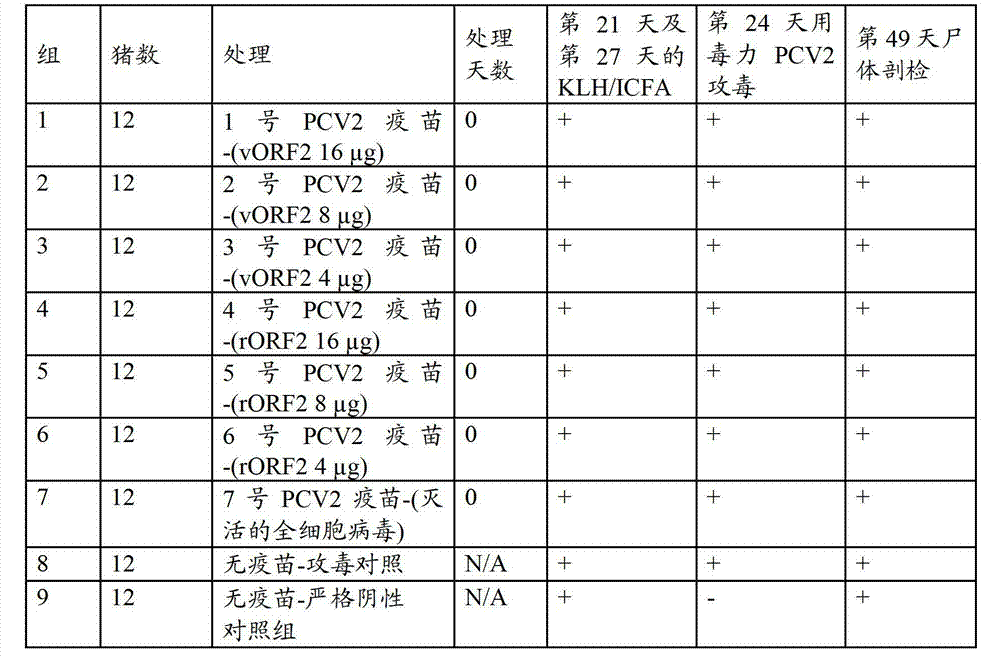
vORF2=分离的病毒ORF2;rORF2=重组杆状病毒表达的ORF2;灭活的全细胞病毒=在适当细胞培养物中生长的PCV2病毒vORF2 = isolated viral ORF2; rORF2 = recombinant baculovirus expressed ORF2; inactivated whole cell virus = PCV2 virus grown in appropriate cell culture
所述组中的七个(1-7组)接受PCV2 ORF2多肽剂量,一个组充当攻毒对照并不接受PCV2 ORF2,而另一组充当严格阴性对照组并亦不接受PCV2ORF2。在第0天,将第1至7组用指定的疫苗处理。在第14天,给与第7组中的小猪增强免疫(booster)处理。疫苗接种后,观测小猪的不良事件及注射部位的反应并在第19天,将小猪移至第二试验点。在第二试验点,将第1-8组群养于一个猪舍(building)中而将第9组养于另一猪舍中。在第21天及第27天,使所有猪接受钥孔血蓝蛋白(KLH)/弗氏不完全佐剂(ICFA),在第24天将第1-8组用毒力PCV2攻毒。Seven of the groups (Groups 1-7) received PCV2 ORF2 polypeptide doses, one group served as a challenge control and did not receive PCV2 ORF2, and the other served as a strict negative control group and also did not receive PCV2 ORF2. On day 0, groups 1 to 7 were treated with the indicated vaccines. On day 14, piglets in group 7 were given a booster treatment. After vaccination, the piglets were observed for adverse events and injection site reactions and on day 19, the piglets were moved to the second test site. At the second experimental point, groups 1-8 were housed in one building and group 9 was housed in another building. On days 21 and 27, all pigs received keyhole limpet hemocyanin (KLH)/Incomplete Freund's adjuvant (ICFA), and on day 24 groups 1-8 were challenged with virulent PCV2.
攻毒前和攻毒后,收集血液样品用于PCV2血清学。攻毒后,收集体重数据用于测定平均每日体重增加(ADWG),并采集临床症状以及鼻拭子(nasalswab)样品用于测定PCV2的鼻排出(nasal shedding)。在第49天,对所有存活猪进行尸体剖检,对肺损害评分,并将选定的组织保存于福尔马林中用于日后的免疫组织化学(IHC)测试。Blood samples were collected for PCV2 serology pre- and post-challenge. After challenge, body weight data were collected for determination of average daily body weight gain (ADWG), and clinical signs and nasal swab samples were collected for determination of nasal shedding of PCV2. On day 49, all surviving pigs were necropsied, lung lesions were scored, and selected tissues were preserved in formalin for later immunohistochemical (IHC) testing.
材料和方法Materials and methods
本实验为在第0天,在9至14日龄的CDCD猪中进行的部分盲法(partially blinded)疫苗接种-攻毒可行性研究(vaccination-challenge feasibilitystudy)。母猪的PCV2 IFA效价为≤1:1000方可纳入该研究中。另外,母猪的血清学状态来自已知的PRRS-阴性畜群。测试了二十八(28)只母猪的PCV2血清学状态。十四(14)只母猪具有≤1000的PCV2效价,它们被转移至第一试验点。通过剖腹产手术接生一百一十(110)只小猪并在第-4天可用于此研究。在第-3天,将在第一试验点的108只CDCD猪称体重、用耳标标记、按重量分批(block by weight)并随机分配至如以上在表4中列出的9组中的1组中。若满足纳入标准(inclusion criteria)的任何测试动物参加该研究后由于任何原因而被排除,则研究者及监控者进行商议以决定自该动物所收集的资料在最后分析中的使用。记录参加的小猪被排除的日期及排除的理由。起初,无母猪被排除。在第-3天,将可用110只猪中的总共108只随机分配至9个组中的一个组中。两只最小的猪(第17号及第19号)不分配至组中,需要时可用作备用。在研究过程中,有若干只动物被排除。在攻毒之前,各自发现第82号猪(第9组)在第-1天,第56号猪(第6组)在第3天,第53号猪(第9组)在第4天,第28号猪(第8组)在第8天,第69号猪(第8组)在第7天及第93号猪(第4组)在第9天死亡。在最后研究结果中不包括这六只猪。将第17号猪(备用猪之一)分配至第9组。将剩余的备用猪(第19号)自该研究排除。This experiment was a partially blinded vaccination-challenge feasibility study conducted on day 0 in CDCD pigs aged 9 to 14 days. Sows with a PCV2 IFA titer of ≤1:1000 were eligible for inclusion in the study. Additionally, the serological status of sows was from a known PRRS-negative herd. Twenty-eight (28) sows were tested for PCV2 serological status. Fourteen (14) sows with PCV2 titers < 1000 were transferred to the first trial site. One hundred and ten (110) piglets were delivered by caesarean section and available for this study on day -4. On day -3, 108 CDCD pigs at the first trial site were weighed, ear tagged, block by weight and randomly assigned to 9 groups as listed above in Table 4 in group 1. If any test animal meeting the inclusion criteria is excluded from the study for any reason after participation, the investigator and monitor will confer to determine the use of the data collected from that animal in the final analysis. Record the date that participating piglets were excluded and the reason for the exclusion. Initially, no sows were excluded. On Day -3, a total of 108 pigs out of 110 available were randomly assigned to one of 9 groups. The two smallest pigs (No. 17 and No. 19) were not assigned to groups and were used as spares if needed. Several animals were excluded during the study. Pig No. 82 (Group 9) was found on Day -1, Pig No. 56 (Group 6) on Day 3, Pig No. 53 (Group 9) on Day 4, respectively, prior to challenge. Pig No. 28 (Group 8) died on Day 8, Pig No. 69 (Group 8) on Day 7 and Pig No. 93 (Group 4) on Day 9. These six pigs were not included in the final study results. Pig No. 17 (one of the spare pigs) was assigned to Group 9. The remaining spare pig (No. 19) was excluded from the study.
给与每一组的配制剂如下:设计第1组施用每毫升含有16μg ORF2的1ml病毒ORF2(vORF2)。这是通过将10.24ml病毒ORF2(256μg/25μg/ml=10.24ml vORF2)与3.2ml的0.5%卡巴普及pH值为7.4的2.56ml磷酸盐缓冲盐水混合而进行的。由此产生16ml用于第1组的配制剂。设计第2组施用每毫升含有8μgvORF2的1mlvORF2。这是通过将5.12ml vORF2(128μg/25μg/ml=5.12ml vORF2)与3.2ml的0.5%卡巴普及7.68ml pH值为7.4的磷酸盐缓冲盐水混合而进行的。由此产生16ml用于第2组的配制剂。设计第3组施用每毫升含有4μgvORF2的1ml vORF2。这是通过将2.56mlvORF2(64μg/25μg/ml=2.56ml vORF2)与3.2ml的0.5%卡巴普及10.24mlpH值为7.4的磷酸盐缓冲盐水混合进行的。由此产生16ml用于第3组的配制剂。设计第4组施用每毫升含有16μgrORF2的1ml重组ORF2(rORF2)。这是通过将2.23ml rORF2(512μg/230μg/ml=2.23ml rORF2)与6.4ml的0.5%卡巴普及23.37ml pH值为7.4的磷酸盐缓冲盐水混合而进行的。由此产生32ml用于第4组的配制剂。设计第5组施用每毫升含有8μgrORF2的1ml rORF2。这是通过将1.11ml rORF2(256μg/230μg/ml=1.11ml rORF2)与6.4ml的0.5%卡巴普及pH值为7.4的24.49ml磷酸盐缓冲盐水混合而进行的。由此产生32ml用于第5组的配制剂。设计第6组施用每毫升含有8μgrORF2的1ml rORF2。这是通过将0.56ml rORF2(128μg/230μg/ml=0.56mlrORF2)与6.4ml的0.5%卡巴普及pH值为7.4的25.04ml磷酸盐缓冲盐水混合而进行的。由此产生32ml用于第6组的配制剂。设计第7组施用含有MAX PCV2KV的2ml PCV2灭活全细胞疫苗(PCV2KV)。这是通过将56mlPCV2KV与14ml的0.5%卡巴普混合进行的。由此产生70ml用于第7组的配制剂。最后,设计第8组施用每2ml剂量0.5μg/ml或1.0μg/ml的KLH。这是通过将40.71ml KLH(7.0μg蛋白质/ml 0.5μg/ml=570ml(7.0μg/ml)(x)=(0.5)(570ml))、pH值为7.4的244.29ml磷酸盐缓冲盐水及285ml弗氏佐剂混合而进行的。表5描述用于此实施例的主要活动的时间范围。The formulations given to each group were as follows: Group 1 was designed to administer 1 ml of viral ORF2 (vORF2) containing 16 μg of ORF2 per ml. This was performed by mixing 10.24 ml of viral ORF2 (256 μg/25 μg/ml = 10.24 ml vORF2) with 3.2 ml of 0.5% carbabiol and 2.56 ml of phosphate buffered saline pH 7.4. This resulted in 16 ml of formulation for Group 1 . Group 2 was designed to administer 1 ml vORF2 containing 8 μg vORF2 per ml. This was performed by mixing 5.12ml of vORF2 (128μg/25μg/ml = 5.12ml of vORF2) with 3.2ml of 0.5% carbab and 7.68ml of phosphate-buffered saline pH 7.4. This resulted in 16 ml of formulation for group 2. Group 3 was designed to administer 1 ml vORF2 containing 4 μg vORF2 per ml. This was done by mixing 2.56 ml of vORF2 (64 μg/25 μg/ml = 2.56 ml vORF2) with 3.2 ml of 0.5% carbab and 10.24 ml of phosphate-buffered saline pH 7.4. This resulted in 16 ml of formulation for group 3. Group 4 was designed to administer 1 ml of recombinant ORF2 (rORF2) containing 16 μgrORF2 per ml. This was done by mixing 2.23ml rORF2 (512μg/230μg/ml = 2.23ml rORF2) with 6.4ml of 0.5% carbabiol and 23.37ml of phosphate buffered saline pH 7.4. This resulted in 32 ml of formulation for Group 4. Group 5 was designed to administer 1 ml rORF2 containing 8 μgrORF2 per ml. This was performed by mixing 1.11 ml rORF2 (256 μg/230 μg/ml = 1.11 ml rORF2) with 6.4 ml of 0.5% carbab and 24.49 ml of phosphate-buffered saline at pH 7.4. This resulted in 32 ml of formulation for group 5. Group 6 was designed to administer 1 ml rORF2 containing 8 μgrORF2 per ml. This was performed by mixing 0.56 ml rORF2 (128 μg/230 μg/ml = 0.56 ml rORF2) with 6.4 ml of 0.5% carbab and 25.04 ml of phosphate-buffered saline at pH 7.4. This resulted in 32 ml of formulation for group 6. Group 7 was designed to administer 2 ml of PCV2 inactivated whole cell vaccine (PCV2KV) containing MAX PCV2KV. This was done by mixing 56ml of PCV2KV with 14ml of 0.5% Carbopol. This resulted in 70 ml of formulation for group 7. Finally, Group 8 was designed to administer KLH at doses of 0.5 μg/ml or 1.0 μg/ml per 2 ml. This is achieved by mixing 40.71ml KLH (7.0μg protein/ml 0.5μg/ml=570ml(7.0μg/ml)(x)=(0.5)(570ml)), 244.29ml phosphate buffered saline with a pH value of 7.4 and 285ml mixed with Freund's adjuvant. Table 5 describes the time frame for the main activities of this embodiment.
表5.研究活动Table 5. Research Activities

完成研究的活体阶段后,由病理学者通过免疫组织化学(IHC)检查经福尔马林固定的组织以检测PCV2抗原,评估血液样品的PCV2血清学,评估鼻拭子样品的PCV2排出(shedding),并测定自第24天至第49天的平均每日体重增加(ADWG)。Upon completion of the in vivo phase of the study, formalin-fixed tissue was examined by immunohistochemistry (IHC) for PCV2 antigen, blood samples were assessed for PCV2 serology, and nasal swab samples were assessed for PCV2 shedding by a pathologist , and the average daily body weight gain (ADWG) from day 24 to day 49 was determined.
自出生至大约11日龄(大约为该研究的第0天),将动物养于在第一试验点的五个房间中的个别笼中。各个房间布局相同,由堆叠的多个单独的不锈钢笼组成,其中将加热并过滤空气独立供应至每一隔离单元。每一房间具有独立的供热和通风,藉此防止在房间之间的空气交叉污染。在第二试验点将动物养于两个不同猪舍中。将第9组(严格阴性对照组)单独养于经改装的肥育猪舍(finisher building)中,并将第1-8组养于经改装的保育猪舍(nurserybuilding)中。将每一组养于独立围栏(每围栏11-12只猪)中,每一围栏提供给每只猪大约3.0平方英尺。每一围栏设在具有塑料漏缝地板(platic slattedfloors)的抬高平台(elevated deck)上。围栏下面的坑充当粪便及排泄物的储槽。每一猪舍具有其自身独立的供暖及通风系统,几乎不可能有猪舍间的空气交叉污染。Animals were housed in individual cages in five rooms at the first experimental site from birth to approximately 11 days of age (approximately day 0 of the study). Each room is identically laid out and consists of stacked individual stainless steel cages with an independent supply of heated and filtered air to each isolation unit. Each room has independent heating and ventilation, thereby preventing air cross-contamination between rooms. Animals were housed in two different pens at the second test point. Group 9 (strict negative control group) was housed alone in a modified finisher building, and groups 1-8 were housed in a modified nursery building. Each group was housed in individual pens (11-12 pigs per pen), each pen providing approximately 3.0 square feet per pig. Each pen is located on an elevated deck with plastic slatted floors. The pit under the fence acts as a storage tank for manure and excrement. Each pig house has its own independent heating and ventilation system, and it is almost impossible to have air cross-contamination between pig houses.
在第一试验点,从出生至大约3周龄,给小猪喂以特别配制的乳质定粮(milk ration)。到第19天(大约41/2周龄)为止,所有小猪都在进食经特别混制的固体状定粮。在第二试验点,给所有小猪喂以适于其年龄及重量的定制未加药(non-medicated)市售混合定粮(不限量)。在两个试验点,水的供应亦不限量。At the first experimental point, piglets were fed a specially formulated milk ration from birth to about 3 weeks of age. Until day 19 (approximately 41/2 weeks of age), all piglets were eating a specially formulated solid ration. At the second experimental point, all piglets were fed a custom-made non-medicated commercial mixed ration (unlimited amount) appropriate for their age and weight. The water supply was also unlimited at the two test sites.
将所有受试猪在第-2天用维生素E处理,在第-1天用铁注射处理,在第16天、第17天、第18天及第19天用


同时,在两个试验点猪均接受了兽医学护理。在第0天进行动物健康检查并记录于健康检查记录表中。第0天的观测确定所有动物在疫苗接种前均具有良好的健康及营养状态。在攻毒前,观测到所有测试动物具有良好健康及营养状态。屠体及组织通过熬炼(rendering)加以处置。将研究动物的最后处置记录于动物处置记录上。Meanwhile, pigs received veterinary care at both sites. Animal health checks were performed on Day 0 and recorded on the health check record sheet. Observations on Day 0 determined that all animals were in good health and nutritional status prior to vaccination. All test animals were observed to be in good health and nutritional status prior to challenge. Carcasses and tissues are processed by rendering. The final disposition of the study animal was recorded on the Animal Disposition Record.
在第0天,分配至第1-6组的猪分别接受1.0mL PCV2疫苗1-6,使用无菌的3.0mL Luer锁紧套口注射器(Luer-lock syringe)和无菌的20g×1/2"针头在左颈区肌注(IM)。分配至第7组的猪接受2.0mL的第7号PCV2疫苗,使用无菌的3.0mLLuer锁紧套口注射器和无菌的20g×1/2"针头在左颈区肌注。在第14天,分配至第7组的猪接受2.0mL第7号PCV2疫苗,使用无菌的3.0mLLuer锁紧套口注射器和无菌的20g×1/2"针头在右颈区肌注。On day 0, pigs assigned to groups 1-6 received 1.0 mL of PCV2 vaccine 1-6, respectively, using sterile 3.0 mL Luer-lock syringes and sterile 20 g×1/ Intramuscular (IM) with a 2" needle in the left cervical region. Pigs assigned to group 7 received 2.0 mL of PCV2 vaccine No. 7 using a sterile 3.0 mL Luer-lock syringe and a sterile 20 g x 1/2 "The needle was injected intramuscularly in the left neck area. On day 14, pigs assigned to Group 7 received 2.0 mL of PCV2 vaccine No. 7, intramuscularly in the right cervical region using a sterile 3.0 mL Luer lock syringe with a sterile 20 g x 1/2" needle.
在第21天,所有受试猪接受2.0mL KLH/ICFA,使用无菌的3.0mL Luer锁紧套口注射器和无菌的20g×1"针头在右臀区肌注。在第27天,所有受试猪接受2.0mL KLH/ICFA,使用无菌的3.0mL Luer锁紧套口注射器和无菌的20g×1"针头在左臀区肌注。On day 21, all pigs received 2.0 mL of KLH/ICFA intramuscularly in the right gluteal region using a sterile 3.0 mL Luer-lock syringe with a sterile 20 g x 1" needle. On day 27, all Pigs received 2.0 mL of KLH/ICFA intramuscularly in the left gluteal region using a sterile 3.0 mL Luer-lock syringe with a sterile 20 g x 1" needle.
在第24天,分配至第1-8组的猪接受1.0mL PCV2 ISUVDL攻毒材料(5.11log10TCID50/mL),使用无菌的3.0mL Luer锁紧套口注射器和无菌的20g×1"针头在左颈区肌注。使用3.0mL Luer锁紧套口注射器及鼻导管,通过经鼻注射(IN)对每只猪额外施用1.0mL的相同材料(每鼻孔0.5mL)。On day 24, pigs assigned to groups 1-8 received 1.0 mL of PCV2 ISUVDL challenge material (5.11 log10TCID 50 /mL) using a sterile 3.0 mL Luer-lock syringe and a sterile 20 g × 1" The needle was injected IM in the left cervical region. An additional 1.0 mL of the same material (0.5 mL per nostril) was administered to each pig by intranasal injection (IN) using a 3.0 mL Luer lock syringe and nasal cannula.
在第-4天及自第0天至第19天,每日观测受试猪的总体健康状况及不良事件。将观测结果记录于临床观测记录上。自第0天至第7天观测所有受试猪,并自第14天至第21天进一步观测第7组的注射部位反应。在第-3天、第24天及第49天或发现猪在攻毒后死亡的当天,在校准后的天平上称量每只猪的体重以测定平均每日体重增加。将体重记录于体重表中。在随机化之前,利用第-3天的体重将猪分批(block)。利用第24天及第49天的重量数据测定每只猪在这些时间点的平均每日体重增加(ADWG)。对于在攻毒之后第49天之前死亡的猪,将ADWG调整为表示自第24天至死亡之日的ADWG。On day -4 and from day 0 to day 19, the overall health status and adverse events of the pigs were observed daily. Record the observations on the clinical observation record. All test pigs were observed from day 0 to day 7, and Group 7 was further observed for injection site reactions from day 14 to day 21. On days -3, 24 and 49 or the day pigs were found dead post-challenge, each pig was weighed on a calibrated balance to determine average daily body weight gain. Body weight is recorded on the weight form. Pigs were blocked using day -3 body weight prior to randomization. Weight data from days 24 and 49 were used to determine the average daily body weight gain (ADWG) for each pig at these time points. For pigs that died before day 49 after challenge, the ADWG was adjusted to represent the ADWG from day 24 to the day of death.
为测定PCV2血清学,在第-3天及第14天,自每只小猪的眼眶静脉窦采集静脉全血。对于每只小猪,通过将无菌毛细管插入一只眼睛的内眦中从眼眶静脉窦收集血液,并将大约3.0mL的全血汲入4.0mL血清分离管(SerumSeparator Tube,SST)中。在第24天、第31天及第49天,使用18g×11/2″无菌真空采血针(Vacutainer needle)(Becton Dickinson and Company,FranklinLakes,New Jersey)、真空采血持针器及13mL SST,自前腔静脉采集每只猪的静脉全血。将在每一时间点的血液收集记录于样品收集记录上。使每个SST中的血液凝结,随后将每个SST离心并收集血清。将收集的血清转移至无菌搭扣管中并储存于-70℃±10℃下直至日后测试为止。由BIVI-R&D的人员测试血清样品中PCV2抗体的存在。For determination of PCV2 serology, venous whole blood was collected from the orbital sinus of each piglet on days -3 and 14. For each piglet, blood was collected from the orbital sinus by inserting a sterile capillary into the medial canthus of one eye, and approximately 3.0 mL of whole blood was drawn into a 4.0 mL Serum Separator Tube (SST). On the 24th day, the 31st day and the 49th day, use 18g×11/2″ sterile vacuum blood collection needle (Vacutainer needle) (Becton Dickinson and Company, Franklin Lakes, New Jersey), vacuum blood collection needle holder and 13mL SST, The venous whole blood of each pig was collected from the anterior vena cava. The blood collection at each time point was recorded on the sample collection record. The blood in each SST was clotted, and then each SST was centrifuged and serum was collected. The collected Serum was transferred into sterile snap-on tubes and stored at -70°C ± 10°C until later testing. Serum samples were tested for the presence of PCV2 antibodies by personnel at BIVI-R&D.
自第20天至第49天每日一次观测猪的临床症状并将临床观测结果记录于临床观测记录上。From the 20th day to the 49th day, the clinical symptoms of the pigs were observed once a day and the clinical observation results were recorded on the clinical observation record.
为测试PCV2的鼻排出,在第24天、第25天,和接下来每隔一个奇数研究日的奇数研究日(each other odd numbered study day)直至第49天(含),将无菌涤纶拭子尽可能无菌地鼻内插入每只猪的左鼻孔或右鼻孔(每只猪一个拭子),擦拭几秒钟后移出。随后,将每一拭子置放于含有具2%IFBS、500单位/毫升的青霉素(Penicillin)、500μg/mL的链霉素(Streptomycin)及2.5μg/mL两性霉素B(Fungizone)的1.0mL EMEM培养基的单个无菌搭扣密封管中。将拭子在管中折断并将搭扣管密封并适当标记动物编号、研究编号、收集日期、研究日及"鼻拭子"。将密封搭扣管储存于-40℃±10℃直至隔夜于冰上送至BIVI-St.Joseph.。鼻拭子收集记录于鼻拭子样品收集表中。BIVI-R&D对鼻拭子样品进行了PCV2的定量病毒分离(VI)测试。结果以log10值表示。认为1.3log或更小的值为负,认为大于1.3log的任何值为正。To test nasal shedding of PCV2, sterile Dacron swabs were used on days 24, 25, and every other odd numbered study day thereafter up to and including day 49. The swab was inserted intranasally as far as possible into the left or right nostril of each pig (one swab per pig), swabbed for a few seconds and then removed. Subsequently, each swab was placed in 1.0 μg/mL amphotericin B (Fungizone) containing 2% IFBS, 500 units/ml of penicillin (Penicillin), 500 μg/mL of streptomycin (Streptomycin) and 2.5 μg/mL of amphotericin B (Fungizone). mL of EMEM medium in individual sterile snap-seal tubes. The swab is snapped off in the tube and the snap tube is sealed and appropriately labeled with animal number, study number, date of collection, day of study, and "nasal swab". Store the snap-fit tubes at -40°C ± 10°C until overnight on ice to BIVI-St. Joseph. Nasal swab collections are recorded on the Nasal Swab Sample Collection Form. BIVI-R&D performed a quantitative virus isolation (VI) test for PCV2 on nasal swab samples. Results are expressed as log10 values. Values of 1.3log or less are considered negative and any value greater than 1.3log is considered positive.
将在第一试验点死亡的猪(第28号、第52号、第56号、第69号、第82号及第93号)尸体剖检至确定诊断结果所需要的程度。记录可见损害,这些猪的组织不予保留。在第二试验点,将在第49天前死亡的猪(第45号、第23号、第58号、第35号)、在第49天安乐死前发现死亡的猪(第2号、第43号)及在第49天安乐死的猪尸体剖检。记录任何可见损害并将具有损害的肺叶的百分比记录于尸体剖检报告表中。Pigs that died at the first site (Nos. 28, 52, 56, 69, 82 and 93) were necropsied to the extent necessary to establish a diagnosis. Visible lesions were recorded and tissues from these pigs were not preserved. At the second test point, pigs that died before day 49 (No. 45, No. 23, No. 58, No. 35), pigs found dead before day 49 were euthanized (No. No.) and necropsy of pigs euthanized on day 49. Any visible lesions were recorded and the percentage of lobes with lesions was recorded on the necropsy report form.
对于在第二试验点尸体剖检的103只猪,从每只猪的扁桃体、肺、心脏、肝、肠系膜淋巴结、肾及腹股沟淋巴结取组织样品,置于具有10%缓冲福尔马林的单个容器中;同时将取自上述相同器官的另一组织样品置放于Whirl-pak(M-Tech Diagnostics Ltd.,Thelwall,UK)中并将每一Whirl-pak置放于冰上。将每一容器适当标记。将样品收集记录于尸体剖检报告表中。随后,提交经福尔马林固定的组织样品及诊断申请表供IHC测试。IHC测试根据用于接收样品、样品及切片(slide)制备及染色技术的标准ISU实验室程序来进行。将于Whirl-pak中的新鲜组织用冰袋运送至研究监控者(Study Monitor)储存(-70℃±10℃),供将来可能的使用。由病理学者对福尔马林固定的组织进行IHC检查以检测PCV2,并使用以下计分系统计分:0=无;1=少数阳性染色,几处;2=中度阳性染色,多处;及3=大量阳性染色,弥漫于整个组织。由于病理学者不能肯定地区分腹股沟LN与肠系膜LN,故直接将这些组织标记为淋巴结,对于每只动物,以两种组织中的每一种的最高分数来计分。For the 103 pigs necropsied at the second site, tissue samples were taken from each pig's tonsils, lungs, heart, liver, mesenteric lymph nodes, kidneys, and inguinal lymph nodes and placed in a single buffer with 10% buffered formalin. container; at the same time another tissue sample from the same organ as above was placed in a Whirl-pak (M-Tech Diagnostics Ltd., Thelwall, UK) and each Whirl-pak was placed on ice. Label each container appropriately. Sample collection is recorded on the Necropsy Report Form. Subsequently, formalin-fixed tissue samples were submitted for IHC testing along with a diagnostic request form. IHC testing was performed according to standard ISU laboratory procedures for sample receipt, sample and slide preparation, and staining techniques. The fresh tissue in the Whirl-pak will be transported to the Study Monitor (Study Monitor) with ice packs for storage (-70°C±10°C) for possible future use. Formalin-fixed tissue was examined by IHC for PCV2 by a pathologist and scored using the following scoring system: 0=none; 1=minor positive staining, few; 2=moderate positive staining, many; and 3=massive positive staining, diffuse throughout the tissue. Since pathologists could not definitively distinguish inguinal LNs from mesenteric LNs, these tissues were directly labeled as lymph nodes and the highest score for each of the two tissues was scored for each animal.
以下给出此实施例的结果。注意到第0天前第9组的一只猪死亡,且接种后又有5只猪死亡(第4组的1只猪;第6组的1只猪;第8组的2只猪;及第9组的1只猪)。死后检查表明所有六只猪死于与疫苗接种或PMWS不相关的潜在感染。另外,任何组中无不良事件或注射部位反应记录。The results of this example are given below. It was noted that one pig in group 9 died before day 0, and 5 more pigs died after inoculation (1 pig in group 4; 1 pig in group 6; 2 pigs in group 8; and 1 pig from Group 9). Postmortem examination indicated that all six pigs died from underlying infections unrelated to vaccination or PMWS. Additionally, no adverse events or injection site reactions were recorded in any group.
平均每日体重增加(ADWG)的结果呈现于下表6中。严格阴性对照组的第9组具有最高ADWG(1.06±0.17磅/天),接着为接受一剂8μg rORF2的第5组(0.94±0.22磅/天)。接受一剂4μg vORF2的第3组具有最低ADWG(0.49±0.21磅/天),接着为接受2剂灭活疫苗的第7组(0.50±0.15磅/天)。The results for average daily body weight gain (ADWG) are presented in Table 6 below. Group 9 of the strict negative control group had the highest ADWG (1.06±0.17 lbs/day), followed by Group 5 (0.94±0.22 lbs/day) which received a dose of 8 μg rORF2. Group 3, which received one dose of 4 μg vORF2, had the lowest ADWG (0.49±0.21 lbs/day), followed by Group 7 (0.50±0.15 lbs/day), which received 2 doses of inactivated vaccine.
表6.组平均每日体重增加(ADWG)的总结Table 6. Summary of Group Average Daily Weight Gain (ADWG)
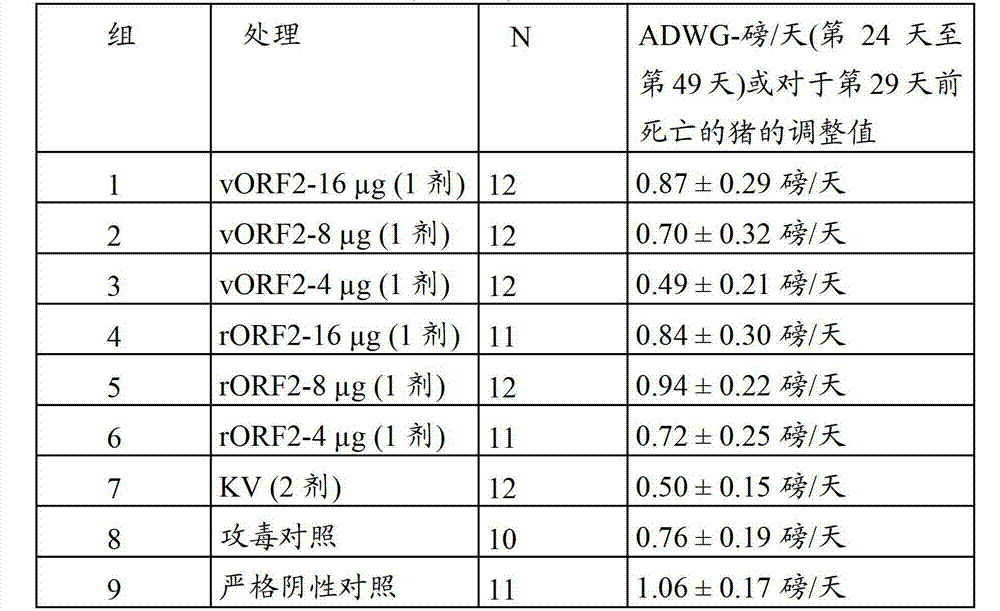
vORF2=分离的病毒ORF2;rORF2=重组杆状病毒表达的ORF2;灭活的全细胞病毒=在适当细胞培养物中生长的PCV2病毒vORF2 = isolated viral ORF2; rORF2 = recombinant baculovirus expressed ORF2; inactivated whole cell virus = PCV2 virus grown in appropriate cell culture
PCV2血清学结果呈现于下表7中。在第-3天,所有九个组对于PCV2均为血清反应阴性。在第14天,接受vORF2疫苗的组具有最高的效价,其范围为187.5至529.2。接受灭活病毒疫苗的猪具有第二高的效价,接着为接受rORF2疫苗的组。此时,第8组及第9组保持血清反应阴性。在第24天及第31天,接受vORF2疫苗的猪继续展现强血清学反应,紧接着为接受两剂灭活病毒疫苗的组。接受rORF2疫苗的猪血清学反应要慢一些,而第8组及第9组继续保持血清反应阴性。在第49天,接受vORF2疫苗、2剂灭活病毒疫苗及最低剂量rORF2的猪展现最强血清学反应。接受16μg及8μgrORF2疫苗的猪具有比攻毒对照稍高的IFA效价。第9组在第49天展现强血清学反应。The PCV2 serological results are presented in Table 7 below. On day -3, all nine groups were seronegative for PCV2. On day 14, the group receiving the vORF2 vaccine had the highest titers ranging from 187.5 to 529.2. Pigs that received the killed virus vaccine had the second highest titers, followed by the group that received the rORF2 vaccine. At this time, groups 8 and 9 remained seronegative. Pigs receiving the vORF2 vaccine continued to exhibit strong serological responses on days 24 and 31, followed by the group receiving two doses of the inactivated virus vaccine. Pigs that received the rORF2 vaccine had a slower serological response, while groups 8 and 9 continued to be seronegative. On day 49, pigs receiving the vORF2 vaccine, 2 doses of inactivated virus vaccine, and the lowest dose of rORF2 exhibited the strongest serological response. Pigs receiving 16 μg and 8 μgr ORF2 vaccine had slightly higher IFA titers than challenge controls. Group 9 exhibited a strong serological response on day 49.
表7.组PCV2IFA效价的总结Table 7. Summary of Group PCV2IFA Titers
IFA平均效价IFA average titer

vORF2=分离的病毒ORF2;rORF2=重组杆状病毒表达的ORF2;灭活的全细胞病毒=在适当细胞培养物中生长的PCV2病毒vORF2 = isolated viral ORF2; rORF2 = recombinant baculovirus expressed ORF2; inactivated whole cell virus = PCV2 virus grown in appropriate cell culture
*为计算的目的,将≤100的IFA效价指定为效价"50";将≥6400的IFA效价指定为效价"12,800"。 * For calculation purposes, an IFA titer of ≤100 is assigned a titer of "50"; an IFA titer of ≥6400 is assigned a titer of "12,800".
**攻毒之日 ** The day of attack
***尸体剖检之日 *** Date of autopsy
攻毒后临床观察的结果呈现于下表8中。此结果的总结包括对于异常行为、异常呼吸、咳嗽及腹泻的观察结果。表9包括来自组临床症状的总发生率的总结的结果,表10包括来自组攻毒后死亡率的总结的结果。在此研究中记录的最常见的临床症状是异常行为,记录为轻度至严重嗜睡。接受2个较低剂量vORF2的猪、接受16μgrORF2的猪及接受2个剂量的KV疫苗的猪具有≥27.3%的发生率。接受8μgrORF2的猪及严格阴性对照组无异常行为。此研究中,无一只猪展现任何异常呼吸。在所有组中多见有咳嗽(0至25%),以及腹泻(0-20%)。所见临床症状无一为PMWS的病征。The results of the post-challenge clinical observations are presented in Table 8 below. This summary of results includes observations for abnormal behavior, abnormal breathing, coughing, and diarrhea. Table 9 includes the results from the summary of the group's overall incidence of clinical symptoms, and Table 10 includes the results from the summary of the group's post-challenge mortality. The most common clinical symptom recorded in this study was abnormal behavior, documented as mild to severe lethargy. Pigs that received 2 lower doses of vORF2, pigs that received 16 μgrORF2, and pigs that received 2 doses of KV vaccine had an incidence of ≥ 27.3%. Pigs receiving 8 μgrORF2 and the strict negative control group showed no abnormal behavior. In this study, none of the pigs exhibited any abnormal respiration. Cough (0 to 25%) and diarrhea (0 to 20%) were common in all groups. None of the clinical symptoms seen were symptoms of PMWS.
临床症状的总发生率在各组间不同。接受任一vORF2疫苗的组、接受16μgrORF2的组、接受2剂KV疫苗的组及攻毒对照组具有最高的总临床症状发生率(≥36.4%)。严格阴性对照组、接受8μg rORF2的组及接受4μgrORF2的组分别具有0%、8.3%及9.1%的总临床症状发生率。The overall incidence of clinical symptoms varied among the groups. The group receiving either vORF2 vaccine, the group receiving 16 μgrORF2, the group receiving 2 doses of KV vaccine, and the challenge control group had the highest incidence of overall clinical symptoms (≥36.4%). The strict negative control group, the group receiving 8 μg rORF2 and the group receiving 4 μgrORF2 had an overall clinical symptom incidence of 0%, 8.3% and 9.1%, respectively.
各组间的总死亡率亦不同。接受2剂KV疫苗的组具有最高死亡率(16.7%);而接受4μgvORF2、16μgrORF2或8μgrORF2的组及严格阴性对照组全部具有0%的死亡率。Overall mortality rates also varied between groups. The group receiving 2 doses of KV vaccine had the highest mortality rate (16.7%); while the groups receiving 4 μg vORF2, 16 μgrORF2 or 8 μgrORF2 and the strict negative control group all had 0% mortality.
表8.组的异常行为、异常呼吸、咳嗽及腹泻的观测结果的总结Table 8. Summary of Group Observations for Abnormal Behavior, Abnormal Respiration, Cough and Diarrhea
vORF2=分离的病毒ORF2;rORF2=重组杆状病毒表达的ORF2;灭活的全细胞病毒=在适当细胞培养物中生长的PCV2病毒vORF2 = isolated viral ORF2; rORF2 = recombinant baculovirus expressed ORF2; inactivated whole cell virus = PCV2 virus grown in appropriate cell culture
1每一组中展现任何异常行为历时至少一天的猪总数 1 Total number of pigs in each group exhibiting any abnormal behavior for at least one day
2每一组中展现任何异常呼吸历时至少一天的猪总数 2 Total number of pigs in each group exhibiting any abnormal respiration for at least one day
3每一组中展现咳嗽历时至少一天的猪总数 3 Total number of pigs in each group exhibiting cough for at least one day
4每一组中展现腹泻历时至少一天的猪总数 4 Total number of pigs in each group exhibiting diarrhea lasting at least one day
表9.组临床症状总发生(incidence)的总结Table 9. Summary of total incidence of clinical symptoms by group


vORF2=分离的病毒ORF2;rORF2=重组杆状病毒表达的ORF2;灭活的全细胞病毒=在适当细胞培养物中生长的PCV2病毒vORF2 = isolated viral ORF2; rORF2 = recombinant baculovirus expressed ORF2; inactivated whole cell virus = PCV2 virus grown in appropriate cell culture
1每一组中展现任何临床症状历时至少一天的猪总数 1 Total number of pigs in each group that exhibited any clinical signs for at least one day
表10.组攻毒后死亡率的总结Table 10. Summary of post-challenge mortality by group
vORF2=分离的病毒ORF2;rORF2=重组杆状病毒表达的ORF2;灭活的全细胞病毒=在适当细胞培养物中生长的PCV2病毒vORF2 = isolated viral ORF2; rORF2 = recombinant baculovirus expressed ORF2; inactivated whole cell virus = PCV2 virus grown in appropriate cell culture
PCV2的鼻排出结果呈现于下表11中。在第24天攻毒后,第7组中的1只猪在第27天开始排出PCV2。在第33天之前,其它组无一经历排毒。鼻排毒主要见于第35天至第45天。接受三种vORF2疫苗中的任何一种的组及接受4μg或8μgrORF2的组具有最低的PCV2鼻排毒发生率(≤9.1%)。攻毒对照组(第8组)具有最高排毒率(80%),接着为具有63.6%的发生率的严格阴性对照组(第9组)。The results of nasal shedding of PCV2 are presented in Table 11 below. One pig in Group 7 started to shed PCV2 on day 27 after challenge on day 24. None of the other groups experienced detoxification prior to day 33. Nasal detoxification is mainly seen on the 35th day to the 45th day. Groups receiving any of the three vORF2 vaccines and groups receiving 4 μg or 8 μgrORF2 had the lowest incidence of PCV2 nasal shedding (≤9.1%). The challenge control group (group 8) had the highest shedding rate (80%), followed by the strict negative control group (group 9) with an incidence of 63.6%.
表11.组PCV2鼻排出发生率的总结Table 11. Summary of Incidence of Nasal Shedding of PCV2 by Group
vORF2=分离的病毒ORF2;rORF2=重组杆状病毒表达的ORF2;灭活的全细胞病毒=在适当细胞培养物中生长的PCV2病毒vORF2 = isolated viral ORF2; rORF2 = recombinant baculovirus expressed ORF2; inactivated whole cell virus = PCV2 virus grown in appropriate cell culture
组黄疸发生率、组胃溃疡发生率、组平均肺损害计分及组肺损害发生率的总结展示于下表12中。在第一测试点,六只猪在研究的接种后阶段死亡(第4组,N=1;第6组,N=1;第8组,N=2;第9组,N=2)。六只猪中的四只在一个或多个体腔中具有纤维蛋白性损害(fibrinous lesion),一只猪(第6组)具有符合梭菌病的损害,一只猪(第9组)无可见损害。在该研究的疫苗接种后阶段死亡的猪无一具有符合PMWS的损害。A summary of group jaundice incidence, group gastric ulcer incidence, group mean lung lesion score, and group lung lesion incidence is shown in Table 12 below. At the first test point, six pigs died during the post-vaccination phase of the study (Group 4, N=1; Group 6, N=1; Group 8, N=2; Group 9, N=2). Four of the six pigs had fibrinous lesions in one or more body cavities, one pig (group 6) had lesions consistent with clostridial disease and one pig (group 9) had no visible damage. None of the pigs that died during the post-vaccination phase of the study had lesions consistent with PMWS.
将在攻毒后死亡的猪及在第49天安乐死的猪尸体剖检。尸体剖检可见,任何组中均不存在黄疸及胃溃疡。关于平均肺损害百分比,第9组具有最低平均肺损害百分比(0%),接着为具有0.40±0.50%的第1组及具有0.68±1.15%的第5组。第2组、第3组、第7组及第8组具有最高平均肺损害百分比(≥7.27%)。这些四个组中的每一者都含有肺损害百分比≥71.5%的一只猪,拉高了这四个组的结果。除具有所记录的0%肺损害的第9组外,其余8组具有≤36%的肺损害。几乎所有记录的肺损害均被描述为红色/紫色且为坚实(consolidated)的。Pigs that died post-challenge and pigs that were euthanized on day 49 were necropsied. Necropsy showed that there was no jaundice and gastric ulcer in any group. Regarding mean percent lung lesions, Group 9 had the lowest mean percent lung lesions (0%), followed by Group 1 with 0.40±0.50% and Group 5 with 0.68±1.15%. Groups 2, 3, 7 and 8 had the highest mean percentage of lung lesions (≥7.27%). Each of these four groups contained one pig with a percentage of lung lesions ≥ 71.5%, pulling up the results for these four groups. With the exception of Group 9, which had 0% lung lesions documented, the remaining 8 groups had < 36% lung lesions. Almost all documented lung lesions were described as red/purple and consolidated.
表12.记录的组黄疸发生数、组胃溃疡发生数、组平均肺损害百分比计分及组肺损害发生数的总结Table 12. Summary of recorded group jaundice occurrences, group gastric ulcer occurrences, group average lung lesion percentage scores and group lung lesion occurrences

vORF2=分离的病毒ORF2;rORF2=重组杆状病毒表达的ORF2;KV或灭活的全细胞病毒=在适当细胞培养物中生长的PCV2病毒vORF2 = isolated viral ORF2; rORF2 = recombinant baculovirus expressed ORF2; KV or inactivated whole cell virus = PCV2 virus grown in appropriate cell culture
组IHC阳性发生结果的总结展现于表13中。第1组(vORF2-16μg)及第5组(rORF2-8μg)具有最低IHC阳性发生率的结果(16.7%)。第8组(攻毒对照)及第9组(严格阴性对照)具有最高的IHC阳性结果率,分别为90%及90.9%。A summary of group IHC positive occurrence results is presented in Table 13. Group 1 (vORF2-16 μg) and Group 5 (rORF2-8 μg) had the lowest IHC positive incidence results (16.7%). Group 8 (challenge control) and group 9 (strict negative control) had the highest IHC positive result rates, 90% and 90.9%, respectively.
表13.组IHC阳性发生率的总结Table 13. Summary of Group IHC Positive Incidence Rates

vORF2=分离的病毒ORF2;rORF2=重组杆状病毒表达的ORF2;KV或灭活的全细胞病毒=在适当细胞培养物中生长的PCV2病毒vORF2 = isolated viral ORF2; rORF2 = recombinant baculovirus expressed ORF2; KV or inactivated whole cell virus = PCV2 virus grown in appropriate cell culture
攻毒后,接受一剂8μgrORF2抗原的第5组表现优于其它6个疫苗组。第5组具有最高ADWG(0.94±0.22磅/天)、最低异常行为发生率(0%)、第二低的咳嗽发生率(8.3%)、最低总临床症状发生率(8.3%)、最低死亡率(0%)、最低PCV2鼻排出率(8.3%)、第二低的平均肺损害百分比比率(0.68±1.15%)及最低阳性组织发生率(16.7%)。接受不同水平的rORF2抗原的组总体优于接受不同水平的vORF2的组,接受2剂灭活全细胞PCV2疫苗的组表现最差。表14及表15包含组攻毒后数据的总结。After challenge, Group 5, which received a dose of 8 μgr ORF2 antigen, outperformed the other 6 vaccine groups. Group 5 had the highest ADWG (0.94 ± 0.22 lbs/day), lowest incidence of abnormal behavior (0%), second lowest incidence of cough (8.3%), lowest incidence of total clinical symptoms (8.3%), lowest incidence of death rate (0%), the lowest PCV2 nasal shedding rate (8.3%), the second lowest mean percent lung lesion rate (0.68±1.15%), and the lowest positive tissue rate (16.7%). Groups receiving varying levels of rORF2 antigen generally outperformed groups receiving varying levels of vORF2, with the group receiving 2 doses of inactivated whole-cell PCV2 vaccine faring the worst. Tables 14 and 15 contain a summary of the group post-challenge data.
表14.组攻毒后数据总结-第1部分Table 14. Group Post-Challenge Data Summary - Part 1


vORF2=分离的病毒ORF2;rORF2=重组杆状病毒表达的ORF2;KV或灭活的全细胞病毒=在适当细胞培养物中生长的PCV2病毒vORF2 = isolated viral ORF2; rORF2 = recombinant baculovirus expressed ORF2; KV or inactivated whole cell virus = PCV2 virus grown in appropriate cell culture
表15.组攻毒后数据总结-第2部分Table 15. Group Post-Challenge Data Summary - Part 2
vORF2=分离的病毒ORF2;rORF2=重组杆状病毒表达的ORF2;KV或灭活的全细胞病毒=在适当细胞培养物中生长的PCV2病毒vORF2 = isolated viral ORF2; rORF2 = recombinant baculovirus expressed ORF2; KV or inactivated whole cell virus = PCV2 virus grown in appropriate cell culture
此研究的结果表明,所有进一步的疫苗研究工作应当围绕rORF2疫苗来进行。总的说来,攻毒后检测到了PCV2的鼻排出,而用PCV2接种导致了排出减少。选定的淋巴组织的免疫组织化学亦可作为疫苗功效的良好参数,而在组间未检测到ADWG、临床症状及可见损害方面的大的差异。第9组(严格阴性对照组)中的PCV2鼻排出、PCV2血清转化及阳性IHC组织证明,在研究中某些地方引入了外来PCV2,这一事实使得此项研究复杂化。The results of this study suggest that all further vaccine research efforts should revolve around rORF2 vaccines. Overall, nasal shedding of PCV2 was detected after challenge, whereas vaccination with PCV2 resulted in decreased shedding. Immunohistochemistry of selected lymphoid tissues also served as a good parameter for vaccine efficacy, while no large differences in ADWG, clinical symptoms and visible lesions were detected between the groups. This study was complicated by the fact that nasal shedding of PCV2, PCV2 seroconversion, and positive IHC tissues in Group 9 (strictly negative control group) demonstrated the introduction of foreign PCV2 somewhere in the study.
讨论discuss
在此研究中评估了七种PCV2疫苗,其包括在第0天施用一次的三个不同剂量水平的vORF2抗原、在第0天施用一次的三个不同剂量水平的rORF2抗原,及在第0天及第14天施用的一个剂量水平的灭活全细胞PCV2疫苗。总的说来,接受一剂含有8μgrORF2抗原的疫苗的第5组具有最佳结果。第5组具有最高ADWG、最低异常行为发生率、最低异常呼吸发生率、第二低的咳嗽发生率、最低总临床症状发生率、最低死亡率、最低PCV2的鼻排出率、第二低的平均肺损害百分比比率及最低阳性IHC组织发生率。Seven PCV2 vaccines were evaluated in this study, including three different dose levels of vORF2 antigen administered once on day 0, three different dose levels of rORF2 antigen administered once on day 0, and three different dose levels of rORF2 antigen administered once on day 0, and and one dose level of inactivated whole cell PCV2 vaccine administered on day 14. Overall, group 5, which received one dose of the vaccine containing 8 μgrORF2 antigen, had the best results. Group 5 had the highest ADWG, the lowest incidence of abnormal behavior, the lowest incidence of abnormal breathing, the second lowest incidence of cough, the lowest incidence of total clinical symptoms, the lowest mortality, the lowest rate of nasal discharge of PCV2, the second lowest mean Percentage ratio of lung lesions and incidence of lowest positive IHC tissue.
有趣地是,接受比第5组更高剂量的rORF2抗原的第4组并未表现得和第5组一样好或好于第5组。与第5组相比,第4组具有稍微较低的ADWG、较高的异常行为发生率、较高的总临床症状发生率、较高的PCV2鼻排出率、较高的平均肺损害百分比及较高的阳性IHC组织比率。对这些数据未进行统计分析——该分析可能会指示这些两个组间的差异不具有统计学上的显著性——但观察到的倾向是第4组表现不如第5组好。Interestingly, Group 4, which received a higher dose of rORF2 antigen than Group 5, did not perform as well or better than Group 5. Compared with group 5, group 4 had slightly lower ADWG, higher incidence of abnormal behavior, higher incidence of total clinical symptoms, higher rate of PCV2 nasal discharge, higher mean percentage of lung lesions and Higher ratio of positive IHC tissues. No statistical analysis was performed on these data - which would have indicated that the differences between these two groups were not statistically significant - but the observed trend was that Group 4 did not perform as well as Group 5.
接种后,6只猪在第一试验点死亡。所述六只猪中的四只来自未接受疫苗的第8组或第9组。六只猪中无一展现符合PMWS的损害,无不良事件报导,总的看来,当施用于大约11日龄的猪时,所有七种疫苗看来都是安全的。在该研究的接种后阶段,接受三个剂量水平的vORF2疫苗或灭活全细胞疫苗的猪具有最高的IFAT水平,在疫苗组中第5组在即将攻毒前具有最低的IFAT水平。After inoculation, 6 pigs died at the first test point. Four of the six pigs were from groups 8 or 9 that did not receive the vaccine. None of the six pigs exhibited lesions consistent with PMWS, no adverse events were reported, and overall, all seven vaccines appeared to be safe when administered to pigs of approximately 11 days of age. Pigs receiving three dose levels of vORF2 vaccine or inactivated whole cell vaccine had the highest IFAT levels in the post-vaccination phase of the study, with Group 5 having the lowest IFAT levels immediately before challenge among the vaccine groups.
尽管未正式证实,但人们相信PCV2传播至断乳后不久的小猪的主要途径是通过口鼻直接接触,而能在生产环境(production setting)中减少PCV2鼻排出的有效疫苗将有助于控制感染的传播。接受三个vORF2抗原水平之一的组及接受8μgrORF2的组具有最低的PCV2鼻排出发生率(8.3%)。如预料的那样,攻毒对照组具有最高的鼻排出发生率(80%)。Although not formally proven, it is believed that the main route of PCV2 transmission to piglets shortly after weaning is through direct oronasal contact and that an effective vaccine that reduces nasal shedding of PCV2 in the production setting would help control spread of infection. The group receiving one of the three vORF2 antigen levels and the group receiving 8 μgrORF2 had the lowest incidence of PCV2 nasal shedding (8.3%). As expected, the challenge control group had the highest incidence of nasal discharge (80%).
在患有继发于PCV2感染的PMWS的猪中,可见损害通常由与一或多种以下症状组合的全身性淋巴结病(generalized lymphadenopathy)组成:(1)具有小叶间水肿的间质性肺炎,(2)皮肤苍白或黄疸,(3)斑点状萎缩性肝(mottled atrophic liver),(4)胃溃疡和(5)肾炎。在尸体剖检时,在任何组中未见黄疸、肝炎、肾炎及胃溃疡,对淋巴结病没有进行特定检查。平均肺损害百分比计分在各组间不同。接受16μgvORF2抗原的组具有最低的平均肺损害百分比计分(0.40±0.50%),其次为接受8μgrORF2的组(0.68±1.15%)。如预期的,攻毒对照组具有最高的平均肺损害百分比计分(9.88±29.2%)。在所有四个组中,由于在这些组中各自有一只猪具有极高的肺损害计分,因此平均肺损害百分比计分被提高。大多数肺损害被描述为红色/紫色且坚实(consolidated)的。通常,与PMWS相关的肺损害被描述为黄褐色并不可萎陷(non-collapsible),伴有小叶间水肿。在此研究中发现的肺损害与PCV2感染无关,或者可能存在另一肺感染原。在此研究范围内,肺损害百分比计分可能不反映由PCV2所致的肺感染的量的真实量度。In pigs with PMWS secondary to PCV2 infection, visible lesions usually consist of generalized lymphadenopathy combined with one or more of the following symptoms: (1) interstitial pneumonia with interlobular edema, (2) pallor or jaundice, (3) mottled atrophic liver, (4) gastric ulcer, and (5) nephritis. At necropsy, jaundice, hepatitis, nephritis, and gastric ulceration were not seen in any group, and no specific investigations for lymphadenopathy were performed. Mean percent lung lesion scores varied between groups. The group receiving 16 μg vORF2 antigen had the lowest mean percent lung lesion score (0.40±0.50%), followed by the group receiving 8 μgrORF2 (0.68±1.15%). As expected, the challenge control group had the highest mean percent lung lesion score (9.88±29.2%). In all four groups, the mean percent lung lesion score was increased since one pig in each of these groups had an extremely high lung lesion score. Most lung lesions were described as red/purple and consolidated. Typically, the lung lesions associated with PMWS are described as tan and non-collapsible, with interlobular edema. The lung lesions found in this study were not related to PCV2 infection, or another lung infectious agent may be present. Within the scope of this study, the percent lung lesion score may not reflect a true measure of the amount of lung infection caused by PCV2.
其它研究人员已证明,通过IHC发现的PCV2抗原的存在与组织病理学之间有直接相关性。在此研究中未进行所选组织的组织病理学检查。第1组(16μg vORF2)及第5组(8μg rORF2)的PCV2抗原阳性猪的发生率最低(8.3%),而第9组(严格阴性对照组-90.9%)及第8组(攻毒对照组-90.0%)的PCV2抗原阳性猪的发生率最高。由于此测试的非主观性,IHC结果可能是用来判断疫苗功效的最佳参数之一。Other investigators have demonstrated a direct correlation between the presence of PCV2 antigen detected by IHC and histopathology. Histopathological examination of selected tissues was not performed in this study. Group 1 (16 μg vORF2) and Group 5 (8 μg rORF2) had the lowest incidence (8.3%) of PCV2 antigen-positive pigs, while Group 9 (strict negative control group -90.9%) and Group 8 (challenge control group -90.0%) had the highest incidence in PCV2 antigen-positive pigs. Due to the non-subjective nature of this test, IHC results may be one of the best parameters used to judge vaccine efficacy.
因此,在本发明的一个方面中,测定含有提取的PCV2 ORF2(rORF2)抗原的1毫升/1剂重组产物在CDCD猪模型中面对PCV2攻毒的最小保护性剂量(MPD)。在接受了不同水平的rORF2抗原的三个组中,第5组(8μgrORF2抗原)明显具有最高的保护水平。对于被检查的所有参数,第5组均具有最佳的结果,或者与其它组一样具有(tied for)最理想的结果。当攻毒后将第5组与其它六个疫苗组进行比较时,第5组具有最高的ADWG(0.94±0.22磅/天)、最低的异常行为发生率(0%)、第二低的咳嗽发生率(8.3%)、最低的总临床症状发生率(8.3%)、最低的死亡率(0%)、最低的PCV2鼻排出率(8.3%)、第二低的平均肺损害百分比比率(0.68±1.15%)及最低的阳性IHC组织发生率(16.7%)。Therefore, in one aspect of the present invention, the minimum protective dose (MPD) of 1 ml/dose recombinant product containing extracted PCV2 ORF2 (rORF2) antigen in the face of PCV2 challenge in the CDCD porcine model was determined. Of the three groups that received different levels of rORF2 antigen, group 5 (8 μgrORF2 antigen) clearly had the highest level of protection. For all parameters examined, group 5 had the best results, or was tied for the best results as the other groups. When Group 5 was compared to the other six vaccine groups after challenge, Group 5 had the highest ADWG (0.94 ± 0.22 lbs/day), the lowest incidence of abnormal behavior (0%), and the second lowest cough Incidence rate (8.3%), lowest overall clinical symptom incidence (8.3%), lowest mortality rate (0%), lowest PCV2 nasal shedding rate (8.3%), second lowest mean percentage lung damage rate (0.68 ±1.15%) and the lowest incidence of positive IHC tissue (16.7%).
在本发明的另一方面中,测定的1毫升/1剂常规产品[其为部分纯化的PCV2 ORF2(vORF2)抗原]在CDCD猪模型中面对PCV2攻毒的MPD。在接受不同水平的vORF2抗原的三个组中,第1组(16μgvORF2)具有最高保护水平。第1组在ADWG、平均肺损害百分比及IHC方面的表现优于第2组及第3组。在临床症状的总发生率方面,第1组与第2组(8μgvORF2抗原)的表现相等,第3组(4μgvORF2抗原)具有最低死亡率,而在鼻排毒方面,所有三个组的表现相等。总的说来,vORF疫苗表现不及rORF疫苗好。In another aspect of the invention, 1 ml/1 dose of conventional product [which is a partially purified PCV2 ORF2 (vORF2) antigen] was tested against PCV2-challenged MPD in a porcine model of CDCD. Among the three groups receiving different levels of vORF2 antigen, group 1 (16 μg vORF2) had the highest level of protection. Group 1 performed better than Group 2 and Group 3 in terms of ADWG, mean percentage of lung lesions, and IHC. Group 1 performed equally with Group 2 (8 μg vORF2 antigen) in terms of overall incidence of clinical symptoms and Group 3 (4 μg vORF2 antigen) had the lowest mortality rate, while in terms of nasal detoxification all three groups performed equally. Overall, vORF vaccines did not perform as well as rORF vaccines.
在本发明的另一个方面中,测定最大剂量的2毫升/2剂的常规灭活PCV2疫苗在CDCD猪模型中面对PCV2攻毒的功效。在此研究中所评估的七种疫苗中,灭活全细胞PCV2疫苗表现最差。接受两剂灭活全细胞PCV2疫苗的小猪具有最低ADWG、第二高的异常行为发生率(58.3%)、第二高的临床症状总发生率(58.3%)、最高死亡率(16.7%)、第二高的鼻排毒发生率(41.7%)、最高平均肺损害百分比(9.88±29.2%)、高的可见肺损害发生率(75%)及中等的组织中IHC发生率(41.7%)。然而,它仍可有效引起免疫反应。In another aspect of the invention, the efficacy of a maximum dose of 2 ml/2 doses of conventional inactivated PCV2 vaccine in the face of PCV2 challenge in a porcine model of CDCD was determined. Of the seven vaccines evaluated in this study, the inactivated whole-cell PCV2 vaccine performed the worst. Piglets that received two doses of inactivated whole-cell PCV2 vaccine had the lowest ADWG, the second highest incidence of abnormal behavior (58.3%), the second highest overall incidence of clinical symptoms (58.3%), and the highest mortality (16.7%) , the second highest incidence of nasal detoxification (41.7%), the highest mean percentage of lung lesions (9.88±29.2%), the highest incidence of visible lung lesions (75%) and the moderate incidence of IHC in tissues (41.7%). However, it is still effective at eliciting an immune response.
在本发明的另一方面中,评估PCV2鼻排出作为功效参数,并再次确证了来自先前研究的先前PCV2功效参数。该项研究的结果表明在鼻内攻毒后发生PCV2鼻排出,且PCV2疫苗可减少攻毒后的PCV2鼻排出。此外,此研究的结果及文献中的报导指示,在将来的PCV2疫苗试验中亦应继续评估IHC。In another aspect of the invention, nasal shedding of PCV2 was assessed as an efficacy parameter and reconfirmed previous PCV2 efficacy parameters from previous studies. The results of this study indicate that nasal shedding of PCV2 occurs after intranasal challenge and that PCV2 vaccine can reduce nasal shedding of PCV2 after challenge. Furthermore, the results of this study and reports in the literature indicate that IHC should also continue to be evaluated in future PCV2 vaccine trials.
此研究得到的另外一些结论有:淋巴结病为PMWS的标志(hallmark)之一。PMWS的另一标志为淋巴细胞消减(depletion)及多核组织细胞/巨组织细胞。另外,7种PCV2疫苗中任一个均未见不良事件或注射部位反应,且当施用小猪时,所有7种PCV2疫苗看来为安全的。Some other conclusions obtained in this study are: lymphadenopathy is one of the hallmarks of PMWS. Another hallmark of PMWS is lymphocyte depletion (depletion) and multinucleated histiocytes/giant histiocytes. In addition, no adverse events or injection site reactions were seen with any of the 7 PCV2 vaccines, and all 7 PCV2 vaccines appeared to be safe when administered to piglets.
实施例5Example 5
此实施例测试八种PCV2候选疫苗的功效,并从先前暴露于PCV2毒力菌株后的攻毒研究获得的PCV2攻毒参数进行了再次确证。将6-16日龄的一百五十(150)只剖腹产术获得的断初乳(CDCD)小猪按重量分批(block)并随机分入相同规模的10个组。表16给出了用于此实施例的整体研究设计。This example tests the efficacy of eight PCV2 vaccine candidates and is reconfirmed with PCV2 challenge parameters obtained from previous challenge studies following exposure to virulent strains of PCV2. One hundred and fifty (150) caesarean section-derived colostrum-deprived (CDCD) piglets, 6-16 days of age, were block by weight and randomized into 10 groups of equal size. Table 16 presents the overall study design for this example.
表16.整体研究设计Table 16. Overall Study Design


vORF2=分离的病毒ORF2;rORF2=重组杆状病毒表达的ORF2;KV或灭活的全细胞病毒=在适当细胞培养物中生长的PCV2病毒vORF2 = isolated viral ORF2; rORF2 = recombinant baculovirus expressed ORF2; KV or inactivated whole cell virus = PCV2 virus grown in appropriate cell culture
给与每一组的疫苗配制剂如下:1号PCV2疫苗,以1×2ml剂量施用于第1组,是以IMS 1314佐剂化的高剂量(16微克/2毫升剂量)失活化重组ORF2抗原(16μgrORF2-IMS 1314)。2号PCV2疫苗,以1×2ml剂量施用于第2组,是以卡巴普佐剂化的、高剂量(16微克/2毫升剂量)的、由VIDO R-1产生的部分纯化的PCV2ORF2抗原(16μgvORF2-卡巴普)。3号PCV2疫苗,以1×2ml剂量施用于第3组,是以卡巴普佐剂化的、高剂量(16微克/2毫升剂量)的失活化重组ORF2抗原(16μgrORF2-卡巴普)。4号PCV2疫苗,以1×1ml剂量施用于第4组,是以卡巴普佐剂化的、高剂量(16μg/1ml剂量)的、部分纯化的由VIDO R-1产生的PCV2 ORF2抗原(16μgvORF2-卡巴普)。5号疫苗,以1×2ml剂量施用于第5组,是以卡巴普佐剂化的4μg/2ml剂量的失活化重组ORF2抗原(4μgrORF2-卡巴普)。6号PCV2疫苗,以1×2ml剂量施用于第6组,是以卡巴普佐剂化的1μg/2ml剂量的失活化重组ORF2抗原(1μgrORF2-卡巴普)。7号PCV2疫苗,以1×2ml剂量施用于第7组,是以卡巴普佐剂化的低剂量(0.25μg/2ml剂量)失活化重组ORF2抗原(0.25μgrORF2-卡巴普)。8号PCV2疫苗,以1×2ml剂量施用于第8组,是以卡巴普佐剂化的高剂量(失活前效价>8.0log/2ml剂量)的失活化常规灭活VIDO R-1产生的PCV2Struve抗原(>8.0log KV-卡巴普)。在第0天,用指配的疫苗处理第1至8组。在第14天,第1-3组及第5-8组再次接受其各别疫苗的加强接种。对于第4组(其在第14天未接受加强接种)测试单个剂量的16μgvORF2-卡巴普的有效性。在两次疫苗接种后都观测小猪的不良事件及注射部位反应。在第21天,将小猪移至第二试验点,其中第1-9组群养于一个猪舍中,将第10组养于另一猪舍中。在第22天及第28天,所有猪接受用弗氏不完全佐剂乳化的钥孔血蓝蛋白(KLH/ICFA)。在第25天,将第1-9组用大约4log的毒力PCV2病毒攻毒。到第46天为止,在攻毒对照组中出现的死亡极少。为了试图对猪进行免疫刺激并增强PCV2攻毒材料的毒力,在第46天,将所有组用
在攻毒之前和之后,收集血液样品用于PCV2血清学。攻毒之后,收集测定平均每日体重增加(ADWG)的体重资料及临床征象的观测结果。在第50天,将所有存活猪进行尸体剖检,记录可见损害、对肺进行病理学计分,并将选择的组织保存于福尔马林中用于日后凭借免疫组织化学(IHC)检测PCV2抗原的检查。Blood samples were collected for PCV2 serology before and after challenge. Following challenge, body weight data to determine average daily body weight gain (ADWG) and observations for clinical signs were collected. On day 50, all surviving pigs were necropsied, visual lesions were noted, lungs were scored pathologically, and selected tissues were preserved in formalin for later detection of PCV2 antigen by immunohistochemistry (IHC). examine.
材料及方法Materials and methods
本研究是对第0天时6至16日龄的CDCD猪进行的部分盲法接种-攻毒可行性研究。纳入该研究中的母猪的PCV2IFA效价为≤1:1000。另外,母猪的血清学状态来自已知的PRRS-阴性畜群。测试十六(16)只母猪的PCV2血清学状态,所有十六(16)只皆具有≤1000的PCV2效价,并将它们转移至第一试验点。通过剖腹产术手术分娩一百五十(150)只小猪,在第-3天可用于此研究。在第-3天,将在第一试验点的150只CDCD猪称体重、用耳标标记、按重量分批并随机分配至如在以上表16中所述的10个组中的1个组中。自所有猪收集血液样品。若满足纳入标准的任何测试动物参加了该研究,而随后由于任何原因而被排除,则由研究者及监控者商议决定自该动物收集的数据在最后分析中的使用。记录参加的小猪被排除的日期及排除的理由。满足该纳入标准、选择用于该研究并送至第一试验点的母猪均未被排除。没有小猪被从该研究排除,且在结束前,无测试动物被从该研究移除。表17描述用于此实施例的重要活动的时段。This study is a partially blinded vaccination-challenge feasibility study performed on day 0 in CDCD pigs aged 6 to 16 days. Sows included in the study had PCV2IFA titers ≤ 1:1000. Additionally, the serological status of sows was from a known PRRS-negative herd. Sixteen (16) sows were tested for PCV2 serological status, all sixteen (16) had PCV2 titers < 1000, and they were transferred to the primary site. One hundred and fifty (150) piglets were surgically delivered by caesarean section and were available for this study on day -3. On Day -3, 150 CDCD pigs at the first trial site were weighed, ear tagged, batched by weight and randomly assigned to 1 of 10 groups as described in Table 16 above middle. Blood samples were collected from all pigs. If any test animal meeting the inclusion criteria was enrolled in the study and subsequently excluded for any reason, the use of the data collected from that animal in the final analysis was determined by agreement between the investigator and the monitor. Record the date that participating piglets were excluded and the reason for the exclusion. None of the sows fulfilling the inclusion criteria, selected for the study and sent to the first site were excluded. No piglets were excluded from the study, and no test animals were removed from the study before termination. Table 17 describes the periods of significant activity for this embodiment.
表17.研究活动Table 17. Research Activities
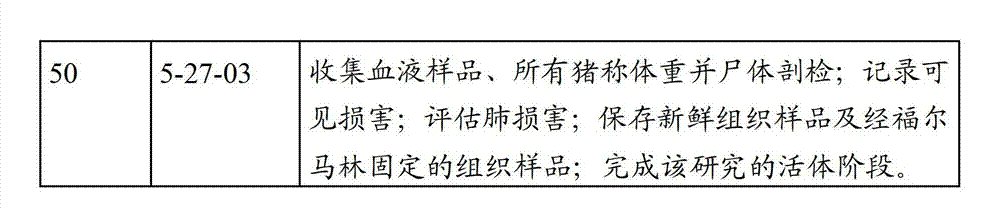
完成研究的活体阶段后,对经福尔马林固定的组织由病理学者进行免疫组织化学(IHC)检查以检测PCV2抗原,评估血液样品的PCV2血清学,并测定自第25天至第50天的平均每日体重增加(ADWG)。After completion of the in vivo phase of the study, formalin-fixed tissue was examined by a pathologist for immunohistochemistry (IHC) to detect PCV2 antigen, blood samples were assessed for PCV2 serology, and assayed from day 25 to day 50 average daily body weight gain (ADWG).
动物自出生至大约11日龄(大约为该研究的第0天)被养于第一试验点的七个房间中的个别笼中。每一房间布局相同并由堆叠的多个单独不锈钢笼组成,并将经过加热并过滤的空气独立地供应至每一分离单元。每一房间独立供热并通风,藉此防止房间之间的空气交叉污染。在第二试验点,动物被养于两个不同猪舍中。将第10组(严格阴性对照组)独立养于经改装的肥育猪舍中,并将第1-9组养于经改装的产仔猪舍中。将每一组养于独立围栏(每围栏14-15只猪),每一围栏为每只猪提供大约2.3平方英尺。将第2组、第4组及第8组圈入通道一侧的三个相邻围栏中,并将第1组、第3组、第5组、第6组、第7组及第9组圈入通道另一侧的六个相邻围栏中。之所以把各组分开,是因为研究监控者(Study Monitor)担心第2组、第4组及第8组所施用的疫苗未完全失活。每一围栏设置于具塑料漏缝地板的抬高平台上。围栏下面的坑充当粪便及排泄物的储槽。每一猪舍具有其自身独立的供暖及通风系统,几乎不可能有猪舍间的空气交叉污染。Animals were housed in individual cages in seven rooms at the first experimental site from birth to approximately 11 days of age (approximately day 0 of the study). Each room is identical in layout and consists of stacked individual stainless steel cages with an independent supply of heated and filtered air to each separate unit. Each room is independently heated and ventilated, thereby preventing air cross-contamination between rooms. At the second experimental point, animals were housed in two different pens. Group 10 (strict negative control group) was independently housed in a modified finishing pen, and groups 1-9 were housed in a modified farrowing house. Each group was housed in individual pens (14-15 pigs per pen), each pen providing approximately 2.3 square feet per pig. Enclose Groups 2, 4, and 8 into three adjacent fences on one side of the passage, and place Groups 1, 3, 5, 6, 7, and 9 Circle into the six adjacent pens on the other side of the passage. The reason why the groups were separated was that the Study Monitor was concerned that the vaccines administered in groups 2, 4 and 8 were not completely inactivated. Each pen is set up on a raised platform with a plastic slatted floor. The pit under the fence acts as a storage tank for manure and excrement. Each pig house has its own independent heating and ventilation system, and it is almost impossible to have air cross-contamination between pig houses.
在第一试验点,自出生至大约3周龄,给小猪喂以特定配制的乳质定粮。到第21天(大约41/2周龄)为止,所有小猪均在食用固体状特定混合的定粮。在第二试验点,给所有小猪喂以与其年龄及体重相适应的定制未加药市售混合定粮(不限量)。在两个试验点,水的供应亦不限量。在第19天、第20天及第21天,将所有受试猪用1.0mL




同时,两个试验点的猪均接受了兽医学护理。在第-3天进行动物健康检查并记录于健康检查记录表中。通过第0天的观察确定了所有动物在疫苗接种之前均具有良好的健康及营养状态。在攻毒前,观察到所有受试动物均具有良好的健康及营养状态。屠体及组织通过熬炼(rendering)加以处置。将研究动物的最后处理记录于动物处置记录上。Meanwhile, pigs at both sites received veterinary care. Animal health checks were performed on Day -3 and recorded on the health check record sheet. All animals were in good health and nutritional status prior to vaccination as determined by day 0 observations. Before the challenge, all tested animals were observed to be in good health and nutritional status. Carcasses and tissues are processed by rendering. The final disposition of the study animal was recorded on the Animal Disposition Record.
在第0天及第14天,分配至第1-3组及第5-8组的猪分别接受2.0mL的指定PCV2疫苗1-4,使用无菌的3.0mL Luer锁紧套口注射器和无菌的20g×1/2″针头分别在右颈区及左颈区肌注。分配至第4组的猪仅在第0天接受1.0mL 2号PCV2疫苗,使用无菌的3.0mL Luer锁紧套口注射器和无菌的20g×1/2″针头在右颈区肌注。On days 0 and 14, pigs assigned to groups 1-3 and 5-8 received 2.0 mL of the designated PCV2 vaccine 1-4, respectively, using sterile 3.0 mL Luer-lock syringes and no Bacteria 20g×1/2″needles were intramuscularly injected in the right neck area and the left neck area respectively. Pigs assigned to group 4 only received 1.0mL No. 2 PCV2 vaccine on day 0, using sterile 3.0mL Luer lock Inject into the right cervical region intramuscularly with a socketed syringe and a sterile 20 g x 1/2" needle.
在第22天,所有受试猪均接受了2.0mL KLH/ICFA,使用无菌的3.0mLLuer锁紧套口注射器和无菌的20g×1"针头在左颈区肌注。在第28天,所有受试猪在右股臀部均接受了2.0mL KLH/ICFA,使用无菌的3.0mL Luer锁紧套口注射器和无菌的20g×1”针头。On day 22, all pigs received 2.0 mL KLH/ICFA, intramuscularly in the left neck region using a sterile 3.0 mL Luer-lock syringe with a sterile 20 g x 1" needle. On day 28, All pigs received 2.0 mL of KLH/ICFA in the right hip using a sterile 3.0 mL Luer lock syringe with a sterile 20 g x 1” needle.
在第25天,分配至第1-9组的猪接受了1.0mL PCV2 ISUVDL攻毒材料(3.98log10TCID50/mL),使用无菌的3.0mL Luer锁紧套口注射器和无菌的20g×1”针头在右颈区肌注。使用无菌的3.0mL Luer锁紧套口注射器及鼻导管,对每只猪鼻内注射(IN)额外施用1.0mL的相同材料(每鼻孔0.5mL)。在第46天,所有受试猪接受2.0mL
在第-3天及自第0天至第21天,每日观测受试猪的总体健康状况及不良事件。对每一只猪的正常或异常行为、呼吸或咳嗽计分。将观测结果记录于临床观测记录上。自第0天至第7天观测所有受试猪的注射部位反应,并自第14天至第21天进一步观测第7组的注射部位反应。在第-3天、第25天及第50天或在攻毒后发现猪死亡的当天,在校准后的天平上称量每只猪的体重以测定平均每日体重增加。将体重记录于体重表中。在随机化之前,利用第-3天的体重将猪分批。利用第25天及第50天的重量数据测定每只猪在这些时间点时的平均每日体重增加(ADWG)。对于攻毒后及第50天前死亡的猪,将ADWG调整为表示自第25天至死亡之日的ADWG。On day -3 and from day 0 to day 21, the overall health status and adverse events of the pigs were observed daily. Each pig was scored for normal or abnormal behaviour, breathing or coughing. Record the observations on the clinical observation record. All pigs tested were observed for injection site reactions from day 0 to day 7, and Group 7 was further observed for injection site reactions from day 14 to day 21. On days -3, 25 and 50 or on the day pigs were found dead after challenge, each pig was weighed on a calibrated balance to determine average daily body weight gain. Body weight is recorded on the weight form. Pigs were divided into batches using day -3 body weight prior to randomization. Average daily body weight gain (ADWG) for each pig at these time points was determined using day 25 and day 50 weight data. For pigs that died post-challenge and before day 50, the ADWG was adjusted to represent the ADWG from day 25 to the day of death.
为测定PCV2血清学,在第-3天及第14天,自每只小猪的眼眶静脉窦采集静脉全血。对于每只小猪,通过将无菌毛细管插入一只眼睛的内眦中从眼眶静脉窦收集血液,并将大约3.0mL的全血汲入4.0mL血清分离管(SerumSeparator Tube,SST)中。在第25天、第32天及第50天,使用20g×11/2"真空采血针
自第22天至第50天,每日一次观测猪的临床症状并对正常或异常行为、呼吸或咳嗽计分。将观测结果记录于临床观测记录上。From day 22 to day 50, pigs were observed daily for clinical signs and scored for normal or abnormal behaviour, breathing or coughing. Record the observations on the clinical observation record.
第46号(第1组)及第98号(第9组)猪在第一试验点死亡。这两例死亡均被归为出血死亡(bleeding death),且未对这两只猪进行尸体剖检。在第二试验点,对攻毒之后第50天前死亡的猪及在第50天安乐死的猪进行尸体剖检。记录任何可见损害,并将具有损害的肺叶的百分比记录于尸体剖检报告表中。Pigs No. 46 (Group 1) and Pig No. 98 (Group 9) died at the first test point. Both deaths were classified as bleeding deaths and no necropsy was performed on either pig. At the second experimental site, necropsy was performed on pigs that died before day 50 after challenge and on pigs that were euthanized on day 50. Any visible lesions were noted and the percentage of lung lobes with lesions was recorded on the necropsy report form.
将来自在第二试验点尸体剖检的每只猪的扁桃体、肺、心脏及肠系膜淋巴结的组织样品置于含有10%缓冲福尔马林的单一容器中;同时将来自上述相同器官的另一组织样品置于

经福尔马林固定的组织由病理学者通过IHC检查检测PCV2,并使用以下计分系统计分:0=无;1=阳性染色不足,几处;2=中度阳性染色,多处;3=大量阳极染色,弥漫于整个组织。为分析的目的,计分0视为"阴性",大于0的计分视为"阳性"。Formalin-fixed tissues were examined by a pathologist for PCV2 by IHC and scored using the following scoring system: 0 = none; 1 = insufficient positive staining, several; 2 = moderate positive staining, multiple; 3 = Massive anodic staining, diffuse throughout the tissue. For analytical purposes, a score of 0 was considered "negative" and a score greater than 0 was considered "positive".
结果result
以下给出此实施例的结果。注意到第46号猪及第98号猪分别在第14天及第25天死亡。这些死亡被归为出血死亡。在第15天,第11号猪(第1组)气喘,同时呼吸急促。除此之外,在此观测期期间,所有猪在行为、呼吸及咳嗽方面均正常,且任何组均未见全身性不良事件。在第0天疫苗接种后,未见注射部位反应。在第14天疫苗接种后,第1组猪的十四(14)只中的七(7)只(50.0%)在第15天具有计分为"2"的肿胀。第1组的十四(14)只中的四(4)只(28.6%)在第16天仍具有为"2"的肿胀。其它组在任一次疫苗接种后无一发生注射部位反应。The results of this example are given below. It was noted that pigs No. 46 and No. 98 died on day 14 and day 25, respectively. These deaths were classified as haemorrhagic deaths. On day 15, pig No. 11 (Group 1) was panting with simultaneous shortness of breath. Otherwise, all pigs were normal in behavior, breathing and coughing during this observation period, and no systemic adverse events were observed in any group. After vaccination on day 0, no injection site reactions were observed. Seven (7) of the fourteen (14) pigs in Group 1 (50.0%) had swelling scoring a "2" on Day 15 after vaccination on Day 14. Four (4) of the fourteen (14) animals in Group 1 (28.6%) still had a swelling of "2" at Day 16. None of the other groups experienced injection site reactions after either vaccination.
平均每日体重增加(ADWG)的结果呈现于下表18中。将死于出血的第46号及第98号猪从组结果中排除。接受了一剂16μgvORF2-卡巴普的第4组具有最高的ADWG(1.16±0.26磅/天),接着为第1组、第2组、第3组、第5组、第6组及第10组,它们的ADWG在自1.07±0.23磅/天至1.11±0.26磅/天的范围。第9组具有最低的ADWG(0.88±0.29磅/天),接着为第8组及第7组,它们分别具有0.93±0.33磅/天及0.99±0.44磅/天的ADWG。The results for average daily body weight gain (ADWG) are presented in Table 18 below. Pigs No. 46 and No. 98 that died of hemorrhage were excluded from group results. Group 4, which received a dose of 16 μg vORF2-Carbopol, had the highest ADWG (1.16±0.26 lbs/day), followed by Groups 1, 2, 3, 5, 6, and 10 , their ADWG ranged from 1.07±0.23 lbs/day to 1.11±0.26 lbs/day. Group 9 had the lowest ADWG (0.88±0.29 lbs/day), followed by Groups 8 and 7 with ADWGs of 0.93±0.33 lbs/day and 0.99±0.44 lbs/day, respectively.
表18.组平均每日体重增加(ADWG)的总结Table 18. Summary of Group Average Daily Body Weight Gain (ADWG)
vORF2=分离的病毒ORF2;rORF2=重组杆状病毒表达的ORF2;KV或灭活的全细胞病毒=在适当细胞培养物中生长的PCV2病毒vORF2 = isolated viral ORF2; rORF2 = recombinant baculovirus expressed ORF2; KV or inactivated whole cell virus = PCV2 virus grown in appropriate cell culture
PVC2血清学结果呈现于下表19中。在第-3天,所有十(10)组均为PCV2血清反应阴性。在第14天,所有十(10)组的PCV2效价仍然低(50-113的范围)。在第25天,接受全细胞灭活病毒疫苗的第8组具有最高PCV2效价(4617),接着为接受16μgvORF2-卡巴普的第2组、接受单个剂量的16μgvORF2-卡巴普的第4组,及接受16μgrORF2-卡巴普的第3组,它们分别具有2507、1920及1503的效价。在第32天(攻毒后一周),第1-6组及第8组的效价由2360至7619不等;而第7组(0.25μgrORF2-卡巴普)、第9组(攻毒对照)及第10组(严格阴性对照)分别具有382、129及78的效价。在第50天(尸体剖检之日),所有十(10)组均展现高PCV2效价(≥1257)。The PVC2 serology results are presented in Table 19 below. On Day -3, all ten (10) groups were PCV2 seronegative. On Day 14, PCV2 titers remained low (range 50-113) in all ten (10) groups. On day 25, Group 8, which received whole cell inactivated virus vaccine, had the highest PCV2 titer (4617), followed by Group 2, which received 16 μg vORF2-Carbopol, Group 4, which received a single dose of 16 μg vORF2-Carbopol, and Group 3, which received 16 μgrORF2-Carbopol, which had titers of 2507, 1920 and 1503, respectively. On day 32 (one week after challenge), the titers of groups 1-6 and group 8 ranged from 2360 to 7619; and group 10 (stringent negative control) had titers of 382, 129 and 78, respectively. On day 50 (the day of necropsy), all ten (10) groups exhibited high PCV2 titers (≧1257).
在第25天、第32天及第50天,接受两剂16μgrORF2-卡巴普的第3组具有比接受两剂16μgrORF2-IMS 1314的第1组更高的抗体效价。在第25天、第32天及第50天,接受两剂16μgvORF2的第2组具有比仅接受一剂相同疫苗的第4组更高的效价。接受递减水平的rORF2-卡巴普—分别为16μg、4μg、1μg及0.25μg—的第3组、第5组、第6组、第7组,在第25天及第32天展现的抗体效价相应地递减。Group 3, which received two doses of 16 μgrORF2-Carbopol, had higher antibody titers than Group 1, which received two doses of 16 μgrORF2-IMS 1314, on days 25, 32 and 50. Group 2, which received two doses of 16 μg vORF2, had higher titers than Group 4, which received only one dose of the same vaccine, on days 25, 32 and 50. Antibody titers exhibited by groups 3, 5, 6, and 7 receiving decreasing levels of rORF2-Carbopol—16 μg, 4 μg, 1 μg, and 0.25 μg, respectively—at day 25 and day 32 Decrease accordingly.
表19.组PCV2IFA效价的总结Table 19. Summary of Group PCV2 IFA Titers
vORF2=分离的病毒ORF2;rORF2=重组杆状病毒表达的ORF2;KV或灭活的全细胞病毒=在适当细胞培养物中生长的PCV2病毒vORF2 = isolated viral ORF2; rORF2 = recombinant baculovirus expressed ORF2; KV or inactivated whole cell virus = PCV2 virus grown in appropriate cell culture
*为计算的目的,将≤100的IFA效价指定为效价"50";将≥6400的IFA效价指定为效价"12,800" * For calculation purposes, designate an IFA titer of ≤100 as a titer of "50"; designate an IFA titer of ≥6400 as a titer of "12,800"
**攻毒之日 ** The day of attack
***尸体剖检之日 *** Date of autopsy
下面给出攻毒后临床观测的结果。表20包括异常行为、异常呼吸、咳嗽及腹泻的观测结果。表21包括组临床症状的总发生率的总结结果,表22包括组攻毒后死亡率的总结结果。接受16μgrORF2-IMS 1314(第1组)、16μgrORF2-卡巴普(第3组)、1μgrORF2-卡巴普(第6组)、0.25μgrORF2-卡巴普(第7组)的猪及攻毒对照组(第9组)中的猪在攻毒后的异常行为、呼吸及咳嗽的发生率低。接受16μgvORF2-卡巴普(第2组)、单剂量的16μgvORF2-卡巴普(第4组)、4μgrORF2-卡巴普(第5组)、>8log KV-卡巴普(第8组)的猪及严格阴性对照组(第10组)中的猪在攻毒后的异常行为、呼吸及咳嗽的发生率为零。The results of clinical observation after challenge are given below. Table 20 includes observations for abnormal behavior, abnormal breathing, coughing, and diarrhea. Table 21 includes the summary results for the group's overall incidence of clinical symptoms and Table 22 for the group's post-challenge mortality. Pigs receiving 16 μgrORF2-IMS 1314 (Group 1), 16 μgrORF2-Carbopol (Group 3), 1 μgrORF2-Carbopol (Group 6), 0.25 μgrORF2-Carbopol (Group 7) and the challenge control group (Group 7) Pigs in group 9) had a low incidence of abnormal behavior, breathing and coughing after challenge. Pigs receiving 16 μg vORF2-Carbopol (Group 2), a single dose of 16 μg vORF2-Carbopol (Group 4), 4 μgrORF2-Carbopol (Group 5), >8 log KV-Carbopol (Group 8) and strictly negative Pigs in the control group (group 10) had zero incidence of abnormal behavior, breathing and coughing after challenge.
临床症状的总发生数在各组之间变化。接受16μg vORF2-卡巴普(第2组)、单剂量16μgvORF2-卡巴普(第4组)的猪及严格阴性对照组(第10组)的猪具有0%的发生率;接受16μgrORF2-卡巴普(第3组)及1μg rORF2-卡巴普(第6组)的猪具有6.7%的发生率;接受16μg rORF2-IMS 1314(第1组)的猪具有7.1%的总发生率;接受4μgrORF2-卡巴普(第5组)、0.25μgrORF2-卡巴普(第7组)及>8log KV疫苗的猪具有13.3%的发生率;而攻毒对照组(第9组)中的猪具有14.3%的发生率。The total number of occurrences of clinical symptoms varied between the groups. Pigs that received 16 μg vORF2-Carbopol (Group 2), a single dose of 16 μg vORF2-Carbopol (Group 4), and pigs that received a strict negative control group (Group 10) had a 0% incidence; pigs that received 16 μgrORF2-Carbopol ( Pigs that received 16 μg rORF2-IMS 1314 (Group 1) had an overall incidence of 7.1%; pigs that received 4 μg rORF2-Carbopol (Group 5), 0.25 μgrORF2-Carbopol (Group 7), and >8 log KV vaccine pigs had a 13.3% incidence; whereas pigs in the challenge control group (Group 9) had a 14.3% incidence.
总死亡率亦在各组之间变化。接受2剂KV疫苗的第8组具有20.0%的最高死亡率;接着为第9组即攻毒对照组,及接受0.25μgrORF2-卡巴普的第7组,它们分别具有14.3%及13.3%的死亡率。接受一剂16μgvORF2-卡巴普的第4组具有6.7%的死亡率。其它所有组,即第1组、第2组、第3组、第5组、第6组及第10组,具有0%的死亡率。Overall mortality also varied between groups. Group 8, which received 2 doses of KV vaccine, had the highest mortality rate of 20.0%, followed by Group 9, the challenge control group, and Group 7, which received 0.25 μgrORF2-Carbopol, which had 14.3% and 13.3% mortality, respectively Rate. Group 4, which received one dose of 16 μg vORF2-Carbopol, had a mortality rate of 6.7%. All other groups, namely Group 1, Group 2, Group 3, Group 5, Group 6 and Group 10, had a mortality rate of 0%.
表20.组的攻毒后异常行为、异常呼吸及咳嗽的观测结果的总结Table 20. Summary of Observations of Abnormal Behavior, Abnormal Breathing and Coughing of Groups Post-Challenge

1每一组中展现任何异常行为历时至少一天的猪总数 1 Total number of pigs in each group exhibiting any abnormal behavior for at least one day
2每一组中展现任何异常呼吸历时至少一天的猪总数 2 Total number of pigs in each group exhibiting any abnormal respiration for at least one day
3每一组中展现咳嗽历时至少一天的猪总数 3 Total number of pigs in each group exhibiting cough for at least one day
表21.组攻毒后临床症状的总发生率的总结Table 21. Summary of Group Overall Incidence of Clinical Symptoms Post-Challenge


vORF2=分离的病毒ORF2;rORF2=重组杆状病毒表达的ORF2;KV或灭活的全细胞病毒=在适当细胞培养物中生长的PCV2病毒vORF2 = isolated viral ORF2; rORF2 = recombinant baculovirus expressed ORF2; KV or inactivated whole cell virus = PCV2 virus grown in appropriate cell culture
1每一组中展现任何临床症状历时至少一天的猪的总数 1 Total number of pigs in each group exhibiting any clinical signs for at least one day
表22.组攻毒后死亡率的总结Table 22. Summary of post-challenge mortality by group
vORF2=分离的病毒ORF2;rORF2=重组杆状病毒表达的ORF2;KV或灭活vORF2 = isolated viral ORF2; rORF2 = recombinant baculovirus expressed ORF2; KV or inactivated
的全细胞病毒=在适当细胞培养物中生长的PCV2病毒Whole cell virus = PCV2 virus grown in appropriate cell culture
在下表23中给出组平均肺损害百分比及初步诊断率(tentative diagnosis)的总结。攻毒对照组第9组具有最高的肺损害百分比,平均值为10.81±23.27%,接下来是接受0.25μgrORF2-卡巴普的第7组,平均值为6.57±24.74%;接受4μgrORF2-卡巴普的第5组,平均值为2.88±8.88%;及接受KV疫苗的第8组,平均值为2.01±4.98%。其余六(6)个组具有较低的平均肺损害百分比,范围在0.11±0.38%至0.90±0.15%。A summary of group mean percentage lung lesions and tentative diagnosis is given in Table 23 below. Group 9 of the challenge control group had the highest percentage of lung damage with a mean of 10.81±23.27%, followed by group 7 receiving 0.25 μgrORF2-Carbopol with a mean of 6.57±24.74%; Group 5, the mean value was 2.88±8.88%; and Group 8 receiving KV vaccine, the mean value was 2.01±4.98%. The remaining six (6) groups had lower mean percent lung lesions ranging from 0.11 ± 0.38% to 0.90 ± 0.15%.
肺炎的初步诊断率在各组之间不同。接受两剂16μgrORF2-卡巴普的第3组具有最低的肺炎初步诊断率,为13.3%。攻毒对照组第9组中有50%被初步诊断为肺炎,接下来是严格阴性对照组第10组及接受两剂16μgvORF2-卡巴普的第2组,它们中分别有46.7%及40%被初步诊断为肺炎。The rate of initial diagnosis of pneumonia varied between the groups. Group 3, which received two doses of 16 μgrORF2-Carbopol, had the lowest rate of initial diagnosis of pneumonia at 13.3%. Pneumonia was preliminarily diagnosed in 50% of Group 9 in the challenge control group, followed by Group 10 in the strict negative control group and Group 2 receiving two doses of 16 μg vORF2-Carbopol, 46.7% and 40% of which were diagnosed, respectively. The initial diagnosis was pneumonia.
第1组、第2组、第3组、第5组、第9组及第10组中0%被初步诊断为PCV2感染;而接受两剂KV疫苗的第8组的组PCV2感染初步诊断率最高,为20%。而接受两剂0.25μgrORF2-卡巴普的第7组及接受一剂16μgvORF2-卡巴普的第4组,组PCV2感染初步诊断率分别为13.3%及6.7%。0% of Group 1, Group 2, Group 3, Group 5, Group 9 and Group 10 were preliminarily diagnosed with PCV2 infection; while Group 8, which received two doses of KV vaccine, had a preliminarily diagnosed rate of PCV2 infection The highest is 20%. In Group 7, which received two doses of 0.25 μgrORF2-Carbopol and Group 4, which received one dose of 16 μg vORF2-Carbopol, the rates of initial diagnosis of PCV2 infection were 13.3% and 6.7%, respectively.
仅在第7组中的一只猪中诊断出了胃溃疡(6.7%);而其它9组保持无胃溃疡。Gastric ulcer was diagnosed in only one pig in group 7 (6.7%); while the other 9 groups remained without gastric ulcer.
表23.组平均肺损害百分比及初步诊断率的总结Table 23. Summary of Group Mean Percentages of Lung Lesions and Primary Diagnosis Rates
vORF2=分离的病毒ORF2;rORF2=重组杆状病毒表达的ORF2;KV或灭活的全细胞病毒=在适当细胞培养物中生长的PCV2病毒vORF2 = isolated viral ORF2; rORF2 = recombinant baculovirus expressed ORF2; KV or inactivated whole cell virus = PCV2 virus grown in appropriate cell culture
组IHC阳性发生率结果的总结展示于下表24中。第1组(16μgrORF2-IMS 1314)具有最低的组IHC阳性结果率,其中0%的猪对于PCV2为阳性;接下来是第2组(16μgvORF2-卡巴普)及第4组(单剂量16μgvORF2-卡巴普),它们分别具有6.7%及13.3%的组IHC率。攻毒对照组第9组具有最高的IHC阳性发生率,其中100%的猪对于PCV2为阳性;接下来是严格阴性对照组的第10组及第8组(KV疫苗),它们分别有93.3%及80%的猪对于PCV2为阳性。A summary of group IHC positive incidence results is shown in Table 24 below. Group 1 (16 μgrORF2-IMS 1314) had the lowest rate of group IHC positive results, with 0% of pigs positive for PCV2; followed by Group 2 (16 μg vORF2-Carbopol) and Group 4 (single dose of 16 μg vORF2-Carbopol Pu), which have group IHC rates of 6.7% and 13.3%, respectively. Group 9 of the challenge control group had the highest incidence of IHC positivity, in which 100% of the pigs were positive for PCV2; followed by groups 10 and 8 of the strict negative control group (KV vaccine), they had 93.3% respectively And 80% of the pigs were positive for PCV2.
表24.组IHC阳性发生率的总结Table 24. Summary of Group IHC Positive Incidence Rates


vORF2=分离的病毒ORF2;rORF2=重组杆状病毒表达的ORF2;KV或灭活的全细胞病毒=在适当细胞培养物中生长的PCV2病毒vORF2 = isolated viral ORF2; rORF2 = recombinant baculovirus expressed ORF2; KV or inactivated whole cell virus = PCV2 virus grown in appropriate cell culture
讨论discuss
在此实施例中评估了七种PCV2疫苗,包括:以IMS 1314佐剂化的高剂量(16μg)rORF2抗原,施用两次;以卡巴普佐剂化的高剂量(16μg)vORF2抗原,向一组猪施用一次并向另一组猪施用两次;以卡巴普佐剂化的高剂量(16μg)rORF2抗原,施用两次;以卡巴普佐剂化的4μg剂量的rORF2抗原,施用两次;以卡巴普佐剂化的1μg剂量的rORF2抗原,施用两次;以卡巴普佐剂化的低剂量(0.25μg)rORF2抗原,施用两次;以及以卡巴普佐剂化的高剂量(>8log)灭活全细胞PCV2疫苗。总的说来,接受两剂16μgrORF2-IMS1314的第1组的表现稍好于接受含有不同水平vORF2或rORF2抗原并以卡巴普佐剂化的疫苗的第2组至第7组,并比接受两剂灭活全细胞PCV2疫苗的第8组好得多。第1组具有第三高的ADWG(1.80±0.30磅/天)、最低的异常行为发生率(0%)、最低的异常呼吸发生率(0%)、低的咳嗽发生率(7.1%)、低的总临床症状发生率(7.1%),与其它三个组一样(tied with three other groups)具有最低的死亡率(0%)、第二低的平均肺损害百分比比率(0.15±0.34%)、第二低的肺炎比率(21.4%)和最低的阳性IHC组织发生率(0%)。然而,第1组是唯一发现注射部位反应的组,包括在第二次疫苗接种后1天50%的受接种者(vaccinate)。施用于第2组至第7组的其它疫苗表现得比灭活疫苗好,且几乎与施用于第1组的疫苗一样好。Seven PCV2 vaccines were evaluated in this example, including: a high dose (16 μg) of rORF2 antigen adjuvanted with IMS 1314, administered twice; a high dose (16 μg) of vORF2 antigen adjuvanted with Carbopol, administered to one One group of pigs was administered once and another group of pigs was administered twice; a high dose (16 μg) of rORF2 antigen adjuvanted with Carbopol was administered twice; a dose of 4 μg rORF2 antigen adjuvanted with Carbopol was administered twice; A 1 μg dose of rORF2 antigen adjuvanted with Carbopol, administered twice; a low dose (0.25 μg) of rORF2 antigen adjuvanted with Carbopol, administered twice; and a high dose (>8 log ) inactivated whole cell PCV2 vaccine. Overall, Group 1, which received two doses of 16 μgrORF2-IMS1314, performed slightly better than Groups 2 to 7, which received vaccines containing varying levels of Group 8 doses of inactivated whole-cell PCV2 vaccine were much better. Group 1 had the third highest ADWG (1.80 ± 0.30 lbs/day), lowest incidence of abnormal behavior (0%), lowest incidence of abnormal breathing (0%), low incidence of cough (7.1%), Low incidence of overall clinical symptoms (7.1%), tied with three other groups (tied with three other groups) had the lowest mortality rate (0%), the second lowest mean percentage of lung damage (0.15±0.34%) , the second lowest rate of pneumonia (21.4%) and the lowest rate of positive IHC tissue (0%). However, group 1 was the only group in which injection site reactions were found, comprising 50% of the vaccinees 1 day after the second vaccination. The other vaccines administered to Groups 2 to 7 performed better than the inactivated vaccine and were almost as good as the vaccine administered to Group 1 .
接受以卡巴普佐剂化的两剂灭活PCV2疫苗的第8组,具有对于任何疫苗组而言最差的一组结果。第8组具有最低的ADWG(0.93±0.33磅/天)、第二高的异常行为发生率(6.7%)、最高的异常呼吸发生率(6.7%),与其它三个组一样具有最高的临床症状总发生率(13.3%),具有所有组中最高的死亡率(20%),并具有任何疫苗组中最高的阳性IHC率(80%)。有一种担忧是所述灭活全细胞PCV2疫苗在施用于第8组之前可能并未完全失活化,这可能能够解释该组的不良结果。不幸的是,未获得确定性的数据来确认这种担忧。总的说来,在此实施例的语境下,一种常规的灭活PCV2疫苗无助于减少PCV2相关疾病。Group 8, which received two doses of inactivated PCV2 vaccine adjuvanted with Carbopol, had the worst set of results for any vaccine group. Group 8 had the lowest ADWG (0.93 ± 0.33 lbs/day), the second highest incidence of abnormal behavior (6.7%), the highest incidence of abnormal breathing (6.7%), and the highest clinical Symptomatic overall incidence (13.3%), had the highest mortality rate of any group (20%), and had the highest positive IHC rate of any vaccine group (80%). There was a concern that the inactivated whole cell PCV2 vaccine might not have been fully inactivated prior to administration to Group 8, which might explain the poor results in this group. Unfortunately, no definitive data are available to confirm this concern. Overall, in the context of this example, a conventional inactivated PCV2 vaccine does not help reduce PCV2-associated disease.
如先前所述,除以IMS 1314佐剂化的疫苗外,受试疫苗没有与不良事件相关。用与IMS 1314配制的疫苗进行第二次接种后1天,在50.0%的猪中可见注射部位反应;第二次接种后2天,在28.6%的猪中可见注射部位反应。在任何接受以卡巴普佐剂化的疫苗的猪均中未见反应。包括接种以IMS1314佐剂化的疫苗的猪的任何进一步研究都应当继续密切监控猪的注射部位反应。As previously described, the vaccines tested were not associated with adverse events, except for the vaccine adjuvanted with IMS 1314. Injection site reactions were seen in 50.0% of pigs 1 day after the second vaccination formulated with IMS 1314 and in 28.6% of pigs 2 days after the second vaccination. No reactions were seen in any of the pigs receiving the vaccine adjuvanted with Carbopol. Any further studies involving pigs vaccinated with IMS1314 adjuvanted vaccines should continue to closely monitor pigs for injection site reactions.
所有猪在第-3天对于PCV2均为血清反应阴性,仅第2组在第14天具有100以上的效价。在第25天(攻毒之日),第8组具有最高PCV2抗体效价(4619),接着为第2组(2507)。除第7组、第9组及第10组外,到第32天为止,所有组均展现了强抗体反应。到第50天为止,包括第7组、第9组及第10组的所有组均展现了强抗体反应。All pigs were seronegative for PCV2 on day -3, only group 2 had titers above 100 on day 14. On day 25 (the day of challenge), group 8 had the highest PCV2 antibody titer (4619), followed by group 2 (2507). With the exception of Groups 7, 9 and 10, all groups exhibited strong antibody responses by day 32. By day 50, all groups including Groups 7, 9 and 10 exhibited strong antibody responses.
后期PCV2感染及随后的PMWS发病的一个标志是在断乳猪中生长迟缓,在严重情况下可见体重减轻。组的平均每日体重增加是显示生长迟缓或体重减轻的一种定量性方法。在此实施例中,各组之间ADWG不存在大的差异。第8组具有0.88±0.29磅/天的最低ADWG,而第4组具有1.16±0.26磅/天的最高ADWG。在此项研究的背景下,由于组间的差异不足,无法将ADWG作为未来疫苗功效的基准。A hallmark of late PCV2 infection and subsequent onset of PMWS is growth retardation and, in severe cases, weight loss in weaned pigs. Group mean daily weight gain is a quantitative way of showing growth retardation or weight loss. In this example, there were no large differences in ADWG between the groups. Group 8 had the lowest ADWG of 0.88±0.29 lbs/day, while Group 4 had the highest ADWG of 1.16±0.26 lbs/day. In the context of this study, the ADWG could not be used as a benchmark for future vaccine efficacy due to insufficient differences between groups.
除体重减轻外,PMWS相关的临床症状还有呼吸困难、嗜睡(leghargy)、皮肤苍白,有时还有黄疸。在此实施例中,对于每一组,异常行为、异常呼吸及咳嗽均不常见。该项研究证明,该攻毒模型及攻毒病毒株并不导致压倒性的(overwhelming)临床症状,这不是作为疫苗功效的基准的有力参数。In addition to weight loss, clinical symptoms associated with PMWS are dyspnea, lethargy, pallor, and sometimes jaundice. In this example, abnormal behavior, abnormal breathing and coughing were uncommon for each group. This study demonstrates that the challenge model and challenge strains do not result in overwhelming clinical symptoms, which is not a strong parameter as a benchmark for vaccine efficacy.
总的说来,在此实施例中死亡率不高,而在攻毒对照组中缺乏高死亡率,限制了该参数作为疫苗功效基准。在第46天前,第4组及第7组分别在十五只猪中有一只死亡,第9组十四只猪中有两只死亡,且在第8组十五只猪中有三只死亡。由于攻毒对照组第9组未展现PCV2临床症状,而且到第46天为止此组中出现仅两例死亡,因此在第46天对所有猪施用猪呼吸及生殖综合征病毒(PRRSV)MLV疫苗。早些时候的研究已利用
在患有继发于PCV2感染的PMWS的猪中的可见损害通常由与一种或多种以下症状组合的一般淋巴结病组成:(1)具有小叶间水肿之间质性肺炎,(2)皮肤苍白或黄疸,(3)斑点状萎缩性肝,(4)胃溃疡及(5)肾炎。在尸体剖检(第50天)时,在任何组中均未见黄疸、肝炎及肾炎。在第7组的一只猪中可见胃溃疡,但未特定检查淋巴结病。基于符合PCV2感染的损害的存在,初步诊断三个组中有至少一只猪有PCV2(PMWS)。接受两剂灭活疫苗的第8组有20%初步诊断有PCV2,而第7组及第4组分别有13.3%及6.7%初步诊断有PCV2。在尸体剖检时,平均肺损害百分比计分各组之间不同。第1组、第2组、第3组、第4组、第6组及第10组具有0.11±0.38%至0.90±0.15%范围内的低肺损害百分比计分。如所预期的,攻毒对照组第9组具有最高的平均肺损害百分比计分(10.81±23.27%)。在四个组中,由于这些组中各有一至三只猪具有极高的肺损害计分,因此提高了平均肺损害百分比计分。肺损害为红色/紫色且坚实的。通常,与PMWS相关的肺损害被描述为黄褐色、不可萎陷并伴有小叶间水肿。在此研究中记录的肺损害与PCV2感染不相关或可能存在第二肺传染原。在此研究的语境中,肺损害百分比计分可能不反映由PCV2所致肺感染量的真实量度。同样,可能肺炎的初步诊断也可能被过度利用了。任何具有肺损害——有些小至0.10%——的猪,都在被初步诊断有肺炎之列。在此实施例中,可见损害及肺损害百分比的组间差异不足,无法作为疫苗功效的基准。Visible lesions in pigs with PMWS secondary to PCV2 infection usually consist of general lymphadenopathy combined with one or more of the following symptoms: (1) interstitial pneumonia with interlobular edema, (2) skin Pale or jaundiced, (3) mottled atrophic liver, (4) gastric ulcer and (5) nephritis. At necropsy (day 50), jaundice, hepatitis and nephritis were not seen in any group. Gastric ulceration was seen in one pig from group 7, but lymphadenopathy was not specifically examined. At least one pig in the three groups was initially diagnosed with PCV2 (PMWS) based on the presence of lesions consistent with PCV2 infection. In Group 8, which received two doses of inactivated vaccine, 20% were initially diagnosed with PCV2, while in Group 7 and Group 4, 13.3% and 6.7% were initially diagnosed with PCV2, respectively. At necropsy, mean percent lung lesion scores varied between groups. Groups 1, 2, 3, 4, 6, and 10 had low percent lung lesion scores ranging from 0.11 ± 0.38% to 0.90 ± 0.15%. As expected, Group 9, the challenge control group, had the highest mean percent lung lesion score (10.81±23.27%). Across the four groups, the mean percent lung lesion score was increased because one to three pigs in each of these groups had very high lung lesion scores. Lung lesions are red/purple and firm. Typically, lung lesions associated with PMWS are described as tan, non-collapsible, with interlobular edema. The lung lesions documented in this study were not associated with PCV2 infection or a possible second pulmonary infectious agent. In the context of this study, the percent lung damage score may not reflect a true measure of the amount of lung infection caused by PCV2. Likewise, it is possible that the initial diagnosis of pneumonia may have been overutilized. Any pig with lung lesions - some as small as 0.10% - was preliminarily diagnosed with pneumonia. In this example, the between-group differences in percent visible lesions and lung lesions were insufficient to serve as a benchmark for vaccine efficacy.
IHC结果所展示的组间差异最大。第1组(16μgrORF2-IMS 1314)具有最低的PCV2抗原阳性IHC结果(0%);而第9组及第10组具有最高的阳性IHC结果,发生率分别为100%及93.3%。分别接受16μg、4μg、1μg或0.25μgrORF2抗原的第3组、第5组、第6组及第7组IHC阳性率分别为20%、20%、40%及46.7%。接受两剂以卡巴普佐剂化的16μgvORF2的第2组具有6.7%的IHC阳性率,而仅接受一剂相同疫苗的第4组具有13.3%的IHC阳性率。由于此测试的客观性且IHC结果与预期结果相关的事实,IHC测试可能是作为疫苗功效基准的最佳参数之一。The IHC results showed the largest differences between groups. Group 1 (16 μgrORF2-IMS 1314) had the lowest PCV2 antigen-positive IHC results (0%); while Groups 9 and 10 had the highest positive IHC results, with incidences of 100% and 93.3%, respectively. The IHC positive rates of groups 3, 5, 6 and 7 receiving 16 μg, 4 μg, 1 μg or 0.25 μgr ORF2 antigen were 20%, 20%, 40% and 46.7%, respectively. Group 2, which received two doses of 16 μg vORF2 adjuvanted with Carbopol, had an IHC-positive rate of 6.7%, while Group 4, which received only one dose of the same vaccine, had an IHC-positive rate of 13.3%. Due to the objectivity of this test and the fact that IHC results correlate with expected results, IHC testing may be one of the best parameters to benchmark vaccine efficacy.
因此,在本发明的一个方面中,测定以卡巴普佐剂化的PCV2rORF2抗原在CDCD猪模型中面对PCV2攻毒的最小保护性剂量(MPD)。第3组、第5组、第6组及第7组各自接受两剂以卡巴普佐剂化的rORF2抗原,但rORF2抗原的水平各组不同。第3组、第5组、第6组及第7组分别各自接受16μg、4μg、1μg或0.25μgrORF2抗原。通常,减少rORF2抗原的水平会降低PCV2抗体效价,并提高死亡率、平均肺损害百分比及IHC阳性组织的发生率。在接受不同水平的rORF2-卡巴普的四个组中,分别接受两剂16μgrORF2抗原或4μgrORF2抗原的第3组及第5组各自具有仅20%的IHC阳性率,且各自具有类似的抗体效价。总的说来,基于IHC阳性结果,施用两次的rORF2抗原的最小保护性剂量大约为4μg。Therefore, in one aspect of the present invention, the minimum protective dose (MPD) of PCV2 rORF2 antigen adjuvanted with Carbopol in the porcine model of CDCD was determined against PCV2 challenge. Groups 3, 5, 6 and 7 each received two doses of rORF2 antigen adjuvanted with Carbopol, but the levels of rORF2 antigen varied among the groups. Groups 3, 5, 6 and 7 each received 16 μg, 4 μg, 1 μg or 0.25 μgr ORF2 antigen, respectively. In general, reducing rORF2 antigen levels decreased PCV2 antibody titers and increased mortality, mean percentage of lung lesions, and incidence of IHC-positive tissue. Among the four groups receiving different levels of rORF2-Carbopol, Groups 3 and 5, each receiving two doses of 16 μgrORF2 antigen or 4 μgrORF2 antigen, each had an IHC positive rate of only 20%, and each had similar antibody titers . Overall, the minimum protective dose of rORF2 antigen administered twice was approximately 4 μg based on positive IHC results.
在本发明的另一方面中,评估重组(rORF2)及VIDO R-1(vORF2)PCV2抗原的抗原性。第2组接受两剂16μgvORF2,第3组接受两剂16μgrORF2。两种疫苗均以卡巴普佐剂化。发现两种疫苗都是安全的,且两者都具有0%的死亡率。在第25天,第2组具有2507的PCV2抗体效价,而第3组具有1503的PCV2抗体效价。第3组具有比第2组低的平均肺损害百分比计分(0.11±0.38%对0.90±0.15%),但第2组具有比第3组低的IHC阳性发生率(6.7%对20%)。总的说来,两种疫苗的抗原性类似,但与vORF2相关的IHC结果稍好。In another aspect of the invention, the antigenicity of recombinant (rORF2) and VIDOR-1 (vORF2) PCV2 antigens is assessed. Group 2 received two doses of 16 μg vORF2 and Group 3 received two doses of 16 μgrORF2. Both vaccines were adjuvanted with Carbopol. Both vaccines were found to be safe and both had a 0% mortality rate. On day 25, Group 2 had a PCV2 antibody titer of 2507, while Group 3 had a PCV2 antibody titer of 1503. Group 3 had a lower mean percent lung lesion score than Group 2 (0.11±0.38% vs. 0.90±0.15%), but Group 2 had a lower incidence of IHC positivity than Group 3 (6.7% vs. 20%) . Overall, the antigenicity of the two vaccines was similar, but IHC results related to vORF2 were slightly better.
在本发明的另一方面中,测定两种不同佐剂(卡巴普及IMS 1314)的适用性。第1组及第3组两者均接受了两剂含有16μgrORF2抗原的疫苗,但第1组接受以IMS 1314佐剂化的抗原,而第3组接受以卡巴普佐剂化的抗原。两个组具有基本上相同的ADWG、基本上相同的攻毒后临床体征发生率、相同的死亡率及基本上相同的平均肺损害百分比;但第1组具有0%的IHC阳性率,而第3组具有20%的IHC阳性率。然而,接受以卡巴普佐剂化的疫苗的第3组在第25天、第32天及第50天具有比接受以IMS 1314佐剂化的疫苗的第1组高的IFAT PCV2效价。总的说来,尽管以IMS 1314佐剂化的PCV2疫苗确实提供了更好的IHC结果,但其提供的抗PCV2感染保护并不具有压倒性的优势,而且其确实诱发了注射部位反应。而以卡巴普佐剂化的PCV2疫苗表现得几乎与以IMS 1314佐剂化的疫苗一样好,却不与任何不良事件相关。In another aspect of the invention, the suitability of two different adjuvants (Carbab and IMS 1314) was determined. Both Groups 1 and 3 received two doses of the vaccine containing 16 μgr ORF2 antigen, but Group 1 received the antigen adjuvanted with IMS 1314 and Group 3 received the antigen adjuvanted with Carbopol. The two groups had essentially the same ADWG, essentially the same incidence of post-challenge clinical signs, the same mortality rate, and essentially the same mean percentage of lung lesions; however, Group 1 had a 0% IHC positive rate, while Group 1 had Group 3 had a 20% IHC positive rate. However, group 3 receiving the vaccine adjuvanted with Carbopol had higher IFAT PCV2 titers at days 25, 32 and 50 than group 1 receiving the vaccine adjuvanted with IMS 1314. Overall, although PCV2 vaccine adjuvanted with IMS 1314 did provide better IHC results, it did not confer overwhelming protection against PCV2 infection and it did induce injection site reactions. Whereas PCV2 vaccine adjuvanted with Carbopol performed almost as well as the vaccine adjuvanted with IMS 1314 and was not associated with any adverse events.
在本发明的另一方面中,测定PCV2 ORF2作为1ml 1剂量产品的可行性。第2组及第4组都在第0天接受了以卡巴普佐剂化的vORF2疫苗,而第2组在第14天又接受了一剂。第4组的ADWG较第2组稍高,平均肺损害百分比较第2组低,但第2组在第25天、第32天及第50天的IFAT PCV2效价较高,IHC阳性组织发生率稍低。这两个组的所有其它结果是类似的。总的说来,以卡巴普佐剂化的一剂vORF2的表现类似于两剂的相同疫苗。In another aspect of the invention, the feasibility of PCV2 ORF2 as a 1 ml 1 dose product was determined. Groups 2 and 4 both received the vORF2 vaccine adjuvanted with Carbopol on day 0, while group 2 received an additional dose on day 14. The ADWG of group 4 was slightly higher than that of group 2, and the average percentage of lung damage was lower than that of group 2, but the IFAT PCV2 titer of group 2 was higher on day 25, day 32 and day 50, and IHC positive tissue occurred rate is slightly lower. All other results for the two groups were similar. Overall, one dose of vORF2 adjuvanted with Carbopol performed similarly to two doses of the same vaccine.

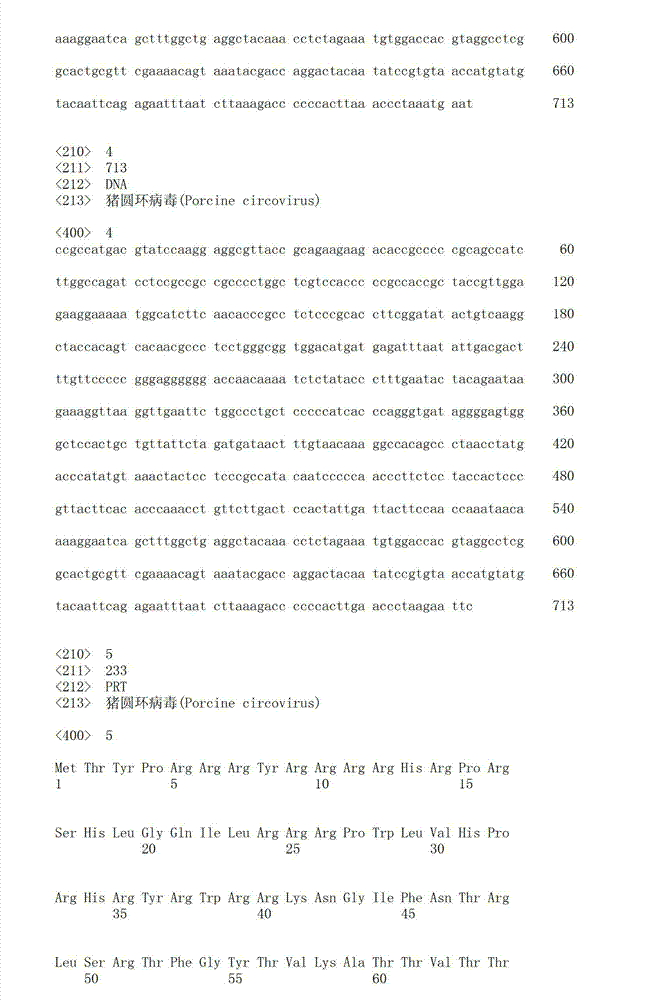


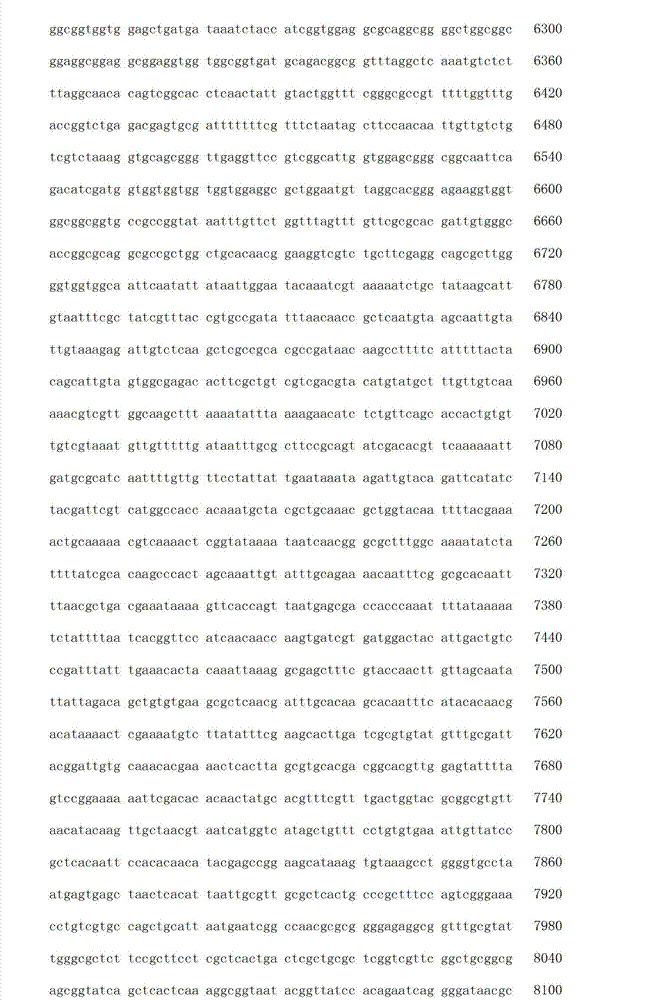
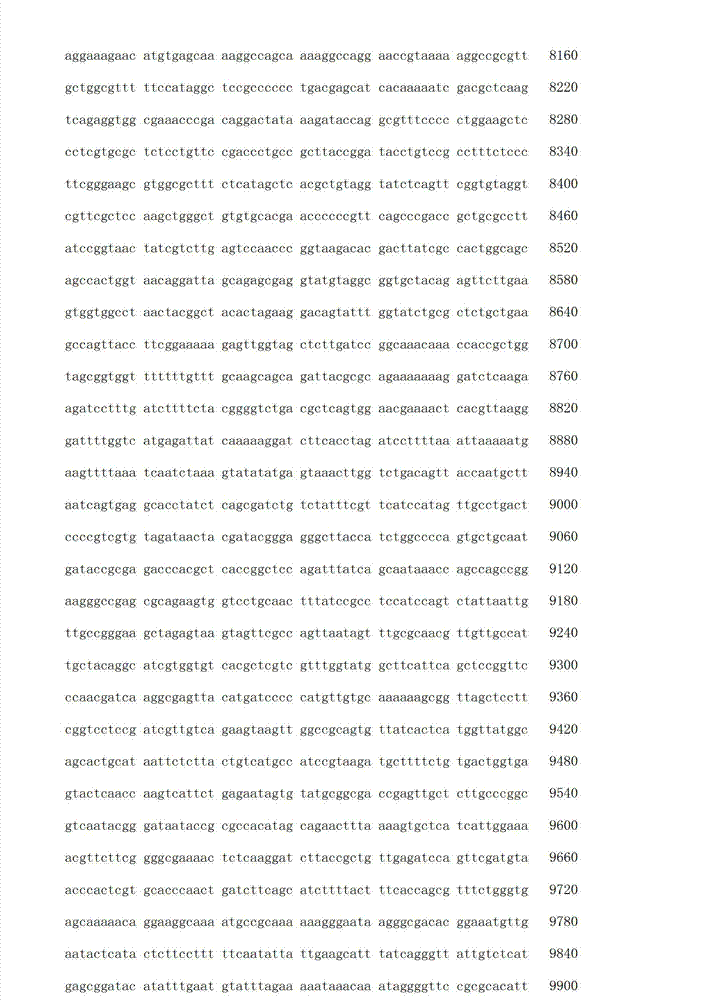
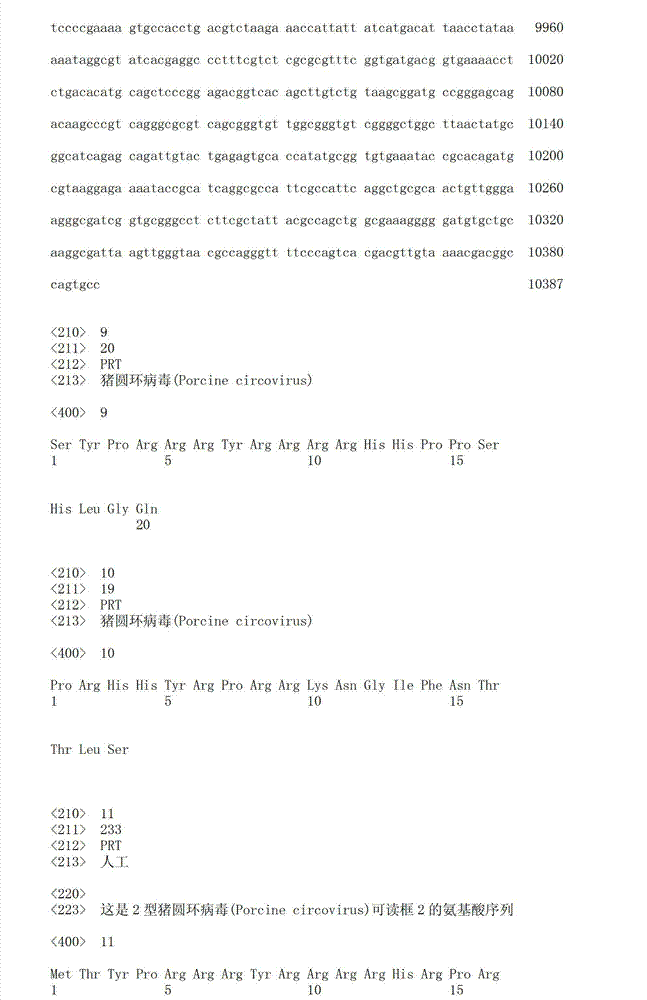

Claims (7)





























































Applications Claiming Priority (2)
| Application Number | Priority Date | Filing Date | Title |
|---|---|---|---|
| US75501505P | 2005-12-29 | 2005-12-29 | |
| US60/755,015 | 2005-12-29 |
Related Parent Applications (1)
| Application Number | Title | Priority Date | Filing Date |
|---|---|---|---|
| CN2006800535768A Division CN101389350B (en) | 2005-12-29 | 2006-12-28 | Multivalent PCV2 immunogenic compositions and methods of making such compositions |
Publications (2)
| Publication Number | Publication Date |
|---|---|
| CN102698263A true CN102698263A (en) | 2012-10-03 |
| CN102698263B CN102698263B (en) | 2016-07-06 |
Family
ID=38218875
Family Applications (3)
| Application Number | Title | Priority Date | Filing Date |
|---|---|---|---|
| CN201210141732.3A Active CN102698263B (en) | 2005-12-29 | 2006-12-28 | Multivalent pcv 2 immunogenic compositions and the method preparing such composition |
| CN201310472580.XA Active CN103536914B (en) | 2005-12-29 | 2006-12-28 | Multivalent pcv 2 immunogenic compositions and the method preparing such composition |
| CN2006800535768A Active CN101389350B (en) | 2005-12-29 | 2006-12-28 | Multivalent PCV2 immunogenic compositions and methods of making such compositions |
Family Applications After (2)
| Application Number | Title | Priority Date | Filing Date |
|---|---|---|---|
| CN201310472580.XA Active CN103536914B (en) | 2005-12-29 | 2006-12-28 | Multivalent pcv 2 immunogenic compositions and the method preparing such composition |
| CN2006800535768A Active CN101389350B (en) | 2005-12-29 | 2006-12-28 | Multivalent PCV2 immunogenic compositions and methods of making such compositions |
Country Status (22)
| Country | Link |
|---|---|
| US (6) | US20080226669A1 (en) |
| EP (4) | EP3320919B1 (en) |
| JP (2) | JP5394750B2 (en) |
| KR (1) | KR101436794B1 (en) |
| CN (3) | CN102698263B (en) |
| AR (1) | AR058870A1 (en) |
| AU (1) | AU2006330491B2 (en) |
| BR (2) | BR122015028489B1 (en) |
| CA (1) | CA2635598C (en) |
| DK (3) | DK1968630T5 (en) |
| ES (3) | ES2666451T3 (en) |
| HU (3) | HUE037267T2 (en) |
| MX (1) | MX365868B (en) |
| MY (2) | MY180002A (en) |
| PH (1) | PH12014502525B1 (en) |
| PL (3) | PL2275132T3 (en) |
| PT (3) | PT1968630T (en) |
| RU (2) | RU2488407C2 (en) |
| TW (1) | TWI528970B (en) |
| UA (1) | UA99708C2 (en) |
| WO (1) | WO2007076520A2 (en) |
| ZA (1) | ZA200804957B (en) |
Cited By (1)
| Publication number | Priority date | Publication date | Assignee | Title |
|---|---|---|---|---|
| CN103893750A (en) * | 2012-12-31 | 2014-07-02 | 普莱柯生物工程股份有限公司 | Anti-porcine pseudorabies and swine flu vaccine composition and application thereof |
Families Citing this family (59)
| Publication number | Priority date | Publication date | Assignee | Title |
|---|---|---|---|---|
| US7833707B2 (en) | 2004-12-30 | 2010-11-16 | Boehringer Ingelheim Vetmedica, Inc. | Methods of overexpression and recovery of porcine circovirus type 2 ORF2 |
| UA95602C2 (en) | 2004-12-30 | 2011-08-25 | Берингер Ингельхейм Ветмедика, Инк. | Pcv2 immunogenic compositions and methods of producing such compositions |
| US7700285B1 (en) | 2005-12-29 | 2010-04-20 | Boehringer Ingelheim Vetmedica, Inc. | PCV2 immunogenic compositions and methods of producing such compositions |
| US8834891B2 (en) | 2005-03-14 | 2014-09-16 | Boehringer Ingelheim Vetmedica, Inc. | Immunogenic compositions comprising Lawsonia intracellularis |
| US8398994B2 (en) * | 2005-07-15 | 2013-03-19 | Boehringer Ingelheim Vetmedica, Inc. | Lawsonia vaccine and methods of use thereof |
| BR122015028489B1 (en) | 2005-12-29 | 2021-10-13 | Boehringer Ingelheim Animal Health Usa Inc | MULTIVALENT COMBINATION VACCINE AGAINST PCV2 AS WELL AS THE USE OF AN ORF2 PROTEIN IN THE PREPARATION OF THE SAME |
| ES2572736T3 (en) | 2005-12-29 | 2016-06-02 | Boehringer Ingelheim Vetmedica, Inc. | Use of an immunogenic composition to attenuate clinical symptoms in pigs |
| US8470336B2 (en) * | 2006-05-25 | 2013-06-25 | Boehringer Ingelheim Vetmedica, Inc. | Vaccination of young animals against Lawsonia intracellularis infections |
| US20080241190A1 (en) * | 2006-11-13 | 2008-10-02 | Boehringer Ingelheim Vetmedica, Inc. | Vaccination of horses against lawsonia intracellularis |
| US20100136060A1 (en) * | 2006-11-22 | 2010-06-03 | Boehringer Ingelheim Vetmedica, Inc. | Methods of reducing porcine circovirus-associated disease outbreaks |
| EP2859900A1 (en) * | 2006-12-11 | 2015-04-15 | Boehringer Ingelheim Vetmedica, Inc. | Effective method of treatment of porcine circovirus and lawsonia intracellularis infections |
| AU2007333857B2 (en) | 2006-12-15 | 2014-05-15 | Boehringer Ingelheim Animal Health USA Inc. | Treatment of pigs with PCV2 antigen |
| EP1941903A1 (en) * | 2007-01-03 | 2008-07-09 | Boehringer Ingelheim Vetmedica Gmbh | Prophylaxis and treatment of PRDC |
| EP1958644A1 (en) | 2007-02-13 | 2008-08-20 | Boehringer Ingelheim Vetmedica Gmbh | Prevention and treatment of sub-clinical pcvd |
| AU2008224877B2 (en) | 2007-03-14 | 2013-07-11 | Ligocyte Pharmaceuticals, Inc. | Virus like particle purification |
| US7829274B2 (en) | 2007-09-04 | 2010-11-09 | Boehringer Ingelheim Vetmedica, Inc. | Reduction of concomitant infections in pigs by the use of PCV2 antigen |
| EP2200643B1 (en) * | 2007-09-17 | 2013-09-04 | Boehringer Ingelheim Vetmedica, Inc. | A live lawsonia intracellularis vaccine administered in combination with an antibiotic for use in the treatment of lawsonia intracellularis infections in pigs |
| CN101903041A (en) * | 2007-12-21 | 2010-12-01 | 辉瑞大药厂 | Heat-treated bacterins, and emulsion vaccines prepared from such heat-treated bacterins |
| KR20100103535A (en) * | 2007-12-31 | 2010-09-27 | 베링거잉겔하임베트메디카인코퍼레이티드 | Pcv2 orf2 virus like particle with foreign amino acid insertion |
| WO2009126356A2 (en) | 2008-01-23 | 2009-10-15 | Boehringer Ingelheim Vetmedica, Inc. | Pcv2 mycoplasma hyopneumoniae immunogenic compositions and methods of producing such compositions |
| EP2254595A4 (en) * | 2008-02-15 | 2012-12-05 | Boehringer Ingelheim Vetmed | METHOD AND COMPOSITIONS FOR REDUCING THE EFFECTS OF STOMACH DISEASES |
| US8444989B1 (en) * | 2008-04-18 | 2013-05-21 | Boehringer Ingelheim Vetmedica Gmbh | One dose vaccination against mycoplasma infections of pigs |
| TWI449533B (en) | 2008-04-18 | 2014-08-21 | Intervet Int Bv | Vaccine for protection against lawsonia intracellularis, mycoplasma hyopneumoniae and porcine circo virus |
| KR101079708B1 (en) * | 2008-07-07 | 2011-11-03 | 주식회사 중앙백신연구소 | Mixed vaccine comprising the whole virus of pcv-2 for preventing porcine circovirus associated diseases |
| KR100926046B1 (en) * | 2008-10-16 | 2009-11-11 | 솔로몬유(주) | Doll with MP3 Play |
| TWI627281B (en) * | 2009-09-02 | 2018-06-21 | 百靈佳殷格翰家畜藥品公司 | Methods of reducing viricidal activity in pcv-2 compositions and pcv-2 compositions with an improved immunogenicity |
| NZ598645A (en) * | 2009-09-10 | 2014-07-25 | Merial Ltd | New vaccine formulations comprising saponin-containing adjuvants |
| CN102727883B (en) * | 2011-05-27 | 2014-05-14 | 华威特(北京)生物科技有限公司 | Combined live vaccine against porcine reproductive and respiratory syndrome and swine fever, and application thereof |
| HUP1100470A2 (en) * | 2011-08-30 | 2013-03-28 | Mezoegazdasagi Biotechnologiai Kutatokoezpont | Nanoparticle-based veterinary vaccine |
| EP2564869A1 (en) | 2011-09-02 | 2013-03-06 | Ceva Sante Animale | Synthetic capsid proteins and uses thereof |
| CN103083655B (en) * | 2011-11-02 | 2015-08-26 | 普莱柯生物工程股份有限公司 | Vaccine combination of prevention and therapy porcine circovirus 2 type, haemophilus parasuis and mycoplasma hyopneumoniae infection and preparation method thereof |
| CN102716482B (en) * | 2012-03-07 | 2014-01-01 | 齐鲁动物保健品有限公司 | Highly pathogenic porcine reproductive and respiratory syndrome live vaccine diluted solution |
| UA114504C2 (en) | 2012-04-04 | 2017-06-26 | Зоетіс Сервісіз Ллс | PCV, MYCOPLASMA HYOPNEUMONIA AND PRRS COMBINED VACCINE |
| US9120859B2 (en) | 2012-04-04 | 2015-09-01 | Zoetis Services Llc | Mycoplasma hyopneumoniae vaccine |
| UA114503C2 (en) | 2012-04-04 | 2017-06-26 | Зоетіс Сервісіз Ллс | PCV AND MYCOPLASMA HYOPNEUMONIA COMBINED VACCINE |
| JOP20130186B1 (en) | 2012-06-22 | 2021-08-17 | Takeda Vaccines Montana Inc | Purification of virus like particles |
| BR102013001893B1 (en) | 2013-01-25 | 2022-01-25 | Fundação De Amparo À Pesquisa Do Estado De Minas Gerais - Fapemig | Recombinant porcine circovirus 2 (pcv-2) antigens for vaccine formulations, diagnostic kit and use |
| ES2734374T3 (en) | 2013-03-01 | 2019-12-05 | Boehringer Ingelheim Animal Health Usa Inc | Quantification of vaccine compositions |
| CN104043117B (en) * | 2013-03-11 | 2018-02-13 | 普莱柯生物工程股份有限公司 | A kind of vaccine combination and its preparation method and application |
| EP2789346A1 (en) | 2013-04-11 | 2014-10-15 | CEVA Santé Animale SA | Fusion polypeptides and vaccines |
| ES2882374T3 (en) | 2013-05-08 | 2021-12-01 | Pharmgate Biologics Inc | PCV2 and mycoplasma vaccine |
| JP2015015931A (en) * | 2013-07-12 | 2015-01-29 | 株式会社Umnファーマ | Method for producing culture comprising virus-like particles |
| CN104288762B (en) * | 2013-07-19 | 2017-09-12 | 普莱柯生物工程股份有限公司 | A kind of vaccine combination and its preparation method and application |
| US9987348B2 (en) * | 2013-09-25 | 2018-06-05 | Zoetis Services Llc | PCV2B divergent vaccine composition and methods of use |
| US9505808B2 (en) | 2013-10-02 | 2016-11-29 | Boehringer Ingelheim Vetmedica, Inc. | PCV2 ORF2 protein variant and virus like particles composed thereof |
| CN104548083B (en) * | 2013-10-22 | 2019-05-07 | 洛阳赛威生物科技有限公司 | A kind of vaccine composition and its preparation method and application |
| CN104248761B (en) * | 2014-06-24 | 2018-02-02 | 普莱柯生物工程股份有限公司 | A kind of vaccine composition and its preparation method and application |
| TWI691598B (en) * | 2015-10-08 | 2020-04-21 | 台灣生物製劑股份有限公司 | Whole expressed cell as antigen carrier, and use thereof in preparing vaccine or diagnostic agent, and screening monoclonal antibodies |
| RU2744193C2 (en) * | 2015-10-16 | 2021-03-03 | Канзас Стейт Юниверсити Рисерч Фаундейшн | Immunogenic compositions for immunization of pigs against circovirus type 3 and methods of prduction and application thereof |
| EP3432920A1 (en) * | 2016-03-23 | 2019-01-30 | Intervet International B.V. | A vaccine for intradermal application against pcv2 and prrs virus infection |
| WO2018099889A1 (en) * | 2016-11-29 | 2018-06-07 | Intervet International B.V. | Swine vaccine |
| EP3727432A1 (en) * | 2017-12-22 | 2020-10-28 | Hipra Scientific, S.L.U. | Intradermal combination vaccine against mycoplasma and porcine circovirus |
| CN114746110A (en) * | 2019-09-26 | 2022-07-12 | Igy免疫技术和生命科学公司 | Vaccine and immunoglobulin targeting African swine fever virus, and methods of making and using the same |
| AU2021311726A1 (en) * | 2020-07-24 | 2023-02-09 | Boehringer Ingelheim Animal Health USA Inc. | Combination porcine vaccine |
| RU2743595C1 (en) * | 2020-12-09 | 2021-02-20 | Федеральное бюджетное учреждение науки "Государственный научный центр вирусологии и биотехнологии "Вектор" Федеральной службы по надзору в сфере защиты прав потребителей и благополучия человека (ФБУН ГНЦ ВБ "Вектор" Роспотребнадзора) | Vaccine composition against covid-19 |
| RU2743593C1 (en) * | 2020-12-09 | 2021-02-20 | Федеральное бюджетное учреждение науки "Государственный научный центр вирусологии и биотехнологии "Вектор" Федеральной службы по надзору в сфере защиты прав потребителей и благополучия человека (ФБУН ГНЦ ВБ "Вектор" Роспотребнадзора) | Peptide immunogens and vaccine composition against covid-19 with the use of peptide immunogens |
| KR102646305B1 (en) * | 2021-03-04 | 2024-03-13 | 주식회사 이노백 | Polyvalent vaccine composition comprising for preventing swine mycoplasma and Porcine circovirus infection |
| KR102769557B1 (en) * | 2021-11-19 | 2025-02-20 | 주식회사 이노백 | Novel recombinant porcine circovirus 2 protein and uses thereof |
| CN116813718B (en) * | 2023-08-30 | 2023-10-27 | 北京瑞阳瑞泰生物科技有限公司 | Recombinant porcine circovirus 2 type Cap protein trimer, expression system and application thereof |
Family Cites Families (116)
| Publication number | Priority date | Publication date | Assignee | Title |
|---|---|---|---|---|
| US2909462A (en) | 1955-12-08 | 1959-10-20 | Bristol Myers Co | Acrylic acid polymer laxative compositions |
| US3479705A (en) | 1966-12-15 | 1969-11-25 | Miami Brick & Stone Inc Of Mia | Molding apparatus |
| EP0138854B1 (en) | 1983-03-08 | 1992-11-04 | Chiron Mimotopes Pty. Ltd. | Antigenically active amino acid sequences |
| US4745051A (en) | 1983-05-27 | 1988-05-17 | The Texas A&M University System | Method for producing a recombinant baculovirus expression vector |
| ES2052685T3 (en) | 1987-03-17 | 1994-07-16 | Akzo Nv | METHOD TO PRODUCE A FREE ADJUVANT. |
| US5069901A (en) | 1988-02-03 | 1991-12-03 | Jones Elaine V | Preparation of a recombinant subunit vaccine against pseudorabies infection |
| DK0454735T3 (en) | 1989-01-23 | 1996-10-07 | Auspharm Int Ltd | Vaccine composition |
| US5155037A (en) | 1989-08-04 | 1992-10-13 | The Texas A&M University System | Insect signal sequences useful to improve the efficiency of processing and secretion of foreign genes in insect systems |
| US5202430A (en) * | 1990-01-16 | 1993-04-13 | University Of Tennessee | Transmissible gastroenteritis virus genes |
| JP3187419B2 (en) | 1990-05-29 | 2001-07-11 | アメリカン・サイアナミド・カンパニー | Porcine pneumonia vaccine and production method thereof |
| US5565205A (en) | 1990-08-16 | 1996-10-15 | Solvay Animal Health, Inc. | Inactivated Mycoplasma hypopneumoniae bacterin and method of use thereof |
| NL9301272A (en) | 1993-07-20 | 1995-02-16 | Aesculaap Bv | Chicken Anemia Virus mutants and vaccines and uses based on the viral proteins VP1, VP2 and VP3 or coding sequences of that virus. |
| GB9023111D0 (en) * | 1990-10-24 | 1990-12-05 | Wellcome Found | Expression system |
| ES2150419T3 (en) | 1990-11-01 | 2000-12-01 | Univ Iowa State Res Found Inc | BACTERIAL AND VACCINE ATTENUATION PROCEDURE. |
| ES2026827A6 (en) * | 1991-03-26 | 1992-05-01 | Ercros Sa | Method for producing a subunit vaccine against porcine parvovirus. |
| MX9204885A (en) | 1991-08-26 | 1994-05-31 | Boehringer Animal Health Inc | VACCINE COMPOSITION INCLUDING VIRUSES OF INFERTILITY AND RESPIRATORY SYNDROME OF PIGS. |
| US6042830A (en) | 1992-08-05 | 2000-03-28 | Boehringer Ingelheim Vetmedica, Inc. | Viral agent associated with mystery swine disease |
| US5580557A (en) * | 1991-10-09 | 1996-12-03 | Iowa State University Research Foundation, Inc. | Live, avirulent salmonella choleraesuis vaccine used for inducing an immune response in animals |
| HU220113B (en) | 1991-10-14 | 2001-11-28 | Akzo N.V. | Porcine reproductive respiratory syndrome vaccine, process for producton and use thereof |
| US5338543A (en) * | 1992-02-27 | 1994-08-16 | Ambico, Inc. | Thimerosal inactivated mycoplasma hyopneumoniae vaccine |
| EP0571648A1 (en) | 1992-05-26 | 1993-12-01 | Chung-Nan Weng | Vaccine protecting against mycoplasmal pneumonia |
| DE69426228T2 (en) | 1993-02-08 | 2001-03-01 | Bayer Ag | Method of propagating the swine virus causing reproductive and respiratory syndrome and using it as a vaccine. |
| ES2074950B1 (en) | 1993-09-17 | 1996-03-16 | Iberica Cyanamid | VACCINE FOR THE PREVENTION OF REPRODUCTIVE AND RESPIRATORY DISEASE OF THE SOW. |
| BR9507717A (en) * | 1994-05-10 | 1997-09-23 | American Home Prod | Enhanced modified live brsv vaccine |
| US5885823A (en) * | 1995-06-05 | 1999-03-23 | Nobl Laboratories, Inc. | Lawsonia intracellularis cultivation, anti-Lawsonia intracellularis vaccines and diagnostic agents |
| ES2102971B1 (en) | 1996-01-25 | 1998-03-01 | Hipra Lab Sa | NEW ATTENUATED STRAIN OF THE VIRUS CAUSING THE RESPIRATORY AND REPRODUCTIVE SYNDROME (PRRS), THE VACCINES AND DIAGNOSTIC MEDIA OBTAINABLE WITH THE SAME AND THE PROCEDURES FOR ITS OBTAINING. |
| WO1998006835A2 (en) | 1996-08-16 | 1998-02-19 | The Texas A & M University System | Modifying insect cell gylcosylation pathways with baculovirus expression vectors |
| DE69704011T2 (en) * | 1996-10-09 | 2001-06-07 | Akzo Nobel Nv | Swine Reproductive System Respiratory Syndrome Virus (PRRSV) vaccine strains |
| UA78180C2 (en) | 1997-10-03 | 2007-03-15 | Меріаль | Porcine circovirus, vaccines and diagnostic reagents |
| US6517843B1 (en) * | 1999-08-31 | 2003-02-11 | Merial | Reduction of porcine circovirus-2 viral load with inactivated PCV-2 |
| US20060029617A1 (en) | 1997-10-03 | 2006-02-09 | Charreyre Catherine E | Porcine circovirus and Helicobacter combination vaccines and methods of use |
| US6391314B1 (en) * | 1997-10-03 | 2002-05-21 | Merial | Porcine circoviruses vaccines diagnostic reagents |
| US7211379B2 (en) * | 1997-10-03 | 2007-05-01 | Merial Sas | Prevention of myocarditis, abortion and intrauterine infection associated with porcine circovirus-2 |
| US7192594B2 (en) * | 1997-10-03 | 2007-03-20 | Merial Limited | Postweaning multisystemic wasting syndrome and porcine circovirus from pigs |
| FR2781159B1 (en) | 1998-07-06 | 2000-10-06 | Merial Sas | CIRCOVIRUS VACCINE AND PIG PARVOVIRUS |
| AU2003248395B2 (en) | 1997-10-03 | 2006-03-16 | Merial | Porcine CircoViruses, vaccines and diagnostic reagents |
| FR2772047B1 (en) | 1997-12-05 | 2004-04-09 | Ct Nat D Etudes Veterinaires E | GENOMIC SEQUENCE AND POLYPEPTIDES OF CIRCOVIRUS ASSOCIATED WITH PIGLET LOSS DISEASE (MAP), APPLICATIONS TO DIAGNOSIS AND TO PREVENTION AND / OR TREATMENT OF INFECTION |
| US20040062775A1 (en) * | 1997-12-05 | 2004-04-01 | Agence Francaise De Securite Sanitaire Des Aliments | Circovirus sequences associated with piglet weight loss disease (PWD) |
| ATE364624T1 (en) | 1997-12-11 | 2007-07-15 | Univ Saskatchewan | MULTISYSTEMIC CRIME GROWTH SYNDROME CAUSED BY VIRUSES IN PIGS |
| WO1999045956A1 (en) * | 1998-03-13 | 1999-09-16 | University Of Georgia Research Foundation, Inc. | Vaccines against circovirus infections |
| US6294176B1 (en) * | 1998-07-10 | 2001-09-25 | Schering-Plough Veterinary Corp. | Recombinant raccoonpox virus and uses thereof as a vaccine in mammalian and avian species |
| WO2000031275A1 (en) | 1998-11-19 | 2000-06-02 | Azwell Inc. | Recombinant lysophosphatidic acid phosphatase |
| FR2789695B1 (en) | 1999-02-11 | 2003-03-07 | Merial Sas | VIRAL VACCINES AND VACCINES BASED ON RECOMBINANT AND REPLICATIVE SWINE ADENOVIRUSES |
| US6497883B1 (en) * | 1999-06-10 | 2002-12-24 | Merial | Porcine circovirus recombinant poxvirus vaccine |
| US6943152B1 (en) * | 1999-06-10 | 2005-09-13 | Merial | DNA vaccine-PCV |
| GB9921146D0 (en) | 1999-09-07 | 1999-11-10 | Smithkline Beecham Biolog | Novel composition |
| WO2001017556A1 (en) | 1999-09-07 | 2001-03-15 | Shionogi & Co., Ltd. | Vaccine preparations for mucosal administration |
| GB9921147D0 (en) | 1999-09-07 | 1999-11-10 | Smithkline Beecham Biolog | Novel composition |
| EP1094070A3 (en) | 1999-10-22 | 2002-01-09 | Pfizer Products Inc. | Lawsonia intracellularis proteins, and related methods and materials |
| US6656478B1 (en) | 1999-11-12 | 2003-12-02 | Samuel D. Charles | Cross-protective salmonella vaccines |
| ATE385808T1 (en) | 1999-12-21 | 2008-03-15 | Merial Sas | COMPOSITIONS AND VACCINES CONTAINING AT LEAST ONE CRYPTOSPORIDIUM PARVUM ANTIGEN AND AT LEAST ONE ANTIGEN OF ANOTHER INTESTINE DISEASE |
| US6808900B2 (en) | 2000-06-15 | 2004-10-26 | Manitoba, University Of | Cryptosporidium parvum antigens, antibodies thereto and diagnostic and therapeutic compositions thereof |
| JP2004503234A (en) * | 2000-06-15 | 2004-02-05 | パーデュー・リサーチ・ファウンデーション | Vaccine for congenital tremor in pigs |
| US7018638B2 (en) | 2000-12-19 | 2006-03-28 | Wyeth | Mycoplasma hyopneumoniae bacterin vaccine |
| MY129765A (en) | 2000-12-19 | 2007-04-30 | Wyeth Corp | Improved mycoplasma hyopneumoniae bacterin vaccine |
| JP2002247979A (en) | 2001-02-23 | 2002-09-03 | Nippon Biologicals Inc | Marek's disease vaccine and production method thereof |
| MXPA03008810A (en) * | 2001-03-27 | 2004-02-17 | Univ Saskatchewan | Methods to culture circovirus. |
| US20030096377A1 (en) | 2001-06-28 | 2003-05-22 | Virginia Tech Intellectual Properties, Inc. | Differential PCR-RFLP assay for detecting and distinguishing between nonpathogenic PCV-1 and pathogenic PCV-2 |
| YU102203A (en) | 2001-07-02 | 2006-05-25 | Pfizer Products Inc. | One dose vaccination with mycoplasma hyopneumoniae |
| US7361352B2 (en) * | 2001-08-15 | 2008-04-22 | Acambis, Inc. | Influenza immunogen and vaccine |
| US7276353B2 (en) | 2001-12-12 | 2007-10-02 | Virginia Tech Intellectual Properties, Inc. | Chimeric infectious DNA clones, chimeric porcine circoviruses and uses thereof |
| US7279166B2 (en) | 2001-12-12 | 2007-10-09 | Virginia Tech Intellectual Properties, Inc. | Chimeric infectious DNA clones, chimeric porcine circoviruses and uses thereof |
| US6841364B2 (en) * | 2002-01-22 | 2005-01-11 | Protatek International, Inc. | Infectious cDNA clones of porcine reproductive and respiratory syndrome virus and expression vectors thereof |
| AU2003219760A1 (en) | 2002-02-14 | 2003-09-04 | Novavax, Inc. | Optimization of gene sequences of virus-like particles for expression in insect cells |
| WO2003077860A2 (en) | 2002-03-13 | 2003-09-25 | Biophysica, Inc. | BOSWELLIN COMPOSITIONS ENHANCED WITH 3-β-ACETYL-11-KETO-β-BOSWELLIC ACID (“AKBA”), INDUSTRIAL MANUFACTURE AND THEIR USES |
| US20030215455A1 (en) | 2002-05-14 | 2003-11-20 | Bailey Reynolds | Vaccine stabilizer and method of use |
| US7335362B2 (en) * | 2002-07-19 | 2008-02-26 | Beth Israel Deaconess Medical Center | Methods of treating pre-eclampsia or eclampsia |
| US7223207B1 (en) * | 2002-09-13 | 2007-05-29 | Simon Basyuk | Exercise and massage device |
| AU2002951692A0 (en) * | 2002-09-23 | 2002-10-17 | Vital Biotech (Hong Kong) Limited | Improvements in or relating to vaccines |
| AU2004209985B2 (en) | 2003-02-03 | 2008-09-18 | Cerebus Biologicals, Inc. | Methods for treating, preventing and detecting Helicobacter infection |
| US7563449B2 (en) | 2003-04-21 | 2009-07-21 | Pfizer Inc, | Methods for reducing cattle reproductive diseases |
| CN1458167A (en) | 2003-06-02 | 2003-11-26 | 中国农业科学院哈尔滨兽医研究所 | Truncated expressed porcine circovirus II capsid protein antigen and use thereof |
| US7335361B2 (en) | 2003-06-09 | 2008-02-26 | Animal Technology Institute Taiwan | Fusion antigen used as vaccine |
| ATE392905T1 (en) * | 2003-07-24 | 2008-05-15 | Merial Ltd | VACCINE FORMULATIONS WITH AN OIL-IN-WATER EMULSION |
| SG144909A1 (en) | 2003-07-25 | 2008-08-28 | Boehringer Ingelheim Vetmed | Lawsonia intracellularis of european origin and vaccines, diagnostic agents and methods of use thereof |
| FR2861731B1 (en) * | 2003-10-30 | 2006-02-24 | Centre Nat Rech Scient | NOVEL PHOSPHATE FIXATION PROTEIN, PHARMACEUTICAL COMPOSITIONS CONTAINING THE SAME, AND USES THEREOF |
| WO2005112995A1 (en) | 2004-04-26 | 2005-12-01 | Choongang Vaccine Laboratory Co., Ltd. | Inactivated mixed vaccine for porcine respiratory disease and the method of manufacturing thereof |
| CN1579553A (en) | 2004-05-18 | 2005-02-16 | 浙江大学 | Method for preparing II-type pig's ring-virus nucleic vaccine and the use thereof |
| KR100478845B1 (en) | 2004-06-22 | 2005-03-24 | 채찬희 | Biological composition for preventing and treating pmws |
| KR20070052273A (en) | 2004-06-30 | 2007-05-21 | 아이디 바이오메디컬 코포레이션 오브 퀘벡 | Vaccine Compositions for the Treatment of Coronavirus Infections |
| US7700285B1 (en) | 2005-12-29 | 2010-04-20 | Boehringer Ingelheim Vetmedica, Inc. | PCV2 immunogenic compositions and methods of producing such compositions |
| US7833707B2 (en) * | 2004-12-30 | 2010-11-16 | Boehringer Ingelheim Vetmedica, Inc. | Methods of overexpression and recovery of porcine circovirus type 2 ORF2 |
| UA95602C2 (en) | 2004-12-30 | 2011-08-25 | Берингер Ингельхейм Ветмедика, Инк. | Pcv2 immunogenic compositions and methods of producing such compositions |
| AU2006205852A1 (en) * | 2005-01-13 | 2006-07-20 | Boehringer Ingelheim Vetmedica Gmbh | Improved PRRS vaccines |
| US7300785B2 (en) * | 2005-02-03 | 2007-11-27 | Universiteit Ghent | Culturing circular ssDNA viruses for the production of vaccines |
| US8834891B2 (en) | 2005-03-14 | 2014-09-16 | Boehringer Ingelheim Vetmedica, Inc. | Immunogenic compositions comprising Lawsonia intracellularis |
| US7358075B2 (en) * | 2005-04-13 | 2008-04-15 | Merial Limited | Assay for porcine circovirus production |
| US7691368B2 (en) | 2005-04-15 | 2010-04-06 | Merial Limited | Vaccine formulations |
| DK1926496T3 (en) | 2005-09-09 | 2013-09-30 | Intervet Int Bv | PCV-2 vaccine |
| ES2572736T3 (en) * | 2005-12-29 | 2016-06-02 | Boehringer Ingelheim Vetmedica, Inc. | Use of an immunogenic composition to attenuate clinical symptoms in pigs |
| BR122015028489B1 (en) | 2005-12-29 | 2021-10-13 | Boehringer Ingelheim Animal Health Usa Inc | MULTIVALENT COMBINATION VACCINE AGAINST PCV2 AS WELL AS THE USE OF AN ORF2 PROTEIN IN THE PREPARATION OF THE SAME |
| US20100136060A1 (en) | 2006-11-22 | 2010-06-03 | Boehringer Ingelheim Vetmedica, Inc. | Methods of reducing porcine circovirus-associated disease outbreaks |
| EP2859900A1 (en) | 2006-12-11 | 2015-04-15 | Boehringer Ingelheim Vetmedica, Inc. | Effective method of treatment of porcine circovirus and lawsonia intracellularis infections |
| AU2007333857B2 (en) | 2006-12-15 | 2014-05-15 | Boehringer Ingelheim Animal Health USA Inc. | Treatment of pigs with PCV2 antigen |
| EP1941903A1 (en) | 2007-01-03 | 2008-07-09 | Boehringer Ingelheim Vetmedica Gmbh | Prophylaxis and treatment of PRDC |
| EP1958644A1 (en) | 2007-02-13 | 2008-08-20 | Boehringer Ingelheim Vetmedica Gmbh | Prevention and treatment of sub-clinical pcvd |
| GB0712160D0 (en) | 2007-06-22 | 2007-08-01 | Univ Ghent | Methods and compositions in the treatment of procine circoviral infection |
| US20090017064A1 (en) | 2007-07-10 | 2009-01-15 | Wyeth | Methods and Compositions for Immunizing Pigs Against Porcine Circovirus |
| US7829274B2 (en) | 2007-09-04 | 2010-11-09 | Boehringer Ingelheim Vetmedica, Inc. | Reduction of concomitant infections in pigs by the use of PCV2 antigen |
| WO2009126356A2 (en) | 2008-01-23 | 2009-10-15 | Boehringer Ingelheim Vetmedica, Inc. | Pcv2 mycoplasma hyopneumoniae immunogenic compositions and methods of producing such compositions |
| EP2254595A4 (en) | 2008-02-15 | 2012-12-05 | Boehringer Ingelheim Vetmed | METHOD AND COMPOSITIONS FOR REDUCING THE EFFECTS OF STOMACH DISEASES |
| US8444989B1 (en) | 2008-04-18 | 2013-05-21 | Boehringer Ingelheim Vetmedica Gmbh | One dose vaccination against mycoplasma infections of pigs |
| US20100150959A1 (en) | 2008-12-15 | 2010-06-17 | Vectogen Pty Ltd. | PCV 2-Based Methods and Compositions for the Treatment of Pigs |
| TWI627281B (en) | 2009-09-02 | 2018-06-21 | 百靈佳殷格翰家畜藥品公司 | Methods of reducing viricidal activity in pcv-2 compositions and pcv-2 compositions with an improved immunogenicity |
| US20110150770A1 (en) | 2009-12-18 | 2011-06-23 | Boehringer Ingelheim Vetmedica, Inc. | Multivalent vaccine against porcine teschovirus and other disease causing organisms in swine |
| HUE047972T2 (en) | 2010-03-16 | 2020-05-28 | Virginia Tech Intellectual Properties Inc | Live attenuated chimeric porcine circovirus vaccine |
| WO2012033911A2 (en) | 2010-09-08 | 2012-03-15 | The Johns Hopkins University | Polyionic papilloma virus-like particle (vlp) vaccines |
| CN103122352B (en) | 2012-09-27 | 2015-02-11 | 华中农业大学 | Porcine circovirus II-type recombinant baculovirus as well as preparation method and application thereof |
| ES2734374T3 (en) | 2013-03-01 | 2019-12-05 | Boehringer Ingelheim Animal Health Usa Inc | Quantification of vaccine compositions |
| WO2014179200A1 (en) | 2013-04-30 | 2014-11-06 | Boehringer Ingelheim Vetmedica, Inc. | Orf2 protein of pcv2 subtype a (pcv2a) for use in cross-protection |
| US20140348874A1 (en) | 2013-05-22 | 2014-11-27 | Boehringer Ingelheim Espana, S.A. | Method for the reduction of pcv-2 in a herd of swine |
| EP4176899A1 (en) | 2013-08-23 | 2023-05-10 | Boehringer Ingelheim Animal Health USA Inc. | Porcine circovirus type 2 (pcv2) subunit vaccine |
| US9505808B2 (en) | 2013-10-02 | 2016-11-29 | Boehringer Ingelheim Vetmedica, Inc. | PCV2 ORF2 protein variant and virus like particles composed thereof |
| EA032850B1 (en) | 2014-05-07 | 2019-07-31 | Бёрингер Ингельхайм Интернациональ Гмбх | CONTAINER, NEBULIZER AND METHOD FOR PRODUCING THE CONTAINER |
| WO2016160761A2 (en) | 2015-03-30 | 2016-10-06 | Boehringer Ingelheim Vetmedica, Inc. | Pcv2 orf2 carrier platform |
| EP3558351B1 (en) | 2016-12-23 | 2022-01-26 | Intervet International B.V. | Combination vaccine for swine |
-
2006
- 2006-12-28 BR BR122015028489-9A patent/BR122015028489B1/en active IP Right Grant
- 2006-12-28 PL PL10174464T patent/PL2275132T3/en unknown
- 2006-12-28 RU RU2008130927/15A patent/RU2488407C2/en active
- 2006-12-28 CA CA2635598A patent/CA2635598C/en active Active
- 2006-12-28 CN CN201210141732.3A patent/CN102698263B/en active Active
- 2006-12-28 ES ES06848471.6T patent/ES2666451T3/en active Active
- 2006-12-28 CN CN201310472580.XA patent/CN103536914B/en active Active
- 2006-12-28 DK DK06848471.6T patent/DK1968630T5/en active
- 2006-12-28 US US11/617,414 patent/US20080226669A1/en not_active Abandoned
- 2006-12-28 MY MYPI2012004599A patent/MY180002A/en unknown
- 2006-12-28 PL PL06848471T patent/PL1968630T3/en unknown
- 2006-12-28 ES ES17208901T patent/ES2814473T3/en active Active
- 2006-12-28 DK DK17208901.3T patent/DK3320919T3/en active
- 2006-12-28 EP EP17208901.3A patent/EP3320919B1/en not_active Revoked
- 2006-12-28 PT PT68484716T patent/PT1968630T/en unknown
- 2006-12-28 CN CN2006800535768A patent/CN101389350B/en active Active
- 2006-12-28 JP JP2008548844A patent/JP5394750B2/en active Active
- 2006-12-28 PL PL17208901T patent/PL3320919T3/en unknown
- 2006-12-28 BR BRPI0620859-2A patent/BRPI0620859A2/en not_active Application Discontinuation
- 2006-12-28 MY MYPI20082355A patent/MY149398A/en unknown
- 2006-12-28 EP EP10174464.7A patent/EP2275132B1/en active Active
- 2006-12-28 HU HUE06848471A patent/HUE037267T2/en unknown
- 2006-12-28 WO PCT/US2006/062654 patent/WO2007076520A2/en not_active Ceased
- 2006-12-28 PT PT101744647T patent/PT2275132T/en unknown
- 2006-12-28 TW TW095149377A patent/TWI528970B/en active
- 2006-12-28 UA UAA200809539A patent/UA99708C2/en unknown
- 2006-12-28 EP EP06848471.6A patent/EP1968630B1/en not_active Revoked
- 2006-12-28 DK DK10174464.7T patent/DK2275132T3/en active
- 2006-12-28 AU AU2006330491A patent/AU2006330491B2/en active Active
- 2006-12-28 HU HUE17208901A patent/HUE051025T2/en unknown
- 2006-12-28 ES ES10174464T patent/ES2870583T3/en active Active
- 2006-12-28 HU HUE10174464A patent/HUE054868T2/en unknown
- 2006-12-28 KR KR1020087018734A patent/KR101436794B1/en active Active
- 2006-12-28 RU RU2013114405/15A patent/RU2577129C2/en active
- 2006-12-28 EP EP21159529.3A patent/EP3868400A1/en active Pending
- 2006-12-28 MX MX2013007854A patent/MX365868B/en unknown
- 2006-12-28 AR ARP060105836A patent/AR058870A1/en not_active Application Discontinuation
- 2006-12-28 PT PT172089013T patent/PT3320919T/en unknown
-
2008
- 2008-06-06 ZA ZA200804957A patent/ZA200804957B/en unknown
- 2008-06-11 US US12/137,184 patent/US8119143B2/en active Active
-
2012
- 2012-01-09 US US13/346,134 patent/US9101561B2/en active Active
-
2013
- 2013-08-26 JP JP2013174314A patent/JP2013241465A/en active Pending
-
2014
- 2014-11-12 PH PH12014502525A patent/PH12014502525B1/en unknown
-
2015
- 2015-06-30 US US14/755,972 patent/US9925256B2/en active Active
- 2015-06-30 US US14/755,771 patent/US9925255B2/en active Active
-
2018
- 2018-01-31 US US15/885,113 patent/US10624963B2/en active Active
Cited By (2)
| Publication number | Priority date | Publication date | Assignee | Title |
|---|---|---|---|---|
| CN103893750A (en) * | 2012-12-31 | 2014-07-02 | 普莱柯生物工程股份有限公司 | Anti-porcine pseudorabies and swine flu vaccine composition and application thereof |
| CN103893750B (en) * | 2012-12-31 | 2015-11-25 | 普莱柯生物工程股份有限公司 | A kind of resisting pstudorabies, swine flue vaccine combination and application thereof |
Also Published As
Similar Documents
| Publication | Publication Date | Title |
|---|---|---|
| CN102698263B (en) | Multivalent pcv 2 immunogenic compositions and the method preparing such composition | |
| US11738077B2 (en) | Immunogenic compositions comprising Lawsonia intracellularis | |
| RU2577127C9 (en) | Multivalent immunogenic compositions pcv2 and methods for producing these compositions | |
| MX2008008313A (en) | Multivalent pcv2 immunogenic compositions and methods of producing such compositions | |
| AU2012207016A1 (en) | Immunogenic compositions comprising Lawsonia intracellularis |
Legal Events
| Date | Code | Title | Description |
|---|---|---|---|
| C06 | Publication | ||
| PB01 | Publication | ||
| C10 | Entry into substantive examination | ||
| SE01 | Entry into force of request for substantive examination | ||
| C14 | Grant of patent or utility model | ||
| GR01 | Patent grant | ||
| TR01 | Transfer of patent right | ||
| TR01 | Transfer of patent right |
Effective date of registration: 20190626 Address after: Georgia, USA Patentee after: Bollinger Ingham Animal Medical USA Co., Ltd. Address before: American Missouri Patentee before: Boehringer Ingelheim Vetmedica GmbH |