CN102662252B - Aspheric glasses lens determination method for myopic presbyopia correction - Google Patents
Aspheric glasses lens determination method for myopic presbyopia correction Download PDFInfo
- Publication number
- CN102662252B CN102662252B CN 201210177960 CN201210177960A CN102662252B CN 102662252 B CN102662252 B CN 102662252B CN 201210177960 CN201210177960 CN 201210177960 CN 201210177960 A CN201210177960 A CN 201210177960A CN 102662252 B CN102662252 B CN 102662252B
- Authority
- CN
- China
- Prior art keywords
- human eye
- eye
- lens
- aspheric
- curvature
- Prior art date
- Legal status (The legal status is an assumption and is not a legal conclusion. Google has not performed a legal analysis and makes no representation as to the accuracy of the status listed.)
- Expired - Fee Related
Links
- 238000000034 method Methods 0.000 title claims description 16
- 239000011521 glass Substances 0.000 title claims description 9
- 201000010041 presbyopia Diseases 0.000 title claims description 8
- 238000012937 correction Methods 0.000 title claims description 4
- 210000001508 eye Anatomy 0.000 claims abstract description 137
- 230000003287 optical effect Effects 0.000 claims abstract description 25
- 230000004075 alteration Effects 0.000 claims abstract description 23
- 210000005252 bulbus oculi Anatomy 0.000 claims abstract description 14
- 230000000007 visual effect Effects 0.000 claims abstract description 7
- 238000013461 design Methods 0.000 claims abstract description 6
- 238000005516 engineering process Methods 0.000 claims abstract description 6
- 201000009310 astigmatism Diseases 0.000 claims description 12
- 208000001491 myopia Diseases 0.000 claims description 12
- 210000001747 pupil Anatomy 0.000 claims description 12
- 210000004087 cornea Anatomy 0.000 claims description 11
- 210000002159 anterior chamber Anatomy 0.000 claims description 9
- 238000005457 optimization Methods 0.000 claims description 8
- 230000004310 photopic vision Effects 0.000 claims description 5
- 230000004379 myopia Effects 0.000 claims description 4
- 239000011347 resin Substances 0.000 claims description 4
- 229920005989 resin Polymers 0.000 claims description 4
- 210000000695 crystalline len Anatomy 0.000 claims 7
- 230000001105 regulatory effect Effects 0.000 claims 2
- 210000001110 axial length eye Anatomy 0.000 claims 1
- 150000001875 compounds Chemical class 0.000 claims 1
- 238000006467 substitution reaction Methods 0.000 claims 1
- 230000002350 accommodative effect Effects 0.000 abstract 1
- 230000004438 eyesight Effects 0.000 description 16
- 238000010586 diagram Methods 0.000 description 7
- 210000004127 vitreous body Anatomy 0.000 description 5
- 230000004308 accommodation Effects 0.000 description 4
- 230000008859 change Effects 0.000 description 4
- 230000008569 process Effects 0.000 description 4
- 239000002131 composite material Substances 0.000 description 3
- 230000004304 visual acuity Effects 0.000 description 3
- 230000004323 axial length Effects 0.000 description 2
- 230000000694 effects Effects 0.000 description 2
- 230000000750 progressive effect Effects 0.000 description 2
- 206010010071 Coma Diseases 0.000 description 1
- 101001135199 Homo sapiens Partitioning defective 3 homolog Proteins 0.000 description 1
- 101001098557 Homo sapiens Proteinase-activated receptor 3 Proteins 0.000 description 1
- 102100033496 Partitioning defective 3 homolog Human genes 0.000 description 1
- 241000219793 Trifolium Species 0.000 description 1
- 230000009286 beneficial effect Effects 0.000 description 1
- 230000005540 biological transmission Effects 0.000 description 1
- 238000007689 inspection Methods 0.000 description 1
- 230000001788 irregular Effects 0.000 description 1
- 230000009191 jumping Effects 0.000 description 1
- 238000012545 processing Methods 0.000 description 1
- 238000012795 verification Methods 0.000 description 1
Images


Landscapes
- Eyeglasses (AREA)
Abstract
本发明涉及一种基于波前技术和人眼生理数据的非球面眼镜镜片,目的是为了让老视眼重新获得同时视远和视近的能力。通过测量实际人眼的波前像差和眼轴数据,结合Liou理想人眼模型,利用光学设计软件构建出符合实际人眼光学特性的个性化眼模型;考虑到老视眼仍有少量的剩余调节力,人眼视远视近时眼球的转动和视近时晶状体的调节,对镜片进行球-柱和非球面面型的设置,在不同的视场下分别对整个镜-眼系统实施优化,得到符合正常眼视物特征的非球面镜片结构和屈光度参数。本发明符合实际,具有客观准确,设计简单,精度高的优点。
The invention relates to an aspheric spectacle lens based on wavefront technology and human eye physiological data, with the purpose of allowing presbyopic eyes to regain the ability to see distance and near at the same time. By measuring the wavefront aberration and eye axis data of the actual human eye, combined with the Liou ideal human eye model, using optical design software to construct a personalized eye model that conforms to the actual optical characteristics of the human eye; Accommodative power, the rotation of the eyeball when the human eye sees far and near and the adjustment of the lens when the near sees, the spherical-cylindrical and aspheric surface types of the lens are set, and the entire mirror-eye system is optimized under different fields of view. The structure and diopter parameters of the aspherical lens conforming to the visual characteristics of normal eyes are obtained. The invention conforms to reality and has the advantages of being objective and accurate, simple in design and high in precision.
Description
技术领域 technical field
本发明属于视觉矫正技术领域,尤其是一种基于波前技术和眼轴数据的非球面眼镜镜片。 The invention belongs to the technical field of vision correction, in particular to an aspheric spectacle lens based on wavefront technology and eye axis data. the
背景技术 Background technique
近视眼在年轻时,其远点在距离人眼前有限远的地方,需要佩戴负透镜才能看清无限远的物体,随着年龄的增长,近视眼的近点又会离人眼越来越远,当佩戴负透镜后的近点超过明视距离或者工作距离,老视眼随之出现,这时又需要佩戴正透镜才能使近点前移到明视距离或者工作距离以内。为了实现人眼能够同时视远和视近清晰,先后出现了双光镜、三光镜和渐进多焦点镜片[3]。但是,双光镜往往不能看清中距离的物体,且在镜片上有明显的分界线,交替看远看近时会有“像跳”的感觉,没有空间连续感。三光镜虽然考虑了中间视觉的矫正,但在分界线处仍然存在像跳现象,不能获得全程的连续视觉,和双光镜没有本质的区别。渐进多焦点镜片虽然实现了全程的连续视觉,但价格昂贵,且在镜片左右两侧的下方有变形区,使影像模糊和不规则,需要佩戴者用较长的时间去适应。2007年,Zeev Zalevsky等[4]人设计了一种刻蚀位相面的特殊眼镜,使老视眼的焦深扩展到了3D,可以很好的实现视远和视近清晰,但佩戴此眼镜视物时需要物体有较高的对比度。 When myopia is young, its far point is at a finite distance from the human eye, and it needs to wear a negative lens to see objects that are infinitely far away. As the age increases, the near point of myopia will become farther and farther away from the human eye. , when the near point after wearing a negative lens exceeds the photopic distance or working distance, presbyopia will appear. At this time, it is necessary to wear a positive lens to move the near point forward to within the photopic distance or working distance. In order to realize the human eye can see far and near clearly at the same time, bifocal mirrors, trifocal mirrors and progressive multifocal lenses have appeared successively [3] . However, bifocals often cannot see objects in the middle distance clearly, and there are obvious dividing lines on the lens, and there will be a feeling of "jumping" when looking alternately from far to near, and there is no sense of spatial continuity. Although the three-light mirror takes into account the correction of intermediate vision, there is still an image jump phenomenon at the dividing line, and it cannot obtain continuous vision throughout the whole process, and there is no essential difference from the bifocal mirror. Although the progressive multi-focal lens realizes the continuous vision of the whole process, it is expensive, and there are deformation areas under the left and right sides of the lens, which makes the image blurred and irregular, and it takes a long time for the wearer to get used to it. In 2007, Zeev Zalevsky et al . [4] designed a kind of special glasses with etched phase surface, which extended the depth of focus of presbyopic eyes to 3D, which can achieve clear vision at distance and near. Objects need to have a higher contrast.
发明内容 Contents of the invention
本发明的目的是为了让老视眼能够在较低的对比度、较大的视场要求下实现同时视远和视近清晰,提供一种利用波前技术和人眼生理数据的矫正近视型老视眼的非球面眼镜镜片。 The purpose of the present invention is to enable the presbyopic eye to achieve clear vision for both distance and near at the same time under the requirements of lower contrast and larger field of view, and to provide a myopia-correcting presbyopia using wavefront technology and human eye physiological data. Aspherical spectacle lenses for eyesight. the
本发明首先提供了一种基于波前技术和眼轴数据的矫正近视型老视眼的非球面眼镜镜片,该镜片设置为球-柱和非球面面型,即镜片的前表面设置为非球面,后表面设置为环曲面; The present invention firstly provides an aspheric spectacle lens for correcting myopia and presbyopia based on wavefront technology and eye axis data. , the rear surface is set as a toric surface;
所述非球面面型选用偶次非球面“Even Asphere”,其表达式如下: The aspherical surface type selects an even-order aspheric surface "Even Asphere", and its expression is as follows:
式中,z为表面上点(x,y)处的矢高,c表示非球面顶点的曲率,k表示圆锥系数,r=(x2+y2)1/2表示点(x,y)离开光轴的径向距离,α1,α2,α3,α4,α5,α6,α7,α8为非 球面高次项系数;这里我们令圆锥系数k为0,并且仅选用α2,α3,α4,α5,α6五项非球面系数确定面型结构,这五项系数最终通过优化系统得到,c可依据人眼的屈光度参数查阅相关文献预先设定; In the formula, z is the sagittal height at the point (x, y) on the surface, c represents the curvature of the apex of the aspheric surface, k represents the conic coefficient, r=(x 2 +y 2 ) 1/2 represents the point (x, y) away from The radial distance of the optical axis, α 1 , α 2 , α 3 , α 4 , α 5 , α 6 , α 7 , α 8 are the high-order coefficients of the aspheric surface; here we set the conic coefficient k to be 0, and only select Five aspheric coefficients α 2 , α 3 , α 4 , α 5 , and α 6 determine the surface structure. These five coefficients are finally obtained through an optimization system. c can be pre-set according to the diopter parameters of the human eye by referring to relevant literature;
所述的环曲面面型选用复合曲面“Biconic”,表达式为: The surface type of the torus is selected as the composite surface "Biconic", and the expression is:
式中,cx,cy分别是x,y方向的基准球面曲率,kx,ky分别是x,y方向的圆锥系数;这里我们令圆锥系数kx,ky均为0,基准球面曲率cx,cy可以通过以下计算初步得到,最终通过优化系统而确定; In the formula, c x , c y are the curvature of the reference sphere in the x and y directions respectively, and k x and ky are the conic coefficients in the x and y directions respectively; here we set the conical coefficients k x and ky to be 0, and the reference sphere Curvature c x , c y can be preliminarily obtained through the following calculations, and finally determined by optimizing the system;
所述的基准球面曲率cx,cy可以通过以下公式初步得到: The reference spherical curvature c x , c y can be preliminarily obtained by the following formula:
P为人眼的屈光度,ng表示镜片折射率,rfront,rback分别为镜片前后表面的曲率半径,其中
所述的镜片屈光度参数,由下面两式得到: The lens diopter parameter is obtained by the following two formulas:
P1=(ng-1)(1/Rb-1/R1+d(ng-1)/RbR1ng) P 1 =(n g -1)(1/R b -1/R 1 +d(n g -1)/R b R 1 n g )
P2=(ng-1)(1/Rb-1/R2+d(ng-1)/RbR2ng) P 2 =(n g -1)(1/R b -1/R 2 +d(n g -1)/R b R 2 n g )
式中,P1、P2分别表示相应方向的屈光度,ng表示镜片折射率,Rb表示镜片前表面的基弧半径,d表示镜片中央厚度,将P1定为球度Ps,于是柱度Pc即为:P2-P1。 In the formula, P 1 and P 2 respectively represent the diopter in the corresponding direction, n g represents the refractive index of the lens, R b represents the radius of the base arc of the front surface of the lens, d represents the thickness of the center of the lens, and P 1 is set as the sphericity P s , then The columnarity P c is: P 2 -P 1 .
这里我们选用树脂镜片,折射率ng为1.60,基弧半径Rb为非球面顶点的曲率c的倒数,镜片中央厚度d设定为13mm。 Here we choose resin lenses, the refractive index n g is 1.60, the base arc radius R b is the reciprocal of the curvature c of the apex of the aspheric surface, and the central thickness d of the lens is set to 13mm.
本发明同时提供了一种以上所述镜片的确定方法,该方法包括: The present invention simultaneously provides a method for determining the lens described above, the method comprising:
第一,利用Hartmann-Shack波前像差仪测量得到实际人眼的波前数据,并利用MATLAB编程将其转换为明视觉条件下对应瞳孔大小的波前像差; First, use the Hartmann-Shack wavefront aberrometer to measure the wavefront data of the actual human eye, and use MATLAB programming to convert it into the wavefront aberration corresponding to the pupil size under photopic conditions;
第二,利用眼科超声测厚仪测量人眼眼轴长度,利用Orbscan II测量角膜厚度,得到人眼前房和玻璃体厚度; Second, use an ophthalmic ultrasonic thickness gauge to measure the axial length of the human eye, and use Orbscan II to measure the thickness of the cornea to obtain the thickness of the human anterior chamber and vitreous body;
第三,利用光学设计软件ZEMAX,基于Liou理想眼模型,以第一步确定的明视觉条件下对应瞳孔大小的波前像差数据为目标值,将第二步实际测得的人眼前房和玻璃体厚度 代入Liou眼模型,以承担部分离焦,再将剩余离焦量引入至晶状体,将像散和高阶像差引入至角膜,建立符合实际人眼光学特性的个性化人眼模型; Third, using the optical design software ZEMAX, based on the Liou ideal eye model, taking the wavefront aberration data corresponding to the pupil size determined in the first step as the target value, the human anterior chamber and anterior chamber measured in the second step are actually measured. The thickness of the vitreous body is substituted into the Liou eye model to bear part of the defocus, and then the remaining defocus is introduced into the lens, astigmatism and higher-order aberrations are introduced into the cornea, and a personalized human eye model that conforms to the actual optical characteristics of the human eye is established;
第四,基于第三步建立的个性化人眼模型,考虑老视眼仍具有一定的调节力,且调节力主要通过改变晶状体的曲率来实现,得到人眼在实现最大调节后的晶状体曲率半径,此亦为人眼视近时的晶状体曲率半径; Fourth, based on the personalized human eye model established in the third step, considering that the presbyopic eye still has a certain degree of accommodation, and the accommodation is mainly realized by changing the curvature of the lens, the radius of curvature of the lens after the maximum accommodation of the human eye is obtained , which is also the radius of curvature of the lens when the human eye sees near;
第五,将第三步建立的个性化眼模型和镜片视作统一的光学系统,设置视场,并根据人眼视远视近时眼球的转动、视近时人眼会产生调节来对系统进行多重结构的设置; Fifth, regard the personalized eye model and lens established in the third step as a unified optical system, set the field of view, and adjust the system according to the rotation of the eyeball when the human eye sees far and near, and the human eye will produce adjustments when it is near. setting of multiple structures;
第六,将镜片的前表面设置为非球面,后表面设置为环曲面,环曲面可以同时矫正人眼的离焦和散光;通过设置非球面的高次非球面系数、环曲面的两个正交的曲率半径和此面绕光轴旋转的角度为变量,对整个镜-眼光学系统进行优化,得到符合正常眼视物特征的非球面镜片结构和屈光度参数;此眼镜可以让老视眼在大视场下获得同时视远和视近的能力。 Sixth, set the front surface of the lens as an aspheric surface, and set the rear surface as a toric surface. The toric surface can correct the defocus and astigmatism of the human eye at the same time; by setting the high-order aspheric coefficient of the aspheric surface and the two positive The radius of curvature of the intersection and the angle of rotation of this surface around the optical axis are variables, and the entire mirror-eye optical system is optimized to obtain an aspheric lens structure and diopter parameters that conform to the characteristics of normal eyes; Obtain the ability to see far and near at the same time under a large field of view. the
所述第三步,利用光学设计软件ZEMAX构建个性化人眼模型时,将人眼的像散和高阶像差转移至角膜前表面,角膜前表面面型设定为“Zernike Fringe Sag”,在附加数据中设定此面型多项式的29项为变量,经优化后,波前像差值收敛至目标值形成个性化人眼模型。 In the third step, when using the optical design software ZEMAX to construct a personalized human eye model, the astigmatism and higher-order aberrations of the human eye are transferred to the front surface of the cornea, and the front surface of the cornea is set as "Zernike Fringe Sag", In the additional data, 29 items of this surface polynomial are set as variables. After optimization, the wavefront aberration value converges to the target value to form a personalized human eye model. the
第五步所述设置一定的视场,分为两种情况:分别为仅0°存在时的视场和0°、±4°同时存在时的视场;根据人眼视远视近时眼球的转动、人眼视近时会产生调节来设置多重结构,其结构为2重:视远时眼球0°旋转、晶状体无调节和视近时眼球-12°旋转、晶状体有调节。 Set a certain field of view as described in the fifth step, which is divided into two situations: the field of view when only 0° exists and the field of view when 0° and ±4° exist simultaneously; Rotation, when the human eye sees near, it will produce adjustments to set up multiple structures, and its structure is 2-fold: the eyeball rotates at 0° for distance vision, the lens does not adjust, and the eyeball rotates -12° for near vision with adjustment. the
第六所述的非球面面型选用偶次非球面“Even Asphere”,其表达式如下: The aspherical surface type mentioned in the sixth is the even-order aspheric surface "Even Asphere", and its expression is as follows:
式中,z为表面上点(x,y)处的矢高,c表示非球面顶点的曲率,k表示圆锥系数,r=(x2+y2)1/2表示点(x,y)离开光轴的径向距离,α1,α2,α3,α4,α5,α6,α7,α8为非球面高次项系数;这里我们令圆锥系数k为0,并且仅选用α2,α3,α4,α5,α6五项非球面系数确定面型结构,这五项系数最终通过优化系统得到,c可依据人眼的屈光度参数查阅相关文献预先设定; In the formula, z is the sagittal height at the point (x, y) on the surface, c represents the curvature of the apex of the aspheric surface, k represents the conic coefficient, r=(x 2 +y 2 ) 1/2 represents the point (x, y) away from The radial distance of the optical axis, α 1 , α 2 , α 3 , α 4 , α 5 , α 6 , α 7 , α 8 are the high-order coefficients of the aspheric surface; here we set the conic coefficient k to be 0, and only select Five aspheric coefficients α 2 , α 3 , α 4 , α 5 , and α 6 determine the surface structure. These five coefficients are finally obtained through an optimization system. c can be pre-set according to the diopter parameters of the human eye by referring to relevant literature;
第六步所述的环曲面面型选用复合曲面“Biconic”,表达式为: The torus surface described in the sixth step selects the composite surface "Biconic", and the expression is:
式中,cx,cy分别是x,y方向的基准球面曲率,kx,ky分别是x,y方向的圆锥系数;这里 我们令圆锥系数kx,ky均为0,基准球面曲率cx,cy可以通过计算初步得到,最终通过优化系统而确定; In the formula, c x , c y are the curvature of the reference sphere in the x and y directions respectively, and k x and ky are the conic coefficients in the x and y directions respectively; here we set the conical coefficients k x and ky to be 0, and the reference sphere Curvature c x , c y can be preliminarily obtained by calculation, and finally determined by optimizing the system;
第六步所述的镜片屈光度参数由下面两式得到: The lens diopter parameter described in the sixth step is obtained by the following two formulas:
P1=(ng-1)(1/Rb-1/R1+d(ng-1)/RbR1ng) P 1 =(n g -1)(1/R b -1/R 1 +d(n g -1)/R b R 1 n g )
P2=(ng-1)(1/Rb-1/R2+d(ng-1)/RbR2ng) P 2 =(n g -1)(1/R b -1/R 2 +d(n g -1)/R b R 2 n g )
式中,P1、P2分别表示相应方向的屈光度,ng表示镜片折射率,Rb表示镜片前表面的基弧半径,d表示镜片中央厚度,将P1定为球度Ps,于是柱度Pc即为:P2-P1;这里我们选用树脂镜片,折射率ng为1.60,基弧半径Rb为非球面顶点的曲率c的倒数,镜片中央厚度d设定为13mm。 In the formula, P 1 and P 2 respectively represent the diopter in the corresponding direction, n g represents the refractive index of the lens, R b represents the radius of the base arc of the front surface of the lens, d represents the thickness of the center of the lens, and P 1 is set as the sphericity P s , then The columnarity P c is: P 2 -P 1 ; here we choose a resin lens, the refractive index n g is 1.60, the base arc radius R b is the reciprocal of the curvature c of the apex of the aspheric surface, and the central thickness d of the lens is set to 13mm.
本发明的优点和有益效果: Advantages and beneficial effects of the present invention:
本发明根据测量得到的实际人眼的波前数据,并将其转换为在明视觉条件下对应瞳孔大小的波前像差,同时结合人眼眼轴数据和Liou理想眼模型,利用光学设计软件ZEMAX构建了符合实际人眼光学特性的个性化人眼模型,考虑到人眼视物时具有一定的视场,老视眼仍有一定的剩余调节力,人眼视近时眼球会转动且晶状体会产生一定的调节,将镜片设置为球-柱和非球面面型,对整个镜-眼系统在不同视场下进行优化,得到符合正常眼视物特征的非球面镜片结构和屈光度参数。此非球面眼镜能够让老视眼在一定的视场和对比度下同时实现视远和视近的功能。该发明具有客观准确,精度高,设计简便的优点,有很好的实用性和普适性。 The present invention converts the measured wavefront data of the actual human eye into the wavefront aberration corresponding to the size of the pupil under the condition of photopic vision, and combines the eye axis data of the human eye and the Liou ideal eye model, using optical design software ZEMAX has built a personalized human eye model that conforms to the actual optical characteristics of the human eye. Considering that the human eye has a certain field of view when viewing objects, the presbyopic eye still has a certain residual adjustment power. When the human eye sees near, the eyeball will rotate and the lens Certain adjustments will be made, and the lenses will be set as spherical-cylindrical and aspherical, and the entire mirror-eye system will be optimized under different fields of view to obtain the aspheric lens structure and diopter parameters that conform to the characteristics of normal eye vision. The aspherical glasses can enable the presbyopic eye to simultaneously realize the functions of distance vision and near vision under a certain field of view and contrast. The invention has the advantages of objective accuracy, high precision, simple and convenient design, and good practicability and universality. the
附图说明 Description of drawings
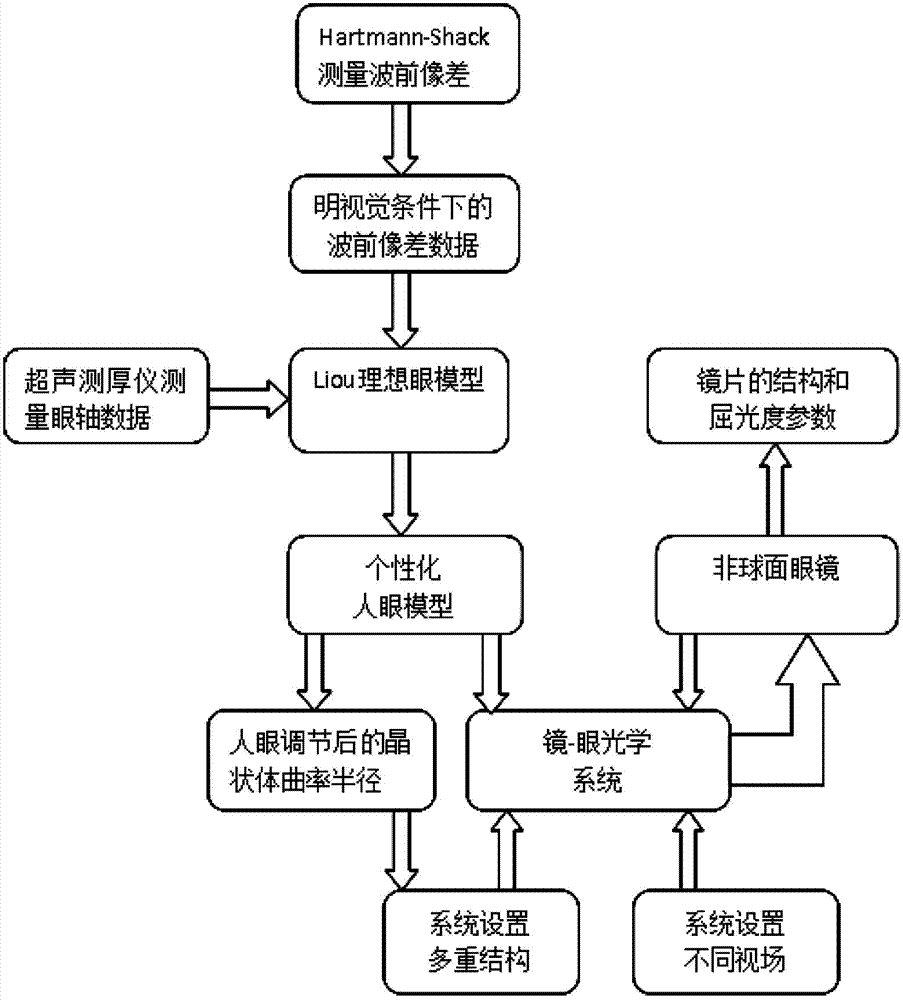
图1是本发明的设计流程图; Fig. 1 is a design flow chart of the present invention;
图2是个性化眼模型结构示意图; Fig. 2 is a schematic diagram of the structure of a personalized eye model;
图3是镜-眼系统在视远和视近时的结构示意图,(a)为镜-眼系统视远时的结构示意图,(b)为镜-眼系统视近时的结构示意图。 Fig. 3 is a structural schematic diagram of the mirror-ocular system when seeing far and near, (a) is a structural schematic diagram of the mirror-ocular system when seeing far, and (b) is a structural schematic diagram of the mirror-ocular system when seeing near. the
图4是人眼在两种视场方案下优化得到的MTF曲线图,(a)、(b)为仅优化0°视场后视远和视近的MTF曲线;(c)、(d)为同时优化0°和±4°视场后视远和视近的MTF曲线。 Figure 4 is the MTF curve diagram of the human eye optimized under two field of view schemes, (a) and (b) are the MTF curves of far and near vision after only optimizing the 0° field of view; (c) and (d) In order to optimize the MTF curves of distance vision and near vision after simultaneously optimizing 0° and ±4° field of view. the
具体实施方式 Detailed ways
以下结合附图对本发明实施例做进一步详述。 Embodiments of the present invention will be described in further detail below in conjunction with the accompanying drawings. the
如图1所示,为本发明提供的基于波前技术和眼轴数据的矫正近视型老视眼的非球面 眼镜镜片的确定方法,该方法包括以下步骤: As shown in Figure 1, the method for determining the aspheric spectacle lens of correcting myopic presbyopia based on wavefront technology and eye axis data provided by the present invention, the method may further comprise the steps:
步骤1:利用Hartmann-Shack波前像差仪测量得到实际人眼的波前数据,并利用MATLAB编程将其转换为明视觉条件下对应瞳孔大小的波前像差。 Step 1: Use the Hartmann-Shack wavefront aberrometer to measure the wavefront data of the actual human eye, and use MATLAB programming to convert it into the wavefront aberration corresponding to the pupil size under photopic conditions. the
在本步骤中,波前像差仪精确测量得到人眼在瞳孔直径为6~7mm、波长0.555μm时的波前像差数据。由于明视觉条件下,人眼的瞳孔直径约为2~3.8mm,因此,使用MATLAB软件进行编程计算,将实际测量的大瞳孔直径的波前像差数据转化为明视觉条件下人眼瞳孔直径为2.6mm时对应的波前像差数据。这里仅列表给出7号人眼的部分波前像差数据。其中α3~α9为第3至第9项泽尼克多项式的系数,α4表示离焦,α3和α5表示像散,α6和α9表示三叶草,α7和α8表示彗差。 In this step, the wavefront aberration meter accurately measures the wavefront aberration data of the human eye when the pupil diameter is 6-7 mm and the wavelength is 0.555 μm. Since the pupil diameter of the human eye is about 2 to 3.8mm under the condition of photopic vision, MATLAB software is used for programming and calculation, and the wavefront aberration data of the actually measured large pupil diameter is converted into the pupil diameter of the human eye under the condition of photopic vision It is the corresponding wavefront aberration data at 2.6mm. Only part of the wavefront aberration data of human eye No. 7 is listed here. Among them, α 3 ~ α 9 are the coefficients of the 3rd to 9th Zernike polynomials, α 4 represents defocus, α 3 and α 5 represent astigmatism, α 6 and α 9 represent clover, α 7 and α 8 represent coma .
表1、7号人眼的波前像差数据 Table 1. Wavefront aberration data of human eye No. 7

步骤2:利用眼科超声测厚仪测量人眼眼轴长度,利用Orbscan II测量角膜厚度,得到人眼前房和玻璃体厚度。 Step 2: Use an ophthalmic ultrasonic thickness gauge to measure the axial length of the human eye, and use Orbscan II to measure the thickness of the cornea to obtain the thickness of the human anterior chamber and vitreous body. the
表2、8只人眼的前房和玻璃体厚度 Table 2. Anterior chamber and vitreous thickness of 8 human eyes
步骤3:利用光学设计软件ZEMAX,基于Liou理想眼模型,以明视觉条件下对应瞳孔大小的波前像差数据为目标值,将实际测得的人眼前房和玻璃体厚度代入Liou眼模型,以承担部分离焦,再将剩余离焦量引入至晶状体,将像散和高阶像差引入至角膜,建立符合实际人眼光学特性的个性化人眼模型。 Step 3: Using the optical design software ZEMAX, based on the Liou ideal eye model, taking the wavefront aberration data corresponding to the pupil size under photopic conditions as the target value, substituting the actual measured human anterior chamber and vitreous thickness into the Liou eye model, Undertake part of the defocus, then introduce the remaining amount of defocus into the lens, introduce astigmatism and higher-order aberrations into the cornea, and establish a personalized human eye model that conforms to the actual optical characteristics of the human eye. the
在本步骤中,以明视觉条件下对应瞳孔大小的波前像差数据作为目标值,将实际测得的人眼前房和玻璃体厚度代入Liou眼模型,以承担部分离焦,将剩余离焦量引入至晶状体前表面,将像散和高阶像差引入至角膜前表面,角膜前表面面型设定为“Zernike Fringe Sag”,在附加数据中设定此面型多项式的29项为变量,经优化后,波前像差值收敛至目标值形成个性化眼模型。 In this step, the wavefront aberration data corresponding to the pupil size under photopic conditions is used as the target value, and the actual measured human anterior chamber and vitreous thickness are substituted into the Liou eye model to bear part of the defocus, and the remaining defocus amount Introduce to the front surface of the lens, introduce astigmatism and higher-order aberrations to the front surface of the cornea, set the surface shape of the front surface of the cornea as "Zernike Fringe Sag", and set the 29 items of this surface polynomial as variables in the additional data, After optimization, the wavefront aberration value converges to the target value to form a personalized eye model. the
步骤4:基于个性化人眼模型,考虑老视眼仍具有一定的调节力,且调节力主要通过 改变晶状体的曲率来实现,得到人眼在实现最大调节后的晶状体曲率半径,此亦为人眼视近时的晶状体曲率半径。 Step 4: Based on the personalized human eye model, considering that the presbyopic eye still has a certain adjustment power, and the adjustment power is mainly realized by changing the curvature of the lens, the radius of curvature of the lens after the maximum adjustment of the human eye is obtained, which is also the human eye The radius of curvature of the lens at near vision. the
本步骤包括以下处理过程: This step includes the following processes:
1、在个性化眼模型的基础上,将玻璃体厚度设为变量,通过优化玻璃体的厚度使得人眼离焦为零。 1. On the basis of a personalized eye model, the thickness of the vitreous body is set as a variable, and the defocus of the human eye is zero by optimizing the thickness of the vitreous body. the
2、根据牛顿公式x′x=f′f,我们可以得到调节力改变量ΔP(D)和像距改变量Δx′(m)的关系: 2. According to Newton's formula x'x=f'f, we can get the relationship between the adjustment force change ΔP(D) and the image distance change Δx'(m):
ΔP=Δx′/f′f ΔP=Δx'/f'f
已知ΔP,f’(m)和f(m),可以求出像距改变量Δx′。利用前面优化完的玻璃体厚度减去此变化量,即为人眼调节后焦点所在的位置。此位置用焦点在玻璃体后面的距离来表征。 Knowing ΔP, f'(m) and f(m), the image distance change Δx' can be obtained. Subtract this change from the previously optimized vitreous thickness, which is the adjusted focus position of the human eye. This position is characterized by the distance of the focal point behind the vitreous. the
表3、8只人眼调节后焦点所在的位置 Table 3. The position of the focal point after the adjustment of 8 human eyes

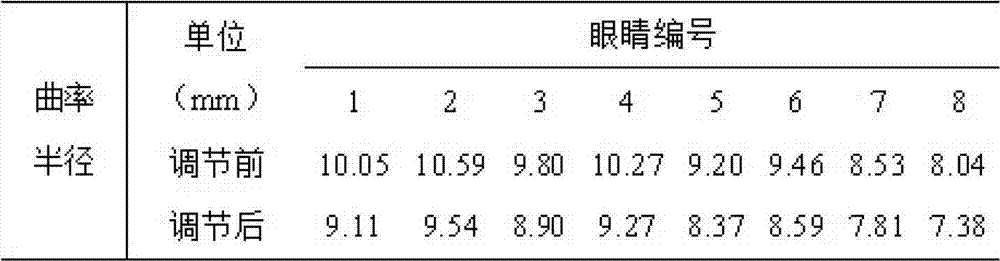
3、将晶状体前表面曲率半径设为变量,通过优化使得人眼离焦重新为零,记录下此时的曲率半径值,作为人眼视近时晶状体调节后的曲率半径。表4给出了8只近视眼的晶状体在调节前后的前表面曲率半径。 3. Set the radius of curvature of the front surface of the lens as a variable, optimize the defocus of the human eye to zero again, record the value of the radius of curvature at this time, and use it as the adjusted radius of curvature of the lens when the human eye sees near. Table 4 shows the radii of curvature of the anterior surface of the lenses of 8 myopic eyes before and after accommodation. the
表4、晶状体调节前后的前表面曲率半径 Table 4. Radius of curvature of the anterior surface of the lens before and after adjustment
步骤5:将个性化眼模型和镜片视作统一的光学系统,设置视场,并根据人眼视远视近时眼球的转动、视近时人眼会产生调节来对系统进行多重结构的设置。 Step 5: Treat the personalized eye model and lens as a unified optical system, set the field of view, and set up the multiple structures of the system according to the eyeball rotation when the human eye sees far and near, and the human eye will produce adjustment when it sees near. the
在本步骤中,设置一定的视场,分为两种方案,分别为仅优化0°视场的方案和同时优化0°、±4°视场的方案。根据人眼视远视近时眼球的转动、人眼视近时会产生调节来设置多重结构,其结构为为2重:视远时眼球0°旋转、晶状体无调节和视近时眼球-12°旋转、晶状体有调节。 In this step, a certain field of view is set, which is divided into two schemes, namely, the scheme of only optimizing the 0° field of view and the scheme of simultaneously optimizing the 0° and ±4° field of view. According to the rotation of the eyeball when the human eye sees far and near, and the adjustment of the human eye when it sees near, multiple structures are set up. The structure is 2-fold: the eyeball rotates at 0° for far vision, the lens does not adjust, and the eyeball -12° for near vision. Rotating, lens accommodating. the
步骤6:将镜片的前表面设置为非球面,后表面设置为环曲面,环曲面可以同时矫正人眼的离焦和散光。通过设置非球面的高次非球面系数、环曲面的两个正交的曲率半径和此面绕光轴旋转的角度为变量,对整个镜-眼光学系统进行优化,得到符合个体眼视物特征的非球面镜片结构和屈光度参数。此眼镜可以让老视眼在一定视场下获得同时视远和视近的能力。 Step 6: Set the front surface of the lens as an aspheric surface, and set the rear surface as a toric surface. The toric surface can correct the defocus and astigmatism of the human eye at the same time. By setting the high-order aspheric coefficient of the aspheric surface, the two orthogonal curvature radii of the toric surface, and the angle of rotation of this surface around the optical axis as variables, the entire mirror-eye optical system is optimized to obtain the visual characteristics of the individual eye Aspherical lens structure and diopter parameters. The spectacles allow the presbyopic eye to simultaneously see far and near at a certain field of view. the
在本步骤中,非球面面型为偶次非球面“Even Asphere”,具体的表达式如下: In this step, the aspheric surface type is an even-order aspheric surface "Even Asphere", and the specific expression is as follows:
式中,z为表面上点(x,y)处的矢高,c表示非球面顶点的曲率,r=(x2+y2)1/2表示点(x,y)离开光轴的径向距离,α2,α3,α4,α5,α6为非球面高次项系数;非球面系数可以根据我的设计,优化系统得到,c可以依据人眼的屈光度参数查阅相关文献预先设定。 In the formula, z is the sagittal height at the point (x, y) on the surface, c represents the curvature of the apex of the aspheric surface, r=(x 2 +y 2 ) 1/2 represents the radial direction of the point (x, y) away from the optical axis Distance, α 2 , α 3 , α 4 , α 5 , α 6 are aspherical coefficients of high-order terms; the aspheric coefficients can be obtained according to my design and optimization system, and c can be pre-set according to the diopter parameters of the human eye by referring to relevant literature Certainly.
环曲面面型选用复合曲面“Biconic”,表达式为: The surface type of the torus is the composite surface "Biconic", and the expression is:
式中,cx,cy分别是x,y方向的基准球面曲率,可以通过以下公式计算初步得到,最终通过优化系统而确定。 In the formula, c x , cy y are the reference spherical curvatures in the x and y directions respectively, which can be calculated initially by the following formula, and finally determined by optimizing the system.
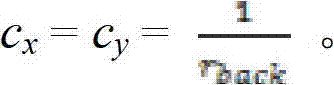
所述的基准球面曲率cx,cy可以通过以下公式初步得到: The reference spherical curvature c x , c y can be preliminarily obtained by the following formula:
P为被测人眼的屈光度,ng表示镜片折射率,rfront,rback分别为镜片前后表面的曲率半径,其中 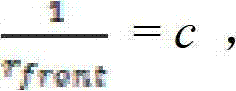
非球面眼镜的屈光度参数可由下面两式得到: The diopter parameters of aspheric glasses can be obtained by the following two formulas:
P1=(ng-1)(1/Rb-1/R1+d(ng-1)/RbR1ng) P 1 =(n g -1)(1/R b -1/R 1 +d(n g -1)/R b R 1 n g )
P2=(ng-1)(1/Rb-1/R2+d(ng-1)/RbR2ng) P 2 =(n g -1)(1/R b -1/R 2 +d(n g -1)/R b R 2 n g )
式中,P1、P2分别表示相应方向的屈光度,ng表示镜片折射率,Rb表示镜片的基弧,d表示镜片中央厚度,将P1定为球度Ps,于是柱度Pc即为:P2-P1;这里我们选用树脂镜片,折射率ng为1.60,基准曲率半径Rb为基准曲率c的倒数,镜片中央厚度d设定为13mm。 In the formula, P 1 and P 2 respectively represent the diopters in the corresponding directions, n g represents the refractive index of the lens, R b represents the base arc of the lens, d represents the central thickness of the lens, and P 1 is set as the sphericity P s , so the cylindricity P c is: P 2 -P 1 ; here we choose a resin lens, the refractive index n g is 1.60, the reference curvature radius R b is the reciprocal of the reference curvature c, and the central thickness d of the lens is set to 13mm.
通过以上处理过程最终得到镜片的矫正处方。 Through the above processing process, the corrective prescription of the lens is finally obtained. the
实施例 Example
下面以一个具体实施例对本发明进行详细说明: The present invention is described in detail with a specific embodiment below:
表5为8只被试人眼中第七只被试人眼(7号)的个性化人眼模型结构参数。此模型是在Liou眼模型的基础上,于晶状体的前表面处加了一片薄弯透镜。验证发现,此薄透镜的引入不仅解决了人眼调节时晶状体前表面曲率半径变化过大的缺点,而且并未给原来的Liou眼模型带来任何像差。图2为7号人眼个性化眼模型结构示意图。 Table 5 shows the structural parameters of the personalized human eye model of the seventh human eye (No. 7) among the eight human eyes. This model is based on the Liou eye model, with a thin curved lens added to the front surface of the lens. The verification found that the introduction of this thin lens not only solved the shortcoming that the curvature radius of the front surface of the lens changes too much when the human eye adjusts, but also did not bring any aberrations to the original Liou eye model. Fig. 2 is a schematic diagram of the structure of the personalized eye model of No. 7 human eye. the
表5、7号人眼的个性化眼模型结构参数 Table 5. Structural parameters of the personalized eye model of No. 7 human eye
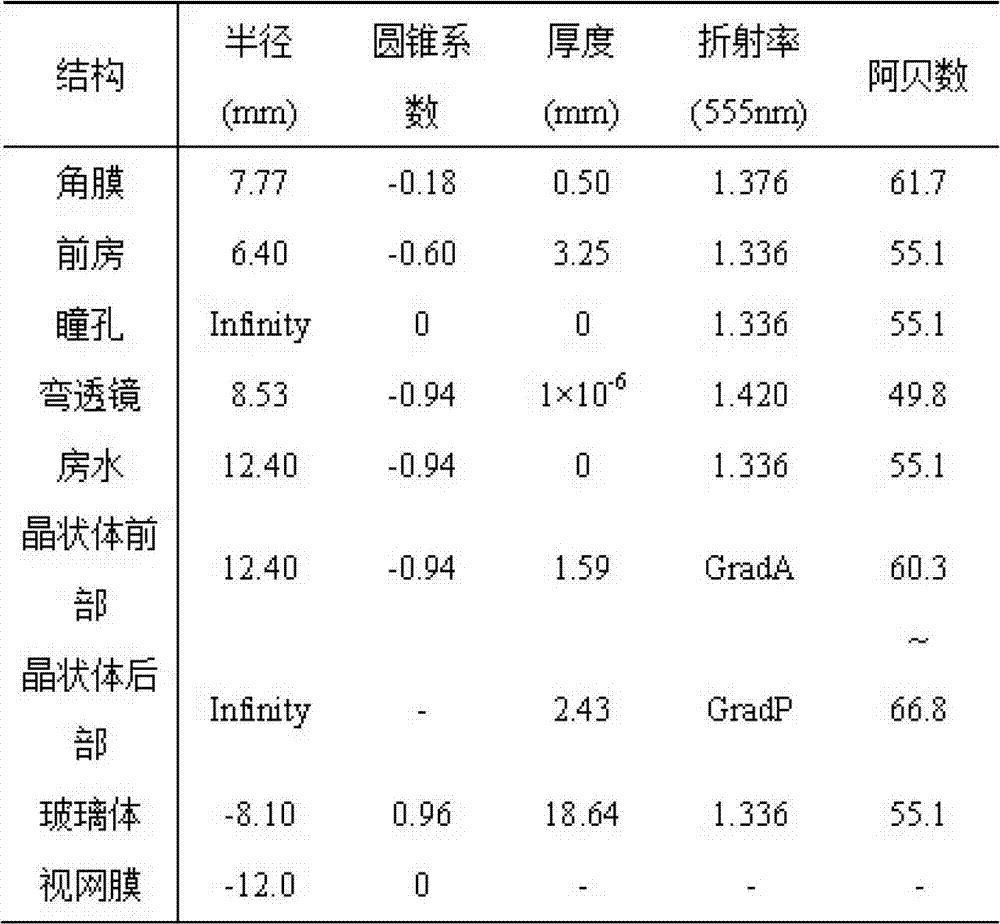
表6为7号人眼模型的多重结构参数设置,考虑到国际远视力表的标准检查距离为6m,此亦为验光配镜的距离,故而将其设定为光学系统的远点,医生、律师以及一些常用电脑工作的人员其近点通常在0.5m处,故选定此值作为光学系统的近点。人眼在视远时为直视,视近时,眼球会向下倾斜,有一定的旋转角度(设定为-12°),且发挥晶状体的调节作用,故而在ZEMAX里需要用3组操作数设置2重结构。 Table 6 shows the multiple structural parameter settings of the No. 7 human eye model. Considering that the standard inspection distance of the international far vision chart is 6m, which is also the distance for optometry, it is set as the far point of the optical system. Doctors, The near point of lawyers and some people who often work with computers is usually at 0.5m, so this value is selected as the near point of the optical system. When the human eye sees far away, it looks straight, and when it sees near, the eyeball will tilt downward, with a certain rotation angle (set to -12°), and play the role of adjusting the lens, so 3 groups of operations are required in ZEMAX Number set 2-fold structure. the
表6、7号人眼模型的多重结构参数 Table 6, multiple structural parameters of human eye model No. 7

操作数“THIC”表示物距,“CRVT”表示晶状体前表面的曲率,“PAR3”表示眼球旋转角度。图3为7号人眼的镜-眼系统在视远和视近时的结构示意图。 The operand "THIC" represents the object distance, "CRVT" represents the curvature of the front surface of the lens, and "PAR3" represents the angle of rotation of the eyeball. Fig. 3 is a structural schematic diagram of the mirror-ocular system of No. 7 human eye when seeing far and near. the
表7给出了7号人眼的非球面眼睛镜片结构,其中前表面为非球面,后表面为环曲面。 Table 7 shows the structure of the aspheric spectacle lens of human eye No. 7, wherein the front surface is aspheric and the rear surface is toric. the
表7、7号人眼的非球面眼睛镜片结构 Table 7. Structure of aspherical eyeglass lens of No. 7 human eye
图4给出了7号人眼在两种视场方案下优化得到的MTF曲线图。不难发现,仅优化0°视场时的人眼,0°视场对应的MTF值高于0.3,但是视远时的4°视场和视近时的-4°视场对应的MTF曲线均不理想,尤其是-4°视场对应的子午MTF在空间频率约80c/mm时迅速下降至0.02。另外7只人眼在大视场下的MTF曲线都会出现类似的情况,所以我们有必要优化0°和±4°视场同时存在的情况,结果是理想的,8只人眼的MTF曲线都很高,表明我们设计的镜片有较强的低对比传递能力,而且8只人眼的视锐度均在1.0以上。 Figure 4 shows the optimized MTF curves of No. 7 human eye under two field of view schemes. It is not difficult to find that the human eye only optimizes the 0° field of view, and the MTF value corresponding to the 0° field of view is higher than 0.3, but the MTF curve corresponding to the 4° field of view when viewing far and the -4° field of view when viewing near None of them are ideal, especially the meridional MTF corresponding to the -4° field of view drops rapidly to 0.02 when the spatial frequency is about 80c/mm. The MTF curves of the other seven human eyes in a large field of view will have similar situations, so we need to optimize the situation where the 0° and ±4° field of view exist at the same time, the result is ideal, the MTF curves of the eight human eyes are all It is very high, indicating that the lens we designed has a strong low-contrast transmission ability, and the visual acuity of the eight human eyes is above 1.0. the
为了从数值上说明非球面能够使老视眼在大视场下同时实现视远和视近清晰,表8给出了8只人眼同时优化0°和±4°视场后的大视场下对应的MTF数据,在此选取对应空间频率为20c/mm,40c/mm,60c/mm,80c/mm,100c/mm的MTF值。 In order to numerically illustrate that the aspheric surface can enable presbyopic eyes to achieve clear vision at both distance and near at the same time under a large field of view, Table 8 shows the large field of view after optimizing the 0° and ±4° field of view for 8 human eyes at the same time Under the corresponding MTF data, here select the MTF value corresponding to the spatial frequency of 20c/mm, 40c/mm, 60c/mm, 80c/mm, 100c/mm. the
表8、8只人眼同时优化0°和±4°视场后的MTF数据 Table 8. MTF data of 8 human eyes after simultaneously optimizing 0° and ±4° field of view
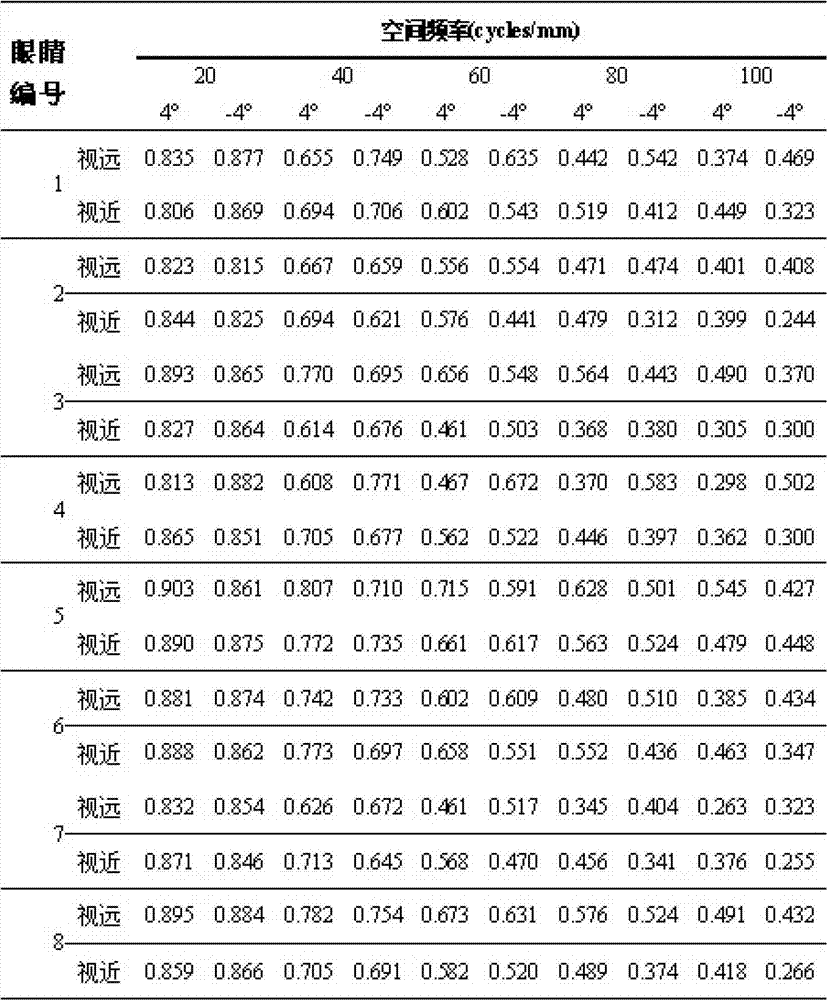
观察以上数据,发现非球面使得人眼在大视场时的视力得到了很好的改善。5号人眼的优化效果最好,视远和视近时在空间频率130c/mm处MTF值均为0.29,视力都达到了1.3,7号人眼的效果最差,但视力也可以达到1.0。 Observing the above data, it is found that the aspheric surface has greatly improved the vision of the human eye in a large field of view. No. 5 human eye has the best optimization effect. The MTF value at the spatial frequency of 130c/mm is both 0.29 for distance vision and near vision, and the visual acuity reaches 1.3. No. 7 human eye has the worst effect, but the visual acuity can also reach 1.0 . the
我们还发现,仅优化0°视场存在时的系统所获得的眼镜屈光度参数和同时优化0°及±4°视场时获得的眼镜屈光度参数存在差别,这些参数包括球度、柱度及散光轴位角和高次非球面系数。表9给出了8只人眼在两种视场方案下优化得到的眼镜屈光度参数。Ps表示球度,Pc表示柱度,单位均为D,Axis表示散光轴位角,单位为°。 We also found that there is a difference in the diopter parameters of the glasses obtained by optimizing only the 0° field of view in the presence of the 0° and ±4° fields of view. These parameters include sphericity, cylinder and astigmatism Axial angles and high-order aspheric coefficients. Table 9 shows the diopter parameters of the glasses optimized for 8 human eyes under the two field of view schemes. P s represents sphericity, P c represents cylindricity, and the unit is D, and Axis represents the axial angle of astigmatism, and the unit is °.
表9、8只人眼在两种视场方案下优化获得的眼镜屈光度参数。 Table 9. Spectacle diopter parameters optimized for 8 human eyes under two field of view schemes. the

对比发现,1、2、6号眼的球度差和1、2、3、5、6、8号眼的柱度差都超过了0.125D,表明不同视场下的配镜要求是不同的。人眼观察事物时,总有一定的视场,所以对于0°和±4°视场同时存在时的眼镜设计方案更有意义。 By comparison, it was found that the sphericity difference of No. 1, 2, and 6 eyes and the cylindrical difference of No. 1, 2, 3, 5, 6, and 8 eyes all exceeded 0.125D, indicating that the requirements for glasses under different fields of view are different. . When the human eye observes things, there is always a certain field of view, so it is more meaningful to design the glasses when the field of view of 0° and ±4° exists at the same time. the
本发明所述的实施例是说明性的,而不是限定性的,因此本发明并不限于具体实施方式中所述的实施例。凡是根据本发明的技术方案得出的其他实施方式,同样属于本发明保护的范围。 The described embodiments of the present invention are illustrative rather than restrictive, so the present invention is not limited to the embodiments described in the detailed description. All other implementations obtained according to the technical solution of the present invention also belong to the scope of protection of the present invention. the
Claims (5)
Priority Applications (1)
| Application Number | Priority Date | Filing Date | Title |
|---|---|---|---|
| CN 201210177960 CN102662252B (en) | 2012-06-01 | 2012-06-01 | Aspheric glasses lens determination method for myopic presbyopia correction |
Applications Claiming Priority (1)
| Application Number | Priority Date | Filing Date | Title |
|---|---|---|---|
| CN 201210177960 CN102662252B (en) | 2012-06-01 | 2012-06-01 | Aspheric glasses lens determination method for myopic presbyopia correction |
Publications (2)
| Publication Number | Publication Date |
|---|---|
| CN102662252A CN102662252A (en) | 2012-09-12 |
| CN102662252B true CN102662252B (en) | 2013-12-18 |
Family
ID=46771771
Family Applications (1)
| Application Number | Title | Priority Date | Filing Date |
|---|---|---|---|
| CN 201210177960 Expired - Fee Related CN102662252B (en) | 2012-06-01 | 2012-06-01 | Aspheric glasses lens determination method for myopic presbyopia correction |
Country Status (1)
| Country | Link |
|---|---|
| CN (1) | CN102662252B (en) |
Families Citing this family (11)
| Publication number | Priority date | Publication date | Assignee | Title |
|---|---|---|---|---|
| WO2015131658A1 (en) * | 2014-03-05 | 2015-09-11 | 张文会 | Loose glasses |
| CN104849792A (en) * | 2015-06-01 | 2015-08-19 | 南开大学 | Presbyopia correction device based on improved fractal zone plate |
| CN105572901B (en) * | 2016-02-25 | 2020-06-23 | 南开大学 | Aspheric Diffractive Contact Lenses for Correcting Myopia and Presbyopia |
| CN108375842B (en) * | 2018-03-23 | 2021-07-20 | 无锡摩方精密科技有限公司 | Lenses conforming to retinal resolution, prescriptions for fitting thereof, and methods of manufacture |
| CN110320677A (en) * | 2019-08-02 | 2019-10-11 | 上海伟星光学有限公司 | A kind of two-sided compound new excellent manufacturing method for learning polyurethane eyeglass |
| CN114911069B (en) * | 2021-02-10 | 2024-04-02 | 爱博诺德(北京)医疗科技股份有限公司 | Modeling method of retinal periphery defocus model |
| CN114010371B (en) * | 2021-10-25 | 2024-11-22 | 天津世纪康泰生物医学工程有限公司 | A posterior chamber phakic progressive multifocal intraocular lens |
| CN114019696A (en) * | 2021-11-08 | 2022-02-08 | 广州豪赋医学科技有限公司 | Lens capable of adjusting astigmatism coefficient of human eyes and preparation method |
| CN116880084A (en) * | 2023-07-11 | 2023-10-13 | 天津大学 | A method and device for controlling peripheral wavefront curvature |
| WO2025039241A1 (en) * | 2023-08-24 | 2025-02-27 | 温州医科大学附属眼视光医院 | Localized aberration regulation lens and design method |
| CN120323913B (en) * | 2025-06-13 | 2025-09-19 | 湖南火眼医疗科技有限公司 | A subjective optometry prediction method combining wavefront aberration and optical signals |
Citations (6)
| Publication number | Priority date | Publication date | Assignee | Title |
|---|---|---|---|---|
| CN1582408A (en) * | 2000-09-08 | 2005-02-16 | 佛罗里达光学工程公司 | Multifocal ophthalmic lens with induced aperture |
| CN1632623A (en) * | 2001-04-11 | 2005-06-29 | 法马西雅格罗宁根股份有限公司 | Ophthalmic lens |
| CN101140357A (en) * | 2006-09-05 | 2008-03-12 | 南开大学 | Design of corneal contact lens based on personalized human eye model |
| CN102129132A (en) * | 2011-03-29 | 2011-07-20 | 南开大学 | Design method for cornea contact lens based on wave front technology |
| CN102419482A (en) * | 2010-09-27 | 2012-04-18 | 苏州苏大明世光学有限公司 | Aspheric myopia eyeglass |
| CN102566085A (en) * | 2012-03-20 | 2012-07-11 | 天津宇光光学有限公司 | Wave-front technology-based method for designing aspheric surface eyeglasses |
Family Cites Families (1)
| Publication number | Priority date | Publication date | Assignee | Title |
|---|---|---|---|---|
| JP4537134B2 (en) * | 2004-07-12 | 2010-09-01 | セイコーオプティカルプロダクツ株式会社 | Aspheric eyeglass lens design method |
-
2012
- 2012-06-01 CN CN 201210177960 patent/CN102662252B/en not_active Expired - Fee Related
Patent Citations (6)
| Publication number | Priority date | Publication date | Assignee | Title |
|---|---|---|---|---|
| CN1582408A (en) * | 2000-09-08 | 2005-02-16 | 佛罗里达光学工程公司 | Multifocal ophthalmic lens with induced aperture |
| CN1632623A (en) * | 2001-04-11 | 2005-06-29 | 法马西雅格罗宁根股份有限公司 | Ophthalmic lens |
| CN101140357A (en) * | 2006-09-05 | 2008-03-12 | 南开大学 | Design of corneal contact lens based on personalized human eye model |
| CN102419482A (en) * | 2010-09-27 | 2012-04-18 | 苏州苏大明世光学有限公司 | Aspheric myopia eyeglass |
| CN102129132A (en) * | 2011-03-29 | 2011-07-20 | 南开大学 | Design method for cornea contact lens based on wave front technology |
| CN102566085A (en) * | 2012-03-20 | 2012-07-11 | 天津宇光光学有限公司 | Wave-front technology-based method for designing aspheric surface eyeglasses |
Also Published As
| Publication number | Publication date |
|---|---|
| CN102662252A (en) | 2012-09-12 |
Similar Documents
| Publication | Publication Date | Title |
|---|---|---|
| CN102662252B (en) | Aspheric glasses lens determination method for myopic presbyopia correction | |
| JP7472225B2 (en) | Lens element | |
| CN100392473C (en) | A kind of manufacturing method of lens and manufactured lens | |
| Lombardo et al. | Wave aberration of human eyes and new descriptors of image optical quality and visual performance | |
| CN203950079U (en) | For the ametropic eyeglass of vision | |
| CN102566085B (en) | Wave-front technology-based method for designing aspheric surface eyeglasses | |
| CN102301270B (en) | Method for evaluating eyeglass lens, method for designing eyeglass lens, and method for manufacturing eyeglass lens | |
| TWI422901B (en) | Toric contact lenses with controlled optical power profile | |
| CN104335103B (en) | A method for providing a personalized spectacle lens optical system for a wearer | |
| US8602560B2 (en) | Method for providing a spectacle opthalmic lens by calculating for selecting a design | |
| CN105388632B (en) | Lens design and method for minimizing visual acuity changes experienced by myopic progressors | |
| TWI890807B (en) | Optical lens and associated molding elements | |
| AU2015218511B2 (en) | Lens system for presbyopes with inter-eye disparity limits | |
| CN103635852B (en) | Lens systems for presbyopia | |
| CN105765446B (en) | A method of the gradual glasses ophthalmic lens for providing customization to wearer | |
| JP2010513992A (en) | Premium optic ophthalmic lens | |
| KR20080073717A (en) | Ophthalmic Lenses Useful for Presbyopic Correction Incorporating Higher Aberration Correction | |
| TWI889842B (en) | Optical lens for vision correction and corresponding molding element | |
| CN101288017B (en) | spectacle lenses | |
| CN112068331A (en) | Personalized peripheral myopic out-of-focus spectacle lens and design and preparation method | |
| CN108375842A (en) | Lens conforming to retinal resolution, dispensing prescription and manufacturing method thereof | |
| CN114326149A (en) | Spectacle lens structure and design method thereof | |
| TWI871281B (en) | Lens element | |
| CN107077005B (en) | The optical design method of one secondary ophthalmic lens and the secondary ophthalmic lens so obtained | |
| EP4519732A1 (en) | Optical lens intended to be worn by a wearer |
Legal Events
| Date | Code | Title | Description |
|---|---|---|---|
| C06 | Publication | ||
| PB01 | Publication | ||
| C10 | Entry into substantive examination | ||
| SE01 | Entry into force of request for substantive examination | ||
| C14 | Grant of patent or utility model | ||
| GR01 | Patent grant | ||
| CF01 | Termination of patent right due to non-payment of annual fee |
Granted publication date: 20131218 Termination date: 20150601 |
|
| EXPY | Termination of patent right or utility model |