CN102549804A - Electrodes for Fluid Surface Treatment - Google Patents
Electrodes for Fluid Surface Treatment Download PDFInfo
- Publication number
- CN102549804A CN102549804A CN2010800430404A CN201080043040A CN102549804A CN 102549804 A CN102549804 A CN 102549804A CN 2010800430404 A CN2010800430404 A CN 2010800430404A CN 201080043040 A CN201080043040 A CN 201080043040A CN 102549804 A CN102549804 A CN 102549804A
- Authority
- CN
- China
- Prior art keywords
- fluid
- electro
- electrolyte
- chemical activity
- electrode
- Prior art date
- Legal status (The legal status is an assumption and is not a legal conclusion. Google has not performed a legal analysis and makes no representation as to the accuracy of the status listed.)
- Pending
Links
Images


Classifications
-
- H—ELECTRICITY
- H01—ELECTRIC ELEMENTS
- H01M—PROCESSES OR MEANS, e.g. BATTERIES, FOR THE DIRECT CONVERSION OF CHEMICAL ENERGY INTO ELECTRICAL ENERGY
- H01M4/00—Electrodes
- H01M4/02—Electrodes composed of, or comprising, active material
- H01M4/13—Electrodes for accumulators with non-aqueous electrolyte, e.g. for lithium-accumulators; Processes of manufacture thereof
-
- H—ELECTRICITY
- H01—ELECTRIC ELEMENTS
- H01M—PROCESSES OR MEANS, e.g. BATTERIES, FOR THE DIRECT CONVERSION OF CHEMICAL ENERGY INTO ELECTRICAL ENERGY
- H01M10/00—Secondary cells; Manufacture thereof
- H01M10/05—Accumulators with non-aqueous electrolyte
-
- H—ELECTRICITY
- H01—ELECTRIC ELEMENTS
- H01M—PROCESSES OR MEANS, e.g. BATTERIES, FOR THE DIRECT CONVERSION OF CHEMICAL ENERGY INTO ELECTRICAL ENERGY
- H01M10/00—Secondary cells; Manufacture thereof
- H01M10/05—Accumulators with non-aqueous electrolyte
- H01M10/056—Accumulators with non-aqueous electrolyte characterised by the materials used as electrolytes, e.g. mixed inorganic/organic electrolytes
- H01M10/0564—Accumulators with non-aqueous electrolyte characterised by the materials used as electrolytes, e.g. mixed inorganic/organic electrolytes the electrolyte being constituted of organic materials only
- H01M10/0566—Liquid materials
- H01M10/0567—Liquid materials characterised by the additives
-
- H—ELECTRICITY
- H01—ELECTRIC ELEMENTS
- H01M—PROCESSES OR MEANS, e.g. BATTERIES, FOR THE DIRECT CONVERSION OF CHEMICAL ENERGY INTO ELECTRICAL ENERGY
- H01M10/00—Secondary cells; Manufacture thereof
- H01M10/42—Methods or arrangements for servicing or maintenance of secondary cells or secondary half-cells
- H01M10/4235—Safety or regulating additives or arrangements in electrodes, separators or electrolyte
-
- Y—GENERAL TAGGING OF NEW TECHNOLOGICAL DEVELOPMENTS; GENERAL TAGGING OF CROSS-SECTIONAL TECHNOLOGIES SPANNING OVER SEVERAL SECTIONS OF THE IPC; TECHNICAL SUBJECTS COVERED BY FORMER USPC CROSS-REFERENCE ART COLLECTIONS [XRACs] AND DIGESTS
- Y02—TECHNOLOGIES OR APPLICATIONS FOR MITIGATION OR ADAPTATION AGAINST CLIMATE CHANGE
- Y02E—REDUCTION OF GREENHOUSE GAS [GHG] EMISSIONS, RELATED TO ENERGY GENERATION, TRANSMISSION OR DISTRIBUTION
- Y02E60/00—Enabling technologies; Technologies with a potential or indirect contribution to GHG emissions mitigation
- Y02E60/10—Energy storage using batteries
-
- Y—GENERAL TAGGING OF NEW TECHNOLOGICAL DEVELOPMENTS; GENERAL TAGGING OF CROSS-SECTIONAL TECHNOLOGIES SPANNING OVER SEVERAL SECTIONS OF THE IPC; TECHNICAL SUBJECTS COVERED BY FORMER USPC CROSS-REFERENCE ART COLLECTIONS [XRACs] AND DIGESTS
- Y02—TECHNOLOGIES OR APPLICATIONS FOR MITIGATION OR ADAPTATION AGAINST CLIMATE CHANGE
- Y02P—CLIMATE CHANGE MITIGATION TECHNOLOGIES IN THE PRODUCTION OR PROCESSING OF GOODS
- Y02P70/00—Climate change mitigation technologies in the production process for final industrial or consumer products
- Y02P70/50—Manufacturing or production processes characterised by the final manufactured product
Landscapes
- Chemical & Material Sciences (AREA)
- Engineering & Computer Science (AREA)
- Chemical Kinetics & Catalysis (AREA)
- Electrochemistry (AREA)
- General Chemical & Material Sciences (AREA)
- Manufacturing & Machinery (AREA)
- Physics & Mathematics (AREA)
- Condensed Matter Physics & Semiconductors (AREA)
- General Physics & Mathematics (AREA)
- Inorganic Chemistry (AREA)
- Materials Engineering (AREA)
- Battery Electrode And Active Subsutance (AREA)
- Secondary Cells (AREA)
- Cell Separators (AREA)
- Physical Or Chemical Processes And Apparatus (AREA)
Abstract
Description
背景background
最近关于“绿色”地产生能量的关注已经产生多种新工艺和对现有的用于提供电力的方法的改进。然而,许多可再生能源(例如太阳能和风能)仅可以是可间歇可用的,从而可能需要大的储存容量以在有需求时提供电。甚至可连续获得的动力源(例如核能)可以受益于允许超出连续可用的平均容量的间歇的峰值负荷的电储存。现有的为了这些目的的电池可能是高成本的,尤其是基于寿命时(考虑到有限的循环寿命)。The recent focus on "green" generating energy has resulted in a variety of new processes and improvements to existing methods for providing electrical power. However, many renewable energy sources, such as solar and wind power, may only be available intermittently, thereby potentially requiring large storage capacities to provide power when needed. Even continuously available power sources such as nuclear energy can benefit from electrical storage that allows intermittent peak loads beyond the continuously available average capacity. Existing batteries for these purposes can be costly, especially on a lifetime basis (given the limited cycle life).
此外,现有的电池可能具有实质上低于化石燃料的能量密度的能量密度,从而刺激继续主要使用烃类燃料来进行人员运输,尽管已知基于此目的使用烃的不利影响。改进的电池技术可以使电动交通工具更广泛地使用以及实现“绿色”发电。Furthermore, existing batteries may have an energy density substantially lower than that of fossil fuels, thereby incentivizing the continued use of primarily hydrocarbon fuels for personnel transportation despite the known adverse effects of using hydrocarbons for this purpose. Improved battery technology could enable wider use of electric vehicles and "green" power generation.
概述overview
在一个方面,电化学装置包括两个电极(负极和正极)以及被布置为将离子电流从与一个电极接触的表面传导至与另一个电极接触的表面的电解质。所述电极中的至少一个(或任选地两者)包括电化学活性的流体层,所述电化学活性的流体层具有允许所述电化学活性的流体层的至少一部分通过表面能效应附着于实质上平滑的固体支持物的流体性质,所述电化学活性的流体层的表面与所述电解质接触。In one aspect, an electrochemical device includes two electrodes, a negative electrode and a positive electrode, and an electrolyte arranged to conduct an ionic current from a surface in contact with one electrode to a surface in contact with the other electrode. At least one of the electrodes (or optionally both) includes an electrochemically active fluid layer having a characteristic that allows at least a portion of the electrochemically active fluid layer to attach to Fluid properties of a substantially smooth solid support, the surface of the electrochemically active fluid layer is in contact with the electrolyte.
如果两个电极都包括电化学活性的流体层,那么这些层可以与所述固体支持物的共有的表面接触。所述固体支持物可以包括流体引导结构,例如表面通道、导管或具有不同的润湿性质的区域的型式,其中的任何都可以被配置为通过表面张力引导流体流。所述流体引导结构可以被配置为响应于压力来调整流体表面积,并且可以被配置为控制流体的流量或流动方向。所述流体引导结构可以被配置为根据被选择以优化所述电化学装置的电学性质的流型来分布流体(例如通过最大化或最小化所述性质,或通过调整所述性质以获得被选择的值)。所述装置可以被配置为动态地改变所述流体引导结构的性质例如表面能、润湿行为、形状或温度,例如响应于所述装置的性质例如总体电流、总体电压、局部电流、局部电压、电流密度、电化学活性的流体的量或组成、或反应产物的量或组成,并且这样的动态的改变可以改变所述电化学活性的流体层的流动特性。If both electrodes comprise electrochemically active fluid layers, these layers may be in contact with a common surface of the solid support. The solid support may comprise fluid directing structures, eg in the form of surface channels, conduits or regions with different wetting properties, any of which may be configured to direct fluid flow by surface tension. The fluid directing structure may be configured to adjust fluid surface area in response to pressure, and may be configured to control flow or flow direction of fluid. The fluid directing structure may be configured to distribute fluid according to a flow pattern selected to optimize the electrical properties of the electrochemical device (e.g., by maximizing or minimizing the properties, or by adjusting the properties to obtain a selected value). The device may be configured to dynamically change a property of the fluid guiding structure such as surface energy, wetting behavior, shape or temperature, for example in response to a property of the device such as bulk current, bulk voltage, local current, local voltage, Changes in current density, the amount or composition of the electrochemically active fluid, or the amount or composition of reaction products, and such dynamics can alter the flow characteristics of the electrochemically active fluid layer.
所述电化学活性的流体层的至少一部分可以以在空间上变化的方式附着于所述实质上平滑的固体支持物。所述实质上平滑的固体支持物可以包括电触点,并且可以是弯曲的。所述固体支持物和所述流体层可以在组成上不同。At least a portion of the electrochemically active fluid layer can be attached to the substantially smooth solid support in a spatially varying manner. The substantially smooth solid support may include electrical contacts, and may be curved. The solid support and the fluid layer may differ in composition.
所述电解质可以通过正离子、负离子或两者的运动传导离子电流,并且可以将电流从正极传导至负极、从负极传导至正极,或两者。所述电解质可以包括可以不渗透所述电化学活性的流体的固体表面,并且可以包括被配置为引导所述电化学活性的流体层的流体流动的流体引导结构。所述电解质可以包括离子能够通过其移动来产生离子电流的离子传输流体,并且可以还包括固体结构,例如被所述离子传输流体渗入的多孔结构(例如海绵、芯吸体、多根纤维、织物、部分烧结体、筛网、穿孔片材、纹理化的表面或颗粒的团聚体)。所述离子传输流体可以润湿所述多孔结构,并且所述电化学活性的流体可以润湿所述离子传输流体的程度大于所述电化学活性的流体润湿所述固体结构的程度,包括不润湿所述固体结构。如果所述正极和所述负极各自包括电化学活性的流体层,那么所述离子传输流体可以润湿所述电化学活性的流体层中的每一层的程度大于所述电化学活性的流体层润湿彼此的程度(包括其中它们不润湿彼此的情况)。所述离子传输流体可以是超临界的,并且可以在一个或两个电极处接触电化学活性的流体。所述离子传输流体可以与所述电化学活性的流体是不混合的。所述离子传输流体可以被连接于外部储器,并且可以被配置为通过所述离子传输流体的流动除去热。The electrolyte can conduct ionic current through the movement of positive ions, negative ions, or both, and can conduct current from the positive electrode to the negative electrode, from the negative electrode to the positive electrode, or both. The electrolyte may include a solid surface that may be impermeable to the electrochemically active fluid, and may include a fluid directing structure configured to direct fluid flow of the electrochemically active fluid layer. The electrolyte can include an ion transport fluid through which ions can move to generate an ionic current, and can also include solid structures, such as porous structures (e.g., sponges, wicks, fibers, fabrics) that are infiltrated by the ion transport fluid. , partially sintered bodies, screens, perforated sheets, textured surfaces or agglomerates of particles). The ion transport fluid can wet the porous structure, and the electrochemically active fluid can wet the ion transport fluid to a greater extent than the electrochemically active fluid wets the solid structure, including not wet the solid structure. If the positive electrode and the negative electrode each include an electrochemically active fluid layer, the ion transport fluid can wet each of the electrochemically active fluid layers to a greater extent than the electrochemically active fluid layer The extent to which they wet each other (including cases where they do not wet each other). The ion transport fluid may be supercritical and may contact the electrochemically active fluid at one or both electrodes. The ion transport fluid may be immiscible with the electrochemically active fluid. The ion transport fluid can be connected to an external reservoir and can be configured to remove heat by flow of the ion transport fluid.
所述电解质可以具有小于约1cm、1mm、100μm、10μm、1μm、100nm或10nm的厚度。其可以包括所述正极的至少一部分与所述负极的至少一部分的反应产物。如果所述反应产物是流体,那么所述反应产物可以润湿所述电解质的固体表面或所述电极中的至少一个的固体表面,或可以附着于所述电极中的至少一个的固体表面。所述反应产物可以被连接于储器,并且所述电解质可以被配置为通过所述反应产物的流动除去热。所述正极的至少一部分与所述负极的至少一部分的反应产物可以与所述电化学活性的流体混合。所述电解质或所述电极中的一个可以包括被配置为引导所述正极的至少一部分与所述负极的至少一部分的反应产物的流体反应结构。The electrolyte can have a thickness of less than about 1 cm, 1 mm, 100 μm, 10 μm, 1 μm, 100 nm, or 10 nm. It may include a reaction product of at least a portion of the positive electrode with at least a portion of the negative electrode. If the reaction product is a fluid, the reaction product may wet the solid surface of the electrolyte or the solid surface of at least one of the electrodes, or may adhere to the solid surface of at least one of the electrodes. The reaction product can be connected to a reservoir, and the electrolyte can be configured to remove heat through the flow of the reaction product. A reaction product of at least a portion of the positive electrode and at least a portion of the negative electrode may be mixed with the electrochemically active fluid. One of the electrolyte or the electrodes may include a fluidic reaction structure configured to conduct a reaction product of at least a portion of the positive electrode and at least a portion of the negative electrode.
所述电化学活性的流体层可以包括液体、糊剂、凝胶、乳液、触变流体、超临界流体或非牛顿流体,并且可以是离子导体或电子导体。所述电化学活性的流体层可以包括不是电化学活性的载流流体。其可以润湿或附着于所述电解质。所述流体层可以包括溶解气体例如氧气,或液体金属例如合金。所述液体金属可以是在约100℃、50℃、25℃或0℃的液体。所述电化学活性的流体可以被连接于外部储器,并且可以被配置为将热能运输远离所述电池。The electrochemically active fluid layer may comprise a liquid, a paste, a gel, an emulsion, a thixotropic fluid, a supercritical fluid, or a non-Newtonian fluid, and may be an ion conductor or an electron conductor. The electrochemically active fluid layer may include a carrier fluid that is not electrochemically active. It may wet or adhere to the electrolyte. The fluid layer may comprise a dissolved gas such as oxygen, or a liquid metal such as an alloy. The liquid metal may be liquid at about 100°C, 50°C, 25°C or 0°C. The electrochemically active fluid can be connected to an external reservoir and can be configured to transport thermal energy away from the battery.
所述负极可以包含锂、钠、汞、锡、铯、铷、钾或这些中的任何的合金、溶液、汞合金或金属间化合物。所述正极可以包含镓、铁、汞、锡、硫、氯或这些中的任何的合金、溶液、汞合金或金属间化合物。所述电解质可以包含高氯酸盐、醚、石墨烯、聚酰亚胺、丁二腈、聚丙烯腈、聚环氧乙烷、聚乙二醇、碳酸亚乙酯、β-氧化铝或离子导电玻璃。所述电化学装置可以包括冷却系统,所述冷却系统可以包括热管、热交换器或微通道。The negative electrode may comprise lithium, sodium, mercury, tin, cesium, rubidium, potassium, or an alloy, solution, amalgam, or intermetallic compound of any of these. The positive electrode may comprise gallium, iron, mercury, tin, sulfur, chlorine, or alloys, solutions, amalgams, or intermetallic compounds of any of these. The electrolyte may contain perchlorate, ether, graphene, polyimide, succinonitrile, polyacrylonitrile, polyethylene oxide, polyethylene glycol, ethylene carbonate, β-alumina, or ion conductive glass. The electrochemical device may include a cooling system, which may include heat pipes, heat exchangers, or microchannels.
在另一个方面,供应电化学能的方法包括将电负载连接于被电解质分隔的第一电极和第二电极,所述电解质被布置为将离子电流从与所述第一电极接触的第一电解质表面传导至与所述第二电极接触的第二电解质表面。所述电极中的至少一个包括电化学活性的流体层,所述电化学活性的流体层通过与加速度场,例如重力场,相反的表面能效应附着于固体支持物。所述流体层的表面与所述电解质接触。In another aspect, a method of supplying electrochemical energy includes connecting an electrical load to a first electrode and a second electrode separated by an electrolyte arranged to divert ionic current from the first electrolyte in contact with the first electrode surface conduction to a second electrolyte surface in contact with the second electrode. At least one of the electrodes includes an electrochemically active fluid layer attached to a solid support by a surface energy effect opposing an acceleration field, such as a gravitational field. A surface of the fluid layer is in contact with the electrolyte.
在另一个方面,对电池充电的方法包括将电势连接于被电解质分隔的第一电极和第二电极,所述电解质被布置为将离子电流从与所述第一电极接触的第一电解质表面传导至与所述第二电极接触的第二电解质表面。所述电极中的至少一个包括电化学活性的流体层,所述电化学活性的流体层通过与加速度场,例如重力场,相反的表面能效应附着于固体支持物。所述流体层的表面与所述电解质接触。In another aspect, a method of charging a battery includes connecting an electrical potential to a first electrode and a second electrode separated by an electrolyte arranged to conduct ionic current from a first electrolyte surface in contact with the first electrode to the second electrolyte surface in contact with the second electrode. At least one of the electrodes includes an electrochemically active fluid layer attached to a solid support by a surface energy effect opposing an acceleration field, such as a gravitational field. A surface of the fluid layer is in contact with the electrolyte.
在另一个方面,提供对电池充电的方法,所述电池具有包括通过表面能效应附着于实质上平滑的固体支持物的电化学活性的流体层的电极,所述方法包括通过将所述电化学活性的流体沿着所述实质上平滑的固体支持物流动更新所述电化学活性的流体层。更新可以包括除去耗尽电化学物质的流体以及引入含有所述电化学物质的流体,并且可以包括使所述流体以实质上层流来流动。In another aspect, there is provided a method of charging a battery having an electrode comprising an electrochemically active fluid layer attached to a substantially smooth solid support by surface energy effects, the method comprising charging the electrochemically An active fluid flows along the substantially smooth solid support to renew the electrochemically active fluid layer. Refreshing may include removing a fluid depleted of the electrochemical species and introducing a fluid containing the electrochemical species, and may include causing the fluid to flow in a substantially laminar flow.
在另一个方面,提供更新电池的方法,所述电池具有包括离子传输流体的电解质层,所述方法包括通过将所述离子传输流体流动经过所述电解质层更新所述离子传输流体。更新所述离子传输流体可以包括除去耗尽电化学物质的流体以及引入含有所述电化学物质的流体。In another aspect, there is provided a method of refreshing a battery having an electrolyte layer comprising an ion transport fluid, the method comprising refreshing the ion transport fluid by flowing the ion transport fluid through the electrolyte layer. Refreshing the ion transport fluid may include removing a fluid depleted of an electrochemical species and introducing a fluid containing the electrochemical species.
在另一个方面,提供更新电池的方法,所述电池产生电化学反应的流体反应产物,所述方法包括通过流动所述流体反应产物更新所述电池。In another aspect, there is provided a method of refreshing a battery that produces a fluid reaction product of an electrochemical reaction, the method comprising refreshing the battery by flowing the fluid reaction product.
在另一个方面,用于电池的电极包括电化学活性的流体层,其通过表面能效应附着于实质上平滑的固体支持物,所述电化学活性的流体层被配置为与电解质接触。In another aspect, an electrode for a battery includes an electrochemically active fluid layer attached to a substantially smooth solid support by surface energy effects, the electrochemically active fluid layer configured to contact an electrolyte.
在另一个方面,制造电池的方法包括将电解质耦合于两个电极,所述电极中的至少一个被配置为通过表面能效应将与所述电解质离子连通的电化学活性的流体层支持在实质上平滑的固体支持物上。In another aspect, a method of making a battery includes coupling an electrolyte to two electrodes, at least one of the electrodes configured to support, by surface energy effects, an electrochemically active fluid layer in ion communication with the electrolyte in substantially on a smooth solid support.
在另一个方面,电化学装置包括两个电极(负极和正极)以及被布置为将离子电流从一个电极传导至另一个电极的电解质。所述电极中的至少一个包括具有与所述电解质接触的表面的电化学活性的流体层,以及被微图案化的支持物,被微图案化的支持物包括被配置为根据预定的流型引导所述电化学活性的流体的流体引导结构。所述被微图案化的支持物可以通过微机械加工、光刻、模塑、印刷、冲压或复制印刷被构建,并且可以包括被配置为引导多个流体的流体引导结构,每个均根据预定的流型引导。其可以包括被配置为引导所述负极的电化学活性的流体的第一流体引导结构,以及被配置为引导所述正极的电化学活性的流体的第二流体引导结构。所述被微图案化的支持物可以包括被配置为润湿所述负极的电化学活性的流体的第一流体引导结构,以及被配置为润湿所述正极的电化学活性的流体的第二流体引导结构。其可以被配置为在空间上改变在所述电化学活性的流体和所述电解质之间的接触。In another aspect, an electrochemical device includes two electrodes, a negative electrode and a positive electrode, and an electrolyte arranged to conduct an ionic current from one electrode to the other. At least one of the electrodes includes an electrochemically active fluid layer having a surface in contact with the electrolyte, and a micropatterned support comprising a fluidic layer configured to direct flow according to a predetermined flow pattern. A fluid directing structure for the electrochemically active fluid. The micropatterned support may be constructed by micromachining, photolithography, molding, printing, stamping, or replica printing, and may include fluid-directing structures configured to direct a plurality of fluids, each according to a predetermined flow guidance. It may comprise a first fluid directing structure configured to direct electrochemically active fluid of the negative electrode, and a second fluid directing structure configured to direct electrochemically active fluid of the positive electrode. The micropatterned support may include a first fluid directing structure configured to wet the electrochemically active fluid of the negative electrode, and a second fluid directing structure configured to wet the electrochemically active fluid of the positive electrode. Fluid guiding structure. It may be configured to spatially alter contact between the electrochemically active fluid and the electrolyte.
所述被微图案化的支持物可以包括流体通道,所述流体通道可以具有润湿所述电化学活性的流体的表面或可以被配置为通过表面张力维持所述电化学活性的流体。所述流体通道的尺寸可以沿着其长度变化,并且其可以平行于所述电化学活性的流体的与所述电解质接触的表面或不平行于(例如垂直)该表面。所述被微图案化的支持物可以包括多个流体通道,多个流体通道可以是互相连接的。所述被微图案化的支持物可以包括它们的与所述电化学活性的流体层的润湿行为不同的第一区域和第二区域。所述流体引导结构可以包括在所述被微图案化的支持物上的被界定的表面形貌,例如多个表面突出物。The micropatterned support can include fluidic channels that can have surfaces that wet the electrochemically active fluid or that can be configured to maintain the electrochemically active fluid through surface tension. The fluid channel may vary in size along its length, and it may be parallel to the surface of the electrochemically active fluid in contact with the electrolyte or non-parallel (eg perpendicular) to that surface. The micropatterned support can include a plurality of fluidic channels, which can be interconnected. The micropatterned support may include their first and second regions having a different wetting behavior than the electrochemically active fluid layer. The fluid directing structure may comprise defined surface topography, such as a plurality of surface protrusions, on the micropatterned support.
所述电化学装置可以被配置为动态地改变所述流体引导结构的性质,例如表面能、润湿行为、形状或温度,例如以改变所述电化学活性的流体层的流动特性。动态地改变所述流体引导结构的性质可以是响应于所述装置的性质,例如总体电流、总体电压、局部电流、局部电压、电流密度、电化学活性的流体的量或组成、或反应产物的量或组成,The electrochemical device may be configured to dynamically change properties of the fluid-guiding structure, such as surface energy, wetting behavior, shape or temperature, for example to change the flow characteristics of the electrochemically active fluid layer. Dynamically altering the properties of the fluid-guiding structure may be in response to properties of the device, such as bulk current, bulk voltage, local current, local voltage, current density, amount or composition of electrochemically active fluid, or reaction product amount or composition,
在另一个方面,供应电化学能的方法包括将电负载连接于被电解质分隔的第一电极和第二电极,所述电解质被布置为将离子电流从与所述第一电极接触的第一电解质表面传导至与所述第二电极接触的第二电解质表面,所述电极中的至少一个包括具有流体引导结构的被微图案化的支持物,以及按照所述电化学活性的流体接触所述电解质并且被所述流体引导结构引导以根据预定的流型流动的配置,使电化学活性的流体沿着所述被微图案化的支持物流动。In another aspect, a method of supplying electrochemical energy includes connecting an electrical load to a first electrode and a second electrode separated by an electrolyte arranged to divert ionic current from the first electrolyte in contact with the first electrode surface conduction to a second electrolyte surface in contact with said second electrode, at least one of said electrodes comprising a micropatterned support having a fluid directing structure, and said electrochemically active fluid contacting said electrolyte An electrochemically active fluid flows along the micropatterned support and is directed by the fluid directing structure to flow according to a predetermined flow configuration.
在另一个方面,对电池充电的方法包括将电势连接于被电解质分隔的第一电极和第二电极,所述电解质被布置为将离子电流从与所述第一电极接触的第一电解质表面传导至与所述第二电极接触的第二电解质表面,所述电极中的至少一个包括具有流体引导结构的被微图案化的支持物,以及按照所述电化学活性的流体接触所述电解质并且被所述流体引导结构引导以根据预定的流型流动的配置,使电化学活性的流体沿着所述被微图案化的支持物流动。In another aspect, a method of charging a battery includes connecting an electrical potential to a first electrode and a second electrode separated by an electrolyte arranged to conduct ionic current from a first electrolyte surface in contact with the first electrode to a second electrolyte surface in contact with the second electrode, at least one of the electrodes comprising a micropatterned support having a fluid-guiding structure, and according to the electrochemically active fluid contacting the electrolyte and being The fluid directing structure is directed to flow an electrochemically active fluid along the micropatterned support in a configuration configured to flow according to a predetermined flow pattern.
在另一个方面,提供对电池充电的方法,所述电池具有包括沿着被微图案化的固体支持物流动并且接触电解质的电化学活性的流体层的电极,所述方法包括通过使所述电化学活性的流体根据预定的流型沿着所述固体支持物流动更新所述电化学活性的流体。更新所述电化学活性的流体可以包括除去耗尽电化学物质的电化学活性的流体以及引入含有所述电化学物质的电化学活性的流体。流动所述电化学活性的流体可以包括使所述电化学活性的流体以实质上层流来流动。In another aspect, a method of charging a battery having an electrode comprising an electrochemically active fluid layer flowing along a micropatterned solid support and contacting an electrolyte is provided, the method comprising A chemically active fluid flows along the solid support according to a predetermined flow pattern to refresh the electrochemically active fluid. Refreshing the electrochemically active fluid may include removing the electrochemically active fluid depleted of the electrochemical species and introducing the electrochemically active fluid containing the electrochemical species. Flowing the electrochemically active fluid may include flowing the electrochemically active fluid in a substantially laminar flow.
在另一个方面,用于电池的电极包括电化学活性的流体层,其通过表面能效应附着于被微图案化的固体支持物,所述电化学活性的流体被配置为与电解质接触;以及所述被微图案化的固体支持物,所述被微图案化的固体支持物包括被配置为根据预定的流型引导所述电化学活性的流体的流体引导结构。In another aspect, an electrode for a battery includes a layer of an electrochemically active fluid attached to a micropatterned solid support by surface energy effects, the electrochemically active fluid being configured to contact an electrolyte; and The micropatterned solid support includes a fluid directing structure configured to direct the electrochemically active fluid according to a predetermined flow pattern.
在另一个方面,制造电池的方法包括将电解质与包括负极和正极的两个电极耦合,其中所述电极中的至少一个被配置为将与所述电解质离子连通的电化学活性的流体层支持在被微图案化的固体支持物上,所述被微图案化的固体支持物包括被配置为根据预定的流型引导所述电化学活性的流体的流体引导结构。In another aspect, a method of making a battery includes coupling an electrolyte to two electrodes comprising a negative electrode and a positive electrode, wherein at least one of the electrodes is configured to support an electrochemically active fluid layer in ion communication with the electrolyte in a On a micropatterned solid support, the micropatterned solid support includes a fluid directing structure configured to direct the electrochemically active fluid according to a predetermined flow pattern.
在另一个方面,电化学装置包括两个电极(正极和负极)以及被布置为将离子电流从与所述电极中的一个接触的第一电解质表面传导至与所述电极中的另一个接触的第二电解质表面的电解质。所述电极中的至少一个包括具有与所述电解质接触的表面的电化学活性的流体层,以及被微图案化的支持物,所述被微图案化的支持物包括被配置为将所述电化学活性的流体维持在预定的位置处的流体引导结构。In another aspect, an electrochemical device includes two electrodes (a positive electrode and a negative electrode) and an electrode arranged to conduct ionic current from a first electrolyte surface in contact with one of the electrodes to an electrode in contact with the other of the electrodes. Electrolyte on the surface of the second electrolyte. At least one of the electrodes includes an electrochemically active fluid layer having a surface in contact with the electrolyte, and a micropatterned support comprising a support configured to incorporate the electrolyte. The chemically active fluid maintains the fluid-directing structure at a predetermined location.
在另一个方面,供应电化学能的方法包括将电负载连接于被电解质分隔的第一电极和第二电极,所述电解质被布置为将离子电流从与所述第一电极接触的第一电解质表面传导至与所述第二电极接触的第二电解质表面。所述第一电极和所述第二电极中的至少一个包括具有流体引导结构的被微图案化的支持物。所述方法还包括按照所述电化学活性的流体接触所述电解质并且被所述流体引导结构维持在预定的位置处的配置,使电化学活性的流体沿着所述被微图案化的支持物流动。In another aspect, a method of supplying electrochemical energy includes connecting an electrical load to a first electrode and a second electrode separated by an electrolyte arranged to divert ionic current from the first electrolyte in contact with the first electrode surface conduction to a second electrolyte surface in contact with the second electrode. At least one of the first electrode and the second electrode includes a micropatterned support having a fluid directing structure. The method further includes flowing an electrochemically active fluid along the micropatterned support in a configuration in which the electrochemically active fluid contacts the electrolyte and is maintained at a predetermined location by the fluid directing structure. move.
在另一个方面,对电池充电的方法包括将电势连接于被电解质分隔的第一电极和第二电极,所述电解质被布置为将离子电流从与所述第一电极接触的第一电解质表面传导至与所述第二电极接触的第二电解质表面。所述第一电极和所述第二电极中的至少一个包括具有流体引导结构的被微图案化的支持物。所述方法还包括按照所述电化学活性的流体接触所述电解质并且被所述流体引导结构维持在预定的位置处的配置,使电化学活性的流体沿着所述被微图案化的支持物流动。In another aspect, a method of charging a battery includes connecting an electrical potential to a first electrode and a second electrode separated by an electrolyte arranged to conduct ionic current from a first electrolyte surface in contact with the first electrode to the second electrolyte surface in contact with the second electrode. At least one of the first electrode and the second electrode includes a micropatterned support having a fluid directing structure. The method further includes flowing an electrochemically active fluid along the micropatterned support in a configuration in which the electrochemically active fluid contacts the electrolyte and is maintained at a predetermined location by the fluid directing structure. move.
在另一个方面,提供对电池充电的方法,所述电池具有包括沿着被微图案化的固体支持物流动并且接触电解质的电化学活性的流体层层的电极,所述方法包括通过将所述电化学活性的流体沿着所述固体支持物流动同时将电化学活性的流体维持在预定的位置处来更新所述电化学活性的流体层。更新所述电化学活性的流体层可以包括除去耗尽电化学物质的电化学活性的流体以及引入含有所述电化学物质的电化学活性的流体。流动所述电化学活性的流体可以包括使所述电化学活性的流体以实质上层流来流动。In another aspect, there is provided a method of charging a battery having an electrode comprising an electrochemically active fluid layer flowing along a micropatterned solid support and contacting an electrolyte, the method comprising passing the Flowing an electrochemically active fluid along the solid support while maintaining the electrochemically active fluid at a predetermined location renews the electrochemically active fluid layer. Refreshing the electrochemically active fluid layer may include removing electrochemically active fluid depleted of electrochemical species and introducing electrochemically active fluid containing said electrochemical species. Flowing the electrochemically active fluid may include flowing the electrochemically active fluid in a substantially laminar flow.
在另一个方面,用于电池的电极包括电化学活性的流体层,其通过表面能效应附着于被微图案化的固体支持物,所述电化学活性的流体层被配置为与电解质接触;以及所述被微图案化的固体支持物,所述被微图案化的固体支持物包括被配置为将电化学活性的流体维持在预定的位置处的流体引导结构。In another aspect, an electrode for a battery includes an electrochemically active fluid layer attached to a micropatterned solid support by surface energy effects, the electrochemically active fluid layer configured to contact an electrolyte; and The micropatterned solid support, the micropatterned solid support comprising a fluid directing structure configured to maintain an electrochemically active fluid at a predetermined location.
在另一个方面,制造电池的方法包括将电解质耦合于两个电极(负极和正极)。所述电极中的至少一个被配置为将与所述电解质离子连通的电化学活性的流体层支持在被微图案化的固体支持物上,所述被微图案化的固体支持物包括被配置为将所述电化学活性的流体维持在预定的位置处的流体引导结构。In another aspect, a method of making a battery includes coupling an electrolyte to two electrodes (a negative electrode and a positive electrode). At least one of the electrodes is configured to support an electrochemically active fluid layer in ionic communication with the electrolyte on a micropatterned solid support comprising a micropatterned solid support configured to A fluid directing structure that maintains the electrochemically active fluid at a predetermined location.
在另一个方面,电化学装置包括两个电极(正极和负极)以及被布置为将离子电流从与所述电极中的一个接触的第一电解质表面传导至与所述电极中的另一个接触的第二电解质表面的电解质。所述正极包括被配置为附着于被布置为接合所述电解质的第一被微特征化的(microfeatured)流体引导结构的第一电化学活性的流体层,并且所述负极包括被配置为附着于被布置为接合所述电解质的第二被微特征化的流体引导结构的第二电化学活性的流体层。所述第一被微特征化的流体引导结构可以被配置为根据第一预定的流型引导所述第一电化学活性的流体,而所述第二被微特征化的流体引导结构可以被配置为根据第二预定的流型引导所述第二电化学活性的流体。所述第一被微特征化的流体引导结构可以被配置为将所述第一电化学活性的流体维持在第一预定的位置处,而所述第二被微特征化的流体引导结构可以被配置为将所述第二电化学活性的流体维持在第二预定的位置处。所述第一被微特征化的流体引导结构可以被微机械加工、通过光刻构建、或通过模塑、印刷、冲压或复制印刷构建。In another aspect, an electrochemical device includes two electrodes (a positive electrode and a negative electrode) and an electrode arranged to conduct ionic current from a first electrolyte surface in contact with one of the electrodes to an electrode in contact with the other of the electrodes. Electrolyte on the surface of the second electrolyte. The positive electrode includes a first electrochemically active fluid layer configured to be attached to a first microfeatured fluid-guiding structure arranged to engage the electrolyte, and the negative electrode includes a first electrochemically active fluid layer configured to be attached to the electrolyte. A second electrochemically active fluidic layer of a second microfeatured fluid-guiding structure arranged to engage the electrolyte. The first microfeatured fluid directing structure can be configured to direct the first electrochemically active fluid according to a first predetermined flow pattern, and the second microfeatured fluid directing structure can be configured The second electrochemically active fluid is directed according to a second predetermined flow pattern. The first microfeatured fluid-directing structure can be configured to maintain the first electrochemically active fluid at a first predetermined location, and the second microfeatured fluid-directing structure can be configured to maintain the second electrochemically active fluid at a second predetermined location. The first microfeatured fluid directing structure may be micromachined, constructed by photolithography, or constructed by molding, printing, stamping or replica printing.
所述第一被微特征化的流体引导结构可以包括多根纤维或多个颗粒,所述多根纤维或多个颗粒可以被固定于所述电解质的表面。所述第一被微特征化的流体引导结构可以包括流体通道,流体通道可以具有沿着其长度变化的尺寸,并且可以平行或不平行于所述电解质的表面。所述第一被微特征化的流体引导结构可以包括多个流体通道,多个流体通道中的至少两个可以是互相连接的。其可以具有在空间上变化的性质。所述电化学装置可以被配置为动态地改变所述第一被微特征化的流体引导结构的性质。The first microfeatured fluid directing structure may include a plurality of fibers or a plurality of particles, which may be immobilized to the surface of the electrolyte. The first microfeatured fluid directing structure may include a fluid channel, which may have varying dimensions along its length, and which may be parallel or non-parallel to a surface of the electrolyte. The first microfeatured fluid directing structure may include a plurality of fluid channels, at least two of the plurality of fluid channels may be interconnected. It may have spatially varying properties. The electrochemical device can be configured to dynamically change properties of the first microfeatured fluid-directing structure.
在另一个方面,供应电化学能的方法包括将电负载连接于被电解质分隔的正极和负极,所述电解质被布置为将离子电流从与所述正极接触的第一电解质表面传导至与所述负极接触的第二电解质表面。所述正极包括被布置为接合所述电解质的第一被微特征化的流体引导结构并且所述负极包括被布置为接合所述电解质的第二被微特征化的流体引导结构。所述方法还包括将第一电化学活性的流体沿着与所述电解质接合的所述第一被微特征化的流体引导结构流动,以及将第二电化学活性的流体沿着与所述电解质接合的所述第二被微特征化的流体引导结构流动。In another aspect, a method of supplying electrochemical energy includes connecting an electrical load to a positive electrode and a negative electrode separated by an electrolyte arranged to conduct an ionic current from a first electrolyte surface in contact with the positive electrode to a negative electrode in contact with the positive electrode. The second electrolyte surface that the negative electrode contacts. The positive electrode includes a first microfeatured fluid-directing structure arranged to engage the electrolyte and the negative electrode includes a second microfeatured fluid-directing structure arranged to engage the electrolyte. The method also includes flowing a first electrochemically active fluid along the first microfeatured fluid-directing structure engaged with the electrolyte, and flowing a second electrochemically active fluid along the The engaged second microfeatured fluid directing structure flows.
在另一个方面,对电池充电的方法包括将电势连接于被电解质分隔的正极和负极,所述电解质被布置为将离子电流从与所述正极接触的第一电解质表面传导至与所述负极接触的第二电解质表面。所述正极包括被布置为接合所述电解质的第一被微特征化的流体引导结构并且所述负极包括被布置为接合所述电解质的第二被微特征化的流体引导结构。所述方法还包括将第一电化学活性的流体沿着与所述电解质接合的所述第一被微特征化的流体引导结构流动,以及将第二电化学活性的流体沿着与所述电解质接合的所述第二被微特征化的流体引导结构流动。In another aspect, a method of charging a battery includes connecting an electrical potential to a positive electrode and a negative electrode separated by an electrolyte arranged to conduct an ionic current from a first electrolyte surface in contact with the positive electrode to in contact with the negative electrode of the second electrolyte surface. The positive electrode includes a first microfeatured fluid-directing structure arranged to engage the electrolyte and the negative electrode includes a second microfeatured fluid-directing structure arranged to engage the electrolyte. The method also includes flowing a first electrochemically active fluid along the first microfeatured fluid-directing structure engaged with the electrolyte, and flowing a second electrochemically active fluid along the The engaged second microfeatured fluid directing structure flows.
在另一个方面,提供对电池充电的方法,所述电池具有包括附着于被布置为接合电解质的第一被微特征化的流体引导结构的第一电化学活性的流体层以及附着于被布置为接合所述电解质的第二被微特征化的流体引导结构的第二电化学活性的流体层的电极,所述方法包括通过将所述第一电化学活性的流体沿着所述第一被微特征化的流体引导结构流动更新所述第一电化学活性的流体层。更新所述第一电化学活性的流体层可以包括除去耗尽载荷子的电化学活性的流体以及引入含有所述载荷子的电化学活性的流体。流动所述第一电化学活性的流体可以包括使所述第一电化学活性的流体以实质上层流来流动。In another aspect, there is provided a method of charging a battery having a first electrochemically active fluid layer comprising a first microfeatured fluid directing structure attached to an electrolyte arranged to engage an electrolyte and attached to an electrolyte arranged to engage engaging an electrode of a second electrochemically active fluid layer of a second microfeatured fluid directing structure of the electrolyte, the method comprising passing the first electrochemically active fluid along the first microfeatured fluid directing structure. The characterized fluid directing structure flows to renew the first electrochemically active fluid layer. Refreshing the first electrochemically active fluid layer may include removing charge carrier depleted electrochemically active fluid and introducing charge carrier containing electrochemically active fluid. Flowing the first electrochemically active fluid may include flowing the first electrochemically active fluid in a substantially laminar flow.
在另一个方面,用于电池的一对电极包括被布置为接合电解质并且被布置为支持第一电化学活性的流体层的第一被微特征化的流体引导结构,以及被布置为接合所述电解质并且被布置为支持第二电化学活性的流体层的第二被微特征化的流体引导结构。In another aspect, a pair of electrodes for a battery includes a first microfeatured fluid-guiding structure arranged to engage an electrolyte and arranged to support a first electrochemically active fluid layer, and arranged to engage the An electrolyte and a second microfeatured fluid-guiding structure arranged to support a second electrochemically active fluid layer.
在另一个方面,制造电池的方法包括将电解质耦合于两个电极(正极和负极),所述正极包括被布置为接合所述电解质并且被布置为支持第一电化学活性的流体层的第一被微特征化的流体引导结构并且所述负极包括被布置为接合所述电解质并且被布置为支持第二电化学活性的流体层的第二被微特征化的流体引导结构。In another aspect, a method of making a battery includes coupling an electrolyte to two electrodes (a positive electrode and a negative electrode), the positive electrode comprising a first electrode arranged to engage the electrolyte and arranged to support a first electrochemically active fluid layer. A microfeatured fluid-guiding structure and the negative electrode includes a second microfeatured fluid-guiding structure arranged to engage the electrolyte and arranged to support a second electrochemically active fluidic layer.
在另一个方面,电化学装置包括两个电极(包括第一电化学活性的流体层的正极和包括第二电化学活性的流体层的负极);电解质,其被布置为通过离子传输流体将离子电流从与所述电极中的一个接触的第一电解质表面传导至与所述电极中的另一个接触的第二电解质表面;以及流体控制结构,其被配置为通过表面张力接合受控流体,所述受控流体是所述第一电化学活性的流体、所述第二电化学活性的流体或所述离子传输流体。所述正极和/或所述负极可以还包括固体支持物,并且所述电化学活性的流体层可以通过表面能效应附着于所述固体支持物。所述第一电化学活性的流体层和/或所述第二电化学活性的流体层可以被配置为沿着所述电解质的表面流动。所述离子传输流体可以被配置为在所述装置内流动或流动经过所述装置。所述电解质可以还包括固体结构,例如被所述离子传输流体渗入的多孔结构。所述多孔结构可以包括海绵、芯吸体、多根纤维、织物、部分烧结体、筛网、穿孔片材、纹理化的表面或颗粒的团聚体。所述离子传输液体可以润湿所述多孔结构。所述第一电化学活性的流体和所述第二电化学活性的流体中的至少一个可以润湿所述离子传输流体的程度大于其润湿所述固体结构的程度,包括不润湿所述固体结构。所述离子传输流体可以润湿所述第一电化学活性的流体层和所述第二电化学活性的流体层的程度大于所述电化学活性的流体层润湿彼此的程度,并且所述电化学活性的流体层可以不润湿彼此。所述离子传输流体可以是超临界的。所述离子传输流体可以与所述第一电化学活性的流体层和所述第二电化学活性的流体层中的仅一个接触或与两者接触。其可以是与所述电化学活性的流体不混合的,并且可以被连接于外部储器。In another aspect, an electrochemical device includes two electrodes (a positive electrode comprising a first electrochemically active fluid layer and a negative electrode comprising a second electrochemically active fluid layer); an electrolyte arranged to transport ions through an ion transport fluid; electrical current is conducted from a first electrolyte surface in contact with one of the electrodes to a second electrolyte surface in contact with the other of the electrodes; and a fluid control structure configured to engage a controlled fluid through surface tension, the The controlled fluid is the first electrochemically active fluid, the second electrochemically active fluid, or the ion transport fluid. The positive electrode and/or the negative electrode may further include a solid support, and the electrochemically active fluid layer may be attached to the solid support by surface energy effects. The first electrochemically active fluid layer and/or the second electrochemically active fluid layer may be configured to flow along the surface of the electrolyte. The ion transport fluid can be configured to flow within or through the device. The electrolyte may further comprise a solid structure, such as a porous structure infiltrated by the ion transport fluid. The porous structure may comprise a sponge, a wick, a plurality of fibers, a fabric, a partially sintered body, a screen, a perforated sheet, a textured surface, or an agglomeration of particles. The ion transport liquid can wet the porous structure. At least one of the first electrochemically active fluid and the second electrochemically active fluid can wet the ion transport fluid to a greater extent than it wets the solid structure, including not wetting the solid structure. The ion transport fluid can wet the first electrochemically active fluid layer and the second electrochemically active fluid layer to a greater extent than the electrochemically active fluid layers wet each other, and the electrically Chemically active fluid layers may not wet each other. The ion transport fluid may be supercritical. The ion transport fluid may be in contact with only one or both of the first electrochemically active fluid layer and the second electrochemically active fluid layer. It may be immiscible with the electrochemically active fluid and may be connected to an external reservoir.
所述电解质可以被配置为通过所述离子传输流体的流动除去热。所述流体控制结构可以被配置为维持所述受控流体的流动或被配置为引导所述受控流体的流动,并且可以是被微特征化的、被微图案化的或实质上平滑的。The electrolyte may be configured to remove heat by flow of the ion transport fluid. The fluid control structure may be configured to maintain the flow of the controlled fluid or configured to direct the flow of the controlled fluid, and may be microfeatured, micropatterned, or substantially smooth.
在另一个方面,供应电化学能的方法包括将电负载连接于被电解质分隔的第一电极和第二电极,所述电解质被布置为通过离子传输流体将离子电流从与所述第一电极接触的第一电解质表面传导至与所述第二电极接触的第二电解质表面。所述第一电极包括第一电化学活性的流体层并且所述第二电极包括第二电化学活性的流体层。所述方法还包括通过表面张力控制所述离子传输流体的流动、所述第一电化学活性的流体层的流动或所述第二电化学活性的流体层的流动。In another aspect, a method of supplying electrochemical energy includes connecting an electrical load to a first electrode and a second electrode separated by an electrolyte arranged to divert ionic current from contact with the first electrode through an ion transport fluid. The first electrolyte surface conducts to the second electrolyte surface in contact with the second electrode. The first electrode includes a first electrochemically active fluid layer and the second electrode includes a second electrochemically active fluid layer. The method also includes controlling flow of the ion transport fluid, flow of the first electrochemically active fluid layer, or flow of the second electrochemically active fluid layer by surface tension.
在另一个方面,对电池充电的方法包括将电势连接于被电解质分隔的第一电极和第二电极,所述电解质被布置为通过离子传输流体将离子电流从与所述第一电极接触的第一电解质表面传导至与所述第二电极接触的第二电解质表面。所述第一电极包括第一电化学活性的流体层并且所述第二电极包括第二电化学活性的流体层。所述方法还包括通过表面张力控制所述离子传输流体的流动、所述第一电化学活性的流体层的流动或所述第二电化学活性的流体层的流动。In another aspect, a method of charging a battery includes connecting an electrical potential to a first electrode and a second electrode separated by an electrolyte arranged to divert ionic current from a second electrode in contact with the first electrode through an ion transport fluid. An electrolyte surface conducts to a second electrolyte surface in contact with the second electrode. The first electrode includes a first electrochemically active fluid layer and the second electrode includes a second electrochemically active fluid layer. The method also includes controlling flow of the ion transport fluid, flow of the first electrochemically active fluid layer, or flow of the second electrochemically active fluid layer by surface tension.
在另一个方面,提供对电池充电的方法,所述电池具有包括第一电化学活性的流体层的第一电极、包括第二电化学活性的流体层的第二电极以及包括离子传输流体的电解质,所述方法包括通过流动所述离子传输流体、所述第一电化学活性的流体层或所述第二电化学活性的流体层更新。通过流动更新可以包括除去耗尽电化学物质的流体以及引入含有所述电化学物质的流体,并且可以包括使所述流体以实质上层流来流动。In another aspect, a method of charging a battery having a first electrode comprising a first electrochemically active fluid layer, a second electrode comprising a second electrochemically active fluid layer, and an electrolyte comprising an ion transport fluid is provided , the method comprising renewing the ion transport fluid, the first electrochemically active fluid layer, or the second electrochemically active fluid layer by flowing. Refreshing by flow may include removing a fluid depleted of the electrochemical species and introducing a fluid containing the electrochemical species, and may include causing the fluid to flow in a substantially laminar flow.
在另一个方面,制造电池的方法包括将电解质耦合于两个电极(负极和正极),所述第一电极被配置为支持与所述电解质离子连通的第一电化学活性的流体层并且所述第二电极被配置为支持与所述电解质离子连通的第二电化学活性的流体层。In another aspect, a method of making a battery includes coupling an electrolyte to two electrodes (a negative electrode and a positive electrode), the first electrode configured to support a first electrochemically active fluid layer in ionic communication with the electrolyte and the The second electrode is configured to support a second electrochemically active fluid layer in ionic communication with the electrolyte.
上文的概述仅是例证性的并且不意图以任何方式作为限制。与上文描述的例证性的方面、实施方案和特征共同地,另外的方面、实施方案和特征将通过参照附图和以下的详细描述变得明显。The above summary is illustrative only and is not intended to be limiting in any way. In conjunction with the illustrative aspects, embodiments and features described above, further aspects, embodiments and features will become apparent by reference to the drawings and the following detailed description.
附图简述Brief description of the drawings
图1是电化学装置的示意图。Figure 1 is a schematic diagram of an electrochemical device.
图2是用于另一个电化学装置的电极表面的示意图。Figure 2 is a schematic illustration of an electrode surface for another electrochemical device.
图3是用于电化学装置的另一个电极表面的示意图。Figure 3 is a schematic illustration of another electrode surface for use in an electrochemical device.
图4是另一个电化学装置的示意图。Figure 4 is a schematic diagram of another electrochemical device.
详细描述A detailed description
在以下的详细描述中,参照了附图,附图形成详细描述的一部分。在附图中,相似的符号通常标识相似的部件,除非上下文另外指示。在详细描述、附图和权利要求中描述的例证性的实施方案不意图作为限制。可以利用其他的实施方案,并且可以作出其他的变化,而不偏离本文提出的主题的精神或范围。In the following detailed description, reference is made to the accompanying drawings, which form a part hereof. In the drawings, similar symbols typically identify similar components, unless context dictates otherwise. The illustrative embodiments described in the detailed description, drawings, and claims are not intended to be limiting. Other embodiments may be utilized, and other changes may be made, without departing from the spirit or scope of the subject matter presented herein.
如本文所使用的,术语“流体”包括不具有大的剪切强度的任何凝聚相,包括液体、糊剂、凝胶、乳液和超临界流体。除非上下文另外指示,否则在电化学装置内被描述为“流体”的材料具有在装置的工作温度和压力下的流体特征,装置的工作温度和压力可以是室温或另一个温度(例如0℃、25℃、50℃、75℃、100℃或任何其他合适的温度)以及环境压力或另一个合适的工作压力。As used herein, the term "fluid" includes any condensed phase that does not possess substantial shear strength, including liquids, pastes, gels, emulsions, and supercritical fluids. Unless the context dictates otherwise, materials described as "fluid" within an electrochemical device have the characteristics of a fluid at the operating temperature and pressure of the device, which may be room temperature or another temperature (e.g., 0°C, 25°C, 50°C, 75°C, 100°C or any other suitable temperature) and ambient pressure or another suitable working pressure.
如本文所使用的,术语“平滑”,当被用于描述被流体层润湿的表面时,包括具有显著地大于流体层的厚度的局部曲率半径的表面。As used herein, the term "smooth", when used to describe a surface wetted by a fluid layer, includes surfaces having a local radius of curvature that is substantially greater than the thickness of the fluid layer.
如本文所使用的,术语“附着”,当被用于描述与固体接触的流体时,包括润湿或以其他方式实质上依附于(例如具有足以与重力相反地保持与固体接触的力)所述固体的流体。As used herein, the term "attached", when used to describe a fluid in contact with a solid, includes wetting or otherwise substantially adhering to (eg, having sufficient force to maintain contact with the solid contrary to the force of gravity) Fluids of solids.
如本文所使用的,术语“离子电流”包括由离子的总体扩散或流动产生的任何电荷的运动。“离子电流”被认为是从正电势向负电势流动,即使其部分地或完全地由(带负电荷的)离子在相反方向的运动产生。材料“传导”离子电流,如果其允许离子经过其来产生电荷的净流动的话。这些离子可以已经在所述材料中存在或可以经过界面进入。As used herein, the term "ionic current" includes any movement of charge resulting from the bulk diffusion or flow of ions. An "ionic current" is considered to flow from a positive potential to a negative potential, even if it is partially or completely produced by the movement of (negatively charged) ions in the opposite direction. A material "conducts" an ionic current if it allows ions to pass through it to create a net flow of charge. These ions may already be present in the material or may enter via interfaces.
如本文所使用的,术语“被微图案化的”包括展示近似亚毫米尺寸的结构(包括微米尺度结构和纳米尺度结构)的表面,其中这些结构形成预定的形状或对邻近它们的流体流产生预定的影响。被微图案化的表面可以,但是不必,包括特征的重复阵列,并且可以被例如通过微机械加工、光刻、模塑(包括挤出)、印刷、冲压、复制印刷或其他工艺构建。As used herein, the term "micropatterned" includes surfaces exhibiting structures of approximately submillimeter size, including microscale and nanoscale structures, wherein these structures form predetermined shapes or induce fluid flow adjacent to them. scheduled impact. A micropatterned surface can, but need not, comprise a repeating array of features, and can be constructed, for example, by micromachining, photolithography, molding (including extrusion), printing, stamping, replica printing, or other processes.
如本文所使用的,术语“被微特征化的”包括展示近似亚毫米尺寸的结构(包括微米尺度结构和纳米尺度结构)的表面,其中所述结构的形状或流动特性可以(但是不必)具有随机的组成部分。As used herein, the term "microfeatured" includes surfaces exhibiting structures of approximately submillimeter size, including microscale and nanoscale structures, where the shape or flow properties of the structures may (but need not) have Random components.
如本文所使用的,术语“不渗透的”包括抵抗特定的流体流动的物质。如果物质随时间推移而逐渐地被流体降解的话,那么物质可以仍然被称为对流体“不渗透的”。As used herein, the term "impermeable" includes substances that resist the flow of a particular fluid. A substance may still be said to be "impermeable" to a fluid if it is gradually degraded by the fluid over time.
图1是电化学装置例如电池的示意图。如所示的,装置包括正极100、负极102和电解质104。正极100包括固体支持物106和附着于固体支持物的流体层108。在某些实施方案中,流体层108还可以润湿电解质104。所图示的电解质104包括渗入多孔层112(例如海绵、芯吸体、多根基本上平行的纤维、织物、部分烧结体、筛网、穿孔片材、纹理化的表面,例如包括多个突出物的表面,或具有任何合适的形状或尺寸的颗粒的团聚体)中的离子传输流体110。在某些实施方案中,离子传输流体110可以润湿多孔层112。在其他的实施方案(未示出)中,电解质104可以是除了图1中图示的被渗入的固体(例如附着于固体层的流体层)以外的流体、固体或组合。虽然正极100和负极102两者都在装置的操作期间与电解质104接触,但是在某些实施方案中,每个电极可以仅与电解质104的固体部分接触或仅与电解质104的液体部分接触或与两者接触(如果两者都存在的话)。在图示的实施方案中,负极102是固体结构。在其他的实施方案(未示出)中,负极102可以包括类似于在图1的正极100中示出的那些的流体层和固体支持物,并且可以还包括一个或多个储器,如下文关于正极100讨论的。虽然所图示的实施方案是基本上平坦的,但是在其他的实施方案中,装置可以是弯曲的,具有一个或两个曲率半径。Figure 1 is a schematic diagram of an electrochemical device, such as a battery. As shown, the device includes a
在图示的实施方案中,正极100还包括用于正极流体层108的储器114和116。在电池的操作期间,正极流体可以从储器114沿着支持物106(可以是实质上平滑的支持物)流动至储器116,补充正极流体中的可能被耗尽的电化学物质(注意,“耗尽”可以包括浓度减小而非被完全地消耗的物质)。在某些实施方案中,储器114和116可以被连接,允许正极流体的再循环。正极流体可以主要由将参与电化学反应的物质组成,或其可以包括载流流体(可以是电化学惰性的)。互补的半反应在负极102处发生。电解质104支持至少一种离子物质在正极100和负极102之间转移,同时防止电子转移。两个半反应的不同的化学势因此产生跨电池的在正极100和负极102之间的电势。In the illustrated embodiment, the
例如,在某些实施方案中,正极流体可以基本上由被含锂化合物例如LiFePO4掺杂的在期望的工作温度是液体的载流流体(例如汞、镓或镓合金,例如GALINSTANTM,其是镓、铟和锡的近共晶合金)组成。当锂离子在正极流体中被转化为中性锂时,被耗尽的流体流入储器116中,同时新鲜的锂离子从储器114流入流体层108中。固体支持物106可以是非常多的种类的被正极流体润湿的材料中的任何材料。在包括如上文描述的表面经流体处理的负极的实施方案中,负极流体可以是被锂金属掺杂(例如以约10原子%的浓度)的钠-钾合金(例如共晶NaK2)。电解质104可以包括被含有溶解的锂盐例如高氯酸锂的有机溶剂(例如乙醚)渗入的多种多孔固体支持物(例如聚四氟乙烯或聚对苯二甲酸乙二醇酯)中的任何多孔固体支持物。在某些实施方案中,也许可能的是,使用包含流体有机溶剂和(如果需要的话)溶解的盐的电解质层分配多孔固体支持物,只要表面张力或其他的力防止负极100和正极102接触彼此而产生内部短路(例如,负极流体和正极流体可以润湿电解质流体的程度大于它们润湿彼此的程度,趋于减小短路的可能性,或流体的某些或全部可以是不混合的)。在其他的实施方案中,电解质层可以是具有足够的离子传输性质的固体,例如β氧化铝、硫化物玻璃或另一种离子导电玻璃,例如Li超离子导电玻璃(LISICON)、锂-锌-锗氧化物玻璃。其他的合适的电解质材料在例如Patel等人,“Plastic-polymer composite electrolytes:Novel soft matter electrolytesfor recharegable lithium batteries(塑料聚合物复合电解质:用于可充电锂电池的新颖软材料电解质)”,Electrochem.Comm.10(12):1912-1915(2008);MacFarlane等人,“Lithium-doped plastic crystal electrolytes exhibiting fastion conduction for secondary batteries(展示对二次电池的快速离子传导的锂掺杂塑料晶体电解质)”,Nature 402:792-794(1999);和美国专利第4,237,196号,“Sodium ion-conducting glass electrolyte for sodium-sulfurbatteries(用于钠-硫电池的钠离子导电玻璃电解质)”(1980)中描述,其全部通过引用并入本文。在图示的实施方案中,电解质层被连接于储器118、120,储器118、120可以被用于以与正极流体的使用储器114、116的更新类似的方式更新电解质流体。For example, in certain embodiments, the positive fluid may consist essentially of a carrier fluid (e.g., mercury, gallium, or a gallium alloy, such as GALINSTAN ™ , which is liquid at the desired operating temperature) doped with a lithium - containing compound such as LiFePO It is a near eutectic alloy of gallium, indium and tin). As lithium ions are converted to neutral lithium in the cathode fluid, the depleted fluid flows into
电解质层可以部分地或完全地由负极流体和正极流体的反应产物组成(例如负极流体和正极流体可以包含参与界面聚合的单体)。对于某些这样的实施方案,甚至可以是可能的是,在电池操作期间通过连续地除去固体或液体反应产物撤回被耗尽的电极流体。在某些实施方案中,反应产物还可以被在负极流体或正极流体中发现,在这种情况下它们可以可选择地通过正极流体或负极流体的流动被除去。在某些实施方案中,反应产物可以通过表面能效应附着于固体支持物106(或负极的类似的结构),从而潜在地将它们从电极-电解质界面清除。固体支持物还可以包括一个或多个帮助反应产物的流动的流体引导结构。The electrolyte layer may consist partially or entirely of the reaction product of the negative and positive fluids (eg, the negative and positive fluids may contain monomers that participate in interfacial polymerization). For certain such embodiments, it may even be possible to withdraw depleted electrode fluid during cell operation by continuously removing solid or liquid reaction products. In certain embodiments, reaction products may also be found in the negative or positive fluid, in which case they may optionally be removed by flow of the positive or negative fluid. In certain embodiments, reaction products can attach to the solid support 106 (or similar structure for the negative electrode) through surface energy effects, potentially removing them from the electrode-electrolyte interface. The solid support may also include one or more fluid directing structures to aid in the flow of reaction products.
在某些实施方案中,优选的是,具有尽可能薄的电解质,同时仍然避免电极之间的电弧放电。电极可以厚至1cm或更多,但是还可以薄至1mm、100μm、10μm、1μm、100nm或甚至10nm。In certain embodiments, it is preferred to have the electrolyte as thin as possible while still avoiding arcing between the electrodes. The electrodes can be as thick as 1 cm or more, but can also be as thin as 1 mm, 100 μm, 10 μm, 1 μm, 100 nm or even 10 nm.
在另一个实施方案中,电化学装置,例如图1中示出的电化学装置,可以被用于再充电被耗尽的电化学活性的流体。在这样的实施方案中,代替从负极和正极之间的电势差拉动电流,电压被施加以逆向地驱动反应,将电化学活性的流体返回至较高的化学能状态,以用于在同一个或另一个装置中的之后的使用。In another embodiment, an electrochemical device, such as that shown in FIG. 1 , can be used to recharge a depleted electrochemically active fluid. In such embodiments, instead of pulling current from the potential difference between the negative and positive electrodes, a voltage is applied to drive the reaction in reverse, returning the electrochemically active fluid to a higher chemical energy state for use in the same or Subsequent use in another device.
在某些实施方案中,固体支持物106可以包括一个或多个流体引导特征(未示出)。例如,固体支持物106可以包括引导流体流的波纹或通道,或影响流体的润湿行为的具有可变的表面能的区域。在某些实施方案中,表面能可以被动态地调整,例如使用在Lahann等人,“A ReversiblySwitching Surface(可逆切换表面)”,Science 299:5605,页371-374(2003)中描述的技术,其通过引用并入本文。这些流体引导特征可以被选择,例如,以帮助优化装置的电学性质(例如总体电流或局部电流、电压、电流密度、电化学活性的流体的量或组成、或反应产物的量或组成)的流型。例如,可以选择在流体成为耗尽载荷子时通过向电解质呈现电极流体的更大的表面积相等化越过电极-电解质界面的电流流动的流型。在某些实施方案中,流体引导特征可以响应于压力和/或外加场,并且可以调整流量、流体的有效面积(presented area)、流动方向或润湿行为,例如通过动态地改变表面能、形状和/或温度。In certain embodiments,
图2是用于与电化学装置共同使用的电极的示意图。电极包括活性表面130,活性表面130可以是实质上平滑的或可以具有被成形的或纹理化的表面。在图示的实施方案中,装置包括穿过电极的厚度(在图示的实施方案中,垂直于电极的所图示的面)的多个导管132、134、136、138,其被在电极表面上的表面通道140、142连接。在使用中,正极的流体被流动,从储器(未示出)向上经过导管132,沿着表面通道140,向下经过导管136,并且进入同一个或另一个储器(未示出)中。负极的流体被相似地流动,向上经过导管134,沿着表面通道142,并且向下经过导管138。在图示的实施方案中,对于表面通道的每个组,通道在流沿着表面前进时变宽,这可以产生压降以帮助流动。在某些实施方案中,导管或表面通道可以润湿它们的相应的流体或通过表面张力维持流体。通道或导管还可以被连接,在表面处或在电极内。电极的所图示的面被设置为与电解质(未示出)接触,如上文描述的。电解质可以是流体、固体或组合,例如被流体渗入的多孔固体。当电解质被设置为与表面通道140、142中的流体接触时,从正极向负极的离子电流被在电解质中产生。在某些实施方案中,表面通道140、142是小的和/或被接近地分隔的(例如以毫米或微米的数量级),允许经过电解质的高电流密度以及对于使用所图示的电极的电池的高比功率输出。在某些实施方案中,所图示的电极和电解质可以是柔性的。电极和电解质可以被以其他的配置堆叠或布置以实现期望的形式要素(例如,电极和电解质的卷绕片材的“果冻卷(jellyroll)”配置,其可以是柔性的或刚性的)。Figure 2 is a schematic diagram of an electrode for use with an electrochemical device. The electrode includes an
所图示的电极可以通过微机械加工、光刻、模塑(包括挤出)、印刷、冲压、复制印刷或其他的已知的用于构建MEMS和其他的微米尺度或纳米尺度装置的工艺被生产。其他的根据预定的型式引导流体的电极布置也可以被使用,图2中图示的布置仅是示例性的。在某些这样的实施方案中,被定位在电解质的相反的表面上的两个电极(例如图1的配置)可以被使用。The illustrated electrodes can be fabricated by micromachining, photolithography, molding (including extrusion), printing, stamping, replica printing, or other known processes for fabricating MEMS and other microscale or nanoscale devices. Production. Other electrode arrangements that direct fluid according to a predetermined pattern may also be used, the arrangement illustrated in Fig. 2 is only exemplary. In certain such embodiments, two electrodes positioned on opposite surfaces of the electrolyte (eg, the configuration of FIG. 1 ) may be used.
图3是用于电化学装置的另一个电极表面的示意图。电极板150可以是平滑的或纹理化的。表面被处理以产生具有不同的润湿性质的区域(例如亲水的表面、疏水的表面、亲油的表面或疏油的表面)。表面处理可以被实现,例如通过将不同的官能团结合至不同的部位(例如使用软光刻),通过蚀刻(例如,以改变物理性质或以暴露被另一个材料包覆的材料),通过化学气相沉积或物理气相沉积,通过激光加工(例如通过烧蚀或表面重构,例如通过飞秒激光脉冲),通过粗糙化表面或以其他方式物理地改性表面,或通过这些技术的组合。Figure 3 is a schematic illustration of another electrode surface for use in an electrochemical device. The electrode plate 150 may be smooth or textured. The surface is treated to create regions with different wetting properties (eg, a hydrophilic surface, a hydrophobic surface, an oleophilic surface, or an oleophobic surface). Surface treatments can be achieved, for example, by incorporation of different functional groups into different sites (e.g. using soft lithography), by etching (e.g., to change physical properties or to expose a material that is coated by another material), by chemical vapor phase Deposition or physical vapor deposition, by laser processing (eg by ablation or surface reconstruction, eg by femtosecond laser pulses), by roughening or otherwise physically modifying the surface, or by a combination of these techniques.
在图示的实施方案中,表面在区域152和154处被两个不同的表面处理处理。区域152被处理为使得它们将被正极的流体润湿,并且区域154被处理为使得它们将被负极的流体润湿。在一个实施方案中,对于正极的物质的载流流体是在本质上水性的,而对于负极的物质的载流流体是非水性的,并且区域152和154每个被处理以分别被水性的和非水性的物质润湿。在使用中,流体可以被在电极板150的表面上洗涤,并且将选择性地附着于它们相应的区域。然后电极可以被设置为与电解质(未示出)接触以产生电化学反应。被放置在被表面处理的区域处(例如被通过电极板150的背部连接)的接触(未示出)可以从电化学反应提取电能。在某些实施方案中,正极的流体和负极的流体对电解质的亲和力将强于它们彼此之间的亲和力,由此减小正极的流体和负极的流体进行直接电接触的机会。当流体在区域152和154中被耗尽时,新的流体可以在表面上被洗涤以补充它们,任选地在首先擦拭流体的表面清洁之后。在某些实施方案中,这种洗涤可以防止流体在洗涤过程期间过量反应,通过减慢反应动力学或通过将流体中的至少一个放置在部分过程期间非反应的(例如固体)相中,的温度进行。In the illustrated embodiment, the surface is treated at regions 152 and 154 with two different surface treatments. Regions 152 are treated so that they will be wetted by the fluid of the positive electrode, and regions 154 are treated so that they will be wetted by the fluid of the negative electrode. In one embodiment, the carrier fluid for the mass of the positive electrode is aqueous in nature and the carrier fluid for the mass of the negative electrode is non-aqueous, and regions 152 and 154 are each treated to be aqueous and non-aqueous, respectively. Aqueous substances wetting. In use, fluid may be washed over the surfaces of the electrode plates 150 and will selectively adhere to their respective regions. The electrodes can then be placed in contact with an electrolyte (not shown) to produce an electrochemical reaction. Contacts (not shown) placed at the surface treated areas (eg, connected through the back of the electrode plate 150) can extract electrical energy from the electrochemical reaction. In certain embodiments, the positive and negative fluids will have a stronger affinity for the electrolyte than their affinity for each other, thereby reducing the chances of the positive and negative fluids making direct electrical contact. When fluid is depleted in areas 152 and 154, new fluid can be washed on the surface to replenish them, optionally after the surface is cleaned by first wiping the fluid. In certain embodiments, such washing can prevent excessive reaction of the fluids during the washing process, by slowing down the reaction kinetics or by placing at least one of the fluids in a non-reactive (e.g., solid) phase during part of the process. temperature.
可选择地,流体可以被更选择性地放置在它们相应的区域上(例如通过从电极板150的背部的通道),并且通过电极板150的不同的区域的不同的表面能量被维持就位。在另一个实施方案中,两个电极板被使用,每个具有对于电极流体的单一的物质的维持区域。在图示的实施方案中,将注意到,用于负极流体的区域是多至用于正极流体的区域的200%。在其他的实施方案中,这些比例可以是相反的或区域的比例可以是相等的(或任何其他的合适的比,将电极物质的量、化学活性和可用性计算在内)。Alternatively, fluids may be placed more selectively on their respective regions (eg, via channels from the back of the electrode plate 150), and different surface energies through different regions of the electrode plate 150 are maintained in place. In another embodiment, two electrode plates are used, each having a maintenance area of a single substance for the electrode fluid. In the illustrated embodiment, it will be noted that the area for the negative fluid is as much as 200% of the area for the positive fluid. In other embodiments, these ratios may be reversed or the ratios of areas may be equal (or any other suitable ratio, taking into account the amount, chemical activity and availability of electrode species).
在另一个实施方案中,局部表面能区域152、154可以被直接地放置在固体电解质的表面上。电解质可以然后被使用电极流体洗涤以将它们沉积在合适的区域中。不同的表面能的区域可以全部被放置在电解质的一个共有的表面上,或它们可以在相反的表面上。In another embodiment, the localized surface energy regions 152, 154 may be placed directly on the surface of the solid electrolyte. The electrolytes can then be washed with electrode fluid to deposit them in the appropriate areas. The regions of different surface energies can all be placed on one common surface of the electrolyte, or they can be on opposite surfaces.
图4是另一个电化学装置的示意图。正极170和负极172各自包括可以如上文描述的被电化学活性的流体渗入的基本上平行的纤维的片材。这些纤维被电解质174分隔。在使用中,纤维起作用以将电化学活性的流体的流动沿着电解质的表面引导,如箭头所示的。在图示的实施方案中,纤维具有实质上均一的厚度,但是锥形的纤维也可以被使用以向电解质呈现流体的不同的表面积,或纤维可以是弯曲的以界定弯曲的流动路径。在某些实施方案中,纤维可以被固定于彼此或固定于电解质174。Figure 4 is a schematic diagram of another electrochemical device.
在另一个实施方案中,代替平行纤维,流体可以被其他的结构,例如颗粒或多孔介质,沿着已知的路径引导。在这些情况中的任何中,毛细管流动可以将流体拉动经过纤维、颗粒或其他的介质。In another embodiment, instead of parallel fibers, the fluid can be directed along a known path by other structures, such as particles or porous media. In any of these cases, capillary flow can pull fluid through fibers, particles, or other media.
通常,为了提取电能或为了将电能储存在上文描述的任何电化学装置中,将使用触点以将装置连接于电负载或发电机。这些触点可以被放置在与电极流体电接触的任何方便的位置处。在其中流体本身是导电性的情况下,接触可以简单地被浸没或以其他方式被设置为与流体接触。在某些实施方案中,电化学活性的流体可以是非导电性的或具有相对低的电导率。在这些情况下,如果具有支持流体的支持结构,那么可以是方便的是支持结构作为电连接。Typically, in order to extract electrical energy or to store electrical energy in any of the electrochemical devices described above, contacts will be used to connect the device to an electrical load or generator. These contacts may be placed at any convenient location to make electrical contact with the electrode fluid. In cases where the fluid itself is conductive, the contacts may simply be submerged or otherwise placed in contact with the fluid. In certain embodiments, electrochemically active fluids may be non-conductive or have relatively low electrical conductivity. In these cases, it may be convenient to have a support structure that supports the fluid as the electrical connection.
本文描述的电化学装置中的任何可以产生某个量的废热,并且可以设置有冷却系统。在某些实施方案中,电极或电解质流体的流动可以提供冷却。Any of the electrochemical devices described herein may generate some amount of waste heat and may be provided with a cooling system. In certain embodiments, the flow of electrode or electrolyte fluid can provide cooling.
在某些实施方案中,电化学装置可以还包括用于监测电极或电解质的各个流体的耗尽水平的电路或其他的机构。在某些实施方案中,这些装置可以监测电输出以推断耗尽水平,或可以直接地测量化学物浓度或活性。这些被监测的耗尽水平可以被,例如,用于确定剩余的电池寿命,或用于认识被耗尽的流体的经济价值(例如在通过使用新鲜的流体代替被耗尽的流体再充电电池时)。In certain embodiments, the electrochemical device may further include circuitry or other mechanisms for monitoring the depletion levels of the respective fluids of the electrodes or electrolyte. In certain embodiments, these devices can monitor electrical output to infer depletion levels, or can directly measure chemical concentration or activity. These monitored depletion levels can be used, for example, to determine remaining battery life, or to recognize the economic value of depleted fluid (such as when recharging a battery by replacing depleted fluid with fresh fluid ).
多种化学反应可以被在本文描述的电化学装置中使用。原则上,任何在标准电极电势表中描述的半反应的对都可以被在正极和负极使用,虽然在该表上被实质上分离的反应是对于某些实施方案优选的,因为它们将获得较高的装置电压。(示例性的标准电极电势表作为附录A;然而附录A中未列出的反应也可以被在本文描述的装置中使用。)在某些实施方案中,在操作温度是液体(例如液体金属和液体金属合金)的反应物可以是优选的。示例性的负极材料包括锂、钠、汞、锡、铯、铷、钾和含有这些中的任何的化合物,而示例性的正极材料包括镓、铁、汞、锡、氯和含有这些中的任何的化合物。合适的电解质材料将通常包括与所选择的负极材料和正极材料相容的盐。上文的材料中的任何可以包含溶解的气体(例如氧气),其可以在某些实施方案中参与电化学反应。A variety of chemical reactions can be utilized in the electrochemical devices described herein. In principle, any pair of half-reactions described in the Table of Standard Electrode Potentials can be used at the positive and negative electrodes, although reactions that are substantially separated on this table are preferred for certain embodiments because they will yield better High device voltage. (An exemplary table of standard electrode potentials is provided as Appendix A; however reactions not listed in Appendix A may also be used in the devices described herein.) In certain embodiments, the operating temperature is a liquid (e.g., liquid metal and Reactants such as liquid metal alloys may be preferred. Exemplary negative electrode materials include lithium, sodium, mercury, tin, cesium, rubidium, potassium, and compounds containing any of these, while exemplary positive electrode materials include gallium, iron, mercury, tin, chlorine, and compounds containing any of these compound of. Suitable electrolyte materials will generally include salts that are compatible with the chosen negative and positive electrode materials. Any of the above materials may contain dissolved gases such as oxygen, which may, in certain embodiments, participate in electrochemical reactions.
电化学装置和方法的各个实施方案已经在本文中描述。通常,已经被关于一个具体的实施方案描述的特征可以被在其他的实施方案中使用,除非内容指示不是这样。例如,关于图3描述的电极可以被在关于图1描述的装置中采用,或与本文描述的实施方案中的任何共同采用。为了简洁的目的,这样的特征的描述尚未被重复,但是将被理解为被包括在本文描述的不同的方面和实施方案中。Various embodiments of electrochemical devices and methods have been described herein. In general, features that have been described with respect to one particular embodiment can be used in other embodiments, unless the context dictates otherwise. For example, the electrodes described with respect to Figure 3 may be employed in the device described with respect to Figure 1, or with any of the embodiments described herein. For the sake of brevity, the description of such features has not been repeated, but will be understood to be included in the different aspects and embodiments described herein.
将理解,通常,在本文并且特别是在所附的权利要求中使用的术语通常意指“开放式”术语(例如术语“包括(including)”应该被解释为“包括但不限于”,术语“具有”应该被解释为“具有至少”,术语“包括(includes)”应该被解释为“包括但不限于”等等)。将进一步理解,如果意图有特定数量的引入的权利要求陈述,那么这样的意图将在权利要求中被明确地陈述,并且在不存在这样的陈述时这样的意图不存在。例如,为了帮助理解,以下的所附权利要求可以含有引导性的短语例如“至少一个”或“一个或多个”的用法,以引入权利要求陈述。然而,这样的短语的使用不应该被解释为意味着权利要求陈述通过不定冠词“一(a)”或“一(an)”的引入将含有这样引入的权利要求陈述的任何具体的权利要求限制为含有仅仅一个这样的陈述的发明,即使当同一个权利要求包括引导性的短语“一个或多个”或“至少一个”和诸如“一(a)”或“一(an)”的不定冠词(例如“一个电极”应当典型地被解释与意指“至少一个电极”)时;这也适用于用于引入权利要求陈述的定冠词的使用。此外,即使明确地陈述了特定数量的引入的权利要求陈述,将意识到,这样的陈述应通常被解释为意指至少所陈述的数量(例如,没有其他修饰语的“两个流体引导结构”或“多个流体引导结构”的无修饰陈述典型地意指至少两个流体引导结构)。此外,在其中使用诸如“A、B和C中的至少一个”、“A、B或C中的至少一个”或“选自由A、B和C组成的组的[项]”的那些情况下,通常这样的结构意图是可分的(例如,这些短语中的任何将包括但不限于具有单独的A、单独的B、单独的C、A和B一起、A和C一起、B和C一起或A、B和C一起等的系统,并且可以还包括多于A、B或C中的一个,例如A1、A2和C一起、A、B1、B2、C1和C2一起、或B1和B2一起)。将进一步理解,实际上任何表示两个或更多个可选择的术语的分离的词语或短语无论在说明书、权利要求还是附图中都应该被理解为设想包括术语中的一个、术语中的任一个或两个术语的可能性。例如,短语“A或B”将被理解为包括“A”或“B”或“A和B”的可能性。It will be understood that, in general, terms used herein and particularly in the appended claims are generally intended to be "open-ended" terms (for example the term "including" should be construed as "including but not limited to", the term ""having" should be interpreted as "having at least", the term "includes" should be interpreted as "including but not limited to", etc.). It will be further understood that if a specific number of an introduced claim recitation is intended, then such an intent will be expressly recited in the claim, and in the absence of such recitation no such intent is present. For example, as an aid to understanding, the following appended claims may contain usage of introductory phrases such as "at least one" or "one or more" to introduce claim recitations. However, use of such phrases should not be construed to mean that the introduction of a claim recitation by the indefinite article "a(a)" or "one (an)" will imply any particular claim to which such introduced claim recitation Inventions limited to containing only one of such statements, even when the same claim includes the introductory phrase "one or more" or "at least one" and an indefinite term such as "a(a)" or "an(an)" Articles (eg "an electrode" should typically be construed to mean "at least one electrode"); this also applies to the use of definite articles used to introduce claim recitations. Furthermore, even if a specific number of an introduced claim recitation is expressly recited, it will be appreciated that such a recitation should generally be construed to mean at least that recited number (e.g., "two fluid directing structures" without other modifiers) or "a plurality of fluid directing structures" typically means at least two fluid directing structures). Also, in those cases where such words as "at least one of A, B, and C", "at least one of A, B, or C" or "[items] selected from the group consisting of A, B, and C" are used , often such constructions are intended to be divisible (for example, any of these phrases would include, but not be limited to, having A alone, B alone, C alone, A and B together, A and C together, B and C together or a system of A, B, and C together, etc., and may also include more than one of A, B, or C, such as A 1 , A 2 and C together, A, B 1 , B 2 , C 1 and C 2 together , or B 1 and B 2 together). It will be further understood that virtually any discrete word or phrase denoting two or more alternative terms, whether in the specification, claims, or drawings, should be construed as contemplated to include either, any, or both of the terms. Possibility of one or two terms. For example, the phrase "A or B" will be understood to include the possibilities of "A" or "B" or "A and B."
虽然本文已经公开了各种方面和实施方案,但是其他的方面和实施方案对于本领域的技术人员将是明显的。本文公开的各种方面和实施方案是为了例证的目的并且不意图作为限制,真正的范围和精神由下面的权利要求指示。Although various aspects and embodiments have been disclosed herein, other aspects and embodiments will be apparent to those skilled in the art. The various aspects and embodiments disclosed herein are for purposes of illustration and are not intended to be limiting, with the true scope and spirit being indicated by the following claims.
附录AAppendix A
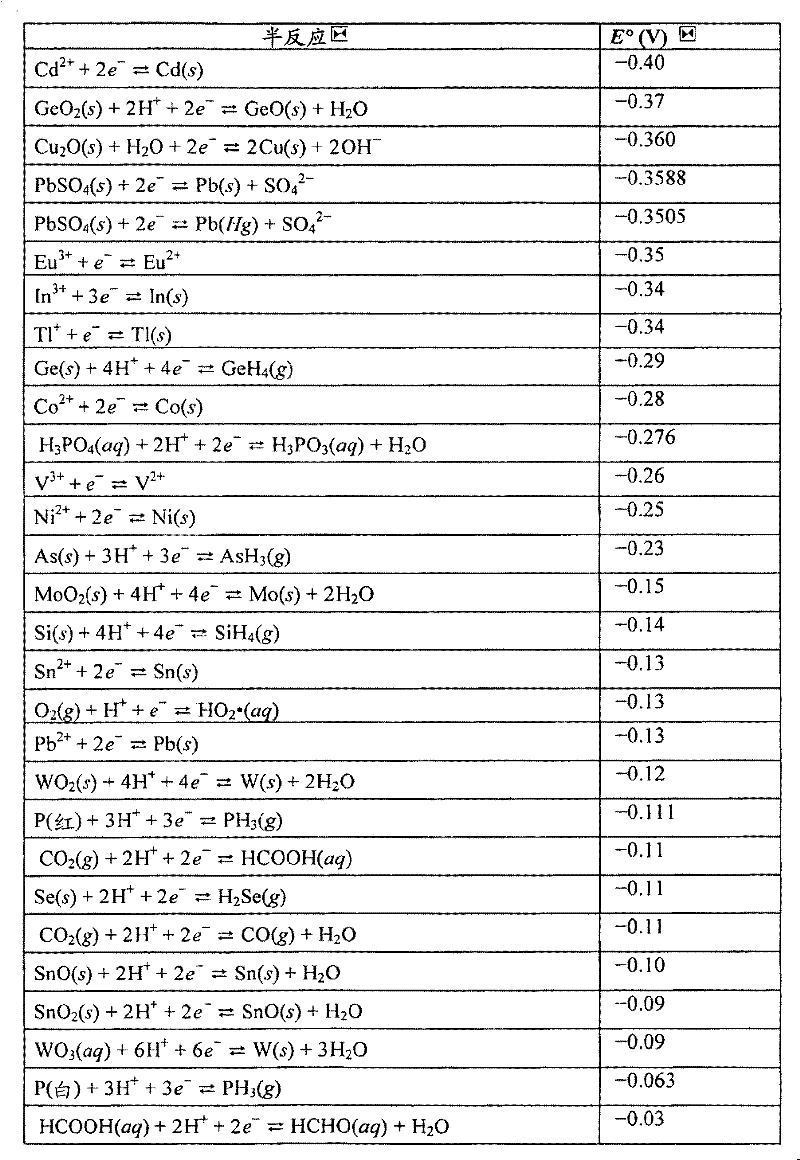


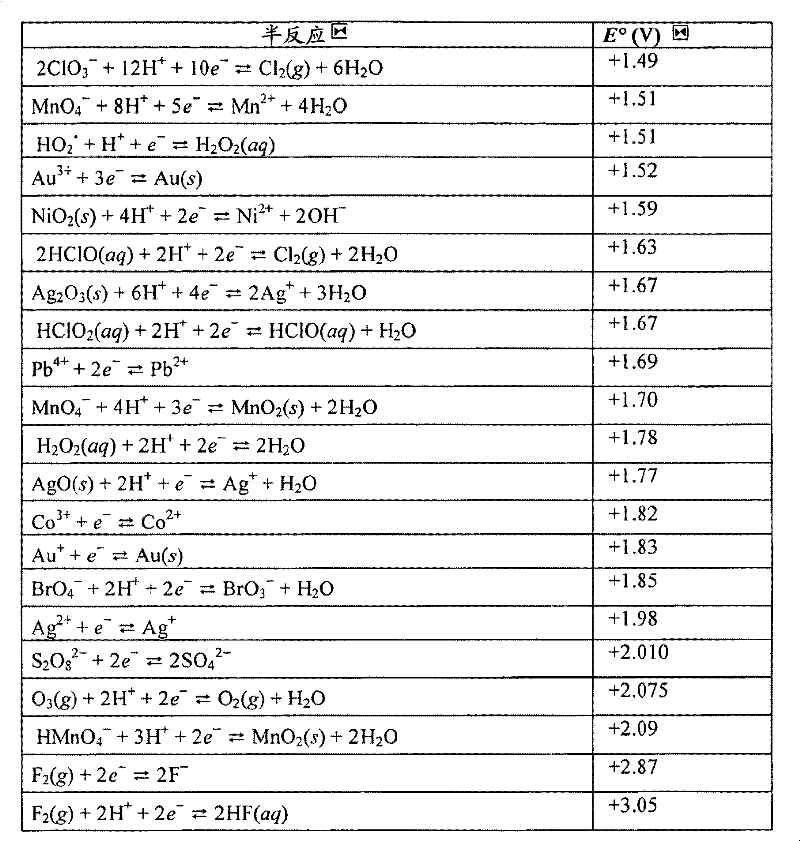
Claims (62)
Applications Claiming Priority (3)
| Application Number | Priority Date | Filing Date | Title |
|---|---|---|---|
| US12/462,205 | 2009-07-29 | ||
| US12/462,205 US8460814B2 (en) | 2009-07-29 | 2009-07-29 | Fluid-surfaced electrode |
| PCT/US2010/002100 WO2011014242A1 (en) | 2009-07-29 | 2010-07-26 | Fluid-surfaced electrode |
Publications (1)
| Publication Number | Publication Date |
|---|---|
| CN102549804A true CN102549804A (en) | 2012-07-04 |
Family
ID=43527333
Family Applications (1)
| Application Number | Title | Priority Date | Filing Date |
|---|---|---|---|
| CN2010800430404A Pending CN102549804A (en) | 2009-07-29 | 2010-07-26 | Electrodes for Fluid Surface Treatment |
Country Status (5)
| Country | Link |
|---|---|
| US (1) | US8460814B2 (en) |
| EP (1) | EP2460209A4 (en) |
| JP (1) | JP2013500576A (en) |
| CN (1) | CN102549804A (en) |
| WO (1) | WO2011014242A1 (en) |
Cited By (15)
| Publication number | Priority date | Publication date | Assignee | Title |
|---|---|---|---|---|
| CN105849032A (en) * | 2013-10-23 | 2016-08-10 | 多伦多大学董事局 | Printed digital microfluidic devices methods of use and manufacture thereof |
| US10232374B2 (en) | 2010-05-05 | 2019-03-19 | Miroculus Inc. | Method of processing dried samples using digital microfluidic device |
| US10464067B2 (en) | 2015-06-05 | 2019-11-05 | Miroculus Inc. | Air-matrix digital microfluidics apparatuses and methods for limiting evaporation and surface fouling |
| US10596572B2 (en) | 2016-08-22 | 2020-03-24 | Miroculus Inc. | Feedback system for parallel droplet control in a digital microfluidic device |
| US10695762B2 (en) | 2015-06-05 | 2020-06-30 | Miroculus Inc. | Evaporation management in digital microfluidic devices |
| US11253860B2 (en) | 2016-12-28 | 2022-02-22 | Miroculus Inc. | Digital microfluidic devices and methods |
| US11311882B2 (en) | 2017-09-01 | 2022-04-26 | Miroculus Inc. | Digital microfluidics devices and methods of using them |
| US11413617B2 (en) | 2017-07-24 | 2022-08-16 | Miroculus Inc. | Digital microfluidics systems and methods with integrated plasma collection device |
| CN115297695A (en) * | 2022-08-31 | 2022-11-04 | 西安电子科技大学 | A micro-channel radiator with integrated pump and radiator |
| US11524298B2 (en) | 2019-07-25 | 2022-12-13 | Miroculus Inc. | Digital microfluidics devices and methods of use thereof |
| US11623219B2 (en) | 2017-04-04 | 2023-04-11 | Miroculus Inc. | Digital microfluidics apparatuses and methods for manipulating and processing encapsulated droplets |
| US11738345B2 (en) | 2019-04-08 | 2023-08-29 | Miroculus Inc. | Multi-cartridge digital microfluidics apparatuses and methods of use |
| US11772093B2 (en) | 2022-01-12 | 2023-10-03 | Miroculus Inc. | Methods of mechanical microfluidic manipulation |
| US11992842B2 (en) | 2018-05-23 | 2024-05-28 | Miroculus Inc. | Control of evaporation in digital microfluidics |
| US12233390B2 (en) | 2019-01-31 | 2025-02-25 | Miroculus Inc. | Nonfouling compositions and methods for manipulating and processing encapsulated droplets |
Families Citing this family (50)
| Publication number | Priority date | Publication date | Assignee | Title |
|---|---|---|---|---|
| US9076996B2 (en) | 2009-07-20 | 2015-07-07 | Massachusetts Institute Of Technology | Liquid metal alloy energy storage device |
| US10074879B2 (en) * | 2009-07-29 | 2018-09-11 | Deep Science, Llc | Instrumented fluid-surfaced electrode |
| US9054397B2 (en) * | 2009-08-11 | 2015-06-09 | Amphenol Thermometrics, Inc. | Battery cell with integrated sensing platform |
| US9605354B2 (en) | 2010-08-06 | 2017-03-28 | Massachusetts Institute Of Technology | Electrolytic recycling of compounds |
| RU2602825C9 (en) | 2010-09-20 | 2017-03-10 | Массачусетс Инститьют Оф Текнолоджи | Battery based on alkali metal ions with bimetal electrode |
| CN102157315B (en) * | 2011-03-21 | 2013-04-03 | 福州大学 | Emitting cathode based on composite material of graphene/zinc oxide nanowire and preparation of same |
| KR101625311B1 (en) | 2011-10-27 | 2016-05-27 | 갈모어, 인코포레이티드 | Composite graphene structures |
| US9406960B2 (en) * | 2012-03-28 | 2016-08-02 | Battelle Memorial Institute | Energy storage systems having an electrode comprising LixSy |
| CN102637890A (en) * | 2012-03-30 | 2012-08-15 | 中国科学院青岛生物能源与过程研究所 | Lithium metal flow battery system and preparation method for same |
| US20130330634A1 (en) | 2012-06-11 | 2013-12-12 | Basf Se | Electrode unit |
| KR20150032284A (en) * | 2012-06-11 | 2015-03-25 | 바스프 에스이 | Electrode unit |
| IN2015DN03105A (en) * | 2012-09-26 | 2015-10-02 | Harvard College | |
| CN104854726B (en) | 2012-10-16 | 2018-09-21 | 安布里公司 | Electrochemical energy storage device and shell |
| US9312522B2 (en) | 2012-10-18 | 2016-04-12 | Ambri Inc. | Electrochemical energy storage devices |
| US11211641B2 (en) | 2012-10-18 | 2021-12-28 | Ambri Inc. | Electrochemical energy storage devices |
| US9520618B2 (en) | 2013-02-12 | 2016-12-13 | Ambri Inc. | Electrochemical energy storage devices |
| US11721841B2 (en) | 2012-10-18 | 2023-08-08 | Ambri Inc. | Electrochemical energy storage devices |
| US11387497B2 (en) | 2012-10-18 | 2022-07-12 | Ambri Inc. | Electrochemical energy storage devices |
| US10541451B2 (en) | 2012-10-18 | 2020-01-21 | Ambri Inc. | Electrochemical energy storage devices |
| US9735450B2 (en) | 2012-10-18 | 2017-08-15 | Ambri Inc. | Electrochemical energy storage devices |
| CA2904059C (en) | 2013-03-08 | 2019-06-11 | Garmor Inc. | Graphene entrainment in a host |
| JP6178875B2 (en) | 2013-03-08 | 2017-08-09 | ユニバーシティ オブ セントラル フロリダ リサーチ ファウンデーション,インコーポレイテッド | Production of large-scale graphene oxide for industrial applications |
| US10270139B1 (en) | 2013-03-14 | 2019-04-23 | Ambri Inc. | Systems and methods for recycling electrochemical energy storage devices |
| US9502737B2 (en) | 2013-05-23 | 2016-11-22 | Ambri Inc. | Voltage-enhanced energy storage devices |
| US12347832B2 (en) | 2013-09-18 | 2025-07-01 | Ambri, LLC | Electrochemical energy storage devices |
| AU2014324647B2 (en) | 2013-09-26 | 2018-12-20 | President And Fellows Of Harvard College | Quinone and hydroquinone based flow battery |
| EP3058605B1 (en) | 2013-10-16 | 2023-12-06 | Ambri Inc. | Seals for high temperature reactive material devices |
| WO2015058165A1 (en) | 2013-10-17 | 2015-04-23 | Ambri Inc. | Battery management systems for energy storage devices |
| US12142735B1 (en) | 2013-11-01 | 2024-11-12 | Ambri, Inc. | Thermal management of liquid metal batteries |
| KR101902753B1 (en) | 2014-08-18 | 2018-10-02 | 갈모어 인코포레이티드 | Graphite oxide entrainment in cement and asphalt composite |
| US10170799B2 (en) | 2014-12-15 | 2019-01-01 | Massachusetts Institute Of Technology | Multi-element liquid metal battery |
| AU2016225020A1 (en) | 2015-02-27 | 2017-09-14 | Massachusetts Institute Of Technology | Electrochemical cell with bipolar faradaic membrane |
| US10181800B1 (en) | 2015-03-02 | 2019-01-15 | Ambri Inc. | Power conversion systems for energy storage devices |
| WO2016141354A2 (en) | 2015-03-05 | 2016-09-09 | Ambri Inc. | Ceramic materials and seals for high temperature reactive material devices |
| WO2016149150A1 (en) | 2015-03-13 | 2016-09-22 | University Of Central Florida Research Foundation, Inc. | Uniform dispersing of graphene nanoparticles in a host |
| EP3274295B1 (en) | 2015-03-23 | 2025-01-01 | Asbury Graphite of North Carolina, Inc. | Method of making one or more composite structures using flakes of graphene, graphene oxide and/or reduced graphene oxide |
| US10981791B2 (en) | 2015-04-13 | 2021-04-20 | Garmor Inc. | Graphite oxide reinforced fiber in hosts such as concrete or asphalt |
| US9893385B1 (en) | 2015-04-23 | 2018-02-13 | Ambri Inc. | Battery management systems for energy storage devices |
| WO2016200469A1 (en) * | 2015-06-09 | 2016-12-15 | Garmor Inc. | Graphite oxide and polyacrylonitrile based composite |
| CA2997109C (en) | 2015-09-21 | 2021-05-11 | Garmor Inc. | Low-cost, high-performance composite bipolar plate |
| US11923581B2 (en) | 2016-08-12 | 2024-03-05 | President And Fellows Of Harvard College | Aqueous redox flow battery electrolytes with high chemical and electrochemical stability, high water solubility, low membrane permeability |
| US11929466B2 (en) | 2016-09-07 | 2024-03-12 | Ambri Inc. | Electrochemical energy storage devices |
| WO2018081413A1 (en) | 2016-10-26 | 2018-05-03 | Garmor Inc. | Additive coated particles for low high performance materials |
| US10840532B2 (en) | 2017-01-27 | 2020-11-17 | President And Fellows Of Harvard College | Flow battery with electrolyte rebalancing system |
| EP3607603A4 (en) | 2017-04-07 | 2021-01-13 | Ambri Inc. | SALT BATTERY WITH FIXED METAL CATHODE |
| US11724980B2 (en) | 2018-02-09 | 2023-08-15 | President And Fellows Of Harvard College | Quinones having high capacity retention for use as electrolytes in aqueous redox flow batteries |
| US11557786B2 (en) | 2018-10-01 | 2023-01-17 | President And Fellows Of Harvard College | Extending the lifetime of organic flow batteries via redox state management |
| EP3898421A4 (en) | 2018-12-17 | 2022-10-05 | Ambri Inc. | HIGH-TEMPERATURE ENERGY STORAGE SYSTEMS AND PROCESSES |
| US11791061B2 (en) | 2019-09-12 | 2023-10-17 | Asbury Graphite North Carolina, Inc. | Conductive high strength extrudable ultra high molecular weight polymer graphene oxide composite |
| CN118522945B (en) * | 2024-06-03 | 2025-07-08 | 中国计量科学研究院 | Rubidium ion solid electrolyte and its preparation method, application, rubidium atomic source device |
Citations (5)
| Publication number | Priority date | Publication date | Assignee | Title |
|---|---|---|---|---|
| US4382116A (en) * | 1981-05-22 | 1983-05-03 | The United States Of America As Represented By The Administrator Of The National Aeronautics And Space Administration | Zirconium carbide as an electrocatalyst for the chromous/chromic REDOX couple |
| US6555262B1 (en) * | 2000-02-08 | 2003-04-29 | Hybrid Power Generation Systems, Llc | Wicking strands for a polymer electrolyte membrane |
| US20030108788A1 (en) * | 2001-12-10 | 2003-06-12 | Tadahiko Miyoshi | Sodium-sulfur battery |
| US20080026267A1 (en) * | 2005-01-26 | 2008-01-31 | The Furukawa Electric Co., Ltd. | Fuel mixture, fuel reliquefying system, fuel cartridge using the same, and method of extracting fuel; for fuel cells |
| CN100517851C (en) * | 2004-10-28 | 2009-07-22 | 三星Sdi株式会社 | Cylindrical lithium secondary battery |
Family Cites Families (85)
| Publication number | Priority date | Publication date | Assignee | Title |
|---|---|---|---|---|
| NL261579A (en) | 1960-02-23 | |||
| US3404036A (en) | 1965-10-22 | 1968-10-01 | Ford Motor Co | Energy conversion device comprising a solid crystalline electrolyte and a solid reaction zone separator |
| US3523829A (en) * | 1965-12-06 | 1970-08-11 | Modine Mfg Co | Electrochemical power supply regenerated by heat |
| US3448365A (en) | 1966-08-15 | 1969-06-03 | Gen Electric | Rechargeable battery operated cigarette lighter and recharging and storage device therefor |
| US3811943A (en) | 1971-02-16 | 1974-05-21 | Ford Motor Co | Mass transportation electrode for energy conversion device |
| US3840407A (en) * | 1972-06-19 | 1974-10-08 | Textron Inc | Composite porous electrode |
| JPS5224972B2 (en) | 1972-10-19 | 1977-07-05 | ||
| US3915741A (en) | 1973-07-30 | 1975-10-28 | Toyoda Chuo Kenkyusho Kk | Sodium-sulfur cell with improved separator |
| JPS5141832A (en) | 1974-10-08 | 1976-04-08 | Kogyo Gijutsuin | Natoriumu iodenchi |
| GB1526249A (en) | 1974-11-27 | 1978-09-27 | Battelle Institut E V | Rechargeable galvanic sodium-sulphur cells and batteries and methods of manufacturing same |
| US4044191A (en) | 1974-12-24 | 1977-08-23 | The Secretary Of State For Industry In Her Britannic Majesty's Government Of The United Kingdom Of Great Britain And Northern Ireland | Electric cells |
| US3980496A (en) | 1975-01-29 | 1976-09-14 | Ford Motor Company | Energy conversion devices with improved electrode shapes |
| US3966492A (en) | 1975-08-20 | 1976-06-29 | Ford Motor Company | Sodium sulfur battery or cell with improved ampere-hour capacity |
| DE2633454A1 (en) | 1976-07-24 | 1978-01-26 | Bbc Brown Boveri & Cie | ELECTROCHEMICAL STORAGE CELL |
| US4154902A (en) | 1976-09-13 | 1979-05-15 | American Energizer Corporation | Electric battery cell, system and method |
| US4049885A (en) | 1976-10-12 | 1977-09-20 | Electric Power Research Institute, Inc. | Construction for solid electrolyte in sodium/sulfur battery |
| US4148974A (en) | 1976-12-09 | 1979-04-10 | Honeywell Inc. | Stable electrolyte for reserve electrochemical cells |
| US4065602A (en) * | 1977-03-24 | 1977-12-27 | The United States Of America As Represented By The United States Energy Research And Development Administration | Wick-and-pool electrodes for electrochemical cell |
| US4164610A (en) | 1977-05-23 | 1979-08-14 | Corning Glass Works | Glasses exhibiting high lithium ion mobility |
| DE2811687A1 (en) | 1978-03-17 | 1979-09-27 | Deutsche Automobilgesellsch | SODIUM / SULFUR CELL WITH GLASS ELECTROLYTE |
| DE2811688A1 (en) | 1978-03-17 | 1979-09-20 | Deutsche Automobilgesellsch | SODIUM ION-CONDUCTING GLASS ELECTROLYTE FOR SODIUM / SULFUR BATTERIES |
| US4226923A (en) | 1979-10-29 | 1980-10-07 | Ford Motor Company | Volume efficient sodium sulfur battery |
| US4283468A (en) | 1980-04-29 | 1981-08-11 | Gte Products Corporation | Electrochemical cell insensitive to physical orientation |
| US4347295A (en) | 1980-10-09 | 1982-08-31 | Corning Glass Works | Sealing glasses for electrochemical, electrical, electronic, and optical applications |
| US4311772A (en) | 1980-10-09 | 1982-01-19 | Corning Glass Works | Sealing glasses for electrochemical, electrical, electronic and optical applications |
| US4430393A (en) | 1982-01-28 | 1984-02-07 | Diamond Shamrock Corporation | Metal amalgams for sodium-sulfur battery systems |
| JPS59151777A (en) | 1983-02-18 | 1984-08-30 | Hitachi Ltd | Sodium-sulfur battery system |
| US4886514A (en) * | 1985-05-02 | 1989-12-12 | Ivac Corporation | Electrochemically driven drug dispenser |
| US4833046A (en) | 1986-09-19 | 1989-05-23 | General Electric Company | Metal-hydrogen secondary battery |
| EP0275883B1 (en) | 1987-01-15 | 1992-08-19 | Lonza Ag | Application for a dispersion for coatiing battery cathodes |
| GB8715708D0 (en) | 1987-07-03 | 1987-08-12 | Chloride Silent Power Ltd | Batteries |
| USH858H (en) | 1988-10-24 | 1990-12-04 | The United States Of America As Represented By The Secretary Of The Air Force | Electrical battery cell wicking structure and method |
| DE3843312A1 (en) | 1988-12-22 | 1990-06-28 | Siemens Ag | COMPENSATION CELL FOR A CR / FE REDOXION STORAGE |
| US4968568A (en) | 1989-10-03 | 1990-11-06 | Hughes Aircraft Company | Thermal battery with composite anode |
| US4977044A (en) | 1989-10-03 | 1990-12-11 | Hughes Aircraft Company | Sodium-sulfur thermal battery |
| GB2248139A (en) | 1990-08-07 | 1992-03-25 | Chloride Silent Power Ltd | High temperature battery terminal provided with heat dissipator to prevent damage to cable insulation |
| US5162172A (en) | 1990-12-14 | 1992-11-10 | Arch Development Corporation | Bipolar battery |
| US5134044A (en) | 1991-03-11 | 1992-07-28 | Hughes Aircraft Company | Glass-graphite bonding system for sodium-sulphur batteries and batteries made therefrom |
| US5158840A (en) | 1991-03-11 | 1992-10-27 | Hughes Aircraft Company | Glass sealing materials for sodium-sulfur batteries and batteries made therewith |
| US5622789A (en) | 1994-09-12 | 1997-04-22 | Apple Computer, Inc. | Battery cell having an internal circuit for controlling its operation |
| US5523179A (en) * | 1994-11-23 | 1996-06-04 | Polyplus Battery Company | Rechargeable positive electrode |
| EP0829104B1 (en) | 1995-05-03 | 2003-10-08 | Pinnacle VRB Limited | Method of preparing a high energy density vanadium electrolyte solution for all-vanadium redox cells and batteries |
| EP0743532A3 (en) | 1995-05-16 | 1997-04-23 | Hewlett Packard Co | Battery with electronic mailbox for information exchange |
| FR2748605B1 (en) | 1996-05-07 | 1998-08-07 | Gerard Lemaire | METHOD FOR MANUFACTURING A BASIC BATTERY GENERATOR OR INTELLIGENT BATTERY |
| US5905000A (en) | 1996-09-03 | 1999-05-18 | Nanomaterials Research Corporation | Nanostructured ion conducting solid electrolytes |
| US5929606A (en) | 1997-08-29 | 1999-07-27 | Compaq Computer Corporation | Ripple-suppressed converting battery module |
| US6187479B1 (en) | 1998-03-06 | 2001-02-13 | Changle Liu | Ambient temperature, rechargeable cells with metal salt-based electrodes and a system of cell component materials for use therein |
| KR100616198B1 (en) | 1998-04-21 | 2006-08-25 | 어플라이드 머티어리얼스, 인코포레이티드 | Electrochemical Deposition System and Method for Electroplating on Substrate |
| JP2003515236A (en) | 1999-11-17 | 2003-04-22 | ネア・パワー・システムズ・インコーポレイテッド | Fuel cell with silicon substrate and / or sol-gel derived carrier structure |
| EP1186069B1 (en) | 2000-03-31 | 2003-07-09 | Squirrel Holdings Ltd. | Redox flow battery and method of operating it |
| JP4724271B2 (en) * | 2000-04-07 | 2011-07-13 | アークレイ株式会社 | Analysis apparatus and inspection method thereof |
| JP2002110243A (en) | 2000-09-29 | 2002-04-12 | Pionics Co Ltd | Lithium secondary battery |
| US6815105B2 (en) | 2000-10-23 | 2004-11-09 | The Regents Of The University Of California | Fuel cell apparatus and method thereof |
| US6953630B2 (en) | 2001-07-25 | 2005-10-11 | Ballard Power Systems Inc. | Fuel cell anomaly detection method and apparatus |
| CA2472232A1 (en) | 2002-01-03 | 2003-07-17 | Neah Power Systems, Inc. | Porous fuel cell electrode structures having conformal electrically conductive layers thereon |
| US20030198862A1 (en) * | 2002-04-19 | 2003-10-23 | Enernext | Liquid gallium alkaline electrolyte fuel cell |
| US20040001991A1 (en) | 2002-07-01 | 2004-01-01 | Kinkelaar Mark R. | Capillarity structures for water and/or fuel management in fuel cells |
| US7105245B2 (en) | 2002-07-03 | 2006-09-12 | Neah Power Systems, Inc. | Fluid cell system reactant supply and effluent storage cartridges |
| TW200529487A (en) | 2003-10-28 | 2005-09-01 | Inventqjaya Sdn Bhd | Electrode structure for a electrochemical cells |
| JP5109255B2 (en) | 2003-11-04 | 2012-12-26 | トヨタ自動車株式会社 | Power supply system, moving body, and fuel cell system stopping method |
| US8277964B2 (en) | 2004-01-15 | 2012-10-02 | Jd Holding Inc. | System and method for optimizing efficiency and power output from a vanadium redox battery energy storage system |
| US7618746B2 (en) | 2004-03-18 | 2009-11-17 | Alcatel-Lucent Usa Inc. | Nanostructured battery having end of life cells |
| US8110314B2 (en) | 2004-06-22 | 2012-02-07 | Scientific Applications And Research Associates, Inc. | Means of stabilizing electrolyte in a direct carbon-air fuel cell based on a molten metal hydroxide electrolyte |
| WO2006081514A2 (en) | 2005-01-28 | 2006-08-03 | Premium Power Corporation | Flowing electrolyte battery with electric potential neutralization |
| JP4455385B2 (en) | 2005-03-31 | 2010-04-21 | 株式会社東芝 | Direct methanol fuel cell system and control method thereof |
| US7897292B2 (en) | 2005-05-18 | 2011-03-01 | Lilliputian Systems, Inc. | Fuel cell apparatus and methods |
| CN101185185B (en) | 2005-05-31 | 2010-04-07 | 松下电器产业株式会社 | Secondary battery, power supply system using same, and method for using power supply system |
| US20060269814A1 (en) | 2005-05-31 | 2006-11-30 | Horton Isaac B Iii | Fuel cell membrane and fuel cells including same |
| US7749637B2 (en) | 2005-09-19 | 2010-07-06 | Gm Global Technology Operations, Inc. | Water blocking layer and wicking reservoir for PEMFC |
| US7504010B2 (en) | 2006-03-09 | 2009-03-17 | Elkem As | Anode for electrolysis of aluminum |
| US7901561B2 (en) | 2006-03-10 | 2011-03-08 | Elkem As | Method for electrolytic production and refining of metals |
| US20070218321A1 (en) | 2006-03-14 | 2007-09-20 | O'brien Robert N | Lithium secondary battery featuring electrolyte solution circulation |
| US20080003507A1 (en) | 2006-06-30 | 2008-01-03 | Chenniah Nanjundiah | Formulation Of Electrolyte Solutions For Electrochemical Chlorine Dioxide Generators |
| US20080023321A1 (en) | 2006-07-31 | 2008-01-31 | Donald Sadoway | Apparatus for electrolysis of molten oxides |
| WO2008105811A2 (en) | 2006-08-15 | 2008-09-04 | Massachusetts Institute Of Technology | High-amperage energy storage device and method |
| US8157981B2 (en) | 2006-11-22 | 2012-04-17 | Strategic Resource Optimization, LLC | Electrolytic system and method for enhanced release and deposition of sub-surface and surface components |
| TW200824179A (en) | 2006-11-28 | 2008-06-01 | Coretronic Corp | Fuel cell system |
| US7633261B2 (en) | 2007-03-27 | 2009-12-15 | Honeywell International Inc. | Primary battery with internal voltage regulator |
| US7608361B2 (en) | 2007-08-22 | 2009-10-27 | Stauffer John E | Alkali metal battery |
| TWI344719B (en) | 2007-09-11 | 2011-07-01 | Iner Aec Executive Yuan | Fuel supplying and controlling method and fuel cell apparatus using the same |
| KR100947972B1 (en) | 2007-12-14 | 2010-03-15 | 삼성에스디아이 주식회사 | Battery pack |
| US7927731B2 (en) | 2008-07-01 | 2011-04-19 | Deeya Energy, Inc. | Redox flow cell |
| US20100092843A1 (en) | 2008-10-10 | 2010-04-15 | Deeya Energy Technologies, Inc. | Venturi pumping system in a hydrogen gas circulation of a flow battery |
| US8101293B2 (en) | 2009-05-26 | 2012-01-24 | The Invention Science Fund I, Llc | System for altering temperature of an electrical energy storage device or an electrochemical energy generation device using high thermal conductivity materials based on states of the device |
| US8329336B2 (en) | 2010-09-29 | 2012-12-11 | General Electric Company | Composition and energy storage device |
-
2009
- 2009-07-29 US US12/462,205 patent/US8460814B2/en active Active
-
2010
- 2010-07-26 EP EP10804819.0A patent/EP2460209A4/en not_active Withdrawn
- 2010-07-26 WO PCT/US2010/002100 patent/WO2011014242A1/en not_active Ceased
- 2010-07-26 JP JP2012522806A patent/JP2013500576A/en active Pending
- 2010-07-26 CN CN2010800430404A patent/CN102549804A/en active Pending
Patent Citations (5)
| Publication number | Priority date | Publication date | Assignee | Title |
|---|---|---|---|---|
| US4382116A (en) * | 1981-05-22 | 1983-05-03 | The United States Of America As Represented By The Administrator Of The National Aeronautics And Space Administration | Zirconium carbide as an electrocatalyst for the chromous/chromic REDOX couple |
| US6555262B1 (en) * | 2000-02-08 | 2003-04-29 | Hybrid Power Generation Systems, Llc | Wicking strands for a polymer electrolyte membrane |
| US20030108788A1 (en) * | 2001-12-10 | 2003-06-12 | Tadahiko Miyoshi | Sodium-sulfur battery |
| CN100517851C (en) * | 2004-10-28 | 2009-07-22 | 三星Sdi株式会社 | Cylindrical lithium secondary battery |
| US20080026267A1 (en) * | 2005-01-26 | 2008-01-31 | The Furukawa Electric Co., Ltd. | Fuel mixture, fuel reliquefying system, fuel cartridge using the same, and method of extracting fuel; for fuel cells |
Cited By (29)
| Publication number | Priority date | Publication date | Assignee | Title |
|---|---|---|---|---|
| US11000850B2 (en) | 2010-05-05 | 2021-05-11 | The Governing Council Of The University Of Toronto | Method of processing dried samples using digital microfluidic device |
| US10232374B2 (en) | 2010-05-05 | 2019-03-19 | Miroculus Inc. | Method of processing dried samples using digital microfluidic device |
| CN105849032A (en) * | 2013-10-23 | 2016-08-10 | 多伦多大学董事局 | Printed digital microfluidic devices methods of use and manufacture thereof |
| US12263483B2 (en) | 2015-06-05 | 2025-04-01 | Integra Biosciences Ag | Evaporation management in digital microfluidic devices |
| US10695762B2 (en) | 2015-06-05 | 2020-06-30 | Miroculus Inc. | Evaporation management in digital microfluidic devices |
| US11097276B2 (en) | 2015-06-05 | 2021-08-24 | mirOculus, Inc. | Air-matrix digital microfluidics apparatuses and methods for limiting evaporation and surface fouling |
| US10464067B2 (en) | 2015-06-05 | 2019-11-05 | Miroculus Inc. | Air-matrix digital microfluidics apparatuses and methods for limiting evaporation and surface fouling |
| US11890617B2 (en) | 2015-06-05 | 2024-02-06 | Miroculus Inc. | Evaporation management in digital microfluidic devices |
| US12239988B2 (en) | 2015-06-05 | 2025-03-04 | Miroculus Inc. | Air-matrix digital microfluidics apparatuses and methods for limiting evaporation and surface fouling |
| US11471888B2 (en) | 2015-06-05 | 2022-10-18 | Miroculus Inc. | Evaporation management in digital microfluidic devices |
| US11944974B2 (en) | 2015-06-05 | 2024-04-02 | Miroculus Inc. | Air-matrix digital microfluidics apparatuses and methods for limiting evaporation and surface fouling |
| US10596572B2 (en) | 2016-08-22 | 2020-03-24 | Miroculus Inc. | Feedback system for parallel droplet control in a digital microfluidic device |
| US11298700B2 (en) | 2016-08-22 | 2022-04-12 | Miroculus Inc. | Feedback system for parallel droplet control in a digital microfluidic device |
| US11253860B2 (en) | 2016-12-28 | 2022-02-22 | Miroculus Inc. | Digital microfluidic devices and methods |
| US11833516B2 (en) | 2016-12-28 | 2023-12-05 | Miroculus Inc. | Digital microfluidic devices and methods |
| US12172164B2 (en) | 2016-12-28 | 2024-12-24 | Miroculus Inc. | Microfluidic devices and methods |
| US11623219B2 (en) | 2017-04-04 | 2023-04-11 | Miroculus Inc. | Digital microfluidics apparatuses and methods for manipulating and processing encapsulated droplets |
| US11857969B2 (en) | 2017-07-24 | 2024-01-02 | Miroculus Inc. | Digital microfluidics systems and methods with integrated plasma collection device |
| US11413617B2 (en) | 2017-07-24 | 2022-08-16 | Miroculus Inc. | Digital microfluidics systems and methods with integrated plasma collection device |
| US12515225B2 (en) | 2017-09-01 | 2026-01-06 | Integra Biosciences Ag | Digital microfluidics devices and methods of using them |
| US11311882B2 (en) | 2017-09-01 | 2022-04-26 | Miroculus Inc. | Digital microfluidics devices and methods of using them |
| US11992842B2 (en) | 2018-05-23 | 2024-05-28 | Miroculus Inc. | Control of evaporation in digital microfluidics |
| US12233390B2 (en) | 2019-01-31 | 2025-02-25 | Miroculus Inc. | Nonfouling compositions and methods for manipulating and processing encapsulated droplets |
| US11738345B2 (en) | 2019-04-08 | 2023-08-29 | Miroculus Inc. | Multi-cartridge digital microfluidics apparatuses and methods of use |
| US11524298B2 (en) | 2019-07-25 | 2022-12-13 | Miroculus Inc. | Digital microfluidics devices and methods of use thereof |
| US11857961B2 (en) | 2022-01-12 | 2024-01-02 | Miroculus Inc. | Sequencing by synthesis using mechanical compression |
| US11772093B2 (en) | 2022-01-12 | 2023-10-03 | Miroculus Inc. | Methods of mechanical microfluidic manipulation |
| CN115297695B (en) * | 2022-08-31 | 2024-05-17 | 西安电子科技大学 | Microchannel radiator with integrated pump and radiator |
| CN115297695A (en) * | 2022-08-31 | 2022-11-04 | 西安电子科技大学 | A micro-channel radiator with integrated pump and radiator |
Also Published As
| Publication number | Publication date |
|---|---|
| US8460814B2 (en) | 2013-06-11 |
| EP2460209A1 (en) | 2012-06-06 |
| US20110027624A1 (en) | 2011-02-03 |
| JP2013500576A (en) | 2013-01-07 |
| EP2460209A4 (en) | 2014-05-07 |
| WO2011014242A1 (en) | 2011-02-03 |
Similar Documents
| Publication | Publication Date | Title |
|---|---|---|
| CN102549804A (en) | Electrodes for Fluid Surface Treatment | |
| US8974939B2 (en) | Fluid-surfaced electrode | |
| US20110027638A1 (en) | Fluid-surfaced electrode | |
| CN103098263B (en) | Electrochemical energy storage system and method | |
| US8932771B2 (en) | Cathode architectures for alkali metal / oxygen batteries | |
| US20130189592A1 (en) | Part solid, part fluid and flow electrochemical cells including metal-air and li-air battery systems | |
| JP7103626B2 (en) | Lithium recovery device and lithium recovery method | |
| CN102549814A (en) | high performance electrode | |
| CN103384929A (en) | Alkali-air flow batteries | |
| PL171936B1 (en) | Electrochemical power supply device with air electrode PL PL PL PL PL PL PL PL PL PL | |
| JPS5837669B2 (en) | Fuel cell and its manufacturing method | |
| JP6570510B2 (en) | Low temperature battery with molten sodium-FSA electrolyte | |
| CN106463680B (en) | Electrochemical energy storage device and battery | |
| JP6927973B2 (en) | High energy density and low cost flow electrochemical device | |
| Liu et al. | A self-pumping microfluidic fuel cell powered by formate with Pd coated carbon cloth electrodes | |
| JP2015515723A (en) | Batteries having non-polar alkali metal ion conducting honeycomb structure separator | |
| WO2019074538A1 (en) | Three-dimensional rechargeable battery with solid-state electrolyte | |
| JP6570509B2 (en) | Low temperature secondary battery with sodium insertion electrode | |
| US20240149219A1 (en) | Lithium recovery device and lithium recovery method | |
| CN110600751A (en) | Direct formate microfluid fuel cell with cotton wire electrode | |
| Liu et al. | Cotton‐Based Metal–Air Batteries without Catalysts as Low‐Cost Micropower Devices | |
| EP3614463A1 (en) | Electrode structure of electrochemical energy storage device and manufacturing method thereof | |
| WO2024241343A1 (en) | Title of the invention: a plasma printing process to manufacture and produce battery electrodes and enhance cunent collectors | |
| US20200067102A1 (en) | Electrode structure of electrochemical energy storage device and manufacturing method thereof | |
| Sharma et al. | Metal Chalcogenides for Potassium-Ion Batteries |
Legal Events
| Date | Code | Title | Description |
|---|---|---|---|
| C06 | Publication | ||
| PB01 | Publication | ||
| C10 | Entry into substantive examination | ||
| SE01 | Entry into force of request for substantive examination | ||
| C02 | Deemed withdrawal of patent application after publication (patent law 2001) | ||
| WD01 | Invention patent application deemed withdrawn after publication |
Application publication date: 20120704 |