CN102482283A - Raf inhibitor compounds and methods of use thereof - Google Patents
Raf inhibitor compounds and methods of use thereof Download PDFInfo
- Publication number
- CN102482283A CN102482283A CN2010800382985A CN201080038298A CN102482283A CN 102482283 A CN102482283 A CN 102482283A CN 2010800382985 A CN2010800382985 A CN 2010800382985A CN 201080038298 A CN201080038298 A CN 201080038298A CN 102482283 A CN102482283 A CN 102482283A
- Authority
- CN
- China
- Prior art keywords
- cancer
- alkyl
- compound according
- halogen
- treatment
- Prior art date
- Legal status (The legal status is an assumption and is not a legal conclusion. Google has not performed a legal analysis and makes no representation as to the accuracy of the status listed.)
- Pending
Links
Classifications
-
- C—CHEMISTRY; METALLURGY
- C07—ORGANIC CHEMISTRY
- C07D—HETEROCYCLIC COMPOUNDS
- C07D487/00—Heterocyclic compounds containing nitrogen atoms as the only ring hetero atoms in the condensed system, not provided for by groups C07D451/00 - C07D477/00
- C07D487/02—Heterocyclic compounds containing nitrogen atoms as the only ring hetero atoms in the condensed system, not provided for by groups C07D451/00 - C07D477/00 in which the condensed system contains two hetero rings
- C07D487/04—Ortho-condensed systems
-
- A—HUMAN NECESSITIES
- A61—MEDICAL OR VETERINARY SCIENCE; HYGIENE
- A61P—SPECIFIC THERAPEUTIC ACTIVITY OF CHEMICAL COMPOUNDS OR MEDICINAL PREPARATIONS
- A61P13/00—Drugs for disorders of the urinary system
- A61P13/12—Drugs for disorders of the urinary system of the kidneys
-
- A—HUMAN NECESSITIES
- A61—MEDICAL OR VETERINARY SCIENCE; HYGIENE
- A61P—SPECIFIC THERAPEUTIC ACTIVITY OF CHEMICAL COMPOUNDS OR MEDICINAL PREPARATIONS
- A61P35/00—Antineoplastic agents
-
- A—HUMAN NECESSITIES
- A61—MEDICAL OR VETERINARY SCIENCE; HYGIENE
- A61P—SPECIFIC THERAPEUTIC ACTIVITY OF CHEMICAL COMPOUNDS OR MEDICINAL PREPARATIONS
- A61P35/00—Antineoplastic agents
- A61P35/02—Antineoplastic agents specific for leukemia
-
- A—HUMAN NECESSITIES
- A61—MEDICAL OR VETERINARY SCIENCE; HYGIENE
- A61P—SPECIFIC THERAPEUTIC ACTIVITY OF CHEMICAL COMPOUNDS OR MEDICINAL PREPARATIONS
- A61P43/00—Drugs for specific purposes, not provided for in groups A61P1/00-A61P41/00
Landscapes
- Chemical & Material Sciences (AREA)
- Health & Medical Sciences (AREA)
- Organic Chemistry (AREA)
- Life Sciences & Earth Sciences (AREA)
- Public Health (AREA)
- General Chemical & Material Sciences (AREA)
- Medicinal Chemistry (AREA)
- Nuclear Medicine, Radiotherapy & Molecular Imaging (AREA)
- Chemical Kinetics & Catalysis (AREA)
- Pharmacology & Pharmacy (AREA)
- Veterinary Medicine (AREA)
- Animal Behavior & Ethology (AREA)
- General Health & Medical Sciences (AREA)
- Bioinformatics & Cheminformatics (AREA)
- Engineering & Computer Science (AREA)
- Hematology (AREA)
- Oncology (AREA)
- Urology & Nephrology (AREA)
- Pharmaceuticals Containing Other Organic And Inorganic Compounds (AREA)
- Nitrogen Condensed Heterocyclic Rings (AREA)
Abstract
Description
本申请根据美国法典第35篇第119条(e)款要求2009年8月28日提交的美国临时专利申请第61/238,103号的优先权,所述美国临时专利申请的全部内容并入本文。This application claims priority under 35 USC § 119(e) to US Provisional Patent Application No. 61/238,103, filed August 28, 2009, which is incorporated herein in its entirety.
技术领域 technical field
本文提供了化合物,包含所述化合物的药物组合物,用于制备所述化合物的方法以及所述化合物在治疗中的用途。更具体地来说,本文公开了适用于抑制Raf激酶和用于治疗由Raf激酶介导的病症的某些取代的吡唑并[1,5-a]嘧啶化合物。Provided herein are compounds, pharmaceutical compositions comprising the compounds, processes for preparing the compounds, and uses of the compounds in therapy. More specifically, disclosed herein are certain substituted pyrazolo[1,5-a]pyrimidine compounds useful for inhibiting Raf kinases and for treating disorders mediated by Raf kinases.
背景技术 Background technique
Raf/MEK/ERK通路对于细胞存活、生长、增殖和肿瘤发生而言是关键性的。Li,Nanxin等“B-Raf kinase inhibitors for cancer treatment.”Current Opinion in Investigational Drugs.第8卷,第6期(2007):452-456。Raf激酶存在三种同工型,A-Raf、B-Raf和C-Raf。在这三种同工型中,研究显示B-Raf起主要的MEK激活剂的作用。B-Raf是人类癌症中最常突变的基因之一。B-Raf激酶代表了用于基于临床前靶标确认、流行病学和成药性的抗癌治疗的一种优良靶标。The Raf/MEK/ERK pathway is critical for cell survival, growth, proliferation and tumorigenesis. Li, Nanxin et al. "B-Raf kinase inhibitors for cancer treatment." Current Opinion in Investigational Drugs . Vol. 8, No. 6 (2007): 452-456. Raf kinase exists in three isoforms, A-Raf, B-Raf and C-Raf. Of these three isoforms, studies have shown that B-Raf functions as a major MEK activator. B-Raf is one of the most frequently mutated genes in human cancers. B-Raf kinase represents an excellent target for anticancer therapy based on preclinical target validation, epidemiology and druggability.
正在开发用于抗癌治疗的B-Raf的小分子抑制剂。
激酶抑制剂是已知的,参见(例如)国际专利申请公布WO 2006/066913、国际专利申请公布WO 2008/028617和国际专利申请公布WO 2008/079909。Kinase inhibitors are known, see, for example, International Patent Application Publication WO 2006/066913, International Patent Application Publication WO 2008/028617 and International Patent Application Publication WO 2008/079909.
发明内容 Contents of the invention
本文描述了为Raf激酶的抑制剂,特别是B-Raf抑制剂的化合物。某些过度增殖性病症是以Raf激酶功能的过度活化为特征,例如,以蛋白突变或过度表达为特征。因此,所述化合物适用于治疗过度增殖性病症,诸如癌症。Described herein are compounds that are inhibitors of Raf kinases, particularly B-Raf inhibitors. Certain hyperproliferative disorders are characterized by hyperactivation of Raf kinase function, eg, by protein mutation or overexpression. Accordingly, the compounds are useful in the treatment of hyperproliferative disorders, such as cancer.
更具体来说,一个方面提供了式I化合物:More specifically, one aspect provides compounds of formula I:

及其立体异构体、互变异构体和药学上可接受的盐,其中R1、R2、R3、R4和R5如本文所定义。Stereoisomers, tautomers and pharmaceutically acceptable salts thereof, wherein R 1 , R 2 , R 3 , R 4 and R 5 are as defined herein.
另一个方面提供了预防或治疗由B-Raf调节的疾病或病症的方法,其包括对需要此治疗的哺乳动物施用有效量的式I化合物、其立体异构体、互变异构体或药学上可接受的盐。此类疾病和病症的实例包括但不限于过度增殖性病症(诸如癌症,包括黑素瘤和其它皮肤癌症)、神经变性、心脏肥大、疼痛、偏头痛和神经创伤疾病。Another aspect provides a method of preventing or treating a disease or condition modulated by B-Raf comprising administering to a mammal in need of such treatment an effective amount of a compound of formula I, a stereoisomer, tautomer, or pharmaceutical acceptable salt. Examples of such diseases and disorders include, but are not limited to, hyperproliferative disorders (such as cancer, including melanoma and other skin cancers), neurodegeneration, cardiac hypertrophy, pain, migraine, and neurotraumatic disease.
另一个方面提供了预防或治疗癌症的方法,其包括对需要此治疗的哺乳动物单独施用或与具有抗癌性质的一种或多种其它化合物组合施用有效量的式I化合物、其立体异构体、互变异构体或药学上可接受的盐。Another aspect provides a method of preventing or treating cancer comprising administering to a mammal in need of such treatment an effective amount of a compound of formula I, its stereoisomers, alone or in combination with one or more other compounds having anticancer properties isomers, tautomers or pharmaceutically acceptable salts.
另一个方面提供了治疗哺乳动物的过度增殖性疾病的方法,其包括对所述哺乳动物施用治疗有效量的式I化合物、其立体异构体、互变异构体或药学上可接受的盐。Another aspect provides a method for treating a hyperproliferative disease in a mammal, comprising administering to said mammal a therapeutically effective amount of a compound of formula I, a stereoisomer, a tautomer or a pharmaceutically acceptable salt thereof .
另一个方面提供了预防或治疗肾病的方法,其包括对需要此治疗的哺乳动物单独施用或与一种或多种其它化合物组合施用有效量的式I化合物、其立体异构体、互变异构体或药学上可接受的盐。另一个方面提供了预防或治疗多囊性肾病的方法,其包括对需要此治疗的哺乳动物单独施用或与一种或多种其它化合物组合施用有效量的式I化合物、其立体异构体或药学上可接受的盐。Another aspect provides a method for preventing or treating nephropathy, comprising administering an effective amount of a compound of formula I, its stereoisomer, tautomer, alone or in combination with one or more other compounds to a mammal in need of such treatment Constructs or pharmaceutically acceptable salts. Another aspect provides a method of preventing or treating polycystic kidney disease comprising administering to a mammal in need of such treatment an effective amount of a compound of formula I, its stereoisomer or Pharmaceutically acceptable salts.
另一个方面提供了式I化合物、其立体异构体、互变异构体或药学上可接受的盐在制备用于治疗过度增殖性疾病的药物中的用途。Another aspect provides the use of a compound of formula I, a stereoisomer, a tautomer or a pharmaceutically acceptable salt thereof for the preparation of a medicament for the treatment of a hyperproliferative disease.
另一个方面提供了用于治疗的式I化合物、其立体异构体、互变异构体或药学上可接受的盐。Another aspect provides a compound of formula I, a stereoisomer, tautomer or pharmaceutically acceptable salt thereof, for use in therapy.
另一个方面提供了用于治疗过度增殖性疾病的式I化合物、其立体异构体、互变异构体或药学上可接受的盐。在进一步实施方案中,所述过度增殖性疾病可能是癌症(或更进一步,是如本文所定义的具体癌症)。Another aspect provides a compound of formula I, a stereoisomer, tautomer or pharmaceutically acceptable salt thereof, for use in the treatment of a hyperproliferative disease. In a further embodiment, said hyperproliferative disease may be cancer (or further, a particular cancer as defined herein).
另一个方面提供了用于治疗肾病的式I化合物、其立体异构体、互变异构体或药学上可接受的盐。在进一步实施方案中,所述肾病可能是多囊性肾病。Another aspect provides a compound of formula I, a stereoisomer, a tautomer or a pharmaceutically acceptable salt thereof for use in the treatment of renal disease. In a further embodiment, the kidney disease may be polycystic kidney disease.
另一个方面提供了式I化合物、其立体异构体、互变异构体或药学上可接受的盐在制备用于治疗过度增殖性疾病的药物中的用途。在进一步实施方案中,所述过度增殖性疾病可能是癌症(或更进一步,是如本文所定义的具体癌症)。Another aspect provides the use of a compound of formula I, a stereoisomer, a tautomer or a pharmaceutically acceptable salt thereof for the preparation of a medicament for the treatment of a hyperproliferative disease. In a further embodiment, said hyperproliferative disease may be cancer (or further, a particular cancer as defined herein).
另一个方面提供了式I化合物、其立体异构体、互变异构体或药学上可接受的盐在制备用于治疗肾病的药物中的用途。在进一步实施方案中,所述肾病可能是多囊性肾病。Another aspect provides the use of the compound of formula I, its stereoisomer, tautomer or pharmaceutically acceptable salt in the preparation of a medicament for treating kidney disease. In a further embodiment, the kidney disease may be polycystic kidney disease.
另一个方面提供了式I化合物、其立体异构体、互变异构体或药学上可接受的盐作为B-Raf抑制剂在制备用于治疗进行癌症治疗的患者的药物中的用途。Another aspect provides the use of a compound of formula I, a stereoisomer, tautomer or pharmaceutically acceptable salt thereof as a B-Raf inhibitor in the manufacture of a medicament for the treatment of a patient undergoing cancer therapy.
另一个方面提供了式I化合物、其立体异构体、互变异构体或药学上可接受的盐作为B-Raf抑制剂在制备用于治疗进行多囊性肾病治疗的患者的药物中的用途。Another aspect provides the compound of formula I, its stereoisomer, tautomer or pharmaceutically acceptable salt as a B-Raf inhibitor in the preparation of a medicament for treating a patient undergoing polycystic kidney disease treatment. use.
另一个方面提供了包含式I化合物、其立体异构体、互变异构体或药学上可接受的盐的药物组合物,其用于治疗过度增殖性疾病。Another aspect provides a pharmaceutical composition comprising a compound of formula I, a stereoisomer, tautomer or pharmaceutically acceptable salt thereof, for use in the treatment of a hyperproliferative disease.
另一个方面提供了包含式I化合物、其立体异构体、互变异构体或药学上可接受的盐的药物组合物,其用于治疗癌症。Another aspect provides a pharmaceutical composition comprising a compound of formula I, a stereoisomer, tautomer or pharmaceutically acceptable salt thereof, for use in the treatment of cancer.
另一个方面提供了包含式I化合物、其立体异构体、互变异构体或药学上可接受的盐的药物组合物,其用于治疗多囊性肾病。Another aspect provides a pharmaceutical composition comprising a compound of formula I, a stereoisomer, a tautomer or a pharmaceutically acceptable salt thereof, for use in the treatment of polycystic kidney disease.
另一个方面提供了包含式I化合物、其立体异构体、互变异构体或药学上可接受的盐和药学上可接受的载体或赋形剂的药物组合物。Another aspect provides a pharmaceutical composition comprising a compound of formula I, a stereoisomer, tautomer or pharmaceutically acceptable salt thereof, and a pharmaceutically acceptable carrier or excipient.
另一个方面提供了用于制备式I化合物的中间体。某些式I化合物可用作其它式I化合物的中间体。Another aspect provides intermediates useful in the preparation of compounds of formula I. Certain compounds of formula I are useful as intermediates for other compounds of formula I.
另一个方面包括本文所描述的化合物的制备工艺、分离方法和纯化方法。Another aspect includes processes for the preparation, methods of isolation and methods of purification of the compounds described herein.
具体实施方式 Detailed ways
现将详细地参考某些实施方案,其实施例在所附的结构和式中说明。虽然会描述所列举的实施方案来,但应理解的是,不希望将本发明局限于那些实施方案。相反地,本发明意欲涵盖所有替代方案、修改方案和等价方案,它们均可包括在如由权利要求书所界定的本发明的范畴之内。本领域技术人员将会认识到与本文所描述的那些方法和材料类似或等价的可用于实践本发明的许多方法和材料。本发明决不限于所描述的方法和材料。在一篇或多篇并入的文献和类似材料与本申请(包括但不限于定义的术语、术语用法、描述的技术等)不同或矛盾的情况下,以本申请为准。Reference will now be made in detail to certain embodiments, examples of which are illustrated in the accompanying Structures and Formulas. While the enumerated embodiments will be described, it will be understood that the invention is not intended to be limited to those embodiments. On the contrary, the invention is intended to cover all alternatives, modifications and equivalents, which may be included within the scope of the present invention as defined by the claims. One skilled in the art will recognize many methods and materials similar or equivalent to those described herein, which could be used in the practice of the present invention. The invention is in no way limited to the methods and materials described. In the event that one or more of the incorporated literature and similar materials differs from or contradicts this application, including but not limited to defined terms, term usage, described techniques, etc., this application controls.
定义definition
术语“烷基”包括直链或支链碳原子基团。在一个实例中,所述烷基可为1至6个碳原子(C1-C6)。在其它实例中,所述烷基可为C1-C5、C1-C4或C1-C3。已对一些烷基部分进行缩写,例如,甲基(“Me”)、乙基(“Et”)、丙基(“Pr”)和丁基(“Bu”),进一步的缩写用于表示化合物的具体异构体,例如,1-丙基或正丙基(“n-Pr”)、2-丙基或异丙基(“i-Pr”)、1-丁基或正丁基(“n-Bu”)、2-甲基-1-丙基或异丁基(“i-Bu”)、1-甲基丙基或仲丁基(“s-Bu”)、1,1-二甲基乙基或叔丁基(“t-Bu”)等。所述缩写有时与元素缩写和化学结构结合使用,例如,甲醇(“MeOH”)或乙醇(“EtOH”)。The term "alkyl" includes straight or branched chain carbon atom groups. In one example, the alkyl group may have 1 to 6 carbon atoms (C 1 -C 6 ). In other examples, the alkyl group can be C 1 -C 5 , C 1 -C 4 or C 1 -C 3 . Some alkyl moieties have been abbreviated, for example, methyl ("Me"), ethyl ("Et"), propyl ("Pr"), and butyl ("Bu"), and further abbreviations are used to denote compounds specific isomers, for example, 1-propyl or n-propyl ("n-Pr"), 2-propyl or isopropyl ("i-Pr"), 1-butyl or n-butyl ("n-Bu"), 2-methyl-1-propyl or isobutyl ("i-Bu"), 1-methylpropyl or sec-butyl ("s-Bu"), 1,1-di Methylethyl or tert-butyl ("t-Bu"), etc. The abbreviations are sometimes used in conjunction with element abbreviations and chemical structures, eg, methanol ("MeOH") or ethanol ("EtOH").
本申请通篇使用的其它缩写可包括(例如)苄基(“Bn”)、苯基(“Ph”)和乙酸(“Ac”)。Other abbreviations used throughout this application may include, for example, benzyl ("Bn"), phenyl ("Ph"), and acetic acid ("Ac").
术语“烯基”包括具有至少一个不饱和位点(即碳-碳双键)的直链或支链一价烃基,其中所述烯基可任选独立地被一个或多个本文所描述的取代基取代,并且包括具有“顺式”和“反式”取向或者“E”和“Z”取向的基团。在一个实例中,所述烯基可为2至6个碳原子(C2-C6)。在其它实例中,所述烯基可为C2-C5、C2-C4或C2-C3。The term "alkenyl" includes linear or branched monovalent hydrocarbon radicals having at least one site of unsaturation (i.e., a carbon-carbon double bond), wherein the alkenyl radicals may optionally be independently modified by one or more of the compounds described herein. The substituents are substituted and include groups with "cis" and "trans" orientations or "E" and "Z" orientations. In one example, the alkenyl group can be 2 to 6 carbon atoms (C 2 -C 6 ). In other examples, the alkenyl group can be C 2 -C 5 , C 2 -C 4 , or C 2 -C 3 .
术语“炔基”包括具有至少一个不饱和位点(即碳-碳三键)的直链或支链一价烃基,其中所述炔基可任选独立地被一个或多个本文所描述的取代基取代。在一个实例中,所述炔基可为2至6个碳原子(C2-C6)。在其它实例中,所述炔基可为C2-C5、C2-C4或C2-C3。The term "alkynyl" includes linear or branched monovalent hydrocarbon radicals having at least one site of unsaturation (i.e., a carbon-carbon triple bond), wherein the alkynyl radicals can optionally be independently modified by one or more of the compounds described herein. Substituents replace. In one example, the alkynyl group can have 2 to 6 carbon atoms (C 2 -C 6 ). In other examples, the alkynyl group can be C 2 -C 5 , C 2 -C 4 , or C 2 -C 3 .
术语“烷氧基”是指式-O-(烷基)的基团,其中所述烷基可被取代。The term "alkoxy" refers to a group of formula -O-(alkyl), wherein the alkyl group may be substituted.
术语“环烷基”是指非芳族、饱和或部分不饱和的烃环基团,其中所述环烷基可任选独立地被一个或多个本文所描述的取代基取代。在一个实例中,所述环烷基可为3至6个碳原子(C3-C6)。在其它实例中,环烷基可为C5-C6、C3-C4或C3-C5。The term "cycloalkyl" refers to a non-aromatic, saturated or partially unsaturated hydrocarbon ring group wherein the cycloalkyl groups are optionally independently substituted with one or more substituents described herein. In one example, the cycloalkyl group may have 3 to 6 carbon atoms (C 3 -C 6 ). In other examples, the cycloalkyl group can be C 5 -C 6 , C 3 -C 4 , or C 3 -C 5 .
术语“杂环”或“杂环的”包括饱和或部分不饱和的4至7元环,其含有一个、两个或三个选自由氧、氮和硫组成的组的杂原子,其余的原子是碳。在一个实例中,所述杂环可为3至6元环。在其他实例中,所述杂环可为4至6元环或5至6元环。The terms "heterocycle" or "heterocyclic" include saturated or partially unsaturated 4- to 7-membered rings containing one, two or three heteroatoms selected from the group consisting of oxygen, nitrogen and sulfur, the remaining atoms is carbon. In one example, the heterocycle can be a 3 to 6 membered ring. In other examples, the heterocycle can be a 4-6 membered ring or a 5-6 membered ring.
术语“杂芳基”包括5至6元芳环,其含有一个、两个或三个选自由氧、氮和硫组成的组的杂原子,其余的原子是碳。在一个实例中,杂芳基可为5至6元环。The term "heteroaryl" includes 5 to 6 membered aromatic rings containing one, two or three heteroatoms selected from the group consisting of oxygen, nitrogen and sulfur, the remaining atoms being carbon. In one example, a heteroaryl group can be a 5-6 membered ring.
术语“卤素”是指F、Cl、Br或I。The term "halogen" refers to F, Cl, Br or I.
术语“治疗(treat)”或“治疗(treatment)”是指治疗性、预防性、治标性或防预性措施。有益的或所需的临床结果包括但不限于症状的减轻、疾病程度的减小、疾病状态的稳定(即不恶化)、疾病进程的延缓或减慢、疾病状态的改善或缓和,以及缓解(无论是部分缓解或是全部缓解),无论是可检测或是不可检测。“治疗”也可意指与不接受治疗时的预期存活相比延长的存活。需要治疗的对象包括已经患有病状或病症的对象,以及易患病状或病症的对象或要预防其病状或病症的对象。The terms "treat" or "treatment" refer to curative, prophylactic, palliative or preventive measures. Beneficial or desired clinical outcomes include, but are not limited to, relief of symptoms, reduction in extent of disease, stabilization of disease state (i.e., not worsening), delay or slowing of disease progression, improvement or palliation of disease state, and remission ( whether partial or total response), whether detectable or undetectable. "Treatment" can also mean prolonging survival as compared to expected survival if not receiving treatment. Those in need of treatment include those already with the condition or disorder as well as those susceptible to the condition or disorder or those in which the condition or disorder is to be prevented.
短语“治疗有效量”或“有效量”意指当对需要此治疗的哺乳动物施用时,足以(i)治疗或预防特定疾病、病状或病症,(ii)减弱、改善或消除所述特定疾病、病状或病症的一种或多种症状,或(iii)预防或延缓本文所描述的特定疾病、病状或病症的一种或多种症状的发作的式I化合物的量。对应于此量的化合物的量将取决于诸如特定的化合物、疾病病状和其严重性、需要治疗的哺乳动物的体征(identity)(例如体重)而变化,但是虽然如此仍可由本领域技术人员依惯例确定。The phrase "therapeutically effective amount" or "effective amount" means an amount sufficient to (i) treat or prevent a particular disease, condition or disorder, (ii) attenuate, ameliorate or eliminate said particular disease when administered to a mammal in need of such treatment , one or more symptoms of a condition or disorder, or (iii) an amount of a compound of formula I that prevents or delays the onset of one or more symptoms of a particular disease, condition or disorder described herein. The amount of compound corresponding to this amount will vary depending on, for example, the particular compound, the disease condition and its severity, the identity (e.g. body weight) of the mammal in need of treatment, but can nonetheless be determined by one skilled in the art. Convention is OK.
术语“癌症”和“癌性”是指或描述哺乳动物的通常以异常或失调的细胞生长为特征的生理病状。“肿瘤”包含一种或多种癌性细胞。癌症的实例包括但不限于癌瘤、淋巴瘤、胚细胞瘤、肉瘤和白血病或淋巴恶性肿瘤。此类癌症的更特定实例包括鳞状细胞癌(例如上皮鳞状细胞癌),肺癌(包括小细胞肺癌、非小细胞肺癌(“NSCLC”)、肺腺癌和肺鳞状细胞癌),腹膜癌,肝细胞癌,胃癌(包括胃肠癌)、胰腺癌、成胶质细胞瘤,子宫颈癌,卵巢癌,肝癌,膀胱癌,肝细胞瘤,乳腺癌,结肠癌,直肠癌,结肠直肠癌,子宫内膜或子宫癌,唾液腺癌,肾癌,前列腺癌,外阴癌,甲状腺癌,肝癌,肛门癌,阴茎癌,皮肤癌(包括黑素瘤)以及头颈癌。The terms "cancer" and "cancerous" refer to or describe the physiological condition of mammals, often characterized by abnormal or dysregulated cell growth. A "tumor" comprises one or more cancerous cells. Examples of cancer include, but are not limited to, carcinoma, lymphoma, blastoma, sarcoma, and leukemia or lymphoid malignancies. More specific examples of such cancers include squamous cell carcinoma (e.g., epithelial squamous cell carcinoma), lung cancer (including small cell lung cancer, non-small cell lung cancer ("NSCLC"), lung adenocarcinoma, and lung squamous cell carcinoma), peritoneal Carcinoma, hepatocellular carcinoma, gastric cancer (including gastrointestinal cancer), pancreatic cancer, glioblastoma, cervical cancer, ovarian cancer, liver cancer, bladder cancer, hepatoma, breast cancer, colon cancer, rectal cancer, colorectal cancer cancer, endometrial or uterine cancer, salivary gland cancer, kidney cancer, prostate cancer, vulvar cancer, thyroid cancer, liver cancer, anal cancer, penile cancer, skin cancer (including melanoma), and head and neck cancer.
短语“药学上可接受的”表示所述物质或组合物在化学上和/或毒理学上与构成制剂的其它成分和/或用所述制剂治疗的哺乳动物是相容的。The phrase "pharmaceutically acceptable" means that the substance or composition is chemically and/or toxicologically compatible with the other ingredients making up the formulation and/or with the mammal being treated with the formulation.
本文所使用的短语“药学上可接受的盐”是指本文所描述的化合物的药学上可接受的有机或无机盐。As used herein, the phrase "pharmaceutically acceptable salt" refers to a pharmaceutically acceptable organic or inorganic salt of a compound described herein.
本发明化合物也包括所述化合物的其它盐,其不必要是药学上可接受的盐,并且其可适于用作用于制备和/或纯化本文所描述的化合物和/或用于分离本文所描述的化合物的对映异构体的中间体。The compounds of the present invention also include other salts of said compounds, which are not necessarily pharmaceutically acceptable salts and which may be suitable for use in the preparation and/or purification of the compounds described herein and/or for the isolation of the compounds described herein Intermediates of enantiomers of compounds.
术语“哺乳动物”是指患有本文所描述的疾病或有患上本文所描述的疾病风险的温血动物,包括但不限于豚鼠、犬、猫、大鼠、小鼠、仓鼠和包括人的灵长类动物。The term "mammal" refers to a warm-blooded animal that suffers from or is at risk of developing the diseases described herein, including, but not limited to, guinea pigs, dogs, cats, rats, mice, hamsters, and animals including humans. Primates.
B-RAF抑制剂化合物B-RAF Inhibitor Compounds
本文提供的是可有效用于治疗由B-Raf调节的疾病、病状和/或病症的化合物及其药物制剂。Provided herein are compounds and pharmaceutical formulations thereof that are useful in the treatment of diseases, conditions and/or disorders modulated by B-Raf.
一个实施方案提供式I化合物:One embodiment provides compounds of formula I:
及其立体异构体、互变异构体和药学上可接受的盐,其中:Stereoisomers, tautomers and pharmaceutically acceptable salts thereof, wherein:
R1和R2独立地选自氢、卤素、C1-C3烷基和C1-C3烷氧基;R 1 and R 2 are independently selected from hydrogen, halogen, C 1 -C 3 alkyl and C 1 -C 3 alkoxy;
R3选自氢、卤素或C1-C3烷基;R 3 is selected from hydrogen, halogen or C 1 -C 3 alkyl;
R4是C3-C5环烷基、C1-C6烷基、C2-C6烯基、C2-C6炔基、苯基、5-6元杂芳基或NRaRb,其中所述环烷基、烷基、烯基、炔基、苯基和杂芳基任选被ORc、卤素、苯基、C3-C4环烷基或任选被卤素取代的C1-C4烷基取代;R 4 is C 3 -C 5 cycloalkyl, C 1 -C 6 alkyl, C 2 -C 6 alkenyl, C 2 -C 6 alkynyl, phenyl, 5-6 membered heteroaryl or NR a R b , wherein the cycloalkyl, alkyl, alkenyl, alkynyl, phenyl and heteroaryl are optionally substituted by OR c , halogen, phenyl, C 3 -C 4 cycloalkyl or optionally substituted by halogen C 1 -C 4 alkyl substitution;
R5选自氢、C1-C6烷基、ORd、NReRf、SRg、C3-C6环烷基、苯基、4-6元杂环和5-6元杂芳基,其中所述烷基、环烷基和杂环任选被1至3个Rh基团取代,并且所述苯基和杂芳基任选被1至3个Ri基团取代;R 5 is selected from hydrogen, C 1 -C 6 alkyl, OR d , NR e R f , SR g , C 3 -C 6 cycloalkyl, phenyl, 4-6 membered heterocycle and 5-6 membered heteroaryl wherein the alkyl, cycloalkyl and heterocycle are optionally substituted by 1 to 3 Rh groups, and the phenyl and heteroaryl are optionally substituted by 1 to 3 R groups;
Ra和Rb独立地选自是氢或任选被卤素取代的C1-C5烷基,或R and R are independently selected from C 1 -C 5 alkyl which is hydrogen or optionally substituted by halogen, or
Ra和Rb与它们连接的氮一起形成4-6元杂环;R a and R b together with the nitrogen to which they are attached form a 4-6 membered heterocyclic ring;
Rc是氢、苯基和任选被氧代取代的C1-C4烷基;R c is hydrogen, phenyl and C 1 -C 4 alkyl optionally substituted by oxo;
Rd是任选被OH或OCH3取代的C1-C6烷基;R d is C 1 -C 6 alkyl optionally substituted by OH or OCH 3 ;
Re和Rf独立地选自氢和C1-C6烷基;R e and R f are independently selected from hydrogen and C 1 -C 6 alkyl;
Rg是C1-C6烷基;R g is C 1 -C 6 alkyl;
每个Rh独立地选自卤素、氧代、C1-C6烷基、C1-C6烷氧基和4-6元杂环,其中所述烷基、烷氧基和杂环任选被Rj取代;Each R h is independently selected from halogen, oxo, C 1 -C 6 alkyl, C 1 -C 6 alkoxy and 4-6 membered heterocycle, wherein the alkyl, alkoxy and heterocycle are any selected to be replaced by R j ;
每个Ri独立地选自卤素、C1-C6烷基、C1-C6烷氧基和4-6元杂环,其中所述烷基、烷氧基和杂环任选被Rk取代;Each R i is independently selected from halogen, C 1 -C 6 alkyl, C 1 -C 6 alkoxy and 4-6 membered heterocycle, wherein the alkyl, alkoxy and heterocycle are optionally replaced by R k replaces;
Rj选自卤素、OH、氧代和C1-C3烷基;和R j is selected from halogen, OH, oxo and C 1 -C 3 alkyl; and
Rk选自卤素、OH和C1-C3烷基。R k is selected from halogen, OH and C 1 -C 3 alkyl.
在某些实施方案中,R1、R2和R3独立地选自氢、卤素和C1-C3烷基。在某些实施方案中,R1、R2和R3独立地选自氢、卤素和甲基。在某些实施方案中,R1、R2和R3独立地选自氢、F、Cl和甲基。In certain embodiments, R 1 , R 2 and R 3 are independently selected from hydrogen, halogen and C 1 -C 3 alkyl. In certain embodiments, R 1 , R 2 and R 3 are independently selected from hydrogen, halo and methyl. In certain embodiments, R 1 , R 2 and R 3 are independently selected from hydrogen, F, Cl and methyl.
在某些实施方案中,R1和R2独立地选自卤素并且R3是氢。在某些实施方案中,R1和R2独立地选自F和Cl并且R3是氢。In certain embodiments, R 1 and R 2 are independently selected from halogen and R 3 is hydrogen. In certain embodiments, R and R are independently selected from F and Cl and R is hydrogen.
在某些实施方案中,R1和R2独立地选自氢、卤素、C1-C3烷基和C1-C3烷氧基。In certain embodiments, R 1 and R 2 are independently selected from hydrogen, halogen, C 1 -C 3 alkyl, and C 1 -C 3 alkoxy.
在某些实施方案中,R1和R3独立地选自氢、卤素或C1-C3烷基,并且R2是Cl。在某些实施方案中,R1和R3独立地选自氢、F、Cl和甲基,并且R3是Cl。In certain embodiments, R 1 and R 3 are independently selected from hydrogen, halogen, or C 1 -C 3 alkyl, and R 2 is Cl. In certain embodiments, R and R are independently selected from hydrogen, F, Cl, and methyl, and R is Cl.
在某些实施方案中,R1是氢、卤素、C1-C3烷基或C1-C3烷氧基。In certain embodiments, R 1 is hydrogen, halogen, C 1 -C 3 alkyl or C 1 -C 3 alkoxy.
在某些实施方案中,R1是氢。In certain embodiments, R 1 is hydrogen.
在某些实施方案中,R1是卤素。在某些实施方案中,R1是F或Cl。In certain embodiments, R 1 is halogen. In certain embodiments, R 1 is F or Cl.
在某些实施方案中,R1是C1-C3烷基。在某些实施方案中,R1是甲基。In certain embodiments, R 1 is C 1 -C 3 alkyl. In certain embodiments, R 1 is methyl.
在某些实施方案中,R2是氢、卤素、C1-C3烷基或C1-C3烷氧基。In certain embodiments, R 2 is hydrogen, halogen, C 1 -C 3 alkyl or C 1 -C 3 alkoxy.
在某些实施方案中,R2是氢。In certain embodiments, R2 is hydrogen.
在某些实施方案中,R2是卤素。在某些实施方案中,R2是F或Cl。In certain embodiments, R 2 is halogen. In certain embodiments, R 2 is F or Cl.
在某些实施方案中,R2是C1-C3烷基。在某些实施方案中,R2是甲基。In certain embodiments, R 2 is C 1 -C 3 alkyl. In certain embodiments, R 2 is methyl.
在某些实施方案中,R2是Cl。In certain embodiments, R 2 is Cl.
在某些实施方案中,R2是氢。In certain embodiments, R2 is hydrogen.
在某些实施方案中,R3是氢、卤素或C1-C3烷基。In certain embodiments, R 3 is hydrogen, halogen, or C 1 -C 3 alkyl.
在某些实施方案中,R3是氢。In certain embodiments, R3 is hydrogen.
在某些实施方案中,R3是卤素。在某些实施方案中,R3是F或Cl。In certain embodiments, R3 is halo. In certain embodiments, R 3 is F or Cl.
在某些实施方案中,R1和R2是F并且R3是氢。In certain embodiments, R and R are F and R is hydrogen.
在某些实施方案中,R1是F;R2是Cl并且R3是氢。In certain embodiments, R 1 is F; R 2 is Cl and R 3 is hydrogen.
在某些实施方案中,R1是Cl;R2是F并且R3是氢。In certain embodiments, R 1 is Cl; R 2 is F and R 3 is hydrogen.
在某些实施方案中,R1是F并且R2和R3是氢。In certain embodiments, R 1 is F and R 2 and R 3 are hydrogen.
在某些实施方案中,R1和R3是氢并且R2是F。In certain embodiments, R and R are hydrogen and R is F.
在某些实施方案中,R2和R3是F并且R1是氢。In certain embodiments, R2 and R3 are F and R1 is hydrogen.
在某些实施方案中,R1是Cl并且R2和R3是氢。In certain embodiments, R 1 is Cl and R 2 and R 3 are hydrogen.
在某些实施方案中,R1、R2和R3均是F。In certain embodiments, R 1 , R 2 and R 3 are all F.
在某些实施方案中,R1是F;R2是甲基并且R3是氢。In certain embodiments, R 1 is F; R 2 is methyl and R 3 is hydrogen.
在某些实施方案中,R1是甲基;R2是F并且R3是氢。In certain embodiments, R 1 is methyl; R 2 is F and R 3 is hydrogen.
在某些实施方案中,R1是F并且R2和R3是氢。In certain embodiments, R 1 is F and R 2 and R 3 are hydrogen.
在某些实施方案中,R1是Cl并且R2和R3是氢。In certain embodiments, R 1 is Cl and R 2 and R 3 are hydrogen.
在某些实施方案中,R2是F并且R1和R3是氢。In certain embodiments, R2 is F and R1 and R3 are hydrogen.
在某些实施方案中,式I的残基为:In certain embodiments, the residue of Formula I is:

其中波浪线表示残基在式I中的连接点,所述残基选自:wherein the wavy line represents the point of attachment of a residue in formula I selected from:

在某些实施方案中,R4是C3-C5环烷基、C1-C6烷基、C2-C6烯基、C2-C6炔基、苯基、5-6元杂芳基或NRaRb,其中所述环烷基、烷基、烯基、炔基、苯基和杂芳基任选被ORc、卤素、苯基、C3-C4环烷基或任选被卤素取代的C1-C4烷基取代。In certain embodiments, R 4 is C 3 -C 5 cycloalkyl, C 1 -C 6 alkyl, C 2 -C 6 alkenyl, C 2 -C 6 alkynyl, phenyl, 5-6 membered Heteroaryl or NR a R b , wherein said cycloalkyl, alkyl, alkenyl, alkynyl, phenyl and heteroaryl are optionally replaced by OR c , halogen, phenyl, C 3 -C 4 cycloalkyl Or optionally substituted by halogen substituted C 1 -C 4 alkyl.
在某些实施方案中,R4选自NRaRb和任选被卤素取代的C1-C6烷基。在某些实施方案中,R4选自丙基、异丁基、-CH2CH2CH2F、-N(CH3)CH2CH3和吡咯烷-1-基。In certain embodiments, R 4 is selected from NR a R b and C 1 -C 6 alkyl optionally substituted with halogen. In certain embodiments, R4 is selected from propyl, isobutyl , -CH2CH2CH2F , -N( CH3 ) CH2CH3 , and pyrrolidin-1-yl.
在某些实施方案中,R4是环丙基、乙基、丙基、丁基、异丁基、-CH2CH2CH2OH、-CH2Cl、-CH2CF3、-CH2CH2CH2F、-CH2CH2CF3、苯基甲基、环丙基甲基、苯基、2-氟苯基、3-氟苯基、4-氟苯基、2,5-二氟苯基、4-氯代-3-三氟甲基苯基、1-甲基-1H-咪唑-4-基、呋喃-2-基、吡啶-2-基、吡啶-3-基、噻吩-2-基、-NHCH2CH3、-NHCH2CH2CH3、-N(CH3)CH2CH3、-NHCH(CH3)2、-NHCH2CHF2、-N(CH3)2或吡咯烷-1-基。In certain embodiments , R4 is cyclopropyl, ethyl , propyl, butyl, isobutyl, -CH2CH2CH2OH , -CH2Cl , -CH2CF3 , -CH2 CH 2 CH 2 F, -CH 2 CH 2 CF 3 , phenylmethyl, cyclopropylmethyl, phenyl, 2-fluorophenyl, 3-fluorophenyl, 4-fluorophenyl, 2,5- Difluorophenyl, 4-chloro-3-trifluoromethylphenyl, 1-methyl-1H-imidazol-4-yl, furan-2-yl, pyridin-2-yl, pyridin-3-yl, Thiophen-2-yl, -NHCH 2 CH 3 , -NHCH 2 CH 2 CH 3 , -N(CH 3 )CH 2 CH 3 , -NHCH(CH 3 ) 2 , -NHCH 2 CHF 2 , -N(CH 3 ) 2 or pyrrolidin-1-yl.
在某些实施方案中,R5选自氢、C1-C6烷基、ORd、NReRf、SRg、C3-C6环烷基、苯基、4-6元杂环和5-6元杂芳基,其中所述烷基、环烷基和杂环任选被1至3个Rh基团取代,并且所述苯基和杂芳基任选被1至3个Ri基团取代。In certain embodiments, R 5 is selected from hydrogen, C 1 -C 6 alkyl, OR d , NR e R f , SR g , C 3 -C 6 cycloalkyl, phenyl, 4-6 membered heterocycle and 5-6 membered heteroaryl, wherein the alkyl, cycloalkyl and heterocycle are optionally substituted by 1 to 3 Rh groups, and the phenyl and heteroaryl are optionally substituted by 1 to 3 R i group substitution.
在某些实施方案中,Rd是任选被OH或OCH3取代的C1-C6烷基。In certain embodiments, R d is C 1 -C 6 alkyl optionally substituted with OH or OCH 3 .
在某些实施方案中,Re和Rf独立地选自氢和C1-C6烷基。In certain embodiments, R e and R f are independently selected from hydrogen and C 1 -C 6 alkyl.
在某些实施方案中,Rg是C1-C6烷基。In certain embodiments, R g is C 1 -C 6 alkyl.
在某些实施方案中,每个Rh独立地选自卤素、氧代、C1-C6烷基、C1-C6烷氧基和4-6元杂环,其中所述烷基、烷氧基和杂环任选被Rj取代。在某些实施方案中,每个Rh独立地选自卤素、C1-C6烷基和4-6元杂环,其中所述烷基和杂环任选被Rj取代。In certain embodiments, each Rh is independently selected from halogen, oxo, C 1 -C 6 alkyl, C 1 -C 6 alkoxy, and 4-6 membered heterocycles, wherein the alkyl, Alkoxy and heterocycle are optionally substituted with Rj . In certain embodiments, each R h is independently selected from halogen, C 1 -C 6 alkyl, and 4-6 membered heterocyclic rings, wherein the alkyl and heterocyclic rings are optionally substituted with R j .
在某些实施方案中,Rj选自卤素、OH、氧代和C1-C3烷基。在某些实施方案中,Rj选自OH和C1-C3烷基。In certain embodiments, R j is selected from halogen, OH, oxo, and C 1 -C 3 alkyl. In certain embodiments, R j is selected from OH and C 1 -C 3 alkyl.
在某些实施方案中,每个Ri独立地选自卤素、C1-C6烷基、C1-C6烷氧基和4-6元杂环,其中所述烷基、烷氧基和杂环任选被Rk取代。在某些实施方案中,每个Ri独立地选自卤素、C1-C6烷基和4-6元杂环,其中所述烷基和杂环任选被Rk取代。In certain embodiments, each R i is independently selected from halogen, C 1 -C 6 alkyl, C 1 -C 6 alkoxy and 4-6 membered heterocycles, wherein the alkyl, alkoxy and the heterocycle is optionally substituted with R k . In certain embodiments, each R1 is independently selected from halogen, C1 - C6 alkyl, and 4-6 membered heterocycle, wherein said alkyl and heterocycle are optionally substituted with Rk .
在某些实施方案中,Rk选自卤素、OH和C1-C3烷基。在某些实施方案中,Rk选自OH和C1-C3烷基。In certain embodiments, R k is selected from halogen, OH, and C 1 -C 3 alkyl. In certain embodiments, R k is selected from OH and C 1 -C 3 alkyl.
在某些实施方案中,R5选自氢、甲基、乙基、CF3、-OCH3、-OCH2CH3、-OCH(CH3)2、-OCH2CH2OH、-OCH2CH2OCH3、-NHCH3、-NHCH(CH3)2、-SCH3、环丙基、环戊基、苯基、4-氯苯基、3-氟苯基、4-氟苯基、4-甲基苯基、3-(4-甲基哌嗪-1-基)苯基、四氢呋喃-3-基、吡咯烷-1-基、吗啉-4-基、哌啶-4-基、1-甲基-1H-吡唑-4-基、1-(2-羟基乙基)-1H-吡唑-4-基和吡啶-3-基。In certain embodiments, R 5 is selected from hydrogen, methyl, ethyl, CF 3 , -OCH 3 , -OCH 2 CH 3 , -OCH(CH 3 ) 2 , -OCH 2 CH 2 OH, -OCH 2 CH 2 OCH 3 , -NHCH 3 , -NHCH(CH 3 ) 2 , -SCH 3 , cyclopropyl, cyclopentyl, phenyl, 4-chlorophenyl, 3-fluorophenyl, 4-fluorophenyl, 4-methylphenyl, 3-(4-methylpiperazin-1-yl)phenyl, tetrahydrofuran-3-yl, pyrrolidin-1-yl, morpholin-4-yl, piperidin-4-yl , 1-methyl-1H-pyrazol-4-yl, 1-(2-hydroxyethyl)-1H-pyrazol-4-yl and pyridin-3-yl.
在某些实施方案中,R5是氢。In certain embodiments, R 5 is hydrogen.
在某些实施方案中,R5是任选被1至3个Rh基团取代的C1-C6烷基。在某些实施方案中,R5选自甲基、乙基和CF3。In certain embodiments, R 5 is C 1 -C 6 alkyl optionally substituted with 1 to 3 Rh groups. In certain embodiments, R5 is selected from methyl, ethyl and CF3 .
在某些实施方案中,R5是ORd。在某些实施方案中,Rd是任选被OH或OCH3取代的C1-C6烷基。在某些实施方案中,R5选自-OCH3、-OCH2CH3、-OCH(CH3)2、-OCH2CH2OH和-OCH2CH2OCH3。In certain embodiments, R 5 is OR d . In certain embodiments, R d is C 1 -C 6 alkyl optionally substituted with OH or OCH 3 . In certain embodiments, R 5 is selected from —OCH 3 , —OCH 2 CH 3 , —OCH(CH 3 ) 2 , —OCH 2 CH 2 OH, and —OCH 2 CH 2 OCH 3 .
在某些实施方案中,R5是NReRf。在某些实施方案中,Re和Rf独立地选自氢和C1-C6烷基。在某些实施方案中,R5选自-NHCH3和-NHCH(CH3)2。In certain embodiments, R 5 is NR e R f . In certain embodiments, R e and R f are independently selected from hydrogen and C 1 -C 6 alkyl. In certain embodiments, R 5 is selected from -NHCH 3 and -NHCH(CH 3 ) 2 .
在某些实施方案中,R5是SRg。在某些实施方案中,Rg是C1-C6烷基。在某些实施方案中,R5是-SCH3。In certain embodiments, R 5 is SR g . In certain embodiments, R g is C 1 -C 6 alkyl. In certain embodiments, R5 is -SCH3 .
在某些实施方案中,R5是任选被1至3个Rh基团取代的C3-C6环烷基。在某些实施方案中,R5是C3-C6环烷基。在某些实施方案中,R5是环丙基或环戊基。In certain embodiments, R 5 is C 3 -C 6 cycloalkyl optionally substituted with 1 to 3 Rh groups. In certain embodiments, R 5 is C 3 -C 6 cycloalkyl. In certain embodiments, R 5 is cyclopropyl or cyclopentyl.
在某些实施方案中,R5是任选被1至3个Ri基团取代的苯基。在某些实施方案中,每个Ri独立地选自卤素、C1-C6烷基和4-6元杂环,其中所述烷基和杂环任选被Rk取代,并且其中所述杂环含有一个、两个或三个选自氧、氮和硫的杂原子。在某些实施方案中,每个Ri独立地选自卤素、C1-C6烷基和4-6元杂环,其中所述烷基和杂环任选被Rk取代,并且其中所述杂环是哌嗪基。在某些实施方案中,R5选自苯基、4-氯苯基、3-氟苯基、4-氟苯基、4-甲基苯基和3-(4-甲基哌嗪-1-基)苯基。In certain embodiments, R5 is phenyl optionally substituted with 1 to 3 R1 groups. In certain embodiments, each R i is independently selected from halogen, C 1 -C 6 alkyl, and 4-6 membered heterocyclic rings, wherein the alkyl and heterocyclic rings are optionally substituted with R k , and wherein Said heterocycle contains one, two or three heteroatoms selected from oxygen, nitrogen and sulfur. In certain embodiments, each R i is independently selected from halogen, C 1 -C 6 alkyl, and 4-6 membered heterocyclic rings, wherein the alkyl and heterocyclic rings are optionally substituted with R k , and wherein Said heterocycle is piperazinyl. In certain embodiments, R is selected from phenyl, 4-chlorophenyl, 3-fluorophenyl, 4-fluorophenyl, 4-methylphenyl, and 3-(4-methylpiperazine-1 -yl) phenyl.
在某些实施方案中,R5是任选被1至3个Rh基团取代的4-6元杂环。在某些实施方案中,R5是4-6元杂环,其中所述杂环含有一个、两个或三个选自氧、氮和硫的杂原子。在某些实施方案中,R5是4-6元杂环,其中所述杂环选自四氢呋喃基、吡咯烷基、吗啉基和哌啶基。在某些实施方案中,R5是四氢呋喃-3-基、吡咯烷-1-基、吗啉-4-基和哌啶-4-基。In certain embodiments, R is a 4-6 membered heterocyclic ring optionally substituted with 1 to 3 Rh groups. In certain embodiments, R is a 4-6 membered heterocycle, wherein said heterocycle contains one, two or three heteroatoms selected from oxygen, nitrogen and sulfur. In certain embodiments, R is a 4-6 membered heterocycle, wherein said heterocycle is selected from tetrahydrofuranyl, pyrrolidinyl, morpholinyl and piperidinyl. In certain embodiments, R 5 is tetrahydrofuran-3-yl, pyrrolidin-1-yl, morpholin-4-yl, and piperidin-4-yl.
在某些实施方案中,R5是任选被1至3个Ri基团取代的5-6元杂芳基。在某些实施方案中,R5是任选被1至3个Ri基团取代的5-6元杂芳基,其中所述杂芳基含有一个、两个或三个选自由氧、氮和硫组成的组的杂原子。在某些实施方案中,R5是任选被1至3个Ri基团取代的5-6元杂芳基,其中所述杂芳基选自吡唑基和吡啶基。在某些实施方案中,R5选自1-甲基-1H-吡唑-4-基、1-(2-羟基乙基)-1H-吡唑-4-基和吡啶-3-基。In certain embodiments, R5 is a 5-6 membered heteroaryl optionally substituted with 1 to 3 R1 groups. In certain embodiments, R is a 5-6 membered heteroaryl optionally substituted with 1 to 3 R groups, wherein said heteroaryl contains one, two or three members selected from oxygen, nitrogen A heteroatom of the group consisting of and sulfur. In certain embodiments, R5 is a 5-6 membered heteroaryl optionally substituted with 1 to 3 R1 groups, wherein said heteroaryl is selected from pyrazolyl and pyridyl. In certain embodiments, R is selected from 1-methyl-1H-pyrazol-4-yl, 1-(2-hydroxyethyl)-1H-pyrazol-4-yl and pyridin-3-yl.
应理解的是,某些本文所描述的化合物可能含有不对称或手性中心,并且因此以不同的立体异构体形式存在。意欲本文所描述的化合物的所有立体异构体形式,包括但不限于非对映异构体、对映异构体和阻转异构体以及其混合物(诸如外消旋混合物),均构成本发明化合物的部分。It is understood that some of the compounds described herein may contain asymmetric or chiral centers and thus exist in different stereoisomeric forms. It is intended that all stereoisomeric forms of the compounds described herein, including but not limited to diastereoisomers, enantiomers, and atropisomers, and mixtures thereof, such as racemic mixtures, constitute present Invention Compounds section.
在本文中展示的结构中,当没有指定任何特定的手性原子的立体化学时,则涵盖所有的立体异构体并且将其作为本文所描述的化合物予以包括。当通过表示特定构型的实心楔形或虚线来指定立体化学时,则该立体异构体由此指定和定义。In the structures shown herein, when the stereochemistry of any particular chiral atom is not specified, then all stereoisomers are contemplated and included as compounds described herein. When stereochemistry is specified by a solid wedge or dashed line indicating a particular configuration, then that stereoisomer is designated and defined accordingly.
还应理解的是,式I化合物包括互变异构形式。互变异构体是可通过互变异构作用相互转化的化合物。这种互变异构作用通常由于氢原子或质子的迁移而发生,伴有单键和邻近双键的转换。式I的互变异构体的形成包括但不限于磺酰胺位置。式I化合物意欲包括所有互变异构形式。It is also to be understood that compounds of formula I include tautomeric forms. Tautomers are compounds that are interconvertible through tautomerization. This tautomerization usually occurs due to the migration of a hydrogen atom or a proton, accompanied by a switch of a single bond and an adjacent double bond. Formation of tautomers of Formula I includes, but is not limited to, the sulfonamide position. Compounds of formula I are intended to include all tautomeric forms.
还应理解的是,某些式I化合物可用作其它式I化合物的中间体。It should also be understood that certain compounds of formula I may be useful as intermediates for other compounds of formula I.
应进一步理解,本文所描述的化合物可以非溶剂化形式以及与药学上可接受的溶剂(诸如水、乙醇等)溶剂化的形式存在,并且所述化合物意欲包涵盖溶剂化形式和非溶剂化形式。It is further to be understood that the compounds described herein can exist in unsolvated as well as solvated forms with pharmaceutically acceptable solvents such as water, ethanol, etc., and that the compounds are intended to encompass both solvated and unsolvated forms .
还应进一步理解的是,式I化合物包括不同点仅在于存在一种或多种同位素富集的原子的化合物。例如,一个或多个氢原子被氘或氚替换,或一个或多个碳原子被13C或14C富集碳替换的式I化合物是在本发明的范畴之内。It is further to be understood that compounds of formula I include compounds which differ only in the presence of one or more isotopically enriched atoms. For example, compounds of formula I wherein one or more hydrogen atoms are replaced by deuterium or tritium, or one or more carbon atoms are replaced by a 13C or 14C enriched carbon are within the scope of the invention.
化合物的合成compound synthesis
本文所描述的化合物可通过包括与化学领域中众所周知方法类似的方法的合成途径,特别是根据纳入本文的描述的合成途径来合成。起始物质通常可以从诸如Sigma-Aldrich(St.Louis,MO)、Alfa Aesar(Ward Hill,MA)或TCI(Portland,OR)的商业来源获得,或使用本领域技术人员熟知的方法容易地制备(例如,通过通常在Louis F.Fieser和Mary Fieser,Reagents for Organic Synthesis.v.1-23,New York:Wiley 1967-2006版(也可通过Wiley
出于说明的目的,方案1-6展示用于制备本文所描述的化合物以及关键中间体的一般方法。对于各个反应步骤的更详细的描述,参见以下实施例部分。本领域技术人员应理解,其它合成途径可用于合成所述化合物。虽然在以下方案中描述并讨论具体的起始物质和试剂,但是可轻易替换为其它起始物质和试剂以提供各种衍生物和/或反应条件。此外,通过以下描述的方法制备的许多化合物可根据本公开,使用本领域技术人员熟知的常规化学方法进行进一步修饰。For purposes of illustration, Schemes 1-6 show general methods for the preparation of the compounds described herein, as well as key intermediates. For a more detailed description of the individual reaction steps, see the Examples section below. Those skilled in the art will appreciate that other synthetic routes can be used to synthesize the compounds. Although specific starting materials and reagents are described and discussed in the following schemes, other starting materials and reagents can be readily substituted to provide various derivatives and/or reaction conditions. In addition, many of the compounds prepared by the methods described below can be further modified in light of the present disclosure using conventional chemistry well known to those skilled in the art.

方案1plan 1
方案1展示用于制备化合物5的一般方法,其中R1、R2、R3和R4如本文所定义。通过用三甲基甲硅烷基重氮甲烷在MeOH中处理或经由费歇尔酯化(Fischer esterification)条件,诸如用三甲基氯硅烷(“TMSCl”)在MeOH中处理,将苯甲酸1酯化成苯甲酸甲酯2。使用标准条件,诸如用Pd/C和H2处理,来进行2的还原。通过用磺酰氯在碱(诸如NEt3)存在下,在有机溶剂(诸如二氯甲烷(“DCM”))中处理苯胺3获得双磺酰胺4。在碱性条件(诸如NaOH水溶液)下,在适当的溶剂系统(诸如四氢呋喃(“THF”)和/或MeOH)中完成4的水解,以提供化合物5。Scheme 1 shows a general method for the preparation of compound 5, wherein R 1 , R 2 , R 3 and R 4 are as defined herein. 1 benzoate was converted to benzoate by treatment with trimethylsilyldiazomethane in MeOH or via Fischer esterification conditions, such as treatment with trimethylchlorosilane ("TMSCl") in MeOH into methyl benzoate 2. Reduction of 2 was performed using standard conditions, such as treatment with Pd/C and H2 . Bissulfonamide 4 is obtained by treatment of aniline 3 with sulfonyl chloride in the presence of a base such as NEt3 in an organic solvent such as dichloromethane ("DCM"). Hydrolysis of 4 is accomplished to provide compound 5 under basic conditions such as aqueous NaOH in an appropriate solvent system such as tetrahydrofuran ("THF") and/or MeOH.

方案2Scenario 2
方案2展示用于制备化合物8的一般方法,其中R5如本文所定义。在25℃下,将3-取代-1H-吡唑-5-胺在合适的溶剂(诸如AcOH)中用硝基丙二醛钠一水合物7处理,得到2-取代-6-硝基吡唑并[1,5-a]嘧啶8。化合物8中的硝基官能团的标准还原(诸如,通过用Pd/C和H2处理),得到2-取代-吡唑并[1,5-a]嘧啶-6-胺9。Scheme 2 shows a general method for the preparation of compound 8, wherein R 5 is as defined herein. Treatment of 3-substituted-1H-pyrazol-5-amines with sodium nitromalonaldehyde monohydrate 7 in a suitable solvent such as AcOH at 25 °C affords 2-substituted-6-nitropyrazoles Azolo[1,5-a]pyrimidines 8. Standard reduction of the nitro function in compound 8, such as by treatment with Pd/C and H2 , affords 2-substituted-pyrazolo[1,5-a]pyrimidin-6-amines 9.

方案3Option 3
方案3展示用于制备化合物10的一般方法,其中R1、R2、R3、R4和R5如本文所定义。2-取代-吡唑并[1,5-a]嘧啶-6-胺9与酸5的偶联是在添加剂(诸如羟基苯并三唑(“HOBt”)存在下,在合适的溶剂(诸如二甲基甲酰胺(“DMF”)中,用活化试剂(诸如N-(3-二甲基氨基丙基)-N’-乙基碳二亚胺盐酸盐(“EDCl”))来进行。Scheme 3 shows a general method for the preparation of compound 10, wherein R 1 , R 2 , R 3 , R 4 and R 5 are as defined herein. Coupling of 2-substituted-pyrazolo[1,5-a]pyrimidin-6-amines 9 with acids 5 is in the presence of additives such as hydroxybenzotriazole (“HOBt”) in a suitable solvent such as In dimethylformamide ("DMF"), with an activating reagent such as N-(3-dimethylaminopropyl)-N'-ethylcarbodiimide hydrochloride ("EDCl") .

方案4Option 4
方案4展示用于制备化合物13的一般方法,其中RX是甲基或乙基。通过在HCl存在下,在有机溶剂(诸如乙醚)中用醇RXOH处理,将丙二腈11转化成亚氨酸酯HCl盐。然后,将化合物12在合适的溶剂(诸如MeOH)中与肼单盐酸盐缩合,以提供3-烷氧基-1H-吡唑-5-胺13。Scheme 4 shows a general method for the preparation of compound 13, wherein R X is methyl or ethyl. Malononitrile 11 is converted to the imidate HCl salt by treatment with the alcohol R X OH in the presence of HCl in an organic solvent such as diethyl ether. Compound 12 is then condensed with hydrazine monohydrochloride in a suitable solvent such as MeOH to provide 3-alkoxy-1H-pyrazol-5-amine 13.

方案5Option 5
方案5展示用于制备化合物6的一般方法,其中R5如本文所定义如本文所定义。α-氰基酮16是通过α-取代的酮14与NaCN或KCN(其中X是卤素或合适的离去基团(诸如甲磺酸酯或甲苯磺酸酯))在合适的有机溶剂(诸如DMF)中反应来制备。或者,α-氰基酮16是通过用CH3CN和合适的碱(诸如NaH或NaOt-Bu)处理酯15来制备。在80℃下,使α-氰基酮16与肼在溶剂(诸如EtOH)中反应,提供3-取代-1H-吡唑-5-胺6。Scheme 5 shows a general method for the preparation of compound 6, wherein R 5 is as defined herein. α-cyanoketones 16 were obtained by reacting α-substituted ketones 14 with NaCN or KCN (where X is a halogen or a suitable leaving group such as mesylate or tosylate) in a suitable organic solvent such as DMF) reaction to prepare. Alternatively, α-cyanoketone 16 is prepared by treating ester 15 with CH3CN and a suitable base such as NaH or NaOt-Bu. Reaction of α-cyanoketone 16 with hydrazine in a solvent such as EtOH at 80°C affords 3-substituted-lH-pyrazol-5-amines 6.
方案6Option 6
方案6展示用于制备化合物19的一般方法,其中Ry是Re并且Rz是Rf,或Ry和Rz与它们连接的氮原子一起形成任选被1至3个Rh基团取代的4-6元杂环,以使得所述杂环经由氮原子来连接。通过碱(诸如三乙胺)存在下,在有机溶剂(诸如MeOH)中用胺HNRyRz处理,将丙二腈17转化成3-氨基-3-甲基硫代-丙烯腈18。随后,将化合物18在合适的溶剂(诸如EtOH)中与肼缩合,以提供3-氨基-1H-吡唑-5-胺19。Scheme 6 shows a general method for the preparation of compound 19, wherein R y is Re and R z is R f , or R y and R z together with the nitrogen atom to which they are attached form optionally 1 to 3 Rh groups A 4-6 membered heterocyclic ring substituted such that the heterocyclic ring is attached via a nitrogen atom. Malononitrile 17 is converted to 3-amino-3- methylthio -acrylonitrile 18 by treatment with the amine HNRyRz in an organic solvent such as MeOH in the presence of a base such as triethylamine. Subsequently, compound 18 is condensed with hydrazine in a suitable solvent such as EtOH to provide 3-amino-1H-pyrazol-5-amine 19.
在式I化合物的制备中,中间体的远端官能团(例如,伯胺或仲胺等)的保护可能是必要的。对于此保护的需要是取决于远端官能团的性质和制备方法的条件而变化。合适的氨基-保护基(NH-Pg)包括乙酰基、三氟乙酰基、叔丁氧羰基(“Boc”)、苄氧羰基(“CBz”)和9-芴基亚甲基氧羰基(“Fmoc”)。对于此保护的需要可由本领域技术人员容易地确定。对于保护基及其用途的一般描述,参见T.W.Greene等,Greene’s Protective Groups in Organic Synthesis.NewYork:Wiley Interscience,2006。In the preparation of compounds of formula I, protection of remote functional groups (eg, primary or secondary amines, etc.) of intermediates may be necessary. The need for such protection will vary depending on the nature of the remote functionality and the conditions of the preparation method. Suitable amino-protecting groups (NH-Pg) include acetyl, trifluoroacetyl, tert-butoxycarbonyl ("Boc"), benzyloxycarbonyl ("CBz") and 9-fluorenylmethyleneoxycarbonyl ("Fmoc"). The need for such protection can be readily determined by one skilled in the art. For a general description of protecting groups and their uses, see TW Greene et al., Greene's Protective Groups in Organic Synthesis . New York: Wiley Interscience, 2006.
因此,另一个实施方案提供用于制备式I化合物的方法,其包括:Accordingly, another embodiment provides a process for the preparation of a compound of formula I comprising:
将式9化合物:Compound of formula 9:

其中R5如本文所定义;wherein R is as defined herein;
与式5化合物偶联:Coupling with compound of formula 5:

其中R1、R2、R3和R4如本文所定义;wherein R 1 , R 2 , R 3 and R 4 are as defined herein;
以提供式I化合物。To provide a compound of formula I.
在进一步实施方案中,所述偶联是用活化试剂来进行。在进一步实施方案中,所述活化试剂是EDCl。In a further embodiment, said coupling is performed with an activating reagent. In a further embodiment, the activating reagent is EDCl.
在进一步实施方案中,所述偶联是在添加剂存在下用活化试剂来进行。在进一步实施方案中,所述活化试剂是EDCl。在进一步实施方案中,所述添加剂是HOBt。In a further embodiment, said coupling is performed with an activating reagent in the presence of an additive. In a further embodiment, the activating reagent is EDCl. In a further embodiment, the additive is HOBt.
在进一步实施方案中,所述偶联是在添加剂存在下,在溶剂中用活化试剂来进行。在进一步实施方案中,所述活化试剂是EDCl。在进一步实施方案中,所述添加剂是HOBt。在进一步实施方案中,所述溶剂是DMF。In a further embodiment, said coupling is performed with an activating reagent in a solvent in the presence of an additive. In a further embodiment, the activating reagent is EDCl. In a further embodiment, the additive is HOBt. In a further embodiment, the solvent is DMF.
分离方法Separation method
将反应产物互相分离和/或从起始物质中分离可能是有利的。通过本领域中常用的技术,将每一步或一系列步骤的所要产物分离和/或纯化(在下文中,分离)至所要的同质程度。通常,此类分离涉及多相萃取,从溶剂或溶剂混合物中结晶,蒸馏,升华或色谱法。色谱法可涉及许多方法,包括(例如):反相和正相;尺寸排阻;离子交换;高、中和低压液相色谱方法和装置;小规模分析;模拟移动床(SMB)和制备薄层或厚层色谱法,以及小规模薄层和快速色谱法的技术。本领域技术人员将会应用最可能实现所要分离的技术。It may be advantageous to separate the reaction products from one another and/or from the starting materials. The desired product of each step or series of steps is isolated and/or purified (hereinafter, isolated) to the desired degree of homogeneity by techniques commonly used in the art. Typically, such separations involve multiphase extraction, crystallization from a solvent or solvent mixture, distillation, sublimation, or chromatography. Chromatography can involve many methods including, for example: reversed and normal phase; size exclusion; ion exchange; high, medium and low pressure liquid chromatography methods and devices; small scale analysis; simulated moving bed (SMB) and preparative thin layer or thick-layer chromatography, as well as small-scale thin-layer and flash chromatography techniques. Those skilled in the art will apply the technique most likely to achieve the desired separation.
通过本领域技术人员熟知的方法,诸如通过色谱法和/或分步结晶,可基于非对映异构体混合物的物理化学差异将它们分离成其单独的非对映异构体。对映异构体可如下分离:通过与适当的光学活性化合物(例如手性助剂,诸如手性醇或Mosher氏酰基氯)反应,将对映异构体混合物转化成非对映异构体混合物,分离所述非对映异构体并将单独的非对映异构体转化(例如水解)成对应的纯对映异构体。也可使用手性HPLC柱来分离对映异构体。Diastereomeric mixtures can be separated into their individual diastereomers on the basis of their physicochemical differences by methods well known to those skilled in the art, such as by chromatography and/or fractional crystallization. Enantiomers may be separated by converting the enantiomeric mixture into the diastereomers by reaction with a suitable optically active compound (e.g. a chiral auxiliary such as a chiral alcohol or Mosher's acid chloride) mixture, the diastereomers are separated and the individual diastereomers are converted (eg hydrolyzed) into the corresponding pure enantiomers. Enantiomers can also be separated using a chiral HPLC column.
使用诸如用光学活性拆分剂形成非对映异构体的方法(Eliel,E.和Wilen,S.Stereochemistry of Organic Compounds.New York:John Wiley & Sons,Inc.,1994;Lochmuller,C.H.等“Chromatographic resolution of enantiomers:Selectivereview.”J.Chromatogr.,113(3)(1975):283-302页),通过拆分外消旋混合物,可得到实质上不含有其立体异构体的单一立体异构体,例如对映异构体。本文所描述的手性化合物的外消旋混合物可通过任何合适的方法分离和分开,所述方法包括:(1)用手性化合物形成离子性非对映异构体的盐并通过分步结晶或其它方法分离,(2)用手性衍生试剂形成非对映异构体化合物,分离非对映异构体并转化成纯的立体异构体,以及(3)在手性条件下直接分离实质上纯的或富集的立体异构体。参见:Wainer,Irving W.编,Drug Stereochemistry: Analytical Methods and Pharmacology.New York:Marcel Dekker,Inc.,1993。Using methods such as formation of diastereoisomers with optically active resolving agents (Eliel, E. and Wilen, S. Stereochemistry of Organic Compounds . New York: John Wiley & Sons, Inc., 1994; Lochmuller, CH et al. Chromatographic resolution of enantiomers: Selective review." J. Chromatogr ., 113 (3) (1975): 283-302 pages), by resolving the racemic mixture, a single stereoisomer that does not contain its stereoisomers can be obtained Conomers, such as enantiomers. Racemic mixtures of the chiral compounds described herein can be isolated and isolated by any suitable method, including: (1) formation of ionic diastereomeric salts with the chiral compounds and by fractional crystallization or other methods of separation, (2) formation of diastereoisomeric compounds with chiral derivatizing reagents, separation of diastereomers and conversion into pure stereoisomers, and (3) direct separation under chiral conditions A substantially pure or enriched stereoisomer. See: Wainer, Irving W. eds. Drug Stereochemistry: Analytical Methods and Pharmacology . New York: Marcel Dekker, Inc., 1993.
在方法(1)下,非对映异构体的盐可通过对映异构纯的手性碱(诸如马钱子碱、奎宁、麻黄碱、番木鳖碱、α-甲基-β-苯乙胺(安非他明)等)与带有酸性官能团(诸如羧酸和磺酸)的不对称化合物的反应形成。通过分步结晶或离子色谱法可诱导非对映异构体盐的分离。对于氨基化合物的光学异构体的分离,添加手性羧酸或磺酸(诸如樟脑磺酸、酒石酸、扁桃酸或乳酸)可引起非对映异构体盐的形成。Under method (1), the salts of the diastereomers can be obtained from enantiomerically pure chiral bases such as strychnine, quinine, ephedrine, strychnine, α-methyl-β - Formed by the reaction of phenethylamines (amphetamines, etc.) with asymmetric compounds bearing acidic functional groups such as carboxylic and sulfonic acids. Separation of diastereoisomeric salts can be induced by fractional crystallization or ion chromatography. For the separation of optical isomers of amino compounds, addition of chiral carboxylic or sulfonic acids such as camphorsulfonic acid, tartaric acid, mandelic acid or lactic acid can result in the formation of diastereoisomeric salts.
或者,通过方法(2),使要拆分的底物与手性化合物的一种对映异构体反应,以形成非对映异构体对(Eliel,E.和Wilen,S.Stereochemistry of Organic Compounds.New York:John Wiley & Sons,Inc.,1994,322页)。通过使不对称化合物与对映异构体纯的手性衍生试剂(诸如薄荷基衍生物)反应,可形成非对映体化合物,随后分离所述非对映异构体并水解产生纯的或富集的对映异构体。测定光学纯度的方法涉及,制备外消旋混合物的手性酯,诸如薄荷基酯(例如,在碱存在下制备(-)氯甲酸薄荷酯),或Mosher酯,乙酸α-甲氧基-α-(三氟甲基)苯酯(Jacob III,Peyton.“Resolution of(±)-5-Bromonomicotine.Synthesisof(R)-and(S)-Nomicotine of High Enantiomeric Purity.”J.Org.Chem.第47卷,第21期(1982):4165-4167页),并分析1HNMR光谱中的两种阻转异构对映异构体或非对映异构体的存在。按照分离阻转异构萘基-异喹啉的方法(WO96/15111),通过正相和反相色谱法,可使阻转异构体化合物的稳定非对映异构体分离和分开。Alternatively, by method (2), the substrate to be resolved is reacted with one enantiomer of the chiral compound to form diastereomeric pairs (Eliel, E. and Wilen, S. Stereochemistry of Organic Compounds . New York: John Wiley & Sons, Inc., 1994, p. 322). Diastereomeric compounds can be formed by reacting an asymmetric compound with an enantiomerically pure chiral derivatizing reagent, such as a menthyl derivative, followed by separation of the diastereomers and hydrolysis to yield the pure or Enriched enantiomer. A method of determining optical purity involves the preparation of a chiral ester of a racemic mixture, such as the menthyl ester (e.g., (-)menthyl chloroformate in the presence of a base), or the Mosher ester, α-methoxy-α-acetic acid -(trifluoromethyl)phenyl ester (Jacob III, Peyton. "Resolution of (±)-5-Bromonomicotine. Synthesis of (R)-and (S)-Nomicotine of High Enantiomeric Purity." J.Org.Chem . 47, No. 21 (1982): 4165-4167), and analyze the presence of the two atropisomeric enantiomers or diastereomers in the 1 H NMR spectrum. The stable diastereomers of the atropisomeric compounds can be separated and separated by normal and reverse phase chromatography following the method for the separation of atropisomeric naphthyl-isoquinolines (WO96/15111).
通过方法(3),通过使用手性固定相的色谱法可将两种对映异构体的外消旋混合物分离(Lough,W.J.编Chiral Liquid Chromatography.New York:Chapman和Hall,1989;Okamoto,Yoshio等,“Optical resolution ofdihydropyridine enantiomers by high-performance liquid chromatography usingphenylcarbamates of polysaccharides as a chiral stationary phase.”J.of Chromatogr.第513卷(1990):375-378页)。通过用于区分具有不对称碳原子的其它手性分子的方法,诸如旋光度和圆二色性,可区分富集或纯化的对映异构体。By method (3), a racemic mixture of two enantiomers can be separated by chromatography using a chiral stationary phase (Lough, WJ eds. Chiral Liquid Chromatography . New York: Chapman and Hall, 1989; Okamoto, Yoshio et al., "Optical resolution of dihydropyridine enantiomers by high-performance liquid chromatography using phenylcarbamates of polysaccharides as a chiral stationary phase." J. of Chromatogr . Vol. 513 (1990): 375-378). Enriched or purified enantiomers can be distinguished by methods used to distinguish other chiral molecules with asymmetric carbon atoms, such as optical rotation and circular dichroism.
生物学评价biological evaluation
将B-Raf突变型蛋白447-717(V600E)与伴侣蛋白Cdc37共同表达,并与Hsp90复合(Roe,S.Mark等“The Mechanism of Hsp90 Regulation by theProtein Kinase-Specific Cochaperone p50cdc37.”Cell.第116卷(2004):87-98页;Stancato,LF等“Raf exists in a native heterocomplex with Hsp90and p50that can be reconstituted in a cell free system.”J.Bio1.Chem.268(29)(1993):21711-21716页)。B-Raf mutant protein 447-717 (V600E) was co-expressed with chaperone Cdc37 and complexed with Hsp90 (Roe, S.Mark et al. "The Mechanism of Hsp90 Regulation by the Protein Kinase-Specific Cochaperone p50cdc37." Cell . No. 116 Volume (2004): pp. 87-98; Stancato, LF et al. "Raf exists in a native heterocomplex with Hsp90and p50that can be reconstituted in a cell free system." J.Bio1.Chem .268(29)(1993):21711- 21716 pages).
可能通过许多直接和间接的检测方法(US 2004/0082014)来测定样品中的Raf的活性。根据US 2004/0127496和WO 03/022840,通过将放射性标记的磷酸酯与重组MAP激酶(MEK,一种已知的B-Raf的生理底物)合并的试验,可以体外评定人重组B-Raf蛋白的活性。V600E全长B-Raf的活性/抑制是通过测量放射性标记的磷酸酯从[γ-33P]ATP到FSBA-修饰的野生型MEK中的合并来评价(参见生物实施例1)。It is possible to determine the activity of Raf in a sample by a number of direct and indirect detection methods (US 2004/0082014). According to US 2004/0127496 and WO 03/022840, human recombinant B-Raf can be assessed in vitro by assays incorporating radiolabeled phosphate esters with recombinant MAP kinase (MEK, a known physiological substrate of B-Raf) protein activity. The activity/inhibition of V600E full-length B-Raf was assessed by measuring the incorporation of radiolabeled phosphate from [γ- 33P ]ATP into FSBA-modified wild-type MEK (see Biological Example 1).
施用和药物制剂Administration and Drug Formulation
本文所描述的化合物可通过适合于要治疗的病状的任何适当途径来施用。适当的途径包括口服、肠胃外(包括皮下、肌内、静脉内、动脉内、真皮内、鞘内和硬膜外)、透皮、直肠、鼻部、局部(包括口腔和舌下)、阴道、腹膜内、肺内和鼻内。The compounds described herein may be administered by any suitable route appropriate to the condition to be treated. Appropriate routes include oral, parenteral (including subcutaneous, intramuscular, intravenous, intraarterial, intradermal, intrathecal, and epidural), transdermal, rectal, nasal, topical (including buccal and sublingual), vaginal , intraperitoneal, intrapulmonary and intranasal.
所述化合物可以任何适当的施用形式来施用,所述施用形式例如片剂、粉末、胶囊、溶液、分散剂、混悬剂、糖浆、喷雾剂、栓剂、凝胶、乳剂、贴片等。此类组合物可含有药物制剂中的常规组分,例如稀释剂、载体、pH调节剂、甜味剂、填充剂和其它活性剂。如果期望肠胃外施用,则组合物将是无菌的并且是适于注射或输注的溶液或混悬剂形式。The compounds may be administered in any suitable administration form, such as tablets, powders, capsules, solutions, dispersions, suspensions, syrups, sprays, suppositories, gels, emulsions, patches and the like. Such compositions may contain conventional components in pharmaceutical formulations, such as diluents, carriers, pH adjusters, sweeteners, fillers and other active agents. If parenteral administration is desired, the composition will be sterile and in the form of a solution or suspension suitable for injection or infusion.
通过将本文所描述的化合物与载体或赋形剂混合来制备典型的制剂。合适的载体和赋形剂是本领域技术人员熟知的并且详细地描述于,例如Ansel,Howard C.等,Ansel’s Pharmaceutical Dosage Forms and Drug Delivery SystemsPhiladelphia:Lippincott,Williams & Wilkins,2004;Gennaro,Alfonso R.等,Remington:The Science and Practice of Pharmacy.Philadelphia:Lippincott,Williams & Wilkins,2000;和Rowe,Raymond C.Handbook of Pharmaceutical Excipients.Chicago,Pharmaceutical Press,2005中。所述制剂也可包括一种或多种缓冲剂、稳定剂、表面活性剂、润湿剂、润滑剂、乳化剂、混悬剂、防腐剂、抗氧化剂、遮光剂、助流剂、加工助剂、着色剂、甜味剂、芳香剂、调味剂、稀释剂和其它已知提供药物(即本文所描述的化合物或其药物组合物)的优美外观或辅助制备药物产品(即药剂)的添加剂。Typical formulations are prepared by mixing a compound described herein with a carrier or excipient. Suitable carriers and excipients are well known to those skilled in the art and are described in detail, for example, in Ansel, Howard C. et al., Ansel's Pharmaceutical Dosage Forms and Drug Delivery Systems Philadelphia: Lippincott, Williams & Wilkins, 2004; Gennaro, Alfonso R et al., Remington: The Science and Practice of Pharmacy. Philadelphia: Lippincott, Williams & Wilkins, 2000; and Rowe, Raymond C. Handbook of Pharmaceutical Excipients . Chicago, Pharmaceutical Press, 2005. The formulation may also include one or more buffers, stabilizers, surfactants, wetting agents, lubricants, emulsifiers, suspending agents, preservatives, antioxidants, opacifiers, glidants, processing aids Agents, colorants, sweeteners, flavoring agents, flavoring agents, diluents and other additives known to provide an aesthetically pleasing appearance to a drug (i.e., a compound described herein or a pharmaceutical composition thereof) or to aid in the preparation of a drug product (i.e., a medicament) .
一个实施方案包括包含式I化合物或其立体异构体、互变异构体或药学上可接受的盐的药物组合物。在进一步实施方案中,本发明提供包含式I化合物或其立体异构体、互变异构体或药学上可接受的盐以及药学上可接受的载体或赋形剂的药物组合物。One embodiment includes a pharmaceutical composition comprising a compound of formula I, or a stereoisomer, tautomer or pharmaceutically acceptable salt thereof. In a further embodiment, the present invention provides a pharmaceutical composition comprising a compound of formula I, or a stereoisomer, tautomer or pharmaceutically acceptable salt thereof, and a pharmaceutically acceptable carrier or excipient.
使用本发明化合物治疗的方法Methods of treatment using compounds of the invention
还提供了通过施用一种或多种本文所描述的化合物或其立体异构体或药学上可接受的盐来治疗或预防疾病或病状的方法。在一个实施方案中,用可检测到抑制B-Raf活性的量的式I化合物或其立体异构体、互变异构体或药学上可接受的盐和药学上可接受的载体、佐剂或媒介物治疗人类患者。Also provided are methods of treating or preventing a disease or condition by administering one or more compounds described herein, or a stereoisomer or pharmaceutically acceptable salt thereof. In one embodiment, the compound of formula I or its stereoisomer, tautomer or pharmaceutically acceptable salt and pharmaceutically acceptable carrier and adjuvant can be detected to inhibit the amount of B-Raf activity or vehicle-treated human patients.
在另一个实施方案中,提供一种治疗哺乳动物的过度增殖性疾病的方法,其包括对所述哺乳动物施用治疗有效量的式I化合物或其立体异构体、互变异构体或药学上可接受的盐。In another embodiment, there is provided a method of treating a hyperproliferative disease in a mammal, comprising administering to said mammal a therapeutically effective amount of a compound of Formula I or a stereoisomer, tautomer, or pharmaceutical acceptable salt.
在另一个实施方案中,提供一种治疗哺乳动物的癌症的方法,其包括对所述哺乳动物施用治疗有效量的式I化合物或其立体异构体、互变异构体或药学上可接受的盐。In another embodiment, there is provided a method of treating cancer in a mammal, comprising administering to said mammal a therapeutically effective amount of a compound of Formula I or a stereoisomer, tautomer, or pharmaceutically acceptable of salt.
在另一个实施方案中,提供一种治疗哺乳动物的肾病的方法,其包括对所述哺乳动物施用治疗有效量的式I化合物或其立体异构体、互变异构体或药学上可接受的盐。在进一步的实施方案中,所述肾病是多囊性肾病。In another embodiment, there is provided a method of treating renal disease in a mammal, which comprises administering to said mammal a therapeutically effective amount of a compound of formula I or its stereoisomer, tautomer or pharmaceutically acceptable of salt. In a further embodiment, the kidney disease is polycystic kidney disease.
在另一个实施方案中,提供一种治疗或预防需要此治疗的哺乳动物的癌症的方法,其中所述方法包括对所述哺乳动物施用治疗有效量的式I化合物或其立体异构体、互变异构体或药学上可接受的盐。所述癌症选自乳腺癌、卵巢癌、子宫颈癌、前列腺癌、睾丸癌、泌尿生殖道癌、食道癌、喉癌、成胶质细胞瘤、成神经细胞瘤、胃癌、皮肤癌、角化棘皮瘤、肺癌、表皮样癌、大细胞癌、NSCLC、小细胞癌、肺腺癌、骨癌、结肠癌、腺瘤、胰腺癌、腺癌、甲状腺癌、滤泡性癌、未分化癌、乳头状癌、精原细胞瘤、黑素瘤、肉瘤、膀胱癌、肝癌和胆道癌、肾癌、骨髓样疾病、淋巴样疾病、毛细胞癌、口腔癌和咽(口)癌、唇癌、舌癌、口腔癌、咽癌、小肠癌、结肠-直肠癌、大肠癌、直肠癌、脑癌和中枢神经系统癌、霍奇金氏(Hodgkin′s)病或白血病。另一个实施方案提供式I化合物或其立体异构体、互变异构体或药学上可接受的盐在制备用于治疗癌症的药物中的用途。In another embodiment, there is provided a method of treating or preventing cancer in a mammal in need thereof, wherein said method comprises administering to said mammal a therapeutically effective amount of a compound of formula I or a stereoisomer, interchanger variants or pharmaceutically acceptable salts. The cancer is selected from the group consisting of breast cancer, ovarian cancer, cervical cancer, prostate cancer, testicular cancer, genitourinary tract cancer, esophageal cancer, laryngeal cancer, glioblastoma, neuroblastoma, gastric cancer, skin cancer, keratin Acanthoma, lung cancer, epidermoid carcinoma, large cell carcinoma, NSCLC, small cell carcinoma, lung adenocarcinoma, bone carcinoma, colon carcinoma, adenoma, pancreatic carcinoma, adenocarcinoma, thyroid carcinoma, follicular carcinoma, undifferentiated carcinoma, Papillary carcinoma, seminoma, melanoma, sarcoma, bladder cancer, liver and biliary tract cancer, kidney cancer, myeloid disorders, lymphoid disorders, hair cell carcinoma, oral cavity and pharynx (mouth) cancer, lip cancer, Cancer of the tongue, oral cavity, pharynx, small intestine, colon-rectum, large intestine, rectum, brain and central nervous system, Hodgkin's disease or leukemia. Another embodiment provides the use of a compound of formula I or a stereoisomer, tautomer or pharmaceutically acceptable salt thereof in the manufacture of a medicament for the treatment of cancer.
在另一个实施方案中,提供一种治疗或预防需要此治疗的哺乳动物的肾病的方法,其中所述方法包括对所述哺乳动物施用治疗有效量的式I化合物或其立体异构体、互变异构体或药学上可接受的盐。在进一步实施方案中,所述肾病是多囊性肾病。In another embodiment, there is provided a method of treating or preventing renal disease in a mammal in need thereof, wherein said method comprises administering to said mammal a therapeutically effective amount of a compound of Formula I or a stereoisomer, interchanger thereof variants or pharmaceutically acceptable salts. In a further embodiment, the renal disease is polycystic kidney disease.
在另一个实施方案中,提供一种治疗或预防由B-Raf调节的疾病或病症的方法,其包括对需要此治疗的哺乳动物施用有效量的式I化合物或其立体异构体、互变异构体或药学上可接受的盐。此类疾病和病症的实例包括但不限于过度增殖性疾病(包括癌症)和肾病(包括多囊性肾病)。In another embodiment, there is provided a method of treating or preventing a disease or condition modulated by B-Raf comprising administering an effective amount of a compound of formula I or a stereoisomer, tautomer thereof to a mammal in need of such treatment isomers or pharmaceutically acceptable salts. Examples of such diseases and disorders include, but are not limited to, hyperproliferative diseases (including cancer) and renal diseases (including polycystic kidney disease).
另一个实施方案提供式I化合物或其立体异构体、互变异构体或药学上可接受的盐在制备用于治疗过度增殖性疾病的药物中的用途。Another embodiment provides the use of a compound of formula I or a stereoisomer, tautomer or pharmaceutically acceptable salt thereof in the manufacture of a medicament for the treatment of a hyperproliferative disease.
另一个实施方案提供式I化合物或其立体异构体、互变异构体或药学上可接受的盐在制备用于治疗癌症的药物中的用途。Another embodiment provides the use of a compound of formula I or a stereoisomer, tautomer or pharmaceutically acceptable salt thereof in the manufacture of a medicament for the treatment of cancer.
另一个实施方案提供式I化合物或其立体异构体、互变异构体或药学上可接受的盐在制备用于治疗肾病的药物中的用途。在进一步实施方案中,所述肾病是多囊性肾病。Another embodiment provides the use of the compound of formula I or a stereoisomer, tautomer or pharmaceutically acceptable salt thereof in the preparation of a medicament for the treatment of renal disease. In a further embodiment, the renal disease is polycystic kidney disease.
在另一个实施方案中,提供一种预防或治疗癌症的方法,其包括对需要此治疗的哺乳动物单独施用或与具有抗癌性质的一种或多种其它化合物组合施用有效量的式I化合物或其立体异构体、互变异构体或药学上可接受的盐。In another embodiment, there is provided a method of preventing or treating cancer comprising administering to a mammal in need of such treatment an effective amount of a compound of formula I, alone or in combination with one or more other compounds having anticancer properties or a stereoisomer, tautomer or pharmaceutically acceptable salt thereof.
本发明的另一个实施方案提供用于治疗的式I化合物。Another embodiment of the present invention provides compounds of formula I for use in therapy.
本发明的另一个实施方案提供用于治疗过度增殖性疾病的式I化合物。在进一步实施方案中,所述过度增殖性疾病是癌症。Another embodiment of the present invention provides compounds of formula I for use in the treatment of hyperproliferative diseases. In a further embodiment, the hyperproliferative disease is cancer.
本发明的另一个实施方案提供用于治疗肾病的式I化合物。在进一步实施方案中,所述肾病是多囊性肾病。Another embodiment of the present invention provides compounds of formula I for use in the treatment of renal diseases. In a further embodiment, the renal disease is polycystic kidney disease.
在一个进一步实施方案中,所述癌症选自乳腺癌、卵巢癌、子宫颈癌、前列腺癌、睾丸癌、泌尿生殖道癌、食道癌、喉癌、成胶质细胞瘤、成神经细胞瘤、胃癌、皮肤癌、角化棘皮瘤、肺癌、表皮样癌、大细胞癌、NSCLC、小细胞癌、肺腺癌、骨癌、结肠癌、腺瘤、胰腺癌、腺癌、甲状腺癌、滤泡性癌、未分化癌、乳头状癌、精原细胞瘤、黑素瘤、肉瘤、膀胱癌、肝癌和胆道癌、肾癌、骨髓样疾病、淋巴样疾病、毛细胞癌、口腔癌和咽(口)癌、唇癌、舌癌、口腔癌、咽癌、小肠癌、结肠-直肠癌、大肠癌、直肠癌、脑癌和中枢神经系统癌、霍奇金氏病和白血病。In a further embodiment, the cancer is selected from breast cancer, ovarian cancer, cervical cancer, prostate cancer, testicular cancer, genitourinary tract cancer, esophageal cancer, laryngeal cancer, glioblastoma, neuroblastoma, Gastric cancer, skin cancer, keratoacanthoma, lung cancer, epidermoid carcinoma, large cell carcinoma, NSCLC, small cell carcinoma, lung adenocarcinoma, bone cancer, colon cancer, adenoma, pancreatic cancer, adenocarcinoma, thyroid cancer, follicular cancer carcinoma, undifferentiated carcinoma, papillary carcinoma, seminoma, melanoma, sarcoma, bladder, liver and biliary tract, kidney, myeloid, lymphoid, hair cell, oral and pharyngeal ( cancer of the mouth, lip, tongue, oral cavity, pharynx, small intestine, colon-rectum, large intestine, rectum, brain and central nervous system, Hodgkin's disease and leukemia.
在一个进一步实施方案中,所述癌症是肉瘤。In a further embodiment, the cancer is sarcoma.
在另一个进一步实施方案中,所述癌症是癌瘤。在一个进一步实施方案中,所述癌瘤是鳞状细胞癌。在另一个进一步实施方案中,所述癌瘤是腺瘤或腺癌。In another further embodiment, the cancer is carcinoma. In a further embodiment, the carcinoma is squamous cell carcinoma. In another further embodiment, the carcinoma is an adenoma or adenocarcinoma.
组合治疗combination therapy
本文所描述的化合物及其立体异构体和药学上可接受的盐可单独使用或与用于治疗的其它治疗剂组合使用。本文所描述的化合物可与一种或多种其它药物组合使用,所述其它药物例如经由对不同目标蛋白的作用来工作的抗过度增殖(或抗癌)剂。药物组合制剂或给药方案的第二化合物优选具有与本文所描述的化合物互补的活性,以使它们不会相互产生不良影响。此类分子适合以有效达到预定目的的量存在于组合中。所述化合物可在单一药物组合物中一起施用,或独立施用,并且当独立施用时,可同时或以任何顺序依次进行。此依次施用可在时间上接近或在时间上疏远。The compounds described herein and their stereoisomers and pharmaceutically acceptable salts may be used alone or in combination with other therapeutic agents for therapy. The compounds described herein may be used in combination with one or more other drugs, such as anti-hyperproliferative (or anti-cancer) agents that work via actions on different target proteins. The second compound of the pharmaceutical combination formulation or dosing regimen preferably has complementary activities to the compounds described herein such that they do not adversely affect each other. Such molecules are suitably present in combination in amounts effective to achieve their intended purpose. The compounds may be administered together in a single pharmaceutical composition, or separately, and when administered separately, simultaneously or sequentially in any order. Such sequential administration may be close in time or distant in time.
不考虑作用机理,“化学治疗剂”是适用于治疗癌症的化合物。化学治疗剂包括在“靶治疗”和常规化学治疗中使用的化合物。涵盖用作组合治疗剂的许多合适的化学治疗剂以用于本发明的方法中。本发明涵盖(但不限于)施用大量的抗癌剂,诸如:诱导细胞凋亡的药剂;多核苷酸(例如核糖酶);多肽(例如酶);药物;生物模拟物;生物碱;烷化剂;抗肿瘤抗生素;抗代谢物;激素;铂化合物;与抗癌药共轭的单克隆抗体、毒素和/或放射性核素;生物反应调节剂(例如干扰素[例如IFN-a等)和白细胞介素[例如IL-2等]等);过继性免疫治疗剂;造血生长因子;诱导肿瘤细胞分化的药剂(例如全反式视黄酸等);基因治疗试剂;反义治疗试剂和核苷酸;肿瘤疫苗;血管生成抑制剂等。化学治疗剂的实例包括埃罗替尼(


在“化学治疗剂”的定义中也包括:(i)起调节或抑制对肿瘤的激素作用的抗激素剂,诸如抗雌激素和选择性雌激素受体调节剂(SERMs)(包括,例如他莫昔芬(包括枸橼酸他莫西芬)、雷洛昔芬、屈洛昔芬、4-羟基他莫昔芬、曲沃昔芬、雷洛昔芬、LY117018、奥那司酮和(枸橼酸托米芬));(ii)抑制酶芳香酶的芳香酶抑制剂(所述芳香酶调节肾上腺中雌激素的产生),例如4(5)-咪唑、氨格鲁米特、


在“化学治疗剂”的定义中也包括治疗性抗体,诸如阿仑珠单抗(Campath)、贝伐珠单抗(Genentech);西妥昔单抗(


与本发明的Raf抑制剂组合的具有作为化学治疗剂的治疗潜力的人源化单克隆抗体包括:阿仑珠单抗、阿泊珠单抗、阿塞珠单抗、那他珠单抗、巴品珠单抗、贝伐珠单抗、莫比伐单抗、莫坎妥珠单抗、西利珠单抗、赛妥珠单抗、cidfusituzumab、cidtuzumab、达利珠单抗、依库珠单抗、依法珠单抗、依帕珠单抗、厄利珠单抗、非维珠单抗、芳妥珠单抗、吉妥珠单抗奥唑米星、奥英妥珠单抗、伊匹单抗、拉贝珠单抗、林妥珠单抗、马妥珠单抗、美泊利单抗、莫维珠单抗、motovizumab、那他珠单抗、尼妥珠单抗、nolovizumab、numavizumab、奥瑞珠单抗、奥马珠单抗、帕利珠单抗、帕考珠单抗、pecfusituzumab、pectuzumab、帕妥珠单抗、培克珠单抗、ralivizumab、雷珠单抗、reslivizumab、瑞利珠单抗、resyvizumab、罗维珠单抗、卢利珠单抗、西罗珠单抗、西利珠单抗、索土珠单抗、替他珠单抗、他度珠单抗、他利珠单抗、特非珠单抗、托珠单抗、托利珠单抗、曲妥珠单抗、西莫白介素单抗、tucusituzumab、umavizumab、乌珠单抗和维西珠单抗。Humanized monoclonal antibodies with therapeutic potential as chemotherapeutic agents in combination with the Raf inhibitors of the present invention include: alemtuzumab, apolizumab, atezolizumab, natalizumab, Bapinizumab, bevacizumab, mobivacizumab, mocantuzumab, cilizumab, certolizumab, cidfusituzumab, cidtuzumab, daclizumab, eculizumab Anti-, efalizumab, epratuzumab, erlizumab, nonvelizumab, fangtuzumab, gemtuzumab ozogamicin, intuzumab, ipi Monoclonal antibody, labetuzumab, lintuzumab, matuzumab, mepolizumab, motavizumab, motovizumab, natalizumab, nimotuzumab, nolovizumab, numavizumab , ocrelizumab, omalizumab, palivizumab, pacolizumab, pecfusituzumab, pectuzumab, pertuzumab, pekizumab, ralivizumab, ranibizumab, reslivizumab, Swiss Lizizumab, resyvizumab, rovizumab, lullizumab, sirozumab, silizumab, sotuzumab, titalizumab, tadulizumab, talizumab, Terfelizumab, tocilizumab, tolizumab, trastuzumab, simoleukinumab, tucusituzumab, umavizumab, ulinizumab, and vecilizumab.
实施例Example
出于说明目的,本发明包括以下实施例。然而,应理解的是,这些实施例不限制本发明并且仅仅意在提出实践本发明的方法。本领域技术人员将会认识到,可容易地改变所描述的化学反应,以制备本文所描述的许多其它化合物,并且将制备所述化合物的替代方法视为属于本发明的范畴之内。例如,通过对本领域技术人员显而易见的修改,例如,通过适当地保护干扰基团,通过使用除描述的试剂以外的本领域已知的其它合适的试剂,和/或通过对反应条件进行常规的改变,可成功地进行非示例性化合物的合成。此外,本文中公开或本领域已知的其它反应视为对制备本文所描述的其它化合物具有适用性。For purposes of illustration, the invention includes the following examples. It should be understood, however, that these examples do not limit the invention and are merely intended to suggest a method of practicing the invention. Those skilled in the art will recognize that the chemical reactions described can be readily modified to make many other compounds described herein and that alternative methods of making the compounds are considered to be within the scope of the invention. For example, by modifications obvious to those skilled in the art, for example, by suitably protecting interfering groups, by using other suitable reagents known in the art than those described, and/or by making routine changes to the reaction conditions , the synthesis of non-exemplified compounds can be successfully performed. In addition, other reactions disclosed herein or known in the art are believed to have applicability for the preparation of other compounds described herein.
在以下描述的实施例中,除非另外指明,否则所有温度是以摄氏温度来给出。试剂是购自商业供应商,诸如Sigma-Aldrich、Alfa Aesar或TCI,并且无需进一步纯化即使用,除非另外指明。In the examples described below, all temperatures are given in degrees Celsius unless otherwise indicated. Reagents were purchased from commercial suppliers such as Sigma-Aldrich, Alfa Aesar or TCI and used without further purification unless otherwise indicated.
下述反应通常在氮气或氩气的正压下进行,或用干燥管(除非另外说明)在无水溶剂中进行,并且反应烧瓶通常配备橡胶塞以便经由注射器来引入底物和试剂。玻璃器皿是烘箱干燥和/或加热干燥的。The reactions described below were generally performed under positive pressure of nitrogen or argon, or in anhydrous solvents with drying tubes (unless otherwise stated), and reaction flasks were usually equipped with rubber stoppers to allow introduction of substrates and reagents via syringes. Glassware was oven dried and/or heat dried.
柱色谱法是在具有硅胶柱的Biotage系统(制备商:Dyax Corporation)上或在硅石SepPak柱(waters)上进行(除非另外说明)。1H NMR光谱是由以400MHz操作的Varian仪器进行记录。1H-NMR光谱是以CDCl3、CD3OD、D2O、(CD3)2SO、(CD3)2CO、C6D6、CD3CN溶液形式来获得(以ppm报告),使用四甲基硅烷(0.00ppm)或残留溶剂(CDCl3:7.26ppm;(CD3)2CO:2.05ppm;D2O:4.79ppm;(CD3)2SO:2.50ppm;(CD3)2CO:2.05ppm;C6D6:7.16;CD3CN:1.94ppm)作为参照标准。当报告多重峰时,使用以下缩写:s(单峰),d(双重峰),t(三重峰),q(四重峰),m(多重峰),br(宽峰),dd(双二重峰),dt(双三重峰)。当给出耦合常数时,是以赫兹(Hz)报告。Column chromatography was performed on a Biotage system with silica gel columns (manufacturer: Dyax Corporation) or on silica SepPak columns (waters) (unless otherwise stated). 1 H NMR spectra were recorded by a Varian instrument operating at 400 MHz. 1 H-NMR spectra were obtained as solutions of CDCl 3 , CD 3 OD, D 2 O, (CD 3 ) 2 SO, (CD 3 ) 2 CO, C 6 D 6 , CD 3 CN (reported in ppm), Use tetramethylsilane (0.00ppm) or residual solvent ( CDCl3 : 7.26ppm; ( CD3 ) 2CO : 2.05ppm; D2O : 4.79ppm; ( CD3 ) 2SO : 2.50ppm; ( CD3 ) 2 CO: 2.05ppm; C 6 D 6 : 7.16; CD 3 CN: 1.94ppm) as the reference standard. When multiplets are reported, the following abbreviations are used: s (singlet), d (doublet), t (triplet), q (quartet), m (multiplet), br (broad), dd (doublet) doublet), dt (double triplet). When coupling constants are given, they are reported in hertz (Hz).
生物实施例1Biological Example 1
B-Raf ICB-Raf IC 5050 试验方案Experimental protocol
根据US 2004/0127496和WO 03/022840,通过将放射性标记的磷酸酯与重组MAP激酶(MEK,一种已知的B-Raf的生理底物)合并的试验,可以体外评定人重组B-Raf蛋白的活性。催化活性的人重组B-Raf蛋白是通过从由人B-Raf重组杆状病毒表达载体感染的sf9昆虫细胞中纯化来获得。According to US 2004/0127496 and WO 03/022840, human recombinant B-Raf can be assessed in vitro by an assay combining radiolabeled phosphate with recombinant MAP kinase (MEK, a known physiological substrate of B-Raf) protein activity. Catalytically active human recombinant B-Raf protein was obtained by purification from sf9 insect cells infected with human B-Raf recombinant baculovirus expression vector.
V600E全长B-Raf的活性/抑制是通过测量放射性标记的磷酸酯从[γ-33P]ATP到FSBA-修饰的野生型MEK中的合并来评价。30-μL试验混合物含有25mM Na Pipes,pH 7.2,100mM KCl,10mM MgCl2,5mM β-甘油磷酸酯,100μM钒酸钠,4μM ATP,500nCi[γ-33P]ATP,1μM FSBA-MEK和20nM V600E全长B-Raf。在22℃下,在Costar 3365板(Corning)中孵育。在试验之前,将B-Raf和FSBA-MEK一起在1.5X(30nM和1.5μM,各20μL)试验缓冲液中预孵育15分钟,通过添加10μL的10μM ATP开始试验。孵育60分钟之后,通过添加100μL的25%TCA淬灭试验混合物,将板在旋转震荡器上混合1分钟,使用Tomtec Mach III Harvester,在Perkin-Elmer GF/B滤板上俘获产物。将板的底部密封之后,向各孔中添加35μL的Bio-SafeII(Research Products International)闪烁混合物,再从顶部将板密封,并在Topcount NXT(Packard)中计数。The activity/inhibition of V600E full-length B-Raf was assessed by measuring the incorporation of radiolabeled phosphate from [γ- 33P ]ATP into FSBA-modified wild-type MEK. 30-μL test mixture containing 25mM Na Pipes, pH 7.2, 100mM KCl, 10mM MgCl 2 , 5mM β-glycerophosphate, 100μM sodium vanadate, 4μM ATP, 500nCi[γ- 33P ]ATP, 1μM FSBA-MEK and 20nM V600E full-length B-Raf. Incubate in Costar 3365 plates (Corning) at 22°C. B-Raf and FSBA-MEK were preincubated together in 1.5X (30 nM and 1.5 μM, 20 μL each) assay buffer for 15 minutes prior to the assay, and the assay was started by adding 10 μL of 10 μM ATP. After 60 minutes of incubation, the assay mixture was quenched by adding 100 μL of 25% TCA, the plate was mixed on a rotary shaker for 1 minute, and the product was captured on Perkin-Elmer GF/B filter plates using a Tomtec Mach III Harvester. After sealing the bottom of the plate, 35 μL of Bio-Safe II (Research Products International) scintillation mix was added to each well, the plate was sealed from the top, and counted in a Topcount NXT (Packard).
在上述试验中测试了实施例1-36的化合物并且测得化合物的IC50小于1μM。The compounds of Examples 1-36 were tested in the assay described above and were found to have an IC50 of less than 1 μM.
在上述试验中测试了实施例1、2、3、4、5、6、7、8、9、10、11、12、13、14、15、16、18、19、20、21、22、24、25、26、27、28、29、30、31、32、33、34、35和36的化合物并且测得化合物的IC50小于300nM。Tested embodiment 1, 2, 3, 4, 5, 6, 7, 8, 9, 10, 11, 12, 13, 14, 15, 16, 18, 19, 20, 21, 22, 24, 25, 26, 27, 28, 29, 30, 31, 32, 33, 34, 35 and 36 and the IC50 of the compound was determined to be less than 300 nM.
在上述试验中测试了实施例1、2、3、5、6、7、8、9、10、11、12、13、14、15、16、19、20、21、22、25、26、28、29、30、32、33、34和35的化合物并且测得化合物的IC50小于150nM。Tested embodiment 1, 2, 3, 5, 6, 7, 8, 9, 10, 11, 12, 13, 14, 15, 16, 19, 20, 21, 22, 25, 26, 28, 29, 30, 32, 33, 34 and 35 and the IC50 of the compound was determined to be less than 150 nM.
在上述试验中测试了以下化合物。将一些化合物制备多次并且在多次上述试验中测试。以下数据代表那些测试:The following compounds were tested in the above assay. Some compounds were prepared multiple times and tested in multiple assays as described above. The following data represent those tests:
生物实施例2Biological Example 2
细胞ERK 1/2磷酸化试验Cellular ERK 1/2 Phosphorylation Assay
基本的ERK1/2磷酸化的抑制是通过以下体外细胞增殖试验来测定,所述试验包括用式I化合物将细胞孵育1小时,并定量在固定细胞上的荧光pERK信号并且标准化成总的ERK信号。Inhibition of basal ERK1/2 phosphorylation is determined by the following in vitro cell proliferation assay, which involves incubating cells with a compound of Formula I for 1 hour and quantifying the fluorescent pERK signal on fixed cells and normalizing to the total ERK signal .
材料和方法:Malme-3M细胞是从ATCC获得,并在补充有10%胎牛血清的RPMI-1640中生长。将细胞以24,000细胞/孔接种在96孔板中并使其在37℃,5%CO2下附着16-20小时。将培养基除去,并以1%DMSO的最终浓度添加RPMI-1640中的DMSO稀释的化合物。在37℃,5%CO2下,用化合物将细胞孵育1小时。将细胞用PBS洗涤并在在PBS中的3.7%甲醛中固定15分钟。随后,将其在PBS/0.05%Tween20中洗涤并在-20℃的100%MeOH中透化15分钟。将细胞在PBS/0.05%Tween20中洗涤,随后,在Odyssey封闭缓冲液(LI-COR Biosciences)中封闭1小时。将磷酸化的ERK(1∶400,CellSignaling#9106,单克隆)和总的ERK(1∶400,Santa Cruz Biotechnology#sc-94,多克隆)的抗体添加到所述细胞中并在4℃下孵育16-20小时。用PBS/0.05%Tween20洗涤之后,将细胞用荧光标记的二级抗体(1∶1000山羊抗兔IgG-IRDye800,Rockland和1∶500山羊抗小鼠IgG-Alexa Fluor 680,MolecularProbes)再孵育1小时。随后,将细胞洗涤并使用Odyssey红外成像系统(LI-COR Biosciences)在两个波长下进行荧光分析。将磷酸化的ERK信号标准化成总的ERK信号。Materials and Methods: Malme-3M cells were obtained from ATCC and grown in RPMI-1640 supplemented with 10% fetal bovine serum. Cells were seeded in 96-well plates at 24,000 cells/well and allowed to attach for 16–20 h at 37 °C, 5% CO2 . The medium was removed and the compounds diluted in DMSO in RPMI-1640 were added at a final concentration of 1% DMSO. Incubate cells with compounds for 1 h at 37 °C, 5% CO2 . Cells were washed with PBS and fixed in 3.7% formaldehyde in PBS for 15 minutes. Subsequently, they were washed in PBS/0.05% Tween20 and permeabilized in 100% MeOH at -20°C for 15 minutes. Cells were washed in PBS/0.05% Tween20, then blocked in Odyssey blocking buffer (LI-COR Biosciences) for 1 hour. Antibodies to phosphorylated ERK (1:400, CellSignaling #9106, monoclonal) and total ERK (1:400, Santa Cruz Biotechnology #sc-94, polyclonal) were added to the cells and incubated at 4° C. Incubate for 16-20 hours. After washing with PBS/0.05% Tween20, cells were incubated with fluorescently labeled secondary antibodies (1:1000 goat anti-rabbit IgG-IRDye800, Rockland and 1:500 goat anti-mouse IgG-Alexa Fluor 680, MolecularProbes) for an additional 1 hour . Subsequently, cells were washed and analyzed for fluorescence at two wavelengths using an Odyssey infrared imaging system (LI-COR Biosciences). Phosphorylated ERK signal was normalized to total ERK signal.
在上述试验中测试了以下化合物。将一些化合物制备多次并且在多次上述试验中测试。以下数据代表那些测试:The following compounds were tested in the above assay. Some compounds were prepared multiple times and tested in multiple assays as described above. The following data represent those tests:
中间体实施例AIntermediate Example A

2,6-二氟-3-(N-(丙基磺酰基)丙基磺酰胺基)苯甲酸甲酯2,6-Difluoro-3-(N-(propylsulfonyl)propylsulfonylamido)methyl benzoate
步骤A:将2,6-二氟-3-硝基苯甲酸(17.0g,83.7mmol)和MeOH(170mL,0.5m)装入1L烧瓶中。将烧瓶放入冷水浴中,并将装有2M三甲基甲硅烷基(“TMS”)重氮甲烷的己烷溶液(209mL,419mmol)的加料漏斗连接到所述烧瓶上。经过2小时,将TMS重氮甲烷溶液缓慢加入反应烧瓶中。需要大大过量的试剂以便通过在进一步添加试剂后N2停止逸出来确定反应达到完成。真空除去挥发物以得到为固体的2,6-二氟-3-硝基苯甲酸甲酯(18.2g,99%)。将所述物料直接用于步骤B。Step A: Charge 2,6-difluoro-3-nitrobenzoic acid (17.0 g, 83.7 mmol) and MeOH (170 mL, 0.5 m) into a 1 L flask. The flask was placed in a cold water bath, and an addition funnel containing 2M trimethylsilyl ("TMS") diazomethane in hexane (209 mL, 419 mmol) was attached to the flask. Over 2 hours, the TMS diazomethane solution was slowly added to the reaction flask. A large excess of reagents was required in order for the reaction to reach completion as determined by the cessation of N2 evolution after further addition of reagents. The volatiles were removed in vacuo to give methyl 2,6-difluoro-3-nitrobenzoate (18.2 g, 99%) as a solid. The material was used directly in Step B.
步骤B:在氮气氛下,将在活性碳上的10%(wt.)Pd(4.46g,4.19mmol)加入装有2,6-二氟-3-硝基苯甲酸甲酯(18.2g,83.8mmol)的1L烧瓶中。添加EtOH(350mL,0.25M),并随后使H2气体通过所述反应混合物15分钟。将反应混合物在两个H2气球下搅拌过夜。第二天,将反应混合物用新鲜H2气球再充气并且搅拌4小时。当通过TLC测定起始物质和中间体羟胺耗尽后,将N2气体充气通过反应混合物。随后,将混合物通过玻璃微纤维过滤(“GF/F”)纸过滤两次。将挥发物除去以得到为油状物的3-氨基-2,6-二氟苯甲酸甲酯(15.66g,99%)。将所述物料直接用于下一步。Step B: Under nitrogen atmosphere, 10% (wt.) Pd on activated carbon (4.46g, 4.19mmol) was added to a charged solution containing methyl 2,6-difluoro-3-nitrobenzoate (18.2g, 83.8mmol) in a 1L flask. EtOH (350 mL, 0.25M) was added, and then H2 gas was passed through the reaction mixture for 15 min. The reaction mixture was stirred overnight under two H2 balloons. The next day, the reaction mixture was refilled with fresh H2 balloon and stirred for 4 hours. After the starting material and the intermediate hydroxylamine were consumed as determined by TLC, N2 gas was bubbled through the reaction mixture. Subsequently, the mixture was filtered twice through glass microfiber filter ("GF/F") paper. The volatiles were removed to give methyl 3-amino-2,6-difluorobenzoate (15.66 g, 99%) as an oil. The material was used directly in the next step.
步骤C:将丙烷-1-磺酰氯(23.46mL,209.3mmol)缓慢加入维持在冷却水浴中的3-氨基-2,6-二氟苯甲酸甲酯(15.66g,83.7mmol)和三乙胺(35.00mL,251.1mmol)的CH2Cl2(175mL,0.5m)溶液中。将反应混合物在室温下搅拌1小时。添加水(300mL)并分离有机层,用水(2x300mL)和盐水(200mL)洗涤,随后干燥(Na2SO4),过滤并浓缩成油状物。将粗产物通过柱色谱法,用15%乙酸乙酯(“EtOAc”)/己烷洗脱进行纯化。将分离的馏分用己烷研磨,以得到为固体的2,6-二氟-3-(N-(丙基磺酰基)丙基磺酰胺基)苯甲酸甲酯(24.4g,3步产率73%)。1H NMR(400MHz,CDCl3)δ7.52-7.45(m,1H),7.08-7.02(m,1H),3.97(s,3H),3.68-3.59(m,2H),3.53-3.45(m,2H),2.02-1.89(m,4H),1.10(t,J=7.4Hz,6H)。m/z(APCI-neg)M-(SO2Pr)=292.2。Step C: Propane-1-sulfonyl chloride (23.46 mL, 209.3 mmol) was added slowly to methyl 3-amino-2,6-difluorobenzoate (15.66 g, 83.7 mmol) and triethylamine maintained in a cooled water bath (35.00 mL, 251.1 mmol) in CH 2 Cl 2 (175 mL, 0.5 m). The reaction mixture was stirred at room temperature for 1 hour. Water (300 mL) was added and the organic layer was separated, washed with water (2x300 mL) and brine (200 mL ), then dried ( Na2SO4 ), filtered and concentrated to an oil. The crude product was purified by column chromatography eluting with 15% ethyl acetate ("EtOAc")/hexanes. The separated fractions were triturated with hexane to give methyl 2,6-difluoro-3-(N-(propylsulfonyl)propylsulfonamido)benzoate as a solid (24.4 g, 3 steps yield 73%). 1 H NMR (400MHz, CDCl 3 ) δ7.52-7.45(m, 1H), 7.08-7.02(m, 1H), 3.97(s, 3H), 3.68-3.59(m, 2H), 3.53-3.45(m , 2H), 2.02-1.89 (m, 4H), 1.10 (t, J=7.4Hz, 6H). m/z (APCI-neg) M-( SO2Pr ) = 292.2.
中间体实施例BIntermediate Example B

2,6-二氟-3-(丙基磺酰胺基)苯甲酸2,6-Difluoro-3-(propylsulfonamido)benzoic acid
将1N NaOH水溶液(150mL,150mmol)加入2,6-二氟-3-(N-(丙基磺酰基)丙基磺酰胺基)苯甲酸甲酯(20.0g,50.1mmol)的4∶1THF/MeOH(250mL,0.2M)溶液中。将反应混合物在室温下搅拌过夜。随后真空除去大部分有机溶剂(水浴温度35℃)。将1N HCl(150mL)缓慢加入混合物中,并将所得固体过滤并用水(4x50mL)冲洗。随后将所述物料用Et2O(4X15mL)洗涤以得到为固体的2,6-二氟-3-(丙基磺酰胺基)苯甲酸(10.7g,产率77%)。1H NMR(400MHz,(CD3)2SO)δ9.74(s,1H),7.57-7.50(m,1H),7.23-7.17(m,1H),3.11-3.06(m,2H),1.79-1.69(m,2H),0.98(t,J=7.4Hz,3H)。m/z(APCI-neg)M-1=278.0。1N NaOH aqueous solution (150 mL, 150 mmol) was added to methyl 2,6-difluoro-3-(N-(propylsulfonyl)propylsulfonamido)benzoate (20.0 g, 50.1 mmol) in 4:1 THF/ MeOH (250mL, 0.2M) solution. The reaction mixture was stirred overnight at room temperature. Most of the organic solvent was then removed in vacuo (water bath temperature 35°C). 1 N HCl (150 mL) was slowly added to the mixture, and the resulting solid was filtered and rinsed with water (4x50 mL). The material was then washed with Et2O (4X15 mL) to give 2,6-difluoro-3-(propylsulfonamido)benzoic acid (10.7 g, 77% yield) as a solid. 1 H NMR (400MHz, (CD 3 ) 2 SO) δ9.74(s, 1H), 7.57-7.50(m, 1H), 7.23-7.17(m, 1H), 3.11-3.06(m, 2H), 1.79 -1.69 (m, 2H), 0.98 (t, J=7.4Hz, 3H). m/z (APCI-neg) M-1 = 278.0.
中间体实施例CIntermediate Example C

2,6-二氟-3-(N-(丙基磺酰基)丙基磺酰胺基)苯甲酸2,6-Difluoro-3-(N-(propylsulfonyl)propylsulfonamido)benzoic acid
将丙烷-1-磺酰氯(1.225mL,10.92mmol)加入冷却至0℃的3-氨基-2,6-二氟苯甲酸(0.573g,3.310mmol)、三乙胺(2.030mL,14.56mmol)和CH2Cl2(17mL,0.2M)的混合物中。使反应混合物升温至室温并搅拌1小时。随后,将混合物分配在饱和NaHCO3(100mL)与乙酸乙酯(75mL)之间。将水层用乙酸乙酯(50mL)洗涤并随后用浓HCl酸化至约1的pH值。将酸化的水层用乙酸乙酯(2X50mL)萃取,并将合并的乙酸乙酯萃取液干燥(Na2SO4),过滤并且浓缩。将所得残留物用己烷研磨以得到为固体的2,6-二氟-3-(N-(丙基磺酰基)丙基-磺酰胺基)苯甲酸(0.948g,产率74%)。1H NMR(400MHz,(CD3)2SO)δ7.90-7.84(m,1H),7.39-7.34(m,1H),3.73-3.58(m,4H),1.88-1.74(m,4H),1.01(t,J=7.5Hz,6H)。m/z(APCI-neg)M-(SO2Pr)=278.1。Propane-1-sulfonyl chloride (1.225 mL, 10.92 mmol) was added to 3-amino-2,6-difluorobenzoic acid (0.573 g, 3.310 mmol), triethylamine (2.030 mL, 14.56 mmol) cooled to 0 °C and CH2Cl2 ( 17mL , 0.2M). The reaction mixture was allowed to warm to room temperature and stirred for 1 hour. Then, the mixture was partitioned between saturated NaHCO 3 (100 mL) and ethyl acetate (75 mL). The aqueous layer was washed with ethyl acetate (50 mL) and then acidified to a pH of about 1 with concentrated HCl. The acidified aqueous layer was extracted with ethyl acetate (2×50 mL), and the combined ethyl acetate extracts were dried (Na 2 SO 4 ), filtered and concentrated. The resulting residue was triturated with hexane to give 2,6-difluoro-3-(N-(propylsulfonyl)propyl-sulfonamido)benzoic acid (0.948 g, 74% yield) as a solid. 1 H NMR (400MHz, (CD 3 ) 2 SO) δ7.90-7.84(m, 1H), 7.39-7.34(m, 1H), 3.73-3.58(m, 4H), 1.88-1.74(m, 4H) , 1.01 (t, J=7.5Hz, 6H). m/z (APCI-neg) M-( SO2Pr ) = 278.1.
中间体实施例DIntermediate Example D

2,3,6-三氟-5-(丙基磺酰胺基)苯甲酸2,3,6-Trifluoro-5-(propylsulfonamido)benzoic acid
根据中间体实施例C的一般程序,用3-氨基-2,5,6-三氟苯甲酸代替3-氨基-2,6-二氟苯甲酸,制备2,3,6-三氟-5-(丙基磺酰胺基)苯甲酸(8.5%)。2,3,6-Trifluoro-5 - (Propylsulfonamido)benzoic acid (8.5%).
中间体实施例EIntermediate Example E
6-氟代-2-甲基-3-(N-(丙基磺酰基)丙基磺酰胺基)苯甲酸6-Fluoro-2-methyl-3-(N-(propylsulfonyl)propylsulfonylamido)benzoic acid
根据中间体实施例C的一般程序,用3-氨基-6-氟代-2-甲基苯甲酸代替3-氨基-2,6-二氟苯甲酸,制备6-氟代-2-甲基-3-(N-(丙基磺酰基)丙基磺酰胺基)苯甲酸(11%)。6-Fluoro-2-methylbenzoic acid was prepared according to the general procedure of Intermediate Example C, substituting 3-amino-6-fluoro-2-methylbenzoic acid for 3-amino-2,6-difluorobenzoic acid - 3-(N-(Propylsulfonyl)propylsulfonylamido)benzoic acid (11%).
中间体实施例FIntermediate Example F

2-氟代-6-甲基-3-(N-(丙基磺酰基)丙基磺酰胺基)苯甲酸2-Fluoro-6-methyl-3-(N-(propylsulfonyl)propylsulfonylamido)benzoic acid
根据中间体实施例C的一般程序,用3-氨基-2-氟代-6-甲基苯甲酸代替3-氨基-2,6-二氟苯甲酸,制备2-氟代-6-甲基-3-(N-(丙基磺酰基)丙基磺酰胺基)苯甲酸(3%)。2-Fluoro-6-methylbenzoic acid was prepared according to the general procedure of Intermediate Example C, substituting 3-amino-2,6-difluorobenzoic acid for 3-amino-2-fluoro-6-methylbenzoic acid - 3-(N-(Propylsulfonyl)propylsulfonamido)benzoic acid (3%).
中间体实施例GIntermediate Example G

2-氟代-5-丙基磺酰胺基苯甲酸2-Fluoro-5-propylsulfonamidobenzoic acid
在室温下,将丙烷-1-磺酰氯(0.0871mL,0.774mmol)溶于10%Na2CO3(1.65mL,1.55mmol)中。添加5-氨基-2-氟苯甲酸(0.100g,0.645mmol)并且加热至60℃过夜。再次添加丙烷-1-磺酰氯(0.0871mL,0.774mmol),并且将反应混合物在60℃下再加热1小时。使反应混合物冷却至室温,用水稀释,用10%Na2CO3使pH值达到10并且用DCM萃取(2X)。随后,用1N HCl使反应混合物的pH值达到2,用DCM萃取(3X)并且浓缩成固体2-氟代-5-丙基磺酰胺基苯甲酸(29%)。Propane-1-sulfonyl chloride (0.0871 mL, 0.774 mmol) was dissolved in 10% Na2CO3 (1.65 mL , 1.55 mmol) at room temperature. Add 5-amino-2-fluorobenzoic acid (0.100 g, 0.645 mmol) and heat to 60 °C overnight. Propane-1-sulfonyl chloride (0.0871 mL, 0.774 mmol) was added again, and the reaction mixture was heated at 60 °C for an additional 1 h. The reaction mixture was cooled to room temperature, diluted with water, brought to pH 10 with 10% Na2CO3 and extracted with DCM (2X). Subsequently, the reaction mixture was brought to pH 2 with 1N HCl, extracted with DCM (3X) and concentrated to solid 2-fluoro-5-propylsulfonamidobenzoic acid (29%).
中间体实施例HIntermediate Example H

2-氯代-5-丙基磺酰胺基苯甲酸2-Chloro-5-propylsulfonamidobenzoic acid
根据中间体实施例G的一般程序,用5-氨基-2-氯苯甲酸代替5-氨基-2-氟苯甲酸,制备2-氯代-5-丙基磺酰胺基苯甲酸(14%)。2-Chloro-5-propylsulfonamidobenzoic acid (14%) was prepared according to the general procedure of Intermediate Example G, substituting 5-amino-2-chlorobenzoic acid for 5-amino-2-fluorobenzoic acid .
中间体实施例IIntermediate Example I
2-氯代-6-氟代-3-丙基磺酰胺基苯甲酸2-Chloro-6-fluoro-3-propylsulfonamidobenzoic acid
步骤A:将2-氯代-6-氟苯甲酸(2.00g,11.5mmol)溶于硫酸(20mL)中并且冷却至0℃。添加硝酸(0.529mL,12.6mmol),并且使反应混合物升温至室温进行1小时。将反应混合物用水稀释,并且水溶液部分是用DCM萃取(3X),经Na2SO4干燥,浓缩成固体2-氯代-6-氟代-3-硝基苯甲酸(97%),其无需进一步纯化即直接用于下一步。Step A: 2-Chloro-6-fluorobenzoic acid (2.00 g, 11.5 mmol) was dissolved in sulfuric acid (20 mL) and cooled to 0 °C. Nitric acid (0.529 mL, 12.6 mmol) was added, and the reaction mixture was allowed to warm to room temperature for 1 hour. The reaction mixture was diluted with water, and the aqueous portion was extracted with DCM ( 3X ), dried over Na2SO4 , concentrated to a solid 2-chloro-6-fluoro-3-nitrobenzoic acid (97%), which was used without Further purification was used directly in the next step.
步骤B:将2-氯代-6-氟代-3-硝基苯甲酸(0.100g,0.455mmol)和Zn粉(0.298g,4.55mmol)溶于THF(4mL)和饱和水溶液NH4Cl(2mL)中,并且在室温下搅拌过夜。将反应混合物由硅藻土过滤,浓缩成固体并且溶于水中。用1N HCl将pH值调节至2,并且将水溶液部分用DCM萃取(3X)。将有机部分经Na2SO4干燥并且浓缩成固体3-氨基-2-氯代-6-氟苯甲酸(49%),其无需进一步纯化即直接用于下一步。Step B: 2-Chloro-6-fluoro-3-nitrobenzoic acid (0.100 g, 0.455 mmol) and Zn powder (0.298 g, 4.55 mmol) were dissolved in THF (4 mL) and saturated aqueous NH 4 Cl ( 2 mL) and stirred overnight at room temperature. The reaction mixture was filtered through celite, concentrated to a solid and dissolved in water. The pH was adjusted to 2 with 1 N HCl, and the aqueous portion was extracted with DCM (3X). The organic portion was dried over Na2SO4 and concentrated to solid 3-amino-2-chloro-6-fluorobenzoic acid (49%), which was used in the next step without further purification.
步骤C:根据中间体实施例G的一般程序,用3-氨基-2-氯代-6-氟苯甲酸代替5-氨基-2-氟苯甲酸,制备2-氯代-6-氟代-3-丙基磺酰胺基苯甲酸(13%)。Step C: 2-Chloro-6-fluoro- 3-Propylsulfonamidobenzoic acid (13%).
中间体实施例JIntermediate Example J

6-氯代-2-氟代-3-(N-(丙基磺酰基)丙基磺酰胺基)苯甲酸苄酯Benzyl 6-chloro-2-fluoro-3-(N-(propylsulfonyl)propylsulfonylamido)benzoate
步骤A:将4-氯代-2-氟苯胺(5.00g,34.35mmol)和无水THF(170mL)装入配备搅拌棒和橡胶塞的火焰干燥的烧瓶中。将此溶液冷却至-78℃,随后经15分钟添加n-BuLi(14.7mL,1.07当量的2.5M己烷溶液)。将此混合物在-78℃下搅拌20分钟,并随后向此反应混合物缓慢添加(经10分钟)1,2-双(氯二甲基甲硅烷基)乙烷(7.76g,1.05当量)的THF溶液(25mL)。将其搅拌1小时,并随后缓慢添加己烷中的2.5M n-BuLi(15.11mL,1.1当量)。使混合物升温至室温一小时之后,将混合物再冷却至-78℃。缓慢添加第三份n-BuLi(15.66mL,1.14当量),并将混合物在-78℃下搅拌75分钟。随后,缓慢添加氯甲酸苄酯(7.40g,1.2当量),并将混合物在-78℃下搅拌一小时。随后,除去冷却浴。使混合物升温30分钟并随后用水(70mL)和浓HCl(25mL)终止。使混合物继续升温至室温。随后,用EtOAc萃取混合物。将萃取液用饱和Na2HCO3溶液洗涤两次,用水洗涤一次,经硫酸钠干燥并浓缩。将所得残留物在65Biotage上快速纯化(30%乙酸乙酯/己烷),以产生为油状物的3-氨基-6-氯代-2-氟苯甲酸苄酯(4.3g,45%)。1H NMR((CD3)2SO,400MHz)δ7.37-7.48(m,5H),7.07(dd,1H,J=8,2),6.87(t,1H,J=8),5.61(br s,2H),5.40(s,2H)。Step A: Charge 4-chloro-2-fluoroaniline (5.00 g, 34.35 mmol) and anhydrous THF (170 mL) into a flame-dried flask equipped with a stir bar and rubber stopper. This solution was cooled to -78 °C, then n-BuLi (14.7 mL, 1.07 equiv in 2.5M hexane) was added over 15 min. This mixture was stirred at -78°C for 20 minutes, and then 1,2-bis(chlorodimethylsilyl)ethane (7.76 g, 1.05 equiv) in THF was slowly added (over 10 minutes) to the reaction mixture solution (25 mL). It was stirred for 1 hour, and then 2.5M n-BuLi in hexane (15.11 mL, 1.1 equiv) was added slowly. After allowing the mixture to warm to room temperature for one hour, the mixture was recooled to -78°C. A third portion of n-BuLi (15.66 mL, 1.14 equiv) was added slowly, and the mixture was stirred at -78 °C for 75 min. Subsequently, benzyl chloroformate (7.40 g, 1.2 equiv) was added slowly, and the mixture was stirred at -78°C for one hour. Subsequently, the cooling bath was removed. The mixture was allowed to warm for 30 minutes and then quenched with water (70 mL) and cone. HCl (25 mL). The mixture was allowed to continue to warm to room temperature. Subsequently, the mixture was extracted with EtOAc. The extract was washed twice with saturated Na2HCO3 solution , once with water, dried over sodium sulfate and concentrated. The resulting residue was flash purified on a 65 Biotage (30% ethyl acetate/hexanes) to yield benzyl 3-amino-6-chloro-2-fluorobenzoate (4.3 g, 45%) as an oil. 1 H NMR ((CD 3 ) 2 SO, 400 MHz) δ7.37-7.48 (m, 5H), 7.07 (dd, 1H, J=8, 2), 6.87 (t, 1H, J=8), 5.61 ( br s, 2H), 5.40 (s, 2H).
步骤B:将3-氨基-6-氯代-2-氟苯甲酸苄酯(4.3g,15.37mmol)溶于无水二氯甲烷(270mL)中。添加三乙胺(5.36mL,2.5当量),并将混合物冷却至0℃。随后,经由注射器添加丙烷-1-磺酰氯(3.63mL,32.3mmol,2.1当量)从而产生沉淀。一旦添加完成,就使混合物升温至室温,再由TLC(3∶1己烷∶乙酸乙酯)测定起始物质的消耗。随后,将混合物用二氯甲烷(200mL)稀释,用2M HCl水溶液(2X100mL)、饱和Na2HCO3溶液洗涤,经硫酸钠干燥并浓缩。将所得残留物在65Biotage色谱系统上纯化(40%乙酸乙酯/己烷),以产生为静置后缓慢固化的油状物的6-氯代-2-氟代-3-(N-(丙基磺酰基)丙基磺酰胺基)苯甲酸苄酯(5.5g,72%)。1H NMR(CDCl3,400MHz)δ7.28-7.45(m,7H),5.42(s,2H),3.58-3.66(m,2H),3.43-3.52(m,2H),1.08(t,6H,J=8)。Step B: Benzyl 3-amino-6-chloro-2-fluorobenzoate (4.3 g, 15.37 mmol) was dissolved in anhydrous dichloromethane (270 mL). Triethylamine (5.36 mL, 2.5 equiv) was added, and the mixture was cooled to 0 °C. Subsequently, propane-1-sulfonyl chloride (3.63 mL, 32.3 mmol, 2.1 equiv) was added via syringe resulting in a precipitate. Once the addition was complete, the mixture was allowed to warm to room temperature and the consumption of starting material was determined by TLC (3:1 hexane:ethyl acetate). Then, the mixture was diluted with dichloromethane (200 mL), washed with 2M aqueous HCl (2×100 mL), saturated Na 2 HCO 3 solution, dried over sodium sulfate and concentrated. The resulting residue was purified on a 65 Biotage chromatography system (40% ethyl acetate/hexanes) to yield 6-chloro-2-fluoro-3-(N-(propane Benzylsulfonyl)propylsulfonamido)benzoate (5.5 g, 72%). 1 H NMR (CDCl 3 , 400MHz) δ7.28-7.45(m, 7H), 5.42(s, 2H), 3.58-3.66(m, 2H), 3.43-3.52(m, 2H), 1.08(t, 6H , J=8).
中间体实施例KIntermediate Example K

6-氯代-2-氟代-3-丙基磺酰胺基苯甲酸6-Chloro-2-fluoro-3-propylsulfonamidobenzoic acid
步骤C:将6-氯代-2-氟代-3-(N-(丙基磺酰基)丙基磺酰胺基)苯甲酸苄酯(5.4g,10.98mmol)溶于THF(100mL)和1M KOH水溶液(100mL)中。将此混合物回流16小时并随后使其冷却至室温。随后,用2M HCl水溶液将混合物酸化至pH值2,并用EtOAc(2X)萃取。将萃取液用水洗涤,经硫酸钠干燥并浓缩成固体,将其用己烷/乙醚研磨以得到为固体的6-氯代-2-氟代-3-(丙基磺酰胺基)苯甲酸(2.2g,68%)。1H NMR((CD3)2SO,400MHz)δ9.93(s,1H),7.49(t,1H,J=8),7.38(dd,1H,J=8,2),3.11-3.16(m,2H),1.68-1.78(m,2H),0.97(t,3H,J=8)。Step C: Benzyl 6-chloro-2-fluoro-3-(N-(propylsulfonyl)propylsulfonamido)benzoate (5.4 g, 10.98 mmol) was dissolved in THF (100 mL) and 1M KOH aqueous solution (100mL). The mixture was refluxed for 16 hours and then allowed to cool to room temperature. Subsequently, the mixture was acidified to pH 2 with 2M aqueous HCl and extracted with EtOAc (2X). The extract was washed with water, dried over sodium sulfate and concentrated to a solid, which was triturated with hexane/ether to give 6-chloro-2-fluoro-3-(propylsulfonamido)benzoic acid ( 2.2 g, 68%). 1 H NMR ((CD 3 ) 2 SO, 400MHz) δ9.93(s, 1H), 7.49(t, 1H, J=8), 7.38(dd, 1H, J=8, 2), 3.11-3.16( m, 2H), 1.68-1.78 (m, 2H), 0.97 (t, 3H, J=8).
中间体实施例LIntermediate Example L
2-氟代-3-丙基磺酰胺基苯甲酸2-Fluoro-3-propylsulfonamidobenzoic acid
将6-氯代-2-氟代-3-丙基磺酰胺基苯甲酸(0.5g,1.69mmol)溶于甲醇(15mL)中,并且添加Pearlman催化剂(1个重量当量,0.5g,20%Pd(OH)2/碳,50重量%的水)。使此混合物经受氢气球压3小时,并随后由GF/F滤纸过滤。将滤液浓缩成为固体的2-氟代-3-丙基磺酰胺基苯甲酸(396mg,90%)。MS(M-H+)262。1H NMR((CD3)2SO,400MHz)δ13.36(s,1H),9.76(s,1H),7.58-7.70(m,2H),7.26(t,1H,J=8),3.10(t,2H,J=8),1.69-1.80(m,2H),0.98(t,3H,J=8)。6-Chloro-2-fluoro-3-propylsulfonamidobenzoic acid (0.5 g, 1.69 mmol) was dissolved in methanol (15 mL), and Pearlman's catalyst (1 weight equivalent, 0.5 g, 20% Pd(OH) 2 /carbon, 50% by weight of water). This mixture was subjected to hydrogen balloon pressure for 3 hours and then filtered through GF/F filter paper. The filtrate was concentrated to 2-fluoro-3-propylsulfonamidobenzoic acid (396 mg, 90%) as a solid. MS (M-H+) 262. 1 H NMR ((CD 3 ) 2 SO, 400MHz) δ13.36(s, 1H), 9.76(s, 1H), 7.58-7.70(m, 2H), 7.26(t, 1H, J=8), 3.10 (t, 2H, J=8), 1.69-1.80 (m, 2H), 0.98 (t, 3H, J=8).
中间体实施例MIntermediate Example M

3-(环丙基甲基磺酰胺基)-2,6-二氟苯甲酸3-(cyclopropylmethylsulfonamido)-2,6-difluorobenzoic acid
步骤A:向冷却至0℃的3-氨基-2,6-二氟苯甲酸(0.430g,2.48mmol)、三乙胺(1.52mL,10.9mmol)和CH2Cl2(12mL,0.2M)环丙基甲基磺酰氯(1.27g,8.20mmol)中加入环丙基甲基磺酰氯(1.27g,8.20mmol)。使反应混合物升温至室温并且搅拌1小时。随后,将混合物在饱和NaHCO3(75mL)和乙酸乙酯(50mL)之间分配。将水层用乙酸乙酯(50mL)洗涤水层,并随后用浓HCl酸化至pH值为1。将酸化的水层用乙酸乙酯萃取两次(2X50mL),并且将合并的乙酸乙酯萃取液干燥(Na2SO4),过滤并且浓缩以提供粗产物3-(1-环丙基-N-(环丙基甲基磺酰基)甲基磺酰胺基)-2,6-二氟苯甲酸(380mg,37%)。Step A: Addition of 3-amino-2,6-difluorobenzoic acid (0.430 g, 2.48 mmol), triethylamine (1.52 mL, 10.9 mmol) and CH2Cl2 (12 mL , 0.2M) cooled to 0 °C Cyclopropylmethylsulfonyl chloride (1.27g, 8.20mmol) was added to cyclopropylmethylsulfonyl chloride (1.27g, 8.20mmol). The reaction mixture was allowed to warm to room temperature and stirred for 1 hour. Then, the mixture was partitioned between saturated NaHCO 3 (75 mL) and ethyl acetate (50 mL). The aqueous layer was washed with ethyl acetate (50 mL) and then acidified to pH 1 with concentrated HCl. The acidified aqueous layer was extracted twice with ethyl acetate (2×50 mL), and the combined ethyl acetate extracts were dried (Na 2 SO 4 ), filtered and concentrated to afford crude 3-(1-cyclopropyl-N -(cyclopropylmethylsulfonyl)methylsulfonylamido)-2,6-difluorobenzoic acid (380 mg, 37%).
步骤B:将1N NaOH(2.78mL,2.78mmol)的溶液加入粗产物3-(1-环丙基-N-(环丙基甲基磺酰基)甲基磺酰胺基)-2,6-二氟苯甲酸(380mg,0.928mmol)的4∶1THF/MeOH(5mL,0.2M)溶液中。将反应混合物在室温下搅拌1小时,之后除去大部分有机溶剂。将1N HCl(3mL)缓慢加入混合物中以便酸化至pH值为1。将酸化的水层用乙酸乙酯(75mL)萃取。将乙酸乙酯萃取液用水(2X20mL)、盐水(20mL)洗涤,干燥(Na2SO4),过滤并且浓缩。将残留物用Et2O研磨,得到为固体的3-(环丙基甲基磺酰胺基)-2,6-二氟苯甲酸(139mg,51%)。1H NMR(400MHz,(CD3)2SO)δ9.76(s,1H),7.60-7.54(m,1H),7.22-7.16(m,1H),3.10(d,J=7.0Hz,2H),1.10-0.99(m,1H),0.58-0.53(m,2H),0.36-0.31(m,2H);m/z(APCI-neg)M-1=289.9。Step B: A solution of 1 N NaOH (2.78 mL, 2.78 mmol) was added to the crude product 3-(1-cyclopropyl-N-(cyclopropylmethylsulfonyl)methylsulfonyl)-2,6-bis Fluorobenzoic acid (380 mg, 0.928 mmol) in 4:1 THF/MeOH (5 mL, 0.2 M). The reaction mixture was stirred at room temperature for 1 hour after which most of the organic solvent was removed. 1 N HCl (3 mL) was slowly added to the mixture to acidify to pH 1. The acidified aqueous layer was extracted with ethyl acetate (75 mL). The ethyl acetate extract was washed with water (2×20 mL), brine (20 mL), dried (Na 2 SO 4 ), filtered and concentrated. The residue was triturated with Et2O to afford 3-(cyclopropylmethylsulfonamido)-2,6-difluorobenzoic acid (139 mg, 51%) as a solid. 1 H NMR (400MHz, (CD 3 ) 2 SO) δ9.76(s, 1H), 7.60-7.54(m, 1H), 7.22-7.16(m, 1H), 3.10(d, J=7.0Hz, 2H ), 1.10-0.99 (m, 1H), 0.58-0.53 (m, 2H), 0.36-0.31 (m, 2H); m/z (APCI-neg) M-1 = 289.9.
中间体实施例NIntermediate Example N

2,6-二氟-3-(3-氟丙基磺酰胺基)苯甲酸2,6-Difluoro-3-(3-fluoropropylsulfonamido)benzoic acid
根据中间体实施例A的一般程序,用3-氟丙基磺酰氯代替丙烷-1-磺酰氯,制备2,6-二氟-3-(N-(3-氟丙基磺酰基)-3-氟丙基磺酰胺基)苯甲酸甲酯。1HNMR(400MHz,DMSO-d6)δ8.05-7.99(m,1H),7.44(t,1H),4.62(t,2H),4.50(t,2H),3.93(s,3H),3.89-3.74(m,4H),2.26-2.11(m,4H)。2,6-Difluoro-3-(N-(3-fluoropropylsulfonyl)-3 -fluoropropylsulfonamido)methyl benzoate. 1 HNMR (400MHz, DMSO-d 6 ) δ8.05-7.99(m, 1H), 7.44(t, 1H), 4.62(t, 2H), 4.50(t, 2H), 3.93(s, 3H), 3.89 -3.74 (m, 4H), 2.26-2.11 (m, 4H).
根据中间体实施例B的一般程序,用2,6-二氟-3-(N-(3-氟丙基磺酰基)-3-氟丙基磺酰胺基)苯甲酸甲酯代替2,6-二氟-3-(N-(丙基磺酰基)-丙基磺酰胺基)苯甲酸甲酯,制备2,6-二氟-3-(3-氟丙基磺酰胺基)苯甲酸。1H NMR(500MHz,(CD3)2SO)δ14.05(br s,1H),9.71(s,1H),7.56-7.50(m,1H),7.20(t,1H),3.12-3.08(m,2H),1.73-1.66(m,2H),1.39(sx,2H),0.87(t,3H)。According to the general procedure of Intermediate Example B substituting methyl 2,6-difluoro-3-(N-(3-fluoropropylsulfonyl)-3-fluoropropylsulfonyl)benzoate for 2,6 - Methyl difluoro-3-(N-(propylsulfonyl)-propylsulfonamido)benzoate, preparation of 2,6-difluoro-3-(3-fluoropropylsulfonamido)benzoic acid. 1 H NMR (500MHz, (CD 3 ) 2 SO) δ14.05(br s, 1H), 9.71(s, 1H), 7.56-7.50(m, 1H), 7.20(t, 1H), 3.12-3.08( m, 2H), 1.73-1.66 (m, 2H), 1.39 (sx, 2H), 0.87 (t, 3H).
中间体实施例OIntermediate Example O

3-(丁基磺酰胺基)-2,6-二氟苯甲酸3-(Butylsulfonamido)-2,6-difluorobenzoic acid
根据中间体实施例A的一般程序,用丁烷-1-磺酰氯代替丙烷-1-磺酰氯,制备2,6-二氟-3-(N-(丁基磺酰基)-丁基磺酰胺基)苯甲酸甲酯。1H NMR(500MHz,DMSO-d6)δ7.99-7.94(m,1H),7.42(t,1H),3.92(s,3H),3.74-3.62(m,4H),1.81-1.68(m,4H),1.42(sx,4H),0.89(t,6H)。2,6-Difluoro-3-(N-(butylsulfonyl)-butylsulfonamide was prepared according to the general procedure of Intermediate Example A, substituting butane-1-sulfonyl chloride for propane-1-sulfonyl chloride base) methyl benzoate. 1 H NMR (500MHz, DMSO-d 6 ) δ7.99-7.94(m, 1H), 7.42(t, 1H), 3.92(s, 3H), 3.74-3.62(m, 4H), 1.81-1.68(m , 4H), 1.42 (sx, 4H), 0.89 (t, 6H).
根据中间体实施例B的一般程序,用2,6-二氟-3-(N-(丁基磺酰基)-丁基磺酰胺基)苯甲酸甲酯代替2,6-二氟-3-(N-(丙基磺酰基)-丙基磺酰胺基)苯甲酸甲酯,制备3-(丁基磺酰胺基)-2,6-二氟苯甲酸。1H NMR(400MHz,(CD3)2SO)δ14.05(br s,1H),9.71(s,1H),7.56-7.50(m,1H),7.20(t,1H),3.12-3.08(m,2H),1.73-1.66(m,2H),1.39(sx,2H),0.87(t,3H)。Following the general procedure of Intermediate Example B, substituting methyl 2,6-difluoro-3-(N-(butylsulfonyl)-butylsulfonylamido)benzoate for 2,6-difluoro-3- (N-(Propylsulfonyl)-propylsulfonylamido)benzoic acid methyl ester, preparation of 3-(butylsulfonylamido)-2,6-difluorobenzoic acid. 1 H NMR (400MHz, (CD 3 ) 2 SO) δ14.05(br s, 1H), 9.71(s, 1H), 7.56-7.50(m, 1H), 7.20(t, 1H), 3.12-3.08( m, 2H), 1.73-1.66 (m, 2H), 1.39 (sx, 2H), 0.87 (t, 3H).
中间体实施例PIntermediate Example P

2,6-二氟-3-(2-甲基丙基磺酰胺基)苯甲酸2,6-Difluoro-3-(2-methylpropylsulfonamido)benzoic acid
根据中间体实施例A的一般程序,用2-甲基丙基磺酰氯代替丙烷-1-磺酰氯,制备2,6-二氟-3-(N-(2-甲基丙及磺酰基)-2-甲基丙基-磺酰胺基)苯甲酸甲酯。m/z(LC-MS)M+1=428.4。2,6-Difluoro-3-(N-(2-methylpropane and sulfonyl) were prepared according to the general procedure of Intermediate Example A, substituting 2-methylpropylsulfonyl chloride for propane-1-sulfonyl chloride -2-Methylpropyl-sulfonamido)benzoic acid methyl ester. m/z (LC-MS) M+1 = 428.4.
根据中间体实施例B的一般程序,用2,6-二氟-3-(N-(2-甲基丙及磺酰基)-2-甲基丙基磺酰胺基)苯甲酸甲酯代替2,6-二氟-3-(N-(丙基磺酰基)-丙基磺酰胺基)苯甲酸甲酯,制备2,6-二氟-3-(2-甲基丙基磺酰胺基)苯甲酸。1HNMR(400MHz,(CD3)2SO)14.01(s,1H),9.71(s,1H),7.56(dd,1H),7.22(dd,1H),3.02(d,2H),2.18-2.15(m,1H),1.03(d,6H);m/z(LC-MS)M+1=294.3。According to the general procedure of Intermediate Example B, methyl 2,6-difluoro-3-(N-(2-methylpropanesulfonyl)-2-methylpropylsulfonylamido)benzoate was used in place of 2 , 6-Difluoro-3-(N-(propylsulfonyl)-propylsulfonylamido)methyl benzoate, preparation of 2,6-difluoro-3-(2-methylpropylsulfonylamido) benzoic acid. 1 HNMR (400MHz, (CD 3 ) 2 SO) 14.01(s, 1H), 9.71(s, 1H), 7.56(dd, 1H), 7.22(dd, 1H), 3.02(d, 2H), 2.18-2.15 (m, 1H), 1.03 (d, 6H); m/z (LC-MS) M+1 = 294.3.
中间体实施例QIntermediate Example Q

6-氯代-2-氟代-3-(3-氟代-N-(3-氟丙基磺酰基)丙基磺酰胺基)苯甲酸苄酯Benzyl 6-chloro-2-fluoro-3-(3-fluoro-N-(3-fluoropropylsulfonyl)propylsulfonylamido)benzoate
根据中间体实施例J步骤B的一般程序,用3-氟丙烷-1-磺酰氯代替丙烷-1-磺酰氯,制备6-氯代-2-氟代-3-(3-氟代-N-(3-氟丙基磺酰基)丙基磺酰胺基)苯甲酸苄酯(92%)。6-Chloro-2-fluoro-3-(3-fluoro-N -Benzyl (3-fluoropropylsulfonyl)propylsulfonylamido)benzoate (92%).
中间体实施例RIntermediate Example R

6-氯代-2-氟代-3-(3-氟丙基磺酰胺基)苯甲酸6-Chloro-2-fluoro-3-(3-fluoropropylsulfonamido)benzoic acid
根据中间体实施例K的一般程序,用6-氯代-2-氟代-3-(3-氟代-N-(3-氟丙基磺酰基)丙基磺酰胺基)苯甲酸苄酯代替6-氯代-2-氟代-3-(N-(丙基磺酰基)丙基磺酰胺基)苯甲酸苄酯,制备6-氯代-2-氟代-3-(3-氟丙基磺酰胺基)苯甲酸(71%)。According to the general procedure of Intermediate Example K, benzyl 6-chloro-2-fluoro-3-(3-fluoro-N-(3-fluoropropylsulfonyl)propylsulfonylamido)benzoate Instead of benzyl 6-chloro-2-fluoro-3-(N-(propylsulfonyl)propylsulfonamido)benzoate, prepare 6-chloro-2-fluoro-3-(3-fluoro Propylsulfonamido)benzoic acid (71%).
中间体实施例SIntermediate Example S

2-氟代-3-(3-氟丙基磺酰胺基)苯甲酸2-Fluoro-3-(3-fluoropropylsulfonamido)benzoic acid
根据中间体实施例L的一般程序,用6-氯代-2-氟代-3-(3-氟丙基磺酰胺基)苯甲酸代替6-氯代-2-氟代-3-丙基磺酰胺基苯甲酸,制备2-氟代-3-(3-氟丙基磺酰胺基)苯甲酸(81%)。According to the general procedure of Intermediate Example L, substituting 6-chloro-2-fluoro-3-(3-fluoropropylsulfonamido)benzoic acid for 6-chloro-2-fluoro-3-propyl Sulfonamidobenzoic acid, preparation of 2-fluoro-3-(3-fluoropropylsulfonamido)benzoic acid (81%).
中间体实施例TIntermediate Example T

2,6-二氟-3-(3-氟代-N-(3-氟丙基磺酰基)丙基磺酰胺基)苯甲酸甲酯2,6-Difluoro-3-(3-fluoro-N-(3-fluoropropylsulfonyl)propylsulfonylamido)methyl benzoate
向3-氨基-2,6-二氟苯甲酸甲酯(24.1g,129mmol)和吡啶(31.2mL,386mmol)的CH2Cl2(360mL)溶液中缓慢加入3-氟丙烷-1-磺酰氯(14.3mL,129mmol)。将反应混合物在室温下搅拌两天。将反应混合物用二氯甲烷稀释。随后,将反应混合物用饱和碳酸氢钠、1N HCl和盐水的水溶液洗涤,随后干燥(Na2SO4),过滤并且浓缩成油以得到2,6-二氟-3-(3-氟代-N-(3-氟丙基磺酰基)丙基磺酰胺基)苯甲酸甲酯(38.1g)。1H NMR(400MHz,CDCl3,ppm)7.69(dt,1H),7.00(dt,1H),6.55(s,1H),4.56(dd,2H),3.28-3.17(m,2H),2.32-2.15(m,2H)。To a solution of methyl 3-amino-2,6-difluorobenzoate (24.1 g, 129 mmol) and pyridine (31.2 mL, 386 mmol) in CH2Cl2 (360 mL) was slowly added 3-fluoropropane-1-sulfonyl chloride (14.3 mL, 129 mmol). The reaction mixture was stirred at room temperature for two days. The reaction mixture was diluted with dichloromethane. Subsequently, the reaction mixture was washed with saturated aqueous sodium bicarbonate, 1 N HCl and brine, then dried (Na 2 SO 4 ), filtered and concentrated to an oil to give 2,6-difluoro-3-(3-fluoro- Methyl N-(3-fluoropropylsulfonyl)propylsulfonamido)benzoate (38.1 g). 1 H NMR (400MHz, CDCl 3 , ppm) 7.69(dt, 1H), 7.00(dt, 1H), 6.55(s, 1H), 4.56(dd, 2H), 3.28-3.17(m, 2H), 2.32- 2.15 (m, 2H).
中间体实施例UIntermediate Example U

2,6-二氟-3-(3-氟丙基磺酰胺基)苯甲酸2,6-Difluoro-3-(3-fluoropropylsulfonamido)benzoic acid
将2,6-二氟-3-(N-(3-氟丙基磺酰基)丙基磺酰胺基)苯甲酸酯(38g,120mmol)溶于5∶2THF/MeOH(250mL)中,并且添加氢氧化锂(8.77g,366mmol)的水(50mL)溶液。将反应混合物在室温下搅拌4小时。随后真空除去大部分有机溶剂。向混合物中缓慢加入2.5N HCl(500mL),并且将所得固体过滤并且用冷乙醚冲洗以得到为固体的2,6-二氟-3-(3-氟丙基磺酰胺基)苯甲酸(29.3g,产率81%)。1H NMR(400MHz,CDCl3ppm)9.85(s,1H),7.54(dt,1H),7.21(dt,1H),4.54(td,2H),2.20-2.00(m,2H),3.24-3.18(m,2H)。2,6-Difluoro-3-(N-(3-fluoropropylsulfonyl)propylsulfonamido)benzoate (38 g, 120 mmol) was dissolved in 5:2 THF/MeOH (250 mL), and A solution of lithium hydroxide (8.77 g, 366 mmol) in water (50 mL) was added. The reaction mixture was stirred at room temperature for 4 hours. Most of the organic solvent was then removed in vacuo. 2.5N HCl (500 mL) was added slowly to the mixture, and the resulting solid was filtered and rinsed with cold diethyl ether to give 2,6-difluoro-3-(3-fluoropropylsulfonamido)benzoic acid (29.3 g, yield 81%). 1 H NMR (400MHz, CDCl 3 ppm) 9.85(s, 1H), 7.54(dt, 1H), 7.21(dt, 1H), 4.54(td, 2H), 2.20-2.00(m, 2H), 3.24-3.18 (m, 2H).
中间体实施例VIntermediate Example V
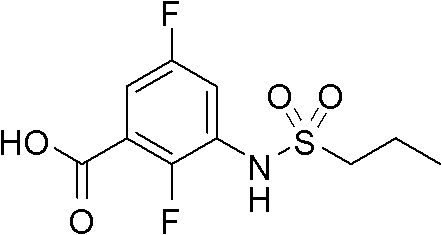
2,5-二氟-3-丙基磺酰胺基苯甲酸2,5-Difluoro-3-propylsulfonamidobenzoic acid
步骤A:将2,5-二氟苯甲酸(2.01g,9.90mmol,产率31.3%)溶于浓硫酸(25mL)中并且冷却至0℃。添加硝酸(1.46mL,34.8mmol),并且将反应混合物在室温下搅拌1小时。将溶液用DCM(3X)萃取,并且将合并的有机层经硫酸钠干燥并且浓缩。通过柱色谱法(1∶1己烷∶1%HCOOH/EtOAc)将残留物纯化,得到为固体的2,5-二氟-3-硝基苯甲酸(2.01g,31.3%)。Step A: 2,5-Difluorobenzoic acid (2.01 g, 9.90 mmol, 31.3% yield) was dissolved in concentrated sulfuric acid (25 mL) and cooled to 0°C. Nitric acid (1.46 mL, 34.8 mmol) was added, and the reaction mixture was stirred at room temperature for 1 hour. The solution was extracted with DCM (3X), and the combined organic layers were dried over sodium sulfate and concentrated. The residue was purified by column chromatography (1:1 hexanes:1% HCOOH/EtOAc) to give 2,5-difluoro-3-nitrobenzoic acid (2.01 g, 31.3%) as a solid.
步骤B:将2,5-二氟-3-硝基苯甲酸(2.00g,9.847mmol)溶于MeOH(60mL)中。添加TMSCl(6.220mL,49.24mmol),并且将反应混合物搅拌回流4小时。将反应混合物浓缩至约20mL,并且将产生的晶体过滤并高真空干燥,提供为结晶固体的2,5-二氟-3-硝基苯甲酸甲酯(1.55g,72.4%)。Step B: 2,5-Difluoro-3-nitrobenzoic acid (2.00 g, 9.847 mmol) was dissolved in MeOH (60 mL). TMSCl (6.220 mL, 49.24 mmol) was added, and the reaction mixture was stirred at reflux for 4 hours. The reaction mixture was concentrated to about 20 mL, and the resulting crystals were filtered and dried under high vacuum to provide methyl 2,5-difluoro-3-nitrobenzoate (1.55 g, 72.4%) as a crystalline solid.
步骤C:根据中间体实施例A步骤B的一般程序,用2,5-二氟-3-硝基苯甲酸甲酯代替2,6-二氟-3-硝基苯甲酸甲酯,制备3-氨基-2,5-二氟苯甲酸甲酯(96.5%)。Step C: Following the general procedure of Intermediate Example A, Step B, substituting methyl 2,5-difluoro-3-nitrobenzoate for methyl 2,6-difluoro-3-nitrobenzoate, 3 was prepared -Methyl amino-2,5-difluorobenzoate (96.5%).
步骤D:根据中间体实施例A步骤C的一般程序,用3-氨基-2,5-二氟苯甲酸甲酯代替3-氨基-2,6-二氟苯甲酸甲酯,制备2,5-二氟-3-(N-(丙基磺酰基)丙基磺酰胺基)苯甲酸甲酯。Step D: According to the general procedure of Intermediate Example A Step C, substituting 3-amino-2,5-difluorobenzoic acid methyl ester for 3-amino-2,6-difluorobenzoic acid methyl ester, 2,5 - methyl difluoro-3-(N-(propylsulfonyl)propylsulfonamido)benzoate.
步骤E:根据中间体实施例B的一般程序,用2,5-二氟-3-(N-(丙基磺酰基)丙基磺酰胺基)苯甲酸甲酯代替2,6-二氟-3-(N-(丙基磺酰基)丙基磺酰胺基)苯甲酸甲酯,制备2,5-二氟-3-丙基磺酰胺基苯甲酸(83.8%,2步)。1H NMR(400MHz,(CD3)2SO)δ13.67(br s,1H),10.07(s,1H),7.46-7.50(m,1H),7.38-7.42(m,1H),3.17-3.21(m,2H),1.70-1.76(m,2H),0.95-0.99(m,3H);m/z(APCI-neg)M-1=278.1。Step E: Following the general procedure of Intermediate Example B, substituting methyl 2,5-difluoro-3-(N-(propylsulfonyl)propylsulfonamido)benzoate for 2,6-difluoro- Methyl 3-(N-(propylsulfonyl)propylsulfonamido)benzoate, preparation of 2,5-difluoro-3-propylsulfonamidobenzoic acid (83.8%, 2 steps). 1 H NMR (400MHz, (CD 3 ) 2 SO) δ13.67(br s, 1H), 10.07(s, 1H), 7.46-7.50(m, 1H), 7.38-7.42(m, 1H), 3.17- 3.21 (m, 2H), 1.70-1.76 (m, 2H), 0.95-0.99 (m, 3H); m/z (APCI-neg) M-1 = 278.1.
中间体实施例WIntermediate Example W

2,6-二氟-3-(2,2,2-三氟乙基磺酰胺基)苯甲酸2,6-Difluoro-3-(2,2,2-trifluoroethylsulfonamido)benzoic acid
步骤A:向3-氨基-2,6-二氟苯甲酸甲酯(311g,1.66mmol)和吡啶(0.806mL,9.97mmol)的二氯甲烷(8.92mL,139mmol)溶液中缓慢加入2,2,2-三氟乙基-磺酰氯(459mL,4.15mmol),同时施加使用丙酮干冰浴的外部冷却。将反应混合物搅拌45分钟,并且除去干冰浴。使反应混合物再保持搅拌1小时。将混合物用EtOAc(100mL)稀释,用水(2X25mL)和盐水(25mL)洗涤,干燥(Na2SO4),过滤并随后浓缩成油。通过柱色谱法,用15%EtOAc/己烷洗脱将粗产物纯化,以得到为固体的2,6-二氟-3-(2-三氟乙基磺酰胺基)苯甲酸甲酯(513mg,产率92.6%)。1H NMR(400MHz,(CD3)2SO)δ8.10-8.01(m,1H),7.48(t,1H),4.68(s,2H),4.58(s,2H),3.98(s,3H)。Step A: To a solution of methyl 3-amino-2,6-difluorobenzoate (311 g, 1.66 mmol) and pyridine (0.806 mL, 9.97 mmol) in dichloromethane (8.92 mL, 139 mmol) was slowly added 2,2 , 2-trifluoroethyl-sulfonyl chloride (459 mL, 4.15 mmol) while applying external cooling using an acetone dry ice bath. The reaction mixture was stirred for 45 minutes, and the dry ice bath was removed. The reaction mixture was kept stirring for another 1 hour. The mixture was diluted with EtOAc (100 mL), washed with water (2×25 mL) and brine (25 mL), dried (Na 2 SO 4 ), filtered and then concentrated to an oil. The crude product was purified by column chromatography eluting with 15% EtOAc/hexanes to give methyl 2,6-difluoro-3-(2-trifluoroethylsulfonamido)benzoate (513 mg , yield 92.6%). 1 H NMR (400MHz, (CD 3 ) 2 SO) δ8.10-8.01(m, 1H), 7.48(t, 1H), 4.68(s, 2H), 4.58(s, 2H), 3.98(s, 3H ).
步骤B:根据中间体实施例B的一般程序,用2,6-二氟-3-(2-三氟乙基磺酰胺基)苯甲酸甲酯代替2,6-二氟-3-(N-(丙基磺酰基)-丙基磺酰胺基)苯甲酸甲酯,制备2,6-二氟-3-(2-三氟乙基磺酰胺基)苯甲酸。1H NMR(500MHz,(CD3)2SO)δ14.08(br s,1H),9.75(s,1H),7.58-7.52(m,1H),7.25(t,1H),3.15-3.11(s,2H)。Step B: Following the general procedure of Intermediate Example B, substituting methyl 2,6-difluoro-3-(2-trifluoroethylsulfonamido)benzoate for 2,6-difluoro-3-(N -(Propylsulfonyl)-propylsulfonylamido)benzoic acid methyl ester, preparation of 2,6-difluoro-3-(2-trifluoroethylsulfonamido)benzoic acid. 1 H NMR (500MHz, (CD 3 ) 2 SO) δ14.08(br s, 1H), 9.75(s, 1H), 7.58-7.52(m, 1H), 7.25(t, 1H), 3.15-3.11( s, 2H).
中间体实施例XIntermediate Example X

2,6-二氟-3-(3,3,3-三氟丙基磺酰胺基)苯甲酸2,6-Difluoro-3-(3,3,3-trifluoropropylsulfonamido)benzoic acid
步骤A:根据中间体实施例A的一般程序,用3,3,3-三氟丙基磺酰氯代替丙烷-1-磺酰氯,制备2,6-二氟-3-(N-(3,3,3-三氟丙基磺酰基)-3,3,3-三氟丙基-磺酰胺基)苯甲酸甲酯。1H NMR(400MHz,(CD3)2SO)δ8.05-7.99(m,1H),7.44(t,1H),4.62(t,2H),4.50(t,2H),3.93(s,3H),3.89-3.74(m,4H),2.26-2.11(m,4H)。Step A: 2,6-Difluoro-3-(N-(3, 3,3-trifluoropropylsulfonyl)-3,3,3-trifluoropropyl-sulfonamido)benzoic acid methyl ester. 1 H NMR (400MHz, (CD 3 ) 2 SO) δ8.05-7.99(m, 1H), 7.44(t, 1H), 4.62(t, 2H), 4.50(t, 2H), 3.93(s, 3H ), 3.89-3.74 (m, 4H), 2.26-2.11 (m, 4H).
步骤B:根据中间体实施例B的一般程序,用2,6-二氟-3-(N-(3,3,3-三氟丙基磺酰基)-3,3,3-三氟丙基磺酰胺基)苯甲酸甲酯代替2,6-二氟-3-(N-(丙基磺酰基)-丙基磺酰胺基)苯甲酸甲酯,制备2,6-二氟-3-(3,3,3-三氟丙基磺酰胺基)苯甲酸。1H NMR(500MHz,(CD3)2SO)δ14.05(br s,1H),9.71(s,1H),7.56-7.50(m,1H),7.20(t,1H),3.12-3.08(m,2H),1.73-1.66(m,2H)。Step B: According to the general procedure of Intermediate Example B, 2,6-difluoro-3-(N-(3,3,3-trifluoropropylsulfonyl)-3,3,3-trifluoropropane 2,6-difluoro-3-(N-(propylsulfonyl)-propylsulfonylamido)methyl benzoate was replaced by methyl benzoate to prepare 2,6-difluoro-3- (3,3,3-Trifluoropropylsulfonamido)benzoic acid. 1 H NMR (500MHz, (CD 3 ) 2 SO) δ14.05(br s, 1H), 9.71(s, 1H), 7.56-7.50(m, 1H), 7.20(t, 1H), 3.12-3.08( m, 2H), 1.73-1.66 (m, 2H).
中间体实施例YIntermediate Example Y
2,6-二氟-3-(2-氯甲基磺酰胺基)苯甲酸2,6-Difluoro-3-(2-chloromethylsulfonamido)benzoic acid
步骤A:根据中间体实施例A的一般程序,用2-氯甲基磺酰氯代替丙烷-1-磺酰氯,制备2,6-二氟-3-(N-(2-氯甲基磺酰基)-2-氯甲基-磺酰胺基)苯甲酸甲酯。1H NMR(400MHz,(CD3)2SO)δ8.08-7.97(m,1H),7.45(t,1H),4.65(s,2H),4.55(s,2H),4.02(s,3H)。Step A: 2,6-Difluoro-3-(N-(2-chloromethylsulfonyl) was prepared according to the general procedure of Intermediate Example A substituting 2-chloromethylsulfonyl chloride for propane-1-sulfonyl )-methyl 2-chloromethyl-sulfonamido)benzoate. 1 H NMR (400MHz, (CD 3 ) 2 SO) δ8.08-7.97(m, 1H), 7.45(t, 1H), 4.65(s, 2H), 4.55(s, 2H), 4.02(s, 3H ).
步骤B:根据中间体实施例B的一般程序,用2,6-二氟-3-(N-(2-氯甲基磺酰基)-2-氯甲基磺酰胺基)苯甲酸甲酯代替2,6-二氟-3-(N-(丙基磺酰基)-丙基磺酰胺基)苯甲酸甲酯,制备2,6-二氟-3-(2-氯甲基磺酰胺基)苯甲酸。1HNMR(500MHz,(CD3)2SO)δ14.10(br s,1H),9.78(s,1H),7.62-7.56(m,1H),7.28(t,1H),3.19-3.15(s,2H)。Step B: Following the general procedure of Intermediate Example B, substituting methyl 2,6-difluoro-3-(N-(2-chloromethylsulfonyl)-2-chloromethylsulfonylamido)benzoate 2,6-Difluoro-3-(N-(propylsulfonyl)-propylsulfonylamido)methyl benzoate, preparation of 2,6-difluoro-3-(2-chloromethylsulfonylamido) benzoic acid. 1 HNMR (500MHz, (CD 3 ) 2 SO) δ14.10(br s, 1H), 9.78(s, 1H), 7.62-7.56(m, 1H), 7.28(t, 1H), 3.19-3.15(s , 2H).
中间体实施例ZIntermediate Example Z

2-氯代-6-氟代-3-(N-(丙基磺酰基)丙基磺酰胺基)苯甲酸苄酯Benzyl 2-chloro-6-fluoro-3-(N-(propylsulfonyl)propylsulfonylamido)benzoate
步骤A:根据中间体实施例J的一般程序,用2-氯代-4-氟苯胺代替4-氯代-2-氟苯胺,制备3-氨基-2-氯代-6-氟苯甲酸苄酯(56%)。1H NMR(400MHz,d6-DMSO)δ7.48-7.32(m,5H),7.11-7.05(t,1H),6.94-6.89(q,1H),5.53-5.49(s,2H),5.41-5.39(s,2H)。Step A: Preparation of benzyl 3-amino-2-chloro-6-fluorobenzoate according to the general procedure of Intermediate Example J, substituting 2-chloro-4-fluoroaniline for 4-chloro-2-fluoroaniline Esters (56%). 1 H NMR (400MHz, d 6 -DMSO) δ7.48-7.32(m, 5H), 7.11-7.05(t, 1H), 6.94-6.89(q, 1H), 5.53-5.49(s, 2H), 5.41 -5.39 (s, 2H).
步骤B:将3-氨基-2-氯代-6-氟苯甲酸苄酯溶于无水二氯甲烷(11.8mL)中。添加三乙胺(0.494mL,3.54mmol),并且将混合物激冷至0℃。随后经由注射器添加丙烷-1-磺酰氯(0.332mL,2.95mmol)。一旦完成添加,就使混合物升温至环境温度并且搅拌16小时。将混合物用二氯甲烷(11mL)稀释并且用水(2X50mL)和盐水(25mL)洗涤,经硫酸钠干燥并且浓缩。将所得残留物直接装入硅胶柱并且用乙酸乙酯-己烷的梯度(5%至40%)洗脱,以提供2-氯代-6-氟代-3-(N-(丙基磺酰基)丙基磺酰胺基)苯甲酸苄酯(413mg,0.840mmol,产率71.1%)。1H NMR(400MHz,(CD3)2SO)δ8.00-7.94(q,1H),7.59-7.52(t,1H),7.50-7.35(m,5H),5.48-5.44(s,2H),3.80-3.60(m,4H),1.89-1.75(m,4H),1.05-0.98(t,6H)。Step B: Benzyl 3-amino-2-chloro-6-fluorobenzoate was dissolved in anhydrous dichloromethane (11.8 mL). Triethylamine (0.494 mL, 3.54 mmol) was added, and the mixture was quenched to 0 °C. Propane-1-sulfonyl chloride (0.332 mL, 2.95 mmol) was then added via syringe. Once the addition was complete, the mixture was allowed to warm to ambient temperature and stirred for 16 hours. The mixture was diluted with dichloromethane (11 mL) and washed with water (2×50 mL) and brine (25 mL), dried over sodium sulfate and concentrated. The resulting residue was directly loaded onto a silica gel column and eluted with a gradient of ethyl acetate-hexane (5% to 40%) to afford 2-chloro-6-fluoro-3-(N-(propylsulfonyl Acyl)propylsulfonamido)benzoate (413 mg, 0.840 mmol, 71.1% yield). 1 H NMR (400MHz, (CD 3 ) 2 SO) δ8.00-7.94(q, 1H), 7.59-7.52(t, 1H), 7.50-7.35(m, 5H), 5.48-5.44(s, 2H) , 3.80-3.60 (m, 4H), 1.89-1.75 (m, 4H), 1.05-0.98 (t, 6H).
中间体实施例ABIntermediate Example AB

2-氯代-6-氟代-3-丙基磺酰胺基苯甲酸2-Chloro-6-fluoro-3-propylsulfonamidobenzoic acid
步骤A:将2-氯代-6-氟代-3-(N-(丙基磺酰基)丙基磺酰胺基)苯甲酸苄酯(413.2mg,0.840mmol)溶于THF(8.4mL)和2.0M LiOH水溶液(1.26mL)中。将混合物回流16小时并随后使其冷却至环境温度。将混合物用1.0M HCl(5.0mL)酸化至pH值为0,并随后使用饱和碳酸氢钠调节至pH值为4。将混合物用EtOAc(2X)萃取。将萃取液用水(2X)和盐水(1X)洗涤,经硫酸钠干燥并且浓缩以得到2-氯代-6-氟代-3-丙基磺酰胺基苯甲酸苄酯(174.5mg,0.452mmol,产率53.9%)。MS(APCI-neg)m/z=384.1(M-H)。Step A: Benzyl 2-chloro-6-fluoro-3-(N-(propylsulfonyl)propylsulfonamido)benzoate (413.2 mg, 0.840 mmol) was dissolved in THF (8.4 mL) and 2.0M LiOH aqueous solution (1.26mL). The mixture was refluxed for 16 hours and then allowed to cool to ambient temperature. The mixture was acidified with 1.0M HCl (5.0 mL) to pH 0 and then adjusted to pH 4 using saturated sodium bicarbonate. The mixture was extracted with EtOAc (2X). The extract was washed with water (2X) and brine (1X), dried over sodium sulfate and concentrated to give benzyl 2-chloro-6-fluoro-3-propylsulfonamidobenzoate (174.5 mg, 0.452 mmol, Yield 53.9%). MS (APCI-neg) m/z = 384.1 (M-H).
步骤B:将2-氯代-6-氟代-3-丙基磺酰胺基苯甲酸苄酯(174.5mg,0.4523mmol)溶于3∶1二噁烷∶水(7.5mL)中,并且用氢氧化钡(100.7mg,0.5879mmol)处理。将反应混合物加热至80℃进行16小时,并随后使其冷却至环境温度。将混合物用浓HCl酸化至pH值为0。使反应混合物搅拌10分钟,之后使用饱和碳酸氢钠将pH值调节至pH值为4。将混合物用EtOAc(2X)萃取。将萃取液用水(2X)和盐水(1X)洗涤,经硫酸钠干燥并且浓缩以得到2-氯代-6-氟代-3-丙基磺酰胺基苯甲酸(75.7mg,0.256mmol,产率56.6%)。MS(APCI-neg)m/z=293.9(M-H)。Step B: Benzyl 2-chloro-6-fluoro-3-propylsulfonamidobenzoate (174.5 mg, 0.4523 mmol) was dissolved in 3:1 dioxane:water (7.5 mL) and washed with Treated with barium hydroxide (100.7 mg, 0.5879 mmol). The reaction mixture was heated to 80 °C for 16 hours and then allowed to cool to ambient temperature. The mixture was acidified to pH 0 with concentrated HCl. The reaction mixture was allowed to stir for 10 minutes before the pH was adjusted to pH 4 using saturated sodium bicarbonate. The mixture was extracted with EtOAc (2X). The extract was washed with water (2X) and brine (1X), dried over sodium sulfate and concentrated to give 2-chloro-6-fluoro-3-propylsulfonamidobenzoic acid (75.7 mg, 0.256 mmol, yield 56.6%). MS (APCI-neg) m/z = 293.9 (M-H).
中间体实施例ACIntermediate Examples AC

2,6-二氯-3-丙基磺酰胺基苯甲酸2,6-Dichloro-3-propylsulfonamidobenzoic acid
步骤A:将2,6-二氯-3-硝基苯甲酸(2.13g,9.03mmol)溶于THF∶饱和NH4Cl水溶液,并且冷却至0℃。将混合物用锌(11.8g,181mmol)处理。使反应混合物升温至并且搅拌24小时。将反应混合物由GF/F纸过滤,同时用THF冲洗。将混合物使用1.0M HCl酸化至pH值为1,并且用15%2-丙醇∶DCM(3X)萃取。将萃取液用水和盐水洗涤,经硫酸钠干燥并且浓缩以得到3-氨基-2,6-二氯苯甲酸(1.40g,6.82mmol,产率75.5%)。MS(APCI-neg)m/z=203.6(M-H)。Step A: 2,6-Dichloro-3-nitrobenzoic acid (2.13 g, 9.03 mmol) was dissolved in THF:saturated aqueous NH4Cl and cooled to 0 °C. The mixture was treated with zinc (11.8 g, 181 mmol). The reaction mixture was allowed to warm to and stirred for 24 hours. The reaction mixture was filtered through GF/F paper while rinsing with THF. The mixture was acidified to pH 1 using 1.0M HCl and extracted with 15% 2-propanol:DCM (3X). The extract was washed with water and brine, dried over sodium sulfate and concentrated to give 3-amino-2,6-dichlorobenzoic acid (1.40 g, 6.82 mmol, 75.5% yield). MS (APCI-neg) m/z = 203.6 (MH).
步骤B:将3-氨基-2,6-二氯苯甲酸(1.40g,6.82mmol)溶于无水二氯甲烷(66.7mL)中。添加三乙胺(4.09mL,29.4mmol),并且将混合物激冷至0℃。随后经由注射器添加丙烷-1-磺酰氯(2.48mL,22mmol)。一旦完成添加,就使混合物升温至环境温度并且搅拌1小时。将混合物真空浓缩并用乙醚稀释。将混合物用0.25M NaOH(80mL)洗涤,并且将水层使用1.0M HCl酸化至pH值为1。用15%2-丙醇∶DCM(2X300mL)萃取水层。将有机层收集,经硫酸钠干燥并且浓缩以得到2,6-二氯-3-丙基磺酰胺基苯甲酸(1.55g,4.96mmol,产率74.4%)。1H NMR(400MHz,(CD3)2SO)δ9.77-9.75(s,1H),7.84-7.80(d,1H),7.71-7.68(d,1H),3.82-3.72(m,2H),1.89-1.70(m,2H),1.05-1.03(m,3H)。Step B: 3-Amino-2,6-dichlorobenzoic acid (1.40 g, 6.82 mmol) was dissolved in anhydrous dichloromethane (66.7 mL). Triethylamine (4.09 mL, 29.4 mmol) was added, and the mixture was quenched to 0 °C. Propane-1-sulfonyl chloride (2.48 mL, 22 mmol) was then added via syringe. Once the addition was complete, the mixture was allowed to warm to ambient temperature and stirred for 1 hour. The mixture was concentrated in vacuo and diluted with ether. The mixture was washed with 0.25M NaOH (80 mL), and the aqueous layer was acidified to pH 1 using 1.0M HCl. The aqueous layer was extracted with 15% 2-propanol:DCM (2X300 mL). The organic layers were collected, dried over sodium sulfate and concentrated to give 2,6-dichloro-3-propylsulfonamidobenzoic acid (1.55 g, 4.96 mmol, 74.4% yield). 1 H NMR (400MHz, (CD 3 ) 2 SO) δ9.77-9.75(s, 1H), 7.84-7.80(d, 1H), 7.71-7.68(d, 1H), 3.82-3.72(m, 2H) , 1.89-1.70 (m, 2H), 1.05-1.03 (m, 3H).
中间体实施例ADIntermediate Examples AD

3-(N-乙基-N-甲基氨磺酰基氨基)-2,6-二氟苯甲酸3-(N-Ethyl-N-methylsulfamoylamino)-2,6-difluorobenzoic acid
步骤A:在-78℃下,向DCM(3mL)中的磺酰二氯(0.156mL,1.85mmol)中逐滴滴加三乙胺(0.260mL,1.85mmol)和3-氨基-2,6-二氟苯甲酸甲酯(0.257mL,1.85mmol)的溶液。2小时后,添加N-甲基乙胺(0.304mL,3.70mmol),并且使反应混合物升温至室温过夜。将溶剂减压浓缩,并且将残留物溶于NaOH(2mL,1M)中并且用EtOAc洗涤。使水溶液pH值降低到3以下,并且将混合物用EtOAc(3X5mL)萃取。将合并的有机层经硫酸钠干燥,倾析并且减压浓缩。由硅胶色谱法,用7∶3己烷∶EtOAc洗脱将残留物纯化,以得到3-(N-乙基-N-甲基氨磺酰基氨基)-2,6-二氟苯甲酸甲酯(0.280g,产率49.0%)。Step A: To sulfonyl dichloride (0.156 mL, 1.85 mmol) in DCM (3 mL) was added triethylamine (0.260 mL, 1.85 mmol) and 3-amino-2,6 dropwise at -78 °C - A solution of methyl difluorobenzoate (0.257 mL, 1.85 mmol). After 2 hours, N-methylethylamine (0.304 mL, 3.70 mmol) was added, and the reaction mixture was allowed to warm to room temperature overnight. The solvent was concentrated under reduced pressure, and the residue was dissolved in NaOH (2 mL, 1M) and washed with EtOAc. The aqueous pH was lowered below 3, and the mixture was extracted with EtOAc (3×5 mL). The combined organic layers were dried over sodium sulfate, decanted and concentrated under reduced pressure. The residue was purified by silica gel chromatography eluting with 7:3 hexanes:EtOAc to give methyl 3-(N-ethyl-N-methylsulfamoylamino)-2,6-difluorobenzoate (0.280 g, 49.0% yield).
步骤B:向THF∶MeOH(3∶2;5mL)中的3-(N-乙基-N-甲基氨磺酰基氨基)-2,6-二氟苯甲酸甲酯中加入NaOH(0.908mL,1.82mmol)。使混合物升温至60℃16小时。将冷却的混合物减压浓缩,并且将残留物溶于1M NaOH(4mL)中并且用EtOAc洗涤。使水溶液pH值降低到3以下,并且将混合物用EtOAc(3X6mL)萃取,以提供3-(N-乙基-N-甲基氨磺酰基氨基)-2,6-二氟苯甲酸(222mg,产率83%)。Step B: To methyl 3-(N-ethyl-N-methylsulfamoylamino)-2,6-difluorobenzoate in THF:MeOH (3:2; 5 mL) was added NaOH (0.908 mL , 1.82 mmol). The mixture was allowed to warm to 60°C for 16 hours. The cooled mixture was concentrated under reduced pressure, and the residue was dissolved in 1M NaOH (4 mL) and washed with EtOAc. The aqueous pH was lowered below 3, and the mixture was extracted with EtOAc (3×6 mL) to provide 3-(N-ethyl-N-methylsulfamoylamino)-2,6-difluorobenzoic acid (222 mg, Yield 83%).
实施例1Example 1

2,6-二氟-N-(2-甲氧基吡唑并[1,5-a]嘧啶-6-基)-3-丙基磺酰胺基苯甲酰胺2,6-Difluoro-N-(2-methoxypyrazolo[1,5-a]pyrimidin-6-yl)-3-propylsulfonamidobenzamide
步骤A:在室温下,将3-甲氧基-1H-吡唑-5-胺(0.21g,1.89mmol,如JP01013072所述来制备)和硝基丙二醛钠一水合物(0.31g,1.98mmol)的乙酸(6mL)混悬液搅拌1小时。将反应混合物用水(100mL)稀释并且将所得固体(0.198g,0.102mmol,产率54%)通过过滤收集,并且真空干燥以提供2-甲氧基-6-硝基吡唑并[1,5-a]嘧啶。1H NMR(400MHz,(CD3)2SO)δ10.06(d,J=2.4Hz,1H),9.13(d,J=2.4Hz,1H),6.54(s,1H),4.04(s,3H);m/z(APCI-nega)M-1=193.8。Step A: 3-Methoxy-1H-pyrazol-5-amine (0.21 g, 1.89 mmol, prepared as described in JP01013072) and sodium nitromalondialdehyde monohydrate (0.31 g, 1.98 mmol) in acetic acid (6 mL) was stirred for 1 h. The reaction mixture was diluted with water (100 mL) and the resulting solid (0.198 g, 0.102 mmol, 54% yield) was collected by filtration and dried in vacuo to afford 2-methoxy-6-nitropyrazolo[1,5 - a] pyrimidine. 1 H NMR (400MHz, (CD 3 ) 2 SO) δ10.06(d, J=2.4Hz, 1H), 9.13(d, J=2.4Hz, 1H), 6.54(s, 1H), 4.04(s, 3H); m/z (APCI-nega) M-1 = 193.8.
步骤B:向2-甲氧基-6-硝基吡唑并[1,5-a]嘧啶(0.198g,1.02mmol)的乙酸乙酯/MeOH混合物(1∶1,20mL)溶液中加入10%wt Pd/C(0.109g,0.102mmol)。将反应混合物用N2充气10分钟,并随后施加H2气球压2小时。通过过滤除去Pd/C,并且浓缩滤液。通过快速色谱法,用己烷/乙酸乙酯(1∶4)洗脱将粗产物纯化,以得到为固体的2-甲氧基吡唑并[1,5-a]嘧啶-6-胺(0.037g,0.022mmol,产率22%)。1H NMR(400MHz,CD3OD)δ8.17(s,1H),8.08(s,1H),5.87(s,1H),3.93(s,3H);m/z(APCI-pos)M+1=165.1。Step B: 10 % wt Pd/C (0.109 g, 0.102 mmol). The reaction mixture was gassed with N2 for 10 min, and then H2 balloon pressure was applied for 2 h. Pd/C was removed by filtration, and the filtrate was concentrated. The crude product was purified by flash chromatography eluting with hexane/ethyl acetate (1:4) to afford 2-methoxypyrazolo[1,5-a]pyrimidin-6-amine as a solid ( 0.037g, 0.022mmol, 22% yield). 1 H NMR (400MHz, CD 3 OD) δ8.17(s, 1H), 8.08(s, 1H), 5.87(s, 1H), 3.93(s, 3H); m/z(APCI-pos)M+ 1 = 165.1.
步骤C:在环境温度下,将2-甲氧基吡唑并[1,5-a]嘧啶-6-胺(37mg,0.225mmol)溶于DMF(5mL)中并且依次用2,6-二氟-3-丙基磺酰胺基苯甲酸(66mg,0.237mmo1)、无水1-乙基-(3-二甲基氨基丙基)碳二亚胺盐酸盐(67mg,0.24mmol)和1-羟基苯并三唑(9mg,0.068mmol)处理。16小时后,将反应混合物用EtOAc稀释并且用水(4X)、碳酸氢钠(2X)、盐水(1x)洗涤,经硫酸钠干燥并且浓缩。用己烷/乙酸乙酯(2∶1)洗脱的硅胶色谱法得到为固体的2,6-二氟-N-(2-甲氧基吡唑并[1,5-a]嘧啶-6-基)-3-丙基磺酰胺基苯甲酰胺(50mg,0.118mmol,产率52%)。H NMR(400MHz,CD3OD)δ9.43(s,1H),8.44(s,1H),7.66(m,1H),7.15(m,1H),6.07(s,1H),4.01(s,3H),3.12(m,2H),1.87(m,2H),1.06(t,J=8.0Hz,3H);m/z(APCI-nega)M-1=424.0。Step C: 2-Methoxypyrazolo[1,5-a]pyrimidin-6-amine (37 mg, 0.225 mmol) was dissolved in DMF (5 mL) at ambient temperature and washed sequentially with 2,6-di Fluoro-3-propylsulfonamidobenzoic acid (66mg, 0.237mmol), anhydrous 1-ethyl-(3-dimethylaminopropyl) carbodiimide hydrochloride (67mg, 0.24mmol) and 1 -Hydroxybenzotriazole (9mg, 0.068mmol) treatment. After 16 hours, the reaction mixture was diluted with EtOAc and washed with water (4X), sodium bicarbonate (2X), brine (1x), dried over sodium sulfate and concentrated. Silica gel chromatography eluting with hexane/ethyl acetate (2:1) afforded 2,6-difluoro-N-(2-methoxypyrazolo[1,5-a]pyrimidine-6 as a solid -yl)-3-Propylsulfonamidobenzamide (50 mg, 0.118 mmol, 52% yield). H NMR (400MHz, CD 3 OD) δ9.43(s, 1H), 8.44(s, 1H), 7.66(m, 1H), 7.15(m, 1H), 6.07(s, 1H), 4.01(s, 3H), 3.12 (m, 2H), 1.87 (m, 2H), 1.06 (t, J = 8.0 Hz, 3H); m/z (APCI-nega) M-1 = 424.0.
实施例2Example 2
2,6-二氟-N-(2-异丙氧基吡唑并[1,5-a]嘧啶-6-基)-3-丙基磺酰胺基苯甲酰2,6-Difluoro-N-(2-isopropoxypyrazolo[1,5-a]pyrimidin-6-yl)-3-propylsulfonamidobenzoyl 胺amine
步骤A:将2-氰基乙酰肼(1.00g,10.09mmol)、i-PrOH(10mL)和甲磺酸(1.37mL,21.2mmol)的混合物加热至82℃进行40小时。随后,将混合物在2N NaOH(50mL)和DCM(200mL)之间分配。将有机层干燥(Na2SO4),过滤并且浓缩以得到为固体的3-异丙氧基-1H-吡唑-5-胺(80mg,产率6%)。Step A: A mixture of 2-cyanoacetylhydrazide (1.00 g, 10.09 mmol), i-PrOH (10 mL) and methanesulfonic acid (1.37 mL, 21.2 mmol) was heated to 82 °C for 40 hours. Then, the mixture was partitioned between 2N NaOH (50 mL) and DCM (200 mL). The organic layer was dried (Na 2 SO 4 ), filtered and concentrated to give 3-isopropoxy-1H-pyrazol-5-amine (80 mg, 6% yield) as a solid.
步骤B:根据实施例1步骤A的一般程序,用3-异丙氧基-1H-吡唑-5-胺代替3-甲氧基-1H-吡唑-5-胺,制备2-异丙氧基-6-硝基吡唑并[1,5-a]嘧啶(0.170g,产率93%)。Step B: Following the general procedure of Example 1, Step A, substituting 3-methoxy-1H-pyrazol-5-amine for 3-methoxy-1H-pyrazol-5-amine, 2-isopropanol was prepared Oxy-6-nitropyrazolo[1,5-a]pyrimidine (0.170 g, 93% yield).
步骤C:根据实施例1步骤B的一般程序,用2-异丙氧基-6-硝基吡唑并[1,5-a]嘧啶代替2-甲氧基-6-硝基吡唑并[1,5-a]嘧啶,制备2-异丙氧基吡唑并[1,5-a]嘧啶-6-胺(46mg,产率31%)。Step C: Following the general procedure of Example 1 Step B, substituting 2-isopropoxy-6-nitropyrazolo[1,5-a]pyrimidine for 2-methoxy-6-nitropyrazolo [1,5-a]pyrimidine, preparation of 2-isopropoxypyrazolo[1,5-a]pyrimidin-6-amine (46 mg, 31% yield).
步骤D:根据实施例1步骤C的一般程序,用2-异丙氧基吡唑并[1,5-a]嘧啶-6-胺代替2-甲氧基吡唑并[1,5-a]嘧啶-6-胺,制备2,6-二氟-N-(2-异丙氧基吡唑并[1,5-a]嘧啶-6-基)-3-丙基磺酰胺基苯甲酰胺(68mg,产率68%)。1HNMR(400MHz,CD3OD)δ9.58(s,1H),8.48(s,1H),7.69(m,1H),7.15(m,1H),6.54(s,1H),3.14(m,3H),1.86(m,2H),1.37(d,J=7.2Hz,6H),1.06(t,J=7.4Hz,3H);m/z(APCI-nega)M-1=452.2。Step D: Following the general procedure of Example 1, Step C, substituting 2-isopropoxypyrazolo[1,5-a]pyrimidin-6-amine for 2-methoxypyrazolo[1,5-a ]pyrimidin-6-amine, preparation of 2,6-difluoro-N-(2-isopropoxypyrazolo[1,5-a]pyrimidin-6-yl)-3-propylsulfonamidobenzyl Amide (68 mg, 68% yield). 1 HNMR (400MHz, CD 3 OD) δ9.58(s, 1H), 8.48(s, 1H), 7.69(m, 1H), 7.15(m, 1H), 6.54(s, 1H), 3.14(m, 3H), 1.86(m, 2H), 1.37(d, J=7.2Hz, 6H), 1.06(t, J=7.4Hz, 3H); m/z (APCI-nega) M-1=452.2.
实施例3Example 3

N-(2-乙氧基吡唑并[1,5-a]嘧啶-6-基)-2,6-二氟-3-丙基磺酰胺基苯甲酰胺N-(2-ethoxypyrazolo[1,5-a]pyrimidin-6-yl)-2,6-difluoro-3-propylsulfonamidobenzamide
步骤A:将丙二腈(10.0g,151mmol)、乙醇(6.97g,151mmol)和乙醚(120mL)的溶液冷却至0℃,并经由加料漏斗迅速添加乙醚中的2.0MHCl(98.4mL,197mmol)。将反应混合物在室温下搅拌16小时。将固体通过过滤收集并且用乙醚(100mL)洗涤,以得到2-氰基乙亚氨酸乙酯盐酸盐(12.6g,56%)。Step A: A solution of malononitrile (10.0 g, 151 mmol), ethanol (6.97 g, 151 mmol) and diethyl ether (120 mL) was cooled to 0°C and 2.0M HCl in diethyl ether (98.4 mL, 197 mmol) was added rapidly via addition funnel . The reaction mixture was stirred at room temperature for 16 hours. The solid was collected by filtration and washed with diethyl ether (100 mL) to give ethyl 2-cyanoacetimidate hydrochloride (12.6 g, 56%).
步骤B:将2-氰基乙亚氨酸乙酯盐酸盐(12.6g,84.8mmol)和肼(3.67g,114mmol)的EtOH(50mL)溶液回流16小时。将反应混合物浓缩,并且将残留物溶于水(100mL)和乙酸乙酯(500mL)中,并且放入冰浴中。添加2NNaOH(约6mL)的溶液直到将pH值调节至约7。将固体通过过滤除去(废弃),并且将滤液转移至分液漏斗。进行分层并且将水层用乙酸乙酯(200mL)萃取。将合并的有机物干燥,过滤并且浓缩。通过快速色谱法,用己烷/乙酸乙酯(1∶1)、己烷/乙酸乙酯(1∶2)洗脱将粗产物纯化,以得到为固体的3-乙氧基-1H-吡唑-5-胺(1.15g,9.04mmol,产率11%)。m/z(APCI-pos)M+1=128.1。Step B: A solution of ethyl 2-cyanoacetimidate hydrochloride (12.6 g, 84.8 mmol) and hydrazine (3.67 g, 114 mmol) in EtOH (50 mL) was refluxed for 16 hours. The reaction mixture was concentrated, and the residue was dissolved in water (100 mL) and ethyl acetate (500 mL), and placed in an ice bath. A solution of 2N NaOH (about 6 mL) was added until the pH was adjusted to about 7. The solids were removed by filtration (discarded), and the filtrate was transferred to a separatory funnel. The layers were separated and the aqueous layer was extracted with ethyl acetate (200 mL). The combined organics were dried, filtered and concentrated. The crude product was purified by flash chromatography eluting with hexane/ethyl acetate (1:1), hexane/ethyl acetate (1:2) to give 3-ethoxy-1H-pyridine as a solid Azol-5-amine (1.15 g, 9.04 mmol, 11% yield). m/z (APCI-pos) M+1 = 128.1.
步骤C:根据实施例1步骤A的一般程序,用3-乙氧基-1H-吡唑-5-胺代替3-甲氧基-1H-吡唑-5-胺,制备2-乙氧基-6-硝基吡唑并[1,5-a]嘧啶(1.48g,产率86%)。m/z(APCI-nega)M-1=207.0。Step C: Following the general procedure of Example 1, Step A, substituting 3-methoxy-1H-pyrazol-5-amine for 3-methoxy-1H-pyrazol-5-amine, 2-ethoxy - 6-Nitropyrazolo[1,5-a]pyrimidine (1.48 g, yield 86%). m/z (APCI-nega) M-1 = 207.0.
步骤D:根据实施例1步骤B的一般程序,用2-乙氧基-6-硝基吡唑并[1,5-a]嘧啶代替2-甲氧基-6-硝基吡唑并[1,5-a]嘧啶,制备2-乙氧基吡唑并[1,5-a]嘧啶-6-胺(0.58g,产率45%)。Step D: Following the general procedure of Example 1 Step B, substituting 2-ethoxy-6-nitropyrazolo[1,5-a]pyrimidine for 2-methoxy-6-nitropyrazolo[ 1,5-a]pyrimidine, preparation of 2-ethoxypyrazolo[1,5-a]pyrimidin-6-amine (0.58 g, 45% yield).
步骤E:根据实施例1步骤C的一般程序,用2-乙氧基吡唑并[1,5-a]嘧啶-6-胺代替2-甲氧基吡唑并[1,5-a]嘧啶-6-胺,制备N-(2-乙氧基吡唑并[1,5-a]嘧啶-6-基)-2,6-二氟-3-丙基磺酰胺基苯甲酰胺(0.155g,产率22%)。1H NMR(400MHz,CD3OD)δ9.41(s,1H),8.42(s,1H),7.66(m,1H),7.13(m,1H),6.04(s,1H),4.32(m,2H),3.10(m,2H),1.86(m,2H),1.42(m,3H),1.06(t,J=7.4Hz,3H);m/z(APCI-nega)M-1=438.1。Step E: Following the general procedure of Example 1 Step C, substituting 2-ethoxypyrazolo[1,5-a]pyrimidin-6-amine for 2-methoxypyrazolo[1,5-a] Pyrimidin-6-amine, preparation of N-(2-ethoxypyrazolo[1,5-a]pyrimidin-6-yl)-2,6-difluoro-3-propylsulfonamidobenzamide ( 0.155 g, 22% yield). 1 H NMR (400MHz, CD 3 OD) δ9.41(s, 1H), 8.42(s, 1H), 7.66(m, 1H), 7.13(m, 1H), 6.04(s, 1H), 4.32(m , 2H), 3.10(m, 2H), 1.86(m, 2H), 1.42(m, 3H), 1.06(t, J=7.4Hz, 3H); m/z(APCI-nega)M-1=438.1 .
实施例4Example 4

2,6-二氟-N-(2-(哌啶-4-基)吡唑并[1,5-a]嘧啶-6-基)-3-丙基磺酰胺基苯甲2,6-Difluoro-N-(2-(piperidin-4-yl)pyrazolo[1,5-a]pyrimidin-6-yl)-3-propylsulfonamidobenzyl 酰胺Amide
步骤A:根据实施例1步骤A的一般程序,用4-(5-氨基-1H-吡唑-3-基)哌啶-1-羧酸叔丁酯代替3-甲氧基-1H-吡唑-5-胺,制备4-(6-硝基吡唑并[1,5-a]嘧啶-2-基)哌啶-1-羧酸叔丁酯(0.35g,产率99%)。m/z(APCI-nega)M-1=347.0。Step A: Following the general procedure of Example 1, Step A, substituting 4-(5-amino-1H-pyrazol-3-yl)piperidine-1-carboxylic acid tert-butyl ester for 3-methoxy-1H-pyridine Azol-5-amine, Preparation of tert-butyl 4-(6-nitropyrazolo[1,5-a]pyrimidin-2-yl)piperidine-1-carboxylate (0.35 g, 99% yield). m/z (APCI-nega) M-1 = 347.0.
步骤B:根据实施例1步骤B的一般程序,用4-(6-硝基吡唑并[1,5-a]嘧啶-2-基)哌啶-1-羧酸叔丁酯代替2-甲氧基-6-硝基吡唑并[1,5-a]嘧啶,制备4-(6-氨基吡唑并[1,5-a]嘧啶-2-基)哌啶-1-羧酸叔丁酯(0.093g,产率97%)。m/z(APCI-pos)M+1=317.8。Step B: Following the general procedure of Example 1 Step B, substituting tert-butyl 4-(6-nitropyrazolo[1,5-a]pyrimidin-2-yl)piperidine-1-carboxylate for 2- Methoxy-6-nitropyrazolo[1,5-a]pyrimidine, preparation of 4-(6-aminopyrazolo[1,5-a]pyrimidin-2-yl)piperidine-1-carboxylic acid tert-Butyl ester (0.093 g, 97% yield). m/z (APCI-pos) M+1 = 317.8.
步骤C:根据实施例1步骤C的一般程序,用4-(6-氨基吡唑并[1,5-a]嘧啶-2-基)哌啶-1-羧酸叔丁酯代替2-甲氧基吡唑并[1,5-a]嘧啶-6-胺,制备4-(6-(2,6-二氟-3-丙基磺酰胺基苯甲酰胺)吡唑并[1,5-a]嘧啶-2-基)哌啶-1-羧酸叔丁酯(0.091g,产率54%)。m/z(APCI-pos)M+1=579.8。Step C: Following the general procedure of Example 1, Step C, substituting tert-butyl 4-(6-aminopyrazolo[1,5-a]pyrimidin-2-yl)piperidine-1-carboxylate for 2-methyl Oxypyrazolo[1,5-a]pyrimidin-6-amine, preparation of 4-(6-(2,6-difluoro-3-propylsulfonamidobenzamide)pyrazolo[1,5 -a] pyrimidin-2-yl)piperidine-1-carboxylic acid tert-butyl ester (0.091 g, 54% yield). m/z (APCI-pos) M+1 = 579.8.
步骤D:向4-(6-(2,6-二氟-3-丙基磺酰胺基苯甲酰胺)吡唑并[1,5-a]嘧啶-2-基)哌啶-1-羧酸叔丁酯(0.091g,0.16mmol)的DCM(2.0mL)溶液中缓慢加入TFA(2mL)。在室温下搅拌1小时后,将反应混合物浓缩,并且将残留物溶于乙酸乙酯(100mL)和水(20mL)中。将pH值用饱和NaHCO3调节至约7,并且将水层用乙酸乙酯(50mLX3)萃取。将合并的有机物干燥,过滤并且浓缩以得到为固体的2,6-二氟-N-(2-(哌啶-4-基)吡唑并[1,5-a]嘧啶-6-基)-3-丙基磺酰胺基苯甲酰胺(0.068g,0.145mmol,产率90%)。1H NMR(400MHz,CD3OD)δ9.64(s,1H),8.50(s,1H),7.68(m,1H),7.16(m,1H),6.62(s,1H),3.51(m,2H),3.22(m,3H),3.12(m,2H),2.35(m,2H),2.09(m,2H),1.87(m,2H),1.06(t,J=7.4Hz,3H);m/z(APCI-pos)M+1=479.2。Step D: To 4-(6-(2,6-difluoro-3-propylsulfonamidobenzamide)pyrazolo[1,5-a]pyrimidin-2-yl)piperidine-1-carboxy To a solution of tert-butyl acid ester (0.091 g, 0.16 mmol) in DCM (2.0 mL) was slowly added TFA (2 mL). After stirring at room temperature for 1 hour, the reaction mixture was concentrated, and the residue was dissolved in ethyl acetate (100 mL) and water (20 mL). The pH was adjusted to about 7 with saturated NaHCO 3 , and the aqueous layer was extracted with ethyl acetate (50 mL×3). The combined organics were dried, filtered and concentrated to give 2,6-difluoro-N-(2-(piperidin-4-yl)pyrazolo[1,5-a]pyrimidin-6-yl) as a solid - 3-Propylsulfonamidobenzamide (0.068 g, 0.145 mmol, 90% yield). 1 H NMR (400MHz, CD 3 OD) δ9.64(s, 1H), 8.50(s, 1H), 7.68(m, 1H), 7.16(m, 1H), 6.62(s, 1H), 3.51(m , 2H), 3.22(m, 3H), 3.12(m, 2H), 2.35(m, 2H), 2.09(m, 2H), 1.87(m, 2H), 1.06(t, J=7.4Hz, 3H) ; m/z (APCI-pos) M+1 = 479.2.
实施例5Example 5
2,6-二氟-N-(2-苯基吡唑并[1,5-a]嘧啶-6-基)-3-丙基磺酰胺基苯甲酰胺2,6-Difluoro-N-(2-phenylpyrazolo[1,5-a]pyrimidin-6-yl)-3-propylsulfonamidobenzamide
步骤A:在50℃下,将3-苯基-1H-吡唑-5-胺(3.08g,19.3mmol)和硝基丙二醛钠一水合物(3.19g,20.3mmol)的乙酸(25mL)混悬液搅拌1小时。将反应混合物用水(200mL)稀释并且将所得固体(4.5g,18.7mmol,产率97%)通过过滤收集,并且真空干燥以提供6-硝基-2-苯基吡唑并[1,5-a]嘧啶。m/z(APCI-nega)M-1=239.9。Step A: 3-Phenyl-1H-pyrazol-5-amine (3.08 g, 19.3 mmol) and sodium nitromalonaldehyde monohydrate (3.19 g, 20.3 mmol) in acetic acid (25 mL) at 50 °C ) suspension was stirred for 1 hour. The reaction mixture was diluted with water (200 mL) and the resulting solid (4.5 g, 18.7 mmol, 97% yield) was collected by filtration and dried in vacuo to afford 6-nitro-2-phenylpyrazolo[1,5- a] pyrimidine. m/z (APCI-nega) M-1 = 239.9.
步骤B:根据实施例1步骤B的一般程序,用6-硝基-2-苯基吡唑并[1,5-a]嘧啶代替2-甲氧基-6-硝基吡唑并[1,5-a]嘧啶,制备2-苯基吡唑并[1,5-a]嘧啶-6-胺(4.0g,产率98%)。m/z(APCI-pos)M+1=211.2。Step B: Following the general procedure of Example 1 Step B, substituting 6-nitro-2-phenylpyrazolo[1,5-a]pyrimidine for 2-methoxy-6-nitropyrazolo[1 , 5-a]pyrimidine, to prepare 2-phenylpyrazolo[1,5-a]pyrimidin-6-amine (4.0 g, 98% yield). m/z (APCI-pos) M+1 = 211.2.
步骤C:根据实施例1步骤C的一般程序,用2-苯基吡唑并[1,5-a]嘧啶-6-胺代替2-甲氧基吡唑并[1,5-a]嘧啶-6-胺,制备2,6-二氟-N-(2-苯基吡唑并[1,5-a]嘧啶-6-基)-3-丙基磺酰胺基苯甲酰胺(0.300g,产率45%)。1H NMR(400MHz,(CD3)2SO)δ11.39(br s,1H),9.84(br s,1H),9.59(s,1H),8.59(s,1H),8.05(m,2H),7.63-7.28(m,6H),3.12(m,2H),1.78(m,2H),1.00(t,J=7.4Hz,3H);m/z(APCI-nega)M-1=470.0。Step C: Following the general procedure of Example 1 Step C, substituting 2-phenylpyrazolo[1,5-a]pyrimidin-6-amine for 2-methoxypyrazolo[1,5-a]pyrimidine -6-amine, preparation of 2,6-difluoro-N-(2-phenylpyrazolo[1,5-a]pyrimidin-6-yl)-3-propylsulfonamidobenzamide (0.300g , yield 45%). 1 H NMR (400MHz, (CD 3 ) 2 SO) δ11.39(br s, 1H), 9.84(br s, 1H), 9.59(s, 1H), 8.59(s, 1H), 8.05(m, 2H ), 7.63-7.28(m, 6H), 3.12(m, 2H), 1.78(m, 2H), 1.00(t, J=7.4Hz, 3H); m/z(APCI-nega)M-1=470.0 .
实施例6Example 6

N-(2-(4-氯苯基)吡唑并[1,5-a]嘧啶-6-基)-2,6-二氟-3-丙基磺酰胺基苯甲酰N-(2-(4-chlorophenyl)pyrazolo[1,5-a]pyrimidin-6-yl)-2,6-difluoro-3-propylsulfonamidobenzoyl 胺amine
步骤A:根据实施例5步骤A的一般程序,用3-(4-氯苯基)-1H-吡唑-5-胺代替3-苯基-1H-吡唑-5-胺,制备2-(4-氯苯基)-6-硝基吡唑并[1,5-a]嘧啶(0.174g,产率84%)。m/z(APCI-nega)M-1=273.9,275.9。Step A: 2- (4-Chlorophenyl)-6-nitropyrazolo[1,5-a]pyrimidine (0.174 g, 84% yield). m/z (APCI-nega) M-1 = 273.9, 275.9.
步骤B:向2-(4-氯苯基)-6-硝基吡唑并[1,5-a]嘧啶(0.132g,0.48mmol)的乙酸乙酯/MeOH混合物(1∶1,20mL)溶液中加入10%wt Pt/C(0.094g,0.048mmol)。将反应混合物用N2充气10分钟,并随后施加H2气球压1小时。通过过滤除去Pt/C,并且浓缩滤液。通过快速色谱法,用己烷/乙酸乙酯(1∶1)洗脱将粗产物纯化,以得到为固体的2-(4-氯苯基)吡唑并[1,5-a]嘧啶-6-胺(0.084g,0.34mmol,产率71%)。m/z(APCI-pos)M+1=245.1,247.1。Step B: Addition of 2-(4-chlorophenyl)-6-nitropyrazolo[1,5-a]pyrimidine (0.132 g, 0.48 mmol) in ethyl acetate/MeOH mixture (1:1, 20 mL) 10% wt Pt/C (0.094 g, 0.048 mmol) was added to the solution. The reaction mixture was gassed with N2 for 10 min, and then H2 balloon pressure was applied for 1 h. Pt/C was removed by filtration, and the filtrate was concentrated. The crude product was purified by flash chromatography eluting with hexane/ethyl acetate (1:1) to give 2-(4-chlorophenyl)pyrazolo[1,5-a]pyrimidine as a solid- 6-Amine (0.084g, 0.34mmol, 71% yield). m/z (APCI-pos) M+1 = 245.1, 247.1.
步骤C:根据实施例1步骤C的一般程序,用2-(4-氯苯基)吡唑并[1,5-a]嘧啶-6-胺代替2-甲氧基吡唑并[1,5-a]嘧啶-6-胺,制备N-(2-(4-氯苯基)吡唑并[1,5-a]嘧啶-6-基)-2,6-二氟-3-丙基磺酰胺基苯甲酰胺(0.095g,产率56%)。1HNMR(400MHz,(CD3)2SO)δ11.39(br s,1H),9.84(br s,1H),9.59(s,1H),8.59(s,1H),8.07(d,J=7.6Hz,2H),7.62-7.55(m,3H),7.33-7.29(m,2H),3.12(m,2H),1.78(m,2H),1.00(t,J=7.4Hz,3H);m/z(APCI-nega)M-1=504.0,506.1。Step C: Following the general procedure of Example 1 Step C, substituting 2-(4-chlorophenyl)pyrazolo[1,5-a]pyrimidin-6-amine for 2-methoxypyrazolo[1, 5-a]pyrimidin-6-amine, preparation of N-(2-(4-chlorophenyl)pyrazolo[1,5-a]pyrimidin-6-yl)-2,6-difluoro-3-propane Sulfonamidobenzamide (0.095 g, 56% yield). 1 HNMR (400MHz, (CD 3 ) 2 SO) δ11.39(br s, 1H), 9.84(br s, 1H), 9.59(s, 1H), 8.59(s, 1H), 8.07(d, J= 7.6Hz, 2H), 7.62-7.55(m, 3H), 7.33-7.29(m, 2H), 3.12(m, 2H), 1.78(m, 2H), 1.00(t, J=7.4Hz, 3H); m/z (APCI-nega) M-1 = 504.0, 506.1.
实施例7Example 7
2,6-二氟-N-(2-(4-氟苯基)吡唑并[1,5-a]嘧啶-6-基)-3-丙基磺酰胺基苯甲酰2,6-Difluoro-N-(2-(4-fluorophenyl)pyrazolo[1,5-a]pyrimidin-6-yl)-3-propylsulfonamidobenzoyl 胺amine
步骤A:根据实施例5步骤A的一般程序,用3-(4-氟苯基)-1H-吡唑-5-胺代替3-苯基-1H-吡唑-5-胺,制备2-(4-氟苯基)-6-硝基吡唑并[1,5-a]嘧啶(0.215g,产率93%)。m/z(APCI-nega)M-1=258.0。Step A: 2- (4-Fluorophenyl)-6-nitropyrazolo[1,5-a]pyrimidine (0.215 g, 93% yield). m/z (APCI-nega) M-1 = 258.0.
步骤B:根据实施例1步骤B的一般程序,用2-(4-氟苯基)-6-硝基吡唑并[1,5-a]嘧啶代替2-甲氧基-6-硝基吡唑并[1,5-a]嘧啶,制备2-(4-氟苯基)吡唑并[1,5-a]嘧啶-6-胺(0.160g,产率84%)。m/z(APCI-pos)M+1=229.2。Step B: Following the general procedure of Example 1 Step B, substituting 2-(4-fluorophenyl)-6-nitropyrazolo[1,5-a]pyrimidine for 2-methoxy-6-nitro Pyrazolo[1,5-a]pyrimidine, preparation of 2-(4-fluorophenyl)pyrazolo[1,5-a]pyrimidin-6-amine (0.160 g, 84% yield). m/z (APCI-pos) M+1 = 229.2.
步骤C:根据实施例1步骤C的一般程序,用2-(4-氟苯基)吡唑并[1,5-a]嘧啶-6-胺代替2-甲氧基吡唑并[1,5-a]嘧啶-6-胺,制备2,6-二氟-N-(2-(4-氟苯基)吡唑并[1,5-a]嘧啶-6-基)-3-丙基磺酰胺基苯甲酰胺(0.110g,产率43%)。1HNMR(400MHz,(CD3)2SO)δ11.37(br s,1H),9.81(br s,1H),9.57(s,1H),8.56(s,1H),8.07(m,2H),7.57(m,1H),7.33-7.26(m,4H),3.12(m,2H),1.78(m,2H),1.00(t,J=7.4Hz,3H);m/z(APCI-nega)M-1=488.1。Step C: Following the general procedure of Example 1 Step C, substituting 2-(4-fluorophenyl)pyrazolo[1,5-a]pyrimidin-6-amine for 2-methoxypyrazolo[1, 5-a]pyrimidin-6-amine, preparation of 2,6-difluoro-N-(2-(4-fluorophenyl)pyrazolo[1,5-a]pyrimidin-6-yl)-3-prop Sulfonamidobenzamide (0.110 g, 43% yield). 1 HNMR (400MHz, (CD 3 ) 2 SO) δ11.37(br s, 1H), 9.81(br s, 1H), 9.57(s, 1H), 8.56(s, 1H), 8.07(m, 2H) , 7.57(m, 1H), 7.33-7.26(m, 4H), 3.12(m, 2H), 1.78(m, 2H), 1.00(t, J=7.4Hz, 3H); m/z(APCI-nega ) M-1 = 488.1.
实施例8Example 8

2,6-二氟-3-丙基磺酰胺基-N-(2-对甲苯基吡唑并[1,5-a]嘧啶-6-基)苯甲酰2,6-Difluoro-3-propylsulfonamido-N-(2-p-tolylpyrazolo[1,5-a]pyrimidin-6-yl)benzoyl 胺amine
步骤A:根据实施例5步骤A的一般程序,用3-对甲苯基-1H-吡唑-5-胺代替3-苯基-1H-吡唑-5-胺,制备6-硝基-2-对甲苯基吡唑并[1,5-a]嘧啶(0.215g,产率93%)。m/z(APCI-nega)M-1=254.0。Step A: 6-Nitro-2 - p-tolylpyrazolo[1,5-a]pyrimidine (0.215 g, 93% yield). m/z (APCI-nega) M-1 = 254.0.
步骤B:根据实施例1步骤B的一般程序,用6-硝基-2-对甲苯基吡唑并[1,5-a]嘧啶代替2-甲氧基-6-硝基吡唑并[1,5-a]嘧啶,制备2-对甲苯基吡唑并[1,5-a]嘧啶-6-胺(0.185g,产率98%)。m/z(APCI-pos)M+1=225.1。Step B: Following the general procedure of Example 1 Step B, substituting 6-nitro-2-p-tolylpyrazolo[1,5-a]pyrimidine for 2-methoxy-6-nitropyrazolo[ 1,5-a]pyrimidine, preparation of 2-p-tolylpyrazolo[1,5-a]pyrimidin-6-amine (0.185 g, 98% yield). m/z (APCI-pos) M+1 = 225.1.
步骤C:根据实施例1步骤C的一般程序,用2-对甲苯基吡唑并[1,5-a]嘧啶-6-胺代替2-甲氧基吡唑并[1,5-a]嘧啶-6-胺,制备2,6-二氟-3-丙基磺酰胺基-N-(2-对甲苯基吡唑并[1,5-a]嘧啶-6-基)苯甲酰胺(0.095g,产率39%)。1HNMR(400MHz,(CD3)2SO)δ11.34(br s,1H),9.81(br s,1H),9.54(s,1H),8.54(s,1H),7.90(d,J=7.6Hz,2H),7.85(m,1H),7.28(m,3H),7.21(s,1H),3.12(m,2H),2.34(s,3H),1.78(m,2H),1.00(t,J=7.4Hz,3H);m/z(APCI-nega)M-1=484.1。Step C: Following the general procedure of Example 1, Step C, substituting 2-p-tolylpyrazolo[1,5-a]pyrimidin-6-amine for 2-methoxypyrazolo[1,5-a] Pyrimidin-6-amine, preparation of 2,6-difluoro-3-propylsulfonamido-N-(2-p-tolylpyrazolo[1,5-a]pyrimidin-6-yl)benzamide ( 0.095 g, 39% yield). 1 HNMR (400MHz, (CD 3 ) 2 SO) δ11.34(br s, 1H), 9.81(br s, 1H), 9.54(s, 1H), 8.54(s, 1H), 7.90(d, J= 7.6Hz, 2H), 7.85(m, 1H), 7.28(m, 3H), 7.21(s, 1H), 3.12(m, 2H), 2.34(s, 3H), 1.78(m, 2H), 1.00( t, J = 7.4 Hz, 3H); m/z (APCI-nega) M-1 = 484.1.
实施例9Example 9

2,6-二氟-N-(2-(3-氟苯基)吡唑并[1,5-a]嘧啶-6-基)-3-丙基磺酰胺基苯甲酰2,6-Difluoro-N-(2-(3-fluorophenyl)pyrazolo[1,5-a]pyrimidin-6-yl)-3-propylsulfonamidobenzoyl 胺amine
步骤A:根据实施例5步骤A的一般程序,用3-(3-氟苯基)-1H-吡唑-5-胺代替3-苯基-1H-吡唑-5-胺,制备2-(3-氟苯基)-6-硝基吡唑并[1,5-a]嘧啶(0.214g,产率93%)。m/z(APCI-nega)M-1=257.9。Step A: 2- (3-Fluorophenyl)-6-nitropyrazolo[1,5-a]pyrimidine (0.214 g, 93% yield). m/z (APCI-nega) M-1 = 257.9.
步骤B:根据实施例1步骤B的一般程序,用2-(3-氟苯基)-6-硝基吡唑并[1,5-a]嘧啶代替2-甲氧基-6-硝基吡唑并[1,5-a]嘧啶,制备2-(3-氟苯基)吡唑并[1,5-a]嘧啶-6-胺(0.160g,产率83%)。m/z(APCI-pos)M+1=229.1。Step B: Following the general procedure of Example 1 Step B, substituting 2-(3-fluorophenyl)-6-nitropyrazolo[1,5-a]pyrimidine for 2-methoxy-6-nitro Pyrazolo[1,5-a]pyrimidine, Preparation of 2-(3-fluorophenyl)pyrazolo[1,5-a]pyrimidin-6-amine (0.160 g, 83% yield). m/z (APCI-pos) M+1 = 229.1.
步骤C:根据实施例1步骤C的一般程序,用2-(3-氟苯基)吡唑并[1,5-a]嘧啶-6-胺代替2-甲氧基吡唑并[1,5-a]嘧啶-6-胺,制备2,6-二氟-N-(2-(3-氟苯基)吡唑并[1,5-a]嘧啶-6-基)-3-丙基磺酰胺基苯甲酰胺(0.080g,产率44%)。1HNMR(400MHz,(CD3)2SO)δ11.39(br s,1H),9.81(br s,1H),9.58(s,1H),8.58(s,1H),7.85(m,2H),7.61-7.49(m,2H),7.35(s,1H),7.31-7.21(m,2H),3.12(m,2H),1.78(m,2H),1.00(t,J=7.4Hz,3H);m/z(APCI-nega)M-1=488.0。Step C: Following the general procedure of Example 1 Step C, substituting 2-(3-fluorophenyl)pyrazolo[1,5-a]pyrimidin-6-amine for 2-methoxypyrazolo[1, 5-a]pyrimidin-6-amine, preparation of 2,6-difluoro-N-(2-(3-fluorophenyl)pyrazolo[1,5-a]pyrimidin-6-yl)-3-prop Sulfonamidobenzamide (0.080 g, 44% yield). 1 HNMR (400MHz, (CD 3 ) 2 SO) δ11.39(br s, 1H), 9.81(br s, 1H), 9.58(s, 1H), 8.58(s, 1H), 7.85(m, 2H) , 7.61-7.49(m, 2H), 7.35(s, 1H), 7.31-7.21(m, 2H), 3.12(m, 2H), 1.78(m, 2H), 1.00(t, J=7.4Hz, 3H ); m/z (APCI-nega) M-1 = 488.0.
实施例10Example 10

2,6-二氟-3-丙基磺酰胺基-N-(2-(吡啶-3-基)吡唑并[1,5-a]嘧啶-6-基)苯甲2,6-Difluoro-3-propylsulfonamido-N-(2-(pyridin-3-yl)pyrazolo[1,5-a]pyrimidin-6-yl)benzyl 酰胺Amide
步骤A:根据实施例5步骤A的一般程序,用3-(吡啶-3-基)-1H-吡唑-5-胺二盐酸盐代替3-苯基-1H-吡唑-5-胺,制备6-硝基-2-(吡啶-3-基)吡唑并[1,5-a]嘧啶(0.220g,产率70%)。m/z(APCI-nega)M-1=241.0。Step A: Following the general procedure of Example 5, Step A, substituting 3-(pyridin-3-yl)-1H-pyrazol-5-amine dihydrochloride for 3-phenyl-1H-pyrazol-5-amine , Preparation of 6-nitro-2-(pyridin-3-yl)pyrazolo[1,5-a]pyrimidine (0.220 g, 70% yield). m/z (APCI-nega) M-1 = 241.0.
步骤B:根据实施例1步骤B的一般程序,用6-硝基-2-(吡啶-3-基)吡唑并[1,5-a]嘧啶代替2-甲氧基-6-硝基吡唑并[1,5-a]嘧啶,制备2-(吡啶-3-基)吡唑并[1,5-a]嘧啶-6-胺(0.023g,产率12%)。m/z(APCI-pos)M+1=212.3。Step B: Following the general procedure of Example 1 Step B, substituting 6-nitro-2-(pyridin-3-yl)pyrazolo[1,5-a]pyrimidine for 2-methoxy-6-nitro Pyrazolo[1,5-a]pyrimidine, preparation of 2-(pyridin-3-yl)pyrazolo[1,5-a]pyrimidin-6-amine (0.023 g, 12% yield). m/z (APCI-pos) M+1 = 212.3.
步骤C:根据实施例1步骤C的一般程序,用2-(吡啶-3-基)吡唑并[1,5-a]嘧啶-6-胺代替2-甲氧基吡唑并[1,5-a]嘧啶-6-胺,制备2,6-二氟-3-丙基磺酰胺基-N-(2-(吡啶-3-基)吡唑并[1,5-a]嘧啶-6-基)苯甲酰胺(0.030g,产率58%)。1HNMR(400MHz,(CD3)2SO)δ11.39(br s,1H),9.81(br s,1H),9.60(s,1H),9.23(s,1H),8.59(m,2H),8.37(d,J=8.8Hz,1H),7.61-7.45(m,2H),7.40(s,1H),7.28(m,1H),3.12(m,2H),1.78(m,2H),1.00(t,J=7.4Hz,3H);m/z(APCI-pos)M+1=473.1。Step C: Following the general procedure of Example 1 Step C, substituting 2-(pyridin-3-yl)pyrazolo[1,5-a]pyrimidin-6-amine for 2-methoxypyrazolo[1, 5-a]pyrimidin-6-amine, preparation of 2,6-difluoro-3-propylsulfonamido-N-(2-(pyridin-3-yl)pyrazolo[1,5-a]pyrimidine- 6-yl)benzamide (0.030 g, 58% yield). 1 HNMR (400MHz, (CD 3 ) 2 SO) δ11.39(br s, 1H), 9.81(br s, 1H), 9.60(s, 1H), 9.23(s, 1H), 8.59(m, 2H) , 8.37(d, J=8.8Hz, 1H), 7.61-7.45(m, 2H), 7.40(s, 1H), 7.28(m, 1H), 3.12(m, 2H), 1.78(m, 2H), 1.00 (t, J = 7.4 Hz, 3H); m/z (APCI-pos) M+1 = 473.1.
实施例11Example 11

2,6-二氟-N-(2-(3-(4-甲基哌嗪-1-基)苯基)吡唑并[1,5-a]嘧啶-6-基)-3-丙基2,6-difluoro-N-(2-(3-(4-methylpiperazin-1-yl)phenyl)pyrazolo[1,5-a]pyrimidin-6-yl)-3-propane base 磺酰胺基苯甲酰胺Sulfonamidobenzamide
步骤A:向乙腈(0.100g,2.44mmol)的无水THF(5.0mL)溶液逐滴滴加2-甲基丁-2-醇钾(1.23g,2.44mmol,在甲苯中25%wt),接着滴加3-(4-甲基哌嗪-1-基)苯甲酸甲酯(0.856g,3.65mmol)。将反应混合物在室温下搅拌1小时,之后用水(10.0mL)终止。将pH值用CH3COOH调节至约7,并且将水层用乙酸乙酯(100mLX3)萃取。将合并的有机物干燥,过滤并且浓缩。通过快速柱色谱法,用MeOH/DCM(40∶1)洗脱将粗产物纯化,以得到为固体的3-(3-(4-甲基哌嗪-1-基)苯基)-3-氧代丙腈(0.141g,0.58mmol,产率24%)。m/z(APCI-pos)M+1=244.2。Step A: To a solution of acetonitrile (0.100 g, 2.44 mmol) in anhydrous THF (5.0 mL) was added dropwise potassium 2-methylbutan-2-oxide (1.23 g, 2.44 mmol, 25% wt in toluene), Then methyl 3-(4-methylpiperazin-1-yl)benzoate (0.856 g, 3.65 mmol) was added dropwise. The reaction mixture was stirred at room temperature for 1 hour before being quenched with water (10.0 mL). The pH was adjusted to about 7 with CH 3 COOH, and the aqueous layer was extracted with ethyl acetate (100 mL×3). The combined organics were dried, filtered and concentrated. The crude product was purified by flash column chromatography eluting with MeOH/DCM (40:1) to give 3-(3-(4-methylpiperazin-1-yl)phenyl)-3- as a solid Oxopropionitrile (0.141 g, 0.58 mmol, 24% yield). m/z (APCI-pos) M+1 = 244.2.
步骤B:将3-(3-(4-甲基哌嗪-1-基)苯基)-3-氧代丙腈(0.141g,0.58mmol)和肼(0.056g,1.74mmol)的EtOH(10mL)溶液回流16小时。随后,将反应混合物冷却至室温并且浓缩。通过快速柱色谱法,用DCM/MeOH(20∶1)、DCM/MeOH(10∶1)洗脱将粗产物纯化,以得到为固体的3-(3-(4-甲基哌嗪-1-基)苯基)-1H-吡唑-5-胺(0.085g,0.33mmol,产率57%)。m/z(APCI-pos)M+1=258.1。Step B: 3-(3-(4-Methylpiperazin-1-yl)phenyl)-3-oxopropionitrile (0.141 g, 0.58 mmol) and hydrazine (0.056 g, 1.74 mmol) in EtOH ( 10 mL) solution was refluxed for 16 hours. Subsequently, the reaction mixture was cooled to room temperature and concentrated. The crude product was purified by flash column chromatography eluting with DCM/MeOH (20:1), DCM/MeOH (10:1) to give 3-(3-(4-methylpiperazine-1) as a solid -yl)phenyl)-1H-pyrazol-5-amine (0.085 g, 0.33 mmol, 57% yield). m/z (APCI-pos) M+1 = 258.1.
步骤C:根据实施例5步骤A的一般程序,用3-(3-(4-甲基哌嗪-1-基)苯基)-1H-吡唑-5-胺代替3-苯基-1H-吡唑-5-胺,制备2-(3-(4-甲基哌嗪-1-基)苯基)-6-硝基吡唑并[1,5-a]嘧啶(0.110g,产率99%)。m/z(APCI-pos)M+1=339.2。Step C: Following the general procedure of Example 5, Step A, substituting 3-(3-(4-methylpiperazin-1-yl)phenyl)-1H-pyrazol-5-amine for 3-phenyl-1H -pyrazol-5-amine, preparation of 2-(3-(4-methylpiperazin-1-yl)phenyl)-6-nitropyrazolo[1,5-a]pyrimidine (0.110g, yield rate 99%). m/z (APCI-pos) M+1 = 339.2.
步骤D:根据实施例1步骤B的一般程序,用2-(3-(4-甲基哌嗪-1-基)苯基)-6-硝基吡唑并[1,5-a]嘧啶代替2-甲氧基-6-硝基吡唑并[1,5-a]嘧啶,制备2-(3-(4-甲基哌嗪-1-基)苯基)吡唑并[1,5-a]嘧啶-6-胺(0.100g,产率98%)。m/z(APCI-pos)M+1=309.3。Step D: Following the general procedure of Example 1, Step B, using 2-(3-(4-methylpiperazin-1-yl)phenyl)-6-nitropyrazolo[1,5-a]pyrimidine Instead of 2-methoxy-6-nitropyrazolo[1,5-a]pyrimidine, 2-(3-(4-methylpiperazin-1-yl)phenyl)pyrazolo[1, 5-a] Pyrimidin-6-amine (0.100 g, 98% yield). m/z (APCI-pos) M+1 = 309.3.
步骤E:根据实施例1步骤C的一般程序,用2-(3-(4-甲基哌嗪-1-基)苯基)吡唑并[1,5-a]嘧啶-6-胺代替2-甲氧基吡唑并[1,5-a]嘧啶-6-胺,制备2,6-二氟-N-(2-(3-(4-甲基哌嗪-1-基)苯基)吡唑并[1,5-a]嘧啶-6-基)-3-丙基磺酰胺基苯甲酰胺(0.053g,产率28%)。1H NMR(400MHz,CDCl3)δ9.58(s,1H),8.36(s,1H),8.23(s,1H),7.68(m,1H),7.57(s,1H),7.43-7.32(m,2H),7.06-6.94(m,3H),3.31(m,4H),3.10(m,2H),2.62(m,4H),2.38(s,3H),1.88(m,2H),1.06(t,J=7.4Hz,3H);m/z(APCI-pos)M+1=570.3。Step E: Following the general procedure of Example 1, Step C, substituting 2-(3-(4-methylpiperazin-1-yl)phenyl)pyrazolo[1,5-a]pyrimidin-6-amine 2-Methoxypyrazolo[1,5-a]pyrimidin-6-amine, preparation of 2,6-difluoro-N-(2-(3-(4-methylpiperazin-1-yl)benzene yl)pyrazolo[1,5-a]pyrimidin-6-yl)-3-propylsulfonamidobenzamide (0.053 g, 28% yield). 1 H NMR (400MHz, CDCl 3 ) δ9.58(s, 1H), 8.36(s, 1H), 8.23(s, 1H), 7.68(m, 1H), 7.57(s, 1H), 7.43-7.32( m, 2H), 7.06-6.94(m, 3H), 3.31(m, 4H), 3.10(m, 2H), 2.62(m, 4H), 2.38(s, 3H), 1.88(m, 2H), 1.06 (t, J = 7.4 Hz, 3H); m/z (APCI-pos) M+1 = 570.3.
实施例12Example 12

2,6-二氟-N-(2-(1-甲基-1H-吡唑-4-基)吡唑并[1,5-a]嘧啶-6-基)-3-丙基磺酰2,6-Difluoro-N-(2-(1-methyl-1H-pyrazol-4-yl)pyrazolo[1,5-a]pyrimidin-6-yl)-3-propylsulfonyl 胺基苯甲酰胺Aminobenzamide
步骤A:经由加料漏斗向1-甲基-1H-吡唑-4-羧酸(0.59g,4.7mmol)的MeOH(20mL)冰冷(0℃)溶液逐滴滴加(三甲基甲硅烷基)重氮甲烷(12.0mL,24mmol,2.0M己烷溶液)。将反应混合物搅拌20分钟并随后浓缩。将粗产物在乙酸乙酯(100mL)与水(50mL)之间分配。将有机物干燥,过滤并且浓缩。m/z(APCI-pos)M+1=141.1。Step A: To an ice-cold (0° C.) solution of 1-methyl-1H-pyrazole-4-carboxylic acid (0.59 g, 4.7 mmol) in MeOH (20 mL) was added dropwise via addition funnel (trimethylsilyl ) diazomethane (12.0 mL, 24 mmol, 2.0 M in hexane). The reaction mixture was stirred for 20 minutes and then concentrated. The crude product was partitioned between ethyl acetate (100 mL) and water (50 mL). The organics were dried, filtered and concentrated. m/z(APCI-pos)M+1=141.1.
步骤B:根据实施例11步骤A的一般程序,用1-甲基-1H-吡唑-4-羧酸甲酯代替3-(4-甲基哌嗪-1-基)苯甲酸甲酯,制备3-(1-甲基-1H-吡唑-4-基)-3-氧代丙腈(0.075g,产率17%)。Step B: Following the general procedure of Example 11, Step A, substituting methyl 1-methyl-1H-pyrazole-4-carboxylate for methyl 3-(4-methylpiperazin-1-yl)benzoate, 3-(1-Methyl-1H-pyrazol-4-yl)-3-oxopropionitrile (0.075 g, 17% yield) was prepared.
步骤C:根据实施例11步骤B的-般程序,用3-(1-甲基-1H-吡唑-4-基)-3-氧代丙腈代替3-(3-(4-甲基哌嗪-1-基)苯基)-3-氧代丙腈,制备1′-甲基-1H,1′H-3,4′-联吡唑-5-胺(0.031g,产率38%)。m/z(APCI-pos)M+1=164.2。Step C: Following the general procedure of Example 11, Step B, substituting 3-(1-methyl-1H-pyrazol-4-yl)-3-oxopropionitrile for 3-(3-(4-methyl Piperazin-1-yl)phenyl)-3-oxopropionitrile, preparation of 1′-methyl-1H,1′H-3,4′-bipyrazole-5-amine (0.031 g, yield 38 %). m/z (APCI-pos) M+1 = 164.2.
步骤D:根据实施例5步骤A的一般程序,用1′-甲基-1H,1′H-3,4′-联吡唑-5-胺代替3-苯基-1H-吡唑-5-胺,制备2-(1-甲基-1H-吡唑-4-基)-6-硝基吡唑并[1,5-a]嘧啶(0.045g,产率98%)。m/z(APCI-pos)M+1=245.1。Step D: Following the general procedure of Example 5, Step A, substituting 1'-methyl-1H,1'H-3,4'-bipyrazole-5-amine for 3-phenyl-1H-pyrazole-5 -Amine, preparation of 2-(1-methyl-1H-pyrazol-4-yl)-6-nitropyrazolo[1,5-a]pyrimidine (0.045 g, 98% yield). m/z (APCI-pos) M+1 = 245.1.
步骤E:根据实施例1步骤B的一般程序,用2-(1-甲基-1H-吡唑-4-基)-6-硝基吡唑并[1,5-a]嘧啶代替2-甲氧基-6-硝基吡唑并[1,5-a]嘧啶,制备2-(1-甲基-1H-吡唑-4-基)吡唑并[1,5-a]嘧啶-6-胺(0.018g,产率42%)。m/z(APCI-pos)M+1=215.1。Step E: Following the general procedure of Example 1 Step B, substituting 2-(1-methyl-1H-pyrazol-4-yl)-6-nitropyrazolo[1,5-a]pyrimidine for 2- Methoxy-6-nitropyrazolo[1,5-a]pyrimidine, preparation of 2-(1-methyl-1H-pyrazol-4-yl)pyrazolo[1,5-a]pyrimidine- 6-Amine (0.018 g, 42% yield). m/z (APCI-pos) M+1 = 215.1.
步骤F:根据实施例1步骤C的一般程序,用2-(1-甲基-1H-吡唑-4-基)吡唑并[1,5-a]嘧啶-6-胺代替2-甲氧基吡唑并[1,5-a]嘧啶-6-胺,制备2,6-氟-N-(2-(1-甲基-1H-吡唑-4-基)吡唑并[1,5-a]嘧啶-6-基)-3-丙基磺酰胺基苯甲酰胺(0.053g,产率28%)。1H NMR(400MHz,CD3OD)δ9.63(s,1H),8.49(s,1H),8.12(s,1H),7.96(s,1H),7.67(m,1H),7.16(m,1H),6.84(s,1H),3.96(s,3H),3.12(m,2H),1.88(m,2H),1.06(t,J=7.4Hz,3H);m/z(APCI-pos)M+1=476.2。Step F: Following the general procedure of Example 1, Step C, substituting 2-(1-methyl-1H-pyrazol-4-yl)pyrazolo[1,5-a]pyrimidin-6-amine for 2-form Oxypyrazolo[1,5-a]pyrimidin-6-amine, preparation of 2,6-fluoro-N-(2-(1-methyl-1H-pyrazol-4-yl)pyrazolo[1 ,5-a]pyrimidin-6-yl)-3-propylsulfonamidobenzamide (0.053 g, 28% yield). 1H NMR (400MHz, CD 3 OD) δ9.63(s, 1H), 8.49(s, 1H), 8.12(s, 1H), 7.96(s, 1H), 7.67(m, 1H), 7.16(m, 1H), 6.84(s, 1H), 3.96(s, 3H), 3.12(m, 2H), 1.88(m, 2H), 1.06(t, J=7.4Hz, 3H); m/z(APCI-pos )M+1=476.2.
实施例13Example 13

2,6-二氟-N-(2-(1-(2-羟基乙基)-1H-吡唑-4-基)吡唑并[1,5-a]嘧啶-6-基)-3-2,6-difluoro-N-(2-(1-(2-hydroxyethyl)-1H-pyrazol-4-yl)pyrazolo[1,5-a]pyrimidin-6-yl)-3 - 丙基磺酰胺基苯甲酰胺Propylsulfonamidobenzamide
步骤A:在0℃下,向2-甲酰基-3-氧代丙酸乙酯(4.71g,32.7mmol,如Bertz,Steven H.等″New preparations of ethyl 3,3-diethoxypropionate andethoxycarbonylmalondialdehyde.Copper(I)catalyzed acetal formation from aconjugated triple bond.″J.Org.Chem.第47卷(982):第2216-2217页所述来制备)的EtOH(20mL)溶液逐滴滴加2-肼基乙醇(2.76g,32.7mmol)的EtOH(10mL)溶液。将反应混合物在室温下搅拌48小时并随后浓缩,以得到为油状物的1-(2-羟基乙基)-1H-吡唑-4-羧酸乙酯(5.8g,31.5mmol,产率96%)。m/z(APCI-pos)M+1=185.1。Step A: Add ethyl 2-formyl-3-oxopropionate (4.71 g, 32.7 mmol, such as Bertz, Steven H., etc. "New preparations of ethyl 3, 3-diethoxypropionate and ethoxycarbonyl malondialdhyde. Copper ( 1) catalyzed acetal formation from aconjugated triple bond. " J.Org.Chem . Volume 47 (982): 2216-2217 pages to prepare) EtOH (20mL) solution dropwise added 2-hydrazinoethanol ( 2.76 g, 32.7 mmol) in EtOH (10 mL). The reaction mixture was stirred at room temperature for 48 hours and then concentrated to give ethyl 1-(2-hydroxyethyl)-1H-pyrazole-4-carboxylate as an oil (5.8 g, 31.5 mmol, yield 96 %). m/z (APCI-pos) M+1 = 185.1.
步骤B:根据实施例11步骤A的一般程序,用1-(2-羟基乙基)-1H-吡唑-4-羧酸乙酯代替3-(4-甲基哌嗪-1-基)苯甲酸甲酯,制备3-(1-(2-羟基乙基)-1H-吡唑-4-基)-3-氧代丙腈(0.120g,产率28%)。Step B: Following the general procedure of Example 11, Step A, substituting ethyl 1-(2-hydroxyethyl)-1H-pyrazole-4-carboxylate for 3-(4-methylpiperazin-1-yl) Methyl benzoate, preparation of 3-(1-(2-hydroxyethyl)-1H-pyrazol-4-yl)-3-oxopropionitrile (0.120 g, 28% yield).
步骤C:根据实施例11步骤B的一般程序,用3-(1-(2-羟基乙基)-1H-吡唑-4-基)-3-氧代丙腈代替3-(3-(4-甲基哌嗪-1-基)苯基)-3-氧代丙腈,制备2-(5-氨基-1H,1′H-3,4′-联吡唑-1′-基)乙醇(0.119g,产率92%)。m/z(APCI-pos)M+1=194.1。Step C: Following the general procedure of Example 11, Step B, replacing 3-(3-( 4-methylpiperazin-1-yl)phenyl)-3-oxopropionitrile, preparation of 2-(5-amino-1H,1′H-3,4′-bipyrazole-1′-yl) Ethanol (0.119 g, 92% yield). m/z (APCI-pos) M+1 = 194.1.
步骤D:根据实施例5步骤A的一般程序,用2-(5-氨基-1H,1′H-3,4′-联吡唑-1′-基)乙醇代替3-苯基-1H-吡唑-5-胺,制备2-(4-(6-硝基吡唑并[1,5-a]嘧啶-2-基)-1H-吡唑-1-基)乙醇(0.137g,产率81%)。m/z(APCI-pos)M+1=275.1。Step D: Following the general procedure of Example 5, Step A, substituting 2-(5-amino-1H,1'H-3,4'-bipyrazol-1'-yl)ethanol for 3-phenyl-1H- Pyrazol-5-amine, preparation of 2-(4-(6-nitropyrazolo[1,5-a]pyrimidin-2-yl)-1H-pyrazol-1-yl)ethanol (0.137 g, yield rate 81%). m/z (APCI-pos) M+1 = 275.1.
步骤E:根据实施例1步骤B的一般程序,用2-(4-(6-硝基吡唑并[1,5-a]嘧啶-2-基)-1H-吡唑-1-基)乙醇代替2-甲氧基-6-硝基吡唑并[1,5-a]嘧啶,制备2-(4-(6-氨基吡唑并[1,5-a]嘧啶-2-基)-1H-吡唑-1-基)乙醇(0.090g,产率75%)。m/z(APCI-pos)M+1=245.1。Step E: According to the general procedure of Example 1 Step B, using 2-(4-(6-nitropyrazolo[1,5-a]pyrimidin-2-yl)-1H-pyrazol-1-yl) Ethanol instead of 2-methoxy-6-nitropyrazolo[1,5-a]pyrimidine to prepare 2-(4-(6-aminopyrazolo[1,5-a]pyrimidin-2-yl) -1H-pyrazol-1-yl)ethanol (0.090 g, 75% yield). m/z (APCI-pos) M+1 = 245.1.
步骤F:根据实施例1步骤C的一般程序,用2-(4-(6-氨基吡唑并[1,5-a]嘧啶-2-基)-1H-吡唑-1-基)乙醇代替2-甲氧基吡唑并[1,5-a]嘧啶-6-胺,制备2,6-二氟-N-(2-(1-(2-羟基乙基)-1H-吡唑-4-基)吡唑并[1,5-a]嘧啶-6-基)-3-丙基磺酰胺基苯甲酰胺(0.102g,产率55%)。1H NMR(400MHz,CD3OD)δ9.63(s,1H),8.49(s,1H),8.19(s,1H),8.01(s,1H),7.67(m,1H),7.16(m,1H),6.86(s,1H),4.30(m,2H),3.94(m,2H),3.12(m,2H),1.88(m,2H),1.06(t,J=7.4Hz,3H);m/z(APCI-pos)M+1=506.2。Step F: According to the general procedure of Example 1, Step C, with 2-(4-(6-aminopyrazolo[1,5-a]pyrimidin-2-yl)-1H-pyrazol-1-yl)ethanol Substitution of 2-methoxypyrazolo[1,5-a]pyrimidin-6-amine to prepare 2,6-difluoro-N-(2-(1-(2-hydroxyethyl)-1H-pyrazole -4-yl)pyrazolo[1,5-a]pyrimidin-6-yl)-3-propylsulfonamidobenzamide (0.102 g, 55% yield). 1 H NMR (400MHz, CD 3 OD) δ9.63(s, 1H), 8.49(s, 1H), 8.19(s, 1H), 8.01(s, 1H), 7.67(m, 1H), 7.16(m , 1H), 6.86(s, 1H), 4.30(m, 2H), 3.94(m, 2H), 3.12(m, 2H), 1.88(m, 2H), 1.06(t, J=7.4Hz, 3H) ; m/z (APCI-pos) M+1 = 506.2.
实施例14Example 14

2,6-二氟-N-(2-(甲基硫代)吡唑并[1,5-a]嘧啶-6-基)-3-丙基磺酰胺基苯甲2,6-Difluoro-N-(2-(methylthio)pyrazolo[1,5-a]pyrimidin-6-yl)-3-propylsulfonamidobenzyl 酰胺Amide
步骤A:向NaH(1.50g,37.5mmol,在矿物油中60%)的苯(20mL)冰冷混悬液(0℃)中加入2-氰基乙酸乙酯(2.00mL,18.7mmol),接着滴加CS2(1.7mL,28.1mmol)。缓慢添加DMF(4mL),并且将混合物搅拌30分钟,之后添加MeI(3.52mL,56.2mmol)。将所得混合物在室温下搅拌过夜。添加苯(50mL),并且用冰-水终止黄色浆液。将有机层分离,干燥,过滤并浓缩。通过柱色谱法,用己烷/乙酸乙酯(4∶1)洗脱将粗产物纯化,以得到为固体的2-氰基-3,3-双(甲基硫代)丙烯酸酯(2.2g,54%)。Step A: To an ice-cold suspension (0° C.) of NaH (1.50 g, 37.5 mmol, 60% in mineral oil) in benzene (20 mL) was added ethyl 2-cyanoacetate (2.00 mL, 18.7 mmol), followed by CS2 (1.7 mL, 28.1 mmol) was added dropwise. DMF (4 mL) was added slowly, and the mixture was stirred for 30 min before MeI (3.52 mL, 56.2 mmol) was added. The resulting mixture was stirred overnight at room temperature. Benzene (50 mL) was added, and the yellow slurry was quenched with ice-water. The organic layer was separated, dried, filtered and concentrated. The crude product was purified by column chromatography eluting with hexane/ethyl acetate (4:1) to give 2-cyano-3,3-bis(methylthio)acrylate (2.2 g , 54%).
步骤B:将2-氰基-3,3-双(甲基硫代)丙烯酸乙酯(2.2g,10.1mmol)和肼(0.325mL,10.1mmol)的2-丙醇(20mL)溶液加热回流过夜。将反应混合物冷却至室温并且浓缩。通过柱色谱法,用己烷/乙酸乙酯(1∶1)洗脱将粗产物纯化,以得到5-氨基-3-(甲基硫代)-1H-吡唑-4-羧酸乙酯(1.2g,59%)。m/z(APCI-pos)M+1=202.0。Step B: A solution of ethyl 2-cyano-3,3-bis(methylthio)acrylate (2.2 g, 10.1 mmol) and hydrazine (0.325 mL, 10.1 mmol) in 2-propanol (20 mL) was heated to reflux overnight. The reaction mixture was cooled to room temperature and concentrated. The crude product was purified by column chromatography eluting with hexane/ethyl acetate (1:1) to give ethyl 5-amino-3-(methylthio)-1H-pyrazole-4-carboxylate (1.2 g, 59%). m/z (APCI-pos) M+1 = 202.0.
步骤C:将5-氨基-3-(甲基硫代)-1H-吡唑-4-羧酸乙酯(1.2g,5.96mmol)溶于LiOH(1.14g,47.7mmol)的MeOH/H2O(9∶1,40mL)溶液中。将所得溶液加热回流72小时。将反应混合物冷却至室温并且浓缩。将残留物用水稀释,并且通过过滤除去不可溶的物料。将滤液用乙酸乙酯(100mLX4)萃取,并且将合并的有机物干燥,过滤并浓缩以得到为固体的3-(甲基硫代)-1H-吡唑-5-胺(0.61g,79%)。m/z(APCI-pos)M+1=130.0。Step C: Ethyl 5-amino-3-(methylthio)-1H-pyrazole-4-carboxylate (1.2 g, 5.96 mmol) was dissolved in LiOH (1.14 g, 47.7 mmol) in MeOH/ H2 O (9:1, 40mL) solution. The resulting solution was heated to reflux for 72 hours. The reaction mixture was cooled to room temperature and concentrated. The residue was diluted with water, and insoluble material was removed by filtration. The filtrate was extracted with ethyl acetate (100 mL×4) and the combined organics were dried, filtered and concentrated to give 3-(methylthio)-1H-pyrazol-5-amine (0.61 g, 79%) as a solid . m/z (APCI-pos) M+1 = 130.0.
步骤D:根据实施例1步骤A的一般程序,用3-(甲基硫代)-1H-吡唑-5-胺代替3-甲氧基-1H-吡唑-5-胺,制备2-(甲基硫代)-6-硝基吡唑并[1,5-a]嘧啶(0.189g,产率89%)。m/z(APCI-nega)M-1=209.8。Step D: 2- (Methylthio)-6-nitropyrazolo[1,5-a]pyrimidine (0.189 g, 89% yield). m/z (APCI-nega) M-1 = 209.8.
步骤E:根据实施例1步骤B的一般程序,用2-(甲基硫代)-6-硝基吡唑并[1,5-a]嘧啶代替2-甲氧基-6-硝基吡唑并[1,5-a]嘧啶,制备2-(甲基硫代)吡唑并[1,5-a]嘧啶-6-胺(0.150g,产率94%)。m/z(APCI-pos)M+1=181.0。Step E: Following the general procedure of Example 1 Step B, substituting 2-(methylthio)-6-nitropyrazolo[1,5-a]pyrimidine for 2-methoxy-6-nitropyridine Azolo[1,5-a]pyrimidine, preparation of 2-(methylthio)pyrazolo[1,5-a]pyrimidin-6-amine (0.150 g, 94% yield). m/z (APCI-pos) M+1 = 181.0.
步骤F:根据实施例1步骤C的一般程序,用2-(甲基硫代)吡唑并[1,5-a]嘧啶-6-胺代替2-甲氧基吡唑并[1,5-a]嘧啶-6-胺,制备2,6-二氟-N-(2-(甲基硫代)吡唑并[1,5-a]嘧啶-6-基)-3-丙基磺酰胺基苯甲酰胺(0.010g,产率3%)。1HNMR(400MHz,CD3OD)δ9.56(s,1H),8.49(s,1H),7.67(m,1H),7.16(m,1H),6.58(s,1H),3.12(m,2H),2.62(s,3H),1.88(m,2H),1.06(t,J=7.4Hz,3H);m/z(APCI-nega)M-1=440.0。Step F: Following the general procedure of Example 1 Step C, substituting 2-(methylthio)pyrazolo[1,5-a]pyrimidin-6-amine for 2-methoxypyrazolo[1,5 -a]pyrimidin-6-amine, preparation of 2,6-difluoro-N-(2-(methylthio)pyrazolo[1,5-a]pyrimidin-6-yl)-3-propylsulfonate Amidobenzamide (0.010 g, 3% yield). 1 HNMR (400MHz, CD 3 OD) δ9.56(s, 1H), 8.49(s, 1H), 7.67(m, 1H), 7.16(m, 1H), 6.58(s, 1H), 3.12(m, 2H), 2.62 (s, 3H), 1.88 (m, 2H), 1.06 (t, J = 7.4 Hz, 3H); m/z (APCI-nega) M-1 = 440.0.
实施例15Example 15

2,6-二氟-N-(2-(2-羟基乙氧基)吡唑并[1,5-a]嘧啶-6-基)-3-丙基磺酰胺基苯2,6-difluoro-N-(2-(2-hydroxyethoxy)pyrazolo[1,5-a]pyrimidin-6-yl)-3-propylsulfonamidobenzene 甲酰胺Formamide
步骤A:向5-氨基-3-(2-羟基乙氧基)-1H-吡唑-4-羧酸乙酯(2.00g,9.29mmol,如Neidlein,Richard等″Heterocyclic Compounds from2-(Alkoxycarbonylcyanomethylene)-1,3-dioxolanes.″J.Het.Chem.第26卷(1989):第1335-1340页所述来制备)的乙醇(30mL)溶液中加入M NaOH(46.5mL,46.5mmol),并且将混合物回流过夜。将溶液用具有25%异丙醇(″IPA″)的DCM洗涤,并随后用浓HCl酸化至pH值为3。观察到气体逸出。将溶液用具有25%IPA的DCM洗涤,并且将水层蒸发。将残留物用甲醇处理,过滤并且将滤液蒸发以产生粗产物2-(5-氨基-1H-吡唑-3-基氧基)乙醇(3.28g)连同无机盐。m/z(APCI-pos)M+1=144.0。Step A: Ethyl 5-amino-3-(2-hydroxyethoxy)-1H-pyrazole-4-carboxylate (2.00 g, 9.29 mmol, such as Neidlein, Richard et al. "Heterocyclic Compounds from 2-(Alkoxycarbonylcyanomethylene) -1,3-dioxolanes." J.Het.Chem . Vol. 26 (1989): pp. 1335-1340 to prepare) in ethanol (30 mL) was added M NaOH (46.5 mL, 46.5 mmol), and The mixture was refluxed overnight. The solution was washed with DCM with 25% isopropanol ("IPA") and then acidified to pH 3 with concentrated HCl. Gas evolution was observed. The solution was washed with DCM with 25% IPA, and the aqueous layer was evaporated. The residue was treated with methanol, filtered and the filtrate was evaporated to give crude 2-(5-amino-1H-pyrazol-3-yloxy)ethanol (3.28 g) along with inorganic salts. m/z (APCI-pos) M+1 = 144.0.
步骤B:根据实施例1步骤A的一般程序,用2-(5-氨基-1H-吡唑-3-基氧基)乙醇代替3-甲氧基-1H-吡唑-5-胺,制备2-(6-硝基吡唑并[1,5-a]嘧啶-2-基氧基)乙醇(0.41g,产率52%)。Step B: According to the general procedure of Example 1 Step A, substituting 2-(5-amino-1H-pyrazol-3-yloxy)ethanol for 3-methoxy-1H-pyrazol-5-amine, prepared 2-(6-Nitropyrazolo[1,5-a]pyrimidin-2-yloxy)ethanol (0.41 g, 52% yield).
步骤C:根据实施例1步骤B的一般程序,用2-(6-硝基吡唑并[1,5-a]嘧啶-2-基氧基)乙醇代替2-甲氧基-6-硝基吡唑并[1,5-a]嘧啶,制备2-(6-氨基吡唑并[1,5-a]嘧啶-2-基氧基)乙醇(0.27g,产率76%)。m/z(APCI-pos)M+1=195.1。Step C: Following the general procedure of Example 1 Step B, substituting 2-(6-nitropyrazolo[1,5-a]pyrimidin-2-yloxy)ethanol for 2-methoxy-6-nitro 2-(6-Aminopyrazolo[1,5-a]pyrimidin-2-yloxy)ethanol (0.27 g, 76% yield) was prepared. m/z (APCI-pos) M+1 = 195.1.
步骤D:根据实施例1步骤C的一般程序,用2-(6-氨基吡唑并[1,5-a]嘧啶-2-基氧基)乙醇代替2-甲氧基吡唑并[1,5-a]嘧啶-6-胺,制备2,6-二氟-N-(2-(2-羟基乙氧基)吡唑并[1,5-a]嘧啶-6-基)-3-丙基磺酰胺基苯甲酰胺(0.183g,产率62%)。1H NMR(400MHz,CD3OD)δ9.44(s,1H),8.45(s,1H),7.67(m,1H),7.16(m,1H),6.09(s,1H),4.37(m,2H),3.91(m,2H),3.12(m,2H),1.88(m,2H),1.06(t,J=7.4Hz,3H);m/z(APCI-nega)M-1=454.1。Step D: Following the general procedure of Example 1 Step C, substituting 2-(6-aminopyrazolo[1,5-a]pyrimidin-2-yloxy)ethanol for 2-methoxypyrazolo[1 , 5-a]pyrimidin-6-amine, preparation of 2,6-difluoro-N-(2-(2-hydroxyethoxy)pyrazolo[1,5-a]pyrimidin-6-yl)-3 - Propylsulfonamidobenzamide (0.183 g, 62% yield). 1 H NMR (400MHz, CD 3 OD) δ9.44(s, 1H), 8.45(s, 1H), 7.67(m, 1H), 7.16(m, 1H), 6.09(s, 1H), 4.37(m , 2H), 3.91(m, 2H), 3.12(m, 2H), 1.88(m, 2H), 1.06(t, J=7.4Hz, 3H); m/z(APCI-nega)M-1=454.1 .
实施例16Example 16

2,6-二氟-N-(2-(2-甲氧基乙氧基)吡唑并[1,5-a]嘧啶-6-基)-3-丙基磺酰胺基2,6-Difluoro-N-(2-(2-methoxyethoxy)pyrazolo[1,5-a]pyrimidin-6-yl)-3-propylsulfonamide 苯甲酰胺benzamide
步骤A:经过15分钟的时期(内部温度<15℃),向5-氨基-1H-吡唑-3-醇(2.0g,19.8mmol)和PPh3(6.23g,23.7mmol)的DCM(30mL)冰冷(0℃)溶液中逐滴滴加偶氮羧酸二异丙酯(5.05g,23.7mmol)。在0℃下搅拌1小时后,经过10分钟逐滴滴加2-甲氧基乙醇(1.81g,23.7mmol)。使反应混合物经过1小时升温最多到室温,并且在N2下搅拌3天。将固体通过过滤除去,并且将滤饼用DCM洗涤。随后,将DCM用1N HCl(2X50mL)萃取。将合并的水层用DCM(100mL)洗涤,并且将DCM层废弃。将水层用2N NaOH碱化至约pH值8,并且用乙酸乙酯(200mLX3)萃取。将合并的有机物干燥,过滤并且浓缩。通过快速色谱法,用乙酸乙酯/MeOH(50∶1)洗脱将粗产物纯化,以得到为油状物的3-(2-甲氧基乙氧基)-1H-吡唑-5-胺(0.40g,2.55mmol,产率13%)。m/z(APCI-pos)M+1=158.2。Step A: Dissolve 5-amino-1H-pyrazol-3-ol (2.0 g, 19.8 mmol) and PPh 3 (6.23 g, 23.7 mmol) in DCM (30 mL) over a period of 15 minutes (internal temperature <15 °C). ) to an ice-cold (0° C.) solution was added dropwise diisopropyl azocarboxylate (5.05 g, 23.7 mmol). After stirring at 0°C for 1 hour, 2-methoxyethanol (1.81 g, 23.7 mmol) was added dropwise over 10 minutes. The reaction mixture was allowed to warm up to room temperature over 1 hour and stirred under N2 for 3 days. The solids were removed by filtration, and the filter cake was washed with DCM. Subsequently, DCM was extracted with 1N HCl (2X50 mL). The combined aqueous layers were washed with DCM (100 mL), and the DCM layer was discarded. The aqueous layer was basified to about pH 8 with 2N NaOH, and extracted with ethyl acetate (200 mL×3). The combined organics were dried, filtered and concentrated. The crude product was purified by flash chromatography eluting with ethyl acetate/MeOH (50:1) to give 3-(2-methoxyethoxy)-1H-pyrazol-5-amine as an oil (0.40 g, 2.55 mmol, 13% yield). m/z (APCI-pos) M+1 = 158.2.
步骤B:根据实施例1步骤A的一般程序,用3-(2-甲氧基乙氧基)-1H-吡唑-5-胺代替3-甲氧基-1H-吡唑-5-胺,制备2-(2-甲氧基乙氧基)-6-硝基吡唑并[1,5-a]嘧啶(0.38g,产率63%)。m/z(APCI-nega)M-1=237.0。Step B: Following the general procedure of Example 1, Step A, substituting 3-(2-methoxyethoxy)-1H-pyrazol-5-amine for 3-methoxy-1H-pyrazol-5-amine , to prepare 2-(2-methoxyethoxy)-6-nitropyrazolo[1,5-a]pyrimidine (0.38 g, 63% yield). m/z (APCI-nega) M-1 = 237.0.
步骤C:根据实施例1步骤B的一般程序,用2-(2-甲氧基乙氧基)-6-硝基吡唑并[1,5-a]嘧啶代替2-甲氧基-6-硝基吡唑并[1,5-a]嘧啶,制备2-(2-甲氧基乙氧基)吡唑并[1,5-a]嘧啶-6-胺(0.16g,产率48%)。m/z(APCI-pos)M+1=209.0。Step C: Following the general procedure of Example 1 Step B, substituting 2-(2-methoxyethoxy)-6-nitropyrazolo[1,5-a]pyrimidine for 2-methoxy-6 -Nitropyrazolo[1,5-a]pyrimidine, preparation of 2-(2-methoxyethoxy)pyrazolo[1,5-a]pyrimidin-6-amine (0.16 g, yield 48 %). m/z (APCI-pos) M+1 = 209.0.
步骤D:根据实施例1步骤C的一般程序,用2-(2-甲氧基乙氧基)吡唑并[1,5-a]嘧啶-6-胺代替2-甲氧基吡唑并[1,5-a]嘧啶-6-胺,制备2,6-二氟-N-(2-(2-甲氧基乙氧基)吡唑并[1,5-a]嘧啶-6-基)-3-丙基磺酰胺基苯甲酰胺(0.117g,产率61%)。1H NMR(400MHz,CD3OD)δ9.44(s,1H),8.45(s,1H),7.67(m,1H),7.16(m,1H),6.09(s,1H),4.43(m,2H),3.79(m,2H),3.43(s,3H),3.12(m,2H),1.88(m,2H),1.06(t,J=7.4Hz,3H);m/z(APCI-nega)M-1=468.1。Step D: Following the general procedure of Example 1, Step C, substituting 2-(2-methoxyethoxy)pyrazolo[1,5-a]pyrimidin-6-amine for 2-methoxypyrazolo [1,5-a]pyrimidin-6-amine, preparation of 2,6-difluoro-N-(2-(2-methoxyethoxy)pyrazolo[1,5-a]pyrimidine-6- yl)-3-propylsulfonamidobenzamide (0.117 g, 61% yield). 1 H NMR (400MHz, CD 3 OD) δ9.44(s, 1H), 8.45(s, 1H), 7.67(m, 1H), 7.16(m, 1H), 6.09(s, 1H), 4.43(m , 2H), 3.79(m, 2H), 3.43(s, 3H), 3.12(m, 2H), 1.88(m, 2H), 1.06(t, J=7.4Hz, 3H); m/z(APCI- nega) M-1 = 468.1.
实施例17Example 17
2,6-二氟-3-丙基磺酰胺基-N-(2-(吡咯烷-1-基)吡唑并[1,5-a]嘧啶-6-基)苯2,6-Difluoro-3-propylsulfonamido-N-(2-(pyrrolidin-1-yl)pyrazolo[1,5-a]pyrimidin-6-yl)benzene 甲酰胺Formamide
步骤A:经由加料漏斗向2-氰基乙酸乙酯(53.3mL,499.5mmol)和二硫化碳(30.2mL,499.5mmol)的无水EtOH(600mL)冰冷(0℃)溶液中缓慢加入(以便内部温度不超过10℃)NaOH(40g,999mmol)的H2O(40mL)溶液。一旦完成添加,就使反应在室温下搅拌10分钟并随后再次冷却至5℃。将所得固体通过过滤分离,并且用EtOH(100mL)、乙醚(500mL)洗涤,并且真空干燥以得到为固体的2-氰基-3-乙氧基-3-氧代丙-1-烯-1,1-双(硫醇)钠(110.0g,97%)。Step A: To an ice-cold (0 °C) solution of ethyl 2-cyanoacetate (53.3 mL, 499.5 mmol) and carbon disulfide (30.2 mL, 499.5 mmol) in anhydrous EtOH (600 mL) was added slowly via addition funnel (so that the internal temperature not exceeding 10° C.) NaOH (40 g, 999 mmol) in H 2 O (40 mL). Once the addition was complete, the reaction was allowed to stir at room temperature for 10 minutes and then cooled again to 5°C. The resulting solid was isolated by filtration and washed with EtOH (100 mL), diethyl ether (500 mL), and dried in vacuo to give 2-cyano-3-ethoxy-3-oxoprop-1-ene-1 as a solid , Sodium 1-bis(thiol) (110.0 g, 97%).
步骤B:将2-氰基-3-乙氧基-3-氧代丙-1-烯-1,1-双(硫醇盐)(110.0g,490mmol)引入NaOH(32.8g,819.4mmol)溶于水(230mL)中的溶液中。将混合物加热至40℃进行5小时,并随后冷却至室温。将溶液用EtOH(410mL)稀释并且进行分层。将下方层用水稀释至770mL的总体积。将溶液冷却至5℃,并且以一定速率添加硫酸二甲酯(77.5mL,819.4mmol)以使得内部温度保持在15℃以下。一旦完成添加,就使温度保持在15℃下20分钟并随后保持在28℃-30℃之间20分钟。将溶液冷却至15℃并且过滤。将滤液用4N HCl酸化至约pH值2。通过过滤收集所得固体并且真空干燥以得到为固体的2-氰基-3,3-双(甲基硫代)丙烯酸(35.1g,34%)。Step B: 2-cyano-3-ethoxy-3-oxoprop-1-ene-1,1-bis(thiolate) (110.0 g, 490 mmol) was introduced into NaOH (32.8 g, 819.4 mmol) Dissolve in solution in water (230 mL). The mixture was heated to 40 °C for 5 hours and then cooled to room temperature. The solution was diluted with EtOH (410 mL) and the layers were separated. The lower layer was diluted with water to a total volume of 770 mL. The solution was cooled to 5 °C, and dimethyl sulfate (77.5 mL, 819.4 mmol) was added at a rate to keep the internal temperature below 15 °C. Once the addition was complete, the temperature was maintained at 15°C for 20 minutes and then between 28°C and 30°C for 20 minutes. The solution was cooled to 15°C and filtered. The filtrate was acidified to about pH 2 with 4N HCl. The resulting solid was collected by filtration and dried in vacuo to give 2-cyano-3,3-bis(methylthio)acrylic acid (35.1 g, 34%) as a solid.
步骤C:向2-氰基-3,3-双(甲基硫代)丙烯酸(0.515g,2.72mmol)的MeOH(6mL)冰冷(0℃)溶液中逐滴滴加吡咯烷(0.387g,5.44mmol)和三乙胺(0.275g,2.72mmol),并且将混合物在室温下搅拌过夜。接着,将反应混合物在旋转蒸发器上浓缩,注意不要加热水浴(浴温度约20℃)。将粗产物(Z)-3-(甲基硫代)-3-(吡咯烷-1-基)丙烯腈直接用于步骤D。Step C: To an ice-cold (0° C.) solution of 2-cyano-3,3-bis(methylthio)acrylic acid (0.515 g, 2.72 mmol) in MeOH (6 mL) was added pyrrolidine (0.387 g, 5.44mmol) and triethylamine (0.275g, 2.72mmol), and the mixture was stirred at room temperature overnight. Next, the reaction mixture was concentrated on a rotary evaporator, taking care not to heat the water bath (bath temperature about 20°C). The crude product (Z)-3-(methylthio)-3-(pyrrolidin-1-yl)acrylonitrile was used directly in Step D.
步骤D:将(Z)-3-(甲基硫代)-3-(吡咯烷-1-基)丙烯腈(0.458g,2.72mmol)和肼一水合物(0.267g,8.17mmol)的EtOH(6mL)混合物加热回流16小时。冷却至室温后,浓缩反应混合物。通过柱色谱法,用乙酸乙酯、DCM/MeOH(9∶1)洗脱将残留物纯化,以得到为油状物的3-(吡咯烷-1-基)-1H-吡唑-5-胺(0.240g,2步58%)。Step D: (Z)-3-(Methylthio)-3-(pyrrolidin-1-yl)acrylonitrile (0.458g, 2.72mmol) and hydrazine monohydrate (0.267g, 8.17mmol) in EtOH (6 mL) and the mixture was heated to reflux for 16 hours. After cooling to room temperature, the reaction mixture was concentrated. The residue was purified by column chromatography eluting with ethyl acetate, DCM/MeOH (9:1) to give 3-(pyrrolidin-1-yl)-1H-pyrazol-5-amine as an oil (0.240 g, 58% for 2 steps).
步骤E:根据实施例1步骤A的一般程序,用3-(吡咯烷-1-基)-1H-吡唑-5-胺代替3-甲氧基-1H-吡唑-5-胺,制备6-硝基-2-(吡咯烷-1-基)吡唑并[1,5-a]嘧啶(0.318g,产率87%)。Step E: Following the general procedure of Example 1, Step A, substituting 3-(pyrrolidin-1-yl)-1H-pyrazol-5-amine for 3-methoxy-1H-pyrazol-5-amine, prepared 6-nitro-2-(pyrrolidin-1-yl)pyrazolo[1,5-a]pyrimidine (0.318 g, 87% yield).
步骤F:根据实施例1步骤B的一般程序,用6-硝基-2-(吡咯烷-1-基)吡唑并[1,5-a]嘧啶代替2-甲氧基-6-硝基吡唑并[1,5-a]嘧啶,制备2-(吡咯烷-1-基)吡唑并[1,5-a]嘧啶-6-胺(0.260g,产率94%)。m/z(APCI-pos)M+1=204.2。Step F: Following the general procedure of Example 1, Step B, substituting 6-nitro-2-(pyrrolidin-1-yl)pyrazolo[1,5-a]pyrimidine for 2-methoxy-6-nitro ylpyrazolo[1,5-a]pyrimidine to prepare 2-(pyrrolidin-1-yl)pyrazolo[1,5-a]pyrimidin-6-amine (0.260 g, 94% yield). m/z (APCI-pos) M+1 = 204.2.
步骤G:根据实施例1步骤C的一般程序,用2-(吡咯烷-1-基)吡唑并[1,5-a]嘧啶-6-胺代替2-甲氧基吡唑并[1,5-a]嘧啶-6-胺,制备2,6-二氟-3-丙基磺酰胺基-N-(2-(吡咯烷-1-基)吡唑并[1,5-a]嘧啶-6-基)苯甲酰胺(0.260g,产率86%)。1H NMR(400MHz,CD3OD)δ9.33(s,1H),8.31(s,1H),7.66(m,1H),7.14(m,1H),5.81(s,1H),3.41(m,4H),3.12(m,2H),2.04(m,4H),1.88(m,2H),1.06(t,J=7.4Hz,3H);m/z(APCI-nega)M-1=463.1。Step G: Following the general procedure of Example 1, Step C, substituting 2-(pyrrolidin-1-yl)pyrazolo[1,5-a]pyrimidin-6-amine for 2-methoxypyrazolo[1 ,5-a]pyrimidin-6-amine, preparation of 2,6-difluoro-3-propylsulfonamido-N-(2-(pyrrolidin-1-yl)pyrazolo[1,5-a] Pyrimidin-6-yl)benzamide (0.260 g, 86% yield). 1 H NMR (400MHz, CD 3 OD) δ9.33(s, 1H), 8.31(s, 1H), 7.66(m, 1H), 7.14(m, 1H), 5.81(s, 1H), 3.41(m , 4H), 3.12(m, 2H), 2.04(m, 4H), 1.88(m, 2H), 1.06(t, J=7.4Hz, 3H); m/z(APCI-nega)M-1=463.1 .
实施例18Example 18
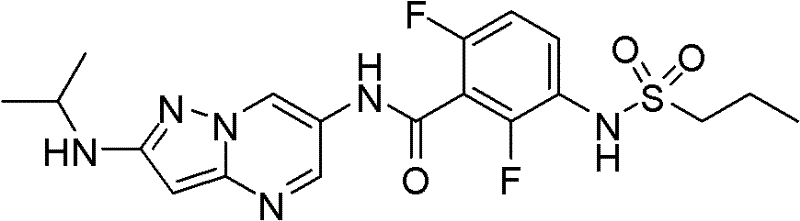
2,6-二氟-N-(2-(异丙基氨基)吡唑并[1,5-a]嘧啶-6-基)-3-丙基磺酰胺基苯2,6-Difluoro-N-(2-(isopropylamino)pyrazolo[1,5-a]pyrimidin-6-yl)-3-propylsulfonamidobenzene 甲酰胺Formamide
步骤A:根据实施例17步骤C的一般程序,用异丙胺代替吡咯烷制备(Z)-3-(异丙基氨基)-3-(甲基硫代)丙烯腈。Step A: (Z)-3-(isopropylamino)-3-(methylthio)acrylonitrile was prepared according to the general procedure of Example 17, Step C, substituting isopropylamine for pyrrolidine.
步骤B:根据实施例17步骤D的一般程序,用(Z)-3-(异丙基氨基)-3-(甲基硫代)丙烯腈代替(Z)-3-(甲基硫代)-3-(吡咯烷-1-基)丙烯腈,制备为油状物的N3-异丙基-1H-吡唑-3,5-二胺(0.231g,步骤A和B 62%)。Step B: Following the general procedure of Example 17, Step D, substituting (Z)-3-(isopropylamino)-3-(methylthio)acrylonitrile for (Z)-3-(methylthio) - 3-(Pyrrolidin-1-yl)acrylonitrile, N3-isopropyl-1H-pyrazole-3,5-diamine was prepared as an oil (0.231 g, Steps A and B 62%).
步骤C:根据实施例1步骤A的一般程序,用N3-异丙基-1H-吡唑-3,5-二胺代替3-甲氧基-1H-吡唑-5-胺,制备N-异丙基-6-硝基吡唑并[1,5-a]嘧啶-2-胺(0.060g,产率36%)。m/z(APCI-nega)M-1=220.1。Step C: N- Isopropyl-6-nitropyrazolo[1,5-a]pyrimidin-2-amine (0.060 g, 36% yield). m/z (APCI-nega) M-1 = 220.1.
步骤D:根据实施例1步骤B的一般程序,用N-异丙基-6-硝基吡唑并[1,5-a]嘧啶-2-胺代替2-甲氧基-6-硝基吡唑并[1,5-a]嘧啶,制备N2-异丙基吡唑并[1,5-a]嘧啶-2,6-二胺(0.050g,产率96%)。m/z(APCI-pos)M+1=192.1。Step D: Following the general procedure of Example 1, Step B, substituting N-isopropyl-6-nitropyrazolo[1,5-a]pyrimidin-2-amine for 2-methoxy-6-nitro Pyrazolo[1,5-a]pyrimidine, Preparation of N2-isopropylpyrazolo[1,5-a]pyrimidine-2,6-diamine (0.050 g, 96% yield). m/z (APCI-pos) M+1 = 192.1.
步骤E:根据实施例1步骤C的一般程序,用N2-异丙基吡唑并[1,5-a]嘧啶-2,6-二胺代替2-甲氧基吡唑并[1,5-a]嘧啶-6-胺,制备2,6-二氟-N-(2-(异丙基氨基)吡唑并[1,5-a]嘧啶-6-基)-3-丙基磺酰胺基苯甲酰胺(0.117g,产率61%)。m/z(APCI-nega)M-1=451.1。Step E: Following the general procedure of Example 1 Step C, substituting N2-isopropylpyrazolo[1,5-a]pyrimidine-2,6-diamine for 2-methoxypyrazolo[1,5 -a]pyrimidin-6-amine, preparation of 2,6-difluoro-N-(2-(isopropylamino)pyrazolo[1,5-a]pyrimidin-6-yl)-3-propylsulfonate Amidobenzamide (0.117 g, 61% yield). m/z (APCI-nega) M-1 = 451.1.
表1中的以下化合物是根据方法列中给出的实施例编号的一般程序,使用适当的中间体来制备。The following compounds in Table 1 were prepared according to the general procedures given in the Example numbers given in the Methods column, using the appropriate intermediates.
表1Table 1


应理解的是,不希望所列举的实施方案限制本发明。相反地,本发明意欲涵盖所有替代方案、修改方案和等价方案,它们均可包括在如由权利要求书所界定的本发明的范畴之内。因此,前文描述仅视为是对本发明的原理的说明。It should be understood that the exemplified embodiments are not intended to limit the invention. On the contrary, the invention is intended to cover all alternatives, modifications and equivalents, which may be included within the scope of the present invention as defined by the claims. Accordingly, the foregoing description is considered as illustrative only of the principles of the invention.
在本说明书和前文权利要求书中使用的词语“包含”、“包括”意在指定所述特征、整数、组分或步骤的存在,但它们并不排除一个或多个其它的特征、整数、组分、步骤或其组合的存在或加入。The words "comprising", "comprising" used in this specification and preceding claims are intended to specify the presence of stated features, integers, components or steps, but they do not exclude one or more other features, integers, The presence or addition of components, steps or combinations thereof.
Claims (32)


Applications Claiming Priority (3)
| Application Number | Priority Date | Filing Date | Title |
|---|---|---|---|
| US23810309P | 2009-08-28 | 2009-08-28 | |
| US61/238,103 | 2009-08-28 | ||
| PCT/US2010/046975 WO2011025951A1 (en) | 2009-08-28 | 2010-08-27 | Raf inhibitor compounds and methods of use thereof |
Publications (1)
| Publication Number | Publication Date |
|---|---|
| CN102482283A true CN102482283A (en) | 2012-05-30 |
Family
ID=43126997
Family Applications (1)
| Application Number | Title | Priority Date | Filing Date |
|---|---|---|---|
| CN2010800382985A Pending CN102482283A (en) | 2009-08-28 | 2010-08-27 | Raf inhibitor compounds and methods of use thereof |
Country Status (7)
| Country | Link |
|---|---|
| US (1) | US20120157451A1 (en) |
| EP (1) | EP2470539A1 (en) |
| JP (1) | JP2013503190A (en) |
| CN (1) | CN102482283A (en) |
| CA (1) | CA2771895A1 (en) |
| SG (1) | SG178853A1 (en) |
| WO (1) | WO2011025951A1 (en) |
Cited By (3)
| Publication number | Priority date | Publication date | Assignee | Title |
|---|---|---|---|---|
| CN103910735A (en) * | 2014-04-14 | 2014-07-09 | 人福医药集团股份公司 | Pyrazolopyrimidinone compound and derivative as well as preparation method and application thereof |
| CN103965199A (en) * | 2013-02-02 | 2014-08-06 | 广东东阳光药业有限公司 | Aromatic heterocyclic compounds, pharmaceutical composition containing compounds and application of pharmaceutical composition |
| CN108349969A (en) * | 2015-07-16 | 2018-07-31 | 阵列生物制药公司 | Substituted pyrazolo [1,5-a] pyridine compounds as RET kinase inhibitors |
Families Citing this family (25)
| Publication number | Priority date | Publication date | Assignee | Title |
|---|---|---|---|---|
| BR112014008223A2 (en) | 2011-10-06 | 2017-04-25 | Bayer Ip Gmbh | heterocyclylpyri (mi) dinilpyrazole |
| WO2014067962A1 (en) | 2012-10-31 | 2014-05-08 | Bayer Cropscience Ag | Novel heterocyclic compounds as pest control agents |
| KR20160013028A (en) | 2013-05-30 | 2016-02-03 | 플렉시콘, 인코퍼레이티드 | Compounds for kinase modulation, and indications therefor |
| CA3049136C (en) | 2017-01-18 | 2022-06-14 | Array Biopharma Inc. | Substituted pyrazolo[1,5-a]pyrazine compounds as ret kinase inhibitors |
| EP3740491A1 (en) | 2018-01-18 | 2020-11-25 | Array Biopharma, Inc. | Substituted pyrrolo[2,3-d]pyrimidines compounds as ret kinase inhibitors |
| US11524963B2 (en) | 2018-01-18 | 2022-12-13 | Array Biopharma Inc. | Substituted pyrazolo[3,4-d]pyrimidines as RET kinase inhibitors |
| JP6997876B2 (en) | 2018-01-18 | 2022-02-04 | アレイ バイオファーマ インコーポレイテッド | Substituted pyrazolyl [4,3-C] pyridine compound as a RET kinase inhibitor |
| ES2922314T3 (en) | 2018-09-10 | 2022-09-13 | Array Biopharma Inc | Fused Heterocyclic Compounds as RET Kinase Inhibitors |
| JP2022526713A (en) | 2019-03-21 | 2022-05-26 | オンクセオ | Dbait molecule in combination with a kinase inhibitor for the treatment of cancer |
| JP2023500906A (en) | 2019-11-08 | 2023-01-11 | インサーム(インスティテュ ナシオナル ドゥ ラ サンテ エ ドゥ ラ ルシェルシェ メディカル) | Methods of treating cancers with acquired resistance to kinase inhibitors |
| WO2021148581A1 (en) | 2020-01-22 | 2021-07-29 | Onxeo | Novel dbait molecule and its use |
| KR20230106648A (en) * | 2020-11-10 | 2023-07-13 | 포그혼 쎄라퓨틱스 인크. | Compounds and Uses Thereof |
| TW202508595A (en) | 2023-05-04 | 2025-03-01 | 美商銳新醫藥公司 | Combination therapy for a ras related disease or disorder |
| US20250049810A1 (en) | 2023-08-07 | 2025-02-13 | Revolution Medicines, Inc. | Methods of treating a ras protein-related disease or disorder |
| WO2025073765A1 (en) | 2023-10-03 | 2025-04-10 | Institut National de la Santé et de la Recherche Médicale | Methods of prognosis and treatment of patients suffering from melanoma |
| WO2025080946A2 (en) | 2023-10-12 | 2025-04-17 | Revolution Medicines, Inc. | Ras inhibitors |
| WO2025171296A1 (en) | 2024-02-09 | 2025-08-14 | Revolution Medicines, Inc. | Ras inhibitors |
| WO2025240847A1 (en) | 2024-05-17 | 2025-11-20 | Revolution Medicines, Inc. | Ras inhibitors |
| WO2025255438A1 (en) | 2024-06-07 | 2025-12-11 | Revolution Medicines, Inc. | Methods of treating a ras protein-related disease or disorder |
| WO2025265060A1 (en) | 2024-06-21 | 2025-12-26 | Revolution Medicines, Inc. | Therapeutic compositions and methods for managing treatment-related effects |
| WO2026006747A1 (en) | 2024-06-28 | 2026-01-02 | Revolution Medicines, Inc. | Ras inhibitors |
| WO2026015790A1 (en) | 2024-07-12 | 2026-01-15 | Revolution Medicines, Inc. | Methods of treating a ras related disease or disorder |
| WO2026015796A1 (en) | 2024-07-12 | 2026-01-15 | Revolution Medicines, Inc. | Methods of treating a ras related disease or disorder |
| WO2026015801A1 (en) | 2024-07-12 | 2026-01-15 | Revolution Medicines, Inc. | Methods of treating a ras related disease or disorder |
| WO2026015825A1 (en) | 2024-07-12 | 2026-01-15 | Revolution Medicines, Inc. | Use of ras inhibitor for treating pancreatic cancer |
Citations (4)
| Publication number | Priority date | Publication date | Assignee | Title |
|---|---|---|---|---|
| CN1198160A (en) * | 1996-07-31 | 1998-11-04 | 大制药株式会社 | Thiazole derivatives |
| CN1370163A (en) * | 1999-08-21 | 2002-09-18 | 阿斯特拉曾尼卡有限公司 | Imidazo [1,2-A] pyridine and pyrazolo [2,3-a] pyridine derivatives |
| CN1390219A (en) * | 1999-09-17 | 2003-01-08 | 艾博特股份有限两合公司 | Pyrazolopyrimidines as therapeutic agents |
| WO2009012283A1 (en) * | 2007-07-17 | 2009-01-22 | Plexxikon Inc. | Compounds and methods for kinase modulation, and indications therefor |
Family Cites Families (14)
| Publication number | Priority date | Publication date | Assignee | Title |
|---|---|---|---|---|
| JPS6413072A (en) | 1987-07-07 | 1989-01-17 | Fuji Photo Film Co Ltd | Production of 3-alkoxy-5-amino-1h-pyrazoles |
| US5543523A (en) | 1994-11-15 | 1996-08-06 | Regents Of The University Of Minnesota | Method and intermediates for the synthesis of korupensamines |
| DE10102722A1 (en) | 2001-01-22 | 2002-08-14 | Medinnova Ges Med Innovationen | Method and test system for finding nerve cell protective substances |
| GB0112348D0 (en) | 2001-05-19 | 2001-07-11 | Smithkline Beecham Plc | Compounds |
| GB0121490D0 (en) | 2001-09-05 | 2001-10-24 | Smithkline Beecham Plc | Ciompounds |
| CN101087787A (en) | 2004-12-23 | 2007-12-12 | 霍夫曼-拉罗奇有限公司 | Heterocyclic carbamate derivatives, their manufacture and use as pharmaceutical agents |
| TW200639163A (en) | 2005-02-04 | 2006-11-16 | Genentech Inc | RAF inhibitor compounds and methods |
| CN101263142A (en) | 2005-05-20 | 2008-09-10 | 阿雷生物药品公司 | RAF inhibitor compounds and methods of use |
| MX2007016463A (en) | 2005-06-22 | 2008-03-04 | Plexxikon Inc | PIRROLO DERIVATIVES [2,3-B] PIRIDINE AS PROTEIN KINASE INHIBITORS. |
| RU2008112313A (en) | 2005-09-01 | 2009-10-10 | Эррэй Биофарма Инк. (Us) | COMPOUNDS RAF INHIBITORS AND WAYS OF THEIR APPLICATION |
| BRPI0716224A2 (en) | 2006-08-31 | 2013-10-15 | Array Biopharma Inc | RAF INHIBITOR COMPOUNDS AND METHODS OF USE THEREOF. |
| CA2662031A1 (en) | 2006-09-06 | 2008-03-13 | F. Hoffmann-La Roche Ag | Heteroaryl derivatives as protein kinase inhibitors |
| WO2008079909A1 (en) | 2006-12-21 | 2008-07-03 | Plexxikon, Inc. | Pyrrolo [2,3-b] pyridines as kinase modulators |
| PE20121126A1 (en) | 2006-12-21 | 2012-08-24 | Plexxikon Inc | PIRROLO [2,3-B] PYRIDINES COMPOUNDS AS KINASE MODULATORS |
-
2010
- 2010-08-27 CN CN2010800382985A patent/CN102482283A/en active Pending
- 2010-08-27 EP EP10749741A patent/EP2470539A1/en not_active Withdrawn
- 2010-08-27 US US13/393,069 patent/US20120157451A1/en not_active Abandoned
- 2010-08-27 CA CA2771895A patent/CA2771895A1/en not_active Abandoned
- 2010-08-27 JP JP2012527027A patent/JP2013503190A/en not_active Withdrawn
- 2010-08-27 SG SG2012012373A patent/SG178853A1/en unknown
- 2010-08-27 WO PCT/US2010/046975 patent/WO2011025951A1/en not_active Ceased
Patent Citations (4)
| Publication number | Priority date | Publication date | Assignee | Title |
|---|---|---|---|---|
| CN1198160A (en) * | 1996-07-31 | 1998-11-04 | 大制药株式会社 | Thiazole derivatives |
| CN1370163A (en) * | 1999-08-21 | 2002-09-18 | 阿斯特拉曾尼卡有限公司 | Imidazo [1,2-A] pyridine and pyrazolo [2,3-a] pyridine derivatives |
| CN1390219A (en) * | 1999-09-17 | 2003-01-08 | 艾博特股份有限两合公司 | Pyrazolopyrimidines as therapeutic agents |
| WO2009012283A1 (en) * | 2007-07-17 | 2009-01-22 | Plexxikon Inc. | Compounds and methods for kinase modulation, and indications therefor |
Non-Patent Citations (1)
| Title |
|---|
| 彭扬,等: "Raf激酶抑制剂研究进展", 《中南药学》 * |
Cited By (5)
| Publication number | Priority date | Publication date | Assignee | Title |
|---|---|---|---|---|
| CN103965199A (en) * | 2013-02-02 | 2014-08-06 | 广东东阳光药业有限公司 | Aromatic heterocyclic compounds, pharmaceutical composition containing compounds and application of pharmaceutical composition |
| CN103965199B (en) * | 2013-02-02 | 2017-07-07 | 广东东阳光药业有限公司 | A kind of heteroaromatic compounds, the medical composition and its use comprising it |
| CN103910735A (en) * | 2014-04-14 | 2014-07-09 | 人福医药集团股份公司 | Pyrazolopyrimidinone compound and derivative as well as preparation method and application thereof |
| CN108349969A (en) * | 2015-07-16 | 2018-07-31 | 阵列生物制药公司 | Substituted pyrazolo [1,5-a] pyridine compounds as RET kinase inhibitors |
| CN108349969B (en) * | 2015-07-16 | 2022-05-10 | 阵列生物制药公司 | Substituted pyrazolo [1,5-a ] pyridine compounds as RET kinase inhibitors |
Also Published As
| Publication number | Publication date |
|---|---|
| SG178853A1 (en) | 2012-04-27 |
| JP2013503190A (en) | 2013-01-31 |
| CA2771895A1 (en) | 2011-03-03 |
| US20120157451A1 (en) | 2012-06-21 |
| WO2011025951A1 (en) | 2011-03-03 |
| EP2470539A1 (en) | 2012-07-04 |
Similar Documents
| Publication | Publication Date | Title |
|---|---|---|
| CN102482283A (en) | Raf inhibitor compounds and methods of use thereof | |
| ES2392482T3 (en) | Imidazo [4,5-b] pyridine derivatives used as RAF inhibitors | |
| US8394795B2 (en) | Pyrazole [3, 4-B] pyridine Raf inhibitors | |
| US8338452B2 (en) | Raf inhibitor compounds and methods of use thereof | |
| CN102666498A (en) | RAF inhibitor compounds and methods of use thereof | |
| US20110003859A1 (en) | N- (6-aminopyridin-3-yl) -3- (sulfonamido) benzamide derivatives as b-raf inhibitors for the treatment of cancer | |
| CN102712635A (en) | 1h-pyrazolo [3,4-b] pyridine compounds for inhibiting RAF kinase | |
| CN102753554A (en) | Raf inhibitor compounds and methods of use thereof | |
| US20130018033A1 (en) | Raf inhibitor compounds and methods of use thereof | |
| WO2012118492A1 (en) | Heterocyclic sulfonamides as raf inhibitors | |
| HK1170480A (en) | Raf inhibitor compounds and methods of use thereof |
Legal Events
| Date | Code | Title | Description |
|---|---|---|---|
| C06 | Publication | ||
| PB01 | Publication | ||
| C10 | Entry into substantive examination | ||
| SE01 | Entry into force of request for substantive examination | ||
| REG | Reference to a national code |
Ref country code: HK Ref legal event code: DE Ref document number: 1170480 Country of ref document: HK |
|
| C02 | Deemed withdrawal of patent application after publication (patent law 2001) | ||
| WD01 | Invention patent application deemed withdrawn after publication |
Application publication date: 20120530 |