The application is that international application no is that PCT/US2005/013388, international filing date are on April 20th, 2005; The application number that gets into the China national stage is 200580019704.2, and name is called the dividing an application of application for a patent for invention of " using nucleic and melting analysis with saturation dyes ".
Embodiment
Because SYBR
Green I shows the great variety of fluorescence in the PCR process; SYBR
Green I become a kind of dyestuff that is widely used in melting analysis (Wittwer CT etc., Biotechniques 1997; 22:130-1,134-8; " PCR in real time " (the Real-Time PCR) that show such as Wittwer CT see volumes such as Persing D, Diagnostic Molecular Microbiology:Principles and Applications, and ASM press, 2004, in the printing).SYBR
Green I at first in melting analysis in order to distinguish Tm value difference other 2 ℃ or bigger different PCR product (Ririe KM etc., Anal Biochem 1997; 245:154-160).Subsequently; SYBR
Green I is used to differentiate base deletion (Aoshima T etc., Clin Chem 2000; 46:119-22), the genotype dinucletide repeats (Marziliano N etc., Clin Chem 2000; 46:423-5) and differentiate that multiple sequence changes (Lipsky RH etc., Clin Chem 2001; 47:635-44; Pirulli D etc., Clin Chem 2000; 46:1842-4; Tanriverdi S etc., J Clin Microbiol.2002; 40:3237-44; Hladnik U etc., Clin Exp Med.2002; 2:105-8).Yet Tm difference maybe be very little and possibly challenge the resolving power of existing instrument between the genotype.In fact; Thought that SYBR

Green I " can not use " (von Ahsen N etc., Clin Chem 2001 in conventional gene type is used; 47:1331-1332).The Tm value that adopts the melting curve gene type of normally used double-stranded specific DNA dyestuff can cause widening between the limited proportionality along with unwinding improve (Douthart RJ etc., Biochemistry 1973; The compression (Fig. 5 D) of Tm difference 12:214-20) and between the genotype.These factors have reduced SYBR
Green I and have been used to distinguish genotypic ability.
The DNA of heterozygosis is made up of 4 kinds of different strands, and these strands can produce 2 kinds of homoduplex molecules and 2 kinds of heteroduplex molecules in sex change and when cooling off.In theory, all 4 kinds of products to have different Tm values and melting curve should be all 4 kinds of two strandss to strand change synthetic.Yet, the double-stranded specific DNA dyestuff possibly in separating chain process, redistribute (Aktipis S etc., Biochemistry 1975; 14:326-31), this causes that dyestuff also is distributed on the homoduplex molecule of higher melting temperature(Tm) from the heteroduplex molecule release of low melting temperature(Tm) again.Because that SYBR under the concentration compatible with PCR
Green I does not have is saturated (Wittwer CT etc., Biotechniques 1997; 22:130-1,134-8; Fig. 9), such redistribution be possible and with lack heteroduplex molecule and unwind and change consistent (Fig. 5 D).
Dyestuff of the present invention can use in the application of gene type and scanning.In only increase a kind of PCR product and sequence is under the situation of isozygotying, and only forms the homoduplex molecule.Use dyestuff of the present invention, the Tm value difference is different between the different homoduplex molecules is not compressed (Fig. 5 C), and can significantly distinguish genotype, even SNP.Dyestuff of the present invention also can be used for differentiating and distinguishing the multiple product that reaction exists, for example the homoduplex molecule that produces of the amplification through a plurality of gene locus of isozygotying or a plurality of targets.On the contrary; The chances are because the redistribution of dyestuff uses SYBR
Green I in most of the cases can only observe minority product (seeing Fig. 7 A).
When the one or more heterozygosis target of amplification, use dyestuff of the present invention can easily observe heteroduplex molecule.Detection also identifies that the ability of heteroduplex molecule is particularly useful for detecting heterozygous genes type and scanning unknown mutation.Such as for real-time PCR using SYBR
Green? I, SYBR
Gold and ethidium bromide which can not be observed heteroduplex double-stranded DNA molecule product is a traditional dye is impossible to achieve this.
In separating chain process, the chain of heteroduplex molecule can complementary chain recombine complete with it and is formed the homoduplex molecule.Because production concentration is very high when PCR finishes, this recombine process takes place fast.Be near time of (especially being between heteroduplex and the homoduplex product Tm value) its melting temperature(Tm) through the restriction product, described recombine can be minimized.Except separating chain process medium-chain recombine, the selective cross of chain and its complementary strand that mate fully or mispairing receives the influence of speed of cooling.Under the represented here condition, fast cooling helps heteroduplex molecule most and forms, and is being lower than under-0.1 ℃/second the speed, and heteroduplex molecule is through regular meeting disappear (Fig. 2).This is opposite with sex change HPLC technology, the latter's speed of cooling slowly many (0.01 to-0.02 ℃/second of pacts), but still effectively form heteroduplex molecule (Xiao W etc., Hum Mutat 2001; 17:439-74).Perhaps, the speed of relative movement that homoduplex molecule and heteroduplex molecule form depends on the product size very much, and the result who uses little amplicon to obtain possibly not have typicalness for the bigger product that more generally uses among the dHPLC.
Through unwinding, spend the more analysis time, can improve the ability to see things in their true light between the homozygous genotype with lower speed.DNA concentration is a source of potential error in the melting curve gene type to the influence of Tm.When under the PCR condition, using the amplicon of 100bp at random of 50%GC content, the Tm value difference is different between the product of 0.05 μ M and 0.5 μ M is about 0.7 ℃ of (von Ahsen N etc., Clin Chem 2001; 47:1956-61; Wetmur JG, Grit Rev Biochem Mol Biol 1991; 26:227-59).When the Tm of different homozygous genotypes value was very approaching, this change possibly be important.Therefore yet different PCR samples trend towards reaching plateau with same products concentration, and amplification back concentration difference is normally minimum.Simultaneously, can estimate that amplicon concentration also is that acquisition even higher gene type precision are regulated the Tm value through real-time fluorescence.In addition, can use the final concentration of asymmetric PCR volitional check PCR product.
Might all single base heterozygotes and homozygote be distinguished with dyestuff of the present invention.In heterozygote detected, the influence of absolute melting temperature(Tm) and DNA concentration does not resemble used the method that relates to the differentiation homozygous genotype so important.Heteroduplex molecule influences the shape of melting curve, " in early days " low temperature part that is especially changing.Through overlapping " late period " high-temperature part of unwinding and changing of translation X axle, can make different melting curve temperature mate.Can infer whether heteroduplex molecule exists with higher tolerance range then.Therefore, even in sample without pcr amplification, maybe be unimportant to the concern of DNA concentration.
Regardless of the tolerance range of instrument, some genotypic Tm value can be much at one.A kind of method that detection has the variation of isozygotying of identical Tm value is with the variant mixed together.The heteroduplex molecule that obtains can unwind under the temperature lower than homozygote, in standardized melting curve, shows in the decline of mainly unwinding before changing.
Thereby; Use present utilizable pcr amplification device, dyestuff of the present invention can be differentiated the heteroduplex molecule that can not use SYBR
Green I to differentiate at present in melting curve changes.Explained among Fig. 7 A that SYBR
Green I can not differentiate the possible cause that low temperature unwinds and changes easily.When the dna fragmentation that exists several stability to increase progressively, use the low temperature peak of SYBR
Green I very little with comparing of use dyestuff such as dyestuff S5 (structure is seen
embodiment 1).In separating chain process; SYBR
Green I possibly discharge from the low temperature duplex molecule, only is connected in the two strands of under higher temperature, unwinding.This causes each follow-up peak than previous height, even if make the peak of minimum temperature can observe also very little.As what seen among Fig. 7 B; Can easily detect the product that low temperature unwinds with dyestuff S5, and can not detect with SYBR
Green I.
Use the advantage of dyestuff S5 to cause and PCR is compatible and the difference that under the compatible concentration of PCR, is suitable for the double-stranded DNA dyestuff of gene type to other.Many dyestuffs that are used for method of the present invention belong to cyanine family.Cyanine dyes is those dyestuffs that contain one or more divalence " C (R)=" part on two nitrogenous heterocyclic chains connecting.Group " R " possibly be hydrogen or any carbon substituting group, and for example hydrogen or alkyl comprises the C that can be optionally substituted
1-6Alkyl.It will be appreciated that each " R " can be independent the selection in cyanine dyes of an above divalence is arranged therein " C (R)=" part.As by illustrative general formula described here further definition, such cyanine dyes can be monomer or dimer.Many cyanine dyess, for example divalent moiety be=N-,-dyestuff of C (R)=N-etc. is also very suitable.Except cyanine dyes, estimate that other dsDNA combination dye family also can be used for PCR reaction mixture as herein described, method and composition, these families include but not limited to acridyl dyestuff, phenanthridines intercalating agent and phenanthroline Base Metal intercalating agent.
The exemplary dyes that is used for PCR reaction described herein and melting curve mixture, method and composition comprises PO-PRO
TM-1, BO-PRO
TM-1,
SYTO
9, SYTO
43,
SYTO
44,
SYTO
45, SYTOX
Blue, POPO
TM-1, POPO
TM-3, BOBO
TM-1, BOBO
TM-3, LO-PRO
TM-1, JO-PRO
TM-1, YO-PRO
-1, TO-PRO
-1,
SYTO
11,
SYTO
13,
SYTO
15,
SYTO
16,
SYTO
20,
SYTO
23, TOTO
TM-3, YOYO
-3 (Molecular Probes, Inc., Eugene, OR), GelStar
(Cambrex Bio Science Rockland Inc., Rockland, ME), thiazole orange (Aldrich Chemical Co., Milwaukee, WI), EvaGreen
TM(Biotium, Hayward, CA), BEBO, BETO, BOXTO (TATAA Biocenter AB.,
Sweden) and various new dye as herein described, wherein major part is a saturable dye.
The exemplary cyanine dyes that is used for PCR reaction mixture described herein, method and composition also comprises the monomer or the dimer of the asymmetric cyanine of
pyrimidine
quinoline
isoquinoline 99.9
that has pyridine or purine
core texture, and those cyanine dyess with the said structure of general formula I:
In the formula
Partly substituted condensed monocycle or many cyclophanes ring or nitrogenous hetero-aromatic ring are chosen in
representative wantonly;
X is oxygen, sulphur, selenium, tellurium or is selected from C (CH
3)
2Or NR
1Part, R in the formula
1Be hydrogen or alkyl, comprise C
1-6Alkyl and C
2-6Alkyl;
R
2Be to comprise C
1-6Alkyl and C
2-6The alkyl of alkyl, comprise C
3-8The naphthenic base of naphthenic base, aryl, comprise aryl (C
1-3Alkyl) aralkyl, hydroxyalkyl, alkoxyalkyl, aminoalkyl group, alkyl monosubstituted amino alkyl and dialkyl aminoalkyl, trialkyl ammonium alkyl, alkyl and aryl carbonyl, alkyl and aryl carboxylic acid amides, alkyl and aryl sulfonyl, alkylen carboxylic acids ester, alkylidene group carboxylic acid amides, alkylidene group sulphonate, alkylidene group sulphonate etc., contain heteroatomic circular part, or contain heteroatomic non-annularity part, these groups can be optionally substituted separately; Exemplaryly contain heteroatomic part and comprise optional substituted assorted alkyl, comprise methoxymethyl, ethoxyethyl group etc.; Heterocyclic radical comprises piperidyl etc.; Alkyl sulfonic ester and aromatic yl sulphonate comprise methanesulfonate ester, 4-chloro-phenyl-sulphonate etc.; Alkoxyl group comprises methoxyl group, oxyethyl group etc.; Amino comprises methylamino, dimethylamino etc.; Carbonyl derivative comprises alkyl-carbonyl and aryl carbonyl, alkyl amino-carbonyl, alkoxy carbonyl etc.; Assorted thiazolinyl comprises alkenyl amino alkyl, alkene oxygen base alkyl, alkylamino thiazolinyl, alkoxyl group thiazolinyl, alkylidene amino alkyl etc.; Assorted allyl group (heteroallyl); Ester; Amine; Acid amides; Phosphorus-to-oxygen bonds and phosphorus-to-sulfur bonds; Comprise and contain heteroatomic part that like U.S. Patent number 5,658,751 is said with PCT publication number WO 00/66664; All include disclosure separately in this paper as a reference;
T=0 or 1;
Z is 0 or 1 electric charge;
R
3, R
9And R
10Be selected from hydrogen independently of one another, comprise C
1-6Alkyl and C
2-6The alkyl or aryl carbonyl of alkyl;
N=0,1 or 2; With
Q is a heterocycle, can be optionally substituted separately like pyridine
pyrimidine
quinoline
or purine
.
Term used herein " alkyl " is often referred to the straight chain that contains about 12 carbon atoms of 1-or chooses wantonly has the hydrocarbon part of side chain, for example includes but not limited to: methyl (Me), ethyl, propyl group, butyl, dodecyl, 4-ethyl pentyl group etc.
Term used herein " naphthenic base " is often referred to the straight chain of one or two ring of at least a portion formation that contains about 14 carbon atoms of 3-or chooses wantonly has the hydrocarbon part of side chain; For example include but not limited to: cyclopropyl, cyclopentyl, cyclohexyl, 4-methylcyclohexyl, 2; 3-dimethylcyclopentyl, 3,5-Dimethylcyclohexyl ethyl etc.
Term used herein " aryl " is often referred to ring-type aromatics part, for example includes but not limited to: phenyl (Ph), naphthyl, furyl, thienyl, pyrrolo-, pyrazolo, different
azoles base, isothiazolyl,
azoles base, thiazolyl, pyridyl, pyridazinyl, pyrimidyl, pyrazinyl, quinolyl, isoquinolyl, quinoxalinyl, quinazolyl (quinazalinyl) etc.
Term used herein " optional substituted " is often referred to optional one or more Wasserstoffatomss or the lone electron pair that exists on the precursor group that replace of substituting group, comprises the Wasserstoffatoms or the lone electron pair that exist on carbon, nitrogen, oxygen or the sulphur atom, substituting group for example: halogen; Hydroxyl; Amino; Nitro; Sulfydryl (thio); Sulphonate; Nitrile, alkyl nitrile, alkyl nitrile sulfenyl; Alkyl, naphthenic base, haloalkyl, halogenated cycloalkyl; Alkoxyl group, cycloalkyloxy, halogenated alkoxy; Monoalkyl and dialkyl amido; Trialkyl ammonium; Aminoalkyl group; Monoalkyl and dialkyl aminoalkyl; The trialkyl ammonium alkyl; The trialkyl ammonium alkylthio; Alkylthio; Cycloalkylthio, the assorted alkylthio of ring, nucleosides sulfenyl; Alkyl, haloalkyl, naphthenic base and aryl carbonyl; Aryl carbonyl sulfenyl, the assorted alkyl oxycarbonyl sulfenyl of ring, dialkyl aminoalkyl carbonyl sulfenyl; Trialkyl ammonium alkyl oxycarbonyl sulfenyl; Alkyl, haloalkyl, naphthenic base and aryl-carbonyl oxygen; Alkyl, haloalkyl, naphthenic base and aryl sulfonyl; Phthalimido; Benzothiazole or aphthothiazoles; Benzo
azoles or naphtho-
azoles and carboxy derivatives are like carboxylic acid, ester, thioesters and acid amides.Should be understood that to replace contiguous Wasserstoffatoms, comprise two hydrogen and vicinal hydrogen, can make the substituting group that replaces these contiguous hydrogen form volution or condensed ring respectively together.
Should understand; Each above-mentioned term can the relevant mode of chemistry make up use, to represent other part, refers to that like aralkyl aryl described herein is connected in the formed structure of alkyl described herein; Include but not limited to: benzyl, styroyl, pieolinyl, 3,5-dimethoxy picoline-4-base etc.
Need recognize that described cyanine dyes structure can comprise chiral centre here.In these cases, except other has explanation, need understanding in the description of these cyanine dyes structures, to comprise all steric isomers.The mixture of diastereomer that such steric isomer comprises simple optically active isomer, racemic mixture and contains one or more stereoisomerism configurations of any relative quantity.
Need recognize that also described cyanine dyes structure can comprise geometric centre here.In these cases, except other has explanation, need understanding in the description of cyanine dyes structure, to comprise all geometrical isomers.Such geometrical isomer comprises the cis of simple form or multiple blended geometric configuration form, trans, E and Z isomer.Also need to understand, depend on the characteristic of the two keys that comprised in the cyanine dyes structure, such double bond isomer can according to as conditions such as solvent composition, solvent polarity, ionic strength cis and trans between or conversion mutually between E and the Z configuration.
Further need recognize, when electric charge Z greater than 0 the time, possibly have several kinds of resonance structures of compound in structural formula I.For example, I is said like structural formula, and electric charge Z can be positioned on the nitrogen-atoms in form, and perhaps, electric charge can be positioned on the heterocycle Q.The resonance structure of the charging cpd of structural formula I can be through compound in structural formula I the arrangement again (like following exemplary configurations) of two keys-singly-bound configuration describe:
In the formula
X, R
2, R
3, R
9, R
10Identical with Q with the definition among the formula I, t=1, Z=1 and n=1.Cyanine dyes compound described herein comprises any in several kinds of possible resonance structures.The position and the preferred resonance structure that should be understood that formal charge receive
X, R
2, R
3, R
9, R
10The properties with the Q part.
Also need to understand; Carry in compound in structural formula I under the situation of net charge (such as when the Z=1; Or under situation about existing on the compound in structural formula I like charged substituent such as ammonium group or sulfonic acid group), these compound in structural formula I are with counterion.Comprise any unit price, divalence or multivalence counterion here in the description of included cyanine dyes structure.Exemplary counterion comprises like electronegative counterions such as iodide, muriate, bromide, oxyhydroxide, oxide compound, acetate, trifluoracetic acid root, a phosphate radical, gen-diphosphate, triphosphate, and like the counterion of positively chargeds such as lithium, sodium, potassium, caesium, ammonium, many alkylammoniums.Such counterion possibly come from used compound method, purification schemes or other ion exchange process.
As if character or the kind of believing counterion can not influence the functional of cyanine dyes described here.Need recognize, when dyestuff described here is dissolved in the solvent that is used for putting into practice PCR reaction mixture described here, method and composition or other medium, the counterion of following can with other counterion exchange of existing in solvent or other medium.Additional counterion like this can be lyate ion, salt, damping fluid and/or metal.
Need recognize R
2In fact group can be the parent compound (wherein t=Z=0) of structural formula I and have formula R
2Any group that nucleophilic reaction produces takes place between the compound of-L:
Wherein L is suitable leavings group, R
2Definition as stated.For example, R
2Be optional substituted alkyl, acyl group, aryl, sulfonic acid or alkylsulfonyl, can be optionally substituted separately.Exemplary leavings group L includes but not limited to: halogen, like chlorine and bromine; Acylate is like acetate moiety or ester (acetate), formate or ester and trifluoroacetic acid root or ester; Sulfonate radical or ester are like methanesulfonate or ester, trifluoromethanesulfonic acid root or ester and tolyl sulfonate radical or ester; Sulfate radical or ester are like methylsulfate or ester etc.
In an exemplary embodiment, Q is a heterocycle, such as but not limited to:
R in the formula
4, R
5, R
6, R
7, R
8, R
11, R
12, R
13And R
14Be selected from independently of one another hydrogen, halogen, amino, alkyl, haloalkyl, alkoxyl group, halogenated alkoxy, alkyl sulphonyl, halogenated alkyl sulfonyl, aryl sulfonyl, formyl radical, alkyl-carbonyl, aryl carbonyl, carboxylic acid derivative, alkyl monosubstituted amino, dialkyl amido, trialkyl ammonium, dialkyl aminoalkyl, trialkyl ammonium alkyl, trialkyl ammonium alkylthio, naphthenic base, assorted alkyl, Heterocyclylalkyl, thiazolinyl, polyalkenyl, alkynyl, carbene base, thiazolinyl alkynyl, aryl, heteroaryl, alkoxyl group, alkylthio, arylthio, alkyl nitrile sulfenyl, aryl carbonyl sulfenyl, the assorted alkyl oxycarbonyl sulfenyl of ring, dialkyl aminoalkyl carbonyl sulfenyl, trialkyl ammonium alkyl oxycarbonyl sulfenyl, other thioesters, dialkyl amido, cycloalkylthio, the assorted alkylthio of ring, nucleosides sulfenyl (above group can be optionally substituted separately), piperidines also, piperazine also (separately can be by alkyl, amino, alkyl monosubstituted amino alkyl or dialkyl aminoalkyl, the trialkyl ammonium alkyl is optional replaces, or can be randomly make the nitrogen quaternized with alkyl).
In another exemplary embodiment, R
4, R
5, R
6, R
7, R
8, R
11, R
12, R
13And R
14One of be to contain heteroatomic part, like U.S. Patent number 5,658,751 is said.In another exemplary embodiment, R
4, R
5, R
6, R
7, R
8, R
11, R
12, R
13And R
14One of be reactive group; Include but not limited to: halogen, hydroxyl, alkoxide (alkoxide), amine, carboxylic acid, halogenide, alcohol, aldehyde, mercaptan, alkylthio and arylthio, alkyl sulphonyl and aryl sulfonyl, succinimido ester, ketone and lsothiocyanates; They can be used for part is connected in the dyestuff core texture, for example through forming carbon-carbon bond, amine, acid amides, ether, thioether, disulfide linkage, ketone, thiocarbamide and Schiff's base.In another exemplary embodiment, R
4, R
5, R
6, R
7, R
8, R
11, R
12, R
13And R
14One of be BRIDGE-DYE with following formula:
In the formula
X, R
2, t, Z, R
3, R
9, R
10, Q and n definition identical with formula I; BRIDGE is straight or branched, ring-type or heterocyclic, saturated or unsaturated, single covalent linkage with 1-16 non-hydrogen atom such as carbon, nitrogen, phosphorus, oxygen or sulphur or covalently bound, thereby makes this connection contain alkyl, ether, thioether, amine, ester or amido linkage; Carbon-carbon single bond, two key, triple bond or aromatic gp; Phosphorus-oxygen, phosphorus-sulphur, nitrogen-nitrogen or nitrogen-oxygen key; Perhaps any combination of aromatic gp or assorted fragrant key.Should be understood that in some embodiments this dimeric structure is symmetric about BRIDGE, in other embodiments, this dimeric structure is that to be not in relation to BRIDGE symmetric, for example, selects independently of one another when occurring separately in the BRIDGE both sides
X, R
2, t, Z, R
3, R
9, R
10And n.
Be used for exemplary dye of the present invention and also comprise having pyridine
Or pyrimidine
The formula I cyanine dyes of core texture, wherein X is oxygen or sulphur; Part
Representative optional substituted condense benzo, optional substituted condense naphtho-, optional substituted condensed pyridine also, optional substituted annelated pyrimidines also, optional substituted fused quinoline and etc.; N=0 or 1; T=0 or 1; R
2Be alkyl, like methyl and ethyl; Optional substituted aryl is like phenyl or tolyl; The alkylidene group sulphonate is like propylidene sulfonic acid; Perhaps alkyl sulphonyl is like CH
3(CH
2)
mSO
2, m is 0,1,2 or 3 in the formula; Q is the heterocycle that is selected from down the group structure:
In the formula
R
4Be hydrogen, alkoxyl group comprises methoxyl group, oxyethyl group, propoxy-etc.; Alkylthio comprises methylthio group, ethylmercapto group etc.; The heterocyclic radical alkyl comprises optional substituted piperidyl, pyrrolidyl, piperazinyl etc.; Perhaps comprise the heterocyclic radical alkyl of charged group, comprise 4,4-lupetazin-1-base etc.; Or reactive group, comprise halogen, hydroxyl, alkoxyl group, sulfydryl, alkyl and arylthio, alkyl and aryl sulfonyl, amino, formyl radical, alkyl and aryl carbonyl, carboxy derivatives etc.;
R
5Be C
1-6Alkyl comprises methyl, ethyl, butyl, sec.-butyl, isobutyl-etc.; Optional substituted phenyl; Perhaps (CH
2)
3N
+(Me)
3With
R
6, R
7And R
8Be hydrogen or methyl independently of one another.
Exemplary dye used herein also comprises having pyridine
Or pyrimidine
The formula I cyanine dyes of core texture, wherein X is oxygen or sulphur; Part
The optional substituted benzo that condenses of representative (forms optional substituted benzo
Azoles
Or benzothiazole
Ring) the perhaps optional substituted naphtho-that condenses (forms optional substituted naphtho-
Azoles
Or aphthothiazoles
Ring); N=0 or 1; T=0 or 1; R
2Be alkyl such as methyl, aryl such as phenyl or tolyl, alkylidene group sulphonate such as propylidene sulfonic acid, or alkyl sulphonyl such as CH
3(CH
2)
mSO
2, m is 0,1,2 or 3 in the formula; Q is the 4-pyridine
Or 4-pyrimidine
Heterocycle.
Exemplary dye used herein also comprises the cyanine dyes that is used for PCR reaction mixture described herein, method and composition; It has quinoline
core texture, and general formula is formula II:
In the formula
Partly substituted condensed monocycle or many cyclophanes ring or nitrogenous hetero-aromatic ring are chosen in
representative wantonly;
X is oxygen, sulphur or is selected from C (CH
3)
2Or NR
1Group, R wherein
1Be hydrogen or C
1-6Alkyl;
R
2Be alkyl, comprise C
1-6Alkyl and C
2-6Alkyl; Naphthenic base comprises C
3-8Naphthenic base; Aryl; Aralkyl; The alkylidene group sulphonate; Contain heteroatomic circular part; Or containing heteroatomic non-annularity part, each group can randomly be replaced;
T=0 or 1;
Z is 0 or 1 electric charge;
R
3, R
9And R
10Be selected from hydrogen or alkyl independently of one another, comprise C
1-6Alkyl;
N=0,1 or 2; With
R
4, R
5, R
8, R
11, R
12, R
13And R
14Definition identical with formula I, as long as R
4Be molecular weight less than about 115, or for example molecular weight less than about 105 part.
Be used for exemplary dye of the present invention and also comprise formula II cyanine dyes, part in the formula
The optional substituted benzo that condenses of representative (thereby forms benzo
Azoles
Or benzothiazole
Ring); X is oxygen or sulphur; N=0 or 1; T=0 or 1; R
2It is methyl;
R
4Be hydrogen, C
1-6Alkyl comprises methyl or optional substituted phenyl;
R
5Be C
1-6Alkyl comprises methyl or optional substituted phenyl;
R
8Be hydrogen; With
R
11, R
12, R
13And R
14Be hydrogen or alkoxyl group, comprise methoxyl group.
In other embodiments; Be used for dyestuff of the present invention and also comprise (for example) formula II cyanine dyes; The optional substituted heterocycle of part
representative in the formula, comprise the 1-picoline and and 3-bromo-1-picoline also; X is oxygen or sulphur; N=0 or 1; T=z=0;
R
4Be hydrogen or C
1-6Alkyl comprises methyl;
R
5Be C
1-6Alkyl comprises methyl, optional substituted phenyl or assorted alkyl, comprises the assorted alkyl that contains charged group, as-(CH
2)
3N (Me)
3
R
8Be hydrogen; With
R
11, R
12, R
13And R
14Be that hydrogen, alkyl comprise that methyl or alkoxyl group comprise methoxyl group.
In another embodiment, two of formula I kinds of compounds form dimer together.These two kinds of compounds are through replacing the above-mentioned substituent R that exists on the various I compound with a divalence joint
4, R
5, R
6, R
7, R
8, R
11, R
12, R
13And R
14One of together interconnection.For example, two kinds of compounds of formula I form dimer together, wherein replace two R that exist on two kinds of compounds of formula I with a divalence joint
5Substituting group.Should be understood that this paper has comprised the symmetry or the asymmetric dimer of formula I compound.Under the asymmetric dimeric situation of formula I compound, should be understood that the dimer that has different replacement modes or have the formula I compound of different heterocycle Q through formation possibly produce this asymmetric.And, form dimer through the different substituents that replaces formula I compound with the divalence joint, as replacing the R on first kind of formula I compound with the divalence joint
5With the R that replaces on second kind of formula I compound
8Forming dimer also possibly produce this asymmetric.
In another embodiment, two of formula II kinds of compounds form dimer together.These two kinds of compounds are through replacing the above-mentioned substituent R that exists on the various II compound with a divalence joint
4, R
5, R
8, R
11, R
12, R
13And R
14One of together interconnection.For example, two kinds of compounds of formula II form dimer together, wherein replace two R that exist on two kinds of compounds of formula II with a divalence joint
5Substituting group.Should be understood that this paper has comprised the symmetry or the asymmetric dimer of formula II compound.Under the asymmetric dimeric situation of formula II compound, should be understood that the dimer that has different replacement modes or have the formula II compound of different heterocycle Q through formation possibly produce this asymmetric.And, form dimer through the different substituents that replaces formula II compound with the divalence joint, as replacing the R on first kind of formula II compound with the divalence joint
5With the R that replaces on second kind of formula II compound
8Forming dimer also possibly produce this asymmetric.
Represent by the also available formula III of the cyanine dyes dimeric structure of formula I compound formation:
In the formula
Part
and
each represents an independently selected optionally substituted single or fused ring aromatic nitrogen-containing heterocyclic ring or an aromatic ring;
X and X ' are selected from oxygen, sulphur, selenium, tellurium independently of one another or are selected from down the group of group: C (CH
3)
2, NR
1Or NR
1 ', R wherein
1And R
1 'Be hydrogen or C independently of one another
1-6Alkyl;
R
2And R
2 'Be selected from alkyl independently of one another, comprise C
1-6Alkyl; Naphthenic base comprises C
3-8Naphthenic base; Aryl; Aralkyl comprises aryl (C
1-2Alkyl); Contain heteroatomic circular part; Or containing heteroatomic non-annularity part, these groups can be optionally substituted separately;
T=0 or 1;
T '=0 or 1;
Z and Z ' are 0 or 1 electric charge independently of one another;
R
3, R
9, R
10, R
3 ', R
9 'And R
10 'Be selected from hydrogen or alkyl independently of one another, comprise C
1-6Alkyl;
N=0,1 or 2;
N '=0,1 or 2;
BRIDGE is the divalence joint that comprises about 30 divalent units of 2-, and said divalent unit is selected from alkylidene group, assorted alkylidene group, alkylamine two bases (alkylamindiyl), alkyl-alkyl ammonium two bases (alkylalkylammoniumdiyl) etc., like (CH
2)
p, (CH
2)
pN
+Me
2(CH
2)
q, (CH
2)
pN
+Me
2(CH
2)
qN
+Me
2(CH
2)
rDeng, p, q and r are selected from 1,2 or 3 independently of one another in the formula; With
Q and Q ' are heterocycles, are selected from following structure independently of one another:
Wherein, R in the formula III compound
4, R
5, R
6, R
7, R
8, R
11, R
12, R
13And R
14Be independently selected from when occurring separately hydrogen, halogen, amino, alkyl, haloalkyl, alkoxyl group, halogenated alkoxy, alkyl sulphonyl, halogenated alkyl sulfonyl, aryl sulfonyl, formyl radical, alkyl-carbonyl, aryl carbonyl, carboxylic acid derivative, alkyl monosubstituted amino, dialkyl amido, trialkyl ammonium, dialkyl aminoalkyl, trialkyl ammonium alkyl, trialkyl ammonium alkylthio, naphthenic base, assorted alkyl, Heterocyclylalkyl, thiazolinyl, polyalkenyl, alkynyl, carbene base, thiazolinyl alkynyl, aryl, heteroaryl, alkoxyl group, alkylthio, arylthio, aryl carbonyl sulfenyl, the assorted alkyl oxycarbonyl sulfenyl of ring, dialkyl aminoalkyl carbonyl sulfenyl, trialkyl ammonium alkyl oxycarbonyl sulfenyl, dialkyl amido, cycloalkylthio, the assorted alkylthio of ring, nucleosides sulfenyl (above group can be optionally substituted separately), piperidines also, piperazine also (available separately alkyl, amino, alkyl monosubstituted amino alkyl or dialkyl aminoalkyl, the trialkyl ammonium alkyl is optional replaces, or can be randomly makes the nitrogen quaternized with alkyl).
In another embodiment, R
2And R
3Condense the structure that together forms following formula:
In the formula
W is 1-5;
V is 0 or 1; With
Y, X, R
9, R
10, n and Q definition identical with formula I.Also should be understood that two kinds of dyestuffs (w, v, Y, X, the R in the formula of formula VII
9, R
10, n and Q be identical or different) can form dimeric dyes with above-mentioned BRJDGE, similar is in formula III.
The exemplary cyanine dyes that is used for PCR reaction mixture of the present invention, method and composition also includes but not limited to: S5, PO-PRO
TM-1, BO-PRO
TM-1, SYTO
43,
SYTO
44,
SYTO
45, SYTOX
Blue, POPO
TM-1, POPO
TM-3, BOBO
TM-1, BOBO
TM-3, BEBO and have other dyestuff of general formula I V:
And various new dyes described in the embodiment 1 and have other dyestuff of general formula V:
N is 0,1 or 2 in the formula; R
2Be alkyl, hydroxyalkyl, alkoxyalkyl, aminoalkyl group, alkyl monosubstituted amino alkyl and dialkyl aminoalkyl, trialkyl ammonium alkyl, alkylen carboxylic acids ester, alkylidene group carboxylic acid amides, alkylidene group sulphonate etc.; R
5Be alkyl, hydroxyalkyl, alkoxyalkyl, aminoalkyl group, alkyl monosubstituted amino alkyl or dialkyl aminoalkyl, trialkyl ammonium alkyl, alkylen carboxylic acids ester, alkylidene group carboxylic acid amides, alkylidene group sulphonate, optional substituted phenyl etc.; X is oxygen or sulphur; A, A ' and B represent one or more independent optional substituting groups of selecting separately, as alkyl, halogen, amino, haloalkyl, alkoxyl group, halogenated alkoxy, alkyl and aryl sulfonyl, halogenated alkyl sulfonyl, alkyl and arylthio, formyl radical, alkyl and aryl carbonyl, carboxy derivatives, alkyl monosubstituted amino and dialkyl amido, trialkyl ammonium, dialkyl aminoalkyl, trialkyl ammonium alkyl, trialkyl ammonium alkylthio, alkyl nitrile sulfenyl, naphthenic base, assorted alkyl, Heterocyclylalkyl, thiazolinyl, polyalkenyl, alkynyl, carbene base, thiazolinyl alkynyl, aryl, heteroaryl, aryl carbonyl sulfenyl, the assorted alkyl oxycarbonyl sulfenyl of ring, dialkyl aminoalkyl carbonyl sulfenyl, trialkyl ammonium alkyl oxycarbonyl sulfenyl, dialkyl amido, cycloalkylthio, ring assorted alkylthio, nucleosides sulfenyl or heterocycle, comprise tetramethyleneimine also, piperidines also, piperazine also, benzothiazole
Benzo
Azoles
Phthalimido, nucleosides sulfenyl, the available separately alkyl of above-mentioned group, amino, alkyl monosubstituted amino alkyl or dialkyl aminoalkyl, trialkyl ammonium alkyl are optional to be replaced, or can be randomly makes nitrogen quaternized etc. with alkyl; BRIDGE has formula (CH
2)
pN
+Me
2(CH
2)
qThe divalence joint, wherein p and q are 2 or 3 independently, it comprises divalence joint (CH
2)
3N
+Me
2(CH
2)
3Should understand when these dyestuffs have net charge; They are with one or more counter ion; Like counter anion and counter cation, counter anion comprises halogen ion, paraffinic acid radical ion, phosphate anion etc., and counter cation comprises lithium, sodium, potassium, caesium, ammonium etc.
Other exemplary dye used herein includes but not limited to: YO-PRO
-1, TO-PRO
-1,
SYTO
9,
SYTO
11,
SYTO
13,
SYTO
15,
SYTO
16,
SYTO
20,
SYTO
23, TOTO
TM-3, YOYO
-3 (Molecular Probes, Inc.), GelStar
(Cambrex Bio Science Rockland Inc., Rockland, ME), thiazole orange (Aldrich), BETO, BOXTO and have other dyestuff of general formula VI:
N is 0,1 or 2 in the formula; R
2Be alkyl, hydroxyalkyl, alkoxyalkyl, aminoalkyl group, alkyl monosubstituted amino alkyl and dialkyl aminoalkyl, trialkyl ammonium alkyl, alkylen carboxylic acids ester, alkylidene group carboxylic acid amides, alkylidene group sulphonate etc.; R
5Be alkyl, hydroxyalkyl, alkoxyalkyl, aminoalkyl group, alkyl monosubstituted amino alkyl or dialkyl aminoalkyl, trialkyl ammonium alkyl, alkylen carboxylic acids ester, alkylidene group carboxylic acid amides, alkylidene group sulphonate, optional substituted phenyl etc.; X is oxygen or sulphur; A, B and B ' represent one or more independent optional substituting groups of selecting separately, as alkyl, halogen, amino, alkyl monosubstituted amino and dialkyl amido, tetramethyleneimine also, piperidines also, piperazine also, phenyl, hydroxyl, alkoxyl group, sulfydryl and alkylthio, trialkyl ammonium alkylthio, naphthenic base, assorted alkyl, Heterocyclylalkyl, thiazolinyl, polyalkenyl, alkynyl, carbene base, thiazolinyl alkynyl, aryl, heteroaryl, aryl carbonyl sulfenyl, the assorted alkyl oxycarbonyl sulfenyl of ring, dialkyl aminoalkyl carbonyl sulfenyl, trialkyl ammonium alkyl oxycarbonyl sulfenyl, dialkyl amido, cycloalkylthio, the assorted alkylthio of ring, nucleosides sulfenyl, benzothiazole

Benzo
Azoles
Above-mentioned group separately can be by alkyl, amino, alkyl monosubstituted amino alkyl or optional replacements such as dialkyl aminoalkyl, trialkyl ammonium alkyl; BRIDGE has formula (CH
2)
pN
+Me
2(CH
2)
qThe divalence joint, p and q are 2 or 3 independently in the formula, it comprises divalence joint (CH
2)
3N
+Me
2(CH
2)
3Should understand; When these dyestuffs had net charge, they were with one or more counter ion, like counter anion and counter cation; Counter anion comprises halogen ion, paraffinic acid radical ion, phosphate anion etc., and counter cation comprises lithium, sodium, potassium, caesium, ammonium etc.
The PRELIMINARY RESULTS explanation, for the detection of heteroduplex molecule, S5, PO-PRO
TM-1, JO-PRO
TM-1, BO-PRO
TM-1, G5, H5, S5, D6, E6, P6, R6, Y6, Z6, N7, O7, P7, Q7, R7, T7, V7, Z7, G8, L8, P8, T8, V8, W8, Z8, A9, C9, G9, I9, I9Met, J9, J9Met, K9, L9, L9Met, M9, N9, O9, P9, V10, F11 and H11 are quite promising dyestuffs.These dyestuffs have several surprising character.The first, under 50% saturation ratio, these dyestuffs can obviously not suppress PCR.In fact, the great majority in these dyestuffs are compatible with PCR quite near 100% saturated level the time.The second, though some in these dyestuffs are luminous between blue light region, they can use in the resorcinolphthalein passage of multiple present available instrument.Can further improve their sensitivity in the use that quantitative or qualitative amplification is analyzed for the excitation/emission spectrum that matees these dyestuffs better to the adjustment of optics.
Need to understand, above cyanine dyes is exemplary, and other cyanine dyes also can use in described method.
Do not confirm as yet such as but be not limited to SYBR
Green I, SYTOX
Green,
SYTC
14,
SYTO
21,
SYTO
24,
SYTO
25, TOTO
TM-1 and YOYO
Some of-1 are based on quinoline
Asymmetric cyanine can be used for the detection that heteroduplex molecule detected or be used for the multiple product of stopped pipe system.When said dyestuff is a kind of based on quinoline
The monomer of cyanine the time, near quinoline
(be equivalent to R on the carbon of the nitrogen of ring
4The position) big volume replacement may disturb said dyestuff to bring into play the ability of function in the method for the invention.Big volume replaces and is meant, for example, contains heteroatoms aliphatic series or aromatics part with molecular weight greater than what about 105 side chain aliphatic series partly replaced long chain branches.Yet this restriction is not suitable for above-mentioned any pyridine
or pyrimidine
cyanine.Under the dimeric situation of cyanine, as if also can influence functional by the distance between the defined right and left rings of the following divalence fragment system based on quinoline
:
Functional can as described in the
embodiment 1 here, being able to confirm through the heteroduplex molecule detection.Being proved to be such as other dyestuff that can be used for PCR monitoring in real time of describing before SYBR
Gold, Pico Green and the ethidium bromide etc. also is invalid in the heteroduplex molecule of stopped pipe PCR system detects.
The dyestuff that uses among the present invention can use in the SNP methods of genotyping based on dyestuff, two kinds of unlabelled Oligonucleolide primers of these needs and to every kind of genotypic reaction tank of SNP, and do not require PCR in real time.Thereby use the double-stranded DNA dyestuff through changing the existence discriminating heterozygote of the heteroduplex molecule of melting curve shape after the amplification.Different homozygous genotypes can be distinguished through its Tm difference, or select as another kind of, mix with unknown sample and seek heteroduplex molecule and distinguish through known homozygous dna sample.For example, because can use very short amplicon, preferably directly and the amplicon that joins of SNP flank, the PCR design of primers has obtained very big simplification.Short amplicon like this is amplification very effectively simultaneously, reduces the risk of other target of amplification, and makes very fast that thermal cycling becomes possibility.
The PCR design of primers is not an accurate science, and frequent trial and mistake are inevitable.Though the criterion of some PCR design of primers is widely accepted, the safety of these criterions does not also obtain check.Because different genotype is bigger to the influence of melting curve during with short amplicon, preferred short amplicon (≤100bp), and best usually be the shortest possible amplicon (≤50bp).Therefore, in order to be designed for the primer that carries out gene type with the double-stranded DNA dyestuff, for example every flank primer from next-door neighbour SNP site begins.Like this, amplicon length will be that the length of primer 1 adds that the length of primer 2 adds the length (length of a SNP is 1) in the zone that need detect.For effective amplification, the melting temperature(Tm) of two primers (Tm) should be basic identical.The suitable Tm of primer can be 50-70 ℃.For example, the primer with the highest Tm value can make the fastest thermal cycling become possibility, and the lower cheap usually and the shortest amplicon of generation of primer of Tm value, this causes bigger gene type difference.Usually use the primer of length between 12 to 30 bases.For example, design the Tm value that every kind of primer approaches to hope most up to the Tm value of calculating outward from SNP.The method of calculating the Tm value is to know (Clin.Chem.2001 for example in this area; 47:1956-61).Usually, when the Tm value was mated as far as possible, primer length should be different.For example, the primer length that in the snp analysis (Fig. 1) of factor V, uses is 17 and 24 bases, and both all have the Tm value of mating near 62 ℃ calculating.
Because the amplicon for such weak point needs primer extension hardly, the thermal circulation parameters of amplification can be very short.After the initial sex change of genomic dna before the thermal cycling, need not keep sex change and annealing temperature, the extension time can be 10 seconds or still less.Even can the extension time of programming be reduced to 0, so that circulating within 20 seconds, each carries out.Perhaps, can use 1 second extension time.Because amplicon is so short, so do not need a large amount of polysaccharase (can use<per 10 microlitres of 0.6 unit).
Thereby, according to the present invention, can carry out the SNP gene type according to following illustrative steps:
1. select target Tm value and from 3 ' terminal beginning of every kind of primer in next-door neighbour SNP site.Optional, thus primer can be shifted from the SNP site to avoid 3 ' the complementary risk that forms primer dimer that reduces between the primer a little.
2. outwards design every kind of primer until the Tm value of calculating as far as possible near target Tm value.
3. under the condition that PCR reagent and the double-stranded DNA dyestuff that allows heteroduplex molecule to detect exist, sample is carried out rapid thermal cycles.
4. is at least-0.1 ℃/second through speed after the sex change, preferably at least-2 ℃ of/second, quick cooling most preferably at least-5 ℃/second forms heteroduplex molecule.
5. with the heating of 0.1-0.5 ℃/second speed and obtain melting curve.
6. if said amplification failure moves 1 base and repeats all steps up to achieving success outside the 3 ' end with a primer.
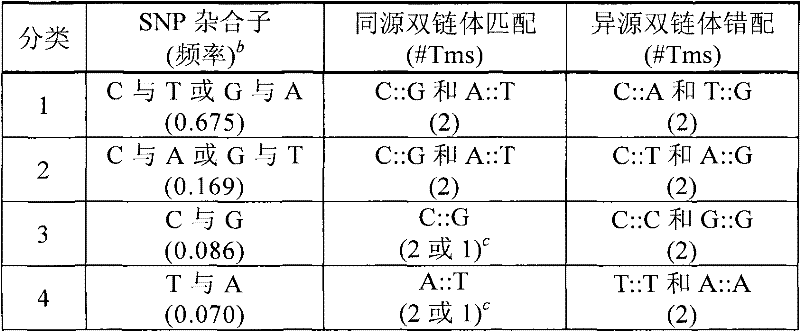
In an illustrative instance, all heterozygotes can be able to detect (Fig. 4) to the influence of melting curve through heteroduplex molecule.In addition, 4 kinds (A and C, A and G, C and T and G and T) in 6 kinds of difference of isozygotying are easy to move through Tm and distinguish (Fig. 4, arrow).Yet, in order to distinguish A and T homozygote or C and G homozygote, usually need high resolving power to unwind, and in some cases, can not distinguish homozygote even if use existing high resolving power to unwind.When the SNP frequency in the account of human genome, in 84%SNP, be not difficult to distinguish homozygote (A and C, A and G, C and T and G and T), and 16% the difficulty (A and T and C and G).In fact, under 4% situation (16% 1/4th), adopt the nearest contiguous Calculation on stability explanation of analyzing, because contiguous base symmetry, stability is identical.Provided accurate frequency in the table 1, wherein SNP is according to homoduplex that produces and heteroduplex classification.Be difficult to distinguish under the homozygous situation, can carrying out gene type fully and efficiently by preferred unmarked probe.
Table 1
a.
aWith " with " the exchange base regulation SNP heterozygote that separates, for example C and T explain that an allelotrope has C on the same position of same chain, another allelotrope has T.Not skew between two allelotrope, promptly C and T are equal to T and C.Represent base pairing (coupling or mispairing) with two colons, they are non-directional.That is, C::G representes the C::G base pair, but does not stipulate which bar chain is which base be positioned at.
bPeople SNP frequency is reported in Venter JC etc., human genomic sequence (The sequence of the human genome) .Science 2001 available from the Kwok data set; 291:1304-51).
cThe quantity of the thermodynamics duplex of prediction depends on closely symmetry of the nearest neck of sequence change on every side.1/4th times, estimate nearest symmetry, promptly the flank of both sides, sequence change position is complementary bases.For example, if the flank of C and G SNP is A and T on same chain, nearest symmetry just occurs and estimate only to have a homoduplex Tm.
Perhaps, under the situation that homozygote is difficult to distinguish, can the sample of known homozygous genotype be mixed with said unknown gene type with roughly suitable amount before the amplification or after the amplification.To this mixture increase (if in the past amplification), sex change and unwinding.If said genotype is identical, the melting curve of mixture should be identical with the melting curve of known homozygous genotype.If said genotype is different, can produces heteroduplex molecule and be able to differentiate by the change of melting curve shape.
For example, when the known array variant is carried out gene type, can use little amplicon or unmarked probe; When the unknown variant of scanning, can preferably big amplicon.Also can adopt multiple amplicon.For example, if carried interested sequence variants than away minor segment in the known big amplicon, can in a reaction, increase so, and they are unwind than away minor segment and total length amplicon.The data of unwinding of big amplicon will provide the sudden change scanning information, and than the data of unwinding of away minor segment gene type information can be provided.Bigger and the less amplicon that can increase simultaneously, or through first mutually in the big amplicon of amplification, second increase one or more less amplicons (vice versa) in mutually two-phase PCR increase.Can carry out this two-phase PCR through the amount of design Tm and each primer, with through regulating this biphase annealing temperature different amplicons that preferentially increase.When the signal of estimating big amplicon can flood or cover the signal of shorter amplicon, the final quantity of available this each amplicon of two-phase technological adjustment was to avoid the problems referred to above.
Also can in comprising the single PCR of one or more unmarked probes, scan simultaneously and gene type.Assay products is unwind and is changed and the probe transformation of unwinding.For example, at first analyzing total length PCR product unwinds and changes any heteroduplex that exists with detection.Should detect any sequence difference in the amplicon through this scanning analysis.If detect sequence variants through scanning, one or more of one or more unmarked probes that exist so unwind and change the genotype that discloses each probe locus.Because probe is less than whole PCR product, it is higher than full amplicon gene type specificity to carry out gene type with unmarked probe, can change all SNP on the probe locus and carry out gene types.
Embodiment 1
Dyestuff is synthetic
Asymmetric cyanine dyes can prepare through usual way, and this method is through indoles
part and pyridine
(or quinoline
pyrimidine
purine
) part of one or more " C (R)=" group link molecule.Like USP 5,436,134 and the reference of quoting described in, the quantity of " C (R)=" group is by the concrete synthetic agent decision of using in synthetic.At single methyl dyestuff (R like dyestuff S5
3=H in n=0) synthetic, has used a kind of combination of reagent, and wherein the methine carbon atom is by the indoles as methyl
A on the salt or pyridine
Reactive leavings group outside B on the salt and A and the B generates, and said leavings group is methylthio group, methyl sulphonyl or chloro normally, but can provide enough reactivities to accomplish any leavings group of reaction.A kind of method that can prepare dyestuff S5 and other similar dyestuff is following:
Through (pyridinone Aldrich) is heated to backflow with copper powder, salt of wormwood and phenyl-iodide and prepared starting compound 1 in 48 hours with 4-methyl-2-pyridone.Reaction cooled to room temperature, is distributed between water and ETHYLE ACETATE, filter, and organic layer is dry on sal epsom.Crude product is purifying on silicagel column, with 1: 1 ethyl acetate/hexane wash-out to obtain compound 1.
Another kind of raw material;
Compound 2; Be through adding 2-(methylthio group) benzo
azoles in the methyl-iodide in DMF, and in the sealing test tube in 150 ℃ of
heating 1 hour to obtain
compound 2 as salt compounded of iodine.
With the mixture heating up of the DMF of catalytic amount in compound 1, phosphorus oxychloride and the methylene dichloride to refluxing 24 hours.Mixture is cooled to room temperature and adds the methylene dichloride of another part volume, add compound 2 and 1 normal triethylamine subsequently.Stirred the mixture under the room temperature 6 hours.Use the mixture wash-out of ETHYLE ACETATE/chloroform/methanol to carry out purifying through the filtering separation solid and with silicagel column.Compound with purifying heavily is dissolved in methyl alcohol and adds excessive sodium iodide aqueous solution subsequently.The compound 3 of salt compounded of iodine form is passed through filtering separation and vacuum-drying.
With compound 3 and 1, the 1-N-METHYL PIPERAZINE in the 2-ethylene dichloride mixes and is incorporated in 55 ℃ of heating 2 hours subsequently.Make the product (compound 4) of acquisition quaternized through adding excessive methyl-iodide and Proton Sponge (Aldrich) then, expection can obtain the dyestuff S5 (compound 5) of diiodide salt form.
In addition, some embodiment that has prepared the dyestuff of
core texture that has following pyrimidine:
In the formula
X, R
2, R
3And R
5Definition identical with formula I, formula V is seen in the definition of B.
The mode for preparing the dyestuff with this formula is a lot, and a kind of method is following:
Wherein compound 6 is commercially available, maybe can be through the ordinary method preparation.With alkylating agent such as alkylogen, alkyl sodium sulfate ester etc., comprising lithium alkylide, aromatic amine and aliphatic amine, K
2CO
3Deng neutrality or alkaline condition under at N (3) alkanisation 6, thereby preparation compound 7a.Similarly, the aromatics linked reaction through aromatic halide, boric acid ester etc. under the catalysis of catalyzer such as metallic compound such as copper, palladium, platinum makes compound 6 arylations at N (3), thus preparation compound 7a.Prepare compound 7b through conventional oxidation from compound 7a, for example adopt hydrogen peroxide, peroxy acid to comprise the reaction of m-CPBA etc.In some cases, can buy compound 7a or compound 7b.Compound 8 is commercially available, maybe can be suitably substituted 1 through (for example) condensation, and 3-diketone and urea or thiocarbamide prepare.And, can under neutrallty condition, react through (for example) and alkylogen, alkoxyl group halogen or the reactant with good leavings group and be modified at the compound 8 that C (2) has sulfydryl, alkoxyl group or primary amine/secondary amine.Can prepare compound 9 through under alkaline condition, making compound 7 and compound 8 reactions, as described herein.
Preparation as described herein has the exemplary compound of this formula, passes through the HPLC purifying with triethylamine-ammonium acetate as moving phase, separates obtaining their corresponding acetates.These exemplary compounds are seen table 2.
Table 2.
The preparation of Compound D 6 is through following method synthetic: at first under the acetonitrile reflux conditions, make 4-methylpyrimidine and the reaction of (3-bromopropyl) trimethylammonium bromide.Acetonitrile solution and 3-methyl-2-methyl sulphonyl benzothiazole
iodide (available from Aldrich) that make the product (compd A 6) that obtains are in the presence of anhydrous pyridine and the triethylamine or at chloroform: react in methyl alcohol (10: 1) and the excess of triethylamine.Under reflux temperature or room temperature, react.
Preparation of compounds in accordance with E6 from three - methyl-2 - methyl sulfonyl benzene and
yl
iodide (By reacting 2 - methyl sulfonyl benzene and
azole prepared with dimethyl sulfate) and Compound A6 general preparation of Compound D6 steps.
The preparation of compound G5 is according to (Aldrich) carrying out with the general step of
compd A 6
preparation Compound D 6 from 2-methylthio group-3-phenyl benzothiazole
.
From the compound prepared according to the H5 5 - difluoro-methanesulfonyl-3 - methyl-2 - (methylthio) benzothiazole
methyl sulfate (available from Aldrich with a 5 - difluoro-methanesulfonyl-2 - (methylthio) benzothiazole prepared by the reaction with dimethyl sulfate) and Compound A6 Preparation of the compound of the general procedure for D6.
The preparation of Compound P 6 is according to carrying out from the general step of 5-chloro-2-(methylthio group)-3-(3-sulfopropyl)-benzothiazole
oxyhydroxide (Aldrich) and compd A 6 preparation Compound D 6.
R6 is from the compound prepared according to the 6 - amino-3 - methyl - 2 - (methylthio) benzothiazole
methyl sulfate (purchased from Aldrich through 6 - amino-2 - (methylthio) benzothiazole and dimethyl sulfate prepared by the reaction) and Compound A6 Preparation of the compound of the general procedure for D6.
The preparation of compound Y6 is according to from 3-methyl-2-methyl sulphonyl naphtho-[1; 2-d] general step of
azoles
Methylsulfate (through using 2-methyl sulphonyl naphtho-[1,2-d]
azoles and the methyl-sulfate prepared in reaction available from the Chem Bridge Product List in San Diego, California) and
compd A 6
preparation Compound D 6 carries out.
The preparation of compound Z6 is according to from 3-methyl-2-methyl sulphonyl naphtho-[1; 2-d] general step of thiazole
Methylsulfate (through using 2-methyl sulphonyl naphtho-[1,2-d] thiazole and the methyl-sulfate prepared in reaction available from the Specs of Dutch Rijswijk) and compd A 6 preparation Compound D 6 carries out.
The preparation of compound G8 is following: through reflux N-phenylthiourea and 2, the HCl/ ethanolic soln of 4-diacetylmethane prepares.Make the pyrimidine thioketone that obtains and 3-methyl-2-methyl sulphonyl benzothiazole
iodide reaction overnight that in chloroform/methanol (10: the 1) solution of triethylamine, refluxes, generate compound G8.
Compound G5, I5, K5, L5, F7, N7, O7, P7, Q7, R7, S7, T7, U7, V7, W7, X7, Z7, C8, E8, K8, L8, M8, N8, O8, P8, T8, V8, W8, X8, Z8, A9, C9, G9, I9, I9Met, J9, J9Met, K9, L9, L9Met, M9, N9, O9, P9, Q9, R9, A10 and V10 can be through preparing with the aforesaid method similar methods.These dyestuffs are to be incorporated into the dsDNA combination dye that fluorescence changes behind the dsDNA.Estimate manyly in these dyestuffs to can be used for detecting heteroduplex.
Also possibly prepare R
2And R
3The pyrimidine that combines
The variant of base cyanine.The exemplary dye structure comprises:
Wherein w is 1-5.In an example embodiment, can be through making ClC (O) (CH
2)
wThe left loop systems of the prepared in reaction exemplary dye of Br and 2-aminothiophenol or 2-amino naphthalenes-1-thiophenol.For example, prepare left loop systems through heating 4-bromobutanoylchloride and 2-aminothiophenol
Then, make exemplary right loop systems
Through having refluxed and the reaction of left loop systems at triethylamine and alcoholic acid.Can reflux the enough time (as 20 minutes) through in diacetyl oxide, making 4-methylpyrimidine and equimolar approximately amitraz diphenylurea, in acetonitrile, make the intermediate product of formation and equimolar approximately 1 again, 3-diiodo propane reflux 3 days prepares this right loop systems.Then,, make iodine quilt (for example) quaternary ammonium-substituted on the compound that obtains, produce the exemplary dye of following structure through in the presence of N, reacting with Trimethylamine
And, prepared some embodiment of the cyanine dyes of
core texture that has following purine:
Y, X, R in the formula
2, R
3, R
5, R
12, R
13, z and t definition identical with formula I, R wherein for example
2, R
5And R
13In at least one is not a methyl.Modification method (
U.S. Patent number 4 according to Lee; 937; 198) use the preparation of 3-ethyl-2-methyl-benzothiazole
and 1-ethyl-2-methyl-aphthothiazoles
exemplary compound F 17-hydroxy-
corticosterone 11 and H11 respectively, as the precursor of the left loop systems of dyestuff.Compound F 17-hydroxy-
corticosterone 11 has following structure respectively with H11:
Pyrimidine as herein described
basic cyanine dyes, for example G5, H5, I5, K5, L5, D6, E6, P6, R6, Y6, Z6, F7, N7, O7, P7, Q7, R7, S7, T7, U7, V7, W7, X7, Z7, C8, E8, G8, K8, L8, M8, N8, O8, P8, T8, V8, W8, X8, Z8, A9, C9, G9, I9, I9Met, J9, J9Met, K9, L9, L9Met, M9, N9, O9, P9, Q9, R9, A10 and V10; And the basic cyanine dyes of purine as herein described
, for example F11 and H11 are new dyes.Table 3 has been summed up the result who in heteroduplex detects, uses these dyestuffs.Usually, PCR is suppressed to the dyestuff that is lower than 50% saturated level and can not detects heterozygote well.PCR method and heteroduplex detect of following examples.
Table 3.
| Dyestuff |
Ex/Em
1 |
The compatible %Sat of maximum PCR
2 |
%Het
3 |
| G5 |
442-458/475 |
100% |
20.0% |
| H5 |
444/459 |
100% |
22.5% |
| S5 |
450/469 |
>99% |
20.5% |
| D6 |
457/471 |
92% |
23.3% |
| E6 |
425/454 |
>99% |
15.0% |
| P6 |
464/490 |
100% |
21.0% |
| R6 |
453/470 |
>90% |
15.0% |
| Y6 |
439/477-515 |
100% |
21.0% |
| Z6 |
469/494-526 |
100% |
13.4% |
| N7 |
458/474 |
>100% |
22.0% |
| O7 |
**
4 |
>70% |
21.2% |
| P7 |
**
4 |
>70% |
21.5% |
| Q7 |
453/471 |
>70% |
20.7% |
| T7 |
453/471 |
>70% |
21.2% |
| G8 |
453/471 |
>100% |
19.7% |
| L8 |
470-490/490-520 |
>70% |
2.3% |
| P8 |
453/471 |
>70% |
17.7% |
| T8 |
453/471 |
>70% |
24.0% |
| V8 |
469/494-526 |
>70% |
21.4% |
| W8 |
453/471 |
>70% |
27.5% |
| Z8 |
453/471 |
>70% |
22.7% |
| A9 |
**
4 |
100% |
23.0% |
| I9 |
**
4 |
100% |
20.9% |
| I9Met |
**
4 |
>80% |
23.0% |
| J9 |
**
4 |
100% |
22.4% |
| J9Met |
**
4 |
100% |
23.0% |
| K9 |
**
4 |
100% |
22.3% |
| L9 |
**
4 |
100% |
21.3% |
| V10 |
**
4 |
95% |
15.5% |
| F11 |
**
4 |
100% |
22.0% |
| H11 |
**
4 |
100% |
13.0% |
1. (3mM MgCl in the PCR damping fluid
250mM Tris; PH 8.3, each 200 μ M of every kind of dNTP, 500 μ g/ml BSA) the maximum excitation wavelength (Ex) and the maximum emission wavelength (Em) that use the dyestuff of 2.5 μ M bp (100 nanograms/60 microlitres) double-stranded DNA and the compatible concentration of maximum PCR on photofluorometer, to obtain.Some dyestuff is because emission or excitation wavelength peak broad have a range of wavelengths.
2. can be present in the PCR mixed solution and amplification not produced the maximum amount of dye that obviously suppresses; Fluorescence per-cent to compare with the fluorescence of the identical dyestuff of saturation concentration (concentration of possible maximum fluorescence intensity promptly is provided) is represented, all under the condition that has 15 μ M bpDNA (100 nanogram double-stranded DNAs/10 microlitres) and PCR damping fluid, carries out.
3. use the del F508 heterozygote melting curve that obtains with 0.3 ℃ of/second heating rate (heating ramp), with the peak area per-cent of the heteroduplex molecule characteristic peak of 420-490 excited and the measurement of 450-530 nanometer detection optics.The amplicon length of using in the experiment of this group is 57bp, produces through primer GGCACCATTAAAGAAAATAT (SEQ ID NO.1) and TCTGTATCTATATTCATCATAGG (SEQ ID NO.24).Write down largest percentage.
4. there is not spectroscopic data.
Embodiment 2
The PCR scheme
Mark with unlabelled oligonucleotide from IT Biochem (Salt Lake City, UT), Qiagen Operon (Alameda, CA) or Synthegen (Houston TX) locates to obtain.Except other has explanation; PCR with the volume of 10 microlitres at LightCycler
(Roche Applied Systems; Indianapolis IN) upward carries out with 20 ℃/second procedural variation.Except other had explanation, amplification mixture had comprised that 50 nanograms are as the genomic dna of template, every kind of each 200 μ M of dNTP, 3mM MgCl
2, 100mM 2-amino-2-methyl-1, ammediol, pH 8.8,0.04 units/microlitre Taq polysaccharase (Roche), 500 μ g/ml BSA and every kind of each 0.5 μ M of primer.Through the human genome DNA of gene type from before research (Gundry CN etc., Genetic Testing, 1999; 3:365-70; Herrmann M etc., Clin Chem 2000; 46:425-8) or from the Coriell cell bank (Camden, NJ).Except other has explanation, comprise the dyestuff S5 of 10 μ M in the PCR reaction.Using under SYBR
situation of Green I as indicator; Used Molecular Probes storage liquid 1: 10,000 final dilution.Before PCR, add dyestuff; Increase, and on LightCycler
or through the high resolving power melting analysis, monitor the transformation of unwinding of amplicon.Distinguish different homozygotes through amplicon melting temperature(Tm) (Tm).Through the low temperature that can widen total heteroduplex molecule between the limited proportionality that the unwinds discriminating heterozygote that unwinds.Melting analysis needs about 1 minute, and does not need the sampling process behind the PCR.
In order to study the sensitivity of dyestuff S5, SYBR
Green I and other double-stranded DNA combination dye, analyzed the polymorphum in factor V Leiden, cystic fibrosis (F508del, F508C, I507del, I506V) and HTR2A (T102C) gene.In addition, used engineering plasmid with the possible single sequence change of comprehensive institute.Denatured products is cooled off (at least-2 ℃/second) to the heteroduplex molecule that produces through hybrid DNA amplification fast, rapid heating (0.2 to 0.4 ℃/second) obtains best detection in the melting analysis process subsequently through making.All heterozygotes change through unwinding of wide region more and are different from homozygote.Different homozygotes often can be distinguished through its Tm value.Yet, as expect that some homozygosity G to C and A to T sequence change do not carry out homozygote blended words, even use the Analytical high resolution method repeatedly to distinguish.Said amplicon length changes between 44 to 331bp.
Though used dyestuff S5, D6, Z6 and N7 here among the embodiment that provides, should be understood that and to use corresponding to other dyestuff of the present invention.
Embodiment 3
Curve analysis
Go up or separate chain apparatus HR-1 (Idaho Technology in high resolving power subsequently at LightCycler
immediately after the circulation; The salt lake city; The Utah State) or LightTyper
(Roche Applied Systems; Indianapolis, the state of Indiana) carries out melting analysis on.Yet, need understand curve analysis can not have the amplification situation under carry out.When using LightCycler
; Sample at first is heated to 94 ℃; Be cooled to 60 ℃ with-20 ℃/second sequencing settings, unwind with 0.2 ℃/second then and obtain fluorescence continuously.When in one of other device, unwinding; Except other has explanation; With at first amplification in LightCycler
of sample, instantaneously heating to 94 ℃ and cool off (program is set to-20 ℃/second) fast among LightCycler
subsequently to 40 ℃.Except other has explanation, then each one of LightCycler
kapillary is transferred to high resolution device and with 0.3 ℃ of/second heating.HR-1 surrounds a LightCycler
single sampling unit capillaceous with aluminium matter right cylinder.System is heated by joule through the outside coiling of right cylinder.Sample temperature is with placing the inner thermocouple monitoring of right cylinder equally and converting 24 bit digital signal to.The epi-illuminator of the capillary end of fluorescence through being positioned at cylindrical base monitor (Wittwer CT etc., BioTechniques 1997; 22:176-81) also convert 24 bit signals (it should be noted that some embodiment adopt 16-bit HR-1 prototype early) equally to.Obtain about 50 data points to every ℃.On all devices, adopt the optical means of standard, except as otherwise noted.
In some cases, obtaining not make the product sex change that its benefit is arranged before the melting curve after the PCR.For example, when target was the quantity somatotype of Tumor-necrosis factor glycoproteins (for example STR and VNTR), amplification can stop on the extension step in the index of Response phase process before plateau, and carries out melting analysis subsequently.Like this, can analyze homoduplex molecule extension products.In the Tumor-necrosis factor glycoproteins somatotype, particularly because many different heteroduplex molecule products possibly formed by the different align of Tumor-necrosis factor glycoproteins, so the homoduplex molecular product can provide more information than heteroduplex molecule product.In some cases, both obtained homoduplex molecule melting curve (not sex change premenstruum), it possibly be useful obtaining heteroduplex molecule melting curve (through sex change and form all possible double-stranded combination) again.Use same sample as " homoduplex contrast ", the difference between these two kinds of melting curves has provided measuring of the heteroduplex molecule degree that can form.
The data of unwinding are analyzed with the customized software of writing among the Lab View.Fluorescence-hygrogram through at first define every kind of sample unwind change before and afterwards linear baseline between 0 to 100%, carry out stdn.In every kind of sample, the fluorescence of each acquisition calculates as the fluorescence per-cent between this acquisition temperature next top and the bottom baseline.In some cases; The derivative melting profile calculates (" digital processing in the C language " (Numerical recipes in C) of people such as Press WH chief editor by the Savitsky-Golay polynomial expression to a point; Second edition; New York:Cambridge University Press, 1992:650-5).Savitsky-Golay analyzes and uses 2 order polynomials and comprise the data window of being had a few within 1 ℃ of interval.Through using the polynary Gaussian function of non-linear least square Return Law match, peak area and melting temperature(Tm) have been obtained.In some cases, the X axle of every standardized melting curve is moved so that overlapping in scheming between certain phosphor region.This " temperature variation " proofreaied and correct any trickle operating temperature variation and improved the ability with heterozygote and homozygote differentiation.Difference between the genotype also can be through amplifying in the mapping of the fluorescence difference between the genotype at each temperature.
Embodiment 4
Use the SNP gene type of dyestuff S5:
Factor V Leiden two mutants somatotype
By length is the amplicon that 18 and 24 bases, the primer that is close to both sides, factor V Leiden two mutants site form 43bp.Article two, primer all has 62 ℃ estimation Tm value.Sample uses following
scheme circulation 35 times: 94 ℃ do not keep, 60 ℃ do not keep and 72 ℃ kept 10 seconds.After the amplification; With sample instantaneously heating to 94 ℃ in LightCycler
; Fast cooling (program is set to-20 ℃/second) is to 60 ℃, the PCR product is unwind with 0.2 ℃/second and obtains continuous fluorescence.
Shown among Fig. 1 from the derivative melting curve of the different genotype amplification PCR products of factor V gene Leiden locus.The fluorescence monitoring that the S5 dyestuff is used for unwinding between two strands and the single stranded product and changes.The Leiden two mutants is positioned at 19 base places of amplicon one end.Shown from 10 homozygous wildtype, 2 heterozygosis and 1 result that the Leiden genotype of isozygotying obtains.The amplicon melting temperature(Tm) of homozygous mutation body is lower about 1 ℃ than homozygous wildtype melting temperature(Tm).Owing to the formation of heteroduplex molecule, the heterozygosis sample shows the transformation of unwinding of secondary a, low temperature.Use the similar experiment of SYBR
Green I not detect the secondary transformation (data not shown) of unwinding in this heterozygote.
Go up the influence that use heterozygosis factor V Leiden DNA has studied speed of cooling and rate of heating at LightCycler
.In order to study the influence of speed of cooling, the sample that increases as stated is heated to 85 ℃, is cooled to 60 ℃ with-20 ,-2 ,-0.5 or-0.1 ℃/second speed from 85 ℃ subsequently, and the constant rate of heating through 0.2 ℃/second is to obtain melting curve afterwards.Cooling is essential (Fig. 2) for forming tangible heteroduplex molecule fast.When speed of cooling is-0.1 ℃/second or when lower, do not observe heteroduplex molecule.When the kapillary sample when boiling water is transferred to the frozen water fast, form the heteroduplex molecule (data not shown) of maximum.Be employed in LightCycler
and go up cooling, heteroduplex molecule be formed on faster than-5 ℃/second speed is set the time it seems and reach maintenance level (Fig. 2).Yet the measurement of actual sample temperature shows that when speed was set faster than-5 ℃/second, speed of cooling only had trickle raising: when device was set to-20 ℃ of/second coolings, AV was about-6 ℃/second.
The speed that is provided with through with-20 ℃/second is cooled off, and unwinds with 0.05,0.1,0.3 or 0.5 ℃/second subsequently and has studied the influence of rate of heating.The relative percentage of viewed heteroduplex molecule higher (Fig. 3) under higher rate of heating.Along with speed improves, apparent Tm value is also moved to higher temperature, and separates chain process and depart from (Gundry CN etc., Genetic Testing, 1999 from equilibrium state to a greater degree; 3:365-70).
Embodiment 5
With the systematic study of plasmid to the SNP gene type
For the melting curve gene type to all possible single sequence change carries out systematic study, used engineering plasmid.Said plasmid (DNA Toolbox, Cambrex Bio Science Rockland Inc.) is confirming to comprise A, C, G or T on the position, and GC content 50% (Highsmith WE etc., Electrophoresis 1999; 20:1186-94).Use four kinds of plasmids with the simulation homozygous genotype separately, perhaps combination is in twos used to make up " heterozygote ".Primer is TCTGCTCTGCGGCTTTCT (SEQ ID NO.50) and CGAAGCAGTAAAAGCTCTTGGAT (SEQ ID NO.51), produces the 50bp amplicon on every side in the polymorphum position.Use 10
6The dna profiling of copy and be employed under the existence of 20 μ M D6 85 ℃ do not keep, 35 circulations that 55 ℃ kept 1 second carry out PCR.The HR-1 high resolving power is separated chain apparatus be used for melting analysis.
The stdn melting curve that has shown four homozygotes (Fig. 4 A) and six heterozygotes (Fig. 4 B).Be not difficult to distinguish homozygote and heterozygote, because heterozygote has owing to there is the extension the produce transformation of unwinding in heteroduplex.All homozygotes unwind in a transformation (Fig. 4 A), predict correctly that according to nearest calculating separating chain sequence is that (Biochemistry 1996 for SantaLucia J., Jr for A/A<T/T<C/C<G/G; 35:3555-62).Heterozygote produces by two homoduplexs and two complicated melting curves (Fig. 4 B) that heteroduplex produces.Each heterozygote is corresponding to unique melting curve path of four kinds of duplex Tm.Separate chain sequence (A/T<A/C<C/T<A/G<G/T<C/G) according to nearest calculating with the prediction of the MV of two homoduplex Tm.At high temperature six heterozygote curves are merged into three tracks, by the highest homodimer prediction (the A/T heterozygote is T/T, and A/C and C/T heterozygote are C/C, and A/G, G/T and C/G heterozygote are G/G) of unwinding that exists.Can distinguish all genotype with the high resolving power melting analysis.
Embodiment 6
Adopt labeled primer: the gene type of the cystic fibrosis gene of dyestuff S5 or SYBR
Green I
Used among the PCR KlenTaq polysaccharase (0.04 unit/microlitre, AB Peptides, St.Louis, MO); 88 nanogram TaqStart antibody (ClonTech, Palo Alto, CA) and 50mM Tris; PH 8.3, rather than Taq polysaccharase and 2-amino-2-methyl-1, ammediol.Use the increased fragment of a 44bp of following primer: GGCACCATTAAAGAAAATAT (SEQ ID NO:1) and TCATCATAGGAAACACCA (SEQ ID NO:2).Article one, primer or carried out 5 ' mark with Oregon Green, or under the condition that SYBR
Green I or S5 exist, react.Primer and the mutantional hotspot side joint that comprises F508del, I507del and F508C variant.PCR carries out through 40 circulations of 85 ℃ and 58 ℃ (keeping 0 second).6 samples have been monitored in the melting curve procurement process on LightCycler
.
Fig. 5 B-D has shown the derivative melting curve by different genotype amplification PCR products on the cystic fibrosis gene I507/F508 zone.PCR product length is 41 or 44 bases (Fig. 5 A).The fluorescence monitoring that 5 ' labeled primer (Fig. 5 B), dyestuff S5 (Fig. 5 C) or SYBR
Green I (Fig. 5 D) are used for unwinding between two strands and the single stranded product and change.Shown by two kinds of homozygous genotypes and three kinds of results that the heterozygous genes type obtains.
The double-stranded stability of different genotype is followed Theoretical Calculation (von Ahsen N etc., Clin Chem 2001; 47:1956-61), F508del~I507del<wild-type<F508C wherein.Except F508del and I507del, genotype can be distinguished through the Tm value that they mainly change.When on LightCycler
, unwinding, the standard deviation of the Tm of 10 repetition wild-type samples is 0.12 ℃.When on high resolution device, unwinding, the standard deviation of the Tm of identical 10 samples is 0.04 ℃.
When the heterozygosis sample when the pcr amplification, can expect two kinds of homoduplex molecules and two kinds of heteroduplex molecules (Nataraj AJ etc., Electrophoresis 1999; 20:1177-85).Yet; When SYBR
Green I is used as fluorescent indicator, can only see the single peak that unwinds (Fig. 5 D) for every kind of genotype.On the contrary, when applying marking primer or dyestuff S5 under the same conditions, two tangible peaks of profile (Fig. 5 B and 5C) have appearred.The transformation of unwinding of a kind of or whole two kinds of heteroduplex molecule products of expression is inferred always less than the higher temperatures peak in the lower temperature peak.Erect image can be expectable, and the heterozygote (F508del and I507del) of 3bp disappearance has caused the more unsettled heteroduplex molecule peak, heteroduplex molecule peak than single sequence change (F508C).The main peak of F508C heterozygote is positioned at the temperature higher than wild-type, and this has reflected more high stability (Gundry CN etc., Genetic Testing, 1999 of T to the G conversion; 3:365-70).
Embodiment 7
Adopt the sudden change scanning of saturable dye
Studied the SNP of HTR2A.According to describing PCR is carried out with KlenTaq, TaqStart and Tris in the cystic fibrosis site.The 331bp fragment of 5-hydroxytryptamine receptor 2A (HTR2A) gene has comprised inner total polymorphum (T102C) (Lipsky RH etc., the Clin Chem 2001 of exons 1; 47:635-44).Be reflected at 95 ℃ do not keep, 62 ℃ keep keeping in 2 seconds and 74 ℃ between 20 seconds circulation 40 times.Obtained the high resolving power melting curve.
Fig. 6 shows that saturable dye S5 can be used for the scanning to sequence variations.Need not know the position of sequence variations in other words.Can be great the existence of the inner any variation of amplicon detect.As shown in Figure 6, three SNP genotype of all in the HTR2A gene (T that isozygotys, C and heterozygosis T/C isozygoty) can be distinguished in the amplicon of 331bp.The ability of the tolerance range of melting curve and differentiation different genotype depends on the temperature and the fluorescence resolving power of device.
Embodiment 8
The curve analysis of DNA size scalariform mark: the comparison of SYBR
Green I and dyestuff S5
The DNA size scalariform mark (DNA size ladder) (low-molecular-weight dna scalariform mark, Gibco BRL) that 100 nanograms are contained 6 kinds of different sorts double-stranded DNAs is at 3mM MgCl
2, 100mM 2-amino-2-methyl-1, ammediol, in the damping fluid of pH 8.7 with SYBR
Green I (1: 10,000) or dyestuff S5 (10 μ M) mix.On high resolution device, obtain melting curve with 0.1 ℃/second speed.
As stated; Different with SYBR
Green I, dyestuff S5 can differentiate heteroduplex molecule with the concentration compatible with PCR in melting curve changes.Explained among Fig. 7 that SYBR
Green I can not differentiate a low reason of unwinding and changing easily.Under the situation that the dna fragmentation that several kinds of stability increase progressively exists; S5 compares with dyestuff, adopts the low temperature peak of SYBR
Green I very little.A kind of explanation is in separating chain process; SYBR
Green I possibly be released from the low temperature duplex molecule, and only combines with the duplex molecule that under higher temperature, unwinds.This causes that each follow-up peak is higher than previous, and is also very little even if the peak of minimum temperature can be observed.The dyestuff S5 that exists with much higher saturated level in addition the low temperature duplex molecule have the visible peak.Though dyestuff S5 is when existing near saturated level in the present embodiment, surprisingly, when being diluted to the 5-20% of saturated level, dyestuff S5 can detect the low temperature peak.For example, the represented data of Figure 13 are to obtain through the S5 that uses 1 μ M concentration.Thereby though also do not understand its mechanism, dyestuff S5 and multiple other saturable dye of the present invention be not redistribution in separating chain process.
If the area at each peak and divided by the known quantity of every kind of DNA among mensuration Fig. 7 can be estimated the relative sensitivity (Fig. 8) for every kind of DNA.As shown in Figure 8; Adopt dyestuff S5 to help the low temperature peak that unwinds; And when adopting SYBR
Green I, at high temperature observe the remarkable enhancing of signal.
Embodiment 9
The mensuration of dyestuff S5 usable concentration scope among the titration curve of general double-stranded DNA dyestuff and the PCR
The general double-stranded DNA dyestuff of 100 nanogram low-molecular-weight dna gradient marks and different concns is contained 3mM MgCl at
final volume 10 microlitres
2, 50mM Tris, mix in the solution of each 200 μ M of pH 8.3,250 μ g/ml BSA and every kind of dNTP.Sample transfer is to LightCycler
pipe and on the real-time fluorescence meter, measure 40 ℃ fluorescence.Maximum fluorescence value with every kind of particular dye obtained is carried out standardization to fluorescence.
The HTR2A amplicon that uses 152bp contains 3mM Mg
final volume 10 microlitres
2+, 50mM Tris-HCl, pH 8.3; 500 μ g/ml BSA, every kind of each 200 μ M of dNTP, every kind of each 0.5 μ M of primer; 50 nanogram genomic dnas, in the solution of 0.4 Taq of unit polysaccharase and 88 nanogram TaqStart antibody, to use dilution range be 2 μ M dilutes research to the S5 of 100 μ M.After 95 ℃ of initial sex change of 10 seconds, with 95
℃ 0 second, 62
℃ 2 seconds and 72 ℃ circulation in 20
seconds 40 times.Went up additional temperature condition effect (95
℃ 0 second at LightCycler
; 55
℃ 0 second) after, sample is unwind on high resolution device with 0.3 ℃/second slope.
Fig. 9 A-B has represented the concentration of the SYBR compatible with PCR
Green I and dyestuff S5.Under the concentration compatible with PCR, the DNA amount that SYBR
Green I exists when PCR is finished usually is saturated.On the contrary, dyestuff S5 can use in comprising the concentration range widely that makes it saturated.Shown among Figure 10 that dyestuff S5 differs 50 times the interior typical melting curve of concentration range.
Embodiment 10
The fluorescence spectrum of SYBR
Green I and dyestuff S5
With DNA bonded SYBR
Green I and dyestuff S5 to excite with emmission spectrum be to go up at the photofluorometer (FL-1) of Photon Technology company to measure.3mM MgCl at
final volume 60 microlitres that contain 100 nanogram DNA (low-molecular-weight dna gradient mark)
2, 50mM Tris adds dyestuff S5 (10 μ M) or SYBR in the solution of pH 8.3,250 μ g/ml BSA and every kind of each 200 μ M of dNTP
Green I (1: 10,000).
LightCycler
Optical Devices and SYBR
Green? I a good match of excitation and emission (Figure 11).Even if dyestuff S5 and LightCycler
optics coupling is bad, go up with the observed fluorescent signal of the dyestuff S5 of the compatible concentration of some PCR than usually from SYBR
the observed signal of Green I stronger (data are unexposed) at LightCycler
.
Many other saturable dyes as herein described also are " blueness " dyestuffs.Though the LightCycler of available standards
optics is observed the fluorescence of these dyestuffs; But in certain embodiments, the optics of some equipment is reequiped to mate blue dyes better.These repackings in related embodiment, have been pointed out to optics.
Embodiment 11
Use the gene type of the betaglobulin of X axial adjustment and fluorescence variance analysis
Fragment from the regional 110bp that increases of people's betaglobulin of No. 11 karyomit(e)s (accession number NG_000007).This 110bp fragment has comprised common betaglobulin two mutants HbS and the site of HbC.From the dried blood cake of every kind of common genotypic 4 Different Individual, extract DNA.These genotype have comprised 3 types of isozygotying (AA, SS and CC) and 3 heterozygosis (AS, AC and SC) type.Forward primer and reverse primer are respectively ACACAACTGTGTTCACTAGC (SEQ ID NO:3) and CAACTTCATCCACGTTCACC (SEQ ID NO:4).Per 10 microlitre reaction systems have comprised 50 microgram genomic dnas, the various primers of 0.5 μ M, 10 μ M dyestuff S5,3mM MgCl
2, 50mM Tris, pH 8.3,500 μ g/ml BSA, every kind of each 0.2mM of dNTP, 0.04 unit/microlitre Klentaq
TM(AB Peptides, St.Louis, MO), 88 nanogram TaqStart
TMAntibody (CloneTech, Palo Alto, CA).The PCR reaction conditions is following: preceding 95 ℃ of sex change in 5 seconds circulate; 94 ℃ 0 second, 50 ℃ 2 seconds, 72 ℃ 2 seconds the circulation 35 times, slope is 2 ℃ of per seconds.Obtain the single fluorescent value of each sample after extending 2 seconds.After the pcr amplification, with-20 ℃ setting speed cooling sample.And then fast after the cooling, separate on the chain apparatus speed in 24 bit high resolving power of customization and unwind, obtain fluorescent value simultaneously continuously from 70 ℃ to 93 ℃ with 0.30 ℃/second.
Along with sample temperature improves, obtain high resolving power melting curve data through measuring fluorescence.Shown the raw data that obtains from 6 kinds of genotypic quadruplicate samples of betaglobulin among Figure 12 A.Note because the magnitude of fluorescence change between the different samples that sample volume difference and the change of kapillary optics can cause.
Magnitude difference can be carried out stdn through using before the main transformation with the linear baseline of every curve afterwards between the sample.Specifically, select two linearity region, one of them is before main the transformation, and one after this.These zones are two straight lines of every curve definitions, 0% fluorescence straight line of 100% fluorescence straight line of top and below.Fluorescence percentage ratio in the transition process under each temperature (between these two zones) is with calculating apart from percentage ratio between the above and below straight line of extrapolation.Shown betaglobulin standardization of data result among Figure 12 B.Every kind of genotypic quadruplicate sample obviously roughly the same, the most obviously visible is near 84-85 ℃.It is accessory deviation that every kind of genotype inside still has some for the temperature deviation between operation, (to note between the inner quadruplicate sample of genotype, having an appointment 0.2 ℃ discrete range near the 10-20% fluorescent value).This sample deviation can be between two different samples or even between twice of same sample different operation, take place.Different preparations comprise the preparation of different salt concentration also can causing temperature deviation.Yet at least the first approximate (approximation), these differences are the shape of influence curve not.
Temperature deviation between the operation can be proofreaied and correct through the temperature axis that moves every curve, thereby makes them overlapping between a given phosphor region.For example, select a sample, and the point between phosphor region is carried out the quadratic equation match as standard substance.To every remaining curve, calculate for each interior between said phosphor region point is transformed into needed temperature variation value on the said quadratic equation.Then with every curve with the translation of mean variation value, make said curve overlapping between selected phosphor region.The low temperature that heterozygote amplification produces heteroduplex molecule unwinds and changes and the transformation of unwinding of the high temperature of homoduplex molecule.Like what seen among Figure 12 C, if moving curve so that its high temperature homoduplex molecular domains (low fluorescence percentage ratio) is overlapping, heteroduplex molecule can be able to discriminating early stage decline of low temperature fluorescence down more through it.Yet because the curve shape of different homoduplex molecules does not have wide variation, the temperature variation of different homoduplex molecules possibly covered any difference between them.
At last, through the fluorescence difference mapping between standardized (and optional through temperature variation) melting curve is easy to observe the different gene type most.Select a kind of standard gene type (for example, using betaglobulin wild-type AA) earlier.Shown in Figure 12 D, the difference between every curve and the standard is mapped to temperature subsequently.The standard gene type is 0 (having deducted itself) under all temperature.Other genotype is followed the trail of unique route and can be differentiated through the visual pattern coupling.The automatic mode of feature extraction also can be used for confirming genotype.In addition; Though illustrative embodiment has used saturable dye and heteroduplex molecule to detect; Need understand that temperature variation and temperature contrast mapping can be used for not existing the gene type under the heteroduplex molecule situation, for example can being used for wherein, genome is haploid gene typing.The example of such hrr gene somatotype comprises hepatitis C gene type, subtype of human papilomavirus gene, HIV gene type and the Bacteria Identification that increases through rDNA.
Can design the single parameter that is associated with genotype.For example, can use standardized curve to confirm that different genotype is such as 10% (90% fluorescent value) temperature of unwinding.Remarkable like this some genotype of having distinguished, but can not significantly distinguish other genotype (Figure 12 B).Perhaps, can use the maximum slope of curve to distinguish homozygote and heterozygote, but different homozygotes often is similar under maximum slope.At last, can use different areas under a curve (Figure 12 D), but follow the trail of different routes but such curve can have similar area with the definition genotype.Confirm it is effectively though possibly confirm combinations of parameters for the robotization gene type, this technology is very suitable for the visual pattern coupling.
Need understand that other standardisation technique is utilizable and is included within the scope of the present invention.For example; HR-1 (Idaho Technology; Salt Lake City UT) have the setting that can under predetermined temperature, adjust fluorescent value automatically (for example the fluorescent value 40 ℃ the time is 100), and the melting curve of all samples can be according to identical fluorescent value adjustment (align).When the difference between the stdn of above-mentioned stdn and the control of this machine is to use the stdn of machine control, change and change the back slope of a curve not flattening preceding.
Embodiment 12
The analysis of bigger amplicon
Though short amplicon causes bigger gene type difference usually, dyestuff of the present invention also can be used for the gene type of bigger amplicon.The length of DNA melting domain is about 50-500bp usually, bigger amplicon, and for example the amplicon of 500-800bp usually has a plurality of melting domains.Sequence in zone changes possibly not influence unwinding of other zone, and observed variation can not receive the constraint of amplicon length in the inside in a zone.Thereby, though the example in the 400-650bp scope is provided, can there be the upper limit for the size that can be used to scan to confirm the PCR product that exists that sequence changes.
And, because it seems that unwinding of a zone be to be independent of unwinding of other zone, can be with constant zone as internal reference with adjustment X axle (temperature axis), this is because device or sample operation are variations.Since the difference of melting curve shape, heterozygote each other and and homozygote between can distinguish.The shape of melting curve is limited the heteroduplex molecule that exists and the stability and/or the kinetics speed of unwinding of homoduplex molecule.Owing in bigger amplicon, there are a plurality of melting domains, change in shape can occur in any part of curve.X axle through adjusting many curves is located so that the constant portion of curve is overlapping, is easier to distinguish the variation part of curve.Perhaps, through the variation part of superimposed curves, if there is the several genes type, then the rest part of curve can be different.X axial adjustment in addition can through before the PCR or before unwinding outside each sample adds (1) with reference to nucleic acid; Or (2) have the dyestuff of second emission wavelength; This dyestuff is not with nucleic acid interaction but its fluorescence depends on temperature (dyestuff with good temperature factor is like Cy5) carries out.The position that should change according to unwinding of said contrast nucleic acid subsequently or carry out temperature axis according to the intensity curve of said contrast dye and move.
Figure 13 A and 14 has takeed the example of the bigger amplicon of two analyses.Figure 13 A has shown the segmental amplification of 544bp available from people's 5-hydroxytryptamine receptor 2A (HTR2A) gene extron 2 (accession number NM_000621.1).Forward primer and reverse primer are respectively CCAGCTCCGGGAGA (SEQ ID NO:5) and CATACAGGATGGTTAACATGG (SEQ ID NO:6).Per 10 microlitre reaction systems comprise 50 nanogram genomic dnas, each 0.5 μ M of every kind of primer, 1 μ M dyestuff S5,2mM MgCl
2, 50mM Tris, pH 8.3,500 μ g/ml BSA, every kind of each 0.2mM of dNTP, 0.4 unit K lentaq
TM(AB Peptides, St.Louis, MO) and 88 nanogram TaqStart
TMAntibody (CloneTech, Palo Alto, CA).
The PCR reaction conditions is following: 92 ℃ 0 second, 60 ℃ 2 seconds, 74 ℃ 25 seconds the circulation 40 times.After the pcr amplification, make sample with the cooling of-20 ℃/second setting speed.Follow hard on quick cooling, separate on the chain apparatus speed in 24 bit high resolving power of customization and unwind, obtain fluorescence simultaneously continuously from 70 ℃ to 93 ℃ with 0.30 ℃/second.
Shown in Figure 13 A, increase and analyze the duplicate sample of every kind of genotype (CC, TC and TT).Except curve overlapping between 10% and 20% fluorescence, to standardization and the temperature variation such as embodiment 11 said the carrying out of data.Figure 13 B representes unwind figure and separate the pleomorphism site in the sequence at lesser temps of the prediction of homoduplex molecule.Experimental data has shown two apparent sequences of separating.It is similar that all genotype are separated in the sequence at comparatively high temps.Genotype is separated in the sequence at lesser temps and there are differences, and wherein heterozygote shows the unwind typical behavior of heteroduplex molecule of low temperature, shows as heterozygote curve and the low temperature homozygote curved intersection of unwinding, and approaches the homozygote of higher temperature along with temperature raises.
Figure 14 representes the difference curve available from the 612bp fragment amplification of cystic fibrosis spanning transduction membrane regulator (CFTR) gene extron 10 (accession number M55115).Forward primer and reverse primer are respectively AGAATATACACTTCTGCTTAG (SEQ ID NO:7) and TATCACTATATGCATGC (SEQ ID NO:8).Per 10 microlitre reaction systems comprise 50 nanogram genomic dnas, each 0.5 μ M of every kind of primer, 10 μ M dyestuff S5,3mM MgCl
2, 50mM Tris, pH 8.3,500 μ g/ml BSA, every kind of each 0.2mM of dNTP, 0.4 unit K lentaq
TM(AB Peptides, St.Louis, MO) and 88 nanogram TaqStart
TMAntibody (CloneTech, Palo Alto, CA).The PCR reaction conditions is following: 89 ℃ 0 second, 58 ℃ 8 seconds, 74 ℃ 35 seconds the circulation 35 times.Each sample is gathered single fluorescent value after 35 seconds extend.After the pcr amplification, make sample with the cooling of-20 ℃/second setting speed.Follow hard on quick cooling, separate on the chain apparatus speed in 24 bit high resolving power of customization and unwind, obtain fluorescence simultaneously continuously from 60 ℃ to 87 ℃ with 0.30 ℃/second.In this example, when with the middle portion (30-40% fluorescence) of curve when being used for X axial adjustment, it is best that heterozygote is distinguished effect.At last, from wild-type figure deducts each fluorescence of scheming and has obtained disparity map shown in figure 14.Every kind of sequence change is obviously different with wild-type, and all genotype all can be distinguished.
Embodiment 13
Adopt the target of saturable dye to detect and frequency multiplexing technique
Dyestuff of the present invention can be as donor to excite the acceptor dye that links to each other with oligonucleotide probe.Because these dyestuffs can be to reach or to be used for combining hybridization probe (about 2 dye molecules of per 3 base pairs) with high-density near saturated concentration, the dyestuff that spreads all over the double-stranded DNA total length can be used for FRET.Before PCR, in reaction system, add the probe with acceptor dye, amplification also detects it when hybridizing with product.Saturable dye with high-density and duplex molecule combine promoted the exciting of acceptor dye on the probe produced the acceptor fluorescence of height.In the past, used dyestuff also only to produce low-level acceptor fluorescence with high bp/ dyestuff ratio.
Can adopt multiple probe to carry out the polychrome experiment.For example; Can monitor unwinding of whole amplicon in 470 nanometers; Can monitor the emission light of fluorescein-labelled probe in 515 nanometers; In the 3rd wavelength monitoring HEX label probe (with different dna fragmentation hybridization in the primer), and in the 4th wavelength monitoring TET label probe (with another different dna fragmentations hybridization in the primer).As what known in this area, color compensation with so that four kinds of signal overlaps of eclipsed close.The result is that first kind of signal can be used for the sudden change scanning to whole amplicon, and second, third makes the gene type in the inner smaller area of amplicon territory become possibility with the 4th kind of signal.
Embodiment 14
Be used for genotype high resolving power curve analysis relatively
Dyestuff of the present invention can be used for confirming whether any two individuals have identical allelotrope on a gene fragment.In the example of preceding text, be known with reference to the genotype (comprising definite allelotrope, heterozygosity and haplotype) of sample.In some is used, need not know definite genotype with reference to sample, whether sample is identical with reference as long as the high resolving power curve analysis can confirm that another is individual (or unknown originate).An illustrative example is the allelic discriminating of HLA total among the family member.
Human leucocyte antigen (HLA) (HLA) is white corpuscle and other cells of tissues surface protein of body, plays a crucial role at immunity identification and transplantation tolerance or in repelling.For organ transplantation, the HLA allelotrope pairing between donor and the acceptor is important.HLA albumen forms two primary categories: I class and II class.Each classification is by a plurality of genes encodings.Being used for of generally acknowledging at present confirms that the technology of the HLA allelotype of tissue comprises serotype with specific antibody reagent, and the hybridization of nucleic probe and the direct order-checking of HLA gene.Because need to detect number of genes and site, the cost of measuring the HLA allelotype has surpassed 1,000 dollar/people.When donor and acceptor were irrelevant, the complete gene type of HLA was essential.Yet, the chance that the 25%HLA that between siblings, has an appointment matees fully, so when the HLA coupling explains that it is feasible, the organ transplantation between the preferred compatriot.In this case, only need the total identical HLA allelotrope of proof donor and acceptor relatives.There is no need to measure said total allelic stric consistency.
The genome DNA sample of CEPH/ family Utah family 1331 derives from Coriell institute.3 generations 17 people are arranged in this family, comprise 4 basic (internal) grand parents, two father and mother and 11 children (Figure 15 has shown the pedigree chart of family 1331).Have the homozygous genotype HLA-A BM15 (0101) that knows and two other samples of BM16 (0202) and also derive from Coriell.
The amplification of two exons of HLA-A gene is carried out as follows: I class HLA gene is so similar on the total length of its coding exon, so that is difficult to design the PCR primer of the I genoid that only increases the HLA-A gene and do not increase relevant.Adopted the nest-type PRC strategy, wherein a big fragment (948bp) of first round PCR specific amplification HLA-A gene is carried out the amplification second time with inner primer to product subsequently.Be used for primer and HLA-A introne 1 (forward primer 5 '-GAAAC (C/G) GCCTCTG (C/T) GGGGAGAAGCAA (SEQ ID NO:9, SEQ ID NO:10, SEQ ID NO:11, SEQ ID NO:12)) and intron 4 (reverse primer 5 '-TGTTGGTCCCAATTGTCTCCCCTC (SEQ ID the NO:13)) hybridization of first round PCR.Second takes turns and has used forward primer 5 ' AGCCGCGCC (G/T) GGAAGAGGGTCG (SEQ ID NO:14, SEQ ID NO:15) and reverse primer 5 ' GGCCGGGGTCACTCACCG (SEQ ID NO:16) the 335bp fragment with amplification HLA-A exon 2 among the PCR.With forward primer 5 ' CCC (G/A) GGTTGGTCGGGGC (SEQ ID NO:17, SEQ ID NO:18) and reverse primer 5 ' ATCAG (G/T) GAGGCGCCCCGTG (SEQ ID NO:19, SEQ ID NO:20) be used to the to increase 366bp fragment of HLA-A exon 3.In the primer sequence of present embodiment, the said primer of (N/N ') representative is the mixture of nucleotide sequence that has N and the N ' of equal percentage in this position.For example, like SEQ ID NO:17 and SEQ ID NO:18 representative, the segmental forward primer of the 335bp of HLA-A exon 2 contains the equal blend thing of two kinds of Nucleotide (G or A) on the 4th position.Like sequence 9,10,11,12 representatives, the forward primer of HLA-A introne 1 has 2 such sites, thereby is the equal blend thing of 4 kinds of Nucleotide.
All PCR use LightCycler
in glass capillary, to carry out.Contain 0.5 μ M forward and reverse primer in the 10 microlitre systems of first round PCR, contain damping fluid (the 3mM Mg of 50 nanogram genomic dnas
++, the D6 dyestuff of 50mM Tris-HCl pH 8.3,500 μ g/ml BSA and 20 μ M).Cycling condition be 94 ℃ 20 seconds, be
circulation 40
times 94
℃ 1 second, 62
℃ 0 second, 72
℃ 1 minute subsequently.Second takes turns nest-type PRC comprises 0.25 μ M forward and reverse primer, is containing 2mM Mg
++Same buffer in 1/10000 first round PCR product.Cycling condition be 94
℃ 5 seconds, be
circulation 25
times 94
℃ 1 second, 65
℃ 0 second, 72
℃ 8 seconds subsequently.
After the amplification, glass capillary is transferred to high resolving power separate on the chain apparatus HR-1, and unwind for the second time.Sample is heated to 95 ℃ and per 40 milliseconds with 0.3 ℃/second speed from 60 ℃ obtains fluorescence (450 excited/470 nanometers emission) and measured temperature (Figure 16 A-B).The nido amplified production checks order with ABI 3700.The Sequencher of 4.0 versions is used for sequential analysis.
The following consistent degree of measuring curve analysis and sequencing result: the exon 2 of 17 member's amplifications of family 1331 and the curve analysis of exon 3 PCR product are clustered into 6 different groups (Figure 16 A-B) from CEPH/ family Utah.This explanation has 6 kinds of different HLA-A genotype in this family.Exon 2 and exon 3 PCR product are checked order, and the result confirmed curve analysis that 6 kinds of genotype that identify are: family member 1,4,7,12 HLA-A 02011/3101 (being called genotype AB here); Family member 3,5,6,11,17 HLA-A 3101/2402101 (genotype BC); Family member 2,9,10,16 HLA-A02011/2402101 (genotype AC); Family member 13,14 HLA-A 02011/03011 (genotype AD); Family member 8 HLA-A 02011/02011 (frequency of genotypes AA) and family member's 15 HLA-A 2402101/01011 (genotype CE) (Figure 16 A-B has shown the result of exon 2).
In some cases,, possibly show consistent or almost consistent melting curve though have the different gene type from compatriot's amplified production.In this case, before first round PCR, mix genomic dna, carry out two amplification step subsequently, can distinguish identical and the different gene type with curve analysis from two compatriot.Particularly, if the compatriot has an identical genotype, then the blended melting curve can with those carry out separately identical.If the compatriot has the different gene type, the blended melting curve can be different with independent melting curve so.Combined experiments in every group confirms the total identical genotype of every group member.
Proved another example of hybrid analysis technique through two homozygous sample BM15 (0101) and BM16 (0201).In this example, said two allelotrope are studded with 15 nucleotide differences altogether on the total length of HLA-A exon 2, but they show similar melting curve.Because 15 mispairing of existence on the allos hybrid molecule that is produced by HLA-A exon 2 biased sample PCR, the melting curve of biased sample obviously move to left (lower melting temperature(Tm)) (seeing Figure 17).
Embodiment 15
Use saturable dye to monitor amplification in real time
With the increased 60bp fragment of HTR2A gene of the forward and the reverse primer that are respectively ACCAGGCTCTACAGTAA (SEQ ID NO:21) and GTTAAATGCATCAGAAG (
SEQ ID NO 22).Except the change to loop parameter (is used LightCycler
; 95
℃ 0 second; 62
℃ 2 seconds; 74 ℃ 20 seconds) outside, use the reagent described in the
embodiment 12 to increase.SYBR
the Green I, D6, Z6 and the N7 that have different concns in the reaction mixture independently of one another.Each amplification cycles obtains the first order fluorescence data, until circulation 36 times.Obtained as follows fluorescence point of crossing (Cp) with the second derivative maximum value calculation of amplification figure (the drafting cycle number on the X axle is to the fluorescence intensity of Y plot on X axis).
Table 4.
When the suppressor factor that exists in the reaction influenced amplification efficiency, the Cp value expectation of representing signal wherein to exceed the cycle number of background can improve.Yet under these experimental conditions, what caused by the inhibition of the dyestuff of incremental change is not the progressively raising of Cp value, but the stopping fully suddenly of amplification.Because big or small less (having caused comparing littler signal with bigger amplicon) of amplicon, SYBR
Green I dyestuff can only be used for real-time monitoring in the double strength scope.On the contrary, dyestuff D6, Z6 and N7 can use in 32-128 times of concentration range.Estimate that many saturable dyes have the wide concentration range that can be used for monitoring amplification in real time.
Embodiment 16
Carry out the SNP somatotype with unmarked probe and saturable dye
As shown in Figure 7, the characteristic of unwinding of the multiple dsDNA that saturable dye exists in can the detection reaction mixture, and do not have to unwind not obvious because of the low temperature that causes that distributes again of the dyestuff from low melting temperature(Tm) duplex to high melting temperature(Tm) (Tm) duplex.This aspect of saturable dye makes that carrying out gene type with unmarked probe becomes possibility.When in the presence of saturable dye, unmarked probe being mixed with amplicon, the characteristic of unwinding that can observe amplicon and probe-target duplex simultaneously.The change of available melting profile detects in this probe and other local sequence variations of amplicon.Randomly, through separating chain process by (truncate) before the transformation of unwinding at amplicon, can only study unwinding of unmarked probe.Adopt the dyestuff of conventional PCR in real time,, fail to resemble and with unmarked probe, carry out gene type and sudden change scanning (comparison diagram 21B and 21C) effectively like SYBR Green I.And, because the characteristic of saturable dye can be carried out gene type in the presence of unmarked probe, and need not unmarked probe or target nucleic acid fixing from the teeth outwards.In each exemplary embodiment, dyestuff, unmarked probe and target nucleic acid all are free in the solution.
At LightCycler
(Roche Applied Systems; Indianapolis, IN) in, in 10 μ l reaction mixtures with primer 5 ' GATATTTGAAGTCTTTCGGG (" oppositely " primer; SEQ ID NO.23) and 5 ' TAAGAGCAACACTATCATAA (" justice is arranged " primer; SEQ ID NO.24) carry out PCR, produce the 300bp amplicon, said reaction mixture contains 1 * 10
6The original template DNA (embodiment 5) of copy, probe, the 3mM MgCl of 0.5 μ M, 3 '-terminal phosphateization
2, 50mM Tris (pH 8.3), each 0.2mM of dNTP, 500 μ g/ml BSA, 20 μ M dsDNA dyestuff D6 (embodiment 1) and 0.4U Taq polysaccharases (Roche).For the symmetry amplification, used each primer is 0.5 μ M.For asymmetric amplification, the primer ratio is 10: 1,20: 1 or 50: 1.The method of carrying out PCR is following: at the beginning 95 ℃ of sex change 10 seconds, be then 95 ℃ 1 second, 55 ℃ 0 second, 45 circulations of 72 ℃ 10 seconds (perhaps do not have under the situation of probe 5 seconds).When amplification finishes; Make sample 95 ℃ of sex change 0 second; Annealed 0 second for 40 ℃; Carry out melting analysis then; Be heated to 90 ℃ (LightCycler
) with 0.2 ℃/second speed; Perhaps the speed with 0.3 ℃/second (HR-1) or 0.1 ℃/second is heated to 75 ℃ (LightTyper
is equipped with the optics that 450nm excites the repacking that detects with 470nm).
The target chain of amplified production should enough be used for probe hybridization.In many cases, can realize this purpose through the primer (" justice is arranged " primer) that generation probe-hybridization chain excessive for other primer (" oppositely " primer) is provided.Figure 18 A and 19 has shown the result of optimization experiment, has wherein detected by different primers than the amplicon that produces.Though optimum primer ratio maybe be different because of each amplicon and/or each amplification system, usually be about 10 to 1 or observe probe when higher and unwind at the ratio that justice and reverse primer are arranged.It should be noted that in LightCycler

data, under the situation of this primer ratio, observed the peak that unwinds (Figure 18 B) of probe and amplicon.Adopt this " asymmetric " PCR to produce target chain though should be understood that embodiment described herein, also be suitable for other amplification method, especially such as the amplification methods such as NASBA, TMA and rolling circle amplification that help a chain amplification than high abundance.Perhaps, can after PCR, carry out chain and separate, for example use suitable designed primer that vitamin H tail or poly A tail (or other sequence) are mixed in the amplicon and separate.In another embodiment, can carry out melting analysis to single-chain nucleic acid after the amplification or under the situation about not increasing.Simultaneously, found that relative number magnitude that probe-target changes reduces along with amplicon length and increases.Therefore, in another embodiment, can adopt short amplicon, like 100bp or shorter amplicon.
In the present embodiment, unmarked probe 3 ' terminal by phosphorylation is with the polymerase extension during preventing to increase.If desired; Can prevent the polymerase extension of probe through alternate manner; Comprise and adopt 2 '; 3 '-di-deoxynucleoside acid, 3 '-deoxynucleotide, 3 '-3 ' connect, other end that can not increase as 3 '-at interval C3 (Glen Research, Sterling, VA), have the vitamin H or a minor groove binders of optional joint.Also two or more 3 ' terminal bases mispairing of available probe prevent to extend.Perhaps, can the unmarked probe adding that have or do not have 3 '-end-capped not had in the nucleic acid samples mixture of polymerase activity basically.
In many embodiments as herein described, when comprising unmarked probe in the amplification mixture, need unmarked probe and target sequence combine so not tight so that suppression of amplification not, even hybridize fully with target sequence.This is even more important when unmarked probe is PNAG3, and according to its configuration, PNAG3 can be combined closely with suppression of amplification (Behn M etc., Nucleic Acids Res.1998 when hybridizing fully; 26:1356-8).Simultaneously, in many embodiments, do not need probe and primer enough complementary, so that do not disturb curve analysis.Various new dye as herein described, and other known dye are fit to use with this unmarked probe.And though still do not understand precise mechanism, percentage of saturation is lower than 50% several kinds of dyestuffs and also is fit to use with unmarked probe.An example of this dyestuff is a thiazole orange.
Length and GC content that another factor that need consider of successfully carrying out gene type is a probe.Owing to do not understand the binding pattern of saturable dye and dsDNA yet fully, tested several kinds of probe design.Table 5 and Figure 20 have shown the optimization experiment that adopts dyestuff D6, and the probe that has wherein detected length and at 14-30 base, GC content be 14-37% detects the peak that unwinds (Figure 20) of the probe that is as short as 14 bases when probe and the complete complementation of target.Yet, when the wrong timing of probe (mispairing in the present embodiment is arranged in probe), not observing the peak (not shown) of unwinding of the probe that is shorter than 22 bases, this explanation dyestuff D6 needs the uninterrupted combination transcribed spacer of at least 10~11bp under these conditions.In probe design, can mispairing be positioned near the probe end, and at the probe middle part.With 100%AT and 100%GC probe sequence and synthetic complementary strand hybridization carrying out similar experiment.When the 100%AT probe is 24 bases or longer, and the 100%GC probe can clearly detect the peak that unwinds (data not shown) of these probes when being as short as 10 bases.In the LightCycler
, HR-1 and modification LightTyper
on the solution chain analysis results.
Table 5.
Probe and template with 28 bases are carried out the SNP somatotype, these probes and template exchange on the base position A, C, G and T isozygotys or on this position heterozygosis following: A/C, A/G, A/T, C/G, C/T and G/T.Figure 21 A-D has shown the melting curve (probe sequence is A in this case, and positive-sense strand is T) that produces with the complete complementary probe of A homozygote.All homozygotes in once changing, unwind (Fig. 3 A).The A::T pairing is the most stable, and Tm is 66.1 ℃ (being predicted as 64.0 ℃), and mispairing A::G (63.0 ℃ are predicted 62.4 ℃), A::A (61.9 ℃ are predicted 60.7 ℃), A::C (61.4 ℃ are predicted 60.8 ℃) stability reduce successively.The Tm predictor is not considered the existence of dyestuff.As the situation (Figure 10) of amplicon Tm, the existence of dyestuff can improve probe Tm usually.Can separate and distinguish all homozygous melting curves (Figure 21 A) significantly.The heterozygosis template is divided into two groups: first group has and the complete complementary allelotrope of probe (A/T, A/C, A/G), and another group does not have (C/T, C/G, G/T).In first group, the probe melting curve obviously demonstrates two peaks: the higher Tm peak and the A template matches of isozygotying, lower Tm peak has characterized the type (Figure 21 B) of base mispairing.In second group, melting curve only demonstrates the peak that unwinds, and with respect to the A template of isozygotying, each peak moves to left, and is not difficult to distinguish each peak and other peak (Figure 21 D).When carrying out same test,, there is the peak that unwinds of the template of isozygotying of a mispairing to be moved to the left with probe, but can they be distinguished mutually with respect to mating the A template of isozygotying fully with SYBR Green I dyestuff.Heterozygosis template C/T, C/G, G/T also move to left, but can not be separated from each other.Can not distinguish the melting curve (Figure 21 C) of heterozygosis template A/C, A/G and A/T and the A template of isozygotying.
Embodiment 17
Carry out capsule property fiber gene somatotype with unmarked probe and saturable dye
Use available from the sample of Coriell Institute for Medical Research and the fragment of following primer amplification cftr gene exons 10 and 11: the primer of exons 10: 5 ' ACATAGTTTCTTACCTCTTC (SEQ ID NO.34; Adopted primer is arranged) and 5 ' ACTTCTAATGATGATTATGGG (SEQ ID NO.35; Reverse primer); The primer of exons 11: 5 ' TGTGCCTTTCAAATTCAGATTG (SEQ ID NO.36; Adopted primer is arranged) and 5 ' CAGCAAATGCTTGCTAGACC (SEQ ID NO.37, reverse primer).The probe of the exons 10 of hybridization is 5 ' TAAAGAAA TATCATCTTTGGTGTTTCCTA (SEQ ID NO.38) in the F508del sudden change.With the sudden change of the G542X in two kinds of probe in detecting exons 1s 1 (5 ' CAATATAGTTCTTNGAGAAGGTGGAATC, SEQ ID NO.39), wherein N is G or T.All probes are all in 3 ' terminal phosphateization.(0.5 μ M had adopted primer than 10: 1 with primer; 0.05 μ M reverse primer) carry out asymmetric PCR.Other PCR reagent is basic identical with embodiment 16, except making template with the 50ng genomic dna.Cycling condition is: 95 ℃ 10 seconds, be 95 ℃ 0 second, 52 ℃ 0 second, 72 ℃ of 45 round-robin 10 seconds then.On LightCycler
, carry out curve analysis, of embodiment 16.Table 6 has been listed the various disappearances that arrive with probe in detecting.
Table 6.
| Sudden change |
Nucleotide position |
Amino acid change |
Exon |
| I506V |
On 1648 A or G |
On 506 Ile or Val |
10 |
| I507del |
Between 1648-1653, lack 3bp |
Disappearance Ile506 or Ile507 |
10 |
| F508del |
Between 1652-1655, lack 3bp |
On 508, lack Phe |
10 |
| F508C |
On 1655 T or G |
On 508 Phe or Cys |
10 |
| G542X |
On 1756 by G to T |
On 542, become terminator codon by Gly |
11 |
The F508del sudden change is selected as the embodiment of little (3bp) disappearance.This probe contains the wild-type sequence of 28 bases.Figure 22 A has shown that the Tm of the F508del that isozygotys changes to than low about 10 ℃ of wild-type.The melting curve of heterozygosis F508del demonstrates two peaks that unwind: one temperature is identical with wild-type, and another is identical with the F508del that isozygotys.Figure 22 B demonstrates the overlapping of three extra heterozygous mutant F508C, I506V and I507del finding on this locus.
The G542X sudden change is a single base mutation, and wherein wild-type G changes into T.With the wild-type probe G of 28 bases with mutant probe T isozygotys (T/T) to G542X and heterozygosis (G/T) sudden change is carried out somatotype (not checking order) (Figure 23).
Embodiment 18
Carry out gene type with multiple unmarked probe and a kind of saturable dye
Carry out melting analysis with the unmarked probe that contains saturable dye and can carry out gene type the one or more sequence variants under the probe.Adopt a plurality of unmarked probes to carry out gene type simultaneously to the sequence variants in a plurality of tracts.But designing probe makes a plurality of tracts hybridization on itself and the dna fragmentation, or with a plurality of dna fragmentations on tract hybridization.For example, when a plurality of probes used with a target dna fragment, probe did not need the overlapping sequence variations information that provides.In an example embodiment; In the presence of 20 μ M dyestuff D6 or N7; With above-mentioned two kinds of primers (adopted primer SEQ ID NO.34 and reverse primer SEQ ID NO.35 are arranged, be respectively 0.5 μ M and 0.05 μ M) the 210bp fragment of cystic fibrosis gene is carried out asymmetric amplification.In this 210bp fragment, whether exist with two unmarked probe in detecting, two kinds of sudden changes F508del and Q493V: probe 1:AT
CTTTGGTGTTTCCTATGATG (SEQ ID NO.48; The line part is three bases of disappearance in the F508del sudden change) and probe 2:CT
CAGTTTTCCTGGATTATGCCTGGC (SEQ ID NO.49: the line part is the base that in Q493V, sports T).3 ' end of two probes is all by phosphorylation.The melting temperature(Tm) of coupling or mismatch probe is controlled at below 72 ℃, separates well with the characteristic of unwinding through amplicon.Carry out melting analysis with LightCycler
, HR-1 and repacking LightTyper
equipment, of embodiment 16.Use available from the data of unwinding of all three kinds of devices four samples have been carried out correct gene type: wild-type, F508del homozygote, F508del heterozygote and F508del/Q493V compound heterozygote.Figure 24 has shown the characteristic of unwinding that obtains with dyestuff N7.Obtained closely similar result with dyestuff D6.
Embodiment 19
Scanning and gene type simultaneously suddenly change
The detection of many inherited diseases is difficulty very, usually is dispersed in whole gene because cause the sudden change of disease.Can suddenly change simultaneously scanning and gene type detect these changes.For example, for interested any concrete gene, with each exon of primer amplification in the general splice site outside.If known high frequency series variant can comprise unmarked probe so that gene type is carried out in this site, perhaps available another group primer this less locus that increases.Can in differential responses, carry out the sudden change scanning and the gene type of specific site,, can probe added in the pipe and repeats melting analysis to carry out gene type subsequently perhaps when scanning when positive.Preferably, accomplish scanning and gene type simultaneously through analysis total length amplicon and less locus duplex in same curve analysis.Because varying in size of total length amplicon and less locus estimates to compare with less locus, the summit of unwinding of total length amplicon is at the comparatively high temps place.
Gene on average accounts for 27kb, but only about 1,300 alkali yl coding amino acid.On average, each gene has 9 mean lengths to be about the exon of 150bp approximately.Cause that about 70% is SNP in the sequence change of disease, wherein 49% is missense, the 11%th, and nonsense, the 9%th, montage sudden change, the<1%, regulation and control sudden change.Little insertion/disappearance accounts for 23% in the sudden change that causes disease.All the other 7% are changed by big insertion or disappearance, repetition, rearrangement or mixed sequence and to cause.Some sequences change does not influence gene function, for example produces the reticent SNP of same acid sequence.Other example comprises SNP and interior insertion of frame or the disappearance that changes aminoacid sequence but do not change protein function.Most of SNP in intron with repeat not cause disease, except montage sudden change and regulation and control sudden change.Big disappearance and the sequence inner except intron change, and can identify the sudden change that causes disease with the primer in each exon side joint intron through PCR.Primer is positioned at beyond the possible splice site sudden change.If there is not extension increasing sequence to change, just can not detect it through any method, comprise order-checking.
Along with the increase of amplicon size, carry out the high resolving power melting analysis more and more difficult that becomes with dyestuff of the present invention.Randomly, for scan sensitivity is maintained near 100%, available more than one amplicon scanning is greater than the exon of 400-500 base.For example, adopt shared thermal circulation parameters, with all exons that once increase.
In sudden change scanning, through comprising one or more unlabelled oligonucleotide probes or, can carrying out gene type to total sudden change and polymorphum with the other less amplicon of one or more groups primer selective amplification.Bigger and the less amplicon that can increase simultaneously, or through first mutually in the big amplicon of amplification, second increase less amplicon in mutually two-phase PCR increase.Can carry out this two-phase PCR through the amount of design Tm and each primer, with through regulating this biphase annealing temperature different amplicons that preferably increase.When the signal of estimating big amplicon flooded or covered the signal of less amplicon, the final quantity of available this each amplicon of two-phase technological adjustment was to avoid the problems referred to above.When adopting one or more oligonucleotide probes, can pass through slight asymmetric PCR (mild asymmetric PCR), for example the primer ratio is about 10: 1 the big amplicon of pcr amplification.
Adopt the single chain process of separating to carry out in the amplicon sudden change scanning simultaneously and adopt an example embodiment of the gene type of probe to carry out as follows: according to embodiment 17 described methods; In the presence of wild-type probe G and dyestuff D6, amplification cystic fibrosis exons 11 fragment from 10 wild-type samples and 20 unknown samples.Go up at the LightTyper equipment (embodiment 16) of repacking then the amplification sample is unwind, used temperature rise rate is 0.1 ℃/second, 40 ℃-90 ℃.Figure 25 A has shown the amplicon part (75-83 ℃) of melting curve.10 in the sample have and the remarkable different curve that moves to left slightly of 10 wild-type samples.Guess that the somewhere in the amplicon of these samples carries heterozygous mutant.The expectation shape of remaining curves homozygous sample.Yet, the curve of all the other 10 unknown samples not with the wild-type curves overlapped, therefore, also with great majority these curve posts be designated as possible sequence variants.Figure 25 B has shown the probe portion (58-72 ℃) of melting curve, with negative derivative mapping.In this article, 30 samples have been carried out clear and definite gene type separately.
Embodiment 20
During increasing, monitor fluorescence with unmarked probe
When during PCR, monitoring the fluorescence of dsDNA-combination dye, maybe be by the generation of observing circularly by target nucleic acid and the determined particular target nucleotide sequence of unmarked probe hybridization.The amount of target sequence depends on its original bulk in primary sample in each PCR circulation.Therefore, possibly carry out quantitatively.For example, the fluorescent signal with amplicon and other dsDNA separates with the probe specificity signal.This realizes through monitoring fluorescence on a plurality of temperature spots, a plurality of temperature spots comprise probe unwind change before or during, at least two cycle periods in the amplified reaction.
In an example embodiment, in the following 300bp fragment of the existence of 28-bp probe (table 5, SEQ ID NO.32), except template DNA is 10 with embodiment 16 said reagent DNA amplification Toolbox plasmids (embodiment 5)
5Copy/10 μ l except as otherwise noted, use the MgCl of 2mM
2, replace D6 with dyestuff N7.The primer ratio is 10: 1.Probe and plasmid sequence coupling (being not have mispairing in the probe).In LightCycler, carry out the amplification of 45 round-robin with following programparameter: 95 ℃ 0 second, with-20 ℃ of/second coolings, 52 ℃ 0 second, with 0.5 ℃ of/second heating, 74 ℃ 8 seconds, with 20 ℃ of/second heating.In each PCR cycle period, continuous monitoring fluorescence is shown in figure 26 between 52 ℃ and 74 ℃.Then data file is imported customized software (basic as including this paper U.S. Patent number for referencial use 6,174 in, 670 is said), to analyze a plurality of fluorescence datas that obtain in each circulation.Through under temperature of each round-robin with the traditional method evaluation amplification character of fluorescent value mapping, as can be observed 61 ℃ (Figure 28 A solid squares) of the amount of all dsDNA, or only observe 73 ℃ (Figure 28 A square hollow) of the amount of double-stranded amplicon.
When for each Cyclic Selection when observing the TR that probe unwinds specific (being 62~72 ℃ in this case), the fluorescence curve that obtains (in Figure 27 with negative derivative mapping) shows that along with cycle number increases, the peak that unwinds of probe becomes increasing.Expression cycle number and probe: a kind of method of the dependency of the signal specific amount of target is down and just to map in the difference of transformations of unwinding (64 ℃) derivative value before of probe at probe Tm (being 66.5 ℃ in the case).The figure that obtains sees Figure 28 B (hollow triangle), and this figure shows probe: target signal and cycle number positive correlation.Can measure in advance, or select, or obtain two temperature spots from the null second derivative curve of second derivative from the derivative curve range estimation.In case consider and set up this figure, these points can be used for the original template in the quantitative sample.
In another method, the curve of Figure 27 deducts baseline and is fit to Gaussian curve when possible (), so that calculate under the peak area and to the cycle number mapping, like Figure 28 B (black triangle).In Figure 28 C, this sample that also obtains three kinds of different original template concentration confirms, can both be fit to straight line separately, cycle number is described and by determined specific amplified production positive correlation of probe and linear dependence., they unwind peak area value during beginning with the several cycles before the cycle number increase for negative.This provides at zero peak area place and has set up the chance in point of crossing, even but peak area value not with zero crossing, also can adopt to be extrapolated to zero.When mapping with the logarithm of these point of crossing and original template concentration, find linear relationship (Figure 28 D), explaining maybe be with the next quantitative original template of unwinding of unmarked probe through monitoring fluorescence during increasing.
Though present embodiment adopts saturable dye with other embodiment, should be understood that also and can other dyestuff be used with some method described herein, especially use with the method that needn't monitor SNP and other little change.For example, in aforesaid method, probe and target sequence mate fully, and this method does not comprise detection heritable variation.Yet, also should be understood that aforesaid method can with various other analyses, comprise the gene type coupling.
Embodiment 21
Sudden change in the detection c-kit gene is with diagnosis GIST
People c-kit albumen is activatory transmembrane receptor Tyrosylprotein kinase through combining its part.The activation of Tyrosylprotein kinase causes the autophosphorylation of tyrosine residues, and this and then generation cause the extracellular signal transductory cascade reaction of cell proliferation.In various tumours, observe and cause that c-kit albumen does not rely on the sudden change that part combines activatable, these tumours comprise blastoma, mastocytoma and gastrointestinal stromal tumors (GIST).Think that these sudden changes are motivating forces of tumor growth.A nearest achievement of targeted molecular treatment is to develop medicine STI-571 (imatinib imatinib, imatinib mesylate gleeve), and it can suppress activatory c-kit acceptor among the GIST.This medicine is the phenyl amino pyrimidine verivate, and the many GIST patients that treat with STI-571 demonstrate partial reaction and stable disease.Yet, the improvement diagnostic method to this type of tumour need be provided.
In history, the diagnosis of gastrointestinal stromal tumors is very difficult.At present, diagnose gastrointestinal stromal tumors through immunostaining CD117 (c-kit) usually.This tumour of the positive explanation of immunostaining correctly is accredited as GIST.Yet sometimes, the immunostaining of c-kit is a locality and/or fuzzy, is difficult to estimate.And, immunostaining can not provide activation sudden change the position, whether have the information with type, and commercially available CD-117 antibody maybe with non-c-kit molecule generation cross reaction.The high resolving power amplicon unwinds and can be used as the activation sudden change of improving one's methods in the rapid screening c-kit gene.The high resolving power detected sequence variants that unwinds also can randomly characterize with dna sequencing.
The exemplary experiment of c-kit screening is following: with various GIST tissue samples, comprise that primary tumor, transfer/recurrent tumor, the tumour that is produced by (per-pancreatic) soft tissue between small intestine and large intestine, stomach, peritonaeum and pancreas are embedded in the paraffin mass.DNA isolation the paraffin-embedded tissue slice from slide glass: through in YLENE, continuous washing is taken off paraffin, rehydration sample earlier in 95%, 70%, 50% and 30% ethanol then.At last at de-ionized H
2After the washing, dry slide glass is 5 minutes under ir lamp among the O.With scraper tumor tissues of suitable area under the micro-dissections from the slide, 37 ℃ of incubated overnight in the 50mM Tris-HCl (pH 8.0) of 50-100 μ l, 1mM EDTA, 1% polysorbas20,1.0mg/ml Proteinase K.Place boiling water bath to hatch 10 minutes in this sample then so that the Proteinase K inactivation.After the cooled on ice, with 10mM Tris-HCl (pH 7.5), 0.1mM EDTA dilute sample, the primer special with exon shown in the table 7 carries out polymerase chain reaction (PCR) to it.
Table 7.
| Primer |
Sequence (5 ' → 3 ') |
SEQ.ID.NO. |
| Exon 9 forwards |
?GATGCTCTGCTTCTGTACTG |
SEQ?ID?NO.40 |
| Exon 9 is reverse |
?GCCTAAACATCCCCTTAAATTGG |
SEQ?ID?NO.41 |
| Exons 11 forward |
?CTCTCCAGAGTGCTCTAATGAC |
SEQ?ID?NO.42 |
| Exons 11 is reverse |
?AGCCCCTGTTTCATACTGACC |
SEQ?ID?NO.43 |
| Exons 13 forwards |
?CGGCCATGACTGTCGCTGTAA |
SEQ?ID?NO.44 |
| Exons 13 is reverse |
?CTCCAATGGTGCAGGCTCCAA |
SEQ?ID?NO.45 |
| Exons 17 forwards |
?TCTCCTCCAACCTAATAGTG |
SEQ?ID?NO.46 |
| Exons 17 is reverse |
?GGACTGTCAAGCAGAGAAT |
SEQ?ID?NO.47 |
In kapillary, carry out PCR, TV 20 μ l.This reaction mixture contains 50mM Tris-HCl (pH8.5), 3mM MgCl
2, 0.5mg/ml BSA; Each 200 μ M of dATP, dGTP and dCTP, Klentaq polysaccharase (hatching the cold responsive type Klentaq of 1 μ l polysaccharase), the 1 uridylic N-of unit glycosylase (Amperase) and the 20 μ M dyestuff D6 of 600 μ M dUTP, 0.5 μ M primer, 1 μ l dilution with 10 μ l enzyme thinners.At LightCycler
(Roche Applied Systems; Indianapolis; IN) carry out the polymerase chain reaction on: at the beginning at 95 ℃ of sex change 10 minutes (with sex change uridylic glycosylase); Be 45 round-robin then: 95 ℃ 3 seconds; Be cooled to 58 ℃ (exons 9 and 11), 62 ℃ (exons 1 3) or 55 ℃ (exons 1 7) 10 seconds with 20 ℃/second, then with 1 ℃/second be heated to 75 ℃ 0 second.The amplicon size is 235bp (exon 9), 219bp (exons 1 1), 227bp (exons 1 3), 170bp (exons 1 7).Behind the PCR; Go up at LightCycler
immediately sample is heated to 95 ℃, be cooled to 40 ℃ then.Then with sample transfer to high resolving power DNA melting analysis equipment HR/1 (Idaho Technology, Salt Lake City, UT) in.Like the embodiment 3 said melting analysis that carry out.Move all samples in duplicate.
Exemplary results is seen Figure 29-32, wherein through high resolving power amplicon melting analysis detected heterozygosis SNP (Figure 29), the homozygous deletion (Figure 30) of the 12bp that is connected with SNP, the heterozygosis series connection repetition (Figure 31) of 36bp and the heterozygous deletion (Figure 32) of 54bp.Table 8 brief summary these and other sudden change identifying and confirm with dna sequencing through high resolving power amplicon melting analysis.
Table 8.
*The new sudden change of identifying
Het: heterozygote
Hom: homozygote
Embodiment 22
Adopt in the temperature control and mark the temperature accuracy that improves the repetition melting curve
100bp fragment with primer CTGAAAGGTTACTTCAAGGAC (SEQ ID NO.52) and each 0.5 μ M amplification factor V Leiden district of GACATCGCCTCTGGG (SEQ ID NO.53).With embodiment 17 said reagent (except adopting 10 μ M dyestuff N7 (embodiment 1), 0.2U KlenTaq1
TM(AB peptide) and 70ngTaqStart
TMAntibody (Clontech)) in 10 μ l volumes, carry out this reaction with LightCycler.In addition, comprise each 0.5 μ M of complementary oligonucleotide ACGATGCTACGTACGTCGCGATG-P (SEQ ID NO.54) and CATCGCGACGTACGTAGCATCGT-P (SEQ ID NO.55), as mark (being also referred to as interior mark) in the temperature control.PCR circulation comprises 94 ℃ of initial sex change 10 seconds, is 30 circulations of 94 ℃ 0 second, 57 ℃ 0 second and 78 ℃ 0 second (57-78 ℃ conversion rates is 1 ℃/second) then.Behind the PCR, with sample be heated to 94 ℃ 1 second, be cooled to 40 ℃ then, unwind then., the HR-1 high resolving power that can obtain temperature and fluorescence with the 24-bit unwinds on unwinding equipment (Idaho Technology).Behind the PCR, each capillary transfer to HR-1, is unwind from 50 ℃ to 90 ℃ with 0.3 ℃/second of speed, produce 65 points/℃.Customized software with LabVIEW (National Instruments) writes is analyzed melting curve.
Increase independently and five repeat samples that analysis and factor V Leiden sudden change is isozygotied.After the stdn, amplicon Tm (get amplicon unwind the stdn fluorescence that changes be 50% temperature) is 83.388+/-0.025 ℃ (MV+/-standard deviation).Target Tm is 74.446+/-0.036 ℃ in the temperature control.Yet the standard deviation of the difference of Tm between amplicon and the interior mark (0.016 ℃ of Δ Tm) is less than the standard deviation (0.025 ℃) of amplicon Tm.Therefore, the temperature drift that can measure through the interior mark Tm with each sample is adjusted melting curve, improves the temperature accuracy of melting curve.For example, each melting curve is according to temperature variation (shown in embodiment 11), so that the interior mark Tm of each sample becomes equal values (like the MV of mark Tm in initial).
Mark can be proofreaied and correct the little difference (like the salt concn difference that produces because of evaporation) in the amplification buffer in adopting.This makes the precision of melting curve of homologous genes type very high, so that distinguish very little difference in the melting profile of different genotype.
It is right that the interior mark of temperature control need not to only limit to the complementary oligonucleotide.Other non-limitative example of interior target is at the constant unmarked probe-target hybridization body of the target sequence of sample sets middle probe, the perhaps second constant amplicon of known array.Target Tm can be more higher or lower than the Tm of interested amplicon or unmarked probe-target hybridization body in exemplary.
What above-mentioned discussion disclosed and described only is exemplary embodiment of the present invention.Those skilled in the art recognizes from these discussion and accompanying drawing and claims easily, can carry out various changes, improvement and change and not deviate from defined design of the present invention of claims and the scope liked enclosed it.
All reference that this paper quoted are included in for referencial use in full.