CN102333872A - Metabolic engineering of a galactose assimilation pathway in the glycoengineered yeast pichia pastoris - Google Patents
Metabolic engineering of a galactose assimilation pathway in the glycoengineered yeast pichia pastoris Download PDFInfo
- Publication number
- CN102333872A CN102333872A CN2010800117138A CN201080011713A CN102333872A CN 102333872 A CN102333872 A CN 102333872A CN 2010800117138 A CN2010800117138 A CN 2010800117138A CN 201080011713 A CN201080011713 A CN 201080011713A CN 102333872 A CN102333872 A CN 102333872A
- Authority
- CN
- China
- Prior art keywords
- galactose
- glcnac
- host cell
- glycans
- protein
- Prior art date
- Legal status (The legal status is an assumption and is not a legal conclusion. Google has not performed a legal analysis and makes no representation as to the accuracy of the status listed.)
- Granted
Links
Images



Classifications
-
- C—CHEMISTRY; METALLURGY
- C12—BIOCHEMISTRY; BEER; SPIRITS; WINE; VINEGAR; MICROBIOLOGY; ENZYMOLOGY; MUTATION OR GENETIC ENGINEERING
- C12N—MICROORGANISMS OR ENZYMES; COMPOSITIONS THEREOF; PROPAGATING, PRESERVING, OR MAINTAINING MICROORGANISMS; MUTATION OR GENETIC ENGINEERING; CULTURE MEDIA
- C12N1/00—Microorganisms, e.g. protozoa; Compositions thereof; Processes of propagating, maintaining or preserving microorganisms or compositions thereof; Processes of preparing or isolating a composition containing a microorganism; Culture media therefor
- C12N1/14—Fungi; Culture media therefor
- C12N1/16—Yeasts; Culture media therefor
- C12N1/18—Baker's yeast; Brewer's yeast
-
- C—CHEMISTRY; METALLURGY
- C12—BIOCHEMISTRY; BEER; SPIRITS; WINE; VINEGAR; MICROBIOLOGY; ENZYMOLOGY; MUTATION OR GENETIC ENGINEERING
- C12P—FERMENTATION OR ENZYME-USING PROCESSES TO SYNTHESISE A DESIRED CHEMICAL COMPOUND OR COMPOSITION OR TO SEPARATE OPTICAL ISOMERS FROM A RACEMIC MIXTURE
- C12P21/00—Preparation of peptides or proteins
- C12P21/005—Glycopeptides, glycoproteins
-
- A—HUMAN NECESSITIES
- A61—MEDICAL OR VETERINARY SCIENCE; HYGIENE
- A61P—SPECIFIC THERAPEUTIC ACTIVITY OF CHEMICAL COMPOUNDS OR MEDICINAL PREPARATIONS
- A61P19/00—Drugs for skeletal disorders
- A61P19/02—Drugs for skeletal disorders for joint disorders, e.g. arthritis, arthrosis
-
- A—HUMAN NECESSITIES
- A61—MEDICAL OR VETERINARY SCIENCE; HYGIENE
- A61P—SPECIFIC THERAPEUTIC ACTIVITY OF CHEMICAL COMPOUNDS OR MEDICINAL PREPARATIONS
- A61P35/00—Antineoplastic agents
-
- A—HUMAN NECESSITIES
- A61—MEDICAL OR VETERINARY SCIENCE; HYGIENE
- A61P—SPECIFIC THERAPEUTIC ACTIVITY OF CHEMICAL COMPOUNDS OR MEDICINAL PREPARATIONS
- A61P37/00—Drugs for immunological or allergic disorders
-
- A—HUMAN NECESSITIES
- A61—MEDICAL OR VETERINARY SCIENCE; HYGIENE
- A61P—SPECIFIC THERAPEUTIC ACTIVITY OF CHEMICAL COMPOUNDS OR MEDICINAL PREPARATIONS
- A61P7/00—Drugs for disorders of the blood or the extracellular fluid
-
- A—HUMAN NECESSITIES
- A61—MEDICAL OR VETERINARY SCIENCE; HYGIENE
- A61P—SPECIFIC THERAPEUTIC ACTIVITY OF CHEMICAL COMPOUNDS OR MEDICINAL PREPARATIONS
- A61P7/00—Drugs for disorders of the blood or the extracellular fluid
- A61P7/04—Antihaemorrhagics; Procoagulants; Haemostatic agents; Antifibrinolytic agents
-
- C—CHEMISTRY; METALLURGY
- C07—ORGANIC CHEMISTRY
- C07K—PEPTIDES
- C07K16/00—Immunoglobulins [IGs], e.g. monoclonal or polyclonal antibodies
- C07K16/18—Immunoglobulins [IGs], e.g. monoclonal or polyclonal antibodies against material from animals or humans
- C07K16/32—Immunoglobulins [IGs], e.g. monoclonal or polyclonal antibodies against material from animals or humans against translation products of oncogenes
-
- C—CHEMISTRY; METALLURGY
- C12—BIOCHEMISTRY; BEER; SPIRITS; WINE; VINEGAR; MICROBIOLOGY; ENZYMOLOGY; MUTATION OR GENETIC ENGINEERING
- C12N—MICROORGANISMS OR ENZYMES; COMPOSITIONS THEREOF; PROPAGATING, PRESERVING, OR MAINTAINING MICROORGANISMS; MUTATION OR GENETIC ENGINEERING; CULTURE MEDIA
- C12N1/00—Microorganisms, e.g. protozoa; Compositions thereof; Processes of propagating, maintaining or preserving microorganisms or compositions thereof; Processes of preparing or isolating a composition containing a microorganism; Culture media therefor
- C12N1/14—Fungi; Culture media therefor
- C12N1/16—Yeasts; Culture media therefor
-
- C—CHEMISTRY; METALLURGY
- C12—BIOCHEMISTRY; BEER; SPIRITS; WINE; VINEGAR; MICROBIOLOGY; ENZYMOLOGY; MUTATION OR GENETIC ENGINEERING
- C12N—MICROORGANISMS OR ENZYMES; COMPOSITIONS THEREOF; PROPAGATING, PRESERVING, OR MAINTAINING MICROORGANISMS; MUTATION OR GENETIC ENGINEERING; CULTURE MEDIA
- C12N15/00—Mutation or genetic engineering; DNA or RNA concerning genetic engineering, vectors, e.g. plasmids, or their isolation, preparation or purification; Use of hosts therefor
- C12N15/09—Recombinant DNA-technology
- C12N15/11—DNA or RNA fragments; Modified forms thereof; Non-coding nucleic acids having a biological activity
- C12N15/52—Genes encoding for enzymes or proenzymes
-
- C—CHEMISTRY; METALLURGY
- C12—BIOCHEMISTRY; BEER; SPIRITS; WINE; VINEGAR; MICROBIOLOGY; ENZYMOLOGY; MUTATION OR GENETIC ENGINEERING
- C12N—MICROORGANISMS OR ENZYMES; COMPOSITIONS THEREOF; PROPAGATING, PRESERVING, OR MAINTAINING MICROORGANISMS; MUTATION OR GENETIC ENGINEERING; CULTURE MEDIA
- C12N15/00—Mutation or genetic engineering; DNA or RNA concerning genetic engineering, vectors, e.g. plasmids, or their isolation, preparation or purification; Use of hosts therefor
- C12N15/09—Recombinant DNA-technology
- C12N15/63—Introduction of foreign genetic material using vectors; Vectors; Use of hosts therefor; Regulation of expression
- C12N15/79—Vectors or expression systems specially adapted for eukaryotic hosts
- C12N15/80—Vectors or expression systems specially adapted for eukaryotic hosts for fungi
- C12N15/81—Vectors or expression systems specially adapted for eukaryotic hosts for fungi for yeasts
-
- C—CHEMISTRY; METALLURGY
- C12—BIOCHEMISTRY; BEER; SPIRITS; WINE; VINEGAR; MICROBIOLOGY; ENZYMOLOGY; MUTATION OR GENETIC ENGINEERING
- C12N—MICROORGANISMS OR ENZYMES; COMPOSITIONS THEREOF; PROPAGATING, PRESERVING, OR MAINTAINING MICROORGANISMS; MUTATION OR GENETIC ENGINEERING; CULTURE MEDIA
- C12N15/00—Mutation or genetic engineering; DNA or RNA concerning genetic engineering, vectors, e.g. plasmids, or their isolation, preparation or purification; Use of hosts therefor
- C12N15/09—Recombinant DNA-technology
- C12N15/63—Introduction of foreign genetic material using vectors; Vectors; Use of hosts therefor; Regulation of expression
- C12N15/79—Vectors or expression systems specially adapted for eukaryotic hosts
- C12N15/80—Vectors or expression systems specially adapted for eukaryotic hosts for fungi
- C12N15/81—Vectors or expression systems specially adapted for eukaryotic hosts for fungi for yeasts
- C12N15/815—Vectors or expression systems specially adapted for eukaryotic hosts for fungi for yeasts for yeasts other than Saccharomyces
-
- C—CHEMISTRY; METALLURGY
- C12—BIOCHEMISTRY; BEER; SPIRITS; WINE; VINEGAR; MICROBIOLOGY; ENZYMOLOGY; MUTATION OR GENETIC ENGINEERING
- C12N—MICROORGANISMS OR ENZYMES; COMPOSITIONS THEREOF; PROPAGATING, PRESERVING, OR MAINTAINING MICROORGANISMS; MUTATION OR GENETIC ENGINEERING; CULTURE MEDIA
- C12N9/00—Enzymes; Proenzymes; Compositions thereof; Processes for preparing, activating, inhibiting, separating or purifying enzymes
- C12N9/10—Transferases (2.)
- C12N9/12—Transferases (2.) transferring phosphorus containing groups, e.g. kinases (2.7)
- C12N9/1205—Phosphotransferases with an alcohol group as acceptor (2.7.1), e.g. protein kinases
-
- C—CHEMISTRY; METALLURGY
- C12—BIOCHEMISTRY; BEER; SPIRITS; WINE; VINEGAR; MICROBIOLOGY; ENZYMOLOGY; MUTATION OR GENETIC ENGINEERING
- C12N—MICROORGANISMS OR ENZYMES; COMPOSITIONS THEREOF; PROPAGATING, PRESERVING, OR MAINTAINING MICROORGANISMS; MUTATION OR GENETIC ENGINEERING; CULTURE MEDIA
- C12N9/00—Enzymes; Proenzymes; Compositions thereof; Processes for preparing, activating, inhibiting, separating or purifying enzymes
- C12N9/10—Transferases (2.)
- C12N9/12—Transferases (2.) transferring phosphorus containing groups, e.g. kinases (2.7)
- C12N9/1241—Nucleotidyltransferases (2.7.7)
-
- C—CHEMISTRY; METALLURGY
- C12—BIOCHEMISTRY; BEER; SPIRITS; WINE; VINEGAR; MICROBIOLOGY; ENZYMOLOGY; MUTATION OR GENETIC ENGINEERING
- C12N—MICROORGANISMS OR ENZYMES; COMPOSITIONS THEREOF; PROPAGATING, PRESERVING, OR MAINTAINING MICROORGANISMS; MUTATION OR GENETIC ENGINEERING; CULTURE MEDIA
- C12N9/00—Enzymes; Proenzymes; Compositions thereof; Processes for preparing, activating, inhibiting, separating or purifying enzymes
- C12N9/90—Isomerases (5.)
-
- C—CHEMISTRY; METALLURGY
- C12—BIOCHEMISTRY; BEER; SPIRITS; WINE; VINEGAR; MICROBIOLOGY; ENZYMOLOGY; MUTATION OR GENETIC ENGINEERING
- C12P—FERMENTATION OR ENZYME-USING PROCESSES TO SYNTHESISE A DESIRED CHEMICAL COMPOUND OR COMPOSITION OR TO SEPARATE OPTICAL ISOMERS FROM A RACEMIC MIXTURE
- C12P21/00—Preparation of peptides or proteins
-
- C—CHEMISTRY; METALLURGY
- C07—ORGANIC CHEMISTRY
- C07K—PEPTIDES
- C07K2317/00—Immunoglobulins specific features
- C07K2317/10—Immunoglobulins specific features characterized by their source of isolation or production
- C07K2317/14—Specific host cells or culture conditions, e.g. components, pH or temperature
-
- C—CHEMISTRY; METALLURGY
- C07—ORGANIC CHEMISTRY
- C07K—PEPTIDES
- C07K2317/00—Immunoglobulins specific features
- C07K2317/40—Immunoglobulins specific features characterized by post-translational modification
- C07K2317/41—Glycosylation, sialylation, or fucosylation
Landscapes
- Health & Medical Sciences (AREA)
- Life Sciences & Earth Sciences (AREA)
- Chemical & Material Sciences (AREA)
- Engineering & Computer Science (AREA)
- Organic Chemistry (AREA)
- Genetics & Genomics (AREA)
- Bioinformatics & Cheminformatics (AREA)
- Zoology (AREA)
- Wood Science & Technology (AREA)
- Biotechnology (AREA)
- General Health & Medical Sciences (AREA)
- General Engineering & Computer Science (AREA)
- Molecular Biology (AREA)
- Biochemistry (AREA)
- Biomedical Technology (AREA)
- Microbiology (AREA)
- Medicinal Chemistry (AREA)
- Mycology (AREA)
- General Chemical & Material Sciences (AREA)
- Chemical Kinetics & Catalysis (AREA)
- Biophysics (AREA)
- Veterinary Medicine (AREA)
- Public Health (AREA)
- Animal Behavior & Ethology (AREA)
- Pharmacology & Pharmacy (AREA)
- Nuclear Medicine, Radiotherapy & Molecular Imaging (AREA)
- Plant Pathology (AREA)
- Physics & Mathematics (AREA)
- Immunology (AREA)
- Botany (AREA)
- Tropical Medicine & Parasitology (AREA)
- Virology (AREA)
- Oncology (AREA)
- Hematology (AREA)
- Diabetes (AREA)
- Proteomics, Peptides & Aminoacids (AREA)
- Rheumatology (AREA)
- Physical Education & Sports Medicine (AREA)
- Orthopedic Medicine & Surgery (AREA)
- Micro-Organisms Or Cultivation Processes Thereof (AREA)
Abstract
Description
发明背景Background of the invention
(1)发明领域(1) Field of invention
本发明涉及低等真核细胞,例如巴斯德毕赤酵母(Pichia pastoris),其通常不能利用半乳糖作为碳源,但通过基因工程化细胞为表达包含Leloir途径的酶中的几种,使其能够利用半乳糖作为单一碳源。具体地,细胞被基因工程化为表达半乳糖激酶、UDP-半乳糖-C4-差向异构酶和半乳糖-1-磷酸尿苷酰转移酶,以及任选地半乳糖通透酶。另外,本发明进一步涉及用于改进在已被基因工程化为产生具有N-聚糖(其具有半乳糖残基)的糖蛋白但通常缺乏包含Leloir途径的酶的低等真核细胞中具有半乳糖末端的或含有半乳糖的N-聚糖的产量的方法,包含用编码半乳糖激酶、UDP-半乳糖-C4-差向异构酶和半乳糖-1-磷酸尿苷酰转移酶的一个或多个核酸分子转化低等真核细胞。The present invention relates to lower eukaryotic cells, such as Pichia pastoris, which normally cannot utilize galactose as a carbon source, but by genetically engineering the cells to express several of the enzymes involved in the Leloir pathway so that It is able to utilize galactose as a single carbon source. Specifically, cells are genetically engineered to express galactokinase, UDP-galactose-C4-epimerase, and galactose-1-phosphate uridyltransferase, and optionally galactose permease. In addition, the present invention further relates to methods for improving galactose in lower eukaryotic cells that have been genetically engineered to produce glycoproteins with N-glycans having galactose residues, but generally lack enzymes comprising the Leloir pathway A method for the production of lactose-terminated or galactose-containing N-glycans comprising the use of a protein encoding galactokinase, UDP-galactose-C4-epimerase and galactose-1-phosphate uridylyltransferase or a plurality of nucleic acid molecules to transform a lower eukaryotic cell.
(2)相关领域的描述(2) Description of related fields
基于蛋白的疗法组成了药物发现的最活跃领域之一并被期望是未来十年新的治疗用化合物的主要来源(Walsh,Nat.Biotechnol.18(8):831-3(2000))。治疗用蛋白(在它们的天然状态未被糖基化)可在缺乏糖基化机制的宿主中表达,例如埃希氏大肠杆菌(Escherichia coli)。但是,大多数治疗用蛋白是糖蛋白,其需要在蛋白的特定天冬酰胺残基翻译后添加聚糖,以确保正确的折叠和随后在人血清中的稳定性(Helenius和Aebi,Science 291:2364-9(2001))。在一些情况中,治疗用蛋白的效力已通过在另外的糖基化位点中的工程化而被改进。一个实例是人红细胞生成素,其添加另外两个糖基化位点后已表明在体内显示三倍长的半衰期(Macdougall等人,J.Am.Soc.Nephrol.10:2392-2395(1999))。意在人中用于治疗用途的大多数糖蛋白需要N-糖基化,因此,哺乳动物细胞系,例如中国仓鼠卵巢(CHO)细胞,其具有类似的人糖蛋白加工,目前最常用于生产治疗用糖蛋白。但是,这些细胞系具有明显的缺点,包括较差的基因溯源性、较长的发酵时间、异源糖基化和正在发生的病毒污染问题(Birch和Racher,Adv.药物Deliv.Rev.58:671-85(2006);Kalyanpur,Mol.Biotechnol.22:87-98(2002))。Protein-based therapeutics constitute one of the most active areas of drug discovery and are expected to be a major source of new therapeutic compounds over the next decade (Walsh, Nat. Biotechnol. 18(8):831-3 (2000)). Therapeutic proteins (which are not glycosylated in their native state) can be expressed in hosts lacking the glycosylation machinery, such as Escherichia coli. However, most therapeutic proteins are glycoproteins that require the post-translational addition of glycans at specific asparagine residues of the protein to ensure proper folding and subsequent stability in human serum (Helenius and Aebi, Science 291: 2364-9 (2001)). In some cases, the efficacy of therapeutic proteins has been improved by engineering in additional glycosylation sites. An example is human erythropoietin, which has been shown to exhibit a three-fold longer half-life in vivo after the addition of two additional glycosylation sites (Macdougall et al., J. Am. Soc. Nephrol. 10:2392-2395 (1999) ). Most glycoproteins intended for therapeutic use in humans require N-glycosylation, therefore, mammalian cell lines, such as Chinese Hamster Ovary (CHO) cells, which have similar human glycoprotein processing, are currently most commonly used to produce Therapeutic glycoproteins. However, these cell lines have significant disadvantages, including poor genetic traceability, longer fermentation times, heterologous glycosylation and ongoing viral contamination issues (Birch and Racher, Adv. Drugs Deliv. Rev. 58: 671-85 (2006); Kalyanpur, Mol. Biotechnol. 22:87-98 (2002)).
许多工业蛋白表达系统基于可在化学上成分确定的培养基中生长至高细胞密度且通常不受上述限制的酵母菌株(Cereghino和CreggFEMS Microbiol.Rev.24:45-66(2000);Hollenberg和Gellisen,Curr.Opin.Biotechnol.8:554-560(1997);Muller,酵母14:1267-1283(1998)。尽管酵母已被用于生产缺乏糖基化的治疗用蛋白,例如胰岛素,但是其仍未被用于糖蛋白生产,因为酵母产生具有非人的、高甘露糖型N-聚糖的糖蛋白(参见图1),其产生具有缩短的体内半衰期并在高等哺乳动物中具有免疫原潜能的糖蛋白(Tanner等人,Biochim.Biophys.Acta.906:81-99(1987))。Many industrial protein expression systems are based on yeast strains that can grow to high cell densities in chemically defined media and are generally not subject to the above limitations (Cereghino and Cregg FEMS Microbiol. Rev. 24:45-66 (2000); Hollenberg and Gellisen, Curr.Opin.Biotechnol.8: 554-560 (1997); Muller, Yeast 14: 1267-1283 (1998). Although yeast has been used to produce therapeutic proteins lacking glycosylation, such as insulin, it has not yet Used in glycoprotein production because yeast produces glycoproteins with non-human, high-mannose-type N-glycans (see Figure 1), which produce glycoproteins with shortened in vivo half-lives and immunogenic potential in higher mammals Glycoproteins (Tanner et al., Biochim. Biophys. Acta. 906:81-99 (1987)).
为解决这些问题,本发明人和其他研究者已聚焦到各种不同酵母和丝状真菌中糖基化途径的再工程化,以从这些蛋白表达宿主中获得人样糖蛋白。例如,Gerngross等人,美国公开的申请号2004/0018590(所述公开内容在此通过参考并入本文)提供酵母巴斯德毕赤酵母的细胞,其已被基因工程化为消除酵母和丝状真菌典型的高甘露糖-型N-聚糖的产生和提供具有糖基化机制的宿主细胞以产生具有杂合或复合N-聚糖的糖蛋白,即哺乳动物细胞产生的更典型的糖蛋白。To address these issues, the present inventors and other researchers have focused on the reengineering of glycosylation pathways in various yeasts and filamentous fungi to obtain human-like glycoproteins from these protein expression hosts. For example, Gerngross et al., U.S. Published Application No. 2004/0018590 (the disclosure of which is incorporated herein by reference) provides cells of the yeast Pichia pastoris that have been genetically engineered to eliminate yeast and filamentous Production of high mannose-type N-glycans typical of fungi and provision of host cells with glycosylation machinery to produce glycoproteins with hybrid or complex N-glycans, more typical of those produced by mammalian cells .
Gerngross等人如上公开了重组酵母菌株,该重组酵母菌株可生产其上高百分比的N-聚糖含有半乳糖残基的重组糖蛋白:即,产生主要具有寡糖结构GalGlcNAc2Man3GlcNAc2(G1)或Gal2GlcNAc2Man3GlcNAc2(G2)和较少量寡糖结构GlcNAc2Man3GlcNAc2(G0)的N-聚糖的酵母菌株。已获得70-85%的G2产率。但是,已发现在这些细胞中生产的一些糖蛋白例如免疫球蛋白和免疫粘附素,其中G0∶G1/G2的比值降低至约2∶1(参见例如,Li等人,Nature Biotechnol.24:210-215(2006),其中通过用半乳糖和可溶型β-1,4-半乳糖基转移酶体外处理糖蛋白,这些细胞中半乳糖末端的N-聚糖的产率得到改进)。相反,哺乳动物细胞例如CHO细胞中生产的免疫球蛋白的G0∶G1/G2的比值约1∶1。因此,期望的是提供能够在体内产生G0∶G1/G2比值小于2∶1的重组糖蛋白的重组酵母宿主细胞。Gerngross et al. above disclose recombinant yeast strains that can produce recombinant glycoproteins on which a high percentage of the N-glycans contain galactose residues: i.e., produce predominantly oligosaccharide structures GalGlcNAc 2 Man 3 GlcNAc 2 ( G1) or yeast strains of N-glycans of Gal 2 GlcNAc 2 Man 3 GlcNAc 2 (G2) and a lesser amount of the oligosaccharide structure GlcNAc 2 Man 3 GlcNAc 2 (G0). G2 yields of 70-85% have been obtained. However, some glycoproteins, such as immunoglobulins and immunoadhesins, have been found to be produced in these cells in which the ratio of G0:G1/G2 is reduced to about 2:1 (see, e.g., Li et al., Nature Biotechnol. 24: 210-215 (2006), where the yield of galactose-terminated N-glycans was improved in these cells by in vitro treatment of glycoproteins with galactose and soluble β-1,4-galactosyltransferase). In contrast, immunoglobulins produced in mammalian cells such as CHO cells have a G0:G1/G2 ratio of about 1:1. Accordingly, it would be desirable to provide recombinant yeast host cells capable of producing recombinant glycoproteins in vivo having a G0:G1/G2 ratio of less than 2:1.
巴斯德毕赤酵母仅可利用有限数量的碳源以生存。目前,这些碳源是甘油、葡萄糖、甲醇以及可能是鼠李糖和甘露糖,但不是半乳糖。期望的是具有可利用上述所列以外的碳源的巴斯德毕赤酵母菌株。Pichia pastoris can only survive using a limited number of carbon sources. Currently, these carbon sources are glycerol, glucose, methanol and possibly rhamnose and mannose, but not galactose. It is desirable to have a Pichia pastoris strain that can utilize carbon sources other than those listed above.
发明概述Summary of the invention
本发明解决了上述确定的问题。本发明提供方法和材料用于从缺乏同化半乳糖作为碳源的能力的宿主细胞产生具有利用半乳糖作为能源的能力的重组宿主细胞。当重组宿主细胞被进一步基因工程化为生产具有半乳糖末端的或含有半乳糖的N-聚糖的糖蛋白时,该宿主细胞能够产生重组糖蛋白例如抗体,其中G0∶G1/G2比值小于2∶1、或G0∶G1/G2比值为1∶1或更小或G0∶G1/G2比值为1∶2或更小。一般而言,所述包括将编码Leloir途径酶(半乳糖激酶、UDP-半乳糖-C4-差向异构酶和半乳糖-1-磷酸尿苷酰转移酶以及任选地半乳糖通透酶)引入宿主细胞核酸分子。因此,本文中的方法和材料提供选择系统,其仅通过在含有半乳糖作为碳源的培养基上培养细胞可用于鉴定已被转化宿主细胞,以及提供用于生产糖蛋白(具有高水平的末端的或含有半乳糖的N-聚糖)例如免疫球蛋白的方法。The present invention solves the problems identified above. The present invention provides methods and materials for producing recombinant host cells with the ability to utilize galactose as an energy source from host cells lacking the ability to assimilate galactose as a carbon source. When the recombinant host cell is further genetically engineered to produce a glycoprotein with galactose-terminated or galactose-containing N-glycans, the host cell is capable of producing a recombinant glycoprotein, such as an antibody, wherein the G0:G1/G2 ratio is less than 2 :1, or a G0:G1/G2 ratio of 1:1 or less or a G0:G1/G2 ratio of 1:2 or less. In general, the includes will encode Leloir pathway enzymes (galactokinase, UDP-galactose-C4-epimerase and galactose-1-phosphate uridyltransferase and optionally galactose permease ) into the host cell nucleic acid molecule. Thus, the methods and materials herein provide a selection system that can be used to identify host cells that have been transformed simply by culturing cells on media containing galactose as a carbon source, as well as for the production of glycoproteins (with high levels of terminal or N-glycans containing galactose) such as immunoglobulins.
利用半乳糖作为碳源的能力提供了选择使用的表达系统的灵活性和经济性。例如,在设计用于表达具有末端半乳糖或末端唾液酸化的重组糖蛋白的系统中,可将半乳糖添加至培养基,半乳糖被细胞吸收和被细胞利用作为能源并提供半乳糖残基用于参入N-聚糖,其在重组糖蛋白上被合成。本发明的优势是通过使半乳糖存在于培养基或在发酵过程中添加半乳糖和/或诱导重组糖蛋白,重组蛋白的生产可得到高水平的半乳糖基化的或唾液酸化的糖蛋白。因此,如巴斯德毕赤酵母所表明的,通常缺乏Leloir途径的酵母物种,以本文公开的方式基因工程化巴斯德毕赤酵母产生可利用半乳糖作为单一碳源的重组巴斯德毕赤酵母细胞系。另外,基因工程化巴斯德毕赤酵母细胞系(包括Leloir途径酶和使得细胞能够产生具有半乳糖末端的或含有半乳糖的N-聚糖的糖蛋白所需的酶)产生了这样的重组细胞系,其中半乳糖末端的或含有半乳糖的N-聚糖的产率大于缺乏Leloir途径酶的细胞系。因此,本发明引起了已被基因工程化为生产半乳糖基化的或唾液酸化的糖蛋白的巴斯德毕赤酵母细胞系的增加的生产率。The ability to utilize galactose as a carbon source provides flexibility and economy of choice for the expression system used. For example, in systems designed to express recombinant glycoproteins with terminal galactose or terminal sialylation, galactose can be added to the culture medium, and the galactose is taken up and utilized by the cells as an energy source and provides galactose residues for use. For the incorporation of N-glycans, which are synthesized on recombinant glycoproteins. An advantage of the present invention is that the production of recombinant proteins can result in high levels of galactosylated or sialylated glycoproteins by the presence of galactose in the medium or the addition of galactose during fermentation and/or the induction of recombinant glycoproteins. Thus, as demonstrated by Pichia pastoris, a yeast species that normally lacks the Leloir pathway, genetically engineering Pichia pastoris in the manner disclosed herein produces recombinant Pichia pastoris that can utilize galactose as a single carbon source. Red yeast cell line. In addition, genetically engineering Pichia pastoris cell lines to include Leloir pathway enzymes and the enzymes required to enable the cells to produce glycoproteins with galactose-terminated or galactose-containing N-glycans produced such recombinant Cell lines in which the yield of galactose-terminated or galactose-containing N-glycans is greater than cell lines lacking Leloir pathway enzymes. Thus, the present invention leads to increased productivity of Pichia pastoris cell lines that have been genetically engineered to produce galactosylated or sialylated glycoproteins.
具体地,本发明提供了用于在体内生产具有高水平半乳糖或唾液酸的抗体的方法和材料。利用本发明的方法和材料,将半乳糖添加至细胞生长培养基以完成多个目的,包括(a)能够利用半乳糖作为糖源的宿主细胞的选择;(b)提供用于宿主细胞生长的碳源和(c)提供用于参入N-聚糖的半乳糖残基来源,其作为N-聚糖中的末端半乳糖残基或提供底物用于末端唾液酸残基随后添加至N-聚糖。因此,本发明提供方法和材料,通过该方法和材料,可通过体内过程而不是使用更低效和更昂贵的体外反应使半乳糖基化的水平增加,在体外反应中,带电的半乳糖和可溶性半乳糖基转移酶被添加至含有纯化的但部分半乳糖基化的重组糖蛋白的培养基或溶液中。Specifically, the invention provides methods and materials for in vivo production of antibodies with high levels of galactose or sialic acid. Using the methods and materials of the present invention, galactose is added to cell growth media for a number of purposes, including (a) selection of host cells capable of utilizing galactose as a sugar source; (b) providing host cell growth A carbon source and (c) provide a source of galactose residues for incorporation into N-glycans as terminal galactose residues in N-glycans or provide a substrate for subsequent addition of terminal sialic acid residues to N-glycans. polysaccharides. Accordingly, the present invention provides methods and materials by which the level of galactosylation can be increased by in vivo processes rather than using the less efficient and expensive in vitro reaction in which charged galactose and Soluble galactosyltransferase is added to the medium or solution containing the purified but partially galactosylated recombinant glycoprotein.
本发明的一个实施方案是发展能够在半乳糖作为单一碳能源存在的培养基上生存的巴斯德毕赤酵母宿主细胞。利用本发明的方法和材料,本领域普通技术人员将能够从本文公开的利用半乳糖作为碳源的转化的宿主细胞生产重组糖蛋白用于选择和维持转化的宿主细胞。另外,当宿主细胞已被基因工程化为产生半乳糖基化的或唾液酸化的N-聚糖时,通过提供具有半乳糖的细胞培养基,本发明可用于增加从细胞产生的半乳糖基化的或唾液酸化的糖蛋白的水平。One embodiment of the present invention is the development of Pichia pastoris host cells capable of surviving on media in which galactose is present as the sole carbon energy source. Using the methods and materials of the present invention, one of ordinary skill in the art will be able to produce recombinant glycoproteins from transformed host cells disclosed herein utilizing galactose as a carbon source for selection and maintenance of transformed host cells. Additionally, the present invention can be used to increase galactosylated production from cells when the host cells have been genetically engineered to produce galactosylated or sialylated N-glycans by providing the cell culture medium with galactose. or sialylated glycoprotein levels.
因此,提供巴斯德毕赤酵母宿主细胞,其已被基因工程化为表达半乳糖激酶活性、UDP-半乳糖-4-差向异构酶活性、半乳糖-1-磷酸尿苷酰转移酶活性,以及任选地半乳糖通透酶活性,其中所述宿主细胞能够利用半乳糖作为单一碳能源。Accordingly, there is provided a Pichia pastoris host cell which has been genetically engineered to express galactokinase activity, UDP-galactose-4-epimerase activity, galactose-1-phosphate uridyltransferase activity, and optionally galactose permease activity, wherein the host cell is capable of utilizing galactose as a single carbon energy source.
在具体方面,巴斯德毕赤酵母宿主细胞已被进一步基因工程化为能够产生这样的重组糖蛋白,其具有包含半乳糖残基的杂合或复合N-聚糖。在具体实施方案中,UDP-半乳糖-4-差向异构酶活性被提供在融合蛋白中,所述融合蛋白包含半乳糖基转移酶的催化结构域和UDP-半乳糖-4-差向异构酶的催化结构域。In particular aspects, the Pichia pastoris host cell has been further genetically engineered to produce a recombinant glycoprotein having hybrid or complex N-glycans comprising galactose residues. In specific embodiments, the UDP-galactose-4-epimerase activity is provided in a fusion protein comprising the catalytic domain of a galactosyltransferase and the UDP-galactose-4-epimerase Catalytic domain of isomerase.
一般而言,宿主细胞能够产生具有复合N-聚糖的糖蛋白,其中复合N-聚糖的G0∶G1/G2比值小于2∶1。Generally, host cells are capable of producing glycoproteins with complex N-glycans, wherein the complex N-glycans have a G0:G1/G2 ratio of less than 2:1.
在具体实施方案中,上述细胞产生的糖蛋白主要具有选自GalGlcNAcMan5GlcNAc2、NANAGalGlcNAcMan5GlcNAc2、GalGlcNAcMan3GlcNAc2、NANAGalGlcNAcMan3GlcNAc2、GalGlcNAc2Man3GlcNAc2、Gal2GlcNAc2Man3GlcNAc2、NANAGal2GlcNAc2Man3GlcNAc2和NANA2Gal2GlcNAc2Man3GlcNAc2的N-聚糖。In a specific embodiment, the glycoprotein produced by the above-mentioned cells mainly has a protein selected from the group consisting of GalGlcNAcMan 5 GlcNAc 2 , NANAGalGlcNAcMan 5 GlcNAc 2 , GalGlcNAcMan 3 GlcNAc 2 , NANAGalGlcNAcMan 3 GlcNAc 2 , GalGlcNAc 2 Man 3 GlcNAc 2 , Gal 2cMancNA3 G 2 . N-glycans of NANAGal 2 GlcNAc 2 Man 3 GlcNAc 2 and NANA 2 Gal 2 GlcNAc 2 Man 3 GlcNAc 2 .
在另外的实施方案中,N-聚糖是半乳糖末端的N-聚糖,其选自GalGlcNAcMan5GlcNAc2、Gal2GlcNAc2Man3GlcNAc2和Gal2GlcNAc2Man3GlcNAc2。在其他实施方案中,N-聚糖是半乳糖末端的杂合N-聚糖;以及在另外的实施方案中,N-聚糖是唾液酸化的N-聚糖,其选自NANAGalGlcNAcMan5GlcNAc2、NANAGal2GlcNAc2Man3GlcNAc2和NANA2Gal2GlcNAc2Man3GlcNAc2。In further embodiments, the N-glycan is a galactose - terminal N - glycan selected from the group consisting of GalGlcNAcMan5GlcNAc2 , Gal2GlcNAc2Man3GlcNAc2 , and Gal2GlcNAc2Man3GlcNAc2 . In other embodiments, the N-glycan is a galactose-terminal hybrid N-glycan; and in additional embodiments, the N-glycan is a sialylated N-glycan selected from the group consisting of NANAGalGlcNAcMan5GlcNAc2 , NANAGal 2 GlcNAc 2 Man 3 GlcNAc 2 and NANA 2 Gal 2 GlcNAc 2 Man 3 GlcNAc 2 .
另外提供的是在巴斯德毕赤酵母宿主中生产具有N-聚糖的重组糖蛋白的方法,所述N-聚糖具有半乳糖残基,所述方法包括:a)提供重组宿主细胞,其已被基因工程化为表达(i)糖基化途径,其使得所述宿主细胞能够产生重组糖蛋白,所述重组糖蛋白具有包含半乳糖残基的杂合或复合N-聚糖;(ii)半乳糖激酶活性、UDP-半乳糖-4-差向异构酶活性、半乳糖-1-磷酸尿苷酰转移酶活性以及任选地半乳糖通透酶活性;和(iii)重组糖蛋白;和b)在含有半乳糖的培养基中培养所述宿主细胞以产生具有一个或多个N-聚糖的重组糖蛋白,所述N-聚糖具有半乳糖残基。Additionally provided is a method of producing a recombinant glycoprotein having N-glycans having galactose residues in a Pichia pastoris host, the method comprising: a) providing a recombinant host cell, It has been genetically engineered to express (i) a glycosylation pathway that enables the host cell to produce a recombinant glycoprotein having hybrid or complex N-glycans comprising galactose residues; ( ii) galactokinase activity, UDP-galactose-4-epimerase activity, galactose-1-phosphate uridyltransferase activity, and optionally galactose permease activity; and (iii) recombinant sugar protein; and b) culturing said host cell in a medium containing galactose to produce a recombinant glycoprotein having one or more N-glycans having galactose residues.
在所述方法的进一步的方面,UDP-半乳糖-4-差向异构酶活性被提供在融合蛋白中,所述融合蛋白包含半乳糖基转移酶的催化结构域和UDP-半乳糖-4-差向异构酶的催化结构域。In a further aspect of the method, the UDP-galactose-4-epimerase activity is provided in a fusion protein comprising the catalytic domain of a galactosyltransferase and UDP-galactose-4 - the catalytic domain of an epimerase.
本发明另外提供选择表达异源蛋白的重组宿主细胞的方法。用编码异源蛋白和不存在于重组宿主细胞的Leloir途径酶的一个或多个核酸分子转化表达一种或两种但不是全部的Leloir途径酶活性的重组宿主细胞。由于转化的重组宿主细胞含有完整的Leloir途径,从非转化的细胞中选择表达异源蛋白的转化的重组宿主细胞可通过在半乳糖是单一碳源的培养基中培养转化的重组宿主细胞获得。因此,另外提供的是产生表达异源蛋白的重组宿主细胞的方法,其包括:(a)提供已被基因工程化为表达一种或两种酶的宿主细胞,所述酶选自半乳糖激酶、UDP-半乳糖-4-差向异构酶和半乳糖-1-磷酸尿苷酰转移酶;(b)用编码异源蛋白和在步骤(a)的宿主细胞中不表达的选自步骤(a)的酶或多种酶的一个或多个核酸分子转化所述宿主细胞;和(c)在含有半乳糖作为单一碳能源的培养基中培养所述宿主细胞以提供表达异源蛋白的重组巴斯德毕赤酵母宿主细胞。在所述方法的进一步的方面,宿主细胞被基因工程化为表达半乳糖通透酶。在还进一步的方面,宿主细胞被基因修饰以产生糖蛋白,所述糖蛋白具有一个或多个包含半乳糖的N-聚糖。The invention additionally provides methods for selecting recombinant host cells expressing heterologous proteins. A recombinant host cell expressing one or both, but not all, of the Leloir pathway enzyme activity is transformed with one or more nucleic acid molecules encoding a heterologous protein and a Leloir pathway enzyme not present in the recombinant host cell. Since transformed recombinant host cells contain a complete Leloir pathway, selection of transformed recombinant host cells expressing heterologous proteins from non-transformed cells can be obtained by culturing transformed recombinant host cells in a medium in which galactose is the sole carbon source. Accordingly, additionally provided is a method of producing a recombinant host cell expressing a heterologous protein comprising: (a) providing a host cell that has been genetically engineered to express one or two enzymes selected from the group consisting of galactokinase , UDP-galactose-4-epimerase and galactose-1-phosphate uridyltransferase; (b) using a protein selected from the step encoding a heterologous protein and not expressed in the host cell of step (a) (a) transforming said host cell with one or more nucleic acid molecules of the enzyme or enzymes; and (c) cultivating said host cell in a medium containing galactose as a single carbon energy source to provide expression of a heterologous protein Recombinant Pichia pastoris host cells. In a further aspect of the method, the host cell is genetically engineered to express a galactose permease. In yet a further aspect, the host cell is genetically modified to produce a glycoprotein having one or more N-glycans comprising galactose.
另外提供的是产生和选择能够利用半乳糖作为单一碳源的巴斯德毕赤酵母宿主细胞的方法,所述方法包括:a)提供巴斯德毕赤酵母宿主细胞;b)用编码半乳糖激酶活性、UDP-半乳糖-4-差向异构酶活性、半乳糖-1-磷酸尿苷酰转移酶活性以及任选地半乳糖通透酶的一个或多个核酸分子转化所述宿主细胞;c)在含有半乳糖作为单一碳源的培养基上培养转化的宿主细胞;和d)选择可以在含有半乳糖作为单一碳源的培养基上生长的宿主细胞。Also provided is a method of producing and selecting a Pichia pastoris host cell capable of utilizing galactose as a single carbon source, the method comprising: a) providing a Pichia pastoris host cell; b) encoding a galactose Transforming the host cell with one or more nucleic acid molecules of kinase activity, UDP-galactose-4-epimerase activity, galactose-1-phosphate uridylyltransferase activity, and optionally galactose permease c) culturing the transformed host cells on a medium containing galactose as a single carbon source; and d) selecting host cells that can grow on a medium containing galactose as a single carbon source.
本文中的宿主细胞和方法能够生产包含重组糖蛋白的组合物,其中在药学上可接受的载体中重组糖蛋白上的G0∶G1/G2糖形的比值小于2∶1。在具体实施方案中,重组糖蛋白选自红细胞生成素(EPO),细胞因子例如干扰素α、干扰素β、干扰素γ和干扰素ω,和粒细胞集落刺激因子(GCSF),GM-CSF,凝固因子例如因子VIII、因子IX和人蛋白C,抗凝血酶III,凝血酶,可溶性IgE受体α-链,免疫球蛋白例如IgG、IgG片段、IgG融合体和IgM,免疫粘附素和其它Fc融合蛋白例如可溶性TNF受体-Fc融合蛋白,RAGE-Fc融合蛋白,白细胞介素,尿激酶,糜蛋白酶和尿胰蛋白酶抑制剂,IGF-结合蛋白,表皮生长因子,生长激素释放因子,膜联蛋白V融合蛋白,制管张素,血管内皮生长因子-2,骨髓样前体抑制因子-1,骨保护蛋白,α-1-抗胰蛋白酶,甲胎蛋白,DNA酶II,人纤溶酶原的三环3,葡糖脑苷脂酶,TNF结合蛋白1,促卵泡激素,细胞毒性T淋巴细胞相关抗原4-Ig,跨膜激活剂和钙调节剂和亲环蛋白配体,胰高血糖素样蛋白1和IL-2受体激动剂。The host cells and methods herein are capable of producing a composition comprising a recombinant glycoprotein wherein the ratio of G0:G1/G2 glycoforms on the recombinant glycoprotein is less than 2:1 in a pharmaceutically acceptable carrier. In a specific embodiment, the recombinant glycoprotein is selected from erythropoietin (EPO), cytokines such as interferon alpha, interferon beta, interferon gamma and interferon omega, and granulocyte colony stimulating factor (GCSF), GM-CSF , coagulation factors such as factor VIII, factor IX and human protein C, antithrombin III, thrombin, soluble IgE receptor α-chain, immunoglobulins such as IgG, IgG fragments, IgG fusions and IgM, immunoadhesins and other Fc fusion proteins such as soluble TNF receptor-Fc fusion protein, RAGE-Fc fusion protein, interleukins, urokinase, chymotrypsin and urinary trypsin inhibitors, IGF-binding protein, epidermal growth factor, growth hormone releasing factor , annexin V fusion protein, angiostatin, vascular endothelial growth factor-2, myeloid precursor inhibitory factor-1, osteoprotegerin, alpha-1-antitrypsin, alpha-fetoprotein, DNase II,
在另外的实施方案中,糖蛋白是抗体,具体是人源化的、嵌合或人抗体。在具体实施方案中,抗体选自抗-Her2抗体、抗-RSV(呼吸道合胞病毒)抗体、抗-TNFα抗体、抗-VEGF抗体、抗-CD3受体抗体、抗-CD41 7E3抗体、抗-CD25抗体、抗-CD52抗体、抗-CD33抗体、抗-IgE抗体、抗-CD11a抗体、抗-EGF受体抗体和抗-CD20抗体及其变体。抗体的实例包括莫罗单抗-CD3、阿昔单抗、利妥昔单抗、达珠单抗、巴利昔单抗、帕利珠单抗、英利昔单抗、曲妥珠单抗、吉姆单抗奥佐米星、阿仑单抗、替伊莫单抗、阿达木单抗、奥马珠单抗、托西莫单抗-131I、依法利珠单抗、西妥昔单抗、戈利木单抗和贝伐单抗。In further embodiments, the glycoprotein is an antibody, in particular a humanized, chimeric or human antibody. In specific embodiments, the antibody is selected from anti-Her2 antibody, anti-RSV (respiratory syncytial virus) antibody, anti-TNFα antibody, anti-VEGF antibody, anti-CD3 receptor antibody, anti-CD41 7E3 antibody, anti- CD25 antibody, anti-CD52 antibody, anti-CD33 antibody, anti-IgE antibody, anti-CD11a antibody, anti-EGF receptor antibody and anti-CD20 antibody and variants thereof. Examples of antibodies include murozumab-CD3, abciximab, rituximab, daclizumab, basiliximab, palivizumab, infliximab, trastuzumab, Gemtuzumab ozogamicin, alemtuzumab, icomomab, adalimumab, omalizumab, tositumomab-131I, efalizumab, cetuximab, Gemizumab Limumumab and bevacizumab.
在还进一步的实施方案中,糖蛋白是Fc融合蛋白,例如依那西普。In yet further embodiments, the glycoprotein is an Fc fusion protein, such as etanercept.
尽管巴斯德毕赤酵母证实作为如本文所公开的可被修饰的宿主细胞的实例,但是方法和宿主细胞不限于巴斯德毕赤酵母。本文的方法可用于产生来自其他低等真核细胞物种的重组宿主细胞,所述物种通常不表达Leloir途径酶并如此不能利用半乳糖作为碳源。因此,在另外的实施方案中,宿主细胞是通常不表达Leloir途径酶的任何低等真核细胞物种。Although Pichia pastoris proves to be an example of a host cell that can be modified as disclosed herein, the methods and host cells are not limited to Pichia pastoris. The methods herein can be used to generate recombinant host cells from other lower eukaryotic species that generally do not express Leloir pathway enzymes and thus cannot utilize galactose as a carbon source. Thus, in additional embodiments, the host cell is any lower eukaryotic species that does not normally express Leloir pathway enzymes.
定义definition
除非另有定义,本文所用的所有技术和科学具有与本发明所属领域的普通技术人员通常理解的相同含义。另外,除非上下文另有要求,单数术语应包括复数和复数术语应包括单数。通常地,所用的相关命名和本文所述的生化、酶学、分子和细胞生物学、微生物学、遗传学以及蛋白和核酸化学以及杂交技术是本领域熟知并通常使用的。本发明的方法和技术通常根据本领域熟知的常规方法并如贯穿本说明书引用和讨论的各种一般和更具体的参考中所述的进行,除非另有说明。参见,例如,Sambrook等人Molecular Cloning:A Laboratory Manual,2d ed.,ColdSpring Harbor Laboratory Press,Cold Spring Harbor,N.Y.(1989);Ausubel等人,Current Protocols in Molecular Biology,Greene PublishingAssociates(1992,和Supplements to 2002);Harlow和Lane,Antibodies:ALaboratory Manual,Cold Spring Harbor Laboratory Press,Cold SpringHarbor,N.Y.(1990);Taylor和Drickamer,Inrroduction to Glycobiology,Oxford Univ.Press(2003);Worthington Enzyme Manual,WorthingtonBiochemical Corp.,Freehold,NJ;Handbook of Biochemistry:Section AProteins,Vol I,CRC Press(1976);Handbook of Biochemistry:Section AProteins,Vol II,CRC Press(1976);Essentials of Glycobiology,Cold SpringHarbor Laboratory Press(1999)。示例性方法和材料如下述,虽然与本文所述类似或等同的方法和材料也可用于本发明的实践并应对本领域普通技术人员是显而易见的。本文提及的所有公开和其他参考通过参考对于它们引用的公开内容而被整体引入。在矛盾的情况下,以本说明书(包括定义)为准。材料、方法和实施例仅是说明性的,且意图不是以任何方式限制。Unless defined otherwise, all technical and scientific terms used herein have the same meaning as commonly understood by one of ordinary skill in the art to which this invention belongs. Also, unless otherwise required by context, singular terms shall include pluralities and plural terms shall include the singular. Generally, the relative nomenclature used and the techniques of biochemistry, enzymology, molecular and cell biology, microbiology, genetics, and protein and nucleic acid chemistry and hybridization described herein are those well known and commonly used in the art. The methods and techniques of the present invention are generally performed according to conventional methods well known in the art and as described in various general and more specific references that are cited and discussed throughout the present specification unless otherwise indicated. See, e.g., Sambrook et al. Molecular Cloning: A Laboratory Manual, 2d ed., Cold Spring Harbor Laboratory Press, Cold Spring Harbor, N.Y. (1989); Ausubel et al., Current Protocols in Molecular Biology, Greene Publishing Associates (1992, and Supplements to 2002); Harlow and Lane, Antibodies: A Laboratory Manual, Cold Spring Harbor Laboratory Press, Cold Spring Harbor, N.Y. (1990); Taylor and Drickamer, Inrroduction to Glycobiology, Oxford Univ. Press (2003); Worthington Enzyme Manual, Worthington Bioche Freehold, NJ; Handbook of Biochemistry: Section AProteins, Vol I, CRC Press (1976); Handbook of Biochemistry: Section AProteins, Vol II, CRC Press (1976); Essentials of Glycobiology, Cold Spring Harbor Laboratory Press (1999). Exemplary methods and materials are described below, although methods and materials similar or equivalent to those described herein can also be used in the practice of the present invention and will be apparent to those of ordinary skill in the art. All publications and other references mentioned herein are incorporated in their entirety by reference to the disclosure for which they are cited. In case of conflict, the present specification, including definitions, will control. The materials, methods, and examples are illustrative only and not intended to be limiting in any way.
以下术语,除非另有说明,应理解具有以下含有:The following terms, unless otherwise stated, shall be understood to include the following:
如本文所用,术语“人源化的”、“人源化”和“人样”可互换地使用,是指以一种方式工程化非人细胞例如低等真核宿主细胞的方法,其中该方式引起工程化的细胞具有产生蛋白特别是糖蛋白的能力,所述糖蛋白具有糖基化,比相同物种的非工程化的、野生型非人细胞产生的糖蛋白具有更类似哺乳动物糖基化的模式。人源化可对于N-糖基化、O-糖基化或二者进行。例如,野生型巴斯德毕赤酵母和其它低等真核细胞通常在N-糖基化位点产生高甘露糖基化的蛋白。在本发明优选的实施方案中,本发明的“人源化的”宿主细胞能够产生具有杂合和/或复合N-聚糖的糖蛋白;即“人样N-糖基化”。人源化的宿主细胞产生的糖蛋白上主要存在的特定“人样”聚糖将取决于进行的特定人源化步骤。As used herein, the terms "humanized", "humanized" and "human-like" are used interchangeably to refer to a method of engineering a non-human cell, such as a lower eukaryotic host cell, in a manner in which This approach results in the ability of engineered cells to produce proteins, particularly glycoproteins, that have glycosylation that more closely resembles mammalian sugars than glycoproteins produced by non-engineered, wild-type, non-human cells of the same species. base mode. Humanization can be performed for N-glycosylation, O-glycosylation, or both. For example, wild-type Pichia pastoris and other lower eukaryotic cells often produce highly mannosylated proteins at N-glycosylation sites. In a preferred embodiment of the invention, "humanized" host cells of the invention are capable of producing glycoproteins with hybrid and/or complex N-glycans; ie "human-like N-glycosylation". The particular "human-like" glycans predominantly present on glycoproteins produced by humanized host cells will depend on the particular humanization step performed.
如本文所用,术语“N-聚糖”和“糖形”可互换地使用和是指N-连接的寡糖,例如,通过天冬酰胺-N-乙酰基葡糖胺连接而连接到多肽的天冬酰胺残基的寡糖。N-连接的糖蛋白含有连接到蛋白中天冬酰胺残基的酰胺氮上的N-乙酰基葡糖胺残基。糖蛋白上发现的主要糖是葡萄糖、半乳糖、甘露糖、果糖、N-乙酰基半乳糖胺(GalNAc)、N-乙酰基葡糖胺(GlcNAc)和唾液酸(例如N-乙酰基-神经氨酸(NANA))。对于N-连接的糖蛋白,糖基团的加工在ER的腔中与翻译同时发生并在高尔基体中继续。As used herein, the terms "N-glycan" and "glycoform" are used interchangeably and refer to an oligosaccharide that is N-linked, for example, to a polypeptide via an asparagine-N-acetylglucosamine linkage Oligosaccharides of asparagine residues. N-linked glycoproteins contain an N-acetylglucosamine residue attached to the amide nitrogen of an asparagine residue in the protein. The major sugars found on glycoproteins are glucose, galactose, mannose, fructose, N-acetylgalactosamine (GalNAc), N-acetylglucosamine (GlcNAc), and sialic acid (e.g., N-acetyl-neuro amino acid (NANA)). For N-linked glycoproteins, processing of sugar groups occurs concurrently with translation in the lumen of the ER and continues in the Golgi apparatus.
N-聚糖具有共同的五糖核心Man3GlcNAc2(“Man”是指甘露糖;“Glc”是指葡萄糖和“NAc”是指N-乙酰基、GlcNAc是指N-乙酰基葡糖胺)。根据分支(触角)的数量,N-聚糖不同,所述分支(触角)包含被添加至Man3GlcNAc2(“Man3”)核心结构(还称为“三甘露糖核心”、“五糖核心”或“少甘露糖核心”)的外周糖(例如GlcNAc、半乳糖、果糖和唾液酸)。N-聚糖根据它们分支的成分(例如高甘露糖、复合或杂合)而分类。“高甘露糖”型N-聚糖具有5个或更多个甘露糖残基。“复合”型N-聚糖通常具有至少一个连接至1,3甘露糖臂的GlcNAc和至少一个连接至“三甘露糖”核心的1,6甘露糖臂的GlcNAc。复合N-聚糖也可具有半乳糖(“Gal”)或N-乙酰基半乳糖胺(“GalNAc”)残基,其任选地用唾液酸或衍生物(例如,“NANA”或“NeuAc”,其中“Neu”是指神经氨酸和“Ac”是指乙酰基)修饰。复合N-聚糖也可具有链内置换,其包含“等分的”GlcNAc和核心果糖(“Fuc”)。复合N-聚糖也可在“三甘露糖核心”上具有多个触角,通常称为“多触角聚糖”。“杂合”N-聚糖在三甘露糖核心的1,3甘露糖臂末端具有至少一个GlcNAc并在三甘露糖核心的1,6甘露糖臂上具有0或多个甘露糖。多种N-聚糖也称为“糖形”。图2显示多种高甘露糖、杂合和复合N-聚糖,其已在基因工程化为产生哺乳动物样N-聚糖的巴斯德毕赤酵母中产生。N-glycans have a common pentasaccharide core Man 3 GlcNAc 2 (“Man” refers to mannose; “Glc” refers to glucose and “NAc” refers to N-acetyl, GlcNAc refers to N-acetylglucosamine ). The N-glycans differ according to the number of branches (antennae) comprising Man 3 GlcNAc 2 ("Man3") core structures (also known as "trimannose core", "pentasaccharide core") " or "less mannose core") peripheral sugars (such as GlcNAc, galactose, fructose, and sialic acid). N-glycans are classified according to their branched composition (eg high mannose, complex or hybrid). "High mannose" type N-glycans have 5 or more mannose residues. "Complex" type N-glycans typically have at least one GlcNAc attached to a 1,3 mannose arm and at least one 1,6 mannose arm attached to a "trimannose" core. Complex N-glycans may also have galactose ("Gal") or N-acetylgalactosamine ("GalNAc") residues, optionally with sialic acid or derivatives (e.g., "NANA" or "NeuAc") ”, where “Neu” refers to neuraminic acid and “Ac” refers to acetyl) modification. Complex N-glycans can also have intrachain substitutions that comprise a "half" GlcNAc and core fructose ("Fuc"). Complex N-glycans can also have multiple antennae on a "trimannose core", often referred to as "polyantennary glycans". A "hybrid" N-glycan has at least one GlcNAc terminal to the 1,3 mannose arm of the trimannose core and zero or more mannose on the 1,6 mannose arm of the trimannose core. Various N-glycans are also referred to as "glycoforms". Figure 2 shows various high mannose, hybrid and complex N-glycans that have been produced in Pichia pastoris genetically engineered to produce mammalian-like N-glycans.
如本文所用,术语“O-聚糖”和“糖形”可互换地使用和是指O-连接的寡糖,例如,经由丝氨酸或苏氨酸残基的羟基连接至肽链的聚糖.在真菌细胞中,天然O-糖基化通过将在内质网中从多萜醇单磷酸甘露糖(Dol-P-Man)转移的第一个甘露糖基残基连接到蛋白而发生,和另外的甘露糖基残基可在高尔基体中经由从GPD-Man转移而被连接。高等真核细胞,例如人或哺乳动物细胞,通过将N-乙酰基-半乳糖胺(GlcNac)共价连接到丝氨酸或苏氨酸残基经历O-糖基化。As used herein, the terms "O-glycan" and "glycoform" are used interchangeably and refer to O-linked oligosaccharides, for example, glycans linked to the peptide chain via the hydroxyl groups of serine or threonine residues .In fungal cells, native O-glycosylation occurs by attaching the first mannosyl residue transferred from dolichyl monophosphate mannose (Dol-P-Man) in the endoplasmic reticulum to the protein, and additional mannosyl residues can be linked in the Golgi via transfer from GPD-Man. Higher eukaryotic cells, such as human or mammalian cells, undergo O-glycosylation through the covalent attachment of N-acetyl-galactosamine (GlcNac) to serine or threonine residues.
如本文所用,术语“人样O-糖基化”应理解为含义是真菌-特定的磷酸化甘露糖结构被降低或消除,引起电荷和β-甘露糖结构的降低或消除,或糖蛋白上存在的和糖蛋白组合物中的主要O-聚糖种类包括具有选自GlcNac、Gal或NANA(或Sia)的末端残基加帽的聚糖。以这种方式,具有主要人样O-糖基化的重组糖蛋白可被人或哺乳动物细胞识别,如同它是天然产生的糖蛋白,其产生重组糖蛋白的改进的治疗用性质。As used herein, the term "human-like O-glycosylation" is understood to mean that fungal-specific phosphorylated mannose structures are reduced or eliminated, resulting in a reduction or elimination of charge and β-mannose structures, or on glycoproteins. The major O-glycan species present and in glycoprotein compositions include glycans capped with terminal residues selected from GlcNac, Gal or NANA (or Sia). In this way, a recombinant glycoprotein with predominantly human-like O-glycosylation can be recognized by human or mammalian cells as if it were a naturally occurring glycoprotein, resulting in improved therapeutic properties of the recombinant glycoprotein.
本文所用的缩写是本领域常见使用的,参见,例如,上述糖的缩写。其他常见缩写包括“PNGase”或“聚糖酶”或“葡糖苷酶”均是指肽N-糖苷酶F(EC 3.2.2.18)。The abbreviations used herein are those commonly used in the art, see, eg, the abbreviations for sugars above. Other common abbreviations include "PNGase" or "glycanase" or "glucosidase" all referring to peptide N-glycosidase F (EC 3.2.2.18).
如本文所用,术语“抗体”、“免疫球蛋白”和“免疫球蛋白分子”可互换地使用。每个免疫球蛋白分子具有独特结构,使得其结合它的特异性抗原,但所有免疫球蛋白具有本文所述的相同整体结构。基础的免疫球蛋白结构单元已知包括亚基的四聚体。每个四聚体具有两对相同的多肽链,每对具有一个“轻”链(LC)(约25kDa)和一个“重”链(HC)(约50-70kDa)。每个链的氨基-末端部分包括约100-110或更多个氨基酸的可变区,主要负责抗原识别。每个链的羧基-末端部分确定恒定区,主要负责效应物功能。轻链(LCs)被分类为κ或λ。重链(HCs)分类为γ、μ、α、δ或ε和确定抗体同种型分别为IgG、IgM、IgA、IgD和IgE。As used herein, the terms "antibody", "immunoglobulin" and "immunoglobulin molecule" are used interchangeably. Each immunoglobulin molecule has a unique structure such that it binds its specific antigen, but all immunoglobulins have the same overall structure described herein. The basic immunoglobulin structural unit is known to comprise a tetramer of subunits. Each tetramer has two identical pairs of polypeptide chains, each pair having one "light" chain (LC) (about 25 kDa) and one "heavy" chain (HC) (about 50-70 kDa). The amino-terminal portion of each chain includes a variable region of about 100-110 or more amino acids primarily responsible for antigen recognition. The carboxy-terminal portion of each chain defines the constant region, primarily responsible for effector functions. Light chains (LCs) are classified as either kappa or lambda. Heavy chains (HCs) are classified as gamma, mu, alpha, delta, or epsilon and define the antibody isotype as IgG, IgM, IgA, IgD, and IgE, respectively.
轻和重链被亚分类为可变区和恒定区(通常参见FundamentalImmunology(Paul,W.,ed.,2nd ed.Raven Press,N.Y.,1989),Ch.7。每个轻/重链对的可变区形成抗体结合位点。因此,天然抗体具有两个结合位点。除了双功能或双特异抗体,两个结合位点是相同。链都显示相同的通常结构,被三个高度可变区连接的相对保守构架区(FR),还称为互补决定区或CDR。来自每对的两个链的CDR通过构架区连接,使得结合特异性表位。术语包括天然形成形式、以及片段和衍生物。包括在术语范围内的是免疫球蛋白(Igs)的种类,称为IgG、IgA、IgE、IgM和IgD。还包括在术语范围内的是IgG的亚型,称为IgG1、IgG2、gG3和IgG4。术语用于最广泛的含义并包括单个单克隆抗体(包括激动剂和拮抗剂抗体)以及结合多个表位或抗原的抗体组合物。术语特定地覆盖单克隆抗体(包括全长单克隆抗体)、多克隆抗体、多特异抗体(例如双特异抗体)和抗体片段,只要它们含有或被修饰为含有重链免疫球蛋白恒定区的CH2结构域的至少一部分,其包括CH2结构域的N-连接的糖基化位点或其变体。包括在术语内的是仅包含Fc区的分子,例如免疫黏附素(美国公开的专利申请号20040136986)、Fc融合和抗体样分子。可选地,这些术语可以是指至少Fab区的抗体片段,其至少含有N-连接的糖基化位点。Light and heavy chains are subclassified into variable and constant regions (see generally Fundamental Immunology (Paul, W., ed., 2nd ed. Raven Press, NY, 1989), Ch. 7. Each light/heavy chain pair The variable regions form the antibody binding site. Therefore, natural antibodies have two binding sites. Except for bifunctional or bispecific antibodies, the two binding sites are identical. The chains all display the same general structure, separated by three highly variable The relatively conserved framework regions (FR), also known as complementarity-determining regions or CDRs, are linked by the regions. The CDRs from the two chains of each pair are linked by the framework region, allowing binding of a specific epitope. The term includes naturally occurring forms, as well as fragments and Derivatives. Included within the term are the classes of immunoglobulins (Igs), known as IgG, IgA, IgE, IgM, and IgD. Also included within the term are subtypes of IgG, known as IgG1, IgG2, gG3 and IgG4. The terms are used in the broadest sense and include single monoclonal antibodies (including agonist and antagonist antibodies) as well as antibody compositions that bind multiple epitopes or antigens. The terms specifically cover monoclonal antibodies (including full-length monoclonal antibodies), polyclonal antibodies, multispecific antibodies (such as bispecific antibodies) and antibody fragments, so long as they contain or are modified to contain at least part of the CH2 domain of the heavy chain immunoglobulin constant region, which includes C N-linked glycosylation sites of the H domain or variants thereof. Included within the term are molecules comprising only the Fc region, such as immunoadhesins (US Published Patent Application No. 20040136986), Fc fusions, and antibodies Like molecules. Alternatively, these terms may refer to antibody fragments of at least the Fab region, which contain at least N-linked glycosylation sites.
术语“Fc”片段是指抗体的“片段结晶的”C-末端区,其含有CH2和CH3结构域。术语“Fab”片段是指抗体的“片段抗原结合”区,其含有VH、CH1、VL和CL结构域。The term "Fc" fragment refers to the "fragment crystalline" C-terminal region of an antibody, which contains CH2 and CH3 domains. The term "Fab" fragment refers to the "fragment antigen-binding" region of an antibody, which contains the VH , CHI , VL and CL domains.
如本文所用术语“单克隆抗体”(mAb)是指获自基本上均一的抗体群体的抗体,即包含群体是相同的单独的抗体,除了可以小量存在的可能天然存在的突变。单克隆抗体是高度特异性的,是针对单个抗原性位点。另外,与通常包括针对不同决定簇(表位)的不同抗体的常规(多克隆)抗体制备物相反,每个mAb针对抗原上的单个决定簇。除了它们特异性,单克隆抗体是有利的,原因在于它们可以是通过杂交瘤培养合成的,不被其他免疫球蛋白污染。术语“单克隆”指示抗体的特征为获自基本上均一的抗体群体,并且不解释为要求通过任何具体方法产生抗体。例如,根据本发明使用的单克隆抗体可由Kohler等人,(1975)Nature,256:495首次描述的杂交瘤方法制备或可通过重组DNA方法制备(参见,例如,Cabilly等人的美国专利号4,816,567)。The term "monoclonal antibody" (mAb) as used herein refers to an antibody obtained from a population of substantially homogeneous antibodies, ie, comprising individual antibodies in which the population is identical except for possible naturally occurring mutations that may be present in minor amounts. Monoclonal antibodies are highly specific, being directed against a single antigenic site. In addition, each mAb is directed against a single determinant on the antigen, in contrast to conventional (polyclonal) antibody preparations, which usually include different antibodies directed against different determinants (epitopes). In addition to their specificity, monoclonal antibodies are advantageous because they can be synthesized by hybridoma culture without contamination by other immunoglobulins. The term "monoclonal" indicates that an antibody is characterized as being obtained from a substantially homogeneous population of antibodies and is not to be construed as requiring that the antibody be produced by any particular method. For example, monoclonal antibodies used in accordance with the present invention can be prepared by the hybridoma method first described by Kohler et al., (1975) Nature, 256:495 or can be prepared by recombinant DNA methods (see, e.g., U.S. Patent No. 4,816,567 to Cabilly et al. ).
在术语“抗体”或“免疫球蛋白”范围内的术语“片段”包括those通过用多种蛋白酶消化产生的、通过化学切割和/或化学解离产生的和重组地产生的片段,只要片段保持能够特异性结合靶分子。在这类片段中的是Fc、Fab、Fab’、Fv、F(ab’)2和单链Fv(scFv)片段。下文中,术语“免疫球蛋白”也包括术语“片段”。The term "fragment" within the term "antibody" or "immunoglobulin" includes those produced by digestion with various proteases, produced by chemical cleavage and/or chemical dissociation and recombinantly produced, so long as the fragment remains capable of specifically binding to target molecules. Among such fragments are Fc, Fab, Fab', Fv, F(ab')2 and single chain Fv (scFv) fragments. Hereinafter, the term "immunoglobulin" also includes the term "fragment".
免疫球蛋白另外包括免疫球蛋白或片段,其在序列上已被修饰但保持能够特异性结合靶分子,包括:物种间嵌合和人源化的抗体;抗体融合;异聚体抗体复合物和抗体融合,例如双抗体(双特异抗体),单链双抗体和胞内抗体(参见,例如,Intracellular Antibodies:Research and DiseaseApplications,(Marasco,ed.,Springer-Verlag New York,Inc.,1998)。Immunoglobulins also include immunoglobulins or fragments that have been modified in sequence but retain the ability to specifically bind a target molecule, including: cross-species chimeric and humanized antibodies; antibody fusions; heteromeric antibody complexes and Antibody fusions, such as diabodies (diabodies), single-chain diabodies, and intrabodies (see, e.g., Intracellular Antibodies: Research and Disease Applications, (Marasco, ed., Springer-Verlag New York, Inc., 1998).
术语“催化抗体”是指能够催化生化反应的免疫球蛋白分子。催化抗体是本领域熟知的并已被描述在Schochetman等人的美国专利号7,205,136;4,888,281和5,037,750,以及Barbas,III等人的美国专利号5,733,757;5,985,626和6,368,839中。The term "catalytic antibody" refers to an immunoglobulin molecule capable of catalyzing a biochemical reaction. Catalytic antibodies are well known in the art and have been described in US Patent Nos. 7,205,136; 4,888,281 and 5,037,750 to Schochetman et al., and US Patent Nos. 5,733,757; 5,985,626 and 6,368,839 to Barbas, III et al.
如本文所用术语“载体”意图是指能够转运已被连接的另一个核酸的核酸分子。一种类型的载体是“质粒”,其是指环状双链DNA环,在其中另外的DNA片段可被连接。其他载体包括黏粒、细菌人工染色体(BAC)和酵母人工染色体(YAC)。另一种类型的载体是病毒载体,其中另外的DNA片段可连接至病毒基因组(如下更详细讨论)。某些载体能够在它们被引入的宿主细胞中自我复制(例如,载体具有在宿主细胞中发挥作用的复制起点)。其他载体在引入宿主细胞后可以被整合到宿主细胞的基因组,以及从而随宿主基因组一起复制。另外,某些优选的载体能够引导被可操作地连接的基因的表达。这类载体在本文称为“重组表达载体”(或简称“表达载体”)。The term "vector" as used herein is intended to refer to a nucleic acid molecule capable of transporting another nucleic acid to which it has been linked. One type of vector is a "plasmid," which refers to a circular double-stranded DNA loop into which additional DNA segments can be ligated. Other vectors include cosmids, bacterial artificial chromosomes (BACs) and yeast artificial chromosomes (YACs). Another type of vector is a viral vector, in which additional DNA segments can be ligated into the viral genome (discussed in more detail below). Certain vectors are capable of self-replication in the host cell into which they are introduced (eg, the vector has an origin of replication that functions in the host cell). Other vectors can be integrated into the genome of the host cell after introduction into the host cell, and thereby replicate along with the host genome. In addition, certain preferred vectors are capable of directing the expression of operably linked genes. Such vectors are referred to herein as "recombinant expression vectors" (or simply "expression vectors").
如本文所用,术语“目的序列”或“目的基因”是指核酸序列,通常编码蛋白,其通常不能在宿主细胞中产生。本文公开的方法使得稳定整合到宿主细胞基因组中的一个或多个目的序列或目的基因的有效表达。目的序列的非限制实例包括编码一个或多个具有酶促活性的多肽的序列,例如,所述酶为在宿主中影响N-聚糖合成酶,例如甘露糖基转移酶、N-乙酰基葡糖胺转移酶、UDP-N-乙酰基葡糖胺转运蛋白、半乳糖基转移酶、UDP-N-乙酰基半乳糖基转移酶、唾液酸转移酶和岩藻糖基转移酶。As used herein, the term "sequence of interest" or "gene of interest" refers to a nucleic acid sequence, usually encoding a protein, which cannot normally be produced in a host cell. The methods disclosed herein allow for the efficient expression of one or more sequences of interest or genes of interest that are stably integrated into the genome of a host cell. Non-limiting examples of sequences of interest include sequences encoding one or more polypeptides having enzymatic activity, e.g., enzymes that affect N-glycan synthases in the host, e.g., mannosyltransferase, N-acetylglucose Glycosamine transferase, UDP-N-acetylglucosamine transporter, galactosyltransferase, UDP-N-acetylgalactosyltransferase, sialyltransferase, and fucosyltransferase.
术语“标记序列”或“标记基因”是指这样的核酸序列,其能够表达使得对于在宿主细胞存在或缺乏序列进行阳性或阴性选择的活性。例如,巴斯德毕赤酵母URA5基因是标记基因,因为它的存在可以是通过含有基因的细胞在尿嘧啶缺乏下生长的能力而被选择。它的存在还可通过含有基因的细胞不能在5-FOA存在下生长而被选择。标记序列或基因不必需地显示阳性和阴性可选择性。来自巴斯德毕赤酵母的标记序列或基因的非限制实例包括ADE1、ARG4、HIS4和URA3。对于抗生素抗性标记基因,通常利用卡那霉素、新霉素、遗传霉素(或G418)、巴龙霉素和潮霉素抗性基因以允许在这些抗生素存在下生长。The term "marker sequence" or "marker gene" refers to a nucleic acid sequence capable of expressing an activity that allows positive or negative selection for the presence or absence of the sequence in a host cell. For example, the Pichia pastoris URA5 gene is a marker gene because its presence can be selected for by the ability of cells containing the gene to grow in the absence of uracil. Its presence can also be selected by the inability of cells containing the gene to grow in the presence of 5-FOA. A marker sequence or gene does not necessarily exhibit positive and negative selectivity. Non-limiting examples of marker sequences or genes from Pichia pastoris include ADE1, ARG4, HIS4, and URA3. For antibiotic resistance marker genes, kanamycin, neomycin, geneticin (or G418), paromomycin and hygromycin resistance genes are commonly utilized to allow growth in the presence of these antibiotics.
术语“可操作地连接”表达控制序列是指这样的连接,其中表达控制序列与目的基因是连续的以控制目的基因以及表达控制序列,其以反式或以一定距离发挥作用以控制目的基因。The term "operably linked" to an expression control sequence refers to a linkage in which the expression control sequence is contiguous to the gene of interest to control the gene of interest as well as an expression control sequence that functions in trans or at a distance to control the gene of interest.
术语“表达控制序列”或“调节序列”可互换地使用和如本文所用是指多核苷酸序列,其对影响被可操作地连接的编码序列的表达是必需的。表达控制序列是控制转录、转录后事件和核酸序列翻译的序列。表达控制序列包括适当的转录起始、终止、启动子和增强子序列;有效RNA加工信号例如剪切和多聚腺苷酸信号;稳定细胞质mRNA的序列;增强翻译效率的序列(例如,核糖体结合位点);增强蛋白稳定性的序列和当期望时,增强蛋白分泌的序列。这类控制序列的性质根据宿主生物而不同;在原核生物中,这类控制序列通常包括启动子、核糖体结合位点和转录终止序列。术语“控制序列”意图最小程度地包括其存在对表达是必要的所有成分,还可包括其存在是有利的另外的成分,例如,引导序列和融合配偶体序列。The terms "expression control sequence" or "regulatory sequence" are used interchangeably and as used herein refer to a polynucleotide sequence which is necessary to affect the expression of an operably linked coding sequence. Expression control sequences are sequences that control transcription, post-transcriptional events, and translation of a nucleic acid sequence. Expression control sequences include appropriate transcription initiation, termination, promoter, and enhancer sequences; efficient RNA processing signals such as splicing and polyadenylation signals; sequences that stabilize cytoplasmic mRNA; sequences that enhance translation efficiency (e.g., ribosomal binding site); sequences that enhance protein stability and, when desired, sequences that enhance protein secretion. The nature of such control sequences varies depending on the host organism; in prokaryotes, such control sequences typically include promoter, ribosomal binding site, and transcription termination sequence. The term "control sequences" is intended to include at a minimum all components whose presence is essential for expression, and may also include additional components whose presence is advantageous, eg, leader sequences and fusion partner sequences.
如本文所用,术语“重组宿主细胞”(“表达宿主细胞”,“表达宿主系统”,“表达系统”或简称″宿主细胞″)意图是指重组载体已被引入其中的细胞。应理解的是这类术语意图不仅是指具体对象细胞,而且是指这类细胞的后代。因为某些修饰可在后代中发生,原因在于突变或环境影响,这类后代实际上可以与母本细胞不相同,但仍包括在本文所用的术语“宿主细胞”范围内。重组宿主细胞可以是分离的细胞或在培养物中生长的细胞系或可以是存在于活体组织或生物中的细胞。As used herein, the term "recombinant host cell" ("expression host cell", "expression host system", "expression system" or simply "host cell") is intended to refer to a cell into which a recombinant vector has been introduced. It should be understood that such terms are intended to refer not only to the particular subject cell, but also to the progeny of such cells. Because certain modifications may occur in the progeny, due to mutations or environmental influences, such progeny may in fact differ from the parental cell and still be included within the scope of the term "host cell" as used herein. A recombinant host cell may be an isolated cell or a cell line grown in culture or may be a cell present in a living tissue or organism.
术语“真核”是指有核细胞或生物并包括昆虫细胞、植物细胞、哺乳动物细胞、动物细胞和低等真核细胞.The term "eukaryotic" refers to a nucleated cell or organism and includes insect cells, plant cells, mammalian cells, animal cells and lower eukaryotic cells.
术语“低等真核细胞”包括酵母、真菌、领鞭毛虫、微孢子虫、alveolates(例如腰鞭毛虫)、原生藻(例如褐色藻类、原生动物)、红藻(例如红藻(red algae))、植物(例如绿藻、植物细胞、苔藓)和其它原生生物。酵母和丝状真菌包括但不限于:巴斯德毕赤酵母、芬兰毕赤酵母(Pichia finlandica)、喜海藻糖毕赤酵母(Pichia trehalophila)、Pichia koclamae、膜醭毕赤酵母(Pichia membranaefaciens)、微小毕赤酵母(Pichia minuta)(Ogataea minuta、Pichia lindneri)、Pichia opuntiae、Pichia thermotolerans、柳毕赤酵母(Pichia salictaria)、Pichia guercuum、皮杰普毕赤酵母(Pichia pijperi)、树干毕赤酵母(Pichia stiptis)、甲醇毕赤酵母(Pichia methanolica)、毕赤酵母属的种(Pichia sp.)、酿酒酵母(Saccharomyces cerevisiae)、酵母菌属的种(Saccharomyces sp.)、多形汉逊酵母(Hansenula polymorpha)、克鲁维酵母属的种(Kluyveromyces sp.)、乳酸克鲁维酵母(Kluyveromyces lactis)、白色念珠菌(Candida albicans)、构巢曲霉(Aspergillus nidulans)、黑曲霉(Aspergillus niger)、米曲霉(Aspergillus oryzae)、里氏木霉(Trichoderma reesei)、Chrysosporiumlucknowense、镰孢菌属的种(Fusarium sp.)、禾谷镰孢菌(Fusariumgramineum)、Fusarium venenatum、Physcomitrella patens和粗糙脉胞菌(Neurospora crassa)。The term "lower eukaryotic cells" includes yeasts, fungi, choanoflagellates, microsporidia, alveolates (e.g. dinoflagellates), stramenopiles (e.g. brown algae, protozoa), red algae (e.g. red algae ), plants (eg green algae, plant cells, mosses) and other protists. Yeast and filamentous fungi include, but are not limited to: Pichia pastoris, Pichia finlandica, Pichia trehalophila, Pichia koclamae, Pichia membranaefaciens, Pichia minuta (Ogataea minuta, Pichia lindneri), Pichia opuntiae, Pichia thermotolerans, Pichia salictaria, Pichia guercuum, Pichia pijperi, Pichia stipitis ( Pichia stiptis), Pichia methanolica, Pichia sp., Saccharomyces cerevisiae, Saccharomyces sp., Hansenula polymorpha polymorpha), Kluyveromyces sp., Kluyveromyces lactis, Candida albicans, Aspergillus nidulans, Aspergillus niger, rice Aspergillus oryzae, Trichoderma reesei, Chrysosporium lucknowense, Fusarium sp., Fusarium gramineum, Fusarium venenatum, Physcomitrella patens, and Neurospora crassa crassa).
本文所用术语“肽”指短的多肽,例如通常少于约50个氨基酸长度且更通常少于约30个氨基酸长度的多肽。如本文所用的术语包括类似物和模拟结构并因此模拟生物学功能的模拟物。The term "peptide" as used herein refers to short polypeptides, eg, typically less than about 50 amino acids in length and more usually less than about 30 amino acids in length. The term as used herein includes analogs and mimetics that mimic structure and thus biological function.
术语“多肽”包括天然形成的和非天然形成的蛋白及其片段、突变体、衍生物和类似物。多肽可单体的或多聚体的。另外,多肽可包括多个不同结构域,其中各个具有一种或多种独特的活性。The term "polypeptide" includes naturally occurring and non-naturally occurring proteins and fragments, mutants, derivatives and analogs thereof. Polypeptides can be monomeric or multimeric. Additionally, a polypeptide may comprise a plurality of different domains, each of which has one or more unique activities.
术语“分离的蛋白”或“分离的多肽”是这样的蛋白或多肽,由于其衍生的起源或来源(1不与在其天然状态中伴随它的天然结合的成分结合,(2)在自然界中未发现以纯化物存在,其中可以就其它细胞成份而论判断纯化物(例如,不含来自同一物种的其它蛋白质),(3)由来自不同物种的细胞表达,或(4)在自然界中不存在(例如,它是在自然界中发现的多肽的片段或它包括在自然界中没有发现的氨基酸类似物或衍生物或不是标准肽键的连接)的蛋白质或多肽。因此,化学合成的多肽或在与多肽所来源的细胞体系不同的细胞体系中合成的多肽将从其天然结合的成分中“分离”。也可以使用本领域熟知的蛋白纯化技术,通过分离,使多肽或蛋白质基本上不含或纯化天然结合的成分。如这样所定义的,“分离的”不必要求这样描述的蛋白质、多肽、肽或寡肽已经从其自然环境中物理地移出。The term "isolated protein" or "isolated polypeptide" is a protein or polypeptide that, by virtue of its derived origin or source (1 is not associated with its naturally associated components in its native state, (2) is present in nature Not found in a purified form where it can be judged purified in relation to other cellular components (e.g., free of other proteins from the same species), (3) expressed by cells from a different species, or (4) not found in nature (e.g., it is a fragment of a polypeptide found in nature or it includes amino acid analogs or derivatives not found in nature or is not linked by standard peptide bonds). Thus, a chemically synthesized polypeptide may be combined with A polypeptide synthesized in a cell system different from the one from which the polypeptide was derived will be "isolated" from its naturally associated components. The polypeptide or protein may also be substantially free or purified by isolation using protein purification techniques well known in the art Naturally associated components. As thus defined, "isolated" does not necessarily require that the protein, polypeptide, peptide or oligopeptide so described has been physically removed from its natural environment.
本文所用术语“多肽片段”是指具有缺失,例如,与全长多肽比较的氨基端和/或羧基端缺失的多肽。在优选的实施方案中,多肽片段是连续序列,其中片段的氨基酸序列与在天然存在的序列中的相应位置同一。片段的长度典型地为至少5、6、7、8、9或10个氨基酸,优选至少12、14、16或18个氨基酸,更优选至少20个氨基酸,更优选至少25、30、35、40或45个氨基酸,甚至更优选至少50或60个氨基酸,和甚至更优选至少70个氨基酸。The term "polypeptide fragment" as used herein refers to a polypeptide having deletions, eg, amino-terminal and/or carboxy-terminal deletions compared to a full-length polypeptide. In preferred embodiments, polypeptide fragments are contiguous sequences, wherein the amino acid sequence of the fragment is identical to the corresponding position in the naturally occurring sequence. Fragments are typically at least 5, 6, 7, 8, 9 or 10 amino acids in length, preferably at least 12, 14, 16 or 18 amino acids, more preferably at least 20 amino acids, more preferably at least 25, 30, 35, 40 amino acids in length. or 45 amino acids, even more preferably at least 50 or 60 amino acids, and even more preferably at least 70 amino acids.
修饰的衍生物”指在一级结构序列中基本上同源的,但包括,例如,在体内的或在体外的化学修饰和生物化学修饰的、或掺入在天然多肽中没有发现的氨基酸的多肽或其片段。这样的修饰包括,例如,乙酰化、羧化、磷酰化、糖基化、泛素化、标记例如用放射性核素、和各种酶的修饰,如将容易被本领域的技术人员所了解的。标记多肽的多种方法和用于此目的的多种取代物或标记物为本领域所熟知,并包括放射性同位素例如125I、32P、35S、和3H,结合至标记的抗配体(例如,抗体)的配体,荧光团,化学发光剂,酶,和可以用作标记的配体的特异性结合配对成员的抗配体。标记物的选择依赖于所需要的灵敏度、与引物结合的容易程度、稳定性要求、和可利用的仪器。用于标记多肽的方法为本领域所熟知。见,例如,Ausubel等,Current Protocols in Molecular Biology,Greene Publishing Associates(1992,和2002的增刊)(通过引用并入本文中)。"Modified derivative" means one that is substantially homologous in its primary structural sequence, but includes, for example, in vivo or in vitro chemical and biochemical modifications, or the incorporation of amino acids not found in the native polypeptide. Polypeptides or fragments thereof. Such modifications include, for example, acetylation, carboxylation, phosphorylation, glycosylation, ubiquitination, labeling, e.g. Known to those skilled in the art. Various methods of labeling polypeptides and various substitutes or labels for this purpose are well known in the art and include radioisotopes such as 125 I, 32 P, 35 S, and 3 H, Ligands bound to labeled anti-ligands (e.g., antibodies), fluorophores, chemiluminescent agents, enzymes, and anti-ligands that can be used as members of the specific binding pair of the labeled ligands. The choice of label depends on Sensitivity required, ease of binding to primers, stability requirements, and available instrumentation. Methods for labeling polypeptides are well known in the art. See, for example, Ausubel et al., Current Protocols in Molecular Biology, Greene Publishing Associates (1992, and supplements of 2002) (incorporated herein by reference).
术语“嵌合基因”或“嵌合核苷酸序列”是指核苷酸序列,其包含偶联到异源核苷酸序列的核苷酸序列或片段。嵌合序列用于融合蛋白的表达。嵌合基因或嵌合核苷酸序列也可包括一个或多个片段或结构域,其对于意图的宿主细胞是异源的,并且可具有产生异源重组蛋白的优势性质。通常,嵌合核苷酸序列包括来自基因的至少30个连续核苷酸,更优选至少60或90或更多个核苷酸。嵌合核苷酸序列在本发明中具有特别用途,所述嵌合核苷酸序列具有至少一个对于意图的宿主细胞是异源的但与意图的重组蛋白同源的片段或结构域。例如,意图用于在利用巴斯德毕赤酵母宿主细胞以表达重组人糖蛋白的表达系统中的嵌合基因应优选具有至少一个片段或结构域,其是人来源的,例如编码具有潜在治疗用价值的人蛋白的序列,而嵌合基因的其余部分,例如应使得宿主细胞处理并表达嵌合基因的调节序列,应优选是巴斯德毕赤酵母来源的。如果期望的,人来源的片段也可以是对于在宿主细胞中表达是密码子最优化的。(参见,例如,美国专利6,884,602,在此通过引用并入)。The term "chimeric gene" or "chimeric nucleotide sequence" refers to a nucleotide sequence comprising a nucleotide sequence or fragment coupled to a heterologous nucleotide sequence. Chimeric sequences are used for expression of fusion proteins. A chimeric gene or chimeric nucleotide sequence may also include one or more fragments or domains that are heterologous to the intended host cell and that may have advantageous properties for the production of heterologous recombinant proteins. Typically, a chimeric nucleotide sequence includes at least 30 contiguous nucleotides, more preferably at least 60 or 90 or more nucleotides, from a gene. Chimeric nucleotide sequences having at least one fragment or domain that is heterologous to the intended host cell but homologous to the intended recombinant protein are of particular use in the present invention. For example, a chimeric gene intended for use in an expression system utilizing a Pichia pastoris host cell to express a recombinant human glycoprotein should preferably have at least one fragment or domain, which is of human origin, e.g. The sequence of the human protein of value is used, while the rest of the chimeric gene, such as the regulatory sequences that should allow the host cell to process and express the chimeric gene, should preferably be of Pichia pastoris origin. Fragments of human origin may also be codon-optimized for expression in the host cell, if desired. (See, eg, US Patent 6,884,602, incorporated herein by reference).
术语“融合蛋白”或“嵌合蛋白”是指包含与异源氨基酸序列偶联的多肽或片段的多肽。融合蛋白是有用的,因为它们可以被构建以包含来自两种或更多种不同蛋白的两个或多个所需功能元件。融合蛋白包含来自目的多肽的至少10个连续氨基酸,优选至少20或30个氨基酸,甚至更优选至少40、50或60个氨基酸,还更优选至少75、100或125个氨基酸。包括整个本发明蛋白的融合具有特殊的效用。包含于本发明融合蛋白内的异源多肽的长度为至少6个氨基酸,通常至少8个氨基酸,和有用地为至少15、20、和25个氨基酸。融合体还包括较大的多肽、或甚至整个蛋白质,例如绿色荧光蛋白(“GFP”),具有特殊效用的含发色团的蛋白质。可以通过将编码多肽或其片段的核酸序列在框内与编码不同蛋白质或多肽的核酸序列一起构建,然后表达融合蛋白,来重组产生融合蛋白。或者,可以通过交联多肽或其片段至另一蛋白质,来以化学方法产生融合蛋白。The term "fusion protein" or "chimeric protein" refers to a polypeptide comprising a polypeptide or fragment coupled to a heterologous amino acid sequence. Fusion proteins are useful because they can be constructed to contain two or more desired functional elements from two or more different proteins. The fusion protein comprises at least 10 contiguous amino acids, preferably at least 20 or 30 amino acids, even more preferably at least 40, 50 or 60 amino acids, still more preferably at least 75, 100 or 125 amino acids from the polypeptide of interest. Fusions involving the entire protein of the invention have particular utility. A heterologous polypeptide comprised within a fusion protein of the invention is at least 6 amino acids, usually at least 8 amino acids, and usefully at least 15, 20, and 25 amino acids in length. Fusions also include larger polypeptides, or even entire proteins, such as green fluorescent protein ("GFP"), a chromophore-containing protein of special utility. Fusion proteins can be produced recombinantly by constructing in frame a nucleic acid sequence encoding a polypeptide or fragment thereof with a nucleic acid sequence encoding a different protein or polypeptide, and then expressing the fusion protein. Alternatively, fusion proteins can be produced chemically by cross-linking a polypeptide or fragment thereof to another protein.
术语“非肽类似物”是指具有与那些参考多肽类似的性质的化合物。非肽化合物也可以称为“肽模拟物”或“拟肽”.参见,例如,Jones,Amino Acid and Peptide Synthesis,Oxford University Press(1992);Jung,Combinatorial Peptide and Nonpeptide文库:A Handbook,John Wiley(1997);Bodanszky等,Peptide Chemistry-A Practical Textbook,SpringerVerlag(1993);Synthetic Peptides:A Users Guide,(Grant,编辑,W.H.Freeman and Co.,1992);Evans等,J.Med.Chem.30:1229(1987);Fauchere,J.Adv.Drug Res.15:29(1986);Veber和Freidinger,TrendsNeurosci.,8:392-396(1985);和在以上各出版物中所引用的参考文献,其通过参考并入本文。这样的化合物经常在计算机分子模拟的帮助下开发。在结构上与本发明的有用肽相似的肽模拟物可用于产生同等作用并因此被考虑为本发明的一部分。The term "non-peptide analogue" refers to compounds having properties similar to those of the reference polypeptide. Non-peptide compounds may also be referred to as "peptide mimetics" or "peptidemimetics". See, e.g., Jones, Amino Acid and Peptide Synthesis, Oxford University Press (1992); Jung, Combinatorial Peptide and Nonpeptide Libraries: A Handbook, John Wiley (1997); Bodanszky et al., Peptide Chemistry-A Practical Textbook, SpringerVerlag (1993); Synthetic Peptides: A Users Guide, (Grant, ed., W.H. Freeman and Co., 1992); Evans et al., J.Med.Chem.30 : 1229 (1987); Fauchere, J. Adv. Drug Res. 15: 29 (1986); Veber and Freidinger, Trends Neurosci., 8: 392-396 (1985); and references cited in the above publications , which is incorporated herein by reference. Such compounds are often developed with the help of computer molecular simulations. Peptide mimetics that are structurally similar to the useful peptides of the invention may be used to produce equivalent effects and are therefore considered part of the invention.
术语“区域”如本文所用是指生物分子的一级结构的在物理上的邻接部分。对于蛋白质而言,区域被定义为该蛋白质的氨基酸序列连续部分。The term "region" as used herein refers to physically contiguous portions of the primary structure of a biomolecule. For proteins, a region is defined as a contiguous portion of the amino acid sequence of the protein.
术语“结构域”如本文所用是指作用于生物分子已知或未知功能的生物分子结构。结构域可与区域或其部分共延伸;结构域也可以包括生物分子的不同的、非连续的区域。The term "domain" as used herein refers to a structure of a biomolecule that serves a known or unknown function of the biomolecule. A domain can be coextensive with a region or a portion thereof; a domain can also comprise distinct, non-contiguous regions of a biomolecule.
如本文所用,术语“分子”意思是任意化合物,包括但不是限于小分子、肽、蛋白质、糖、核苷酸、核酸、脂类等,并且这样的化合物可以是天然的或合成的。As used herein, the term "molecule" means any compound, including but not limited to small molecules, peptides, proteins, sugars, nucleotides, nucleic acids, lipids, etc., and such compounds may be natural or synthetic.
如本文所用,术语“包括”(“comprise”)或变化例如“包括”(“comprises”)或“包括”(“comprising”),应理解为意指包含规定的整体或成组的整体但不排除任何其它的整体或成组的整体。As used herein, the term "comprise", or variations such as "comprises" or "comprising", should be understood to mean the inclusion of a specified integer or group of integers but not Any other whole or group of wholes is excluded.
如本文所用,术语“主要地”或变化例如“主要的”或“其是主要的”应理解为意指在已经用PNG酶处理糖蛋白并由质谱例如MALDI-TOF MS分析释放的聚糖之后具有最高摩尔百分比(%)的总O-聚糖或N-聚糖的聚糖种类。换言之,短语“主要地”被定义为为个体实体,以使特定“主要”糖形以比任何其它个体实体更大的摩尔百分比存在。例如,如果组合物由40摩尔百分比的种类A、35摩尔百分比的种类B和25摩尔百分比的种类C组成,则组合物主要包含种类A。As used herein, the term "predominantly" or variations such as "predominantly" or "it is predominantly" are understood to mean after the glycoprotein has been treated with PNGase and the released glycans analyzed by mass spectrometry such as MALDI-TOF MS The glycan species with the highest mole percent (%) of total O-glycans or N-glycans. In other words, the phrase "predominantly" is defined as an individual entity such that a particular "primary" glycoform is present in a greater mole percentage than any other individual entity. For example, if the composition consists of 40 mole percent of species A, 35 mole percent of species B, and 25 mole percent of species C, then the composition primarily comprises species A.
附图说明 Description of drawings
图1图解了人和巴斯德毕赤酵母中N-糖基化途径。ER中的早期事件是高度保守的,包括由葡糖苷酶I和II去除三个葡萄糖残基和由ER甘露糖苷酶处理单个特定α-1,2-连接的甘露糖残基,引起相同核心结构Man8GlcNAc2(Man8B)。但是,加工事件在高尔基体中不同。Mns,α-1,2-甘露糖苷酶;MnsII,甘露糖苷酶II;GnT I,α-1,2-N-乙酰基葡糖胺转移酶I;GnT II,α-1,2-N-乙酰基葡糖胺转移酶II;MnT,甘露糖基转移酶。两个核心GlcNAc残基虽然在所有情况中存在,但在命名中忽略。Figure 1 illustrates the N-glycosylation pathway in human and Pichia pastoris. Early events in the ER are highly conserved and include removal of three glucose residues by glucosidases I and II and processing of a single specific α-1,2-linked mannose residue by ER mannosidases, leading to the same core structure Man 8 GlcNAc 2 (Man8B). However, processing events differ in the Golgi apparatus. Mns, α-1,2-mannosidase; MnsII, mannosidase II; GnT I, α-1,2-N-acetylglucosamine transferase I; GnT II, α-1,2-N- Acetylglucosyltransferase II; MnT, mannosyltransferase. The two core GlcNAc residues, although present in all cases, were omitted in the nomenclature.
图2图解了N-糖基化中的关键中间步骤以及缩写命名,其指产生各自聚糖结构(GS)的基因工程化巴斯德毕赤酵母菌株。Figure 2 illustrates the key intermediate steps in N-glycosylation and the abbreviated nomenclature referring to the genetically engineered Pichia pastoris strains that produced the respective glycan structures (GS).
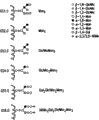
图3图解了N-糖苷酶F释放的N-聚糖的MALDI-TOF质谱(MS)分析。K3(人纤溶酶原的三环3结构域)在巴斯德毕赤酵母菌株GS115来源的野生型对照(Invitrogen,Carlsbad,CA)、YSH44、YSH71、RDP52和RDP80中产生并通过Ni-亲和层析从培养物上清液中纯化。通过N-糖苷酶F处理释放N-聚糖并进行MALDI-TOF MS分析(阳性模式,除了图3G是阴性模式),其表现为钠或钾络合物。两个核心GlcNAc残基虽然存在,但在命名中忽略。GN,GlcNAc;M,甘露糖。Figure 3 illustrates MALDI-TOF mass spectrometry (MS) analysis of N-glycans released by N-glycosidase F. K3 (
图3A:GS115来源的野生型对照菌株中产生的N-聚糖;Figure 3A: N-glycans produced in GS115-derived wild-type control strain;
图3B:菌株YSH44中K3上产生的N-聚糖;Figure 3B: N-glycans produced on K3 in strain YSH44;
图3C:菌株YSH71(YSH44表达hGalTI)中K3上产生的N-聚糖,Figure 3C: N-glycans produced on K3 in strain YSH71 (YSH44 expresses hGalTI),
图(3D)菌株RDP52(YSH44表达hGalTI和SpGALE)中K3上产生的N-聚糖,Figure (3D) N-glycans produced on K3 in strain RDP52 (YSH44 expressing hGalTI and SpGALE),
图(3E)菌株RDP80(YSH44表达hGalTI、SpGALE和DmUGT)中K3上产生的N-聚糖;Figure (3E) N-glycans produced on K3 in strain RDP80 (YSH44 expressing hGalTI, SpGALE and DmUGT);
图(3F)在α-半乳糖苷酶体外处理后来自RDP80的聚糖;和Panel (3F) Glycans from RDP80 after α-galactosidase in vitro treatment; and
图(3G)在用α-2,6-(N)-唾液酸转移酶处理后在阴性模式中来自RDP80的聚糖。Panel (3G) Glycans from RDP80 in negative mode after treatment with α-2,6-(N)-sialyltransferase.
图4图解了Leloir半乳糖利用途径。经由半乳糖通透酶引入细胞外半乳糖。通过酶半乳糖激酶,半乳糖-1-磷酸尿苷酰转移酶和UDP-半乳糖C4-差向异构酶的作用半乳糖被转化成葡萄糖-6-磷酸。来自酿酒酵母的蛋白名称在括号中。Figure 4 illustrates the Leloir galactose utilization pathway. Extracellular galactose is introduced via galactose permease. Galactose is converted to glucose-6-phosphate by the action of the enzymes galactokinase, galactose-1-phosphate uridyltransferase and UDP-galactose C4-epimerase. Protein names from S. cerevisiae are in parentheses.
图5显示巴斯德毕赤酵母糖工程化的菌株YGLY578-1的构建。编码高尔基体糖基转移酶的巴斯德毕赤酵母基因OCH1,MNN4,PNO1,MNN4L1和BMT2被敲除然后敲入12个异源基因,包括分泌的hK3的表达盒。YGLY578-1能够生产糖蛋白具有Gal2GlcNAc2Man3GlcNAc2N-聚糖。CS,反选择。Figure 5 shows the construction of Pichia pastoris glycoengineered strain YGLY578-1. The Pichia pastoris genes OCH1, MNN4, PNO1, MNN4L1, and BMT2 encoding Golgi glycosyltransferases were knocked out and then knocked in 12 heterologous genes, including the expression cassette for secreted hK3. YGLY578-1 is capable of producing glycoproteins with Gal 2 GlcNAc 2 Man 3 GlcNAc 2 N-glycans. CS, anti-choice.
图6显示质粒pRCD977b的示意图。该质粒是arg1::HIS1敲除质粒,其整合进并删除巴斯德毕赤酵母ARG1基因而利用PpHIS1基因作为选择标记并含有分别在PpOCH1、PpGAPDH、PpPMA1和PpTEF启动子的控制下编码全长黑腹果蝇高尔基体UDP-半乳糖转运蛋白(DmUGT)、全长酿酒酵母半乳糖激酶(ScGAL1)、全长酿酒酵母半乳糖-1-磷酸尿苷酰转移酶(ScGAL7)和酿酒酵母半乳糖通透酶(ScGAL2)的表达盒。TT是指转录终止序列。Figure 6 shows a schematic diagram of plasmid pRCD977b. This plasmid is an arg1::HIS1 knockout plasmid, which integrates and deletes the Pichia pastoris ARG1 gene while using the PpHIS1 gene as a selectable marker and contains the full-length DNA encoded by the PpOCH1, PpGAPDH, PpPMA1 and PpTEF promoters, respectively. Drosophila melanogaster Golgi UDP-galactose transporter (DmUGT), full-length Saccharomyces cerevisiae galactokinase (ScGAL1), full-length Saccharomyces cerevisiae galactose-1-phosphate uridyltransferase (ScGAL7) and Saccharomyces cerevisiae galactose Expression cassette for permease (ScGAL2). TT refers to the transcription termination sequence.
图7显示表达酿酒酵母GAL1、GAL2和GAL7基因的糖工程化的巴斯德毕赤酵母菌株可在半乳糖(作为单一碳源)上生长而母本菌株不能。糖工程化的菌株YGLY578-1(表达ScGAL10和hGalTIβ)用质粒pRCD977b转化,所述质粒含有编码ScGAL1、ScGAL7和ScGAL2的表达盒。菌株在成分确定的培养基上培养,所述培养基含有酵母氮源、生物素和3%半乳糖或2%葡萄糖作为碳源或二者均无。Figure 7 shows that glycoengineered Pichia pastoris strains expressing S. cerevisiae GAL1, GAL2 and GAL7 genes can grow on galactose (as a single carbon source) while the parental strain cannot. Glycoengineered strain YGLY578-1 (expressing ScGAL10 and hGalTIβ) was transformed with plasmid pRCD977b containing expression cassettes encoding ScGAL1, ScGAL7 and ScGAL2. Strains were grown on defined media containing yeast nitrogen source, biotin and either 3% galactose or 2% glucose as carbon source or neither.
图8显示巴斯德毕赤酵母糖工程化的菌株YGLY317-36的构建。通过敲除五个酵母糖基转移酶产生巴斯德毕赤酵母菌株YGLY16-3。随后敲入八个异源基因,得到RDP696-2,能够将人N-聚糖Gal2GlcNAc2Man3GlcNAc2转移到分泌的蛋白的菌株。经由CSTR培养和引入表达分泌的人Fc的质粒选择健康(robust)克隆得到菌株YGLY317-36。CS,反选择。Figure 8 shows the construction of Pichia pastoris glycoengineered strain YGLY317-36. Pichia pastoris strain YGLY16-3 was generated by knockout of five yeast glycosyltransferases. Eight heterologous genes were subsequently knocked in to obtain RDP696-2, a strain capable of transferring the human N-glycan Gal 2 GlcNAc 2 Man 3 GlcNAc 2 to secreted proteins. Selection of robust clones via CSTR cultivation and introduction of a plasmid expressing secreted human Fc resulted in strain YGLY317-36. CS, anti-choice.
图9显示质粒pGLY954的示意图。该质粒是KINKO质粒,其整合进巴斯德毕赤酵母TRP1基因座而不删除基因。质粒含有分别在PpHHT1和PpPMA1启动子的控制下编码全长酿酒酵母半乳糖激酶(ScGAL1)和全长酿酒酵母半乳糖-1-磷酸尿苷酰转移酶(ScGAL7)的表达盒。质粒还含有在PpGAPDH启动子的控制下编码分泌途径靶向融合蛋白(CO hGalTI)(包含ScMnt1(ScKre2)前导肽(33)融合至人半乳糖基转移酶I催化结构域的N-末端)的表达盒。TT是指转录终止序列。Figure 9 shows a schematic diagram of plasmid pGLY954. This plasmid is a KINKO plasmid which integrates into the Pichia pastoris TRP1 locus without deleting the gene. The plasmids contained expression cassettes encoding full-length S. cerevisiae galactokinase (ScGAL1 ) and full-length S. cerevisiae galactose-1-phosphate uridyltransferase (ScGAL7) under the control of the PpHHT1 and PpPMA1 promoters, respectively. The plasmid also contained a DNA encoding a secretory pathway targeting fusion protein (CO hGalTI) (comprising the ScMnt1 (ScKre2) leader peptide (33) fused to the N-terminus of the human galactosyltransferase I catalytic domain) under the control of the PpGAPDH promoter. expression cassette. TT refers to the transcription termination sequence.
图10显示单独在BMMY培养基中诱导或在含有葡萄糖或半乳糖的培养基中诱导的菌株PBP317-36和RDP783中产生的人Fc片段上N-聚糖的MALDI-TOF MS分析。菌株从饱和的种子培养物接种至约一个OD,在800mL BMGY中培养72小时,然后分离(split)并将100mL培养液等分样离心和在25mL BMMY、25mL BMMY+0.5%葡萄糖或25mL BMMY+0.5%半乳糖中诱导24小时。蛋白A纯化的蛋白进行蛋白N-糖苷酶F消化和通过MALDI-TOF MS分析释放的N-聚糖。图A-C,菌株PBP317-36中产生的人Fc上的N-聚糖;图D-E,菌株RDP783中产生的人Fc上的N-聚糖。Figure 10 shows MALDI-TOF MS analysis of N-glycans on human Fc fragments produced in strains PBP317-36 and RDP783 induced in BMMY medium alone or in medium containing glucose or galactose. Strains were inoculated from saturated seed cultures to approximately one OD, cultured in 800 mL BMGY for 72 hours, then split and 100 mL aliquots of the culture broth were centrifuged and incubated in 25 mL BMMY, 25 mL BMMY+0.5% glucose, or 25 mL BMMY+ Induction in 0.5% galactose for 24 hours. Protein A purified protein was subjected to protein N-glycosidase F digestion and released N-glycans were analyzed by MALDI-TOF MS. Panels A-C, N-glycans on human Fc produced in strain PBP317-36; panels D-E, N-glycans on human Fc produced in strain RDP783.
图11显示巴斯德毕赤酵母糖工程化的菌株YDX477的构建。敲除五种酵母糖基转移酶产生巴斯德毕赤酵母菌株YGLY16-3(Δoch1,Δpno1,Δbmt2,Δmnn4a,Δmnn4b)。随后敲入八个异源基因,得到RDP697-1,能够将人N-聚糖Gal2GlcNAc2Man3GlcNAc2转移到分泌的蛋白的菌株。引入表达分泌的抗体的质粒和表达分泌的形式的里氏木霉MNS1的质粒得到菌株YDX477。CS,反选择。Figure 11 shows the construction of Pichia pastoris glycoengineered strain YDX477. Knockout of five yeast glycosyltransferases generated Pichia pastoris strain YGLY16-3 (Δoch1, Δpno1, Δbmt2, Δmnn4a, Δmnn4b). Eight heterologous genes were subsequently knocked in to obtain RDP697-1, a strain capable of transferring the human N-glycan Gal 2 GlcNAc 2 Man 3 GlcNAc 2 to secreted proteins. Introduction of a plasmid expressing the secreted antibody and a plasmid expressing the secreted form of T. reesei MNS1 resulted in strain YDX477. CS, anti-choice.
图12显示质粒pGLY1418的示意图。该质粒是KINKO质粒,其整合进巴斯德毕赤酵母TRP1基因座而不删除基因。质粒含有分别在PpHHT1和PpPMA1启动子的控制下编码全长ScGAL1和ScGAL7的表达盒。质粒还含有在PpGAPDH启动子的控制下编码分泌途径靶向融合蛋白(hGalTI)(包含ScMnt1(ScKre2)前导肽融合至人半乳糖基转移酶I催化结构域的N-末端)的表达盒。TT是指转录终止序列。Figure 12 shows a schematic diagram of plasmid pGLY1418. This plasmid is a KINKO plasmid which integrates into the Pichia pastoris TRP1 locus without deleting the gene. The plasmids contained expression cassettes encoding full-length ScGAL1 and ScGAL7 under the control of the PpHHT1 and PpPMA1 promoters, respectively. The plasmid also contained an expression cassette encoding a secretory pathway targeting fusion protein (hGalTI) comprising a ScMnt1 (ScKre2) leader peptide fused to the N-terminus of the human galactosyltransferase I catalytic domain under the control of the PpGAPDH promoter. TT refers to the transcription termination sequence.
图13A-F显示单独在BMMY培养基中诱导或在含有半乳糖的培养基中诱导的菌株YDX477和RDP968-1中产生的抗-Her2抗体上N-聚糖的MALDI-TOF MS分析。菌株在150mL BMGY中培养72小时,然后分离并将50mL培养液等分样离心和在25mL BMMY、25mL BMMY+0.1%半乳糖或25mL BMMY+0.5%半乳糖中诱导24小时。蛋白A纯化的蛋白进行蛋白N-糖苷酶F消化和通过MALDI-TOF MS分析释放的N-聚糖。图13A-C,菌株YDX477中产生的抗体上的N-聚糖;图13D-F,菌株RDP968-1中产生的抗体上的N-聚糖。Figures 13A-F show MALDI-TOF MS analysis of N-glycans on anti-Her2 antibodies produced in strains YDX477 and RDP968-1 induced in BMMY medium alone or in galactose-containing medium. Strains were cultured in 150 mL BMGY for 72 hours, then isolated and 50 mL culture aliquots were centrifuged and induced in 25 mL BMMY, 25 mL BMMY+0.1% galactose or 25 mL BMMY+0.5% galactose for 24 hours. Protein A purified protein was subjected to protein N-glycosidase F digestion and released N-glycans were analyzed by MALDI-TOF MS. Figure 13A-C, N-glycans on antibodies produced in strain YDX477; Figure 13D-F, N-glycans on antibodies produced in strain RDP968-1.
图14显示质粒pAS24的示意图。该质粒是巴斯德毕赤酵母bmt2敲除质粒,其含有PpURA3选择标记和含有在PpOCH1启动子的控制下编码全长小鼠高尔基体UDP-GlcNAc转运蛋白(MmSLC35A3)的表达盒。TT是指转录终止序列。Figure 14 shows a schematic diagram of plasmid pAS24. This plasmid is a Pichia pastoris bmt2 knockout plasmid containing the PpURA3 selection marker and an expression cassette encoding the full-length mouse Golgi UDP-GlcNAc transporter (MmSLC35A3) under the control of the PpOCH1 promoter. TT refers to the transcription termination sequence.
图15显示质粒pRCD742b的示意图。该质粒是KINKO质粒,其含有PpURA5选择标记以及在PpGAPDH启动子的控制下编码分泌途径靶向融合蛋白(FB8 MannI)(包含融合至小鼠甘露糖苷酶I催化结构域的N-末端的ScSec12前导肽)的表达盒、在PpPMA1启动子的控制下编码分泌途径靶向融合蛋白(CONA10)(包含融合至人GlcNAc转移酶I(GnT I)催化结构域的N-末端的PpSec12前导肽)的表达盒和在PpSEC4启动子的控制下编码小鼠高尔基体UDP-GlcNAc转运蛋白(MmSLC35A3)的全长基因。TT是指转录终止序列。Figure 15 shows a schematic diagram of plasmid pRCD742b. This plasmid is a KINKO plasmid containing the PpURA5 selectable marker and encoding a secretory pathway targeting fusion protein (FB8 MannI) under the control of the PpGAPDH promoter (comprising the ScSec12 leader fused to the N-terminus of the mouse mannosidase I catalytic domain peptide), expression of an expression cassette encoding a secretion pathway targeting fusion protein (CONA10) (comprising a PpSec12 leader peptide fused to the N-terminus of the catalytic domain of human GlcNAc transferase I (GnT I)) under the control of the PpPMA1 promoter cassette and the full-length gene encoding the mouse Golgi UDP-GlcNAc transporter (MmSLC35A3) under the control of the PpSEC4 promoter. TT refers to the transcription termination sequence.
图16显示质粒pDMG47的示意图。质粒包括在PpGAPDH的控制下启动子编码分泌途径靶向融合蛋白(KD53)(包含融合至黑腹果蝇甘露糖苷酶II催化结构域的N-末端的ScMnn2前导肽)的表达盒。质粒还含有在PpPMA1启动子的控制下编码分泌途径靶向融合蛋白(TC54)(包含融合至大鼠GlcNAc转移酶II(GnT II)催化结构域的N-末端的ScMnn2前导肽)的表达盒。TT是指转录终止序列。Figure 16 shows a schematic diagram of plasmid pDMG47. The plasmid includes an expression cassette encoding a secretory pathway targeting fusion protein (KD53) comprising the ScMnn2 leader peptide fused to the N-terminus of the D. melanogaster mannosidase II catalytic domain from a promoter under the control of PpGAPDH. The plasmid also contained an expression cassette encoding a secretory pathway targeting fusion protein (TC54) comprising a ScMnn2 leader peptide fused to the N-terminus of the catalytic domain of rat GlcNAc transferase II (GnT II) under the control of the PpPMA1 promoter. TT refers to the transcription termination sequence.
图17显示质粒pRCD823b的示意图。该质粒是KINKO质粒,其整合进巴斯德毕赤酵母HIS4基因座而不删除基因,并含有PpURA5选择标记。质粒包括在PpGAPDH启动子的控制下编码分泌途径靶向融合蛋白(TA54)(包含ScMnn2前导肽融合至大鼠GlcNAc转移酶II(GnTII)催化结构域的N-末端)的表达盒和分别在PpOCH1和PpPMA1启动子的控制下编码全长黑腹果蝇高尔基体UDP-半乳糖转运蛋白(DmUGT)和酿酒酵母UDP-半乳糖C4-差向异构酶(ScGAL10)的表达盒。TT是指转录终止序列。Figure 17 shows a schematic diagram of plasmid pRCD823b. This plasmid is a KINKO plasmid which integrates into the Pichia pastoris HIS4 locus without gene deletion and contains the PpURA5 selection marker. The plasmid includes an expression cassette encoding a secretory pathway-targeting fusion protein (TA54) (comprising the ScMnn2 leader peptide fused to the N-terminus of the rat GlcNAc transferase II (GnTII) catalytic domain) under the control of the PpGAPDH promoter and the expression cassette in PpOCH1, respectively. Expression cassettes encoding full-length Drosophila melanogaster UDP-galactose transporter (DmUGT) and S. cerevisiae UDP-galactose C4-epimerase (ScGAL10) under the control of the PpPMA1 promoter. TT refers to the transcription termination sequence.
图18显示质粒pGLY893a的示意图。该质粒是巴斯德毕赤酵母his1敲除质粒,其含有PpARG4选择标记。质粒含有在PpPMA1启动子的控制下编码分泌途径靶向融合蛋白(KD10)(包含PpSEC12前导肽融合至黑腹果蝇甘露糖苷酶II催化结构域的N-末端)的表达盒,在PpTEF启动子的控制下编码分泌途径靶向融合蛋白(TA33)(包含ScMnt1(ScKre2)前导肽融合至大鼠GlcNAc转移酶II(GnT II)催化结构域的N-末端)的表达盒和在PpGAPDH启动子的控制下编码分泌途径靶向融合蛋白(包含ScMnn2前导肽融合至人半乳糖基转移酶I催化结构域的N-末端)表达盒。TT是指转录终止序列。Figure 18 shows a schematic diagram of plasmid pGLY893a. This plasmid is a Pichia pastoris his1 knockout plasmid that contains the PpARG4 selectable marker. The plasmid contains an expression cassette encoding a secretion pathway targeting fusion protein (KD10) (comprising the PpSEC12 leader peptide fused to the N-terminus of the Drosophila melanogaster mannosidase II catalytic domain) under the control of the PpPMA1 promoter, under the control of the PpTEF promoter An expression cassette encoding a secretion pathway targeting fusion protein (TA33) (comprising the ScMnt1 (ScKre2) leader peptide fused to the N-terminus of the rat GlcNAc transferase II (GnT II) catalytic domain) under the control of the PpGAPDH promoter An expression cassette encoding a secretory pathway targeting fusion protein (comprising the ScMnn2 leader peptide fused to the N-terminus of the human galactosyltransferase I catalytic domain) under control. TT refers to the transcription termination sequence.
图19显示质粒pRCD742a的示意图。该质粒是KINKO质粒,其整合进巴斯德毕赤酵母ADE1基因座而不删除基因并含有PpURA5选择标记。质粒含有在PpGAPDH启动子的控制下编码分泌途径靶向融合蛋白(FB8 MannI)(包含ScSEC12前导肽融合至小鼠甘露糖苷酶I催化结构域的N-末端)的表达盒、在PpPMA1启动子的控制下编码分泌途径靶向融合蛋白(CONA10)(包含PpSEC12前导肽融合至人GlcNAc转移酶I(GnT I)催化结构域的N-末端)的表达盒和在PpSEC4启动子的控制下编码全长小鼠高尔基体UDP-GlcNAc转运蛋白(MmSLC35A3)的表达盒。TT是指转录终止序列。Figure 19 shows a schematic representation of plasmid pRCD742a. This plasmid is a KINKO plasmid which integrates into the P. pastoris ADE1 locus without gene deletion and contains the PpURA5 selection marker. The plasmid contains an expression cassette encoding a secretory pathway targeting fusion protein (FB8 MannI) (comprising the ScSEC12 leader peptide fused to the N-terminus of the mouse mannosidase I catalytic domain) under the control of the PpGAPDH promoter, in the PpPMA1 promoter An expression cassette encoding a secretory pathway targeting fusion protein (CONA10) (comprising the PpSEC12 leader peptide fused to the N-terminus of the human GlcNAc transferase I (GnT I) catalytic domain) under the control of the PpSEC4 promoter encoding the full-length Expression cassette for mouse Golgi UDP-GlcNAc transporter (MmSLC35A3). TT refers to the transcription termination sequence.
图20显示质粒pRCD1006的示意图。该质粒是巴斯德毕赤酵母his1敲除质粒,其含有PpURA5基因作为选择标记。质粒含有在PpGAPDH启动子的控制下编码分泌途径靶向融合蛋白(XB33)(包含ScMnt1(ScKre2)前导肽融合至人半乳糖基转移酶I催化结构域的N-末端)的表达盒和分别在PpOCH1和PpPMA1启动子的控制下编码全长黑腹果蝇高尔基体UDP-半乳糖转运蛋白(DmUGT)和粟酒裂殖酵母UDP-半乳糖C4-差向异构酶(SpGALE)的表达盒。TT是指转录终止序列。Figure 20 shows a schematic diagram of plasmid pRCD1006. This plasmid is a Pichia pastoris his1 knockout plasmid that contains the PpURA5 gene as a selectable marker. The plasmid contains an expression cassette encoding a secretory pathway targeting fusion protein (XB33) (comprising the ScMnt1 (ScKre2) leader peptide fused to the N-terminus of the human galactosyltransferase I catalytic domain) under the control of the PpGAPDH promoter and respectively in Expression cassettes encoding the full-length Drosophila melanogaster UDP-galactose transporter (DmUGT) and the S. pombe UDP-galactose C4-epimerase (SpGALE) under the control of the PpOCH1 and PpPMA1 promoters. TT refers to the transcription termination sequence.
图21显示质粒pGLY167b的示意图。该质粒是巴斯德毕赤酵母arg1敲除质粒,其含有PpURA3选择标记并含有在PpGAPDH启动子的控制下编码分泌途径靶向融合蛋白(CO-KD53)(包含ScMNN2前导肽融合至黑腹果蝇甘露糖苷酶II催化结构域的N-末端)的表达盒和在PpPMA1启动子的控制下编码分泌途径靶向融合蛋白(CO-TC54)(包含ScMnn2前导肽融合至大鼠GlcNAc转移酶II(GnT II)催化结构域的N-末端)的表达盒。TT是指转录终止序列。Figure 21 shows a schematic diagram of plasmid pGLY167b. This plasmid is a Pichia pastoris arg1 knockout plasmid that contains the PpURA3 selectable marker and contains a fusion protein encoding the secretion pathway targeting (CO-KD53) under the control of the PpGAPDH promoter (comprising the ScMNN2 leader peptide fused to Fly mannosidase II catalytic domain N-terminus) and under the control of the PpPMA1 promoter encoding a secretion pathway targeting fusion protein (CO-TC54) (comprising ScMnn2 leader peptide fused to rat GlcNAc transferase II ( GnT II) expression cassette of the N-terminus of the catalytic domain). TT refers to the transcription termination sequence.
图22显示质粒pBK 138的示意图。该质粒是滚入(roll-in)质粒,其整合进巴斯德毕赤酵母AOX1启动子同时复制启动子。质粒含有编码融合蛋白(包含酿酒酵母A交配因子前信号序列融合至人Fc抗体片段(人IgG1H链的C-末端233-aa)的N-末端)的表达盒。TT是指转录终止序列。Figure 22 shows a schematic diagram of plasmid pBK138. This plasmid is a roll-in plasmid that integrates into the Pichia pastoris AOX1 promoter while replicating the promoter. The plasmid contains an expression cassette encoding a fusion protein comprising the S. cerevisiae A mating factor pro-signal sequence fused to the N-terminus of a human Fc antibody fragment (C-terminal 233-aa of a human IgGl H chain). TT refers to the transcription termination sequence.
图23显示质粒pGLY510的示意图。该质粒是滚入质粒,其整合进巴斯德毕赤酵母TRP2基因同时复制基因并含有AOX1启动子-ScCYC1终止子表达盒以及PpARG1选择标记。TT是指转录终止序列。Figure 23 shows a schematic diagram of plasmid pGLY510. This plasmid is a roll-in plasmid that integrates into the Pichia pastoris TRP2 gene while replicating the gene and contains the AOX1 promoter-ScCYC1 terminator expression cassette and the PpARG1 selectable marker. TT refers to the transcription termination sequence.
图24显示质粒pDX459-1的示意图。该质粒是滚入质粒,其靶向并整合进巴斯德毕赤酵母AOX2启动子和含有ZeoR同时复制启动子。质粒含有分开的表达盒,其编码抗-HER2抗体重链和抗-HER2抗体轻链,每个在N-末端融合至黑曲霉α-淀粉酶信号序列并在巴斯德毕赤酵母AOX1启动子的控制下。TT是指转录终止序列。Figure 24 shows a schematic diagram of plasmid pDX459-1. This plasmid is a roll-in plasmid that targets and integrates into the Pichia pastoris AOX2 promoter and contains the Zeo R simultaneous replication promoter. The plasmid contains separate expression cassettes encoding the anti-HER2 antibody heavy chain and the anti-HER2 antibody light chain, each fused at the N-terminus to the Aspergillus niger alpha-amylase signal sequence and in the Pichia pastoris AOX1 promoter under control. TT refers to the transcription termination sequence.
图25显示质粒pGLY1138的示意图。该质粒是滚入质粒,其整合进巴斯德毕赤酵母ADE1基因座同时复制基因和含有ScARR3选择标记基因盒(其赋予亚砷酸盐抗性)以及在PpAOX1启动子的控制下编码分泌的里氏木霉MNS1(包含MNS1催化结构域在其N-末端融合至酿酒酵母α因子前信号序列)的表达盒。TT是指转录终止序列。Figure 25 shows a schematic diagram of plasmid pGLY1138. This plasmid is a roll-in plasmid that integrates into the Pichia pastoris ADE1 locus while replicating the gene and containing the ScARR3 selectable marker gene cassette (which confers arsenite resistance) and encodes for secretion under the control of the PpAOX1 promoter. Expression cassette for Trichoderma reesei MNS1 comprising the MNS1 catalytic domain fused at its N-terminus to the S. cerevisiae alpha factor pro-signal sequence. TT refers to the transcription termination sequence.
发明详述Detailed description of the invention
酵母已被成功用于生产细胞内和分泌的重组蛋白(参见例如,Cereghino Cregg FEMS Microbiology Reviews 24(1):45-66(2000);Harkki,等人Bio-Technology 7(6):596(1989);Berka,等人Abstr.PapersAmer.Chem.Soc.203:121-BIOT(1992);Svetina,等人J.Biotechnol.76(2-3):245-251(2000))。多种酵母,例如乳酸克鲁维酵母、巴斯德毕赤酵母、甲醇毕赤酵母和多形汉逊酵母,已作为用于生产重组蛋白的真核表达系统发挥特别重要的作用,因为它们能够生长至高细胞密度和分泌大量重组蛋白。但是,在任意这些真核微生物中的糖蛋白表达在N-聚糖结构上实质不同于哺乳动物中产生的糖蛋白表达。糖基化中的该差异已阻止酵母或丝状真菌用作用于生产许多治疗用糖蛋白的宿主。Yeast has been successfully used to produce intracellular and secreted recombinant proteins (see, e.g., Cereghino Cregg FEMS Microbiology Reviews 24(1):45-66 (2000); Harkki, et al. Bio-Technology 7(6):596 (1989 ); Berka, et al. Abstr. Papers Amer. Chem. Soc. 203: 121-BIOT (1992); Svetina, et al. J. Biotechnol. 76(2-3): 245-251 (2000)). Various yeasts, such as Kluyveromyces lactis, Pichia pastoris, Pichia methanolica, and Hansenula polymorpha, have played a particularly important role as eukaryotic expression systems for the production of recombinant proteins because of their ability to Grows to high cell densities and secretes large amounts of recombinant protein. However, glycoprotein expression in any of these eukaryotic microorganisms differs substantially in N-glycan structure from glycoprotein expression produced in mammals. This difference in glycosylation has prevented yeast or filamentous fungi from being used as hosts for the production of many therapeutic glycoproteins.
为了能够利用酵母以产生治疗用糖蛋白,酵母已被基因工程化为产生具有杂合或复合N-聚糖的糖蛋白。能够生产包含具体杂合或复合N-聚糖的组合物的重组酵母已在例如,美国专利号7,029,872和美国专利号7,449,308中公开。另外,Hamilton等人,Science 313:1441-1443(2006)和美国公开的申请号2006/0286637报道了酵母巴斯德毕赤酵母中糖基化途径的人源化和具有复合N-糖基化(具有末端唾液酸)的重组人糖蛋白的分泌。对于末端唾液酸的具有寡糖结构Gal2GlcNAc2Man3GlcNAc2(G2)前体N-聚糖是也作为从人血清中分离的几种蛋白上主要N-聚糖发现的结构,所述从人血清中分离的几种蛋白包括促卵泡激素(FSH)、脱唾液酸转铁蛋白,以及最显著的是在人免疫球蛋白(抗体)以不同的量存在。Davidson等人在美国公开的申请号2006/0040353教导了利用已被基因工程化为产生半乳糖末端的N-聚糖的酵母细胞获得半乳糖基化的糖蛋白的有效方法。这些宿主细胞能够生产糖蛋白组合物具有G2或G1(GalGlcNAc2Man3GlcNAc2)寡糖结构的多种混合物,其具有G0寡糖结构的变化量。G0是GlcNAc2Man3GlcNAc2,其是半乳糖基转移酶的底物。但是,对于某些糖蛋白,特别是抗体和Fc片段,已发现半乳糖转移过程的效率不是最适的。在抗体和Fc片段的情况下,认为的是在细胞内加工期间抗体或Fc片段上糖基化位点的定位和可及性抑制半乳糖有效转移到抗体或Fc片段的N-聚糖上。因此,含有半乳糖的寡糖结构的量小于其他糖蛋白例如三环3蛋白中已观察到的量。为了克服该问题,本发明提供增加半乳糖转移到抗体或Fc片段的N-聚糖上的量的方法,因此增加含有抗体或Fc片段的G1和G2的量高于含有抗体或Fc片段的G0。To enable the use of yeast for the production of therapeutic glycoproteins, yeast have been genetically engineered to produce glycoproteins with hybrid or complex N-glycans. Recombinant yeast capable of producing compositions comprising specific hybrid or complex N-glycans have been disclosed, for example, in US Patent No. 7,029,872 and US Patent No. 7,449,308. Additionally, Hamilton et al., Science 313:1441-1443 (2006) and US Published Application No. 2006/0286637 reported humanization of the glycosylation pathway in the yeast Pichia pastoris and complex N-glycosylation Secretion of recombinant human glycoprotein (with terminal sialic acid). The precursor N-glycan with the oligosaccharide structure Gal 2 GlcNAc 2 Man 3 GlcNAc 2 (G2) for the terminal sialic acid is a structure also found as the major N-glycan on several proteins isolated from human serum, the Several proteins isolated from human serum including follicle stimulating hormone (FSH), asialotransferrin, and most notably human immunoglobulins (antibodies) are present in varying amounts. US Published Application No. 2006/0040353 by Davidson et al. teaches an efficient method for obtaining galactosylated glycoproteins using yeast cells that have been genetically engineered to produce galactose-terminated N-glycans. These host cells are capable of producing a variety of mixtures of glycoprotein compositions having G2 or G1 ( GalGlcNAc2Man3GlcNAc2 ) oligosaccharide structures with varying amounts of GO oligosaccharide structures. GO is GlcNAc 2 Man 3 GlcNAc 2 , which is a substrate for galactosyltransferase. However, for certain glycoproteins, notably antibodies and Fc fragments, the efficiency of the galactose transfer process has been found to be suboptimal. In the case of antibodies and Fc fragments, it is believed that the localization and accessibility of glycosylation sites on the antibody or Fc fragment during intracellular processing inhibits the efficient transfer of galactose to the N-glycans of the antibody or Fc fragment. Thus, the amount of galactose-containing oligosaccharide structures is less than that which has been observed in other glycoproteins such as
巴斯德毕赤酵母仅可利用有限数量的碳源进行生存。目前,这些碳源已知是甘油、葡萄糖、甲醇以及可能是鼠李糖和甘露糖但不是半乳糖。在许多商业生产过程中,利用巴斯德毕赤酵母,重组蛋白的表达在AOX启动子的控制下,其w在甲醇存在下是有活性的但在甘油存在下被抑制。因此,巴斯德毕赤酵母通常在含有甘油或甘油/甲醇的培养基中生长直到细胞的浓度达到期望的水平,在此时,通过用仅含有甲醇作为碳源的培养基替换培养基来进行重组蛋白的表达。但是,细胞处于低能量状态,因为甲醇仅含有一个碳,使其成为贫瘠碳源。因此,期望的是具有这样的生产过程,其中巴斯德毕赤酵母可利用更高级的能源,例如半乳糖。本发明通过提供能够利用半乳糖作为单一碳源的基因工程化巴斯德毕赤酵母也解决了该问题。Pichia pastoris can only survive using a limited number of carbon sources. Currently, these carbon sources are known to be glycerol, glucose, methanol and possibly rhamnose and mannose but not galactose. In many commercial production processes, using Pichia pastoris, expression of recombinant proteins is under the control of the AOX promoter, which is active in the presence of methanol but repressed in the presence of glycerol. Therefore, Pichia pastoris is usually grown in medium containing glycerol or glycerol/methanol until the concentration of cells reaches the desired level, at which point, the medium is replaced by medium containing only methanol as a carbon source. Expression of recombinant proteins. However, cells are in a low-energy state because methanol contains only one carbon, making it a carbon-poor source. Therefore, it would be desirable to have a production process in which higher energy sources such as galactose can be utilized by Pichia pastoris. The present invention also solves this problem by providing a genetically engineered Pichia pastoris capable of utilizing galactose as a single carbon source.
因此,本发明已解决上述确定的两个问题。本发明提供重组低等真核细胞,特别是酵母和真菌细胞,其已被糖工程化以产生糖蛋白例如抗体或Fc片段,其中与未被如本文所教导的基因工程化的细胞相比,其上N-聚糖上的末端半乳糖水平增加。基因工程化宿主细胞可用于产生具有N-聚糖(含有半乳糖)的糖蛋白的方法,其中所述N-聚糖中半乳糖的量高于未被如本文所教导的基因工程化的宿主细胞中可获得的量。本发明还提供基因工程化宿主细胞,其中通常不能利用半乳糖作为单一碳源的宿主细胞已被如本文所教导的基因工程化以能够利用半乳糖作为单一碳源。本文的使得宿主细胞能够利用半乳糖作为单一碳源的方法利用巴斯德毕赤酵母作为模型。本文的方法可用于使得通常不能利用半乳糖作为碳源的其他酵母或真菌物种能够利用半乳糖作为碳源。Thus, the present invention has solved the two problems identified above. The present invention provides recombinant lower eukaryotic cells, particularly yeast and fungal cells, which have been glycoengineered to produce glycoproteins such as antibodies or Fc fragments, wherein compared to cells not genetically engineered as taught herein, There is an increased level of terminal galactose on N-glycans thereon. Genetically engineered host cells are useful in methods of producing glycoproteins having N-glycans (containing galactose) having a higher amount of galactose than a host that has not been genetically engineered as taught herein Amount available in cells. The present invention also provides genetically engineered host cells, wherein the host cell, which normally cannot utilize galactose as a single carbon source, has been genetically engineered as taught herein to be able to utilize galactose as a single carbon source. The method herein for enabling host cells to utilize galactose as a single carbon source utilizes Pichia pastoris as a model. The methods herein can be used to enable other yeast or fungal species that normally cannot utilize galactose as a carbon source to utilize galactose as a carbon source.
为解决两个问题,基因工程化的宿主细胞(其已被基因工程化为能够产生半乳糖末端的N-聚糖)被进一步基因工程化为表达Leloir途径酶:半乳糖激酶(EC 2.7.1.6)、UDP-半乳糖-4-差向异构酶(EC 5.1.3.2)和半乳糖-1-磷酸尿苷酰转移酶(EC 2.7.7.12)。任选地,宿主细胞可另外表达半乳糖通透酶。这使得宿主细胞能够利用半乳糖作为碳源并产生UDP-半乳糖库,其反过来作为涉及包括半乳糖残基的N-聚糖合成的半乳糖转移酶的底物。因此,本文中的宿主细胞和方法能够产生糖蛋白组合物,特别是抗体和Fc片段组合物,其中所述半乳糖末端的N-聚糖的比例高于在糖工程化的低等真核细胞中可获得的比例。重组宿主细胞可生产重组糖蛋白例如抗体和Fc融合蛋白,其中G0∶G1/G2比值小于2∶1或G0∶G1/G2比值为1∶1或更小或G0∶G1/G2比值为1∶2或更小。To address two issues, genetically engineered host cells that had been genetically engineered to produce galactose-terminated N-glycans were further engineered to express the Leloir pathway enzyme: galactokinase (EC 2.7.1.6 ), UDP-galactose-4-epimerase (EC 5.1.3.2) and galactose-1-phosphate uridyltransferase (EC 2.7.7.12). Optionally, the host cell may additionally express a galactose permease. This enables the host cell to utilize galactose as a carbon source and produce a pool of UDP-galactose, which in turn serves as a substrate for galactosyltransferases involved in the synthesis of N-glycans including galactose residues. Thus, the host cells and methods herein are capable of producing glycoprotein compositions, particularly antibody and Fc fragment compositions, in which the proportion of galactose-terminal N-glycans is higher than in glycoengineered lower eukaryotic cells available ratio. Recombinant host cells can produce recombinant glycoproteins such as antibodies and Fc fusion proteins in which the G0:G1/G2 ratio is less than 2:1 or the G0:G1/G2 ratio is 1:1 or less or the G0:G1/G2 ratio is 1:1 2 or less.
本文所述的宿主细胞和方法特别用于生产这样的抗体和Fc片段,其含有具有N-聚糖的融合蛋白,所述N-聚糖具有半乳糖残基末端。在抗体或抗体片段重链Asn-297处的N-聚糖对抗体的结构和功能重要。这些功能包括Fcγ受体结合、激活补体的能力、激活细胞毒性T细胞(ADCC)的能力和血清稳定性。但是,在酵母或哺乳动物细胞中目前的抗体生产通常缺乏对于N-糖基化的控制,特别是在重链的恒定区或Fc区Asn-297处发生的N-糖基化,以及特别是控制在N-聚糖上末端半乳糖的水平的能力。一般而言,已发现尽管已被基因工程化为产生在N-聚糖中包括半乳糖残基的糖蛋白的酵母细胞可以高效地产生许多具有含有半乳糖的N-聚糖的糖蛋白,但是细胞产生抗体具有含有半乳糖的N-聚糖的能力并不一样高效。如本文所示,本文的宿主细胞和方法提供这样的宿主细胞,其与未被如本文所述基因工程化的细胞相比,可以产生更高水平的具有含有半乳糖的N-聚糖的抗体。The host cells and methods described herein are particularly useful for the production of antibodies and Fc fragments containing fusion proteins with N-glycans terminated with galactose residues. The N-glycan at Asn-297 of the antibody or antibody fragment heavy chain is important for the structure and function of the antibody. These functions include Fc gamma receptor binding, the ability to activate complement, the ability to activate cytotoxic T cells (ADCC), and serum stability. However, current antibody production in yeast or mammalian cells often lacks the control of N-glycosylation, particularly that which occurs at Asn-297 in the constant or Fc region of the heavy chain, and especially Ability to control the level of terminal galactose on N-glycans. In general, it has been found that although yeast cells that have been genetically engineered to produce glycoproteins that include galactose residues in their N-glycans can efficiently produce many glycoproteins with N-glycans that contain galactose, The ability of cells to produce antibodies with N-glycans containing galactose is not as efficient. As shown herein, the host cells and methods herein provide host cells that can produce higher levels of antibodies with galactose-containing N-glycans than cells that have not been genetically engineered as described herein .
尽管在不具有末端半乳糖残基的N-聚糖上末端的半乳糖水平可以在体外在利用可溶性半乳糖基转移酶以将带电的半乳糖残基添加到N-聚糖的末端的反应中增加,但是该体外方法费用高、复杂并且不容易扩大规模用于生产大量糖蛋白。因此,本文公开的宿主细胞(并且其能够在体内产生分泌的具有增加的末端半乳糖水平的N-聚糖的糖蛋白,包括抗体或抗体片段)提供生产具有含有增加的半乳糖水平的N-聚糖的抗体组合物的更理想的方法。因此,本发明在抗体生产中具有显著改进并且首次提供控制具体抗体特征例如N-聚糖中半乳糖水平的能力,和特别是生产具有改进的功能性特征的重组糖蛋白。Although terminal galactose levels on N-glycans without terminal galactose residues can be measured in vitro in reactions utilizing soluble galactosyltransferases to add charged galactose residues to the ends of N-glycans increase, but this in vitro method is costly, complex and not readily scalable for the production of large quantities of glycoproteins. Thus, the host cells disclosed herein (and which are capable of producing secreted N-glycan glycoproteins with increased levels of terminal galactose in vivo, including antibodies or antibody fragments) provide for the production of N-glycans with increased levels of galactose. A more desirable approach for antibody composition of glycans. Thus, the present invention provides a significant improvement in antibody production and for the first time provides the ability to control specific antibody characteristics such as galactose levels in N-glycans, and in particular to produce recombinant glycoproteins with improved functional characteristics.
另外,当本文的方法用于已被基因工程化为产生具有唾液酸化的N-聚糖的糖蛋白的宿主细胞中时,半乳糖末端的N-聚糖是唾液酸转移酶的底物。因此,唾液酸化的N-聚糖的量部分地随可用于唾液酸化的半乳糖末端的N-聚糖的量而变化。本文中的宿主细胞和方法提供用于增加半乳糖末端的或含有半乳糖的N-聚糖的量的方法,其中当在已被基因工程化为产生唾液酸化的N-聚糖的宿主细胞中生产时,产生这样的宿主细胞,其与未被如本文所教导的基因工程化的宿主细胞相比,产生增加量的唾液酸化的N-聚糖。Additionally, when the methods herein are used in host cells that have been genetically engineered to produce glycoproteins with sialylated N-glycans, the N-glycans at the terminal end of galactose are substrates for sialyltransferases. Thus, the amount of sialylated N-glycans varies in part with the amount of galactose-terminal N-glycans available for sialylation. The host cells and methods herein provide methods for increasing the amount of galactose-terminal or galactose-containing N-glycans, wherein when in a host cell that has been genetically engineered to produce sialylated N-glycans Upon production, host cells are produced that produce increased amounts of sialylated N-glycans compared to host cells that have not been genetically engineered as taught herein.
尽管本发明用于生产包含半乳糖末端的或含有半乳糖的N-聚糖的糖蛋白,但是本发明还用作用于选择表达任意类型异源蛋白(不论是否是糖蛋白)的重组宿主细胞的选择方法。表达一种或两种但不是全部Leloir途径酶活性的重组宿主细胞用编码异源蛋白和不存在于重组宿主细胞中的Leloir途径酶的一个或多个核酸分子转化。由于转化的重组宿主细胞含有完整的Leloir途径,可通过在半乳糖是单一碳源的培养基中培养转化的重组宿主细胞来获得选择表达对于非转化的细胞是异源蛋白的转化的重组宿主细胞。因此,提供的是用于产生表达异源蛋白的重组宿主细胞的方法,其包含以下步骤。提供宿主细胞,其已被基因工程化为表达一种或两种选自半乳糖激酶、UDP-半乳糖-4-差向异构酶和半乳糖-1-磷酸尿苷酰转移酶的Leloir途径酶。在一些实施方案中,宿主细胞能够产生具有人样N-聚糖的糖蛋白,和在其他实施方案中,宿主细胞不产生具有人样N-聚糖的糖蛋白,因为要在宿主细胞中表达的异源蛋白不具有N-聚糖。用编码异源蛋白和提供的重组宿主细胞中不表达的Leloir途径酶或多种酶的一个或多个核酸分子转化宿主细胞。转化的宿主细胞在含有半乳糖作为单一碳能源的培养基中培养以提供表达异源蛋白的重组宿主细胞。任选地,宿主细胞可另外包括编码半乳糖通透酶的核酸分子。在具体实施方案中,宿主细胞被基因工程化为控制O-糖基化或在控制O-糖基化的条件下生长或二者。在另外的实施方案中,宿主细胞另外已被修饰为降低磷酸甘露糖基转移酶和/或β-甘露糖基转移酶活性.Although the invention is useful for the production of glycoproteins comprising galactose-terminated or galactose-containing N-glycans, the invention is also useful for selecting recombinant host cells expressing any type of heterologous protein, whether glycoprotein or not. Method of choosing. A recombinant host cell expressing the activity of one or two, but not all, of the Leloir pathway enzymes is transformed with one or more nucleic acid molecules encoding a heterologous protein and a Leloir pathway enzyme not present in the recombinant host cell. Since transformed recombinant host cells contain an intact Leloir pathway, transformed recombinant host cells that selectively express proteins that are heterologous to non-transformed cells can be obtained by culturing transformed recombinant host cells in media in which galactose is the sole carbon source . Accordingly, provided is a method for producing a recombinant host cell expressing a heterologous protein comprising the following steps. Host cells are provided that have been genetically engineered to express one or two Leloir pathways selected from the group consisting of galactokinase, UDP-galactose-4-epimerase, and galactose-1-phosphate uridylyltransferase enzyme. In some embodiments, the host cell is capable of producing glycoproteins with human-like N-glycans, and in other embodiments, the host cell does not produce glycoproteins with human-like N-glycans because the expression to be expressed in the host cell The heterologous protein does not have N-glycans. The host cell is transformed with one or more nucleic acid molecules encoding a heterologous protein and a Leloir pathway enzyme or enzymes not expressed in the provided recombinant host cell. The transformed host cells are cultured in a medium containing galactose as the sole carbon energy source to provide recombinant host cells expressing the heterologous protein. Optionally, the host cell may additionally include a nucleic acid molecule encoding a galactose permease. In specific embodiments, the host cell is genetically engineered to control O-glycosylation or to grow under conditions that control O-glycosylation, or both. In additional embodiments, the host cell has additionally been modified to reduce phosphomannosyltransferase and/or β-mannosyltransferase activity.
在低等真核细胞中基因工程化糖基化途径Genetic engineering of glycosylation pathways in lower eukaryotic cells
在大多数真核细胞中N-糖基化通过将脂类-连接的Glc3Man9GlcNAc2寡糖结构转移到新生多肽的特定Asn残基上在内质网(ER)中起始(Lehle和Tanner,Biochim.Biophys.Acta 399:364-74(1975);Kornfeld和Kornfeld,Annu.Rev.Biochem 54:631-64(1985);Burda和Aebi,Biochim.Biophys.Acta-General Subjects 1426:239-257(1999))。对来自N-连接寡糖的所有三个葡萄糖部分和单个特定甘露糖的修饰产生Man8GlcNAc2(参见图1),其使得糖蛋白易位到高尔基体,在高尔基体中发生进一步寡糖加工(Herscovics,Biochim.Biophys.Acta1426:275-285(1999);Moremen等人,Glycobiology 4:113-125(1994))。在高尔基体中,哺乳动物N-聚糖加工不同于酵母和许多其他真核细胞,包括植物和昆虫。哺乳动物以特定反应顺序加工N-聚糖,涉及在从寡糖在添加GlcNAc以形成杂合中间体N-聚糖GlcNAcMan5GlcNAc2之前,去除三个末端α-1,2-甘露糖(Schachter,Glycoconj.J.17:465-483(2000))(参见图1)。该杂合结构是甘露糖苷酶II的底物,所述甘露糖苷酶II在寡糖上去除末端α-1,3-和α-1,6-甘露糖以得到N-聚糖GlcNAcMan3GlcNAc2(Moremen,Biochim.Biophys.Acta 1573(3):225-235(1994))。最后,如图1所示,通过在添加半乳糖和唾液酸残基后,添加至少一个另外的GlcNAc残基,产生复合N-聚糖(Schachter,(2000),如上),虽然唾液酸通常在某些人蛋白,包括IgGs上缺乏(Keusch等人,Clin.Chim.Acta 252:147-158(1996);Creus等人,Clin.Endocrinol.(Oxf)44:181-189(1996))。N-glycosylation is initiated in the endoplasmic reticulum (ER) in most eukaryotic cells by the transfer of lipid-linked Glc3Man9GlcNAc2 oligosaccharide structures to specific Asn residues of nascent polypeptides (Lehle and Tanner, Biochim. Biophys. Acta 399:364-74 (1975); Kornfeld and Kornfeld, Annu. Rev. Biochem 54:631-64 (1985); Burda and Aebi, Biochim. Biophys. Acta-General Subjects 1426:239 -257(1999)). Modification of all three glucose moieties from N-linked oligosaccharides and a single specific mannose yields Man 8 GlcNAc 2 (see Figure 1), which enables translocation of glycoproteins to the Golgi apparatus, where further oligosaccharide processing occurs (Herscovics, Biochim. Biophys. Acta 1426: 275-285 (1999); Moremen et al., Glycobiology 4: 113-125 (1994)). In the Golgi apparatus, mammalian N-glycan processing differs from yeast and many other eukaryotic cells, including plants and insects. Mammals process N-glycans in a specific reaction sequence that involves the removal of the three terminal α-1,2-mannose sugars from the oligosaccharide prior to the addition of GlcNAc to form the hybrid intermediate N-glycan GlcNAcMan 5 GlcNAc 2 (Schachter , Glycoconj. J. 17:465-483 (2000)) (see Figure 1). This hybrid structure is a substrate for mannosidase II, which removes terminal α-1,3- and α-1,6-mannose on oligosaccharides to give the N-glycan GlcNAcMan 3 GlcNAc 2 (Moremen, Biochim. Biophys. Acta 1573(3):225-235 (1994)). Finally, as shown in Figure 1, by adding at least one additional GlcNAc residue after the addition of galactose and sialic acid residues, complex N-glycans are generated (Schachter, (2000), supra), although sialic acid is usually present in the Certain human proteins, including IgGs, are deficient (Keusch et al., Clin. Chim. Acta 252:147-158 (1996); Creus et al., Clin. Endocrinol. (Oxf) 44:181-189 (1996)).
在酿酒酵母中,N-聚糖加工涉及在其通过整个高尔基体时,添加甘露糖至寡糖,有时产生具有大于100个甘露糖残基的高甘露糖基化的聚糖(Trimble和Verostek,Trends Glycosci.Glycotechnol.7:1-30(1995);Dean,Biochim.Biophys.Acta-General Subjects 1426:309-322(1999))(参见图1)。在通过α-1,6-甘露糖基转移酶(Ochlp)将第一个α-1,6-甘露糖添加到Man8GlcNAc2后,另外的甘露糖基转移酶延伸具有α-1,2-、α-1,6-和末端α-1,3-连接的甘露糖以及甘露糖基磷酸的Man9GlcNAc2聚糖。巴斯德毕赤酵母是甲基营养酵母,通常用于异源蛋白的表达,具有与酿酒酵母类似的糖基化机制(Bretthauer和Castellino,Biotechnol.Appl.Biochem.30:193-200(1999);Cereghino和Cregg,Fems Microbiol.Rev.24:45-66(2000);Verostek和Trimble,Glycobiol.5:671-681(1995))。但是,与N-糖基化的复杂度一致,巴斯德毕赤酵母中的糖基化不同于酿酒酵母中的糖基化,原因在于它缺乏添加末端α-1,3-连接的甘露糖的能力,而是添加其他甘露糖残基,包括磷酸甘露糖和β-连接的甘露糖(Miura等人,基因324:129-137(2004);Blanchard等人,Glycoconj.J.24:33-47(2007);Mille等人,J.Biol.Chem.283:9724-9736(2008))。In Saccharomyces cerevisiae, N-glycan processing involves the addition of mannose to oligosaccharides as they pass through the Golgi apparatus, sometimes producing highly mannosylated glycans with greater than 100 mannose residues (Trimble and Verostek, Trends Glycosci. Glycotechnol. 7: 1-30 (1995); Dean, Biochim. Biophys. Acta-General Subjects 1426: 309-322 (1999)) (see Figure 1). Following the addition of the first α-1,6-mannose to Man 8 GlcNAc 2 by α-1,6-mannosyltransferase (Ochlp), additional mannosyltransferases elongate with α-1,2 -, α-1,6- and terminal α-1,3-linked mannose and Mannosylphosphate Man 9 GlcNAc 2 glycans. Pichia pastoris is a methylotrophic yeast commonly used for expression of heterologous proteins and has a glycosylation mechanism similar to that of Saccharomyces cerevisiae (Bretthauer and Castellino, Biotechnol. Appl. Biochem. 30: 193-200 (1999) ; Cereghino and Cregg, Fems Microbiol. Rev. 24:45-66 (2000); Verostek and Trimble, Glycobiol. 5:671-681 (1995)). However, consistent with the complexity of N-glycosylation, glycosylation in Pichia pastoris differs from that in S. cerevisiae due to its lack of terminal α-1,3-linked mannose addition ability to add other mannose residues, including phosphomannose and β-linked mannose (Miura et al., Gene 324:129-137 (2004); Blanchard et al., Glycoconj. J. 24:33- 47 (2007); Mille et al., J. Biol. Chem. 283:9724-9736 (2008)).
在以往工作中,我们证明巴斯德毕赤酵母的och1突变体缺乏起始酵母型外链形成的能力,并且因此,不能高甘露糖化N-聚糖(Choi等人,Proc.Natl.Acad.Sci.USA 100:5022-5027(2003))。另外,我们鉴定了编码负责β-甘露糖转移的高尔基体定位(residing)酶的新的基因家族并证明该家族的多个成员的缺失降低或消除免疫原性β-甘露糖转移(参见美国公开的申请号US2006/0211085)。随后引入五种单独的糖基化酶得到在分泌的模式蛋白上产生复合人N-聚糖的菌株(参见图3A相对于图3B)(Choi等人,Proc.Natl.Acad.Sci.USA 100:5022-5027(2003);Hamilton等人Science 310:1244-1246(2003);美国专利号7,029,872;美国公开的申请号2004/0018590;美国公开的申请号2004/023004;美国公开的申请号2005/0208617;美国公开的申请号2004/0171826;美国公开的申请号2005/0208617;美国公开的申请号2005/0170452和美国公开的申请号2006/0040353。更近期地,构建能够在酵母菌株产生的分泌的蛋白上产生充分唾液酸化的N-聚糖的重组酵母菌株已在美国公开的申请号2005/0260729和2006/0286637和Hamilton等人,Science 313:1441-1443(2006)中描述。In previous work, we demonstrated that the och1 mutant of Pichia pastoris lacks the ability to initiate yeast-type outer chain formation and, therefore, cannot hypermannosylate N-glycans (Choi et al., Proc. Natl. Acad. Sci. USA 100:5022-5027 (2003)). In addition, we identified a new gene family encoding Golgi residing enzymes responsible for β-mannose transfer and demonstrated that deletion of multiple members of this family reduces or eliminates immunogenic β-mannose transfer (see US publication application number US2006/0211085). Subsequent introduction of five individual glycosylases resulted in strains producing complex human N-glycans on secreted model proteins (see Figure 3A versus Figure 3B) (Choi et al., Proc. Natl.
复合N-聚糖的成熟涉及添加半乳糖至末端GlcNAc部分,这是可以被几种半乳糖基转移酶(GalT)催化的反应。在人中,存在GalT的七种同种型(I-VII),其中至少四种已显示在体外在UDP-半乳糖存在下转移半乳糖至末端GlcNAc(Guo,等人,Glycobiol.11:813-820(2001))。最先鉴定的酶,已知为GalTI,通常被认为是作用N-聚糖的主要酶,这已由体外实验、小鼠敲除研究和组织分布分析支持(Berger和Rohrer,Biochimie85:261-74(2003);Furukawa和Sato,Biochim.Biophys.Acta 1473:54-66(1999))。如本文所示,人GalTI的表达,当其在宿主细胞高尔基体适当定位时,可以在能够产生含有末端GlcNA的前体的糖工程化的酵母菌株中转移半乳糖至复合N-聚糖上。另外,UDP-半乳糖4-差向异构酶的表达以产生UDP-半乳糖库和UDP-半乳糖转运蛋白的表达以将底物移动至高尔基体在能够产生末端GlcNAc前体的菌株中产生几乎相当量的β-1,4-半乳糖转移到N-聚糖上。经由对于中间N-聚糖底物在GlcNAc和半乳糖基转移酶之间的分离和降低的竞争,定位子文库的重复筛选得到复合N-聚糖结构高于于杂合N-聚糖结构的改进的产生。The maturation of complex N-glycans involves the addition of galactose to the terminal GlcNAc moiety, a reaction that can be catalyzed by several galactosyltransferases (GalT). In humans, there are seven isoforms (I-VII) of GalT, at least four of which have been shown to transfer galactose to the terminal GlcNAc in vitro in the presence of UDP-galactose (Guo, et al., Glycobiol. 11:813 -820(2001)). The first identified enzyme, known as GalTI, is generally regarded as the major enzyme acting on N-glycans, which has been supported by in vitro experiments, mouse knockout studies, and tissue distribution analysis (Berger and Rohrer, Biochimie 85:261-74 (2003); Furukawa and Sato, Biochim. Biophys. Acta 1473:54-66 (1999)). As shown herein, expression of human GalTI, when properly localized in the host cell Golgi apparatus, can transfer galactose to complex N-glycans in glycoengineered yeast strains capable of producing precursors containing terminal GlcNAs. Additionally, expression of UDP-galactose 4-epimerase to generate the UDP-galactose pool and UDP-galactose transporter to move substrates to the Golgi was produced in strains capable of producing terminal GlcNAc precursors Almost equivalent amounts of β-1,4-galactose were transferred to N-glycans. Repeated screening of the localizer library yielded a higher preference for composite N-glycan structures than hybrid N-glycan structures through separation and reduced competition between GlcNAc and galactosyltransferase for intermediate N-glycan substrates. Improved generation.
以往,在一组精确设计的实验(an elegant set of experiments)中,人GalTI显示具有将β-1,4-半乳糖转移到末端GlcNAc的活性,这要求首先产生Alg1p酶的突变体,其将核心或少甘露糖转移到在生长中的N-聚糖前体分子(Schwientek等人,J.of Biol.Chem 271:3398-3405(1996))。该突变引起GlcNAc2截短的N-聚糖部分地转移到蛋白,并产生末端GlcNAc。这之后,作者表明人GalTI能够将半乳糖以β-1,4-连接转移到该人工末端GlcNAc结构。重要的是,显示了人GalTI可以在酵母的高尔基体中以活性形式表达。Previously, in an elegant set of experiments, human GalTI was shown to have the activity of transferring β-1,4-galactose to the terminal GlcNAc, which required the first generation of mutants of the Alg1p enzyme, which would Core or less mannose is transferred to growing N-glycan precursor molecules (Schwientek et al., J. of Biol. Chem 271:3398-3405 (1996)). This mutation causes the partial transfer of the truncated N-glycan of GlcNAc 2 to the protein and produces a terminal GlcNAc. Thereafter, the authors showed that human GalTI was able to transfer galactose to this artificial terminal GlcNAc structure in a β-1,4-linkage. Importantly, it was shown that human GalTI can be expressed in active form in the Golgi apparatus of yeast.
基于上述,首先利用靶向宿主细胞高尔基体的人GalTI-前导肽融合蛋白的表达来检测本发明。在随后筛选人GalTII、GalTIII、GaITIV、GalTV、牛GalTI和一对推测的线虫(C.elegans)GalT后,发现人GalTI看起来是在该异源的系统中将半乳糖转移到复合双触角N-聚糖的最具活性的酶。这可能表明hGalTI是用于转移至该底物(双触角复合N-聚糖)的最具能力的酶或它可能仅是检测的GalT酶中最稳定的和最具活性的或二者的组合。有意思的是,当利用将甘露糖苷酶II和GnT II催化结构域-引导融合蛋白定位于高尔基体的相同前导肽将GalT定位于高尔基体时,产生其中末端半乳糖在α-1,3臂上的杂合N-聚糖结构的显著百分比(直至20%)。甘露糖苷酶II或GnT II活性的表达的增加不能显著降低该现象。但是,筛选酵母型II分泌途径定位前导肽(定位于分泌途径期望的细胞器例如ER、高尔基体或反式高尔基体网络的肽)文库得到几种活性GalT-前导肽融合蛋白,其当被转化至宿主细胞时,产生显著降低水平的杂合N-聚糖结构和增加的复合N-聚糖结构。之前,已报道等分的(bisecting)GlcNAc转移是高尔基体中N-聚糖的成熟中对于随后糖转移的停止信号,包括阻止果糖的转移(Umana等人,NatureBiotechnol.17:176-180(1999))。此处的数据表明半乳糖转移到α-1,3臂产生类似的停止信号,阻止甘露糖苷酶II和GnT II进行的α-1,6臂的成熟。Based on the above, the present invention was first tested using the expression of a human GalTI-leader peptide fusion protein targeting the Golgi apparatus of a host cell. After subsequent screening of human GalTII, GalTIII, GaITIV, GalTV, bovine GalTI, and a pair of putative C. elegans GalTs, it was found that human GalTI appears to be responsible for the transfer of galactose to the complex biantennary N in this heterologous system. -Most active enzyme of glycans. This may indicate that hGalTI is the most competent enzyme for transfer to this substrate (biantennary complex N-glycans) or it may simply be the most stable and active of the GalT enzymes tested or a combination of both . Interestingly, when GalT is localized to the Golgi using the same leader peptide that localizes the mannosidase II and GnT II catalytic domain-guide fusion proteins to the Golgi, a gene in which the terminal galactose is on the α-1,3 arm is generated. A significant percentage (up to 20%) of hybrid N-glycan structures. Increased expression of mannosidase II or GnT II activity did not significantly reduce this phenomenon. However, screening of a library of yeast type II secretory pathway-localized leader peptides (peptides that localize to desired organelles of the secretory pathway such as the ER, Golgi, or trans-Golgi network) yielded several active GalT-leader fusion proteins that, when transformed into When host cells, significantly reduced levels of hybrid N-glycan structures and increased complex N-glycan structures were produced. Previously, it has been reported that bisecting GlcNAc transfer is a stop signal for subsequent sugar transfer in the maturation of N-glycans in the Golgi apparatus, including prevention of fructose transfer (Umana et al., Nature Biotechnol. 17:176-180 (1999 )). The data here demonstrate that the transfer of galactose to the α-1,3 arm produces a similar stop signal, preventing the maturation of the α-1,6 arm by mannosidase II and GnT II.
上述结果表明在重组宿主细胞中产生的具有半乳糖末端或含有半乳糖的杂合N-聚糖与具有半乳糖末端的或含有半乳糖的复合N-聚糖的比值是GalTI位于高尔基体相对于甘露糖苷酶II和GnT II位于高尔基体中的结果,并且通过操纵三种酶的定位,可以操纵杂合N-聚糖与复合N-聚糖的比值。为了增加具有半乳糖末端的或含有半乳糖的杂合N-聚糖的产率,所有三种酶活性应被靶向至高尔基体的相同区域,例如通过利用相同分泌途径靶向前导肽来靶向所有三种酶活性。或者,筛选GalT-前导肽融合蛋白的文库来鉴定将GalT活性定位于高尔基体的融合蛋白,在高尔基体中更可能的是在其他两个酶可以发挥作用之前,GalT作用N-聚糖底物。该增加了具有半乳糖末端的或含有半乳糖的杂合N-聚糖相比于具有半乳糖末端的或含有半乳糖的复合N-聚糖的产率。相反地,为了降低具有半乳糖末端的或含有半乳糖的杂合N-聚糖的产率,应利用与其他两种酶活性所利用的分泌途径靶向前导肽不同的分泌途径靶向前导肽来定位GalT活性。这可通过筛选GalT-前导肽融合蛋白文库以鉴定GalT-前导肽融合蛋白组合来获得,所述GalT-前导肽融合蛋白组合产生这样的宿主细胞,在其中与具有半乳糖末端的或含有半乳糖的杂合N-聚糖的产率相比,具有半乳糖末端的或含有半乳糖的复合N-聚糖的产率增加。The above results indicate that the ratio of hybrid N-glycans with galactose-terminated or galactose-containing to complex N-glycans with galactose-terminated or galactose-containing produced in recombinant host cells is that GalTI is located in the Golgi relative to Mannosidase II and GnT II are localized in the Golgi apparatus as a result, and by manipulating the localization of the three enzymes, the ratio of hybrid N-glycans to complex N-glycans can be manipulated. To increase the yield of galactose-terminated or galactose-containing hybrid N-glycans, all three enzymatic activities should be targeted to the same region of the Golgi, for example by targeting the leader peptide using the same secretion pathway. to all three enzyme activities. Alternatively, a library of GalT-leader peptide fusion proteins was screened to identify fusion proteins that localize GalT activity to the Golgi, where it is more likely that GalT acts on N-glycan substrates before the other two enzymes can act . This increases the yield of hybrid N-glycans with galactose terminations or with galactose compared to complex N-glycans with galactose terminations or with galactose. Conversely, to reduce the yield of galactose-terminated or galactose-containing hybrid N-glycans, a different secretory pathway-targeting leader than that utilized by the other two enzymatic activities should be utilized To locate GalT activity. This can be obtained by screening a library of GalT-leader peptide fusion proteins to identify combinations of GalT-leader peptide fusion proteins that produce host cells in which galactose-terminated or galactose-containing The yield of complex N-glycans with galactose-terminated or galactose-containing complex N-glycans was increased compared to the yield of hybrid N-glycans.
该结果进一步强调了当在异源宿主系统中表达嵌合糖基化酶时,筛选催化结构域和分泌途径定位前导肽文库的价值,这是之前在Choi等人,Proc.Natl.Acad.Sci.USA 100:5022-5027(2003)中说明的并在美国专利号7,029,872和7,449,308中描述的概念。由于全基因组序列的可获得性、更复杂的PCR和克隆技术以及更高通量的分析技术如质谱,筛选数以百计甚至数以千计的组合是可能的。重要的是,这种类型的组合筛选已证实在检测酶活性与驱动逐步反应之间的差异,每个依赖于之前的产物而完成。此处,尽管在UDP-半乳糖4-差向异构酶的情况下,筛选的几种酶看起来具有产生UDP-半乳糖库相对相同的能力,但是检测的四种UDP-半乳糖转运蛋白中仅一种在该异源宿主中证实有活性,包括令人惊讶地,来自一种酵母(粟酒裂殖酵母)的一种无活性转运蛋白。另外,从多种分泌途径定位前导肽的筛选中,其中许多产生活性酶组合,发现仅三种得到较高程度的具有双触角末端半乳糖(G2)的均一的复合N-聚糖(>85%)。高甘露糖和杂合中间结构的减少对于这类异源表达系统在生产治疗用糖蛋白中的用途具有重要的作用,因为高甘露糖结构已显示具有有效免疫原性并且最近的证据已表明肝毒性可源自过于丰富的杂合N-聚糖。This result further emphasizes the value of screening catalytic domain and secretory pathway localization leader peptide libraries when expressing chimeric glycosylases in heterologous host systems, as previously reported in Choi et al., Proc.Natl.Acad.Sci . The concept illustrated in USA 100:5022-5027 (2003) and described in US Patent Nos. 7,029,872 and 7,449,308. Screening hundreds or even thousands of combinations is possible due to the availability of whole genome sequences, more sophisticated PCR and cloning techniques, and higher throughput analytical techniques such as mass spectrometry. Importantly, combinatorial screens of this type have demonstrated differences between detecting enzyme activity and driving stepwise reactions, each dependent on the previous product for completion. Here, although in the case of UDP-galactose 4-epimerase several enzymes screened appeared to have relatively the same ability to generate pools of UDP-galactose, the four UDP-galactose transporters examined Only one of these proved active in this heterologous host, including surprisingly, an inactive transporter from a yeast (S. pombe). In addition, from screening of multiple secretory pathway-mapped leader peptides, many of which yielded active enzyme combinations, only three were found to yield relatively high levels of uniform complex N-glycans (>85 %). The reduction of high mannose and hybrid intermediate structures is important for the use of such heterologous expression systems in the production of therapeutic glycoproteins, as high mannose structures have been shown to be potent immunogenic and recent evidence has shown that liver Toxicity can result from an overabundance of hybrid N-glycans.
因此,美国公开的申请号2006/0286637教导了在不通常产生含有半乳糖的糖蛋白的宿主细胞中获得半乳糖转移的方法,三种条件已被克服:(1)在高尔基体中内源半乳糖基转移酶(GalT)的缺乏,(2)内源UDP-Gal不能转运至高尔基体和(3)低的内源细胞质UDP-Gal库。在缺乏UDP-Gal转运蛋白的情况下,半乳糖向N-聚糖上末端GlcNAc残基的转移为约55-60%。在缺乏UDP-葡萄糖-4-差向异构酶的情况下,半乳糖向N-聚糖上末端GlcNAc残基的转移为约10-15%。Thus, U.S. Published Application No. 2006/0286637 teaches methods to obtain galactose transfer in host cells that do not normally produce galactose-containing glycoproteins, three conditions have been overcome: (1) endogenous galactose in the Golgi Lactosyltransferase (GalT) deficiency, (2) inability to transport endogenous UDP-Gal to the Golgi apparatus and (3) low endogenous cytoplasmic UDP-Gal pool. In the absence of the UDP-Gal transporter, transfer of galactose to terminal GlcNAc residues on N-glycans was about 55-60%. In the absence of UDP-glucose-4-epimerase, transfer of galactose to terminal GlcNAc residues on N-glycans was about 10-15%.
利用具有暴露的N-聚糖(其在人中通常被唾液酸化)的报告子蛋白(人纤溶酶原的K3结构域)已制备了所有上述修饰以产生宿主细胞(其可产生半乳糖基化的N-聚糖),并在美国公开的申请号20060040353中报道。但是,以可与哺乳动物细胞相比较的方式,这些糖工程化的酵母菌株仅产生部分的半乳糖转移到抗体Fc聚糖上,引起具有小于10%G2和小于25%G1结构的N-聚糖库,偏好于具有末端GlcNAc的复合N-聚糖。这与哺乳动物细胞系类似,其中抗体(IgG Fc Asn 297)N-聚糖含有减少量的末端半乳糖。All of the above modifications have been made using a reporter protein (K3 domain of human plasminogen) with exposed N-glycans (which are normally sialylated in humans) to generate host cells (which can produce galactosyl N-glycans) and reported in US Published Application No. 20060040353. However, in a manner comparable to mammalian cells, these glycoengineered yeast strains produced only a partial transfer of galactose onto the antibody Fc glycan, resulting in N-polysaccharides with less than 10% G2 and less than 25% G1 structures. Sugar pool, favoring complex N-glycans with a terminal GlcNAc. This is similar to mammalian cell lines where antibody (IgG Fc Asn 297) N-glycans contain reduced amounts of terminal galactose.
半乳糖残基转移到N-聚糖上需要活化的半乳糖(UDP-Gal)库。在低等真核细胞中产生高于内源水平的这类库的一种方式是如上所述并在美国公开的申请号2006/0040353所示的UDP-半乳糖4差向异构酶的表达。另一种方式本发明,其包括上述细胞,其中用核酸分子转化所述宿主细胞,所述核酸分子编码至少以下三种Leloir途径酶:半乳糖激酶(EC2.7.1.6)、半乳糖-1-磷酸尿苷酰转移酶EC 2.7.7.12)和UDP-半乳糖4差向异构酶(EC 5.1.3.2)。半乳糖激酶是催化半乳糖代谢的第一步(称为半乳糖磷酸化为半乳糖-1-磷酸)的酶。半乳糖-1-磷酸尿苷酰转移酶催化半乳糖代谢的第二步骤,其是UDP-葡萄糖和半乳糖-1-磷酸转换为UDP-半乳糖和葡萄糖-1-磷酸。任选地,另外可以包括的是编码质膜半乳糖通透酶的核酸分子。半乳糖通透酶是质膜己糖转运蛋白,其从外部来源输入半乳糖。Leloir途径显示于图4。Transfer of galactose residues onto N-glycans requires an activated galactose (UDP-Gal) pool. One way to generate higher than endogenous levels of such repertoires in lower eukaryotic cells is the expression of UDP-galactose 4 epimerase as described above and shown in US Published Application No. 2006/0040353 . Another mode of the present invention, which includes the above-mentioned cells, wherein the host cell is transformed with a nucleic acid molecule encoding at least three of the following Leloir pathway enzymes: galactokinase (EC2.7.1.6), galactose-1 - phosphouridyltransferase EC 2.7.7.12) and UDP-galactose 4 epimerase (EC 5.1.3.2). Galactokinase is an enzyme that catalyzes the first step in galactose metabolism, called phosphorylation of galactose to galactose-1-phosphate. UDP-galactose-1-phosphate uridine acyltransferase catalyzes the second step in galactose metabolism, which is the conversion of UDP-glucose and galactose-1-phosphate to UDP-galactose and glucose-1-phosphate. Optionally, additionally included is a nucleic acid molecule encoding a plasma membrane galactose permease. Galactose permeases are plasma membrane hexose transporters that import galactose from external sources. The Leloir pathway is shown in Figure 4.
如本文所示,当编码半乳糖激酶活性、UDP-半乳糖-4-差向异构酶活性、半乳糖-1-磷酸尿苷酰转移酶活性以及任选地半乳糖通透酶活性的基因被引入上述酵母,同时向该酵母给料酵母外源半乳糖,并诱导抗体表达时,抗体Fc N-聚糖上末端半乳糖的水平实质增加,因此增加产生的G2N-聚糖的量:N-聚糖可在人Fc上获得,其中大于50%的N-聚糖是G2。通透酶是任选的,因为发现细胞中的内源通透酶能够将半乳糖输入细胞。因此,当使用时,半乳糖通透酶可以是能够使半乳糖穿过细胞膜转运的任意质膜己糖转运蛋白,例如,来自酿酒酵母的GAL2半乳糖通透酶(参见GenBank:M81879)。半乳糖激酶可以是能够催化半乳糖磷酸化为半乳糖-1-磷酸的任意酶,例如,来自酿酒酵母的GAL1基因(参见GenBank:X76078)。半乳糖-1-磷酸尿苷酰转移酶可以是催化UDP-葡萄糖和半乳糖-1-磷酸转换为UDP-半乳糖和葡萄糖-1-磷酸的任意酶,例如,酿酒酵母的GAL7(参见GenBank:M12348)。UDP-半乳糖4差向异构酶可以是催化UDP-葡萄糖转换为UDP-半乳糖的任意酶,例如酿酒酵母的GAL10(参见GenBank NC_001134),粟酒裂殖酵母的GALE(参见GenBank NC_003423)和人的hGALE(参见GenBank NM_000403)。差向异构酶还可提供为融合蛋白,其中差向异构酶的催化结构域被融合至半乳糖基转移酶的催化结构域(参见美国公开的申请号US2006/0040353)。As shown herein, when the gene encoding galactokinase activity, UDP-galactose-4-epimerase activity, galactose-1-phosphate uridyltransferase activity and optionally galactose permease activity When introduced into the above-mentioned yeast while feeding exogenous yeast galactose to the yeast and inducing antibody expression, the level of terminal galactose on the Fc N-glycan of the antibody substantially increases, thereby increasing the amount of G2N-glycan produced: N - Glycans are available on human Fc, where greater than 50% of the N-glycans are G2. Permeases are optional since endogenous permeases in cells are found to be able to import galactose into cells. Thus, when used, the galactose permease may be any plasma membrane hexose transporter capable of transporting galactose across a cell membrane, eg, GAL2 galactose permease from Saccharomyces cerevisiae (see GenBank: M81879). The galactokinase may be any enzyme capable of catalyzing the phosphorylation of galactose to galactose-1-phosphate, for example, the GAL1 gene from Saccharomyces cerevisiae (see GenBank: X76078). Galactose-1-phosphate uridine acyltransferase may be any enzyme that catalyzes the conversion of UDP-glucose and galactose-1-phosphate to UDP-galactose and glucose-1-phosphate, for example, GAL7 of Saccharomyces cerevisiae (see GenBank: M12348). UDP-galactose 4 epimerase can be any enzyme that catalyzes the conversion of UDP-glucose to UDP-galactose, for example GAL10 of Saccharomyces cerevisiae (see GenBank NC_001134), GALE of S. pombe (see GenBank NC_003423) and Human hGALE (see GenBank NM_000403). Epimerases can also be provided as fusion proteins in which the catalytic domain of the epimerase is fused to the catalytic domain of a galactosyltransferase (see US Published Application No. US2006/0040353).
将上述Leloir途径酶引入巴斯德毕赤酵母菌株产生能够同化环境半乳糖的重组细胞。另外,当上述Leloir途径酶被引入能够生产具有含有半乳糖的N-聚糖的糖蛋白的细胞中时,得到的重组细胞能够产生与未被如此工程化的细胞产生的糖蛋白相比,在复合N-聚糖上具有更高水平β-1,4-半乳糖的糖蛋白。因此,这些工程化步骤的组合已得到这样的宿主细胞,其被特定地糖工程化和代谢地工程化为对于糖蛋白例如抗体和Fc-融合蛋白的N-聚糖的糖基化的增加的控制。因此,这些糖工程化的酵母细胞系能够有效的产生重组抗体和Fc融合蛋白同时允许控制N-聚糖加工。Introduction of the Leloir pathway enzymes described above into Pichia pastoris strains resulted in recombinant cells capable of assimilating environmental galactose. In addition, when the above-mentioned Leloir pathway enzymes are introduced into cells capable of producing glycoproteins having galactose-containing N-glycans, the resulting recombinant cells are capable of producing glycoproteins at Glycoproteins with higher levels of β-1,4-galactose on complex N-glycans. Thus, the combination of these engineering steps has resulted in host cells that are specifically glycoengineered and metabolically engineered for increased glycosylation of N-glycans of glycoproteins such as antibodies and Fc-fusion proteins. control. Thus, these glycoengineered yeast cell lines are capable of efficient production of recombinant antibodies and Fc fusion proteins while allowing controlled N-glycan processing.
表达载体Expression vector
一般而言,半乳糖激酶、UDP-半乳糖-4-差向异构酶和半乳糖-1-磷酸尿苷酰转移酶(以及任选地半乳糖通透酶)作为来自表达载体的表达盒的组分而表达。在另外的方面,在宿主细胞中另外包括的是编码重组目的蛋白的表达载体,其在具体的实施方案中另外包括促进重组蛋白从宿主细胞中分泌的序列。对于每种Leloir途径酶和重组目的蛋白,编码它的表达载体最低程度含有这样的序列,其影响编码Leloir途径酶或重组蛋白的核酸序列的表达。该序列被可操作连接到编码Leloir途径酶或重组蛋白的核酸分子。这类表达载体还可含有另外的元件,如复制起点、选择标记、转录或终止信号、着丝粒、自我复制序列等。In general, galactokinase, UDP-galactose-4-epimerase, and galactose-1-phosphate uridylyltransferase (and optionally galactose permease) are used as expression cassettes from expression vectors components are expressed. In a further aspect, additionally included in the host cell is an expression vector encoding the recombinant protein of interest, which in specific embodiments additionally includes sequences that facilitate secretion of the recombinant protein from the host cell. For each Leloir pathway enzyme and recombinant protein of interest, the expression vector encoding it contains at a minimum a sequence that affects the expression of the nucleic acid sequence encoding the Leloir pathway enzyme or recombinant protein. The sequence is operably linked to a nucleic acid molecule encoding a Leloir pathway enzyme or recombinant protein. Such expression vectors may also contain additional elements such as origins of replication, selectable markers, transcription or termination signals, centromeres, self-replicating sequences, and the like.
根据本发明,编码重组目的蛋白和上述Leloir途径酶的核酸分子可以分别地位于表达载体中以允许过表达的重组目的蛋白和上述Leloir途径酶的受调节的表达。尽管重组蛋白和上述Leloir途径酶可以在相同的表达载体中编码,但是上述Leloir途径酶优选地在与编码重组蛋白的载体分开的表达载体中编码。编码上述Leloir途径酶和重组蛋白的核酸分子位于分开的表达载体中可以增加产生的重组蛋白的量。According to the present invention, the nucleic acid molecules encoding the recombinant protein of interest and the above-mentioned Leloir pathway enzymes can be separately located in expression vectors to allow the regulated expression of the overexpressed recombinant protein of interest and the above-mentioned Leloir pathway enzymes. Although the recombinant protein and the above-mentioned Leloir pathway enzyme may be encoded in the same expression vector, the above-mentioned Leloir pathway enzyme is preferably encoded in an expression vector separate from the vector encoding the recombinant protein. Locating the nucleic acid molecules encoding the aforementioned Leloir pathway enzymes and recombinant proteins in separate expression vectors can increase the amount of recombinant protein produced.
如本文所用,表达载体可以是可复制的或不可复制的表达载体。可复制的表达载体可以不依赖于宿主细胞染色体DNA复制或因为这类载体具有整合到宿主细胞染色体DNA而依赖于宿主细胞染色体DNA复制。整合至宿主细胞染色体DNA后,这类表达载体可以失去一些结构元件但保留编码重组蛋白或上述Leloir途径酶的核酸分子和可以作用于重组蛋白或上述Leloir途径酶的表达的片段。因此,本发明的表达载体可以是染色体整合或染色体非整合的表达载体。As used herein, an expression vector may be a replicable or non-replicable expression vector. Replicable expression vectors may be independent of host cell chromosomal DNA for replication or dependent on host cell chromosomal DNA for replication because such vectors have integration into the host cell chromosomal DNA. After being integrated into the chromosomal DNA of the host cell, this type of expression vector can lose some structural elements but retain the nucleic acid molecule encoding the recombinant protein or the above-mentioned Leloir pathway enzyme and the fragments that can act on the expression of the recombinant protein or the above-mentioned Leloir pathway enzyme. Therefore, the expression vector of the present invention may be a chromosomally integrated or chromosomally non-integrated expression vector.
在引入编码上述Leloir途径酶和重组蛋白的核酸分子后,然后通过诱导编码重组蛋白的核酸的表达,使重组蛋白过表达。在另一实施方案中,建立这样的细胞系,其组成型或诱导型表达上述Leloir途径酶。编码将被过表达的重组蛋白的表达载体被引入这类细胞系以获得重组蛋白的增加的产生。在具体实施方案中,编码Leloir途径酶的核酸分子被可操作连接到组成型启动子。After the introduction of nucleic acid molecules encoding the Leloir pathway enzymes and recombinant proteins described above, the recombinant proteins are then overexpressed by inducing the expression of nucleic acids encoding the recombinant proteins. In another embodiment, cell lines are established that constitutively or inducibly express the Leloir pathway enzymes described above. An expression vector encoding the recombinant protein to be overexpressed is introduced into such cell lines to obtain increased production of the recombinant protein. In specific embodiments, a nucleic acid molecule encoding a Leloir pathway enzyme is operably linked to a constitutive promoter.
本发明表达载体可以是在一种宿主细胞类型例如大肠杆菌(Escherichia coli)中可复制的并在另一种宿主细胞类型例如真核宿主细胞中进行很少复制或不能复制的,只要表达载体允许上述Leloir途径酶或过表达的重组蛋白的表达并因而促进这类重组蛋白在选择的宿主细胞类型中的分泌。Expression vectors of the present invention may be replicable in one host cell type, such as Escherichia coli, and undergo little or no replication in another host cell type, such as a eukaryotic host cell, as long as the expression vector permits Expression of the aforementioned Leloir pathway enzymes or overexpressed recombinant proteins and thus facilitates the secretion of such recombinant proteins in the selected host cell type.
如本文所述的表达载体包括这样的DNA或RNA分子,其被工程化为对期望的基因即编码上述Leloir途径酶或重组蛋白的基因的控制表达。这类载体还编码核酸分子片段,其被可操作连接到编码本发明上述Leloir途径酶或重组蛋白的核酸分子。在本发明上下文中,可操作连接意思是这类片段可以作用于编码上述Leloir途径酶或重组蛋白的核酸分子的表达。这些核酸序列包括启动子、增强子、上游控制元件、转录因子或抑制子结合位点、终止信号和可以在预期的宿主细胞中控制基因表达的其它元件。优选载体是载体、细菌噬菌体、黏粒或病毒。Expression vectors as described herein include DNA or RNA molecules engineered for the controlled expression of a desired gene, ie, a gene encoding a Leloir pathway enzyme or recombinant protein as described above. Such vectors also encode fragments of nucleic acid molecules that are operably linked to nucleic acid molecules encoding the aforementioned Leloir pathway enzymes or recombinant proteins of the invention. In the context of the present invention, operably linked means that such fragments can be used for the expression of nucleic acid molecules encoding the aforementioned Leloir pathway enzymes or recombinant proteins. These nucleic acid sequences include promoters, enhancers, upstream control elements, transcription factor or repressor binding sites, termination signals and other elements that can control gene expression in the intended host cell. Preferred vectors are vectors, bacteriophages, cosmids or viruses.
本发明的表达载体在酵母或哺乳动物细胞中发挥功能。酵母载体可以包括酵母2μ环及其衍生物,编码酵母自我复制序列的酵母载体,酵母小染色体,任意酵母整合载体等。多种类型酵母载体的详细列表在Parent等人(Yeast 1:83-138(1985))中提供。The expression vectors of the present invention function in yeast or mammalian cells. Yeast vectors may include yeast 2μ loops and derivatives thereof, yeast vectors encoding yeast self-replicating sequences, yeast minichromosomes, any yeast integrating vector, and the like. A detailed list of the various types of yeast vectors is provided in Parent et al. (Yeast 1:83-138 (1985)).
能够作用于基因产物的表达的元件或核酸序列包括启动子、增强子元件、上游激活序列、转录终止信号和多聚腺苷酸位点。所有这类启动子和转录调节元件,单独或组合,被预期用于本发明的表达载体中。另外,基因-工程化的和突变的调节序列还在本文中的预期。Elements or nucleic acid sequences capable of acting on the expression of a gene product include promoters, enhancer elements, upstream activating sequences, transcription termination signals, and polyadenylation sites. All such promoters and transcriptional regulatory elements, alone or in combination, are contemplated for use in the expression vectors of the invention. Additionally, genetically-engineered and mutated regulatory sequences are also contemplated herein.
启动子是用于控制基因表达的DNA序列元件。具体地,启动子确定转录起始位点并可以包括TATA盒和上游启动子元件。选择的启动子是期望在选择的具体宿主系统中可操纵的那些。例如,当利用酵母宿主细胞例如酿酒酵母、乳酸克鲁维酵母或巴斯德毕赤酵母时,酵母启动子用于本发明的表达载体,而真菌启动子将用于宿主细胞例如黑曲霉、粗糙脉胞菌或里氏木霉。酵母启动子的实例包括但不限于GAPDH,AOX1,SEC4,HH1,PMA1,OCH1,GAL1,PGK,GAP,TPI,CYC1,ADH2,PHO5,CUP1,MFα1,FLD1,PMA1,PDI,TEF和GUT1启动子。Romanos等人(Yeast 8:423-488(1992))提供了酵母启动子和表达载体的综述。Hartner等人,Nucl.Acid Res.36:e76(于2008年6月6日在线出版)描述了用于巴斯德毕赤酵母中异源蛋白精确调节表达的启动子文库。A promoter is a DNA sequence element used to control gene expression. In particular, a promoter defines a transcription initiation site and may include a TATA box and upstream promoter elements. Promoters of choice are those that are expected to be operable in the particular host system of choice. For example, when using yeast host cells such as Saccharomyces cerevisiae, Kluyveromyces lactis or Pichia pastoris, yeast promoters are used in the expression vectors of the invention, whereas fungal promoters will be used in host cells such as Aspergillus niger, crassa Neurospora or Trichoderma reesei. Examples of yeast promoters include, but are not limited to, GAPDH, AOX1, SEC4, HH1, PMA1, OCH1, GAL1, PGK, GAP, TPI, CYC1, ADH2, PHO5, CUP1, MFα1, FLD1, PMA1, PDI, TEF, and GUT1 promoters . Romanos et al. (Yeast 8:423-488 (1992)) provide a review of yeast promoters and expression vectors. Hartner et al., Nucl. Acid Res. 36:e76 (published online June 6, 2008) describe a promoter library for precise regulated expression of heterologous proteins in Pichia pastoris.
可操作连接本文公开的核酸分子的启动子可以是组成型启动子和诱导型启动子。诱导型启动子是结合转录因子后以增加或降低的速率引导转录的启动子。如本文所用的转录因子包括可以结合启动子的调节或控制区并因而影响转录的任意因子。在宿主细胞中转录因子的合成或启动子结合能力可以通过将宿主暴露于诱导物或将诱导物从宿主细胞培养基中去除来控制。因此,为了调节诱导型启动子的表达,将诱导物添加或从宿主细胞的生长培养基中去除。这类诱导物可以包括糖、磷酸、醇、金属离子、激素、热、冷等。例如,在酵母中常用诱导物是葡萄糖、半乳糖等。The promoters operably linked to the nucleic acid molecules disclosed herein can be constitutive and inducible promoters. An inducible promoter is a promoter that directs transcription at an increased or decreased rate upon binding of a transcription factor. A transcription factor as used herein includes any factor that can bind to the regulatory or control region of a promoter and thereby affect transcription. The synthesis or promoter binding capacity of the transcription factor in the host cell can be controlled by exposing the host to the inducer or removing the inducer from the host cell culture medium. Thus, to regulate expression of an inducible promoter, the inducer is added or removed from the growth medium of the host cell. Such inducers may include sugars, phosphoric acid, alcohols, metal ions, hormones, heat, cold, and the like. For example, commonly used inducers in yeast are glucose, galactose, etc.
选择的转录终止序列是在选择的具体宿主系统中可操纵的那些。例如,当利用酵母宿主细胞例如酿酒酵母、乳酸克鲁维酵母或巴斯德毕赤酵母时,酵母转录终止序列用于本发明的表达载体,而真菌转录终止序列将用于宿主细胞例如黑曲霉、粗糙脉胞菌或里氏木霉。转录终止序列包括但不限于酿酒酵母CYC转录终止序列(ScCYC TT)、巴斯德毕赤酵母ALG3转录终止序列(ALG3 TT)、巴斯德毕赤酵母ALG6转录终止序列(ALG6 TT)、巴斯德毕赤酵母ALG12转录终止序列(ALG12 TT)、巴斯德毕赤酵母AOX1转录终止序列(AOX1 TT)、巴斯德毕赤酵母OCH1转录终止序列(OCH1 TT)和巴斯德毕赤酵母PMA1转录终止序列(PMA1 TT)。The transcription termination sequences chosen are those operable in the particular host system chosen. For example, when utilizing yeast host cells such as Saccharomyces cerevisiae, Kluyveromyces lactis or Pichia pastoris, yeast transcription termination sequences are used in the expression vectors of the invention, whereas fungal transcription termination sequences will be used in host cells such as Aspergillus niger , Neuromonas crassa or Trichoderma reesei. Transcription termination sequences include but are not limited to Saccharomyces cerevisiae CYC transcription termination sequence (ScCYC TT), Pichia pastoris ALG3 transcription termination sequence (ALG3 TT), Pichia pastoris ALG6 transcription termination sequence (ALG6 TT), Bass Pichia pastoris ALG12 transcription termination sequence (ALG12 TT), Pichia pastoris AOX1 transcription termination sequence (AOX1 TT), Pichia pastoris OCH1 transcription termination sequence (OCH1 TT) and Pichia pastoris PMA1 Transcription termination sequence (PMA1 TT).
本发明的表达载体还可编码选择标记。选择标记是基因功能物,其赋予宿主细胞可鉴定的性状以使用携带选择标记的载体转化的细胞可以与非转化的细胞区分。载体中包含选择标记还可用于确保连接到标记的基因功能物保留在宿主细胞群体中。这类选择标记可以赋予任意容易鉴定的显性性状,例如药物抗性、合成或代谢细胞营养物的能力等。The expression vectors of the invention may also encode a selectable marker. A selectable marker is a genetic function that confers on a host cell an identifiable trait such that cells transformed with a vector carrying the selectable marker can be distinguished from non-transformed cells. The inclusion of a selectable marker in the vector can also be used to ensure that a gene function linked to the marker is retained in the host cell population. Such selectable markers can confer any readily identifiable dominant trait, such as drug resistance, ability to synthesize or metabolize cellular nutrients, and the like.
酵母选择标记包括药物抗性标记和基因功能物,其允许酵母宿主细胞合成基本的细胞营养物,例如氨基酸。常用于酵母的药物抗性标记包括氯霉素、卡那霉素、甲氨蝶呤、G418(遗传霉素)、博莱霉素等。允许酵母宿主细胞合基本的细胞营养物的基因功能物与在相应基因组功能中具有营养缺陷型突变的可利用的酵母菌株一起使用。常见酵母选择标记提供用于合成亮氨酸(LEU2)、色氨酸(TRP1和TRP2)、尿嘧啶(URA3,URA5,URA6)、组氨酸(HIS3)、赖氨酸(LYS2)、腺嘌呤(ADE1或ADE2)等的基因功能物。其他酵母选择标记包括来自酿酒酵母的ARR3基因,其赋予在亚砷酸盐存在下生长的酵母细胞亚砷酸盐抗性(Bobrowicz等人,Yeast,13:819-828(1997);Wysocki等人,J.Biol.Chem.272:30061-30066(1997))。大量合适的整合位点包括美国公开的申请号2007/0072262中列举的那些并包括与已知酿酒酵母和其它酵母或真菌的基因座的同源物。用于将载体整合至酵母的方法是熟知的,例如,参见WO2007136865。Yeast selectable markers include drug resistance markers and gene functions that allow the yeast host cell to synthesize essential cellular nutrients, such as amino acids. Drug resistance markers commonly used in yeast include chloramphenicol, kanamycin, methotrexate, G418 (geneticin), bleomycin, etc. Gene functions that allow yeast host cells to synthesize essential cellular nutrients are used with available yeast strains that have auxotrophic mutations in the corresponding genomic functions. Common yeast selectable markers provided for synthesis of leucine (LEU2), tryptophan (TRP1 and TRP2), uracil (URA3, URA5, URA6), histidine (HIS3), lysine (LYS2), adenine Gene functions such as (ADE1 or ADE2). Other yeast selectable markers include the ARR3 gene from Saccharomyces cerevisiae, which confers arsenite resistance to yeast cells grown in the presence of arsenite (Bobrowicz et al., Yeast, 13:819-828 (1997); Wysocki et al. , J. Biol. Chem. 272:30061-30066 (1997)). A number of suitable integration sites include those listed in US Published Application No. 2007/0072262 and include homologues to known Saccharomyces cerevisiae and other yeast or fungal loci. Methods for integrating vectors into yeast are well known, see eg WO2007136865.
因此,本发明表达载体可以编码选择标记,其用于在存在于培养物中的细胞群体中鉴定和维持含有载体的宿主细胞。在一些环境下,选择标记还可用于扩增表达载体的拷贝数。在诱导来自本发明表达载体的转录以产生编码过表达的重组蛋白或Leloir途径酶的RNA后,RNA被细胞因子翻译以产生重组蛋白或Leloir途径酶。Thus, the expression vectors of the invention may encode selectable markers that are used to identify and maintain host cells containing the vector in a population of cells present in culture. In some circumstances, selectable markers can also be used to amplify the copy number of the expression vector. After inducing transcription from the expression vector of the present invention to produce RNA encoding the overexpressed recombinant protein or Leloir pathway enzyme, the RNA is translated by cytokines to produce the recombinant protein or Leloir pathway enzyme.
在酵母和其它真核细胞中,通过核糖体结合mRNA的5′帽和核糖体延mRNA移动至第一个AUG起始密码子(在此处多肽合成可以开始)而启动信使RNA(mRNA)的翻译。在酵母和哺乳动物细胞中的表达通常不需要核糖体-结合位点和起始密码子之间特定数量的核苷酸(如有时在原核表达系统中需要的)。但是,对于在酵母或哺乳动物宿主细胞中表达,mRNA中第一个AUG密码子优选是期望的翻译起始密码子。In yeast and other eukaryotic cells, messenger RNA (mRNA) production is initiated by ribosomes binding the 5' cap of the mRNA and moving the ribosome along the mRNA to the first AUG start codon where polypeptide synthesis can begin translate. Expression in yeast and mammalian cells generally does not require a specific number of nucleotides between the ribosome-binding site and the initiation codon (as is sometimes required in prokaryotic expression systems). However, for expression in yeast or mammalian host cells, the first AUG codon in the mRNA is preferably the desired translation initiation codon.
另外,当表达在酵母宿主细胞中进行时,长的非翻译引导序列例如长于50-100个核苷酸的存在可以减弱mRNA的翻译。酵母mRNA引导序列具有约50个核苷酸的平均长度,富含腺嘌呤,具有较少的二级结构和几乎通常使用第一个AUG来起始。由于不具有这些特征的引导序列可以降低蛋白翻译的效率,酵母引导序列优选用于在酵母宿主细胞中过表达的基因产物或分子伴侣蛋白的表达。许多酵母引导序列的序列是本领域技术人员已知的和可利用的,例如,参考Cigan等人(Gene 59:1-18(1987)).In addition, the presence of long untranslated leader sequences, eg, longer than 50-100 nucleotides, can attenuate translation of mRNA when expression is in yeast host cells. Yeast mRNA guide sequences have an average length of about 50 nucleotides, are adenine rich, have less secondary structure and almost always start with the first AUG. Since leader sequences that do not have these characteristics can reduce the efficiency of protein translation, yeast leader sequences are preferred for expression of gene products or chaperone proteins that are overexpressed in yeast host cells. The sequences of many yeast leader sequences are known and available to those skilled in the art, see, for example, Cigan et al. (Gene 59:1-18 (1987)).
除了启动子、核糖体-结合位点和起始密码子的位置,可以影响得到的表达水平的因素包括可复制的表达载体的拷贝数。通常通过载体复制起点和与其关联的任意顺式作用控制元件来确定载体的拷贝数。例如,编码调节的着丝粒的酵母游离载体的拷贝数的增加可通过诱导紧密排列至着丝粒的启动子的转录来获得。另外,在酵母载体中编码酵母FLP功能物还可增加载体的拷贝数。In addition to the location of the promoter, ribosome-binding site, and initiation codon, factors that can affect the resulting expression level include the copy number of the replicable expression vector. The copy number of a vector is generally determined by the vector's origin of replication and any cis-acting control elements associated therewith. For example, an increase in the copy number of a yeast episomal vector encoding a regulated centromere can be obtained by inducing transcription of a promoter that is closely aligned to the centromere. In addition, encoding yeast FLP functionalities in yeast vectors can also increase the copy number of the vector.
通过组合来自可利用的载体的DNA片段,通过合成编码这类调节元件的核酸分子或通过克隆新的调节元件并使新的调节元件位于该载体,本领域技术人员还可容易地设计和制备包括上述序列的表达载体。产生表达载体的方法是熟知的。过表达的DNA方法见于种种关于基因工程的标准实验室手册中的任意。By combining DNA fragments from available vectors, by synthesizing nucleic acid molecules encoding such regulatory elements, or by cloning new regulatory elements and placing them in the vector, those skilled in the art can also easily design and prepare The expression vector of the above sequence. Methods for generating expression vectors are well known. DNA methods for overexpression are found in any of a variety of standard laboratory manuals on genetic engineering.
本发明的表达载体可以通过以适当的方法将上述Leloir途径酶和重组蛋白的编码区连接到启动子和用于控制基因表达的其它序列元件上来制备。在该表达载体构建后,这类载体被转化至宿主细胞,其中可以表达过表达的重组蛋白和Leloir途径酶。用表达载体转化酵母和其它低等真核细胞的方法是本领域技术人员熟知的和容易利用的。例如,表达载体可以通过几种方法包括醋酸锂、原生质体、电穿孔和类似方法中的任意被转化至酵母细胞。The expression vector of the present invention can be prepared by linking the coding regions of the above-mentioned Leloir pathway enzymes and recombinant proteins to promoters and other sequence elements for controlling gene expression in an appropriate manner. After the expression vectors are constructed, such vectors are transformed into host cells where the overexpressed recombinant proteins and Leloir pathway enzymes can be expressed. Methods for transforming yeast and other lower eukaryotic cells with expression vectors are well known and readily available to those skilled in the art. For example, expression vectors can be transformed into yeast cells by any of several methods including lithium acetate, protoplasts, electroporation, and the like.
宿主细胞host cell
酵母例如巴斯德毕赤酵母、甲醇毕赤酵母和多形汉逊酵母可用于细胞培养,因为它们能够生长至高细胞密度和分泌大量重组蛋白。同样,丝状真菌例如黑曲霉、镰孢菌属的种、粗糙脉胞菌等可用于以工业规模产生本发明的糖蛋白。一般而言,用于实践本文的方法的低等真核细胞包括通常不能利用半乳糖作为碳源的酵母和真菌。不能利用半乳糖作为碳源的酵母的实例包括但不限于毕赤酵母属的甲基营养酵母,例如巴斯德毕赤酵母,和酵母,例如S.kudriavzevii、C.glabrata、K.waltii和E.gossypii。酵母可用于糖蛋白的表达,因为它们可以是较经济地培养,提供高产量,并且当适当修饰时,能够合适的糖基化。酵母特别提供了确定的遗传学,允许快速转化、测试蛋白定位策略和容易的基因敲除技术。合适的载体具有表达控制序列,例如启动子,包括3-磷酸甘油酸激酶或其他糖酵解酶,以及复制起点,终止序列等,如期望的。因此,上述宿主细胞(其不能通常利用半乳糖作为碳源)已被基因工程化为表达半乳糖激酶活性、UDP-半乳糖-4-差向异构酶活性、半乳糖-1-磷酸尿苷酰转移酶活性以及任选地半乳糖通透酶活性,使得宿主细胞能够利用半乳糖作为碳源。Yeasts such as Pichia pastoris, Pichia methanolica, and Hansenula polymorpha are useful in cell culture because of their ability to grow to high cell densities and secrete large amounts of recombinant protein. Likewise, filamentous fungi such as Aspergillus niger, Fusarium sp., N. crassa and the like can be used to produce the glycoproteins of the invention on an industrial scale. In general, lower eukaryotic cells useful in practicing the methods herein include yeast and fungi that are not normally able to utilize galactose as a carbon source. Examples of yeast that cannot utilize galactose as a carbon source include, but are not limited to, methylotrophic yeasts of the genus Pichia, such as Pichia pastoris, and yeasts such as S. kudriavzevii, C. glabrata, K. waltii and E. .gossypii. Yeast can be used for the expression of glycoproteins because they can be cultured economically, provide high yields, and, when properly modified, are capable of proper glycosylation. Yeast in particular offers defined genetics allowing rapid transformation, testing of protein localization strategies and facile gene knockout techniques. Suitable vectors have expression control sequences, such as promoters, including 3-phosphoglycerate kinase or other glycolytic enzymes, as well as origins of replication, termination sequences, etc., as desired. Thus, the host cells described above (which cannot normally utilize galactose as a carbon source) have been genetically engineered to express galactokinase activity, UDP-galactose-4-epimerase activity, galactose-1-uridine phosphate Acyltransferase activity, and optionally galactose permease activity, enables the host cell to utilize galactose as a carbon source.
低等真核细胞,特别是酵母,还可被基因修饰以使它们表达糖蛋白,其中糖基化模式是人样或人源化的。这可通过如Gerngross等人,美国公开的申请号2004/0018590所述去除选择的内源糖基化酶和/或提供外源酶来获得。例如,宿主细胞可以被选择或工程化为缺乏1,6-甘露糖基转移酶活性,其将另外添加甘露糖残基至糖蛋白的N-聚糖上。Lower eukaryotic cells, particularly yeast, can also be genetically modified so that they express glycoproteins in which the glycosylation pattern is human-like or humanized. This can be achieved by removing selected endogenous glycosylases and/or providing exogenous enzymes as described in Gerngross et al., US Published Application No. 2004/0018590. For example, host cells can be selected or engineered to lack 1,6-mannosyltransferase activity, which would otherwise add mannose residues to N-glycans of glycoproteins.
在一个实施方案中,如本文所述被基因工程化为同化环境半乳糖作为碳源的宿主细胞还如下所述被基因工程化为产生复合N-聚糖。这类宿主细胞另外包括α1,2-甘露糖苷酶催化结构域(其融合至通常不与催化结构域结合的细胞靶向信号肽并被选择将α1,2-甘露糖苷酶活性靶向宿主细胞的ER或高尔基体)。重组糖蛋白经过宿主细胞的ER或高尔基体产生包含Man5GlcNAc2糖形的重组糖蛋白,例如包含主要Man5GlcNAc2糖形的重组糖蛋白组合物。例如,美国专利号7,029,872和美国公开的专利申请号2004/0018590和2005/0170452公开了能够产生包含Man5GlcNAc2糖形的糖蛋白的低等真核生物宿主细胞。这些宿主细胞当进一步如本文所教导的被基因工程化为表达半乳糖激酶活性、UDP-半乳糖-4-差向异构酶活性、半乳糖-1-磷酸尿苷酰转移酶活性以及任选地半乳糖通透酶活性时,能够利用半乳糖作为碳源。In one embodiment, a host cell genetically engineered as described herein to assimilate environmental galactose as a carbon source is also genetically engineered to produce complex N-glycans as described below. Such host cells additionally include an α1,2-mannosidase catalytic domain (which is fused to a cell-targeting signal peptide not normally associated with the catalytic domain and which is selected to target α1,2-mannosidase activity to the host cell. ER or Golgi apparatus). Passage of the recombinant glycoprotein through the ER or Golgi apparatus of the host cell produces a recombinant glycoprotein comprising a Man 5 GlcNAc 2 glycoform, eg, a recombinant glycoprotein composition comprising a predominant Man 5 GlcNAc 2 glycoform. For example, US Patent No. 7,029,872 and US Published Patent Application Nos. 2004/0018590 and 2005/0170452 disclose lower eukaryotic host cells capable of producing glycoproteins comprising the Man 5 GlcNAc 2 glycoform. These host cells, when further genetically engineered as taught herein, express galactokinase activity, UDP-galactose-4-epimerase activity, galactose-1-phosphate uridylyltransferase activity and optionally When galactose permease is active, it can utilize galactose as a carbon source.
紧接前述宿主细胞另外包括GlcNAc转移酶I(GnT I)催化结构域(其融合至通常不与催化结构域结合的细胞靶向信号肽并被选择将GlcNAc转移酶I活性靶向宿主细胞的ER或高尔基体)。重组糖蛋白经过宿主细胞的ER或高尔基体产生包含GlcNAcMan5GlcNAc2糖形的重组糖蛋白,例如包含主要GlcNAcMan5GlcNAc2糖形的重组糖蛋白组合物。美国专利号7,029,872和美国公开的专利申请号2004/0018590和2005/0170452公开了能够产生包含GlcNAcMan5GlcNAc2的糖蛋白的低等真核生物宿主细胞。上述细胞产生的糖蛋白可以体外用氨基己糖苷酶处理以产生包含Man5GlcNAc2糖形的重组糖蛋白。这些宿主细胞当进一步如本文所教导的被基因工程化为表达半乳糖激酶活性、UDP-半乳糖-4-差向异构酶活性、半乳糖-1-磷酸尿苷酰转移酶活性以及任选地半乳糖通透酶活性时,能够利用半乳糖作为碳源。Immediately preceding the preceding host cell additionally includes a GlcNAc transferase I (GnT I) catalytic domain fused to a cell-targeting signal peptide not normally associated with the catalytic domain and selected to target GlcNAc transferase I activity to the ER of the host cell or Golgi apparatus). Passage of the recombinant glycoprotein through the ER or Golgi apparatus of the host cell produces a recombinant glycoprotein comprising the GlcNAcMan 5 GlcNAc 2 glycoform, eg, a recombinant glycoprotein composition comprising the predominant GlcNAcMan 5 GlcNAc 2 glycoform. US Patent No. 7,029,872 and US Published Patent Application Nos. 2004/0018590 and 2005/0170452 disclose lower eukaryotic host cells capable of producing glycoproteins comprising GlcNAcMan5GlcNAc2 . Glycoproteins produced by the above cells can be treated in vitro with hexosaminidase to produce recombinant glycoproteins comprising Man5GlcNAc2 glycoforms . These host cells, when further genetically engineered as taught herein, express galactokinase activity, UDP-galactose-4-epimerase activity, galactose-1-phosphate uridylyltransferase activity and optionally When galactose permease is active, it can utilize galactose as a carbon source.
然后,紧接前述宿主细胞另外包括甘露糖苷酶II催化结构域(其融合至通常不与催化结构域结合的细胞靶向信号肽并被选择将甘露糖苷酶II活性靶向宿主细胞的ER或高尔基体)。重组糖蛋白经过宿主细胞的ER或高尔基体产生包含GlcNAcMan3GlcNAc2糖形的重组糖蛋白,例如包含主要GlcNAcMan3GlcNAc2糖形的重组糖蛋白组合物。美国专利号7,029,872和美国公开的专利申请号2004/0230042公开了表达甘露糖苷酶II酶和能够生产糖蛋白具有主要GlcNAc2Man3GlcNAc2糖形的低等真核生物宿主细胞。上述细胞产生的糖蛋白可以体外用氨基己糖苷酶处理以产生包含Man3GlcNAc2糖形的重组糖蛋白。这些宿主细胞当进一步如本文所教导的被基因工程化为表达半乳糖激酶活性、UDP-半乳糖-4-差向异构酶活性、半乳糖-1-磷酸尿苷酰转移酶活性以及任选地半乳糖通透酶活性时,能够利用半乳糖作为碳源。Then, immediately preceding the host cell additionally includes a mannosidase II catalytic domain fused to a cell-targeting signal peptide not normally associated with the catalytic domain and selected to target mannosidase II activity to the ER or Golgi of the host cell body). Passage of the recombinant glycoprotein through the ER or Golgi apparatus of the host cell produces a recombinant glycoprotein comprising the GlcNAcMan 3 GlcNAc 2 glycoform, eg, a recombinant glycoprotein composition comprising the predominant GlcNAcMan 3 GlcNAc 2 glycoform. US Patent No. 7,029,872 and US Published Patent Application No. 2004/0230042 disclose lower eukaryotic host cells expressing a mannosidase II enzyme and capable of producing glycoproteins having the predominant GlcNAc2Man3GlcNAc2 glycoform . Glycoproteins produced by the above cells can be treated in vitro with hexosaminidase to produce recombinant glycoproteins comprising Man3GlcNAc2 glycoforms . These host cells, when further genetically engineered as taught herein, express galactokinase activity, UDP-galactose-4-epimerase activity, galactose-1-phosphate uridylyltransferase activity and optionally When galactose permease is active, it can utilize galactose as a carbon source.
然后,紧接前述宿主细胞另外包括GlcNAc转移酶II(GnT II)催化结构域(其融合至通常不与催化结构域结合的细胞靶向信号肽并被选择将the GlcNAc转移酶II活性靶向宿主细胞的ER或高尔基体)。重组糖蛋白经过宿主细胞的ER或高尔基体产生包含GlcNAc2Man3GlcNAc2(G0)糖形的重组糖蛋白,例如包含主要GlcNAc2Man3GlcNAc2糖形的重组糖蛋白组合物。美国专利号7,029,872和美国公开的专利申请号2004/0018590和2005/0170452公开了能够产生包含GlcNAc2Man3GlcNAc2糖形的糖蛋白的低等真核生物宿主细胞。上述细胞产生的糖蛋白可以体外用氨基己糖苷酶处理以产生包含Man3GlcNAc2糖形的重组糖蛋白。这些宿主细胞当进一步如本文所教导的被基因工程化为表达半乳糖激酶活性、UDP-半乳糖-4-差向异构酶活性、半乳糖-1-磷酸尿苷酰转移酶活性以及任选地半乳糖通透酶活性时,能够利用半乳糖作为碳源。Then, immediately preceding the host cell additionally includes a GlcNAc transferase II (GnT II) catalytic domain fused to a cellular targeting signal peptide not normally associated with the catalytic domain and selected to target the GlcNAc transferase II activity to the host ER or Golgi apparatus of the cell). Passage of the recombinant glycoprotein through the ER or Golgi apparatus of the host cell produces a recombinant glycoprotein comprising a GlcNAc 2 Man 3 GlcNAc 2 (G0) glycoform, eg, a recombinant glycoprotein composition comprising a predominant GlcNAc 2 Man 3 GlcNAc 2 glycoform. US Patent No. 7,029,872 and US Published Patent Application Nos. 2004/0018590 and 2005/0170452 disclose lower eukaryotic host cells capable of producing glycoproteins comprising the GlcNAc2Man3GlcNAc2 glycoform. Glycoproteins produced by the above cells can be treated in vitro with hexosaminidase to produce recombinant glycoproteins comprising Man3GlcNAc2 glycoforms . These host cells, when further genetically engineered as taught herein, express galactokinase activity, UDP-galactose-4-epimerase activity, galactose-1-phosphate uridylyltransferase activity and optionally When galactose permease is active, it can utilize galactose as a carbon source.
最后,紧接前述宿主细胞另外包括半乳糖基转移酶催化结构域(其融合至通常不与催化结构域结合的细胞靶向信号肽并被选择将半乳糖基转移酶活性靶向宿主细胞的ER或高尔基体)。重组糖蛋白经过宿主细胞的ER或高尔基体产生包含GalGlcNAc2Man3GlcNAc2(G1)或Gal2GlcNAc2Man3GlcNAc2(G2)糖形或其混合物的重组糖蛋白,例如包含主要GalGlcNAc2Man3GlcNAc2(G1)糖形或Gal2GlcNAc2Man3GlcNAc2(G2)糖形或其混合物的重组糖蛋白组合物。美国专利号7,029,872和美国公开的专利申请号2006/0040353公开了能够产生包含Gal2GlcNAc2Man3GlcNAc2糖形的糖蛋白的低等真核生物宿主细胞。上述细胞产生的糖蛋白可以体外用半乳糖苷酶处理以产生包含GlcNAc2Man3GlcNAc2糖形的重组糖蛋白,例如包含主要GlcNAc2Man3GlcNAc2糖形的重组糖蛋白组合物。这些宿主细胞当进一步如本文所教导的被基因工程化为表达半乳糖激酶活性、UDP-半乳糖-4-差向异构酶活性、半乳糖-1-磷酸尿苷酰转移酶活性以及任选地半乳糖通透酶活性时,能够利用半乳糖作为碳源并能够生产这样的糖蛋白,其中含有半乳糖的N-聚糖的比例大于未被基因工程化为包括上述Leloir途径酶的宿主细胞中的比例。Finally, immediately preceding the host cell additionally includes a galactosyltransferase catalytic domain fused to a cell-targeting signal peptide not normally associated with the catalytic domain and selected to target galactosyltransferase activity to the ER of the host cell or Golgi apparatus). Recombinant glycoproteins pass through the ER or Golgi apparatus of the host cell to produce recombinant glycoproteins comprising GalGlcNAc 2 Man 3 GlcNAc 2 (G1) or Gal 2 GlcNAc 2 Man 3 GlcNAc 2 (G2) glycoforms or mixtures thereof, e.g. comprising predominantly GalGlcNAc 2 Man A recombinant glycoprotein composition of 3 GlcNAc 2 (G1 ) glycoform or Gal 2 GlcNAc 2 Man 3 GlcNAc 2 (G2) glycoform or a mixture thereof. US Patent No. 7,029,872 and US Published Patent Application No. 2006/0040353 disclose lower eukaryotic host cells capable of producing glycoproteins comprising the Gal 2 GlcNAc 2 Man 3 GlcNAc 2 glycoform. Glycoproteins produced by the cells described above can be treated with galactosidase in vitro to produce recombinant glycoproteins comprising GlcNAc2Man3GlcNAc2 glycoforms, eg , recombinant glycoprotein compositions comprising predominantly GlcNAc2Man3GlcNAc2 glycoforms. These host cells, when further genetically engineered as taught herein, express galactokinase activity, UDP-galactose-4-epimerase activity, galactose-1-phosphate uridylyltransferase activity and optionally A galactose permease, when active, is able to utilize galactose as a carbon source and is able to produce glycoproteins in which the proportion of N-glycans containing galactose is greater than in host cells that have not been genetically engineered to include the Leloir pathway enzymes described above ratio in .
在另一实施方案中,紧接前述宿主细胞(其如本文所公开的能够产生具有半乳糖末端的复合N-聚糖并能够同化半乳糖作为碳源)可另外包括唾液酸转移酶催化结构域(其融合至通常不与催化结构域结合的细胞靶向信号肽并被选择将唾液酸转移酶活性靶向宿主细胞的ER或高尔基体)。重组糖蛋白经过宿主细胞的ER或高尔基体产生包含主要NANA2Gal2GlcNAc2Man3GlcNAc2糖形或NANAGal2GlcNAc2Man3GlcNAc2糖形或其混合物的重组糖蛋白。对于低等真核生物宿主细胞例如酵母和丝状真菌,有用的是宿主细胞另外包括提供CMP-唾液酸用于转移至N-聚糖的方法。美国公开的专利申请号2005/0260729公开了基因工程化低等真核细胞以具有CMP-唾液酸合成途径的方法,和美国公开的专利申请号2006/0286637公开了基因工程化低等真核细胞以产生唾液酸化的糖蛋白的方法。这些宿主细胞当进一步如本文所教导的被基因工程化为表达半乳糖激酶活性、UDP-半乳糖-4-差向异构酶活性、半乳糖-1-磷酸尿苷酰转移酶活性以及任选地半乳糖通透酶活性时,能够利用半乳糖作为碳源并能够生产这样的糖蛋白,其中含有半乳糖的N-聚糖的比例大于未被基因工程化为包括上述Leloir途径酶的宿主细胞中的比例。In another embodiment, the immediately preceding host cell (which, as disclosed herein, is capable of producing complex N-glycans with galactose ends and is capable of assimilating galactose as a carbon source) may additionally comprise a sialyltransferase catalytic domain (which is fused to a cell-targeting signal peptide not normally associated with the catalytic domain and selected to target the sialyltransferase activity to the ER or Golgi apparatus of the host cell). Passage of the recombinant glycoprotein through the ER or Golgi apparatus of the host cell yields a recombinant glycoprotein comprising predominantly NANA 2 Gal 2 GlcNAc 2 Man 3 GlcNAc 2 glycoforms or NANAGal 2 GlcNAc 2 Man 3 GlcNAc 2 glycoforms or mixtures thereof. For lower eukaryotic host cells such as yeast and filamentous fungi, it is useful that the host cell additionally includes a means of providing CMP-sialic acid for transfer to N-glycans. U.S. Published Patent Application No. 2005/0260729 discloses methods of genetically engineering lower eukaryotic cells to have a CMP-sialic acid synthesis pathway, and U.S. Published Patent Application No. 2006/0286637 discloses genetically engineered lower eukaryotic cells A method for producing sialylated glycoproteins. These host cells, when further genetically engineered as taught herein, express galactokinase activity, UDP-galactose-4-epimerase activity, galactose-1-phosphate uridylyltransferase activity and optionally A galactose permease, when active, is able to utilize galactose as a carbon source and is able to produce glycoproteins in which the proportion of N-glycans containing galactose is greater than in host cells that have not been genetically engineered to include the Leloir pathway enzymes described above ratio in .
在另一实施方案中,产生主要具有GlcNAcMan5GlcNAc2 N-聚糖的糖蛋白的宿主细胞另外包括半乳糖基转移酶催化结构域(其融合至通常不与催化结构域结合的细胞靶向信号肽并被选择将半乳糖基转移酶活性靶向宿主细胞的ER或高尔基体)。重组糖蛋白经过宿主细胞的ER或高尔基体产生包含主要GalGlcNAcMan5GlcNAc2糖形的重组糖蛋白。这些宿主细胞当进一步如本文所教导的被基因工程化为表达半乳糖激酶活性、UDP-半乳糖-4-差向异构酶活性、半乳糖-1-磷酸尿苷酰转移酶活性以及任选地半乳糖通透酶活性时,能够利用半乳糖作为碳源。In another embodiment, the host cell that produces a glycoprotein having predominantly GlcNAcMan5GlcNAc2 N -glycans additionally includes a galactosyltransferase catalytic domain fused to a cellular targeting signal not normally associated with the catalytic domain peptide and selected to target galactosyltransferase activity to the ER or Golgi apparatus of the host cell). Recombinant glycoproteins pass through the ER or Golgi apparatus of the host cell to produce recombinant glycoproteins comprising the predominant GalGlcNAcMan 5 GlcNAc 2 glycoform. These host cells, when further genetically engineered as taught herein, express galactokinase activity, UDP-galactose-4-epimerase activity, galactose-1-phosphate uridylyltransferase activity and optionally When galactose permease is active, it can utilize galactose as a carbon source.
在另一实施方案中,紧接前述宿主细胞(其如本文所公开的能够产生具有半乳糖末端的杂合N-聚糖并能够同化半乳糖作为碳源)可另外包括唾液酸转移酶催化结构域(其融合至通常不与催化结构域结合的细胞靶向信号肽并被选择将唾液酸转移酶活性靶向宿主细胞的ER或高尔基体)。重组糖蛋白经过宿主细胞的ER或高尔基体产生包含NANAGalGlcNAcMan5GlcNAc2糖形的重组糖蛋白。这些宿主细胞当进一步如本文所教导的被基因工程化为表达半乳糖激酶活性、UDP-半乳糖-4-差向异构酶活性、半乳糖-1-磷酸尿苷酰转移酶活性以及任选地半乳糖通透酶活性时,能够利用半乳糖作为碳源。In another embodiment, the immediately preceding host cell (which, as disclosed herein, is capable of producing hybrid N-glycans with galactose ends and is capable of assimilating galactose as a carbon source) may additionally include a sialyltransferase catalytic structure domain (which is fused to a cellular targeting signal peptide not normally associated with the catalytic domain and selected to target sialyltransferase activity to the ER or Golgi apparatus of the host cell). The recombinant glycoprotein passes through the ER or Golgi apparatus of the host cell to produce a recombinant glycoprotein comprising the NANAGalGlcNAcMan 5 GlcNAc 2 glycoform. These host cells, when further genetically engineered as taught herein, express galactokinase activity, UDP-galactose-4-epimerase activity, galactose-1-phosphate uridylyltransferase activity and optionally When galactose permease is active, it can utilize galactose as a carbon source.
多种前述宿主细胞另外包括一个或多个糖转运蛋白,例如UDP-GlcNAc转运蛋白(例如乳酸克鲁维酵母和小家鼠(Mus musculus)UDP-GlcNAc转运蛋白)、UDP-半乳糖转运蛋白(例如黑腹果蝇UDP-半乳糖转运蛋白)和CMP-唾液酸转运蛋白(例如人唾液酸转运蛋白)。因为低等真核生物宿主细胞例如酵母和丝状真菌缺乏上述转运蛋白,优选的是低等真核生物宿主细胞例如酵母和丝状真菌被基因工程化为包括上述转运蛋白。Many of the foregoing host cells additionally include one or more sugar transporters, such as UDP-GlcNAc transporters (e.g., Kluyveromyces lactis and Mus musculus UDP-GlcNAc transporters), UDP-galactose transporters ( For example Drosophila melanogaster UDP-galactose transporter) and CMP-sialic acid transporter (eg human sialic acid transporter). Since lower eukaryotic host cells such as yeast and filamentous fungi lack the above transport proteins, it is preferred that lower eukaryotic host cells such as yeast and filamentous fungi are genetically engineered to include the above transport proteins.
宿主细胞另外包括这样的细胞,其通过删除或破坏一个或多个β-甘露糖基转移酶基因(例如BMT1,BMT2,BMT3和BMT4)被基因工程化为消除具有α-甘露糖苷酶-抗性的N-聚糖的糖蛋白(参见,美国公开的专利申请号2006/0211085)和通过删除或破坏磷酸甘露糖基转移酶基因PNO1和MNN4B之一或二者被基因工程化为消除具有磷酸甘露糖残基的糖蛋白(参见例如,美国专利号7,198,921和7,259,007),在另外的方面,还可包括删除或破坏MNN4A基因。破坏包括破坏编码特定酶的开放读码框或利用干扰RNA、反义RNA或类似物破坏编码一种或多种β-甘露糖基转移酶和/或磷酸甘露糖基转移酶的开放读码框的表达或消除编码一种或多种β-甘露糖基转移酶和/或磷酸甘露糖基转移酶的RNA的翻译。宿主细胞可另外包括任意一种修饰为产生特定N-聚糖结构的前述宿主细胞。Host cells further include cells that have been genetically engineered to eliminate alpha-mannosidase-resistant Glycoproteins with N-glycans (see, U.S. Published Patent Application No. 2006/0211085) and either or both of the phosphomannosyltransferase genes PNO1 and MNN4B have been genetically engineered to eliminate Glycoproteins of sugar residues (see eg, US Pat. Nos. 7,198,921 and 7,259,007), in additional aspects, can also include deletion or disruption of the MNN4A gene. Disruption includes disruption of the open reading frame encoding a specific enzyme or the use of interfering RNA, antisense RNA or the like to disrupt the open reading frame encoding one or more beta-mannosyltransferases and/or phosphomannosyltransferases Expression or abrogation of translation of RNA encoding one or more β-mannosyltransferases and/or phosphomannosyltransferases. The host cell may additionally include any of the aforementioned host cells modified to produce specific N-glycan structures.
宿主细胞另外包括这样的低等真核细胞(例如酵母例如巴斯德毕赤酵母),其通过删除或破坏一个或多个蛋白O-甘露糖基转移酶(Dol-P-Man:蛋白(Ser/Thr)甘露糖基转移酶基因)(PMT)被基因修饰以控制糖蛋白的O-糖基化(参见美国专利号5,714,377)或如公开的国际申请号WO 2007061631中公开的在Pmtp抑制剂和/或α-甘露糖苷酶存在下生长,或二者。破坏包括破坏编码Pmtp的开放读码框或利用干扰RNA、反义RNA或类似物破坏编码一个或多个Pmtp的开放读码框的表达或消除编码一个或多个Pmtp的RNA的翻译。宿主细胞可另外包括任意一种修饰为产生特定N-聚糖结构的前述宿主细胞。Host cells additionally include lower eukaryotic cells (e.g., yeast such as Pichia pastoris) that can be modified by deleting or disrupting one or more protein O-mannosyltransferases (Dol-P-Man: protein (Ser /Thr) mannosyltransferase gene) (PMT) is genetically modified to control O-glycosylation of glycoproteins (see U.S. Patent No. 5,714,377) or as disclosed in published International Application No. WO 2007061631 in Pmtp inhibitors and and/or growth in the presence of α-mannosidase, or both. Disruption includes disrupting the open reading frame encoding the Pmtp or disrupting the expression of the open reading frame encoding one or more Pmtp or abrogating translation of the RNA encoding one or more Pmtp using interfering RNA, antisense RNA or the like. The host cell may additionally include any of the aforementioned host cells modified to produce specific N-glycan structures.
Pmtp抑制剂包括但不限于苯亚甲基噻唑烷二酮类。可以利用的苯亚甲基噻唑烷二酮的实例是5-[[3,4-双(苯基甲氧基)苯基]亚甲基]-4-氧代-2-硫代-3-噻唑烷乙酸;5-[[3-(1-苯基乙氧基)-4-(2-苯基乙氧基)]苯基]亚甲基]-4-氧代-2-硫代-3-噻唑烷乙酸和5-[[3-(1-苯基-2-羟基)乙氧基)-4-(2-苯基乙氧基)]苯基]亚甲基]-4-氧代-2-硫代-3-噻唑烷乙酸.Pmtp inhibitors include, but are not limited to, benzylidene thiazolidinediones. An example of a benzylidenethiazolidinedione that can be used is 5-[[3,4-bis(phenylmethoxy)phenyl]methylene]-4-oxo-2-thioxo-3- Thiazolidineacetic acid; 5-[[3-(1-phenylethoxy)-4-(2-phenylethoxy)]phenyl]methylene]-4-oxo-2-thio- 3-Thiazolidineacetic acid and 5-[[3-(1-phenyl-2-hydroxy)ethoxy)-4-(2-phenylethoxy)]phenyl]methylene]-4-oxo Di-2-thio-3-thiazolidineacetic acid.
在具体实施方案中,至少一个内源PMT基因的功能或表达被降低、破坏或缺失。例如,在具体的实施方案中,至少一个选自PMT1、PMT2、PMT3和PMT4基因的内源PMT基因的功能或表达被降低、破坏或缺失;或在一个或多个PMT抑制剂存在下培养宿主细胞。在另外的实施方案中,宿主细胞包括一个或多个PMT基因缺失或破坏以及在一个或多个Pmtp抑制剂存在下培养宿主细胞。在这些实施方案的具体方面,宿主细胞还表达分泌的α-1,2-甘露糖苷酶。In specific embodiments, the function or expression of at least one endogenous PMT gene is reduced, disrupted or deleted. For example, in particular embodiments, the function or expression of at least one endogenous PMT gene selected from PMT1, PMT2, PMT3 and PMT4 genes is reduced, disrupted or deleted; or the host is cultivated in the presence of one or more PMT inhibitors cell. In additional embodiments, the host cell comprises deletion or disruption of one or more PMT genes and the host cell is cultured in the presence of one or more Pmtp inhibitors. In particular aspects of these embodiments, the host cell also expresses a secreted alpha-1,2-mannosidase.
PMT缺失或破坏和/或Pmtp抑制剂通过降低O-糖基化占据(occupancy)即通过降低在糖蛋白上被糖基化的O-糖基化位点的总数来控制O-糖基化。进一步添加细胞分泌的α-1,2-甘露糖苷酶降低糖蛋白上O-聚糖的甘露糖链长度来控制O-糖基化。因此,将PMT缺失或破坏和/或Pmtp抑制剂与分泌的α-1,2-甘露糖苷酶的表达组合通过降低占据和链长度来控制O-糖基化。在具体的情况中,确定PMT缺失或破坏、Pmtp抑制剂和α-1,2-甘露糖苷酶的具体组合,经验上是因为具体的异源糖蛋白(例如Fab和抗体)可通过具有不同效率程度的高尔基体被表达和转运,因此可需要PMT缺失或破坏、Pmtp抑制剂和α-1,2-甘露糖苷酶的具体组合。在另一方面,编码一个或多个内源甘露糖基转移酶的基因被缺失。该缺失可以与提供分泌的α-1,2-甘露糖苷酶和/或PMT抑制剂组合或可以代替提供分泌的α-1,2-甘露糖苷酶和/或PMT抑制剂。PMT deletion or disruption and/or Pmtp inhibitors control O-glycosylation by reducing O-glycosylation occupancy, ie by reducing the total number of glycosylated O-glycosylation sites on a glycoprotein. Further adding α-1,2-mannosidase secreted by cells reduces the mannose chain length of O-glycans on glycoproteins to control O-glycosylation. Thus, combining PMT deletion or disruption and/or Pmtp inhibitors with expression of secreted α-1,2-mannosidase controls O-glycosylation by reducing occupancy and chain length. In specific cases, specific combinations of PMT deletion or disruption, Pmtp inhibitors, and α-1,2-mannosidases are determined empirically because specific heterologous glycoproteins (e.g., Fabs and antibodies) can be activated by proteins with different efficiencies. To a certain extent the Golgi apparatus is expressed and transported, so specific combinations of PMT deletion or disruption, Pmtp inhibitors and alpha-1,2-mannosidase may be required. In another aspect, genes encoding one or more endogenous mannosyltransferases are deleted. This deletion may be combined with or may replace provision of a secreted alpha-1,2-mannosidase and/or PMT inhibitor.
因此,O-糖基化的控制可以用于在本文公开的宿主细胞中以更高的总产量或适当组装的糖蛋白的产量生产具体糖蛋白。O-糖基化的降低或消除看起来具有组装和转运完整抗体和Fab片段的优势效果,因为它们穿越分泌途径和被转运至细胞表面。因此,在O-糖基化被控制的细胞中,适当组装的抗体或Fab片段的产率比在O-糖基化未被控制的宿主细胞中得到的产率增加。Thus, control of O-glycosylation can be used to produce specific glycoproteins in the host cells disclosed herein with higher overall yields or yields of properly assembled glycoproteins. Reduction or elimination of O-glycosylation appears to have advantageous effects on the assembly and transport of intact antibodies and Fab fragments as they traverse the secretory pathway and are transported to the cell surface. Thus, in cells where O-glycosylation is controlled, the yield of properly assembled antibody or Fab fragments is increased compared to that obtained in host cells where O-glycosylation is not controlled.
因此,预期的是已被基因修饰的宿主细胞,以产生糖蛋白,其中在糖蛋白上的主要N-聚糖包括但不限于Man8GlcNAc2、Man7GlcNAc2、Man6GlcNAc2、Man5GlcNAc2、GlcNAcMan5GlcNAc2、GalGlcNAcMan5GlcNAc2、NANAGalGlcNAcMan5GlcNAc2、Man3GlcNAc2、GlcNAc(1-4)Man2GlcNAc2、Gal(1-4)GlcNAc(1-4)Man3GlcNAc2、NANA(1-4)Gal(1-4)GlcNAc(1-4)Man3GlcNAc2。另外包括的是这样的宿主细胞,其产生具有前述N-聚糖的具体混合物的糖蛋白。Thus, host cells that have been genetically modified to produce glycoproteins in which the major N-glycans on the glycoproteins include, but are not limited to, Man 8 GlcNAc 2 , Man 7 GlcNAc 2 , Man 6 GlcNAc 2 , Man 5 GlcNAc 2 , GlcNAcMan 5 GlcNAc 2 , GalGlcNAcMan 5 GlcNAc 2 , NANAGalGlcNAcMan 5 GlcNAc 2 , Man 3 GlcNAc 2 , GlcNAc (1-4) Man 2 GlcNAc 2 , Gal (1-4) GlcNAc (1-4) Man 3 2 GlcNAc , NANA (1-4) Gal (1-4) GlcNAc (1-4) Man 3 GlcNAc 2 . Also included are host cells that produce glycoproteins with specific mixtures of the aforementioned N-glycans.
本文中的宿主细胞和方法用于产生广泛的重组蛋白和糖蛋白。可以在本文公开的宿主细胞中产生的重组蛋白和糖蛋白的实例包括但不限于红细胞生成素(EPO),细胞因子例如干扰素α、干扰素β、干扰素γ和干扰素ω,和粒细胞集落刺激因子(GCSF),GM-CSF,凝固因子例如因子VIII、因子IX和人蛋白C,抗凝血酶III,凝血酶,可溶性IgE受体α-链,免疫球蛋白例如IgG、IgG片段、IgG融合体和IgM,免疫粘附素和其它Fc融合蛋白例如可溶性TNF受体-Fc融合蛋白,RAGE-Fc融合蛋白,白细胞介素,尿激酶,糜蛋白酶和尿胰蛋白酶抑制剂,IGF-结合蛋白,表皮生长因子,生长激素释放因子,膜联蛋白V融合蛋白,制管张素,血管内皮生长因子-2,骨髓样前体抑制因子-1,骨保护蛋白,α-1-抗胰蛋白酶,甲胎蛋白,DNA酶II,人纤溶酶原的三环3,葡糖脑苷脂酶,TNF结合蛋白1,促卵泡激素,细胞毒性T淋巴细胞相关抗原4-Ig,跨膜激活剂和钙调节剂和亲环蛋白配体,胰高血糖素样蛋白1和IL-2受体激动剂。The host cells and methods herein are useful for the production of a wide variety of recombinant proteins and glycoproteins. Examples of recombinant proteins and glycoproteins that can be produced in the host cells disclosed herein include, but are not limited to, erythropoietin (EPO), cytokines such as interferon alpha, interferon beta, interferon gamma, and interferon omega, and granulocytes Colony stimulating factor (GCSF), GM-CSF, coagulation factors such as factor VIII, factor IX and human protein C, antithrombin III, thrombin, soluble IgE receptor alpha-chain, immunoglobulins such as IgG, IgG fragments, IgG fusions and IgM, immunoadhesins and other Fc fusion proteins such as soluble TNF receptor-Fc fusion proteins, RAGE-Fc fusion proteins, interleukins, urokinase, chymotrypsin and urinary trypsin inhibitors, IGF-binding protein, epidermal growth factor, growth hormone releasing factor, annexin V fusion protein, angiostatin, vascular endothelial growth factor-2, myeloid precursor inhibitory factor-1, osteoprotegerin, alpha-1-antitrypsin , alpha-fetoprotein, DNase II,
本文公开的本发明的重组宿主细胞特别用于生产抗体、Fc融合蛋白等,期望的是与在进行如本文所教导的修饰之前的宿主细胞中获得的抗体组合物的半乳糖百分比相比,在重组宿主细胞中提供增加的含有半乳糖的N-聚糖的百分比的抗体组合物。一般而言,宿主细胞能够使得这样的抗体组合物产生,其中所述G0∶G1/G2糖形的比值小于2∶1。可以在本文中的宿主细胞中产生并具有G0∶G1/G2的比值小于2∶1的抗体的实例包括但不限于人抗体、人源化的抗体、嵌合抗体、重链抗体(例如骆驼(camel或llama))。具体抗体包括但不限于以其通用名称(靶)引用的以下抗体:莫罗单抗-CD3(抗-CD3受体抗体)、阿昔单抗(抗-CD417E3抗体)、利妥昔单抗(抗-CD20抗体)、达珠单抗(抗-CD25抗体)、巴利昔单抗(抗-CD25抗体)、帕利珠单抗(抗-RSV(呼吸道合胞病毒)抗体)、英夫利昔单抗(抗-TNFα抗体)、曲妥珠单抗(抗-Her2抗体)、吉姆单抗奥佐米星(抗-CD33抗体)、阿仑单抗(抗-CD52抗体)、替伊莫单抗(抗-CD20抗体)、阿达木单抗(抗-TNFα抗体)、奥马珠单抗(抗-IgE抗体)、托西莫单抗-131I(抗-CD20抗体的碘化的衍生物)、依法利珠单抗(抗-CD11a抗体)、西妥昔单抗(抗-EGF受体抗体)、戈利木单抗(抗-TNFα抗体)、贝伐单抗(抗VEGF-A抗体)及其变体。可以在本文中的宿主细胞中产生的Fc-融合蛋白的实例包括但不限于依那西普(TNFR-Fc融合蛋白)、FGF-21-Fc融合蛋白、GLP-1-Fc融合蛋白、RAGE-Fc融合蛋白、EPO-Fc融合蛋白、ActRIIA-Fc融合蛋白、ActRIIB-Fc融合蛋白、胰高血糖素-Fc融合物、泌酸调节肽-Fc-融合物及其类似物和变体。The recombinant host cells of the invention disclosed herein are particularly useful for the production of antibodies, Fc fusion proteins, etc., and it is desirable that the percentage of galactose in the antibody composition obtained in the host cell prior to modification as taught herein be within An antibody composition providing an increased percentage of galactose-containing N-glycans in a recombinant host cell. Generally, host cells are capable of producing antibody compositions wherein the ratio of G0:G1/G2 glycoforms is less than 2:1. Examples of antibodies that can be produced in the host cells herein and have a G0:G1/G2 ratio of less than 2:1 include, but are not limited to, human antibodies, humanized antibodies, chimeric antibodies, heavy chain antibodies (such as camelid ( camel or llama)). Specific antibodies include, but are not limited to, the following antibodies cited by their generic names (targets): murozumab-CD3 (anti-CD3 receptor antibody), abciximab (anti-CD417E3 antibody), rituximab ( anti-CD20 antibody), daclizumab (anti-CD25 antibody), basiliximab (anti-CD25 antibody), palivizumab (anti-RSV (respiratory syncytial virus) antibody), infliximab Mab (anti-TNFα antibody), trastuzumab (anti-Her2 antibody), gemtuzumab ozogamicin (anti-CD33 antibody), alemtuzumab (anti-CD52 antibody), imomoumab Anti (anti-CD20 antibody), adalimumab (anti-TNFα antibody), omalizumab (anti-IgE antibody), tositumomab- 131I (iodinated derivative of anti-CD20 antibody) , efalizumab (anti-CD11a antibody), cetuximab (anti-EGF receptor antibody), golimumab (anti-TNFα antibody), bevacizumab (anti-VEGF-A antibody) and its variants. Examples of Fc-fusion proteins that can be produced in host cells herein include, but are not limited to, etanercept (TNFR-Fc fusion protein), FGF-21-Fc fusion protein, GLP-1-Fc fusion protein, RAGE- Fc fusion proteins, EPO-Fc fusion proteins, ActRIIA-Fc fusion proteins, ActRIIB-Fc fusion proteins, glucagon-Fc fusions, oxyntomodulin-Fc-fusions and analogs and variants thereof.
本文公开的重组细胞可用于产生适合于化学缀合异源的肽或药物分子的抗体和Fc片段。例如WO2005047334、WO2005047336、WO2005047337和WO2006107124公开了将肽或药物分子与Fc片段化学缀合。EP1180121、EP1105409和US6593295公开了将血液组分与肽等化学缀合,其包括完整抗体。The recombinant cells disclosed herein can be used to produce antibodies and Fc fragments suitable for chemical conjugation to heterologous peptides or drug molecules. For example WO2005047334, WO2005047336, WO2005047337 and WO2006107124 disclose chemical conjugation of peptides or drug molecules to Fc fragments. EP1180121, EP1105409 and US6593295 disclose the chemical conjugation of blood components to peptides and the like, including intact antibodies.
如本文所教导的宿主细胞和/或编码Leloir途径酶的多种组合的质粒载体可以作为试剂盒提供,其提供用于产生表达异源蛋白的重组巴斯德毕赤酵母的选择系统。巴斯德毕赤酵母宿主细胞被基因工程化为表达选自半乳糖激酶、UDP-半乳糖-4-差向异构酶和半乳糖-1-磷酸尿苷酰转移酶的Leloir途径酶中的一种或两种。任选地,宿主细胞也可表达半乳糖通透酶。克隆载体包括多克隆位点和编码宿主细胞中未提供的Leloir途径酶的表达盒。载体可另外包括在多克隆位点两侧的巴斯德毕赤酵母可操纵的启动子和转录终止序列以及可另外包括用于将载体靶向到宿主细胞基因组中的具体位置的靶向序列。在一些实施方案中,试剂盒提供这样的载体,其编码所有三个Leloir途径酶(半乳糖激酶、UDP-半乳糖-4-差向异构酶和半乳糖-1-磷酸尿苷酰转移酶)和包括多克隆位点和缺乏三种Leloir途径酶的宿主细胞。试剂盒应另外包括说明书、载体图谱等。Host cells and/or plasmid vectors encoding various combinations of Leloir pathway enzymes as taught herein can be provided as kits that provide a selection system for generating recombinant Pichia pastoris expressing heterologous proteins. Pichia pastoris host cells were genetically engineered to express one of the Leloir pathway enzymes selected from the group consisting of galactokinase, UDP-galactose-4-epimerase, and galactose-1-phosphate uridyltransferase one or two. Optionally, the host cell can also express a galactose permease. Cloning vectors include multiple cloning sites and expression cassettes encoding Leloir pathway enzymes not provided in the host cell. The vector may additionally include a Pichia pastoris operable promoter and transcription termination sequence flanking the multiple cloning site and may additionally include a targeting sequence for targeting the vector to a specific location in the genome of the host cell. In some embodiments, the kit provides a vector encoding all three Leloir pathway enzymes (galactokinase, UDP-galactose-4-epimerase, and galactose-1-phosphate uridyltransferase ) and host cells that include multiple cloning sites and lack the three Leloir pathway enzymes. The kit should additionally include instructions, vector maps, etc.
以下实施例意图是促进对本发明的进一步理解。The following examples are intended to facilitate a further understanding of the invention.
实施例1Example 1
在该实施例中,通常根据Davidson等人在美国公开的申请号2006/0040353中公开的方法构建能够产生含有半乳糖的N-聚糖的巴斯德毕赤酵母宿主细胞。本文的方法可用于将其他物种的通常不能利用半乳糖作为碳源的重组宿主细胞变成能够利用半乳糖作为单一碳源的重组宿主细胞。In this example, Pichia pastoris host cells capable of producing galactose-containing N-glycans were generally constructed according to the method disclosed by Davidson et al. in US Published Application No. 2006/0040353. The methods herein can be used to transform recombinant host cells of other species that are not normally able to utilize galactose as a carbon source into recombinant host cells capable of utilizing galactose as a single carbon source.
半乳糖基转移酶I嵌合酶。利用PCR引物RCD192(5’-GCCGCGACCTGAGCC GCCTGCCCCAAC-3’(SEQ ID NO:1))和RCD186(5’-CTAGCTCGGTGTCCCGATGTCCACTGT-3’(SEQ ID NO:2))从人肾脏cDNA(Clontech)PCR扩增智人(Homo sapiens)β-1,4-半乳糖基转移酶I基因(hGalTI,Genbank AH003575)。该PCR产物被克隆至pCR2.1载体(Invitrogen)并测序。从该克隆进行PCR重叠突变发生用于三个目的:1)去除开放读码框内的NotI位点同时维持野生型蛋白序列,2)在内源跨膜结构域的立即下游截短蛋白以仅提供催化结构域和3)在5’和3’端分别引入AscI和PacI位点用于克隆。为了进行PCR重叠突变发生,利用PCR引物RCD198(5’-CTTAGGCGCGCCGGCCGCGACCTGAGCCGCCTGCCC-3’(SEQ IDNO:3))和RCD201(5’-GGGGCATATCTGCCGCCCATC-3’(SEQ IDNO:4))PCR扩增基因的5’端直至NotI位点和利用PCR引物RCD200(5’-GATGGGCGGCAGATATGCCCC-3’(SEQ ID NO:5))和RCD199(5’-CTTCTTAATTAACTAGCTCGGTGTCCCGATGTCCAC-3’(SEQ IDNO:6))PCR扩增3’端。用引物RCD198和RCD199将产物在一起重叠以重合成具有野生型氨基酸序列同时去除NotI位点的截短的编码半乳糖基转移酶的开放读码框(ORF)。新的hGalTIβPCR催化结构域产物被克隆至pCR2.1载体(Invitrogen,Carlsbad,CA)并测序。引入的AscI和PacI位点用它们识别的限制酶切割并将DNA片段亚克隆进质粒pRCD259的PpGAPDH启动子下游以产生质粒pRCD260。编码hGalTI43催化结构域(缺乏最先的43个氨基酸;SEQ ID NO:50)的核苷酸序列显示于SEQ ID NO:49。Galactosyltransferase I chimeric enzyme. Human kidney cDNA (Clontech) was PCR amplified using PCR primers RCD192 (5'-GCCGCGACCTGAGCC GCCTGCCCCAAC-3' (SEQ ID NO: 1)) and RCD186 (5'-CTAGCTCGGTGTCCCGATGTCCACTGT-3' (SEQ ID NO: 2)). Human (Homo sapiens) beta-1,4-galactosyltransferase I gene (hGalTI, Genbank AH003575). This PCR product was cloned into pCR2.1 vector (Invitrogen) and sequenced. PCR overlap mutagenesis was performed from this clone for three purposes: 1) removal of the NotI site in the open reading frame while maintaining the wild-type protein sequence, 2) truncation of the protein immediately downstream of the endogenous transmembrane domain so that only The catalytic domain is provided and 3) AscI and PacI sites are introduced at the 5' and 3' ends, respectively, for cloning. For PCR overlapping mutagenesis, PCR primers RCD198 (5'-CTTAGGCGCGCCGGCCGCGACCTGAGCCGCCTGCCC-3' (SEQ ID NO: 3)) and RCD201 (5'-GGGGCATATCTGCCGCCCATC-3' (SEQ ID NO: 4)) were used to PCR amplify the 5' of the gene The end until the NotI site and the 3' end were PCR amplified using PCR primers RCD200 (5'-GATGGGCGGCAGATATGCCCC-3' (SEQ ID NO: 5)) and RCD199 (5'-CTTCTTAATTAACTAGCTCGGTGTCCCGATGTCCAC-3' (SEQ ID NO: 6)). The products were overlapped together using primers RCD198 and RCD199 to resynthesize a truncated galactosyltransferase-encoding open reading frame (ORF) with the wild-type amino acid sequence while removing the NotI site. The new hGalTIβPCR catalytic domain product was cloned into pCR2.1 vector (Invitrogen, Carlsbad, CA) and sequenced. The introduced AscI and PacI sites were cut with the restriction enzymes they recognize and the DNA fragment was subcloned into plasmid pRCD259 downstream of the PpGAPDH promoter to generate plasmid pRCD260. The nucleotide sequence encoding the catalytic domain of hGalTI43 (lacking the first 43 amino acids; SEQ ID NO:50) is shown in SEQ ID NO:49.
来自酿酒酵母、巴斯德毕赤酵母和乳酸克鲁维酵母的将蛋白靶向到高尔基体中的各种位置的酵母引导序列文库被连接到该载体NotI和AscI位点之间,从而将这些引导编码序列符合读框地与编码hGalTIβ43催化结构域的开放读码框融合。上述GalT融合蛋白的组合文库在YSH44中表达并通过从来自各个转化子的纯化的K3释放N-聚糖和用MALDI-TOF MS测定它们各自分子量分析得到的转化子。巴斯德毕赤酵母菌株YSH44表达人纤溶酶原的三环3结构域(K3),其为实质上均一的具有双触角末端GlcNAc残基的复合糖形(GlcNAc2Man3GlcNAc2,参见图1)。活性构建体之一是Mnn2-hGalTIβ43,其编码融合蛋白,所述融合蛋白包含酿酒酵母Mnn2靶向肽的的N-末端(氨基酸1-36(53)SEQ ID NO:20)融合至hGalTIβ43催化结构域的N-末端(氨基酸44-398;SEQ ID NO:50)。引导序列含有酿酒酵母MNN2基因最先的108bp并且该序列确实已被插入pRCD260的NotI和AscI位点之间以产生质粒pXB53。用XbaI线性化质粒pXB53并转化至酵母菌株YSH44以产生菌株YSH71。菌株YSH44已描述在美国公开的申请号20070037248、20060040353、20050208617和20040230042中以及菌株YSH71已描述在美国公开的申请号20060040353中。Libraries of yeast guide sequences from Saccharomyces cerevisiae, Pichia pastoris, and Kluyveromyces lactis that target proteins to various locations in the Golgi apparatus were ligated into the vector between the NotI and AscI sites, allowing these The leader coding sequence was fused in-frame to the open reading frame encoding the hGalTIβ43 catalytic domain. The combinatorial library of GalT fusion proteins described above was expressed in YSH44 and the resulting transformants were analyzed by releasing N-glycans from purified K3 from each transformant and determining their respective molecular weights with MALDI-TOF MS. Pichia pastoris strain YSH44 expresses the
如图3C所示,菌株YSH71产生的一小部分(约10%)N-聚糖具有与单个半乳糖添加到K3上的GlcNAc2Man3GlcNAc2(G0)N-聚糖底物一致的质量以产生GalGlcNAc2Man3GlcNAc2(G1)N-聚糖,而其余的N-聚糖与母本菌株YSH44产生的N-聚糖相同(图3B)。图3A显示野生型酵母中产生的N-聚糖。As shown in Figure 3C, a small fraction (approximately 10%) of N-glycans produced by strain YSH71 had a mass consistent with the GlcNAc 2 Man 3 GlcNAc 2 (G0) N-glycan substrate added to K3 by a single galactose to produce GalGlcNAc 2 Man 3 GlcNAc 2 (G1) N-glycans, while the rest of the N-glycans were identical to those produced by the parental strain YSH44 ( FIG. 3B ). Figure 3A shows N-glycans produced in wild-type yeast.
我们认为对于不完全的半乳糖转移存在几种解释。这些解释包括较差的UDP-半乳糖转运、较低的内源水平UDP-半乳糖或亚最适的(suboptimal)GalT活性。看起来半乳糖转移到N-聚糖上可能较低,因为菌株可能需要转运蛋白以将UDP-半乳糖从细胞质转位至高尔基体(Ishida等人,J.Biochem.120:1074-1078(1996);Miura等人,J.Biochem(Tokyo)120:236-241(1996);Tabuchi等人,Biochem.Biophys.Res.Com.232:121-125(1997);Segawa等人,FEBS Letts.451:295-298(1999))。转运蛋白是具有多个跨膜结构域的复合蛋白,其可以不适当地定位于异源宿主。但是,几种糖核苷酸转运蛋白,包括UDP-半乳糖转运蛋白已在异源系统中活跃表达(Sun-Wada等人,J.Biochem.(Tokyo)123:912-917(1998);Segawa等人Eur.J.Biochem.269:128-138(2002);Kainuma等人,Glycobiol.9:133-141(1999);Choi等人,Proc Natl Acad Sci U S A 100(9):5022-5027(2003))。为确保UDP-半乳糖有效转运至高尔基体,编码UDP-半乳糖转运蛋白的黑腹果蝇基因DmUGT(GenBank登记号AB055493)被克隆并将该克隆如下转化至表达MNN2-hGalTIβ43构建体的菌株YSH71。We believe there are several explanations for the incomplete galactose transfer. These explanations include poor UDP-galactose transport, lower endogenous levels of UDP-galactose, or suboptimal GalT activity. It appears that the transfer of galactose to N-glycans may be low because the strain may require a transporter to translocate UDP-galactose from the cytoplasm to the Golgi apparatus (Ishida et al., J. Biochem. 120:1074-1078 (1996 ); Miura et al., J.Biochem (Tokyo) 120:236-241 (1996); Tabuchi et al., Biochem.Biophys.Res.Com.232:121-125 (1997); Segawa et al., FEBS Letts.451 : 295-298 (1999)). Transporters are complex proteins with multiple transmembrane domains that can localize inappropriately to heterologous hosts. However, several sugar nucleotide transporters, including the UDP-galactose transporter, have been actively expressed in heterologous systems (Sun-Wada et al., J. Biochem. (Tokyo) 123:912-917 (1998); Segawa et al. Eur.J.Biochem.269:128-138 (2002); Kainuma et al., Glycobiol.9:133-141 (1999); Choi et al., Proc Natl Acad Sci U S A 100(9):5022- 5027 (2003)). To ensure efficient transport of UDP-galactose to the Golgi apparatus, the Drosophila melanogaster gene DmUGT (GenBank Accession No. AB055493) encoding the UDP-galactose transporter was cloned and transformed into strain YSH71 expressing the MNN2-hGalTIβ43 construct as follows .
UDP-半乳糖转运蛋白的克隆。利用PCR引物DmUGT-5’(5’-GGCTCGAGCGGCCGCCACCATGAATAGCATACACATGAACGCCAATACG-3’(SEQ IDNO:7))和DmUGT-3’(5’-CCCTCGAGTTAATTAACTAGACGCGCGGCAGCAGCTTCTCCTCATCG-3’(SEQ ID NO:8)),从黑腹果蝇cDNA文库(UC Berkeley Drosophila基因组Project,卵巢λ-ZAP文库GM)PCR扩增编码UDP半乳糖转运蛋白的黑腹果蝇基因(GenBank AB055493),称为DmUGT,并将PCR扩增的DNA片段克隆至pCR2.1(Invitrogen,Carlsbad,CA)并测序。然后利用NotI和PacI位点将该开放读码框亚克隆至质粒pRCD393的PpOCH1启动子下游NotI和PacI位点之间以产生质粒pSH263。编码DmUGT的核苷酸序列显示于SEQ ID NO:37和DmUGT的氨基酸序列显示于SEQ ID NO:38。将该质粒用AgeI线性化并转化至菌株YSH71以产生菌株YSH80。但是,当编码DmUGT的质粒被转化至YSH71时,发现K3的N-聚糖分布情况没有显著变化。因此,我们决定将精力集中于增强UDP-半乳糖细胞内库(pool)。Cloning of the UDP-galactose transporter. Using PCR primers DmUGT-5'(5'-GGCTCGAGCGGCCGCCACCATGAATAGCATACACATGAACGCCAATACG-3'(SEQ ID NO:7)) and DmUGT-3'(5'-CCCTCGAGTTAATTAACTAGACGCGCGGCAGCAGCTTCTCCTCATCG-3'(SEQ ID NO:8)), from Drosophila melanogaster cDNA The library (UC Berkeley Drosophila Genome Project, Ovarian λ-ZAP Library GM) PCR-amplified the Drosophila melanogaster gene (GenBank AB055493) encoding the UDP galactose transporter, called DmUGT, and cloned the PCR-amplified DNA fragment into pCR2 .1 (Invitrogen, Carlsbad, CA) and sequenced. This open reading frame was then subcloned into plasmid pRCD393 between the NotI and PacI sites downstream of the PpOCH1 promoter using NotI and PacI sites to generate plasmid pSH263. The nucleotide sequence encoding DmUGT is shown in SEQ ID NO:37 and the amino acid sequence of DmUGT is shown in SEQ ID NO:38. This plasmid was linearized with AgeI and transformed into strain YSH71 to generate strain YSH80. However, when the plasmid encoding DmUGT was transformed into YSH71, no significant change in the N-glycan profile of K3 was found. Therefore, we decided to focus our efforts on enhancing the intracellular pool of UDP-galactose.
因为巴斯德毕赤酵母不能同化半乳糖作为碳源(Kurtzman Pichia.The Yeasts:A Taxonomic Study.C.P.a.F.Kurtzman,J.W.Amsterdam,Elsevier Science Publ.:273-352(1998)),我们推测菌株中的UDP-半乳糖库可能不充分。在半乳糖同化生物包括细菌和哺乳动物中保守的UDP-半乳糖4-差向异构酶催化Leloir途径的第三步。该酶通常位于真核细胞的细胞质并负责UDP-葡萄糖和UDP-半乳糖的可逆转换(Allard等人,细胞.Mol.Life Sci.58:1650-1665(2001))。我们推论异源UDP-半乳糖4-差向异构酶的表达将产生细胞质UDP-半乳糖库,去转运至高尔基体后,将使得半乳糖转移酶将半乳糖转移到N-聚糖上。Because Pichia pastoris cannot assimilate galactose as a carbon source (Kurtzman Pichia. The Yeasts: A Taxonomic Study. C.P.a. F. Kurtzman, J.W. Amsterdam, Elsevier Science Publ.: 273-352 (1998)), we speculate that UDP in the strain - The galactose library may be insufficient. UDP-galactose 4-epimerase, which is conserved in galactose-assimilating organisms including bacteria and mammals, catalyzes the third step of the Leloir pathway. This enzyme is normally located in the cytoplasm of eukaryotic cells and is responsible for the reversible conversion of UDP-glucose and UDP-galactose (Allard et al., Cell. Mol. Life Sci. 58:1650-1665 (2001)). We reasoned that expression of a heterologous UDP-galactose 4-epimerase would generate a pool of cytoplasmic UDP-galactose that, after transport to the Golgi apparatus, would allow galactosyltransferases to transfer galactose to N-glycans.
UDP-半乳糖4-差向异构酶的克隆。从粟酒裂殖酵母(Schizosaccharomyces pombe)克隆之前未表征的基因,以下命名为SpGALE,其编码与已知的UDP-半乳糖4-差向异构酶具有显著同一性的蛋白。利用PCR引物GALE2-L(5’-ATGACTGGTGTTCATGAAGGG-3’(SEQ ID NO:9))和GALE2-R(5’-TTACTTATA TGTCTTGGTATG-3’((SEQ ID NO:10)),从粟酒裂殖酵母(ATCC24843)基因组DNA PCR扩增编码预测的UDP半乳糖-4-差向异构酶(GenBank NC_003423)的1.1Kb粟酒裂殖酵母基因,称为SpGALE。PCR扩增的产物被克隆至pCR2.1(Invitrogen,Carlsbad,CA)并测序。测序显示在+66位存在内含子(175bp)。为了消除内含子,设计上游PCR引物GD1(5’-GCGGCCGCATGA CTGGTGTTCA TGAAGGGACT GTGTTGGTTACTGGCGGCGC TGGTTATATA GGTTCTCATA CGTGCGTTGTTTTGTTAGAA AA-3’((SEQ ID NO:11)),其具有NotI位点,位于内含子上游第66个碱基处,然后在内含子之前20个碱基和下游PCR引物GD2(5’-TTAATTAATT ACTTATATGT CTTGGTATG-3’((SEQ IDNO:12))具有PacI位点。利用引物GD1和GD2以从pCR2.1亚克隆扩增SpGALE内含子缺少的基因并将产物再克隆至pCR2.1并测序。然后将SpGALE在NotI和PacI位点之间分别亚克隆至质粒pRCD402和pRCD403以产生质粒pRCD406(POCH1-SpGALE-CYC1TT)和pRCD407(PSEC4-SpGALE-CYC1TT)。这些质粒已在之前的美国公开的申请号20060040353中描述。编码不含内含子的SpGALE的核苷酸序列显示于SEQ ID NO:35和氨基酸序列显示于SEQ ID NO:36。Cloning of UDP-galactose 4-epimerase. A previously uncharacterized gene, hereafter designated SpGALE, encoding a protein with significant identity to the known UDP-galactose 4-epimerase was cloned from Schizosaccharomyces pombe. Using PCR primers GALE2-L (5'-ATGACTGGTGTTCATGAAGGG-3' (SEQ ID NO: 9)) and GALE2-R (5'-TTACTTATA TGTCTTGGTATG-3' ((SEQ ID NO: 10)), schizoculture from pombe Yeast (ATCC24843) genomic DNA PCR amplified the 1.1 Kb S. pombe gene encoding the predicted UDP galactose-4-epimerase (GenBank NC_003423), called SpGALE. The PCR amplified product was cloned into pCR2 .1 (Invitrogen, Carlsbad, CA) and sequenced. Sequencing showed that there was an intron (175bp) at position +66. In order to eliminate the intron, the upstream PCR primer GD1 (5'-GCGGCCGCATGA CTGGTGTTCA TGAAGGGACT GTGTTGGTTACTGGCGGCGC TGGTTATATA GGTTCTCATA CGTGCGTTGTTTTGTTAGAA AA- 3'((SEQ ID NO: 11)), which has a NotI site, located at the 66th base upstream of the intron, then 20 bases before the intron and the downstream PCR primer GD2 (5'-TTAATTAATT ACTTATATGT CTTGGTATG-3' ((SEQ ID NO: 12)) has a PacI site. Primers GD1 and GD2 were used to amplify the SpGALE intron-deficient gene from pCR2.1 subclone and the product was recloned into pCR2.1 and sequenced SpGALE was then subcloned into plasmids pRCD402 and pRCD403 between the NotI and PacI sites to generate plasmids pRCD406(P OCH1 -SpGALE-CYC1TT) and pRCD407(P SEC4 -SpGALE-CYC1TT), respectively. Described in published application number 20060040353. The nucleotide sequence encoding intron-free SpGALE is shown in SEQ ID NO:35 and the amino acid sequence is shown in SEQ ID NO:36.
人UDP半乳糖-4-差向异构酶(hGalE)具有SEQ ID NO:48所示的氨基酸序列,其由SEQ ID NO:47所示的核苷酸序列编码。可以利用hGalE代替SpGALE。Human UDP galactose-4-epimerase (hGalE) has the amino acid sequence shown in SEQ ID NO: 48, which is encoded by the nucleotide sequence shown in SEQ ID NO: 47. hGalE can be used instead of SpGALE.
双GalT/半乳糖-4-差向异构酶构建体的构建。含有ScMNN2-hGalTIβ43融合基因的质粒pXB53用XhoI线性化并用T4DNA聚合酶产生平端。然后用XhoI和SphI并将末端用T4DNA聚合酶产生平端从质粒pRCD406去除PPpOCH1SpGALE-CYC1TT表达盒,并将片段插入上述pXB53质粒以产生质粒pRCD425。将该质粒用XbaI线性化并转化至菌株YSH44以产生菌株RDP52,其已在之前的美国公开的申请号20060040353中描述。通过MALDI-TOF MS分析从几种转化子分离的纯化的K3上的N-聚糖。如图3D所示,发现相当比例的N-聚糖已获得与两个(约20%G2:Gal2GlcNAc2Man3GlcNAc2)或单个半乳糖部分(约40%G1:Gal1GlcNAc2Man3GlcNAc2)添加到G0(GlcNAc2Man3GlcNAc2)底物上的一致的质量,而其余的N-聚糖保持与YSH44母本中发现的质量没有改变(图3B),即G0。Construction of double GalT/galactose-4-epimerase constructs. Plasmid pXB53 containing the ScMNN2-hGalTIβ43 fusion gene was linearized with XhoI and blunt-ended with T4 DNA polymerase. The P PpOCH1 SpGALE-CYC1TT expression cassette was then removed from plasmid pRCD406 with XhoI and SphI and the ends were blunted with T4 DNA polymerase, and the fragment was inserted into the above pXB53 plasmid to generate plasmid pRCD425. This plasmid was linearized with Xbal and transformed into strain YSH44 to generate strain RDP52, which was previously described in US Published Application No. 20060040353. N-glycans on purified K3 isolated from several transformants were analyzed by MALDI-TOF MS. As shown in Figure 3D, a considerable proportion of N-glycans was found to have been obtained with two (approximately 20% G2:Gal 2 GlcNAc 2 Man 3 GlcNAc 2 ) or a single galactose moiety (approximately 40% G1:Gal 1 GlcNAc 2 Man 3 GlcNAc 2 ) added to the G0 (GlcNAc 2 Man 3 GlcNAc 2 ) substrate with a consistent mass, while the remaining N-glycans remained unchanged from the mass found in the YSH44 parent (Fig. 3B), ie G0.
三GalT/半乳糖-4-差向异构酶/UDP半乳糖转运蛋白构建体的构建。通过用SacI消化将含有POCH1-DmUGT-CYC1TT的G418R质粒pSH263线性化并用T4 DNA聚合酶进行末端平端化。通过用XhoI和SphI消化将PSEC4-SpGALE-CYC1TT表达盒从质粒pRCD407去除并用T4 DNA聚合酶进行末端平端化。然后将平末端的SpGALE片段插入上述pSH263以产生质粒pRCD446。通过用BglII/BamHI消化从质粒pXB53释放PGAPDHScMNN2-hGalTIβ43-CYC1TT表达盒并用T4 DNA聚合酶进行末端平端化。然后将平末端的hGalTI-53插入pRCD446的平端的EcoRI位点以产生质粒pRCD465,其是含有hGalTI-53、SpGALE和DmUGT的三G418R质粒。用AgeI线性化质粒pRCD465并转化至菌株YSH44以产生菌株RDP80,其如美国公开的申请号20060040353中描述的。通过MALDI-TOF MS分析从菌株产生的分泌的K3释放的N-聚糖。发现N-聚糖具有定量添加两个半乳糖残基到G0底物上一致的质量以产生人半乳糖基化、双触角复合N-聚糖G2(Gal2GlcNAc2Man3GlcNAc2)(图3E)。该N-聚糖的体外β-半乳糖苷酶消化产生对应于去除两个半乳糖残基的降低的质量,得到G0(GlcNAc2Man3GlcNAc2)(图3F)。Construction of the triple-GalT/galactose-4-epimerase/UDP galactose transporter construct. The G418 R plasmid pSH263 containing POCH1- DmUGT-CYC1TT was linearized by digestion with SacI and blunt-ended with T4 DNA polymerase. The PSEC4 -SpGALE-CYC1TT expression cassette was removed from plasmid pRCD407 by digestion with XhoI and SphI and blunt-ended with T4 DNA polymerase. The blunt-ended SpGALE fragment was then inserted into pSH263 above to generate plasmid pRCD446. The PGAPDH ScMNN2-hGalTIβ43-CYC1TT expression cassette was released from plasmid pXB53 by digestion with BglII/BamHI and blunt-ended with T4 DNA polymerase. The blunt ended hGalTI-53 was then inserted into the blunt EcoRI site of pRCD446 to generate plasmid pRCD465, a triple G418R plasmid containing hGalTI-53, SpGALE and DmUGT. Plasmid pRCD465 was linearized with Agel and transformed into strain YSH44 to generate strain RDP80 as described in US Published Application No. 20060040353. N-glycans released from secreted K3 produced by the strain were analyzed by MALDI-TOF MS. N-glycans were found to have consistent masses for the quantitative addition of two galactose residues to the G0 substrate to generate the human galactosylated, biantennary complex N-glycan G2 (Gal 2 GlcNAc 2 Man 3 GlcNAc 2 ) (Fig. 3E). In vitro β - galactosidase digestion of this N-glycan yielded a reduced mass corresponding to the removal of two galactose residues, yielding GO( GlcNAc2Man3GlcNAc2 ) (Fig. 3F).
另外,在CMP-唾液酸存在下用大鼠α-2,6-N-唾液酸转移酶体外处理从菌株RDP80纯化的K3产生几乎均一地转换成NANA2Gal2GlcNAc2Man3GlcNAc2(图3G)。这些结果表明通过(1)充分的细胞内UDP-半乳糖库的代谢工程,(2)活性的和适当定位的GalT的表达和(3)通过活性UDP-半乳糖转运蛋白的UDP-半乳糖至高尔基体的易位,可获得在巴斯德毕赤酵母产生的复合N-聚糖高效延伸。但是,半乳糖转移的效率通过进一步包括将Leloir途径的酶引入宿主细胞来改进,如实施例2所示。In addition, in vitro treatment of K3 purified from strain RDP80 with rat α-2,6-N-sialyltransferase in the presence of CMP - sialic acid produced almost uniform conversion to NANA2Gal2GlcNAc2Man3GlcNAc2 ( Fig . 3G). These results suggest that the metabolic engineering of sufficient intracellular UDP-galactose pools through (1) metabolic engineering, (2) expression of active and properly localized GalT and (3) transfer of UDP-galactose to Translocation of the Golgi apparatus allows efficient elongation of complex N-glycans produced in Pichia pastoris. However, the efficiency of galactose transfer was improved by further including the introduction of Leloir pathway enzymes into the host cell, as shown in Example 2.
菌株和培养基。大肠杆菌菌株TOP10或DH5α用于重组DNA工作。来源于菌株JC308(J.Cregg,Claremont,CA)的巴斯德毕赤酵母菌株YSH44(Hamilton等人,Science 301:1244-1246(2003))用于产生多种酵母菌株。酵母菌株的转化通过如前报道的电穿孔进行(Cregg,等人,Mol.Biotechnol.16:23-52(2000))。在室温在96孔板形式中进行蛋白表达(除了生物反应器实验),使用缓冲的甘油-复合培养基(BMGY),由1%酵母提取物,2%蛋白胨,100mM磷酸钾缓冲液,pH 6.0,1.34%酵母氮源,4X10-5%生物素和1%甘油组成,作为生长培养基;以及缓冲的甲醇-复合培养基(BMMY),由1%甲醇替代甘油的BMGY组成作为诱导培养基。YPD是1%酵母提取物、2%蛋白胨、2%葡萄糖和2%琼脂。Strains and media. E. coli strains TOP10 or DH5α were used for recombinant DNA work. Pichia pastoris strain YSH44 (Hamilton et al., Science 301:1244-1246 (2003)), derived from strain JC308 (J. Cregg, Claremont, CA), was used to generate various yeast strains. Transformation of yeast strains was performed by electroporation as previously reported (Cregg, et al., Mol. Biotechnol. 16:23-52 (2000)). Protein expression in 96-well plate format at room temperature (except for bioreactor experiments) using buffered glycerol-complex medium (BMGY) consisting of 1% yeast extract, 2% peptone, 100 mM potassium phosphate buffer, pH 6.0 , 1.34% yeast nitrogen source, 4X10 -5 % biotin and 1% glycerol as growth medium; and buffered methanol-complex medium (BMMY), composed of BMGY with 1% methanol instead of glycerol as induction medium. YPD is 1% yeast extract, 2% peptone, 2% glucose and 2% agar.
限制和修饰酶来自New England BioLabs(Beverly,MA)。寡核苷酸获自Integrated DNA Technologies(Coralville,IA)。β-半乳糖苷酶获自QAbio(San Mateo,CA)。96孔裂解物清除板(lysate-clearing plate)来自Promega(Madison,WI)。蛋白-结合96孔板来自Millipore(Bedford,MA)。盐和缓冲剂来自Sigma(St.Louis,MO)。MALDI基质来自Aldrich(Milwaukee,WI)。Restriction and modification enzymes were from New England BioLabs (Beverly, MA). Oligonucleotides were obtained from Integrated DNA Technologies (Coralville, IA). β-galactosidase was obtained from QAbio (San Mateo, CA). 96-well lysate-clearing plates were from Promega (Madison, WI). Protein-binding 96-well plates were from Millipore (Bedford, MA). Salts and buffers were from Sigma (St. Louis, MO). MALDI matrix was from Aldrich (Milwaukee, WI).
蛋白纯化和N-聚糖分析。K3纯化如前述(Choi等人,Proc.Natl.Acad.Sci.U.S.A.100:5022-5027(2003))。利用获自New England BioLabs(Beverly,MA)的N-糖苷酶F从K3释放N-聚糖,如前述(Choi等人,ibid.)。利用Applied Bio系统(Foster City,CA)的Voyager DE PRO线性MALDI-TOF质谱仪测定聚糖的分子量,如前述(Choi等人,ibid.)。Protein purification and N-glycan analysis. K3 was purified as described previously (Choi et al., Proc. Natl. Acad. Sci. U.S.A. 100:5022-5027 (2003)). N-glycans were released from K3 using N-glycosidase F obtained from New England BioLabs (Beverly, MA), as described previously (Choi et al., ibid.). Molecular weights of glycans were determined using a Voyager DE PRO linear MALDI-TOF mass spectrometer from Applied Bio Systems (Foster City, CA) as previously described (Choi et al., ibid.).
生物反应器培养。用1mL的种子培养物(参见摇瓶培养)接种含有150mL BMGY培养基的500mL带挡板的容量瓶。在24℃将接种物培养至OD600为4-6(大约18小时)。然后将来自接种培养物的细胞离心并重悬至50mL发酵培养基(每升培养基:CaSO4.2H2O 0.30g,K2SO46.00g,MgSO4.7H2O 5.00g,甘油40.0g,PTM1盐2.0mL,生物素4x10⁻³g,H3PO4(85%)30mL,PTM1盐每升:CuSO4.H2O 6.00g,NaI0.08g,MnSO4.7H2O 3.00g,NaMoO4.2H2O 0.20g,H3BO3 0.02g,CoCl2.6H2O 0.50g,ZnCl2 20.0g,FeSO4.7H2O 65.0g,生物素0.20g,H2SO4(98%)5.00mL)。Bioreactor cultivation. A 500 mL baffled volumetric flask containing 150 mL of BMGY medium was inoculated with 1 mL of seed culture (see shake flask culture). The inoculum was grown to an OD600 of 4-6 (approximately 18 hours) at 24°C. Cells from the inoculated culture were then centrifuged and resuspended into 50 mL of fermentation medium (per liter of medium: CaSO 4 .2H 2 O 0.30 g, K 2 SO 4 6.00 g, MgSO 4 .7H 2 O 5.00 g, Glycerol 40.0 g , PTM1 salt 2.0mL, biotin 4x10 -3 g, H 3 PO 4 (85%) 30mL, PTM1 salt per liter: CuSO 4 .H 2 O 6.00g, NaI 0.08g, MnSO 4 .7H 2 O 3.00g , NaMoO 4 .2H 2 O 0.20g, H 3 BO 3 0.02g, CoCl 2 .6H 2 O 0.50g, ZnCl 2 20.0g, FeSO 4 .7H 2 O 65.0g, Biotin 0.20g, H 2 SO 4 ( 98%) 5.00 mL).
在3升碟形底(1.5升初始进料体积)Applikon生物反应器中进行发酵。发酵罐在24℃的温度下以分批补料模式运行,并将pH控制在4.5±0.1利用30%氢氧化铵。通过调整搅拌速率(450-900rpm)和纯氧提供,将溶解氧维持在40%以上,相对于在1atm下用空气饱和。空气流动速率维持在1vvm。当在分批培养期(the batch phase)初始甘油(40g/L)被耗尽时,这是DO增加的指示,将含有12ml/L PTM1盐的50%甘油溶液以12mL/L/h的进料速率补料直到达到所期望的生物质浓度。在半小时饥饿期后,起始甲醇补料(含有12mL/L PTM1的100%甲醇)。甲醇进料速率用于控制发酵罐中甲醇浓度在0.2-0.5%之间。利用位于发酵罐的排出气中TGS气体传感器(TGS822,来自Figaro Engineering Inc.)在线测量甲醇浓度。每8小时对发酵罐中进行取样和分析生物质(OD600,湿细胞重和细胞计数),剩余碳源水平(利用Aminex 87H通过HPLC测量甘油和甲醇)和细胞外蛋白含量(通过SDS page和Bio-Rad蛋白测定)。Fermentations were performed in a 3 liter dish bottom (1.5 liter initial feed volume) Applikon bioreactor. The fermentor was operated in fed-batch mode at a temperature of 24°C and the pH was controlled at 4.5 ± 0.1 with 30% ammonium hydroxide. Dissolved oxygen was maintained above 40% relative to saturation with air at 1 atm by adjusting the stirring rate (450-900 rpm) and pure oxygen supply. The air flow rate was maintained at 1vvm. When the initial glycerol (40g/L) was depleted during the batch phase (the batch phase), which is an indication of an increase in DO, a 50% glycerol solution containing 12ml/L PTM1 salt was fed at a rate of 12mL/L/h. The feed rate was fed until the desired biomass concentration was achieved. After a half-hour starvation period, methanol feed (100% methanol containing 12 mL/L PTM1) was initiated. The methanol feed rate was used to control the methanol concentration in the fermenter between 0.2-0.5%. Methanol concentration was measured online with a TGS gas sensor (TGS822 from Figaro Engineering Inc.) located in the vent gas of the fermentor. The fermentor was sampled every 8 hours and analyzed for biomass (OD600, wet cell weight and cell count), residual carbon source levels (glycerol and methanol by HPLC using Aminex 87H) and extracellular protein content (by SDS page and Bio -Rad protein assay).
体外β-半乳糖苷酶消化。来自RDP80的N-聚糖与β1,4-半乳糖苷酶(QA bio,San Mateo,CA)在50mM NH4HCO3,pH6.0中在37℃孵育16-20小时。In vitro β-galactosidase digestion. N-glycans from RDP80 were incubated with β1,4-galactosidase (QA bio, San Mateo, CA) in 50 mM NH4HCO3 , pH 6.0 at 37°C for 16-20 hours.
体外唾液酸转移。从菌株RDP80纯化的K3用作唾液酸转移的底物。将200μg该蛋白与50μg CMP-唾液酸和15mU大鼠重组α-(2,6)-(N)-唾液酸转移酶(来自EMD Biosciences(San Diego,CA,formerly Calbiochem))在50mM NH4HCO3,pH6.0中在37℃孵育16-20小时。然后通过PNGaseF消化释放N-聚糖并通过MALDI-TOF MS检测。In vitro sialic acid transfer. K3 purified from strain RDP80 was used as a substrate for sialic acid transfer. 200 μg of this protein was mixed with 50 μg CMP-sialic acid and 15 mU rat recombinant α-(2,6)-(N)-sialyltransferase (from EMD Biosciences (San Diego, CA, formerly Calbiochem)) in 50 mM NH 4 HCO 3 , incubate at 37°C for 16-20 hours in pH 6.0. N-glycans were then released by PNGaseF digestion and detected by MALDI-TOF MS.
实施例2Example 2
UDP-半乳糖4-差向异构酶催化Leloir途径的第三步(图4)。如实施例1所示,在糖工程化的巴斯德毕赤酵母菌株中编码该酶的基因的异源表达引起UDP-半乳糖细胞内库的产生,如表达该异源基因的菌株中半乳糖转移显著增加所证实的。但是,还如所示的,仅添加该酶不能赋予巴斯德毕赤酵母菌株在半乳糖(作为单一碳源)上生长的能力(参见图7,菌株RDP578-1)。因此,将酿酒酵母中Leloir途径的其余酶引入实施例1的各种菌株中。因此,在该实施例中,构建了能够利用半乳糖作为单一碳源的巴斯德毕赤酵母宿主细胞。本文的方法可用于将通常不能利用半乳糖作为碳源的其他物种的重组宿主细胞制备成能够利用半乳糖作为单一碳源的重组宿主细胞。UDP-galactose 4-epimerase catalyzes the third step of the Leloir pathway (Figure 4). As shown in Example 1, heterologous expression of the gene encoding the enzyme in glycoengineered Pichia pastoris strains resulted in the production of intracellular pools of UDP-galactose, as in strains expressing the heterologous gene galactose. This was demonstrated by a significant increase in lactose transfer. However, as also shown, the addition of this enzyme alone did not confer on the Pichia pastoris strain the ability to grow on galactose as a single carbon source (see Figure 7, strain RDP578-1). Therefore, the remaining enzymes of the Leloir pathway in S. cerevisiae were introduced into the various strains of Example 1. Therefore, in this example, a Pichia pastoris host cell capable of utilizing galactose as a single carbon source was constructed. The method herein can be used to prepare recombinant host cells of other species that cannot normally utilize galactose as a carbon source into recombinant host cells capable of utilizing galactose as a single carbon source.
酿酒酵母GAL1的克隆。利用PCR引物PB158(5’-TTAGCGGCCGCAGGAATGACTAAATCTCATTCA-3’(SEQ ID NO:13))和PB159(5’-AACTTAATTAAGCTTATAATTCATATAGACAGC-3’(SEQ ID NO:14)),从酿酒酵母基因组DNA(菌株W303,标准smash和grab基因组DNA制备)PCR扩增编码半乳糖激酶(GenBank NP_009576)的酿酒酵母基因(称为ScGAL1),将PCR扩增的DNA片段克隆至pCR2.1(Invitrogen,Carlsbad,CA)并测序。得到的质粒命名为pRCD917。用NotI和PacI将编码半乳糖激酶的DNA片段从质粒释放并将DNA片段亚克隆进质粒pGLY894的巴斯德毕赤酵母HHT1强组成型启动子下游NotI和PacI位点之间以产生质粒pGLY939。半乳糖激酶具有SEQ IDNO:40所示的氨基酸序列并由SEQ ID NO:39所示的核苷酸序列编码。Cloning of S. cerevisiae GAL1. Using PCR primers PB158 (5'-TTAGCGGCCGCAGGAATGACTAAATCTCATTCA-3' (SEQ ID NO: 13)) and PB159 (5'-AACTTAATTAAGCTTATAATTCATATAGACAGC-3' (SEQ ID NO: 14)), from Saccharomyces cerevisiae genomic DNA (strain W303, standard smash cerevisiae gene (called ScGAL1) encoding galactokinase (GenBank NP_009576) was PCR amplified, and the PCR amplified DNA fragment was cloned into pCR2.1 (Invitrogen, Carlsbad, CA) and sequenced. The resulting plasmid was named pRCD917. The DNA fragment encoding galactokinase was released from the plasmid with NotI and PacI and subcloned into plasmid pGLY894 between the NotI and PacI sites downstream of the Pichia pastoris HHT1 strong constitutive promoter to generate plasmid pGLY939. Galactokinase has the amino acid sequence shown in SEQ ID NO:40 and is encoded by the nucleotide sequence shown in SEQ ID NO:39.
酿酒酵母GAL2的克隆。利用PCR引物PB156(5’-TTAGCGGCCGC-3’(SEQ ID NO:15))和PB157(5’-AACTTAATTAA-3’(SEQ ID NO:16))从酿酒酵母基因组DNA(菌株W303,标准“smash andgrab”基因组DNA制备)PCR扩增编码半乳糖通透酶(GenBankNP_013182)的酿酒酵母基因(称为ScGAL2),将PCR扩增的DNA片段亚克隆进pCR2.1(Invitrogen,Carlsbad,CA)并测序。得到的质粒命名为pPB290。用NotI和PacI将编码半乳糖通透酶的DNA片段从质粒释放并将DNA片段亚克隆进质粒pJN664的PpPMA1启动子下游NotI和PacI位点之间以产生质粒pPB292。半乳糖通透酶具有SEQ IDNO:44所示的氨基酸序列并由SEQ ID NO:43所示的核苷酸序列编码。Cloning of S. cerevisiae GAL2. Using PCR primers PB156 (5'-TTAGCGGCCGC-3' (SEQ ID NO: 15)) and PB157 (5'-AACTTAATTAA-3' (SEQ ID NO: 16)) from Saccharomyces cerevisiae genomic DNA (strain W303, standard "smash cerevisiae gene (called ScGAL2) encoding galactose permease (GenBankNP_013182), the PCR-amplified DNA fragment was subcloned into pCR2.1 (Invitrogen, Carlsbad, CA) and sequenced. . The resulting plasmid was named pPB290. The DNA fragment encoding galactose permease was released from the plasmid with NotI and PacI and subcloned into plasmid pJN664 between the NotI and PacI sites downstream of the PpPMA1 promoter to generate plasmid pPB292. Galactose permease has the amino acid sequence shown in SEQ ID NO: 44 and is encoded by the nucleotide sequence shown in SEQ ID NO: 43.
酿酒酵母GAL7的克隆。利用PCR引物PB160(5’-TTAGCGGCCGCAGGAATGAC TGCTGAAGAA TT-3’(SEQ ID NO:17))和PB161(5’-AACTTAATTA AGCTTACAGT CTTTGTAGAT AATC-3’(SEQ IDNO:18)从酿酒酵母基因组DNA(菌株W303,标准smash and grab基因组DNA制备)PCR扩增编码半乳糖-1-磷酸尿苷酰转移酶(GenBankNP_009574)的酿酒酵母基因(称为ScGAL7),将PCR扩增的DNA片段克隆至pCR2.1(Invitrogen,Carlsbad,CA)并测序。得到的质粒命名为pRCD918。用NotI和PacI将编码半乳糖-1-磷酸尿苷酰转移酶的DNA片段从质粒释放并将DNA片段亚克隆进质粒pGLY143的PpPMA1强组成型启动子下游NotI和PacI位点之间以产生质粒pGLY940。个别地,NotI和PacI位点还用于亚克隆该ORF至质粒pRCD830巴斯德毕赤酵母TEF1强组成型启动子下游的NotI/PacI处以产生质粒pRCD929。半乳糖-1-磷酸尿苷酰转移酶具有SEQ ID NO:42所示的氨基酸序列并由SEQ ID NO:41所示的核苷酸序列编码。Cloning of S. cerevisiae GAL7. Using PCR primers PB160 (5'-TTAGCGGCCGCAGGAATGAC TGCTGAAGAA TT-3' (SEQ ID NO: 17)) and PB161 (5'-AACTTAATTA AGCTTACAGT CTTTGTAGAT AATC-3' (SEQ IDNO: 18) from Saccharomyces cerevisiae genomic DNA (strain W303, Standard smash and grab genomic DNA preparation) PCR amplified the Saccharomyces cerevisiae gene (called ScGAL7) encoding galactose-1-phosphate uridyltransferase (GenBankNP_009574), and cloned the PCR-amplified DNA fragment into pCR2.1 (Invitrogen , Carlsbad, CA) and sequencing. The resulting plasmid was named pRCD918. The DNA fragment encoding galactose-1-phosphate uridine acyltransferase was released from the plasmid with NotI and PacI and the DNA fragment was subcloned into the PpPMA1 strong of plasmid pGLY143 Between the NotI and PacI sites downstream of the constitutive promoter to generate plasmid pGLY940. Individually, the NotI and PacI sites were also used to subclone this ORF into the NotI downstream of the Pichia pastoris TEF1 strong constitutive promoter in plasmid pRCD830 /PacI to produce plasmid pRCD929. Galactose-1-phosphate uridine acyltransferase has the amino acid sequence shown in SEQ ID NO: 42 and is encoded by the nucleotide sequence shown in SEQ ID NO: 41.
三ScGAL1/ScGAL7/ScGAL2构建体的构建。将来自pGLY917的ScGAL1开放读码框亚克隆至pJN702,一种巴斯德毕赤酵母his1敲除载体,具有巴斯德毕赤酵母ARG1选择标记(his1::ARG1,参见美国专利号7,479,389)且还含有PGAPDH-启动子表达盒;含有PGAPDH-ScGAL1融合的这种新的载体命名为pRCD928。将来自pGLY929的PTEF1-ScGAL7表达盒亚克隆至pGLY928,新的载体命名为pGLY946a。下一步,将来自pRCD634的POCH1-DmUGT(高尔基体UDP-半乳糖转运蛋白)表达盒亚克隆至pGLY946a以产生pGLY956b。最后,将来自pPB292的PGAPDH-ScGAL2表达盒亚克隆至pRCD956b以产生质粒pRCD977b(参见图6)。质粒pRCD977b含有DmUGT、ScGAL1、ScGAL7和ScGAL2表达盒并具有ARG1显性选择标记盒。Construction of three ScGAL1/ScGAL7/ScGAL2 constructs. The ScGAL1 open reading frame from pGLY917 was subcloned into pJN702, a P. pastoris his1 knockout vector with a P. pastoris ARG1 selectable marker (his1::ARG1, see US Patent No. 7,479,389) and It also contained the PGAPDH -promoter expression cassette; this new vector containing the PGAPDH -ScGAL1 fusion was named pRCD928. The PTEF1 -ScGAL7 expression cassette from pGLY929 was subcloned into pGLY928 and the new vector was named pGLY946a. Next, the POCH1 -DmUGT (Golgi UDP-galactose transporter) expression cassette from pRCD634 was subcloned into pGLY946a to generate pGLY956b. Finally, the PGAPDH -ScGAL2 expression cassette from pPB292 was subcloned into pRCD956b to generate plasmid pRCD977b (see Figure 6). Plasmid pRCD977b contains DmUGT, ScGAL1, ScGAL7 and ScGAL2 expression cassettes and has an ARG1 dominant selectable marker cassette.
双ScGAL1/ScGAL7构建体的构建。将来自pGLY939的PTEF1-ScGAL1表达盒亚克隆至pGLY941,一种敲入载体,具有巴斯德毕赤酵母ARG1选择标记、TRP1基因座敲入区、还含有PGAPDH-hGalTIβ表达盒,该新的载体命名为pGLY952。将来自pGLY940的PPMA1-ScGAL7表达盒亚克隆至pGLY952,新的载体命名为pGLY955。最后,将诺尔丝菌素抗性表达盒(NATR)从pGLY597(最初来自pAG25,来自EROSCARF,Scientific Research and Development GmbH,Daimlerstrasse13a,D-61352 Bad Homburg,Germany,参见Goldstein等人,1999,Yeast15:1541)亚克隆至pGLY952以产生质粒pGLY1418(参见图12),其含有hGalTIβ、ScGAL1和ScGAL7表达盒并具有NATR显性选择标记盒。Construction of dual ScGAL1/ScGAL7 constructs. The PTEF1 -ScGAL1 expression cassette from pGLY939 was subcloned into pGLY941, a knock-in vector with the Pichia pastoris ARG1 selectable marker, the TRP1 locus knock-in region, and also contained the PGAPDH -hGalTIβ expression cassette, the new The vector was named pGLY952. The P PMA1 -ScGAL7 expression cassette from pGLY940 was subcloned into pGLY952 and the new vector was named pGLY955. Finally, the nourthricin resistance expression cassette (NATR) was extracted from pGLY597 (originally from pAG25, from EROSCARF, Scientific Research and Development GmbH, Daimlerstrasse 13a, D-61352 Bad Homburg, Germany, see Goldstein et al., 1999, Yeast 15:1541 ) into pGLY952 to generate plasmid pGLY1418 (see Figure 12), which contains hGalTIβ, ScGAL1 and ScGAL7 expression cassettes and has a NAT R dominant selectable marker cassette.
具有所有三个基因的单一整合质粒pRCD977b(图6)被转化至巴斯德毕赤酵母菌株RDP578-1以产生菌株RDP635-1、-2和-3。菌株RDP578-1已含有异源基因和基因敲除用于产生含有末端β-1,4-半乳糖残基的人N-聚糖(参见图5和实施例3用于构建体)。菌株RDP578-1也包括编码酿酒酵母UDP-半乳糖4-差向异构酶编码基因ScGAL10的表达盒并表达测试蛋白人三环3。得到的菌株RDP635-1、-2和-3具有两个拷贝的DmUGT半乳糖转运蛋白。A single integrating plasmid pRCD977b (Figure 6) with all three genes was transformed into Pichia pastoris strain RDP578-1 to generate strains RDP635-1, -2 and -3. Strain RDP578-1 has contained heterologous genes and gene knockouts for the production of human N-glycans containing terminal β-1,4-galactose residues (see Figure 5 and Example 3 for constructs). Strain RDP578-1 also included an expression cassette encoding the S. cerevisiae UDP-galactose 4-epimerase encoding gene ScGAL10 and expressed the test protein
母本菌株RDP578-1和具有ScGAL1、ScGAL2、ScGAL7和ScGAL10基因的转化子(RDP635-1、-2和-3)在含有葡萄糖、半乳糖或无碳源的最低培养基生长五天然后拍照。有意思的是,尽管具有分泌具有半乳糖末端的N-聚糖的蛋白的能力,RDP578-1显示出不能同化半乳糖,同时在葡萄糖上正常生长,如野生型巴斯德毕赤酵母所期望的。但是,表达ScGAL1、ScGAL2和ScGAL7基因的转化子能够同化半乳糖,如图7所示。如期望的,在缺乏碳源的平板上观察到最低生长。这些结果表明可以构建重组巴斯德毕赤酵母,当与Leloir半乳糖同化途径的基础结构(但不是调节)元件重构时其可同化半乳糖作为碳源。The parental strain RDP578-1 and transformants (RDP635-1, -2 and -3) with genes for ScGAL1, ScGAL2, ScGAL7 and ScGAL10 were grown for five days on minimal medium containing glucose, galactose or no carbon source and then photographed. Interestingly, despite the ability to secrete proteins with galactose-terminated N-glycans, RDP578-1 was shown to be unable to assimilate galactose while growing normally on glucose, as expected from wild-type Pichia pastoris . However, transformants expressing ScGAL1, ScGAL2 and ScGAL7 genes were able to assimilate galactose, as shown in FIG. 7 . As expected, minimal growth was observed on plates lacking carbon source. These results demonstrate that recombinant P. pastoris can be constructed that can assimilate galactose as a carbon source when reconfigured with the basal structural (but not regulatory) elements of the Leloir galactose assimilation pathway.
在糖工程化的巴斯德毕赤酵母中表达的Fc第297位Asn残基上N-聚糖的测定。人IgG的Fc部分在每个重链二聚体上含有单个N-聚糖位点(Asn297,Kabat numbering),其通常含有不同于其他分泌的人蛋白的N-聚糖分布情况。通常地,天然存在的人抗体含有具有末端GlcNAc和一定量末端半乳糖的N-聚糖,其基于多种因素而不同,并很少含有显著量的末端唾液酸。在证明N-聚糖的高水平末端β-1,4-半乳糖后,我们试图测定在这类糖工程化的酵母菌株产生的抗体上观察到的N-聚糖分布情况。因此,用在AOX1启动子的控制下编码人免疫球蛋白G1(IgG1)重链的Fc结构域或C-末端半部分的质粒(pBK138)转化已被基因工程化为产生具有末端半乳糖的N-聚糖的巴斯德毕赤酵母菌株(YGB02;参见图8和实施例4)。由PCR鉴定的选择的阳性克隆命名为PBP317-36(图8和实施例4)。该菌株在摇瓶中生长并用甲醇作为单一碳源诱导。通过离心收获上清并通过蛋白A亲和层析进行纯化。纯化的蛋白在SDS-PAGE上分离并进行考马斯染色。观察到具有期望大小的标记的条带。然后将纯化的蛋白进行PNGase消化并通过MALDI-TOF MS分析释放的N-聚糖。得到的N-聚糖(图10A)显示与具有末端GlcNAc的复合人核心结构(G0:GlcNAc2Man3GlcNAc2)一致的主要质量,较少种类具有单个末端半乳糖(G1:GalGlcNAc2Man3GlcNAc2)和次要种类(minor物种)具有用半乳糖加帽复合种类的两个臂(G2:Gal2GlcNAc2Man3GlcNAc2)。这些种类的质量不同于预测的文献中报道的规范值,原因在于缺乏单个果糖残基。糖工程化的酵母菌株不含有内源岩藻糖基转移酶,因此缺乏将果糖添加至核心人N-聚糖结构的内在性质。还观察到与Man5GlcNAc2一致的另一次要种类。Determination of N-glycans on Asn residue 297 of Fc expressed in glycoengineered Pichia pastoris. The Fc portion of human IgG contains a single N-glycan site (Asn297, Kabat numbering) on each heavy chain dimer, which generally contains a different distribution of N-glycans than other secreted human proteins. Typically, naturally occurring human antibodies contain N-glycans with a terminal GlcNAc and some amount of terminal galactose, which vary based on a number of factors, and rarely contain significant amounts of terminal sialic acid. After demonstrating high levels of terminal β-1,4-galactose for N-glycans, we attempted to determine the distribution of N-glycans observed on antibodies produced by such glycoengineered yeast strains. Therefore, transformation with a plasmid (pBK138) encoding the Fc domain or the C-terminal half of the human immunoglobulin G1 (IgG1) heavy chain under the control of the AOX1 promoter has been genetically engineered to produce N - Pichia pastoris strain of glycans (YGB02; see Figure 8 and Example 4). The selected positive clone identified by PCR was named PBP317-36 (Figure 8 and Example 4). The strain was grown in shake flasks and induced with methanol as a single carbon source. The supernatant was harvested by centrifugation and purified by protein A affinity chromatography. Purified proteins were separated on SDS-PAGE and subjected to Coomassie staining. A labeled band with the expected size was observed. The purified protein was then subjected to PNGase digestion and the released N-glycans were analyzed by MALDI-TOF MS. The resulting N-glycans ( FIG. 10A ) showed major masses consistent with a composite human core structure (G0: GlcNAc 2 Man 3 GlcNAc 2 ) with a terminal GlcNAc, less species with a single terminal galactose (G1: GalGlcNAc 2 Man 3 GlcNAc 2 ) and minor species (minor species) have both arms of the composite species capped with galactose (G2: Gal 2 GlcNAc 2 Man 3 GlcNAc 2 ). The masses of these species differed from the predicted canonical values reported in the literature due to the absence of single fructose residues. Glycoengineered yeast strains do not contain endogenous fucosyltransferases and thus lack the intrinsic property of adding fructose to the core human N-glycan structure. Another minor species consistent with Man 5 GlcNAc 2 was also observed.
然后将上述菌株PBP317-36(其表达组装具有末端半乳糖的人样N-聚糖所需的糖基化活性和还表达SpGALE(UDP-半乳糖4-差向异构酶))基因工程化为能够利用外源半乳糖作为碳源并以代谢工程化的方式控制N-糖基化。构建在组成型启动子控制下表达ScGAL1和ScGAL7的整合质粒pGLY954(图9)并将其转化至巴斯德毕赤酵母菌株PBP317-36。质粒pGLY954赋予菌株PBP317-36(其已含有SpGALEUDP-半乳糖差向异构酶,图8)在半乳糖(作为单一碳源)上生长的能力。该gal+菌株命名为RDP783。因为尽管我们没有将半乳糖通透酶引入至细胞,细胞仍能够利用半乳糖作为碳源,我们得出结论:对巴斯德毕赤酵母是内源的一般己糖转运蛋白能够充分穿过细胞膜转运半乳糖。The above strain PBP317-36 (which expresses the glycosylation activity required for the assembly of human-like N-glycans with terminal galactose and also expresses SpGALE (UDP-galactose 4-epimerase)) was then genetically engineered To be able to use exogenous galactose as a carbon source and control N-glycosylation in a metabolically engineered manner. An integrative plasmid pGLY954 expressing ScGAL1 and ScGAL7 under the control of a constitutive promoter (Figure 9) was constructed and transformed into Pichia pastoris strain PBP317-36. Plasmid pGLY954 confers on strain PBP317-36 (which already contains SpGALEUDP-galactose epimerase, Figure 8) the ability to grow on galactose as a single carbon source. This gal+ strain was named RDP783. Because the cells were able to utilize galactose as a carbon source even though we did not introduce galactose permease into the cells, we concluded that the general hexose transporter endogenous to Pichia pastoris is capable of adequate crossing of the cell membrane Transport galactose.
巴斯德毕赤酵母菌株PBP317-36和RDP783具有在甲醇-诱导型AOX1启动子控制下编码人Fc结构域作为分泌的报告子蛋白的整合质粒构建体。菌株PBP317-36和RDP783在标准培养基中在摇瓶中培养,所述标准培养基含有甘油和在甲醇作为单一碳源存在下诱导或用甲醇与不同浓度葡萄糖或半乳糖组合诱导。收获的上清蛋白通过蛋白A被亲和纯化,进行PNGase消化通过MALDI-TOF MS分析。从菌株RDP783的人Fc释放的N-聚糖产生与用甲醇单独诱导或在葡萄糖或甘露糖存在下诱导后在PBP317-36中观察到的分布情况类似的N-聚糖,具有主要糖形G0(GlcNAc2Man3GlcNAc2)(图10)。但是,外源半乳糖给料后,菌株RDP783(但不是母本菌株PBP317-36)产生在人Fc上的含有半乳糖的N-聚糖的剂量依赖增加,其主要糖形现在转移到G1(GalGlcNAc2Man3GlcNAc2)且在完全地β-1,4-半乳糖加帽的糖形G2(Gal2GlcNAc2Man3GlcNAc2)中污染增加(图10)。Pichia pastoris strains PBP317-36 and RDP783 have integrated plasmid constructs encoding the human Fc domain as a secreted reporter protein under the control of the methanol-inducible AOX1 promoter. Strains PBP317-36 and RDP783 were grown in shake flasks in standard medium containing glycerol and induced in the presence of methanol as a single carbon source or induced with methanol in combination with various concentrations of glucose or galactose. The harvested supernatant was affinity purified by protein A, subjected to PNGase digestion and analyzed by MALDI-TOF MS. N-glycans released from the human Fc of strain RDP783 produced a distribution of N-glycans similar to that observed in PBP317-36 after induction with methanol alone or in the presence of glucose or mannose, with the predominant glycoform G0 (GlcNAc 2 Man 3 GlcNAc 2 ) ( FIG. 10 ). However, upon exogenous galactose dosing, strain RDP783 (but not parental strain PBP317-36) produced a dose-dependent increase in galactose-containing N-glycans on human Fc, the major glycoform of which was now shifted to G1 ( GalGlcNAc 2 Man 3 GlcNAc 2 ) and increased contamination in the fully β-1,4-galactose capped glycoform G2 (Gal 2 GlcNAc 2 Man 3 GlcNAc 2 ) ( FIG. 10 ).
最后,为证明用人Fc观察到的利用外源半乳糖控制糖基化的能力可应用于全长单克隆抗体,产生糖工程化的酵母菌株YDX477(图11,实施例5),其表达抗-Her2单克隆抗体。该菌株还工程化为转移G2形的人N-聚糖(Gal2GlcNAc2Man3GlcNAc2)到分泌的糖蛋白上。在mAb-A的表达后N-聚糖的释放显示N-聚糖模式(图13A),其由与G0(GlcNAc2Man3GlcNAc2)一致的主要峰组成,具有与G1(GalGlcNAc2Man3GlcNAc2)一致的次主要峰,以及G2(Gal2GlcNAc2Man3GlcNAc2)和M5(Man5GlcNAc2)的次要峰。该数据与对于人IgG1的截短的Fc部分观察到的相似并且是期望的,因为在相同残基处(Asn-297)N-糖基化。构建具有ScGAL1和ScGAL7的整合质粒pGLY1418(图12)和转化至巴斯德毕赤酵母菌株YDX477以制备菌株RDP968-1。该质粒赋予菌株YDX477(其已含有SpGALE UDP-半乳糖差向异构酶,图11)在半乳糖(作为单一碳源)上生长的能力。Finally, to demonstrate that the ability to control glycosylation with exogenous galactose observed with human Fc is applicable to full-length monoclonal antibodies, a glycoengineered yeast strain YDX477 was generated (Figure 11, Example 5) expressing anti- Her2 monoclonal antibody. This strain was also engineered to transfer G2-shaped human N-glycans (Gal 2 GlcNAc 2 Man 3 GlcNAc 2 ) onto secreted glycoproteins. The release of N-glycans upon expression of mAb-A showed an N-glycan pattern (Fig. 13A) consisting of a major peak consistent with G0 (GlcNAc 2 Man 3 GlcNAc 2 ) with a similarity to Gl (GalGlcNAc 2 Man 3 GlcNAc 2 ), and minor peaks of G2 (Gal 2 GlcNAc 2 Man 3 GlcNAc 2 ) and M5 (Man 5 GlcNAc 2 ). This data is similar to that observed for the truncated Fc portion of human IgG1 and is expected due to N-glycosylation at the same residue (Asn-297). An integrating plasmid pGLY1418 with ScGAL1 and ScGAL7 (Figure 12) was constructed and transformed into Pichia pastoris strain YDX477 to make strain RDP968-1. This plasmid confers on strain YDX477 (which already contains SpGALE UDP-galactose epimerase, Figure 11 ) the ability to grow on galactose as a single carbon source.
菌株YDX477和RDP968-1在标准培养基中在摇瓶中培养,所述标准培养基含有甘油和在甲醇作为单一碳源存在下诱导或用甲醇与不同浓度半乳糖组合诱导。收获的上清蛋白通过蛋白A被亲和纯化,进行PNGase消化通过MALDI-TOF MS分析。两种菌株产生与之前用甲醇单独诱导或在葡萄糖或甘露糖存在下诱导后在PBP317-36中观察到的分布情况类似的N-聚糖,具有主要糖形G0(GlcNAc2Man3GlcNAc2)(图10A相对于图13A和13D)。但是,外源半乳糖给料后,菌株RDP968-1(但不是母本菌株YDX477)产生在抗体上的含有半乳糖的N-聚糖的剂量依赖增加,其主要糖形现在转移到G1(GalGlcNAc2Man3GlcNAc2)且在完全地β-1,4-半乳糖加帽的糖形G2(Gal2GlcNAc2Man3GlcNAc2)中污染增加(图13E和F)。Strains YDX477 and RDP968-1 were grown in shake flasks in standard media containing glycerol and induced in the presence of methanol as a single carbon source or in combination with methanol at different concentrations of galactose. The harvested supernatant was affinity purified by protein A, subjected to PNGase digestion and analyzed by MALDI-TOF MS. Both strains produced N-glycans with a distribution similar to that previously observed in PBP317-36 after induction with methanol alone or in the presence of glucose or mannose, with the predominant glycoform G0 (GlcNAc 2 Man 3 GlcNAc 2 ) (FIG. 10A versus FIGS. 13A and 13D). However, upon exogenous galactose dosing, strain RDP968-1 (but not parental strain YDX477) produced a dose-dependent increase in galactose-containing N-glycans on the antibody, the major glycoform of which is now shifted to G1 (GalGlcNAc 2 Man 3 GlcNAc 2 ) and increased contamination in fully β-1,4-galactose capped glycoform G2 (Gal 2 GlcNAc 2 Man 3 GlcNAc 2 ) ( FIGS. 13E and F ).
实施例3Example 3
菌株RDP578-1的构建显示于图5并涉及以下步骤。菌株JC308是起始菌株。该菌株已在Choi等人,Proc.Natl.Acad.Sci.USA 100:5022-5027(2003)中描述,但简言之,菌株是ura3,ade1,arg4,his4。通过利用质粒pJN329破坏OCH1基因并根据Choi等人(ibid.)和美国专利号7,449,308中描述的方法,使得该菌株缺乏α-1,6甘露糖基转移酶活性以产生菌株YJN153。质粒pJN329携带PPURA3显性选择标记,在反选择ura-活性后,通过利用质粒载体pJN503b和pAS19破坏PNO1、MMN4A和MNN4B基因并根据美国专利号7,259,007中描述的方法,使得得到的菌株YJN156缺乏磷酸甘露糖基转移酶活性以产生菌株YAS180-2。包含本文中的融合蛋白的分泌途径靶向前导肽定位催化结构域,其被融合至ER、高尔基体或反式高尔基体网络。The construction of strain RDP578-1 is shown in Figure 5 and involved the following steps. Strain JC308 was the starting strain. This strain has been described in Choi et al., Proc. Natl. Acad. Sci. USA 100:5022-5027 (2003), but in brief the strains are ura3, ade1, arg4, his4. Strain YJN153 was generated by disrupting the OCH1 gene using plasmid pJN329 and rendering this strain deficient in alpha-1,6 mannosyltransferase activity according to the methods described in Choi et al. (ibid.) and US Pat. No. 7,449,308. Plasmid pJN329 carries the PPURA3 dominant selectable marker, and after counter selection for ura-activity, the resulting strain YJN156 was deficient in mannose phosphate by using plasmid vectors pJN503b and pAS19 to disrupt the PNO1, MMN4A and MNN4B genes and according to the method described in US Patent No. 7,259,007 Glycosyltransferase activity to generate strain YAS180-2. Secretory pathway targeting leader peptides comprising the fusion proteins herein localize the catalytic domain, which is fused to the ER, Golgi, or trans-Golgi network.
在反选择ura-活性后,通常如美国专利号7,465,577中描述的利用质粒pAS24(参见图14)使得得到的菌株YAS187-2缺乏β-甘露糖基转移酶活性以制备菌株YAS218-2。质粒pAS24是巴斯德毕赤酵母BMT2敲除质粒,其含有PpURA3选择标记和在PpOCH1启动子的下游含有编码全长小鼠高尔基体UDP-GlcNAc转运蛋白(MmSLC35A3)的表达盒。MmSLC35A3具有SEQ ID NO:34所示的氨基酸序列,其由SEQ IDNO;33所示的核苷酸序列编码。可以如美国专利号7,465,577所示获得在序列两侧的5’和3’BMT2用于去除β-甘露糖基转移酶活性(其归因于bmt2p)。在对于ura-活性反选择菌株YAS218-2后,得到的菌株YAS269-2是ura-并具有插入BMT2基因的小鼠高尔基体UDP-GlcNAc转运蛋白。After counter-selecting for ura-activity, the resulting strain YAS187-2 was made deficient in β-mannosyltransferase activity using plasmid pAS24 (see FIG. 14 ) to create strain YAS218-2, generally as described in US Pat. No. 7,465,577. Plasmid pAS24 is a Pichia pastoris BMT2 knockout plasmid containing the PpURA3 selectable marker and an expression cassette encoding the full-length mouse Golgi UDP-GlcNAc transporter (MmSLC35A3) downstream of the PpOCH1 promoter. MmSLC35A3 has the amino acid sequence shown in SEQ ID NO: 34, which is encoded by the nucleotide sequence shown in SEQ ID NO: 33. 5' and 3' BMT2 flanking the sequence can be obtained as shown in US Patent No. 7,465,577 for removal of β-mannosyltransferase activity (which is attributed to bmt2p). After counterselecting strain YAS218-2 for ura-activity, the resulting strain YAS269-2 is ura- and has the mouse Golgi UDP-GlcNAc transporter inserted into the BMT2 gene.
然后用质粒pRCD742b(参见图15)转化菌株YAS269-2,质粒pRCD742b包括编码嵌合小鼠α-1,2-甘露糖基转移酶I(FB8 MannI)、嵌合人GlcNAc转移酶I(CONA10)和全长基因编码小鼠高尔基体UDP-GlcNAc转运蛋白(MmSLC35A3)的表达盒并将质粒靶向ADE1基因座(参见PCT/US2008/13719)。质粒pRCD742b是敲入敲除(KINKO)质粒,其已在WO2007/136865和WO2007136752中描述。质粒整合进巴斯德毕赤酵母ADE1基因而不删除编码Ade1p的开放读码框。质粒还含有PpURA5选择标记。编码分泌途径靶向融合蛋白(FB8MannI)的表达盒包括在PpGAPDH启动子的控制下融合至小鼠α-1,2-甘露糖基转移酶I催化结构域(FB MannI:SEQ ID NO:54)的N-末端的ScSec12前导肽(ScSec12(8):SEQ ID NO:32的最先的103个氨基酸)。编码分泌途径靶向融合蛋白CONA10的表达盒包括在PpPMA1启动子的控制下融合至人GlcNAc转移酶I(GnT I)催化结构域(SEQ ID NO:52)的N-末端的PpSec12前导肽(PpSec12(10):SEQ ID NO:28的最先的29个氨基酸)。质粒另外包括在PpSEC4启动子的控制下编码全长小鼠高尔基体UDP-GlcNAc转运蛋白(MmSLC35A3)的表达盒。将质粒pRCD742b转染进菌株YAS269-2产生菌株RDP307。该菌株能够产生具有GlcNAcMan5GlcNAc2 N-聚糖的糖蛋白。SEQ ID NO:53和51是分别编码小鼠α-1,2-甘露糖基转移酶I和人GlcNAc转移酶I(GnT I)催化结构域的核苷酸序列。编码人GnT I的核苷酸序列被密码子最优化用于在巴斯德毕赤酵母中表达。SEQ ID NO:27和31是分别编码PpSEC12(10)和ScSEC12(8)的核苷酸序列。Then transform bacterial strain YAS269-2 with plasmid pRCD742b (referring to Fig. 15), and plasmid pRCD742b includes coding chimeric mouse α-1,2-mannosyl transferase I (FB8 MannI), chimeric human GlcNAc transferase I (CONA10) and the expression cassette for the full-length gene encoding the mouse Golgi UDP-GlcNAc transporter (MmSLC35A3) and targeting the plasmid to the ADE1 locus (see PCT/US2008/13719). Plasmid pRCD742b is a knock-in knock-out (KINKO) plasmid which has been described in WO2007/136865 and WO2007136752. The plasmid was integrated into the Pichia pastoris ADE1 gene without deleting the open reading frame encoding Ade1p. The plasmid also contains the PpURA5 selectable marker. The expression cassette encoding the secretory pathway targeting fusion protein (FB8MannI) includes a fusion to the mouse alpha-1,2-mannosyltransferase I catalytic domain (FB MannI: SEQ ID NO: 54) under the control of the PpGAPDH promoter The N-terminal ScSec12 leader peptide (ScSec12(8): first 103 amino acids of SEQ ID NO: 32). The expression cassette encoding the secretory pathway targeting fusion protein CONA10 includes the PpSec12 leader peptide (PpSec12 (10): the first 29 amino acids of SEQ ID NO: 28). The plasmid additionally included an expression cassette encoding the full-length mouse Golgi UDP-GlcNAc transporter (MmSLC35A3) under the control of the PpSEC4 promoter. Transfection of plasmid pRCD742b into strain YAS269-2 produced strain RDP307. This strain is capable of producing glycoproteins with GlcNAcMan 5 GlcNAc 2 N-glycans. SEQ ID NO: 53 and 51 are the nucleotide sequences encoding the catalytic domains of mouse α-1,2-mannosyltransferase I and human GlcNAc transferase I (GnT I), respectively. The nucleotide sequence encoding human GnT I was codon optimized for expression in Pichia pastoris. SEQ ID NO: 27 and 31 are nucleotide sequences encoding PpSEC12(10) and ScSEC12(8), respectively.
菌株RDP361如下构建:用质粒pDMG47转化菌株RDP307以产生菌株RDP361。质粒pDMG47(参见图16)是KINKO质粒,其整合进巴斯德毕赤酵母TRP1基因座而不删除编码Trp1p的开放读码框。质粒还含有PpURA3选择标记并包括编码分泌途径靶向融合蛋白(KD53)的表达盒,其包含在PpGAPDH启动子的控制下融合至黑腹果蝇甘露糖苷酶II(KD:SEQ ID NO:63)催化结构域的N-末端的ScMnn2引导靶向肽(ScMnn2(53):SEQ ID NO:19最先的36个氨基酸)。质粒还含有编码分泌途径靶向融合蛋白(TC54)的表达盒,其包含在PpPMA1启动子的控制下融合至大鼠GlcNAc转移酶II(TC:SEQ ID NO:58)的催化结构域的N-末端的ScMnn2引导靶向肽(ScMnn2(54):SEQ ID NO:22的最先的97个氨基酸)。ScMnn2前导区53和54的核酸序列分别显示于SEQ IDNO:19和21。编码黑腹果蝇甘露糖苷酶II和大鼠GlcNAc转移酶II(GnTII)的催化结构域的核酸序列分别显示于SEQ ID NO:62和57。Strain RDP361 was constructed as follows: Strain RDP307 was transformed with plasmid pDMG47 to generate strain RDP361. Plasmid pDMG47 (see Figure 16) is a KINKO plasmid that integrates into the Pichia pastoris TRP1 locus without deleting the open reading frame encoding Trp1p. The plasmid also contains a PpURA3 selectable marker and includes an expression cassette encoding a secretion pathway targeting fusion protein (KD53) comprising Drosophila melanosidase II (KD: SEQ ID NO: 63) fused under the control of the PpGAPDH promoter ScMnn2 N-terminal to the catalytic domain guides the targeting peptide (ScMnn2(53): first 36 amino acids of SEQ ID NO: 19). The plasmid also contained an expression cassette encoding a secretory pathway targeting fusion protein (TC54) comprising the N-N-N fused to the catalytic domain of rat GlcNAc transferase II (TC: SEQ ID NO: 58) under the control of the PpPMA1 promoter. The terminal ScMnn2 guides the targeting peptide (ScMnn2(54): first 97 amino acids of SEQ ID NO: 22). The nucleic acid sequences of
上述菌株RDP361用质粒pRCD823b转化以产生菌株RDP415-1。质粒pRCD823b(参见图17)是KINKO质粒,其整合进巴斯德毕赤酵母HIS4基因座(参见美国专利号7,479,389)而不删除编码His4p的开放读码框,并含有PpURA5选择标记(参见美国公开的申请号20040229306)以及编码分泌途径靶向融合蛋白(TA54)的表达盒,其包含大鼠GlcNAc转移酶II催化结构域(TA:SEQ ID NO:61),如上述在它的N-末端与ScMnn2(54)的最先的97个氨基酸融合但在PpGAPDH启动子的控制下。质粒还含有在PpOCH1启动子的控制下编码全长黑腹果蝇高尔基体UDP-半乳糖转运蛋白(DmUGT)和在PpPMA1启动子的控制下编码全长酿酒酵母UDP-半乳糖4-差向异构酶(ScGAL10)的表达盒。ScGAL10具有SEQ ID NO:46所示的氨基酸序列,其由SEQ ID NO:45所示的核苷酸序列编码。大鼠GlcNAc转移酶II(TA)的核苷酸序列显示于SEQ ID NO:60。The above strain RDP361 was transformed with plasmid pRCD823b to generate strain RDP415-1. Plasmid pRCD823b (see Figure 17) is a KINKO plasmid that integrates into the Pichia pastoris HIS4 locus (see US Patent No. 7,479,389) without deleting the open reading frame encoding His4p, and contains the PpURA5 selectable marker (see US Publication 20040229306) and an expression cassette encoding a secretion pathway targeting fusion protein (TA54), which comprises a rat GlcNAc transferase II catalytic domain (TA: SEQ ID NO: 61), as described above at its N-terminus with The first 97 amino acids of ScMnn2 (54) are fused but under the control of the PpGAPDH promoter. The plasmid also contains the full-length Drosophila melanogaster UDP-galactose transporter (DmUGT) encoding under the control of the PpOCH1 promoter and the full-length Saccharomyces cerevisiae UDP-galactose 4-epimer under the control of the PpPMA1 promoter. Constructase (ScGAL10) expression cassette. ScGAL10 has the amino acid sequence shown in SEQ ID NO: 46, which is encoded by the nucleotide sequence shown in SEQ ID NO: 45. The nucleotide sequence of rat GlcNAc transferase II (TA) is shown in SEQ ID NO:60.
上述菌株RDP415-1用质粒pRCD893a转化以产生菌株RDP523-1。质粒pGLY893a(参见图18)是巴斯德毕赤酵母his1敲除质粒,其含有PpARG4选择标记(参见美国专利号7,479,389)。质粒包括编码分泌途径靶向融合蛋白(KD10)的表达盒,其包含在PpPMA1启动子的控制下融合至黑腹果蝇甘露糖苷酶II(KD:SEQ ID NO:63)的催化结构域的N-末端的PpSEC12引导靶向肽(PpSEC12(10):SEQ ID NO:28的最先的29个氨基酸)。质粒还含有编码分泌途径靶向融合蛋白(TA33)的表达盒,其包含在PpTEF1启动子的控制下融合至大鼠GlcNAc转移酶II(TA:SEQ ID NO:61)的催化结构域的N-末端的ScMntIp(ScKre2p)引导靶向肽(ScMntIp(ScKre2p)(33):SEQ ID NO:30的最先的53个氨基酸)。质粒还含有编码分泌途径靶向融合蛋白(XB53)的表达盒,其包含融合至人半乳糖基转移酶I(hGalTIβ43;SEQ ID NO:50)的催化结构域的N-末端的ScMnn2p前导肽(53)的最先的36个氨基酸。PpSEC12和ScMNTI(ScKRE2)前导区的核酸序列分别显示于SEQ ID NO:27和29。编码黑腹果蝇甘露糖苷酶II、大鼠GlcNAc转移酶II(GnT II)和人GalTI的催化结构域的核酸序列分别显示于SEQ ID NO:62、60和49。该菌株可产生具有N-聚糖的糖蛋白,所述N-聚糖具有末端半乳糖残基。菌株编码两个拷贝的黑腹果蝇甘露糖苷酶II催化结构域和三个拷贝的大鼠GnTII催化结构域。The above strain RDP415-1 was transformed with plasmid pRCD893a to generate strain RDP523-1. Plasmid pGLY893a (see Figure 18) is a Pichia pastoris his1 knockout plasmid that contains the PpARG4 selectable marker (see US Patent No. 7,479,389). The plasmid includes an expression cassette encoding a secretory pathway targeting fusion protein (KD10) comprising N fused to the catalytic domain of Drosophila melanogaster mannosidase II (KD: SEQ ID NO: 63) under the control of the PpPMA1 promoter. - terminal PpSEC12 guide targeting peptide (PpSEC12(10): first 29 amino acids of SEQ ID NO: 28). The plasmid also contained an expression cassette encoding a secretory pathway-targeting fusion protein (TA33) comprising the N-N-β fused to the catalytic domain of rat GlcNAc transferase II (TA: SEQ ID NO: 61 ) under the control of the PpTEF1 promoter. The terminal ScMntIp (ScKre2p) guides the targeting peptide (ScMntIp (ScKre2p) (33): first 53 amino acids of SEQ ID NO: 30). The plasmid also contained an expression cassette encoding a secretory pathway targeting fusion protein (XB53) comprising the ScMnn2p leader peptide fused to the N-terminus of the catalytic domain of human galactosyltransferase I (hGalTIβ43; SEQ ID NO:50) ( 53) for the first 36 amino acids. The nucleotide sequences of the PpSEC12 and ScMNTI (ScKRE2) leader regions are shown in SEQ ID NO: 27 and 29, respectively. The nucleic acid sequences encoding the catalytic domains of Drosophila melanosidase II, rat GlcNAc transferase II (GnT II) and human GalTI are shown in SEQ ID NO: 62, 60 and 49, respectively. This strain can produce glycoproteins with N-glycans with terminal galactose residues. The strain encodes two copies of the D. melanogaster mannosidase II catalytic domain and three copies of the rat GnTII catalytic domain.
最后,上述菌株RDP523-1用质粒pBK64转化以产生菌株RDP578-1。质粒pBK64编码人三环3测试蛋白并已在Choi等人,Proc.Natl.Acad.Sci.USA 100:5022-5027(2003)中描述。Finally, the above strain RDP523-1 was transformed with plasmid pBK64 to generate strain RDP578-1. Plasmid pBK64 encodes the
实施例4Example 4
菌株PBP317-36的构建显示于图8。起始菌株是YGLY16-3。这是具有OCH1,PNO1,MNN4A,Mnn4B和BMT2基因缺失的ura-菌株并可以根据实施例3所用方法制备。菌株YGLY16-3还在WO2007136752中公开。The construction of strain PBP317-36 is shown in FIG. 8 . The starting strain was YGLY16-3. This is a ura-strain with OCH1, PNO1, MNN4A, Mnn4B and BMT2 gene deletions and can be prepared according to the method used in Example 3. Strain YGLY16-3 is also disclosed in WO2007136752.
菌株YGLY16-3用质粒pRCD742a(参见图19)转化以制备菌株RDP616-2。质粒pRCD742a(参见图19)是KINKO质粒,其整合进巴斯德毕赤酵母ADE1基因而不删除编码Ade1p的开放读码框。质粒还含有PpURA5选择标记和包括编码嵌合小鼠α-1,2-甘露糖基转移酶(FB8MannI)、嵌合人GlcNAc转移酶I(CONA10)和全长小鼠高尔基体UDP-GlcNAc转运蛋白(MmSLC35A3)的表达盒。质粒与质粒pRCD742b相同,除了编码嵌合人GlcNAc转移酶I的表达盒的方向为相反方向。将质粒pRCD742a转染进菌株YGLY16-3产生菌株RDP616-2。该菌株能够产生具有GlcNAcMan5GlcNAc2N-聚糖的糖蛋白。Strain YGLY16-3 was transformed with plasmid pRCD742a (see Figure 19) to create strain RDP616-2. Plasmid pRCD742a (see Figure 19) is a KINKO plasmid that integrates into the Pichia pastoris ADE1 gene without deleting the open reading frame encoding Adelp. The plasmid also contains the PpURA5 selectable marker and includes genes encoding a chimeric mouse alpha-1,2-mannosyltransferase (FB8MannI), a chimeric human GlcNAc transferase I (CONA10), and a full-length mouse Golgi UDP-GlcNAc transporter (MmSLC35A3) expression cassette. The plasmid is identical to plasmid pRCD742b, except that the orientation of the expression cassette encoding chimeric human GlcNAc transferase I is reversed. The plasmid pRCD742a was transfected into strain YGLY16-3 to generate strain RDP616-2. This strain is capable of producing glycoproteins with GlcNAcMan 5 GlcNAc 2 N-glycans.
反选择菌株RDP616-2以产生ura-菌株RDP641-3后,然后将质粒pRCD1006转化至菌株以制备菌株RDP666。质粒pRCD1006(参见图20)是巴斯德毕赤酵母his1敲除质粒,其含有PpURA5基因作为选择标记。质粒含有在PpGAPDH启动子的控制下编码分泌途径靶向融合蛋白(XB33)的表达盒(其包含融合至人半乳糖基转移酶I催化结构域(hGalTIβ43)的N-末端的ScMnt1p(ScKre2p)(33)的最先的58个氨基酸);在PpOCH1启动子的控制下编码全长黑腹果蝇高尔基体UDP-半乳糖转运蛋白(DmUGT)的表达盒和在PpPMA1启动子的控制下编码粟酒裂殖酵母UDP-半乳糖4-差向异构酶(SpGALE)的表达盒。After counter-selecting strain RDP616-2 to generate ura-strain RDP641-3, plasmid pRCD1006 was then transformed into the strain to make strain RDP666. Plasmid pRCD1006 (see Figure 20) is a Pichia pastoris his1 knockout plasmid that contains the PpURA5 gene as a selectable marker. The plasmid contains an expression cassette encoding a secretory pathway targeting fusion protein (XB33) under the control of the PpGAPDH promoter comprising ScMntlp (ScKre2p) fused to the N-terminus of the human galactosyltransferase I catalytic domain (hGalTIβ43) ( 33) for the first 58 amino acids); under the control of the PpOCH1 promoter, the expression cassette encoding the full-length Drosophila melanogaster UDP-galactose transporter (DmUGT) and under the control of the PpPMA1 promoter encodes millet wine Expression cassette for fission yeast UDP-galactose 4-epimerase (SpGALE).
菌株RDP666用质粒pGLY167b转化以制备菌株RDP696-2。质粒pGLY167b(参见图21)是巴斯德毕赤酵母arg1敲除质粒,其含有PpURA3选择标记。质粒含有在PpGAPDH启动子的控制下编码分泌途径靶向融合蛋白(CO-KD53)的表达盒(其包含融合至黑腹果蝇甘露糖苷酶II催化结构域(KD)的N-末端的ScMnn2p(53)的最先的36个氨基酸)和在PpPMA1启动子的控制下表达分泌途径靶向融合蛋白(CO-TC54)的表达盒(其包含融合至大鼠GlcNAc转移酶II催化结构域(TC)的N-末端的ScMnn2p(54)的最先的97个氨基酸)。得到的菌株RDP696-2进行恒化器选择(参见Dykhuizen和Hartl,Microbiol.Revs.47:150-168(1983)关于恒化器选择的综述)。恒化器选择产生菌株YGB02。菌株YGB02可产生具有N-聚糖的糖蛋白,所述N-聚糖具有末端半乳糖残基。在该菌株中,甘露糖苷酶II催化结构域(KD)和GnTII(TC)被密码子最优化为在巴斯德毕赤酵母中表达的核酸分子(分别为SEQ ID NO:64和59)编码。Strain RDP666 was transformed with plasmid pGLY167b to create strain RDP696-2. Plasmid pGLY167b (see Figure 21 ) is a Pichia pastoris arg1 knockout plasmid that contains the PpURA3 selectable marker. The plasmid contains an expression cassette encoding a secretion pathway targeting fusion protein (CO-KD53) under the control of the PpGAPDH promoter (which comprises ScMnn2p fused to the N-terminus of the D. melanogaster mannosidase II catalytic domain (KD) ( 53) and an expression cassette expressing a secretory pathway targeting fusion protein (CO-TC54) under the control of the PpPMA1 promoter (which contains the catalytic domain (TC) fused to rat GlcNAc transferase II The first 97 amino acids of the N-terminal ScMnn2p (54)). The resulting strain RDP696-2 was subjected to chemostat selection (see Dykhuizen and Hartl, Microbiol. Revs. 47:150-168 (1983) for a review on chemostat selection). Chemostat selection produced strain YGB02. Strain YGB02 can produce glycoproteins with N-glycans with terminal galactose residues. In this strain, the mannosidase II catalytic domain (KD) and GnTII (TC) are codon-optimized to encode nucleic acid molecules expressed in Pichia pastoris (SEQ ID NO: 64 and 59, respectively) .
菌株YGB02用质粒pBK138转染以产生菌株PBP317-36。质粒pBK138(参见图22)是滚入(roll-in)质粒,其整合进巴斯德毕赤酵母AOX1启动子同时复制启动子。质粒含有编码融合蛋白的表达盒,其包含融合至人Fc抗体片段(C-末端233-aa of a人IgG1重链,SEQ IDNO:66)的N-末端的酿酒酵母A交配因子前信号序列(SEQ ID NO:24)。编码酿酒酵母A交配因子前信号序列的核酸序列显示于SEQ ID NO:23和编码人IgG1重链的C-末端233-aa的核酸序列显示于SEQ ID NO:65)。Strain YGB02 was transfected with plasmid pBK138 to generate strain PBP317-36. Plasmid pBK138 (see Figure 22) is a roll-in plasmid that integrates into the Pichia pastoris AOX1 promoter while replicating the promoter. The plasmid contains an expression cassette encoding a fusion protein comprising the S. cerevisiae A mating factor pre-signal sequence ( SEQ ID NO: 24). The nucleic acid sequence encoding the S. cerevisiae A mating factor pre-signal sequence is shown in SEQ ID NO: 23 and the nucleic acid sequence encoding the C-terminal 233-aa of the human IgG1 heavy chain is shown in SEQ ID NO: 65).
实施例5Example 5
菌株YDX477的构建显示于图11。起始菌株是YGLY16-3。菌株YGLY16-3用质粒pRCD742a(参见图19)转化以制备菌株RDP616-2。质粒pRCD742a(参见图19)是KINKO质粒,其整合进巴斯德毕赤酵母ADE1基因而不删除编码ade1p的开放读码框。质粒还含有PpURA5选择标记和包括编码嵌合小鼠α-1,2-甘露糖基转移酶(FB8MannI)、嵌合人GlcNAc转移酶I(CONA10)和全长小鼠高尔基体UDP-GlcNAc转运蛋白(MmSLC35A3)表达盒。质粒与质粒pRCD742b相同,除了编码嵌合人GlcNAc转移酶I的表达盒的方向为相反方向。将质粒pRCD742a转染进菌株YGLY16-3产生菌株RDP616-2。该菌株能够产生具有GlcNAcMan5GlcNAc2N-聚糖的糖蛋白。The construction of strain YDX477 is shown in FIG. 11 . The starting strain was YGLY16-3. Strain YGLY16-3 was transformed with plasmid pRCD742a (see Figure 19) to create strain RDP616-2. Plasmid pRCD742a (see Figure 19) is a KINKO plasmid that integrates into the Pichia pastoris ADE1 gene without deleting the open reading frame encoding ade1p. The plasmid also contains the PpURA5 selectable marker and includes genes encoding a chimeric mouse alpha-1,2-mannosyltransferase (FB8MannI), a chimeric human GlcNAc transferase I (CONA10), and a full-length mouse Golgi UDP-GlcNAc transporter (MmSLC35A3) expression cassette. The plasmid is identical to plasmid pRCD742b, except that the orientation of the expression cassette encoding chimeric human GlcNAc transferase I is reversed. The plasmid pRCD742a was transfected into strain YGLY16-3 to generate strain RDP616-2. This strain is capable of producing glycoproteins with GlcNAcMan 5 GlcNAc 2 N-glycans.
反选择菌株RDP616-2以产生ura-菌株RDP641-4后,然后将质粒pRCD1006转化至菌株以制备菌株RDP667-1.质粒pRCD1006(参见图20)是巴斯德毕赤酵母his1敲除质粒,其含有PpURA5基因作为选择标记。质粒含有在PpGAPDH启动子的控制下编码分泌途径靶向融合蛋白(XB33)的表达盒(其包含融合至人半乳糖基转移酶I催化结构域(hGalTIβ43)的N-末端的ScMnt1p(ScKre2p)(33)的最先的58个氨基酸);在PpOCH1启动子的控制下编码全长黑腹果蝇高尔基体UDP-半乳糖转运蛋白(DmUGT)的表达盒和在PpPMA1启动子的控制下编码粟酒裂殖酵母UDP-半乳糖4-差向异构酶(SpGALE)的表达盒。After counter-selecting strain RDP616-2 to generate ura-strain RDP641-4, plasmid pRCD1006 was then transformed into the strain to make strain RDP667-1. Plasmid pRCD1006 (see Figure 20) is a Pichia pastoris his1 knockout plasmid that Contains the PpURA5 gene as a selection marker. The plasmid contains an expression cassette encoding a secretory pathway targeting fusion protein (XB33) under the control of the PpGAPDH promoter comprising ScMntlp (ScKre2p) fused to the N-terminus of the human galactosyltransferase I catalytic domain (hGalTIβ43) ( 33) for the first 58 amino acids); under the control of the PpOCH1 promoter, the expression cassette encoding the full-length Drosophila melanogaster UDP-galactose transporter (DmUGT) and under the control of the PpPMA1 promoter encodes millet wine Expression cassette for fission yeast UDP-galactose 4-epimerase (SpGALE).
菌株RDP667-1用质粒pGLY167b转化以制备菌株RDP697-1。质粒pGLY167b(参见图21)是巴斯德毕赤酵母arg1敲除质粒,其含有PpURA3选择标记。质粒含有在PpGAPDH启动子的控制下编码分泌途径靶向融合蛋白(CO-KD53)的表达盒(其包含融合至黑腹果蝇甘露糖苷酶II催化结构域(KD)的N-末端的ScMnn2p(53)的最先的36个氨基酸)和在PpPMA1启动子的控制下表达分泌途径靶向融合蛋白(CO-TC54)的表达盒(其包含融合至大鼠GlcNAc转移酶II催化结构域(TC)的N-末端的ScMnn2p(54)的最先的97个氨基酸)。编码甘露糖苷酶II和GnT II催化结构域的核酸分子被密码子最优化用于在巴斯德毕赤酵母中表达(分别为SEQ ID NO:64和59)。该菌株可产生具有N-聚糖的糖蛋白,所述N-聚糖具有末端半乳糖残基。Strain RDP667-1 was transformed with plasmid pGLY167b to produce strain RDP697-1. Plasmid pGLY167b (see Figure 21 ) is a Pichia pastoris arg1 knockout plasmid that contains the PpURA3 selectable marker. The plasmid contains an expression cassette encoding a secretion pathway targeting fusion protein (CO-KD53) under the control of the PpGAPDH promoter (which comprises ScMnn2p fused to the N-terminus of the D. melanogaster mannosidase II catalytic domain (KD) ( 53) and an expression cassette expressing a secretory pathway targeting fusion protein (CO-TC54) under the control of the PpPMA1 promoter (which contains the catalytic domain (TC) fused to rat GlcNAc transferase II The first 97 amino acids of the N-terminal ScMnn2p (54)). The nucleic acid molecules encoding the mannosidase II and GnT II catalytic domains were codon optimized for expression in Pichia pastoris (SEQ ID NO: 64 and 59, respectively). This strain can produce glycoproteins with N-glycans with terminal galactose residues.
用质粒pGLY510转化菌株RDP697-1以制备菌株YDX414。质粒pGLY510(参见图23)是滚入质粒,其整合进巴斯德毕赤酵母TRP2基因座同时复制基因并含有AOX1启动子-ScCYC1终止子表达盒以及PpARG1选择标记。Strain RDP697-1 was transformed with plasmid pGLY510 to make strain YDX414. Plasmid pGLY510 (see Figure 23) is a roll-in plasmid that integrates into the Pichia pastoris TRP2 locus with simultaneous gene replication and contains the AOX1 promoter-ScCYC1 terminator expression cassette and the PpARG1 selectable marker.
用质粒pDX459-1(mAb-A)转化菌株YDX414以制备菌株YDX458。质粒pDX459-1(参见图24)是滚入质粒,其靶向并整合进巴斯德毕赤酵母AOX2启动子并含有ZeoR同时复制启动子。质粒含有编码抗-HER2抗体重链和抗-HER2抗体轻链(分别为SEQ ID NO:68和70)的分开的表达盒,其各个在N-末端融合黑曲霉α-淀粉酶信号序列(SEQID NO:26)并被巴斯德毕赤酵母AOX1启动子控制。编码重链和轻链的核酸序列分别显示于SEQ ID NO:67和69,和编码黑曲霉α-淀粉酶信号序列的核酸序列显示于SEQ ID NO:25。Strain YDX414 was transformed with plasmid pDX459-1 (mAb-A) to prepare strain YDX458. Plasmid pDX459-1 (see Figure 24) is a roll-in plasmid that targets and integrates into the Pichia pastoris AOX2 promoter and contains the ZeoR simultaneous replication promoter. The plasmid contains separate expression cassettes encoding the anti-HER2 antibody heavy chain and anti-HER2 antibody light chain (SEQ ID NO: 68 and 70, respectively), each fused at the N-terminus to the Aspergillus niger alpha-amylase signal sequence (SEQ ID NO: 68 and 70). NO: 26) and is controlled by the Pichia pastoris AOX1 promoter. The nucleic acid sequences encoding the heavy and light chains are shown in SEQ ID NO:67 and 69, respectively, and the nucleic acid sequence encoding the Aspergillus niger alpha-amylase signal sequence is shown in SEQ ID NO:25.
用质粒pGLY1138转化菌株YDX458以制备菌株YDX477。质粒pGLY1138(参见图25)是滚入质粒,其整合进巴斯德毕赤酵母ADE1基因座同时复制基因。质粒含有ScARR3选择标记基因盒。来自酿酒酵母的ARR3基因赋予细胞亚砷酸盐抗性,使细胞可在亚砷酸盐存在下生长(Bobrowicz等人,Yeast,13:819-828(1997);Wysocki等人,J.Biol.Chem.272:30061-30066(1997))。质粒含有在PpAOX1启动子的控制下编码分泌的融合蛋白的表达盒,其包含融合至里氏木霉(MNS1)催化结构域(SEQ ID NO:56,由SEQ ID NO:55的核苷酸序列编码)的N-末端的酿酒酵母α因子前信号序列(SEQ ID NO:24)。融合蛋白分泌至培养基中。Strain YDX458 was transformed with plasmid pGLY1138 to make strain YDX477. Plasmid pGLY1138 (see Figure 25) is a roll-in plasmid that integrates into the Pichia pastoris ADE1 locus while duplicating the gene. The plasmid contains the ScARR3 selectable marker gene cassette. The ARR3 gene from Saccharomyces cerevisiae confers resistance to arsenite in cells, allowing the cells to grow in the presence of arsenite (Bobrowicz et al., Yeast, 13:819-828 (1997); Wysocki et al., J. Biol. Chem. 272:30061-30066 (1997)). The plasmid contains an expression cassette encoding a secreted fusion protein under the control of the PpAOX1 promoter comprising the nucleotide sequence fused to the Trichoderma reesei (MNS1) catalytic domain (SEQ ID NO:56, derived from SEQ ID NO:55 Saccharomyces cerevisiae alpha factor pre-signal sequence (SEQ ID NO: 24) at the N-terminus of encoding). The fusion protein is secreted into the culture medium.


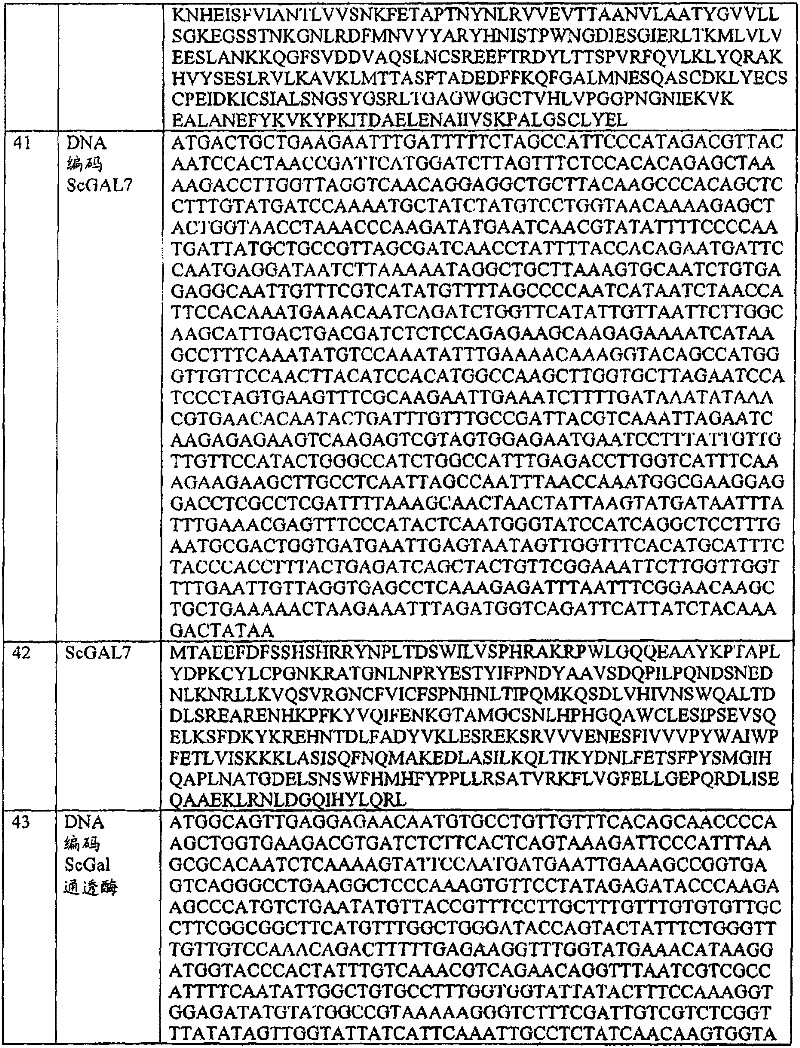


尽管本发明参考例举的实施方案在本文中描述,但应理解的是本发明不限于此。具有本领域普通技术且获得本文教导的人员应认识到在其范围内的另外的修改和实施方案。因此,本发明仅通过本文所附权利要限制。While the invention is described herein with reference to illustrative embodiments, it is to be understood that the invention is not limited thereto. Those of ordinary skill in the art and having access to the teachings herein will recognize additional modifications and implementations within the scope thereof. Accordingly, the invention is limited only by the claims appended hereto.
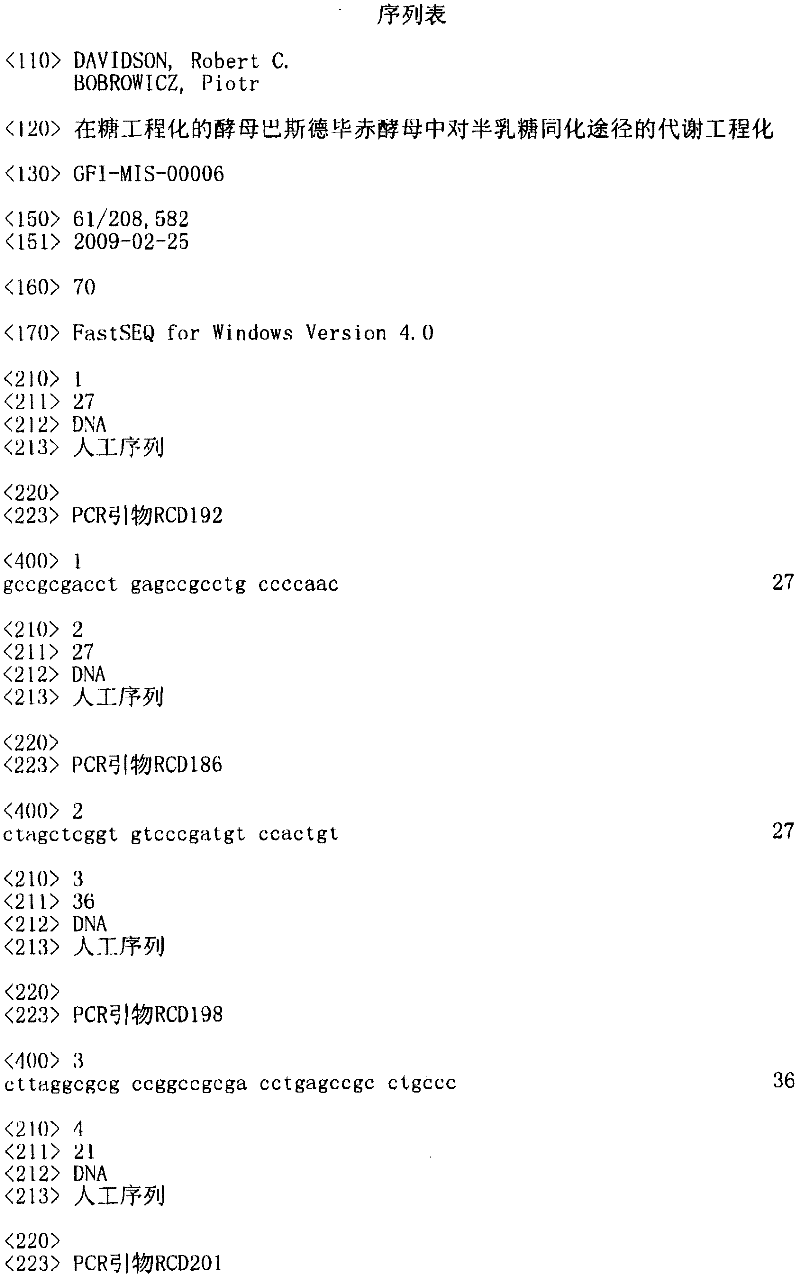

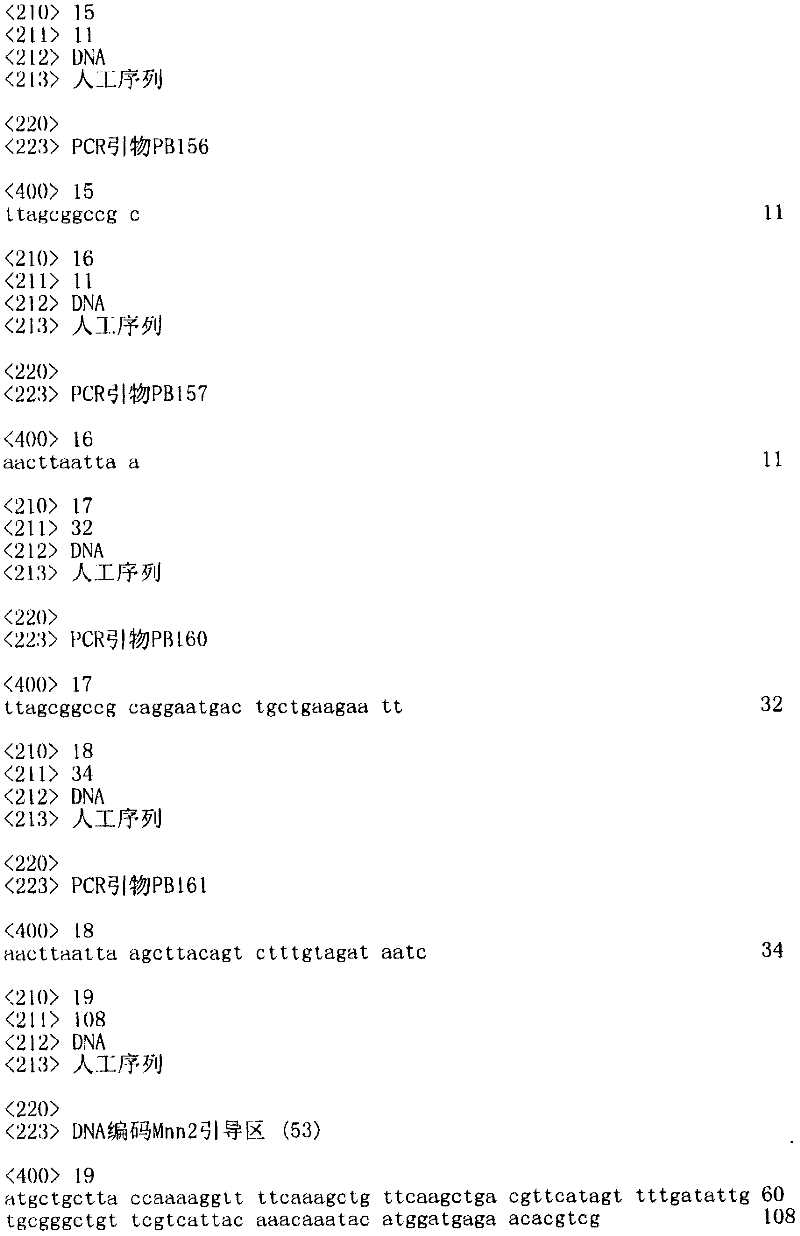



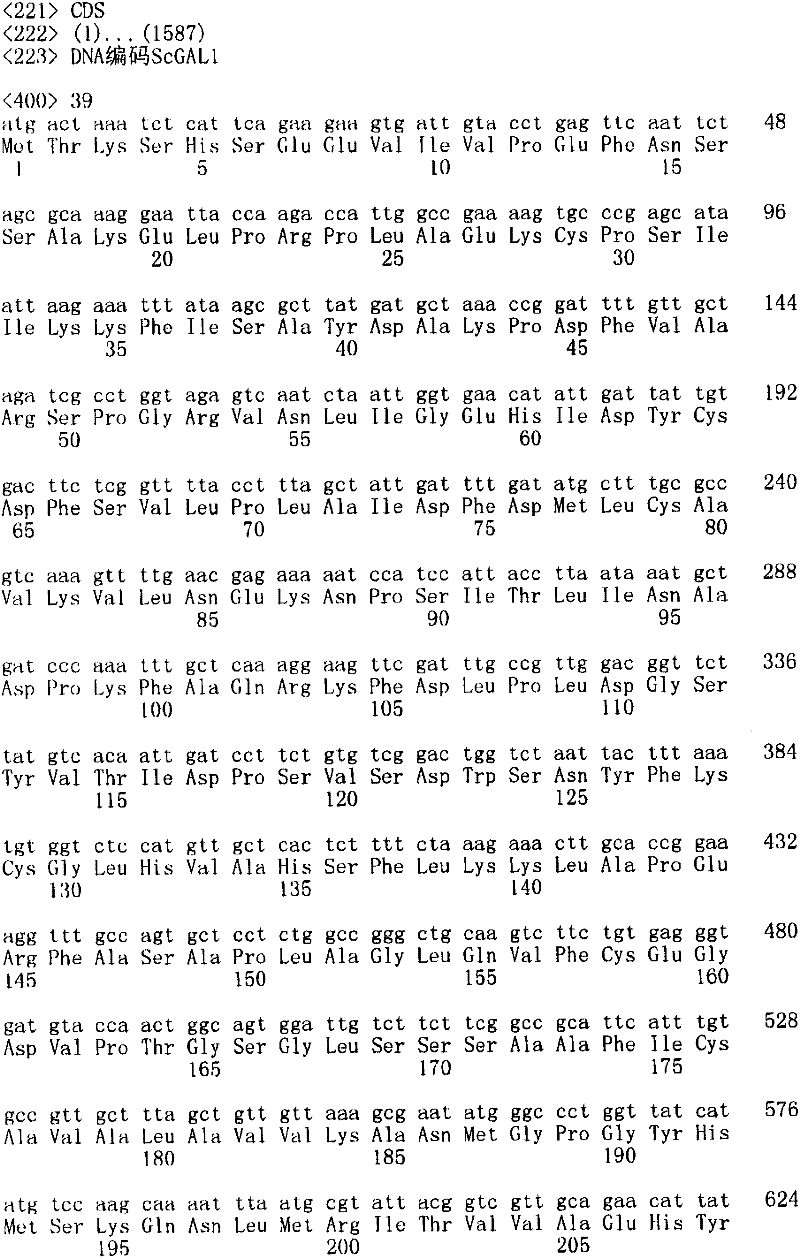


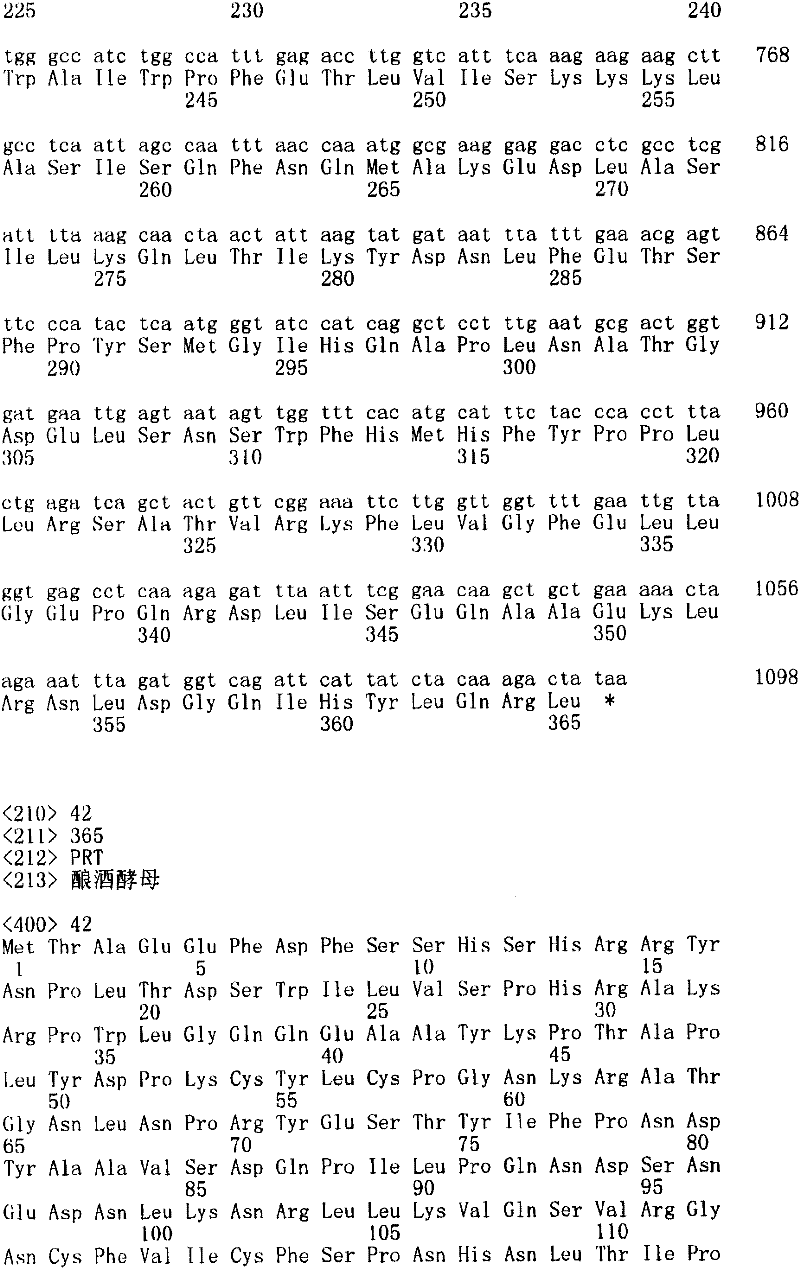

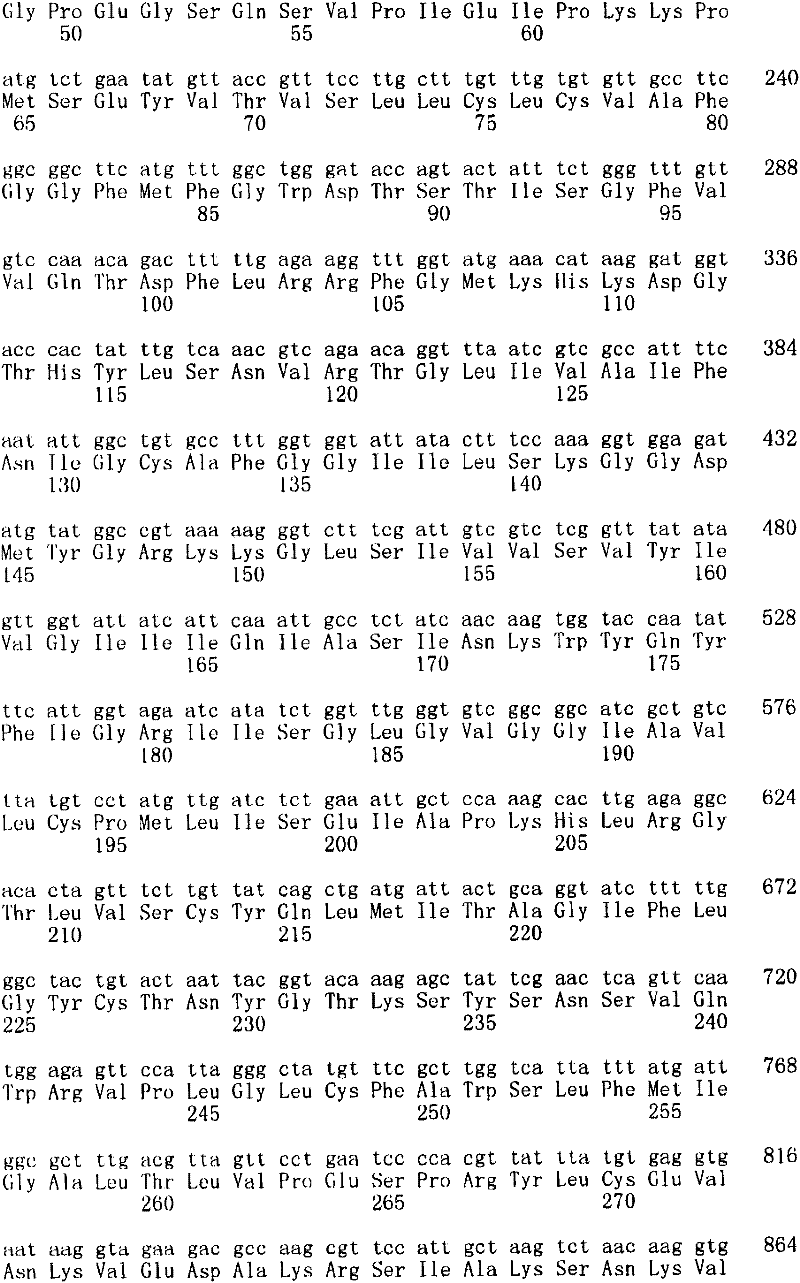

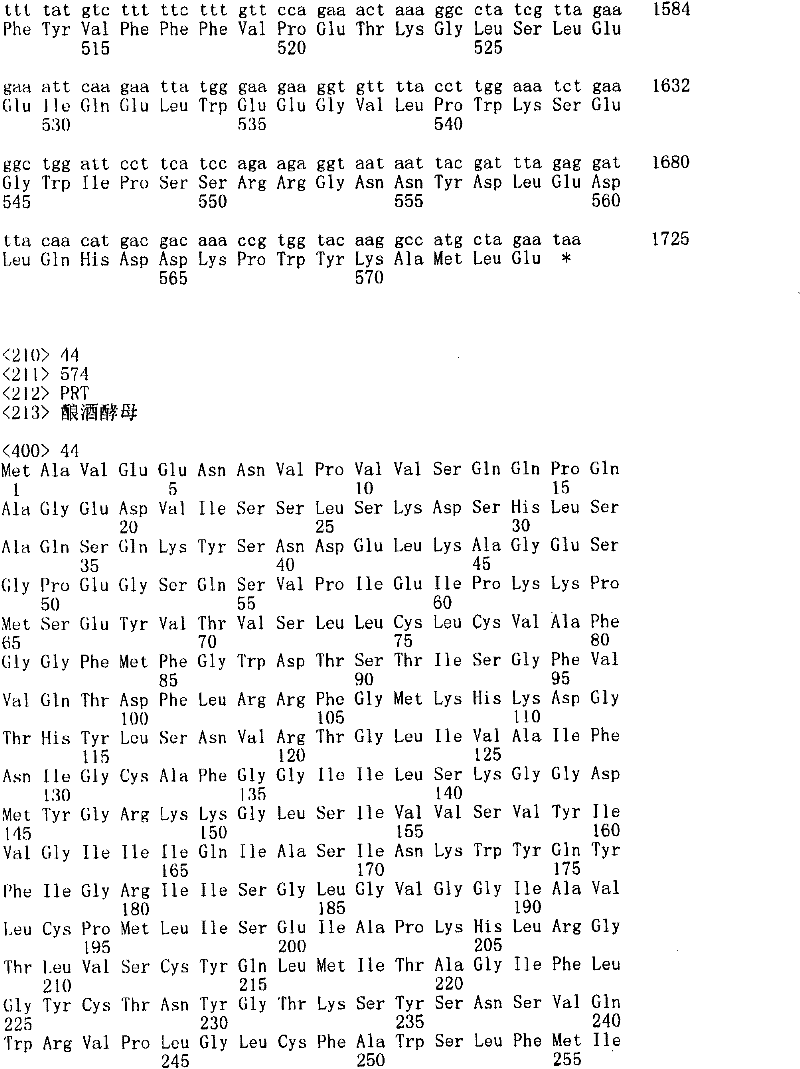













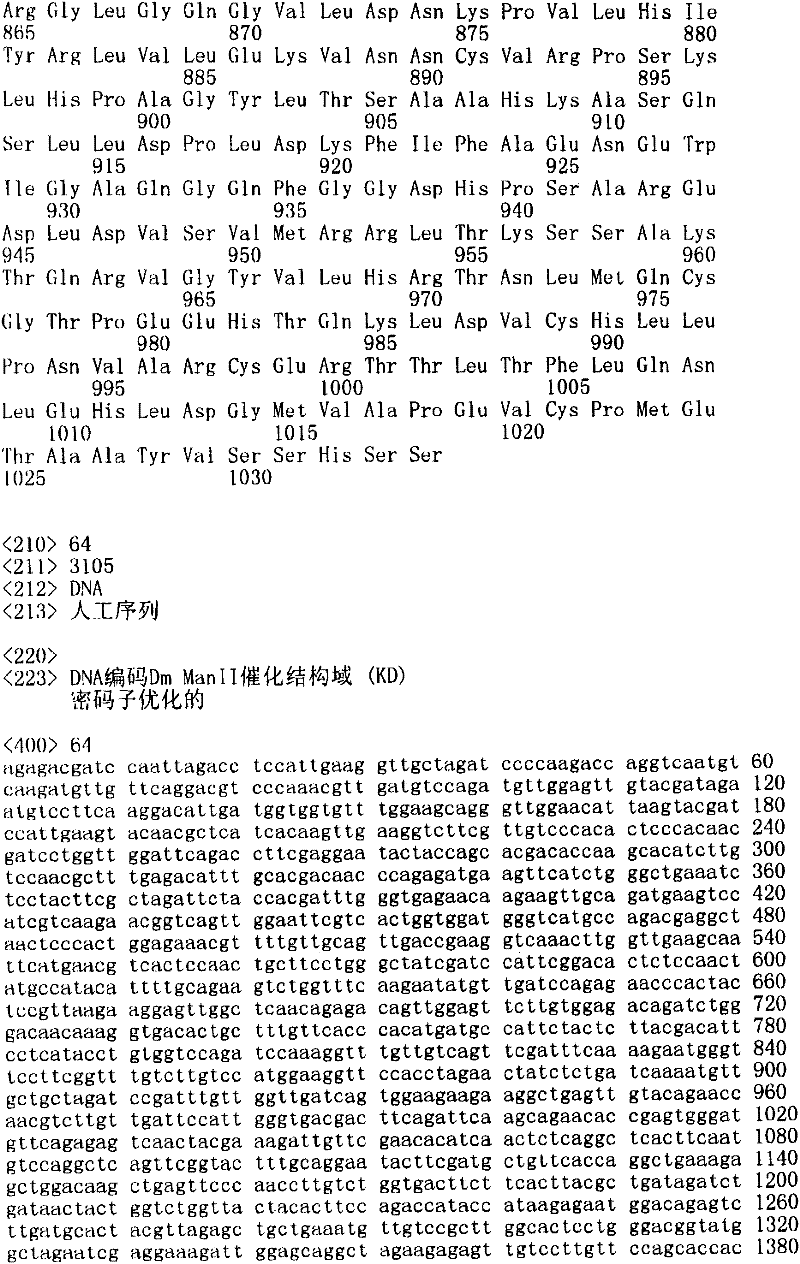
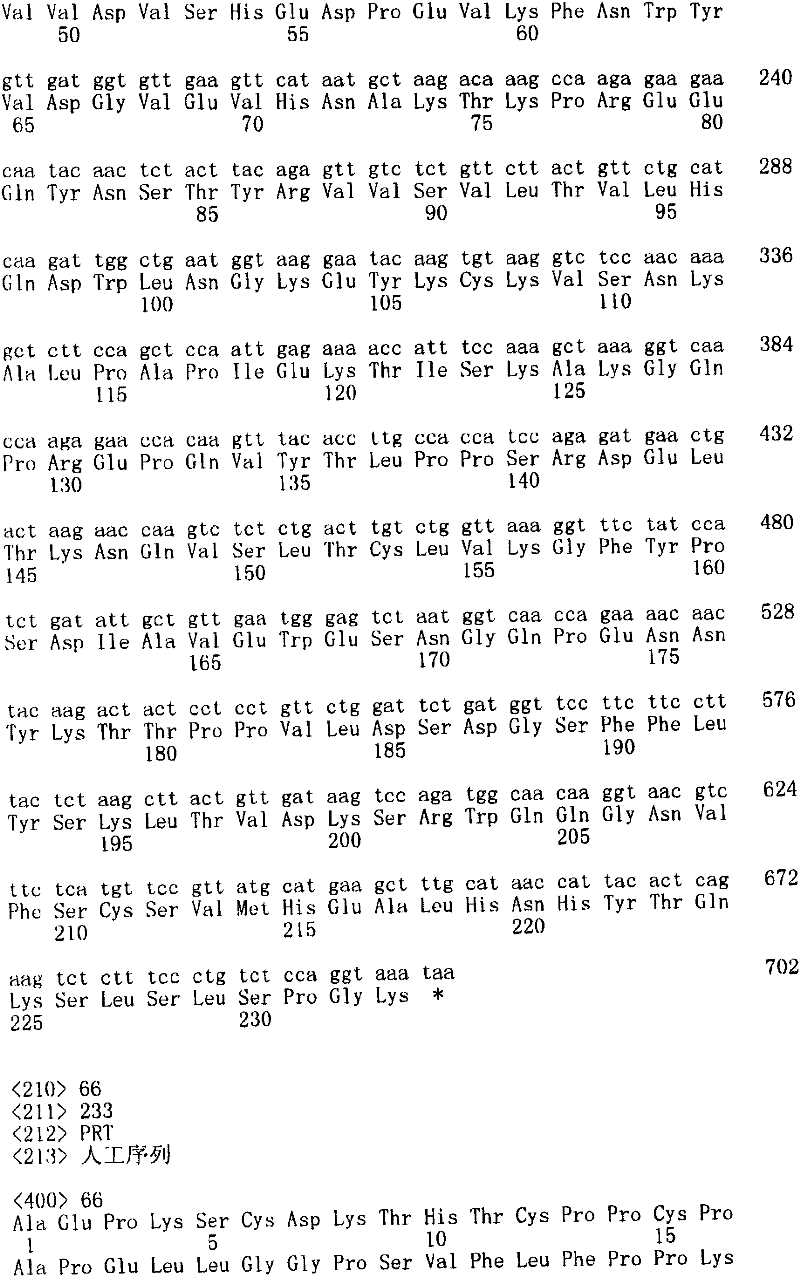

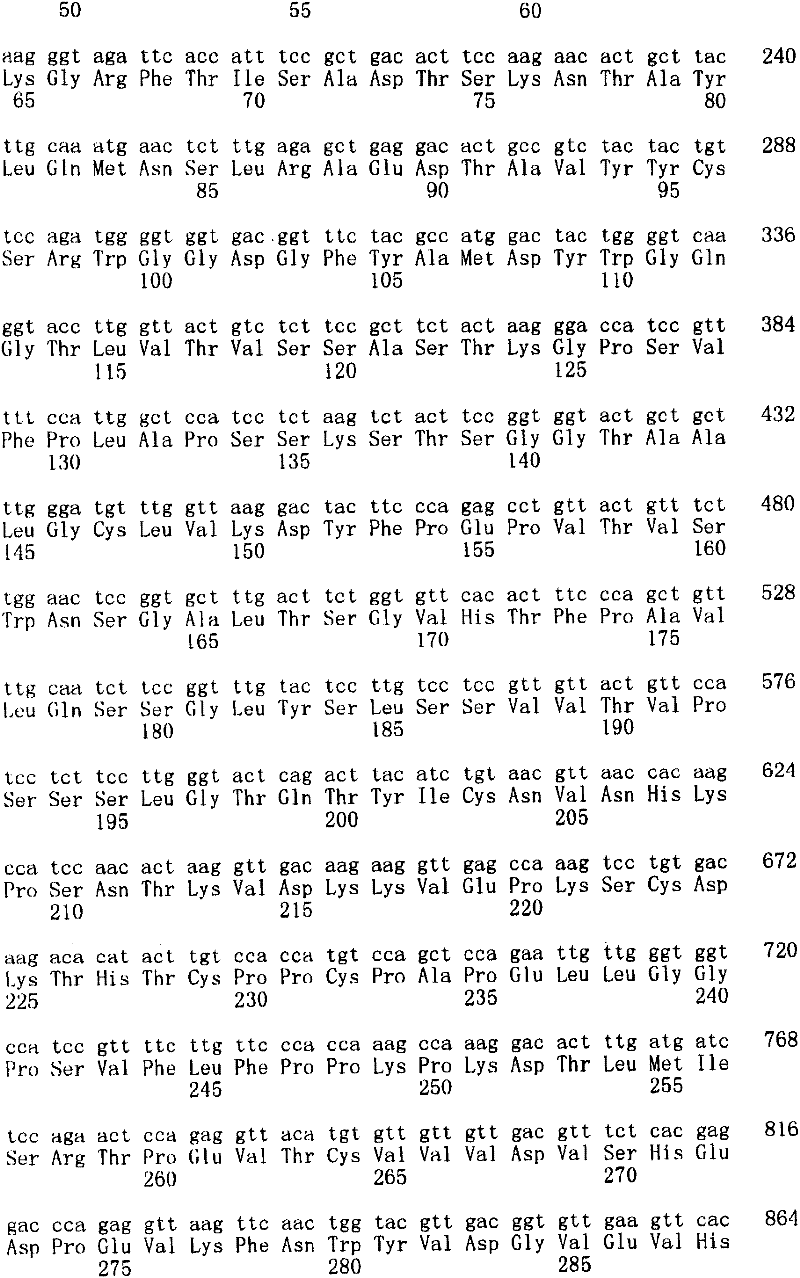


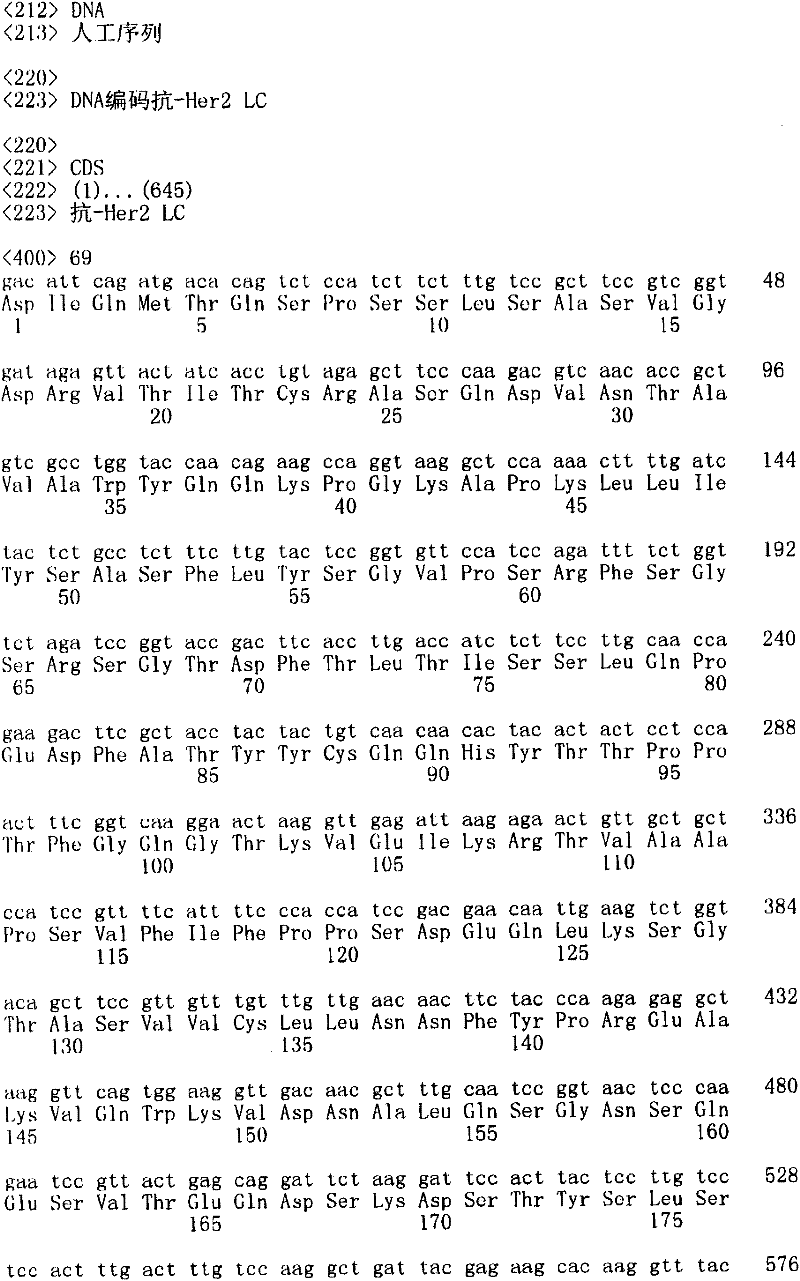
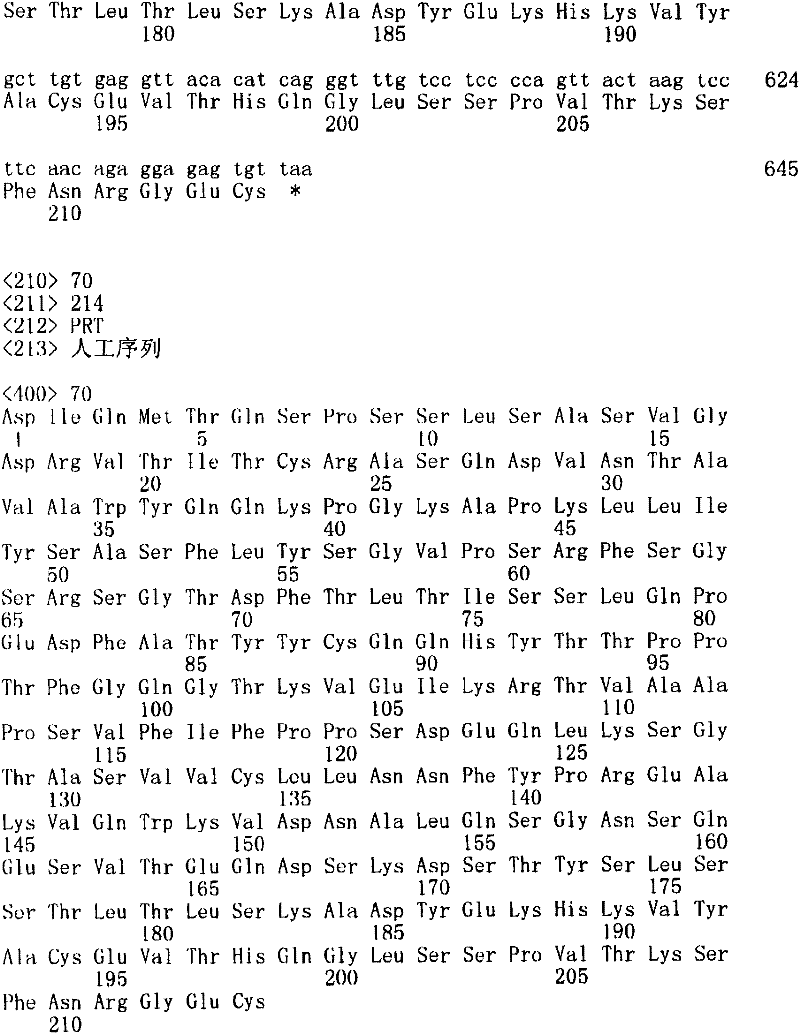
Claims (26)
Applications Claiming Priority (3)
| Application Number | Priority Date | Filing Date | Title |
|---|---|---|---|
| US20858209P | 2009-02-25 | 2009-02-25 | |
| US61/208582 | 2009-02-25 | ||
| PCT/US2010/025163 WO2010099153A2 (en) | 2009-02-25 | 2010-02-24 | Metabolic engineering of a galactose assimilation pathway in the glycoengineered yeast pichia pastoris |
Publications (2)
| Publication Number | Publication Date |
|---|---|
| CN102333872A true CN102333872A (en) | 2012-01-25 |
| CN102333872B CN102333872B (en) | 2014-07-09 |
Family
ID=42168206
Family Applications (1)
| Application Number | Title | Priority Date | Filing Date |
|---|---|---|---|
| CN201080011713.8A Expired - Fee Related CN102333872B (en) | 2009-02-25 | 2010-02-24 | Metabolic engineering of a galactose assimilation pathway in the glycoengineered yeast pichia pastoris |
Country Status (10)
| Country | Link |
|---|---|
| US (1) | US20120003695A1 (en) |
| EP (2) | EP2546347A3 (en) |
| JP (1) | JP2012518419A (en) |
| KR (1) | KR20110122134A (en) |
| CN (1) | CN102333872B (en) |
| AU (1) | AU2010218139B2 (en) |
| CA (1) | CA2751730A1 (en) |
| MX (1) | MX2011008913A (en) |
| SG (1) | SG173796A1 (en) |
| WO (1) | WO2010099153A2 (en) |
Cited By (12)
| Publication number | Priority date | Publication date | Assignee | Title |
|---|---|---|---|---|
| CN105779490A (en) * | 2014-12-16 | 2016-07-20 | 北京集智新创科技有限公司 | Construction method of Pichia pastoris expressed by OCH1 defect anti-CD20 tetravalent antibody |
| CN107074945A (en) * | 2014-05-27 | 2017-08-18 | 中央研究院 | Compositions and methods for enhancing the efficacy of antibodies |
| CN107164354A (en) * | 2016-03-15 | 2017-09-15 | 中国医学科学院药物研究所 | A kind of UDP xylose epimerase from Ornithogalum caudatum, its nucleotide sequence and application |
| CN107164355A (en) * | 2016-03-15 | 2017-09-15 | 中国医学科学院药物研究所 | A kind of UDP-Gal epimerase from Ornithogalum caudatum, its nucleotide sequence and application |
| CN108026558A (en) * | 2015-07-09 | 2018-05-11 | 非营利性组织佛兰芒综合大学生物技术研究所 | Cells producing glycoproteins with altered N- and O-glycosylation patterns and methods and uses thereof |
| CN108064266A (en) * | 2014-07-21 | 2018-05-22 | 格利科斯芬兰公司 | Preparation of glycoproteins with mammalian-like N-glycans in filamentous fungi |
| TWI682033B (en) * | 2014-03-17 | 2020-01-11 | 泉盛生物科技股份有限公司 | Methods for producing recombinant glycoproteins with modified glycosylation |
| CN111440225A (en) * | 2020-04-08 | 2020-07-24 | 兴盟生物医药(苏州)有限公司 | Method for regulating galactosylation level of antibody by adopting Ala-Gln |
| CN111770991A (en) * | 2017-12-18 | 2020-10-13 | 通用医疗公司 | sugar engineering |
| CN113302306A (en) * | 2019-01-29 | 2021-08-24 | 科莱恩产品 (德国) 公司 | Chimeric promoters for metabolic engineering |
| CN114107356A (en) * | 2021-10-21 | 2022-03-01 | 南京林业大学 | Method for transforming pseudomonas putida to assimilate D-galactose |
| CN119464103A (en) * | 2025-01-17 | 2025-02-18 | 上海昌进生物科技有限公司 | Highly efficient expression of beta-lactoglobulin strain and its construction method and application |
Families Citing this family (13)
| Publication number | Priority date | Publication date | Assignee | Title |
|---|---|---|---|---|
| KR20140005883A (en) * | 2010-10-13 | 2014-01-15 | 디에스엠 아이피 어셋츠 비.브이. | Polypeptides with permease activity |
| US20130330340A1 (en) * | 2011-02-25 | 2013-12-12 | Stephen R. Hamilton | Production of n- and o-sialylated tnfrii-fc fusion protein in yeast |
| WO2012115903A2 (en) * | 2011-02-25 | 2012-08-30 | Merck Sharp & Dohme Corp. | Yeast strain for the production of proteins with modified o-glycosylation |
| GB201113419D0 (en) * | 2011-08-04 | 2011-09-21 | Fujifilm Diosynth Biotechnologies Uk Ltd | Yeast vector |
| EP2925345B1 (en) | 2012-12-03 | 2018-09-05 | Merck Sharp & Dohme Corp. | Method for making o-glycosylated carboxy terminal portion (ctp) peptide-based insulin and insulin analogues |
| HUE042897T2 (en) * | 2013-03-08 | 2019-07-29 | Biogrammatics Inc | Yeast promoters for protein expression |
| WO2016134371A2 (en) | 2015-02-20 | 2016-08-25 | Ohio State Innovation Foundation | Bivalent antibody directed against nkg2d and tumor associated antigens |
| EP3106520A1 (en) * | 2015-06-17 | 2016-12-21 | Institut National De La Recherche Agronomique | Mutant yarrowia strain capable of degrading galactose |
| KR101851628B1 (en) * | 2016-04-04 | 2018-04-25 | 고려대학교 산학협력단 | Novel purification method of 3,6-anhydro-L-galactose using microorganisms |
| CN110241134A (en) * | 2018-03-08 | 2019-09-17 | 中国科学院上海高等研究院 | A method for transforming CHO-lec2 cells to increase galactose content in antibody sugar chains |
| CN110241133A (en) * | 2018-03-08 | 2019-09-17 | 中国科学院上海高等研究院 | A method for transforming CHO-K1 cells to increase galactose content in antibody sugar chains |
| US20210301024A1 (en) * | 2018-07-04 | 2021-09-30 | Cytoimmune Therapeutics, Inc. | Compositions and methods for immunotherapy targeting flt3, pd-1, and/or pd-l1 |
| CN113735979A (en) * | 2021-07-15 | 2021-12-03 | 吉林大学 | Recombinant human platelet-derived factor (rhPDGF-BB) -Fc fusion protein and use thereof |
Citations (3)
| Publication number | Priority date | Publication date | Assignee | Title |
|---|---|---|---|---|
| WO2006014683A2 (en) * | 2004-07-21 | 2006-02-09 | Glycofi, Inc. | Immunoglobulins comprising predominantly a gal2glcnac2man3glcnac2 glycoform |
| WO2006040353A1 (en) * | 2004-10-15 | 2006-04-20 | Thales | Method for burning in the multi-dissemination of distributed objects |
| WO2006071280A1 (en) * | 2004-12-23 | 2006-07-06 | Glycofi, Inc. | Immunoglobulins comprising predominantly a ga1g1cnacman5glcnac2 glycoform |
Family Cites Families (35)
| Publication number | Priority date | Publication date | Assignee | Title |
|---|---|---|---|---|
| US4816567A (en) | 1983-04-08 | 1989-03-28 | Genentech, Inc. | Recombinant immunoglobin preparations |
| US5156965A (en) | 1983-11-29 | 1992-10-20 | Igen, Inc. | Catalytic antibodies |
| JP2540508B2 (en) | 1983-11-29 | 1996-10-02 | イージエン・インコーポレイテッド | How to catalyze a chemical reaction |
| US5037750A (en) | 1984-11-27 | 1991-08-06 | Igen, Inc. | Method for producing antibodies which catalyze chemical reactions |
| DE4226971C2 (en) | 1992-08-14 | 1997-01-16 | Widmar Prof Dr Tanner | Modified fungal cells and processes for the production of recombinant products |
| US5733757A (en) | 1995-12-15 | 1998-03-31 | The Scripps Research Institute | Aldolase catalytic antibody |
| US20040136986A1 (en) | 1997-10-31 | 2004-07-15 | Genentech, Inc. | Methods and compositions comprising glycoprotein glycoforms |
| SI1180121T1 (en) | 1999-05-17 | 2004-04-30 | Conjuchem, Inc. | Long lasting insulinotropic peptides |
| EP1598365A1 (en) | 1999-05-17 | 2005-11-23 | ConjuChem Inc. | Protection of endogenous therapeutic peptides |
| FI117717B (en) | 1999-07-09 | 2007-01-31 | Ciba Sc Holding Ag | Ytlimningskomposition |
| ES2328106T3 (en) | 2000-05-17 | 2009-11-10 | Mitsubishi Tanabe Pharma Corporation | PROCEDURE TO PRODUCE PROTEIN WITH REDUCTION OF MANOSE PHOSPHATE IN THE CHAIN OF SUGAR AND GLICOPROTEIN PRODUCED WITH THE SAME. |
| US7449308B2 (en) * | 2000-06-28 | 2008-11-11 | Glycofi, Inc. | Combinatorial DNA library for producing modified N-glycans in lower eukaryotes |
| US8697394B2 (en) | 2000-06-28 | 2014-04-15 | Glycofi, Inc. | Production of modified glycoproteins having multiple antennary structures |
| US7598055B2 (en) | 2000-06-28 | 2009-10-06 | Glycofi, Inc. | N-acetylglucosaminyltransferase III expression in lower eukaryotes |
| US7795002B2 (en) * | 2000-06-28 | 2010-09-14 | Glycofi, Inc. | Production of galactosylated glycoproteins in lower eukaryotes |
| US7625756B2 (en) | 2000-06-28 | 2009-12-01 | GycoFi, Inc. | Expression of class 2 mannosidase and class III mannosidase in lower eukaryotic cells |
| JP2004501642A (en) | 2000-06-28 | 2004-01-22 | グライコフィ, インコーポレイテッド | Methods for producing modified glycoproteins |
| US7863020B2 (en) | 2000-06-28 | 2011-01-04 | Glycofi, Inc. | Production of sialylated N-glycans in lower eukaryotes |
| DE10036491A1 (en) | 2000-07-25 | 2002-02-07 | Roche Diagnostics Gmbh | Expression of alkaline phosphatase in yeast |
| US7737260B2 (en) | 2003-11-13 | 2010-06-15 | Hanmi Pharm. Co., Ltd | Protein complex using an immunoglobulin fragment and method for the preparation thereof |
| NZ569490A (en) | 2001-12-27 | 2008-11-28 | Glycofi Inc | Methods to engineer mammalian-type carbohydrate structures |
| US7332299B2 (en) | 2003-02-20 | 2008-02-19 | Glycofi, Inc. | Endomannosidases in the modification of glycoproteins in eukaryotes |
| US7514253B2 (en) | 2003-05-16 | 2009-04-07 | Glycofi, Inc. | URA5 gene and methods for stable genetic integration in yeast |
| US7507573B2 (en) * | 2003-11-14 | 2009-03-24 | Vib, Vzw | Modification of protein glycosylation in methylotrophic yeast |
| EP1696864B1 (en) | 2003-12-24 | 2014-11-12 | GlycoFi, Inc. | Methods for eliminating mannosylphosphorylation of glycans in the production of glycoproteins |
| US7479389B2 (en) | 2004-03-02 | 2009-01-20 | Glycofi, Inc. | ARG1, ARG2, ARG3, HIS1, HIS2, HIS5, HIS6 genes and methods for stable genetic integration |
| EP2365089B1 (en) | 2004-03-17 | 2014-05-14 | GlycoFi, Inc. | Method of engineering a cytidine monophosphate-sialic acid synthetic pathway in yeast |
| AU2005233387B2 (en) * | 2004-04-15 | 2011-05-26 | Glycofi, Inc. | Production of galactosylated glycoproteins in lower eukaryotes |
| WO2005106010A2 (en) | 2004-04-29 | 2005-11-10 | Glycofi, Inc. | Methods for reducing or eliminating alpha-mannosidase resistant glycans in the production of glycoproteins |
| KR20180091967A (en) * | 2004-07-22 | 2018-08-16 | 제넨테크, 인크. | Her2 antibody composition |
| KR100754667B1 (en) | 2005-04-08 | 2007-09-03 | 한미약품 주식회사 | Immunoglobulin Fc Fragments Modified with Non-Peptide Polymers and Pharmaceutical Compositions Comprising the Same |
| ES2534465T3 (en) | 2005-11-15 | 2015-04-23 | Glycofi, Inc. | Production of glycoproteins with reduced O-glycosylation |
| CN101535340B (en) | 2006-05-19 | 2013-05-01 | 格利科菲公司 | Erythropoietin compositions |
| JP5406710B2 (en) | 2006-05-19 | 2014-02-05 | グライコフィ, インコーポレイテッド | Erythropoietin composition |
| IL182956A0 (en) * | 2007-05-03 | 2008-01-20 | Yeda Res & Dev | Glycan modified soluble receptors and binding proteins and their use |
-
2010
- 2010-02-24 AU AU2010218139A patent/AU2010218139B2/en not_active Ceased
- 2010-02-24 JP JP2011551308A patent/JP2012518419A/en active Pending
- 2010-02-24 KR KR1020117019623A patent/KR20110122134A/en not_active Withdrawn
- 2010-02-24 EP EP12188235.1A patent/EP2546347A3/en not_active Withdrawn
- 2010-02-24 CA CA2751730A patent/CA2751730A1/en not_active Abandoned
- 2010-02-24 WO PCT/US2010/025163 patent/WO2010099153A2/en not_active Ceased
- 2010-02-24 MX MX2011008913A patent/MX2011008913A/en not_active Application Discontinuation
- 2010-02-24 EP EP10706438.8A patent/EP2401378B1/en not_active Not-in-force
- 2010-02-24 CN CN201080011713.8A patent/CN102333872B/en not_active Expired - Fee Related
- 2010-02-24 SG SG2011060258A patent/SG173796A1/en unknown
- 2010-02-24 US US13/202,002 patent/US20120003695A1/en not_active Abandoned
Patent Citations (3)
| Publication number | Priority date | Publication date | Assignee | Title |
|---|---|---|---|---|
| WO2006014683A2 (en) * | 2004-07-21 | 2006-02-09 | Glycofi, Inc. | Immunoglobulins comprising predominantly a gal2glcnac2man3glcnac2 glycoform |
| WO2006040353A1 (en) * | 2004-10-15 | 2006-04-20 | Thales | Method for burning in the multi-dissemination of distributed objects |
| WO2006071280A1 (en) * | 2004-12-23 | 2006-07-06 | Glycofi, Inc. | Immunoglobulins comprising predominantly a ga1g1cnacman5glcnac2 glycoform |
Cited By (19)
| Publication number | Priority date | Publication date | Assignee | Title |
|---|---|---|---|---|
| TWI682033B (en) * | 2014-03-17 | 2020-01-11 | 泉盛生物科技股份有限公司 | Methods for producing recombinant glycoproteins with modified glycosylation |
| TWI654202B (en) | 2014-05-27 | 2019-03-21 | 中央研究院 | Composition and method for general-purpose glycoforms for enhancing antibody efficacy |
| CN107074945A (en) * | 2014-05-27 | 2017-08-18 | 中央研究院 | Compositions and methods for enhancing the efficacy of antibodies |
| CN107074945B (en) * | 2014-05-27 | 2021-08-24 | 中央研究院 | Compositions and methods of universal glycoforms for enhancing antibody efficacy |
| CN108064266A (en) * | 2014-07-21 | 2018-05-22 | 格利科斯芬兰公司 | Preparation of glycoproteins with mammalian-like N-glycans in filamentous fungi |
| CN105779490A (en) * | 2014-12-16 | 2016-07-20 | 北京集智新创科技有限公司 | Construction method of Pichia pastoris expressed by OCH1 defect anti-CD20 tetravalent antibody |
| CN108026558B (en) * | 2015-07-09 | 2021-08-17 | 非营利性组织佛兰芒综合大学生物技术研究所 | Cells producing glycoproteins with altered N-and O-glycosylation patterns, and methods and uses thereof |
| CN108026558A (en) * | 2015-07-09 | 2018-05-11 | 非营利性组织佛兰芒综合大学生物技术研究所 | Cells producing glycoproteins with altered N- and O-glycosylation patterns and methods and uses thereof |
| CN107164354B (en) * | 2016-03-15 | 2020-03-31 | 中国医学科学院药物研究所 | Uridine-5' -diphosphate xylose epimerase derived from Ornithogalum caudatum, nucleotide sequence and application thereof |
| CN107164355B (en) * | 2016-03-15 | 2020-03-31 | 中国医学科学院药物研究所 | Uridine-5' -diphosphate galactose epimerase derived from star-of-Bethlehem, nucleotide sequence and application thereof |
| CN107164355A (en) * | 2016-03-15 | 2017-09-15 | 中国医学科学院药物研究所 | A kind of UDP-Gal epimerase from Ornithogalum caudatum, its nucleotide sequence and application |
| CN107164354A (en) * | 2016-03-15 | 2017-09-15 | 中国医学科学院药物研究所 | A kind of UDP xylose epimerase from Ornithogalum caudatum, its nucleotide sequence and application |
| CN111770991A (en) * | 2017-12-18 | 2020-10-13 | 通用医疗公司 | sugar engineering |
| US11674125B2 (en) | 2017-12-18 | 2023-06-13 | The General Hospital Corporation | Glycoengineering |
| CN113302306A (en) * | 2019-01-29 | 2021-08-24 | 科莱恩产品 (德国) 公司 | Chimeric promoters for metabolic engineering |
| CN113302306B (en) * | 2019-01-29 | 2024-08-23 | 科莱恩产品(德国)公司 | Chimeric promoters for metabolic engineering |
| CN111440225A (en) * | 2020-04-08 | 2020-07-24 | 兴盟生物医药(苏州)有限公司 | Method for regulating galactosylation level of antibody by adopting Ala-Gln |
| CN114107356A (en) * | 2021-10-21 | 2022-03-01 | 南京林业大学 | Method for transforming pseudomonas putida to assimilate D-galactose |
| CN119464103A (en) * | 2025-01-17 | 2025-02-18 | 上海昌进生物科技有限公司 | Highly efficient expression of beta-lactoglobulin strain and its construction method and application |
Also Published As
| Publication number | Publication date |
|---|---|
| KR20110122134A (en) | 2011-11-09 |
| AU2010218139A1 (en) | 2011-07-28 |
| MX2011008913A (en) | 2011-09-08 |
| WO2010099153A2 (en) | 2010-09-02 |
| AU2010218139B2 (en) | 2012-11-01 |
| WO2010099153A3 (en) | 2010-10-21 |
| US20120003695A1 (en) | 2012-01-05 |
| EP2401378A2 (en) | 2012-01-04 |
| EP2546347A3 (en) | 2013-05-01 |
| JP2012518419A (en) | 2012-08-16 |
| CN102333872B (en) | 2014-07-09 |
| EP2546347A2 (en) | 2013-01-16 |
| SG173796A1 (en) | 2011-09-29 |
| CA2751730A1 (en) | 2010-09-02 |
| EP2401378B1 (en) | 2013-08-14 |
Similar Documents
| Publication | Publication Date | Title |
|---|---|---|
| CN102333872B (en) | Metabolic engineering of a galactose assimilation pathway in the glycoengineered yeast pichia pastoris | |
| JP5976549B2 (en) | Method for increasing N-glycosylation site occupancy on therapeutic glycoproteins produced in Pichia pastoris | |
| US9428784B2 (en) | Methods for increasing N-glycan occupancy and reducing production of hybrid N-glycans in pichia pastoris strains lacking ALG3 expression | |
| US20100311122A1 (en) | Vectors and yeast strains for protein production | |
| JP2011530311A (en) | Improved vectors and yeast strains for protein production: Ca2 + ATPase overexpression | |
| US9518100B2 (en) | Methods for increasing N-glycan occupancy and reducing production of hybrid N-glycans in Pichia pastoris strains lacking Alg3 expression | |
| US10100343B2 (en) | CRZ1 mutant fungal cells | |
| US8936918B2 (en) | Yeast strain for the production of proteins with modified O-glycosylation | |
| US20140287463A1 (en) | Engineered pichia strains with improved fermentation yield and n-glycosylation quality | |
| US9416389B2 (en) | Methods for reducing mannosyltransferase activity in lower eukaryotes | |
| AU2012238203A1 (en) | Metabolic engineering of a galactose assimilation pathway in the glycoengineered yeast pichia pastoris |
Legal Events
| Date | Code | Title | Description |
|---|---|---|---|
| C06 | Publication | ||
| PB01 | Publication | ||
| C10 | Entry into substantive examination | ||
| SE01 | Entry into force of request for substantive examination | ||
| ASS | Succession or assignment of patent right |
Owner name: SCHERING CORP (US) Free format text: FORMER OWNER: MSD CORP. Effective date: 20121101 |
|
| C41 | Transfer of patent application or patent right or utility model | ||
| C53 | Correction of patent of invention or patent application | ||
| CB02 | Change of applicant information |
Address after: New jersey, USA Applicant after: MERCK SHARP & DOHME Corp. Address before: New jersey, USA Applicant before: SCHERING Corp. |
|
| COR | Change of bibliographic data |
Free format text: CORRECT: APPLICANT; FROM: SCHERING CORP (US) TO: MSD CORP. |
|
| TA01 | Transfer of patent application right |
Effective date of registration: 20121101 Address after: New jersey, USA Applicant after: SCHERING Corp. Address before: New jersey, USA Applicant before: MERCK SHARP & DOHME Corp. |
|
| C14 | Grant of patent or utility model | ||
| GR01 | Patent grant | ||
| CF01 | Termination of patent right due to non-payment of annual fee |
Granted publication date: 20140709 Termination date: 20150224 |
|
| EXPY | Termination of patent right or utility model |