CN102317470A - Genetic variants contributing to risk of prostate cancer - Google Patents
Genetic variants contributing to risk of prostate cancer Download PDFInfo
- Publication number
- CN102317470A CN102317470A CN2008800107105A CN200880010710A CN102317470A CN 102317470 A CN102317470 A CN 102317470A CN 2008800107105 A CN2008800107105 A CN 2008800107105A CN 200880010710 A CN200880010710 A CN 200880010710A CN 102317470 A CN102317470 A CN 102317470A
- Authority
- CN
- China
- Prior art keywords
- seq
- allele
- marker
- prostate cancer
- markers
- Prior art date
- Legal status (The legal status is an assumption and is not a legal conclusion. Google has not performed a legal analysis and makes no representation as to the accuracy of the status listed.)
- Pending
Links
Images

Classifications
-
- C—CHEMISTRY; METALLURGY
- C12—BIOCHEMISTRY; BEER; SPIRITS; WINE; VINEGAR; MICROBIOLOGY; ENZYMOLOGY; MUTATION OR GENETIC ENGINEERING
- C12Q—MEASURING OR TESTING PROCESSES INVOLVING ENZYMES, NUCLEIC ACIDS OR MICROORGANISMS; COMPOSITIONS OR TEST PAPERS THEREFOR; PROCESSES OF PREPARING SUCH COMPOSITIONS; CONDITION-RESPONSIVE CONTROL IN MICROBIOLOGICAL OR ENZYMOLOGICAL PROCESSES
- C12Q1/00—Measuring or testing processes involving enzymes, nucleic acids or microorganisms; Compositions therefor; Processes of preparing such compositions
- C12Q1/68—Measuring or testing processes involving enzymes, nucleic acids or microorganisms; Compositions therefor; Processes of preparing such compositions involving nucleic acids
- C12Q1/6876—Nucleic acid products used in the analysis of nucleic acids, e.g. primers or probes
- C12Q1/6883—Nucleic acid products used in the analysis of nucleic acids, e.g. primers or probes for diseases caused by alterations of genetic material
- C12Q1/6886—Nucleic acid products used in the analysis of nucleic acids, e.g. primers or probes for diseases caused by alterations of genetic material for cancer
-
- C—CHEMISTRY; METALLURGY
- C12—BIOCHEMISTRY; BEER; SPIRITS; WINE; VINEGAR; MICROBIOLOGY; ENZYMOLOGY; MUTATION OR GENETIC ENGINEERING
- C12Q—MEASURING OR TESTING PROCESSES INVOLVING ENZYMES, NUCLEIC ACIDS OR MICROORGANISMS; COMPOSITIONS OR TEST PAPERS THEREFOR; PROCESSES OF PREPARING SUCH COMPOSITIONS; CONDITION-RESPONSIVE CONTROL IN MICROBIOLOGICAL OR ENZYMOLOGICAL PROCESSES
- C12Q2600/00—Oligonucleotides characterized by their use
- C12Q2600/106—Pharmacogenomics, i.e. genetic variability in individual responses to drugs and drug metabolism
-
- C—CHEMISTRY; METALLURGY
- C12—BIOCHEMISTRY; BEER; SPIRITS; WINE; VINEGAR; MICROBIOLOGY; ENZYMOLOGY; MUTATION OR GENETIC ENGINEERING
- C12Q—MEASURING OR TESTING PROCESSES INVOLVING ENZYMES, NUCLEIC ACIDS OR MICROORGANISMS; COMPOSITIONS OR TEST PAPERS THEREFOR; PROCESSES OF PREPARING SUCH COMPOSITIONS; CONDITION-RESPONSIVE CONTROL IN MICROBIOLOGICAL OR ENZYMOLOGICAL PROCESSES
- C12Q2600/00—Oligonucleotides characterized by their use
- C12Q2600/156—Polymorphic or mutational markers
-
- C—CHEMISTRY; METALLURGY
- C12—BIOCHEMISTRY; BEER; SPIRITS; WINE; VINEGAR; MICROBIOLOGY; ENZYMOLOGY; MUTATION OR GENETIC ENGINEERING
- C12Q—MEASURING OR TESTING PROCESSES INVOLVING ENZYMES, NUCLEIC ACIDS OR MICROORGANISMS; COMPOSITIONS OR TEST PAPERS THEREFOR; PROCESSES OF PREPARING SUCH COMPOSITIONS; CONDITION-RESPONSIVE CONTROL IN MICROBIOLOGICAL OR ENZYMOLOGICAL PROCESSES
- C12Q2600/00—Oligonucleotides characterized by their use
- C12Q2600/172—Haplotypes
Landscapes
- Chemical & Material Sciences (AREA)
- Life Sciences & Earth Sciences (AREA)
- Health & Medical Sciences (AREA)
- Organic Chemistry (AREA)
- Proteomics, Peptides & Aminoacids (AREA)
- Engineering & Computer Science (AREA)
- Immunology (AREA)
- Pathology (AREA)
- Analytical Chemistry (AREA)
- Zoology (AREA)
- Genetics & Genomics (AREA)
- Wood Science & Technology (AREA)
- Physics & Mathematics (AREA)
- Biotechnology (AREA)
- Microbiology (AREA)
- Molecular Biology (AREA)
- Hospice & Palliative Care (AREA)
- Biophysics (AREA)
- Oncology (AREA)
- Biochemistry (AREA)
- Bioinformatics & Cheminformatics (AREA)
- General Engineering & Computer Science (AREA)
- General Health & Medical Sciences (AREA)
- Measuring Or Testing Involving Enzymes Or Micro-Organisms (AREA)
- Medicines That Contain Protein Lipid Enzymes And Other Medicines (AREA)
Abstract
Description
背景技术 Background technique
癌症——不受控制的恶性细胞生长——是现代医学时代的主要健康问题,并且在发达国家中是死亡的主要原因之一。在美国,四分之一的死亡是由癌症引起的(Jemal,A等,CA Cancer J.Clin.52:23-47(2002))。Cancer - the uncontrolled growth of malignant cells - is a major health problem in the modern medical age and is one of the leading causes of death in the developed world. Cancer is responsible for one in four deaths in the United States (Jemal, A, et al., CA Cancer J. Clin. 52:23-47 (2002)).
在最近十年内,前列腺癌的发生率急剧增加,并且现在在美国和西欧,前列腺癌是死亡的主要原因(Peschel,R.E.和J.W.Colberg,Lancet 4:233-41(2003);Nelson,W.G等,N.Engl.J.Med.349(4):366-81(2003))。前列腺癌是工业化国家的男人中最经常诊断出的非皮肤恶性肿瘤,并且在美国,八分之一的男人在其生命期间将发生前列腺癌(Simard,J等,Endocrinology 143(6):2029-40(2002))。尽管环境因素例如饮食因素和生活方式相关的因素促进前列腺癌的风险,但是遗传因素也已经示出起重要作用。实际上,阳性家族史是前列腺癌的最强的流行病学风险因素之一,并且比较单卵双生中前列腺癌一致发生的孪生研究一致地显示,与其他类型的癌症相比,在前列腺癌风险中遗传成分更强(Nelson,W.G等,N.Engl.J.Med.349(4):366-81(2003);Lichtenstein P.等,N.Engl.J.Med.343(2):78-85(2000))。另外,在关于冰岛从1955-2003年诊断的所有癌症病例的家族性(familiality)的国家范围内的研究中,在前列腺癌病例的一级到五级亲属中可见前列腺癌的风险增加(Amundadottir等,PLoS Medicine 1(3):e65(2004))。对于该疾病的遗传基础——由亲属中增加的风险所强调的——进一步得到在下列特定人群中的前列腺癌研究的支持:例如非洲裔美国人位于前列腺癌的最高发生率和可归因于该疾病的死亡率之列:他们为欧洲裔美国人可能发生前列腺癌的1.6倍,并且为欧洲裔美国人可能死于该疾病的2.4倍(Ries,L.A.G等,NIH Pub.号99-4649(1999))。In the last decade, the incidence of prostate cancer has increased dramatically and is now the leading cause of death in the United States and Western Europe (Peschel, R.E. and J.W. Colberg, Lancet 4:233-41 (2003); Nelson, W.G et al., N. Engl. J. Med. 349(4): 366-81 (2003)). Prostate cancer is the most frequently diagnosed non-cutaneous malignancy among men in industrialized countries, and in the United States, one in eight men will develop prostate cancer during their lifetime (Simard, J et al, Endocrinology 143(6):2029- 40 (2002)). Although environmental factors such as dietary factors and lifestyle-related factors contribute to the risk of prostate cancer, genetic factors have also been shown to play an important role. Indeed, a positive family history is one of the strongest epidemiological risk factors for prostate cancer, and twin studies comparing the concordant occurrence of prostate cancer in monozygotic twins have consistently shown a significant increase in prostate cancer risk compared with other types of cancer. Stronger genetic component in (Nelson, W.G et al., N.Engl.J.Med.349(4):366-81 (2003); Lichtenstein P. et al., N.Engl.J.Med.343(2):78 -85(2000)). Additionally, in a country-wide study of the familiality of all cancer cases diagnosed in Iceland from 1955-2003, an increased risk of prostate cancer was seen among first- to fifth-degree relatives of prostate cancer cases (Amundadottir et al. , PLoS Medicine 1(3):e65(2004)). The genetic basis for the disease—underscored by the increased risk among relatives—is further supported by studies of prostate cancer in specific populations such as African Americans who are attributable to the highest incidence of prostate cancer and Among the mortality rates of the disease: they are 1.6 times as likely as European Americans to develop prostate cancer and 2.4 times as likely to die from the disease as European Americans (Ries, L.A.G et al., NIH Pub. No. 99-4649( 1999)).
寿命预期平均40%的下降影响患有前列腺癌的男性。如果及早发现——在转移和局部扩散出被膜之前,前列腺癌可以治疗(例如使用手术)。然而,如果在从前列腺扩散和转移之后被诊断出,前列腺癌一般是不治之症,其具有低的治愈率。尽管基于前列腺-特异性抗原(PSA)的筛选有助于前列腺癌的早期诊断,但是其既非高灵敏性的又非特异性的(Punglia等,N Engl J Med.349(4):335-42(2003))。这意味着高比例的假阴性和假阳性诊断伴随着该检测。结果是许多遗漏的癌发生和对于没有癌的对象的不必要的追踪活组织检查。多达65到85%的患有前列腺癌的个体(取决于年龄)具有小于或等于4.0ng/mL的PSA值,该值传统上被用作正常PSA水平的上限(Punglia等,N Engl J Med.349(4):335-42(2003);Cookston,M.S.,Cancer Control 8(2):133-40(2001);Thompson,I.M.等,N Engl J Med.350:2239-46(2004))。具有低PSA水平的那些癌的大部分被划分为Gleason 7级或更高,Gleason级是攻击性前列腺癌的量度。An average 40% drop in life expectancy affects men with prostate cancer. Prostate cancer can be treated (eg using surgery) if caught early - before metastases and local spread out of the capsule. However, if diagnosed after spread and metastasis from the prostate, prostate cancer is generally incurable, with a low cure rate. Although prostate-specific antigen (PSA)-based screening is helpful for early diagnosis of prostate cancer, it is neither highly sensitive nor specific (Punglia et al., N Engl J Med. 349(4):335-42 (2003)). This means that a high rate of false negative and false positive diagnoses accompanies this test. The result is many missed carcinogenesis and unnecessary follow-up biopsies for cancer-free subjects. As many as 65 to 85% of individuals with prostate cancer (depending on age) have PSA values less than or equal to 4.0 ng/mL, which has traditionally been used as the upper limit of normal PSA levels (Punglia et al., N Engl J Med .349(4):335-42(2003); Cookston, M.S., Cancer Control 8(2):133-40(2001); Thompson, I.M. et al., N Engl J Med. 350:2239-46(2004) . The majority of those cancers with low PSA levels were classified as Gleason grade 7 or higher, a measure of aggressive prostate cancer.
除上面列出的灵敏性问题之外,PSA检测也具有特异性和预测预后的困难。PSA水平可以在没有前列腺癌的那些个体中表现异常。例如,良性前列腺肥大(BPH)是假阳性PSA检测的一个常见原因。另外,多种非癌症病症可能升高血清PSA水平,包括尿潴留、前列腺炎、强前列腺按摩和射精。In addition to the sensitivity issues listed above, PSA testing also has specificity and difficulty predicting prognosis. PSA levels can be abnormal in those individuals without prostate cancer. For example, benign prostatic hypertrophy (BPH) is a common cause of false-positive PSA tests. In addition, a variety of non-cancer conditions may elevate serum PSA levels, including urinary retention, prostatitis, strong prostate massage, and ejaculation.
如果肿瘤太小而不能被超声所检测,那么在具有阳性PSA水平的患者中使用针吸活组织检查进行随后的前列腺癌确认是困难的。一般地采取多个随机样品,但是前列腺癌的诊断可能被遗漏,这是因为仅少量的组织得以取样。直肠指检(DRE)也遗漏许多癌,这是因为仅检查前列腺的后叶。因为早期癌是不能触及的,所以DRE检测到的癌可能已经扩散到前列腺外(Mistry K.J.,Am.Board Fam.Pract.16(2):95-101(2003))。Subsequent confirmation of prostate cancer using needle biopsy in patients with positive PSA levels is difficult if the tumor is too small to be detected by ultrasound. Typically multiple random samples are taken, but a diagnosis of prostate cancer may be missed because only a small amount of tissue is sampled. Digital rectal examination (DRE) also misses many cancers because only the posterior lobe of the prostate is examined. Because early cancers are not palpable, cancers detected by DRE may have spread beyond the prostate (Mistry K.J., Am. Board Fam. Pract. 16(2):95-101 (2003)).
因此,明显很需要改善的诊断操作,其将有利于早期前列腺癌检测和预后,以及帮助预防和根治该疾病。另外,需要开发工具,以从更可能具有更良性形式的前列腺癌的那些患者,更好地鉴别更可能具有攻击性形式的前列腺癌的那些患者,其中所述更良性形式的前列腺癌保持定位于前列腺内部,并且没有明显促进发病率或死亡率。对没有处于显著风险下的患者,这将有助于避免侵入性和昂贵的操作。Therefore, there is a clear need for improved diagnostic procedures that would facilitate early prostate cancer detection and prognosis, as well as aid in the prevention and cure of the disease. In addition, there is a need to develop tools to better differentiate those patients who are more likely to have aggressive forms of prostate cancer that remain localized in Inside the prostate, and did not significantly contribute to morbidity or mortality. This will help avoid invasive and costly procedures for patients who are not at significant risk.
在过去十年内,前列腺癌的发生率急剧增加。前列腺癌是多因素疾病,其病因学涉及遗传和环境成分。其特征为从缓慢生长的肿瘤到非常迅速地高度转移性损害变化的异质生长模式。The incidence of prostate cancer has increased dramatically over the past decade. Prostate cancer is a multifactorial disease whose etiology involves both genetic and environmental components. It is characterized by a heterogeneous growth pattern that varies from slowly growing tumors to very rapidly highly metastatic lesions.
尽管遗传因素是前列腺癌的最强流行病学风险因素之,但是涉及该疾病的遗传性状的探索一直是个挑战。研究显示,将候选遗传标记与前列腺癌相关联比鉴定其他癌例如乳腺癌、卵巢癌和结肠癌的易感性基因(susceptibility genes)更困难。对于该增加的困难已经提出数种原因,其包括:通常在老年人诊断出前列腺癌,从而从活着的受影响的个体获得DNA样品经常难以超过一代这一事实;在与遗传形式和散发形式之间缺少区别特征相关的拟表型在高风险系谱内的存在;以及前列腺癌的遗传异质性和相伴随的为该复杂疾病开发适当的统计学遗传模型的困难(Simard,J.等,Endocrinology 143(6):2029-40(2002))。Although genetic factors are among the strongest epidemiological risk factors for prostate cancer, the exploration of genetic traits implicated in this disease has been challenging. Associating candidate genetic markers with prostate cancer is more difficult than identifying susceptibility genes for other cancers such as breast, ovarian and colon cancers, the study shows. Several reasons have been proposed for this increased difficulty, including: the fact that prostate cancer is usually diagnosed in older age, so that DNA samples from living affected individuals are often difficult to obtain for more than one generation; the presence within high-risk pedigrees of phenotypes associated with lack of distinguishing traits; and the genetic heterogeneity of prostate cancer and the concomitant difficulty in developing an appropriate statistical genetic model for this complex disease (Simard, J. et al., Endocrinology 143(6):2029-40(2002)).
已经进行了前列腺癌-易感性基因的多个基因组扫描,并且已经报道了数个前列腺癌易感性基因座(loci)。例如,已经提出HPC1(1q24-q25)、PCAP(1q42-q43)、HCPX(Xq27-q28)、CAPB(1p36)、HPC20(20q13)、HPC2/ELAC2(17p11)和16q23为前列腺癌易感性基因座(Simard,J.等,Endocrinology 143(6):2029-40(2002);Nwosu,V.等,Hum.Mol.Genet.10(20):2313-18(2001))。在Smith等进行的基因组扫描中,连锁的最强证据在HPC1,尽管两点分析也显示在D4S430的LOD得分≥1.5,而在数个基因座LOD得分≥1.0:包括在Xq27-28的标记(Ostrander E.A.and J.L.Stanford,Am.J.Hum.Genet.67:1367-75(2000))。在其他基因组扫描中,已经报道使用常染色体显性遗传模型,对于染色体10q、12q和14q,两点LOD得分≥1.5;使用隐性遗传模型,对于染色体1q、8q、10q和16p,两点LOD得分≥1.5,以及连锁到chr2q、12p、15q、16q和16p的微少证据。使用一小组Utah高风险前列腺癌系谱和一组300个多态标记进行前列腺癌诱因基因座的基因组扫描提供了连锁到染色体17p上的基因座的证据(Simard,J.等,Endocrinology 143(6):2029-40(2002))。八个新的连锁分析在2003后期公布,其描述显著的异种性。报告十一个LOD得分高于2.0的峰,其中没有一个重叠(参见Actane consortium,Schleutker等,Wiklund等,Witte等,Janer等,Xu等,Lange等,Cunningham等;所有这些出现在Prostate,vol.57(2003)中)。Multiple genome scans of prostate cancer-susceptibility genes have been performed and several prostate cancer susceptibility loci (loci) have been reported. For example, HPC1 (1q24-q25), PCAP (1q42-q43), HCPX (Xq27-q28), CAPB (1p36), HPC20 (20q13), HPC2/ELAC2 (17p11), and 16q23 have been proposed as prostate cancer susceptibility loci (Simard, J. et al., Endocrinology 143(6):2029-40(2002); Nwosu, V. et al., Hum. Mol. Genet. 10(20):2313-18(2001)). In the genome scan performed by Smith et al., the strongest evidence of linkage was at HPC1, although a two-point analysis also showed an LOD score ≥1.5 at D4S430 and a LOD score ≥1.0 at several loci: including the marker at Xq27-28 ( Ostrander E.A. and J.L. Stanford, Am. J. Hum. Genet. 67:1367-75 (2000)). In other genome scans, two-point LOD scores ≥1.5 for chromosomes 10q, 12q, and 14q using an autosomal dominant inheritance model and two-point LOD for chromosomes 1q, 8q, 10q, and 16p using a recessive inheritance model have been reported Score ≥1.5, and minimal evidence of linkage to chr2q, 12p, 15q, 16q, and 16p. Genome scans of prostate cancer predisposition loci using a small Utah high-risk prostate cancer pedigree and a panel of 300 polymorphic markers provided evidence for a locus linked to chromosome 17p (Simard, J. et al., Endocrinology 143(6) : 2029-40 (2002)). Eight new linkage analyzes were published in late 2003, describing significant heterogeneity. Eleven peaks with LOD scores above 2.0 are reported, none of which overlap (see Actane consortium, Schleutker et al., Wiklund et al., Witte et al., Janer et al., Xu et al., Lange et al., Cunningham et al.; all of which appear in Prostate, vol. 57 (2003)).
如上所述,鉴定涉及前列腺癌的特定基因一直是个挑战。涉及的一种基因是RNASEL,其编码参与干扰素诱导的RNA衰变通道(据认为降解病毒和细胞RNA)的广泛表达的潜在核糖内切核酸酶,并且与HPC基因座连锁(Carpten,J.等,Nat.Genet.30:181-84(2002);Casey,G.等,Nat.Genet.32(4):581-83(2002))。RNASEL中的突变与对前列腺癌的易感性增加相关。例如,在一个家族中,患有前列腺癌的四个兄弟在RNASEL携带停用突变(disabling mutation),而在另一个家族中,患有前列腺癌的六个兄弟中的四个携带影响RNASEL的起始密码子甲硫氨酸密码子的碱基置换。其他的研究显示突变体RNASEL等位基因与患有家族性前列腺癌的芬兰男人和Ashkenazi Jewish人群中前列腺癌风险增加相关(Rokman,A.等,Am J.Hum.Genet.70:1299-1304(2002);Rennert,H.等,Am J.Hum.Genet.71:981-84(2002))。另外,已经提出Ser217Leu基因型是65岁以下的白种美国人中所有散发病例的大约9%的原因(Stanford,J.L.,Cancer Epidemiol.Biomarkers Prev.12(9):876-81(2003))。然而,与这些肯定的报告相反,一些研究没能检测到在具有失活突变的RNASEL等位基因和前列腺癌之间存在任何联系(Wang,L.等,Am.J.Hum.Genet.71:116-23(2002);Wiklund,F.等,Clin.Cancer Res.10(21):7150-56(2004);Maier,C.等,Br.J.Cancer92(6):1159-64(2005))。As noted above, identifying specific genes involved in prostate cancer has been challenging. One gene involved is RNASEL, which encodes a ubiquitously expressed potential endoribonuclease involved in the interferon-induced RNA decay pathway thought to degrade viral and cellular RNA, and is linked to the HPC locus (Carpten, J. et al. , Nat. Genet. 30: 181-84 (2002); Casey, G. et al., Nat. Genet. 32(4): 581-83 (2002)). Mutations in RNASEL are associated with increased susceptibility to prostate cancer. For example, in one family, four brothers with prostate cancer carried a disabling mutation in RNASEL, while in another family, four of the six brothers with prostate cancer carried a gene that affects RNASEL. Base substitution of the initiation codon methionine codon. Other studies have shown that mutant RNASEL alleles are associated with increased risk of prostate cancer in Finnish men with familial prostate cancer and in the Ashkenazi Jewish population (Rokman, A. et al., Am J. Hum. Genet. 70:1299-1304( 2002); Rennert, H. et al., Am J. Hum. Genet. 71:981-84 (2002)). Additionally, the Ser217Leu genotype has been proposed to be responsible for approximately 9% of all sporadic cases in Caucasian Americans under the age of 65 (Stanford, J.L., Cancer Epidemiol. Biomarkers Prev. 12(9):876-81 (2003)). However, contrary to these positive reports, several studies failed to detect any association between RNASEL alleles with inactivating mutations and prostate cancer (Wang, L. et al., Am. J. Hum. Genet. 71: 116-23(2002); Wiklund, F. et al., Clin. Cancer Res.10(21):7150-56(2004); Maier, C. et al., Br.J.Cancer92(6):1159-64(2005 )).
位于8p22的巨噬细胞清除受体1(MSR1)基因也已经被鉴定为候选的前列腺癌易感性基因(Xu,J.等,Nat.Genet.32:321-25(2002))。突变体MSR1等位基因在大约3%的患有非遗传性前列腺癌的男人中检测到,但是在未受影响的男人中仅为0.4%。然而,不是所有随后的报告都证实了这些最初的发现(参见例如,Lindmark,F.等,Prostate 59(2):132-40(2004);Seppala,E.H.等,Clin.Cancer Res.9(14):5252-56(2003);Wang,L.等,Nat Genet.35(2):128-29(2003);Miller,D.C.等,Cancer Res.63(13):3486-89(2003))。MSR1编码巨噬细胞清除受体的亚单位,其能结合多种配体,包括细菌脂多糖和脂磷壁酸(lipoteicholic acid),以及血清中的氧化高密度脂蛋白和低密度脂蛋白(Nelson,W.G.等,N.Engl.J.Med.349(4):366-81(2003))。The macrophage scavenging receptor 1 (MSR1 ) gene located at 8p22 has also been identified as a candidate prostate cancer susceptibility gene (Xu, J. et al., Nat. Genet. 32:321-25 (2002)). The mutant MSR1 allele is detected in about 3 percent of men with non-hereditary prostate cancer, but only 0.4 percent of unaffected men. However, not all subsequent reports confirmed these initial findings (see, e.g., Lindmark, F. et al., Prostate 59(2): 132-40 (2004); Seppala, E.H. et al., Clin. Cancer Res. 9(14 ):5252-56(2003); Wang, L. et al., Nat Genet.35(2):128-29(2003); Miller, D.C. et al., Cancer Res.63(13):3486-89(2003)) . MSR1 encodes a subunit of the macrophage scavenging receptor that binds a variety of ligands, including bacterial lipopolysaccharide and lipoteicholic acid, as well as oxidized high-density lipoprotein and low-density lipoprotein (Nelson , W.G. et al., N. Engl. J. Med. 349(4):366-81 (2003)).
Chr17p上的ELA C2基因是从Utah的高风险前列腺癌家族中克降的第一个前列腺癌易感性基因(Tavtigian,S.V.,等,Nat.Genet.27(2):172-80(2001))。在一个系谱中,发现移码突变(1641InsG)。也发现三种另外的错义变化:Ser217Leu、Ala541Thr和Arg781His与前列腺癌的风险增加相关。发现携带Ser217Leu和Ala541Thr两者的男人中前列腺癌的相对危险度在没有基于前列腺癌家族史选择的群中为2.37(Rebbeck,T.R.,等,Am.J.Hum.Genet.67(4):1014-19(2000))。另一个研究描述了在一个高发生率前列腺癌家族中的新的终止突变(Glu216X)(Wang,L.,等,Cancer Res.61(17):6494-99(2001))。其他的报道没有显示与三个错义突变的强的关联,并且近来的荟萃分析(metaanalysis)表明与这些突变相关的家族性风险比在初始报告中指出的更适度(moderate)(Vesprini,D.,等,Am.J.Hum.Genet.68(4):912-17(2001);Shea,P.R.,等,Hum.Genet.111(4-5):398-400(2002);Suarez,B.K.,等Cancer Res.61(13):4982-84(2001);Severi,G.,等,J.Natl.Cancer Inst.95(11):818-24(2003);Fujiwara,H.,等,J.Hum.Genet.47(12):641-48(2002);Camp,N.J.,等,Am.J.Hum.Genet.71(6):1475-78(2002))。The ELA C2 gene on Chr17p was the first prostate cancer susceptibility gene cloned from a high-risk prostate cancer family in Utah (Tavtigian, S.V., et al., Nat. Genet. 27(2): 172-80 (2001)) . In one pedigree, a frameshift mutation (1641InsG) was found. Three additional missense changes: Ser217Leu, Ala541Thr and Arg781His were also found to be associated with increased risk of prostate cancer. The relative risk of prostate cancer in men carrying both Ser217Leu and Ala541Thr was found to be 2.37 in a cohort not selected on the basis of family history of prostate cancer (Rebbeck, T.R., et al., Am. J. Hum. Genet. 67(4): 1014 -19(2000)). Another study described a novel termination mutation (Glu216X) in a high-incidence prostate cancer family (Wang, L., et al., Cancer Res. 61(17):6494-99 (2001)). Other reports did not show strong associations with the three missense mutations, and a recent metaanalysis suggested that the familial risk associated with these mutations was more modest than indicated in the original report (Vesprini, D. , et al., Am.J.Hum.Genet.68(4):912-17(2001); Shea, P.R., et al., Hum.Genet.111(4-5):398-400(2002); Suarez, B.K. , et al. Cancer Res.61(13):4982-84(2001); Severi, G., et al., J.Natl.Cancer Inst.95(11):818-24(2003); Fujiwara, H., et al. J. Hum. Genet. 47(12): 641-48 (2002); Camp, N. J., et al., Am. J. Hum. Genet. 71(6): 1475-78 (2002)).
涉及雄激素作用的基因的多态变体(例如雄激素受体(AR)基因、细胞色素P-450c17(CYP 17)基因和类固醇-5-α-还原酶II型(SRD5A2)基因)也涉及前列腺癌的风险增加(Nelson,W.G.等,N.Engl.J.Med.349(4):366-81(2003))。对于AR,其编码雄激素受体,数个遗传流行病学研究已经显示在前列腺癌风险增加和短雄激素受体多聚谷氨酸重复片段的存在之间的相关性,而其他研究没能检测到这样的相关性。连锁数据也暗示CYP 17——一种催化性类固醇生物合成中的关键反应的酶——的等位形式与前列腺癌的相关性(Chang,B.等,Int.J.Cancer95:354-59(2001))。在编码前列腺中的5-α-还原酶的优势同功酶(predominant isozyme)并发挥将睾酮转化为更有效的二氢睾酮的功能的SRD5A2的等位变体,与前列腺癌的风险增加相关,并与患有前列腺癌的男人的差的预后相关(Makridakis,N.M.等,Lancet 354:975-78(1999);Nam,R.K.等,Urology 57:199-204(2001))。Polymorphic variants of genes involved in androgen action (eg, androgen receptor (AR) gene, cytochrome P-450c17 (CYP 17) gene, and steroid-5-alpha-reductase type II (SRD5A2) gene) also implicate There is an increased risk of prostate cancer (Nelson, W.G. et al., N. Engl. J. Med. 349(4):366-81 (2003)). For AR, which encodes the androgen receptor, several genetic epidemiological studies have shown an association between increased risk of prostate cancer and the presence of short androgen receptor polyglutamate repeats, whereas others have not. Such a correlation was detected. Linkage data also suggest an association of allelic forms of CYP 17, an enzyme that catalyzes a key reaction in sex steroid biosynthesis, with prostate cancer (Chang, B. et al., Int. J. Cancer 95:354-59( 2001)). Allelic variants of SRD5A2, which encode the dominant isozyme of 5-alpha-reductase in the prostate and function to convert testosterone to the more potent dihydrotestosterone, are associated with an increased risk of prostate cancer, and is associated with poor prognosis in men with prostate cancer (Makridakis, N.M. et al., Lancet 354:975-78 (1999); Nam, R.K. et al., Urology 57:199-204 (2001)).
简言之,尽管在世界上许多组进行研究,但是解释大部分前列腺癌风险的原因的基因还没有被鉴定。尽管孪生研究已经暗示在前列腺癌中遗传因素可能是显著的,但是仅少量基因已被鉴定为与前列腺癌风险增加相关,并且这些基因仅仅是低百分比病例的原因。因此,显然前列腺癌的主要遗传风险因素仍没有找到。可能地,这些遗传风险因素将包括相对高数量的低-到-中度风险遗传变体。然而,这些低-到-中度风险遗传变体可能是大部分前列腺癌的原因,并且因此,它们的鉴定对公众健康而言大有裨益。而且,公开的前列腺癌基因没有一个已经报告就攻击性前列腺癌与较少攻击性前列腺癌相比而言,预示出更大风险。In short, despite research by many groups around the world, the genes that explain the majority of prostate cancer risk have not been identified. Although twin studies have suggested that genetic factors may be significant in prostate cancer, only a small number of genes have been identified as being associated with increased prostate cancer risk, and these genes are responsible for only a low percentage of cases. Thus, it is clear that the major genetic risk factors for prostate cancer are still missing. Likely, these genetic risk factors will include a relatively high number of low-to-intermediate risk genetic variants. However, these low-to-intermediate risk genetic variants are likely to be responsible for the majority of prostate cancers, and their identification is therefore of great public health benefit. Moreover, none of the published prostate cancer genes have been reported to predict a greater risk for aggressive versus less aggressive prostate cancer.
在近来研究中,包含癌症患者的人口的大量系谱信息与有效的基因共享方法结合以在染色体8q24.21上绘制基因座,染色体8q24.21已被证明在癌中起主要作用。用全基因组标记组——其包括1100个微卫星标记——对不同的癌症患者和它们的亲属进行基因型分型,平均标记密度为3-4cM(Amundadottir L.T..,Nature Genet.38(6):652-658(2006))。在Utah CEPH HapMap样品中,在位置128.414和128.506Mb之间的基因座(NCBI build 34)内,检测到与单一LD区段相关。In a recent study, extensive pedigree information comprising populations of cancer patients was combined with efficient gene sharing methods to map loci on chromosome 8q24.21, which has been shown to play a major role in cancer. Different cancer patients and their relatives were genotyped with a genome-wide marker panel - which included 1100 microsatellite markers - at an average marker density of 3-4 cM (Amundadottir L.T.., Nature Genet. 38(6) : 652-658 (2006)). In the Utah CEPH HapMap sample, within the locus (NCBI build 34) between positions 128.414 and 128.506 Mb, an association with a single LD segment was detected.
发明内容 Contents of the invention
本发明涉及确定对前列腺癌(例如攻击性前列腺癌)易感性增加或降低的方法,这通过评估已被发现与前列腺癌(例如攻击性前列腺癌)的易感性增加或降低相关的某些标记而进行。本文描述了基于特定多态标记与前列腺癌的关联的不同应用。The present invention relates to methods of determining increased or decreased susceptibility to prostate cancer (eg, aggressive prostate cancer) by assessing certain markers that have been found to be associated with increased or decreased susceptibility to prostate cancer (eg, aggressive prostate cancer) conduct. Different applications based on the association of specific polymorphic markers with prostate cancer are described herein.
在第一方面中,本发明涉及在人类个体中确定前列腺癌的易感性,包括确定至少一个多态标记的至少一个等位基因在从该个体获得的核酸样品中存在或不存在,其中至少一个多态标记选自在表11-15中列出的多态标记,和与它们连锁不平衡的标记,并且其中至少一个等位基因的存在表示对前列腺癌的易感性。In a first aspect, the present invention relates to determining a susceptibility to prostate cancer in a human individual comprising determining the presence or absence of at least one allele of at least one polymorphic marker in a nucleic acid sample obtained from the individual, wherein at least one The polymorphic markers are selected from the polymorphic markers listed in Tables 11-15, and markers in linkage disequilibrium with them, and wherein the presence of at least one allele indicates susceptibility to prostate cancer.
在另一方面,本发明涉及在人类个体中确定前列腺癌的易感性的方法,包括确定至少一个多态标记的至少一个等位基因在源自该个体的基因型数据集中存在或不存在,其中至少一个多态标记选自在表11-15中列出的多态标记,和与它们连锁不平衡的标记,并且其中至少一个等位基因的存在表示对前列腺癌的易感性。源自个体的基因型数据集包含一组基因型,其以来自该个体的核酸样品的分析为基础。换言之,基因型是该个体的特性。在一个实施方式中,至少一个标记选自表7-11中列出的标记和与它们连锁不平衡的标记。In another aspect, the present invention relates to a method of determining a susceptibility to prostate cancer in a human individual, comprising determining the presence or absence of at least one allele of at least one polymorphic marker in a genotype data set derived from the individual, wherein At least one polymorphic marker is selected from the polymorphic markers listed in Tables 11-15, and markers in linkage disequilibrium with them, and wherein the presence of at least one allele indicates susceptibility to prostate cancer. A genotype data set derived from an individual comprises a set of genotypes based on analysis of a nucleic acid sample from the individual. In other words, genotype is a characteristic of the individual. In one embodiment, at least one marker is selected from the markers listed in Tables 7-11 and markers in linkage disequilibrium with them.
在另一方面,本发明涉及在诊断为患有前列腺癌或存在前列腺癌症状的人类个体中预测攻击性前列腺癌的方法,这通过确定至少一个多态标记的至少一个等位基因在从该个体获得的核酸样品中存在或不存在,或在源自该个体的基因型数据集中存在或不存在来进行,其中至少一个多态标记选自在表11-15中列出的多态标记,和与它们连锁不平衡的标记,并且其中至少一个等位基因的存在表示对前列腺癌的易感性。在一个实施方式中,至少一个多态标记选自表11列出的标记和与它们连锁不平衡的标记。在另一实施方式中,至少一个多态标记选自rs2710646和与它连锁不平衡的标记。In another aspect, the present invention relates to a method of predicting aggressive prostate cancer in a human individual diagnosed with or presenting symptoms of prostate cancer by determining at least one allele of at least one polymorphic marker in the The presence or absence in the nucleic acid sample of the individual, or the presence or absence in the genotype data set derived from the individual, wherein at least one polymorphic marker is selected from the polymorphic markers listed in Tables 11-15, and with They are markers of linkage disequilibrium, and the presence of at least one of these alleles indicates susceptibility to prostate cancer. In one embodiment, at least one polymorphic marker is selected from the markers listed in Table 11 and markers in linkage disequilibrium with them. In another embodiment, at least one polymorphic marker is selected from rs2710646 and markers in linkage disequilibrium with it.
在另一实施方式中,至少一个标记选自表7-11中列出的标记。在另一实施方式中,至少一个标记选自在SEQ ID NO:1-362中列出的标记。在另一实施方式中,至少一个标记选自在表1、4a和4b中列出的标记,和与它们连锁不平衡的标记。在另一实施方式中,至少一个标记选自标记rs3923603(SEQ ID NO:1)、rs4430796(SEQ IDNO:2)、rs7501939(SEQ ID NO:3)、rs1859962(SEQ ID NO:4)、D17S1350(SEQ ID NO:5)、rs5945572(SEQ ID NO:6)、rs5945605(SEQ ID NO:7)、rs2710646(SEQ ID NO:8)、rs3760511(SEQ ID NO:56)、rs7214479(SEQID NO:134)、rs6501445(SEQ ID NO:146)、rs983085(SEQ ID NO:150)、rs5945605(SEQ ID NO:178)和rs721048(SEQ ID NO:344),以及与它们连锁不平衡的标记。在一个实施方式中,至少一个多态标记选自rs2710646(SEQ ID NO:8)和rs721048(SEQ ID NO:344),以及与它们连锁不平衡的标记。在一个这样的实施方式中,至少一个多态标记选自在表11中列出的标记。在另一实施方式中,至少一个多态标记是rs3923603(SEQ ID NO:1),或与它连锁不平衡的标记。在一个这样的实施方式中,至少一个多态标记选自在表7中列出的标记。在另一实施方式中,至少一个多态标记是rs7501939(SEQ ID NO:3)或与它连锁不平衡的标记。在一个这样的实施方式中,至少一个多态标记选自在表8中列出的标记。在进一步的实施方式中,至少一个多态标记是rs1859962(SEQ ID NO:4)或与它连锁不平衡的标记。在一个这样的实施方式中,至少一个多态标记选自在表9中列出的标记。在又一实施方式中,至少一个多态标记是rs5945572(SEQ ID NO:6)或与它连锁不平衡的标记。在一个这样的实施方式中,至少一个多态标记选自在表10中列出的标记。在某些实施方式中,该方法进一步包括评估至少一种单元型在该个体中的频率,其中至少一种单元型的存在表示对前列腺癌的易感性。In another embodiment, at least one marker is selected from the markers listed in Tables 7-11. In another embodiment, at least one marker is selected from the markers listed in SEQ ID NO: 1-362. In another embodiment, at least one marker is selected from the markers listed in Tables 1, 4a and 4b, and markers in linkage disequilibrium with them. In another embodiment, at least one marker is selected from markers rs3923603 (SEQ ID NO: 1), rs4430796 (SEQ ID NO: 2), rs7501939 (SEQ ID NO: 3), rs1859962 (SEQ ID NO: 4), D17S1350 ( SEQ ID NO: 5), rs5945572 (SEQ ID NO: 6), rs5945605 (SEQ ID NO: 7), rs2710646 (SEQ ID NO: 8), rs3760511 (SEQ ID NO: 56), rs7214479 (SEQ ID NO: 134) , rs6501445 (SEQ ID NO: 146), rs983085 (SEQ ID NO: 150), rs5945605 (SEQ ID NO: 178) and rs721048 (SEQ ID NO: 344), and markers in linkage disequilibrium with them. In one embodiment, at least one polymorphic marker is selected from rs2710646 (SEQ ID NO: 8) and rs721048 (SEQ ID NO: 344), and markers in linkage disequilibrium with them. In one such embodiment, at least one polymorphic marker is selected from the markers listed in Table 11. In another embodiment, at least one polymorphic marker is rs3923603 (SEQ ID NO: 1), or a marker in linkage disequilibrium therewith. In one such embodiment, at least one polymorphic marker is selected from the markers listed in Table 7. In another embodiment, at least one polymorphic marker is rs7501939 (SEQ ID NO: 3) or a marker in linkage disequilibrium therewith. In one such embodiment, at least one polymorphic marker is selected from the markers listed in Table 8. In a further embodiment, at least one polymorphic marker is rs1859962 (SEQ ID NO: 4) or a marker in linkage disequilibrium with it. In one such embodiment, at least one polymorphic marker is selected from the markers listed in Table 9. In yet another embodiment, at least one polymorphic marker is rs5945572 (SEQ ID NO: 6) or a marker in linkage disequilibrium therewith. In one such embodiment, at least one polymorphic marker is selected from the markers listed in Table 10. In certain embodiments, the method further comprises assessing the frequency of at least one haplotype in the individual, wherein the presence of at least one haplotype indicates susceptibility to prostate cancer.
在一个实施方式中,至少一个标记选自在表7中列出的标记,和与它们连锁不平衡的标记。在另一实施方式中,至少一个标记选自在表8中列出的标记,和与它们连锁不平衡的标记。在另一实施方式中,至少一个标记选自在表9中列出的标记,和与它们连锁不平衡的标记。在另一实施方式中,至少一个标记选自在表10中列出的标记,和与它们连锁不平衡的标记。在另一实施方式中,至少一个标记选自在表11中列出的标记,和与它们连锁不平衡的标记。In one embodiment, at least one marker is selected from the markers listed in Table 7, and markers in linkage disequilibrium with them. In another embodiment, at least one marker is selected from the markers listed in Table 8, and markers in linkage disequilibrium with them. In another embodiment, at least one marker is selected from the markers listed in Table 9, and markers in linkage disequilibrium with them. In another embodiment, at least one marker is selected from the markers listed in Table 10, and markers in linkage disequilibrium with them. In another embodiment, at least one marker is selected from the markers listed in Table 11, and markers in linkage disequilibrium with them.
在另一实施方式中,本发明涉及在人类个体内确定对前列腺癌的易感性的方法,包括分析从该个体获得的核酸样品存在或不存在与LD区段C02、LD区段C04a、TCF2基因、LD区段C17b和LD区段C0Xa相关的至少一个多态标记的至少一个等位基因,其中至少一个等位基因的存在表示对前列腺癌的易感性。在一个实施方式中,至少一个标记选自位于LD区段C04a、TCF2基因、LD区段C17b和/或LD区段C0Xa的标记。In another embodiment, the present invention relates to a method of determining susceptibility to prostate cancer in a human individual, comprising analyzing a nucleic acid sample obtained from the individual for the presence or absence of the genes associated with LD block C02, LD block C04a, TCF2 , at least one allele of at least one polymorphic marker associated with LD segment C17b and LD segment COXa, wherein the presence of at least one allele indicates susceptibility to prostate cancer. In one embodiment, at least one marker is selected from markers located in LD segment C04a, TCF2 gene, LD segment C17b and/or LD segment COXa.
在另一实施方式中,至少一个多态性选自rs3923603、rs7501939、rs1859962、rs5945572、rs2710646、rs3760511、rs4430796、rs7214479、rs6501455、rs983085、rs5945605和rs721048,并且其中在标记rs3923603存在等位基因A、在标记rs7501939中存在等位基因C、在标记rs1859962存在等位基因G、在标记rs5945572存在等位基因A、在标记rs2710646存在等位基因A、在标记rs3760511存在等位基因C、在标记rs4430796存在等位基因A、在标记rs7214479存在等位基因T、在标记rs6501455存在等位基因A、在标记rs983085存在等位基因C、在标记rs5945605存在等位基因T或在标记rs721048存在等位基因A表示对前列腺癌的易感性增加。In another embodiment, at least one polymorphism is selected from the group consisting of rs3923603, rs7501939, rs1859962, rs5945572, rs2710646, rs3760511, rs4430796, rs7214479, rs6501455, rs983085, rs5945605, and rs721048, and wherein alleles are present at markers rs3923 Allele C is present at marker rs7501939, allele G is present at marker rs1859962, allele A is present at marker rs5945572, allele A is present at marker rs2710646, allele C is present at marker rs3760511, allele C is present at marker rs4430796, etc. Allele A, presence of allele T at marker rs7214479, presence of allele A at marker rs6501455, presence of allele C at marker rs983085, presence of allele T at marker rs5945605, or presence of allele A at marker rs721048 indicates the presence of Increased susceptibility to prostate cancer.
本发明的某些应用涉及TCF2基因。在一个实施方式中,与前列腺癌的易感性相关的至少一个多态标记与TCF2基因相关。换言之,所述标记与TCF2基因连锁不平衡。在一个实施方式中,至少一个标记选自表13列出的标记。在一个优选的实施方式中,至少一个标记选自在表4a、表4b和/或表8中列出的标记。在另一实施方式中,至少一个标记选自标记rs7501939(SEQ ID NO:3)和rs4430796(SEQ IDNO:2),以及与它们连锁不平衡的标记。在另一实施方式中,至少一个多态标记选自rs7501939(SEQ ID NO:3)和rs4430796(SEQ ID NO:2),并且其中在标记rs7501939中存在等位基因C或在标记rs4430796中存在等位基因A表示对前列腺癌的易感性增加。Certain applications of the invention involve the TCF2 gene. In one embodiment, at least one polymorphic marker associated with susceptibility to prostate cancer is associated with the TCF2 gene. In other words, the marker is in linkage disequilibrium with the TCF2 gene. In one embodiment, at least one marker is selected from the markers listed in Table 13. In a preferred embodiment, at least one marker is selected from the markers listed in Table 4a, Table 4b and/or Table 8. In another embodiment, at least one marker is selected from markers rs7501939 (SEQ ID NO: 3) and rs4430796 (SEQ ID NO: 2), and markers in linkage disequilibrium with them. In another embodiment, at least one polymorphic marker is selected from rs7501939 (SEQ ID NO: 3) and rs4430796 (SEQ ID NO: 2), and wherein allele C is present in marker rs7501939 or exists in marker rs4430796, etc. Locus A indicates increased susceptibility to prostate cancer.
在一个实施方式中,至少一个多态标记与LD区段C04a相关,其中至少一个等位基因的存在表示对前列腺癌的易感性。在一个实施方式中,标记选自表12中列出的LD区段C04a中的标记。在另一实施方式中,标记选自表7中列出的LD区段C04a中的标记。在一个优选的实施方式中,标记是标记rs3923603(SEQ ID NO:1),和与它连锁不平衡的标记。在另一优选的实施方式中,标记是标记rs3923603,并且其中在rs3923603中存在等位基因1表示对前列腺癌的易感性增加。In one embodiment, at least one polymorphic marker is associated with LD block C04a, wherein the presence of at least one allele indicates susceptibility to prostate cancer. In one embodiment, the marker is selected from markers in LD block C04a listed in Table 12. In another embodiment, the marker is selected from the markers in LD block C04a listed in Table 7. In a preferred embodiment, the marker is marker rs3923603 (SEQ ID NO: 1), and markers in linkage disequilibrium with it. In another preferred embodiment, the marker is marker rs3923603, and wherein the presence of allele 1 in rs3923603 indicates increased susceptibility to prostate cancer.
在另一实施方式中,至少一个多态标记与LD区段C17b相关,其中至少一个等位基因的存在表示对前列腺癌的易感性。在一个实施方式中,标记选自表14中列出的LD区段C17b中的标记。在另一实施方式中,标记选自表9中列出的LD区段C17b中的标记。在一个优选的实施方式中,至少一个多态标记选自标记rs1859962(SEQID NO:4)和D17S1350(SEQ ID NO:5),以及与它连锁不平衡的标记。在另一优选的实施方式中,标记选自标记rs1859962和D17S1350,并且其中在标记rs1859962中存在等位基因G和在标记D17S1350中存在等位基因0或等位基因2表示对前列腺癌的易感性增加。在又一实施方式中,至少一种单元型是在标记17763769包含等位基因G和在标记D17S1350包含等位基因0或等位基因2的单元型。In another embodiment, at least one polymorphic marker is associated with LD block C17b, wherein the presence of at least one allele indicates susceptibility to prostate cancer. In one embodiment, the marker is selected from markers in LD segment C17b listed in Table 14. In another embodiment, the marker is selected from markers in LD segment C17b listed in Table 9. In a preferred embodiment, at least one polymorphic marker is selected from markers rs1859962 (SEQ ID NO: 4) and D17S1350 (SEQ ID NO: 5), and markers in linkage disequilibrium with it. In another preferred embodiment, the markers are selected from markers rs1859962 and D17S1350, and wherein the presence of allele G in marker rs1859962 and allele 0 or allele 2 in marker D17S1350 indicates susceptibility to prostate cancer Increase. In yet another embodiment, the at least one haplotype is a haplotype comprising allele G at marker 17763769 and allele 0 or allele 2 at marker D17S1350.
本发明的另一实施方式涉及在个体内确定对前列腺癌的易感性的方法,包括分析从该个体获得的核酸样品存在或不存在与LD区段C0Xa相关的至少一个多态标记的至少一个等位基因,其中至少一个等位基因的存在表示对前列腺癌的易感性。在一个实施方式中,至少一个多态标记选自在表15中列出的LD区段C0Xa内的标记。在另一实施方式中,至少一个多态标记选自在表10中列出的LD区段C0Xa内的标记。在一个优选的实施方式中,标记是标记rs5945572(SEQ IDNO:6)和与它连锁不平衡的标记。在另一优选的实施方式中,在标记rs5945572中存在等位基因1表示对前列腺癌的易感性增加。Another embodiment of the present invention relates to a method of determining susceptibility to prostate cancer in an individual comprising analyzing a nucleic acid sample obtained from the individual for the presence or absence of at least one of at least one polymorphic marker associated with LD segment COXa, etc. alleles, wherein the presence of at least one allele indicates susceptibility to prostate cancer. In one embodiment, at least one polymorphic marker is selected from markers within LD segment COXa listed in Table 15. In another embodiment, at least one polymorphic marker is selected from the markers listed in Table 10 within the LD segment COXa. In a preferred embodiment, the marker is marker rs5945572 (SEQ ID NO: 6) and markers in linkage disequilibrium with it. In another preferred embodiment, the presence of allele 1 in marker rs5945572 indicates increased susceptibility to prostate cancer.
在另一实施方式中,至少一个多态标记与LD区段C02相关,其中至少一个等位基因的存在表示对前列腺癌的易感性。在一个实施方式中,标记选自在表16中列出的LD区段C02内的标记。在另一实施方式中,标记选自在表11中列出的LD区段C02内的标记。在一个优选的实施方式中,至少一个多态标记是标记rs2710646(SEQID NO:8)或标记rs721048(SEQ ID NO:344),以及与它们连锁不平衡的标记。在另一优选的实施方式中,标记选自标记rs2710646或标记rs721048,并且其中在标记rs2710646中存在等位基因A或在标记rs721048中存在等位基因A表示对前列腺癌的易感性增加。In another embodiment, at least one polymorphic marker is associated with LD block C02, wherein the presence of at least one allele indicates susceptibility to prostate cancer. In one embodiment, the marker is selected from markers within LD block C02 listed in Table 16. In another embodiment, the marker is selected from markers within LD block C02 listed in Table 11. In a preferred embodiment, at least one polymorphic marker is marker rs2710646 (SEQ ID NO: 8) or marker rs721048 (SEQ ID NO: 344), and markers in linkage disequilibrium with them. In another preferred embodiment, the marker is selected from marker rs2710646 or marker rs721048, and wherein the presence of allele A in marker rs2710646 or the presence of allele A in marker rs721048 indicates increased susceptibility to prostate cancer.
在另一方面,本发明涉及在个体内诊断或确定前列腺癌的易感性的方法,该方法包括确定在从该个体获得的核酸样品中至少一个多态标记的至少一个等位基因的特性,其中至少一个标记选自位于TCF2基因内的标记,和与它们连锁不平衡的标记,其中存在至少一个等位基因表示对前列腺癌的易感性。在一个实施方式中,至少一个标记选自在表13中列出的标记。在另一实施方式中,至少一个标记选自在表6中列出的标记,和与它们连锁不平衡的标记。在另一实施方式中,至少一个标记选自标记rs7501939(SEQ ID NO:3)、rs3760511(SEQ ID NO:56)和rs4430796(SEQ ID NO:2),和与它们连锁不平衡的标记。In another aspect, the present invention relates to a method of diagnosing or determining a susceptibility to prostate cancer in an individual, the method comprising determining the identity of at least one allele of at least one polymorphic marker in a nucleic acid sample obtained from the individual, wherein At least one marker is selected from markers located within the TCF2 gene, and markers in linkage disequilibrium with them, wherein the presence of at least one allele indicates susceptibility to prostate cancer. In one embodiment, at least one marker is selected from the markers listed in Table 13. In another embodiment, at least one marker is selected from the markers listed in Table 6, and markers in linkage disequilibrium with them. In another embodiment, at least one marker is selected from markers rs7501939 (SEQ ID NO: 3), rs3760511 (SEQ ID NO: 56) and rs4430796 (SEQ ID NO: 2), and markers in linkage disequilibrium with them.
本发明的另一方面涉及鉴定用于评估对前列腺癌的易感性的标记的方法,该方法包括鉴定与表7-11中列出的多态性的至少一个连锁不平衡的至少一个多态性,并且确定诊断患有前列腺癌或对前列腺癌具有易感性的个体的样品和对照样品的基因型状态,其中在至少一个多态性中的至少一个等位基因与前列腺癌或对前列腺癌的易感性的明显相关性,表示该多态性可用于评估对前列腺癌的易感性。在一个实施方式中,连锁不平衡的特征为r2的数值大于0.2。Another aspect of the present invention relates to a method of identifying markers for assessing susceptibility to prostate cancer, the method comprising identifying at least one polymorphism in linkage disequilibrium with at least one of the polymorphisms listed in Tables 7-11 , and determine the genotype status of samples of individuals diagnosed with or with a susceptibility to prostate cancer and control samples, wherein at least one allele in at least one polymorphism is associated with prostate cancer or a susceptibility to prostate cancer The apparent association with susceptibility indicates that this polymorphism can be used to assess susceptibility to prostate cancer. In one embodiment, linkage disequilibrium is characterized by r2 having a value greater than 0.2.
本发明的另一方面涉及鉴定用于评估对前列腺癌的易感性的标记的方法,该方法包括(a)鉴定与表7、8、9、10或11的任何一个中列出的标记(SEQ ID NO:1-362)连锁不平衡的至少一个多态标记;(b)确定诊断患有前列腺癌或对前列腺癌具有易感性的个体的样品的基因型状态;和(c)确定对照个体的样品的基因型状态;其中与对照样品中至少一个等位基因的频率相比,在诊断患有前列腺癌或对前列腺癌具有易感性的个体中至少一个多态性中至少一个等位基因的频率的明显差异表示至少一个多态性可用于评估对前列腺癌的易感性。在一个实施方式中,与对照样品中至少一个等位基因的频率相比,在诊断患有前列腺癌或对前列腺癌具有易感性的个体中至少一个多态性中至少一个等位基因的频率增加表示所述至少一个多态性可用于评估对前列腺癌的易感性增加。在另一实施方式中,与对照样品中至少一个等位基因的频率相比,在诊断患有前列腺癌或对前列腺癌具有易感性的个体中至少一个多态性中至少一个等位基因的频率降低表示所述至少一个多态性可用于评估对前列腺癌的易感性降低或保护免受前列腺癌。Another aspect of the present invention relates to a method for identifying markers for assessing susceptibility to prostate cancer, the method comprising (a) identifying markers listed in any one of Tables 7, 8, 9, 10 or 11 (SEQ ID NO: 1-362) at least one polymorphic marker of linkage disequilibrium; (b) determine the genotype status of a sample of an individual diagnosed with prostate cancer or have a susceptibility to prostate cancer; and (c) determine the genotype status of a control individual The genotype status of the sample; wherein the frequency of at least one allele of at least one polymorphism in an individual diagnosed with or having a susceptibility to prostate cancer compared to the frequency of at least one allele in a control sample Significant differences in at least one polymorphism can be used to assess susceptibility to prostate cancer. In one embodiment, the frequency of at least one allele of at least one polymorphism is increased in an individual diagnosed with or susceptible to prostate cancer compared to the frequency of at least one allele in a control sample means that said at least one polymorphism can be used to assess increased susceptibility to prostate cancer. In another embodiment, the frequency of at least one allele of at least one polymorphism in an individual diagnosed with or susceptible to prostate cancer compared to the frequency of at least one allele in a control sample Decreased means that said at least one polymorphism can be used to assess decreased susceptibility to prostate cancer or protection from prostate cancer.
又一方面涉及基因型分型从人类个体获得的核酸样品的方法,所述人类个体处于前列腺癌的风险下,或者被诊断患有前列腺癌,该方法包括确定在样品中存在或不存在至少一个多态标记的至少一个等位基因,其中至少一个标记选自表7-11中列出的标记(SEQ IDNO:1-362),和与它们连锁不平衡的标记,并且其中存在或不存在至少一个多态标记的至少一个等位基因表示前列腺癌的易感性。在一个实施方式中,基因型分型包括通过聚合酶链式反应(PCR),使用在所述至少一个多态标记侧翼的核苷酸引物对,扩增包含所述至少一个多态标记的核酸的片段。在另一实施方式中,使用选自等位基因-特异性探针杂交、等位基因-特异性引物延伸、等位基因-特异性扩增、核酸测序、5’-核酸外切酶消化、分子信标检测、寡核苷酸连接试验、粒度分析和单链构像分析的方法,进行基因型分型。在优选的实施方式中,该方法包括等位基因-特异性探针杂交。在另一优选的实施方式中,该方法包括DNA测序。在优选的实施方式中,该方法包括步骤:(1)将核酸拷贝与检测寡核苷酸探针和增强子寡核苷酸探针在寡核苷酸探针与核酸特异性杂交的条件下相接触;其中(a)检测寡核苷酸探针的长度为5-100个核苷酸,并且与其核苷酸序列由SEQ ID NO:1-SEQ ID NO:362的任一个给出的核酸的第一片段特异性杂交;(b)检测寡核苷酸探针在其3’端包含可检测标记,并且在其5’端包含猝灭部分(quenching moiety);(c)增强子寡核苷酸的长度为5-100个核苷酸,并且与所述核苷酸序列的第二片段互补,所述第二片段位于相对于寡核苷酸探针的5’端,以便当两个寡核苷酸都与所述核酸杂交时,增强子寡核苷酸位于相对于检测寡核苷酸探针的3’端;和(d)在第一片段和第二片段之间存在单碱基缺口,以便当寡核苷酸探针和增强子寡核苷酸探针都与所述核酸杂交时,在寡核苷酸之间存在单碱基缺口;(2)当检测探针与核酸杂交时,用内切核酸酶处理核酸,所述内切核酸酶将可检测标记从检测探针的3′端切割,以释放游离的可检测标记;和测量游离的可检测标记,其中存在该游离的可检测标记表明检测探针与核酸的第一片段特异性杂交,并且表明多态位点的序列为检测探针的互补序列。Yet another aspect relates to a method of genotyping a nucleic acid sample obtained from a human individual who is at risk of, or has been diagnosed with, prostate cancer, the method comprising determining the presence or absence in the sample of at least one At least one allele of polymorphic markers, wherein at least one marker is selected from the markers listed in Tables 7-11 (SEQ ID NO: 1-362), and markers in linkage disequilibrium with them, and wherein there is or is not present at least At least one allele of a polymorphic marker indicates susceptibility to prostate cancer. In one embodiment, genotyping comprises amplifying nucleic acid comprising said at least one polymorphic marker by polymerase chain reaction (PCR) using a pair of nucleotide primers flanking said at least one polymorphic marker fragments. In another embodiment, using allele-specific probe hybridization, allele-specific primer extension, allele-specific amplification, nucleic acid sequencing, 5'-exonuclease digestion, Methods for molecular beacon detection, oligonucleotide ligation assays, particle size analysis, and single-strand conformation analysis for genotyping. In a preferred embodiment, the method comprises allele-specific probe hybridization. In another preferred embodiment, the method comprises DNA sequencing. In a preferred embodiment, the method comprises the steps of: (1) combining the nucleic acid copy with a detection oligonucleotide probe and an enhancer oligonucleotide probe under conditions where the oligonucleotide probe specifically hybridizes to the nucleic acid Contact; Wherein (a) the length of detection oligonucleotide probe is 5-100 nucleotide, and its nucleotide sequence is by any nucleic acid of SEQ ID NO:1-SEQ ID NO:362 given (b) the detection oligonucleotide probe contains a detectable label at its 3' end and a quenching moiety at its 5' end; (c) the enhancer oligonucleotide The nucleotides are 5-100 nucleotides in length and are complementary to a second segment of the nucleotide sequence that is located at the 5' end relative to the oligonucleotide probe so that when two The enhancer oligonucleotide is positioned at the 3' end relative to the detection oligonucleotide probe when both oligonucleotides hybridize to the nucleic acid; and (d) there is a single base between the first segment and the second segment base gap, so that when both the oligonucleotide probe and the enhancer oligonucleotide probe hybridize to the nucleic acid, there is a single base gap between the oligonucleotides; (2) when the detection probe is hybridized to the nucleic acid Upon hybridization, the nucleic acid is treated with an endonuclease that cleaves the detectable label from the 3' end of the detection probe to release free detectable label; and measuring the free detectable label, wherein the Free detectable label indicates that the detection probe specifically hybridized to the first fragment of nucleic acid and that the sequence of the polymorphic site is the complementary sequence of the detection probe.
本发明的另一方面涉及寡核苷酸探针在制造用于在人类个体中诊断和/或评估对前列腺癌的易感性的试剂中的应用,其中探针与其核苷酸序列由SEQ ID NO:1-SEQ ID NO:362的任一个给出的核酸的一部分杂交,并且其中探针的长度为15-500个核苷酸。Another aspect of the present invention relates to the use of oligonucleotide probes in the manufacture of reagents for diagnosing and/or assessing susceptibility to prostate cancer in human individuals, wherein the probe and its nucleotide sequence are represented by SEQ ID NO Any one of 1-SEQ ID NO:362 hybridizes to a part of the nucleic acid given, and wherein the length of the probe is 15-500 nucleotides.
本发明的又一方面涉及评估个体对用于预防和/或缓解与前列腺癌相关的症状的治疗剂响应的可能性的方法,包括:确定在从该个体获得的核酸样品中存在或不存在至少一个多态标记的至少一个等位基因,其中至少一个多态标记选自表7-11中列出的多态标记(SEQID NO:1-362),和与它们连锁不平衡的标记,其中存在至少一个标记的至少一个等位基因表示对治疗剂的阳性响应的可能性。Yet another aspect of the present invention relates to a method of assessing an individual's likelihood of responding to a therapeutic agent for preventing and/or alleviating symptoms associated with prostate cancer, comprising: determining the presence or absence of at least At least one allele of a polymorphic marker, wherein at least one polymorphic marker is selected from the polymorphic markers (SEQ ID NO: 1-362) listed in Tables 7-11, and markers in linkage disequilibrium with them, wherein there is At least one allele of at least one marker indicates the likelihood of a positive response to the therapeutic agent.
又一方面涉及预测诊断患有癌症的个体的预后的方法,该方法包括确定在从该个体获得的核酸样品中存在或不存在至少一个多态标记的至少一个等位基因,其中至少一个多态标记选自在表7-11中列出的多态标记,和与它们连锁不平衡的标记,并且其中至少一个等位基因的存在表示在个体中该癌症的更差预后。Yet another aspect relates to a method of predicting the prognosis of an individual diagnosed with cancer, the method comprising determining the presence or absence of at least one allele of at least one polymorphic marker in a nucleic acid sample obtained from the individual, wherein at least one polymorphic The markers are selected from the polymorphic markers listed in Tables 7-11, and markers in linkage disequilibrium with them, and wherein the presence of at least one allele is indicative of a worse prognosis for the cancer in the individual.
本发明的又一方面涉及监视经历前列腺癌治疗的个体的治疗进展的方法,该方法包括确定在从该个体获得的核酸样品中存在或不存在至少一个多态标记的至少一个等位基因,其中至少一个多态标记选自在表7-11中列出的多态标记(SEQ ID NO:1-362),和与它们连锁不平衡的标记,并且其中至少一个等位基因的存在表示该个体的治疗结果。Yet another aspect of the present invention relates to a method of monitoring treatment progress in an individual undergoing prostate cancer treatment, the method comprising determining the presence or absence of at least one allele of at least one polymorphic marker in a nucleic acid sample obtained from the individual, wherein At least one polymorphic marker is selected from the polymorphic markers listed in Tables 7-11 (SEQ ID NO: 1-362), and markers in linkage disequilibrium with them, and wherein the presence of at least one allele indicates that the individual treatment outcome.
本发明方法的某些实施方式进一步包括评估来自所述个体的样品中的至少一个生物标记。在某些实施方式中,所述样品是血样或癌活组织检查样品。其它实施方式包括进一步的步骤:分析包含来自人类个体的基因组DNA的样品或源自人类个体的基因型数据集中存在或不存在不与表7-11中列出的标记的任一个连锁不平衡的、前列腺癌的至少一个风险变体的至少一个风险等位基因。在一个这样的实施方式中,前列腺癌的至少一个风险变体选自rs10505483、rs1447295、rs6983267和rs10896450,以及与它们连锁不平衡的标记。在一个这样的实施方式中,在rs10505483中存在等位基因A、在rs1447295中存在等位基因A、在rs6983267中存在等位基因G和在rs10896450存在等位基因G表示对前列腺癌的易感性增加。Certain embodiments of the methods of the invention further comprise assessing at least one biomarker in a sample from said individual. In certain embodiments, the sample is a blood sample or a cancer biopsy sample. Other embodiments include the further step of analyzing a sample comprising genomic DNA from a human individual or a genotype data set derived from a human individual for the presence or absence of a marker not in linkage disequilibrium with any of the markers listed in Tables 7-11. , at least one risk allele for at least one risk variant for prostate cancer. In one such embodiment, the at least one prostate cancer risk variant is selected from rs10505483, rs1447295, rs6983267 and rs10896450, and markers in linkage disequilibrium therewith. In one such embodiment, the presence of allele A in rs10505483, allele A in rs1447295, allele G in rs6983267, and allele G in rs10896450 indicates increased susceptibility to prostate cancer .
在某些实施方式中,本发明包括确定选自表7-11中列出的多态标记和与它们连锁不平衡的标记的至少两个多态标记的至少一个等位基因的存在或不存在,并且其中至少两个多态标记的至少一个等位基因的存在表示对前列腺癌的易感性增加。在一个实施方式中,该方法包括确定标记rs10505483、rs1447295、rs1859962、rs2710646、rs4430796、rs5945572和rs6983267的风险等位基因的存在。在另一实施方式中,该方法包括确定标记rs10505483、rs1447295、rs1859962、rs2710646,rs4430796、rs5945572、rs6983267和rs10896450的风险等位基因的存在。在一个这样的实施方式中,风险等位基因是在rs10505483中的等位基因A、在rs1447295中的等位基因A、在rs6983267中的等位基因G、在rs10896450中的等位基因G、在rs1859962中的等位基因G、在rs2710646中的等位基因A、在rs4430796中的等位基因A和在rs5945572中的等位基因A。In certain embodiments, the invention comprises determining the presence or absence of at least one allele of at least two polymorphic markers selected from the polymorphic markers listed in Tables 7-11 and markers in linkage disequilibrium with them , and wherein the presence of at least one allele of at least two polymorphic markers indicates increased susceptibility to prostate cancer. In one embodiment, the method comprises determining the presence of at-risk alleles for markers rs10505483, rs1447295, rs1859962, rs2710646, rs4430796, rs5945572 and rs6983267. In another embodiment, the method comprises determining the presence of at-risk alleles for markers rs10505483, rs1447295, rs1859962, rs2710646, rs4430796, rs5945572, rs6983267 and rs10896450. In one such embodiment, the risk allele is allele A in rs10505483, allele A in rs1447295, allele G in rs6983267, allele G in rs10896450, allele G in rs10896450, Allele G in rs1859962, Allele A in rs2710646, Allele A in rs4430796 and Allele A in rs5945572.
某些实施方式进一步包括分析非遗传信息,以进行个体的风险评估、诊断或预后。在一些实施方式中,非遗传信息选自年龄、性别、种族、社会经济状况、先前的疾病诊断、患者的病史、癌症家族史、生化测量和临床测量。Certain embodiments further include analyzing non-genetic information for risk assessment, diagnosis or prognosis of an individual. In some embodiments, the non-genetic information is selected from age, gender, race, socioeconomic status, previous disease diagnoses, patient's medical history, family history of cancer, biochemical measurements, and clinical measurements.
本发明也涉及用于在人类个体中评估对前列腺癌的易感性的试剂盒。在一个实施方式中,试剂盒包括在个体的基因组中选择性检测至少一个多态标记的至少一个等位基因所必需的试剂,其中至少一个多态标记选自表12-16中列出的多态标记和与它们连锁不平衡的标记,并且其中至少一个等位基因的存在表示对前列腺癌的易感性。在一个实施方式中,至少一个多态标记选自表7-11中列出的标记。在另一实施方式中,至少一个多态标记选自与TCF2基因相关的标记。在另一实施方式中,试剂盒包括在个体的基因组中选择性检测至少一个多态标记的至少一个等位基因所必需的试剂,其中多态标记选自表7-11中列出的标记(SEQ ID NO:1-362)和与它们连锁不平衡的标记,并且其中至少一个等位基因的存在表示对前列腺癌的易感性。在一个实施方式中,试剂包括至少一种相邻寡核苷酸、缓冲液和可检测标记,所述至少一种相邻寡核苷酸与包含所述至少一个多态标记的个体基因组的片段杂交。在另一实施方式中,所述试剂包括至少一对寡核苷酸,其与从个体获得的基因组核酸片段的相反链杂交,其中每个寡核苷酸引物对被设计以选择性扩增个体的包含一个多态标记的基因组片段,并且其中片段的大小为至少30个碱基对。在一个优选的实施方式中,至少一种寡核苷酸与个体基因组完全互补。在一个实施方式中,寡核苷酸的长度为大约18到大约50个核苷酸。在另一实施方式中,寡核苷酸的长度为20-30个核苷酸。The invention also relates to kits for assessing susceptibility to prostate cancer in a human individual. In one embodiment, the kit includes the reagents necessary for the selective detection of at least one allele of at least one polymorphic marker in the genome of an individual, wherein at least one polymorphic marker is selected from the polymorphic markers listed in Tables 12-16. markers and markers in linkage disequilibrium with them, and the presence of at least one allele thereof indicates susceptibility to prostate cancer. In one embodiment, at least one polymorphic marker is selected from the markers listed in Tables 7-11. In another embodiment, at least one polymorphic marker is selected from markers associated with the TCF2 gene. In another embodiment, the kit includes the reagents necessary for the selective detection of at least one allele of at least one polymorphic marker in the genome of an individual, wherein the polymorphic marker is selected from the markers listed in Tables 7-11 ( SEQ ID NOs: 1-362) and markers in linkage disequilibrium with them, and the presence of at least one allele thereof represents susceptibility to prostate cancer. In one embodiment, reagents include at least one adjacent oligonucleotide associated with a fragment of the individual's genome comprising said at least one polymorphic marker, a buffer, and a detectable marker. hybridize. In another embodiment, the reagents include at least one pair of oligonucleotides that hybridize to opposite strands of a genomic nucleic acid fragment obtained from an individual, wherein each oligonucleotide primer pair is designed to selectively amplify the individual A genomic fragment containing a polymorphic marker, and the fragment size is at least 30 base pairs. In a preferred embodiment, at least one oligonucleotide is completely complementary to the genome of the individual. In one embodiment, the oligonucleotide is about 18 to about 50 nucleotides in length. In another embodiment, the oligonucleotide is 20-30 nucleotides in length.
在优选的实施方式中,试剂盒包括:(a)检测寡核苷酸探针,其长度为5-100个核苷酸;b)增强子寡核苷酸探针,其长度为5-100个核苷酸;和(c)内切核酸酶;其中检测寡核苷酸探针与其核苷酸序列由SEQ ID NO:1-SEQ ID NO:362的任一个给出的核酸的第一片段特异性杂交;并且其中检测寡核苷酸探针在其3’端包含可检测标记,并且在其5’端包含猝灭部分;其中增强子寡核苷酸的长度为5-100个核苷酸,并且与所述核苷酸序列的第二片段互补,所述第二片段位于相对于寡核苷酸探针的5’端,以便当两个寡核苷酸都与所述核酸杂交时,增强子寡核苷酸位于相对于检测寡核苷酸探针的3’端;其中在第一片段和第二片段之间存在单碱基缺口,以便当寡核苷酸探针和增强子寡核苷酸探针都与所述核酸杂交时,在寡核苷酸之间存在单碱基缺口;和其中当检测探针与所述核酸杂交时,用内切核酸酶处理所述核酸,将可检测标记从检测探针的3′端切割,以释放游离的可检测标记。In a preferred embodiment, the kit includes: (a) detection oligonucleotide probes, which are 5-100 nucleotides in length; b) enhancer oligonucleotide probes, which are 5-100 nucleotides in length nucleotides; and (c) an endonuclease; wherein the detection oligonucleotide probe and its nucleotide sequence are the first fragment of the nucleic acid given by any one of SEQ ID NO: 1-SEQ ID NO: 362 specifically hybridizes; and wherein the detection oligonucleotide probe comprises a detectable label at its 3' end and a quencher moiety at its 5' end; wherein the enhancer oligonucleotide is 5-100 nucleosides in length acid, and is complementary to a second segment of the nucleotide sequence that is located at the 5' end relative to the oligonucleotide probe so that when both oligonucleotides hybridize to the nucleic acid , the enhancer oligonucleotide is located at the 3' end relative to the detection oligonucleotide probe; wherein there is a single base gap between the first segment and the second segment, so that the oligonucleotide probe and the enhancer When the oligonucleotide probes are all hybridized to said nucleic acid, there is a single base gap between the oligonucleotides; and wherein when the detection probes hybridize to said nucleic acid, said nucleic acid is treated with an endonuclease, The detectable label is cleaved from the 3' end of the detection probe to release free detectable label.
在另一实施方式中,试剂盒包含至少一种检测寡核苷酸探针,其长度为5-100个核苷酸,并且与TCF2基因、LD区段C02、LD区段C17b、LD区段C0Xa或LD区段C04a的全部或部分特异性杂交(在严格条件下),并且其中所述至少一种寡核苷酸探针的至少一个包含选自在表7-11中列出的多态性和与它们连锁不平衡的多态性。In another embodiment, the kit comprises at least one detection oligonucleotide probe, which is 5-100 nucleotides in length, and is compatible with TCF2 gene, LD segment C02, LD segment C17b, LD segment All or part of COXa or LD segment C04a specifically hybridizes (under stringent conditions), and wherein at least one of said at least one oligonucleotide probe comprises a polymorphism selected from the polymorphisms listed in Tables 7-11 and polymorphisms in linkage disequilibrium with them.
另一方面涉及试剂盒,所述试剂盒包含用以确定在人类核酸中,在TCF2基因、LD区段C02、LD区段C17b、LD区段C0Xa或LD区段C04a中存在至少一个标记的至少一个风险等位基因的至少一种试剂,其中至少一个风险等位基因的存在与在人中前列腺癌的流行增加相关联。在一个实施方式中,至少一种试剂含至少一种相邻寡核苷酸,其与包含所述至少一个标记的人核酸的区域完全互补。在另一实施方式中,试剂盒包含至少一个等位基因-特异性核苷酸,其与包含该标记的不同等位基因的单链人核酸分子差示杂交,其中标记选自表7-11中的任一个列出的标记,并且其中等位基因-特异性寡核苷酸的大小为15-200个核苷酸。Another aspect relates to a kit comprising at least one marker for determining the presence of at least one marker in the TCF2 gene, LD segment C02, LD segment C17b, LD segment COXa or LD segment C04a in human nucleic acid At least one agent of a risk allele, wherein the presence of the at least one risk allele is associated with an increased prevalence of prostate cancer in humans. In one embodiment, at least one reagent comprises at least one contiguous oligonucleotide that is fully complementary to the region of the human nucleic acid comprising said at least one marker. In another embodiment, the kit comprises at least one allele-specific nucleotide that differentially hybridizes to single-stranded human nucleic acid molecules comprising different alleles of the marker, wherein the marker is selected from Tables 7-11 Any of the listed markers, and wherein the allele-specific oligonucleotide is 15-200 nucleotides in size.
本发明进一步的方法涉及检测与前列腺癌相关的至少一个多态标记的至少一个等位基因的存在,该方法包括步骤:将至少一种与包含所述多态标记的寡核苷酸序列特异性杂交的寡核苷酸探针与包含来自人类个体的基因组DNA的检测样品相接触,并确定该至少一种寡核苷酸探针是否与来自改检测样品的基因组DNA杂交。在这类方法的一个实施方式中,寡核苷酸探针包含标记。在一个优选的实施方式中,标记是荧光标记。在另一实施方式中,寡核苷酸探针进一步包含猝灭剂。在另一实施方式中,该方法包括将两种寡核苷酸探针与检测样品接触,其中至少一种寡核苷酸探针包含荧光标记和猝灭剂。在优选的实施方式中,寡核苷酸探针的大小为15到100个核苷酸,例如18-50个核苷酸,例如20-30个核苷酸。A further method of the invention relates to detecting the presence of at least one allele of at least one polymorphic marker associated with prostate cancer, the method comprising the step of: at least one oligonucleotide sequence specific for comprising said polymorphic marker The hybridized oligonucleotide probes are contacted with a test sample comprising genomic DNA from a human individual, and it is determined whether the at least one oligonucleotide probe hybridizes to the genomic DNA from the test sample. In one embodiment of such methods, the oligonucleotide probes comprise a label. In a preferred embodiment, the label is a fluorescent label. In another embodiment, the oligonucleotide probe further comprises a quencher. In another embodiment, the method comprises contacting two oligonucleotide probes with a test sample, wherein at least one of the oligonucleotide probes comprises a fluorescent label and a quencher. In a preferred embodiment, the size of the oligonucleotide probe is 15 to 100 nucleotides, such as 18-50 nucleotides, such as 20-30 nucleotides.
在本发明的某些方法、应用和试剂盒中,存在至少一个等位基因或单元型表示对前列腺癌的易感性增加。在一些实施方式中,易感性增加的特征为至少1.1的相对危险度,包括至少1.15的相对危险度、至少1.2的相对危险度、至少1.25的相对危险度、至少1.3的相对危险度、至少1.4的相对危险度、至少1.5的相对危险度、至少1.6的相对危险度、至少1.7的相对危险度和至少2.0的相对危险度。In certain methods, uses and kits of the invention, the presence of at least one allele or haplotype indicates increased susceptibility to prostate cancer. In some embodiments, the increased susceptibility is characterized by a relative risk of at least 1.1, including a relative risk of at least 1.15, a relative risk of at least 1.2, a relative risk of at least 1.25, a relative risk of at least 1.3, a relative risk of at least 1.4 relative risk of at least 1.5, relative risk of at least 1.6, relative risk of at least 1.7, and relative risk of at least 2.0.
在其他的方法和试剂盒中,存在至少一个等位基因或单元型表示对前列腺癌的易感性降低。在一些实施方式中,易感性降低的特征为小于0.9的相对危险度,包括小于0.85的相对危险度、小于0.8的相对危险度、小于0.75的相对危险度、小于0.7的相对危险度、小于0.6的相对危险度和小于0.5的相对危险度。In other methods and kits, the presence of at least one allele or haplotype indicates reduced susceptibility to prostate cancer. In some embodiments, the reduced susceptibility is characterized by a relative risk of less than 0.9, including a relative risk of less than 0.85, a relative risk of less than 0.8, a relative risk of less than 0.75, a relative risk of less than 0.7, a relative risk of less than 0.6 relative risk and relative risk less than 0.5.
一般而言,本发明的各种方面(即应用、方法、试剂盒、介质和装置)可以被减化成使用任何一种或多种本文描述的、与前列腺癌的易感性相关的标记进行实践。因此,在某些实施方式中,待被评估的至少一个标记选自表7-11中列出的标记和与它们连锁不平衡的标记。在另一实施方式中,至少一个标记选自表7-11中列出的标记。在某些其他实施方式中,至少一个标记选自SEQ ID NO:1-362列出的标记。在其他实施方式中,至少一个标记选自表1、4a和4b中列出的标记和与它们连锁不平衡的标记。在其他实施方式中,至少一个标记选自标记rs3923603(SEQ ID NO:1)、rs4430796(SEQ ID NO:2)、rs7501939(SEQ ID NO:3)、rs1859962(SEQ ID NO:4)、D17S1350(SEQ ID NO:5)、rs5945572(SEQ ID NO:6)、rs5945605(SEQ ID NO:7)、rs2710646(SEQID NO:8)、rs3760511(SEQ ID NO:56)、rs7214479(SEQ ID NO:134)、rs6501445(SEQ ID NO:146)、rs983085(SEQ ID NO:150)、rs5945605(SEQ ID NO:178)和rs721048(SEQ ID NO:344),以及与它们连锁不平衡的标记。在一些实施方式中,至少一个多态标记选自rs2710646(SEQ IDNO:8)和rs721048(SEQ ID NO:344)以及与它们连锁不平衡的标记。在具体的实施方式中,至少一个多态标记选自表11中列出的标记。在其他具体实施方式中,至少一个多态标记是rs3923603(SEQ ID NO:1)或与它连锁不平衡的标记。在某些这样的实施方式中,至少一个多态标记选自表7中列出的标记。在某些其他实施方式中,至少一个多态标记是rs7501939(SEQ ID NO:3)或与它连锁不平衡的标记。在一些这样的实施方式中,至少一个多态标记选自表8中列出的标记。在一些进一步的实施方式中,至少一个多态标记是rs1859962(SEQ ID NO:4)或与它连锁不平衡的标记。在某些这样的实施方式中,至少一个多态标记选自表9中列出的标记。在其他实施方式中,至少一个多态标记是rs5945572(SEQ ID NO:6)或与它连锁不平衡的标记。在具体的实施方式中,至少一个多态标记选自表10中列出的标记。在一个实施方式中,至少一个标记选自表7中列出的标记和与它们连锁不平衡的标记。在其他实施方式中,至少一个标记选自表8中列出的标记和与它们连锁不平衡的标记。在其他实施方式中,至少一个标记选自表9中列出的标记和与它们连锁不平衡的标记。在其他实施方式中,至少一个标记选自表10中列出的标记和与它们连锁不平衡的标记。在其他实施方式中,至少一个标记选自表11中列出的标记和与它们连锁不平衡的标记。在其他实施方式中,至少一个标记选自与LD区段C02、LD区段C04a、TCF2基因、LD区段C17b或LD区段C0Xa相关的标记,如本文所述。在某些这样的实施方式中,至少标记选自位于LD区段C04a、TCF2基因、LD区段C 17b或LD区段C0Xa内的标记。In general, the various aspects of the invention (ie, uses, methods, kits, media and devices) can be reduced to practice using any one or more of the markers described herein that correlate with susceptibility to prostate cancer. Thus, in certain embodiments, at least one marker to be assessed is selected from the markers listed in Tables 7-11 and markers in linkage disequilibrium with them. In another embodiment, at least one marker is selected from the markers listed in Tables 7-11. In certain other embodiments, at least one marker is selected from the markers set forth in SEQ ID NO: 1-362. In other embodiments, at least one marker is selected from the markers listed in Tables 1, 4a and 4b and markers in linkage disequilibrium with them. In other embodiments, at least one marker is selected from markers rs3923603 (SEQ ID NO: 1), rs4430796 (SEQ ID NO: 2), rs7501939 (SEQ ID NO: 3), rs1859962 (SEQ ID NO: 4), D17S1350 ( SEQ ID NO: 5), rs5945572 (SEQ ID NO: 6), rs5945605 (SEQ ID NO: 7), rs2710646 (SEQ ID NO: 8), rs3760511 (SEQ ID NO: 56), rs7214479 (SEQ ID NO: 134) , rs6501445 (SEQ ID NO: 146), rs983085 (SEQ ID NO: 150), rs5945605 (SEQ ID NO: 178) and rs721048 (SEQ ID NO: 344), and markers in linkage disequilibrium with them. In some embodiments, the at least one polymorphic marker is selected from rs2710646 (SEQ ID NO: 8) and rs721048 (SEQ ID NO: 344) and markers in linkage disequilibrium thereto. In a specific embodiment, at least one polymorphic marker is selected from the markers listed in Table 11. In other specific embodiments, at least one polymorphic marker is rs3923603 (SEQ ID NO: 1) or a marker in linkage disequilibrium thereto. In certain such embodiments, at least one polymorphic marker is selected from the markers listed in Table 7. In certain other embodiments, at least one polymorphic marker is rs7501939 (SEQ ID NO: 3) or a marker in linkage disequilibrium thereto. In some such embodiments, at least one polymorphic marker is selected from the markers listed in Table 8. In some further embodiments, at least one polymorphic marker is rs1859962 (SEQ ID NO: 4) or a marker in linkage disequilibrium with it. In certain such embodiments, at least one polymorphic marker is selected from the markers listed in Table 9. In other embodiments, at least one polymorphic marker is rs5945572 (SEQ ID NO: 6) or a marker in linkage disequilibrium with it. In a specific embodiment, at least one polymorphic marker is selected from the markers listed in Table 10. In one embodiment, at least one marker is selected from the markers listed in Table 7 and markers in linkage disequilibrium with them. In other embodiments, at least one marker is selected from the markers listed in Table 8 and markers in linkage disequilibrium with them. In other embodiments, at least one marker is selected from the markers listed in Table 9 and markers in linkage disequilibrium with them. In other embodiments, at least one marker is selected from the markers listed in Table 10 and markers in linkage disequilibrium with them. In other embodiments, at least one marker is selected from the markers listed in Table 11 and markers in linkage disequilibrium with them. In other embodiments, at least one marker is selected from markers associated with LD block C02, LD block C04a, the TCF2 gene, LD block C17b, or LD block COXa, as described herein. In certain such embodiments, at least the marker is selected from markers located within LD segment C04a, the TCF2 gene, LD segment C17b, or LD segment COXa.
在某些实施方式中,适于通过本发明的方法、应用和试剂盒评估的前列腺癌表型是攻击性前列腺癌,如本文进一步描述的。换言之,在某些实施方式中,在个体中,本发明的标记预示攻击性前列腺癌,如本文定义的。在一个实施方式中,与LD区段C02相关的标记预示攻击性前列腺癌,例如选自表11中列出的标记或与它们连锁不平衡的标记的标记。在某些实施方式中,本发明适合特定的疾病开始年龄的个体。在某些实施方式中,疾病开始年龄是在进行第一次疾病诊断时的年龄。在某些其他实施方式中,开始年龄是所述疾病的第一个症状出现的年龄,该症状可能在比实际疾病诊断更早的年龄下发生。在某些实施方式中,前列腺癌的开始年龄较早,有时也称为青年型疾病(young onset disease)。在具体的实施方式中,开始年龄在70岁以前。在其他实施方式中,开始年龄在65岁以前。在某些其他实施方式中,开始年龄在60岁以前。在其他实施方式中,开始年龄在55岁以前。【0069】在本发明的某些实施方式中,连锁不平衡的特征为连锁不平衡量度r2和/或|D’|的特定截断值,如本文更详细讨论的。在一个实施方式中,连锁不平衡的特征为r2的数值大于0.1。在另一实施方式中,连锁不平衡的特征为r2的值大于0.2。在其他实施方式中,连锁不平衡的特征为r2的值大于0.3、0.4、0.5、0.6、0.7、0.8、0.9、0.95或0.99。在其他实施方式中,连锁不平衡的特征为|D’|的数值大于0.5,例如值大于0.6、值大于0.7、值大于0.8、值大于0.9或值大于0.95。对于r2或|D’|,在0.01-1.0范围内的其他非整数截断值也被考虑,并且也由本发明所包括。在具体的实施方式中,r2的具体截断值和|D’|的具体截断值是连锁不平衡的特性。在一个这样的实施方式中,连锁不平衡的特征为r2的值大于0.2和/或|D’|的值大于0.8。应该理解,r2和|D’|的截断值的其他组合和排列也被考虑,并且也在本发明的范围内。In certain embodiments, the prostate cancer phenotype suitable for assessment by the methods, uses and kits of the invention is aggressive prostate cancer, as further described herein. In other words, in certain embodiments, the markers of the invention are predictive of aggressive prostate cancer, as defined herein, in an individual. In one embodiment, markers associated with LD block C02 are predictive of aggressive prostate cancer, eg, markers selected from the markers listed in Table 11 or markers in linkage disequilibrium with them. In certain embodiments, the invention is suitable for individuals at a particular age of disease onset. In certain embodiments, the age at disease onset is the age at first diagnosis of the disease. In certain other embodiments, the age of onset is the age at which the first symptoms of the disease appear, which may occur at an earlier age than the actual disease diagnosis. In certain embodiments, prostate cancer begins at an earlier age, sometimes referred to as young onset disease. In a specific embodiment, the starting age is before the age of 70. In other embodiments, the starting age is before age 65. In certain other embodiments, the starting age is before age 60. In other embodiments, the starting age is before age 55. [0069] In certain embodiments of the invention, the linkage disequilibrium is characterized by specific cutoff values for the linkage disequilibrium measure r2 and/or |D'|, as discussed in more detail herein. In one embodiment, linkage disequilibrium is characterized by a value of r2 greater than 0.1. In another embodiment, linkage disequilibrium is characterized by an r2 value greater than 0.2. In other embodiments, linkage disequilibrium is characterized by an r2 value greater than 0.3, 0.4, 0.5, 0.6, 0.7, 0.8, 0.9, 0.95, or 0.99. In other embodiments, linkage disequilibrium is characterized by a |D'| Other non-integer cutoff values in the range 0.01-1.0 for r 2 or |D'| are also contemplated and encompassed by the invention. In specific embodiments, a particular cutoff value for r2 and a particular cutoff value for |D'| are properties of linkage disequilibrium. In one such embodiment, linkage disequilibrium is characterized by a value of r2 greater than 0.2 and/or a value of |D'| greater than 0.8. It should be understood that other combinations and permutations of cutoff values for r 2 and |D'| are also contemplated and within the scope of the invention.
附图描述 Description of drawings
通过下列本发明的优选实施方式的更具体的描述,本发明的上述和其他目的、特征和优点将显而易见。The above and other objects, features and advantages of the present invention will be apparent from the following more specific description of preferred embodiments of the present invention.
图1示出TCF2基因的基因组结构。该基因的特征为存在数个剪接变体,其长度为从大约5kb(2个外显子)到几乎60kb(9个外显子)的基因组序列。SNP标记(dbSNP125,Illumina 300k芯片和HapMapRelease 19)的位置由垂直的条示出。Figure 1 shows the genomic structure of the TCF2 gene. The gene is characterized by the presence of several splice variants ranging in length from approximately 5 kb (2 exons) to almost 60 kb (9 exons) of genomic sequence. The positions of SNP markers (dbSNP125, Illumina 300k chip and HapMapRelease 19) are shown by vertical bars.
发明详述 Detailed description of the invention
本发明的优选的实施方式的描述如下。A description of preferred embodiments of the present invention follows.
本发明公开了已被发现与前列腺癌相关的多态变体和单元型。已经发现在多态标记(例如,表12-16的标记,例如表7-11的标记、例如标记rs3923603(SEQ ID NO:1)、rs4430796(SEQ ID NO:2)、rs7501939(SEQ ID NO:3)、rs1859962(SEQ ID NO:4)、D17S1350(SEQID NO:5)、rs5945572(SEQ ID NO:6)、rs 5945605(SEQ ID NO:7)、rs2710646(SEQ ID NO:8)、rs721048(SEQ ID NO:344)和与它们连锁不平衡的标记)处的特定等位基因和包含这些等位基因的单元型与前列腺癌相关。这些标记和单元型可用于诊断目的,如本文进一步详述的。本发明进一步的应用包括使用本发明的多态标记评估对前列腺癌治疗剂的响应的方法,以及评估个体对前列腺癌易感性的试剂盒。定义The present invention discloses polymorphic variants and haplotypes that have been found to be associated with prostate cancer. It has been found in polymorphic markers (for example, the markers of Tables 12-16, such as the markers of Tables 7-11, such as markers rs3923603 (SEQ ID NO: 1), rs4430796 (SEQ ID NO: 2), rs7501939 (SEQ ID NO: 3), rs1859962 (SEQ ID NO: 4), D17S1350 (SEQ ID NO: 5), rs5945572 (SEQ ID NO: 6), rs 5945605 (SEQ ID NO: 7), rs2710646 (SEQ ID NO: 8), rs721048 ( SEQ ID NO: 344) and markers in linkage disequilibrium with them) specific alleles and haplotypes comprising these alleles are associated with prostate cancer. These markers and haplotypes can be used for diagnostic purposes, as further detailed herein. Further applications of the invention include methods for assessing response to prostate cancer therapeutics using the polymorphic markers of the invention, and kits for assessing susceptibility to prostate cancer in an individual. definition
在本文的上下文中,下列术语具有所指出的意思:In the context of this document, the following terms have the indicated meanings:
“多态标记”,有时称为“标记”,如本文描述的,指基因组多态位点。每个多态标记具有至少两个序列变异,该变异的特征为在多态位点具有特定等位基因。因此,对多态标记的遗传关联暗示与该特定多态标记的至少一个特异性等位基因具有关联。标记可以包含在基因组中发现的任何变体类型的任何等位基因,包括单核苷酸多态性(SNP)、微卫星、插入、缺失、复制和易位。A "polymorphic marker", sometimes referred to as a "marker", as described herein, refers to a genomic polymorphic site. Each polymorphic marker has at least two sequence variations characterized by specific alleles at the polymorphic site. Thus, a genetic association to a polymorphic marker implies an association with at least one specific allele for that particular polymorphic marker. A marker can comprise any allele of any variant type found in the genome, including single nucleotide polymorphisms (SNPs), microsatellites, insertions, deletions, duplications and translocations.
″等位基因″指染色体上给定基因座(位置)的核苷酸序列。因此,多态标记等位基因指染色体上标记的组成(即序列)。对于任何给定的多态标记,来自个体的基因组DNA包含两个等位基因(例如,等位基因-特异性序列),其代表每个染色体上的标记的每个拷贝。本文使用的核苷酸的序列密码是:A=1、C=2、G=3、T=4。"Allele"refers to a nucleotide sequence at a given locus (position) on a chromosome. Thus, a polymorphic marker allele refers to the composition (ie sequence) of markers on a chromosome. For any given polymorphic marker, genomic DNA from an individual contains two alleles (eg, allele-specific sequences) representing each copy of the marker on each chromosome. The sequence code of nucleotides used herein is: A=1, C=2, G=3, T=4.
如本文描述的,序列conucleotide错读(Sequenceconucleotide ambiguity)如IUPAC-IUB所提出。这些密码与EMBL、GenBank和PIR数据库使用的密码一致。
核苷酸位置——在该位置,在群体(自然群体或合成群体,例如合成分子文库)中一个以上序列是可能的——被称为“多态位点”。Nucleotide positions - positions at which more than one sequence is possible in a population (either natural or synthetic, eg, a library of synthetic molecules) - are termed "polymorphic sites".
“单核苷酸多态性”或“SNP”是当在基因组的特定位置的单核苷酸在物种的成员之间或个体中配对染色体之间不同时存在的DNA序列变异。多数SNP多态性具有两个等位基因。在这种情况中,每个个体对于该多态性的一个等位基因是纯合的(即个体的两个染色体拷贝在SNP位置具有相同的核苷酸),或者该个体是杂合的(即所述个体的两个姐妹染色体包含不同的核苷酸)。如本文报告的SNP术语引用正式的参考SNP(rs)ID鉴定标签,如由National Center forBiotechnological Information(NCBI)分配给每个独特的SNP。A "single nucleotide polymorphism" or "SNP" is a DNA sequence variation that exists when a single nucleotide at a particular location in the genome differs between members of a species or between paired chromosomes in an individual. Most SNP polymorphisms have two alleles. In this case, each individual is either homozygous for one allele of the polymorphism (i.e., both chromosomal copies of the individual have the same nucleotide at the SNP position), or the individual is heterozygous ( That is, the individual's two sister chromosomes contain different nucleotides). SNP terms as reported herein refer to formal reference SNP(rs)ID identification tags, as assigned to each unique SNP by the National Center for Biotechnological Information (NCBI).
如本文所述的“变体”指与参考DNA不同的DNA片段。如本文定义的“标记”或“多态标记”是变体。与参考不同的等位基因称为“变体”等位基因。A "variant" as described herein refers to a segment of DNA that differs from a reference DNA. A "marker" or "polymorphic marker" as defined herein is a variant. Alleles that differ from the reference are called "variant" alleles.
“微卫星”是在特定位点具有多个小的重复碱基的多态标记,所述小的重复碱基的长度为2-8个核苷酸(例如CA重复),其中重复长度的数量在一般群体中具有差异。"Microsatellites" are polymorphic markers at specific loci with multiple small repeat bases of 2-8 nucleotides in length (e.g. CA repeats), where the number of repeat lengths There are differences in the general population.
“插入/缺失”是多态性的普通形式,其包括长度一般只有几个核苷酸的小的插入或缺失。"Indels" are a common form of polymorphism that include small insertions or deletions, typically only a few nucleotides in length.
如本文描述的“单元型”指基因组DNA在一条DNA链内的片段,其特征为沿着该片段排列的等位基因的特定组合。对于二倍体生物例如人,单元型包含每一多态标记或基因座的等位基因对的一个成员。在某一实施方式中,单元型可以包含两个或更多个等位基因、三个或更多个等位基因、四个或更多个等位基因、或者五个或更多个等位基因。单元型在本文中在标记名称和在该单元型中的标记的等位基因的背景下进行描述,例如“A rs3923603”指在单元型中的标记rs3923603的A等位基因,并且其等价于“rs3923603等位基因A”。而且,对于各个标记,单元型中的等位密码是1=A、2=C、3=G和4=T。A "haplotype" as described herein refers to a segment of genomic DNA within a DNA strand that is characterized by a specific combination of alleles that line the segment. For diploid organisms such as humans, the haplotype contains one member of an allelic pair for each polymorphic marker or locus. In a certain embodiment, the haplotype may comprise two or more alleles, three or more alleles, four or more alleles, or five or more alleles Gene. A haplotype is described herein in the context of the marker name and the allele of the marker in that haplotype, e.g. "A rs3923603" refers to the A allele of marker rs3923603 in the haplotype, and is equivalent to "rs3923603 allele A". Also, for each marker, the allelic code in the haplotype is 1=A, 2=C, 3=G and 4=T.
如本文描述的,术语“易感性”指个体(或个体组)易于发生某一状态(例如某一性状、表型或疾病)或比平均个体更不能抵抗特定状态。该术语包括易感性增加和易感性降低。因此,如本文描述的本发明的多态标记处的特定等位基因和/或单元型可能具有前列腺癌的易感性增加(即风险增加)的特征,如特征在于对于该特定的等位基因或单元型,相对危险度(RR)或优势比(OR)大于1。可选地,本发明的标记和/或单元型具有前列腺癌的易感性降低(即风险降低)的特征,如特征在于相对危险度小于1。As described herein, the term "susceptibility" refers to an individual (or group of individuals) prone to a certain state (eg, a certain trait, phenotype or disease) or less resistant than the average individual to a certain state. The term includes both increased susceptibility and decreased susceptibility. Thus, specific alleles and/or haplotypes at the polymorphic markers of the invention as described herein may be characteristic of increased susceptibility (i.e., increased risk) of prostate cancer, as characterized for the specific allele or Haplotype, relative risk (RR) or odds ratio (OR) greater than 1. Optionally, the markers and/or haplotypes of the invention are characterized by a reduced susceptibility (ie reduced risk) of prostate cancer, such as characterized by a relative risk of less than one.
在本上下文中,术语“和/或”应该理解为表明,由其连接的项目的任一个或两个被包括在内。换言之,该术语在本文应该理解为指“一个或另一个或两个”。In this context, the term "and/or" should be understood as indicating that either or both of the items connected by it are included. In other words, the term should be understood herein to mean "one or the other or both".
如本文描述的术语“查阅表”是这样的表,其将一种形式的数据与另一形式相关联,或者将一种或多种形式的数据关联于与该数据相关的预测结果,例如表型或性状。例如,查阅表可以包含至少一个多态标记的等位数据和特定性状或表型例如特定的疾病诊断之间的相关性,包含该特定等位数据的个体可能显示所述相关性,或者比没有包含该特定等位数据的个体更可能显示所述相关性。查阅表可以是多维的,即它们可以同时包含关于单个标记的复等位基因的信息,或者它们可以包含关于多种标记的信息,并且它们也可包含其他的因素,例如关于疾病诊断、种族信息、生物标记、生化测量、治疗方法或药物等的详细资料。The term "lookup table" as described herein is a table that associates one form of data with another, or associates one or more forms of data with predictions related to that data, such as table type or character. For example, the look-up table may contain an association between allelic data for at least one polymorphic marker and a particular trait or phenotype, e.g., a particular disease diagnosis, that individuals containing the particular allelic data are likely to display said association, or are more likely to exhibit, or be more likely than not to exhibit said association. Individuals containing that particular allelic data are more likely to show the association. Look-up tables can be multidimensional, i.e. they can contain information on multiple alleles of a single marker at the same time, or they can contain information on multiple markers, and they can also contain other factors, such as information on disease diagnoses, ethnicity , biomarkers, biochemical measurements, details of treatments or drugs, etc.
“计算机可读介质”是信息存储介质,其可以通过计算机,使用商业上可获得的或定制的界面进行访问。示例性的计算机可读介质包括存储器(例如RAM、ROM、闪存等)、光存储介质(例如CD-ROM)、磁存储介质(例如计算机硬盘、软盘等)、穿孔卡、或其他的商业上可获得的介质。信息可以在目标系统和介质之间转移、在计算机之间转移、或在计算机和用于存储信息的存储或访问的计算机可读介质之间转移。这样的转移可以通过电,或者通过其他的可利用的方法例如IR连接、无线连接等。A "computer-readable medium" is an information storage medium that can be accessed by a computer using a commercially available or custom interface. Exemplary computer-readable media include memory (e.g., RAM, ROM, flash memory, etc.), optical storage media (e.g., CD-ROM), magnetic storage media (e.g., computer hard disk, floppy disk, etc.), punched cards, or other commercially available Acquired medium. Information may be transferred between target systems and media, between computers, or between computers and computer-readable media for storage or access of stored information. Such transfer can be by electricity, or by other available methods such as IR connections, wireless connections, and the like.
“核酸样品”是从个体获得的包含核酸(DNA或RNA)的样品。在某些实施方式——即特异性多态标记和/或单元型的检测——中,核酸样品包含基因组DNA。这样的核酸样品可以从包含基因组DNA的任何来源获得,所述来源包括如血样;羊水样品;脑脊液样品;或来自皮肤、肌肉、口腔粘膜或结膜粘膜、胎盘、胃肠道或其他器官的组织样品。A "nucleic acid sample" is a sample obtained from an individual comprising nucleic acid (DNA or RNA). In certain embodiments—ie, detection of specific polymorphic markers and/or haplotypes—the nucleic acid sample comprises genomic DNA. Such nucleic acid samples may be obtained from any source containing genomic DNA, including, for example, blood samples; amniotic fluid samples; cerebrospinal fluid samples; or tissue samples from skin, muscle, oral or conjunctival mucosa, placenta, gastrointestinal tract, or other organs .
术语“前列腺癌治疗剂”指可用于改善或预防与前列腺癌相关的症状的药剂。The term "prostate cancer therapeutic agent" refers to an agent useful for ameliorating or preventing symptoms associated with prostate cancer.
如本文描述的术语“前列腺癌-相关的核酸”指已被发现与前列腺癌相关的核酸。这包括但不限于本文描述的标记和单元型,以及与它们强连锁不平衡(LD)的标记和单元型。在一个实施方式中,前列腺癌-相关的核酸指LD-区段,该LD-区段被发现通过位于LD区段内的或与LD区段关联的至少一个多态标记而与前列腺癌相关。The term "prostate cancer-associated nucleic acid" as described herein refers to a nucleic acid that has been found to be associated with prostate cancer. This includes, but is not limited to, the markers and haplotypes described herein, and markers and haplotypes with which they are in strong linkage disequilibrium (LD). In one embodiment, a prostate cancer-associated nucleic acid refers to an LD-segment that is found to be associated with prostate cancer by at least one polymorphic marker located within or associated with the LD segment.
如本文描述的“攻击性前列腺癌”指这样的前列腺癌,其具有7或更高的组合Gleason分级,或阶段T3或更高,或结节阳性或转移阳性疾病或因为前列腺癌的死亡。注意,具有这些确定攻击性前列腺癌的标准之一是足够的。对于疾病攻击性的增加而言,这些临床参数是公知的替代者。"Aggressive prostate cancer" as described herein refers to prostate cancer with a combined Gleason grade of 7 or higher, or stage T3 or higher, or nodular positive or metastasis positive disease or death due to prostate cancer. Note that having one of these criteria for determining aggressive prostate cancer is sufficient. These clinical parameters are well known surrogates for increased disease aggressiveness.
如本文描述的术语“LD区段C04a”指NCBI(NationalCenter for Biotechnology Information)Build 34的位置145,601,002和145,805,005之间的染色体4上的连锁不平衡(LD)区段。NCBI Build 35中的LD区段的位置在位置145,380,980和145,584,983之间,并且在NCBI Build 36中,LD区段在位置145,242,825和145,446,828之间。在所有这些序列结构之中,LD区段跨越204,004个bp。The term "LD segment C04a" as described herein refers to the linkage disequilibrium (LD) segment on chromosome 4 between positions 145,601,002 and 145,805,005 of NCBI (National Center for Biotechnology Information) Build 34. The positions of the LD block in NCBI Build 35 are between positions 145,380,980 and 145,584,983, and in NCBI Build 36 the LD blocks are between positions 145,242,825 and 145,446,828. Among all these sequence structures, the LD segment spans 204,004 bp.
如本文描述的术语“LD区段C017b”指NCBI(NationalCenter for Biotechnology Information)Build 34的位置69,665,200和69,843,150之间的染色体17上的连锁不平衡(LD)区段。NCBI Build 35和NCBI Build 36中的LD区段的位置在位置66,579,672和66,757,622之间。在所有这些序列结构之中,LD区段跨越177,951个bp。The term "LD segment C017b" as described herein refers to the linkage disequilibrium (LD) segment on chromosome 17 between positions 69,665,200 and 69,843,150 of NCBI (National Center for Biotechnology Information) Build 34. The positions of the LD segment in NCBI Build 35 and NCBI Build 36 are between positions 66,579,672 and 66,757,622. Among all these sequence structures, the LD segment spans 177,951 bp.
如本文描述的术语“LD区段C0Xa”指NCBI(NationalCenter for Biotechnology Information)Build 34的位置50,084,494和50,695,908之间的染色体X上的连锁不平衡(LD)区段,其跨越标记rs972635和rs4986573。在NCBI Build 35中该LD区段位于位置51,000,724和51,612,138之间,而在NCBI Build 36中该LD区段位于位置51,184,428和51,795,842之间。在所有这些序列结构之中,所述区段跨越611,414个bp。The term "LD segment COXa" as described herein refers to a linkage disequilibrium (LD) segment on chromosome X between positions 50,084,494 and 50,695,908 of NCBI (National Center for Biotechnology Information) Build 34, which spans markers rs972635 and rs4986573. In NCBI Build 35 the LD block is located between positions 51,000,724 and 51,612,138, while in NCBI Build 36 the LD block is located between positions 51,184,428 and 51,795,842. Among all these sequence structures, the segment spans 611,414 bp.
如本文描述的,术语“TCF2”或“TCF2基因”指染色体17q 12上的人转录因子2基因。该基因的其他名称包括肝细胞核因子1-β(HNF-1β或HNF-1B)、变体肝核因子1(VHNF1)和同源异型蛋白(LFB3)。TCF2基因的特征为数个剪接变体,其中最长的延伸越过64kb的区域,其在NCBI Build 34中的位置36,235,927和36,324,014之间和NCBI Build 35中的位置33,114,490和33,202,577之间。As described herein, the term "TCF2" or "TCF2 gene" refers to the human transcription factor 2 gene on chromosome 17q12. Other names for this gene include hepatocyte nuclear factor 1-beta (HNF-1β or HNF-1B), variant hepatic nuclear factor 1 (VHNF1), and homeoprotein (LFB3). The TCF2 gene is characterized by several splice variants, the longest of which stretches over a 64 kb region between positions 36,235,927 and 36,324,014 in NCBI Build 34 and positions 33,114,490 and 33,202,577 in NCBI Build 35.
如本文描述的术语“LD区段C02”指NCBI(NationalCenter for Biotechnology Information)Build 34的位置62,767,002和63,881,002之间的染色体2上的连锁不平衡(LD)区段。在NCBI Build35中的LD区段的位置在位置62,704,119和63,818,119之间,并且在NCBI Build 36中,LD区段跨越位置62,645,972和63,759,972。在所有这些序列结构之中,LD区段跨越1,114,000个bp。The term "LD segment C02" as described herein refers to the linkage disequilibrium (LD) segment on chromosome 2 between positions 62,767,002 and 63,881,002 of NCBI (National Center for Biotechnology Information) Build 34. The position of the LD segment in NCBI Build 35 is between positions 62,704,119 and 63,818,119, and in NCBI Build 36 the LD segment spans positions 62,645,972 and 63,759,972. Among all these sequence structures, the LD segment spans 1,114,000 bp.
通过诊断患有前列腺癌的一群个体的关联分析,已经发现在某些多态标记处的某些等位基因与前列腺癌相关。对于与前列腺癌(例如攻击性前列腺癌)相关的变体的全基因组分析显示,前列腺癌与基因组的五个区域相关,该五个区域在染色体2(2p15)、染色体4(4q31.21)、染色体17(17q12和17q24.3)和染色体X(Xp11.22)上。在这四个区域中,特定的标记已经被发现与前列腺癌的风险增加相关,如本文所示。Certain alleles at certain polymorphic markers have been found to be associated with prostate cancer by association analysis of a cohort of individuals diagnosed with prostate cancer. Genome-wide analysis of variants associated with prostate cancer (eg, aggressive prostate cancer) revealed that prostate cancer is associated with five regions of the genome on chromosome 2 (2p15), chromosome 4 (4q31.21), On chromosome 17 (17q12 and 17q24.3) and chromosome X (Xp11.22). Among these four regions, specific markers have been found to be associated with increased risk of prostate cancer, as shown here.
如在表1中所示,发现染色体4q31.21上的标记rs3923603(SEQ ID NO:1)的等位基因(也称为rs3923603A等位基因)与前列腺癌的风险增加相关。该标记位于我们称为LD区段C04a的连锁不平衡区域,其在染色体4(NCBI Build 34)上的位置145,601,002和145,805,005bp之间。在染色体17q12上,标记rs7501939 2等位基因(SEQ ID NO:3)和rs4430796A等位基因(SEQ ID NO:2)——其位于染色体17上的位置36,235,927和36,324,014之间(NCBI Build 34)的TCF2基因内——被发现与前列腺癌相关。此外,发现染色体17q24.3上的rs1859962 3等位基因(SEQ ID NO:4)与前列腺癌的风险增加相关。由标记D17S1350(SEQ ID NO:5;结合在一起的等位基因0和2)和rs1859962G等位基因(SEQ ID NO:4)定义的单元型精修关联信号以及增加风险和降低P值。这两个标记都位于染色体17(NCBI Build 34)上的位置69,665,200和69,843,150bp之间我们称为LD区段C17b的区域中。发现染色体Xp11.22上的标记rs5945572A等位基因(SEQ ID NO:6)与前列腺癌的风险增加相关。该标记位于染色体X上位置50,084,494和50,695,908bp之间(NCBI Build 34)我们称为LD区段C0Xa的区域中。发现染色体2上的标记rs2710646A等位基因(SEQ ID NO:8)与前列腺癌的风险增加相关。该标记位于具有大量连锁不平衡的染色体2上的区域内,其在位置62,767,002和63,881,002之间(NCBI Build 34),我们表示其为LD区段C02。As shown in Table 1, the allele of the marker rs3923603 (SEQ ID NO: 1 ) on chromosome 4q31.21 (also known as the rs3923603A allele) was found to be associated with an increased risk of prostate cancer. This marker is located in a region of linkage disequilibrium that we termed LD segment C04a, between positions 145,601,002 and 145,805,005 bp on chromosome 4 (NCBI Build 34). On chromosome 17q12, markers for the rs7501939 2 allele (SEQ ID NO: 3) and the rs4430796A allele (SEQ ID NO: 2) - located between positions 36,235,927 and 36,324,014 on chromosome 17 (NCBI Build 34) Within the TCF2 gene - found to be associated with prostate cancer. In addition, the rs1859962 3 allele (SEQ ID NO: 4) on chromosome 17q24.3 was found to be associated with an increased risk of prostate cancer. Haplotype refinement association signal defined by markers D17S1350 (SEQ ID NO: 5; alleles 0 and 2 combined) and rs1859962G allele (SEQ ID NO: 4) and increased risk and decreased P values. Both markers are located in a region we termed LD segment C17b between positions 69,665,200 and 69,843,150 bp on chromosome 17 (NCBI Build 34). The marker rs5945572A allele (SEQ ID NO: 6) on chromosome Xp11.22 was found to be associated with an increased risk of prostate cancer. This marker is located on chromosome X between positions 50,084,494 and 50,695,908 bp (NCBI Build 34) in a region we termed LD segment COXa. The marker rs2710646A allele (SEQ ID NO: 8) on chromosome 2 was found to be associated with an increased risk of prostate cancer. This marker is located within a region on chromosome 2 with substantial linkage disequilibrium between positions 62,767,002 and 63,881,002 (NCBI Build 34), which we denote as LD segment C02.
这些标记和与这些标记相关的标记可用于本发明的方法中。因此,在本文定义的LD区段之内或近处的每个基因座存在许多与本文所示的与前列腺癌(例如攻击性前列腺癌)相关的SNP标记强连锁不平衡(LD)的多态标记。这些相关标记,包括已知的SNP或其他的多态标记例如微卫星或插入/缺失,以及其他的相关SNP或其他的多态标记,因此可被单独或联合使用,作为检测与本文描述的前列腺癌关联性的替代标记。These markers and markers related to these markers are useful in the methods of the invention. Thus, there are many polymorphisms in strong linkage disequilibrium (LD) with the SNP markers shown herein for each locus within or near the LD segment defined herein mark. These associated markers, including known SNPs or other polymorphic markers such as microsatellites or indels, as well as other associated SNPs or other polymorphic markers, can thus be used alone or in combination as assays for prostate cancer as described herein. Surrogate markers of cancer association.
考虑到大量百分比的前列腺癌是不会扩散出前列腺并引起发病或死亡的非攻击性形式,并且包括前列腺切除术、辐射和化疗的前列腺癌治疗都具有副作用和需要大量的费用,具有这样的诊断标记将是有价值的,例如本文描述的那些,其相比于较少攻击性前列腺癌,对于攻击性前列腺癌示出更大的风险。Considering that a large percentage of prostate cancers are non-aggressive forms that do not spread beyond the prostate and cause morbidity or death, and that prostate cancer treatments, including prostatectomy, radiation, and chemotherapy, all have side effects and entail substantial costs, the diagnosis has Markers would be valuable, such as those described herein, which show a greater risk for aggressive than less aggressive prostate cancer.
重复分析五个染色体区域(例如2p15、4q31.21、17q12、17q24.3和Xp11.23)内的标记与癌(例如前列腺癌(例如攻击性前列腺癌))的相关性表明,结果适于其他种群。来源于荷兰奈梅亨(RadboudUniversity Nijmegen Medical Centre(RUNMC))、美国芝加哥(Northwestern University)和西班牙萨拉戈萨(Zaragoza UniversityHospital)的几组白种人都示出本文描述的变体与前列腺癌的相关性,其中与在冰岛人群中发现的相比,相关的风险(测量为优势比OR)相似或甚至更高。转录因子2基因(TCF2)与前列腺癌的相关性Repeated analyzes of the association of markers within five chromosomal regions (e.g., 2p15, 4q31.21, 17q12, 17q24.3, and Xp11.23) with cancers (e.g., prostate cancer (e.g., aggressive prostate cancer)) suggest results that are generalizable to other population. Several groups of Caucasians from RadboudUniversity Nijmegen Medical Center (RUNMC) in the Netherlands, Chicago in the United States (Northwestern University) and Zaragoza University Hospital in Spain have shown associations between the variants described herein and prostate cancer. Correlations where the associated risk (measured as the odds ratio OR) was similar or even higher than that found in the Icelandic population. The relationship between transcription factor 2 gene (TCF2) and prostate cancer
在一个方面,本发明涉及鉴定编码转录因子2的前列腺癌相关基因(正式的基因符号是TCF2,但是该基因的其他名字是:肝细胞核因子1-β(HNF-1β)(HNF-1B)、变体肝核因子1(VHNF1)和同源异型蛋白(LFB3))。在TCF2的内含子1和2内的数个标记,以及在外显子1前面的标记例如SNP标记rs4430796、rs7501939和rs3760511已经被发现与前列腺癌相关。首先在冰岛人中发现的、关于rs7501939(P=6.8×10⁻⁵;相对危险度=1.20;人群归因危险度=20.7%)和标记rs3760511(P=2.5×10⁻⁵;相对危险度=1.22;人群归因危险度=20.7%)的相关性的最初观测后来在荷兰前列腺癌人群和美国白种人群中重现。In one aspect, the invention relates to the identification of a prostate cancer-associated gene encoding transcription factor 2 (the official gene symbol is TCF2, but other names for this gene are: hepatocyte nuclear factor 1-β (HNF-1β) (HNF-1B), variant hepatic nuclear factor 1 (VHNF1) and homeoprotein (LFB3)). Several markers within introns 1 and 2 of TCF2, as well as markers preceding exon 1 such as SNP markers rs4430796, rs7501939 and rs3760511 have been found to be associated with prostate cancer. First found in Icelanders, about rs7501939 (P=6.8×10 -5 ; relative risk=1.20; population attributable risk=20.7%) and marker rs3760511 (P=2.5×10 -5 ; relative risk= 1.22; population attributable risk = 20.7%), the initial observation of an association was later reproduced in the Dutch prostate cancer population and the American Caucasian population.
TCF2(HNF1β是唯一已知的定位到人基因组的染色体17q12上的区域的基因,在其内已经发现与前列腺癌的相关性。与区域和癌相关的标记或单元型内的潜在变异可影响TCF2基因的表达。然而,也可能的是,附近的基因例如DDX52、AP1GBP1、TBC1D3/TBC1D3B(PRC17)的表达和/或功能受到被发现与前列腺癌相关的变体或与它们连锁不平衡的变体的影响。例如,这样的变异可影响RNA或蛋白质稳定性,或者可以具有结构性结果(structuralconsequences),使得该区域更易于在单元型/等位基因携带者内进行体细胞重排。因此,潜在的变异可影响直接与本文描述的标记和/或单元型连锁的未表征基因,或者也可能可以影响不与本文描述的标记和/或单元型直接相关的相邻基因。TCF2 (HNF1β) is the only known gene that maps to a region of the human genome on chromosome 17q12 where an association with prostate cancer has been found. Potential variations within markers or haplotypes associated with the region and cancer can affect TCF2 Expression of genes. However, it is also possible that the expression and/or function of nearby genes such as DDX52, AP1GBP1, TBC1D3/TBC1D3B (PRC17) are affected by variants found to be associated with prostate cancer or variants in linkage disequilibrium with them effects. For example, such variations could affect RNA or protein stability, or could have structural consequences that make the region more susceptible to somatic rearrangements in haplotype/allele carriers. Thus, potential Variations in can affect uncharacterized genes that are directly linked to the markers and/or haplotypes described herein, or, potentially, can affect adjacent genes that are not directly associated with the markers and/or haplotypes described herein.
作为本文公开的发现的结果,现在可获得用于诊断对前列腺癌的易感性增加,以及诊断对前列腺癌的易感性降低和/或保护免遭前列腺癌的方法。在本发明的优选实施方式中,诊断测定被用于鉴定在染色体区域2p15、4q31.21、17q12、17q24.3和Xp11.23处的特定等位基因的存在,特别是在LD区段C02、LD区段C04a、TCF2基因、LD区段C17b和LD区段C0Xa定义的区域处的特定等位基因的存在。在本发明的另外实施方式中,使用本文描述的方法鉴定的其他标记或SNP可被用于诊断对前列腺癌的易感性增加,并且也用于诊断对前列腺癌的易感性降低,或用于鉴定保护免遭前列腺癌的等位基因。下面提出的诊断测定可用于鉴定这些特定等位基因的存在或不存在。评估标记和单元型As a result of the findings disclosed herein, methods are now available for diagnosing increased susceptibility to prostate cancer, as well as diagnosing decreased susceptibility to and/or protecting from prostate cancer. In a preferred embodiment of the invention, diagnostic assays are used to identify the presence of specific alleles at chromosomal regions 2p15, 4q31.21, 17q12, 17q24.3 and Xp11.23, in particular at LD segments C02, Presence of specific alleles at regions defined by LD segment C04a, TCF2 gene, LD segment C17b and LD segment COXa. In additional embodiments of the invention, other markers or SNPs identified using the methods described herein may be used to diagnose increased susceptibility to prostate cancer, and also to diagnose decreased susceptibility to prostate cancer, or to identify Alleles that protect against prostate cancer. The diagnostic assays set forth below can be used to identify the presence or absence of these specific alleles. Assess markers and haplotypes
当比较个体时,人群中的基因组序列是不同的。更确切地说,基因组在个体之间、在基因组中的多个位置显示出序列可变性。序列中的这类变异通常被称为多态性,并且在每个基因组内具有多个这样的位点。例如,人基因组显示平均每500个碱基对发生序列变异。最普通的序列变体由在基因组中单个碱基位置发生的碱基变异组成,并且这样的序列变体或多态性通常被称为单核苷酸多态性(“SNP”)。这些SNP被认为在单一突变事件中已经发生,因此通常在每个SNP位点具有两种可能的等位基因;最初的等位基因和突变的等位基因。由于自然的遗传漂变并且可能也由于选择压力,最初的突变导致多态性,其特征在于在任何给定的人群中其等位基因的特定频率。在人基因组中,发现许多其他类型的序列变体,包括微卫星、插入、缺失、倒位和拷贝数变化。多态微卫星在特定位点具有多个小的重复碱基(例如CA重复,在互补链上的TG),其中重复长度的数量在一般群体中具有差异。一般地说,对于多态位点,所述序列的每个版本代表多态位点的特异性等位基因。这些序列变体都可被称为多态性,其在所讨论的序列变体特有的特定多态位点发生。一般地说,多态性可以包含任何数量的特异性等位基因。因此,在本发明的一个实施方式中,多态性的特征为在任何给定的人群中存在两种或更多种等位基因。在另一实施方式中,多态性的特征为存在三种或更多种等位基因。在其他实施方式中,多态性的特征为四种或更多种等位基因、五种或更多种等位基因、六种或更多种等位基因、七种或更多种等位基因、九种或更多种等位基因、或者十种或更多种等位基因。所有这些多态性可以用于本发明的方法和试剂盒,并且因此在本发明的范围内。在有些情况下,参考在多态位点的不同等位基因,而没有选择参考等位基因。可选地,对于特定的多态位点,参考序列可以被参考。有时,参考等位基因被称为“野生型”等位基因,并且其通常被选作第一测序的等位基因或选作来自“未受影响”的个体(例如没有显示疾病或异常表型的个体)的等位基因。Genome sequences are different in populations when comparing individuals. More precisely, genomes exhibit sequence variability between individuals, at multiple locations in the genome. Such variations in sequence are often referred to as polymorphisms, and there are multiple such sites within each genome. For example, the human genome shows sequence variation on average every 500 base pairs. The most common sequence variants consist of base variations at a single base position in the genome, and such sequence variants or polymorphisms are often referred to as single nucleotide polymorphisms ("SNPs"). These SNPs are thought to have occurred in a single mutation event and thus typically have two possible alleles at each SNP site; the original allele and the mutated allele. Due to natural genetic drift and possibly also due to selection pressure, initial mutations lead to polymorphisms, which are characterized by specific frequencies of their alleles in any given population. In the human genome, many other types of sequence variants are found, including microsatellites, insertions, deletions, inversions, and copy number changes. Polymorphic microsatellites have multiple small repeat bases at specific positions (eg CA repeats, TG on complementary strands), where the number of repeat lengths varies in the general population. Generally, for polymorphic sites, each version of the sequence represents a specific allele for the polymorphic site. These sequence variants can all be referred to as polymorphisms, which occur at specific polymorphic sites that are characteristic of the sequence variant in question. In general, a polymorphism can comprise any number of specific alleles. Thus, in one embodiment of the invention, a polymorphism is characterized by the presence of two or more alleles in any given population. In another embodiment, a polymorphism is characterized by the presence of three or more alleles. In other embodiments, the polymorphism is characterized by four or more alleles, five or more alleles, six or more alleles, seven or more alleles gene, nine or more alleles, or ten or more alleles. All of these polymorphisms can be used in the methods and kits of the invention and are thus within the scope of the invention. In some cases, reference is made to a different allele at a polymorphic site, and no reference allele is selected. Alternatively, a reference sequence can be referenced for a particular polymorphic site. Sometimes, the reference allele is referred to as the "wild-type" allele, and it is often chosen as the allele to be sequenced first or from an "unaffected" individual (e.g., not exhibiting a disease or abnormal phenotype). individual) alleles.
本文涉及的SNP标记的等位基因当它们在所使用的SNP分析中出现在多态位点时,涉及碱基A、C、G或T。本文使用的SNP的等位基因密码如下:1=A、2=C、3=G、4=T。然而,本领域普通技术人员将认识到通过分析或阅读相反DNA链,在所有情况下,可以测量互补的等位基因。因此,对于包含A/G多态性的多态位点(多态标记),使用的分析可以测量两种可能的碱基——即A和G——的百分比或比率。可选地,通过设计在双链DNA模板上确定相反链的试验,可以测量互补碱基T/C的百分比或比率。定量上(例如,在相对危险度方面),从任一DNA链(+链或-链)的测量将获得相同的结果。Alleles of the SNP marker referred to herein refer to the bases A, C, G or T as they occur at polymorphic sites in the SNP analysis used. The allelic codes for the SNPs used herein are as follows: 1=A, 2=C, 3=G, 4=T. However, one of ordinary skill in the art will recognize that by analyzing or reading the opposite DNA strand, in all cases, the complementary allele can be measured. Thus, for a polymorphic site (polymorphic marker) that contains an A/G polymorphism, an assay is used that measures the percentage or ratio of the two possible bases, namely A and G. Alternatively, the percentage or ratio of complementary base T/C can be measured by designing an assay that determines the opposite strand on a double-stranded DNA template. Quantitatively (eg, in terms of relative risk), the same results will be obtained from measurements of either DNA strand (+ strand or - strand).
多态位点(多态标记)可允许序列中基于置换、插入或缺失引起的差异。例如,多态微卫星在特定的位点具有多个小的重复碱基(例如CA重复),其中重复长度的数量在一般群体中存在差异。对于多态位点,所述序列的每个版本代表多态位点的特异性等位基因。Polymorphic sites (polymorphic markers) may allow for differences in sequences based on substitutions, insertions or deletions. For example, polymorphic microsatellites have multiple small repeat bases (eg, CA repeats) at specific loci, where the number of repeat lengths varies in the general population. For polymorphic sites, each version of the sequence represents a specific allele for the polymorphic site.
一般地,对于特定序列,参考序列得以参照。与参考不同的等位基因被称为“变体”等位基因。例如,NCBI Build 34(“LD区段C04a”)的染色体4上的从位置145,601,002到位置145,805,005bp的基因组DNA序列代表参考序列。与本发明有关的其他参考序列包括NCBIBuild 34(“TCF2基因”)的染色体17上的从位置36,235,927到位置36,324,014bp的基因组DNA序列、NCBI Build 34(“LD区段C17b”)的染色体17上的从位置69,665,200到位置69,843,150bp的基因组DNA序列、NCBI Build 34(“LD区段C0Xa”)的染色体X上的从位置50,084,494到位置50,695,908bp的基因组DNA序列、和NCBI Build 34(“LD区段C02”)的染色体2上的从位置62,767,002到63,881,002bp的基因组DNA序列。如本文使用的变体序列指与参考序列不同但是基本上相似的序列。限定本文描述的单元型的多态遗传标记处的等位基因是变体。另外的变体可以包括影响多肽的改变,所述多肽例如LD区段C02、LD区段C04a、TCF2基因序列、LD区段C17b或LD区段C0Xa代表的序列编码的多肽。当与参考核苷酸序列比较时,序列差异可以包括导致移码的单核苷酸插入或缺失、或一个以上核苷酸插入或缺失;导致编码氨基酸改变的至少一个核苷酸的改变;导致过早终止密码子产生的至少一个核苷酸的改变;数个核苷酸的缺失,其导致由所述核苷酸编码的一个或多个氨基酸缺失;导致阅读框架的编码序列中断的一个或数个核苷酸的插入,例如通过不等重组或基因转变;所有或部分序列的复制;易位;或核苷酸序列的重排,如在本文详细描述的。这样的序列变化改变核酸编码的多肽。例如,如果核酸序列的改变引起移码,那么移码可以导致编码的氨基酸改变,和/或可以导致过早终止密码子的产生,这引起产生截短的多肽。可选地,与前列腺癌或对前列腺癌的易感性相关的多态性可以是一个或多个核苷酸中的同义改变(即不导致氨基酸序列改变的改变)。例如,这样的多态性可以改变剪接位点、影响mRNA的稳定性或转运、或者另外影响编码的多肽的转录或翻译。它也可改变DNA,以增加在体细胞水平下发生结构改变例如扩增或缺失的可能性。参考核苷酸序列编码的多肽是具有特定的参考氨基酸序列的“参考”多肽,并且变体等位基因编码的多肽称为具有变体氨基酸序列的“变体”多肽。Generally, for a particular sequence, a reference sequence is referred to. Alleles that differ from the reference are called "variant" alleles. For example, the genomic DNA sequence from position 145,601,002 to position 145,805,005 bp on chromosome 4 of NCBI Build 34 ("LD block C04a") represents the reference sequence. Other reference sequences relevant to the present invention include genomic DNA sequence from position 36,235,927 to position 36,324,014bp on chromosome 17 of NCBI Build 34 ("TCF2 gene"), chromosome 17 of NCBI Build 34 ("LD block C17b") Genomic DNA sequence from position 69,665,200 to position 69,843,150 bp, genomic DNA sequence from position 50,084,494 to position 50,695,908 bp on chromosome X of NCBI Build 34 ("LD block C0Xa"), and NCBI Build 34 ("LD block C02 Genomic DNA sequence from position 62,767,002 to 63,881,002 bp on chromosome 2 of ”). A variant sequence as used herein refers to a sequence that is different but substantially similar to a reference sequence. Alleles at polymorphic genetic markers that define the haplotypes described herein are variants. Additional variants may include changes affecting polypeptides such as those encoded by sequences represented by LD segment C02, LD segment C04a, TCF2 gene sequence, LD segment C17b, or LD segment COXa. When compared to a reference nucleotide sequence, sequence differences may include a single nucleotide insertion or deletion, or more than one nucleotide insertion or deletion, resulting in a frameshift; a change of at least one nucleotide resulting in a change in the encoded amino acid; A change of at least one nucleotide resulting from a premature stop codon; a deletion of several nucleotides which results in the deletion of one or more amino acids encoded by said nucleotides; one or Insertion of several nucleotides, eg, by unequal recombination or gene conversion; duplication of all or part of the sequence; translocation; or rearrangement of nucleotide sequences, as described in detail herein. Such sequence changes alter the polypeptide encoded by the nucleic acid. For example, if a change in the nucleic acid sequence causes a frameshift, the frameshift can result in a change in the encoded amino acid, and/or can result in the generation of a premature stop codon, which results in a truncated polypeptide. Alternatively, a polymorphism associated with prostate cancer or susceptibility to prostate cancer may be a synonymous change (ie, a change that does not result in a change in amino acid sequence) in one or more nucleotides. For example, such polymorphisms can alter splice sites, affect the stability or transport of mRNA, or otherwise affect the transcription or translation of the encoded polypeptide. It can also alter DNA to increase the likelihood of structural changes such as amplifications or deletions at the somatic level. A polypeptide encoded by a reference nucleotide sequence is a "reference" polypeptide having a particular reference amino acid sequence, and a polypeptide encoded by a variant allele is referred to as a "variant" polypeptide having a variant amino acid sequence.
单元型指DNA片段,其特征为沿着片段排列的等位基因的特定组合。对于二倍体生物例如人,单元型包含每个多态标记或基因座的等位基因对的一个成员。在某一实施方式中,单元型可以包含两种或多种等位基因、三种或多种等位基因、四种或多种等位基因或五种或多种等位基因,每个等位基因相应于沿着该片段的特定多态标记。单元型可以包含不同的多态标记的组合,例如SNP和微卫星,其在多态位点具有特定等位基因。因此,单元型包含在不同的遗传标记处的等位基因的组合。A haplotype refers to a segment of DNA characterized by a specific combination of alleles arranged along the segment. For diploid organisms such as humans, the haplotype contains one member of an allelic pair for each polymorphic marker or locus. In a certain embodiment, a haplotype may comprise two or more alleles, three or more alleles, four or more alleles, or five or more alleles, each of which, etc. Bits correspond to specific polymorphic markers along the segment. Haplotypes can contain combinations of different polymorphic markers, such as SNPs and microsatellites, which have specific alleles at polymorphic sites. Thus, haplotypes contain combinations of alleles at different genetic markers.
检测特异性的多态标记和/或单元型可以通过本领域已知的检测多态位点处序列的方法完成。例如,可以使用对SNP和/或微卫星的存在进行基因型分型的标准技术,例如基于荧光的技术(Chen,X.等,Genome Res.9(5):492-98(1999);Kutyavin等,Nucleic Acid Res.34:e128(2006)),其包括PCR、LCR、嵌套式PCR和其他用于核酸扩增的技术。可用于SNP基因型分型的具体方法包括但不限于TaqMan基因型分型分析和SNPlex平台(Applied Biosystems)、质谱法(例如,来自Sequenom的MassARRAY系统)、微测序方法、实时PCR、Bio-Plex系统(BioRad)、CEQ和SNPstream系统(Beckman)、分子倒置探针排列技术(Molecular Inversion Probe array technology)(例如AffymetrixGeneChip)和珠排列技术(BeadArray Technologies)(例如IlluminaGoldenGate和Infinium分析)。通过本领域普通技术人员可用的这些或其他方法,可以鉴定在多态标记处的一种或多种等位基因,所述多态标记包括微卫星、SNP或其它类型的多态标记。Detection of specific polymorphic markers and/or haplotypes can be accomplished by methods known in the art to detect sequences at polymorphic sites. For example, standard techniques for genotyping for the presence of SNPs and/or microsatellites can be used, such as fluorescence-based techniques (Chen, X. et al., Genome Res. 9(5): 492-98 (1999); Kutyavin et al., Nucleic Acid Res. 34: e128 (2006)), which includes PCR, LCR, nested PCR, and other techniques for nucleic acid amplification. Specific methods that can be used for SNP genotyping include, but are not limited to, TaqMan genotyping assays and the SNPlex platform (Applied Biosystems), mass spectrometry (e.g., MassARRAY system from Sequenom), microsequencing methods, real-time PCR, Bio-Plex systems (BioRad), CEQ and SNPstream systems (Beckman), Molecular Inversion Probe array technology (e.g. Affymetrix GeneChip) and Bead Array Technologies (e.g. Illumina GoldenGate and Infinium assays). By these or other methods available to those of ordinary skill in the art, one or more alleles at polymorphic markers, including microsatellites, SNPs, or other types of polymorphic markers, can be identified.
在本文描述的某些方法中,处于对前列腺癌易感性增加(即风险中)的个体是这样的个体,其中在赋予前列腺癌易感性增加的一个或多个多态标记处的至少一个特异性等位基因或单元型被鉴定(即风险标记等位基因或单元型)。在一个方面,风险标记或单元型是赋予前列腺癌风险(或易感性)显著增加的标记或单元型。在一个实施方式中,与标记或单元型相关的显著性通过相对危险度(RR)测量。在另一实施方式中,与标记或单元型相关的显著性通过优势比(OR)测量。在进一步的实施方式中,显著性通过百分比测量。在一个实施方式中,显著增加的风险被测量为至少1.2的风险(相对危险度和/或优势比),其包括但不限于:至少1.2、至少1.3、至少1.4、至少1.5、至少1.6、至少1.7、1.8、至少1.9、至少2.0、至少2.5、至少3.0、至少4.0和至少5.0。在具体的实施方式中,至少1.2的风险(相对危险度和/或优势比)是显著的。在另一具体的实施方式中,至少1.3的风险是显著的。在又一实施方式中,至少1.4的风险是显著的。在进一步的实施方式中,至少1.5的风险是显著的。在另一进一步实施方式中,风险显著增加至少1.7是显著的。然而,也考虑其他截断值,例如至少1.15、1.25、1.35等,并且这些截断值也在本发明的范围内。在其他实施方式中,显著的风险增加是至少大约20%,其包括但不限于大约25%、30%、35%、40%、45%、50%、55%、60%、65%、70%、75%、80%、85%、90%、95%、100%、150%、200%、300%和500%。在一个具体实施方式中,显著的风险增加是至少20%。在其他实施方式中,显著的风险显著是至少30%、至少40%、至少50%、至少60%、至少70%、至少80%、至少90%和至少100%。然而,也考虑本领域普通技术人员认为适合表征本发明的其它截断值或范围,并且那些截断值或范围在本发明的范围内。在某些实施方式中,显著的风险增加由p值表征,例如小于0.05的p值、小于0.01的p值、小于0.001的p值、小于0.0001的p值、小于0.00001的p值、小于0.000001的p值、小于0.0000001的p值、小于0.00000001的p值、或小于0.000000001的p值。In certain methods described herein, an individual at increased susceptibility (i.e., risk) to prostate cancer is an individual wherein at least one specificity at one or more polymorphic markers confers increased susceptibility to prostate cancer Alleles or haplotypes are identified (ie risk marker alleles or haplotypes). In one aspect, a risk marker or haplotype is one that confers a significantly increased risk (or susceptibility) of prostate cancer. In one embodiment, significance associated with a marker or haplotype is measured by relative risk (RR). In another embodiment, significance associated with a marker or haplotype is measured by odds ratio (OR). In a further embodiment, significance is measured by percentage. In one embodiment, the significantly increased risk is measured as a risk (relative risk and/or odds ratio) of at least 1.2, which includes but is not limited to: at least 1.2, at least 1.3, at least 1.4, at least 1.5, at least 1.6, at least 1.7, 1.8, at least 1.9, at least 2.0, at least 2.5, at least 3.0, at least 4.0, and at least 5.0. In a specific embodiment, a risk (relative risk and/or odds ratio) of at least 1.2 is significant. In another specific embodiment, a risk of at least 1.3 is significant. In yet another embodiment, a risk of at least 1.4 is significant. In a further embodiment, a risk of at least 1.5 is significant. In another further embodiment, a significant increase in risk of at least 1.7 is significant. However, other cutoff values are also contemplated, such as at least 1.15, 1.25, 1.35, etc., and are within the scope of the present invention. In other embodiments, the significant increased risk is at least about 20%, including but not limited to about 25%, 30%, 35%, 40%, 45%, 50%, 55%, 60%, 65%, 70% %, 75%, 80%, 85%, 90%, 95%, 100%, 150%, 200%, 300%, and 500%. In a specific embodiment, the significant risk increase is at least 20%. In other embodiments, the significant risk is at least 30%, at least 40%, at least 50%, at least 60%, at least 70%, at least 80%, at least 90%, and at least 100%. However, other cutoffs or ranges deemed appropriate by one of ordinary skill in the art to characterize the invention are also contemplated and those cutoffs or ranges are within the scope of the invention. In certain embodiments, a significant increased risk is characterized by a p-value, such as a p-value of less than 0.05, a p-value of less than 0.01, a p-value of less than 0.001, a p-value of less than 0.0001, a p-value of less than 0.00001, a p-value of less than 0.000001 p-value, p-value less than 0.0000001, p-value less than 0.00000001, or p-value less than 0.000000001.
本发明的风险多态标记或单元型是,其中至少一个标记的至少一个等位基因或单元型与在健康个体(对照)中其存在频率相比,在前列腺癌(受影响的)风险中的个体以更高频率存在,并且其中所述标记或单元型的存在表示对前列腺癌的易感性增加。在一个实施方式中,对照组可以是群体样品,即来自一般群体的随机样品。在另一实施方式中,对照组由一组没有疾病的个体即没有被诊断患有前列腺癌的个体代表。在一个实施方式中,这类没有疾病的对照的特征是不存在一种或多种前列腺癌特有的具体症状。在另一实施方式中,没有疾病的对照组的特征是不存在一种或多种疾病特异性风险因素。在一个实施方式中,这些风险因素是至少一个环境风险因素。代表性的环境因素是自然产物、矿物质或其他已知影响或考虑影响形成特异性疾病或性状的风险的化学品。其他环境风险因素是与生活方式相关的风险因素,其包括但不限于饮食习惯、主要居住地的地理位置和职业风险因素。在另一实施方式中,风险因素包括至少一种另外的遗传风险因素。The risk polymorphic markers or haplotypes of the present invention are those in which at least one allele or haplotype of at least one marker is at risk of prostate cancer (affected) compared with its frequency of presence in healthy individuals (controls) Individuals are present at a higher frequency, and wherein the presence of the marker or haplotype is indicative of increased susceptibility to prostate cancer. In one embodiment, the control group may be a population sample, ie a random sample from the general population. In another embodiment, the control group is represented by a group of disease-free individuals, ie, individuals who have not been diagnosed with prostate cancer. In one embodiment, such disease-free controls are characterized by the absence of one or more specific symptoms characteristic of prostate cancer. In another embodiment, the disease-free control group is characterized by the absence of one or more disease-specific risk factors. In one embodiment, the risk factors are at least one environmental risk factor. Representative environmental factors are natural products, minerals, or other chemicals known to affect or considered to affect the risk of developing a specific disease or trait. Other environmental risk factors are lifestyle-related risk factors, which include, but are not limited to, dietary habits, geographic location of primary residence, and occupational risk factors. In another embodiment, the risk factors include at least one additional genetic risk factor.
作为相关性简单检验的实例,将是在二乘二列表上进行的Fisher-精确检验。对于一组染色体,从包括两个标记或单元型、一个标记或单元型而不包括另一个、和不包括标记或单元型的染色体数目中构造出该二乘二列表。也考虑技术人员已知的其它相关性统计检验,并且其也在本发明的范围内。As an example of a simple test of correlation would be the Fisher-exact test on a two-by-two table. For a set of chromosomes, the two-by-two table is constructed from the number of chromosomes including two markers or haplotypes, one marker or haplotype but not the other, and no marker or haplotype. Other statistical tests of correlation known to the skilled person are also contemplated and are within the scope of the present invention.
在本发明的其他实施方式中,对前列腺癌易感性(即风险中)降低的个体是这样的个体,其中在赋予前列腺癌易感性降低的一个或多个多态标记处的至少一个特异性等位基因或单元型被鉴定。赋予风险降低的标记等位基因和/或单元型也被认为是保护性的。在一个方面,保护性的标记或单元型是赋予前列腺癌风险(或易感性)显著降低的标记或单元型。在一个实施方式中,显著降低的风险被测量为小于0.9、小于0.8、小于0.7、小于0.6、小于0.5、小于0.4、小于0.3、小于0.2和小于0.1的相对危险度(或优势比)。在一个具体实施方式中,显著降低的风险为小于0.7。在另一实施方式中,显著降低的风险为小于0.5。在又一实施方式中,显著降低的风险为小于0.3。在另一实施方式中,风险(或易感性)降低至少20%,包括但不限于至少25%、至少30%、至少35%、至少40%、至少45%、至少50%、至少55%、至少60%、至少65%、至少70%、至少75%、至少80%、至少85%、至少90%、至少95%和至少98%。在一个具体实施方式中,风险显著降低为至少大约30%。在另一实施方式中,风险显著降低为至少大约50%。在另一实施方式中,风险降低为至少大约70%。然而,也考虑本领域普通技术人员认为适合表征本发明的其它截断值或范围,并且那些截断或范围在本发明的范围内。In other embodiments of the invention, an individual with reduced susceptibility (i.e., at risk) to prostate cancer is an individual wherein at least one specificity etc. Alleles or haplotypes are identified. Marker alleles and/or haplotypes that confer reduced risk are also considered protective. In one aspect, a protective marker or haplotype is one that confers a significant reduction in prostate cancer risk (or susceptibility). In one embodiment, significantly reduced risk is measured as a relative risk (or odds ratio) of less than 0.9, less than 0.8, less than 0.7, less than 0.6, less than 0.5, less than 0.4, less than 0.3, less than 0.2, and less than 0.1. In a specific embodiment, the significantly reduced risk is less than 0.7. In another embodiment, the significantly reduced risk is less than 0.5. In yet another embodiment, the significantly reduced risk is less than 0.3. In another embodiment, the risk (or susceptibility) is reduced by at least 20%, including but not limited to at least 25%, at least 30%, at least 35%, at least 40%, at least 45%, at least 50%, at least 55%, At least 60%, at least 65%, at least 70%, at least 75%, at least 80%, at least 85%, at least 90%, at least 95%, and at least 98%. In a specific embodiment, the significant reduction in risk is at least about 30%. In another embodiment, the significant reduction in risk is at least about 50%. In another embodiment, the risk reduction is at least about 70%. However, other cutoffs or ranges deemed appropriate by one of ordinary skill in the art to characterize the invention are also contemplated and those cutoffs or ranges are within the scope of the invention.
与疾病或性状(例如前列腺癌)相关的遗传性变型(遗传性变体)可被单独使用以预测给定基因型的疾病风险。对于双等位基因标记,例如SNP,有3种可能的基因型:风险变体的纯合子、杂合子和风险变体的非携带者。在多个基因座与变体相关的风险可用于评估综合风险。对于多个SNP变体,具有k种可能的基因型,k=3n×2p;其中n是常染色体基因座的数量,而p是性染色体(gonosomal)(sexchromosomal(性染色体))基因座的数量。综合风险评估计算通常假设不同的遗传性变型的相对危险度相乘,即与特定基因型组合相关的综合风险(例如RR或OR)是每一基因座的基因型的风险值的乘积。与具有相匹配的性别和种族的参考群体相比,如果存在的风险是人的相对危险度或人的特异性基因型,那么组合风险是基因座特异性风险值的乘积,并且其也相应于与该群体比较的综合风险评估。如果对人的风险是基于与风险等位基因的非携带者进行比较,那么组合风险相应于这样的评估,其将在所有基因座处具有给的的基因型组合的人与一组在任何那些基因座处不携带风险变体的个体相比较。任何风险变体的非携带者组具有最低的评估风险并且与其本身(即非携带者)相比具有1.0的组合风险,但是与所述群体相比具有小于1.0的综合风险。应该注意到,非携带者组潜在地可以是非常小的,特别是对大量基因座而言,并且在那种情况下,其相关性相应地小。Genetic variants (genetic variants) associated with a disease or trait (eg, prostate cancer) can be used alone to predict disease risk for a given genotype. For a biallelic marker, such as a SNP, there are 3 possible genotypes: homozygotes for the at-risk variant, heterozygotes, and non-carriers for the at-risk variant. Risk associated with variants at multiple loci can be used to assess aggregate risk. For multiple SNP variants, with k possible genotypes, k = 3 n × 2 p ; where n is the number of autosomal loci and p is the sexchromosomal (sexchromosomal (sex chromosome)) locus quantity. Composite risk assessment calculations generally assume that the relative risks of different genetic variants are multiplied, ie the composite risk (eg RR or OR) associated with a particular combination of genotypes is the product of the risk values for the genotypes at each locus. If the risk present is a person's relative risk or a person's specific genotype compared to a reference population with matched sex and race, then the combined risk is the product of the locus-specific risk value, and it also corresponds to Comprehensive risk assessment compared to the group. If the risk to a person is based on comparison with non-carriers of the at-risk allele, then the combined risk corresponds to an estimate that compares a person with a given combination of genotypes at all loci with a group at any of those Individuals who do not carry the at-risk variant at the locus are compared. The group of non-carriers of any risk variant has the lowest assessed risk and has a combined risk of 1.0 compared to itself (ie, non-carriers), but a combined risk of less than 1.0 compared to the population. It should be noted that the group of non-carriers can potentially be very small, especially for a large number of loci, and in that case their correlations are correspondingly small.
乘积模型(multiplicative model)是简约模型(parsimoniousmodel),其通常拟合复杂特性的数据相当好。多重性偏差(Deviationsfrom multiplicity)很少在常见疾病的常见变体的背景中描述,并且如果报道,通常仅仅是暗示性的,这是因为通常需要非常大的样品规模以能显示基因座之间的统计交互作用。A multiplicative model is a parsimonious model that usually fits data with complex characteristics quite well. Deviations from multiplicity are rarely described in the context of common variants in common diseases, and when reported, are usually only suggestive, since very large sample sizes are usually required to be able to show differences between loci. Statistical interactions.
作为实例,让我们考虑已经描述成与前列腺癌相关的总共8个变体(Gudmundsson,J.,等,Nat Genet 39:631-7(2007),Gudmundsson,J.,等,Nat Genet 39:977-83(2007);Yeager,M.,等,NatGenet 39:645-49(2007),Amundadottir,L.,等.,Nat Genet 38:652-8(2006);Haiman,C.A.,等,Nat Genet 39:638-44(2007))(也参见本文的表20)。这些基因座的7个是在常染色体上,剩下的基因座在染色体X上。那么,理论上的基因型组合的总数是37×21=4374。这些基因型类别中的一些是非常少见的,但是仍然是可能的,并且对于综合风险评估而言应该加以考虑,如在本文表20中显示的数据所阐明的。可能的是,在多遗传性变型的情况中运用的乘积模型与非遗传风险变体结合也是有效的,假设所述遗传性变型不明显与“环境”因素相关。换言之,遗传风险变体和非遗传风险变体可以在乘积模型中评估,以估计组合风险,条件是非遗传风险因素和遗传风险因素没有相互作用。连锁不平衡As an example, let us consider a total of 8 variants that have been described as being associated with prostate cancer (Gudmundsson, J., et al., Nat Genet 39:631-7 (2007), Gudmundsson, J., et al., Nat Genet 39:977 -83 (2007); Yeager, M., et al., Nat Genet 39:645-49 (2007), Amundadottir, L., et al., Nat Genet 38:652-8 (2006); Haiman, CA, et al., Nat Genet 39:638-44 (2007)) (see also Table 20 herein). Seven of these loci are on autosomes, with the remaining loci on chromosome X. Then, the total number of theoretical genotype combinations is 3 7 ×2 1 =4374. Some of these genotype categories are very rare, but are still possible and should be considered for comprehensive risk assessment, as illustrated by the data shown in Table 20 herein. It is possible that the product model employed in the case of multiple genetic variants is also valid in combination with non-genetic risk variants, assuming that the genetic variants are not clearly associated with "environmental" factors. In other words, genetic risk variants and nongenetic risk variants can be evaluated in a product model to estimate combined risk, provided that nongenetic risk factors and genetic risk factors do not interact. linkage disequilibrium
天然的重组现象——其对于每一染色体对在每个减数分裂事件期间平均发生一次——代表其中自然提供序列(和因此生物学功能)变化的一种方式。已经发现重组在基因组中不随机发生;相反地,在重组率的频率方面具有大的变化,这产生高重组频率的小的区域(也称为重组热点)和低重组频率的大的区域,其通常被称为连锁不平衡(LD)区段(Myers,S.等,Biochem Soc Trans 34:526-530(2006);Jeffreys,A.J.,等,Nature Genet 29:217-222(2001);May,C.A.,等,Nature Genet31:272-275(2002))。The natural recombination phenomenon - which occurs on average once per chromosome pair during each meiotic event - represents one way in which nature provides sequence (and thus biological function) variation. It has been found that recombination does not occur randomly across the genome; instead, there are large variations in the frequency of recombination rates, which create small regions of high recombination frequency (also called recombination hotspots) and large regions of low recombination frequency, which Often referred to as linkage disequilibrium (LD) segments (Myers, S. et al., Biochem Soc Trans 34:526-530 (2006); Jeffreys, A.J., et al., Nature Genet 29:217-222 (2001); May, C.A., et al., Nature Genet 31:272-275 (2002)).
连锁不平衡(LD)指两种遗传成分的非随机分配。例如,如果特定的遗传成分(例如多态标记的“等位基因”)在种群中以0.50的频率(50%)发生,并且另一种以0.50的频率(50%)发生,那么人具有两种成分的预计发生率为0.25(25%),条件是成分随机分布。然而,如果发现两种成分以高于0.25的频率共同发生,那么所述成分被认为处于连锁不平衡,这是因为它们倾向于以比它们的独立等位基因频率预计的更高的比率共同遗传(继承)。粗略地说,LD通常与两种成分之间的重组事件的频率相关。在种群中,等位基因频率可以通过基因型分型种群中的个体并确定每种等位基因在该种群中的发生来确定。对于二倍体种群,例如人类种群,对于每一遗传成分(例如标记、单元型或基因),个体一般地具有两个等位基因或等位基因的组合。Linkage disequilibrium (LD) refers to the nonrandom assortment of two genetic components. For example, if a particular genetic component (such as an "allele" of a polymorphic marker) occurs at a frequency of 0.50 (50%) in a population, and another occurs at a frequency of 0.50 (50%), then a person has two The expected incidence of one component is 0.25 (25%), provided the components are randomly distributed. However, if two components are found to co-occur with a frequency higher than 0.25, then the components are said to be in linkage disequilibrium because they tend to be co-inherited at a higher rate than would be predicted by their independent allele frequencies (inherit). Roughly speaking, LD generally correlates with the frequency of recombination events between two components. In a population, allele frequencies can be determined by genotyping individuals in a population and determining the occurrence of each allele in that population. For a diploid population, such as a human population, for each genetic component (eg, marker, haplotype, or gene), individuals typically have two alleles or a combination of alleles.
已经提出许多不同的量度来评估连锁不平衡(LD)强度。大多数捕获双等位基因位点对之间的关联强度。LD的两个重要成对量度是r2(有时候指Δ2)和|D’|。两个量度的范围都是从0(没有不平衡)到1(‘完全’不平衡),但是它们的解释稍微不同。这样定义|D’|:如果仅仅存在可能单元型的两种或三种,那么其等于1,如果所有四种可能的单元型都存在,那么其<1。所以,|D’|的值<1表示在两个位点之间可能已经发生历史重组(频发突变也可能引起|D’|<1,但是对于单核苷酸多态性(SNP),通常认为这比重组可能性更小)。量度r2表示两个位点之间的统计相关性,并且如果仅存在两种单元型,那么取1的值。Many different measures have been proposed to assess linkage disequilibrium (LD) strength. Most capture the strength of association between pairs of biallelic loci. Two important pairwise measures of LD are r 2 (sometimes referred to as Δ 2 ) and |D'|. Both measures range from 0 (no imbalance) to 1 ('complete' imbalance), but they are interpreted slightly differently. |D'| is defined as: equal to 1 if only two or three of the possible haplotypes are present, <1 if all four possible haplotypes are present. Therefore, a value of |D'| < 1 indicates that historical recombination may have occurred between the two sites (recurrent mutations may also cause |D'| This is generally considered less likely than recombination). The measure r2 represents the statistical correlation between two loci and takes a value of 1 if only two haplotypes are present.
r2量度可论证地是关联作图(association mapping)的最相关的量度,这是因为在r2与检测易感性基因座和SNP之间的相关性所需的样品大小之间存在简单的反比关系。对于位点对,定义这些量度,但是对于一些应用,确定强LD如何越过包含多个多态位点的完整区域可能是需要的(例如,检验LD的强度是否在基因座或整个种群中具有明显差异,或者,在一个区域中与在特定模型下预测的相比是否存在更多或更少的LD)。沿着一区域测量LD并不简单,但一个方法是应用量度r,其在群体遗传学中得以发展。大概说来,r测量在特定群体模型中,需要多少重组以产生在数据中见到的LD。这类方法也可潜在地为确定LD数据是否为重组热点的存在提供证据的问题提供统计上精确的方法。对于本文描述的方法,显著r2值可以是至少0.1,例如至少0.1、0.15、0.2、0.25、0.3、0.35、0.4、0.45、0.5、0.55、0.6、0.65、0.7、0.75、0.8、0.85、0.9、0.91、0.92、0.93、0.94、0.95、0.96、0.97、0.98、或至少0.99。在一个优选的实施方式中,显著r2值可以是至少0.2。可选地,如本文描述的,连锁不平衡指这样的连锁不平衡,其特征为|D’|的值为至少0.2,例如0.3、0.4、0.5、0.6、0.7、0.8、0.85、0.9、0.95、0.96、0.97、0.98、或至少0.99。因此,连锁不平衡表示不同标记的等位基因之间的相关性。通过相关系数或|D’|(r2可达1.0,而|D’|可达1.0)。在某些实施方式中,根据r2和|D’|两度的值定义连锁不平衡。在一个这样的实施方式中,显著连锁不平衡被定义为r2>0.1和|D’|>0.8。在另一实施方式中,显著连锁不平衡被定义为r2>0.2和|D’|>0.9。确定连锁不平衡的其它r2和|D’|值的组合和排列也被考虑,并且也在本发明的范围内。可以在单一人群中确定连锁不平衡,如本文定义的,或者可以在包括来自一个以上人群的个体的样品集合中确定连锁不平衡。在本发明的一个实施方式中,在来自一个或多个HapMap群体(白种人、非洲人、日本人、中国人)的样品中,确定LD,如所定义的(http://www.hapmap.org)。在一个这样的实施方式中,在HapMap样品的CEU群体中,确定LD。在另一实施方式中,在YRI群体中,确定LD。在又一实施方式中,在来自冰岛人群的样品中,确定LD。The r measure is arguably the most relevant measure for association mapping because there is a simple inverse ratio between r and the sample size required to detect associations between susceptibility loci and SNPs relation. For locus pairs, these measures are defined, but for some applications it may be desirable to determine how strong LD spans an entire region containing multiple polymorphic loci (e.g., to test whether the strength of LD has a significant difference, or whether there are more or fewer LDs in a region than predicted under a particular model). Measuring LD along a region is not straightforward, but one approach is to apply the measure r, which was developed in population genetics. Roughly speaking, r measures how much recombination is required in a particular population model to produce the LD seen in the data. Such methods could also potentially provide a statistically accurate approach to the question of determining whether LD data provide evidence for the existence of recombination hotspots. For the methods described herein, a significant r value may be at least 0.1, such as at least 0.1, 0.15, 0.2, 0.25, 0.3, 0.35, 0.4, 0.45, 0.5, 0.55, 0.6, 0.65, 0.7, 0.75, 0.8, 0.85, 0.9 , 0.91, 0.92, 0.93, 0.94, 0.95, 0.96, 0.97, 0.98, or at least 0.99. In a preferred embodiment, the significant r2 value may be at least 0.2. Alternatively, as described herein, linkage disequilibrium refers to linkage disequilibrium characterized by a value of |D'| of at least 0.2, such as 0.3, 0.4, 0.5, 0.6, 0.7, 0.8, 0.85, 0.9, 0.95 , 0.96, 0.97, 0.98, or at least 0.99. Thus, linkage disequilibrium represents the association between alleles of different markers. By correlation coefficient or |D'| ( r2 up to 1.0 and |D'| up to 1.0). In certain embodiments, linkage disequilibrium is defined in terms of two degree values of r 2 and |D'|. In one such embodiment, significant linkage disequilibrium is defined as r 2 >0.1 and |D'| >0.8. In another embodiment, significant linkage disequilibrium is defined as r 2 >0.2 and |D'| >0.9. Other combinations and permutations of r2 and |D'| values to determine linkage disequilibrium are also contemplated and within the scope of the invention. Linkage disequilibrium may be determined in a single population, as defined herein, or may be determined in a collection of samples comprising individuals from more than one population. In one embodiment of the invention, LD is determined in samples from one or more HapMap populations (Caucasian, African, Japanese, Chinese), as defined ( http://www.hapmap .org ). In one such embodiment, LD is determined in the CEU population of HapMap samples. In another embodiment, LD is determined in the YRI population. In yet another embodiment, LD is determined in samples from the Icelandic population.
在群体水平下,如果基因组中所有多态性是独立的(即没有LD),那么他们中的每一个将需要在关联性研究中进行研究,以评估所有不同的多态状态。然而,由于多态性之间的连锁不平衡,紧密连锁的多态性是强相关的,这减少在关联性研究中为观察到显著关联性所需要研究的多态性的数量。LD的另一个结果是许多多态性可发出关联信号,这是由于这些多态性是强相关的这一事实。At the population level, if all polymorphisms in the genome were independent (ie, without LD), then each of them would need to be studied in an association study to assess all the different polymorphic states. However, tightly linked polymorphisms are strongly associated due to linkage disequilibrium between polymorphisms, which reduces the number of polymorphisms that need to be studied in order to observe a significant association in an association study. Another consequence of LD is that many polymorphisms can signal association due to the fact that these polymorphisms are strongly associated.
基因组LD图谱已经在整个基因组范围内产生,并且这类LD图谱已被提出作为绘制疾病基因的构架(Risch,N.& Merkiangas,K,Science 273:1516-1517(1996);Maniatis,N.,等,Proc Natl Acad SciUSA 99:2228-2233(2002);Reich,DE等,Nature 411:199-204(2001))。Genomic LD maps have been generated genome-wide, and such LD maps have been proposed as a framework for mapping disease genes (Risch, N. & Merkiangas, K, Science 273:1516-1517 (1996); Maniatis, N., et al., Proc Natl Acad Sci USA 99:2228-2233 (2002); Reich, DE et al., Nature 411:199-204 (2001)).
现在认为,人基因组的许多部分可以被打断为一系列不连续的单元型区段,其包含一些常见单元型;对于这些区段,连锁不平衡数据提供很少的表明重组的证据(参见例如,Wall.,J.D.andPritchard,J.K.,Nature Reviews Genetics4:587-597(2003);Daly,M.等,Nature Genet.29:229-232(2001);Gabriel,S.B.等,Science 296:2225-2229(2002);Patil,N.等,Science 294:1719-1723(2001);Dawson,E.等,Nature418:544-548(2002);Phillips,M.S.等,Nature Genet.33:382-387(2003))。It is now thought that many parts of the human genome can be broken up as a series of discrete haplotype segments containing some common haplotypes; for these segments, linkage disequilibrium data provide little evidence of recombination (see e.g. , Wall., J.D.and Pritchard, J.K., Nature Reviews Genetics 4: 587-597 (2003); Daly, M. et al., Nature Genet. 29: 229-232 (2001); Gabriel, S.B. et al., Science 296: 2225-2229 ( 2002); Patil, N. et al., Science 294: 1719-1723 (2001); Dawson, E. et al., Nature 418: 544-548 (2002); Phillips, M.S. et al., Nature Genet. 33: 382-387 (2003) ).
有两个主要的定义这些单元型区段的方法:区段可被定义为具有有限单元型多样性的DNA的区域(参见例如,Daly,M.等,Nature Genet.29:229-232(2001);Patil,N.等,Science 294:1719-1723(2001);Dawson,E.等,Nature 418:544-548(2002);Zhang,K.等,Proc.Natl.Acad.Sci.USA 99:7335-7339(2002)),或定义为具有使用连锁不平衡鉴定的大量历史重组的过渡区之间的区域(参见例如,Gabriel,S.B.等,Science 296:2225-2229(2002);Phillips,M.S.等,Nature Genet.33:382-387(2003);Wang,N.等,Am.J.Hum.Genet.71:1227-1234(2002);Stumpf,M.P.,and Goldstein,D.B.,Curr.Biol.13:1-8(2003))。近来,在整个人基因组的范围中,已经产生重组率和相应热点的精密标度的图谱(Myers,S.,等,Science 310:321-32324(2005);Myers,S.等,BiochemSoc Trans 34:526530(2006))。该图谱显示,在整个基因组的范围内重组变化很大,其中重组率在热点高达10-60cM/Mb,而在间插区中,重组率接近0,因此,这代表具有有限的单元型多样性和高LD的区域。因此,该图谱可以被用于定义单元型区段/LD区段为重组热点侧翼的区域。如本文使用的,术语“单元型区段”或“LD区段”包括由上述特征的任一个定义的区段,或者由本领域普通技术人员使用来定义这样的区域的其它可选方法定义的区段。There are two main methods of defining these haplotype blocks: A block can be defined as a region of DNA with limited haplotype diversity (see, e.g., Daly, M. et al., Nature Genet. 29:229-232 (2001 ); Patil, N. et al., Science 294:1719-1723 (2001); Dawson, E. et al., Nature 418:544-548 (2002); Zhang, K. et al., Proc.Natl.Acad.Sci.USA 99 : 7335-7339 (2002)), or defined as the region between transition regions with substantial historical recombination identified using linkage disequilibrium (see, e.g., Gabriel, S.B. et al., Science 296: 2225-2229 (2002); Phillips, M.S. et al., Nature Genet.33:382-387 (2003); Wang, N. et al., Am.J.Hum.Genet.71:1227-1234 (2002); Stumpf, M.P., and Goldstein, D.B., Curr.Biol .13:1-8 (2003)). Recently, finely scaled maps of recombination rates and corresponding hotspots have been produced at the scale of the entire human genome (Myers, S., et al., Science 310:321-32324 (2005); Myers, S. et al., BiochemSoc Trans 34 : 526530 (2006)). The map shows that recombination varies widely across the genome, with recombination rates as high as 10-60cM/Mb in hotspots and close to 0 in intervening regions, thus representing limited haplotype diversity and high LD regions. Thus, this map can be used to define haplotype blocks/LD blocks as regions flanking recombination hotspots. As used herein, the term "haplotype block" or "LD block" includes a block defined by any of the above characteristics, or a region defined by other alternative methods used by those of ordinary skill in the art to define such regions part.
单元型区段(LD区段)可被用于使用包含多个标记在内的单一标记或单元型绘制表型和单元型状态之间的关联性。在每个单元型区段中,可鉴定主要的单元型,然后可鉴定一组“标签”SNP或标记(辨别单元型所需要的最小组的SNP或标记)。然后,这些标签SNP或标记可被用于评估来自个体组的样品,以鉴定表型和单元型之间的关联性。如果需要,可以同时评估相邻单元型区段,因为在单元型区段之间,也可能存在连锁不平衡。Haplotype blocks (LD blocks) can be used to map associations between phenotype and haplotype status using a single marker or haplotype comprising multiple markers. Within each haplotype block, a major haplotype can be identified, and then a set of "signature" SNPs or markers (the smallest set of SNPs or markers required to distinguish a haplotype) can be identified. These tagging SNPs or markers can then be used to evaluate samples from groups of individuals to identify associations between phenotypes and haplotypes. Adjacent haplotype blocks can be assessed simultaneously if desired, since linkage disequilibrium may also exist between haplotype blocks.
从而明显的是,对于任何给定的观察到的与基因组中多肽标记的关联性而言,基因组中另外的标记也可能显示关联性。这是LD在整个基因组内不均匀分布的自然结果,如通过重组率大量变化所观察到的。因此,用于检测关联性的标记在某种意义上代表与给定的疾病或性状关联的基因组区域(即区段或LD区段)的“标签”,,并且如此可用于本发明该方法和试剂盒。一种或多种致病(功能的)变体或突变可存在于被发现与疾病或性状相关联的区域内。这样的变体可赋予比用来检测关联性的标签标记所观察到的更高的相对危险度(RR)或优势比(OR)。因此,本发明涉及用来检测与疾病的关联性的标记,如本文所述的,以及与所述标记连锁不平衡的标记。因此,在本发明的某些实施方式中,与本发明的标记和/或单元型LD的标记——如本文所述的,可被用作替代标记。在一个实施方式中,所述替代标记的相对危险度(RR)和/或优势比(OR)的值小于如本文所述的最初被发现与所述疾病相关联的标记或单元型的相对危险度(RR)和/或优势比(OR)。在其他实施方式中,替代标记的相对危险度(RR)和/或优势比(OR)的值大于如本文所述的最初被发现与疾病相关联的标记或单元型的相对危险度(RR)和/或优势比(OR)。这样的实施方式的实例是与最初发现与疾病相关的更常见变体(>10%群体频率)连锁不平衡(LD)的稀少的或相对稀少的(例如<10%的等位群体频率)变体,例如本文描述的变体。如本文所述,鉴定和使用这样的由本发明人发现的、用于检测关联性的标记可以通过本领域普通技术人员熟知的常规方法进行,并且因此在本发明的范围内。确定单元型频率It is thus evident that for any given observed association with a polypeptide marker in the genome, additional markers in the genome may also show association. This is a natural consequence of the uneven distribution of LDs across the genome, as observed by large variations in recombination rates. Thus, markers used to detect associations represent in a sense a "signature" of genomic regions (i.e. segments or LD segments) associated with a given disease or trait, and as such can be used in the methods and Reagent test kit. One or more pathogenic (functional) variants or mutations may be present in a region found to be associated with a disease or trait. Such variants may confer a higher relative risk (RR) or odds ratio (OR) than that observed for the signature marker used to detect the association. Accordingly, the present invention relates to markers for detecting association with disease, as described herein, and markers in linkage disequilibrium with said markers. Thus, in certain embodiments of the invention, markers associated with the markers of the invention and/or haplotype LD - as described herein, may be used as surrogate markers. In one embodiment, the relative risk (RR) and/or odds ratio (OR) value of the surrogate marker is less than the relative risk of the marker or haplotype originally found to be associated with the disease as described herein degree (RR) and/or odds ratio (OR). In other embodiments, the relative risk (RR) and/or odds ratio (OR) value of the surrogate marker is greater than the relative risk (RR) of the marker or haplotype originally found to be associated with the disease as described herein and/or odds ratio (OR). An example of such an embodiment is a rare or relatively rare (e.g. <10% allelic population frequency) variant in linkage disequilibrium (LD) with a more common variant (>10% population frequency) initially found to be associated with the disease. variants, such as the variants described herein. As described herein, identification and use of such markers discovered by the inventors for detecting associations can be performed by routine methods well known to those of ordinary skill in the art and are thus within the scope of the present invention. Determining haplotype frequencies
可以使用期望最大化算法估计患者组和对照组中单元型的频率(Dempster A.等,J.R.Stat.Soc.B,39:1-38(1977))。可以处理缺失基因型和阶段不确定性的该算法的执行工具可被使用。在零假设下,患者和对照被假设具有相同的频率。使用可能性方法,检测可选假设,其中可包含本文描述的标记的候选风险单元型被允许在患者中比在对照中具有更高频率,而其他单元型的频率的比率被假设为在两组中相同。在两个假设中分别最大化可能性,并且使用相应的1-df似然比率统计来评价统计显著性。The frequency of haplotypes in patient and control groups can be estimated using an expectation-maximization algorithm (Dempster A. et al., J.R. Stat. Soc. B, 39:1-38 (1977)). An implementation of this algorithm that can handle missing genotypes and stage uncertainty can be used. Under the null hypothesis, patients and controls are assumed to have the same frequency. Using the likelihood approach, alternative hypotheses were tested in which candidate risk haplotypes that could contain the markers described herein were allowed to have higher frequencies in patients than in controls, while the ratio of the frequencies of the other haplotypes was assumed to be between the two groups in the same. Likelihoods were maximized separately in the two hypotheses, and statistical significance was assessed using the corresponding 1-df likelihood ratio statistic.
例如,为了在连锁区域内寻找风险性和保护性标记和单元型,研究基因型标记的所有可能组合的关联性,条件是那些标记跨越实质性区域。组合的患者和对照组可以被随机地分成两组,其大小与原始的患者组和对照组的大小相等。然后,重复标记和单元型分析,并且确定所记录的最显著的p值。可以重复该随机化方案,例如,超过100次,以构造p值的经验分布。在优选的实施方式中,小于0.05的p值表示显著的标记和/或单元型关联性。单元型分析For example, to look for risk and protective markers and haplotypes within linkage regions, the associations of all possible combinations of genotypic markers are studied, provided those markers span substantial regions. The combined patient and control groups can be randomly divided into two groups equal in size to the original patient and control groups. Then, the marker and haplotype analysis was repeated, and the most significant p-value recorded was determined. The randomization scheme can be repeated, eg, over 100 times, to construct an empirical distribution of p-values. In preferred embodiments, a p-value of less than 0.05 indicates a significant marker and/or haplotype association. Haplotype analysis
进行单元型分析的一个一般方法包括使用应用于NEstedModels的、基于似然性的推理(Gretarsdottir S.,等,Nat.Genet.35:131-38(2003))。在程序NEMO中,实行该方法,其考虑许多多态标记、SNP和微卫星。该方法和软件被明确地设计用于病例-对照研究,其中目的是鉴定赋予不同风险的单元型组。它也是研究LD结构的工具。在NEMO中,在EM算法的帮助下,对于观测数据,直接计算最大似然估计值、似然比和p值,处理其漏失数据的问题。One general approach to haplotype analysis involves the use of likelihood-based inference applied to NEstedModels (Gretarsdottir S., et al., Nat. Genet. 35:131-38 (2003)). This method is carried out in the program NEMO, which takes into account many polymorphic markers, SNPs and microsatellites. The method and software are explicitly designed for use in case-control studies where the goal is to identify groups of haplotypes that confer different risks. It is also a tool for studying LD structures. In NEMO, with the help of the EM algorithm, for the observed data, the maximum likelihood estimate, likelihood ratio and p-value are directly calculated to deal with the problem of missing data.
尽管可以依赖基于对于观测数据直接计算的似然性的似然比检验——其已经捕获由于阶段不确定性和缺失基因型造成的信息丢失——以给出有效的p值,但是仍然有兴趣知道多少信息由于信息不完全而丢失。单元型分析的信息量度在Nicolae和Kong(TechnicalReport 537,Department of Statistics,University of Statistics,Universityof Chicago;Biometrics,60(2):368-75(2004))中描述为连锁分析定义的信息量度的天然延伸,并且在NEMO中执行。Although it is possible to rely on likelihood-ratio tests based on likelihoods computed directly for observed data—which already capture loss of information due to stage uncertainty and missing genotypes—to give valid p-values, it is still interesting to Know how much information is lost due to incomplete information. Informative metrics for haplotype analysis are described in Nicolae and Kong (Technical Report 537, Department of Statistics, University of Statistics, University of Chicago; Biometrics, 60(2):368-75 (2004)) for the natural definition of informative metrics for linkage analysis. Extended, and implemented in NEMO.
对于与疾病的单一标记关联性,Fisher精确检测可用于计算每个个体等位基因的双侧p值。通常,对于多重比较,除非明确地表明,所有的p值都在未调整的情况下给出。给出的频率(对于微卫星、SNP和单元型而言)是等位频率,其与携带者频率相反。为了最小化由于被招募为进行连锁分析的家族的患者的亲缘关系引起的任何偏差,一级和二级亲属可以从患者名单中除去。而且,对患者中的任何剩余的亲属关系,可重复该检测以进行关联性修正,这通过延伸在Risch,N.& Teng,J.(Genome Res.,8:1273-1288(1998))中描述的用于血缘关系的差异调整程序进行,以便它可以被用于一般的家族关系,并且给出调整和未调整的p值,用于比较。一般而言,如所期望的,差异非常小。为了评估对于多个检测修正的单一标记关联性的显著性,我们可以使用同一基因型数据进行随机性检验。患者和对照组群可以被随机化,并且重新进行关联性分析多次(例如,可达500,000次),并且p值是产生某一标记等位基因的p值的重复的分数,所述某一标记等位基因的p值小于或等于我们使用最初的患者和对照组群观察到的p值。For single marker associations with disease, Fisher's exact test can be used to calculate two-sided p-values for each individual allele. In general, for multiple comparisons, all p-values are given unadjusted unless explicitly indicated. The frequencies given (for microsatellites, SNPs and haplotypes) are allelic frequencies, which are the inverse of carrier frequencies. To minimize any bias due to kinship of patients recruited into families for linkage analysis, first- and second-degree relatives may be excluded from patient lists. Moreover, the test can be repeated for association correction for any remaining kinship in the patient, as extended by Risch, N. & Teng, J. (Genome Res., 8:1273-1288 (1998)). The described variance adjustment procedure for consanguinity was performed so that it could be applied to familial relations in general, and adjusted and unadjusted p-values are given for comparison. In general, the differences are very small, as expected. To assess the significance of single-marker associations corrected for multiple assays, we can perform randomness tests using the same genotype data. Patient and control populations can be randomized and the association analysis rerun multiple times (e.g., up to 500,000) and the p-value is the fraction of replicates that yields a p-value for a certain marker allele that The p-values for the marker alleles were less than or equal to the p-values we observed using the original patient and control cohorts.
对于单一标记和单元型分析,可基于乘积模型(单元型相对危险度模型)(Terwilliger,J.D.& Ott,J.,Hum.Hered.42:337-46(1992)and Falk,C.T.& Rubinstein,P,Ann.Hum.Genet.51(Pt 3):227-33(1987)),即人携带的两个等位基因/单元型的风险相乘,计算相对危险度(RR)和人群归因危险度(PAR)。例如,如果RR是A相对于a的风险,那么人纯合子AA的风险将为杂合子Aa的风险的RR倍和纯合子aa的风险的RR2倍。在受影响群体内以及对照群体内,乘积模型具有简化分析和计算的良好性质——单元型是独立的,即在哈迪-温伯格平衡中。因此,受影响的和对照的单元型计数每个具有多项分布,但是在可选假设下,具有不同的单元型频率。具体而言,对于两个单元型,hi和hj,风险(hi)/风险(hj)=(fi/pi)/(fj/pj),其中f和p分别指受影响的群体和对照群体中的频率。尽管如果真实模型不是乘积的,那么具有一些幂损失(power loss),但是该损失除了极端情况,往往轻微。最重要地,因为p值相对于零假设计算,所以p值总是有效的。使用NEMO的连锁不平衡For single marker and haplotype analysis, it can be based on the product model (haplotype relative risk model) (Terwilliger, JD & Ott, J., Hum. Hered. 42: 337-46 (1992) and Falk, CT & Rubinstein, P, Ann .Hum.Genet.51(Pt 3): 227-33(1987)), that is, the risk of two alleles/haplotypes carried by people is multiplied, and the relative risk (RR) and population attributable risk ( PAR). For example, if RR is the risk of A relative to a, then the risk of a person homozygous for AA will be RR times the risk of heterozygote Aa and RR 2 times the risk of homozygote aa. Within the affected population as well as within the control population, the product model has the nice property of simplifying analysis and calculations - haplotypes are independent, i.e. in Hardy-Weinberg equilibrium. Thus, affected and control haplotype counts each have a multinomial distribution, but under alternative assumptions, have different haplotype frequencies. Specifically, for two haplotypes, h i and h j , risk(h i )/risk(h j )=(f i /p i )/(f j /p j ), where f and p refer to Frequency in affected and control groups. Although there is some power loss if the true model is not multiplicative, this loss tends to be slight except in extreme cases. Most importantly, p-values are always valid because they are calculated against the null hypothesis. Chain disequilibrium using NEMO
可以使用D’和r2的标准定义,计算标记对之间的LD(Lewontin,R.,Genetics 49:49-67(1964);Hill,W.G.& Robertson,A.Theor.Appl.Genet.22:226-231(1968))。使用NEMO,两个标记等位基因组合的频率通过最大似然进行估计,并且与连锁平衡的偏差通过似然比检验进行评估。通过平均由边缘等位基因概率(marginal alleleprobabilities)加权的两个标记的所有可能等位基因的组合的值,将D’和r2的定义延伸至包括微卫星。风险评估和诊断LD between marker pairs can be calculated using standard definitions of D' and r (Lewontin, R., Genetics 49:49-67 (1964); Hill, WG & Robertson, A. Theor. Appl. Genet. 22:226 -231 (1968)). Using NEMO, frequencies of two marker allele combinations were estimated by maximum likelihood, and deviations from linkage equilibrium were assessed by likelihood ratio tests. The definitions of D' and r2 were extended to include microsatellites by averaging the values for all possible allelic combinations of two markers weighted by marginal allele probabilities. Risk Assessment and Diagnosis
在任何给定的群体内,具有形成疾病或性状的绝对危险度,其被定义为人在给定时间周期内形成特定疾病或性状的机会。例如,女性一生乳腺癌的绝对危险度是1/9。也就是说,每九个女性中的一个在她们的生命的一些时刻将形成乳腺癌。一般地,通过观察非常大量的人而不是特定个体,来测量风险。风险通常以绝对危险度(AR)和相对危险度(RR)给出。使用相对危险度来比较与两个变体相关的风险或两个不同组的人的风险。例如,它可用于比较具有某一基因型的一组人与具有不同基因型的另一组。对于一种疾病,相对危险度2指一组形成疾病的机会是另一组的两倍。通常地,对于人或人的特异性基因型,给出的风险是与匹配的性别和种族的群体相比的相对危险度。相同性别和种族的两个个体的风险可以以简单的方式进行比较。例如,如果与群体比较,第一个个体具有相对危险度1.5,而第二个具有相对危险度0.5,则与第二个个体相比,第一个个体的风险是1.5/0.5=3。Within any given population, there is an absolute risk of developing a disease or trait, which is defined as the chance of a person developing a particular disease or trait within a given period of time. For example, a woman's lifetime absolute risk of breast cancer is 1 in 9. That is, one in nine women will develop breast cancer at some point in their lives. In general, risk is measured by looking at very large numbers of people rather than specific individuals. Risk is usually given in terms of absolute risk (AR) and relative risk (RR). Relative risk is used to compare the risk associated with two variants or the risk of two different groups of people. For example, it can be used to compare a group of people with a certain genotype to another group with a different genotype. For a disease, a relative risk of 2 means that one group is twice as likely to develop the disease as the other. Typically, for a person or a person's specific genotype, the risk is given as a relative risk compared to a matched sex and race group. The risks of two individuals of the same sex and race can be compared in a simple manner. For example, if the first individual has a relative risk of 1.5 and the second has a relative risk of 0.5 compared to the population, then the first individual's risk compared to the second individual is 1.5/0.5=3.
如本文描述的,某些多态标记和包含这样的标记的单元型被发现可用于前列腺癌的风险评估。风险评估可以包括应用用于诊断对前列腺癌的易感性的标记。发现多态标记的特定等位基因在患有前列腺癌的个体中比在没有诊断出前列腺癌的个体中频率更高。因此,这些标记等位基因在个体中具有检测前列腺癌或对前列腺癌的易感性的预测价值。如本文描述的,包含风险标记(例如本发明的标记)的单元型区段或LD区段内的标签标记,可被用作单元型区段或LD区段内其他标记和/或单元型的替代物。具有r2值等于1的标记是风险变体的极好替代物,即,一个标记的基因型完美地预测另一个标记的基因型。具有r2值小于1的标记也可以是风险变体的替代物,或者可选地,表示其相对危险度值与风险变体同样高或可能甚至更高的变体。鉴定的风险变体本身可以不是是功能性变体,但是在这种情况中,其与其真正的功能性变体连锁不平衡。本发明包括评估如本文公开的标记的这类替代标记。,这类标记在公共数据库中被注释、绘制和列出,如本领域普通技术人员所熟知的,或者可以可选地在一组个体中通过对由本发明的标记鉴定的区域或一部分区域进行测序,容易地加以鉴定,并且在所形成的序列组中,鉴定多态性。因此,本领域普通技术人员可以容易地并且无需过多试验,对与本文描述的标记和/或单元型连锁不平衡的替代标记进行基因型分型。与所检测的风险变体LD的标签标记或替代标记也具有在个体中检测与前列腺癌的关联性或对前列腺癌的易感性的预测价值。与本发明的标记LD的这些标签标记或替代标记也可包含区别单元型的其他标记,因为这些同样地具有检测对前列腺癌的易感性的预测价值。As described herein, certain polymorphic markers and haplotypes comprising such markers were found to be useful in prostate cancer risk assessment. Risk assessment can include the use of markers for diagnosing susceptibility to prostate cancer. Specific alleles of polymorphic markers were found to be more frequent in individuals with prostate cancer than in individuals without a diagnosis of prostate cancer. Accordingly, these marker alleles have predictive value for detecting prostate cancer or susceptibility to prostate cancer in an individual. As described herein, a haplotype block or label marker within an LD block comprising a risk marker, such as a marker of the invention, can be used as a marker for other markers and/or haplotypes within the haplotype block or LD block. substitution. Markers with an r value equal to 1 are excellent surrogates for risk variants, i.e., the genotype of one marker perfectly predicts the genotype of the other marker. A marker with an r2 value of less than 1 may also be a surrogate for a risk variant, or alternatively, represent a variant whose relative risk value is as high or possibly even higher than the risk variant. The identified risk variant may not itself be a functional variant, but in this case it is in linkage disequilibrium with its true functional variant. The present invention includes the evaluation of such surrogate markers as the markers disclosed herein. , such markers are annotated, mapped and listed in public databases, as is well known to those of ordinary skill in the art, or may alternatively be sequenced in a group of individuals by sequencing the region or a portion of the region identified by the markers of the invention , are readily identified, and within the set of sequences formed, polymorphisms are identified. Accordingly, one of ordinary skill in the art can readily and without undue experimentation genotype surrogate markers in linkage disequilibrium with the markers and/or haplotypes described herein. A signature or surrogate marker to the detected risk variant LD also has predictive value in detecting an association with or susceptibility to prostate cancer in an individual. These signature markers or surrogate markers to the marker LD of the present invention may also comprise other markers that distinguish haplotypes, as these likewise have predictive value in detecting susceptibility to prostate cancer.
在某些实施方式中,可以通过对包含来自个体的基因组DNA的样品评估本文描述的与前列腺癌关联的变体的存在,来实践本发明。这样的评估包括检测至少一个多态标记的至少一个等位基因的存在或不存在,其使用本领域普通技术人员公知的和本文进一步描述的方法进行,并且基于这样的评估的结果,确定样品来源的个体是否处于前列腺癌的风险增加或降低(易感性增加或降低)中。可选地,本发明可以利用这样的数据集进行实践,所述数据集包含关于本文描述的、与前列腺癌关联的至少一个多态标记(或与本文所示的、与前列腺癌关联的至少一个标记连锁不平衡的标记)的基因型状态的信息。换言之,包含关于这样的遗传状态的信息的数据集可以被用来查询某些风险等位基因在本发明人示出的、与前列腺癌关联的某些多态标记处存在或不存在,所述信息例如以某个多态标记或多个标记处的基因型计数(例如指示某些风险等位基因的存在或不存在)的形式、或一个或多个标记的真实基因型的形式。与前列腺癌关联的变体(例如标记等位基因)的阳性结果,如本文所示,表示数据集来源的个体处于前列腺癌的易感性增加(风险增加)。In certain embodiments, the invention may be practiced by assessing a sample comprising genomic DNA from an individual for the presence of the variants described herein associated with prostate cancer. Such assessment includes detecting the presence or absence of at least one allele of at least one polymorphic marker using methods well known to those of ordinary skill in the art and described further herein, and based on the results of such assessment, determining the source of the sample Whether the individual is at increased or decreased risk (increased or decreased susceptibility) for prostate cancer. Alternatively, the invention may be practiced using a data set comprising information about at least one polymorphic marker described herein associated with prostate cancer (or at least one associated with prostate cancer described herein) Markers for linkage disequilibrium) genotypic status information. In other words, a data set containing information about such genetic status can be used to query the presence or absence of certain risk alleles at certain polymorphic markers shown by the inventors to be associated with prostate cancer, the The information is, for example, in the form of genotype counts at a certain polymorphic marker or markers (eg, indicating the presence or absence of certain risk alleles), or in the form of actual genotypes at one or more markers. A positive result for a variant (eg, a marker allele) associated with prostate cancer, as shown herein, indicates that the individual from which the data set was derived is at increased susceptibility (increased risk) for prostate cancer.
在本发明的某些实施方式中,通过将多态标记的基因型数据与查阅表——其包括多态性的至少一个等位基因和前列腺癌之间的相关性——进行比较,将多态标记与前列腺癌相关联。在一些实施方式中,该表包括一个多态性的相关性。在其他实施方式中,该表包括多个多态性的相关性。在两种情况中,通过参看给出标记和前列腺癌之间相关性指示的查阅表,可以在样品来源的个体中,鉴定前列腺癌的风险,或对前列腺癌的易感性。在一些实施方式中,以统计学量度报道相关性。统计学量度可被报告为风险量度,例如相对危险度(RR)、绝对危险度(AR)或优势比(OR)。In certain embodiments of the invention, polymorphic marker genotype data are compared to a look-up table comprising the association between at least one allele of the polymorphism and prostate cancer, and multiple State markers associated with prostate cancer. In some embodiments, the table includes an association of polymorphisms. In other embodiments, the table includes correlations of multiple polymorphisms. In both cases, the risk of prostate cancer, or susceptibility to prostate cancer, can be identified in the individual from which the sample was derived by referring to a look-up table giving an indication of the correlation between the marker and prostate cancer. In some embodiments, the correlation is reported as a statistical measure. Statistical measures can be reported as risk measures such as relative risk (RR), absolute risk (AR) or odds ratio (OR).
本发明的标记和单元型,例如在表7-11中给出的标记,单独或联合,可用于风险评估和诊断目的。因此,甚至在由个体标记导致的风险增加相对有限(例如10-30%数量级)的情况下,关联性也可具有显著的牵连(implication)。因此,相对常见的变体可对综合风险具有显著的贡献作用(群体归因危险度高),或者标记的组合可用于限定个体组,所述个体组基于标记的组合风险处于形成疾病的显著联合风险中。The markers and haplotypes of the invention, such as those given in Tables 7-11, alone or in combination, are useful for risk assessment and diagnostic purposes. Thus, associations can have significant implications even where the increased risk due to individual markers is relatively limited (eg, on the order of 10-30%). Thus, relatively common variants may have a significant contribution to the combined risk (high population attributable risk), or combinations of markers may be used to define groups of individuals who are at a significant joint risk of developing disease based on the combined risk of the markers. at risk.
因此,在本发明的一个实施方式中,多个变体(遗传标记、生物标记和/或单元型)被用于综合风险评估。在一个实施方式中,这些变体选自本文公开的变体。其他的实施方式包括联合应用本发明的变体与已知可用于诊断对前列腺癌的易感性的其他变体。在这样的实施方式中,确定在个体中多个标记和/或单元型的基因型状态,并且将个体的状态与关联变体的群体频率、或临床上健康的对象例如年龄匹配和性别匹配的对象中的变体的频率相比较。本领域已知的方法,例如组合的或联合的风险分析,可随后用于确定基于基因型状态在多个基因座赋予的综合风险。基于这样分析的风险评价可随后用于本发明的方法、应用和试剂盒,如本文描述的。Thus, in one embodiment of the invention, multiple variants (genetic markers, biomarkers and/or haplotypes) are used for comprehensive risk assessment. In one embodiment, the variants are selected from the variants disclosed herein. Other embodiments include the use of variants of the invention in combination with other variants known to be useful in diagnosing susceptibility to prostate cancer. In such embodiments, the genotype status of a plurality of markers and/or haplotypes in an individual is determined, and the status of the individual is correlated with the population frequency of the associated variant, or clinically healthy subjects such as age-matched and sex-matched The frequencies of the variants in the subjects were compared. Methods known in the art, such as combined or joint risk analysis, can then be used to determine the combined risk conferred at multiple loci based on genotype status. Risk assessments based on such analyzes can then be used in the methods, uses and kits of the invention, as described herein.
如上所述,人基因组的单元型区段结构具有如此效果:在与疾病或性状最初相关的变体连锁不平衡的大量变体(标记和/或单元型)可被用作评估与疾病或性状关联性的替代标记。这样的替代标记的数量将取决于因素例如区域中的历史重组率、区域中的突变频率(即区域中多态位点或标记的数量)和区域中LD的程度(LD区段的大小)。这些标记通常位于如使用本文描述的方法定义的或本领域普通技术人员已知的其他的方法所定义的、正被讨论的LD区段或单元型区段的物理边界内。然而,有时标记和单元型关联性被发现延展超过所定义的单元型区段的物理边界。在那些情况中,这样的标记和/或单元型也可用作物理上位于定义的单元型区段内的标记和/或单元型的替代标记和/或单元型。因此,与本发明的标记和单元型LD(通常特征在于r2大于0.1,例如r2大于0.2,包括r2大约0.3,也包括r2大于0.4)的标记和单元型也在本发明的范围内,即使它们物理上位于本文限定的单元型区段的边界外。As noted above, the haplotype segmental structure of the human genome has the effect that large numbers of variants (markers and/or haplotypes) in linkage disequilibrium with variants initially associated with a disease or trait can be used to assess associations with a disease or trait. An alternative marker for associativity. The number of such surrogate markers will depend on factors such as the historical recombination rate in the region, the frequency of mutations in the region (i.e. the number of polymorphic sites or markers in the region) and the degree of LD in the region (size of the LD block). These markers typically lie within the physical boundaries of the LD block or haplotype block in question as defined using the methods described herein or otherwise known to those of ordinary skill in the art. However, sometimes marker and haplotype associations are found to extend beyond the physical boundaries of defined haplotype blocks. In those cases, such markers and/or haplotypes may also be used as surrogate markers and/or haplotypes for markers and/or haplotypes that are physically located within defined haplotype blocks. Accordingly, markers and haplotypes with markers and haplotypes LD of the invention (generally characterized by r2 greater than 0.1, such as r2 greater than 0.2, including r2 about 0.3, also including r2 greater than 0.4) are also within the scope of the invention even if they are physically located outside the boundaries of the haplotype blocks defined herein.
对于本文描述的SNP标记,与在患者中发现过量的等位基因(风险等位基因)相对的等位基因被发现在前列腺癌中频率降低。与这类标记LD和/或包括这类标记的这些标记和单元型,因此保护免于前列腺癌,即它们赋予携带这些标记和/或单元型的个体形成前列腺癌的风险或易感性降低。For the SNP markers described herein, the allele opposite the allele found in excess in the patient (the risk allele) was found to be less frequent in prostate cancer. These markers and haplotypes that are LD with and/or include such markers thus protect against prostate cancer, ie they confer a reduced risk or susceptibility to developing prostate cancer in individuals carrying these markers and/or haplotypes.
在一些情况中,包括某些单元型的本发明的某些变体包含多种遗传标记的组合,例如SNP和微卫星。通过本领域已知的方法和/或本文描述的用于检测多态位点处序列的方法,可进行检测单元型。而且,某些单元型或标记组和疾病表型之间的相关性可以使用标准技术进行检验。相关性的简单检验的代表性实例将是在二乘二列表上进行Fisher精确检验。【0214】在特定实施方式中,发现与前列腺癌相关的标记等位基因或单元型(例如在表7-11中列出的标记等位基因、在表1-6中列出的标记等位基因)是其中标记等位基因或单元型与在健康个体(对照)中存在的频率相比,在处于前列腺癌(受影响)风险中的个体中中以更高频率存在的标记等位基因或单元型,其中标记等位基因或单元型的存在表示前列腺癌或对前列腺癌的易感性。在其他实施方式中,与本文所示的与前列腺癌关联的一种或多种标记(例如,在表7-11中列出的标记等位基因)连锁不平衡的风险标记是标签标记,其与在健康个体(对照)中存在的频率相比,在处于前列腺癌(受影响)的风险中的个体中以更高频率存在,其中标签标记的存在表示对前列腺癌的易感性增加。在进一步的实施方式中,与发现与前列腺癌关联的一种或多种标记(例如,在表7-11中列出的标记等位基因)连锁不平衡的风险标记等位基因(即赋予增加的易感性)是这样的标记,其包含一种或多种等位基因,所述等位基因与在健康个体(对照)中存在的频率相比,在处于前列腺癌风险中的个体中以更高频率存在,其中所述标记的存在表示对前列腺癌的易感性增加。研究群体In some cases, certain variants of the invention, including certain haplotypes, comprise a combination of multiple genetic markers, such as SNPs and microsatellites. Detection of haplotypes can be performed by methods known in the art and/or methods described herein for detecting sequences at polymorphic sites. Furthermore, associations between certain haplotypes or marker panels and disease phenotypes can be tested using standard techniques. A representative example of a simple test of correlation would be Fisher's exact test on a two-by-two table. [0214] In particular embodiments, marker alleles or haplotypes (eg, marker alleles listed in Tables 7-11, marker alleles listed in Tables 1-6) that are found to be associated with prostate cancer Gene) is a marker allele or haplotype wherein the marker allele or haplotype is present at a higher frequency in individuals at risk of prostate cancer (affected) compared to the frequency present in healthy individuals (controls) or A haplotype, wherein the presence of a marker allele or haplotype is indicative of prostate cancer or a susceptibility to prostate cancer. In other embodiments, the risk marker in linkage disequilibrium with one or more of the markers shown herein associated with prostate cancer (e.g., marker alleles listed in Tables 7-11) is a signature marker that Present at a higher frequency in individuals at risk for prostate cancer (affected) than in healthy individuals (controls), where the presence of a signature marker indicates increased susceptibility to prostate cancer. In a further embodiment, the risk marker alleles that are in linkage disequilibrium (i.e., confer an increased susceptibility) is a marker comprising one or more alleles that are present at a higher frequency in individuals at risk of prostate cancer than in healthy individuals (controls) Presence at high frequency, wherein the presence of the marker indicates increased susceptibility to prostate cancer. research group
在一般意义上,本发明的方法和试剂盒可以用于包含来自任何来源即任何个体的基因组DNA的样品。在优选的实施方式中,个体是人类个体。个体可以是成人、儿童或胎儿。核酸来源可以是包含核酸材料的任何样品,其包括生物样品;或包含源自其中的核酸材料的样品。本发明也提供在个体中评估标记和/或单元型,所述个体是目标群体的成员。在一个实施方式中,这样的目标群体是基于以下方面而处于形成前列腺癌的风险中的一群或一组个体:其他遗传因素、生物标记、生物物理参数(例如体重、BMD、血压)或一般的健康和/或生活方式参数(例如癌症(例如前列腺癌)或相关疾病的历史、前列腺癌的早先诊断、前列腺癌的家族史)。In a general sense, the methods and kits of the invention can be used with samples comprising genomic DNA from any source, ie any individual. In preferred embodiments, the individual is a human individual. An individual can be an adult, child or fetus. A source of nucleic acid can be any sample comprising nucleic acid material, including a biological sample; or a sample comprising nucleic acid material derived therefrom. The invention also provides for the assessment of markers and/or haplotypes in individuals who are members of a population of interest. In one embodiment, such a target population is a group or group of individuals who are at risk of developing prostate cancer based on other genetic factors, biomarkers, biophysical parameters (e.g. body weight, BMD, blood pressure) or general Health and/or lifestyle parameters (eg, history of cancer (eg, prostate cancer) or related diseases, previous diagnosis of prostate cancer, family history of prostate cancer).
本发明提供实施方式,其包括来自特定年龄亚组的个体,例如那些超过40岁的;超过45岁的;或超过50、55、60、65、70、75、80或85岁的。本发明的其他实施方式涉及其他年龄组,例如年龄在85以下的个体,例如在80岁以下;在75岁以下;或在70、65、60、55、50、45、40、35或30岁以下。其他实施方式涉及个体,其疾病开始时的年龄在上面描述的任何年龄范围内。在一个这样的实施方式中,本发明涉及个体,其前列腺癌开始时的年龄为65岁以下。在另一这样的实施方式中,本发明涉及个体,其开始时的年龄为60岁以下。也考虑的是,在某些实施方式中,年龄范围可以是适当的,例如开始时年龄超过45岁但是小于60岁。然而,也考虑其他的年龄范围,包括上面列出的年龄值包括的年龄范围。而且,本发明涉及任一性别——男性或女性——的个体。The invention provides embodiments that include individuals from particular age subgroups, such as those over 40 years old; over 45 years old; or over 50, 55, 60, 65, 70, 75, 80, or 85 years old. Other embodiments of the invention relate to other age groups, such as individuals under the age of 85, for example under the age of 80; under the age of 75; or under the age of 70, 65, 60, 55, 50, 45, 40, 35 or 30 the following. Other embodiments relate to individuals whose age at disease onset is within any of the age ranges described above. In one such embodiment, the invention relates to individuals whose prostate cancer begins at an age younger than 65 years. In another such embodiment, the invention relates to an individual who is under the age of 60 at initiation. It is also contemplated that in some embodiments, an age range may be appropriate, such as starting at an age greater than 45 but less than 60 years old. However, other age ranges are also contemplated, including those encompassed by the above-listed age values. Furthermore, the invention relates to individuals of either sex - male or female.
冰岛群体是北欧血统的白种人群体。报告在冰岛群体中遗传连锁和关联的许多研究已经在最近几年内出版。那些研究的许多显示在其他群体中变体的复制,所述变体最初在冰岛群体中鉴定为与特定的疾病相关(Stacey,S.N.,等,Nat Genet.May 27 2007(Epub aheadof print;Helgadottir,A.,等,Science 316:1491-93(2007);Steinthorsdottir,V.,等,Nat Genet.39:770-75(2007);Gudmundsson,J.,等,Nat Genet.39:631-37(2007);Amundadottir,L.T.,等,Nat Genet.38:652-58(2006);Grant,S.F.,等,Nat Genet.38:320-23(2006))。因此,一般而言,在冰岛群体中的遗传发现已经在包括来自非洲和亚洲的群体在内的其他群体中复制。The Icelandic group is a group of Caucasian people of Nordic descent. Many studies reporting genetic linkage and association in Icelandic populations have been published in the last few years. Many of those studies showed replication in other populations of variants initially identified in Icelandic populations as being associated with specific diseases (Stacey, S.N., et al., Nat Genet. May 27 2007 (Epub ahead of print; Helgadottir, A., et al., Science 316:1491-93 (2007); Steinthorsdottir, V., et al., Nat Genet.39:770-75 (2007); Gudmundsson, J., et al., Nat Genet.39:631-37( 2007); Amundadottir, L.T., et al., Nat Genet.38:652-58 (2006); Grant, S.F., et al., Nat Genet.38:320-23 (2006)). Thus, in general, in Icelandic populations The genetic findings have been replicated in other populations, including groups from Africa and Asia.
发现与前列腺癌相关的本发明的标记被认为在其他人类群体中显示相似的关联性,如在本文实施例中示出的复制数据(表1、4a和4b)所说明的。因此,也考虑包含各个人类群体的特定的实施方式,并且其在本发明的范围内。这样的实施方式涉及来自一个或多个人类群体的人类对象,其包括但不限于白种人群体、欧洲人群体、美洲人群体、欧亚人群体、亚洲人群体、中亚人/南亚人群体、东亚人群体、中东人群体、非洲人群体、西班牙人群体和大洋洲人群体。欧洲人群体包括但不限于瑞典人、挪威人、芬兰人、俄国人、丹麦人、冰岛人、爱尔兰人、凯尔特人、英国人、苏格兰人、荷兰人、比利时人、法国人、德国人、西班牙人、葡萄牙人、意大利人、波兰人、保加利亚人、斯拉夫人、塞尔维亚人、波斯尼亚人、捷克人、希腊人和土尔其人群体。此外,在其他的实施方式中,本发明可以在特定的人类群体中实践,所述人类群体包括班图人、Mandenk、约鲁巴人、桑人、Mbuti Pygmy、奥克尼群岛人、Adygel、俄国人、撒丁岛人、托斯卡纳人、莫扎比特人(Mozabite)、贝多因人、德鲁兹人(Druze)、巴勒斯坦人、俾路支人(Balochi)、布拉灰人(Brahui)、莫克兰人(Makrani)、信德人、帕坦人、布鲁肖人(Burusho)、哈扎拉人、维吾尔人、卡拉什人、汉族人、傣族人、达斡尔人、赫哲族人(Hezhen)、拉枯族人、苗族人、鄂伦春人、畲族人、土家族人、土族人、锡伯族人、彝族人、蒙古族人、纳西族人、柬埔寨人、日本人、雅库特人、美拉尼西亚人、巴布亚人、Karitianan、Surui、Colmbian、玛雅人和比马人。Markers of the invention found to be associated with prostate cancer are believed to show similar associations in other human populations, as illustrated by the replication data (Tables 1, 4a and 4b) presented in the Examples herein. Accordingly, specific embodiments involving various human populations are also contemplated and within the scope of the invention. Such embodiments relate to human subjects from one or more human populations including, but not limited to, Caucasian populations, European populations, American populations, Eurasian populations, Asian populations, Central Asian/South Asian populations , East Asian, Middle Eastern, African, Hispanic, and Oceanian groups. European groups include but are not limited to Swedish, Norwegian, Finnish, Russian, Danish, Icelandic, Irish, Celtic, British, Scottish, Dutch, Belgian, French, German , Spaniards, Portuguese, Italians, Poles, Bulgarians, Slavs, Serbs, Bosnians, Czechs, Greeks and Turks. Furthermore, in other embodiments, the present invention may be practiced in specific human populations including Bantu, Mandenk, Yoruba, San, Mbuti Pygmy, Orkney Islanders, Adygel, Russians, Sardinians, Tuscans, Mozabites, Bedouins, Druze, Palestinians, Balochi, Brahuis Brahui), Makrani, Sindhi, Pathan, Burusho, Hazara, Uyghur, Kalash, Han, Dai, Daur, Hezhen ( Hezhen), Laku, Miao, Oroqen, She, Tujia, Tu, Xibe, Yi, Mongolian, Naxi, Cambodian, Japanese, Yakut, Melanesian people, Papuans, Karitianan, Surui, Colmbian, Mayans and Pimas.
在一个优选的实施方式中,本发明涉及群体,其包括黑人非洲人血统,例如包含非洲人血统(descent)或系谱(lineage)的人的群体。黑人非洲人血统可通过自己报告确定为非洲人-美国人、非洲裔美国人、黑人美国人,其为黑色种族成员或为黑人种族成员。例如,非洲人美国人或黑人美国人是生活在北美洲并且起源于任何非洲黑色种族的那些人。在另一实例中,自己报告的黑人非洲人血统的人可具有至少一个黑人非洲人血统的父母或至少一个黑人非洲人血统的祖父母。在另一实施方式中,本发明涉及白种人起源的个体。In a preferred embodiment, the invention relates to populations comprising black African ancestry, for example populations comprising people of African descent or lineage. Black African ancestry can be identified by self-reporting as African-American, African-American, Negro-American, being a member of the Black race, or being a member of the Black race. For example, African Americans or Negro Americans are those who live in North America and are of any African black ethnic origin. In another example, a self-reported person of Black African ancestry may have at least one parent of Black African ancestry or at least one grandparent of Black African ancestry. In another embodiment, the invention relates to individuals of Caucasian origin.
个体对象中种族的作用也可通过遗传分析确定。血统的遗传分析可使用未连锁的微卫星标记例如在Smith等中提出的那些(AmJ Hum Genet 74,1001-13(2004))进行。The role of race in individual subjects can also be determined by genetic analysis. Genetic analysis of ancestry can be performed using unlinked microsatellite markers such as those proposed in Smith et al. (AmJ Hum Genet 74, 1001-13 (2004)).
在某些实施方式中,本发明涉及在如上所述的特定群体中鉴定的标记和/或单元型。本领域普通技术人员将理解,到当运用到不同的群体中时,连锁不平衡(LD)的量度可给出不同的结果。这归因于不同的人类群体的不同的群体历史以及可能已经导致在特定的基因组区域中的LD差异的差示选择压。本领域普通技术人员也熟知的是,某些标记例如SNP标记,在一个群体中是多态的,而在另一个群体中不是多态的。然而,本领域普通技术人员将运用可利用的和本文教导的方法在任何给定的人类群体中实践本发明。这可包括评估本发明的LD区域中的多态标记,以鉴定在特定的群体内给出最强关联性的那些标记。因此,本发明的风险变体可存在于不同的单元型背景上,并且以不同频率存在于各种人类群体中。然而,应用本领域已知的方法和本发明的标记,本发明可以在任何给定的人类群体中进行实践。遗传检测的应用In certain embodiments, the invention relates to markers and/or haplotypes identified in specific populations as described above. Those of ordinary skill in the art will appreciate that measures of linkage disequilibrium (LD) can give different results when applied to different populations. This is due to the different population histories of different human populations and differential selection pressures that may have resulted in LD differences in specific genomic regions. It is also well known to those of ordinary skill in the art that certain markers, such as SNP markers, are polymorphic in one population but not in another. However, one of ordinary skill in the art will practice the invention in any given human population using methods available and taught herein. This may include evaluating polymorphic markers in the LD region of the invention to identify those markers that give the strongest associations within a particular population. Thus, the risk variants of the present invention may be present on different haplotype backgrounds and at different frequencies in various human populations. However, the invention can be practiced in any given human population using methods known in the art and the markers of the invention. Applications of Genetic Testing
本领域普通技术人员将明白和理解,一般而言,本文描述的变体本身没有提供先验地形成前列腺癌的个体的绝对鉴定。然而,本文描述的变体确实表明携带本发明的风险性或保护性变体的个体最终形成前列腺癌的可能性增加和/或降低。然而,该信息本身是极有价值的,如在下面更详细概述的,因为其可用于例如在早期开始预防措施、进行定期的身体和/或精神检查以监视症状的发展和/或出现,或者以定期间隔安排检查来鉴定早期症状,以能在早期运用治疗。【013】赋予形成癌风险的遗传性变型的知识提供这样的机会:运用遗传学检测来区分具有增加的形成疾病风险的个体(即风险变体的携带者)和那些具有降低的形成疾病风险的个体(即保护性变体的携带者或风险变体的非携带者)。对于属于上述的两个组的个体而言,遗传学检测的核心价值是能够在早期诊断疾病和给临床医师提供关于疾病的预后/攻击性的信息的可能性,以便能运用最适当的治疗。例如,对前列腺癌(包括攻击性的或高Gleason级的前列腺癌和较少攻击性的或低Gleason级的前列腺癌)的遗传学检测的运用可以提供在早期检测疾病的机会,这可导致在早期运用治疗措施,并且因此可以最小化癌症赋予的症状和严重的健康后果的有害作用。癌症的遗传学检测的一些优点包括:1.辅助早期检测Those of ordinary skill in the art will appreciate and appreciate that, in general, the variants described herein do not, by themselves, provide absolute identification of an individual who a priori developed prostate cancer. However, the variants described herein do indicate an increased and/or decreased likelihood that individuals carrying the risky or protective variants of the invention will eventually develop prostate cancer. However, the information itself is extremely valuable, as outlined in more detail below, as it can be used, for example, to initiate preventive measures at an early stage, to undertake regular physical and/or mental examinations to monitor the development and/or appearance of symptoms, or Check-ups are scheduled at regular intervals to identify early symptoms so that treatment can be initiated early. [013] Knowledge of genetic variants that confer risk of developing cancer provides an opportunity to use genetic testing to distinguish individuals with increased risk of developing disease (ie, carriers of risk variants) from those with reduced risk of developing disease. Individuals (ie carriers of protective variants or non-carriers of at-risk variants). For individuals belonging to the above two groups, the core value of genetic testing is the possibility to diagnose the disease at an early stage and to provide the clinician with information about the prognosis/aggression of the disease so that the most appropriate treatment can be applied. For example, the use of genetic testing for prostate cancer (both aggressive or high-Gleason-grade prostate cancer and less-aggressive or low-Gleason-grade prostate cancer) offers the opportunity to detect the disease at an early stage, which can lead to Therapeutic measures are applied early and thus the detrimental effects of cancer-imparted symptoms and serious health consequences can be minimized. Some of the advantages of genetic testing for cancer include: 1. Aids in early detection
运用前列腺癌的遗传学检测可以提供在早期检测疾病的机会,这导致较高的治愈率——如果局部发现的话,并通过最小化肿瘤的区域性和远距离扩散而增加生存率。对于前列腺癌,遗传学检测将最可能增加已经广泛运用的前列腺特异性抗原(PSA)检测和直肠指检(DRE)的灵敏性和特异性。这可以导致更低比率的假阳性(因此最小化不必要的程序,例如针吸活组织检查)和假阴性(因此增加掩蔽疾病的检测和最小化由于PCA引起的发病率和死亡率)。2.确定攻击性The use of genetic testing for prostate cancer may provide the opportunity to detect the disease at an early stage, which leads to higher cure rates if detected locally, and increases survival by minimizing regional and distant spread of the tumor. For prostate cancer, genetic testing will most likely increase the sensitivity and specificity of the already widely used prostate-specific antigen (PSA) test and digital rectal examination (DRE). This can result in a lower rate of false positives (thus minimizing unnecessary procedures such as needle biopsies) and false negatives (thus increasing detection of masked disease and minimizing morbidity and mortality due to PCA). 2. Determine aggressiveness
遗传学检测可以提供关于诊断前的预后指标的信息,并且能鉴定处于形成攻击性肿瘤类型的高或低的风险中的个体,这个导致筛选策略的改变。例如,确定为形成攻击性前列腺癌的高风险等位基因的携带者的个体将可能经历更频繁的PSA检测、检查,并且在存在异常PSA值的情况下具有更低的针吸活组织检查的阈值。Genetic testing can provide information on prognostic indicators prior to diagnosis and can identify individuals at high or low risk of developing aggressive tumor types, leading to changes in screening strategies. For example, an individual determined to be a carrier of a high-risk allele for developing aggressive prostate cancer will likely undergo more frequent PSA testing, check-ups, and have a lower probability of needle biopsy in the presence of abnormal PSA values. threshold.
此外,鉴定个体为攻击性肿瘤类型的高或低风险等位基因携带者的将导致治疗策略的改变。例如,如果在个体——其为赋予形成攻击性形式的前列腺癌的风险增加的等位基因的携带者——中诊断出前列腺癌,那么临床医师将可能建议更攻击性的治疗策略,例如前列腺切除术,代替较少攻击性的治疗策略。Furthermore, identification of individuals as carriers of high or low risk alleles for aggressive tumor types will lead to changes in treatment strategies. For example, if prostate cancer is diagnosed in an individual who is a carrier of an allele that confers an increased risk of developing an aggressive form of prostate cancer, the clinician will likely suggest a more aggressive treatment strategy, such as prostate Resection, an alternative to less aggressive therapeutic strategies.
如本领域已知的,前列腺特异性抗原(PSA)是前列腺上皮细胞(包括癌细胞)分泌的蛋白质。血液中水平升高表明前列腺的异常情况,或良性或恶性。PSA被用于检测前列腺的潜在问题,以及追踪前列腺癌治疗的进展。高于4ng/ml的PSA水平表示存在前列腺癌(虽然如本领域已知并且在本文描述,但是该检测既不是非常特异性的,也不是敏感性的)。As known in the art, prostate-specific antigen (PSA) is a protein secreted by prostate epithelial cells, including cancer cells. Elevated levels in the blood indicate abnormalities in the prostate, either benign or malignant. PSA is used to detect potential problems with the prostate and to track the progress of prostate cancer treatment. PSA levels above 4 ng/ml indicate the presence of prostate cancer (although known in the art and described herein, the test is neither very specific nor sensitive).
在一个实施方式中,本发明的方法与PSA分析联合进行(在之前、同时或在之后)。在具体的实施方式中,标记或单元型的存在,连同对象的PSA水平大于4ng/ml,表示更具攻击性的前列腺癌和/或更差的预后。如本文描述的,特定的标记和单元型与高Gleason(即更具攻击性的)前列腺癌相关。在另一实施方式中,标记或单元型在具有正常的PSA水平(例如小于4ng/ml)的患者中的存在表示高Gleason(即更具攻击性的)前列腺癌和/或更差的预后。当癌更可能生长超过前列腺的边界、转移、逃避治疗和/或杀死宿主时,“更差的预后”或者“不良预后”发生。In one embodiment, the method of the invention is performed in conjunction (before, simultaneously or after) with PSA analysis. In a specific embodiment, the presence of a marker or haplotype, together with a subject's PSA level greater than 4 ng/ml, is indicative of a more aggressive prostate cancer and/or a poorer prognosis. As described herein, specific markers and haplotypes are associated with high Gleason (ie, more aggressive) prostate cancer. In another embodiment, the presence of markers or haplotypes in patients with normal PSA levels (eg less than 4 ng/ml) is indicative of high Gleason (ie more aggressive) prostate cancer and/or poorer prognosis. A "worse prognosis" or "poor prognosis" occurs when the cancer is more likely to grow beyond the borders of the prostate, metastasize, evade treatment, and/or kill the host.
在一个实施方式中,标记或单元型的存在表示在肿瘤或其前体内体细胞重排(例如扩增、易位、插入和/或缺失的一种或多种)的诱因。体细胞重排本身可随后导致更具攻击性的形式的前列腺癌(例如较高的组织学级别,如通过诊断时较高的Gleason得分或较高阶段所反映的,增加的前列腺癌进展(例如达到较高阶段)、更糟的结果(例如在发病率、并发症或死亡方面))。如本领域已知的,Gleason级是对于正常腺结构(腺的大小、形状和分化)的损失程度而言,广泛使用的分类前列腺癌组织的方法。1-5的级别被连续地分配给在检测组织样品中存在的两种最主要组织模式的每一种,并且将其加到一起以产生总数或组合Gleason级(2-10级)。大数字表明低分化,因此为更具攻击性的癌。In one embodiment, the presence of a marker or haplotype is indicative of a predisposition for somatic rearrangements (eg, one or more of amplifications, translocations, insertions and/or deletions) in a tumor or precursor thereof. Somatic rearrangements themselves may subsequently lead to more aggressive forms of prostate cancer (e.g., higher histologic grade, increased prostate cancer progression (e.g., reaching a higher stage), worse outcome (eg in terms of morbidity, complications or death)). As known in the art, the Gleason grade is a widely used method of classifying prostate cancer tissue with respect to the degree of loss of normal glandular architecture (gland size, shape and differentiation). A scale of 1-5 is assigned serially to each of the two most dominant tissue patterns present in the tested tissue samples and added together to generate a total or combined Gleason scale (2-10 scale). Large numbers indicate poorly differentiated, and therefore more aggressive carcinomas.
攻击性前列腺癌是生长超出前列腺、转移并最终杀死患者的癌。如本文描述的,攻击性的一个替代量度是高的组合Gleason级。在2-10分级中级别越高,患者越可能患有攻击性疾病。Aggressive prostate cancer is cancer that grows beyond the prostate, metastasizes and eventually kills the patient. As described herein, an alternative measure of aggression is a high combined Gleason scale. The higher the grade on the 2-10 scale, the more likely the patient has aggressive disease.
如本文使用的并且除非注明不同,术语“阶段(或“期”)”被用于定义癌(例如前列腺癌)的大小和物理程度。对不同癌进行分期的一个方法是TNM方法,其中在TNM缩写中,T代表肿瘤大小和侵入性(例如前列腺中的原发肿瘤);N涉及结节牵连(nodal involvement)(例如扩散到淋巴结的前列腺癌);而M表示转移的存在或不存在(扩散到远端位点)。方法As used herein and unless noted otherwise, the term "stage (or "stage")" is used to define the size and physical extent of a cancer (eg, prostate cancer). One method for staging different cancers is the TNM approach, where in the TNM abbreviation, T stands for tumor size and invasiveness (eg, primary tumor in the prostate); N refers to nodal involvement (eg, spread to lymph nodes). prostate cancer); while M indicates the presence or absence of metastasis (spread to distant sites). method
前列腺癌的风险评估的方法在本文描述,并且由本发明所包括。本发明也包括评估个体响应前列腺癌治疗剂的概率的方法,预测前列腺癌治疗剂、核酸、多肽和抗体以及计算机执行功能的有效性的方法。本发明也包括分析来自对象的样品以检测对前列腺癌的易感性的试剂盒。诊断和筛选法Methods of risk assessment for prostate cancer are described herein and encompassed by the present invention. The present invention also includes methods of assessing the probability of an individual responding to prostate cancer therapeutics, methods of predicting the effectiveness of prostate cancer therapeutics, nucleic acids, polypeptides and antibodies, and computer-implemented functions. The invention also includes kits for analyzing a sample from a subject to detect susceptibility to prostate cancer. Diagnostic and Screening Methods
在某些实施方式中,本发明涉及通过检测遗传标记处特定等位基因来诊断或辅助诊断前列腺癌或对前列腺癌的易感性的方法,所述遗传标记处特定等位基因在前列腺癌对象或易感前列腺癌的对象中以更高频率出现。在具体的实施方式中,本发明是通过检测至少一个多态标记(例如,本文描述的标记)的至少一个等位基因来诊断对前列腺癌的易感性的方法。本发明描述这样的方法,经由该方法,特定标记的特定等位基因或单元型的检测表示对前列腺癌的易感性。这样的预示或预测分析也可用于在前列腺癌症状开始前,确定对象的预防治疗。在一些实施方式中,本发明涉及诊断的临床应用的方法,例如通过医学专业人员进行的诊断。在其他实施方式中,本发明涉及由非专业人员进行诊断或确定易感性的方法。基因型分型技术中近来的技术的进步,包括SNP标记的高通量基因型分型,例如分子倒置探针阵列技术(例如Affymetrix GeneChip)和BeadArray技术(例如IlluminaGoldenGate和Infinium分析),已经使个体在相对低的成本下使他们自己的基因组同时得到高达一百万SNP的评估成为可能。个体可获得的所形成的基因型信息可以与关于不同SNP相关的疾病或性状(例如前列腺癌)风险相关的信息的公开文献进行比较。如本文描述的疾病相关等位基因的诊断运用,因此可由个体通过他的/她的基因型数据分析进行,或由健康专业人员基于临床检验的结果进行。换言之,基于遗传风险的易感性的诊断或评估可由健康专业人才、遗传顾问或非专业人员,基于他的/她的基因型和关于不同风险因素的公开信息而进行。在本文中,术语“诊断”、“易感性的诊断”和“确定易感性”旨在指任何可用的诊断方法,其包括上述的那些。In certain embodiments, the present invention relates to a method for diagnosing or assisting in the diagnosis of prostate cancer or a susceptibility to prostate cancer by detecting a specific allele at a genetic marker that is present in a prostate cancer subject or Occurs with higher frequency in subjects susceptible to prostate cancer. In a specific embodiment, the invention is a method of diagnosing susceptibility to prostate cancer by detecting at least one allele of at least one polymorphic marker (eg, a marker described herein). The present invention describes a method by which detection of specific alleles or haplotypes of specific markers indicates susceptibility to prostate cancer. Such prognostic or predictive analysis may also be used to identify prophylactic treatments for subjects before symptoms of prostate cancer begin. In some embodiments, the present invention relates to methods of clinical application of diagnostics, eg, by a medical professional. In other embodiments, the invention relates to methods of diagnosis or determination of susceptibility by a layperson. Recent technological advances in genotyping technologies, including high-throughput genotyping of SNP markers such as molecular inversion probe array technologies (e.g., Affymetrix GeneChip) and BeadArray technologies (e.g., Illumina GoldenGate and Infinium assays), have enabled individual It is possible to have their own genomes simultaneously evaluated with up to one million SNPs at relatively low cost. The resulting genotype information available to an individual can be compared to the published literature on information related to the risk of various SNP-associated diseases or traits (eg, prostate cancer). The diagnostic use of disease-associated alleles as described herein can thus be performed by an individual through the analysis of his/her genotype data, or by a health professional based on the results of clinical tests. In other words, the diagnosis or assessment of susceptibility based on genetic risk can be performed by a health professional, a genetic counselor or a layperson, based on his/her genotype and published information about different risk factors. As used herein, the terms "diagnosis", "diagnosis of susceptibility" and "determining susceptibility" are intended to refer to any available diagnostic method, including those described above.
另外,在某些其他实施方式中,本发明涉及通过检测特定的遗传标记等位基因或单元型,诊断或辅助诊断对前列腺癌的易感性降低的方法,所述遗传标记等位基因或单元型在前列腺癌患者中比没有诊断出前列腺癌的个体中或一般群体中以更低频率出现。Additionally, in certain other embodiments, the present invention relates to methods of diagnosing or assisting in the diagnosis of reduced susceptibility to prostate cancer by detecting a specific genetic marker allele or haplotype Occurs less frequently in men with prostate cancer than in individuals without a diagnosis of prostate cancer or in the general population.
如本文描述和示例的,特定标记等位基因或单元型(例如位于LD区段C02、LD区段C04a、TCF2、LD区段C17b和LD区段C0Xa中的标记,在表12-16中列出的标记和单元型,以及与它们连锁不平衡的标记,例如表7-11中列出的标记)与前列腺癌(例如攻击性前列腺癌)相关。在一个实施方式中,标记等位基因或单元型是赋予显著的前列腺癌风险或对前列腺癌的易感性的标记等位基因或单元型。在另一实施方式中,本发明涉及在人类个体中诊断对前列腺癌的易感性的方法,该方法包括确定至少一个多态标记的至少一个等位基因存在或不存在于从该个体获得的核酸样品中,其中所述至少一个多态标记选自位于LD区段C02、LD区段C04a、TCF2、LD区段C17b和LD区段C0Xa中的多态标记,在表7-11中列出的标记,以及与它们连锁不平衡的标记,和/或表11-15中列出的标记。在另一实施方式中,本发明涉及在人类个体中诊断对前列腺癌的易感性的方法,其通过筛选至少一个标记等位基因或单元型而进行,例如位于LD区段C02、LD区段C04a、TCF2、LD区段C17b和LD区段C0Xa中的标记,以及与它们连锁不平衡的标记。在另一实施方式中,所述标记等位基因或单元型与在健康对象(对照,例如群体对照)中存在的频率相比,在患有或易感前列腺癌(受影响的)的对象中以更高频率存在。在另一实施方式中,本发明涉及在人类个体中确定对前列腺癌的易感性的方法,该方法包括确定至少一个多态标记的至少一个等位基因存在或不存在于从该个体获得的核酸样品中,其中所述至少一个多态标记选自标记rs3923603(SEQ ID NO:1)、rs4430796(SEQ ID NO:2)、rs7501939(SEQID NO:3)、rs1859962(SEQ ID NO:4)、D17S1350(SEQ ID NO:5)、rs5945572(SEQ ID NO:6)、rs5945605(SEQ ID NO:7)、rs2710646(SEQID NO:8)、rs3760511(SEQ ID NO:56)、rs7214479(SEQ ID NO:134)、rs6501445(SEQ ID NO:146)、rs983085(SEQ ID NO:150)、rs5945605(SEQ ID NO:178)和rs721048(SEQ ID NO:344),以及与它们连锁不平衡的标记。在某些实施方式中,至少一个标记等位基因或单元型的关联性的显著性的特征为p值<0.05。在其他实施方式中,关联性的显著性的特征为较小的p值,例如<0.01、<0.001、<0.0001、<0.00001、<0.000001、<0.0000001、<0.00000001或<0.000000001。As described and exemplified herein, specific marker alleles or haplotypes, such as markers located in LD block C02, LD block C04a, TCF2, LD block C17b, and LD block COXa, are listed in Tables 12-16. The identified markers and haplotypes, and markers in linkage disequilibrium with them, such as those listed in Tables 7-11) are associated with prostate cancer (eg, aggressive prostate cancer). In one embodiment, the marker allele or haplotype is one that confers a significant prostate cancer risk or susceptibility to prostate cancer. In another embodiment, the present invention relates to a method of diagnosing susceptibility to prostate cancer in a human individual, the method comprising determining the presence or absence of at least one allele of at least one polymorphic marker in nucleic acid obtained from the individual In the sample, wherein said at least one polymorphic marker is selected from the polymorphic markers located in LD segment C02, LD segment C04a, TCF2, LD segment C17b and LD segment COXa, listed in Tables 7-11 markers, and markers in linkage disequilibrium with them, and/or the markers listed in Tables 11-15. In another embodiment, the present invention relates to a method of diagnosing susceptibility to prostate cancer in a human individual by screening for at least one marker allele or haplotype, for example located in LD block C02, LD block C04a , TCF2, markers in LD segment C17b and LD segment COXa, and markers in linkage disequilibrium with them. In another embodiment, said marker allele or haplotype is found in subjects with or susceptible to prostate cancer (affected) compared to the frequency present in healthy subjects (controls, e.g. population controls) exist at a higher frequency. In another embodiment, the present invention relates to a method of determining susceptibility to prostate cancer in a human individual, the method comprising determining the presence or absence of at least one allele of at least one polymorphic marker in a nucleic acid obtained from the individual In the sample, wherein said at least one polymorphic marker is selected from markers rs3923603 (SEQ ID NO: 1), rs4430796 (SEQ ID NO: 2), rs7501939 (SEQ ID NO: 3), rs1859962 (SEQ ID NO: 4), D17S1350 (SEQ ID NO: 5), rs5945572 (SEQ ID NO: 6), rs5945605 (SEQ ID NO: 7), rs2710646 (SEQ ID NO: 8), rs3760511 (SEQ ID NO: 56), rs7214479 (SEQ ID NO: 134 ), rs6501445 (SEQ ID NO: 146), rs983085 (SEQ ID NO: 150), rs5945605 (SEQ ID NO: 178) and rs721048 (SEQ ID NO: 344), and markers in linkage disequilibrium with them. In certain embodiments, the significance of the association of at least one marker allele or haplotype is characterized by a p-value < 0.05. In other embodiments, the significance of the association is characterized by small p-values, such as <0.01, <0.001, <0.0001, <0.00001, <0.000001, <0.0000001, <0.00000001, or <0.000000001.
在这些实施方式中,至少一个标记等位基因或单元型的存在表示对前列腺癌的易感性。这些诊断方法包括检测存在或不存在与前列腺癌相关的至少一个标记等位基因或单元型。本文描述的单元型包括不同遗传标记(例如SNP、微卫星)处的等位基因的组合。组成特定单元型的特定遗传标记等位基因的检测可以通过本文描述的和/或本领域已知的多种方法进行。例如,遗传标记可以在核酸水平(例如,通过直接核苷酸测序或通过本领域普通技术人员已知的其他方法)或在氨基酸水平——如果遗传标记影响前列腺癌相关的核酸编码的蛋白质的编码序列的话——(例如通过蛋白质测序或者通过使用识别这类蛋白质的免疫测定)进行检测。本发明的标记等位基因或单元型相应于与前列腺癌相关的基因组DNA序列的片段。这类片段包括正被讨论的多态标记或单元型的DNA序列,但是也可包括与所述标记或单元型强LD(连锁不平衡)的DNA片段(例如,通过大于0.2的r2值和/或|D’|>0.8所确定的)。In these embodiments, the presence of at least one marker allele or haplotype indicates susceptibility to prostate cancer. These diagnostic methods include detecting the presence or absence of at least one marker allele or haplotype associated with prostate cancer. The haplotypes described herein include combinations of alleles at different genetic markers (eg, SNPs, microsatellites). Detection of specific genetic marker alleles that make up a specific haplotype can be performed by a variety of methods described herein and/or known in the art. For example, genetic markers can be at the nucleic acid level (e.g., by direct nucleotide sequencing or by other methods known to those of ordinary skill in the art) or at the amino acid level—if the genetic marker affects the encoding of the protein encoded by the prostate cancer-associated nucleic acid sequence - detected (for example by protein sequencing or by using an immunoassay that recognizes such proteins). The marker alleles or haplotypes of the invention correspond to segments of genomic DNA sequences associated with prostate cancer. Such fragments include DNA sequences of the polymorphic marker or haplotype in question, but may also include DNA fragments that are in strong LD (linkage disequilibrium) with said marker or haplotype (e.g., by r values greater than 0.2 and /or as determined by |D'| > 0.8).
在一个实施方式中,对前列腺癌的易感性的诊断可以使用杂交方法例如DNA分析、RNA分析和/或原位杂交进行(参见CurrentProtocols in Molecular Biology,Ausubel,F.等,eds.,John Wiley & Sons,包括所有的附录)。来自检测对象或个体、具有基因组DNA、RNA或cDNA的生物样品(“检测样品”)从怀疑具有、易感或异感染前列腺癌的对象(“检测对象”)获得。对象可以是成人、儿童或胎儿。检测样品可以来自包含基因组DNA的任何来源,例如血样;羊水样品;脑脊液样品;或者来自皮肤、肌肉、口腔、或结膜粘膜、胎盘、胃肠道或其他器官的组织样品。来自胎细胞或组织的DNA检测样品可以通过适当的方法获得,例如通过羊膜穿刺术或绒毛膜绒毛取样。然后检验DNA、RNA或cDNA样品。特异性标记等位基因的存在可以通过对特定等位基因特异性的核酸探针的序列特异性杂交来表示。特异性标记等位基因或特异性单元型以外的存在可以通过使用数种序列特异性核酸探针来表示,所述探针的每一个对特定的等位基因特异性。在一个实施方式中,单元型可以通过对特异性单元型特异性(即与包含所述单元型特有的特异性标记等位基因的DNA链特异性杂交)的单个核酸探针表示。序列特异性探针可以涉及与基因组DNA、RNA或cDNA杂交。如本文使用的“核酸探针”可以是DNA探针或RNA探针,其与互补序列杂交。本领域普通技术人员将明白如何设计这样的探针,以便序列特异性杂交将仅当特定等位基因存在于来自检测样品的基因组序列中时发生。In one embodiment, the diagnosis of susceptibility to prostate cancer can be performed using hybridization methods such as DNA analysis, RNA analysis and/or in situ hybridization (see Current Protocols in Molecular Biology, Ausubel, F. et al., eds., John Wiley & Sons, including all appendices). From a test subject or individual, a biological sample having genomic DNA, RNA or cDNA ("test sample") is obtained from a subject suspected of having, susceptible to, or heteroinfected with prostate cancer ("test subject"). The subject can be an adult, child or fetus. Test samples can be from any source containing genomic DNA, such as blood samples; amniotic fluid samples; cerebrospinal fluid samples; or tissue samples from skin, muscle, oral cavity, or conjunctival mucosa, placenta, gastrointestinal tract, or other organs. Samples for DNA testing from fetal cells or tissues can be obtained by appropriate methods, such as by amniocentesis or chorionic villus sampling. DNA, RNA or cDNA samples are then tested. The presence of a specific marker allele can be indicated by sequence-specific hybridization of a nucleic acid probe specific for the particular allele. The presence of a specific marker allele or other than a specific haplotype can be indicated by the use of several sequence-specific nucleic acid probes, each of which is specific for a particular allele. In one embodiment, a haplotype can be represented by a single nucleic acid probe that is specific for a particular haplotype (ie hybridizes specifically to a DNA strand comprising a specific marker allele unique to that haplotype). Sequence-specific probes may involve hybridization to genomic DNA, RNA or cDNA. A "nucleic acid probe" as used herein may be a DNA probe or an RNA probe, which hybridizes to a complementary sequence. One of ordinary skill in the art will understand how to design such probes so that sequence-specific hybridization will only occur when the particular allele is present in the genomic sequence from the test sample.
为了诊断对前列腺癌的易感性,通过将含有前列腺癌相关核酸的检测样品(例如基因组DNA样品)与至少一种核酸探针接触,形成杂交样品。检测mRNA或基因组DNA的非限定性实例是标记的、能与本文描述的mRNA或基因组DNA序列杂交的核酸探针。核酸探针可以是例如,全长核酸分子或其一部分,例如至少15、30、50、100、250或500个核苷酸长度的寡核苷酸,其在严格条件下足以特异性地与适当的mRNA或基因组DNA杂交。例如,核酸探针可以包含如本文描述的LD区段C02、LD区段C04a、TCF2、LD区段C17b和LD区段C0Xa的核苷酸序列的全部或一部分,或在本文的SEQ ID NO:1-362中列出的核苷酸序列的所有或一部分,任选地其包含本文描述的标记的至少一个等位基因或本文描述的至少一种单元型(例如在表7-11中列出的标记和单元型,以及与它们连锁不平衡的标记),或者探针可以是这类序列的互补序列。在具体的实施方式中,核酸探针是LD区段C02、LD区段C04a、TCF2、LD区段C17b和LD区段C0Xa的核苷酸序列的一部分,或在如本文描述的SEQ ID NO:1-362中列出的核苷酸序列的全部或一部分,任选地其包含本文描述的标记的至少一个等位基因(例如在表7-11中列出的标记和单元型,以及与它们连锁不平衡的标记),或者包含在本文描述的单元型中的至少一个等位基因,或者探针可以是这类序列的互补序列。用于本发明的诊断分析的其他适合的探针在本文描述。可以通过本领域普通技术人员已知的方法进行杂交(参见例如,Current Protocols in Molecular Biology,Ausubel,F.等,eds.,JohnWiley & Sons,包括所有的附录)。在一个实施方式中,杂交指特异性杂交,即没有错配的杂交(精确杂交(exact hybridization))。在一个实施方式中,特异性杂交的杂交条件是高度严格的。To diagnose susceptibility to prostate cancer, a hybridization sample is formed by contacting a test sample (eg, a genomic DNA sample) containing a prostate cancer-associated nucleic acid with at least one nucleic acid probe. A non-limiting example of detection of mRNA or genomic DNA is a labeled nucleic acid probe that hybridizes to the mRNA or genomic DNA sequences described herein. A nucleic acid probe can be, for example, a full-length nucleic acid molecule or a portion thereof, e.g., an oligonucleotide of at least 15, 30, 50, 100, 250 or 500 nucleotides in length, which is sufficiently specific and appropriate under stringent conditions. mRNA or genomic DNA hybridization. For example, the nucleic acid probe may comprise all or part of the nucleotide sequence of LD segment C02, LD segment C04a, TCF2, LD segment C17b, and LD segment COXa as described herein, or SEQ ID NO herein: All or a portion of the nucleotide sequences listed in 1-362, optionally comprising at least one allele of a marker described herein or at least one haplotype described herein (for example listed in Tables 7-11 markers and haplotypes, and markers in linkage disequilibrium with them), or the probes may be the complements of such sequences. In a specific embodiment, the nucleic acid probe is part of the nucleotide sequence of LD segment C02, LD segment C04a, TCF2, LD segment C17b and LD segment COXa, or in SEQ ID NO as described herein: All or a part of the nucleotide sequences listed in 1-362, optionally it comprises at least one allele of the markers described herein (such as the markers and haplotypes listed in Tables 7-11, and their markers of linkage disequilibrium), or comprise at least one allele in the haplotypes described herein, or the probe may be the complement of such a sequence. Other suitable probes for use in the diagnostic assays of the invention are described herein. Hybridization can be performed by methods known to those of ordinary skill in the art (see, e.g., Current Protocols in Molecular Biology, Ausubel, F. et al., eds., John Wiley & Sons, including all appendices). In one embodiment, hybridization refers to specific hybridization, ie hybridization without mismatches (exact hybridization). In one embodiment, the hybridization conditions for specific hybridization are highly stringent.
特异性杂交——如果存在,那么使用标准方法检测。如果特异性杂交在核酸探针和检测样品中前列腺癌相关核酸之间发生,那么该样品含有与在核酸探针中存在的核苷酸互补的等位基因。可对本发明的其他标记或组成本发明单元型的标记重复该过程,或者同时使用多个探针,以同时检测一个以上标记等位基因。也可能设计含有特定单元型的一个以上标记等位基因的单一探针(例如含有与组成特定单元型的2个、3个、4个、5个或全部标记互补的等位基因)。检测在样品中单元型中的特定标记表示所述样品的来源具有特定单元型(例如单元型),因此是前列腺癌易感的。Specific hybridization - if present, then detected using standard methods. If specific hybridization occurs between the nucleic acid probe and the prostate cancer-associated nucleic acid in the test sample, then the sample contains an allele that is complementary to the nucleotide present in the nucleic acid probe. This process can be repeated for other markers of the invention or markers that make up the haplotypes of the invention, or multiple probes can be used simultaneously to detect more than one marker allele simultaneously. It is also possible to design a single probe that contains more than one marker allele for a particular haplotype (eg, contains alleles complementary to 2, 3, 4, 5 or all of the markers that make up the particular haplotype). Detection of a particular marker in a haplotype in a sample indicates that the source of said sample has a particular haplotype (eg, haplotype), and thus is susceptible to prostate cancer.
在一个优选的实施方式中,利用在其3’端包含荧光部分或基团并且在其5’端包含猝灭剂的检测寡核苷酸探针、以及增强子寡核苷酸的方法被使用,如Kutyavin等描述的(Nucleic Acid Res.34:e128(2006))。荧光部分可以是Gig Harbor Green或Yakima Yellow或其它适当的荧光部分。设计检测探针以与包含待检测的SNP多态性的短核苷酸序列杂交。优选地,SNP是在从末端残基至自检测探针的3’端开始的-6残基之间的任何地方。增强子是短的寡核苷酸探针,其与相对于检测探针的DNA模板3’端杂交。设计探针以致当检测探针和增强子核苷酸探针都结合到模板时,在检测探针和增强子核苷酸探针之间存在单核苷酸缺口。该缺口产生合成的、内切核酸酶例如内切核酸酶IV识别的脱碱基位点。该酶将染料从完全互补的检测探针切割开,但是不切割包含错配的检测探针。因此,通过测量释放的荧光部分的荧光,可以进行由检测探针的核苷酸序列限定的特定等位基因存在性的评估。In a preferred embodiment, a method utilizing a detection oligonucleotide probe comprising a fluorescent moiety or group at its 3' end and a quencher at its 5' end, and an enhancer oligonucleotide is used , as described by Kutyavin et al. (Nucleic Acid Res. 34: e128 (2006)). The fluorescent moiety can be Gig Harbor Green or Yakima Yellow or other suitable fluorescent moieties. Detection probes are designed to hybridize to short nucleotide sequences comprising the SNP polymorphism to be detected. Preferably, the SNP is anywhere from the terminal residue to -6 residues from the 3' end of the detection probe. Enhancers are short oligonucleotide probes that hybridize to the 3' end of the DNA template relative to the detection probe. The probes are designed such that there is a single nucleotide gap between the detection probe and the enhancer nucleotide probe when both are bound to the template. This gap creates a synthetic, abasic site recognized by an endonuclease such as endonuclease IV. The enzyme cleaves the dye from a perfectly complementary detection probe, but not a detection probe containing a mismatch. Thus, by measuring the fluorescence of the released fluorescent moiety, an assessment of the presence of a particular allele defined by the nucleotide sequence of the detection probe can be performed.
检测探针可以是任何适当的大小,但是优选地探针是相对短的。在一个实施方式中,探针的长度为5-100个核苷酸。在另一实施方式中,探针的长度为10-50个核苷酸,并且在另一实施方式中,探针的长度为12-30个核苷酸。其他长度的探针是可能的,并且在本领域普通技术人员的技术范围内。Detection probes may be of any suitable size, but preferably the probes are relatively short. In one embodiment, the probe is 5-100 nucleotides in length. In another embodiment, the probe is 10-50 nucleotides in length, and in another embodiment, the probe is 12-30 nucleotides in length. Probes of other lengths are possible and are within the skill of one of ordinary skill in the art.
在优选的实施方式中,在检测之前,包含SNP多态性的DNA模板通过聚合酶链式反应(PCR)被扩增。在这样一个实施方式中,扩增的DNA作为检测探针和增强子探针的模板。In a preferred embodiment, the DNA template comprising the SNP polymorphism is amplified by polymerase chain reaction (PCR) prior to detection. In such an embodiment, the amplified DNA serves as a template for detection probes and enhancer probes.
检测探针、增强子探针和/或用来通过PCR扩增模板的引物的某些实施方式包括应用修饰碱基,其包括修饰的A和修饰的G。修饰碱基的应用可以被用于根据模板DNA调节核苷酸分子(探针和/或引物)的解链温度,例如用于在包含低百分比G或C碱基的区域中增加解链温度,其中可以使用具有与其互补的T形成三个氢键的能力的修饰的A,或者用语在包含高百分比的G或C碱基的区域中降低解链温度,例如通过使用修饰的G碱基,其在双链DNA分子中与其互补的C碱基仅形成两个氢键。在优选的实施方式中,修饰碱基被用于设计检测核苷酸探针。本领域技术人员已知的任何修饰碱基可在这些方法中被选择,并且基于本文的教导和从技术人员已知的商业来源可获得的已知碱基,适当碱基的选择在本领域普通技术人员的范围内。Certain embodiments of detection probes, enhancer probes, and/or primers used to amplify templates by PCR include the use of modified bases, including modified A and modified G. The use of modified bases can be used to adjust the melting temperature of nucleotide molecules (probes and/or primers) based on the template DNA, e.g. to increase the melting temperature in regions containing a low percentage of G or C bases, where a modified A having the ability to form three hydrogen bonds with its complementary T can be used, or the term lowers the melting temperature in regions containing a high percentage of G or C bases, for example by using a modified G base, which The C base to which it is complementary in a double-stranded DNA molecule forms only two hydrogen bonds. In preferred embodiments, modified bases are used to design detection nucleotide probes. Any modifying base known to those skilled in the art may be selected in these methods, and selection of appropriate bases is routine in the art based on the teachings herein and known bases available from commercial sources known to the skilled person. range of technicians.
在另一个杂交方法中,RNA分析(参见Current Protocols inMolecular Biology,Ausubel,F.等,eds.,John Wiley & Sons,出处同上)被用于鉴定与前列腺癌相关的多态性的存在。对于RNA分析,RNA检测样品通过适当方式从对象获得。如本文所述,核酸探针与来自对象的RNA的特异性杂交表示与探针互补的特定等位基因。对于核酸探针应用的代表性实例参见例如美国专利号5,288,611和4,851,330。In another hybridization approach, RNA analysis (see Current Protocols in Molecular Biology, Ausubel, F. et al., eds., John Wiley & Sons, supra) is used to identify the presence of polymorphisms associated with prostate cancer. For RNA analysis, RNA detection samples are obtained from the subject by appropriate means. As described herein, specific hybridization of a nucleic acid probe to RNA from a subject indicates the specific allele that is complementary to the probe. For representative examples of nucleic acid probe applications see, eg, US Pat. Nos. 5,288,611 and 4,851,330.
另外或可选地,除了核酸探针之外或者代替核酸探针,在本文描述的杂交方法中可以使用肽核酸(PNA)探针。PNA是具有肽样、无机骨架例如N-(2-氨乙基)甘氨酸单元的DNA模拟型,其中有机碱基(A、G、C、T或U)经由亚甲基羰基连接子连接到甘氨酸氮(参见例如,Nielsen,P.等,Bioconjug.Chem.5:3-7(1994))。PNA探针可以被设计,以与样品中的分子特异性杂交,该样品被怀疑含有一个或多个与前列腺癌相关的标记等位基因或单元型。因此,PNA探针的杂交对于前列腺癌或对前列腺癌的易感性而言是诊断性的。Additionally or alternatively, in addition to or instead of nucleic acid probes, peptide nucleic acid (PNA) probes may be used in the hybridization methods described herein. PNA is a DNA-mimetic type with a peptide-like, inorganic backbone such as N-(2-aminoethyl)glycine units, in which an organic base (A, G, C, T, or U) is attached to glycine via a methylene carbonyl linker Nitrogen (see eg, Nielsen, P. et al., Bioconjug. Chem. 5:3-7 (1994)). PNA probes can be designed to specifically hybridize to molecules in a sample suspected of containing one or more marker alleles or haplotypes associated with prostate cancer. Thus, hybridization of PNA probes is diagnostic for prostate cancer or susceptibility to prostate cancer.
在本发明的一个实施方式中,收集含有从对象中获得的基因组DNA的检测样品,并且使用聚合酶链式反应(PCR)扩增包含本发明的一个或多个标记或单元型的片段。如本文描述的,鉴定与前列腺癌相关的特定标记等位基因或单元型可以使用多种方法来实现(例如序列分析、通过限制性消化的分析、特异性杂交、单链构象多态性分析(SSCP)、电泳分析等)。在另一实施方式中,通过使用定量PCR(动力学热循环)的表达分析完成诊断。该技术可以例如利用商业可获得的技术例如
在本发明另一方法中,通过限制性消化的分析可用于检测特定的等位基因,如果该等位基因导致相对于参考序列限制性位点产生或消除的话。可以进行限制性片断长度多态性(RFLP)分析,例如,如在出处同上的Current Protocols in Molecular Biology中描述的。相关DNA片段的消化模式表示该特定的等位基因在样品中存在或不存在。In another method of the invention, analysis by restriction digestion can be used to detect a particular allele if the allele results in the creation or elimination of a restriction site relative to a reference sequence. Restriction fragment length polymorphism (RFLP) analysis can be performed, for example, as described in Current Protocols in Molecular Biology, supra. The digestion pattern of the associated DNA fragments indicates the presence or absence of that particular allele in the sample.
序列分析也可以用于在与前列腺癌相关的多态位点(例如表7-11的多态标记和单元型,以及与它们连锁不平衡的标记)处检测特异性等位基因。因此,在一个实施方式中,确定特定标记等位基因或单元型存在或不存在包括序列分析。例如,DNA或RNA检测样品可从检测对象获得。PCR或其他适当的方法可用于扩增前列腺癌-相关核酸的一部分,并且然后可通过测序样品中基因组DNA的多态位点(或多个多态位点)而直接检测特异性等位基因的存在。Sequence analysis can also be used to detect specific alleles at polymorphic sites associated with prostate cancer (eg, the polymorphic markers and haplotypes of Tables 7-11, and markers in linkage disequilibrium with them). Thus, in one embodiment, determining the presence or absence of a particular marker allele or haplotype comprises sequence analysis. For example, a DNA or RNA test sample can be obtained from a test subject. PCR or other suitable methods can be used to amplify a portion of the prostate cancer-associated nucleic acid, and the presence of a specific allele can then be directly detected by sequencing the polymorphic site (or polymorphic sites) of the genomic DNA in the sample. exist.
在另一实施方式中,与来自对象的靶核酸序列片段互补的寡核苷酸探针阵列可被用于鉴定前列腺癌相关核酸中的多态性(例如表7-11的多态标记和单元型,以及与它们连锁不平衡的标记)。例如,可以使用寡核苷酸阵列。寡核苷酸阵列一般包括在不同的已知位置与基底表面连接的多个不同寡核苷酸探针。这些寡核苷酸阵列,也描述为“GenechipsTM”,已经在本领域普遍描述(参见例如,美国专利号5,143,854、PCT专利公布号WO 90/15070和92/10092)。一般而言,这些阵列可以使用机械合成方法或光引导合成方法(light directedsynthesis method)生产,所述方法合并照相平版印刷法和固相寡核苷酸合成法的组合(Fodor,S.等,Science,251:767-773(1991);Pirrung等,美国专利号5,143,854(也参见出版的PCT申请WO 90/15070);和Fodor.S.等,出版的PCT申请WO 92/10092和美国专利号5,424,186,其每一篇的完整的教导被并入本文作为参考)。使用机械合成方法合成这些阵列的技术在例如美国专利号5,384,261中描述;其完整的教导被并入本文作为参考。在另一个实例中,可以使用线性阵列(线阵,linear arrays)。应用寡核苷酸阵列检测多态性的另外的描述可见于例如美国专利号5,858,659和5,837,832中,这两篇的完整的教导被并入本文作为参考。In another embodiment, an array of oligonucleotide probes complementary to target nucleic acid sequence fragments from a subject can be used to identify polymorphisms in prostate cancer-associated nucleic acids (such as the polymorphic markers and units of Tables 7-11 types, and markers of linkage disequilibrium with them). For example, oligonucleotide arrays can be used. An oligonucleotide array typically includes a plurality of different oligonucleotide probes attached to the surface of a substrate at different known locations. These oligonucleotide arrays, also described as "Genechips ™ ," have been commonly described in the art (see, eg, US Patent No. 5,143,854, PCT Patent Publication Nos. WO 90/15070 and 92/10092). In general, these arrays can be produced using mechanical synthesis methods or light directed synthesis methods that incorporate a combination of photolithography and solid-phase oligonucleotide synthesis (Fodor, S. et al., Science , 251:767-773 (1991); Pirrung et al., U.S. Patent No. 5,143,854 (see also published PCT application WO 90/15070); and Fodor. S. et al., published PCT application WO 92/10092 and U.S. Patent No. 5,424,186 , the entire teachings of each of which are incorporated herein by reference). Techniques for synthesizing these arrays using mechano-synthetic methods are described, for example, in US Patent No. 5,384,261; the entire teachings of which are incorporated herein by reference. In another example, linear arrays (linear arrays) can be used. Additional descriptions of polymorphism detection using oligonucleotide arrays can be found, for example, in US Patent Nos. 5,858,659 and 5,837,832, the entire teachings of which are incorporated herein by reference.
核酸分析的其他方法可用于检测与前列腺癌相关的多态位点(例如表7-11的多态标记和单元型,以及与它们连锁不平衡的标记)处的特定等位基因。代表性的方法包括例如,直接手动测序(Church andGilbert,Proc.Natl.Acad.Sci.USA,81:1991-1995(1988);Sanger,F.,等,Proc.Natl.Acad.Sci.USA,74:5463-5467(1977);Beavis,等,美国专利号5,288,644);自动荧光测序;单链构象多态性分析(SSCP);夹固变性凝胶电泳(clamped denaturing gel electrophoresis)(CDGE);变性梯度凝胶电泳(DGGE)(Sheffield,V.,等,Proc.Natl.Acad.Sci.USA,86:232-236(1989))、迁移率变动分析(mobility shift analysis)(Orita,M.,等,Proc.Natl.Acad.Sci.USA,86:2766-2770(1989))、限制酶分析(Flavell,R.,等,Cell,15:25-41(1978);Geever,R.,等,Proc.Natl.Acad.Sci.USA,78:5081-5085(1981));异源双链分析;化学错配碱基裂解法(CMC)(Cotton,R.,等,Proc.Natl.Acad.Sci.USA,85:4397-4401(1985));RNase保护测定(Myers,R.,等,Science,230:1242-1246(1985);识别核苷酸错配的多肽的应用,例如大肠杆菌(E.coli)mutS蛋白;和等位基因-特异性PCR。Other methods of nucleic acid analysis can be used to detect specific alleles at polymorphic sites associated with prostate cancer, such as the polymorphic markers and haplotypes of Tables 7-11, and markers in linkage disequilibrium with them. Representative methods include, for example, direct manual sequencing (Church and Gilbert, Proc. Natl. Acad. Sci. USA, 81: 1991-1995 (1988); Sanger, F., et al., Proc. Natl. 74: 5463-5467 (1977); Beavis, et al., U.S. Patent No. 5,288,644); automated fluorescent sequencing; single-strand conformation polymorphism analysis (SSCP); clamped denaturing gel electrophoresis (CDGE); Denaturing gradient gel electrophoresis (DGGE) (Sheffield, V., etc., Proc.Natl.Acad.Sci.USA, 86:232-236 (1989)), mobility shift analysis (mobility shift analysis) (Orita, M. , etc., Proc.Natl.Acad.Sci.USA, 86:2766-2770 (1989)), restriction enzyme analysis (Flavell, R., etc., Cell, 15:25-41 (1978); Geever, R., USA, 78:5081-5085 (1981)); heteroduplex analysis; chemical mismatch base cleavage method (CMC) (Cotton, R., etc., Proc.Natl. Acad.Sci.USA, 85:4397-4401 (1985)); RNase protection assay (Myers, R., etc., Science, 230:1242-1246 (1985); The application of the polypeptide of recognition nucleotide mismatch, for example E. coli mutS protein; and allele-specific PCR.
在本发明的另一实施方式中,在本发明的遗传标记(一种或多种)或单元型(一种或多种)导致多肽的组成或表达改变的那些情况下,诊断或确定前列腺癌或对前列腺癌的易感性可以通过检验前列腺癌相关核酸编码的多肽的表达和/或组成来进行。因此,在本发明的遗传标记或单元型导致多肽的组成或表达改变的那些情况下,诊断对前列腺癌的易感性可通过检验这些多肽之一、或前列腺癌相关核酸编码的另一多肽的表达和/或组成来进行。显示出与前列腺癌关联性的本发明的单元型和标记可通过它们对一个或多个这些附近的基因的影响而发挥作用。影响这些基因的可能的机制包括例如影响转录、影响RNA剪接、mRNA的选择性剪接形式的相对数量的改变、影响RNA稳定性、影响从原子核到细胞质的转运和影响翻译的效率和准确度。In another embodiment of the invention, prostate cancer is diagnosed or determined in those cases where the genetic marker(s) or haplotype(s) of the invention result in a change in the composition or expression of the polypeptide Alternatively, the susceptibility to prostate cancer can be determined by examining the expression and/or composition of the polypeptide encoded by the prostate cancer-associated nucleic acid. Thus, in those cases where the genetic markers or haplotypes of the invention result in changes in the composition or expression of the polypeptide, a diagnosis of susceptibility to prostate cancer can be made by examining the expression of one of these polypeptides, or another polypeptide encoded by a prostate cancer-associated nucleic acid. expression and/or composition. Haplotypes and markers of the invention that show an association with prostate cancer may function through their effect on one or more of these nearby genes. Possible mechanisms for affecting these genes include, for example, affecting transcription, affecting RNA splicing, changes in the relative amounts of alternatively spliced forms of mRNA, affecting RNA stability, affecting transport from the nucleus to the cytoplasm, and affecting the efficiency and accuracy of translation.
因此,在另一实施方式中,显示与前列腺癌关联性的本发明的变体(标记或单元型)影响附近基因的表达。公知地,影响基因表达的调控元件可位于基因的启动子区域的远处,甚至远至间隔数十个或甚至数百个千碱基。通过分析本发明的至少一个多态标记的至少一个等位基因的存在或不存在,因此可能评估这样的附近基因的表达水平。因此考虑的是,检测本发明的标记或单元型可被用于评估一种或多种这类基因的表达。在一个这样的实施方式中,基因是TCF2基因。Thus, in another embodiment, variants (markers or haplotypes) of the invention showing an association with prostate cancer affect the expression of nearby genes. It is well known that regulatory elements that affect gene expression can be located distant from the promoter region of a gene, even as far away as tens or even hundreds of kilobases apart. By analyzing the presence or absence of at least one allele of at least one polymorphic marker of the invention, it is thus possible to assess the expression level of such nearby genes. It is therefore contemplated that detection of the markers or haplotypes of the invention can be used to assess the expression of one or more of these genes. In one such embodiment, the gene is the TCF2 gene.
多种方法可用于进行这样的检测,包括酶联免疫吸附测定(ELISA)、蛋白质印迹、免测沉淀法和免疫荧光法。评估来自对象的检测样品在由前列腺癌相关核酸编码的多肽的表达改变和/或组成改变的存在性。由前列腺癌相关核酸编码的多肽的表达的改变可以是例如定量的多肽表达(即产生多肽的量)方面的改变。由前列腺癌相关核酸的编码的多肽的组成的改变是定性的多肽表达(例如突变体多肽或不同剪接变体的表达)方面的改变。在一个实施方式中,诊断对前列腺癌的易感性通过检测由前列腺癌相关核酸编码的特定剪接变体或剪接变体的特定模式来进行。A variety of methods are available for such detection, including enzyme-linked immunosorbent assay (ELISA), Western blot, immunoprecipitation, and immunofluorescence. A test sample from the subject is assessed for the presence of altered expression and/or altered composition of a polypeptide encoded by a prostate cancer-associated nucleic acid. The alteration in the expression of a polypeptide encoded by a prostate cancer-associated nucleic acid can be, for example, an alteration in quantitative polypeptide expression (ie, the amount of polypeptide produced). The alteration in the composition of the polypeptide encoded by the prostate cancer-associated nucleic acid is an alteration in qualitative polypeptide expression (eg expression of a mutant polypeptide or a different splice variant). In one embodiment, diagnosing susceptibility to prostate cancer is performed by detecting a specific splice variant or a specific pattern of splice variants encoded by a prostate cancer-associated nucleic acid.
这样的两种改变(定量的和定性的)也可都存在。如本文使用的,多肽表达或组成的“改变”指与对照样品中由前列腺癌相关核酸编码的多肽的表达或组成相比,检测样品中表达或组成的改变。对照样品是相应于检测样品(例如来自同一类型的细胞)并且来自没有受前列腺癌影响和/或不对前列腺癌具有易感性的对象(例如不具有本文描述的标记等位基因或单元型的对象)的样品。类似地,与对照样品相比,在检测样品中存在一种或多种不同剪接变体,或者在检测样品中存在显著不同数量的不同剪接变体,可以表示对前列腺癌的易感性。在等位基因相对于对照样品中的参考改变剪接位点的那些情况中,与对照样品相比,检测样品中多肽的表达或组成的改变可以表示特异性等位基因。可以使用检查前列腺癌相关核酸编码的多肽的表达或组成的不同方法,包括光谱法、比色法、电泳、等电聚焦和免疫测定(例如David等美国专利号4,376,110)例如免疫印迹(参见例如,CurrentProtocols in Molecular Biology,特别是第10章,出处同上)。Both such changes (quantitative and qualitative) can also be present. As used herein, an "alteration" in the expression or composition of a polypeptide refers to an alteration in expression or composition in a detected sample compared to the expression or composition of a polypeptide encoded by a prostate cancer-associated nucleic acid in a control sample. A control sample is one that corresponds to the test sample (e.g., from the same type of cells) and is from a subject that is not affected by and/or not susceptible to prostate cancer (e.g., a subject that does not have a marker allele or haplotype described herein) sample. Similarly, the presence of one or more different splice variants in a test sample, or a significantly different number of different splice variants in a test sample compared to a control sample, can be indicative of a susceptibility to prostate cancer. In those cases where the allele alters a splice site relative to a reference in a control sample, a change in the expression or composition of the polypeptide in the test sample compared to the control sample can be indicative of a specific allele. Various methods of examining the expression or composition of polypeptides encoded by prostate cancer-associated nucleic acids can be used, including spectroscopy, colorimetry, electrophoresis, isoelectric focusing, and immunoassays (e.g., David et al. U.S. Patent No. 4,376,110) such as immunoblotting (see, e.g., Current Protocols in Molecular Biology, especially Chapter 10, cited above).
例如,在一个实施方式中,能够与前列腺癌相关核酸编码的多肽结合的抗体(例如,具有可检测标记的抗体)可被使用。抗体可以是多克隆的或单克隆的。完整的抗体或其片段(例如Fv、Fab、Fab’、F(ab’)2)可被使用。对于探针或抗体,术语“标记的”,意图包括通过将可检测的物质偶联(即物理连接)到探针或抗体而直接标记探针或抗体,以及通过与直接标记的另一试剂的反应而间接标记探针或抗体。间接标记的实例包括使用标记的二抗(例如荧光标记的二抗)检测一抗以及用生物素末端标记DNA探针,使得其可以用荧光标记的链霉抗生物素检测。For example, in one embodiment, an antibody capable of binding to a polypeptide encoded by a prostate cancer-associated nucleic acid (eg, an antibody with a detectable label) may be used. Antibodies can be polyclonal or monoclonal. Whole antibodies or fragments thereof (eg Fv, Fab, Fab', F(ab') 2 ) can be used. With respect to a probe or antibody, the term "labeled" is intended to include direct labeling of the probe or antibody by conjugating (i.e., physically linking) a detectable substance to the probe or antibody, as well as by contact with another reagent that is directly labeled. reaction to indirectly label the probe or antibody. Examples of indirect labeling include detection of a primary antibody using a labeled secondary antibody (eg, a fluorescently-labeled secondary antibody) and end-labeling of a DNA probe with biotin so that it can be detected with fluorescently-labeled streptavidin.
在该方法的一个实施方式中,将检测样品中由前列腺癌相关核酸编码的多肽的水平或数量与对照样品中由前列腺癌相关核酸编码的多肽的水平或数量相比较。检测样品中多肽的水平或数量高于或低于对照样品中多肽的水平或数量——使得差异是统计学显著的——表示由前列腺癌相关核酸编码的多肽的表达的改变,并且对于对引起表达差异负责的特定等位基因或单元型而言是诊断性的。可选地,将检测样品中由前列腺癌相关核酸编码的多肽的组成与对照样品中由前列腺癌相关核酸编码的多肽的组成相比较。在另一实施方式中,在检测样品中和对照样品中,多肽的水平或数量和组成可以都被评估。In one embodiment of the method, the level or amount of a polypeptide encoded by a prostate cancer-associated nucleic acid in a test sample is compared to the level or amount of a polypeptide encoded by a prostate cancer-associated nucleic acid in a control sample. A level or amount of the polypeptide in the test sample that is higher or lower than the level or amount of the polypeptide in the control sample—such that the difference is statistically significant—indicates a change in the expression of the polypeptide encoded by the prostate cancer-associated nucleic acid, and is relevant to the expression of the polypeptide that causes It is diagnostic in terms of the specific allele or haplotype responsible for the differential expression. Optionally, the composition of the polypeptide encoded by the prostate cancer-associated nucleic acid in the test sample is compared to the composition of the polypeptide encoded by the prostate cancer-associated nucleic acid in the control sample. In another embodiment, the level or quantity and composition of the polypeptide can be assessed both in the test sample and in the control sample.
在另一实施方式中,诊断对前列腺癌的易感性通过检测至少一种前列腺癌相关标记等位基因或单元型(例如表1-10的多态标记和单元型以及与它们连锁不平衡的标记)与另外的基于蛋白质、基于RNA或基于DNA的分析联合进行。本发明的方法也可用于与对象的家族史和风险因素(例如环境风险因素、生活方式风险因素)的分析联合。试剂盒In another embodiment, the susceptibility to prostate cancer is diagnosed by detecting at least one prostate cancer-associated marker allele or haplotype (such as the polymorphic markers and haplotypes of Tables 1-10 and markers in linkage disequilibrium with them ) in conjunction with additional protein-based, RNA-based or DNA-based assays. The methods of the invention can also be used in conjunction with the analysis of a subject's family history and risk factors (eg, environmental risk factors, lifestyle risk factors). Reagent test kit
可用于诊断方法的试剂盒包括可用于本文描述的任何方法的组分,包括例如,杂交探针、限制性内切酶(例如,用于RFLP分析)、等位基因-特异性寡核苷酸、与由前列腺癌相关核酸编码的改变的多肽结合的抗体(例如与包含本发明的至少一个多态标记和/或单元型的基因组片段编码的多肽结合的抗体)或由前列腺癌相关核酸编码的未改变的(天然的)多肽;扩增前列腺癌相关核酸的工具,所述扩增包括如本文描述的与前列腺癌相关的标记的扩增;分析前列腺癌相关核酸的核酸序列的工具;分析由前列腺癌相关核酸编码的多肽的氨基酸序列的工具;等。例如,试剂盒可以包括必要的缓冲液、用于扩增本发明核酸(例如,本文描述的多态标记的一个或多个)的核酸引物和用于使用这样的引物和必要的酶(例如DNA聚合酶)扩增的片段的等位基因-特异性检测的试剂。另外,试剂盒可以提供用于与本发明的方法联合使用的分析试剂,例如用于其他前列腺癌诊断分析的试剂。Kits useful in the diagnostic methods include components useful in any of the methods described herein, including, for example, hybridization probes, restriction enzymes (e.g., for RFLP analysis), allele-specific oligonucleotides , an antibody that binds to an altered polypeptide encoded by a prostate cancer-associated nucleic acid (for example, an antibody that binds to a polypeptide encoded by a genomic fragment comprising at least one polymorphic marker and/or haplotype of the present invention) or an antibody encoded by a prostate cancer-associated nucleic acid Unaltered (natural) polypeptide; Amplify the tool of prostate cancer-associated nucleic acid, said amplification comprises the amplification of marker associated with prostate cancer as described herein; Analyze the tool of the nucleotide sequence of prostate cancer-associated nucleic acid; Analyze by A tool for the amino acid sequence of a polypeptide encoded by a prostate cancer-associated nucleic acid; etc. For example, a kit can include the necessary buffers, nucleic acid primers for amplifying a nucleic acid of the invention (e.g., one or more of the polymorphic markers described herein), and the necessary enzymes (e.g., DNA Reagent for allele-specific detection of fragments amplified by polymerase). In addition, the kit may provide assay reagents for use in conjunction with the methods of the invention, such as reagents for other prostate cancer diagnostic assays.
在一个实施方式中,本发明是用于分析来自对象的样品以检测对象前列腺癌或对前列腺癌的易感性的试剂盒,其中试剂盒包括在个体基因组中选择性检测本发明的至少一个多态性的至少一个等位基因所必需的试剂。在具体的实施方式中,试剂包括至少一种与包含本发明的至少一个多态性(例如,表7-11的多态标记和单元型,以及与它们连锁不平衡的标记)的个体基因组的片段杂交的相邻寡核苷酸。在另一实施方式中,试剂包含与从对象获得的基因组片段的相反链杂交的至少一对寡核苷酸,其中每个寡核苷酸引物对被设计以选择性扩增包括一个多态性的个体基因组的片段,其中所述多态性选自所定义的多态性和与它们连锁不平衡的多态标记。在又一个实施方式中,片段的大小为至少20个碱基对。这样的寡核苷酸或核酸(例如寡核苷酸引物)可以使用指示前列腺癌的多态性(例如SNP或微卫星)侧翼的核酸的一部分进行设计。在另一实施方式中,试剂盒包含能够检测一个或多个与前列腺癌相关的特异性多态标记或单元型的一种或多种标记的核酸,以及用于检测该标记的试剂。适合的标记包括例如放射性同位素、荧光标记、酶标记、酶辅因子标记、磁标记、自旋标记、表位标记。In one embodiment, the invention is a kit for analyzing a sample from a subject to detect prostate cancer or susceptibility to prostate cancer in the subject, wherein the kit comprises selective detection of at least one polymorphism of the invention in the genome of the individual Reagents necessary for at least one allele of sex. In specific embodiments, the reagents include at least one combination with the genome of an individual comprising at least one polymorphism of the invention (e.g., the polymorphic markers and haplotypes of Tables 7-11, and markers in linkage disequilibrium with them). Adjacent oligonucleotides to which the fragment hybridizes. In another embodiment, the reagents comprise at least one pair of oligonucleotides that hybridize to opposite strands of a genomic fragment obtained from a subject, wherein each oligonucleotide primer pair is designed to selectively amplify a polymorphism comprising A segment of the genome of an individual of , wherein the polymorphisms are selected from defined polymorphisms and polymorphic markers in linkage disequilibrium with them. In yet another embodiment, the fragments are at least 20 base pairs in size. Such oligonucleotides or nucleic acids (eg, oligonucleotide primers) can be designed using a portion of the nucleic acid flanking a polymorphism (eg, a SNP or microsatellite) indicative of prostate cancer. In another embodiment, a kit comprises nucleic acid of one or more markers capable of detecting one or more specific polymorphic markers or haplotypes associated with prostate cancer, and reagents for detecting the markers. Suitable labels include, for example, radioisotopes, fluorescent labels, enzyme labels, enzyme cofactor labels, magnetic labels, spin labels, epitope labels.
在具体的实施方式中,待由所述试剂盒的试剂检测的多态标记或单元型包括选自本文表7-15中任一个列出的标记的一个或多个标记、两个或更多个标记、三个或更多个标记、四个或更多个标记或者五个或更多个标记。在另一实施方式中,待检测的标记或单元型包括本文表7-11中任一个列出的标记的至少一个。在另一实施方式中,待检测的标记或单元型包括下列标记的至少一个:标记rs3923603(SEQID NO:1)、rs4430796(SEQ ID NO:2)、rs7501939(SEQ ID NO:3)、rs1859962(SEQ ID NO:4)、D17S1350(SEQ ID NO:5)、rs5945572(SEQID NO:6)、rs5945605(SEQ ID NO:7)、rs2710646(SEQ ID NO:8)、rs3760511(SEQ ID NO:56)、rs7214479(SEQ ID NO:134)、rs6501445(SEQ ID NO:146)、rs983085(SEQ ID NO:150)、rs5945605(SEQ IDNO:178)和rs721048(SEQ ID NO:344)或与它们连锁不平衡的标记。In specific embodiments, the polymorphic markers or haplotypes to be detected by the reagents of the kit comprise one or more markers, two or more markers selected from the markers listed in any one of Tables 7-15 herein markers, three or more markers, four or more markers, or five or more markers. In another embodiment, the markers or haplotypes to be detected include at least one of the markers listed in any one of Tables 7-11 herein. In another embodiment, the markers or haplotypes to be detected include at least one of the following markers: markers rs3923603 (SEQ ID NO: 1), rs4430796 (SEQ ID NO: 2), rs7501939 (SEQ ID NO: 3), rs1859962 ( SEQ ID NO: 4), D17S1350 (SEQ ID NO: 5), rs5945572 (SEQ ID NO: 6), rs5945605 (SEQ ID NO: 7), rs2710646 (SEQ ID NO: 8), rs3760511 (SEQ ID NO: 56) , rs7214479 (SEQ ID NO: 134), rs6501445 (SEQ ID NO: 146), rs983085 (SEQ ID NO: 150), rs5945605 (SEQ ID NO: 178) and rs721048 (SEQ ID NO: 344) or in linkage disequilibrium with them markup.
在一个实施方式中,本发明的试剂盒包括至少一种寡核苷酸探针,其长度为5-100个核苷酸,并且与TCF2基因、LD区段C02、LD区段C17b、LD区段C0Xa或LD区段C04的全部或部分特异性杂交(在严格条件下),并且其中所述至少一种寡核苷酸探针的至少一种包括多态性,其选自表7-11列出的多态性,和与它们连锁不平衡的多态性。在一个实施方式中,试剂盒进一步包括用于扩增包含SEQ IDNO:1-362列出的至少一个多态性的基因组片段的至少一种寡核苷酸对,该片段的长度为40-500个核苷酸。在另一实施方式中,寡核苷酸探针包括可检测的标记。在另一实施方式中,试剂盒包括两种寡核苷酸探针,其中所述探针的一种包括至少一种可检测的标记和在表7-11中任一个中所列出的多态性。在另一实施方式中,所述探针的一种包括可检测的标记、猝灭剂和在表7-11中任一个中所列出的多态性。In one embodiment, the kit of the present invention comprises at least one oligonucleotide probe, which is 5-100 nucleotides in length, and is compatible with the TCF2 gene, LD segment C02, LD segment C17b, LD region Specific hybridization (under stringent conditions) of all or part of segment COXa or LD segment C04, and wherein at least one of said at least one oligonucleotide probe comprises a polymorphism selected from Tables 7-11 Listed polymorphisms, and polymorphisms with which they are in linkage disequilibrium. In one embodiment, the kit further comprises at least one oligonucleotide pair for amplifying a genomic fragment comprising at least one polymorphism listed in SEQ ID NO: 1-362, the length of the fragment being 40-500 nucleotides. In another embodiment, the oligonucleotide probes include a detectable label. In another embodiment, the kit includes two oligonucleotide probes, wherein one of said probes includes at least one detectable label and a polynucleotide as listed in any one of Tables 7-11. attitude. In another embodiment, one of said probes comprises a detectable label, a quencher and a polymorphism listed in any one of Tables 7-11.
在另一实施方式中,本发明涉及评估对前列腺癌的易感性的试剂盒,所述试剂盒包括至少一种长度为15到200个寡核苷酸的寡核苷酸,其与包含表7-11中任一个中所列出的至少一个多态标记和与它们连锁不平衡的多态标记的核苷酸分子特异性杂交。In another embodiment, the present invention relates to a kit for assessing susceptibility to prostate cancer, said kit comprising at least one oligonucleotide of 15 to 200 oligonucleotides in length in combination with the -At least one of the polymorphic markers listed in any of 11 specifically hybridizes to nucleotide molecules of polymorphic markers in linkage disequilibrium with them.
在一个优选的实施方式中,检测本发明的标记的试剂盒包括检测寡核苷酸探针(其与包含待被检测SNP多态性的模板DNA的片段杂交)、增强子寡核苷酸探针和内切核酸酶。如上述解释的,检测寡核苷酸探针在3’端包含荧光部分或基团并且在其5’端包含猝灭剂,并且使用增强子寡核苷酸,如Kutyavin等描述的(Nuceic Acid Res.34:e128(2006))。设计检测探针以与包含待检测的SNP多态性的短核苷酸序列杂交。优选地,SNP是在从末端残基至自检测探针的3’端开始的-6残基之间的任何地方。增强子是短的寡核苷酸探针,其与相对于检测探针的DNA模板3’端杂交。设计探针以致当检测探针和增强子核苷酸探针都结合到模板时,在检测探针和增强子核苷酸探针之间存在单核苷酸缺口。该缺口产生合成的、内切核酸酶例如内切核酸酶IV识别的脱碱基位点。该酶将染料从完全互补的检测探针切割开,但是不切割包含错配的检测探针。因此,通过测量释放的荧光部分的荧光,可以进行由检测探针的核苷酸序列限定的特定等位基因存在性的评估。In a preferred embodiment, the kit for detecting the marker of the present invention comprises a detection oligonucleotide probe (which hybridizes to a fragment of template DNA comprising the SNP polymorphism to be detected), an enhancer oligonucleotide probe, needles and endonucleases. As explained above, the detection oligonucleotide probe contains a fluorescent moiety or group at its 3' end and a quencher at its 5' end, and an enhancer oligonucleotide is used, as described by Kutyavin et al. (Nuceic Acid Res. 34: e128 (2006)). Detection probes are designed to hybridize to short nucleotide sequences comprising the SNP polymorphism to be detected. Preferably, the SNP is anywhere from the terminal residue to -6 residues from the 3' end of the detection probe. Enhancers are short oligonucleotide probes that hybridize to the 3' end of the DNA template relative to the detection probe. The probes are designed such that there is a single nucleotide gap between the detection probe and the enhancer nucleotide probe when both are bound to the template. This gap creates a synthetic, abasic site recognized by an endonuclease such as endonuclease IV. The enzyme cleaves the dye from a perfectly complementary detection probe, but not a detection probe containing a mismatch. Thus, by measuring the fluorescence of the released fluorescent moiety, an assessment of the presence of a particular allele defined by the nucleotide sequence of the detection probe can be performed.
检测探针可以是任何适当的大小,但是优选地探针是相对短的。在一个实施方式中,探针的长度为5-100个核苷酸。在另一实施方式中,探针的长度为10-50个核苷酸,并且在另一实施方式中,探针的长度为12-30个核苷酸。其他长度的探针是可能的,并且在本领域普通技术人员的技术范围内。Detection probes may be of any suitable size, but preferably the probes are relatively short. In one embodiment, the probe is 5-100 nucleotides in length. In another embodiment, the probe is 10-50 nucleotides in length, and in another embodiment, the probe is 12-30 nucleotides in length. Probes of other lengths are possible and are within the skill of one of ordinary skill in the art.
在优选的实施方式中,在检测之前,包含SNP多态性的DNA模板通过聚合酶链式反应(PCR)被扩增,并且用于这类扩增的引物被包括在该试剂盒中。在这样一个实施方式中,扩增的DNA作为检测探针和增强子探针的模板。In a preferred embodiment, prior to detection, DNA templates comprising SNP polymorphisms are amplified by polymerase chain reaction (PCR), and primers for such amplification are included in the kit. In such an embodiment, the amplified DNA serves as a template for detection probes and enhancer probes.
在一个实施方式中,在评估如本文描述的特异性多态标记的存在性之前,DNA模板通过全基因组扩增(WGA)方法扩增。可以使用技术人员公知的实施WGA的标准方法,并且其在本发明的范围内。在一个这样的实施方式中,实施WGA的试剂包括在试剂盒内。In one embodiment, the DNA template is amplified by whole genome amplification (WGA) methods prior to being assessed for the presence of specific polymorphic markers as described herein. Standard methods of performing WGA known to the skilled person can be used and are within the scope of the present invention. In one such embodiment, reagents to perform WGA are included in the kit.
检测探针、增强子探针和/或用来通过PCR扩增模板的引物的某些实施方式包括应用修饰碱基,其包括修饰的A和修饰的G。修饰碱基的应用可以被用于根据模板DNA调节核苷酸分子(探针和/或引物)的解链温度,例如用于在包含低百分比G或C碱基的区域中增加解链温度,其中可以使用具有与其互补的T形成三个氢键的能力的修饰的A,或者用语在包含高百分比的G或C碱基的区域中降低解链温度,例如通过使用修饰的G碱基,其在双链DNA分子中与其互补的C碱基仅形成两个氢键。在优选的实施方式中,修饰碱基被用于设计检测核苷酸探针。本领域技术人员已知的任何修饰碱基可在这些方法中被选择,并且基于本文的教导和从技术人员已知的商业来源可获得的已知碱基,适当碱基的选择在本领域普通技术人员的范围内。Certain embodiments of detection probes, enhancer probes, and/or primers used to amplify templates by PCR include the use of modified bases, including modified A and modified G. The use of modified bases can be used to adjust the melting temperature of nucleotide molecules (probes and/or primers) based on the template DNA, e.g. to increase the melting temperature in regions containing a low percentage of G or C bases, where a modified A having the ability to form three hydrogen bonds with its complementary T can be used, or the term lowers the melting temperature in regions containing a high percentage of G or C bases, for example by using a modified G base, which The C base to which it is complementary in a double-stranded DNA molecule forms only two hydrogen bonds. In preferred embodiments, modified bases are used to design detection nucleotide probes. Any modifying base known to those skilled in the art may be selected in these methods, and selection of appropriate bases is routine in the art based on the teachings herein and known bases available from commercial sources known to the skilled person. range of technicians.
在一个这样的实施方式中,标记或单元型的存在表示对前列腺癌的易感性(易感性增加或易感性降低)。在另一实施方式中,标记或单元型的存在表示对前列腺癌治疗剂的响应。在另一实施方式中,标记或单元型的存在指示前列腺癌的预后。在又一实施方式中,标记或单元型的存在指示治疗前列腺癌的进展。这样的治疗可包括通过手术、药物或通过其它方式(例如生活方式改变)干预。In one such embodiment, the presence of the marker or haplotype indicates susceptibility (increased susceptibility or decreased susceptibility) to prostate cancer. In another embodiment, the presence of a marker or haplotype indicates a response to a prostate cancer therapeutic. In another embodiment, the presence of the marker or haplotype is indicative of prostate cancer prognosis. In yet another embodiment, the presence of the marker or haplotype is indicative of progress in treating prostate cancer. Such treatment may include intervention by surgery, drugs, or by other means such as lifestyle changes.
在本发明的进一步方面,提供药物包(试剂盒),该药物包含有治疗剂和用于将治疗剂施用给诊断检测如本文所公开的本发明的一个或多个变体的人的一组说明书。治疗剂可以是小分子药物、抗体、肽、反义或RNAi分子、或其他治疗分子。在一个实施方式中,被鉴定为至少一种本发明的变体的携带者的个体被指导服用规定剂量的治疗剂。在一个这样的实施方式中,被鉴定为至少一种本发明的变体的纯合携带者的个体被指导服用规定剂量的治疗剂。在另一实施方式中,被鉴定为至少一种本发明的变体的非携带者的个体被指导服用规定剂量的治疗剂。In a further aspect of the invention there is provided a pharmaceutical pack (kit) comprising a therapeutic agent and a set of humans for administering the therapeutic agent to a human for a diagnostic assay of one or more variants of the invention as disclosed herein manual. Therapeutics can be small molecule drugs, antibodies, peptides, antisense or RNAi molecules, or other therapeutic molecules. In one embodiment, individuals identified as carriers of at least one variant of the invention are instructed to take prescribed doses of the therapeutic agent. In one such embodiment, individuals identified as homozygous carriers of at least one variant of the invention are instructed to take prescribed doses of the therapeutic agent. In another embodiment, individuals identified as non-carriers of at least one variant of the invention are instructed to take prescribed doses of a therapeutic agent.
在某些实施方式中,试剂盒进一步包含使用组成该试剂盒的试剂的一组说明书。治疗剂In certain embodiments, the kit further comprises a set of instructions for using the reagents comprising the kit. therapeutic agent
本发明的变体(例如本发明的标记和/或单元型,例如在表7-11中列出的标记)也可用于鉴定前列腺癌的新型治疗靶标。例如,包含与前列腺癌相关的变体(标记和/或单元型)或与它们连锁不平衡的基因(例如,TCF2)或者它们的产物,以及受这些变体基因或它们的产物直接或间接调控或者与这些变体基因或它们的产物相互作用的基因或它们的产物,可被靶向,以开发治疗前列腺癌、或者预防或延迟与前列腺癌相关的症状开始的治疗剂。治疗剂可包括例如非蛋白质和非核酸小分子、蛋白质、肽、蛋白质片段、核酸(DNA、RNA)、PNA(肽核酸)或它们的衍生物或模拟物的一种或多种,其可调节靶基因或它们的基因产物的功能和/或水平。Variants of the invention (eg, markers and/or haplotypes of the invention, eg, those listed in Tables 7-11) can also be used to identify novel therapeutic targets for prostate cancer. For example, genes that contain variants (markers and/or haplotypes) associated with prostate cancer or are in linkage disequilibrium with them (for example, TCF2) or their products, and are directly or indirectly regulated by these variant genes or their products Or genes or their products that interact with these variant genes or their products can be targeted to develop therapeutics to treat prostate cancer, or to prevent or delay the onset of symptoms associated with prostate cancer. Therapeutic agents may include, for example, one or more of non-protein and non-nucleic acid small molecules, proteins, peptides, protein fragments, nucleic acids (DNA, RNA), PNA (peptide nucleic acid), or their derivatives or mimetics, which modulate Function and/or levels of target genes or their gene products.
本发明的核酸和/或变体,或包含它们的互补序列的核酸可被用作调控细胞、组织或器官中的基因表达的反义构建物。与反义技术相关的方法是技术人员公知的,并且在Antisense Drug Technology:Principles,Strategies,and Applications,Crooke,ed.,Marcel Dekker Inc.,New York(2001)中描述和综述。一般而言,反义核酸分子被设计为与基因表达的mRNA的区域互补,以便反义分子与mRNA杂交,因此阻断mRNA翻译为蛋白质。数类反义寡核苷酸是本领域技术人员已知的,其包括切割剂(cleaver)和阻断剂(blockers)。前者与靶RNA位点结合,激活胞内核酸酶(例如RnaseH或Rnase L),其切割靶RNA。阻断剂与靶RNA结合,通过核糖体的位阻抑制蛋白质翻译。阻断剂的实例包括核酸、吗啉化合物、锁定核酸和甲基膦酸酯(Thompson,Drug DiscoveryToday,7:912-917(2002))。反义寡核苷酸可直接用作治疗剂,并且也可用于确定和验证基因功能,例如通过基因敲除或基因敲低实验。反义技术进一步在下述中描述:Lavery等,Curr.Opin.Drug Discov.Devel.6:561-569(2003),Stephens等,Curr.Opin.Mol.Ther.5:118-122(2003),Kurreck,Eur.J.Biochem.270:1628-44(2003),Dias等,Mol.Cancer Ter.1:347-55(2002),Chen,Methods Mol.Med.75:621-636(2003),Wang等,Curr.Cancer Drug Targets 1:177-96(2001),和Bennett,Antisense NuceicAcid Drug.Dev.12:215-24(2002)。The nucleic acids and/or variants of the invention, or nucleic acids comprising their complements, can be used as antisense constructs to regulate gene expression in cells, tissues or organs. Methods related to antisense technology are well known to the skilled artisan and are described and reviewed in Antisense Drug Technology: Principles, Strategies, and Applications, Crooke, ed., Marcel Dekker Inc., New York (2001). In general, antisense nucleic acid molecules are designed to be complementary to regions of the mRNA expressed by a gene so that the antisense molecule hybridizes to the mRNA, thereby blocking translation of the mRNA into protein. Several classes of antisense oligonucleotides are known to those of skill in the art, including cleavers and blockers. The former bind to target RNA sites, activating intracellular nucleases (such as RNaseH or RNase L), which cleave the target RNA. The blocking agent binds to the target RNA and inhibits protein translation through ribosome steric hindrance. Examples of blocking agents include nucleic acids, morpholine compounds, locked nucleic acids, and methylphosphonates (Thompson, Drug Discovery Today, 7:912-917 (2002)). Antisense oligonucleotides can be used directly as therapeutic agents, and can also be used to determine and verify gene function, for example by gene knockout or gene knockdown experiments. Antisense technology is further described in: Lavery et al., Curr. Opin. Drug Discov. Devel. 6:561-569 (2003), Stephens et al., Curr. Kurreck, Eur. J. Biochem. 270: 1628-44 (2003), Dias et al., Mol. Cancer Ter. 1: 347-55 (2002), Chen, Methods Mol. Med. 75: 621-636 (2003), Wang et al., Curr. Cancer Drug Targets 1:177-96 (2001), and Bennett, Antisense Nuceic Acid Drug. Dev. 12:215-24 (2002).
本文描述的变体可被用于对特定变体特异性的反义试剂的选择和设计。使用关于本文描述的变体的信息,特异性靶向含有本发明的一个或多个变体的mRNA分子的反义寡核苷酸或其他反义分子可以被设计。用这样的方式,含有本发明的一个或多个变体(标记和/或单元型)的mRNA分子的表达可被抑制或阻断。在一个实施方式中,设计反义分子为特异性结合靶核酸的特定等位形式(即一个或数个变体(等位基因和/或单元型)),从而抑制源于该特异性等位基因或单元型的产物的翻译,但是其没有结合于靶核酸分子的特异性多态位点处的其他或可选变体。The variants described herein can be used in the selection and design of antisense reagents specific for a particular variant. Using the information on the variants described herein, antisense oligonucleotides or other antisense molecules that specifically target mRNA molecules containing one or more variants of the invention can be designed. In this way, the expression of mRNA molecules containing one or more variants (markers and/or haplotypes) of the invention can be inhibited or blocked. In one embodiment, antisense molecules are designed to specifically bind to a specific allelic form (ie, one or several variants (alleles and/or haplotypes)) of a target nucleic acid, thereby inhibiting Translation of the product of a gene or haplotype, but without additional or alternative variants at specific polymorphic sites bound to a target nucleic acid molecule.
因为反义分子可用于失活mRNA以便抑制基因表达并因此抑制蛋白质表达,所以该分子可用于治疗疾病或病症,例如前列腺癌。该方法可包括通过含有与mRNA中的一个或多个区域互补的核苷酸序列的核酶进行切割,这削弱了mRNA被翻译的能力。这样的mRNA区域包括例如,蛋白质编码区——特别是与催化活性相应的蛋白质编码区,底物和/或配体结合位点或蛋白质的其他功能结构域。Because antisense molecules can be used to inactivate mRNA to inhibit gene expression and thus protein expression, the molecules are useful in the treatment of diseases or disorders, such as prostate cancer. The method may involve cleavage by a ribozyme containing a nucleotide sequence complementary to one or more regions in the mRNA, which impairs the ability of the mRNA to be translated. Such mRNA regions include, for example, protein coding regions, especially protein coding regions corresponding to catalytic activity, substrate and/or ligand binding sites or other functional domains of proteins.
RNA干扰(RNAi)现象自从其在线虫(C.elegans)中最初发现(Fire等Nature 391:806-11(1998))已被活跃地研究了几十年,并且在近些年里,其在治疗人类疾病中的潜在应用已被积极地探索(在Kim &Rossi,Nature Rev.Genet.8:173-204(2007)中综述)。RNA干扰(RNAi),也称为基因沉默,基于使用双链RNA分子(dsRNA)来关闭特异性基因。在细胞中,细胞质的双链RNA分子(dsRNA)通过细胞复合体加工为小的干扰RNA(siRNA)。siRNA指导蛋白质-RNA复合体靶向靶mRNA上的特异性位点,这导致mRNA的切割(Thompson,Drug DiscoveryToday,7:912-917(2002))。一般而言,siRNA分子的长度为大约20、21、22或23个核苷酸。因此,本发明的一方面涉及分离的核酸分子,并且应用这些用于RNA干扰的分子,即作为小的干扰RNA分子(siRNA)。在一个实施方式中,分离的核酸分子的长度为18-26个核苷酸,优选长度为19-25个核苷酸,更优选长度为20-24个核苷酸,并且更优选长度为21、22或23个核苷酸。The phenomenon of RNA interference (RNAi) has been actively studied for decades since its initial discovery in C. elegans (Fire et al. Nature 391: 806-11 (1998)), and in recent years, in Potential applications in the treatment of human disease have been actively explored (reviewed in Kim & Rossi, Nature Rev. Genet. 8:173-204 (2007)). RNA interference (RNAi), also known as gene silencing, is based on the use of double-stranded RNA molecules (dsRNA) to switch off specific genes. In cells, cytoplasmic double-stranded RNA molecules (dsRNA) are processed by cellular complexes into small interfering RNA (siRNA). The siRNA directs the protein-RNA complex to specific sites on the target mRNA, which results in cleavage of the mRNA (Thompson, Drug Discovery Today, 7:912-917 (2002)). Generally, siRNA molecules are about 20, 21, 22 or 23 nucleotides in length. Thus, one aspect of the present invention relates to isolated nucleic acid molecules and the use of these molecules for RNA interference, ie as small interfering RNA molecules (siRNA). In one embodiment, the isolated nucleic acid molecule is 18-26 nucleotides in length, preferably 19-25 nucleotides in length, more preferably 20-24 nucleotides in length, and more preferably 21 nucleotides in length. , 22 or 23 nucleotides.
对于RNAi介导的基因沉默的另一途径起源于内源编码的初级微RNA(pri-miRNA)转录物,其在细胞内被加工以产生前体miRNA(pre-miRNA)。这些miRNA分子从核输出到细胞质,在那里它们经历加工以产生成熟miRNA分子(miRNA),其通过认别mRNA的3’非翻译区内的靶位点而指导翻译抑制,并且随后通过加工P-体(p-body)而降解mRNA(在Kim & Rossi,Nature Rev.Genet.8:173-204(2007)中综述)。Another pathway for RNAi-mediated gene silencing originates from endogenously encoded primary microRNA (pri-miRNA) transcripts, which are processed within the cell to produce precursor miRNAs (pre-miRNA). These miRNA molecules are exported from the nucleus to the cytoplasm where they undergo processing to produce mature miRNA molecules (miRNAs), which direct translational repression by recognizing target sites within the 3' untranslated region of the mRNA, and subsequently by processing P- mRNA is degraded by the p-body (reviewed in Kim & Rossi, Nature Rev. Genet. 8: 173-204 (2007)).
RNAi的临床应用包括采用合成的siRNA双链体,其大小优选为20-23个核苷酸,并且优选具有2个核苷酸的3’重叠序列。基因表达的敲低通过对靶mRNA的序列特异性设计而建立。这样的分子的最优设计和合成的数个商业站点是本领域技术人员已知的。Clinical applications of RNAi include the use of synthetic siRNA duplexes that are preferably 20-23 nucleotides in size and preferably have a 3' overlap of 2 nucleotides. Knockdown of gene expression is established by sequence-specific engineering of the target mRNA. Several commercial sites for the optimal design and synthesis of such molecules are known to those skilled in the art.
其他应用提供更长的siRNA分子(典型长度为25-30个核苷酸,优选大约27个核苷酸),以及小的发夹RNAs(shRNA;典型长度为大约29个核苷酸)。后者是自然表达的,如Amarzguioui等所述的(FEBS Lett.579:5974-81(2005))。对于体内加工,化学合成的siRNA和shRNA是底物,并且在一些情况中,提供相比于较短设计更有效的基因沉默(Kim等,Nature Biotechnol.23:222-226(2005);Siolas等,NatureBiotechnol.23:227-231(2005))。一般而言,siRNA提供基因表达的短暂沉默,这是因为它们的细胞内浓度通过后来的细胞分裂而稀释。与之相反,表达的shRNA介导长期、稳定的靶转录物敲低,因为只要shRNA的转录发生(Marques等,Nature Biotechnol.23:559-565(2006);Brummelkamp等,Science 296:550-553(2002))。Other applications provide longer siRNA molecules (typically 25-30 nucleotides in length, preferably about 27 nucleotides), as well as small hairpin RNAs (shRNA; typically about 29 nucleotides in length). The latter is expressed naturally, as described by Amarzguioui et al. (FEBS Lett. 579:5974-81 (2005)). For in vivo processing, chemically synthesized siRNAs and shRNAs are substrates and, in some cases, provide more efficient gene silencing than shorter designs (Kim et al., Nature Biotechnol. 23:222-226 (2005); Siolas et al. , Nature Biotechnol. 23:227-231 (2005)). In general, siRNAs provide transient silencing of gene expression as their intracellular concentration is diluted by subsequent cell division. In contrast, expressed shRNA mediates long-term, stable knockdown of target transcripts, as long as transcription of the shRNA occurs (Marques et al., Nature Biotechnol. 23:559-565 (2006); Brummelkamp et al., Science 296:550-553 (2002)).
因为RNAi分子——包括siRNA、miRNA和shRNA——以序列依赖性方式发挥作用,所以本发明的变体(例如表7-11中列出的标记和单元型)可用于设计RNAi试剂,所述试剂识别包含特异性等位基因和/或单元型(例如本发明的等位基因和/或单元型)的特异性核酸分子,而不识别包含其他的等位基因或单元型的核酸分子。因此,这些RNAi试剂可以识别和破坏靶核酸分子。在采用反义试剂的情况下,RNAi试剂可以用作治疗剂(即用于关闭疾病相关基因或疾病相关基因变体),但是也可用于表征和验证基因功能(例如通过基因敲除或基因敲低实验)。Because RNAi molecules—including siRNAs, miRNAs, and shRNAs—function in a sequence-dependent manner, variants of the invention (such as the markers and haplotypes listed in Tables 7-11) can be used to design RNAi agents that Reagents recognize specific nucleic acid molecules comprising specific alleles and/or haplotypes (eg, alleles and/or haplotypes of the invention) and do not recognize nucleic acid molecules comprising other alleles or haplotypes. Accordingly, these RNAi agents can recognize and destroy target nucleic acid molecules. In the case of antisense agents, RNAi agents can be used as therapeutics (i.e., to switch off disease-associated genes or disease-associated gene variants), but can also be used to characterize and verify gene function (e.g., by gene knockout or gene knockout). low experiment).
可以通过大量本领域技术人员已知的方法进行RNAi的递送。利用非病毒递送的方法包括胆固醇、稳定核酸脂质颗粒(SNALP)、重链抗体片段(Fab)、适配体和纳米颗粒。病毒递送方法包括使用慢病毒、腺病毒和腺病毒相关病毒。在一些实施方式中,siRNA分子被化学修饰以增加它们的稳定性。这可以包括在核糖的2’位置的修饰,包括2’-O-甲基嘌呤和2’-氟嘧啶,其提供对核糖核酸酶活性的抗性。其他的化学修饰是可能的,并且是本领域技术人员已知的。Delivery of RNAi can be performed by a number of methods known to those skilled in the art. Methods utilizing non-viral delivery include cholesterol, stabilized nucleic acid lipid particles (SNALP), heavy chain antibody fragments (Fab), aptamers, and nanoparticles. Viral delivery methods include the use of lentiviruses, adenoviruses, and adeno-associated viruses. In some embodiments, siRNA molecules are chemically modified to increase their stability. This can include modifications at the 2' position of the ribose sugar, including 2'-O-methylpurines and 2'-fluoropyrimidines, which confer resistance to ribonuclease activity. Other chemical modifications are possible and known to those skilled in the art.
下列参考文献提供RNAi的进一步综述,和使用RNAi靶向特异性基因的可能性:Kim & Rossi,Nat.Rev.Genet.8:173-184(2007),Chen & Rajewsky,Nat.Rev.Genet.8:93-103(2007),Reynolds,等,Nat.Biotechnol.22:326-330(2004),Chi等,Proc.Natl.Acad.Sci.USA100:6343-6346(2003),Vickers等,J.Biol.Chem.278:7108-7118(2003),Agami,Curr.Opin.Chem.Biol.6:829-834(2002),Lavery,等,Curr.Opin.Drug Discov.Devel.6:561-569(2003),Shi,Trends Genet.19:9-12(2003),Shuey等,Drug Discov.Today 7:1040-46(2002),McManus等,Nat.Rev.Genet.3:737-747(2002),Xia等,Nat.Biotechnol.20:1006-10(2002),Plasterk等,curr.Opin.Genet.Dev.10:562-7(2000),Bosher等,Nat.Cell Biol.2:E31-6(2000),和Hunter,Curr.Biol.9:R440-442(1999)。The following references provide a further review of RNAi, and the possibility of using RNAi to target specific genes: Kim & Rossi, Nat. Rev. Genet. 8: 173-184 (2007), Chen & Rajewsky, Nat. Rev. Genet. 8: 93-103 (2007), Reynolds, et al., Nat. Biotechnol. 22: 326-330 (2004), Chi et al., Proc. Natl. Acad. Sci. USA 100: 6343-6346 (2003), Vickers et al., J .Biol.Chem.278:7108-7118 (2003), Agami, Curr.Opin.Chem.Biol.6:829-834 (2002), Lavery, et al., Curr.Opin.Drug Discov.Devel.6:561- 569 (2003), Shi, Trends Genet. 19: 9-12 (2003), Shuey et al., Drug Discov. Today 7: 1040-46 (2002), McManus et al., Nat. Rev. Genet. 3: 737-747 ( 2002), Xia et al., Nat.Biotechnol.20:1006-10 (2002), Plasterk et al., curr.Opin.Genet.Dev.10:562-7 (2000), Bosher et al., Nat.Cell Biol.2:E31 -6 (2000), and Hunter, Curr. Biol. 9:R440-442 (1999).
导致形成包括前列腺癌的疾病的诱因或风险增加的遗传缺陷或引起所述疾病的缺陷,可通过给携带该缺陷的对象施用核酸片段来永久地纠正,所述核酸片段掺入在遗传缺陷的位点提供正常的/野生型核苷酸(一个或多个)的修复序列。这样的位点特异性修复序列可包括对促进对象的基因组DNA内源性修复起作用的RNA/DNA寡核苷酸。施用修复序列可通过适当的载体(例如密封在阴离子脂质体中的具有聚乙烯亚胺(polyethelenimine)的复合体)、病毒载体例如腺病毒载体、或适合促进施用的核酸胞内吸收的其他药物组合物而进行。然后,可克服遗传缺陷,因为该嵌合寡核苷酸诱导正常序列并入对象的基因组,这导致正常/野生型基因产物的表达。置换被扩增,因此致使与所述疾病或病症相关的症状得到永久性修复和减轻。A genetic defect leading to a predisposition or increased risk of developing a disease, including prostate cancer, or a defect causing said disease, can be permanently corrected by administering to a subject carrying the defect a nucleic acid fragment incorporated at the site of the genetic defect Points provide the normal/wild type nucleotide(s) for the repair sequence. Such site-specific repair sequences may include RNA/DNA oligonucleotides that act to promote endogenous repair of the subject's genomic DNA. Administration of the repair sequence can be via an appropriate carrier (e.g. complexes with polyethelenimine encapsulated in anionic liposomes), viral vectors such as adenoviral vectors, or other agents suitable to facilitate intracellular uptake of the administered nucleic acid composition. The genetic defect can then be overcome because the chimeric oligonucleotide induces incorporation of the normal sequence into the subject's genome, which results in the expression of the normal/wild type gene product. The replacement is amplified, thus resulting in permanent restoration and relief of symptoms associated with the disease or condition.
本发明提供用于鉴定可用于治疗前列腺癌的化合物或药剂的方法。因此本发明的变体可用作鉴定和/或开发治疗剂的标靶。这样的方法可包括分析药剂或化合物调节包含至少一种本发明变体(标记和/或单元型)的核酸的活性和/或表达的能力。这又可用于鉴定抑制或改变所述核酸的编码产物的不期望活性或表达的药剂或化合物。进行这样实验的分析可以在基于细胞的系统或在无细胞体系中进行,如技术人员已知的。基于细胞的系统包括天然表达目的核酸分子的细胞或已被遗传修饰以表达某一期望核酸分子的重组细胞。The present invention provides methods for identifying compounds or agents useful in the treatment of prostate cancer. The variants of the invention are therefore useful as targets for the identification and/or development of therapeutic agents. Such methods may include assaying the ability of an agent or compound to modulate the activity and/or expression of a nucleic acid comprising at least one variant (marker and/or haplotype) of the invention. This in turn can be used to identify agents or compounds that inhibit or alter the undesired activity or expression of the encoded product of the nucleic acid. The assays for conducting such experiments can be performed in cell-based systems or in cell-free systems, as known to the skilled artisan. Cell-based systems include cells that naturally express a nucleic acid molecule of interest or recombinant cells that have been genetically modified to express a certain desired nucleic acid molecule.
患者中变体基因表达可以通过含有变体的核酸序列(例如,含有本发明的至少一个变体的基因,其可被转录为含有至少一个变体的RNA,并且又被翻译为蛋白质)的表达来评估,或通过由于影响正常的转录物表达的水平或模式的变体(例如在基因的调节或控制区域中的变体)造成的正常/野生型核酸序列的表达改变来评估。基因表达的分析包括直接核酸分析(mRNA)、表达蛋白水平的分析或涉及通路例如信号通路的侧支化合物(collateral compounds)的分析。此外,也可分析响应所述信号通路而上调或下调的基因表达。一个实施方式包括将报道基因例如荧光素酶可操作连接到目的基因(一种或多种)的调节区。Variant gene expression in a patient can be via expression of a nucleic acid sequence containing the variant (eg, a gene comprising at least one variant of the invention which can be transcribed into RNA comprising the at least one variant and translated into protein) or by altered expression of the normal/wild-type nucleic acid sequence due to variants that affect the level or pattern of normal transcript expression (eg, variants in regulatory or control regions of a gene). Analysis of gene expression includes direct nucleic acid analysis (mRNA), analysis of expressed protein levels, or analysis of collateral compounds involved in pathways such as signaling pathways. In addition, gene expression that is up- or down-regulated in response to the signaling pathway can also be analyzed. One embodiment involves operably linking a reporter gene, such as luciferase, to the regulatory region of the gene(s) of interest.
在一个实施方式中,当将细胞与候选化合物或药剂接触并且mRNA的表达得以确定时,可以鉴定基因表达的调节剂。将在存在候选化合物或药剂的情况下mRNA的表达水平与不存在所述化合物或药剂的情况下的表达水平进行比较。基于该比较,治疗前列腺癌的候选化合物或药剂可以被鉴定为调节变体基因的基因表达的那些化合物或药剂。当与不存在候选化合物或药剂的情况下相比,在存在候选化合物或药剂的情况下,mRNA或所编码的蛋白质的表达在统计学上显著更大时,那么该候选化合物或药剂被鉴定为核酸表达的刺激剂或上调剂。当与不存在候选化合物或药剂的情况下相比,在存在候选化合物或药剂的情况下,mRNA或所编码的蛋白质的表达在统计学上显著更小时,那么该候选化合物或药剂被鉴定为核酸表达的抑制剂或下调剂。In one embodiment, when cells are contacted with a candidate compound or agent and expression of mRNA is determined, modulators of gene expression can be identified. The expression level of the mRNA in the presence of the candidate compound or agent is compared to the expression level in the absence of the compound or agent. Based on this comparison, candidate compounds or agents for treating prostate cancer can be identified as those that modulate gene expression of the variant gene. A candidate compound or agent is identified when the expression of the mRNA or encoded protein is statistically significantly greater in the presence of the candidate compound or agent than in the absence of the candidate compound or agent. Stimulators or upregulators of nucleic acid expression. A candidate compound or agent is identified as a nucleic acid when expression of the mRNA or encoded protein is statistically significantly less in the presence of the candidate compound or agent than in the absence of the candidate compound or agent Inhibitors or downregulators of expression.
本发明进一步提供使用化合物进行治疗的方法,所述化合物通过药物(化合物和/或药剂)筛选被鉴定为基因调节剂(即基因表达的刺激剂和/或抑制剂)。响应治疗剂的似然性的评估方法、监视治疗进展的方法和治疗的方法The invention further provides methods of therapy using compounds identified by drug (compound and/or agent) screening as gene modulators (ie stimulators and/or inhibitors of gene expression). Methods of assessing likelihood of response to therapeutic agents, methods of monitoring treatment progress and methods of treatment
如本领域已知的,个体可以对具体治疗(例如治疗剂或治疗方法)具有差别的响应。药物基因组学致力于遗传变异(例如本发明的变体(标记和/或单元型))如何由于改变的药物分布和/或异常或改变的药物作用而影响药物响应的问题。因此,差别响应的的基础可部分在遗传学上加以确定。由于遗传变异影响药物响应造成的临床结果可在某些个体(例如本发明的遗传性变型携带者或非携带者)内导致药物毒性,或药物治疗失败。本发明的变体可确定治疗剂和/或方法作用于机体的方式,或者机体代谢治疗剂的方式。在优选的实施方式中,治疗剂是前列腺癌的治疗剂。在某些实施方式中,治疗剂是激素治疗的药剂,例如抗雄激素物质(例如氟他米特、比卡鲁胺、尼鲁米特、醋酸环丙氯地孕酮)、肾上腺雄激素(andrenal androgen)阻断剂例如酮康唑或氨鲁米特、GnRH拮抗剂例如阿巴瑞克、GnRH激动剂例如醋酸亮丙瑞林、戈舍瑞林、曲普瑞林或布舍瑞林;或用于化疗的药剂,例如多西紫杉醇或二碳磷酸盐化合物例如唑来膦酸。As is known in the art, individuals may respond differentially to a particular treatment (eg, a therapeutic agent or method of treatment). Pharmacogenomics addresses the question of how genetic variation, such as the variants (markers and/or haplotypes) of the invention, affects drug response due to altered drug distribution and/or abnormal or altered drug action. Thus, the basis for differential responses may be determined in part genetically. Clinical consequences due to genetic variation affecting drug response can lead to drug toxicity, or drug treatment failure, in certain individuals (eg, carriers or non-carriers of the genetic variants of the present invention). Variants of the invention may determine the manner in which a therapeutic agent and/or method acts on a body, or the manner in which a body metabolizes a therapeutic agent. In a preferred embodiment, the therapeutic agent is a therapeutic agent for prostate cancer. In certain embodiments, the therapeutic agent is an agent for hormone therapy, such as an antiandrogen (e.g., flutamide, bicalutamide, nilutamide, cyproterone acetate), adrenal androgens ( andrenal androgen) blockers such as ketoconazole or aminoglutethimide, GnRH antagonists such as abarelix, GnRH agonists such as leuprolide acetate, goserelin, triptorelin, or buserelin; Or agents used in chemotherapy, such as docetaxel or bisphosphonate compounds such as zoledronic acid.
因此,在一个实施方式中,在多态位点或单元型处存在特定等位基因表示对特定治疗方式是不同的——例如不同的应答率。这意味着诊断患有前列腺癌并且在本发明的多态或单元型(例如本发明的风险性和保护性等位基因和/或单元型)处携带某一等位基因的患者将更好或更糟地响应用于治疗该疾病的特定治疗药物和/或其他治疗。前列腺癌的普通治疗方式包括手术(前列腺切除术)、放射治疗、冷冻手术和高强度聚焦超声(HIFU)。因此,所述标记等位基因或单元型存在或不存在可以辅助确定哪种治疗应用于患者。例如,对于新诊断的患者,本发明的标记或单元型的存在性可被评估(例如通过检测源自血样的DNA,如本文所述的)。如果患者对于标记等位基因或单元型阳性(即,存在所述标记的至少一个特异性等位基因、或单元型),那么医师推荐一个特定的治疗,而如果患者对标记的至少一个等位基因、或单元型是阴性的,那么可以推荐不同的治疗过程(其可包括推荐除了连续监视疾病进展,不进行直接治疗)。因此,患者的携带者状态可用于帮助确定是否应该给予特定的治疗方式。其价值在于能在早期诊断疾病的可能性,以挑选最适当的治疗,并给临床医师提供关于疾病预后/攻击性的信息,以便能运用最适当的治疗。Thus, in one embodiment, the presence of a particular allele at a polymorphic site or haplotype indicates a difference - eg, a different response rate - to a particular treatment modality. This means that patients diagnosed with prostate cancer and carrying a certain allele at a polymorphism or haplotype of the invention (such as the risk and protective alleles and/or haplotypes of the invention) will be better or Worse response to specific therapeutic drugs and/or other treatments used to treat the disease. Common treatments for prostate cancer include surgery (prostatectomy), radiation therapy, cryosurgery, and high-intensity focused ultrasound (HIFU). Thus, the presence or absence of the marker allele or haplotype can aid in determining which treatment to apply to a patient. For example, for a newly diagnosed patient, the presence of a marker or haplotype of the invention can be assessed (eg, by detection of DNA derived from a blood sample, as described herein). If the patient is positive for a marker allele or haplotype (i.e., at least one specific allele, or haplotype, of the marker is present), the physician recommends a specific treatment, whereas if the patient is positive for at least one allele of the marker If the gene, or haplotype, is negative, then a different course of treatment may be recommended (which may include recommending no direct therapy other than continuous monitoring for disease progression). Therefore, a patient's carrier status can be used to help determine whether a particular treatment modality should be administered. Its value lies in the possibility of diagnosing the disease at an early stage in order to select the most appropriate treatment and providing clinicians with information on the prognosis/aggression of the disease so that the most appropriate treatment can be applied.
本发明也涉及监视前列腺癌治疗的进展或有效性的方法,包括药疗法、手术(前列腺切除术)、放射治疗、冷冻手术和高强度聚焦超声(HIFU)。这可基于本发明的标记和单元型的基因型和/或单元型状态进行,即通过评估如本文公开的至少一个多态标记的至少一个等位基因的不存在或存在,或通过监视与本发明的变体(标记和单元型)关联的基因的表达来进行。风险基因mRNA或编码的多肽可以在组织样品(例如外周血液样品或活组织检查样品)中测量。因此,表达水平和/或mRNA水平可在治疗之前和期间进行确定,以监视其有效性。可选地或伴随地,如本文提供的前列腺癌的至少一种风险变体的基因型和/或单元型状态在治疗之前和期间进行确定,以监视其有效性。The invention also relates to methods of monitoring the progress or effectiveness of prostate cancer treatments, including medication, surgery (prostatectomy), radiation therapy, cryosurgery, and high intensity focused ultrasound (HIFU). This can be done based on the genotype and/or haplotype status of the markers and haplotypes of the present invention, i.e. by assessing the absence or presence of at least one allele of at least one polymorphic marker as disclosed herein, or by monitoring with the present invention Expression of genes associated with inventive variants (markers and haplotypes) was performed. Risk gene mRNA or encoded polypeptide can be measured in a tissue sample (eg, a peripheral blood sample or a biopsy sample). Thus, expression levels and/or mRNA levels can be determined before and during treatment to monitor its effectiveness. Alternatively or concomitantly, the genotype and/or haplotype status of at least one prostate cancer risk variant as provided herein is determined prior to and during treatment to monitor its effectiveness.
可选地,与本发明的标记和单元型相关的生物学网络或代谢途径可以通过确定mRNA和/或多肽水平来监视。这可以通过例如在治疗前或期间采集的样品中通过监视属于该网络和/或途径的数种基因的表达水平或多肽来进行。可选地,属于生物学网络或代谢途径的代谢物可以在治疗前或期间确定。治疗的有效性通过比较在治疗期间观察到的表达水平/代谢物水平的改变与从健康对象获得的相应数据来确定。Alternatively, biological networks or metabolic pathways associated with the markers and haplotypes of the invention can be monitored by determining mRNA and/or polypeptide levels. This can be done eg by monitoring the expression levels of several genes or polypeptides belonging to the network and/or pathway in samples taken before or during treatment. Alternatively, metabolites belonging to biological networks or metabolic pathways can be determined before or during treatment. Effectiveness of treatment is determined by comparing changes in expression levels/metabolite levels observed during treatment with corresponding data obtained from healthy subjects.
在进一步的方面,本发明的标记可用于增加临床试验的功效和有效性。因此,为本发明的至少一个风险变体的携带者的个体,即,为赋予形成前列腺癌的风险增加的至少一个多态标记的至少一个等位基因的携带者的个体,可以更可能响应特定治疗方式。在一个实施方式中,携带在特定治疗(例如小分子药物)靶向的途径和/或代谢网络中的基因(一种或多种)的风险变体的个体更可能是治疗的应答者。在另一实施方式中,携带基因的风险变体——所述基因表达和/或功能由该风险变体改变——更可能是靶向该基因、其表达或其基因产物的治疗方式的应答者。该应用可以提高临床试验的安全性,但也可能提高临床试验显示统计学显著功效的机会,这可能限于群体的某一子群。因此,这样的试验的一个可能的结果是某些遗传性变型例如本发明的标记和单元型的携带者,统计学上显著地可能显示对治疗剂的阳性响应,即当服用规定的治疗剂或药物时经历与前列腺癌相关的症状的减轻。In a further aspect, the markers of the invention can be used to increase the power and validity of clinical trials. Thus, individuals who are carriers of at least one risk variant of the invention, i.e., individuals who are carriers of at least one allele of at least one polymorphic marker that confers an increased risk of developing prostate cancer, may be more likely to respond to a particular treatment. In one embodiment, individuals carrying at-risk variants in a gene(s) in a pathway and/or metabolic network targeted by a particular therapy (eg, a small molecule drug) are more likely to be responders to the therapy. In another embodiment, carrying a risk variant of a gene whose expression and/or function is altered by which it is more likely to be a response to a therapeutic modality targeting the gene, its expression or its gene product By. This application can improve the safety of clinical trials, but may also improve the chances of clinical trials showing statistically significant efficacy, which may be limited to a certain subgroup of the population. Thus, one possible outcome of such a test is that carriers of certain genetic variants, such as the markers and haplotypes of the present invention, are statistically significantly more likely to show a positive response to a therapeutic agent, i.e. when administered the prescribed therapeutic agent or Relief of symptoms associated with prostate cancer is experienced while taking the drug.
在进一步的方面,本发明的标记和单元型可被用于为特定个体选择药剂。治疗方式、生活方式改变或两者组合的个人化选择可以通过应用本发明的风险变体来实现。因此,对本发明的特定标记的个体状态的知识,可用于选择靶向受本发明的风险变体影响的基因或基因产物的治疗选择。变体的某些组合可适用于选择治疗选择,而其他基因变体组合可靶向其他治疗选择。变体的这种组合可包括一种变体、两种变体、三种变体或四种或更多种变体,如以临床上可靠准确度确定治疗模块(treatment module)的选择所需要的。计算机执行的方面In a further aspect, the markers and haplotypes of the invention can be used to select agents for a particular individual. Personalized selection of treatment modalities, lifestyle changes or a combination of both can be achieved by applying the risk variants of the present invention. Thus, knowledge of an individual's status with particular markers of the invention can be used to select therapeutic options targeting genes or gene products affected by risk variants of the invention. Certain combinations of variants may be useful in selecting treatment options, while other combinations of genetic variants may target other treatment options. This combination of variants may include one variant, two variants, three variants, or four or more variants, as required to determine the choice of treatment module with clinically reliable accuracy of. aspects of computer execution
本发明也涉及使用本文描述的、与前列腺癌相关的多态标记和单元型的计算机执行的功能。这样的功能可用于存储、操作或其他方式分析可用于本发明方法的基因型数据。The invention also relates to computer-implemented functions using the polymorphic markers and haplotypes described herein that are associated with prostate cancer. Such functionality can be used to store, manipulate or otherwise analyze genotype data useful in the methods of the invention.
一个这类方面涉及计算机可读介质。一般地说,这样的介质具有储存下述的能力:(i)至少一个多态标记或单元型的标识符信息;(ii)在患有前列腺癌的个体中所述至少一个标记的至少一个等位基因的频率或单元型的频率的指示物;和参考群体中所述至少一个标记的至少一个等位基因的频率或单元型的频率的指示物。参考群体可以是无病的个体群体。可选地,参考群体是来自一般群体中的随机样本,并且因此代表普遍群体。频率指示物可以是计算的频率、等位基因和/或单元型拷贝的计数或适合于具体介质的真实频率的归一化或其他方式处理的值。One such aspect involves computer-readable media. Generally speaking, such media have the ability to store the following: (i) at least one polymorphic marker or haplotype identifier information; (ii) at least one equivalent of said at least one marker in an individual with prostate cancer an indicator of an allele frequency or a haplotype frequency; and an indicator of the at least one allele frequency or haplotype frequency of said at least one marker in a reference population. A reference population can be a population of disease-free individuals. Optionally, the reference population is a random sample from the general population, and thus is representative of the general population. A frequency indicator may be a calculated frequency, a count of allele and/or haplotype copies, or a normalized or otherwise manipulated value appropriate to the true frequency for a particular medium.
关于个体的附加信息可以被储存在介质上,例如家系信息,关于性别、体格属性或特征(包括高度和重量)、生化测量(例如血压、血脂水平、先前的疾病诊断(例如癌,例如前列腺癌)历史、癌例如前列腺癌的家族史)的信息,或在具体个体的基因型状态的背景中期望储存或处理的其他有用信息。Additional information about the individual may be stored on the medium, such as pedigree information, information about gender, physical attributes or characteristics (including height and weight), biochemical measurements (such as blood pressure, blood lipid levels, previous disease diagnoses (such as cancer, such as prostate cancer) ) history, family history of cancer such as prostate cancer), or other useful information that is desired to be stored or processed in the context of a particular individual's genotype status.
此外,本发明涉及适于确定或操作可用于确定人类个体中对前列腺癌的易感性的遗传数据的装置。这样的装置可以包括计算机可读存储器、操作在计算机可读存储器上储存的数据的程序、和产生包括遗传数据量度在内的输出的程序。这样的量度可以包括值,例如等位基因频率或单元型频率、基因型计数、性别、年龄、表型信息、优势比(OR)或相对危险度(RR)的值、群体归因危险度(PAR)、或者其他有用信息,所述其他有用信息或者是原始基因型数据的直接统计或者是基于遗传数据的计算。Furthermore, the invention relates to a device suitable for determining or manipulating genetic data useful for determining susceptibility to prostate cancer in a human individual. Such means may include a computer readable memory, a program for manipulating data stored on the computer readable memory, and a program for generating an output including a measure of genetic data. Such measures may include values such as allele frequencies or haplotype frequencies, genotype counts, sex, age, phenotypic information, odds ratio (OR) or relative risk (RR) values, population attributable risk ( PAR), or other useful information, the other useful information is either direct statistics of raw genotype data or calculation based on genetic data.
在某些实施方式中,本文显示的、与前列腺癌的易感性增加(例如风险增加)相关的标记和单元型可用于解释和/或分析基因型数据。因此,在某些实施方式中,鉴定如本文所示的前列腺癌的风险等位基因或者本文所示的与前列腺癌相关的标记的任何一个LD的多态标记处的等位基因,表示基因型数据来源的个体处于增加的前列腺癌风险中。在一个这样的实施方式中,提供本文所示的与前列腺癌相关的至少一个多态标记或与它们连锁不平衡的标记的基因型数据。随后,该基因型数据来源的个体可例如经由通过互联网可访问的用户界面获得基因型数据,连同基于已知的至少一个标记和前列腺癌之间的关联性,如本文示出的,对该基因型数据的解释,例如该基因型数据的形式为疾病(例如前列腺癌)的风险量度(例如绝对危险度(AR)、风险比(RR)或优势比(OR))。在另一实施方式中,评估源自个体的基因型数据集中鉴定的风险标记,并且个体可例如通过安全网络界面或通过其他的通信设备获得数据集中这类风险变体的存在所赋予的风险的评估结果。这样的风险评估的结果可以以数字形式(例如通过风险值,例如绝对危险度、相对危险度和/或优势比,或通过与参考相比的风险增加百分数)、通过图解法或通过适合给基因型数据来源的个体阐明风险的其它方式报告。在具体的实施方式中,第三方例如医师、其他的保健工作者或遗传顾问可获得风险评估的结果。可用于本发明不同方面的标记In certain embodiments, the markers and haplotypes shown herein that are associated with increased susceptibility (eg, increased risk) of prostate cancer can be used to interpret and/or analyze genotype data. Thus, in certain embodiments, identifying a risk allele for prostate cancer as set forth herein or an allele at a polymorphic marker for any one of the prostate cancer-associated markers set forth herein at a polymorphic marker represents a genotype The individuals from whom the data were derived were at increased risk for prostate cancer. In one such embodiment, genotype data for at least one of the polymorphic markers set forth herein associated with prostate cancer or markers in linkage disequilibrium with them are provided. Subsequently, the individual from which the genotype data is derived can obtain genotype data, for example via a user interface accessible via the Internet, together with the gene based on the known association between at least one marker and prostate cancer, as shown herein Interpretation of genotype data, eg, in the form of a risk measure (eg, absolute risk (AR), risk ratio (RR) or odds ratio (OR)) for a disease (eg, prostate cancer). In another embodiment, risk markers identified in a genotype data set derived from an individual are assessed, and the individual can obtain, for example, through a secure web interface or through other communication devices, an estimate of the risk conferred by the presence of such risk variants in the data set. evaluation result. The results of such risk assessments may be presented numerically (e.g., by risk values, such as absolute risk, relative risk, and/or odds ratio, or by percentage increase in risk compared to a reference), graphically, or by fitting to a gene Reporting in other ways to illustrate risk to individuals from individual data sources. In specific embodiments, the results of the risk assessment are available to third parties such as physicians, other healthcare workers, or genetic counselors. Labels that can be used in different aspects of the invention
上述方法和应用都可用本发明的标记和单元型实践,本发明的标记和单元型已在本文一般性地更详细描述为可用于评估对前列腺癌的易感性。因此,在某些实施方式中,这些应用可变为使用位于如本文所定义的LD区段C02、LD区段C04a、TCF2基因、LD区段C17b和/或LD区段C0Xa内的标记或与如本文所定义的LD区段C02、LD区段C04a、TCF2基因、LD区段C 17b和/或LD区段C0Xa连锁不平衡的标记的任一个或多个进行实践。在其他实施方式中,至少一个标记选自表7-11中列出的标记和与它们连锁不平衡的标记。在其他实施方式中,至少一个标记选自表11-16中列出的标记。在其他实施方式中,至少一个标记选自标记rs3923603(SEQ ID NO:1)、rs4430796(SEQID NO:2)、rs7501939(SEQ ID NO:3)、rs1859962(SEQ ID NO:4)、D17S1350(SEQ ID NO:5)、rs5945572(SEQ ID NO:6)、rs5945605(SEQID NO:7)、rs2710646(SEQ ID NO:8)、rs3760511(SEQ ID NO:56),rs7214479(SEQ ID NO:134),rs6501445(SEQ ID NO:146)、rs983085(SEQ ID NO:150)、rs5945605(SEQ ID NO:178)和rs721048(SEQ IDNO:344),任选地包括与它们连锁不平衡的标记。The methods and uses described above can all be practiced with the markers and haplotypes of the invention, which have been described generally in more detail herein as useful for assessing susceptibility to prostate cancer. Thus, in certain embodiments, these uses may instead use markers located within LD segment C02, LD segment C04a, TCF2 gene, LD segment C17b and/or LD segment COXa as defined herein or in conjunction with The practice is performed as any one or more of the markers of LD block C02, LD block C04a, TCF2 gene, LD block C17b and/or LD block COXa linkage disequilibrium as defined herein. In other embodiments, at least one marker is selected from the markers listed in Tables 7-11 and markers in linkage disequilibrium with them. In other embodiments, at least one marker is selected from the markers listed in Tables 11-16. In other embodiments, at least one marker is selected from markers rs3923603 (SEQ ID NO: 1), rs4430796 (SEQ ID NO: 2), rs7501939 (SEQ ID NO: 3), rs1859962 (SEQ ID NO: 4), D17S1350 (SEQ ID NO: 4), ID NO: 5), rs5945572 (SEQ ID NO: 6), rs5945605 (SEQ ID NO: 7), rs2710646 (SEQ ID NO: 8), rs3760511 (SEQ ID NO: 56), rs7214479 (SEQ ID NO: 134), rs6501445 (SEQ ID NO: 146), rs983085 (SEQ ID NO: 150), rs5945605 (SEQ ID NO: 178) and rs721048 (SEQ ID NO: 344), optionally including markers in linkage disequilibrium with them.
在一个实施方式中,至少一个多态标记选自rs2710646(SEQ ID NO:8)和rs721048(SEQ ID NO:344),以及与它们连锁不平衡的标记。在一个这样的实施方式中,至少一个标记选自表11中列出的标记。在另一实施方式中,至少一个多态标记是rs3923603(SEQ ID NO:1)或与它连锁不平衡的标记。在一个实施方式中,至少一个多态标记选自表7中列出的标记。在另一实施方式中,至少一个多态标记是rs7501939(SEQ ID NO:3)或与它连锁不平衡的标记。在一个这样的实施方式中,至少一个多态标记选自表8中列出的标记组。在又一实施方式中,至少一个多态标记是rs1859962(SEQ ID NO:4)或与它连锁不平衡的标记。在一个这样的实施方式中,至少一个多态标记选自表9中列出的标记组。在进一步的实施方式中,至少一个多态标记是rs5945572(SEQID NO:6)或与它连锁不平衡的标记。在一个实施方式中,至少一个多态标记选自表10中列出的标记组。在又一实施方式中,至少一个多态标记选自与TCF2基因相关的标记,其连锁不平衡量度r2的值大于0.2。在一个这样的实施方式中,至少一个多态标记选自表13中列出的标记。In one embodiment, the at least one polymorphic marker is selected from rs2710646 (SEQ ID NO: 8) and rs721048 (SEQ ID NO: 344), and markers in linkage disequilibrium with them. In one such embodiment, at least one marker is selected from the markers listed in Table 11. In another embodiment, at least one polymorphic marker is rs3923603 (SEQ ID NO: 1) or a marker in linkage disequilibrium thereto. In one embodiment, at least one polymorphic marker is selected from the markers listed in Table 7. In another embodiment, at least one polymorphic marker is rs7501939 (SEQ ID NO: 3) or a marker in linkage disequilibrium thereto. In one such embodiment, at least one polymorphic marker is selected from the panel of markers listed in Table 8. In yet another embodiment, the at least one polymorphic marker is rs1859962 (SEQ ID NO: 4) or a marker in linkage disequilibrium thereto. In one such embodiment, at least one polymorphic marker is selected from the panel of markers listed in Table 9. In a further embodiment, at least one polymorphic marker is rs5945572 (SEQ ID NO: 6) or a marker in linkage disequilibrium with it. In one embodiment, at least one polymorphic marker is selected from the panel of markers listed in Table 10. In yet another embodiment, at least one polymorphic marker is selected from markers associated with the TCF2 gene whose linkage disequilibrium measure r2 has a value greater than 0.2. In one such embodiment, at least one polymorphic marker is selected from the markers listed in Table 13.
在一个实施方式中,在标记rs3923603中的等位基因A、在rs7501939中的等位基因C、在rs1859962中的等位基因G、在rs5945572中的等位基因A、在rs2710646中的等位基因A、在rs3760511中的等位基因C、在rs4430796中的等位基因A、在rs7214479中的等位基因T、在rs6501455中的等位基因A、在rs983085中的等位基因C、在rs5945605中的等位基因T、或在rs721048中的等位基因A的任何一个的存在表示对前列腺癌的易感性增加。核酸和多肽In one embodiment, allele A in marker rs3923603, allele C in rs7501939, allele G in rs1859962, allele A in rs5945572, allele in rs2710646 A, Allele C in rs3760511, Allele A in rs4430796, Allele T in rs7214479, Allele A in rs6501455, Allele C in rs983085, Allele C in rs5945605 The presence of either allele T in rs721048, or allele A in rs721048 indicates increased susceptibility to prostate cancer. Nucleic Acids and Peptides
本文描述的核酸和多肽可被用于本文描述的任何方法或试剂盒中。如本文使用的,“分离的”核酸分子是与正常位于基因或核苷酸序列侧翼的核酸分开(如在基因组序列中)和/或已经被完全地或部分地从其他的转录序列纯化的(例如如在RNA文库中)核酸分子。例如,本发明的分离的核酸可以相对于其天然存在的复杂细胞环境被基本上分离,或当通过重组技术产生时相对于培养基被基本上分离,或当化学合成时相对于化学前体或其他化学品被基本上分离。在一些情况下,分离的物质将形成组合物(例如,含有其他物质的粗提取物)、缓冲体系或试剂混合物的一部分。在其他的情况中,物质可以被纯化至基本同质性,例如通过聚丙烯酰胺凝胶电泳(PAGE)或柱色谱法(例如HPLC)所确定的。本发明的分离的核酸分子可以占存在的所有大分子种类的至少大约50%、至少大约80%或至少大约90%(以摩尔计)。对于基因组DNA,术语“分离的”也可以指与基因组DNA天然关联的染色体分离的核酸分子。例如,分离的核酸分子可以含有大约250kb、200kb、150kb、100kb、75kb、50kb、25kb、10kb、5kb、4kb、3kb、2kb、1kb、0.5kb或0.1kb以下的核苷酸,所述核苷酸位于细胞的基因组DNA中的核酸分子的侧翼,所述核酸分子来源于所述细胞。The nucleic acids and polypeptides described herein can be used in any of the methods or kits described herein. As used herein, an "isolated" nucleic acid molecule is separated from nucleic acid that normally flanks a gene or nucleotide sequence (as in a genomic sequence) and/or has been completely or partially purified from other transcribed sequences ( For example as in RNA libraries) nucleic acid molecules. For example, an isolated nucleic acid of the invention may be substantially isolated relative to the complex cellular environment in which it occurs naturally, or relative to the culture medium when produced by recombinant techniques, or relative to chemical precursors or Other chemicals were largely separated. In some cases, an isolated substance will form part of a composition (eg, a crude extract containing other substances), a buffer system, or a mixture of reagents. In other cases, a material can be purified to substantial homogeneity as determined, for example, by polyacrylamide gel electrophoresis (PAGE) or column chromatography (eg, HPLC). An isolated nucleic acid molecule of the invention can comprise at least about 50%, at least about 80%, or at least about 90% (on a molar basis) of all macromolecular species present. With respect to genomic DNA, the term "isolated" may also refer to a chromosomally isolated nucleic acid molecule with which the genomic DNA is naturally associated. For example, an isolated nucleic acid molecule can contain less than about 250 kb, 200 kb, 150 kb, 100 kb, 75 kb, 50 kb, 25 kb, 10 kb, 5 kb, 4 kb, 3 kb, 2 kb, 1 kb, 0.5 kb, or 0.1 kb of nucleotides, the nucleoside The acids flank the nucleic acid molecules in the genomic DNA of the cell from which the nucleic acid molecule originated.
核酸分子可以与其他编码或调节序列融合,并且仍然被认为是分离的。因此,包含在载体中的重组DNA被包括在本文使用的“分离的”定义中。同样地,分离的核酸分子包括在异源寄主细胞或异源生物体中的重组DNA分子,以及在溶液中部分地或基本上纯化的DNA分子。“分离的”核酸分子也包括本发明的DNA分子的体内和体外RNA转录物。分离的核酸分子或核苷酸序列可以包括化学合成的或通过重组方法合成的核酸分子或核苷酸序列。例如,这类分离的核苷酸序列可用于制造所编码的多肽,用作用于分离同源序列(例如来自其他哺乳动物种类)、用于基因作图(例如通过与染色体原位杂交)或用于例如通过RNA印迹分析或其他的杂交技术检测组织(例如人组织)中基因表达的探针。A nucleic acid molecule can be fused to other coding or regulatory sequences and still be considered isolated. Accordingly, recombinant DNA contained in a vector is included within the definition of "isolated" as used herein. Likewise, an isolated nucleic acid molecule includes recombinant DNA molecules in heterologous host cells or organisms, as well as partially or substantially purified DNA molecules in solution. "Isolated" nucleic acid molecules also include in vivo and in vitro RNA transcripts of the DNA molecules of the invention. An isolated nucleic acid molecule or nucleotide sequence can include a nucleic acid molecule or nucleotide sequence that is chemically synthesized or synthesized by recombinant means. For example, such isolated nucleotide sequences can be used to produce encoded polypeptides, for use in isolating homologous sequences (e.g., from other mammalian species), in gene mapping (e.g., by in situ hybridization to chromosomes), or as Probes for detecting gene expression in tissue (eg, human tissue), eg, by Northern blot analysis or other hybridization techniques.
本发明也涉及在高严格杂交条件下——例如用于选择性杂交的条件——与本文描述的核苷酸序列杂交的核酸分子(例如与含有本文描述的单元型相关的多态位点的核苷酸序列特异性杂交的核酸分子)。在某些实施方式中,本发明包括在高严格杂交和洗涤条件下(例如用于选择性杂交的条件),与包含本文列出的SEQ ID NO:1-362的任一个的核苷酸序列的核苷酸序列杂交的变体。在其他实施方式中,本发明包括在高严格杂交和洗涤条件下(例如用于选择性杂交的条件),与包含LD区段C02、LD区段C04a的核苷酸序列、编码TCF2基因或其片段的核苷酸序列、LD区段C17b或LD区段C0Xa的核苷酸序列(或包含SEQ ID NO:1-362的任一个、LD区段C02、LD区段C04a的核苷酸序列、编码TCF2基因或其片段的核苷酸序列、LD区段C17b或LD区段C0Xa的互补体的核苷酸序列)杂交的变体。在另一实施方式中,变体包括含有本发明的至少一个多态标记或单元型(例如在表7-11的任一个中公开的标记和单元型,以及与它们连锁不平衡的标记)的核苷酸序列。The invention also relates to nucleic acid molecules that hybridize to the nucleotide sequences described herein under highly stringent hybridization conditions, e.g., conditions for selective hybridization (e.g., those associated with polymorphic sites containing the haplotypes described herein. Nucleic acid molecules that specifically hybridize to nucleotide sequences). In certain embodiments, the present invention includes under highly stringent hybridization and washing conditions (such as conditions for selective hybridization), with a nucleotide sequence comprising any one of SEQ ID NO: 1-362 listed herein Hybrid variants of the nucleotide sequence. In other embodiments, the present invention includes under highly stringent hybridization and washing conditions (such as conditions for selective hybridization), with the nucleotide sequence comprising LD segment C02, LD segment C04a, the gene encoding TCF2 or its The nucleotide sequence of the fragment, the nucleotide sequence of LD segment C17b or LD segment COXa (or any one comprising SEQ ID NO: 1-362, the nucleotide sequence of LD segment C02, LD segment C04a, A hybridized variant of the nucleotide sequence encoding the TCF2 gene or a fragment thereof, the nucleotide sequence of the complement of the LD segment C17b or the LD segment COXa). In another embodiment, variants include those comprising at least one polymorphic marker or haplotype of the invention (eg, the markers and haplotypes disclosed in any of Tables 7-11, and markers in linkage disequilibrium with them). Nucleotide sequence.
这样的核酸分子可通过等位基因-或序列-特异性杂交(例如在高严格条件下)检测和/或分离。核酸杂交的严格条件和方法在Current Protocols in Molecular Biology(Ausubel,F.等,“CurrentProtocols in Molecular Biology”,John Wiley & Sons,(1998)),以及Kraus,M.和Aaronson,S.,Methods Enzymol.,200:546-556(1991)的第2.10.1-2.10.16页和第6.3.1-6.3.6页中解释,其全部教导引入本文作为参考。Such nucleic acid molecules can be detected and/or isolated by allele- or sequence-specific hybridization (eg, under high stringency conditions). The stringent conditions and methods of nucleic acid hybridization are in Current Protocols in Molecular Biology (Ausubel, F. et al., "Current Protocols in Molecular Biology", John Wiley & Sons, (1998)), and Kraus, M. and Aaronson, S., Methods Enzymol ., 200: 546-556 (1991), pp. 2.10.1-2.10.16 and pp. 6.3.1-6.3.6, the entire teachings of which are incorporated herein by reference.
两种核苷酸或氨基酸序列的同一性百分比可以通过以最优比较为目的(例如,空位可以被引入第一序列的序列)进行比对序列来确定。然后,比较在相应位置的核苷酸或氨基酸,并且两个序列之间的同一性百分比是序列共享的相同位置的数目的函数(即同一性%=相同位置的数目/位置总数x 100)。在某些实施方式中,用于比较目的而比对的序列的长度为参考序列长度的至少30%、至少40%、至少50%、至少60%、至少70%、至少80%、至少90%、或至少95%。两个序列的实际比较可以通过公知的方法例如使用数学算法来完成。这类数学算法的非限定性实例在Karlin,S.and Altschul,S.,Proc.Natl.Acad.Sci.USA,90:5873-5877(1993)描述。这样的算法被并入NBLAST和XBLAST程序(2.0版本),如在Altschul,S.等,Nucleic Acids Res.,25:3389-3402(1997)中描述的。当应用BLAST和Gapped BLAST程序时,可以使用各自的程序(例如NBLAST)的缺省参数。参见在www.ncbi.nlm.nih.gov的环球网站点。在一个实施方式中,序列比较的参数可以设定为得分=100、字长=12或可以进行改变(例如W=5或W=20)。The percent identity of two nucleotide or amino acid sequences can be determined by aligning the sequences for optimal comparison (eg, sequences in which gaps can be introduced into the first sequence). The nucleotides or amino acids at corresponding positions are then compared, and the percent identity between the two sequences is a function of the number of identical positions shared by the sequences (i.e. % identity = number of identical positions/total number of positions x 100). In certain embodiments, the length of the sequences aligned for comparison purposes is at least 30%, at least 40%, at least 50%, at least 60%, at least 70%, at least 80%, at least 90% of the length of the reference sequence , or at least 95%. The actual comparison of two sequences can be accomplished by well known methods, eg, using a mathematical algorithm. Non-limiting examples of such mathematical algorithms are described in Karlin, S. and Altschul, S., Proc. Natl. Acad. Sci. USA, 90:5873-5877 (1993). Such algorithms are incorporated into the NBLAST and XBLAST programs (version 2.0) as described in Altschul, S. et al., Nucleic Acids Res., 25:3389-3402 (1997). When employing BLAST and Gapped BLAST programs, the default parameters of the respective programs (eg, NBLAST) can be used. See World Wide Web site at www.ncbi.nlm.nih.gov. In one embodiment, the parameters for sequence comparison can be set as score=100, wordlength=12 or can be changed (eg W=5 or W=20).
其他的实例包括Myers和Miller、CABIOS(1989)、ADVANCE和ADAM的算法,如在Torellis,A.and Robotti,C.,Comput.Appl.Biosci.10:3-5(1994)中描述;以及在Pearson,W.and Lipman,D.,Proc.Natl.Acad.Sci.USA,85:2444-48(1988)中描述的FASTA。Other examples include the algorithms of Myers and Miller, CABIOS (1989), ADVANCE, and ADAM, as described in Torellis, A. and Robotti, C., Comput. Appl. Biosci. 10:3-5 (1994); and in FASTA as described in Pearson, W. and Lipman, D., Proc. Natl. Acad. Sci. USA, 85:2444-48 (1988).
在另一实施方式中,两个氨基酸序列之间的同一性百分比可以使用在GCG软件包(Accelrys,Cambridge,UK)中的GAP程序完成。In another embodiment, the percent identity between two amino acid sequences can be accomplished using the GAP program in the GCG software package (Accelrys, Cambridge, UK).
本发明也提供分离的核酸分子,其含有在高严格条件下与包括下列或由下列组成的核酸杂交的片段或部分:SEQ ID NO:1-362的任一个的核苷酸序列、LD区段C02、LD区段C04a、编码TCF2基因或其片段的核苷酸序列、LD区段C17b、或LD区段C0Xa(或包含SEQ ID NO:1-362的任一个的核苷酸序列、LD区段C02、LD区段C04a的核苷酸序列、编码TCF2基因或其片段的核苷酸序列、LD区段C17b或LD区段C0Xa的互补体的核苷酸序列),其中核苷酸序列包括至少一个包含在本文描述的单元型(例如单元型)中的多态等位基因。本发明的核酸片段的长度为至少大约15、至少大约18、20、23或25个核苷酸,并且可以是30、40、50、100、200、500、1000、10,000或更多个核苷酸。The present invention also provides an isolated nucleic acid molecule comprising a fragment or portion that hybridizes under high stringency conditions to a nucleic acid comprising or consisting of: the nucleotide sequence of any one of SEQ ID NO: 1-362, the LD segment C02, LD segment C04a, nucleotide sequence encoding TCF2 gene or its fragment, LD segment C17b, or LD segment COXa (or any nucleotide sequence comprising SEQ ID NO: 1-362, LD region segment C02, the nucleotide sequence of LD segment C04a, the nucleotide sequence encoding the TCF2 gene or a fragment thereof, the nucleotide sequence of the complement of LD segment C17b or LD segment COXa), wherein the nucleotide sequence comprises At least one polymorphic allele comprised in a haplotype (eg, haplotype) described herein. The nucleic acid fragments of the invention are at least about 15, at least about 18, 20, 23 or 25 nucleotides in length, and can be 30, 40, 50, 100, 200, 500, 1000, 10,000 or more nucleosides acid.
本发明的核酸片段在诸如本文描述的那些分析中被用作探针或引物。“探针”或“引物”是以碱基特异性方式与核酸分子的互补链杂交的寡核苷酸。除DNA和RNA之外,这样的探针和引物包括多肽核酸(PNA),如在Nielsen,P.等,Science 254:1497-1500(1991)中描述的。探针或引物包括与核酸分子的至少大约15、典型大约20-25并且在某些实施方式中大约40、50或75个连续核苷酸杂交的核苷酸序列的区域,所述核酸分子包含来自SEQ ID NO:1-362的任一个、LD区段C02、LD区段C04a、编码TCF2基因或其片段的核苷酸序列、LD区段C17b、或LD区段C0Xa的邻近核苷酸序列(或包含SEQ IDNO:1-362的任一个的核苷酸序列、LD区段C02、LD区段C04a的核苷酸序列、编码TCF2基因或其片段的核苷酸序列、LD区段C17b或LD区段C0Xa的互补体的核苷酸序列),并且在一个实施方式中,探针或引物可以包括在本文描述的一个或多个标记和单元型(例如,表7-11的标记和单元型或与它们连锁不平衡的标记)中包含的至少一个等位基因,和其互补体。在具体的实施方式中,探针或引物可包含100个或更少核苷酸;例如,在某些实施方式中,从6个到50个核苷酸,或者例如从12到30个核苷酸。在其他实施方式中,探针或引物与邻近核苷酸序列或邻近核苷酸序列的互补体至少70%相同、至少80%相同、至少85%相同、至少90%相同、或至少95%相同。在另一实施方式中,探针或引物能够与邻近核苷酸序列或邻近核苷酸序列的互补体选择性杂交。通常,探针或引物进一步包含标记,例如放射性同位素、荧光标记、酶标记、酶辅因子标记、磁标记、自旋标记、表位标记。The nucleic acid fragments of the invention are used as probes or primers in assays such as those described herein. A "probe" or "primer" is an oligonucleotide that hybridizes in a base-specific manner to the complementary strand of a nucleic acid molecule. In addition to DNA and RNA, such probes and primers include polypeptide nucleic acids (PNAs), as described in Nielsen, P. et al., Science 254:1497-1500 (1991). The probe or primer comprises a region of nucleotide sequence that hybridizes to at least about 15, typically about 20-25, and in certain embodiments about 40, 50 or 75 contiguous nucleotides of a nucleic acid molecule comprising Adjacent nucleotide sequences from any of SEQ ID NO: 1-362, LD segment C02, LD segment C04a, a nucleotide sequence encoding a TCF2 gene or a fragment thereof, LD segment C17b, or LD segment COXa (or any nucleotide sequence comprising SEQ ID NO: 1-362, the nucleotide sequence of LD segment C02, LD segment C04a, the nucleotide sequence encoding TCF2 gene or its fragment, LD segment C17b or The nucleotide sequence of the complement of LD segment COXa), and in one embodiment, the probe or primer can include one or more of the markers and haplotypes described herein (e.g., the markers and haplotypes of Tables 7-11 type or a marker in linkage disequilibrium with them), and its complement. In particular embodiments, a probe or primer may comprise 100 or fewer nucleotides; for example, in certain embodiments, from 6 to 50 nucleotides, or, for example, from 12 to 30 nucleosides acid. In other embodiments, the probe or primer is at least 70% identical, at least 80% identical, at least 85% identical, at least 90% identical, or at least 95% identical to an adjacent nucleotide sequence or the complement of an adjacent nucleotide sequence . In another embodiment, the probe or primer is capable of selectively hybridizing to an adjacent nucleotide sequence or the complement of an adjacent nucleotide sequence. Typically, the probe or primer further comprises a label, such as a radioisotope, fluorescent label, enzyme label, enzyme cofactor label, magnetic label, spin label, epitope label.
本发明的核酸分子,例如上面描述的那些,可以使用技术人员公知的标准分子生物学技术进行鉴定和分离。扩增的DNA可以被标记(例如放射性标记),并且用作筛选源自人细胞的cDNA文库的探针。cDNA可以源自mRNA,并且包含在适当的载体中。相应的克隆可以被分离,DNA可以在体内切除后获得,并且克隆的插入物可以通过本领域公认方法在一个或两个方向测序,以鉴定编码具有适当分子量的多肽的正确阅读框。使用这些或相似的方法,多肽和编码多肽的DNA可以被分离、测序并进一步表征。Nucleic acid molecules of the invention, such as those described above, can be identified and isolated using standard molecular biology techniques well known to the skilled artisan. The amplified DNA can be labeled (eg, radioactively labeled) and used as a probe for screening cDNA libraries derived from human cells. cDNA can be derived from mRNA and contained in an appropriate vector. Corresponding clones can be isolated, DNA can be obtained after excision in vivo, and cloned inserts can be sequenced in one or both directions by art-recognized methods to identify the correct reading frame encoding a polypeptide of appropriate molecular weight. Using these or similar methods, polypeptides and DNA encoding the polypeptides can be isolated, sequenced and further characterized.
一般而言,本发明的分离的核酸序列可被用作DNA凝胶上的分子量标记,并用做染色体标记,其被标记以绘制相关的基因位置。核酸序列也可被用于与患者内的内源性DNA序列比较,以鉴定前列腺癌或对前列腺癌的易感性,并且可被用作探针,以便杂交和发现相关的DNA序列或从样品扣除已知序列(例如扣除杂交法)。核酸序列可以进一步被用于衍生引物,用于遗传指纹分析,以使用免疫技术产生抗多肽抗体,和/或用作抗原以产生抗DNA抗体或引发免疫应答。抗体In general, the isolated nucleic acid sequences of the invention can be used as molecular weight markers on DNA gels and as chromosomal markers, which are labeled to map relative gene locations. Nucleic acid sequences can also be used in comparison to endogenous DNA sequences within a patient to identify prostate cancer or susceptibility to prostate cancer, and can be used as probes to hybridize and find related DNA sequences or to subtract from a sample Known sequence (eg subtractive hybridization method). The nucleic acid sequences can further be used to derive primers, for genetic fingerprinting, to generate anti-polypeptide antibodies using immunization techniques, and/or as antigens to generate anti-DNA antibodies or elicit an immune response. Antibody
与本文示出的、与前列腺癌风险增加相关的变体相关的任何基因(例如TCF2)的一种形式的基因产物特异性结合但是不与另一形式的基因产物特异性结合的多克隆抗体和/或单克隆抗体也被提供。也提供与含有多态位点或多个多态位点的变体或参考基因产物的一部分结合的抗体。如本文使用的术语“抗体”指免疫球蛋白分子和免疫球蛋白分子的免疫活性部分,即含有特异性结合抗原的抗原结合部位的分子。与本发明的多肽特异性结合的分子是与样品例如生物样品中该多肽或其片段结合、但是基本上不结合其他分子的分子,所述样品天然含有该多肽。免疫球蛋白分子的免疫学活性部分的实例包括F(ab)和F(ab’)2片段,其通过用酶例如胃蛋白酶处理抗体而产生。本发明提供与本发明的多肽结合的多克隆和单克隆抗体。如本文使用的,术语“单克隆抗体”或“单克隆抗体组分”指一群抗体分子,其仅含有能与本发明的多肽的特定表位发生免疫反应的抗原结合部位的一个种类。因此,单克隆抗体组分一般显示对与其发生免疫反应的本发明特定多肽的单一结合亲合性。A polyclonal antibody that specifically binds to one form of the gene product of any of the genes shown herein that is associated with a variant associated with an increased risk of prostate cancer (eg, TCF2) but does not specifically bind to the other form of the gene product and and/or monoclonal antibodies are also provided. Antibodies that bind to a variant or a portion of a reference gene product containing a polymorphic site or multiple polymorphic sites are also provided. The term "antibody" as used herein refers to immunoglobulin molecules and immunologically active portions of immunoglobulin molecules, ie, molecules that contain an antigen binding site that specifically binds an antigen. A molecule that specifically binds a polypeptide of the invention is a molecule that binds the polypeptide or a fragment thereof, but does not substantially bind other molecules, in a sample, eg, a biological sample, that naturally contains the polypeptide. Examples of immunologically active portions of immunoglobulin molecules include F(ab) and F(ab') 2 fragments, which are produced by treating the antibody with an enzyme such as pepsin. The invention provides polyclonal and monoclonal antibodies that bind to the polypeptides of the invention. As used herein, the term "monoclonal antibody" or "monoclonal antibody component" refers to a population of antibody molecules that contain only one species of antigen binding site that is immunoreactive with a particular epitope of a polypeptide of the invention. Thus, a monoclonal antibody component typically exhibits a single binding affinity for a particular polypeptide of the invention with which it immunoreacts.
多克隆抗体可以如上所述通过使用需要的免疫原例如本发明的多肽或其片段来免疫适当的对象而加以制备。在免疫的对象中抗体效价可以通过标准技术,例如使用应用固定化多肽的酶联免疫吸附测定(ELISA)随时间进行监视。如果需要,针对所述多肽的抗体分子可以从哺乳动物(例如从血液)分离,并进一步通过公知的技术例如蛋白A色谱法纯化,以获得IgG部分。在免疫之后的适当时刻,例如当抗体效价最高时,产生抗体的细胞可以从对象获得,并用于通过标准技术例如Kohler和Milstein,Nature 256:495-497(1975)最初描述的杂交瘤技术、人B细胞杂交瘤技术(Kozbor等,Immunol.Today 4:72(1983)),EBV杂交瘤技术(Cole等,Monoclonal Antibodies and Cancer Therapy,Alan R.Liss,1985,Inc.,pp.77-96)或三源杂交瘤技术,制备单克隆抗体。产生杂交瘤的技术是公知的(一般参见Current Protocols in Immunology(1994)Coligan等,(eds.)John Wiley & Sons,Inc.,New York,NY)。简言之,将无限增殖细胞系(一般为骨髓瘤)与来自如上所述用免疫原免疫的哺乳动物的淋巴细胞(一般为脾细胞)融合,并且筛选所形成的杂交瘤细胞的培养物上清液以鉴定产生与本发明的多肽结合的单克隆抗体的杂交瘤。Polyclonal antibodies can be prepared as described above by immunizing an appropriate subject with the desired immunogen, such as a polypeptide of the invention or a fragment thereof. Antibody titers in immunized subjects can be monitored over time by standard techniques, eg, using an enzyme-linked immunosorbent assay (ELISA) using an immobilized polypeptide. Antibody molecules directed against said polypeptides can, if desired, be isolated from mammals (eg, from blood) and further purified by well-known techniques, eg, protein A chromatography, to obtain IgG fractions. At an appropriate time after immunization, e.g., when the antibody titer is highest, antibody-producing cells can be obtained from the subject and used by standard techniques such as the hybridoma technique originally described by Kohler and Milstein, Nature 256:495-497 (1975), Human B cell hybridoma technology (Kozbor et al., Immunol.Today 4:72 (1983)), EBV hybridoma technology (Cole et al., Monoclonal Antibodies and Cancer Therapy, Alan R.Liss, 1985, Inc., pp.77-96 ) or triple hybridoma technology to prepare monoclonal antibodies. Techniques for generating hybridomas are well known (see generally Current Protocols in Immunology (1994) Coligan et al., (eds.) John Wiley & Sons, Inc., New York, NY). Briefly, an immortal cell line (typically myeloma) is fused with lymphocytes (typically splenocytes) from a mammal immunized with an immunogen as described above, and cultures of the resulting hybridoma cells are screened for serum to identify hybridomas producing monoclonal antibodies that bind to the polypeptides of the invention.
用来将淋巴细胞和无限增殖化细胞系融合的许多已知方案的任一个可用于产生抗本发明多肽的单克隆抗体的目的(参见例如,Current Protocols in Immunology,supra;Galfre等,Nature 266:55052(1977);R.H.Kenneth,in Monoclonal Antibodies:A New Dimension InBiological Analyses,Plenum Publishing Corp.,New York,New York(1980);和Lerner,Yale J.Biol.Med.54:387-402(1981))。而且,普通技术人员将理解存在这类方法的许多变化,其也是可用的。Any of a number of known protocols for fusing lymphocytes and immortalized cell lines can be used for the purpose of generating monoclonal antibodies against polypeptides of the invention (see, e.g., Current Protocols in Immunology, supra; Galfre et al., Nature 266: 55052 (1977); R.H. Kenneth, in Monoclonal Antibodies: A New Dimension In Biological Analyzes, Plenum Publishing Corp., New York, New York (1980); and Lerner, Yale J. Biol. Med. 54:387-402 (1981) ). Also, those of ordinary skill will understand that there are many variations of such methods that are also available.
作为制备分泌单克隆抗体的杂交瘤的替代方案,抗本发明多肽的单克隆抗体可以通过用该多肽筛选重组组合免疫球蛋白文库(例如抗体噬菌体展示文库)从而分离与该多肽结合的免疫球蛋白文库成员来鉴定和分离。产生和筛选噬菌体展示文库的试剂盒是商业可获得的(例如,the Pharmacia Recombinant Phage Antibody System,CatalogNo.27-9400-01;和the Stratagene SurfZAPTM Phage Display Kit,CatalogNo.240612)。另外,特别容易用于产生和筛选抗体展示文库的方法和试剂的实例可见于例如,美国专利号5,223,409;PCT公布WO 92/18619;PCT公布WO 91/17271;PCT公布WO 92/20791;PCT公布WO92/15679;PCT公布WO 93/01288;PCT公布WO 92/01047;PCT公布WO 92/09690;PCT公布WO 90/02809;Fuchs等,Bio/Technology 9:1370-1372(1991);Hay等,Hum.Antibod.Hybridomas 3:81-85(1992);Huse等,Science 246:1275-1281(1989);和Griffiths等,EMBO J.12:725-734(1993)。As an alternative to producing hybridomas that secrete monoclonal antibodies, monoclonal antibodies raised against the polypeptides of the invention can be isolated by screening recombinant combinatorial immunoglobulin libraries (e.g., antibody phage display libraries) with the polypeptides to isolate immunoglobulins that bind the polypeptides Library members were identified and isolated. Kits for generating and screening phage display libraries are commercially available (eg, the Pharmacia Recombinant Phage Antibody System, Catalog No. 27-9400-01; and the Stratagene SurfZAP ™ Phage Display Kit, Catalog No. 240612). Additionally, examples of methods and reagents that are particularly readily available for generating and screening antibody display libraries can be found, for example, in U.S. Patent No. 5,223,409; PCT Publication WO 92/18619; PCT Publication WO 91/17271; PCT Publication WO 92/20791; PCT Publication PCT Publication WO 93/01288; PCT Publication WO 92/01047; PCT Publication WO 92/09690; PCT Publication WO 90/02809; Hum. Antibod. Hybridomas 3:81-85 (1992); Huse et al., Science 246:1275-1281 (1989); and Griffiths et al., EMBO J. 12:725-734 (1993).
另外,可使用标准重组DNA技术产生的包含人和非人部分的重组抗体,例如嵌合和人源化单克隆抗体,在本发明的范围内。这样的嵌合和人源化单克隆抗体可以通过本领域已知的重组DNA技术产生。In addition, recombinant antibodies comprising human and non-human portions, such as chimeric and humanized monoclonal antibodies, which can be produced using standard recombinant DNA techniques, are within the scope of the invention. Such chimeric and humanized monoclonal antibodies can be produced by recombinant DNA techniques known in the art.
一般而言,本发明的抗体(例如单克隆抗体)可用于通过标准技术例如亲和色谱法或免测沉淀法分离本发明的多肽。多肽特异性抗体可以帮助从细胞纯化天然的多肽和纯化在宿主细胞中表达的重组产生的多肽。而且,对本发明的多肽特异性的抗体可用于检测多肽(例如在细胞溶胞产物、细胞上清液或组织样品中),以便评估多肽表达的丰度和模式。作为临床试验过程的一部分,抗体可被诊断性地用于监视组织中蛋白水平,例如以确定给定的治疗方案的功效。抗体可以与可检测物质偶联在一起,以帮助其检测。可检测物质的实例包括多种酶、辅基、荧光物质、发光物质、生物发光物质、和放射性物质。适合的酶的实例包括辣根过氧化物酶、碱性磷酸酶、β-半乳糖苷酶或乙酰胆碱酯酶;适合的辅基复合体的实例链霉抗生物素/生物素以及抗生物素蛋白/生物素;适合的荧光物质的实例包括伞形酮、荧光素、异硫氰酸荧光素、若丹明、二氯三嗪胺荧光素(dichlorotriazinylaminefluorescein)、丹磺酰氯或藻红蛋白;发光物质的实例包括鲁米诺;生物发光物质的实例包括荧光素酶、莹光素(luciferin)和水母发光蛋白;适合的放射性物质的实例包括125I、131I、35S或3H。In general, antibodies (eg, monoclonal antibodies) of the invention can be used to isolate polypeptides of the invention by standard techniques such as affinity chromatography or immunoprecipitation. Polypeptide-specific antibodies can aid in the purification of native polypeptides from cells and the purification of recombinantly produced polypeptides expressed in host cells. Furthermore, antibodies specific for a polypeptide of the invention can be used to detect the polypeptide (eg, in cell lysates, cell supernatants, or tissue samples) in order to assess the abundance and pattern of expression of the polypeptide. Antibodies can be used diagnostically to monitor protein levels in tissues as part of a clinical trial process, for example, to determine the efficacy of a given treatment regimen. Antibodies can be conjugated to detectable substances to facilitate their detection. Examples of detectable substances include various enzymes, prosthetic groups, fluorescent substances, luminescent substances, bioluminescent substances, and radioactive substances. Examples of suitable enzymes include horseradish peroxidase, alkaline phosphatase, beta-galactosidase or acetylcholinesterase; examples of suitable prosthetic complexes are streptavidin/biotin and avidin /biotin; examples of suitable fluorescent substances include umbelliferone, fluorescein, fluorescein isothiocyanate, rhodamine, dichlorotriazinylamine fluorescein, dansyl chloride or phycoerythrin; luminescent substances Examples include luminol; examples of bioluminescent substances include luciferase, luciferin and aequorin; examples of suitable radioactive substances include 125 I, 131 I, 35 S or 3 H.
抗体也可用于药物基因组学分析。在这样的实施方式中,抗由本发明的核酸编码的变体蛋白质——例如含有至少一种本发明的多态标记的核酸编码的变体蛋白质——的抗体,可用于鉴定需要改变的治疗方式的个体。Antibodies can also be used in pharmacogenomic analysis. In such embodiments, antibodies raised against variant proteins encoded by nucleic acids of the invention, e.g., variant proteins encoded by nucleic acids containing at least one polymorphic marker of the invention, can be used to identify therapeutic modalities that require modification individual.
此外,抗体可用于评估疾病状态(例如在疾病的进行期)中变体蛋白质的表达,或在具有对与蛋白质功能相关的疾病特别是前列腺癌的诱因的个体中变体蛋白质的表达。对于本发明的变体蛋白质——其由包含本文描述的至少一个多态标记或单元型的核酸编码——特异性的抗体可用于筛查变体蛋白质的存在,例如以筛查由变体蛋白质的存在指示的前列腺癌诱因。In addition, antibodies can be used to assess the expression of variant proteins in a disease state (eg, during the progression of a disease), or in individuals with a predisposition to a disease related to protein function, particularly prostate cancer. Antibodies specific for a variant protein of the invention encoded by a nucleic acid comprising at least one polymorphic marker or haplotype described herein can be used to screen for the presence of the variant protein, for example to screen for the presence of the variant protein The presence of an indicative prostate cancer predisposing factor.
抗体可被用于其他的方法。因此,连同通过电泳迁移率、等电点、胰蛋白酶或其他蛋白酶消化、或本领域技术人员已知的用于其他物理测定的分析,抗体可用作评估蛋白质例如本发明的变体蛋白质的诊断工具。抗体也可用于组织分型。在一个这样的实施方式中,特定变体蛋白质已被与在特定组织类型中的表达相关联,然后,对变体蛋白质特异性的抗体可用于鉴定特定组织类型。Antibodies can be used in other methods. Thus, antibodies can be used as diagnostics to assess proteins, such as variant proteins of the invention, along with analysis by electrophoretic mobility, isoelectric point, trypsin or other protease digestion, or other physical assays known to those skilled in the art. tool. Antibodies can also be used for tissue typing. In one such embodiment, a particular variant protein has been correlated with expression in a particular tissue type, and antibodies specific for the variant protein can then be used to identify the particular tissue type.
包括变体蛋白质在内的蛋白质的亚细胞定位也可使用抗体确定,并且可被用于评估所述蛋白质在不同组织的细胞中的异常亚细胞定位。这样的应用可以运用于遗传学检测,也可以运用于监视特定治疗方式。在治疗目的在于纠正变体蛋白质的表达水平或存在性或者变体蛋白质的异常组织分布或发育表达的情况下,对变体蛋白质或其片段特异性的抗体可用于监视治疗功效。The subcellular localization of proteins, including variant proteins, can also be determined using antibodies and can be used to assess aberrant subcellular localization of the protein in cells of different tissues. Such applications could be used in genetic testing as well as in monitoring specific treatments. Where the therapeutic goal is to correct the expression level or presence of the variant protein or abnormal tissue distribution or developmental expression of the variant protein, antibodies specific for the variant protein or fragment thereof may be used to monitor the efficacy of the therapy.
抗体进一步可用于抑制变体蛋白质功能,例如通过阻断变体蛋白质与结合分子或配偶体的结合来进行。这样的应用也可运用于其中治疗包括抑制变体蛋白质功能的治疗情况。例如,抗体可被用于阻断或竞争性抑制结合,从而调节(即激动或拮抗)蛋白质的活性。可以制备针对含有特定功能所需的位点的特定蛋白质片段或针对与细胞或细胞膜相关的完整蛋白质的抗体。对于体内施用,抗体可以与其他的治疗负荷(therapeutic payload)例如放射性核素、酶、免疫原表位或细胞毒素剂——其包括细菌毒素(白喉或植物毒素例如篦麻毒素)——连接。抗体或其片段的体内半衰期可通过与聚乙二醇接合的聚乙二醇化(pegylation)来增加。Antibodies are further useful for inhibiting the function of the variant protein, for example by blocking the binding of the variant protein to a binding molecule or partner. Such applications may also apply to therapeutic situations where treatment involves inhibiting the function of the variant protein. For example, antibodies can be used to block or competitively inhibit binding, thereby modulating (ie, agonizing or antagonizing) the activity of a protein. Antibodies can be made against specific protein fragments containing sites required for a particular function or against intact proteins associated with cells or cell membranes. For in vivo administration, antibodies may be linked to other therapeutic payloads such as radionuclides, enzymes, immunogenic epitopes or cytotoxic agents, including bacterial toxins (diphtheria or plant toxins such as ricin). The in vivo half-life of antibodies or fragments thereof can be increased by pegylation with polyethylene glycol.
本发明进一步涉及用于在本文描述的方法中使用抗体的试剂盒。这包括但不限于,用于检测变体蛋白质在检测样品中存在性的试剂盒。一个优选的实施方式包含抗体例如标记的或可标记的抗体,和用于检测生物样品中变体蛋白质的化合物或试剂,确定在样品中变体蛋白质的数量或存在和/或不存在的工具,和将所述样品中变体蛋白质的数量与标准比较的工具,以及试剂盒应用的说明书。The invention further relates to kits for using the antibodies in the methods described herein. This includes, but is not limited to, kits for detecting the presence of the variant protein in a test sample. A preferred embodiment comprises antibodies such as labeled or labelable antibodies, and compounds or reagents for detecting the variant protein in a biological sample, means for determining the amount or presence and/or absence of the variant protein in the sample, and means for comparing the quantity of the variant protein in said sample to a standard, and instructions for use of the kit.
现在,本发明将通过下列非限定性实施例举例说明。实施例实施例1鉴定与前列腺癌相关的标记和LD区段区域参与遗传研究的患者The invention will now be illustrated by the following non-limiting examples. EXAMPLES Example 1 Identification of Prostate Cancer-Associated Markers and LD Block Regions in Patients Involved in Genetic Studies
基于在冰岛从1955到2005诊断患有前列腺癌的所有前列腺癌患者的名单的群体构成该研究的基础。在发展的基础上,从2001年,已经邀请患者参加该研究。到2006年10月,已经收集来自1564个前列腺癌患者的血样。来自那些样品的1455个的基因组DNA以及来自7034个对照个体的样品被提取并进行基因型分型。基因型分型A cohort based on a list of all prostate cancer patients diagnosed with prostate cancer in Iceland from 1955 to 2005 formed the basis of the study. On a developmental basis, since 2001, patients have been invited to participate in the study. By October 2006, blood samples from 1564 prostate cancer patients had been collected. Genomic DNA from 1455 of those samples and samples from 7034 control individuals were extracted and genotyped. Genotyping
诊断患有前列腺癌的1455个冰岛人个体和7034个群体对照的全基因组扫描使用来自Illumina的Infinium HumanHap300SNP芯片进行,以在单芯片(Illumina,San Diego CA USA)上测定大约317,000个单核苷酸多态性(SNP)。使用Centaurus平台(Nanogen),进行在其他病例对照组中用于复制的SNP基因型分型。关联和单元型分析的统计方法A genome-wide scan of 1455 Icelandic individuals diagnosed with prostate cancer and 7034 population controls was performed using the Infinium HumanHap300SNP chip from Illumina to measure approximately 317,000 single nucleotides on a single chip (Illumina, San Diego CA USA) Polymorphisms (SNPs). SNP genotyping for replication in other case-control groups was performed using the Centaurus platform (Nanogen). Statistical methods for association and haplotype analysis
对于疾病的单一标记关联,Fisher精确检验被用于计算每个个体等位基因的双侧P值。当提供结果时,我们使用SNP和单元型的等位频率而不是携带者频率。使用我们在deCODE开发的称为NEMO(NEsted MOdels)(Gretarsdóttir,等,Nat Genet.2003Oct;35(2):131-8)的计算机程序进行单元型分析。NEMO被用于研究标记-标记关联和计算标记之间的连锁不平衡(LD),并被用于病例对照单元型分析。采用NEMO,通过最大似然估计单元型频率,并且患者与对照之间的差异使用广义似然比检验进行检测。在EM算法的帮助下,直接对观测数据计算最大似然估计值、似然比和P值,从而,由于阶段不确定性和漏失基因型造成的信息损失由似然比自动地获取,并且在大多数情况下,大样本理论可用于可靠地确定统计学显著性。等位基因或单元型的相对危险度(RR),即等位基因相比于同一标记的所有其他等位基因的风险,连同群体归因危险度(PAR),采用乘积模型计算(Terwilliger,J.D.& Ott,J.A haplotype-based′haplotype relative risk′approach to detecting allelic associations.Hum.Hered.42,337-46(1992)和Falk,C.T.& Rubinstein,P.Haplotype relative risks:an easy reliableway to construct a proper control sample for risk calculations.Ann.Hum.Genet.51(Pt 3),227-33(1987))。当对照被考虑为不受影响(即没有疾病)时,相对危险度被对特定标记等位基因或单元型的优势比(OR)的估计值代替。For single marker associations for disease, Fisher's exact test was used to calculate two-sided P values for each individual allele. When presenting results, we use allelic frequencies of SNPs and haplotypes rather than carrier frequencies. Haplotype analysis was performed using a computer program we developed at deCODE called NEMO (NEsted MOdels) (Gretarsdóttir, et al., Nat Genet. 2003 Oct;35(2):131-8). NEMO was used to study marker-marker associations and to calculate linkage disequilibrium (LD) between markers, and was used in case-control haplotype analysis. Using NEMO, haplotype frequencies were estimated by maximum likelihood, and differences between patients and controls were detected using the generalized likelihood ratio test. With the help of the EM algorithm, the maximum likelihood estimates, likelihood ratios, and P-values are calculated directly on the observed data, so that the information loss due to stage uncertainty and missing genotypes is automatically captured by the likelihood ratio, and in In most cases, large sample theory can be used to reliably determine statistical significance. The relative risk (RR) of an allele or haplotype, the risk of an allele compared to all other alleles for the same marker, together with the population attributable risk (PAR), was calculated using a product model (Terwilliger, J.D. & Ott, J.A haplotype-based′haplotype relative risk′approach to detecting allelic associations. Hum.Hered.42, 337-46 (1992) and Falk, C.T. & Rubinstein, P. Haplotype relative risks: an easy reliable way to construct a proper control sample for risk calculations. Ann. Hum. Genet. 51 (Pt 3), 227-33 (1987)). When controls are considered unaffected (ie, without disease), the relative risk is replaced by an estimate of the odds ratio (OR) for a particular marker allele or haplotype.
在单元型分析中,将单元型分组在一起,并作为整体检测该组与疾病的关联可能是有用的。这可能使用NEMO进行。模型由所有可能的单元型组的划分(partition)所定义,其中在同一组中的单元型被假设为赋予相同的风险,而在不同组中的单元型可赋予不同的风险。当备择假设相应于比零假设更精细的划分时,零假设和备择假设被认为是嵌套的。NEMO在单元型空间的划分中提供完全灵活性(complete flexibility)。这样,共同检测多个单元型的关联是可能的,并且检测是否不同的单元型赋予不同的风险是可能的。作为LD的量度,我们使用LD的两个标准定义:D′和R2(Lewontin,R.,Genetics,49:49-67(1964)以及Hill,W.G.和A.Robertson,Theor.Appl.Genet.,22:226-231(1968)),因为它们提供了关于LD量的补充信息。为了估计D′和R2的目的,使用最大似然法估计所有两标记等位基因组合的频率,并且使用似然比检验估计连锁不平衡的偏差。通过平均由边缘等位基因概率加权的两个标记的所有可能的等位基因组合的值,将D′和R2的标准定义延伸以包括微卫星。In haplotype analysis, it may be useful to group haplotypes together and, as a whole, examine the association of the group with disease. This may be done using NEMO. The model is defined by a partition of all possible groups of haplotypes, where haplotypes in the same group are assumed to confer the same risk, whereas haplotypes in different groups may confer different risks. Null and alternative hypotheses are said to be nested when the alternative corresponds to a finer partition than the null hypothesis. NEMO provides complete flexibility in the division of haplotype space. In this way, it is possible to jointly detect associations of multiple haplotypes, and to detect whether different haplotypes confer different risks. As a measure of LD, we use two standard definitions of LD: D' and R2 (Lewontin, R., Genetics, 49: 49-67 (1964) and Hill, WG and A. Robertson, Theor. Appl. Genet. , 22:226-231 (1968)), because they provide supplementary information on the amount of LD. For the purpose of estimating D' and R2 , the frequency of all two-marker allelic combinations was estimated using the maximum likelihood method, and the deviation from linkage disequilibrium was estimated using the likelihood ratio test. The standard definitions of D' and R2 were extended to include microsatellites by averaging the values for all possible allelic combinations of the two markers weighted by marginal allele probabilities.
可由在整个基因组范围内进行基因型分型的标记的密集组构建出的可能单元型的数目非常大,并且即使在患者和对照组中实际观察的单元型的数目小得多,但检测与疾病关联的所有那些单元型也是艰难的任务。应该注意,我们没有限制我们的分析于从一组连续标记构建的单元型,因为一些标记可能是非常易变的,并且可能分裂由周围标记构建的另外良好保存的单元型。结果The number of possible haplotypes that can be constructed from dense sets of markers that can be genotyped across the genome is very large, and even though the number of haplotypes actually observed in patients and controls is much smaller, detection and disease Correlating all those haplotypes is also a difficult task. It should be noted that we did not limit our analysis to haplotypes constructed from a contiguous set of markers, as some markers may be very variable and may split otherwise well-preserved haplotypes constructed from surrounding markers. result
如本文描述的(实施例1和实施例2),我们已经鉴定赋予特定癌(例如前列腺癌(例如攻击性前列腺癌))风险增加的五个基因座。在所有情况中,在冰岛人前列腺癌材料中,在全基因组扫描中鉴定出所述基因座。在其他组进行追踪基因型分型,以确认该信号。五个基因座位于三个不同的染色体上:一个基因座在染色体2(2p 15)上,一个基因座在染色体4(4q31.21)上,两个基因座在染色体17(17q12和17q24.3)上,以及一个基因座在染色体X(Xp11.22)上。来自这五个基因座、与前列腺癌风险增加相关的特定标记和单元型最初被发现与前列腺癌相关,如在下面描述的。SNP的等位基因密码如下:1=A、2=C、3=G、4=T和X=任何等位基因。染色体2p15上的基因座C02As described herein (Example 1 and Example 2), we have identified five loci that confer increased risk of a particular cancer, such as prostate cancer (eg, aggressive prostate cancer). In all cases, the loci were identified in genome-wide scans in Icelandic prostate cancer material. Follow-up genotyping was performed in other groups to confirm the signal. Five loci are located on three different chromosomes: one locus on chromosome 2 (2p 15), one locus on chromosome 4 (4q31.21), and two loci on chromosome 17 (17q12 and 17q24.3 ), and a locus on chromosome X (Xp11.22). Specific markers and haplotypes from these five loci associated with increased prostate cancer risk were initially found to be associated with prostate cancer, as described below. The allelic code for the SNP is as follows: 1 = A, 2 = C, 3 = G, 4 = T and X = any allele. Locus C02 on chromosome 2p15
表1显示标记rs2710646与前列腺癌关联的数据。在冰岛人病例(1,487个病例和11,208个对照)中原始发现的特征为优势比(OR)为1.16,并且标称p值为0.003(表1)。该发现在来自荷兰人、西班牙人的组中和在来自芝加哥的欧洲裔美国人的组中重复。尽管重复组的结果本身不是统计学显著的,但是来自结合组的总体结果是高度显著的(表1),这阐明与该染色体区域关联这一发现的重要性。Table 1 shows data on the association of marker rs2710646 with prostate cancer. The original findings in Icelandic cases (1,487 cases and 11,208 controls) were characterized by an odds ratio (OR) of 1.16 and a nominal p-value of 0.003 (Table 1). This finding was replicated in the groups from the Netherlands, Hispanics and in the European-American group from Chicago. Although the results for the repeat group were not statistically significant in themselves, the overall results from the combined group were highly significant (Table 1), illustrating the importance of the finding associated with this chromosomal region.
rs2710646标记位于本文称为LD区段C02的区域内,其在染色体2上位置62,767,002和63,881,002之间。染色体4q31.21上的基因组C04aThe rs2710646 marker is located within a region referred to herein as LD segment C02, which is between positions 62,767,002 and 63,881,002 on chromosome 2. Genome C04a on chromosome 4q31.21
如在表1中所示,发现染色体4q31.21上的标记rs3923603的第1等位基因(也称为rs3923603第1等位基因)与前列腺癌风险增加相关。该标记位于位置145601002和145805005bp之间(NCBI Build 34)我们称为LD区段C04a的区段内;该标记的位置在表2中表示。该最初发现已经在来自荷兰人、西班牙人和美国人(来自芝加哥的欧洲裔美国人)的组中重复,因此提供对于该关联的显著性的进一步支持,其中总体p值为1.3×10⁻⁵(表1)。染色体Xp11.22上的基因组C0XaAs shown in Table 1, the 1st allele of the marker rs3923603 on chromosome 4q31.21 (also known as the rs3923603 1st allele) was found to be associated with an increased risk of prostate cancer. The marker is located between positions 145601002 and 145805005 bp (NCBI Build 34) within a segment we termed LD segment C04a; the position of the marker is indicated in Table 2. This initial finding has been replicated in groups from Dutch, Hispanic and American (European American from Chicago), thus providing further support for the significance of the association, with an overall p-value of 1.3×10 −5 (Table 1). Genomic COXa on chromosome Xp11.22
如在表1中所示,已经发现染色体Xp11.22上的标记s5945572和rs5945605与前列腺癌风险增加相关。该标记位于位置50033978和50259000bp之间(NCBI Build 34)我们称为LD区段C0Xa的区段内,并且该标记的位置在表2中表示。该最初发现已经在来自荷兰人、西班牙人和美国人(来自芝加哥的欧洲裔美国人)的组中重复,因此提供对于该关联的显著性的进一步支持,其中总体p值为1.3×10⁻⁵(表1)。As shown in Table 1, the markers s5945572 and rs5945605 on chromosome Xpl 1.22 have been found to be associated with an increased risk of prostate cancer. This marker is located between positions 50033978 and 50259000 bp (NCBI Build 34) within a segment we termed LD segment COXa, and the position of this marker is indicated in Table 2. This initial finding has been replicated in groups from Dutch, Hispanic and American (European American from Chicago), thus providing further support for the significance of the association, with an overall p-value of 1.3×10 −5 (Table 1).
与SNP标记rs5945572第1等位基因的风险等位基因的相对等位基因在携带者中显示显著保护免遭前列腺癌。表1.在冰岛、荷兰、西班牙和美国中下列基因座:2p15、4q31.21和Xp11.23对前列腺癌的组合关联结果 
表2显示来自本文论述的五个染色体区域(基因座)的锚定SNP和微卫星标记的基因组位置(参见SEQ ID NO:1-7)。相对于人基因组装配的NCBI Build 34,给出标记的位置。所述标记以碱基对位置表示的相对位置被示出(Build 34NCBI)。染色体17基因座的进一步讨论在本文实施例2中可见。表2.锚定标记的基因组位置
前列腺癌是世界最常见的男性非皮肤癌,并且为西方工业化国家男性的癌相关死亡的第二主要原因1。对于这类恶性肿瘤的严格确定的风险因素是年龄、种族和家族史。另外,饮食、生活方式和循环的雄激素可能影响该风险。尽管存在对前列腺癌风险的遗传组分的大量证据,8q24上的变体是迄今为止报告的解释大比例病例的唯一共同序列变体2-5。Prostate cancer is the most common non-skin cancer in men worldwide and the second leading cause of cancer-related death in men in Western industrialized countries 1 . Rigorously established risk factors for this type of malignancy are age, race, and family history. In addition, diet, lifestyle, and circulating androgens may affect this risk. Despite substantial evidence for a genetic component of prostate cancer risk, variants at 8q24 are the only common sequence variants reported to date explaining a large proportion of cases 2-5 .
在目前研究中,我们使用冰岛人病例和对照,从全基因组SNP关联研究开始,寻找赋予前列腺癌风险的序列变体。通过分别将病例和对照的数目从1,453增加到1,501和从3,064增加到11,290,我们从先前报告的研究3扩展数据。这相应于有效样本量大小增加大约34%。在质量筛选之后,检测来自Illumina Hap300芯片的310,520个SNP,以研究与前列腺癌的关联(参看方法)。通过运用基因组对照的方法,调整结果的相关性6。除了8q24上的变体2,3和与它们相关的SNP,没有其他SNP获得全基因组显著性。然而,我们假定适当设计的追踪策略将导致前列腺癌的其它易感性变体的鉴定。In the current study, we searched for sequence variants that confer prostate cancer risk, starting with a genome-wide SNP association study using Icelandic cases and controls. We extended the data from previously reported study 3 by increasing the numbers of cases and controls from 1,453 to 1,501 and from 3,064 to 11,290, respectively. This corresponds to approximately a 34% increase in the effective sample size. After quality screening, 310,520 SNPs from the Illumina Hap300 chip were tested for association with prostate cancer (see Methods). The correlation of the results was adjusted by applying the method of genomic control 6 . Except for variants 2, 3 on 8q24 and the SNPs associated with them, no other SNPs gained genome-wide significance. However, we postulate that a properly designed tracking strategy will lead to the identification of other susceptibility variants for prostate cancer.
如同其他的7,我们相信当评估全基因组研究的关联结果时,应该考虑基于家族的连锁研究的结果。然而,代替使用连锁得分(linkage score)以形式上加权不同SNP的统计学显著性7,我们使用它们以区分追踪研究的先后顺序。染色体17的长臂已在数个前列腺癌的连锁研究中报告8-10,但是还没有发现易感性变体11-13。因此,我们决定首先聚焦我们的努力于该区域。As with others7 , we believe that the results of family-based linkage studies should be considered when evaluating association results from genome-wide studies. However, instead of using linkage scores to formally weight the statistical significance of different SNPs7, we use them to prioritize the follow-up studies. The long arm of chromosome 17 has been reported in several linkage studies of prostate cancer8-10 , but no susceptibility variants have been identified11-13. Therefore, we decided to focus our efforts on this area first.
在我们的全基因组分析中,选择染色体17q上的具有最低P值(<5×10⁻⁴)并且在最显著相关的SNP中排名68到100位的6个SNP进行进一步分析(图1)。在染色体17q上绘制到两个不同区域的这两个不同区域都在LOD得分在大约1和2之间的区域内,但是在近来连锁分析10中报道的建议10cM候选基因区域外。一个基因座在17q12(rs7501939和rs3760511)上,包括TCF2(HNF1β)基因的5’端,其中连锁不平衡(LD)弱(基于Utah CEPH(CEU)HapMap数据组)。第二个基因座是在17q24.3(rs1859962、rs7214479、rs6501455和rs983085)上的基因贫乏区域中,其中所有4个SNP落入强LD-区段(基于CEU HapMap数据组)。两个基因座分开大约33Mb,并且在它们的两个之间没有观察到LD。In our genome-wide analysis, 6 SNPs on chromosome 17q with the lowest P value (<5×10 −4 ) and ranked 68 to 100 among the most significantly associated SNPs were selected for further analysis ( FIG. 1 ). These two distinct regions mapped to two distinct regions on chromosome 17q are both within regions with LOD scores between approximately 1 and 2, but outside the proposed 10 cM candidate gene region reported in a recent linkage analysis. One locus is on 17q12 (rs7501939 and rs3760511), including the 5' end of the TCF2 (HNF1β) gene, where linkage disequilibrium (LD) is weak (based on the Utah CEPH (CEU) HapMap dataset). The second locus is in a gene-poor region on 17q24.3 (rs1859962, rs7214479, rs6501455 and rs983085), where all 4 SNPs fall into a strong LD-block (based on the CEU HapMap dataset). The two loci are approximately 33Mb apart and no LD was observed between the two of them.
在来自荷兰、西班牙和美国(US)(表3)的欧洲人血统的三个前列腺癌病例-对照组中,我们对6个SNP中的5个进行了基因型分型。对17q24.3上rs983085的分析在基因型分型方面失败,但是该SNP几乎完美地与rs6501455相关(r2=0.99),并且因此期望其给出参照结果。对于每个复制研究组,5个SNP中的4个的观测效果与在冰岛人中的方向相同。一个SNP,rs6501455,示出与芝加哥组中相反的效果。一般而言,荷兰人样品显示出最强的效应,而西班牙人组的结果最弱。当来自所有四个病例-对照组的结果被组合时,两个SNP达到全基因组显著性——17q12处的rs7501939等位基因C(rs7501939C)(等位基因特异性优势比(OR)=1.19,P=4.7×10⁻⁹)和17q24.3处rs1859962等位基因G(rs1859962G)(OR=1.20,P=2.5×10⁻¹⁰)(表2)。在精化17q12基因组的信号的尝试中,我们选择处于与rs7501939同一LD区段的三个标记(rs4239217、rs757210、rs4430796),并且基于Hapmap CEU数据,它们基本与rs7501939相关联(r2>0.5)。在不同病例和对照组中对这三个精化SNP进行基因型分型后,它们中的一个,rs4430796,显示出甚至比rs7501939更强的与前列腺癌的关联。具体而言,将所有组组合,rs4430796的等位基因A的OR为1.22,P为1.4×10⁻¹¹(表4a)。联合分析显示在对rs4430796调整后,rs7501939和rs3760511的效应不再显著(分别为P=0.88和0.58),而对rs7501939和rs3760511调整后rs4430796保持显著(P=0.0042)。在17q24.3,我们精化信号的尝试没有导致任何比rs1859962更显著的SNP。在Illumina SNP中,伴随对rs1859962效应的调节,rs7114479和rs6501455不显著(P>0.75),然而在对其他两个SNP调节后,rs1859962保持显著性(P=7.4×10⁻⁴)。此后,我们的焦点主要在17q12处的rs4430796和17q24.3处的rs1859962。然而,在17q12,因为rs7501539在Illumina SNPs中是最显著的,并且是最初全基因组扫描的一部分,所以我们在适当的时候时在讨论中将它包括在内。我们也推荐所有复制努力应该包括至少这三个SNP。We genotyped 5 out of 6 SNPs in three prostate cancer case-control groups of European ancestry from the Netherlands, Spain and the United States (US) (Table 3). Analysis of rs983085 on 17q24.3 failed in genotyping, but this SNP correlated almost perfectly with rs6501455 ( r2 = 0.99), and thus was expected to give reference results. For each replication study group, 4 of the 5 SNPs had observed effects in the same direction as in Icelanders. One SNP, rs6501455, showed the opposite effect as in the Chicago group. In general, the Dutch sample showed the strongest effect, while the Spanish group had the weakest results. When results from all four case-control groups were combined, two SNPs reached genome-wide significance—the rs7501939 allele C (rs7501939C) at 17q12 (allele-specific odds ratio (OR) = 1.19, P=4.7×10 -9 ) and rs1859962 allele G at 17q24.3 (rs1859962G) (OR=1.20, P=2.5×10 -10 ) (Table 2). In an attempt to refine the signal for the 17q12 genome, we selected three markers (rs4239217, rs757210, rs4430796) that were in the same LD segment as rs7501939, and based on Hapmap CEU data, they were substantially correlated with rs7501939 (r 2 >0.5) . After genotyping these three refinement SNPs in different cases and controls, one of them, rs4430796, showed an even stronger association with prostate cancer than rs7501939. Specifically, combining all groups, allele A of rs4430796 had an OR of 1.22 and a P of 1.4×10 −11 (Table 4a). Joint analysis showed that after adjusting for rs4430796, the effects of rs7501939 and rs3760511 were no longer significant (P=0.88 and 0.58, respectively), while rs4430796 remained significant after adjusting for rs7501939 and rs3760511 (P=0.0042). At 17q24.3, our attempts to refine the signal did not result in any SNPs more significant than rs1859962. Among the Illumina SNPs, rs7114479 and rs6501455 were not significant (P>0.75) with adjustment for the effect of rs1859962, whereas rs1859962 remained significant (P=7.4×10 −4 ) after adjustment for the other two SNPs. Thereafter, our focus was primarily on rs4430796 at 17q12 and rs1859962 at 17q24.3. However, at 17q12, because rs7501539 was the most prominent among the Illumina SNPs and was part of the initial genome-wide scan, we included it in the Discussion when appropriate. We also recommend that all replication efforts should include at least these three SNPs.
对于在65岁或更年轻的诊断的病例,从组合分析观测的OR稍微较高,或者对于rs4430796A为1.30,而对于rs1859962G为1.27。对于风险等位基因的每个拷贝,患者分别在2个月和5个月前诊断rs4430796和rs1859962。然而,该观测结果不是统计学显著的(对于rs4430796和rs1859962,分别为P=0.40和0.06),因此,其确证要求进一步研究。For cases diagnosed at 65 years or younger, the ORs observed from the combined analysis were slightly higher, or 1.30 for rs4430796A and 1.27 for rs1859962G. For each copy of the risk allele, patients were diagnosed rs4430796 and rs1859962 2 and 5 months earlier, respectively. However, this observation was not statistically significant (P=0.40 and 0.06 for rs4430796 and rs1859962, respectively), and thus its confirmation requires further study.
易感性癌遗传标记研究组(CGEMS)已经由公共可用的前列腺癌全基因组关联分析(https://cgems.cancer.gov/)产生结果。对于rs4430796A等位基因,P值范围在4.0×10-4和1.7×10-3之间,这取决于进行分析的类型,并且对于rs1859962G,P值范围在0.027和0.048之间。对于两种变体,OR为大约1.2,这比得上我们发现的结果(表4)。来自独立研究的这些结果使我们的观测更加引人注目,并且对于在欧洲人血统的其他群体中可以期望相似的效果的想法提供进一步的支持。The Cancer Genetic Markers of Susceptibility Study Group (CGEMS) has generated results from the publicly available genome-wide association analysis of prostate cancer (https://cgems.cancer.gov/). For the rs4430796A allele, P-values ranged between 4.0 × 10⁻⁴ and 1.7 × 10⁻³ , depending on the type of analysis performed, and for rs1859962G, P-values ranged between 0.027 and 0.048. For both variants, the OR was around 1.2, which is comparable to what we found (Table 4). These results from independent studies make our observations more compelling and provide further support for the idea that similar effects can be expected in other groups of European ancestry.
在17q12和17q24.3上的风险变体之间,没有观察到相互作用;乘积模型或对数-加性模型(multiplicative or log-additive model)提供对rs4430796和rs1859962组合风险的准确拟合。对每个基因座单独估计基因型特异性OR(表3)。基于所有四组的结果,用于基因型风险的乘积模型为在17q 12处的rs4430796提供了的准确拟合。然而,对于在17q24.3基因座处的rs1859962,完整模型提供比乘积模型显著更好的拟合(P=0.006),结果主要由冰岛人样品达到。具体地,对于rs1859962G的杂合携带者,1.33的估计OR大大高于乘积模型暗示的1.20的估计值。相应的PAR也是较高的,为21%,而不是16%。Between risk variants on 17q12 and 17q24.3, no interaction was observed; multiplicative or log-additive models provided an accurate fit to the combined risk of rs4430796 and rs1859962. Genotype-specific ORs were estimated individually for each locus (Table 3). Based on results from all four groups, the product model for genotype risk provided an accurate fit for rs4430796 at 17q12. However, for rs1859962 at the 17q24.3 locus, the full model provided a significantly better fit than the product model (P=0.006), a result mainly achieved by the Icelandic samples. Specifically, for heterozygous carriers of rs1859962G, the estimated OR of 1.33 was substantially higher than the estimate of 1.20 implied by the product model. The corresponding PAR is also higher at 21% instead of 16%.
17q12上的SNP rs7501939和rs4430796分别位于TCF2基因的第一和第二内含子中,所述TCF2基因编码在肾、胰腺和肝脏的胚胎发育中起重要作用的转录因子。就我们所知,TCF2中的遗传性变型先前没有涉及前列腺癌的风险,但是种系突变已经在肾癌中鉴定14并且甲基化引起的外遗传失活(epigenetic inactivation)已在卵巢癌和多种癌细胞系中发现15。RNA表达分析证明TCF2在正常的和肿瘤前列腺组织中的表达(数据没有示出)。超过50种不同的外显子TCF2突变已经在患有肾囊肿、年青人的成年发病型糖尿病(maturity-onset diabetes ofthe young)5型(MODY5)、胰腺萎缩和生殖道异常的个体中报道16,17。我们在200个冰岛人前列腺癌病例和200个没有检测到任何说明我们的关联信号的突变的对照中,测序所有的9个TCF2的外显子(数据没有示出)。SNPs rs7501939 and rs4430796 on 17q12 are located in the first and second introns, respectively, of the TCF2 gene, which encodes a transcription factor that plays an important role in the embryonic development of the kidney, pancreas and liver. To our knowledge, genetic variants in TCF2 have not previously been implicated in prostate cancer risk, but germline mutations have been identified in kidney cancer14 and epigenetic inactivation by methylation has been associated with ovarian cancer and multiple 15 were found in cancer cell lines. RNA expression analysis demonstrated expression of TCF2 in normal and neoplastic prostate tissues (data not shown). More than 50 different exonic TCF2 mutations have been reported in individuals with renal cysts, maturity-onset diabetes of the young type 5 (MODY5), pancreatic atrophy, and reproductive tract abnormalities16 , 17 . We sequenced all 9 exons of TCF2 in 200 Icelandic prostate cancer cases and 200 controls in which we did not detect any mutations that suggested our association signal (data not shown).
对于2型糖尿病(T2D)与六个已知的MODY基因的五个中的共同SNP关联的证据已被报告18,19,其包括TCF219,20。令人感兴趣地是,数个流行病学研究证明T2D和前列腺癌风险之间的反比关系(参见Kasper等21和其中的参考文献)。近来的荟萃分析(或整合分析,meta-analysis)估计在糖尿病患者之中前列腺癌的相对危险度为0.84(95%CI,0.71-0.92)21。因此,我们决定研究T2D和在我们的数据中显示与前列腺癌最强关联性的TCF2中SNP之间的潜在关联。Evidence for association of type 2 diabetes (T2D) with common SNPs in five of the six known MODY genes has been reported 18'19 , which includes TCF2 19'20 . Interestingly, several epidemiological studies demonstrated an inverse relationship between T2D and prostate cancer risk (see Kasper et al. 21 and references therein). A recent meta-analysis (or meta-analysis) estimated the relative risk of prostate cancer among diabetic patients to be 0.84 (95% CI, 0.71-0.92) 21 . Therefore, we decided to investigate the potential association between T2D and the SNP in TCF2 that showed the strongest association with prostate cancer in our data.
在1,380个T2D患者中,分类Illumina SNP rs7501939,在这些患者中,男性不知道患有前列腺癌(根据Icelandic Cancer Registry保存的从1955到2006年诊断的前列腺癌病例的全国名单)。当与9,940个既不知患有前列腺癌也不知患有T2D的9,940个对照相比时,在这些样品中rs7501939C显示对T2D的保护作用(OR=0.88、P=0.0045)。对于同一样品,精化SNP rs4430796的等位基因A给出相当的结果(OR=0.86、P=0.0021)。为了证实本关联,我们在来自欧洲人、非洲人、和亚洲人血统的另外的七个T2D病例-对照组的样品中对rs7501939和rs4430796进行分类。在所有七个病例-对照组中,rs7501939C和rs4430796A显示与该疾病的负关联(即OR<1.0),即使一些估计的作用非常有限且各自非显著也是如此。三个病例-对照组(丹麦人A、费城人和西非人)示出显著的关联(P<0.05)并且另一组(香港人)给出稍微显著的结果(P在0.05和0.10之间)。结合来自所有八个T2D病例-对照组的结果——包括冰岛人,对rs7501939C给出0.91的OR(P=9.2×10⁻⁷),并且对rs4430796A给出0.91的OR(P=2.7×10⁻⁷)(表4)。我们对该数据的分析没有指出rs7501939或rs4430796的性别产生的与T2D的任何差别关联。在联合分析中,在对rs4430796调整之后,rs7501939的作用不再显著(P=0.41),而伴随对rs7501939的调整,rs4430796保持显著(P=0.016)。注意到后者主要由来自西非人的数据达成,其中两个SNP之间的关联(在HapMap约鲁巴人样品中,r2=0.22)大大低于白种人中的管理(在HapMap CEU样品中,r2=0.77)。这些结果仍旧与对前列腺癌所观察到的相一致。对于T2D,最近的报告20对于SNP rs757210的等位基因G描述了相似的发现(OR=0.89,P=5×10⁻⁶),所述等位基因位于TCF2的第二内含子内,并且基本上与rs4430796A相关(D’=0.96;r2=0.62;基于CEU HapMap数据集)。这加强了这样的发现:赋予前列腺癌风险的TCF2中的一种或多种变体对T2D是保护性的。为了消除rs7501939和rs4430796与前列腺癌的关联部分是与T2D关联的附带物这一疑虑,在从冰岛人前列腺癌病例-对照组除去所有已知的糖尿病患者之后,我们重复前列腺癌关联分析。对于所得到的1,444个病例和9,917个对照,rs7501939C和rs4430796A的关联几乎无变化;对于单独的冰岛人样品,rs7501939具有1.16的OR(P=4.0×10⁻⁴),并且当结合所有的四个病例-对照组的结果时,rs7501939具有1.19的OR(P=1.1×10⁻⁸);而在冰岛人样品中,rs4430796具有1.18的OR(P=1.9×10⁻⁴),且在结合组中,具有1.21的OR(P=2.1×10⁻¹⁰)。The Illumina SNP rs7501939 was classified in 1,380 T2D patients in whom the men were not known to have prostate cancer (according to a national list of prostate cancer cases diagnosed from 1955 to 2006 maintained by the Icelandic Cancer Registry). In these samples rs7501939C showed a protective effect against T2D when compared to 9,940 controls not known to have either prostate cancer or T2D (OR=0.88, P=0.0045). For the same sample, allele A of the refining SNP rs4430796 gave comparable results (OR=0.86, P=0.0021). To confirm this association, we sorted rs7501939 and rs4430796 in samples from seven additional T2D case-control groups of European, African, and Asian ancestry. In all seven case-control groups, rs7501939C and rs4430796A showed negative associations with the disease (ie OR<1.0), even though some of the estimated effects were very limited and individually non-significant. Three case-control groups (Danish A, Philadelphia and West African) showed a significant association (P<0.05) and another group (Hong Kong) gave slightly significant results (P between 0.05 and 0.10) . Combining the results from all eight T2D case-control groups - including the Icelanders - gave an OR of 0.91 for rs7501939C (P=9.2×10 −7 ) and an OR of 0.91 for rs4430796A (P=2.7×10 −7 7 ) (Table 4). Our analysis of this data did not indicate any differential association with T2D by sex of rs7501939 or rs4430796. In the combined analysis, the effect of rs7501939 was no longer significant after adjustment for rs4430796 (P=0.41), while rs4430796 remained significant with adjustment for rs7501939 (P=0.016). Note that the latter is mostly achieved with data from West Africans, where the association between the two SNPs (r 2 =0.22 in HapMap Yoruba samples) was substantially lower than in Caucasian controls (in HapMap CEU samples , r 2 =0.77). These results are still consistent with what has been observed for prostate cancer. For T2D, a recent report20 described similar findings (OR=0.89, P=5×10 −6 ) for allele G of SNP rs757210, which is located within the second intron of TCF2, and Essentially correlated with rs4430796A (D' = 0.96; r2 = 0.62; based on CEU HapMap dataset). This strengthens the finding that one or more variants in TCF2 that confer prostate cancer risk are protective against T2D. To dispel doubts that the association of rs7501939 and rs4430796 with prostate cancer was partly incidental to the association with T2D, we repeated the prostate cancer association analysis after removing all known diabetics from the Icelandic prostate cancer case-control group. For the resulting 1,444 cases and 9,917 controls, there was little change in the association of rs7501939C and rs4430796A; for the Icelandic sample alone, rs7501939 had an OR of 1.16 (P=4.0× 10 When comparing case-control results, rs7501939 had an OR of 1.19 (P=1.1×10 -8 ); while in Icelandic samples, rs4430796 had an OR of 1.18 (P=1.9×10 -4 ), and in the combination group , with an OR of 1.21 (P=2.1×10 −10 ).
基于CEU HapMap组,染色体17q24.3上更远端的SNP——rs1859962,在跨越66,579Mb到66,757Mb(NCBI Build 35)的177.5kb LD区段中。一个mRNA(BC039327)和数个未剪接EST已被定位于该区域,但是没有已知的基因(www.genome.ucsc.edu,May2004Assembly)。包括源自前列腺的那些在内的多种cDNA文库的RT-PCR分析显示BC039327mRNA的可检测的表达仅存在于睾丸文库中(数据没有示出),这与先前报告的结果一致22。位于远离该LD区段900kb的最近的端粒基因是SOX9,一种已知对性别决定重要的SRY相关(性别决定区Y)转录因子23。SOX9在正常前列腺基细胞中表达,并且或许涉及在前列腺细胞中调节雄激素受体表达24。多种重排断点已被描述,其影响SOX9的表达,并导致称为躯干发育异常(campomelicdysplasia,CD)的骨骼畸形综合症25。一个这样的易位断点已被在包含rs1859962的LD区段内描述22。该易位被认为除去SOX9的潜在的顺式作用调控元件(SOX9cre1),该顺式作用调控元件导致SOX9的表达改变26。SOX9的过表达已被示出抑制前列腺肿瘤细胞系的生长和致肿瘤性27,这显示SOX9可作为肿瘤抑制基因。A more distal SNP on chromosome 17q24.3, rs1859962, in a 177.5 kb LD segment spanning 66,579 Mb to 66,757 Mb (NCBI Build 35) based on the CEU HapMap panel. One mRNA (BC039327) and several unspliced ESTs have been mapped to this region, but no gene is known (www.genome.ucsc.edu, May2004Assembly). RT-PCR analysis of various cDNA libraries including those derived from prostate revealed detectable expression of BC039327 mRNA only in testis libraries (data not shown), consistent with previously reported results 22 . The closest telomeric gene located 900 kb away from this LD segment is SOX9, an SRY-associated (sex-determining region Y) transcription factor known to be important for sex determination 23 . SOX9 is expressed in normal prostate basal cells and may be involved in regulating androgen receptor expression in prostate cells 24 . Multiple rearrangement breakpoints have been described that affect the expression of SOX9 and lead to a skeletal dysmorphic syndrome called campomelic dysplasia (CD) 25 . One such translocation breakpoint has been described within the LD segment containing rs185996222. This translocation is thought to remove a potential cis-acting regulatory element of SOX9 (SOX9cre1), which leads to altered expression of SOX926 . Overexpression of SOX9 has been shown to inhibit the growth and tumorigenicity of prostate tumor cell lines 27 , suggesting that SOX9 may act as a tumor suppressor gene.
总之,染色体17q上的两个共同变体,rs4430796A和rs1859962G,在四个欧洲人血统的群体中被鉴定有助于前列腺癌的风险。而且,基于结合结果,这两个变体具有大约36%的估计结合PAR,从公共卫生观点来看,这是重要的。大的PAR是这些变体高频率的结果。然而,因为如通过OR估计的,它们的相对危险度不高,所以由它们说明的同胞风险比对于每一个仅为大约1.009,而对于结合仅为1.018。因此,它们只能解释非常小部分的该疾病的家族聚集(familial clustering),并且仅能产生非常有限的连锁得分。对于在8q24区域中的鉴定变体,同样如此2-5。因此,预期在基因组中许多更具前列腺癌易感性的变体留待发现,并且这些中的一些也可能存在于染色体17连锁区。TCF2和SOX9基因与17q上变体的邻近可以使它们参与前列腺癌发病机理。也许,在该研究中最有趣的发现是TCF2中变体rs4430796A的发现,其在欧洲人、非洲人和亚洲人血统的个体中与前列腺癌的风险增加相关联,但是与T2D的风险减少相关。该在TCF2基因中的遗传性变型的发现——其至少部分为这两种疾病之间反比关系的原因——提供朝着理解由单一遗传性变型的多效影响产生的复杂生化相互制衡的步骤。在前列腺癌和T2D之间已经建立的反比关系的早先解释集中在男性糖尿病患者的代谢和激素环境的影响。然而,我们注意到两种TCF2SNP对T2D的保护作用过于有限,以致对于其对前列腺癌风险的影响而言不仅仅是作为其对T2D影响的附带物。实际上,我们支持这样的想法:rs4430796(或强烈相关的目前未知的变体)的主要功能影响是对一个或多个代谢或激素途径,所述一个或多个代谢或激素途径对于个体在它们的整个生命中正常行使功能是重要的,其在生命后期偶然调节形成前列腺癌和T2D的风险。在正常的个体和患有前列腺癌和T2D的那些个体中,TCF2变体的功能影响的进一步研究可提供如此知识:其不但可以用于治疗这些疾病,而且同样重要地,用于它们的预防。方法冰岛人研究群体In conclusion, two common variants on chromosome 17q, rs4430796A and rs1859962G, were identified in four groups of European ancestry to contribute to prostate cancer risk. Also, based on the binding results, these two variants have an estimated binding PAR of approximately 36%, which is significant from a public health standpoint. The large PAR is a consequence of the high frequency of these variants. However, because their relative risks were not high as estimated by the ORs, the sibling hazard ratios explained by them were only about 1.009 for each and 1.018 for the combination. Therefore, they can only explain a very small part of the familial clustering of the disease and can only generate very limited linkage scores. The same is true for the identified variant in the 8q24 region 2-5 . Therefore, it is expected that many more prostate cancer susceptibility variants remain to be discovered in the genome, and some of these may also be present in the chromosome 17 linkage region. The proximity of the TCF2 and SOX9 genes to variants on 17q could implicate them in prostate cancer pathogenesis. Perhaps the most interesting finding in this study was the discovery of the variant rs4430796A in TCF2, which was associated with an increased risk of prostate cancer but a decreased risk of T2D in individuals of European, African, and Asian ancestry. The discovery of this genetic variant in the TCF2 gene, which is at least in part responsible for the inverse relationship between the two diseases, provides a step toward understanding the complex biochemical interplay arising from the pleiotropic effects of a single genetic variant . Previous explanations of the established inverse relationship between prostate cancer and T2D have focused on the influence of the metabolic and hormonal environment in men with diabetes. However, we note that the protective effects of the two TCF2 SNPs on T2D are too limited to be more than incidental to their effect on prostate cancer risk. Indeed, we support the idea that the primary functional impact of rs4430796 (or a strongly related, currently unknown variant) is on one or more metabolic or hormonal pathways that are essential for individuals in their Normal function throughout life is important, which incidentally modulates the risk of developing prostate cancer and T2D later in life. Further studies of the functional impact of TCF2 variants in normal individuals and those with prostate cancer and T2D may provide knowledge that it may be useful not only in the treatment of these diseases but, equally importantly, in their prevention. Methods Icelandic Study Group
基于来自Icelandic Cancer Registry(ICR)的全国名单,鉴定诊断患有前列腺癌的男性,该名单包含所有从1955年1月1日到2005年12月31日诊断的3,886个冰岛人前列腺癌患者。该冰岛人前列腺癌样品采集包括1,615个患者(从1974年12月到2005年12月诊断的患者),他们是在从2000年11月到2006年6月从研究期间活着的1,968个受影响个体中招募出来的(参与率为大约82%)。使用Infinium II分析法和Sentrix HumanHap300BeadChip(Illumina,San Diego,CA,USA),总共1,541个患者被包括在全基因组SNP基因型分型工作中。其中,根据我们的质量控制标准,成功地将1,501个(97%)基因型分型,并用于本病例-对照关联分析中。同意的患者的诊断时平均年龄为71岁(中位数为71岁),并且范围为40到96岁,同时,对于ICR中所有前列腺癌患者,诊断时平均年龄是73岁。从诊断到采血的中位数时间为2年(范围为0到26年)。用于该研究的11,290个对照(5,010个男性和6,280个女性)由随机从冰岛人宗谱数据库选择的758个对照和10,532个来自在deCODE的其他进行的全基因组关联研究的个体组成。具体地,大约1,400个来自T2D的研究;大约1,600个来自乳腺癌的研究;1,800个来自心肌梗塞的研究,并且对结肠癌、焦虑症、成瘾、精神分裂症和传染病的研究每个提供大约700-1,000个对照。对照的平均年龄为66岁(中位数为67),并且范围为22到102岁(对于冰岛人研究群体的更详细说明,参见Amundadottir等2)。男性对照不存在于根据ICR的前列腺癌患者的全国名单内。Men diagnosed with prostate cancer were identified based on a national list from the Icelandic Cancer Registry (ICR) containing all 3,886 Icelandic prostate cancer patients diagnosed from January 1, 1955 to December 31, 2005. The Icelandic prostate cancer sample collection included 1,615 patients (diagnosed from December 1974 to December 2005) of the 1,968 affected individuals alive during the study period from November 2000 to June 2006 recruited in (approximately 82 per cent participation). A total of 1,541 patients were included in the genome-wide SNP genotyping effort using the Infinium II assay and the Sentrix HumanHap300BeadChip (Illumina, San Diego, CA, USA). Of these, 1,501 (97%) were successfully genotyped according to our quality control criteria and used in this case-control association analysis. The mean age at diagnosis of consenting patients was 71 years (median 71 years) and ranged from 40 to 96 years, while the mean age at diagnosis was 73 years for all prostate cancer patients in the ICR. The median time from diagnosis to blood draw was 2 years (range, 0 to 26 years). The 11,290 controls (5,010 males and 6,280 females) used for this study consisted of 758 controls randomly selected from the Icelandic genealogy database and 10,532 individuals from other genome-wide association studies conducted at deCODE. Specifically, about 1,400 from studies on T2D; about 1,600 from breast cancer studies; 1,800 from myocardial infarction studies, and studies on colon cancer, anxiety, addiction, schizophrenia, and infectious disease each provided About 700-1,000 controls. The mean age of the controls was 66 years (median 67) and ranged from 22 to 102 years (for a more detailed description of the Icelandic study population, see Amundadottir et al. 2 ). Male controls were not present on the national list of prostate cancer patients according to the ICR.
该研究由Data Protection Commission of Iceland和theNational Bioethics Committee of Iceland许可。书面知情同意书(informedconsent)从所有患者、亲属和对照获得。与医学信息和血样相关的私人标识符被用第三方编密码系统加密,如先前描述的28。荷兰人、西班牙人和美国人研究群体This study was licensed by the Data Protection Commission of Iceland and the National Bioethics Committee of Iceland. Written informed consent was obtained from all patients, relatives and controls. Private identifiers associated with medical information and blood samples were encrypted with a third-party encryption cryptography, as previously described28. Dutch, Hispanic and American Study Groups
在该研究中,荷兰人前列腺癌病例的总数是1,013人,其中999人(98%)被成功进行基因型分型。荷兰人研究群体由两个招募的前列腺癌病例组构成:组A由在Radboud University Nijmegen MedicalCentre(RUNMC)的Urology Outpatient Clinic从1999年1月到2006年6月招募的390个基于医院的病例组成;组B由通过ComprehensiveCancer Centre IKO保存的基于人口的癌症登记从2006年6月到2006年12月招募的623个病例组成。两个组都是自我报告的欧洲人血统。组A中患者的诊断时平均年龄是63岁(中位数为63岁),而范围为43到83岁。组B中患者的诊断时平均年龄是65岁(中位数为66岁),而范围为43到75岁。1,466个对照个体是不患癌的,并且年龄与病例匹配。他们在荷兰在名称为“The Nijmegen Biomedical Study”的项目中被招募。这是由RUNMC的流行病学和生物统计学系以及临床化学系进行的基于人口的调查,其中来自总共22,500个年龄和性别分层次的、随机选择的Nijmegen居民的9,371位个体参与。来自NijmegenBiomedical Study的对照个体被邀请参与多因素疾病例如癌症中基因-环境相互作用的研究。本研究中所有1,466个参与者自我报告为欧洲人血统,并且被成分告知关于该研究的目标和步骤。该研究方案由Institutional Review Board of Radboud University批准,并且所有研究对象给出书面知情同意书。The total number of Dutch prostate cancer cases in this study was 1,013, of whom 999 (98%) were successfully genotyped. The Dutch study population consisted of two recruited groups of prostate cancer cases: Group A consisted of 390 hospital-based cases recruited from January 1999 to June 2006 at the Urology Outpatient Clinic, Radboud University Nijmegen Medical Center (RUNMC); Arm B consisted of 623 cases recruited from June 2006 to December 2006 through the population-based cancer registry maintained by the Comprehensive Cancer Center IKO. Both groups were self-reported European ancestry. The mean age at diagnosis of patients in Group A was 63 years (median 63 years), with a range of 43 to 83 years. The mean age at diagnosis of patients in Group B was 65 years (median 66 years), with a range of 43 to 75 years. 1,466 control individuals were cancer-free and age-matched to cases. They were recruited in the Netherlands in a project called "The Nijmegen Biomedical Study". This was a population-based survey conducted by RUNMC's Departments of Epidemiology and Biostatistics and Department of Clinical Chemistry, involving 9,371 individuals from a total of 22,500 age- and sex-stratified, randomly selected residents of Nijmegen. Control individuals from the Nijmegen Biomedical Study were invited to participate in the study of gene-environment interactions in multifactorial diseases such as cancer. All 1,466 participants in this study self-reported as being of European ancestry and were informed by the constituents about the goals and procedures of the study. The study protocol was approved by the Institutional Review Board of Radboud University, and all study subjects gave written informed consent.
西班牙人研究群体由464个前列腺癌病例组成,其中456个(98%)被成功地基因型分型。病例从位于西班牙萨拉戈萨的ZaragozaHospital的肿瘤科从2005年6月到2006年9月招募。所有的患者都是自我报告的欧洲人血统。包括开始年龄、级别和阶段的临床信息从医疗记录获得。患者诊断时平均年龄为69岁(中位数为70岁),而范围为44到83岁。1,078个西班牙人对照个体在西班牙萨拉戈萨的UniversityHospital分析,并且在他们被纳入该研究之前,被确定为没患有前列腺癌。研究方案由Institutional Review Board of Zaragoza UniversityHospital批准。所有对象给出书面知情同意书。The Hispanic study population consisted of 464 prostate cancer cases, of which 456 (98%) were successfully genotyped. Cases were recruited from June 2005 to September 2006 from the Oncology Department of Zaragoza Hospital, Zaragoza, Spain. All patients were of self-reported European ancestry. Clinical information including age of initiation, grade and stage was obtained from medical records. The mean age at diagnosis was 69 years (median 70 years), with a range of 44 to 83 years. 1,078 Hispanic control individuals were analyzed at the University Hospital in Zaragoza, Spain, and were determined not to have prostate cancer before their inclusion in the study. The study protocol was approved by the Institutional Review Board of Zaragoza University Hospital. All subjects gave written informed consent.
芝加哥研究群体由557个前列腺癌病例组成,其中537个(96%)被成功地基因型分型。病例从西北大学的Prostate CancerSpecialized Program of Research Excellence(SPORE)的病理学中心(Pathology Core of Northwestern University’s Prostate Cancer SpecializedProgram of Research Excellence(SPORE)),从2002年5月到2006年9月招募。患者的诊断时平均年龄为60岁(中位数为59岁),而范围为39到87岁。514个欧洲裔美国人对照被招募为在美国芝加哥的Universityof Chicago和Northwestern University Medical School的遗传研究的健康对照对象。研究方案由Institutional Review Boards of NorthwesternUniversity和University of Chicago批准。所有对象都给出书面知情同意书。统计分析关联分析The Chicago study cohort consisted of 557 prostate cancer cases, of which 537 (96%) were successfully genotyped. Cases were recruited from the Pathology Core of Northwestern University's Prostate Cancer Specialized Program of Research Excellence (SPORE) from May 2002 to September 2006. The mean age at diagnosis was 60 years (median 59 years), with a range of 39 to 87 years. 514 European-American controls were recruited as healthy controls for a genetic study at the University of Chicago and Northwestern University Medical School in Chicago, USA. The study protocol was approved by the Institutional Review Boards of Northwestern University and the University of Chicago. All subjects gave written informed consent. Statistical Analysis Correlation Analysis
所有冰岛人病例和对照样品用Infinium HumanHap300SNP芯片(Illumina,SanDiego,CA,USA)分析。该芯片含有317,503个SNP,并且在时,在Utah CEPH(CEU)HapMap样品中对于r2≥0.8的常见SNP提供大约75%的基因组覆盖率(genomic coverage)。对于关联分析,使用310,520个SNP,这是因为6,983个SNP由于其包括单态、具有低产率(<95%)和哈迪-温伯格平衡(HWE)的破坏的原因而被认为是不可用的。呼叫率(call rate)低于98%的样品从该分析中排除。由冰岛雷克雅未克的deCODE Genetics进行对于本文报告的五个SNP和四个病例对照组的单一SNP基因型分型,其将Centaurus(Nanogen)平台运用到所有研究群体中。与Centaurus平台相比,来自Illumina平台的基因型的相似比率,对于在来自冰岛的1,501个病例和758个对照中通过两种方法进行基因型分型的5个SNP,为>99.5%。All Icelandic case and control samples were analyzed with the Infinium HumanHap300SNP chip (Illumina, San Diego, CA, USA). The array contained 317,503 SNPs and provided approximately 75% genomic coverage for common SNPs with r 2 ≥ 0.8 in Utah CEPH (CEU) HapMap samples at . For association analysis, 310,520 SNPs were used because 6,983 SNPs were considered unusable due to their inclusion of singlets, low yield (<95%), and disruption of Hardy-Weinberg equilibrium (HWE) of. Samples with a call rate below 98% were excluded from the analysis. Single SNP genotyping for the five SNPs reported here and the four case-control groups was performed by deCODE Genetics in Reykjavik, Iceland, which applied the Centaurus (Nanogen) platform to all study populations. The similarity rate of genotypes from the Illumina platform compared to the Centaurus platform was >99.5% for 5 SNPs genotyped by both methods in 1,501 cases and 758 controls from Iceland.
对于在强LD中的SNP,无论何时对于个体而言缺失一个SNP的基因型,相关SNP的基因型被用于通过我们以前进行的似然方法提供部分信息2。这确保本文给出的结果总是基于相同数量的个体,这允许对高度相关SNP的结果进行有意义的比较。在先前的出版物29中描述的并且在NEMO软件中执行的似然方法被用于关联分析。尝试对本文报告的所有个体和所有SNP进行基因型分型(表4-5)。对于SNP的每一个,在每一组中,产率高于95%。唯一的例外是在精化标记rs4430796的情况中,其不是人Hap 300芯片的一部分。本文,使用单一SNP分析进行基因型分型,对11,290冰岛人对照的1,883个进行尝试(产生1,860个),以及在所有冰岛人病例和所有来自复制组的个体中进行尝试。最重要地,对于17q12基因座,我们注意到,当我们通过伴随对一个或两个其他SNP的调节而评价一个SNP(例如rs4430796、rs7501939或rs3760511)的显著性时,无论我们使用具有表4a中三个标记的至少一个的基因型的所有11,289冰岛人对照,并且通过如上所述适用似然方法处理遗漏数据,或者通过仅对具有所有三个标记的基因型的个体运用逻辑回归处理遗漏数据,所形成的P值都非常相似。我们使用标准似然比统计检测等位基因与前列腺癌的关联,如果对象是不关联的,那么所述统计将具有渐近χ平方分布,其中在零假设下具有一个自由度。采取用于个体的两个染色体的乘积模型,计算等位基因特异性OR和关联的P值30。对于四个病例-对照组的每一个,在对照中没有与HWE的显著偏差(P>0.01)。当估计基因型特异性OR(表5)时,采取HWE估计在群体中的基因型频率。我们觉得该估计比直接使用对照中观察的基因型计数计算的估计更稳定。然而,应该注意这两个方法在这种情况中给出非常相似的估计。使用Mantel-Haenszel模型31,将多个病例-对照组的结果组合,其中,允许所述组具有不同的等位基因、单元型和基因型的群体频率,但是被假设具有共同的相对危险度。所有四个欧洲人样品组包括男性和女性对照。在进行检验数校正后,对每个组,对表2和3中给出的SNP,在男性和女性对照之间没有检测到显著差异。我们注意到,对于在表2中报道的所有三个显著变体(rs7501939、rs4430796和rs1859962),在组成冰岛人全基因组对照组的疾病组(参见冰岛人研究群体的描述)之中,没有检测到频率上的显著差异(分别为P=0.30、0.55和0.88)。当对rs7501939和rs4430796进行该检验时,除去T2D个体。对于rs7501939和rs1859962,线性回归被用于估计前列腺癌开始年龄和病例携带的风险等位基因拷贝数之间的关系,并且该风险等位基因使用基团(group)作为指示物。For SNPs in strong LD, whenever the genotype of a SNP was missing for an individual, the genotype of the associated SNP was used to provide partial information by the likelihood method we performed previously 2 . This ensures that the results presented here are always based on the same number of individuals, which allows meaningful comparison of results for highly correlated SNPs. The likelihood method described in a previous publication and implemented in NEMO software was used for association analysis. Attempts were made to genotype all individuals and all SNPs reported in this paper (Tables 4-5). For each of the SNPs, in each group, the yield was higher than 95%. The only exception was in the case of the refinement marker rs4430796, which was not part of the human Hap 300 chip. Here, single SNP analysis for genotyping was attempted on 1,883 of the 11,290 Icelandic controls (resulting in 1,860), as well as in all Icelandic cases and all individuals from the replication group. Most importantly, for the 17q12 locus, we noticed that when we assessed the significance of a SNP (such as rs4430796, rs7501939, or rs3760511) by concomitant regulation of one or two other SNPs, regardless of whether we used All 11,289 Icelandic controls genotyped for at least one of the three markers, and missing data were dealt with by applying the likelihood method as described above, or by applying logistic regression only to individuals with genotypes for all three markers, The resulting P values are all very similar. We tested for association of alleles with prostate cancer using the standard likelihood ratio statistic, which would have an asymptotic chi-square distribution with one degree of freedom under the null hypothesis if subjects were unassociated. Allele-specific ORs and P - values for associations were calculated using a product model of the two chromosomes for an individual30. For each of the four case-control groups, there were no significant deviations from HWE in the controls (P>0.01). When estimating genotype-specific ORs (Table 5), HWE was taken to estimate genotype frequencies in the population. We feel that this estimate is more stable than that calculated directly using the genotype counts observed in controls. However, it should be noted that the two methods give very similar estimates in this case. The results of multiple case-control groups were combined using the Mantel-Haenszel model 31 , where the groups were allowed to have different population frequencies of alleles, haplotypes and genotypes, but were assumed to have a common relative risk. All four European sample groups included male and female controls. After correction for the number of tests, no significant differences were detected between male and female controls for the SNPs given in Tables 2 and 3 for each group. We note that for all three significant variants (rs7501939, rs4430796, and rs1859962) reported in Table 2, no Significant differences in frequency (P = 0.30, 0.55 and 0.88, respectively). When performing this test on rs7501939 and rs4430796, T2D individuals were excluded. For rs7501939 and rs1859962, linear regression was used to estimate the relationship between the age at prostate cancer onset and the copy number of the risk allele carried by the case using the group as an indicator.
为了研究分别位于17q12和17q24.3的rs7501939C和rs1859962G之间的潜在相互作用,我们进行两个分析。第一,我们检查病例中那些等位基因之间的显著相关性的不存在。第二,通过使用逻辑回归,我们证明相互作用项不是显著的(P=0.57)。To investigate the potential interaction between rs7501939C and rs1859962G located at 17q12 and 17q24.3, respectively, we performed two assays. First, we checked for the absence of significant associations between those alleles in the cases. Second, by using logistic regression, we demonstrate that the interaction term is not significant (P=0.57).
我们注意到对于SNP rs757210,Winckler等20报到了等位基因A的结果。然而,在主要文本中,我们提供它们相应的对于另一个(rs757210的等位基因G)结果,因为该等位基因是一个与我们报告的rs7501939的等位基因C正相关的等位基因。相关性校正和基因组对照We noted that for SNP rs757210, Winckler et al20 reported results for allele A. However, in the main text, we present their corresponding results for the other (allele G of rs757210), since this allele is an allele that is positively correlated with our reported allele C of rs7501939. Correlation Correction and Genomic Controls
冰岛人病例-对照组中的一些个体彼此相关联,这引起前述的χ平方检验统计量的平均值>1并且中位数>(0.675)2。我们以2种方式估计膨胀因子(inflation factor):(i)使用先前描述的方法,其中我们通过708,683个冰岛人的宗谱来模拟基因型32和(ii)通过计算310,520个χ平方统计量的平均数,其是调节相关性和潜在群体分层(populationstratification)的基因组对照的方法6。通过(i)和(ii)估计的膨胀因子分别为1.084和1.098。在这两种估计之中的差异不是统计学显著的。提供的结果基于通过将它们的每一个除以1.098来调节χ平方统计量。表3.四种来源的前列腺癌病例和对照的特征


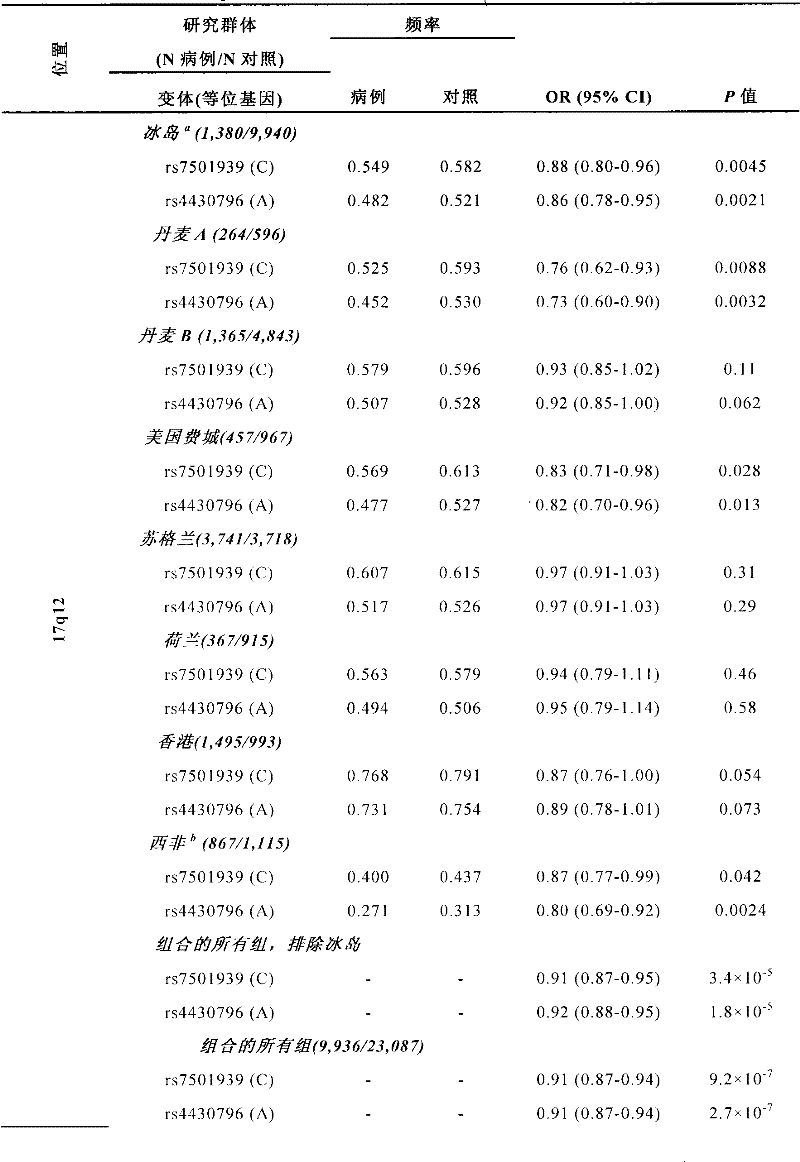

在每个基因座都有数个SNP标记,其在LD区段内部或在LD区段的附近,其中锚定SNP位于该LD区段中,所述SNP标记与上述列出的SNP标记强LD。At each locus there are several SNP markers, either within or near the LD block in which the anchor SNP is located, that are in strong LD with the SNP markers listed above.
因此,下列包含表和标记列表,其在本发明的范围内。因此,所述表列出处于LD的标记,如通过在HapMap CEU群体中大于0.2的r2的值确定的。此外,所述表列出本发明定义的LD区段内的所有标记。已经被基因型分型并且通过HapMap评估的标记不表示完全包括本发明定义的区域中与前列腺癌关联的所有相关标记。因此,可能的是,其他的标记,例如在下面列出的标记,可适当地用于评估对前列腺癌的易感性,如本文描述的。表7.来自染色体4q31.21的SNP(在NCBI Build 35中标记rs3923603的+/-500kb之内)与rs3923603相关,其R2>0.2。SNP在白种人CEU HapMap Release 22数据集(http://www.hapmap.org)中鉴定。
使用HAPMAP数据发布(HAPMAP data release)19,评估在五个染色体区域中与前列腺癌相关的标记和单元型的LD结构,除了染色体Xp11.22区域,因为对于该区域的必需数据是不可获得的。对于该区域,LD结构得自我们自己对本文描述的样本的分析。特征为高r2和/或|D’|-值的区域是每一LD区段的特征,并且在相邻标记之间增加的重组率是LD区段之间边界的特征(导致r2和|D’|-值快速降低)。因此,一般而言,高LD结构的区域被看做基因组“区段”(LD区段),在其中各个标记处于强LD,如高r2和|D’|-值所示出的。Using the HAPMAP data release 19, the LD structure of markers and haplotypes associated with prostate cancer was assessed in five chromosomal regions, except for the chromosome Xp11.22 region, for which the requisite data were not available. For this region, the LD structure was obtained from our own analysis of the samples described here. Regions characterized by high r and /or |D'| |D'|-values decrease rapidly). Thus, in general, regions of high LD structure are considered genomic "segments" (LD blocks) in which individual markers are in strong LD, as indicated by high r2 and |D'|-values.
本发明的区域中的LD结构的分析限定边界,在该边界中,显示与前列腺癌关联的标记位于其中。可能的是,位于本文定义的LD区段区域内且没有在表7-11列出的标记也与本文公开的与前列腺癌相关的标记(例如,表1、表4a和表4b的标记)关联,因为这类标记与表2列出的锚定标记连锁不平衡。原因在于不是所有位于所述区域内的标记都已被明确测试其与前列腺癌相关,但是本文定义的LD区段的存在和本文提供的标记(例如在表1、表4a和表4b中公开的标记)的关联表明在所述区域内并且与表2中的锚定标记LD的另外的标记也与前列腺癌相关联。基于公共SNP数据库dbSNP 125,以及根据NCBIBuild 34的位置,表12-16提供本文论述的四个区域(即LD区段C02、LD区段C04a、TCF基因、LD区段C17b和LD区段C0X)中公共已知的SNP标记的列表。表12.来自dbSNP Build125的在LD区段C04a区域中的公共SNP
重要的是注意到,基因组中LD的模式通常不是“完美的”。实际上,这指区段内各个标记之间或完整区段之间的连锁不平衡已知偶然延伸出所定义的LD区段的边界。这样的LD延伸模式可在相邻或甚至可能远侧区域内包含单一标记,或在LD区段附近包含数个标记。在这样的情况中,LD区段本身不是″完美的″,其意思为即使局部LD模式在定义的LD区段内是最强的,在这些情况下观察到较弱的LD模式超出LD区段。这样的LD延伸模式也在本发明的范围内,如显示与本发明的标记如此LD的标记也可在本发明的方法中用作替代标记。讨论It is important to note that the pattern of LDs in the genome is often not "perfect". In practice, this means that linkage disequilibrium between individual markers within a segment or between complete segments is known to extend by chance beyond the boundaries of a defined LD segment. Such LD extension patterns may comprise a single marker in an adjacent or possibly even distal region, or several markers in the vicinity of the LD segment. In such cases, the LD segment itself is not "perfect", meaning that even though the local LD pattern is strongest within the defined LD segment, in these cases weaker LD patterns are observed beyond the LD segment . Such LD extension patterns are also within the scope of the invention, as markers showing such LD with the markers of the invention may also be used as surrogate markers in the methods of the invention. discuss
如本文描述的,染色体2p15、4q31.21、17q12、17q24.3和Xp11.22上的五个基因座,已被证明在癌(例如前列腺癌(例如攻击性前列腺癌))中起重要作用。包括染色体17q12上的TCF2基因在内的每个基因座处的特定标记和/或单元型在患有前列腺癌的对象中以比期望频率更高的频率存在。基于本文描述的标记——其与癌的特定形式的倾向相关,遗传易感性分析(例如诊断筛选检测)可用于鉴定处于癌危险中的个体。【0275】TCF2(HNF1β)是人基因组的染色体17q12上的基因组区域内唯一被认为与前列腺癌相关联的已知基因。与区域和癌相关联的标记或单元型中的潜在变异可影响TCF2基因的表达。然而,也可以想象,该效应延伸到或主要限于附近的基因例如DDX52、AP1GBP1、TBC1D3/TBC1D3B (PRC17)和/或被发现与前列腺癌关联的在染色体17q12上发现的区域内的或邻近区域内的其他已知的、未知的或预测的基因。此外,这样的变异可影响RNA或蛋白质稳定性,或者可以具有结构性后果(structural consequences),以便该区域更易于在单元型/等位基因携带者内进行体细胞重排。因此,一般而言,该潜在的变异可以影响直接与本文描述的标记和/或单元型连锁的未表征基因,或者可能影响不与本文描述的标记和/或单元型直接连锁的相邻基因。As described herein, five loci on chromosomes 2p15, 4q31.21, 17q12, 17q24.3, and Xp11.22 have been shown to play important roles in cancers, such as prostate cancer (eg, aggressive prostate cancer). Specific markers and/or haplotypes at each locus including the TCF2 gene on chromosome 17q12 were present at higher than expected frequencies in subjects with prostate cancer. Based on the markers described herein that correlate with a predisposition to particular forms of cancer, genetic predisposition assays (eg, diagnostic screening tests) can be used to identify individuals at risk of cancer. [0275] TCF2 (HNF1β) is the only known gene in the genomic region on chromosome 17q12 of the human genome thought to be associated with prostate cancer. Potential variations in markers or haplotypes associated with regions and cancers can affect the expression of the TCF2 gene. However, it is also conceivable that the effect extends to or is largely limited to nearby genes such as DDX52, AP1GBP1, TBC1D3/TBC1D3B (PRC17) and/or within or adjacent to a region found on chromosome 17q12 found to be associated with prostate cancer other known, unknown or predicted genes. Furthermore, such variations may affect RNA or protein stability, or may have structural consequences such that the region is more susceptible to somatic rearrangement in haplotype/allele carriers. Thus, in general, the underlying variation may affect uncharacterized genes that are directly linked to the markers and/or haplotypes described herein, or may affect adjacent genes that are not directly linked to the markers and/or haplotypes described herein.
染色体2上被认为与前列腺癌相关联的区域,即LD区段C02,包含数个报道基因。这些包括EHBP1(EH结构域结合蛋白1,也称为KIAA0903)、OTX1(orthodenticle(果蝇)的同系物)、BC093752、LOC51057。EHBP1已被发现在除了肺、胰腺和脾之外在检查的所有组织和特定脑区域中表达,其中在肺、胰腺和脾中发现表达低。EHBP1的NPF基序在皮质肌动蛋白结构中被破坏,并且通过小干扰RNA引起的小鼠脂肪细胞中的EHBP1的耗尽抑制内吞作用,这暗示EHBP1在胞吞运输中行使功能。OTX是与称为″orthodenticle″的在果蝇头部中表达的基因相关的同源异型框家族基因。OTX转录因子以高亲和力与DNA上的TAATCC/T元件结合。实施例3进一步证明赋予对前列腺癌的易感性的2P15和XP11.22上的序列变体A region on chromosome 2 thought to be associated with prostate cancer, LD segment C02, contains several reporter genes. These include EHBP1 (EH domain binding protein 1, also known as KIAA0903), OTX1 (homolog of orthodenticle (Drosophila), BC093752, LOC51057. EHBP1 has been found to be expressed in all tissues examined and specific brain regions except lung, pancreas and spleen, where low expression was found. The NPF motif of EHBP1 was disrupted in cortical actin structures, and depletion of EHBP1 in mouse adipocytes by small interfering RNA inhibited endocytosis, suggesting a function of EHBP1 in endocytic trafficking. OTX is a homeobox family gene related to a gene expressed in the Drosophila head called "orthodenticle". The OTX transcription factor binds with high affinity to the TAATCC/T element on DNA. Example 3 further demonstrates sequence variants on 2P15 and XP11.22 that confer susceptibility to prostate cancer
进行染色体2p15和Xp11.22上的变体的相关性的进一步表征,如在表16和17中所示。如前,在23,205个冰岛人样本的GWA分析中,SNP rs5945572的等位基因A(rs5945572A)显示出位于X染色体上的标记的最显著的P值,其中等位特异性优势比(OR)为1.21(P=3.36×10⁻⁴)(表16)。在染色体2p15上,rs2710646的等位基因A(rs2710646A)的OR对所有冰岛人前列腺癌病例为1.16(P=7.79×10⁻⁴)(表17),而对诊断患有攻击性疾病的患者为1.33(P=3.73×10⁻⁵)(表18)。通过检查Utah CEPH(CEU)HapMap数据,我们鉴定与两种锚定SNP——rs5945572和rs2710646——基本上相关的多个SNP(D’≥0.9和r2>0.4)。从该列表,我们选择在Illumina Hap300芯片上不存在的数个SNP——其代表与锚定SNP的不同相关度,用于进一步在分别为1,500个和800个的冰岛人病例和对照中进行基因型分型。没有发现任何另外的SNP比锚定SNP与该疾病更显著相关联(表19)。Further characterization of the association of the variants on chromosome 2p15 and Xp11.22 was performed, as shown in Tables 16 and 17. As before, in a GWA analysis of 23,205 Icelandic samples, allele A of SNP rs5945572 (rs5945572A) showed the most significant P-value for markers located on the X chromosome, with an allele-specific odds ratio (OR) of 1.21 (P=3.36×10 −4 ) (Table 16). On chromosome 2p15, the OR for allele A of rs2710646 (rs2710646A) was 1.16 (P=7.79×10 −4 ) for all Icelandic prostate cancer cases (Table 17) and 1.16 for patients diagnosed with aggressive disease. 1.33 (P=3.73×10 −5 ) (Table 18). By examining the Utah CEPH (CEU) HapMap data, we identified multiple SNPs (D'> 0.9 and r2 > 0.4) that were substantially associated with two anchor SNPs, rs5945572 and rs2710646. From this list, we selected several SNPs that were not present on the Illumina Hap300 chip - representing varying degrees of association with the anchor SNP - for further genetic analysis in Icelandic cases and controls of 1,500 and 800, respectively. type type. No additional SNP was found to be more significantly associated with the disease than the anchor SNP (Table 19).
我们在来自荷兰、西班牙、瑞典和美国(US)的欧洲人血统的七个前列腺癌研究组中,对rs5945572和rs2710646进行基因型分型。然而,因为对于2p 15上的rs2710646的TaqMan分析在设计上的失败,所以我们采用用于完全相关的SNP——rs721048(在冰岛人和四个hapmap群体(CEU、CHB、JPT、YRI))中rs2710646和rs721048之间的LD-特性;D’=1;r2≥0.99)——的分析代替TaqMan分析,rs721048被用于在复制研究群体中进行基因型分型。当来自7个病例-对照复制组的结果被组合时,使用所有前列腺癌病例,它们对于两种SNP都是高显著性的,其中对于Xp11上rs5945572A,OR=1.24(P=2.57×10⁻¹⁰),而对于2p15上rs721048A,OR=1.15(P=2.23×10⁻⁶)(表16和17)。通过将这些数据和冰岛人数据组合,两个基因座的信号达到全基因组显著性;Xp11.22上rs5945572A的OR=1.23(P=3.95×10⁻¹³),而2p15的rs721048A的OR=1.15(P=7.66×10⁻⁹)(表16和17)。在组合的组的分析中,从对照组除去所有女性(N=14,135),对两个基因座产生基本上相同的结果(对于rs5945572A和rs721048A,分别为OR=1.23和1.15)。在所有的复制组中,对于两个基因座所观测的效应与在冰岛人样本中的效应具有相同的方向,除了rs721048A,其在巴尔的摩组中显示出无效应(OR=1)。然而,八个不同研究组的OR中的异质性检验显示对于两个基因座没有显著差异(对于Xp11和2p15,分别为P=0.89和0.19)。我们注意到,在Cancer Genetics Markers of Susceptibility研究组发布的结果5(http://cgems.cancer.gov/data/)中,两个原始锚定SNP,rs5945572和rs2710646,显示出与前列腺癌的标称的(nominal)但不是全基因组的显著关联,进一步支持了本文提供的数据。We genotyped rs5945572 and rs2710646 in seven prostate cancer study cohorts of European ancestry from the Netherlands, Spain, Sweden and the United States (US). However, because the TaqMan assay for rs2710646 on 2p 15 failed by design, we employed a fully related SNP, rs721048, in Icelandic and four hapmap populations (CEU, CHB, JPT, YRI) LD-property between rs2710646 and rs721048; D' = 1; r2 > 0.99) - instead of TaqMan analysis, rs721048 was used for genotyping in the replication study population. When the results from the seven case-control replication groups were combined, using all prostate cancer cases, they were highly significant for both SNPs, with OR=1.24 (P=2.57×10 −10 for rs5945572A on Xp11 ), while for rs721048A on 2p15, OR=1.15 (P=2.23×10 -6 ) (Tables 16 and 17). By combining these data with the Icelandic data, the signals for both loci reached genome-wide significance; OR=1.23 (P=3.95×10 −13 ) for rs5945572A on Xp11.22 and OR=1.15 (P=3.95×10 −13 ) for rs721048A on 2p15 ( P=7.66×10 -9 ) (Tables 16 and 17). In the combined group analysis, removing all females from the control group (N=14,135) yielded essentially identical results for both loci (OR=1.23 and 1.15 for rs5945572A and rs721048A, respectively). In all replication groups, the observed effects for both loci were in the same direction as the effects in the Icelandic sample, except for rs721048A, which showed no effect (OR=1) in the Baltimore group. However, tests of heterogeneity in the ORs of the eight different study groups showed no significant differences for the two loci (P=0.89 and 0.19 for Xp11 and 2p15, respectively). We noticed that in the results published by the Cancer Genetics Markers of Susceptibility research group5 (http://cgems.cancer.gov/data/), two original anchor SNPs, rs5945572 and rs2710646, were shown to be associated with prostate cancer markers . Nominal but not genome-wide significant associations further support the data presented here.
对于Xp11上rs5945572A,对于在较年轻年龄(≤65)开始的病例或攻击性表型的病例所见的OR与整个组相同。在另一方面,在诊断患有攻击性前列腺癌的患者中rs721048A的频率显著高于那些诊断患有较少攻击性疾病的患者的频率(OR=1.11;P=2.6×10⁻³)。当对于所有研究组进行组合时(表18),比较患有攻击性肿瘤的患者组(N=4,787)与对照,得到1.22的等位基因OR(P=8.7×10⁻¹⁰)。具体而言,接近一般群体的31%和4%的rs721048A的杂合和纯合携带者,与非携带着相比,被诊断患有攻击性前列腺癌分别具有1.22和1.49的基因型OR。然而,rs721048A,像rs5945572A,在前列腺癌开始时较年轻的患者中没有显示出更强的关联。For rs5945572A on Xp11, the ORs seen for cases starting at a younger age (≤65) or with an aggressive phenotype were the same as for the entire group. On the other hand, the frequency of rs721048A was significantly higher in patients diagnosed with aggressive prostate cancer than in those diagnosed with less aggressive disease (OR=1.11; P=2.6×10 −3 ). When combined for all study groups (Table 18), comparing the group of patients with aggressive tumors (N=4,787) with controls resulted in an allelic OR of 1.22 (P=8.7×10 −10 ). Specifically, close to 31% and 4% of the general population, heterozygous and homozygous carriers of rs721048A, compared with noncarriers, were diagnosed with aggressive prostate cancer with genotypic ORs of 1.22 and 1.49, respectively. However, rs721048A, like rs5945572A, did not show a stronger association in men whose prostate cancer started at a younger age.
基于CEU HapMap结果,两种变体,Xp11上的rs5945572和2p15上的rs2710646/rs721048,位于这样的区域内,该区域的特征为延伸的连锁不平衡(LD)。在Xp 11.22上,LD区段跨越大约51.001Mb到51.612Mb的区域,或者611kb的区域(NCBI Build 35)。2p15LD区域甚至更长,或大约1.1Mb(62.709Mb到63.782Mb;NCBI Build 35),并且包含数个基因。两种2p15SNP,rs2710646和rs721048,位于EHBP1基因的内含子之一中。该基因被认为涉及胞吞运输,并且先前没有涉及到癌6。多种cDNA文库的RT-PCR分析显示EHBP1在多个不同的组织文库中的可检测表达,所述文库包括源自前列腺的那些文库(数据没有示出)。Based on CEU HapMap results, two variants, rs5945572 on Xp11 and rs2710646/rs721048 on 2p15, are located within a region characterized by extended linkage disequilibrium (LD). On Xp 11.22, the LD segment spans a region of approximately 51.001 Mb to 51.612 Mb, or a region of 611 kb (NCBI Build 35). The 2p15LD region is even longer, or approximately 1.1 Mb (62.709 Mb to 63.782 Mb; NCBI Build 35), and contains several genes. Two 2p15 SNPs, rs2710646 and rs721048, are located in one of the introns of the EHBP1 gene. This gene is thought to be involved in endocytic trafficking and has not been previously implicated in cancer 6 . RT-PCR analysis of various cDNA libraries showed detectable expression of EHBP1 in a number of different tissue libraries, including those derived from prostate (data not shown).
在Xp11上,数个基因已被定位于目的611Kb区域,但是没有一个先前与前列腺癌相关联。基于先前描述的功能,可能的癌候选基因是GSPT2和MAGED1。GSPT2与GSPT1相关,是编码GTP结合蛋白的基因,其在细胞周期的G1-期到S期的过渡时起重要作用。MAGED1通过JNK-和c-Jun依赖性线粒体途径,已被涉及到细胞程序死亡7,8。与SNP rs5945572最近的基因是:NUDT10和NUDT11,连同具有未知功能的单一外显子转录物LOC340602(www.genome.ucsc.edu,May 2004Assembly)。NUDT10和11属于磷酸水解酶亚型,其优选水解二磷酸肌醇多聚磷酸(DIPPS)9。已经提出,该蛋白质超家族的成员可能涉及小泡运输、应力反应、DNA修复和凋亡10,11。多种cDNA文库的RT-PCR分析显示在多个不同组织文库中GSPT2、MAGED1、LOC340602、NUDT10和11的可检测表达,所述文库包括源自前列腺的那些文库(数据没有显示)。如果有的话,那么这些基因的哪一个赋予由本文报告的关联性鉴定的风险,仍然有待显示。On Xp11, several genes have been mapped to the 611 Kb region of interest, but none have been previously associated with prostate cancer. Based on previously described functions, possible cancer candidate genes are GSPT2 and MAGED1. GSPT2, related to GSPT1, is a gene encoding a GTP-binding protein that plays an important role in the transition from G1-phase to S-phase of the cell cycle. MAGED1 has been implicated in apoptosis via JNK- and c- Jun -dependent mitochondrial pathways7'8. The closest genes to SNP rs5945572 are: NUDT10 and NUDT11, together with a single exon transcript LOC340602 of unknown function (www.genome.ucsc.edu, May 2004 Assembly). NUDT10 and 11 belong to a subtype of phosphohydrolases that preferentially hydrolyze diphosphoinositide polyphosphate (DIPPS) 9 . It has been suggested that members of this protein superfamily may be involved in vesicle trafficking, stress response, DNA repair and apoptosis 10'11 . RT-PCR analysis of various cDNA libraries showed detectable expression of GSPT2, MAGED1, LOC340602, NUDT10 and 11 in libraries of various tissues, including those derived from prostate (data not shown). Which, if any, of these genes confer the risk identified by the associations reported here remains to be shown.
近来,解释大部分的前列腺癌人群归因危险度(PAR)的原因的数种序列变体已被鉴定1,2,5,12,13。随着本文描述的两个变体的鉴定,在前列腺癌遗传易感性问题中又获得一些进展。Xp11和2p15变体都是共同的,并且赋予中等风险,分别导致欧洲人血统的个体中大约7%和5%的估计PAR(也参见表20)。表16.Xp11.22上的rs5945572和冰岛、荷兰、西班牙、瑞典和美国中的前列腺癌的关联结果


序列表sequence listing
the
<110>解码遗传学私营有限责任公司(deCODE Genetics ehf)<110> DeCODE Genetics Private Limited Liability Company (deCODE Genetics ehf)
the
<120>促进前列腺癌风险的遗传性变型(GENETIC VARIANTS CONTRIBUTING TO RISK OFPROSTATE CANCER)<120> Genetic variants that promote prostate cancer risk (GENETIC VARIANTS CONTRIBUTING TO RISK OF PROSTATE CANCER)
the
<130>SCT092744-00<130>SCT092744-00
the
<160>362<160>362
the
<170>PatentIn version 3.4<170>PatentIn version 3.4
the
<210>1<210>1
<211>600<211>600
<212>DNA<212>DNA
<213>Homo sapiens<213>Homo sapiens
the
<400>1<400>1
tcagtgaagg gaaagtaacc cagttaaatc aaggaaaaga tttttttaca gcatgtatct 60tcagtgaagg gaaagtaacc cagttaaatc aaggaaaaga tttttttaca gcatgtatct 60
gtggcttgta caaagttttt acttttgact ggctattttg atgttgttag aaatagtgag 120gtggcttgta caaagttttt acttttgact ggctattttg atgttgttag aaatagtgag 120
gatccacttc tagaaatact ggatattaga aactgttttg atgacagtgg tatcactctg 180gatccacttc tagaaatact ggatattaga aactgttttg atgacagtgg tatcactctg 180
aagttagaga tatagccatt ccctggtttc ctcactattc aattcacttg caaaaggact 240aagttagaga tatagccatt ccctggtttc ctcactattc aattcacttg caaaaggact 240
ctgcagaaca gattaacagt acattgttct gtaattctct ggttactcta acagggtcgg 300ctgcagaaca gattaacagt aattgttct gtaattctct ggttactcta acagggtcgg 300
rgtaaatttg taaagaaatg caaaccagct tgaggcagca ctgcccaatt tgatcaaaac 360rgtaaatttg taaagaaatg caaaccagct tgaggcagca ctgcccaatt tgatcaaaac 360
taaatgcaac catcgtgggt tcaagtttgg tggtccaaaa cattggaatg tttcaaagac 420taaatgcaac catcgtgggt tcaagtttgg tggtccaaaa cattggaatg tttcaaagac 420
atctaaatgc aatgccagtg ttgttttatt tggtttgggg tttgctatcc ctttatgtta 480atctaaatgc aatgccagtg ttgttttatt tggtttgggg tttgctatcc ctttatgtta 480
aacaggagtt cagaaaaatt gcacaaaaga ctcactgtct gtttctatga atgcctacat 540aacaggagtt cagaaaaatt gcacaaaaga ctcactgtct gtttctatga atgcctacat 540
actcagtagc caatgttact gataaatgaa aacatcaaat atacatgaac aaagtcttta 600actcagtagc caatgttact gataaatgaa aacatcaaat atacatgaac aaagtcttta 600
the
<210>2<210>2
<211>600<211>600
<212>DNA<212>DNA
<213>Homo sapiens<213>Homo sapiens
the
<400>2<400>2
ggcgtgaacc cgggaggcgg agcttgcagt gagccgagat cgcgccactg cactccagtc 60ggcgtgaacc cgggaggcgg agcttgcagt gagccgagat cgcgccactg cactccagtc 60
tgggtggcag agcgagaccc cgtctcaaaa agttaaataa ataaataaat aaataaaaca 120tgggtggcag agcgagaccc cgtctcaaaa agttaaataa ataaataaat aaataaaaca 120
aaaataacaa taacaacaat ctcttgaaga ggctgttgta tttgtaaaac gtcccttcct 180aaaataacaa taacaacaat ctcttgaaga ggctgttgta tttgtaaaac gtcccttcct 180
cagcatcttg agaaactttc tggacctctg tcttttgaga agtttccagt ctgcctttcc 240cagcatcttg agaaactttc tggacctctg tcttttgaga agtttccagt ctgcctttcc 240
tgcctccttc tcctttctga agaaattctc attgaataca gagaggcagc acagactgga 300tgcctccttc tcctttctga agaaattctc attgaataca gagaggcagc acagactgga 300
ratgctgcat aaagcttaaa ttgggcaggg cccaagcgtt gttgggtctt tggagacaat 360ratgctgcat aaagcttaaa ttgggcaggg cccaagcgtt gttgggtctt tggagacaat 360
ggctcctgag aattttttta ggctttccag gaactacaga gagttgcttc atgtcaggaa 420ggctcctgag aattttttta ggctttccag gaactacaga gagttgcttc atgtcaggaa 420
cacaaattct taaagagcta gtcaccaagt atggggggcc aacccattct tggaaaggtc 480cacaaattct taaagagcta gtcaccaagt atggggggcc aacccattct tggaaaggtc 480
tctcgctcta agcagcaaac agctctcatg ttgcttcttc caatctattc atgtaatgct 540tctcgctcta agcagcaaac agctctcatg ttgcttcttc caatctattc atgtaatgct 540
cccaacaaaa gcacaaacac cacaatatga aatgaacacc taaaaccatt cctttcacca 600cccaacaaaa gcacaaacac cacaatatga aatgaacacc taaaaccatt cctttcacca 600
the
<210>3<210>3
<211>600<211>600
<212>DNA<212>DNA
<213>Homo sapiens<213>Homo sapiens
the
<400>3<400>3
tggtttcaac tttgccaata tcttttcttg cttattgaac agatgctttg aaaagagaga 60tggtttcaac tttgccaata tcttttcttg cttattgaac agatgctttg aaaagagaga 60
tataatttaa aactagaaat taaaatagtg tgcagcacag aacaaaagta ctaaagaagc 120tataatttaa aactagaaat taaaatagtg tgcagcacag aacaaaagta ctaaagaagc 120
aatatataca tgtttactat ttatttaatg caggtacata tttaacttac aaaaaccagc 180aatatataca tgtttactat ttattatg caggtacata tttaacttac aaaaaccagc 180
accccattac tgtatgttga tatatatatt agcttgatag aacaagaaaa aaaacggaag 240accccattac tgtatgttga tatatatatt agcttgatag aacaagaaaa aaaacggaag 240
ggaaaactag tttcaggtga aacaaaaaag aaaacggtgt agaggctgaa atagatacag 300ggaaaactag tttcaggtga aacaaaaaag aaaacggtgt agaggctgaa atagatacag 300
yattgcaaca taataagcaa ttttatttct aaatggcgcc tttaaatatg tcaaataaaa 360yattgcaaca taataagcaa ttttatttct aaatggcgcc tttaaatatg tcaaataaaa 360
ttaattctgt ttaatgaata aaaatccagt aatcgaacat attttataag catttgggta 420ttaattctgt ttaatgaata aaaatccagt aatcgaacat attttataag catttgggta 420
gttgtgatta ttttattaag actttgatat taaactcgtg agaacacagg ctttgataga 480gttgtgatta ttttattaag actttgatat taaactcgtg agaacacagg ctttgataga 480
gatgtttttg agaaatgcaa actttttata ttaattatat ataagaacga atttctcaag 540gatgtttttg agaaatgcaa actttttata ttaattatat ataagaacga atttctcaag 540
tatttacaaa ggtaatttcc aagtacacaa tatgaggaag taacaagaag aacaaaaaat 600tattacaaa ggtaatttcc aagtacacaa tatgaggaag taacaagaag aacaaaaaat 600
the
<210>4<210>4
<211>600<211>600
<212>DNA<212>DNA
<213>Homo sapiens<213>Homo sapiens
the
<400>4<400>4
gcagtatttt gttaatcttt gctgccctta tttactgtgg gagaggcgct ttggtttttc 60gcagtatttt gttaatcttt gctgccctta tttactgtgg gagaggcgct ttggtttttc 60
ctcttcttcc tttggtatag cactaatgta ttttatatgt ctttaatctc agttccagtt 120ctcttcttcc tttggtatag cactaatgta ttttatatgt ctttaatctc agttccagtt 120
ctgtcaatat ttgagcttat cttaaaccga agaactccaa aggagagtca aagaaagtaa 180ctgtcaatat ttgagcttat cttaaaccga agaactccaa aggagagtca aagaaagtaa 180
attctcaccc cggaaggcaa ataacaatta tttcattaaa cattcaaatc acaaagaaca 240attctcaccc cggaaggcaa ataacaatta tttcattaaa cattcaaatc acaaagaaca 240
ccttggacca gttcttgata taaataagag gctgcagact tttccaaatc cctgcccgtg 300ccttggacca gttcttgata taaataagag gctgcagact tttccaaatc cctgcccgtg 300
kgatgaacac tttaaaggtc ccaagatttc taataatggg gctaaatttc ccaaaatgtg 360kgatgaacac tttaaaggtc ccaagatttc taataatggg gctaaatttc ccaaaatgtg 360
tttttctgct aaaaaatcca gtaacaagga actgtacaaa ttctaatctc tgtatgagtc 420tttttctgct aaaaaatcca gtaacaagga actgtacaaa ttctaatctc tgtatgagtc 420
ttcatctttg gaatgcctat tcctgaagat gagagatgga tagtaggaac ctatgtatcg 480ttcatctttg gaatgcctat tcctgaagat gagagatgga tagtaggaac ctatgtatcg 480
atctgggtta gcccactggg ctcattaatg aaatatcact gggaggagca gcccagcatc 540atctgggtta gcccactggg ctcattaatg aaatatcact gggaggagca gcccagcatc 540
ctatacgtga gccaagcatt tagaattgcc tttaggattc ttcacactgt tagcagccaa 600ctatacgtga gccaagcatt tagaattgcc tttaggattc ttcacactgt tagcagccaa 600
the
<210>5<210>5
<211>180<211>180
<212>DNA<212>DNA
<213>Homo sapiens<213>Homo sapiens
the
<400>5<400>5
tcacaaatgt catatatcca tatattgaga cacacacaca cacacacaca cacacacaca 60tcacaaatgt catatatcca tatattgaga cacacacaca cacacacaca cacacacaca 60
catatatata cacatacata cagtcttgct atcatcgcta aaatttttgt catcatctaa 120catatatata cacatacata cagtcttgct atcatcgcta aaatttttgt catcatctaa 120
ctcatttttg gctttttttt tctggctttc atacttttcc ttatctcatc tgttagattg 180ctcatttttg gctttttttt tctggctttc atacttttcc ttatctcatc tgttagattg 180
the
<210>6<210>6
<211>600<211>600
<212>DNA<212>DNA
<213>Homo sapiens<213>Homo sapiens
the
<400>6<400>6
tctgtcttcc agaacctcac atttattctt ccttctctgt ggaataccct ttcactactt 60tctgtcttcc agaacctcac atttattctt ccttctctgt ggaataccct ttcactactt 60
ttactggcta aatcctattt atcctttaga tgtcaaatta catggcattt cctccaagaa 120ttactggcta aatcctattt atcctttaga tgtcaaatta catggcatt cctccaagaa 120
actttttctc ttcttcctag cctcatatag attagttccc tgtactatga gctagcagag 180actttttctc ttcttcctag cctcatatag attagttccc tgtactatga gctagcagag 180
ccgactgaat ccccactatc ataaaaaata cttagtacat tttgttggaa tgtataatgt 240ccgactgaat ccccactatc ataaaaaata cttagtacat tttgttggaa tgtataatgt 240
ctcctcaata cactgagagt tccataaaga caggagctat ttctgatttg ctcaacccac 300ctcctcaata cactgagagt tccataaaga caggagctat ttctgatttg ctcaacccac 300
rtaccctgag gtagcagaat tcttggccta aagttctgaa tagctttatc acagctaaag 360rtaccctgag gtagcagaat tcttggccta aagttctgaa tagctttatc acagctaaag 360
cacagttgta aggatggagg cactagatca gtgcaaatac ttgactattt atctaccagg 420cacagttgta aggatggagg cactagatca gtgcaaatac ttgactattt atctaccagg 420
ttaaacctag atggaaaaat acagcttaaa taactcaaaa ttttactgat tgaaacatga 480ttaaacctag atggaaaaat acagcttaaa taactcaaaa ttttactgat tgaaacatga 480
tgaaggcccc ttcttcatat attaagtact aagatttaat tcagaattag aaaaaggtca 540tgaaggcccc ttcttcatat attaagtact aagatttaat tcagaattag aaaaaggtca 540
atgtaaatag tcttggacag caagtgtttc tgggaaaggt ttccttgctc taaatcaaat 600atgtaaatag tcttggacag caagtgtttc tgggaaaggt ttccttgctc taaatcaaat 600
the
<210>7<210>7
<211>600<211>600
<212>DNA<212>DNA
<213>Homo sapiens<213>Homo sapiens
the
<400>7<400>7
ctctagctag ggctggttta aatgctccct ccgtgagtgg acatcagcaa gtttggtccc 60ctctagctag ggctggttta aatgctccct ccgtgagtgg acatcagcaa gtttggtccc 60
gttttgcttt ctgctataac agggcagcat tgagttcatt gcctcacaac tgttgcacac 120gttttgcttt ctgctataac agggcagcat tgagttcatt gcctcacaac tgttgcacac 120
cccctctcct cagtgcacag aaatactctc cacacgacac tgccactgct gggggacagg 180cccctctcct cagtgcacag aaatactctc cacacgacac tgccactgct gggggacagg 180
agtgggtggc actggtgttt caagactgtt tttctacctc ttcagtgtct cttttagcaa 240agtgggtggc actggtgttt caagactgtt tttctacctc ttcagtgtct cttttagcaa 240
tatgaagttg aaaccaggta ctgtgagtga tcacctgatt tttggttttg ctgaaggtgt 300tatgaagttg aaaccaggta ctgtgagtga tcacctgatt tttggttttg ctgaaggtgt 300
ytctttgtgt agataattgt taaattagtg tccttgtagc gggggatgat cattggggcc 360ytctttgtgt agataattgt taaattagtg tccttgtagc gggggatgat cattggggcc 360
ttctattctg tcatcttgct ccacttccca tgatcacttt tgtcagcagg cagtgaatcc 420ttctattctg tcatcttgct ccacttccca tgatcacttt tgtcagcagg cagtgaatcc 420
tgccaggact gagtctgtct caccagggta atggattccc ttctggccca gggtggatct 480tgccaggact gagtctgtct caccagggta atggattccc ttctggccca gggtggatct 480
agaaatgcca cctaggagta aagacctata accaggggct tcaggaatct gccttgcact 540agaaatgcca cctagagta aagacctata accaggggct tcaggaatct gccttgcact 540
ttattgtact atgactaagt taacacccaa gttgcaagac aaagttttct ttactattcc 600ttaattgtact atgactaagt taacacccaa gttgcaagac aaagttttct ttactattcc 600
the
<210>8<210>8
<211>600<211>600
<212>DNA<212>DNA
<213>Homo sapiens<213>Homo sapiens
the
<400>8<400>8
tggttggctt aaacagcagt cacagttttg gagactggaa agtccaagtc accagcagat 60tggttggctt aaacagcagt cacagttttg gagactggaa agtccaagtc accagcagat 60
ttggtgtctg gtgagggtct gcttcatggt ttagagatgg cagtcttctc acagtgtcct 120ttggtgtctg gtgagggtct gcttcatggt ttagagatgg cagtcttctc acagtgtcct 120
cacctgcttg agaaaggaag ccagcattct ctggactctt acaaggacac taatccatta 180cacctgcttg agaaaggaag ccagcattct ctggactctt acaaggacac taatccatta 180
ataaggagtc tagcctcatg acctcatcta agcctaatta ctttccaaaa actatctcct 240ataaggagtc tagcctcatg acctcatcta agcctaatta ctttccaaaa actatctcct 240
agtaccatct cattaagggt tagggtttca acttacgaat tttaggggga cacaagcatc 300agtaccatct cattaagggt tagggtttca acttacgaat tttaggggga cacaagcatc 300
magttcataa caaatatctt ttcttgagtg tatttgatat ctgtctgtcc tctttggtga 360magttcataa caaatatctt ttcttgagtg tatttgatat ctgtctgtcc tctttggtga 360
aatgtctgtc agtgcctttt gcccattttc taattaagtt atttgctatt gcattattat 420aatgtctgtc agtgcctttt gcccattttc taattaagtt atttgctatt gcattattat 420
tgatttccta caagttaact ttaatctctc tagttttggt tcctgactga agtttatttt 480tgatttccta caagttaact ttaatctctc tagttttggt tcctgactga agtttatttt 480
gtcctggagg aggaacattt ggcaatgtct atatatgcct tyagttgtca cacgagaaga 540gtcctggagg aggaacattt ggcaatgtct atatatgcct tyagttgtca cacgagaaga 540
aaggaaatgt tactggcatc tagtggaatt atttgtgtag actgggttca tttcttcttt 600aaggaaatgt tactggcatc tagtggaatt atttgtgtag actgggttca tttcttcttt 600
the
<210>9<210>9
<211>180<211>180
<212>DNA<212>DNA
<213>Homo sapiens<213>Homo sapiens
the
<400>9<400>9
aaaagtcaaa gaagtagaat taatgagata gaatagaaat gaatcataac tggttccctc 60aaaagtcaaa gaagtagaat taatgagata gaatagaaat gaatcataac tggttccctc 60
ctccctcaaa tcagaaagaa gtaactcact rgtttgattt ttttttccta aaaggcaaaa 120ctccctcaaa tcagaaagaa gtaactcact rgtttgattt ttttttccta aaaggcaaaa 120
ggaactgcaa atattaacac caacctggat tttctatttc aacagaactt aaaggcacgt 180ggaactgcaa atattaacac caacctggat tttctatttc aacagaactt aaaggcacgt 180
the
<210>10<210>10
<211>180<211>180
<212>DNA<212>DNA
<213>Homo sapiens<213>Homo sapiens
the
<400>10<400>10
ttggcccctc agctgaatgc tcaaagtttc ctggagaacc cacaaacaac agaaaacatc 60ttggcccctc agctgaatgc tcaaagtttc ctggagaacc cacaaacaac agaaaacatc 60
ttctctgaca cctctcatta gtctacccaa stgaagactt ctaaaacctt cctctattta 120ttctctgaca cctctcatta gtctacccaa stgaagactt ctaaaacctt cctctattta 120
tcagctgata ggtaatcagt ttacctccaa atcatggaga agacatgatc tattgttcct 180tcagctgata ggtaatcagt ttacctccaa atcatggaga agacatgatc tattgttcct 180
the
<210>11<210>11
<211>180<211>180
<212>DNA<212>DNA
<213>Homo sapiens<213>Homo sapiens
the
<400>11<400>11
aatttgggct taaggaagtt gggctggatg aaaataattt taattgaaaa caaaaacttt 60aatttgggct taaggaagtt gggctggatg aaaataattt taattgaaaa caaaaacttt 60
atcccaaagt tctcacacca ctggtacttc sttttcactg gttgaacaat aaaaaaattg 120atcccaaagt tctcacacca ctggtacttc sttttcactg gttgaacaat aaaaaattg 120
cagaaatgaa cctagtttgt tctcatcctt gactgcatgg tagaatcatc tgtgatatcc 180cagaaatgaa cctagtttgt tctcatcctt gactgcatgg tagaatcatc tgtgatatcc 180
the
<210>12<210>12
<211>180<211>180
<212>DNA<212>DNA
<213>Homo sapiens<213>Homo sapiens
the
<400>12<400>12
taagactctt tatccagaac atagaaagaa ctcttacaac ttagcaacac aaaaagaaaa 60taagactctt tatccagaac atagaaagaa ctcttacaac ttagcaacac aaaaagaaaa 60
atagattgaa aaatgggtga aggactagta ycaacatttc tccaaagata tgcaaaatgc 120atagattgaa aaatgggtga aggactagta ycaacatttc tccaaagata tgcaaaatgc 120
agttaccaac aattacatga gaagattctc agcgtcatta gttattagga aaatgcaaga 180agttaccaac aattacatga gaagattctc agcgtcatta gttattagga aaatgcaaga 180
the
<210>13<210>13
<211>180<211>180
<212>DNA<212>DNA
<213>Homo sapiens<213>Homo sapiens
the
<400>13<400>13
tttcccctct attcagacct tttctgcaaa ggagttcaca gtgggtgtct gtttctttct 60tttcccctct attcagacct tttctgcaaa ggagttcaca gtgggtgtct gtttctttct 60
aaaaacccta tttcacacca tgctaaagat rtttataggt ttggcaacta gtccagctca 120aaaaacccta tttcacacca tgctaaagat rtttataggt ttggcaacta gtccagctca 120
tctcaggctg aattttgggg attcattggg gtttacagtt gaaaaatgct tgtagatacc 180tctcaggctg aattttgggg attcattggg gtttacagtt gaaaaatgct tgtagatacc 180
the
<210>14<210>14
<211>180<211>180
<212>DNA<212>DNA
<213>Homo sapiens<213>Homo sapiens
the
<400>14<400>14
tcagaccttt tctgcaaagg agttcacagt gggtgtctgt ttctttctaa aaaccctatt 60tcagaccttt tctgcaaagg agttcacagt gggtgtctgt ttctttctaa aaaccctatt 60
tcacaccatg ctaaagatat ttataggttt kgcaactagt ccagctcatc tcaggctgaa 120tcacaccatg ctaaagatat ttataggttt kgcaactagt ccagctcatc tcaggctgaa 120
ttttggggat tcattggggt ttacagttga aaaatgcttg tagataccat ctactcggcg 180ttttggggat tcattggggt ttacagttga aaaatgcttg tagataccat ctactcggcg 180
the
<210>15<210>15
<211>180<211>180
<212>DNA<212>DNA
<213>Homo sapiens<213>Homo sapiens
the
<400>15<400>15
ttcaactccc acttacgagt gagaacatgt ggtgtttgat tttctgttct tgtgttagtt 60ttcaactccc acttacgagt gagaacatgt ggtgtttgat tttctgttct tgtgttagtt 60
tactgagaat gatggtctcc agcatcatcc rtgtcattgc aaaggacatt aactcatcct 120tactgagaat gatggtctcc agcatcatcc rtgtcattgc aaaggacatt aactcatcct 120
ttttatatgg ctgcatagta ttccatggtg tatatgtgcc acattttctt tatctaatct 180ttttatatgg ctgcatagta ttccatggtg tatatgtgcc aattttctt tatctaatct 180
the
<210>16<210>16
<211>180<211>180
<212>DNA<212>DNA
<213>Homo sapiens<213>Homo sapiens
the
<400>16<400>16
ggctgaagat acactttcaa ggagcaggaa gctattcctg aagttcccat gtgtgtagta 60ggctgaagat acactttcaa ggagcaggaa gctattcctg aagttcccat gtgtgtagta 60
aaacttcagc tcatgtggac taagttatac rtccatcctg gcaaatgccg acacccctgg 120aaacttcagc tcatgtggac taagttatac rtccatcctg gcaaatgccg acacccctgg 120
agggttagac cctaataatt cagttccctg gtaaaaacag tgttgtatac acctgcggga 180agggttagac cctaataatt cagttccctg gtaaaaacag tgttgtatac acctgcggga 180
the
<210>17<210>17
<211>180<211>180
<212>DNA<212>DNA
<213>Homo sapiens<213>Homo sapiens
the
<400>17<400>17
tgaagtcaaa ccagcctctt tctgtctctc tgtgactttg atcaacttgt tcaaatgaca 60tgaagtcaaa ccagcctctt tctgtctctc tgtgactttg atcaacttgt tcaaatgaca 60
agcttcaatt tcttcacctg gaagaggaca rtaatcatga ataccttgca atgtgggtat 120agcttcaatt tcttcacctg gaagaggaca rtaatcatga ataccttgca atgtgggtat 120
gaggctgaaa tgagaaactg tatgtaaaga ttttagcact ctgatacaac aagtagctat 180gaggctgaaa tgagaaactg tatgtaaaga ttttagcact ctgatacaac aagtagctat 180
the
<210>18<210>18
<211>180<211>180
<212>DNA<212>DNA
<213>Homo sapiens<213>Homo sapiens
the
<400>18<400>18
attaaattaa aacaacacac atatattatg tcacccaatt tctcaggatt gggtggttct 60attaaattaa aacaacacac atatattatg tcacccaatt tctcaggatt gggtggttct 60
ggctcagcat gcctcctgag attttagtca ygctattgac aagggttatg gttttctcaa 120ggctcagcat gcctcctgag attttagtca ygctattgac aagggttatg gttttctcaa 120
ggcttgactg gggctggaga agccatttcc aaactcatgc atatggtttt tggcaggctt 180ggcttgactg gggctggaga agccatttcc aaactcatgc atatggtttt tggcaggctt 180
the
<210>19<210>19
<211>180<211>180
<212>DNA<212>DNA
<213>Homo sapiens<213>Homo sapiens
the
<400>19<400>19
gattagaatg tattttatta tgttctttct aaatgttaaa gaagcttaga aaacacattg 60gattagaatg tattttatta tgttctttct aaatgttaaa gaagcttaga aaacacattg 60
agttattaat tttaattact tttacattgc rtatgaagat gttcaataaa actcaagtcc 120agttattaat tttaattact tttacattgc rtatgaagat gttcaataaa actcaagtcc 120
tctactaaaa aaaaactgaa gtattttact aatttaatat aactagttaa gcttaggacc 180tctactaaaa aaaaactgaa gtattttact aatttaatat aactagttaa gcttaggacc 180
the
<210>20<210>20
<211>180<211>180
<212>DNA<212>DNA
<213>Homo sapiens<213>Homo sapiens
the
<400>20<400>20
tttaaacagt tccttatgtt ccctagcata agtattttat agatattcaa acataataac 60tttaaacagt tccttatgtt ccctagcata agtattttat agatattcaa acatataac 60
taaaccccta ggtcgatgat cattaaaata kttttgctat tcagtttgcc cactttataa 120taaaccccta ggtcgatgat cattaaaata kttttgctat tcagtttgcc cactttataa 120
aaaggtacta tgtgccaagg ctaaacattc tctaaggtaa catttgaact ctaaaattca 180aaaggtacta tgtgccaagg ctaaacattc tctaaggtaa catttgaact ctaaaattca 180
the
<210>21<210>21
<211>180<211>180
<212>DNA<212>DNA
<213>Homo sapiens<213>Homo sapiens
the
<400>21<400>21
tgcagcctgg ccatgcggta gaaaagaaga acccattttc tgatgaggaa ttgaagctga 60tgcagcctgg ccatgcggta gaaaagaaga acccattttc tgatgaggaa ttgaagctga 60
ctgaataaat ttgcataagt aaggaggagg ygaatgttga tagccaagga tgggtaaaat 120ctgaataaat ttgcataagt aaggaggagg ygaatgttga tagccaagga tgggtaaaat 120
gcctcaaaga catttagaga tctttgcttc agccccttcc atcagagggc cgggggccta 180gcctcaaaga catttagaga tctttgcttc agccccttcc atcagagggc cgggggccta 180
the
<210>22<210>22
<211>180<211>180
<212>DNA<212>DNA
<213>Homo sapiens<213>Homo sapiens
the
<400>22<400>22
aattttgttt gttgttagtc tgaggcccag ggtgtggtgg aacataaggg atgaggaata 60aattttgttt gttgttagtc tgaggcccag ggtgtggtgg aacataaggg atgaggaata 60
tttgctctga ctcatgatgt cttttccaaa rtactttatc catgctatga gtcctttcta 120tttgctctga ctcatgatgt cttttccaaa rtactttatc catgctatga gtcctttcta 120
tttactgaga gccagaaaca ggcagaaaga gcactctgcc ttgtattgtc acatcccttc 180tttactgaga gccagaaaca ggcagaaaga gcactctgcc ttgtattgtc acatcccttc 180
the
<210>23<210>23
<211>180<211>180
<212>DNA<212>DNA
<213>Homo sapiens<213>Homo sapiens
the
<400>23<400>23
cttaagtctt tttaaaatat ctattttctc cagtataagg tttctcaaag aacttccaga 60cttaagtctt tttaaaatat ctattttctc cagtataagg tttctcaaag aacttccaga 60
atttaaacta tttctatatt gtcaacatgt rtctacaatg aaattcttct aaatgatgga 120atttaaacta tttctatatt gtcaacatgt rtctacaatg aaattcttct aaatgatgga 120
ctgcatctgt actcgttgaa gattatttca gacaaccatg atatacataa tggtttgtgc 180ctgcatctgt actcgttgaa gattatttca gacaaccatg atatacataa tggtttgtgc 180
the
<210>24<210>24
<211>180<211>180
<212>DNA<212>DNA
<213>Homo sapiens<213>Homo sapiens
the
<400>24<400>24
aacacataga aaatgataat tttgtacagt gcattagagt aggcggaaga agtttcatga 60aacacataga aaatgataat tttgtacagt gcattagagt aggcggaaga agtttcatga 60
ggctgaaggt gatctactga agtctccatg mccaacctgc tgctgggagg accgtatctt 120ggctgaaggt gatctactga agtctccatg mccaacctgc tgctgggagg accgtatctt 120
ggaacaccta taacccatga caactgagtg tgccatggct gaaaaggcga aaggtctggc 180ggaacaccta taacccatga caactgagtg tgccatggct gaaaaggcga aaggtctggc 180
the
<210>25<210>25
<211>180<211>180
<212>DNA<212>DNA
<213>Homo sapiens<213>Homo sapiens
the
<400>25<400>25
acacacacac atctttaatg aaaaaatatc ctctaaaagt aaaatattct ctagagaaaa 60acacacacac atctttaatg aaaaaatatc ctctaaaagt aaaatattct ctagagaaaa 60
aatattctct aaaatttgtg gaaacaaggg ytctaactat aggtttcaca gaggttggaa 120aatattctct aaaatttgtg gaaacaaggg ytctaactat aggtttcaca gaggttggaa 120
tttataactt gtactttatt ttatttaaaa tattctttcc atcctttagc gtttgtctgc 180tttataactt gtactttatt ttattaaaa tattctttcc atcctttagc gtttgtctgc 180
the
<210>26<210>26
<211>180<211>180
<212>DNA<212>DNA
<213>Homo sapiens<213>Homo sapiens
the
<400>26<400>26
ttgacttcta tgcacatgca ggctcaactg ccaaggcttg gggcttccac cctctgaagc 60ttgacttcta tgcacatgca ggctcaactg ccaaggcttg gggcttccac cctctgaagc 60
cacagcctaa gctgtacatt ggcccctttc mgccacgcag gcaccaagtc ccaaagctgc 120cacagcctaa gctgtacatt ggcccctttc mgccacgcag gcaccaagtc ccaaagctgc 120
acagagcaca gggaccctgg gcctggccca tgaaaccatt tttacctcct gggcttctag 180acagagcaca gggaccctgg gcctggccca tgaaaccatt tttacctcct gggcttctag 180
the
<210>27<210>27
<211>180<211>180
<212>DNA<212>DNA
<213>Homo sapiens<213>Homo sapiens
the
<400>27<400>27
tttgtcttta tatttgagtt tctgttcggt ggaaaagcat acctcctcct acatctgtag 60tttgtcttta tatttgagtt tctgttcggt ggaaaagcat acctcctcct acatctgtag 60
acaaattcaa aacattactt gaccatgtag mctccatgaa gcttttccag aagaagttta 120acaaattcaa aacattactt gaccatgtag mctccatgaa gcttttccag aagaagttta 120
acaaaaaatg tgccccgcaa ccccattaaa aattccaaat gcatttatcc taccaatgaa 180acaaaaaatg tgccccgcaa ccccattaaa aattccaaat gcatttatcc taccaatgaa 180
the
<210>28<210>28
<211>180<211>180
<212>DNA<212>DNA
<213>Homo sapiens<213>Homo sapiens
the
<400>28<400>28
atggataaga aaattgagtc agagtggtta aattactatt aaatagaaaa gttagtattt 60atggataaga aaattgagtc agagtggtta aattactatt aaatagaaaa gttagtattt 60
tattttgcca agtgtaacat taaaaacaaa mctactttct actatcttcc atatttacta 120tattttgcca agtgtaacat taaaaacaaa mctactttct actatcttcc atatttacta 120
aataaaatga cattttgctg cctaagaaat aagatatttg aaatcataga aaatttagct 180aataaaatga cattttgctg cctaagaaat aagatatttg aaatcataga aaatttagct 180
the
<210>29<210>29
<211>180<211>180
<212>DNA<212>DNA
<213>Homo sapiens<213>Homo sapiens
the
<400>29<400>29
tcactacatt tccttaattt gcctcattct agtgaaaact tcattgtaga ccatggaaaa 60tcactacatt tccttaattt gcctcattct agtgaaaact tcattgtaga ccatggaaaa 60
gttttagggc ttctctagac ttattattct stggcttatc catttaagga gacagacaac 120gttttagggc ttctctagac ttaattattct stggcttatc catttaagga gacagacaac 120
ttaaggcttt ttatatttat ttatttattt attttttgag atggagtctc actctgtcgc 180ttaaggcttt ttatatttt ttattttt attttttgag atggagtctc actctgtcgc 180
the
<210>30<210>30
<211>180<211>180
<212>DNA<212>DNA
<213>Homo sapiens<213>Homo sapiens
the
<400>30<400>30
atggcctaat cacctctcat taggccctac ctaccaagac tgttgcatca gggattaacc 60atggcctaat cacctctcat taggccctac ctaccaagac tgttgcatca gggattaacc 60
taacacatgt tttttagggg acaggttcaa mccataatag gggtggtcct caagagaaat 120taacacatgt tttttagggg acaggttcaa mccataatag gggtggtcct caagagaaat 120
gctggaattt acaacacacc caaaggtgaa tagaattact tcattttgcc tttgctgaaa 180gctggaattt acaacacacc caaaggtgaa tagaattact tcattttgcc tttgctgaaa 180
the
<210>31<210>31
<211>180<211>180
<212>DNA<212>DNA
<213>Homo sapiens<213>Homo sapiens
the
<400>31<400>31
agaaggactt atgttacata aactcctatg aatgactaca cattgtgtgt gtttgtcaca 60agaaggactt atgttacata aactcctatg aatgactaca cattgtgtgt gtttgtcaca 60
gtgtatatgt gtgtgaaatt acaattctta yggatttctc atgtaatcgt ctttcaattt 120gtgtatatgt gtgtgaaatt acaattctta yggatttctc atgtaatcgt ctttcaattt 120
ttttttttct tttttgagat gaagtcttgc ttttgttgct cagcctggag tacaatggca 180ttttttttct tttttgagat gaagtcttgc ttttgttgct cagcctggag tacaatggca 180
the
<210>32<210>32
<211>180<211>180
<212>DNA<212>DNA
<213>Homo sapiens<213>Homo sapiens
the
<400>32<400>32
aatgattaaa agtgattgat aataaattct cttctaataa agtaggtagg cttttccttg 60aatgattaaa agtgattgat aataaattct cttctaataa agtaggtagg cttttccttg 60
ttgacttctg ctatttgaag atatgaaata mggttttctt ttttgatcat tcaataatag 120ttgacttctg ctatttgaag atatgaaata mggttttctt ttttgatcat tcaataatag 120
atgagaacac catctataga caagctttta agctcaagtt tttaaggtca agaaaagaca 180atgagaacac catctataga caagctttta agctcaagtt tttaaggtca agaaaagaca 180
the
<210>33<210>33
<211>180<211>180
<212>DNA<212>DNA
<213>Homo sapiens<213>Homo sapiens
the
<400>33<400>33
cttaagacaa aaacctactt ctagacagaa ctaatcaact ctattatttt gtaaagagaa 60cttaagacaa aaacctactt ctagacagaa ctaatcaact ctattatttt gtaaagagaa 60
aaaaaaaaga cccaaattgt taaaaactaa saaagaaaag cctgactgaa tgaaatagct 120aaaaaaaaga cccaaattgt taaaaactaa saaagaaaag cctgactgaa tgaaatagct 120
attccatgtt ttaaatccca cattgctggg ttaaaattag agcaattggt attttaagca 180attccatgtt ttaaatccca cattgctggg ttaaaattag agcaattggt attttaagca 180
the
<210>34<210>34
<211>180<211>180
<212>DNA<212>DNA
<213>Homo sapiens<213>Homo sapiens
the
<400>34<400>34
aggttacagt cgtgtaaatt tagttgttct gcttcagtta caattttaaa tgatgaaatt 60aggttacagt cgtgtaaatt tagttgttct gcttcagtta caattttaaa tgatgaaatt 60
cttaaatcta taaaaatagt tattaaattc rtattcttct gttttgtaaa aaataaaata 120cttaaatcta taaaaatagt tattaaattc rtattcttct gttttgtaaa aaataaaata 120
acagaaatta gaagggactg ttaaaaagac ttaaaaatcc taaggtagag aaaatttatg 180acagaaatta gaagggactg ttaaaaagac ttaaaaatcc taaggtagag aaaatttatg 180
the
<210>35<210>35
<211>180<211>180
<212>DNA<212>DNA
<213>Homo sapiens<213>Homo sapiens
the
<400>35<400>35
gagtcaataa atctcaaggt taagacataa agatgtaatt ttaaaataaa agcagatgtc 60gagtcaataa atctcaaggt taagacataa agatgtaatt ttaaaataaa agcagatgtc 60
tctatatata ccatggaata ctatgcagtc rtaaaaagaa tgaaatcatg tcctttgcag 120tctatatata ccatggaata ctatgcagtc rtaaaaagaa tgaaatcatg tcctttgcag 120
caatatggat ggaattggag gccattatag taaacaattt gatgtaggaa cagaaaaaca 180caatatggat ggaattggag gccattatag taaacaattt gatgtaggaa cagaaaaaca 180
the
<210>36<210>36
<211>180<211>180
<212>DNA<212>DNA
<213>Homo sapiens<213>Homo sapiens
the
<400>36<400>36
aaaattaacc ctcccttagg tgtacccttg tagacagact ccggttttta ctgctcttcc 60aaaattaacc ctcccttagg tgtacccttg tagacagact ccggttttta ctgctcttcc 60
aaaatgtccc tgcacttttc tttaggaaac rttcacatct cttccattgg gactttgttg 120aaaatgtccc tgcacttttc tttaggaaac rttcacatct cttccattgg gactttgttg 120
cctggtgcct cattcctctt ttctgtccaa cccttccaaa tgcacaatgt ttccagaaaa 180cctggtgcct cattcctctt ttctgtccaa cccttccaaa tgcacaatgt ttccagaaaa 180
the
<210>37<210>37
<211>180<211>180
<212>DNA<212>DNA
<213>Homo sapiens<213>Homo sapiens
the
<400>37<400>37
taaagaaagg ataaatgctt gaggtgatag atacccaatt tgtcctgatg tgattagtat 60taaagaaagg ataaatgctt gaggtgatag atacccaatt tgtcctgatg tgattatagtat 60
gaatttaaaa tatcaaaata cctcatctag rtacatacta tgtacccaca acatttaaaa 120gaatttaaaa tatcaaaata cctcatctag rtacataacta tgtacccaca acatttaaaa 120
ataaaaaaat caacataaat aaataaagga aatgctaacg ttttacagtg tgtgattttg 180ataaaaaaat caacataaat aaataaagga aatgctaacg ttttacagtg tgtgattttg 180
the
<210>38<210>38
<211>180<211>180
<212>DNA<212>DNA
<213>Homo sapiens<213>Homo sapiens
the
<400>38<400>38
aaatatgtcc atatactggg aaggtgacat gccccaactc catgagcaca gaagcgcctg 60aaatatgtcc atatactggg aaggtgacat gccccaactc catgagcaca gaagcgcctg 60
tgcttaggac cctcccagac cttcccctac rtaccttttc acttggctgt ttatgggtac 120tgcttaggac cctcccagac cttcccctac rtaccttttc acttggctgt ttatgggtac 120
ccttctttat agcatttatt agtaaactgg taaatgtatg taaagtgttt ccccaagttc 180ccttctttat agcatttat agtaaactgg taaatgtatg taaagtgttt ccccaagttc 180
the
<210>39<210>39
<211>179<211>179
<212>DNA<212>DNA
<213>Homo sapiens<213>Homo sapiens
the
<400>39<400>39
ggtgatcact gccagtccgg cccttgaaat atgcccatgg tcactgttga ttacactatt 60ggtgatcact gccagtccgg cccttgaaat atgcccatgg tcactgttga ttacactatt 60
aatattctca agtttctaac taggtcttat rttactgctt ctttttgcac aatccatgct 120aatattctca agtttctaac taggtcttat rttactgctt ctttttgcac aatccatgct 120
gctccttact ctagaaaact tggaggaaat aatgacttca tatgggaacc agcaatagg 179gctccttact ctagaaaact tggaggaaat aatgacttca tatgggaacc agcaatagg 179
the
<210>40<210>40
<211>180<211>180
<212>DNA<212>DNA
<213>Homo sapiens<213>Homo sapiens
the
<400>40<400>40
tctagaaaac ttggaggaaa taatgacttc atatgggaac cagcaatagg aaagaggaga 60tctagaaaac ttggaggaaa taatgacttc atatgggaac cagcaatagg aaagaggaga 60
aaaagagaaa tctcatatta ctacttattg ytgccataat ttcttcctct tattctgttc 120aaaagagaaa tctcatatta ctacttattg ytgccataat ttcttcctct tattctgttc 120
atcaacttgc aaaccacgcc ccttatctct cttctttctg catcagaata tgtaagctga 180atcaacttgc aaaccacgcc ccttatctct cttctttctg catcagaata tgtaagctga 180
the
<210>41<210>41
<211>180<211>180
<212>DNA<212>DNA
<213>Homo sapiens<213>Homo sapiens
the
<400>41<400>41
agaaaaagct agttatttta taatctcctg ggattcattt caaattatat attttatctc 60agaaaaagct agttattta taatctcctg ggattcattt caaattatat attttatctc 60
attttgttca gatcctatct cttatcttct staggtctcc agagagtatc agtccatatt 120attttgttca gatcctatct cttatcttct staggtctcc agagagttc agtccatatt 120
cacagctttt agctacctca ggcttcttgt tctaaatttt acattcctag ataattcatt 180cacagctttt agctacctca ggcttcttgt tctaaatttt aattcctag ataattcatt 180
the
<210>42<210>42
<211>180<211>180
<212>DNA<212>DNA
<213>Homo sapiens<213>Homo sapiens
the
<400>42<400>42
gacttactta atacacatga gaggaatgat tttaggactg agattagtag aactgatgtg 60gacttactta atacacatga gaggaatgat tttaggactg agattagtag aactgatgtg 60
atgctgatgg tgatggtgac tgccatgaag ytgctgctgc tgataaactg tcttccaaga 120atgctgatgg tgatggtgac tgccatgaag ytgctgctgc tgataaactg tcttccaaga 120
caaaattgtt cagcaggcaa agttaatttt ggagataatt ttatcctttt ccatttccat 180caaaattgtt cagcaggcaa agttaatttt ggagataatt ttatcctttt ccatttccat 180
the
<210>43<210>43
<211>180<211>180
<212>DNA<212>DNA
<213>Homo sapiens<213>Homo sapiens
the
<400>43<400>43
cgactcatca gaatttggtg ttgtcagtct tttaaaattt agccacgagt caatgtataa 60cgactcatca gaatttggtg ttgtcagtct tttaaaattt agccacgagt caatgtataa 60
tgctgtcttg tcattttatt tacaattctc rgacaagtaa tgatgttgag cacattttca 120tgctgtcttg tcattttatt tacaattctc rgacaagtaa tgatgttgag cacattttca 120
taggcttatt aaatgcctgt atttatattt ttgtaaagta tttttccaaa tcttttggcc 180taggcttatt aaatgcctgt atttatattt ttgtaaagta tttttccaaa tcttttggcc 180
the
<210>44<210>44
<211>180<211>180
<212>DNA<212>DNA
<213>Homo sapiens<213>Homo sapiens
the
<400>44<400>44
ttattccagc atgatttgtt gaaaaacttg tctttccctg ctaaatttat ttggtacttt 60ttatccagc atgatttgtt gaaaaacttg tctttccctg ctaaatttat ttggtacttt 60
cataaaaaat ttatgtgttg gatacctttc yggattcttg attctgttct actgatttag 120cataaaaaat ttatgtgttg gatacctttc yggattcttg attctgttct actgatttag 120
ttttctatcc ttttgtcaat accacacttg aatattgcaa ctttttacta ggtctagaaa 180ttttctatcc ttttgtcaat accacacttg aatattgcaa ctttttacta ggtctagaaa 180
the
<210>45<210>45
<211>180<211>180
<212>DNA<212>DNA
<213>Homo sapiens<213>Homo sapiens
the
<400>45<400>45
ttagataaaa cagatgttaa gtcagaaact gtcaaaagag acaaaaaggt aattgtataa 60ttagataaaa cagatgttaa gtcagaaact gtcaaaagag acaaaaaggt aattgtataa 60
taataaagag gtcaattcag caaaaggata waaaaatagt aaacgtatat gcaaccatca 120taataaagag gtcaattcag caaaaggata waaaaatagt aaacgtatat gcaaccatca 120
ttggaacacc ccaatatagg aagcaaatat taatagggcc aaaaggtgag atagaatgaa 180ttggaacaccc ccaatatagg aagcaaatat taatagggcc aaaaggtgag atagaatgaa 180
the
<210>46<210>46
<211>180<211>180
<212>DNA<212>DNA
<213>Homo sapiens<213>Homo sapiens
the
<400>46<400>46
tcacatcaag tattctttct gaccacaaca aagtaaaaga acatttaaaa acctcaataa 60tcacatcaag tattctttct gaccacaaca aagtaaaaga acatttaaaa acctcaataa 60
taagagggac tttgaaaact gcacaaaaac rtggaaatta aacaacattc tcctgaacaa 120taagagggac tttgaaaact gcacaaaaac rtggaaatta aacaacattc tcctgaacaa 120
tcaatgggtc agtgaagaca ttaagaagga aatttaaaaa tgtatttact tatgtggagc 180tcaatgggtc agtgaagaca ttaagaagga aatttaaaaa tgtatttact tatgtggagc 180
the
<210>47<210>47
<211>180<211>180
<212>DNA<212>DNA
<213>Homo sapiens<213>Homo sapiens
the
<400>47<400>47
tttgaaaaat aacttataca aattctattc aaactatttc ccaaaataga agaggaagaa 60tttgaaaaat aacttataca aattctattc aaactatttc ccaaaataga agaggaagaa 60
gtgctttcaa actcaatata tgaggccact rctaccctga taccaaaacc agacaaggat 120gtgctttcaa actcaatata tgaggccact rctaccctga taccaaaacc agacaaggat 120
aaaacaaaca gaaaacctat gggccaatat cactgatgaa catatatgta aaaaccctga 180aaaacaaaca gaaaacctat gggccaatat cactgatgaa catatatgta aaaaccctga 180
the
<210>48<210>48
<211>180<211>180
<212>DNA<212>DNA
<213>Homo sapiens<213>Homo sapiens
the
<400>48<400>48
attatgttaa gtaaaataag ccaagtacag aaaaataaat atcacatgtg ttcttatatg 60attatgttaa gtaaaataag ccaagtacag aaaaataaat atcacatgtg ttcttatatg 60
tgggagccaa aaaagtggat ttcatgtagg wagagagtag aatggtggtt attataggta 120tgggagccaa aaaagtggat ttcatgtagg wagagagtag aatggtggtt attaggta 120
aggaatagaa tgaaggagag gaggatgaag agaaattggt taatgaatac aaaaatgcag 180aggaatagaa tgaaggagag gaggatgaag agaaattggt taatgaatac aaaaatgcag 180
the
<210>49<210>49
<211>180<211>180
<212>DNA<212>DNA
<213>Homo sapiens<213>Homo sapiens
the
<400>49<400>49
agtattttct cagaatcatg ttcctacata acactgactt ctcctcatat cccattagga 60agtattttct cagaatcatg ttcctacata acactgactt ctcctcatat cccattagga 60
tgtcttgcca tgtgctcatt cctaaactag rcattgacaa ggggaaaata gaatcactgc 120tgtcttgcca tgtgctcatt cctaaactag rcattgacaa ggggaaaata gaatcactgc 120
ccatggctca gaccactggc tttcaatcct gtttgcatat tagaatgccc cagagagttt 180ccatggctca gaccactggc tttcaatcct gtttgcatat tagaatgccc cagagagttt 180
the
<210>50<210>50
<211>180<211>180
<212>DNA<212>DNA
<213>Homo sapiens<213>Homo sapiens
the
<400>50<400>50
caagaaaaga aagaaataca agctcatcaa tttagtgaaa aataagtcaa atgatttgac 60caagaaaaga aagaaataca agctcatcaa tttagtgaaa aataagtcaa atgatttgac 60
tgaatagatc ttctgttagt caaagagggc ycaaattgtt ggctggggag atagacatag 120tgaatagatc ttctgttagt caaagagggc ycaaattgtt ggctggggag atagacatag 120
ccaaagaaca actggggcaa ttccatacac aatttcccta atgttctact gatgagttaa 180ccaaagaaca actggggcaa ttccataacac aatttcccta atgttctact gatgagttaa 180
the
<210>51<210>51
<211>180<211>180
<212>DNA<212>DNA
<213>Homo sapiens<213>Homo sapiens
the
<400>51<400>51
acattagaga gggctaaaca agggcagtga gaagactggc aggcagcaga aatcattttc 60acattagaga gggctaaaca agggcagtga gaagactggc aggcagcaga aatcattttc 60
tttttgatct cacacaccag ggcattcccc staagaggca gtgagatgta gcctggccct 120tttttgatct cacacaccag ggcattcccc staagaggca gtgagatgta gcctggccct 120
ggaactagaa acagaggtgg ctgctgtgct agtgcctgag atgcacgatg ctggggtcaa 180ggaactagaa acagaggtgg ctgctgtgct agtgcctgag atgcacgatg ctggggtcaa 180
the
<210>52<210>52
<211>180<211>180
<212>DNA<212>DNA
<213>Homo sapiens<213>Homo sapiens
the
<400>52<400>52
tgagtgctcc tgtgtgctgg gccctggcct ggattagaat gcctctgctg tgggctttgg 60tgagtgctcc tgtgtgctgg gccctggcct ggattagaat gcctctgctg tgggctttgg 60
gtttgtcagg atggaatcct acagcctcct ygggggaaag cacacctcat gctgagcgct 120gtttgtcagg atggaatcct acagcctcct ygggggaaag cacacctcat gctgagcgct 120
gtgttaggca caggctggga tggagcactt cttctggtcc ttcattcttc tggcaaagct 180gtgttaggca caggctggga tggagcactt cttctggtcc ttcattcttc tggcaaagct 180
the
<210>53<210>53
<211>180<211>180
<212>DNA<212>DNA
<213>Homo sapiens<213>Homo sapiens
the
<400>53<400>53
tttgcggggt acgtggcttg ggttttgttt ttagtgagag gtgatgcaca ggctggtagt 60tttgcggggt acgtggcttg ggttttgttt ttagtgagag gtgatgcaca ggctggtagt 60
taggagcctg caagcctgca ggctgggctc rtgtccaggc tcctgcccca agtccacatg 120taggagcctg caagcctgca ggctgggctc rtgtccaggc tcctgcccca agtccacatg 120
actttgggca agtcacttca ccagtctgaa cctcagtttc ttcatctgta aaatggaggt 180actttgggca agtcacttca ccagtctgaa cctcagtttc ttcatctgta aaatggaggt 180
the
<210>54<210>54
<211>180<211>180
<212>DNA<212>DNA
<213>Homo sapiens<213>Homo sapiens
the
<400>54<400>54
tgcctcagga ttcaatccct cccactatcc tccaagaaca gggtgaagtt ctgaatatat 60tgcctcagga ttcaatccct cccactatcc tccaagaaca gggtgaagtt ctgaatatat 60
ctctctatac aaatgcattc tattgttgat rctttttcca gagaggagga aattaacagt 120ctctctatac aaatgcattc tattgttgat rctttttcca gagaggagga aattaacagt 120
aatagtaatc aatattattg actgcaacga aatgtcttct ttggaaattg actgatggtc 180aatagtaatc aatattattg actgcaacga aatgtcttct ttggaaattg actgatggtc 180
the
<210>55<210>55
<211>180<211>180
<212>DNA<212>DNA
<213>Homo sapiens<213>Homo sapiens
the
<400>55<400>55
tatgctcctc cccagaagct ttaggtctgt gtgtggtgga agcaaagaag cccctttccc 60tatgctcctc cccagaagct ttaggtctgt gtgtggtgga agcaaagaag cccctttccc 60
tgttcttcta caggtcaggt cctagcttgc mggtttgggc gcgcttccgc cgccctcccc 120tgttcttcta caggtcaggt cctagcttgc mggtttgggc gcgcttccgc cgccctcccc 120
tcctgcccgt caccaggggg gaagcaggtg aaactccaat agtgctgcaa ggcctatggc 180tcctgcccgt caccagggggg gaagcaggtg aaactccaat agtgctgcaa ggcctatggc 180
the
<210>56<210>56
<211>180<211>180
<212>DNA<212>DNA
<213>Homo sapiens<213>Homo sapiens
the
<400>56<400>56
agttttatct ttgactttgt gttgtgtaga tgaagctgat gggacaatag agcgtatgcc 60agttttatct ttgactttgt gttgtgtaga tgaagctgat gggacaatag agcgtatgcc 60
aggggcttag tctcagttca tgtggtcccc scttctgctg cctccttgcc tttctggcat 120aggggcttag tctcagttca tgtggtcccc scttctgctg cctccttgcc tttctggcat 120
gggtttcagg tcccagctct ccatccactg atgcccctgg cctggccagg cctctctctt 180gggtttcagg tcccagctct ccatccactg atgcccctgg cctggccagg cctctctctt 180
the
<210>57<210>57
<211>180<211>180
<212>DNA<212>DNA
<213>Homo sapiens<213>Homo sapiens
the
<400>57<400>57
aattaggcct gctacaacag ccatcttact aagtcttctc ttcaccatca ttctgggagc 60aattaggcct gctacaacag ccatcttact aagtcttctc ttcaccatca ttctgggagc 60
tctcttcaca tcttccatat tgcataaatt sctacatatt ccttctttat aaattaatgc 120tctcttcaca tcttccatat tgcataaatt sctacatatt ccttctttat aaattaatgc 120
cttggagtgt gacaccagaa gcttcctaga aaaagaagcg tggctggtca tttttttgag 180cttggagtgt gacaccagaa gcttcctaga aaaagaagcg tggctggtca tttttttgag 180
the
<210>58<210>58
<211>180<211>180
<212>DNA<212>DNA
<213>Homo sapiens<213>Homo sapiens
the
<400>58<400>58
ttattaatcc ttccagatat aaaaactttc tacaagcttc aatatttcta acctttaaca 60ttattaatcc ttccagatat aaaaactttc tacaagcttc aatatttcta acctttaaca 60
aagaacttcc aaaatattac aaaaaactag staagtgaaa acattttcct tctttttaaa 120aagaacttcc aaaatattac aaaaaactag staagtgaaa aattttcct tctttttaaa 120
tatcaaactt gttttgtctt tctgaaatag ttaatgtgaa tatatatttt aaaactattt 180tatcaaactt gttttgtctt tctgaaatag ttaatgtgaa tatatatttt aaaactattt 180
the
<210>59<210>59
<211>180<211>180
<212>DNA<212>DNA
<213>Homo sapiens<213>Homo sapiens
the
<400>59<400>59
ttttaggtca tttctgactt agggcaattg cagtcagagc tatcatgaat atcctcatgc 60ttttaggtca tttctgactt agggcaattg cagtcagagc tatcatgaat atcctcatgc 60
atgcatcgtt ttgacatggc tcagagtttc rttttttgtt ggttttaaat aaattatata 120atgcatcgtt ttgacatggc tcagagtttc rttttttgtt ggttttaaat aaattatata 120
cttagaaatg gactttctgg gttataagac atgcacattt ttagttttgc tagttattac 180cttagaaatg gactttctgg gttataagac atgcacattt ttagttttgc tagttattac 180
the
<210>60<210>60
<211>180<211>180
<212>DNA<212>DNA
<213>Homo sapiens<213>Homo sapiens
the
<400>60<400>60
caagagcctt tataaaacat ttaatttctg cttaacaact cattggcgga cagaaaattt 60caagagcctt tataaaacat ttaatttctg cttaacaact cattggcgga cagaaaattt 60
ttcagtgatc tatttttcaa tgaacacaga sagccagaat gtcaaacaaa gactaaaatt 120ttcagtgatc tatttttcaa tgaacacaga sagccagaat gtcaaacaaa gactaaaatt 120
taggggatct gacttcagtc tggccagttt agcccataac actgtgaatg gccacatgcc 180taggggatct gacttcagtc tggccagttt agcccataac actgtgaatg gccacatgcc 180
the
<210>61<210>61
<211>180<211>180
<212>DNA<212>DNA
<213>Homo sapiens<213>Homo sapiens
the
<400>61<400>61
tgcaacactt gactgagaaa aatcagaaga cttaaataat atacagtgca catggataat 60tgcaacactt gactgagaaa aatcagaaga cttaaataat atacagtgca catggataat 60
ttattctctg atgacaaggg tatcaatata ytcattcttt tctctcttcc atctcatcaa 120ttattctctg atgacaaggg tatcaatata ytcattcttt tctctcttcc atctcatcaa 120
attccatctt tctttaagtg actaaataag tgacatccta ggctgtggac tctctgccta 180attccatctt tctttaagtg actaaataag tgacatccta ggctgtggac tctctgccta 180
the
<210>62<210>62
<211>180<211>180
<212>DNA<212>DNA
<213>Homo sapiens<213>Homo sapiens
the
<400>62<400>62
gacagtgtga acattcagtt ggtttgcaga ttccacactc tgagggcaga ttccacacat 60gacagtgtga acattcagtt ggtttgcaga ttccaacactc tgagggcaga ttccacacat 60
tgtcttgact ctttttcctt ctcattcttt ytgcttttac accactgatg accctgtctc 120tgtcttgact ctttttcctt ctcattcttt ytgcttttac accactgatg accctgtctc 120
catcctgctg ggaagtaatt agtgctgaag gaatgacaac tctagcacat aagtggcagg 180catcctgctg ggaagtaatt agtgctgaag gaatgacaac tctagcacat aagtggcagg 180
the
<210>63<210>63
<211>180<211>180
<212>DNA<212>DNA
<213>Homo sapiens<213>Homo sapiens
the
<400>63<400>63
acaactctag cacataagtg gcagggccat gaggatgaga agcaaaaaaa gaaaaaacgg 60acaactctag cacataagtg gcagggccat gaggatgaga agcaaaaaaa gaaaaaacgg 60
aaggggccat gggggaacta aatcaaggca rctggaggca ggggcacctt cctctggatg 120aaggggccat gggggaacta aatcaaggca rctggaggca ggggcacctt cctctggatg 120
ctgcgaatgg aatagccatc cgggtgcccc gaaggtcaag tactgagatc ctgaatttac 180ctgcgaatgg aatagccatc cgggtgcccc gaaggtcaag tactgagatc ctgaatttac 180
the
<210>64<210>64
<211>180<211>180
<212>DNA<212>DNA
<213>Homo sapiens<213>Homo sapiens
the
<400>64<400>64
gctagccctt cattttaatg tatcctgtat gcattggtta attagctttg ctataacaaa 60gctagccctt cattttaatg tatcctgtat gcattggtta attagctttg ctataacaaa 60
aaaaaatcaa tatacagtga cttaaagaag rgagatattg gccgggtgca gtggctcacg 120aaaaaatcaa tatacagtga cttaaagaag rgagatattg gccgggtgca gtggctcacg 120
cttgtaatcc cagcactttg ggaggccaag gcgggcagat cacgaggtca ggagttcgag 180cttgtaatcc cagcactttg ggaggccaag gcgggcagat cacgaggtca ggagttcgag 180
the
<210>65<210>65
<211>180<211>180
<212>DNA<212>DNA
<213>Homo sapiens<213>Homo sapiens
the
<400>65<400>65
gccgagattg tgccactgca ctccagcctg ggcgacagag ctagactcta tctcaaaaaa 60gccgagattg tgccactgca ctccagcctg ggcgacagag ctagactcta tctcaaaaaa 60
taaaaaaaga gagatattta tttctcctcc rtatcacttc tctgagttga gcagttcagg 120taaaaaaaga gagatattta tttctcctcc rtatcacttc tctgagttga gcagttcagg 120
ttgatgtgat ggcttggctg tatgaggttt gtcccgcgct ccactttttt ctgtctttta 180ttgatgtgat ggcttggctg tatgaggttt gtcccgcgct ccactttttt ctgtctttta 180
the
<210>66<210>66
<211>180<211>180
<212>DNA<212>DNA
<213>Homo sapiens<213>Homo sapiens
the
<400>66<400>66
caacaaacaa aattccatac tcaggtattg gttccctttt gatgctccga gaagcactaa 60caacaaacaa aattccatac tcaggtattg gttccctttt gatgctccga gaagcactaa 60
ttaatgtttt agaaaaggta taaaggatac rctacatcag ggagttctgg aatgaaagag 120ttaatgtttt agaaaaggta taaaggatac rctacatcag ggagttctgg aatgaaagag 120
aaccattcca ctgaatttat aatcttgcag gtacgtggta gctattgttg tagttacaat 180aaccattcca ctgaatttat aatcttgcag gtacgtggta gctattgttg tagttacaat 180
the
<210>67<210>67
<211>180<211>180
<212>DNA<212>DNA
<213>Homo sapiens<213>Homo sapiens
the
<400>67<400>67
ggcatgttga atttggggta cctctgaaaa aaaataggaa tgggagaaaa gttagtccag 60ggcatgttga atttggggta cctctgaaaa aaaataggaa tgggagaaaa gttagtccag 60
ggacaggcct aggaaagcag gtatttgtct watctgatgt ttattggaag ccatgagaat 120ggacaggcct aggaaagcag gtatttgtct wattctgatgt ttatggaag ccatgagaat 120
caatgaatgt atccagaaag tgagactatg aacaagacaa atctgatggt aacattttta 180caatgaatgt atccagaaag tgagactatg aacaagacaa atctgatggt aacattttta 180
the
<210>68<210>68
<211>180<211>180
<212>DNA<212>DNA
<213>Homo sapiens<213>Homo sapiens
the
<400>68<400>68
agttttattg gaacaaccac attcatttat tcacaaatca actatggctg ctgccatgtg 60agttttg gaacaaccac attcatttat tcacaaatca actatggctg ctgccatgtg 60
ctgtaactgc agaactatgt gttttccaca kaacaccagg cccacaaatc ctaaaagact 120ctgtaactgc agaactatgt gttttccaca kaacaccagg cccacaaatc ctaaaagact 120
tactaactgg cccttaccat gaaaagtgtg atgatttctg gagtagcatt taaggacatg 180tactaactgg cccttaccat gaaaagtgtg atgatttctg gagtagcatt taaggacatg 180
the
<210>69<210>69
<211>180<211>180
<212>DNA<212>DNA
<213>Homo sapiens<213>Homo sapiens
the
<400>69<400>69
gtcttctaga ttggggctgt gttgtatcaa ctccatgaga caaacagcaa agacaacttt 60gtcttctaga ttggggctgt gttgtatcaa ctccatgaga caaacagcaa agacaacttt 60
gctcatgggg tagaatggtt gacatctcca rgtgagaaaa atggcctcaa aagtcccaga 120gctcatgggg tagaatggtt gacatctcca rgtgagaaaa atggcctcaa aagtccccaga 120
gtctttggga actgcatcaa acaaccaagg aatttatgtc caaactctgt aaacacacat 180gtctttggga actgcatcaa acaaccaagg aatttatgtc caaactctgt aaacacacat 180
the
<210>70<210>70
<211>180<211>180
<212>DNA<212>DNA
<213>Homo sapiens<213>Homo sapiens
the
<400>70<400>70
agggcagggt gctaaacaaa gaaaggaatt aaagaaatta agtaatgctt tgtcaaatgg 60agggcagggt gctaaacaaa gaaaggaatt aaagaaatta agtaatgctt tgtcaaatgg 60
tgatgttgga cctgcaccat gagggatatg ragatagtgt cattccctgg ccctctgccc 120tgatgttgga cctgcaccat gagggatatg ragatagtgt cattccctgg ccctctgccc 120
ttcattatgt tttctaaaaa gggaccagaa gatttactta aaaagcagcc ataactataa 180ttcattatgt tttctaaaaa gggaccagaa gatttactta aaaagcagcc ataactataa 180
the
<210>71<210>71
<211>180<211>180
<212>DNA<212>DNA
<213>Homo sapiens<213>Homo sapiens
the
<400>71<400>71
acctgcagat gtttaatctg ggcacctctt ggcccaagtc attttgacac aaaaagttag 60acctgcagat gtttaatctg ggcacctctt ggcccaagtc attttgacac aaaaagttag 60
ccatggcatg tactaaaact gaaatcatac yaagagtgta ttctttagta ctccatggat 120ccatggcatg tactaaaact gaaatcatac yaagagtgta ttctttagta ctccatggat 120
gtcttccttc aaagtttagc tatttaagat ttatgtcatt atataaacaa tagagaatta 180gtcttccttc aaagtttagc tattagat ttatgtcatt atataaacaa tagagaatta 180
the
<210>72<210>72
<211>180<211>180
<212>DNA<212>DNA
<213>Homo sapiens<213>Homo sapiens
the
<400>72<400>72
aagttttatt atcctcttag actgaagaag acactgagac aagaagcggt taaattacag 60aagttttatt atcctcttag actgaagaag acactgagac aagaagcggt taaattacag 60
tatcaggacc ccagatggct aaagctggag sctgaatccc ctacctgggt gcctattttt 120tatcaggacc ccagatggct aaagctggag sctgaatccc ctacctgggt gcctattttt 120
aggtatttag gtataacaac atgttctaga gataatcagt acacaacagt gacaacatga 180aggtatttag gtataacaac atgttctaga gataatcagt acacaacagt gacaacatga 180
the
<210>73<210>73
<211>180<211>180
<212>DNA<212>DNA
<213>Homo sapiens<213>Homo sapiens
the
<400>73<400>73
acttttccat accctccttg ccccccttat ccctagtaca agagttaaaa aactctcagt 60acttttccat accctccttg cccccttat ccctagtaca agagttaaaa aactctcagt 60
gctaaacacc cagaaagctg agaaaattat rtgggtgcac acaggcacag ctaaatcact 120gctaaacacc cagaaagctg agaaaattat rtgggtgcac acaggcacag ctaaatcact 120
agtgatttca caaccctagg aaatctctct taatatatta ggctactgtg ggttatttag 180agtgatttca caaccctag aaatctctct taatatatta ggctactgtg ggttattag 180
the
<210>74<210>74
<211>180<211>180
<212>DNA<212>DNA
<213>Homo sapiens<213>Homo sapiens
the
<400>74<400>74
tgaagtgcag cggcacaatg atagctcact gcggcctcga cctcctgggc tcaagtgatc 60tgaagtgcag cggcacaatg atagctcact gcggcctcga cctcctgggc tcaagtgatc 60
ctcccacttc agccttccaa gtagatggga ytacacattt gtgccaccat gctcagctaa 120ctcccacttc agccttccaa gtagatggga ytacacattt gtgccaccat gctcagctaa 120
tttttttaaa aaaaattttg tagtgacaag atcatgctat gttacttagg ctgttctcaa 180tttttttaaa aaaaattttg tagtgacaag atcatgctat gttacttagg ctgttctcaa 180
the
<210>75<210>75
<211>180<211>180
<212>DNA<212>DNA
<213>Homo sapiens<213>Homo sapiens
the
<400>75<400>75
cacaaaagta tttaaacaaa tagtgatgtg acattctgtt tgatattttc ctggaataac 60cacaaaagta tttaaacaaa tagtgatgtg acattctgtt tgatattttc ctggaataac 60
aaaacttccc actgctttga gaaaaaaaaa mactcgccaa tatttttatg atcaaataaa 120aaaacttccc actgctttga gaaaaaaaaa mactcgccaa tatttttatg atcaaataaa 120
aaatacatga acataattac ttatcatggg cttcctagag gaccaatgtg taggatgatc 180aaatacatga acataattac ttatcatggg cttcctagag gaccaatgtg taggatgatc 180
the
<210>76<210>76
<211>180<211>180
<212>DNA<212>DNA
<213>Homo sapiens<213>Homo sapiens
the
<400>76<400>76
ataacaaaac ttcccactgc tttgagaaaa aaaaaaactc gccaatattt ttatgatcaa 60ataacaaaac ttcccactgc tttgagaaaa aaaaaaactc gccaatattt ttatgatcaa 60
ataaaaaata catgaacata attacttatc rtgggcttcc tagaggacca atgtgtagga 120ataaaaaata catgaacata attacktatc rtgggcttcc tagaggacca atgtgtagga 120
tgatcatgtg atctatctcc aatgtataaa ccagacagga taacaatacc atatctggac 180tgatcatgtg atctatctcc aatgtataaa ccagacagga taacaatacc atatctggac 180
the
<210>77<210>77
<211>180<211>180
<212>DNA<212>DNA
<213>Homo sapiens<213>Homo sapiens
the
<400>77<400>77
ttccaatctt ctccctcttc tctactttgc ttctctttcc atcttcatct gaatctgtct 60ttccaatctt ctccctcttc tctactttgc ttctctttcc atcttcatct gaatctgtct 60
tgaggaaaaa gttactcgca ttctagataa saggacaccc cagctcgctc ctgatcggtc 120tgaggaaaaa gttactcgca ttctagataa saggacaccc cagctcgctc ctgatcggtc 120
ttcacctgca cttcctgtgt tacaaacata aaaatcctgc acaatttcac aacaaattcc 180ttcacctgca cttcctgtgt tacaaacata aaaatcctgc acaatttcac aacaaattcc 180
the
<210>78<210>78
<211>180<211>180
<212>DNA<212>DNA
<213>Homo sapiens<213>Homo sapiens
the
<400>78<400>78
ccctcttctc tactttgctt ctctttccat cttcatctga atctgtcttg aggaaaaagt 60ccctcttctc tactttgctt ctctttccat cttcatctga atctgtcttg aggaaaaagt 60
tactcgcatt ctagataaga ggacacccca rctcgctcct gatcggtctt cacctgcact 120tactcgcatt ctagataaga ggacacccca rctcgctcct gatcggtctt cacctgcact 120
tcctgtgtta caaacataaa aatcctgcac aatttcacaa caaattcctt ggatccttat 180tcctgtgtta caaacataaa aatcctgcac aatttcacaa caaattcctt ggatccttat 180
the
<210>79<210>79
<211>180<211>180
<212>DNA<212>DNA
<213>Homo sapiens<213>Homo sapiens
the
<400>79<400>79
cctgcacttc ctgtgttaca aacataaaaa tcctgcacaa tttcacaaca aattccttgg 60cctgcacttc ctgtgttaca aacataaaaa tcctgcacaa tttcacaaca aattccttgg 60
atccttatgc tttctctcat aattcctgac macactctct atacaatttg ttcactatgt 120atccttatgc tttctctcat aattcctgac macactctct atacaatttg ttcactatgt 120
agtatataag ttttatgtag tgttagagcc gttaaagtga acatttagag ggggaaaaaa 180agtatataag ttttatgtag tgttagagcc gttaaagtga acatttagag ggggaaaaaa 180
the
<210>80<210>80
<211>180<211>180
<212>DNA<212>DNA
<213>Homo sapiens<213>Homo sapiens
the
<400>80<400>80
ctgaatttag ctatgatgtt acatctttag ctgtagaaaa tttctaataa gggtggcctg 60ctgaatttag ctatgatgtt acatctttag ctgtagaaaa tttctaataa gggtggcctg 60
ttttcctttg ccactgaagg gttcatacac ragattcagc atttccgagt aggggcccag 120ttttcctttg ccactgaagg gttcatacac ragattcagc atttccgagt aggggcccag 120
ttggagccac catgaagcat tctttggaaa gaaactccct gtttctttaa ctttttcccc 180ttggagccac catgaagcat tctttggaaa gaaactccct gtttctttaa ctttttcccc 180
the
<210>81<210>81
<211>180<211>180
<212>DNA<212>DNA
<213>Homo sapiens<213>Homo sapiens
the
<400>81<400>81
gctcctatac aacattctgg atgtgtacac tttaagataa aatagaaatt aaaactaatt 60gctcctatac aacattctgg atgtgtacac tttaagataa aatagaaatt aaaactaatt 60
tggcttaaga tccactgaac agtcaatcca yactttagtg gccttgagaa gtaaaacctt 120tggcttaaga tccactgaac agtcaatcca yactttagtg gccttgagaa gtaaaacctt 120
tgctacaatg gaagctaatg tcttaaaagg accaaagagt tctttatgta atcactcaga 180tgctacaatg gaagctaatg tcttaaaagg accaaagagt tctttatgta atcactcaga 180
the
<210>82<210>82
<211>180<211>180
<212>DNA<212>DNA
<213>Homo sapiens<213>Homo sapiens
the
<400>82<400>82
attttaacgt cttaggaaga ctgtttttct cttcattctt tatgccttga aagaagatta 60attttaacgt cttaggaaga ctgtttttct cttcattctt tatgccttga aagaagatta 60
acaggaactt gatttccccc tagcaaaaaa katatattgg agttgatcat attacactag 120acaggaactt gatttccccc tagcaaaaaa katatattgg agttgatcat attacactag 120
gtatctaaat aagtggctta catcttatat tctcactagg atacagatat gctggcatta 180gtatctaaat aagtggctta catcttatat tctcactagg atacagatat gctggcatta 180
the
<210>83<210>83
<211>180<211>180
<212>DNA<212>DNA
<213>Homo sapiens<213>Homo sapiens
the
<400>83<400>83
tatacttttt atattttatg atatatatta tggacaaaag agaagagact gaatcaaata 60tatacttttt atattttatg atatatatta tggacaaaag agaagagact gaatcaaata 60
acaattgtcc ccaaaatggt ataccttttt ktgtcaaaca gctaaagtga aggggtaatc 120acaattgtcc ccaaaatggt ataccttttt ktgtcaaaca gctaaagtga aggggtaatc 120
tcttctatct cactaggagt taagctgggt agtggatcag tagcagcttt ggttagttcc 180tcttctatct cactaggagt taagctgggt agtggatcag tagcagcttt ggttagttcc 180
the
<210>84<210>84
<211>180<211>180
<212>DNA<212>DNA
<213>Homo sapiens<213>Homo sapiens
the
<400>84<400>84
tgttctacct accctggtac cttccagatt ctctcttgtc attccagcct agggtaaacc 60tgttctacct accctggtac cttccagatt ctctcttgtc attccagcct agggtaaacc 60
ttcaacaaga gtcttctcat tatggaaaaa yctctgtgac tgtggctggc cattgcccta 120ttcaacaaga gtcttctcat tatggaaaaa yctctgtgac tgtggctggc cattgcccta 120
cccatgccac aggtcgaatt cttgggaagc aggctctgag atggagccca atgtgcagta 180cccatgccac aggtcgaatt cttgggaagc aggctctgag atggagccca atgtgcagta 180
the
<210>85<210>85
<211>180<211>180
<212>DNA<212>DNA
<213>Homo sapiens<213>Homo sapiens
the
<400>85<400>85
aactgcctca gcaagccaca cagagagcta tgtgactgaa atgcctgtta gatttttcct 60aactgcctca gcaagccaca cagagagcta tgtgactgaa atgcctgtta gatttttcct 60
acatcgtgca aaaatgccca gacctttata ytcctgcctc agtcagtcat aaaatgtggc 120acatcgtgca aaaatgccca gacctttata ytcctgcctc agtcagtcat aaaatgtggc 120
tgctttggga agggcaaggt gactgtagct gaagcaactt ctagagggtt gacagtgctc 180tgctttggga agggcaaggt gactgtagct gaagcaactt ctagagggtt gacagtgctc 180
the
<210>86<210>86
<211>180<211>180
<212>DNA<212>DNA
<213>Homo sapiens<213>Homo sapiens
the
<400>86<400>86
caggtttcat actgttggag aaataggtta taagtaagga aagttgggaa ggcaagaata 60caggtttcat actgttggag aaataggtta taagtaagga aagttgggaa ggcaagaata 60
agccttgtgg tggactgaaa tcagaggtgt rtgaattta ttttaaaaatc tagacagaca 120agccttgtgg tggactgaaa tcagaggtgt rtgaattta ttttaaaaatc tagacagaca 120
aatatgcatg tacatacaca tatttcctag ctccaccaac taagagggcc tcaaaacaat 180aatatgcatg tacatacaca tatttcctag ctccaccaac taagagggcc tcaaaacaat 180
the
<210>87<210>87
<211>180<211>180
<212>DNA<212>DNA
<213>Homo sapiens<213>Homo sapiens
the
<400>87<400>87
gataaaattc aaagctaaac ctgggatccg taactcagag agaaaagctc cttttcttcc 60gataaaattc aaagctaaac ctgggatccg taactcagag agaaaagctc cttttcttcc 60
ttcaaataag taacatgcat attcgcttgt yggtgtcttc tcaaaataaa tattcccagg 120ttcaaataag taacatgcat attcgcttgt yggtgtcttc tcaaaataaa tattcccagg 120
aaagaagata gtccattttt cctgaattgt aactttctaa ggttcttatc aggaagtatt 180aaagaagata gtccattttt cctgaattgt aactttctaa ggttcttatc aggaagtatt 180
the
<210>88<210>88
<211>180<211>180
<212>DNA<212>DNA
<213>Homo sapiens<213>Homo sapiens
the
<400>88<400>88
tccagtcaat ttgcttctgc aatgctggcc atacagatgt tggaatgaag catgtgttta 60tccagtcaat ttgcttctgc aatgctggcc atacagatgt tggaatgaag catgtgttta 60
caaagctaaa gatatgtgca gtatagacag mggaaaattt tttcacagtc gacaaaatat 120caaagctaaa gatatgtgca gtatagacag mggaaaattt tttcacagtc gacaaaatat 120
agcattactt actgtgtaga gtgaaatcca ttgataaaac agtgagtttt gaaaaaaata 180agcattactt actgtgtaga gtgaaatcca ttgataaaac agtgagtttt gaaaaaaata 180
the
<210>89<210>89
<211>180<211>180
<212>DNA<212>DNA
<213>Homo sapiens<213>Homo sapiens
the
<400>89<400>89
tagtgtattt tatgtgtggc ccaaaacaat actccttcta acgtggccca gggaagccaa 60tagtgtattt tatgtgtggc ccaaaacaat actccttcta acgtggccca gggaagccaa 60
aagacgagac accactggtt tttacaaata ycttcttatt tcaatttggt gttttaaacc 120aagacgagac accactggtt tttacaaata ycttcttatt tcaatttggt gttttaaacc 120
aaaattcagc tccttatagc ttacttattt tgtattatta ttgttcttta accatttaac 180aaaattcagc tccttatagc ttacttattt tgtatttatta ttgttcttta accatttaac 180
the
<210>90<210>90
<211>180<211>180
<212>DNA<212>DNA
<213>Homo sapiens<213>Homo sapiens
the
<400>90<400>90
acaaaaccat ccatttaacg gtataaacta aattatgttt cacaaactgg gtttccattg 60acaaaaccat ccatttaacg gtataaacta aattatgttt cacaaactgg gtttccattg 60
tggtaatatg atgcatacaa acatggttaa rtagaagaca taggaagaga tgcaaatagc 120tggtaatatg atgcatacaa acatggttaa rtagaagaca taggaagaga tgcaaatagc 120
agcttcccat gctttcttag caaaaaaaag agcactgtac actcaatggt atattatgcc 180agcttcccat gctttcttag caaaaaaaag agcactgtac actcaatggt atattatgcc 180
the
<210>91<210>91
<211>180<211>180
<212>DNA<212>DNA
<213>Homo sapiens<213>Homo sapiens
the
<400>91<400>91
cttcatatat tcatagagac aacagactaa aaattagatt ctttttttat tcttaatcca 60cttcatatat tcatagagac aacagactaa aaattagatt ctttttttat tcttaatcca 60
tggagaagtc ctttaatgtc caagcgacat yaggtgtttt agtacagaga aaaaggatca 120tggagaagtc ctttaatgtc caagcgacat yaggtgtttt agtacagaga aaaaggatca 120
aactcaattt cattacatac tgaaaaggcc aagaatagaa ataaccccga tatcatggtc 180aactcaattt cattacatac tgaaaaggcc aagaatagaa ataaccccga tatcatggtc 180
the
<210>92<210>92
<211>180<211>180
<212>DNA<212>DNA
<213>Homo sapiens<213>Homo sapiens
the
<400>92<400>92
ctttttactt cattcgttta cttcatacat ggaacaacat agataaccct taaaatcatt 60ctttttactt cattcgttta cttcatacat ggaacaacat agataaccct taaaatcatt 60
atgcaaagtg aaagaagcta gacacaaaag wgtacttagc gcaggattcc atttccatga 120atgcaaagtg aaagaagcta gacacaaaag wgtacttagc gcaggattcc atttccatga 120
aatattcaga aaatgtgaat ctacagagac agtaagttag tgcttgcctg ggaagggcag 180aatattcaga aaatgtgaat ctacagagac agtaagttag tgcttgcctg ggaagggcag 180
the
<210>93<210>93
<211>180<211>180
<212>DNA<212>DNA
<213>Homo sapiens<213>Homo sapiens
the
<400>93<400>93
ttaacaccaa tgagagaaaa cactaccttg tttagcatca ttgtcctaaa tatttttgta 60ttaacaccaa tgagagaaaa cactaccttg tttagcatca ttgtcctaaa tatttttgta 60
gtagcaaaac aggataactt gtaaaaggca watcataagg aaagcactag tcattagagg 120gtagcaaaac aggataactt gtaaaaggca watcataagg aaagcactag tcattagagg 120
catatatgtg atatcagatt tgttgaactg ttgcttatgg agtatcctca cacaaccatg 180catatatgtg atatcagatt tgttgaactg ttgcttatgg agtatcctca cacaaccatg 180
the
<210>94<210>94
<211>180<211>180
<212>DNA<212>DNA
<213>Homo sapiens<213>Homo sapiens
the
<400>94<400>94
catccatttt gggacttaaa ttatcttcat tcctgcttat atttaactaa ttgtctaaaa 60catccatttt gggacttaaa ttatcttcat tcctgcttat atttaactaa ttgtctaaaa 60
tgttgaccca acacaaaacc ataagggaga mtcatggatg attatttatt tatttgtgtt 120tgttgaccca acacaaaacc ataagggaga mtcatggatg attatttatt tatttgtgtt 120
tgccatgccc tctctgcacc atcagatgtt ttacagatta agaagactgg aggggaaagt 180tgccatgccc tctctgcacc atcagatgtt ttacagatta agaagactgg aggggaaagt 180
the
<210>95<210>95
<211>180<211>180
<212>DNA<212>DNA
<213>Homo sapiens<213>Homo sapiens
the
<400>95<400>95
tgttatgcca ggataagtct gtatgaaaac ccttggagag ccaggtgaag acactgagca 60tgttatgcca ggataagtct gtatgaaaac ccttggagag ccaggtgaag acactgagca 60
ttggatgagg agtatttagc caaaaagctc rttctggaag ggaaagagga gccgggtagc 120ttggatgagg agtatttagc caaaaagctc rttctggaag ggaaagagga gccgggtagc 120
tccctgaaga cctctgtgtt gaatgattta aggctacctg taggaaatgc cttctgcttt 180tccctgaaga cctctgtgtt gaatgattta aggctacctg taggaaatgc cttctgcttt 180
the
<210>96<210>96
<211>179<211>179
<212>DNA<212>DNA
<213>Homo sapiens<213>Homo sapiens
the
<400>96<400>96
gtatgaaaac ccttggagag ccaggtgaag acactgagca ttggatgagg agtatttagc 60gtatgaaaac ccttggagag ccaggtgaag acactgagca ttggatgagg agtatttagc 60
caaaaagctc attctggaag ggaaagagga rccgggtagc tccctgaaga cctctgtgtt 120caaaaagctc attctggaag ggaaagagga rccgggtagc tccctgaaga cctctgtgtt 120
gaatgattta aggctacctg taggaaatgc cttctgcttt attgcttttt agtctccct 179gaatgattta aggctacctg taggaaatgc cttctgcttt attgcttttt agtctccct 179
the
<210>97<210>97
<211>180<211>180
<212>DNA<212>DNA
<213>Homo sapiens<213>Homo sapiens
the
<400>97<400>97
gagtatttag ccaaaaagct cattctggaa gggaaagagg agccgggtag ctccctgaag 60gagtatttag ccaaaaagct cattctggaa gggaaagagg agccgggtag ctccctgaag 60
acctctgtgt tgaatgattt aaggctacct rtaggaaatg ccttctgctt tattgctttt 120acctctgtgt tgaatgattt aaggctacct rtaggaaatg ccttctgctt tattgctttt 120
tagtctccct tctttttggg ggggcggaaa aagaagcaca acacagatct ttccttcctt 180tagtctccct tctttttggg ggggcggaaa aagaagcaca aacagatct ttccttcctt 180
the
<210>98<210>98
<211>180<211>180
<212>DNA<212>DNA
<213>Homo sapiens<213>Homo sapiens
the
<400>98<400>98
ggtagctccc tgaagacctc tgtgttgaat gatttaaggc tacctgtagg aaatgccttc 60ggtagctccc tgaagacctc tgtgttgaat gatttaaggc tacctgtagg aaatgccttc 60
tgctttattg ctttttagtc tcccttcttt ytgggggggc ggaaaaagaa gcacaacaca 120tgctttatg ctttttagtc tcccttcttt ytggggggggc ggaaaaagaa gcacaacaca 120
gatctttcct tcctttgact cacattagta ttccgcagaa tgtttgagta aaacctccat 180gatctttcct tcctttgact cacattagta ttccgcagaa tgtttgagta aaacctccat 180
the
<210>99<210>99
<211>180<211>180
<212>DNA<212>DNA
<213>Homo sapiens<213>Homo sapiens
the
<400>99<400>99
catatcacaa ataaaaaata agtgagtcag gaaaaacact gaatggcaga taatgagaca 60catatcacaa ataaaaaata agtgagtcag gaaaaacact gaatggcaga taatgagaca 60
gcattcataa catgccttct tagagagagt ktattggtgt ctcagagatt tactttaaca 120gcattcataa catgccttct tagagagagt ktattggtgt ctcagagatt tactttaaca 120
gacgaaggtt tctcaaccta agaaccgctg acatttgggg tccaatcatt ctttgccatt 180gacgaaggtt tctcaaccta agaaccgctg atttgggg tccaatcatt ctttgccat 180
the
<210>100<210>100
<211>180<211>180
<212>DNA<212>DNA
<213>Homo sapiens<213>Homo sapiens
the
<400>100<400>100
tgaatggcag ataatgagac agcattcata acatgccttc ttagagagag tttattggtg 60tgaatggcag ataatgagac agcattcata acatgccttc ttagagagag tttattggtg 60
tctcagagat ttactttaac agacgaaggt wtctcaacct aagaaccgct gacatttggg 120tctcagagat ttactttaac agacgaaggt wtctcaacct aagaaccgct gacatttggg 120
gtccaatcat tctttgccat tagaaatgtc ctgtgcatga taaatcttta gcaacagata 180gtccaatcat tctttgccat tagaaatgtc ctgtgcatga taaatcttta gcaacagata 180
the
<210>101<210>101
<211>180<211>180
<212>DNA<212>DNA
<213>Homo sapiens<213>Homo sapiens
the
<400>101<400>101
gtactaacat tttgaacttg ttgagaaaaa taatgttcca cagaaaacta aaggtaaata 60gtactaacat tttgaacttg ttgagaaaaa taatgttcca cagaaaacta aaggtaaata 60
aatgttcaag aaaatatatt ctatttccca yaaagctgct cttttcttat gtgcccaggg 120aatgttcaag aaaatatatt ctatttccca yaaagctgct cttttcttat gtgcccaggg 120
aatattagta gtgaggtcat aaagtttgga gcctcactga ctggatttga atccaggatt 180aatattagta gtgaggtcat aaagtttgga gcctcactga ctggatttga atccaggatt 180
the
<210>102<210>102
<211>180<211>180
<212>DNA<212>DNA
<213>Homo sapiens<213>Homo sapiens
the
<400>102<400>102
aaagtaaatc agtattttaa gaaagtgcat ttgtgatttt ggacttgttg tattaaggtg 60aaagtaaatc agtattttaa gaaagtgcat ttgtgatttt ggacttgttg tattaaggtg 60
aaatataatg tggtttgtca tcaatctctc ygtgtggcat aaaagggctg acttgttgaa 120aaatataatg tggtttgtca tcaatctctc ygtgtggcat aaaagggctg acttgttgaa 120
atttcatagg tttttattta cagagaaaac aagaccctgt tctgcccaga gtcctatcag 180atttcatagg tttttattta cagagaaaac aagaccctgt tctgcccaga gtcctatcag 180
the
<210>103<210>103
<211>180<211>180
<212>DNA<212>DNA
<213>Homo sapiens<213>Homo sapiens
the
<400>103<400>103
tttatagaca gttctatagc ttcttacctt atattttaac gtggtatttg gtttaatcaa 60tttatagaca gttctatatagc ttcttacctt atattttaac gtggtatttg gtttaatcaa 60
attgatatta gtatggatta tctaatagga ytctgaaaac catccctaat gtcaatagaa 120attgatatta gtatggatta tctaatagga ytctgaaaac catccctaat gtcaatagaa 120
taaacataac tcaatgagga ctctaagcca tcagattctt tgctctctca tctctaatga 180taaacataac tcaatgagga ctctaagcca tcagattctt tgctctctca tctctaatga 180
the
<210>104<210>104
<211>180<211>180
<212>DNA<212>DNA
<213>Homo sapiens<213>Homo sapiens
the
<400>104<400>104
ttctttttct ttaaaatggc acccactgct ctataaaatg atctattggg acttcaaagc 60ttctttttct ttaaaatggc accactgct ctataaaatg atctattggg acttcaaagc 60
tgtggcaatt gcatgtggca caggatgtac rcaattaatt atgtgatgct taaatgacag 120tgtggcaatt gcatgtggca caggatgtac rcaattaatt atgtgatgct taaatgacag 120
ggtataggaa aaataagaga gaagaagaaa aagttttttt tttttttaaa aaaaaagcaa 180ggtataggaa aaataagaga gaagaagaaa aagttttttt tttttttaaa aaaaaagcaa 180
the
<210>105<210>105
<211>180<211>180
<212>DNA<212>DNA
<213>Homo sapiens<213>Homo sapiens
the
<400>105<400>105
aaaaaaaaaa tccaaagtaa actgaaagac ctggttgtct gcctgccaaa aaccagtagc 60aaaaaaaaaa tccaaagtaa actgaaagac ctggttgtct gcctgccaaa aaccagtagc 60
agataaggcc tccagttgct gtggaaactc rggcctccag gagccagaat ccaatttcag 120agataaggcc tccagttgct gtggaaactc rggcctccag gagccagaat ccaatttcag 120
aaaccacaaa atcaacataa acgtgtgcaa aaataaaaag gtttgtttgg caagtaataa 180aaaccacaaa atcaacataa acgtgtgcaa aaataaaaag gtttgtttgg caagtaataa 180
the
<210>106<210>106
<211>180<211>180
<212>DNA<212>DNA
<213>Homo sapiens<213>Homo sapiens
the
<400>106<400>106
gtcctttgat gagtgaacaa tttttaattc attcttatat tctcagaaat tatctttcct 60gtcctttgat gagtgaacaa tttttaattc attcttatat tctcagaaat tatctttcct 60
tcttttcctt taaagaataa atgtgctctt wtacttagtt catcaatagg ttgataaatc 120tcttttcctt taaagaataa atgtgctctt wtacttagtt catcaatagg ttgataaatc 120
atttgcttgg ataagaccaa cctgtatttc atctaacact aaatgtagag gattttcaat 180atttgcttgg ataagaccaa cctgtatttc atctaacact aaatgtagag gattttcaat 180
the
<210>107<210>107
<211>180<211>180
<212>DNA<212>DNA
<213>Homo sapiens<213>Homo sapiens
the
<400>107<400>107
ggaggatgaa atgtaaaata tataattcca cttcctggga atagactgta ttgtatatca 60ggaggatgaa atgtaaaata tataattcca cttcctggga atagactgta ttgtatatca 60
tttgcatcga aaatgcctca ttcttgccgc wgagattctg ctaaatgcct atcacatcac 120tttgcatcga aaatgcctca ttcttgccgc wgagattctg ctaaatgcct atcacatcac 120
ttctgtcatc tcttgggcca acagctaagc cctgtctctt tgtaactgca ttctgttcaa 180ttctgtcatc tcttgggcca acagctaagc cctgtctctt tgtaactgca ttctgttcaa 180
the
<210>108<210>108
<211>180<211>180
<212>DNA<212>DNA
<213>Homo sapiens<213>Homo sapiens
the
<400>108<400>108
agacaggtca gccacagtga tgagattttt tcttttttct tttttcctgg aaactgtaaa 60agacaggtca gccacagtga tgagattttt tcttttttct tttttcctgg aaactgtaaa 60
tggcagagaa aactcagcct taagcaattc kgcattgtgc tgtcttcgga catacaagta 120tggcagagaa aactcagcct taagcaattc kgcattgtgc tgtcttcgga catacaagta 120
tctgttctta tgcgcaaggt ttgctcaata taaaattctc tcaggagtgg agaaaaaata 180tctgttctta tgcgcaaggt ttgctcaata taaaattctc tcaggagtgg agaaaaaata 180
the
<210>109<210>109
<211>180<211>180
<212>DNA<212>DNA
<213>Homo sapiens<213>Homo sapiens
the
<400>109<400>109
ttttcacaac cacttacagc attataaaaa aggaaacctg atattgaaga agtgttcatt 60ttttcacaac cacttacagc attataaaaa aggaaacctg atattgaaga agtgttcatt 60
tgactcagtt tataggtata ttatgccaca waattttctc actggaagtt gcaactttga 120tgactcagtt tataggtata ttatgccaca waattttctc actggaagtt gcaactttga 120
tttgtttttg ttattaattc acttacaata atatcttctt gttaaacata ttaacggtac 180tttgtttttg ttattaattc acttacaata atatcttctt gttaaacata ttaacggtac 180
the
<210>110<210>110
<211>180<211>180
<212>DNA<212>DNA
<213>Homo sapiens<213>Homo sapiens
the
<400>110<400>110
aaacatatta acggtacatt tatataaaga aatttgaaga ccataaaaac atgtttttga 60aaacatatta acggtacatt tatataaaga aatttgaaga ccataaaaac atgtttttga 60
agaatattta atgactaaag aaagttttga yatattgtaa gtgaaaaaaa tcaggatata 120agaatatta atgactaaag aaagttttga yatattgtaa gtgaaaaaaa tcaggatata 120
taatttaaat cttacaataa aatatttgat aaagaggtta aaataaatat atacacaaaa 180taatttaaat cttacaataa aatatttgat aaagaggtta aaataaatat atacacaaaa 180
the
<210>111<210>111
<211>180<211>180
<212>DNA<212>DNA
<213>Homo sapiens<213>Homo sapiens
the
<400>111<400>111
tgtgcttcac agagtgagag tgtgtgtgtg tgtgtgtgtg cgtgcgtgtg tgtgtgtgtg 60tgtgcttcac agagtgagag tgtgtgtgtg tgtgtgtgtg cgtgcgtgtg tgtgtgtgtg 60
tgtgcgtgtg tgtgtgtgtg tgtgtgtgcc ygtaagcaca tacggtacat ggtgattttt 120tgtgcgtgtg tgtgtgtgtg tgtgtgtgcc ygtaagcaca tacggtacat ggtgattttt 120
atactgtaga aaactgctga gctaaaaatc tttctgcaag gaaaagaggg catggttttc 180atactgtaga aaactgctga gctaaaaatc tttctgcaag gaaaagaggg catggttttc 180
the
<210>112<210>112
<211>180<211>180
<212>DNA<212>DNA
<213>Homo sapiens<213>Homo sapiens
the
<400>112<400>112
ttctggcttc gctcactttt ctgccattct ccagaatgtc tttgtgtgat acttgtacta 60ttctggcttc gctcactttt ctgccattct ccagaatgtc tttgtgtgat acttgtacta 60
taaaagaatg ccagattaga aaatcaaaat mttggaacca aagttataaa tctggacacc 120taaaagaatg ccagattaga aaatcaaaat mttggaacca aagttataaa tctggacacc 120
acagagagcc agagtataag ggtatttttt tctaatgttt tgttgccact aaggcatatt 180acagagagcc agagtataag ggtatttttt tctaatgttt tgttgccact aaggcatatt 180
the
<210>113<210>113
<211>180<211>180
<212>DNA<212>DNA
<213>Homo sapiens<213>Homo sapiens
the
<400>113<400>113
gaatgtcttt gtgtgatact tgtactataa aagaatgcca gattagaaaa tcaaaatatt 60gaatgtcttt gtgtgatact tgtactataa aagaatgcca gattagaaaa tcaaaatatt 60
ggaaccaaag ttataaatct ggacaccaca sagagccaga gtataagggt atttttttct 120ggaaccaaag ttataaatct ggacaccaca sagagccaga gtataagggt atttttttct 120
aatgttttgt tgccactaag gcatattatt tcttaaaaca gaagtacaac tcttgaagat 180aatgttttgt tgccactaag gcatattatt tcttaaaaca gaagtacaac tcttgaagat 180
the
<210>114<210>114
<211>180<211>180
<212>DNA<212>DNA
<213>Homo sapiens<213>Homo sapiens
the
<400>114<400>114
gcacgtattt atacggtaca tgcgatattt tgatatcagc atacaaattt taattatcaa 60gcacgtattt atacggtaca tgcgatattt tgatatcagc atacaaattt taattatcaa 60
atcaagtaat tggggtaccc attgccttaa rtatttatca cttcttcata ttgggaatgc 120atcaagtaat tggggtaccc attgccttaa rtatttatca cttcttcata ttgggaatgc 120
gaagttttct cttctagcta tttttgtttt tagacggagt cttgccctgt cgcccaggct 180gaagttttct cttctagcta tttttgtttt tagacggagt cttgccctgt cgcccaggct 180
the
<210>115<210>115
<211>180<211>180
<212>DNA<212>DNA
<213>Homo sapiens<213>Homo sapiens
the
<400>115<400>115
tgcgatattt tgatatcagc atacaaattt taattatcaa atcaagtaat tggggtaccc 60tgcgatattt tgatatcagc atacaaattt taattatcaa atcaagtaat tggggtaccc 60
attgccttaa atatttatca cttcttcata ytgggaatgc gaagttttct cttctagcta 120attgccttaa atatttatca cttcttcata ytgggaatgc gaagttttct cttctagcta 120
tttttgtttt tagacggagt cttgccctgt cgcccaggct gcagtgcagt ggcatgatct 180tttttgtttt tagacggagt cttgccctgt cgcccaggct gcagtgcagt ggcatgatct 180
the
<210>116<210>116
<211>180<211>180
<212>DNA<212>DNA
<213>Homo sapiens<213>Homo sapiens
the
<400>116<400>116
tttctgagtt tggtatatga aagttttaaa ccaagacaat ccctatgagt tgataaaaag 60tttctgagtt tggtatatga aagttttaaa ccaagacaat ccctatgagt tgataaaaag 60
gatagaagac acagattgcc ttggtagaaa rgagtatggt gggcaccaat caagagtttc 120gatagaagac acagattgcc ttggtagaaa rgagtatggt gggcaccaat caagagtttc 120
agaaccttga atgatgagat gaggtttcag gaataggtct caggccaaag gtggaaggca 180agaaccttga atgatgagat gaggtttcag gaataggtct caggccaaag gtggaaggca 180
the
<210>117<210>117
<211>180<211>180
<212>DNA<212>DNA
<213>Homo sapiens<213>Homo sapiens
the
<400>117<400>117
gtttaatgtg ctcacagaca tatcagatag cattcctcca gctgcatcca acagtgctct 60gtttaatgtg ctcacagaca tatcagatag cattcctcca gctgcatcca acagtgctct 60
cttttattgg ttctagttct ggataaaatt kagttacctt tggcagatct agcattgctg 120cttttattgg ttctagttct ggataaaatt kagttaccctt tggcagatct agcattgctg 120
caataggaag gaaaggagag aggaccagaa aagattccaa gtgcaaaatg tgcccttagg 180caataggaag gaaaggagag aggaccagaa aagattccaa gtgcaaaatg tgcccttagg 180
the
<210>118<210>118
<211>180<211>180
<212>DNA<212>DNA
<213>Homo sapiens<213>Homo sapiens
the
<400>118<400>118
ccatctaatt tacttaatcc tattattgtt atttcatgtg gttagtgttc agtaacactt 60ccatctaatt tacttaatcc tattattgtt atttcatgtg gttagtgttc agtaacactt 60
agaacatttt ttaaaaatga attgattata yaattatttc atatattatg tacgtgagcc 120agaacatttt ttaaaaatga attgattata yaattatttc atatattatg tacgtgagcc 120
cagaagttct catcattaag tatattagat gtctgtgatt actatacttt atgagaaaga 180cagaagttct catcattaag tatattagat gtctgtgatt actatacttt atgagaaaga 180
the
<210>119<210>119
<211>180<211>180
<212>DNA<212>DNA
<213>Homo sapiens<213>Homo sapiens
the
<400>119<400>119
atccttttat atatctttcc catccaagcc tatcttgctt gtcctttgca agaccctaat 60atccttttat atatctttcc catccaagcc tatcttgctt gtcctttgca agaccctaat 60
tcaaacccat tatcctttca tgcatgttca kttgcaggat ccttgtaact ggactctttt 120tcaaacccat tatcctttca tgcatgttca kttgcaggat ccttgtaact ggactctttt 120
tccatccaag tggccctgca ttccaccagt agatcaacct tctttaagca tcattttgat 180tccatccaag tggccctgca ttccaccagt agatcaacct tctttaagca tcattttgat 180
the
<210>120<210>120
<211>180<211>180
<212>DNA<212>DNA
<213>Homo sapiens<213>Homo sapiens
the
<400>120<400>120
ggtggtgagt tcaacaacca aagggtcatg tgattaaata cattttgaaa tgactgcctg 60ggtggtgagt tcaacaacca aagggtcatg tgattaaata cattttgaaa tgactgcctg 60
ccctagcctc ttaaaaaaat tcacaatgct yattagcaca acaatgactt gaataaatct 120ccctagcctc ttaaaaaaat tcacaatgct yattagcaca acaatgactt gaataaatct 120
cccaatagaa aaatctgctt cattttactt aacacactca tgtctcaaat tagttgaata 180cccaatagaa aaatctgctt cattttactt aacacactca tgtctcaaat tagttgaata 180
the
<210>121<210>121
<211>180<211>180
<212>DNA<212>DNA
<213>Homo sapiens<213>Homo sapiens
the
<400>121<400>121
ctcattagca caacaatgac ttgaataaat ctcccaatag aaaaatctgc ttcattttac 60ctcattagca caacaatgac ttgaataaat ctcccaatag aaaaatctgc ttcattttac 60
ttaacacact catgtctcaa attagttgaa yacgaaaacc tgtttttttt tttaatttat 120ttaacacact catgtctcaa attagttgaa yacgaaaacc tgtttttttt tttaatttat 120
gtaaacatta ttaacatttc tcagattgaa tattttaaat aacatacata ctttgggaaa 180gtaaacatta ttaacatttc tcagattgaa tattttaaat aacatacata ctttgggaaa 180
the
<210>122<210>122
<211>180<211>180
<212>DNA<212>DNA
<213>Homo sapiens<213>Homo sapiens
the
<400>122<400>122
tttcagtcta ttctctctga ccactcttac tatccctcca ttaacttttt tttgaatgaa 60tttcagtcta ttctctctga ccactcttac tatccctcca ttaacttttt tttgaatgaa 60
ctctcactct gtcacaggct ggagtggatc rtgcagtggc acaatctccc gagtagctgg 120ctctcactct gtcacaggct ggagtggatc rtgcagtggc acaatctccc gagtagctgg 120
gattacaggg gcccaccacc atgcctggct atttttttgt atttttagta gagacagggt 180gattacaggg gcccaccacc atgcctggct atttttttgt atttttagta gagacagggt 180
the
<210>123<210>123
<211>180<211>180
<212>DNA<212>DNA
<213>Homo sapiens<213>Homo sapiens
the
<400>123<400>123
atctggtttg aggcaataat actaatgcta ccatttataa aaataagtaa tttctaaagg 60atctggtttg aggcaataat actaatgcta ccattattataa aaataagtaa tttctaaagg 60
gtggtagtaa aacacaggaa attgatagca ygtaaattgg aggatatcag gtccttacaa 120gtggtagtaa aacacaggaa attgatagca ygtaaattgg aggatatcag gtccttacaa 120
ggttgtcaca ttgttgtatg aattcaagat caatcaaaaa taataattat aaatggaaat 180ggttgtcaca ttgttgtatg aattcaagat caatcaaaaa taataattat aaatggaaat 180
the
<210>124<210>124
<211>180<211>180
<212>DNA<212>DNA
<213>Homo sapiens<213>Homo sapiens
the
<400>124<400>124
aaatgtgtgt taccttttta ctgctttgta agtaaatcat agaatcactt ttttagtatc 60aaatgtgtgt taccttttta ctgctttgta agtaaatcat agaatcactt ttttagtatc 60
atttcacttt tatgagtatt ttttaaaaac ycctctgcta atgcctggaa tctctccatt 120atttcacttt tatgagtatt ttttaaaaac ycctctgcta atgcctggaa tctctccatt 120
cagagttaga gtcataatca gatttggcca gttgatacca aggcaactgc ctgtgtgttt 180cagagttaga gtcataatca gatttggcca gttgatacca aggcaactgc ctgtgtgttt 180
the
<210>125<210>125
<211>180<211>180
<212>DNA<212>DNA
<213>Homo sapiens<213>Homo sapiens
the
<400>125<400>125
ctgcctgtgt gttttctttt gactgtatca cgggacacag aaeacagctt aagaaacagt 60ctgcctgtgt gttttctttt gactgtatca cgggacacag aaeacagctt aagaaacagt 60
caggaaaatg aggcctgttt ttttgagggg mtaattaaga aagacaaagt caattaacat 120caggaaaatg aggcctgttt ttttgagggg mtaattaaga aagacaaagt caattaacat 120
ctgattcctc acaggtttct ccaagcaaat tgttccaatt acccaaaacc agtgagcaaa 180ctgattcctc acaggtttct ccaagcaaat tgttccaatt acccaaaacc agtgagcaaa 180
the
<210>126<210>126
<211>180<211>180
<212>DNA<212>DNA
<213>Homo sapiens<213>Homo sapiens
the
<400>126<400>126
catgcaagat tattcaaatg acccttgatg tccatgattt ttagaaggat acaaacaaaa 60catgcaagat tattcaaatg acccttgatg tccatgattt ttagaaggat acaaacaaaa 60
caggtaatgt ttggccagaa tggtgaataa sttaaaggga aaattacttg gaaaataaat 120caggtaatgt ttggccagaa tggtgaataa sttaaaggga aaattacttg gaaaataaat 120
tcgaagtcat agaattgttt aaggttgaga aaacaagcca gttagcctca aatacttgaa 180tcgaagtcat agaattgttt aaggttgaga aaacaagcca gttagcctca aatacttgaa 180
the
<210>127<210>127
<211>180<211>180
<212>DNA<212>DNA
<213>Homo sapiens<213>Homo sapiens
the
<400>127<400>127
gtgccactgc gctccagcct ggtgacagag caagactcca tctcaaaaag aaagaaagaa 60gtgccactgc gctccagcct ggtgacagag caagactcca tctcaaaaag aaagaaagaa 60
agaaacaaac aaacaaaaaa cagctgcaag rccaatatgg tcaaataaag caaaacaaaa 120agaaacaaac aaacaaaaaa cagctgcaag rccaatatgg tcaaataaag caaaacaaaa 120
cttttgaatt ttacaataga aatttatgtg atcgaactat gtatgaccta taaaaaaatt 180cttttgaatt ttacaataga aatttatgtg atcgaactat gtatgaccta taaaaaaatt 180
the
<210>128<210>128
<211>180<211>180
<212>DNA<212>DNA
<213>Homo sapiens<213>Homo sapiens
the
<400>128<400>128
ccttaatgct ccagctatca tctcaatagc ttatataaag ttaattaagg ctatccgaaa 60ccttaatgct ccagctatca tctcaatagc ttatataaag ttaattaagg ctatccgaaa 60
tgcagccttt ccaggactgt atctcttgag sctccatcaa aactgccttg tcataaagta 120tgcagccttt ccaggactgt atctcttgag scctccatcaa aactgccttg tcataaagta 120
gaagaaacta gcatgttaat aagaagaaga gaaatctgtc caacttctaa tagtcttatg 180gaagaaacta gcatgttaat aagaagaaga gaaatctgtc caacttctaa tagtcttatg 180
the
<210>129<210>129
<211>180<211>180
<212>DNA<212>DNA
<213>Homo sapiens<213>Homo sapiens
the
<400>129<400>129
cacagctgaa taaaattgcc ttagtgcatg aatcactctt aggttttatt caggttcatt 60cacagctgaa taaaattgcc ttagtgcatg aatcactctt aggtttatt caggttcatt 60
actatgtgtt atttctctcg gctacccttc ycaatccttg ctcaccatgc tatttggaaa 120actatgtgtt atttctctcg gctacccttc ycaatccttg ctcaccatgc tatttggaaa 120
tctctaaagg aagggtgggg tgaatcccat gactcctgct ctcttgccat ttttagctgc 180tctctaaagg aagggtgggg tgaatcccat gactcctgct ctcttgccat ttttagctgc 180
the
<210>130<210>130
<211>180<211>180
<212>DNA<212>DNA
<213>Homo sapiens<213>Homo sapiens
the
<400>130<400>130
atccttgctc accatgctat ttggaaatct ctaaaggaag ggtggggtga atcccatgac 60atccttgctc accatgctat ttggaaatct ctaaaggaag ggtggggtga atcccatgac 60
tcctgctctc ttgccatttt tagctgcctg maacctttcc tggctgccag aatttataga 120tcctgctctc ttgccatttt tagctgcctg maacctttcc tggctgccag aatttataga 120
cttgggctga gtggccttgc caaataacaa gcgtctggct catgaatccc gaggtggact 180cttgggctga gtggccttgc caaataacaa gcgtctggct catgaatccc gaggtggact 180
the
<210>131<210>131
<211>180<211>180
<212>DNA<212>DNA
<213>Homo sapiens<213>Homo sapiens
the
<400>131<400>131
tcttagtttt ttatttttct cattgttgta aagaaggcaa agagataaag agacgtagtc 60tcttagtttt ttatttttct cattgttgta aagaaggcaa agagataaag agacgtagtc 60
atagagagaa acttaattgg cactactgta rgctcagcat ctattttttc ctatgcttta 120atagagagaa acttaattgg cactactgta rgctcagcat ctattttttc ctatgcttta 120
aacaataaca tctgccagcg tataataaga ctatcaagaa aaagcatttt ggaaatactt 180aacaataaca tctgccagcg tataataaga ctatcaagaa aaagcatttt ggaaatactt 180
the
<210>132<210>132
<211>180<211>180
<212>DNA<212>DNA
<213>Homo sapiens<213>Homo sapiens
the
<400>132<400>132
tatctatttt tgccttattt ttactagaga catgtggcaa gacaatgcta tcagggagaa 60tatctatttt tgccttattt ttactagaga catgtggcaa gacaatgcta tcagggagaa 60
ttgaatttgt tcgtttataa aggctttcta yatggaaaga ttaaagtaaa actagaacaa 120ttgaatttgt tcgtttataa aggctttcta yatggaaaga ttaaagtaaa actagaacaa 120
aagacctaaa atccattttt gaactagggc tataagatta tagaaattat cctcatttgt 180aagacctaaa atccattttt gaactagggc tataagatta tagaaattat cctcatttgt 180
the
<210>133<210>133
<211>180<211>180
<212>DNA<212>DNA
<213>Homo sapiens<213>Homo sapiens
the
<400>133<400>133
atcaggaaaa taggtctgtg gttaagggaa gtaatcaact gacaggaacc tacagaaggg 60atcaggaaaa taggtctgtg gttaagggaa gtaatcaact gacaggaacc tacagaaggg 60
tgccaaatat tgcactctca ctctcctcgt yatcactaat ctgccaagcc tctcctttgg 120tgccaaatat tgcactctca ctctcctcgt yatcactaat ctgccaagcc tctcctttgg 120
ctgaatctaa cgagaaccca gaaggcacga aagccatgtg acggcattca tatagattat 180ctgaatctaa cgagaaccca gaaggcacga aagccatgtg acggcattca tatagattat 180
the
<210>134<210>134
<211>180<211>180
<212>DNA<212> DNA
<213>Homo sapiens<213>Homo sapiens
the
<400>134<400>134
ctttagccta agatataatg agtgctttct cttatttgta acaaagctaa ttttgattta 60ctttagccta agatataatg agtgctttct cttatttgta acaaagctaa ttttgatta 60
agcagaaaag ttctggcaac ttcaaaatat ragtagtaag tctctggctg taaagtcaga 120agcagaaaag ttctggcaac ttcaaaatat ragtagtaag tctctggctg taaagtcaga 120
ggaggaggag gggcatccac actgtcttat tcagccatgg ttctttctga tgaagcaatg 180ggaggaggag gggcatccac actgtcttat tcagccatgg ttctttctga tgaagcaatg 180
the
<210>135<210>135
<211>180<211>180
<212>DNA<212>DNA
<213>Homo sapiens<213>Homo sapiens
the
<400>135<400>135
aaataaatta ggacataaac caagaaattc tttgaaatca atgaaaacaa agatacaaca 60aaataaatta ggacataaac caagaaattc tttgaaatca atgaaaacaa agatacaaca 60
tatcagaatc tctgggatac acacaaagca stgataagag ggacgttaat agcactaaac 120tatcagaatc tctgggatac acacaaagca stgataagag ggacgttaat agcactaaac 120
gttcaaattg aaaagttaga aagatctcaa attaacaatc taacattgga actagaggaa 180gttcaaattg aaaagttaga aagatctcaa attaacaatc taacattgga actagaggaa 180
the
<210>136<210>136
<211>180<211>180
<212>DNA<212>DNA
<213>Homo sapiens<213>Homo sapiens
the
<400>136<400>136
tgaatccagg agttcatttt ttgaaaataa gatagatagt tagctggact aataaagcaa 60tgaatccagg agttcatttt ttgaaaataa gatagatagt tagctggact aataaagcaa 60
aaaaagagaa aacatccaaa taaatttaat yagaaatcac aaaggagaca ttaccactga 120aaaaagagaa aacatccaaa taaatttaat yagaaatcac aaaggagaca ttaccactga 120
ccccacagga aaacaaaaca aaacaaaaca aaaaaccatc ggagactatt atgaatacct 180ccccacagga aaacaaaaca aaacaaaaca aaaaaccatc ggagactatt atgaatacct 180
the
<210>137<210>137
<211>180<211>180
<212>DNA<212>DNA
<213>Homo sapiens<213>Homo sapiens
the
<400>137<400>137
catcggagac tattatgaat acctctctgc acacgaactt taaaaaccca gaagaaaacg 60catcggagac tattatgaat acctctctgc acacgaactt taaaaaccca gaagaaaacg 60
ataaattact ggacatatag aacctcccga rattgaacct gcaagaaatt gaatccctaa 120ataaattact ggacatatag aacctcccga rattgaacct gcaagaaatt gaatccctaa 120
aaagaccaat aataagcttc aaaattgaat cagtaataaa aaacctgcca accaaaaaaa 180aaagaccaat aataagcttc aaaattgaat cagtaataaa aaacctgcca accaaaaaaa 180
the
<210>138<210>138
<211>180<211>180
<212>DNA<212>DNA
<213>Homo sapiens<213>Homo sapiens
the
<400>138<400>138
ttgctactac ctaaatactg ctttttgggt ctcactttcc aattatgaag ttatctgagc 60ttgctactac ctaaatactg ctttttgggt ctcactttcc aattatgaag ttatctgagc 60
tcatctctga cccctttctg gattccctct rttcagttca tgagcccaga ggaagtaaga 120tcatctctga cccctttctg gattccctct rttcagttca tgagccccaga ggaagtaaga 120
gcacaacaaa ccggataaag tcaaggtcta actagtgcta agcatcacag aaagctgagt 180gcacaacaaa ccggataaag tcaaggtcta actagtgcta agcatcacag aaagctgagt 180
the
<210>139<210>139
<211>179<211>179
<212>DNA<212>DNA
<213>Homo sapiens<213>Homo sapiens
the
<400>139<400>139
tacacctagt ttttctcata ttgaagcttt cttgggtgag caccatactt gctaattata 60tacacctagt ttttctcata ttgaagcttt cttgggtgag caccatactt gctaattata 60
ctccatgccc catcctccac aacaaaaaaa wttccaaaga aaacagttga aatttcacca 120ctccatgccc catcctccac aacaaaaaaa wttccaaaga aaacagttga aatttcacca 120
tgaccagtgt ctggatgaag ctgtcttgag aattgtggaa taagcagctc cctcggtgt 179tgaccagtgt ctggatgaag ctgtcttgag aattgtggaa taagcagctc cctcggtgt 179
the
<210>140<210>140
<211>180<211>180
<212>DNA<212>DNA
<213>Homo sapiens<213>Homo sapiens
the
<400>140<400>140
ttttatatat atacatatat gcatataaat atgtatatgg atatatacat acatgtgtat 60ttttatatat atacatatat gcatataaat atgtatatgg atatatacat acatgtgtat 60
attatatgtg cacataaata tatatgacat rggaattcca ctgttaactt actcaatggt 120attatatgtg cacataaata tatatgacat rggaattcca ctgttaactt actcaatggt 120
ttctactgta caactcacaa atgcaaagta tatcattcaa attctgattt tatgcttcta 180ttctactgta caactcacaa atgcaaagta tatcattcaa attctgattt tatgcttcta 180
the
<210>141<210>141
<211>180<211>180
<212>DNA<212>DNA
<213>Homo sapiens<213>Homo sapiens
the
<400>141<400>141
gtgcttaaag tgtcccctta cagaaaaaaa aaattactat gttcaagtat aaccccattc 60gtgcttaaag tgtcccctta cagaaaaaaa aaattactat gttcaagtat aacccccattc 60
atatatatct acccaagtgc tttcgtctat raaatgagta tttgactgat aaatacatac 120atatatatct acccaagtgc tttcgtctat raaatgagta tttgactgat aaatacatac 120
atatttaatt ttgtaacttt ccccacaata aattatttgt ataaaacaga aaaattttta 180atatttaatt ttgtaacttt ccccacaata aattatttgt ataaaacaga aaaattttta 180
the
<210>142<210>142
<211>180<211>180
<212>DNA<212>DNA
<213>Homo sapiens<213>Homo sapiens
the
<400>142<400>142
gcacaatgaa tttcatatac ttcactcaaa ttagagcctc caagtccctc cctcaaatgt 60gcacaatgaa tttcatatac ttcactcaaa ttagagcctc caagtccctc cctcaaatgt 60
tatatatttt cactttatac tagattctct ygatgtgtat cataatagca aagaattcac 120tatatatttt cactttatac tagattctct ygatgtgtat cataatagca aagaattcac 120
ttagcaaaga atccacttgg agaacacaca cagaaaatga aagactaaac aaaattttaa 180ttagcaaaga atccacttgg agaacacaca cagaaaatga aagactaaac aaaattttaa 180
the
<210>143<210>143
<211>180<211>180
<212>DNA<212>DNA
<213>Homo sapiens<213>Homo sapiens
the
<400>143<400>143
aaagtagtta aaactgaaag ttgtagagta agactttaaa aattacctag tatagtttct 60aaagtagtta aaactgaaag ttgtagagta agactttaaa aattacctag tatagtttct 60
tcattttaca aagcagaaaa ctgaaattct sagagaccac taagtgaata acgtacattc 120tcattttaca aagcagaaaa ctgaaattct sagagaccac taagtgaata acgtacattc 120
aatcaatttt tttaaaggga aactaattta tcacctaaag ctaacatcaa gccatatcga 180aatcaatttt tttaaaggga aactaattta tcacctaaag ctaacatcaa gccatatcga 180
the
<210>144<210>144
<211>180<211>180
<212>DNA<212>DNA
<213>Homo sapiens<213>Homo sapiens
the
<400>144<400>144
cctgaagtgg cctcccaaag tgctgggatt acaggcatgg gccaccacac ctggcctaat 60cctgaagtgg cctcccaaag tgctgggatt acaggcatgg gccaccacac ctggcctaat 60
aacattttta aaaatcaaaa ttaatgcaaa maattccaag atgaaaaaat atccaaattt 120aacattttta aaaatcaaaa ttaatgcaaa maattccaag atgaaaaaat atccaaattt 120
taaataaaga cagacatttg tttgtgtgat ggatctgtaa tggcaatagt catttccaaa 180taaataaaga cagacatttg tttgtgtgat ggatctgtaa tggcaatagt catttccaaa 180
the
<210>145<210>145
<211>180<211>180
<212>DNA<212>DNA
<213>Homo sapiens<213>Homo sapiens
the
<400>145<400>145
gaaatagaat gccattaaag actataatac tacatgggta ccacctatta ctactgtata 60gaaatagaat gccattaaag actataatac tacatgggta ccacctatta ctactgtata 60
taaacatatg aatacatatg tttgtcaagt rtggtaaaaa tattttcacc tcattagcag 120taaacatatg aatacatatg tttgtcaagt rtggtaaaaa tattttcacc tcattagcag 120
acttactttg tgggatccag tgtgggaccc cacaaattca tatgcattct ttacaaatct 180acttactttg tgggatccag tgtgggaccc cacaaattca tatgcattct ttacaaatct 180
the
<210>146<210>146
<211>180<211>180
<212>DNA<212>DNA
<213>Homo sapiens<213>Homo sapiens
the
<400>146<400>146
agcactcaat attaattgaa aagttttcta caaaatgtag gcattaaatt attactatgg 60agcactcaat attaattgaa aagttttcta caaaatgtag gcattaaatt attactatgg 60
caaacaagtt tataatgtga taggtcaaat rctcgtttat taaagtgtta gggatatata 120caaacaagtt tataatgtga taggtcaaat rctcgtttat taaagtgtta gggatatata 120
tctatatata tatatatata tagatatata tacacacata tatatgtgtt gcatttcagg 180tctatatata tatatatata tagatatata tacacacata tatatgtgtt gcatttcagg 180
the
<210>147<210>147
<211>180<211>180
<212>DNA<212>DNA
<213>Homo sapiens<213>Homo sapiens
the
<400>147<400>147
tggtacataa atttgggata agtgtcagga tttgagaatt tgaggaagta aaatttgaag 60tggtacataa atttgggata agtgtcagga tttgagaatt tgaggaagta aaatttgaag 60
atgtgaggcc agaagatatt tttctagtct ygaatttaac aatatctata taataacaca 120atgtgaggcc agaagatatt tttctagtct ygaatttaac aatatctata taataacaca 120
attcaatatt ttttgttcat gtatctctgg atccaaagga ataaaagaga tttccacttc 180attcaatatt ttttgttcat gtatctctgg atccaaagga ataaaagaga tttccacttc 180
the
<210>148<210>148
<211>180<211>180
<212>DNA<212>DNA
<213>Homo sapiens<213>Homo sapiens
the
<400>148<400>148
cctcaagata tctacccacc ttggcctccc aaagtgctgg gattacaagc atgagccacc 60cctcaagata tctacccacc ttggcctccc aaagtgctgg gattacaagc atgagccacc 60
atgtctggcc aaacacaagg ttttcaactt yaagcaccag tgattcattg agtaaagatt 120atgtctggcc aaacacaagg ttttcaactt yaagcaccag tgattcattg agtaaagatt 120
ctctcggctg catttttgat ttgcaagatg aaaagacaaa agttactaat ctgaaaaatg 180ctctcggctg catttttgat ttgcaagatg aaaagacaaa agttactutaat ctgaaaaatg 180
the
<210>149<210>149
<211>180<211>180
<212>DNA<212>DNA
<213>Homo sapiens<213>Homo sapiens
the
<400>149<400>149
aaaggaattg tacaccatca ccaaatatgg catataccag gtatgtgagg ctggttcaat 60aaaggaattg tacaccatca ccaaatatgg catataccag gtatgtgagg ctggttcaat 60
atttgaaaac cagtcactgt aatacaccct rttaacaaac taaggatgaa aaatgtacat 120atttgaaaac cagtcactgt aatacaccct rttaacaaac taaggatgaa aaatgtacat 120
gatcataaca atcaatggag aaaaagcatt tgacaaaact caatactaat tcataaccct 180gatcataaca atcaatggag aaaaagcatt tgacaaaact caatactaat tcataaccct 180
the
<210>150<210>150
<211>180<211>180
<212>DNA<212>DNA
<213>Homo sapiens<213>Homo sapiens
the
<400>150<400>150
ccagcctggg tgacagagcg agactccatc tcaaaaagaa agaaagaaag aaagaaatcc 60ccagcctggg tgacagagcg agactccatc tcaaaaagaa agaaagaaag aaagaaatcc 60
atagatggac acagaaaaat tagccttaac ytagttgaca taccttatac aaaaattaac 120atagatggac acagaaaaat tagccttaac ytagttgaca taccttatac aaaaattaac 120
tcaaaatggg caatgaattt aaatataaaa tataaaggta taaaatttta aaaataaaac 180tcaaaatggg caatgaattt aaatataaaa tataaaggta taaaatttta aaaataaaac 180
the
<210>151<210>151
<211>180<211>180
<212>DNA<212>DNA
<213>Homo sapiens<213>Homo sapiens
the
<400>151<400>151
atttcttaca aatgtttatg aatcaacagt tatctcaaaa taaaatgtaa ttcaaagcaa 60atttcttaca aatgtttatg aatcaacagt tatctcaaaa taaaatgtaa ttcaaagcaa 60
acaaaaaaca aatcaaacaa tatgaaaggt yagatcttcc tagtagcact aacttaccca 120acaaaaaaca aatcaaacaa tatgaaaggt yagatcttcc tagtagcact aacttaccca 120
acattgatta ggtataattc ttgggctgct ggctagtgtt ctaaatgtac actttattat 180acattgatta ggtataattc ttgggctgct ggctagtgtt ctaaatgtac actttattat 180
the
<210>152<210>152
<211>180<211>180
<212>DNA<212>DNA
<213>Homo sapiens<213>Homo sapiens
the
<400>152<400>152
ttacccaaca ttgattaggt ataattcttg ggctgctggc tagtgttcta aatgtacact 60ttacccaaca ttgattaggt ataattcttg ggctgctggc tagtgttcta aatgtacact 60
ttattatgag gcatgaaaca tgttgggaag ycaggcgcgc tgactcacac ctgtaatccc 120ttattatgag gcatgaaaca tgttgggaag ycaggcgcgc tgactcacac ctgtaatccc 120
agcactttgg gaggtctaag tgggcagatc accaggggtc aagagttcga gaccagccta 180agcactttgg gaggtctaag tgggcagatc accagggtc aagagttcga gaccagccta 180
the
<210>153<210>153
<211>180<211>180
<212>DNA<212>DNA
<213>Homo sapiens<213>Homo sapiens
the
<400>153<400>153
tctcaaaaaa cgaaaacatg ttgagaaagt aatgctgtta tgcaaatcct atgtttcact 60tctcaaaaaa cgaaaacatg ttgagaaagt aatgctgtta tgcaaatcct atgtttcact 60
ttcttgagtt atggatgatt aaatttgtaa wcttaaaatt gcactgccat gtgagtctaa 120ttcttgagtt atggatgatt aaatttgtaa wcttaaaatt gcactgccat gtgagtctaa 120
aatttaataa actggttcca caaacaaagg gaaaaggatg gtattccttt taaaacatga 180aatttaataa actggttcca caaacaaagg gaaaaggatg gtattccttt taaaacatga 180
the
<210>154<210>154
<211>180<211>180
<212>DNA<212>DNA
<213>Homo sapiens<213>Homo sapiens
the
<400>154<400>154
actcgtatga aaataagcag taaatattta cattgtcttt aaatgttaaa atacttatgg 60actcgtatga aaataagcag taaatatta cattgtcttt aaatgttaaa atacttatgg 60
aatgggatat ggggtagcag tgtgcagcta ygctttttaa aattttattt catgatctaa 120aatgggatat ggggtagcag tgtgcagcta ygctttttaa aattttattt catgatctaa 120
ttaaaaatat ccccagataa aaatcaaaca cacaaaatct gcaatatgga gtggctatca 180ttaaaaatat ccccagataa aaatcaaaca cacaaaatct gcaatatgga gtggctatca 180
the
<210>155<210>155
<211>180<211>180
<212>DNA<212>DNA
<213>Homo sapiens<213>Homo sapiens
the
<400>155<400>155
gtcatatgta taagtacatt ctcctcagtg gaatatatcc ctagaaagta ggaactatat 60gtcatatgta taagtacatt ctcctcagtg gaatatatcc ctagaaagta ggaactatat 60
ctcattttgt gatatgtcta gccatctagc rtagtgcttg aaatgtacta aatattcaac 120ctcattttgt gatatgtcta gccatctagc rtagtgcttg aaatgtacta aatattcaac 120
acgtttctta ttattgatgg acatattcta tcctttgaga gctgactatc ttaaatggat 180acgtttctta ttaattgatgg acatattcta tcctttgaga gctgactatc ttaaatggat 180
the
<210>156<210>156
<211>180<211>180
<212>DNA<212>DNA
<213>Homo sapiens<213>Homo sapiens
the
<400>156<400>156
ttggcattta cacaatgcca ggatatgcag taaaaggagg aaaatataat gaaacatctt 60ttggcattta cacaatgcca ggatatgcag taaaaggagg aaaatataat gaaacatctt 60
gataacttat aatacagcat gttctactat wtggcaacat cccaatgact aactgaagtt 120gataacttat aatacagcat gttctactat wtggcaacat cccaatgact aactgaagtt 120
tttacctttc atctagctat tttggtactg tatagacaca gttcaataac tggaacagta 180tttacctttc atctagctat tttggtactg tatagacaca gttcaataac tggaacagta 180
the
<210>157<210>157
<211>180<211>180
<212>DNA<212>DNA
<213>Homo sapiens<213>Homo sapiens
the
<400>157<400>157
ggagttagcc ttaaaagtct tactcagaaa gacttttttt aaaaattgaa cttgcttttt 60ggagttagcc ttaaaagtct tactcagaaa gacttttttt aaaaattgaa cttgcttttt 60
tttactccct atttaaatgg aatatacttg ytattgacat ggtggtaaac ataaaataca 120tttatccct atttaaatgg aatatacttg ytattgacat ggtggtaaac ataaaataca 120
agaaatcacc cttattccat ttcccaaaag caaccatcta aattcatgat gcatgtcaca 180agaaatcacc cttattccat ttcccaaaag caaccatcta aattcatgat gcatgtcaca 180
the
<210>158<210>158
<211>180<211>180
<212>DNA<212>DNA
<213>Homo sapiens<213>Homo sapiens
the
<400>158<400>158
tacattgaaa gggtcatgga tctacttcat gagggatttt ttttttcagg gtgatttttt 60tacattgaaa gggtcatgga tctacttcat gagggatttt ttttttcagg gtgatttttt 60
ttttcagttt gttctccaag caagaaataa ytctccaaac aaaagggaac ttaattctga 120ttttcagttt gttctccaag caagaaataa ytctccaaac aaaagggaac ttaattctga 120
ggcattaccg tagcacatca aacatcaaaa acagagataa tataagatag aatgctccag 180ggcattaccg tagcacatca aacatcaaaa acagagataa tataagatag aatgctccag 180
the
<210>159<210>159
<211>180<211>180
<212>DNA<212>DNA
<213>Homo sapiens<213>Homo sapiens
the
<400>159<400>159
gttaataaat gcagagtact taaagaacag actttgagaa tgtgtacaag caaactttaa 60gttaataaat gcagagtact taaagaacag actttgagaa tgtgtacaag caaactttaa 60
gaatattttg tgctgggcac agtggctgaa rcccttaatc ccagcacttt gcgaggccaa 120gaatattttg tgctgggcac agtggctgaa rcccttaatc ccagcacttt gcgaggccaa 120
ggctgttgga tcacctgagg tcaggagttc gagaccagcc tggccaacat gacggagccc 180ggctgttgga tcacctgagg tcaggagttc gagaccagcc tggccaacat gacggagccc 180
the
<210>160<210>160
<211>180<211>180
<212>DNA<212>DNA
<213>Homo sapiens<213>Homo sapiens
the
<400>160<400>160
tttcttctga aaggtatata tagttttttg taagaactga tcaacttctg agctgaactg 60tttcttctga aaggtatata tagttttttg taagaactga tcaacttctg agctgaactg 60
cttttcagaa atgttcatag gaacctctat rcattttaat gtttatattt tatccacttt 120cttttcagaa atgttcatag gaacctctat rcattttaat gtttatattt tatccacttt 120
aataagtcta gaggtcttat ctggatattc acattgatgc ttttctttat cattttggct 180aataagtcta gaggtcttat ctggatattc aattgatgc ttttctttat cattttggct 180
the
<210>161<210>161
<211>180<211>180
<212>DNA<212>DNA
<213>Homo sapiens<213>Homo sapiens
the
<400>161<400>161
caacttctga gctgaactgc ttttcagaaa tgttcatagg aacctctatg cattttaatg 60caacttctga gctgaactgc ttttcagaaa tgttcatagg aacctctatg cattttaatg 60
tttatatttt atccacttta ataagtctag rggtcttatc tggatattca cattgatgct 120tttatatttt atccacttta ataagtctag rggtcttatc tggatattca cattgatgct 120
tttctttatc attttggctg tggatagcat ttgtgttttg ttttgttttt ctctccttca 180tttctttatc attttggctg tggatagcat ttgtgttttg ttttgttttt ctctccttca 180
the
<210>162<210>162
<211>180<211>180
<212>DNA<212>DNA
<213>Homo sapiens<213>Homo sapiens
the
<400>162<400>162
gaaaatcacg actatataag atattctggt ttcagtgaaa ctagacattt accagatgtt 60gaaaatcacg actatataag atattctggt ttcagtgaaa ctagacattt accagatgtt 60
gggcacttga agtcttccat ctgtaacata stgtgtcttg atttcaattc tcacatctgt 120gggcacttga agtcttccat ctgtaacata stgtgtcttg atttcaattc tcacatctgt 120
tacttagctg agtacttatt ccttctattc ttcagtcagc tcatctctta aacagagata 180tacttagctg agtacttatt ccttctattc ttcagtcagc tcatctctta aacagagata 180
the
<210>163<210>163
<211>174<211>174
<212>DNA<212>DNA
<213>Homo sapiens<213>Homo sapiens
the
<400>163<400>163
ttgctgggaa ataattcctt atatataatc ttaaagctac tctccctccc ccaagccctc 60ttgctgggaa ataattcctt atatataatc ttaaagctac tctccctccc ccaagccctc 60
tgcttctgat tcccacttat gttgcaaata satgatagaa cagggaaata tattgcggtt 120tgcttctgat tcccacttat gttgcaaata satgatagaa cagggaaata tattgcggtt 120
tcacactttc ggggatttta tggtcactta ttcctaacta ggagatagag acac 174tcacactttc ggggatttta tggtcactta ttcctaacta ggagatagag acac 174
the
<210>164<210>164
<211>180<211>180
<212>DNA<212>DNA
<213>Homo sapiens<213>Homo sapiens
the
<400>164<400>164
agcttaacag ccatccctaa tcatggcgta cgttcgttaa tgcatacata aggaaaagaa 60agcttaacag ccatccctaa tcatggcgta cgttcgttaa tgcatacata aggaaaagaa 60
tgcaagctgt gttgtgaaga agttaaggca wcagactttc taagtacaac tgctggcttt 120tgcaagctgt gttgtgaaga agttaaggca wcagactttc taagtacaac tgctggcttt 120
actagtattt gatgcacgtt cttgaacaag ttacttagca gctctgggcc ttaagttccc 180actagtattt gatgcacgtt cttgaacaag ttacttagca gctctgggcc ttaagttccc 180
the
<210>165<210>165
<211>180<211>180
<212>DNA<212>DNA
<213>Homo sapiens<213>Homo sapiens
the
<400>165<400>165
catgggggcg gttacctcca tgctgttctc atgatagtga gtgagttctc acaagatttg 60catgggggcg gttacctcca tgctgttctc atgatagtga gtgagttctc acaagatttg 60
atggttttat aaggggcttt tccaccactt ygctctgaac ctcttcctgc caccatgtga 120atggttttat aaggggcttt tccaccactt ygctctgaac ctcttcctgc caccatgtga 120
aggatgtgtt tgcttctgct cctgccatga ttgtaagttt cctgaggcct cccagccaag 180aggatgtgtt tgcttctgct cctgccatga ttgtaagttt cctgaggcct cccagccaag 180
the
<210>166<210>166
<211>180<211>180
<212>DNA<212>DNA
<213>Homo sapiens<213>Homo sapiens
the
<400>166<400>166
aaagattaaa atgatactta aaaacaacat caataacaaa aaaactaatt ataaatgtca 60aaagattaaa atgatactta aaaacaacat caataacaaa aaaactaatt ataaatgtca 60
tcttttaaat ctacaatagg gaaaaagaat staaaatacc ttggaataaa tgtttacgtc 120tcttttaaat ctacaatagg gaaaaagaat staaaatacc ttggaataaa tgtttacgtc 120
ttactacaac tataacgcaa tcaccttttc tcccattccc aatagtttca agcaaaaaat 180ttactacaac tataacgcaa tcaccttttc tcccattccc aatagtttca agcaaaaaat 180
the
<210>167<210>167
<211>180<211>180
<212>DNA<212>DNA
<213>Homo sapiens<213>Homo sapiens
the
<400>167<400>167
gtagcaaatc aaggcctttc tgaggagcag aaacaaccca gggaggctaa cgaacataaa 60gtagcaaatc aaggcctttc tgaggagcag aaacaaccca gggaggctaa cgaacataaa 60
aatctggcat cctcttatag ctatcataaa rgtgaagaaa aacatcctag aggaattagc 120aatctggcat cctcttatag ctatcataaa rgtgaagaaa aacatcctag aggaattagc 120
tttgagaccc aagacggtta aggttgctag aacagaaaaa caagaaagac aaatttttaa 180tttgagaccc aagacggtta aggttgctag aacagaaaaa caagaaagac aaatttttaa 180
the
<210>168<210>168
<211>180<211>180
<212>DNA<212>DNA
<213>Homo sapiens<213>Homo sapiens
the
<400>168<400>168
ggaatgggaa aatttctgag atagagagta tagagaaaga aatggagagt aatgggaacc 60ggaatgggaa aatttctgag atagagagta tagagaaaga aatggagagt aatgggaacc 60
actgggtaat gaaacttggg ttagataatc rttttatctg cctttggctc ttctataatg 120actgggtaat gaaacttggg ttagataatc rttttatctg cctttggctc ttctataatg 120
catatgacta ccatttctgt agagtgaggc caactatagt acgggtgaat ttaataataa 180catatgacta ccatttctgt agagtgaggc caactatagt acgggtgaat ttaataataa 180
the
<210>169<210>169
<211>180<211>180
<212>DNA<212>DNA
<213>Homo sapiens<213>Homo sapiens
the
<400>169<400>169
atgaaacttg ggttagataa tcattttatc tgcctttggc tcttctataa tgcatatgac 60atgaaacttg ggttagataa tcattttatc tgcctttggc tcttctataa tgcatatgac 60
taccatttct gtagagtgag gccaactata stacgggtga atttaataat aaattataag 120taccatttct gtagagtgag gccaactata stacgggtga atttaataat aaattataag 120
aaaaatgttc caccattgta ttcacattac atgagtgtga gcatcccttg cacatcccta 180aaaaatgttc caccatgta ttcacattac atgagtgtga gcatcccttg cacatcccta 180
the
<210>170<210>170
<211>180<211>180
<212>DNA<212>DNA
<213>Homo sapiens<213>Homo sapiens
the
<400>170<400>170
cgggtgaatt taataataaa ttataagaaa aatgttccac cattgtattc acattacatg 60cgggtgaatt taataataaa ttataagaaa aatgttccac cattgtattc acattacatg 60
agtgtgagca tcccttgcac atccctagta stccctaaaa actgaaggag aaactaatta 120agtgtgagca tcccttgcac atccctagta stccctaaaa actgaaggag aaactaatta 120
taatgtattt atttgtattg actatgaaac gttttgttcc ccaaatgctt gattttctct 180taatgtattt atttgtattg actatgaaac gttttgttcc ccaaatgctt gattttctct 180
the
<210>171<210>171
<211>180<211>180
<212>DNA<212>DNA
<213>Homo sapiens<213>Homo sapiens
the
<400>171<400>171
ggcatgagcc actgtgccag gccctgtgtt tttaactttc ttgagtgttc cagtaagtta 60ggcatgagcc actgtgccag gccctgtgtt tttaactttc ttgagtgttc cagtaagtta 60
attagaaagt ccagcatgct ccataagcac kgtgttggat tgttatctct ctttagcatt 120attagaaagt ccagcatgct ccataagcac kgtgttggat tgttatctct ctttagcatt 120
aattaagcac atatattcag catacagaaa ggggctttca tatctatgag tcaatgcaat 180aattaagcac atatattcag catacagaaa ggggctttca tatctatgag tcaatgcaat 180
the
<210>172<210>172
<211>180<211>180
<212>DNA<212>DNA
<213>Homo sapiens<213>Homo sapiens
the
<400>172<400>172
cttcttaaat tcaagcatgt ttgtggacag aacttgcttt atgaataatt gtagaagaca 60cttcttaaat tcaagcatgt ttgtggacag aacttgcttt atgaataatt gtagaagaca 60
acatcgattt cacctggtat gatctgaatt yaagagtcct ttctggcagg gcatggtggc 120acatcgattt cacctggtat gatctgaatt yaagagtcct ttctggcagg gcatggtggc 120
tcgtgcctgt aatcccagca cattgggagg ccaaggtggg tggatcagga gatcaagaga 180tcgtgcctgt aatcccagca cattgggagg ccaaggtggg tggatcagga gatcaagaga 180
the
<210>173<210>173
<211>180<211>180
<212>DNA<212>DNA
<213>Homo sapiens<213>Homo sapiens
the
<400>173<400>173
ttttgataca ttcatattat gtataaagat taaatcaggg taattgagat atccatcacc 60ttttgataca ttcatattat gtataaagat taaatcaggg taattgagat atccatcacc 60
ttaaatattc accttttctt tatgctagga wtgttcaaat tattttcttc tagcaatttt 120ttaaatattc accttttctt tatgctagga wtgttcaaat tattttcttc tagcaatttt 120
gaaatgtata ctagattatt gactatagtc accctactga tctgtcgaac actaggcttt 180gaaatgtata ctagattatt gactatagtc accctactga tctgtcgaac actaggcttt 180
the
<210>174<210>174
<211>180<211>180
<212>DNA<212>DNA
<213>Homo sapiens<213>Homo sapiens
the
<400>174<400>174
aatttgcact aaatacactg gtcttttgta tgcgctgtct ggatggcatg gacagtactt 60aatttgcact aaatacactg gtcttttgta tgcgctgtct ggatggcatg gacagtactt 60
gattattttt catcctacat tctgagtagt rcactatagt actagcagta aacatttatg 120gattattttt catcctacat tctgagtagt rcactatagt actagcagta aacatttatg 120
gagagactag tataccaaca ctaatgtcta atgataaccc tttgaggtag gttttgtttt 180gagagactag tataccaaca ctaatgtcta atgataaccc tttgaggtag gttttgtttt 180
the
<210>175<210>175
<211>180<211>180
<212>DNA<212>DNA
<213>Homo sapiens<213>Homo sapiens
the
<400>175<400>175
ttcaggtgtg atatcatttt cttacaaaat aaatttagtt aaaaagcaaa aggtgtaaaa 60ttcaggtgtg atatcatttt cttacaaaat aaatttagtt aaaaagcaaa aggtgtaaaa 60
aatggcagac taggaagctc taagccctca wactcccaca aaaacaccca aaaaaacccc 120aatggcagac taggaagctc taagccctca wactcccaca aaaacaccca aaaaaacccc 120
taaatttgta ggagctcttg aaaacagtga aagatttaca gctaccaagc taacatcaaa 180taaatttgta ggagctcttg aaaacagtga aagattaca gctaccaagc taacatcaaa 180
the
<210>176<210>176
<211>180<211>180
<212>DNA<212>DNA
<213>Homo sapiens<213>Homo sapiens
the
<400>176<400>176
cagtccttgt ggcctagact ctttcaagtt tacttaggac cctgctgtag gggttggggg 60cagtccttgt ggcctagact ctttcaagtt tacttaggac cctgctgtag gggttggggg 60
gtcctttaat ccgttttggt gaggcttgtg rgaattcaag ttctgactgc cgggttcatt 120gtcctttaat ccgttttggt gaggcttgtg rgaattcaag ttctgactgc cgggttcatt 120
gattcccctc tagctagggc tggtttaaat gctccctccg tgagtggaca tcagcaagtt 180gattcccctc tagctagggc tggtttaaat gctccctccg tgagtggaca tcagcaagtt 180
the
<210>177<210>177
<211>180<211>180
<212>DNA<212>DNA
<213>Homo sapiens<213>Homo sapiens
the
<400>177<400>177
attcaactct cctatttggc ttgtgcagaa gacagatgga tgttggagaa tgacagttaa 60attcaactct cctatttggc ttgtgcagaa gacagatgga tgttggagaa tgacagttaa 60
ttatcataat acttcatcaa gtggtgattc yaattgcagc cgctgtacca gatgtttcat 120ttatcataat acttcatcaa gtggtgattc yaattgcagc cgctgtacca gatgtttcat 120
tacttgagca aattaacaca ccttctgcta cctggtatac agctattgat cgggctttga 180tacttgagca aattaacaca ccttctgcta cctggtatac agctattgat cgggctttga 180
the
<210>178<210>178
<211>180<211>180
<212>DNA<212>DNA
<213>Homo sapiens<213>Homo sapiens
the
<400>178<400>178
taccatggaa tactatgcat ccagtataaa gaacgagatc atgtcccttg cagggacatg 60taccatggaa tactatgcat ccagtataaa gaacgagatc atgtcccttg cagggacatg 60
gatggaactg gagaccatta ttcttggcaa wccaaaacag gaacagaaga ccaaatacca 120gatggaactg gagaccatta ttcttggcaa wccaaaacag gaacagaaga ccaaatacca 120
cgtgttctca cttataagtg ggagctaaat gatgaaaaca catggacaca tagaggggaa 180cgtgttctca cttataagtg ggagctaaat gatgaaaaca catggacaca tagaggggaa 180
the
<210>179<210>179
<211>180<211>180
<212>DNA<212>DNA
<213>Homo sapiens<213>Homo sapiens
the
<400>179<400>179
gtatcaggag aatatcacca atgcttttta caaatgcctt tatgcagcca tgatgcaaaa 60gtatcaggag aatatcacca atgcttttta caaatgcctt tatgcagcca tgatgcaaaa 60
tgaaatcaat aaaatatcaa ttattgcaaa rttaaaaata gtgtactttt tgactaattt 120tgaaatcaat aaaatatcaa ttattgcaaa rttaaaaata gtgtactttt tgactaattt 120
ttgaccaaaa agaaaactct gttaaatatt tcaataagtt tattctgagc caatgtgtca 180ttgaccaaaa agaaaactct gttaaatatt tcaataagtt tattctgagc caatgtgtca 180
the
<210>180<210>180
<211>180<211>180
<212>DNA<212>DNA
<213>Homo sapiens<213>Homo sapiens
the
<400>180<400>180
atcattttgg tgtattgggc aagaattcat ttatcggagt ggtgagtatg gagtgaacct 60atcattttgg tgtattgggc aagaattcat ttatcggagt ggtgagtatg gagtgaacct 60
caacctcaaa tctgtccttt aatctcaagg stcttttcct gctatcccgt caccaaactt 120caacctcaaa tctgtccttt aatctcaagg stcttttcct gctatcccgt caccaaactt 120
tccttctttc tctatccagg gtctcttact gtctctgtgt gtcaaatgtg caggaatttt 180tccttctttc tctatccagg gtctcttact gtctctgtgt gtcaaatgtg caggaatttt 180
the
<210>181<210>181
<211>180<211>180
<212>DNA<212>DNA
<213>Homo sapiens<213>Homo sapiens
the
<400>181<400>181
tggcagctga aaagcaagca cctctgcaag aagcagagaa tttcggaaat gagcaaaata 60tggcagctga aaagcaagca cctctgcaag aagcagagaa tttcggaaat gagcaaaata 60
tcgcctataa tacaccaaaa aggaagaagg magatagata gggaaagtga agaaataaca 120tcgcctataa tacaccaaaa aggaagaagg magatagata gggaaagtga agaaataaca 120
gaaacactat tcccaatcgg gagggaagca gttcccagta cacaaccctg attgggaccc 180gaaacactat tcccaatcgg gagggaagca gttcccagta cacaaccctg attgggaccc 180
the
<210>182<210>182
<211>180<211>180
<212>DNA<212>DNA
<213>Homo sapiens<213>Homo sapiens
the
<400>182<400>182
tttacaacag ggaccaagag gaggcccaaa agcaagagaa aaagctcagg agaaggacag 60tttacaacag ggaccaagag gaggcccaaa agcaagagaa aaagctcagg agaaggacag 60
aggctctggt agcagatttg caggcttgca ragtccagca tccccaaggt gcatccgcta 120aggctctggt agcagatttg caggcttgca ragtccagca tccccaaggt gcatccgcta 120
gttgctatcg gtgtggcagg ctagagcatt ttaggaagga atgcccaggc agcaagatga 180gttgctatcg gtgtggcagg ctagagcatt ttaggaagga atgcccaggc agcaagatga 180
the
<210>183<210>183
<211>180<211>180
<212>DNA<212>DNA
<213>Homo sapiens<213>Homo sapiens
the
<400>183<400>183
cagacatttt cttaccactc atggatctac tataaaaata tcaccaggaa attaggttat 60cagacatttt cttaccactc atggatctac tataaaaata tcaccaggaa attaggttat 60
tatcctcagt ttttcttcca cgagaaatag magggatgca ttgtaaggaa catcaaaagg 120tatcctcagt ttttcttcca cgagaaatag magggatgca ttgtaaggaa catcaaaagg 120
aaacaaataa ggtagtcaaa ggagatagat tagctgacca agcagctaaa tcagaggcaa 180aaacaaataa ggtagtcaaa ggagatagat tagctgacca agcagctaaa tcagaggcaa 180
the
<210>184<210>184
<211>180<211>180
<212>DNA<212>DNA
<213>Homo sapiens<213>Homo sapiens
the
<400>184<400>184
acgagaaata gcagggatgc attgtaagga acatcaaaag gaaacaaata aggtagtcaa 60acgagaaata gcagggatgc attgtaagga acatcaaaag gaaacaaata aggtagtcaa 60
aggagataga ttagctgacc aagcagctaa rtcagaggca aggaagcctc aaggcatcaa 120aggagataga ttagctgacc aagcagctaa rtcagaggca aggaagcctc aaggcatcaa 120
cacacttcaa gcccctccta atctaggaag gctccataag aaaaactaaa cctcagtatt 180cacacttcaa gcccctccta atctaggaag gctccataag aaaaactaaa cctcagtatt 180
the
<210>185<210>185
<211>180<211>180
<212>DNA<212>DNA
<213>Homo sapiens<213>Homo sapiens
the
<400>185<400>185
tctcttgagg ggggaataat aaagttatta aggaataatt ttaggcagat agagaaggta 60tctcttgagg gggaataat aaagttatta aggaataatt ttaggcagat agagaaggta 60
aaaggagtta tcagtgaggc tttttttttt waaaaataga aacagctcct gaaacatttc 120aaaggagtta tcagtgaggc tttttttttt waaaaataga aacagctcct gaaacatttc 120
ttaacagaaa ggcggcttga aaaaaccagg cagacaagta ttgatatgca aatgcaggcg 180ttaacagaaa ggcggcttga aaaaaccagg cagacaagta ttgatatgca aatgcaggcg 180
the
<210>186<210>186
<211>180<211>180
<212>DNA<212>DNA
<213>Homo sapiens<213>Homo sapiens
the
<400>186<400>186
agataatgct tatgaactag gtactattat gatcctcaac attagattag aaaactgcag 60agataatgct tatgaactag gtactattat gatcctcaac attagattag aaaactgcag 60
atcagggagg taaggtaact tggctgagat yacatggata gtaaatggtt gagccagttt 120atcagggagg taaggtaact tggctgagat yacatggata gtaaatggtt gagccagttt 120
tcattcatgg taatgtggac tcccaaacct cattcgtttt acttgactgc caccacttag 180tcattcatgg taatgtggac tcccaaacct cattcgtttt acttgactgc caccacttag 180
the
<210>187<210>187
<211>180<211>180
<212>DNA<212>DNA
<213>Homo sapiens<213>Homo sapiens
the
<400>187<400>187
atatcaatgt aaactggact tggagtgtta caaaaatcct gctcaaaagc atatactaaa 60atatcaatgt aaactggact tggagtgtta caaaaatcct gctcaaaagc atatactaaa 60
ccattaccat tttcttgtaa gtacaaatca rtttttatga gacacagtct tgctttgtca 120ccattaccat tttcttgtaa gtacaaatca rtttttatga gacacagtct tgctttgtca 120
ccaaggctgg agcgcagtgg tgtgaccaca gctcactgca gcctcgacct acagagctca 180ccaaggctgg agcgcagtgg tgtgaccaca gctcactgca gcctcgacct acagagctca 180
the
<210>188<210>188
<211>180<211>180
<212>DNA<212>DNA
<213>Homo sapiens<213>Homo sapiens
the
<400>188<400>188
gggtaatttt ctaccatcta agataaattg cttcactgtg cttcacatcc caagtccttc 60gggtaatttt ctaccatcta agataaattg cttcactgtg cttcacatcc caagtccttc 60
caccctctca ggctcttttt ccactgatta mtacatcttc ctataccttc aaggctttcc 120caccctctca ggctcttttt ccactgatta mtacatcttc ctataccttc aaggctttcc 120
ctctgtaagg gttcctcccc attaacaaat aaaggtgccc aagtctctga cacctagaaa 180ctctgtaagg gttcctcccc attaacaaat aaaggtgccc aagtctctga cacctagaaa 180
the
<210>189<210>189
<211>180<211>180
<212>DNA<212>DNA
<213>Homo sapiens<213>Homo sapiens
the
<400>189<400>189
atttatcttc cattaaagag agcctcagta ccccaagtgg gaggctctcc cagatagtca 60atttatcttc cattaaagag agcctcagta ccccaagtgg gaggctctcc cagatagtca 60
gaagggtgaa actggaggta gagagtaaag kgatcagggc ccatacacaa agtcatacat 120gaagggtgaa actggaggta gagagtaaag kgatcagggc ccatacacaa agtcatacat 120
ttacacatgg aaacaaacag catgcttccg aatgaatcac caatcaaggg attgggtgag 180ttacacatgg aaacaaacag catgcttccg aatgaatcac caatcaaggg attgggtgag 180
the
<210>190<210>190
<211>180<211>180
<212>DNA<212>DNA
<213>Homo sapiens<213>Homo sapiens
the
<400>190<400>190
tgtcctctct ctacactctc tactggatga tctcatttat atcctcttca cctactgccc 60tgtcctctct ctacactctc tactggatga tctcatttat atcctcttca cctactgccc 60
atgcactgat gactccaaaa tctacatctc yggctcattc ttctttccta ggctgcacat 120atgcactgat gactccaaaa tctacatctc yggctcattc ttctttccta ggctgcacat 120
cagggtatct ccggcctttt gaacatctcc aagttaatgc cccttgggta ccagaaattc 180cagggtatct ccggcctttt gaacatctcc aagttaatgc cccttgggta ccagaaattc 180
the
<210>191<210>191
<211>180<211>180
<212>DNA<212>DNA
<213>Homo sapiens<213>Homo sapiens
the
<400>191<400>191
tattttgaga aacagatttg tactttgttt acctatactt aaatgtgttg ttgtaatatt 60tattttgaga aacagatttg tactttgttt acctatactt aaatgtgttg ttgtaatatt 60
tcttttcaaa acagtggcac catatttctt yagaaagtgc aacggcactc actgtttagc 120tcttttcaaa acagtggcac catatttctt yagaaagtgc aacggcactc actgtttagc 120
agcataaaaa atattatttg tgaaattaca atgtactcca aatagagaaa aatatttcag 180agcataaaaa atattatttg tgaaattaca atgtactcca aatagagaaa aatatttcag 180
the
<210>192<210>192
<211>180<211>180
<212>DNA<212>DNA
<213>Homo sapiens<213>Homo sapiens
the
<400>192<400>192
cgtaggtggg aattgaataa tgagaacaca tggacacagg aaggggaaca tcacactctg 60cgtaggtggg aattgaataa tgagaacaca tggacacagg aaggggaaca tcacactctg 60
ggtacacttt gatttttaaa agactcccgc ygtgagactc ccgcaaggtc acttgctgct 120ggtacacttt gatttttaaa agactcccgc ygtgagactc ccgcaaggtc acttgctgct 120
ctctcacctc tctctctggt cctcctgtcc tcttggccag gaaatggcat cccatcgcca 180ctctcacctc tctctctggt cctcctgtcc tcttggccag gaaatggcat cccatcgcca 180
the
<210>193<210>193
<211>180<211>180
<212>DNA<212>DNA
<213>Homo sapiens<213>Homo sapiens
the
<400>193<400>193
ctccatctca aaaaacaaac aaacaaacaa aaaactaaga aagtatactt aacaggcaat 60ctccatctca aaaaacaaac aaacaaacaa aaaactaaga aagtatactt aacaggcaat 60
atttctcagg gttctcaaat tcacaaacac rcaaatgatg ttaaacaact agggaaaact 120atttctcagg gttctcaaat tcacaaacac rcaaatgatg ttaaacaact agggaaaact 120
gcattacaat caggagcaag acaagtctgc ctactatcaa aaatgttatt aagtattgtc 180gcattacaat caggagcaag acaagtctgc ctactatcaa aaatgttatt aagtattgtc 180
the
<210>194<210>194
<211>180<211>180
<212>DNA<212>DNA
<213>Homo sapiens<213>Homo sapiens
the
<400>194<400>194
ttaaagtgag caagccggga agtggtggag ctgggatcca caccctggtc tgtcttgagt 60ttaaagtgag caagccggga agtggtggag ctgggatcca caccctggtc tgtcttgagt 60
ccaagggtaa tcgtcttgca ttcactatgg matgtttccc ttacgttaag agttgctgac 120ccaagggtaa tcgtcttgca ttcactatgg matgtttccc ttacgttaag agttgctgac 120
atagacagtg catgtcattc cttttggtgt ggccttcctc ctttctagct tttttctgcc 180atagacagtg catgtcattc cttttggtgt ggccttcctc ctttctagct tttttctgcc 180
the
<210>195<210>195
<211>180<211>180
<212>DNA<212>DNA
<213>Homo sapiens<213>Homo sapiens
the
<400>195<400>195
agacatcagg ctagcccaca agggaagata gtttacttac caataacact gtgtacccac 60agacatcagg ctagcccaca agggaagata gtttacttac caataacact gtgtacccac 60
aggctcaggc cacttttgtc agaagcagaa yaggctttcc aaggtcacca cgctgtacta 120aggctcaggc cacttttgtc agaagcagaa yaggctttcc aaggtcacca cgctgtacta 120
aaacttcacc taatcattag agaaagacaa catggcacat acacgtgatg tttggtatca 180aaacttcacc taatcattag agaaagacaa catggcacat acacgtgatg tttggtatca 180
the
<210>196<210>196
<211>180<211>180
<212>DNA<212>DNA
<213>Homo sapiens<213>Homo sapiens
the
<400>196<400>196
tctcttaact acaatatcag aatatataat aattgctgtt tcagggccca ccatgtatga 60tctcttaact acaatatcag aatatataat aattgctgtt tcagggccca ccatgtatga 60
ggtgcttgac atatcttact gatagttttc wtaaaatccc tgtgacataa gtttctttct 120ggtgcttgac atatcttact gatagttttc wtaaaatccc tgtgacataa gtttctttct 120
tccagtttca cagatgagga aatttaggct cagaggggta gattacttgt ccctgttcac 180tccagtttca cagatgagga aatttaggct cagaggggta gattacttgt ccctgttcac 180
the
<210>197<210>197
<211>180<211>180
<212>DNA<212>DNA
<213>Homo sapiens<213>Homo sapiens
the
<400>197<400>197
ggcagggaca gaaggggcag ccccagcatc tgagcccttc acactgagaa tgacaccgtc 60ggcagggaca gaaggggcag ccccagcatc tgagcccttc acactgagaa tgacaccgtc 60
ttacctggaa gtgtcctcca ttgttgctgt yacacttgaa gctgcctgtt ctcacagcta 120ttacctggaa gtgtcctcca ttgttgctgt yacacttgaa gctgcctgtt ctcacagcta 120
cattgtaatc agtcttccct acacaatatt tagcattctc accactgtgc gtttagctat 180cattgtaatc agtcttccct acacaatatt tagcattctc accactgtgc gtttagctat 180
the
<210>198<210>198
<211>180<211>180
<212>DNA<212>DNA
<213>Homo sapiens<213>Homo sapiens
the
<400>198<400>198
tcttctctgc ctacactcat taccttggtg atcttttcca gtattgtggt gtcttatgtg 60tcttctctgc ctacactcat taccttggtg atcttttcca gtattgtggt gtcttatgtg 60
atctacactc tcatcactgt ccagtttaga kagctgacct agattccaca gtctatttcc 120atctacactc tcatcactgt ccagtttaga kagctgacct agattccaca gtctatttcc 120
aattacccac ctggcaagta cacatgcatg ttaaataaac attttgattt taactgtgta 180aattacccac ctggcaagta cacatgcatg ttaaataaac attttgattt taactgtgta 180
the
<210>199<210>199
<211>180<211>180
<212>DNA<212>DNA
<213>Homo sapiens<213>Homo sapiens
the
<400>199<400>199
cagagctgtt cctattcggc catcttggct cctcccccta gctgttgttt cctacagatc 60cagagctgtt cctattcggc catcttggct cctcccccta gctgttgttt cctacagatc 60
tttcttaact tcctctaatt ttttccatgc ygttataatc ttctgacata cagtaggatg 120tttcttaact tcctctaatt ttttccatgc ygttataatc ttctgacata cagtaggatg 120
taattattca ttttatttac tgtttgtata attacatgga aatatgagtt ccatgagggt 180taattattca ttttatttac tgtttgtata attacatgga aatatgagtt ccatgagggt 180
the
<210>200<210>200
<211>180<211>180
<212>DNA<212>DNA
<213>Homo sapiens<213>Homo sapiens
the
<400>200<400>200
gaaggaaggc tgaaaataat taaattccca ctgaacatat atatttagct catatagaag 60gaaggaaggc tgaaaataat taaattccca ctgaacatat atatttagct catatagaag 60
cctaggcacc ttagtacact ctagatgtta ragtgaggat atttggctcc aggaacacac 120cctaggcacc ttagtacact ctagatgtta ragtgaggat atttggctcc aggaacacac 120
ataggcagct aagtggaatg gtaagagact agatattaag atcagaaatg tttgggccaa 180ataggcagct aagtggaatg gtaagagact agatattaag atcagaaatg tttgggccaa 180
the
<210>201<210>201
<211>180<211>180
<212>DNA<212>DNA
<213>Homo sapiens<213>Homo sapiens
the
<400>201<400>201
tctatcctca tgattagatt caatttatac atttttgtct ggaatagcac aaaatgatag 60tctatcctca tgattagatt caatttatac atttttgtct ggaatagcac aaaatgatag 60
tattttcttc tcaatgcatt acatctgttg rcaaagtact tatttattcc ataactggta 120tattttcttc tcaatgcatt acatctgttg rcaaagtact tatttattcc ataactggta 120
atgtcaaatt taatcactta attaatgttg tattcagcag gttatgtcaa gtaaagttac 180atgtcaaatt taatcactta attaatgttg tattcagcag gttatgtcaa gtaaagttac 180
the
<210>202<210>202
<211>180<211>180
<212>DNA<212>DNA
<213>Homo sapiens<213>Homo sapiens
the
<400>202<400>202
tggtgcacag agacagaaaa taaggggata cagaaaactt aagatggtaa agaaagtaaa 60tggtgcacag agacagaaaa taaggggata cagaaaactt aagatggtaa agaaagtaaa 60
gcttgattaa caaatagaaa attacccagc wtgtgtgtgt ttgaaggagg gagtggctat 120gcttgattaa caaatagaaa attacccagc wtgtgtgtgt ttgaaggagg gagtggctat 120
ggaggtgaga ggaggcttgt taagttcaga ggacctggag gaattttctg tgtctggaat 180ggaggtgaga ggaggcttgt taagttcaga ggacctggag gaattttctg tgtctggaat 180
the
<210>203<210>203
<211>180<211>180
<212>DNA<212>DNA
<213>Homo sapiens<213>Homo sapiens
the
<400>203<400>203
aatagaaaat tacccagcat gtgtgtgttt gaaggaggga gtggctatgg aggtgagagg 60aatagaaaat tacccagcat gtgtgtgttt gaaggaggga gtggctatgg aggtgagagg 60
aggcttgtta agttcagagg acctggagga rttttctgtg tctggaatta gaaagggatg 120aggcttgtta agttcagagg acctggagga rttttctgtg tctggaatta gaaagggatg 120
caggctggga gttgaggtga gaaattagaa agtcgaaacc tcaagaaaat aagccactta 180caggctggga gttgaggtga gaaattagaa agtcgaaacc tcaagaaaat aagccactta 180
the
<210>204<210>204
<211>180<211>180
<212>DNA<212>DNA
<213>Homo sapiens<213>Homo sapiens
the
<400>204<400>204
gaggaagctc acaagtgcat ggaaattaaa taacacgctt tgaaacaatt attatgtcaa 60gaggaagctc acaagtgcat ggaaattaaa taacacgctt tgaaacaatt attatgtcaa 60
agaagaaatt gaagatgaaa ttagaaaata yattgagaca aaggaaaacc aaaacacaac 120agaagaaatt gaagatgaaa ttagaaaata yattgagaca aaggaaaacc aaaacacaac 120
acagtgaaac ataacatgca gccaaatcag cactaagaag gaagtttata acaataaatg 180acagtgaaac ataacatgca gccaaatcag cactaagaag gaagtttata acaataaatg 180
the
<210>205<210>205
<211>180<211>180
<212>DNA<212>DNA
<213>Homo sapiens<213>Homo sapiens
the
<400>205<400>205
ttttactgta tgtgaaatct aaaattgtta accatataga agcagatagt agaatggtag 60ttttactgta tgtgaaatct aaaattgtta accatataga agcagatagt agaatggtag 60
tggccagggg ctgagggaag ggagaaatgc rggtggggtg ttggttaagc gatacaaagt 120tggccagggg ctgagggaag ggagaaatgc rggtggggtg ttggttaagc gatacaaagt 120
ttcagttatg tgtaataaat aacatctgta ggtctagtgt ataatacaga acctatgatt 180ttcagttatg tgtaataaat aacatctgta ggtctagtgt aataatacaga acctatgatt 180
the
<210>206<210>206
<211>180<211>180
<212>DNA<212>DNA
<213>Homo sapiens<213>Homo sapiens
the
<400>206<400>206
ctgcaagcag acagtttgat ttcttacttc ccagtttgta taacttttat ttccttttct 60ctgcaagcag acagtttgat ttcttacttc ccagtttgta taacttttat ttccttttct 60
tgtcttattg cattggcaaa attttccaat maaaattcaa aaaagagtag tgatagtgaa 120tgtcttattg cattggcaaa attttccaat maaaattcaa aaaagagtag tgatagtgaa 120
catccttctt ttttttcttg atcttagggg gaaaacatct agtttcttgt gattaactat 180catccttctt ttttttcttg atcttagggg gaaaacatct agtttcttgt gattaactat 180
the
<210>207<210>207
<211>180<211>180
<212>DNA<212>DNA
<213>Homo sapiens<213>Homo sapiens
the
<400>207<400>207
tggggatttg gggcctcagg gttgggaagg gcagacaagg accctgattt caggggtttc 60tggggatttg gggcctcagg gttgggaagg gcagacaagg accctgattt caggggtttc 60
atcatcttct gggggaggca tacaacaagt maagaatctt caaccctgat gaatgtgcag 120atcatcttct gggggaggca tacaacaagt maagaatctt caaccctgat gaatgtgcag 120
tgtgatagaa ttcagtgggc tctaatggca tgtggcagga aactataacc ttgtttaggg 180tgtgatagaa ttcagtgggc tctaatggca tgtggcagga aactataacc ttgtttaggg 180
the
<210>208<210>208
<211>180<211>180
<212>DNA<212>DNA
<213>Homo sapiens<213>Homo sapiens
the
<400>208<400>208
tgaacatctc tatttaggta tctgcctttg agcattttat cttaatgtat tagtttgttc 60tgaacatctc tattaggta tctgcctttg agcattttat cttaatgtat tagtttgttc 60
aaatatataa tcccacaggt atgtattata wtccaataac ctaaccagtc tctctcctag 120aaatatataa tcccacaggt atgtattata wtccaataac ctaaccagtc tctctcctag 120
aaatccattg gttttgattc cacaaaaatg tcaatccttt agctgtaact tttcatccac 180aaatccattg gttttgattc cacaaaaatg tcaatccttt agctgtaact tttcatccac 180
the
<210>209<210>209
<211>180<211>180
<212>DNA<212>DNA
<213>Homo sapiens<213>Homo sapiens
the
<400>209<400>209
cagtaattgg gggaatgcaa actaaaaccc caatgagaca ccactacata cctattacaa 60cagtaattgg gggaatgcaa actaaaaccc caatgagaca ccactacata cttattacaa 60
tgtctacaat ttaaaaagtc tgaccatacc ragtgttata agaatgtgga agaactagaa 120tgtctacaat ttaaaaagtc tgaccatacc ragtgttata agaatgtgga agaactagaa 120
ctctcatatg ctcccagttg aaatgtaaaa ttgcacagcc actttggaaa acagtttttt 180ctctcatatg ctcccagttg aaatgtaaaa ttgcacagcc actttggaaa acagtttttt 180
the
<210>210<210>210
<211>180<211>180
<212>DNA<212>DNA
<213>Homo sapiens<213>Homo sapiens
the
<400>210<400>210
ttcactttta cttttctctg agctctcctg ggtctctccc atacatgtgc atattttccc 60ttcactttta cttttctctg agctctcctg ggtctctccc atacatgtgc atattttccc 60
agtcacacag gatatatgaa gacctactgt kgtgcattca ttttcaaaat ctctttatta 120agtcacacag gatatatgaa gacctactgt kgtgcattca ttttcaaaat ctctttatta 120
aattcctctc tgatcctctg cttgccccac tgtaacctca aacttaggca accaaatgga 180aattcctctc tgatcctctg cttgccccac tgtaacctca aacttaggca accaaatgga 180
the
<210>211<210>211
<211>180<211>180
<212>DNA<212>DNA
<213>Homo sapiens<213>Homo sapiens
the
<400>211<400>211
aataacccag cttttcacca tctgacccaa atggaattca cccactggga gaaaagctgc 60aataacccag cttttcacca tctgacccaa atggaattca cccactggga gaaaagctgc 60
taaattgttt tggtcggcac atactgtaaa mctatccttc tcaccttggg atctaaggag 120taaattgttt tggtcggcac atactgtaaa mctatccttc tcaccttggg atctaaggag 120
attgaggggt gggctggatg gaagaagccc catgcaagga cacagattct tttacacaca 180attgaggggt gggctggatg gaagaagccc catgcaagga cacagattct tttacacaca 180
the
<210>212<210>212
<211>180<211>180
<212>DNA<212>DNA
<213>Homo sapiens<213>Homo sapiens
the
<400>212<400>212
acagacaggc agaagaaaat ccagttgcca taaaatcttc catcagagga gaaggatcta 60acagacaggc agaagaaaat ccagttgcca taaaatcttc catcagagga gaaggatcta 60
tccactttta attcctgggg ttcttatgag raaaatagag gtctcttgcc tcatacatgc 120tccactttta attcctgggg ttcttatgag raaaatagag gtctcttgcc tcatacatgc 120
atcgagagtg gcaagacaaa atcaagaaaa ataattcagc tgactgagaa caaaaaacct 180atcgagagtg gcaagacaaa atcaagaaaa ataattcagc tgactgagaa caaaaaacct 180
the
<210>213<210>213
<211>180<211>180
<212>DNA<212>DNA
<213>Homo sapiens<213>Homo sapiens
the
<400>213<400>213
tatgagtggt tgcttgactt tgggtaattt ccttaataca tttatggctt tacagtttca 60tatgagtggt tgcttgactt tgggtaattt ccttaataca tttatggctt tacagtttca 60
caactaaaaa atactactag atacagttga sacttgaaca acatgggctt gaactgcatg 120caactaaaaa atactactag atacagttga sacttgaaca acatgggctt gaactgcatg 120
ggttcactta tatgcatatt tctttcaacc aaaagcagat aaaaaataca gcatctggga 180ggttcactta tatgcatatt tctttcaacc aaaagcagat aaaaaataca gcatctggga 180
the
<210>214<210>214
<211>180<211>180
<212>DNA<212>DNA
<213>Homo sapiens<213>Homo sapiens
the
<400>214<400>214
agtatttgat acactcaata gatgttccaa aggtattcag taataattaa acacctattc 60agtatttgat acactcaata gatgttccaa aggtattcag taataattaa acacctattc 60
tcatttttta aaatatatat acttaaagta rattctagta ggctatattg aggtgatttt 120tcatttttta aaatatatat acttaaagta rattctagta ggctatattg aggtgatttt 120
tttccctgta aaaaaagcac agaatggttt tatacaacca gaggaaattt cattaaaatc 180tttccctgta aaaaaagcac agaatggttt tatacaacca gaggaaattt cattaaaatc 180
the
<210>215<210>215
<211>180<211>180
<212>DNA<212>DNA
<213>Homo sapiens<213>Homo sapiens
the
<400>215<400>215
atgggaaaaa agttatgagg taagccagcc ttttaatgat aatagcaggc aaaaccttat 60atgggaaaaa agttatgagg taagccagcc ttttaatgat aatagcaggc aaaaccttat 60
ttctagaaca cgagggccat aacttactga ytgaataaaa tcccaatcaa aatgccaatg 120ttctagaaca cgagggccat aacttactga ytgaataaaa tcccaatcaa aatgccaatg 120
gaattttatt tgtagagctt tacataacca tgttaatatt cacgtattag aataactagg 180gaattttatt tgtagagctt tacataacca tgttaatatt cacgtattag aataactagg 180
the
<210>216<210>216
<211>180<211>180
<212>DNA<212>DNA
<213>Homo sapiens<213>Homo sapiens
the
<400>216<400>216
gaacatagtg tttttcagca ggtgagtacc tgatctaagt tgtaaatgct gtctaccact 60gaacatagtg tttttcagca ggtgagtacc tgatctaagt tgtaaatgct gtctaccact 60
gaaaaatgcc ataacaaaca acagcactca rtgaagtaat tggttagaca aggcacagtg 120gaaaaatgcc ataacaaaca acagcactca rtgaagtaat tggttagaca aggcacagtg 120
gtagtgtgcg agcataggct cgggagccag aaaaacttga attccaatcc caaatactat 180gtagtgtgcg agcataggct cgggagccag aaaaacttga attccaatcc caaatactat 180
the
<210>217<210>217
<211>180<211>180
<212>DNA<212>DNA
<213>Homo sapiens<213>Homo sapiens
the
<400>217<400>217
agtagcttgt ccaaggttac acagctatta actggtggga atgtgactgg aatgcagata 60agtagcttgt ccaaggttac acagctatta actggtggga atgtgactgg aatgcagata 60
tgtattagga taaagctcga gattactata ycatgcagaa gaagaataaa aaacacagca 120tgtattagga taaagctcga gattactata ycatgcagaa gaagaataaa aaacacagca 120
gactgggtgc agtggctcat gcctgtaatc ccagcacttt gggaggctga ggtaggtgga 180gactgggtgc agtggctcat gcctgtaatc ccagcacttt gggaggctga ggtaggtgga 180
the
<210>218<210>218
<211>180<211>180
<212>DNA<212>DNA
<213>Homo sapiens<213>Homo sapiens
the
<400>218<400>218
gtatgctgct ggaattgagg ctccaaatgt ttaagtagct tgtccaaggt tacacagcta 60gtatgctgct ggaattgagg ctccaaatgt ttaagtagct tgtccaaggt tacacagcta 60
ttaactggtg ggaatgtgac tggaatgcag rtatgtatta ggataaagct cgagattact 120ttaactggtg ggaatgtgac tggaatgcag rtatgtatta ggataaagct cgagattact 120
atatcatgca gaagaagaat aaaaaacaca gcagactggg tgcagtggct catgcctgta 180atatcatgca gaagaagaat aaaaaacaca gcagactggg tgcagtggct catgcctgta 180
the
<210>219<210>219
<211>180<211>180
<212>DNA<212>DNA
<213>Homo sapiens<213>Homo sapiens
the
<400>219<400>219
caataagaaa aaggggaagg ggccaggtgg aatcacttgg gaataataaa gttaaggatt 60caataagaaa aaggggaagg ggccaggtgg aatcacttgg gaataataaa gttaaggatt 60
gcctatactg catcccacgt tggctttagc rttaaaaaac aagctccctt tagagtcctg 120gcctatactg catcccacgt tggctttagc rttaaaaaac aagctccctt tagagtcctg 120
gccctccctt acactagctg tgtgacactg ggctgttacg taacttacct agatcttaat 180gccctccctt acactagctg tgtgacactg ggctgttacg taacttacct agatcttaat 180
the
<210>220<210>220
<211>180<211>180
<212>DNA<212>DNA
<213>Homo sapiens<213>Homo sapiens
the
<400>220<400>220
gtgccacttg ctaatctcct cctttttgag ttggtctaga aaaggccaag taagtatcct 60gtgccacttg ctaatctcct cctttttgag ttggtctaga aaaggccaag taagtatcct 60
ttttcatgaa atattagaat gactccaggg ytttctgatg gcttttgaat tagaacaaaa 120ttttcatgaa atattagaat gactccaggg ytttctgatg gcttttgaat tagaacaaaa 120
caaaaaaatc aattcttagt ttcttatagg aacaattaat gattaaagac aaaatatcct 180caaaaaaatc aattcttagt ttcttatagg aacaattaat gattaaagac aaaatatcct 180
the
<210>221<210>221
<211>180<211>180
<212>DNA<212>DNA
<213>Homo sapiens<213>Homo sapiens
the
<400>221<400>221
cctggaacta catgtgtacc ctcagggcaa ctggtctgtg gagtctcttt cagtacactg 60cctggaacta catgtgtacc ctcagggcaa ctggtctgtg gagtctcttt cagtacactg 60
tatcccacta gtaagtaaat aatctctctc ratcttgttt ggtgtccttg ggggaaaaag 120tatcccacta gtaagtaaat aatctctctc ratcttgttt ggtgtccttg ggggaaaaag 120
ggcatcagcc ccatcttcca gtgctttgaa gaaagcttca gggtgtgaat tataccagtc 180ggcatcagcc ccatcttcca gtgctttgaa gaaagcttca gggtgtgaat tataccagtc 180
the
<210>222<210>222
<211>180<211>180
<212>DNA<212>DNA
<213>Homo sapiens<213>Homo sapiens
the
<400>222<400>222
gcacataata ttgagcctta actttaggtc ttatactgca gatacataaa gtgtgtcaca 60gcacataata ttgagcctta actttaggtc ttatactgca gatacataaa gtgtgtcaca 60
cacaattgga atttctttac aggcaacttg rcaattgcac aaaacaggca agtaaattaa 120cacaattgga atttctttac aggcaacttg rcaattgcac aaaacaggca agtaaattaa 120
aaaaaaagcc aaggatgatt ccttctgagg cataggttgt tattggaaac aagtaaagct 180aaaaaaagcc aaggatgatt ccttctgagg cataggttgt tattggaaac aagtaaagct 180
the
<210>223<210>223
<211>180<211>180
<212>DNA<212>DNA
<213>Homo sapiens<213>Homo sapiens
the
<400>223<400>223
tgacataatt gtgtatgttg aaaattctca agaagcaata aaataagtct tggaactaat 60tgacataatt gtgtatgttg aaaattctca agaagcaata aaataagtct tggaactaat 60
aagcaattat agcaaggtca cgggatacaa ktataatata cataagtcca ttgctttctt 120aagcaattat agcaaggtca cgggatacaa ktataatata cataagtcca ttgctttctt 120
atatacccac aatgaaatat ttgaatttga aatttaaaat acaataccat ttacattttc 180atatacccac aatgaaatat ttgaatttga aatttaaaat acaataccat ttacattttc 180
the
<210>224<210>224
<211>180<211>180
<212>DNA<212>DNA
<213>Homo sapiens<213>Homo sapiens
the
<400>224<400>224
aatttttctt gatatttagt atattcttga tatttagtat aagtttaggt tatattcttg 60aatttttctt gatatttagt atattcttga tattagtat aagtttaggt tatattcttg 60
gcattttgca taatatcttg ttagaatctg rgtcctatta atatcctctg gagagtgctg 120gcattttgca taatatcttg ttagaatctg rgtcctatta atatcctctg gagagtgctg 120
aatttttttg ggttggactt agctagacca acatggctag attcagacta aatgttctgt 180aatttttttg ggttggactt agctagacca acatggctag attcagacta aatgttctgt 180
the
<210>225<210>225
<211>180<211>180
<212>DNA<212>DNA
<213>Homo sapiens<213>Homo sapiens
the
<400>225<400>225
ttttaaaaaa tacatattta actttctcaa tataaaaagc taatttgaaa aataatctcc 60ttttaaaaaa tacatattta actttctcaa tataaaaagc taatttgaaa aataatctcc 60
ttatacaagt ctatagcaga tagctcctcc yccttcctgt gattctcttg ggggtaacat 120ttatacaagt ctatagcaga tagctcctcc yccttcctgt gattctcttg ggggtaacat 120
gacttctttc ccagtatcta agtccttgag ctagaatttt aaaacaattt taagcattgt 180gacttctttc ccagtatcta agtccttgag ctagaatttt aaaacaattt taagcattgt 180
the
<210>226<210>226
<211>180<211>180
<212>DNA<212>DNA
<213>Homo sapiens<213>Homo sapiens
the
<400>226<400>226
cctagtaccc attattttaa cccagtacag tacactattg cctctccatt tgtgaaaaga 60cctagtaccc attattttaa cccagtacag tacactattg cctctccatt tgtgaaaaga 60
aaaaaaaaaa gacggaaagt cctttttata yggaaataca gataggattt taaaaacagg 120aaaaaaaaaa gacggaaagt cctttttata yggaaataca gataggattt taaaaacagg 120
ccccagaaaa ccttacacaa cactttctgc tattaaacca ttctctttcc ttcttcccct 180ccccagaaaa ccttacacaa cactttctgc tattaaacca ttctctttcc ttcttcccct 180
the
<210>227<210>227
<211>180<211>180
<212>DNA<212>DNA
<213>Homo sapiens<213>Homo sapiens
the
<400>227<400>227
tcacctatca ttaccaatca tcactctaag ggggacagcc ctcatccgtg cacacactat 60tcacctatca ttaccaatca tcactctaag ggggacagcc ctcatccgtg cacacactat 60
tcagtgccca gggcctgagt attttgagga wcccaagaag cagtgttgta ttttgcatgt 120tcagtgccca gggcctgagt attttgagga wcccaagaag cagtgttgta ttttgcatgt 120
agtagaaata attaggccat tacacccagc atacagggaa acccaccttc ttttcacgtc 180agtagaaata attaggccat tacacccagc atacagggaa accccaccttc ttttcacgtc 180
the
<210>228<210>228
<211>180<211>180
<212>DNA<212>DNA
<213>Homo sapiens<213>Homo sapiens
the
<400>228<400>228
ctcttttgaa ttagcactgt aaccatagac aaccagaaaa aaacctaagt atttatcaaa 60ctcttttgaa ttagcactgt aaccatagac aaccagaaaa aaacctaagt atttatcaaa 60
gtgggcaatg gttaaaagaa ttattctata yccatgaaat tgagtatcat ggagatatta 120gtgggcaatg gttaaaagaa ttatctata yccatgaaat tgagtatcat ggagatatta 120
gaaatggtga tgcaatcata tattgacatt aaaattatat tcatcttcta aggtcaaatg 180gaaatggtga tgcaatcata tattgacatt aaaattatat tcatcttcta aggtcaaatg 180
the
<210>229<210>229
<211>180<211>180
<212>DNA<212>DNA
<213>Homo sapiens<213>Homo sapiens
the
<400>229<400>229
taaaataggg aaacatatca tctgtaatgc catcattcag agatgttcag tcaacaattt 60taaaataggg aaacatatca tctgtaatgc catcattcag agatgttcag tcaacaattt 60
ttgtgtgttt atatctctct aaacttctaa statgcattt gcatgtgtac acacacatct 120ttgtgtgttt atatctctct aaacttctaa statgcattt gcatgtgtac acacacatct 120
ctgtttcaaa agctgctttt ctcatttgac cttagaagat gaatataatt ttaatgtcaa 180ctgtttcaaa agctgctttt ctcatttgac cttagaagat gaatataatt ttaatgtcaa 180
the
<210>230<210>230
<211>180<211>180
<212>DNA<212>DNA
<213>Homo sapiens<213>Homo sapiens
the
<400>230<400>230
ctgtttgcta agagacagaa aagaaaaaag aagctacagc aaagggtata tgtgctttct 60ctgtttgcta aagagacagaa aagaaaaaag aagctacagc aaagggtata tgtgctttct 60
gagatacaag aaatacagag tgctttgaga yagcacagga tggaaatccc tgctagttta 120gagatacaag aaatacagag tgctttgaga yagcacagga tggaaatccc tgctagttta 120
cgctggcctc ttggaggaag agatttatca gctgagactt gaaggaacag taaaaagaca 180cgctggcctc ttggaggaag agattatca gctgagactt gaaggaacag taaaaagaca 180
the
<210>231<210>231
<211>180<211>180
<212>DNA<212>DNA
<213>Homo sapiens<213>Homo sapiens
the
<400>231<400>231
ctgtctcaaa gcactctgta tttcttgtat ctcagaaagc acatataccc tttgctgtag 60ctgtctcaaa gcactctgta tttcttgtat ctcagaaagc acatataccc tttgctgtag 60
cttctttttt cttttctgtc tcttagcaaa yagcacaaac ccagcatgaa gcttgttcat 120cttctttttt cttttctgtc tcttagcaaa yagcacaaac ccagcatgaa gcttgttcat 120
ttttgcatct tagaatctaa catgataccc agccagcagg tttgggaaaa tctatctcat 180ttttgcatct tagaatctaa catgataccc agccagcagg tttgggaaaa tctatctcat 180
the
<210>232<210>232
<211>180<211>180
<212>DNA<212>DNA
<213>Homo sapiens<213>Homo sapiens
the
<400>232<400>232
agccagcagg tttgggaaaa tctatctcat ttgggtcaca aagaccaata caaaaacttt 60agccagcagg tttgggaaaa tctatctcat ttgggtcaca aagaccaata caaaaacttt 60
gttcccatca tttcctcatc atccaacata ygttagagct gtttgaaagg cataaataaa 120gttcccatca tttcctcatc atccaacata ygttagagct gtttgaaagg cataaataaa 120
ggagttgact ttttggtgga tggaaaatgg taaaagttta ttactaatat ctgaagtgga 180ggagttgact ttttggtgga tggaaaatgg taaaagttta ttactaatat ctgaagtgga 180
the
<210>233<210>233
<211>180<211>180
<212>DNA<212>DNA
<213>Homo sapiens<213>Homo sapiens
the
<400>233<400>233
aaaacacatt ggtttttcta ttactcaagg tttaatcaaa taaacaaaac cagcaggaga 60aaaacacatt ggtttttcta ttactcaagg tttaatcaaa taaacaaaac cagcaggaga 60
tatacatata cacacacata cacattcaag kgactggctt acataattgt gggggctggc 120tatacatata cacacacata cacattcaag kgactggctt acataattgt gggggctggc 120
tatataagtc caaagtccat agaatagtca gtcaggaagt aaagatcacg agtaggctag 180tatataagtc caaagtccat agaatagtca gtcaggaagt aaagatcacg agtaggctag 180
the
<210>234<210>234
<211>180<211>180
<212>DNA<212>DNA
<213>Homo sapiens<213>Homo sapiens
the
<400>234<400>234
tttcccagat cttggtcatt cacgtaccat ctttaggatt tttaacatat ccaaatacca 60tttccccagat cttggtcatt cacgtaccat ctttaggatt tttaacatat ccaaatacca 60
cctgaataat cattcgatta atatttccat kgaaaccata taaactttaa atttaaatac 120cctgaataat cattcgatta atatttccat kgaaaccata taaactttaa atttaaatac 120
agtttaaaag aagccccaca tcatgatcaa gaatggaaaa ctaatgtttc atatcataga 180agtttaaaag aagccccaca tcatgatcaa gaatggaaaa ctaatgtttc atatcataga 180
the
<210>235<210>235
<211>180<211>180
<212>DNA<212>DNA
<213>Homo sapiens<213>Homo sapiens
the
<400>235<400>235
gtatgagtga cattactggc aaagagagag atcagcatac tggaagcagc acagggcttt 60gtatgagtga cattactggc aaagagagag atcagcatac tggaagcagc acagggcttt 60
gaggcagtca gatttggggc tgaaaaactc yagcgctaac tagctgtgtt ttcttgagca 120gaggcagtca gatttggggc tgaaaaactc yagcgctaac tagctgtgtt ttcttgagca 120
agttgcttaa catccactta ttccttaaag gaatgtgtat tgagtgcttg ccatatacca 180agttgcttaa catccactta ttccttaaag gaatgtgtat tgagtgcttg ccatattacca 180
the
<210>236<210>236
<211>180<211>180
<212>DNA<212>DNA
<213>Homo sapiens<213>Homo sapiens
the
<400>236<400>236
ttctgagaga gaaaaaattc atcgtttaca atatcttgct gtcagccaaa gattgtgttc 60ttctgagaga gaaaaaattc atcgtttaca atatcttgct gtcagccaaa gattgtgttc 60
tgaggagggt cctttattgc agaaatggtt yctggttgaa agaatgcaaa tcacaacctt 120tgaggagggt cctttattgc agaaatggtt yctggttgaa agaatgcaaa tcacaacctt 120
agattctgct tctgtaaaaa cagatgacag aaggggagga cagaaggatg gcttctattc 180agattctgct tctgtaaaaa cagatgacag aagggggagga cagaaggatg gcttctattc 180
the
<210>237<210>237
<211>180<211>180
<212>DNA<212>DNA
<213>Homo sapiens<213>Homo sapiens
the
<400>237<400>237
tattccaagt tcacgcctac aacaaggcca tctgttttca tttggaactt aaaggtgcac 60tattccaagt tcacgcctac aacaaggcca tctgttttca tttggaactt aaaggtgcac 60
ttcccctggc tctgctttca ctttccatca ygcttccttc tcctttcaga ctcaccataa 120ttcccctggc tctgctttca ctttccatca ygcttccttc tcctttcaga ctcaccataa 120
agtgaaatag ttgatcccag cctgttggct tcagagcagc aattttgagc tctttcctag 180agtgaaatag ttgatcccag cctgttggct tcagagcagc aattttgagc tctttcctag 180
the
<210>238<210>238
<211>180<211>180
<212>DNA<212>DNA
<213>Homo sapiens<213>Homo sapiens
the
<400>238<400>238
tataaaattt aatatggcag agagaacgag aaattatttc tggttcagct gtatccaagt 60tataaaattt aatatggcag agagaacgag aaattatttc tggttcagct gtatccaagt 60
gtggctcaaa aatgcaaatg gaaacagaca yggcaaaagt cacaatggag caaaatatat 120gtggctcaaa aatgcaaatg gaaacagaca yggcaaaagt cacaatggag caaaatatat 120
cttcctctgt ggagattctc atcaacgttg gcatatgagt agtattcata gacctctagg 180cttcctctgt ggagattctc atcaacgttg gcatatgagt agtattcata gacctctagg 180
the
<210>239<210>239
<211>180<211>180
<212>DNA<212>DNA
<213>Homo sapiens<213>Homo sapiens
the
<400>239<400>239
aatatgtcga ttttagccct aatcccattg tgctgtaaac agtggtaacg tgtatgtctt 60aatatgtcga ttttagccct aatcccattg tgctgtaaac agtggtaacg tgtatgtctt 60
attaactgaa ctgtgagctt ccagaggcca sgaaatgtat ttattcttgt ttattcctct 120attaactgaa ctgtgagctt ccagaggcca sgaaatgtat ttatctcttgt ttatcctct 120
ttttattccc agcacccatg acagtgccag gcacatagag gacattcaat aaatggttct 180ttttattccc agcacccatg acagtgccag gcacatagag gacattcaat aaatggttct 180
the
<210>240<210>240
<211>180<211>180
<212>DNA<212>DNA
<213>Homo sapiens<213>Homo sapiens
the
<400>240<400>240
accagactaa taatactctg attctactgt gtacaggagt catttctcat cttcctggta 60accagactaa taatactctg attctactgt gtacaggagt catttctcat cttcctggta 60
accctgaaag gtggatttta ttatctctaa yttacacaaa ggcaaataag ctcagaggag 120accctgaaag gtggatttta ttatctctaa yttacacaaa ggcaaataag ctcagaggag 120
tgcaagatca tgtccagagt cacaaaacca gtaagtgatg atcaagggta tttatgaatc 180tgcaagatca tgtccagagt cacaaaacca gtaagtgatg atcaagggta tttatgaatc 180
the
<210>241<210>241
<211>180<211>180
<212>DNA<212>DNA
<213>Homo sapiens<213>Homo sapiens
the
<400>241<400>241
ttacatttag ggcaagggac ttgagattta aaggaaaggt aatgttaggg aaactgggtt 60ttacatttag ggcaagggac ttgagattta aaggaaaggt aatgttaggg aaactgggtt 60
gtaattttag tcctgggagt cagttggagg sggagcgtag aaggtagggt catctttgtg 120gtaattttag tcctgggagt cagttggagg sggagcgtag aaggtagggt catctttgtg 120
atggactggt tcggttttgt ctcagggtta catgaatctg tggagagaag ccagcagtct 180atggactggt tcggttttgt ctcagggtta catgaatctg tggagagaag ccagcagtct 180
the
<210>242<210>242
<211>180<211>180
<212>DNA<212>DNA
<213>Homo sapiens<213>Homo sapiens
the
<400>242<400>242
taactttagt ttcctaacaa tgtaattata agtcctcata gtgcagaaca cctaataaat 60taactttagt ttcctaacaa tgtaattata agtcctcata gtgcagaaca cctaataaat 60
aaaagaagcc ttttcagtag atgtgaagat rcagatgaga agatggaaat ggcaccagcc 120aaaagaagcc ttttcagtag atgtgaagat rcagatgaga agatggaaat ggcaccagcc 120
ctgcgcccac ctcccatttc cttacctatg accccagggt agaccaggtt cccaggggtc 180ctgcgcccac ctcccatttc cttacctatg accccagggt agaccaggtt cccaggggtc 180
the
<210>243<210>243
<211>180<211>180
<212>DNA<212>DNA
<213>Homo sapiens<213>Homo sapiens
the
<400>243<400>243
ccagcacaac agtcctctgc ttgcattctc acacacagaa accagcctag catgcttaaa 60ccagcacaac agtcctctgc ttgcattctc aacacagaa accagcctag catgcttaaa 60
ctgtatgcca agttaaaagg gtgcttggca stcttgaaca tgagtcttta accaaactga 120ctgtatgcca agttaaaagg gtgcttggca stcttgaaca tgagtcttta accaaactga 120
tgaatgattt gcacatggct tagagaagca aaaattatca gaacacgctt taaaagtcat 180tgaatgattt gcacatggct tagagaagca aaaattatca gaacacgctt taaaagtcat 180
the
<210>244<210>244
<211>180<211>180
<212>DNA<212>DNA
<213>Homo sapiens<213>Homo sapiens
the
<400>244<400>244
ccatctaccc acaacctaga ttcaatgatt cttaacattt tgttgtatgt acctatatgc 60ccatctaccc acaacctaga ttcaatgatt cttaacattt tgttgtatgt acctatatgc 60
gacaactgta gacagaacag taattcgata rgaattacat gtatctatat gcatgcatat 120gacaactgta gacagaacag taattcgata rgaattacat gtatctatat gcatgcatat 120
gtgcatacat tttttcaaaa acatttaaag taagatacat acattaatgc catgttgtct 180gtgcatacat tttttcaaaa acatttaaag taagatacat acattaatgc catgttgtct 180
the
<210>245<210>245
<211>180<211>180
<212>DNA<212>DNA
<213>Homo sapiens<213>Homo sapiens
the
<400>245<400>245
agctttttct catcaactgt ggatggacta ttttttctcc cttaaaggca ggatacatgc 60agctttttct catcaactgt ggatggacta ttttttctcc cttaaaggca ggatacatgc 60
tttattcttt tactttaatt atcattttgc rgaataaaga gttggagtaa tagaaatctc 120tttattcttt tactttaatt atcattttgc rgaataaaga gttggagtaa tagaaatctc 120
caattatgaa acattattct ccctttttct atctttctct ctctttctct gggtataact 180caattatgaa attattct ccctttttct atctttctct ctctttctct gggtataact 180
the
<210>246<210>246
<211>180<211>180
<212>DNA<212>DNA
<213>Homo sapiens<213>Homo sapiens
the
<400>246<400>246
catattttaa attttagttt tctcttgttt ttctactttc ttgatgtgag accttaggtt 60catattttaa attttagttt tctcttgttt ttctactttc ttgatgtgag accttaggtt 60
atttttaaaa acattttctc attcactgct rtaaattttc tcagcatttc tttagttgca 120atttttaaaa atttttctc attcactgct rtaaattttc tcagcatttc tttagttgca 120
tcctacatat attgatatgt tgtcttttat tctcatcagt tgtatgtatt ttaattttaa 180tcctacatat attgatatgt tgtcttttat tctcatcagt tgtatgtatt ttaattttaa 180
the
<210>247<210>247
<211>180<211>180
<212>DNA<212>DNA
<213>Homo sapiens<213>Homo sapiens
the
<400>247<400>247
ttgaggctgg tacccaatag ctctatgtat ctcttaagct ttcttcactt tttcattact 60ttgaggctgg tacccaatag ctctatgtat ctcttaagct ttcttcactt tttcattact 60
cttctgtctc tgcttaagtt cctgctggta scacctggaa aaaagaaggt gcttcctttt 120cttctgtctc tgcttaagtt cctgctggta scacctggaa aaaagaaggt gcttcctttt 120
gccttccaag tatcataaag tgagttatgg ggaatccaaa gcaatggtgc agaaagtgtt 180gccttccaag tatcataaag tgagttatgg ggaatccaaa gcaatggtgc agaaagtgtt 180
the
<210>248<210>248
<211>180<211>180
<212>DNA<212>DNA
<213>Homo sapiens<213>Homo sapiens
the
<400>248<400>248
tgaatgaatc aagatcgcat tcactattag ggaagggtaa gcgagaacag actgtgaggg 60tgaatgaatc aagatcgcat tcactattag ggaagggtaa gcgagaacag actgtgaggg 60
caagatgttt atgggaaatg ttttcttatt yttaaaaaca aaaacaaaaa caaaaaaact 120caagatgttt atgggaaatg ttttcttatt yttaaaaaca aaaacaaaaa caaaaaaact 120
gcactaaagg gaaaaccagc gactcttatt ctgttggacc ctattgtgcc tggatatggt 180gcactaaagg gaaaaccagc gactcttatt ctgttggacc ctattgtgcc tggatatggt 180
the
<210>249<210>249
<211>180<211>180
<212>DNA<212>DNA
<213>Homo sapiens<213>Homo sapiens
the
<400>249<400>249
cctgtgaatt acatttttct tgaaaggacc actgacagac aagctgtggt tattcagacg 60cctgtgaatt aatttttct tgaaaggacc actgacagac aagctgtggt tattcagacg 60
tgggtatgtg aaagatgtct tgaagataaa yaaagggagc tttgtttcaa caaaaacgac 120tgggtatgtg aaagatgtct tgaagataaa yaaagggagc tttgtttcaa caaaaacgac 120
ttacagcatt tactgccaat gataaaactg gactcgaaca aaaattagaa tttttggaaa 180ttacagcatt tactgccaat gataaaactg gactcgaaca aaaattagaa tttttggaaa 180
the
<210>250<210>250
<211>180<211>180
<212>DNA<212>DNA
<213>Homo sapiens<213>Homo sapiens
the
<400>250<400>250
atgttgtagt atgcatcaga atttcgttcc ttcctaaggc agaataatat tctattgtat 60atgttgtagt atgcatcaga atttcgttcc ttcctaaggc agaataatat tctattgtat 60
gtataaacta catttgattt gatttttatt ytaagaatct catgggtgga taaaaataaa 120gtataaacta catttgattt gatttttat ytaagaatct catgggtgga taaaaataaa 120
gagatctatc tggtcaaatg tattttctta aaatactaaa acattattgc gcatttccat 180gagatctatc tggtcaaatg tattttctta aaatactaaa acattattgc gcatttccat 180
the
<210>251<210>251
<211>180<211>180
<212>DNA<212>DNA
<213>Homo sapiens<213>Homo sapiens
the
<400>251<400>251
cacccagcta atttttttgt atttttagta gaaatgggat ttcaccgtgt tggccaggct 60cacccagcta atttttttgt atttttagta gaaatgggat ttcaccgtgt tggccaggct 60
ggtctcgaac tcctgacctc aggtaatcca ygcgtcttgg cctcccaaag tcctgggatt 120ggtctcgaac tcctgacctc aggtaatcca ygcgtcttgg cctcccaaag tcctgggatt 120
acaggtgtaa gccactgtcc ccggctatgg ttaaacttta tgttaacagg atttccatta 180acaggtgtaa gccactgtcc ccggctatgg ttaaacttta tgttaacagg atttccatta 180
the
<210>252<210>252
<211>180<211>180
<212>DNA<212>DNA
<213>Homo sapiens<213>Homo sapiens
the
<400>252<400>252
taacaggatt tccattaaac tgtctgacac atacatattg ttcaaatata gttattgaac 60taacaggatt tccattaaac tgtctgacac atacatattg ttcaaatata gttattgaac 60
agataatttt atgcaggatt tgcttattca rtcagcattt atgaaacata taatatgtgt 120agataatttt atgcaggatt tgcttattca rtcagcattt atgaaacata taatatgtgt 120
ctgaaactgt cctgggcaca caggattcac aaatacatta gacaggttta ttgcttttca 180ctgaaactgt cctgggcaca caggattcac aaatacatta gacaggttta ttgcttttca 180
the
<210>253<210>253
<211>180<211>180
<212>DNA<212>DNA
<213>Homo sapiens<213>Homo sapiens
the
<400>253<400>253
tcaccaagag tttccttatg gttctttgta gtctataccc ctcacctcta tttctagcct 60tcaccaagag tttccttatg gttctttgta gtctataccc ctcacctcta tttctagcct 60
gctctgatcc cagccccaga taatcactta ygggctcttt gtttgtataa attggttggc 120gctctgatcc cagccccaga taatcactta ygggctcttt gtttgtataa attggttggc 120
attttctaga atttcatata aatggaatca aacagtgtgt cctcttttat ctggcatctt 180attttctaga atttcatata aatggaatca aacagtgtgt cctcttttat ctggcatctt 180
the
<210>254<210>254
<211>180<211>180
<212>DNA<212>DNA
<213>Homo sapiens<213>Homo sapiens
the
<400>254<400>254
ctagtttgca gctactaaaa taaagctggt atgagtattt aaatgtacat gttcgttcac 60ctagtttgca gctactaaaa taaagctggt atgagtattt aaatgtacat gttcgttcac 60
atggtaaata ggtactttca ttactcttgg mtaaataccc agagttgtaa agtctggatt 120atggtaaata ggtactttca ttactcttgg mtaaataccc agagttgtaa agtctggatt 120
atatgatagg tattggtata acttttttaa aaactgccaa accttttacc aaagtggttg 180atatgatagg tattggtata acttttttaa aaactgccaa accttttacc aaagtggttg 180
the
<210>255<210>255
<211>180<211>180
<212>DNA<212>DNA
<213>Homo sapiens<213>Homo sapiens
the
<400>255<400>255
ctagttctgt ggcttaccct ttctttcatt taatgatgtc ttttgaagga cagaagttct 60ctagttctgt ggcttaccct ttctttcatt taatgatgtc ttttgaagga cagaagttct 60
tagttttaat gaattccaat ttgtcacttt ycttttatca agttttttga gtttcatata 120tagttttaat gaattccaat ttgtcacttt ycttttatca agttttttga gtttcatata 120
agaaattgtt gcctactgta tggtcacaaa gatttttcca tattttcttc tagaagtgta 180agaaattgtt gcctactgta tggtcacaaa gatttttcca tattttcttc tagaagtgta 180
the
<210>256<210>256
<211>180<211>180
<212>DNA<212>DNA
<213>Homo sapiens<213>Homo sapiens
the
<400>256<400>256
ttgcaaatat tatctcctat tccattctgt gggttggctc ttcactttgt tgattgtttt 60ttgcaaatat tatctcctat tccattctgt gggttggctc ttcactttgt tgattgtttt 60
cattgctgta cagaagcttt ctaacttgat rtcatcccat ttgttcattt ttgctttggt 120cattgctgta cagaagcttt ctaacttgat rtcatcccat ttgttcattt ttgctttggt 120
tgtctgtgct tattgggtat tattcaagaa atttttgccc agagaaatgt cctggagagt 180tgtctgtgct tattgggtat tattcaagaa atttttgccc agagaaatgt cctggagagt 180
the
<210>257<210>257
<211>180<211>180
<212>DNA<212>DNA
<213>Homo sapiens<213>Homo sapiens
the
<400>257<400>257
ttttgacaaa agtaggatat ttgttcacct ttacactatc gcatgaaata acaatttcac 60ttttgacaaa agtaggatat ttgttcacct ttacactatc gcatgaaata acaatttcac 60
tgccctaaaa attacctaca ttccaccaat ycatcccttc ttcccaccct gggaatcctt 120tgccctaaaa attacctaca ttccaccaat ycatcccttc ttcccaccct gggaatcctt 120
tgaaagcact ggtcttttca ctgtctctac agttttgctc tttccagaat gtcatatagt 180tgaaagcact ggtcttttca ctgtctctac agttttgctc tttccagaat gtcatatagt 180
the
<210>258<210>258
<211>180<211>180
<212>DNA<212>DNA
<213>Homo sapiens<213>Homo sapiens
the
<400>258<400>258
agaagttata ctaagttaag acggtcactc tttttctatt ggacactgtt gtacttgcat 60agaagttata ctaagttaag acggtcactc tttttctatt ggacactgtt gtacttgcat 60
gtgatcctga aacacttttt gtagacatgc yaatcctaac tgggatatct ctctgatgct 120gtgatcctga aacacttttt gtagacatgc yaatcctaac tgggatatct ctctgatgct 120
gacagcaagc tctcagggcc ttctacaggc aggaatctgc caccttgtaa tgatgagggt 180gacagcaagc tctcagggcc ttctacaggc aggaatctgc caccttgtaa tgatgagggt 180
the
<210>259<210>259
<211>180<211>180
<212>DNA<212>DNA
<213>Homo sapiens<213>Homo sapiens
the
<400>259<400>259
tgtgttttac caagtgaacc ttgacacaga aactagataa ggataattta agaatggcaa 60tgtgttttac caagtgaacc ttgacacaga aactagataa ggataattta agaatggcaa 60
atttcaaagc aatctgtctc agaaacatac rtgaaaatat cacatgcaag gtacttgttt 120atttcaaagc aatctgtctc agaaacatac rtgaaaatat cacatgcaag gtacttgttt 120
aaaaagctag caatatcttt ttatttttag ttttagtttt tttttttttt tttgagatgg 180aaaaagctag caatatcttt ttatttttag ttttagtttt tttttttttt tttgagatgg 180
the
<210>260<210>260
<211>180<211>180
<212>DNA<212>DNA
<213>Homo sapiens<213>Homo sapiens
the
<400>260<400>260
tagtgtgata ttgctgggta taaggtcaat atcacaaaat tcaattgaat ttgtatatcc 60tagtgtgata ttgctgggta taaggtcaat atcacaaaat tcaattgaat ttgtatatcc 60
tggcattaaa catgtaaaga gacaactttt maatgtcatt tctcatagta tcagaacaca 120tggcattaaa catgtaaaga gacaactttt maatgtcatt tctcatagta tcagaacaca 120
tcaaatgcct aggaacaaat ctagcaaaga ttcccaagac ctctgcccgg aagtctacac 180tcaaatgcct aggaacaaat ctagcaaaga ttcccaagac ctctgcccgg aagtctacac 180
the
<210>261<210>261
<211>180<211>180
<212>DNA<212>DNA
<213>Homo sapiens<213>Homo sapiens
the
<400>261<400>261
atttgcaata tacatatgta tataccacaa atgtctgatg tacagaatgt aataccccct 60atttgcaata tacatatgta tataccacaa atgtctgatg tacagaatgt aataccccct 60
aaaatcaaga ggggaaaaga ataatgcaac raaacattgg caaaatattt gaacagcacc 120aaaatcaaga ggggaaaaga ataatgcaac raaacattgg caaaatattt gaacagcacc 120
ttcacaaaac aggacatcca gcggactaat agacaaacag acaaacagct gctcaacctc 180ttcacaaaac aggacatcca gcggactaat agacaaacag acaaacagct gctcaacctc 180
the
<210>262<210>262
<211>180<211>180
<212>DNA<212>DNA
<213>Homo sapiens<213>Homo sapiens
the
<400>262<400>262
tccacaaaac tgtgggcaat aatcttgtta aactttcggc cactacctag cagggatctc 60tccacaaaac tgtgggcaat aatcttgtta aactttcggc cactacctag cagggatctc 60
cctttctcca gtttacaatg acgcgttcct ycctccttct gaaccctcat cagcagtgtc 120cctttctcca gtttacaatg acgcgttcct ycctccttct gaaccctcat cagcagtgtc 120
ctgaaaagtc agacttctac taactgtctg tccatggcaa tgaaaccttt cccaaggcga 180ctgaaaagtc agacttctac taactgtctg tccatggcaa tgaaaccttt cccaaggcga 180
the
<210>263<210>263
<211>180<211>180
<212>DNA<212>DNA
<213>Homo sapiens<213>Homo sapiens
the
<400>263<400>263
atcttctctc agtttcagta ttttaaatat tttaccgttt gtccaattcc tctaagtttt 60atcttctctc agtttcagta ttttaaatat tttaccgttt gtccaattcc tctaagtttt 60
tgatttattg gcatgatggt ctctaacggt rtgcctccca gttttgattc ctgatattac 120tgatttattg gcatgatggt ctctaacggt rtgcctccca gttttgattc ctgatattac 120
caatttgtgt gtttatttct tttatcttca caagtctcac ccgtggttta tgagttttat 180caatttgtgt gtttatttct tttatcttca caagtctcac ccgtggttta tgagttttat 180
the
<210>264<210>264
<211>180<211>180
<212>DNA<212>DNA
<213>Homo sapiens<213>Homo sapiens
the
<400>264<400>264
tttccccagg agagggaagt atgtacctgg gccatctgct gctgctggtt ggagggccag 60tttccccagg agagggaagt atgtacctgg gccatctgct gctgctggtt ggagggccag 60
gagctacaga cctggctctc ttctactggg rgaagcgttg gatatctctc ttccactggg 120gagctacaga cctggctctc ttctactggg rgaagcgttg gatatctctc ttccactggg 120
ggaagcgtcg ggagattctg caactggttc accttctgtt gcagaataga tgtctggaaa 180ggaagcgtcg ggagattctg caactggttc accttctgtt gcagaataga tgtctggaaa 180
the
<210>265<210>265
<211>181<211>181
<212>DNA<212>DNA
<213>Homo sapiens<213>Homo sapiens
the
<400>265<400>265
ccttctttgt tagacagaaa tcttctctga taagaaactt ctctcatccc ctacttggta 60ccttctttgt tagacagaaa tcttctctga taagaaactt ctctcatccc ctacttggta 60
atcaagtatt atagtttata tgccaaacac atgttaactg tttcaatttt tgcctctgtt 120atcaagtatt atagtttata tgccaaacac atgttaactg tttcaatttt tgcctctgtt 120
tacccagttt caaaataatg aatttattcc ctagcatcta atatttttta gatatttttc 180taccccagttt caaaataatg aatttattcc ctagcatcta atatttttta gatatttttc 180
t 181t 181
the
<210>266<210>266
<211>180<211>180
<212>DNA<212>DNA
<213>Homo sapiens<213>Homo sapiens
the
<400>266<400>266
gtctaaggtg catcagattg acagaaggta aaacacattt ggaatcccag cagcaaaact 60gtctaaggtg catcagattg acagaaggta aaacacattt ggaatcccag cagcaaaact 60
ctaggaaatg gaggcttaag ctttctagcc wtctcagcac agagaagctt atttgtgaat 120ctaggaaatg gaggcttaag ctttctagcc wtctcagcac agagaagctt atttgtgaat 120
ggggctggaa catacgccaa gagaaccaat ataaggcaca gtgttcttaa ctctatgttc 180ggggctggaa catacgccaa gagaaccaat ataaggcaca gtgttcttaa ctctatgttc 180
the
<210>267<210>267
<211>180<211>180
<212>DNA<212>DNA
<213>Homo sapiens<213>Homo sapiens
the
<400>267<400>267
atcaaaatgc ctcaaatata tgtaaatcca ataattcaca attatccctt ttaaaatcct 60atcaaaatgc ctcaaatata tgtaaatcca ataattcaca attatccctt ttaaaatcct 60
tatttgtcat gtgtgtagga ttctagggaa scaactcatt attttttaaa gctcctaaat 120tatttgtcat gtgtgtagga ttctagggaa scaactcatt attttttaaa gctcctaaat 120
aacacgaaag aatcaagcac ttttcctgca tttcctttgc aatctatatc tgaaagtaac 180aacacgaaag aatcaagcac ttttcctgca tttcctttgc aatctatatc tgaaagtaac 180
the
<210>268<210>268
<211>180<211>180
<212>DNA<212>DNA
<213>Homo sapiens<213>Homo sapiens
the
<400>268<400>268
ggctacagac tcatatattt catgagtccc tccctaccca ttccttgcct ctcccttcag 60ggctacagac tcatatattt catgagtccc tccctaccca ttccttgcct ctcccttcag 60
ttgctgggtt tctgaatttc tgtatagtta mcccttatct tgcctcccat ttgttcaata 120ttgctgggtt tctgaatttc tgtatagtta mcccttatct tgcctcccat ttgttcaata 120
gaaatgatca cttttacttg aatcttttgg tagaattgta taccatgtgt tcctgtctag 180gaaatgatca cttttacttg aatcttttgg tagaattgta taccatgtgt tcctgtctag 180
the
<210>269<210>269
<211>180<211>180
<212>DNA<212>DNA
<213>Homo sapiens<213>Homo sapiens
the
<400>269<400>269
cagcatcggc gcttagctgc ctccgcggtg cagctaaggt tcgtgtcgct accccttggc 60cagcatcggc gcttagctgc ctccgcggtg cagctaaggt tcgtgtcgct accccttggc 60
ccttcgctct tgctgcctta accccgccgg yggagcccgc tcttctggcc tgttgagccc 120ccttcgctct tgctgcctta accccgccgg yggagcccgc tcttctggcc tgttgagccc 120
gctccctcac tgccacacag caagttccga gaccatggat tcgggcagca gcagcagcga 180gctccctcac tgccacacag caagttccga gaccatggat tcgggcagca gcagcagcga 180
the
<210>270<210>270
<211>180<211>180
<212>DNA<212>DNA
<213>Homo sapiens<213>Homo sapiens
the
<400>270<400>270
gtgggtagtg ccttaggcac agcagtatac ctggagagag agacagtttg ctttgctgtc 60gtgggtagtg ccttaggcac agcagtatac ctggagagag agacagtttg ctttgctgtc 60
aaacctcata ctcatgagct agttgaatag ktgtggggac tgctggcaca acaccctggg 120aaacctcata ctcatgagct agttgaatag ktgtggggac tgctggcaca acaccctggg 120
ctcattcatg ctcaggtaaa ggcaatgtat ccttctacat tgtccctttg tgtgtacatg 180ctcattcatg ctcaggtaaa ggcaatgtat ccttctacat tgtccctttg tgtgtacatg 180
the
<210>271<210>271
<211>180<211>180
<212>DNA<212>DNA
<213>Homo sapiens<213>Homo sapiens
the
<400>271<400>271
tgctagcaaa taagtattat ttttctcatg cccctagttt tcctccaggc cttgaatagt 60tgctagcaaa taagtattat ttttctcatg cccctagttt tcctccaggc cttgaatagt 60
gtgccatcca tggaggcaaa cagttcttcc ygacttaaca tttggtcact atgatgtttt 120gtgccatcca tggaggcaaa cagttcttcc ygacttaaca tttggtcact atgatgtttt 120
actccccacg aagatcttgg gaagccacat ttcgtctggc tgcaatcatc atcctttaag 180actccccacg aagatcttgg gaagccacat ttcgtctggc tgcaatcatc atcctttaag 180
the
<210>272<210>272
<211>180<211>180
<212>DNA<212>DNA
<213>Homo sapiens<213>Homo sapiens
the
<400>272<400>272
cagctttgac ttctttgtct tatggaatga atctgatata cattcattcc ctagccacct 60cagctttgac ttctttgtct tatggaatga atctgatata cattcattcc ctagccacct 60
ccaagctcag ctcagattct gctagcaaat magtattatt tttctcatgc ccctagtttt 120ccaagctcag ctcagattct gctagcaaat magtattatt tttctcatgc ccctagtttt 120
cctccaggcc ttgaatagtg tgccatccat ggaggcaaac agttcttcct gacttaacat 180cctccaggcc ttgaatagtg tgccatccat ggaggcaaac agttcttcct gacttaacat 180
the
<210>273<210>273
<211>180<211>180
<212>DNA<212>DNA
<213>Homo sapiens<213>Homo sapiens
the
<400>273<400>273
actgttataa tattcttatt aacactaagt actatcccgc ttatattcaa ttcttaaatt 60actgttataa tattcttatt aacactaagt actatcccgc ttatattcaa ttcttaaatt 60
ctttaaattc tgctaaaatg taatactcca maggggcata gatttttgcc tgttttgttt 120ctttaaattc tgctaaaatg taatactcca maggggcata gatttttgcc tgttttgttt 120
ttattctatg tacatcatct agaatactac tgtcacatgg tacactctaa ataaatgttt 180ttatctatg tacatcatct agaatactac tgtcacatgg tacactctaa ataaatgttt 180
the
<210>274<210>274
<211>180<211>180
<212>DNA<212>DNA
<213>Homo sapiens<213>Homo sapiens
the
<400>274<400>274
ttatgaagca tgcaaattat gagatatgta agacatttgt acccatgatt gcttggatat 60ttatgaagca tgcaaattat gagatatgta agacatttgt acccatgatt gcttggatat 60
aggttgtcac ataagaagtg ctggatttaa ygtaggggaa ttacacaatc tcttgcattt 120aggttgtcac ataagaagtg ctggatttaa ygtaggggaa ttacacaatc tcttgcattt 120
accctattac tctgagaaaa cagaacaata ctttcttcag ggtttgtcag gatatatgca 180accctattac tctgagaaaa cagaacaata ctttcttcag ggtttgtcag gatatatgca 180
the
<210>275<210>275
<211>180<211>180
<212>DNA<212>DNA
<213>Homo sapiens<213>Homo sapiens
the
<400>275<400>275
gcccctatcc tgtacccatg taaaccccaa accccaggct ccacaagcag aagagtggaa 60gcccctatcc tgtaccccatg taaaccccaa accccaggct ccacaagcag aagagtggaa 60
gagcacaaga gcagcagaat gacacagcat rgaaggagaa aagagaagga gtggccatcc 120gagcacaaga gcagcagaat gacacagcat rgaaggagaa aagagaagga gtggccatcc 120
cacagccaat ctcctctcca accatccctg gaggagttgg aggagttcgg ctggggatgg 180cacagccaat ctcctctcca accatccctg gaggagttgg aggagttcgg ctggggatgg 180
the
<210>276<210>276
<211>180<211>180
<212>DNA<212>DNA
<213>Homo sapiens<213>Homo sapiens
the
<400>276<400>276
attcagtctc tcttttgacc tctcacaatt tttgtagttg caatttaatg tggtgctgcc 60attcagtctc tcttttgacc tctcacaatt tttgtagttg caatttaatg tggtgctgcc 60
tcagttaagg ggacatgcat agggtgagtg ragatcctcc caggtgtcca gagccctgcc 120tcagttaagg ggacatgcat agggtgagtg ragatcctcc caggtgtcca gagccctgcc 120
ctgtggcttg gcattcccac ccttcccctc cctgcaccca cactcaggcc ctctcctgtg 180ctgtggcttg gcattcccac ccttcccctc cctgcaccca cactcaggcc ctctcctgtg 180
the
<210>277<210>277
<211>180<211>180
<212>DNA<212>DNA
<213>Homo sapiens<213>Homo sapiens
the
<400>277<400>277
cccagccagt tcctcctttt aaagaaaaaa aggtgggaaa taaccctctt tcaggcactc 60cccagccagt tcctcctttt aaagaaaaaa aggtgggaaa taaccctctt tcaggcactc 60
cattggtttt atggtgcctc cacttgtgag rgtttgtgta aaatggaaat attatggtct 120cattggtttt atggtgcctc cacttgtgag rgtttgtgta aaatggaaat attatggtct 120
ttttgtgaac aattacatca aagaaaaaga gctctaaggt tgacctgcaa actatagagt 180ttttgtgaac aattacatca aagaaaaaga gctctaaggt tgacctgcaa actatagagt 180
the
<210>278<210>278
<211>180<211>180
<212>DNA<212>DNA
<213>Homo sapiens<213>Homo sapiens
the
<400>278<400>278
aaagcatgga ctagcctcat tataattctc ttttaggagg cccaggatac agtgtggact 60aaagcatgga ctagcctcat tataattctc ttttaggagg cccaggatac agtgtggact 60
ctccccagag ctcggaggtc caattaaaag rtggagaata aaattagaac tacctatcta 120ctccccagag ctcggaggtc caattaaaag rtggagaata aaattagaac tacctatcta 120
aataaaatgt ctctccttac acaatcttat gataaatttc tatactttta tgcttaactt 180aataaaatgt ctctccttac acaatcttat gataaatttc tatactttta tgcttaactt 180
the
<210>279<210>279
<211>180<211>180
<212>DNA<212>DNA
<213>Homo sapiens<213>Homo sapiens
the
<400>279<400>279
aggatacagt gtggactctc cccagagctc ggaggtccaa ttaaaaggtg gagaataaaa 60aggatacagt gtggactctc cccagagctc ggaggtccaa ttaaaaggtg gagaataaaa 60
ttagaactac ctatctaaat aaaatgtctc yccttacaca atcttatgat aaatttctat 120ttagaactac ctatctaaat aaaatgtctc yccttacaca atcttatgat aaatttctat 120
acttttatgc ttaacttgca atgaaatttg ctttatttcc ctctagcata ccaggctttt 180acttttatgc ttaacttgca atgaaatttg ctttattcc ctctagcata ccaggctttt 180
the
<210>280<210>280
<211>180<211>180
<212>DNA<212>DNA
<213>Homo sapiens<213>Homo sapiens
the
<400>280<400>280
agtattgtat ctaactgggg gatttttccc ctatctagta ctataaaact gaagacatgt 60agtattgtat ctaactgggg gatttttccc ctatctagta ctataaaact gaagacatgt 60
acatctgctc tttgagaact gttgcttgga ytcactaaat gaaaagtagt atgattccct 120acatctgctc tttgagaact gttgcttgga ytcactaaat gaaaagtagt atgattccct 120
gagcccacaa aatatagcct aaagggtgga gtgctagttg agacaaatcc tccactttat 180gagcccacaa aatatagcct aaagggtgga gtgctagttg agacaaatcc tccactttat 180
the
<210>281<210>281
<211>180<211>180
<212>DNA<212>DNA
<213>Homo sapiens<213>Homo sapiens
the
<400>281<400>281
cagtgttcct ctcttgtaac acaattctca gcaagtgtga gcatccacgc aagtccacct 60cagtgttcct ctcttgtaac acaattctca gcaagtgtga gcatccacgc aagtccacct 60
tcatcacccc cgtggggctt ggagggcata yagagccagt gcaaacagga ggctctggca 120tcatcacccc cgtggggctt ggagggcata yagagccagt gcaaacagga ggctctggca 120
actacttttg ttgaaaggaa taaagtcctt tgcctctgac ccagagggtt tctgtcttct 180actacttttg ttgaaaggaa taaagtcctt tgcctctgac ccagagggtt tctgtcttct 180
the
<210>282<210>282
<211>180<211>180
<212>DNA<212>DNA
<213>Homo sapiens<213>Homo sapiens
the
<400>282<400>282
cataacagat tctttctatc atgatctttc tgaaacacca ttgttcttcc tgacatgcat 60cataacagat tctttctatc atgatctttc tgaaacacca ttgttcttcc tgacatgcat 60
tgtcctttat tgccatgaat agtaaaccca rcttatttaa ctacttgtgc attcctggca 120tgtcctttat tgccatgaat agtaaaccca rcttattaa ctacttgtgc attcctggca 120
ctctttggct ggaggacatt ggcatataca catgctgatc ttcttccagt ttatcaacat 180ctctttggct ggaggacatt ggcatataca catgctgatc ttcttccagt ttatcaacat 180
the
<210>283<210>283
<211>180<211>180
<212>DNA<212>DNA
<213>Homo sapiens<213>Homo sapiens
the
<400>283<400>283
gggcactcag tattcatcat ttctttattc tacaaataat tattgcattg atctaggatc 60gggcactcag tattcatcat ttctttatc tacaaataat tattgcattg atctaggatc 60
caaagttaaa actgtccaag tcctggtcct yatggagatt ccattttagt cagaaaagat 120caaagttaaa actgtccaag tcctggtcct yatggagatt ccattttagt cagaaaagat 120
aacataagaa atgactaagt cccttaacaa atatttattg agcaactcct agaaactgca 180aacataagaa atgactaagt cccttaacaa atatttattg agcaactcct agaaactgca 180
the
<210>284<210>284
<211>180<211>180
<212>DNA<212>DNA
<213>Homo sapiens<213>Homo sapiens
the
<400>284<400>284
tgttcattgt agtaagtttt ttatctgagc aaggtggaga gccattggag attgttgagc 60tgttcattgt agtaagtttt ttatctgagc aaggtggaga gccattggag attgttgagc 60
aaagtaggaa attaacttac atttgaacag ratttctctg gctgttgtga ggagtactga 120aaagtaggaa attaacttac atttgaacag ratttctctg gctgttgtga ggagtactga 120
ctcaagagtg gaaggtgagg gactacagtg atagggaaat taggtaaaag gctactcaat 180ctcaagagtg gaaggtgagg gactacagtg atagggaaat taggtaaaag gctactcaat 180
the
<210>285<210>285
<211>180<211>180
<212>DNA<212>DNA
<213>Homo sapiens<213>Homo sapiens
the
<400>285<400>285
ggattgtcag attatgtatt ttatcttggt tgggttttgg taagttgtga ttttttgagg 60ggattgtcag attatgtatt ttatcttggt tgggttttgg taagttgtga ttttttgagg 60
aatgtgtctt tttcttctat gccatcaaac raatgaacat aaagttgtcc atactattac 120aatgtgtctt tttcttctat gccatcaaac raatgaacat aaagttgtcc atactattac 120
ttattatctt tttaattatg taagctctac agtggtatcc catttcattc ccgatattgg 180ttattatctt tttaattatg taagctctac agtggtatcc catttcattc ccgatattgg 180
the
<210>286<210>286
<211>180<211>180
<212>DNA<212>DNA
<213>Homo sapiens<213>Homo sapiens
the
<400>286<400>286
attacttatt atctttttaa ttatgtaagc tctacagtgg tatcccattt cattcccgat 60attacttatt atctttttaa ttatgtaagc tctacagtgg tatcccattt cattcccgat 60
attggtgatt tgtgcttttt tattttgttt wtctatcaag aggtttatta attgtactgg 120attggtgatt tgtgcttttt tattttgttt wtctatcaag aggtttatta attgtactgg 120
cttttttgtc atagaacttc cttttggtga tgtttgcagt gtatatcttt ttccatgctt 180cttttttgtc atagaacttc cttttggtga tgtttgcagt gtatatcttt ttccatgctt 180
the
<210>287<210>287
<211>180<211>180
<212>DNA<212>DNA
<213>Homo sapiens<213>Homo sapiens
the
<400>287<400>287
gtcatgagac accctactcc tacaggttgc tcccacagcc ctgggatccc ttactagttt 60gtcatgagac accctactcc tacaggttgc tcccacagcc ctgggatccc ttactagttt 60
gccttcttct ttctaccttt cagagatctt ktttgattgc ttcttgcatt cgtcacatag 120gccttcttct ttctaccttt cagagatctt ktttgattgc ttcttgcatt cgtcacatag 120
tatatagttg tacttagcag taaggagcag ggaaaaaagt gagtccacgg actggatgtt 180tatatagttg tacttagcag taaggagcag ggaaaaaagt gagtccacgg actggatgtt 180
the
<210>288<210>288
<211>180<211>180
<212>DNA<212>DNA
<213>Homo sapiens<213>Homo sapiens
the
<400>288<400>288
gattacaggt gtgagccact gtgcccggcc agttataact attaaatatc cttctttatc 60gattacaggt gtgagccact gtgcccggcc agttataact attaaatatc cttctttatc 60
catgtaatat tcttggctct aaaatgtact ytgtctcctc caaatttagc ctctctggct 120catgtaatat tcttggctct aaaatgtact ytgtctcctc caaatttagc ctctctggct 120
ttctttgcac taaagttaac gtggcatatc tttgtcacat cttttagttt tattatattt 180ttctttgcac taaagttaac gtggcatatc tttgtcacat cttttagttt tattatattt 180
the
<210>289<210>289
<211>180<211>180
<212>DNA<212>DNA
<213>Homo sapiens<213>Homo sapiens
the
<400>289<400>289
cgtgcaatag atagcatata gttgtgtctt acatttttat tcagtctgcc aatctctgac 60cgtgcaatag atagcatata gttgtgtctt aatttttat tcagtctgcc aatctctgac 60
tttaaattgg ggtgttcaga cctgttacat ytaatgtcat ttattactat gatttggttt 120tttaaattgg ggtgttcaga cctgttacat ytaatgtcat ttattactat gatttggttt 120
gagtctagta tttttttatt tgtcccacct gctctttgtt cccttttccc tgttttctgt 180gagtctagta ttttttatt tgtcccacct gctctttgtt cccttttccc tgttttctgt 180
the
<210>290<210>290
<211>180<211>180
<212>DNA<212>DNA
<213>Homo sapiens<213>Homo sapiens
the
<400>290<400>290
ctttatttta aaatcagcgc cattttttcc tgaatttctg atagaattgt tactcctata 60ctttaatttta aaatcagcgc cattttttcc tgaatttctg atagaattgt tactcctata 60
tagctctgtt cccccttcct gatttttgta rtattatttg tatacatatc atatccatat 120tagctctgtt cccccttcct gatttttgta rtattatttg tatacatatc atatccatat 120
gtattacaaa cccaataata ctttattatg attattactg tacatactct cgggccttgt 180gtattacaaa cccaataata ctttattatg attattactg tacatactct cgggccttgt 180
the
<210>291<210>291
<211>180<211>180
<212>DNA<212>DNA
<213>Homo sapiens<213>Homo sapiens
the
<400>291<400>291
ttctttaagc gtggtttccc atggttcttt gtatgtatgc ataaaggctg attaaacatt 60ttctttaagc gtggtttccc atggttcttt gtatgtatgc ataaaggctg attaaacatt 60
ttttctgtta tatctgacat ctaggccatc ycaccggcaa tttctgttgc ctccttctaa 120ttttctgtta tatctgacat ctaggccatc ycaccggcaa tttctgttgc ctccttctaa 120
ttcctgtgca tgggtcagac acttctgttt gtttgcatgt ctcatcattt ttttgtaaaa 180ttcctgtgca tgggtcagac acttctgttt gtttgcatgt ctcatcattt ttttgtaaaa 180
the
<210>292<210>292
<211>180<211>180
<212>DNA<212>DNA
<213>Homo sapiens<213>Homo sapiens
the
<400>292<400>292
gtgacttcaa ggtcaaggct tttttttttt tttttttttg gttcttttaa agtataagca 60gtgacttcaa ggtcaaggct tttttttttttttttttttg gttcttttaa agtataagca 60
aagaagcaga aaccttagag ccctaagagg yataggcact tgtccaaatg atgttctttt 120aagaagcaga aaccttagag ccctaagagg yataggcact tgtccaaatg atgttctttt 120
tttttttttt ttttaactct aaacaaaatt acacatcatt tagatactat tgcacaggtt 180tttttttttt ttttaactct aaacaaaatt acacatcatt tagatactat tgcacaggtt 180
the
<210>293<210>293
<211>180<211>180
<212>DNA<212>DNA
<213>Homo sapiens<213>Homo sapiens
the
<400>293<400>293
ttgatttgtc atttcagggt gtttgtcggg ctgatctctc cattgtagct tttcccacca 60ttgatttgtc atttcagggt gtttgtcggg ctgatctctc cattgtagct tttcccacca 60
acctttcttc tgttggtttt agcagccatt ratgataatt gcctagattc attatttctg 120acctttcttc tgttggtttt agcagccatt ratgataatt gcctagattc attatttctg 120
tagaggttga aaaatggtga tatttaattc tttcaatctt tctgcattat taactggaat 180tagaggttga aaaatggtga tattaattc tttcaatctt tctgcattat taactggaat 180
the
<210>294<210>294
<211>180<211>180
<212>DNA<212>DNA
<213>Homo sapiens<213>Homo sapiens
the
<400>294<400>294
tgtggtcatt ttttaatgct taaacagtgt catcttataa attaggagcc ccttctgttt 60tgtggtcatt ttttaatgct taaacagtgt catcttataa attaggagcc ccttctgttt 60
tcacttctat gttttttttc acattatctc sttagtcttt gttggcgtcc ttgctttttg 120tcacttctat gttttttttc acattatctc sttagtcttt gttggcgtcc ttgctttttg 120
gcataagcta ttttaggctc atcatgtaca ctccctgccc cacccctgga attagccatt 180gcataagcta ttttaggctc atcatgtaca ctccctgccc cacccctgga attagccat 180
the
<210>295<210>295
<211>180<211>180
<212>DNA<212>DNA
<213>Homo sapiens<213>Homo sapiens
the
<400>295<400>295
aatttcccta ttctgaacat ttcatataac tagagtcttg aaatatgtgg ccttctgtgt 60aatttcccta ttctgaacat ttcatataac tagagtcttg aaatatgtgg ccttctgtgt 60
ctcacttctt ccagttagca tagtgttttc raagtttatc catattatag catgtcttag 120ctcacttctt ccagttagca tagtgttttc raagtttatc catattatag catgtcttag 120
tatttccatt ccttttcatg gctgaaagat attccattgt atgagtatac caccttttat 180tatttccatt ccttttcatg gctgaaagat attccattgt atgagtatac caccttttat 180
the
<210>296<210>296
<211>180<211>180
<212>DNA<212>DNA
<213>Homo sapiens<213>Homo sapiens
the
<400>296<400>296
agtaccttag aatcttagta actgaagcct tgtagtaagt tttgatattg ggaagtatga 60agtaccttag aatcttagta actgaagcct tgtagtaagt tttgatattg ggaagtatga 60
ctcctccaac tttgttccac gttttcaaaa rgtgttttga ccattttgag ttacttccat 120ctcctccaac tttgttccac gttttcaaaa rgtgttttga ccattttgag ttacttccat 120
tttagtatta attttagggt cagcttgtct gtttctgcac agaaggtatt tagaatttca 180tttagtatta attttagggt cagcttgtct gtttctgcac agaaggtatt tagaatttca 180
the
<210>297<210>297
<211>180<211>180
<212>DNA<212>DNA
<213>Homo sapiens<213>Homo sapiens
the
<400>297<400>297
cattttcaaa cacatctgta tctatgagca atatatagta tttttgtatg ttttaagttt 60cattttcaaa cacatctgta tctatgagca atatatagta tttttgtatg ttttaagttt 60
atataaatgg tatattatgt gattgttctg waactcactt ttctcaatca gcattatgtt 120atataaatgg tatattatgt gattgttctg waactcactt ttctcaatca gcattatgtt 120
tttaagatga cactgatata tattgatgtg atttcttcat tttcactgcc atattaaatt 180tttaagatga cactgatata tattgatgtg atttcttcat tttcactgcc atattaaatt 180
the
<210>298<210>298
<211>180<211>180
<212>DNA<212>DNA
<213>Homo sapiens<213>Homo sapiens
the
<400>298<400>298
tgagatattt ccaaaataac accaatacca attaaagttt ataggagatg aggaaagagg 60tgagatattt ccaaaataac accaatacca attaaagttt ataggatg aggaaagagg 60
aaaaaaaaaa aaggtagtac ctggagaaag rtgcagaaat ctggaggaga aattactttc 120aaaaaaaaaa aaggtagtac ctggagaaag rtgcagaaat ctggaggaga aattactttc 120
aaggtggtaa aaactcaaat agatttaact actggtggga aggagcctag ggagagggag 180aaggtggtaa aaactcaaat agatttaact actggtggga aggagcctag ggagaggggag 180
the
<210>299<210>299
<211>180<211>180
<212>DNA<212>DNA
<213>Homo sapiens<213>Homo sapiens
the
<400>299<400>299
tcaccttgtt tctttaccat ttctcaagga ttattggccc tcactacctg atatctattg 60tcaccttgtt tctttaccat ttctcaagga ttattggccc tcactacctg atatctattg 60
ttgtgagaat aatttgcttt ttaatttttc wacaagttgg gtaaatggtc cctgttattc 120ttgtgagaat aatttgcttt ttaatttttc wacaagttgg gtaaatggtc cctgttattc 120
catcttgccc agaagtgcaa gttcagctga gagtttaaaa agtgttaaga ttctcataag 180catcttgccc agaagtgcaa gttcagctga gagtttaaaa agtgttaaga ttctcataag 180
the
<210>300<210>300
<211>180<211>180
<212>DNA<212>DNA
<213>Homo sapiens<213>Homo sapiens
the
<400>300<400>300
gtaaaattgt agccctctta gcaggttggt tttgaggaat ttaacttact agattcaagt 60gtaaaattgt agccctctta gcaggttggt tttgaggaat ttaacttact agattcaagt 60
tacgtgattc ctgctatccc atgagttttg ytggctgcag gccagggatt ggctgtttac 120tacgtgattc ctgctatccc atgagttttg ytggctgcag gccagggatt ggctgtttac 120
tactttccgc tgtctcagtg ctgtaatacc ctggcctaat ggctctaatt aactccatat 180tactttccgc tgtctcagtg ctgtaatacc ctggcctaat ggctctaatt aactccatat 180
the
<210>301<210>301
<211>180<211>180
<212>DNA<212>DNA
<213>Homo sapiens<213>Homo sapiens
the
<400>301<400>301
taattaactc catatatttg ttccagaaag atgaagaggt tctgtatagt taagaatcaa 60taattaactc catatatttg ttccagaaag atgaagaggt tctgtatagt taagaatcaa 60
taaaatacaa attgttgctt aggaaacccc rtgtactctt agtgtcagta attaactttt 120taaaatacaa attgttgctt aggaaaccccc rtgtactctt agtgtcagta attaactttt 120
tttctggaga agtttaagaa acaggcccaa gccattcaat agccatttgt gaagctgata 180tttctggaga agtttaagaa acaggcccaa gccattcaat agccatttgt gaagctgata 180
the
<210>302<210>302
<211>180<211>180
<212>DNA<212>DNA
<213>Homo sapiens<213>Homo sapiens
the
<400>302<400>302
tccagatcct gcacaataat aaatctctta atttattagt agctgctttc ttaaaaggat 60tccagatcct gcacaataat aaatctctta atttattagt agctgctttc ttaaaaggat 60
ttatgaacat aactttctgc tttactaata magagctgaa gcagacttag gaccgatgag 120ttatgaacat aactttctgc tttactaata magagctgaa gcagacttag gaccgatgag 120
aagaatgtaa actaaaaatc atgtctttat gaaaatagga atttcttcct aagatctggg 180aagaatgtaa actaaaaatc atgtctttat gaaaatagga atttcttcct aagatctggg 180
the
<210>303<210>303
<211>180<211>180
<212>DNA<212>DNA
<213>Homo sapiens<213>Homo sapiens
the
<400>303<400>303
tttagtagta ggaaaagctt tattttcaac attgtgattt ggggactttg ttgtttgaat 60tttagtagta ggaaaagctt tattttcaac attgtgattt ggggactttg ttgtttgaat 60
gctttggttt gctccacttt ctcatgtctt ytttctcacc ttctacatgt agtatacttg 120gctttggttt gctccacttt ctcatgtctt ytttctcacc ttctacatgt agtatacttg 120
ctatagcttt aagttccaat tgcatatctt ctttatgtaa aatgatataa tcttgagtcc 180ctatagcttt aagttccaat tgcatatctt ctttatgtaa aatgatataa tcttgagtcc 180
the
<210>304<210>304
<211>180<211>180
<212>DNA<212>DNA
<213>Homo sapiens<213>Homo sapiens
the
<400>304<400>304
ccataactat agagctaaat gaaatgtcac aaagtgtttt tggtttattt atgtaatttg 60ccataactat agagctaaat gaaatgtcac aaagtgtttt tggtttattt atgtaatttg 60
tgaataattt ttttcccttt tccttatacc kccagaattt gatgtctttc tatgtaaaat 120tgaataattt ttttcccttt tccttatacc kccagaattt gatgtctttc tatgtaaaat 120
aaaatagaat ttcttttctg aaataatctc ttttttttta gacagagtct tgctctgtcg 180aaaatagaat ttcttttctg aaataatctc ttttttttta gacagagtct tgctctgtcg 180
the
<210>305<210>305
<211>180<211>180
<212>DNA<212>DNA
<213>Homo sapiens<213>Homo sapiens
the
<400>305<400>305
atttctgttt ggaggttttt gtatattcat tgtaaaagat tatctttgat gacaaataaa 60atttctgttt ggaggttttt gtatattcat tgtaaaagat tatctttgat gacaaataaa 60
atttgagctc tagattaaaa acatttccat rttcattaca ctgaaaggat ctctttccat 120atttgagctc tagattaaaa aatttccat rttcattaca ctgaaaggat ctctttccat 120
ctccgctata aattttctaa tgtttttgaa ggtctgttat ctccagatac cctttcccac 180ctccgctata aattttctaa tgtttttgaa ggtctgttat ctccagatac cctttcccac 180
the
<210>306<210>306
<211>180<211>180
<212>DNA<212>DNA
<213>Homo sapiens<213>Homo sapiens
the
<400>306<400>306
gaagtttaat cttactcagc atcagaaaat acagagtggc aggaatctta ttaatgtaat 60gaagtttaat cttactcagc atcagaaaat acagagtggc aggaatctta ttaatgtaat 60
gtgtgtggga aagtctttat gagaaaatca sgtcttggta aaaatgaaaa aaagattctt 120gtgtgtggga aagtctttat gagaaaatca sgtcttggta aaaatgaaaa aaagattctt 120
tgtaaaagtt aaaatagtta ccacataatt acacgcctgc cagtgtgcca agcactacaa 180tgtaaaagtt aaaatagtta ccacataatt acacgcctgc cagtgtgcca agcactacaa 180
the
<210>307<210>307
<211>180<211>180
<212>DNA<212>DNA
<213>Homo sapiens<213>Homo sapiens
the
<400>307<400>307
cagcaaacac tgatacaaat taacatcaag tctaaacaag gatattgcat tgccactacc 60cagcaaacac tgatacaaat taacatcaag tctaaacaag gatattgcat tgccactacc 60
ccagattcct cctttccctg aactaggaat wcaaattctg aatgggtaga gttaccatgg 120ccagattcct cctttccctg aactaggaat wcaaattctg aatgggtaga gttaccatgg 120
tacagtaggt gaaaattaat caggagtaga aaaacaccct ttgatgaaaa aatttagaat 180tacagtaggt gaaaattaat caggagtaga aaaacaccct ttgatgaaaa aatttagaat 180
the
<210>308<210>308
<211>180<211>180
<212>DNA<212>DNA
<213>Homo sapiens<213>Homo sapiens
the
<400>308<400>308
aaaagcagga gtgttagtct atttgaagtt cttccactta gaaacatgag aagtaaagat 60aaaagcagga gtgttagtct atttgaagtt cttccactta gaaacatgag aagtaaagat 60
taagtgttcc ctctaacata gctcagtgat rtattcagta ttgccatgtg cttgaacttg 120taagtgttcc ctctaacata gctcagtgat rtattcagta ttgccatgtg cttgaacttg 120
tctatctctt caggaccaaa aatatcataa ttttgctgtg acacgaaagg tattaggata 180tctatctctt caggaccaaa aatatcataa ttttgctgtg acacgaaagg tattaggata 180
the
<210>309<210>309
<211>180<211>180
<212>DNA<212>DNA
<213>Homo sapiens<213>Homo sapiens
the
<400>309<400>309
gtgctactct ggaccaatct gcctctgggg tggccctgct ctgtctatgg agcagtcact 60gtgctactct ggaccaatct gcctctgggg tggccctgct ctgtctatgg agcagtcact 60
tggctgtaca ctgttgctca aataaacttg mtttctttca ttgtcaaaaa aaaaaaaata 120tggctgtaca ctgttgctca aataaacttg mtttctttca ttgtcaaaaa aaaaaaaata 120
aataaaaaaa taaaaagaaa gagggtttaa ttgactcaca gttctgcatg gcttgggagg 180aataaaaaaa taaaaagaaa gagggtttaa ttgactcaca gttctgcatg gcttgggagg 180
the
<210>310<210>310
<211>180<211>180
<212>DNA<212>DNA
<213>Homo sapiens<213>Homo sapiens
the
<400>310<400>310
tacaaggata actcctcatg actctaacca caaggaactt ctgagcataa agacaagtta 60tacaaggata actcctcatg actctaacca caaggaactt ctgagcataa aagacaagtta 60
gaaaaggaga ttaaccttct ttcaaaggat rgatgtttaa ggcttggggt agatattcac 120gaaaaggaga ttaaccttct ttcaaaggat rgatgtttaa ggcttggggt agatattcac 120
aggattggtt cccagccagg gggcttccaa gactatagta agtgttagag taattgtgct 180aggattggtt cccagccagg gggcttccaa gactatagta agtgttagag taattgtgct 180
the
<210>311<210>311
<211>180<211>180
<212>DNA<212>DNA
<213>Homo sapiens<213>Homo sapiens
the
<400>311<400>311
gctgggatta caggcgtgag ccactgcacc tggctgacaa aattttttaa acaatgaccg 60gctgggatta caggcgtgag ccactgcacc tggctgacaa aattttttaa acaatgaccg 60
ctctattgta gctaaatacc agagaagact rtacctctac ccctactagc aaaggccaac 120ctctattgta gctaaatacc agagaagact rtacctctac ccctactagc aaaggccaac 120
tagagagact tccacccttg ccagcctgta ataagacctc tagttccctg atagagtggt 180tagagagact tccacccttg ccagcctgta ataagacctc tagttccctg atagagtggt 180
the
<210>312<210>312
<211>180<211>180
<212>DNA<212>DNA
<213>Homo sapiens<213>Homo sapiens
the
<400>312<400>312
ggatatccat agctctgaca cccgcccccc tgccccctcc ccgctgccaa atgaacttca 60ggatatccat agctctgaca cccgcccccc tgccccctcc ccgctgccaa atgaacttca 60
gcttaaactt cacacctcat taaaacttaa wctcaaatgg atgacagaca tcaatgtaaa 120gcttaaactt cacacctcat taaaacttaa wctcaaatgg atgacagaca tcaatgtaaa 120
aattaaaacc ataaaacttt tagaagatat tgtaggagaa aattgtgagg tactagggct 180aattaaaacc ataaaacttt tagaagatat tgtaggagaa aattgtgagg tactagggct 180
the
<210>313<210>313
<211>180<211>180
<212>DNA<212>DNA
<213>Homo sapiens<213>Homo sapiens
the
<400>313<400>313
tcagaaatat aaattaaaac cataaggaga taccaataaa tacacataag attggcaaaa 60tcagaaatat aaattaaaac cataaggaga taccaataaa tacacataag attggcaaaa 60
aaaaaaaaaa aaaggaaaag tcttgtagag yatgtcagtc ttactcctgg gcttctggtg 120aaaaaaaaaa aaaggaaaag tcttgtagag yatgtcagtc ttactcctgg gcttctggtg 120
tcacggaaat aaagacaaac attaattatt aaagtataag aatacatgta caagtatttt 180tcacggaaat aaagacaaac attaattatt aaagtataag aatacatgta caagtatttt 180
the
<210>314<210>314
<211>180<211>180
<212>DNA<212>DNA
<213>Homo sapiens<213>Homo sapiens
the
<400>314<400>314
gcaccctttg ggaaaaggtc actgtgcaac atgatgcagt tattcttcat acaaacaaaa 60gcaccctttg ggaaaaggtc actgtgcaac atgatgcagt tattcttcat acaaacaaaa 60
gtgcattcac tcctttccaa agcaagaaaa scaaaagtct cataagctgt tgcatgcaga 120gtgcattcac tcctttccaa agcaagaaaa scaaaagtct cataagctgt tgcatgcaga 120
tccaaatcca gggataattg ttcatcctaa tttagcaggg attttgaata aggacatgtg 180tccaaatcca gggataattg ttcatcctaa tttagcaggg attttgaata aggacatgtg 180
the
<210>315<210>315
<211>180<211>180
<212>DNA<212>DNA
<213>Homo sapiens<213>Homo sapiens
the
<400>315<400>315
tttgtcagct ttactgaagt ttgatcaatt ttattgatat tttcaaagaa ccagcttttg 60tttgtcagct ttactgaagt ttgatcaatt ttatgatat tttcaaagaa ccagcttttg 60
ttgcattgat gttctgtata attttcttgt wttcaatatt attgttttct attctcgtct 120ttgcattgat gttctgtata atttcttgt wttcaatatt attgttttct attctcgtct 120
ttattattac tttccttctg catgttttag gttcaattta ctcttctttt tctagttact 180ttattattac tttccttctg catgttttag gttcaattta ctcttctttt tctagttat 180
the
<210>316<210>316
<211>180<211>180
<212>DNA<212>DNA
<213>Homo sapiens<213>Homo sapiens
the
<400>316<400>316
tctctgataa acattgatac aaaaattttc tataaaatat tagcaaaccc aagttcaaca 60tctctgataa acattgatac aaaaattttc tataaaatat tagcaaaccc aagttcaaca 60
acacatcaaa aagattatac atcatgactg ytatgatttg aatgtcttct ccaaaactca 120acacatcaaa aagattatac atcatgactg ytatgatttg aatgtcttct ccaaaactca 120
tgttgaaact caatccccag tgtgacaata ttgagaagta gagcctttaa gaggtgaata 180tgttgaaact caatccccag tgtgacaata ttgagaagta gagcctttaa gaggtgaata 180
the
<210>317<210>317
<211>180<211>180
<212>DNA<212>DNA
<213>Homo sapiens<213>Homo sapiens
the
<400>317<400>317
ggcaacttaa ataaaaagac tgatgggagg cctcttgaac tctgttagtt tccctactct 60ggcaacttaa ataaaaagac tgatgggagg cctcttgaac tctgttagtt tccctactct 60
ttacttttct ttttatgttt catgcaccat sctcaggtgc tgtgaaacca gttcctggtt 120ttacttttct ttttatgttt catgcaccat sctcaggtgc tgtgaaacca gttcctggtt 120
tttaatctag tctcacagta agcaggttgt cctcatttag ctaccatttt acttctcaat 180tttaatctag tctcacagta agcaggttgt cctcatttag ctaccattt acttctcaat 180
the
<210>318<210>318
<211>180<211>180
<212>DNA<212>DNA
<213>Homo sapiens<213>Homo sapiens
the
<400>318<400>318
aagaaataaa tgtgaattgc ccttgaaaaa aaaagacaat agaggtattg aaataaaata 60aagaaataaa tgtgaattgc ccttgaaaaa aaaagacaat agaggtattg aaataaaata 60
ctaaaaatgt ttgattatcc ccaaataagt raggaatgtg agacagagga ataataaaca 120ctaaaaatgt ttgattatcc ccaaataagt raggaatgtg agacagagga ataataaaca 120
aatgagacaa aaagaaaaca aatagcaaat gacagactga atcgcatcta taattacatt 180aatgagacaa aaagaaaaca aatagcaaat gacagactga atcgcatcta taattacatt 180
the
<210>319<210>319
<211>180<211>180
<212>DNA<212>DNA
<213>Homo sapiens<213>Homo sapiens
the
<400>319<400>319
tgctggggaa ggacagaagg gcaaggcaga cttggatatc acagcaggat ctgttatggg 60tgctggggaa ggacagaagg gcaaggcaga cttggatatc acagcaggat ctgttatggg 60
gcttgtcttc ctctcatagc agctctggga rgtggatgtc agcatcttca ttttacagac 120gcttgtcttc ctctcatagc agctctggga rgtggatgtc agcatcttca ttttacagac 120
aagaagctga ggcatagaca tacatattgc atgaactaga caaagccaca gagctagtaa 180aagaagctga ggcatagaca tacatattgc atgaactaga caaagccaca gagctagtaa 180
the
<210>320<210>320
<211>180<211>180
<212>DNA<212>DNA
<213>Homo sapiens<213>Homo sapiens
the
<400>320<400>320
aaagaacaaa gctggaggca tcgtgctatt tgacttcaaa ctatactaca gggtgacaat 60aaagaacaaa gctggaggca tcgtgctatt tgacttcaaa ctatactaca gggtgacaat 60
aagcaaacca gcatggtact gctacaaaag yagactaatg gaatacaata gtaaactcag 120aagcaaacca gcatggtact gctacaaaag yagactaatg gaatacaata gtaaactcag 120
aaattagacc acacatctac agccaactga tctttgacaa acctgttgaa aacaagcaat 180aaattagacc acacatctac agccaactga tctttgacaa acctgttgaa aacaagcaat 180
the
<210>321<210>321
<211>180<211>180
<212>DNA<212>DNA
<213>Homo sapiens<213>Homo sapiens
the
<400>321<400>321
gaaccaaaaa gaaatgctca agatcaaaaa cattgtaaca gaaataaaga atgcctttgt 60gaaccaaaaa gaaatgctca agatcaaaaa cattgtaaca gaaataaaga atgcctttgt 60
tgggtttatt agtagacagg atacaactga rtaaagaatc tctgagcttg aggatatatc 120tgggtttatt agtagacagg atacaactga rtaaagaatc tctgagcttg aggatatatc 120
attagaaact tcaaaaacta aaaaagcaaa gagaacagaa actgaaataa aacaacagaa 180attagaaact tcaaaaacta aaaaagcaaa gagaacagaa actgaaataa aacaacagaa 180
the
<210>322<210>322
<211>180<211>180
<212>DNA<212>DNA
<213>Homo sapiens<213>Homo sapiens
the
<400>322<400>322
ttcttatcta tagagtaaca aagataagaa ttacttccaa ctcctcaaaa accatgcaaa 6 0ttcttatcta tagagtaaca aagataagaa ttacttccaa ctcctcaaaa accatgcaaa 6 0
caagaagaga gcggagcaaa atattcaaag kgttgaggga aaaatccacc aacctagaat 120caagaagaga gcggagcaaa atattcaaag kgttgaggga aaaatccacc aacctagaat 120
tgcatatttt gcaaaattat ccttcaaaag tgaaggatga agactttctt agagaaacaa 180tgcatatttt gcaaaattat ccttcaaaag tgaaggatga agactttctt agagaaacaa 180
the
<210>323<210>323
<211>180<211>180
<212>DNA<212>DNA
<213>Homo sapiens<213>Homo sapiens
the
<400>323<400>323
tacacagtga gcccatctct aacaacccta cctaacactg taaccccctc atccttccca 60tacacagtga gcccatctct aacaacccta cctaacactg taaccccctc atccttccca 60
gctcacttcc acaccttaca tttctcctta ytgcttatca ccattaaaat cctatgcatt 120gctcacttcc aacccttaca tttctcctta ytgcttatca ccattaaaat cctatgcatt 120
ttatttattt agatttttta tctatcttct tcaattataa tataaacttc acaagttcag 180ttatttattt agatttttta tctatcttct tcaattataa tataaacttc acaagttcag 180
the
<210>324<210>324
<211>180<211>180
<212>DNA<212>DNA
<213>Homo sapiens<213>Homo sapiens
the
<400>324<400>324
ttgtgtttct acctattcaa ggaacaatga ggacactacc tcacagaagt ctggctggta 60ttgtgtttct acctattcaa ggaacaatga ggacactacc tcacagaagt ctggctggta 60
tttattcttc tgtggtgaac acctctaaac raaaaggatt ttgagttgat ctcttgccta 120tttattcttc tgtggtgaac acctctaaac raaaaggatt ttgagttgat ctcttgccta 120
tccataaatg ggatcaagtc caggggttca gagagaaaag ataatgggga gcatcaccag 180tccataaatg ggatcaagtc caggggttca gagagaaaag ataatgggga gcatcaccag 180
the
<210>325<210>325
<211>180<211>180
<212>DNA<212>DNA
<213>Homo sapiens<213>Homo sapiens
the
<400>325<400>325
ttgaaatcaa taataagaat ttgggaaact cacatatatg tgaaaattaa gcaagatact 60ttgaaatcaa taataagaat ttgggaaact cacatatatg tgaaaattaa gcaagatact 60
cccaaataac caatgggtca aagaacaaat saaaggggaa attagataat ctcttgaaat 120cccaaataac caatgggtca aagaacaaat saaaggggaa attagataat ctcttgaaat 120
gaataacatg acgacataga ataacaaaat ttatgcaatg caacaaactc ggtgcttaga 180gaataacatg acgacataga ataacaaaat ttatgcaatg caacaaactc ggtgcttaga 180
the
<210>326<210>326
<211>180<211>180
<212>DNA<212>DNA
<213>Homo sapiens<213>Homo sapiens
the
<400>326<400>326
cacaggcaaa aaagcaaaaa tagacaactt ggttatatca aactaaaaag cttctttaca 60cacaggcaaa aaagcaaaaa tagacaactt ggttatatca aactaaaaag cttctttaca 60
gtaaagaaaa caatgaacag ggtgaagagc rggcaaatat atttgcaaac tattcatctg 120gtaaagaaaa caatgaacag ggtgaagagc rggcaaatat atttgcaaac tattcatctg 120
acaagagatt aatatccaga ctatacaatg aactcaaaaa cctcaacagg aaaaaaacag 180acaagagatt aatatccaga ctatacaatg aactcaaaaa cctcaacagg aaaaaaacag 180
the
<210>327<210>327
<211>180<211>180
<212>DNA<212>DNA
<213>Homo sapiens<213>Homo sapiens
the
<400>327<400>327
gtaagtcaat taaacctctt ttctttataa attacccagt cttgggtatt tcctcatagc 60gtaagtcaat taaacctctt ttctttataa attacccagt cttgggtatt tcctcatagc 60
agtgtgagaa caaactaata cactctccaa yaataattta cagtatattt ttaaacagtt 120agtgtgagaa caaactaata cactctccaa yaataattta cagtatattt ttaaacagtt 120
agaaacaagg attttgaatg ttcccaacac aaagaaattg taaatgtttg aggtgatata 180agaaacaagg attttgaatg ttcccaacac aaagaaattg taaatgtttg aggtgatata 180
the
<210>328<210>328
<211>180<211>180
<212>DNA<212>DNA
<213>Homo sapiens<213>Homo sapiens
the
<400>328<400>328
acatttattg aaatatcact tcctactcca taaatatgta tgattattat gtgtcaatta 60acatttattg aaatatcact tcctactcca taaatatgta tgattattat gtgtcaatta 60
aaagaaaatt tccaaaaaat tgtttgacta ygtatgcagg ggattatttc tggactgtct 120aaagaaaatt tccaaaaaat tgtttgacta ygtatgcagg ggattatttc tggactgtct 120
attctattcc attggtctat gtgtctgtct ttatgccagt accaacacta ttgattactg 180attctattcc attggtctat gtgtctgtct ttatgccagt accaacacta ttgattactg 180
the
<210>329<210>329
<211>180<211>180
<212>DNA<212> DNA
<213>Homo sapiens<213>Homo sapiens
the
<400>329<400>329
atttatattg attccatgtc tttgctattg tgaatagtgc tgcaatgaac atttgcatgc 60atttatattg attccatgtc tttgctattg tgaatagtgc tgcaatgaac atttgcatgc 60
atatattttt atggtagaat gatctgtatt kttttgggtg tatacccggt aatgtcattg 120atatattttt atggtagaat gatctgtatt kttttgggtg tatacccggt aatgtcattg 120
cggggttgaa tggtagttct gcttttaact ctttaaggaa ttaccatact gcttttcaaa 180cggggttgaa tggtagttct gcttttaact ctttaaggaa ttaccatact gcttttcaaa 180
the
<210>330<210>330
<211>180<211>180
<212>DNA<212>DNA
<213>Homo sapiens<213>Homo sapiens
the
<400>330<400>330
gagattttcc ttaaaattcc tttggtatat tgctaaaagt aggattgctg gatcgtgcgg 60gagattttcc ttaaaattcc tttggtatat tgctaaaagt aggattgctg gatcgtgcgg 60
taaatcagtt ttcagtttct tgaggaacaa ytatactctg tctctttttt ttattatgct 120taaatcagtt ttcagtttct tgaggaacaa ytatactctg tctctttttt ttattatgct 120
ttaagtttta gggtgcatgt gcacaacgtg cagcttagtt acatatgtat acatgtgcca 180ttaagtttta gggtgcatgt gcacaacgtg cagcttagtt acatatgtat acatgtgcca 180
the
<210>331<210>331
<211>180<211>180
<212>DNA<212>DNA
<213>Homo sapiens<213>Homo sapiens
the
<400>331<400>331
aagagtttat agttttaggt cttatgttta ggtctttaat ccatttttag ttaatttttg 60aagagtttat agttttaggt cttatgttta ggtctttaat ccatttttag ttaatttttg 60
tatatggctt aaggttagga ttccacttta wcctttttct gcttaagaga agcggtttca 120tatatggctt aaggttagga ttccacttta wcctttttct gcttaagaga aggcggtttca 120
ctttgtcacc cacactggag tacagtggcc taatcaaagc tcattgcagc cttgaactct 180ctttgtcacc cacactggag tacagtggcc taatcaaagc tcattgcagc cttgaactct 180
the
<210>332<210>332
<211>180<211>180
<212>DNA<212>DNA
<213>Homo sapiens<213>Homo sapiens
the
<400>332<400>332
tctaacagat gaaatgctaa tagatgaaac tgttgatcca agagaagaat gagagcttca 60tctaacagat gaaatgctaa tagatgaaac tgttgatcca agagaagaat gagagcttca 60
cacccctaaa tcacgaaata gtatggaatt kttaacccat tccctggatt cctctcttcc 120cacccctaaa tcacgaaata gtatggaatt kttaacccat tccctggatt cctctcttcc 120
acatcttcta attcagtcct ttcaaagtgc agctcttgtc ttgtcttttt cttgacaatt 180acatcttcta attcagtcct ttcaaagtgc agctcttgtc ttgtcttttt cttgacaatt 180
the
<210>333<210>333
<211>180<211>180
<212>DNA<212>DNA
<213>Homo sapiens<213>Homo sapiens
the
<400>333<400>333
agtgtccttg tctggctttg atatatcact gctgctgcct cacaacaagt ttgaaagagt 60agtgtccttg tctggctttg atatatcact gctgctgcct cacaacaagt ttgaaagagt 60
tctctcctct taacatttgt ataagagttc ragaaggact tttattattt cttctctaaa 120tctctcctct taacatttgt aaagagttc ragaaggact tttaattattt cttctctaaa 120
tggttggtag aattcaccta agaagacatg tccttggctt tttaataatg ggagattttt 180tggttggtag aattcaccta agaagacatg tccttggctt tttaataatg ggagattttt 180
the
<210>334<210>334
<211>180<211>180
<212>DNA<212>DNA
<213>Homo sapiens<213>Homo sapiens
the
<400>334<400>334
ctggctttga tatatcactg ctgctgcctc acaacaagtt tgaaagagtt ctctcctctt 60ctggctttga tatatcactg ctgctgcctc acaacaagtt tgaaagagtt ctctcctctt 60
aacatttgta taagagttca agaaggactt ktattatttc ttctctaaat ggttggtaga 120aacatttgta taagagttca agaaggactt ktattatttc ttctctaaat ggttggtaga 120
attcacctaa gaagacatgt ccttggcttt ttaataatgg gagatttttg agtactgatt 180attcacctaa gaagacatgt ccttggcttt ttaataatgg gagatttttg agtactgatt 180
the
<210>335<210>335
<211>180<211>180
<212>DNA<212>DNA
<213>Homo sapiens<213>Homo sapiens
the
<400>335<400>335
cattttttat tttattaact tgtgtctttt tctttgttag tctagctaag ggtttgtcaa 60cattttttat tttattaact tgtgtctttt tctttgttag tctagctaag ggtttgtcaa 60
atatttaatt ttttcagaaa accaacaact raagttttat ttttatggtg ttttttagtc 120atatttaatt ttttcagaaa accaacaact raagttttat ttttatggtg ttttttagtc 120
tctattatac ttatttatgt tctgatctgt gttatttcct ttcttttact aactttggac 180tctattatac ttattattgt tctgatctgt gttatttcct ttcttttact aactttggac 180
the
<210>336<210>336
<211>180<211>180
<212>DNA<212>DNA
<213>Homo sapiens<213>Homo sapiens
the
<400>336<400>336
ccctttccct ttgatggact gcttatgatt tcctgtcttg aattttacct tctctaaggt 60ccctttccct ttgatggact gcttatgatt tcctgtcttg aattttacct tctctaaggt 60
atcttttggg tgattctgga tcttgaaaaa mctacttgcc accgctttgg agacatctca 120atcttttggg tgattctgga tcttgaaaaa mctacttgcc accgctttgg agacatctca 120
tgcatctctg gttaagtcat aatcttggtt aaggcacttg ggaggatacc tttggtaaag 180tgcatctctg gttaagtcat aatcttggtt aaggcacttg ggaggatacc tttggtaaag 180
the
<210>337<210>337
<211>180<211>180
<212>DNA<212>DNA
<213>Homo sapiens<213>Homo sapiens
the
<400>337<400>337
agacgaatgc ataattgact gtccccactc ctctcttttc acatgtaaaa tgtgaattca 60agacgaatgc ataattgact gtccccactc ctctcttttc acatgtaaaa tgtgaattca 60
gtgagcacaa atcaaagcct cacaagaatg yaacacttgg ttcaccacct accccacttt 120gtgagcacaa atcaaagcct cacaagaatg yaacacttgg ttcaccacct accccacttt 120
ttctttcttt gtttcccttc cttttcctcc tgcccactct ttccccttta aatactgaag 180ttctttcttt gtttcccttc cttttcctcc tgcccactct ttccccttta aatactgaag 180
the
<210>338<210>338
<211>180<211>180
<212>DNA<212>DNA
<213>Homo sapiens<213>Homo sapiens
the
<400>338<400>338
ctccttacag ccactgacgt ttggtgtttt cttgtcctaa attgacagtg attctgggtt 60ctccttacag ccactgacgt ttggtgtttt cttgtcctaa attgacagtg attctgggtt 60
gttcaccctg gaacctatgg gaagaatgtt sttgtcatta catcaggaag agaaggcagc 120gttcaccctg gaacctatgg gaagaatgtt sttgtcatta catcaggaag agaaggcagc 120
ccgttgactc agtagtgctg ctctgggcag ggttgggagc tgagcaatag acttttcatt 180ccgttgactc agtagtgctg ctctgggcag ggttgggagc tgagcaatag acttttcatt 180
the
<210>339<210>339
<211>180<211>180
<212>DNA<212>DNA
<213>Homo sapiens<213>Homo sapiens
the
<400>339<400>339
tggtaatgaa acttgaaaat caagagcctt ttcaaaatat caaaatgcaa tattccctgc 60tggtaatgaa acttgaaaat caagagcctt ttcaaaatat caaaatgcaa tattccctgc 60
aattaatgtc cttttgggtg atctctttga rgaatataat gcaaaccgta atccttcaaa 120aattaatgtc cttttgggtg atctctttga rgaatataat gcaaaccgta atccttcaaa 120
gggaatttac aaggctaact acctcctgaa ctcatcttaa aggaaatgga agggaaatac 180gggaatttac aaggctaact acctcctgaa ctcatcttaa aggaaatgga agggaaatac 180
the
<210>340<210>340
<211>180<211>180
<212>DNA<212>DNA
<213>Homo sapiens<213>Homo sapiens
the
<400>340<400>340
agaagactag ggggacacac aacctactga gacaacaacc aggatcctaa gggagttctg 60agaagactag ggggacacac aacctactga gacaacaacc aggatcctaa gggagttctg 60
gcatcacccc ttccctcacc ccaggctgca sagcgtgtag ctccaaaaga ggtcccttcc 120gcatcacccc ttccctcacc ccaggctgca sagcgtgtag ctccaaaaga ggtcccttcc 120
taataactga ggagagaaga gggaagagtg aggaggagtt tctcttgcat cttggatacc 180taataactga ggagagaaga gggaagagtg aggaggagtt tctcttgcat cttggatacc 180
the
<210>341<210>341
<211>599<211>599
<212>DNA<212>DNA
<213>homo sapiens<213>homo sapiens
the
<400>341<400>341
tagtggtctt tctcaaatat ttacagttcc ctttacatgc cttctcttcc attcctttat 60tagtggtctt tctcaaatat ttacagttcc ctttacatgc cttctcttcc attcctttat 60
ggctgcacct gtaggccttt tatctagaat aacactcatc atagtttaca gtgcatctac 120ggctgcacct gtaggccttt tatctagaat aacactcatc atagtttaca gtgcatctac 120
tccacatctc catcatagag aggaggaaac agacacaaag gatttaggta gtttgcccaa 180tccacatctc catcatagag aggaggaaac agacacaaag gatttaggta gtttgcccaa 180
ggttacccca tgagttaggt gtcagccagg actggaactt gagcccatgt gcttcacccc 240ggttacccca tgagttaggt gtcagccagg actggaactt gagcccatgt gcttcacccc 240
cccggcccat gggctgcccg atggtggcag aacccctgag gattatcaag gtcccttggr 300cccggcccat gggctgcccg atggtggcag aacccctgag gattatcaag gtcccttggr 300
gaataaggac ctcagtgtgg aacaggagcc ctgccaggtg tgggggtacc cctggaggac 360gaataaggac ctcagtgtgg aacaggagcc ctgccaggtg tgggggtacc cctggaggac 360
tgggggattg gctgacctaa ctcaagttat atctcacttg agatctaact caagtgactc 420tgggggattg gctgacctaa ctcaagttat atctcacttg agatctaact caagtgactc 420
ttcccatgtg aagatccctc ccagactgcc aaagcaaaga ctattactct aactttttgt 480ttcccatgtg aagatccctc ccagactgcc aaagcaaaga ctattactct aactttttgt 480
ttttgttttt tctttttttg cgggggatgg agtctctctc tgccacccta aattcatgct 540ttttgttttt tctttttttg cgggggatgg agtctctctc tgccaccta aattcatgct 540
aaagatttct agtgtcttac catatgctag gaaatgtgga tagagtagta aacaagagc 599aaagatttct agtgtcttac catatgctag gaaatgtgga tagagtagta aacaagagc 599
the
<210>342<210>342
<211>180<211>180
<212>DNA<212>DNA
<213>Homo sapiens<213>Homo sapiens
the
<400>342<400>342
ctaaatgctc cctctttggg caccaacagc actctgccct atattgtgtt ccactgtgcc 60ctaaatgctc cctctttggg caccaacagc actctgccct atattgtgtt ccactgtgcc 60
agggtagcac tgagtttcaa tgcaaagtcc ygaactcact ttaactttcc ctcctccaag 120agggtagcac tgagtttcaa tgcaaagtcc ygaactcact ttaactttcc ctcctccaag 120
cacacagatt cttactccat gctgtgctgc ctagggttgg gggaggggtg atatgggcaa 180cacacagatt cttactccat gctgtgctgc ctagggttgg gggaggggtg atatgggcaa 180
the
<210>343<210>343
<211>180<211>180
<212>DNA<212>DNA
<213>Homo sapiens<213>Homo sapiens
the
<400>343<400>343
acttcacatt taaaaagtgg aatcacattc cttccaaggt atacgaacta agttgtctta 60acttcacatt taaaaagtgg aatcacattc cttccaaggt atacgaacta agttgtctta 60
ttgttgagtt aggaaacaga tatttctggc kttccttccc tttgaaacat ttctccttca 120ttgttgagtt aggaaacaga tatttctggc kttccttccc tttgaaacat ttctccttca 120
gctttcaagg cttatttctg cagagtcaca gcacagttta aacacacccc aaaaagcatg 180gctttcaagg cttatttctg cagagtcaca gcacagttta aacacaccccc aaaaagcatg 180
the
<210>344<210>344
<211>180<211>180
<212>DNA<212>DNA
<213>Homo sapiens<213>Homo sapiens
the
<400>344<400>344
tgccttgtat tgtcacatcc cttctctgaa gttaaaaagt tctatagcaa agcctaacta 60tgccttgtat tgtcacatcc cttctctgaa gttaaaaagt tctatagcaa agcctaacta 60
tctgaagggg ttgaggacta aaggaataaa sgatatgctg tatgggtttg ggtagatagg 120tctgaagggg ttgaggacta aaggaataaa sgatatgctg tatgggtttg ggtagatagg 120
ggcagacatt catattacta aatgacattt tattttatgt tttgtaaata tttaacattt 180ggcagacatt catattacta aatgacattt tattttatgt tttgtaaata tttaacattt 180
the
<210>345<210>345
<211>180<211>180
<212>DNA<212>DNA
<213>Homo sapiens<213>Homo sapiens
the
<400>345<400>345
atacttaaat ctctcttaga caatttggat ttacaaagag actgacaaac aaatggacag 60atacttaaat ctctcttaga caatttggat ttacaaagag actgacaaac aaatggacag 60
atagtctttg agaacttaat gtgaatgcca stgtatttgg ggtactgttc tctgcttcag 120atagtctttg agaacttaat gtgaatgcca stgtatttgg ggtactgttc tctgcttcag 120
aatgaatagt ctattgaaat ctcagttcct actggctaat ttgaagcaca agtgttgaga 180aatgaatagt ctattgaaat ctcagttcct actggctaat ttgaagcaca agtgttgaga 180
the
<210>346<210>346
<211>180<211>180
<212>DNA<212>DNA
<213>Homo sapiens<213>Homo sapiens
the
<400>346<400>346
cctttcaggg ctctcttggc ctctgagctc ccaggatcca ttgtgtttct gttgcctggg 60cctttcaggg ctctcttggc ctctgagctc ccaggatcca ttgtgtttct gttgcctggg 60
gcccgaactg tggagttcaa cttgctagaa rctttgtctt acttctcatt ctctagcaaa 120gcccgaactg tggagttcaa cttgctagaa rctttgtctt acttctcatt ctctagcaaa 120
attacttgcc cagaaagcag tgccctcagt ccttactttt tatgacgaac tattctattc 180attacttgcc cagaaagcag tgccctcagt ccttactttt tatgacgaac tattctattc 180
the
<210>347<210>347
<211>180<211>180
<212>DNA<212>DNA
<213>Homo sapiens<213>Homo sapiens
the
<400>347<400>347
agatgaagga atatatttag aggatttggc acaatacctc accacagaaa aggttcaata 60agatgaagga atatatttag aggatttggc acaatacctc accacagaaa aggttcaata 60
aatgtgaacc gttattgtgt ctgttcacat yaaatgaaaa aatctcacat tgctcccagg 120aatgtgaacc gttattgtgt ctgttcacat yaaatgaaaa aatctcacat tgctcccagg 120
cccttgggat gatccacact ggctttcgcc attggtgact ctactggtgc cacacagggc 180cccttgggat gatccacact ggctttcgcc attggtgact ctactggtgc cacacagggc 180
the
<210>348<210>348
<211>180<211>180
<212>DNA<212>DNA
<213>Homo sapiens<213>Homo sapiens
the
<400>348<400>348
cacgtgtgtt caccgggaag agccgggaga gctggttatt tttgtttgtt tgtttgaaaa 60cacgtgtgtt caccgggaag agccgggaga gctggttattttgtttgtt tgtttgaaaa 60
cacagctcag gttcagaggt tccctaacac sgagaaaggc accggtcccg aagagggcct 120cacagctcag gttcagaggt tccctaacac sgagaaaggc accggtcccg aagagggcct 120
gcggccattg tgtcccaagc gcaggtgtca aacgccggcc gcggcgcccg cagggtccgt 180gcggccattg tgtcccaagc gcaggtgtca aacgccggcc gcggcgcccg cagggtccgt 180
the
<210>349<210>349
<211>180<211>180
<212>DNA<212>DNA
<213>Homo sapiens<213>Homo sapiens
the
<400>349<400>349
tgaattgatt atgaaaatga aggtagaatg aaatggatga aaacagcaca aggccagaga 60tgaattgatt atgaaaatga aggtagaatg aaatggatga aaacagcaca aggccagaga 60
agaatatctt tctgcacttt taatattgtc rtcccgtgct aacatttttt ttttttttga 120agaatatctt tctgcacttt taatattgtc rtcccgtgct aacatttttt ttttttttga 120
gatggagtct ccctctgttg cccaggctgg agttcagtgg catgatcttg gctcactgca 180gatggagtct ccctctgttg cccaggctgg agttcagtgg catgatcttg gctcactgca 180
the
<210>350<210>350
<211>180<211>180
<212>DNA<212>DNA
<213>Homo sapiens<213>Homo sapiens
the
<400>350<400>350
ccagtttagc ccataacact gtgaatggcc acatgcctca ccttgctcct ggactttgac 60ccagtttagc ccataacact gtgaatggcc acatgcctca ccttgctcct ggactttgac 60
agtaaatatt tgaatggtag aaccggtgag racctgaata gtaaatattt tatgagagga 120agtaaatatt tgaatggtag aaccggtgag racctgaata gtaaatattt tatgagagga 120
aataggaact ccccttttct ctgtccttcc cttacattaa acatattaat ttatattaac 180aataggaact ccccttttct ctgtccttcc cttacattaa acatattaat ttatattaac 180
the
<210>351<210>351
<211>180<211>180
<212>DNA<212>DNA
<213>Homo sapiens<213>Homo sapiens
the
<400>351<400>351
cacttttcta tcacttattt cactcccagt attctgcgtc gcactcattt gctgcataca 60cacttttcta tcacttattt cactcccagt attctgcgtc gcactcattt gctgcataca 60
gcagaaaatg gttactattt ctactttttg yggtgctaat gcattttctc tgacaatatt 120gcagaaaatg gttactattt ctactttttg yggtgctaat gcattttctc tgacaatatt 120
cgtagagaaa ttgtaagaag gaaaaaaaat catcgctcaa aatatgaaag caatttcata 180cgtagagaaa ttgtaagaag gaaaaaaaat catcgctcaa aatatgaaag caatttcata 180
the
<210>352<210>352
<211>180<211>180
<212>DNA<212>DNA
<213>Homo sapiens<213>Homo sapiens
the
<400>352<400>352
aaatgaaagt aaattttcct gtgcaatata ccatgtattt atggcatgaa ttttacgtgt 60aaatgaaagt aaattttcct gtgcaatata ccatgtattt atggcatgaa ttttacgtgt 60
cttgcattac atggtagtga aattcaccca ratgaggaaa agctttgtct acataaagtt 120cttgcattac atggtagtga aattcaccca ratgaggaaa agctttgtct acataaagtt 120
gaagaacata aacacattta tggattactg tcttagattt ctaaagtatt acaggtttag 180gaagaacata aacacattta tggattactg tcttagattt ctaaagtatt acaggtttag 180
the
<210>353<210>353
<211>180<211>180
<212>DNA<212>DNA
<213>Homo sapiens<213>Homo sapiens
the
<400>353<400>353
gtatttatgg catgaatttt acgtgtcttg cattacatgg tagtgaaatt cacccagatg 60gtatttatgg catgaatttt acgtgtcttg cattacatgg tagtgaaatt cacccagatg 60
aggaaaagct ttgtctacat aaagttgaag wacataaaca catttatgga ttactgtctt 120aggaaaagct ttgtctacat aaagttgaag wacataaaca catttatgga ttactgtctt 120
agatttctaa agtattacag gtttagaaac ctgtaatagt ctgcacatag attacagata 180agatttctaa agtattacag gtttagaaac ctgtaatagt ctgcacatag attacagata 180
the
<210>354<210>354
<211>180<211>180
<212>DNA<212>DNA
<213>Homo sapiens<213>Homo sapiens
the
<400>354<400>354
tttatgcagg acaaaaggtg attacacatt tccagtcaat ttgcttctgc aatgctggcc 60tttatgcagg acaaaaggtg attacacatt tccagtcaat ttgcttctgc aatgctggcc 60
atacagatgt tggaatgaag catgtgttta yaaagctaaa gatatgtgca gtatagacag 120atacagatgt tggaatgaag catgtgttta yaaagctaaa gatatgtgca gtatagacag 120
aggaaaattt tttcacagtc gacaaaatat agcattactt actgtgtaga gtgaaatcca 180aggaaaattt tttcacagtc gacaaaatat agcattactt actgtgtaga gtgaaatcca 180
the
<210>355<210>355
<211>180<211>180
<212>DNA<212>DNA
<213>Homo sapiens<213>Homo sapiens
the
<400>355<400>355
caagaaagac caaaaccaag gaaaggatag ccatcgtaga tccatgattg tttcagtctg 60caagaaagac caaaaccaag gaaaggatag ccatcgtaga tccatgattg tttcagtctg 60
ccaaaataaa aggcttttca atggtttatc mcagatgaca gctgatttct aaagaagtag 120ccaaaataaa aggcttttca atggtttatc mcagatgaca gctgatttct aaagaagtag 120
ccggattttt ttttctatat ctctgcacac aaagtgaaca cagttcatag gtaaagaaca 180ccggattttt ttttctatat ctctgcacac aaagtgaaca cagttcatag gtaaagaaca 180
the
<210>356<210>356
<211>180<211>180
<212>DNA<212>DNA
<213>Homo sapiens<213>Homo sapiens
the
<400>356<400>356
atttttaagt gtattgcttt catttaaata caaaaataaa tgcaacatct ttgcaaagtg 60attttaagt gtattgcttt catttaaata caaaaataaa tgcaacatct ttgcaaagtg 60
tgttcagtat atatgttgtc acagccagaa yattttacaa cagtgtggaa taaaagatag 120tgttcagtat atatgttgtc acagccagaa yattttacaa cagtgtggaa taaaagatag 120
actccactgt tactgtttat agtctgtaat aggcaacata aaaacaaagt ccacattagt 180actccactgt tactgtttat agtctgtaat aggcaacata aaaacaaagt ccacattagt 180
the
<210>357<210>357
<211>180<211>180
<212>DNA<212>DNA
<213>Homo sapiens<213>Homo sapiens
the
<400>357<400>357
cctggctgac agtcacttaa ctgccagata tgaaagtgat cccatctgag gcaagggatc 60cctggctgac agtcacttaa ctgccagata tgaaagtgat cccatctgag gcaagggatc 60
cagccaggtg agtccagccc aactaaacca ycaactccaa gactcacgat tttgaaaatt 120cagccaggtg agtccagccc aactaaacca ycaactccaa gactcacgat tttgaaaatt 120
cttatcttct tttgccacac agatttgata tgatttgcta tgtagtattg ctgtgacaat 180cttatcttct tttgccacac agatttgata tgatttgcta tgtagtattg ctgtgacaat 180
the
<210>358<210>358
<211>180<211>180
<212>DNA<212>DNA
<213>Homo sapiens<213>Homo sapiens
the
<400>358<400>358
ccaactggct accacagcta gagctaatta atcaactggt tagttaatat gttattgcta 60ccaactggct accacagcta gagctaatta atcaactggt tagttaatat gttattgcta 60
gagctgcatc tatgcccagc acgatagcta ygttttaggg atactgatag gtttaaccat 120gagctgcatc tatgcccagc acgatagcta ygttttaggg atactgatag gtttaaccat 120
gcacactgga gaactactgc aaaaaggtat cctgtgcata ctttagcaaa tttaatttct 180gcacactgga gaactactgc aaaaaggtat cctgtgcata ctttagcaaa tttaatttct 180
the
<210>359<210>359
<211>180<211>180
<212>DNA<212>DNA
<213>Homo sapiens<213>Homo sapiens
the
<400>359<400>359
acaagcattt atgtcattta tatgtaccca attttcccat ttctaacagt ttatttagat 60acaagcatt atgtcattta tatgtaccca attttcccat ttctaacagt ttattagat 60
tacttctgaa aattgagata ttacacaaag ktggtcatta tttaaagtta tttccctgtt 120tacttctgaa aattgagata ttacacaaag ktggtcatta tttaaagtta tttccctgtt 120
aaccatttta aagcctgtaa acattaggtg tttaagtaag aaccttaaac atatgggcat 180aaccatttta aagcctgtaa acattaggtg tttaagtaag aaccttaaac atatgggcat 180
the
<210>360<210>360
<211>180<211>180
<212>DNA<212>DNA
<213>Homo sapiens<213>Homo sapiens
the
<400>360<400>360
attcctccct cattcaaatc caagcaatag aatattacca agggctcctt taacattctt 60attcctccct cattcaaatc caagcaatag aatattacca agggctcct taacattctt 60
ttgccatgaa gtcaaagaac tgctcctgca ragaaaaggg ttaattgaga ccacagagaa 120ttgccatgaa gtcaaagaac tgctcctgca ragaaaaggg ttaattgaga ccacagagaa 120
gaacagttca ccaagcatac tagagtttct gccctggtaa aacataccca aagatgatgg 180gaacagttca ccaagcatac tagagtttct gccctggtaa aacataccca aagatgatgg 180
the
<210>361<210>361
<211>180<211>180
<212>DNA<212>DNA
<213>Homo sapiens<213>Homo sapiens
the
<400>361<400>361
atgttaagtg tagaattcag tggcattacc tacacttctc ttgttgtaca ccatcatctc 60atgttaagtg tagaattcag tggcattacc tacacttctc ttgttgtaca ccatcatctc 60
tatccatacc cagaatattt tatcaaacca mactgaagct ctgttcccat taacctataa 120tatccatacc cagaatattt tatcaaacca mactgaagct ctgttcccat taacctataa 120
ctccccatta ccccagctcc tggtagaaca gaatcataaa gatagactat atcatagaga 180ctccccatta ccccagctcc tggtagaaca gaatcataaa gatagactat atcatagaga 180
the
<210>362<210>362
<211>180<211>180
<212>DNA<212>DNA
<213>Homo sapiens<213>Homo sapiens
the
<400>362<400>362
ggaggttgga atggggcagg tgtaatgtca ttatggaaga taggtacatg atggaagtga 60ggaggttgga atggggcagg tgtaatgtca ttatggaaga taggtacatg atggaagtga 60
gaaggctggt gtatgtctgt gtgtctatgt rtgctgggga aaatgagaag tgtgtctctt 120gaaggctggt gtatgtctgt gtgtctatgt rtgctgggga aaatgagaag tgtgtctctt 120
tgtgaggaca gatggataca gtgagcatgg gtaatcacag tcaatgaaaa tgtgataatt 180tgtgaggaca gatggataca gtgagcatgg gtaatcacag tcaatgaaaa tgtgataatt 180
Claims (81)
Applications Claiming Priority (5)
| Application Number | Priority Date | Filing Date | Title |
|---|---|---|---|
| IS8604 | 2007-02-07 | ||
| IS8604 | 2007-02-07 | ||
| IS8654 | 2007-06-22 | ||
| IS8654 | 2007-06-22 | ||
| PCT/IS2008/000003 WO2008096375A2 (en) | 2007-02-07 | 2008-02-07 | Genetic variants contributing to risk of prostate cancer |
Publications (1)
| Publication Number | Publication Date |
|---|---|
| CN102317470A true CN102317470A (en) | 2012-01-11 |
Family
ID=39650503
Family Applications (1)
| Application Number | Title | Priority Date | Filing Date |
|---|---|---|---|
| CN2008800107105A Pending CN102317470A (en) | 2007-02-07 | 2008-02-07 | Genetic variants contributing to risk of prostate cancer |
Country Status (13)
| Country | Link |
|---|---|
| US (1) | US8865400B2 (en) |
| EP (2) | EP2522743A3 (en) |
| JP (1) | JP2010520745A (en) |
| CN (1) | CN102317470A (en) |
| AU (1) | AU2008212117B2 (en) |
| BR (1) | BRPI0807236A2 (en) |
| CA (1) | CA2677994A1 (en) |
| IL (1) | IL200197A (en) |
| IN (1) | IN2009DN05722A (en) |
| MX (1) | MX2009008461A (en) |
| NZ (1) | NZ579401A (en) |
| SG (1) | SG193026A1 (en) |
| WO (1) | WO2008096375A2 (en) |
Cited By (2)
| Publication number | Priority date | Publication date | Assignee | Title |
|---|---|---|---|---|
| CN103060433A (en) * | 2012-10-19 | 2013-04-24 | 卫生部北京医院 | Kit and method for predicating susceptibility to prostate cancer |
| CN110596060A (en) * | 2019-09-12 | 2019-12-20 | 江南大学 | A construction method and application of fluorescent sensor in spectral analysis for detection of prostate specific antigen |
Families Citing this family (15)
| Publication number | Priority date | Publication date | Assignee | Title |
|---|---|---|---|---|
| US8697360B2 (en) | 2007-11-30 | 2014-04-15 | Decode Genetics Ehf. | Genetic variants on CHR 11Q and 6Q as markers for prostate and colorectal cancer predisposition |
| WO2009085196A1 (en) * | 2007-12-21 | 2009-07-09 | Wake Forest University Health Sciences | Methods and compositions for correlating genetic markers with prostate cancer risk |
| US9646134B2 (en) | 2010-05-25 | 2017-05-09 | The Regents Of The University Of California | Bambam: parallel comparative analysis of high-throughput sequencing data |
| CN103384887B (en) | 2010-05-25 | 2017-01-18 | 加利福尼亚大学董事会 | BAMBAM: Parallel comparative analysis of high-throughput sequencing data |
| WO2012029080A1 (en) * | 2010-08-30 | 2012-03-08 | Decode Genetics Ehf | Sequence variants associated with prostate specific antigen levels |
| US9732389B2 (en) | 2010-09-03 | 2017-08-15 | Wake Forest University Health Sciences | Methods and compositions for correlating genetic markers with prostate cancer risk |
| US9534256B2 (en) | 2011-01-06 | 2017-01-03 | Wake Forest University Health Sciences | Methods and compositions for correlating genetic markers with risk of aggressive prostate cancer |
| WO2013037118A1 (en) * | 2011-09-16 | 2013-03-21 | 上海长海医院 | Prostate cancer biomarkers, therapeutic targets and uses thereof |
| EP2922970B1 (en) * | 2012-11-20 | 2018-08-08 | Phadia AB | Prognostic method for individuals with prostate cancer |
| KR101944927B1 (en) | 2016-03-24 | 2019-02-07 | 서울대학교산학협력단 | Single Nucleotide Polymorphisms Associated With Korean Prostate Cancer And Development Of Genetic Risk Score Using Thereof |
| WO2017164699A1 (en) * | 2016-03-24 | 2017-09-28 | 서울대학교병원 (분사무소) | Prostate cancer-related single nucleotide polymorphism and development of genetic risk score by using same |
| KR102068667B1 (en) * | 2019-02-28 | 2020-01-21 | 주식회사 프로카젠 | Prostate Cancer Genetic Risk Score Calculating Device, Calculating Method and Recording Medium thereof |
| KR102371654B1 (en) * | 2019-02-28 | 2022-03-08 | 주식회사 프로카젠 | Device, Calculating Method of Calculating Ethnic-specific Prostate Cancer Genetic Risk Score Considering the Predictive Power According to the Number of Genetic Variations and Recording Medium thereof |
| KR102371655B1 (en) * | 2019-02-28 | 2022-03-08 | 주식회사 프로카젠 | Device, Method of Calculating Prostate Cancer Genetic Risk Score Based on Individual Weights for each Genetic Variation and Recording Medium thereof |
| KR102068666B1 (en) * | 2019-02-28 | 2020-02-11 | 주식회사 프로카젠 | Ethnic-specific Prostate Cancer Genetic Risk Score Calculating Device, Calculating Method and Recording Medium thereof |
Citations (1)
| Publication number | Priority date | Publication date | Assignee | Title |
|---|---|---|---|---|
| WO2006063285A2 (en) * | 2004-12-10 | 2006-06-15 | Sequenom, Inc. | Methods for identifying risk of breast cancer or prostate cancer and treatments thereof |
Family Cites Families (37)
| Publication number | Priority date | Publication date | Assignee | Title |
|---|---|---|---|---|
| US4376110A (en) | 1980-08-04 | 1983-03-08 | Hybritech, Incorporated | Immunometric assays using monoclonal antibodies |
| US5288611A (en) | 1983-01-10 | 1994-02-22 | Gen-Probe Incorporated | Method for detecting, identifying, and quantitating organisms and viruses |
| EP0756010B1 (en) | 1983-01-10 | 2001-07-04 | Gen-Probe Incorporated | Method for detecting, identifying, and quantitating organisms and viruses |
| US5700637A (en) | 1988-05-03 | 1997-12-23 | Isis Innovation Limited | Apparatus and method for analyzing polynucleotide sequences and method of generating oligonucleotide arrays |
| US6054270A (en) | 1988-05-03 | 2000-04-25 | Oxford Gene Technology Limited | Analying polynucleotide sequences |
| DE768377T1 (en) | 1988-09-02 | 1998-01-02 | Dyax Corp | Production and selection of recombinant proteins with different binding sites |
| US5223409A (en) | 1988-09-02 | 1993-06-29 | Protein Engineering Corp. | Directed evolution of novel binding proteins |
| US5744101A (en) | 1989-06-07 | 1998-04-28 | Affymax Technologies N.V. | Photolabile nucleoside protecting groups |
| US5143854A (en) | 1989-06-07 | 1992-09-01 | Affymax Technologies N.V. | Large scale photolithographic solid phase synthesis of polypeptides and receptor binding screening thereof |
| US5424186A (en) | 1989-06-07 | 1995-06-13 | Affymax Technologies N.V. | Very large scale immobilized polymer synthesis |
| US5288644A (en) | 1990-04-04 | 1994-02-22 | The Rockefeller University | Instrument and method for the sequencing of genome |
| US5427908A (en) | 1990-05-01 | 1995-06-27 | Affymax Technologies N.V. | Recombinant library screening methods |
| ATE185601T1 (en) | 1990-07-10 | 1999-10-15 | Cambridge Antibody Tech | METHOD FOR PRODUCING SPECIFIC BONDING PAIRS |
| GB9015198D0 (en) | 1990-07-10 | 1990-08-29 | Brien Caroline J O | Binding substance |
| DE69129154T2 (en) | 1990-12-03 | 1998-08-20 | Genentech, Inc., South San Francisco, Calif. | METHOD FOR ENRICHING PROTEIN VARIANTS WITH CHANGED BINDING PROPERTIES |
| CA2097708A1 (en) | 1990-12-06 | 1992-06-07 | Stephen P. A. Fodor | Very large scale immobilized polymer synthesis |
| DK1279731T3 (en) | 1991-03-01 | 2007-09-24 | Dyax Corp | Process for the development of binding mini-proteins |
| ATE269401T1 (en) | 1991-04-10 | 2004-07-15 | Scripps Research Inst | LIBRARIES OF HETERODIMERIC RECEPTORS USING PHAGEMIDS |
| DE4122599C2 (en) | 1991-07-08 | 1993-11-11 | Deutsches Krebsforsch | Phagemid for screening antibodies |
| US5384261A (en) | 1991-11-22 | 1995-01-24 | Affymax Technologies N.V. | Very large scale immobilized polymer synthesis using mechanically directed flow paths |
| US5837832A (en) | 1993-06-25 | 1998-11-17 | Affymetrix, Inc. | Arrays of nucleic acid probes on biological chips |
| US5858659A (en) | 1995-11-29 | 1999-01-12 | Affymetrix, Inc. | Polymorphism detection |
| EP0695941B1 (en) | 1994-06-08 | 2002-07-31 | Affymetrix, Inc. | Method and apparatus for packaging a chip |
| US6287850B1 (en) | 1995-06-07 | 2001-09-11 | Affymetrix, Inc. | Bioarray chip reaction apparatus and its manufacture |
| US6300063B1 (en) | 1995-11-29 | 2001-10-09 | Affymetrix, Inc. | Polymorphism detection |
| AU730633B2 (en) | 1996-05-29 | 2001-03-08 | Phillip Belgrader | Detection of nucleic acid sequence differences using coupled ligase detection and polymerase chain reactions |
| US5925519A (en) * | 1996-06-03 | 1999-07-20 | The Regents Of The University Of California | Genetic alterations associated with prostate cancer |
| EP1084239B1 (en) * | 1998-06-05 | 2008-09-24 | Serono Genetics Institute S.A. | Polymorphic markers of prostate carcinoma tumor antigen-1 (pcta-1) |
| US6355623B2 (en) * | 1998-09-24 | 2002-03-12 | Hopital-Sainte-Justine | Method of treating IBD/Crohn's disease and related conditions wherein drug metabolite levels in host blood cells determine subsequent dosage |
| EP1133516A4 (en) * | 1998-11-06 | 2004-05-26 | Myriad Genetics Inc | PROSTATE CANCER SENSITIVITY GENE RELATED TO CHROMOSOME 17P |
| US6429027B1 (en) | 1998-12-28 | 2002-08-06 | Illumina, Inc. | Composite arrays utilizing microspheres |
| WO2004028346A2 (en) * | 2002-09-25 | 2004-04-08 | Amersham Biosciences (Sv) Corp. | Detection methods |
| US20050136407A1 (en) * | 2003-12-19 | 2005-06-23 | Cramer Scott D. | Genetic polymorphisms in the prostate-specific antigen gene promoter |
| US20050255507A1 (en) * | 2004-02-17 | 2005-11-17 | Jenkins Robert B | Cytogenetically determined diagnosis and prognosis of proliferative disorders |
| BRPI0610794A2 (en) * | 2005-05-18 | 2010-11-09 | Decore Genetics Ehf | methods for diagnosing cancer susceptibility and predicting an increased risk of cancer, kit for testing a sample of an individual to detect susceptibility to cancer, and methods for diagnosing an increased risk of cancer and for diagnosing cancer associated with cancer. chr8q24.21 |
| CA2667737A1 (en) * | 2006-10-27 | 2008-05-02 | Julius Gudmundsson | Cancer susceptibility variants on chr8q24.21 |
| US8697360B2 (en) * | 2007-11-30 | 2014-04-15 | Decode Genetics Ehf. | Genetic variants on CHR 11Q and 6Q as markers for prostate and colorectal cancer predisposition |
-
2008
- 2008-02-07 CN CN2008800107105A patent/CN102317470A/en active Pending
- 2008-02-07 JP JP2009548801A patent/JP2010520745A/en not_active Ceased
- 2008-02-07 EP EP12160294.0A patent/EP2522743A3/en not_active Withdrawn
- 2008-02-07 CA CA002677994A patent/CA2677994A1/en not_active Abandoned
- 2008-02-07 IN IN5722DEN2009 patent/IN2009DN05722A/en unknown
- 2008-02-07 SG SG2012008371A patent/SG193026A1/en unknown
- 2008-02-07 BR BRPI0807236A patent/BRPI0807236A2/en not_active IP Right Cessation
- 2008-02-07 AU AU2008212117A patent/AU2008212117B2/en not_active Ceased
- 2008-02-07 MX MX2009008461A patent/MX2009008461A/en active IP Right Grant
- 2008-02-07 US US12/442,171 patent/US8865400B2/en not_active Expired - Fee Related
- 2008-02-07 EP EP08710289.3A patent/EP2115171B1/en active Active
- 2008-02-07 WO PCT/IS2008/000003 patent/WO2008096375A2/en not_active Ceased
- 2008-02-07 NZ NZ579401A patent/NZ579401A/en not_active IP Right Cessation
-
2009
- 2009-08-02 IL IL200197A patent/IL200197A/en not_active IP Right Cessation
Patent Citations (1)
| Publication number | Priority date | Publication date | Assignee | Title |
|---|---|---|---|---|
| WO2006063285A2 (en) * | 2004-12-10 | 2006-06-15 | Sequenom, Inc. | Methods for identifying risk of breast cancer or prostate cancer and treatments thereof |
Cited By (2)
| Publication number | Priority date | Publication date | Assignee | Title |
|---|---|---|---|---|
| CN103060433A (en) * | 2012-10-19 | 2013-04-24 | 卫生部北京医院 | Kit and method for predicating susceptibility to prostate cancer |
| CN110596060A (en) * | 2019-09-12 | 2019-12-20 | 江南大学 | A construction method and application of fluorescent sensor in spectral analysis for detection of prostate specific antigen |
Also Published As
| Publication number | Publication date |
|---|---|
| JP2010520745A (en) | 2010-06-17 |
| AU2008212117A1 (en) | 2008-08-14 |
| IL200197A (en) | 2014-07-31 |
| SG193026A1 (en) | 2013-09-30 |
| MX2009008461A (en) | 2009-08-17 |
| AU2008212117B2 (en) | 2014-09-11 |
| EP2115171A2 (en) | 2009-11-11 |
| NZ579401A (en) | 2012-03-30 |
| WO2008096375A2 (en) | 2008-08-14 |
| EP2522743A2 (en) | 2012-11-14 |
| US8865400B2 (en) | 2014-10-21 |
| CA2677994A1 (en) | 2008-08-14 |
| IL200197A0 (en) | 2010-04-29 |
| IN2009DN05722A (en) | 2015-07-24 |
| US20100041037A1 (en) | 2010-02-18 |
| EP2522743A3 (en) | 2013-08-07 |
| BRPI0807236A2 (en) | 2019-09-24 |
| EP2115171B1 (en) | 2015-01-21 |
| WO2008096375A3 (en) | 2008-12-18 |
Similar Documents
| Publication | Publication Date | Title |
|---|---|---|
| CN102317470A (en) | Genetic variants contributing to risk of prostate cancer | |
| JP5631000B2 (en) | Cancer susceptibility variants on CHR8Q24.21 | |
| AU2008256219B2 (en) | Genetic variants on Chr 5p12 and 10q26 as markers for use in breast cancer risk assessment, diagnosis, prognosis and treatment | |
| CN101874120B (en) | Inherited variants of chr2 and chr16 as markers for breast cancer risk assessment, diagnosis, prognosis and treatment | |
| DK2414543T3 (en) | Genetic markers for risk management of atrial fibrillation and stroke | |
| CN102177252B (en) | Genetic variants for risk assessment of thyroid cancer | |
| CN101784675B (en) | Genetic variants on CHR 15Q24 as markers for use in diagnosis, prognosis and treatment of exfoliation syndrome and glaucoma | |
| WO2006137085A1 (en) | Genetic variants in the tcf7l2 gene as diagnostic markers for risk of type 2 diabetes mellitus | |
| BRPI0610794A2 (en) | methods for diagnosing cancer susceptibility and predicting an increased risk of cancer, kit for testing a sample of an individual to detect susceptibility to cancer, and methods for diagnosing an increased risk of cancer and for diagnosing cancer associated with cancer. chr8q24.21 | |
| CN101238223A (en) | Variants in CHR8Q24.21 Contribute to Cancer Risk | |
| HK1117569B (en) | Genetic variants in the tcf7l2 gene as diagnostic markers for risk of type 2 diabetes mellitus |
Legal Events
| Date | Code | Title | Description |
|---|---|---|---|
| C06 | Publication | ||
| PB01 | Publication | ||
| C10 | Entry into substantive examination | ||
| SE01 | Entry into force of request for substantive examination | ||
| C05 | Deemed withdrawal (patent law before 1993) | ||
| WD01 | Invention patent application deemed withdrawn after publication |
Application publication date: 20120111 |