CN102256493A - Cyclopropane amides and analogs exhibiting anti-cancer and anti-proliferative activities - Google Patents
Cyclopropane amides and analogs exhibiting anti-cancer and anti-proliferative activities Download PDFInfo
- Publication number
- CN102256493A CN102256493A CN2009801515657A CN200980151565A CN102256493A CN 102256493 A CN102256493 A CN 102256493A CN 2009801515657 A CN2009801515657 A CN 2009801515657A CN 200980151565 A CN200980151565 A CN 200980151565A CN 102256493 A CN102256493 A CN 102256493A
- Authority
- CN
- China
- Prior art keywords
- alkyl
- compound
- formula
- fluoro
- mmol
- Prior art date
- Legal status (The legal status is an assumption and is not a legal conclusion. Google has not performed a legal analysis and makes no representation as to the accuracy of the status listed.)
- Pending
Links
- 0 C*1=C(CC(*)C(*)CC(Nc(cc2)ccc2Oc2ccnc(C(C=C)=CN(*)N)n2)=*)NC1(*)* Chemical compound C*1=C(CC(*)C(*)CC(Nc(cc2)ccc2Oc2ccnc(C(C=C)=CN(*)N)n2)=*)NC1(*)* 0.000 description 16
- XDTMQSROBMDMFD-UHFFFAOYSA-N C1CCCCC1 Chemical compound C1CCCCC1 XDTMQSROBMDMFD-UHFFFAOYSA-N 0.000 description 1
- QLWZARSULYMTKM-UHFFFAOYSA-N CCC(C=CC(C1)Oc(cc2)ccc2NC(OC(C)(C)C)=O)=C1C=O Chemical compound CCC(C=CC(C1)Oc(cc2)ccc2NC(OC(C)(C)C)=O)=C1C=O QLWZARSULYMTKM-UHFFFAOYSA-N 0.000 description 1
- DHTYYUMOPPPXOJ-UHFFFAOYSA-N CCC(CCCC(Oc(cc1)ccc1NC(OC(C)(C)C)=O)=C1)=C1C(C)=O Chemical compound CCC(CCCC(Oc(cc1)ccc1NC(OC(C)(C)C)=O)=C1)=C1C(C)=O DHTYYUMOPPPXOJ-UHFFFAOYSA-N 0.000 description 1
- LPQUZXPOOMTPLQ-UHFFFAOYSA-N CCCC(Nc1cccnc1)=O Chemical compound CCCC(Nc1cccnc1)=O LPQUZXPOOMTPLQ-UHFFFAOYSA-N 0.000 description 1
Classifications
-
- C—CHEMISTRY; METALLURGY
- C07—ORGANIC CHEMISTRY
- C07D—HETEROCYCLIC COMPOUNDS
- C07D401/00—Heterocyclic compounds containing two or more hetero rings, having nitrogen atoms as the only ring hetero atoms, at least one ring being a six-membered ring with only one nitrogen atom
- C07D401/02—Heterocyclic compounds containing two or more hetero rings, having nitrogen atoms as the only ring hetero atoms, at least one ring being a six-membered ring with only one nitrogen atom containing two hetero rings
- C07D401/04—Heterocyclic compounds containing two or more hetero rings, having nitrogen atoms as the only ring hetero atoms, at least one ring being a six-membered ring with only one nitrogen atom containing two hetero rings directly linked by a ring-member-to-ring-member bond
-
- A—HUMAN NECESSITIES
- A61—MEDICAL OR VETERINARY SCIENCE; HYGIENE
- A61K—PREPARATIONS FOR MEDICAL, DENTAL OR TOILETRY PURPOSES
- A61K31/00—Medicinal preparations containing organic active ingredients
- A61K31/33—Heterocyclic compounds
- A61K31/555—Heterocyclic compounds containing heavy metals, e.g. hemin, hematin, melarsoprol
-
- C—CHEMISTRY; METALLURGY
- C07—ORGANIC CHEMISTRY
- C07D—HETEROCYCLIC COMPOUNDS
- C07D413/00—Heterocyclic compounds containing two or more hetero rings, at least one ring having nitrogen and oxygen atoms as the only ring hetero atoms
- C07D413/02—Heterocyclic compounds containing two or more hetero rings, at least one ring having nitrogen and oxygen atoms as the only ring hetero atoms containing two hetero rings
- C07D413/04—Heterocyclic compounds containing two or more hetero rings, at least one ring having nitrogen and oxygen atoms as the only ring hetero atoms containing two hetero rings directly linked by a ring-member-to-ring-member bond
-
- A—HUMAN NECESSITIES
- A61—MEDICAL OR VETERINARY SCIENCE; HYGIENE
- A61P—SPECIFIC THERAPEUTIC ACTIVITY OF CHEMICAL COMPOUNDS OR MEDICINAL PREPARATIONS
- A61P11/00—Drugs for disorders of the respiratory system
-
- A—HUMAN NECESSITIES
- A61—MEDICAL OR VETERINARY SCIENCE; HYGIENE
- A61P—SPECIFIC THERAPEUTIC ACTIVITY OF CHEMICAL COMPOUNDS OR MEDICINAL PREPARATIONS
- A61P11/00—Drugs for disorders of the respiratory system
- A61P11/06—Antiasthmatics
-
- A—HUMAN NECESSITIES
- A61—MEDICAL OR VETERINARY SCIENCE; HYGIENE
- A61P—SPECIFIC THERAPEUTIC ACTIVITY OF CHEMICAL COMPOUNDS OR MEDICINAL PREPARATIONS
- A61P19/00—Drugs for skeletal disorders
-
- A—HUMAN NECESSITIES
- A61—MEDICAL OR VETERINARY SCIENCE; HYGIENE
- A61P—SPECIFIC THERAPEUTIC ACTIVITY OF CHEMICAL COMPOUNDS OR MEDICINAL PREPARATIONS
- A61P25/00—Drugs for disorders of the nervous system
-
- A—HUMAN NECESSITIES
- A61—MEDICAL OR VETERINARY SCIENCE; HYGIENE
- A61P—SPECIFIC THERAPEUTIC ACTIVITY OF CHEMICAL COMPOUNDS OR MEDICINAL PREPARATIONS
- A61P25/00—Drugs for disorders of the nervous system
- A61P25/28—Drugs for disorders of the nervous system for treating neurodegenerative disorders of the central nervous system, e.g. nootropic agents, cognition enhancers, drugs for treating Alzheimer's disease or other forms of dementia
-
- A—HUMAN NECESSITIES
- A61—MEDICAL OR VETERINARY SCIENCE; HYGIENE
- A61P—SPECIFIC THERAPEUTIC ACTIVITY OF CHEMICAL COMPOUNDS OR MEDICINAL PREPARATIONS
- A61P27/00—Drugs for disorders of the senses
- A61P27/02—Ophthalmic agents
-
- A—HUMAN NECESSITIES
- A61—MEDICAL OR VETERINARY SCIENCE; HYGIENE
- A61P—SPECIFIC THERAPEUTIC ACTIVITY OF CHEMICAL COMPOUNDS OR MEDICINAL PREPARATIONS
- A61P29/00—Non-central analgesic, antipyretic or antiinflammatory agents, e.g. antirheumatic agents; Non-steroidal antiinflammatory drugs [NSAID]
-
- A—HUMAN NECESSITIES
- A61—MEDICAL OR VETERINARY SCIENCE; HYGIENE
- A61P—SPECIFIC THERAPEUTIC ACTIVITY OF CHEMICAL COMPOUNDS OR MEDICINAL PREPARATIONS
- A61P3/00—Drugs for disorders of the metabolism
-
- A—HUMAN NECESSITIES
- A61—MEDICAL OR VETERINARY SCIENCE; HYGIENE
- A61P—SPECIFIC THERAPEUTIC ACTIVITY OF CHEMICAL COMPOUNDS OR MEDICINAL PREPARATIONS
- A61P35/00—Antineoplastic agents
-
- A—HUMAN NECESSITIES
- A61—MEDICAL OR VETERINARY SCIENCE; HYGIENE
- A61P—SPECIFIC THERAPEUTIC ACTIVITY OF CHEMICAL COMPOUNDS OR MEDICINAL PREPARATIONS
- A61P35/00—Antineoplastic agents
- A61P35/02—Antineoplastic agents specific for leukemia
-
- A—HUMAN NECESSITIES
- A61—MEDICAL OR VETERINARY SCIENCE; HYGIENE
- A61P—SPECIFIC THERAPEUTIC ACTIVITY OF CHEMICAL COMPOUNDS OR MEDICINAL PREPARATIONS
- A61P37/00—Drugs for immunological or allergic disorders
- A61P37/08—Antiallergic agents
-
- C—CHEMISTRY; METALLURGY
- C07—ORGANIC CHEMISTRY
- C07D—HETEROCYCLIC COMPOUNDS
- C07D401/00—Heterocyclic compounds containing two or more hetero rings, having nitrogen atoms as the only ring hetero atoms, at least one ring being a six-membered ring with only one nitrogen atom
- C07D401/14—Heterocyclic compounds containing two or more hetero rings, having nitrogen atoms as the only ring hetero atoms, at least one ring being a six-membered ring with only one nitrogen atom containing three or more hetero rings
-
- C—CHEMISTRY; METALLURGY
- C07—ORGANIC CHEMISTRY
- C07D—HETEROCYCLIC COMPOUNDS
- C07D403/00—Heterocyclic compounds containing two or more hetero rings, having nitrogen atoms as the only ring hetero atoms, not provided for by group C07D401/00
- C07D403/02—Heterocyclic compounds containing two or more hetero rings, having nitrogen atoms as the only ring hetero atoms, not provided for by group C07D401/00 containing two hetero rings
- C07D403/04—Heterocyclic compounds containing two or more hetero rings, having nitrogen atoms as the only ring hetero atoms, not provided for by group C07D401/00 containing two hetero rings directly linked by a ring-member-to-ring-member bond
Landscapes
- Health & Medical Sciences (AREA)
- Chemical & Material Sciences (AREA)
- Organic Chemistry (AREA)
- Life Sciences & Earth Sciences (AREA)
- Medicinal Chemistry (AREA)
- Pharmacology & Pharmacy (AREA)
- Animal Behavior & Ethology (AREA)
- General Health & Medical Sciences (AREA)
- Public Health (AREA)
- Veterinary Medicine (AREA)
- Nuclear Medicine, Radiotherapy & Molecular Imaging (AREA)
- General Chemical & Material Sciences (AREA)
- Chemical Kinetics & Catalysis (AREA)
- Engineering & Computer Science (AREA)
- Bioinformatics & Cheminformatics (AREA)
- Pulmonology (AREA)
- Neurosurgery (AREA)
- Biomedical Technology (AREA)
- Neurology (AREA)
- Epidemiology (AREA)
- Hematology (AREA)
- Hospice & Palliative Care (AREA)
- Ophthalmology & Optometry (AREA)
- Rheumatology (AREA)
- Immunology (AREA)
- Pain & Pain Management (AREA)
- Psychiatry (AREA)
- Diabetes (AREA)
- Obesity (AREA)
- Physical Education & Sports Medicine (AREA)
- Oncology (AREA)
- Pharmaceuticals Containing Other Organic And Inorganic Compounds (AREA)
- Measuring Or Testing Involving Enzymes Or Micro-Organisms (AREA)
- Plural Heterocyclic Compounds (AREA)
Abstract
Description
相关申请的交叉引用Cross References to Related Applications
本申请要求2008年10月29日提交的美国临时申请No.61/109,309的优先权。该临时申请通过引用方式全部并入本文。This application claims priority to US Provisional Application No. 61/109,309, filed October 29, 2008. This provisional application is hereby incorporated by reference in its entirety.
技术领域 technical field
本发明涉及用于治疗多种疾病的新型激酶抑制剂和调控剂化合物。更具体而言,本发明涉及所述的化合物、治疗疾病的方法以及合成所述化合物的方法。优选的是,所述的化合物可以用于调控VEGFR-2(KDR),c-MET,FLT-3c-KIT,PDGFRα,PDGFRβ,c-FMS激酶的激酶活性、以及导致多形性及其融合蛋白质的疾病。The present invention relates to novel kinase inhibitor and modulator compounds useful in the treatment of various diseases. More specifically, the present invention relates to said compounds, methods of treating diseases and methods of synthesizing said compounds. Preferably, the compound can be used to regulate the kinase activity of VEGFR-2 (KDR), c-MET, FLT-3c-KIT, PDGFRα, PDGFRβ, c-FMS kinase, and cause polymorphism and fusion protein thereof disease.
背景技术 Background technique
蛋白质激酶家族的多个成员明确地涉及多种增殖及骨髓增殖疾病的发病机理,并由此代表了用于治疗这些疾病的重要的靶物。与本发明有关的一些增殖疾病包括癌症、风湿性关节炎、动脉粥样硬化和视网膜病。已经显示会导致或有助于所述疾病的发病机理的激酶的重要实例包括c-ABL激酶和致癌性融合蛋白质BCR-ABL激酶,c-KIT激酶,c-MET,FGFR激酶家族,PDGF受体激酶,VEGF受体激酶,FLT激酶家族,HER家族以及cFMS激酶家族。当此类激酶与人类疾病有关时,激酶可以以扩增激酶(即,HER1或HER2的过表达)、突变激酶(即,c-KIT D816V)或异常融合蛋白质(即,BCR-ABL)的形式存在。Members of the protein kinase family are clearly implicated in the pathogenesis of various proliferative and myeloproliferative diseases and thus represent important targets for the treatment of these diseases. Some proliferative diseases of relevance to the present invention include cancer, rheumatoid arthritis, atherosclerosis and retinopathy. Important examples of kinases that have been shown to cause or contribute to the pathogenesis of the disease include c-ABL kinase and the oncogenic fusion protein BCR-ABL kinase, c-KIT kinase, c-MET, FGFR kinase family, PDGF receptor Kinases, VEGF receptor kinases, FLT kinase family, HER family and cFMS kinase family. When such kinases are associated with human disease, the kinase can be in the form of an expanded kinase (i.e., overexpression of HER1 or HER2), a mutant kinase (i.e., c-KIT D816V), or an abnormal fusion protein (i.e., BCR-ABL) exist.
c-KIT(KIT,CD117,干细胞因子受体)为作为III型受体的145kDa跨膜酪氨酸激酶蛋白质(Pereira et al.J Carcin.(2005),4:19)。c-KIT光致癌基因位于染色体4q11-21上,编码c-KIT受体,其配基为干细胞因子(SCF,steel factor,kit ligand,mast cell growth factor,Morstyn G,et al.Oncology(1994)51(2):205;Yarden Y,et al.Embo J(1987)6(11):3341)。所述的受体具有酪氨酸蛋白质激酶活性,并且与所述配基的结合会导致KIT的自磷酸化及其与底物(例如磷脂酰肌醇3激酶(PI3K))的结合。通过蛋白质酪氨酸激酶的酪氨酸磷酸化在细胞的信号传递中是特别重要的,并且可以调控主要细胞过程(例如增殖、存活、分化、凋亡、附着、侵入和迁移)的信号。KIT缺陷为斑驳病的起因,所述的斑驳病为一种色素沉着的常染色体显性遗传发生异常,其表征为缺少黑素细胞的白色皮肤和头发的先天性斑块。在大多数的胃肠基质肿瘤和肥大细胞增多症中发现了c-KIT基因的功能获得性突变以及磷酸化KIT的表达。此外,几乎所有的性腺精原细胞瘤/无性细胞瘤表现为KIT膜显色,并且多个报告已经阐明一些细胞瘤(10-25%)具有c-KIT基因突变(Sakuma,Y.et al.Cancer Sci(2004)95(9):716)。此外,KIT缺陷与睾丸肿瘤(包括干细胞肿瘤(GCT)和睾丸干细胞肿瘤(TGCT))有关。c-KIT (KIT, CD117, stem cell factor receptor) is a 145 kDa transmembrane tyrosine kinase protein that acts as a type III receptor (Pereira et al. J Carcin. (2005), 4: 19). The c-KIT photooncogene is located on chromosome 4q11-21, encoding c-KIT receptor, and its ligand is stem cell factor (SCF, steel factor, kit ligand, mast cell growth factor, Morstyn G, et al. Oncology (1994) 51(2):205; Yarden Y, et al. Embo J(1987)6(11):3341). The receptor has tyrosine protein kinase activity and binding of the ligand results in autophosphorylation of KIT and its binding to a substrate such as phosphatidylinositol 3-kinase (PI3K). Tyrosine phosphorylation by protein tyrosine kinases is particularly important in signaling in cells and can regulate signals for major cellular processes such as proliferation, survival, differentiation, apoptosis, attachment, invasion and migration. KIT deficiency is the cause of piebaldrosis, an autosomal dominant abnormality of pigmentation characterized by congenital patches of white skin and hair lacking melanocytes. Gain-of-function mutations in the c-KIT gene and expression of phosphorylated KIT are found in most gastrointestinal stromal tumors and mastocytosis. Furthermore, almost all gonadal seminomas/dysgerminomas exhibit KIT membranous staining, and multiple reports have clarified that some tumors (10-25%) harbor mutations in the c-KIT gene (Sakuma, Y. et al. Cancer Sci (2004) 95(9): 716). Furthermore, KIT deficiency has been associated with testicular tumors, including stem cell tumors (GCT) and testicular stem cell tumors (TGCT).
在血液学和实体肿瘤(例如急性白血病(Cortes J.et al.Cancer(2003)97(11):2760)和胃肠基质肿瘤(GIST,Fletcher J.et al.HumPathol(2002)33(5):459))中已经研究了c-KIT表达的作用。c-KIT表达在恶性肿瘤中的临床重要性依赖于对Gleevec

c-MET为定位于染色体7p上的独特的受体酪氨酸激酶(RTK),并通过其天然配基干细胞生长因子而活化。发现,在多种实体肿瘤中c-MET发生了突变(Ma P.C.et al.Cancer Metastasis(2003)22:309)。酪氨酸激酶结构域中的突变与遗传性乳头状肾细胞癌有关(Schmidt L et al.Nat.Genet.(1997)16:68;Schmidt L,et al.Oncogene(1999)18:2343),而sema和近膜结构域中的突变通常在小细胞肺癌中发现(Ma P.C.et al.Cancer Res(2003)63:6272)。此外,许多活化突变还在乳腺癌中发现(Nakopoulou et al.Histopath(2000)36(4):313)。c-MET介导的生长涉及于其中的全套肿瘤类型表明,c-MET为理想地适用于通过特异性c-MET小细胞抑制剂调控的靶物。c-MET is a unique receptor tyrosine kinase (RTK) localized on chromosome 7p and activated by its natural ligand stem cell growth factor. It was found that c-MET was mutated in a variety of solid tumors (Ma P.C. et al. Cancer Metastasis (2003) 22: 309). Mutations in the tyrosine kinase domain are associated with hereditary papillary renal cell carcinoma (Schmidt L et al. Nat. Genet. (1997) 16: 68; Schmidt L, et al. Oncogene (1999) 18: 2343), Whereas mutations in the sema and juxtamembrane domains are commonly found in small cell lung cancer (Ma P.C. et al. Cancer Res (2003) 63:6272). In addition, many activating mutations are also found in breast cancer (Nakopoulou et al. Histopath (2000) 36(4):313). The repertoire of tumor types in which c-MET-mediated growth is implicated suggests that c-MET is an ideal target for modulation by specific c-MET minicytic inhibitors.
TPR-MET致癌基因为c-MET PTK的转化变体,并且最初是在治疗人类成骨肉瘤细胞系(通过化学致癌物N-甲基-N′-硝基-N-亚硝基胍(nitrosoguanidine)转化)之后鉴定的(Park M.et al.Cell(1986)45:895)。TPR-MET融合致癌蛋白质为染色体易位的原因,即,将染色体1 c-MET基因部分上游的TPR3基因座放置在仅编码细胞质区域的染色体7上。多个研究表明,在试验性癌症中可以发现TPR-MET(例如Yu J.et al.Cancer(2000)88:1801)。Mr 65,000 TPR-MET致癌蛋白质通过由TPR编码的亮氨酸拉链基元的二聚化导致c-MET激酶的构造性活化(Zhen Z.et al.Oncogene(1994)9:1691)。TPR-MET活化了野生型c-MET RTK,并且可以活化重要的细胞生长途径,包括Ras途径(Aklilu F.et al.Am J Physiol(1996)271:E277)和磷脂酰肌醇3激酶(PI3K)/AKT途径(Ponzetto C.et al.Mol Cell Biol(1993)13:4600)。相反,与c-MET RTK相比,TPR-MET为非配基依赖性的,其缺少c-MET中近膜区域中的CBL-样SH2结构域结合位点,并且主要为细胞质的。c-MET的免疫组织化学表达似乎与β-连环蛋白的异常表达(上皮间质转化(EMT)的标志性特征)有关,并为乳腺癌患者提供了良好的预后和预测因子。The TPR-MET oncogene is a transformed variant of c-MET PTK, and was initially used in the treatment of human osteosarcoma cell lines (by the chemical carcinogen N-methyl-N′-nitro-N-nitrosoguanidine ) transformation) (Park M. et al. Cell (1986) 45:895). The TPR-MET fusion oncoprotein is responsible for the chromosomal translocation, ie, the placement of the TPR3 locus upstream of the c-MET gene portion of chromosome 1 on chromosome 7, which encodes only a cytoplasmic region. Several studies have shown that TPR-MET can be found in experimental cancers (eg Yu J. et al. Cancer (2000) 88:1801). M r 65,000 Dimerization of the TPR-MET oncoprotein by the leucine zipper motif encoded by TPR leads to constitutive activation of c-MET kinase (Zhen Z. et al. Oncogene (1994) 9:1691). TPR-MET activates wild-type c-MET RTK and can activate important cell growth pathways, including the Ras pathway (Aklilu F. et al. Am J Physiol (1996) 271: E277) and phosphatidylinositol 3-kinase (PI3K )/AKT pathway (Ponzetto C. et al. Mol Cell Biol (1993) 13:4600). In contrast, in contrast to c-MET RTK, TPR-MET is ligand-independent, lacks the CBL-like SH2 domain binding site in the juxtamembrane region of c-MET, and is predominantly cytoplasmic. Immunohistochemical expression of c-MET appears to be associated with abnormal expression of β-catenin, a hallmark feature of epithelial-mesenchymal transition (EMT), and provides a favorable prognostic and predictive factor for breast cancer patients.
已经报告的大部分小分子激酶抑制剂显示出以三种方式中的一种方式结合。所报告的大部分抑制剂与活化位点的ATP结合结构域相互作用,并通过与ATP竞争占位而发挥其作用。已经显示其他抑制剂与蛋白质(称为“DFG中构型”口袋)的分离的疏水性区域结合,其中与抑制剂的这种结合模式使得激酶采取“DFG外”构型,并且还有其他的抑制剂显示与ATP结构域和“DFG中构型”口袋结合,从而再次使得激酶采取“DGF外”构型。诱导激酶采取“DGF外”构型的实例可以在Lowinger et al,Current Pharmaceutical Design(2002)8:2269;Dumas,J.et al.,Current Opinion in Drug Discovery &Development(2004)7:600;Dumas,J.et al,WO 2003068223A1(2003);Dumas,J.,et al,WO 9932455A1(1999)和Wan,P.T.C.,et al,Cell(2004)116:855中找到。Most small molecule kinase inhibitors that have been reported appear to bind in one of three ways. Most of the reported inhibitors interact with the ATP-binding domain of the activation site and exert their effects by competing with ATP for space occupancy. Other inhibitors have been shown to bind to a separate hydrophobic region of the protein (termed the "in-DFG" pocket), where this mode of binding to the inhibitor causes the kinase to adopt a "out-of-DFG" configuration, and there are others The inhibitor was shown to bind to the ATP domain and the "DFG mid-configuration" pocket, again causing the kinase to adopt a "DGF-out" configuration. Examples of inducing kinases to adopt an "outside DGF" conformation can be found in Lowinger et al, Current Pharmaceutical Design (2002) 8: 2269; Dumas, J. et al., Current Opinion in Drug Discovery & Development (2004) 7: 600; Dumas, Found in J. et al, WO 2003068223A1 (2003); Dumas, J., et al, WO 9932455A1 (1999) and Wan, P.T.C., et al, Cell (2004) 116:855.
生理学上,激酶通过通用的活化/失活机制调节,其中激酶蛋白质的特定的活化环序列与同一蛋白质上特定口袋结合(其被称为开关控制口袋)。当活化环的特定的氨基酸残基通过例如磷酸化、氧化或硝基化方式修饰时,发生所述的这种结合。活化环与开关口袋的结合导致蛋白质发生构型变化而形成去活性形式(Huse,M.和Kuriyan,J.Cell(2002)109:275)。Physiologically, kinases are regulated by a general activation/inactivation mechanism in which a specific activation loop sequence of a kinase protein binds to a specific pocket on the same protein (which is called a switch control pocket). Such binding occurs when specific amino acid residues of the activation loop are modified, for example, by phosphorylation, oxidation or nitration. Binding of the activation loop to the switch pocket results in a conformational change of the protein to an inactive form (Huse, M. and Kuriyan, J. Cell (2002) 109:275).
发明概述Summary of the invention
本发明的化合物在治疗哺乳动物癌症、特别是人类癌症中提供了通途,其中所述的人类癌症包括但不限于实体肿瘤,黑素瘤,成胶质细胞瘤,卵巢癌,胰腺癌,前列腺癌,肺癌,乳腺癌,肾癌,宫颈癌,原发性肿瘤位点的转移,骨髓增殖疾病,白血病,甲状腺乳头状癌,非小细胞肺癌,间皮瘤,高嗜酸性粒细胞综合症,胃肠基质肿瘤,结肠癌,表征为高度增殖从而导致失明的眼病(包括多种视网膜病),风湿性关节炎,哮喘,慢性阻塞性肺病,肥大细胞增多症,肥大细胞白血病,以及由PDGFR-α激酶,PDGFR-β激酶、c-KIT激酶、cFMS激酶、c-MET激酶、以及之前所述的任意一种激酶的致癌性形式、异常融合蛋白质和多形形式所导致的疾病。The compounds of the present invention provide a pathway in the treatment of mammalian cancers, particularly human cancers, including but not limited to solid tumors, melanoma, glioblastoma, ovarian cancer, pancreatic cancer, prostate cancer , lung cancer, breast cancer, kidney cancer, cervical cancer, metastasis of primary tumor site, myeloproliferative disorders, leukemia, papillary thyroid carcinoma, non-small cell lung cancer, mesothelioma, hypereosinophilic syndrome, gastric Intestinal stromal tumors, colon cancer, eye diseases characterized by hyperproliferation leading to blindness (including various retinopathy), rheumatoid arthritis, asthma, chronic obstructive pulmonary disease, mastocytosis, mast cell leukemia, and PDGFR-α Kinase, PDGFR-β kinase, c-KIT kinase, cFMS kinase, c-MET kinase, and oncogenic forms, aberrant fusion proteins, and polymorphic forms of any of the aforementioned kinases.
在第一个方面中,式Ia所示的化合物如本文所述:In a first aspect, the compound of Formula Ia is as described herein:

及其可药用的盐、水合物、溶剂化物、前药和互变异构体;and their pharmaceutically acceptable salts, hydrates, solvates, prodrugs and tautomers;
其中Q1,Q2和Q3均分别且独立地选自N和CH,并且其中Q1和Q2中的至少一者为N;Wherein Q1, Q2 and Q3 are all independently and independently selected from N and CH, and wherein at least one of Q1 and Q2 is N;
并且其中包含Q1和Q2的环可以可任选地被(R20)x部分取代;and the ring comprising Q1 and Q2 therein may be optionally substituted with (R20) x moieties;
D均分别取自C,CH,C-R20,N-Z3,N和O,这样所得的环取自吡唑基,异噁唑基,三唑基和咪唑基;D are all taken from C, CH, C-R20, N-Z3, N and O respectively, so that the resulting ring is taken from pyrazolyl, isoxazolyl, triazolyl and imidazolyl;
并且其中包含Q3的环可以可任选地被1至3个R16部分取代;and wherein the ring comprising Q3 may optionally be substituted with 1 to 3 R16 moieties;
V为NR4,或者V is NR4, or

各Q5为C(Z2B)2;Each Q5 is C(Z2B) 2 ;
W为直接键,-[C(R13)R14]m-,-[C(R13)R14]mNR4-或NR4;W is a direct bond, -[C(R13)R14] m -, -[C(R13)R14] m NR4- or NR4;
A选自茚满基,四氢萘基,噻吩基,苯基,萘基,吡嗪基,哒嗪基,三嗪基,吡啶基和嘧啶基;A is selected from indanyl, tetrahydronaphthyl, thienyl, phenyl, naphthyl, pyrazinyl, pyridazinyl, triazinyl, pyridyl and pyrimidinyl;
X2为-O-;X2 is -O-;
当A具有1个或多个可取代的sp2-杂交碳原子时,各个各自的sp2杂交碳原子可以可任选地被Z1B取代基取代;When A has 1 or more substitutable sp2-hybridized carbon atoms, each respective sp2-hybridized carbon atom may optionally be substituted by a Z1B substituent;
当A具有1个或多个可取代的sp3-杂交碳原子时,各个各自的sp3杂交碳原子可以可任选地被Z2B取代基取代;When A has 1 or more substitutable sp3-hybridized carbon atoms, each respective sp3-hybridized carbon atom may optionally be substituted by a Z2B substituent;
Z1B均独立且分别地选自氢,C1-6烷基,支化的C3-C7烷基,卤素,氟代C1-C6烷基(其中烷基部分可以部分或全部氟化的),C1-C6烷氧基,氟代C1-C6烷氧基(其中烷基部分可以部分或全部氟化的),以及-(CH2)nCN;Z1B are all independently and independently selected from hydrogen, C1-6 alkyl, branched C3-C7 alkyl, halogen, fluorinated C1-C6 alkyl (wherein the alkyl part can be partially or fully fluorinated), C1- C6 alkoxy, fluoro C1-C6 alkoxy (wherein the alkyl moiety can be partially or fully fluorinated), and -(CH 2 ) n CN;
Z2B均独立且分别地选自氢,C1-C6烷基和支化的C3-C7烷基;Z2B are independently and independently selected from hydrogen, C1-C6 alkyl and branched C3-C7 alkyl;
Z3均独立且分别地选自氢,C1-C6烷基,支化的C3-C7烷基,C3-C8环烷基,氟代C1-C6烷基(其中烷基部分可以为部分或全部氟化的),羟基C2-C6烷基-,R5C(O)(CH2)n-,(R4)2NC(O)C1-C6烷基-,R8C(O)N(R4)(CH2)q-,-(CH2)qCN,-(CH2)qR5和-(CH2)qN(R4)2;Z3 are all independently and independently selected from hydrogen, C1-C6 alkyl, branched C3-C7 alkyl, C3-C8 cycloalkyl, fluorinated C1-C6 alkyl (wherein the alkyl part can be part or all fluorine of), hydroxy C2-C6 alkyl-, R5C(O)(CH 2 ) n -, (R4) 2 NC(O)C1-C6 alkyl-, R8C(O)N(R4)(CH 2 ) q -, -(CH 2 ) q CN, -(CH 2 ) q R5 and -(CH 2 ) q N(R4) 2 ;
R2均选自氢,R17-取代的芳基-,C1-C6烷基,支化的C3-C8烷基,R19取代的C3-C8环烷基-和氟代C1-C6烷基-(其中烷基为全部或部分氟化的);R2 are all selected from hydrogen, R17-substituted aryl-, C1-C6 alkyl, branched C3-C8 alkyl, R19 substituted C3-C8 cycloalkyl-and fluorinated C1-C6 alkyl-(wherein Alkyl is fully or partially fluorinated);
R3均独立且分别地选自氢,C1-C6烷基,支化的C3-C7烷基,和C3-C8环烷基;R3 are independently and independently selected from hydrogen, C1-C6 alkyl, branched C3-C7 alkyl, and C3-C8 cycloalkyl;
R4均独立且分别地选自氢,C1-C6烷基,羟基C1-C6烷基-,二羟基C1-C6烷基-,C1-C6烷氧基C1-C6烷基-,支化的C3-C7烷基,羟基取代的支化的C3-C6烷基-,C1-C6烷氧基支化的C3-C6烷基-,二羟基取代的支化的C3-C6烷基-,-(CH2)pN(R7)2,-(CH2)pR5,-(CH2)pC(O)N(R7)2,-(CH2)nC(O)R5,-(CH2)nC(O)OR3和R19取代的C3-C8环烷基-;R4 are all independently and independently selected from hydrogen, C1-C6 alkyl, hydroxy C1-C6 alkyl-, dihydroxy C1-C6 alkyl-, C1-C6 alkoxy C1-C6 alkyl-, branched C3 -C7 alkyl, hydroxy-substituted branched C3-C6 alkyl-, C1-C6 alkoxy branched C3-C6 alkyl-, dihydroxyl-substituted branched C3-C6 alkyl-,-( CH 2 ) p N(R7) 2 , -(CH 2 ) p R5, -(CH 2 ) p C(O)N(R7) 2 , -(CH 2 ) n C(O)R5, -(CH 2 ) n C(O)OR3 and R19 substituted C3-C8 cycloalkyl-;
R5均独立且分别地选自R5 are independently and separately selected from

并且其中符号(##)为与各个包含R5部分的各个R4,R7,R8,R20或Z3部分的连接点;and wherein the symbol (##) is the connection point with each R4, R7, R8, R20 or Z3 moiety each comprising the R5 moiety;
R7均独立且分别地选自氢,C1-C6烷基,羟基C2-C6烷基-,二羟基C2-C6烷基-,C1-C6烷氧基C2-C6烷基-,支化的C3-C7烷基,羟基取代的支化的C3-C6烷基-,C1-C6烷氧基支化的C3-C6烷基-,二羟基取代的支化的C3-C6烷基-,-(CH2)qR5,-(CH2)nC(O)R5,-(CH2)nC(O)OR3,R19取代的C3-C8环烷基-和-(CH2)nR17;R7 are all independently and independently selected from hydrogen, C1-C6 alkyl, hydroxyl C2-C6 alkyl-, dihydroxy C2-C6 alkyl-, C1-C6 alkoxy C2-C6 alkyl-, branched C3 -C7 alkyl, hydroxy-substituted branched C3-C6 alkyl-, C1-C6 alkoxy branched C3-C6 alkyl-, dihydroxyl-substituted branched C3-C6 alkyl-,-( CH 2 ) q R5, -(CH 2 ) n C(O)R5, -(CH 2 ) n C(O)OR3, R19 substituted C3-C8 cycloalkyl- and -(CH 2 ) n R17;
R8均独立且分别地选自C1-C6烷基,支化的C3-C7烷基,氟代C1-C6烷基-(其中烷基部分为部分或全部氟化的),R19取代的C3-C8环烷基-,苯基,苯基C1-C6烷基-,OH,C1-C6烷氧基,-N(R3)2,-N(R4)2和R5;R8 are all independently and independently selected from C1-C6 alkyl, branched C3-C7 alkyl, fluorinated C1-C6 alkyl- (wherein the alkyl part is partially or fully fluorinated), R19 substituted C3- C8 cycloalkyl-, phenyl, phenyl C1-C6 alkyl-, OH, C1-C6 alkoxy, -N(R3) 2 , -N(R4) 2 and R5;
R10均独立且分别地选自-CO2H,-CO2C1-C6烷基,-C(O)N(R4)2,OH,C1-C6烷氧基和-N(R4)2;R10 are all independently and independently selected from -CO 2 H, -CO 2 C1-C6 alkyl, -C(O)N(R4) 2 , OH, C1-C6 alkoxy and -N(R4) 2 ;
R13和R14均分别且独立地选自氢,C1-C6烷基,支化的C3-C8烷基,氟代C1-C6烷基-(其中烷基为全部或部分氟化的),羟基取代的C1-C6烷基-,C1-C6烷氧基取代的C1-C6烷基-,羟基取代的支化的C3-C8烷基-和烷氧基取代的支化C3-C8烷基;R13 and R14 are all independently and independently selected from hydrogen, C1-C6 alkyl, branched C3-C8 alkyl, fluorinated C1-C6 alkyl- (wherein the alkyl is fully or partially fluorinated), hydroxyl substituted C1-C6 alkyl-, C1-C6 alkoxy substituted C1-C6 alkyl-, hydroxyl substituted branched C3-C8 alkyl- and alkoxy substituted branched C3-C8 alkyl;
R16均独立且分别地选自氢,C1-C6烷基,支化的C3-C7烷基,R19取代的C3-C8环烷基-,卤素,氟代C1-C6烷基-(其中烷基部分可以为部分或全部氟化的),氰基,羟基,C1-C6烷氧基,氟代C1-C6烷氧基-(其中烷基部分可以为部分或全部氟化的),-N(R3)2,-N(R4)2,R3取代的C2-C3炔基-和硝基;R16 are all independently and independently selected from hydrogen, C1-C6 alkyl, branched C3-C7 alkyl, R19 substituted C3-C8 cycloalkyl-, halogen, fluorinated C1-C6 alkyl- (wherein alkyl moiety may be partially or fully fluorinated), cyano, hydroxyl, C1-C6 alkoxy, fluoro C1-C6 alkoxy-(wherein the alkyl moiety may be partially or fully fluorinated), -N( R3) 2 , -N(R4) 2 , R3 substituted C2-C3 alkynyl- and nitro;
R17均独立且分别地选自氢,C1-C6烷基,支化的C3-C7烷基,羟基C2-C6烷基-,R19取代的C3-C8环烷基-,卤素,氟代C1-C6烷基-(其中烷基部分可以为部分或全部氟化的),氰基,羟基,C1-C6烷氧基,氟代C1-C6烷氧基-(其中烷基部分可以为部分或全部氟化的),-N(R3)2,-N(R4)2和硝基;R17 are all independently and independently selected from hydrogen, C1-C6 alkyl, branched C3-C7 alkyl, hydroxyl C2-C6 alkyl-, R19 substituted C3-C8 cycloalkyl-, halogen, fluorinated C1- C6 alkyl-(wherein the alkyl part can be partially or fully fluorinated), cyano, hydroxyl, C1-C6 alkoxy, fluoro C1-C6 alkoxy-(wherein the alkyl part can be partly or fully Fluorinated), -N(R3) 2 , -N(R4) 2 and nitro;
R19均独立且分别地选自氢,OH和C1-C6烷基;R19 are all independently and independently selected from hydrogen, OH and C1-C6 alkyl;
R20均独立且分别地选自氢,C1-C6烷基,支化的C3-C7烷基,R19取代的C3-C8环烷基-,卤素,氟代C1-C6烷基-(其中烷基部分可以为部分或全部氟化的),氰基,羟基,羟基C1-C6烷基-,C1-C6烷氧基C1-C6烷基-,C1-C6烷氧基,氟代C1-C6烷氧基-(其中烷基部分可以为部分或全部氟化的),-N(R3)2,-N(R4)2,-(CH2)nR5,-(CH2)nN(R3)C(O)R3,-(CH2)nC(O)N(R3)2和硝基;R20 are all independently and independently selected from hydrogen, C1-C6 alkyl, branched C3-C7 alkyl, R19 substituted C3-C8 cycloalkyl-, halogen, fluorinated C1-C6 alkyl- (wherein alkyl Parts may be partially or fully fluorinated), cyano, hydroxy, hydroxy C1-C6 alkyl-, C1-C6 alkoxy C1-C6 alkyl-, C1-C6 alkoxy, fluoro C1-C6 alkane Oxy-(wherein the alkyl moiety may be partially or fully fluorinated), -N(R3) 2 , -N(R4) 2 , -(CH 2 ) n R5, -(CH 2 ) n N(R3) C(O)R3, -(CH 2 ) n C(O)N(R3) 2 and nitro;
m均独立且分别地为1-3,n均独立且分别地为0-6;p均独立且分别地为1-4;q均独立且分别地为2-6;v均独立且分别地为1或2;x均独立且分别地为0-2;m are independently and respectively 1-3, n are independently and respectively 0-6; p are independently and respectively 1-4; q are independently and respectively 2-6; v are independently and respectively is 1 or 2; x are all independently and respectively 0-2;
所述化合物的立体异构体、几何异构体和互变异构体。Stereoisomers, geometric isomers and tautomers of said compounds.
在某些实施方案中,In some embodiments,

选自selected from

其中符号(**)表示与包含环的杂芳基Q1,Q2的连接点。Wherein the symbol ( ** ) represents the point of attachment to the heteroaryl Q1, Q2 comprising the ring.
在另一个实施方案中,所述化合物具有式IbIn another embodiment, the compound has formula Ib
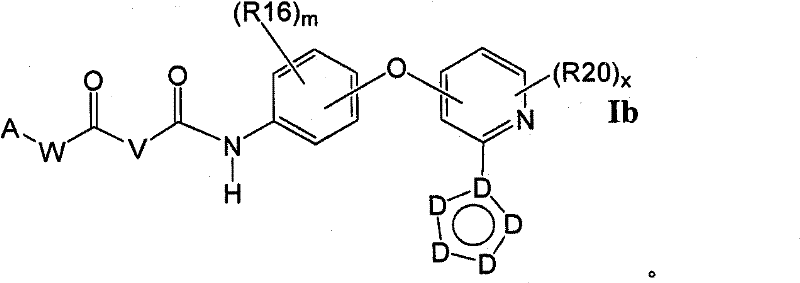
在另一实施方案中,所述化合物具有式IcIn another embodiment, the compound has formula Ic

在另一实施方案中,所述化合物具有式IdIn another embodiment, the compound has the formula Id
在另一实施方案中,所述化合物具有式IeIn another embodiment, the compound has formula Ie
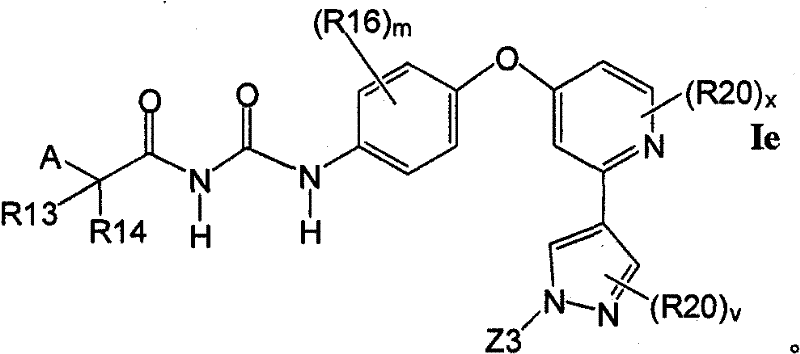
在另一实施方案中,所述化合物具有式IfIn another embodiment, the compound has the formula If
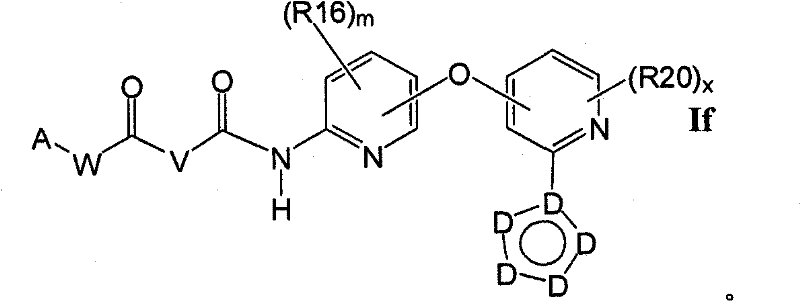
在另一实施方案中,所述化合物具有式IgIn another embodiment, the compound has the formula Ig

在另一实施方案中,所述化合物具有式IhIn another embodiment, the compound has the formula Ih

在另一实施方案中,所述化合物具有式IiIn another embodiment, the compound has formula Ii
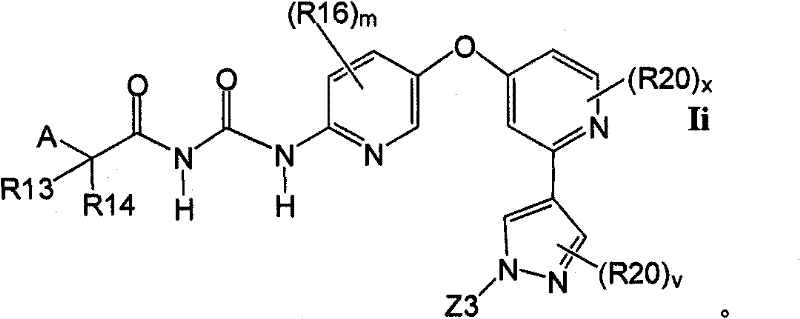
在另一实施方案中,所述化合物具有式IjIn another embodiment, the compound has formula Ij
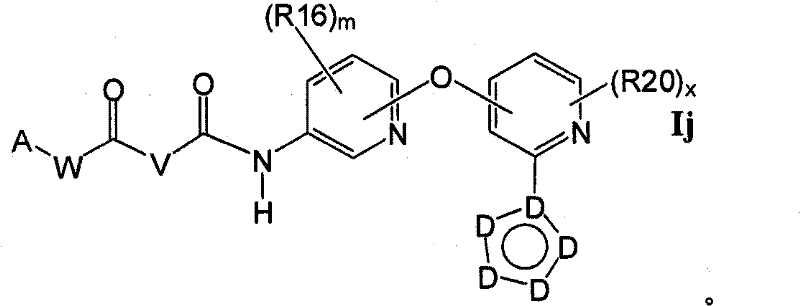
在另一实施方案中,所述化合物具有式IkIn another embodiment, the compound has the formula Ik
在另一实施方案中,所述化合物具有式IlIn another embodiment, the compound has formula Il

在另一实施方案中,所述化合物具有式ImIn another embodiment, the compound has the formula Im

在另一实施方案中,所述化合物具有式InIn another embodiment, the compound has the formula In
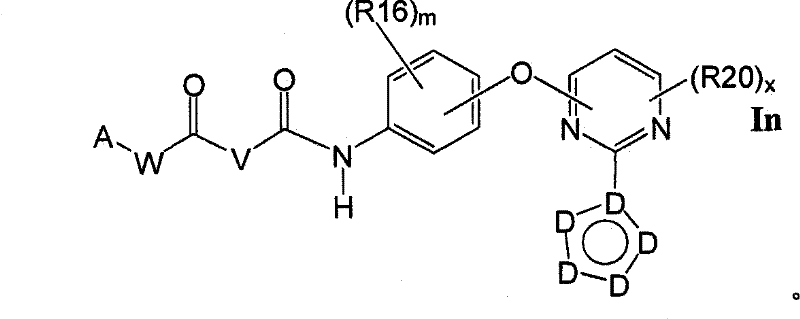
在另一实施方案中,所述化合物具有式IoIn another embodiment, the compound has formula Io
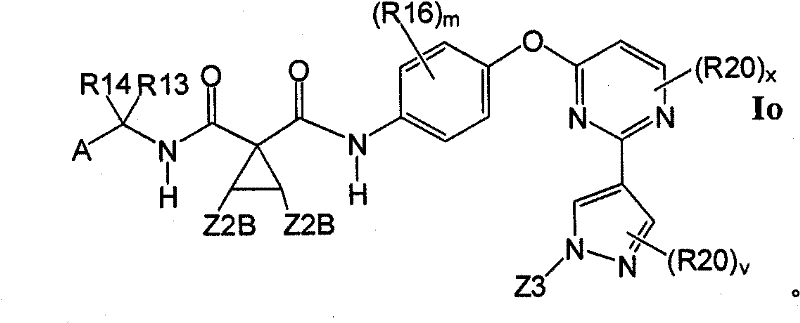
在另一实施方案中,所述化合物具有式IpIn another embodiment, the compound has the formula Ip
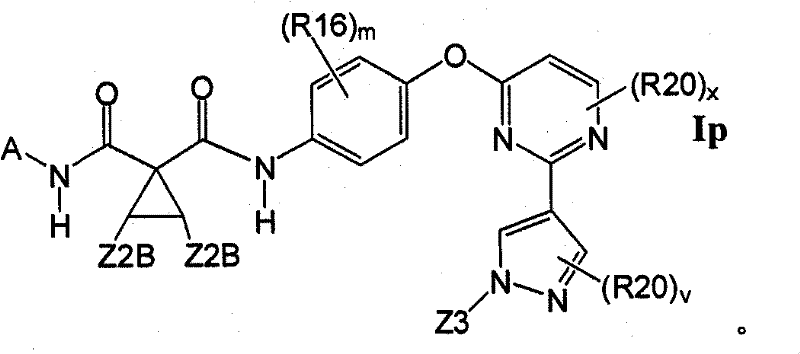
在另一实施方案中,所述化合物具有式IqIn another embodiment, the compound has the formula Iq
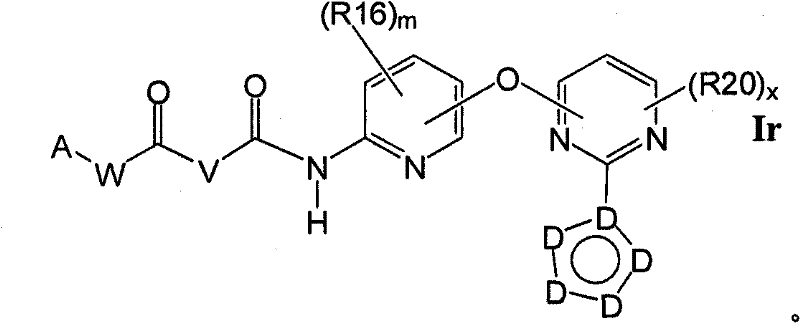
在另一实施方案中,所述化合物具有式IrIn another embodiment, the compound has the formula Ir
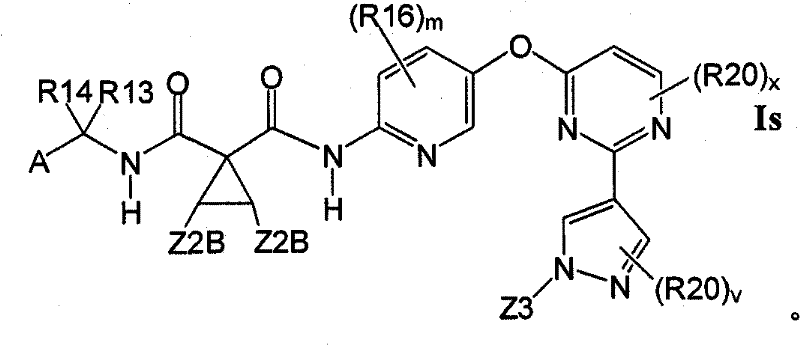
在另一实施方案中,所述化合物具有式IsIn another embodiment, the compound is of formula Is
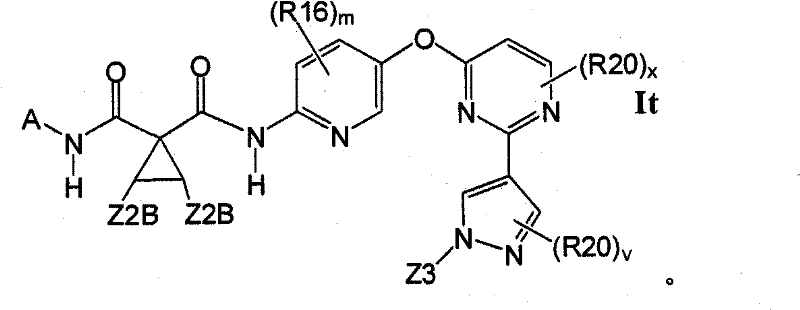
在另一实施方案中,所述化合物具有式ItIn another embodiment, the compound has the formula It
在另一实施方案中,所述化合物具有式IuIn another embodiment, the compound has the formula Iu

在另一实施方案中,所述化合物具有式IvIn another embodiment, the compound has formula Iv

在另一实施方案中,所述化合物具有式IwIn another embodiment, the compound has the formula Iw
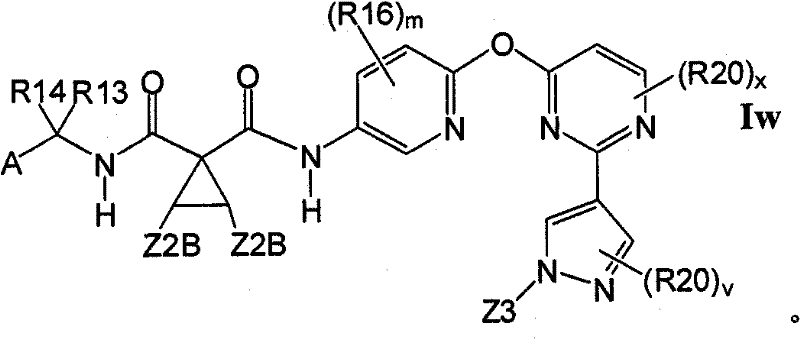
在另一实施方案中,所述化合物具有式IxIn another embodiment, the compound has the formula Ix

在另一实施方案中,所述化合物具有式IyIn another embodiment, the compound has the formula Iy

在另一实施方案中,所述化合物具有式IzIn another embodiment, the compound has the formula Iz

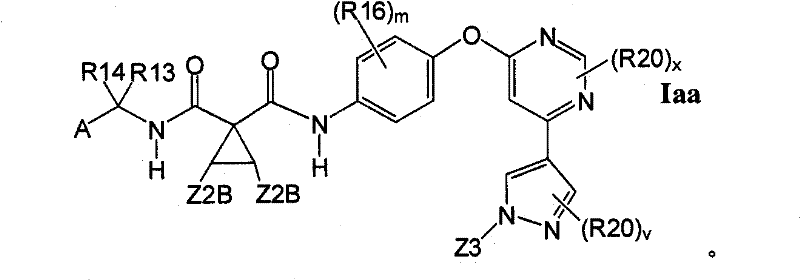
在另一实施方案中,所述化合物具有式IaaIn another embodiment, the compound has the formula Iaa
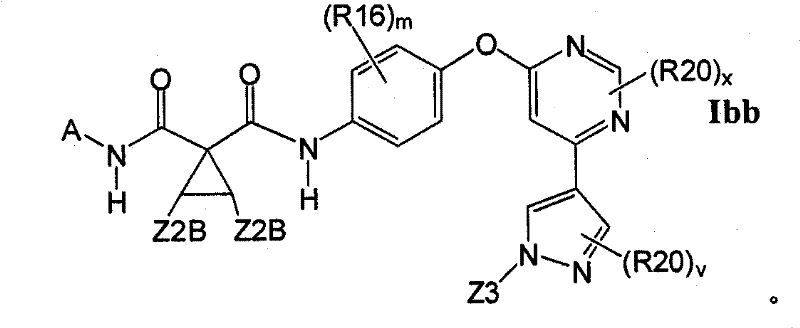
在另一实施方案中,所述化合物具有式IbbIn another embodiment, the compound has the formula Ibb
在另一实施方案中,所述化合物具有式IccIn another embodiment, the compound has the formula Icc

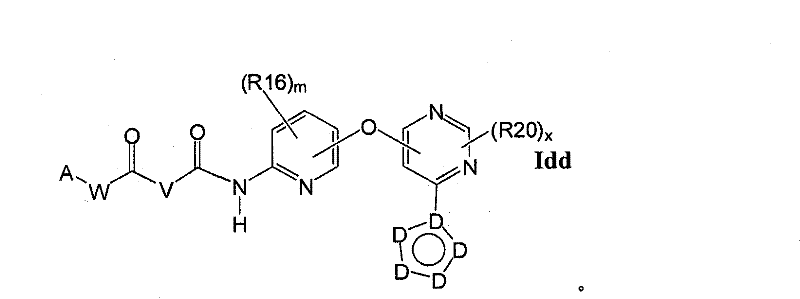
在另一实施方案中,所述化合物具有式IddIn another embodiment, the compound has the formula Idd
在另一实施方案中,所述化合物具有式IeeIn another embodiment, the compound has the formula lee

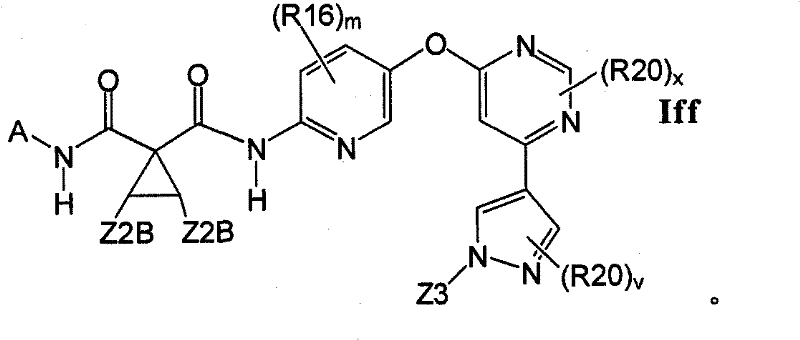
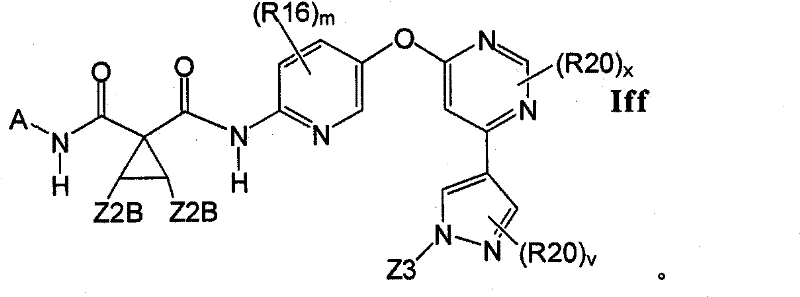
在另一实施方案中,所述化合物具有式IffIn another embodiment, the compound has the formula If
在另一实施方案中,所述化合物具有式IggIn another embodiment, the compound has the formula Igg
在另一实施方案中,所述化合物具有式IhhIn another embodiment, the compound has the formula Ihh
在另一实施方案中,所述化合物具有式IiiIn another embodiment, the compound has formula Iii
在另一实施方案中,所述化合物具有式IjjIn another embodiment, the compound has the formula Ijj
在另一实施方案中,所述化合物具有式IkkIn another embodiment, the compound has the formula Ikk
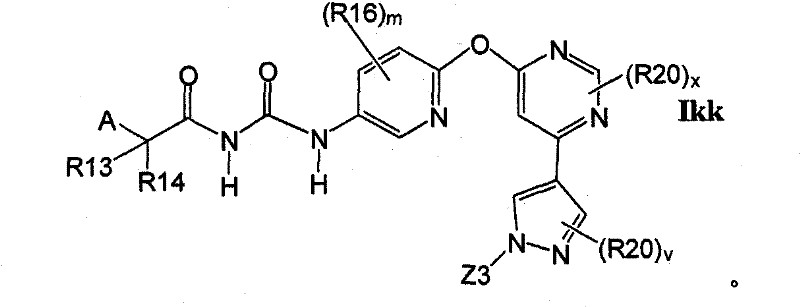
在另一个方面中,描述了这样的药物组合物,其包含本发明的化合物以及可药用的载体,并且该组合物可任选地包含选自助剂、赋形剂、稀释剂和稳定剂的添加剂。In another aspect, a pharmaceutical composition is described comprising a compound of the present invention together with a pharmaceutically acceptable carrier, and the composition may optionally comprise an agent selected from the group consisting of auxiliaries, excipients, diluents and stabilizers additive.
本发明的化合物在治疗哺乳动物癌症,高度增殖疾病,新陈代谢疾病,神经组织退行性疾病或可表征为血管再生术的疾病中提供了通途,其中所述的血管再生术包括但不限于实体肿瘤,黑素瘤,成胶质细胞瘤,卵巢癌,胰腺癌,前列腺癌,肺癌,乳腺癌,肾癌,肝癌,宫颈癌,原发性肿瘤位点的转移,骨髓增殖疾病,慢性粒细胞白血病,白血病,甲状腺乳头状癌,非小细胞肺癌,间皮瘤,高嗜酸性粒细胞综合症,胃肠基质肿瘤,结肠癌,表征为高度增殖从而导致失明的眼病(包括多种视网膜病,糖尿病性视网膜病),增龄性黄斑变性和高嗜酸性粒细胞综合症,风湿性关节炎,哮喘,慢性阻塞性肺病,肥大细胞增多症,肥大细胞白血病,以及由PDGFR-α激酶,PDGFR-β激酶、c-KIT激酶、cFMS激酶、c-MET激酶、以及之前所述的任意一种激酶的致癌性形式、异常融合蛋白质和多形形式所导致的疾病。The compounds of the present invention provide avenues in the treatment of mammalian cancers, hyperproliferative diseases, metabolic diseases, neurodegenerative diseases or diseases that may be characterized by angiogenesis including but not limited to solid tumors, Melanoma, glioblastoma, ovarian cancer, pancreatic cancer, prostate cancer, lung cancer, breast cancer, kidney cancer, liver cancer, cervical cancer, metastases from the primary tumor site, myeloproliferative disorders, chronic myelogenous leukemia, Leukemia, papillary thyroid carcinoma, non-small cell lung cancer, mesothelioma, hypereosinophilic syndrome, gastrointestinal stromal tumors, colon cancer, eye diseases characterized by hyperproliferation leading to blindness (including multiple retinopathy, diabetic Retinopathy), age-related macular degeneration and hypereosinophilic syndrome, rheumatoid arthritis, asthma, chronic obstructive pulmonary disease, mastocytosis, mast cell leukemia, and PDGFR-α kinase, PDGFR-β kinase , c-KIT kinase, cFMS kinase, c-MET kinase, and oncogenic forms, aberrant fusion proteins, and polymorphic forms of any of the aforementioned kinases.
在某些实施方案中,激酶为c-MET蛋白质激酶及其任何融合蛋白质、突变体和多形形式。In certain embodiments, the kinase is c-MET protein kinase and any fusion proteins, mutants and polymorphic forms thereof.
在某些实施方案中,所述的化合物可以通过选自口服、肠胃外、吸入和皮下方式中的方法给药。In certain embodiments, the compounds may be administered by a method selected from the group consisting of oral, parenteral, inhalation and subcutaneous means.
部分1-发明详述Part 1 - Detailed Description of the Invention
在整个公开内容中,引用了多个专利、专利申请和专利公开。这些专利、专利申请和专利公开的公开内容以引用方式全文并入本文,从而更完全地描述本领域的技术人员已知的所述技术到本公开之日时的发展水平。所述的公开内容以举例的方式支持所述的专利、专利申请和专利公开与本公开内容之间存在的任何不一致。Throughout this disclosure, various patents, patent applications, and patent publications are referenced. The disclosures of these patents, patent applications, and patent publications are incorporated herein by reference in their entirety to more fully describe the state of the art that is known to those skilled in the art as of the date of this disclosure. The stated disclosure supports by way of example any inconsistencies between said patents, patent applications, and patent publications and the present disclosure.
为了方便,在本说明书、实施例和权利要求中使用的某些术语收集与此。除非另作说明,否则本公开内容中使用的所有技术和科学术语均具有本公开内容所属领域的任一普通技术人员所通常理解的含义。除非另作说明,否则针对本公开内容所提供的一组或一项内容而提供的最初的定义分别适用于全部公开内容中的其他组或项的内容,或者作为另一组内容的一部分。For convenience, certain terms used in the specification, examples and claims are collected here. Unless defined otherwise, all technical and scientific terms used in this disclosure have the meaning commonly understood by one of ordinary skill in the art to which this disclosure belongs. Unless otherwise stated, an initial definition provided for a group or item of content provided in this disclosure is respectively applicable to other group or item of content in the entire disclosure, or as part of another group of content.
本公开内容的化合物包括其任何和所有可能的异构体、立体异构体、对映异构体、非对映异构体、互变异构体、可药用的盐和溶剂化物。因此,如在本公开内容中所用,术语“一种化合物”和“多种化合物”是指本公开内容的化合物,及其任何及所有可能的异构体、立体异构体、对映异构体、非对映异构体、互变异构体、可药用的盐和溶剂化物。The compounds of the present disclosure include any and all possible isomers, stereoisomers, enantiomers, diastereomers, tautomers, pharmaceutically acceptable salts and solvates thereof. Thus, as used in this disclosure, the terms "a compound" and "compounds" refer to a compound of the disclosure, and any and all possible isomers, stereoisomers, enantiomers thereof isomers, diastereomers, tautomers, pharmaceutically acceptable salts and solvates.
以下描述涉及多种化合物及其部分。The following description refers to various compounds and parts thereof.
术语“环烷基”是指取自环丙基、环丁基、环戊基、环己基、环庚基和环辛基的单环饱和的碳环。The term "cycloalkyl" refers to a monocyclic saturated carbocyclic ring selected from cyclopropyl, cyclobutyl, cyclopentyl, cyclohexyl, cycloheptyl and cyclooctyl.
术语“烷基”是指直链或支化的链C1-C6烷基。The term "alkyl" refers to a straight or branched chain C1-C6 alkyl group.
术语“卤素”是指氟、氯、溴和碘。The term "halogen" refers to fluorine, chlorine, bromine and iodine.
术语“烷氧基”是指-O-(烷基),其中烷基如上文所定义。The term "alkoxy" refers to -O-(alkyl), wherein alkyl is as defined above.
术语“烷氧基烷基”是指-(烷基)-O-(烷基),其中烷基如上文所定义。The term "alkoxyalkyl" refers to -(alkyl)-O-(alkyl), wherein alkyl is as defined above.
术语“烷氧羰基”是指-C(O)O-(烷基),其中烷基如上文所定义。The term "alkoxycarbonyl" refers to -C(O)O-(alkyl), wherein alkyl is as defined above.
术语“羧基C1-C6烷基”是指-(C1-C6烷基)CO2H,其中烷基如上文所定义。The term "carboxyC1-C6alkyl" refers to -(C1-C6alkyl) CO2H , wherein alkyl is as defined above.
与部分相关联的术语“取代的”是指这样的事实,即,其他取代基可以与所述部分上任何可接受的位置连接。The term "substituted" in association with a moiety refers to the fact that other substituents may be attached to any acceptable position on the moiety.
术语“盐”涵盖了通常用于形成游离酸的碱金属盐和游离碱的加成盐的可药用的盐。这种盐的性质并不重要,只要其是可药用的即可。合适的可药用的酸加成盐可以由无机酸或有机酸制备。这种无机酸的实例为盐酸、氢溴酸、氢碘酸、硝酸、碳酸、硫酸和磷酸。合适的有机酸可以选自包含脂肪族、环脂族、芳香族、芳基和杂环的羧酸和磺酸,其实例为甲酸、乙酸、丙酸、琥珀酸、乙醇酸、葡萄糖酸、乳酸、苹果酸、酒石酸、柠檬酸、抗坏血酸、葡萄糖醛酸、马来酸、富马酸、丙酮酸、天冬氨酸、谷氨酸、安息香酸、氨基苯甲酸、mesylic、硬脂酸、水杨酸、对羟基苯甲酸、苯乙酸、扁桃酸、扑酸(双羟萘酸)、甲磺酸、乙磺酸、苯磺酸、泛酸、苯磺酸、2-羟基乙磺酸、硫酸、环己基磺酰氨酸、algenic、3-羟基丁酸、半乳糖二酸和半乳糖醛酸。包含游离酸的式I所示的化合物的、合适的可药用的盐包括金属盐和有机盐。更优选的金属盐包括但不限于合适的碱金属(Ia组)盐、碱土金属(IIa组)盐和其他生理学可接受的金属。这些盐可以由铝、钙、锂、镁、钾、钠和锌制得。优选的有机盐可以由伯胺、仲胺、叔胺和季铵盐,部分包括。氨基丁三醇、二乙胺、四-N-甲基铵、N,N′-二苄基乙二胺、氯普鲁卡因、胆碱、二乙醇胺、乙二胺、甲葡胺(N-甲基葡糖胺)和普鲁卡因。The term "salt" encompasses pharmaceutically acceptable salts commonly used to form alkali metal salts of free acids and addition salts of free bases. The nature of the salt is not critical provided that it is pharmaceutically acceptable. Suitable pharmaceutically acceptable acid addition salts may be prepared from inorganic or organic acids. Examples of such inorganic acids are hydrochloric, hydrobromic, hydroiodic, nitric, carbonic, sulfuric and phosphoric acids. Suitable organic acids may be selected from carboxylic and sulfonic acids containing aliphatic, cycloaliphatic, aromatic, aryl and heterocyclic rings, examples being formic acid, acetic acid, propionic acid, succinic acid, glycolic acid, gluconic acid, lactic acid , malic acid, tartaric acid, citric acid, ascorbic acid, glucuronic acid, maleic acid, fumaric acid, pyruvic acid, aspartic acid, glutamic acid, benzoic acid, aminobenzoic acid, mesylic, stearic acid, salicylic acid acid, p-hydroxybenzoic acid, phenylacetic acid, mandelic acid, pamoic acid (pamoic acid), methanesulfonic acid, ethanesulfonic acid, benzenesulfonic acid, pantothenic acid, benzenesulfonic acid, 2-hydroxyethanesulfonic acid, sulfuric acid, cyclo Hexylsulfonyl acid, algenic, 3-hydroxybutyric acid, galactaric acid, and galacturonic acid. Suitable pharmaceutically acceptable salts of compounds of formula I including the free acids include metal salts and organic salts. More preferred metal salts include, but are not limited to, suitable alkali metal (group la) salts, alkaline earth metal (group Ha) salts and other physiologically acceptable metals. These salts can be prepared from aluminum, calcium, lithium, magnesium, potassium, sodium and zinc. Preferred organic salts may be partially comprised of primary amines, secondary amines, tertiary amines and quaternary ammonium salts. Tromethamine, Diethylamine, Tetra-N-methylammonium, N,N'-Dibenzylethylenediamine, Chloroprocaine, Choline, Diethanolamine, Ethylenediamine, Meglumine (N -methylglucamine) and procaine.
如本公开内容中所用,术语“给予”、“给药”或“使用”是指将化合物或其可药用的盐或组合物直接给药受试对象,或者将所述化合物的前药衍生物或类似物、或者所述化合物的可药用的盐或组合物给药受试对象,其中所述的盐或组合物可以在受试对象的肌体内形成等量的活性化合物。As used in this disclosure, the term "administration", "administration" or "use" refers to administering a compound or a pharmaceutically acceptable salt or composition thereof directly to a subject, or derivatizing a prodrug of the compound Drugs or analogs, or pharmaceutically acceptable salts or compositions of the compounds are administered to the subjects, wherein the salts or compositions can form an equivalent amount of the active compound in the body of the subjects.
如本公开内容中所用,术语“载体”涵盖了载体、赋形剂和稀释剂,并且是指涉及将药物试剂由肌体的一个器官或部分携带或运送至肌体的另一个器官或部分中的材料、组合物或媒介物,例如液体或固体填料、稀释剂、赋形剂、溶剂或囊封材料。As used in this disclosure, the term "carrier" encompasses carriers, excipients, and diluents, and refers to a material involved in the carrying or transport of a pharmaceutical agent from one organ or part of the body to another organ or part of the body , composition or vehicle, such as a liquid or solid filler, diluent, excipient, solvent or encapsulating material.
如本公开内容中所用,除非另作说明,否则术语“紊乱”是指术语疾病、病症或病情,并与这些术语交换使用。As used in this disclosure, the term "disorder" refers to, and is used interchangeably with, the term disease, disorder, or condition unless otherwise stated.
如本公开内容中交换所用的术语“有效量”和“治疗有效量”是指这样的化合物的量,当将该量的化合物给药受试对象时,其能够减轻受试对象的紊乱症状。包含“有效量”或“治疗有效量”的实际量会根据病症的数量而变化,其中所述的病症包括但不限于待治疗的具体的紊乱、紊乱的严重程度、患者的尺寸和健康情况以及给药的途径。熟练的医疗从业者可以容易地采用医疗领域中已知的方法确定合适的量。The terms "effective amount" and "therapeutically effective amount" as used interchangeably in this disclosure refer to an amount of a compound which, when administered to a subject, reduces symptoms of a disorder in a subject. The actual amount comprising "effective amount" or "therapeutically effective amount" will vary depending on the number of conditions including, but not limited to, the particular disorder being treated, the severity of the disorder, the size and health of the patient, and route of administration. A skilled medical practitioner can readily determine appropriate amounts using methods known in the medical art.
如本公开内容中所用,术语“分离的”和“纯化的”是指一种成分与反应混合物或天然来源的其他成分分离。在某些实施方案中,分离物包含占所述分离物的总量的至少大约50%、至少大约55%、至少大约60%、至少大约65%、至少大约70%、至少大约75%、至少大约80%、至少大约85%、至少大约90%、至少大约95%、或者至少大约98%的所述的化合物或该化合物的可药用的盐。As used in this disclosure, the terms "isolated" and "purified" refer to the separation of a component from other components of a reaction mixture or natural source. In certain embodiments, the isolate comprises at least about 50%, at least about 55%, at least about 60%, at least about 65%, at least about 70%, at least about 75%, at least About 80%, at least about 85%, at least about 90%, at least about 95%, or at least about 98% of the compound or a pharmaceutically acceptable salt of the compound.
在本公开内容中使用的短语“可药用的”是指这样的化合物、材料、组合物和/或剂型,在正确的医疗判断范围内,所述的物质适用于与人类和动物的组织相接触而不会产生过度的毒性、刺激、过敏性应答或其他问题或并发,具有相当的收益/风险比。As used in this disclosure, the phrase "pharmaceutically acceptable" refers to a compound, material, composition and/or dosage form which, within the scope of sound medical judgment, is suitable for use in association with human and animal tissues. Exposure without undue toxicity, irritation, allergic response or other problems or complications has a comparable benefit/risk ratio.
术语“前药”是指子在体内会恢复成活性形式的活性化合物的衍生物。例如,羧酸形式的活性药品可以被酯化,从而形成前药,并且所述的酯随后在体内被转化从而恢复成羧酸形式。参见综述Ettmayer et.al,J.Med.Chem(2004)47:2393和Lorenzi et.al,J.Pharm.Exp.Therpeutics(2005)883。The term "prodrug" refers to a derivative of an active compound that reverts to the active form in vivo. For example, an active drug in the carboxylic acid form can be esterified to form a prodrug, and the ester is subsequently converted in vivo to revert to the carboxylic acid form. See reviews Ettmayer et. al, J. Med. Chem (2004) 47:2393 and Lorenzi et. al, J. Pharm. Exp. Therpeutics (2005) 883.
如本公开内容所用,术语“受试对象”包括但不限于人和动物。示例性的动物包括但不限于哺乳动物,例如小鼠、大鼠、天竺鼠、狗、猫、马、牛、猪、猴、黑猩猩、狒狒或恒河猴。As used in this disclosure, the term "subject" includes, but is not limited to, humans and animals. Exemplary animals include, but are not limited to, mammals such as mice, rats, guinea pigs, dogs, cats, horses, cows, pigs, monkeys, chimpanzees, baboons, or rhesus monkeys.
关于受试对象的术语“治疗”是指改善受试对象紊乱的至少一个症状。治疗可以是治愈、改善或者至少部分地减缓紊乱。The term "treating" with reference to a subject refers to ameliorating at least one symptom of a disorder in a subject. Treatment can be to cure, ameliorate, or at least partially alleviate a disorder.
术语“水合物”是指如本文所述的化合物与分子形式的水相结合,即,其中H-OH键没有分裂,并且可以通过(例如)式R·H2O表示,其中R为本文所述的化合物。给定的化合物可以形成多于一个的水合物,包括例如一水合物(R·H2O)、二水合物(R·2H2O)、三水合物(R·3H2O)等。The term "hydrate" refers to a compound as described herein associated with molecular form of water, i.e., wherein the H-OH bond is not broken, and can be represented by, for example, the formula R·H 2 O, where R is the compounds mentioned. A given compound may form more than one hydrate including, for example, monohydrate (R· H2O ), dihydrate (R· 2H2O ), trihydrate (R· 3H2O ), and the like.
术语“溶剂化物”是指本发明的化合物与分子形式的溶剂相结合,即,其中溶剂是配位结合的,并且可以通过(例如)式R·(溶剂)表示,其中R为本发明的化合物。给定的化合物可以形成多于一个的溶剂化物,包括例如一溶剂化物(R·(溶剂));或多溶剂化物(R·n(溶剂),其中n为>1的整数),包括例如二溶剂化物(R·2(溶剂))、三溶剂化物(R·3(溶剂))等;或者半溶剂化物,例如R·n/2(溶剂),R·n/3(溶剂),R·n/4(溶剂)等,其中n为整数。此处所述的溶剂包括混合的溶剂,例如甲醇/水,并且溶剂化物本身可以将一种或多种溶剂引入到溶剂化物中。The term "solvate" refers to a compound of the invention associated with a solvent in molecular form, i.e., wherein the solvent is coordinatively bound and can be represented by, for example, the formula R.(solvent), where R is a compound of the invention . A given compound may form more than one solvate, including, for example, a monosolvate (R·(solvent)); or a polysolvate (R·n(solvent), where n is an integer > 1), including, for example, di Solvate (R·2(solvent)), trisolvate (R·3(solvent)), etc.; or hemisolvate, such as R·n/2(solvent), R·n/3(solvent), R· n/4(solvent), etc., where n is an integer. The solvents described herein include mixed solvents such as methanol/water, and the solvate itself may introduce one or more solvents into the solvate.
术语“酸水合物”是指这样的络合物,该络合物可以通过具有一个或多个碱性部分的化合物与具有一个或多个酸性部分的至少一个化合物相结合而形成,或者通过具有一个或多个酸性部分的化合物与具有一个而活多个碱性部分的一个化合物相结合而形成,所述的络合物可以进一步与水分子结合,从而形成水合物,其中所述的水合物如之前所定义,并且R表示上文所述的络合物。The term "acid hydrate" refers to a complex which may be formed by combining a compound having one or more basic moieties with at least one compound having one or more acidic moieties, or by having A compound with one or more acidic moieties combined with a compound having one or more basic moieties, the complex can further combine with water molecules to form a hydrate, wherein the hydrate As defined before, and R represents the complex described above.
结构、化学和立体化学的定义广泛地取自IUPAC的建议,并且更具体而言取自由P.Müller,Pure Appl.Chem.,(1994)66:1077-1184所概括的Physical Organic Chemistry(IUPAC Recommendations 1994)以及由G.P.Moss Pure and Applied Chemistry,(1996)68:2193-2222)所概括的Basic Terminology of Stereochemistry(IUPACRecommendations 1996)中的所用术语词汇表。具体定义如下:Definitions of structure, chemistry and stereochemistry are taken broadly from IUPAC recommendations, and more specifically from Physical Organic Chemistry (IUPAC Recommendations) as summarized by P. Müller, Pure Appl. Chem., (1994) 66: 1077-1184 1994) and the glossary of terms used in Basic Terminology of Stereochemistry (IUPAC Recommendations 1996) as summarized by G.P. Moss Pure and Applied Chemistry, (1996) 68:2193-2222). The specific definition is as follows:
阻转异构体定义为可以以单独的化合物种类分离并且由单个键的受阻旋转而形成的构象子的子集。Atropisomers are defined as a subset of conformers that can be isolated as individual compound species and are formed by hindered rotation of a single bond.
几何异构体或结构异构体定义为涉及相同原子采用不同排列方式的异构体。Geometric or structural isomers are defined as isomers involving different arrangements of the same atoms.
对映异构体定义为彼此为镜像且非镜像重合的一对分子实体中的一者。Enantiomers are defined as one of a pair of molecular entities that are mirror images of each other and are not superimposable.
非对映异构体或非对映立体异构体定义为除了对映异构体以外的立体异构体。非对映异构体或非对映立体异构体为并非与镜像有关的立体异构体。非对映立体异构体可以通过不同的物理性质并且通过在对非手性及手性试剂的某些不同的化学行为来表征。Diastereomers or diastereoisomers are defined as stereoisomers other than enantiomers. Diastereomers, or diastereoisomers, are stereoisomers that are not related as mirror images. Diastereoisomers can be characterized by different physical properties and by certain different chemical behaviors towards achiral and chiral reagents.
如本公开内容所用,术语“互变异构体”是指通过以下现象而产生的化合物,其中所述的现象为一个分子的一个原子的质子位移至另一个原子(March,Advanced Organic Chemistry:Reactions, Mechanisms和Structures,4th Ed.,John Wiley & Sons,pp.69-74(1992))。As used in this disclosure, the term "tautomer" refers to compounds produced by the phenomenon of shifting a proton from one atom of a molecule to another (March, Advanced Organic Chemistry: Reactions , Mechanisms and Structures , 4th Ed., John Wiley & Sons, pp.69-74(1992)).
互变现象定义为通式
互变异构体定义为由互变现象形成的异构体,而与异构体是否是可分离的无关。Tautomers are defined as isomers formed by the phenomenon of interconversion, regardless of whether the isomers are separable or not.
使用ChemDraw版本8.0或10(CambridgeSoft Corporation,Cambridge,MA)来命名结构。Structures were named using ChemDraw version 8.0 or 10 (CambridgeSoft Corporation, Cambridge, MA).
1.1本发明的第一方面-化合物、方法和制备1.1 First aspect of the invention - compounds, methods and preparation
式Ia所示的化合物及其可药用的盐、水合物、溶剂化物、前药和互变异构体;Compounds represented by formula Ia and pharmaceutically acceptable salts, hydrates, solvates, prodrugs and tautomers thereof;

其中Q1,Q2和Q3均分别且独立地选自N和CH,并且其中Q1和Q2的至少一者为N;Wherein Q1, Q2 and Q3 are all independently and independently selected from N and CH, and wherein at least one of Q1 and Q2 is N;
并且其中包含Q1和Q2的环可以可任选地被(R20)x部分取代;and the ring comprising Q1 and Q2 therein may be optionally substituted with (R20) x moieties;
D均分别取自C,CH,C-R20,N-Z3,N和O,这样所得的环取自吡唑基,异噁唑基,三唑基和咪唑基;D are all taken from C, CH, C-R20, N-Z3, N and O respectively, so that the resulting ring is taken from pyrazolyl, isoxazolyl, triazolyl and imidazolyl;
并且其中包含Q3的环可以可任选地被1至3个R16部分取代;and wherein the ring comprising Q3 may optionally be substituted with 1 to 3 R16 moieties;
V为NR4或V for NR4 or
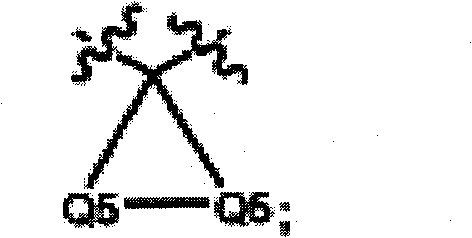
Q5均为C(Z2B)2;Q5 is C(Z2B) 2 ;
W为直接键,-[C(R13)R14]m-,-[C(R13)R14]mNR4-或NR4;W is a direct bond, -[C(R13)R14] m -, -[C(R13)R14] m NR4- or NR4;
A选自茚满基,四氢萘基,噻吩基,苯基,萘基,吡嗪基,哒嗪基,三嗪基,吡啶基和嘧啶基;A is selected from indanyl, tetrahydronaphthyl, thienyl, phenyl, naphthyl, pyrazinyl, pyridazinyl, triazinyl, pyridyl and pyrimidinyl;
X2为-O-;X2 is -O-;
当A具有1个或多个可取代的sp2-杂交碳原子时,各个各自的sp2杂交碳原子可以可任选地被Z1B取代基取代;When A has 1 or more substitutable sp2-hybridized carbon atoms, each respective sp2-hybridized carbon atom may optionally be substituted by a Z1B substituent;
当A具有1个或多个可取代的sp3-杂交碳原子时,各个各自的sp3杂交碳原子可以可任选地被Z2B取代基取代;When A has 1 or more substitutable sp3-hybridized carbon atoms, each respective sp3-hybridized carbon atom may optionally be substituted by a Z2B substituent;
Z1B均独立且分别地选自氢,C1-6烷基,支化的C3-C7烷基,卤素,氟代C1-C6烷基(其中烷基部分可以部分或全部氟化的),C1-C6烷氧基,氟代C1-C6烷氧基(其中烷基部分可以部分或全部氟化的),以及-(CH2)nCN;Z1B are all independently and independently selected from hydrogen, C1-6 alkyl, branched C3-C7 alkyl, halogen, fluorinated C1-C6 alkyl (wherein the alkyl part can be partially or fully fluorinated), C1- C6 alkoxy, fluoro C1-C6 alkoxy (wherein the alkyl moiety can be partially or fully fluorinated), and -(CH 2 ) n CN;
Z2B均独立且分别地选自氢,C1-C6烷基,支化的C3-C7烷基和C3-C8环烷基;Z2B are all independently and independently selected from hydrogen, C1-C6 alkyl, branched C3-C7 alkyl and C3-C8 cycloalkyl;
Z3均独立且分别地选自氢,C1-C6烷基,支化的C3-C7烷基,C3-C8环烷基,氟代C1-C6烷基(其中烷基部分可以为部分或全部氟化的),羟基C2-C6烷基-,R5C(O)(CH2)n-,(R4)2NC(O)C1-C6烷基-,R8C(O)N(R4)(CH2)q-,-(CH2)qCN,-(CH2)qR5和-(CH2)qN(R4)2;Z3 are all independently and independently selected from hydrogen, C1-C6 alkyl, branched C3-C7 alkyl, C3-C8 cycloalkyl, fluorinated C1-C6 alkyl (wherein the alkyl part can be part or all fluorine of), hydroxy C2-C6 alkyl-, R5C(O)(CH 2 ) n -, (R4) 2 NC(O)C1-C6 alkyl-, R8C(O)N(R4)(CH 2 ) q -, -(CH 2 ) q CN, -(CH 2 ) q R5 and -(CH 2 ) q N(R4) 2 ;
R2均选自氢,R17-取代的芳基-,C1-C6烷基,支化的C3-C8烷基,R19取代的C3-C8环烷基-和氟代C1-C6烷基-(其中烷基为全部或部分氟化的);R2 are all selected from hydrogen, R17-substituted aryl-, C1-C6 alkyl, branched C3-C8 alkyl, R19 substituted C3-C8 cycloalkyl-and fluorinated C1-C6 alkyl-(wherein Alkyl is fully or partially fluorinated);
其中R3均独立且分别地选自氢,C1-C6烷基,支化的C3-C7烷基,和C3-C8环烷基;wherein R3 are independently and independently selected from hydrogen, C1-C6 alkyl, branched C3-C7 alkyl, and C3-C8 cycloalkyl;
R4均独立且分别地选自氢,C1-C6烷基,羟基C1-C6烷基-,二羟基C1-C6烷基-,C1-C6烷氧基C1-C6烷基-,支化的C3-C7烷基,羟基取代的支化的C3-C6烷基-,C1-C6烷氧基支化的C3-C6烷基-,二羟基取代的支化的C3-C6烷基-,-(CH2)pN(R7)2,-(CH2)pR5,-(CH2)pC(O)N(R7)2,-(CH2)nC(O)R5,-(CH2)nC(O)OR3和R19取代的C3-C8环烷基-;R4 are all independently and independently selected from hydrogen, C1-C6 alkyl, hydroxy C1-C6 alkyl-, dihydroxy C1-C6 alkyl-, C1-C6 alkoxy C1-C6 alkyl-, branched C3 -C7 alkyl, hydroxy-substituted branched C3-C6 alkyl-, C1-C6 alkoxy branched C3-C6 alkyl-, dihydroxyl-substituted branched C3-C6 alkyl-,-( CH 2 ) p N(R7) 2 , -(CH 2 ) p R5, -(CH 2 ) p C(O)N(R7) 2 , -(CH 2 ) n C(O)R5, -(CH 2 ) n C(O)OR3 and R19 substituted C3-C8 cycloalkyl-;
R5均独立且分别地选自R5 are independently and separately selected from

并且其中符号(##)为与各个包含R5部分的各个R4,R7,R8,R20或Z3部分的连接点;and wherein the symbol (##) is the connection point with each R4, R7, R8, R20 or Z3 moiety each comprising the R5 moiety;
R7均独立且分别地选自氢,C1-C6烷基,羟基C2-C6烷基-,二羟基C2-C6烷基-,C1-C6烷氧基C2-C6烷基-,支化的C3-C7烷基,羟基取代的支化的C3-C6烷基-,C1-C6烷氧基支化的C3-C6烷基-,二羟基取代的支化的C3-C6烷基-,-(CH2)qR5,-(CH2)nC(O)R5,-(CH2)nC(O)OR3,R19取代的C3-C8环烷基-和-(CH2)nR17;R7 are all independently and independently selected from hydrogen, C1-C6 alkyl, hydroxyl C2-C6 alkyl-, dihydroxy C2-C6 alkyl-, C1-C6 alkoxy C2-C6 alkyl-, branched C3 -C7 alkyl, hydroxy-substituted branched C3-C6 alkyl-, C1-C6 alkoxy branched C3-C6 alkyl-, dihydroxyl-substituted branched C3-C6 alkyl-,-( CH 2 ) q R5, -(CH 2 ) n C(O)R5, -(CH 2 ) n C(O)OR3, R19 substituted C3-C8 cycloalkyl- and -(CH 2 ) n R17;
R8均独立且分别地选自C1-C6烷基,支化的C3-C7烷基,氟代C1-C6烷基-(其中烷基部分为部分或全部氟化的),R19取代的C3-C8环烷基-,苯基,苯基C1-C6烷基-,OH,C1-C6烷氧基,-N(R3)2,-N(R4)2和R5;R8 are all independently and independently selected from C1-C6 alkyl, branched C3-C7 alkyl, fluorinated C1-C6 alkyl- (wherein the alkyl part is partially or fully fluorinated), R19 substituted C3- C8 cycloalkyl-, phenyl, phenyl C1-C6 alkyl-, OH, C1-C6 alkoxy, -N(R3) 2 , -N(R4) 2 and R5;
R10均独立且分别地选自-CO2H,-CO2C1-C6烷基,-C(O)N(R4)2,OH,C1-C6烷氧基和-N(R4)2;R10 are all independently and independently selected from -CO 2 H, -CO 2 C1-C6 alkyl, -C(O)N(R4) 2 , OH, C1-C6 alkoxy and -N(R4) 2 ;
R13和R14均分别且独立地选自氢,C1-C6烷基,支化的C3-C8烷基,氟代C1-C6烷基-(其中烷基为全部或部分氟化的),羟基取代的C1-C6烷基-,C1-C6烷氧基取代的C1-C6烷基-,羟基取代的支化的C3-C8烷基-和烷氧基取代的支化C3-C8烷基;R13 and R14 are all independently and independently selected from hydrogen, C1-C6 alkyl, branched C3-C8 alkyl, fluorinated C1-C6 alkyl- (wherein the alkyl is fully or partially fluorinated), hydroxyl substituted C1-C6 alkyl-, C1-C6 alkoxy substituted C1-C6 alkyl-, hydroxyl substituted branched C3-C8 alkyl- and alkoxy substituted branched C3-C8 alkyl;
R16均独立且分别地选自氢,C1-C6烷基,支化的C3-C7烷基,R19取代的C3-C8环烷基-,卤素,氟代C1-C6烷基-(其中烷基部分可以为部分或全部氟化的),氰基,羟基,C1-C6烷氧基,氟代C1-C6烷氧基-(其中烷基部分可以为部分或全部氟化的),-N(R3)2,-N(R4)2,R3取代的C2-C3炔基-和硝基;R16 are all independently and independently selected from hydrogen, C1-C6 alkyl, branched C3-C7 alkyl, R19 substituted C3-C8 cycloalkyl-, halogen, fluorinated C1-C6 alkyl- (wherein alkyl moiety may be partially or fully fluorinated), cyano, hydroxyl, C1-C6 alkoxy, fluoro C1-C6 alkoxy-(wherein the alkyl moiety may be partially or fully fluorinated), -N( R3) 2 , -N(R4) 2 , R3 substituted C2-C3 alkynyl- and nitro;
R17均独立且分别地选自氢,C1-C6烷基,支化的C3-C7烷基,羟基C2-C6烷基-,R19取代的C3-C8环烷基-,卤素,氟代C1-C6烷基-(其中烷基部分可以为部分或全部氟化的),氰基,羟基,C1-C6烷氧基,氟代C1-C6烷氧基-(其中烷基部分可以为部分或全部氟化的),-N(R3)2,-N(R4)2和硝基;R17 are all independently and independently selected from hydrogen, C1-C6 alkyl, branched C3-C7 alkyl, hydroxyl C2-C6 alkyl-, R19 substituted C3-C8 cycloalkyl-, halogen, fluorinated C1- C6 alkyl-(wherein the alkyl part can be partially or fully fluorinated), cyano, hydroxyl, C1-C6 alkoxy, fluoro C1-C6 alkoxy-(wherein the alkyl part can be partly or fully Fluorinated), -N(R3) 2 , -N(R4) 2 and nitro;
R19均独立且分别地选自氢,OH和C1-C6烷基;R19 are all independently and independently selected from hydrogen, OH and C1-C6 alkyl;
R20均独立且分别地选自氢,C1-C6烷基,支化的C3-C7烷基,R19取代的C3-C8环烷基-,卤素,氟代C1-C6烷基-(其中烷基部分可以为部分或全部氟化的),氰基,羟基,羟基C1-C6烷基-,C1-C6烷氧基C1-C6烷基-,C1-C6烷氧基,氟代C1-C6烷氧基-(其中烷基部分可以为部分或全部氟化的),-N(R3)2,-N(R4)2,-(CH2)nR5,-(CH2)nN(R3)C(O)R3,-(CH2)nC(O)N(R3)2和硝基;R20 are all independently and independently selected from hydrogen, C1-C6 alkyl, branched C3-C7 alkyl, R19 substituted C3-C8 cycloalkyl-, halogen, fluorinated C1-C6 alkyl- (wherein alkyl Parts may be partially or fully fluorinated), cyano, hydroxy, hydroxy C1-C6 alkyl-, C1-C6 alkoxy C1-C6 alkyl-, C1-C6 alkoxy, fluoro C1-C6 alkane Oxy-(wherein the alkyl moiety may be partially or fully fluorinated), -N(R3) 2 , -N(R4) 2 , -(CH 2 ) n R5, -(CH 2 ) n N(R3) C(O)R3, -(CH 2 ) n C(O)N(R3) 2 and nitro;
m均独立且分别地为1-3,n均独立且分别地为0-6;p均独立且分别地为1-4;q均独立且分别地为2-6;v均独立且分别地为1或2;x均独立且分别地为0-2;m are independently and respectively 1-3, n are independently and respectively 0-6; p are independently and respectively 1-4; q are independently and respectively 2-6; v are independently and respectively is 1 or 2; x are all independently and respectively 0-2;
所述化合物的立体异构体、几何异构体和互变异构体。Stereoisomers, geometric isomers and tautomers of said compounds.
在式Ia所示的上述化合物中,下脚标字母通常用于定义部分和取代基结构的变化。例如,在酰胺态氮上的R4为-(CH2)nC(O)R5而在Q1/Q2环上的R20为-(CH2)nR5的情况下,各“n”下脚标可以分别且独立地由0变为6。例如,在其中R4“n”下脚标为2而R20“n”下脚标为6的情况得到R4取代基为-CH2CH2C(O)R5,而R20取代基为-CH2CH2CH2CH2CH2CH2R5(参见以下的分子3)。扩展而言,下脚标定义可以可变地用于定义位于式Ia的同一化合物中的不同部分。In the above compounds represented by Formula Ia, subscript letters are generally used to define moieties and structural variations of substituents. For example, where R4 on the amide nitrogen is -( CH2 ) nC (O)R5 and R20 on the Q1/Q2 ring is -( CH2 ) nR5 , each "n" subscript can be respectively and independently change from 0 to 6. For example, where the R4 "n" subscript is 2 and the R20 "n" subscript is 6, the R4 substituent is -CH2CH2C (O)R5 and the R20 substituent is -CH2CH2CH 2CH2CH2CH2R5 ( see molecule 3 below) . By extension, the subscript definitions can be used variably to define different moieties within the same compound of formula Ia.
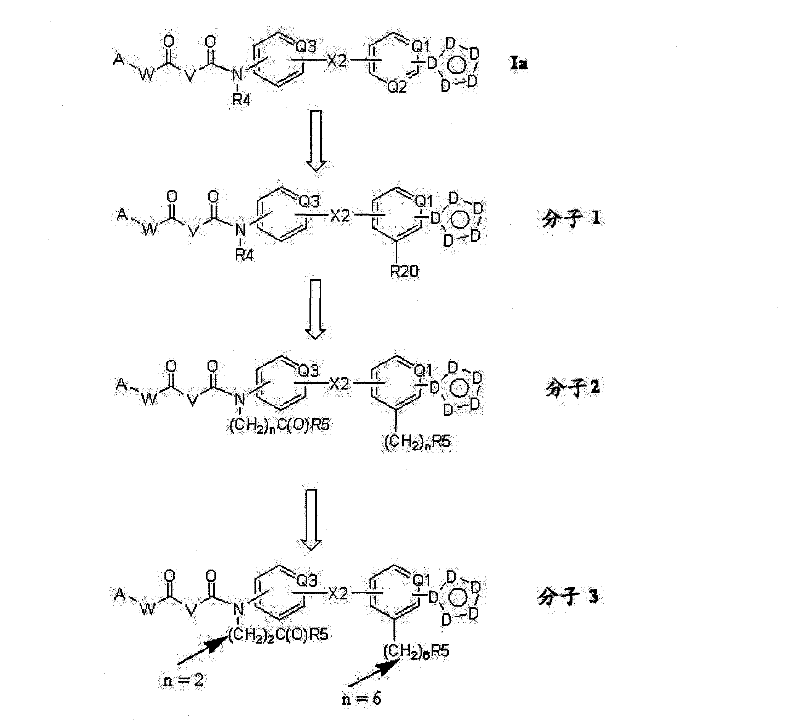
在其中特定的部分(例如R4)在一个分子中多于1个的位置处使用的情况下,各个R4的例子可以根据R4的定义而分别且独立地变化。如以下所示,同类分子Ia可以详细说明为“分子4”,其具有两个R4的例子,而各R4可以是不同的(R4=H & R4=CH3),如“分子5”所示。In the case where a specific moiety (for example, R4) is used at more than one position in one molecule, examples of each R4 can be changed separately and independently according to the definition of R4. As shown below, the homogeneous molecule Ia can be specified as "Molecule 4", which has two instances of R4, while each R4 can be different (R4=H & R4= CH3 ), as shown in "Molecule 5" .
1.1.1式Ia所示的化合物,其举例说明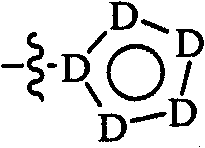
其中符号表示与包含环的杂芳基Q1和Q2的连接点。where the symbols indicate the points of attachment to the ring-containing heteroaryl groups Q1 and Q2.
1.1.2式1.1.1所示的化合物,其举例说明Q1-Q3部分:1.1.2 Compounds of formula 1.1.1, which illustrate parts Q1-Q3:
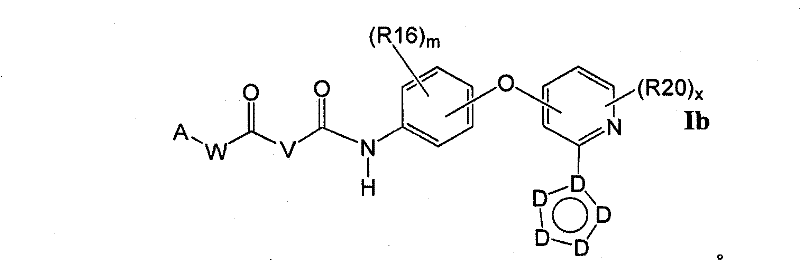
1.1.3具有式Ic的1.1.2的化合物:1.1.3 Compounds of 1.1.2 having formula Ic:

1.1.4具有式Id的1.1.2的化合物:1.1.4 Compounds of 1.1.2 having the formula Id:

1.1.5具有式Ie的1.1.2的化合物:1.1.5 Compounds of 1.1.2 having formula Ie:
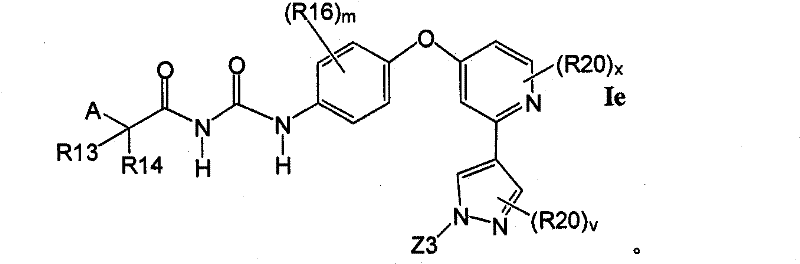
1.2式1.1.1所示的化合物,其举例说明Q1-Q3部分:1.2 Compounds of formula 1.1.1, which illustrate parts Q1-Q3:

1.2.1具有式Ig的1.2的化合物:1.2.1 Compounds of 1.2 having formula Ig:

1.2.2具有式Ih的1.2的化合物:1.2.2 Compounds of 1.2 having formula Ih:

1.2.3具有式Ii的1.2的化合物:1.2.3 Compounds of 1.2 having formula Ii:
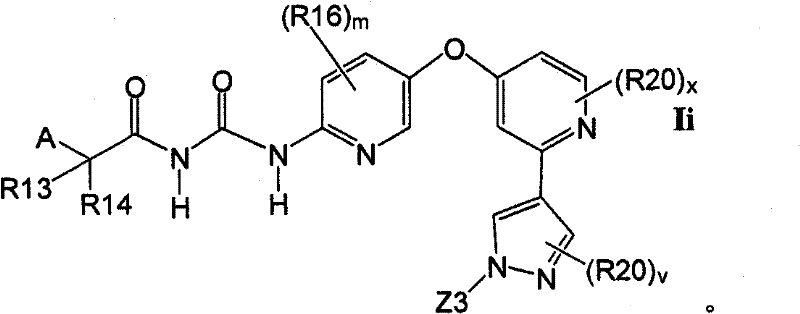
1.3式1.1.1所示的化合物,其举例说明Q1-Q3部分:1.3 Compounds of formula 1.1.1, which illustrate parts Q1-Q3:

1.3.1具有式Ik的1.3的化合物:1.3.1 Compounds of 1.3 having formula Ik:
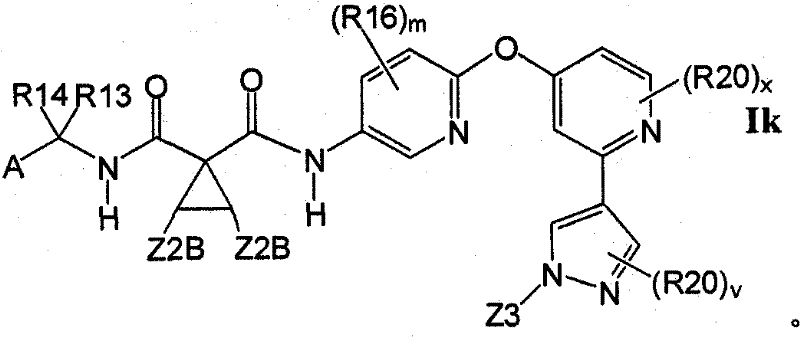
1.3.2具有式Il的1.3的化合物:1.3.2 Compounds of 1.3 having formula II:
1.3.3具有式Im的1.3的化合物:1.3.3 Compounds of 1.3 having the formula Im:

1.4式1.1.1所示的化合物,其举例说明Q1-Q3部分:1.4 Compounds of formula 1.1.1, which illustrate parts Q1-Q3:
1.4.1具有式Io的1.4的化合物:1.4.1 Compounds of 1.4 having formula Io:
1.4.2具有式Ip的1.4的化合物:1.4.2 Compounds of 1.4 having the formula Ip:

1.4.3具有式Iq的1.4的化合物:1.4.3 Compounds of 1.4 having formula Iq:

1.5式1.1.1所示的化合物,其举例说明Q1-Q3部分:1.5 Compounds of Formula 1.1.1, which illustrate parts Q1-Q3:
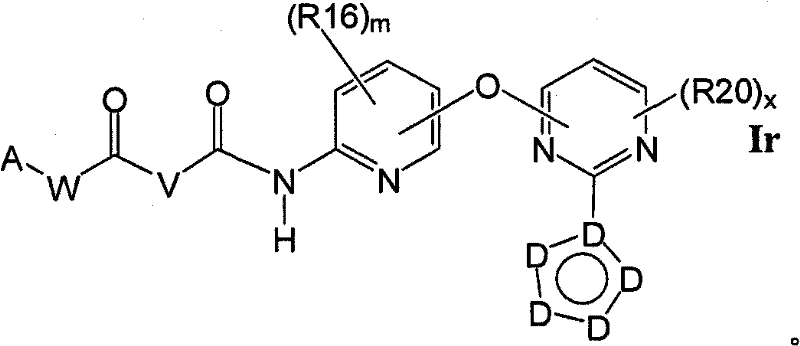
1.5.1具有式Is的1.5的化合物:1.5.1 Compounds of 1.5 having formula Is:
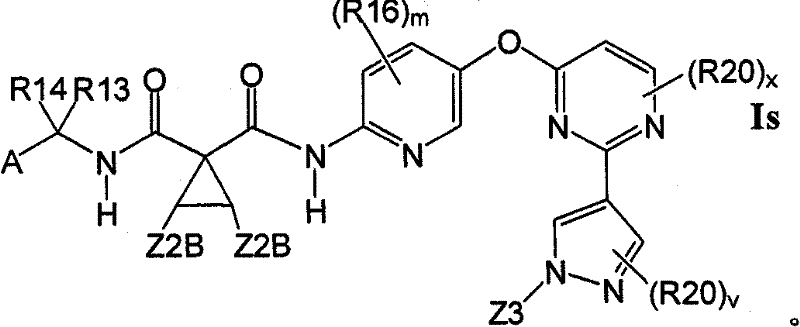
1.5.2具有式It的1.5的化合物:1.5.2 Compounds of 1.5 having the formula It:

1.5.3具有式Iu的1.5的化合物:1.5.3 Compounds of 1.5 having formula Iu:
1.6式1.1.1所示的化合物,其举例说明Q1-Q3部分:1.6 Compounds of formula 1.1.1, which illustrate parts Q1-Q3:

1.6.1具有式Iw的1.6的化合物:1.6.1 Compounds of 1.6 having formula Iw:

1.6.2具有式Ix的1.6的化合物:1.6.2 Compounds of 1.6 having formula Ix:

1.6.3具有式Iy的1.6的化合物:1.6.3 Compounds of 1.6 having formula Iy:
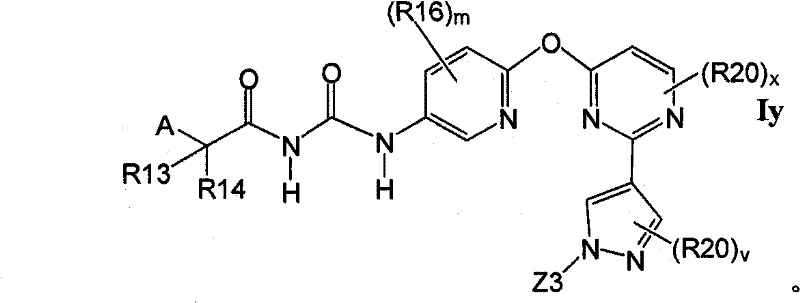
1.7式1.1.1所示的化合物,其举例说明Q1-Q3部分:1.7 Compounds of formula 1.1.1, which illustrate parts Q1-Q3:
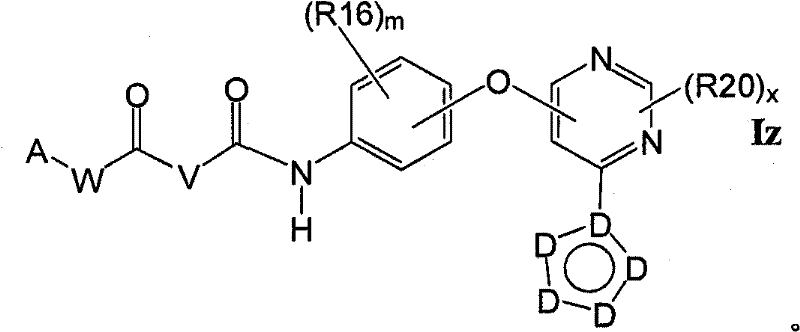
1.7.1具有式Iaa的1.7的化合物:1.7.1 Compounds of 1.7 having formula Iaa:
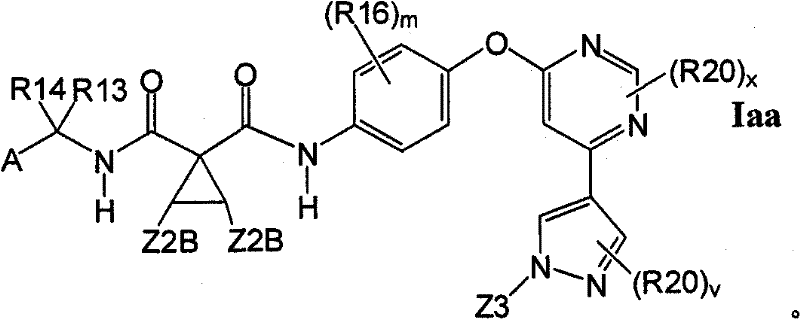
1.7.2具有式Ibb的1.7的化合物:1.7.2 Compounds of 1.7 having the formula Ibb:

1.7.3具有式Icc的1.7的化合物:1.7.3 Compounds of 1.7 having the formula Icc:

1.8式1.1.1所示的化合物,其举例说明Q1-Q3部分:1.8 Compounds of formula 1.1.1, which illustrate parts Q1-Q3:
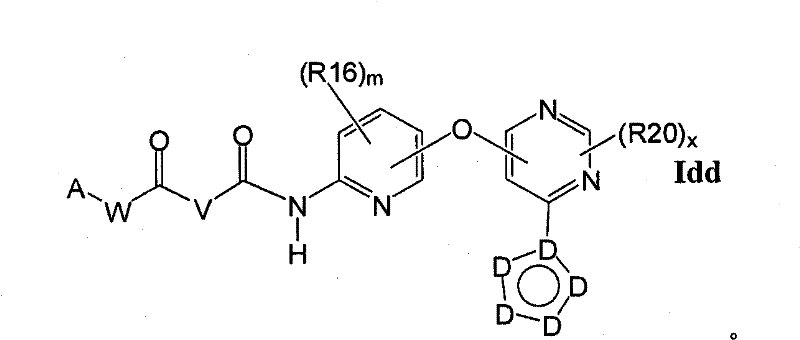
1.8.1具有式Iee的1.8的化合物:1.8.1 Compounds of 1.8 having the formula lee:

1.8.2具有式Iff的1.8的化合物:1.8.2 Compounds of 1.8 having the formula If:
1.8.3具有式Igg的1.8的化合物:1.8.3 Compounds of 1.8 having the formula IgG:
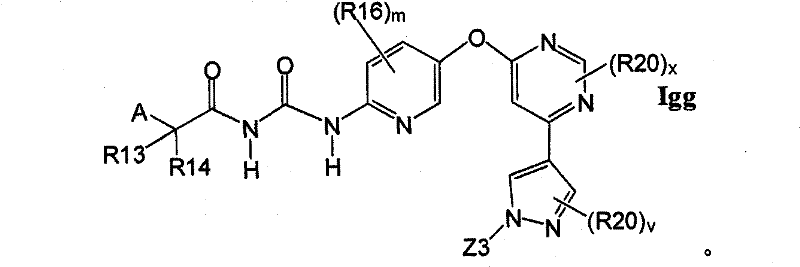
1.9式1.1.1所示的化合物,其举例说明Q1-Q3部分:1.9 Compounds of formula 1.1.1, which illustrate parts Q1-Q3:
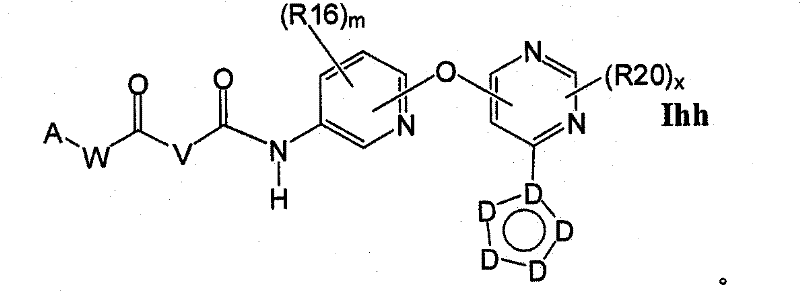
1.9.1具有式Iii的1.9的化合物:1.9.1 Compounds of 1.9 having formula Iii:

1.9.2具有式Ijj的1.9的化合物:1.9.2 Compounds of 1.9 having the formula Ijj:

1.9.3具有式Ikk的1.9的化合物:1.9.3 Compounds of 1.9 having the formula Ikk:
1.10式Ia的示意性化合物1.10 Schematic Compounds of Formula Ia
式Ia所示的示意性化合物包括但不限于N-(2,3-二氟代-4-(2-(1-甲基-1H-吡唑-4-基)吡啶-4-基氧基)苯基)-N′-(4-氟代苯基)环丙烷-1,1-二甲酰胺,N-(3-氟代-4-(2-(1-甲基-1H-吡唑-4-基)吡啶-4-基氧基)苯基)-N′-(4-氟代苯基)环丙烷-1,1-二甲酰胺,N-苄基-N′-(2,3-二氟代-4-(2-(1-甲基-1H-吡唑-4-基)吡啶-4-基氧基)苯基)环丙烷-1,1-二甲酰胺,N-苄基-N′-(3-氟代-4-(2-(1-甲基-1H-吡唑-4-基)吡啶-4-基氧基)苯基)环丙烷-1,1-二甲酰胺,N-(3-氟代-4-(2-(1-甲基-1H-吡唑-4-基)吡啶-4-基氧基)苯基)-N′-苯基环丙烷-1,1-二甲酰胺,N-(3-氟代-4-(2-(1-甲基-1H-吡唑-4-基)吡啶-4-基氧基)苯基)-N′-(3-(三氟代甲基)苯基)环丙烷-1,1-二甲酰胺,N-(2-氟代-4-(2-(1-甲基-1H-吡唑-4-基)吡啶-4-基氧基)苯基)-N′-(4-氟代苯基)环丙烷-1,1-二甲酰胺,N-(3-氟代-4-(2-(1-甲基-1H-吡唑-4-基)吡啶-4-基氧基)苯基)-N′-(4-甲氧基苯基)环丙烷-1,1-二甲酰胺,N-(3-氟代-4-(2-(1-甲基-1H-吡唑-4-基)吡啶-4-基氧基)苯基)-N′-(3-甲氧基苯基)环丙烷-1,1-二甲酰胺,N-(3-氟代-4-(2-(1-甲基-1H-吡唑-4-基)吡啶-4-基氧基)苯基)-N′-(3-氟代苯基)环丙烷-1,1-二甲酰胺,N-(4-氟代苯基)-N′-(3-甲基-4-(2-(1-甲基-1H-吡唑-4-基)吡啶-4-基氧基)苯基)环丙烷-1,1-二甲酰胺,1-(3-氟代-4-(2-(1-甲基-1H-吡唑-4-基)吡啶-4-基氧基)苯基)-3-(2-(4-氟代苯基)乙酰基)脲,N-(3-氟代-4-(2-(1-甲基-1H-吡唑-4-基)吡啶-4-基氧基)苯基)-N′-(吡啶-4-基)环丙烷-1,1-二甲酰胺,N-(3-氟代-4-(2-(1-甲基-1H-吡唑-4-基)吡啶-4-基氧基)苯基)-N′-(吡啶-3-基)环丙烷-1,1-二甲酰胺,N-(3-氯苄基)-N′-(3-氟代-4-(2-(1-甲基-1H-吡唑-4-基)吡啶-4-基氧基)苯基)环丙烷-1,1-二甲酰胺,N-(3-氟代-4-(2-(1-甲基-1H-吡唑-4-基)吡啶-4-基氧基)苯基)-N′-((S)-1-苯基乙基)环丙烷-1,1-二甲酰胺,N-(3-氟代-4-(2-(1-甲基-1H-吡唑-4-基)吡啶-4-基氧基)苯基)-N′-((R)-1-苯基乙基)环丙烷-1,1-二甲酰胺,N-(4-氟代苄基)-N′-(3-氟代-4-(2-(1-甲基-1H-吡唑-4-基)吡啶-4-基氧基)苯基)环丙烷-1,1-二甲酰胺,N-(4-(2-(1-乙基-1H-吡唑-4-基)吡啶-4-基氧基)-3-氟代苯基)-N′-(4-氟代苯基)环丙烷-1,1-二甲酰胺,N-(3-氟代-4-(2-(1-丙基-1H-吡唑-4-基)吡啶-4-基氧基)苯基)-N′-(4-氟代苯基)环丙烷-1,1-二甲酰胺,N-(3-氟代-4-(2-(1-(2-羟基乙基)-1H-吡唑-4-基)吡啶-4-基氧基)苯基)-N′-(4-氟代苯基)环丙烷-1,1-二甲酰胺,N-(4-氯苯基)-N′-(2-氟代-4-(2-(1-甲基-1H-吡唑-4-基)吡啶-4-基氧基)苯基)环丙烷-1,1-二甲酰胺,N-(2-氟代-4-(2-(1-甲基-1H-吡唑-4-基)吡啶-4-基氧基)苯基)-N′-p-甲苯基环丙烷-1,1-二甲酰胺,N-(3,4-二氟代苯基)-N′-(2-氟代-4-(2-(1-甲基-1H-吡唑-4-基)吡啶-4-基氧基)苯基)环丙烷-1,1-二甲酰胺,N-(2-氟代-4-(2-(1-甲基-1H-吡唑-4-基)吡啶-4-基氧基)苯基)-N′-(4-(三氟代甲基)苯基)环丙烷-1,1-二甲酰胺,N-(3-氰基-4-氟代苯基)-N′-(2-氟代-4-(2-(1-甲基-1H-吡唑-4-基)吡啶-4-基氧基)苯基)环丙烷-1,1-二甲酰胺,N-(2,4-二氟代苯基)-N′(2-氟代-4-(2-(1-甲基-1H-吡唑-4-基)吡啶-4-基氧基)苯基)环丙烷-1,1-二甲酰胺,N-(4-氰基苯基)-N′-(2-氟代-4-(2-(1-甲基-1H-吡唑-4-基)吡啶-4-基氧基)苯基)环丙烷-1,1-二甲酰胺,N-(2-氯-4-氟代苯基)-N′-(2-氟代-4-(2-(1-甲基-1H-吡唑-4-基)吡啶-4-基氧基)苯基)环丙烷-1,1-二甲酰胺,N-(3-氯-4-(2-(1-甲基-1H-吡唑-4-基)吡啶-4-基氧基)苯基)-N′-(4-氟代苯基)环丙烷-1,1-二甲酰胺,N-(4-(2-(1H-吡唑-4-基)吡啶-4-基氧基)-3-氟代苯基)-N′-(4-氟代苯基)环丙烷-1,1-二甲酰胺,N-(2-氟代-3-甲基-4-(2-(1-甲基-1H-吡唑-4-基)吡啶-4-基氧基)苯基)-N′-(4-氟代苯基)环丙烷-1,1-二甲酰胺,N-(3-氟代-4-(2-(1-甲基-1H-吡唑-4-基)吡啶-4-基氧基)苯基)-N′-((S)-1-(4-氟代苯基)乙基)环丙烷-1,1-二甲酰胺氢氯化物,N-(3-氟代-4-(2-(1-甲基-1H-吡唑-4-基)吡啶-4-基氧基)苯基)-N′-((S)-1-(4-氟代苯基)丙基)环丙烷-1,1-二甲酰胺氢氯化物,N-(2-氟代-4-(2-(1-甲基-1H-吡唑-4-基)吡啶-4-基氧基)苯基)-N′-(噻吩-2-基)环丙烷-1,1-二甲酰胺,N-(3-氟代-4-(2-(1-甲基-1H-吡唑-4-基)吡啶-4-基氧基)苯基)-N′-((R)-1-(4-氟代苯基)-2-甲氧基乙基)环丙烷-1,1-二甲酰胺,N-(4-氟代苯基)-N-(4-(2-(4-(三氟代甲基)-1H-咪唑-2-基)吡啶-4-基氧基)苯基)环丙烷-1,1-二甲酰胺,N-(4-氟代苯基)-N′-(6-(2-(1-甲基-1H-吡唑-4-基)吡啶-4-基氧基)吡啶-3-基)环丙烷-1,1-二甲酰胺,2-(4-氟代苯基)-N-(4-(2-(4-(三氟代甲基)-1H-咪唑-2-基)吡啶-4-基氧基)苯基氨基甲酰)乙酰胺,N-(2,5-二氟代-4-(2-(1-甲基-1H-吡唑-4-基)吡啶-4-基氧基)苯基)-N′-(4-氟代苯基)环丙烷-1,1-二甲酰胺,N-(4-氟代苯基)-N′-(5-(2-(1-甲基-1H-吡唑-4-基)吡啶-4-基氧基)吡啶-2-基)环丙烷-1,1-二甲酰胺,N-(2,5-二氟代-4-(2-(1-甲基-1H-吡唑-4-基)吡啶-4-基氧基)苯基氨基甲酰)-2-(4-氟代苯基)乙酰胺,N-(2,3-二氟代-4-(2-(1-甲基-1H-吡唑-4-基)吡啶-4-基氧基)苯基氨基甲酰)-2-(4-氟代苯基)乙酰胺,2-(4-氟代苯基)-N-(5-(2-(1-甲基-1H-吡唑-4-基)吡啶-4-基氧基)吡啶-2-基氨基甲酰)乙酰胺,N-(2,5-二氟代-4-(2-(1-甲基-1H-吡唑-4-基)吡啶-4-基氧基)苯基)-N-苯基环丙烷-1,1-二甲酰胺,N-(5-氯-2-氟代-4-(2-(1-甲基-1H-吡唑-4-基)吡啶-4-基氧基)苯基氨基甲酰)-2-(4-氟代苯基)乙酰胺,N-(5-氯-2-氟代-4-(2-(1-甲基-1H-吡唑-4-基)吡啶-4-基氧基)苯基)-N-(4-氟代苯基)环丙烷-1,1-二甲酰胺,N-(3,5-二氟代-4-(2-(1-甲基-1H-吡唑-4-基)吡啶-4-基氧基)苯基氨基甲酰)-2-(4-氟代苯基)乙酰胺,N-(4-(2-(1,3-二甲基-1H-吡唑-4-基)吡啶-4-基氧基)-2,5-二氟代苯基)-N-(4-氟代苯基)环丙烷-1,1-二甲酰胺,N-(4-氟代苯基)-N-(4-(2-(4-(三氟代甲基)-1H-咪唑-2-基)吡啶-4-基氧基)苯基)环丙烷-1,1-二甲酰胺,N-(2-氟代-5-甲基-4-(2-(1-甲基-1H-吡唑-4-基)吡啶-4-基氧基)苯基)-N’-(4-氟代苯基)环丙烷-1,1-二甲酰胺,N-(2-氟代-4-甲基-5-(4-(1-甲基-1H-吡唑-4-基)嘧啶-2-基氧基)苯基)N′-(4-氟代苯基)环丙烷-1,1-二甲酰胺,N-(2-氟代-5-(4-(1-甲基-1H-吡唑-4-基)嘧啶-2-基氧基)苯基)-N′-(4-氟代苯基)环丙烷-1,1-二甲酰胺,N-(5-(4-(1H-吡唑-4-基)嘧啶-2-基氧基)-2-氟代-4-甲基苯基)-N-(4-氟代苯基)环丙烷-1,1-二甲酰胺,N-(5-(4-(1H-吡唑-4-基)嘧啶-2-基氧基)-2-氟代苯基)-N-(4-氟代苯基)环丙烷-1,1-二甲酰胺,2-(4-氟代苯基)-N-(4-甲基-5-(2-(1-甲基-1H-吡唑-4-基)吡啶-4-基氧基)吡啶-2-基氨基甲酰)乙酰胺,N-(2,5-二氟代-4-(3-(1-甲基-1H-吡唑-4-基)吡啶-4-基氧基)苯基)-N′-(4-氟代苯基)环丙烷-1,1-二甲酰胺,N-(3-氟代-4-(2-(1-甲基-1H-吡唑-4-基)吡啶-4-基氧基)苯基)-N-(4-氟代苯基)-N-甲基环丙烷-1,1-二甲酰胺,N-(2-氟代-4-(2-(3-甲基异噁唑-5-基)吡啶-4-基氧基)苯基)-N′-(4-氟代苯基)环丙烷-1,1-二甲酰胺和N-(4-(2-(1H-1,2,3-三唑-4-基)吡啶-4-基氧基)-2-氟代苯基)-N′-(4-氟代苯基)环丙烷-1,1-二甲酰胺。Exemplary compounds shown in Formula Ia include, but are not limited to, N-(2,3-difluoro-4-(2-(1-methyl-1H-pyrazol-4-yl)pyridin-4-yloxy )Phenyl)-N'-(4-fluorophenyl)cyclopropane-1,1-dicarboxamide, N-(3-fluoro-4-(2-(1-methyl-1H-pyrazole -4-yl)pyridin-4-yloxy)phenyl)-N'-(4-fluorophenyl)cyclopropane-1,1-dicarboxamide, N-benzyl-N'-(2, 3-Difluoro-4-(2-(1-methyl-1H-pyrazol-4-yl)pyridin-4-yloxy)phenyl)cyclopropane-1,1-dicarboxamide, N- Benzyl-N'-(3-fluoro-4-(2-(1-methyl-1H-pyrazol-4-yl)pyridin-4-yloxy)phenyl)cyclopropane-1,1- Dicarboxamide, N-(3-fluoro-4-(2-(1-methyl-1H-pyrazol-4-yl)pyridin-4-yloxy)phenyl)-N'-phenyl ring Propane-1,1-dicarboxamide, N-(3-fluoro-4-(2-(1-methyl-1H-pyrazol-4-yl)pyridin-4-yloxy)phenyl)- N'-(3-(trifluoromethyl)phenyl)cyclopropane-1,1-dicarboxamide, N-(2-fluoro-4-(2-(1-methyl-1H-pyrazole -4-yl)pyridin-4-yloxy)phenyl)-N'-(4-fluorophenyl)cyclopropane-1,1-dicarboxamide, N-(3-fluoro-4-( 2-(1-Methyl-1H-pyrazol-4-yl)pyridin-4-yloxy)phenyl)-N'-(4-methoxyphenyl)cyclopropane-1,1-dimethyl Amide, N-(3-fluoro-4-(2-(1-methyl-1H-pyrazol-4-yl)pyridin-4-yloxy)phenyl)-N'-(3-methoxy ylphenyl)cyclopropane-1,1-dicarboxamide, N-(3-fluoro-4-(2-(1-methyl-1H-pyrazol-4-yl)pyridin-4-yloxy )Phenyl)-N'-(3-fluorophenyl)cyclopropane-1,1-dicarboxamide, N-(4-fluorophenyl)-N'-(3-methyl-4-( 2-(1-methyl-1H-pyrazol-4-yl)pyridin-4-yloxy)phenyl)cyclopropane-1,1-dicarboxamide, 1-(3-fluoro-4-( 2-(1-methyl-1H-pyrazol-4-yl)pyridin-4-yloxy)phenyl)-3-(2-(4-fluorophenyl)acetyl)urea, N-( 3-fluoro-4-(2-(1-methyl-1H-pyrazol-4-yl)pyridin-4-yloxy)phenyl)-N'-(pyridin-4-yl)cyclopropane- 1,1-dicarboxamide, N-(3-fluoro-4-(2-(1-methyl-1H-pyrazol-4-yl)pyridin-4-yloxy)phenyl)-N' -(pyridin-3-yl)cyclopropane-1,1-dicarboxamide, N-(3-chlorobenzyl)-N'-(3-fluoro-4-(2-(1-methyl-1H -pyrazol-4-yl)pyridin-4-yloxy)phenyl)cyclopropane-1,1-dicarboxamide, N-( 3-fluoro-4-(2-(1-methyl-1H-pyrazol-4-yl)pyridin-4-yloxy)phenyl)-N'-((S)-1-phenylethyl Base) cyclopropane-1,1-dicarboxamide, N-(3-fluoro-4-(2-(1-methyl-1H-pyrazol-4-yl)pyridin-4-yloxy)benzene Base)-N'-((R)-1-phenylethyl)cyclopropane-1,1-dicarboxamide, N-(4-fluorobenzyl)-N'-(3-fluoro-4 -(2-(1-methyl-1H-pyrazol-4-yl)pyridin-4-yloxy)phenyl)cyclopropane-1,1-dicarboxamide, N-(4-(2-( 1-Ethyl-1H-pyrazol-4-yl)pyridin-4-yloxy)-3-fluorophenyl)-N'-(4-fluorophenyl)cyclopropane-1,1-di Formamide, N-(3-fluoro-4-(2-(1-propyl-1H-pyrazol-4-yl)pyridin-4-yloxy)phenyl)-N'-(4-fluoro Phenyl)cyclopropane-1,1-dicarboxamide, N-(3-fluoro-4-(2-(1-(2-hydroxyethyl)-1H-pyrazol-4-yl)pyridine- 4-yloxy)phenyl)-N'-(4-fluorophenyl)cyclopropane-1,1-dicarboxamide, N-(4-chlorophenyl)-N'-(2-fluoro -4-(2-(1-methyl-1H-pyrazol-4-yl)pyridin-4-yloxy)phenyl)cyclopropane-1,1-dicarboxamide, N-(2-fluoro -4-(2-(1-methyl-1H-pyrazol-4-yl)pyridin-4-yloxy)phenyl)-N'-p-tolylcyclopropane-1,1-dicarboxamide , N-(3,4-difluorophenyl)-N'-(2-fluoro-4-(2-(1-methyl-1H-pyrazol-4-yl)pyridin-4-yloxy Base) phenyl) cyclopropane-1,1-dicarboxamide, N-(2-fluoro-4-(2-(1-methyl-1H-pyrazol-4-yl)pyridin-4-yloxy Base) phenyl) -N'-(4-(trifluoromethyl)phenyl)cyclopropane-1,1-dicarboxamide, N-(3-cyano-4-fluorophenyl)-N '-(2-fluoro-4-(2-(1-methyl-1H-pyrazol-4-yl)pyridin-4-yloxy)phenyl)cyclopropane-1,1-dicarboxamide, N-(2,4-difluorophenyl)-N'(2-fluoro-4-(2-(1-methyl-1H-pyrazol-4-yl)pyridin-4-yloxy) Phenyl)cyclopropane-1,1-dicarboxamide, N-(4-cyanophenyl)-N'-(2-fluoro-4-(2-(1-methyl-1H-pyrazole- 4-yl)pyridin-4-yloxy)phenyl)cyclopropane-1,1-dicarboxamide, N-(2-chloro-4-fluorophenyl)-N'-(2-fluoro- 4-(2-(1-Methyl-1H-pyrazol-4-yl)pyridin-4-yloxy)phenyl)cyclopropane-1,1-dicarboxamide, N-(3-chloro-4 -(2-(1-Methyl-1H-pyrazol-4-yl)pyridin-4-yloxy)phenyl)-N'-(4-fluorobenzene Base) cyclopropane-1,1-dicarboxamide, N-(4-(2-(1H-pyrazol-4-yl)pyridin-4-yloxy)-3-fluorophenyl)-N' -(4-fluorophenyl)cyclopropane-1,1-dicarboxamide, N-(2-fluoro-3-methyl-4-(2-(1-methyl-1H-pyrazole-4 -yl)pyridin-4-yloxy)phenyl)-N'-(4-fluorophenyl)cyclopropane-1,1-dicarboxamide, N-(3-fluoro-4-(2- (1-Methyl-1H-pyrazol-4-yl)pyridin-4-yloxy)phenyl)-N'-((S)-1-(4-fluorophenyl)ethyl)cyclopropane -1,1-dicarboxamide hydrochloride, N-(3-fluoro-4-(2-(1-methyl-1H-pyrazol-4-yl)pyridin-4-yloxy)phenyl )-N'-((S)-1-(4-fluorophenyl)propyl)cyclopropane-1,1-dicarboxamide hydrochloride, N-(2-fluoro-4-(2- (1-Methyl-1H-pyrazol-4-yl)pyridin-4-yloxy)phenyl)-N'-(thiophen-2-yl)cyclopropane-1,1-dicarboxamide, N- (3-fluoro-4-(2-(1-methyl-1H-pyrazol-4-yl)pyridin-4-yloxy)phenyl)-N'-((R)-1-(4 -fluorophenyl)-2-methoxyethyl)cyclopropane-1,1-dicarboxamide, N-(4-fluorophenyl)-N-(4-(2-(4-(tri Fluoromethyl)-1H-imidazol-2-yl)pyridin-4-yloxy)phenyl)cyclopropane-1,1-dicarboxamide, N-(4-fluorophenyl)-N'- (6-(2-(1-methyl-1H-pyrazol-4-yl)pyridin-4-yloxy)pyridin-3-yl)cyclopropane-1,1-dicarboxamide, 2-(4 -Fluorophenyl)-N-(4-(2-(4-(trifluoromethyl)-1H-imidazol-2-yl)pyridin-4-yloxy)phenylcarbamoyl)acetamide , N-(2,5-difluoro-4-(2-(1-methyl-1H-pyrazol-4-yl)pyridin-4-yloxy)phenyl)-N'-(4- Fluorophenyl)cyclopropane-1,1-dicarboxamide, N-(4-fluorophenyl)-N'-(5-(2-(1-methyl-1H-pyrazol-4-yl ) pyridin-4-yloxy) pyridin-2-yl) cyclopropane-1,1-dicarboxamide, N-(2,5-difluoro-4-(2-(1-methyl-1H- Pyrazol-4-yl)pyridin-4-yloxy)phenylcarbamoyl)-2-(4-fluorophenyl)acetamide, N-(2,3-difluoro-4-(2 -(1-methyl-1H-pyrazol-4-yl)pyridin-4-yloxy)phenylcarbamoyl)-2-(4-fluorophenyl)acetamide, 2-(4-fluoro Substituted phenyl)-N-(5-(2-(1-methyl-1H-pyrazol-4-yl)pyridin-4-yloxy)pyridin-2-ylcarbamoyl)acetamide, N- (2,5-difluoro-4-(2-(1-methyl-1H-pyrazol-4-yl)pyridine-4 -yloxy)phenyl)-N-phenylcyclopropane-1,1-dicarboxamide, N-(5-chloro-2-fluoro-4-(2-(1-methyl-1H-pyridine Azol-4-yl)pyridin-4-yloxy)phenylcarbamoyl)-2-(4-fluorophenyl)acetamide, N-(5-chloro-2-fluoro-4-(2 -(1-methyl-1H-pyrazol-4-yl)pyridin-4-yloxy)phenyl)-N-(4-fluorophenyl)cyclopropane-1,1-dicarboxamide, N -(3,5-difluoro-4-(2-(1-methyl-1H-pyrazol-4-yl)pyridin-4-yloxy)phenylcarbamoyl)-2-(4- Fluorophenyl)acetamide, N-(4-(2-(1,3-dimethyl-1H-pyrazol-4-yl)pyridin-4-yloxy)-2,5-difluoro Phenyl)-N-(4-fluorophenyl)cyclopropane-1,1-dicarboxamide, N-(4-fluorophenyl)-N-(4-(2-(4-(trifluoro Substituted methyl)-1H-imidazol-2-yl)pyridin-4-yloxy)phenyl)cyclopropane-1,1-dicarboxamide, N-(2-fluoro-5-methyl-4- (2-(1-Methyl-1H-pyrazol-4-yl)pyridin-4-yloxy)phenyl)-N'-(4-fluorophenyl)cyclopropane-1,1-dimethyl Amide, N-(2-fluoro-4-methyl-5-(4-(1-methyl-1H-pyrazol-4-yl)pyrimidin-2-yloxy)phenyl)N'-( 4-fluorophenyl)cyclopropane-1,1-dicarboxamide, N-(2-fluoro-5-(4-(1-methyl-1H-pyrazol-4-yl)pyrimidine-2- Oxy)phenyl)-N'-(4-fluorophenyl)cyclopropane-1,1-dicarboxamide, N-(5-(4-(1H-pyrazol-4-yl)pyrimidine- 2-yloxy)-2-fluoro-4-methylphenyl)-N-(4-fluorophenyl)cyclopropane-1,1-dicarboxamide, N-(5-(4-( 1H-pyrazol-4-yl)pyrimidin-2-yloxy)-2-fluorophenyl)-N-(4-fluorophenyl)cyclopropane-1,1-dicarboxamide, 2-( 4-fluorophenyl)-N-(4-methyl-5-(2-(1-methyl-1H-pyrazol-4-yl)pyridin-4-yloxy)pyridin-2-ylamino Formyl)acetamide, N-(2,5-difluoro-4-(3-(1-methyl-1H-pyrazol-4-yl)pyridin-4-yloxy)phenyl)-N '-(4-fluorophenyl)cyclopropane-1,1-dicarboxamide, N-(3-fluoro-4-(2-(1-methyl-1H-pyrazol-4-yl)pyridine -4-yloxy)phenyl)-N-(4-fluorophenyl)-N-methylcyclopropane-1,1-dicarboxamide, N-(2-fluoro-4-(2- (3-methylisoxazol-5-yl)pyridin-4-yloxy)phenyl)-N'-(4-fluorophenyl)cyclopropane-1,1-dicarboxamide and N-( 4-(2-(1H-1,2,3-triazol-4-yl)pyridin-4-yloxy)-2-fluorophenyl)-N '-(4-fluorophenyl)cyclopropane-1,1-dicarboxamide.
1.11方法1.11 method
1.11a蛋白质调控方法1.11a Protein Regulation Methods
本发明包括调控多种激酶的激酶活性的方法,所述激酶例如为VEGFR-2(KDR)激酶,c-MET激酶,FLT-3激酶,c-KIT激酶,PDGFR-α激酶,PDGFR-β激酶和c-FMS激酶。所述激酶可以为野生型激酶、其致癌形式、其异常融合蛋白质或之前所述的任一种激酶的多形形式。所述的方法包括将所述的激酶种类与本发明的化合物、特别是在部分1中所列出的那些相接触的步骤。所述的激酶种类可以是活化的或未活化的,并且该激酶种类可以通过磷酸化、硫化、脂肪酸酰化、糖基化、硝基化、cystinylation(即,在所述的激酶中最接近的半胱氨酸残基彼此发生反应,从而形成二硫键)或氧化来调控。所述激酶的活性可以选自催化磷转移反应、抑制磷酸化、通过另一种酶使所述的激酶氧化或硝基化、增强脱磷酸作用、通过另一种酶使所述的激酶还原或脱硝基作用、激酶细胞定位以及通过调控激酶的构造而将其他蛋白质募集到信号传递络合物中。The present invention includes methods of modulating the kinase activity of various kinases such as VEGFR-2 (KDR) kinase, c-MET kinase, FLT-3 kinase, c-KIT kinase, PDGFR-alpha kinase, PDGFR-beta kinase and c-FMS kinase. The kinase may be a wild-type kinase, an oncogenic form thereof, an abnormal fusion protein thereof, or a polymorphic form of any of the previously described kinases. Said method comprises the step of contacting said kinase species with a compound of the invention, particularly those listed in Section 1. The kinase species can be activated or inactive, and the kinase species can be activated by phosphorylation, sulfation, fatty acid acylation, glycosylation, nitration, cystinylation (i.e., the closest Cysteine residues react with each other to form disulfide bonds) or oxidize to regulate. The activity of the kinase may be selected from catalyzing a phosphorous transfer reaction, inhibiting phosphorylation, oxidizing or nitrating the kinase by another enzyme, enhancing dephosphorylation, reducing the kinase by another enzyme, or Denitrification, cellular localization of kinases, and recruitment of other proteins into signaling complexes by regulating kinase conformation.
1.11b治疗方法1.11b Treatment Methods
本发明的方法还包括治疗患有以下病症的个体,其中所述的病症选自癌症、高度增殖疾病、新陈代谢疾病、神经退行性疾病或可表征为血管再生术的疾病。所述的方法包括向所述的个体给药本发明的化合物、特别是部分1中所述的那些,所述的疾病包括但不限于实体肿瘤,恶性黑素瘤,成胶质细胞瘤,卵巢癌,胰腺癌,前列腺癌,肺癌,乳腺癌,肾癌,肝癌,宫颈癌,原发性肿瘤位点的转移,骨髓增殖疾病,慢性粒细胞白血病,白血病,甲状腺乳头状癌,非小细胞肺癌,间皮瘤,高嗜酸性粒细胞综合症,胃肠基质肿瘤,结肠癌,表征为高度增殖从而导致失明的眼病(包括多种视网膜病,糖尿病性视网膜病),增龄性黄斑变性和高嗜酸性粒细胞综合症,风湿性关节炎,哮喘,慢性阻塞性肺病,肥大细胞增多症,肥大细胞白血病,PDGFR-α激酶引起的疾病,PDGFR-β激酶引起的疾病,c-KIT激酶引起的疾病,cFMS激酶引起的疾病,c-MET激酶引起的疾病以及它们的致癌性形式、异常融合蛋白质和多形形式所导致的疾病。给药方法是不重要得,并且可以通过口服、肠胃外、吸入和皮下方式给药。The methods of the invention also include treating an individual suffering from a disorder selected from cancer, a hyperproliferative disease, a metabolic disease, a neurodegenerative disease, or a disease that may be characterized by angiogenesis. The method comprises administering a compound of the invention, particularly those described in Section 1, to the subject of a disease including, but not limited to, solid tumors, malignant melanoma, glioblastoma, ovarian Carcinoma, pancreatic cancer, prostate cancer, lung cancer, breast cancer, renal cancer, liver cancer, cervical cancer, metastasis of primary tumor site, myeloproliferative disorders, chronic myelogenous leukemia, leukemia, papillary thyroid carcinoma, non-small cell lung cancer , mesothelioma, hypereosinophilic syndrome, gastrointestinal stromal tumors, colon cancer, eye diseases characterized by hyperproliferation leading to blindness (including multiple retinopathy, diabetic retinopathy), age-related macular degeneration and high Eosinophilic syndrome, rheumatoid arthritis, asthma, chronic obstructive pulmonary disease, mastocytosis, mast cell leukemia, PDGFR-α kinase-induced disease, PDGFR-β kinase-induced disease, c-KIT kinase-induced disease Diseases, diseases caused by cFMS kinases, diseases caused by c-MET kinases and diseases caused by their oncogenic forms, aberrant fusion proteins and polymorphic forms. The method of administration is not critical and can be administered orally, parenterally, by inhalation and subcutaneously.
1.1.2药物的制备1.1.2 Preparation of drugs
本发明的化合物、特别是部分1所述的那些可以通过将一种或多种所述的化合物与可药用的载体相结合来形成药物组合物的一部分。此外,所述的组合物可以包含选自助剂、赋形剂、稀释剂和稳定剂的添加剂。The compounds of the invention, particularly those described in Section 1, may form part of a pharmaceutical composition by combining one or more of the compounds described with a pharmaceutically acceptable carrier. Furthermore, the composition may contain additives selected from the group consisting of additives, excipients, diluents and stabilizers.
部分2.本发明化合物的合成Part 2. Synthesis of Compounds of the Invention
通过在以下方案和所附的实施例中示意性说明的常规的合成方法可以得到本发明的化合物。The compounds of the present invention can be obtained by conventional synthetic methods as schematically illustrated in the following schemes and accompanying examples.
在本发明的一个方面中,通式Ia所示的化合物包含氨基能“W”基团和环丙基“V”基团,并且可由通式1表示。通式1所示的化合物可以通过将通式3所示的胺、通式4(t=0-3)所示的胺以及式2所示的二羧酸环丙酯合为一体而容易地制备。如方案1所示,式1所示的化合物可以由顺序2→5→1形成,或者备选地由顺序2→6→1形成。本领域的技术人员可以认识到方案1中的反应箭头代表了单个的反应顺序或多步的反应顺序。二酸2可以通过使用本领域的技术人员已知的偶联剂以逐步的方式与胺3和4偶联。备选地,应该理解的是,在方案1中,酸2可以通过将1个或2个羧酸部分预活化成活化的酸的卤化物、酸酐、混合酸酐或活化的酯(例如五氟代苯酯或p-硝基苯酯)而与胺3或4连接。这种活化的中间体(未示出)可以或者不可以在与胺3或4反应之前分离。本领域的技术人员进一步认识到,2的羧酸部分可以掩饰为酯而进入到方案1中,并且方案1的反应顺序可以具有其他的脱保护步骤(如果需要的话),从而将5或6的酯衍生物转变为酸5或6,由此有助于第二酰胺键的形成。In one aspect of the invention, a compound of Formula Ia comprises an aminoergic "W" group and a cyclopropyl "V" group, and may be represented by Formula 1. The compound shown in the general formula 1 can be easily synthesized by combining the amine shown in the general formula 3, the amine shown in the general formula 4 (t=0-3), and the dicarboxylic acid cyclopropyl ester shown in the formula 2. preparation. As shown in Scheme 1, compounds of Formula 1 can be formed by the sequence 2→5→1, or alternatively by the sequence 2→6→1. Those skilled in the art will recognize that the reaction arrows in Scheme 1 represent a single reaction sequence or a multi-step reaction sequence. Diacid 2 can be coupled with amines 3 and 4 in a stepwise manner by using coupling agents known to those skilled in the art. Alternatively, it should be understood that in Scheme 1, acid 2 can be activated by preactivating 1 or 2 carboxylic acid moieties into activated acid halides, anhydrides, mixed anhydrides or activated esters (e.g. pentafluoro phenyl ester or p-nitrophenyl ester) to link with amine 3 or 4. This activated intermediate (not shown) may or may not be isolated prior to reaction with amine 3 or 4. Those skilled in the art further recognize that the carboxylic acid moiety of 2 can be disguised as an ester into Scheme 1, and that the reaction sequence of Scheme 1 can have additional deprotection steps (if desired) so that either 5 or 6 The ester derivative is converted to acid 5 or 6, thereby facilitating the formation of the second amide bond.

方案1plan 1
方案1的非限定性实例在方案2-4中示出。方案2示出了通过普通顺序2→5→1(方案1)的化合物11(通式1的实例,其中A为4-氟代苯基,t为0,Z2B为H,Q3为CH,Q3环被氟取代,并且包含D的环为吡唑)的制备。由此,如下文所示,1,1-环丙烷二羧酸(7,普通中间体2的实例,见上文)与胺8(普通胺3的实例)合为一体形成了胺/酸9,其为普通中间体5的实例。转化的条件包括通过在叔碱(例如三乙胺)存在下使用亚硫酰氯处理、然后与胺8反应而对二酸7进行原位活化。在肽偶联剂存在下9与胺10(普通中间体4的实例)的进一步反应得到二胺11。用于后期转化的偶联剂包括TBTU(O-(苯并三唑-1-基)-N,N,N′,N′-四甲基脲四氟代硼酸盐),PyBOP(苯并三唑-1-基氧基)三吡咯烷膦六氟代磷酸盐),EDC(1-乙基-3-(3-二甲基氨基丙基)碳二亚胺氢氯化物)和BOP-Cl(双(2-氧代-3-噁唑烷基)绿化磷)。Non-limiting examples of Scheme 1 are shown in Schemes 2-4. Scheme 2 shows compound 11 (an example of general formula 1, wherein A is 4-fluorophenyl, t is 0, Z2B is H, Q3 is CH, Q3 The ring is substituted by fluorine, and the ring containing D is the preparation of pyrazole). Thus, as shown below, 1,1-cyclopropanedicarboxylic acid (7, an example of common intermediate 2, see above) is combined with amine 8 (example of common amine 3) to form amine/acid 9 , which is an example of common intermediate 5. Conditions for transformation include in situ activation of diacid 7 by treatment with thionyl chloride in the presence of a tertiary base such as triethylamine followed by reaction with amine 8. Further reaction of 9 with amine 10 (an example of common intermediate 4) in the presence of a peptide coupling agent affords diamine 11. Coupling reagents for later transformations include TBTU (O-(benzotriazol-1-yl)-N,N,N′,N′-tetramethyluronium tetrafluoroborate), PyBOP (benzotriazol-1-yl) Triazol-1-yloxy)tripyrrolidinylphosphine hexafluorophosphate), EDC (1-ethyl-3-(3-dimethylaminopropyl)carbodiimide hydrochloride) and BOP- Cl (bis(2-oxo-3-oxazolidinyl)chlorophyllin).
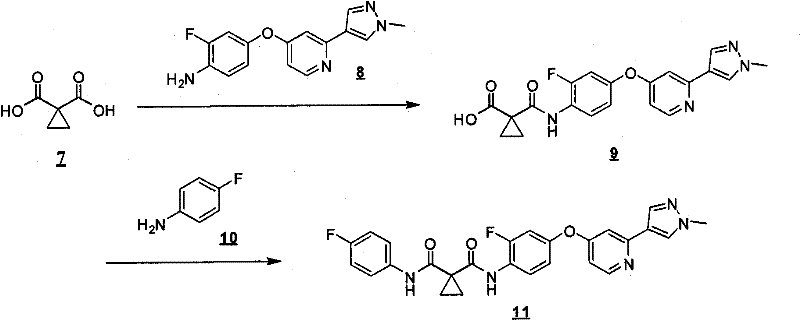
方案2Scenario 2
类似地,方案3示出了以单酯12开始的普通顺序2→5→1(方案1)的其他实例。由此,酸/酯12与胺13结合,从而得到酯/氨基化合物14。酯14与氢氧化锂的皂化反应得到羧酸锂15。使用10和肽偶联剂(例如TBTU)对15进行处理得到双酰胺16(通式1的其他实例)。Similarly, Scheme 3 shows a further example of the general sequence 2→5→1 starting with monoester 12 (Scheme 1). Thus, the acid/ester 12 combines with the amine 13 to give the ester/amino compound 14. Saponification of ester 14 with lithium hydroxide affords lithium carboxylate 15. Treatment of 15 with 10 and a peptide coupling agent such as TBTU affords bisamide 16 (another example of general formula 1).

方案3Option 3
方案4示出了作为方案1普通顺序2→6→1的非限定性实例的19的制备。由此,二酸7首先与胺10偶联,从而得到氨基化合物/酸17,其依次与胺18偶联,从而得到19。Scheme 4 shows the preparation of 19 as a non-limiting example of the general sequence 2→6→1 of Scheme 1. Thus, diacid 7 was first coupled with amine 10 to give amino compound/acid 17 which in turn was coupled with amine 18 to give 19.
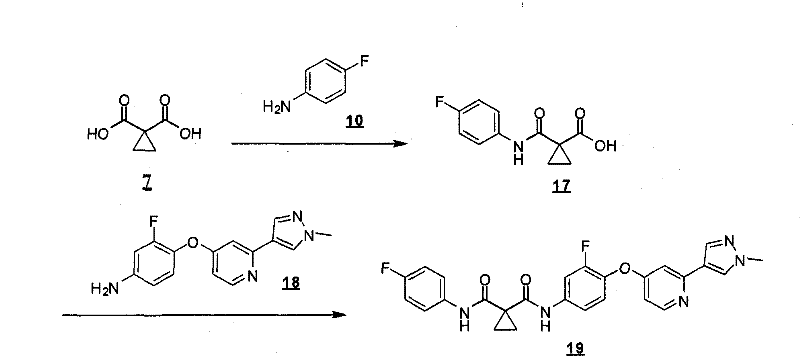
方案4Option 4
本发明的另一个方案,式Ia的“V”部分为NR4。在这些例子中,式20所示的化合物可以按照方案5所示通过通用的胺3与通用的中间体21反应;或者在所述的例子中,当R4为H时与异氰酸盐22反应而制备。In another aspect of the present invention, the "V" part of formula Ia is NR4. In these examples, the compound of formula 20 can be reacted with the generic intermediate 21 via the generic amine 3 as shown in Scheme 5; or in the example described, when R4 is H, with the isocyanate 22 while preparing.
方案5Option 5
通用的中间体21可以按照方案6所示通过23与光气或光气替代物反应(例如双光气或三光气)而得到。非市售可得的异氰酸盐22可以通过使用异氰酸银对通用的酸性卤化物24进行处理来制备。酸性卤化物24通过与本领域通用的那些相似的条件依次由相应的酸来制备。备选地,22可以通过使用草酰氯或光气(可任选地进行搅拌)进行处理由氨基化合物25来制备。The general intermediate 21 can be obtained as shown in Scheme 6 by reaction of 23 with phosgene or a phosgene surrogate such as diphosgene or triphosgene. Non-commercially available isocyanates 22 can be prepared by treating common acid halides 24 with silver isocyanate. Acid halides 24 are prepared sequentially from the corresponding acids by conditions similar to those commonly used in the art. Alternatively, 22 can be prepared from amino compound 25 by treatment with oxalyl chloride or phosgene, optionally with stirring.

方案6Option 6
方案5和6的非限定性实例可以通过方案7中29的制备来进行说明。由此,酸26(参见:Jiang,Y.,et al.,J.Med.Chem.(2007)50(16):3870)在使用溶于甲苯中的草酰氯(包含催化量的二甲基甲酰胺)进行处理时而转化为酸性氯化物27。使用异氰酸银对27进行的其他处理得到异氰酸盐28,其为普通中间体22的实例(方案6)。最后,28与胺18的反应得到N-酰基脲29,其为通式20的实例(其中A为4-氟代苯基,W为-CH(CH3)-,R4为H,Q3为CH,Q3环被氟取代,Q2为CH,Q1为N,并且含D的环为吡唑)。Non-limiting examples of Schemes 5 and 6 can be illustrated by the preparation of 29 in Scheme 7. Thus, acid 26 (cf: Jiang, Y., et al., J. Med. Chem. (2007) 50(16): 3870) was synthesized using oxalyl chloride (containing a catalytic amount of dimethyl Formamide) converts to the acidic chloride 27 upon treatment. Additional treatment of 27 with silver isocyanate affords isocyanate 28, an example of common intermediate 22 (Scheme 6). Finally, reaction of 28 with amine 18 affords N-acylurea 29, an example of general formula 20 (where A is 4-fluorophenyl, W is -CH( CH3 )-, R4 is H, Q3 is CH , Q3 ring is substituted by fluorine, Q2 is CH, Q1 is N, and the ring containing D is pyrazole).

方案7Option 7
对方案5和6的普通方法进行示意性说明的其他实例为方案8中所示的33的合成。因此,可以由4-氟代苯乙酸和氨容易地制备的4-氟代苯基乙酰胺30首先用草酰氯处理并加热,从而得到2-(4-氟代苯基)乙酰基异氰酸盐31。使用胺32对异氰酸盐31的其他处理得到了N-酰基脲33,其为普通中间体20的实例(其中A为4-氟代苯基,W为-CH2-,R4为H,Q3为N,Q2为CH,Q1为N,并且包含D的环为吡唑)。Another example schematically illustrating the general approach of Schemes 5 and 6 is the synthesis of 33 shown in Scheme 8. Thus, 4-fluorophenylacetamide 30, which can be readily prepared from 4-fluorophenylacetic acid and ammonia, is first treated with oxalyl chloride and heated to give 2-(4-fluorophenyl)acetylisocyanate salt31. Additional treatment of isocyanate 31 with amine 32 affords N-acylurea 33, an example of common intermediate 20 (wherein A is 4-fluorophenyl, W is -CH2- , R4 is H, Q3 is N, Q2 is CH, Q1 is N, and the ring containing D is pyrazole).

方案8Option 8
用于本发明的胺3可以根据本领域的技术人员公知的方法来合成。式3所示的胺的一种通用的制备方法涉及通过在Q1/Q2和Q3环之间形成C-O键的3个单环亚单元、与在Q1/Q2环和5元D环之间形成的键逐步合为一体。这些方法的变体如以下方案所示。Amine 3 used in the present invention can be synthesized according to methods known to those skilled in the art. A general preparation of amines of formula 3 involves 3 monocyclic subunits forming a C-O bond between the Q1/Q2 and Q3 rings, and a 5-membered D ring between the Q1/Q2 rings and the The keys gradually merge into one. Variations of these methods are shown in the following schemes.
方案9示出了3的一种通用的组装方式,其中3的醚氧原子的衍生自具有Q3的亚单元34的羟基部分。片段34与包含Q1/Q2的环35合为一体是通过使用碱(例如叔丁醇钾)对34进行处理、并且对片段35进行可任选的加热从而形成醚36来完成的。在方案9中,单环35的“LG”表示在亲核取代反应(具有或不具有其他活化作用)中可以直接替代的部分,例如卤化物、磺酸盐、砜或亚砜。单环35或双环36的“X”基团代表可以与5元杂环部分连接的部分。在一个方面中,“X”基团代表这样的卤素原子,该卤素原子参与了与预形成的杂环(D环)试剂(例如硼酸或酯、或者杂芳基锡烷)发生过渡金属介导的偶联,从而形成胺3。在另一个方面中,“X”基团代表被吡唑、咪唑或三唑中的氮原子替代、从而设置在D环中的离去基团。在另一个方面中,X基团代表这样的部分,通过该部分能够构建可以被转化成5元环的5元D环(吡唑、异噁唑、三唑、咪唑),例如羧酸或酯、炔或醛。Scheme 9 shows a general assembly of 3, where the ether oxygen atom of 3 is derived from the hydroxyl moiety of subunit 34 with Q3. Incorporation of fragment 34 into ring 35 comprising Q1/Q2 is accomplished by treatment of 34 with a base such as potassium tert-butoxide and optional heating of fragment 35 to form ether 36. In Scheme 9, "LG" of monocycle 35 indicates a moiety that can be directly substituted in a nucleophilic substitution reaction (with or without other activation), such as a halide, sulfonate, sulfone, or sulfoxide. The "X" group of monocycle 35 or bicycle 36 represents a moiety to which a 5-membered heterocycle moiety may be attached. In one aspect, the "X" group represents a halogen atom that participates in a transition metal-mediated reaction with a preformed heterocyclic (D ring) reagent such as a boronic acid or ester, or a heteroaryl stannane. to form amine 3. In another aspect, the "X" group represents a leaving group that is replaced by a nitrogen atom in pyrazole, imidazole, or triazole, thereby placing it in the D ring. In another aspect, the X group represents a moiety through which a 5-membered D-ring (pyrazole, isoxazole, triazole, imidazole) that can be converted into a 5-membered ring can be constructed, such as a carboxylic acid or ester , alkynes or aldehydes.

方案9Option 9
普通方案9的一些非限定性实例在以下方案中详细说明。方案10详细说明了吡唑8的制备,其为通用的胺3的实例(其中R4为H,Q3为CH,Q3环被氟取代,Q2为CH,Q1为N并且含D的环为吡唑)。在方案10中,市售可得的3-氟代-4-氨基苯酚(37)与叔丁醇钾和2,4-二氯吡啶38(其为35的实例,其中LG和X均为氯)反应,从而得到氯吡啶,其为普通中间体36的实例。用于这种转化的可行的条件为二甲基乙酰胺处于80至100℃之间。在钯催化剂(例如四(三苯基膦)合钯(0))存在下,氯吡啶39与市售可得的吡唑-4-硼酸庚二酯40随后发生反应得到吡唑胺8。Some non-limiting examples of general scheme 9 are detailed in the following schemes. Scheme 10 details the preparation of pyrazole 8, which is an example of a general amine 3 (where R4 is H, Q3 is CH, the Q3 ring is substituted with fluorine, Q2 is CH, Q1 is N and the D-containing ring is pyrazole ). In Scheme 10, commercially available 3-fluoro-4-aminophenol (37) was combined with potassium tert-butoxide and 2,4-dichloropyridine 38 (which is an example of 35, where LG and X are both chloro ) to give chloropyridines, examples of common intermediates 36. Feasible conditions for this transformation are dimethylacetamide between 80 and 100°C. Subsequent reaction of chloropyridine 39 with commercially available pyrazole-4-heptanediate 40 in the presence of a palladium catalyst such as tetrakis(triphenylphosphine)palladium(0) affords pyrazolamide 8.

方案10Scheme 10
方案11示出了采用方案9和方案10的普通方法来制备胺3的其他非限定性实例。由此,采用分别与试剂41(MilestonePharmTech)、42(Alfa)、43(参见:Nicolaou,et.al.,ChemMedChem,(2006),1(1):41)、44(Frontier Scientific)、45(参见:Sakamoto,et al.Tetrahedron,(1991),47(28):5111)发生钯催化的交叉偶联,通用的中间体36(X=卤素)可以转化为化合物45-50。适用于方案11的反应的合适的钯催化剂包括二氯双(三苯基膦)合钯,二氯[11’-双(二苯基膦)二茂铁]合钯和四(三苯基膦)合钯。Scheme 11 shows another non-limiting example of preparing amine 3 using the general method of Scheme 9 and Scheme 10. Thus, using reagents 41 (MilestonePharmTech), 42 (Alfa), 43 (see: Nicolaou, et.al., ChemMedChem, (2006), 1 (1): 41), 44 (Frontier Scientific), 45 ( See: Sakamoto, et al. Tetrahedron, (1991), 47(28):5111 ) Palladium-catalyzed cross-coupling, general intermediate 36 (X=halogen) can be converted to compounds 45-50. Suitable palladium catalysts for the reaction of Scheme 11 include dichlorobis(triphenylphosphine)palladium, dichloro[11'-bis(diphenylphosphino)ferrocene]palladium and tetrakis(triphenylphosphine)palladium ) and palladium.
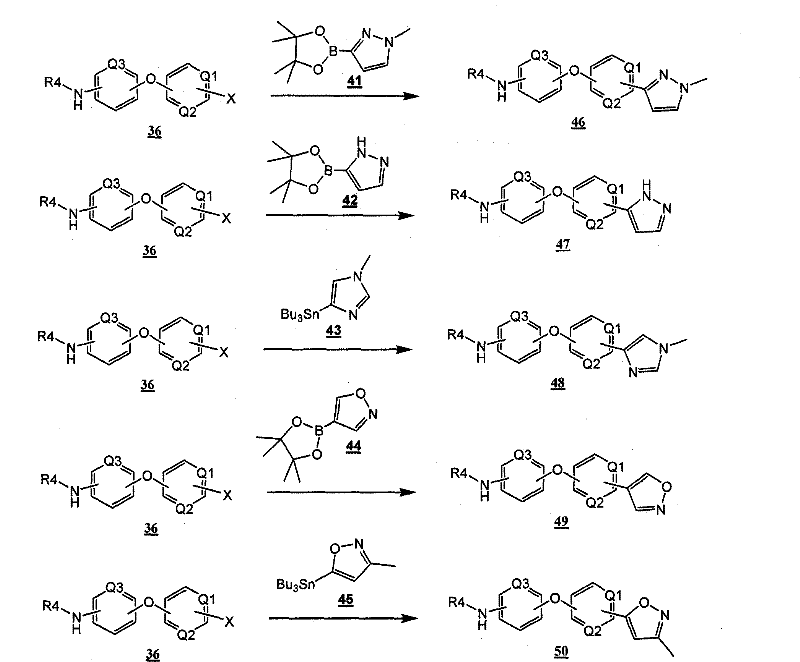
方案11Scheme 11
用于本发明的其他杂芳基硼酸酯和锡烷可由相应的杂芳基卤化物制备。例如,方案12中已知的三唑溴化物51-53(参见:Pedersen,C.Acta Chem.Scand.(1959)5:888-892)可以转化为相应的三丁基锡烷54-56。适用于这种的转化的条件包括在高温(例如60至180℃之间)下与己丁基二锡烷和四(三苯基膦)合钯反应。用于这种转化的备选条件包括在较低的温度下用正丁基锂处理溴化物51-53,以及随后用三丁基锡氯化物对所得的有机锂化物中间体进行处理。锡烷54-56由此在钯催化剂的存在下与通用的卤化物36发生反应,从而形成含三唑的胺57-59,其为通用的胺3的实例。Other heteroaryl borates and stannanes useful in the present invention can be prepared from the corresponding heteroaryl halides. For example, the known triazole bromides 51-53 in Scheme 12 (see: Pedersen, C. Acta Chem. Scand. (1959) 5:888-892) can be converted to the corresponding tributylstannane 54-56. Conditions suitable for this transformation include reaction with hexabutyldistannane and tetrakis(triphenylphosphine)palladium at elevated temperature (eg, between 60 and 180°C). Alternative conditions for this transformation include treatment of bromides 51–53 with n-butyllithium at lower temperatures and subsequent treatment of the resulting organolithium intermediate with tributyltin chloride. The stannanes 54-56 are thus reacted with the general halide 36 in the presence of a palladium catalyst to form the triazole-containing amines 57-59, examples of the general amine 3.

方案12Scheme 12
方案13-16详细说明了非限定性实例通用的胺3的制备,其中在所述的胺3中,D环为通过氮原子与Q1/Q2相连的吡唑、咪唑或三唑环。方案13-16为通用的方案9的实例,其中36的“X”基团为用于亲核芳香取代的离去基团。适用于方案13-16的X基团包括卤素,包括氯。适用于方案13-16的条件包括在非亲核的碱(例如碳酸钾、氢化钠、1,8-二氮杂-双环[5.4.0]十一-7-烯(DBU)等)存在下使用极性质子惰性溶剂,例如1-甲基-2-吡咯烷酮、二甲基乙酰胺或二甲基亚砜。可行的温度为由环境温度至大约250℃,并且可任选地包括使用微波辐射或超声波。Schemes 13-16 illustrate the preparation of non-limiting examples of generic amines 3 in which ring D is a pyrazole, imidazole or triazole ring attached to Q1/Q2 through a nitrogen atom. Schemes 13-16 are examples of general scheme 9, wherein the "X" group of 36 is a leaving group for nucleophilic aromatic substitution. Suitable X groups for use in Schemes 13-16 include halogen, including chlorine. Conditions suitable for Schemes 13-16 include the presence of non-nucleophilic bases such as potassium carbonate, sodium hydride, 1,8-diaza-bicyclo[5.4.0]undec-7-ene (DBU), etc. Use polar aprotic solvents such as 1-methyl-2-pyrrolidone, dimethylacetamide or dimethylsulfoxide. Possible temperatures are from ambient to about 250°C, and may optionally include the use of microwave radiation or ultrasound.
方案13详细说明了通用的中间体36与吡唑60(示例性的市售可得的吡唑包括R20=H,CH3,CN和CF3的那些)和吡唑61(示例性的市售可得的吡唑包括R20=CH3和CF3的那些)的反应,从而得到吡唑62、63或64,其为通用的胺3的非限定性实例,其中D环为吡唑。Scheme 13 details the general intermediate 36 with pyrazole 60 (exemplary commercially available pyrazoles include those with R20 = H, CH 3 , CN and CF 3 ) and pyrazole 61 (exemplary commercially available Available pyrazoles include those with R20= CH3 and CF3 ) to give pyrazoles 62, 63 or 64, which are non-limiting examples of general amines 3, where the D ring is pyrazole.
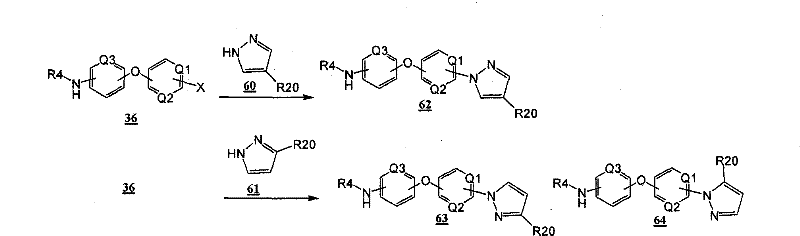
方案13Scheme 13
类似地,方案14详细说明了通用的中间体36与咪唑65(示例性的市售可得的咪唑包括R20=H,CH3,CN,CF3和2-羟基乙基的那些)的反应,从而得到66和67,其为通用的胺3的非限定性实例,其中D环为咪唑。Similarly, Scheme 14 details the reaction of the general intermediate 36 with imidazole 65 (exemplary commercially available imidazoles include those with R20=H, CH3 , CN, CF3 and 2-hydroxyethyl), This gives 66 and 67, which are non-limiting examples of general amines 3 where the D ring is imidazole.

方案14Scheme 14
方案15示出了通用的中间体36与三唑68(示例性的市售可得的三唑包括R20=H,CH3和CN的那些)的反应,从而得到69、70和71,其为通用的胺3的非限定性实例,其中D环为1,2,4-三唑。Scheme 15 shows the reaction of general intermediate 36 with triazole 68 (exemplary commercially available triazoles include those with R20=H, CH3 and CN) to give 69, 70 and 71, which are A non-limiting example of a general amine 3 wherein the D ring is 1,2,4-triazole.

方案15Scheme 15
方案16示出了通用的中间体36与三唑72(示例性的市售可得的三唑包括R20=H和羟基甲基的那些)的反应,从而得到73、74和75,其为通用的胺3的非限定性实例,其中D环为1,2,3-三唑。Scheme 16 shows the reaction of generic intermediate 36 with triazole 72 (exemplary commercially available triazoles include those with R20=H and hydroxymethyl) to give 73, 74 and 75, which are generic A non-limiting example of amine 3 wherein the D ring is 1,2,3-triazole.
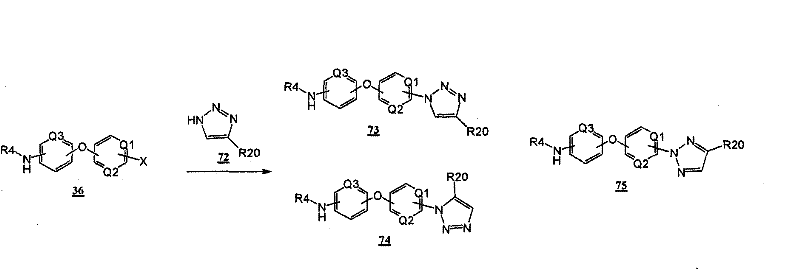
方案16Scheme 16
方案17详细说明了作为方案9(其中采用增环顺序从而构建三唑环(D环))的实例的胺78和79(其为通用的胺3的实例)的制备。由此,氯吡啶39转化成炔76是通过与三甲基甲硅烷基乙炔发生Sonogashira交叉偶联、然后在本领域的技术人员所熟知的条件(例如K2CO3溶于甲醇中)下除去三甲基甲硅烷基而完成的。炔76与叠氮甲基新戊酸酯(77)在硫酸铜和抗坏血酸钠存在下的进一步反应得到N-新戊基甲基三唑胺78(参见:Loren,et.al.Synlett,(2005),18:2847)。新戊酸酯78为NH-三唑79的掩蔽等价物。使用NaOH除去辛戊酸酯部分得到79。备选地,在通用的方案1或5中可以直接使用78,从而得到式1或20所示的化合物,其中D环三唑被新戊基甲基所掩蔽。使用NaOH对这种产物进行进一步的处理,得到式1或20所示的NH-三唑。Scheme 17 details the preparation of amines 78 and 79 (which are examples of the general amine 3) as examples of Scheme 9 (in which the ring-addition sequence is employed to construct the triazole ring (D ring)). Thus, the conversion of chloropyridine 39 to alkyne 76 is via Sonogashira cross - coupling with trimethylsilyleacetylene followed by removal under conditions well known to those skilled in the art (e.g. K2CO3 in methanol) Trimethylsilyl and complete. Further reaction of alkyne 76 with azidomethylpivalate (77) in the presence of copper sulfate and sodium ascorbate affords N-neopentylmethyltriazolamine 78 (see: Loren, et. al. Synlett, (2005 ), 18:2847). Pivalate 78 is the masked equivalent of NH-triazole 79. Removal of the subivalate moiety using NaOH gave 79. Alternatively, 78 can be used directly in general schemes 1 or 5 to obtain compounds of formula 1 or 20, wherein the D-ring triazole is masked by neopentylmethyl. Further treatment of this product with NaOH affords NH-triazoles of formula 1 or 20.

方案17Scheme 17
作为方案17的扩展,式81所示的Z3取代的三唑和式83所示的R20取代的异噁唑还可以通过方案18中所示的类似的1,3-两极性环加成物来制备。由此,可以容易地由市售的烷基卤化物和叠氮化钠制得的Z3取代的叠氮化物80、与炔76、抗坏血酸钠和Cu(SO4)五水合物相结合(参见:Rostotsev,et.al.Angew.Chem.Int.Ed,(2002)41(14):2596-2599),从而得到Z3取代的三唑81。以相似的顺序,容易地由醛和羟基胺制得的R20取代的肟82与N-氯代琥珀酰亚胺在炔76存在下并在加热或者可任选的微波辐射条件下相结合,从而得到式83所示的异噁唑,其为通用的胺3的其他实例。As an extension of Scheme 17, the Z3-substituted triazoles shown in Formula 81 and the R20-substituted isoxazoles shown in Formula 83 can also be synthesized by analogous 1,3-bipolar cycloadditions shown in Scheme 18. preparation. Thus, Z3-substituted azide 80, conjugated to alkyne 76, sodium ascorbate and Cu(SO 4 ) pentahydrate, can be readily prepared from commercially available alkyl halides and sodium azide (see: Rostotsev, et. al. Angew. Chem. Int. Ed, (2002) 41(14): 2596-2599), leading to the Z3 substituted triazole 81. In a similar sequence, the R20-substituted oxime 82, readily prepared from aldehydes and hydroxylamines, is combined with N-chlorosuccinimide in the presence of alkyne 76 under heating or optional microwave irradiation conditions, thereby Isoxazoles of formula 83 are obtained, which are further examples of general amines 3.

方案18Scheme 18
方案9(其中采用增环顺序以构建咪唑D环)的其他实例如方案19所示,以用于合成咪唑93,其为通用的胺3的实例(其中R4为H,Q3为CH,Q2为CH,Q1为N,并且含D的环被咪唑取代(R20=CF3))。吡啶-2-羧酸(84)向氯吡啶85的转换是通过使用亚硫酰氯和溴化钠进行处理并进行加热而完成的。85与叔丁醇的反应得到含氯的酯86,其为通用的中间体35的实例(方案9,其中LG为氯代而X为叔丁氧基羰基)。使用4-氨基苯酚87(使用氢化钠由87制得)的钠盐对86进行处理并将所得的混合物加热至80℃得到醚酯88,其为通用的中间体36的实例(方案9,其中X为叔丁氧基羰基)。88向93的进一步转换详细说明了通用的方案9的第二个反应的可能的多步性。由此,使用二碳酸二叔丁酯对88进行处理得到Boc保护的中间体89。使用LiAlH4对89的酯部分进行还原,从而得到醇90,该醇继而被MnO2氧化,从而得到醛91,其为通用的中间体36的另一个实例(其中X为甲酰基)。91与3,3-二溴-1,1,1-三氟代-丙-2-酮、乙酸钠和氢氧化铵的进一步反应,从而得到咪唑92。使用HCl水溶液除去92的Boc基团得到93,其为通用的胺3的实例。Additional examples of Scheme 9 (where the ring-addition sequence is employed to construct the imidazole D ring) are shown in Scheme 19 for the synthesis of imidazole 93, which is an example of a general amine 3 (where R4 is H, Q3 is CH, Q2 is CH, Q1 is N, and the D-containing ring is substituted by imidazole (R20= CF3 )). Conversion of pyridine-2-carboxylic acid (84) to chloropyridine 85 is accomplished by treatment with thionyl chloride and sodium bromide and heating. Reaction of 85 with tert-butanol affords the chloroester 86, an example of a general intermediate 35 (Scheme 9, where LG is chloro and X is tert-butoxycarbonyl). Treatment of 86 with the sodium salt of 4-aminophenol 87 (prepared from 87 using sodium hydride) and heating the resulting mixture to 80 °C gave ether ester 88, an example of a general intermediate 36 (Scheme 9, where X is tert-butoxycarbonyl). A further transformation of 88 to 93 details the possible multistep nature of the second reaction of the general scheme 9. Thus, treatment of 88 with di-tert-butyl dicarbonate affords Boc-protected intermediate 89. Reduction of the ester moiety of 89 with LiAlH affords alcohol 90, which is subsequently oxidized by MnO to afford aldehyde 91, another example of the general intermediate 36 (where X is formyl). Further reaction of 91 with 3,3-dibromo-1,1,1-trifluoro-propan-2-one, sodium acetate and ammonium hydroxide affords imidazole 92. Removal of the Boc group of 92 using aqueous HCl affords 93, an example of a general amine 3.
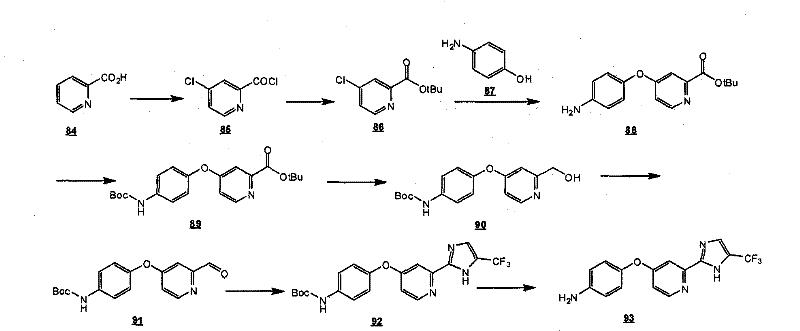
方案19Program 19
方案20详细说明了其他吡唑和异噁唑异构体通过增环顺序的通用制备方法。由此,醛91(其为通用中间体36的代表性实例(其中R4为Boc保护基,Q3为H,Q2为H,Q1为N而X为甲酰基))通过先使用甲基溴化镁、然后采用本领域的技术人员所熟知的相似的标准条件进行氧化来依次处理,从而转换成酮94。使用二甲基甲酰胺的二甲基缩醛对94进行随后的处理得到95。使用Z3取代的肼96对95进行进一步的处理得到具有N-Boc保护基的97和99的混合物。在标准的酸性条件下除去Boc保护基得到98和100,其为通用的胺3的实例,其中D环为Z3取代的吡唑。以相似的方式,使用羟基胺对中间体95进行处理得到具有N-Boc保护基的异噁唑101和103。在标准的酸性条件下除去Boc保护基得到102和104,其为通用的胺3的实例,其中D环为异噁唑。Scheme 20 details the general preparation of other pyrazole and isoxazole isomers via an annulation sequence. Thus, aldehyde 91, which is a representative example of general intermediate 36 (where R4 is a Boc protecting group, Q3 is H, Q2 is H, Q1 is N and X is formyl) can be obtained by first using methylmagnesium bromide , followed by oxidation using similar standard conditions well known to those skilled in the art to convert to ketone 94. Subsequent treatment of 94 with dimethyl acetal of dimethylformamide gave 95. Further treatment of 95 with Z3 substituted hydrazine 96 gave a mixture of 97 and 99 with N-Boc protecting group. Removal of the Boc protecting group under standard acidic conditions affords 98 and 100, examples of general amines 3 in which the D ring is a Z3 substituted pyrazole. In a similar manner, treatment of intermediate 95 with hydroxylamine provided isoxazoles 101 and 103 with N-Boc protecting groups. Removal of the Boc protecting group under standard acidic conditions affords 102 and 104, examples of general amines 3 where the D ring is an isoxazole.

方案20Program 20
以相似的方式,方案21详细说明了R20取代的吡唑和异噁唑环的制备。由此,酮94(其为通用的中间体36的代表性实例(其中R4为Boc保护基,Q3为H,Q2为H,Q1为N而X为乙酰基))通过使用强碱和R20取代的酰基试剂(例如酸性卤代物或酯)进行依次处理而转化为二酮105。使用Z3取代的肼对105进一步处理得到具有N-Boc保护基的106和107的混合物。在标准的酸性条件下除去Boc保护基得到108和109,其为通用的胺3的实例,其中D环为R20和Z3取代的吡唑。以相似的方式,使用羟基胺对中间体105进行处理得到具有N-Boc保护基的异噁唑110和111。在标准的酸性条件下除去Boc保护基得到112和113,其为通用的胺3的实例,其中D环为R20取代的异噁唑。In a similar fashion, Scheme 21 details the preparation of R20 substituted pyrazole and isoxazole rings. Thus, ketone 94, which is a representative example of the general intermediate 36 (where R4 is a Boc protecting group, Q3 is H, Q2 is H, Q1 is N and X is acetyl), is substituted by using a strong base and R20 Sequential treatment of an acyl reagent (such as an acid halide or ester) converts it to diketone 105. Further treatment of 105 with Z3 substituted hydrazine afforded a mixture of 106 and 107 with N-Boc protecting group. Removal of the Boc protecting group under standard acidic conditions affords 108 and 109, examples of general amines 3 in which the D ring is a pyrazole substituted with R20 and Z3. In a similar manner, treatment of intermediate 105 with hydroxylamine provided isoxazoles 110 and 111 with N-Boc protecting groups. Removal of the Boc protecting group under standard acidic conditions affords 112 and 113, examples of general amines 3 in which the D ring is an R20 substituted isoxazole.
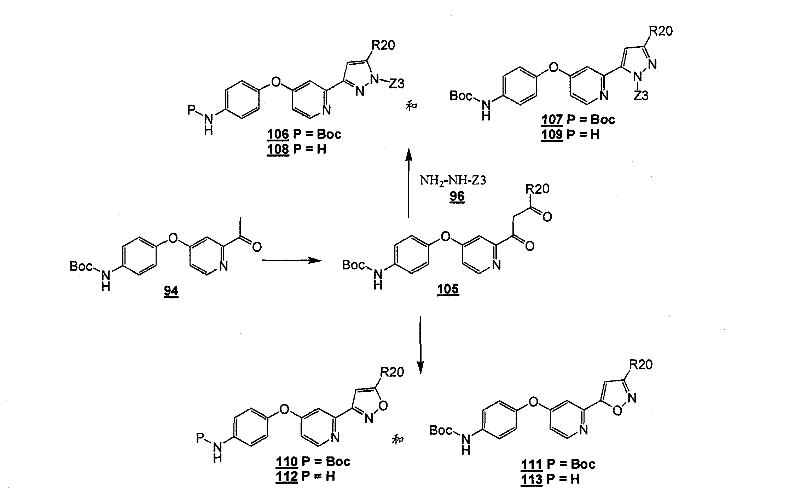
方案21Scheme 21
方案22详细说明了3的另一种通用的组装方式,其中3的醚氧原子衍生自包含Q1/Q2的亚单元115的羟基部分。中间体114与包含Q1/Q2的环115合为一体是通过使用碱(例如叔丁醇钾)对115进行处理、并且对片段114进行可任选的加热从而形成醚116来完成的。在方案22中,单环114的“LG”表示在亲核取代反应(具有或不具有其他活化作用)中可以直接替代的部分,例如卤化物、磺酸盐、砜、亚砜或硝基。单环115或双环116的“X”基团代表可以与5元杂环部分连接的部分。在一个方面中,“X”基团代表这样的卤素原子,该卤素原子参与了与预形成的杂环(D环)试剂(例如硼酸或酯、或者杂芳基锡烷)发生过渡金属介导的偶联,从而形成胺118。在另一个方面中,“X”基团代表被吡唑、咪唑或三唑中的氮原子替代、从而设置在D环中的离去基团。在另一个方面中,X基团代表这样的部分,通过该部分能够构建可以被转化成包含5元环中间体118的5元D环(吡唑、异噁唑、三唑、咪唑),例如羧酸或酯、炔或醛。在形成硝基醚116后,硝基部分通过在金属催化剂(例如镍或钯催化剂)存在下,使116经历本领域的技术人员所知的还原条件(例如铁粉、锌粉、铟粉、氯化亚锡或氢化作用)而转换成氨基部分,由此得到胺117。由此,包含“X”基团的中间体117转换为包含5元D环的中间体118是通过在上述方案中各所述的方法完成的,从而得到118,其为通用的胺3的实例,其中R4为H。如果需要,胺118可以通过标准的条件被R4部分烷基化,从而得到通用的胺3。Scheme 22 details another general assembly of 3, where the ether oxygen atom of 3 is derived from the hydroxyl moiety of subunit 115 comprising Q1/Q2. Incorporation of intermediate 114 into ring 115 comprising Q1/Q2 is accomplished by treatment of 115 with a base such as potassium tert-butoxide and optional heating of fragment 114 to form ether 116. In Scheme 22, "LG" of monocycle 114 represents a moiety that can be directly substituted in a nucleophilic substitution reaction (with or without other activation), such as a halide, sulfonate, sulfone, sulfoxide, or nitro group. The "X" group of monocycle 115 or bicycle 116 represents a moiety which may be attached to a 5 membered heterocycle moiety. In one aspect, the "X" group represents a halogen atom that participates in a transition metal-mediated reaction with a preformed heterocyclic (D ring) reagent such as a boronic acid or ester, or a heteroaryl stannane. to form amine 118. In another aspect, the "X" group represents a leaving group that is replaced by a nitrogen atom in pyrazole, imidazole, or triazole, thereby placing it in the D ring. In another aspect, the X group represents a moiety through which a 5-membered D-ring (pyrazole, isoxazole, triazole, imidazole) can be constructed that can be converted to include the 5-membered ring intermediate 118, e.g. Carboxylic acid or ester, alkyne or aldehyde. After formation of the nitro ether 116, the nitro moiety is recovered by subjecting 116 to reducing conditions known to those skilled in the art (e.g. iron powder, zinc powder, indium powder, chlorine powder) in the presence of a metal catalyst (e.g. nickel or palladium catalyst). Conversion to the amino moiety by stannous chloride or hydrogenation) affords amine 117. Thus, conversion of intermediate 117 containing the "X" group to intermediate 118 containing the 5-membered D ring was accomplished by the methods described in each of the schemes above to give 118, an example of the general amine 3 , where R4 is H. If desired, amine 118 can be partially alkylated with R4 by standard conditions to give general amine 3.
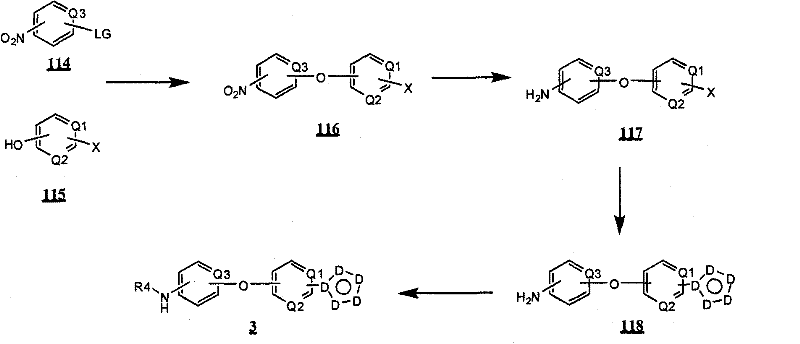
方案22Scheme 22
方案22的非限定性实例如下所示,以用于制备32(方案23),其为通用的胺118的实例(其中Q3为N,Q2为CH,Q1为N而含D的环为吡唑)。在方案23中,市售可得的5-溴-2-硝基吡啶(119)与2-氯-4-羟基吡啶(120)和碱(例如碳酸铯)在高温(例如80℃)下反应,从而得到硝基吡啶121,其为通用的中间体116的实例。用于这种转换的可行的条件为二甲基甲酰胺处于80至100℃之间。硝基吡啶121在氯化铵存在下与锌粉进一步反应得到氨基吡啶122。122在之前所述的条件下与吡唑-4-硼酸庚二酯40进一步反应得到吡唑胺32,其为通用的胺118的实例。A non-limiting example of Scheme 22 is shown below for the preparation of 32 (Scheme 23), which is an example of a generic amine 118 (where Q3 is N, Q2 is CH, Q1 is N and the D-containing ring is pyrazole ). In Scheme 23, commercially available 5-bromo-2-nitropyridine ( 119 ) is reacted with 2-chloro-4-hydroxypyridine ( 120 ) and a base (such as cesium carbonate) at elevated temperature (such as 80 °C) , giving nitropyridine 121, an example of a general intermediate 116. Feasible conditions for this transformation are dimethylformamide between 80 and 100°C. Nitropyridine 121 was further reacted with zinc dust in the presence of ammonium chloride to give aminopyridine 122. Further reaction of 122 with pyrazole-4-heptanediyl borate 40 under the conditions described previously gave pyrazolamide 32, which is a general An example of the amine 118.

方案23Scheme 23
方案24详细说明了通过首先将5元杂环与Q1/Q2环(35)连接来制备胺3的另一种通用的方法。如方案9所述,单环35的“LG”表示在亲核取代反应(具有或不具有其他活化作用)中可以直接替代的部分。单环35的“X”基团代表可以与5元杂环连接的部分。在一个方面中,“X”基团代表这样的卤素原子,该卤素原子参与了与预形成的杂环试剂(例如硼酸或酯、或者杂芳基锡烷)发生过渡金属介导的偶联,从而形成胺3。在另一个方面中,35的“X”基团代表可以通过增环反应而转换成5元杂环的官能团。此外,35的“X”基团代表可以被吡唑、三唑或咪唑环中的亲核氮原子替代的离去基团(卤素、亚砜、砜、磺酸盐)。在35转换为123之后,“LG”部分可以被包含Q3的环上的羟基替代,从而得到三环醚-胺3。本领域的技术人员认识到,方案24中的各个反应箭头代表了单个的转化或一系列转化。Scheme 24 details another general method for the preparation of amine 3 by first attaching a 5-membered heterocycle to the Q1/Q2 ring (35). As described in Scheme 9, the "LG" of monocycle 35 indicates a moiety that can be directly substituted in a nucleophilic substitution reaction (with or without other activation). The "X" group of monocycle 35 represents a moiety that can be attached to a 5-membered heterocycle. In one aspect, the "X" group represents a halogen atom that is involved in a transition metal-mediated coupling with a preformed heterocyclic reagent such as a boronic acid or ester, or a heteroaryl stannane, Thus amine 3 is formed. In another aspect, the "X" group at 35 represents a functional group that can be converted to a 5-membered heterocycle by an annulation reaction. In addition, the "X" group of 35 represents a leaving group (halogen, sulfoxide, sulfone, sulfonate) that can be replaced by a nucleophilic nitrogen atom in the pyrazole, triazole or imidazole ring. After conversion of 35 to 123, the "LG" moiety can be replaced by a hydroxyl group on the ring containing Q3, giving tricyclic ether-amine 3. Those skilled in the art recognize that each reaction arrow in Scheme 24 represents a single transformation or a series of transformations.

方案24Scheme 24
方案24的具体的非限定性实例在方案25中通过制备胺128(其为通用的3的实例(其中Q3为CH并且Q3环被氟取代,Q2为N,Q1为N,而包含D的环为吡唑))来详细说明。由此,市售可得的嘧啶124(其为通用的中间体35的实例)与市售可得的吡唑硼酸酯40发生了钯催化的偶联,从而得到双环125,其为通用的中间体123的实例(方案24)。使用间氯过氧化苯甲酸对125的硫化物部分(通用的中间体123的“LG”基团)进行氧化,进一步活化了所述的部分发生亲核替代,并得到中间体126。在碱存在下使用苯酚127对砜126进行处理得到三环胺128,其为通用的胺3的实例。用于后期转化的可行的碱包括处于极性质子惰性溶剂(例如二甲基甲酰胺或二甲基乙酰胺)中的碳酸钾和叔丁醇钾。A specific non-limiting example of Scheme 24 is prepared in Scheme 25 by preparing amine 128 (which is an example of the general 3 (wherein Q3 is CH and the Q3 ring is substituted with fluorine, Q2 is N, Q1 is N, and the ring containing D For pyrazole)) to describe in detail. Thus, palladium-catalyzed coupling of the commercially available pyrimidine 124, which is an example of the general intermediate 35, with the commercially available pyrazole boronate 40 affords the bicyclic 125, which is the general Example of intermediate 123 (Scheme 24). Oxidation of the sulfide moiety of 125 ("LG" group of generic intermediate 123) with m-chloroperbenzoic acid further activates said moiety for nucleophilic substitution and affords intermediate 126. Treatment of sulfone 126 with phenol 127 in the presence of base affords tricyclic amine 128, an example of a general amine 3. Possible bases for later transformations include potassium carbonate and potassium tert-butoxide in polar aprotic solvents such as dimethylformamide or dimethylacetamide.
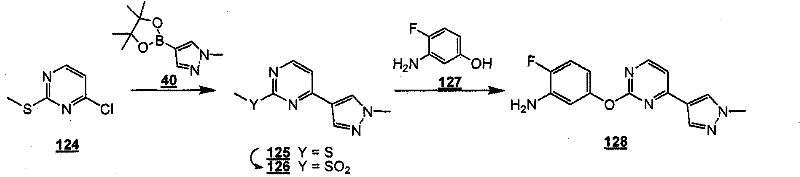
方案25Program 25
通用的方案24的其他非限定性实例在方案26中通过制备131(通用的胺3的其他实例(其中Q3为CH并且Q3环被氟取代,Q2为N,Q1为N而包含D的环为吡唑))来详细说明。由此,市售可得的二氯嘧啶129(其为通用的中间体35的实例(其中“LG”和“X”为氯))与市售可得的吡唑硼酸酯40发生了钯催化的偶联,从而得到双环130,其为通用的中间体123的实例(方案24)。然后,苯酚37在碱存在下在高温下加成得到胺131。Other non-limiting examples of general scheme 24 are obtained in scheme 26 by preparing 131 (other examples of general amine 3 (wherein Q3 is CH and the Q3 ring is substituted by fluorine, Q2 is N, Q1 is N and the ring containing D is Pyrazole)) to describe in detail. Thus, the commercially available dichloropyrimidine 129, which is an example of a general-purpose intermediate 35 (where "LG" and "X" are chlorine), reacts with the commercially available pyrazole boronate 40 with palladium Catalyzed coupling affords bicyclo 130, an example of general intermediate 123 (Scheme 24). Then, addition of phenol 37 in the presence of base at elevated temperature affords amine 131.

方案26Program 26
方案27详细说明了作为通用的方案9的其他非限定性实例的胺134的制备。由此,通过与方案10的直接类似方法,2,4-二氯嘧啶(132)可以在碱存在下与苯酚37反应,从而得到133,其为通用的中间体36的实例(方案9)。氯吡啶133在钯催化剂存在下与吡唑硼酸酯40进一步反应从而得到胺134,其为通用的胺3的实例。Scheme 27 details the preparation of amine 134 as a further non-limiting example of generalized Scheme 9. Thus, by a direct analogy to Scheme 10, 2,4-dichloropyrimidine (132) can be reacted with phenol 37 in the presence of base to afford 133, an example of a general intermediate 36 (Scheme 9). Chloropyridine 133 is further reacted with pyrazole borate 40 in the presence of a palladium catalyst to afford amine 134, which is an example of a general amine 3.

方案27Program 27
用于制备式I所示的化合物的其他优选的合成方法在以下实施例中提供。Other preferred synthetic methods for the preparation of compounds of Formula I are provided in the Examples below.
部分3.实施例Part 3. Example
通过以下实施例进一步详细说明公开的内容,其不应该被解释为将本公开的内容的范围或实质限定为本文所述的具体的方法。应该理解的是提供这些实施例以用于详细说明某些实施方案,因此并非限定了本公开内容的范围。还应该理解的是可以需要借助于多种其他的实施方案、修改方式及其等价物,其中所述的实施方案、修改方式和等价物向本领域的技术人员表明它们没有脱离本公开内容的实质和/或所附权利要求书的范围。The disclosure is further described in detail by the following examples, which should not be construed as limiting the scope or essence of the disclosure to the specific methods described herein. It should be understood that these examples are provided for the purpose of illustrating certain embodiments and therefore do not limit the scope of the present disclosure. It should also be understood that it may be desirable to resort to various other embodiments, modifications, and equivalents thereof, which would suggest to those skilled in the art that they do not depart from the spirit of the present disclosure and/or or the scope of the appended claims.
实施例A1:Example A1:
将由3-氟代-4-氨基苯酚(8.0g,63.0mmol)在二甲基乙酰胺(80mL)中形成的悬浮液在真空中脱气,并用叔丁醇钾(7.3g,65mmol)处理。将所得的混合物在RT下搅拌30分钟。加入2,4-二氯吡啶(8g,54mmol),并将混合物加热至80℃并持续12h。在减压下除去溶剂,从而得到分配在水和EtOAc(3x 100mL)之间的残余物。将有机层用饱和的盐水洗涤,干燥(MgSO4),真空浓缩,并通过硅胶柱色谱纯化,从而得到4-(2-氯吡啶-4-基氧基)-2-氟代苯胺(11g,86%的产率)。1H NMR(300MHz,DMSO-d6):δ8.24(d,J=5.7Hz,1H),7.00(dd,J=9.0,2.7Hz,1H),6.89-6.73(m,4H),5.21(br s,2H);MS(ESI)m/z:239.2(M+H+)。A suspension of 3-fluoro-4-aminophenol (8.0 g, 63.0 mmol) in dimethylacetamide (80 mL) was degassed in vacuo and treated with potassium tert-butoxide (7.3 g, 65 mmol). The resulting mixture was stirred at RT for 30 minutes. 2,4-Dichloropyridine (8 g, 54 mmol) was added and the mixture was heated to 80° C. for 12 h. The solvent was removed under reduced pressure to give a residue which was partitioned between water and EtOAc (3 x 100 mL). The organic layer was washed with saturated brine, dried (MgSO 4 ), concentrated in vacuo, and purified by silica gel column chromatography to give 4-(2-chloropyridin-4-yloxy)-2-fluoroaniline (11 g, 86% yield). 1 H NMR (300MHz, DMSO-d6): δ8.24 (d, J=5.7Hz, 1H), 7.00 (dd, J=9.0, 2.7Hz, 1H), 6.89-6.73 (m, 4H), 5.21( br s, 2H); MS (ESI) m/z: 239.2 (M+H + ).
将由4-(2-氯吡啶-4-基氧基)-2-氟代苯胺(3g,12.6mmol),1-甲基-3-(4,4,5,5-四甲基-[1,3,2]二氧杂硼杂环戊烷-2-基)-1H-吡唑(5.2g,25.2mmol)和Na2CO3(2.7g,25.2mmol)在DME(18mL)/水(6mL)中形成的溶液用氮气吹扫20分钟。加入Pd(PPh3)4(729mg,0.63mmol),并将所得的混合物加热至100℃并持续16h。在减压下除去溶剂,并将产物粗品悬浮于水中,再用EtOAc萃取。将有机层用盐水洗涤,干燥(Na2SO4),真空浓缩,并通过硅胶色谱纯化,从而得到2-氟代-4-(2-(1-甲基-1H-吡唑-4-基)吡啶-4-基氧基)苯胺(2g,56%的产率)。1HNMR(300MHz,DMSO-d6):δ8.31(d,J=5.7Hz,1H),8.21(s,1H),7.92(s,1H),7.12(d,J=2.4Hz,1H),6.96(m,1H),6.85-6.72(m,2H),6.56(m,1H),5.15(s,2H),3.84(s,3H);MS(ESI)m/z:285.0(M+H+)。From 4-(2-chloropyridin-4-yloxy)-2-fluoroaniline (3g, 12.6mmol), 1-methyl-3-(4,4,5,5-tetramethyl-[1 , 3,2] dioxaborolan-2-yl)-1H-pyrazole (5.2 g, 25.2 mmol) and Na 2 CO 3 (2.7 g, 25.2 mmol) in DME (18 mL)/water ( 6 mL) was purged with nitrogen for 20 minutes. Pd(PPh 3 ) 4 (729 mg, 0.63 mmol) was added, and the resulting mixture was heated to 100° C. for 16 h. The solvent was removed under reduced pressure, and the crude product was suspended in water and extracted with EtOAc. The organic layer was washed with brine, dried (Na 2 SO 4 ), concentrated in vacuo, and purified by silica gel chromatography to give 2-fluoro-4-(2-(1-methyl-1H-pyrazol-4-yl )pyridin-4-yloxy)aniline (2 g, 56% yield). 1 HNMR (300MHz, DMSO-d 6 ): δ8.31(d, J=5.7Hz, 1H), 8.21(s, 1H), 7.92(s, 1H), 7.12(d, J=2.4Hz, 1H) , 6.96(m, 1H), 6.85-6.72(m, 2H), 6.56(m, 1H), 5.15(s, 2H), 3.84(s, 3H); MS(ESI) m/z: 285.0(M+ H + ).
实施例A2:Example A2:
采用与实施例A1相似的方法,将2-氟代-4-氨基苯酚(2.6g,24mmol)和2,4-二氯吡啶(2.88g,20mol)合并从而得到4-(2-氯吡啶-4-基氧基)-3-氟代苯胺(3.2g,67%的产率)。1H NMR(400MHz,DMSO-d6):δ8.25(d,J=5.6Hz,1H),6.99(m,1H),6.90(m,2H),6.50(d,J=1.6Hz,1H),6.41(d,J=10.4Hz,1H),5.51(s,2H);MS(ESI)m/z:239.1(M+H+)。Using a method similar to Example A1, 2-fluoro-4-aminophenol (2.6g, 24mmol) and 2,4-dichloropyridine (2.88g, 20mol) were combined to obtain 4-(2-chloropyridine- 4-yloxy)-3-fluoroaniline (3.2 g, 67% yield). 1 H NMR (400MHz, DMSO-d 6 ): δ8.25(d, J=5.6Hz, 1H), 6.99(m, 1H), 6.90(m, 2H), 6.50(d, J=1.6Hz, 1H ), 6.41 (d, J = 10.4 Hz, 1H), 5.51 (s, 2H); MS (ESI) m/z: 239.1 (M+H + ).
采用与实施例A1相似的方法,将4-(2-氯吡啶-4-基氧基)-3-氟代苯胺(3g,11.6mmol)、1-甲基-4-(4,4,5,5-四甲基-1,3,2-二氧杂硼杂环戊烷-2-基)-1H-吡唑(3.4g,16.4mmol)、Na2CO3(2.7g,25.2mmol)和Pd(Ph3)4(1.5g,0.1当量)合并从而得到3-氟代-4-(2-(1-甲基-1H-吡唑-4-基)吡啶-4-基氧基)苯胺(1.1g,34%的产率)。1H NMR(400MHz,DMSO-d6):δ(8.31(d,J=5.6Hz,1H),8.22(s,1H),7.93(s,1H),7.14(s,1H),6.98(m,1H),6.55-6.49(m,2H),6.42(d,J=7.2Hz,1H),5.44(s,2H),3.86(s,3H);MS(ESI)m/z:(M+H+):285.2。Using a method similar to that of Example A1, 4-(2-chloropyridin-4-yloxy)-3-fluoroaniline (3g, 11.6mmol), 1-methyl-4-(4,4,5 , 5-tetramethyl-1,3,2-dioxaborolan-2-yl)-1H-pyrazole (3.4g, 16.4mmol), Na 2 CO 3 (2.7g, 25.2mmol) Combined with Pd(Ph 3 ) 4 (1.5 g, 0.1 equiv) to give 3-fluoro-4-(2-(1-methyl-1H-pyrazol-4-yl)pyridin-4-yloxy) Aniline (1.1 g, 34% yield). 1 H NMR (400MHz, DMSO-d 6 ): δ(8.31(d, J=5.6Hz, 1H), 8.22(s, 1H), 7.93(s, 1H), 7.14(s, 1H), 6.98(m , 1H), 6.55-6.49 (m, 2H), 6.42 (d, J=7.2Hz, 1H), 5.44 (s, 2H), 3.86 (s, 3H); MS (ESI) m/z: (M+ H + ): 285.2.
实施例A3:Example A3:
将1,2,3-三氟代-4-硝基苯(30g,0.17mol)、苄基醇(18.4g,0.17mol)和K2CO3(35g,0.25mol)合并于DMF(300mL)中,并在RT下搅拌8h。加入水(300mL),并将混合物用EtOAc(3x500mL)萃取。将合并的有机层用盐水洗涤,干燥(MgSO4),真空浓缩,并通过在硅胶上的柱色谱纯化,从而得到1-苄基氧基-2,3-二氟代-4-硝基苯(16g,36%的产率)。1H NMR(400MHz,DMSO-d6):δ8.06(m,1H),7.49-7.30(m,6H),5.37(s,2H)。Combine 1,2,3-trifluoro-4-nitrobenzene (30 g, 0.17 mol), benzyl alcohol (18.4 g, 0.17 mol) and K 2 CO 3 (35 g, 0.25 mol) in DMF (300 mL) and stirred at RT for 8h. Water (300 mL) was added, and the mixture was extracted with EtOAc (3x500 mL). The combined organic layers were washed with brine, dried (MgSO 4 ), concentrated in vacuo, and purified by column chromatography on silica gel to give 1-benzyloxy-2,3-difluoro-4-nitrobenzene (16 g, 36% yield). 1 H NMR (400 MHz, DMSO-d 6 ): δ8.06 (m, 1H), 7.49-7.30 (m, 6H), 5.37 (s, 2H).
将由1-苄基氧基-2,3-二氟代-4-硝基苯(14g,52.8mmol)在MeOH(200mL)中形成的溶液在氢气气氛(30psi)下与Pd/C(10%,1.4g,1.3mmol)搅拌2h。通过过滤除去催化剂,并将滤液真空浓缩,从而得到4-氨基-2,3-二氟代苯酚(7g,92%的产率)。1H NMR(400MHz,DMSO-d6):δ9.05(s,1H),6.45(t,J=8.8Hz,1H),6.34(t,J=9.2Hz,1H),4.67(s,2H);MS(ESI)m/z:146.1[M+H]+。A solution of 1-benzyloxy-2,3-difluoro-4-nitrobenzene (14 g, 52.8 mmol) in MeOH (200 mL) was mixed with Pd/C (10% , 1.4g, 1.3mmol) stirred for 2h. The catalyst was removed by filtration, and the filtrate was concentrated in vacuo to give 4-amino-2,3-difluorophenol (7 g, 92% yield). 1 H NMR (400MHz, DMSO-d 6 ): δ9.05(s, 1H), 6.45(t, J=8.8Hz, 1H), 6.34(t, J=9.2Hz, 1H), 4.67(s, 2H ); MS (ESI) m/z: 146.1 [M+H] + .
将4-氨基-2,3-二氟代苯酚(6g,41.4mmol)和叔丁醇钾(4.9g,43.5mmol)悬浮于DMAc(200mL)中,并在RT下在Ar气氛中搅拌30分钟。加入2,4-二氯吡啶(6.1g,41.4mmol),并将所得的混合物加热至70℃并持续8h。过滤反应混合物,真空浓缩,并通过硅胶色谱纯化,从而得到4-(2-氯-吡啶-4-基氧基)-2,3-二氟代-苯基胺(7g,66%的产率)。1H NMR(400MHz,DMSO-d6):δ8.27(d,J=6.0Hz,1H),7.05(s,1H),6.95(m,1H),6.92(m,1H),6.62(m,1H),5.60(s,2H);MS(ESI)m/z:257.1[M+H]+。4-Amino-2,3-difluorophenol (6 g, 41.4 mmol) and potassium tert-butoxide (4.9 g, 43.5 mmol) were suspended in DMAc (200 mL) and stirred at RT under Ar atmosphere for 30 min . 2,4-Dichloropyridine (6.1 g, 41.4 mmol) was added and the resulting mixture was heated to 70 °C for 8 h. The reaction mixture was filtered, concentrated in vacuo, and purified by silica gel chromatography to give 4-(2-chloro-pyridin-4-yloxy)-2,3-difluoro-phenylamine (7 g, 66% yield ). 1 H NMR (400MHz, DMSO-d 6 ): δ8.27(d, J=6.0Hz, 1H), 7.05(s, 1H), 6.95(m, 1H), 6.92(m, 1H), 6.62(m , 1H), 5.60 (s, 2H); MS (ESI) m/z: 257.1 [M+H] + .
将氮气起泡通过由4-(2-氯-吡啶-4-基氧基)-2,3-二氟代-苯基胺(2g,7.8mmol)、1-甲基-4-(4,4,5,5-四甲基-[1,3,2]二氧杂硼杂环戊烷-2-基)-1H-吡唑(1.6g,7.8mmol)和Na2CO3(1.65g,15.6mmol)在DME(12mL)/H2O(4mL)中形成的溶液,并持续20分钟。加入Pd(PPh3)4(450mg,0.4mmol),然后将所得的混合物真空脱气,覆盖氮气,并加热至70℃并持续16h。在减压下将反应物浓缩至干态。将产物粗品悬浮于水中并用EtOAc(3x 10mL)萃取。将有机层用盐水洗涤,干燥(Na2SO4),真空浓缩,并通过硅胶色谱纯化,从而得到2,3-二氟代-4-[2-(1-甲基-1H-吡唑-4-基)-吡啶-4-基氧基]-苯基胺(1.3g,55%的产率)。1H NMR(400MHz,DMSO-d6):δ8.40(d,J=6.0Hz,1H),8.32(s,1H),8.02(s,1H),7.26(s,1H),6.96(t,J=8.8Hz,1H),6.71-6.68(m,2H),5.62(s,2H),3.92(s,3H);MS(ESI)m/z:303.2[M+H]+。Nitrogen was bubbled through a mixture of 4-(2-chloro-pyridin-4-yloxy)-2,3-difluoro-phenylamine (2 g, 7.8 mmol), 1-methyl-4-(4, 4,5,5-Tetramethyl-[1,3,2]dioxaborolan-2-yl)-1H-pyrazole (1.6g, 7.8mmol) and Na 2 CO 3 (1.65g , 15.6 mmol) in DME (12 mL)/H 2 O (4 mL) for 20 min. Pd( PPh3 ) 4 (450mg, 0.4mmol) was added, then the resulting mixture was degassed in vacuo, blanketed with nitrogen, and heated to 70°C for 16h. The reaction was concentrated to dryness under reduced pressure. The crude product was suspended in water and extracted with EtOAc (3 x 10 mL). The organic layer was washed with brine, dried (Na 2 SO 4 ), concentrated in vacuo, and purified by silica gel chromatography to give 2,3-difluoro-4-[2-(1-methyl-1H-pyrazole- 4-yl)-pyridin-4-yloxy]-phenylamine (1.3 g, 55% yield). 1 H NMR (400MHz, DMSO-d 6 ): δ8.40(d, J=6.0Hz, 1H), 8.32(s, 1H), 8.02(s, 1H), 7.26(s, 1H), 6.96(t , J = 8.8 Hz, 1H), 6.71-6.68 (m, 2H), 5.62 (s, 2H), 3.92 (s, 3H); MS (ESI) m/z: 303.2 [M+H] + .
实施例A4:Example A4:
将由4-氨基-2-甲基-苯酚(4.25g,34.5mmol)在二甲基乙酰胺(50mL)中形成的溶液真空脱气,并覆盖氩气。加入叔丁醇钾(5.0g,44.6mmol),并将反应混合物二次脱气,并在RT下在氩气中搅拌30分钟。加入2,4-二氯-吡啶(4.6g,31.3mmol),并将混合物加热至100℃并过夜。在减压下除去溶剂,并通过硅胶色谱纯化残余物,从而得到4-(2-氯吡啶-4-基氧基)-3-甲基苯胺(4.5g,56%的产率)。1H NMR(400MHz,DMSO-d6):δ8.21(d,J=5.2Hz,1H),6.75-6.80(m,3H),6.45-6.50(m,2H),5.15(s,2H),1.92(s,3H);MS(ESI)m/z:235.1(M+H+)。A solution of 4-amino-2-methyl-phenol (4.25 g, 34.5 mmol) in dimethylacetamide (50 mL) was degassed in vacuo and blanketed with argon. Potassium tert-butoxide (5.0 g, 44.6 mmol) was added and the reaction mixture was degassed twice and stirred at RT under argon for 30 minutes. 2,4-Dichloro-pyridine (4.6 g, 31.3 mmol) was added, and the mixture was heated to 100° C. overnight. The solvent was removed under reduced pressure, and the residue was purified by silica gel chromatography to give 4-(2-chloropyridin-4-yloxy)-3-methylaniline (4.5 g, 56% yield). 1 H NMR (400MHz, DMSO-d 6 ): δ8.21(d, J=5.2Hz, 1H), 6.75-6.80(m, 3H), 6.45-6.50(m, 2H), 5.15(s, 2H) , 1.92 (s, 3H); MS (ESI) m/z: 235.1 (M+H + ).
将由4-(2-氯吡啶-4-基氧基)-3-甲基苯胺(595mg,2.54mmol)、1-甲基-4-(4,4,5,5-四甲基)-[1,3,2]二氧杂硼杂环戊烷-2-基)-4H-吡唑(790mg,3.80mmol)和Cs2CO3(2.53g,7.77mmol)在10mL的DMF(10mL)/水(3mL)中形成的溶液真空脱气,并覆盖氮气。加入Pd(PPh3)4(295mg,0.26mmol),并将反应混合物加热至90℃并过夜。将反应混合物用EtOAc(30mL)稀释,用水(2x 10mL)和盐水(2x 10mL)洗涤。将水性部分用EtOAc(2x 15mL)萃取,并将合并的有机物用盐水(10mL)洗涤,真空浓缩,在硅胶上纯化,从而得到淡黄色泡沫状的3-甲基-4-(2-(1-甲基-1H-吡唑-4-基)吡啶-4-基氧基)苯胺(627mg,88%的产率)。1H NMR(400MHz,DMSO-d6):δ8.27(d,J=6.0Hz,1H),8.18(s,1H),7.90(d,J=0.7Hz,1H),7.07(d,J=2.2Hz,1H),6.74(d,J=8.6Hz,1H),6.49(d,J=2.5Hz,1H),6.46-6.40(m,2H),5.02(s,2H),3.84(s,3H),1.94(s,3H);MS(ESI)m/z:281.2(M+H+)。4-(2-Chloropyridin-4-yloxy)-3-methylaniline (595 mg, 2.54 mmol), 1-methyl-4-(4,4,5,5-tetramethyl)-[ 1,3,2] dioxaborolan-2-yl)-4H-pyrazole (790 mg, 3.80 mmol) and Cs 2 CO 3 (2.53 g, 7.77 mmol) in 10 mL of DMF (10 mL)/ The resulting solution in water (3 mL) was degassed in vacuo and covered with nitrogen. Pd(PPh 3 ) 4 (295 mg, 0.26 mmol) was added, and the reaction mixture was heated to 90° C. overnight. The reaction mixture was diluted with EtOAc (30 mL), washed with water (2 x 10 mL) and brine (2 x 10 mL). The aqueous portion was extracted with EtOAc (2 x 15 mL), and the combined organics were washed with brine (10 mL), concentrated in vacuo and purified on silica gel to give 3-methyl-4-(2-(1 -Methyl-1H-pyrazol-4-yl)pyridin-4-yloxy)aniline (627 mg, 88% yield). 1 H NMR (400MHz, DMSO-d 6 ): δ8.27(d, J=6.0Hz, 1H), 8.18(s, 1H), 7.90(d, J=0.7Hz, 1H), 7.07(d, J =2.2Hz, 1H), 6.74(d, J=8.6Hz, 1H), 6.49(d, J=2.5Hz, 1H), 6.46-6.40(m, 2H), 5.02(s, 2H), 3.84(s , 3H), 1.94 (s, 3H); MS (ESI) m/z: 281.2 (M+H + ).
实施例A5:Example A5:
在RT下将KOtBu(1.016g,9.05mmol)加入到由4-氨基-2-氯苯酚(1.00g,6.97mmol)在DMF(35ml)中形成的溶液中,并将所得的混合物搅拌45分钟。然后加入2,4-二氯吡啶(1.340g,9.05mmol),并将反应物在90℃下加热下搅拌过夜。将反应物冷却至RT,并用H2O和EtOAc充分稀释。将水相用EtOAc(3x)萃取。将合并的有机物用H2O(1x)和盐水(2x)洗涤,干燥(MgSO4),真空浓缩并通过硅胶色谱(EtOAc/己烷)纯化,从而得到蜡黄色固体的3-氯-4-(2-氯吡啶-4-基氧基)苯胺(0.89g,50%的产率)。1H NMR(400MHz,DMSO-d6):δ8.24(d,J=5.7Hz,1H),7.02(d,J=8.7Hz,1H),6.87-6.82(m,2H),6.73-6.72(m,1H),6.58-6.56(m,1H),5.50(br s,2H);MS(ESI)m/z:254.9(M+H+);256.9(M+2+H+)。KOtBu (1.016 g, 9.05 mmol) was added to a solution of 4-amino-2-chlorophenol (1.00 g, 6.97 mmol) in DMF (35 ml) at RT, and the resulting mixture was stirred for 45 min. 2,4-Dichloropyridine (1.340 g, 9.05 mmol) was then added and the reaction was stirred overnight with heating at 90°C. The reaction was cooled to RT and diluted well with H2O and EtOAc. The aqueous phase was extracted with EtOAc (3x). The combined organics were washed with H2O (1x) and brine (2x), dried ( MgSO4 ), concentrated in vacuo and purified by silica gel chromatography (EtOAc/hexanes) to give 3-chloro-4- (2-Chloropyridin-4-yloxy)aniline (0.89 g, 50% yield). 1 H NMR (400MHz, DMSO-d 6 ): δ8.24 (d, J=5.7Hz, 1H), 7.02 (d, J=8.7Hz, 1H), 6.87-6.82 (m, 2H), 6.73-6.72 (m, 1H), 6.58-6.56 (m, 1H), 5.50 (br s, 2H); MS (ESI) m/z: 254.9 (M+H + ); 256.9 (M+2+H + ).
将3-氯-4-(2-氯吡啶-4-基氧基)苯胺(0.89g,3.49mmol)、1-甲基-4-(4,4,5,5-四甲基-1,3,2-二氧杂硼杂环戊烷-2-基)-吡唑(0.871g,4.19mmol)和K2CO3(1.302g,9.42mmol)合并在DME(6ml)/H2O(7.5ml)中,并将顶部空间用Ar冲洗10分钟。然后加入Pd(Ph3P)4(0.202g,0.174mmol),并将两相反应物在90℃下加热下搅拌过夜。将反应物冷却至RT,并过滤除去不溶材料。将滤液用THF稀释,用盐水(3x)洗涤。将合并的水相用THF(2x)萃取。将合并的有机物用盐水(1x)洗涤,干燥(MgSO4),真空浓缩,并通过硅胶色谱(MeOH/CHCl3)纯化,从而得到3-氯-4-(2-(1-甲基-1H-吡唑-4-基)吡啶-4-基氧基)苯胺(1.10g,83%的产率)。1H NMR(400MHz,DMSO-d6):δ8.30-8.29(m,1H),8.22(s,1H),7.92(s,1H),7.12(m,1H),7.00-6.98(m,1H),6.72(br s,1H),6.58-6.54(m,1H),6.47-6.44(m,1H),5.44(s,2H),3.84(s,3H);MS(ESI)m/z:301.1(M+H+):303.0(M+2+H+)。3-Chloro-4-(2-chloropyridin-4-yloxy)aniline (0.89g, 3.49mmol), 1-methyl-4-(4,4,5,5-tetramethyl-1, 3,2-Dioxaborolan-2-yl)-pyrazole (0.871 g, 4.19 mmol) and K 2 CO 3 (1.302 g, 9.42 mmol) were combined in DME (6 ml)/H 2 O ( 7.5 ml), and the headspace was flushed with Ar for 10 minutes. Pd( Ph3P ) 4 (0.202 g, 0.174 mmol) was then added and the biphasic reaction was stirred overnight with heating at 90 °C. The reaction was cooled to RT and filtered to remove insoluble material. The filtrate was diluted with THF, washed with brine (3x). The combined aqueous phases were extracted with THF (2x). The combined organics were washed with brine (1x), dried ( MgSO4 ), concentrated in vacuo, and purified by silica gel chromatography (MeOH/ CHCl3 ) to give 3-chloro-4-(2-(1-methyl-1H -pyrazol-4-yl)pyridin-4-yloxy)aniline (1.10 g, 83% yield). 1 H NMR (400MHz, DMSO-d 6 ): δ8.30-8.29(m, 1H), 8.22(s, 1H), 7.92(s, 1H), 7.12(m, 1H), 7.00-6.98(m, 1H), 6.72(br s, 1H), 6.58-6.54(m, 1H), 6.47-6.44(m, 1H), 5.44(s, 2H), 3.84(s, 3H); MS(ESI) m/z : 301.1 (M+H + ): 303.0 (M+2+H + ).
实施例A6:Example A6:
向由4-(2-氯吡啶-4-基氧基)-3-氟代苯胺(3.0g,12.6mmol,得自实施例A2)在溶剂中形成的溶液中加入4-(4,4,5,5-四甲基-[1,3,2]二氧杂硼杂环戊烷-2-基)-1H-吡唑(3.17g,16.4mmol)、碳酸钠(4.01g,37.8mmol)和四(三苯基膦)合钯(0.73g,0.63mmol),其中所述溶剂由甲苯/乙醇/水(4∶4∶1,50mL)构成。将顶部空间排真空并重新填充氮气(3x),然后将反应混合物加热至100℃并过夜。将反应物在减压下浓缩,并通过硅胶柱色谱(乙酸乙酯/石油醚)纯化残余物,从而得到4-(2-(1H-吡唑-4-基)吡啶-4-基氧基)-3-氟代苯胺(2.66g,78%的产率)。1H NMR(400MHz,DMSO-d6):δ13.03(brs,1H),8.28-8.31(m,2H),7.99(s,1H),7.24(s,1H),6.95-7.00(m,1H),6.39-6.50(m,3H),5.43(brs,2H);MS(ESI):m/z 271.1[M+H]+。4-(4,4, 5,5-tetramethyl-[1,3,2]dioxaborolan-2-yl)-1H-pyrazole (3.17g, 16.4mmol), sodium carbonate (4.01g, 37.8mmol) and tetrakis(triphenylphosphine)palladium (0.73 g, 0.63 mmol), wherein the solvent consisted of toluene/ethanol/water (4:4:1, 50 mL). The headspace was evacuated and refilled with nitrogen (3x), then the reaction mixture was heated to 100 °C overnight. The reaction was concentrated under reduced pressure, and the residue was purified by silica gel column chromatography (ethyl acetate/petroleum ether) to give 4-(2-(1H-pyrazol-4-yl)pyridin-4-yloxy )-3-fluoroaniline (2.66 g, 78% yield). 1 H NMR (400MHz, DMSO-d 6 ): δ13.03(brs, 1H), 8.28-8.31(m, 2H), 7.99(s, 1H), 7.24(s, 1H), 6.95-7.00(m, 1H), 6.39-6.50 (m, 3H), 5.43 (brs, 2H); MS (ESI): m/z 271.1 [M+H] + .
实施例A7:Example A7:
在-10℃下,向由1,3-二氟代-2-甲基-苯(15g,0.12mol)在H2SO4(100mL)中形成的溶液中滴加65%HNO3(11.4g,0.12mol)进行处理,并将所得的混合物搅拌大约30分钟。将混合物倒入冰水中,并用乙酸乙酯(3x 200mL)萃取。将合并的有机层用盐水洗涤,干燥(Na2SO4),并真空浓缩,从而得到1,3-二氟代-2-甲基-4-硝基-苯(16g,78%的产率)。1H NMR(400MHz,CDCl3):δ7.80(m,1H),6.95(m,1H),2.30(s,3H)。To a solution of 1,3-difluoro-2-methyl-benzene (15 g, 0.12 mol) in H 2 SO 4 (100 mL) was added dropwise 65% HNO 3 (11.4 g , 0.12 mol) and the resulting mixture was stirred for about 30 minutes. The mixture was poured into ice water and extracted with ethyl acetate (3 x 200 mL). The combined organic layers were washed with brine, dried (Na 2 SO 4 ), and concentrated in vacuo to afford 1,3-difluoro-2-methyl-4-nitro-benzene (16 g, 78% yield ). 1 H NMR (400 MHz, CDCl 3 ): δ 7.80 (m, 1H), 6.95 (m, 1H), 2.30 (s, 3H).
将1,3-二氟代-2-甲基-4-硝基-苯(16g,0.092mol)、苄基醇(10g,0.092mol)和K2CO3(25.3g,0.18mol)合并于DMF(300mL)中,并加热至100℃并过夜。将混合物倒入水中,并用乙酸乙酯(3x 200mL)萃取。将合并的有机层用盐水洗涤,干燥(Na2SO4),真空浓缩并通过硅胶色谱纯化,从而得到1-苄基氧基-3-氟代-2-甲基-4-硝基-苯(8g,33%的产率)。1H NMR(400MHz,DMSO-d6):δ8.04(t,J=8.8Hz,1H),7.30-7.46(m,5H),7.08(d,J=9.2Hz,1H),5.28(s,2H),2.13(s,3H)。1,3-Difluoro-2-methyl-4-nitro-benzene (16 g, 0.092 mol), benzyl alcohol (10 g, 0.092 mol) and K 2 CO 3 (25.3 g, 0.18 mol) were combined in DMF (300 mL) and heated to 100 °C overnight. The mixture was poured into water and extracted with ethyl acetate (3 x 200 mL). The combined organic layers were washed with brine, dried ( Na2SO4 ), concentrated in vacuo and purified by silica gel chromatography to give 1-benzyloxy-3-fluoro-2-methyl-4-nitro-benzene (8 g, 33% yield). 1 H NMR (400MHz, DMSO-d 6 ): δ8.04(t, J=8.8Hz, 1H), 7.30-7.46(m, 5H), 7.08(d, J=9.2Hz, 1H), 5.28(s , 2H), 2.13(s, 3H).
使用与实施例A3相类似的方法,将1-苄基氧基-3-氟代-2-甲基-4-硝基-苯(8g,0.031mol)氢化,从而得到4-氨基-3-氟代-2-甲基-苯酚(4.2g,96%的产率)。1H NMR(300MHz,DMSO-d6):δ8.61(s,1H),6.36(m,2H),4.28(s,2H),1.96(s,3H);MS(ESI)m/z:142.1[M+H]+。Using a method similar to Example A3, 1-benzyloxy-3-fluoro-2-methyl-4-nitro-benzene (8 g, 0.031 mol) was hydrogenated to give 4-amino-3- Fluoro-2-methyl-phenol (4.2 g, 96% yield). 1 H NMR (300MHz, DMSO-d 6 ): δ8.61(s, 1H), 6.36(m, 2H), 4.28(s, 2H), 1.96(s, 3H); MS(ESI) m/z: 142.1[M+H] + .
将叔丁醇钾(3.5g,31mmol)加入到由4-氨基-3-氟代-2-甲基-苯酚(4.2g,30mmol)在二甲基乙酰胺中形成的溶液中。将混合物在RT下搅拌30分钟。加入由2,4-二氯吡啶(4.38g,30mmol)在二甲基乙酰胺中形成的溶液,并将混合物在100℃下加热过夜。将反应混合物真空浓缩,并将残余物溶解于乙酸乙酯(200mL)中,再通过硅胶过滤。将滤饼用乙酸乙酯洗涤,将合并的滤液真空浓缩,再通过硅胶色谱纯化,从而得到4-(2-氯-吡啶-4-基氧基)-2-氟代-3-甲基-苯基胺(3.2g,42%的产率)。1H NMR(400MHz,DMSO-d6):δ8.21(d,J=6.4Hz,1H),6.84(d,J=2.0Hz,1H),6.81(dd,J=5.6,2.4Hz,1H),6.67-6.65(m,2H),5.13(s,2H),1.91(s,3H);MS(ESI):m/z 253.2[M+H]+。Potassium tert-butoxide (3.5 g, 31 mmol) was added to a solution of 4-amino-3-fluoro-2-methyl-phenol (4.2 g, 30 mmol) in dimethylacetamide. The mixture was stirred at RT for 30 minutes. A solution of 2,4-dichloropyridine (4.38 g, 30 mmol) in dimethylacetamide was added and the mixture was heated at 100° C. overnight. The reaction mixture was concentrated in vacuo, and the residue was dissolved in ethyl acetate (200 mL) and filtered through silica gel. The filter cake was washed with ethyl acetate and the combined filtrates were concentrated in vacuo and purified by silica gel chromatography to give 4-(2-chloro-pyridin-4-yloxy)-2-fluoro-3-methyl- Phenylamine (3.2 g, 42% yield). 1 H NMR (400MHz, DMSO-d 6 ): δ8.21 (d, J=6.4Hz, 1H), 6.84 (d, J=2.0Hz, 1H), 6.81 (dd, J=5.6, 2.4Hz, 1H ), 6.67-6.65 (m, 2H), 5.13 (s, 2H), 1.91 (s, 3H); MS (ESI): m/z 253.2 [M+H] + .
使用与实施例A1相类似的方法,合并4-(2-氯-吡啶-4-基氧基)-2-氟代-3-甲基-苯基胺(1.0g,3.3mmol)、1-甲基-4-(4,4,5,5-四甲基-[1,3,2]二氧杂硼杂环戊烷-2-基)-1H-吡唑(1g,4.8mmol)、Na2CO3(0.84g,6.6mmol)和Pd(PPh3)4(0.25g,0.2mmol),从而得到2-氟代-3-甲基-4-[2-(1-甲基-1H-吡唑-4-基)-吡啶-4-基氧基]-苯基胺(0.74g,75%的产率)。1H NMR(400MHz,DMSO-d6):δ8.27(d,J=6.4Hz,1H),8.18(s,1H),7.90(s,1H),7.07(s,1H),6.68-6.61(m,2H),6.45(dd,J=5.6,2.4Hz,1H),5.06(s,2H),3.82(s,3H),1.95(s,3H);MS(ESI)m/z:299.2[M+H]+。Using a method similar to Example A1, combine 4-(2-chloro-pyridin-4-yloxy)-2-fluoro-3-methyl-phenylamine (1.0 g, 3.3 mmol), 1- Methyl-4-(4,4,5,5-tetramethyl-[1,3,2]dioxaborolan-2-yl)-1H-pyrazole (1 g, 4.8 mmol), Na2CO3 (0.84g, 6.6mmol) and Pd( PPh3 ) 4 (0.25g, 0.2mmol) to give 2 - fluoro-3-methyl-4-[2-(1-methyl-1H -pyrazol-4-yl)-pyridin-4-yloxy]-phenylamine (0.74 g, 75% yield). 1 H NMR (400MHz, DMSO-d 6 ): δ8.27(d, J=6.4Hz, 1H), 8.18(s, 1H), 7.90(s, 1H), 7.07(s, 1H), 6.68-6.61 (m, 2H), 6.45(dd, J=5.6, 2.4Hz, 1H), 5.06(s, 2H), 3.82(s, 3H), 1.95(s, 3H); MS(ESI) m/z: 299.2 [M+H] + .
实施例A8:Embodiment A8:
向由NaBr(4.2g,0.04mol)在SOCl2(300ml,4.0mol)中形成的搅拌溶液中分批加入吡啶-2-羧酸(101g,0.81mol),并将所得的混合物加热至回流并过夜。浓缩反应混合物以除去溶剂,从而得到4-氯-吡啶-2-羰基氯化物粗品(101g),该粗品在下一步骤反应中未经进一步的纯化而直接使用。To a stirred solution of NaBr (4.2 g, 0.04 mol) in SOCl2 (300 ml, 4.0 mol) was added pyridine-2-carboxylic acid (101 g, 0.81 mol) in portions, and the resulting mixture was heated to reflux and overnight. The reaction mixture was concentrated to remove the solvent to give crude 4-chloro-pyridine-2-carbonyl chloride (101 g), which was used directly in the next step reaction without further purification.
将由4-氯-吡啶-2-羰基氯化物(150g,0.857mol)在DCM(750ml)中形成的溶液缓慢加入到由2-甲基-丙-2-醇(158.8g,2.14mol)和DMAP(21g,0.171mol)在DCM(750mL)和吡啶(750mL)中形成的溶液中。将所得的混合物在30℃下搅拌过夜。将反应混合物真空浓缩,并通过色谱纯化残余物,从而得到黄色固体的4-氯-吡啶-2-羧酸叔丁酯(90g,49%的产率)。1H NMR(CDCl3):δ8.63(d,J=8.0Hz,1H),8.03(s,1H),7.44(d,J=8.0Hz 1H),1.63(s,9H);MS(ESI)m/z:214(M+H+)。A solution of 4-chloro-pyridine-2-carbonyl chloride (150 g, 0.857 mol) in DCM (750 ml) was slowly added to a solution of 2-methyl-propan-2-ol (158.8 g, 2.14 mol) and DMAP (21 g, 0.171 mol) in a solution of DCM (750 mL) and pyridine (750 mL). The resulting mixture was stirred overnight at 30 °C. The reaction mixture was concentrated in vacuo, and the residue was purified by chromatography to afford tert-butyl 4-chloro-pyridine-2-carboxylate (90 g, 49% yield) as a yellow solid. 1 H NMR (CDCl 3 ): δ8.63 (d, J=8.0Hz, 1H), 8.03 (s, 1H), 7.44 (d, J=8.0Hz 1H), 1.63 (s, 9H); MS (ESI ) m/z: 214 (M+H + ).
将由4-氨基苯酚(2.6g,24mmol)和NaH(1.1g,28mmol)在干燥的DMF(50ml)中形成的混合物在RT下搅拌30分钟。加入4-氯-吡啶-2-羧酸叔丁酯(5.0g,24mmol),并将所得的混合物在80℃下在密封管中搅拌12h。将反应混合物真空浓缩,并在硅胶上纯化,从而得到黄色固体的5-(4-氨基-苯氧基)-吡啶-2-羧酸叔丁酯(2.4g,35%的产率)。1HNMR(300MHz,DMSO-d6):δ8.48(d,J=5.7Hz,1H),7.33(d,J=1.8Hz,1H),7.03(m,1H),6.84(d,J=8.4Hz,1H),6.62(d,J=8.4Hz,1H),5.18(s,2H),1.50(s,9H);MS(ESI)m/z:287.2(M+H+)。A mixture of 4-aminophenol (2.6 g, 24 mmol) and NaH (1.1 g, 28 mmol) in dry DMF (50 ml) was stirred at RT for 30 min. 4-Chloro-pyridine-2-carboxylic acid tert-butyl ester (5.0 g, 24 mmol) was added and the resulting mixture was stirred at 80° C. in a sealed tube for 12 h. The reaction mixture was concentrated in vacuo and purified on silica gel to give tert-butyl 5-(4-amino-phenoxy)-pyridine-2-carboxylate (2.4 g, 35% yield) as a yellow solid. 1 HNMR (300MHz, DMSO-d 6 ): δ8.48(d, J=5.7Hz, 1H), 7.33(d, J=1.8Hz, 1H), 7.03(m, 1H), 6.84(d, J= 8.4Hz, 1H), 6.62 (d, J = 8.4Hz, 1H), 5.18 (s, 2H), 1.50 (s, 9H); MS (ESI) m/z: 287.2 (M+H + ).
向由5-(4-氨基-苯氧基)-吡啶-2-羧酸叔丁酯(1.0g,3.5mmol)在THF(10ml)中形成的溶液中加入NaOH水溶液(1M,7ml,7mol),再加入(Boc)2O(0.76g,3.5mmol)。将所得的混合物加热回流2h。浓缩反应混合物,并将残余物用水(20mL)稀释,再用二氯甲烷(3x 100To a solution of tert-butyl 5-(4-amino-phenoxy)-pyridine-2-carboxylate (1.0 g, 3.5 mmol) in THF (10 ml) was added aqueous NaOH (1M, 7 ml, 7 mol) , and (Boc) 2O (0.76 g, 3.5 mmol) was added. The resulting mixture was heated to reflux for 2h. The reaction mixture was concentrated, and the residue was diluted with water (20 mL) and washed with dichloromethane (3 x 100
mL)萃取。将合并的有机层用盐水洗涤,干燥(Na2SO4),浓缩并通过色谱纯化,从而得到5-(4-叔丁氧基羰基氨基-苯氧基)-吡啶-2-羧酸叔丁酯(1.2g,89%的产率)。MS(ESI)m/z:(M+H+)387.3。mL) extraction. The combined organic layers were washed with brine, dried (Na 2 SO 4 ), concentrated and purified by chromatography to afford tert-butyl 5-(4-tert-butoxycarbonylamino-phenoxy)-pyridine-2-carboxylate Ester (1.2 g, 89% yield). MS (ESI) m/z: (M+H + ) 387.3.
在0℃下,向由5-(4-叔丁氧基羰基氨基-苯氧基)-吡啶-2-羧酸叔丁酯(0.5g,1.3mmol)在THF(2.0ml)中形成的溶液中滴加由LiAlH4(0.1g,2.6mmol)在干态THF(5.0ml)中形成的悬浮液。将反应物在0℃下搅拌2h,并用10%NaOH水溶液(1.0mL)猝灭。过滤混合物,并将滤液真空浓缩,从而得到[4-(6-羟基甲基-吡啶-3-基氧基)-苯基]-氨基甲酸叔丁酯(0.38g,92%的产率)。MS(ESI)m/z:(M+H+)317.2。To a solution of tert-butyl 5-(4-tert-butoxycarbonylamino-phenoxy)-pyridine-2-carboxylate (0.5 g, 1.3 mmol) in THF (2.0 ml) at 0° C. A suspension of LiAlH 4 (0.1 g, 2.6 mmol) in dry THF (5.0 ml) was added dropwise. The reaction was stirred at 0 °C for 2 h and quenched with 10% aqueous NaOH (1.0 mL). The mixture was filtered, and the filtrate was concentrated in vacuo to afford [4-(6-hydroxymethyl-pyridin-3-yloxy)-phenyl]-carbamic acid tert-butyl ester (0.38 g, 92% yield). MS (ESI) m/z: (M+H + ) 317.2.
将由[4-(6-羟基甲基-吡啶-3-基氧基)-苯基]-氨基甲酸叔丁酯(0.25g,0.8mmol)在DCM(3.0ml)中形成的溶液用活化的MnO2(0.42g,4.8mmol)进行处理,并将悬浮液在RT下搅拌2h。过滤反应悬浮液,并真空浓缩滤液,从而得到[4-(6-甲酰基-吡啶-3-基氧基)-苯基]-氨基甲酸叔丁酯(0.24g,95%的产率)。MS(ESI)m/z:315.0(M+H+)。A solution of [4-(6-hydroxymethyl-pyridin-3-yloxy)-phenyl]-carbamic acid tert-butyl ester (0.25 g, 0.8 mmol) in DCM (3.0 ml) was treated with activated MnO 2 (0.42 g, 4.8 mmol) was treated and the suspension was stirred at RT for 2 h. The reaction suspension was filtered, and the filtrate was concentrated in vacuo to give [4-(6-formyl-pyridin-3-yloxy)-phenyl]-carbamic acid tert-butyl ester (0.24 g, 95% yield). MS (ESI) m/z: 315.0 (M+H + ).
将由NaOAc(0.6g,7.4mmol)在水(1.5mL)中形成的溶液用3,3-二溴-1,1,1-三氟代-丙-2-酮(2.2g,8.3mmol)进行处理,并将所得的混合物加热回流30分钟。冷却后,将溶液加入到处于氢氧化铵(30%,23mL)中的[4-(6-甲酰基-吡啶-3-基氧基)-苯基]-氨基甲酸叔丁酯(2.3g,7.4mmol)中。将反应混合物在RT下搅拌5h,真空浓缩,并通过色谱纯化,从而得到{4-[3-(4-三氟代甲基-1H-咪唑-2-基)-苯氧基]-苯基}-氨基甲酸叔丁酯(2.1g,67%的产率)。MS(ESI)m/z:(M+H+)421.1。A solution of NaOAc (0.6 g, 7.4 mmol) in water (1.5 mL) was treated with 3,3-dibromo-1,1,1-trifluoro-propan-2-one (2.2 g, 8.3 mmol) Work up and heat the resulting mixture to reflux for 30 minutes. After cooling, the solution was added to [4-(6-formyl-pyridin-3-yloxy)-phenyl]-carbamic acid tert-butyl ester (2.3 g, 7.4mmol). The reaction mixture was stirred at RT for 5 h, concentrated in vacuo, and purified by chromatography to give {4-[3-(4-trifluoromethyl-1H-imidazol-2-yl)-phenoxy]-phenyl }-tert-Butylcarbamate (2.1 g, 67% yield). MS (ESI) m/z: (M+H + ) 421.1.
将由{4-[3-(4-三氟代甲基-1H-咪唑-2-基)-苯氧基]-苯基}-氨基甲酸叔丁酯(2.1g,2.2mmol)和HCl水溶液(1M,30mL)在异丙醇(20ml)中形成的混合物在90℃下搅拌2h。在冷却至RT后,浓缩反应混合物,将残余物用水和二氯甲烷分配。将有机层用盐水洗涤,干燥(Na2SO4),并浓缩,从而产生HCl盐,对该盐进一步中和,从而得到4-(2-(4-(三氟代甲基)-1H-咪唑-2-基)吡啶-4-基氧基)苯胺(600mg,85%的产率)。1H NMR(400MHz,CDCl3):δ13.48(br s,1H),8.46(d,J=5.6Hz,1H),7.81(s,1H),7.34(m,1H),6.97(m,1H),6.86(d,J=8.8Hz,2H),6.66(d,J=8.8Hz,2H),5.15(s,2H);MS(ESI)m/z:320(M+H+).MS(ESI)m/z:(M+H+)321.2。A mixture of {4-[3-(4-trifluoromethyl-1H-imidazol-2-yl)-phenoxy]-phenyl}-carbamic acid tert-butyl ester (2.1 g, 2.2 mmol) and aqueous HCl ( 1M, 30 mL) in isopropanol (20 mL) was stirred at 90 °C for 2 h. After cooling to RT, the reaction mixture was concentrated and the residue was partitioned with water and dichloromethane. The organic layer was washed with brine, dried (Na 2 SO 4 ), and concentrated to give the HCl salt, which was further neutralized to give 4-(2-(4-(trifluoromethyl)-1H- Imidazol-2-yl)pyridin-4-yloxy)aniline (600 mg, 85% yield). 1 H NMR (400MHz, CDCl 3 ): δ13.48(br s, 1H), 8.46(d, J=5.6Hz, 1H), 7.81(s, 1H), 7.34(m, 1H), 6.97(m, 1H), 6.86(d, J=8.8Hz, 2H), 6.66(d, J=8.8Hz, 2H), 5.15(s, 2H); MS(ESI) m/z: 320(M+H + ). MS (ESI) m/z: (M+H + ) 321.2.
实施例9:Embodiment 9:
在氩气气氛下,向溶于矿物油(0.119g,2.97mmol)中的60%NaH中加入无水DMF(3mL),并将浆料在冰浴中冷却。向该悬浮液中一次性加入由2-氯吡啶-4-醇(0.35g,2.70mmol)在DMF(2mL)中形成的溶液。将反应混合物搅拌冷却5分钟,然后将其温暖至RT,并搅拌20分钟。加入1,5-二氟代-2-甲基-4-硝基苯(0.514g,2.97mmol),并将反应混合物在90℃下加热3小时,然后冷却至RT,用水猝灭,在将混合物用EtOAc(3x)萃取。将合并的有机相用盐水洗涤,干燥(Na2SO4),真空浓缩,通过硅胶柱色谱(EtOAc/己烷)纯化,从而得到2-氯-4-(5-氟代-2-甲基-4-硝基苯氧基)吡啶(0.48g,63%的产率)。MS(ESI)m/z:283.0(M+H+)。To 60% NaH dissolved in mineral oil (0.119 g, 2.97 mmol) was added anhydrous DMF (3 mL) under argon atmosphere, and the slurry was cooled in an ice bath. To this suspension was added a solution of 2-chloropyridin-4-ol (0.35 g, 2.70 mmol) in DMF (2 mL) in one portion. The reaction mixture was stirred and cooled for 5 minutes, then it was warmed to RT and stirred for 20 minutes. 1,5-Difluoro-2-methyl-4-nitrobenzene (0.514 g, 2.97 mmol) was added, and the reaction mixture was heated at 90 °C for 3 hours, then cooled to RT, quenched with water, at The mixture was extracted with EtOAc (3x). The combined organic phases were washed with brine, dried (Na 2 SO 4 ), concentrated in vacuo and purified by silica gel column chromatography (EtOAc/hexanes) to give 2-chloro-4-(5-fluoro-2-methyl - 4-nitrophenoxy)pyridine (0.48 g, 63% yield). MS (ESI) m/z: 283.0 (M+H + ).
向由2-氯-4-(5-氟代-2-甲基-4-硝基苯氧基)吡啶(0.48g,1.698mmol)在乙醇(20mL)中形成的溶液中加入Raney Ni(0.4g)。在RT下,将混合物在氢气气氛(1atm)下搅拌过夜。将反应混合物通过Celite
向由4-(2-氯吡啶-4-基氧基)-2-氟代-5-甲基苯胺(0.43g,1.702mmol)和1-甲基-4-(4,4,5,5-四甲基-1,3,2-二氧杂硼杂环戊烷-2-基)-1H-吡唑(0.389g,1.872mmol)在DMF(20ml)中形成的溶液中加入四(三苯基膦)合钯(0.197g,0.170mmol)和磷酸钾(1.084g,5.11mmol)水溶液。将反应混合物用N2清洗,然后在90℃下加热过夜。加入水,并将溶液用EtOAc(3x)萃取。将合并的有机相用盐水洗涤,干燥(Na2SO4),真空浓缩,再通过硅胶柱色谱(EtOAc/己烷)纯化,从而得到5-氟代-2-甲基-4-(2-(1-甲基-1H-吡唑-4-基)吡啶-4-基氧基)苯胺(0.13g,25.6%的产率)。1H NMR(400MHz,DMSO-d6):δ8.29(m,1H),8.21(s,1H),7.92(s,2H),7.09(m,1H),6.87(m,1H),6.69(m,1H),6.46(m,1H),5.10(s,2H),3.84(s,3H),1.93(s,3H);MS(ESI)m/z:299.1(M+H+)。4-(2-Chloropyridin-4-yloxy)-2-fluoro-5-methylaniline (0.43g, 1.702mmol) and 1-methyl-4-(4,4,5,5 -Tetramethyl-1,3,2-dioxaborolan-2-yl)-1H-pyrazole (0.389 g, 1.872 mmol) in DMF (20 ml) was added tetrakis(tri Phenylphosphine) palladium (0.197 g, 0.170 mmol) and potassium phosphate (1.084 g, 5.11 mmol) in water. The reaction mixture was purged with N2 , then heated at 90 °C overnight. Water was added and the solution was extracted with EtOAc (3x). The combined organic phases were washed with brine, dried (Na 2 SO 4 ), concentrated in vacuo, and purified by silica gel column chromatography (EtOAc/hexanes) to give 5-fluoro-2-methyl-4-(2- (1-Methyl-1H-pyrazol-4-yl)pyridin-4-yloxy)aniline (0.13 g, 25.6% yield). 1 H NMR (400MHz, DMSO-d 6 ): δ8.29(m, 1H), 8.21(s, 1H), 7.92(s, 2H), 7.09(m, 1H), 6.87(m, 1H), 6.69 (m, 1H), 6.46 (m, 1H), 5.10 (s, 2H), 3.84 (s, 3H), 1.93 (s, 3H); MS (ESI) m/z: 299.1 (M+H + ).
实施例A10:Example A10:
将碳酸钾(7.8g,56.4mmol)加入到由1,2,3-三氟代-5-硝基苯(5g,28.2mmol)和苄基醇(3.2g,29.6mmol)在N,N-二甲基甲酰胺(70mL)中形成的溶液中。将所得的混合物在RT下搅拌过夜。在减压下浓缩反应混合物,并将残余物分配在乙酸乙酯和水之间。分离有机层,并用盐水洗涤,干燥(Na2SO4),减压浓缩并通过柱色谱纯化,从而得到2-(苄基氧基)-1,3-二氟代-5-硝基苯(5.3g,71%的产率)。1HNMR(400MHz,DMSO-d6):δ8.15(d,J=8.4Hz,2H),7.46-7.37(m,5H),5.39(s,2H)。Potassium carbonate (7.8g, 56.4mmol) was added to 1,2,3-trifluoro-5-nitrobenzene (5g, 28.2mmol) and benzyl alcohol (3.2g, 29.6mmol) in N,N- solution in dimethylformamide (70 mL). The resulting mixture was stirred overnight at RT. The reaction mixture was concentrated under reduced pressure, and the residue was partitioned between ethyl acetate and water. The organic layer was separated and washed with brine, dried (Na 2 SO 4 ), concentrated under reduced pressure and purified by column chromatography to give 2-(benzyloxy)-1,3-difluoro-5-nitrobenzene ( 5.3 g, 71% yield). 1 H NMR (400 MHz, DMSO-d 6 ): δ8.15 (d, J=8.4 Hz, 2H), 7.46-7.37 (m, 5H), 5.39 (s, 2H).
向由2-(苄基氧基)-1,3-二氟代-5-硝基苯(5.3g,20mol)在乙醇(100mL)中形成的溶液中加入活化碳上的10%的钯(1.5g)。将混合物在RT下氢化(1atm)过夜。过滤反应混合物,并在减压下浓缩滤液,从而得到4-氨基-2,6-二氟代苯酚(2.9g,95%的产率)。1H NMR(400MHz,DMSO-d6):δ8.68(brs,1H),6.19(d,J=10.8Hz,2H),5.01(s,2H)。To a solution of 2-(benzyloxy)-1,3-difluoro-5-nitrobenzene (5.3 g, 20 mol) in ethanol (100 mL) was added 10% palladium on activated carbon ( 1.5g). The mixture was hydrogenated (1 atm) overnight at RT. The reaction mixture was filtered, and the filtrate was concentrated under reduced pressure to obtain 4-amino-2,6-difluorophenol (2.9 g, 95% yield). 1 H NMR (400MHz, DMSO-d 6 ): δ8.68 (brs, 1H), 6.19 (d, J=10.8Hz, 2H), 5.01 (s, 2H).
将叔丁醇钾(2.4g,22mmol)加入到由4-氨基-2,6-二氟代苯酚(2.9g,20mmol)在N,N-二甲基-乙酰胺(50mL)中形成的溶液中,并将混合物在RT下在氮气下搅拌0.5h。加入由2,4-二氯-吡啶(2.9g,20mmol)在N,N-二甲基-乙酰胺中形成的溶液,并将反应物在氮气下加热至100℃并持续10h。在冷却至RT后,将反应物倒入水(100mL)中,并将水性溶液用乙酸乙酯(3×70mL)萃取。将合并的有机物用盐水洗涤,干燥(Na2SO4),真空浓缩,通过硅胶色谱纯化,从而得到4-(2-氯吡啶-4-基氧基)-3,5-二氟代苯胺(3.0g,59%的产率)。1H NMR(300MHz,DMSO-d6):δ8.31(d,J=5.7Hz,1H),7.10(d,J=2.1Hz,1H),7.01(dd,J=5.7Hz,2.1Hz,1H),6.38(d,J=10.8Hz,2H),5.86(s,2H)。Potassium tert-butoxide (2.4 g, 22 mmol) was added to a solution of 4-amino-2,6-difluorophenol (2.9 g, 20 mmol) in N,N-dimethyl-acetamide (50 mL) , and the mixture was stirred at RT under nitrogen for 0.5 h. A solution of 2,4-dichloro-pyridine (2.9 g, 20 mmol) in N,N-dimethyl-acetamide was added and the reaction was heated to 100° C. under nitrogen for 10 h. After cooling to RT, the reaction was poured into water (100 mL), and the aqueous solution was extracted with ethyl acetate (3 x 70 mL). The combined organics were washed with brine, dried ( Na2SO4 ), concentrated in vacuo , and purified by silica gel chromatography to afford 4-(2-chloropyridin-4-yloxy)-3,5-difluoroaniline ( 3.0 g, 59% yield). 1 H NMR (300MHz, DMSO-d 6 ): δ8.31 (d, J=5.7Hz, 1H), 7.10 (d, J=2.1Hz, 1H), 7.01 (dd, J=5.7Hz, 2.1Hz, 1H), 6.38 (d, J=10.8Hz, 2H), 5.86 (s, 2H).
向由4-(2-氯吡啶-4-基氧基)-3,5-二氟代苯胺(3.0g,11.7mmol)在N,N-二甲基-甲酰胺和水(v/v=3∶1,80mL)的混合物中形成的溶液中加入1-甲基-4-(4,4,5,5-四甲基-[1,3,2]二氧杂硼杂环戊烷-2-基)-1H-吡唑(3.6g,17.5mmol)、磷酸钾(4.9g,23.4mmol)和四(三苯基膦)合钯(0.7g,0.6mmol)。将混合物脱气完全,加热至100℃,并在氮气下搅拌过夜。在减压下除去溶剂,并通过硅胶色谱纯化残余物,从而得到3,5-二氟代-4-(2-(1-甲基-1H-吡唑-4-基)吡啶-4-基氧基)苯胺(2.6g,74%的产率)。1H NMR(400MHz,DMSO-d6):δ8.36(d,J=5.6Hz,1H),8.28(s,1H),7.98(s,1H),7.24(d,J=2.4Hz,1H),6.64(dd,J=5.6Hz,J=2.4Hz,1H),6.37(d,J=10.8Hz,2H),5.81(s,2H),3.87(s,3H);MS(ESI):m/z 303.1[M+H]+。4-(2-Chloropyridin-4-yloxy)-3,5-difluoroaniline (3.0 g, 11.7 mmol) in N, N-dimethyl-formamide and water (v/v= 3:1, 80mL) was added to the solution formed in the mixture of 1-methyl-4-(4,4,5,5-tetramethyl-[1,3,2]dioxaborolane- 2-yl)-1H-pyrazole (3.6 g, 17.5 mmol), potassium phosphate (4.9 g, 23.4 mmol) and tetrakis(triphenylphosphine)palladium (0.7 g, 0.6 mmol). The mixture was degassed completely, heated to 100 °C, and stirred overnight under nitrogen. The solvent was removed under reduced pressure and the residue was purified by silica gel chromatography to give 3,5-difluoro-4-(2-(1-methyl-1H-pyrazol-4-yl)pyridin-4-yl Oxy)aniline (2.6 g, 74% yield). 1 H NMR (400MHz, DMSO-d 6 ): δ8.36(d, J=5.6Hz, 1H), 8.28(s, 1H), 7.98(s, 1H), 7.24(d, J=2.4Hz, 1H ), 6.64(dd, J=5.6Hz, J=2.4Hz, 1H), 6.37(d, J=10.8Hz, 2H), 5.81(s, 2H), 3.87(s, 3H); MS(ESI): m/z 303.1[M+H] + .
实施例A11:Example A11:
将4-氟代-2-甲基-苯酚(25g,0.2mol)加入到由氢氧化钠(9.7g,0.24mol)在水(160mL)中形成的溶液中,并将所得的溶液冷却至0℃。在0℃下滴加氯甲酸甲酯(24.2g,0.26mol)。在反应完全后时,将pH用饱和的Na2CO3水溶液调节至pH8,然后将混合物用乙酸乙酯(3x 300mL)萃取。将合并的有机萃取物用水和盐水洗涤,干燥(MgSO4),并减压浓缩,从而得到碳酸4-氟代-2-甲基-苯基酯甲酯(30g,82%的产率)。1H NMR(300MHz,DMSO-d6):δ7.22-7.13(m,2H),7.05(m,1H),3.81(s,3H),2.12(s,3H)。4-Fluoro-2-methyl-phenol (25 g, 0.2 mol) was added to a solution of sodium hydroxide (9.7 g, 0.24 mol) in water (160 mL), and the resulting solution was cooled to 0 ℃. Methyl chloroformate (24.2 g, 0.26 mol) was added dropwise at 0°C. Upon completion of the reaction, the pH was adjusted to pH 8 with saturated aqueous Na2CO3 , and the mixture was extracted with ethyl acetate (3 x 300 mL). The combined organic extracts were washed with water and brine, dried ( MgSO4 ), and concentrated under reduced pressure to give 4-fluoro-2-methyl-phenylcarbonate methyl ester (30 g, 82% yield). 1 H NMR (300 MHz, DMSO-d 6 ): δ 7.22-7.13 (m, 2H), 7.05 (m, 1H), 3.81 (s, 3H), 2.12 (s, 3H).
在0℃下,向由碳酸4-氟代-2-甲基-苯基酯甲酯(15g,81.5mmol)在浓硫酸(100mL)中形成的溶液中分若干次加入KNO3粉末(8.3g,82.2mmol)。将反应混合物在0℃下搅拌1小时,然后倒入冰水中,并用乙酸乙酯(3x 100mL)萃取。将萃取物用水和盐水洗涤,干燥(MgSO4),真空浓缩,并通过硅胶色谱纯化,从而得到碳酸4-氟代-2-甲基-5-硝基-苯基酯甲酯(2.0g,11%的产率)。1H NMR(300MHz,DMSO-d6):δ8.14(d,J=6.9,1H),7.60(d,J=12.0Hz,1H),3.86(s,3H),2.25(s,3H)。To a solution of methyl 4-fluoro-2-methyl-phenylcarbonate (15 g, 81.5 mmol) in concentrated sulfuric acid (100 mL) was added KNO 3 powder (8.3 g , 82.2 mmol). The reaction mixture was stirred at 0 °C for 1 hour, then poured into ice water and extracted with ethyl acetate (3 x 100 mL). The extract was washed with water and brine, dried (MgSO 4 ), concentrated in vacuo, and purified by silica gel chromatography to give 4-fluoro-2-methyl-5-nitro-phenyl carbonate methyl ester (2.0 g, 11% yield). 1 H NMR (300MHz, DMSO-d 6 ): δ8.14 (d, J=6.9, 1H), 7.60 (d, J=12.0Hz, 1H), 3.86(s, 3H), 2.25(s, 3H) .
向氢氧化钠(1.2N,20mL,24mmol)水溶液中加入4-氟代-2-甲基-5-硝基-苯基酯甲酯,并将所得的混合物回流2小时。将反应物冷却至RT,并分配在EtOAc和水之间。将有机层用水和盐水洗涤,干燥(MgSO4),真空浓缩,从而得到4-氟代-2-甲基-5-硝基-苯酚(1.4g,93%的产率)。1H NMR(300MHz,DMSO-d6):δ10.33(s,1H),7.45(d,J=6.6,1H),7.32(d,J=12.3Hz,1H),2.19(s,3H)。To aqueous sodium hydroxide (1.2 N, 20 mL, 24 mmol) was added 4-fluoro-2-methyl-5-nitro-phenyl ester methyl ester, and the resulting mixture was refluxed for 2 hours. The reaction was cooled to RT and partitioned between EtOAc and water. The organic layer was washed with water and brine, dried ( MgSO4 ), concentrated in vacuo to give 4-fluoro-2-methyl-5-nitro-phenol (1.4 g, 93% yield). 1 H NMR (300MHz, DMSO-d 6 ): δ10.33(s, 1H), 7.45(d, J=6.6, 1H), 7.32(d, J=12.3Hz, 1H), 2.19(s, 3H) .
将由4-氟代-2-甲基-5-硝基-苯酚(1.4g,8.2mmol)和10%Pd/C(0.3g,20%/w)在MeOH(80mL)中形成的混合物在H2(30psi)下搅拌2h。通过过滤除去Pd/C,并浓缩滤液从而得到5-氨基-4-氟代-2-甲基-苯酚(0.68g,62%的产率)。1H NMR(300MHz,DMSO-d6):δ8.75(s,1H),6.62(d,J=12.0Hz,1H),6.21(d,J=8.1Hz,1H),4.69(s,2H),1.93(s,3H)。A mixture of 4-fluoro-2-methyl-5-nitro-phenol (1.4 g, 8.2 mmol) and 10% Pd/C (0.3 g, 20%/w) in MeOH (80 mL) was dissolved under H Stir at 2 (30 psi) for 2 h. Pd/C was removed by filtration, and the filtrate was concentrated to give 5-amino-4-fluoro-2-methyl-phenol (0.68 g, 62% yield). 1 H NMR (300MHz, DMSO-d 6 ): δ8.75(s, 1H), 6.62(d, J=12.0Hz, 1H), 6.21(d, J=8.1Hz, 1H), 4.69(s, 2H ), 1.93(s, 3H).
使用与实施例A10相类似的方法,将得自实施例A16的2-甲磺酰基-4-(1-甲基-1H-吡唑-4-基)-嘧啶和2-甲亚磺酰基-4-(1-甲基-1H-吡唑-4-基)-嘧啶的混合物、5-氨基-4-氟代-2-甲基苯酚(1.2g,8.5mmol)和K2CO3(1.2g,8.6mmol)合并于中,从而得到2-氟代-4-甲基-5-(4-(1-甲基-1H-吡唑-4-基)嘧啶-2-基氧基)苯胺(420mg)。1H NMR(400MHz,DMSO-d6):δ8.42(d,J=5.2Hz,1H),8.39(s,1H),8.07(s,1H),7.40(d,J=5.2Hz,1H),6.90(d,J=9.6Hz,1H),6.47(d,J=8.4Hz,1H),5.02(br s,2H),3.88(s,3H),1.88(s,3H);MS(ESI)m/z:300.2(M+H+)。Using a method similar to that of Example A10, 2-methylsulfonyl-4-(1-methyl-1H-pyrazol-4-yl)-pyrimidine and 2-methylsulfinyl- A mixture of 4-(1-methyl-1H-pyrazol-4-yl)-pyrimidine, 5-amino-4-fluoro-2-methylphenol (1.2 g, 8.5 mmol) and K 2 CO 3 (1.2 g, 8.6 mmol) were combined to give 2-fluoro-4-methyl-5-(4-(1-methyl-1H-pyrazol-4-yl)pyrimidin-2-yloxy)aniline (420mg). 1 H NMR (400MHz, DMSO-d 6 ): δ8.42(d, J=5.2Hz, 1H), 8.39(s, 1H), 8.07(s, 1H), 7.40(d, J=5.2Hz, 1H ), 6.90(d, J=9.6Hz, 1H), 6.47(d, J=8.4Hz, 1H), 5.02(br s, 2H), 3.88(s, 3H), 1.88(s, 3H); MS( ESI) m/z: 300.2 (M+H + ).
实施例A12:Example A12:
在氩气气氛下将无水N,N-二甲基甲酰胺(150mL)加入到溶于矿物油(2.72g,67.9mmol)中的60%NaH中。将混合物在冰浴中冷却并搅拌。向该悬浮液中分批加入由2-氯吡啶-4-醇(8g,61.8mmol)在DMF(30.0mL)中形成的溶液。将反应混合物冷却搅拌5分钟,并停止冷却浴。将反应混合物温暖至RT,并搅拌20分钟。加入1,2,4-三氟代-5-硝基苯(13.12g,74.1mmol),并将反应混合物在90℃下加热3小时。将反应混合物冷却至RT。将混合物浓缩至干态。加入EtOH(50mL)和MeOH(20mL),并将样品在温和温暖的条件下搅拌,然后冷却至RT。通过过滤收集黄色固体,并用EtOH(50mL)和己烷(20mL)漂洗。将固体在真空下干燥过夜,从而得到黄色固体的2-氯-4-(2,5-二氟代-4-硝基苯氧基)吡啶(11.68g,63%的产率)。1H NMR(400MHz,DMSO-d6):δ8.48(dd,J=10.2,7.0Hz,1H),8.41(d,J=5.6Hz,1H),7.90(dd,J=11.6,6.7Hz,1H),7.41(d,J=2.1Hz,1H),7.26(dd,J=5.6,2.4Hz,1H);MS(ESI):m/z 287.0[M+H]+。Anhydrous N,N-dimethylformamide (150 mL) was added to 60% NaH dissolved in mineral oil (2.72 g, 67.9 mmol) under argon atmosphere. The mixture was cooled in an ice bath and stirred. To this suspension was added portionwise a solution of 2-chloropyridin-4-ol (8 g, 61.8 mmol) in DMF (30.0 mL). The reaction mixture was cooled and stirred for 5 minutes, and the cooling bath was discontinued. The reaction mixture was warmed to RT and stirred for 20 minutes. 1,2,4-Trifluoro-5-nitrobenzene (13.12 g, 74.1 mmol) was added and the reaction mixture was heated at 90°C for 3 hours. The reaction mixture was cooled to RT. The mixture was concentrated to dryness. EtOH (50 mL) and MeOH (20 mL) were added, and the sample was stirred under mild warm conditions, then cooled to RT. The yellow solid was collected by filtration and rinsed with EtOH (50 mL) and hexanes (20 mL). The solid was dried under vacuum overnight to give 2-chloro-4-(2,5-difluoro-4-nitrophenoxy)pyridine (11.68 g, 63% yield) as a yellow solid. 1 H NMR (400 MHz, DMSO-d 6 ): δ8.48 (dd, J=10.2, 7.0 Hz, 1H), 8.41 (d, J=5.6 Hz, 1H), 7.90 (dd, J=11.6, 6.7 Hz , 1H), 7.41 (d, J=2.1 Hz, 1H), 7.26 (dd, J=5.6, 2.4 Hz, 1H); MS (ESI): m/z 287.0 [M+H] + .
在氩气下,将2-氯-4-(2,5-二氟代-4-硝基苯氧基)吡啶(11.68g,40.8mmol)和MeOH(200ml)合并于Parr Shaker烧瓶中。加入RaneyNi(50%水分,0.955g,8.15mmol)。除去氩气气氛,并替换为氢气(10-20psi),然后将反应混合物在氢气下摇动4小时。将完全的反应混合物通过Celite
向由4-(2-氯吡啶-4-基氧基)-2,5-二氟代苯胺(450mg,1.76mmol)和1-甲基-4-(4,4,5,5-四甲基-1,3,2-二氧杂硼杂环戊烷-2-基)-1H-吡唑(400mg,1.9mmol)在N,N-二甲基甲酰胺(30mL)中形成的溶液中加入四(三苯基膦)合钯(105mg,0.09mmol)和磷酸钾水溶液(2M,1.8mL)。将混合物用氮气冲洗10分钟,然后在90℃加热下在氮气下搅拌过夜。冷却至RT后,反应混合物分配在水和乙酸乙酯之间。将水层用乙酸乙酯(50mL×3)萃取。将合并的有机层用盐水洗涤,干燥(Na2SO4),减压浓缩并通过硅胶上的柱色谱纯化,从而得到2,5-二氟代-4-(2-(1-甲基-1H-吡唑-4-基)吡啶-4-基氧基)苯胺(335mg,63%的产率)。1H NMR(300MHz,DMSO-d6):δ8.35(d,J=5.7Hz,1H),8.27(s,1H),7.98(s,1H),7.24-7.18(m,2H),6.75(dd,J=12.3,8.1Hz,1H),6.62(dd,J=5.4,2.1Hz,1H),5.53(br s,2H),3.87(s,3H);MS(ESI):m/z 303.1[M+1]+。4-(2-Chloropyridin-4-yloxy)-2,5-difluoroaniline (450mg, 1.76mmol) and 1-methyl-4-(4,4,5,5-tetramethyl In a solution of 1,3,2-dioxaborolan-2-yl)-1H-pyrazole (400mg, 1.9mmol) in N,N-dimethylformamide (30mL) Tetrakis(triphenylphosphine)palladium (105 mg, 0.09 mmol) and aqueous potassium phosphate (2M, 1.8 mL) were added. The mixture was flushed with nitrogen for 10 minutes, then stirred overnight with heating at 90°C under nitrogen. After cooling to RT, the reaction mixture was partitioned between water and ethyl acetate. The aqueous layer was extracted with ethyl acetate (50 mL×3). The combined organic layers were washed with brine, dried (Na 2 SO 4 ), concentrated under reduced pressure and purified by column chromatography on silica gel to give 2,5-difluoro-4-(2-(1-methyl- 1H-pyrazol-4-yl)pyridin-4-yloxy)aniline (335 mg, 63% yield). 1 H NMR (300MHz, DMSO-d 6 ): δ8.35(d, J=5.7Hz, 1H), 8.27(s, 1H), 7.98(s, 1H), 7.24-7.18(m, 2H), 6.75 (dd, J=12.3, 8.1Hz, 1H), 6.62(dd, J=5.4, 2.1Hz, 1H), 5.53(br s, 2H), 3.87(s, 3H); MS(ESI): m/z 303.1[M+1] + .
实施例A13:Example A13:
将5-溴-2-硝基吡啶(1g,4.93mmol)溶解于DMF(32ml)中,并冷却至0℃。加入碳酸铯(2.408g,7.39mmol),然后加入2-氯-4-羟基吡啶(0.702g,5.42mmol)。将混合物在80℃的油浴中搅拌24小时。然后将反应混合物冷却至RT,用乙酸乙酯(150mL)稀释,用水(2x100mL)和盐水(50mL)洗涤,干燥(MgSO4),减压蒸发,并通过硅胶色谱(乙酸乙酯-己烷)纯化,从而得到澄清油状的2-氯-4-(6-硝基吡啶-3-基氧基)吡啶(0.540g,44%的产率)。1H NMR(400MHz,DMSO-d6):δ8.62(d,1H),8.41(m,2H),8.06(d,1H),7.37(d,1H),7.23(dd,1H);MS(ESI)m/z:252.0(M+H+)。5-Bromo-2-nitropyridine (1 g, 4.93 mmol) was dissolved in DMF (32 ml) and cooled to 0°C. Cesium carbonate (2.408 g, 7.39 mmol) was added followed by 2-chloro-4-hydroxypyridine (0.702 g, 5.42 mmol). The mixture was stirred in an oil bath at 80°C for 24 hours. The reaction mixture was then cooled to RT, diluted with ethyl acetate (150 mL), washed with water (2x100 mL) and brine (50 mL), dried (MgSO 4 ), evaporated under reduced pressure and chromatographed on silica gel (ethyl acetate-hexane) Purification afforded 2-chloro-4-(6-nitropyridin-3-yloxy)pyridine (0.540 g, 44% yield) as a clear oil. 1 H NMR (400MHz, DMSO-d 6 ): δ8.62(d, 1H), 8.41(m, 2H), 8.06(d, 1H), 7.37(d, 1H), 7.23(dd, 1H); MS (ESI) m/z: 252.0 (M+H + ).
将2-氯-4-(6-硝基吡啶-3-基氧基)吡啶(.540g,2.146mmol)溶解于THF(54ml)和MeOH(54ml)中。然后加入氯化铵(1.148g,21.46mmol),再加入锌粉(1.403g,21.46mmol)。将反应物在RT下搅拌45分钟,在Celite
将5-(2-氯吡啶-4-基氧基)吡啶-2-胺(0.47g,2.121mmol)溶解于DMF(11ml)中。将水(3.67ml)加入到混合物中,然后加入1-甲基-4(4,4,5,5-四甲基-1,3,2-二氧杂硼杂环戊烷-2-基)1H-吡唑(0.662g,3.18mmol)和碳酸铯(2.63g,8.06mmol)。将氩气起泡通过混合物并持续几分钟,然后加入四三苯基膦合钯(0.245g,0.212mmol)。烧瓶装配有冷凝器,并且氩气冲洗通过所述的系统。然后在氩气气球下,将反应混合物置于90℃的油浴中,并加热23小时。然后将溶液冷却至RT,并用THF(75mL)稀释,再用盐水(2x50mL)洗涤。然后,将合并的水层用THF(40mL)反萃取。将合并的有机层干燥(MgSO4),在减压下浓缩,并通过硅胶色谱(THF-乙酸乙酯)纯化,从而得到米色固体的5-(2-(1-甲基-1H-吡唑-4-基)吡啶-4-基氧基)吡啶-2-胺(0.357g,63%的产率)。1H NMR(400MHz,DMSO-d6):δ8.31(d,1H),8.22(s,1H),7.92(s,1H),7.80(d,1H),7.27(dd,1H),7.14(d,1H),6.85(s,1H),6.57(dd,1H),6.01(s,2H),3.84(s,3H);MS(ESI)m/z:268.1(M+H+)。5-(2-Chloropyridin-4-yloxy)pyridin-2-amine (0.47 g, 2.121 mmol) was dissolved in DMF (11 ml). Water (3.67ml) was added to the mixture followed by 1-methyl-4(4,4,5,5-tetramethyl-1,3,2-dioxaborolan-2-yl ) 1H-pyrazole (0.662g, 3.18mmol) and cesium carbonate (2.63g, 8.06mmol). Argon was bubbled through the mixture for several minutes before tetrakistriphenylphosphine palladium (0.245 g, 0.212 mmol) was added. The flask was fitted with a condenser and argon was flushed through the system. The reaction mixture was then placed in an oil bath at 90° C. and heated for 23 hours under an argon balloon. The solution was then cooled to RT and diluted with THF (75 mL) and washed with brine (2x50 mL). Then, the combined aqueous layers were back extracted with THF (40 mL). The combined organic layers were dried (MgSO 4 ), concentrated under reduced pressure, and purified by silica gel chromatography (THF-ethyl acetate) to give 5-(2-(1-methyl-1H-pyrazole) as a beige solid -4-yl)pyridin-4-yloxy)pyridin-2-amine (0.357 g, 63% yield). 1 H NMR (400MHz, DMSO-d 6 ): δ8.31(d, 1H), 8.22(s, 1H), 7.92(s, 1H), 7.80(d, 1H), 7.27(dd, 1H), 7.14 (d, 1H), 6.85 (s, 1H), 6.57 (dd, 1H), 6.01 (s, 2H), 3.84 (s, 3H); MS (ESI) m/z: 268.1 (M+H + ).
实施例A14:Example A14:
在氩气下,将氢化钠(60%,溶于矿物油中)(0.620g,15.5mmol)置于100mL圆底烧瓶中。加入干态DMF(30mL),然后在0℃下分批加入2-氯-4-羟基吡啶(1.339g,10.33mmol)。将混合物在0℃下搅拌30分钟,然后缓慢温暖至RT。将由5-氯-2,4-二氟代硝基苯(2g,10.33mmol)在DMF(4.4mL)中形成的溶液加入悬浮液中,然后在氩气下将混合物在90℃的油浴中加热15小时。然后,将反应混合物冷却至RT,用乙酸乙酯(100mL)稀释,用10%LiCl(3x100mL)水溶液和盐水(2x 100mL)洗涤,干燥(MgSO4),并通过硅胶色谱(乙酸乙酯/己烷)纯化,从而得到嫩黄色油状的2-氯-4-(2-氯-5-氟代-4-硝基苯氧基)吡啶(1.415g,45%的产率)。1H NMR(400MHz,DMSO-d6):δ8.56(dd,1H),8.35(dd,1H),7.88(dd,1H),7.32(dd,1H),7.18(m,1H);MS(ESI)m/z:303.0(M+H+)。Sodium hydride (60%, dissolved in mineral oil) (0.620 g, 15.5 mmol) was placed in a 100 mL round bottom flask under argon. Dry DMF (30 mL) was added, followed by 2-chloro-4-hydroxypyridine (1.339 g, 10.33 mmol) in portions at 0°C. The mixture was stirred at 0 °C for 30 min, then slowly warmed to RT. A solution of 5-chloro-2,4-difluoronitrobenzene (2 g, 10.33 mmol) in DMF (4.4 mL) was added to the suspension, and the mixture was placed in an oil bath at 90 °C under argon Heat for 15 hours. The reaction mixture was then cooled to RT, diluted with ethyl acetate (100 mL), washed with 10% aqueous LiCl (3×100 mL) and brine (2×100 mL), dried (MgSO 4 ), and chromatographed on silica gel (ethyl acetate/hexane alkane) to give 2-chloro-4-(2-chloro-5-fluoro-4-nitrophenoxy)pyridine (1.415 g, 45% yield) as a bright yellow oil. 1 H NMR (400MHz, DMSO-d 6 ): δ8.56(dd, 1H), 8.35(dd, 1H), 7.88(dd, 1H), 7.32(dd, 1H), 7.18(m, 1H); MS (ESI) m/z: 303.0 (M+H + ).
将2-氯-4-(2-氯-5-氟代-4-硝基苯氧基)吡啶(1.306g,4.31mmol)溶解于THF(108ml)和MeOH(108ml)中。然后加入氯化铵(2.305g,43.1mmol),再加入锌粉(2.82g,43.1mmol)。将反应混合物在RT下搅拌1小时。将固体在Celite
将5-氯-4-(2-氯吡啶-4-基氧基)-2-氟代苯胺(1.177g,4.31mmol)和1-甲基(4,4,5,5-四甲基-1,3,2-二氧杂硼杂环戊烷-2-基)-1H-吡唑(1.166g,5.60mmol)溶解于DMF(16.16ml)中,并加入碳酸铯(4.21g,12.93mmol),然后加入水(5.39ml)。将氩气起泡通过混合物并持续5分钟,然后加入四三苯基膦合钯(0.249g,0.215mmol)。烧瓶装配有回流冷凝器,并用氩气冲洗,然后在氩气气球下,在90℃的油浴中加热4小时。然后,将反应混合物冷却至RT,并用乙酸乙酯和THF的4∶1混合物稀释。将溶液用10%LiCl(2x150mL)水溶液和盐水(100mL)萃取,干燥(MgSO4),减压蒸发,并通过硅胶色谱(乙酸乙酯/己烷)纯化,从而得到黄褐色固体的5-氯-2-氟代-4-(2-(1-甲基-1H-吡唑-4-基)吡啶-4-基氧基)苯胺(1.062g,77%的产率)。1H NMR(400MHz,DMSO-d6):δ8.31(d,1H),8.24(s,1H),7.95(s,1H),7.20(d,1H),7.13(d,1H),6.92(d,1H),6.52(dd,1H),5.49(s,2H),3.84(s,3H);MS(ESI)m/z:319.1(M+H+)。5-Chloro-4-(2-chloropyridin-4-yloxy)-2-fluoroaniline (1.177g, 4.31mmol) and 1-methyl(4,4,5,5-tetramethyl- 1,3,2-Dioxaborolan-2-yl)-1H-pyrazole (1.166g, 5.60mmol) was dissolved in DMF (16.16ml), and cesium carbonate (4.21g, 12.93mmol) was added ), followed by the addition of water (5.39ml). Argon was bubbled through the mixture for 5 minutes before tetrakistriphenylphosphine palladium (0.249 g, 0.215 mmol) was added. The flask was fitted with a reflux condenser and flushed with argon, then heated in an oil bath at 90°C for 4 hours under an argon balloon. Then, the reaction mixture was cooled to RT and diluted with a 4:1 mixture of ethyl acetate and THF. The solution was extracted with 10% aqueous LiCl (2x150 mL) and brine (100 mL), dried (MgSO 4 ), evaporated under reduced pressure, and purified by silica gel chromatography (ethyl acetate/hexanes) to give 5-chloro as a tan solid -2-Fluoro-4-(2-(1-methyl-1H-pyrazol-4-yl)pyridin-4-yloxy)aniline (1.062 g, 77% yield). 1 H NMR (400MHz, DMSO-d 6 ): δ8.31(d, 1H), 8.24(s, 1H), 7.95(s, 1H), 7.20(d, 1H), 7.13(d, 1H), 6.92 (d, 1H), 6.52 (dd, 1H), 5.49 (s, 2H), 3.84 (s, 3H); MS (ESI) m/z: 319.1 (M+H + ).
实施例A15:Example A15:
在Ar下,将氢化钠(136mg,3.4mmol,60%,处于矿物中)加入到由2-氯吡啶-4-醇(2g,15.4mmol)在DMF(38mL)中形成的0℃下的溶液中。将混合物在0℃下搅拌1h。加入由1,2,4-三氟代-5-硝基苯(626mg,3.1mmol)在DMF(7.6ml)中形成的溶液,将反应物在Ar下在90℃下搅拌3h。将混合物冷却至RT,并搅拌过夜。在减压下除去溶剂,并且产物粗品分配在水(50ml)和EtOAc(50ml)之间。将混合物用EtOAc(3x 50ml)萃取。将合并的有机萃取物用盐水洗涤,干燥(Na2SO4),在减压下浓缩,并通过硅胶柱色谱(己烷/EtOAc)纯化,从而得到2-氯-4-(2,5-二氟代-4-硝基苯氧基)吡啶(3.57g,81%的产率)。1H NMR(400MHz,DMSO-d6):δ8.43-8.33(m,2H),7.85-7.79(m,1H),7.33(d,1H),7.20-7.18(m,1H);MS(ESI)m/z:287.0(M+H+)。Sodium hydride (136 mg, 3.4 mmol, 60% in mineral) was added to a solution of 2-chloropyridin-4-ol (2 g, 15.4 mmol) in DMF (38 mL) at 0 °C under Ar middle. The mixture was stirred at 0 °C for 1 h. A solution of 1,2,4-trifluoro-5-nitrobenzene (626mg, 3.1mmol) in DMF (7.6ml) was added and the reaction was stirred at 90°C under Ar for 3h. The mixture was cooled to RT and stirred overnight. The solvent was removed under reduced pressure and the crude product was partitioned between water (50ml) and EtOAc (50ml). The mixture was extracted with EtOAc (3x 50ml). The combined organic extracts were washed with brine, dried ( Na2SO4 ) , concentrated under reduced pressure, and purified by silica gel column chromatography (hexane/EtOAc) to give 2-chloro-4-(2,5- Difluoro-4-nitrophenoxy)pyridine (3.57 g, 81% yield). 1 H NMR (400MHz, DMSO-d 6 ): δ8.43-8.33 (m, 2H), 7.85-7.79 (m, 1H), 7.33 (d, 1H), 7.20-7.18 (m, 1H); MS ( ESI) m/z: 287.0 (M+H + ).
将由2-氯-4-(2,5-二氟代-4-硝基苯氧基)吡啶(3.57g,2.1mmol)、锌粉(8.14g,125mmol)和氯化铵(6.66g,125mmol)在THF(160mL)和MeOH(160ml)中形成的混合物在RT下搅拌2h。过滤反应混合物,并将滤液在减压下浓缩。产物粗品分配在EtOAc(50ml)、与水和饱和NaHCO3的混合物(aq)(1∶1;50ml)之间。将混合物用EtOAc(2x50ml)萃取。将合并的有机萃取物干燥(Na2SO4)并蒸发,从而得到4-(2-氯吡啶-4-基氧基)-2,5-二氟代苯胺(3.18g,100%的产率)。1H NMR(400MHz,DMSO-d6):δ8.26(d,1H),7.24-7.19(m,1H),7.00(s,1H),6.94-6.92(m,1H),6.74-6.69(m,1H),5.54(brs,2H);MS(ESI)m/z:257.0(M+H+)。2-Chloro-4-(2,5-difluoro-4-nitrophenoxy)pyridine (3.57g, 2.1mmol), zinc powder (8.14g, 125mmol) and ammonium chloride (6.66g, 125mmol) ) in THF (160 mL) and MeOH (160 ml) was stirred at RT for 2 h. The reaction mixture was filtered, and the filtrate was concentrated under reduced pressure. The crude product was partitioned between EtOAc (50ml), and a mixture (aq) of water and saturated NaHCO3 (1:1; 50ml). The mixture was extracted with EtOAc (2x50ml). The combined organic extracts were dried (Na 2 SO 4 ) and evaporated to give 4-(2-chloropyridin-4-yloxy)-2,5-difluoroaniline (3.18 g, 100% yield ). 1 H NMR (400MHz, DMSO-d 6 ): δ8.26(d, 1H), 7.24-7.19(m, 1H), 7.00(s, 1H), 6.94-6.92(m, 1H), 6.74-6.69( m, 1H), 5.54 (brs, 2H); MS (ESI) m/z: 257.0 (M+H + ).
将3-甲基-4-(4,4,5,5-四甲基-[1,3,2]二氧杂硼杂环戊烷-2-基)-1H-吡唑(0.3g,1.442mmol)和碳酸钾(0.996g,7.21mmol)悬浮于乙腈(10ml)中,并在RT下搅拌过夜。加入其它的碘代甲烷(0.5ml),并将混合物在RT下搅拌过夜。将混合物用EtOAc稀释,并通过过滤除去无机盐。将滤液蒸发,从而得到1,3-二甲基-4-(4,4,5,5-四甲基-1,3,2-二氧杂硼杂环戊烷-2-基)-1H-吡唑和1,5-二甲基-4-(4,4,5,5-四甲基-1,3,2-二氧杂硼杂环戊烷-2-基)-1H-吡唑(0.267g,83%的产率)的不可分的混合物(2∶1)。MS(ESI)m/z:223.1(M+H+)。3-Methyl-4-(4,4,5,5-tetramethyl-[1,3,2]dioxaborolan-2-yl)-1H-pyrazole (0.3g, 1.442 mmol) and potassium carbonate (0.996 g, 7.21 mmol) were suspended in acetonitrile (10 ml) and stirred overnight at RT. Further iodomethane (0.5 ml) was added and the mixture was stirred at RT overnight. The mixture was diluted with EtOAc, and inorganic salts were removed by filtration. The filtrate was evaporated to give 1,3-dimethyl-4-(4,4,5,5-tetramethyl-1,3,2-dioxaborolan-2-yl)-1H -pyrazole and 1,5-dimethyl-4-(4,4,5,5-tetramethyl-1,3,2-dioxaborolan-2-yl)-1H-pyridine An inseparable mixture (2:1) of azoles (0.267 g, 83% yield). MS (ESI) m/z: 223.1 (M+H + ).
在密封管中,将4-(2-氯吡啶-4-基氧基)-2,5-二氟代苯胺(0.257g,1.00mmol)、1,3-二甲基-4-(4,4,5,5-四甲基-1,3,2-二氧杂硼杂环戊烷-2-基)-1H-吡唑和1,5-二甲基-4-(4,4,5,5-四甲基-1,3,2-二氧杂硼杂环戊烷-2-基)-1H-吡唑(0.267g,1.20mmol)的混合物(2∶1)、碳酸钾(0.415g,3.01mmol)和四三苯基膦合钯(0)(0.058g,0.050mmol)悬浮于二噁烷(10ml)和水(1.667ml)的混合物中。将混合物用Ar脱气,并在90℃下加热过夜。将反应物用饱和的当量NaHCO3(25ml)稀释,并用EtOAc(3x 25ml)萃取。将合并的有机萃取物真空浓缩,并通过硅胶色谱(己烷/EtOAc)纯化,从而洗脱4-(2-(1,3-二甲基-1H-吡唑-4-基)吡啶-4-基氧基)-2,5-二氟代苯胺和4-(2-(1,5-二甲基-1H-吡唑-4-基)吡啶-4-基氧基)-2,5-二氟代苯胺(0.31g,98%的产率)的不可分的混合物(2∶1)。MS(ESI)m/z:317.1(M+H+)。In a sealed tube, mix 4-(2-chloropyridin-4-yloxy)-2,5-difluoroaniline (0.257 g, 1.00 mmol), 1,3-dimethyl-4-(4, 4,5,5-tetramethyl-1,3,2-dioxaborolan-2-yl)-1H-pyrazole and 1,5-dimethyl-4-(4,4, 5,5-Tetramethyl-1,3,2-dioxaborolan-2-yl)-1H-pyrazole (0.267g, 1.20mmol) mixture (2:1), potassium carbonate ( 0.415g, 3.01mmol) and tetrakistriphenylphosphinepalladium(0) (0.058g, 0.050mmol) were suspended in a mixture of dioxane (10ml) and water (1.667ml). The mixture was degassed with Ar and heated at 90 °C overnight. The reaction was diluted with saturated equivalent NaHCO3 (25ml) and extracted with EtOAc (3 x 25ml). The combined organic extracts were concentrated in vacuo and purified by silica gel chromatography (hexane/EtOAc) to elute 4-(2-(1,3-dimethyl-1H-pyrazol-4-yl)pyridine-4 -yloxy)-2,5-difluoroaniline and 4-(2-(1,5-dimethyl-1H-pyrazol-4-yl)pyridin-4-yloxy)-2,5 - Inseparable mixture (2:1) of difluoroaniline (0.31 g, 98% yield). MS (ESI) m/z: 317.1 (M+H + ).
实施例A16:Example A16:
将氯甲酸甲酯(77.3g,0.82mol)滴加到由2-氯-4-氟代苯酚(100g,0.68mol)和氢氧化钠(32.8g,0.82mol)在水(550mL)中形成的-10℃下的溶液中。在加入结束后,通过过滤收集沉淀的固体,并用水洗涤,从而得到2-氯-4-氟代苯基甲基碳酸酯(110g,79%的产率)。1HNMR(300MHz,DMSO-d6):δ7.62(dd,J=8.1,2.7Hz,1H),7.50(dd,J=9.0,5.4Hz,1H),7.30(td,J=8.1,3.0Hz,1H),3.86(s,3H);MS(ESI)m/z:205.2(M+H+)。Methyl chloroformate (77.3 g, 0.82 mol) was added dropwise to a mixture of 2-chloro-4-fluorophenol (100 g, 0.68 mol) and sodium hydroxide (32.8 g, 0.82 mol) in water (550 mL). solution at -10°C. After the addition was complete, the precipitated solid was collected by filtration and washed with water to give 2-chloro-4-fluorophenylmethyl carbonate (110 g, 79% yield). 1 HNMR (300MHz, DMSO-d 6 ): δ7.62 (dd, J=8.1, 2.7Hz, 1H), 7.50 (dd, J=9.0, 5.4Hz, 1H), 7.30 (td, J=8.1, 3.0 Hz, 1H), 3.86 (s, 3H); MS (ESI) m/z: 205.2 (M+H + ).
向由2-氯-4-氟代苯基甲基碳酸酯(110g,0.54mol)在浓H2SO4(50mL)中形成的悬浮液中缓慢加入由浓H2SO4(40mL)和发烟HNO3(40.8mL,0.89mol)构成的混合物中。将所得的混合物在0℃下搅拌30分钟。将反应混合物倒入冰水中,并通过过滤收集沉淀固体,再用水洗涤,从而得到2-氯-4-氟代-5-硝基苯基甲基碳酸酯。1H NMR(400MHz,DMSO-d6):δ8.45(d,J=7.2Hz,1H),8.12(d,J=10.8Hz,1H),3.89(s,3H);MS(ESI)m/z:250.1(M+H+)。To a suspension of 2-chloro-4-fluorophenylmethylcarbonate (110 g, 0.54 mol) in concentrated H2SO4 (50 mL) was slowly added concentrated H2SO4 (40 mL) and In a mixture composed of smoke HNO 3 (40.8mL, 0.89mol). The resulting mixture was stirred at 0°C for 30 minutes. The reaction mixture was poured into ice water, and the precipitated solid was collected by filtration and washed with water to give 2-chloro-4-fluoro-5-nitrophenylmethyl carbonate. 1 H NMR (400MHz, DMSO-d 6 ): δ8.45(d, J=7.2Hz, 1H), 8.12(d, J=10.8Hz, 1H), 3.89(s, 3H); MS(ESI)m /z: 250.1 (M+H + ).
将2-氯-4-氟代-5-硝基苯基甲基碳酸酯(120g 0.48mol)与由氢氧化钠(22.7g,0.57mol)在水(300mL)中形成的溶液合并,并将所得的混合物回流4h。通过过滤除去不溶固体,并将滤液用稀释的HCl酸化。通过过滤收集沉淀固体,并用水洗涤,从而得到2-氯-4-氟代-5-硝基苯酚(90g,98%的产率)。1H NMR(400MHz,DMSO-d6):δ11.18(s,1H),8.10(d,J=10.4Hz,1H),7.62(d,J=7.2Hz,1H);MS(ESI)m/z:192.1(M+H+)。2-Chloro-4-fluoro-5-nitrophenylmethyl carbonate (120 g 0.48 mol) was combined with a solution of sodium hydroxide (22.7 g, 0.57 mol) in water (300 mL), and The resulting mixture was refluxed for 4h. Insoluble solids were removed by filtration, and the filtrate was acidified with dilute HCl. The precipitated solid was collected by filtration and washed with water to give 2-chloro-4-fluoro-5-nitrophenol (90 g, 98% yield). 1 H NMR (400MHz, DMSO-d 6 ): δ11.18(s, 1H), 8.10(d, J=10.4Hz, 1H), 7.62(d, J=7.2Hz, 1H); MS(ESI)m /z: 192.1 (M+H + ).
将2-氯-4-氟代-5-硝基苯酚(85g,0.45mol)和10%Pd/C(25g,0.023mol)在EtOH中合并,并氢化(50psi)12h。过滤反应混合物。将滤液真空浓缩,并通过硅胶色谱纯化,从而得到3-氨基-4-氟代苯酚(40g 70%的产率)。1H NMR(400MHz,DMSO-d6):δ8.87(s,1H),6.70(dd,J=11.2,8.8Hz,1H),6.14(dd,J=7.8,2.4Hz,1H),5.84(m,1H),4.92(s,2H);MS(ESI)m/z:128.2(M+H+)。2-Chloro-4-fluoro-5-nitrophenol (85 g, 0.45 mol) and 10% Pd/C (25 g, 0.023 mol) were combined in EtOH and hydrogenated (50 psi) for 12 h. The reaction mixture was filtered. The filtrate was concentrated in vacuo and purified by silica gel chromatography to afford 3-amino-4-fluorophenol (40 g 70% yield). 1 H NMR (400MHz, DMSO-d 6 ): δ8.87 (s, 1H), 6.70 (dd, J=11.2, 8.8Hz, 1H), 6.14 (dd, J=7.8, 2.4Hz, 1H), 5.84 (m, 1H), 4.92 (s, 2H); MS (ESI) m/z: 128.2 (M+H + ).
将4-氯-2-甲基硫烷基-嘧啶(1.4g,8.8mmol)、1-甲基-4-(4,4,5,5-四甲基-[1,3,2]二氧杂硼杂环戊烷-2-基)-1H-吡唑(2.0g,1.1当量)、Na2CO3(2.8g,3当量)和Pd(PPh3)4(500mg,0.43mmol)合并于由甲苯/EtOH/H2O(4/4/1,20mL)构成的溶剂中。将反应混合物用氩气吹扫,并加热至100℃并持续过夜。过滤反应物以除去不溶物,然后将滤液真空浓缩。通过硅胶色谱纯化残余物,从而得到污染有三苯基氧膦的4-(1-甲基-1H-吡唑-4-基)-2-(甲基硫代)嘧啶(2.0g,>100%的产率)。1H NMR(300MHz,DMSO-d6):δ8.49(d,J=5.1Hz,1H),8.46(s,1H),8.12(s,1H),7.38(d,J=5.1Hz,1H),3.89(s,3H),2.52(s,3H)。4-Chloro-2-methylsulfanyl-pyrimidine (1.4g, 8.8mmol), 1-methyl-4-(4,4,5,5-tetramethyl-[1,3,2]di Oxaborolan-2-yl)-1H-pyrazole (2.0 g, 1.1 equiv), Na 2 CO 3 (2.8 g, 3 equiv) and Pd(PPh 3 ) 4 (500 mg, 0.43 mmol) were combined In a solvent consisting of toluene/EtOH/ H2O (4/4/1, 20 mL). The reaction mixture was purged with argon and heated to 100 °C overnight. The reaction was filtered to remove insolubles, and the filtrate was concentrated in vacuo. Purification of the residue by silica gel chromatography afforded 4-(1-methyl-1H-pyrazol-4-yl)-2-(methylthio)pyrimidine contaminated with triphenylphosphine oxide (2.0 g, >100% production rate). 1 H NMR (300MHz, DMSO-d 6 ): δ8.49(d, J=5.1Hz, 1H), 8.46(s, 1H), 8.12(s, 1H), 7.38(d, J=5.1Hz, 1H ), 3.89(s, 3H), 2.52(s, 3H).
在RT下,将由4-(1-甲基-1H-吡唑-4-基)-2-甲基硫烷基-嘧啶(2.0g粗品,8.8mmol)在二氯甲烷(20mL)中形成的溶液用m-CPBA(3.0g,17.4mmol)进行分批处理。将反应物搅拌2h,并用饱和的NaS2SO3水溶液(3mL)猝灭。将混合物用饱和的当量的Na2CO3分配,并将有机物用盐水洗涤,干燥(Na2SO4),并浓缩,从而得到2-甲磺酰基-4-(1-甲基-1H-吡唑-4-基)-嘧啶和2-甲亚磺酰基-4-(1-甲基-1H-吡唑-4-基)-嘧啶的混合物(2.0g)(摩尔比为1∶0.3)。1H NMR(400MHz,DMSO-d6):δ8.83(d,J=5.2Hz,1H),8.82(d,J=5.2Hz,0.24H),8.57(s,1H),8.57(s,0.24H),8.21(s,1H),8.21(s,0.23H),7.80(d,J=5.6Hz,1H),7.80(d,J=5.6Hz,0.25H),3.48(s,3H),2.88(s,0.7H)。4-(1-Methyl-1H-pyrazol-4-yl)-2-methylsulfanyl-pyrimidine (2.0 g crude, 8.8 mmol) was dissolved in dichloromethane (20 mL) at RT The solution was treated in batches with m-CPBA (3.0 g, 17.4 mmol). The reaction was stirred for 2 h and quenched with saturated aqueous NaS 2 SO 3 (3 mL). The mixture was partitioned with saturated equivalents of Na2CO3 , and the organics were washed with brine, dried ( Na2SO4 ), and concentrated to give 2-methylsulfonyl- 4- (1-methyl-1H - pyridine A mixture (2.0 g) of oxazol-4-yl)-pyrimidine and 2-methanesulfinyl-4-(1-methyl-1H-pyrazol-4-yl)-pyrimidine (molar ratio 1:0.3). 1 H NMR (400MHz, DMSO-d 6 ): δ8.83(d, J=5.2Hz, 1H), 8.82(d, J=5.2Hz, 0.24H), 8.57(s, 1H), 8.57(s, 0.24H), 8.21(s, 1H), 8.21(s, 0.23H), 7.80(d, J=5.6Hz, 1H), 7.80(d, J=5.6Hz, 0.25H), 3.48(s, 3H) , 2.88(s, 0.7H).
将处于DMF(10mL)中的2-甲磺酰基-4-(1-甲基-1H-吡唑-4-基)-嘧啶和2-甲亚磺酰基-4-(1-甲基-1H-吡唑-4-基)-嘧啶(1g,4.2mmol)的上述混合物、4-氨基-3-氟代-苯酚(1.1g,8.6mmol)和K2CO3(1.2g,8.6mmol)在100℃下加热12h。反应物分配在H2O和EtOAc(3x 50mL)之间。将合并的有机物干燥(Na2SO4),真空浓缩,并进行色谱,从而得到2-氟代-5-(4-(1-甲基-1H-吡唑-4-基)嘧啶-2-基氧基)苯胺(402mg)。1H NMR(400MHz,DMSO-d6):δ8.44(d,J=5.2Hz,1H),8.39(s,1H),8.07(s,1H),7.41(d,J=5.2Hz,1H),6.98(t,J=9.6Hz,1H),6.53(dd,J=5.6,2.0Hz,1H),6.28(d,J=8.4Hz,1H),5.25(br s,2H),3.88(s,3H).MS(ESI)m/z:286.2(M+H+)。2-Methanesulfinyl-4-(1-methyl-1H-pyrazol-4-yl)-pyrimidine and 2-methanesulfinyl-4-(1-methyl-1H The above mixture of -pyrazol-4-yl)-pyrimidine (1 g, 4.2 mmol), 4-amino-3-fluoro-phenol (1.1 g, 8.6 mmol) and K 2 CO 3 (1.2 g, 8.6 mmol) in Heating at 100°C for 12h. The reaction was partitioned between H2O and EtOAc (3 x 50 mL). The combined organics were dried ( Na2SO4 ), concentrated in vacuo, and chromatographed to give 2-fluoro-5-(4-(1-methyl-1H-pyrazol-4-yl)pyrimidine-2- oxy)aniline (402mg). 1 H NMR (400MHz, DMSO-d 6 ): δ8.44(d, J=5.2Hz, 1H), 8.39(s, 1H), 8.07(s, 1H), 7.41(d, J=5.2Hz, 1H ), 6.98(t, J=9.6Hz, 1H), 6.53(dd, J=5.6, 2.0Hz, 1H), 6.28(d, J=8.4Hz, 1H), 5.25(br s, 2H), 3.88( s, 3H). MS (ESI) m/z: 286.2 (M+H + ).
实施例A17:Example A17:
将硫酸(10mL)冷却至0℃,并缓慢加入过氧化氢(4.92ml,48.1mmol)并保持内部温度不低于20℃。然后加入由2-氨基-5-溴-4-甲基吡啶(1.5g,8.02mmol)在10mL硫酸中形成的溶液。将混合物在冰浴中搅拌45分钟,然后温暖至RT。在RT下1小时后,反应混合物的颜色逐渐由草绿变为嫩黄。将反应混合物倒在冰(100mL)上,并通过抽吸过滤收集所形成的固体,再用水洗涤。将淡橙色固体干燥过夜,从而得到5-溴-4-甲基-2-硝基吡啶(1.08g,62%的产率),该产物未经进一步的纯化直接使用。1H NMR(400MHz,DMSO-d6):δ8.77(s,1H),8.38(s,1H),2.51(s,3H)。Sulfuric acid (10 mL) was cooled to 0 °C, and hydrogen peroxide (4.92 ml, 48.1 mmol) was added slowly keeping the internal temperature not below 20 °C. A solution of 2-amino-5-bromo-4-picoline (1.5 g, 8.02 mmol) in 10 mL of sulfuric acid was then added. The mixture was stirred in an ice bath for 45 min, then warmed to RT. After 1 hour at RT, the color of the reaction mixture gradually changed from grass green to bright yellow. The reaction mixture was poured onto ice (100 mL) and the solid formed was collected by suction filtration and washed with water. The pale orange solid was dried overnight to give 5-bromo-4-methyl-2-nitropyridine (1.08 g, 62% yield), which was used without further purification. 1 H NMR (400 MHz, DMSO-d 6 ): δ 8.77 (s, 1H), 8.38 (s, 1H), 2.51 (s, 3H).
将2-氯-4-羟基吡啶(0.239g,1.843mmol)溶解于DMF(18.43ml)中,并加入叔丁醇钾(0.290g,2.58mmol)。将溶液脱气几分钟,然后加入5-溴-4-甲基-2-硝基吡啶(0.4g,1.843mmol)。在氩气下,将混合物在65℃下加热70小时,然后在80℃下加热24小时。将反应混合物冷却至RT,用乙酸乙酯(150mL)稀释,用10%LiCl水溶液(2x75mL)、饱和重碳酸盐水溶液(75mL)和盐水(75mL)洗涤,干燥(MgSO4),蒸发并通过硅胶色谱(乙酸乙酯/己烷)纯化,从而得到黄色固体的2-氯-4-(4-甲基-6-硝基吡啶-3-基氧基)吡啶(0.087g,18%的产率)。1H NMR(400MHz,DMSO-d6):δ8.49(s,1H),8.47(s,1H),8.35(d,1H),7.24(d,1H),7.12(dd,1H),2.31(s,3H);MS(ESI)m/z:266.0(M+H+)。2-Chloro-4-hydroxypyridine (0.239 g, 1.843 mmol) was dissolved in DMF (18.43 ml), and potassium tert-butoxide (0.290 g, 2.58 mmol) was added. The solution was degassed for several minutes, then 5-bromo-4-methyl-2-nitropyridine (0.4 g, 1.843 mmol) was added. Under argon, the mixture was heated at 65°C for 70 hours and then at 80°C for 24 hours. The reaction mixture was cooled to RT, diluted with ethyl acetate (150 mL), washed with 10% aqueous LiCl (2×75 mL), saturated aqueous bicarbonate (75 mL) and brine (75 mL), dried (MgSO 4 ), evaporated and passed through Silica gel chromatography (ethyl acetate/hexanes) afforded 2-chloro-4-(4-methyl-6-nitropyridin-3-yloxy)pyridine (0.087 g, 18% yield) as a yellow solid Rate). 1 H NMR (400MHz, DMSO-d 6 ): δ8.49(s, 1H), 8.47(s, 1H), 8.35(d, 1H), 7.24(d, 1H), 7.12(dd, 1H), 2.31 (s, 3H); MS (ESI) m/z: 266.0 (M+H + ).
将2-氯-4-(4-甲基-6-硝基吡啶-3-基氧基)吡啶溶解于THF(11.95ml)/甲醇(11.95ml)中,并加入氯化铵(0.256g,4.78mmol),然后加入锌粉(0.313g,4.78mmol)。将混合物在RT下搅拌1.5小时,然后过滤通过Celite
将5-(2-氯吡啶-4-基氧基)-4-甲基吡啶-2-胺(0.116g,0.492mmol)溶解于DMF(2ml)中,并加入1-甲基-1H-吡唑-4-硼酸庚二酯(0.154g,0.738mmol),然后加入碳酸铯(0.481g,1.477mmol)和水(0.667ml)。将氩气起泡通过混合物并持续几分钟,然后加入四三苯基膦合钯(0.028g,0.025mmol)。烧瓶配备有回流冷凝器,用氩气冲洗,并在氩气气球下在90℃下加热16小时。然后,将混合物冷却至RT,并用乙酸乙酯和THF的4∶1混合物(70mL)洗涤溶液。将该溶液用10%LiCl的水溶液(2x50mL)和盐水(50mL)洗涤,干燥(MgSO4),真空蒸发,并通过硅胶色谱(DCM/MeOH)纯化,从而得到澄清油状的4-甲基-5-(2-(1-甲基-1H-吡唑-4-基)吡啶-4-基氧基)吡啶-2-胺(0.084g,61%的产率)。1H NMR(400MHz,DMSO-d6):δ8.30(d,1H),8.22(s,1H),7.93(s,1H),7.69(s,1H),7.11(d,1H),6.50(dd,1H),6.38(s,1H),5.89(s,2H),3.84(s,3H),1.95(s,3H);MS(ESI)m/z:282.1(M+H+)。5-(2-Chloropyridin-4-yloxy)-4-methylpyridin-2-amine (0.116g, 0.492mmol) was dissolved in DMF (2ml), and 1-methyl-1H-pyridine was added Heptanediyl azole-4-boronate (0.154g, 0.738mmol) was then added cesium carbonate (0.481g, 1.477mmol) and water (0.667ml). Argon was bubbled through the mixture for several minutes before tetrakistriphenylphosphine palladium (0.028 g, 0.025 mmol) was added. The flask was equipped with a reflux condenser, flushed with argon, and heated at 90° C. for 16 hours under an argon balloon. Then, the mixture was cooled to RT, and the solution was washed with a 4:1 mixture of ethyl acetate and THF (70 mL). The solution was washed with 10% LiCl in water (2x50 mL) and brine (50 mL), dried ( MgSO4 ), evaporated in vacuo, and purified by silica gel chromatography (DCM/MeOH) to give 4-methyl-5 as a clear oil -(2-(1-Methyl-1H-pyrazol-4-yl)pyridin-4-yloxy)pyridin-2-amine (0.084 g, 61% yield). 1 H NMR (400MHz, DMSO-d 6 ): δ8.30(d, 1H), 8.22(s, 1H), 7.93(s, 1H), 7.69(s, 1H), 7.11(d, 1H), 6.50 (dd, 1H), 6.38(s, 1H), 5.89(s, 2H), 3.84(s, 3H), 1.95(s, 3H); MS (ESI) m/z: 282.1 (M+H + ).
实施例A18:Example A18:
将4-氯-2-甲基硫烷基-嘧啶(1.4g,8.8mmol)、4-(4,4,5,5-四甲基-[1,3,2]二氧杂硼杂环戊烷-2-基)-1H-吡唑(2.0g,10.3mmol)、Na2CO3(2.8g,26.4)和Pd(PPh3)4(500mg,0.43mmol)合并于由甲苯/EtOH/H2O(4/4/1,20mL)构成的溶剂中。将混合物通过施加真空进行脱气,并用氩气回填顶部空间。将反应混合物在100℃下加热过夜。过滤不溶的部分,并将滤液浓缩,再通过硅胶色谱纯化,从而得到2-(甲基硫代)-4-(1H-吡唑-4-基)嘧啶(1.2g,71%的产率)。1H NMR(400MHz,CDCl3)δ8.45(d,J=6.4Hz,1H),8.24(s,1H),7.23(s,1H),7.05(d,J=6.4Hz,1H),2.51(s,3H)。4-Chloro-2-methylsulfanyl-pyrimidine (1.4g, 8.8mmol), 4-(4,4,5,5-tetramethyl-[1,3,2]dioxaborine Pentan-2-yl)-1H-pyrazole (2.0g, 10.3mmol), Na 2 CO 3 (2.8g, 26.4) and Pd(PPh 3 ) 4 (500mg, 0.43mmol) were combined in a mixture of toluene/EtOH/ In a solvent composed of H 2 O (4/4/1, 20 mL). The mixture was degassed by applying vacuum and the headspace was backfilled with argon. The reaction mixture was heated at 100 °C overnight. The insoluble fraction was filtered and the filtrate was concentrated and purified by silica gel chromatography to give 2-(methylthio)-4-(1H-pyrazol-4-yl)pyrimidine (1.2 g, 71% yield) . 1 H NMR (400MHz, CDCl 3 ) δ8.45(d, J=6.4Hz, 1H), 8.24(s, 1H), 7.23(s, 1H), 7.05(d, J=6.4Hz, 1H), 2.51 (s, 3H).
在0℃下,向由2-(甲基硫代)-4-(1H-吡唑-4-基)嘧啶(200mg,1mmol)在二氯甲烷(3mL)和H2O(1mL)中形成的溶液中加入4-甲氧基苄基氯化物(200mg,1.28mmol)。将混合物在RT下搅拌过夜。分离有机层,用盐水洗涤,并真空浓缩,从而得到4-(1-(4-甲氧基苄基)-1H-吡唑-4-基)-2-(甲基硫代)嘧啶粗品。1H NMR(300MHz,DMSO-d6)δ8.58(s,1H),8.50,(d,J=5.4Hz,1H),8.16(s,1H),7.40(d,J=5.4Hz,1H),7.27(d,J=8.4Hz,2H),7.22(d,J=8.4Hz,2H),5.30(s,2H),3.72(s,3H),2.51(s,3H);MS(ESI)m/z:313(M+H+)。Formation from 2-(methylthio)-4-(1H-pyrazol-4-yl)pyrimidine (200 mg, 1 mmol) in dichloromethane (3 mL) and H2O (1 mL) at 0 °C 4-Methoxybenzyl chloride (200 mg, 1.28 mmol) was added to the solution of the solution. The mixture was stirred overnight at RT. The organic layer was separated, washed with brine, and concentrated in vacuo to give crude 4-(1-(4-methoxybenzyl)-1H-pyrazol-4-yl)-2-(methylthio)pyrimidine. 1 H NMR (300MHz, DMSO-d 6 ) δ8.58(s, 1H), 8.50, (d, J=5.4Hz, 1H), 8.16(s, 1H), 7.40(d, J=5.4Hz, 1H ), 7.27(d, J=8.4Hz, 2H), 7.22(d, J=8.4Hz, 2H), 5.30(s, 2H), 3.72(s, 3H), 2.51(s, 3H); MS(ESI ) m/z: 313 (M+H + ).
向由4-(1-(4-甲氧基苄基)-1H-吡唑-4-基)-2-(甲基硫代)嘧啶(200mg,0.64mmol)在二氯甲烷中形成的溶液中加入m-CPBA(220mg,1.28mmol)。将反应物在RT下搅拌2小时。加入水,分离有机层,并将水层用二氯甲烷萃取。将合并的有机物用盐水洗涤并真空浓缩。将残余物合并于处于DMF(5mL)中的3-氨基-4-氟代苯酚(165mg,1.28mmol)和K2CO3(176mg,1.28mmol)中,并将所得的混合物在90℃下加热过夜。过滤并浓缩后,通过硅胶柱色谱纯化残余物,从而得到5-(4-(1-(4-甲氧基苄基)-1H-吡唑-4-基)嘧啶-2-基氧基)-2-氟代苯胺(210mg,84%的产率)。1H NMR(300MHz,DMSO-d6)δ8.50(s,1H),8.44,(d,J=5.4Hz,1H),8.10(s,1H),7.42(d,J=5.4Hz,1H),7.25(d,J=8.4Hz,2H),6.98(t,J=9.6Hz,1H),6.91(d,J=8.4Hz,2H),6.52(dd,J=2.7,8.7Hz,1H),6.28(m,1H),5.30(br s,2H),5.26(s,2H),3.72(s,3H);MS(ESI)m/z:392.2(M+H+)。To a solution of 4-(1-(4-methoxybenzyl)-1H-pyrazol-4-yl)-2-(methylthio)pyrimidine (200 mg, 0.64 mmol) in dichloromethane m-CPBA (220mg, 1.28mmol) was added. The reaction was stirred at RT for 2 hours. Water was added, the organic layer was separated, and the aqueous layer was extracted with dichloromethane. The combined organics were washed with brine and concentrated in vacuo. The residue was combined in 3-amino-4-fluorophenol (165 mg, 1.28 mmol) and K 2 CO 3 (176 mg, 1.28 mmol) in DMF (5 mL), and the resulting mixture was heated at 90° C. overnight. After filtration and concentration, the residue was purified by silica gel column chromatography to give 5-(4-(1-(4-methoxybenzyl)-1H-pyrazol-4-yl)pyrimidin-2-yloxy) - 2-Fluoroaniline (210 mg, 84% yield). 1 H NMR (300MHz, DMSO-d 6 ) δ8.50(s, 1H), 8.44, (d, J=5.4Hz, 1H), 8.10(s, 1H), 7.42(d, J=5.4Hz, 1H ), 7.25 (d, J=8.4Hz, 2H), 6.98 (t, J=9.6Hz, 1H), 6.91 (d, J=8.4Hz, 2H), 6.52 (dd, J=2.7, 8.7Hz, 1H ), 6.28 (m, 1H), 5.30 (br s, 2H), 5.26 (s, 2H), 3.72 (s, 3H); MS (ESI) m/z: 392.2 (M+H + ).
在0℃下,向由5-(4-(1-(4-甲氧基苄基)-1H-吡唑-4-基)嘧啶-2-基氧基)-2-氟代苯胺(50mg,0.13mmol)在二氯甲烷(3mL)中形成的溶液中加入TFA(0.3mL),并将反应物在RT下搅拌12h。真空除去溶剂,将残余物用醚洗涤,再用饱和的氨水溶液处理。通过过滤收集固体,并真空干燥,从而得到5-(4-(1H-吡唑-4-基)嘧啶-2-基氧基)-2-氟代苯胺(15mg,43%的产率)。1H NMR(300MHz,MeOD)δ8.44(d,J=5.1Hz,1H),8.23(br s,2H),7.40(d,J=5.4,1H),7.02(dd,J=10.8,8.7Hz,1H),6.73(dd,J=2.7,7.2Hz,1H),6.50(m,1H);MS(ESI)m/z:272.2(M+H+)。5-(4-(1-(4-methoxybenzyl)-1H-pyrazol-4-yl)pyrimidin-2-yloxy)-2-fluoroaniline (50mg , 0.13 mmol) in dichloromethane (3 mL) was added TFA (0.3 mL), and the reaction was stirred at RT for 12 h. The solvent was removed in vacuo and the residue was washed with ether and treated with saturated aqueous ammonia. The solid was collected by filtration and dried in vacuo to give 5-(4-(1H-pyrazol-4-yl)pyrimidin-2-yloxy)-2-fluoroaniline (15 mg, 43% yield). 1 H NMR (300MHz, MeOD) δ8.44 (d, J=5.1Hz, 1H), 8.23 (br s, 2H), 7.40 (d, J=5.4, 1H), 7.02 (dd, J=10.8, 8.7 Hz, 1H), 6.73 (dd, J=2.7, 7.2 Hz, 1H), 6.50 (m, 1H); MS (ESI) m/z: 272.2 (M+H + ).
实施例A19:Example A19:
将2,5-二氟代-4-硝基-苯酚(1.739g,9.93mmol)和3-溴-4-氯-吡啶(0.637g,3.31mmol)溶解于氯苯(6ml)中,并在145℃下加热过夜。在减压下除去溶剂,并且残余物分配在EtOAc和10%K2CO3(当量)之间。将混合物用EtOAc(2x)萃取。将合并的有机萃取物用10%K2CO3(当量)和盐水洗涤,干燥,蒸发并通过硅胶色谱(己烷/EtOAc)纯化,从而得到3-溴-4-(2,5-二氟代-4-硝基苯氧基)吡啶(414mg,38%的产率)。1H NMR(400MHz,DMSO-d6):δ8.84(s,1H),8.51-8.45(m,2H),7.82-7.78(m,1H),7.22(d,1H);MS(ESI)m/z:331.0(M+H+)。2,5-Difluoro-4-nitro-phenol (1.739g, 9.93mmol) and 3-bromo-4-chloro-pyridine (0.637g, 3.31mmol) were dissolved in chlorobenzene (6ml) and dissolved in Heat at 145°C overnight. The solvent was removed under reduced pressure, and the residue was partitioned between EtOAc and 10% K2CO3 (eq.) . The mixture was extracted with EtOAc (2x). The combined organic extracts were washed with 10% K2CO3 (equiv) and brine, dried, evaporated and purified by silica gel chromatography (hexane/EtOAc) to give 3-bromo-4-(2,5-difluoro - 4-nitrophenoxy)pyridine (414 mg, 38% yield). 1 H NMR (400MHz, DMSO-d 6 ): δ8.84(s, 1H), 8.51-8.45(m, 2H), 7.82-7.78(m, 1H), 7.22(d, 1H); MS(ESI) m/z: 331.0 (M+H + ).
将3-溴-4-(2,5-二氟代-4-硝基苯氧基)吡啶(0.414g,1.25mmol)溶解于EtOH(30ml)中。加入氯化亚锡二水合物(1.129g,5.00mmol),并将混合物在80℃下加热4h。在减压下除去溶剂,并将残余物用饱和的NaHCO3(当量)猝灭。将混合物用EtOAc稀释,并通过Celite过滤。将Celite床用水(2x)和EtOAc(2x)洗涤。将滤液用EtOAc(2x)萃取。将合并的有机萃取物干燥并蒸发,从而得到4-(3-溴吡啶-4-基氧基)-2,5-二氟代苯胺(0.42g,112%的产率)。1H NMR(400MHz,DMSO-d6):δ8.68(s,1H),8.33(d,1H),7.28-7.23(m,1H),6.76-6.71(m,2H),5.56(br s,2H);MS(ESI)m/z:301.0(M+H+)。3-Bromo-4-(2,5-difluoro-4-nitrophenoxy)pyridine (0.414 g, 1.25 mmol) was dissolved in EtOH (30 ml). Stannous chloride dihydrate (1.129 g, 5.00 mmol) was added and the mixture was heated at 80 °C for 4 h. The solvent was removed under reduced pressure, and the residue was quenched with saturated NaHCO 3 (equiv.) . The mixture was diluted with EtOAc and passed through Celite filter. The Celite bed was washed with water (2x) and EtOAc (2x). The filtrate was extracted with EtOAc (2x). The combined organic extracts were dried and evaporated to give 4-(3-bromopyridin-4-yloxy)-2,5-difluoroaniline (0.42 g, 112% yield). 1 H NMR (400MHz, DMSO-d 6 ): δ8.68(s, 1H), 8.33(d, 1H), 7.28-7.23(m, 1H), 6.76-6.71(m, 2H), 5.56(br s , 2H); MS (ESI) m/z: 301.0 (M+H + ).
在密封管中,4-(3-溴吡啶-4-基氧基)-2,5-二氟代苯胺(0.42g,1.395mmol)、1-甲基-4-(4,4,5,5-四甲基-1,3,2-二氧杂硼杂环戊烷-2-基)-1H-吡唑(0.363g,1.744mmol)、碳酸钾(0.578g,4.18mmol)和四三苯基膦合钯(0)(0.081g,0.070mmol)悬浮于二噁烷(8ml)和水(1.333ml)中。将混合物用Ar脱气,并在90℃下加热过夜。将反应混合物冷却并分配在EtOAc和饱和的NaHCO3(当量)之间。将混合物用EtOAc(3x)萃取。将合并的有机萃取物干燥,蒸发并通过硅胶色谱(己烷/EtOAc)纯化,从而得到2,5-二氟代-4-(3-(1-甲基-1H-吡唑-4-基)吡啶-4-基氧基)苯胺(272mg,65%的产率)。1H NMR(400MHz,DMSO-d6):δ8.80(s,1H)8.22-8.20(m,2H),8.00(s,1H),7.24-7.19(m,1H),6.76-6.71(m,1H),6.62(d,1H),5.50(br s,2H),3.78(s,3H);MS(ESI)m/z:301.0(M+H+)。In a sealed tube, 4-(3-bromopyridin-4-yloxy)-2,5-difluoroaniline (0.42 g, 1.395 mmol), 1-methyl-4-(4,4,5, 5-Tetramethyl-1,3,2-dioxaborolan-2-yl)-1H-pyrazole (0.363g, 1.744mmol), potassium carbonate (0.578g, 4.18mmol) and tetrathree Phenylphosphinepalladium(0) (0.081g, 0.070mmol) was suspended in dioxane (8ml) and water (1.333ml). The mixture was degassed with Ar and heated at 90 °C overnight. The reaction mixture was cooled and partitioned between EtOAc and saturated NaHCO 3 (eq.) . The mixture was extracted with EtOAc (3x). The combined organic extracts were dried, evaporated and purified by silica gel chromatography (hexane/EtOAc) to give 2,5-difluoro-4-(3-(1-methyl-1H-pyrazol-4-yl )pyridin-4-yloxy)aniline (272 mg, 65% yield). 1 H NMR (400MHz, DMSO-d 6 ): δ8.80(s, 1H) 8.22-8.20(m, 2H), 8.00(s, 1H), 7.24-7.19(m, 1H), 6.76-6.71(m , 1H), 6.62 (d, 1H), 5.50 (br s, 2H), 3.78 (s, 3H); MS (ESI) m/z: 301.0 (M+H + ).
实施例A20:Example A20:
向由得自实施例A18的4-(1-(4-甲氧基苄基)-1H-吡唑-4-基)-2-(甲基硫代)嘧啶(200mg,0.64mmol)在二氯甲烷中形成的溶液中加入m-CPBA(220mg,1.28mmol)。将反应物在RT下搅拌2小时。加入水,分离有机层,并将水层用二氯甲烷萃取。将合并的有机物用盐水洗涤,并真空浓缩。将残余物与处于DMF(5mL)中的5-氨基-4-氟代-2-甲基苯酚(180mg,1.28mmol)和K2CO3(176mg,1.28mmol)合并,并将所得的混合物在90℃下加热过夜。过滤并浓缩后,通过硅胶柱色谱纯化残余物,从而得到5-(4-(1-(4-甲氧基苄基)-1H-吡唑-4-基)嘧啶-2-基氧基)-2-氟代-4-甲基苯胺(210mg,84%的产率)。MS(ESI)m/z:406.2(M+H+)。4-(1-(4-Methoxybenzyl)-1H-pyrazol-4-yl)-2-(methylthio)pyrimidine (200 mg, 0.64 mmol) from Example A18 was prepared in 2 To the resulting solution in methyl chloride was added m-CPBA (220 mg, 1.28 mmol). The reaction was stirred at RT for 2 hours. Water was added, the organic layer was separated, and the aqueous layer was extracted with dichloromethane. The combined organics were washed with brine and concentrated in vacuo. The residue was combined with 5-amino-4-fluoro-2-methylphenol (180 mg, 1.28 mmol) and K 2 CO 3 (176 mg, 1.28 mmol) in DMF (5 mL), and the resulting mixture was Heat at 90°C overnight. After filtration and concentration, the residue was purified by silica gel column chromatography to give 5-(4-(1-(4-methoxybenzyl)-1H-pyrazol-4-yl)pyrimidin-2-yloxy) - 2-Fluoro-4-methylaniline (210 mg, 84% yield). MS (ESI) m/z: 406.2 (M+H + ).
在0℃下,将由5-(4-(1-(4-甲氧基苄基)-1H-吡唑-4-基)嘧啶-2-基氧基)-2-氟代-4-甲基苯胺(0.5g,1.2mmol)在二氯甲烷(20mL)中形成的溶液用TFA(5mL)处理。然后将混合物在RT下搅拌12h。真空除去溶剂,并将残余物用醚洗涤,在用饱和的氨水溶液处理。通过过滤收集固体,并真空干燥,从而得到5-(4-(1H-吡唑-4-基)嘧啶-2-基氧基)-2-氟代-4-甲基苯胺(240mg,68%,的产率)。1H NMR(400MHz,MeOD):δ8.41(d,J=5.2Hz,1H),8.21(br s,2H),7.40(d,J=5.2,1H),6.90(d,J=11.6Hz,1H),6.62(d,J=8.0Hz,1H),1.99(s,3H).MS(ESI)m/z:286.1(M+H+)。At 0°C, 5-(4-(1-(4-methoxybenzyl)-1H-pyrazol-4-yl)pyrimidin-2-yloxy)-2-fluoro-4-methyl A solution of phenylaniline (0.5 g, 1.2 mmol) in dichloromethane (20 mL) was treated with TFA (5 mL). The mixture was then stirred at RT for 12 h. The solvent was removed in vacuo, and the residue was washed with ether and treated with saturated aqueous ammonia. The solid was collected by filtration and dried in vacuo to give 5-(4-(1H-pyrazol-4-yl)pyrimidin-2-yloxy)-2-fluoro-4-methylaniline (240mg, 68% , the yield). 1 H NMR (400MHz, MeOD): δ8.41(d, J=5.2Hz, 1H), 8.21(br s, 2H), 7.40(d, J=5.2, 1H), 6.90(d, J=11.6Hz , 1H), 6.62 (d, J = 8.0 Hz, 1H), 1.99 (s, 3H). MS (ESI) m/z: 286.1 (M+H + ).
实施例A21:Example A21:
向由得自实施例A1的4-(2-氯吡啶-4-基氧基)-2-氟代苯胺(0.801g,3.36mmol)在DMF(2mL)和TEA(2mL)中形成的经脱气的溶液中加入三甲基硅烷基乙炔(0.929ml,6.71mmol)、反-二氯-双(三苯基膦)合钯(0)(0.236g,0.336mmol)和碘化亚铜(0.064g,0.336mmol),并将混合物在90℃下搅拌16h。将水(60ml)加入到所得混合物中,将产物用EtOAc(2x45ml)萃取,并将合并的有机物用盐水洗涤,干燥(Na2SO4)并浓缩,从而得到产物粗品。将产物溶解于甲醇(10ml)中,加入K2CO3(0.5g),并将混合物在RT下搅拌2h。除去溶剂,加入水(60mL)和EtOAc(40ml),分离各层,并将水层用EtOAc(1x30mL)萃取。将合并的有机层用盐水洗涤,干燥(Na2SO4),浓缩并通过柱色谱(乙酸乙酯/己烷)纯化,从而得到浓稠残余物的4-(2-乙炔基吡啶-4-基氧基)-2-氟代苯胺(0.56g,73%的产率)。1H NMR(400MHz,DMSO-d6):δ8.37(d,J=6.0Hz,1H),6.98(dd,J=8.0Hz,2.4Hz,1H),6.95(d,J=6.0Hz,1H),6.87(dd,J=6.0Hz,2.4Hz,1H),6.81-6.73(m,2H),5.20(brs,2H),4.03(s,1H);MS(ESI)m/z:229.1(M+H+)。4-(2-Chloropyridin-4-yloxy)-2-fluoroaniline (0.801 g, 3.36 mmol) from Example A1 in DMF (2 mL) and TEA (2 mL) Add trimethylsilylacetylene (0.929ml, 6.71mmol), trans-dichloro-bis(triphenylphosphine) palladium (0) (0.236g, 0.336mmol) and cuprous iodide (0.064 g, 0.336 mmol), and the mixture was stirred at 90 °C for 16 h. Water (60ml) was added to the resulting mixture, the product was extracted with EtOAc (2x45ml), and the combined organics were washed with brine, dried ( Na2SO4 ) and concentrated to give the crude product . The product was dissolved in methanol (10 ml), K 2 CO 3 (0.5 g) was added, and the mixture was stirred at RT for 2 h. The solvent was removed, water (60 mL) and EtOAc (40 mL) were added, the layers were separated, and the aqueous layer was extracted with EtOAc (1 x 30 mL). The combined organic layers were washed with brine, dried (Na 2 SO 4 ), concentrated and purified by column chromatography (ethyl acetate/hexanes) to give 4-(2-ethynylpyridine-4- oxy)-2-fluoroaniline (0.56 g, 73% yield). 1 H NMR (400MHz, DMSO-d 6 ): δ8.37(d, J=6.0Hz, 1H), 6.98(dd, J=8.0Hz, 2.4Hz, 1H), 6.95(d, J=6.0Hz, 1H), 6.87(dd, J=6.0Hz, 2.4Hz, 1H), 6.81-6.73(m, 2H), 5.20(brs, 2H), 4.03(s, 1H); MS(ESI) m/z: 229.1 (M+H + ).
将乙醛肟(0.078g,1.321mmol)和三乙胺(0.246ml,1.761mmol)加入到处于微波反应瓶中的由4-(2-乙炔基吡啶-4-基氧基)-2-氟代苯胺(0.201g,0.881mmol)在THF(4mL)中形成的溶液中。向该溶液中加入1-氯吡咯烷-2,5-二酮(0.176g,1.32mmol),并在微波辐射下将混合物在130℃下搅拌45分钟。再加入1.5当量的乙醛肟和1-氯吡咯烷-2,5-二酮的各物质,并将反应物在130℃下再加热45分钟。将该过程重复多次。将混合物倒入水(40mL)和EtOAc(30mL)的两相溶液中。分离有机层,并将水层用EtOAc(2x20ml)萃取。将合并的有机物用盐水洗涤,干燥(Na2SO4),真空浓缩,并通过柱色谱(EtOAc-己烷)纯化,从而得到淡黄色残余物的2-氟代-4-(2-(3-甲基异噁唑-5-基)吡啶-4-基氧基)苯胺(58mg,23%的产率)。MS(ESI)m/z:286.1(M+H+)。Acetaldoxime (0.078g, 1.321mmol) and triethylamine (0.246ml, 1.761mmol) were added to 4-(2-ethynylpyridin-4-yloxy)-2-fluoro In a solution of aniline (0.201 g, 0.881 mmol) in THF (4 mL). To this solution was added 1-chloropyrrolidine-2,5-dione (0.176 g, 1.32 mmol), and the mixture was stirred at 130° C. for 45 minutes under microwave irradiation. An additional 1.5 equivalents each of acetaldehyde oxime and 1-chloropyrrolidine-2,5-dione were added and the reaction was heated at 130°C for an additional 45 minutes. This process was repeated several times. The mixture was poured into a biphasic solution of water (40 mL) and EtOAc (30 mL). The organic layer was separated and the aqueous layer was extracted with EtOAc (2x20ml). The combined organics were washed with brine, dried (Na 2 SO 4 ), concentrated in vacuo, and purified by column chromatography (EtOAc-hexanes) to give 2-fluoro-4-(2-(3 -methylisoxazol-5-yl)pyridin-4-yloxy)aniline (58 mg, 23% yield). MS (ESI) m/z: 286.1 (M+H + ).
实施例A22:Example A22:
使用与实施例A1相类似的方法,将5-氨基-2-羟基吡啶(10.15g,92mmol)和2,4-二氯吡啶(13.64g,92mmol)合并,从而得到6-(2-氯吡啶-4-基氧基)吡啶-3-胺(7.09g,35%的产率)。1H NMR(400MHz,DMSO-d6):δ8.12(m,1H),7.61(m,1H),7.26(m,1H),7.0(s,1H),6.97-6.94(m,2H),5.4(brs,2H);MS(ESI)m/z:222.0(M+H+)。Using a method similar to Example A1, 5-amino-2-hydroxypyridine (10.15g, 92mmol) and 2,4-dichloropyridine (13.64g, 92mmol) were combined to obtain 6-(2-chloropyridine -4-yloxy)pyridin-3-amine (7.09 g, 35% yield). 1 H NMR (400MHz, DMSO-d 6 ): δ8.12(m, 1H), 7.61(m, 1H), 7.26(m, 1H), 7.0(s, 1H), 6.97-6.94(m, 2H) , 5.4 (brs, 2H); MS (ESI) m/z: 222.0 (M+H + ).
使用与实施例A13相类似的方法,将6-(2-氯吡啶-4-基氧基)吡啶-3-胺(6.06g,27.3mmol)和1-甲基-4-(4,4,5,5-四甲基-1,3,2-二氧杂硼杂环戊烷-2-基)-1H-吡唑(8.53g,41.0mmol)合并,从而得到6-(2-(1-甲基-1H-吡唑-4-基)吡啶-4-基氧基)吡啶-3-胺(4.67g,64%的产率)。1H NMR(400MHz,DMSO-d6):δ8.3(m,1H),8.2(s,1H),7.98(s,1H),7.65(s,1H),7.3(s,1H),7.25-7.2(m,1H),6.85-6.81(m,1H),6.6-6.55(m,1H),5.3(s,2H),3.8(s,3H);MS(ESI)m/z:268.1(M+H+)。Using a method similar to Example A13, 6-(2-chloropyridin-4-yloxy)pyridin-3-amine (6.06g, 27.3mmol) and 1-methyl-4-(4,4, 5,5-Tetramethyl-1,3,2-dioxaborolan-2-yl)-1H-pyrazole (8.53 g, 41.0 mmol) was combined to give 6-(2-(1 -Methyl-1H-pyrazol-4-yl)pyridin-4-yloxy)pyridin-3-amine (4.67 g, 64% yield). 1 H NMR (400MHz, DMSO-d 6 ): δ8.3(m, 1H), 8.2(s, 1H), 7.98(s, 1H), 7.65(s, 1H), 7.3(s, 1H), 7.25 -7.2(m, 1H), 6.85-6.81(m, 1H), 6.6-6.55(m, 1H), 5.3(s, 2H), 3.8(s, 3H); MS(ESI) m/z: 268.1( M+H + ).
实施例A23:Example A23:
将叠氮化钠(1.942g,29.9mmol)加入到由氯甲基新戊酸酯(3.00g,19.92mmol)在水(5mL)中形成的悬浮液中,并在90℃下剧烈搅拌16h。将反应混合物用水(20mL)和EtOAc(20ml)稀释。将有机层用盐水洗涤,干燥(Na2SO4)并浓缩,从而得到液态叠氮甲基新戊酸酯(2g,64%的产率)。1H NMR(400MHz,丙酮-d6):δ5.23(s,2H),1.22(s,9H)。Sodium azide (1.942 g, 29.9 mmol) was added to a suspension of chloromethyl pivalate (3.00 g, 19.92 mmol) in water (5 mL) and stirred vigorously at 90 °C for 16 h. The reaction mixture was diluted with water (20 mL) and EtOAc (20 mL). The organic layer was washed with brine, dried ( Na2SO4 ) and concentrated to give azidomethyl pivalate (2 g, 64% yield) in liquid form. 1 H NMR (400 MHz, acetone-d 6 ): δ 5.23 (s, 2H), 1.22 (s, 9H).
向由叠氮甲基新戊酸酯(0.075g,0.477mmol)以及得自实施例A21的4-(2-乙炔基吡啶-4-基氧基)-2-氟代苯胺(0.109g,0.477mmol)在叔丁醇(0.6mL)和水(0.6mL)中形成的悬浮液中加入抗坏血酸钠(0.021g,0.095mmol)。将溶于水(0.048ml,0.048mmol)中的硫酸铜加入到上述悬浮液中,并将暗红色的混合物在RT下搅拌3h。将其用水(30mL)和EtOAc(20mL)稀释,分离各层,并将水层用EtOAc(2x15mL)萃取。将合并的有机物用盐水洗涤,干燥(Na2SO4)并浓缩,从而得到红色固体的(4-(4-(4-氨基-3-氟代苯氧基)吡啶-2-基)-1H-1,2,3-三唑-1-基)甲基新戊酸酯(0.165g,90%的产率)。1H NMR(400MHz,DMSO-d6):δ8.54(s,1H),8.46(brs,1H),7.60(s,1H),6.98(d,J=8.8Hz,1H),6.94(d,J=3.6Hz,1H),6.83-6.81(m,2H),6.42(s,2H),4.78(s,2H),1.17(s,9H);MS(ESI)m/z:386.1(M+H+)。From azidomethyl pivalate (0.075 g, 0.477 mmol) and 4-(2-ethynylpyridin-4-yloxy)-2-fluoroaniline (0.109 g, 0.477 mmol) Sodium ascorbate (0.021 g, 0.095 mmol) was added to a suspension formed in tert-butanol (0.6 mL) and water (0.6 mL). Copper sulfate dissolved in water (0.048ml, 0.048mmol) was added to the above suspension, and the dark red mixture was stirred at RT for 3h. It was diluted with water (30 mL) and EtOAc (20 mL), the layers were separated, and the aqueous layer was extracted with EtOAc (2x15 mL). The combined organics were washed with brine, dried (Na 2 SO 4 ) and concentrated to afford (4-(4-(4-amino-3-fluorophenoxy)pyridin-2-yl)-1H as a red solid -1,2,3-Triazol-1-yl)methyl pivalate (0.165 g, 90% yield). 1 H NMR (400MHz, DMSO-d 6 ): δ8.54(s, 1H), 8.46(brs, 1H), 7.60(s, 1H), 6.98(d, J=8.8Hz, 1H), 6.94(d , J=3.6Hz, 1H), 6.83-6.81(m, 2H), 6.42(s, 2H), 4.78(s, 2H), 1.17(s, 9H); MS(ESI) m/z: 386.1(M +H + ).
实施例B1:Example B1:
将由1,1-环丙烷二羧酸(3.07g,23.60mmol)在THF(40mL)中形成的溶液冷却至0℃,并用Et3N(3.30mL,23.7mmol)和亚硫酰氯(1.72mL,23.6mmol)处理。将所得的反应混合物在0℃下搅拌30分钟。加入4-氟代苯胺(2.30mL,23.9mmol),并使反应混合物缓慢温暖至RT并过夜。将浆料用EtOAc(200mL)稀释,并萃取至1N当量的NaOH(3x 60mL)中。将水性部分用醚(50mL)洗涤,并用6N当量的HCl酸化至pH1-2。通过过滤收集所得的沉淀,并用水洗涤。将剩余固体溶解于乙腈-MeOH混合物中,并将溶液真空浓缩直至开始沉淀。通过温暖至70℃来形成完全溶解。将所得的溶液冷却至RT并过夜,从而得到大晶体。通过过滤分离该晶体,并用乙腈洗涤,再真空干燥,从而得到1-((4-氟代苯基)氨基甲酰)环丙烷羧酸(1.76g)。将母液浓缩从而引发第二次结晶,该结晶过程使得再次收获1-((4-氟代苯基)氨基甲酰)环丙烷羧酸(1.39g,60%的总产率)。1HNMR(400MHz,DMSO-d6):δ13.06(s,1H),10.55(s,1H),7.60(m,2H),7.12(m,2H),1.39(s,4H);MS(ESI)m/z:224.1(M+H+)。A solution of 1,1-cyclopropanedicarboxylic acid (3.07 g, 23.60 mmol) in THF (40 mL) was cooled to 0° C. and washed with Et 3 N (3.30 mL, 23.7 mmol) and thionyl chloride (1.72 mL, 23.6mmol) treatment. The resulting reaction mixture was stirred at 0 °C for 30 minutes. 4-Fluoroaniline (2.30 mL, 23.9 mmol) was added and the reaction mixture was allowed to warm slowly to RT overnight. The slurry was diluted with EtOAc (200 mL) and extracted into 1 N equivalents of NaOH (3 x 60 mL). The aqueous portion was washed with ether (50 mL) and acidified to pH 1-2 with 6N equivalent HCl. The resulting precipitate was collected by filtration and washed with water. The remaining solid was dissolved in acetonitrile-MeOH mixture, and the solution was concentrated in vacuo until precipitation started. Complete dissolution was achieved by warming to 70°C. The resulting solution was cooled to RT overnight, resulting in large crystals. The crystals were isolated by filtration, washed with acetonitrile, and dried in vacuo to give 1-((4-fluorophenyl)carbamoyl)cyclopropanecarboxylic acid (1.76 g). The mother liquor was concentrated to initiate a second crystallization which resulted in another harvest of 1-((4-fluorophenyl)carbamoyl)cyclopropanecarboxylic acid (1.39 g, 60% overall yield). 1 HNMR (400MHz, DMSO-d 6 ): δ13.06(s, 1H), 10.55(s, 1H), 7.60(m, 2H), 7.12(m, 2H), 1.39(s, 4H); MS( ESI) m/z: 224.1 (M+H + ).
实施例B2:Example B2:
将由1,1-环丙烷羧酸(0.23g,1.74mmol)在THF(5mL)中形成的溶液冷却至0℃,并用三乙胺(0.48ml,3.47mmol)和亚硫酰氯(0.13ml,1.74mmol)处理。将反应混合物在0℃下搅拌30分钟。加入实施例A3所得物(0.5g,1.65mmol)在THF(5mL)中形成的溶液。将反应混合物在0℃下搅拌1h,然后在RT下搅拌过夜。将反应混合物用1M HCl处理,然后加入EtOAc。通过过滤收集所得的沉淀,用EtOAc洗涤,在真空下干燥,从而得到1-((2,3-二氟代-4-(2-(1-甲基-1H-吡唑-4-基)吡啶-4-基氧基)苯基)氨基甲酰)环丙烷羧酸(60%的纯度,0.6g,53%的产率)。MS(ESI)m/z:415.1(M+H+)。该材料未经进一步的纯化而直接使用。A solution formed by 1,1-cyclopropanecarboxylic acid (0.23g, 1.74mmol) in THF (5mL) was cooled to 0°C and washed with triethylamine (0.48ml, 3.47mmol) and thionyl chloride (0.13ml, 1.74 mmol) treatment. The reaction mixture was stirred at 0 °C for 30 minutes. A solution of Example A3 (0.5 g, 1.65 mmol) in THF (5 mL) was added. The reaction mixture was stirred at 0 °C for 1 h, then at RT overnight. The reaction mixture was treated with 1M HCl, then EtOAc was added. The resulting precipitate was collected by filtration, washed with EtOAc, and dried under vacuum to give 1-((2,3-difluoro-4-(2-(1-methyl-1H-pyrazol-4-yl) Pyridin-4-yloxy)phenyl)carbamoyl)cyclopropanecarboxylic acid (60% purity, 0.6 g, 53% yield). MS (ESI) m/z: 415.1 (M+H + ). This material was used without further purification.
实施例B3:Example B3:
向由1,1-环丙烷二羧酸(0.178g,1.367mmol)在THF(4ml)中形成的处于0℃且搅拌下的溶液中加入Et3N(0.190ml,1.367mmol),再加入亚硫酰氯(0.099ml,1.367mmol)。将反应物在0℃下搅拌30分钟。加入实施例A2所得物(0.370g,1.301mmol)、DMF(4.00ml)和Et3N(0.380ml,2.73mmol),将反应物在温暖至RT的条件下搅拌过夜。将反应物用1M HCl(4ml)猝灭,并搅拌15分钟。将pH用50%NaOH调回至7,并将混合物用EtOAc(3x)萃取。将合并的有机物用H2O(1x)和盐水(2x)洗涤,干燥(MgSO4)并蒸发,从而得到固体。将固体粗品与CH2Cl2/己烷磨碎。通过过滤收集剩余固体,用己烷漂洗并真空干燥,从而得到米色固体的1-((3-氟代-4-(2-(1-甲基-1H-吡唑-4-基)吡啶-4-基氧基)苯基)氨基甲酰)环丙烷羧酸(0.199g,39%的产率),该产物未经进一步的纯化而直接使用。1H NMR(400MHz,DMSO-d6):δ10.76(s,1H),8.3(d,J=5.7Hz,1H),8.26(s,1H),7.96(s,1H),7.84(dd,J=2.4,13Hz,1H),7.44-7.43(m,1H),7.42-7.41(m,1H),7.33(s,1H),6.66-6.64(m,1H),3.84(s,3H),1.39(s,4H);MS(ESI)m/z:397.1(M+H+)。To a stirred solution of 1,1-cyclopropanedicarboxylic acid (0.178g, 1.367mmol) in THF (4ml) at 0°C was added Et3N (0.190ml, 1.367mmol) followed by Sulfuryl chloride (0.099ml, 1.367mmol). The reaction was stirred at 0 °C for 30 minutes. Example A2 (0.370 g, 1.301 mmol), DMF (4.00 ml) and Et3N (0.380 ml, 2.73 mmol) were added and the reaction was stirred overnight warming to RT. The reaction was quenched with 1M HCl (4ml) and stirred for 15 minutes. The pH was adjusted back to 7 with 50% NaOH, and the mixture was extracted with EtOAc (3x). The combined organics were washed with H2O (1x) and brine (2x), dried ( MgSO4 ) and evaporated to give a solid. The crude solid was triturated with CH2Cl2 / hexanes. The remaining solid was collected by filtration, rinsed with hexanes and dried in vacuo to give 1-((3-fluoro-4-(2-(1-methyl-1H-pyrazol-4-yl)pyridine- 4-yloxy)phenyl)carbamoyl)cyclopropanecarboxylic acid (0.199 g, 39% yield), which was used without further purification. 1 H NMR (400MHz, DMSO-d 6 ): δ10.76(s, 1H), 8.3(d, J=5.7Hz, 1H), 8.26(s, 1H), 7.96(s, 1H), 7.84(dd , J=2.4, 13Hz, 1H), 7.44-7.43(m, 1H), 7.42-7.41(m, 1H), 7.33(s, 1H), 6.66-6.64(m, 1H), 3.84(s, 3H) , 1.39 (s, 4H); MS (ESI) m/z: 397.1 (M+H + ).
实施例B4:Example B4:
在2分钟的时间内,将亚硫酰氯(1.09mL,15.0mmol)缓慢加入到由1,1-环丙烷二羧酸(1.95g,15.0mmol)和Et3N(4.29g,42.4mmol)在THF(15mL)中形成的处于0℃且搅拌下的溶液中。在完全加入后,将反应物进一步用THF(25mL)洗涤,并在0℃下将反应物剧烈搅拌30分钟。将实施例A1的氢氯化物盐(4.00g,12.5mmol)分3次加入,并将所得的混合物在4h内缓慢温暖至RT。将反应混合物真空浓缩至干态,并将残余物用水性MeOH消化。通过过滤收集剩余的固体。将该固体溶解于1M当量的NaOH(30mL)和甲醇中。真空除去甲醇,将剩余的水相用水稀释至150mL体积,再用EtOAc(3x50mL)萃取。将合并的EtOAc萃取物用饱和的当量NaHCO3洗涤。将合并的水相用0.5M HCl酸化至pH6。通过过滤收集所得的细沉淀,用乙腈(20mL)洗涤并真空干燥,从而得到1-((2-氟代-4-(2-(1-甲基-1H-吡唑-4-基)吡啶-4-基氧基)苯基)氨基甲酰)环丙烷羧酸(1.177g)。将剩余的水相真空干燥至大约1/3的体积,并用1M当量的HCl将pH降低至pH5。通过过滤收集所形成的其他沉淀,用乙腈洗涤并真空干燥,从而再次收获1-((2-氟代-4-(2-(1-甲基-1H-吡唑-4-基)吡啶-4-基氧基)苯基)氨基甲酰)环丙烷羧酸(1.34g)(总计2.517g,51%的产率)。1H NMR(400MHz,DMSO-d6):δ13.51(brs,1H),11.30(s,1H),8.37(d,J=5.7Hz,1H),8.25(s,1H),8.19(t,J=9.0Hz,1H),7.95(s,1H),7.28(dd,J=11.6,2.7Hz,1H),7.22(d,J=1.6Hz,1H),7.01(m,1H),6.69(dd,J=5.6,2.3Hz,1H),3.84(s,3H),1.58-1.51(m,4H);MS(ESI)m/z:397.1(M+H+)。Thionyl chloride (1.09 mL, 15.0 mmol) was slowly added to a solution of 1,1-cyclopropanedicarboxylic acid (1.95 g, 15.0 mmol) and Et 3 N (4.29 g, 42.4 mmol) over a period of 2 minutes. THF (15 mL) was formed in THF (15 mL) at 0 °C with stirring. After complete addition, the reaction was further washed with THF (25 mL), and the reaction was stirred vigorously at 0 °C for 30 minutes. The hydrochloride salt of Example Al (4.00 g, 12.5 mmol) was added in 3 portions and the resulting mixture was slowly warmed to RT over 4 h. The reaction mixture was concentrated to dryness in vacuo, and the residue was digested with aqueous MeOH. The remaining solid was collected by filtration. This solid was dissolved in 1M equivalents of NaOH (30 mL) and methanol. Methanol was removed in vacuo and the remaining aqueous phase was diluted with water to a volume of 150 mL and extracted with EtOAc (3x50 mL). The combined EtOAc extracts were washed with saturated equivalent NaHCO 3 . The combined aqueous phases were acidified to pH 6 with 0.5M HCl. The resulting fine precipitate was collected by filtration, washed with acetonitrile (20 mL) and dried in vacuo to give 1-((2-fluoro-4-(2-(1-methyl-1H-pyrazol-4-yl)pyridine -4-yloxy)phenyl)carbamoyl)cyclopropanecarboxylic acid (1.177 g). The remaining aqueous phase was dried in vacuo to approximately 1/3 volume and the pH was lowered to pH 5 with 1M equivalent HCl. The other precipitate that formed was collected by filtration, washed with acetonitrile and dried in vacuo to yield again 1-((2-fluoro-4-(2-(1-methyl-1H-pyrazol-4-yl)pyridine- 4-yloxy)phenyl)carbamoyl)cyclopropanecarboxylic acid (1.34 g) (total 2.517 g, 51% yield). 1 H NMR (400MHz, DMSO-d 6 ): δ13.51(brs, 1H), 11.30(s, 1H), 8.37(d, J=5.7Hz, 1H), 8.25(s, 1H), 8.19(t , J=9.0Hz, 1H), 7.95(s, 1H), 7.28(dd, J=11.6, 2.7Hz, 1H), 7.22(d, J=1.6Hz, 1H), 7.01(m, 1H), 6.69 (dd, J=5.6, 2.3 Hz, 1H), 3.84 (s, 3H), 1.58-1.51 (m, 4H); MS (ESI) m/z: 397.1 (M+H + ).
实施例B5:Example B5:
向由实施例A12所得物(9.66g,32.0mmol)在DMF(100mL)中形成的溶液中加入环丙烷-1,1-二羧酸单甲酯(6.91g,47.9mmol)、TBTU(15.39g,47.9mmol)和DIPEA(27.9mL,160mmol)。将烧瓶的侧面用DMF(10mL)漂洗,并将所得的反应混合物在RT下搅拌过夜。在高真空下除去溶剂,并将残余物溶解于EtOAc(600mL)中。将有机相用水(100mL)、饱和的当量NaHCO3(200mL)和盐水(50mL)洗涤,干燥(MgSO4)并真空浓缩,在通过硅胶色谱(CH2Cl2-MeOH)纯化从而得到1-((2,5-二氟代-4-(2-(1-甲基-1H-吡唑-4-基)吡啶-4-基氧基)苯基)氨基甲酰)环丙烷羧酸甲酯(10.1g,69%的产率)。1HNMR(400MHz,DMSO-d6):δ10.94(s,1H),8.39(d,J=5.7Hz,1H),8.29(s,1H),8.19(dd,J=12.2,7.2Hz,1H),7.99(s,1H),7.59(dd,J=11.0,7.4Hz,1H),7.26(d,J=2.6Hz,1H),6.73(dd,J=5.6,2.5Hz,1H),3.86(s,3H),3.70(s,3H),1.61-1.54(m,4H);MS(ESI):m/z 429.1[M+1]+。To a solution of the resultant of Example A12 (9.66 g, 32.0 mmol) in DMF (100 mL) was added monomethyl cyclopropane-1,1-dicarboxylate (6.91 g, 47.9 mmol), TBTU (15.39 g , 47.9 mmol) and DIPEA (27.9 mL, 160 mmol). The sides of the flask were rinsed with DMF (10 mL), and the resulting reaction mixture was stirred at RT overnight. The solvent was removed under high vacuum, and the residue was dissolved in EtOAc (600 mL). The organic phase was washed with water (100 mL), saturated equivalent NaHCO 3 (200 mL) and brine (50 mL), dried (MgSO 4 ) and concentrated in vacuo, and purified by silica gel chromatography (CH 2 Cl 2 —MeOH) to give 1-( Methyl (2,5-difluoro-4-(2-(1-methyl-1H-pyrazol-4-yl)pyridin-4-yloxy)phenyl)carbamoyl)cyclopropanecarboxylate (10.1 g, 69% yield). 1 HNMR (400MHz, DMSO-d 6 ): δ10.94(s, 1H), 8.39(d, J=5.7Hz, 1H), 8.29(s, 1H), 8.19(dd, J=12.2, 7.2Hz, 1H), 7.99(s, 1H), 7.59(dd, J=11.0, 7.4Hz, 1H), 7.26(d, J=2.6Hz, 1H), 6.73(dd, J=5.6, 2.5Hz, 1H), 3.86 (s, 3H), 3.70 (s, 3H), 1.61-1.54 (m, 4H); MS (ESI): m/z 429.1 [M+1] + .
向由1-((2,5-二氟代-4-(2-(1-甲基-1H-吡唑-4-基)吡啶-4-基氧基)苯基)氨基甲酰)环丙烷羧酸甲酯(5.8g,13.54mmol)在THF(100mL)中形成的悬浮液中加入水(50.0mL)和氢氧化锂一水合物(2.84g,67.7mmol)。将反应混合物在RT下搅拌40分钟。分离各层并将有机相用盐水(50mL)洗涤,干燥(MgSO4)并浓缩至干态,从而得到米色泡沫状的1-((2,5-二氟代-4-(2-(1-甲基-1H-吡唑-4-基)吡啶-4-基氧基)苯基)氨基甲酰)环丙烷羧酸锂(5.11g,86%的产率)。MS(ESI):m/z 415.1[M+1]+。To by 1-((2,5-difluoro-4-(2-(1-methyl-1H-pyrazol-4-yl)pyridin-4-yloxy)phenyl)carbamoyl) ring To a suspension of methyl propanecarboxylate (5.8 g, 13.54 mmol) in THF (100 mL) was added water (50.0 mL) and lithium hydroxide monohydrate (2.84 g, 67.7 mmol). The reaction mixture was stirred at RT for 40 minutes. The layers were separated and the organic phase was washed with brine (50 mL), dried (MgSO 4 ) and concentrated to dryness to give 1-((2,5-difluoro-4-(2-(1 Lithium -methyl-lH-pyrazol-4-yl)pyridin-4-yloxy)phenyl)carbamoyl)cyclopropanecarboxylate (5.11 g, 86% yield). MS (ESI): m/z 415.1 [M+1] + .
实施例1:Example 1:
将实施例B1所得物(0.060g,0.269mmol)、实施例A3所得物(0.060g,0.198mmol)、TBTU(0.129g,0.403mmol)和i-Pr2NEt(0.089ml,0.538mmol)合并于DMF(2mL)中。将所得的混合物在RT下搅拌过夜。再加入一部分的实施例B1所得物(60mg)、TBTU(120mg)和i-Pr2NEt(0.080mL),并将混合物再搅拌24h。反应混合物分配在水和EtOAc之间。将有机层用5%当量的LiCl洗涤,干燥(MgSO4)并真空浓缩,再通过在硅胶和反相硅胶上的色谱纯化,从而得到N-(2,3-二氟代-4-(2-(1-甲基-1H-吡唑-4-基)吡啶-4-基氧基)苯基)-N’-(4-氟代苯基)环丙烷-1,1-二甲酰胺(21mg,15%的产率)。1H NMR(400MHz,DMSO-d6):δ10.82(s,1H),9.89(s,1H),8.38(d,J=5.5Hz,1H),8.27(s,1H),7.97(s,1H),7.76(m,1H),7.61-7.57(m,2H),7.29(d,J=2.5Hz,1H),7.22-7.13(m,3H),6.71(m,1H),3.84(s,3H),1.61(m,2H),1.55(m,2H);MS(ESI)m/z:508.1(M+H+)。The resultant of Example B1 (0.060g, 0.269mmol), the resultant of Example A3 (0.060g, 0.198mmol), TBTU (0.129g, 0.403mmol) and i- Pr NEt (0.089ml, 0.538mmol) were combined in in DMF (2 mL). The resulting mixture was stirred overnight at RT. A further portion of Example B1 (60 mg), TBTU (120 mg) and i-Pr 2 NEt (0.080 mL) were added, and the mixture was stirred for another 24 h. The reaction mixture was partitioned between water and EtOAc. The organic layer was washed with 5% equivalents of LiCl, dried (MgSO 4 ) and concentrated in vacuo, and purified by chromatography on silica gel and reverse phase silica gel to give N-(2,3-difluoro-4-(2 -(1-methyl-1H-pyrazol-4-yl)pyridin-4-yloxy)phenyl)-N'-(4-fluorophenyl)cyclopropane-1,1-dicarboxamide ( 21 mg, 15% yield). 1 H NMR (400MHz, DMSO-d 6 ): δ10.82(s, 1H), 9.89(s, 1H), 8.38(d, J=5.5Hz, 1H), 8.27(s, 1H), 7.97(s , 1H), 7.76(m, 1H), 7.61-7.57(m, 2H), 7.29(d, J=2.5Hz, 1H), 7.22-7.13(m, 3H), 6.71(m, 1H), 3.84( s, 3H), 1.61 (m, 2H), 1.55 (m, 2H); MS (ESI) m/z: 508.1 (M+H + ).
实施例2:Example 2:
将实施例B1所得物(51mg,0.229mmol)、实施例A2所得物(50mg,0.176mmol)、TBTU(85mg,0.264mmol)和DIEA(35μl,0.212mmol)合并于DMF(1mL)中,并在RT下搅拌过夜。将反应混合物用EtOAc(20mL)稀释,并用水、饱和的当量NaHCO3和盐水洗涤。将有机物干燥(MgSO4),真空浓缩,并通过硅胶色谱纯化,从而得到N-(3-氟代-4-(2-(1-甲基-1H-吡唑-4-基)吡啶-4-基氧基)苯基)-N’-(4-氟代苯基)环丙烷-1,1-二甲酰胺(65mg,76%的产率)。1H NMR(400MHz,DMSO-d6):δ10.35(s,1H),9.97(s,1H),8.35(d,J=5.7Hz,1H),8.25(s,1H),7.95(s,1H),7.85(dd,J=13.2,2.2Hz,1H),7.64-7.60(m,2H),7.46(m,1H),7.32(t,J=9.0Hz,1H),7.22(d,J=2.5Hz,1H),7.12(m,2H),6.60(dd,J=5.7,2.4Hz,1H),3.84(s,3H),1.46(m,2H),1.43(m,2H);MS(ESI)m/z:490.1(M+H+)。The result of Example B1 (51 mg, 0.229 mmol), the result of Example A2 (50 mg, 0.176 mmol), TBTU (85 mg, 0.264 mmol) and DIEA (35 μl, 0.212 mmol) were combined in DMF (1 mL), and Stir overnight at RT. The reaction mixture was diluted with EtOAc (20 mL) and washed with water, saturated equivalent NaHCO 3 and brine. The organics were dried ( MgSO4 ), concentrated in vacuo, and purified by silica gel chromatography to afford N-(3-fluoro-4-(2-(1-methyl-1H-pyrazol-4-yl)pyridine-4 -yloxy)phenyl)-N'-(4-fluorophenyl)cyclopropane-1,1-dicarboxamide (65 mg, 76% yield). 1 H NMR (400MHz, DMSO-d 6 ): δ10.35(s, 1H), 9.97(s, 1H), 8.35(d, J=5.7Hz, 1H), 8.25(s, 1H), 7.95(s , 1H), 7.85(dd, J=13.2, 2.2Hz, 1H), 7.64-7.60(m, 2H), 7.46(m, 1H), 7.32(t, J=9.0Hz, 1H), 7.22(d, J=2.5Hz, 1H), 7.12(m, 2H), 6.60(dd, J=5.7, 2.4Hz, 1H), 3.84(s, 3H), 1.46(m, 2H), 1.43(m, 2H); MS (ESI) m/z: 490.1 (M+H + ).
实施例3:Example 3:
将实施例B2(60%的纯度,0.15g,0.22mmol)、苄基胺(0.036ml,0.326mmol)、EDC(0.062g,0.326mmol)、HOBT(0.050g,0.326mmol)和Et3N(0.091ml,0.652mmol)合并于DMF(2.5ml)中,并在RT下搅拌。再加入苄基胺(10mg),然后将反应物在RT下搅拌过夜。将完全的反应物倒入水中,并用EtOAc(3x)萃取。将合并的有机层用NaHCO3、LiCl和盐水洗涤,干燥(Na2SO4)并通过硅胶柱色谱(EtOAc/己烷→MeOH/CH2Cl2)纯化,从而在冻干后得到N-苄基-N’-(2,3-二氟代-4-(2-(1-甲基-1H-吡唑-4-基)吡啶-4-基氧基)苯基)环丙烷-1,1-二甲酰胺(22mg,20%的产率)。1H NMR(400MHz,DMSO-d6):δ11.9(s,1H),8.45(t,J=5.6Hz,1H),8.38(m,1H),8.26(s,1H),7.96(m,2H),7.1-7.4(m,7H),6.73(dd,J=5.2,2.4Hz,1H),4.32(d,J=5.6Hz,2H),3.84(s,3H),1.55(s,4H);MS(ESI)m/z:504.1(M+H+)。Example B2 (60% purity, 0.15 g, 0.22 mmol), benzylamine (0.036 ml, 0.326 mmol), EDC (0.062 g, 0.326 mmol), HOBT (0.050 g, 0.326 mmol) and Et 3 N ( 0.091ml, 0.652mmol) were combined in DMF (2.5ml) and stirred at RT. Additional benzylamine (10 mg) was added and the reaction was stirred overnight at RT. The complete reaction was poured into water and extracted with EtOAc (3x). The combined organic layers were washed with NaHCO 3 , LiCl and brine, dried (Na 2 SO 4 ) and purified by silica gel column chromatography (EtOAc/hexane→MeOH/CH 2 Cl 2 ) to give N-benzyl after lyophilization Base-N'-(2,3-difluoro-4-(2-(1-methyl-1H-pyrazol-4-yl)pyridin-4-yloxy)phenyl)cyclopropane-1, 1-Dicarboxamide (22 mg, 20% yield). 1 H NMR (400MHz, DMSO-d 6 ): δ11.9(s, 1H), 8.45(t, J=5.6Hz, 1H), 8.38(m, 1H), 8.26(s, 1H), 7.96(m , 2H), 7.1-7.4(m, 7H), 6.73(dd, J=5.2, 2.4Hz, 1H), 4.32(d, J=5.6Hz, 2H), 3.84(s, 3H), 1.55(s, 4H); MS (ESI) m/z: 504.1 (M+H + ).
实施例4:Example 4:
将苄基胺(0.017ml,0.151mmol)、实施例B3所得物(0.040g,0.101mmol)和i-Pr2NEt(0.025ml,0.151mmol)合并于DMF(0.4mL)中。加入TBTU(0.049g,0.151mmol),并将混合物在RT下搅拌过夜。将完全的反应物用EtOAc(30mL)稀释,用H2O(15mL),5%柠檬酸(15mL)及饱和的盐水洗涤,干燥(MgSO4)并真空浓缩,再通过色谱纯化,从而得到N-苄基-N’-(3-氟代-4-(2-(1-甲基-1H-吡唑-4-基)吡啶-4-基氧基)苯基)环丙烷-1,1-二甲酰胺(0.028g,57%的产率)。该产物通过与HCl(4.0M HCl溶于二噁烷中,1.0当量)反应而转换成相应的HCl盐。1H NMR(DMSO-d6):δ10.97(s,1H),8.55-8.44(m,3H),8.23(s,1H),7.90(dd,J=13.6,1.6Hz,1H),7.59(s,1H),7.50-7.38(m,2H),7.31-7.19(m,5H),6.98(s,1H),4.31(d,J=6.0Hz,2H),3.89(s,3H),1.40-1.39(m,4H);MS(ESI)m/z:486.2(M+H+)。Benzylamine (0.017ml, 0.151mmol), Example B3 (0.040g, 0.101mmol) and i- Pr2NEt (0.025ml, 0.151mmol) were combined in DMF (0.4mL). TBTU (0.049 g, 0.151 mmol) was added and the mixture was stirred at RT overnight. The complete reaction was diluted with EtOAc (30 mL), washed with H2O (15 mL), 5% citric acid (15 mL) and saturated brine, dried ( MgSO4 ) and concentrated in vacuo, and purified by chromatography to give N -Benzyl-N'-(3-fluoro-4-(2-(1-methyl-1H-pyrazol-4-yl)pyridin-4-yloxy)phenyl)cyclopropane-1,1 - Diformamide (0.028 g, 57% yield). This product was converted to the corresponding HCl salt by reaction with HCl (4.0M HCl in dioxane, 1.0 equiv). 1 H NMR (DMSO-d 6 ): δ10.97 (s, 1H), 8.55-8.44 (m, 3H), 8.23 (s, 1H), 7.90 (dd, J=13.6, 1.6Hz, 1H), 7.59 (s, 1H), 7.50-7.38 (m, 2H), 7.31-7.19 (m, 5H), 6.98 (s, 1H), 4.31 (d, J=6.0Hz, 2H), 3.89 (s, 3H), 1.40-1.39 (m, 4H); MS (ESI) m/z: 486.2 (M+H + ).
实施例5:Example 5:
使用与实施例4相类似的方法,将苯胺(0.015ml,0.159mmol)和实施例3B所得物(0.042g,0.106mmol)合并,从而得到淡黄色油状N-(3-氟代-4-(2-(1-甲基-1H-吡唑-4-基)吡啶-4-基氧基)苯基)-N’-苯基环丙烷-1,1-二甲酰胺(0.040g,79%的产率)。该产物通过与HCl(4.0MHCl溶于二噁烷中,1.0当量)反应而转换成相应的HCl盐。1H NMR(DMSO-d6):δ10.43(s,1H),9.96(s,1H),8.52-8.49(m,2H),8.21(s,1H),7.92(d,J=11.2Hz,1H),7.64-7.52(m,4H),7.42(t,J=8.8Hz,1H),7.34-7.30(m,2H),7.08(t,J=6.8Hz,1H),6.95(s,1H),3.91(s,3H),1.50-1.44(m,4H);MS(ESI)m/z:472.1(M+H+)。Using a method similar to Example 4, aniline (0.015ml, 0.159mmol) and the resultant of Example 3B (0.042g, 0.106mmol) were combined to give N-(3-fluoro-4-( 2-(1-Methyl-1H-pyrazol-4-yl)pyridin-4-yloxy)phenyl)-N'-phenylcyclopropane-1,1-dicarboxamide (0.040g, 79% production rate). This product was converted to the corresponding HCl salt by reaction with HCl (4.0 M HCl in dioxane, 1.0 equiv). 1 H NMR (DMSO-d 6 ): δ10.43(s, 1H), 9.96(s, 1H), 8.52-8.49(m, 2H), 8.21(s, 1H), 7.92(d, J=11.2Hz , 1H), 7.64-7.52(m, 4H), 7.42(t, J=8.8Hz, 1H), 7.34-7.30(m, 2H), 7.08(t, J=6.8Hz, 1H), 6.95(s, 1H), 3.91 (s, 3H), 1.50-1.44 (m, 4H); MS (ESI) m/z: 472.1 (M+H + ).
实施例6:Embodiment 6:
使用与实施例4相类似的方法,将实施例B3所得物(0.042g,0.106mmol)和3-氨基苯并三氟化物(0.020ml,0.159mmol)合并,从而得到淡黄色油状N-(3-氟代-4-(2-(1-甲基-1H-吡唑-4-基)吡啶-4-基氧基)苯基)-N’-(3-(三氟代甲基)苯基)环丙烷-1,1-二甲酰胺(0.018g,32%的产率)。该产物通过与HCl(4.0M HCl溶于二噁烷中,1.0当量)反应而转换成相应的HCl盐。1H NMR(DMSO-d6):δ10.39(s,1H),10.28(s,1H),8.52-8.46(m,2H),8.18(s,1H),8.15(s,1H),7.58-7.49(m,3H),7.44-7.38(m,2H),6.93(s,1H),3.91(s,3H),1.50-1.42(m,4H);MS(ESI)m/z:540.1(M+H+)。Using a method similar to Example 4, the resultant of Example B3 (0.042g, 0.106mmol) and 3-aminobenzotrifluoride (0.020ml, 0.159mmol) were combined to give N-(3 -Fluoro-4-(2-(1-methyl-1H-pyrazol-4-yl)pyridin-4-yloxy)phenyl)-N'-(3-(trifluoromethyl)benzene yl) cyclopropane-1,1-dicarboxamide (0.018 g, 32% yield). This product was converted to the corresponding HCl salt by reaction with HCl (4.0M HCl in dioxane, 1.0 equiv). 1 H NMR (DMSO-d 6 ): δ10.39(s, 1H), 10.28(s, 1H), 8.52-8.46(m, 2H), 8.18(s, 1H), 8.15(s, 1H), 7.58 -7.49(m, 3H), 7.44-7.38(m, 2H), 6.93(s, 1H), 3.91(s, 3H), 1.50-1.42(m, 4H); MS(ESI) m/z: 540.1( M+H + ).
实施例7:Embodiment 7:
将实施例B4所得物(1.19g,3.00mmol)、4-氟代苯胺(0.367g,3.30mmol)和DIEA(0.54ml,3.27mmol)合并于DMF(10.5mL)中。加入TBTU(1.25g,3.89mmol),并将所得的溶液在RT下搅拌。在36h后,将反应混合物用EtOAc(150mL)稀释,并用水(50mL)、盐水(2x 50mL)、饱和的碳酸氢钠溶液(2x 50mL)和盐水(50mL)洗涤。将合并的水相用EtOAc(50mL)反萃取。将合并的有机物干燥(Na2SO4)并浓缩成粘性的油。将残余物完全溶解于乙腈(15mL)中,并将溶液进行超声波处理直到发生沉淀。将细的悬浮液静置过夜,并通过过滤收集,用乙腈(25mL)洗涤,再真空干燥从而得到N-(2-氟代-4-(2-(1-甲基-1H-吡唑-4-基)吡啶-4-基氧基)苯基)-N’-(4-氟代苯基)环丙烷-1,1-二甲酰胺(1.258g)。将滤液浓缩至大约3mL体积,从而得到二次收获(0.106g,92%总产率)。1H NMR(400MHz,DMSO-d6):δ10.62(s,1H),9.91(s,1H),8.38(d,J=4.9Hz,1H),8.25(s,1H),7.96-7.90(m,2H),7.60-7.56(m,2H),7.26-7.23(m,2H),7.15(m,2H),7.01(m,1H),6.67(m,1H),3.84(s,3H),1.60(m,2H),1.54(m,2H);MS(ESI)m/z:490.2(M+H+)。The resultant of Example B4 (1.19 g, 3.00 mmol), 4-fluoroaniline (0.367 g, 3.30 mmol) and DIEA (0.54 ml, 3.27 mmol) were combined in DMF (10.5 mL). TBTU (1.25 g, 3.89 mmol) was added and the resulting solution was stirred at RT. After 36 h, the reaction mixture was diluted with EtOAc (150 mL) and washed with water (50 mL), brine (2 x 50 mL), saturated sodium bicarbonate solution (2 x 50 mL) and brine (50 mL). The combined aqueous phases were back extracted with EtOAc (50 mL). The combined organics were dried ( Na2SO4 ) and concentrated to a viscous oil. The residue was completely dissolved in acetonitrile (15 mL), and the solution was sonicated until precipitation occurred. The fine suspension was left overnight and collected by filtration, washed with acetonitrile (25 mL), and dried in vacuo to give N-(2-fluoro-4-(2-(1-methyl-1H-pyrazole- 4-yl)pyridin-4-yloxy)phenyl)-N'-(4-fluorophenyl)cyclopropane-1,1-dicarboxamide (1.258 g). The filtrate was concentrated to approximately 3 mL volume to give a second crop (0.106 g, 92% overall yield). 1 H NMR (400MHz, DMSO-d 6 ): δ10.62(s, 1H), 9.91(s, 1H), 8.38(d, J=4.9Hz, 1H), 8.25(s, 1H), 7.96-7.90 (m, 2H), 7.60-7.56(m, 2H), 7.26-7.23(m, 2H), 7.15(m, 2H), 7.01(m, 1H), 6.67(m, 1H), 3.84(s, 3H ), 1.60 (m, 2H), 1.54 (m, 2H); MS (ESI) m/z: 490.2 (M+H + ).
实施例8:Embodiment 8:
使用与实施例4相类似的方法,将4-甲氧基苯胺(0.020g,0.159mmol)和实施例B3所得物(0.042g,0.106mmol)合并,从而得到N-(3-氟代-4-(2-(1-甲基-1H-吡唑-4-基)吡啶-4-基氧基)苯基)-N’-(4-甲氧基苯基)环丙烷-1,1-二甲酰胺(0.019g,36%的产率)。1H NMR(DMSO-d6):δ10.41(s,1H),9.76(s,1H),8.35(dd,J=6.0,1.2Hz,1H),8.24(s,1H),7.95(s,1H),7.85(d,J=13.2Hz,1H),7.50-7.44(m,3H),7.32(t,J=8.8Hz,1H),7.22(s,1H),6.86(dd,J=9.2,1.6Hz,2H),6.60(m,1H),3.84(s,3H),3.70(s,3H),1.50-1.42(m,4H);MS(ESI)m/z:502.1(M+H+)。Using a method similar to Example 4, 4-methoxyaniline (0.020g, 0.159mmol) and the resultant of Example B3 (0.042g, 0.106mmol) were combined to obtain N-(3-fluoro-4 -(2-(1-Methyl-1H-pyrazol-4-yl)pyridin-4-yloxy)phenyl)-N'-(4-methoxyphenyl)cyclopropane-1,1- Diformamide (0.019 g, 36% yield). 1 H NMR (DMSO-d 6 ): δ10.41(s, 1H), 9.76(s, 1H), 8.35(dd, J=6.0, 1.2Hz, 1H), 8.24(s, 1H), 7.95(s , 1H), 7.85(d, J=13.2Hz, 1H), 7.50-7.44(m, 3H), 7.32(t, J=8.8Hz, 1H), 7.22(s, 1H), 6.86(dd, J= 9.2, 1.6Hz, 2H), 6.60(m, 1H), 3.84(s, 3H), 3.70(s, 3H), 1.50-1.42(m, 4H); MS(ESI) m/z: 502.1(M+ H + ).
实施例9:Embodiment 9:
使用与实施例4相类似的方法,将间茴香胺(0.020g,0.159mmol)和实施例B3所得物(0.042g,0.106mmol)合并,从而得到无色油状的N-(3-氟代-4-(2-(1-甲基-1H-吡唑-4-基)吡啶-4-基氧基)苯基)-N’-(3-甲氧基苯基)环丙烷-1,1-二甲酰胺(0.031g,58%的产率)。该产物通过与HCl(4.0M HCl溶于二噁烷中,1.0当量)反应而转换成相应的HCl盐。1HNMR(DMSO-d6):δ10.42(s,1H),9.92(s,1H),8.68(d,J=2.4Hz,1H),8.60(d,J=6.8Hz,1H),8.34(d,J=3.6Hz,1H),7.93(dd,J=12.8,1.6Hz,1H),7.80(d,J=2.8Hz,1H),7.55-7.52(m,1H),7.44(t,J=8.8Hz,1H),7.31(s,1H),7.20-7.16(m,3H),6.63(m,1H),3.92(s,3H),3.70(s,3H),1.50-1.41(m,4H);MS(ESI)m/z:502.2(M+H+)。Using a method similar to Example 4, m-anisidine (0.020 g, 0.159 mmol) and the result of Example B3 (0.042 g, 0.106 mmol) were combined to give N-(3-fluoro- 4-(2-(1-Methyl-1H-pyrazol-4-yl)pyridin-4-yloxy)phenyl)-N'-(3-methoxyphenyl)cyclopropane-1,1 - Diformamide (0.031 g, 58% yield). This product was converted to the corresponding HCl salt by reaction with HCl (4.0M HCl in dioxane, 1.0 equiv). 1 HNMR (DMSO-d 6 ): δ10.42(s, 1H), 9.92(s, 1H), 8.68(d, J=2.4Hz, 1H), 8.60(d, J=6.8Hz, 1H), 8.34 (d, J=3.6Hz, 1H), 7.93(dd, J=12.8, 1.6Hz, 1H), 7.80(d, J=2.8Hz, 1H), 7.55-7.52(m, 1H), 7.44(t, J=8.8Hz, 1H), 7.31(s, 1H), 7.20-7.16(m, 3H), 6.63(m, 1H), 3.92(s, 3H), 3.70(s, 3H), 1.50-1.41(m , 4H); MS (ESI) m/z: 502.2 (M+H + ).
实施例10:Example 10:
使用与实施例4相类似的方法,将3-氟代苯胺(0.018g,0.159mmol)和实施例B3(0.042g,0.106mmol)合并,从而得到N-(3-氟代-4-(2-(1-甲基-1H-吡唑-4-基)吡啶-4-基氧基)苯基)-N’-(3-氟代苯基)环丙烷-1,1-二甲酰胺(0.022g,42%的产率)。1H NMR(DMSO-d6):δ10.27(s,1H),10.17(s,1H),8.35(d,J=5.6Hz,1H),8.25(s,1H),7.95(s,1H),7.84(dd,J=13.2,2.4Hz,1H),7.62(d,J=12.0Hz,1H),7.46(d,J=8.8,1.6Hz,1H),7.38-7.29(m,3H),7.22(d,J=2.0Hz,1H),6.89(t,J=8.0Hz,1H),6.60(dd,J=5.6,2.0Hz,1H),3.84(s,3H),1.47-1.42(m,4H);MS(ESI)m/z:490.1(M+H+)。Using a method similar to Example 4, 3-fluoroaniline (0.018g, 0.159mmol) and Example B3 (0.042g, 0.106mmol) were combined to obtain N-(3-fluoro-4-(2 -(1-methyl-1H-pyrazol-4-yl)pyridin-4-yloxy)phenyl)-N'-(3-fluorophenyl)cyclopropane-1,1-dicarboxamide ( 0.022 g, 42% yield). 1 H NMR (DMSO-d 6 ): δ10.27(s, 1H), 10.17(s, 1H), 8.35(d, J=5.6Hz, 1H), 8.25(s, 1H), 7.95(s, 1H) ), 7.84(dd, J=13.2, 2.4Hz, 1H), 7.62(d, J=12.0Hz, 1H), 7.46(d, J=8.8, 1.6Hz, 1H), 7.38-7.29(m, 3H) , 7.22(d, J=2.0Hz, 1H), 6.89(t, J=8.0Hz, 1H), 6.60(dd, J=5.6, 2.0Hz, 1H), 3.84(s, 3H), 1.47-1.42( m, 4H); MS (ESI) m/z: 490.1 (M+H + ).
实施例11:Example 11:
使用与实施例2相类似的方法,将实施例B1所得物(53mg,0.237mmol),实施例A4所得物(51mg,0.182mmol)、TBTU(88mg,0.273mmol)和i-Pr2NEt(0.045mL,0.272mmol)合并,从而得到N-(4-氟代苯基)-N’-(3-甲基-4-(2-(1-甲基-1H-吡唑-4-基)吡啶-4-基氧基)苯基)环丙烷-1,1-二甲酰胺(70mg,80%的产率)。1H NMR(400MHz,DMSO-d6):δ10.12(s,1H),10.00(s,1H),8.31(d,J=6.0Hz,1H),8.22(s,1H),7.92(s,1H),7.64-7.60(m,3H),7.54(m,1H),7.16-7.11(m,3H),7.04(d,J=8.8Hz,1H),6.46(dd,J=5.6,2.4Hz,1H),3.84(s,3H),2.08(s,3H),1.45(m,4H);MS(ESI)m/z:486.2(M+H+)。Using a method similar to Example 2, the resultant of Example B1 (53mg, 0.237mmol), the resultant of Example A4 (51mg, 0.182mmol), TBTU (88mg, 0.273mmol) and i-Pr 2 NEt (0.045 mL, 0.272 mmol) were combined to give N-(4-fluorophenyl)-N'-(3-methyl-4-(2-(1-methyl-1H-pyrazol-4-yl)pyridine -4-yloxy)phenyl)cyclopropane-1,1-dicarboxamide (70 mg, 80% yield). 1 H NMR (400MHz, DMSO-d 6 ): δ10.12(s, 1H), 10.00(s, 1H), 8.31(d, J=6.0Hz, 1H), 8.22(s, 1H), 7.92(s , 1H), 7.64-7.60(m, 3H), 7.54(m, 1H), 7.16-7.11(m, 3H), 7.04(d, J=8.8Hz, 1H), 6.46(dd, J=5.6, 2.4 Hz, 1H), 3.84 (s, 3H), 2.08 (s, 3H), 1.45 (m, 4H); MS (ESI) m/z: 486.2 (M+H + ).
实施例12:Example 12:
将由2-(4-氟代苯基)乙酰基氯化物(0.173g,1.0mmol)在干乙醚(1.0mL)中形成的溶液缓慢加入到由氰酸银(0.180g,1.2mmol)在乙醚(1.5mL)中形成的悬浮液中。随后,将混合物在N2下回流2h。在过滤银盐之后,在减压下除去溶剂,并将残余物溶解于CH2Cl2(4.0mL)中。A solution of 2-(4-fluorophenyl)acetyl chloride (0.173 g, 1.0 mmol) in dry diethyl ether (1.0 mL) was slowly added to a solution of silver cyanate (0.180 g, 1.2 mmol) in diethyl ether ( 1.5mL) in the suspension formed. Subsequently, the mixture was refluxed under N 2 for 2 h. After filtering the silver salt, the solvent was removed under reduced pressure, and the residue was dissolved in CH2Cl2 ( 4.0 mL).
将上述溶液的一部分(0.179g,1.0mmol)和实施例A2所得物(0.071g,0.25mmol)合并于CH2Cl2(2.0mL)中。在RT下搅拌过夜后,将反应物真空浓缩并通过色谱纯化,从而得到白色固体的1-(3-氟代-4-(2-(1-甲基-1H-吡唑-4-基)吡啶-4-基氧基)苯基)-3-(2-(4-氟代苯基)乙酰基)脲(0.020g,17%的产率)。1H NMR(DMSO-d6):δ11.03(s,1H),10.57(s,1H),8.35(d,J=5.6Hz,1H),8.24(s,1H),7.95(s,1H),7.76(dd,J=12.8,2.4Hz,1H),7.37-7.32(m,4H),7.20-7.13(m,3H),6.61(dd,J=5.6,2.4Hz,1H),3.84(s,3H),3.73(s,2H);MS(ESI)m/z:464.1(M+H+)。A portion of the above solution (0.179 g, 1.0 mmol) and the result of Example A2 (0.071 g, 0.25 mmol) were combined in CH2Cl2 (2.0 mL ). After stirring overnight at RT, the reaction was concentrated in vacuo and purified by chromatography to afford 1-(3-fluoro-4-(2-(1-methyl-1H-pyrazol-4-yl) as a white solid Pyridin-4-yloxy)phenyl)-3-(2-(4-fluorophenyl)acetyl)urea (0.020 g, 17% yield). 1 H NMR (DMSO-d 6 ): δ11.03(s, 1H), 10.57(s, 1H), 8.35(d, J=5.6Hz, 1H), 8.24(s, 1H), 7.95(s, 1H) ), 7.76(dd, J=12.8, 2.4Hz, 1H), 7.37-7.32(m, 4H), 7.20-7.13(m, 3H), 6.61(dd, J=5.6, 2.4Hz, 1H), 3.84( s, 3H), 3.73 (s, 2H); MS (ESI) m/z: 464.1 (M+H + ).
实施例13:Example 13:
向由4-氨基吡啶(0.019g,0.202mmol)在CH2Cl2(5ml)中形成的溶液中加入实施例B3所得物(0.040g,0.101mmol)、TBTU(0.039g,0.151mmol)和三乙胺(0.020g,0.202mmol)。将反应混合物在RT下搅拌13小时,用水洗涤,浓缩有机层,再通过色谱(THF/乙腈)纯化从而得到白色固体N-(3-氟代-4-(2-(1-甲基-1H-吡唑-4-基)吡啶-4-基氧基)苯基)-N’-(吡啶-4-基)环丙烷-1,1-二甲酰胺(0.032g,67%的产率)。1H NMR(400MHz,DMSO-d6):δ10.45(s,1H),10.25(s,1H),8.42(d,J=6Hz,2H),8.35(d,J=6Hz,1H),8.25(s,1H),7.95(s,1H),7.82(m,1H),7.65(d,J=6Hz,2H),7.44(m,1H),7.32(m,1H),7.20(d,J=2.4Hz,1H),6.60(m,1H),3.85(s,3H),1.47(s,4H);MS(ESI)m/z:473.1(M+H+)。To a solution of 4-aminopyridine (0.019 g, 0.202 mmol) in CH2Cl2 (5 ml) was added the result from Example B3 (0.040 g, 0.101 mmol), TBTU ( 0.039 g, 0.151 mmol) and Tris Ethylamine (0.020 g, 0.202 mmol). The reaction mixture was stirred at RT for 13 hours, washed with water, the organic layer was concentrated and purified by chromatography (THF/acetonitrile) to give N-(3-fluoro-4-(2-(1-methyl-1H -pyrazol-4-yl)pyridin-4-yloxy)phenyl)-N'-(pyridin-4-yl)cyclopropane-1,1-dicarboxamide (0.032 g, 67% yield) . 1 H NMR (400MHz, DMSO-d 6 ): δ10.45(s, 1H), 10.25(s, 1H), 8.42(d, J=6Hz, 2H), 8.35(d, J=6Hz, 1H), 8.25(s, 1H), 7.95(s, 1H), 7.82(m, 1H), 7.65(d, J=6Hz, 2H), 7.44(m, 1H), 7.32(m, 1H), 7.20(d, J = 2.4 Hz, 1H), 6.60 (m, 1H), 3.85 (s, 3H), 1.47 (s, 4H); MS (ESI) m/z: 473.1 (M+H + ).
实施例14:Example 14:
使用与实施例13相类似的方法,将3-氨基吡啶(0.019g,0.202mmol)、实施例B3所得物(0.040g,0.101mmol)、TBTU(0.039g,0.151mmol)和三乙胺(0.020g,0.202mmol)合并于CH2Cl2(5ml)中,从而得到白色固体N-(3-氟代-4-(2-(1-甲基-1H-吡唑-4-基)吡啶-4-基氧基)苯基)-N’-(吡啶-3-基)环丙烷-1,1-二甲酰胺(0.032g,67%的产率)。1H NMR(400MHz,DMSO-d6):δ10.36(s,1H),10.16(s,1H),8.78(d,J=2.5Hz,1H),8.35(d,J=6Hz,1H),8.25(m,2H),8.00(m,1H),7.94(s,1H),7.84(m,1H),7.44(m,1H),7.33(m,2H),7.22(d,J=2.5Hz,1H),6.60(m,1H),3.85(s,3H),1.47(s,4H);MS(ESI)m/z:473.1(M+H+)。Using a method similar to Example 13, 3-aminopyridine (0.019g, 0.202mmol), the resultant of Example B3 (0.040g, 0.101mmol), TBTU (0.039g, 0.151mmol) and triethylamine (0.020 g, 0.202 mmol) were combined in CH2Cl2 (5 ml) to give N-(3-fluoro-4-(2-(1- methyl -1H-pyrazol-4-yl)pyridine- 4-yloxy)phenyl)-N'-(pyridin-3-yl)cyclopropane-1,1-dicarboxamide (0.032 g, 67% yield). 1 H NMR (400MHz, DMSO-d 6 ): δ10.36(s, 1H), 10.16(s, 1H), 8.78(d, J=2.5Hz, 1H), 8.35(d, J=6Hz, 1H) , 8.25(m, 2H), 8.00(m, 1H), 7.94(s, 1H), 7.84(m, 1H), 7.44(m, 1H), 7.33(m, 2H), 7.22(d, J=2.5 Hz, 1H), 6.60 (m, 1H), 3.85 (s, 3H), 1.47 (s, 4H); MS (ESI) m/z: 473.1 (M+H + ).
实施例15:Example 15:
向由3-氯苄基胺(0.029g,0.202mmol)在CH2Cl2(3ml)中形成的溶液中加入实施例B3所得物(0.040g,0.101mmol)、TBTU(0.039g,0.151mmol)和三乙胺(0.020g,0.202mmol)。将反应混合物在RT下搅拌13小时。将反应混合物用饱和的NaHCO3和盐水洗涤,干燥并将溶剂蒸发,从而得到白色固体N-(3-氯苄基)-N’-(3-氟代-4-(2-(1-甲基-1H-吡唑-4-基)吡啶-4-基氧基)苯基)环丙烷-1,1-二甲酰胺(0.036g,69%的产率)。1H NMR(400MHz,DMSO-d6):δ10.80(s,1H),8.49(m,2H),8.35(d,J=6Hz,1H),8.25(s,1H),7.95(s,1H),7.82(m,2H),7.55-7.18(m,5H),6.60(m,1H),4.31(d,J=6Hz,2H),3.85(s,3H),1.38(s,4H);MS(ESI)m/z:520.2(M+H+)。To a solution of 3-chlorobenzylamine (0.029 g, 0.202 mmol) in CH2Cl2 (3 ml) was added the result from Example B3 (0.040 g, 0.101 mmol ), TBTU (0.039 g, 0.151 mmol) and triethylamine (0.020 g, 0.202 mmol). The reaction mixture was stirred at RT for 13 hours. The reaction mixture was washed with saturated NaHCO 3 and brine, dried and the solvent was evaporated to give N-(3-chlorobenzyl)-N'-(3-fluoro-4-(2-(1-methyl yl-1H-pyrazol-4-yl)pyridin-4-yloxy)phenyl)cyclopropane-1,1-dicarboxamide (0.036 g, 69% yield). 1 H NMR (400MHz, DMSO-d 6 ): δ10.80(s, 1H), 8.49(m, 2H), 8.35(d, J=6Hz, 1H), 8.25(s, 1H), 7.95(s, 1H), 7.82(m, 2H), 7.55-7.18(m, 5H), 6.60(m, 1H), 4.31(d, J=6Hz, 2H), 3.85(s, 3H), 1.38(s, 4H) ; MS (ESI) m/z: 520.2 (M+H + ).
实施例16:Example 16:
向由(S)-(-)-α-甲基苄基胺(0.024g,0.202mmol)在CH2Cl2(3ml)中形成的溶液中加入实施例B3所得物(0.040g,0.101mmol)、TBTU(0.039g,0.151mmol)和三乙胺(10.21mg,0.101mmol)。将反应混合物在RT下搅拌13小时。将反应混合物用饱和的NaHCO3和盐水洗涤,干燥并真空浓缩和重结晶(乙腈),从而得到白色固体N-(3-氟代-4-(2-(1-甲基-1H-吡唑-4-基)吡啶-4-基氧基)苯基)-N’-((S)-1-苯基乙基)环丙烷-1,1-二甲酰胺(0.04g,79%的产率)。1H NMR(400MHz,DMSO-d6):10.72(s,1H),8.34(d,J=5.5Hz,1H),8.31(d,J=8Hz,1H),8.25(s,1H),7.95(s,1H),7.82(m,1H),7.42(m,1H),7.29(m,5H),7.19(m,2H),6.60(m,1H),4.99(m,1H),3.85(s,3H),1.40(m,7H);MS(ESI)m/z:500.2(M+H+)。To a solution of (S)-(-)-α-methylbenzylamine (0.024 g, 0.202 mmol) in CH2Cl2 (3 ml) was added the result of Example B3 ( 0.040 g, 0.101 mmol) , TBTU (0.039 g, 0.151 mmol) and triethylamine (10.21 mg, 0.101 mmol). The reaction mixture was stirred at RT for 13 hours. The reaction mixture was washed with saturated NaHCO 3 and brine, dried and concentrated in vacuo and recrystallized (acetonitrile) to give N-(3-fluoro-4-(2-(1-methyl-1H-pyrazole) as a white solid -4-yl)pyridin-4-yloxy)phenyl)-N'-((S)-1-phenylethyl)cyclopropane-1,1-dicarboxamide (0.04g, 79% yield Rate). 1 H NMR (400MHz, DMSO-d 6 ): 10.72(s, 1H), 8.34(d, J=5.5Hz, 1H), 8.31(d, J=8Hz, 1H), 8.25(s, 1H), 7.95(s, 1H), 7.82(m, 1H) , 7.42(m, 1H), 7.29(m, 5H), 7.19(m, 2H), 6.60(m, 1H), 4.99(m, 1H), 3.85(s, 3H), 1.40(m, 7H); MS (ESI) m/z: 500.2 (M+H + ).
实施例17:Example 17:
使用与实施例16相类似的方法,将(R)-(+)-α-甲基苄基胺(0.024g,0.202mmol)、实施例B3所得物(0.040g,0.101mmol)、TBTU(0.039g,0.151mmol)和三乙胺(0.020g,0.202mmol)合并于CH2Cl2(3ml)中,并将材料粗品重结晶(甲醇),从而得到白色固体N-(3-氟代-4-(2-(1-甲基-1H-吡唑-4-基)吡啶-4-基氧基)苯基)-N’-((R)-1-苯基乙基)环丙烷-1,1-二甲酰胺(0.040g,79%的产率)。1H NMR(400MHz,DMSO-d6):δ10.72(s,1H),8.34(d,J=5.5Hz,1H),8.31(d,J=8Hz,1H),8.25(s,1H),7.95(s,1H),7.82(m,1H),7.42(m,1H),7.29(m,5H),7.19(m,2H),6.60(m,1H),4.99(m,1H),3.85(s,3H),1.40(m,7H);MS(ESI)m/z:500.1(M+H+)。Using a method similar to Example 16, (R)-(+)-α-methylbenzylamine (0.024g, 0.202mmol), the resultant of Example B3 (0.040g, 0.101mmol), TBTU (0.039 g, 0.151 mmol) and triethylamine (0.020 g, 0.202 mmol) were combined in CH 2 Cl 2 (3 ml), and the crude material was recrystallized (methanol) to give N-(3-fluoro-4 -(2-(1-Methyl-1H-pyrazol-4-yl)pyridin-4-yloxy)phenyl)-N'-((R)-1-phenylethyl)cyclopropane-1 , 1-Dicarboxamide (0.040 g, 79% yield). 1 H NMR (400MHz, DMSO-d 6 ): δ10.72(s, 1H), 8.34(d, J=5.5Hz, 1H), 8.31(d, J=8Hz, 1H), 8.25(s, 1H) , 7.95(s, 1H), 7.82(m, 1H), 7.42(m, 1H), 7.29(m, 5H), 7.19(m, 2H), 6.60(m, 1H), 4.99(m, 1H), 3.85 (s, 3H), 1.40 (m, 7H); MS (ESI) m/z: 500.1 (M+H + ).
实施例18:Example 18:
向由4-氟代苄基胺(0.019g,0.151mmol)在CH2Cl2中形成的溶液中加入实施例B3所得物、TBTU(0.039g,0.151mmol)和三乙胺(0.015g,0.151mmol)。将反应混合物在RT下搅拌3小时。将反应混合物用饱和的碳酸氢钠和盐水洗涤,干燥并真空浓缩,再将残余物重结晶(甲醇),从而得到白色固体N-(4-氟代苄基)-N’-(3-氟代-4-(2-(1-甲基-1H-吡唑-4-基)吡啶-4-基氧基)苯基)环丙烷-1,1-二甲酰胺(0.025g,66%的产率)。1H NMR(400MHz,DMSO-d6):δ10.83(s,1H),8.40(t,J=5.5Hz,1H),8.34(d,J=5.5Hz,1H),8.25(s,1H),7.95(s,1H),7.82(m,1H),7.43(m,1H),7.30(m,3H),7.20(d,J=2.5Hz,1H),7.12(m,2H),6.59(m,1H),4.32(d,J=6Hz,2H),3.85(s,3H),1.40(s,4H);MS(ESI)m/z:504.1(M+H+)。To a solution of 4-fluorobenzylamine (0.019 g, 0.151 mmol) in CH2Cl2 was added the result of Example B3, TBTU (0.039 g, 0.151 mmol ) and triethylamine (0.015 g, 0.151 mmol). The reaction mixture was stirred at RT for 3 hours. The reaction mixture was washed with saturated sodium bicarbonate and brine, dried and concentrated in vacuo, and the residue was recrystallized (methanol) to give N-(4-fluorobenzyl)-N'-(3-fluorobenzyl) as a white solid Substitute-4-(2-(1-methyl-1H-pyrazol-4-yl)pyridin-4-yloxy)phenyl)cyclopropane-1,1-dicarboxamide (0.025g, 66% Yield). 1 H NMR (400MHz, DMSO-d 6 ): δ10.83(s, 1H), 8.40(t, J=5.5Hz, 1H), 8.34(d, J=5.5Hz, 1H), 8.25(s, 1H ), 7.95(s, 1H), 7.82(m, 1H), 7.43(m, 1H), 7.30(m, 3H), 7.20(d, J=2.5Hz, 1H), 7.12(m, 2H), 6.59 (m, 1H), 4.32 (d, J=6Hz, 2H), 3.85 (s, 3H), 1.40 (s, 4H); MS (ESI) m/z: 504.1 (M+H + ).
实施例19:Example 19:
将实施例31所得物(0.061g,0.128mmol)、K2CO3(0.053g,0.385mmol)和碘乙烷(0.060g,0.385mmol)合并于DMSO(1mL)中,并将混合物在RT下搅拌24h。将反应混合物倒入EtOAc(20mL)和水(30mL)中。分离各层并将水层用EtOAc(15mL)萃取。将合并的有机物用盐水洗涤,干燥(Na2SO4),浓缩并通过硅胶色谱(EtOAc-己烷)纯化,从而得到白色固体N-(4-(2-(1-乙基-1H-吡唑-4-基)吡啶-4-基氧基)-3-氟代苯基)-N’-(4-氟代苯基)环丙烷-1,1-二甲酰胺(37mg;57%的产率)。1H NMR(400MHz,DMSO-d6):δ10.35(s,1H),9.97(s,1H),8.35(d,J=6.0Hz,1H),8.23(s,1H),7.96(s,1H),7.85(dd,J=13.2Hz,2.0Hz,1H),7.63-7.60(m,2H),7.45(dd,J=8.8Hz,1.6Hz,1H),7.31(t,J=8.8Hz,1H),7.23(d,J=2.0Hz,1H),7.15-7.11(m,2H),6.59(dd,J=5.6Hz,2.4Hz,1H),4.13(q,J=7.2Hz,2H),1.45-1.42(m,4H),1.37(t,J=7.2Hz,3H);MS(ESI)m/z:504.1(M+H+)。The resultant of Example 31 (0.061 g, 0.128 mmol), K 2 CO 3 (0.053 g, 0.385 mmol) and ethyl iodide (0.060 g, 0.385 mmol) were combined in DMSO (1 mL), and the mixture was heated at RT Stir for 24h. The reaction mixture was poured into EtOAc (20 mL) and water (30 mL). The layers were separated and the aqueous layer was extracted with EtOAc (15 mL). The combined organics were washed with brine, dried (Na 2 SO 4 ), concentrated and purified by silica gel chromatography (EtOAc-hexanes) to give N-(4-(2-(1-ethyl-1H-pyridine) as a white solid Azol-4-yl)pyridin-4-yloxy)-3-fluorophenyl)-N'-(4-fluorophenyl)cyclopropane-1,1-dicarboxamide (37mg; 57% Yield). 1 H NMR (400MHz, DMSO-d 6 ): δ10.35(s, 1H), 9.97(s, 1H), 8.35(d, J=6.0Hz, 1H), 8.23(s, 1H), 7.96(s , 1H), 7.85(dd, J=13.2Hz, 2.0Hz, 1H), 7.63-7.60(m, 2H), 7.45(dd, J=8.8Hz, 1.6Hz, 1H), 7.31(t, J=8.8 Hz, 1H), 7.23(d, J=2.0Hz, 1H), 7.15-7.11(m, 2H), 6.59(dd, J=5.6Hz, 2.4Hz, 1H), 4.13(q, J=7.2Hz, 2H), 1.45-1.42 (m, 4H), 1.37 (t, J = 7.2 Hz, 3H); MS (ESI) m/z: 504.1 (M+H + ).
实施例20:Example 20:
使用与实施例19相类似的方法,将实施例31所得物(0.061g,0.128mmol)、K2CO3(0.053g,0.385mmol)和1-碘丙烷(0.11g,0.64mmol)合并,从而得到白色固体N-(3-氟代-4-(2-(1-丙基-1H-吡唑-4-基)吡啶-4-基氧基)苯基)-N′-(4-氟代苯基)环丙烷-1,1-二甲酰胺。1H NMR(400MHz,DMSO-d6):δ10.35(s,1H),9.97(s,1H),8.35(d,J=5.6Hz,1H),8.28(s,1H),7.96(s,1H),7.84(dd,J=13.2Hz,2.0Hz,1H),7.63-7.60(m,2H),7.46(dd,J=8.8Hz,1.2Hz,1H),7.31(t,J=8.8Hz,1H),7.23(d,J=2.0Hz,1H),7.15-7.11(m,2H),6.59(dd,J=5.6Hz,2.4Hz,1H),4.06(t,J=6.8Hz,2H),1.82-1.73(m,2H),1.47-1.41(m,4H),0.80(t,J=7.2Hz,3H);MS(ESI)m/z:518.2(M+H+)。Using a method similar to that of Example 19, the resultant of Example 31 (0.061 g, 0.128 mmol), K 2 CO 3 (0.053 g, 0.385 mmol) and 1-iodopropane (0.11 g, 0.64 mmol) were combined, whereby N-(3-fluoro-4-(2-(1-propyl-1H-pyrazol-4-yl)pyridin-4-yloxy)phenyl)-N′-(4-fluoro substituted phenyl)cyclopropane-1,1-dicarboxamide. 1 H NMR (400MHz, DMSO-d 6 ): δ10.35(s, 1H), 9.97(s, 1H), 8.35(d, J=5.6Hz, 1H), 8.28(s, 1H), 7.96(s , 1H), 7.84(dd, J=13.2Hz, 2.0Hz, 1H), 7.63-7.60(m, 2H), 7.46(dd, J=8.8Hz, 1.2Hz, 1H), 7.31(t, J=8.8 Hz, 1H), 7.23(d, J=2.0Hz, 1H), 7.15-7.11(m, 2H), 6.59(dd, J=5.6Hz, 2.4Hz, 1H), 4.06(t, J=6.8Hz, 2H), 1.82-1.73 (m, 2H), 1.47-1.41 (m, 4H), 0.80 (t, J=7.2Hz, 3H); MS (ESI) m/z: 518.2 (M+H + ).
实施例21:Example 21:
使用与实施例19相类似的方法,将实施例31(0.091g,0.19mmol)、K2CO3(0.08g,0.57mmol)和2-溴乙酸乙酯(0.16g,0.96mmol)合并,从而得到白色固体N-(3-氟代-4-(2-(1-(1-乙氧基2-乙酰基)-1H-吡唑-4-基)吡啶-4-基氧基)苯基)-N′-(4-氟代苯基)环丙烷-1,1-二甲酰胺(97mg,90%的产率)。1H NMR(400MHz,DMSO-d6):δ10.35(s,1H),9.97(s,1H),8.37(d,J=5.6Hz,1H),8.29(s,1H),8.02(s,1H),7.85(dd,J=13.2Hz,2.0Hz,1H),7.63-7.60(m,2H),7.47-7.45(m,1H),7.32(t,J=8.8Hz,1H),7.23(d,J=2.8Hz,1H),7.15-7.11(m,2H),6.64(dd,J=6.0Hz,2.4Hz,1H),5.07(s,2H),4.14(q,J=7.2Hz,2H),1.45-1.42(m,4H),1.19(t,J=7.2Hz,3H);MS(ESI)m/z:562.1(M+H+)。Using a method similar to Example 19, Example 31 (0.091 g, 0.19 mmol), K 2 CO 3 (0.08 g, 0.57 mmol) and ethyl 2-bromoacetate (0.16 g, 0.96 mmol) were combined, whereby N-(3-fluoro-4-(2-(1-(1-ethoxy2-acetyl)-1H-pyrazol-4-yl)pyridin-4-yloxy)phenyl was obtained as a white solid )-N'-(4-fluorophenyl)cyclopropane-1,1-dicarboxamide (97 mg, 90% yield). 1 H NMR (400MHz, DMSO-d 6 ): δ10.35(s, 1H), 9.97(s, 1H), 8.37(d, J=5.6Hz, 1H), 8.29(s, 1H), 8.02(s , 1H), 7.85(dd, J=13.2Hz, 2.0Hz, 1H), 7.63-7.60(m, 2H), 7.47-7.45(m, 1H), 7.32(t, J=8.8Hz, 1H), 7.23 (d, J=2.8Hz, 1H), 7.15-7.11(m, 2H), 6.64(dd, J=6.0Hz, 2.4Hz, 1H), 5.07(s, 2H), 4.14(q, J=7.2Hz , 2H), 1.45-1.42 (m, 4H), 1.19 (t, J=7.2Hz, 3H); MS (ESI) m/z: 562.1 (M+H + ).
在-78℃下,向由N-(3-氟代-4-(2-(1-(1-乙氧基2-乙酰基)-1H-吡唑-4-基)吡啶-4-基氧基)苯基)-N′-(4-氟代苯基)环丙烷-1,1-二甲酰胺(0.097g,0.173mmol)在THF(4mL)中形成的溶液中加入LiAlH4(2Min THF,0.173ml,0.345mmol)。将混合物温暖至RT,并搅拌1h。将其冷却至0℃,加入甲醇(0.2ml)和饱和的当量Na2SO4溶液(0.2ml),并将混合物在RT下搅拌4h。将混合物过滤通过Celite
实施例22:Example 22:
使用与实施例15相类似的方法,将溶于CH2Cl2(5mL)中的4-氯苯胺(0.064g,0.505mmol)、实施例B4所得物(0.100g,0.252mmol)、TBTU(0.096g,0.378mmol)和三乙胺(0.051g,0.505mmol)合并,并通过硅胶色谱(EtOAc/CH2Cl2)纯化,从而得到白色固体N-(4-氯苯基)-N′-(2-氟代-4-(2-(1-甲基-1H-吡唑-4-基)吡啶-4-基氧基)苯基)环丙烷-1,1-二甲酰胺(0.138mmol,55%的产率)。1H NMR(400MHz,DMSO-d6):δ10.48(s,1H),10.00(s,1H),8.40(d,J=5.5Hz,1H),8.25(s,1H),7.95(s,1H),7.90(m,1H),7.62(d,J=9Hz,2H),7.37(d,J=9Hz,2H),7.25(m,2H),7.0(m,1H),6.66(m,1H),3.85(s,3Using a method similar to that of Example 15 , 4-chloroaniline (0.064 g, 0.505 mmol), the result of Example B4 (0.100 g, 0.252 mmol), TBTU (0.096 g, 0.378 mmol) and triethylamine (0.051 g, 0.505 mmol) were combined and purified by silica gel chromatography (EtOAc/CH 2 Cl 2 ) to give N-(4-chlorophenyl)-N′-( 2-fluoro-4-(2-(1-methyl-1H-pyrazol-4-yl)pyridin-4-yloxy)phenyl)cyclopropane-1,1-dicarboxamide (0.138mmol, 55% yield). 1 H NMR (400MHz, DMSO-d 6 ): δ10.48(s, 1H), 10.00(s, 1H), 8.40(d, J=5.5Hz, 1H), 8.25(s, 1H), 7.95(s , 1H), 7.90(m, 1H), 7.62(d, J=9Hz, 2H), 7.37(d, J=9Hz, 2H), 7.25(m, 2H), 7.0(m, 1H), 6.66(m , 1H), 3.85(s, 3
H),1.54(m,4H);MS(ESI)m/z:506.2(M+H+)。H), 1.54 (m, 4H); MS (ESI) m/z: 506.2 (M+H + ).
实施例23:Example 23:
使用与实施例15相类似的方法,将实施例B4所得物(0.100g,0.252mmol)、TBTU(0.071g,0.278mmol)、三乙胺(0.051g,0.505mmol)和对甲苯胺(0.054g,0.505mmol)合并,并通过硅胶色谱纯化,从而得到白色固体N-(2-氟代-4-(2-(1-甲基-1H-吡唑-4-基)吡啶-4-基氧基)苯基)-N′-p-甲苯基环丙烷-1,1-二甲酰胺(0.070g,57%的产率)。1H NMR(400MHz,DMSO-d6).:δ10.68(s,1H),9.79(s,1H),8.40(d,J=5.5Hz,1H),8.25(s,1H),7.95(m,2H),7.43(d,J=8Hz,2H),7.22(m,2H),7.11(d,J=8Hz,2H),7.02(m,1H),6.67(m,1H),3.85(s,3H),2.24(s,3H),1.57(m,4H);MS(ESI)m/z:486.2(M+H+)。Using a method similar to Example 15, the resultant of Example B4 (0.100g, 0.252mmol), TBTU (0.071g, 0.278mmol), triethylamine (0.051g, 0.505mmol) and p-toluidine (0.054g , 0.505 mmol) were combined and purified by silica gel chromatography to give N-(2-fluoro-4-(2-(1-methyl-1H-pyrazol-4-yl)pyridin-4-yloxy) as a white solid yl)phenyl)-N'-p-tolylcyclopropane-1,1-dicarboxamide (0.070 g, 57% yield). 1 H NMR (400MHz, DMSO-d 6 ).: δ10.68(s, 1H), 9.79(s, 1H), 8.40(d, J=5.5Hz, 1H), 8.25(s, 1H), 7.95( m, 2H), 7.43(d, J=8Hz, 2H), 7.22(m, 2H), 7.11(d, J=8Hz, 2H), 7.02(m, 1H), 6.67(m, 1H), 3.85( s, 3H), 2.24 (s, 3H), 1.57 (m, 4H); MS (ESI) m/z: 486.2 (M+H + ).
实施例24:Example 24:
使用与实施例15相类似的方法,将3,4-二氟代苯胺(0.065g,0.505mmol)、实施例B4所得物(0.100g,0.252mmol)、TBTU(0.071g,0.278mmol)和三乙胺(0.051g,0.505mmol)合并,并通过硅胶色谱纯化,从而得到N-(3,4-二氟代苯基)-N’-(2-氟代-4-(2-(1-甲基-1H-吡唑-4-基)吡啶-4-基氧基)苯基)环丙烷-1,1-二甲酰胺(0.06g,47%的产率)。1H NMR(400MHz,DMSO-d6).:δ10.48(s,1H),10.22(s,1H),8.4 6(d,J=5.5Hz,1H),8.33(s,1H),7.99(s,1H),7.95(m,1H),7.84(m,1H),7.40(m,2H),7.35(m,2H),7.10(m,1H),6.74(m,1H),3.95(s,3H),1.61(m,4H);MS(ESI)m/z:508.2(M+H+)。Using a method similar to Example 15, 3,4-difluoroaniline (0.065g, 0.505mmol), the resultant of Example B4 (0.100g, 0.252mmol), TBTU (0.071g, 0.278mmol) and three Ethylamines (0.051 g, 0.505 mmol) were combined and purified by silica gel chromatography to give N-(3,4-difluorophenyl)-N'-(2-fluoro-4-(2-(1- Methyl-1H-pyrazol-4-yl)pyridin-4-yloxy)phenyl)cyclopropane-1,1-dicarboxamide (0.06 g, 47% yield). 1 H NMR (400MHz, DMSO-d 6 ).: δ10.48(s, 1H), 10.22(s, 1H), 8.46(d, J=5.5Hz, 1H), 8.33(s, 1H), 7.99 (s, 1H), 7.95(m, 1H), 7.84(m, 1H), 7.40(m, 2H), 7.35(m, 2H), 7.10(m, 1H), 6.74(m, 1H), 3.95( s, 3H), 1.61 (m, 4H); MS (ESI) m/z: 508.2 (M+H + ).
实施例25:Example 25:
使用与实施例15相类似的方法,将实施例B4所得物(0.100g,0.252mmol),TBTU(0.071g,0.278mmol)和三乙胺(0.051g,0.505mmol)合并,从而得到N-(2-氟代-4-(2-(1-甲基-1H-吡唑-4-基)吡啶-4-基氧基)苯基)-N’-(4-(三氟代甲基)苯基)环丙烷-1,1-二甲酰胺(0.028g,21%的产率)。1H NMR(400MHz,DMSO-d6):δ10.33(s,1H),10.31(s,1H),8.40(d,J=5.5Hz,1H),8.25(s,1H),7.95(s,1H),7.82(m,3H),7.67(m,2H),7.25(m,2H),7.02(m,1H),6.66(m,1H),3.85(s,3H),1.53(m,4H);MS(ESI)m/z:540.2(M+H+)。Using a method similar to Example 15, the resultant of Example B4 (0.100 g, 0.252 mmol), TBTU (0.071 g, 0.278 mmol) and triethylamine (0.051 g, 0.505 mmol) were combined to obtain N-( 2-fluoro-4-(2-(1-methyl-1H-pyrazol-4-yl)pyridin-4-yloxy)phenyl)-N'-(4-(trifluoromethyl) Phenyl)cyclopropane-1,1-dicarboxamide (0.028 g, 21% yield). 1 H NMR (400MHz, DMSO-d 6 ): δ10.33(s, 1H), 10.31(s, 1H), 8.40(d, J=5.5Hz, 1H), 8.25(s, 1H), 7.95(s , 1H), 7.82(m, 3H), 7.67(m, 2H), 7.25(m, 2H), 7.02(m, 1H), 6.66(m, 1H), 3.85(s, 3H), 1.53(m, 4H); MS (ESI) m/z: 540.2 (M+H + ).
实施例26:Example 26:
使用与实施例28相类似的方法,将实施例B4所得物(0.050g,0.126mmol)、N,N-二异丙基乙基胺(0.016g,0.126mmol)、5-氨基-2-氟代苯并腈(0.017g,0.126mmol)和BOP-氯化物(0.032g,0.126mmol)合并于CH2Cl2(5mL)中,从而得到N-(3-氰基-4-氟代苯基)-N′-(2-氟代-4-(2-(1-甲基-1H-吡唑-4-基)吡啶-4-基氧基)苯基)环丙烷-1,1-二甲酰胺(0.030g,47%的产率)。1H NMR(400MHz,DMSO-d6):δ10.38(s,1H),10.27(s,1H),8.40(d,J=5.5Hz,1H),8.25(s,1H),8.11(m,1H),7.95(s,1H),7.88(m,2H),7.50(m,1H),7.25(m,2H),7.02(d,J=10Hz,1H),6.89(m,1H),3.85(s,3H),1.55(m,4H);MS(ESI)m/z:515.2(M+H+)。Using a method similar to that of Example 28, the resultant of Example B4 (0.050 g, 0.126 mmol), N, N-diisopropylethylamine (0.016 g, 0.126 mmol), 5-amino-2-fluoro Benzonitrile (0.017g, 0.126mmol) and BOP-chloride (0.032g, 0.126mmol) were combined in CH2Cl2 (5mL) to give N-(3- cyano -4-fluorophenyl )-N'-(2-fluoro-4-(2-(1-methyl-1H-pyrazol-4-yl)pyridin-4-yloxy)phenyl)cyclopropane-1,1-di Formamide (0.030 g, 47% yield). 1 H NMR (400MHz, DMSO-d 6 ): δ10.38(s, 1H), 10.27(s, 1H), 8.40(d, J=5.5Hz, 1H), 8.25(s, 1H), 8.11(m , 1H), 7.95(s, 1H), 7.88(m, 2H), 7.50(m, 1H), 7.25(m, 2H), 7.02(d, J=10Hz, 1H), 6.89(m, 1H), 3.85 (s, 3H), 1.55 (m, 4H); MS (ESI) m/z: 515.2 (M+H + ).
实施例27:Example 27:
使用与实施例28相类似的方法,将实施例B4所得物(0.100g,0.252mmol)、N,N-二异丙基乙基胺(0.033g,0.252mmol)、2,4-二氟代苯胺(0.065g,0.505mmol)和BOP-氯化物(0.064g,0.252mmol)合并于CH2Cl2(5mL)中,从而得到N-(2,4-二氟代苯基)-N′-(2-氟代-4-(2-(1-甲基-1H-吡唑-4-基)吡啶-4-基氧基)苯基)环丙烷-1,1-二甲酰胺(0.034g,27%的产率)。1H NMR(400MHz,DMSO-d6):δ10.59(s,1H),10.23(s,1H),8.40(d,J=5.5Hz,1H),8.25(s,1H),7.95(s,1H),7.89(m,1H),7.71(m,1H),7.35(m,1H),7.26(m,2H),7.02(m,2H),6.68(m,1H),3.85(s,3H),1.66(m,4H);MS(ESI)m/z:508.2(M+H+)。Using a method similar to Example 28, the resultant of Example B4 (0.100g, 0.252mmol), N, N-diisopropylethylamine (0.033g, 0.252mmol), 2,4-difluoro Aniline (0.065 g, 0.505 mmol) and BOP-chloride (0.064 g , 0.252 mmol) were combined in CH2Cl2 (5 mL) to give N-(2,4-difluorophenyl)-N'- (2-fluoro-4-(2-(1-methyl-1H-pyrazol-4-yl)pyridin-4-yloxy)phenyl)cyclopropane-1,1-dicarboxamide (0.034g , 27% yield). 1 H NMR (400MHz, DMSO-d 6 ): δ10.59(s, 1H), 10.23(s, 1H), 8.40(d, J=5.5Hz, 1H), 8.25(s, 1H), 7.95(s , 1H), 7.89(m, 1H), 7.71(m, 1H), 7.35(m, 1H), 7.26(m, 2H), 7.02(m, 2H), 6.68(m, 1H), 3.85(s, 3H), 1.66 (m, 4H); MS (ESI) m/z: 508.2 (M+H + ).
实施例28:Example 28:
向由4-氨基苯并腈(0.089g,0.757mmol)在CH2Cl2(5mL)中形成的溶液中加入实施例B4所得物(0.150g,0.378mmol)、BOP-氯化物(0.096g,0.378mmol)和二异丙基乙基胺(0.098g,0.757mmol)。将反应混合物在RT下搅拌13小时。将得自反应混合物的溶剂完全除去,并通过快速色谱纯化残余物,从而得到N-(4-氰基苯基)-N′-(2-氟代-4-(2-(1-甲基-1H-吡唑-4-基)吡啶-4-基氧基)苯基)环丙烷-1,1-二甲酰胺(0.075g,40%的产率)。1H NMR(400MHz,DMSO-d6):δ10.38(s,1H),10.15(s,1H),8.33(d,J=5.5Hz,1H),8.20(s,1H),7.90(s,1H),7.75(m,4H),7.20(m,3H),6.96(m,1H),6.62(m,1H),3.85(m 3H),1.50(m,4H);MS(ESI)m/z:497.2(M+H+)。To a solution of 4-aminobenzonitrile (0.089 g, 0.757 mmol) in CH2Cl2 (5 mL) was added the result from Example B4 (0.150 g, 0.378 mmol), BOP-chloride (0.096 g, 0.378mmol) and diisopropylethylamine (0.098g, 0.757mmol). The reaction mixture was stirred at RT for 13 hours. The solvent from the reaction mixture was completely removed and the residue was purified by flash chromatography to give N-(4-cyanophenyl)-N'-(2-fluoro-4-(2-(1-methyl -1H-pyrazol-4-yl)pyridin-4-yloxy)phenyl)cyclopropane-1,1-dicarboxamide (0.075 g, 40% yield). 1 H NMR (400MHz, DMSO-d 6 ): δ10.38(s, 1H), 10.15(s, 1H), 8.33(d, J=5.5Hz, 1H), 8.20(s, 1H), 7.90(s , 1H), 7.75(m, 4H), 7.20(m, 3H), 6.96(m, 1H), 6.62(m, 1H), 3.85(m 3H), 1.50(m, 4H); MS(ESI)m /z: 497.2 (M+H + ).
实施例29:Example 29:
使用与实施例28相类似的方法,将2-氯-4-氟代苯胺(0.073g,0.505mmol)、实施例B4所得物(0.100g,0.252mmol),BOP-氯化物(0.064g,0.252mmol)和二异丙基乙基胺(0.065g,0.505mmol)合并于CH2Cl2(5mL)中,从而得到N-(2-氯-4-氟代苯基)-N′-(2-氟代-4-(2-(1-甲基-1H-吡唑-4-基)吡啶-4-基氧基)苯基)环丙烷-1,1-二甲酰胺(0.055g,42%的产率)。1H NMR(400MHz,DMSO-d6):δ10.53(s,1H),10.48(s,1H),8.40(d,J=5.5Hz,1H),8.25(s,1H),7.95(s,1H),7.82(m,2H),7.50(m,1H),7.25(m,3H),7.02(d,J=10Hz,1H),6.89(m,1H),3.85(s,3H),1.70(m,4H);MS(ESI)m/z:524.2(M+H+)。Using a method similar to Example 28, 2-chloro-4-fluoroaniline (0.073g, 0.505mmol), the resultant of Example B4 (0.100g, 0.252mmol), BOP-chloride (0.064g, 0.252 mmol) and diisopropylethylamine (0.065 g, 0.505 mmol) were combined in CH 2 Cl 2 (5 mL) to give N-(2-chloro-4-fluorophenyl)-N′-(2 -Fluoro-4-(2-(1-methyl-1H-pyrazol-4-yl)pyridin-4-yloxy)phenyl)cyclopropane-1,1-dicarboxamide (0.055g, 42 % yield). 1 H NMR (400MHz, DMSO-d 6 ): δ10.53(s, 1H), 10.48(s, 1H), 8.40(d, J=5.5Hz, 1H), 8.25(s, 1H), 7.95(s , 1H), 7.82(m, 2H), 7.50(m, 1H), 7.25(m, 3H), 7.02(d, J=10Hz, 1H), 6.89(m, 1H), 3.85(s, 3H), 1.70 (m, 4H); MS (ESI) m/z: 524.2 (M+H + ).
实施例30:Example 30:
将实施例B1所得物(80mg,0.36mmol)、实施例A5所得物(108mg,0.36mmol)、i-Pr2NEt(0.1mL,0.54mmol)和TBTU(180mg,0.54mmol)合并于DMF(3mL)中,并将混合物在RT下搅拌过夜。加入水,并通过过滤收集所得的沉淀。将固体溶解于EtOAc中,并将有机层干燥(Na2SO4),真空浓缩,再通过硅胶色谱(EtOAc-己烷)纯化。将纯的级分合并,再真空浓缩,并使残余物由EtOAc-己烷中沉淀。通过过滤收集所得的固体,在真空下干燥,从而得到N-(3-氯-4-(2-(1-甲基-1H-吡唑-4-基)吡啶-4-基氧基)苯基)-N’-(4-氟代苯基)环丙烷-1,1-二甲酰胺(95mg,52%的产率)。1H NMR(400MHz,DMSO-d6):δ10.3(s,1H),9.99(s,1H),8.34(d,J=5.6Hz,1H),8.25(s,1H),8.04(d,J=2.4Hz,1H),7.95(s,1H),7.62(m,3H),7.32(d,J=8.8Hz,1H),7.20(d,J=2.8Hz,1H),7.11(m,2H),6.52(dd,J=5.6,2.4,Hz,1H),3.89(s,3H),1.44(m,4H);MS(ESI)m/z:506.1(M+H+)。The result of Example B1 (80 mg, 0.36 mmol), the result of Example A5 (108 mg, 0.36 mmol), i-Pr 2 NEt (0.1 mL, 0.54 mmol) and TBTU (180 mg, 0.54 mmol) were combined in DMF (3 mL ), and the mixture was stirred overnight at RT. Water was added and the resulting precipitate was collected by filtration. The solid was dissolved in EtOAc, and the organic layer was dried ( Na2SO4 ), concentrated in vacuo, and purified by silica gel chromatography (EtOAc-hexanes). The pure fractions were combined, concentrated in vacuo, and the residue was precipitated from EtOAc-hexanes. The resulting solid was collected by filtration and dried under vacuum to give N-(3-chloro-4-(2-(1-methyl-1H-pyrazol-4-yl)pyridin-4-yloxy)benzene yl)-N'-(4-fluorophenyl)cyclopropane-1,1-dicarboxamide (95 mg, 52% yield). 1 H NMR (400MHz, DMSO-d 6 ): δ10.3(s, 1H), 9.99(s, 1H), 8.34(d, J=5.6Hz, 1H), 8.25(s, 1H), 8.04(d , J=2.4Hz, 1H), 7.95(s, 1H), 7.62(m, 3H), 7.32(d, J=8.8Hz, 1H), 7.20(d, J=2.8Hz, 1H), 7.11(m , 2H), 6.52 (dd, J=5.6, 2.4, Hz, 1H), 3.89 (s, 3H), 1.44 (m, 4H); MS (ESI) m/z: 506.1 (M+H + ).
实施例31:Example 31:
向由实施例A6所得物(0.242g,0.896mmol)在DMF(3ml)中形成的溶液中加入实施例B1所得物(0.20g,0.896mmol)、EDC(0.258g,1.344mmol)和HOBt(0.206g,1.344mmol)。将混合物在RT下搅拌3小时。加入水,并将溶液用EtOAc(3x)萃取。将有机萃取物用盐水洗涤,干燥(Na2SO4),真空浓缩,再通过硅胶柱色谱(EtOAc/己烷)纯化。将包含产物的纯的级分合并且浓缩。将残余物用EtOAc/己烷处理,并将所得的沉淀通过过滤收集,再在真空下干燥,从而得到N-(4-(2-(1H-吡唑-4-基)吡啶-4-基氧基)-3-氟代苯基)-N’-(4-氟代苯基)环丙烷-1,1-二甲酰胺(0.205g,48%的产率)。1H NMR(400MHz,DMSO-d6):δ13.1(br s,1H),10.4(s,1H),9.98(s,1H),8.35(d,J=5.2Hz,1H),8.32(brs,1H),8.02(br s,1H),7.85(dd,J=13.2,2.4Hz,1H),7.61(m,2H),7.46(m,1H),7.32(m,2H),7.13(m,2H),6.58(dd,J=6.6,2.4Hz,1H),1.44(m,4H);MS(ESI)m/z:476.2(M+H+)。To a solution of Example A6 (0.242 g, 0.896 mmol) in DMF (3 ml) was added Example B1 (0.20 g, 0.896 mmol), EDC (0.258 g, 1.344 mmol) and HOBt (0.206 g, 1.344 mmol). The mixture was stirred at RT for 3 hours. Water was added and the solution was extracted with EtOAc (3x). The organic extracts were washed with brine, dried ( Na2SO4 ), concentrated in vacuo, and purified by silica gel column chromatography (EtOAc/Hexanes). Pure fractions containing product were combined and concentrated. The residue was treated with EtOAc/hexanes and the resulting precipitate was collected by filtration and dried under vacuum to give N-(4-(2-(1H-pyrazol-4-yl)pyridin-4-yl Oxy)-3-fluorophenyl)-N'-(4-fluorophenyl)cyclopropane-1,1-dicarboxamide (0.205 g, 48% yield). 1 H NMR (400MHz, DMSO-d 6 ): δ13.1(br s, 1H), 10.4(s, 1H), 9.98(s, 1H), 8.35(d, J=5.2Hz, 1H), 8.32( brs, 1H), 8.02 (br s, 1H), 7.85 (dd, J=13.2, 2.4Hz, 1H), 7.61 (m, 2H), 7.46 (m, 1H), 7.32 (m, 2H), 7.13 ( m, 2H), 6.58 (dd, J=6.6, 2.4 Hz, 1H), 1.44 (m, 4H); MS (ESI) m/z: 476.2 (M+H + ).
实施例32:Example 32:
向由实施例B1所得物(0.100g,0.448mmol)在CH2Cl2(5mL)中形成的溶液中加入实施例A7所得物(0.134g,0.448mmol)、BOP-氯化物(0.228g,0.896mmol)和二异丙基乙基胺(0.116g,0.896mmol)。将反应混合物在RT下搅拌15小时。完全除去反应混合物中的溶剂,并使残余物重结晶(乙腈),从而得到N-(2-氟代-3-甲基-4-(2-(1-甲基-1H-吡唑-4-基)吡啶-4-基氧基)苯基)-N′-(4-氟代苯基)环丙烷-1,1-二甲酰胺(0.060g,27%的产率)。1H NMR(400MHz,DMSO-d6):δ10.74(s,1H),9.80(s,1H),8.40(d,J=5.5Hz,1H),8.25(s,1H),7.95(s,1H),7.82(m,1H),7.60(m,2H),7.20(m,3H),6.95(d,J=10Hz,1H),6.56(m,1H),3.83(s,3H),2.00(s,3H),1.65(m,4H);MS(ESI)m/z:504.2(M+H+)。To a solution of Example B1 (0.100 g, 0.448 mmol) in CH2Cl2 (5 mL) was added Example A7 (0.134 g, 0.448 mmol), BOP - chloride (0.228 g, 0.896 mmol) and diisopropylethylamine (0.116 g, 0.896 mmol). The reaction mixture was stirred at RT for 15 hours. The solvent in the reaction mixture was completely removed and the residue was recrystallized (acetonitrile) to give N-(2-fluoro-3-methyl-4-(2-(1-methyl-1H-pyrazole-4 -yl)pyridin-4-yloxy)phenyl)-N'-(4-fluorophenyl)cyclopropane-1,1-dicarboxamide (0.060 g, 27% yield). 1 H NMR (400MHz, DMSO-d 6 ): δ10.74(s, 1H), 9.80(s, 1H), 8.40(d, J=5.5Hz, 1H), 8.25(s, 1H), 7.95(s , 1H), 7.82(m, 1H), 7.60(m, 2H), 7.20(m, 3H), 6.95(d, J=10Hz, 1H), 6.56(m, 1H), 3.83(s, 3H), 2.00 (s, 3H), 1.65 (m, 4H); MS (ESI) m/z: 504.2 (M+H + ).
实施例33:Example 33:
将实施例B3所得物(65mg,0.164mmol)、TBTU(79mg,0.246mmol)、DIEA(0.114ml,0.656mmol)和(S)-1-(4-氟代苯基)乙基胺(27.4mg,0.197mmol)合并于DMF(2ml)中,并在RT下搅拌过夜。将反应物用饱和的NaHCO3稀释,并用EtOAc(2x)萃取。将合并的有机物用饱和的LiCl(2x)洗涤,干燥(MgSO4),真空浓缩,在通过反相C18色谱纯化(MeCN(w/0.1%TFA)/H2O(w/0.1%TFA))。将纯的级分合并,用饱和的NaHCO3(pH 8)处理,并用EtOAc(3x)萃取。将合并的有机物用盐水(1x)洗涤,干燥(MgSO4),过滤并蒸发。将所得材料溶解于MeCN/H2O中,用0.1N HCl(1.14ml,0.114mmol)处理,冷冻并冻干,从而得到白色固体N-(3-氟代-4-(2-(1-甲基-1H-吡唑-4-基)吡啶-4-基氧基)苯基)-N’-((S)-1-(4-氟代苯基)乙基)环丙烷-1,1-二甲酰胺氢氯化物(55mg)。1H NMR(400MHz,DMSO-d6):δ10.78(s,1H),8.48-8.47(m,2H),8.29(d,J=7.95Hz,1H),8.16(br s,1H),7.90(dd,J=2.0,14Hz,1H),7.54-7.32(m,5H),7.14-7.1(m,2H),6.92(br s,1H),5.04-4.97(m,1H),3.89(s,3H),1.41-1.36(m,7H);MS(ESI)m/z:518.2(M+H+)。The resultant of Example B3 (65mg, 0.164mmol), TBTU (79mg, 0.246mmol), DIEA (0.114ml, 0.656mmol) and (S)-1-(4-fluorophenyl)ethylamine (27.4mg , 0.197 mmol) were combined in DMF (2 ml) and stirred overnight at RT. The reaction was diluted with saturated NaHCO 3 and extracted with EtOAc (2x). The combined organics were washed with saturated LiCl (2x), dried ( MgSO4 ), concentrated in vacuo and purified by reverse phase C18 chromatography (MeCN (w/0.1% TFA)/ H2O (w/0.1% TFA)) . The pure fractions were combined, treated with saturated NaHCO3 (pH 8), and extracted with EtOAc (3x). The combined organics were washed with brine (1x), dried ( MgSO4 ), filtered and evaporated. The resulting material was dissolved in MeCN/ H2O , treated with 0.1N HCl (1.14ml, 0.114mmol), frozen and lyophilized to give N-(3-fluoro-4-(2-(1- Methyl-1H-pyrazol-4-yl)pyridin-4-yloxy)phenyl)-N'-((S)-1-(4-fluorophenyl)ethyl)cyclopropane-1, 1-Dicarboxamide hydrochloride (55 mg). 1 H NMR (400MHz, DMSO-d 6 ): δ10.78(s, 1H), 8.48-8.47(m, 2H), 8.29(d, J=7.95Hz, 1H), 8.16(br s, 1H), 7.90(dd, J=2.0, 14Hz, 1H), 7.54-7.32(m, 5H), 7.14-7.1(m, 2H), 6.92(br s, 1H), 5.04-4.97(m, 1H), 3.89( s, 3H), 1.41-1.36 (m, 7H); MS (ESI) m/z: 518.2 (M+H + ).
实施例34:Example 34:
使用与实施例33相类似的方法,将实施例B3所得物(65mg,0.164mmol)、TBTU(79mg,0.246mmol)、DIEA(0.114ml,0.656mmol)和(1S)-1-(4-氟代苯基)丙基胺氢氯化物(37.3mg,0.197mmol)合并于DMF(2ml)中,从而得到N-(3-氟代-4-(2-(1-甲基-1H-吡唑-4-基)吡啶-4-基氧基)苯基)-N’-((S)-1-(4-氟代苯基)丙基)环丙烷-1,1-二甲酰胺。使该产物与0.1N HCl(0.94ml,1.0当量)进一步反应,从而得到米色固体N-(3-氟代-4-(2-(1-甲基-1H-吡唑-4-基)吡啶-4-基氧基)苯基)-N’-((S)-1-(4-氟代苯基)丙基)环丙烷-1,1-二甲酰胺氢氯化物(49mg)。1H NMR(400MHz,DMSO-d6):δ10.8(s,1H),8.49-8.47(m,2H),8.26(d,J=8.4Hz,1H),8.2(br s,1H),7.88(dd,J=2.1,13.2Hz,1H),7.54-7.31(m,5H),7.14-7.1(m,2H),6.9(brs,1H),4.73(q,J=8.3Hz.1H),3.89(s,3H),1.78-1.63(m,2H),1.44-1.32(m,4H),0.83(t,J=7.1Hz,3H);MS(ESI)m/z:532.2(M+H+)。Using a method similar to Example 33, the resultant of Example B3 (65mg, 0.164mmol), TBTU (79mg, 0.246mmol), DIEA (0.114ml, 0.656mmol) and (1S)-1-(4-fluoro Phenyl)propylamine hydrochloride (37.3mg, 0.197mmol) was combined in DMF (2ml) to give N-(3-fluoro-4-(2-(1-methyl-1H-pyrazole -4-yl)pyridin-4-yloxy)phenyl)-N'-((S)-1-(4-fluorophenyl)propyl)cyclopropane-1,1-dicarboxamide. This product was further reacted with 0.1N HCl (0.94ml, 1.0eq) to give N-(3-fluoro-4-(2-(1-methyl-1H-pyrazol-4-yl)pyridine) as a beige solid -4-yloxy)phenyl)-N'-((S)-1-(4-fluorophenyl)propyl)cyclopropane-1,1-dicarboxamide hydrochloride (49 mg). 1 H NMR (400MHz, DMSO-d 6 ): δ10.8(s, 1H), 8.49-8.47(m, 2H), 8.26(d, J=8.4Hz, 1H), 8.2(br s, 1H), 7.88(dd, J=2.1, 13.2Hz, 1H), 7.54-7.31(m, 5H), 7.14-7.1(m, 2H), 6.9(brs, 1H), 4.73(q, J=8.3Hz.1H) , 3.89(s, 3H), 1.78-1.63(m, 2H), 1.44-1.32(m, 4H), 0.83(t, J=7.1Hz, 3H); MS(ESI) m/z: 532.2(M+ H + ).
实施例35:Example 35:
向由噻吩羧酸(0.5g,3.90mmol)在tBuOH(10ml)中形成的溶液中加入Et3N(0.571ml,4.10mmol)和DPPA(0.883ml,4.10mmol)。将溶液在90℃下加热4小时。将反应混合物冷却至RT,并在真空下除去溶剂。将残余物用苯处理,然后将溶液用5%柠檬酸和饱和的NaHCO3洗涤。滤去固体,并将滤液用盐水洗涤。将有机层干燥(MgSO4),真空浓缩,并通过硅胶柱色谱(EtOAc/己烷)纯化残余物,从而得到叔丁基噻吩-2-基氨基甲酸酯(0.39g,50%的产率)。1H NMR(400MHz,DMSO-d6):δ10.4(brs,1H),6.84(dd,J=1.6,和5.2Hz,1H),6.75(dd,J=4.0,和5.6Hz,1H),6.48(dd,J=1.6,和4.0Hz,2H),1.45(s,9H);MS(ESI)m/z:222.0(M+22+H+)。To a solution of thiophenecarboxylic acid (0.5 g, 3.90 mmol) in tBuOH (10 ml) was added Et3N (0.571 ml, 4.10 mmol) and DPPA (0.883 ml, 4.10 mmol). The solution was heated at 90°C for 4 hours. The reaction mixture was cooled to RT, and the solvent was removed under vacuum. The residue was treated with benzene, then the solution was washed with 5% citric acid and saturated NaHCO3 . The solid was filtered off, and the filtrate was washed with brine. The organic layer was dried (MgSO 4 ), concentrated in vacuo, and the residue was purified by silica gel column chromatography (EtOAc/hexanes) to give tert-butylthiophen-2-ylcarbamate (0.39 g, 50% yield ). 1 H NMR (400MHz, DMSO-d 6 ): δ10.4 (brs, 1H), 6.84 (dd, J=1.6, and 5.2Hz, 1H), 6.75 (dd, J=4.0, and 5.6Hz, 1H) , 6.48 (dd, J=1.6, and 4.0 Hz, 2H), 1.45 (s, 9H); MS (ESI) m/z: 222.0 (M+22+H + ).
在0℃下,将乙酰氯(0.36mL)滴加到EtOAc(4mL)和MeOH(0.203mL)的溶液中。将由叔丁基噻吩-2-基氨基甲酸酯(0.10g,0.502mmol)在EtOAc(1mL)中形成的溶液滴加到反应混合物中,同时将温度保持在0℃以下。将所得溶液搅拌1小时(在这一过程中使冰浴融化),然后浓缩,从而得到噻吩-2-胺,该产物在下一步骤中未经纯化而直接使用。Acetyl chloride (0.36 mL) was added dropwise to a solution of EtOAc (4 mL) and MeOH (0.203 mL) at 0°C. A solution of tert-butylthiophen-2-ylcarbamate (0.10 g, 0.502 mmol) in EtOAc (1 mL) was added dropwise to the reaction mixture while maintaining the temperature below 0 °C. The resulting solution was stirred for 1 hour (thawing the ice bath during this process) and then concentrated to give the thiophen-2-amine which was used without purification in the next step.
将实施例B4所得物(0.10g,0.252mmol)、噻吩-2-胺(0.050g,0.505mmol)和DIEA(0.125ml,0.757mmol)合并于DMF(2ml)中。加入TBTU(0.105g,0.328mmol),并将所得的溶液在RT下搅拌过夜。将反应物用水稀释,用EtOAc(3x)萃取。将合并的有机相用过盐水洗涤,干燥(Na2SO4),在真空下浓缩,再通过硅胶柱色谱(EtOAc/己烷)纯化,从而得到残余物。将该残余物用CH3CN∶H2O(1∶1,4mL)处理并冻干,从而得到N-(2-氟代-4-(2-(1-甲基-1H-吡唑-4-基)吡啶-4-基氧基)苯基)-N’-(噻吩-2-基)环丙烷-1,1-二甲酰胺(0.025g,21%的产率)。1H NMR(400MHz,DMSO-d6):δ11.0(s,1H),10.6(s,1H),8.38(d,J=5.6Hz,1H),8.25(s,1H),7.95(m,2H),7.25(m,2H),7.02(m,1H),6.98(dd,J=1.2,和5.6Hz,1H),6.83(m,2H),6.68(m,1H),3.84(s,3H),1.57(m,4H);MS(ESI)m/z:478.0(M+H+)。The resultant of Example B4 (0.10 g, 0.252 mmol), thiophen-2-amine (0.050 g, 0.505 mmol) and DIEA (0.125 ml, 0.757 mmol) were combined in DMF (2 ml). TBTU (0.105 g, 0.328 mmol) was added and the resulting solution was stirred overnight at RT. The reaction was diluted with water, extracted with EtOAc (3x). The combined organic phases were washed with brine, dried ( Na2SO4 ) , concentrated in vacuo, and purified by silica gel column chromatography (EtOAc/hexanes) to give a residue. The residue was treated with CH3CN : H2O (1:1, 4 mL) and lyophilized to give N-(2-fluoro-4-(2-(1-methyl-1H-pyrazole- 4-yl)pyridin-4-yloxy)phenyl)-N'-(thiophen-2-yl)cyclopropane-1,1-dicarboxamide (0.025 g, 21% yield). 1 H NMR (400MHz, DMSO-d 6 ): δ11.0(s, 1H), 10.6(s, 1H), 8.38(d, J=5.6Hz, 1H), 8.25(s, 1H), 7.95(m , 2H), 7.25(m, 2H), 7.02(m, 1H), 6.98(dd, J=1.2, and 5.6Hz, 1H), 6.83(m, 2H), 6.68(m, 1H), 3.84(s , 3H), 1.57 (m, 4H); MS (ESI) m/z: 478.0 (M+H + ).
实施例36:Example 36:
向由实施例B3所得物(65mg,0.164mmol)、TBTU(79mg,0.246mmol)和(R)-1-(4-氟代苯基)-2-甲氧基乙胺(40.5mg,0.197mmol;根据公开的方法制备:J.Med.Chem.(1999),42(24),4981)在DMF(2ml)中形成的处于搅拌下的悬浮液中加入DIEA(0.171ml,0.984mmol)。将所得的澄清的溶液在RT下搅拌过夜。在搅拌过夜后,将反应物用饱和的NaHCO3稀释,再用EtOAc(2x)萃取。将合并的有机物用饱和的NaHCO3(1x)、饱和的LiCl(2x)和盐水(1x)洗涤,干燥(MgSO4),在真空下蒸发,再通过反相色谱纯化。将纯的级分集中,用饱和的NaHCO3(pH 8)处理,再用EtOAc(3x)萃取。将合并的有机物用饱和的NaHCO3(1x)和盐水(1x)洗涤,干燥(MgSO4)并蒸发,从而得到油状N-(3-氟代-4-(2-(1-甲基-1H-吡唑-4-基)吡啶-4-基氧基)苯基)-N′-((R)-1-(4-氟代苯基)-2-甲氧基乙基)环丙烷-1,1-二甲酰胺。将该产物溶解于4∶1 MeCN/H2O中,并用经鉴定的0.1N HCl(1.37ml,1.0当量)处理,然后冷冻并冻干从而得到63mg的HCl盐固体(66%的产率)。1H NMR(400MHz,DMSO-d6):δ10.64(s,1H),8.49-8.48(m,2H),8.44-8.42(m,1H),8.18(brs,1H),7.89-7.85(m,1H),7.54(brs,1H),7.48-7.35(m,4H),7.16-7.11(m,2H),6.92(brs,1H),5.13-5.06(m,1H),3.89(s,3H),3.61-3.56(m,1H),3.49-3.46(m,1H),3.25(s,3H),1.45-1.33(m,4H);MS(ESI)m/z:516.1(M+H+)。To the mixture obtained from Example B3 (65mg, 0.164mmol), TBTU (79mg, 0.246mmol) and (R)-1-(4-fluorophenyl)-2-methoxyethylamine (40.5mg, 0.197mmol ; Prepared according to published method: J. Med. Chem. (1999), 42(24), 4981) To a stirred suspension in DMF (2 ml) was added DIEA (0.171 ml, 0.984 mmol). The resulting clear solution was stirred overnight at RT. After stirring overnight, the reaction was diluted with saturated NaHCO 3 and extracted with EtOAc (2x). The combined organics were washed with saturated NaHCO3 (1x), saturated LiCl (2x) and brine (1x), dried ( MgSO4 ), evaporated in vacuo and purified by reverse phase chromatography. The pure fractions were pooled, treated with saturated NaHCO3 (pH 8) and extracted with EtOAc (3x). The combined organics were washed with saturated NaHCO 3 (1x) and brine (1x), dried (MgSO 4 ) and evaporated to give N-(3-fluoro-4-(2-(1-methyl-1H -Pyrazol-4-yl)pyridin-4-yloxy)phenyl)-N'-((R)-1-(4-fluorophenyl)-2-methoxyethyl)cyclopropane- 1,1-Dicarboxamide. This product was dissolved in 4:1 MeCN/ H2O and treated with certified 0.1N HCl (1.37ml, 1.0 equiv), then frozen and lyophilized to give 63mg of the HCl salt as a solid (66% yield) . 1 H NMR (400MHz, DMSO-d 6 ): δ10.64(s, 1H), 8.49-8.48(m, 2H), 8.44-8.42(m, 1H), 8.18(brs, 1H), 7.89-7.85( m, 1H), 7.54(brs, 1H), 7.48-7.35(m, 4H), 7.16-7.11(m, 2H), 6.92(brs, 1H), 5.13-5.06(m, 1H), 3.89(s, 3H), 3.61-3.56(m, 1H), 3.49-3.46(m, 1H), 3.25(s, 3H), 1.45-1.33(m, 4H); MS(ESI) m/z: 516.1(M+H + ).
实施例37:Example 37:
向由实施例B1所得物(0.070g,0.314mmol)在DMF(1ml)中形成的溶液中加入实施例A8所得物(0.100g,0.314mmol)、Hunigs碱(0.078ml,0.470mmol)和TBTU(0.151g,0.470mmol)。将混合物在RT下搅拌过夜,然后用EtOAc稀释。将所得的溶液用水和NaHCO3洗涤,干燥(Na2SO4)并真空浓缩,再通过硅胶柱色谱(EtOAc/己烷)纯化从而得到残余物。将该残余物用CH3CN处理,并在RT下保持过夜。过滤固体,并在真空下干燥,从而得到N-(4-氟代苯基)-N’-(4-(2-(4-(三氟代甲基)-1H-咪唑-2-基)吡啶-4-基氧基)苯基)环丙烷-1,1-二甲酰胺(0.105g,64%的产率)。1H NMR(400MHz,DMSO-d6,major异构体):δ13.5(s,1H),10.2(s,1H),10.1(s,1H),8.52(d,J=5.6Hz,1H),7.84(m,1H),7.75(m,2H),7.62(m,2H),7.35(d,J=2.8Hz,1H),7.14(m,2H),7.12(m,3H),7.06(dd,J=2.4,和5.6Hz,1H),1.44(m,4H);MS(ESI)m/z:526.1(M+H+)。To a solution of Example B1 (0.070 g, 0.314 mmol) in DMF (1 ml) was added Example A8 (0.100 g, 0.314 mmol), Hunigs base (0.078 ml, 0.470 mmol) and TBTU ( 0.151 g, 0.470 mmol). The mixture was stirred overnight at RT, then diluted with EtOAc. The resulting solution was washed with water and NaHCO 3 , dried (Na 2 SO 4 ) and concentrated in vacuo, and purified by silica gel column chromatography (EtOAc/hexanes) to give a residue. The residue was treated with CH3CN and kept at RT overnight. The solid was filtered and dried under vacuum to give N-(4-fluorophenyl)-N'-(4-(2-(4-(trifluoromethyl)-1H-imidazol-2-yl) Pyridin-4-yloxy)phenyl)cyclopropane-1,1-dicarboxamide (0.105 g, 64% yield). 1 H NMR (400MHz, DMSO-d 6 , major isomer): δ13.5(s, 1H), 10.2(s, 1H), 10.1(s, 1H), 8.52(d, J=5.6Hz, 1H ), 7.84(m, 1H), 7.75(m, 2H), 7.62(m, 2H), 7.35(d, J=2.8Hz, 1H), 7.14(m, 2H), 7.12(m, 3H), 7.06 (dd, J=2.4, and 5.6 Hz, 1H), 1.44 (m, 4H); MS (ESI) m/z: 526.1 (M+H + ).
实施例38:Example 38:
向由实施例B1所得物(0.100g,0.448mmol)在二氯甲烷(5ml)中形成的溶液中加入实施例A22所得物(0.120g,0.448mmol),然后再加入Bop-氯化物(0.228g,0.896mmol)和二异丙基乙基胺(0.116g,0.896mmol)。将反应混合物在RT下搅拌15小时,在真空下浓缩,并与水一起搅拌,然后过滤、洗涤并干燥。通过色谱(乙酸乙酯/己烷)纯化所得的固体,从而得到米色固体N-(4-氟代苯基)-N′-(6-(2-(1-甲基-1H-吡唑-4-基)吡啶-4-基氧基)吡啶-3-基)环丙烷-1,1-二甲酰胺(0.055g,26%的产率)。1H NMR(400MHz,DMSO-d6 
实施例39:Example 39:
在RT下,向由4-氟代苯基乙酰氯(0.500g,2.90mmol)在甲苯(8.0ml)中形成的溶液中加入氰酸银(0.456g,3.05mmol)。将反应混合物隔离于光照并加热回流。2小时后,将混合物冷却至RT,并使用0.45μM Teflon针式过滤器过滤溶液。滤液(2-(4-氟代苯基)乙酰基异氰酸酯溶液(0.4M:0.52g/7mL))在下一反应中直接使用。To a solution of 4-fluorophenylacetyl chloride (0.500 g, 2.90 mmol) in toluene (8.0 ml) was added silver cyanate (0.456 g, 3.05 mmol) at RT. The reaction mixture was shielded from light and heated to reflux. After 2 h, cool the mixture to RT and filter the solution using a 0.45 μM Teflon needle filter. The filtrate (2-(4-fluorophenyl)acetylisocyanate solution (0.4M: 0.52g/7mL)) was used directly in the next reaction.
向由2-(4-氟代苯基)乙酰基异氰酸盐(4.68ml,1.873mmol)在甲苯(4.68ml)中形成的溶液中加入实施例A8所得物(0.10g,0.312mmol),从而形成不均匀的混合物。加入THF(5mL),并将反应混合物在RT下搅拌过夜。过滤固体,并通过硅胶柱色谱(EtOAc/己烷)纯化,从而得到1-(2-(4-氟代苯基)乙酰基)-3-(4-(2-(4-(三氟代甲基)-1H-咪唑-2-基)吡啶-4-基氧基)苯基)脲(0.097g,62%的产率)。1HNMR(400MHz,DMSO-d6,主要的异构体):δ13.5(s,1H),11.0(s,1H),10.5(s,1H),8.52(d,J=5.6Hz,1H),7.83(m,1H),7.64(m,2H),7.1-7.4(m,7H),7.04(dd,J=2.8,和5.6Hz,1H),3.71(s,2H);MS(ESI)m/z:500.1(M+H+)。To a solution of 2-(4-fluorophenyl)acetylisocyanate (4.68ml, 1.873mmol) in toluene (4.68ml) was added Example A8 (0.10g, 0.312mmol), Thus forming an inhomogeneous mixture. THF (5 mL) was added and the reaction mixture was stirred overnight at RT. The solid was filtered and purified by silica gel column chromatography (EtOAc/hexanes) to give 1-(2-(4-fluorophenyl)acetyl)-3-(4-(2-(4-(trifluoro Methyl)-lH-imidazol-2-yl)pyridin-4-yloxy)phenyl)urea (0.097 g, 62% yield). 1 HNMR (400MHz, DMSO-d 6 , main isomer): δ13.5(s, 1H), 11.0(s, 1H), 10.5(s, 1H), 8.52(d, J=5.6Hz, 1H ), 7.83(m, 1H), 7.64(m, 2H), 7.1-7.4(m, 7H), 7.04(dd, J=2.8, and 5.6Hz, 1H), 3.71(s, 2H); MS(ESI ) m/z: 500.1 (M+H + ).
实施例40:Example 40:
在氩气气氛下,向由实施例B5所得物(9.91g,23.58mmol)在DMF(80mL)中形成的溶液中加入TBTU(11.36g,35.4mmol)、DIPEA(20.59ml,118mmol)和4-氟代苯胺(3.93g,35.4mmol)。将反应混合物在RT下搅拌过夜。再加入一部分TBTU(7.5g,17.8mmol),并持续搅拌。2h后,再加入一部分TBTU(3.5g,8.33mmol)并持续搅拌2h。在高真空下除去溶剂并将残余物溶解于EtOAc(700mL)中,再用饱和的当量NaHCO3(2x 200mL)和盐水(50mL)洗涤,干燥(MgSO4)并浓缩至干态,再通过硅胶色谱(MeOH-DCM)纯化,从而得到N-(2,5-二氟代-4-(2-(1-甲基-1H-吡唑-4-基)吡啶-4-基氧基)苯基)-N′-(4-氟代苯基)环丙烷-1,1-二甲酰胺(7.2g,59%的产率)。1HNMR(400MHz,DMSO-d6):δ11.14(s,1H),9.76(s,1H),8.39(d,J=5.6Hz,1H),8.28(s,1H),8.13(dd,J=12.1,7.1Hz,1H),7.99(s,1H),7.62-7.53(m,3H),7.27(d,J=2.6Hz,1H),7.22-7.15(m,2H),6.71(dd,J=5.6,2.4Hz,1H),3.86(s,3H),1.69-1.56(m,4H);MS(ESI):m/z508.1[M+1]+。To a solution of Example B5 (9.91 g, 23.58 mmol) in DMF (80 mL) was added TBTU (11.36 g, 35.4 mmol), DIPEA (20.59 ml, 118 mmol) and 4- Fluoroaniline (3.93 g, 35.4 mmol). The reaction mixture was stirred overnight at RT. An additional portion of TBTU (7.5 g, 17.8 mmol) was added and stirring continued. After 2h, another portion of TBTU (3.5g, 8.33mmol) was added and stirring was continued for 2h. The solvent was removed under high vacuum and the residue was dissolved in EtOAc (700 mL), washed with saturated equivalent NaHCO 3 (2 x 200 mL), brine (50 mL), dried (MgSO 4 ) and concentrated to dryness, then passed through silica gel Purification by chromatography (MeOH-DCM) afforded N-(2,5-difluoro-4-(2-(1-methyl-1H-pyrazol-4-yl)pyridin-4-yloxy)benzene yl)-N'-(4-fluorophenyl)cyclopropane-1,1-dicarboxamide (7.2 g, 59% yield). 1 HNMR (400MHz, DMSO-d 6 ): δ11.14(s, 1H), 9.76(s, 1H), 8.39(d, J=5.6Hz, 1H), 8.28(s, 1H), 8.13(dd, J=12.1, 7.1Hz, 1H), 7.99(s, 1H), 7.62-7.53(m, 3H), 7.27(d, J=2.6Hz, 1H), 7.22-7.15(m, 2H), 6.71(dd , J=5.6, 2.4 Hz, 1H), 3.86 (s, 3H), 1.69-1.56 (m, 4H); MS (ESI): m/z 508.1 [M+1] + .
实施例41:Example 41:
向由实施例B1所得物(0.100g,0.448mmol)在二氯甲烷(5ml)中形成的溶液中加入实施例A13所得物(0.120g,0.448mmol),再加入Bop-氯化物(0.228g,0.896mmol)和二异丙基乙基胺(0.116g,0.896mmol)。将反应混合物在RT下搅拌15小时,真空浓缩,与水一起搅拌,过滤,洗涤,干燥并结晶(乙腈),从而得到固体N-(4-氟代苯基)-N’-(5-(2-(1-甲基-1H-吡唑-4-基)吡啶-4-基氧基)吡啶-2-基)环丙烷-1,1-二甲酰胺(0.005g,2.3%的产率)。1H NMR(400MHz,DMSO-d6δ9.70(s,1H),8.40(d,J=5Hz,1H),8.26(s,1H),8.15(d,J=11Hz,1H),7.98(s,1H),7.65(dd,J=9,5Hz,1H),7.60(m,2H),7.20(brs,1H),7.15(m,2H),6.70(m,1H),3.80(s,3H),1.60(m,2H),1.50(m,2H);MS(ESI)m/z:473.2(M+H+)。To a solution of Example B1 (0.100 g, 0.448 mmol) in dichloromethane (5 ml) was added Example A13 (0.120 g, 0.448 mmol), followed by Bop-chloride (0.228 g, 0.896mmol) and diisopropylethylamine (0.116g, 0.896mmol). The reaction mixture was stirred at RT for 15 hours, concentrated in vacuo, stirred with water, filtered, washed, dried and crystallized (acetonitrile) to give solid N-(4-fluorophenyl)-N'-(5-( 2-(1-Methyl-1H-pyrazol-4-yl)pyridin-4-yloxy)pyridin-2-yl)cyclopropane-1,1-dicarboxamide (0.005 g, 2.3% yield ). 1 H NMR (400MHz, DMSO-d 6 δ9.70(s, 1H), 8.40(d, J=5Hz, 1H), 8.26(s, 1H), 8.15(d, J=11Hz, 1H), 7.98( s, 1H), 7.65(dd, J=9, 5Hz, 1H), 7.60(m, 2H), 7.20(brs, 1H), 7.15(m, 2H), 6.70(m, 1H), 3.80(s, 3H), 1.60 (m, 2H), 1.50 (m, 2H); MS (ESI) m/z: 473.2 (M+H + ).
实施例42:Example 42:
将4-氟代苯乙酸(1g,6.49mmol)溶解于乙腈(40ml)中,并在冰浴中冷却至0℃。加入1-乙基-3-(3-二甲基氨基丙基)碳二亚胺氢氯化物(1.492g,7.79mmol),再加入1-羟基苯并三唑(1.19g,7.79mmol)。将混合物在0℃下搅拌2.5小时,然后缓慢加入浓的氢氧化铵(0.865ml,13.0mmol)。然后,将混合物在RT下再搅拌2小时。此后,滤去固体,并将滤液用乙酸乙酯(50mL)稀释。将溶液用饱和的NaHCO3(2x50mL)水溶液和盐水(50mL)洗涤,干燥(MgSO4)并真空浓缩,从而得到白色固体的2-(4-氟代苯基)乙酰胺(0.87g,88%的产率),该产物在下一反应中直接使用。1H NMR(400MHz,DMSO-d6):δ7.45(宽s,1H),7.26(m,2H),7.09(m,2H),6.87(宽s,1H),3.34(s,H)。4-Fluorophenylacetic acid (1 g, 6.49 mmol) was dissolved in acetonitrile (40 ml) and cooled to 0°C in an ice bath. 1-Ethyl-3-(3-dimethylaminopropyl)carbodiimide hydrochloride (1.492 g, 7.79 mmol) was added followed by 1-hydroxybenzotriazole (1.19 g, 7.79 mmol). The mixture was stirred at 0°C for 2.5 hours, then concentrated ammonium hydroxide (0.865ml, 13.0mmol) was added slowly. Then, the mixture was stirred for a further 2 hours at RT. After this time, the solid was filtered off, and the filtrate was diluted with ethyl acetate (50 mL). The solution was washed with saturated aqueous NaHCO 3 (2×50 mL) and brine (50 mL), dried (MgSO 4 ) and concentrated in vacuo to give 2-(4-fluorophenyl)acetamide (0.87 g, 88% yield), this product was used directly in the next reaction. 1 H NMR (400MHz, DMSO-d 6 ): δ7.45 (broad s, 1H), 7.26 (m, 2H), 7.09 (m, 2H), 6.87 (broad s, 1H), 3.34 (s, H) .
将2-(4-氟代苯基)乙酰胺(0.046g,0.298mmol)溶解于二氯乙烷(3ml)中,并加入草酰氯(0.026ml,0.298mmol)。在氩气气球下,将混合物在85℃的油浴中加热14小时。然后将反应混合物冷却至RT,并在减压下浓缩至干态。将所得物溶解于NMP(1.5ml)中,并加入实施例A12所得物(0.045g,0.149mmol)。将混合物在RT下搅拌1.5小时,然后用乙酸乙酯(50mL)稀释,用水(3X50mL)和盐水(50mL)洗涤,干燥(MgSO4),真空浓缩,再通过硅胶色谱(THF-己烷)纯化,从而得到米色固体的1-(2,5-二氟代-4-(2-(1-甲基-1H-吡唑-4-基)吡啶-4-基氧基)苯基)-3-(2-(4-氟代苯基)乙酰基)脲(0.059g,82%的产率)。1H NMR(400MHz,DMSO-d6):δ11.26(s,1H),10.89(s,1H),8.36(d,1H),8.26(s,1H),8.18(dd,1H),7.97(s,1H),7.59(dd,1H),7.34(m,2H),7.22(d,1H),7.16(m,2H),6.70(dd,1H),3.84(s,3H),3.74(s,2H);MS(ESI)m/z:482.1(M+H+)。2-(4-Fluorophenyl)acetamide (0.046g, 0.298mmol) was dissolved in dichloroethane (3ml), and oxalyl chloride (0.026ml, 0.298mmol) was added. Under an argon balloon, the mixture was heated in an oil bath at 85 °C for 14 hours. The reaction mixture was then cooled to RT and concentrated to dryness under reduced pressure. The resultant was dissolved in NMP (1.5ml), and the resultant of Example A12 (0.045g, 0.149mmol) was added. The mixture was stirred at RT for 1.5 h, then diluted with ethyl acetate (50 mL), washed with water (3×50 mL) and brine (50 mL), dried (MgSO 4 ), concentrated in vacuo and purified by silica gel chromatography (THF-hexanes) , thus giving 1-(2,5-difluoro-4-(2-(1-methyl-1H-pyrazol-4-yl)pyridin-4-yloxy)phenyl)-3 as a beige solid - (2-(4-Fluorophenyl)acetyl)urea (0.059 g, 82% yield). 1 H NMR (400MHz, DMSO-d 6 ): δ11.26(s, 1H), 10.89(s, 1H), 8.36(d, 1H), 8.26(s, 1H), 8.18(dd, 1H), 7.97 (s, 1H), 7.59 (dd, 1H), 7.34 (m, 2H), 7.22 (d, 1H), 7.16 (m, 2H), 6.70 (dd, 1H), 3.84 (s, 3H), 3.74 ( s, 2H); MS (ESI) m/z: 482.1 (M+H + ).
实施例43:Example 43:
在RT下,将4-氟代苯基乙酰氯(0.5g,2.90mmol)加入到由氰酸银(1.30g,8.70mmol)在甲苯(8ml)中形成的悬浮液中。将反应混合物隔离于光照并加热回流。2h后,将混合物冷却至RT并过滤。包含2-(4-氟代苯基)乙酰基异氰酸盐(0.363M)的滤液未经进一步的纯化而直接使用。将2-(4-氟代苯基)乙酰基异氰酸盐溶液(0.363M溶于甲苯中,3.5mL,1.271mmol)的等分溶液用实施例A3所得物(0.192g,0.635mmol)处理,并在RT下搅拌过夜。通过过滤收集所得的沉淀,再通过反相硅胶色谱(乙腈/水(0.1%TFA))进一步纯化。将纯的级分合并,浓缩,用NaHCO3碱化并用EtOAc(2x)萃取。将合并的萃取物用盐水洗涤,干燥(MgSO4)并真空浓缩,从而得到白色固体1-(2,3-二氟代-4-(2-(1-甲基-1H-吡唑-4-基)吡啶-4-基氧基)苯基)-3-(2-(4-氟代苯基)乙酰基)脲(0.066g,22%的产率)。1H NMR(400MHz,DMSO-d6):δ11.25(s,1H),10.84(s,1H),8.39(d,J=5.6Hz,1H),8.28(s,1H),8.01-7.97(m,2H),7.39-7.35(m,2H),7.27(d,J=2.5Hz,1H),7.26-7.21(m,1H),7.21-7.15(m,2H),6.75(dd,J=5.6,2.6Hz,1H),3.86(s,3H),3.76(s,2H);MS(ESI)m/z:482.1(M+H+)。4-Fluorophenylacetyl chloride (0.5 g, 2.90 mmol) was added to a suspension of silver cyanate (1.30 g, 8.70 mmol) in toluene (8 ml) at RT. The reaction mixture was shielded from light and heated to reflux. After 2h, the mixture was cooled to RT and filtered. The filtrate containing 2-(4-fluorophenyl)acetylisocyanate (0.363M) was used without further purification. An aliquot of 2-(4-fluorophenyl)acetyl isocyanate solution (0.363M in toluene, 3.5 mL, 1.271 mmol) was treated with the result from Example A3 (0.192 g, 0.635 mmol) , and stirred overnight at RT. The resulting precipitate was collected by filtration and further purified by reverse phase silica gel chromatography (acetonitrile/water (0.1% TFA)). The pure fractions were combined, concentrated, basified with NaHCO 3 and extracted with EtOAc (2x). The combined extracts were washed with brine, dried (MgSO 4 ) and concentrated in vacuo to give 1-(2,3-difluoro-4-(2-(1-methyl-1H-pyrazole-4 -yl)pyridin-4-yloxy)phenyl)-3-(2-(4-fluorophenyl)acetyl)urea (0.066 g, 22% yield). 1 H NMR (400MHz, DMSO-d 6 ): δ11.25(s, 1H), 10.84(s, 1H), 8.39(d, J=5.6Hz, 1H), 8.28(s, 1H), 8.01-7.97 (m, 2H), 7.39-7.35(m, 2H), 7.27(d, J=2.5Hz, 1H), 7.26-7.21(m, 1H), 7.21-7.15(m, 2H), 6.75(dd, J =5.6, 2.6 Hz, 1H), 3.86 (s, 3H), 3.76 (s, 2H); MS (ESI) m/z: 482.1 (M+H+).
实施例44:Example 44:
将得自实施例42所得物(0.115g,0.748mmol)的2-(4-氟代苯基)乙酰胺溶解于二氯乙烷(8ml)中,并加入草酰氯(0.082ml,0.935mmol)。在氩气气球下,将混合物在85℃下搅拌18小时。将混合物冷却至RT,蒸发至干态,并加入到由实施例A13所得物(0.357g,0.935mmol)在NMP(5ml)中形成的溶液中。将混合物在RT下搅拌45分钟,用乙酸乙酯(50mL)稀释,用水(2x50mL)和盐水(50mL)洗涤,干燥(MgSO4),在减压下浓缩再通过硅胶色谱(THF-己烷)纯化,从而得到1-(2-(4-氟代苯基)乙酰基)-3-(5-(2-(1-甲基-1H-吡唑-4-基)吡啶-4-基氧基)吡啶-2-基)脲(0.185g,54%的产率)。1H NMR(400MHz,DMSO-d6):δ11.12(s,1H),10.93(s,1H),8.36(d,1H),8.24(m,2H),8.07(d,1H),7.96(s,1H),7.72(dd,1H),7.35(m,2H),7.18(m,3H),6.69(dd,1H),3.83(s,3H),3.74(s,2H);MS(ESI)m/z:447.2(M+H+)。2-(4-fluorophenyl)acetamide from Example 42 (0.115 g, 0.748 mmol) was dissolved in dichloroethane (8 ml) and oxalyl chloride (0.082 ml, 0.935 mmol) was added . The mixture was stirred at 85°C for 18 hours under an argon balloon. The mixture was cooled to RT, evaporated to dryness and added to a solution of Example A13 (0.357 g, 0.935 mmol) in NMP (5 ml). The mixture was stirred at RT for 45 min, diluted with ethyl acetate (50 mL), washed with water (2x50 mL) and brine (50 mL), dried ( MgSO4 ), concentrated under reduced pressure and chromatographed on silica gel (THF-hexanes) Purification to give 1-(2-(4-fluorophenyl)acetyl)-3-(5-(2-(1-methyl-1H-pyrazol-4-yl)pyridin-4-yloxy yl)pyridin-2-yl)urea (0.185 g, 54% yield). 1 H NMR (400MHz, DMSO-d 6 ): δ11.12(s, 1H), 10.93(s, 1H), 8.36(d, 1H), 8.24(m, 2H), 8.07(d, 1H), 7.96 (s,1H), 7.72(dd,1H), 7.35(m,2H), 7.18(m,3H), 6.69(dd,1H), 3.83(s,3H), 3.74(s,2H); MS( ESI) m/z: 447.2 (M+H + ).
实施例45:Example 45:
使用与实施例2相类似的方法,将实施例B5所得物(0.11g,0.265mmol)、二异丙基乙基胺(0.051ml,0.292mmol)、苯胺(1.004ml,0.345mmol)和TBTU(0.111g,0.345mmol)合并,再通过硅胶色谱(甲醇-二氯甲烷)纯化,从而得到澄清薄膜的N-(2,5-二氟代-4-(2-(1-甲基-1H-吡唑-4-基)吡啶-4-基氧基)苯基)-N′-苯基环丙烷-1,1-二甲酰胺(0.030g,23%的产率)。MS(ESI)m/z:490.2(M+H+)。Using a method similar to Example 2, the resultant of Example B5 (0.11g, 0.265mmol), diisopropylethylamine (0.051ml, 0.292mmol), aniline (1.004ml, 0.345mmol) and TBTU ( 0.111 g, 0.345 mmol) were combined and purified by silica gel chromatography (methanol-dichloromethane) to give N-(2,5-difluoro-4-(2-(1-methyl-1H- Pyrazol-4-yl)pyridin-4-yloxy)phenyl)-N'-phenylcyclopropane-1,1-dicarboxamide (0.030 g, 23% yield). MS (ESI) m/z: 490.2 (M+H + ).
将N-(2,5-二氟代-4-(2-(1-甲基-1H-吡唑-4-基)吡啶-4-基氧基)苯基)-N′-苯基环丙烷-1,1-二甲酰胺溶解于乙腈(5ml)中,并在搅拌下缓慢加入溶于二噁烷(0.068ml,0.274mmol)中的4M HCl。将混合物在RT下搅拌1.5小时,此时溶液中缓慢沉淀出白色固体。通过抽吸过滤收集盐,并用二乙醚洗涤。将所述产物在乙腈和水的4∶1混合物中形成的悬浮液冻干过夜,从而得到白色粉末N-(2,5-二氟代-4-(2-(1-甲基-1H-吡唑-4-基)吡啶-4-基氧基)苯基)-N′-苯基环丙烷-1,1-二甲酰胺氢氯化物(0.047g,65%的产率)。1H NMR(400MHz,DMSO-d6):δ11.18(s,1H),9.64(s,1H),8.43(m,2H),8.13(m,2H),7.60(m,1H),7.51(m,3H),7.28(m,2H),7.05(m,1H),6.97(宽s,1H),3.84(s,3H),1.63(m,2H),1.53(m,2H);MS(ESI)m/z:490.2(M+H+)。N-(2,5-difluoro-4-(2-(1-methyl-1H-pyrazol-4-yl)pyridin-4-yloxy)phenyl)-N'-phenyl ring Propane-1,1-dicarboxamide was dissolved in acetonitrile (5ml) and 4M HCl in dioxane (0.068ml, 0.274mmol) was added slowly with stirring. The mixture was stirred at RT for 1.5 hours, at which time a white solid slowly precipitated out of solution. The salt was collected by suction filtration and washed with diethyl ether. A suspension of the product in a 4:1 mixture of acetonitrile and water was lyophilized overnight to give a white powder N-(2,5-difluoro-4-(2-(1-methyl-1H- Pyrazol-4-yl)pyridin-4-yloxy)phenyl)-N'-phenylcyclopropane-1,1-dicarboxamide hydrochloride (0.047 g, 65% yield). 1 H NMR (400MHz, DMSO-d 6 ): δ11.18(s, 1H), 9.64(s, 1H), 8.43(m, 2H), 8.13(m, 2H), 7.60(m, 1H), 7.51 MS (ESI) m/z: 490.2 (M+H + ).
实施例46:Example 46:
将4-氟代苯乙酸(0.144g,0.941mmol)溶解于二氯乙烷(9.51ml)中,并加入草酰氯(0.082ml,0.941mmol)。在氩气下,将混合物在85℃的油浴中加热14小时,冷却至RT,再在减压下浓缩。然后,将黄色油的粗品再次溶解于NMP(4.75ml)中,并加入实施例A14所得物(.15g,0.471mmol)。将混合物在RT下搅拌2.5小时,用乙酸乙酯(70mL)稀释,用水(2x40mL)和盐水(40mL)洗涤,干燥(MgSO4),真空浓缩,再通过硅胶色谱(乙酸乙酯/己烷)纯化,从而得到白色固体的1-(5-氯-2-氟代-4-(2-(1-甲基-1H-吡唑-4-基)吡啶-4-基氧基)苯基)-3-(2-(4-氟代苯基)乙酰基)脲。将该产物在DCM(4mL)和乙酸乙酯(.2mL)中磨碎,并通过抽吸过滤收集,从而得到1-(5-氯-2-氟代-4-(2-(1-甲基-1H-吡唑-4-基)吡啶-4-基氧基)苯基)-3-(2-(4-氟代苯基)乙酰基)脲(0.1456g,62%的产率)。MS(ESI)m/z:498.1(M+H+)。4-Fluorophenylacetic acid (0.144 g, 0.941 mmol) was dissolved in dichloroethane (9.51 ml), and oxalyl chloride (0.082 ml, 0.941 mmol) was added. Under argon, the mixture was heated in an oil bath at 85 °C for 14 h, cooled to RT, and concentrated under reduced pressure. Then, the crude yellow oil was redissolved in NMP (4.75ml) and the result of Example A14 (.15g, 0.471mmol) was added. The mixture was stirred at RT for 2.5 hours, diluted with ethyl acetate (70 mL), washed with water (2x40 mL) and brine (40 mL), dried (MgSO 4 ), concentrated in vacuo and chromatographed on silica gel (ethyl acetate/hexanes) Purification afforded 1-(5-chloro-2-fluoro-4-(2-(1-methyl-1H-pyrazol-4-yl)pyridin-4-yloxy)phenyl) as a white solid -3-(2-(4-fluorophenyl)acetyl)urea. The product was triturated in DCM (4 mL) and ethyl acetate (.2 mL) and collected by suction filtration to give 1-(5-chloro-2-fluoro-4-(2-(1-methano yl-1H-pyrazol-4-yl)pyridin-4-yloxy)phenyl)-3-(2-(4-fluorophenyl)acetyl)urea (0.1456 g, 62% yield) . MS (ESI) m/z: 498.1 (M+H + ).
将1-(5-氯-2-氟代-4-(2-(1-甲基-1H-吡唑-4-基)吡啶-4-基氧基)苯基)-3-(2-(4-氟代苯基)乙酰基)脲(0.146g,0.293mmol)完全溶解于THF(4ml)、乙腈(4mL)和甲醇(.5mL)的混合物中。加入甲磺酸(19μl,0.293mmol),在搅拌几分钟后,开始形成沉淀。将混合物在RT下搅拌5小时。通过抽吸过滤得到1-(5-氯-2-氟代-4-(2-(1-甲基-1H-吡唑-4-基)吡啶-4-基氧基)苯基)-3-(2-(4-氟代苯基)乙酰基)脲的甲磺酸盐,再使用乙腈(0.148g,82%的产率)洗涤。1H NMR(500MHz,DMSO-d6):δ11.33(s,1H),10.97(s,1H),8.59(m,2H),8.46(d,1H),8.26(s,1H),7.74(d,1H),7.65(s,1H),7.36(m,2H),7.17(m,3H),3.92(s,3H),3.77(s,2H),2.33(s,3H);MS(ESI)m/z:498.1(M+H+)。1-(5-chloro-2-fluoro-4-(2-(1-methyl-1H-pyrazol-4-yl)pyridin-4-yloxy)phenyl)-3-(2- (4-Fluorophenyl)acetyl)urea (0.146 g, 0.293 mmol) was completely dissolved in a mixture of THF (4 ml), acetonitrile (4 mL) and methanol (.5 mL). Methanesulfonic acid (19 μl, 0.293 mmol) was added and after stirring for a few minutes, a precipitate started to form. The mixture was stirred at RT for 5 hours. 1-(5-Chloro-2-fluoro-4-(2-(1-methyl-1H-pyrazol-4-yl)pyridin-4-yloxy)phenyl)-3 was obtained by suction filtration - Mesylate salt of (2-(4-fluorophenyl)acetyl)urea, washed with acetonitrile (0.148 g, 82% yield). 1 H NMR (500MHz, DMSO-d 6 ): δ11.33(s, 1H), 10.97(s, 1H), 8.59(m, 2H), 8.46(d, 1H), 8.26(s, 1H), 7.74 (d, 1H), 7.65(s, 1H), 7.36(m, 2H), 7.17(m, 3H), 3.92(s, 3H), 3.77(s, 2H), 2.33(s, 3H); MS( ESI) m/z: 498.1 (M+H + ).
实施例47:Example 47:
将实施例B1所得物(1.484g,6.65mmol)在60℃下溶解于亚硫酰氯(14ml,192mmol)中。在氩气下,将反应混合物搅拌30分钟,然后将溶液冷却至RT,再将混合物与甲苯(4x 10mL)共沸,从而得到米色固体1-((4-氟代苯基)氨基甲酰)环丙烷羰基氯化物,该产物在下一步骤中未经纯化而直接使用(假设产率为100%)。MS(ESI)m/z(甲醇猝灭):238.1(M+H+)。The resultant of Example B1 (1.484 g, 6.65 mmol) was dissolved in thionyl chloride (14 ml, 192 mmol) at 60°C. Under argon, the reaction mixture was stirred for 30 minutes, then the solution was cooled to RT, and the mixture was azeotroped with toluene (4 x 10 mL) to give 1-((4-fluorophenyl)carbamoyl) as a beige solid Cyclopropanecarbonyl chloride, this product was used without purification in the next step (assuming 100% yield). MS (ESI) m/z (methanol quenched): 238.1 (M+H + ).
将实施例A14所得物(1.696g,5.32mmol)溶解于THF(15ml)中,并加入到1-((4-氟代苯基)氨基甲酰)环丙烷羰基氯化物(1.545g,6.39mmol)中,再加入三乙胺(0.964ml,6.92mmol)。将混合物在RT下搅拌5分钟,然后过滤混合物从而除去盐酸三乙胺。将滤液在减压下浓缩并通过硅胶色谱(DCM/MeOH)纯化,从而得到白色泡沫状的N-(5-氯-2-氟代-4-(2-(1-甲基-1H-吡唑-4-基)吡啶-4-基氧基)苯基)-N′-(4-氟代苯基)环丙烷-1,1-二甲酰胺(2.55g,91%的产率)。1H NMR(400MHz,DMSO-d6):δ11.03(s,1H),9.77(s,1H),8.37(d,1H),8.27(m,2H),7.97(s,1H),7.57(m,3H),7.22(d,1H),7.16(m,2H),6.61(dd,1H),3.84(s,3H),1.64(m,2H),1.56(m,2H);MS(ESI)m/z:524.2(M+H+)。The resultant of Example A14 (1.696g, 5.32mmol) was dissolved in THF (15ml) and added to 1-((4-fluorophenyl)carbamoyl)cyclopropanecarbonyl chloride (1.545g, 6.39mmol ), and then added triethylamine (0.964ml, 6.92mmol). The mixture was stirred at RT for 5 minutes, then the mixture was filtered to remove triethylamine hydrochloride. The filtrate was concentrated under reduced pressure and purified by silica gel chromatography (DCM/MeOH) to give N-(5-chloro-2-fluoro-4-(2-(1-methyl-1H-pyridine Azol-4-yl)pyridin-4-yloxy)phenyl)-N'-(4-fluorophenyl)cyclopropane-1,1-dicarboxamide (2.55 g, 91% yield). 1 H NMR (400MHz, DMSO-d 6 ): δ11.03(s, 1H), 9.77(s, 1H), 8.37(d, 1H), 8.27(m, 2H), 7.97(s, 1H), 7.57 (m, 3H), 7.22(d, 1H), 7.16(m, 2H), 6.61(dd, 1H), 3.84(s, 3H), 1.64(m, 2H), 1.56(m, 2H); MS( ESI) m/z: 524.2 (M+H + ).
实施例48:Example 48:
将由氰酸银(0.434g,2.90mmol)在甲苯(8.0ml)中形成的悬浮液用4-氟代苯基乙酰氯(0.397ml,2.90mmol)处理,将混合物隔离于光照并加热回流2小时。将混合物冷却至RT,通过针式过滤器过滤,用实施例A10所得物(0.438g,1.449mmol)处理,再在RT下搅拌过夜。过滤固体,用少量的甲苯漂洗,并在70℃的真空烤箱中干燥2天,从而得到白色固体1-(3,5-二氟代-4-(2-(1-甲基-1H-吡唑-4-基)吡啶-4-基氧基)苯基)-3-(2-(4-氟代苯基)乙酰基)脲(620mg,89%的产率)。1H NMR(400MHz,DMSO-d6):3.74(s,2H),3.84(s,3H),6.71(dd,1H),7.15(t,2H),7.27(d,1H),7.34(m,2H),7.62(d,2H),7.98(s,1H),8.27(s,1H),8.37(d,1H),10.65(s,1H),11.10(s,1H);MS(ESI)m/z:482.2(M+H+)。A suspension of silver cyanate (0.434 g, 2.90 mmol) in toluene (8.0 ml) was treated with 4-fluorophenylacetyl chloride (0.397 ml, 2.90 mmol), the mixture was isolated from light and heated at reflux for 2 hours . The mixture was cooled to RT, filtered through a needle filter, treated with Example A10 (0.438 g, 1.449 mmol) and stirred overnight at RT. The solid was filtered, rinsed with a small amount of toluene, and dried in a vacuum oven at 70 °C for 2 days to give a white solid 1-(3,5-difluoro-4-(2-(1-methyl-1H-pyridine Azol-4-yl)pyridin-4-yloxy)phenyl)-3-(2-(4-fluorophenyl)acetyl)urea (620 mg, 89% yield). 1 H NMR (400MHz, DMSO-d 6 ): 3.74(s, 2H), 3.84(s, 3H), 6.71(dd, 1H), 7.15(t, 2H), 7.27(d, 1H), 7.34(m , 2H), 7.62(d, 2H), 7.98(s, 1H), 8.27(s, 1H), 8.37(d, 1H), 10.65(s, 1H), 11.10(s, 1H); MS(ESI) m/z: 482.2 (M+H + ).
实施例49:Example 49:
将实施例B1所得物(0.241g,1.078mmol)溶解于亚硫酰氯(4ml,54.8mmol)中,并在60℃下加热3h。将反应物与甲苯(3x)共沸。将酸性氯化物粗品溶解于THF(5ml)中,并滴加到由实施例A15所得物(0.31g,0.980mmol)和N,N-二异丙基乙基胺(0.171ml,0.980mmol)在THF(5ml)中形成的0℃的溶液中。将混合物在RT下搅拌过夜,加入饱和的当量NaHCO3(25ml),并将混合物用EtOAc(3x 25ml)萃取。将合并的有机萃取物干燥(Na2SO4),蒸发,并通过硅胶色谱(己烷/EtOAc)纯化从而洗脱两种产物。N-(4-(2-(1,3-二甲基-1H-吡唑-4-基)吡啶-4-基氧基)-2,5-二氟代苯基)-N′-(4-氟代苯基)环丙烷-1,1-二甲酰胺(278mg;54.4%)(洗脱的第一产物)和N-(4-(2-(1,5-二甲基-1H-吡唑-4-基)吡啶-4-基氧基)-2,5-二氟代苯基)-N’-(4-氟代苯基)环丙烷-1,1-二甲酰胺(81mg;16%)(洗脱的第二产物)。N-(4-(2-(1,3-二甲基-1H-吡唑-4-基)吡啶-4-基氧基)-2,5-二氟代苯基)-N′-(4-氟代苯基)环丙烷-1,1-二甲酰胺:1H NMR(400MHz,DMSO-d6):δ11.07(s,1H),9.75(s,1H),8.42(d,1H),8.12-8.07(m,1H),7.85(s,1H),7.83-7.15(m,4H),7.20-7.12(m,2H),6.68-6.6.66(m,1H),3.75(s,3H),2.54(s,3H),1.67-1.64(m,2H),1.58-1.55(m,2H);MS(ESI)m/z:522.2(M+H+)。N-(4-(2-(1,5-二甲基-1H-吡唑-4-基)吡啶-4-基氧基)-2,5-二氟代苯基)-N’-(4-氟代苯基)环丙烷-1,1-二甲酰胺:1H NMR(400MHz,DMSO-d6):δ11.10(s,1H),9.74(s,1H),8.41(d,1H),8.14-8.08(m,2H),7.59-7.53(m,4H),7.19-7.14(m,1H),7.07(d,1H),6.72-6.70(m,1H),3.75(s,3H),2.36(s,3H),1.67-1.64(m,2H),1.58-1.55(m,2H);MS(ESI)m/z:522.2(M+H+)。The resultant of Example B1 (0.241 g, 1.078 mmol) was dissolved in thionyl chloride (4 ml, 54.8 mmol) and heated at 60° C. for 3 h. The reaction was azeotroped with toluene (3x). The crude acidic chloride was dissolved in THF (5ml) and added dropwise to the solution obtained from Example A15 (0.31g, 0.980mmol) and N,N-diisopropylethylamine (0.171ml, 0.980mmol). solution in THF (5ml) at 0°C. The mixture was stirred overnight at RT, a saturated equivalent of NaHCO3 (25ml) was added and the mixture was extracted with EtOAc (3 x 25ml). The combined organic extracts were dried ( Na2SO4 ), evaporated and purified by silica gel chromatography (hexane/EtOAc) to elute both products. N-(4-(2-(1,3-dimethyl-1H-pyrazol-4-yl)pyridin-4-yloxy)-2,5-difluorophenyl)-N'-( 4-fluorophenyl)cyclopropane-1,1-dicarboxamide (278 mg; 54.4%) (first eluted product) and N-(4-(2-(1,5-dimethyl-1H -pyrazol-4-yl)pyridin-4-yloxy)-2,5-difluorophenyl)-N'-(4-fluorophenyl)cyclopropane-1,1-dicarboxamide ( 81 mg; 16%) (second product eluted). N-(4-(2-(1,3-dimethyl-1H-pyrazol-4-yl)pyridin-4-yloxy)-2,5-difluorophenyl)-N'-( 4-fluorophenyl)cyclopropane-1,1-dicarboxamide: 1 H NMR (400MHz, DMSO-d 6 ): δ11.07(s, 1H), 9.75(s, 1H), 8.42(d, 1H), 8.12-8.07(m, 1H), 7.85(s, 1H), 7.83-7.15(m, 4H), 7.20-7.12(m, 2H), 6.68-6.6.66(m, 1H), 3.75( s, 3H), 2.54 (s, 3H), 1.67-1.64 (m, 2H), 1.58-1.55 (m, 2H); MS (ESI) m/z: 522.2 (M+H + ). N-(4-(2-(1,5-dimethyl-1H-pyrazol-4-yl)pyridin-4-yloxy)-2,5-difluorophenyl)-N'-( 4-fluorophenyl)cyclopropane-1,1-dicarboxamide: 1 H NMR (400MHz, DMSO-d 6 ): δ11.10(s, 1H), 9.74(s, 1H), 8.41(d, 1H), 8.14-8.08(m, 2H), 7.59-7.53(m, 4H), 7.19-7.14(m, 1H), 7.07(d, 1H), 6.72-6.70(m, 1H), 3.75(s, 3H), 2.36 (s, 3H), 1.67-1.64 (m, 2H), 1.58-1.55 (m, 2H); MS (ESI) m/z: 522.2 (M+H + ).
将N-(4-(2-(1,3-二甲基-1H-吡唑-4-基)吡啶-4-基氧基)-2,5-二氟代苯基)-N′-(4-氟代苯基)环丙烷-1,1-二甲酰胺(0.278g,0.533mmol)溶解于THF(5ml)中,并温暖直至回流。加入甲磺酸(0.035ml,0.533mmol)。立即形成沉淀。将混合物超声处理10分钟,并使其冷却至RT。滤除沉淀并在干燥枪(80℃)中干燥过夜,从而得到N-(4-(2-(1,3-二甲基-1H-吡唑-4-基)吡啶-4-基氧基)-2,5-二氟代苯基)-N′-(4-氟代苯基)环丙烷-1,1-二甲酰胺甲磺酸盐(234mg,71.1%的产率)。1HNMR(400MHz,DMSO-d6):δ11.20(s,1H),9.71(s,1H),8.57(d,1H),8.19-8.14(m,1H),7.90(s,1H),7.66-7.62(m,1H),7.58-7.55(m,2H),7.38(s,1H),7.19-7.14(m,2H),7.05-7.02(m,1H),3.79(s,3H),2.34(s,3H),2.29(s,3H),1.68-1.65(m,2H),1.58-1.56(m,2H);MS(ESI)m/z:522.2(M+H+)。N-(4-(2-(1,3-dimethyl-1H-pyrazol-4-yl)pyridin-4-yloxy)-2,5-difluorophenyl)-N'- (4-Fluorophenyl)cyclopropane-1,1-dicarboxamide (0.278g, 0.533mmol) was dissolved in THF (5ml) and warmed until reflux. Methanesulfonic acid (0.035ml, 0.533mmol) was added. A precipitate formed immediately. The mixture was sonicated for 10 min and allowed to cool to RT. The precipitate was filtered off and dried overnight in a drying gun (80 °C) to give N-(4-(2-(1,3-dimethyl-1H-pyrazol-4-yl)pyridin-4-yloxy )-2,5-difluorophenyl)-N'-(4-fluorophenyl)cyclopropane-1,1-dicarboxamide methanesulfonate (234 mg, 71.1% yield). 1 HNMR (400MHz, DMSO-d 6 ): δ11.20(s, 1H), 9.71(s, 1H), 8.57(d, 1H), 8.19-8.14(m, 1H), 7.90(s, 1H), 7.66-7.62(m, 1H), 7.58-7.55(m, 2H), 7.38(s, 1H), 7.19-7.14(m, 2H), 7.05-7.02(m, 1H), 3.79(s, 3H), 2.34 (s, 3H), 2.29 (s, 3H), 1.68-1.65 (m, 2H), 1.58-1.56 (m, 2H); MS (ESI) m/z: 522.2 (M+H + ).
实施例50:Example 50:
将得自实施例49的N-(4-(2-(1,5-二甲基-1H-吡唑-4-基)吡啶-4-基氧基)-2,5-二氟代苯基)-N’-(4-氟代苯基)环丙烷-1,1-二甲酰胺(0.081g,0.155mmol)溶解于THF(2.5ml)中,并温暖直至回流。加入甲磺酸(10.09μl,0.155mmol),并将混合物冷却至RT。将混合物用Et2O(5ml)缓慢稀释。在加入时立即开始形成沉淀。在完全加入后,将混合物超声处理20分钟。滤除沉淀,从而得到N-(4-(2-(1,5-二甲基-1H-吡唑-4-基)吡啶-4-基氧基)-2,5-二氟代苯基)-N’-(4-氟代苯基)环丙烷-1,1-二甲酰胺甲磺酸盐(79mg,82%的产率)。1H NMR(400MHz,DMSO-d6):δ11.18(s,1H),9.72(s,1H),8.52(d,1H),8.20-8.14(m,2H),7.63-7.56(m,3H),7.25(s,1H),7.18-7.14(m,2H),6.99-6.94(m,1H),3.74(s,3H),2.35(s,3H),2.28(s,3H),1.67-1.64(m,2H),1.58-1.55(m,2H);MS(ESI)m/z:522.2(M+H+)。N-(4-(2-(1,5-dimethyl-1H-pyrazol-4-yl)pyridin-4-yloxy)-2,5-difluorobenzene from Example 49 yl)-N'-(4-fluorophenyl)cyclopropane-1,1-dicarboxamide (0.081 g, 0.155 mmol) was dissolved in THF (2.5 ml) and warmed until reflux. Methanesulfonic acid (10.09 μl, 0.155 mmol) was added and the mixture was cooled to RT. The mixture was diluted slowly with Et2O (5ml). A precipitate started to form immediately upon addition. After complete addition, the mixture was sonicated for 20 minutes. The precipitate was filtered off to give N-(4-(2-(1,5-dimethyl-1H-pyrazol-4-yl)pyridin-4-yloxy)-2,5-difluorophenyl )-N'-(4-fluorophenyl)cyclopropane-1,1-dicarboxamide methanesulfonate (79 mg, 82% yield). 1 H NMR (400MHz, DMSO-d 6 ): δ11.18(s, 1H), 9.72(s, 1H), 8.52(d, 1H), 8.20-8.14(m, 2H), 7.63-7.56(m, 3H), 7.25(s, 1H), 7.18-7.14(m, 2H), 6.99-6.94(m, 1H), 3.74(s, 3H), 2.35(s, 3H), 2.28(s, 3H), 1.67 -1.64 (m, 2H), 1.58-1.55 (m, 2H); MS (ESI) m/z: 522.2 (M+H + ).
实施例51:Example 51:
将通过实施例47中的方法制备的1-((4-氟代苯基)氨基甲酰)环丙烷羰基氯化物(0.13g,0.538mmol)、实施例A9所得物(0.123g,0.414mmol)和三乙胺(0.065ml,0.621mmol)溶解于THF(3ml)中。将混合物在RT下搅拌30分钟,过滤除去盐酸三乙胺,在减压下浓缩,并通过硅胶柱色谱(MeOH/DCM)纯化,从而得到N-(2-氟代-5-甲基-4-(2-(1-甲基-1H-吡唑-4-基)吡啶-4-基氧基)苯基)-N’-(4-氟代苯基)环丙烷-1,1-二甲酰胺(0.067g,32%的产率)。MS(ESI)m/z:504.2(M+H+)。1-((4-fluorophenyl)carbamoyl)cyclopropanecarbonyl chloride (0.13g, 0.538mmol) prepared by the method in Example 47, the resultant of Example A9 (0.123g, 0.414mmol) and triethylamine (0.065ml, 0.621mmol) were dissolved in THF (3ml). The mixture was stirred at RT for 30 minutes, filtered to remove triethylamine hydrochloride, concentrated under reduced pressure, and purified by silica gel column chromatography (MeOH/DCM) to give N-(2-fluoro-5-methyl-4 -(2-(1-Methyl-1H-pyrazol-4-yl)pyridin-4-yloxy)phenyl)-N'-(4-fluorophenyl)cyclopropane-1,1-di Formamide (0.067 g, 32% yield). MS (ESI) m/z: 504.2 (M+H + ).
将N-(2-氟代-5-甲基-4-(2-(1-甲基-1H-吡唑-4-基)吡啶-4-基氧基)苯基)-N’-(4-氟代苯基)环丙烷-1,1-二甲酰胺(0.067g,0.133mmol)溶解于CH2Cl2(1ml)中,并加入1.0M甲磺酸(0.133ml,0.133mmol),在将反应混合物在RT下搅拌1小时。过滤固体,从而得到N-(2-氟代-5-甲基-4-(2-(1-甲基-1H-吡唑-4-基)吡啶-4-基氧基)苯基)-N’-(4-氟代苯基)环丙烷-1,1-二甲酰胺甲磺酸盐(55mg,67%的产率)。1H NMR(400MHz,DMSO-d6):δ10.8(brs,1H),9.81(s,1H),8.53(m,2H),8.18(m,1H),8.01(m,1H),7.57(m,3H),7.32(m,1H),7.16(m,2H),6.94(m,1H),3.90(s,3H),2.29(s,3H),2.09(s,3H),1.5-1.7(m,4H)。N-(2-fluoro-5-methyl-4-(2-(1-methyl-1H-pyrazol-4-yl)pyridin-4-yloxy)phenyl)-N'-( 4-fluorophenyl)cyclopropane-1,1-dicarboxamide (0.067g, 0.133mmol) was dissolved in CH2Cl2 ( 1ml ), and 1.0M methanesulfonic acid (0.133ml, 0.133mmol) was added, The reaction mixture was stirred at RT for 1 hour. The solid was filtered to give N-(2-fluoro-5-methyl-4-(2-(1-methyl-1H-pyrazol-4-yl)pyridin-4-yloxy)phenyl)- N'-(4-fluorophenyl)cyclopropane-1,1-dicarboxamide methanesulfonate (55 mg, 67% yield). 1 H NMR (400MHz, DMSO-d 6 ): δ10.8(brs, 1H), 9.81(s, 1H), 8.53(m, 2H), 8.18(m, 1H), 8.01(m, 1H), 7.57 (m, 3H), 7.32(m, 1H), 7.16(m, 2H), 6.94(m, 1H), 3.90(s, 3H), 2.29(s, 3H), 2.09(s, 3H), 1.5- 1.7 (m, 4H).
实施例52:Example 52:
将实施例A11所得物(0.107g,0.359mmol)和三乙胺(0.075ml,0.538mmol)在THF(3.0ml)中形成的溶液用氩气喷雾几分钟,用得自实施例51的1-((4-氟代苯基)氨基甲酰)环丙烷羰基氯化物(0.130g,0.538mmol)处理,并在氩气气氛下将混合物在RT下搅拌30分钟。过滤混合物,用THF漂洗,并将滤液浓缩至干态。将所得的残余物与二乙醚磨碎,并超声处理几分钟,再过滤所得的固体,用Et2O漂洗,真空干燥,从而得到米色固体N-(2-氟代-4-甲基-5-(4-(1-甲基-1H-吡唑-4-基)嘧啶-2-基氧基)苯基)-N′-(4-氟代苯基)环丙烷-1,1-二甲酰胺(154mg,85%的产率)。1H NMR(400MHz,DMSO-d6):1.52(m,2H),1.57(m,2H),2.04(s,3H),3.87(s,3H),7.15(t,2H),7.25(d,1H),7.44(d,1H),7.56(m,2H),7.71(d,1H),8.08(s,1H),8.43(m,2H),9.83(brs,1H),10.71(brs,1H);MS(ESI)m/z:505.2(M+H+)。A solution of Example A11 (0.107 g, 0.359 mmol) and triethylamine (0.075 ml, 0.538 mmol) in THF (3.0 ml) was sparged with argon for a few minutes and treated with 1- ((4-Fluorophenyl)carbamoyl)cyclopropanecarbonyl chloride (0.130 g, 0.538 mmol) was treated and the mixture was stirred at RT for 30 minutes under an argon atmosphere. The mixture was filtered, rinsed with THF, and the filtrate was concentrated to dryness. The resulting residue was triturated with diethyl ether and sonicated for a few minutes, and the resulting solid was filtered, rinsed with Et2O , and dried in vacuo to afford N-(2-fluoro-4-methyl-5 -(4-(1-methyl-1H-pyrazol-4-yl)pyrimidin-2-yloxy)phenyl)-N'-(4-fluorophenyl)cyclopropane-1,1-di Formamide (154 mg, 85% yield). 1 H NMR (400MHz, DMSO-d 6 ): 1.52(m, 2H), 1.57(m, 2H), 2.04(s, 3H), 3.87(s, 3H), 7.15(t, 2H), 7.25(d , 1H), 7.44(d, 1H), 7.56(m, 2H), 7.71(d, 1H), 8.08(s, 1H), 8.43(m, 2H), 9.83(brs, 1H), 10.71(brs, 1H); MS (ESI) m/z: 505.2 (M+H + ).
实施例53:Example 53:
向由实施例B1所得物(0.293g,1.315mmol)和三聚氰氯(0.097g,0.526mmol)在乙腈(5ml)中形成的悬浮液中加入N-甲基吡咯烷(0.112g,1.32mmol),并将反应物在RT下搅拌20分钟。向这种反应混合物中加入实施例A16(0.250g,0.876mmol),并在RT下持续搅拌13小时。将反应混合物在真空下浓缩,并在二氯甲烷中搅拌残余物,过滤,洗涤并干燥。将所得的固体在热的甲醇中搅拌,冷却至RT,过滤,洗涤并干燥,从而得到白色固体N-(2-氟代-5-(4-(1-甲基-1H-吡唑-4-基)嘧啶-2-基氧基)苯基)-N′-(4-氟代苯基)环丙烷-1,1-二甲酰胺(0.096g,22%的产率)。1H NMR(400MHz,DMSO-d6)δ11.15(s,1H),10.89(s,1H)),9.79(s,1H),8.47(d,J=5Hz,1H),8.42(s,1H),8.08(s,1H),7.86(s,1H),7.57(m,1H),7.45(d,J=5.7Hz,1H),7.32(dd,J=9,11.5Hz,1H),7.15(t,J=9Hz,2H),7.00(m,1H),3.87(s,3H),1.60(m,2H),1.53(m,2H);MS(ESI)m/z:491.2(M+H+)。To a suspension of the resultant of Example B1 (0.293 g, 1.315 mmol) and cyanuric chloride (0.097 g, 0.526 mmol) in acetonitrile (5 ml) was added N-methylpyrrolidine (0.112 g, 1.32 mmol ), and the reaction was stirred at RT for 20 min. To this reaction mixture was added Example A16 (0.250 g, 0.876 mmol) and stirring was continued at RT for 13 hours. The reaction mixture was concentrated under vacuum and the residue was stirred in dichloromethane, filtered, washed and dried. The resulting solid was stirred in hot methanol, cooled to RT, filtered, washed and dried to give N-(2-fluoro-5-(4-(1-methyl-1H-pyrazole-4 -yl)pyrimidin-2-yloxy)phenyl)-N'-(4-fluorophenyl)cyclopropane-1,1-dicarboxamide (0.096 g, 22% yield). 1 H NMR (400MHz, DMSO-d 6 ) δ11.15(s, 1H), 10.89(s, 1H)), 9.79(s, 1H), 8.47(d, J=5Hz, 1H), 8.42(s, 1H), 8.08(s, 1H), 7.86(s, 1H), 7.57(m, 1H), 7.45(d, J=5.7Hz, 1H), 7.32(dd, J=9, 11.5Hz, 1H), 7.15(t, J=9Hz, 2H), 7.00(m, 1H), 3.87(s, 3H), 1.60(m, 2H), 1.53(m, 2H); MS(ESI) m/z: 491.2(M +H + ).
实施例54:Example 54:
将得自实施例51的1-((4-氟代苯基)氨基甲酰)环丙烷羰基氯化物(0.13g,0.538mmol)、实施例20所得物(0.102g,0.359mmol)和三乙胺(0.075ml,0.717mmol)溶解于THF(3ml)中。将混合物在RT下搅拌。1小时后,过滤反应物从而除去盐酸三乙胺,在真空下浓缩并通过硅胶柱色谱(EtOAc/己烷)纯化,从而得到残余物。将残余物用Et2O处理。过滤所形成的固体并干燥,从而得到N-(5-(4-(1H-吡唑-4-基)嘧啶-2-基氧基)-2-氟代-4-甲基苯基)-N’-(4-氟代苯基)环丙烷-1,1-二甲酰胺(80mg,45%的产率)。1H NMR(400MHz,DMSO-d6):δ13.3(s,1H),10.7(s,1H),9.84(s,1H),8.49(s,1H),8.43(d,J=5.2Hz,1H),8.11(d,J=1.6Hz,1H),7.70(d,J=7.2Hz,1H),7.56(m,2H),7.49(d,J=5.2Hz,1H),7.25(d,J=11.6Hz,1H),7.13(m,2H),2.05(s,3H),1.58(m,2H),.1.51(m,2H);MS(ESI)m/z:491.2(M+H+)。1-((4-fluorophenyl)carbamoyl)cyclopropanecarbonyl chloride (0.13g, 0.538mmol) from Example 51, the product from Example 20 (0.102g, 0.359mmol) and triethyl The amine (0.075ml, 0.717mmol) was dissolved in THF (3ml). The mixture was stirred at RT. After 1 hour, the reaction was filtered to remove triethylamine hydrochloride, concentrated in vacuo and purified by silica gel column chromatography (EtOAc/hexanes) to give a residue. The residue was treated with Et2O . The solid formed was filtered and dried to give N-(5-(4-(1H-pyrazol-4-yl)pyrimidin-2-yloxy)-2-fluoro-4-methylphenyl)- N'-(4-fluorophenyl)cyclopropane-1,1-dicarboxamide (80 mg, 45% yield). 1 H NMR (400MHz, DMSO-d 6 ): δ13.3(s, 1H), 10.7(s, 1H), 9.84(s, 1H), 8.49(s, 1H), 8.43(d, J=5.2Hz , 1H), 8.11(d, J=1.6Hz, 1H), 7.70(d, J=7.2Hz, 1H), 7.56(m, 2H), 7.49(d, J=5.2Hz, 1H), 7.25(d , J=11.6Hz, 1H), 7.13(m, 2H), 2.05(s, 3H), 1.58(m, 2H), .1.51(m, 2H); MS(ESI) m/z: 491.2(M+ H + ).
实施例55:Example 55:
将实施例B1所得物(196mg,0.811mmol)在THF(2mL)中形成的溶液加入到三乙胺(200mg,2.212mmol)和实施例A18所得物(200mg,0.737mmol)在THF(4mL)中形成的经搅拌的混合物中。然后,将混合物在RT下搅拌。将混合物用溶于THF(1mL)中的实施例B1所得物(~75mg)进一步处理。将混合物在RT下搅拌3h,然后用乙酸乙酯(30mL)稀释,再用10%碳酸钾(30mL)和盐水(30mL)洗涤,干燥(Na2SO4),在减压下蒸发,再通过反相色谱(CH3CN/H2O和0.1%TFA)纯化,从而得到残余物水溶液,然后用饱和的碳酸氢钠(4mL)对所得的残余物进行处理并使其沉淀。通过过滤收集固体,用水(1mL)洗涤,在80℃的高真空线上干燥,从而得到N-(5-(4-(1H-吡唑-4-基)嘧啶-2-基氧基)-2-氟代苯基)-N′-(4-氟代苯基)环丙烷-1,1-二甲酰胺(26mg,7%的产率)。1H NMR(400MHz,DMSO-d6):δ1.50-1.60(m,4H),6.90-7.01(m,1H),7.15(t,2H),7.31(t,1H),7.49-7.50(m,1H),7.55-7.58(m,2H),7.84-7.85(m,1H),8.15(br.s,1H),8.46(d,1H),8.50(br.s,1H),9.80(s,1H),10.87(s,1H),13.3(s,1H);MS(ES-API)m/z:477.2(M+H+)。A solution of Example B1 (196 mg, 0.811 mmol) in THF (2 mL) was added to triethylamine (200 mg, 2.212 mmol) and Example A18 (200 mg, 0.737 mmol) in THF (4 mL) in the resulting stirred mixture. Then, the mixture was stirred at RT. The mixture was further treated with Example B1 (-75 mg) dissolved in THF (1 mL). The mixture was stirred at RT for 3 h, then diluted with ethyl acetate (30 mL), washed with 10% potassium carbonate (30 mL) and brine (30 mL), dried (Na 2 SO 4 ), evaporated under reduced pressure, and passed Purification by reverse phase chromatography ( CH3CN / H2O and 0.1% TFA) gave an aqueous residue, which was then treated with saturated sodium bicarbonate (4 mL) and allowed to precipitate. The solid was collected by filtration, washed with water (1 mL), dried on a high vacuum line at 80 °C to give N-(5-(4-(1H-pyrazol-4-yl)pyrimidin-2-yloxy)- 2-fluorophenyl)-N'-(4-fluorophenyl)cyclopropane-1,1-dicarboxamide (26 mg, 7% yield). 1 H NMR (400 MHz, DMSO-d 6 ): δ1.50-1.60 (m, 4H), 6.90-7.01 (m, 1H), 7.15 (t, 2H), 7.31 (t, 1H), 7.49-7.50 ( m, 1H), 7.55-7.58(m, 2H), 7.84-7.85(m, 1H), 8.15(br.s, 1H), 8.46(d, 1H), 8.50(br.s, 1H), 9.80( s, 1H), 10.87 (s, 1H), 13.3 (s, 1H); MS (ES-API) m/z: 477.2 (M+H + ).
实施例56:Example 56:
将得自实施例42的2-(4-氟代苯基)乙酰胺(0.091g,0.597mmol)溶解于二氯乙烷(6ml)中,并加入草酰氯(0.052ml,0.597mmol)。在氩气气球下,将混合物在85℃下加热15小时。将反应混合物冷却至RT,并在减压下除去溶剂。将剩余的残余物溶解于NMP(3.00ml)中,并加入到实施例17所得物(0.084g,0.299mmol)中。在氩气下,将溶液在RT下搅拌30分钟。将反应混合物用乙酸乙酯和THF(60mL)的4∶1混合物稀释,再用10%LiCl(2x50mL)水溶液和盐水(50mL)洗涤,然后干燥(MgSO4),真空蒸发,再通过硅胶色谱(乙酸乙酯/己烷)纯化,从而得到米色固体1-(2-(4-氟代苯基)乙酰基)-3-(4-甲基-5-(2-(1-甲基-1H-吡唑-4-基)吡啶-4-基氧基)吡啶-2-基)脲(0.097g,71%的产率)。1H NMR(400MHz,DMSO-d6):δ11.11(s,1H),10.89(s,1H),8.33(d,1H),8.24(s,1H),8.12(s,1H),8.00(s,1H),7.95(s,1H),7.35(m,2H),7.25(m,1H),7.14(m,2H),6.59(dd,1H),3.83(s,3H),3.74(s,2H),2.15(s,3H);MS(ESI)m/z:461.1(M+H+)。2-(4-Fluorophenyl)acetamide (0.091 g, 0.597 mmol) from Example 42 was dissolved in dichloroethane (6 ml), and oxalyl chloride (0.052 ml, 0.597 mmol) was added. The mixture was heated at 85°C for 15 hours under an argon balloon. The reaction mixture was cooled to RT, and the solvent was removed under reduced pressure. The remaining residue was dissolved in NMP (3.00ml) and added to Example 17 (0.084g, 0.299mmol). Under argon, the solution was stirred at RT for 30 min. The reaction mixture was diluted with a 4:1 mixture of ethyl acetate and THF (60 mL), washed with 10% aqueous LiCl (2x50 mL) and brine (50 mL), then dried ( MgSO4 ), evaporated in vacuo and chromatographed on silica gel ( ethyl acetate/hexanes) to give 1-(2-(4-fluorophenyl)acetyl)-3-(4-methyl-5-(2-(1-methyl-1H -pyrazol-4-yl)pyridin-4-yloxy)pyridin-2-yl)urea (0.097 g, 71% yield). 1 H NMR (400MHz, DMSO-d 6 ): δ11.11(s, 1H), 10.89(s, 1H), 8.33(d, 1H), 8.24(s, 1H), 8.12(s, 1H), 8.00 (s, 1H), 7.95(s, 1H), 7.35(m, 2H), 7.25(m, 1H), 7.14(m, 2H), 6.59(dd, 1H), 3.83(s, 3H), 3.74( s, 2H), 2.15 (s, 3H); MS (ESI) m/z: 461.1 (M+H + ).
实施例57:Example 57:
将实施例B1所得物(0.092g,0.412mmol)溶解于亚硫酰氯(6ml,82mmol)中,并在80℃下加热1h。冷却混合物并与甲苯(3x10ml)共沸。将酸性氯化物粗品溶解于THF(5ml)中,并滴加到实施例A19所得物(0.113g,0.375mmol)和N,N-二乙基异丙基胺(0.131ml,0.749mmol)在THF(5ml)中形成的0℃的溶液中。将混合物在RT下搅拌过夜。反应不完全。使用上述方法由实施例B1所得物(65mg,0.29mmol)再生成酸性氯化物。将酸性氯化物粗品溶解于THF(5ml)中,并加入到反应混合物中。将溶液在RT下搅拌4h,用EtOAc稀释,再用饱和的NaHCO3(当量)洗涤。将有机萃取物干燥,蒸发,再通过硅胶色谱(己烷/EtOAc)和反相色谱(水(0.1%TFA)/乙腈(0.1%TFA))纯化,然后用饱和的处理成碱性,接着通过过滤除去所得的固体。在真空下,将固体在80℃下干燥,从而得到N-(2,5-二氟代-4-(3-(1-甲基-1H-吡唑-4-基)吡啶-4-基氧基)苯基)-N’-(4-氟代苯基)环丙烷-1,1-二甲酰胺(57mg,30%的产率)。通过使用N-(2,5-二氟代-4-(3-(1-甲基-1H-吡唑-4-基)吡啶-4-基氧基)苯基)-N’-(4-氟代苯基)环丙烷-1,1-二甲酰胺(0.057g,0.112mmol),并将其溶解于回流的乙腈(5ml)中,而得到甲磺酸盐。加入甲磺酸(7.29μl,0.112mmol),并将混合物冷却至RT,浓缩(~2ml)并滴加乙醚(5ml)。沉淀出固体。将所得的混合物超声处理30分钟。滤出固体并在干燥枪中干燥过夜,从而得到N-(2,5-二氟代-4-(3-(1-甲基-1H-吡唑-4-基)吡啶-4-基氧基)苯基)-N’-(4-氟代苯基)环丙烷-1,1-二甲酰胺甲磺酸盐(50mg,74%的产率)。1HNMR(400MHz,DMSO-d6):δ11.27(s,1H),9.74(s,1H),9.11(s,1H),8.49(d,1H),8.43(s,1H),8.22-8.19(m,1H),8.16(d,1H),7.74-7.70(m,1H),7.60-7.57(m,2H),7.21-7.15(m,3H),3.92(s,3H),2.34(s,3H),1.71-1.68(m,2H),1.61-1.59(m,2H);MS(ESI)m/z:508.2(M+H+)。The resultant of Example B1 (0.092 g, 0.412 mmol) was dissolved in thionyl chloride (6 ml, 82 mmol) and heated at 80° C. for 1 h. The mixture was cooled and azeotroped with toluene (3x10ml). The crude acid chloride was dissolved in THF (5ml) and added dropwise to Example A19 (0.113g, 0.375mmol) and N,N-diethylisopropylamine (0.131ml, 0.749mmol) in THF (5ml) in a solution at 0°C. The mixture was stirred overnight at RT. Incomplete response. The acidic chloride was regenerated from Example B1 (65 mg, 0.29 mmol) using the method described above. The crude acidic chloride was dissolved in THF (5ml) and added to the reaction mixture. The solution was stirred at RT for 4 h, diluted with EtOAc, and washed with saturated NaHCO 3 (equiv.) . The organic extracts were dried, evaporated, and purified by silica gel chromatography (hexane/EtOAc) and reverse phase chromatography (water (0.1% TFA)/acetonitrile (0.1% TFA)), then made basic with sat. The resulting solid was removed by filtration. The solid was dried at 80°C under vacuum to give N-(2,5-difluoro-4-(3-(1-methyl-1H-pyrazol-4-yl)pyridin-4-yl Oxy)phenyl)-N'-(4-fluorophenyl)cyclopropane-1,1-dicarboxamide (57 mg, 30% yield). By using N-(2,5-difluoro-4-(3-(1-methyl-1H-pyrazol-4-yl)pyridin-4-yloxy)phenyl)-N'-(4 -Fluorophenyl)cyclopropane-1,1-dicarboxamide (0.057g, 0.112mmol) and dissolved in refluxing acetonitrile (5ml) gave the mesylate salt. Methanesulfonic acid (7.29 μl, 0.112 mmol) was added and the mixture was cooled to RT, concentrated (˜2 ml) and diethyl ether (5 ml) was added dropwise. A solid precipitated out. The resulting mixture was sonicated for 30 minutes. The solid was filtered off and dried overnight in a drying pistol to give N-(2,5-difluoro-4-(3-(1-methyl-1H-pyrazol-4-yl)pyridin-4-yloxy yl)phenyl)-N'-(4-fluorophenyl)cyclopropane-1,1-dicarboxamide methanesulfonate (50 mg, 74% yield). 1 HNMR (400MHz, DMSO-d 6 ): δ11.27(s, 1H), 9.74(s, 1H), 9.11(s, 1H), 8.49(d, 1H), 8.43(s, 1H), 8.22- 8.19(m, 1H), 8.16(d, 1H), 7.74-7.70(m, 1H), 7.60-7.57(m, 2H), 7.21-7.15(m, 3H), 3.92(s, 3H), 2.34( s, 3H), 1.71-1.68 (m, 2H), 1.61-1.59 (m, 2H); MS (ESI) m/z: 508.2 (M+H + ).
实施例58:Example 58:
使用与实施例B1相类似的方法,将1,1-环丙烷二羧酸(2g,15.37mmol)、Et3N(2.14mL,15.4mmol)、亚硫酰氯(1.12mL,15.4mmol)和4-氟代-N-甲基苯胺(1.83g,14.6mmol)合并1-((4-氟代苯基)(甲基)氨基甲酰)环丙烷羧酸(2.79g,72%的产率),从而得到。MS(ESI)m/z:260.0(M+Na+)。Using a method similar to Example B1, 1,1-cyclopropanedicarboxylic acid (2g, 15.37mmol), Et 3 N (2.14mL, 15.4mmol), thionyl chloride (1.12mL, 15.4mmol) and 4 -Fluoro-N-methylaniline (1.83g, 14.6mmol) combined with 1-((4-fluorophenyl)(methyl)carbamoyl)cyclopropanecarboxylic acid (2.79g, 72% yield) , so as to get. MS (ESI) m/z: 260.0 (M+Na + ).
将实施例A2所得物(136mg,0.479mmol)、1-((4-氟代苯基)(甲基)氨基甲酰)环丙烷羧酸(125mg,0.525mmol)、TBTU(0.169g,0.525mmol)和i-Pr2NEt(0.18mL,1.050mmol)合并于DMF(3mL)中。将所得的混合物在RT下搅拌过夜。再加入一部分TBTU(0.169g,0.525mmol)和i-Pr2NEt(0.18mL,1.05mmol),并将混合物再搅拌24h。将反应混合物倒入水(30mL)中,并用EtOAc(3x 30mL)萃取。将有机萃取物用饱和的NaHCO3和盐水当量洗涤,干燥(MgSO4)并真空浓缩。将残余物溶解于CH2Cl2(20mL)中,并将溶液与聚合物结合的异氰酸酯树脂(1.7mmol/g;0.5g)一起摇动过夜。过滤混合物,并将滤液浓缩至干态,再通过反相色谱(乙腈(加有0.1%TFA)/水(加有0.1%TFA))纯化。将纯的级分合并,并浓缩至干态。将THF(10mL)和聚合物结合的碳酸酯树脂(200mg)加入到残余物中,并将混合物摇动2h。过滤混合物,并将滤液用当量的HCl(2N,2mL,4mmol)处理。将溶液真空浓缩,溶解于乙腈-水(1∶1,6mL)中,冷冻并冻干,从而得到黄色粉末状的N-(3-氟代-4-(2-(1-甲基-1H-吡唑-4-基)吡啶-4-基氧基)苯基)-N′-(4-氟代苯基)-N′-甲基环丙烷-1,1-二甲酰胺盐酸盐(50mg,18%的产率)。1H NMR(400MHz,DMSO-d6):δ10.00(br s,1H),8.70(s,1H),8.54(d,1H),8.38(s,1H),7.73(s,1H),7.51(br s,1H),7.44-7.20(m,4H),7.15-6.97(m,3H),3.93(s,3H),3.23(s,3H),1.43(s,2H),1.22(s,2H);MS(ESI)m/z:504.1(M+H+)。The resultant of Example A2 (136mg, 0.479mmol), 1-((4-fluorophenyl)(methyl)carbamoyl)cyclopropanecarboxylic acid (125mg, 0.525mmol), TBTU (0.169g, 0.525mmol ) and i-Pr 2 NEt (0.18 mL, 1.050 mmol) were combined in DMF (3 mL). The resulting mixture was stirred overnight at RT. Another portion of TBTU (0.169 g, 0.525 mmol) and i- Pr2NEt (0.18 mL, 1.05 mmol) were added and the mixture was stirred for another 24 h. The reaction mixture was poured into water (30 mL) and extracted with EtOAc (3 x 30 mL). The organic extracts were washed with saturated NaHCO 3 and brine equivalents, dried (MgSO 4 ) and concentrated in vacuo. The residue was dissolved in CH2Cl2 (20 mL ), and the solution was shaken overnight with polymer-bound isocyanate resin (1.7 mmol/g; 0.5 g). The mixture was filtered and the filtrate was concentrated to dryness and purified by reverse phase chromatography (acetonitrile (with 0.1% TFA)/water (with 0.1% TFA)). The pure fractions were combined and concentrated to dryness. THF (10 mL) and polymer bound carbonate resin (200 mg) were added to the residue, and the mixture was shaken for 2 h. The mixture was filtered, and the filtrate was treated with equivalent HCl (2N, 2 mL, 4 mmol). The solution was concentrated in vacuo, dissolved in acetonitrile-water (1:1, 6 mL), frozen and lyophilized to give N-(3-fluoro-4-(2-(1-methyl-1H -pyrazol-4-yl)pyridin-4-yloxy)phenyl)-N'-(4-fluorophenyl)-N'-methylcyclopropane-1,1-dicarboxamide hydrochloride (50 mg, 18% yield). 1 H NMR (400MHz, DMSO-d 6 ): δ10.00(br s, 1H), 8.70(s, 1H), 8.54(d, 1H), 8.38(s, 1H), 7.73(s, 1H), 7.51(br s, 1H), 7.44-7.20(m, 4H), 7.15-6.97(m, 3H), 3.93(s, 3H), 3.23(s, 3H), 1.43(s, 2H), 1.22(s , 2H); MS (ESI) m/z: 504.1 (M+H + ).
实施例59:Example 59:
将亚硫酰氯(1ml,13.70mmol)加入到实施例B1所得物(0.131g,0.589mmol;DP-4180)中,并在Ar气氛下将混合物在60℃下搅拌30分钟。将混合物真空浓缩,并与甲苯(2x8mL)共沸,从而得到白色固体的酸性卤化物。向该固体中加入由实施例A21所得物(0.12g,0.421mmol)和三乙胺(0.292ml,2.10mmol)在THF(3mL)中形成的溶液,并将反应物在RT下搅拌1h。混合物分配在EtOAc(30mL)和NaHCO3溶液(30mL)之间。将水层用EtOAc(1x20mL)萃取,并将合并的有机物用盐水洗涤,干燥(Na2SO4),真空浓缩,再通过色谱(乙酸乙酯/己烷)纯化,从而得到白色固体N-(2-氟代-4-(2-(3-甲基异噁唑-5-基)吡啶-4-基氧基)苯基)-N′-(4-氟代苯基)环丙烷-1,1-二甲酰胺(87mg,42%的产率)。1H NMR(400MHz,DMSO-d6):δ10.06(s,1H),9.92(s,1H),8.57(d,J=5.6Hz,1H),7.97(t,J=8.8Hz,1H),7.61-7.57(m,2H),7.37(d,J=2.4Hz 1H),7.34(dd,J=11.6Hz,2.4Hz,1H),7.15(t,J=9.2Hz,2H),7.09(dd,J=8.8Hz,1.6Hz,1H),7.03(dd,J=5.6Hz,2.4Hz,1H),6.96(s,1H),2.28(s,3H),1.58-1.54(m,4H);MS(ESI)m/z:491.2(M+H+)。Thionyl chloride (1 ml, 13.70 mmol) was added to the resultant of Example B1 (0.131 g, 0.589 mmol; DP-4180), and the mixture was stirred at 60° C. for 30 minutes under Ar atmosphere. The mixture was concentrated in vacuo and azeotroped with toluene (2x8 mL) to give the acid halide as a white solid. To this solid was added a solution of Example A21 (0.12 g, 0.421 mmol) and triethylamine (0.292 ml, 2.10 mmol) in THF (3 mL), and the reaction was stirred at RT for 1 h. The mixture was partitioned between EtOAc (30 mL) and NaHCO 3 solution (30 mL). The aqueous layer was extracted with EtOAc (1 x 20 mL), and the combined organics were washed with brine, dried (Na 2 SO 4 ), concentrated in vacuo, and purified by chromatography (ethyl acetate/hexanes) to afford white solid N-( 2-fluoro-4-(2-(3-methylisoxazol-5-yl)pyridin-4-yloxy)phenyl)-N'-(4-fluorophenyl)cyclopropane-1 , 1-Dicarboxamide (87 mg, 42% yield). 1 H NMR (400MHz, DMSO-d 6 ): δ10.06(s, 1H), 9.92(s, 1H), 8.57(d, J=5.6Hz, 1H), 7.97(t, J=8.8Hz, 1H ), 7.61-7.57(m, 2H), 7.37(d, J=2.4Hz 1H), 7.34(dd, J=11.6Hz, 2.4Hz, 1H), 7.15(t, J=9.2Hz, 2H), 7.09 (dd, J=8.8Hz, 1.6Hz, 1H), 7.03(dd, J=5.6Hz, 2.4Hz, 1H), 6.96(s, 1H), 2.28(s, 3H), 1.58-1.54(m, 4H ); MS (ESI) m/z: 491.2 (M+H + ).
实施例60:Example 60:
使用与实施例59相类似的方法,将实施例B1所得物(0.113g,0.506mmol)转换成1-(4-氟代苯基氨基甲酰)环丙烷羰基氯化物。向该固体酸性氯化物中加入由实施例A23所得物(0.13g,0.337mmol)和三乙胺(0.187ml,1.349mmol)在THF(4mL)中形成的溶液。将混合物在RT下搅拌5h,真空浓缩,再溶解于甲醇(4mL)中,并加入2N当量的NaOH(0.093mL,0.186mmol)。将混合物在RT下搅拌30分钟,真空浓缩,用5%柠檬酸(25mL)稀释,再用EtOAc(2x35mL)萃取。将合并的有机物用盐水洗涤,干燥(Na2SO4),真空浓缩,再通过反相色谱(乙腈/水(0.1%TFA))纯化,从而得到白色固体N-(4-(2-(1H-1,2,3-三唑-4-基)吡啶-4-基氧基)-2-氟代苯基)-N′-(4-氟代苯基)环丙烷-1,1-二甲酰胺(37mg,42%的产率)。1H NMR(400MHz,DMSO-d6):δ10.49(s,1H),9.91(s,1H),8.45(brs,1H),8.17(s,1H),7.90(t,J=8.8Hz,1H),7.55(dd,J=8.8Hz,5.2Hz,2H)7.31(brs,1H),7.29-7.26(m,1H),7.10(t,J=8.8Hz,2H),7.03(d,J=8.0Hz,1H),6.91(s,1H),1.55-1.50(m,4H);MS(ESI)m/z:477.2(M+H+)。Using a method similar to that of Example 59, the resultant of Example B1 (0.113 g, 0.506 mmol) was converted to 1-(4-fluorophenylcarbamoyl)cyclopropanecarbonyl chloride. To the solid acid chloride was added a solution of Example A23 (0.13 g, 0.337 mmol) and triethylamine (0.187 ml, 1.349 mmol) in THF (4 mL). The mixture was stirred at RT for 5 h, concentrated in vacuo, redissolved in methanol (4 mL), and 2N equivalents of NaOH (0.093 mL, 0.186 mmol) were added. The mixture was stirred at RT for 30 min, concentrated in vacuo, diluted with 5% citric acid (25 mL), and extracted with EtOAc (2x35 mL). The combined organics were washed with brine, dried ( Na2SO4 ), concentrated in vacuo , and purified by reverse phase chromatography (acetonitrile/water (0.1% TFA)) to give N-(4-(2-(1H -1,2,3-triazol-4-yl)pyridin-4-yloxy)-2-fluorophenyl)-N'-(4-fluorophenyl)cyclopropane-1,1-di Formamide (37 mg, 42% yield). 1 H NMR (400MHz, DMSO-d 6 ): δ10.49(s, 1H), 9.91(s, 1H), 8.45(brs, 1H), 8.17(s, 1H), 7.90(t, J=8.8Hz , 1H), 7.55(dd, J=8.8Hz, 5.2Hz, 2H), 7.31(brs, 1H), 7.29-7.26(m, 1H), 7.10(t, J=8.8Hz, 2H), 7.03(d, J=8.0 Hz, 1H), 6.91 (s, 1H), 1.55-1.50 (m, 4H); MS (ESI) m/z: 477.2 (M+H + ).
部分4.生物学数据Section 4. Biological Data
c-KIT激酶测试c-KIT kinase test
通过跟踪与丙酮酸激酶/乳酸脱氢酶系统偶联的激酶反应而生成的ADP来测定c-KIT激酶(Seq.ID no.1)的活性(例如Schindleret al.Science(2000)289:1938-1942)。在本测试中,用分光光度计持续监测NADH的氧化情况(因此在A340nm下降低)。反应混合物(100μl)在包含0.2%辛基葡萄糖苷和1%DMSO的90mM Tris缓冲剂(pH7.5)中含有c-KIT(cKIT残余物T544-V976,得自ProQinase,5.4nM)、polyE4Y(1mg/ml)、MgCl2(10mM)、丙酮酸激酶(4个单位)、乳酸脱氢酶(0.7个单位)、磷酸烯醇式丙酮酸(1mM)和NADH(0.28mM)。将测试化合物与c-KIT(Seq.ID no.1)和其他反应试剂在22℃下温育<2分钟,然后向起始反应物中加入ATP(200μM)。在Polarstar Optima平板读取仪(BMG)上,在30℃下持续0.5小时来监测340nm下的吸光值。使用0至0.5h时间框来计算反应速率。通过将反应速率与对照(即,非测试化合物)相比,得到抑制百分率。由一系列抑制百分率值计算IC50值,其中所述的抑制百分率值是使用在GraphPad Prism软件包中执行的软件程序在一定的抑制剂浓度范围内测定得到的。The activity of c-KIT kinase (Seq. ID no. 1) was determined by following the ADP generated by the kinase reaction coupled with the pyruvate kinase/lactate dehydrogenase system (for example Schindler et al. Science (2000) 289: 1938- 1942). In this test, the oxidation of NADH (thus decreasing at A340nm) is continuously monitored spectrophotometrically. The reaction mixture (100 μl) contained c-KIT (cKIT residues T544-V976 from ProQinase, 5.4 nM), polyE4Y( 1 mg/ml), MgCl 2 (10 mM), pyruvate kinase (4 units), lactate dehydrogenase (0.7 units), phosphoenolpyruvate (1 mM) and NADH (0.28 mM). Test compounds were incubated with c-KIT (Seq. ID no. 1) and other reaction reagents at 22°C for <2 minutes before adding ATP (200 μM) to the initial reaction. Absorbance at 340 nm was monitored on a Polarstar Optima plate reader (BMG) at 30° C. for 0.5 h. Reaction rates were calculated using a 0 to 0.5 h time frame. Percent inhibition is obtained by comparing the reaction rate to the control (ie, not test compound). IC50 values were calculated from a series of percent inhibition values determined over a range of inhibitor concentrations using a software program implemented in the GraphPad Prism software package.
具有N末端GST融合的c-KIT(Seq ID No.1)c-KIT with N-terminal GST fusion (Seq ID No.1)
LGYWKIKGLVQPTRLLLEYLEEKYEEHLYERDEGDKWRNKKFELGLEFPNLPYYIDGDVKLTQSMAIIRYIADKHNMLGGCPKERAEISMLEGAVDIRYGVSRIAYSKDFETLKVDFLSKLPEMLKMFEDRLCHKTYLNGDHVTHPDFMLYDALDVVLYMDPMCLDAFPKLVCFKKRIEAIPQIDKYLKSSKYIWPLQGWQATFGGGDHPPKSDLVPRHNQTSLYKKAGSAAAVLEENLYFQGTYKYLQKPMYEVQWKVVEEINGNNYVYIDPTQLPYDHKWEFPRNRLSFGKTLGAGAFGKVVEATAYGLIKSDAAMTVAVKMLKPSAHLTEREALMSELKVLSYLGNHMNIVNLLGACTIGGPTLVITEYCCYGDLLNFLRRKRDSFICSKQEDHAEAALYKNLLHSKESSCSDSTNEYMDMKPGVSYVVPTKADKRRSVRIGSYIERDVTPAIMEDDELALDLEDLLSFSYQVAKGMAFLASKNCIHRDLAARNILLTHGRITKICDFGLARDIKNDSNYVVKGNARLPVKWMAPESIFNCVYTFESDVWSYGIFLWELFSLGSSPYPGMPVDSKFYKMIKEGFRMLSPEHAPAEMYDIMKTCWDADPLKRPTFKQIVQLIEKQISESTNHIYSNLANCSPNRQKPVVDHSVRINSVGSTASSSQPLLVHDDVLGYWKIKGLVQPTRLLLEYLEEKYEEHLYERDEGDKWRNKKFELGLEFPNLPYYIDGDVKLTQSMAIIRYIADKHNMLGGCPKERAEISMLEGAVDIRYGVSRIAYSKDFETLKVDFLSKLPEMLKMFEDRLCHKTYLNGDHVTHPDFMLYDALDVVLYMDPMCLDAFPKLVCFKKRIEAIPQIDKYLKSSKYIWPLQGWQATFGGGDHPPKSDLVPRHNQTSLYKKAGSAAAVLEENLYFQGTYKYLQKPMYEVQWKVVEEINGNNYVYIDPTQLPYDHKWEFPRNRLSFGKTLGAGAFGKVVEATAYGLIKSDAAMTVAVKMLKPSAHLTEREALMSELKVLSYLGNHMNIVNLLGACTIGGPTLVITEYCCYGDLLNFLRRKRDSFICSKQEDHAEAALYKNLLHSKESSCSDSTNEYMDMKPGVSYVVPTKADKRRSVRIGSYIERDVTPAIMEDDELALDLEDLLSFSYQVAKGMAFLASKNCIHRDLAARNILLTHGRITKICDFGLARDIKNDSNYVVKGNARLPVKWMAPESIFNCVYTFESDVWSYGIFLWELFSLGSSPYPGMPVDSKFYKMIKEGFRMLSPEHAPAEMYDIMKTCWDADPLKRPTFKQIVQLIEKQISESTNHIYSNLANCSPNRQKPVVDHSVRINSVGSTASSSQPLLVHDDV
c-MET激酶的测试c-MET kinase test
通过跟踪与丙酮酸激酶/乳酸脱氢酶系统偶联的激酶反应而生成的ADP来测定c-MET激酶(Seq.ID no.2)的活性(例如Schindleret al.Science(2000)289:1938-1942)。在本测试中,用分光光度计持续监测NADH的氧化情况(因此在A340nm下降低)。反应混合物(100μl)在包含0.25mM DTT、0.2%辛基葡萄糖苷和1%DMSO的90mM Tris缓冲剂(pH7.5)中含有c-MET(c-MET残余物956-1390,得自Invitrogen,编号#PV3143,6nM)、polyE4Y(1mg/ml)、MgCl2(10mM)、丙酮酸激酶(4个单位)、乳酸脱氢酶(0.7个单位)、磷酸烯醇式丙酮酸(1mM)和NADH(0.28mM)。将测试化合物与c-MET(Seq.ID no.2)和其他反应试剂在22℃下温育0.5h,然后向起始反应物中加入ATP(100μM)。在Polarstar Optima平板读取仪(BMG)上,在30℃下持续2小时来监测340nm下的吸光值。使用1.0至2.0h时间框来计算反应速率。通过将反应速率与对照(即,非测试化合物)相比,得到抑制百分率。由一系列抑制百分率值计算IC50值,其中所述的抑制百分率值是使用在GraphPad Prism软件包中执行的软件程序在一定的抑制剂浓度范围内测定得到的。The activity of c-MET kinase (Seq. ID no. 2) was determined by following the ADP generated by the kinase reaction coupled with the pyruvate kinase/lactate dehydrogenase system (for example Schindler et al. Science (2000) 289: 1938- 1942). In this test, the oxidation of NADH (thus decreasing at A340nm) is continuously monitored spectrophotometrically. The reaction mixture (100 μl) contained c-MET (c-MET residue 956-1390 from Invitrogen, Cat.#PV3143, 6nM), polyE4Y (1mg/ml), MgCl 2 (10mM), pyruvate kinase (4 units), lactate dehydrogenase (0.7 units), phosphoenolpyruvate (1mM) and NADH (0.28mM). The test compound was incubated with c-MET (Seq. ID no. 2) and other reaction reagents at 22°C for 0.5 h, and then ATP (100 μM) was added to the initial reaction. Absorbance at 340 nm was monitored on a Polarstar Optima plate reader (BMG) at 30°C for 2 hours. Reaction rates were calculated using a 1.0 to 2.0 h time frame. Percent inhibition is obtained by comparing the reaction rate to the control (ie, not test compound). IC50 values were calculated from a series of percent inhibition values determined over a range of inhibitor concentrations using a software program implemented in the GraphPad Prism software package.
c-MET激酶(Seq ID No.2)c-MET kinase (Seq ID No.2)
MSYYHHHHHHDYDIPTTENLYFQGAMLVPRGSPWIPFTMKKRKQIKDLGSELVRYDARVHTPHLDRLVSARSVSPTTEMVSNESVDYRATFPEDQFPNSSQNGSCRQVQYPLTDMSPILTSGDSDISSPLLQNTVHIDLSALNPELVQAVQHVVIGPSSLIVHFNEVIGRGHFGCVYHGTLLDNDGKKIHCAVKSLNRITDIGEVSQFLTEGIIMKDFSHPNVLSLLGICLRSEGSPLVVLPYMKHGDLRNFIRNETHNPTVKDLIGFGLQVAKGMKYLASKKFVHRDLAARNCMLDEKFTVKVADFGLARDMYDKEYYSVHNKTGAKLPVKWMALESLQTQKFTTKSDVWSFGVLLWELMTRGAPPYPDVNTFDITVYLLQGRRLLQPEYCPDPLYEVMLKCWHPKAEMRPSFSELVSRISAIFSTFIGEHYVHVNATYVNVKCVAPYPSLLSSEDNADDEVDTRPASFWETSMSYYHHHHHHDYDIPTTENLYFQGAMLVPRGSPWIPFTMKKRKQIKDLGSELVRYDARVHTPHLDRLVSARSVSPTTEMVSNESVDYRATFPEDQFPNSSQNGSCRQVQYPLTDMSPILTSGDSDISSPLLQNTVHIDLSALNPELVQAVQHVVIGPSSLIVHFNEVIGRGHFGCVYHGTLLDNDGKKIHCAVKSLNRITDIGEVSQFLTEGIIMKDFSHPNVLSLLGICLRSEGSPLVVLPYMKHGDLRNFIRNETHNPTVKDLIGFGLQVAKGMKYLASKKFVHRDLAARNCMLDEKFTVKVADFGLARDMYDKEYYSVHNKTGAKLPVKWMALESLQTQKFTTKSDVWSFGVLLWELMTRGAPPYPDVNTFDITVYLLQGRRLLQPEYCPDPLYEVMLKCWHPKAEMRPSFSELVSRISAIFSTFIGEHYVHVNATYVNVKCVAPYPSLLSSEDNADDEVDTRPASFWETS
KDR激酶测试KDR kinase test
测试K1Test K1
通过跟踪与丙酮酸激酶/乳酸脱氢酶系统偶联的激酶反应而生成的ADP来测定KDR激酶的活性(例如Schindler et al.Science(2000)289:1938-1942)。在本测试中,用分光光度计持续监测NADH的氧化情况(因此在A340nm下降低)。反应混合物(100μl)在包含0.13%辛基葡萄糖苷、13mM MgCl2、6.8mM DTT和3.5%DMSO的60mM Tris缓冲剂(pH7.5)中含有KDR(Seq ID No.3,1.5nM至7.1nM,公称浓度)、polyE4Y(1mg/ml)、丙酮酸激酶(3.5个单位)、乳酸脱氢酶(5.5个单位)、磷酸烯醇式丙酮酸(1mM)和NADH(0.28mM)。通过加入ATP(0.2mM,最终浓度)来起始反应。在PolarstarOptima平板读取仪(BMG)或相同功能的装置上,在30℃下持续3小时来监测340nm下的吸光值。使用1至2h时间框来计算反应速率。通过将反应速率与对照(即,非测试化合物)相比,得到抑制百分率。由一系列抑制百分率值计算IC50值,其中所述的抑制百分率值是使用在GraphPad Prism软件包中执行的软件程序在一定的抑制剂浓度范围内测定得到的。KDR kinase activity is determined by following the ADP produced by the kinase reaction coupled to the pyruvate kinase/lactate dehydrogenase system (eg, Schindler et al. Science (2000) 289:1938-1942). In this test, the oxidation of NADH (thus decreasing at A340nm) is continuously monitored spectrophotometrically. The reaction mixture (100 μl) contained KDR ( Seq ID No.3 , 1.5 nM to 7.1 nM , nominal concentration), polyE 4 Y (1 mg/ml), pyruvate kinase (3.5 units), lactate dehydrogenase (5.5 units), phosphoenolpyruvate (1 mM) and NADH (0.28 mM). Reactions were initiated by the addition of ATP (0.2 mM, final concentration). Absorbance at 340 nm was monitored at 30°C for 3 hours on a Polarstar Optima plate reader (BMG) or equivalent. Reaction rates were calculated using a 1 to 2 h time frame. Percent inhibition is obtained by comparing the reaction rate to the control (ie, not test compound). IC50 values were calculated from a series of percent inhibition values determined over a range of inhibitor concentrations using a software program implemented in the GraphPad Prism software package.
测试K2Test K2
KDR激酶测试K2与测试K1类似,不同之处在于(1)使用公称浓度为2.1nM的酶;(2)在起始反应之前将反应物与ATP在30℃下预温育2h;以及(3)使用1.0mM的ATP(最终浓度)来起始反应。KDR kinase test K2 is similar to test K1 except that (1) a nominal concentration of 2.1 nM of the enzyme is used; (2) the reaction is pre-incubated with ATP for 2 h at 30° C. before initiating the reaction; and (3 ) used 1.0 mM ATP (final concentration) to initiate the reaction.
测试K3Test K3
KDR激酶测试K3与测试K1类似,不同之处在于(1)使用公称浓度为1.1nM的酶;(2)每100μl反应混合物中缓冲剂的成分如下:包含0.066%辛基葡萄糖苷、17mM MgCl2和1%DMSO的75mM Tris缓冲剂,pH 7.5;(3)DTT的最终浓度为0.66mM;(4)在起始反应之前将反应物与ATP在30℃下预温育1h;(5)使用1.0mM的ATP(最终浓度)来起始反应。KDR Kinase Test K3 is similar to Test K1 except that (1) the enzyme is used at a nominal concentration of 1.1 nM; (2) the composition of the buffer in each 100 μl reaction mixture is as follows: contains 0.066% octyl glucoside, 17 mM MgCl 2 and 75mM Tris buffer of 1% DMSO, pH 7.5; (3) the final concentration of DTT was 0.66mM; (4) the reaction was pre-incubated with ATP at 30°C for 1h before initiating the reaction; (5) using Reactions were initiated with 1.0 mM ATP (final concentration).
用于筛选的KDR蛋白质序列(Seq.ID No.3)KDR protein sequence (Seq.ID No.3) used for screening
DPDELPLDEHCERLPYDASKWEFPRDRLKLGKPLGRGAFGQVIEADAFGIDKTATCRTVAVKMLKEGATHSEHRALMSELKILIHIGHHLNVVNLLGACTKPGGPLMVIVEFCKFGNLSTYLRSKRNEFVPYKVAPEDLYKDFLTLEHLICYSFQVAKGMEFLASRKCIHRDLAARNILLSEKNVVKICDFGLARDIYKDPDYVRKGDARLPLKWMAPETIFDRVYTIQSDVWSFGVLLWEIFSLGASPYPGVKIDEEFCRRLKEGTRMRAPDYTTPEMYQTMLDCWHGEPSQRPTFSELVEHLGNLLQANAQQDDPDELPLDEHCERLPYDASKWEFPRDRLKLGKPLGRGAFGQVIEADAFGIDKTATCRTVAVKMLKEGATHSEHRALMSELKILIHIGHHLNVVNLLGACTKPGGPLMVIVEFCKFGNLSTYLRSKRNEFVPYKVAPEDLYKDFLTLEHLICYSFQVAKGMEFLASRKCIHRDLAARNILLSEKNVVKICDFGLARDIYKDPDYVRKGDARLPLKWMAPETIFDRVYTIQSDVWSFGVLLWEIFSLGASPYPGVKIDEEFCRRLKEGTRMRAPDYTTPEMYQTMLDCWHGEPSQRPTFSELVEHLGNLLQANAQQD
HUVEC细胞培养HUVEC cell culture
HUVEC(人类脐静脉内皮细胞)细胞得自Lonza(Lonza,Walkersville,MD)。简言之,在37℃、5%CO2、95%湿度下使细胞在EGM-2(Lonza,Walkersville,MD)中生长。使细胞膨胀直到达到90-95%饱和度,在这种情况下将细胞次培养或收获以用于测试。就测试用途而言,收获细胞并在补充有2%FBS的EGM-2培养基(Lonza,Walkersville,MD)中生长。HUVEC (human umbilical vein endothelial cells) cells were obtained from Lonza (Lonza, Walkersville, MD). Briefly, cells were grown in EGM-2 (Lonza, Walkersville, MD) at 37°C, 5% CO2 , 95% humidity. Cells were allowed to expand until 90-95% saturation was reached, at which point they were subcultured or harvested for testing. For testing purposes, cells were harvested and grown in EGM-2 medium (Lonza, Walkersville, MD) supplemented with 2% FBS.
HUVEC VEGF/KDR ELISAHUVEC VEGF/KDR ELISA
在96孔黑色透明底平板(Corning,Corning,NY)中每孔加入2万5千个细胞。然后,将细胞在37℃、5%CO2、95%湿度下温育过夜。将系列稀释的测试化合物分配于装有EBM-2(补充有2%FBS)的另一个96孔黑色透明底平板(Corning,Corning,NY)中。将化合物加入到装有细胞的平板中,并在37℃、5%CO2、95%湿度下温育4小时。用100ng/mL VEGF(R&D Systems,Minneapolis,MN)将细胞刺激5分钟,然后裂解。将细胞裂解物用于测试磷-VEGF R2(使用DuoSet IC HUVEC VEGF/KDR ELISA(R&D Systems,Minneapolis,MN))。使用Prism软件(Graphpad,San Diego,CA)分析数据,以计算IC50。Twenty-five thousand cells per well were plated in 96-well black clear bottom plates (Corning, Corning, NY). Cells were then incubated overnight at 37°C, 5% CO2 , 95% humidity. Serially diluted test compounds were dispensed into another 96-well black clear bottom plate (Corning, Corning, NY) containing EBM-2 (supplemented with 2% FBS). Compounds were added to the plate with cells and incubated for 4 hours at 37°C, 5% CO2 , 95% humidity. Cells were stimulated with 100 ng/mL VEGF (R&D Systems, Minneapolis, MN) for 5 minutes and then lysed. Cell lysates were used to test for phospho-VEGF R2 (using DuoSet IC HUVEC VEGF/KDR ELISA (R&D Systems, Minneapolis, MN)). Data were analyzed using Prism software (Graphpad, San Diego, CA) to calculate IC50 .
EBC-1细胞培养EBC-1 cell culture
EBC-1细胞(编号#JCRB0820)得自the Japan Health ScienceResearch Resources Bank,Osaka,Japan。简言之,在37℃、5%CO2、95%湿度下,使细胞在补充有10%标准胎牛血清的DMEM(Invitrogen,Carlsbad,CA)中生长。使细胞膨胀,直到融合率达到70-95%,在这种情况下将细胞次培养或收获以用于测试。EBC-1 cells (Catalog #JCRB0820) were obtained from the Japan Health Science Research Resources Bank, Osaka, Japan. Briefly, cells were grown in DMEM (Invitrogen, Carlsbad, CA) supplemented with 10% standard fetal bovine serum at 37°C, 5% CO2 , 95% humidity. Cells were allowed to expand until they reached 70-95% confluency, at which point they were subcultured or harvested for testing.
EBC-1细胞增殖测试EBC-1 Cell Proliferation Assay
将系列稀释的测试化合物分配于96孔黑色透明底平板(Corning,Corning,NY)中。对于各细胞系而言,在各孔200μL的完全生长培养基中加入2千个细胞。在37℃、5%CO2、95%湿度下,将平板温育67小时。在温育结束后,将溶于PBS中的40μL 440μM的刃天青溶液(Sigma,St.Louis,MO)加入到各孔中,并在37℃、5%CO2、95%湿度下再温育5小时。在Synergy2读取器(Biotek,Winooski,VT)上,采用540nM的激发波长和600nM的放射波长来读取平板。使用Prism软件(Graphpad,San Diego,CA)分析数据,以计算IC50值。Serial dilutions of test compounds were dispensed into 96-well black clear bottom plates (Corning, Corning, NY). For each cell line, 2 thousand cells were added to each well in 200 μL of complete growth medium. Plates were incubated for 67 hours at 37°C, 5% CO2 , 95% humidity. After incubation, 40 μL of 440 μM resazurin solution (Sigma, St. Louis, MO) in PBS was added to each well and rewarmed at 37° C., 5% CO 2 , 95% humidity. Incubate for 5 hours. Plates were read on a Synergy2 reader (Biotek, Winooski, VT) with an excitation wavelength of 540 nM and an emission wavelength of 600 nM. Data were analyzed using Prism software (Graphpad, San Diego, CA) to calculate IC50 values.
M-NFS-60细胞培养M-NFS-60 cell culture
M-NFS-60细胞(编号#CRL-1838)得自the American Type CultureCollection(ATCC,Manassas,VA)。简言之,在37℃、5%CO2、95%湿度下,使细胞在RPMI 1640培养基的悬浮液中生长,其中所述的培养基补充有10%标准胎牛血清(Invitrogen,Carlsbad,CA)、0.05mM2-巯基乙醇和20ng/mL小鼠重组巨噬细胞集落刺激因子(M-CSF)。使细胞膨胀,直到达到饱和,在这种情况下将细胞次培养或收获以用于测试。M-NFS-60 cells (Catalog #CRL-1838) were obtained from the American Type Culture Collection (ATCC, Manassas, VA). Briefly, cells were grown in suspension in RPMI 1640 medium supplemented with 10% standard fetal bovine serum (Invitrogen, Carlsbad, CA), 0.05mM 2-mercaptoethanol and 20ng/mL mouse recombinant macrophage colony-stimulating factor (M-CSF). Cells were allowed to expand until saturation was reached, at which point they were subcultured or harvested for testing.
M-NFS-60细胞增殖测试M-NFS-60 Cell Proliferation Assay
将系列稀释的测试化合物分配于384孔黑色透明底平板(Corning,Corning,NY)中。在各孔50μL的完全生长培养基中加入2千5百个细胞。在37℃、5%CO2、95%湿度下,将平板温育67小时。在温育结束后,将溶于PBS中的10μL 440μM的刃天青溶液(Sigma,St.Louis,MO)加入到各孔中,并在37℃、5%CO2、95%湿度下再温育5小时。在Synergy2读取器(Biotek,Winooski,VT)上,采用540nM的激发波长和600nM的放射波长来读取平板。使用Prism软件(Graphpad,San Diego,CA)分析数据,以计算IC50值。Serial dilutions of test compounds were dispensed into 384-well black clear bottom plates (Corning, Corning, NY). Add 2500 cells to 50 μL of complete growth medium in each well. Plates were incubated for 67 hours at 37°C, 5% CO2 , 95% humidity. After incubation, 10 μL of 440 μM resazurin solution (Sigma, St. Louis, MO) in PBS was added to each well and rewarmed at 37°C, 5% CO 2 , 95% humidity. Incubate for 5 hours. Plates were read on a Synergy2 reader (Biotek, Winooski, VT) with an excitation wavelength of 540 nM and an emission wavelength of 600 nM. Data were analyzed using Prism software (Graphpad, San Diego, CA) to calculate IC50 values.
FMS激酶测试FMS kinase test
通过跟踪与丙酮酸激酶/乳酸脱氢酶系统偶联的激酶反应而生成的ADP来测定FMS激酶的活性(例如Schindler et al.Science(2000)289:1938-1942)。在本测试中,用分光光度计持续监测NADH的氧化情况(因此在A340nm下降低)。反应混合物(100μl)在包含0.2%辛基葡萄糖苷和1%DMSO的90mM Tris缓冲剂(pH7.5)中含有FMS(购自Invitrogen或Millipore,6nM)、polyE4Y(1mg/ml)、MgCl2(10mM)、丙酮酸激酶(4个单位)、乳酸脱氢酶(0.7个单位)、磷酸烯醇式丙酮酸(1mM)、NADH(0.28mM)和ATP(500μM)。通过将系列稀释的测试化合物与上述反应混合物混合来开始抑制反应。在Polarstar Optima或Synergy 2平板读取器上,在30℃下持续4小时监测340nm下的吸光值。使用2至3h时间框来计算反应速率。通过将反应速率与对照(即,非测试化合物)相比,得到抑制百分率。由一系列抑制百分率值计算IC50值,其中所述的抑制百分率值是使用在GraphPad Prism软件包中执行的软件程序在一定的抑制剂浓度范围内测定得到的。FMS kinase activity was determined by following the ADP produced by the kinase reaction coupled to the pyruvate kinase/lactate dehydrogenase system (eg Schindler et al. Science (2000) 289: 1938-1942). In this test, the oxidation of NADH (thus decreasing at A340nm) is continuously monitored spectrophotometrically. The reaction mixture (100 μl) contained FMS (purchased from Invitrogen or Millipore, 6 nM), polyE4Y (1 mg/ml), MgCl 2 ( 10 mM), pyruvate kinase (4 units), lactate dehydrogenase (0.7 units), phosphoenolpyruvate (1 mM), NADH (0.28 mM) and ATP (500 μM). Inhibition reactions were initiated by mixing serially diluted test compounds with the above reaction mixture. Absorbance at 340 nm was monitored at 30°C for 4 hours on a Polarstar Optima or Synergy 2 plate reader. Reaction rates were calculated using a 2 to 3 h time frame. Percent inhibition is obtained by comparing the reaction rate to the control (ie, not test compound). IC50 values were calculated from a series of percent inhibition values determined over a range of inhibitor concentrations using a software program implemented in the GraphPad Prism software package.
PDGFR激酶测试PDGFR kinase test
通过跟踪与丙酮酸激酶/乳酸脱氢酶系统偶联的激酶反应而生成的ADP来测定PDGFRα激酶的活性。在本测试中,用分光光度计持续监测NADH的氧化情况(因此在A340nm下降低)。反应混合物(100μl)在包含0.2%辛基葡萄糖苷和1%DMSO的90mM Tris缓冲剂(pH7.5)中含有PDGFRα(Invitrogen,10nM)、polyE4Y(1mg/ml)、MgCl2(10mM)、丙酮酸激酶(4个单位)、乳酸脱氢酶(0.7个单位)、磷酸烯醇式丙酮酸(1mM)、NADH(0.28mM)和ATP(500μM)。通过将系列稀释的测试化合物与上述反应混合物混合来开始抑制反应。在Polarstar Optima或Synergy 2平板读取器上,在30℃下持续4小时监测340nm下的吸光值。使用2至3h时间框来计算反应速率。通过将反应速率与对照(即,非测试化合物)相比,得到抑制百分率。由一系列抑制百分率值计算IC50值,其中所述的抑制百分率值是使用在GraphPad Prism软件包中执行的软件程序在一定的抑制剂浓度范围内测定得到的。PDGFRα kinase activity was determined by following the ADP generated by the kinase reaction coupled to the pyruvate kinase/lactate dehydrogenase system. In this test, the oxidation of NADH (thus decreasing at A340nm) is continuously monitored spectrophotometrically. The reaction mixture (100 μl) contained PDGFRα (Invitrogen, 10 nM), polyE4Y (1 mg/ml), MgCl 2 (10 mM), acetone in 90 mM Tris buffer (pH 7.5) containing 0.2% octyl glucoside and 1% DMSO Acid kinase (4 units), lactate dehydrogenase (0.7 units), phosphoenolpyruvate (1 mM), NADH (0.28 mM) and ATP (500 μM). Inhibition reactions were initiated by mixing serially diluted test compounds with the above reaction mixture. Absorbance at 340 nm was monitored at 30°C for 4 hours on a Polarstar Optima or Synergy 2 plate reader. Reaction rates were calculated using a 2 to 3 h time frame. Percent inhibition is obtained by comparing the reaction rate to the control (ie, not test compound). IC50 values were calculated from a series of percent inhibition values determined over a range of inhibitor concentrations using a software program implemented in the GraphPad Prism software package.
PDGFR激酶测试PDGFR kinase test
按照PDGFGRα所述实施本测试,不同之处在于使用PDGFRβ(Invitrogen,11nM)。This assay was performed as described for PDGFGRα, except that PDGFRβ (Invitrogen, 11 nM) was used.
如表1和2所示,当在≤10μM的浓度下进行评价时,式Ia所示的化合物在一个或多个上述测试中表现出抑制活性。As shown in Tables 1 and 2, compounds of formula Ia exhibit inhibitory activity in one or more of the above-mentioned assays when evaluated at concentrations < 10 μM.
表1.酶的活性Table 1. Enzyme Activities


+ 活性低于10μM+ Activity below 10μM
++ 活性低于2μM++ Activity below 2μM
+++ 活性低于200nM+++ Activity below 200nM
NT 未测试NT not tested
表2.细胞的活性Table 2. Cell Viability

+ 活性低于10μM+ Activity below 10μM
++ 活性低于2μM++ Activity below 2μM
+++ 活性低于200nM+++ Activity below 200nM
NT 未测试NT not tested
等价物equivalent
本领域的技术人员认识或者能够辨别使用了仅仅是常规的试验而与本公开内容具体描述的特定的实施方案的多个等价物。这种等价物将被涵盖在所附的权利要求书的范围内。Those skilled in the art will recognize, or be able to discern using no more than routine experimentation, many equivalents to the specific embodiments specifically described in this disclosure. Such equivalents are intended to be covered within the scope of the appended claims.
Claims (44)

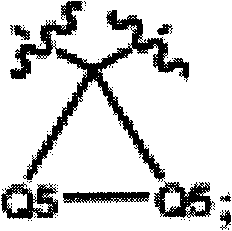


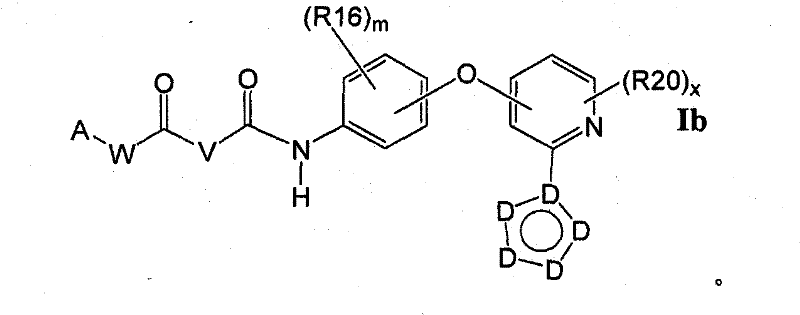
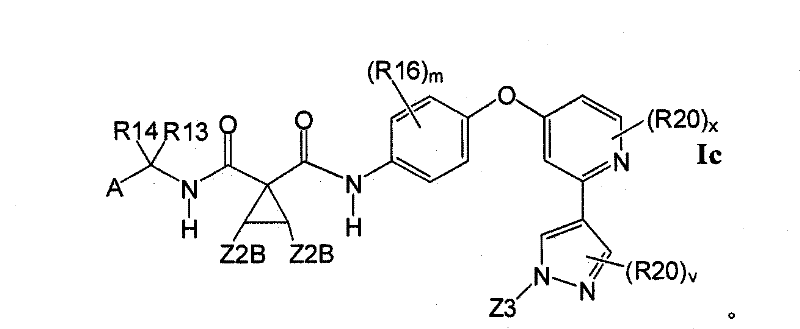


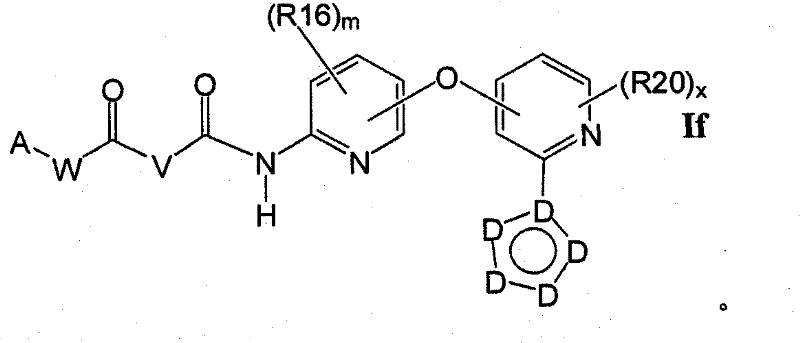

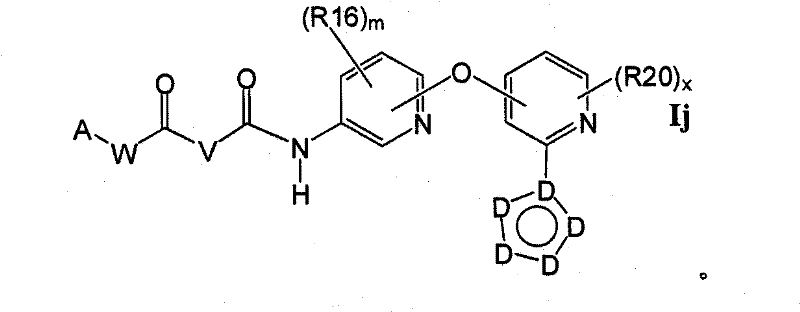
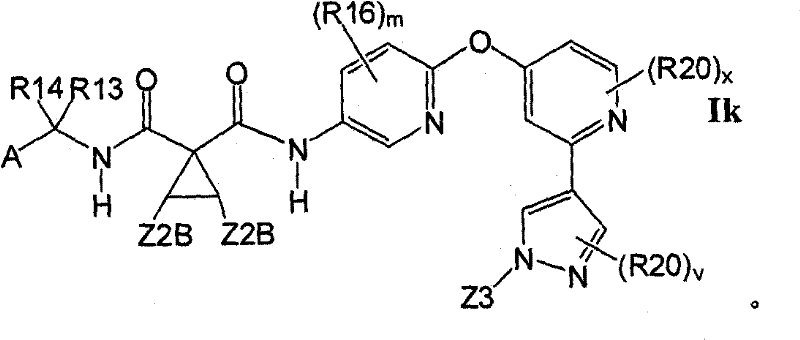


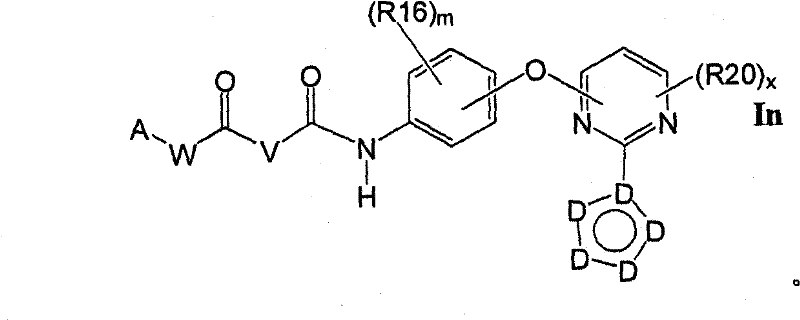

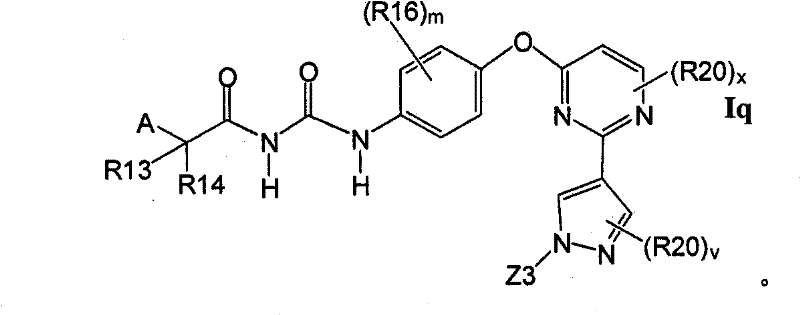


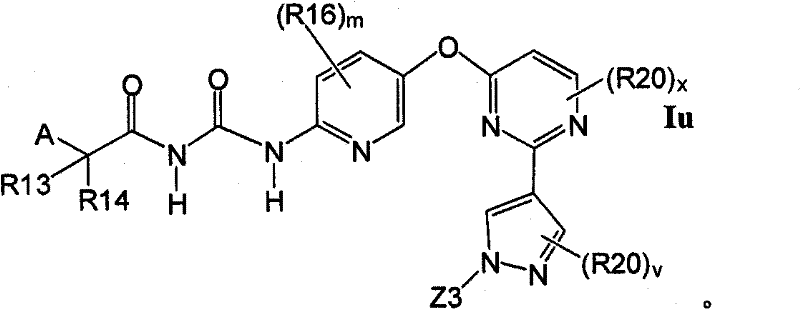
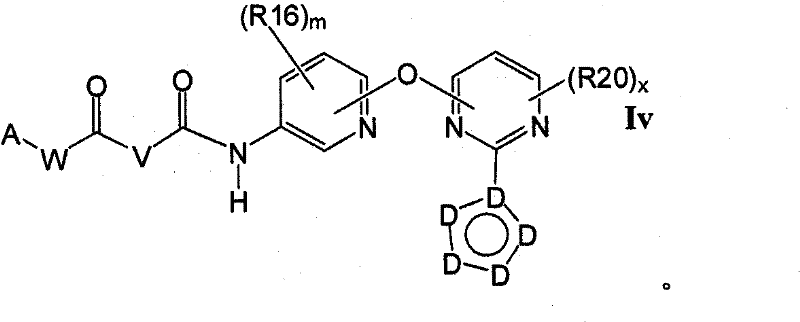


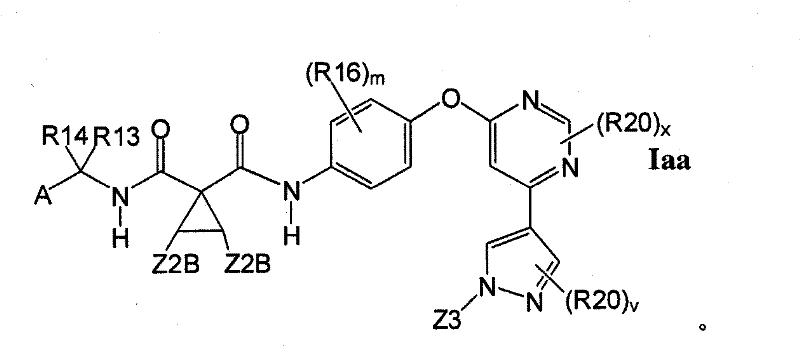
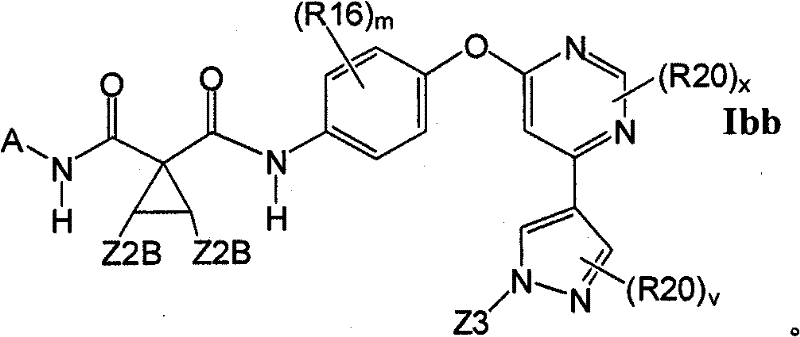


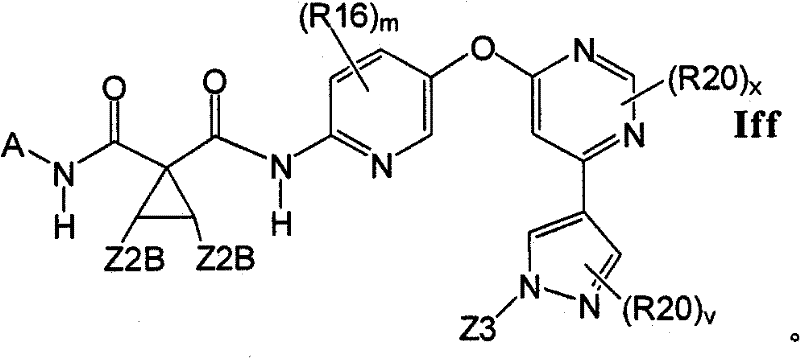
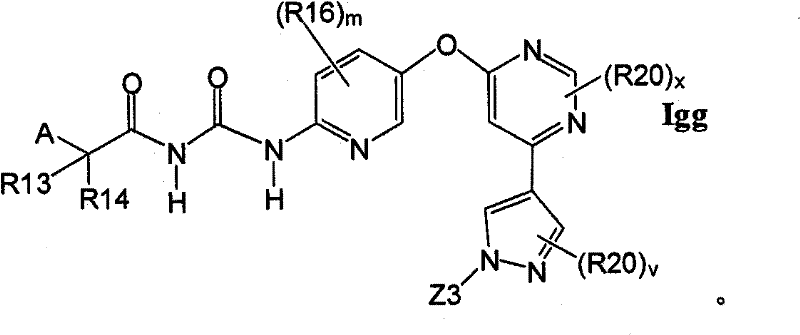

Applications Claiming Priority (3)
| Application Number | Priority Date | Filing Date | Title |
|---|---|---|---|
| US10930908P | 2008-10-29 | 2008-10-29 | |
| US61/109,309 | 2008-10-29 | ||
| PCT/US2009/062575 WO2010051373A1 (en) | 2008-10-29 | 2009-10-29 | Cyclopropane amides and analogs exhibiting anti-cancer and anti-proliferative activities |
Publications (1)
| Publication Number | Publication Date |
|---|---|
| CN102256493A true CN102256493A (en) | 2011-11-23 |
Family
ID=42129269
Family Applications (1)
| Application Number | Title | Priority Date | Filing Date |
|---|---|---|---|
| CN2009801515657A Pending CN102256493A (en) | 2008-10-29 | 2009-10-29 | Cyclopropane amides and analogs exhibiting anti-cancer and anti-proliferative activities |
Country Status (13)
| Country | Link |
|---|---|
| US (2) | US8278331B2 (en) |
| EP (1) | EP2365752B1 (en) |
| JP (1) | JP5444365B2 (en) |
| KR (1) | KR20110099687A (en) |
| CN (1) | CN102256493A (en) |
| AU (1) | AU2009308853A1 (en) |
| BR (1) | BRPI0920765A2 (en) |
| CA (1) | CA2742007C (en) |
| EA (1) | EA201170627A1 (en) |
| IL (1) | IL212574A0 (en) |
| MX (1) | MX2011004535A (en) |
| NZ (1) | NZ603654A (en) |
| WO (1) | WO2010051373A1 (en) |
Cited By (9)
| Publication number | Priority date | Publication date | Assignee | Title |
|---|---|---|---|---|
| CN104119319A (en) * | 2014-06-27 | 2014-10-29 | 郑州大学 | Pyrimidine derivative containing 1,2,3-triazole and urea structure unit as well as preparation method and application thereof |
| CN105120864A (en) * | 2013-03-15 | 2015-12-02 | 德西费拉制药有限责任公司 | 2-aminopyrimidin-6-ones and analogs exhibiting anticancer and antiproliferative activity |
| CN105228620A (en) * | 2013-03-15 | 2016-01-06 | 德西费拉制药有限责任公司 | N-acyl-N'-(pyridin-2-yl)ureas and analogs exhibiting anticancer and antiproliferative activity |
| CN106748830A (en) * | 2017-02-28 | 2017-05-31 | 金凯(辽宁)化工有限公司 | A kind of preparation method of the fluorophenol of 3 amino 4 |
| WO2018157737A1 (en) * | 2017-03-02 | 2018-09-07 | 深圳海王医药科技研究院有限公司 | Multi-target kinase inhibitor |
| WO2018233526A1 (en) * | 2017-06-19 | 2018-12-27 | 上海和誉生物医药科技有限公司 | CSF1R inhibitor and preparation method and application thereof |
| CN109384799A (en) * | 2018-11-12 | 2019-02-26 | 深圳海王医药科技研究院有限公司 | The crystal form A and preparation method of a kind of multiple target point kinase inhibitor compounds and the pharmaceutical composition containing it |
| WO2021180006A1 (en) * | 2020-03-10 | 2021-09-16 | 南京明德新药研发有限公司 | Vinyl-substituted pyridine compounds |
| CN111936487B (en) * | 2018-01-26 | 2024-07-09 | 埃克塞里艾克西斯公司 | Compounds for the treatment of kinase dependent disorders |
Families Citing this family (36)
| Publication number | Priority date | Publication date | Assignee | Title |
|---|---|---|---|---|
| BRPI0920261A8 (en) | 2008-10-14 | 2016-01-19 | Xi Ning | COMPOUND, PHARMACEUTICAL COMPOSITION, USE OF COMPOUND, AND METHOD FOR INHIBITING OR MODULATE PROTEIN KINASE ACTIVITY IN A BIOLOGICAL SAMPLE |
| MX2011009926A (en) | 2009-03-21 | 2012-01-27 | Ning Xi | Amino ester derivatives, salts thereof and methods of use. |
| SG10201503394PA (en) * | 2010-04-29 | 2015-06-29 | Deciphera Pharmaceuticals Llc | Cyclopropyl Dicarboxamides And Analogs Exhibiting Anti-Cancer And Anti-Proliferative Activities |
| EP2563773A1 (en) | 2010-04-29 | 2013-03-06 | Deciphera Pharmaceuticals, LLC | Pyridone amides and analogs exhibiting anti-cancer and anti-proliferative activites |
| US20130230586A1 (en) | 2010-10-02 | 2013-09-05 | Link Research & Grants Corporation | Treatment of Tinnitus and Related Auditory Dysfunctions |
| CN102558144A (en) * | 2010-12-22 | 2012-07-11 | 北大方正集团有限公司 | Aryl urea derivatives |
| RU2590158C2 (en) * | 2011-03-29 | 2016-07-10 | ЭЙСАЙ АрЭНДДи МЕНЕДЖМЕНТ КО., ЛТД. | Method of producing phenoxypyridine derivative |
| TW201242701A (en) * | 2011-04-22 | 2012-11-01 | Hon Hai Prec Ind Co Ltd | Guideway mechanism |
| EP2847179A1 (en) | 2012-05-08 | 2015-03-18 | The Regents of The University of California | Alpha 7 nicotinic acetylcholine allosteric modulators, their derivatives and uses thereof |
| US8461179B1 (en) | 2012-06-07 | 2013-06-11 | Deciphera Pharmaceuticals, Llc | Dihydronaphthyridines and related compounds useful as kinase inhibitors for the treatment of proliferative diseases |
| US9012635B2 (en) | 2013-03-15 | 2015-04-21 | Deciphera Pharmaceuticals, Llc | Pyridone amides and analogs exhibiting anti-cancer and anti-proliferative activities |
| US9133183B2 (en) | 2013-03-15 | 2015-09-15 | Deciphera Pharmaceuticals, Llc | Imidazolidinones and analogs exhibiting anti-cancer and anti-proliferative activities |
| WO2014145023A1 (en) * | 2013-03-15 | 2014-09-18 | Deciphera Pharmaceuticals, Llc | 1,2,4-triazol-5-ones and analogs exhibiting anti-cancer and anti-proliferative activities |
| WO2014145029A2 (en) * | 2013-03-15 | 2014-09-18 | Deciphera Pharmaceuticals, Llc | N-acyl-n'-(pyridin-2-yl) ureas and analogs exhibiting anti-cancer and anti-proliferative activities |
| KR20160024639A (en) | 2014-08-26 | 2016-03-07 | 삼성전자주식회사 | PDGF as a biomarker for predicting resistance or effect of c-Met targeting drugs |
| MX379159B (en) | 2016-02-12 | 2025-03-10 | Astellas Pharma Inc | TETRAHYDROISOQUINOLINE DERIVATIVES. |
| CA3089630A1 (en) | 2018-01-31 | 2019-08-08 | Deciphera Pharmaceuticals, Llc | Combination therapy for the treatment of mastocytosis |
| SG11202007198WA (en) | 2018-01-31 | 2020-08-28 | Deciphera Pharmaceuticals Llc | Combination therapy for the treatment of gastrointestinal stromal tumors |
| HUE073437T2 (en) | 2018-12-28 | 2026-01-28 | Deciphera Pharmaceuticals Llc | Csf1r inhibitors for use in treating tenosynovial giant cell tumors |
| EP3914356A1 (en) | 2019-01-25 | 2021-12-01 | Exelixis, Inc. | Compounds for the treatment of kinase-dependent disorders |
| WO2020185812A1 (en) | 2019-03-11 | 2020-09-17 | Teva Pharmaceuticals International Gmbh | Solid state forms of ripretinib |
| CN114127057B (en) | 2019-05-10 | 2024-07-12 | 德西费拉制药有限责任公司 | Phenylaminopyrimidine amide autophagy inhibitors and methods of use thereof |
| EP4295846A3 (en) | 2019-05-10 | 2024-02-28 | Deciphera Pharmaceuticals, LLC | Heteroarylaminopyrimidine amide autophagy inhibitors and methods of use thereof |
| US11590134B2 (en) | 2019-06-17 | 2023-02-28 | Deciphera Pharmaceuticals, Llc | Aminopyrimidine amide autophagy inhibitors and methods of use thereof |
| KR20220045189A (en) | 2019-08-12 | 2022-04-12 | 데시페라 파마슈티칼스, 엘엘씨. | How to treat gastrointestinal stromal tumors |
| TWI878335B (en) | 2019-08-12 | 2025-04-01 | 美商迪賽孚爾製藥有限公司 | Methods of treating gastrointestinal stromal tumors |
| SMT202400484T1 (en) | 2019-12-30 | 2025-01-14 | Deciphera Pharmaceuticals Llc | COMPOSITIONS OF 1-(4-BROMO-5-(1-ETHYL-7-(METHYLAMINO)-2-OXO-1,2-DIHYDRO-1,6-NAPHTHYRIDIN-3-YL)-2-FLUOROPHENYL)-3-PHENYLUREA |
| SMT202300467T1 (en) | 2019-12-30 | 2024-01-10 | Deciphera Pharmaceuticals Llc | Amorphous kinase inhibitor formulations and methods of use thereof |
| EP4103188A4 (en) * | 2020-02-10 | 2024-04-10 | StemSynergy Therapeutics, Inc. | MYC INHIBITORS AND USES THEREOF |
| CA3198943A1 (en) | 2020-11-18 | 2022-05-27 | Daniel L. Flynn | Gcn2 and perk kinase inhibitors and methods of use thereof |
| WO2022221227A1 (en) | 2021-04-13 | 2022-10-20 | Nuvalent, Inc. | Amino-substituted heterocycles for treating cancers with egfr mutations |
| PE20241934A1 (en) | 2021-12-09 | 2024-09-24 | Deciphera Pharmaceuticals Llc | RAF KINASE INHIBITORS AND METHODS OF USE THEREOF |
| US11779572B1 (en) | 2022-09-02 | 2023-10-10 | Deciphera Pharmaceuticals, Llc | Methods of treating gastrointestinal stromal tumors |
| TW202542127A (en) | 2023-12-08 | 2025-11-01 | 美商迪賽孚爾製藥有限公司 | Solid state forms of a kinase inhibitor |
| US20250205161A1 (en) | 2023-12-08 | 2025-06-26 | Deciphera Pharmaceuticals, Llc | Formulations of vimseltinib |
| WO2025231106A1 (en) | 2024-05-01 | 2025-11-06 | Deciphera Pharmaceuticals, Llc | Csf-1r inhibitors and methods of use thereof |
Citations (5)
| Publication number | Priority date | Publication date | Assignee | Title |
|---|---|---|---|---|
| WO2007076473A2 (en) * | 2005-12-23 | 2007-07-05 | Kalypsys, Inc. | Substituted pyrimidinyloxy ureas useful as inhibitors of protein kinases |
| US20070244116A1 (en) * | 2003-09-26 | 2007-10-18 | Exelixis, Inc. | c-MET MODULATORS AND METHOD OF USE |
| CN101128199A (en) * | 2004-04-23 | 2008-02-20 | 布里斯托尔-迈尔斯斯奎布公司 | Monocyclic heterocycles as kinase inhibitors |
| US20080090856A1 (en) * | 2006-10-11 | 2008-04-17 | Deciphera Pharmaceuticals, Llc | Kinase inhibitors useful for the treatment of myleoproliferative diseases and other proliferative diseases |
| US20080261961A1 (en) * | 2007-04-20 | 2008-10-23 | Deciphera Pharmaceuticals, Llc | Kinase inhibitors useful for the treatment of myleoprolific diseases and other proliferative diseases |
Family Cites Families (85)
| Publication number | Priority date | Publication date | Assignee | Title |
|---|---|---|---|---|
| GB971307A (en) | 1961-03-02 | 1964-09-30 | Wellcome Found | 5-anilinopyrimidines |
| GB1127875A (en) | 1967-03-23 | 1968-09-18 | Parke Davis & Co | 4-(5-nitro-2-furyl) thiazolyl hydantoins and hydrouracils |
| US3949002A (en) * | 1970-11-13 | 1976-04-06 | Imperial Chemical Industries Limited | Process for producing sulfone containing thiophenols |
| US3818024A (en) * | 1972-02-16 | 1974-06-18 | Velsicol Chemical Corp | Benzothiazol substituted thiadiazolidines |
| CH565887A5 (en) | 1972-08-22 | 1975-08-29 | Ciba Geigy Ag | |
| US3939122A (en) * | 1973-04-11 | 1976-02-17 | Bayer Aktiengesellschaft | Process for the preparation of compounds which contain hydantoin rings |
| FR2337554A1 (en) | 1976-01-08 | 1977-08-05 | Buzas Andre | (1)-Substd. (2)-phenyl-(4)-butyl-pyrazolidine dione salts - analgesics and antiinflammatories with little ulcerogenic action |
| US4093624A (en) * | 1977-01-31 | 1978-06-06 | Icn Pharmaceuticals, Inc. | 1,2,4-Thiadiazolidine-3,5-dione |
| FR2396549A2 (en) | 1977-07-06 | 1979-02-02 | Buzas Andre | Antiinflammatory pyrazolidine-di:one cpds. - with reduced ulcerogenic activity |
| US4256758A (en) | 1979-06-11 | 1981-03-17 | Merck & Co., Inc. | 4-Substituted-3-hydroxy-3-pyrroline-2,5-dione inhibitors of glycolic acid oxidase |
| US4298743A (en) | 1979-09-11 | 1981-11-03 | Merck & Co., Inc. | 4-(Substituted phenyl thiazolyl)-3-hydroxy-3-pyrroline-2,5-diones |
| US4296237A (en) * | 1979-09-11 | 1981-10-20 | Merck & Co., Inc. | 4-(Pyridyl, piperazinyl and thiazolyl substituted thiazolyl)-3-hydroxy-3-pyrroline-2,5-diones |
| US4432992A (en) * | 1979-11-05 | 1984-02-21 | Merck & Co., Inc. | 4-[5(and 4)-Substituted-2-thienyl]-3-hydroxy-3-pyrroline-2,5-dione inhibitors of glycolic acid oxidase |
| US4366189A (en) * | 1979-12-21 | 1982-12-28 | Ciba-Geigy Corporation | 4-Heterocyclyl-4'-vinylstilbenes |
| JPS5915247A (en) | 1982-07-16 | 1984-01-26 | Mitsubishi Paper Mills Ltd | Formation of image |
| JPS59177557A (en) * | 1983-03-28 | 1984-10-08 | Fuji Photo Film Co Ltd | Silver halide color photosensitive material |
| US4816454A (en) * | 1984-09-21 | 1989-03-28 | Cassella Aktiengesellschaft | 4,5-dihydro-3(2H)-pyridazinones and their pharmacological use |
| US5103014A (en) * | 1987-09-30 | 1992-04-07 | American Home Products Corporation | Certain 3,3'-[[[(2-phenyl-4-thiazolyl)methoxy]phenyl]methylene]dithiobis-propanoic acid derivatives |
| AU606808B2 (en) | 1988-06-29 | 1991-02-14 | Otsuka Pharmaceutical Factory, Inc. | Arylcarboxamide substituted by alkylphosphonates, process for preparing the same and a pharmaceutical composition containing the same |
| GB9012936D0 (en) | 1990-06-11 | 1990-08-01 | Fujisawa Pharmaceutical Co | Thiophene derivatives,processes for preparation thereof and pharmaceutical composition comprising the same |
| US5254715A (en) | 1990-11-07 | 1993-10-19 | Warner-Lambert Company | Aminosulfonyl carbamates |
| ATE157355T1 (en) * | 1991-01-21 | 1997-09-15 | Shionogi & Co | 3-BENZYLIDENE-1-CARBAMOYL-2-PYRROLIDONE ANALOGUE |
| US5228980A (en) * | 1991-01-31 | 1993-07-20 | Engelhard Corporation | Fluidized catalytic cracking process employing shell-coated FCC catalysts |
| US5162360A (en) * | 1991-06-24 | 1992-11-10 | Warner-Lambert Company | 2-heteroatom containing urea and thiourea ACAT inhibitors |
| DE4302702A1 (en) | 1993-02-01 | 1994-08-04 | Bayer Ag | Arylaminosulfonylureas |
| WO1994021617A1 (en) | 1993-03-19 | 1994-09-29 | Dowelanco | A process for preparing halogenated isothiazoles |
| WO1994022872A1 (en) * | 1993-03-30 | 1994-10-13 | Yoshitomi Pharmaceutical Industries, Ltd. | Cell adhesion inhibitor and thienotriazolodiazepine compound |
| WO1994024095A1 (en) | 1993-04-16 | 1994-10-27 | Abbott Laboratories | Immunosuppressive agents |
| CA2123728A1 (en) * | 1993-05-21 | 1994-11-22 | Noriyoshi Sueda | Urea derivatives and their use as acat inhibitors |
| DE4337847A1 (en) | 1993-11-05 | 1995-05-11 | Bayer Ag | Substituted phenylaminosulphonylureas |
| JPH09506101A (en) | 1993-12-07 | 1997-06-17 | スミスクライン・ビーチャム・パブリック・リミテッド・カンパニー | Heterocyclic biphenylylamides useful as 5HT1D antagonists |
| DE4343831A1 (en) | 1993-12-22 | 1995-06-29 | Magyar Tudomanyos Akademia | New N-substd. N-acyloxy:methyl-N'-sulphonyl-urea cpds |
| FR2715155B1 (en) * | 1994-01-19 | 1996-07-26 | Mayoly Spindler | Monoamine oxidase B inhibitors and methods of preparing them. |
| DE4414840A1 (en) | 1994-04-28 | 1995-11-02 | Bayer Ag | Substituted phenylaminosulfonylureas |
| CN100384825C (en) | 1994-06-15 | 2008-04-30 | 大塚制药株式会社 | Benzheterocyclic derivatives |
| JP3117721B2 (en) | 1994-11-24 | 2000-12-18 | エフ・ホフマン−ラ ロシュ アーゲー | New benzyl pyrimidines |
| US5494925A (en) * | 1994-12-02 | 1996-02-27 | Sterling Winthrop Inc. | 2-heterocyclyloxymethyl and 2-heterocyclylthiomethyl-1,2,5-thiadiazolidin-3-one 1,1-dioxides and compositions and method of use thereof |
| EP0739884B1 (en) | 1995-04-24 | 2003-08-13 | Semiconductor Energy Laboratory Co., Ltd. | Liquid crystal compound and liquid crystal composition containing the same |
| JPH09221476A (en) | 1995-12-15 | 1997-08-26 | Otsuka Pharmaceut Co Ltd | Medicinal composition |
| US6020357A (en) * | 1996-12-23 | 2000-02-01 | Dupont Pharmaceuticals Company | Nitrogen containing heteroaromatics as factor Xa inhibitors |
| ATE230742T1 (en) | 1997-03-27 | 2003-01-15 | Great Lakes Chemical Europ | 2-(2'-HYDROXPHENYL)-BENZOTRIAZOLES AND THEIR USE AS LIGHT PROTECTIVE AGENTS FOR ORGANIC POLYMERS |
| US6294573B1 (en) * | 1997-08-06 | 2001-09-25 | Abbott Laboratories | Reverse hydroxamate inhibitors of matrix metalloproteinases |
| US6235786B1 (en) * | 1997-08-06 | 2001-05-22 | Abbott Laboratories | Reverse hydroxamate inhibitors of matrix metalloproteinases |
| AU1367599A (en) * | 1997-11-03 | 1999-05-24 | Boehringer Ingelheim Pharmaceuticals, Inc. | Aromatic heterocyclic compounds as anti-inflammatory agents |
| US6887893B1 (en) | 1997-12-24 | 2005-05-03 | Sankyo Company, Limited | Methods and compositions for treatment and prevention of tumors, tumor-related disorders and cachexia |
| EP0928790B1 (en) | 1998-01-02 | 2003-03-05 | F. Hoffmann-La Roche Ag | Thiazole derivatives |
| EP0956855B1 (en) | 1998-04-24 | 2003-03-12 | K.U. Leuven Research & Development | Immunosuppressive effects of 8 substituted xanthine derivatives |
| US6197599B1 (en) * | 1998-07-30 | 2001-03-06 | Guorong Chin | Method to detect proteins |
| GB9823873D0 (en) * | 1998-10-30 | 1998-12-30 | Pharmacia & Upjohn Spa | 2-ureido-thiazole derivatives,process for their preparation,and their use as antitumour agents |
| UA73492C2 (en) * | 1999-01-19 | 2005-08-15 | Aromatic heterocyclic compounds as antiinflammatory agents | |
| JP2000275886A (en) | 1999-03-23 | 2000-10-06 | Konica Corp | Electrophotographic photoreceptor and process cartridge and image forming device using the same |
| US6410254B1 (en) * | 1999-05-18 | 2002-06-25 | Cytokinetics | Compositions and assays utilizing ADP or phosphate for detecting protein modulators |
| JP3972163B2 (en) | 1999-06-18 | 2007-09-05 | 株式会社大塚製薬工場 | Phosphonic acid diester derivatives |
| US6525046B1 (en) * | 2000-01-18 | 2003-02-25 | Boehringer Ingelheim Pharmaceuticals, Inc. | Aromatic heterocyclic compounds as antiinflammatory agents |
| US6500628B1 (en) * | 2000-05-25 | 2002-12-31 | Millennium Pharmaceuticals, Inc. | Nucleic acid molecules encoding human kinase and phosphatase homologues and uses therefor |
| US6645990B2 (en) * | 2000-08-15 | 2003-11-11 | Amgen Inc. | Thiazolyl urea compounds and methods of uses |
| EP1362037A1 (en) * | 2001-02-15 | 2003-11-19 | Boehringer Ingelheim Pharmaceuticals Inc. | Process for synthesis of heteroaryl-substituted urea compounds useful as antiinflammatory agents |
| US20030165873A1 (en) * | 2001-03-02 | 2003-09-04 | Come Jon H. | Three hybrid assay system |
| AU2002241139B2 (en) * | 2001-03-23 | 2007-09-20 | Merck Sharp & Dohme Limited | Imidazo-pyrimidine derivatives as ligands for GABA receptors |
| US20030092736A1 (en) * | 2001-05-30 | 2003-05-15 | Cheng Peter T. | Substituted azole acid derivatives useful as antidiabetic and antiobesity agents and method |
| KR100883731B1 (en) * | 2001-06-22 | 2009-02-12 | 기린 파마 가부시끼가이샤 | Quinoline derivatives and quinazoline derivatives that inhibit hepatocellular growth factor receptor autophosphorylation and pharmaceutical compositions containing them |
| EP1281399A3 (en) | 2001-08-01 | 2004-02-11 | Warner-Lambert Company | Dual inhibitors of wax ester and cholesteryl ester synthesis for inhibiting sebum production |
| US7211575B2 (en) * | 2001-09-13 | 2007-05-01 | Boehringer Ingelheim Pharmaceuticals, Inc. | Methods of treating cytokine mediated diseases |
| PT1478358E (en) * | 2002-02-11 | 2013-09-11 | Bayer Healthcare Llc | Sorafenib tosylate for the treatment of diseases characterized by abnormal angiogenesis |
| DE60319066T2 (en) * | 2002-02-25 | 2009-02-26 | Boehringer Ingelheim Pharmaceuticals, Inc., Ridgefield | 1,4-DISUBSTITUTED BENZO-CONDENSED CYCLOALKYL UREA COMPOUNDS FOR THE TREATMENT OF CYTOKIN-MEDIATED DISEASES |
| US20040171075A1 (en) * | 2002-12-31 | 2004-09-02 | Flynn Daniel L | Modulation of protein functionalities |
| US7144911B2 (en) * | 2002-12-31 | 2006-12-05 | Deciphera Pharmaceuticals Llc | Anti-inflammatory medicaments |
| US20080045531A1 (en) * | 2002-12-31 | 2008-02-21 | Flynn Daniel L | Anti-inflammatory medicaments |
| US7202257B2 (en) * | 2003-12-24 | 2007-04-10 | Deciphera Pharmaceuticals, Llc | Anti-inflammatory medicaments |
| UY28213A1 (en) * | 2003-02-28 | 2004-09-30 | Bayer Pharmaceuticals Corp | NEW CYANOPIRIDINE DERIVATIVES USEFUL IN THE TREATMENT OF CANCER AND OTHER DISORDERS. |
| US20050014753A1 (en) * | 2003-04-04 | 2005-01-20 | Irm Llc | Novel compounds and compositions as protein kinase inhibitors |
| WO2005048953A2 (en) * | 2003-11-13 | 2005-06-02 | Ambit Biosciences Corporation | Amide derivatives as kinase modulators |
| US7211272B2 (en) * | 2003-12-22 | 2007-05-01 | Bausch & Lomb Incorporated | Drug delivery device |
| US20080220497A1 (en) * | 2003-12-24 | 2008-09-11 | Flynn Daniel L | Modulation of protein functionalities |
| US20070191336A1 (en) * | 2003-12-24 | 2007-08-16 | Flynn Daniel L | Anti-inflammatory medicaments |
| US7459562B2 (en) * | 2004-04-23 | 2008-12-02 | Bristol-Myers Squibb Company | Monocyclic heterocycles as kinase inhibitors |
| JP5197016B2 (en) * | 2004-12-23 | 2013-05-15 | デシファラ ファーマスーティカルズ, エルエルシー | Enzyme modulators and therapy |
| AU2005325676A1 (en) * | 2004-12-23 | 2006-08-03 | Deciphera Pharmaceuticals, Llc | Anti-inflammatory medicaments |
| US7622583B2 (en) * | 2005-01-14 | 2009-11-24 | Chemocentryx, Inc. | Heteroaryl sulfonamides and CCR2 |
| DK1904504T3 (en) * | 2005-05-20 | 2014-06-23 | Methylgene Inc | VEGF RECEPTOR AND HGF RECEPTOR SIGNAL INHIBITORS |
| CA2611370C (en) * | 2005-05-20 | 2014-11-25 | Oscar Mario Saavedra | Inhibitors of vegf receptor and hgf receptor signaling |
| CN101528744A (en) * | 2006-10-20 | 2009-09-09 | Irm责任有限公司 | Compositions and methods for modulating C-KIT and PDGFR receptors |
| US20080248548A1 (en) * | 2007-04-09 | 2008-10-09 | Flynn Daniel L | Modulation of protein functionalities |
| US20080248487A1 (en) * | 2007-04-09 | 2008-10-09 | Flynn Daniel L | Modulation of protein functionalities |
| SG10201503394PA (en) * | 2010-04-29 | 2015-06-29 | Deciphera Pharmaceuticals Llc | Cyclopropyl Dicarboxamides And Analogs Exhibiting Anti-Cancer And Anti-Proliferative Activities |
-
2009
- 2009-10-29 MX MX2011004535A patent/MX2011004535A/en unknown
- 2009-10-29 AU AU2009308853A patent/AU2009308853A1/en not_active Abandoned
- 2009-10-29 CA CA2742007A patent/CA2742007C/en not_active Expired - Fee Related
- 2009-10-29 NZ NZ603654A patent/NZ603654A/en not_active IP Right Cessation
- 2009-10-29 JP JP2011534766A patent/JP5444365B2/en not_active Expired - Fee Related
- 2009-10-29 EA EA201170627A patent/EA201170627A1/en unknown
- 2009-10-29 WO PCT/US2009/062575 patent/WO2010051373A1/en not_active Ceased
- 2009-10-29 US US12/608,578 patent/US8278331B2/en not_active Expired - Fee Related
- 2009-10-29 EP EP09824132.6A patent/EP2365752B1/en not_active Not-in-force
- 2009-10-29 CN CN2009801515657A patent/CN102256493A/en active Pending
- 2009-10-29 KR KR1020117012338A patent/KR20110099687A/en not_active Ceased
- 2009-10-29 BR BRPI0920765-1A patent/BRPI0920765A2/en not_active IP Right Cessation
-
2011
- 2011-04-28 IL IL212574A patent/IL212574A0/en unknown
-
2012
- 2012-08-21 US US13/590,955 patent/US8486951B2/en not_active Expired - Fee Related
Patent Citations (5)
| Publication number | Priority date | Publication date | Assignee | Title |
|---|---|---|---|---|
| US20070244116A1 (en) * | 2003-09-26 | 2007-10-18 | Exelixis, Inc. | c-MET MODULATORS AND METHOD OF USE |
| CN101128199A (en) * | 2004-04-23 | 2008-02-20 | 布里斯托尔-迈尔斯斯奎布公司 | Monocyclic heterocycles as kinase inhibitors |
| WO2007076473A2 (en) * | 2005-12-23 | 2007-07-05 | Kalypsys, Inc. | Substituted pyrimidinyloxy ureas useful as inhibitors of protein kinases |
| US20080090856A1 (en) * | 2006-10-11 | 2008-04-17 | Deciphera Pharmaceuticals, Llc | Kinase inhibitors useful for the treatment of myleoproliferative diseases and other proliferative diseases |
| US20080261961A1 (en) * | 2007-04-20 | 2008-10-23 | Deciphera Pharmaceuticals, Llc | Kinase inhibitors useful for the treatment of myleoprolific diseases and other proliferative diseases |
Non-Patent Citations (1)
| Title |
|---|
| NIKOLAUS SCHIERING ET AL.: "Crystal structure of the tyrosine kinase domain of the hepatocyte growth factor receptor c-Met and its complex with the microbial alkaloid K-252a", 《PROCEEDINGS OF THE NATIONAL ACADEMY OF SCIENCE》 * |
Cited By (20)
| Publication number | Priority date | Publication date | Assignee | Title |
|---|---|---|---|---|
| CN110563700A (en) * | 2013-03-15 | 2019-12-13 | 德西费拉制药有限责任公司 | N-acyl-N' - (pyridin-2-yl) ureas and analogs exhibiting anti-cancer and anti-proliferative activity |
| CN105120864A (en) * | 2013-03-15 | 2015-12-02 | 德西费拉制药有限责任公司 | 2-aminopyrimidin-6-ones and analogs exhibiting anticancer and antiproliferative activity |
| CN105228620A (en) * | 2013-03-15 | 2016-01-06 | 德西费拉制药有限责任公司 | N-acyl-N'-(pyridin-2-yl)ureas and analogs exhibiting anticancer and antiproliferative activity |
| CN105120864B (en) * | 2013-03-15 | 2017-05-17 | 德西费拉制药有限责任公司 | 2-aminopyrimidin-6-ones and analogs exhibiting anticancer and antiproliferative activity |
| CN107311981A (en) * | 2013-03-15 | 2017-11-03 | 德西费拉制药有限责任公司 | Show ketone of 2 aminopyrimidine 6 of active anticancer and antiproliferative activity and the like |
| CN112047927A (en) * | 2013-03-15 | 2020-12-08 | 德西费拉制药有限责任公司 | N-acyl-N' - (pyridin-2-yl) ureas and analogs exhibiting anti-cancer and anti-proliferative activity |
| CN105228620B (en) * | 2013-03-15 | 2020-09-04 | 德西费拉制药有限责任公司 | N-acyl-N'-(pyridin-2-yl)ureas and analogs exhibiting anticancer and antiproliferative activities |
| CN104119319B (en) * | 2014-06-27 | 2016-03-16 | 郑州大学 | Containing the pyrimidine derivatives and its production and use of 1,2,3-triazole and urea structure uint |
| CN104119319A (en) * | 2014-06-27 | 2014-10-29 | 郑州大学 | Pyrimidine derivative containing 1,2,3-triazole and urea structure unit as well as preparation method and application thereof |
| CN106748830A (en) * | 2017-02-28 | 2017-05-31 | 金凯(辽宁)化工有限公司 | A kind of preparation method of the fluorophenol of 3 amino 4 |
| CN106748830B (en) * | 2017-02-28 | 2018-11-30 | 金凯(辽宁)化工有限公司 | A kind of preparation method of 3- amino-4-fluorophenol |
| CN108530464A (en) * | 2017-03-02 | 2018-09-14 | 深圳海王医药科技研究院有限公司 | A kind of multiple target point kinase inhibitor |
| WO2018157737A1 (en) * | 2017-03-02 | 2018-09-07 | 深圳海王医药科技研究院有限公司 | Multi-target kinase inhibitor |
| WO2018233526A1 (en) * | 2017-06-19 | 2018-12-27 | 上海和誉生物医药科技有限公司 | CSF1R inhibitor and preparation method and application thereof |
| CN110461849A (en) * | 2017-06-19 | 2019-11-15 | 上海和誉生物医药科技有限公司 | A kind of CSF1R inhibitor and its preparation method and application |
| CN110461849B (en) * | 2017-06-19 | 2020-09-01 | 上海和誉生物医药科技有限公司 | A kind of CSF1R inhibitor and its preparation method and application |
| CN111936487B (en) * | 2018-01-26 | 2024-07-09 | 埃克塞里艾克西斯公司 | Compounds for the treatment of kinase dependent disorders |
| CN109384799A (en) * | 2018-11-12 | 2019-02-26 | 深圳海王医药科技研究院有限公司 | The crystal form A and preparation method of a kind of multiple target point kinase inhibitor compounds and the pharmaceutical composition containing it |
| WO2021180006A1 (en) * | 2020-03-10 | 2021-09-16 | 南京明德新药研发有限公司 | Vinyl-substituted pyridine compounds |
| CN115244041A (en) * | 2020-03-10 | 2022-10-25 | 南京明德新药研发有限公司 | Vinyl-substituted pyridines |
Also Published As
| Publication number | Publication date |
|---|---|
| US8278331B2 (en) | 2012-10-02 |
| US20130079362A1 (en) | 2013-03-28 |
| US20100120806A1 (en) | 2010-05-13 |
| CA2742007C (en) | 2014-07-08 |
| US8486951B2 (en) | 2013-07-16 |
| KR20110099687A (en) | 2011-09-08 |
| WO2010051373A1 (en) | 2010-05-06 |
| EA201170627A1 (en) | 2011-10-31 |
| NZ603654A (en) | 2014-09-26 |
| JP5444365B2 (en) | 2014-03-19 |
| EP2365752B1 (en) | 2014-09-24 |
| MX2011004535A (en) | 2011-11-18 |
| AU2009308853A1 (en) | 2010-05-06 |
| EP2365752A4 (en) | 2012-06-20 |
| CA2742007A1 (en) | 2010-05-06 |
| BRPI0920765A2 (en) | 2015-08-18 |
| IL212574A0 (en) | 2011-06-30 |
| EP2365752A1 (en) | 2011-09-21 |
| JP2012507551A (en) | 2012-03-29 |
Similar Documents
| Publication | Publication Date | Title |
|---|---|---|
| CN102256493A (en) | Cyclopropane amides and analogs exhibiting anti-cancer and anti-proliferative activities | |
| CN101553233B (en) | Kinase inhibitors useful for the treatment of myleoproliferative diseases and other proliferative diseases | |
| JP6203439B2 (en) | Pyridone derivatives having a tetrahydropyranylmethyl group | |
| CN110891953B (en) | Pyrrolotriazine derivatives, preparation method and use thereof | |
| CN113135896A (en) | Methylpyrazole derivatives as RET inhibitors | |
| CN101878031A (en) | Kinase inhibitors for the treatment of myeloproliferative and other proliferative disorders | |
| CN101528702A (en) | Quinoline compounds and methods of use | |
| TW201113272A (en) | Novel pyrimidine-and triazine hepcidine antagonists | |
| RS52061B (en) | PIRAZOLYL-AMINOPYRIDINE DERIVATIVES USEFUL AS KINASE INHIBITORS | |
| TW201623239A (en) | Novel 2-amino-pyridine and 2-amino-pyrimidine derivatives and medical use thereof | |
| KR20180107232A (en) | The halo-substituted piperidine as an orexin receptor modulator | |
| CN107849029A (en) | Cyclopropane derivative and the medicine containing it | |
| JP2014101287A (en) | Indole derivative | |
| TWI790810B (en) | Ret kinase inhibitors | |
| HK1164060A (en) | Cyclopropane amides and analogs exhibiting anti-cancer and anti-proliferative activities | |
| TW202600142A (en) | Doses and regimens of her2 inhibitors | |
| WO2025087295A1 (en) | Pi3k inhibitor, and preparation method therefor and use thereof | |
| CN116768889A (en) | A new type of CDK9 kinase inhibitor and its preparation method and application | |
| HK1150233A (en) | Kinase inhibitors useful for the treatment of myleoproliferative diseases and other proliferative diseases |
Legal Events
| Date | Code | Title | Description |
|---|---|---|---|
| C06 | Publication | ||
| PB01 | Publication | ||
| C10 | Entry into substantive examination | ||
| SE01 | Entry into force of request for substantive examination | ||
| REG | Reference to a national code |
Ref country code: HK Ref legal event code: DE Ref document number: 1164060 Country of ref document: HK |
|
| C02 | Deemed withdrawal of patent application after publication (patent law 2001) | ||
| WD01 | Invention patent application deemed withdrawn after publication |
Application publication date: 20111123 |
|
| REG | Reference to a national code |
Ref country code: HK Ref legal event code: WD Ref document number: 1164060 Country of ref document: HK |