CN102165435A - Automatic context sensitive language generation, correction and enhancement using an internet corpus - Google Patents
Automatic context sensitive language generation, correction and enhancement using an internet corpus Download PDFInfo
- Publication number
- CN102165435A CN102165435A CN200980138185XA CN200980138185A CN102165435A CN 102165435 A CN102165435 A CN 102165435A CN 200980138185X A CN200980138185X A CN 200980138185XA CN 200980138185 A CN200980138185 A CN 200980138185A CN 102165435 A CN102165435 A CN 102165435A
- Authority
- CN
- China
- Prior art keywords
- correction
- function
- words
- input
- word
- Prior art date
- Legal status (The legal status is an assumption and is not a legal conclusion. Google has not performed a legal analysis and makes no representation as to the accuracy of the status listed.)
- Granted
Links
Images


Classifications
-
- G—PHYSICS
- G06—COMPUTING OR CALCULATING; COUNTING
- G06F—ELECTRIC DIGITAL DATA PROCESSING
- G06F40/00—Handling natural language data
- G06F40/10—Text processing
-
- G—PHYSICS
- G06—COMPUTING OR CALCULATING; COUNTING
- G06F—ELECTRIC DIGITAL DATA PROCESSING
- G06F40/00—Handling natural language data
- G06F40/20—Natural language analysis
- G06F40/232—Orthographic correction, e.g. spell checking or vowelisation
-
- G—PHYSICS
- G06—COMPUTING OR CALCULATING; COUNTING
- G06F—ELECTRIC DIGITAL DATA PROCESSING
- G06F40/00—Handling natural language data
- G06F40/20—Natural language analysis
- G06F40/253—Grammatical analysis; Style critique
-
- G—PHYSICS
- G06—COMPUTING OR CALCULATING; COUNTING
- G06F—ELECTRIC DIGITAL DATA PROCESSING
- G06F40/00—Handling natural language data
- G06F40/20—Natural language analysis
- G06F40/263—Language identification
-
- G—PHYSICS
- G06—COMPUTING OR CALCULATING; COUNTING
- G06F—ELECTRIC DIGITAL DATA PROCESSING
- G06F40/00—Handling natural language data
- G06F40/40—Processing or translation of natural language
-
- G—PHYSICS
- G10—MUSICAL INSTRUMENTS; ACOUSTICS
- G10L—SPEECH ANALYSIS TECHNIQUES OR SPEECH SYNTHESIS; SPEECH RECOGNITION; SPEECH OR VOICE PROCESSING TECHNIQUES; SPEECH OR AUDIO CODING OR DECODING
- G10L15/00—Speech recognition
- G10L15/26—Speech to text systems
Landscapes
- Engineering & Computer Science (AREA)
- Theoretical Computer Science (AREA)
- Audiology, Speech & Language Pathology (AREA)
- Health & Medical Sciences (AREA)
- Computational Linguistics (AREA)
- Physics & Mathematics (AREA)
- General Health & Medical Sciences (AREA)
- General Engineering & Computer Science (AREA)
- General Physics & Mathematics (AREA)
- Artificial Intelligence (AREA)
- Human Computer Interaction (AREA)
- Acoustics & Sound (AREA)
- Multimedia (AREA)
- Machine Translation (AREA)
- Document Processing Apparatus (AREA)
Abstract
Description
相关申请的引用References to related applications
在此引用在2007年8月1日提交的、标题为“METHODS FOR CONTEXT SENSITIVE ERROR DETECTION AND CORRECTION”的美国临时专利申请No.60/953,209和在2008年7月31日提交的PCT专利申请PCT/IL2008/001051,特此通过引用并入它们的公开,并且特此按照37CFR1.78(a)(4)和(5)(i)来要求它们的优先权。U.S. Provisional Patent Application No. 60/953,209, filed August 1, 2007, entitled "METHODS FOR CONTEXT SENSITIVE ERROR DETECTION AND CORRECTION," and PCT Patent Application PCT/ IL2008/001051, their disclosures are hereby incorporated by reference, and their priority is hereby claimed under 37 CFR 1.78(a)(4) and (5)(i).
技术领域technical field
本发明总体上涉及计算机辅助语言产生和校正,并且更具体地涉及适用于机器翻译的计算机辅助语言产生和校正。The present invention relates generally to computer aided language generation and correction, and more particularly to computer aided language generation and correction suitable for machine translation.
背景技术Background technique
认为以下公布表示现有技术:The following publications are believed to represent prior art:
美国专利No.5,659,771;No.5,907,839;No.6,424,983;No.7,296,019;No.5,956,739和No.4,674,065U.S. Patent No. 5,659,771; No. 5,907,839; No. 6,424,983; No. 7,296,019; No. 5,956,739 and No. 4,674,065
美国公布的专利申请No.2006/0247914和No.2007/0106937U.S. Published Patent Application Nos. 2006/0247914 and 2007/0106937
发明内容Contents of the invention
本发明寻求提供用于计算机辅助语言产生的改进的系统和功能。The present invention seeks to provide improved systems and functionality for computer-aided language generation.
根据本发明的优选实施例,提供了一种计算机辅助语言产生系统,包括:According to a preferred embodiment of the present invention, a computer-aided language generation system is provided, comprising:
语句检索功能,其基于包含词的输入文本来操作,以从因特网语料库检索多个语句,所述多个语句包含与在所述输入文本中的所述词对应的词;以及a sentence retrieval function operating on input text containing words to retrieve a plurality of sentences containing words corresponding to the words in the input text from an Internet corpus; and
语句产生功能,其使用由所述语句检索功能从所述因特网语料库检索的多个语句来操作,以产生表达出所述输入文本的至少一个正确的语句。A sentence generation function operates using the plurality of sentences retrieved from the Internet corpus by the sentence retrieval function to generate at least one correct sentence expressing the input text.
优选地,所述语句检索功能包括:Preferably, the sentence retrieval function includes:
独立短语产生器,用于将所述输入文本划分为一个或多个独立短语;an independent phrase generator for dividing said input text into one or more independent phrases;
词干产生器和分类器,用于对每一个独立短语进行操作,以产生词中出现的词干,并且向其分配重要性权重;以及a stemmer and classifier that operates on each individual phrase to produce stems that occur in words and assign importance weights to them; and
替换产生器,用于产生与所述词干对应的替换词干。A replacement generator, configured to generate a replacement word stem corresponding to the word stem.
根据本发明的优选实施例,所述计算机辅助语言产生系统并且还包括词干到语句索引,所述词干到语句索引与所述因特网语料库交互,以检索所述多个语句,所述多个语句包含与在所述输入文本中的所述词对应的词。According to a preferred embodiment of the present invention, the computer-assisted language generation system further includes a stem-to-sentence index that interacts with the Internet corpus to retrieve the plurality of sentences, the plurality of A sentence contains words corresponding to the words in the input text.
优选地,所述语句产生功能包括:Preferably, the sentence generation function includes:
语句简化功能,用于简化从所述因特网语料库检索的所述语句;a sentence reduction function for simplifying said sentences retrieved from said Internet corpus;
简化语句分组功能,用于对由所述语句简化功能提供的类似的简化语句进行分组;以及a simplified sentence grouping function for grouping similar simplified sentences provided by said sentence reduction function; and
简化语句组分级功能,用于对所述类似的简化语句的组进行分级。The simplified statement group grading function is used for grading the similar simplified statement groups.
根据本发明的优选实施例,所述简化语句组分级功能使用下面的准则中的至少一些来操作:According to a preferred embodiment of the present invention, the simplified statement group ranking function operates using at least some of the following criteria:
A.在组中包含的简化语句的数量;A. The number of simplified statements included in the group;
B.在所述组中的词的词干与在独立短语中的词干及其替换的对应度;B. Correspondence of the stems of the words in the set to the stems and their replacements in the independent phrases;
C.所述组包括不与在所述独立短语中的词及其替换对应的词的程度。C. The degree to which the group includes words that do not correspond to the words and their replacements in the independent phrase.
优选地,所述简化语句组分级功能使用下面的过程的至少一部分来操作:Preferably, said simplified statement group ranking function operates using at least part of the following process:
定义词干的权重,以指示词在语言中的重要性;Define the weight of the stem to indicate the importance of the word in the language;
计算与准则B对应的正匹配分级;Calculate the positive match rating corresponding to criterion B;
计算与准则C对应的负匹配分级;Calculate the negative match rating corresponding to criterion C;
基于以下项来计算复合分级:Composite ratings are calculated based on:
在组中包含的简化语句的所述数量,并且所述数量对应于准则A;said number of simplified statements contained in a group, and said number corresponds to criterion A;
所述正匹配分级;以及said positive match rating; and
所述负匹配分级。The negative match rating.
根据本发明的实施例,所述计算机辅助语言产生系统还包括机器翻译功能,用于提供所述输入文本。According to an embodiment of the present invention, the computer-aided language generation system further includes a machine translation function for providing the input text.
根据本发明的优选实施例,提供了一种机器翻译系统,包括:According to a preferred embodiment of the present invention, a machine translation system is provided, comprising:
机器翻译功能;machine translation function;
语句检索功能,其基于由所述机器翻译功能提供的输入文本来操作,以从因特网语料库检索多个语句,所述多个语句包含与在所述输入文本中的词对应的词;以及a sentence retrieval function operating on input text provided by said machine translation function to retrieve a plurality of sentences from an Internet corpus, said plurality of sentences containing words corresponding to words in said input text; and
语句产生功能,其使用由所述语句检索功能从所述因特网语料库检索的多个语句来操作,以产生表达出由所述机器翻译功能产生的所述输入文本的至少一个正确的语句。a sentence generation function that operates using the plurality of sentences retrieved from the Internet corpus by the sentence retrieval function to generate at least one correct sentence expressing the input text generated by the machine translation function.
优选地,所述机器翻译功能提供与在所述输入文本中的词对应的多个替换,并且所述语句检索功能用于从所述因特网语料库检索包括对应于所述替换的词的多个语句。Preferably, said machine translation function provides a plurality of alternatives corresponding to words in said input text, and said sentence retrieval function is operable to retrieve from said Internet corpus a plurality of sentences comprising words corresponding to said substitutions .
根据本发明的实施例,语言产生包括文本校正。According to an embodiment of the invention, language generation includes text correction.
根据本发明的优选实施例,提供了一种文本校正系统,包括:According to a preferred embodiment of the present invention, a text correction system is provided, comprising:
语句检索功能,其基于由所述文本校正功能提供的输入文本来操作,以从因特网语料库检索多个语句,所述多个语句包含与在所述输入文本中的词对应的词;以及a sentence retrieval function that operates based on the input text provided by the text correction function to retrieve a plurality of sentences from an Internet corpus, the plurality of sentences containing words corresponding to words in the input text; and
语句校正功能,其使用由所述语句检索功能从所述因特网语料库检索的多个语句来操作,以产生表达出所述输入文本的至少一个正确的语句。A sentence correction function that operates using the plurality of sentences retrieved from the Internet corpus by the sentence retrieval function to produce at least one correct sentence expressing the input text.
优选地,所述系统还包括语句搜索功能,用于基于用户输入的查询词来提供所述输入文本。Preferably, the system further includes a sentence search function for providing the input text based on a query word input by a user.
根据本发明的优选实施例,提供了一种语句搜索系统,包括:According to a preferred embodiment of the present invention, a sentence search system is provided, including:
语句搜索功能,用于基于用户输入的查询词来提供输入文本;A sentence search function for providing input text based on query terms entered by the user;
语句检索功能,其基于由所述语句搜索功能提供的所述输入文本来操作,以从因特网语料库检索多个语句,所述多个语句包含与在所述输入文本中的词对应的词;以及a sentence retrieval function operating based on said input text provided by said sentence search function to retrieve a plurality of sentences from an Internet corpus, said plurality of sentences containing words corresponding to words in said input text; and
语句产生功能,其使用由所述语句检索功能从所述因特网语料库检索的多个语句来操作,以产生表达出由所述语句搜索功能产生的所述输入文本的至少一个正确的语句。a sentence generation function that operates using the plurality of sentences retrieved from the Internet corpus by the sentence retrieval function to generate at least one correct sentence expressing the input text generated by the sentence search function.
优选地,所述计算机辅助语言产生系统还包括语音至文本转换功能,用于提供所述输入文本。Preferably, said computer-aided language generation system further comprises a speech-to-text conversion function for providing said input text.
根据本发明的优选实施例,提供了一种语音至文本转换系统,包括:According to a preferred embodiment of the present invention, a speech-to-text conversion system is provided, comprising:
语音至文本转换功能,用于提供输入文本;Speech-to-text functionality for providing input text;
语句检索功能,其基于由所述语句搜索功能提供的所述输入文本来操作,以从因特网语料库检索多个语句,所述多个语句包含与在所述输入文本中的词对应的词;以及a sentence retrieval function operating based on said input text provided by said sentence search function to retrieve a plurality of sentences from an Internet corpus, said plurality of sentences containing words corresponding to words in said input text; and
语句产生功能,其使用由所述语句检索功能从所述因特网语料库检索的多个语句来操作,以产生表达出由所述语音至文本转换功能产生的所述输入文本的至少一个正确的语句。a sentence generation function that operates using the plurality of sentences retrieved from the Internet corpus by the sentence retrieval function to generate at least one correct sentence expressing the input text generated by the speech-to-text conversion function.
上面概述的各种实施例可以组合或者包括一计算机辅助语言校正系统,该计算机辅助语言校正系统包括:替换产生器,用于基于输入语句来产生基于文本的表示,所述基于文本的表示提供在所述语句中的多个词的每一个的多个替换;选择器,用于至少部分地基于因特网语料库来至少在所述语句的所述多个词的每一个的所述多个替换中进行选择;以及校正产生器,用于基于由所述选择器作出的选择来提供校正输出。The various embodiments outlined above may be combined or include a computer-aided speech correction system comprising: a substitution generator for generating a text-based representation based on an input sentence, the text-based representation provided at a plurality of alternatives for each of the plurality of words in the statement; a selector for at least among the plurality of alternatives for each of the plurality of words in the statement based at least in part on an Internet corpus a selection; and a correction generator for providing a correction output based on the selection made by the selector.
优选地,所述选择器用于基于以下校正功能中的至少一个来作出所述选择:拼写校正;误用词校正;语法校正;以及词汇增强。Advantageously, said selector is operable to make said selection based on at least one of the following correction functions: spelling correction; misused word correction; grammar correction; and vocabulary enhancement.
根据本发明的优选实施例,所述选择器用于基于以下校正功能中的至少两个来作出所述选择:拼写校正;误用词校正;语法校正;以及词汇增强。According to a preferred embodiment of the present invention, said selector is configured to make said selection based on at least two of the following correction functions: spelling correction; misused word correction; grammar correction; and vocabulary enhancement.
另外,所述选择器用于基于以下时序的校正中的至少一个来作出所述选择:在误用词校正、语法校正和词汇增强的至少一个之前进行拼写校正;以及在词汇增强之前进行误用词校正和语法校正。Additionally, the selector is configured to make the selection based on at least one of the following sequential corrections: spelling correction prior to at least one of misused word correction, grammar correction, and vocabulary enhancement; and misused word prior to vocabulary enhancement Correction and grammar correction.
附加地或可替换地,通过下面的功能之一来提供所述输入语句:词处理器功能;机器翻译功能;语音至文本转换功能;光学字符识别功能;以及即时消息传送功能;并且所述选择器用于基于以下校正功能中的至少一个来作出所述选择:误用词校正;语法校正;以及词汇增强。Additionally or alternatively, said input sentence is provided by one of the following functions: a word processor function; a machine translation function; a speech-to-text conversion function; an optical character recognition function; A device for making said selection based on at least one of the following correction functions: misused word correction; grammar correction; and vocabulary enhancement.
优选地,所述校正产生器包括校正语言输入产生器,所述校正语言输入产生器用于基于由所述选择器作出的选择来提供校正后的语言输出,而不要求用户介入。附加地或可替换地,所述语法校正功能包括标点校正功能、动词屈折变化校正功能、单数/复数校正功能、冠词校正功能和介词校正功能中的至少一个。Preferably, the corrective generator includes a corrective language input generator for providing corrected language output based on a selection made by the selector without requiring user intervention. Additionally or alternatively, the grammar correction function includes at least one of a punctuation correction function, a verb inflection correction function, a singular/plural correction function, an article correction function and a preposition correction function.
根据本发明的优选实施例,所述语法校正功能包括替代校正功能、插入校正功能和省略校正功能中的至少一个。According to a preferred embodiment of the present invention, the grammar correction function includes at least one of a substitution correction function, an insertion correction function and an omission correction function.
优选地,所述选择器包括基于上下文的评分功能,所述基于上下文的评分功能用于至少部分地基于上下文特征序列(CFS)在因特网语料库中的出现频率来对所述多个替换进行分级。另外,所述基于上下文的评分功能也用于至少部分地基于在所述因特网语料库中的标准化的CFS出现频率来对所述多个替换进行分级。Advantageously, said selector comprises a context-based scoring function for ranking said plurality of alternatives based at least in part on frequency of occurrence of a contextual feature sequence (CFS) in an Internet corpus. Additionally, the context-based scoring function is also configured to rank the plurality of alternatives based at least in part on normalized CFS frequency of occurrence in the Internet corpus.
上面概述的各种实施例可以组合或者包括一计算机辅助语言校正系统,该计算机辅助语言校正系统包括拼写校正功能、误用词校正功能、语法校正功能以及词汇增强功能中的至少一个;以及上下文特征序列功能,其与所述拼写校正功能、所述误用词校正功能、所述语法校正功能和所述词汇增强功能中的至少一个协同工作,并且使用因特网语料库。The various embodiments outlined above may be combined or include a computer-aided language correction system including at least one of a spelling correction function, a misused word correction function, a grammar correction function, and a vocabulary enhancement function; and a contextual feature A sequence function that works in conjunction with at least one of said spelling correction function, said misused word correction function, said grammar correction function, and said vocabulary enhancement function and uses an Internet corpus.
优选地,所述语法校正功能包括标点校正功能、动词屈折变化校正功能、单数/复数校正功能、冠词校正功能和介词校正功能中的至少一个。附加地或可替换地,所述语法校正功能包括替代校正功能、插入校正功能和省略校正功能中的至少一个。Preferably, the grammar correction function includes at least one of a punctuation correction function, a verb inflection correction function, a singular/plural correction function, an article correction function and a preposition correction function. Additionally or alternatively, the grammar correction function includes at least one of a substitution correction function, an insertion correction function and an omission correction function.
根据本发明的优选实施例,所述计算机辅助语言校正系统包括所述拼写校正功能、所述误用词校正功能、所述语法校正功能以及所述词汇增强功能中的至少两个,并且其中,所述上下文特征序列功能与所述拼写校正功能、所述误用词校正功能、所述语法校正功能和所述词汇增强功能中的至少两个协同工作,并且使用因特网语料库。According to a preferred embodiment of the present invention, the computer-aided language correction system includes at least two of the spelling correction function, the misused word correction function, the grammar correction function and the vocabulary enhancement function, and wherein, The sequence of context features function works in conjunction with at least two of the spelling correction function, the misused word correction function, the grammar correction function, and the vocabulary enhancement function and uses an Internet corpus.
优选地,所述计算机辅助语言校正系统还包括所述拼写校正功能、所述误用词校正功能、所述语法校正功能以及所述词汇增强功能中的至少三个,并且其中,所述上下文特征序列功能与所述拼写校正功能、所述误用词校正功能、所述语法校正功能和所述词汇增强功能中的至少三个协同工作,并且使用因特网语料库。Preferably, the computer-assisted language correction system further includes at least three of the spelling correction function, the misused word correction function, the grammar correction function and the vocabulary enhancement function, and wherein the context feature A sequence function works in conjunction with at least three of said spelling correction function, said misused word correction function, said grammar correction function, and said vocabulary enhancement function and uses an Internet corpus.
根据本发明的优选实施例,所述计算机辅助语言校正系统还包括所述拼写校正功能;所述误用词校正功能;所述语法校正功能;以及所述词汇增强功能,并且其中,所述上下文特征序列功能与所述拼写校正功能、所述误用词校正功能、所述语法校正功能和所述词汇增强功能协同工作,并且使用因特网语料库。According to a preferred embodiment of the present invention, the computer-aided language correction system further includes the spelling correction function; the misused word correction function; the grammar correction function; and the vocabulary enhancement function, and wherein the context The Feature Sequence function works in conjunction with the spelling correction function, the misused word correction function, the grammar correction function and the vocabulary enhancement function and uses Internet corpora.
优选地,所述校正产生器包括校正语言产生器,所述校正语言产生器用于基于由所述选择器作出的选择来提供校正后的语言输出,而不要求用产介入。Preferably, the correction generator includes a correction language generator for providing a corrected language output based on a selection made by the selector without requiring user intervention.
上面概述的各种实施例可以组合或者包括一计算机辅助语言校正系统,该计算机辅助语言校正系统包括:替换产生器,用于基于语言输入来产生基于文本的表示,所述基于文本的表示提供在所述语句中的多个词的每一个的多个替换;选择器,用于至少部分地基于在所述语言输入中的所述多个词的至少一些的多个替换中选择的一些之间的关系,来至少在所述语言输入中的所述多个词的每一个的所述多个替换中进行选择;以及校正产生器,用于基于由所述选择器作出的选择来提供校正输出。The various embodiments outlined above may be combined or include a computer-aided language correction system comprising: a substitution generator for generating a text-based representation based on a language input, the text-based representation provided at a plurality of alternatives for each of the plurality of words in the sentence; a selector for selecting between some of the plurality of alternatives for at least some of the plurality of words in the linguistic input based at least in part to select at least among the plurality of alternatives for each of the plurality of words in the linguistic input; and a correction generator for providing a correction output based on the selection made by the selector .
优选地,所述语言输入包括输入语句和输入文本中的至少一个。附加地或可替换地,所述语言输入是语音,并且所述产生器将语音形式的所述语言输入转换为基于文本的表示,所述基于文本的表示提供在所述语言输入中的多个词的多个替换。Preferably, the language input includes at least one of an input sentence and an input text. Additionally or alternatively, said language input is speech, and said generator converts said language input in speech form into a text-based representation providing a plurality of Multiple substitutions of words.
根据本发明的优选实施例,所述语言输入是以下项中的至少一个:文本输入;光学字符识别功能的输出;机器翻译功能的输出;以及词处理功能的输出,并且所述产生器将文本形式的所述语言输入转换为基于文本的表示,所述基于文本的表示提供在所述语言输入中的多个词的多个替换。According to a preferred embodiment of the present invention, the language input is at least one of the following: text input; output of an optical character recognition function; output of a machine translation function; and output of a word processing function, and the generator converts the text The language input in the form is converted into a text-based representation that provides a plurality of alternatives for a plurality of words in the language input.
优选地,所述选择器用于基于以下校正功能中的至少两个来作出所述选择:拼写校正;误用词校正;语法校正;以及词汇增强。另外,所述选择器用于基于以下时序的校正中的至少一个来作出所述选择:在误用词校正、语法校正和词汇增强中的至少一个之前进行拼写校正;以及在词汇增强之前进行误用词校正和语法校正。Preferably, said selector is operable to make said selection based on at least two of the following correction functions: spelling correction; misused word correction; grammar correction; and vocabulary enhancement. Additionally, the selector is configured to make the selection based on at least one of the following sequential corrections: spelling correction prior to at least one of misused word correction, grammar correction, and vocabulary enhancement; and misuse prior to vocabulary enhancement Word correction and grammar correction.
根据本发明的优选实施例,所述语言输入是语音,并且所述选择器用于基于以下校正功能中的至少一个来作出所述选择:误用词校正;语法校正;以及词汇增强。According to a preferred embodiment of the present invention, said linguistic input is speech, and said selector is adapted to make said selection based on at least one of the following correction functions: misused word correction; grammar correction; and vocabulary enhancement.
优选地,所述选择器用于通过执行以下功能中的至少两个来作出所述选择:选择第一词集合或词组合,所述第一词集合或词组合包括的词少于在所述语言输入中用于初始选择的所有所述多个词;其后,对所述第一词集合或词组合的元素进行排序,以建立选择的优先级;并且其后,当在所述第一词集合的元素的多个替换中进行选择时,选择所述多个词中的其他词但是不是所有词来作为上下文,以影响所述选择。附加地或可替换地,所述选择器用于通过执行以下功能来作出所述选择:当对于具有至少两个词的元素进行选择时,结合所述至少两个词彼此的另一个词的多个替换的每一个替换来对所述至少两个词的每一个词的多个替换的每一个替换进行评估。Preferably, said selector is adapted to make said selection by performing at least two of the following functions: selecting a first set or combination of words comprising fewer words than in said language All of said plurality of words in the input for initial selection; thereafter, ordering elements of said first word set or word combination to establish priority for selection; and thereafter, when in said first word When selecting among multiple alternatives of elements of a set, other words, but not all words, of the plurality of words are selected as context to influence the selection. Additionally or alternatively, said selector is adapted to make said selection by performing the following function: when selecting an element having at least two words, combining said at least two words with a plurality of another word of each other Each of the alternatives for each of the at least two words is evaluated for each of the plurality of alternatives for each of the at least two words.
根据本发明的优选实施例,所述校正产生器包括校正语言输入产生器,所述校正语言输入产生器用于基于由所述选择器作出的选择来提供校正后的语言输出,而不要求用户介入。According to a preferred embodiment of the present invention, the corrective generator comprises a corrective language input generator for providing corrected language output based on selections made by the selector without requiring user intervention .
上面概述的各种实施例可以组合或者包括一计算机辅助语言校正系统,该计算机辅助语言校正系统包括:误用词怀疑器,用于基于语言输入中的至少大多数词在所述语言输入的上下文中的适合性来评估所述至少大多数词;以及校正产生器,用于至少部分地基于由所述怀疑器执行的评估来提供校正输出。The various embodiments outlined above may be combined or include a computer-aided language correction system comprising: a misused word suspect for use in a language input based on at least a majority of the words in the language input being in the context of said language input and a correction generator for providing a correction output based at least in part on the evaluation performed by the skeptic.
优选地,所述计算机辅助语言校正系统还包括:替换产生器,用于基于所述语言输入来产生基于文本的表示,所述基于文本的表示提供在所述语言输入中的所述至少大多数词中至少一个的多个替换;以及选择器,用于至少在所述语言输入中的所述至少大多数词的所述至少一个中每一个的所述多个替换中进行选择;并且其中所述校正产生器用于基于由所述选择器作出的选择来提供所述校正输出。附加地或可替换地,所述计算机辅助语言校正系统还包括:可疑词输出指示器,用于指示在所述语言输入中的所述至少大多数词的至少一些被怀疑为误用词的程度。Preferably, the computer-aided language correction system further comprises: a substitution generator for generating a text-based representation based on the language input, the text-based representation providing at least a majority of the a plurality of alternatives for at least one of the words; and a selector for selecting at least among the plurality of alternatives for each of the at least one of the at least a majority of the words in the linguistic input; and wherein all The correction generator is for providing the correction output based on a selection made by the selector. Additionally or alternatively, the computer-aided language correction system further comprises a suspicious word output indicator for indicating the degree to which at least some of the at least a majority of the words in the language input are suspected of being misused words .
根据本发明的优选实施例,所述校正产生器包括自动校正语言产生器,所述自动校正语言产生器用于至少部分地基于由所述怀疑器执行的评估来提供校正后的文本输出,而不要求用户介入。According to a preferred embodiment of the present invention, the correction generator comprises an auto-correction language generator for providing a corrected text output based at least in part on the evaluation performed by the skeptic, without User intervention is required.
优选地,所述语言输入是语音,并且所述选择器用于基于以下校正功能中的至少一个来作出所述选择:误用词校正;语法校正;以及词汇增强。Preferably, said linguistic input is speech and said selector is operable to make said selection based on at least one of the following correction functions: misused word correction; grammar correction; and vocabulary enhancement.
上面概述的各种实施例可以组合或者包括一计算机辅助语言校正系统,该计算机辅助语言校正系统包括:误用词怀疑器,用于评估在语言输入中的词;替换产生器,用于产生所述语言输入中被所述怀疑器评估为可疑词的词中的至少一些的多个替换,在所述语言输入中的词的所述多个替换的至少一个与在因特网语料库中的所述语言输入中的所述词的上下文特征一致;选择器,用于至少在所述多个替换之间进行选择;以及校正产生器,用于至少部分地基于由所述选择器作出的选择来提供校正输出。The various embodiments outlined above may be combined or include a computer-aided language correction system comprising: a misused word suspecter for evaluating words in a language input; a substitution generator for generating the a plurality of substitutions of at least some of the words in the language input evaluated by the skeptic as suspicious words, at least one of the plurality of substitutions of the words in the language input is consistent with the language A contextual feature of the word in the input coincides; a selector for selecting between at least the plurality of alternatives; and a correction generator for providing a correction based at least in part on a selection made by the selector output.
上面概述的各种实施例可以组合或者包括一计算机辅助语言校正系统,该计算机辅助语言校正系统包括:误用词怀疑器,用于评估在语言输入中的词,并且识别可疑词;替换产生器,用于产生所述可疑词的多个替换;选择器,用于根据多个选择准则来对每一个所述可疑词以及由所述替换产生器为其产生的所述多个替换的一些进行评级,并且相对于由所述替换产生器为其产生的所述多个替换的一些应用有利于所述可疑词的偏置;以及校正产生器,用于至少部分地基于由所述选择器作出的选择来提供校正输出。The various embodiments outlined above may be combined or include a computer-aided language correction system comprising: a misused word suspecter for evaluating words in a language input and identifying suspicious words; a substitution generator , for generating a plurality of replacements for the suspicious word; a selector, for performing some of the plurality of replacements for each of the suspicious words and generated for it by the replacement generator according to a plurality of selection criteria a rating, and a bias in favor of the suspect word relative to some application of the plurality of alternatives generated for it by the alternative generator; and a correction generator for, at least in part, based on the option to provide corrected output.
上面概述的各种实施例可以组合或者包括一计算机辅助语言校正系统,该计算机辅助语言校正系统包括:替换产生器,用于基于输入来产生在所述输入中的至少一个词的多个替换;选择器,用于根据多个选择准则来对每一个所述至少一个词以及由所述替换产生器为其产生的所述多个替换的一些进行评级,并且相对于由所述替换产生器为其产生的所述多个替换的一些应用有利于所述至少一个词的偏置,所述偏置是用于指示人提供所述输入的不确定性的输入不确定性度量的函数;以及校正产生器,用于基于由所述选择器作出的选择来提供校正输出。The various embodiments outlined above may be combined or include a computer-aided speech correction system comprising: a substitution generator for generating, based on an input, a plurality of substitutions for at least one word in said input; a selector for ranking each of said at least one word and some of said plurality of alternatives generated for it by said alternative generator according to a plurality of selection criteria and relative to said alternative generator for Some application of the plurality of alternatives resulting therefrom facilitates biasing of the at least one word as a function of an input uncertainty measure indicative of the uncertainty of a human providing said input; and correcting A generator for providing a corrected output based on the selection made by the selector.
上面概述的各种实施例可以组合或者包括一计算机辅助语言校正系统,该计算机辅助语言校正系统包括:错误词怀疑器,用于对语言输入中的至少大多数词进行评估,所述怀疑器至少部分地对用于指示人提供所述输入的不确定性的输入不确定性度量进行响应,所述怀疑器提供可疑错误词输出;以及替换产生器,用于产生由所述可疑错误词输出识别的可疑错误词的多个替换;选择器,用于在每一个可疑错误词和由所述替换产生器产生的所述多个替换中进行选择;以及校正产生器,用于基于由所述选择器作出的选择来提供校正输出。The various embodiments outlined above may be combined or include a computer-aided language correction system comprising: a misword suspect for evaluating at least a majority of words in a language input, said doubter for at least Responding in part to an input uncertainty measure indicative of the uncertainty of a human providing said input, said doubter providing a suspected wrong word output; and a replacement generator for generating an output identified by said suspected wrong word output A plurality of replacements for the suspected wrong words; a selector for selecting each of the suspected wrong words and the plurality of replacements produced by the replacement generator; and a correction generator for selecting based on the The selection made by the controller to provide the corrected output.
上面概述的各种实施例可以组合或者包括一计算机辅助语言校正系统,该计算机辅助语言校正系统包括:拼写校正模块、误用词校正模块、语法校正模块和词汇增强模块中的至少一个,用于接收多词输入并且提供校正输出,拼写校正模块、误用词校正模块、语法校正模块和词汇增强模块中的所述至少一个的每一个包括替换词候选产生器,所述替换词候选产生器包括:语音相似度功能,用于基于与在所述输入中的词的语音相似度来提出替换词,并且指示语音相似度的度量;以及字符串相似度功能,用于基于与在所述输入中的词的字符串相似度来提出替换词,并且指示每一个替换词的字符串相似度的度量;以及选择器,用于通过将所述语音相似度的度量和字符串相似度的度量与基于上下文的选择功能一起使用,来选择在所述输出中的词或由所述替换词候选产生器提出的替换词候选。The various embodiments outlined above may be combined or include a computer-aided language correction system comprising: at least one of a spelling correction module, a misused word correction module, a grammar correction module, and a vocabulary enhancement module for receiving a multi-word input and providing a corrected output, each of said at least one of the spelling correction module, misused word correction module, grammar correction module, and vocabulary enhancement module comprising a replacement word candidate generator comprising : a phonetic similarity function for proposing replacement words based on phonetic similarity to words in the input and indicating a measure of phonetic similarity; and a string similarity function for proposing replacement words based on phonetic similarity to words in the input string similarity of the word to propose replacement words, and indicates a measure of string similarity for each replacement word; The context selection function is used together to select words in the output or replacement word candidates proposed by the replacement word candidate generator.
上面概述的各种实施例可以组合或者包括一计算机辅助语言校正系统,该计算机辅助语言校正系统包括:可疑词识别功能,用于接收多词语言输入,并且提供指示可疑词的可疑词输出;特征识别功能,用于识别包括所述可疑词的特征;替换选择器,用于识别对于所述可疑词的替换;特征出现功能,用于使用语料库并提供出现输出,所述出现输出按照包括所述替换的各个特征在所述语料库中的使用频率将所述各个特征进行分级;以及选择器,用于使用所述出现输出来提供校正输出,所述特征识别功能包括特征过滤功能,所述特征过滤功能包括下述功能中的至少一个:用于消除包含可疑错误的特征的功能;用于对包含在所述多词输入的早期校正迭代中引入的词并且具有小于置信度预定阈值的置信度的特征进行负偏置的功能;以及用于消除被包含在具有大于预定频率阈值的出现频率的另一个特征中的特征的功能。The various embodiments outlined above may be combined or include a computer-aided linguistic correction system comprising: suspicious word recognition functionality for receiving multi-word linguistic input and providing suspicious word output indicative of suspicious words; features a recognition function for identifying features comprising said suspicious word; a replacement selector for identifying replacements for said suspicious word; a feature occurrence function for using a corpus and providing an occurrence output according to the inclusion of said replacing each feature by its frequency of use in the corpus; and a selector for using the occurrence output to provide a corrected output, the feature recognition function including a feature filtering function, the feature filtering The functions include at least one of: functions for eliminating features containing suspected errors; a function for negatively biasing a feature; and a function for eliminating a feature contained in another feature having a frequency of occurrence greater than a predetermined frequency threshold.
优选地,所述选择器用于基于以下校正功能中的至少两个来作出所述选择:拼写校正;误用词校正;语法校正;以及词汇增强。另外,所述选择器用于基于以下时序的校正中的至少一个来作出所述选择:在误用词校正、语法校正和词汇增强中的至少一个之前进行拼写校正;以及在词汇增强之前进行误用词校正和语法校正。Preferably, said selector is operable to make said selection based on at least two of the following correction functions: spelling correction; misused word correction; grammar correction; and vocabulary enhancement. Additionally, the selector is configured to make the selection based on at least one of the following sequential corrections: spelling correction prior to at least one of misused word correction, grammar correction, and vocabulary enhancement; and misuse prior to vocabulary enhancement Word correction and grammar correction.
根据本发明的优选实施例,所述语言输入是语音,并且所述选择器用于基于以下校正功能中的至少一个来作出所述选择:语法校正;和误用词校正;以及词汇增强。According to a preferred embodiment of the present invention, said linguistic input is speech, and said selector is adapted to make said selection based on at least one of the following correction functions: grammar correction; and misused word correction; and vocabulary enhancement.
优选地,所述校正产生器包括校正语言输入产生器,所述校正语言输入产生器用于基于由所述选择器作出的选择来提供校正后的语言输出,而不要求用户介入。Preferably, the corrective generator includes a corrective language input generator for providing corrected language output based on a selection made by the selector without requiring user intervention.
根据本发明的优选实施例,所述选择器也用于至少部分地基于用户输入不确定性度量来作出所述选择。另外,所述用户输入不确定性度量是基于人提供所述输入的不确定性测量的函数。附加地或可替换地,所述选择器也使用用户输入历史学习功能。According to a preferred embodiment of the present invention, said selector is also adapted to make said selection based at least in part on a user input uncertainty measure. Additionally, the user input uncertainty measure is a function based on a human providing the uncertainty measure of the input. Additionally or alternatively, the selector also uses a user input history learning function.
上面概述的各种实施例可以组合或者包括一计算机辅助语言校正系统,该计算机辅助语言校正系统包括:可疑词识别功能,用于接收多词语言输入并且提供指示可疑词的可疑词输出;特征识别功能,用于识别包括所述可疑词的特征;替换选择器,用于识别对于所述可疑词的替换;出现功能,用于使用语料库并且提供出现输出,所述出现输出按照包括所述替换的特征在所述语料库中的使用频率将包括所述特征进行分级;以及校正输出产生器,用于使用所述出现输出来提供校正输出,所述特征识别功能包括下述功能中的至少一个:N元语法识别功能和共现识别功能,以及略过语法识别功能、转换语法识别功能以及用户先前使用特征识别功能中的至少一个。The various embodiments outlined above may be combined or include a computer-aided linguistic correction system comprising: suspicious word recognition functionality for receiving multi-word linguistic input and providing suspicious word output indicative of suspicious words; feature recognition function to identify features that include the suspicious word; a replacement selector to identify replacements for the suspicious word; an occurrence function to use a corpus and provide an occurrence output according to the occurrences that include the replacement Frequency of use of a feature in said corpus will include said feature for ranking; and a corrected output generator for using said occurrence output to provide a corrected output, said feature recognition function comprising at least one of the following functions: N At least one of a metagrammar recognition function, a co-occurrence recognition function, a skip grammar recognition function, a conversion grammar recognition function, and a user's previously used feature recognition function.
上面概述的各种实施例可以组合或者包括一计算机辅助语言校正系统,该计算机辅助语言校正系统包括:语法错误怀疑器,用于基于语言输入中的至少大多数词在所述语言输入的上下文中的适合性来对所述至少大多数词进行评估;以及校正产生器,用于至少部分地基于由所述怀疑器执行的评估来提供校正输出。The various embodiments outlined above may be combined or include a computer-aided language correction system comprising: a grammatical error suspect for a language input based on at least a majority of words in the language input being in the context of said language input and a correction generator for providing a correction output based at least in part on the evaluation performed by the skeptic.
优选地,所述计算机辅助语言校正系统还包括:替换产生器,用于基于所述语言输入来产生基于文本的表示,所述基于文本的表示提供在所述语言输入中的所述至少大多数词中至少一个的多个替换;以及选择器,用于至少在所述语言输入中的所述至少大多数词的所述至少一个中每一个的所述多个替换中进行选择,并且其中所述校正产生器用于基于由所述选择器作出的选择来提供所述校正输出。Preferably, the computer-aided language correction system further comprises: a substitution generator for generating a text-based representation based on the language input, the text-based representation providing at least a majority of the a plurality of alternatives for at least one of the words; and a selector for selecting at least among the plurality of alternatives for each of the at least one of the at least a majority of the words in the linguistic input, and wherein all The correction generator is for providing the correction output based on a selection made by the selector.
根据本发明的优选实施例,所述计算机辅助语言校正系统还包括:可疑词输出指示器,用于指示在所述语言输入中的所述至少大多数词的至少一些被怀疑为包含语法错误的程度。According to a preferred embodiment of the present invention, the computer-aided language correction system further comprises: a suspicious word output indicator for indicating that at least some of the at least most of the words in the language input are suspected to contain grammatical errors degree.
优选地,所述校正产生器包括自动校正语言产生器,所述自动校正语言产生器用于至少部分地基于由所述怀疑器执行的评估来提供校正后的文本输出,而不要求用户介入。Preferably, the correction generator comprises an auto-correction language generator for providing corrected text output based at least in part on the evaluation performed by the skeptic, without requiring user intervention.
上面概述的各种实施例可以组合或者包括一计算机辅助语言校正系统,该计算机辅助语言校正系统包括:语法错误怀疑器,用于对语言输入中的词进行评估;替换产生器,用于产生所述语言输入中被所述怀疑器评估为可疑词的词的至少一些的多个替换,在所述语言输入中的词的所述多个替换的至少一个与在所述语言输入中的所述词的上下文特征一致;选择器,用于至少在所述多个替换中进行选择;以及校正产生器,用于至少部分地基于由所述选择器作出的选择来提供校正输出。The various embodiments outlined above may be combined or include a computer-aided language correction system comprising: a grammatical error suspect for evaluating words in a language input; a substitution generator for generating the a plurality of substitutions of at least some of the words in the linguistic input evaluated by the suspecter as suspicious words, at least one of the plurality of substitutions of the words in the linguistic input being consistent with the A contextual feature of a word is consistent; a selector for selecting at least among the plurality of alternatives; and a correction generator for providing a correction output based at least in part on a selection made by the selector.
上面概述的各种实施例可以组合或者包括一计算机辅助语言校正系统,该计算机辅助语言校正系统包括:语法错误怀疑器,用于评估在语言输入中的词并且识别可疑词;替换产生器,用于产生所述可疑词的多个替换;选择器,用于根据多个选择准则来对每一个所述可疑词以及由所述替换产生器为其产生的所述多个替换的一些进行评级,并且相对于由所述替换产生器为其产生的所述多个替换的一些应用有利于所述可疑词的偏置;以及校正产生器,用于至少部分地基于由所述选择器作出的选择来提供校正输出。The various embodiments outlined above may be combined or include a computer-aided language correction system comprising: a grammatical error suspect for evaluating words in a language input and identifying suspicious words; a substitution generator for for generating a plurality of alternatives for said suspicious word; a selector for ranking each of said suspicious word and some of said plurality of alternatives generated for it by said alternative generator according to a plurality of selection criteria, and a bias in favor of the suspect word relative to some application of the plurality of alternatives for which it is generated by the alternative generator; and a correction generator for based at least in part on a selection made by the selector to provide corrected output.
优选地,所述校正产生器包括校正语言输入产生器,所述校正语言输入产生器用于基于由所述选择器作出的选择来提供校正后的语言输出,而不要求用户介入。Preferably, the corrective generator includes a corrective language input generator for providing corrected language output based on a selection made by the selector without requiring user intervention.
上面概述的各种实施例可以组合或者包括一计算机辅助语言校正系统,该计算机辅助语言校正系统包括:至少部分地基于上下文特征序列(CFS)在因特网语料库中的出现频率对各个替换校正进行基于上下文的评分。The various embodiments outlined above may be combined or include a computer-aided linguistic correction system that includes context-based performance of each alternative correction based at least in part on the frequency of occurrence of a contextual feature sequence (CFS) in an Internet corpus. rating.
优选地,所述计算机辅助语言校正系统还包括与所述基于上下文的评分协同工作的下述功能中的至少一个:拼写校正功能;误用词校正功能;语法校正功能;以及词汇增强功能。Preferably, the computer-aided language correction system further comprises at least one of the following functions working in conjunction with the context-based scoring: a spelling correction function; a misused word correction function; a grammar correction function; and a vocabulary enhancement function.
根据本发明的优选实施例,所述基于上下文的评分也至少部分地基于在因特网语料库中的标准化的CFS出现频率。附加地或可替换地,所述基于上下文的评分也至少部分地基于CFS重要性评分。另外,所述CFS重要性评分是以下项中的至少一个的函数:词性标注和语句分析功能的操作;CFS长度;在CFS中的每一个词的出现频率和CFS类型。According to a preferred embodiment of the present invention, said context-based scoring is also based at least in part on the normalized CFS frequency of occurrence in an Internet corpus. Additionally or alternatively, the context-based scoring is also based at least in part on the CFS importance score. Additionally, the CFS importance score is a function of at least one of: the operation of part-of-speech tagging and sentence analysis functions; the length of the CFS; the frequency of occurrence of each word in the CFS and the CFS type.
根据本发明的另一优选实施例,提供了一种计算机辅助语言校正系统,包括词汇增强功能,所述词汇增强功能包括:词汇受挑战词识别功能;替换词汇增强产生功能;以及基于上下文的评分功能,其至少部分地基于上下文特征序列(CFS)在因特网语料库中的出现频率,所述替换词汇增强产生功能包括用于产生替换词汇增强的同义词词典预处理功能。According to another preferred embodiment of the present invention, there is provided a computer-aided language correction system comprising a vocabulary enhancement function comprising: a vocabulary challenged word recognition function; an alternative vocabulary enhancement generation function; and context-based scoring A function based at least in part on frequency of occurrence of contextual feature sequences (CFSs) in an Internet corpus, the replacement vocabulary enhancement generation function including a thesaurus preprocessing function for generating replacement vocabulary enhancements.
上面概述的各种实施例可以组合或者包括一计算机辅助语言校正系统,该计算机辅助语言校正系统包括:替换产生器,用于基于输入语句来产生基于文本的表示,所述基于文本的表示提供在所述语句中的多个词的每一个的多个替换;选择器,用于至少在所述语句的所述多个词的每一个的所述多个替换中进行选择;置信度分配器,用于向从所述多个替换选择的替换分配置信度;以及校正产生器,用于基于由所述选择器作出的选择和至少部分地基于所述置信度来提供校正输出。The various embodiments outlined above may be combined or include a computer-aided speech correction system comprising: a substitution generator for generating a text-based representation based on an input sentence, the text-based representation provided at a plurality of alternatives for each of the plurality of words in the sentence; a selector for selecting at least among the plurality of alternatives for each of the plurality of words in the sentence; a confidence allocator, for assigning a confidence level to an alternative selected from the plurality of alternatives; and a correction generator for providing a corrected output based on the selection made by the selector and at least in part on the confidence level.
优选地,基于上下文特征序列(CFS)来评估所述多个替换,并且所述置信度基于以下参数中的至少一个:所选择的CFS的数量、类型和评分;在所述CFS的上下文中,所述多个替换的出现频率的统计显著性的测量;在基于所述CFS的每一个的偏好度量和基于所述多个替换的词相似度评分而对所述多个替换之一进行的选择上的一致度;在第一预定最小阈值之上的所述多个替换中的所述一个的非上下文相似度评分;以及上下文数据的可获得的程度,所述程度由具有大于第二预定最小阈值的CFS评分并且具有在第三预定阈值之上的偏好评分的所述CFS的数量指示。Preferably, said plurality of alternatives is evaluated based on a Context Feature Sequence (CFS), and said confidence is based on at least one of the following parameters: number, type and score of the selected CFS; in the context of said CFS, A measure of statistical significance of frequency of occurrence of the plurality of alternatives; selection of one of the plurality of alternatives based on a preference metric for each of the CFS and based on a word similarity score of the plurality of alternatives the degree of agreement on the above; the non-context similarity score of the one of the plurality of alternatives above a first predetermined minimum threshold; A threshold CFS score and an indication of the number of said CFSs having a preference score above a third predetermined threshold.
上面概述的各种实施例可以组合或者包括一计算机辅助语言校正系统,该计算机辅助语言校正系统包括:标点错误怀疑器,用于基于语言输入的特征语法在因特网语料库中的出现频率,基于所述语言输入中的至少一些词和标点在所述语言输入的上下文内的适合性来对所述至少一些词和标点进行评估;以及校正产生器,用于至少部分地基于由所述怀疑器执行的评估来提供校正输出。The various embodiments outlined above may be combined or include a computer-aided language correction system comprising: a punctuation suspect for a language input based on the frequency of occurrence of a characteristic grammar in an Internet corpus, based on the evaluating at least some of the words and punctuations in the linguistic input for their suitability within the context of the linguistic input; and a correction generator for based at least in part on the evaluation to provide corrected output.
优选地,所述校正产生器包括下述功能中的至少一个:丢失标点校正功能、多余标点校正功能和标点替代校正功能。Preferably, the correction generator includes at least one of the following functions: a missing punctuation correction function, an redundant punctuation correction function and a punctuation substitution correction function.
上面概述的各种实施例可以组合或者包括一计算机辅助语言校正系统,该计算机辅助语言校正系统包括:语法元素错误怀疑器,用于基于语言输入的特征语法在因特网语料库中的出现频率,基于所述语言输入中的至少一些词在所述语言输入的上下文内的适合性来对所述至少一些词进行评估;以及校正产生器,用于至少部分地基于由所述怀疑器执行的评估来提供校正输出。The various embodiments outlined above may be combined or include a computer-aided language correction system comprising: a grammatical element error suspect for the frequency of occurrence of characteristic grammars of language input based on Internet corpora, based on the evaluating at least some of the words in the linguistic input for their suitability within the context of the linguistic input; and a correction generator for providing Calibration output.
优选地,所述校正产生器包括下述功能中的至少一个:丢失语法元素校正功能、多余语法元素校正功能和语法元素替代校正功能。附加地或可替换地,所述语法元素是冠词、介词和连词之一。Preferably, the correction generator includes at least one of the following functions: a missing syntax element correction function, a redundant syntax element correction function and a syntax element substitution correction function. Additionally or alternatively, the grammatical element is one of an article, a preposition and a conjunction.
附图说明Description of drawings
根据下面结合附图的详细描述,将更全面地理解和认识本发明,在附图中:According to the following detailed description in conjunction with the accompanying drawings, the present invention will be more fully understood and recognized, in the accompanying drawings:
图1是根据本发明的一个优选实施例构造和操作的、用于计算机辅助语言校正的系统和功能的简化框图图示;Figure 1 is a simplified block diagram illustration of a system and functions for computer-aided speech correction, constructed and operative in accordance with a preferred embodiment of the present invention;
图2是图示优选地在图1的系统和功能中使用的拼写校正功能的简化流程图;FIG. 2 is a simplified flow diagram illustrating a spelling correction function preferably used in the system and function of FIG. 1;
图3是图示优选地在图1的系统和功能中使用的误用词和语法校正功能的简化流程图;FIG. 3 is a simplified flow diagram illustrating misused word and grammar correction functions preferably used in the system and functions of FIG. 1;
图4是图示优选地在图1的系统和功能中使用的词汇增强功能的简化流程图;Figure 4 is a simplified flowchart illustrating the vocabulary enhancement functionality preferably used in the systems and functions of Figure 1;
图5是图示优选地在图1的系统和功能中使用的上下文特征序列(CFS)功能的简化框图。FIG. 5 is a simplified block diagram illustrating the Contextual Feature Sequence (CFS) functionality preferably used in the systems and functions of FIG. 1 .
图6A是图示根据本发明的一个优选实施例的、形成图2的功能的一部分的拼写校正功能的简化流程图;Figure 6A is a simplified flow diagram illustrating the spelling correction functionality forming part of the functionality of Figure 2, according to a preferred embodiment of the present invention;
图6B是图示根据本发明的一个优选实施例的、形成图3的功能的一部分的误用词和语法校正功能的简化流程图;Figure 6B is a simplified flow diagram illustrating the misused word and grammar correction functionality forming part of the functionality of Figure 3, according to a preferred embodiment of the present invention;
图6C是图示根据本发明的一个优选实施例的、形成图4的功能的一部分的词汇增强功能的简化流程图;Figure 6C is a simplified flow diagram illustrating the vocabulary enhancement functionality forming part of the functionality of Figure 4, according to a preferred embodiment of the present invention;
图7A是图示在图2和3的功能中有用的、用于产生替换校正的功能的简化流程图;FIG. 7A is a simplified flowchart illustrating a function for generating replacement corrections useful in the functions of FIGS. 2 and 3;
图7B是图示在图4的功能中有用的、用于产生替换增强的功能的简化流程图;Figure 7B is a simplified flowchart illustrating the functionality useful in the functionality of Figure 4 for generating replacement enhancements;
图8是图示用于对各个替换校正进行基于非上下文词相似度的评分和优选地使用因特网语料库的上下文评分的功能的简化流程图,该功能是在图2的拼写校正功能中有用的;FIG. 8 is a simplified flow diagram illustrating the functionality for out-of-context word similarity-based scoring and contextual scoring, preferably using an Internet corpus, of individual substitution corrections, which is useful in the spelling correction functionality of FIG. 2;
图9是图示用于对各个替换校正进行基于非上下文词相似度的评分和优选地使用因特网语料库的上下文评分的功能的简化流程图,该功能是在图3、10和11的误用词和语法校正功能中和在图4的词汇增强功能中有用的;Figure 9 is a simplified flow diagram illustrating the functionality for each replacement correction to be based on non-contextual word similarity scoring and contextual scoring preferably using an Internet corpus, which is the misused word in Figures 3, 10 and 11 and Grammatical Correction functions and useful in the vocabulary enhancement functions of Figure 4;
图10是图示丢失冠词、介词和标点校正功能的操作的简化流程图;Figure 10 is a simplified flowchart illustrating the operation of the missing article, preposition and punctuation correction function;
图11是图示多余冠词、介词和标点校正功能的操作的简化流程图;Figure 11 is a simplified flowchart illustrating the operation of redundant articles, prepositions and punctuation correction functions;
图12是根据本发明的一个优选实施例构造和操作的、用于计算机辅助语言翻译和产生的系统和功能的简化框图图示;Figure 12 is a simplified block diagram illustration of a system and functions for computer-aided language translation and production, constructed and operative in accordance with a preferred embodiment of the present invention;
图13是优选地形成图12的系统和功能的一部分的语句检索功能的简化流程图;Figure 13 is a simplified flow diagram of a sentence retrieval function that preferably forms part of the system and function of Figure 12;
图14A和14B一起作为图示优选地形成图12的系统和功能的一部分的语句产生功能的简化流程图;以及Figures 14A and 14B together serve as a simplified flowchart illustrating the statement generation functionality which preferably forms part of the system and functionality of Figure 12; and
图15是图示在图13、14A和14B的功能中有用的用于产生替换的功能的简化流程图。Figure 15 is a simplified flowchart illustrating the functionality for generating replacements useful among the functionality of Figures 13, 14A and 14B.
具体实施方式Detailed ways
现在参考图1,图1是根据本发明的一个优选实施例构造和操作的、用于计算机辅助语言校正的系统和功能的简化框图图示。在图1中看出,用于校正的文本被从一个或多个来源提供到语言校正模块100,所述一个或多个来源非限制性地包括词处理器功能102、机器翻译功能104、语音至文本转换功能106、光学字符识别功能108和任何其他文本来源110,诸如即时消息或因特网。Reference is now made to FIG. 1, which is a simplified block diagram illustration of a system and functionality for computer-aided speech correction, constructed and operative in accordance with a preferred embodiment of the present invention. As seen in FIG. 1, text for correction is provided to
语言校正模块100优选地包括拼写校正功能112、误用词和语法校正功能114和词汇增强功能116。The
本发明的一个具体特征是拼写校正功能112、误用词和语法校正功能114和词汇增强功能116的每一个与上下文特征序列(CFS)功能118交互,CFS功能118使用因特网语料库120。A specific feature of the present invention is that each of the
为了在此描述的目的,上下文特征序列或CFS被定义为包括N元语法(N-gram)、略过语法(skip-gram)、转换语法(switch-gram)、共现(co-occurrence)、“用户先前使用特征”及其组合,它们又在后文中参考图5来定义。注意,为了描述的简单和清楚,随后的大多数示例仅使用n元语法。应当理解,本发明不限于此。For the purpose described here, the context feature sequence or CFS is defined to include N-gram, skip-gram, switch-gram, co-occurrence, "User's previous usage features" and their combinations are defined later with reference to FIG. 5 . Note that most of the examples that follow use only n-grams for simplicity and clarity of description. It should be understood that the present invention is not limited thereto.
因特网语料库的使用是重要的,因为它提供了用于极大数量的上下文特征序列的重要统计数据,产生高度鲁棒的语言校正功能。实际上,超过两个词的组合在传统的非因特网语料库中具有很差的统计,但是在因特网语料库中具有可接受的或良好的统计。The use of the Internet corpus is important because it provides important statistics for a very large number of sequences of contextual features, yielding highly robust language correction functions. In fact, combinations of more than two words have poor statistics in traditional non-Internet corpora, but acceptable or good statistics in Internet corpora.
因特网语料库是通常通过在因特网上抓取(crawl)并且从网页收集文本而从万维网收集的自然语言文本的大代表采样。优选地,也收集动态文本,诸如聊天副本、来自网络论坛的文本和来自博客的文本。所收集的文本用于累积关于自然语言文本的统计。与多达二十亿词的更通常的语料库大小相比,因特网语料库的大小可以例如是1万亿(1,000,000,000,000)词或几万亿词。诸如网络语料库的网络小采样包括100亿词,这远远小于由诸如GOOGLE
优选地,以下面两种方式之一来使用因特网语料库:Preferably, the Internet Corpus is used in one of two ways:
通过将CFS用作搜索查询来使用一个或多个因特网搜索引擎。每一个这样的查询的结果的数量提供了该CFS的出现频率。One or more Internet search engines are used by using CFS as a search query. The number of results for each such query provides the frequency of occurrence of the CFS.
通过对因特网进行抓取和编索引,随着时间过去而建立本地索引。每一个CFS的出现次数提供了CFS频率。本地索引以及搜索查询可以基于因特网的可选部分,并且可以用这些选择的部分来标识。类似地,因特网的部分可以被排除或被适当地加权,以便校正在因特网使用和一般语言使用之间的异常。以这种方式,在语言使用上可靠的网站(诸如新闻和政府网站)可以被赋予比其他网站(诸如聊天或用户论坛)更大的权重。Build a local index over time by crawling and indexing the Internet. The number of occurrences of each CFS provides the CFS frequency. Local indexes and search queries can be based on, and identified with, alternative portions of the Internet. Similarly, portions of the Internet can be excluded or weighted appropriately to correct for anomalies between Internet usage and general language usage. In this way, linguistically reliable websites, such as news and government websites, can be given greater weight than others, such as chat or user forums.
优选地,输入文本首先被提供到拼写校正功能112,之后被提供到误用词和语法校正功能114。输入文本可以是任何适当的文本,并且在词处理的环境中,优选地是文档的一部分,诸如语句。词汇增强功能116优选地按照用户选项对已经被提供到拼写校正功能112和误用词和语法校正功能114的文本进行操作。Preferably, the input text is first provided to the
优选地,语言校正模块100提供包括校正后的文本的输出,所述校正后的文本伴随有针对每一个被校正词或每一组被校正词的一个或多个建议的替换。Preferably, the
现在参见图2,图2是图示优选地在图1的系统和功能中使用的拼写校正功能的简化流程图。如图2中所示,拼写校正功能优选地包括下面的步骤:Referring now to FIG. 2 , FIG. 2 is a simplified flow diagram illustrating the spelling correction functionality preferably used in the system and functionality of FIG. 1 . As shown in Figure 2, the spelling correction function preferably includes the following steps:
优选地使用传统的词典来识别在输入文本中的拼写错误,该词典具有丰富的在因特网上常用的正确的名称和词;Misspellings in the input text are preferably identified using a conventional dictionary rich in correct names and words commonly used on the Internet;
将拼写错误分组为簇(cluster),该簇可以包括具有拼写错误的单个或多个词(连续或几乎连续),并且选择要校正的簇。该选择试图找到包含最大量正确上下文数据的簇。优选地,选择在其附近具有最长的一个或多个正确拼写词序列的簇。后文中参考图6A更详细地描述上述步骤。The misspellings are grouped into clusters, which may include single or multiple words (consecutive or nearly contiguous) with misspellings, and the clusters to be corrected are selected. This selection attempts to find the cluster that contains the largest amount of correct context data. Preferably, the cluster with the longest sequence of one or more correctly spelled words nearby is selected. The above-mentioned steps are described in more detail below with reference to FIG. 6A .
优选地基于后文参考图7A描述的算法来产生针对每一个簇的一个或优选地多个替换校正;One or preferably more replacement corrections for each cluster are preferably generated based on the algorithm described hereinafter with reference to FIG. 7A;
优选地,基于后文参考图8描述的拼写校正替换评分算法,对各个替换校正进行至少部分基于非上下文词相似度的评分和优选地使用因特网语料库的上下文评分;Preferably, each substitution correction is scored based at least in part on non-contextual word similarity and contextual scoring, preferably using an Internet corpus, based on the spelling correction substitution scoring algorithm hereinafter described with reference to FIG. 8;
对于每一个簇,基于上述评分,选择单个拼写校正,并且给出最优选的替换拼写校正;以及For each cluster, based on the scores above, a single spelling correction is selected, and the most preferred alternative spelling correction is given; and
提供校正后的文本输出,该校正后的文本输出包含针对每一个误拼写的簇的单个拼写校正,该单个拼写校正替代误拼写的簇。A corrected text output is provided that contains a single spelling correction for each misspelled cluster that replaces the misspelled cluster.
根据对以下示例的考虑,可以更好地理解图2的功能的操作:The operation of the functionality of Figure 2 can be better understood from consideration of the following example:
接收下面的输入文本:Accepts the following input text:
Physical ecudation can assits in strenghing muscles.Some students should eksersiv daily to inprove their strenth and helth becals thay ea so fate。Physical ecudation can assists in strengthening muscles. Some students should eksersiv daily to improve their strength and helth becals thay ea so fate.
下面的词被识别为拼写错误:The following words were recognized as misspelled:
ecudation,assits;strenghing;eksersiv;inprove;strenth;helth;becals;thay,ea。ecudation, assists; strengthening; eksersiv; improve; strenth; helth; becals; thay, ea.
注意,“fate”未被识别为拼写错误,因为它出现在词典中。Note that "fate" is not recognized as a misspelling because it appears in the dictionary.
选择下面的簇,如表1中所示:Select the following clusters, as shown in Table 1:
表1Table 1
关于簇2,注意“their”被正确地拼写,但仍被包括在簇中,因为它被误拼写的词包围。Regarding cluster 2, notice that "their" is spelled correctly, but is still included in the cluster because it is surrounded by misspelled words.
簇1“eksersiv”被选择来进行校正,因为它在其附近具有最长的一个或多个正确拼写词序列。Cluster 1 "eksersiv" is selected for correction because it has the longest sequence of one or more correctly spelled words in its vicinity.
对于误拼写的词“eksersiv”产生下面的替换校正:produces the following substitution correction for the misspelled word "eksersiv":
excessive,expressive,obsessive,assertive,exercise,extensive,exclusive,exertion,excised,exorcism。Excessive, expressive, obsessive, assertive, exercise, extensive, exclusive, exercise, excised, exorcism.
基于与误拼写的词的发音和字符串的相似度,向每一个替换校正赋予非上下文词相似度评分,例如如表2中所示:Each substitution correction is assigned an out-of-context word similarity score based on the pronunciation and string similarity to the misspelled word, e.g. as shown in Table 2:
表2Table 2
可以以各种方式得到非上下文评分。一个示例是通过使用在http://en.wikipedia.org/wiki/Levenshtein_distance上可获得的Levelnshtein距离算法。该算法可以被施加到词串、词语音表示或两者的组合。Non-contextual scoring can be obtained in various ways. One example is by using the Levelnshtein distance algorithm available at http://en.wikipedia.org/wiki/Levenshtein_distance. The algorithm can be applied to word strings, word phonetic representations, or a combination of both.
还基于每一个替换在输入语句上下文中的适合性向其赋予上下文评分,如表3中所示。在该示例中,所使用的上下文是“Some students should<eksersiv>daily”A context score is also assigned to each substitution based on its suitability in the context of the input sentence, as shown in Table 3. In this example, the context used is "Some students should <eksersiv>daily"
表3table 3
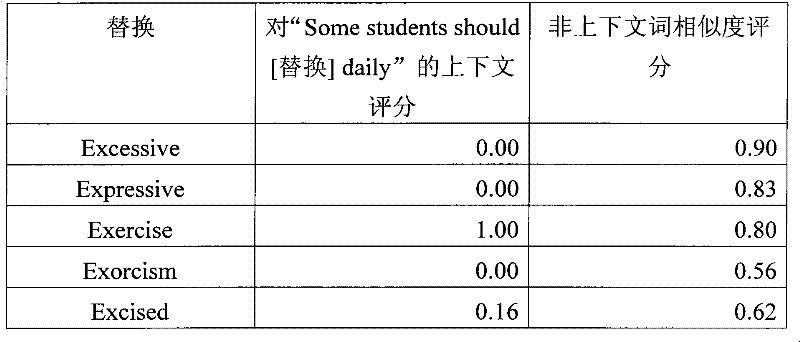
上下文评分优选地如后文参考图8所描述的那样得到,并且基于在因特网语料库中的上下文特征序列(CFS)频率。The context score is preferably derived as described hereinafter with reference to Figure 8, and is based on context feature sequence (CFS) frequencies in the Internet corpus.
基于如后文参考图8所描述的上下文评分和非上下文词相似度评分,词“exercise”被选择为最佳的替换。Based on the context score and the non-context word similarity score as described below with reference to FIG. 8, the word "exercise" was selected as the best replacement.
以类似的方式来校正所有簇。在根据本发明的一个优选实施例的拼写校正后,拼写校正后的输入文本是:All clusters are corrected in a similar manner. After spelling correction according to a preferred embodiment of the present invention, the input text after spelling correction is:
Physical education can assist in strengthening muscles.Some students should exercise daily to improve their strength and health because they are so fate.Physical education can assist in strengthening muscles. Some students should exercise daily to improve their strength and health because they are so fate.
注意,在拼写校正后的输入文本中仍然有误用的词。词“fate”需要通过后文参考图3所描述的误用词和语法校正算法来进行校正。Note that there are still misused words in the spell-corrected input text. The word "fate" needs to be corrected by the misused word and grammar correction algorithm described below with reference to FIG. 3 .
现在参见图3,图3是图示优选地在图1的系统和功能中使用的误用词和语法校正功能的简化流程图。误用词和语法校正功能提供了对正确拼写但是在输入文本的上下文中误用的词的校正和对语法错误的校正,该语法错误包括使用语法上不正确的词取代了语法上正确的词、使用了多余的词以及丢失了词和标点。Referring now to FIG. 3 , FIG. 3 is a simplified flowchart illustrating the misused word and grammar correction functionality preferably used in the system and functions of FIG. 1 . The Misused Words and Grammar Correction feature provides corrections for words that are spelled correctly but are misused in the context of the input text and corrections for grammatical errors, which consist of substituting grammatically incorrect words for grammatically correct words , use of redundant words, and missing words and punctuation.
如图3中所示,误用词和语法校正功能优选地包括下面的步骤:As shown in Figure 3, the misused word and grammar correction function preferably includes the following steps:
优选地,通过评估至少大多数词在输入语句的上下文内的适合性,在从图2的拼写校正功能输出的拼写校正后的输入文本中识别可疑的误用词和具有语法错误的词;Preferably, suspected misused words and words with grammatical errors are identified in the spell-corrected input text output from the spelling correction function of FIG. 2 by assessing the appropriateness of at least a majority of the words within the context of the input sentence;
将可疑的误用词和具有语法错误的词分组为簇,该簇优选地是不重叠的;以及grouping suspected misused words and words with grammatical errors into clusters, which clusters are preferably non-overlapping; and
选择要校正的簇。所述识别、分组和选择步骤优选地基于后文参考图6B所描述的算法。Select the clusters to correct. The identifying, grouping and selecting steps are preferably based on the algorithm described hereinafter with reference to Figure 6B.
优选地,基于后文参考图7A所描述的替换校正产生算法,为每一个簇产生一个或优选地多个替换校正;Preferably, one or preferably a plurality of replacement corrections are generated for each cluster based on the replacement correction generation algorithm described later with reference to FIG. 7A;
基于后文参考图10描述的丢失冠词、介词和标点校正算法,为每一个簇产生一个或优选地多个替换校正;Based on the missing article, preposition and punctuation correction algorithm described hereinafter with reference to FIG. 10, one or preferably several replacement corrections are generated for each cluster;
基于后文参考图11描述的多余冠词、介词和标点校正算法,为每一个簇产生一个或优选地多个替换校正;Based on the redundant article, preposition and punctuation correction algorithm described hereinafter with reference to FIG. 11, one or preferably a plurality of replacement corrections are generated for each cluster;
优选地,基于后文参考图9描述的误用词和语法校正替换评分算法,对各个替换校正进行至少部分基于上下文的评分和基于词相似度的评分;Preferably, each substitution correction is at least partially context-based and word similarity-based, based on the misused word and grammar correction substitution scoring algorithm described hereinafter with reference to FIG. 9 ;
对于每一个簇,基于也在后文参考图9描述的上述评分,选择单个误用词和语法校正,并且给出最优选的替换误用词和语法校正;以及For each cluster, a single misused word and grammatical correction is selected, and the most preferred replacement misused word and grammatical correction is given, based on the above scores also described hereinafter with reference to FIG. 9 ; and
提供拼写、误用词和语法校正后的文本输出,该文本输出包含每一个簇的单个误用词和语法校正,所述校正替代了不正确的簇。A spelling, misused word, and grammar corrected text output is provided that contains a single misused word for each cluster and a grammatical correction that replaces the incorrect cluster.
优选地,所述评分包括:相对于可疑词的多个替换的一些应用有利于该可疑词的偏置,该偏置是用于指示人提供该输入的不确定性的输入不确定性度量的函数。Advantageously, said scoring comprises: a bias in favor of a suspect word relative to some application of alternatives of the suspect word, the bias being a measure of input uncertainty indicative of the uncertainty of a human providing the input function.
通过考虑下面的示例,可以更好地理解图3的功能的操作:The operation of the functionality of Figure 3 can be better understood by considering the following example:
接收到下面的输入文本:The following input text is received:
I have money bookI have money book
下面的词被识别为可疑的误用词:The following words were identified as suspected misused words:
money,bookmoney, book
产生下面的簇:produces the following clusters:
money bookmoney book
下面是对于该簇产生的替换校正的示例(部分列表):The following is an example (partial list) of substitution corrections produced for this cluster:
money books;money back;money box;money bulk;money Buick;money ebook;money bank;mini book;mummy book;Monet book;honey book;mannerly book;mono book;Monday book;many books;mini bike;mummy back;monkey bunk;Monday booked;Monarchy back;Mourned brookmoney books; money back; money box; money bulk; money Buick; money ebook; money bank; mini book; mummy book; Monet book; honey book; mannerly book; mono book; Monday book; many books; mini bike; mummy back ;monkey bunk;Monday booked;Monarchy back;Mourned brook
在表4中给出了使用因特网语料库的基于上下文的至少部分上下文评分和基于非上下文词相似度的评分的结果:The results of at least partial contextual scoring based on context and scoring based on non-contextual word similarity using the Internet Corpus are given in Table 4:
表4Table 4
应当意识到,存在得出总体评分的各种方式。优选的总体评分基于后文参考图9描述的算法。It should be appreciated that there are various ways of arriving at the overall score. The preferred overall score is based on the algorithm described below with reference to FIG. 9 .
基于上面的评分,选择替换“many books”。因此,校正后的文本是:Based on the rating above, choose to replace "many books". Therefore, the corrected text is:
I have many books.I have many books.
现在参考图4,图4是图示在图1的系统和功能中使用的词汇增强功能的简化流程图。如图4中所示,词汇增强功能优选地包括下面的步骤:Reference is now made to FIG. 4 , which is a simplified flowchart illustrating the vocabulary enhancement functionality used in the systems and functions of FIG. 1 . As shown in Figure 4, the vocabulary enhancement function preferably includes the following steps:
在从图3的误用词和语法校正功能输出的拼写、误用词和语法校正后的输入文本中识别具有可疑的欠佳词汇使用的词汇挑战(vocabulary-challenged)词;Identifying vocabulary-challenged words with suspected suboptimal vocabulary usage in spelling, misused word and grammar corrected input text output from the misused word and grammar correction function of FIG. 3;
将词汇受挑战词分组为簇,该簇优选地是不重叠的;grouping vocabulary-challenged words into clusters, which clusters are preferably non-overlapping;
选择要校正的簇。所述识别、分组和选择步骤优选地基于后文参考图6C所描述的算法。Select the clusters to correct. The identifying, grouping and selecting steps are preferably based on the algorithm described hereinafter with reference to Figure 6C.
优选地,基于后文参考图7B所描述的词汇增强产生算法,为每一个簇产生一个或优选地多个替换词汇增强;Preferably, one or preferably a plurality of replacement vocabulary enhancements are generated for each cluster based on the vocabulary enhancement generation algorithm described later with reference to FIG. 7B;
优选地,基于后文参考图9描述的词汇增强替换评分算法,对各个替换词汇增强进行基于非上下文词相似度的评分和优选地使用因特网语料库的上下文评分;Preferably, based on the vocabulary enhancement replacement scoring algorithm described below with reference to FIG. 9 , each replacement vocabulary enhancement is scored based on non-contextual word similarity and preferably uses context scoring from an Internet corpus;
对于每一个簇,基于也在后文参考图9描述的上述评分,选择单个词汇增强,并且给出最优选的替换词汇增强;以及For each cluster, based on the above scoring also described below with reference to Figure 9, a single lexical augmentation is selected and the most preferred alternative lexical augmentation is given; and
为每一个欠佳词汇簇提供词汇增强建议。Vocabulary enhancement suggestions are provided for each underperforming vocabulary cluster.
通过考虑下面的示例,可以更好地理解图4的功能的操作:The operation of the functionality of Figure 4 can be better understood by considering the following example:
提供下面的拼写、误用词和语法校正后的输入文本:Provide the following input text with spelling, misused word, and grammar corrections:
Wearing colorful clothes will separate us from the rest of the children in the school.Wearing colorful clothes will separate us from the rest of the children in the school.
使用后文参考图6C描述的功能,选择下面的簇来进行词汇增强:Using the function described later with reference to Figure 6C, the following clusters are selected for vocabulary enhancement:
separateseparate
使用后文参考图7B描述的功能,基于在图7B中描述的预处理的词典数据库来产生下面的替换簇校正,如表5中所示(部分列表):Using the functions described hereinafter with reference to FIG. 7B , the following replacement cluster corrections were generated based on the preprocessed dictionary database described in FIG. 7B , as shown in Table 5 (partial listing):
表5table 5
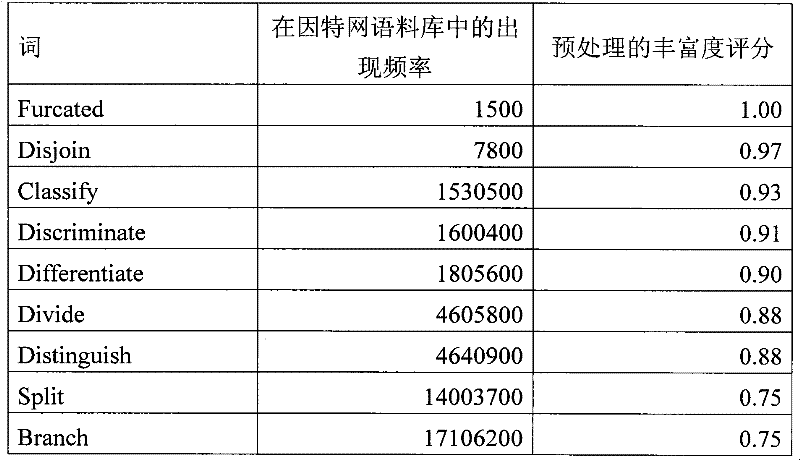

至少部分地基于各个替换词汇增强在输入文本的上下文内的适合性,并且也基于它们与词汇受挑战词“separate”的含义相似度,使用因特网语料库对该各个替换词汇增强进行评分。Each of the alternative vocabulary enhancements is scored using the Internet corpus based at least in part on their suitability within the context of the input text, and also based on their similarity of meaning to the lexically challenged word "separate".
使用后文参考图5描述的功能,产生下面的CFS(部分列表):Using the functions described below with reference to Figure 5, the following CFS (partial listing) is produced:
′will separate′,′separate us′,′clothes will separate′,′will separate us′,′separate us from′'will separate', 'separate us', 'clothes will separate', 'will separate us', 'separate us from'
使用后文参考图9的阶段IIA描述的功能,为在上面的CFS列表中的替换簇校正的部分列表产生在表6中所示的在因特网语料库中的出现频率矩阵:Using the function described hereinafter with reference to Phase IIA of FIG. 9, the partial list of replacement cluster corrections in the above CFS list produces the frequency of occurrence matrix in the Internet Corpus shown in Table 6:
表6Table 6
所有替换校正具有0出现频率的所有CFS被消除。在该示例中,下面的特征语法被消除:All CFSs with a frequency of 0 occurrence were eliminated for all substitution corrections. In this example, the following feature syntax is eliminated:
′clothes will separate′'clothes will separate'
其后,整体包括在至少具有最低阈值出现频率的其他CFS中的所有CFS被消除。例如,下面的特征语法被消除:Thereafter, all CFSs included collectively among the other CFSs with at least the lowest threshold frequency of occurrence are eliminated. For example, the following feature syntax is eliminated:
′will separate′,′separate us′'will separate', 'separate us'
在该示例中,剩余的CFS是特征语法:In the example, the remaining CFS is the feature syntax:
′will separate us′,′separate us from′'will separate us', 'separate us from'
使用后文参考图9在阶段IID和IIE中描述的最后的偏好评分,选择替换“differentiate”,并且增强的语句是:Using the final preference score described later in phases IID and IIE with reference to Figure 9, the replacement "differentiate" is chosen, and the enhanced statement is:
Wearing colorful clothes will differentiate us from the rest of the children in the school.Wearing colorful clothes will differentiate us from the rest of the children in the school.
现在参见图5,图5是图示在本发明的优选实施例的、用于计算机辅助语言校正的系统和功能中有用的上下文特征序列(CFS)功能118(图1)的简化框图。Referring now to FIG. 5, FIG. 5 is a simplified block diagram illustrating the Contextual Feature Sequence (CFS) function 118 (FIG. 1 ) useful in the systems and functions for computer-aided speech correction of the preferred embodiment of the present invention.
CFS功能118优选地包括特征提取功能,该特征提取功能包括N元语法提取功能,并且可选地包括下述功能中的至少一个:略过语法提取功能;转换语法提取功能;共现提取功能;以及用户先前使用特征提取功能。The
作为本领域的已知术语的术语N元语法指的是在输入文本中的N个连续词的序列。该N元语法提取功能可以使用传统的词性标注和语句分析功能,以避免产生基于语法考虑预期不以高频率出现在语料库(优选地为因特网语料库)中的特定N元语法。The term N-gram, as a term known in the art, refers to a sequence of N consecutive words in an input text. This N-gram extraction function may use conventional part-of-speech tagging and sentence analysis functions to avoid generating specific N-grams that are not expected to occur with high frequency in a corpus, preferably an Internet corpus, based on grammatical considerations.
为了本描述的目的,术语“略过语法提取功能”表示用于提取“略过语法”的功能,该“略过语法”是修改的N元语法,其省去了特定的非必要词或短语,诸如形容词、副词、形容词短语和副词短语,或仅包含具有预定语法关系的词,诸如主谓、谓宾、副词动词或动词时间短语。略过语法提取功能可以使用传统的词性标注和语句分析功能,以有助于决定可以在给定上下文中略过哪些词。For the purposes of this description, the term "skip-gram extraction function" means a function for extracting a "skip-gram" which is a modified N-gram that omits certain non-essential words or phrases , such as adjectives, adverbs, adjective phrases, and adverb phrases, or contain only words with predetermined grammatical relationships, such as subject-predicate, predicate-object, adverb-verb, or verb-time phrases. Skip grammar extraction can use traditional part-of-speech tagging and sentence analysis to help decide which words can be skipped in a given context.
为了本描述的目的,术语“转换语法提取功能”表示识别“转换语法”的功能,“转换语法”是修改的N元语法,其中转换特定词的出现顺序。转换语法提取功能可以使用传统的词性标注和语句分析功能,以有助于决定可以在给定上下文中转换哪些词的出现顺序。For the purposes of this description, the term "transformed grammar extraction function" means a function that recognizes a "transformed grammar", which is a modified N-gram in which the order of occurrence of specific words is transformed. Transformation Grammar Extraction can use traditional part-of-speech tagging and sentence analysis to help decide which word occurrences can be transformed in a given context.
为了本描述的目的,术语“共现提取功能”表示在滤除诸如介词、冠词、连词和其功能主要是语法功能的其他词的常见词后识别输入语句或包含许多输入语句的输入文档中的词组合的功能,对于输入文本中与N元语法、转换语法或略过语法中包括的词不同的所有词而言,所述词组合具有输入文本词共现以及与输入词的距离和方向的指示。For the purposes of this description, the term "co-occurrence extraction function" means identifying an input sentence or an input document containing many input sentences after filtering out common words such as prepositions, articles, conjunctions, and other words whose functions are primarily grammatical A function of the word combination of the input text word co-occurrence and the distance and direction from the input word for all words in the input text that are different from the words included in the N-gram, transformation grammar, or skip grammar instructions.
为了本描述的目的,术语“由用户先前使用的特征提取功能”表示在滤除诸如介词、冠词、连词和其功能主要是语法功能的其他词的常见词后,识别由用户在其他文档中使用的词的功能。For the purposes of this description, the term "feature extraction function previously used by the user" means the recognition of features used by the user in other documents after filtering out common words such as prepositions, articles, conjunctions, and other words whose functions are primarily grammatical function of the words used.
为了本描述的目的,N元语法、略过语法、转换语法及其组合被称为特征语法。For the purposes of this description, N-grams, skip grammars, transition grammars, and combinations thereof are referred to as feature grammars.
为了本描述的目的,N元语法、略过语法、转换语法、共现、“由用户先前使用的特征”及其组合被称为上下文特征序列或CFS。For the purposes of this description, N-grams, skip grammars, switch grammars, co-occurrences, "features previously used by the user" and combinations thereof are referred to as contextual feature sequences or CFSs.
图5的功能优选地对输入文本中的单独的词或词簇进行操作。The functions of Figure 5 preferably operate on individual words or clusters of words in the input text.
通过考虑下面的示例,可以更好地理解图5的功能的操作:The operation of the functionality of Figure 5 can be better understood by considering the following example:
提供下面的输入文本:Provide the following input text:
Cherlock Homes the lead character and chief inspecter has been cold in by the family doctor Dr MortiCherlock Homes the lead character and chief inspector has been cold in by the family doctor Dr Morti
对于在输入文本中的簇“Cherlock Homes”,产生下面的CFS:For the cluster "Cherlock Homes" in the input text, the following CFS is produced:
N元语法:N-grams:
2元语法:Cherlock Homes;Homes the2-gram: Cherlock Homes; Homes the
3元语法:Cherlock Homes the;Homes the lead3-gram: Cherlock Homes the; Homes the lead
4元语法:Cherlock Homes the lead;Homes the lead character4-gram: Cherlock Homes the lead; Homes the lead character
5元语法:Cherlock Homes the lead character5-gram: Cherlock Homes the lead character
略过语法:Skip syntax:
Cherlock Homes the character;Cherlock Homes the chief inspecter;Cherlock Homes the inspecter;Cherlock Homes has been coldCherlock Homes the character; Cherlock Homes the chief inspector; Cherlock Homes the inspector; Cherlock Homes has been cold
Switch gram:Switch gram:
The lead character Cherlock HomeThe lead character Cherlock Home
在输入文本中的共现:Co-occurrences in the input text:
Character;inspector;investigate;deathCharacter; inspector; investigate; death
在包含输入文本的文档中的共现:Co-occurrences in documents containing input text:
Arthur Conan Doyle;storyArthur Conan Doyle; story
在用户的其他文档中的共现:Co-occurrences in other documents of the user:
mysterymystery
对于在输入文本中的簇“cold”,产生下面的CFS:For the cluster "cold" in the input text, the following CFS is produced:
N元语法:N-grams:
2元语法:been cold;cold in2-gram: been cold; cold in
3元语法:has been cold;been cold in;cold in by3-gram: has been cold; been cold in; cold in by
4元语法:inspector has been cold;has been cold in;been cold in by;cold in by the4-gram: inspector has been cold; has been cold in; been cold in by; cold in by the
5元语法:chief inspector has been cold;inspector has been cold in;has been cold in by;been cold in by the;cold in by the family5-gram: chief inspector has been cold; inspector has been cold in; has been cold in by; been cold in by the; cold in by the family
略过语法:Skip syntax:
cold in to investigate;Cherlock has been cold;cold by the doctor;cold by Dr Mortimer;character has been coldcold in to investigate; Cherlock has been cold; cold by the doctor; cold by Dr Mortimer; character has been cold
基于以下项至少之一,优选地基于以下项中的不止一项,并且最优选地基于以下项的全部,向每一个CFS赋予“重要性评分”:Each CFS is assigned a "significance score" based on at least one, preferably more than one, and most preferably all of the following:
a.传统词性标注和语句分析功能的操作。向包括多个分析树节点的多个部分的CFS赋予相对低的评分。在CFS中包括的分析树节点的数量越大,该CFS的评分越低。a. Operation of traditional part-of-speech tagging and sentence analysis functions. A relatively low score is assigned to a CFS that includes multiple sections of the analysis tree nodes. The greater the number of analysis tree nodes included in a CFS, the lower the score for that CFS.
b.CFS的长度。CFS越长,评分越高。b. Length of CFS. The longer the CFS, the higher the score.
c.CFS中与输入词不同的每个词的出现频率。这样的词的出现频率越高,评分越低。c. The frequency of occurrence of each word in the CFS that is different from the input word. The higher the frequency of such words, the lower the score.
d.CFS的类型。例如,N元语法比共现优选。在输入语句中的共现比在输入文档中的共现优选,并且在输入文档中的共现比“由用户先前使用的特征”优选。d. Type of CFS. For example, N-grams are preferred over co-occurrences. Co-occurrences in input sentences are preferred over co-occurrences in input documents, and co-occurrences in input documents are preferred over "features previously used by the user".
参见上面的示例,典型的评分如表7中所示:Seeing the example above, typical scoring is shown in Table 7:
表7Table 7
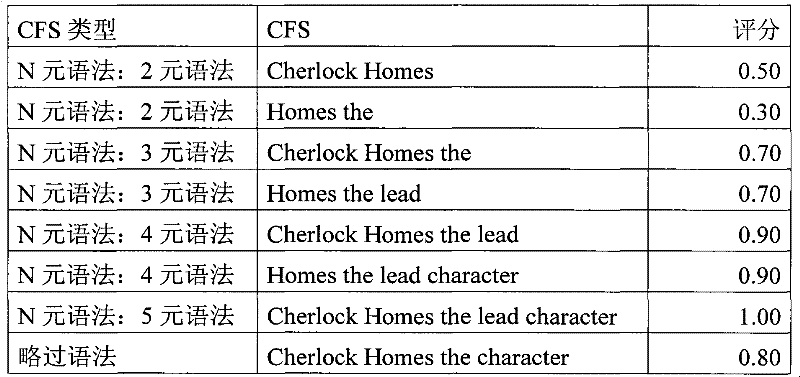
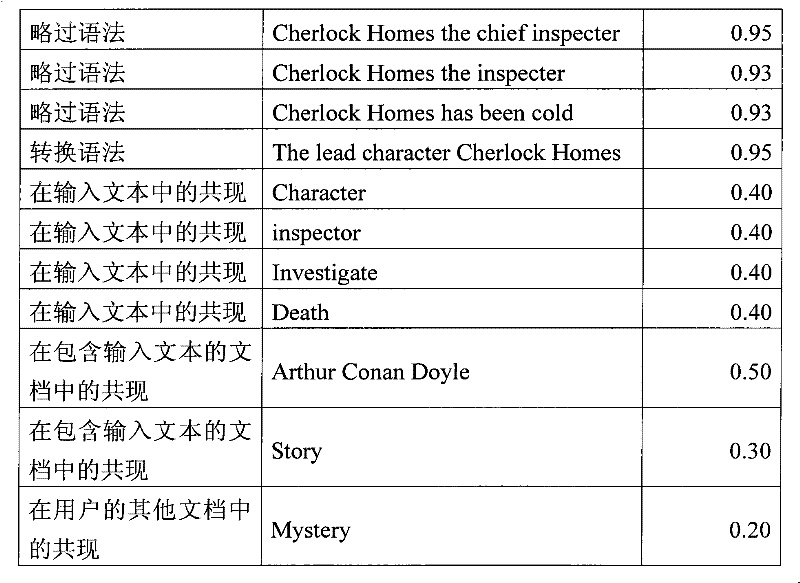
这些CFS和它们的重要性评分在后文参考图8和9描述的功能中,用来基于在因特网语料库中的CFS出现频率,对各种替换簇校正进行基于上下文的评分。These CFSs and their importance scores are used in the functions described below with reference to FIGS. 8 and 9 to perform context-based scoring of various alternative cluster corrections based on the frequency of CFS occurrences in the Internet corpus.
现在参考图6A,图6A是图示用于进行以下操作的功能的简化流程图:识别在输入文本中的误拼写的词;将误拼写的词分组为簇,该簇优选地是不重叠的;以及选择要校正的簇。Referring now to FIG. 6A , FIG. 6A is a simplified flowchart illustrating the functionality for: identifying misspelled words in an input text; grouping misspelled words into clusters, which clusters are preferably non-overlapping ; and select the clusters to correct.
如图6A中所示,识别误拼写的词优选地通过使用传统的词典来进行,该传统的词典具有丰富的在因特网上常用的正确的名称和词。As shown in FIG. 6A, identifying misspelled words is preferably performed by using a conventional dictionary rich in correct names and words commonly used on the Internet.
将误拼写的词分组为簇优选地通过下述方式来进行:将连续或几乎连续的误拼写的词以及具有语法关系的误拼写的词分组为单个簇。Grouping misspelled words into clusters is preferably done by grouping consecutive or nearly consecutive misspelled words and misspelled words with grammatical relationships into a single cluster.
选择要校正的簇优选地通过下述方式来进行:试图找到包含最大数量的非可疑上下文数据的簇。优选地,选择在其附近具有最长的一个或多个正确拼写词序列的簇。The selection of clusters to correct is preferably done by trying to find the cluster that contains the largest amount of non-suspicious context data. Preferably, the cluster with the longest sequence of one or more correctly spelled words nearby is selected.
现在参考图6B,图6B是图示用于进行以下操作的功能的简化流程图:识别在拼写校正后的输入文本中可疑的误用词和具有语法错误的词;将可疑的误用词和具有语法错误的词分组为簇,该簇优选地是不重叠的;以及选择要校正的簇。Referring now to FIG. 6B , FIG. 6B is a simplified flowchart illustrating a function for: identifying suspected misused words and words with grammatical errors in spelling-corrected input text; Words with grammatical errors are grouped into clusters, which clusters are preferably non-overlapping; and the clusters to be corrected are selected.
识别可疑的误用词优选地进行如下:Identifying suspected misused words preferably proceeds as follows:
为拼写校正后的输入文本中的每一个词产生特征语法;Generate feature grammars for each word in the spelling-corrected input text;
记录每一个特征语法在语料库中(优选地在因特网语料库中)的出现频率;Record the frequency of occurrence of each feature grammar in the corpus (preferably in the Internet corpus);
记录每一个词的可疑特征语法的数量。可疑特征语法具有比它们的预期频率低得多或者在最小频率阈值之下的频率。基于特征语法的构成元素及其组合的频率来估计特征语法的预期频率。Record the number of suspicious feature grammars for each word. Suspicious feature grammars have a frequency much lower than their expected frequency or below a minimum frequency threshold. The expected frequency of the feature grammar is estimated based on frequencies of constituent elements of the feature grammar and combinations thereof.
如果包含一词的可疑特征语法的数量超过预定阈值,则该词是可疑的。A word is suspicious if the number of suspicious feature grammars containing the word exceeds a predetermined threshold.
根据本发明的一个优选实施例,判定拼写校正后的输入文本中的每一个特征语法在语料库中(优选地在因特网语料库中)的出现频率(FREQ F-G)。还确定拼写校正后的输入文本中的每一个词在该语料库中的出现频率(FREQ W),并且另外确定没有该词的每一个特征语法的出现频率(FREQ FG-W)。According to a preferred embodiment of the present invention, the frequency of occurrence (FREQ F-G) of each feature grammar in the corpus (preferably in the Internet corpus) in the spelling-corrected input text is determined. The frequency of occurrence in the corpus of each word in the spell-corrected input text is also determined (FREQ W ), and additionally the frequency of occurrence of each feature grammar without the word (FREQ FG-W ) is determined.
每一个特征语法的预期出现频率(EFREQ F-G)被计算如下:The expected frequency of occurrence (EFREQ F-G) of each feature grammar is calculated as follows:
EFREQ F-G=FREQ F-G-W*FREQ W/(所有词在语料库中的频率总和)EFREQ F-G=FREQ F-G-W*FREQ W/(the sum of the frequency of all words in the corpus)
如果拼写校正后的输入文本中的每一个特征语法在语料库中(优选地在因特网语料库中)的出现频率与每一个特征语法的预期出现频率的比率FREQ F-G/EFREQ F-G小于预定阈值,或如果FREQ F-G小于另一个预定阈值,则认为该特征语法是可疑特征语法。在可疑特征语法中包括的每一个词被认为是可疑的误用词或具有可疑的语法错误的词。If the ratio FREQ F-G/EFREQ F-G of the frequency of occurrence of each feature grammar in the corpus (preferably in an Internet corpus) to the expected frequency of occurrence of each feature grammar in the spell-corrected input text is less than a predetermined threshold, or if FREQ If F-G is less than another predetermined threshold, the feature grammar is considered to be a suspicious feature grammar. Every word included in the suspicious feature grammar is considered a suspected misused word or a word with suspected grammatical errors.
通过考虑下面的示例,可以更好地理解图6B中用于识别在拼写校正后的输入文本中的可疑的误用词和具有语法错误的词的功能的操作:The operation of the function for identifying suspected misused words and words with grammatical errors in spelling-corrected input text in FIG. 6B can be better understood by considering the following example:
提供下面的拼写校正后的输入文本:Provide the following spell-corrected input text:
I have money bookI have money book
特征语法包括下面的部分:The feature syntax consists of the following parts:
I;I have;I have money;I have money bookI; I have; I have money; I have money book
表8指示上面的特征语法在因特网语料库中的出现频率:Table 8 indicates the frequency of occurrence of the above feature grammars in the Internet corpus:
表8Table 8
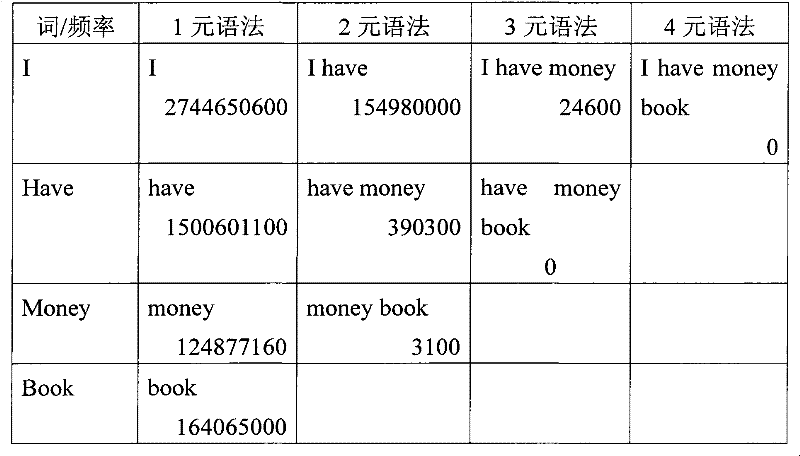
为每一个2元语法计算预期出现频率如下:Calculate the expected frequency of occurrence for each 2-gram as follows:
EFREQ F-G=(FREQ F-G-W*FREQ W)/(所有词在语料库中的频率总和)EFREQ F-G=(FREQ F-G-W*FREQ W)/(sum of frequencies of all words in the corpus)
例如,对于2元语法For example, for the 2-gram
2元语法(x,y)的预期2元语法频率=(x的1元语法频率*y的1元语法频率)/在因特网语料库中的词的数量。例如,一万亿(1,000,000,000,000)词。Expected 2-gram frequency of 2-gram (x, y) = (1-gram frequency of x * 1-gram frequency of y)/number of words in the Internet corpus. For example, one trillion (1,000,000,000,000) words.
拼写校正后的输入文本中的每一个特征语法在语料库中(优选地在因特网语料库中)的出现频率与每一个特征语法的预期出现频率的比率被计算如下:The ratio of the frequency of occurrence of each feature grammar in the spell-corrected input text in the corpus (preferably in the Internet corpus) to the expected frequency of occurrence of each feature grammar is calculated as follows:
FREQ F-G/EFREQ F-GFREQ F-G/EFREQ F-G
拼写校正后的输入文本中每一个上面的2元语法在语料库中(优选地在因特网语料库中)的出现频率与每一个上面的2元语法的预期出现频率的比率如表9中所示。The ratio of the frequency of occurrence of each of the above 2-grams in the corpus (preferably in the Internet corpus) to the expected frequency of occurrence of each of the above 2-grams in the spell-corrected input text is shown in Table 9.
表9Table 9
可以看出,“money book”的FREQ F-G比其预期频率低得多,因此,可以认为FREQ F-G/EFREQ F-G小于诸如1的预定阈值,因此“money book”簇是可疑的。It can be seen that the FREQ F-G of "money book" is much lower than its expected frequency, therefore, it can be considered that FREQ F-G/EFREQ F-G is less than a predetermined threshold such as 1, so the "money book" cluster is suspicious.
可以看出,包括词“money book”的3元语法和4元语法在因特网语料库中都具有0频率。这也可以是认为“money book”可疑的基础。It can be seen that both 3-grams and 4-grams including the word "money book" have a frequency of 0 in the Internet corpus. This can also be the basis for considering a "money book" suspicious.
将可疑的误用词和具有语法错误的词分组为簇优选地执行如下:将连续或几乎连续的可疑的误用词分组为单个簇;以及将其间具有语法关系的可疑的误用词分组到同一簇内。Grouping suspected misused words and words with grammatical errors into clusters is preferably performed as follows: grouping consecutive or nearly consecutive suspected misused words into a single cluster; within the same cluster.
选择要校正的簇优选地通过下述方式来进行:试图找到包含最大数量的非可疑上下文数据的簇。优选地,选择在其附近具有最长的一个或多个非可疑词序列的簇。The selection of clusters to correct is preferably done by trying to find the cluster that contains the largest amount of non-suspicious context data. Preferably, the cluster with the longest sequence of one or more non-suspicious words nearby is selected.
现在参见图6C,图6C是图示用于进行以下操作的功能的简化流程图:识别在拼写、误用词和语法校正后的输入文本中具有可疑的欠佳词汇使用的词汇受挑战词;将词汇受挑战词分组为簇,该簇优选地是不重叠的;以及选择要校正的簇。Referring now to FIG. 6C , FIG. 6C is a simplified flow diagram illustrating functionality for identifying lexically challenged words with suspected suboptimal vocabulary usage in spelling, misused word, and grammar corrected input text; grouping the vocabulary challenged words into clusters, which clusters are preferably non-overlapping; and selecting the clusters to be corrected.
识别词汇受挑战词优选地进行如下:Identifying vocabulary challenged words preferably proceeds as follows:
预处理同义词词典(thesaurus),以向每一个词分配语言丰富度评分,该评分指示该词在一层级中的等级,其中,书面语言比口头语言优选;并且其中,在因特网来源中,文章和书籍例如比聊天和论坛优选,并且其中,较少使用的词比较频繁使用的词优选;preprocessing a thesaurus to assign each word a linguistic richness score indicating the word's rank in a hierarchy in which written language is preferred over spoken language; and wherein, in Internet sources, articles and Books are for example preferred over chats and forums, and where less frequently used words are preferred over more frequently used words;
进一步预处理该同义词词典,以基于前面的预处理步骤的结果和语法规则来消除不可能成为词汇增强的候选的词;further preprocessing the thesaurus to eliminate words that are unlikely to be candidates for vocabulary enhancement based on the results of previous preprocessing steps and grammar rules;
进行另外的预处理,以为每一个剩余的词指示词汇增强的候选,该候选具有比输入词更高的语言丰富度评分;以及performing additional preprocessing to indicate for each remaining word a vocabulary-enhanced candidate with a higher linguistic richness score than the input word; and
检查在拼写、误用词和语法校正后的输入文本中的每一个词是否在多个经预处理的同义词词典中显现为剩余的词,并且将显现为剩余的词的每一个这样的词识别为词汇增强的候选。Checks whether each word in the spelling, misused word, and grammar corrected input text appears as a remaining word in multiple preprocessed thesaurus dictionaries, and identifies each such word that appears as a remaining word Candidates for vocabulary augmentation.
将词汇受挑战词分组为优选地不重叠的簇是可选的,并且优选地进行如下:Grouping lexical challenged words into preferably non-overlapping clusters is optional and preferably proceeds as follows:
将连续的词汇受挑战词分组为单个簇;以及group consecutive lexically challenged words into a single cluster; and
将具有语法关系的词汇受挑战词分组到同一簇内。Group lexically challenged words with grammatical relationships into the same cluster.
选择要校正的簇优选地通过下述方式来进行:试图找到包含最大数量的非词汇受挑战词的簇。优选地,选择在其附近具有最长的一个或多个非词汇受挑战词序列的簇。The selection of clusters to correct is preferably done by trying to find the cluster containing the largest number of non-lexical challenged words. Preferably, the cluster with the longest non-lexical challenged word sequence(s) nearby is selected.
现在参见图7A,图7A是图示在图2和3的功能中有用的、用于产生簇的替换校正的功能的简化流程图。Referring now to FIG. 7A , FIG. 7A is a simplified flowchart illustrating the functionality for generating replacement corrections for clusters, useful among the functionality of FIGS. 2 and 3 .
如果原始输入词拼写正确,则将其视为替换。If the original input word is spelled correctly, it is considered a replacement.
如图7A中所示,首先以下面的方式为簇中的每一个词产生多个替换校正:As shown in Figure 7A, multiple substitution corrections are first generated for each word in the cluster in the following manner:
检索(retrieve)类似于簇中的每一个词的多个词,该多个词是基于它们以字符串相似度表达的书写外观并且基于发音或语音相似度而从词典获取的。该功能是已知的,并且是在因特网上可获得的免费软件,诸如GNU Aspell和GoogleGspell。检索到并被优先化的词提供了第一多个替换校正。例如,给定输入词feezix,基于类似发音将从词典检索到词“physics”,尽管它仅具有一个共同的字符,即“i”。基于其字符串相似度将检索到词“felix”,尽管它没有类似的发音。Words similar to each word in the cluster are retrieved from the dictionary based on their written appearance expressed in string similarity and based on pronunciation or phonetic similarity. This function is known and is free software available on the Internet, such as GNU Aspell and Google Gspell. The retrieved and prioritized words provide a first plurality of substitution corrections. For example, given the input word feezix, the word "physics" will be retrieved from the dictionary based on similar pronunciation even though it has only one character in common, namely "i". The word "felix" will be retrieved based on its string similarity, even though it has no similar pronunciation.
通过使用基于已知的替换使用以及累积的用户输入的规则,可以产生另外的替换。例如,u→you,r→are,Im→I am。Additional substitutions can be generated using rules based on known substitution usage as well as accumulated user input. For example, u→you, r→are, Im→I am.
基于语法规则,优选地使用预定义的列表,可以产生另外的替换。一些示例如下:Based on grammar rules, preferably using a predefined list, further substitutions can be generated. Some examples are as follows:
单数/复数规则:如果输入语句是“ fall off trees in the autumn”,则产生复数替换“leaves”。Singular/plural rule: If the input sentence is " fall off trees in the autumn", produces a plural replacement for "leaves".
冠词规则:如果输入文本是“
介词规则:如果输入文本是“I am interested 
动词屈折变化(inflection)规则:如果输入文本是“He 
合并词和划分词规则:如果输入文本是“get 
如果输入文本是“we have to 
如果输入文本是“do many 
本发明的一个优选实施例的特定特征是使用诸如CFS(并且更具体地诸如特征语法)的上下文信息来产生替换校正,而不仅用于对这样的“上下文检索”的替换校正评分。可以从诸如因特网语料库的现有语料库检索频繁出现的词组合,诸如CFS,并且更具体地诸如特征语法。A particular feature of a preferred embodiment of the invention is the use of contextual information such as CFS (and more specifically feature syntax) to generate substitution corrections, not just for scoring such "context retrieval" substitution corrections. Frequently occurring word combinations can be retrieved from existing corpora such as the Internet Corpus, such as CFS, and more specifically such as feature grammars.
下面的示例描述本发明的该方面:The following example describes this aspect of the invention:
如果输入语句是“The cat has 
根据本发明的该方面,通过在因特网语料库中查找在N元语法“cat has”后通常出现的词,即在查询“cat has *”中作为*找到的所有词,检索到下面的替换:According to this aspect of the invention, the following substitutions are retrieved by looking in Internet corpora for words that commonly occur after the N-gram "cat has", i.e. all words found as * in the query "cat has *":
nine lives;left;fleas;dandruff;kittens;tapeworms;adopted;retractile claws;been;urinated;diarrhea;eaten;swallowed;hairballs;gone;always beennine lives; left; fleas; dandruff; kittens; tapeworms; adopted; retractile claws; been; urinated; diarrhea; eaten; swallowed; hairballs; gone; always been
根据本发明的一个优选实施例,然后过滤“上下文检索”的替换,使得仅剩下与原始词(在本示例中为“kts”)具有一定的语音或书写相似度的上下文检索的替换。在该示例中,检索到具有最高语音和书写相似度的替换“kittens”。According to a preferred embodiment of the present invention, the "context retrieved" alternatives are then filtered so that only context retrieved alternatives that have a certain phonetic or written similarity to the original word ("kts" in this example) remain. In this example, the replacement "kittens" with the highest phonetic and written similarity is retrieved.
在通过诸如光学字符识别、语音至文本或机器翻译系统的外部系统来自动地产生输入文本的情况下,可以从这样的系统直接地接收另外的替换。通常在这样的系统的操作过程中产生这些另外的替换。例如,在机器翻译系统中,外语词的替换翻译可以被提供到本系统以用作替换。Where the input text is automatically generated by an external system such as an optical character recognition, speech-to-text or machine translation system, further substitutions may be received directly from such a system. These additional replacements typically occur during operation of such systems. For example, in a machine translation system, alternate translations of foreign language words may be provided to the system for use as replacements.
一旦已经为簇中的每一个词产生了所有替换,则通过下述方式来产生整个簇的簇替换:判定各个替换的所有可能组合,并且随后基于它们在语料库(优选地为因特网语料库)中的出现频率来过滤这些组合。Once all replacements have been generated for each word in the cluster, cluster replacements for the entire cluster are generated by determining all possible combinations of the individual replacements and then based on their presence in a corpus, preferably an Internet corpus Frequency of occurrence to filter these combinations.
下面的示例是说明性的:The following example is illustrative:
如果输入簇是“money book”,并且词“money”的替换是:If the input cluster is "money book" and the replacement for the word "money" is:
Monday;many;monkeyMonday; many; monkey
并且词“book”的替换是:And the replacement for the word "book" is:
books;box;backbooks; box; back
则产生下面的簇替换:then produces the following cluster replacement:
money books;money box;money back;Monday books;Monday box;Monday back;many books;many box;many back;monkey books;monkey box;monkey back;many book;monkey book;Monday bookmoney books; money box; money back; Monday books; Monday box; Monday back; many books; many box; many back; monkey books; monkey box; monkey back; many book; monkey book; Monday book
现在参考图7B,图7B是图示在图4的功能中有用的、用于产生簇的替换增强的功能的简化流程图。Reference is now made to FIG. 7B , which is a simplified flowchart illustrating functionality useful in the functionality of FIG. 4 for generating alternative enhancements to clusters.
如图7B中所示,首先以下面的方式来产生多个替换增强:As shown in Figure 7B, multiple replacement enhancements are first generated in the following manner:
如果正确地拼写了原始输入词,则将其考虑为替换。If the original input word is spelled correctly, it is considered a replacement.
从在因特网上可免费获得的、诸如Princeton WordNet的同义词词典或其他词汇数据库获取的多个词被检索到,该多个词作为同义词、超集或子集与在簇中的每一个词在词法上相关。检索到并被优先化的词提供了第一多个替换增强。Words retrieved from freely available thesauruses such as Princeton WordNet or other lexical databases on the Internet are retrieved as synonyms, supersets, or subsets of each word in the cluster lexically relevant. The retrieved and prioritized words provide a first multiple replacement enhancement.
通过基于已知的替换使用以及累积的用户输入而使用规则来产生另外的替换。Additional substitutions are generated by using rules based on known substitution usage and accumulated user input.
本发明的优选实施例的一个特定特征是使用诸如CFS(并且更具体地诸如特征语法)的上下文信息来产生替换增强,而不仅用于对这样的“上下文检索”的替换增强评分。可以从诸如因特网语料库的现有语料库检索频繁出现的词组合,诸如CFS,并且更具体地诸如特征语法。A particular feature of a preferred embodiment of the invention is to use contextual information such as CFS (and more specifically feature syntax) to generate alternative enhancements, not just for scoring such "context retrieved" alternative enhancements. Frequently occurring word combinations can be retrieved from existing corpora such as the Internet Corpus, such as CFS, and more specifically such as feature grammars.
一旦已经为簇内的每一个词产生了所有替换,则通过下述方式来产生整个簇的替换:判定各个词替换的所有可能组合,并且基于产生的多词组合在诸如因特网的现有语料库中的出现频率来过滤这些组合。Once all the replacements have been generated for each word in the cluster, the replacements for the entire cluster are generated by determining all possible combinations of the individual word replacements and based on the generated multi-word combinations in existing corpora such as the Internet frequency of occurrence to filter these combinations.
下面的示例说明了图7B的功能:The following example illustrates the functionality of Figure 7B:
提供下面的输入文本:Provide the following input text:
it was nice to meet youit was nice to meet you
通过诸如Princeton WordNet的词汇数据库来产生词“nice”的以下替换(部分列表):The following substitutions (partial list) for the word "nice" are generated by a lexical database such as Princeton WordNet:
pleasant、good、kind、polite、fine、decent、gracious、courteous、considerate、enjoyable、agreeable、satisfying、delightful、entertaining、amiable、friendly、elegant、precise、careful、meticulouspleasant, good, kind, polite, fine, decent, gracious, courteous, considerate, enjoyable, agreeable, satisfying, delightful, entertaining, amiable, friendly, elegant, precise, careful, meticulous
通过应用预定规则来产生词“nice”的以下替换:The following substitutions for the word "nice" are produced by applying predetermined rules:
coolcool
例如响应于诸如“it was * to meet”的查询来产生针对词“nice”的以下上下文检索的替换:For example the following contextually retrieved substitutions for the word "nice" are produced in response to a query such as "it was * to meet":
great;a pleasure;wonderful;lovely;good;impossible;fun;awesome;refreshing;exciting;agreed;fantastic;decided;inspiringgreat; a pleasure; wonderful; lovely; good; impossible; fun; awesome; refreshing; exciting; agreed; fantastic; decided; inspiring
现在参见图8,图8是图示用于对各个替换增强进行基于上下文和基于词相似度的评分的功能的简化流程图,该功能是在图2的拼写校正功能中有用的。Referring now to FIG. 8, FIG. 8 is a simplified flowchart illustrating the functionality for context-based and word similarity-based scoring of individual replacement enhancements, which is useful in the spelling correction functionality of FIG.
如图8中所示,对各个替换校正进行的基于上下文和基于词相似度的评分以以下一般阶段而进行:As shown in Figure 8, context-based and word-similarity-based scoring of individual substitution corrections proceeds in the following general stages:
I.非上下文评分-根据各个簇替换的书写外观和发音相似度,基于与输入文本中簇的相似度来对各个簇替换评分。该评分不考虑在给定簇之外的任何上下文相似度。I. Non-contextual scoring - Each cluster replacement is scored based on its similarity to the cluster in the input text, according to its written appearance and phonetic similarity. This score does not take into account any contextual similarities outside of a given cluster.
II.使用因特网语料库的上下文评分-也基于所提取的上下文特征序列(CFS)来对各个簇替换中的每一个评分,该上下文特征序列(CFS)是如上文参考图5所描述那样而提供的。该评分包括下面的子阶段:II. Context Scoring Using Internet Corpus - Each of the individual cluster replacements was also scored based on the extracted Context Feature Sequence (CFS) provided as described above with reference to FIG. 5 . The scoring includes the following subphases:
IIA.在如上文参考图5所描述那样提取的CFS的上下文中,对于由图7A的功能产生的各个替换簇校正,优选地使用因特网语料库来执行出现频率分析。IIA. In the context of the CFS extracted as described above with reference to FIG. 5, for each replacement cluster correction produced by the function of FIG. 7A, frequency of occurrence analysis is preferably performed using an Internet corpus.
IIB.其中基于子阶段IIA的出现频率分析的结果来执行CFS选择和对各个CFS的加权。加权也基于各个CFS的相对固有重要性。应当意识到,可以向一些CFS赋予为0的权重,并因此不选择该一些CFS。所选择的CFS优选地被赋予相对权重。IIB. wherein CFS selection and weighting of individual CFSs is performed based on the results of the frequency analysis of sub-phase IIA. Weighting is also based on the relative intrinsic importance of the individual CFSs. It should be appreciated that some CFSs may be given a weight of 0 and thus not selected. The selected CFSs are preferably given relative weights.
IIC.向在子阶段IIB中所选择的每一个CFS的每一个替换校正分配出现频率度量。IIC. Assign a frequency of occurrence metric to each alternative correction for each CFS selected in sub-phase IIB.
IID.其中基于子阶段IIA的出现频率分析的结果、子阶段IIC的出现频率度量和子阶段IIB的CFS选择和加权来产生减小的替换簇校正集合。IID. wherein a reduced set of replacement cluster corrections is generated based on the results of the frequency analysis of sub-phase IIA, the frequency metrics of sub-phase IIC and the CFS selection and weighting of sub-phase IIB.
IIE.从在子阶段IID中的减小的集合选择在阶段I中具有最高非上下文相似度评分的簇,以用作参考簇校正。IIE. Select the cluster with the highest non-contextual similarity score in Phase I from the reduced set in sub-phase IID to be used as a reference cluster correction.
IIF.向在阶段IIB中选择的每一个CFS的子阶段IIE的参考簇校正分配出现频率度量。IIF. Assigning a frequency of occurrence metric to the reference cluster correction of sub-phase IIE for each CFS selected in phase IIB.
IIG.向在子阶段IIB中选择的每一个CFS分配比率度量,该比率度量表示该特征的每一个替换校正的出现频率度量与向子阶段IIE的参考簇分配的出现频率度量之比。IIG. Assign to each CFS selected in sub-phase IIB a ratio metric representing the ratio of each alternative-corrected frequency metric for that feature to the frequency metric assigned to the reference cluster of sub-phase IIE.
III.基于阶段I的结果和阶段II的结果来选择最优选的替换簇校正。III. Select the most preferred replacement cluster correction based on the results of Phase I and the results of Phase II.
IV.向最优选的替换簇校正分配置信度评分。IV. Correctly assigning confidence scores to the most preferred replacement clusters.
以下给出上文在阶段II-IV中描述的功能的更详细的描述:A more detailed description of the functions described above in phases II-IV is given below:
参考子阶段IIA,如上文在图5中所描述的那样来产生包括要校正的簇的所有CFS。包含可疑错误(除了在输入簇中的错误之外)的CFS被消除。Referring to sub-phase IIA, all CFSs including the cluster to be corrected are generated as described above in FIG. 5 . CFSs containing suspect errors (other than those in the input cluster) are eliminated.
产生矩阵,该矩阵指示在每一个CFS中的簇的每一个替换校正在语料库(优选地为因特网语料库)中的出现频率。针对其的所有替换校正都具有为0的出现频率的所有CFS被消除。其后,被整体包括在至少具有最低阈值出现频率的其他CFS中的所有CFS被消除。A matrix is generated indicating the frequency of occurrence in the corpus, preferably the Internet corpus, of each replacement correction for the clusters in each CFS. All CFSs for which all replacement corrections have a frequency of occurrence of 0 are eliminated. Thereafter, all CFSs that are integrally included in other CFSs with at least the lowest threshold frequency of occurrence are eliminated.
下面的示例说明了出现频率矩阵的产生:The following example illustrates the generation of a frequency matrix:
提供了下面的输入文本:The following input text is provided:
I lik tw play outside a lotI like tw play outside a lot
使用上文参考图6A所描述的功能,选择下面的簇来用于校正:Using the function described above with reference to Figure 6A, the following clusters are selected for calibration:
lik twlik tw
使用上文参考图7A所描述的功能,产生下面的替换簇校正(部分列表):Using the functions described above with reference to Figure 7A, the following replacement cluster corrections (partial listing) are produced:
like to;like two;lick two;lack two;lack true;like truelike to; like two; lick two; lack two; lack true; like true
使用上文参考图5所描述的功能,产生下面的CFS(部分列表):Using the functions described above with reference to Figure 5, the following CFS (partial listing) results:
‘lik tw’;‘I Lik tw’;‘Lik tw play’;‘I Lik tw play’;‘Lik tw play outside’;‘I Lik tw play outside’;‘Lik tw play outside a’'lik tw'; 'I Lik tw'; 'Lik tw play'; 'I Lik tw play'; 'Lik tw play outside'; 'I Lik tw play outside'; 'Lik tw play outside a'
使用上文参考阶段IIA所描述的功能,针对上面的CFS列表中的上面的替换簇校正列表产生在表10中所示的在因特网语料库中的出现频率矩阵:Using the functions described above with reference to Phase IIA, the frequency of occurrence matrix in the Internet Corpus shown in Table 10 was generated for the above replacement cluster correction list in the CFS list above:
表10Table 10
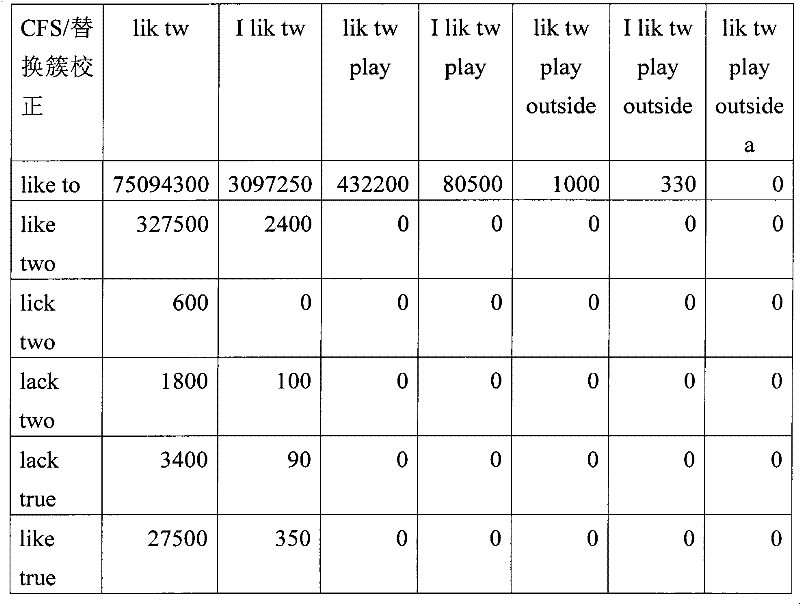
针对其的所有替换校正具有为0的出现频率的所有CFS被消除。在该示例中,消除了下面的特征语法:All CFSs for which all replacement corrections have a frequency of occurrence of 0 are eliminated. In this example, the following feature syntax is eliminated:
‘lik tw play outside a’‘lik tw play outside a’
其后,被整体包括在至少具有最小阈值出现频率的其他CFS中的所有CFS被消除。在该示例中,下面的特征语法被消除:Thereafter, all CFSs that are integrally included in other CFSs having at least the minimum threshold frequency of occurrence are eliminated. In this example, the following feature syntax is eliminated:
‘lik tw’;‘I lik tw’;‘lik tw play’;‘I lik tw play’;‘lik tw play outside’'lik tw'; 'I lik tw'; 'lik tw play'; 'I lik tw play'; 'lik tw play outside'
在该示例中,仅剩余的CFS是特征语法:In the example, the only remaining CFS is the feature syntax:
′I lik tw play outside′。'I like tw play outside'.
产生的矩阵如表11中所示:The resulting matrix is shown in Table 11:
表11Table 11
上述示例说明了根据本发明的一个优选实施例的矩阵的产生。在该示例中,很清楚,“like to”是优选的替换校正。应当意识到,在实际中,选择通常不如此直截了当。因此,在下面给出的另外的示例中,提供了用于在替换校正中进行困难得多的选择的功能。The above example illustrates the generation of a matrix according to a preferred embodiment of the present invention. In this example, it is clear that "like to" is the preferred substitution correction. It should be realized that in practice the selection is often not so straightforward. Thus, in a further example given below, functionality is provided for making much more difficult choices in alternative corrections.
返回对子阶段IIB的考虑,可选地,每一个剩余的CFS被赋予上文参考图5所描述的评分。另外,包含在多词输入的早期校正迭代中引入的词并且具有小于预定置信度阈值的置信度的CFS被负偏置。Returning to consideration of sub-phase IIB, each remaining CFS is optionally assigned a score as described above with reference to FIG. 5 . Additionally, CFSs that contain words introduced in early correction iterations of multi-word inputs and that have a confidence less than a predetermined confidence threshold are negatively biased.
在一般情况下,与上文在子阶段IIC中描述的情况类似,产生标准化的频率矩阵,用于指示每一个CFS在因特网语料库中的标准化的出现频率。通常通过下述方式来从频率矩阵产生标准化的频率矩阵:将每一个CFS频率除以相关簇替换的出现频率的函数。In general, a normalized frequency matrix indicating the normalized frequency of occurrence of each CFS in the Internet corpus is generated similar to the case described above in sub-phase IIC. A normalized frequency matrix is typically generated from the frequency matrix by dividing each CFS frequency by a function of the frequency of occurrence of the associated cluster substitution.
该标准化用于削弱在各个替换校正的整体中基本差异的影响。适当的标准化因子基于各个替换校正在语料库中作为整体的整体出现频率,而与具体的CFS无关。This normalization serves to attenuate the effect of fundamental differences in the ensemble of individual replacement corrections. The appropriate normalization factor is based on the overall frequency of occurrence of each replacement correction in the corpus as a whole, independent of the specific CFS.
下面的示例说明了标准化的出现频率矩阵的产生:The following example illustrates the generation of a normalized frequency matrix:
提供了下面的输入文本:The following input text is provided:
footprints of a mysterious haund said to be six feet tallfootprints of a mysterious haund said to be six feet tall
使用上文参考图6A描述的功能,选择下面的簇来用于校正:Using the function described above with reference to Figure 6A, the following clusters were selected for calibration:
haundhaund
使用上文参考图7A描述的功能,产生下面的替换簇校正(部分列表):Using the functions described above with reference to Figure 7A, the following replacement cluster corrections (partial listing) are generated:
hound;hand;soundhound; hand; sound
使用上文参考图5描述的功能,产生下面的CFS(部分列表):Using the functions described above with reference to Figure 5, the following CFS (partial listing) is produced:
‘a mysterious haund’;‘haund said’'a mysterious haund'; 'haund said'
在此使用上文参考阶段IIC描述的功能,针对上面的CFS列表中的上面的替换簇校正列表产生如表12中所示的在因特网语料库中的出现频率矩阵和标准化的出现频率矩阵:Using the function described above with reference to Phase IIC here, the frequency of occurrence matrix and the normalized frequency of occurrence matrix in the Internet Corpus as shown in Table 12 are generated for the above replacement cluster correction list in the above CFS list:
表12Table 12

从上述示例可以意识到,因为在各个替换校正的整体中的基本差异,所以具有最高出现频率的词可能并不一定具有最高的标准化的出现频率。在上述的示例中,“hound”具有最高的标准化的出现频率,并且从输入文本的上下文显而易见的是,正确的词是“hound”,而不是在因特网语料库中具有更高出现频率的“hand”。It can be appreciated from the above example that the word with the highest frequency of occurrence may not necessarily have the highest normalized frequency of occurrence because of the substantial difference in the ensemble of the respective replacement corrections. In the example above, "hound" has the highest normalized frequency of occurrence, and it is obvious from the context of the input text that the correct word is "hound", not "hand", which has a higher frequency in the Internet Corpus .
本发明的一个特定特征是在替换校正中进行选择时优选地使用标准化的出现频率,该标准化的出现频率削弱了各个替换校正的整体中的基本差异。应当意识到,与标准化的出现频率不同的出现频率的其他度量可以替换或附加地被用作度量。在出现频率相对低或特别高的情况下,附加或可替换的度量是有益的。A particular feature of the invention is that the selection among the alternative corrections is preferably made using a normalized frequency of occurrence which attenuates substantial differences in the ensemble of the individual alternative corrections. It should be appreciated that other measures of frequency of occurrence other than the normalized frequency of occurrence may alternatively or additionally be used as the measure. In cases where the frequency of occurrence is relatively low or extremely high, additional or alternative metrics are beneficial.
将从随后的讨论意识到,在各个替换校正中进行选择时,另外的功能经常是有用的。下面描述这些功能。As will be appreciated from the ensuing discussion, additional functionality is often useful when selecting among alternative corrections. These functions are described below.
在子阶段IID中,根据下面的两个度量,与另一个替换簇校正相比,更不优选的每一个替换簇校正被消除:In subphase IID, each replacement cluster correction that is less preferred than another replacement cluster correction is eliminated according to the following two metrics:
i.与另一个替换簇校正相比,具有更低的词相似度评分;以及i. have a lower word similarity score compared to another replacement cluster correction; and
ii.与另一个替换簇校正相比,对于所有CFS具有更低的出现频率,并且优选地也具有更低的标准化的出现频率。ii. A lower frequency of occurrence for all CFSs, and preferably also a lower normalized frequency of occurrence, compared to another replacement cluster correction.
下面的示例说明了如上所述的替换校正的消除:The following example illustrates the elimination of substitution corrections as described above:
提供下面的输入文本:Provide the following input text:
I leav un a big houseI leav un a big house
使用上文参考图6A描述的功能,选择下面的簇来用于校正:Using the function described above with reference to Figure 6A, the following clusters were selected for calibration:
leav unleav un
使用上文参考图7A描述的功能,产生下面的替换簇校正(部分列表):Using the functions described above with reference to Figure 7A, the following replacement cluster corrections (partial listing) are generated:
leave in;live in;love inleave in; live in; love in
使用上文参考图5描述的功能,产生下面的CFS(部分列表):Using the functions described above with reference to Figure 5, the following CFS (partial listing) is produced:
‘I leav un a’;‘leav un a big’'I leav un a'; 'leav un a big'
在此使用上文参考阶段IIC描述的功能,针对上面的CFS列表中的上面的替换簇校正列表产生如表13中所示的在因特网语料库中的出现频率矩阵和标准化的出现频率矩阵:Using the function described above with reference to Phase IIC here, the frequency of occurrence matrix and the normalized frequency of occurrence matrix in the Internet Corpus as shown in Table 13 are generated for the above replacement cluster correction list in the above CFS list:
表13Table 13
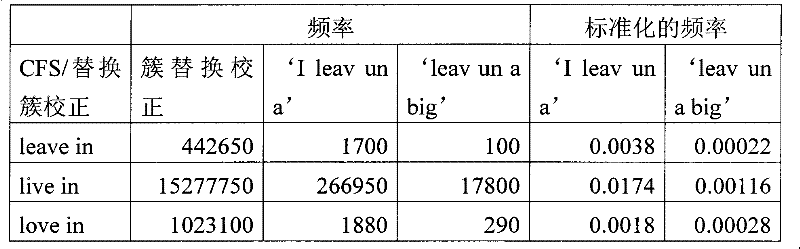
在该示例中,替换簇校正的非上下文相似度评分如表14中所示:In this example, the replacement cluster corrected non-context similarity scores are shown in Table 14:
表14Table 14
替换簇校正“love in”被消除,因为它比“live in”具有更低的相似度评分以及更低的出现频率和更低的标准化的出现频率。在该阶段,不消除替换簇校正“leave in”,因为其相似度评分比“live in”更高。The replacement cluster correction "love in" is eliminated because it has a lower similarity score than "live in" as well as a lower frequency of occurrence and a lower normalized frequency of occurrence. At this stage, the replacement cluster correction "leave in" is not eliminated because its similarity score is higher than "live in".
从上面的内容可以意识到,阶段IID的功能的操作结果是对于减少的多个CFS的每一个的减小的频率矩阵,并且优选地也是减小的标准化频率矩阵,该减小的频率矩阵用于指示减少的多个替换校正的每一个的出现频率,该减小的标准化频率矩阵优选地用于指示减少的多个替换校正的每一个的标准化的出现频率,其中每一个替换校正具有相似度评分。减小的替换簇校正集合优选地用于如从随后的示例看到的所有另外的替换簇选择功能。As can be appreciated from the above, the result of the operation of the Phase IID function is a reduced frequency matrix, and preferably also a reduced normalized frequency matrix, for each of the reduced plurality of CFSs, the reduced frequency matrix being represented by In order to indicate the frequency of occurrence of each of the reduced plurality of alternative corrections, the reduced normalized frequency matrix is preferably used to indicate the normalized frequency of occurrence of each of the reduced plurality of alternative corrections, wherein each alternative correction has a similarity score. The reduced set of replacement cluster corrections is preferably used for all additional replacement cluster selection functions as seen from the examples that follow.
对于在减小的频率矩阵中和优选地也在减小的标准化频率矩阵中的每一个替换校正,产生最后的偏好度量。可以使用下面的替换度量的一个或多个来产生每一个替换校正的最后偏好评分。For each replacement correction in the reduced frequency matrix and preferably also in the reduced normalized frequency matrix, a final bias measure is generated. One or more of the following substitution metrics may be used to generate each substitution corrected final preference score.
下面使用术语“频率函数”来指代频率、标准化频率或频率和标准化频率两者的函数。The term "frequency function" is used below to refer to a function of frequency, normalized frequency, or both frequency and normalized frequency.
A.一种可能的偏好度量是在减小的一个或多个矩阵中的任何CFS的减小的一个或多个矩阵中的每一个替换簇校正的最高出现频率函数。例如,各个替换簇校正将被评分如下:A. One possible bias metric is the highest frequency-of-occurrence function of each replacement cluster correction in the reduced matrix or matrices for any CFS in the reduced matrix or matrices. For example, individual replacement cluster corrections would be scored as follows:
提供下面的输入文本:Provide the following input text:
A big agle in the skyA big agle in the sky
使用上文参考图6A描述的功能,选择下面的簇来用于校正:Using the function described above with reference to Figure 6A, the following clusters were selected for calibration:
agleagle
使用上文参考图7A描述的功能,产生下面的替换簇校正(部分列表):Using the functions described above with reference to Figure 7A, the following replacement cluster corrections (partial listing) are produced:
ogle;eagle;angelogle; eagle; angel
使用上文参考图5描述的功能,产生下面的CFS(部分列表):Using the functions described above with reference to Figure 5, the following CFS (partial listing) is produced:
‘big agle’;‘agle in the sky’'big agle'; 'agle in the sky'
在此使用上文参考阶段IIC描述的功能,针对上面的CFS列表中的上面的替换簇校正列表产生在表15中所示的在因特网语料库中的出现频率矩阵和标准化的出现频率矩阵:Using the functions described above with reference to Phase IIC here, the frequency of occurrence matrices and normalized frequency of occurrence matrices shown in Table 15 in the Internet Corpus are generated for the above replacement cluster correction list in the above CFS list:
表15Table 15
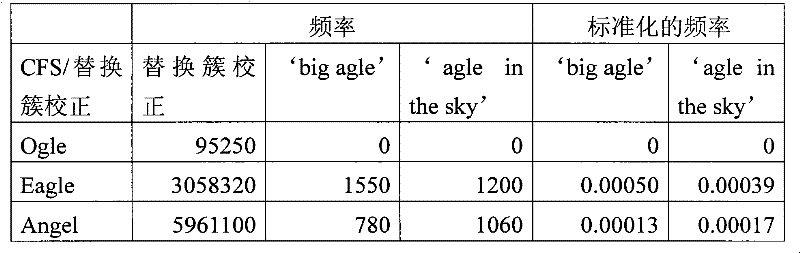
在该示例中,替换簇校正的非上下文相似度评分如表16中所示:In this example, the replacement cluster corrected non-context similarity scores are shown in Table 16:
表16Table 16
选择替换“eagle”,因为它包括具有最大出现频率的CFS。The replacement "eagle" was chosen because it includes the CFS with the greatest frequency of occurrence.
B.另一种可能的偏好度量是每一个替换校正的所有CFS的平均出现频率函数。例如,各个替换校正将被评分如下:B. Another possible measure of preference is a function of the average frequency of occurrence of all CFSs corrected for each replacement. For example, each replacement correction would be scored as follows:
提供下面的输入文本:Provide the following input text:
A while ago sthe lived 3 dwarfsA while ago sthe lived 3 dwarfs
使用上文参考图6A描述的功能,选择下面的簇来用于校正:Using the function described above with reference to Figure 6A, the following clusters were selected for calibration:
sthesthe
使用上文参考图7A描述的功能,产生下面的替换簇校正(部分列表):Using the functions described above with reference to Figure 7A, the following replacement cluster corrections (partial listing) are produced:
the;they;she;therethe; they; she; there
使用上文参考图5描述的功能,产生下面的CFS(部分列表):Using the functions described above with reference to Figure 5, the following CFS (partial listing) is produced:
‘ago sthe lived’;‘sthe lived 3’'ago sthe lived'; 'sthe lived 3'
在此使用上文参考阶段IIC描述的功能,针对上面的CFS列表中的上面的替换簇校正列表产生在表17和18中所示的在因特网语料库中的出现频率矩阵、标准化的出现频率矩阵和平均出现频率矩阵:Using the functions described above with reference to Phase IIC here, the frequency of occurrence matrices in the Internet corpus, the normalized frequency of occurrence matrices and Average occurrence frequency matrix:
表17Table 17
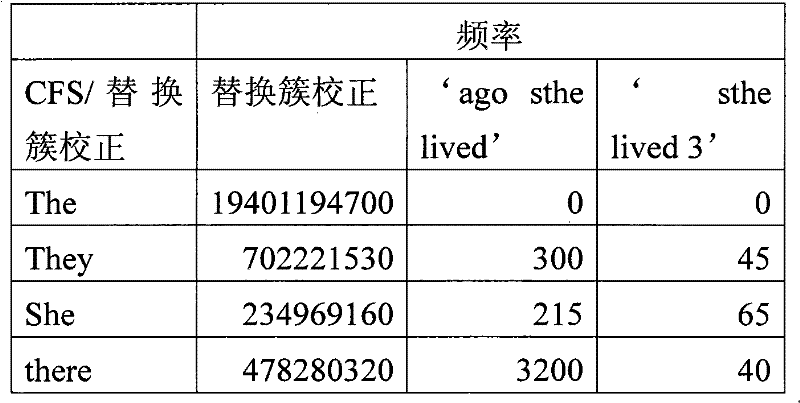
表18Table 18
注意,基于平均出现频率而选择“there”。Note that "there" was chosen based on the average frequency of occurrence.
在该示例中,替换簇校正的非上下文相似度评分如表19中所示:In this example, the replacement cluster corrected non-context similarity scores are shown in Table 19:
表19Table 19
注意,具有最高相似度评分的替换簇校正未被选择。Note that the replacement cluster correction with the highest similarity score was not selected.
C.另一种可能的偏好度量是每一个CFS的出现频率函数乘以由上文参考图5描述的功能计算的该CFS的评分在每一个替换校正的所有CFS上的加权和。C. Another possible bias metric is the frequency function of each CFS multiplied by the weighted sum of that CFS's score calculated by the function described above with reference to FIG. 5 over all CFSs corrected for each replacement.
D.通过对在减小的一个或多个矩阵中的替换校正的以下操作中的任何一个或多个操作、更优选地大多数操作并且最优选地所有操作,如上文参考子阶段IIE-IIG所描述的,产生特定的替换校正/CFS偏好度量:D. Any one or more, more preferably most and most preferably all of the following operations corrected by substitution in the reduced matrix or matrices, as above with reference to sub-phases IIE-IIG As described, yields a specific substitution correction/CFS preference metric:
i.将具有最高非上下文相似度评分的替换簇校正选择为参考簇。i. Correctly select the replacement cluster with the highest non-contextual similarity score as the reference cluster.
ii.产生修改的矩阵,其中,在每一个偏好矩阵中,将在每一个特征语法中的每一个替换校正的出现频率函数替代为每一个替换校正的出现频率函数与参考簇的出现频率函数之比。ii. Generate modified matrices in which, in each preference matrix, each substitution-corrected frequency of occurrence function in each eigengram is replaced by the difference between each substitution-corrected frequency of occurrence function and the reference cluster's frequency of occurrence function Compare.
iii.上文在ii中描述的类型的修改的矩阵被进一步修改,以将在每一个偏好度量中的比率替代为比率的函数:该比率的函数减小了比率中很大差异的的计算重要性。适当的此类函数是对数函数。该操作的目的是在保持最不优选的替换校正的最后偏好评分中出现频率的大差异的重要性并且因此消除最不优选的替换校正的同时,降低在最优选的替换校正的最后偏好评分中出现频率的大差异的重要性。iii. A modified matrix of the type described above in ii is further modified to replace the ratio in each preference measure with a function of the ratio: this function of the ratio reduces the computational importance of large differences in ratios sex. A suitable such function is a logarithmic function. The purpose of this operation is to reduce the importance of large differences in frequency of occurrence in the final preference score corrected for the most preferred alternative while maintaining the importance of, and thus eliminating, the least preferred alternative. The importance of large differences in frequency.
iv.通过将在每一个偏好度量中的适用比率或比率函数乘以适当的CFS评分来另外修改上文在ii或iii中描述的类型的修改的矩阵。这提供了基于在CFS评分中反映的正确的语法使用和其他因素的重点。iv. Additional modification of the modified matrix of the type described in ii or iii above by multiplying the applicable ratio or ratio function in each preference measure by the appropriate CFS score. This provides an emphasis based on correct grammar usage and other factors reflected in the CFS score.
v.通过产生适用比率、比率函数、出现频率和标准化的出现频率的函数来另外修改上文在ii、iii或iv中描述的类型的修改的矩阵。通过将在每一个偏好度量中的适用比率或比率函数乘以该CFS的出现频率来产生优选函数。v. Additional modification of a modified matrix of the type described in ii, iii or iv above by generating a function of the applicable ratio, ratio function, frequency of occurrence and normalized frequency of occurrence. The preference function is generated by multiplying the applicable ratio or ratio function in each preference metric by the frequency of occurrence of the CFS.
E.基于如上在D中描述的特定替换校正/CFS偏好度量,通过将替换校正的相似度评分乘以该替换校正的所有CFS的特定替换校正/CFS偏好度量之和,为每一个替换校正计算最后偏好度量。E. Based on the specific substitution correction/CFS preference metric as described above in D, for each substitution correction, calculate Last preference metric.
说明此类修改的矩阵的使用的示例如下:An example illustrating the use of such a modified matrix follows:
提供下面的输入文本:Provide the following input text:
I will be able to tach base with you next weekI will be able to tach base with you next week
使用上文参考图6A描述的功能,选择下面的簇来用于校正:Using the function described above with reference to Figure 6A, the following clusters were selected for calibration:
tachtach
使用上文参考图7A描述的功能,产生下面的替换簇校正(部分列表):Using the functions described above with reference to Figure 7A, the following replacement cluster corrections (partial listing) are generated:
teach;touchteach; touch
使用上文参考图5描述的功能,产生下面的CFS(部分列表):Using the functions described above with reference to Figure 5, the following CFS (partial listing) is produced:
‘able to tach’;‘to tach base’'able to tach'; 'to tach base'
使用上文参考上面的子阶段IIA和IIC描述的功能,针对上面的CFS列表中的上面的替换簇校正列表产生在表20中所示的在因特网语料库中的出现频率矩阵和标准化的出现频率矩阵:Using the functions described above with reference to sub-stages IIA and IIC above, the frequency-of-occurrence matrices and normalized frequency-of-occurrence matrices in the Internet Corpus shown in Table 20 were generated for the above replacement cluster correction list in the CFS list above :
表20Table 20


注意,对于一个特征,“teach”的出现频率和标准化的出现频率均大于“touch”的频率,但是对于另一个特征,“touch”的出现频率和标准化的出现频率均大于“teach”的频率。为了进行替换校正的正确选择,优选地如下所述那样使用上文参考子阶段IIG描述的比率度量。Note that for one feature, both the frequency of occurrence and the normalized frequency of "teach" are greater than the frequency of "touch", but for the other feature, the frequency of occurrence of "touch" and the normalized frequency of occurrence are both greater than the frequency of "teach". In order to make the correct choice of replacement corrections, the ratiometric described above with reference to sub-stage IIG is preferably used as described below.
在该示例中,替换簇校正的非上下文相似度评分如表21中所示:In this example, the replacement cluster corrected non-context similarity scores are shown in Table 21:
表21Table 21
可以看出,参考簇是“teach”,因为它具有最高的相似度评分。尽管如此,基于如上文所描述的最后偏好评分而选择“touch”。如可以从对指示“teach”具有最高出现频率和最高标准化的出现频率的上面的矩阵的考虑所意识到的,这并不是直观的。在该示例中,最后偏好评分指示选择“touch”而不是“teach”,因为其中有利于“touch”的特征的出现频率的比率比其中有利于“teach”的另一特征的出现频率的比率大得多。It can be seen that the reference cluster is "teach" since it has the highest similarity score. Nonetheless, "touch" is selected based on the final preference score as described above. As can be appreciated from consideration of the above matrix indicating that "teach" has the highest frequency of occurrence and the highest normalized frequency of occurrence, this is not intuitive. In this example, the final preference score indicates that "touch" is selected over "teach" because the ratio of frequency of occurrence of the feature favoring "touch" is greater than the ratio of frequency of occurrence of another feature favoring "teach" much.
F.可选地,可以使用下面的判决规则的一个或多个,基于替换校正的频率函数值和偏好度量与参考簇的频率函数值和偏好度量的比较来滤除该替换校正:F. Optionally, one or more of the following decision rules may be used to filter out alternative corrections based on their comparison of their frequency function values and preference metrics with those of the reference cluster:
1.对于具有大于预定阈值的CFS评分的至少一个特征,滤除具有比预定阈值低的相似度评分并且具有比参考簇的CFS频率函数小的CFS频率函数的替换校正。1. For at least one feature with a CFS score greater than a predetermined threshold, filter out replacement corrections with a similarity score lower than a predetermined threshold and with a CFS frequency function smaller than that of a reference cluster.
2.对于具有大于另一预定阈值的CFS评分的至少一个特征,滤除具有比预定阈值低的相似度评分并且具有比预定阈值小的偏好度量的替换校正。2. For at least one feature with a CFS score greater than another predetermined threshold, filtering out alternative corrections with a similarity score lower than the predetermined threshold and with a preference metric smaller than the predetermined threshold.
3.a.判定每一个CFS的CFS评分;3.a. Determine the CFS score for each CFS;
b.对于每一个CFS,判定参考簇和替换校正的CFS频率函数,由此判定是参考簇还是替换校正具有针对该CFS的更高的频率函数;b. For each CFS, determine the CFS frequency function of the reference cluster and the replacement correction, thereby determining whether the reference cluster or the replacement correction has a higher frequency function for the CFS;
c.对具有比参考簇更高的频率的替换校正的CFS的CFS评分求和;c. Summing the CFS scores of the replacement-corrected CFSs that have a higher frequency than the reference cluster;
d.对具有比替换校正更高的频率的参考簇的CFS的CFS评分求和;以及d. summing the CFS scores of the CFS of the reference cluster with a higher frequency than the replacement correction; and
e.如果在c中的和小于在d中的和,则滤除该替换校正。e. If the sum in c is less than the sum in d, filter out the substitution correction.
下面的示例说明了如上所述的过滤功能。The example below illustrates the filtering functionality as described above.
提供下面的输入文本:Provide the following input text:
I am faelling en loveI am faelling en love
使用上文参考图6A描述的功能,选择下面的簇来用于校正:Using the function described above with reference to Figure 6A, the following clusters were selected for calibration:
faelling enfaelling en
使用上文参考图7A描述的功能,产生下面的替换簇校正(部分列表):Using the functions described above with reference to Figure 7A, the following replacement cluster corrections (partial listing) are generated:
falling on;falling in;feeling on;feeling infalling on; falling in; feeling on; feeling in
使用上文参考图5描述的功能,产生下面的CFS(部分列表):Using the functions described above with reference to Figure 5, the following CFS (partial listing) is produced:
‘am faelling en’;‘faelling en love’;‘am faelling en love’;‘I am faelling en’‘am faelling en’; ‘faelling en love’; ‘am faelling en love’; ‘I am faelling en’
在此使用上文参考子阶段IIA描述的功能,针对上面的CFS列表中的上面的替换簇校正列表产生在表22中所示的在因特网语料库中的出现频率矩阵:Using the function described above with reference to sub-stage IIA here, the frequency of occurrence matrix in the Internet Corpus shown in Table 22 was generated for the above replacement cluster correction list in the above CFS list:
表22Table 22

被整体包括在至少具有最低阈值出现频率的其他CFS中的所有CFS被消除。例如,下面的特征语法被消除:All CFSs that are integrally included in other CFSs with at least the lowest threshold frequency of occurrence are eliminated. For example, the following feature syntax is eliminated:
‘am faelling en’;‘faelling en love’'am faelling en'; 'faelling en love'
在该示例中,剩余的CFS是特征语法:In the example, the remaining CFS is the feature syntax:
‘am faelling en love’;‘I am faelling en’'am faelling en love'; 'I am faelling en'
在该示例中,替换簇校正的非上下文相似度评分如表23中所示:In this example, the replacement cluster corrected non-context similarity scores are shown in Table 23:
表23Table 23
替换校正“falling on”、“feeling on”和“feeling in”被滤除,因为它们对于CFS之一具有为0的出现频率。The substitution corrections "falling on", "feeling on" and "feeling in" were filtered out because they had a frequency of 0 for one of the CFSs.
G.如上文参考阶段III所讨论的,基于如上文在A-E所描述那样得到的最后偏好度量,对在F中的过滤中保留下来的替换校正建立分级。具有最高最后偏好评分的替换校正被选择。G. As discussed above with reference to Phase III, based on the final preference measure obtained as described above in A-E, create a ranking for the replacement corrections retained in the filtering in F. The replacement correction with the highest final preference score is chosen.
H.如上文参考阶段IV所讨论的,向所选择的替换校正分配置信度。基于以下参数中的一个或多个来计算该置信度:H. As discussed above with reference to Phase IV, assign confidence to the selected replacement correction. The confidence is calculated based on one or more of the following parameters:
a.在上面的子阶段IIB中提供的所选择的CFS的数量、类型和评分;a. The number, type and score of the selected CFS provided in Subphase IIB above;
b.在所述CFS的上下文中,各个替换簇校正的出现频率的统计显著性;b. The statistical significance of the frequency of occurrence corrected for each replacement cluster in the context of the CFS;
c.在基于每一个CFS的偏好度量和各个替换校正的词相似度评分而对替换校正进行的选择上的一致度;c. Consistency in the selection of substitution corrections based on the preference metric for each CFS and the word similarity score for each substitution correction;
d.在预定最小阈值之上的所选择的替换簇校正的非上下文相似度评分(阶段I);d. Selected replacement cluster corrected non-contextual similarity scores above a predetermined minimum threshold (Stage I);
e.上下文数据的可获得的程度,该程度由具有大于预定最小阈值的CFS评分并且具有超过另一个预定阈值的偏好评分的减小的矩阵中的CFS的数量指示。e. The degree of availability of contextual data indicated by the number of CFSs in the decreasing matrix having a CFS score greater than a predetermined minimum threshold and having a preference score exceeding another predetermined threshold.
如果置信度大于预定阈值,则在没有用户交互的情况下实现所选择的替换校正。如果置信度小于预定阈值但是大于较低的预定阈值,则实现所选择的替换校正,但是邀请用户交互。如果置信度小于该较低的预定阈值,则邀请基于替换校正的优先化列表的用户选择。If the confidence level is greater than a predetermined threshold, the selected replacement correction is implemented without user interaction. If the confidence is less than a predetermined threshold but greater than a lower predetermined threshold, the selected alternative correction is implemented, but user interaction is invited. If the confidence level is less than the lower predetermined threshold, user selection based on the prioritized list of replacement corrections is invited.
下面的示例说明了置信度评分的使用:The following example illustrates the use of confidence scores:
提供下面的输入文本:Provide the following input text:
He was not feeling wehl when he returnedHe was not feeling wehl when he returned
使用上文参考图6A描述的功能,选择下面的簇来用于校正:Using the function described above with reference to Figure 6A, the following clusters were selected for calibration:
wehlwehl
使用上文参考图7A描述的功能,产生下面的替换簇校正(部分列表):Using the functions described above with reference to Figure 7A, the following replacement cluster corrections (partial listing) are produced:
wale、wellwale, well
使用上文参考图5描述的功能,产生下面的CFS(部分列表):Using the functions described above with reference to Figure 5, the following CFS (partial listing) is produced:
‘was not feeling wehl’;‘not feeling wehl when’;‘feeling wehl when he’;‘wehl when he returned’'was not feeling wehl'; 'not feeling wehl when'; 'feeling wehl when he'; 'wehl when he returned'
在此使用上文参考子阶段IIA描述的功能,针对上面的CFS列表中的上面的替换簇校正列表产生在表24中所示的在因特网语料库中的出现频率矩阵:Using the function described above with reference to sub-stage IIA here, the frequency of occurrence matrix in the Internet Corpus shown in Table 24 was generated for the above replacement cluster correction list in the above CFS list:
表24Table 24
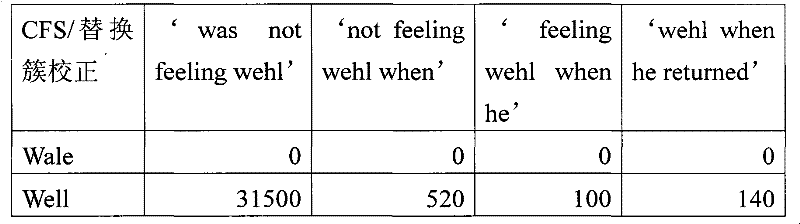
上面的示例说明:根据上面在H中给出的所有准则,“well”而不是“wale”的选择具有高置信度。The example above illustrates that the choice of "well" instead of "wale" has high confidence based on all the criteria given above in H.
在下面的示例中,置信度在一定程度上较小,因为在CFS‘bech in the summer’中,替换校正‘back’具有比‘beach’更高的出现频率,但是在CFS‘on the beech in’和‘the bech in the’中‘beach’具有比‘back’更高的出现频率。基于准则H(c)选择具有中间置信度的替换校正‘beach’。In the example below, the confidence is somewhat less because in CFS 'bech in the summer' the substitution correction 'back' has a higher frequency of occurrence than 'beach', but in CFS' on the beech in ' and 'the bech in the' have a higher frequency of 'beach' than 'back'. A replacement correction 'beach' is selected with intermediate confidence based on criterion H(c).
提供下面的输入文本:Provide the following input text:
I like to work on the bech in the summerI like to work on the bech in the summer
使用上文参考图6A描述的功能,选择下面的簇来用于校正:Using the function described above with reference to Figure 6A, the following clusters were selected for calibration:
bechbech
使用上文参考图7A描述的功能,产生下面的替换簇校正(部分列表):Using the functions described above with reference to Figure 7A, the following replacement cluster corrections (partial listing) are generated:
beach;beech;backbeach; beech; back
使用上文参考图5描述的功能,产生下面的CFS(部分列表):Using the functions described above with reference to Figure 5, the following CFS (partial listing) is produced:
‘on the bech in’;‘the bech in the’;‘bech in the summer’'on the bech in'; 'the bech in the'; 'bech in the summer'
使用上文参考子阶段IIA描述的功能,针对上面的CFS列表中的上面的替换簇校正列表产生在表25中所示的在因特网语料库中的出现频率矩阵:Using the function described above with reference to sub-stage IIA, the frequency of occurrence matrix in the Internet Corpus shown in Table 25 was generated for the above replacement cluster correction list in the above CFS list:
表25Table 25
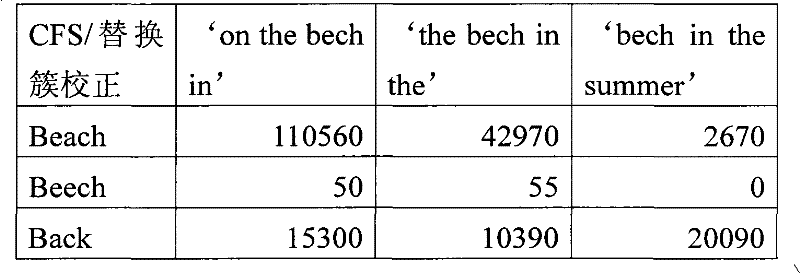
基于准则H(c)选择具有中间置信度的替换校正‘beach’。A replacement correction 'beach' is selected with intermediate confidence based on criterion H(c).
在下面的示例中,基于准则H(a),置信度更小:In the example below, the confidence is smaller based on the criterion H(a):
接收下面的输入文本:Accepts the following input text:
Exarts are restoring the British Museum′s round reading roomExarts are restoring the British Museum's round reading room
使用上文参考图6A描述的功能,选择下面的簇来用于校正:Using the function described above with reference to Figure 6A, the following clusters were selected for calibration:
ExartsExarts
使用上文参考图7A描述的功能,产生下面的替换簇校正(部分列表):Using the functions described above with reference to Figure 7A, the following replacement cluster corrections (partial listing) are produced:
Experts;Exerts;ExitsExperts; Exerts; Exits
使用上文参考图5描述的功能,产生下面的CFS(部分列表):Using the functions described above with reference to Figure 5, the following CFS (partial listing) is produced:
‘Exarts are’;‘Exarts are restoring’;‘Exarts are restoring the’;‘Exarts are restoring the British’'Exarts are'; 'Exarts are restoring'; 'Exarts are restoring the'; 'Exarts are restoring the British'
使用上文参考阶段IIA描述的功能,针对上面的CFS列表中的上面的替换簇校正列表产生在表26中所示的在因特网语料库中的出现频率矩阵:Using the functions described above with reference to Phase IIA, the frequency of occurrence matrix in the Internet Corpus shown in Table 26 was generated for the above replacement cluster correction list in the CFS list above:
表26Table 26
针对其的所有替换校正具有为0的出现频率的所有CFS被消除。在该示例中,消除下面的特征语法:All CFSs for which all replacement corrections have a frequency of occurrence of 0 are eliminated. In this example, the following feature syntax is eliminated:
‘Exarts are restoring’;‘Exarts are restoring the’;‘Exarts are restoring the British’‘Exarts are restoring’; ‘Exarts are restoring the’; ‘Exarts are restoring the British’
在该示例中,仅剩余的CFS是特征语法:In the example, the only remaining CFS is the feature syntax:
‘Exarts are’‘Exarts are’
可以从上述示例看出,在过滤处理中保留下来的唯一CFS是“exarts are”。结果,置信度相对低,因为该选择仅基于单个CFS,该单个CFS相对短,并且除了可疑词之外仅包括一个词,而该词为频繁出现的词。As can be seen from the above example, the only CFS that survives the filtering process is "exarts are". As a result, the confidence level is relatively low because the selection is based only on a single CFS, which is relatively short and includes only one word other than the suspicious word, which is a frequently occurring word.
现在参见图9,图9是图示用于对各个替换校正进行基于上下文评分和基于词相似度评分的功能的简化流程图,该功能是在图3、10和11的误用词和语法校正功能中和在图4的词汇增强功能中有用的。Referring now to FIG. 9, FIG. 9 is a simplified flowchart illustrating the functionality for context-based scoring and word-similarity-based scoring of individual substitution corrections, which is the misused word and grammar corrections in FIGS. 3, 10, and 11. Function neutralization is useful in the vocabulary enhancements in Figure 4.
如图9中所示,对各个替换校正的基于上下文和基于词相似度的评分以下面的一般阶段进行:As shown in Figure 9, context-based and word-similarity-based scoring of individual substitution corrections proceeds in the following general stages:
I.非上下文评分-根据各个簇替换的书写外观和发音相似度,基于与输入文本中簇的相似度来对各个簇替换评分。该评分不考虑在给定簇之外的任何上下文相似度。I. Non-contextual scoring - Each cluster replacement is scored based on its similarity to the cluster in the input text, according to its written appearance and phonetic similarity. This score does not take into account any contextual similarities outside of a given cluster.
II.使用因特网语料库的上下文评分-也基于所提取的上下文特征序列(CFS)来对各个簇替换中的每一个评分,该上下文特征序列(CFS)是如上文参考图5所描述那样而提供的。该评分包括下面的子阶段:II. Context Scoring Using Internet Corpus - Each of the individual cluster replacements was also scored based on the extracted Context Feature Sequence (CFS) provided as described above with reference to FIG. 5 . The scoring includes the following subphases:
IIA.在如上文参考图5所描述那样提取的CFS的上下文中,对于由图7A或7B的功能产生的各个替换簇校正,优选地使用因特网语料库来执行出现频率分析。IIA. In the context of a CFS extracted as described above with reference to FIG. 5, for each replacement cluster correction produced by the function of FIG. 7A or 7B, frequency of occurrence analysis is preferably performed using an Internet corpus.
IIB.其中基于子阶段IIA的出现频率分析的结果来执行CFS选择和对各个CFS的加权。加权也基于各个CFS的相对固有重要性。应当意识到,可以向一些CFS赋予为0的权重,并因此不选择该一些CFS。所选择的CFS优选地被赋予相对权重。IIB. wherein CFS selection and weighting of individual CFSs is performed based on the results of the frequency analysis of sub-phase IIA. Weighting is also based on the relative intrinsic importance of the individual CFSs. It should be appreciated that some CFSs may be given a weight of 0 and thus not selected. The selected CFSs are preferably given relative weights.
IIC.向在子阶段IIB中所选择的每一个CFS的每一个替换校正分配出现频率度量。IIC. Assign a frequency of occurrence metric to each alternative correction for each CFS selected in sub-phase IIB.
IID.其中基于子阶段IIA的出现频率分析的结果、子阶段IIC的出现频率度量和子阶段IIB的CFS选择和加权来产生减小的替换簇校正集合。IID. wherein a reduced set of replacement cluster corrections is generated based on the results of the frequency analysis of sub-phase IIA, the frequency metrics of sub-phase IIC and the CFS selection and weighting of sub-phase IIB.
IIE.输入簇被选择来用作参考簇校正。IIE. The input cluster is selected to be used as a reference cluster for calibration.
IIF.向在阶段IIB中选择的每一个CFS的子阶段IIE的参考簇校正分配出现频率度量。IIF. Assigning a frequency of occurrence metric to the reference cluster correction of sub-phase IIE for each CFS selected in phase IIB.
IIG.向在子阶段IIB中选择的每一个特征分配比率度量,该比率度量表示该特征的每一个替换校正的出现频率度量与向子阶段IIB的参考簇分配的出现频率度量之比。IIG. Assign to each feature selected in sub-phase IIB a ratio metric representing the ratio of each replacement-corrected frequency metric for that feature to the frequency metric assigned to the reference cluster of sub-phase IIB.
III.基于阶段I的结果和阶段II的结果来选择最优选的替换簇校正。III. Select the most preferred replacement cluster correction based on the results of Phase I and the results of Phase II.
IV.向最优选的替换簇校正分配置信度评分。IV. Correctly assigning confidence scores to the most preferred replacement clusters.
以下给出上文在阶段II-IV中描述的功能的更详细的描述:A more detailed description of the functions described above in phases II-IV is given below:
参考子阶段IIA,如上文在图5中所描述的那样来产生包括要校正的簇的所有CFS。包含可疑错误(除了在输入簇中的错误之外)的CFS被消除。Referring to sub-phase IIA, all CFSs including the cluster to be corrected are generated as described above in FIG. 5 . CFSs containing suspect errors (other than those in the input cluster) are eliminated.
产生矩阵,该矩阵指示在每一个CFS中的簇的每一个替换校正在语料库(优选地为因特网语料库)中的出现频率。针对其的所有替换校正都具有为0的出现频率的所有CFS被消除。其后,被整体包括在至少具有最低阈值出现频率的其他CFS中的所有CFS被消除。A matrix is generated indicating the frequency of occurrence in the corpus, preferably the Internet corpus, of each replacement correction for the clusters in each CFS. All CFSs for which all replacement corrections have a frequency of occurrence of 0 are eliminated. Thereafter, all CFSs that are integrally included in other CFSs with at least the lowest threshold frequency of occurrence are eliminated.
下面的示例说明了出现频率矩阵的产生:The following example illustrates the generation of a frequency matrix:
提供了下面的输入文本:The following input text is provided:
I lick two play outside a lotI lick two play outside a lot
使用上文参考图6A所描述的功能,选择下面的簇来用于校正:Using the function described above with reference to Figure 6A, the following clusters are selected for calibration:
lick twolick two
使用上文参考图7A所描述的功能,产生下面的替换簇校正(部分列表):Using the functions described above with reference to Figure 7A, the following replacement cluster corrections (partial listing) are generated:
like to;like two;lick two;lack two;lack true;like truelike to; like two; lick two; lack two; lack true; like true
使用上文参考图5所描述的功能,产生下面的CFS(部分列表):Using the functions described above with reference to Figure 5, the following CFS (partial listing) results:
‘lick two’;‘I lick two’;‘lick two play’;‘I lick two play’;‘lick two play outside’;‘I lick two play outside’;‘lick two play outside a’'lick two'; 'I lick two'; 'lick two play'; 'I lick two play'; 'lick two play outside'; 'I lick two play outside'; 'lick two play outside a'
使用上文参考子阶段IIA所描述的功能,针对上面的CFS列表中的上面的替换簇校正列表产生在表27中所示的在因特网语料库中的出现频率矩阵:Using the functions described above with reference to sub-stage IIA, the frequency of occurrence matrix in the Internet Corpus shown in Table 27 was generated for the above replacement cluster correction list in the above CFS list:
表27Table 27
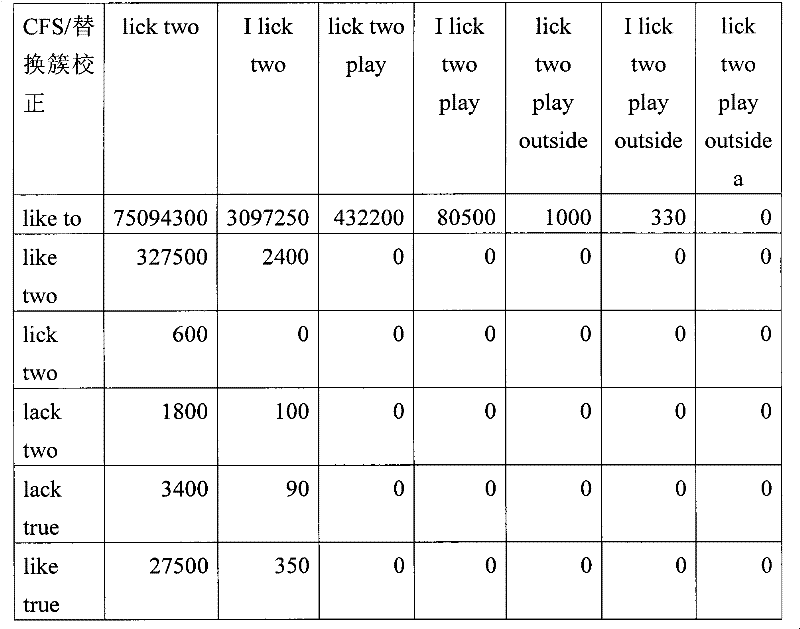
针对其的所有替换校正具有为0的出现频率的所有CFS被消除。在该示例中,消除了下面的特征语法:All CFSs for which all replacement corrections have a frequency of occurrence of 0 are eliminated. In this example, the following feature syntax is eliminated:
‘lick two play outside a’‘lick two play outside a’
其后,被整体包括在至少具有最小阈值出现频率的其他CFS中的所有CFS被消除。例如,下面的特征语法被消除:Thereafter, all CFSs that are integrally included in other CFSs having at least the minimum threshold frequency of occurrence are eliminated. For example, the following feature syntax is eliminated:
‘lick two’;‘I lick two’;‘lick two play’;‘I lick two play’;‘lick two play outside’'lick two'; 'I lick two'; 'lick two play'; 'I lick two play'; 'lick two play outside'
在该示例中,仅剩余的CFS是下面的特征语法:In this example, the only remaining CFS is the following feature syntax:
′I lick two play outside′.'I lick two play outside'.
产生的矩阵如表28中所示:The resulting matrix is shown in Table 28:
表28Table 28
上述示例说明了根据本发明的一个优选实施例的矩阵的产生。在该示例中,很清楚,“like to”是优选的替换校正。应当意识到,在实际中,选择通常不如此直截了当。因此,在下面给出的另外的示例中,提供了用于在替换校正中进行困难得多的选择的功能。The above example illustrates the generation of a matrix according to a preferred embodiment of the present invention. In this example, it is clear that "like to" is the preferred substitution correction. It should be realized that in practice the selection is often not so straightforward. Thus, in a further example given below, functionality is provided for making much more difficult choices in alternative corrections.
返回对子阶段IIB的考虑,可选地,每一个剩余的CFS被赋予上文参考图5所描述的评分。另外,包含在多词输入的早期校正迭代中引入的词并且具有小于预定置信度阈值的置信度的CFS被负偏置。Returning to consideration of sub-phase IIB, each remaining CFS is optionally assigned a score as described above with reference to FIG. 5 . Additionally, CFSs that contain words introduced in early correction iterations of multi-word inputs and that have a confidence less than a predetermined confidence threshold are negatively biased.
在一般情况下,与上文在子阶段IIC中描述的情况类似,产生标准化的频率矩阵,用于指示每一个CFS在因特网语料库中的标准化的出现频率。通常通过下述方式来从频率矩阵产生标准化的频率矩阵:将每一个CFS频率除以相关簇替换的出现频率的函数。In general, a normalized frequency matrix indicating the normalized frequency of occurrence of each CFS in the Internet corpus is generated similar to the case described above in sub-phase IIC. A normalized frequency matrix is typically generated from the frequency matrix by dividing each CFS frequency by a function of the frequency of occurrence of the associated cluster substitution.
该标准化用于削弱在各个替换校正的整体中基本差异的影响。适当的标准化因子基于各个替换校正在语料库中作为整体的整体出现频率,而与CFS无关。This normalization serves to attenuate the effect of fundamental differences in the ensemble of individual replacement corrections. The appropriate normalization factor is based on the overall frequency of occurrence of the individual replacement corrections in the corpus as a whole, independent of CFS.
下面的示例说明了标准化的出现频率矩阵的产生:The following example illustrates the generation of a normalized frequency matrix:
典型地,通过语音识别提供了下面的输入文本:Typically, the following input text is provided by speech recognition:
footprints of a mysterious[hound/hand]said to be six feet tallfootprints of a mysterious[hound/hand] said to be six feet tall
使用上文参考图6B描述的功能,选择下面的簇来用于校正:Using the function described above with reference to Figure 6B, the following clusters were selected for calibration:
houndhound
使用上文参考图7A描述的功能,产生下面的替换簇校正(部分列表):Using the functions described above with reference to Figure 7A, the following replacement cluster corrections (partial listing) are produced:
hound;hand;soundhound; hand; sound
使用上文参考图5描述的功能,产生下面的CFS(部分列表):Using the functions described above with reference to Figure 5, the following CFS (partial listing) is produced:
‘a mysterious hound’;‘hound said’'a mysterious hound'; 'hound said'
在此使用上文参考子阶段IIC描述的功能,针对上面的CFS列表中的上面的替换簇校正列表产生如表29中所示的在因特网语料库中的出现频率矩阵和标准化的出现频率矩阵:Using the function described above with reference to sub-stage IIC here, the frequency of occurrence matrix and the normalized frequency of occurrence matrix in the Internet Corpus as shown in Table 29 are generated for the above replacement cluster correction list in the above CFS list:
表29Table 29
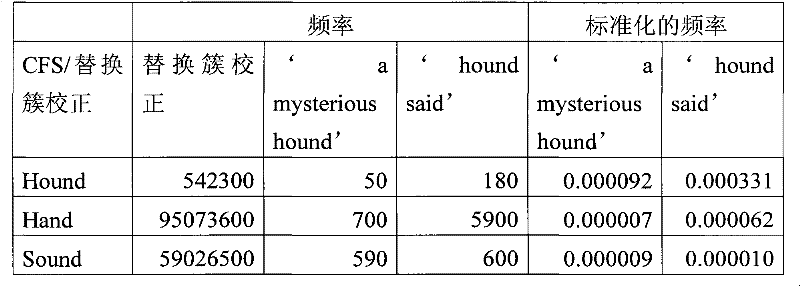
从上述示例可以意识到,因为在各个替换校正的整体中的基本差异,所以具有最高出现频率的词可能并不一定具有最高的标准化的出现频率。在上述的示例中,“hound”具有最高的标准化的出现频率,并且从输入文本的上下文显而易见的是,正确的词是“hound”,而不是在因特网语料库中具有更高出现频率的“hand”。It can be appreciated from the above example that the word with the highest frequency of occurrence may not necessarily have the highest normalized frequency of occurrence because of the substantial difference in the ensemble of the respective replacement corrections. In the example above, "hound" has the highest normalized frequency of occurrence, and it is obvious from the context of the input text that the correct word is "hound", not "hand", which has a higher frequency in the Internet Corpus .
本发明的一个特定特征是在替换校正中进行选择时使用标准化频率,该标准化频率削弱了各个替换校正的整体中的基本差异。应当意识到,与标准化的出现频率不同的出现频率的其他度量可以替换或附加地被用作度量。在出现频率相对低或特别高的情况下,附加或可替换的度量是有益的。A particular feature of the invention is the use of a normalized frequency in the selection among alternative corrections which attenuates substantial differences in the ensemble of individual alternative corrections. It should be appreciated that other measures of frequency of occurrence other than the normalized frequency of occurrence may alternatively or additionally be used as the measure. In cases where the frequency of occurrence is relatively low or extremely high, additional or alternative metrics are beneficial.
将从随后的讨论意识到,在各个替换校正中进行选择时,另外的功能经常是有用的。下面描述这些功能。As will be appreciated from the ensuing discussion, additional functionality is often useful when selecting among alternative corrections. These functions are described below.
在子阶段IID中,根据下面的两个度量,与另一个替换簇校正相比,更不优选的每一个替换簇校正被消除:In subphase IID, each replacement cluster correction that is less preferred than another replacement cluster correction is eliminated according to the following two metrics:
i.与另一个替换簇校正相比,具有更低的词相似度评分;以及i. have a lower word similarity score compared to another replacement cluster correction; and
ii.与另一个替换簇校正相比,对于所有CFS具有更低的出现频率,并且优选地也具有更低的标准化的出现频率。ii. A lower frequency of occurrence for all CFSs, and preferably also a lower normalized frequency of occurrence, compared to another replacement cluster correction.
下面的示例说明了如上所述的替换校正的消除:The following example illustrates the elimination of substitution corrections as described above:
提供下面的输入文本:Provide the following input text:
I leave on a big houseI leave on a big house
使用上文参考图6B描述的功能,选择下面的簇来用于校正:Using the function described above with reference to Figure 6B, the following clusters were selected for calibration:
leave onleave on
使用上文参考图7A描述的功能,产生下面的替换簇校正(部分列表):Using the functions described above with reference to Figure 7A, the following replacement cluster corrections (partial listing) are generated:
leave in;live in;love in;leave onleave in; live in; love in; leave on
使用上文参考图5描述的功能,产生下面的CFS(部分列表):Using the functions described above with reference to Figure 5, the following CFS (partial listing) is produced:
‘I leave on a’;‘leave on a big’'I leave on a'; 'leave on a big'
在此使用上文参考阶段IIE描述的功能,针对上面的CFS列表中的上面的替换簇校正列表产生如表30中所示在因特网语料库中的出现频率矩阵和标准化的出现频率矩阵:Here using the functions described above with reference to Phase IIE, the frequency of occurrence matrix and the normalized frequency of occurrence matrix in the Internet Corpus as shown in Table 30 are generated for the above replacement cluster correction list in the above CFS list:
表30Table 30
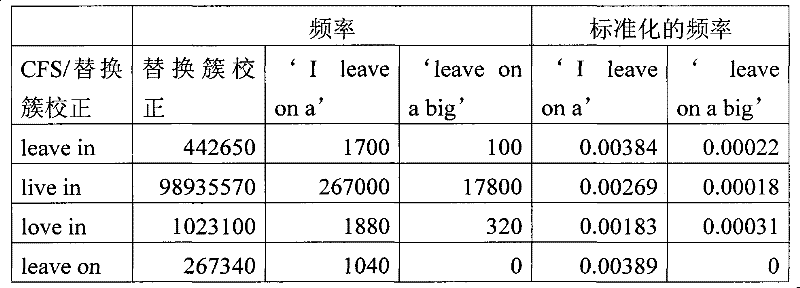
在该示例中,替换簇校正的非上下文相似度评分如表31中所示:In this example, the replacement cluster corrected non-context similarity scores are shown in Table 31:
表31Table 31
替换簇校正“love in”被消除,因为它比“live in”具有更低的相似度评分以及更低的出现频率和更低的标准化的出现频率。在该阶段不消除替换簇校正“leave in”,因为其相似度评分比“live in”更大。The replacement cluster correction "love in" is eliminated because it has a lower similarity score than "live in" as well as a lower frequency of occurrence and a lower normalized frequency of occurrence. The replacement cluster correction "leave in" is not eliminated at this stage because its similarity score is larger than "live in".
从上面的内容可以意识到,子阶段IID的功能的操作结果是对于减少的多个CFS的每一个的减小的频率矩阵,并且优选地也是减小的标准化频率矩阵,该减小的频率矩阵用于指示减少的多个替换校正的每一个的出现频率,该减小的标准化频率矩阵优选地用于指示减少的多个替换校正的每一个的标准化的出现频率,其中每一个替换校正具有相似度评分。减小的替换簇校正集合优选地用于如从随后的示例看到的所有另外的替换簇选择功能。As can be appreciated from the above, the result of the operation of the functions of sub-phase IID is a reduced frequency matrix, and preferably also a reduced normalized frequency matrix, for each of the reduced plurality of CFSs, the reduced frequency matrix For indicating the frequency of occurrence of each of the reduced plurality of alternative corrections, the reduced normalized frequency matrix is preferably used to indicate the normalized frequency of occurrence of each of the reduced plurality of alternative corrections, wherein each alternative correction has a similar degree rating. The reduced set of replacement cluster corrections is preferably used for all additional replacement cluster selection functions as seen from the examples that follow.
对于在减小的频率矩阵中和优选地也在减小的标准化频率矩阵中的每一个替换校正,产生最后的偏好度量。可以使用下面的替换度量的一个或多个来产生每一个替换校正的最后偏好评分。For each replacement correction in the reduced frequency matrix and preferably also in the reduced normalized frequency matrix, a final bias measure is generated. One or more of the following substitution metrics may be used to generate each substitution corrected final preference score.
下面使用术语“频率函数”来指代频率、标准化频率或频率和标准化频率两者的函数。The term "frequency function" is used below to refer to a function of frequency, normalized frequency, or both frequency and normalized frequency.
A.一种可能的偏好度量是在减小的一个或多个矩阵中的任何CFS的减小的一个或多个矩阵中的每一个替换簇校正的最高出现频率函数。例如,各个替换簇校正将被评分如下:A. One possible bias metric is the highest frequency-of-occurrence function of each replacement cluster correction in the reduced matrix or matrices for any CFS in the reduced matrix or matrices. For example, individual replacement cluster corrections would be scored as follows:
提供下面的输入文本:Provide the following input text:
I am vary satisfied with your workI am vary satisfied with your work
使用上文参考图6B描述的功能,选择下面的簇来用于校正:Using the function described above with reference to Figure 6B, the following clusters were selected for calibration:
varyvary
使用上文参考图7A描述的功能,产生下面的替换簇校正(部分列表):Using the functions described above with reference to Figure 7A, the following replacement cluster corrections (partial listing) are generated:
vary;veryvary; very
使用上文参考图5描述的功能,产生下面的CFS(部分列表):Using the functions described above with reference to Figure 5, the following CFS (partial listing) is produced:
‘am vary’;‘vary satisfied’;‘I am vary satisfied with’'am vary'; 'vary satisfied'; 'I am vary satisfied with'
在此使用上文参考子阶段IIC描述的功能,针对上面的CFS列表中的上面的替换簇校正列表产生在表32和33中所示的在因特网语料库中的出现频率矩阵和标准化的出现频率矩阵:Using the functions described above with reference to sub-stage IIC here, the frequency of occurrence matrices in the Internet Corpus and the normalized frequency of occurrence matrices shown in Tables 32 and 33 were generated for the above replacement cluster correction list in the above CFS list :
表32Table 32
表33Table 33

在该示例中,可以从出现频率和标准化的出现频率二者看出,“very”具有最高的出现频率函数。In this example, it can be seen from both the frequency of occurrence and the normalized frequency of occurrence that "very" has the highest frequency of occurrence function.
B.另一种可能的偏好度量是每一个替换校正的所有CFS的平均出现频率函数。例如,各个替换校正将被评分如下:B. Another possible measure of preference is a function of the average frequency of occurrence of all CFSs corrected for each replacement. For example, each replacement correction would be scored as follows:
提供下面的输入文本:Provide the following input text:
A while ago the lived 3 dwarfsA while ago the lived 3 dwarfs
使用上文参考图6B描述的功能,选择下面的簇来用于校正:Using the function described above with reference to Figure 6B, the following clusters were selected for calibration:
thethe
使用上文参考图7A描述的功能,产生下面的替换簇校正(部分列表):Using the functions described above with reference to Figure 7A, the following replacement cluster corrections (partial listing) are produced:
the;they;she;therethe; they; she; there
使用上文参考图5描述的功能,产生下面的CFS(部分列表):Using the functions described above with reference to Figure 5, the following CFS (partial listing) is produced:
‘ago the lived’;‘the lived 3’'ago the lived'; 'the lived 3'
在此使用上文参考子阶段IIC描述的功能,针对上面的CFS列表中的上面的替换簇校正列表产生在表34和35中所示的在因特网语料库中的出现频率矩阵、标准化的出现频率矩阵和平均出现频率矩阵:Here the frequency of occurrence matrices in the Internet Corpus, the normalized frequency of occurrence matrices shown in Tables 34 and 35, are generated for the above replacement cluster correction list in the above CFS list using the functions described above with reference to sub-stage IIC and the mean frequency matrix:
表34Table 34
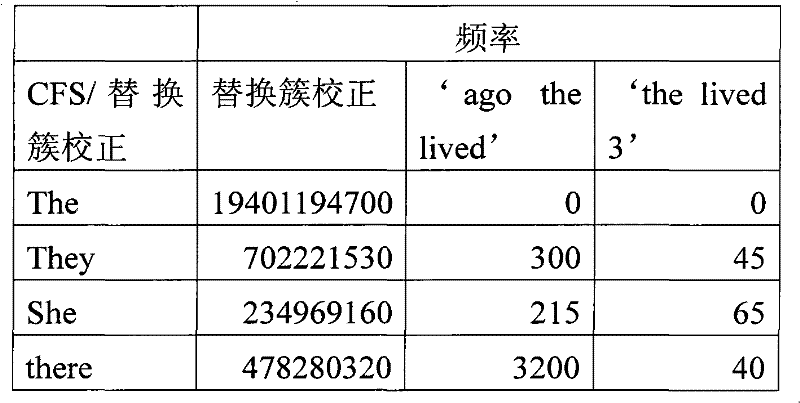
表35Table 35
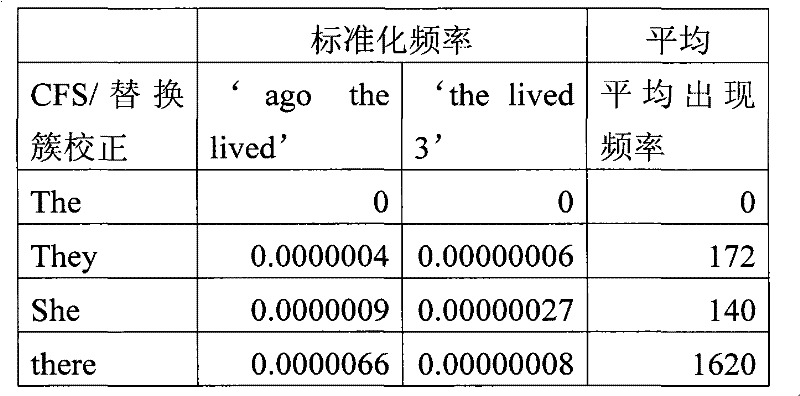
注意,基于平均出现频率而选择“they”,尽管“there”具有其出现频率是在矩阵中的最大出现频率的CFS。Note that "they" are selected based on the average frequency of occurrence, although "there" has a CFS whose frequency of occurrence is the maximum frequency of occurrence in the matrix.
在该示例中,替换簇校正的非上下文相似度评分如表36中所示:In this example, the replacement cluster corrected non-context similarity scores are shown in Table 36:
表36Table 36
注意,具有最高相似度评分的替换簇校正未被选择。Note that the replacement cluster correction with the highest similarity score was not selected.
C.另一种可能的偏好度量是每一个CFS的出现频率函数乘以由上文参考图5描述的功能计算的该CFS的评分在每一个替换校正的所有CFS上的加权和。C. Another possible bias metric is the frequency function of each CFS multiplied by the weighted sum of that CFS's score calculated by the function described above with reference to FIG. 5 over all CFSs corrected for each substitution.
D.通过对在减小的一个或多个矩阵中的替换校正的以下操作中的任何一个或多个操作、更优选地大多数操作并且最优选地所有操作,如上文参考子阶段IIE-IIG所描述的,产生特定的替换校正/CFS偏好度量:D. Any one or more, more preferably most and most preferably all of the following operations corrected by substitution in the reduced matrix or matrices, as above with reference to sub-phases IIE-IIG As described, yields a specific substitution correction/CFS preference metric:
i.从原始输入文本中选择来校正的簇被选择为参考簇。i. The cluster selected for correction from the original input text is selected as the reference cluster.
ii.产生修改的矩阵,其中,在每一个偏好矩阵中,将在每一个特征语法中的每一个替换校正的出现频率函数替代为每一个替换校正的出现频率函数与参考簇的出现频率函数之比。ii. Generate modified matrices in which, in each preference matrix, each substitution-corrected frequency of occurrence function in each eigengram is replaced by the difference between each substitution-corrected frequency of occurrence function and the frequency of occurrence function of the reference cluster Compare.
iii.上文在ii中描述的类型的修改的矩阵被进一步修改,以将在每一个偏好度量中的比率替代为比率的函数:该比率的函数减小了比率中很大差异的的计算重要性。适当的此类函数是对数函数。该操作的目的是在保持最不优选的替换校正的最后偏好评分中出现频率的大差异的重要性并且因此消除最不优选的替换校正的同时,降低在最优选的替换校正的最后偏好评分中出现频率的大差异的重要性。iii. A modified matrix of the type described above in ii is further modified to replace the ratio in each preference measure with a function of the ratio: this function of the ratio reduces the computational importance of large differences in ratios sex. A suitable such function is a logarithmic function. The purpose of this operation is to reduce the importance of large differences in frequency of occurrence in the final preference score corrected for the most preferred alternative while maintaining the importance of, and thus eliminating, the least preferred alternative. The importance of large differences in frequency.
iv.通过将在每一个偏好度量中的适用比率或比率函数乘以适当的CFS评分来另外修改上文在ii或iii中描述的类型的修改的矩阵。这提供了基于在CFS评分中反映的正确的语法使用和其他因素的重点。iv. Additional modification of the modified matrix of the type described in ii or iii above by multiplying the applicable ratio or ratio function in each preference measure by the appropriate CFS score. This provides an emphasis based on correct grammar usage and other factors reflected in the CFS score.
v.通过将在每一个偏好度量中的适用比率或比率函数乘以用户不确定性度量的函数来另外修改上文在ii、iii或iv中描述的类型的修改的矩阵。用户输入不确定性度量的一些示例包括:在词处理器中执行的与输入词或簇相关的、相对于对文档的其他词的编辑行为的编辑行为的数量;在词处理器中执行的输入词或簇的、相对于文档的其他词的写入定时的写入定时;以及在语音识别输入功能中执行的输入词或簇的、相对于该用户对于其他词的讲出定时的讲出定时。用户输入不确定性度量提供了用户对于词的该选择有多确定的指示。该步骤将所计算的偏置用于参考簇,并且通过关于该簇的用户确定性或不确定性的函数来对其进行修改。v. Additional modification of the modified matrix of the type described in ii, iii or iv above by multiplying the applicable ratio or ratio function in each preference measure by a function of the user uncertainty measure. Some examples of user input uncertainty measures include: the number of editing actions performed in a word processor related to an input word or cluster relative to editing actions on other words of the document; The writing timing of the word or cluster relative to the writing timing of other words in the document; and the speaking timing of the input word or cluster performed in the speech recognition input function relative to the speaking timing of other words by the user . The user input uncertainty measure provides an indication of how certain the user is of this choice of word. This step takes the calculated bias for the reference cluster and modifies it by a function of the user's certainty or uncertainty about the cluster.
vi.通过产生适用比率、比率函数、出现频率和标准化的出现频率的函数来另外修改上文在ii、iii或iv中描述的类型的修改的矩阵。通过将在每一个偏好度量中的适用比率或比率函数乘以该CFS的出现频率来产生优选函数。vi. Additional modification of a modified matrix of the type described in ii, iii or iv above by generating a function of the applicable ratio, ratio function, frequency of occurrence and normalized frequency of occurrence. The preference function is generated by multiplying the applicable ratio or ratio function in each preference metric by the frequency of occurrence of the CFS.
E.基于如上在D中描述的特定替换校正/CFS偏好度量,通过将替换校正的相似度评分乘以该替换校正的所有CFS的特定替换校正/CFS偏好度量之和,为每一个替换校正计算最后偏好度量。E. Based on the specific substitution correction/CFS preference metric as described above in D, for each substitution correction, calculate Last preference metric.
这样的修改的矩阵的示例如下:An example of such a modified matrix is as follows:
提供下面的输入文本:Provide the following input text:
I will be able to teach base with you next weekI will be able to teach base with you next week
使用上文参考图6B描述的功能,选择下面的簇来用于校正:Using the function described above with reference to Figure 6B, the following clusters were selected for calibration:
teachteach
使用上文参考图7A描述的功能,产生下面的替换簇校正(部分列表):Using the functions described above with reference to Figure 7A, the following replacement cluster corrections (partial listing) are produced:
teach;touchteach; touch
使用上文参考图5描述的功能,产生下面的CFS(部分列表):Using the functions described above with reference to Figure 5, the following CFS (partial listing) is produced:
‘able to teach’;‘to teach base’'able to teach'; 'to teach base'
使用上文参考上面的子阶段IIA和IIC描述的功能,针对上面的CFS列表中的上面的替换簇校正列表产生在表37中所示的在因特网语料库中的出现频率矩阵和标准化的出现频率矩阵:Using the functions described above with reference to sub-stages IIA and IIC above, the frequency of occurrence matrices in the Internet Corpus and the normalized frequency of occurrence matrices shown in Table 37 were generated for the above replacement cluster correction list in the above CFS list :
表37Table 37
注意,对于一个特征,“teach”的出现频率和标准化的出现频率均大于“touch”的频率,但是对于另一个特征,“touch”的出现频率和标准化的出现频率均大于“teach”的频率。为了进行替换校正的正确选择,优选地如下所述那样使用上文参考子阶段IIG描述的比率度量。Note that for one feature, both the frequency of occurrence and the normalized frequency of "teach" are greater than the frequency of "touch", but for the other feature, the frequency of occurrence of "touch" and the normalized frequency of occurrence are both greater than the frequency of "teach". In order to make the correct choice of replacement corrections, the ratiometric described above with reference to sub-stage IIG is preferably used as described below.
在该示例中,替换簇校正的非上下文相似度评分如表38中所示:In this example, the replacement cluster corrected non-context similarity scores are shown in Table 38:
表38Table 38
可以看出,参考簇是“teach”,因为它具有最高的相似度评分。尽管如此,基于如上文所描述的最后偏好评分而选择“touch”。如可以从对指示“teach”具有最高出现频率和最高标准化的出现频率的上面的矩阵的考虑所意识到的,这并不是直观的。在该示例中,最后偏好评分指示选择“touch”而不是“teach”,因为其中有利于“touch”的特征的出现频率的比率比其中有利于“teach”的另一特征的出现频率的比率大得多。It can be seen that the reference cluster is "teach" since it has the highest similarity score. Nonetheless, "touch" is selected based on the final preference score as described above. As can be appreciated from consideration of the above matrix indicating that "teach" has the highest frequency of occurrence and the highest normalized frequency of occurrence, this is not intuitive. In this example, the final preference score indicates that "touch" is selected over "teach" because the ratio of frequency of occurrence of the feature favoring "touch" is greater than the ratio of frequency of occurrence of another feature favoring "teach" much.
F.可选地,可以使用下面的判决规则的一个或多个,基于替换校正的频率函数值和偏好度量与参考簇的频率函数值和偏好度量的比较来滤除该替换校正:F. Optionally, one or more of the following decision rules may be used to filter out alternative corrections based on their comparison of their frequency function values and preference metrics with those of the reference cluster:
1.对于具有大于预定阈值的CFS评分的至少一个特征,滤除具有比预定阈值低的相似度评分并且具有比参考簇的CFS频率函数小的CFS频率函数的替换校正。1. For at least one feature with a CFS score greater than a predetermined threshold, filter out replacement corrections with a similarity score lower than a predetermined threshold and with a CFS frequency function smaller than that of a reference cluster.
2.对于具有大于另一预定阈值的CFS评分的至少一个特征,滤除具有比预定阈值低的相似度评分并且具有比预定阈值小的偏好度量的替换校正。2. For at least one feature with a CFS score greater than another predetermined threshold, filtering out alternative corrections with a similarity score lower than the predetermined threshold and with a preference metric smaller than the predetermined threshold.
3.a.判定每一个CFS的CFS评分;3.a. Determine the CFS score for each CFS;
b.对于每一个CFS,判定参考簇和替换校正的CFS频率函数,由此判定是参考簇还是替换校正具有针对该CFS的更高的频率函数;b. For each CFS, determine the CFS frequency function of the reference cluster and the replacement correction, thereby determining whether the reference cluster or the replacement correction has a higher frequency function for the CFS;
c.对具有比参考簇更高的频率的替换校正的CFS的CFS评分求和;c. Summing the CFS scores of the replacement-corrected CFSs that have a higher frequency than the reference cluster;
d.对具有比替换校正更高的频率的参考簇的CFS的CFS评分求和;以及d. summing the CFS scores of the CFS of the reference cluster with a higher frequency than the replacement correction; and
e.如果在c中的和小于在d中的和,则滤除该替换校正。e. If the sum in c is less than the sum in d, filter out the substitution correction.
下面的示例说明了如上所述的过滤功能。The example below illustrates the filtering functionality as described above.
通常通过语音识别功能来提供下面的输入文本:The following input text is usually provided by the speech recognition function:
I want[two/to/too]items,please.I want [two/to/too] items, please.
使用上文参考图6B描述的功能,选择下面的簇来用于校正:Using the function described above with reference to Figure 6B, the following clusters were selected for calibration:
[two/to/too][two/to/too]
使用上文参考图7A描述的功能,产生下面的替换簇校正(部分列表):Using the functions described above with reference to Figure 7A, the following replacement cluster corrections (partial listing) are generated:
too;to;twotoo; to; two
使用上文参考图5描述的功能,产生下面的CFS(部分列表):Using the functions described above with reference to Figure 5, the following CFS (partial listing) is produced:
‘I want two’;‘want two items’'I want two'; 'want two items'
在此使用上文参考阶段IIA描述的功能,针对上面的CFS列表中的上面的替换簇校正列表产生在表39中所示的在因特网语料库中的出现频率矩阵:Using the function described above with reference to Phase IIA here, the frequency of occurrence matrix in the Internet Corpus shown in Table 39 was generated for the above replacement cluster correction list in the above CFS list:
表39Table 39

替换校正“too”和“to”被滤除,因为它们对于CFS之一具有为0的出现频率,尽管它们具有另一个CFS的高出现频率。因此,在此,保留下来的CFS是“two”。The substitution corrections "too" and "to" are filtered out because they have a frequency of 0 for one of the CFSs, although they have a high frequency for the other CFS. Therefore, here, the remaining CFS is "two".
G.如上文参考阶段III所讨论的,基于如上文在A-E所描述那样得到的最后偏好度量,对在F中的过滤中保留下来的替换校正建立分级。具有最高最后偏好评分的替换校正被选择。G. As discussed above with reference to Phase III, based on the final preference measure obtained as described above in A-E, create a ranking for the replacement corrections retained in the filtering in F. The replacement correction with the highest final preference score is chosen.
H.如上文参考阶段IV所讨论的,向所选择的替换校正分配置信度。基于以下参数中的一个或多个来计算该置信度:H. As discussed above with reference to Phase IV, assign confidence to the selected replacement correction. The confidence is calculated based on one or more of the following parameters:
a.在上面的子阶段IIB中提供的所选择的CFS的数量、类型和评分;a. The number, type and score of the selected CFS provided in Subphase IIB above;
b.在所述CFS的上下文中,各个替换簇校正的出现频率的统计显著性;b. The statistical significance of the frequency of occurrence corrected for each replacement cluster in the context of the CFS;
c.在基于每一个CFS的偏好度量和各个替换校正的词相似度评分而对替换校正进行的选择上的一致度;c. Consistency in the selection of substitution corrections based on the preference metric for each CFS and the word similarity score for each substitution correction;
d.在预定最小阈值之上的所选择的替换簇校正的非上下文相似度评分(阶段I);d. Selected replacement cluster corrected non-contextual similarity scores above a predetermined minimum threshold (Stage I);
e.上下文数据的可获得的程度,该程度由具有大于预定最小阈值的CFS评分并且具有超过另一个预定阈值的偏好评分的减小的矩阵中的CFS的数量指示。e. The degree of availability of contextual data indicated by the number of CFSs in the decreasing matrix having a CFS score greater than a predetermined minimum threshold and having a preference score exceeding another predetermined threshold.
如果置信度大于预定阈值,则在没有用户交互的情况下实现所选择的替换校正。如果置信度小于预定阈值但是大于较低的预定阈值,则实现所选择的替换校正,但是邀请用户交互。如果置信度小于该较低的预定阈值,则邀请基于替换校正的优先化列表的用户选择。If the confidence level is greater than a predetermined threshold, the selected replacement correction is implemented without user interaction. If the confidence is less than a predetermined threshold but greater than a lower predetermined threshold, the selected alternative correction is implemented, but user interaction is invited. If the confidence level is less than the lower predetermined threshold, user selection based on the prioritized list of replacement corrections is invited.
下面的示例说明了置信度评分的使用:The following example illustrates the use of confidence scores:
提供下面的输入文本:Provide the following input text:
He was not feeling wale when he returnedHe was not feeling wale when he returned
使用上文参考图6B描述的功能,选择下面的簇来用于校正:Using the function described above with reference to Figure 6B, the following clusters were selected for calibration:
walewales
使用上文参考图7A描述的功能,产生下面的替换簇校正(部分列表):Using the functions described above with reference to Figure 7A, the following replacement cluster corrections (partial listing) are generated:
wale;wellwale; well
使用上文参考图5描述的功能,产生下面的CFS(部分列表):Using the functions described above with reference to Figure 5, the following CFS (partial listing) is produced:
‘was not feeling wale’;‘not feeling wale when’;‘feeling wale when he’;‘wale when he returned’'was not feeling wale'; 'not feeling wale when'; 'feeling wale when he'; 'wale when he returned'
在此使用上文参考子阶段IIA描述的功能,针对上面的CFS列表中的上面的替换簇校正列表产生在表40中所示的在因特网语料库中的出现频率矩阵:Using the function described above with reference to sub-stage IIA here, the frequency of occurrence matrix in the Internet Corpus shown in Table 40 is generated for the above replacement cluster correction list in the above CFS list:
表40Table 40
上面的示例说明:根据上面在H中给出的所有准则,“well”而不是“wale”的选择具有高置信度。The example above illustrates that the choice of "well" instead of "wale" has high confidence based on all the criteria given above in H.
在下面的示例中,置信度在一定程度上较小,因为在CFS‘bech in the summer’中,替换校正‘back’具有比‘beach’更高的出现频率,但是在CFS‘on the beech in’和‘the bech in the’中‘beach’具有比‘back’更高的出现频率。基于准则H(c)选择具有中间置信度的替换校正‘beach’。In the example below, the confidence is somewhat less because in CFS 'bech in the summer' the substitution correction 'back' has a higher frequency of occurrence than 'beach', but in CFS' on the beech in ' and 'the bech in the' have a higher frequency of 'beach' than 'back'. A replacement correction 'beach' is selected with intermediate confidence based on criterion H(c).
提供下面的输入文本:Provide the following input text:
I like to work on the beech in the summerI like to work on the beech in the summer
使用上文参考图6B描述的功能,选择下面的簇来用于校正:Using the function described above with reference to Figure 6B, the following clusters were selected for calibration:
beechbeech
使用上文参考图7A描述的功能,产生下面的替换簇校正(部分列表):Using the functions described above with reference to Figure 7A, the following replacement cluster corrections (partial listing) are produced:
beach;beech;backbeach; beech; back
使用上文参考图5描述的功能,产生下面的CFS(部分列表):Using the functions described above with reference to Figure 5, the following CFS (partial listing) is produced:
‘on the beech in’;‘the beech in the’;‘beech in the summer’'on the beech in'; 'the beech in the'; 'beech in the summer'
使用上文参考阶段IIA描述的功能,针对上面的CFS列表中的上面的替换簇校正列表产生在表41中所示的在因特网语料库中的出现频率矩阵:Using the functions described above with reference to Phase IIA, the frequency of occurrence matrix in the Internet Corpus shown in Table 41 was generated for the above replacement cluster correction list in the CFS list above:
表41Table 41
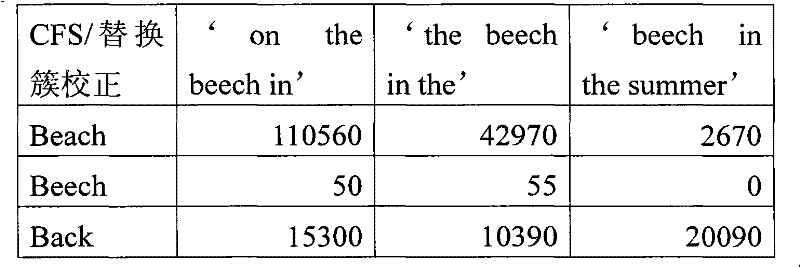
基于准则H(c)选择具有中间置信度的替换校正‘beach’。A replacement correction 'beach' is selected with intermediate confidence based on criterion H(c).
在下面的示例中,基于准则H(a),置信度更小:In the example below, the confidence is smaller based on the criterion H(a):
接收下面的输入文本:Accepts the following input text:
Exerts are restoring the British Museum′s round reading roomExerts are restoring the British Museum's round reading room
使用上文参考图6B描述的功能,选择下面的簇来用于校正:Using the function described above with reference to Figure 6B, the following clusters were selected for calibration:
ExertsExerts
使用上文参考图7A描述的功能,产生下面的替换簇校正(部分列表):Using the functions described above with reference to Figure 7A, the following replacement cluster corrections (partial listing) are generated:
Expert;Exerts;ExitsExpert;
使用上文参考图5描述的功能,产生下面的CFS(部分列表):Using the functions described above with reference to Figure 5, the following CFS (partial listing) is produced:
‘Exerts are’;‘Exerts are restoring’;‘Exerts are restoring the’;‘Exerts are restoring the British’'Exerts are'; 'Exerts are restoring'; 'Exerts are restoring the'; 'Exerts are restoring the British'
使用上文参考子阶段IIA描述的功能,针对上面的CFS列表中的上面的替换簇校正列表产生在表42中所示的在因特网语料库中的出现频率矩阵:Using the functions described above with reference to sub-stage IIA, the frequency of occurrence matrix in the Internet Corpus shown in Table 42 was generated for the above replacement cluster correction list in the above CFS list:
表42Table 42
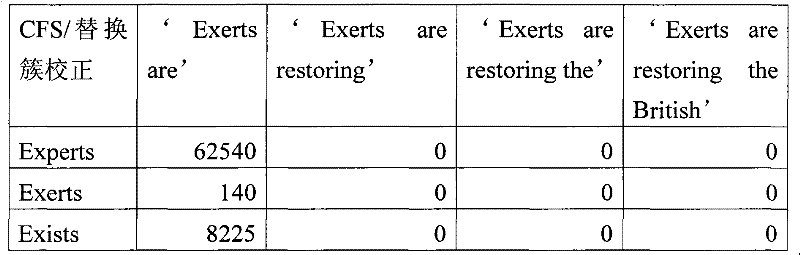
针对其的所有替换校正具有为0的出现频率的所有CFS被消除。在该示例中,消除下面的特征语法:All CFSs for which all replacement corrections have a frequency of occurrence of 0 are eliminated. In this example, the following feature syntax is eliminated:
‘Exerts are restoring’;‘Exerts are restoring the’;‘Exerts are restoring the British’'Exerts are restoring'; 'Exerts are restoring the'; 'Exerts are restoring the British'
在该示例中,仅剩余的CFS是特征语法:In the example, the only remaining CFS is the feature syntax:
‘Exerts are’‘Exerts are’
可以从上述示例看出,在过滤处理中保留下来的唯一CFS是“Exerts are”。结果,置信度相对低,因为该选择仅基于单个CFS,该单个CFS相对短,并且除了可疑词之外仅包括一个词,而该词为频繁出现的词。As can be seen from the above example, the only CFS that survives the filtering process is "Exerts are". As a result, the confidence level is relatively low because the selection is based only on a single CFS, which is relatively short and includes only one word other than the suspicious word, which is a frequently occurring word.
下面的示例说明了在上面的阶段D和E中描述的最后偏好评分度量的使用。The example below illustrates the use of the last preference score metric described in Phases D and E above.
提供下面的输入文本:Provide the following input text:
Some kids don′ t do any sport and sit around doing nothing and getting fast so you will burn some calories and getSome kids don′t do any sport and sit around doing nothing and getting fast so you will burn some calories and get
使用上文参考图6B描述的功能,选择下面的簇来用于校正:Using the function described above with reference to Figure 6B, the following clusters were selected for calibration:
fastfast
使用上文参考图7A描述的功能,产生下面的替换簇校正(部分列表):Using the functions described above with reference to Figure 7A, the following replacement cluster corrections (partial listing) are generated:
fat;fastfat; fast
使用上文参考图5描述的功能,产生下面的CFS(部分列表):Using the functions described above with reference to Figure 5, the following CFS (partial listing) is produced:
‘and getting fast’;‘getting fast so’;‘fast so you’;‘fast so you will’'and getting fast'; 'getting fast so'; 'fast so you'; 'fast so you will'
在此使用上文参考子阶段IIA描述的功能,针对上面的CFS列表中的上面的替换簇校正列表产生在表43中所示的在因特网语料库中的出现频率矩阵:Using the function described above with reference to sub-stage IIA here, the frequency of occurrence matrix in the Internet Corpus shown in Table 43 was generated for the above replacement cluster correction list in the above CFS list:
表43Table 43
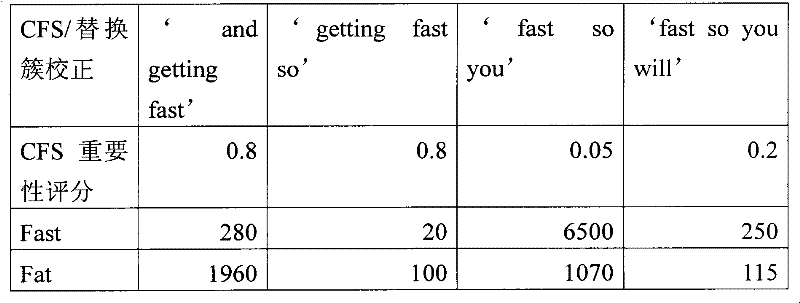
在该示例中,替换簇校正的非上下文相似度评分如表44中所示。In this example, the replacement cluster corrected non-context similarity scores are shown in Table 44.
表44Table 44
使用在上面的阶段D和E中所述的最后偏好评分度量,选择具有低置信度的替换校正“fat”。Using the final preference score metric described in stages D and E above, the replacement correction "fat" is selected with a low confidence.
现在参见图10,图10是图示丢失项目校正功能的操作的详细流程图。丢失项目校正功能用于校正丢失的冠词、介词、标点和在输入文本中主要具有语法功能的其他项目。该功能优选地对从图1的拼写校正功能输出的拼写校正后的输入文本进行操作。Referring now to FIG. 10, which is a detailed flowchart illustrating the operation of the missing item correction function. The Missing Item Correction function is used to correct missing articles, prepositions, punctuation and other items that have primarily a grammatical function in the input text. This function preferably operates on spell-corrected input text output from the spelling correction function of FIG. 1 .
优选地以下面的方式执行可疑丢失项目的识别:The identification of suspected missing items is preferably performed in the following manner:
首先针对拼写校正后的输入文本产生特征语法。判定拼写校正后的输入文本中的每一个特征语法在语料库(优选地为因特网语料库)中的出现频率(FREQ F-G)。A feature grammar is first generated for the spelling-corrected input text. The occurrence frequency (FREQ F-G) of each feature grammar in the corpus (preferably the Internet corpus) in the spell-corrected input text is determined.
计算每一个特征语法的预期出现频率(EFREQ F-G)如下:Calculate the expected frequency of occurrence (EFREQ F-G) of each feature grammar as follows:
假定特征语法包含被识别为W1-Wn的n个词。Assume that the feature grammar contains n words identified as W 1 -W n .
Wi指示在特征语法中的第i个词。W i indicates the i-th word in the feature grammar.
给定特征语法的预期出现频率被取为:该特征语法的基于特征语法中的词被划分为跟随词W1、...、Wn-1的每一个的两个连续部分而得到的预期频率中的最高者。The expected frequency of occurrence for a given feature grammar is taken as the expected frequency of that feature grammar based on the division of words in the feature grammar into two consecutive parts following each of the words W 1 , . . . , W n-1. the highest frequency.
特征语法基于在该特征语法中的词被划分为跟随词Wi的两个连续部分的划分的预期频率可以被表达如下:A feature grammar based on the expected frequency at which a word in the feature grammar is divided into two consecutive parts following word Wi can be expressed as follows:
关于Wi的EFREQ F-G=(FREQ(W1-Wi)*FREQ(Wi+1-Wn))/(所有词在语料库中的频率的总和)EFREQ FG about W i = (FREQ(W 1 -W i )*FREQ(W i+1 -W n ))/(sum of frequencies of all words in the corpus)
计算每一个特征语法基于在该特征语法中的词被划分为两个连续部分的所有可能划分的预期频率。Each feature grammar is calculated based on the expected frequency of all possible divisions of words in that feature grammar into two consecutive parts.
如果关于Wi的FREQ F-G/EFREQ F-G小于预定阈值,则认为关于Wi的特征语法在以下方面是可疑的:在该特征语法的Wi和Wi+1之间存在丢失的冠词、介词或标点。If the FREQ FG/EFREQ FG on W i is less than a predetermined threshold, the feature grammar on W i is considered suspicious in that there is a missing article, preposition between W i and W i+1 of the feature grammar or punctuation.
优选地通过试图找到被最大数量的非可疑上下文数据围绕的词连接(word junction),来选择在拼写校正后的输入文本中的两个连续词之间的可疑词连接来校正。优选地,选择在其附近具有最长的一个或多个非可疑词连接序列的词连接。A suspect word junction between two consecutive words in the spell-corrected input text is preferably selected for correction by attempting to find the word junction surrounded by the largest amount of non-suspect context data. Preferably, the word connection that has the longest sequence of one or more non-suspect word connections nearby is selected.
优选地基于预定义的可能丢失的标点、冠词、介词、连词或其他项目(通常不包括名词、动词或形容词)的集合,对于每一个词连接产生一个或优选地多个替换插入。One or preferably multiple replacement insertions are generated for each word connection, preferably based on a predefined set of possibly missing punctuation, articles, prepositions, conjunctions or other items (generally excluding nouns, verbs or adjectives).
下文中,优选地基于如上参考图9所述的校正替换评分算法来提供对各个替换插入的至少部分基于上下文和基于词相似度的评分。Hereinafter, an at least part context-based and word similarity-based score for each substitution insertion is provided, preferably based on a corrected substitution scoring algorithm as described above with reference to FIG. 9 .
下面的示例是说明性的:The following example is illustrative:
提供下面的输入文本:Provide the following input text:
I can′t read please help meI can't read please help me
使用上文参考图5描述的功能,产生下面的特征语法(部分列表):Using the functionality described above with reference to Figure 5, the following feature syntax (partial listing) results:
I can′t read;can′t read please;read please help;please help meI can't read; can't read please; read please help; please help me
使用如上所述的功能,针对上面的特征语法列表产生在因特网语料库中的出现频率矩阵,该出现频率矩阵典型地如表45所示:Using the functions described above, a frequency-of-occurrence matrix in the Internet corpus is generated for the feature grammar list above, typically as shown in Table 45:
表45Table 45
根据下面的表达式,对于每一个特征语法,计算关于在该特征语法中的每一个词Wi的预期出现频率:For each feature grammar, calculate the expected frequency of occurrence of each word W i in the feature grammar according to the following expression:
关于Wi的EFREQ F-G=(FREQ(W1-Wi)*FREQ(Wi+1-Wn))/(所有词在语料库中的频率的总和)EFREQ FG about W i = (FREQ(W 1 -W i )*FREQ(W i+1 -Wn))/(sum of frequencies of all words in the corpus)
这些计算的一些的示例性结果如表46和47中所示:Exemplary results of some of these calculations are shown in Tables 46 and 47:
表46Table 46
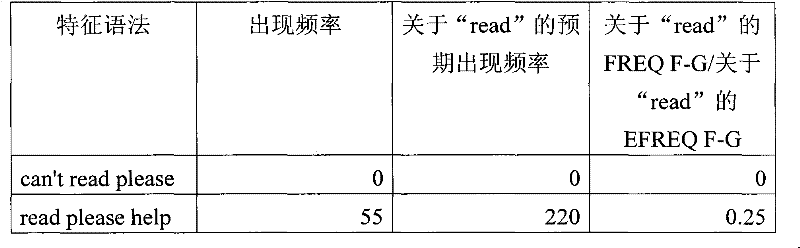
表47Table 47
从上面的结果看出,每一个特征语法的实际出现频率小于其预期出现频率。这指示怀疑存在诸如标点的项目缺失。It can be seen from the above results that the actual occurrence frequency of each feature grammar is less than its expected occurrence frequency. This indicates that missing items such as punctuation are suspected.
产生跟随词“read”的替换插入列表。该列表优选地包括标点、冠词、连词和介词的预定列表。具体地说,它将包括句号“.”。Produces a list of replacement insertions following the word "read". The list preferably includes a predetermined list of punctuation, articles, conjunctions and prepositions. Specifically, it will include a period ".".
替换的部分列表是:The partial list of replacements is:
‘read please’;‘read.Please’;‘read of please’;‘read a please’'read please'; 'read. Please'; 'read of please'; 'read a please'
使用上文参考图5描述的功能,产生下面的CFS:Using the functions described above with reference to Figure 5, the following CFS is produced:
‘I can’t read[?]’;‘read[?]please help’;‘[?]please help me’'I can't read[? ]'; 'read[? ] please help'; '[? ]please help me'
使用在图9的阶段IIA中所述的功能,针对上面的CFS列表中的上面的替换簇校正列表产生在表48中所示的在因特网语料库中的出现频率矩阵:Using the function described in Phase IIA of Figure 9, the frequency of occurrence matrix in the Internet Corpus shown in Table 48 was generated for the above replacement cluster correction list in the above CFS list:
当在簇中包括‘.’时,针对在‘.’前后的文本分别检索包括具有‘.’的簇的CFS出现频率,即,将不产生特征语法“can’t read.Please”,因为它包括两个独立的分析短语。When '.' is included in the cluster, the CFS frequency of occurrence including the cluster with '.' is retrieved separately for the text before and after '.', i.e., the feature grammar "can't read.Please" will not be generated because it Include two separate analysis phrases.
表48Table 48
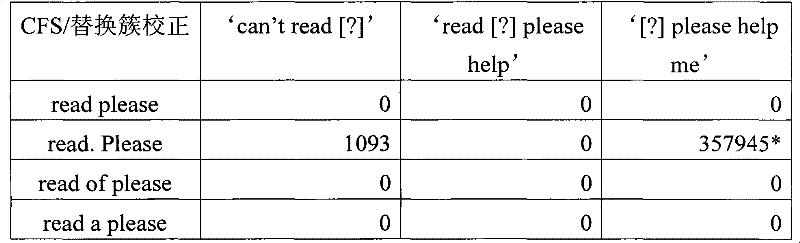
*注意:当计算特征语法在语料库中的出现频率时,从该特征语法的开头忽略‘.’。例如,“.Please help me”的频率与“Please help me”的频率相同。*Note: When computing the frequency of a feature grammar in the corpus, omit '.' from the beginning of that feature grammar. For example, ".Please help me" has the same frequency as "Please help me".
使用在图9的阶段D和E中所述的功能,最后偏好度量选择替换校正“read.Please”,并且校正后的输入文本是:Using the functions described in stages D and E of Figure 9, the final preference metric selection replaces the correction "read.Please", and the corrected input text is:
I can′t read.Please help me.I can't read. Please help me.
下面的示例说明了添加丢失的介词的功能。The example below illustrates the functionality to add missing prepositions.
提供下面的输入文本:Provide the following input text:
I sit the sofaI sit the sofa
使用下面描述的功能,选择下面的簇来用于校正:Using the functions described below, select the following clusters to use for calibration:
‘sit the’‘sit the’
使用下面描述的功能,产生下面的替换簇校正(部分列表):Using the functions described below, the following replacement cluster corrections (partial listings) are produced:
sit on the;sit of the;sit thesit on the; sit of the; sit the
使用上文参考图5描述的功能,产生下面的CFS:Using the functions described above with reference to Figure 5, the following CFS is produced:
‘I sit the’;‘sit the sofa’'I sit the'; 'sit the sofa'
使用参考图9在阶段IIA中所述的功能,针对上面的CFS列表中的上面的替换簇校正列表产生在表49中所示的在因特网语料库中的出现频率矩阵:Using the function described in Phase IIA with reference to FIG. 9, the frequency of occurrence matrix in the Internet Corpus shown in Table 49 was generated for the above replacement cluster correction list in the above CFS list:
表49Table 49
使用在图9的阶段IID和IIE中所述的功能,最后偏好度量选择替换校正“sit on the”,并且校正后的输入文本是:Using the functions described in stages IID and IIE of Figure 9, the final preference metric selection replaces the correction "sit on the", and the corrected input text is:
I sit on the sofa.I sit on the sofa.
现在参考图11,图11是图示多余项目校正功能的操作的详细流程图。多余项目校正功能用于校正多余冠词、介词、标点和在输入文本中主要具有语法功能的其他项目。该功能优选地对从图1的拼写校正功能输出的拼写校正后的输入文本进行操作。Reference is now made to FIG. 11, which is a detailed flowchart illustrating the operation of the redundant item correction function. The redundant item correction function is used to correct redundant articles, prepositions, punctuation, and other items that mainly have a grammatical function in the input text. This function preferably operates on spell-corrected input text output from the spelling correction function of FIG. 1 .
应当意识到,图11的功能可以与图10的功能组合,或可替换地与其并行地被执行、在其之前被执行或在其操作之后被执行。It should be appreciated that the functionality of FIG. 11 may be combined with, or alternatively performed in parallel with, prior to, or subsequent to, the functionality of FIG. 10 .
优选地以下面的方式来执行可疑多余项目的识别:The identification of suspected redundant items is preferably performed in the following manner:
对于拼写校正后的输入文本执行搜索,以识别属于预定义的可能多余标点、冠词、介词、连词和其他项目(通常不包括名词、动词或形容词)的集合的项目。A search is performed on spell-corrected input text to identify items that belong to a predefined set of possible redundant punctuation, articles, prepositions, conjunctions, and other items (typically excluding nouns, verbs, or adjectives).
对于每一个这样的项目,针对包含该项目的误用词和语法校正后、拼写校正后的输入文本的所有部分产生特征语法。对于每一个这样的特征语法并且对于其中省略该项目的对应特征语法计算出现频率。For each such item, a feature grammar is generated for all portions of the misused word and grammar-corrected, spelling-corrected input text that contain the item. The frequency of occurrence is calculated for each such feature grammar and for the corresponding feature grammar where the item is omitted.
如果其中省略了该项目的特征语法的出现频率超过其中存在该项目的对应特征语法的出现频率,则该项目被认为可疑。An item is considered suspicious if the frequency of occurrence of the feature grammar in which the item is omitted exceeds the frequency of occurrence of the corresponding feature grammar in which the item is present.
优选地通过试图找到由最大量的非可疑上下文数据围绕的项目,来选择在误用词和语法校正后、拼写校正后的输入文本中的可疑项目以进行校正。优选地,在其附近具有最长的一个或多个非可疑词序列的项目被选择。Suspicious items in the spelling-corrected input text after misuse and grammar correction are selected for correction, preferably by attempting to find the items surrounded by the largest amount of non-suspect context data. Preferably, the item with the longest sequence of one or more non-suspicious words in its vicinity is selected.
对于每一个可疑项目产生可能的项目删除。下面优选地基于上文参考图9描述的校正替换评分算法,来提供各个替换(即删除项目或不删除项目)的至少部分地基于上下文和基于词相似度的评分。A possible item deletion is generated for each suspect item. An at least partially context-based and word-similarity-based score for each substitution (ie, item deleted or not) is provided below, preferably based on the corrected substitution scoring algorithm described above with reference to FIG. 9 .
下面的示例是说明性的。The following example is illustrative.
提供下面的输入文本:Provide the following input text:
It is a nice,thing to wear.It is a nice, thing to wear.
搜索输入文本以识别属于常见的多余项目的预定列表的任何项目,该常见的多余项目例如是标点、介词、连词和冠词。The input text is searched to identify any items belonging to a predetermined list of common redundant items, such as punctuation, prepositions, conjunctions, and articles.
在该示例中,逗号“,”被识别为属于这样的列表。In this example, a comma "," is recognized as belonging to such a list.
使用上文参考图5描述的功能,产生包括逗号“,”的在表50中所示的特征语法,并且也产生没有逗号的相同特征语法(部分列表)。Using the functions described above with reference to FIG. 5 , the feature syntax shown in Table 50 including the comma "," is generated, and the same feature syntax (partial list) is also generated without the comma.
表50Table 50
使用如上文所描述的功能,针对上面的特征语法列表产生在因特网语料库中的出现频率矩阵,典型地如表51所示:Using the functions as described above, a frequency-of-occurrence matrix in an Internet corpus is generated for the feature grammar list above, typically as shown in Table 51:
表51Table 51

如在上面的矩阵中所示,省略了“,”的特征语法的出现频率超过具有“,”的对应特征语法的出现频率。因此,将“,”认为可疑多余。As shown in the above matrix, the frequency of occurrence of the feature grammar omitting "," exceeds the frequency of occurrence of the corresponding feature grammar with ",". Therefore, "," is considered suspiciously redundant.
基于下面的保持逗号和省略逗号的替换的基于上下文的评分来考虑逗号的可能删除:The possible removal of commas was considered based on the following context-based scoring of comma-preserving and comma-omitting substitutions:
‘nice,’;‘nice’'nice,'; 'nice'
使用上文参考图5描述的功能,产生下面的CFS(部分列表):Using the functions described above with reference to Figure 5, the following CFS (partial listing) is produced:
‘a nice,’;‘nice,thing’;‘is a nice,’;‘a nice,thing’;‘nice,thing to’'a nice,'; 'nice, thing'; 'is a nice,'; 'a nice, thing'; 'nice, thing to'
使用上文参考图9的阶段IIA描述的功能,针对上面的CFS列表中的上面的替换簇校正列表产生在表52中所示的在因特网语料库中的出现频率矩阵。Using the functions described above with reference to Phase IIA of FIG. 9 , the frequency of occurrence matrix in the Internet Corpus shown in Table 52 was generated for the above replacement cluster correction list in the above CFS list.
表52Table 52
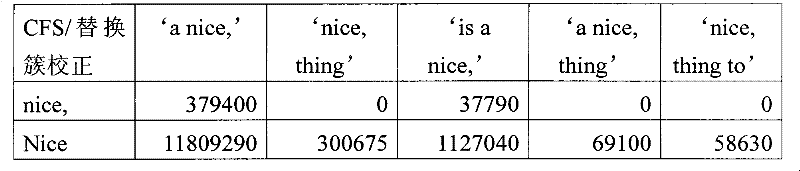
被整体包括在至少具有最小阈值出现频率的其他CFS中的所有CFS被消除。例如,消除下面的特征语法:All CFSs that are integrally included in other CFSs with at least the minimum threshold frequency of occurrence are eliminated. For example, eliminate the following feature syntax:
‘a nice,’;‘nice,thing’'a nice,'; 'nice, thing'
在该示例中,剩余的CFS是特征语法:In the example, the remaining CFS is the feature syntax:
‘is a nice,’;‘a nice,thing’;‘nice,thing to’'is a nice,'; 'a nice, thing'; 'nice, thing to'
使用在上面的图9的阶段D和E中所述的最后偏好评分,选择没有逗号的替换校正“nice”。在逗号删除后的输入文本是:Using the final preference score described in stages D and E of Figure 9 above, the replacement correction "nice" without commas is selected. The input text after comma removal is:
It is a nice thing to wear.It is a nice thing to wear.
下面的示例说明了移除多余冠词的功能。The example below illustrates the functionality to remove redundant articles.
提供下面的输入文本:Provide the following input text:
We should provide them a food and water.We should provide them a food and water.
使用上文参考图11描述的功能,选择下面的簇来用于校正:Using the function described above with reference to Figure 11, the following clusters are selected for calibration:
a fooda food
使用上文参考图11描述的功能,产生下面的替换簇校正(部分列表):Using the functions described above with reference to Figure 11, the following replacement cluster corrections (partial listing) are produced:
a food;fooda food; food
使用上文参考图5描述的功能,产生下面的CFS(部分列表):Using the functions described above with reference to Figure 5, the following CFS (partial listing) is produced:
‘provide them a food’;‘them a food and’;‘a food and water’'provide them a food'; 'them a food and'; 'a food and water'
在此使用上文参考子阶段IIA描述的功能,针对上面的CFS列表中的上面的替换簇校正列表产生在表53中所示的在因特网语料库中的出现频率矩阵:Using the function described above with reference to sub-stage IIA here, the frequency of occurrence matrix in the Internet Corpus shown in Table 53 was generated for the above replacement cluster correction list in the above CFS list:
表53Table 53
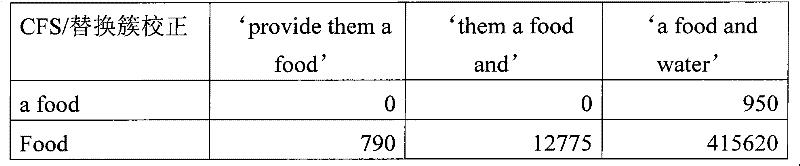
使用在图9中所述的评分功能,最后偏好度量选择替换校正“food”,并且校正后的输入文本是:Using the scoring function described in Figure 9, the final preference metric selection replaces the corrected "food", and the corrected input text is:
We should provide them food and water.We should provide them food and water.
现在参考图12,图12是根据本发明的一个优选实施例构造和操作的、用于计算机辅助语言翻译和产生的系统和功能的简化框图图示。如图12中所示,输入文本从一个或多个来源被提供到语言产生模块200,该一个或多个来源包括但不限于:Reference is now made to FIG. 12, which is a simplified block diagram illustration of a system and functions for computer-aided language translation and generation, constructed and operative in accordance with a preferred embodiment of the present invention. As shown in FIG. 12, input text is provided to
语句搜索功能201,其通过使得用户能够输入包括几个词的查询并且接收包含这些词的完整语句来帮助用户构造语句;A
机器文本产生功能202,其从诸如知识库或逻辑形式的机器表示系统产生自然语言语句;a machine
词处理器功能203,其可以产生任何适当的文本,优选地产生文档的一部分,诸如语句;a
机器翻译功能204,其将源语言的文本转换为目标语言的文本,并且能够提供目标语言的多个替换翻译文本、短语和/或词,该目标语言的多个替换翻译文本、短语和/或词可以被语言产生模块处理为替换输入文本、替换短语和/或替换词;a
语音至文本转换功能205,其将语音转换为文本,并且能够提供多个替换词,该多个替换词可以被语言产生模块处理为具有每一个词的替换的输入文本;a speech-to-
光学字符识别功能206,其将字符转换为文本,并且能够提供每一个词的多个替换,该每一个词的多个替换可以被语言产生模块处理为具有每一个词的替换的输入文本;以及an optical
任何其他文本源210,诸如在因特网上传送的即时消息或文本。Any
语言产生模块200优选地包括语句检索功能212和语句产生功能214。The
本发明的一个具体特征是语句检索功能212与使用因特网语料库220的词干到语句索引216交互。A specific feature of the present invention is that the
因特网语料库的使用重要在:它提供了极大数量的语句,导致高度鲁棒的语言产生功能。The use of the Internet corpus is important: it provides an extremely large number of sentences, resulting in a highly robust language generation function.
因特网语料库是通常通过在因特网上抓取(crawl)并且从网页收集文本而从万维网收集的自然语言文本的大代表采样。优选地,也收集动态文本,诸如聊天副本、来自网络论坛的文本和来自博客的文本。所收集的文本用于累积关于自然语言文本的统计。与多达二十亿词的更通常的语料库大小相比,因特网语料库的大小可以例如是1万亿(1,000,000,000,000)词或几万亿词。诸如网络语料库的网络小采样包括100亿词,这远远小于由诸如GOOGLE
优选地,以下面两种方式之一来使用因特网语料库:Preferably, the Internet Corpus is used in one of two ways:
通过将修改的输入文本用作搜索查询来使用一个或多个因特网搜索引擎。可以从搜索结果提取包括在搜索查询中包含的词的语句。One or more Internet search engines are used by using the modified input text as a search query. Statements including words included in the search query may be extracted from the search results.
通过对因特网进行抓取和编索引,随着时间过去而建立词干到语句索引216。优选地,这是通过下述方式进行的:将在因特网语料库中出现的屈折变化词缩小到它们各自的词干,并且列出在语料库中包括具有这样的词干的词的所有语句。词干到语句索引以及搜索查询可以基于因特网的可选部分,并且可以使用这些所选择的部分来标识。类似地,因特网的部分可以被排除或被适当地加权,以便校正在因特网使用和一般语言使用之间的异常。以这种方式,在语言使用上可靠的网站(诸如新闻和政府网站)可以被赋予比其他网站(诸如聊天或用户论坛)更大的权重。A stem-to-
优选地,输入文本被首先提供到语句检索功能212。下面另外参考图13来描述语句检索功能212的操作。Preferably, the input text is provided to the
语句检索功能212用于将输入文本划分为独立短语,该独立短语然后在语句产生模块214中被独立地处理。对于在每一个独立短语中的所有词产生词干。可替换地,对于在每一个独立短语中的一些或所有词产生词干,并且在该情况下,在词至语句索引中使用词本身来从因特网语料库检索语句。The
词干然后被分类为强制词干或可选词干。可选词干是形容词、副词、冠词、介词、标点和在输入文本中主要具有语法功能的其他项目以及在可选词的预定义列表中的项目的词干。强制词干是不作为可选词干的所有词干。可选词干可以针对它们在输入文本中的重要程度而被分级。Stems are then categorized as mandatory or optional stems. Alternative stems are the stems of adjectives, adverbs, articles, prepositions, punctuation, and other items that have a primarily grammatical function in the input text, as well as items in a predefined list of optional words. Mandatory stems are all stems that are not optional. Optional stems can be ranked for their importance in the input text.
对于每一个独立短语,使用词干到语句索引216来在因特网语料库220中检索包括所有词干的所有语句。For each individual phrase, stem-to-
对于每一个独立短语,如果检索到的语句数量小于预定阈值,则使用词干到语句索引216来在因特网语料库220中检索包括所有强制词干的所有语句。For each individual phrase, if the number of retrieved sentences is less than a predetermined threshold, the stem-to-
对于每一个独立短语,如果检索到的包括所有强制词干的语句数量小于另一个预定阈值,则使用词干替换产生器来产生所有强制词干的替换,如下文参考图15所描述。For each individual phrase, if the number of retrieved sentences including all mandatory stems is less than another predetermined threshold, a stem replacement generator is used to generate replacements for all mandatory stems, as described below with reference to FIG. 15 .
其后,对于每一个独立短语,使用词干到语句索引216在因特网语料库220中检索所有这样的语句,该语句包括尽可能多的强制词干,但是不少于一个强制词干,并且还包括所有剩余强制词干的替换。Thereafter, for each individual phrase, use the stem-to-
语句检索功能212的输出优选地如下:The output of the
独立短语;stand-alone phrase;
对于每一个独立短语:For each individual phrase:
强制和可选词干以及它们的分级;Mandatory and optional stems and their classification;
从因特网语料库212检索的语句。Sentences retrieved from the
语句检索功能212的上面的输出被提供到语句产生功能214。下面另外参考图14A和14B来描述语句产生功能214的操作。The above output of the
对于每一个独立短语,如下文所描述那样执行对从因特网语料库212获取的语句的简化:For each individual phrase, simplification of sentences obtained from the
如图14A中所示,首先优选地使用用于分类在独立短语中的词干的相同准则,来将从因特网语料库获取的语句中的所有词分类为强制的或非必需的。删除非必需的词,除非它们的词干出现在对应的独立短语中或是替换词干之一。As shown in Figure 14A, all words in a sentence retrieved from the Internet corpus are first classified as mandatory or non-essential, preferably using the same criteria used to classify word stems in independent phrases. Remove non-essential words unless their stems appear in the corresponding stand-alone phrase or replace one of the stems.
使用标准分析功能来从所有的语句提取短语。删除不包括在对应的独立短语中出现或为替换词干的任何词干的短语。Use standard analysis functions to extract phrases from all sentences. Deletes phrases that do not include any stems that occur in the corresponding stand-alone phrase or that are replacement stems.
对于每一个独立短语,从上述步骤产生的如此简化的语句被分组为至少具有预定相似度的组,并且在每组中的简化语句的数量被计数。For each individual phrase, the thus simplified sentences resulting from the above steps are grouped into groups having at least a predetermined degree of similarity, and the number of simplified sentences in each group is counted.
如图14B中所示,使用下面的准则来对每一个这样的组分级:As shown in Figure 14B, each such group is ranked using the following criteria:
A.其中包含的简化语句的数量;A. The number of simplified statements contained therein;
B.在组中的词的词干与在独立短语中的词干及其替换的匹配度;B. How well the stems of the words in the group match with the stems and their replacements in the individual phrases;
C.组包括不与在独立短语中的词及其替换匹配的词的程度。C. The extent to which groups include words that do not match words and their replacements in independent phrases.
优选地提供基于准则A、B和C的适当复合分级。An appropriate composite rating based on criteria A, B and C is preferably provided.
根据所有准则A、B和C单独获取的分级低于预定阈值的组被消除。另外,根据所有准则A、B和C的分级低于另一个组的分级的组被消除。Groups whose ratings are obtained according to all criteria A, B and C individually below a predetermined threshold are eliminated. In addition, groups whose ratings according to all criteria A, B, and C are lower than that of the other group are eliminated.
剩余的组被串接,以对应于输入文本,并且以其加权的复合分级的顺序优选地与该分级的指示一起被呈现给用户。The remaining groups are concatenated to correspond to the input text and presented to the user in the order of their weighted composite ranking, preferably together with an indication of that ranking.
如果最高分级组的复合分级大于预定阈值,则它被确认用于自动文本产生。If the composite rating of the highest rated group is greater than a predetermined threshold, it is confirmed for automatic text generation.
现在参见图15,图15是图示在图12和13的功能中有用的用于产生词干替换的功能的简化流程图。Referring now to FIG. 15, FIG. 15 is a simplified flow diagram illustrating a function for generating stem substitutions useful among the functions of FIGS. 12 and 13 .
如图15中所示,对于每一个词干,首先以下面的方式来产生多个替换:As shown in Figure 15, for each stem, multiple substitutions are first generated in the following manner:
检索类似于每一个词干的多个词,该多个词是基于以字符串相似度表达的书写外观并且基于发音或语音相似度而从词典获取的。该功能是已知的,并且是在因特网上可获得的免费软件,诸如GNU Aspell和Google
通过使用基于已知的替换使用以及累积的用户输入的规则,可以产生另外的替换。例如,u→you,r→are,Im→I am。Additional substitutions can be generated using rules based on known substitution usage as well as accumulated user input. For example, u→you, r→are, Im→I am.
从在因特网上可免费获得的、诸如Princeton WordNet的同义词词典或其他词汇数据库获取的多个词被检索到,该多个词例如作为同义词、超集或子集与词干在词法上相关。Words obtained from a thesaurus such as Princeton WordNet or other vocabulary databases freely available on the Internet are retrieved that are morphologically related to a word stem, eg, as synonyms, supersets, or subsets.
本发明的优选实施例的一个特定特征是使用诸如CFS(并且更具体地诸如特征语法)的上下文信息来产生替换。经常在同一上下文中出现的词干可以是有效的替换。可以从诸如因特网语料库的现有语料库检索频繁出现的词组合,诸如CFS,并且更具体地诸如特征语法。A particular feature of a preferred embodiment of the invention is the use of context information such as CFS (and more specifically feature syntax) to generate substitutions. Word stems that occur frequently in the same context can be valid substitutions. Frequently occurring word combinations can be retrieved from existing corpora such as the Internet Corpus, such as CFS, and more specifically such as feature grammars.
在通过诸如光学字符识别、语音至文本或机器翻译系统的外部系统来自动地产生输入文本的情况下,可以从这样的系统直接地接收另外的替换。通常在这样的系统的操作过程中产生这些另外的替换。例如,在机器翻译系统中,外语词的替换翻译可以被提供到本系统以用作替换。Where the input text is automatically generated by an external system such as an optical character recognition, speech-to-text or machine translation system, further substitutions may be received directly from such a system. These additional replacements typically occur during operation of such systems. For example, in a machine translation system, alternate translations of foreign language words may be provided to the system for use as replacements.
下面的示例说明了图12-15的功能:The following example illustrates the functionality of Figure 12-15:
从词处理器或机器翻译功能接收下面的输入文本:Receive the following input text from a word processor or machine translation function:
Be calling if to problem pleaseBe calling if to problem please
在该情况下,输入文本由单个独立短语构成。强制/可选词干的词干产生和分类提供了下面的结果:In this case, the input text consists of a single independent phrase. Stemming and classification of mandatory/optional stemming provides the following results:
强制词干:call,if,problem,pleaseMandatory stemming: call, if, problem, please
可选词干:be,toOptional stems: be, to
在下文的表中给出了对于上面的结果从因特网语料库检索的语句、对应的简化语句、简化语句的组和组分级信息中的一些但是不是全部。Some, but not all, of the sentences retrieved from the Internet Corpus for the above results, the corresponding reduced sentences, the groups of the reduced sentences, and the group ranking information are given in the tables below.
在该示例中,使用下面的分级过程,应当理解,本发明不限于使用该过程,该过程仅是一个示例:In this example, the following grading process was used, with the understanding that the invention is not limited to use of this process, which is merely an example:
限定词干的权重,以指示该词在语言中的重要性。对于在独立短语中的词干,如果词干是强制的,则权重等于1,而如果词干的可选的,则权重等于或小于1。Defines the weight of the stem to indicate the importance of the word in the language. For stems in independent phrases, the weight is equal to 1 if the stem is mandatory, and equal to or less than 1 if the stem is optional.
在表中,在每一个词干后的括号中指示权重。例如,“you(0.5)”表示词干‘you’具有0.5的重要性权重。In the table, weights are indicated in parentheses after each stem. For example, "you(0.5)" indicates that the stem 'you' has an importance weight of 0.5.
计算正匹配分级(对应于准则B(图14B)),该正匹配分级等于在独立短语中和在对应的简化语句组中出现的词干的上面的权重之和除以在独立短语中出现的所有词干的权重之和。A positive match rating (corresponding to Criterion B (FIG. 14B)) is calculated which is equal to the sum of the above weights of the stems appearing in the independent phrase and in the corresponding simplified sentence group divided by the number of occurrences in the independent phrase The sum of the weights of all stems.
计算负匹配分级(对应于准则C(图14B)),该负匹配分级等于1-在对应的简化语句组中出现但是未在独立短语中出现的词干的上面的权重之和除以在对应的简化语句组中出现的所有词干的权重之和。A negative match rating is calculated (corresponding to Criterion C (FIG. 14B)), which is equal to 1 - the sum of the weights above the stems that appear in the corresponding simplified sentence group but not in the independent phrase divided by the weights in the corresponding The sum of the weights of all stem words appearing in the simplified sentence group of .
基于组计数(准则A(图14B))和基于正负匹配分级来计算复合分级(对应于2(图14B))。通过下面的一般表达式来给出优选的复合分级:Composite ratings were calculated based on group counts (Criterion A (FIG. 14B)) and based on positive and negative match ratings (corresponding to 2 (FIG. 14B)). The preferred composite rating is given by the following general expression:
复合分级=组计数乘以正负匹配分级的加权和的函数。Composite rating = function of group count times weighted sum of positive and negative match ratings.
通过下面的表达式来给出的更具体的示例,应当理解,本发明不限于上面的一般表达式或下面的具体表达式:A more specific example is given by the following expression, it should be understood that the present invention is not limited to the above general expression or the following specific expression:
复合分级=SquareRoot(组计数)*(0.8*正匹配分级+0.2*负匹配分级)Composite Rating = SquareRoot(Group Count)*(0.8*Positive Match Rating+0.2*Negative Match Rating)

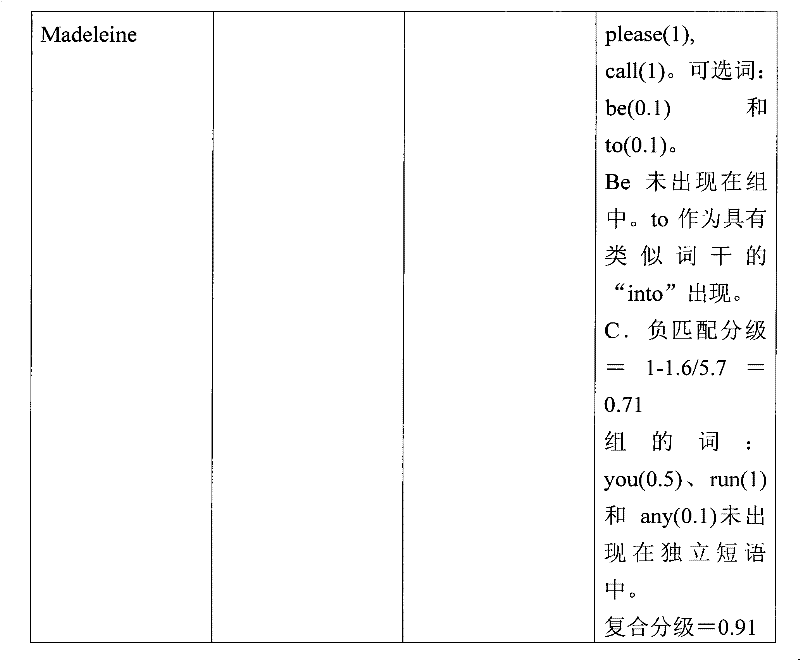
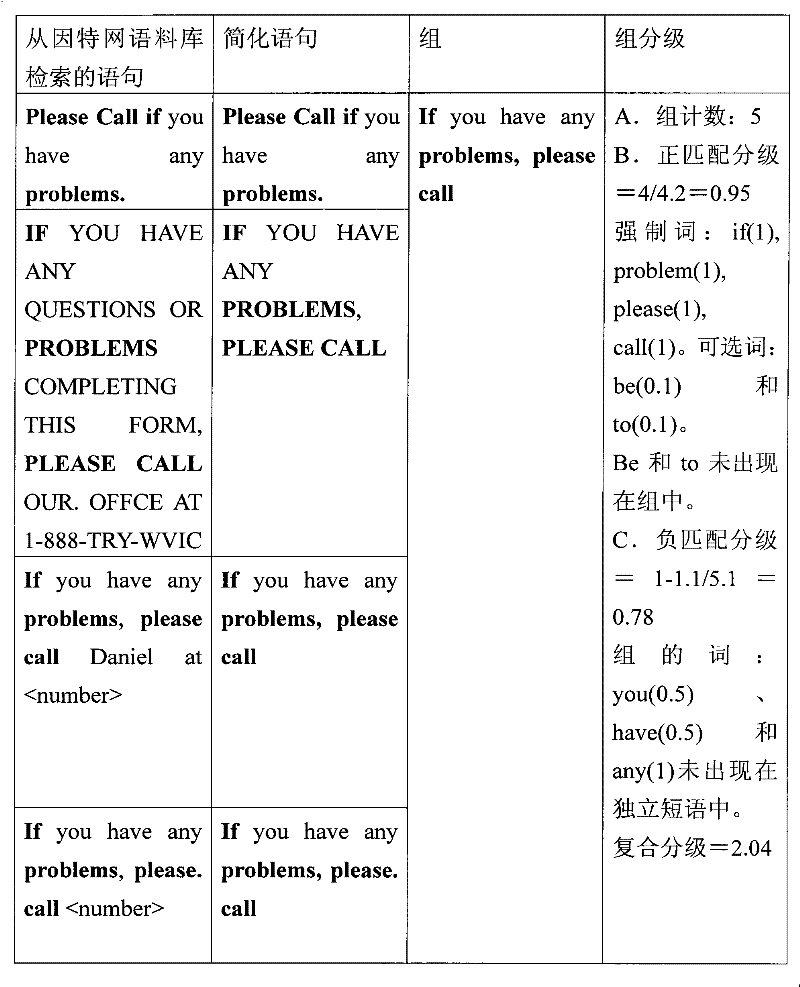
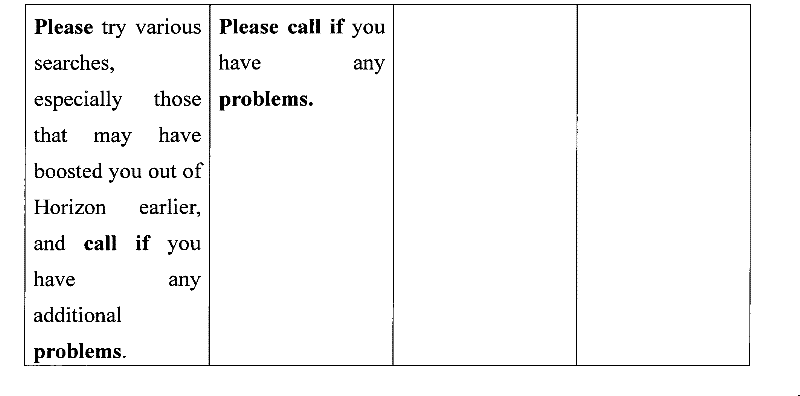
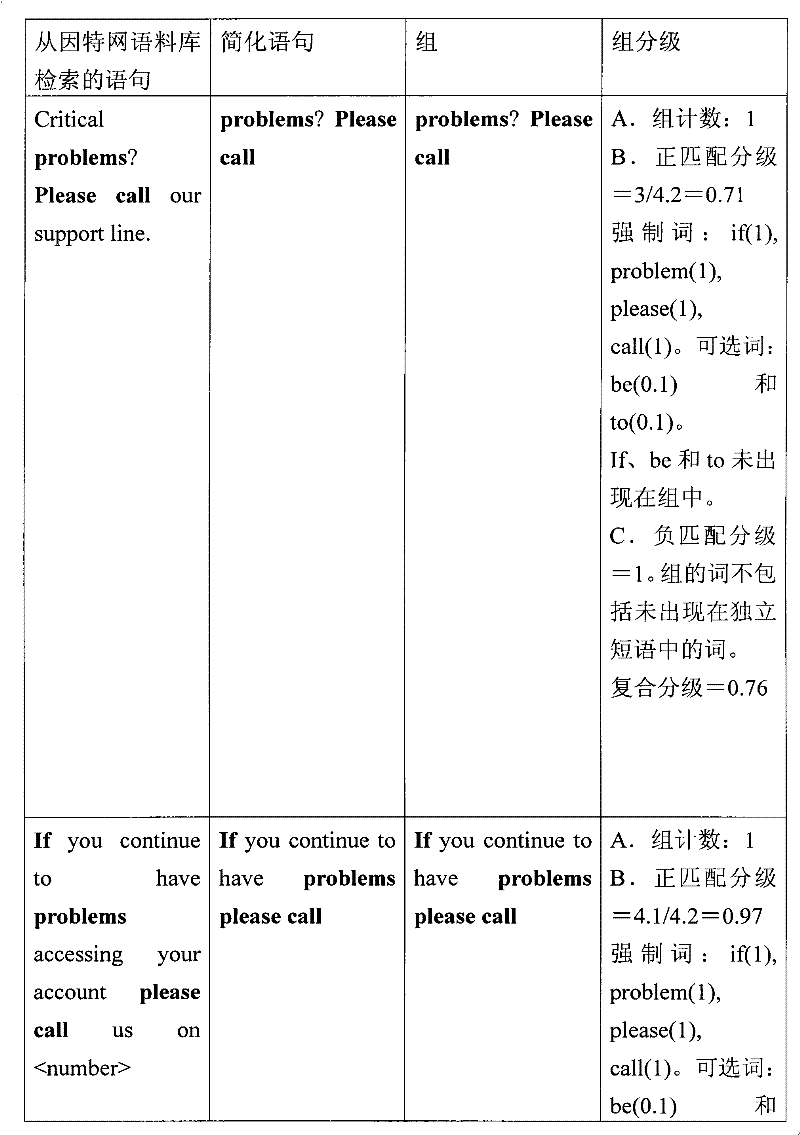

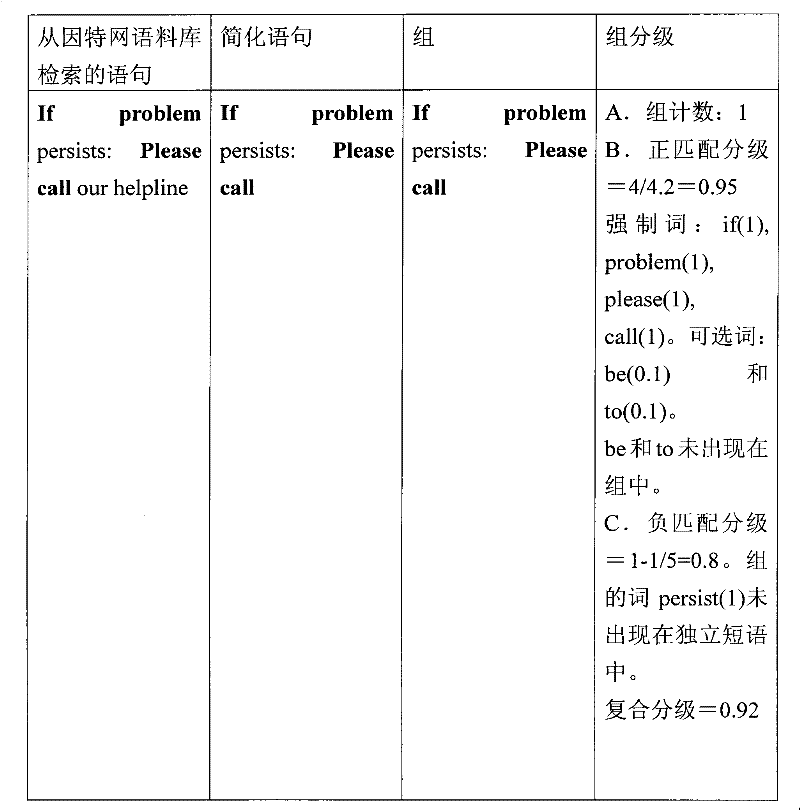
基于复合分级,选择第二组。Based on the composite rating, a second group is selected.
从上面可以意识到,如上参考图12-15所描述的本发明能够将下面的输入文本:As can be appreciated from the above, the present invention as described above with reference to FIGS. 12-15 can convert the following input text:
Be calling if to problem pleaseBe calling if to problem please
转换为下面的语句:translates to the following statement:
If you have any problems,please callIf you have any problems, please call
尽管该语句未以此精确形式出现在从因特网语料库检索的语句中。Although the sentence does not appear in this precise form in sentences retrieved from Internet corpora.
本领域内的技术人员将意识到,本发明不限于以上具体示出和描述的内容。相反,本发明的范围包括以上描述和示出的各种特征的组合和子组合,以及本领域内的技术人员在阅读了以上描述后将对其作出的并且未在现有技术中的修改。Those skilled in the art will appreciate that the present invention is not limited to what has been particularly shown and described above. On the contrary, the scope of the present invention includes combinations and sub-combinations of the various features described and shown above, as well as modifications which would be made to those skilled in the art after reading the above description and which are not in the prior art.
Claims (81)
Applications Claiming Priority (4)
| Application Number | Priority Date | Filing Date | Title |
|---|---|---|---|
| US95320907P | 2007-08-01 | 2007-08-01 | |
| PCT/IL2008/001051 WO2009016631A2 (en) | 2007-08-01 | 2008-07-31 | Automatic context sensitive language correction and enhancement using an internet corpus |
| ILPCT/IL2008/001051 | 2008-07-31 | ||
| PCT/IL2009/000130 WO2010013228A1 (en) | 2008-07-31 | 2009-02-04 | Automatic context sensitive language generation, correction and enhancement using an internet corpus |
Publications (2)
| Publication Number | Publication Date |
|---|---|
| CN102165435A true CN102165435A (en) | 2011-08-24 |
| CN102165435B CN102165435B (en) | 2014-12-24 |
Family
ID=40305018
Family Applications (3)
| Application Number | Title | Priority Date | Filing Date |
|---|---|---|---|
| CN201510351019.5A Pending CN105045777A (en) | 2007-08-01 | 2008-07-31 | Automatic context sensitive language correction and enhancement using an internet corpus |
| CN200880101405.7A Active CN101802812B (en) | 2007-08-01 | 2008-07-31 | Automatic context-sensitive language correction and enhancement using Internet corpora |
| CN200980138185.XA Expired - Fee Related CN102165435B (en) | 2007-08-01 | 2009-02-04 | Automatic context sensitive language generation, correction and enhancement using an internet corpus |
Family Applications Before (2)
| Application Number | Title | Priority Date | Filing Date |
|---|---|---|---|
| CN201510351019.5A Pending CN105045777A (en) | 2007-08-01 | 2008-07-31 | Automatic context sensitive language correction and enhancement using an internet corpus |
| CN200880101405.7A Active CN101802812B (en) | 2007-08-01 | 2008-07-31 | Automatic context-sensitive language correction and enhancement using Internet corpora |
Country Status (6)
| Country | Link |
|---|---|
| US (5) | US8914278B2 (en) |
| EP (1) | EP2183685A4 (en) |
| JP (2) | JP5638948B2 (en) |
| CN (3) | CN105045777A (en) |
| CA (2) | CA2694327A1 (en) |
| WO (1) | WO2009016631A2 (en) |
Cited By (10)
| Publication number | Priority date | Publication date | Assignee | Title |
|---|---|---|---|---|
| CN103366741A (en) * | 2012-03-31 | 2013-10-23 | 盛乐信息技术(上海)有限公司 | Voice input error correction method and system |
| WO2014036827A1 (en) * | 2012-09-10 | 2014-03-13 | 华为技术有限公司 | Text correcting method and user equipment |
| CN104813318A (en) * | 2012-09-26 | 2015-07-29 | 谷歌公司 | Techniques for context-based grouping of messages for translation |
| CN105893626A (en) * | 2016-05-10 | 2016-08-24 | 中广核工程有限公司 | Index library creation method used for nuclear power engineering and index system adopting index library creation method |
| CN105912712A (en) * | 2016-04-29 | 2016-08-31 | 华南师范大学 | Big data-based robot conversation control method and system |
| CN109614499A (en) * | 2018-11-22 | 2019-04-12 | 阿里巴巴集团控股有限公司 | A dictionary generation method, new word discovery method, device and electronic device |
| TWI667579B (en) * | 2015-06-09 | 2019-08-01 | 日商富士通股份有限公司 | Information processing device for processing documents, information processing method, and program for processing documents |
| US10748644B2 (en) | 2018-06-19 | 2020-08-18 | Ellipsis Health, Inc. | Systems and methods for mental health assessment |
| CN111859946A (en) * | 2019-04-22 | 2020-10-30 | 百度在线网络技术(北京)有限公司 | Method and device for ranking comments and machine-readable storage medium |
| US11120895B2 (en) | 2018-06-19 | 2021-09-14 | Ellipsis Health, Inc. | Systems and methods for mental health assessment |
Families Citing this family (351)
| Publication number | Priority date | Publication date | Assignee | Title |
|---|---|---|---|---|
| JPH0721987B2 (en) * | 1991-07-16 | 1995-03-08 | 株式会社愛知電機製作所 | Vacuum switching circuit breaker |
| US8645137B2 (en) | 2000-03-16 | 2014-02-04 | Apple Inc. | Fast, language-independent method for user authentication by voice |
| US8799776B2 (en) | 2001-07-31 | 2014-08-05 | Invention Machine Corporation | Semantic processor for recognition of whole-part relations in natural language documents |
| US9009590B2 (en) | 2001-07-31 | 2015-04-14 | Invention Machines Corporation | Semantic processor for recognition of cause-effect relations in natural language documents |
| US8677377B2 (en) | 2005-09-08 | 2014-03-18 | Apple Inc. | Method and apparatus for building an intelligent automated assistant |
| WO2007129316A2 (en) | 2006-05-07 | 2007-11-15 | Varcode Ltd. | A system and method for improved quality management in a product logistic chain |
| US7562811B2 (en) | 2007-01-18 | 2009-07-21 | Varcode Ltd. | System and method for improved quality management in a product logistic chain |
| US9318108B2 (en) | 2010-01-18 | 2016-04-19 | Apple Inc. | Intelligent automated assistant |
| US8977255B2 (en) | 2007-04-03 | 2015-03-10 | Apple Inc. | Method and system for operating a multi-function portable electronic device using voice-activation |
| CN101286094A (en) * | 2007-04-10 | 2008-10-15 | 谷歌股份有限公司 | Multimodal input method editor |
| EP2156369B1 (en) | 2007-05-06 | 2015-09-02 | Varcode Ltd. | A system and method for quality management utilizing barcode indicators |
| CA2694327A1 (en) | 2007-08-01 | 2009-02-05 | Ginger Software, Inc. | Automatic context sensitive language correction and enhancement using an internet corpus |
| US8500014B2 (en) | 2007-11-14 | 2013-08-06 | Varcode Ltd. | System and method for quality management utilizing barcode indicators |
| US10002189B2 (en) | 2007-12-20 | 2018-06-19 | Apple Inc. | Method and apparatus for searching using an active ontology |
| US8219407B1 (en) | 2007-12-27 | 2012-07-10 | Great Northern Research, LLC | Method for processing the output of a speech recognizer |
| US9330720B2 (en) | 2008-01-03 | 2016-05-03 | Apple Inc. | Methods and apparatus for altering audio output signals |
| US8996376B2 (en) | 2008-04-05 | 2015-03-31 | Apple Inc. | Intelligent text-to-speech conversion |
| WO2009144701A1 (en) * | 2008-04-16 | 2009-12-03 | Ginger Software, Inc. | A system for teaching writing based on a user's past writing |
| US10496753B2 (en) | 2010-01-18 | 2019-12-03 | Apple Inc. | Automatically adapting user interfaces for hands-free interaction |
| US11704526B2 (en) | 2008-06-10 | 2023-07-18 | Varcode Ltd. | Barcoded indicators for quality management |
| US20100030549A1 (en) | 2008-07-31 | 2010-02-04 | Lee Michael M | Mobile device having human language translation capability with positional feedback |
| JP5459214B2 (en) * | 2008-08-20 | 2014-04-02 | 日本電気株式会社 | Language model creation device, language model creation method, speech recognition device, speech recognition method, program, and recording medium |
| US8676904B2 (en) | 2008-10-02 | 2014-03-18 | Apple Inc. | Electronic devices with voice command and contextual data processing capabilities |
| WO2010067118A1 (en) | 2008-12-11 | 2010-06-17 | Novauris Technologies Limited | Speech recognition involving a mobile device |
| US9871916B2 (en) | 2009-03-05 | 2018-01-16 | International Business Machines Corporation | System and methods for providing voice transcription |
| EP2406731A4 (en) | 2009-03-13 | 2012-08-22 | Invention Machine Corp | System and method for automatic semantic labeling of natural language texts |
| JP5244661B2 (en) * | 2009-03-17 | 2013-07-24 | 株式会社教育測定研究所 | Missing detection device and missing detection program for ending punctuation |
| US10241752B2 (en) | 2011-09-30 | 2019-03-26 | Apple Inc. | Interface for a virtual digital assistant |
| US20120311585A1 (en) | 2011-06-03 | 2012-12-06 | Apple Inc. | Organizing task items that represent tasks to perform |
| US10241644B2 (en) | 2011-06-03 | 2019-03-26 | Apple Inc. | Actionable reminder entries |
| US9858925B2 (en) | 2009-06-05 | 2018-01-02 | Apple Inc. | Using context information to facilitate processing of commands in a virtual assistant |
| US20100332217A1 (en) * | 2009-06-29 | 2010-12-30 | Shalom Wintner | Method for text improvement via linguistic abstractions |
| US9431006B2 (en) | 2009-07-02 | 2016-08-30 | Apple Inc. | Methods and apparatuses for automatic speech recognition |
| EP4318463A3 (en) | 2009-12-23 | 2024-02-28 | Google LLC | Multi-modal input on an electronic device |
| US11416214B2 (en) | 2009-12-23 | 2022-08-16 | Google Llc | Multi-modal input on an electronic device |
| US10679605B2 (en) | 2010-01-18 | 2020-06-09 | Apple Inc. | Hands-free list-reading by intelligent automated assistant |
| US10705794B2 (en) | 2010-01-18 | 2020-07-07 | Apple Inc. | Automatically adapting user interfaces for hands-free interaction |
| US10553209B2 (en) | 2010-01-18 | 2020-02-04 | Apple Inc. | Systems and methods for hands-free notification summaries |
| US10276170B2 (en) | 2010-01-18 | 2019-04-30 | Apple Inc. | Intelligent automated assistant |
| DE112011100329T5 (en) | 2010-01-25 | 2012-10-31 | Andrew Peter Nelson Jerram | Apparatus, methods and systems for a digital conversation management platform |
| KR20120125310A (en) * | 2010-02-01 | 2012-11-14 | 진저 소프트웨어 인코퍼레이티드 | Automatic context sensitive language correction using an internet corpus particularly for small keyboard devices |
| US8782556B2 (en) | 2010-02-12 | 2014-07-15 | Microsoft Corporation | User-centric soft keyboard predictive technologies |
| US8682667B2 (en) | 2010-02-25 | 2014-03-25 | Apple Inc. | User profiling for selecting user specific voice input processing information |
| CN102193939B (en) * | 2010-03-10 | 2016-04-06 | 阿里巴巴集团控股有限公司 | The implementation method of information navigation, information navigation server and information handling system |
| US20110239111A1 (en) * | 2010-03-24 | 2011-09-29 | Avaya Inc. | Spell checker interface |
| US8788260B2 (en) * | 2010-05-11 | 2014-07-22 | Microsoft Corporation | Generating snippets based on content features |
| US11989659B2 (en) | 2010-05-13 | 2024-05-21 | Salesforce, Inc. | Method and apparatus for triggering the automatic generation of narratives |
| US9208147B1 (en) | 2011-01-07 | 2015-12-08 | Narrative Science Inc. | Method and apparatus for triggering the automatic generation of narratives |
| US8355903B1 (en) | 2010-05-13 | 2013-01-15 | Northwestern University | System and method for using data and angles to automatically generate a narrative story |
| CN104484319A (en) * | 2010-09-24 | 2015-04-01 | 新加坡国立大学 | Methods and systems for automated text correction |
| WO2012047955A1 (en) * | 2010-10-05 | 2012-04-12 | Infraware, Inc. | Language dictation recognition systems and methods for using the same |
| KR20120048140A (en) * | 2010-11-05 | 2012-05-15 | 한국전자통신연구원 | Automatic translation device and method thereof |
| US10762293B2 (en) | 2010-12-22 | 2020-09-01 | Apple Inc. | Using parts-of-speech tagging and named entity recognition for spelling correction |
| US9720899B1 (en) | 2011-01-07 | 2017-08-01 | Narrative Science, Inc. | Automatic generation of narratives from data using communication goals and narrative analytics |
| US10657201B1 (en) | 2011-01-07 | 2020-05-19 | Narrative Science Inc. | Configurable and portable system for generating narratives |
| US10185477B1 (en) | 2013-03-15 | 2019-01-22 | Narrative Science Inc. | Method and system for configuring automatic generation of narratives from data |
| US20120239381A1 (en) | 2011-03-17 | 2012-09-20 | Sap Ag | Semantic phrase suggestion engine |
| US8527451B2 (en) | 2011-03-17 | 2013-09-03 | Sap Ag | Business semantic network build |
| US9262612B2 (en) | 2011-03-21 | 2016-02-16 | Apple Inc. | Device access using voice authentication |
| US9697871B2 (en) * | 2011-03-23 | 2017-07-04 | Audible, Inc. | Synchronizing recorded audio content and companion content |
| US9706247B2 (en) * | 2011-03-23 | 2017-07-11 | Audible, Inc. | Synchronized digital content samples |
| US9697265B2 (en) * | 2011-03-23 | 2017-07-04 | Audible, Inc. | Synchronizing digital content |
| US9760920B2 (en) * | 2011-03-23 | 2017-09-12 | Audible, Inc. | Synchronizing digital content |
| US9734153B2 (en) * | 2011-03-23 | 2017-08-15 | Audible, Inc. | Managing related digital content |
| US8862255B2 (en) | 2011-03-23 | 2014-10-14 | Audible, Inc. | Managing playback of synchronized content |
| US8855797B2 (en) | 2011-03-23 | 2014-10-07 | Audible, Inc. | Managing playback of synchronized content |
| US8948892B2 (en) | 2011-03-23 | 2015-02-03 | Audible, Inc. | Managing playback of synchronized content |
| US9703781B2 (en) * | 2011-03-23 | 2017-07-11 | Audible, Inc. | Managing related digital content |
| EP2511831A1 (en) * | 2011-04-14 | 2012-10-17 | James Lawley | Text processor and method of text processing |
| US20120304124A1 (en) * | 2011-05-23 | 2012-11-29 | Microsoft Corporation | Context aware input engine |
| US8725760B2 (en) | 2011-05-31 | 2014-05-13 | Sap Ag | Semantic terminology importer |
| US10057736B2 (en) | 2011-06-03 | 2018-08-21 | Apple Inc. | Active transport based notifications |
| US8712931B1 (en) * | 2011-06-29 | 2014-04-29 | Amazon Technologies, Inc. | Adaptive input interface |
| US9135237B2 (en) * | 2011-07-13 | 2015-09-15 | Nuance Communications, Inc. | System and a method for generating semantically similar sentences for building a robust SLM |
| WO2013054348A2 (en) * | 2011-07-20 | 2013-04-18 | Tata Consultancy Services Limited | A method and system for differentiating textual information embedded in streaming news video |
| US8935230B2 (en) | 2011-08-25 | 2015-01-13 | Sap Se | Self-learning semantic search engine |
| US8994660B2 (en) | 2011-08-29 | 2015-03-31 | Apple Inc. | Text correction processing |
| US20130060560A1 (en) * | 2011-09-01 | 2013-03-07 | Google Inc. | Server-based spell checking |
| CN102999483B (en) * | 2011-09-16 | 2016-04-27 | 北京百度网讯科技有限公司 | The method and apparatus that a kind of text is corrected |
| US8762156B2 (en) * | 2011-09-28 | 2014-06-24 | Apple Inc. | Speech recognition repair using contextual information |
| KR101522522B1 (en) * | 2011-10-26 | 2015-05-27 | 에스케이텔레콤 주식회사 | Example based error detection system and method for estimating writing automatically |
| CN102567306B (en) * | 2011-11-07 | 2013-11-27 | 苏州大学 | A method and system for acquiring lexical similarity between different languages |
| EP2783365B1 (en) * | 2011-11-21 | 2018-02-21 | Robert Bosch GmbH | Method and system for adapting grammars in hybrid speech recognition engines for enhancing local speech recognition performance |
| US9734132B1 (en) * | 2011-12-20 | 2017-08-15 | Amazon Technologies, Inc. | Alignment and reflow of displayed character images |
| CN103186522B (en) * | 2011-12-29 | 2018-01-26 | 富泰华工业(深圳)有限公司 | Electronic equipment and its natural language analysis method |
| US20130173254A1 (en) * | 2011-12-31 | 2013-07-04 | Farrokh Alemi | Sentiment Analyzer |
| US10134385B2 (en) | 2012-03-02 | 2018-11-20 | Apple Inc. | Systems and methods for name pronunciation |
| US9483461B2 (en) | 2012-03-06 | 2016-11-01 | Apple Inc. | Handling speech synthesis of content for multiple languages |
| US9122673B2 (en) * | 2012-03-07 | 2015-09-01 | International Business Machines Corporation | Domain specific natural language normalization |
| US8849676B2 (en) | 2012-03-29 | 2014-09-30 | Audible, Inc. | Content customization |
| US9037956B2 (en) | 2012-03-29 | 2015-05-19 | Audible, Inc. | Content customization |
| JP5994366B2 (en) * | 2012-04-27 | 2016-09-21 | ソニー株式会社 | Information processing apparatus, information processing method, and program |
| US9075760B2 (en) | 2012-05-07 | 2015-07-07 | Audible, Inc. | Narration settings distribution for content customization |
| US9280610B2 (en) | 2012-05-14 | 2016-03-08 | Apple Inc. | Crowd sourcing information to fulfill user requests |
| US10417037B2 (en) | 2012-05-15 | 2019-09-17 | Apple Inc. | Systems and methods for integrating third party services with a digital assistant |
| US9317500B2 (en) | 2012-05-30 | 2016-04-19 | Audible, Inc. | Synchronizing translated digital content |
| US9721563B2 (en) | 2012-06-08 | 2017-08-01 | Apple Inc. | Name recognition system |
| US9141257B1 (en) | 2012-06-18 | 2015-09-22 | Audible, Inc. | Selecting and conveying supplemental content |
| US8972265B1 (en) | 2012-06-18 | 2015-03-03 | Audible, Inc. | Multiple voices in audio content |
| US9536439B1 (en) | 2012-06-27 | 2017-01-03 | Audible, Inc. | Conveying questions with content |
| US9679608B2 (en) | 2012-06-28 | 2017-06-13 | Audible, Inc. | Pacing content |
| US9495129B2 (en) | 2012-06-29 | 2016-11-15 | Apple Inc. | Device, method, and user interface for voice-activated navigation and browsing of a document |
| US8661049B2 (en) | 2012-07-09 | 2014-02-25 | ZenDesk, Inc. | Weight-based stemming for improving search quality |
| US10957310B1 (en) | 2012-07-23 | 2021-03-23 | Soundhound, Inc. | Integrated programming framework for speech and text understanding with meaning parsing |
| US10109278B2 (en) | 2012-08-02 | 2018-10-23 | Audible, Inc. | Aligning body matter across content formats |
| US9799328B2 (en) * | 2012-08-03 | 2017-10-24 | Veveo, Inc. | Method for using pauses detected in speech input to assist in interpreting the input during conversational interaction for information retrieval |
| US9576574B2 (en) | 2012-09-10 | 2017-02-21 | Apple Inc. | Context-sensitive handling of interruptions by intelligent digital assistant |
| US9292621B1 (en) * | 2012-09-12 | 2016-03-22 | Amazon Technologies, Inc. | Managing autocorrect actions |
| US9547647B2 (en) | 2012-09-19 | 2017-01-17 | Apple Inc. | Voice-based media searching |
| US9367196B1 (en) | 2012-09-26 | 2016-06-14 | Audible, Inc. | Conveying branched content |
| US9632647B1 (en) | 2012-10-09 | 2017-04-25 | Audible, Inc. | Selecting presentation positions in dynamic content |
| US8713433B1 (en) * | 2012-10-16 | 2014-04-29 | Google Inc. | Feature-based autocorrection |
| US9087508B1 (en) | 2012-10-18 | 2015-07-21 | Audible, Inc. | Presenting representative content portions during content navigation |
| US8807422B2 (en) | 2012-10-22 | 2014-08-19 | Varcode Ltd. | Tamper-proof quality management barcode indicators |
| US9223830B1 (en) | 2012-10-26 | 2015-12-29 | Audible, Inc. | Content presentation analysis |
| EP2915068A4 (en) | 2012-11-02 | 2016-08-03 | Fido Labs Inc | METHOD AND SYSTEM FOR NATURAL LANGUAGE PROCESSING |
| CN103853702B (en) * | 2012-12-06 | 2016-08-17 | 富士通株式会社 | The apparatus and method of the Chinese idiom mistake in correction language material |
| KR101374900B1 (en) * | 2012-12-13 | 2014-03-13 | 포항공과대학교 산학협력단 | Apparatus for grammatical error correction and method for grammatical error correction using the same |
| JP6086714B2 (en) * | 2012-12-14 | 2017-03-01 | 日本放送協会 | Speech recognition apparatus, error correction model learning method, and program |
| US9280906B2 (en) | 2013-02-04 | 2016-03-08 | Audible. Inc. | Prompting a user for input during a synchronous presentation of audio content and textual content |
| US9472113B1 (en) | 2013-02-05 | 2016-10-18 | Audible, Inc. | Synchronizing playback of digital content with physical content |
| JP2016508007A (en) | 2013-02-07 | 2016-03-10 | アップル インコーポレイテッド | Voice trigger for digital assistant |
| US9218819B1 (en) * | 2013-03-01 | 2015-12-22 | Google Inc. | Customizing actions based on contextual data and voice-based inputs |
| US10652394B2 (en) | 2013-03-14 | 2020-05-12 | Apple Inc. | System and method for processing voicemail |
| US9368114B2 (en) | 2013-03-14 | 2016-06-14 | Apple Inc. | Context-sensitive handling of interruptions |
| AU2014233517B2 (en) | 2013-03-15 | 2017-05-25 | Apple Inc. | Training an at least partial voice command system |
| US10748529B1 (en) | 2013-03-15 | 2020-08-18 | Apple Inc. | Voice activated device for use with a voice-based digital assistant |
| WO2014144579A1 (en) | 2013-03-15 | 2014-09-18 | Apple Inc. | System and method for updating an adaptive speech recognition model |
| US9183195B2 (en) * | 2013-03-15 | 2015-11-10 | Disney Enterprises, Inc. | Autocorrecting text for the purpose of matching words from an approved corpus |
| JP6155821B2 (en) * | 2013-05-08 | 2017-07-05 | ソニー株式会社 | Information processing apparatus, information processing method, and program |
| WO2014197336A1 (en) | 2013-06-07 | 2014-12-11 | Apple Inc. | System and method for detecting errors in interactions with a voice-based digital assistant |
| WO2014197334A2 (en) | 2013-06-07 | 2014-12-11 | Apple Inc. | System and method for user-specified pronunciation of words for speech synthesis and recognition |
| US9582608B2 (en) | 2013-06-07 | 2017-02-28 | Apple Inc. | Unified ranking with entropy-weighted information for phrase-based semantic auto-completion |
| US9317486B1 (en) | 2013-06-07 | 2016-04-19 | Audible, Inc. | Synchronizing playback of digital content with captured physical content |
| WO2014197335A1 (en) | 2013-06-08 | 2014-12-11 | Apple Inc. | Interpreting and acting upon commands that involve sharing information with remote devices |
| HK1223708A1 (en) | 2013-06-09 | 2017-08-04 | Apple Inc. | Device, method, and graphical user interface for enabling conversation persistence across two or more instances of a digital assistant |
| US10176167B2 (en) | 2013-06-09 | 2019-01-08 | Apple Inc. | System and method for inferring user intent from speech inputs |
| WO2014200731A1 (en) | 2013-06-13 | 2014-12-18 | Apple Inc. | System and method for emergency calls initiated by voice command |
| US10073839B2 (en) | 2013-06-28 | 2018-09-11 | International Business Machines Corporation | Electronically based thesaurus querying documents while leveraging context sensitivity |
| US10791216B2 (en) | 2013-08-06 | 2020-09-29 | Apple Inc. | Auto-activating smart responses based on activities from remote devices |
| US9489360B2 (en) | 2013-09-05 | 2016-11-08 | Audible, Inc. | Identifying extra material in companion content |
| JP2015069334A (en) * | 2013-09-27 | 2015-04-13 | 富士通株式会社 | Character conversion program, character conversion device, and character conversion method |
| US8831969B1 (en) * | 2013-10-02 | 2014-09-09 | Linkedin Corporation | System and method for determining users working for the same employers in a social network |
| US10296160B2 (en) | 2013-12-06 | 2019-05-21 | Apple Inc. | Method for extracting salient dialog usage from live data |
| US9037967B1 (en) * | 2014-02-18 | 2015-05-19 | King Fahd University Of Petroleum And Minerals | Arabic spell checking technique |
| US11295730B1 (en) | 2014-02-27 | 2022-04-05 | Soundhound, Inc. | Using phonetic variants in a local context to improve natural language understanding |
| CN105095826B (en) * | 2014-04-17 | 2019-10-01 | 阿里巴巴集团控股有限公司 | A kind of character recognition method and device |
| US9881010B1 (en) | 2014-05-12 | 2018-01-30 | Google Inc. | Suggestions based on document topics |
| US9251141B1 (en) | 2014-05-12 | 2016-02-02 | Google Inc. | Entity identification model training |
| US9959296B1 (en) | 2014-05-12 | 2018-05-01 | Google Llc | Providing suggestions within a document |
| US9607032B2 (en) | 2014-05-12 | 2017-03-28 | Google Inc. | Updating text within a document |
| US9620105B2 (en) | 2014-05-15 | 2017-04-11 | Apple Inc. | Analyzing audio input for efficient speech and music recognition |
| US10592095B2 (en) | 2014-05-23 | 2020-03-17 | Apple Inc. | Instantaneous speaking of content on touch devices |
| US9502031B2 (en) | 2014-05-27 | 2016-11-22 | Apple Inc. | Method for supporting dynamic grammars in WFST-based ASR |
| US9715875B2 (en) | 2014-05-30 | 2017-07-25 | Apple Inc. | Reducing the need for manual start/end-pointing and trigger phrases |
| US9785630B2 (en) | 2014-05-30 | 2017-10-10 | Apple Inc. | Text prediction using combined word N-gram and unigram language models |
| TWI566107B (en) | 2014-05-30 | 2017-01-11 | 蘋果公司 | Method for processing a multi-part voice command, non-transitory computer readable storage medium and electronic device |
| US9633004B2 (en) | 2014-05-30 | 2017-04-25 | Apple Inc. | Better resolution when referencing to concepts |
| US9734193B2 (en) | 2014-05-30 | 2017-08-15 | Apple Inc. | Determining domain salience ranking from ambiguous words in natural speech |
| US9430463B2 (en) | 2014-05-30 | 2016-08-30 | Apple Inc. | Exemplar-based natural language processing |
| US10078631B2 (en) | 2014-05-30 | 2018-09-18 | Apple Inc. | Entropy-guided text prediction using combined word and character n-gram language models |
| US9842101B2 (en) | 2014-05-30 | 2017-12-12 | Apple Inc. | Predictive conversion of language input |
| US10289433B2 (en) | 2014-05-30 | 2019-05-14 | Apple Inc. | Domain specific language for encoding assistant dialog |
| US9760559B2 (en) | 2014-05-30 | 2017-09-12 | Apple Inc. | Predictive text input |
| US10170123B2 (en) | 2014-05-30 | 2019-01-01 | Apple Inc. | Intelligent assistant for home automation |
| US10659851B2 (en) | 2014-06-30 | 2020-05-19 | Apple Inc. | Real-time digital assistant knowledge updates |
| US9338493B2 (en) | 2014-06-30 | 2016-05-10 | Apple Inc. | Intelligent automated assistant for TV user interactions |
| US10446141B2 (en) | 2014-08-28 | 2019-10-15 | Apple Inc. | Automatic speech recognition based on user feedback |
| RU2639684C2 (en) * | 2014-08-29 | 2017-12-21 | Общество С Ограниченной Ответственностью "Яндекс" | Text processing method (versions) and constant machine-readable medium (versions) |
| US9818400B2 (en) | 2014-09-11 | 2017-11-14 | Apple Inc. | Method and apparatus for discovering trending terms in speech requests |
| US10789041B2 (en) | 2014-09-12 | 2020-09-29 | Apple Inc. | Dynamic thresholds for always listening speech trigger |
| US9646609B2 (en) | 2014-09-30 | 2017-05-09 | Apple Inc. | Caching apparatus for serving phonetic pronunciations |
| US10074360B2 (en) | 2014-09-30 | 2018-09-11 | Apple Inc. | Providing an indication of the suitability of speech recognition |
| US9886432B2 (en) | 2014-09-30 | 2018-02-06 | Apple Inc. | Parsimonious handling of word inflection via categorical stem + suffix N-gram language models |
| US10127911B2 (en) | 2014-09-30 | 2018-11-13 | Apple Inc. | Speaker identification and unsupervised speaker adaptation techniques |
| US9668121B2 (en) | 2014-09-30 | 2017-05-30 | Apple Inc. | Social reminders |
| US20160110327A1 (en) * | 2014-10-20 | 2016-04-21 | Lenovo (Singapore) Pte. Ltd. | Text correction based on context |
| US11922344B2 (en) | 2014-10-22 | 2024-03-05 | Narrative Science Llc | Automatic generation of narratives from data using communication goals and narrative analytics |
| US11288328B2 (en) | 2014-10-22 | 2022-03-29 | Narrative Science Inc. | Interactive and conversational data exploration |
| US10552013B2 (en) | 2014-12-02 | 2020-02-04 | Apple Inc. | Data detection |
| KR102380833B1 (en) * | 2014-12-02 | 2022-03-31 | 삼성전자주식회사 | Voice recognizing method and voice recognizing appratus |
| US9711141B2 (en) | 2014-12-09 | 2017-07-18 | Apple Inc. | Disambiguating heteronyms in speech synthesis |
| US9865280B2 (en) | 2015-03-06 | 2018-01-09 | Apple Inc. | Structured dictation using intelligent automated assistants |
| US10152299B2 (en) | 2015-03-06 | 2018-12-11 | Apple Inc. | Reducing response latency of intelligent automated assistants |
| US10567477B2 (en) | 2015-03-08 | 2020-02-18 | Apple Inc. | Virtual assistant continuity |
| US9721566B2 (en) | 2015-03-08 | 2017-08-01 | Apple Inc. | Competing devices responding to voice triggers |
| US9886953B2 (en) | 2015-03-08 | 2018-02-06 | Apple Inc. | Virtual assistant activation |
| US9899019B2 (en) | 2015-03-18 | 2018-02-20 | Apple Inc. | Systems and methods for structured stem and suffix language models |
| US9842105B2 (en) | 2015-04-16 | 2017-12-12 | Apple Inc. | Parsimonious continuous-space phrase representations for natural language processing |
| US10460227B2 (en) | 2015-05-15 | 2019-10-29 | Apple Inc. | Virtual assistant in a communication session |
| US10140293B2 (en) * | 2015-05-18 | 2018-11-27 | Google Llc | Coordinated user word selection for translation and obtaining of contextual information for the selected word |
| US11060924B2 (en) | 2015-05-18 | 2021-07-13 | Varcode Ltd. | Thermochromic ink indicia for activatable quality labels |
| US10083688B2 (en) | 2015-05-27 | 2018-09-25 | Apple Inc. | Device voice control for selecting a displayed affordance |
| US9584935B2 (en) | 2015-05-29 | 2017-02-28 | Sound United, Llc. | Multi-zone media system and method for providing multi-zone media |
| US10127220B2 (en) | 2015-06-04 | 2018-11-13 | Apple Inc. | Language identification from short strings |
| US10101822B2 (en) | 2015-06-05 | 2018-10-16 | Apple Inc. | Language input correction |
| US9578173B2 (en) | 2015-06-05 | 2017-02-21 | Apple Inc. | Virtual assistant aided communication with 3rd party service in a communication session |
| US10186254B2 (en) | 2015-06-07 | 2019-01-22 | Apple Inc. | Context-based endpoint detection |
| US10255907B2 (en) | 2015-06-07 | 2019-04-09 | Apple Inc. | Automatic accent detection using acoustic models |
| US11025565B2 (en) | 2015-06-07 | 2021-06-01 | Apple Inc. | Personalized prediction of responses for instant messaging |
| US20160378747A1 (en) | 2015-06-29 | 2016-12-29 | Apple Inc. | Virtual assistant for media playback |
| WO2017006326A1 (en) | 2015-07-07 | 2017-01-12 | Varcode Ltd. | Electronic quality indicator |
| US9753915B2 (en) | 2015-08-06 | 2017-09-05 | Disney Enterprises, Inc. | Linguistic analysis and correction |
| US10565351B2 (en) * | 2015-08-24 | 2020-02-18 | 3M Innovative Properties Company | Analysis and rule generation of medical documents |
| US10255270B2 (en) | 2015-08-28 | 2019-04-09 | Freedom Solutions Group, Llc | Automated document analysis comprising company name recognition |
| US10671428B2 (en) | 2015-09-08 | 2020-06-02 | Apple Inc. | Distributed personal assistant |
| US10747498B2 (en) | 2015-09-08 | 2020-08-18 | Apple Inc. | Zero latency digital assistant |
| US9697820B2 (en) | 2015-09-24 | 2017-07-04 | Apple Inc. | Unit-selection text-to-speech synthesis using concatenation-sensitive neural networks |
| US10366158B2 (en) | 2015-09-29 | 2019-07-30 | Apple Inc. | Efficient word encoding for recurrent neural network language models |
| US11010550B2 (en) | 2015-09-29 | 2021-05-18 | Apple Inc. | Unified language modeling framework for word prediction, auto-completion and auto-correction |
| US11587559B2 (en) | 2015-09-30 | 2023-02-21 | Apple Inc. | Intelligent device identification |
| US10691473B2 (en) | 2015-11-06 | 2020-06-23 | Apple Inc. | Intelligent automated assistant in a messaging environment |
| US10049668B2 (en) | 2015-12-02 | 2018-08-14 | Apple Inc. | Applying neural network language models to weighted finite state transducers for automatic speech recognition |
| US10223066B2 (en) | 2015-12-23 | 2019-03-05 | Apple Inc. | Proactive assistance based on dialog communication between devices |
| US11727198B2 (en) | 2016-02-01 | 2023-08-15 | Microsoft Technology Licensing, Llc | Enterprise writing assistance |
| US10446143B2 (en) | 2016-03-14 | 2019-10-15 | Apple Inc. | Identification of voice inputs providing credentials |
| US9818405B2 (en) * | 2016-03-15 | 2017-11-14 | SAESTEK Ses ve Iletisim Bilgisayar Tekn. San. Ve Tic. A.S. | Dialog management system |
| CN107291683A (en) * | 2016-04-11 | 2017-10-24 | 珠海金山办公软件有限公司 | A kind of spell checking methods and device |
| US9934775B2 (en) | 2016-05-26 | 2018-04-03 | Apple Inc. | Unit-selection text-to-speech synthesis based on predicted concatenation parameters |
| US9972304B2 (en) | 2016-06-03 | 2018-05-15 | Apple Inc. | Privacy preserving distributed evaluation framework for embedded personalized systems |
| US10249300B2 (en) | 2016-06-06 | 2019-04-02 | Apple Inc. | Intelligent list reading |
| US11227589B2 (en) | 2016-06-06 | 2022-01-18 | Apple Inc. | Intelligent list reading |
| US10049663B2 (en) | 2016-06-08 | 2018-08-14 | Apple, Inc. | Intelligent automated assistant for media exploration |
| DK179309B1 (en) | 2016-06-09 | 2018-04-23 | Apple Inc | Intelligent automated assistant in a home environment |
| US10490187B2 (en) | 2016-06-10 | 2019-11-26 | Apple Inc. | Digital assistant providing automated status report |
| US10067938B2 (en) | 2016-06-10 | 2018-09-04 | Apple Inc. | Multilingual word prediction |
| US10586535B2 (en) | 2016-06-10 | 2020-03-10 | Apple Inc. | Intelligent digital assistant in a multi-tasking environment |
| US10192552B2 (en) | 2016-06-10 | 2019-01-29 | Apple Inc. | Digital assistant providing whispered speech |
| US10509862B2 (en) | 2016-06-10 | 2019-12-17 | Apple Inc. | Dynamic phrase expansion of language input |
| DK179049B1 (en) | 2016-06-11 | 2017-09-18 | Apple Inc | Data driven natural language event detection and classification |
| DK179343B1 (en) | 2016-06-11 | 2018-05-14 | Apple Inc | Intelligent task discovery |
| DK179415B1 (en) | 2016-06-11 | 2018-06-14 | Apple Inc | Intelligent device arbitration and control |
| DK201670540A1 (en) | 2016-06-11 | 2018-01-08 | Apple Inc | Application integration with a digital assistant |
| CN107515877B (en) * | 2016-06-16 | 2021-07-20 | 百度在线网络技术(北京)有限公司 | Sensitive subject word set generation method and device |
| CN107767195A (en) * | 2016-08-16 | 2018-03-06 | 阿里巴巴集团控股有限公司 | The display systems and displaying of description information, generation method and electronic equipment |
| US10474753B2 (en) | 2016-09-07 | 2019-11-12 | Apple Inc. | Language identification using recurrent neural networks |
| US10043516B2 (en) | 2016-09-23 | 2018-08-07 | Apple Inc. | Intelligent automated assistant |
| US10339445B2 (en) | 2016-10-10 | 2019-07-02 | Gyrfalcon Technology Inc. | Implementation of ResNet in a CNN based digital integrated circuit |
| US10102453B1 (en) * | 2017-08-03 | 2018-10-16 | Gyrfalcon Technology Inc. | Natural language processing via a two-dimensional symbol having multiple ideograms contained therein |
| US10366302B2 (en) | 2016-10-10 | 2019-07-30 | Gyrfalcon Technology Inc. | Hierarchical category classification scheme using multiple sets of fully-connected networks with a CNN based integrated circuit as feature extractor |
| US10360470B2 (en) | 2016-10-10 | 2019-07-23 | Gyrfalcon Technology Inc. | Implementation of MobileNet in a CNN based digital integrated circuit |
| US10366328B2 (en) | 2017-09-19 | 2019-07-30 | Gyrfalcon Technology Inc. | Approximating fully-connected layers with multiple arrays of 3x3 convolutional filter kernels in a CNN based integrated circuit |
| US10083171B1 (en) * | 2017-08-03 | 2018-09-25 | Gyrfalcon Technology Inc. | Natural language processing using a CNN based integrated circuit |
| US11416509B2 (en) * | 2016-11-07 | 2022-08-16 | Equifax Inc. | Data processing systems and methods for efficiently transforming entity descriptors in textual data |
| US11281993B2 (en) | 2016-12-05 | 2022-03-22 | Apple Inc. | Model and ensemble compression for metric learning |
| US10593346B2 (en) | 2016-12-22 | 2020-03-17 | Apple Inc. | Rank-reduced token representation for automatic speech recognition |
| US10559309B2 (en) * | 2016-12-22 | 2020-02-11 | Google Llc | Collaborative voice controlled devices |
| US11204787B2 (en) | 2017-01-09 | 2021-12-21 | Apple Inc. | Application integration with a digital assistant |
| US10585983B1 (en) | 2017-02-17 | 2020-03-10 | Narrative Science Inc. | Applied artificial intelligence technology for determining and mapping data requirements for narrative stories to support natural language generation (NLG) using composable communication goals |
| CN106847288B (en) * | 2017-02-17 | 2020-12-25 | 上海创米科技有限公司 | Error correction method and device for voice recognition text |
| US10943069B1 (en) | 2017-02-17 | 2021-03-09 | Narrative Science Inc. | Applied artificial intelligence technology for narrative generation based on a conditional outcome framework |
| US11954445B2 (en) | 2017-02-17 | 2024-04-09 | Narrative Science Llc | Applied artificial intelligence technology for narrative generation based on explanation communication goals |
| US11568148B1 (en) | 2017-02-17 | 2023-01-31 | Narrative Science Inc. | Applied artificial intelligence technology for narrative generation based on explanation communication goals |
| US10268674B2 (en) * | 2017-04-10 | 2019-04-23 | Dell Products L.P. | Linguistic intelligence using language validator |
| US10417266B2 (en) | 2017-05-09 | 2019-09-17 | Apple Inc. | Context-aware ranking of intelligent response suggestions |
| DK201770383A1 (en) | 2017-05-09 | 2018-12-14 | Apple Inc. | User interface for correcting recognition errors |
| US10726832B2 (en) | 2017-05-11 | 2020-07-28 | Apple Inc. | Maintaining privacy of personal information |
| DK201770439A1 (en) | 2017-05-11 | 2018-12-13 | Apple Inc. | Offline personal assistant |
| US10395654B2 (en) | 2017-05-11 | 2019-08-27 | Apple Inc. | Text normalization based on a data-driven learning network |
| DK179496B1 (en) | 2017-05-12 | 2019-01-15 | Apple Inc. | USER-SPECIFIC Acoustic Models |
| DK179745B1 (en) | 2017-05-12 | 2019-05-01 | Apple Inc. | SYNCHRONIZATION AND TASK DELEGATION OF A DIGITAL ASSISTANT |
| DK201770428A1 (en) | 2017-05-12 | 2019-02-18 | Apple Inc. | Low-latency intelligent automated assistant |
| US11301477B2 (en) | 2017-05-12 | 2022-04-12 | Apple Inc. | Feedback analysis of a digital assistant |
| DK201770431A1 (en) | 2017-05-15 | 2018-12-20 | Apple Inc. | Optimizing dialogue policy decisions for digital assistants using implicit feedback |
| DK201770432A1 (en) | 2017-05-15 | 2018-12-21 | Apple Inc. | Hierarchical belief states for digital assistants |
| US10311144B2 (en) | 2017-05-16 | 2019-06-04 | Apple Inc. | Emoji word sense disambiguation |
| US20180336275A1 (en) | 2017-05-16 | 2018-11-22 | Apple Inc. | Intelligent automated assistant for media exploration |
| US20180336892A1 (en) | 2017-05-16 | 2018-11-22 | Apple Inc. | Detecting a trigger of a digital assistant |
| DK179560B1 (en) | 2017-05-16 | 2019-02-18 | Apple Inc. | Far-field extension for digital assistant services |
| US10403278B2 (en) | 2017-05-16 | 2019-09-03 | Apple Inc. | Methods and systems for phonetic matching in digital assistant services |
| US10657328B2 (en) | 2017-06-02 | 2020-05-19 | Apple Inc. | Multi-task recurrent neural network architecture for efficient morphology handling in neural language modeling |
| US10789410B1 (en) * | 2017-06-26 | 2020-09-29 | Amazon Technologies, Inc. | Identification of source languages for terms |
| KR20190004525A (en) * | 2017-07-04 | 2019-01-14 | 주식회사 마인즈랩 | System and method for learning sentences |
| US11263399B2 (en) | 2017-07-31 | 2022-03-01 | Apple Inc. | Correcting input based on user context |
| US10275646B2 (en) | 2017-08-03 | 2019-04-30 | Gyrfalcon Technology Inc. | Motion recognition via a two-dimensional symbol having multiple ideograms contained therein |
| US10192148B1 (en) * | 2017-08-22 | 2019-01-29 | Gyrfalcon Technology Inc. | Machine learning of written Latin-alphabet based languages via super-character |
| GB201713728D0 (en) * | 2017-08-25 | 2017-10-11 | Just Eat Holding Ltd | System and method of language processing |
| US10445429B2 (en) | 2017-09-21 | 2019-10-15 | Apple Inc. | Natural language understanding using vocabularies with compressed serialized tries |
| US10755051B2 (en) | 2017-09-29 | 2020-08-25 | Apple Inc. | Rule-based natural language processing |
| KR102102388B1 (en) * | 2017-11-20 | 2020-04-21 | 주식회사 마인즈랩 | System for generating a sentence for machine learning and method for generating a similar sentence using thereof |
| US11423208B1 (en) * | 2017-11-29 | 2022-08-23 | Amazon Technologies, Inc. | Text encoding issue detection |
| US10636424B2 (en) | 2017-11-30 | 2020-04-28 | Apple Inc. | Multi-turn canned dialog |
| KR102424514B1 (en) * | 2017-12-04 | 2022-07-25 | 삼성전자주식회사 | Method and apparatus for processing language input |
| US10942954B2 (en) * | 2017-12-22 | 2021-03-09 | International Business Machines Corporation | Dataset adaptation for high-performance in specific natural language processing tasks |
| US11042708B1 (en) | 2018-01-02 | 2021-06-22 | Narrative Science Inc. | Context saliency-based deictic parser for natural language generation |
| US10733982B2 (en) | 2018-01-08 | 2020-08-04 | Apple Inc. | Multi-directional dialog |
| US11023689B1 (en) | 2018-01-17 | 2021-06-01 | Narrative Science Inc. | Applied artificial intelligence technology for narrative generation using an invocable analysis service with analysis libraries |
| US11625630B2 (en) | 2018-01-26 | 2023-04-11 | International Business Machines Corporation | Identifying intent in dialog data through variant assessment |
| US10733375B2 (en) | 2018-01-31 | 2020-08-04 | Apple Inc. | Knowledge-based framework for improving natural language understanding |
| US11126798B1 (en) | 2018-02-19 | 2021-09-21 | Narrative Science Inc. | Applied artificial intelligence technology for conversational inferencing and interactive natural language generation |
| US10789959B2 (en) | 2018-03-02 | 2020-09-29 | Apple Inc. | Training speaker recognition models for digital assistants |
| US10956670B2 (en) | 2018-03-03 | 2021-03-23 | Samurai Labs Sp. Z O.O. | System and method for detecting undesirable and potentially harmful online behavior |
| US10592604B2 (en) | 2018-03-12 | 2020-03-17 | Apple Inc. | Inverse text normalization for automatic speech recognition |
| US10818288B2 (en) | 2018-03-26 | 2020-10-27 | Apple Inc. | Natural assistant interaction |
| US10909331B2 (en) | 2018-03-30 | 2021-02-02 | Apple Inc. | Implicit identification of translation payload with neural machine translation |
| CN108595431B (en) * | 2018-04-28 | 2020-09-25 | 海信集团有限公司 | Voice interaction text error correction method, device, terminal and storage medium |
| US11145294B2 (en) | 2018-05-07 | 2021-10-12 | Apple Inc. | Intelligent automated assistant for delivering content from user experiences |
| US10928918B2 (en) | 2018-05-07 | 2021-02-23 | Apple Inc. | Raise to speak |
| US10984780B2 (en) | 2018-05-21 | 2021-04-20 | Apple Inc. | Global semantic word embeddings using bi-directional recurrent neural networks |
| DK179822B1 (en) | 2018-06-01 | 2019-07-12 | Apple Inc. | Voice interaction at a primary device to access call functionality of a companion device |
| US10892996B2 (en) | 2018-06-01 | 2021-01-12 | Apple Inc. | Variable latency device coordination |
| DK201870355A1 (en) | 2018-06-01 | 2019-12-16 | Apple Inc. | Virtual assistant operation in multi-device environments |
| DK180639B1 (en) | 2018-06-01 | 2021-11-04 | Apple Inc | DISABILITY OF ATTENTION-ATTENTIVE VIRTUAL ASSISTANT |
| US11386266B2 (en) | 2018-06-01 | 2022-07-12 | Apple Inc. | Text correction |
| US10504518B1 (en) | 2018-06-03 | 2019-12-10 | Apple Inc. | Accelerated task performance |
| US11042713B1 (en) | 2018-06-28 | 2021-06-22 | Narrative Scienc Inc. | Applied artificial intelligence technology for using natural language processing to train a natural language generation system |
| US10417342B1 (en) | 2018-07-03 | 2019-09-17 | Gyrfalcon Technology Inc. | Deep learning device for local processing classical chinese poetry and verse |
| US10311149B1 (en) * | 2018-08-08 | 2019-06-04 | Gyrfalcon Technology Inc. | Natural language translation device |
| US11010561B2 (en) | 2018-09-27 | 2021-05-18 | Apple Inc. | Sentiment prediction from textual data |
| JP7243106B2 (en) * | 2018-09-27 | 2023-03-22 | 富士通株式会社 | Correction candidate presentation method, correction candidate presentation program, and information processing apparatus |
| US10839159B2 (en) | 2018-09-28 | 2020-11-17 | Apple Inc. | Named entity normalization in a spoken dialog system |
| US11462215B2 (en) | 2018-09-28 | 2022-10-04 | Apple Inc. | Multi-modal inputs for voice commands |
| US11170166B2 (en) | 2018-09-28 | 2021-11-09 | Apple Inc. | Neural typographical error modeling via generative adversarial networks |
| GB2577879B (en) | 2018-10-08 | 2022-08-24 | B & W Group Ltd | Content playback system |
| US10387772B1 (en) | 2018-10-22 | 2019-08-20 | Gyrfalcon Technology Inc. | Ensemble learning based image classification systems |
| US11475898B2 (en) | 2018-10-26 | 2022-10-18 | Apple Inc. | Low-latency multi-speaker speech recognition |
| GB2579554A (en) * | 2018-12-03 | 2020-07-01 | Audiogum Uk Ltd | Content playback system |
| US10331967B1 (en) * | 2018-12-05 | 2019-06-25 | Gyrfalcon Technology Inc. | Machine learning via a two-dimensional symbol |
| CN109614621B (en) * | 2018-12-11 | 2023-09-19 | 中国移动通信集团江苏有限公司 | Text correction method, device and equipment |
| US11638059B2 (en) | 2019-01-04 | 2023-04-25 | Apple Inc. | Content playback on multiple devices |
| US10909973B2 (en) * | 2019-01-04 | 2021-02-02 | International Business Machines Corporation | Intelligent facilitation of communications |
| US10990767B1 (en) | 2019-01-28 | 2021-04-27 | Narrative Science Inc. | Applied artificial intelligence technology for adaptive natural language understanding |
| US11151317B1 (en) * | 2019-01-29 | 2021-10-19 | Amazon Technologies, Inc. | Contextual spelling correction system |
| US10482185B1 (en) | 2019-02-27 | 2019-11-19 | Capital One Services, Llc | Methods and arrangements to adjust communications |
| US11348573B2 (en) | 2019-03-18 | 2022-05-31 | Apple Inc. | Multimodality in digital assistant systems |
| US11281911B2 (en) | 2019-04-27 | 2022-03-22 | Gyrfalcon Technology Inc. | 2-D graphical symbols for representing semantic meaning of a video clip |
| US11475884B2 (en) | 2019-05-06 | 2022-10-18 | Apple Inc. | Reducing digital assistant latency when a language is incorrectly determined |
| US11423908B2 (en) | 2019-05-06 | 2022-08-23 | Apple Inc. | Interpreting spoken requests |
| US11307752B2 (en) | 2019-05-06 | 2022-04-19 | Apple Inc. | User configurable task triggers |
| DK201970509A1 (en) | 2019-05-06 | 2021-01-15 | Apple Inc | Spoken notifications |
| US10713830B1 (en) | 2019-05-13 | 2020-07-14 | Gyrfalcon Technology Inc. | Artificial intelligence based image caption creation systems and methods thereof |
| US11140099B2 (en) | 2019-05-21 | 2021-10-05 | Apple Inc. | Providing message response suggestions |
| US11496600B2 (en) | 2019-05-31 | 2022-11-08 | Apple Inc. | Remote execution of machine-learned models |
| US11289073B2 (en) | 2019-05-31 | 2022-03-29 | Apple Inc. | Device text to speech |
| DK201970510A1 (en) | 2019-05-31 | 2021-02-11 | Apple Inc | Voice identification in digital assistant systems |
| DK180129B1 (en) | 2019-05-31 | 2020-06-02 | Apple Inc. | USER ACTIVITY SHORTCUT SUGGESTIONS |
| US11360641B2 (en) | 2019-06-01 | 2022-06-14 | Apple Inc. | Increasing the relevance of new available information |
| US11526723B2 (en) | 2019-07-09 | 2022-12-13 | Gyrfalcon Technology Inc. | Apparatus and methods of obtaining multi-scale feature vector using CNN based integrated circuits |
| CN110309289B (en) * | 2019-08-23 | 2019-12-06 | 深圳市优必选科技股份有限公司 | Sentence generation method, sentence generation device and intelligent equipment |
| CN110503958A (en) * | 2019-08-30 | 2019-11-26 | 厦门快商通科技股份有限公司 | Audio recognition method, system, mobile terminal and storage medium |
| US11488406B2 (en) | 2019-09-25 | 2022-11-01 | Apple Inc. | Text detection using global geometry estimators |
| US11301626B2 (en) | 2019-11-11 | 2022-04-12 | International Business Machines Corporation | Artificial intelligence based context dependent spellchecking |
| US20210182663A1 (en) * | 2019-12-17 | 2021-06-17 | Sony Interactive Entertainment LLC | Methods and systems for defining emotional machines |
| EP4080399A4 (en) * | 2019-12-18 | 2022-11-23 | Fujitsu Limited | INFORMATION PROCESSING PROGRAM, INFORMATION PROCESSING METHOD AND INFORMATION PROCESSING DEVICE |
| US12118303B2 (en) | 2020-11-30 | 2024-10-15 | Tata Consultancy Services Limited | Method and system for text cleaning |
| CN112966479A (en) | 2021-03-02 | 2021-06-15 | 北京彩彻区明科技有限公司 | Language model-based auxiliary writing method, device and system |
| US12001786B2 (en) | 2021-05-24 | 2024-06-04 | Salesforce, Inc. | Applied artificial intelligence technology for natural language generation using a graph data structure with follow-up capabilities |
| CN115221872B (en) * | 2021-07-30 | 2023-06-02 | 苏州七星天专利运营管理有限责任公司 | A vocabulary expansion method and system based on synonymous expansion |
| CN114154480B (en) * | 2021-12-13 | 2024-11-19 | 竹间智能科技(上海)有限公司 | Information extraction method, device, equipment and storage medium |
| US12462114B2 (en) | 2022-01-31 | 2025-11-04 | Salesforce, Inc. | Applied artificial intelligence technology for integrating natural language narrative generation with newsfeeds |
| US20240211701A1 (en) * | 2022-12-23 | 2024-06-27 | Genesys Cloud Services, Inc. | Automatic alternative text suggestions for speech recognition engines of contact center systems |
Citations (2)
| Publication number | Priority date | Publication date | Assignee | Title |
|---|---|---|---|---|
| US20030233222A1 (en) * | 2002-03-26 | 2003-12-18 | Radu Soricut | Statistical translation using a large monolingual corpus |
| CN101065746A (en) * | 2004-12-01 | 2007-10-31 | 怀斯莫克有限公司 | Method and system for automatically enriching files |
Family Cites Families (136)
| Publication number | Priority date | Publication date | Assignee | Title |
|---|---|---|---|---|
| US4674065A (en) * | 1982-04-30 | 1987-06-16 | International Business Machines Corporation | System for detecting and correcting contextual errors in a text processing system |
| JPH0778165B2 (en) | 1986-06-27 | 1995-08-23 | 東芝ケミカル株式会社 | Heat-resistant resin composition for molding |
| US5146405A (en) * | 1988-02-05 | 1992-09-08 | At&T Bell Laboratories | Methods for part-of-speech determination and usage |
| US5258909A (en) * | 1989-08-31 | 1993-11-02 | International Business Machines Corporation | Method and apparatus for "wrong word" spelling error detection and correction |
| US5369577A (en) * | 1991-02-01 | 1994-11-29 | Wang Laboratories, Inc. | Text searching system |
| SE513456C2 (en) * | 1994-05-10 | 2000-09-18 | Telia Ab | Method and device for speech to text conversion |
| US5485372A (en) * | 1994-06-01 | 1996-01-16 | Mitsubishi Electric Research Laboratories, Inc. | System for underlying spelling recovery |
| JPH07325825A (en) * | 1994-06-01 | 1995-12-12 | Mitsubishi Electric Corp | English grammar check system device |
| JP3260979B2 (en) * | 1994-07-15 | 2002-02-25 | 株式会社リコー | Character recognition method |
| US5617488A (en) * | 1995-02-01 | 1997-04-01 | The Research Foundation Of State University Of New York | Relaxation word recognizer |
| US5659771A (en) * | 1995-05-19 | 1997-08-19 | Mitsubishi Electric Information Technology Center America, Inc. | System for spelling correction in which the context of a target word in a sentence is utilized to determine which of several possible words was intended |
| US5828991A (en) * | 1995-06-30 | 1998-10-27 | The Research Foundation Of The State University Of New York | Sentence reconstruction using word ambiguity resolution |
| EP0856175A4 (en) * | 1995-08-16 | 2000-05-24 | Univ Syracuse | MULTILINGUAL DOCUMENT SEARCH SYSTEM AND METHOD USING MATCHING VECTOR MATCHING |
| US5822728A (en) * | 1995-09-08 | 1998-10-13 | Matsushita Electric Industrial Co., Ltd. | Multistage word recognizer based on reliably detected phoneme similarity regions |
| US6173261B1 (en) * | 1998-09-30 | 2001-01-09 | At&T Corp | Grammar fragment acquisition using syntactic and semantic clustering |
| JP3126985B2 (en) * | 1995-11-04 | 2001-01-22 | インターナシヨナル・ビジネス・マシーンズ・コーポレーション | Method and apparatus for adapting the size of a language model of a speech recognition system |
| US6098034A (en) * | 1996-03-18 | 2000-08-01 | Expert Ease Development, Ltd. | Method for standardizing phrasing in a document |
| US6085206A (en) * | 1996-06-20 | 2000-07-04 | Microsoft Corporation | Method and system for verifying accuracy of spelling and grammatical composition of a document |
| US5956739A (en) * | 1996-06-25 | 1999-09-21 | Mitsubishi Electric Information Technology Center America, Inc. | System for text correction adaptive to the text being corrected |
| US5907839A (en) * | 1996-07-03 | 1999-05-25 | Yeda Reseach And Development, Co., Ltd. | Algorithm for context sensitive spelling correction |
| US6181909B1 (en) | 1997-07-22 | 2001-01-30 | Educational Testing Service | System and method for computer-based automatic essay scoring |
| US6154722A (en) * | 1997-12-18 | 2000-11-28 | Apple Computer, Inc. | Method and apparatus for a speech recognition system language model that integrates a finite state grammar probability and an N-gram probability |
| US6424983B1 (en) * | 1998-05-26 | 2002-07-23 | Global Information Research And Technologies, Llc | Spelling and grammar checking system |
| WO1999063456A1 (en) * | 1998-06-04 | 1999-12-09 | Matsushita Electric Industrial Co., Ltd. | Language conversion rule preparing device, language conversion device and program recording medium |
| DE19842404A1 (en) * | 1998-09-16 | 2000-03-23 | Philips Corp Intellectual Pty | Procedure for estimating probabilities of occurrence for language vocabulary elements |
| WO2000019410A1 (en) * | 1998-09-30 | 2000-04-06 | Lernout & Hauspie Speech Products N.V. | Graphic user interface for navigation in speech recognition system grammars |
| US6317707B1 (en) * | 1998-12-07 | 2001-11-13 | At&T Corp. | Automatic clustering of tokens from a corpus for grammar acquisition |
| US7030863B2 (en) * | 2000-05-26 | 2006-04-18 | America Online, Incorporated | Virtual keyboard system with automatic correction |
| US6801190B1 (en) * | 1999-05-27 | 2004-10-05 | America Online Incorporated | Keyboard system with automatic correction |
| US20020032564A1 (en) * | 2000-04-19 | 2002-03-14 | Farzad Ehsani | Phrase-based dialogue modeling with particular application to creating a recognition grammar for a voice-controlled user interface |
| WO2000073936A1 (en) * | 1999-05-28 | 2000-12-07 | Sehda, Inc. | Phrase-based dialogue modeling with particular application to creating recognition grammars for voice-controlled user interfaces |
| US7165019B1 (en) * | 1999-11-05 | 2007-01-16 | Microsoft Corporation | Language input architecture for converting one text form to another text form with modeless entry |
| US6848080B1 (en) * | 1999-11-05 | 2005-01-25 | Microsoft Corporation | Language input architecture for converting one text form to another text form with tolerance to spelling, typographical, and conversion errors |
| US6862566B2 (en) * | 2000-03-10 | 2005-03-01 | Matushita Electric Industrial Co., Ltd. | Method and apparatus for converting an expression using key words |
| US7107204B1 (en) * | 2000-04-24 | 2006-09-12 | Microsoft Corporation | Computer-aided writing system and method with cross-language writing wizard |
| US7035788B1 (en) * | 2000-04-25 | 2006-04-25 | Microsoft Corporation | Language model sharing |
| US7149970B1 (en) * | 2000-06-23 | 2006-12-12 | Microsoft Corporation | Method and system for filtering and selecting from a candidate list generated by a stochastic input method |
| DE10124429B4 (en) | 2000-07-07 | 2008-11-27 | International Business Machines Corp. | System and method for improved spell checking |
| TW472232B (en) * | 2000-08-11 | 2002-01-11 | Ind Tech Res Inst | Probability-base fault-tolerance natural language understanding method |
| JP3396734B2 (en) * | 2000-09-14 | 2003-04-14 | 独立行政法人通信総合研究所 | Corpus error detection / correction processing apparatus, corpus error detection / correction processing method, and program recording medium therefor |
| US6885985B2 (en) * | 2000-12-18 | 2005-04-26 | Xerox Corporation | Terminology translation for unaligned comparable corpora using category based translation probabilities |
| US7254773B2 (en) * | 2000-12-29 | 2007-08-07 | International Business Machines Corporation | Automated spell analysis |
| CN100568222C (en) * | 2001-01-31 | 2009-12-09 | 微软公司 | Divergence elimination language model |
| US7269545B2 (en) * | 2001-03-30 | 2007-09-11 | Nec Laboratories America, Inc. | Method for retrieving answers from an information retrieval system |
| US7117144B2 (en) * | 2001-03-31 | 2006-10-03 | Microsoft Corporation | Spell checking for text input via reduced keypad keys |
| FR2824978B1 (en) * | 2001-05-15 | 2003-09-19 | Wavecom Sa | DEVICE AND METHOD FOR PROCESSING AN AUDIO SIGNAL |
| CN1391180A (en) * | 2001-06-11 | 2003-01-15 | 国际商业机器公司 | Auxiliary foreign language writing methods and tools |
| GB2376335B (en) * | 2001-06-28 | 2003-07-23 | Vox Generation Ltd | Address recognition using an automatic speech recogniser |
| US7295965B2 (en) * | 2001-06-29 | 2007-11-13 | Honeywell International Inc. | Method and apparatus for determining a measure of similarity between natural language sentences |
| US7003444B2 (en) * | 2001-07-12 | 2006-02-21 | Microsoft Corporation | Method and apparatus for improved grammar checking using a stochastic parser |
| US7296019B1 (en) * | 2001-10-23 | 2007-11-13 | Microsoft Corporation | System and methods for providing runtime spelling analysis and correction |
| NO316480B1 (en) | 2001-11-15 | 2004-01-26 | Forinnova As | Method and system for textual examination and discovery |
| US6952691B2 (en) * | 2002-02-01 | 2005-10-04 | International Business Machines Corporation | Method and system for searching a multi-lingual database |
| US20030187632A1 (en) * | 2002-04-02 | 2003-10-02 | Menich Barry J. | Multimedia conferencing system |
| US7020338B1 (en) * | 2002-04-08 | 2006-03-28 | The United States Of America As Represented By The National Security Agency | Method of identifying script of line of text |
| US20030204569A1 (en) | 2002-04-29 | 2003-10-30 | Michael R. Andrews | Method and apparatus for filtering e-mail infected with a previously unidentified computer virus |
| US20030210249A1 (en) * | 2002-05-08 | 2003-11-13 | Simske Steven J. | System and method of automatic data checking and correction |
| GB2388940A (en) * | 2002-05-22 | 2003-11-26 | Sharp Kk | Method and apparatus for the correction or improvement of word usage |
| US20040002849A1 (en) * | 2002-06-28 | 2004-01-01 | Ming Zhou | System and method for automatic retrieval of example sentences based upon weighted editing distance |
| US7386442B2 (en) | 2002-07-03 | 2008-06-10 | Word Data Corp. | Code, system and method for representing a natural-language text in a form suitable for text manipulation |
| US20040030540A1 (en) * | 2002-08-07 | 2004-02-12 | Joel Ovil | Method and apparatus for language processing |
| US7293015B2 (en) * | 2002-09-19 | 2007-11-06 | Microsoft Corporation | Method and system for detecting user intentions in retrieval of hint sentences |
| AU2003279037B2 (en) * | 2002-09-27 | 2010-09-02 | Callminer, Inc. | Software for statistical analysis of speech |
| US7542908B2 (en) * | 2002-10-18 | 2009-06-02 | Xerox Corporation | System for learning a language |
| US7092567B2 (en) * | 2002-11-04 | 2006-08-15 | Matsushita Electric Industrial Co., Ltd. | Post-processing system and method for correcting machine recognized text |
| FR2848688A1 (en) * | 2002-12-17 | 2004-06-18 | France Telecom | Text language identifying device for linguistic analysis of text, has analyzing unit to analyze chain characters of words extracted from one text, where each chain is completed so that each time chains are found in word |
| US7346487B2 (en) * | 2003-07-23 | 2008-03-18 | Microsoft Corporation | Method and apparatus for identifying translations |
| US20050043940A1 (en) * | 2003-08-20 | 2005-02-24 | Marvin Elder | Preparing a data source for a natural language query |
| US7475015B2 (en) * | 2003-09-05 | 2009-01-06 | International Business Machines Corporation | Semantic language modeling and confidence measurement |
| US20050053900A1 (en) | 2003-09-05 | 2005-03-10 | Steven Kaufmann | Method of teaching a foreign language to a student providing measurement in a context based learning system |
| US20050120002A1 (en) * | 2003-10-02 | 2005-06-02 | Hassan Behbehani | Automated text generation process |
| US7447627B2 (en) * | 2003-10-23 | 2008-11-04 | Microsoft Corporation | Compound word breaker and spell checker |
| US7720675B2 (en) * | 2003-10-27 | 2010-05-18 | Educational Testing Service | Method and system for determining text coherence |
| US7412385B2 (en) * | 2003-11-12 | 2008-08-12 | Microsoft Corporation | System for identifying paraphrases using machine translation |
| US7813916B2 (en) * | 2003-11-18 | 2010-10-12 | University Of Utah | Acquisition and application of contextual role knowledge for coreference resolution |
| US20070141544A1 (en) | 2003-11-28 | 2007-06-21 | Katsuaki Nakane | Apparatus for grading and evaluating compositional essays |
| GB2424977A (en) * | 2003-12-31 | 2006-10-11 | Agency Science Tech & Res | System For Recognising And Classifying Named Entities |
| US7478033B2 (en) * | 2004-03-16 | 2009-01-13 | Google Inc. | Systems and methods for translating Chinese pinyin to Chinese characters |
| US7254774B2 (en) * | 2004-03-16 | 2007-08-07 | Microsoft Corporation | Systems and methods for improved spell checking |
| US7779354B2 (en) * | 2004-05-13 | 2010-08-17 | International Business Machines Corporation | Method and data processing system for recognizing and correcting dyslexia-related spelling errors |
| WO2006009727A2 (en) | 2004-06-16 | 2006-01-26 | Harcourt Assessment, Inc. | Language disorder assessment and associated methods |
| US8321786B2 (en) * | 2004-06-17 | 2012-11-27 | Apple Inc. | Routine and interface for correcting electronic text |
| US20070016401A1 (en) * | 2004-08-12 | 2007-01-18 | Farzad Ehsani | Speech-to-speech translation system with user-modifiable paraphrasing grammars |
| US7387457B2 (en) * | 2004-08-13 | 2008-06-17 | 5 Examples, Inc. | One-row keyboard and approximate typing |
| US20060048055A1 (en) * | 2004-08-25 | 2006-03-02 | Jun Wu | Fault-tolerant romanized input method for non-roman characters |
| US7392187B2 (en) * | 2004-09-20 | 2008-06-24 | Educational Testing Service | Method and system for the automatic generation of speech features for scoring high entropy speech |
| EP1797506A1 (en) * | 2004-09-30 | 2007-06-20 | Koninklijke Philips Electronics N.V. | Automatic text correction |
| US7401293B2 (en) | 2004-11-19 | 2008-07-15 | Spelldoctor, Llc | System and method for teaching spelling |
| US7457808B2 (en) * | 2004-12-17 | 2008-11-25 | Xerox Corporation | Method and apparatus for explaining categorization decisions |
| US7630980B2 (en) * | 2005-01-21 | 2009-12-08 | Prashant Parikh | Automatic dynamic contextual data entry completion system |
| US7805300B2 (en) * | 2005-03-21 | 2010-09-28 | At&T Intellectual Property Ii, L.P. | Apparatus and method for analysis of language model changes |
| US7584093B2 (en) * | 2005-04-25 | 2009-09-01 | Microsoft Corporation | Method and system for generating spelling suggestions |
| US8131746B2 (en) * | 2005-06-23 | 2012-03-06 | International Business Machines Corporation | Dynamic language checking |
| US8433711B2 (en) * | 2005-09-09 | 2013-04-30 | Kang Jo Mgmt. Limited Liability Company | System and method for networked decision making support |
| JP4087400B2 (en) * | 2005-09-15 | 2008-05-21 | 株式会社東芝 | Spoken dialogue translation apparatus, spoken dialogue translation method, and spoken dialogue translation program |
| CN100533431C (en) * | 2005-09-21 | 2009-08-26 | 富士通株式会社 | Natural language component identifying correcting apparatus and method based on morpheme marking |
| US7908132B2 (en) * | 2005-09-29 | 2011-03-15 | Microsoft Corporation | Writing assistance using machine translation techniques |
| US20070094024A1 (en) * | 2005-10-22 | 2007-04-26 | International Business Machines Corporation | System and method for improving text input in a shorthand-on-keyboard interface |
| JP2007122509A (en) * | 2005-10-28 | 2007-05-17 | Rozetta Corp | Device, method and program for determining naturalness of phrase sequence |
| US7747427B2 (en) * | 2005-12-05 | 2010-06-29 | Electronics And Telecommunications Research Institute | Apparatus and method for automatic translation customized for documents in restrictive domain |
| US8126700B2 (en) * | 2006-03-29 | 2012-02-28 | International Business Machines Corporation | Computer-assisted comprehension of texts |
| US8608477B2 (en) | 2006-04-06 | 2013-12-17 | Vantage Technologies Knowledge Assessment, L.L.C. | Selective writing assessment with tutoring |
| US20070265831A1 (en) * | 2006-05-09 | 2007-11-15 | Itai Dinur | System-Level Correction Service |
| US7558725B2 (en) * | 2006-05-23 | 2009-07-07 | Lexisnexis, A Division Of Reed Elsevier Inc. | Method and apparatus for multilingual spelling corrections |
| US8271266B2 (en) * | 2006-08-31 | 2012-09-18 | Waggner Edstrom Worldwide, Inc. | Media content assessment and control systems |
| US7689408B2 (en) * | 2006-09-01 | 2010-03-30 | Microsoft Corporation | Identifying language of origin for words using estimates of normalized appearance frequency |
| US8626486B2 (en) * | 2006-09-05 | 2014-01-07 | Google Inc. | Automatic spelling correction for machine translation |
| WO2008053466A2 (en) * | 2006-10-30 | 2008-05-08 | Cellesense Technologies Ltd. | Context sensitive, error correction of short text messages |
| US7590626B2 (en) * | 2006-10-30 | 2009-09-15 | Microsoft Corporation | Distributional similarity-based models for query correction |
| US7702680B2 (en) * | 2006-11-02 | 2010-04-20 | Microsoft Corporation | Document summarization by maximizing informative content words |
| US20080154600A1 (en) * | 2006-12-21 | 2008-06-26 | Nokia Corporation | System, Method, Apparatus and Computer Program Product for Providing Dynamic Vocabulary Prediction for Speech Recognition |
| ATE527652T1 (en) * | 2006-12-21 | 2011-10-15 | Harman Becker Automotive Sys | MULTI-LEVEL LANGUAGE RECOGNITION |
| US7957955B2 (en) * | 2007-01-05 | 2011-06-07 | Apple Inc. | Method and system for providing word recommendations for text input |
| US9465791B2 (en) * | 2007-02-09 | 2016-10-11 | International Business Machines Corporation | Method and apparatus for automatic detection of spelling errors in one or more documents |
| US7991609B2 (en) * | 2007-02-28 | 2011-08-02 | Microsoft Corporation | Web-based proofing and usage guidance |
| US8005664B2 (en) * | 2007-04-30 | 2011-08-23 | Tachyon Technologies Pvt. Ltd. | System, method to generate transliteration and method for generating decision tree to obtain transliteration |
| CA2694327A1 (en) | 2007-08-01 | 2009-02-05 | Ginger Software, Inc. | Automatic context sensitive language correction and enhancement using an internet corpus |
| US7917355B2 (en) * | 2007-08-23 | 2011-03-29 | Google Inc. | Word detection |
| WO2009029865A1 (en) * | 2007-08-31 | 2009-03-05 | Google Inc. | Automatic correction of user input |
| WO2009040790A2 (en) | 2007-09-24 | 2009-04-02 | Robert Iakobashvili | Method and system for spell checking |
| US8176419B2 (en) * | 2007-12-19 | 2012-05-08 | Microsoft Corporation | Self learning contextual spell corrector |
| US8232973B2 (en) * | 2008-01-09 | 2012-07-31 | Apple Inc. | Method, device, and graphical user interface providing word recommendations for text input |
| US20090198671A1 (en) * | 2008-02-05 | 2009-08-06 | Yahoo! Inc. | System and method for generating subphrase queries |
| US8706474B2 (en) * | 2008-02-23 | 2014-04-22 | Fair Isaac Corporation | Translation of entity names based on source document publication date, and frequency and co-occurrence of the entity names |
| US8521516B2 (en) * | 2008-03-26 | 2013-08-27 | Google Inc. | Linguistic key normalization |
| KR101491581B1 (en) * | 2008-04-07 | 2015-02-24 | 삼성전자주식회사 | Spelling error correction system and method |
| WO2009144701A1 (en) | 2008-04-16 | 2009-12-03 | Ginger Software, Inc. | A system for teaching writing based on a user's past writing |
| WO2009130692A2 (en) * | 2008-04-22 | 2009-10-29 | Robert Iakobashvili | Method and system for user-interactive iterative spell checking |
| US8473278B2 (en) * | 2008-07-24 | 2013-06-25 | Educational Testing Service | Systems and methods for identifying collocation errors in text |
| EP2313835A4 (en) | 2008-07-31 | 2012-08-01 | Ginger Software Inc | Automatic context sensitive language generation, correction and enhancement using an internet corpus |
| US8219905B2 (en) | 2008-11-17 | 2012-07-10 | International Business Machines Corporation | Automatically detecting keyboard layout in order to improve the quality of spelling suggestions |
| US8868402B2 (en) * | 2009-12-30 | 2014-10-21 | Google Inc. | Construction of text classifiers |
| KR20120125310A (en) | 2010-02-01 | 2012-11-14 | 진저 소프트웨어 인코퍼레이티드 | Automatic context sensitive language correction using an internet corpus particularly for small keyboard devices |
| US8838453B2 (en) * | 2010-08-31 | 2014-09-16 | Red Hat, Inc. | Interactive input method |
| US9053095B2 (en) * | 2010-10-31 | 2015-06-09 | Speech Morphing, Inc. | Speech morphing communication system |
| US8484218B2 (en) * | 2011-04-21 | 2013-07-09 | Google Inc. | Translating keywords from a source language to a target language |
-
2008
- 2008-07-31 CA CA2694327A patent/CA2694327A1/en not_active Abandoned
- 2008-07-31 US US12/669,175 patent/US8914278B2/en active Active
- 2008-07-31 JP JP2010518809A patent/JP5638948B2/en not_active Expired - Fee Related
- 2008-07-31 WO PCT/IL2008/001051 patent/WO2009016631A2/en not_active Ceased
- 2008-07-31 CN CN201510351019.5A patent/CN105045777A/en active Pending
- 2008-07-31 CN CN200880101405.7A patent/CN101802812B/en active Active
- 2008-07-31 EP EP08789727A patent/EP2183685A4/en not_active Withdrawn
-
2009
- 2009-02-04 CA CA2731899A patent/CA2731899C/en not_active Expired - Fee Related
- 2009-02-04 US US13/056,563 patent/US8645124B2/en active Active
- 2009-02-04 CN CN200980138185.XA patent/CN102165435B/en not_active Expired - Fee Related
-
2013
- 2013-12-30 US US14/143,827 patent/US9026432B2/en active Active
-
2014
- 2014-10-23 JP JP2014216025A patent/JP2015057716A/en not_active Withdrawn
- 2014-11-03 US US14/531,947 patent/US20150142422A1/en not_active Abandoned
-
2015
- 2015-03-16 US US14/658,468 patent/US20150186336A1/en not_active Abandoned
Patent Citations (2)
| Publication number | Priority date | Publication date | Assignee | Title |
|---|---|---|---|---|
| US20030233222A1 (en) * | 2002-03-26 | 2003-12-18 | Radu Soricut | Statistical translation using a large monolingual corpus |
| CN101065746A (en) * | 2004-12-01 | 2007-10-31 | 怀斯莫克有限公司 | Method and system for automatically enriching files |
Cited By (17)
| Publication number | Priority date | Publication date | Assignee | Title |
|---|---|---|---|---|
| CN103366741A (en) * | 2012-03-31 | 2013-10-23 | 盛乐信息技术(上海)有限公司 | Voice input error correction method and system |
| WO2014036827A1 (en) * | 2012-09-10 | 2014-03-13 | 华为技术有限公司 | Text correcting method and user equipment |
| CN103678271A (en) * | 2012-09-10 | 2014-03-26 | 华为技术有限公司 | Text correction method and user equipment |
| CN103678271B (en) * | 2012-09-10 | 2016-09-14 | 华为技术有限公司 | A kind of text correction method and subscriber equipment |
| CN104813318A (en) * | 2012-09-26 | 2015-07-29 | 谷歌公司 | Techniques for context-based grouping of messages for translation |
| CN104813318B (en) * | 2012-09-26 | 2018-11-27 | 谷歌有限责任公司 | The technology that message is grouped based on context for translation |
| TWI667579B (en) * | 2015-06-09 | 2019-08-01 | 日商富士通股份有限公司 | Information processing device for processing documents, information processing method, and program for processing documents |
| CN105912712A (en) * | 2016-04-29 | 2016-08-31 | 华南师范大学 | Big data-based robot conversation control method and system |
| CN105893626A (en) * | 2016-05-10 | 2016-08-24 | 中广核工程有限公司 | Index library creation method used for nuclear power engineering and index system adopting index library creation method |
| US11120895B2 (en) | 2018-06-19 | 2021-09-14 | Ellipsis Health, Inc. | Systems and methods for mental health assessment |
| US10748644B2 (en) | 2018-06-19 | 2020-08-18 | Ellipsis Health, Inc. | Systems and methods for mental health assessment |
| US11942194B2 (en) | 2018-06-19 | 2024-03-26 | Ellipsis Health, Inc. | Systems and methods for mental health assessment |
| US12230369B2 (en) | 2018-06-19 | 2025-02-18 | Ellipsis Health, Inc. | Systems and methods for mental health assessment |
| CN109614499A (en) * | 2018-11-22 | 2019-04-12 | 阿里巴巴集团控股有限公司 | A dictionary generation method, new word discovery method, device and electronic device |
| CN109614499B (en) * | 2018-11-22 | 2023-02-17 | 创新先进技术有限公司 | Dictionary generation method, new word discovery method, device and electronic equipment |
| CN111859946A (en) * | 2019-04-22 | 2020-10-30 | 百度在线网络技术(北京)有限公司 | Method and device for ranking comments and machine-readable storage medium |
| CN111859946B (en) * | 2019-04-22 | 2023-09-29 | 百度在线网络技术(北京)有限公司 | Method and apparatus for ordering comments and machine-readable storage medium |
Also Published As
| Publication number | Publication date |
|---|---|
| US9026432B2 (en) | 2015-05-05 |
| US20110184720A1 (en) | 2011-07-28 |
| JP2015057716A (en) | 2015-03-26 |
| CA2731899C (en) | 2016-10-25 |
| WO2009016631A2 (en) | 2009-02-05 |
| US8914278B2 (en) | 2014-12-16 |
| CA2731899A1 (en) | 2010-02-04 |
| US20100286979A1 (en) | 2010-11-11 |
| US20140122062A1 (en) | 2014-05-01 |
| WO2009016631A3 (en) | 2010-03-04 |
| US20150142422A1 (en) | 2015-05-21 |
| US20150186336A1 (en) | 2015-07-02 |
| CA2694327A1 (en) | 2009-02-05 |
| CN101802812A (en) | 2010-08-11 |
| US8645124B2 (en) | 2014-02-04 |
| JP2010535377A (en) | 2010-11-18 |
| CN101802812B (en) | 2015-07-01 |
| EP2183685A2 (en) | 2010-05-12 |
| CN105045777A (en) | 2015-11-11 |
| EP2183685A4 (en) | 2012-08-08 |
| JP5638948B2 (en) | 2014-12-10 |
| CN102165435B (en) | 2014-12-24 |
Similar Documents
| Publication | Publication Date | Title |
|---|---|---|
| CN102165435B (en) | Automatic context sensitive language generation, correction and enhancement using an internet corpus | |
| JP5584212B2 (en) | Generate, correct, and improve languages that are automatically context sensitive using an Internet corpus | |
| JP5752150B2 (en) | Context-sensitive automatic language correction using an Internet corpus specifically for small keyboard devices | |
| Zajic et al. | Multi-candidate reduction: Sentence compression as a tool for document summarization tasks | |
| CN113743090A (en) | Keyword extraction method and device | |
| Trost et al. | The language component of the FASTY text prediction system | |
| CN105045784A (en) | English expression access device method and device | |
| HK1161646B (en) | Automatic context sensitive language generation, correction and enhancement using an internet corpus | |
| HK1161646A1 (en) | Automatic context sensitive language generation, correction and enhancement using an internet corpus | |
| Mendes et al. | Just. Ask—A multi-pronged approach to question answering | |
| Preiss | Probabilistic word sense disambiguation: Analysis and techniques for combining knowledge sources | |
| KR102820763B1 (en) | Search Result Providing Method Based on User Intention Understanding of Search Word and Storage Medium Recording Program for Executing the Same | |
| Webler | a semantic search engine for tagged artworks based on word embeddings | |
| Ştefănescu et al. | TiradeAI: An ensemble of spellcheckers | |
| Silva et al. | Just. ask-a multi-pronged approach to question answering | |
| Gola | An analysis of translation divergence patterns using PanLex translation pairs | |
| Arnoult et al. | Language Technology Project 2007 Word of the Day | |
| Tseng | Summarization Assistant for News Brief Services on Cellular Phones |
Legal Events
| Date | Code | Title | Description |
|---|---|---|---|
| C06 | Publication | ||
| PB01 | Publication | ||
| C10 | Entry into substantive examination | ||
| SE01 | Entry into force of request for substantive examination | ||
| REG | Reference to a national code |
Ref country code: HK Ref legal event code: DE Ref document number: 1161646 Country of ref document: HK |
|
| C14 | Grant of patent or utility model | ||
| GR01 | Patent grant | ||
| REG | Reference to a national code |
Ref country code: HK Ref legal event code: GR Ref document number: 1161646 Country of ref document: HK |
|
| CF01 | Termination of patent right due to non-payment of annual fee | ||
| CF01 | Termination of patent right due to non-payment of annual fee |
Granted publication date: 20141224 Termination date: 20180204 |