[go: up one dir, main page]

CN102109349B - MIMU (Micro Inertial Measurement Unit) system with ECEF (Earth Centered Earth Fixed) model - Google Patents

MIMU (Micro Inertial Measurement Unit) system with ECEF (Earth Centered Earth Fixed) model Download PDF

Info

Publication number
CN102109349B
CN102109349B CN 201010587465 CN201010587465A CN102109349B CN 102109349 B CN102109349 B CN 102109349B CN 201010587465 CN201010587465 CN 201010587465 CN 201010587465 A CN201010587465 A CN 201010587465A CN 102109349 B CN102109349 B CN 102109349B
Authority
CN
China
Prior art keywords
sin
cos
phi
theta
ecef
Prior art date
Legal status (The legal status is an assumption and is not a legal conclusion. Google has not performed a legal analysis and makes no representation as to the accuracy of the status listed.)
Expired - Fee Related
Application number
CN 201010587465
Other languages
Chinese (zh)
Other versions
CN102109349A (en
Inventor
富立
刘鑫鹏
王玲玲
Current Assignee (The listed assignees may be inaccurate. Google has not performed a legal analysis and makes no representation or warranty as to the accuracy of the list.)
Beihang University
Original Assignee
Beihang University
Priority date (The priority date is an assumption and is not a legal conclusion. Google has not performed a legal analysis and makes no representation as to the accuracy of the date listed.)
Filing date
Publication date
Application filed by Beihang University filed Critical Beihang University
Priority to CN 201010587465 priority Critical patent/CN102109349B/en
Publication of CN102109349A publication Critical patent/CN102109349A/en
Application granted granted Critical
Publication of CN102109349B publication Critical patent/CN102109349B/en
Expired - Fee Related legal-status Critical Current
Anticipated expiration legal-status Critical

Links

Images

Landscapes

  • Navigation (AREA)

Abstract

本发明公开了一种具有ECEF模型的MIMU系统,该MIMU系统包括有信号调理模块(1)、模数转换模块(2)、平滑滤波模块(3)、模式设置模块(4)、误差模型模块(5)、模式解码模块(6)、ECEF模型(7)、惯性与GPS同步信息产生模块(8)和状态控制字产生模块(9);MIMU系统是基于DSP和FPGA处理器的嵌入式平台,实现了以GPS数据为基准来进行惯性数据的速度与位置的高速融合。本发明融合后的数据能够辅助GPS接收机对环路的跟踪,以及提高跟踪环路的相对带宽,从而提高了GPS接收机的抗干扰能力。

Figure 201010587465

The invention discloses a MIMU system with an ECEF model. The MIMU system includes a signal conditioning module (1), an analog-to-digital conversion module (2), a smoothing filter module (3), a mode setting module (4), and an error model module (5), mode decoding module (6), ECEF model (7), inertial and GPS synchronous information generation module (8) and state control word generation module (9); MIMU system is an embedded platform based on DSP and FPGA processor , realizing the high-speed fusion of the speed and position of the inertial data based on the GPS data. The fused data of the invention can assist the GPS receiver to track the loop, and improve the relative bandwidth of the tracking loop, thereby improving the anti-interference ability of the GPS receiver.

Figure 201010587465

Description

一种具有ECEF模型的MIMU系统A MIMU System with ECEF Model

技术领域 technical field

本发明涉及一种微型惯性测量组合(MIMU)系统,更特别地说,是指一种具有ECEF模型的MIMU系统,以及用本发明MIMU系统辅助GPS跟踪环路的方法。The present invention relates to a miniature inertial measurement unit (MIMU) system, more particularly, a MIMU system with an ECEF model, and a method for assisting a GPS tracking loop with the MIMU system of the present invention.

背景技术 Background technique

微型惯性测量组合(MIMU,miniature inertial measurement unit)是一种重要的MEMS,它是由微型陀螺仪、微型加速度计,专用集成电路(ASIC)、嵌入式微机及相应的导航软件组成,可以提供运动载体的位置、速度和姿态信息。Miniature inertial measurement unit (MIMU, miniature inertial measurement unit) is an important MEMS, which is composed of miniature gyroscope, miniature accelerometer, application specific integrated circuit (ASIC), embedded microcomputer and corresponding navigation software, which can provide motion The position, velocity and attitude information of the carrier.

2010年第2期总第244期的《计算机与数字工程》中公开了“北斗双星/SINS组合导航中的捷联惯导算法研究”。在该文章的图1中介绍了一种由计算机、导航计算机、控制显示、加速度计组合和陀螺组合形成的捷联惯导系统(INS)。该INS是基于地理坐标系作为导航坐标系的。"Computer and Digital Engineering" published in the 2nd issue of 2010 and the 244th issue "Research on Strapdown Inertial Navigation Algorithm in Beidou Double Star/SINS Integrated Navigation". A strapdown inertial navigation system (INS) formed by a computer, a navigation computer, a control display, an accelerometer combination, and a gyro combination is introduced in Figure 1 of the article. The INS is based on a geographic coordinate system as a navigation coordinate system.

2008年2月第37卷第1期《测绘学报》中公开了“MEMS IMU辅助的高性能GPS接收机设计”。为了改善GPS接收机在高动态条件下或低信噪比条件下的性能,在GPS跟踪环路中引入MIMU辅助信息。MIMU辅助的卫星接收机示意图如图1所示。In February 2008, Volume 37, Issue 1, "Journal of Surveying and Mapping", published "MEMS IMU-assisted high-performance GPS receiver design". In order to improve the performance of GPS receiver under high dynamic conditions or low signal-to-noise ratio conditions, MIMU assistance information is introduced in the GPS tracking loop. The schematic diagram of the satellite receiver assisted by MIMU is shown in Fig. 1 .

发明内容 Contents of the invention

本发明的目的是提供一种具有ECEF模型的MIMU系统,该MIMU系统基于ECEF模型,利用磁通、加表和GPS的参数得到初始对准的姿态矩阵,通过利用陀螺输出的角速度和加表输出的比力信号,获得三轴速度

Figure BDA0000037796710000011
和三轴位置
Figure BDA0000037796710000012
作为辅助GPS接收机跟踪环路的信息。本发明融合后的数据能够辅助GPS接收机对环路的跟踪,以及提高跟踪环路的相对带宽,从而提高了GPS接收机的抗干扰能力;同时本发明设计MIMU系统也解决了光纤惯导辅助GPS接收机平台体积大、成本高的问题。The object of the present invention is to provide a MIMU system with an ECEF model. Based on the ECEF model, the MIMU system uses the parameters of the magnetic flux, the meter and GPS to obtain the initial alignment attitude matrix, and the angular velocity output by the gyro and the meter output The specific force signal to obtain the three-axis speed
Figure BDA0000037796710000011
and three-axis position
Figure BDA0000037796710000012
Information to assist GPS receivers in tracking loops. The fused data of the present invention can assist the GPS receiver to track the loop, and improve the relative bandwidth of the tracking loop, thereby improving the anti-interference ability of the GPS receiver; meanwhile, the MIMU system designed by the present invention also solves the problem of optical fiber inertial navigation assistance. The problem of large volume and high cost of the GPS receiver platform.

本发明的一种具有ECEF模型的MIMU系统,MIMU系统用于接收加速度计组合(10)输出的载体加速度信息AF10={AFX10,AFY10,AFZ10}、陀螺组合(20)输出的载体角速度信息AG20={AGX20,AGY20,AGZ20}、以及磁力计组合(30)输出的磁通信息AH30={AHX30,AHY30,AHZ30};该MIMU系统包括有信号调理模块(1)、模数转换模块(2)、平滑滤波模块(3)、模式设置模块(4)、误差模型模块(5)、模式解码模块(6)、ECEF模型(7)、惯性与DPS同步信息产生模块(8)、状态控制字产生模块(9);AFX10表示加速度计的X轴输出的载体加速度信息,AFY10表示加速度计的Y轴输出的载体加速度信息,AFZ10表示加速度计的Z轴输出的载体加速度信息,AGX20表示陀螺的X轴输出的载体角速度信息,AGY20表示陀螺的Y轴输出的载体角速度信息,AGZ20表示陀螺的Z轴输出的载体角速度信息,AHX30表示磁力计的X轴输出的磁通信息,AHY30表示磁力计的Y轴输出的磁通信息,AHZ30表示磁力计的Z轴输出的磁通信息;A MIMU system with an ECEF model of the present invention, the MIMU system is used to receive the carrier acceleration information AF 10 ={AFX 10 , AFY 10 , AFZ 10 } output by the accelerometer combination (10) and the carrier output by the gyro combination (20) Angular velocity information AG 20 ={AGX 20 , AGY 20 , AGZ 20 }, and magnetic flux information AH 30 output by the magnetometer combination (30) ={AHX 30 , AHY 30 , AHZ 30 }; the MIMU system includes a signal conditioning module (1), analog-to-digital conversion module (2), smoothing filter module (3), mode setting module (4), error model module (5), mode decoding module (6), ECEF model (7), inertia and DPS synchronization Information generating module (8), state control word generating module (9); AFX 10 represents the carrier acceleration information of the X-axis output of the accelerometer, AFY 10 represents the carrier acceleration information of the Y-axis output of the accelerometer, and AFZ 10 represents the carrier acceleration information of the accelerometer The carrier acceleration information output by the Z axis, AGX 20 represents the carrier angular velocity information output by the X axis of the gyro, AGY 20 represents the carrier angular velocity information output by the Y axis of the gyro, AGZ 20 represents the carrier angular velocity information output by the Z axis of the gyro, and AHX 30 represents The magnetic flux information output by the X-axis of the magnetometer, AHY 30 indicates the magnetic flux information output by the Y-axis of the magnetometer, and AHZ 30 indicates the magnetic flux information output by the Z-axis of the magnetometer;

信号调理模块(1)用于对载体加速度信息AF10={AFX10,AFY10,AFZ10}、载体角速度信息AG20={AGX20,AGY20,AGZ20}、以及磁通信息AH30={AHX30,AHY30,AHZ30}进行噪声抑制滤波,得到调理后的调理-陀螺AG1、调理-加表AF1、以及调理-磁通AH1The signal conditioning module (1) is used for carrier acceleration information AF 10 ={AFX 10 , AFY 10 , AFZ 10 }, carrier angular velocity information AG 20 ={AGX 20 , AGY 20 , AGZ 20 }, and magnetic flux information AH 30 = {AHX 30 , AHY 30 , AHZ 30 } perform noise suppression filtering to obtain the adjusted adjustment-gyroscope AG 1 , adjustment-addition table AF 1 , and adjustment-magnetic flux AH 1 ;

模数转换模块(2)对接收的AG1、AF1和AH1进行模数转换,得到数字-陀螺AG2、数字-加表AF2和数字-磁通AH2The analog-to-digital conversion module (2) performs analog-to-digital conversion on the received AG 1 , AF 1 and AH 1 to obtain digital-gyroscope AG 2 , digital-plus table AF 2 and digital-magnetic flux AH 2 ;

平滑滤波模块(3)对接收的数字-陀螺AG2、数字-加表AF2和数字-磁通AH2进行野点剔除和两级平滑滤波处理,得到平滑后-陀螺AG3、平滑后-加表AF3和平滑后-磁通AH3The smoothing filter module (3) performs wild point elimination and two-stage smoothing filtering processing on the received digital-gyroscope AG 2 , digital-addition table AF 2 and digital-magnetic flux AH 2 , to obtain smoothed-gyro AG 3 , smoothed-addition Table AF 3 and after smoothing - Flux AH 3 ;

模式设置模块(4)用于接收上位机下发的模式命令,然后根据该命令进行不同模式启动,并将模式设置命令M4输出给模式解码模块(6);所述的模式命令包括有松组合模式切换命令、紧组合模式切换命令、辅助解算模式切换命令和GPS更新率;The mode setting module (4) is used to receive the mode command issued by the host computer, then starts different modes according to the command, and outputs the mode setting command M4 to the mode decoding module (6); Mode switching command, tight combination mode switching command, auxiliary solution mode switching command and GPS update rate;

误差模型(5)用于接收上位机下发的MIMU误差模型参数,然后根据该MIMU误差模型参数进行不同模式启动,并将误差模型数据M5输出给模式解码模块(6);该MIMU误差模型参数主要包括有三轴陀螺和三轴加表的误差模型参数;The error model (5) is used to receive the MIMU error model parameters issued by the host computer, and then start different modes according to the MIMU error model parameters, and output the error model data M5 to the mode decoding module (6); the MIMU error model The parameters mainly include the error model parameters of the three-axis gyroscope and the three-axis plus meter;

模式解码模块(6)用于对接收的模式设置命令M4和误差模型数据M5进行解码和校验,然后输出CRC校验后命令MD6给ECEF模型(7);Mode decoding module (6) is used to decode and check the mode setting command M 4 and the error model data M 5 received, and then output the command MD 6 after the CRC check to the ECEF model (7);

状态控制字产生模块(9)用于产生状态控制字命令ST9,并将该状态控制字命令ST9输出给ECEF模型(7);The state control word generation module (9) is used to generate the state control word command ST 9 , and the state control word command ST 9 is output to the ECEF model (7);

惯性与GPS同步信息产生模块(8)对接收的平滑后-陀螺AG3、平滑后-加表AF3和平滑后-磁通AH3和GPS数据进行数据状态字、GPS数据和惯性传感器数据的整合,产生与接收信息相同步的同步陀螺信息

Figure BDA0000037796710000022
同步加表信息
Figure BDA0000037796710000023
同步磁通信息Magb、ECEF下初始三轴速度
Figure BDA0000037796710000024
和ECEF下初始三轴位置然后将生产的同步信息输出给ECEF模型(7);所述的数据状态字分别为系统状态字、传感器数据标识状态字、GPS数据标识控制字;Inertia and GPS synchronous information generating module (8) is to the received smoothing-gyroscope AG 3 , smoothing-adding table AF 3 and smoothing-flux AH 3 and GPS data Integrate the data status word, GPS data and inertial sensor data to generate synchronous gyro information that is synchronized with the received information
Figure BDA0000037796710000022
Synchronize table addition information
Figure BDA0000037796710000023
Synchronous flux information Mag b , initial three-axis velocity under ECEF
Figure BDA0000037796710000024
and the initial three-axis position under ECEF Then the synchronous information of production is exported to ECEF model (7); Described data status word is respectively system status word, sensor data identification status word, GPS data identification control word;

ECEF模型(7)依据CRC校验后的命令MD6、状态控制字命令ST9对接收到的三轴陀螺数据三轴加表数据

Figure BDA0000037796710000027
三轴磁通数据Magb、ECEF下初始三轴速度
Figure BDA0000037796710000028
ECEF下初始三轴位置GPS初始纬度L、GPS初始经度λ信息进行ECEF模型解算,得到ECEF的速度信息和位置信息然后将ECEF的速度信息
Figure BDA0000037796710000034
和位置信息
Figure BDA0000037796710000035
传送给GPS接收机进行跟踪环路的辅助,提高GPS接收机的抗干扰能力。The ECEF model (7) compares the received three-axis gyroscope data according to the command MD 6 and the state control word command ST 9 after the CRC check. Three-axis plus table data
Figure BDA0000037796710000027
Triaxial magnetic flux data Mag b , initial triaxial velocity under ECEF
Figure BDA0000037796710000028
Initial three-axis position under ECEF The GPS initial latitude L and GPS initial longitude λ information are used to solve the ECEF model to obtain the ECEF speed information and location information Then the speed information of ECEF
Figure BDA0000037796710000034
and location information
Figure BDA0000037796710000035
Send it to the GPS receiver to assist the tracking loop and improve the anti-jamming capability of the GPS receiver.

本发明具有ECEF模型的MIMU系统的优点在于:The present invention has the advantage of the MIMU system of ECEF model to be:

1.以ECEF模型,并结合GPS数据对GPS接收机跟踪环路进行辅助,从而提高了GPS接收机的抗干扰能力。1. Use the ECEF model and combine GPS data to assist the GPS receiver tracking loop, thereby improving the anti-jamming ability of the GPS receiver.

2.以GPS数据为基准来进行惯性数据的速度与位置的高速融合。2. Based on GPS data, the speed and position of inertial data are fused at high speed.

3.采用野点剔除和两级平滑滤波相结合的方法对陀螺组合数据AG2、加速度计组合数据AF2和磁力计组合数据AH2进行处理,处理后数据的方差比原始数据的方差降低了10倍左右,从而提高了惯性传感器数据的信噪比,从而从根源上提高了导航解算的精度。3. The combination of wild point elimination and two-stage smoothing filter is used to process the gyroscope combined data AG 2 , the accelerometer combined data AF 2 and the magnetometer combined data AH 2 , the variance of the processed data is 10 lower than that of the original data times, thereby improving the signal-to-noise ratio of inertial sensor data, thereby improving the accuracy of navigation calculation from the root.

4.惯性与GPS同步信息产生模块利用系统状态字、传感器数据标识状态字和GPS数据标识控制字对GPS数据和惯性数据进行打包同步控制,以作为第二DSP解算的控制标志。4. The inertial and GPS synchronous information generation module uses the system status word, the sensor data identification status word and the GPS data identification control word to package and synchronize the GPS data and inertial data as a control sign for the second DSP solution.

5.通过MD6和ST9对第二DSP处理器进行设置,能够灵活控制MIMU系统的模式选择,以及GPS接收机数据更新率的选择,以及MIMU数据的模型参数。5. Setting the second DSP processor through MD 6 and ST 9 can flexibly control the mode selection of the MIMU system, the selection of the GPS receiver data update rate, and the model parameters of the MIMU data.

6.采用在ECEF下获取初始姿态矩阵

Figure BDA0000037796710000036
实现了MIMU系统在ECEF坐标下的姿态矩阵
Figure BDA0000037796710000037
的实时更新。6. Use ECEF to obtain the initial attitude matrix
Figure BDA0000037796710000036
Implemented the attitude matrix of the MIMU system in ECEF coordinates
Figure BDA0000037796710000037
real-time updates.

7.本发明采用DSP和FPGA处理器的硬件平台,其尺寸小(由四块电路板组成,分别为97mm×70mm、92mm×65mm、45mm×25mm、35mm×25mm)、成本低(由微机械传感器芯片组成,相对光纤惯性传感器成本较低)。7. the present invention adopts the hardware platform of DSP and FPGA processor, and its size is little (made up of four circuit boards, is respectively 97mm * 70mm, 92mm * 65mm, 45mm * 25mm, 35mm * 25mm), low cost (by micromachine The sensor chip is composed of a lower cost than the fiber optic inertial sensor).

8.在硬件平台上,作为系统逻辑和时序控制核心的FPGA不仅是系统的总控制器,同时能在FPGA内部完成传感器数据的平滑滤波,实现传感器数据的消噪。8. On the hardware platform, the FPGA as the core of system logic and timing control is not only the overall controller of the system, but also can complete the smoothing and filtering of sensor data inside FPGA to realize the denoising of sensor data.

附图说明 Description of drawings

图1是本发明具有ECEF模型的MIMU系统的结构框图。Fig. 1 is a structural block diagram of the MIMU system with ECEF model in the present invention.

图2是本发明ECEF模型的结构框图。Fig. 2 is a structural block diagram of the ECEF model of the present invention.

具体实施方式 Detailed ways

下面将结合附图对本发明做进一步的详细说明。The present invention will be further described in detail below in conjunction with the accompanying drawings.

参见图1所示,本发明的一种具有ECEF模型的MIMU系统,该MIMU系统包括有信号调理模块1、模数转换模块2、平滑滤波模块3、模式设置模块4、误差模型模块5、模式解码模块6、ECEF模型7、惯性与DPS同步信息产生模块8、状态控制字产生模块9。Referring to shown in Fig. 1, a kind of MIMU system with ECEF model of the present invention, this MIMU system includes signal conditioning module 1, analog-to-digital conversion module 2, smooth filter module 3, mode setting module 4, error model module 5, mode Decoding module 6, ECEF model 7, inertia and DPS synchronization information generation module 8, state control word generation module 9.

本发明MIMU系统用于接收加速度计组合10输出的载体加速度信息AF10、陀螺组合20输出的载体角速度信息AG20、以及磁力计组合30输出的磁通信息AH30The MIMU system of the present invention is used to receive the carrier acceleration information AF 10 output by the accelerometer combination 10, the carrier angular velocity information AG 20 output by the gyro combination 20 , and the magnetic flux information AH 30 output by the magnetometer combination 30 ;

本发明MIMU系统用于输出ECEF(Earth Centered Earth Fixed,地固地心直角坐标系)坐标系下的三轴速度

Figure BDA0000037796710000041
三轴位置给GPS接收机40。该三轴速度
Figure BDA0000037796710000043
和三轴位置
Figure BDA0000037796710000044
用于辅助GPS接收机40中的跟踪环路,从而提高了GPS接收机的抗干扰能力。The MIMU system of the present invention is used to output the three-axis velocity under the coordinate system of ECEF (Earth Centered Earth Fixed, ground-fixed earth-centered Cartesian coordinate system)
Figure BDA0000037796710000041
Three-axis position to the GPS receiver 40. The triaxial speed
Figure BDA0000037796710000043
and three-axis position
Figure BDA0000037796710000044
It is used to assist the tracking loop in the GPS receiver 40, thereby improving the anti-interference ability of the GPS receiver.

在本发明中,平滑滤波模块3、模式解码模块6、惯性与DPS同步信息产生模块8和状态控制字产生模块9由FPGA处理器实现。FPGA芯片用Verlog HDL硬件描述语言编程。In the present invention, the smoothing filter module 3, the mode decoding module 6, the inertial and DPS synchronous information generation module 8 and the state control word generation module 9 are realized by FPGA processor. The FPGA chip is programmed with the Verlog HDL hardware description language.

在本发明中,模式设置模块4和误差模型5由第一DSP处理器实现。ECEF模型7由第二DSP处理器实现。DSP芯片上用C语言编程。In the present invention, the mode setting module 4 and the error model 5 are realized by the first DSP processor. ECEF model 7 is implemented by the second DSP processor. DSP chip is programmed with C language.

下面将对本发明具有ECEF模型的MIMU系统中的各个模块实现的功能进行详细说明。The functions realized by each module in the MIMU system with ECEF model of the present invention will be described in detail below.

(一)信号调理模块1(1) Signal conditioning module 1

信号调理模块主要是对传感器数据进行噪声抑制滤波。输入三轴陀螺数据AG20(即AG20={AGX20,AGY20,AGZ20},X、Y和Z表示陀螺的三个轴)、三轴加表数据AF10(即AF10={AFX10,AFY10,AFZ10},X、Y和Z表示加表的三个轴)和三轴磁通数据AG30(即AH30={AHX30,AHY30,AHZ30},X、Y和Z表示磁通的三个轴),经过信号调理输出调理后的三轴陀螺数据AG1(简称为调理-陀螺AG1)、三轴加表数据AF1(简称为调理-加表AF1)、以及三轴磁通数据AH1(简称为调理-磁通AH1)。在本发明中,AG1、AF1和AH1中分别也包括了X、Y和Z三轴,即9路信息,为了方便说明,此后的文字不作X、Y和Z三轴的分别叙述。The signal conditioning module mainly performs noise suppression filtering on the sensor data. Input three-axis gyro data AG 20 (ie AG 20 ={AGX 20 , AGY 20 , AGZ 20 }, X, Y and Z represent the three axes of the gyro), three-axis plus table data AF 10 (ie AF 10 ={AFX 10 , AFY 10 , AFZ 10 }, X, Y and Z represent the three axes added to the table) and three-axis magnetic flux data AG 30 (ie AH 30 ={AHX 30 , AHY 30 , AHZ 30 }, X, Y and Z represents the three axes of the magnetic flux), the three-axis gyro data AG 1 (abbreviated as conditioning-gyro AG 1 ), the three-axis adding table data AF 1 (abbreviated as conditioning-adding table AF 1 ) after signal conditioning output conditioning , and the three-axis magnetic flux data AH 1 (abbreviated as conditioning-flux AH 1 ). In the present invention, AG 1 , AF 1 and AH 1 also include three axes of X, Y and Z respectively, that is, 9 channels of information. For the convenience of description, the following text does not describe the three axes of X, Y and Z respectively.

由于传感器输出的原始信号存在高频噪声,若直接进入模数转换模块会导致误差较大,所以要对传感器数据输出的数据进行调理。在进行模数转换前选用TI公司的运算放大器OPA2350,构成一阶有源低通滤波器,不仅可以消除高频噪声,而且还可以解决输入输出阻抗不匹配的问题。OPA2350及其外围电路组成的低通滤波电路的截止频率应为MIMU信号带宽的5倍,这里通过OPA2350附加外围电路设计的一阶有源低通滤波的截止频率是1000HZ,这样有效的滤除了高频噪声的干扰。Since the original signal output by the sensor has high-frequency noise, if it directly enters the analog-to-digital conversion module, it will cause a large error, so the data output by the sensor data must be adjusted. Before the analog-to-digital conversion, the operational amplifier OPA2350 of TI Company is selected to form a first-order active low-pass filter, which can not only eliminate high-frequency noise, but also solve the problem of input and output impedance mismatch. The cut-off frequency of the low-pass filter circuit composed of OPA2350 and its peripheral circuits should be 5 times the bandwidth of the MIMU signal. Here, the cut-off frequency of the first-order active low-pass filter designed with the additional peripheral circuit of OPA2350 is 1000HZ, which effectively filters out the high Interference with frequency noise.

(二)模数转换模块2(2) Analog-to-digital conversion module 2

模数转换模块2对AG1、AF1和AH1进行模数转换,得到数字-陀螺AG2、数字-加表AF2和数字-磁通AH2,并将AG2、AF2和AH2输出给平滑滤波模块3。Analog-to-digital conversion module 2 performs analog-to-digital conversion on AG 1 , AF 1 and AH 1 to obtain digital-gyroscope AG 2 , digital-addition table AF 2 and digital-magnetic flux AH 2 , and convert AG 2 , AF 2 and AH 2 Output to the smoothing filter module 3.

模数转换模块2选用三片TI公司的ADS1274芯片,其最大的采集速率是144kSPS,24位高精度数据输出。The analog-to-digital conversion module 2 selects three ADS1274 chips of TI Company, and its maximum acquisition rate is 144kSPS, and 24-bit high-precision data output.

(三)平滑滤波模块3(3) Smoothing filter module 3

平滑滤波模块3对数字-陀螺AG2、数字-加表AF2和数字-磁通AH2进行野点剔除和两级平滑滤波处理,得到平滑后-陀螺AG3、平滑后-加表AF3和平滑后-磁通AH3,并将AG3、AF3和AH3输出给惯性与DPS同步信息产生模块8。The smoothing filter module 3 performs wild point elimination and two-stage smoothing filtering processing on the digital-gyroscope AG 2 , the digital-adding table AF 2 and the digital-flux AH 2 , and obtains the smoothed-gyro AG 3 , the smoothed-adding table AF 3 and After smoothing - the magnetic flux AH 3 , and output AG 3 , AF 3 and AH 3 to the inertial and DPS synchronization information generation module 8 .

微惯性传感器输出的原始值噪声较大,若直接用原始数据进行导航解算会大大影响解算的精度,通过(一)的信号调理模块从硬件设计上已经对噪声进行了抑制,在利用传感器数据进行解算前在FPGA处理器中还需要软件方面的平滑滤波。为了消除传输过程中个别点受到干扰以及提高信噪比,本发明提出了野点剔除和两级平滑滤波相结合的方法。The original value output by the micro-inertial sensor is very noisy. If the original data is directly used for navigation calculation, it will greatly affect the accuracy of the solution. The signal conditioning module in (1) has suppressed the noise from the hardware design. When using the sensor Before the data is solved, smooth filtering in software is also required in the FPGA processor. In order to eliminate the interference of individual points in the transmission process and improve the signal-to-noise ratio, the present invention proposes a method combining wild point elimination and two-stage smoothing filtering.

上述平滑滤波模块是在FPGA中完成的,利用了FPGA处理器的强大的并行处理能力,经过模数转换后的数据AG2、AF2和AH2数据分别同时进入平滑滤波模块进行并行处理,经过平滑滤波后的数据输出并行的AG3、AF3和AH3,下面以陀螺输出的角信息进行平滑滤波为例进行平滑滤波步骤说明,依据同样的方法能够计算出加表、磁通的阈值。The above-mentioned smoothing filter module is completed in the FPGA, utilizing the powerful parallel processing capability of the FPGA processor, the data AG 2 , AF 2 and AH 2 after analog-to-digital conversion enter the smoothing filter module at the same time for parallel processing. The data after smoothing and filtering is output to AG 3 , AF 3 and AH 3 in parallel. The following takes the smoothing and filtering of the angle information output by the gyroscope as an example to illustrate the smoothing and filtering steps. The thresholds of adding meter and magnetic flux can be calculated according to the same method.

步骤3-1:首先记录下惯性传感器前后两次采样的阈值。具体方法为:由于陀螺的量程为±300°/s,以10kHz的前端采样率进行采样,正常情况下两个数之间转过的最大角度为300/10k,由于陀螺的刻度系数为0.05,根据陀螺的数据手册换算到3δ(3倍方差)的电压值计算可以得到阈值大约等于18。Step 3-1: First record the threshold values of the inertial sensor before and after two samples. The specific method is as follows: since the range of the gyro is ±300°/s, sampling is performed at a front-end sampling rate of 10kHz. Under normal circumstances, the maximum angle rotated between two numbers is 300/10k. Since the scale coefficient of the gyro is 0.05, According to the calculation of the voltage value converted to 3δ (3 times the variance) in the data sheet of the gyro, the threshold value is approximately equal to 18.

步骤3-2:FPGA中设置一个存储寄存器存储上一个采样点的数据,下一个数据到来后和前一个做差,若其差的绝对值大于第一步求得的阈值,即认为是野值,则野点剔除模块输出的值是上一个正确的IMU;若当前的IMU值不是野值,则将当前IMU值输出,并且存储寄存器的值更新为当前的IMU值。Step 3-2: Set a storage register in the FPGA to store the data of the previous sampling point, and make a difference between the next data and the previous one. If the absolute value of the difference is greater than the threshold obtained in the first step, it is considered an outlier , then the value output by the wild point elimination module is the last correct IMU; if the current IMU value is not a wild value, the current IMU value is output, and the value of the storage register is updated to the current IMU value.

步骤3-3:对步骤3-2野点剔除输出的数据每10个进行一次相加取平均值,将这个平均值作为最终数据输出给步骤3-4,通过这步操作,相当于将10k的采集速率降为1000Hz。Step 3-3: Add up the output data of step 3-2 outliers every 10 times to get the average value, and output this average value as the final data to step 3-4. Through this step, it is equivalent to taking 10k The acquisition rate was reduced to 1000Hz.

步骤3-4:对步骤3-3输出的数据进行窗口长度为8的滑窗平滑。所谓的窗口类似长度为8的FIFO队列,每次把窗口中的8个数据进行加权平均,然后把最早到窗口的数据移出窗口,其它窗口数据依次移位,收取一个当前新的数据到窗口的末尾。Step 3-4: Perform sliding window smoothing with a window length of 8 on the data output from step 3-3. The so-called window is similar to a FIFO queue with a length of 8. Each time, the 8 data in the window are weighted and averaged, and then the data that arrives at the window is moved out of the window, and the other window data are shifted in turn, and a current new data is collected to the window. end.

步骤3-5:对步骤3-4输出的窗口输出数据每10个再进行一次相加取平均值,通过这步操作,将这个平均值作为最终数据输出给步骤3-6,相当于将步骤3-4输出的数据采集速率降为100Hz。Step 3-5: The window output data output in step 3-4 is added every 10 times to get the average value. Through this step, the average value is output to step 3-6 as the final data, which is equivalent to step The data acquisition rate for the 3-4 output is reduced to 100Hz.

步骤3-6:对步骤3-5输出的数据进行同步骤3-4的窗口长度为8的滑窗平滑。并将平滑后的数据作为最终的平滑滤波输出数据。Step 3-6: Perform sliding window smoothing with a window length of 8 as in step 3-4 on the data output in step 3-5. And the smoothed data is used as the final smoothing and filtering output data.

通过以上几个操作步骤,将原始数据的干扰点剔除,并且消除了传感器数据的原始噪声,使数据更加平滑数据平滑,经过实际证明,经过野点剔除和两级平滑滤波模块的数据其方差比原始数据的方差降低了10倍左右,从而提高了惯性传感器数据的信噪比,从而从根源上提高了导航解算的精度。Through the above several operation steps, the interference points of the original data are eliminated, and the original noise of the sensor data is eliminated, making the data smoother. It has been proved by practice that the variance of the data after the wild point elimination and the two-stage smoothing filter module is higher than that of the original data. The variance of the data is reduced by about 10 times, thereby improving the signal-to-noise ratio of the inertial sensor data, thereby improving the accuracy of the navigation solution from the root.

(四)模式设置模块4(4) Mode setting module 4

模式设置模块4用于接收上位机下发的模式命令,然后根据该命令进行不同模式启动(简称为模式设置命令M4),并将模式设置命令M4输出给模式解码模块6。该模式设置命令M4主要包括有模式切换命令(松组合、紧组合和辅助解算)和GPS更新率。The mode setting module 4 is used to receive the mode command issued by the host computer, and then start different modes according to the command (abbreviated as the mode setting command M 4 ), and output the mode setting command M 4 to the mode decoding module 6 . The mode setting command M4 mainly includes mode switching commands (loose combination, tight combination and auxiliary solution) and GPS update rate.

在本发明中,模式设置模块4在第一DSP处理器上实现,该第一DSP处理器通过RS232总线接受上位机的模式设置命令。上位机(即计算机)是一种能够按照事先存储的程序,自动、高速地进行大量数值计算和各种信息处理的现代化智能电子设备。最低配置为CPU 2GHz,内存2GB,硬盘180GB;操作系统为windows2000/2003/XP。接收的上位机的命令格式如下面所示:In the present invention, the mode setting module 4 is realized on the first DSP processor, and the first DSP processor accepts the mode setting command of the host computer through the RS232 bus. The upper computer (that is, computer) is a modern intelligent electronic device that can automatically and high-speed perform a large number of numerical calculations and various information processing according to the programs stored in advance. The minimum configuration is CPU 2GHz, memory 2GB, hard disk 180GB; operating system is windows2000/2003/XP. The command format of the host computer received is as follows:

每一个数据包中采用的数据类型描述如下:The data types used in each packet are described as follows:

BYTE:8-bit无符号整数。BYTE: 8-bit unsigned integer.

SINGLE:32-bit(4-byte)单精度浮点数,采用″ANSI/IEEE Std 754SINGLE″格式。发送的第一、二个字节发送的是小数的低16位,第三个字节包含偏移阶码的最低位和小数的高7位;第四个字节包含尾数符号位和偏移阶码的高7位。实际阶码=偏移阶码-127。加上隐含的小数点前面的1,SINGLE尾数实际包含24-bit有效位。低字节先发送。SINGLE: 32-bit (4-byte) single-precision floating-point number, using "ANSI/IEEE Std 754 SINGLE" format. The first and second bytes sent are the lower 16 bits of the decimal, the third byte contains the lowest bit of the offset code and the upper 7 bits of the decimal; the fourth byte contains the sign bit of the mantissa and the offset The upper 7 digits of the exponent code. Actual exponent = offset exponent -127. With the implicit 1 in front of the decimal point, the SINGLE mantissa actually contains 24-bit significant digits. The low byte is sent first.

信息的发送和接收,都采用下面的数据包结构,每一个数据包顺序以下面两个字节开头:The sending and receiving of information adopts the following data packet structure, and each data packet starts with the following two bytes in sequence:

<DLE>ASCII字符,1-byte,=10h<DLE>ASCII character, 1-byte, = 10h

<id>数据包标志符,1-byte,可取00h~FFh中除10h(ASCII<DLE>)和03h(ASCII<ETX>)中任何值,其取值和定义见后面说明。<id> packet identifier, 1-byte, can take any value from 00h to FFh except 10h (ASCII<DLE>) and 03h (ASCII<ETX>), its value and definition are described later.

每一个数据包顺序以下面两个字符结束:Each packet sequence ends with the following two characters:

<DLE>ASCII字符,1-byte,=10h<DLE>ASCII character, 1-byte, = 10h

<ETX>ASCII字符,1-byte,=03h<ETX> ASCII character, 1-byte, = 03h

模式命令M4格式采用集合形式表达为:The mode command M 4 format is expressed in a set form as:

M4={<DLE>,<id>,<DATA>,<CRC>,<DLE>,<ETX>}。M 4 = {<DLE>, <id>, <DATA>, <CRC>, <DLE>, <ETX>}.

数据包中每个“data byte”可取任何8-bit数,但如果data byte=10h(<DLE>),则该byte必须发两次。Each "data byte" in the data packet can take any 8-bit number, but if data byte=10h(<DLE>), the byte must be sent twice.

<CRC>帧校验字,2bytes,校验算法采用CRC校验,对id和DATA进行校验,但多发的DLE不参与校验。如果CRC byte=10h(<DLE>),则该byte必须发两次。<CRC> frame check word, 2bytes, the check algorithm adopts CRC check to check the id and DATA, but the multiple DLE does not participate in the check. If CRC byte=10h(<DLE>), this byte must be sent twice.

本系统规定系统模式切换命令的id号06H,其具体含义如下:This system specifies the id number 06H of the system mode switching command, and its specific meaning is as follows:

  DATA DATA   参数 parameters   类型 type   1 1   组合模式切换(I) Combination mode switching (I)   BYTE BYTE   2 2   GPS更新率(II) GPS update rate (II)   BYTE BYTE

(I)“01H”表示浅组合,“02H”表示深组合,03H表示为辅助解算(I) "01H" means shallow combination, "02H" means deep combination, and 03H means auxiliary solution

(II)“01H”、“02H”、“03H”和“04H”分别表示GPS的更新率为1Hz,5Hz,10Hz,20Hz(II) "01H", "02H", "03H" and "04H" respectively indicate that the GPS update rate is 1Hz, 5Hz, 10Hz, 20Hz

(五)误差模型5(5) Error model 5

误差模型5用于接收上位机下发的MIMU误差模型参数,然后根据该MIMU误差模型参数进行不同模式启动,并将误差模式的数据命令格式M5(简称为模型误差数据M5)输出给模式解码模块6。该MIMU误差模型参数主要包括有三轴陀螺和三轴加表的误差模型参数。The error model 5 is used to receive the MIMU error model parameters issued by the host computer, and then start different modes according to the MIMU error model parameters, and output the data command format M 5 of the error mode (referred to as model error data M 5 ) to the mode Decoding module6. The MIMU error model parameters mainly include error model parameters of a three-axis gyroscope and a three-axis plus meter.

误差模型5在第一DSP处理器上实现,该第一DSP处理器通过RS232接收上位机的MIMU误差模型参数。误差模式的数据命令格式M5与模式设置模块4中的命令格式一致,仅增加了id号。The error model 5 is realized on the first DSP processor, and the first DSP processor receives the MIMU error model parameters of the host computer through RS232. The data command format M5 of the error mode is consistent with the command format in the mode setting module 4, only the id number is added.

5-1:三轴陀螺参数:id号为04H5-1: Three-axis gyro parameters: id number is 04H

其数据包定义如下:Its data package is defined as follows:

  DATA DATA   参数 parameters   类型 type   1~4 1~4   X轴第一陀螺参数 X-axis first gyro parameter   SINGLE SINGLE   5~8 5~8   X轴第二陀螺参数 X-axis second gyro parameter   SINGLE SINGLE   9~12 9~12   X轴第三陀螺参数 X-axis third gyro parameters   SINGLE SINGLE   13~16 13~16   Y轴第一陀螺参数 Y-axis first gyro parameter   SINGLE SINGLE

  17~20 17~20   Y轴第二陀螺参数 Y-axis second gyro parameter   SINGLE SINGLE   21~24 21~24   Y轴第三陀螺参数 Y-axis third gyro parameters   SINGLE SINGLE   25~28 25~28   Z轴第一陀螺参数 Z-axis first gyro parameter   SINGLE SINGLE   29~32 29~32   Z轴第二陀螺参数 Z-axis second gyro parameter   SINGLE SINGLE   33~36 33~36   Z轴第三陀螺参数 Z-axis third gyro parameter   SINGLE SINGLE

5-2:三轴加速计数:id号为05H5-2: Three-axis acceleration counting: id number is 05H

其数据包定义如下:Its data package is defined as follows:

  DATA DATA   参数 parameters   类型 type   1~4 1~4   X轴第一加速计参数 X-axis first accelerometer parameters   SINGLE SINGLE   5~8 5~8   X轴第二加速计参数 X-axis second accelerometer parameters   SINGLE SINGLE   9~12 9~12   X轴第三加速计参数 X-axis third accelerometer parameters   SINGLE SINGLE   13~16 13~16   Y轴第一加速计参数 Y-axis first accelerometer parameter   SINGLE SINGLE   17~20 17~20   Y轴第二加速计参数 Y-axis second accelerometer parameters   SINGLE SINGLE   21~24 21~24   Y轴第三加速计参数 Y-axis third accelerometer parameters   SINGLE SINGLE   25~28 25~28   Z轴第一加速计参数 Z-axis first accelerometer parameters   SINGLE SINGLE   29~32 29~32   Z轴第二加速计参数 Z-axis second accelerometer parameters   SINGLE SINGLE   33~36 33~36   Z轴第三加速计参数 Z-axis third accelerometer parameters   SINGLE SINGLE

(六)模式解码模块6(6) Mode decoding module 6

模式解码模块6用于对接收的模式设置命令M4和误差模型数据M5进行解码和校验,然后输出CRC校验后命令MD6给ECEF模型7。The mode decoding module 6 is used to decode and check the received mode setting command M4 and error model data M5 , and then output the CRC-checked command MD6 to the ECEF model 7.

模式解码模块6是在FPGA中实现的,主要是对模式设置模块4中的模式设置命令M4和误差模型数据M5进行解码和校验,并将模式设置命令和误差模型参数写进Flash,若下次系统上电后上位机不发送命令,则FPGA将上次写进Flash的命令和模型参数读出,作为此次默认的命令和参数。FPGA对模式设置命令M4和误差模型数据M5的数据进行解码,做CRC校验后形成CRC校验后命令MD6发送给ECEF模型7(第二DSP处理器)。Mode decoding module 6 is realized in FPGA, mainly carries out decoding and verification to mode setting command M 4 and error model data M 5 in mode setting module 4, and mode setting command and error model parameter are written into Flash, If the upper computer does not send commands after the system is powered on next time, the FPGA will read out the commands and model parameters written into the Flash last time as the default commands and parameters this time. FPGA decodes the data of mode setting command M 4 and error model data M 5 , and forms CRC check after CRC check and sends command MD 6 to ECEF model 7 (the second DSP processor).

(七)状态控制字产生模块9(7) State control word generation module 9

状态控制字产生模块9用于产生状态控制字命令ST9,并将该状态控制字命令ST9输出给ECEF模型7。The state control word generating module 9 is used to generate a state control word command ST 9 and output the state control word command ST 9 to the ECEF model 7 .

状态控制字产生模块9在FPGA处理器上实现,是由FPGA内部计时控制产生的状态控制字命令ST9,上电开始后的前2分钟为数据准备阶段,在这一阶段,通知设备不做任何操作,相当于系统的预热时间,在这一时间给状态标志位置为001。数据准备后的3分钟为初始对准阶段,在这一阶段,给状态标志位置为010,通知第二DSP此阶段为初始对准阶段,通知第二DSP进行初始对准算法,求出初始姿态矩阵。此后的阶段为辅助解算阶段,在这一阶段,给状态标志位置100,通知ECEF模型7(第二DSP处理器)进行辅助解算,算得辅助信息,进行跟踪环路的辅助。The state control word generation module 9 is implemented on the FPGA processor, and is the state control word command ST 9 generated by the internal timing control of the FPGA. The first 2 minutes after power-on is the data preparation stage. In this stage, the notification device does not do Any operation is equivalent to the warm-up time of the system, and the position of the status flag is 001 at this time. The 3 minutes after data preparation is the initial alignment stage. In this stage, set the position of the status flag to 010, notify the second DSP that this stage is the initial alignment stage, and notify the second DSP to perform the initial alignment algorithm to find the initial attitude matrix. The subsequent stage is the auxiliary solution stage. At this stage, the status flag position 100 is given to notify the ECEF model 7 (the second DSP processor) to perform auxiliary calculation, to calculate auxiliary information, and to assist the tracking loop.

(八)惯性与GPS同步信息产生模块8(8) Inertial and GPS synchronization information generation module 8

惯性与GPS同步信息产生模块8对接收的平滑后-陀螺AG3、平滑后-加表AF3和平滑后-磁通AH3和GPS数据

Figure BDA0000037796710000091
进行数据状态字、GPS数据和惯性传感器数据的整合,产生与接收信息相同步的同步陀螺信息同步加表信息
Figure BDA0000037796710000093
同步磁通信息Magb、ECEF下初始三轴速度
Figure BDA0000037796710000094
和ECEF下初始三轴位置
Figure BDA0000037796710000095
然后将生产的同步信息输出给ECEF模型7(第二DSP处理器)。Inertial and GPS synchronous information generating module 8 pairs of received smoothed-gyroscope AG 3 , smoothed-add table AF 3 and smoothed-flux AH 3 and GPS data
Figure BDA0000037796710000091
Integrate the data status word, GPS data and inertial sensor data to generate synchronous gyro information that is synchronized with the received information Synchronize table addition information
Figure BDA0000037796710000093
Synchronous flux information Mag b , initial three-axis velocity under ECEF
Figure BDA0000037796710000094
and the initial three-axis position under ECEF
Figure BDA0000037796710000095
The generated synchronization information is then output to the ECEF model 7 (second DSP processor).

惯性与GPS同步信息产生模块8在FPGA处理器中实现,其需要将传感器(三轴陀螺、三轴加速度计和三轴磁通计)数据

Figure BDA0000037796710000096
Magb和GPS接收机的数据
Figure BDA0000037796710000097
进行系统状态字、GPS数据和惯性传感器数据的整合,产生同步信息,传给第二DSP能够识别的具有实际意义的数据包,以进行解算。Inertia and GPS synchronization information generation module 8 is realized in the FPGA processor, and it needs sensor (three-axis gyroscope, three-axis accelerometer and three-axis fluxmeter) data
Figure BDA0000037796710000096
Mag b and GPS receiver data
Figure BDA0000037796710000097
Integrate the system status word, GPS data and inertial sensor data to generate synchronous information and send it to the second DSP to identify the data packets with practical significance for calculation.

在本发明中,所述的数据状态字分别为系统状态字、传感器数据标识状态字、GPS数据标识控制字。ECEF模型7(第二DSP处理器)通过这些状态标识控制字识别当前状态和区分数据。引入秒脉冲信号(PPS)来控制惯性与GPS同步信息产生模块8的处理方式。In the present invention, the data status words are respectively the system status word, the sensor data identification status word, and the GPS data identification control word. The ECEF model 7 (second DSP processor) recognizes the current state and differentiates data through these state identification control words. A pulse per second signal (PPS) is introduced to control the processing mode of the inertial and GPS synchronization information generation module 8 .

系统系统状态字:最高位第15位为1表示GPS数据的CRC校验错误,为0表示校验通过,第12到第10位表示当前状态,为001.表示当前为数据准备阶段,010表示为初始对准阶段,100表示为辅助解算阶段。低8位表示GPS更新率,这里暂时未用。System status word: the 15th bit of the highest bit is 1, indicating that the CRC check error of GPS data is 0, indicating that the check is passed, and the 12th to 10th bits indicate the current status, which is 001. It means that it is currently in the data preparation stage, and 010 means is the initial alignment stage, and 100 represents the auxiliary solution stage. The lower 8 bits indicate the GPS update rate, which is not used here temporarily.

传感器数据更新率较高,经过数据处理后的更新率为100HZ;GPS的更新率比较低。经过数据同步打包模块传递给第二DSP的数据是传感器数据和GPS数据的组合。要求传感器数据和GPS数据是同一时刻的数据,这就要求给第二DSP传递一包数据的时候要有包号标识,第二DSP通过这些标识区分不同时刻和同一时刻的数据。The update rate of sensor data is high, and the update rate after data processing is 100HZ; the update rate of GPS is relatively low. The data transmitted to the second DSP through the data synchronization packaging module is a combination of sensor data and GPS data. The sensor data and the GPS data are required to be data at the same time, which requires a packet number identifier when transmitting a packet of data to the second DSP, and the second DSP uses these identifiers to distinguish between data at different times and the same time.

以GPS的更新率为5HZ为例,每两个传感器之间的数据间隔为10ms,PPS到来和GPS信号到来之间是有一个时间延迟,延迟时间大约为15ms。根据传感器数据标识状态字、GPS数据标识控制字,16位传感器数据标识状态字的高8位和16位GPS数据标识控制字的高8位代表的是当前第几个PPS,每来一个PPS信号,PPS的状态标识位加1,加到255后PPS状态标识位清零,此后,PPS到来后状态标识位再重新加1,一直这样循环;16位传感器数据标识状态字的低8位表示是第几个传感器数据,每两个PPS之间传感器数据数据一共有200个,每来一个新的PPS,传感器数据包号清零,重新开始计数。Taking the update rate of GPS as 5HZ as an example, the data interval between every two sensors is 10ms, and there is a time delay between the arrival of PPS and the arrival of GPS signal, and the delay time is about 15ms. According to the status word of the sensor data identification and the control word of the GPS data identification, the upper 8 bits of the 16-bit sensor data identification status word and the upper 8 bits of the 16-bit GPS data identification control word represent the current number of PPS, each PPS signal , the status flag of PPS is increased by 1, and the PPS status flag is cleared after being added to 255. After that, after the arrival of PPS, the status flag is added to 1 again, and this cycle has been repeated; the lower 8 bits of the 16-bit sensor data flag status word indicate yes The number of sensor data, there are a total of 200 sensor data between every two PPS, every time a new PPS comes, the sensor data packet number is cleared, and the counting starts again.

在本发明中,传感器数据与GPS同步信息产生模块8中的系统状态字作如下说明:In the present invention, sensor data and the system state word in the GPS synchronous information generating module 8 are described as follows:

8-1:初始的高8位是系统状态控制位:8-1: The initial high 8 bits are the system status control bits:

Figure BDA0000037796710000101

低8位是GPS数据更新率:The lower 8 bits are the GPS data update rate:

“01H”、“02H”、“03H”和“04H”分别表示GPS的更新率为1Hz,5Hz,10Hz,20Hz"01H", "02H", "03H" and "04H" respectively indicate that the update rate of GPS is 1Hz, 5Hz, 10Hz, 20Hz

8-2:16位传感器数据标识状态字8-2: 16-bit sensor data identification status word

  15~8 15~8  7~0 7~0   标识PPS信号包号 Identify the PPS signal packet number  标识这个PPS下的第几个传感器数据 Identify the number of sensor data under this PPS

说明:这里的PPS信号的包号标识的是第几个PPS信号,一共有8位,最大能表示的是数是255,也就是表征PPS信号的寄存器4分钟左右更新一次,重新开始计数。后8位标识是第几个传感器数据,每来一个PPS信号,传感器数据包号清零一次,第二DSP通过这两个标识来识别确定同一时刻的传感器数据和GPS数据。Explanation: The packet number of the PPS signal here identifies the number of PPS signals. There are 8 bits in total. The maximum number that can be represented is 255, that is, the register representing the PPS signal is updated every 4 minutes or so, and the counting starts again. The last 8-bit mark is the number of sensor data. Every time a PPS signal comes, the sensor data packet number is reset once. The second DSP uses these two marks to identify and determine the sensor data and GPS data at the same time.

8-3:16位GPS数据标识控制字8-3: 16-bit GPS data identification control word

  15~8 15~8   7~0 7~0   标识PPS信号包号 Identify the PPS signal packet number   标识这个PPS的GPS数据包号 Identify the GPS data packet number of this PPS

说明:这里的PPS信号的包号标识的是第几个PPS信号,一共有8位,最大能表示的是数是255,也就是表征PPS信号的寄存器4分钟左右更新一次,重新开始计数。后8位是GPS的数据包号,每个PPS清零一次重新开始计数包号。第二DSP通过包号来识别确定同一时刻的传感器数据和GPS数据。Explanation: The packet number of the PPS signal here identifies the number of PPS signals. There are 8 bits in total. The maximum number that can be represented is 255, that is, the register representing the PPS signal is updated every 4 minutes or so, and the counting starts again. The last 8 bits are the data packet number of GPS, each PPS is cleared once to start counting the packet number again. The second DSP identifies and determines the sensor data and GPS data at the same moment through the packet number.

(九)ECEF模型7(9) ECEF Model 7

参见图2所示,ECEF模型7在第二DSP处理器中完成,ECEF模型7依据CRC校验后的命令MD6、状态控制字命令ST9对接收到的三轴陀螺数据三轴加表数据

Figure BDA0000037796710000112
三轴磁通数据Magb、ECEF下初始三轴速度ECEF下初始三轴位置
Figure BDA0000037796710000114
GPS初始纬度L、GPS初始经度λ信息进行ECEF模型解算,得到ECEF的速度信息
Figure BDA0000037796710000115
和位置信息
Figure BDA0000037796710000116
然后将ECEF的速度信息
Figure BDA0000037796710000117
和位置信息
Figure BDA0000037796710000118
传送给GPS接收机进行跟踪环路的辅助,提高GPS接收机的抗干扰能力。Referring to Fig. 2, the ECEF model 7 is completed in the second DSP processor, and the ECEF model 7 compares the received three-axis gyro data according to the command MD 6 and the state control word command ST 9 after the CRC check. Three-axis plus table data
Figure BDA0000037796710000112
Triaxial magnetic flux data Mag b , initial triaxial velocity under ECEF Initial three-axis position under ECEF
Figure BDA0000037796710000114
The GPS initial latitude L and GPS initial longitude λ information are used to solve the ECEF model to obtain the ECEF speed information
Figure BDA0000037796710000115
and location information
Figure BDA0000037796710000116
Then the speed information of ECEF
Figure BDA0000037796710000117
and location information
Figure BDA0000037796710000118
Send it to the GPS receiver to assist the tracking loop and improve the anti-jamming capability of the GPS receiver.

在本发明中,ECEF模型解算执行下列步骤:In the present invention, the ECEF model solution performs the following steps:

步骤7-1:依据MD6、ST9,进行自身程序初始化控制;Step 7-1: Perform self-program initialization control according to MD 6 and ST 9 ;

步骤7-2:在初始对准单元中对L、λ、Magb

Figure BDA0000037796710000119
信息进行初始化,获取当前时刻T下载体坐标系b到ECEF坐标系e的坐标转换矩阵的初始姿态矩阵
Figure BDA00000377967100001110
Step 7-2: Align L, λ, Mag b ,
Figure BDA0000037796710000119
The information is initialized to obtain the initial attitude matrix of the coordinate transformation matrix from the body coordinate system b to the ECEF coordinate system e at the current time T
Figure BDA00000377967100001110

在本发明中,载体姿态中的航向角记为ψ、俯仰角记为θ和横滚角记为φ;载体的具体航迹推算为:In the present invention, the heading angle in the attitude of the carrier is marked as ψ, the pitch angle is marked as θ and the roll angle is marked as φ; the specific dead reckoning of the carrier is:

推导步骤一:求初始航向角Derivation step 1: Find the initial heading angle

初始对准要求磁力计传感器测得的值在水平面内,如果不在水平面内,应当进行坐标变换,变换方法为:The initial alignment requires that the value measured by the magnetometer sensor is in the horizontal plane. If it is not in the horizontal plane, coordinate transformation should be performed. The transformation method is:

MagMag xx bb MagMag ythe y bb MagMag zz bb == CC gg bb MagMag xx gg MagMag ythe y gg MagMag zz gg -- -- -- (( 11 ))

其中:Magb的下角标的x,y,z表示磁力计在载体坐标系下的三个轴,即X轴、Y轴和Z轴,b表示载体坐标系;Among them: x, y, and z of the subscript of Mag b represent the three axes of the magnetometer in the carrier coordinate system, namely the X axis, Y axis and Z axis, and b represents the carrier coordinate system;

Magg的下角标的x,y,z表示磁力计在地理坐标系下的三个轴,即X轴、Y轴和Z轴,g表示地理坐标系;The subscript x, y, and z of the subscript of Mag g represent the three axes of the magnetometer in the geographic coordinate system, namely the X axis, the Y axis and the Z axis, and g represents the geographic coordinate system;

Figure BDA00000377967100001112
表示地理坐标系g到载体坐标系b的磁通坐标转换矩阵。
Figure BDA00000377967100001112
Indicates the flux coordinate transformation matrix from geographic coordinate system g to carrier coordinate system b.

在载体姿态条件下,坐标转换矩阵为:Under the vehicle attitude condition, the coordinate transformation matrix for:

CC gg bb == coscos &phi;&phi; 00 -- sinsin &phi;&phi; 00 11 00 sinsin &phi;&phi; 00 coscos &phi;&phi; 11 00 00 00 coscos &theta;&theta; sinsin &theta;&theta; 00 -- sinsin &theta;&theta; coscos &theta;&theta; == coscos &phi;&phi; 00 sinsin &phi;&phi; sinsin &phi;&phi; sinsin &theta;&theta; coscos &theta;&theta; -- coscos &phi;&phi; sinsin &theta;&theta; -- sinsin &phi;&phi; coscos &theta;&theta; sinsin &theta;&theta; coscos &phi;&phi; coscos &theta;&theta; -- -- -- (( 22 ))

的正交矩阵记为

Figure BDA00000377967100001116
T表示矩阵转置符号(常用数学规定),所以由式(2)可以得到载体系到地理系的坐标转换矩阵
Figure BDA00000377967100001118
的表达式为: The orthogonal matrix of is denoted as
Figure BDA00000377967100001116
Right now T represents the matrix transposition symbol (commonly used mathematical rules), so the coordinate transformation matrix from the carrier system to the geographic system can be obtained from formula (2)
Figure BDA00000377967100001118
The expression is:

CC bb gg == coscos &phi;&phi; 00 sinsin &phi;&phi; sinsin &phi;&phi; sinsin &theta;&theta; coscos &theta;&theta; -- coscos &phi;&phi; sinsin &theta;&theta; -- sinsin &phi;&phi; coscos &theta;&theta; sinsin &theta;&theta; coscos &phi;&phi; coscos &theta;&theta; -- -- -- (( 33 ))

由联立式(1)和(3)可得:From the simultaneous equations (1) and (3), we can get:
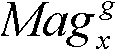
MagMag xx gg == MagMag zz bb sinsin &phi;&phi; ++ MagMag xx bb coscos &phi;&phi;

MagMag ythe y gg == MagMag xx bb sinsin &phi;&phi; sinsin &theta;&theta; ++ MagMag ythe y bb coscos &theta;&theta; -- MagMag zz bb coscos &phi;&phi; sinsin &theta;&theta; -- -- -- (( 44 ))

Figure BDA0000037796710000123
表示在地理坐标系g下载体X轴上的磁通量;
Figure BDA0000037796710000123
Indicates the magnetic flux on the X-axis of the body under the geographic coordinate system g;

Figure BDA0000037796710000124
表示在地理坐标系g下载体Y轴上的磁通量;
Figure BDA0000037796710000124
Indicates the magnetic flux on the Y-axis of the body under the geographic coordinate system g;

Figure BDA0000037796710000125
表示在地理坐标系g下载体Z轴上的磁通量;
Figure BDA0000037796710000125
Indicates the magnetic flux on the Z-axis of the body under the geographic coordinate system g;

由式(4)和载体姿态的航向角ψ可得航向角为:From formula (4) and the heading angle ψ of the carrier attitude, the heading angle can be obtained as:

&psi;&psi; == tanthe tan -- 11 MagMag xx gg MagMag ythe y gg -- -- -- (( 55 ))

推导步骤二:求初始俯仰角和横滚角Derivation Step 2: Find the initial pitch and roll angles

对初始的得到的同步加表信息

Figure BDA0000037796710000127
进行误差补偿,从而得到标定后的三轴加表数据(i表示惯性坐标系),由坐标转换关系可得:Add table information to the initial obtained synchronization
Figure BDA0000037796710000127
Perform error compensation to obtain the calibrated three-axis plus table data (i represents the inertial coordinate system), it can be obtained from the coordinate conversion relationship:

ff ibib bb == CC nno bb ff nno -- -- -- (( 66 ))

其中,fn为导航坐标系n下比力,

Figure BDA00000377967100001210
为导航坐标系n到载体坐标系b的坐标转换矩阵,由坐标转换关系得坐标转换矩阵
Figure BDA00000377967100001211
的表达式为:Among them, f n is the specific force in the navigation coordinate system n,
Figure BDA00000377967100001210
is the coordinate transformation matrix from the navigation coordinate system n to the carrier coordinate system b, and the coordinate transformation matrix is obtained from the coordinate transformation relationship
Figure BDA00000377967100001211
The expression is:

CC nno bb == coscos (( &phi;&phi; )) coscos (( &psi;&psi; )) -- sinsin (( &phi;&phi; )) sinsin (( &theta;&theta; )) sinsin (( &psi;&psi; )) coscos (( &phi;&phi; )) sinsin (( &psi;&psi; )) ++ sinsin (( &phi;&phi; )) sinsin (( &theta;&theta; )) coscos (( &psi;&psi; )) -- sinsin (( &phi;&phi; )) coscos (( &theta;&theta; )) -- coscos (( &theta;&theta; )) sinsin (( &psi;&psi; )) coscos (( &theta;&theta; )) coscos (( &psi;&psi; )) sinsin (( &theta;&theta; )) sinsin (( &phi;&phi; )) coscos (( &psi;&psi; )) ++ coscos (( &phi;&phi; )) sinsin (( &theta;&theta; )) sinsin (( &psi;&psi; )) sinsin (( &phi;&phi; )) sinsin (( &psi;&psi; )) -- coscos (( &phi;&phi; )) sinsin (( &theta;&theta; )) coscos (( &psi;&psi; )) coscos (( &phi;&phi; )) coscos (( &theta;&theta; )) -- -- -- (( 77 ))

由联立式(6)和式(7)可以得到:From the simultaneous formula (6) and formula (7), we can get:

ff ibxibx bb ff ibyiby bb ff ibzibz bb == coscos (( &phi;&phi; )) coscos (( &psi;&psi; )) -- sinsin (( &phi;&phi; )) sinsin (( &theta;&theta; )) sinsin (( &psi;&psi; )) coscos (( &phi;&phi; )) sinsin (( &psi;&psi; )) ++ sinsin (( &phi;&phi; )) sinsin (( &theta;&theta; )) coscos (( &psi;&psi; )) -- sinsin (( &phi;&phi; )) coscos (( &theta;&theta; )) -- coscos (( &theta;&theta; )) sinsin (( &psi;&psi; )) coscos (( &theta;&theta; )) coscos (( &psi;&psi; )) sinsin (( &theta;&theta; )) sinsin (( &phi;&phi; )) coscos (( &psi;&psi; )) ++ coscos (( &phi;&phi; )) sinsin (( &theta;&theta; )) sinsin (( &psi;&psi; )) sinsin (( &phi;&phi; )) sinsin (( &psi;&psi; )) -- coscos (( &phi;&phi; )) sinsin (( &theta;&theta; )) coscos (( &psi;&psi; )) coscos (( &phi;&phi; )) coscos (( &theta;&theta; )) 00 00 -- GG -- -- -- (( 88 ))

Figure BDA00000377967100001214
的下角标的x,y,z表示加速度计在载体坐标系b下的三个轴,即X轴、Y轴和Z轴;
Figure BDA00000377967100001214
The subscript x, y, z of the subscript indicates the three axes of the accelerometer in the carrier coordinate system b, namely the X axis, the Y axis and the Z axis;

Figure BDA00000377967100001215
表示在载体坐标系b下X轴的加速度信息;
Figure BDA00000377967100001215
Indicates the acceleration information of the X axis in the carrier coordinate system b;

表示在载体坐标系b下Y轴的加速度信息; Indicates the acceleration information of the Y axis in the carrier coordinate system b;

Figure BDA00000377967100001217
表示在载体坐标系b下Z轴的加速度信息;
Figure BDA00000377967100001217
Indicates the acceleration information of the Z axis in the carrier coordinate system b;

在导航坐标系n下 f n = 0 0 - G ; In the navigation coordinate system n f no = 0 0 - G ;

由化简式(8)得到:From the simplified formula (8), we get:

ff ibxibx bb == GG sinsin &phi;&phi; coscos &theta;&theta; ,, ff ibyiby bb == -- GG sinsin &theta;&theta; ,, ff ibzibz bb == -- GG coscos &phi;&phi; coscos &theta;&theta; -- -- -- (( 99 ))

G表示重力加速度;G means the acceleration due to gravity;

由式(9)可得初始俯仰角

Figure BDA00000377967100001222
和初始横滚角
Figure BDA00000377967100001223
The initial pitch angle can be obtained from formula (9)
Figure BDA00000377967100001222
and the initial roll angle
Figure BDA00000377967100001223

推导步骤三:求初始ECEF下的姿态矩阵

Figure BDA0000037796710000131
Derivation Step 3: Find the attitude matrix under the initial ECEF
Figure BDA0000037796710000131

由坐标转换矩阵转换关系可得:From the transformation relationship of the coordinate transformation matrix, we can get:

CC nno ee == -- sinsin &lambda;&lambda; -- sinsin LL coscos &lambda;&lambda; coscos LL coscos &lambda;&lambda; coscos &lambda;&lambda; -- sinsin LL sinsin &lambda;&lambda; coscos LL sinsin &lambda;&lambda; 00 coscos LL sinsin LL -- -- -- (( 1010 ))

Figure BDA0000037796710000133
表示导航坐标系n到ECEF坐标系e下的坐标转换矩阵;
Figure BDA0000037796710000133
Represents the coordinate transformation matrix under the navigation coordinate system n to the ECEF coordinate system e;

CC bb nno == coscos &phi;&phi; coscos &psi;&psi; -- sinsin &theta;&theta; sinsin &phi;&phi; sinsin &psi;&psi; -- coscos &theta;&theta; sinsin &psi;&psi; sinsin &phi;&phi; coscos &psi;&psi; ++ sinsin &psi;&psi; sinsin &theta;&theta; coscos &phi;&phi; coscos &phi;&phi; sinsin &psi;&psi; ++ coscos &psi;&psi; sinsin &theta;&theta; sinsin &phi;&phi; coscos &theta;&theta; coscos &psi;&psi; sinsin &phi;&phi; sinsin &psi;&psi; -- sinsin &theta;&theta; coscos &phi;&phi; coscos &psi;&psi; -- sinsin &phi;&phi; coscos &theta;&theta; sinsin &theta;&theta; coscos &theta;&theta; coscos &phi;&phi; -- -- -- (( 1111 ))

通过初始时刻GPS接收机的纬度L、经度λ,代入式(10)可得初始坐标变换矩阵

Figure BDA0000037796710000135
通过推导步骤一和推导步骤二中求得的姿态角ψ、θ和φ,代入式(11),可得坐标变换矩阵
Figure BDA0000037796710000136
通过由关系
Figure BDA0000037796710000137
可以得到
Figure BDA0000037796710000138
将此时得到的
Figure BDA0000037796710000139
作为初值;
Figure BDA00000377967100001310
表示在当前时刻T时,载体坐标系b到ECEF坐标系e下的坐标转换矩阵。By substituting the latitude L and longitude λ of the GPS receiver at the initial moment into equation (10), the initial coordinate transformation matrix can be obtained
Figure BDA0000037796710000135
By deriving the attitude angles ψ, θ and φ obtained in step 1 and derivation step 2, and substituting them into equation (11), the coordinate transformation matrix can be obtained
Figure BDA0000037796710000136
by relationship
Figure BDA0000037796710000137
can get
Figure BDA0000037796710000138
will get at this time
Figure BDA0000037796710000139
as initial value;
Figure BDA00000377967100001310
Indicates the coordinate transformation matrix from the carrier coordinate system b to the ECEF coordinate system e at the current time T.

步骤7-3:Step 7-3:

对初始的得到的三轴陀螺数据

Figure BDA00000377967100001311
进行误差补偿,从而得到标定后的
Figure BDA00000377967100001312
利用
Figure BDA00000377967100001313
和步骤7-2求得的姿态矩阵的初始值
Figure BDA00000377967100001314
后来进行ECEF下姿态矩阵
Figure BDA00000377967100001315
的更新,具体步骤如下:For the initial three-axis gyro data obtained
Figure BDA00000377967100001311
Error compensation is performed to obtain the calibrated
Figure BDA00000377967100001312
use
Figure BDA00000377967100001313
and the initial value of the attitude matrix obtained in step 7-2
Figure BDA00000377967100001314
Later, the attitude matrix under ECEF
Figure BDA00000377967100001315
update, the specific steps are as follows:

时间导数

Figure BDA00000377967100001317
为: time derivative
Figure BDA00000377967100001317
for:

CC &CenterDot;&Center Dot; bb ee == CC bb ee &Omega;&Omega; ibib bb -- &Omega;&Omega; ieie ee CC bb ee -- -- -- (( 1212 ))

式(12),

Figure BDA00000377967100001319
是角速度的斜对称矩阵,且 &Omega; ib b = 0 - &omega; ibz b &omega; iby b &omega; ibz b 0 - &omega; ibx b - &omega; iby b &omega; ibx b 0 ; Formula (12),
Figure BDA00000377967100001319
is a skew-symmetric matrix of angular velocities, and &Omega; ib b = 0 - &omega; ibz b &omega; iby b &omega; ibz b 0 - &omega; ibx b - &omega; iby b &omega; ibx b 0 ;

式(12),

Figure BDA00000377967100001321
是地球旋转矢量的斜对称矩阵,且
Figure BDA00000377967100001322
ωie为地球自转角速度。Formula (12),
Figure BDA00000377967100001321
is the skew-symmetric matrix of the Earth's rotation vector, and
Figure BDA00000377967100001322
ω ie is the angular velocity of the earth's rotation.

式(12),

Figure BDA00000377967100001323
的下角标的x,y,z表示陀螺在载体坐标系b下的三个轴,即X轴、Y轴和Z轴;Formula (12),
Figure BDA00000377967100001323
The subscript x, y, and z of the subscript indicate the three axes of the gyroscope in the carrier coordinate system b, namely the X axis, Y axis and Z axis;

对式(12)进行积分得:Integrate formula (12) to get:

Figure BDA00000377967100001324

其中,τ表示时间间隔,T+τ表示下一时刻,为姿态增量的斜对称矩阵,I3表示单位矩阵;

Figure BDA00000377967100001326
表示下一时刻T+τ的载体坐标系b到ECEF坐标系e下的坐标转换矩阵。Among them, τ represents the time interval, T+τ represents the next moment, is the oblique symmetric matrix of the attitude increment, and I3 represents the identity matrix;
Figure BDA00000377967100001326
Indicates the coordinate transformation matrix from the carrier coordinate system b to the ECEF coordinate system e at the next moment T+τ.

对式(13)的幂级数进行一阶泰勒展开,并在时间间隔τ内角速度是不变的,即角速度增量

Figure BDA0000037796710000141
由此可以得到坐标变换矩阵更新后的最终形式:Perform first-order Taylor expansion on the power series of equation (13), and the angular velocity is constant within the time interval τ, that is, the angular velocity increment
Figure BDA0000037796710000141
From this, the final form of the updated coordinate transformation matrix can be obtained:

CC bb ee (( TT ++ &tau;&tau; )) &ap;&ap; CC bb ee (( TT )) (( II 33 ++ &Omega;&Omega; ibib bb &tau;&tau; )) -- &Omega;&Omega; ieie ee CC bb ee (( TT )) &tau;&tau; -- -- -- (( 1414 ))

步骤7-4:进行ECEF下的比力更新Step 7-4: Perform comparison update under ECEF

由不同坐标系下比力的转换关系可得:From the conversion relationship of specific force in different coordinate systems, we can get:

ff ibib ee (( TT )) == CC bb ee (( TT )) ff ibib bb (( TT )) &ap;&ap; 11 22 (( CC bb ee (( TT )) ++ CC bb ee (( TT ++ &tau;&tau; )) )) ff ibib bb (( TT )) -- -- -- (( 1515 ))

Figure BDA0000037796710000144
表示当前时刻T在ECEF坐标系下相对载体坐标系b下的比力,i表示惯性坐标系;
Figure BDA0000037796710000144
Indicates the specific force of T in the ECEF coordinate system relative to the carrier coordinate system b at the current moment, and i indicates the inertial coordinate system;

Figure BDA0000037796710000145
表示当前时刻T在载体坐标系b下的比力;
Figure BDA0000037796710000145
Indicates the specific force of T in the carrier coordinate system b at the current moment;

由不同坐标系下速度转换关系可以得到:According to the speed conversion relationship in different coordinate systems, we can get:

&upsi;&upsi; ibib ee &ap;&ap; 11 22 (( CC bb ee (( TT )) ++ CC bb ee (( TT ++ &tau;&tau; )) )) &upsi;&upsi; ibib bb (( TT )) -- -- -- (( 1616 ))

其中

Figure BDA0000037796710000147
为ECEF坐标系相对载体系下的速度,
Figure BDA0000037796710000148
Figure BDA0000037796710000149
为当前时刻T载体坐标系下速度;in
Figure BDA0000037796710000147
is the velocity of the ECEF coordinate system relative to the carrier system,
Figure BDA0000037796710000148
Figure BDA0000037796710000149
is the velocity in the T carrier coordinate system at the current moment;

步骤7-5:ECEF下速度更新Step 7-5: Speed update under ECEF

由速度、加速度和位置之间的关系可以得到下式:The relationship between velocity, acceleration and position can be obtained as follows:

vv &CenterDot;&Center Dot; ebeb ee == aa ebeb ee == rr &CenterDot;&CenterDot; &CenterDot;&CenterDot; ebeb ee -- -- -- (( 1717 ))

rr ebeb ee == rr ibib ee -- rr ieie ee -- -- -- (( 1818 ))

其中,为ECEF坐标系下速度的微分,

Figure BDA00000377967100001413
为ECEF坐标系下加速度,
Figure BDA00000377967100001414
为ECEF坐标系下位置的双重微分,
Figure BDA00000377967100001415
为ECEF坐标系下的位置,为ECEF坐标系相对载体坐标系的位置,
Figure BDA00000377967100001417
为ECEF坐标系相对惯性坐标系下的位置。in, is the differential of the velocity in the ECEF coordinate system,
Figure BDA00000377967100001413
is the acceleration in the ECEF coordinate system,
Figure BDA00000377967100001414
is the double differential of the position in the ECEF coordinate system,
Figure BDA00000377967100001415
is the position in the ECEF coordinate system, is the position of the ECEF coordinate system relative to the carrier coordinate system,
Figure BDA00000377967100001417
is the position in the ECEF coordinate system relative to the inertial coordinate system.

由于地球自转角速度为常值,则Due to the angular velocity of the earth's rotation is a constant value, then

vv &CenterDot;&CenterDot; ebeb ee == -- &Omega;&Omega; ieie ee &Omega;&Omega; ieie ee rr ibib ee -- 22 &Omega;&Omega; ieie ee rr &CenterDot;&CenterDot; ebeb ee ++ aa ibib ee -- -- -- (( 1919 ))

Figure BDA00000377967100001420
表示
Figure BDA00000377967100001421
和重力矢量引起的加速度
Figure BDA00000377967100001422
的和;
Figure BDA00000377967100001420
express
Figure BDA00000377967100001421
and the acceleration due to the gravity vector
Figure BDA00000377967100001422
and

将式(18)及位置、速度之间的关系(表示ECEF坐标系下的速度),代入式(19)中得到:The relationship between formula (18) and position and speed (representing the velocity in the ECEF coordinate system), and substituting it into formula (19) to get:

vv &CenterDot;&CenterDot; ebeb ee == -- &Omega;&Omega; ieie ee &Omega;&Omega; ieie ee rr ebeb ee -- 22 &Omega;&Omega; ieie ee rr ebeb ee ++ aa ibib ee -- -- -- (( 2020 ))

其中

Figure BDA00000377967100001425
Figure BDA00000377967100001426
和重力矢量引起的加速度
Figure BDA00000377967100001427
的和;ECEF下的重力模型是重力矢量引起的加速度
Figure BDA00000377967100001429
与离心加速度
Figure BDA00000377967100001430
的和,即in
Figure BDA00000377967100001425
yes
Figure BDA00000377967100001426
and the acceleration due to the gravity vector
Figure BDA00000377967100001427
and the gravity model under ECEF is the acceleration due to the gravity vector
Figure BDA00000377967100001429
and centrifugal acceleration
Figure BDA00000377967100001430
the sum of

aa ibib ee == ff ibib ee (( TT )) ++ &gamma;&gamma; ibib ee

gg bb ee == &gamma;&gamma; ibib ee -- &Omega;&Omega; ieie ee &Omega;&Omega; ieie ee rr ebeb ee -- -- -- (( 21twenty one ))

将(20)式代入(21)中得到Substitute (20) into (21) to get

vv &CenterDot;&CenterDot; ebeb ee == ff ibib ee (( TT )) ++ gg bb ee (( rr ebeb ee )) -- 22 &Omega;&Omega; ieie ee vv ebeb ee -- -- -- (( 22twenty two ))

在一个采样时间间隔内速率

Figure BDA0000037796710000152
比力
Figure BDA0000037796710000153
和重力模型是不变的,由此对(22)进行积分运算得到下一时刻的速度为:In a sample time interval the rate
Figure BDA0000037796710000152
compare force
Figure BDA0000037796710000153
and the gravity model is invariant, so the integral operation of (22) can obtain the speed at the next moment as:

v eb e ( T + &tau; ) &ap; v eb e ( T ) + ( f ib e ( T ) + g b e ( r eb e ( T ) ) - 2 &Omega; ie e v eb e ( T ) ) &tau; (23) v eb e ( T + &tau; ) &ap; v eb e ( T ) + ( f ib e ( T ) + g b e ( r eb e ( T ) ) - 2 &Omega; ie e v eb e ( T ) ) &tau; (twenty three)

== vv ebeb ee (( TT )) ++ &upsi;&upsi; ibib ee ++ (( gg bb ee (( rr ebeb ee (( TT )) )) -- 22 &Omega;&Omega; ieie ee vv ebeb ee (( TT )) )) &tau;&tau;

在导航坐标系下的重力模型可以看做是关于纬度函数,WGS-84的重力数值式为G=978.03267714×(1+0.00193185138639sin2L)/(1-000669437999013sin2L)1/2其中L为当地纬度。导航坐标系下的重力G通过乘以坐标变换矩阵

Figure BDA0000037796710000157
得到ECEF下的重力模型,即
Figure BDA0000037796710000158
The gravity model in the navigation coordinate system can be regarded as a function of latitude. The gravity numerical formula of WGS-84 is G=978.03267714×(1+0.00193185138639sin 2 L)/(1-000669437999013sin 2 L) 1/2 where L is local latitude. The gravity G in the navigation coordinate system is multiplied by the coordinate transformation matrix
Figure BDA0000037796710000157
Get the gravity model under ECEF, namely
Figure BDA0000037796710000158

由于

Figure BDA0000037796710000159
其中L为纬度,λ为经度,正弦下的
Figure BDA00000377967100001510
正弦下的
Figure BDA00000377967100001511
余弦下的
Figure BDA00000377967100001512
cos &lambda; = x x 2 + y 2 . because
Figure BDA0000037796710000159
where L is the latitude, λ is the longitude, and the sine
Figure BDA00000377967100001510
Under the sine
Figure BDA00000377967100001511
under the cosine
Figure BDA00000377967100001512
cos &lambda; = x x 2 + the y 2 .

在本发明中,x、y、z为ECEF坐标系中的坐标值。将正弦下的

Figure BDA00000377967100001514
正弦下的
Figure BDA00000377967100001515
余弦下的
Figure BDA00000377967100001516
Figure BDA00000377967100001517
代入中,得到:In the present invention, x, y, and z are coordinate values in the ECEF coordinate system. put the sine under
Figure BDA00000377967100001514
Under the sine
Figure BDA00000377967100001515
under the cosine
Figure BDA00000377967100001516
Figure BDA00000377967100001517
substitute , get:

CC nno ee == -- ythe y xx 22 ++ ythe y 22 -- zz xx 22 ++ ythe y 22 ++ zz 22 xx xx 22 ++ ythe y 22 xx xx 22 ++ ythe y 22 ++ zz 22 xx xx 22 ++ ythe y 22 -- zz xx 22 ++ ythe y 22 ++ zz 22 ythe y xx 22 ++ ythe y 22 ythe y xx 22 ++ ythe y 22 ++ zz 22 00 xx 22 ++ ythe y 22 xx 22 ++ ythe y 22 ++ zz 22 zz xx 22 ++ ythe y 22 ++ zz 22 -- -- -- (( 24twenty four ))

根据式(24)以及坐标之间的转换关系可以得到:According to formula (24) and the conversion relationship between coordinates, we can get:

gg bb ee == CC nno ee &times;&times; GG == -- ythe y xx 22 ++ ythe y 22 -- zz xx 22 ++ ythe y 22 ++ zz 22 xx xx 22 ++ ythe y 22 xx xx 22 ++ ythe y 22 ++ zz 22 xx xx 22 ++ ythe y 22 -- zz xx 22 ++ ythe y 22 ++ zz 22 ythe y xx 22 ++ ythe y 22 ythe y xx 22 ++ ythe y 22 ++ zz 22 00 xx 22 ++ ythe y 22 xx 22 ++ ythe y 22 ++ zz 22 zz xx 22 ++ ythe y 22 ++ zz 22 &times;&times; 00 00 -- GG -- -- -- (( 2525 ))

xx == -- GG xx 22 ++ ythe y 22 ++ zz 22 xx ythe y zz

步骤7-6:ECEF下位置更新Step 7-6: Location update under ECEF

在ECEF坐标系中,由位置和速度之间的关系

Figure BDA0000037796710000163
对位置进行积分,因为在采样时间间隔内速度
Figure BDA0000037796710000164
是线性变化的,则有下一时刻的位置为:In the ECEF coordinate system, the relationship between position and velocity
Figure BDA0000037796710000163
Integrate position because velocity
Figure BDA0000037796710000164
is a linear change, then the position at the next moment is:

rr ebeb ee (( TT ++ &tau;&tau; )) == rr ebeb ee (( TT )) ++ (( vv ebeb ee (( TT )) ++ vv ebeb ee (( TT ++ &tau;&tau; )) )) &tau;&tau; 22

&ap;&ap; rr ebeb ee (( TT )) ++ vv ebeb ee (( TT )) &tau;&tau; ++ (( ff ibib ee (( TT )) ++ gg bb ee (( rr ebeb ee (( TT )) )) -- 22 &Omega;&Omega; ieie ee vv ebeb ee )) &tau;&tau; 22 22 -- -- -- (( 2626 ))

在本发明中,通过ECEF模型中得到的三轴位置

Figure BDA0000037796710000167
和三轴速度
Figure BDA0000037796710000168
辅助信息,通过输出接口再传送回给FPGA,FPGA传送给GPS接收机进行辅助。In the present invention, the three-axis position obtained by the ECEF model
Figure BDA0000037796710000167
and three-axis speed
Figure BDA0000037796710000168
The auxiliary information is sent back to the FPGA through the output interface, and the FPGA sends it to the GPS receiver for assistance.

本发明设计的MIMU系统主要是由4块电路板组成,分别是母板、导航板、Y板和Z板。The MIMU system designed by the present invention is mainly composed of 4 circuit boards, which are respectively a motherboard, a navigation board, a Y board and a Z board.

本发明的母板主要由电源模块、单轴微机械陀螺芯片ADXRS610BBGZ、双轴磁阻传感器芯片HMC1022、双轴加速度计(ADXL320)、3片ADS1274芯片和一片DSP(TMS320F28335)及其外围电路组成。主要功能是提供为整个系统供电和完成传感器的模拟信号到数字信号的采集,并且第一DSP处理器用于发送模式设置指令和误差模型参数。The motherboard of the present invention is mainly composed of a power supply module, a single-axis micromachined gyro chip ADXRS610BBGZ, a two-axis magnetoresistive sensor chip HMC1022, a two-axis accelerometer (ADXL320), three ADS1274 chips, one DSP (TMS320F28335) and its peripheral circuits. The main function is to provide power supply for the whole system and complete the acquisition of sensor analog signals to digital signals, and the first DSP processor is used to send mode setting instructions and error model parameters.

导航板是整个系统的导航信息融合处理板,主要放置了FPGA(XC6SLX150-2FGG484CES)及其配置Flash(XCF32P)和第二DSP(TMS320C6727)及其外围电路组成,SDRAM(MT48LC4M32B2P-6IT,4M×32,166MHz)作为第二DSP的数据存储器,Flash(LH28F800BJE-PTTL90,512K×16)作为第二DSP的程序存储器。The navigation board is the navigation information fusion processing board of the whole system, which is mainly composed of FPGA (XC6SLX150-2FGG484CES) and its configuration Flash (XCF32P), the second DSP (TMS320C6727) and its peripheral circuits, SDRAM (MT48LC4M32B2P-6IT, 4M×32 , 166MHz) as the data memory of the second DSP, and Flash (LH28F800BJE-PTTL90, 512K×16) as the program memory of the second DSP.

Y板是传感器板,主要放置单轴微机械陀螺芯片(ADXRS610BBGZ)、单轴磁阻传感器(HMC1021S)、双轴加速度计(ADXL320)。The Y board is a sensor board, which mainly places a single-axis micromechanical gyro chip (ADXRS610BBGZ), a single-axis magnetoresistive sensor (HMC1021S), and a dual-axis accelerometer (ADXL320).

Z板是传感器板,主要放置了单轴微机械陀螺芯片(ADXRS610BBGZ)。The Z board is a sensor board, which mainly places a single-axis micromachined gyro chip (ADXRS610BBGZ).

本发明系统微惯性传感器输出存在高频噪声,为了消除高频信号的干扰,在进行A/D转换前,选用OPA2350构成一阶有源滤波电路,不仅可以消除高频噪声,还可以解决输入输出阻抗不匹配的问题。传感器输出的模拟信号经过3片A/D转换后缓存在FPGA中,FPGA对缓存的数据进行野点剔除和平滑滤波,进一步抑制噪声。A/D芯片选用TI公司的ADS1274,最大的采集速率是144kSPS,24位高精度数据输出。本设计选用了3片ADS1274组成一个9通道的A/D转换电路。FPGA是整个系统的逻辑和时序控制中心,基于系统对FPGA的要求,选择XILINX公司Spartan-6系列的XC6SLX150,其内部逻辑资源丰富,并有大量的DSP硬核乘法器,以便在FPGA内部完成微惯性传感器数据的降噪滤波。配置芯片选用XILINX公司32M的PlatformFlash,采用主时钟并行配置模式。FPGA同步控制3片A/D,为每片A/D芯片分别提供采样时钟和串行输出时钟,采样时钟是20M,串行输出时钟是2M,FPGA通过控制3片A/D的同步采集。There is high-frequency noise in the output of the micro-inertial sensor of the system of the present invention. In order to eliminate the interference of high-frequency signals, OPA2350 is selected to form a first-order active filter circuit before A/D conversion, which can not only eliminate high-frequency noise, but also solve the problem of input and output. Impedance mismatch problem. The analog signal output by the sensor is cached in the FPGA after being converted by three A/D chips, and the FPGA performs wild point elimination and smooth filtering on the cached data to further suppress noise. The A/D chip selects ADS1274 of TI Company, the maximum acquisition rate is 144kSPS, and 24-bit high-precision data output. This design selects 3 slices of ADS1274 to form a 9-channel A/D conversion circuit. The FPGA is the logic and timing control center of the entire system. Based on the requirements of the system for the FPGA, XC6SLX150 of the Spartan-6 series of XILINX Company is selected. It has rich internal logic resources and a large number of DSP hard-core multipliers to complete micro Noise reduction filtering of inertial sensor data. The configuration chip selects 32M PlatformFlash of XILINX Company, and adopts the master clock parallel configuration mode. FPGA synchronously controls 3 pieces of A/D, and provides sampling clock and serial output clock for each A/D chip respectively. The sampling clock is 20M, and the serial output clock is 2M. FPGA controls the synchronous acquisition of 3 pieces of A/D.

本系统的中心计算处理器第二DSP选择TI公司的TMS320C6727,其主频300MHz。它提供了32位外部存储器接口(EMIF),使SDRAM的速度有了较大的提升,通过了EMIF口和FPGA实现了无缝链接。由于程序和数据量比较大,对第二DSP外扩了存储器,FLASH存储器用来存放第二DSP系统的程序,SDRAM作为动态随机存储器。The second DSP of the central computing processor of this system chooses TMS320C6727 of TI Company, and its main frequency is 300MHz. It provides a 32-bit external memory interface (EMIF), which greatly improves the speed of SDRAM, and realizes a seamless link through the EMIF port and FPGA. Due to the relatively large amount of program and data, the second DSP has expanded the memory, the FLASH memory is used to store the program of the second DSP system, and the SDRAM is used as the dynamic random access memory.

辅助信息要求以较高的更新率传送给GPS接收机,为了使第二DSP能够专注于导航解算,本系统用FPGA作为与GPS接收机通信的桥梁,要求第二DSP解算的信息能够高速、可靠的传递给FPGA,通过FPGA传递给GPS接收机辅助其跟踪环路。所以,核心控制器之间的接口设计格外重要,FPGA与第二DSP通过并行口进行通信,与第一DSP通过SPI总线通信,其中,第一DSP工作在主模式,FPGA工作在从模式。Auxiliary information is required to be transmitted to the GPS receiver at a high update rate. In order to enable the second DSP to focus on navigation calculations, this system uses FPGA as a communication bridge with the GPS receiver, and requires the information calculated by the second DSP to be high-speed , Reliably transmitted to the FPGA, through the FPGA to the GPS receiver to assist its tracking loop. Therefore, the interface design between the core controllers is particularly important. The FPGA communicates with the second DSP through the parallel port, and communicates with the first DSP through the SPI bus. Among them, the first DSP works in the master mode, and the FPGA works in the slave mode.

第二DSP用EMIF口的CS2空间与FPGA通信,DSP的复位信号通过FPGA给出,它们之间的信号线包括:16位数据线,12位地址线以及控制信号线。数据读取过程描述:由FPGA采集数据并缓存后,向DSP发出中断信号(DSP_INT),DSP响应中断,将读信号DSP_OE置高,进行数据读取。读取方式:DSP把FPGA作为外部扩展存储器,FPGA事先把数据存在规定的地址空间中,DSP通过这些寄存器读入采集的数据,其中第一个寄存器为16位的标志寄存器,用来放置标志信息。数据发送过程描述:当DSP内部解算完毕后,向FPGA发出写信号DSP_WE,然后将解算结果写进固定的寄存器中。The second DSP uses the CS2 space of the EMIF port to communicate with the FPGA. The reset signal of the DSP is given by the FPGA. The signal lines between them include: 16-bit data lines, 12-bit address lines and control signal lines. Description of the data reading process: After the data is collected and cached by the FPGA, an interrupt signal (DSP_INT) is sent to the DSP, and the DSP responds to the interrupt, and the read signal DSP_OE is set high to read the data. Reading method: DSP uses FPGA as an external extended memory. FPGA stores data in the specified address space in advance, and DSP reads the collected data through these registers. The first register is a 16-bit flag register, which is used to place flag information. . Description of the data sending process: After the internal calculation of the DSP is completed, a write signal DSP_WE is sent to the FPGA, and then the calculation result is written into a fixed register.

第一DSP主要为了接收上位机指令和误差模型参数。它是一款主频达150M的单精度浮点DSP,拥有丰富的片上存储资源,搭建最小系统简单,如果第二DSP资源紧张,可用它作为辅助处理器进行相关解算。The first DSP is mainly for receiving host computer instructions and error model parameters. It is a single-precision floating-point DSP with a main frequency of 150M. It has abundant on-chip storage resources, and it is easy to build a minimum system. If the resources of the second DSP are tight, it can be used as an auxiliary processor for related calculations.

接口模块包括辅助信息接口和外界接口。辅助信息接口是辅助信息传递的桥梁,有三个方面的要求:一是要求数据传输高速可靠;二是要求信号的驱动能力强;三是要求传输方式尽量简单。辅助接口总线通过高速、低噪的异步双向驱动芯片SN74LVTH 16245进行驱动。The interface module includes an auxiliary information interface and an external interface. The auxiliary information interface is a bridge for auxiliary information transmission, which has three requirements: first, high-speed and reliable data transmission; second, strong driving ability of the signal; third, simple transmission method. The auxiliary interface bus is driven by a high-speed, low-noise asynchronous bidirectional driver chip SN74LVTH 16245.

为了传送高速、稳定、可靠的辅助信息,辅助信息传送接口用了两套对称的单向接口:包括1条发送时钟线,1条发送使能线,8条发送数据线,1条接收时钟线,1条接收使能线,8条接收数据线。辅助信息的存储是利用FPGA内部的RAM资源。In order to transmit high-speed, stable and reliable auxiliary information, the auxiliary information transmission interface uses two sets of symmetrical unidirectional interfaces: including 1 sending clock line, 1 sending enable line, 8 sending data lines, and 1 receiving clock line , 1 receive enable line, 8 receive data lines. The storage of the auxiliary information utilizes the RAM resource inside the FPGA.

外界接口包括上位机接口,扩展接口和显示接口以及普通接收机的接口。最终辅助完成后的解算结果要传输给外界显示设备,考虑到其通常传输距离较远,为增加抗干扰能力,保证数据传输的可靠性,通过RS422总线传输。The external interface includes host computer interface, expansion interface, display interface and common receiver interface. After the final assistance is completed, the calculation results will be transmitted to the external display device. Considering that the transmission distance is generally long, in order to increase the anti-interference ability and ensure the reliability of data transmission, it is transmitted through the RS422 bus.

第一DSP和上位机之间通过RS232总线进行通信,接收上位机的指令,FPGA还预留了一路与外界的RS232接口,MAX3232作为电平转换芯片。通过外界接口模块,实现了上控制机构和外界显示设备与本系统之间的通信。The first DSP communicates with the upper computer through the RS232 bus to receive instructions from the upper computer. FPGA also reserves an RS232 interface with the outside world, and MAX3232 is used as a level conversion chip. Through the external interface module, the communication between the upper control mechanism and the external display equipment and the system is realized.

Claims (4)

1. MIMU system with ECEF model, MIMU system are used for receiving the carrier acceleration information AF of accelerometer combination (10) output on the one hand 10={ AFX 10, AFY 10, AFZ 10, the carrier angular velocity information AG of Gyro (20) output 20={ AGX 20, AGY 20, AGZ 20And the magnetic flux information A H of magnetometer combination (30) output 30={ AHX 30, AHY 30, AHZ 30, the MIMU system is used for three axle speed under the output ECEF coordinate system on the other hand
Figure FDA00002359359200011
Three shaft positions
Figure FDA00002359359200012
Give GPS receiver (40), realize the track loop of GPS receiver (40) is followed the tracks of; It is characterized in that: this MIMU system includes signal condition module (1), analog-to-digital conversion module (2), smothing filtering module (3), pattern module (4), error model (5), mode decoding module (6), ECEF model (7), inertia and GPS synchronizing information generation module (8), mode control word generation module (9) is set; AFX 10The carrier acceleration information of the X-axis output of expression accelerometer, AFY 10The carrier acceleration information of the Y-axis output of expression accelerometer, AFZ 10The carrier acceleration information of the Z axis output of expression accelerometer, AGX 20The carrier angular velocity information of the X-axis output of expression gyro, AGY 20The carrier angular velocity information of the Y-axis output of expression gyro, AGZ 20The carrier angular velocity information of the Z axis output of expression gyro, AHX 30The magnetic flux information of the X-axis output of expression magnetometer, AHY 30The magnetic flux information of the Y-axis output of expression magnetometer, AHZ 30The magnetic flux information of the Z axis output of expression magnetometer;
Signal condition module (1) is used for carrier acceleration information AF 10={ AFX 10, AFY 10, AFZ 10, carrier angular velocity information AG 20={ AGX 20, AGY 20, AGZ 20And magnetic flux information A H 30={ AHX 30, AHY 30, AHZ 30Carry out squelch filtering, the conditioning after obtaining nursing one's health-gyro AG 1, conditioning-Jia Table A F 1, and conditioning-magnetic flux AH 1
The AG of analog-to-digital conversion module (2) to receiving 1, AF 1And AH 1Carry out analog to digital conversion, obtain numeral-gyro AG 2, numeral-Jia Table A F 2And numeral-magnetic flux AH 2
Smothing filtering module (3) is to the numeral that receives-gyro AG 2, numeral-Jia Table A F 2And numeral-magnetic flux AH 2Carry out open country point and reject and the two-stage the disposal of gentle filter, obtain smoothly rear-gyro AG 3, level and smooth after-Jia Table A F 3With afterwards level and smooth-magnetic flux AH 3
Pattern arranges module (4) and be used for to receive the mode command that host computer issues, and then carries out different mode according to this order and starts, and pattern is arranged order M4 export to mode decoding module (6); Described mode command includes loose integrated mode switching command, tight integrated mode switching command, auxiliary pattern switching command and the GPS turnover rate resolved;
Error model (5) is used for receiving the MIMU error model parameters that host computer issues, and then carry out different mode according to this MIMU error model parameters and start, and with the error model data M 5Export to mode decoding module (6); This MIMU error model parameters mainly includes the error model parameters that three axle gyros and three axles add table;
Mode decoding module (6) is used for the pattern that receives is arranged order M 4With the error model data M 5Decode and verification, then export CRC check post command MD 6Give ECEF model (7);
Mode control word generation module (9) is for generation of mode control word order ST 9, and with this mode control word order ST 9Export to ECEF model (7);
Inertia and GPS synchronizing information generation module (8) smoothly rear-gyro AG to receiving 3, level and smooth after-Jia Table A F 3With afterwards level and smooth-magnetic flux AH 3And gps data
Figure FDA00002359359200021
Carry out the integration of data status word, gps data and inertial sensor data, produce the synchronous gyro information with the information of reception synchronised
Figure FDA00002359359200022
Add synchronously table information
Figure FDA00002359359200023
Synchronous magnetic flux information Mag b, initial three axle speed under the ECEF With initial three shaft positions under the ECEF
Figure FDA00002359359200025
Then the synchronizing information of producing is exported to ECEF model (7); Described data status word is respectively system state word, sensing data identification-state word, gps data sign control word;
ECEF model (7) is according to the order MD after the CRC check 6, mode control word order ST 9To the three axle gyro datas that receive
Figure FDA00002359359200026
Three axles add the table data
Figure FDA00002359359200027
Three axle magnetic flux data M ag b, initial three axle speed under the ECEF
Figure FDA00002359359200028
Initial three shaft positions under the ECEF
Figure FDA00002359359200029
The initial latitude L of GPS, the initial longitude λ of GPS information are carried out the ECEF model and are resolved, and obtain the velocity information of ECEF
Figure FDA000023593592000210
And positional information
Figure FDA000023593592000211
Then with the velocity information of ECEF And positional information
Figure FDA000023593592000213
Send the GPS receiver to and carry out the auxiliary of track loop, improve the antijamming capability of GPS receiver.
2. the MIMU system with ECEF model according to claim 1, it is characterized in that: smothing filtering module (3), mode decoding module (6), inertia and GPS synchronizing information generation module (8) and mode control word generation module (9) are realized by the FPGA processor; Module (4) is set pattern and error model (5) is realized by the first dsp processor; ECEF model (7) is realized by the second dsp processor.
3. the MIMU system with ECEF model according to claim 1 is characterized in that: smothing filtering module (3) is carried out smothing filtering to the angle information of gyro output and is included following treatment step:
Step 3-1: the threshold value of at first recording inertial sensor front and back double sampling; Concrete grammar is: because the range of gyro is ± 300 °/s, front-end sampling rate with 10kHz is sampled, the maximum angle that turns between two numbers under normal circumstances is 300mV/10kHz, because the calibration factor of gyro is 0.05mV/ °/s, the magnitude of voltage that is converted to 3 δ according to the databook of gyro calculates and can obtain threshold value and approximate greatly 18mV;
The data that a storage register is stored a sampled point are set among the step 3-2:FPGA, after next data arrive and previous do poor, if the threshold value that its poor absolute value is tried to achieve greater than the first step is namely thought wild value, then the value of wild some rejecting module output is a upper correct IMU; If current IMU value is not wild value, then with the output of current I MU value, and the value of storage register is updated to current IMU value;
Step 3-3: per 10 of the data that the wild point of step 3-2 is rejected output are carried out an addition and are averaged, and this mean value is exported to step 3-4 as final data, by this step operation, are equivalent to the acquisition rate of 10kHz is reduced to 1000Hz;
Step 3-4: it is that 8 sliding window is level and smooth that the data of step 3-3 output are carried out length of window; So-called window class is 8 fifo queue like length, 8 data in the window is weighted on average at every turn, and then the data grand window that arrives the earliest window, other window data is shifted successively, collects the end that current new data arrive window;
Step 3-5: per 10 of the window output data of step 3-4 output are carried out an addition again and averaged, by this step operation, this mean value is exported to step 3-6 as final data, be equivalent to the data acquisition rate of step 3-4 output is reduced to 100Hz;
Step 3-6: it is that 8 sliding window is level and smooth that the data of step 3-5 output are carried out length of window with step 3-4; And the data after inciting somebody to action smoothly are as final smothing filtering output data.
4. the MIMU system with ECEF model according to claim 1 is characterized in that the ECEF model resolves execution the following step:
Step 7-1: according to MD 6, ST 9, carry out self program initialization control;
Step 7-2: in the initial alignment unit to L, λ, Mag b,
Figure FDA00002359359200031
Information is carried out initialization, obtains the initial attitude matrix of the coordinate conversion matrix of carrier coordinate system under the ECEF
Figure FDA00002359359200032
Attitude of carrier: course angle is designated as ψ, the angle of pitch is designated as θ and roll angle is designated as φ; Concrete reckoning is:
Derivation step 1: ask the angle, initial heading
If the value that initial alignment requirement magnetoresistive transducer records not in surface level, should be carried out coordinate transform in surface level, transform method is:
Mag x b Mag y b Mag z b = C g b Mag x g Mag y g Mag z g - - - ( 1 )
Wherein: Mag bThe x of subscript, y, z represent three axles of magnetometer under carrier coordinate system, i.e. X-axis, Y-axis and Z axis, b represents carrier coordinate system;
Mag gThe x of subscript, y, z represent three axles of magnetometer under geographic coordinate system, i.e. X-axis, Y-axis and Z axis, g represents geographic coordinate system;
Figure FDA00002359359200034
Expression geographic coordinate system g is to the coordinate conversion matrix of carrier coordinate system b.
Under the attitude of carrier condition, coordinate conversion matrix
Figure FDA00002359359200035
For:
C g b = cos &phi; 0 - sin &phi; 0 1 0 sin &phi; 0 cos &phi; 1 0 0 0 cos &theta; sin &theta; 0 - sin &theta; cos &theta; = cos &phi; 0 sin &phi; sin &phi; sin &theta; cos &theta; - cos &phi; sin &theta; - sin &phi; cos &theta; sin &theta; cos &phi; cos &theta; - - - ( 2 )
Figure FDA00002359359200037
Orthogonal matrix be designated as
Figure FDA00002359359200038
Namely
Figure FDA00002359359200039
T representing matrix transposition is so can obtain the coordinate conversion matrix that carrier is tied to Department of Geography by formula (2)
Figure FDA000023593592000310
Expression formula be:
C b g = cos &phi; 0 sin &phi; sin &phi; sin &theta; cos &theta; - cos &phi; sin &theta; - sin &phi; cos &theta; sin &theta; cos &phi; cos &theta; - - - ( 3 )
Can be got by simultaneous formula (1) and (3):
Mag x g = Mag z b sin &phi; + Mag x b cos &phi;
Mag y g = Mag x b sin &phi; sin &theta; + Mag y b cos &theta; - Mag z b cos &phi; sin &theta; - - - ( 4 )
Can get course angle by the course angle ψ of formula (4) and attitude of carrier is:
&psi; = tan - 1 Mag x g Mag y g - - - ( 5 )
Derivation step 2: ask the initial angle of pitch and roll angle
Obtain initial
Figure FDA00002359359200042
Carry out error compensation, add the table data thereby obtain calibrated three axles
Figure FDA00002359359200043
Can be got by coordinate transformation relation:
f ib b = C n b f n - - - ( 6 )
Wherein, f nFor navigation coordinate is specific force under the n,
Figure FDA00002359359200045
For navigation coordinate is the coordinate conversion matrix that n arrives carrier coordinate system b, get coordinate conversion matrix by coordinate transformation relation
Figure FDA00002359359200046
Expression formula be:
C n b = cos ( &phi; ) cos ( &psi; ) - sin ( &phi; ) sin ( &theta; ) sin ( &psi; ) cos ( &phi; ) sin ( &psi; ) + sin ( &phi; ) sin ( &theta; ) cos ( &psi; ) - sin ( &phi; ) cos ( &theta; ) - cos ( &theta; ) sin ( &psi; ) cos ( &theta; ) cos ( &psi; ) sin ( &theta; ) sin ( &phi; ) cos ( &psi; ) + cos ( &phi; ) sin ( &theta; ) sin ( &psi; ) sin ( &phi; ) sin ( &psi; ) - cos ( &phi; ) sin ( &theta; ) cos ( &psi; ) cos ( &phi; ) cos ( &theta; ) - - - ( 7 )
Can be obtained by simultaneous formula (6) and formula (7):
f ibx b f iby b f ibz b = cos ( &phi; ) cos ( &psi; ) - sin ( &phi; ) sin ( &theta; ) sin ( &psi; ) cos ( &phi; ) sin ( &psi; ) + sin ( &phi; ) sin ( &theta; ) cos ( &psi; ) - sin ( &phi; ) cos ( &theta; ) - cos ( &theta; ) sin ( &psi; ) cos ( &theta; ) cos ( &psi; ) sin ( &theta; ) sin ( &phi; ) cos ( &psi; ) + cos ( &phi; ) sin ( &theta; ) sin ( &psi; ) sin ( &phi; ) sin ( &psi; ) - cos ( &phi; ) sin ( &theta; ) cos ( &psi; ) cos ( &phi; ) cos ( &theta; ) 0 0 - G - - - ( 8 )
Figure FDA00002359359200049
The x of subscript, y, z represent three axles of accelerometer under carrier coordinate system b, i.e. X-axis, Y-axis and Z axis;
Under navigation coordinate is n f n = 0 0 - G ;
Obtained by abbreviation formula (8):
f ibx b = G sin &phi; cos &theta; , f iby b = - G sin &theta; , f ibz b = - G cos &phi; cos &theta; - - - ( 9 )
G represents acceleration of gravity;
Can get the initial angle of pitch by formula (9)
Figure FDA000023593592000414
With initial roll angle
Figure FDA000023593592000415
Derivation step 3: ask the attitude matrix under the initial ECEF
Figure FDA000023593592000416
Can be got by the coordinate conversion matrix transformational relation:
C n e = - sin &lambda; - sin L cos &lambda; cos L cos &lambda; cos &lambda; - sin L sin &lambda; cos L sin &lambda; 0 cos L sin L - - - ( 10 )
Figure FDA000023593592000418
The coordinate conversion matrix that the expression navigation coordinate is n under the ECEF coordinate system e;
C b n = cos &phi; cos &psi; - sin &theta; sin &phi; sin &psi; - cos &theta; sin &psi; sin &phi; cos &psi; + sin &psi; sin &theta; cos &phi; cos &phi; sin &psi; + cos &psi; sin &theta; sin &phi; cos &theta; cos &psi; sin &phi; sin &psi; - sin &theta; cos &phi; cos &psi; - sin &phi; cos &theta; sin &theta; cos &theta; cos &phi; - - - ( 11 )
By latitude L, the longitude λ of initial time GPS receiver, substitution formula (10) can get the initial coordinate transformation matrix
Figure FDA000023593592000420
By attitude angle ψ, θ and the φ that tries to achieve in derivation step 1 and the derivation step 2, substitution formula (11) can get transformation matrix of coordinates
Figure FDA000023593592000421
By by relation
Figure FDA000023593592000422
Can obtain
Figure FDA000023593592000423
With what obtain this moment As initial value;
Figure FDA00002359359200052
When being illustrated in current time T, the coordinate conversion matrix of carrier coordinate system b under the ECEF coordinate system e.
Step 7-3:
Obtain initial
Figure FDA00002359359200053
Carry out error compensation, thereby obtain calibrated
Figure FDA00002359359200054
Utilize The initial value of the attitude matrix of trying to achieve with step 7-2
Figure FDA00002359359200056
Carried out afterwards attitude matrix under the ECEF
Figure FDA00002359359200057
Renewal, concrete steps are as follows:
Figure FDA00002359359200058
Time-derivative
Figure FDA00002359359200059
For:
C &CenterDot; b e = C b e &Omega; ib b - &Omega; ie e C b e - - - ( 12 )
Formula (12),
Figure FDA000023593592000511
The skew matrix of angular velocity, and &Omega; ib b = 0 - &omega; ibz b &omega; iby b &omega; ibz b 0 - &omega; ibx b - &omega; iby b &omega; ibx b 0 ;
Formula (12),
Figure FDA000023593592000513
The skew matrix of earth rotation vector, and &Omega; ie e = 0 - &omega; ie 0 &omega; ie 0 0 0 0 0 , ω IeBe rotational-angular velocity of the earth.
Formula (12), The x of subscript, y, z represent three axles of gyro under carrier coordinate system b, i.e. X-axis, Y-axis and Z axis;
Formula (12) is carried out integration to be got:
Figure FDA000023593592000516
Wherein, τ represents the time interval, and T+ τ represents next constantly, Be the skew matrix of attitude increment, I 3The representation unit matrix.
Power series to formula (13) carry out the single order Taylor expansion, and suppose that angular velocity is constant in time interval τ, i.e. the angular velocity increment
Figure FDA000023593592000518
Can obtain thus the final form after transformation matrix of coordinates upgrades:
C b e ( T + &tau; ) &ap; C b e ( T ) ( I 3 + &Omega; ib b &tau; ) - &Omega; ie e C b e ( T ) &tau; - - - ( 14 )
Step 7-4: the specific force that carries out under the ECEF upgrades
Transformational relation by specific force under the different coordinates can get:
f ib e ( T ) = C b e ( T ) f ib b ( T ) &ap; 1 2 ( C b e ( T ) + C b e ( T + &tau; ) ) f ib b ( T ) - - - ( 15 )
Wherein
Figure FDA000023593592000521
Be the expression formula of specific force under the relative carrier coordinate system under the ECEF coordinate system, can be obtained by rate conversion relation under the different coordinates:
&upsi; ib e &ap; 1 2 ( C b e ( T ) + C b e ( T + &tau; ) ) &upsi; ib b ( T ) - - - ( 16 )
Wherein
Figure FDA000023593592000523
Be the speed under the relative carrier of the ECEF coordinate system system,
Figure FDA000023593592000524
Figure FDA000023593592000525
Be speed under the carrier coordinate system;
Speed is upgraded under the step 7-5:ECEF
Can obtain following formula by the relation between speed, acceleration and the position:
v &CenterDot; eb e = a eb e = r &CenterDot; &CenterDot; eb e - - - ( 17 )
r eb e = r ib e - r ie e - - - ( 18 )
Wherein,
Figure FDA00002359359200062
Be the differential of speed under the ECEF coordinate system,
Figure FDA00002359359200063
Be acceleration under the ECEF coordinate system,
Figure FDA00002359359200064
Be the dual differential of ECEF coordinate system upper/lower positions,
Figure FDA00002359359200065
Be the position under the ECEF coordinate system,
Figure FDA00002359359200066
Be the position of the relative carrier coordinate system of ECEF coordinate system,
Figure FDA00002359359200067
Be the position under the ECEF coordinate system relative inertness coordinate system.
Because rotational-angular velocity of the earth Be normal value, then
v &CenterDot; eb e = - &Omega; ie e &Omega; ie e r ib e - 2 &Omega; ie e r &CenterDot; eb e + a ib e - - - ( 19 )
Figure FDA000023593592000610
Expression
Figure FDA000023593592000611
The acceleration that causes with gravitational vector
Figure FDA000023593592000612
And;
With the relation between formula (18) and position, the speed
Figure FDA000023593592000613
(speed under the expression ECEF coordinate system), substitution
Formula obtains in (19):
v &CenterDot; eb e = - &Omega; ie e &Omega; ie e r ib e - 2 &Omega; ie e r &CenterDot; eb e + a ib e - - - ( 20 )
Wherein
Figure FDA000023593592000615
Be The acceleration that causes with gravitational vector
Figure FDA000023593592000617
And; Gravity Models under the ECEF
Figure FDA000023593592000618
It is the acceleration that gravitational vector causes
Figure FDA000023593592000619
With centrifugal acceleration
Figure FDA000023593592000620
And, namely
a ib e = f ib e ( T ) + &gamma; ib e
g b e = &gamma; ib e - &Omega; ie e &Omega; ie e r eb e - - - ( 21 )
To obtain in (20) formula substitution (21)
v &CenterDot; eb e = f ib e ( T ) + g b e ( r eb e ) - 2 &Omega; ie e v eb e - - - ( 22 )
Speed in a sampling time interval
Figure FDA000023593592000624
Specific force
Figure FDA000023593592000625
And Gravity Models
Figure FDA000023593592000626
Constant, thus to (22)
Carrying out integral operation obtains next speed constantly and is:
v eb e ( T + &tau; ) &ap; v eb e ( T ) + ( f ib e ( T ) + g b e ( r eb e ( T ) ) - 2 &Omega; ie e v eb e ( T ) ) &tau;
= v eb e ( T ) + &upsi; ib e + ( g b e ( r eb e ( T ) ) - 2 &Omega; ie e v eb e ( T ) ) &tau; - - - ( 23 )
Gravity Models under navigation coordinate system can regard that about function of latitude the gravity numerical value formula of WGS-84 is G=978.03267714 * (1+0.00193185138639sin as 2L)/(1-0.00669437999013sin 2L) 1/2Wherein L is local latitude.Gravity G under the navigation coordinate system is by multiply by transformation matrix of coordinates
Figure FDA000023593592000629
Obtain the Gravity Models under the ECEF, namely
Figure FDA000023593592000630
Because C n e = - sin &lambda; - sin L cos &lambda; cos L cos &lambda; cos &lambda; - sin L sin &lambda; cos L sin &lambda; 0 cos L sin L , Wherein L is latitude, and λ is longitude, under the sine sin L = z x 2 + y 2 + z 2 , Under sinusoidal sin &lambda; = y x 2 + y 2 , Under the cosine cos L = x 2 + y 2 x 2 + y 2 + z 2 , cos &lambda; = x x 2 + y 2 .
In the present invention, x, y, z are the coordinate figure in the ECEF coordinate system.With under the sine sin L = z x 2 + y 2 + z 2 , Under sinusoidal sin &lambda; = y x 2 + y 2 , Under the cosine cos L = x 2 + y 2 x 2 + y 2 + z 2 , cos &lambda; = x x 2 + y 2 Substitution C n e = - sin &lambda; - sin L cos &lambda; cos L cos &lambda; cos &lambda; - sin L sin &lambda; cos L sin &lambda; 0 cos L sin L In, obtain:
C n e = - y x 2 + y 2 - z x 2 + y 2 + z 2 x x 2 + y 2 x x 2 + y 2 + z 2 x x 2 + y 2 - z x 2 + y 2 + z 2 y x 2 + y 2 y x 2 + y 2 + z 2 0 x 2 + y 2 x 2 + y 2 + z 2 z x 2 + y 2 + z 2 - - - ( 24 )
Can obtain according to the transformational relation between formula (24) and the coordinate:
g b e = C n e &times; G = - y x 2 + y 2 - z x 2 + y 2 + z 2 x x 2 + y 2 x x 2 + y 2 + z 2 x x 2 + y 2 - z x 2 + y 2 + z 2 y x 2 + y 2 y x 2 + y 2 + z 2 0 x 2 + y 2 x 2 + y 2 + z 2 z x 2 + y 2 + z 2 &times; 0 0 - G - - - ( 25 )
= - G x 2 + y 2 + z 2 x y z
Step 7-6:ECEF upper/lower positions upgrades
In the ECEF coordinate system, by the relation between position and the speed
Figure FDA00002359359200076
Integration is carried out in the position because in sampling time interval speed
Figure FDA00002359359200077
Be linear change, then have next position constantly to be:
r eb e ( T + &tau; ) = r eb e ( T ) + ( v eb e ( T ) + v eb e ( T + &tau; ) ) &tau; 2
&ap; r eb e ( T ) + v eb e ( T ) &tau; + ( f ib e + g b e ( r eb e ( T ) ) - 2 &Omega; ie e v eb e ( T ) ) &tau; 2 2 - - - ( 26 )
CN 201010587465 2010-12-13 2010-12-13 MIMU (Micro Inertial Measurement Unit) system with ECEF (Earth Centered Earth Fixed) model Expired - Fee Related CN102109349B (en)

Priority Applications (1)

Application Number Priority Date Filing Date Title
CN 201010587465 CN102109349B (en) 2010-12-13 2010-12-13 MIMU (Micro Inertial Measurement Unit) system with ECEF (Earth Centered Earth Fixed) model

Applications Claiming Priority (1)

Application Number Priority Date Filing Date Title
CN 201010587465 CN102109349B (en) 2010-12-13 2010-12-13 MIMU (Micro Inertial Measurement Unit) system with ECEF (Earth Centered Earth Fixed) model

Publications (2)

Publication Number Publication Date
CN102109349A CN102109349A (en) 2011-06-29
CN102109349B true CN102109349B (en) 2013-03-13

Family

ID=44173569

Family Applications (1)

Application Number Title Priority Date Filing Date
CN 201010587465 Expired - Fee Related CN102109349B (en) 2010-12-13 2010-12-13 MIMU (Micro Inertial Measurement Unit) system with ECEF (Earth Centered Earth Fixed) model

Country Status (1)

Country Link
CN (1) CN102109349B (en)

Families Citing this family (9)

* Cited by examiner, † Cited by third party
Publication number Priority date Publication date Assignee Title
CN103776443A (en) * 2014-01-28 2014-05-07 北京融智利达科技有限公司 Autonomous navigation system for producing correction information by using image information code
CN104197931A (en) * 2014-09-12 2014-12-10 哈尔滨恒誉名翔科技有限公司 Three-dimensional display device of miniature navigation attitude system based on FPGA (Field Programmable Gate Array)
CN104536462A (en) * 2015-01-09 2015-04-22 西安应用光学研究所 Position control method based on fiber-optic gyroscope integral means
CN104931046A (en) * 2015-05-29 2015-09-23 苏州合欣美电子科技有限公司 Miniature inertial measurement system
CN104880190B (en) * 2015-06-02 2018-05-25 无锡北微传感科技有限公司 A kind of intelligent chip accelerated for the fusion of inertial navigation posture
CN105243263B (en) * 2015-09-09 2018-07-31 南京理工大学 Two increment Research on Rotation Vector Attitude Algorithm IPs
CN110017836B (en) * 2019-04-24 2023-05-12 保定开拓精密仪器制造有限责任公司 Accelerometer digital sampling sliding window filtering cross-clock domain synchronous data transmission method
CN110702108A (en) * 2019-10-29 2020-01-17 河北大学 Transformer internal inspection robot positioning method based on strapdown inertial navigation
CN115027695A (en) * 2022-05-07 2022-09-09 中国商用飞机有限责任公司 Airplane settlement speed measuring system and airplane settlement speed measuring method

Citations (3)

* Cited by examiner, † Cited by third party
Publication number Priority date Publication date Assignee Title
CN101118160A (en) * 2007-09-12 2008-02-06 北京航空航天大学 Real-time Estimation and Compensation Method of Zero Bias of Low Precision Piezoelectric Gyroscope
CN101131427A (en) * 2006-08-25 2008-02-27 精工爱普生株式会社 Positioning device, control method of positioning device, program, and storage medium
CN101393028A (en) * 2008-11-07 2009-03-25 北京航空航天大学 Fast Estimation and Compensation System of Inclined IMU Installation Angle

Family Cites Families (1)

* Cited by examiner, † Cited by third party
Publication number Priority date Publication date Assignee Title
US8120529B2 (en) * 2008-09-11 2012-02-21 California Institute Of Technology Method and apparatus for autonomous, in-receiver prediction of GNSS ephemerides

Patent Citations (3)

* Cited by examiner, † Cited by third party
Publication number Priority date Publication date Assignee Title
CN101131427A (en) * 2006-08-25 2008-02-27 精工爱普生株式会社 Positioning device, control method of positioning device, program, and storage medium
CN101118160A (en) * 2007-09-12 2008-02-06 北京航空航天大学 Real-time Estimation and Compensation Method of Zero Bias of Low Precision Piezoelectric Gyroscope
CN101393028A (en) * 2008-11-07 2009-03-25 北京航空航天大学 Fast Estimation and Compensation System of Inclined IMU Installation Angle

Also Published As

Publication number Publication date
CN102109349A (en) 2011-06-29

Similar Documents

Publication Publication Date Title
CN102109349B (en) MIMU (Micro Inertial Measurement Unit) system with ECEF (Earth Centered Earth Fixed) model
CN104075699B (en) The zero point of three-dimensional solid-state electronic compass and sensor thereof and proportionality coefficient core correction method
CN202904027U (en) Autonomous indoor positioning system
CN100419380C (en) A highly integrated MIMU/GPS/micromagnetic compass/barometric altimeter integrated navigation system
CN102128624B (en) High dynamic strapdown inertial navigation parallel computing device
CN105021192B (en) A kind of implementation method of the integrated navigation system based on zero-speed correction
CN109163735B (en) A forward-forward backtracking initial alignment method for rocking base
CN111121820B (en) MEMS inertial sensor array fusion method based on Kalman filtering
CN102980577A (en) Micro-strapdown altitude heading reference system and working method thereof
CN107422355A (en) Hybrid positioning method and electronic device
CN102411440A (en) A wireless head-controlled mouse based on accelerometer and gyroscope sensors
CN105571591A (en) Multi-information deep integration navigation micro-system and navigation method
CN109916395A (en) Attitude autonomous redundant integrated navigation algorithm
CN103323008A (en) Fiber-optic gyroscope strapdown inertial navigation computer based on DSP (Digital Signal Processor) and navigation calculating method thereof
CN116448145A (en) Navigation attitude determination method based on polarization vector space difference
CN105136142A (en) Indoor positioning method based on micro inertial sensor
CN107576316A (en) Reciprocating pipeline trajectory mapping method
CN206074000U (en) A kind of underwater hiding-machine inertial navigation system aided in based on gravity
CN205384029U (en) Adopt level and smooth tight integrated navigation system of INSUWB of CRTS between fixed area
CN104296741B (en) WSN/AHRS (Wireless Sensor Network/Attitude Heading Reference System) tight combination method adopting distance square and distance square change rate
CN106595669B (en) Method for resolving attitude of rotating body
CN104515522A (en) Underwater magnetic field and six-axis inertia combined positioning system
CN106707906A (en) Attitude monitoring system of quadrotor aircraft
TWI250303B (en) Integrated location system and method of vehicle
CN111025908B (en) Attitude and heading reference system based on adaptive maneuvering acceleration extended Kalman filter

Legal Events

Date Code Title Description
C06 Publication
PB01 Publication
C10 Entry into substantive examination
SE01 Entry into force of request for substantive examination
C14 Grant of patent or utility model
GR01 Patent grant
C17 Cessation of patent right
CF01 Termination of patent right due to non-payment of annual fee

Granted publication date: 20130313

Termination date: 20131213