CN102105591A - A method for increasing photosynthetic carbon fixation in rice - Google Patents
A method for increasing photosynthetic carbon fixation in rice Download PDFInfo
- Publication number
- CN102105591A CN102105591A CN2009801304622A CN200980130462A CN102105591A CN 102105591 A CN102105591 A CN 102105591A CN 2009801304622 A CN2009801304622 A CN 2009801304622A CN 200980130462 A CN200980130462 A CN 200980130462A CN 102105591 A CN102105591 A CN 102105591A
- Authority
- CN
- China
- Prior art keywords
- seq
- sequence
- glycolate dehydrogenase
- polypeptides
- rice
- Prior art date
- Legal status (The legal status is an assumption and is not a legal conclusion. Google has not performed a legal analysis and makes no representation as to the accuracy of the status listed.)
- Pending
Links
Classifications
-
- C—CHEMISTRY; METALLURGY
- C12—BIOCHEMISTRY; BEER; SPIRITS; WINE; VINEGAR; MICROBIOLOGY; ENZYMOLOGY; MUTATION OR GENETIC ENGINEERING
- C12N—MICROORGANISMS OR ENZYMES; COMPOSITIONS THEREOF; PROPAGATING, PRESERVING, OR MAINTAINING MICROORGANISMS; MUTATION OR GENETIC ENGINEERING; CULTURE MEDIA
- C12N15/00—Mutation or genetic engineering; DNA or RNA concerning genetic engineering, vectors, e.g. plasmids, or their isolation, preparation or purification; Use of hosts therefor
- C12N15/09—Recombinant DNA-technology
- C12N15/63—Introduction of foreign genetic material using vectors; Vectors; Use of hosts therefor; Regulation of expression
- C12N15/79—Vectors or expression systems specially adapted for eukaryotic hosts
- C12N15/82—Vectors or expression systems specially adapted for eukaryotic hosts for plant cells, e.g. plant artificial chromosomes (PACs)
- C12N15/8216—Methods for controlling, regulating or enhancing expression of transgenes in plant cells
- C12N15/8222—Developmentally regulated expression systems, tissue, organ specific, temporal or spatial regulation
- C12N15/8223—Vegetative tissue-specific promoters
- C12N15/8225—Leaf-specific, e.g. including petioles, stomata
-
- C—CHEMISTRY; METALLURGY
- C12—BIOCHEMISTRY; BEER; SPIRITS; WINE; VINEGAR; MICROBIOLOGY; ENZYMOLOGY; MUTATION OR GENETIC ENGINEERING
- C12N—MICROORGANISMS OR ENZYMES; COMPOSITIONS THEREOF; PROPAGATING, PRESERVING, OR MAINTAINING MICROORGANISMS; MUTATION OR GENETIC ENGINEERING; CULTURE MEDIA
- C12N9/00—Enzymes; Proenzymes; Compositions thereof; Processes for preparing, activating, inhibiting, separating or purifying enzymes
- C12N9/0004—Oxidoreductases (1.)
- C12N9/0006—Oxidoreductases (1.) acting on CH-OH groups as donors (1.1)
-
- A—HUMAN NECESSITIES
- A23—FOODS OR FOODSTUFFS; TREATMENT THEREOF, NOT COVERED BY OTHER CLASSES
- A23L—FOODS, FOODSTUFFS OR NON-ALCOHOLIC BEVERAGES, NOT OTHERWISE PROVIDED FOR; PREPARATION OR TREATMENT THEREOF
- A23L7/00—Cereal-derived products; Malt products; Preparation or treatment thereof
- A23L7/10—Cereal-derived products
- A23L7/196—Products in which the original granular shape is maintained, e.g. parboiled rice
-
- A—HUMAN NECESSITIES
- A23—FOODS OR FOODSTUFFS; TREATMENT THEREOF, NOT COVERED BY OTHER CLASSES
- A23L—FOODS, FOODSTUFFS OR NON-ALCOHOLIC BEVERAGES, NOT OTHERWISE PROVIDED FOR; PREPARATION OR TREATMENT THEREOF
- A23L7/00—Cereal-derived products; Malt products; Preparation or treatment thereof
- A23L7/10—Cereal-derived products
- A23L7/198—Dry unshaped finely divided cereal products, not provided for in groups A23L7/117 - A23L7/196 and A23L29/00, e.g. meal, flour, powder, dried cereal creams or extracts
-
- C—CHEMISTRY; METALLURGY
- C12—BIOCHEMISTRY; BEER; SPIRITS; WINE; VINEGAR; MICROBIOLOGY; ENZYMOLOGY; MUTATION OR GENETIC ENGINEERING
- C12N—MICROORGANISMS OR ENZYMES; COMPOSITIONS THEREOF; PROPAGATING, PRESERVING, OR MAINTAINING MICROORGANISMS; MUTATION OR GENETIC ENGINEERING; CULTURE MEDIA
- C12N15/00—Mutation or genetic engineering; DNA or RNA concerning genetic engineering, vectors, e.g. plasmids, or their isolation, preparation or purification; Use of hosts therefor
- C12N15/09—Recombinant DNA-technology
- C12N15/11—DNA or RNA fragments; Modified forms thereof; Non-coding nucleic acids having a biological activity
- C12N15/52—Genes encoding for enzymes or proenzymes
-
- C—CHEMISTRY; METALLURGY
- C12—BIOCHEMISTRY; BEER; SPIRITS; WINE; VINEGAR; MICROBIOLOGY; ENZYMOLOGY; MUTATION OR GENETIC ENGINEERING
- C12N—MICROORGANISMS OR ENZYMES; COMPOSITIONS THEREOF; PROPAGATING, PRESERVING, OR MAINTAINING MICROORGANISMS; MUTATION OR GENETIC ENGINEERING; CULTURE MEDIA
- C12N15/00—Mutation or genetic engineering; DNA or RNA concerning genetic engineering, vectors, e.g. plasmids, or their isolation, preparation or purification; Use of hosts therefor
- C12N15/09—Recombinant DNA-technology
- C12N15/63—Introduction of foreign genetic material using vectors; Vectors; Use of hosts therefor; Regulation of expression
- C12N15/79—Vectors or expression systems specially adapted for eukaryotic hosts
- C12N15/82—Vectors or expression systems specially adapted for eukaryotic hosts for plant cells, e.g. plant artificial chromosomes (PACs)
- C12N15/8241—Phenotypically and genetically modified plants via recombinant DNA technology
- C12N15/8261—Phenotypically and genetically modified plants via recombinant DNA technology with agronomic (input) traits, e.g. crop yield
-
- C—CHEMISTRY; METALLURGY
- C12—BIOCHEMISTRY; BEER; SPIRITS; WINE; VINEGAR; MICROBIOLOGY; ENZYMOLOGY; MUTATION OR GENETIC ENGINEERING
- C12N—MICROORGANISMS OR ENZYMES; COMPOSITIONS THEREOF; PROPAGATING, PRESERVING, OR MAINTAINING MICROORGANISMS; MUTATION OR GENETIC ENGINEERING; CULTURE MEDIA
- C12N15/00—Mutation or genetic engineering; DNA or RNA concerning genetic engineering, vectors, e.g. plasmids, or their isolation, preparation or purification; Use of hosts therefor
- C12N15/09—Recombinant DNA-technology
- C12N15/63—Introduction of foreign genetic material using vectors; Vectors; Use of hosts therefor; Regulation of expression
- C12N15/79—Vectors or expression systems specially adapted for eukaryotic hosts
- C12N15/82—Vectors or expression systems specially adapted for eukaryotic hosts for plant cells, e.g. plant artificial chromosomes (PACs)
- C12N15/8241—Phenotypically and genetically modified plants via recombinant DNA technology
- C12N15/8261—Phenotypically and genetically modified plants via recombinant DNA technology with agronomic (input) traits, e.g. crop yield
- C12N15/8262—Phenotypically and genetically modified plants via recombinant DNA technology with agronomic (input) traits, e.g. crop yield involving plant development
- C12N15/8269—Photosynthesis
-
- A—HUMAN NECESSITIES
- A23—FOODS OR FOODSTUFFS; TREATMENT THEREOF, NOT COVERED BY OTHER CLASSES
- A23V—INDEXING SCHEME RELATING TO FOODS, FOODSTUFFS OR NON-ALCOHOLIC BEVERAGES AND LACTIC OR PROPIONIC ACID BACTERIA USED IN FOODSTUFFS OR FOOD PREPARATION
- A23V2002/00—Food compositions, function of food ingredients or processes for food or foodstuffs
-
- C—CHEMISTRY; METALLURGY
- C12—BIOCHEMISTRY; BEER; SPIRITS; WINE; VINEGAR; MICROBIOLOGY; ENZYMOLOGY; MUTATION OR GENETIC ENGINEERING
- C12Y—ENZYMES
- C12Y101/00—Oxidoreductases acting on the CH-OH group of donors (1.1)
- C12Y101/99—Oxidoreductases acting on the CH-OH group of donors (1.1) with other acceptors (1.1.99)
- C12Y101/99014—Glycolate dehydrogenase (1.1.99.14)
-
- Y—GENERAL TAGGING OF NEW TECHNOLOGICAL DEVELOPMENTS; GENERAL TAGGING OF CROSS-SECTIONAL TECHNOLOGIES SPANNING OVER SEVERAL SECTIONS OF THE IPC; TECHNICAL SUBJECTS COVERED BY FORMER USPC CROSS-REFERENCE ART COLLECTIONS [XRACs] AND DIGESTS
- Y02—TECHNOLOGIES OR APPLICATIONS FOR MITIGATION OR ADAPTATION AGAINST CLIMATE CHANGE
- Y02A—TECHNOLOGIES FOR ADAPTATION TO CLIMATE CHANGE
- Y02A40/00—Adaptation technologies in agriculture, forestry, livestock or agroalimentary production
- Y02A40/10—Adaptation technologies in agriculture, forestry, livestock or agroalimentary production in agriculture
- Y02A40/146—Genetically Modified [GMO] plants, e.g. transgenic plants
Landscapes
- Health & Medical Sciences (AREA)
- Genetics & Genomics (AREA)
- Life Sciences & Earth Sciences (AREA)
- Engineering & Computer Science (AREA)
- Chemical & Material Sciences (AREA)
- Biomedical Technology (AREA)
- Zoology (AREA)
- Organic Chemistry (AREA)
- Wood Science & Technology (AREA)
- Bioinformatics & Cheminformatics (AREA)
- General Engineering & Computer Science (AREA)
- Biotechnology (AREA)
- Molecular Biology (AREA)
- General Health & Medical Sciences (AREA)
- Biochemistry (AREA)
- Microbiology (AREA)
- Physics & Mathematics (AREA)
- Biophysics (AREA)
- Plant Pathology (AREA)
- Cell Biology (AREA)
- Nutrition Science (AREA)
- Food Science & Technology (AREA)
- Polymers & Plastics (AREA)
- Medicinal Chemistry (AREA)
- Physiology (AREA)
- Breeding Of Plants And Reproduction By Means Of Culturing (AREA)
Abstract
Description
水稻(Oriza sativa)是全球种植的最重要谷物,是全世界约一半人口的主食。由于世界人口的增长和全球可耕地需求压力的增大,需要不断提高土地的作物产量。因此,继续需要新的提高作物生产力的解决办法,而作为最重要的谷物的水稻(rice)是此类解决办法的一个主要目标作物。Rice (Oriza sativa) is the most important cereal grown globally and is the staple food for about half of the world's population. Due to the growth of the world population and the increasing pressure on the global demand for arable land, there is a constant need to increase the crop yield of the land. Therefore, new solutions to increase crop productivity continue to be needed, and rice, the most important cereal, is a major target crop for such solutions.
作物的产量受多种因素的影响,一方面是影响植物产生生物质能力(光合作用、营养物和水摄取)的因素,另一方面是影响植物对抗某些应激状态,例如生命应激(昆虫、真菌、病毒等)或非生命应激(干旱、含盐度)能力的因素。The yield of crops is affected by many factors, on the one hand, factors that affect the ability of plants to produce biomass (photosynthesis, nutrient and water uptake), and on the other hand, the ability of plants to resist certain stress states, such as life stress ( Insects, fungi, viruses, etc.) or abiotic stress (drought, salinity) capacity factors.
影响生物质产量的一个重要因素是光合作用。光合作用的机制是植物通过它捕获大气二氧化碳将其转化成糖,然后掺入植物组织中产生生物质。An important factor affecting biomass production is photosynthesis. The mechanism of photosynthesis is by which plants capture atmospheric carbon dioxide to convert it into sugars, which are then incorporated into plant tissues to produce biomass.
大多数植物具有光合作用机制,其中叶绿体酶RuBisCo(核酮糖-1,5-二磷酸羧化酶/加氧酶)是捕获二氧化碳将其转化成糖的主要酶。那些植物称为C3植物,水稻就是C3植物。已知C3植物光合作用机制中的一个问题是固碳效率在某些环境条件下不是最优,此时所固碳的一部分因RuBisCo的另一活性(称为氧合作用)而损失。Most plants have a photosynthetic machinery in which the chloroplast enzyme RuBisCo (ribulose-1,5-bisphosphate carboxylase/oxygenase) is the main enzyme that captures carbon dioxide and converts it into sugars. Those plants are called C3 plants, and rice is a C3 plant. A known problem in the photosynthetic mechanism of C3 plants is that the efficiency of carbon fixation is not optimal under certain environmental conditions, when a portion of the fixed carbon is lost to another activity of RuBisCo called oxygenation.
RuBisCO能催化核酮糖-1,5-二磷酸的羧化和氧合。这两种活性之间的平衡主要取决于叶片中的CO2/O2比率,植物对某些环境条件反应后该比率可能改变。每次羧化反应产生两分子的磷酸甘油酸进入卡尔文循环,最终形成淀粉和糖并产生核酮糖-1,5-二磷酸。氧合反应产生一分子磷酸甘油酸和磷酸乙醇酸。后者通过光呼吸作用再循环产生磷酸甘油酸(Leegood R.C.等,1995)。每产生两分子磷酸乙醇酸放出一分子CO2,导致净损失一个固定碳,最终减少了产生的糖和生物质量。该反应中还损失了氨,需要叶绿体通过耗能反应再固定。RuBisCO can catalyze the carboxylation and oxygenation of ribulose-1,5-bisphosphate. The balance between these two activities depends mainly on the CO2 / O2 ratio in the leaves, which may change after the plant responds to certain environmental conditions. Each carboxylation reaction produces two molecules of phosphoglycerate that enter the Calvin cycle, eventually forming starch and sugar and producing ribulose-1,5-bisphosphate. The oxygenation reaction produces a molecule of phosphoglyceric acid and phosphoglycolic acid. The latter is recycled to phosphoglycerate by photorespiration (Leegood RC et al., 1995). One molecule of CO2 is released for every two molecules of phosphoglycolic acid produced, resulting in a net loss of one fixed carbon, ultimately reducing the sugar and biomass produced. Ammonia is also lost in this reaction, requiring refixation of chloroplasts through an energy-consuming reaction.
已有报道将克服光呼吸作用作为提升光合作用最大效率和提高生产力的目标(Zhu等.,2008),迄今已描述了为减少植物碳损失从而提高糖和生物质产量所作的多种尝试。一些植物种类已获得一些有希望的结果,但迄今对于水稻尚无正面结果报道。Overcoming photorespiration has been reported as a goal to maximize the efficiency of photosynthesis and increase productivity (Zhu et al., 2008), and various attempts to reduce plant carbon loss and thereby increase sugar and biomass production have been described so far. Some promising results have been obtained for some plant species, but so far no positive results have been reported for rice.
Kebeish等报道了可在叶绿体中引入细菌的光呼吸作用底物乙醇酸盐分解代谢途径来缓解拟南芥(Arabidopsis thaliana)的光呼吸损失(WO03/100066;Kebeish R.等,2007)。该作者先将大肠杆菌(Escherichia coli)乙醇酸脱氢酶的3个亚基靶向(引入)拟南芥叶绿体,然后引入大肠杆菌乙醛酸聚醛酶和大肠杆菌羟基丙二酸半醛还原酶(tartronic semialdehyde reductase)从而完成了与内源性光呼吸途径相平行的将乙醇酸转化成甘油酸的途径。这种利用5种大肠杆菌基因的逐步核转化可导致拟南芥植物叶绿体乙醇酸直接转变为甘油酸。这些转基因植物生长较快,产生更多的嫩枝和根生物质,含有更多的可溶性糖。在仅过表达乙醇酸脱氢酶此3个亚基的拟南芥植物中可见此作用但程度较轻。Kebeish et al. reported that the catabolism of glycolate, a bacterial photorespiration substrate, could be introduced into chloroplasts to alleviate photorespiration loss in Arabidopsis thaliana (WO03/100066; Kebeish R. et al., 2007). The author first targeted (introduced) the three subunits of Escherichia coli glycolate dehydrogenase to Arabidopsis chloroplasts, and then introduced E. The enzyme (tartronic semialdehyde reductase) thus completes the pathway of converting glycolic acid into glyceric acid parallel to the endogenous photorespiratory pathway. This stepwise nuclear transformation using five E. coli genes resulted in direct conversion of glycolic acid to glyceric acid in Arabidopsis plant chloroplasts. These transgenic plants grew faster, produced more shoot and root biomass, and contained more soluble sugars. This effect was seen but to a lesser extent in Arabidopsis plants overexpressing only these 3 subunits of glycolate dehydrogenase.
另一策略是将C4-或C4-样途径或该途径的组分转移给C3植物。Another strategy is to transfer the C4- or C4 -like pathway or components of this pathway to C3 plants.
1996年,Gehlen J.等报道在最佳温度时,能表达谷氨酸棒状杆菌(C.glutamicum)的PEPC(磷酸烯醇丙酮酸羧化酶)基因的转基因马铃薯其光合特征有所改变。In 1996, Gehlen J. et al. reported that at the optimal temperature, the photosynthetic characteristics of transgenic potatoes expressing the PEPC (phosphoenolpyruvate carboxylase) gene of C. glutamicum changed.
1999年,Ku等利用玉米PEPC将该方法应用于水稻。然而,在转基因水稻植物中,CO2的同化速度无显著改变,对植物生理学和生长性能仅有微弱影响,虽然检测到PEPC活性水平升高达100-倍(Matsuoka等.,2001;也参见EP-A 0 874 056)。In 1999, Ku et al applied the method to rice using maize PEPC. However, in transgenic rice plants, the rate of CO2 assimilation was not significantly altered, with only weak effects on plant physiology and growth performance, although up to a 100-fold increase in PEPC activity levels was detected (Matsuoka et al., 2001; see also EP- A 0 874 056).
另一项研究报道,过表达靶向水稻叶绿体的类黍尾稃草(Urochloapanicoides)磷酸烯醇丙酮酸羧基激酶(PCK)可导致诱生单个细胞内的内源性PEPC和建立C4-样循环。然而,未观察到生长参数升高(Suzuki等.,2000;也参见WO 98/35030)。最近(2008),Y.Taniguchi等将轮叶黑藻(Hydrillaverticillata)的C4-样途径引入水稻植物的叶肉细胞。产生了独自过表达或组合过表达4种C4酶,即磷酸烯醇丙酮酸羧化酶、正磷酸双激酶(orthophosphatedikinase)、NADP-苹果酸酶和NADP-苹果酸脱氢酶的不同转基因水稻植物。发现所有4种酶组合过表达略微改善了光合作用,但同时导致转基因植物生长发生轻微但可重现的发育障碍。Another study reported that overexpression of Urochloapanicoides phosphoenolpyruvate carboxykinase (PCK) targeting rice chloroplasts resulted in the induction of endogenous PEPC and establishment of a C 4 -like cycle in single cells . However, no increase in growth parameters was observed (Suzuki et al., 2000; see also WO 98/35030). More recently (2008), Y. Taniguchi et al. introduced the C4 -like pathway of Hydrilla verticillata into the mesophyll cells of rice plants. Different transgenic rice plants were generated that overexpressed four C4 enzymes, phosphoenolpyruvate carboxylase, orthophosphate dikinase (orthophosphate dikinase), NADP-malic enzyme and NADP-malate dehydrogenase individually or in combination plant. Combined overexpression of all 4 enzymes was found to slightly improve photosynthesis, but at the same time caused a slight but reproducible developmental impairment in the growth of transgenic plants.
因此,仍需要提高水稻固碳的有效方法,以刺激植物生长和/或提高生物质产量和/或种子产量。Therefore, there is still a need for effective methods of enhancing carbon sequestration in rice to stimulate plant growth and/or increase biomass production and/or seed yield.
本发明涉及提高水稻植物生物质产量和/或种子产量和/或固碳的方法,包括将编码具有乙醇酸脱氢酶活性的一种或多种多肽的一种或多种核酸引入水稻植物细胞的基因组,引入的所述一种或多种核酸可导致从头表达一种或多种具有乙醇酸脱氢酶活性的多肽,而所述的一种或多种多肽定位于所产生的水稻植物的叶绿体中。The present invention relates to a method for increasing rice plant biomass yield and/or seed yield and/or carbon sequestration, comprising introducing one or more nucleic acids encoding one or more polypeptides having glycolate dehydrogenase activity into rice plant cells The genome of the introduced one or more nucleic acids can lead to the de novo expression of one or more polypeptides having glycolate dehydrogenase activity, and the one or more polypeptides are located in the rice plant produced in the chloroplast.
就本发明而言,生物质产量是个体植物或种植植物地表面积所产生的物质量。可检测几种参数以测定生物质产量是否提高。此类参数的例子有,植物高度、叶片面积、枝条干重、根干重、种子数、种子重量、种子大小等。就该方面而言,种子产量或种子产率是生物质产量的一种特定指标。可测定每个植物或种植植物土地单位表面积的种子产量或种子产率。通常在土壤中生长确定时期后或在生长的特定阶段检测这些参数,例如在营养期结束时,在用一种或多种本发明核酸转化的植物与未用一种或多种核酸转化的植物之间作比较。For the purposes of the present invention, biomass yield is the amount of material produced by an individual plant or the surface area on which a plant is grown. Several parameters can be tested to determine whether biomass production is increased. Examples of such parameters are plant height, leaf area, shoot dry weight, root dry weight, number of seeds, seed weight, seed size, etc. In this regard, seed yield or seed yield is a specific indicator of biomass production. Seed yield or seed yield can be determined per plant or per unit surface area of land where plants are grown. These parameters are usually measured after a defined period of growth in soil or at specific stages of growth, e.g. at the end of the vegetative period, between plants transformed with one or more nucleic acids of the invention and plants not transformed with one or more nucleic acids Compare between.
可通过检测气体交换和叶绿素荧光参数来测定植物固碳的提高。一种方便的方法是利用LI-6400系统(Li-Cor)和生产商提供的软件,可参见通过引用纳入本文的R.Kebeish等,2007的描述。Increased plant carbon sequestration can be measured by measuring gas exchange and chlorophyll fluorescence parameters. A convenient method is to utilize the LI-6400 system (Li-Cor) and the software provided by the manufacturer, described in R. Kebeish et al., 2007, incorporated herein by reference.
本发明方法所涉及的核酸编码具有乙醇酸脱氢酶活性的一种或多种多肽。The nucleic acids involved in the methods of the invention encode one or more polypeptides having glycolate dehydrogenase activity.
可利用有机辅因子氧化乙醇酸形成乙醛酸来测定乙醇酸脱氢酶的活性,而且,例如,植物过氧化物酶体中存在的乙醇酸氧化酶能利用分子氧作为辅因子并释放过氧化氢。Glycolate dehydrogenase activity can be measured by the oxidation of glycolate to glyoxylate using an organic cofactor, and, for example, glycolate oxidase present in plant peroxisomes can use molecular oxygen as a cofactor and release peroxidase hydrogen.
根据辅因子性质的(不同),乙醇酸脱氢酶和乙醇酸氧化酶之间如此明显的差异并非总是这样,例如以前曾将gcl操纵子编码的大肠杆菌乙醇酸脱氢酶称为乙醇酸氧化酶(Bari等.,2004)。Such a clear difference between glycolate dehydrogenase and glycolate oxidase according to the (different) nature of the cofactor is not always the case, for example the Escherichia coli glycolate dehydrogenase encoded by the gcl operon was previously called glycolate Oxidases (Bari et al., 2004).
可采用本申请实施例4描述的技术,按照Lord J.M.1972检测乙醇酸脱氢酶的活性。Glycolate dehydrogenase activity can be assayed according to Lord J.M. 1972 using the technique described in Example 4 of the present application.
或者,可对缺乏形成活性内源性乙醇酸脱氢酶3个亚基的大肠杆菌突变株进行互补分析。这些大肠杆菌突变株不能利用乙醇酸作为唯一碳源生长。当这些缺陷型突变株的某种酶过表达使该菌在含有乙醇酸作为唯一碳源的培养基上恢复生长时,则意味着该酶编码大肠杆菌乙醇酸脱氢酶的功能等价物。互补分析的方法和工具可参见通过引用纳入本文的Bari等,2004中的描述。Alternatively, complementation assays can be performed on E. coli mutants lacking the three subunits that form active endogenous glycolate dehydrogenase. These E. coli mutants were unable to grow using glycolic acid as the sole carbon source. When the overexpression of a certain enzyme in these defective mutants restores the growth of the bacteria on the medium containing glycolic acid as the sole carbon source, it means that the enzyme encodes the functional equivalent of E. coli glycolate dehydrogenase. Methods and tools for complementation analysis can be found in Bari et al., 2004, which is incorporated herein by reference.
已鉴定到各种来源,包括细菌、藻类和植物的具有乙醇酸脱氢酶活性的多肽和编码它们的核酸。Polypeptides having glycolate dehydrogenase activity and nucleic acids encoding them have been identified from various sources, including bacteria, algae, and plants.
表1:已知乙醇酸脱氢酶的例子Table 1: Examples of known glycolate dehydrogenases
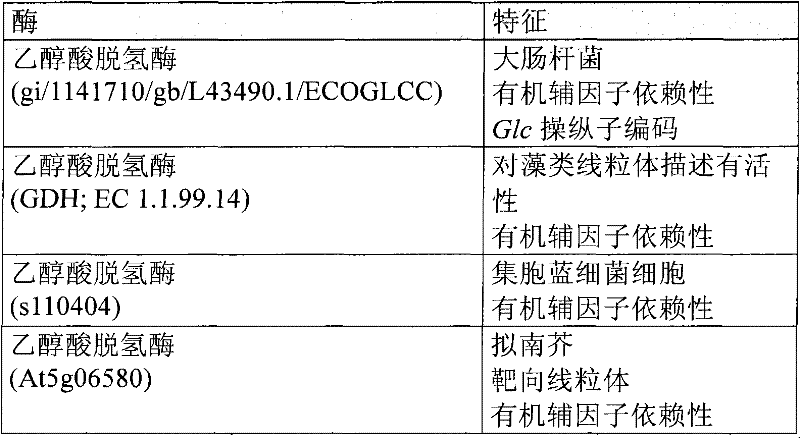
可从,例如任何来源,包括细菌、哺乳动物、藻类、真菌和植物来源的基因组DNA或cDNA文库中,分离得到编码具有乙醇酸脱氢酶活性的一种或多种多肽的核酸分子。或者,可借助重组DNA技术(例如,PCR)或化学合成产生它们。可采用已知的乙醇酸脱氢酶核酸分子的序列或那些序列的一部分,或视情况采用这些分子的反向互补链(例如,通过标准方法杂交,参见,例如Sambrook等,1989)来鉴定和分离此类核酸分子。Nucleic acid molecules encoding one or more polypeptides having glycolate dehydrogenase activity can be isolated, for example, from genomic DNA or cDNA libraries from any source, including bacterial, mammalian, algal, fungal, and plant sources. Alternatively, they can be produced by means of recombinant DNA techniques (eg, PCR) or chemical synthesis. The sequences of known glycolate dehydrogenase nucleic acid molecules, or portions of those sequences, or, where appropriate, the reverse complements of these molecules (e.g., hybridization by standard methods, see, e.g., Sambrook et al., 1989) can be used to identify and Such nucleic acid molecules are isolated.
对于本发明目的,所述乙醇酸脱氢酶可以是任何天然产生的乙醇酸脱氢酶或其任何活性片段或其任何变体,所述片段或变体中的一些氨基酸(优选1-20个,更优选1-10个,甚至更优选1-5个氨基酸)可被替代、添加或删除,而该酶仍保留了乙醇酸脱氢酶活性。For the purposes of the present invention, the glycolate dehydrogenase may be any naturally occurring glycolate dehydrogenase or any active fragment thereof or any variant thereof, some amino acids (preferably 1-20 amino acids) in said fragment or variant , more preferably 1-10, even more preferably 1-5 amino acids) can be substituted, added or deleted while the enzyme still retains glycolate dehydrogenase activity.
根据本发明,乙醇酸脱氢酶可以是嵌合型乙醇酸脱氢酶。术语“嵌合型乙醇酸脱氢酶”指通过组合各种来源的酶的一部分,例如第一种酶的N-末端部分与第二种酶的C-末端部分获得的乙醇酸脱氢酶,从而得到新的功能性嵌合型乙醇酸脱氢酶,其中各部分根据其特定特性而选择。例如,可制备功能性嵌合型乙醇酸脱氢酶以组合第一种乙醇酸脱氢酶的有效活性位点与第二种乙醇酸脱氢酶提供的在水稻中的良好稳定性。According to the present invention, the glycolate dehydrogenase may be a chimeric glycolate dehydrogenase. The term "chimeric glycolate dehydrogenase" refers to a glycolate dehydrogenase obtained by combining parts of enzymes from various sources, for example, an N-terminal part of a first enzyme with a C-terminal part of a second enzyme, The result is a novel functional chimeric glycolate dehydrogenase in which each part is selected for its specific properties. For example, a functional chimeric glycolate dehydrogenase can be prepared to combine the efficient active site of the first glycolate dehydrogenase with the good stability in rice provided by the second glycolate dehydrogenase.
根据本发明,“核酸”或“核酸分子”应理解为是多聚核苷酸分子,可以是DNA或RNA类型,优选DNA类型,特别是双链核酸。其可以是天然或合成来源。可在体外产生合成核酸。此类合成核酸的例子是其中编码具有乙醇酸脱氢酶活性的一种或多种多肽的密码子按照表达宿主生物作了优化(例如,与原始宿主相比,利用此类宿主生物的密码子选择表中或此类宿主生物所属种群中更偏爱或最偏爱的那些密码子作密码子替换)的那些核酸。技术人员熟知密码子优化的方法。According to the invention, "nucleic acid" or "nucleic acid molecule" is understood to be a polynucleotide molecule, which may be of the DNA or RNA type, preferably of the DNA type, in particular double-stranded nucleic acid. It can be of natural or synthetic origin. Synthetic nucleic acids can be produced in vitro. An example of such a synthetic nucleic acid is one in which the codons encoding one or more polypeptides having glycolate dehydrogenase activity are optimized according to the host organism of expression (e.g., using codons from such host organisms as compared to the original host) Those nucleic acids for which codon substitutions are selected for codon substitution are those codons which are more or most preferred in the table or in the population to which such host organism belongs. Methods of codon optimization are well known to the skilled person.
可采用一种或多种多肽获得本发明方法涉及的乙醇酸脱氢酶活性。所述活性获自一种以上多肽时,可用一个质粒构建物或几个独立构建物将编码所述多肽的核酸转移入植物细胞内。Glycolate dehydrogenase activity contemplated by the methods of the invention may be obtained using one or more polypeptides. When the activity is obtained from more than one polypeptide, a single plasmid construct or several separate constructs can be used to transfer the nucleic acid encoding the polypeptide into plant cells.
具有乙醇酸脱氢酶活性的优选多肽是大肠杆菌glc操纵子(gi/1141710/gb/L43490.1/ECOGLCC)编码的那些多肽。最优选包含SEQ IDNO:2(Glc D)、4(Glc E)和6(Glc F)所示氨基酸序列的多肽。因此,可采用包含SEQ ID NO:1、3和5所示多核苷酸序列的核酸来实施本发明。Preferred polypeptides having glycolate dehydrogenase activity are those encoded by the E. coli glc operon (gi/1141710/gb/L43490.1/ECOGLCC). Most preferably, the polypeptide comprising the amino acid sequence shown in SEQ ID NO: 2 (Glc D), 4 (Glc E) and 6 (Glc F). Therefore, the present invention can be implemented by using a nucleic acid comprising the polynucleotide sequence shown in SEQ ID NO: 1, 3 and 5.
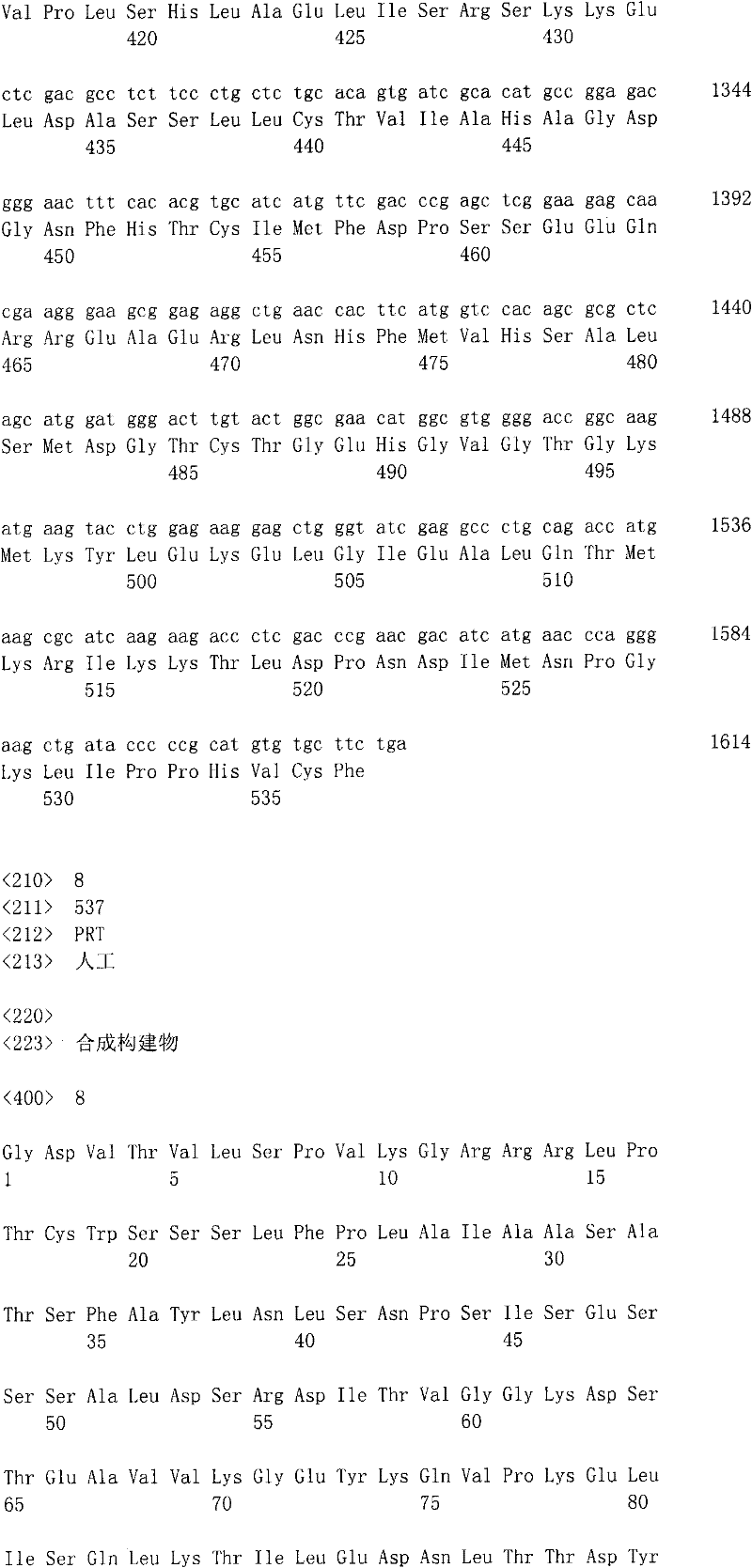
或者,可采用具有乙醇酸脱氢酶活性衍生自拟南芥或其它高等植物来源的一种或多种多肽。优选的拟南芥多肽包含SEQ ID NO:8所示氨基酸序列,由包含SEQ ID NO:7所示多核苷酸序列的核酸编码。可采用包含SEQ ID NO:7所示多核苷酸序列的核酸来实施本发明。Alternatively, one or more polypeptides derived from Arabidopsis or other higher plant sources having glycolate dehydrogenase activity may be used. A preferred Arabidopsis polypeptide comprises the amino acid sequence shown in SEQ ID NO: 8, encoded by a nucleic acid comprising the polynucleotide sequence shown in SEQ ID NO: 7. The present invention can be implemented by using a nucleic acid comprising the polynucleotide sequence shown in SEQ ID NO:7.
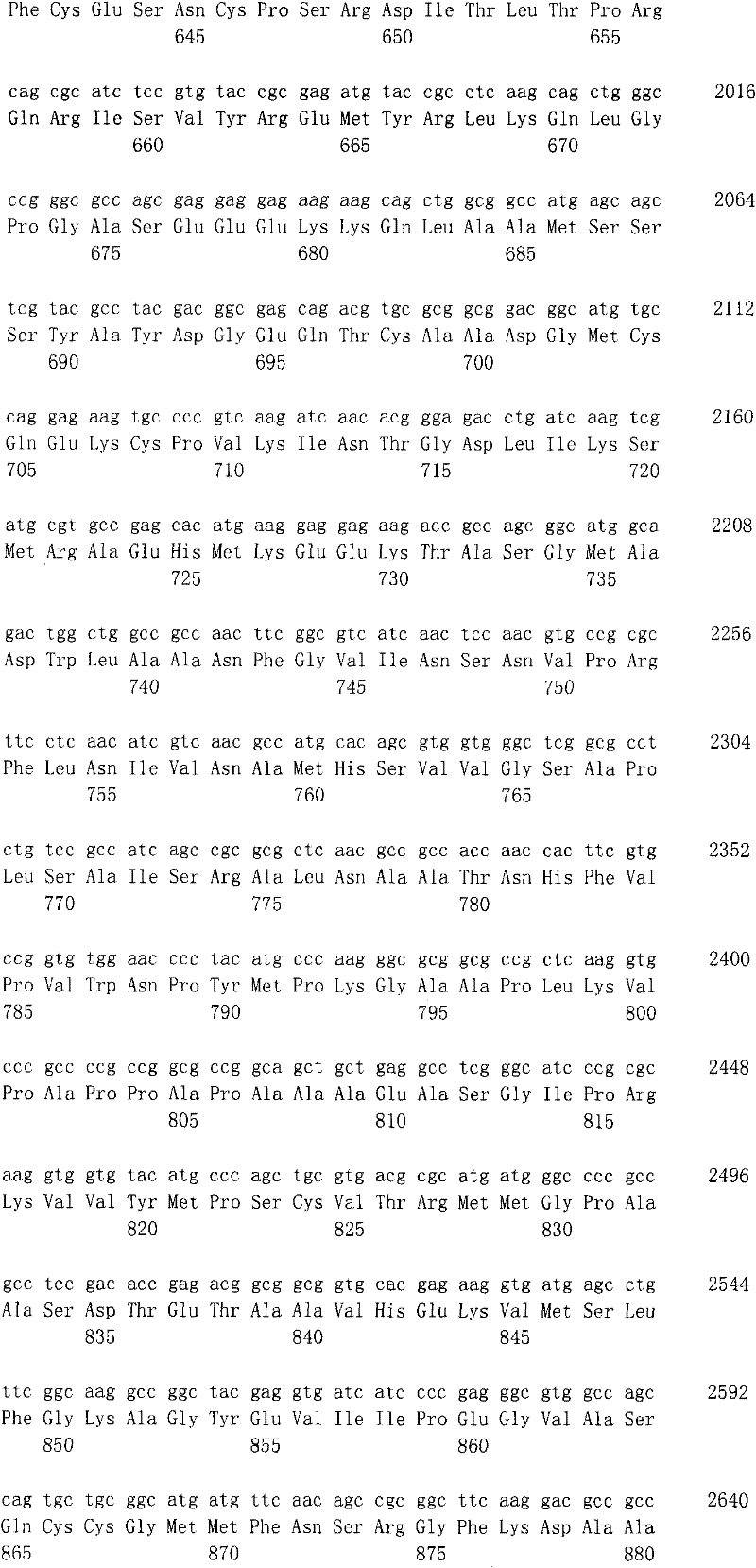
或者,可采用具有乙醇酸脱氢酶活性衍生自藻类,特别是衣藻属(Chlamydomonas)或集胞蓝细菌(Synechocystis)的一种或多种多肽(Eisenhut等.,2006)。优选的衣藻属多肽包含SEQ ID NO 12所示氨基酸序列,由包含SEQ ID NO 11所示多核苷酸序列的核酸编码。因此,可采用包含SEQ ID NO:11所示多核苷酸序列的核酸来实施本发明。优选的集胞蓝细菌多肽包含SEQID NO 16所示氨基酸序列,由包含SEQ ID NO 15所示多核苷酸序列的核酸编码。因此,可采用包含SEQ ID NO:15所示多核苷酸序列的核酸来实施本发明。Alternatively, one or more polypeptides derived from algae, in particular Chlamydomonas or Synechocystis, having glycolate dehydrogenase activity may be used (Eisenhut et al., 2006). A preferred Chlamydomonas polypeptide comprises the amino acid sequence shown in SEQ ID NO 12, encoded by a nucleic acid comprising the polynucleotide sequence shown in SEQ ID NO 11. Therefore, the present invention can be implemented by using a nucleic acid comprising the polynucleotide sequence shown in SEQ ID NO: 11. A preferred Synechocystis polypeptide comprises the amino acid sequence shown in SEQ ID NO 16, encoded by a nucleic acid comprising the polynucleotide sequence shown in SEQ ID NO 15. Therefore, the present invention can be implemented by using a nucleic acid comprising the polynucleotide sequence shown in SEQ ID NO:15.
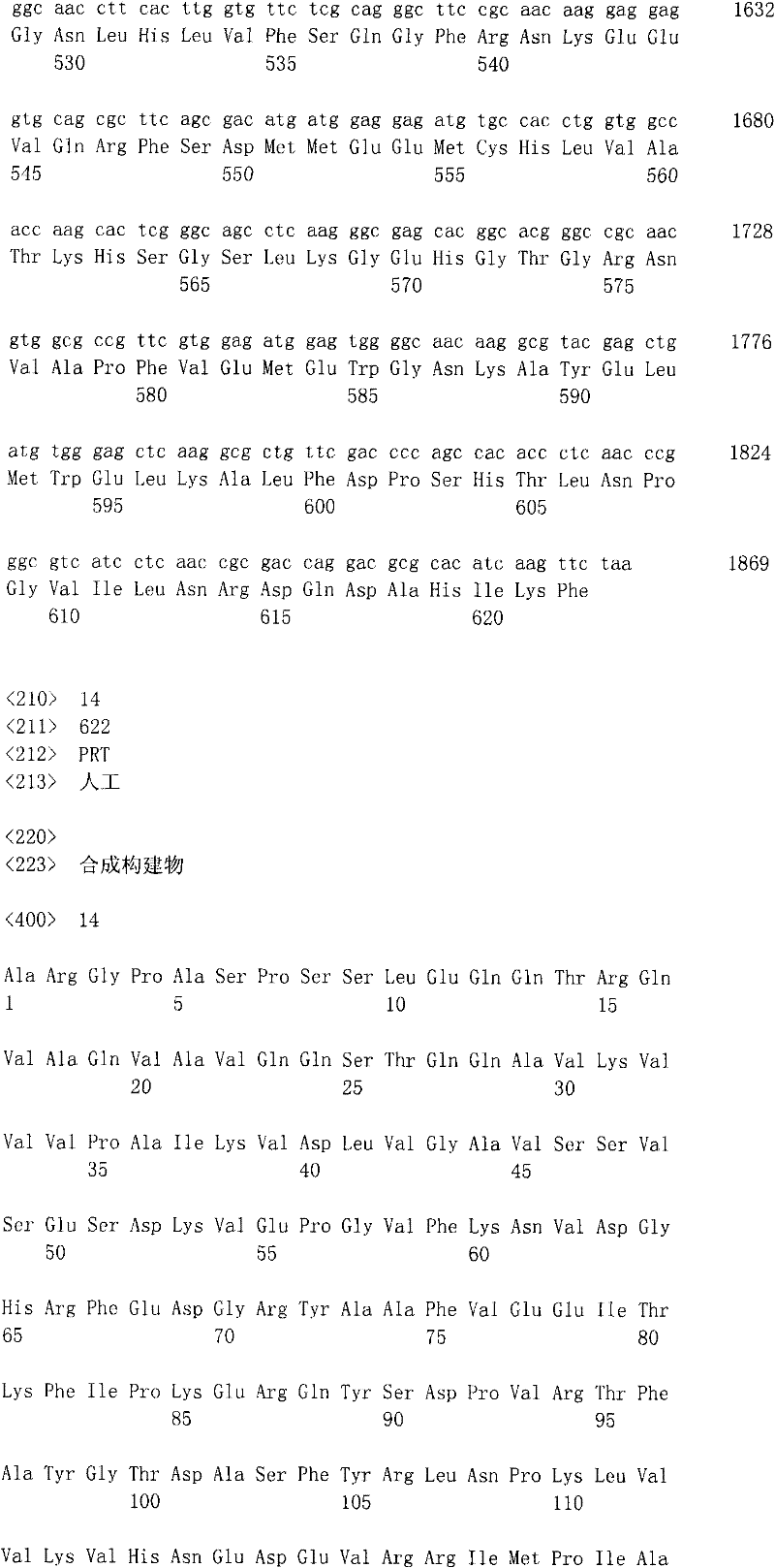
在本发明的另一实施方式中,可采用保留了乙醇酸脱氢酶活性的截短多肽。优选的衣藻属多肽包含SEQ ID NO 14所示氨基酸序列,由包含SEQ IDNO 13所示多核苷酸序列的核酸编码。因此,可采用包含SEQ ID NO:13所示多核苷酸序列的核酸来实施本发明。In another embodiment of the invention, truncated polypeptides that retain glycolate dehydrogenase activity may be used. A preferred Chlamydomonas polypeptide comprises the amino acid sequence shown in SEQ ID NO 14, encoded by a nucleic acid comprising the polynucleotide sequence shown in SEQ ID NO 13. Therefore, the present invention can be implemented using a nucleic acid comprising the polynucleotide sequence shown in SEQ ID NO: 13.
由于氨基酸序列中可能发生一些改变而不实质性改变乙醇酸脱氢酶的酶活性,可采用包含与SEQ ID NO:2、4和6,或SEQ ID NO:8或SEQ ID NO:10或SEQ ID NO:12或SEQ ID NO:14或SEQ ID NO:16基本上相似的氨基酸序列的任何蛋白质来实施本发明,其中低于20个,优选低于10个、更优选1-5个氨基酸可被其它氨基酸替换而不实质性影响乙醇酸脱氢酶活性。Since some changes may occur in the amino acid sequence without substantially changing the enzymatic activity of glycolate dehydrogenase, the enzyme activity comprising SEQ ID NO: 2, 4 and 6, or SEQ ID NO: 8 or SEQ ID NO: 10 or SEQ ID NO: 10 or SEQ ID NO: 12 or SEQ ID NO: 14 or SEQ ID NO: 16 substantially similar amino acid sequence of any protein to practice the present invention, wherein less than 20, preferably less than 10, more preferably 1-5 amino acids can be Substitution by other amino acids does not substantially affect glycolate dehydrogenase activity.
本发明方法包括将编码具有乙醇酸脱氢酶活性的一种或多种多肽的一种或多种核酸引入水稻植物细胞的基因组中,在氨基酸序列水平上所述的一种或多种多肽包含与SEQ ID NO:2、4和6,或SEQ ID NO:8或SEQ ID NO:10或SEQ ID NO:12或SEQ ID NO:14或SEQ ID NO:16至少有60、70、80或90%,特别是至少有95%、97%、98%或至少有99%序列相同性的序列,引入的所述一种或多种核酸可导致从头表达具有乙醇酸脱氢酶活性的至少一种多肽,所述活性位于叶绿体内。The method of the present invention comprises introducing one or more nucleic acids encoding one or more polypeptides having glycolate dehydrogenase activity into the genome of a rice plant cell, the one or more polypeptides comprising at the amino acid sequence level At least 60, 70, 80 or 90 with SEQ ID NO: 2, 4 and 6, or SEQ ID NO: 8 or SEQ ID NO: 10 or SEQ ID NO: 12 or SEQ ID NO: 14 or SEQ ID NO: 16 %, in particular at least 95%, 97%, 98% or at least 99% sequence identity, the one or more nucleic acids introduced can lead to de novo expression of at least one nucleic acid having glycolate dehydrogenase activity Polypeptides, said activity is located within the chloroplast.
本发明方法还包括将编码具有乙醇酸脱氢酶活性的一种或多种多肽的一种或多种核酸引入水稻植物细胞的基因组中,所述的一种或多种核酸包含与SEQ ID NO:1、3和5,或SEQ ID NO:7或SEQ ID NO:9或SEQ ID NO:11或SEQ ID NO:13或SEQ ID NO:15至少有60、70、80或90%,特别是至少有95%、97%、98%或至少有99%序列相同性的核酸序列,引入的所述一种或多种核酸可导致从头表达具有乙醇酸脱氢酶活性的至少一种多肽,所述活性位于叶绿体内。The method of the present invention also includes introducing one or more nucleic acids encoding one or more polypeptides having glycolic acid dehydrogenase activity into the genome of a rice plant cell, wherein the one or more nucleic acids comprise the same sequence as SEQ ID NO : 1, 3 and 5, or at least 60, 70, 80 or 90% of SEQ ID NO: 7 or SEQ ID NO: 9 or SEQ ID NO: 11 or SEQ ID NO: 13 or SEQ ID NO: 15, especially Nucleic acid sequences having at least 95%, 97%, 98%, or at least 99% sequence identity, the one or more nucleic acids introduced result in de novo expression of at least one polypeptide having glycolate dehydrogenase activity, so The above activities are located in the chloroplast.
对于本发明的目的,以百分数表示的两条相关核苷酸或氨基酸序列的“序列相同性”指两条最佳比对序列中具有相同残基的位置数(x100)除以所比较的位置数。空位,即某残基在一条序列中存在而在另一条中不存在的比对位置视作具有不相同残基的位置。可通过EMBOSS(Rice等.,2000)中的Needleman和Wunsch算法(Needleman和Wunsch 1970),利用默认设置(空位开放罚分10,空位延伸罚分0.5)进行两条序列的比对以在序列的全长上找出最佳比对。For the purposes of the present invention, "sequence identity" of two related nucleotide or amino acid sequences, expressed as a percentage, refers to the number of positions (x100) with identical residues in the two optimally aligned sequences divided by the positions being compared number. Gaps, i.e. aligned positions where a residue is present in one sequence but absent in the other, are considered positions with non-identical residues. Alignment of two sequences can be performed by the Needleman and Wunsch algorithm (Needleman and Wunsch 1970) in EMBOSS (Rice et al., 2000) with the default settings (gap opening penalty 10, gap extension penalty 0.5) to identify the gap between the sequences. Find the best alignment over the full length.
一旦已知外源DNA的序列,可借助分子生物学技术开发能特异性识别核酸(DNA或RNA)样品中这些序列的引物和探针。例如,可开发PCR方法来鉴定生物学样品(例如,植物、植物材料或包含植物材料的产品)中可用于本发明方法的基因(gdh基因)。此类PCR依据至少两种特异性“引物”,例如二者均能识别本发明所用gdh编码区(例如,SEQ ID No.1、3、5、7、9、11、13或15所示编码区)中的序列,或者一种识别gdh编码区内的序列,另一种识别相关转运肽序列内或调控区内的序列,例如包含本发明所用DNA的嵌合型基因的启动子或3’末端。所述引物优选含有15-35个核苷酸的序列,在最优PCR条件下能特异性识别本发明所用gdh嵌合基因内的序列,从而扩增含有本发明所用gdh基因的核酸样品中的特异性片段(“整合片段”或差别扩增子)。这意味在最优PCR条件下只扩增植物基因组或外源DNA中的靶向整合片段,而不扩增其它序列。Once the sequences of exogenous DNA are known, primers and probes that can specifically recognize these sequences in nucleic acid (DNA or RNA) samples can be developed by means of molecular biology techniques. For example, PCR methods can be developed to identify genes (gdh genes) in biological samples (eg, plants, plant material or products comprising plant material) that can be used in the methods of the invention. Such PCR is based on at least two specific "primers", for example, both of which can recognize the gdh coding region used in the present invention (for example, the coding region shown in SEQ ID No. 1, 3, 5, 7, 9, 11, 13 or 15 region), or one recognizes the sequence in the gdh coding region, and the other recognizes the sequence in the relevant transit peptide sequence or in the regulatory region, such as the promoter or 3' of the chimeric gene comprising the DNA used in the present invention end. The primer preferably contains a sequence of 15-35 nucleotides, and can specifically recognize the sequence in the gdh chimeric gene used in the present invention under optimal PCR conditions, thereby amplifying the sequence in the nucleic acid sample containing the gdh gene used in the present invention. Specific fragments ("integrated fragments" or differential amplicons). This means that only targeted integration fragments in the plant genome or foreign DNA are amplified under optimal PCR conditions, and other sequences are not amplified.
本发明方法还包括将编码具有乙醇酸脱氢酶活性的一种或多种多肽的一种或多种核酸引入水稻植物细胞的基因组中,所述的一种或多种核酸包含能在严谨条件下与选自下组的核苷酸序列杂交的一种或多种核酸:SEQ ID NO 1、3和5、SEQ ID NO 7、SEQ ID NO 9、SEQ ID NO 11、SEQ ID NO 13和SEQID NO 15,引入所述的一种或多种核酸可导致从头表达至少一种具有乙醇酸脱氢酶活性的多肽,所述活性位于叶绿体内。本文所用的严谨性杂交条件具体指以下条件:将相关DNA序列固定在滤膜上,42℃将该滤膜在50%甲酰胺、5%SSPE、2x Denhardt试剂和0.1%SDS中,或68℃在6x SSC、2xDenhardt试剂和0.1%SDS中预杂交1-2小时。然后将变性的地高辛-或放射性标记探针直接加入预杂交液体,在上述合适温度下培育16-24小时。培育后,室温用2x SSC,0.1%SDS洗涤膜30分钟,然后68℃用0.5x SSC和0.1%SDS进行各30分钟的两次洗涤。-70℃,用增感屏使膜暴露于X-射线胶片(Kodak XAR-2或等效物)24-48小时。该方法当然可采用等价条件和参数,而仍能维持所需的严谨性杂交条件。The method of the present invention also includes introducing one or more nucleic acids encoding one or more polypeptides having glycolate dehydrogenase activity into the genome of rice plant cells, the one or more nucleic acids comprising One or more nucleic acids that hybridize to a nucleotide sequence selected from the group consisting of SEQ ID NO 1, 3 and 5, SEQ ID NO 7, SEQ ID NO 9, SEQ ID NO 11, SEQ ID NO 13 and SEQ ID NO 15, the introduction of said one or more nucleic acids can lead to the de novo expression of at least one polypeptide having glycolate dehydrogenase activity, said activity being located in the chloroplast. The stringent hybridization conditions used herein specifically refer to the following conditions: immobilize the relevant DNA sequence on the filter membrane, and place the filter membrane in 50% formamide, 5% SSPE, 2x Denhardt reagent and 0.1% SDS at 42°C, or 68°C Prehybridize in 6x SSC, 2x Denhardt reagent and 0.1% SDS for 1-2 hours. Denatured Digoxigenin- or radiolabeled probes are then added directly to the prehybridization fluid and incubated for 16-24 hours at the appropriate temperature mentioned above. After incubation, the membrane was washed with 2x SSC, 0.1% SDS for 30 minutes at room temperature, followed by two washes of 30 minutes each with 0.5x SSC and 0.1% SDS at 68°C. Expose the film to X-ray film (Kodak XAR-2 or equivalent) for 24-48 hours at -70°C using an intensifying screen. The method can of course employ equivalent conditions and parameters while still maintaining the desired stringent hybridization conditions.
该本文中通篇使用的术语“包含”某序列X的DNA或蛋白质,指至少包含或含有序列X的DNA或蛋白质,而其它核苷酸或氨基酸序列,例如编码可选择标记蛋白的核苷酸序列、编码转运肽的核苷酸序列、和/或5′前导序列或3′尾随序列可包含在5’(或N-末端)和/或3’(或C-末端)端。类似地,本申请文本和权利要求书中通篇使用的术语“包含”或“含有”应理解为暗示包括所述整数或步骤或整数或步骤的组合,但不排除任何其它整数或步骤或整数或步骤的组合。The term "comprising" a DNA or protein of sequence X as used throughout the text refers to a DNA or protein comprising or containing at least sequence X, while other nucleotide or amino acid sequences, such as nucleotides encoding selectable marker proteins Sequences, nucleotide sequences encoding transit peptides, and/or 5' leader sequences or 3' trailer sequences may be included at the 5' (or N-terminal) and/or 3' (or C-terminal) ends. Similarly, the terms "comprising" or "comprising" used throughout the text of this application and the claims should be understood to imply the inclusion of stated integers or steps or combinations of integers or steps, but not the exclusion of any other integers or steps or integers or a combination of steps.
本发明方法包括在叶绿体内产生乙醇酸脱氢酶活性。这可通过以下方式实现:将编码乙醇酸脱氢酶活性的一种或多种核酸引入植物细胞的核基因组,然后将该蛋白的一种或多种编码序列与编码叶绿体转运肽的核酸融合。或者,可用编码相应酶的一种或多种核酸直接转化叶绿体基因组而在叶绿体中产生乙醇酸脱氢酶活性。The methods of the invention involve producing glycolate dehydrogenase activity within a chloroplast. This can be achieved by introducing into the nuclear genome of the plant cell one or more nucleic acids encoding glycolate dehydrogenase activity and then fusing the one or more coding sequences for the protein to nucleic acid encoding a chloroplast transit peptide. Alternatively, glycolate dehydrogenase activity can be produced in chloroplasts by direct transformation of the chloroplast genome with one or more nucleic acids encoding the corresponding enzymes.
本领域熟知转化植物细胞或植物组织,特别是水稻植物细胞的通用技术。一系列方法包括用附着有DNA序列的颗粒轰击细胞、原生质体或组织。另一系列方法包括利用插入根癌土壤杆菌(Agrobacterium tumefaciens)Ti质粒或发根土壤杆菌(Agrobacterium rhizogenes)Ri质粒中的嵌合基因作为转运入植物的工具。可采用其它方法,例如显微注射或电穿孔或直接用PEG沉淀。技术人员可选择任何合适的方法和工具转化植物细胞或植物,特别是水稻植物细胞或植物。对于水稻,优选实施土壤杆菌介导的转化(Hiei等.,1994和Hiei等.,1997,通过引用纳入本文)、电穿孔(美国专利5,641,664和美国专利5,679,558,通过引用纳入本文)或轰击(Christou等.,1991,通过引用纳入本文)。转化单子叶植物,特别是水稻的合适技术可参见通过引用纳入本文的WO 92/09696中的描述。General techniques for transforming plant cells or plant tissues, particularly rice plant cells, are well known in the art. A range of methods include bombarding cells, protoplasts or tissues with particles to which DNA sequences are attached. Another series of approaches involves the use of chimeric genes inserted into the Agrobacterium tumefaciens Ti plasmid or the Agrobacterium rhizogenes Ri plasmid as a means of delivery into plants. Other methods such as microinjection or electroporation or direct precipitation with PEG can be used. A skilled artisan may choose any suitable methods and tools for transforming plant cells or plants, especially rice plant cells or plants. For rice, Agrobacterium-mediated transformation (Hiei et al., 1994 and Hiei et al., 1997, incorporated herein by reference), electroporation (US Patent 5,641,664 and US Patent 5,679,558, incorporated herein by reference) or bombardment (Christou et al., 1991, incorporated herein by reference). Suitable techniques for transforming monocots, particularly rice, are described in WO 92/09696, incorporated herein by reference.
为在植物细胞中表达编码具有本发明所需酶活性的一种或多种多肽的一种或多种核酸,可采用任何方便的调控序列。这种调控序列将提供转录和翻译起始以及终止区,所述转录启动可以是组成型或诱导型启动。将编码区操作性连接于此类调控序列。合适的调控序列的代表是组成型35S启动子。或者,可采用组成型泛素启动子,特别是玉米泛素启动子(GenBank:gi19700915)。诱导型启动子的例子有RUBISCO小亚基的光诱导型启动子和“光捕获叶绿素复合体结合蛋白(lhcb)”的启动子。优选采用水稻gos2基因的启动子区,包括GOS2基因的5’UTR和内含子(de Pater等.,1992)、水稻核酮糖-1,5-二磷酸羧化酶小亚基基因的启动子区(Kyozuka J.等.,1993)或水稻肌动蛋白1基因的启动子区(McElroy D.等.,1990)。For expression in a plant cell of one or more nucleic acids encoding one or more polypeptides having the desired enzymatic activity of the invention, any convenient regulatory sequence may be employed. Such regulatory sequences will provide transcriptional and translational initiation and termination regions, which may be constitutive or inducible. The coding region is operably linked to such regulatory sequences. Representative of a suitable regulatory sequence is the constitutive 35S promoter. Alternatively, a constitutive ubiquitin promoter may be used, particularly the maize ubiquitin promoter (GenBank: gi19700915). Examples of inducible promoters are the light-inducible promoter of RUBISCO small subunit and the promoter of "light-harvesting chlorophyll complex binding protein (lhcb)". Preferably adopt the promoter region of rice gos2 gene, comprise the 5'UTR of GOS2 gene and intron (de Pater etc., 1992), the initiation of rice ribulose-1,5-bisphosphate carboxylase small subunit gene subregion (Kyozuka J. et al., 1993) or the promoter region of rice actin 1 gene (McElroy D. et al., 1990).
根据本发明,该启动子还可联用位于启动子与编码序列之间的其它调控序列,例如转录激活子(“增强子”),例如专利申请WO 87/07644所述的烟草花叶病毒(TMV)或Carrington和Freed 1990所述的烟草蚀纹病毒(TEV)的翻译激活子,或内含子,例如玉米的adh1内含子或水稻肌动蛋白的内含子1。According to the invention, the promoter can also be used in combination with other regulatory sequences located between the promoter and the coding sequence, such as transcriptional activators ("enhancers"), such as the tobacco mosaic virus described in patent application WO 87/07644 ( TMV) or the translation activator of tobacco etch virus (TEV) described by Carrington and Freed 1990, or an intron such as the adh1 intron of maize or the intron 1 of rice actin.
作为调控终止子或聚腺苷酸化序列,可采用细菌来源的任何相应序列,例如根癌土壤杆菌的nos终止子,病毒来源的任何相应序列,例如CaMV 35S启动子,或植物来源的任何相应序列,例如组蛋白终止子,见专利申请EP 0 633317所述。As regulatory terminator or polyadenylation sequence, any corresponding sequence of bacterial origin, such as the nos terminator of Agrobacterium tumefaciens, any corresponding sequence of viral origin, such as the CaMV 35S promoter, or any corresponding sequence of plant origin can be used , such as histone terminators, as described in patent application EP 0 633 317.
在优选转化核基因组的本发明的一个具体实施方式中,将编码叶绿体转运蛋白的核酸与编码乙醇酸脱氢酶的核酸序列5’端(融合),该转运肽序列位于启动子区域与编码乙醇酸脱氢酶的核酸之间,从而允许转运肽/乙醇酸脱氢酶融合蛋白表达。该转运肽能将乙醇酸脱氢酶引入质体中,更具体地说叶绿体中,当乙醇酸脱氢酶进入质体时,该融合蛋白在转运肽与乙醇酸脱氢酶之间被切断。转运肽可以是一种肽,例如EPSPS转运肽(描述见美国专利5,188,642)或植物核酮糖双羧化酶/加氧酶小亚基(RuBisCO ssu)的转运肽,例如衍生自马铃薯(Solanum tuberosum)的核酮糖-1,5-二磷酸羧化酶基因的叶绿体转运肽(GenBank:G68077,氨基酸1-58),如果需要,可包括成熟RuBisCO ssu的N-末端部分几个氨基酸(EP 189707),或者马铃薯rbcS1基因的叶绿体靶向肽(gi21562)。转运肽可以是完全天然产生(野生型)的转运肽,其功能片段、其功能突变体。也可以是嵌合型转运肽,其中至少两种转运肽以功能方式彼此连接或者不同转运肽的一部分以功能方式彼此连接。此类嵌合型转运肽的一个例子包括与玉米RuBisCO ssu的N-末端部分融合,与玉米RuBisCO ssu的转运肽融合的葵花籽RuBisCO ssu的转运肽,如专利EP 508909所述。In a specific embodiment of the invention in which the nuclear genome is preferably transformed, the nucleic acid encoding the chloroplast transporter is 5' (fused) to the nucleic acid sequence encoding glycolate dehydrogenase, the transit peptide sequence being located in the promoter region and encoding ethanol acid dehydrogenase nucleic acid, thereby allowing expression of the transit peptide/glycolate dehydrogenase fusion protein. The transit peptide can introduce glycolate dehydrogenase into the plastid, more specifically, the chloroplast, and when the glycolate dehydrogenase enters the plastid, the fusion protein is cut between the transit peptide and the glycolate dehydrogenase. The transit peptide may be a peptide such as the EPSPS transit peptide (described in U.S. Patent 5,188,642) or the transit peptide of the plant ribulose dicarboxylase/oxygenase small subunit (RuBisCO ssu), such as that derived from potato (Solanum tuberosum ) of the ribulose-1,5-bisphosphate carboxylase gene (GenBank: G68077, amino acids 1-58), including a few amino acids from the N-terminal portion of the mature RuBisCO ssu if desired (EP 189707 ), or the chloroplast-targeting peptide (gi21562) of the potato rbcS1 gene. The transit peptide may be a completely naturally occurring (wild type) transit peptide, a functional fragment thereof, or a functional mutant thereof. Also possible are chimeric transit peptides, wherein at least two transit peptides are functionally linked to each other or parts of different transit peptides are functionally linked to each other. An example of such a chimeric transit peptide includes the transit peptide of sunflower RuBisCO ssu fused to the N-terminal part of maize RuBisCO ssu, fused to the transit peptide of maize RuBisCO ssu, as described in patent EP 508909.
本领域技术人员能构建适合实施本发明的核酸,其包含编码成熟(即,不含转运肽)乙醇酸羟化酶的核酸,为在水稻中表达作了优化或未作优化,其中可缺失或不缺失第一个ATG密码子(如果有的话),将其操作性连接于叶绿体转运肽。适合实施本发明的此类核酸的一个例子是为在水稻中表达而优化的操作性连接于编码嵌合型叶绿体转运肽序列的拟南芥乙醇酸脱氢酶DNA序列,如SEQ ID NO 9所述。Those skilled in the art will be able to construct nucleic acids suitable for practicing the invention comprising nucleic acid encoding a mature (i.e., no transit peptide) glycolate hydroxylase, optimized for expression in rice, or not, wherein either deletions or Without deleting the first ATG codon (if any), it was operably linked to the chloroplast transit peptide. An example of such a nucleic acid suitable for practicing the invention is the Arabidopsis glycolate dehydrogenase DNA sequence optimized for expression in rice operably linked to a sequence encoding a chimeric chloroplast transit peptide, as set forth in SEQ ID NO 9 stated.
或者,可采用转化叶绿体基因组在叶绿体中直接表达所述多肽。将感兴趣核酸整合入叶绿体基因组中的方法是本领域熟知的,特别是基于同源重组机制的方法。本领域技术人员知道合适的载体和选择系统。可将多肽的编码序列转移入单个载体中或一个构建物中,可将各开放读框融合于一个或几个聚顺反子RNA,其中在各个开放读框之前加入核糖体结合位点以便独立释放。可用于此类整合入叶绿体基因组的工具和方法的例子见,例如WO 06/108830,其内容通过应用纳入本文。Alternatively, the polypeptide can be expressed directly in the chloroplast using transformed chloroplast genomes. Methods for integrating a nucleic acid of interest into the chloroplast genome are well known in the art, especially methods based on the mechanism of homologous recombination. Suitable vectors and selection systems are known to those skilled in the art. The coding sequence for the polypeptide can be transferred into a single vector or into a construct in which each open reading frame can be fused to one or several polycistronic RNAs, where a ribosome binding site is added in front of each open reading frame for independent freed. Examples of tools and methods that can be used for such integration into the chloroplast genome are found in, eg, WO 06/108830, the contents of which are incorporated herein by application.
当将核酸直接整合入叶绿体基因组时,不需要转运肽序列。在该情况中,可将(Met)翻译起始密码子加入到编码成熟蛋白质的序列以确保启动翻译。When integrating the nucleic acid directly into the chloroplast genome, no transit peptide sequence is required. In this case, a (Met) translation initiation codon can be added to the sequence encoding the mature protein to ensure initiation of translation.
本发明的主题还有包含一种或多种核酸的水稻植物细胞、水稻植物组织或水稻植物,所述一种或多种核酸在叶绿体内可表达具有乙醇酸脱氢酶活性的一种或多种多肽。A subject of the present invention is also a rice plant cell, a rice plant tissue or a rice plant comprising one or more nucleic acids capable of expressing in the chloroplast one or more genes having glycolate dehydrogenase activity. a polypeptide.
将核酸引入水稻植物细胞、水稻植物组织或水稻植物的优选实施方式如上所述。Preferred embodiments for introducing nucleic acid into rice plant cells, rice plant tissues or rice plants are as described above.
按照本发明,水稻植物细胞应理解成源自或在水稻植物中发现的任何细胞,其能形成未分化组织如胼胝体,分化组织如胚芽、植物的各部分、植物或种子,或是它们的一部分。According to the present invention, a rice plant cell is understood to be any cell derived from or found in a rice plant, which is capable of forming undifferentiated tissues such as callus, differentiated tissues such as germs, plant parts, plants or seeds, or parts thereof .
本发明还涉及含有转化细胞的水稻植物,特别是转化细胞再生的植物。可通过任何合适的方法获得再生。可引用以下专利和专利申请,特别是关于转化植物细胞和再生植物的方法:US 4,459,355、US 4,536,475、US 5,464,763、US 5,177,010、US 5,187,073、EP 267,159、EP 604662、EP 672752、US4,945,050、US 5,036,006、US 5,100,792、US 5,371,014、US 5,478,744、US5,179,022、US 5,565,346、US 5,484,956、US 5,508,468、US 5,538,877、US5,554,798、US 5,489,520、US 5,510,318、US 5,204,253、US 5,405,765、EP442174、EP 486233、EP 486234、EP 539563、EP 674725、WO 91/02071和WO 95/06128。The present invention also relates to rice plants containing transformed cells, especially plants regenerated from transformed cells. Regeneration can be achieved by any suitable method. The following patents and patent applications may be cited, especially with respect to methods of transforming plant cells and regenerating plants: US 4,459,355, US 4,536,475, US 5,464,763, US 5,177,010, US 5,187,073, EP 267,159, EP 604662, EP 672752, US 4,945,050, US 5,066 、US 5,100,792、US 5,371,014、US 5,478,744、US5,179,022、US 5,565,346、US 5,484,956、US 5,508,468、US 5,538,877、US5,554,798、US 5,489,520、US 5,510,318、US 5,204,253、US 5,405,765、EP442174、EP 486233、EP 486234、 EP 539563, EP 674725, WO 91/02071 and WO 95/06128.
本发明还涉及通过培养和/或杂交上述再生植物产生的转化植物或其一部分,还涉及转化植物的种子,其特征是它们含有本发明的转化植物细胞。The present invention also relates to transformed plants or parts thereof produced by culturing and/or crossing the above-mentioned regenerated plants, and also to seeds of transformed plants, characterized in that they contain the transformed plant cells of the present invention.
本发明还涉及通过加工本发明的植物、其各部分或种子所获得的任何产田,例粗粉。例如,本发明包括加工本发明水稻种子获得的水稻谷粒,还包括进一步加工水稻种子或水稻谷粒获得的粗粉以及从所述粗粉获得的任何食品。The invention also relates to any yield, eg meal, obtained by processing the plants, parts or seeds of the invention. For example, the present invention includes rice grains obtained by processing rice seeds of the present invention, meal obtained by further processing rice seeds or rice grains, and any food obtained from the meal.
序列表:Sequence listing:
SEQ ID NO 1:大肠杆菌gcl D的DNA序列SEQ ID NO 1: DNA sequence of Escherichia coli gcl D
SEQ ID NO 2:SEQ ID NO 1编码的氨基酸序列SEQ ID NO 2: amino acid sequence encoded by SEQ ID NO 1
SEQ ID NO 3:大肠杆菌gcl E的DNA序列SEQ ID NO 3: DNA sequence of Escherichia coli gcl E
SEQ ID NO 4:SEQ ID NO 3编码的氨基酸序列SEQ ID NO 4: amino acid sequence encoded by SEQ ID NO 3
SEQ ID NO 5:大肠杆菌gcl F的DNA序列SEQ ID NO 5: DNA sequence of Escherichia coli gcl F
SEQ ID NO 6:SEQ ID NO 5编码的氨基酸序列SEQ ID NO 6: amino acid sequence encoded by SEQ ID NO 5
SEQ ID NO 7:编码成熟(即,不含转运肽)拟南芥乙醇酸脱氢酶的DNA序列,为在水稻中表达作了优化SEQ ID NO 7: DNA sequence encoding mature (i.e., without transit peptide) Arabidopsis glycolate dehydrogenase, optimized for expression in rice
SEQ ID NO 8:SEQ ID NO 7编码的氨基酸序列SEQ ID NO 8: amino acid sequence encoded by SEQ ID NO 7
SEQ ID NO 9:优化的拟南芥乙醇酸脱氢酶DNA序列,操作性连接于编码优化叶绿体转运肽序列SEQ ID NO 9: Optimized Arabidopsis glycolate dehydrogenase DNA sequence operably linked to sequence encoding optimized chloroplast transit peptide
SEQ ID NO 10:SEQ ID NO 9编码的氨基酸序列SEQ ID NO 10: Amino acid sequence encoded by SEQ ID NO 9
SEQ ID NO 11:编码成熟(即,不含转运肽)衣藻属乙醇酸脱氢酶的DNA序列SEQ ID NO 11: DNA sequence encoding mature (i.e., without transit peptide) Chlamydomonas glycolate dehydrogenase
SEQ ID NO 12:SEQ ID NO 11编码的氨基酸序列SEQ ID NO 12: amino acid sequence encoded by SEQ ID NO 11
SEQ ID NO 13:编码截断的衣藻属乙醇酸脱氢酶的DNA序列SEQ ID NO 13: DNA sequence encoding a truncated Chlamydomonas glycolate dehydrogenase
SEQ ID NO 14:SEQ ID NO 13编码的氨基酸序列SEQ ID NO 14: amino acid sequence encoded by SEQ ID NO 13
SEQ ID NO 15:编码集胞蓝细菌乙醇酸脱氢酶的DNA序列SEQ ID NO 15: DNA sequence encoding Synechocystis glycolate dehydrogenase
SEQ ID NO 16:SEQ ID NO 15编码的氨基酸序列SEQ ID NO 16: Amino acid sequence encoded by SEQ ID NO 15
实施例Example
实施例1:构建编码大肠杆菌GDH的植物表达载体Example 1: Construction of a plant expression vector encoding Escherichia coli GDH
通过化学DNA合成获得大肠杆菌乙醇酸脱氢酶的glcD、glcE和glcF(gi/1141710/gb/L43490.1/ECOGLCC)亚基的编码序列。质粒pTTS84含有3个表达盒,编码这3个大肠杆菌GDH亚基。如de Pater等.(1992)所述,glcE由水稻gos2基因的启动子区域驱动,包括GOS2基因的5’UTR与内含子;如Kyozuka等.(1993)所述,glcF由水稻核酮糖-1,5-二磷酸羧化酶小亚基基因的启动子区域驱动;glcD由水稻肌动蛋白1基因的启动子区域驱动(McElroy等.,1990)。如EP 0508909所述,这三个大肠杆菌GDH亚基基因各含有优化的编码转运肽(OTP)叶绿体靶向序列的序列。质粒pTTS84包含含有p35S启动子和3’nos终止区的bar表达盒。The coding sequences of glcD, glcE and glcF (gi/1141710/gb/L43490.1/ECOGLCC) subunits of E. coli glycolate dehydrogenase were obtained by chemical DNA synthesis. Plasmid pTTS84 contains three expression cassettes encoding the three E. coli GDH subunits. As described by de Pater et al. (1992), glcE is driven by the promoter region of the rice gos2 gene, including the 5'UTR and intron of the GOS2 gene; as described by Kyozuka et al. - Driven by the promoter region of the 1,5-bisphosphate carboxylase small subunit gene; glcD is driven by the promoter region of the rice actin 1 gene (McElroy et al., 1990). Each of the three E. coli GDH subunit genes contains an optimized sequence encoding a transit peptide (OTP) chloroplast targeting sequence as described in EP 0508909. Plasmid pTTS84 contains the bar expression cassette containing the p35S promoter and 3'nos termination region.
实施例2:构建编码拟南芥GDH的植物表达载体Example 2: Construction of a plant expression vector encoding Arabidopsis GDH
通过化学DNA合成获得拟南芥(At5g06580)GDH编码区的编码序列。设计合成基因时,排除了推定线粒体靶向序列的编码序列,以OTP叶绿体靶向序列的编码序列替换。利用该合成基因制备了不同载体。在质粒pTTS86中,该基因由p35S启动子驱动,而在质粒pTTS87中,如Kyozuka等.(1993)所述,采用水稻核酮糖-1,5-二磷酸羧化酶小亚基基因的启动子区域,。这两种质粒均包含含有p35S启动子和3’nos终止区的bar表达盒。The coding sequence of the Arabidopsis (At5g06580) GDH coding region was obtained by chemical DNA synthesis. When designing the synthetic gene, the coding sequence of the putative mitochondrial targeting sequence was excluded and replaced with the coding sequence of the OTP chloroplast targeting sequence. Various vectors were prepared using this synthetic gene. In plasmid pTTS86 the gene is driven by the p35S promoter, while in plasmid pTTS87 the promoter of the rice ribulose-1,5-bisphosphate carboxylase small subunit gene is used as described by Kyozuka et al. (1993). subregion, . Both plasmids contain the bar expression cassette containing the p35S promoter and 3'nos termination region.
实施例3:植物转化和再生Example 3: Plant Transformation and Regeneration
受者土壤杆菌菌株ACH5C3(pGV4000)携带有删除了T-区域的不致癌(无害的)Ti质粒。该Ti质粒携带有使中间克隆载体的T-DNA区域转移至植物基因组所必需的功能vir基因。The recipient Agrobacterium strain ACH5C3 (pGV4000) carries a non-oncogenic (harmless) Ti plasmid with the T-region deleted. The Ti plasmid carries the necessary functional vir gene for transferring the T-DNA region of the intermediate cloning vector to the plant genome.
在大肠杆菌中构建中间克隆载体(例如,pTTS84、pTTS86、pTTS87)。通过热激将其转移至受者根癌土壤杆菌中。此中间克隆载体经土壤杆菌介导的基因转移可导致T-DNA边界重复序列之间的DNA片段转移至植物基因组。Intermediate cloning vectors (eg, pTTS84, pTTS86, pTTS87) were constructed in E. coli. It was transferred into recipient Agrobacterium tumefaciens by heat shock. Agrobacterium-mediated gene transfer of this intermediate cloning vector results in the transfer of DNA fragments between the T-DNA border repeats to the plant genome.
作为转化的靶组织,必须采用PCT专利公布号WO 92/09696中所述技术从切割成小片的日本和印度水稻品种获得不成熟胚芽或胚衍生胼胝体。将土壤杆菌与该水稻组织共同培养一定天数,然后用合适的抗生素除去土壤杆菌。将草铵膦(glufosinate ammonium)(含5mg/L草铵膦(phosphinothricin))加入水稻组织培养基,选择转化的水稻细胞。As a target tissue for transformation, immature embryos or embryo-derived calluses must be obtained from Japanese and Indian rice varieties cut into small pieces using the technique described in PCT Patent Publication No. WO 92/09696. The Agrobacterium is co-cultured with the rice tissue for a certain number of days, and then the Agrobacterium is eliminated with an appropriate antibiotic. Add glufosinate ammonium (containing 5 mg/L phosphinothricin) into rice tissue culture medium to select transformed rice cells.
将生长在含草铵膦培养基上的胼胝体转移至再生培养基。发育成含根和枝条的植株时,将它们转移至土壤中置于温室内。Callus grown on glufosinate-containing medium was transferred to regeneration medium. When plants with roots and shoots have developed, they are transferred to soil and placed in a greenhouse.
实施例4:叶绿体的分离和酶试验Embodiment 4: Isolation of chloroplast and enzyme test
采用Kleffmann等.,2007所述方法分离得到完整的叶绿体。这些制品不含污染的过氧化氢酶和活性延胡索酸酶(>95%纯度)。如Lord J.M.1972所述检测乙醇酸脱氢酶活性。将100μg叶绿体蛋白质提取物加入100μmol磷酸钾(pH 8.0)、0.2μmol DCIP、0.1ml 1%(w/v)PMS和10μmol乙醇酸钾液中,终体积2.4ml。在固定的时间间隔加入0.1ml 12M HCl以终止各试验。静置10分钟后,加入0.5ml 0.1M苯肼-HCl。将该混合物再静置10分钟,然后检测因乙醛酸苯腙形成导致的324nm消光。Complete chloroplasts were isolated using the method described by Kleffmann et al., 2007. These preparations were free of contaminating catalase and active fumarase (>95% purity). Glycolate dehydrogenase activity was assayed as described by Lord J.M. 1972. Add 100 μg of chloroplast protein extract to 100 μmol of potassium phosphate (pH 8.0), 0.2 μmol of DCIP, 0.1 ml of 1% (w/v) PMS and 10 μmol of potassium glycolate in a final volume of 2.4 ml. Each experiment was terminated by adding 0.1 ml of 12M HCl at regular intervals. After standing for 10 minutes, 0.5 ml of 0.1M phenylhydrazine-HCl was added. The mixture was left to stand for an additional 10 minutes before detection of extinction at 324 nm due to the formation of glyoxylic acid phenylhydrazone.
实施例5:叶绿体提取物中标记乙醇酸的CO2释放Example 5: CO release of labeled glycolic acid from chloroplast extracts
在紧闭的15-ml反应试管中,将1μCi[1,2-14C]-乙醇酸盐(哈特曼分析公司(Hartmann Analytics))加入50μg叶绿体蛋白提取物中。释放的CO2被与15-ml试管内壁相连的500-μl反应管内的0.5M NaOH吸收。培育样品5小时,用注射器不时混合反应管中的气相。In tightly closed 15-ml reaction tubes, 1 μCi of [1,2-14C]-glycolate (Hartmann Analytics) was added to 50 μg of chloroplast protein extract. The released CO2 is absorbed by 0.5M NaOH in a 500-μl reaction tube attached to the inner wall of a 15-ml test tube. The samples were incubated for 5 hours, occasionally mixing the gas phase in the reaction tube with a syringe.
引用的参考文献:Cited references:
Bari等.,2004,J.ofExperimental Botany,Vol 55,N°397,623-630Bari et al., 2004, J.ofExperimental Botany, Vol 55, N°397, 623-630
Deblaere等.,1985,Nucl.Acids Res.13,4777-4788Deblaere et al., 1985, Nucl. Acids Res. 13, 4777-4788
De Pater等.,1992,The Plant J.2:837De Pater et al., 1992, The Plant J. 2:837
Eisenhut等.,2006,Plant Phys.,142:333-342Eisenhut et al., 2006, Plant Phys., 142: 333-342
Gehlen J.等,1996,Plant Mol Biol.32:831-48Gehlen J. et al., 1996, Plant Mol Biol. 32:831-48
Kebeish R.等.,2007,Nature Biotechnology,第25卷,N 5,593-599Kebeish R. et al., 2007, Nature Biotechnology, Vol. 25, N 5, 593-599
Kleffmann等.,2007,Plant Physiology,143,912-923Kleffmann et al., 2007, Plant Physiology, 143, 912-923
Ku等.,1999,Nat Biotechnol 17:76-80Ku et al., 1999, Nat Biotechnol 17:76-80
Kyozuka J.等.,1993,Plant Physiology 102:991-1000Kyozuka J. et al., 1993, Plant Physiology 102: 991-1000
Leegood R.C.等,1995,J.exp.Bot.46,1397-1414Leegood R.C. et al., 1995, J.exp.Bot.46, 1397-1414
Lord J.M.1972,Biochim.Biophys.Acta 267,227-237Lord J.M. 1972, Biochim. Biophys. Acta 267, 227-237
McElroy D.等.,1990,The Plant Cell 2:163-171McElroy D. et al., 1990, The Plant Cell 2: 163-171
Matsuoka等.,2001,C4光合作用的分子工程改造(Molecularengineering of C4photosynthesis).Annu Rev Plant Physio.Plant Mol Biol 52:297-314Matsuoka et al., 2001, Molecular engineering of C4 photosynthesis. Annu Rev Plant Physio. Plant Mol Biol 52: 297-314
Needleman等.,1970,J.Mol.Biol.48:443-53Needleman et al., 1970, J. Mol. Biol. 48:443-53
Rice等.,2000,Trends in Genetics,16:276-277Rice et al., 2000, Trends in Genetics, 16: 276-277
Sambrook等.,1989,《分子克隆实验室手册》(Molecular Cloning,ALaboratory Manual),第2版,冷泉港实验室出版社,冷泉港,纽约Sambrook et al., 1989, Molecular Cloning, ALaboratory Manual, 2nd ed., Cold Spring Harbor Laboratory Press, Cold Spring Harbor, New York
Sharkey T.D.,1988,Physiol.Plant.,73,147-152Sharkey T.D., 1988, Physiol. Plant., 73, 147-152
Suzuki等.,2000,Plant Physiol.,124:163-72Suzuki et al., 2000, Plant Physiol., 124: 163-72
Taniguchi Y.等.,2008,Journal of Experimental Botany,印刷中.Taniguchi Y. et al., 2008, Journal of Experimental Botany, in press.
Zhu X.G.等.,2008,Current opinion in Biotechnology,19:153-159Zhu X.G. et al., 2008, Current opinion in Biotechnology, 19: 153-159








Claims (30)
Applications Claiming Priority (3)
| Application Number | Priority Date | Filing Date | Title |
|---|---|---|---|
| EP08161682 | 2008-08-01 | ||
| EP08161682.3 | 2008-08-01 | ||
| PCT/EP2009/059843 WO2010012796A1 (en) | 2008-08-01 | 2009-07-30 | A method for increasing photosynthetic carbon fixation in rice |
Publications (1)
| Publication Number | Publication Date |
|---|---|
| CN102105591A true CN102105591A (en) | 2011-06-22 |
Family
ID=40093031
Family Applications (1)
| Application Number | Title | Priority Date | Filing Date |
|---|---|---|---|
| CN2009801304622A Pending CN102105591A (en) | 2008-08-01 | 2009-07-30 | A method for increasing photosynthetic carbon fixation in rice |
Country Status (5)
| Country | Link |
|---|---|
| US (2) | US20110268865A1 (en) |
| CN (1) | CN102105591A (en) |
| AR (1) | AR072851A1 (en) |
| BR (1) | BRPI0911744A2 (en) |
| WO (1) | WO2010012796A1 (en) |
Cited By (3)
| Publication number | Priority date | Publication date | Assignee | Title |
|---|---|---|---|---|
| CN108165577A (en) * | 2018-01-11 | 2018-06-15 | 中国农业科学院生物技术研究所 | Turn the photosynthetic key genes of C4 and improve the photosynthetic method of C3 plant |
| CN110628810A (en) * | 2019-08-13 | 2019-12-31 | 浙江大学 | Method for improving plant photosynthetic efficiency |
| WO2021143866A1 (en) * | 2020-01-17 | 2021-07-22 | 山东舜丰生物科技有限公司 | Application of photorespiratory branch protein in regulation of plant traits |
Families Citing this family (54)
| Publication number | Priority date | Publication date | Assignee | Title |
|---|---|---|---|---|
| MA33933B1 (en) | 2010-01-22 | 2013-01-02 | Bayer Ip Gmbh | COMBINATIONS OF ACARICIDAL AND / OR INSECTICIDAL ACTIVE INGREDIENTS |
| AR080128A1 (en) | 2010-02-04 | 2012-03-14 | Bayer Cropscience Ag | A METHOD FOR INCREASING CARBON PHOTOSYNTHETIC FIXING USING THE MULTI-SUBUNITY FUSION PROTEIN OF HYDROGENASE GLYCOLATE |
| CN102313689A (en) * | 2010-07-06 | 2012-01-11 | 郭明辉 | Novel method for quantitatively evaluating carbon sinking capability of timber |
| US9150625B2 (en) * | 2011-05-23 | 2015-10-06 | E I Du Pont De Nemours And Company | Chloroplast transit peptides and methods of their use |
| CN103717076B (en) | 2011-08-10 | 2016-04-13 | 拜耳知识产权股份有限公司 | Active compound combinations containing specific tetramic acid derivatives |
| ES2628436T3 (en) | 2011-10-04 | 2017-08-02 | Bayer Intellectual Property Gmbh | RNAi for the control of fungi and oomycetes by the inhibition of the sacropin dehydrogenase gene |
| CN103958531B (en) | 2011-11-21 | 2016-12-28 | 拜耳知识产权有限责任公司 | Antifungal N [(trisubstituted silicyl) methyl] carboxamide derivative |
| BR112014013031A2 (en) | 2011-11-30 | 2017-06-13 | Bayer Ip Gmbh | compost, fungicidal composition and method for fungal control |
| CA2859467C (en) | 2011-12-19 | 2019-10-01 | Bayer Cropscience Ag | Use of anthranilic acid diamide derivatives for pest control in transgenic crops |
| JP5976837B2 (en) | 2011-12-29 | 2016-08-24 | バイエル・インテレクチュアル・プロパティ・ゲゼルシャフト・ミット・ベシュレンクテル・ハフツングBayer Intellectual Property GmbH | Bactericidal 3-[(1,3-thiazol-4-ylmethoxyimino) (phenyl) methyl] -2-substituted-1,2,4-oxadiazol-5 (2H) -one derivatives |
| US9556158B2 (en) | 2011-12-29 | 2017-01-31 | Bayer Intellectual Property Gmbh | Fungicidal 3-[(pyridin-2-ylmethoxyimino)(phenyl)methyl]-2-substituted-1,2,4-oxadiazol-5(2H)-one derivatives |
| EP2809145A4 (en) | 2012-02-01 | 2015-09-16 | Dow Agrosciences Llc | CHLOROPLASTTRANSITPEPTID |
| UA113198C2 (en) | 2012-02-27 | 2016-12-26 | COMBINATIONS OF ACTIVE COMPOUNDS | |
| WO2013139949A1 (en) | 2012-03-23 | 2013-09-26 | Bayer Intellectual Property Gmbh | Compositions comprising a strigolactame compound for enhanced plant growth and yield |
| AU2013205557B2 (en) * | 2012-04-17 | 2016-04-21 | Corteva Agriscience Llc | Synthetic brassica-derived chloroplast transit peptides |
| EP2662362A1 (en) | 2012-05-09 | 2013-11-13 | Bayer CropScience AG | Pyrazole indanyl carboxamides |
| EP2662364A1 (en) | 2012-05-09 | 2013-11-13 | Bayer CropScience AG | Pyrazole tetrahydronaphthyl carboxamides |
| BR112014027643B1 (en) | 2012-05-09 | 2019-04-24 | Bayer Cropscience Ag | PIRAZOLE-INDANIL-CARBOXAMIDES. |
| EP2662360A1 (en) | 2012-05-09 | 2013-11-13 | Bayer CropScience AG | 5-Halogenopyrazole indanyl carboxamides |
| EP2662363A1 (en) | 2012-05-09 | 2013-11-13 | Bayer CropScience AG | 5-Halogenopyrazole biphenylcarboxamides |
| EP2662370A1 (en) | 2012-05-09 | 2013-11-13 | Bayer CropScience AG | 5-Halogenopyrazole benzofuranyl carboxamides |
| EP2662361A1 (en) | 2012-05-09 | 2013-11-13 | Bayer CropScience AG | Pyrazol indanyl carboxamides |
| US9375005B2 (en) | 2012-05-09 | 2016-06-28 | Bayer Cropscience Ag | 5-halogenopyrazole indanyl carboxamides |
| CA2888559C (en) | 2012-10-19 | 2021-03-02 | Bayer Cropscience Ag | Method for enhancing tolerance to abiotic stress in plants using carboxamide or thiocarboxamide derivatives |
| AU2013333845B2 (en) | 2012-10-19 | 2017-06-08 | Bayer Cropscience Ag | Method of plant growth promotion using carboxamide derivatives |
| HRP20180540T1 (en) | 2012-10-19 | 2018-05-04 | Bayer Cropscience Ag | Method for treating plants against fungi resistant to fungicides using carboxamide or thiocarboxamide derivatives |
| EP2908639A1 (en) | 2012-10-19 | 2015-08-26 | Bayer Cropscience AG | Active compound combinations comprising carboxamide derivatives |
| EP2735231A1 (en) | 2012-11-23 | 2014-05-28 | Bayer CropScience AG | Active compound combinations |
| CN104837351A (en) | 2012-11-30 | 2015-08-12 | 拜耳作物科学股份公司 | Binary fungicidal or pesticidal mixture |
| UA116223C2 (en) | 2012-11-30 | 2018-02-26 | Байєр Кропсайєнс Акцієнгезелльшафт | Binary fungicidal mixtures |
| EP2925134B1 (en) | 2012-11-30 | 2019-12-25 | Bayer CropScience AG | Ternary fungicidal mixtures |
| WO2014083031A2 (en) | 2012-11-30 | 2014-06-05 | Bayer Cropscience Ag | Binary pesticidal and fungicidal mixtures |
| EA030236B1 (en) | 2012-11-30 | 2018-07-31 | Байер Кропсайенс Акциенгезельшафт | Ternary fungicidal and pesticidal mixtures |
| AR093996A1 (en) | 2012-12-18 | 2015-07-01 | Bayer Cropscience Ag | BACTERICIDAL COMBINATIONS AND BINARY FUNGICIDES |
| BR112015014307A2 (en) | 2012-12-19 | 2017-07-11 | Bayer Cropscience Ag | difluoromethyl nicotinic tetrahydronaphthyl carboxamides |
| BR112015025331A2 (en) | 2013-04-12 | 2017-07-18 | Bayer Cropscience Ag | new triazolintiona derivatives |
| EP2984081B1 (en) | 2013-04-12 | 2017-08-09 | Bayer CropScience Aktiengesellschaft | Novel triazole derivatives |
| BR112015025907A2 (en) | 2013-04-19 | 2017-07-25 | Bayer Cropscience Ag | binary insecticide or pesticide mixture |
| US20160058001A1 (en) | 2013-04-19 | 2016-03-03 | Bayer Cropscience Aktiengesellschaft | Method for improved utilization of the production potential of transgenic plants |
| TW201507722A (en) | 2013-04-30 | 2015-03-01 | Bayer Cropscience Ag | N-(2-halogen-2-phenethyl)carboxamides as nematicides and endoparasiticides |
| WO2014177514A1 (en) | 2013-04-30 | 2014-11-06 | Bayer Cropscience Ag | Nematicidal n-substituted phenethylcarboxamides |
| US20160138038A1 (en) * | 2013-06-24 | 2016-05-19 | North Carolina State University | Methods and Compositions for Improvement in Seed Yield |
| US20160152998A1 (en) | 2013-06-24 | 2016-06-02 | North Carolina State University | Transgenic Expression Of Archaea Superoxide Reductase |
| DE112014005406B4 (en) | 2013-11-27 | 2025-03-13 | Otto Männer Innovation GmbH | Injection molding device and method for injection molding with an injection molding device |
| WO2015120343A2 (en) | 2014-02-06 | 2015-08-13 | The Regents Of The University Of California | Constructs and systems and methods for engineering a co2 fixing photorespiratory by-pass pathway |
| MA41180A (en) * | 2014-12-17 | 2017-10-24 | Bayer Cropscience Nv | PLANTS CHARACTERIZED BY IMPROVED PHOTOSYNTHETIC CARBON BINDING CAPACITY |
| WO2017015321A1 (en) | 2015-07-20 | 2017-01-26 | North Carolina State University | Synthetic pathway for biological carbon dioxide sequestration |
| CN109688816A (en) | 2016-07-29 | 2019-04-26 | 拜耳作物科学股份公司 | Active compound combinations and methods for protecting plant propagation material |
| EP3515906A1 (en) | 2016-09-22 | 2019-07-31 | Bayer CropScience Aktiengesellschaft | Novel triazole derivatives and their use as fungicides |
| WO2018054832A1 (en) | 2016-09-22 | 2018-03-29 | Bayer Cropscience Aktiengesellschaft | Novel triazole derivatives |
| US12534736B2 (en) * | 2017-03-07 | 2026-01-27 | The United States Of America, As Represented By The Secretary Of Agriculture | Plants with increased photorespiration efficiency |
| BR112020024615A2 (en) | 2018-06-04 | 2021-03-02 | Bayer Aktiengesellschaft | herbicidal bicyclic benzoylpyrazoles |
| WO2022240690A1 (en) * | 2021-05-14 | 2022-11-17 | Canisus College | Methods and compositions for improving carbon accumulation in plants |
| AR128260A1 (en) | 2022-01-25 | 2024-04-10 | Living Carbon PBC | COMPOSITIONS AND METHODS TO IMPROVE THE PRODUCTIVITY OF BIOMASS IN PLANTS |
Family Cites Families (1)
| Publication number | Priority date | Publication date | Assignee | Title |
|---|---|---|---|---|
| EP1367127A1 (en) * | 2002-05-27 | 2003-12-03 | Bayer CropScience AG | A method for production of plants with suppressed photorespiration and improved CO2 fixation |
-
2009
- 2009-07-30 CN CN2009801304622A patent/CN102105591A/en active Pending
- 2009-07-30 WO PCT/EP2009/059843 patent/WO2010012796A1/en not_active Ceased
- 2009-07-30 BR BRPI0911744-0A patent/BRPI0911744A2/en not_active IP Right Cessation
- 2009-07-30 US US13/056,708 patent/US20110268865A1/en not_active Abandoned
- 2009-07-31 AR ARP090102950 patent/AR072851A1/en unknown
-
2014
- 2014-12-19 US US14/576,874 patent/US20150118385A1/en not_active Abandoned
Cited By (4)
| Publication number | Priority date | Publication date | Assignee | Title |
|---|---|---|---|---|
| CN108165577A (en) * | 2018-01-11 | 2018-06-15 | 中国农业科学院生物技术研究所 | Turn the photosynthetic key genes of C4 and improve the photosynthetic method of C3 plant |
| CN110628810A (en) * | 2019-08-13 | 2019-12-31 | 浙江大学 | Method for improving plant photosynthetic efficiency |
| CN110628810B (en) * | 2019-08-13 | 2022-06-28 | 浙江大学 | A kind of method to improve plant photosynthetic efficiency |
| WO2021143866A1 (en) * | 2020-01-17 | 2021-07-22 | 山东舜丰生物科技有限公司 | Application of photorespiratory branch protein in regulation of plant traits |
Also Published As
| Publication number | Publication date |
|---|---|
| AR072851A1 (en) | 2010-09-22 |
| WO2010012796A1 (en) | 2010-02-04 |
| US20150118385A1 (en) | 2015-04-30 |
| US20110268865A1 (en) | 2011-11-03 |
| BRPI0911744A2 (en) | 2015-08-18 |
Similar Documents
| Publication | Publication Date | Title |
|---|---|---|
| CN102105591A (en) | A method for increasing photosynthetic carbon fixation in rice | |
| CN102858982B (en) | A method for increasing photosynthetic carbon fixation using glycolate dehydrogenase multi-subunit fusion protein | |
| EP2451946B2 (en) | Novel hydroxyphenylpyruvate dioxygenase polypeptides and methods of use | |
| CA2892551A1 (en) | Synthetic pathway for biological carbon dioxide sequestration | |
| US20150218578A1 (en) | Methods of increasing tolerance to heat stress and amino acid content of plants | |
| CN105037521B (en) | A plant stress resistance-related protein TaWrky48 and its encoding gene and application | |
| US10913939B2 (en) | Compositions and methods for expression of nitrogenase in plant cells | |
| WO2022055751A1 (en) | Plastid transformation by complementation of nuclear mutations | |
| CN113563442A (en) | Drought-resistant related protein IbSPB1 and coding gene and application thereof | |
| JP5273624B2 (en) | Method for improving salt tolerance of plants by overexpressing SyFBP / SBPase gene isolated from Synechocystis and plant produced by the method | |
| US20150203864A1 (en) | Myb55 promoter and use thereof | |
| WO2011106734A1 (en) | Transgenic soybean and rice plants with enhanced growth characteristics | |
| MX2014007711A (en) | Methods for improving crop yield. | |
| AU2017370528B2 (en) | Methods for improving transformation frequency | |
| CN106749580A (en) | Plant salt tolerance GAP-associated protein GAP TaPUB15 D and its encoding gene and application | |
| CN112979775B (en) | Breeding method of ear germination-resistant transgenic wheat and related biological materials | |
| JP2001238556A (en) | Method for producing transgenic plant having improved amino acid composition | |
| CN117024547B (en) | GsSYP51b protein and application of encoding gene thereof in regulation and control of plant stress tolerance | |
| KR101509032B1 (en) | Method for producing transgenic plant with inhibited photorespiration and increased resistance to stress using the gene from cyanobacteria and the plant thereof | |
| CN117486988A (en) | A protein OsNPR3.1 related to plant stress resistance and its encoding gene and application | |
| CN120842340A (en) | A method for increasing manganese content in low-cadmium rice | |
| WO2015193653A1 (en) | Oxidative resistance chimeric genes and proteins, and transgenic plants including the same | |
| CN105669849A (en) | Wheat disease resistance-related protein TaCAD12 as well as related biomaterial and application thereof |
Legal Events
| Date | Code | Title | Description |
|---|---|---|---|
| C06 | Publication | ||
| PB01 | Publication | ||
| C10 | Entry into substantive examination | ||
| SE01 | Entry into force of request for substantive examination | ||
| RJ01 | Rejection of invention patent application after publication |
Application publication date: 20110622 |
|
| RJ01 | Rejection of invention patent application after publication |