CN102083828B - Heterocyclic compounds and compositions as C-KIT and PDGFR kinase inhibitors - Google Patents
Heterocyclic compounds and compositions as C-KIT and PDGFR kinase inhibitors Download PDFInfo
- Publication number
- CN102083828B CN102083828B CN2009801139589A CN200980113958A CN102083828B CN 102083828 B CN102083828 B CN 102083828B CN 2009801139589 A CN2009801139589 A CN 2009801139589A CN 200980113958 A CN200980113958 A CN 200980113958A CN 102083828 B CN102083828 B CN 102083828B
- Authority
- CN
- China
- Prior art keywords
- dimethyl
- amino
- dihydro
- methyl
- naphthyridines
- Prior art date
- Legal status (The legal status is an assumption and is not a legal conclusion. Google has not performed a legal analysis and makes no representation as to the accuracy of the status listed.)
- Expired - Fee Related
Links
- FFDLZBQTLBBFFY-UHFFFAOYSA-N Cc(ccc(N/C(/N)=N/O)c1)c1C1=Cc2cnc(C)cc2N(C)C1=O Chemical compound Cc(ccc(N/C(/N)=N/O)c1)c1C1=Cc2cnc(C)cc2N(C)C1=O FFDLZBQTLBBFFY-UHFFFAOYSA-N 0.000 description 2
- KXCKPWAQEMGKDV-UHFFFAOYSA-N CC(C)(c1nc(Nc2cc(C3=Cc4cnc(C)cc4N(C)C3=O)c(C)cc2)n[o]1)O Chemical compound CC(C)(c1nc(Nc2cc(C3=Cc4cnc(C)cc4N(C)C3=O)c(C)cc2)n[o]1)O KXCKPWAQEMGKDV-UHFFFAOYSA-N 0.000 description 1
- GIOTWZLWEVYOFG-UHFFFAOYSA-N CC(C)Cc1nc(Nc2cc(C3=Cc4cnc(C)cc4N(C)C3=O)c(C)cc2)n[o]1 Chemical compound CC(C)Cc1nc(Nc2cc(C3=Cc4cnc(C)cc4N(C)C3=O)c(C)cc2)n[o]1 GIOTWZLWEVYOFG-UHFFFAOYSA-N 0.000 description 1
- 0 Cc(c(C1=Cc2cnc(*)cc2N(C)C1=O)c1)ccc1N** Chemical compound Cc(c(C1=Cc2cnc(*)cc2N(C)C1=O)c1)ccc1N** 0.000 description 1
Classifications
-
- C—CHEMISTRY; METALLURGY
- C07—ORGANIC CHEMISTRY
- C07D—HETEROCYCLIC COMPOUNDS
- C07D471/00—Heterocyclic compounds containing nitrogen atoms as the only ring hetero atoms in the condensed system, at least one ring being a six-membered ring with one nitrogen atom, not provided for by groups C07D451/00 - C07D463/00
- C07D471/02—Heterocyclic compounds containing nitrogen atoms as the only ring hetero atoms in the condensed system, at least one ring being a six-membered ring with one nitrogen atom, not provided for by groups C07D451/00 - C07D463/00 in which the condensed system contains two hetero rings
- C07D471/04—Ortho-condensed systems
-
- A—HUMAN NECESSITIES
- A61—MEDICAL OR VETERINARY SCIENCE; HYGIENE
- A61P—SPECIFIC THERAPEUTIC ACTIVITY OF CHEMICAL COMPOUNDS OR MEDICINAL PREPARATIONS
- A61P1/00—Drugs for disorders of the alimentary tract or the digestive system
-
- A—HUMAN NECESSITIES
- A61—MEDICAL OR VETERINARY SCIENCE; HYGIENE
- A61P—SPECIFIC THERAPEUTIC ACTIVITY OF CHEMICAL COMPOUNDS OR MEDICINAL PREPARATIONS
- A61P1/00—Drugs for disorders of the alimentary tract or the digestive system
- A61P1/04—Drugs for disorders of the alimentary tract or the digestive system for ulcers, gastritis or reflux esophagitis, e.g. antacids, inhibitors of acid secretion, mucosal protectants
-
- A—HUMAN NECESSITIES
- A61—MEDICAL OR VETERINARY SCIENCE; HYGIENE
- A61P—SPECIFIC THERAPEUTIC ACTIVITY OF CHEMICAL COMPOUNDS OR MEDICINAL PREPARATIONS
- A61P1/00—Drugs for disorders of the alimentary tract or the digestive system
- A61P1/16—Drugs for disorders of the alimentary tract or the digestive system for liver or gallbladder disorders, e.g. hepatoprotective agents, cholagogues, litholytics
-
- A—HUMAN NECESSITIES
- A61—MEDICAL OR VETERINARY SCIENCE; HYGIENE
- A61P—SPECIFIC THERAPEUTIC ACTIVITY OF CHEMICAL COMPOUNDS OR MEDICINAL PREPARATIONS
- A61P11/00—Drugs for disorders of the respiratory system
- A61P11/02—Nasal agents, e.g. decongestants
-
- A—HUMAN NECESSITIES
- A61—MEDICAL OR VETERINARY SCIENCE; HYGIENE
- A61P—SPECIFIC THERAPEUTIC ACTIVITY OF CHEMICAL COMPOUNDS OR MEDICINAL PREPARATIONS
- A61P11/00—Drugs for disorders of the respiratory system
- A61P11/06—Antiasthmatics
-
- A—HUMAN NECESSITIES
- A61—MEDICAL OR VETERINARY SCIENCE; HYGIENE
- A61P—SPECIFIC THERAPEUTIC ACTIVITY OF CHEMICAL COMPOUNDS OR MEDICINAL PREPARATIONS
- A61P11/00—Drugs for disorders of the respiratory system
- A61P11/08—Bronchodilators
-
- A—HUMAN NECESSITIES
- A61—MEDICAL OR VETERINARY SCIENCE; HYGIENE
- A61P—SPECIFIC THERAPEUTIC ACTIVITY OF CHEMICAL COMPOUNDS OR MEDICINAL PREPARATIONS
- A61P13/00—Drugs for disorders of the urinary system
- A61P13/12—Drugs for disorders of the urinary system of the kidneys
-
- A—HUMAN NECESSITIES
- A61—MEDICAL OR VETERINARY SCIENCE; HYGIENE
- A61P—SPECIFIC THERAPEUTIC ACTIVITY OF CHEMICAL COMPOUNDS OR MEDICINAL PREPARATIONS
- A61P17/00—Drugs for dermatological disorders
-
- A—HUMAN NECESSITIES
- A61—MEDICAL OR VETERINARY SCIENCE; HYGIENE
- A61P—SPECIFIC THERAPEUTIC ACTIVITY OF CHEMICAL COMPOUNDS OR MEDICINAL PREPARATIONS
- A61P17/00—Drugs for dermatological disorders
- A61P17/04—Antipruritics
-
- A—HUMAN NECESSITIES
- A61—MEDICAL OR VETERINARY SCIENCE; HYGIENE
- A61P—SPECIFIC THERAPEUTIC ACTIVITY OF CHEMICAL COMPOUNDS OR MEDICINAL PREPARATIONS
- A61P17/00—Drugs for dermatological disorders
- A61P17/06—Antipsoriatics
-
- A—HUMAN NECESSITIES
- A61—MEDICAL OR VETERINARY SCIENCE; HYGIENE
- A61P—SPECIFIC THERAPEUTIC ACTIVITY OF CHEMICAL COMPOUNDS OR MEDICINAL PREPARATIONS
- A61P19/00—Drugs for skeletal disorders
- A61P19/02—Drugs for skeletal disorders for joint disorders, e.g. arthritis, arthrosis
-
- A—HUMAN NECESSITIES
- A61—MEDICAL OR VETERINARY SCIENCE; HYGIENE
- A61P—SPECIFIC THERAPEUTIC ACTIVITY OF CHEMICAL COMPOUNDS OR MEDICINAL PREPARATIONS
- A61P19/00—Drugs for skeletal disorders
- A61P19/06—Antigout agents, e.g. antihyperuricemic or uricosuric agents
-
- A—HUMAN NECESSITIES
- A61—MEDICAL OR VETERINARY SCIENCE; HYGIENE
- A61P—SPECIFIC THERAPEUTIC ACTIVITY OF CHEMICAL COMPOUNDS OR MEDICINAL PREPARATIONS
- A61P21/00—Drugs for disorders of the muscular or neuromuscular system
- A61P21/02—Muscle relaxants, e.g. for tetanus or cramps
-
- A—HUMAN NECESSITIES
- A61—MEDICAL OR VETERINARY SCIENCE; HYGIENE
- A61P—SPECIFIC THERAPEUTIC ACTIVITY OF CHEMICAL COMPOUNDS OR MEDICINAL PREPARATIONS
- A61P25/00—Drugs for disorders of the nervous system
-
- A—HUMAN NECESSITIES
- A61—MEDICAL OR VETERINARY SCIENCE; HYGIENE
- A61P—SPECIFIC THERAPEUTIC ACTIVITY OF CHEMICAL COMPOUNDS OR MEDICINAL PREPARATIONS
- A61P25/00—Drugs for disorders of the nervous system
- A61P25/04—Centrally acting analgesics, e.g. opioids
-
- A—HUMAN NECESSITIES
- A61—MEDICAL OR VETERINARY SCIENCE; HYGIENE
- A61P—SPECIFIC THERAPEUTIC ACTIVITY OF CHEMICAL COMPOUNDS OR MEDICINAL PREPARATIONS
- A61P25/00—Drugs for disorders of the nervous system
- A61P25/14—Drugs for disorders of the nervous system for treating abnormal movements, e.g. chorea, dyskinesia
-
- A—HUMAN NECESSITIES
- A61—MEDICAL OR VETERINARY SCIENCE; HYGIENE
- A61P—SPECIFIC THERAPEUTIC ACTIVITY OF CHEMICAL COMPOUNDS OR MEDICINAL PREPARATIONS
- A61P25/00—Drugs for disorders of the nervous system
- A61P25/14—Drugs for disorders of the nervous system for treating abnormal movements, e.g. chorea, dyskinesia
- A61P25/16—Anti-Parkinson drugs
-
- A—HUMAN NECESSITIES
- A61—MEDICAL OR VETERINARY SCIENCE; HYGIENE
- A61P—SPECIFIC THERAPEUTIC ACTIVITY OF CHEMICAL COMPOUNDS OR MEDICINAL PREPARATIONS
- A61P25/00—Drugs for disorders of the nervous system
- A61P25/18—Antipsychotics, i.e. neuroleptics; Drugs for mania or schizophrenia
-
- A—HUMAN NECESSITIES
- A61—MEDICAL OR VETERINARY SCIENCE; HYGIENE
- A61P—SPECIFIC THERAPEUTIC ACTIVITY OF CHEMICAL COMPOUNDS OR MEDICINAL PREPARATIONS
- A61P25/00—Drugs for disorders of the nervous system
- A61P25/22—Anxiolytics
-
- A—HUMAN NECESSITIES
- A61—MEDICAL OR VETERINARY SCIENCE; HYGIENE
- A61P—SPECIFIC THERAPEUTIC ACTIVITY OF CHEMICAL COMPOUNDS OR MEDICINAL PREPARATIONS
- A61P25/00—Drugs for disorders of the nervous system
- A61P25/24—Antidepressants
-
- A—HUMAN NECESSITIES
- A61—MEDICAL OR VETERINARY SCIENCE; HYGIENE
- A61P—SPECIFIC THERAPEUTIC ACTIVITY OF CHEMICAL COMPOUNDS OR MEDICINAL PREPARATIONS
- A61P25/00—Drugs for disorders of the nervous system
- A61P25/28—Drugs for disorders of the nervous system for treating neurodegenerative disorders of the central nervous system, e.g. nootropic agents, cognition enhancers, drugs for treating Alzheimer's disease or other forms of dementia
-
- A—HUMAN NECESSITIES
- A61—MEDICAL OR VETERINARY SCIENCE; HYGIENE
- A61P—SPECIFIC THERAPEUTIC ACTIVITY OF CHEMICAL COMPOUNDS OR MEDICINAL PREPARATIONS
- A61P25/00—Drugs for disorders of the nervous system
- A61P25/30—Drugs for disorders of the nervous system for treating abuse or dependence
-
- A—HUMAN NECESSITIES
- A61—MEDICAL OR VETERINARY SCIENCE; HYGIENE
- A61P—SPECIFIC THERAPEUTIC ACTIVITY OF CHEMICAL COMPOUNDS OR MEDICINAL PREPARATIONS
- A61P25/00—Drugs for disorders of the nervous system
- A61P25/30—Drugs for disorders of the nervous system for treating abuse or dependence
- A61P25/36—Opioid-abuse
-
- A—HUMAN NECESSITIES
- A61—MEDICAL OR VETERINARY SCIENCE; HYGIENE
- A61P—SPECIFIC THERAPEUTIC ACTIVITY OF CHEMICAL COMPOUNDS OR MEDICINAL PREPARATIONS
- A61P27/00—Drugs for disorders of the senses
- A61P27/02—Ophthalmic agents
-
- A—HUMAN NECESSITIES
- A61—MEDICAL OR VETERINARY SCIENCE; HYGIENE
- A61P—SPECIFIC THERAPEUTIC ACTIVITY OF CHEMICAL COMPOUNDS OR MEDICINAL PREPARATIONS
- A61P29/00—Non-central analgesic, antipyretic or antiinflammatory agents, e.g. antirheumatic agents; Non-steroidal antiinflammatory drugs [NSAID]
-
- A—HUMAN NECESSITIES
- A61—MEDICAL OR VETERINARY SCIENCE; HYGIENE
- A61P—SPECIFIC THERAPEUTIC ACTIVITY OF CHEMICAL COMPOUNDS OR MEDICINAL PREPARATIONS
- A61P3/00—Drugs for disorders of the metabolism
-
- A—HUMAN NECESSITIES
- A61—MEDICAL OR VETERINARY SCIENCE; HYGIENE
- A61P—SPECIFIC THERAPEUTIC ACTIVITY OF CHEMICAL COMPOUNDS OR MEDICINAL PREPARATIONS
- A61P3/00—Drugs for disorders of the metabolism
- A61P3/04—Anorexiants; Antiobesity agents
-
- A—HUMAN NECESSITIES
- A61—MEDICAL OR VETERINARY SCIENCE; HYGIENE
- A61P—SPECIFIC THERAPEUTIC ACTIVITY OF CHEMICAL COMPOUNDS OR MEDICINAL PREPARATIONS
- A61P3/00—Drugs for disorders of the metabolism
- A61P3/08—Drugs for disorders of the metabolism for glucose homeostasis
-
- A—HUMAN NECESSITIES
- A61—MEDICAL OR VETERINARY SCIENCE; HYGIENE
- A61P—SPECIFIC THERAPEUTIC ACTIVITY OF CHEMICAL COMPOUNDS OR MEDICINAL PREPARATIONS
- A61P3/00—Drugs for disorders of the metabolism
- A61P3/08—Drugs for disorders of the metabolism for glucose homeostasis
- A61P3/10—Drugs for disorders of the metabolism for glucose homeostasis for hyperglycaemia, e.g. antidiabetics
-
- A—HUMAN NECESSITIES
- A61—MEDICAL OR VETERINARY SCIENCE; HYGIENE
- A61P—SPECIFIC THERAPEUTIC ACTIVITY OF CHEMICAL COMPOUNDS OR MEDICINAL PREPARATIONS
- A61P31/00—Antiinfectives, i.e. antibiotics, antiseptics, chemotherapeutics
- A61P31/12—Antivirals
- A61P31/14—Antivirals for RNA viruses
-
- A—HUMAN NECESSITIES
- A61—MEDICAL OR VETERINARY SCIENCE; HYGIENE
- A61P—SPECIFIC THERAPEUTIC ACTIVITY OF CHEMICAL COMPOUNDS OR MEDICINAL PREPARATIONS
- A61P33/00—Antiparasitic agents
- A61P33/02—Antiprotozoals, e.g. for leishmaniasis, trichomoniasis, toxoplasmosis
-
- A—HUMAN NECESSITIES
- A61—MEDICAL OR VETERINARY SCIENCE; HYGIENE
- A61P—SPECIFIC THERAPEUTIC ACTIVITY OF CHEMICAL COMPOUNDS OR MEDICINAL PREPARATIONS
- A61P33/00—Antiparasitic agents
- A61P33/02—Antiprotozoals, e.g. for leishmaniasis, trichomoniasis, toxoplasmosis
- A61P33/06—Antimalarials
-
- A—HUMAN NECESSITIES
- A61—MEDICAL OR VETERINARY SCIENCE; HYGIENE
- A61P—SPECIFIC THERAPEUTIC ACTIVITY OF CHEMICAL COMPOUNDS OR MEDICINAL PREPARATIONS
- A61P33/00—Antiparasitic agents
- A61P33/10—Anthelmintics
- A61P33/12—Schistosomicides
-
- A—HUMAN NECESSITIES
- A61—MEDICAL OR VETERINARY SCIENCE; HYGIENE
- A61P—SPECIFIC THERAPEUTIC ACTIVITY OF CHEMICAL COMPOUNDS OR MEDICINAL PREPARATIONS
- A61P35/00—Antineoplastic agents
-
- A—HUMAN NECESSITIES
- A61—MEDICAL OR VETERINARY SCIENCE; HYGIENE
- A61P—SPECIFIC THERAPEUTIC ACTIVITY OF CHEMICAL COMPOUNDS OR MEDICINAL PREPARATIONS
- A61P35/00—Antineoplastic agents
- A61P35/02—Antineoplastic agents specific for leukemia
-
- A—HUMAN NECESSITIES
- A61—MEDICAL OR VETERINARY SCIENCE; HYGIENE
- A61P—SPECIFIC THERAPEUTIC ACTIVITY OF CHEMICAL COMPOUNDS OR MEDICINAL PREPARATIONS
- A61P37/00—Drugs for immunological or allergic disorders
-
- A—HUMAN NECESSITIES
- A61—MEDICAL OR VETERINARY SCIENCE; HYGIENE
- A61P—SPECIFIC THERAPEUTIC ACTIVITY OF CHEMICAL COMPOUNDS OR MEDICINAL PREPARATIONS
- A61P37/00—Drugs for immunological or allergic disorders
- A61P37/02—Immunomodulators
-
- A—HUMAN NECESSITIES
- A61—MEDICAL OR VETERINARY SCIENCE; HYGIENE
- A61P—SPECIFIC THERAPEUTIC ACTIVITY OF CHEMICAL COMPOUNDS OR MEDICINAL PREPARATIONS
- A61P37/00—Drugs for immunological or allergic disorders
- A61P37/02—Immunomodulators
- A61P37/06—Immunosuppressants, e.g. drugs for graft rejection
-
- A—HUMAN NECESSITIES
- A61—MEDICAL OR VETERINARY SCIENCE; HYGIENE
- A61P—SPECIFIC THERAPEUTIC ACTIVITY OF CHEMICAL COMPOUNDS OR MEDICINAL PREPARATIONS
- A61P37/00—Drugs for immunological or allergic disorders
- A61P37/08—Antiallergic agents
-
- A—HUMAN NECESSITIES
- A61—MEDICAL OR VETERINARY SCIENCE; HYGIENE
- A61P—SPECIFIC THERAPEUTIC ACTIVITY OF CHEMICAL COMPOUNDS OR MEDICINAL PREPARATIONS
- A61P43/00—Drugs for specific purposes, not provided for in groups A61P1/00-A61P41/00
-
- A—HUMAN NECESSITIES
- A61—MEDICAL OR VETERINARY SCIENCE; HYGIENE
- A61P—SPECIFIC THERAPEUTIC ACTIVITY OF CHEMICAL COMPOUNDS OR MEDICINAL PREPARATIONS
- A61P7/00—Drugs for disorders of the blood or the extracellular fluid
- A61P7/10—Antioedematous agents; Diuretics
-
- A—HUMAN NECESSITIES
- A61—MEDICAL OR VETERINARY SCIENCE; HYGIENE
- A61P—SPECIFIC THERAPEUTIC ACTIVITY OF CHEMICAL COMPOUNDS OR MEDICINAL PREPARATIONS
- A61P9/00—Drugs for disorders of the cardiovascular system
-
- A—HUMAN NECESSITIES
- A61—MEDICAL OR VETERINARY SCIENCE; HYGIENE
- A61P—SPECIFIC THERAPEUTIC ACTIVITY OF CHEMICAL COMPOUNDS OR MEDICINAL PREPARATIONS
- A61P9/00—Drugs for disorders of the cardiovascular system
- A61P9/12—Antihypertensives
Landscapes
- Health & Medical Sciences (AREA)
- Chemical & Material Sciences (AREA)
- Organic Chemistry (AREA)
- Veterinary Medicine (AREA)
- Life Sciences & Earth Sciences (AREA)
- Chemical Kinetics & Catalysis (AREA)
- General Chemical & Material Sciences (AREA)
- Medicinal Chemistry (AREA)
- Nuclear Medicine, Radiotherapy & Molecular Imaging (AREA)
- Pharmacology & Pharmacy (AREA)
- Animal Behavior & Ethology (AREA)
- General Health & Medical Sciences (AREA)
- Public Health (AREA)
- Bioinformatics & Cheminformatics (AREA)
- Engineering & Computer Science (AREA)
- Neurology (AREA)
- Neurosurgery (AREA)
- Biomedical Technology (AREA)
- Diabetes (AREA)
- Immunology (AREA)
- Hematology (AREA)
- Pain & Pain Management (AREA)
- Pulmonology (AREA)
- Psychiatry (AREA)
- Obesity (AREA)
- Tropical Medicine & Parasitology (AREA)
- Physical Education & Sports Medicine (AREA)
- Rheumatology (AREA)
- Addiction (AREA)
- Dermatology (AREA)
- Endocrinology (AREA)
- Emergency Medicine (AREA)
- Heart & Thoracic Surgery (AREA)
- Cardiology (AREA)
- Virology (AREA)
- Oncology (AREA)
- Psychology (AREA)
- Orthopedic Medicine & Surgery (AREA)
- Otolaryngology (AREA)
- Molecular Biology (AREA)
Abstract
Description
相关申请的交叉参考Cross References to Related Applications
本申请要求于2008年2月22日提交的临时申请号为61/030,912的美国专利申请的优先权。将该申请的全部公开内容整体引入本文作为参考并用于所有目的。This application claims priority to US Patent Application No. 61/030,912, filed February 22, 2008. The entire disclosure of this application is incorporated herein by reference in its entirety for all purposes.
发明背景Background of the invention
发明领域 field of invention
本发明提供一类新的化合物、包含此类化合物的药物组合物和使用此类化合物治疗或预防与异常或失调的激酶活性相关的疾病或病症、特别是与c-kit、PDGFRα和PDGFRβ激酶的异常活化相关的疾病或病症的方法。The present invention provides a novel class of compounds, pharmaceutical compositions comprising such compounds and the use of such compounds for the treatment or prevention of diseases or conditions associated with abnormal or dysregulated kinase activity, particularly those associated with c-kit, PDGFRα and PDGFRβ kinases A method for a disease or condition associated with abnormal activation.
背景background
蛋白激酶代表一大族蛋白质,它们在调节各种细胞过程和保持对细胞功能的控制中扮演重要角色。这些激酶的部分非限制性列表包括:受体酪氨酸激酶例如血小板衍生生长因子受体激酶(PDGF-R)、神经生长因子受体、trkB和成纤维细胞生长因子受体、FGFR3、B-RAF;非受体酪氨酸激酶如Abl、融合激酶BCR-Abl、Lck、Bmx和c-src;和丝氨酸/苏氨酸激酶如c-RAF、sgk、MAP激酶(例如MKK4、MKK6等)及SAPK2α和SAPK2β。在许多疾病状态中观察到了异常的激酶活性,所述疾病状态包括良性和恶性的增殖性病症以及由免疫和神经系统不合适的激活所导致的疾病。Protein kinases represent a large family of proteins that play important roles in regulating various cellular processes and maintaining control over cellular functions. A partial non-limiting list of these kinases includes: receptor tyrosine kinases such as platelet-derived growth factor receptor kinase (PDGF-R), nerve growth factor receptor, trkB and fibroblast growth factor receptor, FGFR3, B- RAF; non-receptor tyrosine kinases such as Abl, fusion kinases BCR-Abl, Lck, Bmx, and c-src; and serine/threonine kinases such as c-RAF, sgk, MAP kinases (e.g., MKK4, MKK6, etc.) and SAPK2α and SAPK2β. Aberrant kinase activity is observed in a number of disease states including benign and malignant proliferative disorders as well as diseases resulting from inappropriate activation of the immune and nervous systems.
本发明的新化合物抑制一种或多种蛋白激酶的活性,并因此被预期可用于治疗激酶相关的疾病。The novel compounds of the present invention inhibit the activity of one or more protein kinases and are therefore expected to be useful in the treatment of kinase-associated diseases.
发明概述Summary of the invention
一方面,本发明提供式I化合物:In one aspect, the invention provides a compound of formula I:

其中:in:
R1选自卤素、C1-6烷基、C3-12环烷基、C3-8杂环烷基、C6-10芳基和C3-10杂芳基;其中所述的R1的C1-6烷基任选被1-3个独立选自下列的基团取代:卤素、羟基、氰基、硝基、=N(OH)、C1-4烷氧基和苯氧基(benzoxy);其中所述的R1的环烷基、杂环烷基、芳基或杂芳基任选被1-3个独立选自下列的基团取代:卤素、羟基、氰基、硝基、C1-6烷基、卤素-取代的-C1-6烷基、羟基-取代的-C1-6烷基、C1-6烷氧基、卤素-取代的-C1-6烷氧基、-X1NR3aR3b、-X1C(O)R3a、-X1C(O)OR3a、-X1OR3a、C3-12环烷基、C3-8杂环烷基、C6-10芳基和C3-10杂芳基;其中X1选自键和C1-4亚烷基;其中R3a和R3b独立地选自氢和C1-6烷基;R 1 is selected from halogen, C 1-6 alkyl, C 3-12 cycloalkyl, C 3-8 heterocycloalkyl, C 6-10 aryl and C 3-10 heteroaryl; wherein said R The C 1-6 alkyl of 1 is optionally substituted by 1-3 groups independently selected from the group consisting of halogen, hydroxy, cyano, nitro, =N(OH), C 1-4 alkoxy and phenoxy (benzoxy); wherein the cycloalkyl, heterocycloalkyl, aryl or heteroaryl of R 1 is optionally substituted by 1-3 groups independently selected from the following groups: halogen, hydroxyl, cyano, Nitro, C 1-6 alkyl, halogen-substituted-C 1-6 alkyl, hydroxy-substituted-C 1-6 alkyl, C 1-6 alkoxy, halogen-substituted-C 1- 6 alkoxy, -X 1 NR 3a R 3b , -X 1 C(O)R 3a , -X 1 C(O)OR 3a , -X 1 OR 3a , C 3-12 cycloalkyl, C 3- 8 Heterocycloalkyl, C 6-10 aryl and C 3-10 heteroaryl; wherein X 1 is selected from a bond and C 1-4 alkylene; wherein R 3a and R 3b are independently selected from hydrogen and C 1 -6 alkyl;
R2选自甲基和乙基; R is selected from methyl and ethyl;
A是含有2或3个选自=N-、-NR4-、-O-和-S(O)0-2-的杂原子或基团的不饱和5元环;其中R4选自氢、C1-4烷基和C3-8环烷基;其中所述的R4的C1-4烷基或C3-8环烷基可以具有被选自O、S(O)0-2和NR30的杂原子替换的亚甲基;其中R30选自氢和C1-4烷基;其中A可以任选被C1-2烷基取代;和其N-氧化物衍生物、前药衍生物、保护的衍生物、单独的(individual)异构体及异构体混合物;和这些化合物的药学上可接受的盐及溶剂合物(例如水合物)。A is an unsaturated 5-membered ring containing 2 or 3 heteroatoms or groups selected from =N-, -NR4- , -O-, and -S(O) 0-2- ; wherein R4 is selected from hydrogen , C 1-4 alkyl and C 3-8 cycloalkyl; wherein the C 1-4 alkyl or C 3-8 cycloalkyl of R 4 can have a group selected from O, S(O) 0- 2 and NR 30 heteroatom-substituted methylene; wherein R 30 is selected from hydrogen and C 1-4 alkyl; wherein A can be optionally substituted by C 1-2 alkyl; and N-oxide derivatives thereof, Prodrug derivatives, protected derivatives, individual isomers and mixtures of isomers; and pharmaceutically acceptable salts and solvates (eg, hydrates) of these compounds.
在第二个方面,本发明提供药物组合物,其包含:式I化合物或其N-氧化物衍生物、单独的异构体及异构体混合物;或其药学上可接受的盐,以及一种或多种适当的赋形剂。In a second aspect, the present invention provides a pharmaceutical composition comprising: a compound of formula I or its N-oxide derivatives, individual isomers and mixtures of isomers; or a pharmaceutically acceptable salt thereof, and a One or more suitable excipients.
在第三个方面,本发明提供治疗动物疾病(其中激酶活性特别是c-kit、PDGFRα和/或PDGFRβ活性的抑制可预防、抑制或改善所述疾病的病理学和/或症状(symptomology))的方法,该方法包括向动物施用治疗有效量的式I化合物或其N-氧化物衍生物、单独的异构体及异构体混合物或其药学上可接受的盐。In a third aspect, the present invention provides treatment of animal diseases (wherein inhibition of kinase activity, particularly c-kit, PDGFRα and/or PDGFRβ activity prevents, inhibits or ameliorate the pathology and/or symptoms of said disease) A method comprising administering to animals a therapeutically effective amount of a compound of formula I or its N-oxide derivative, individual isomers and mixtures of isomers or pharmaceutically acceptable salts thereof.
在第四个方面,本发明提供式I化合物在制备用于治疗其中激酶活性特别是c-kit、PDGFRα和/或PDGFRβ活性促成疾病的病理学和/或症状的动物疾病的药物中的用途。In a fourth aspect, the present invention provides the use of a compound of formula I for the manufacture of a medicament for the treatment of animal diseases in which kinase activity, in particular c-kit, PDGFRα and/or PDGFRβ activity, contributes to the pathology and/or symptoms of the disease.
在第五个方面,本发明提供制备式I化合物和其N-氧化物衍生物、前药衍生物、保护的衍生物、单独的异构体及异构体混合物和其药学上可接受的盐的方法。In a fifth aspect, the present invention provides the preparation of the compound of formula I and its N-oxide derivatives, prodrug derivatives, protected derivatives, individual isomers and mixtures of isomers and pharmaceutically acceptable salts thereof Methods.
发明详述Detailed description of the invention
定义definition
“烷基”,作为基团以及作为其它基团例如卤素-取代的-烷基和烷氧基的结构元件,可以是直链或支链的。C1-4-烷氧基包括甲氧基、乙氧基等。卤素-取代的烷基包括三氟甲基、五氟乙基等。"Alkyl", as a group and as a structural element of other groups such as halo-substituted-alkyl and alkoxy, may be straight or branched. C 1-4 -alkoxy includes methoxy, ethoxy and the like. Halogen-substituted alkyl includes trifluoromethyl, pentafluoroethyl and the like.
“芳基”意指总共含有6-10个环碳原子的单环或稠合的二环芳族环。例如,本申请中所用的C6-10芳基包括但不限于苯基或萘基,优选苯基。“亚芳基”意指衍生自芳基基团的二价基团。"Aryl" means a monocyclic or fused bicyclic aromatic ring containing a total of 6-10 ring carbon atoms. For example, the C 6-10 aryl used in the present application includes but not limited to phenyl or naphthyl, preferably phenyl. "Arylene" means a divalent radical derived from an aryl group.
“杂芳基”是含有1-3个独立地选自-O-、-N=、-NR-、-C(O)-、-S-、-S(O)-或-S(O)2-(其中R是氢、C1-4烷基或氮保护基团)的杂原子的5-15元不饱和环系统。例如,本申请中所用的C1-10杂芳基(“C1-10”意指环系统中存在1-10个碳原子)包括但不限于吡唑基、吡啶基、吲哚基、噻唑基、3-氧代-3,4-二氢-2H-苯并[b][1,4]


“环烷基”意指总共含有标明数目的环原子的饱和的或部分不饱和的单环、稠合的二环或桥连的(bridged)多环。例如,C3-10环烷基包括环丙基、环丁基、环戊基、环己基等。"Cycloalkyl" means a saturated or partially unsaturated monocyclic, fused bicyclic or bridged polycyclic ring containing in total the indicated number of ring atoms. For example, C 3-10 cycloalkyl includes cyclopropyl, cyclobutyl, cyclopentyl, cyclohexyl and the like.
“杂环烷基”意指3-8元的、饱和的或部分不饱和的环系统,其含有1-3个独立地选自-O-、-N=、-NR-、-C(O)-、-S-、-S(O)-或-S(O)2-(其中R是氢、C1-4烷基或氮保护基团)的杂原子。例如,用于描述本发明化合物的本申请中使用的C3-8杂环烷基包括但不限于吗啉代、吡咯烷基、氮杂环庚烷基、哌啶基、异喹啉基、四氢呋喃基、吡咯烷基、吡咯烷基-2-酮、哌嗪基、哌啶酮基(piperidinylone)、1,4-二氧杂-8-氮杂-螺[4.5]癸-8-基等。"Heterocycloalkyl" means a 3-8 membered, saturated or partially unsaturated ring system containing 1-3 members independently selected from -O-, -N=, -NR-, -C(O A heteroatom of )-, -S-, -S(O)- or -S(O) 2 - (wherein R is hydrogen, C 1-4 alkyl or nitrogen protecting group). For example, C 3-8 heterocycloalkyl groups used in this application to describe the compounds of the present invention include, but are not limited to, morpholino, pyrrolidinyl, azepanyl, piperidinyl, isoquinolinyl, Tetrahydrofuryl, pyrrolidinyl, pyrrolidinyl-2-one, piperazinyl, piperidinylone (piperidinylone), 1,4-dioxa-8-aza-spiro[4.5]dec-8-yl, etc. .
“卤素”(或卤代)优选代表氯或氟,但还可以是溴或碘。"Halogen" (or halo) preferably represents chlorine or fluorine, but may also be bromine or iodine.
“激酶小组(Panel)”是包括下列激酶的一组激酶:Abl(人)、Abl(T315I)、JAK2、JAK3、ALK、JNK1α1、ALK4、KDR、Aurora-A、Lck、Blk、MAPK1、Bmx、MAPKAP-K2、BRK、MEK1、CaMKII(大鼠)、Met、CDK1/cyclinB、p70S6K、CHK2、PAK2、CK1、PDGFRα、CK2、PDK1、c-kit、Pim-2、c-RAF、PKA(h)、CSK、PKBα、cSrc、PKCα、DYRK2、Plk3、EGFR、ROCK-I、Fes、Ron、FGFR3、Ros、Flt3、SAPK2α、Fms、SGK、Fyn、SIK、GSK3β、Syk、IGF-1R、Tie-2、IKKβ、TrKB、IR、WNK3、IRAK4、ZAP-70、ITK、AMPK(大鼠)、LIMK1、Rsk2、Axl、LKB1、SAPK2β、BrSK2、Lyn(h)、SAPK3、BTK、MAPKAP-K3、SAPK4、CaMKIV、MARK1、Snk、CDK2/cyclinA、MINK、SRPK1、CDK3/cyclinE、MKK4(m)、TAK1、CDK5/p25、MKK6(h)、TBK1、CDK6/cyclinD3、MLCK、TrkA、CDK7/cyclinH/MAT1、MRCKβ、TSSK1、CHK1、MSK1、Yes、CK1d、MST2、ZIPK、c-Kit(D816V)、MuSK、DAPK2、NEK2、DDR2、NEK6、DMPK、PAK4、DRAK1、PAR-1Bα、EphA1、PDGFRβ、EphA2、Pim-1、EphA5、PKBβ、EphB2、PKCβI、EphB4、PKCδ、FGFR1、PKCη、FGFR2、PKCθ、FGFR4、PKD2、Fgr、PKG1β、Flt1、PRK2、Hck、PYK2、HIPK2、Ret、IKKα、RIPK2、IRR、ROCK-II(人)、JNK2α2、Rse、JNK3、Rsk1(h)、PI3Kγ、PI3Kδ和PI3-Kβ。采用激酶小组(野生型和/或其突变)来筛选本发明化合物,本发明化合物抑制所述小组成员中的至少一个成员的活性。"Panel" is a group of kinases that includes the following kinases: Abl (human), Abl (T315I), JAK2, JAK3, ALK, JNK1α1, ALK4, KDR, Aurora-A, Lck, Blk, MAPK1, Bmx, MAPKAP-K2, BRK, MEK1, CaMKII (rat), Met, CDK1/cyclinB, p70S6K, CHK2, PAK2, CK1, PDGFRα, CK2, PDK1, c-kit, Pim-2, c-RAF, PKA(h) , CSK, PKBα, cSrc, PKCα, DYRK2, Plk3, EGFR, ROCK-I, Fes, Ron, FGFR3, Ros, Flt3, SAPK2α, Fms, SGK, Fyn, SIK, GSK3β, Syk, IGF-1R, Tie-2 , IKKβ, TrKB, IR, WNK3, IRAK4, ZAP-70, ITK, AMPK (rat), LIMK1, Rsk2, Axl, LKB1, SAPK2β, BrSK2, Lyn(h), SAPK3, BTK, MAPKAP-K3, SAPK4, CaMKIV, MARK1, Snk, CDK2/cyclinA, MINK, SRPK1, CDK3/cyclinE, MKK4(m), TAK1, CDK5/p25, MKK6(h), TBK1, CDK6/cyclinD3, MLCK, TrkA, CDK7/cyclinH/MAT1, MRCKβ, TSSK1, CHK1, MSK1, Yes, CK1d, MST2, ZIPK, c-Kit(D816V), MuSK, DAPK2, NEK2, DDR2, NEK6, DMPK, PAK4, DRAK1, PAR-1Bα, EphA1, PDGFRβ, EphA2, Pim -1, EphA5, PKBβ, EphB2, PKCβI, EphB4, PKCδ, FGFR1, PKCη, FGFR2, PKCθ, FGFR4, PKD2, Fgr, PKG1β, Flt1, PRK2, Hck, PYK2, HIPK2, Ret, IKKα, RIPK2, IRR, ROCK - II (human), JNK2α2, Rse, JNK3, Rsk1(h), PI3Kγ, PI3Kδ and PI3-Kβ. Kinase panels (wild type and/or mutants thereof) are used to screen for compounds of the invention that inhibit the activity of at least one member of said panel.
“BCR-Abl的突变型”是指野生型序列的单个或多个氨基酸变化。BCR-ABL中的突变破坏蛋白质和抑制剂(例如,格列卫(Gleevec)等)之间的关键接触点,更通常诱导从无活性状态转变为活性状态,即转变为BCR-ABL和格列卫不能够结合的构象。根据临床样品分析,发现的与耐药(resistant)显型相关的突变的目录表(repertoire)随时间推移缓慢但无情地增长。突变似乎簇集在四个主要的区域。一组突变(G250E、Q252R、Y253F/H、E255K/V)包括形成ATP的磷酸结合环(也被称为P-环)的氨基酸。第二组突变(V289A、F311L、T315I、F317L)可以发现于格列卫结合位点并与抑制剂通过氢键或范德华作用而直接相互作用。第三组突变(M351T、E355G)聚集在催化结构域附近。第四组突变(H396R/P)位于活化环中,活化环的构象是控制激酶活化/失活的分子开关。在CML和ALL患者中检测到的与格列卫耐药相关的BCR-ABL点突变包括:M224V、L248V、G250E、G250R、Q252R、Q252H、Y253H、Y253F、E255K、E255V、D276G、T277A、V289A、F311L、T315I、T315N、F317L、M343T、M315T、E355G、F359V、F359A、V379I、F382L、L387M、L387F、H396P、H396R、A397P、S417Y、E459K和F486S(由单个字母代码标明的氨基酸位是GenBank序列的那些,登录号AAB60394,并相应于ABL 1a型;Martinelli等人,Haematologica/The Hematology Journal,2005年4月;90-4)。除非本发明另有说明,否则Bcr-Abl是指该酶的野生型和突变型。"Mutants of BCR-Abl" refer to single or multiple amino acid changes of the wild-type sequence. Mutations in BCR-ABL disrupt key contact points between the protein and the inhibitor (e.g., Gleevec, etc.) and more commonly induce a transition from an inactive state to an active state, i.e., into BCR-ABL and Gleevec A conformation in which Wei cannot bind. Based on the analysis of clinical samples, the repertoire of discovered mutations associated with the resistant phenotype grows slowly but inexorably over time. Mutations appeared to cluster in four main regions. One set of mutations (G250E, Q252R, Y253F/H, E255K/V) includes amino acids that form the phosphate-binding loop (also known as the P-loop) of ATP. A second set of mutations (V289A, F311L, T315I, F317L) can be found in the Gleevec binding site and interact directly with the inhibitor via hydrogen bonding or van der Waals interactions. A third group of mutations (M351T, E355G) clustered near the catalytic domain. A fourth group of mutations (H396R/P) is located in the activation loop, the conformation of which is the molecular switch that controls kinase activation/inactivation. BCR-ABL point mutations associated with Gleevec resistance detected in CML and ALL patients include: M224V, L248V, G250E, G250R, Q252R, Q252H, Y253H, Y253F, E255K, E255V, D276G, T277A, V289A, F311L, T315I, T315N, F317L, M343T, M315T, E355G, F359V, F359A, V379I, F382L, L387M, L387F, H396P, H396R, A397P, S417Y, E459K and F486S (amino acid positions indicated by single letter codes are GenBank Those, accession number AAB60394, and correspond to ABL type 1a; Martinelli et al., Haematologica/The Hematology Journal, 2005 April; 90-4). Unless otherwise stated in the present invention, Bcr-Abl refers to the wild-type and mutant types of the enzyme.
“治疗”意指减轻或消除疾病和/或其伴随的症状的方法。"Treatment" means a method of alleviating or eliminating a disease and/or its accompanying symptoms.
优选的实施方案的描述Description of the preferred embodiment
c-kit基因编码受体酪氨酸激酶,并且c-kit受体的配体称为干细胞因子(SCF),SCF是肥大细胞的主要生长因子。在正常细胞中,c-kit受体蛋白酪氨酸激酶的活性是受调节的,c-kit基因产物的正常功能活性对于维持正常的血生成(hematopoeisis)、黑素生成、配子发生(genetogenesis)及肥大细胞的生长和分化是至关重要的。引起缺乏SCF结合的c-kit激酶活性的组成性活化的突变与从哮喘到恶性人癌症的各种疾病相关。The c-kit gene encodes a receptor tyrosine kinase, and the ligand for the c-kit receptor is called stem cell factor (SCF), a major growth factor for mast cells. In normal cells, the activity of c-kit receptor protein tyrosine kinase is regulated, and the normal functional activity of c-kit gene product is important for maintaining normal hematopoeisis, melanogenesis, and gametogenesis. and mast cell growth and differentiation are critical. Mutations that cause constitutive activation of c-kit kinase activity lacking SCF binding are associated with diseases ranging from asthma to malignant human cancers.
就式I化合物而言,在一个实施方案中,其为式Ia化合物:As far as the compound of formula I is concerned, in one embodiment it is a compound of formula Ia:
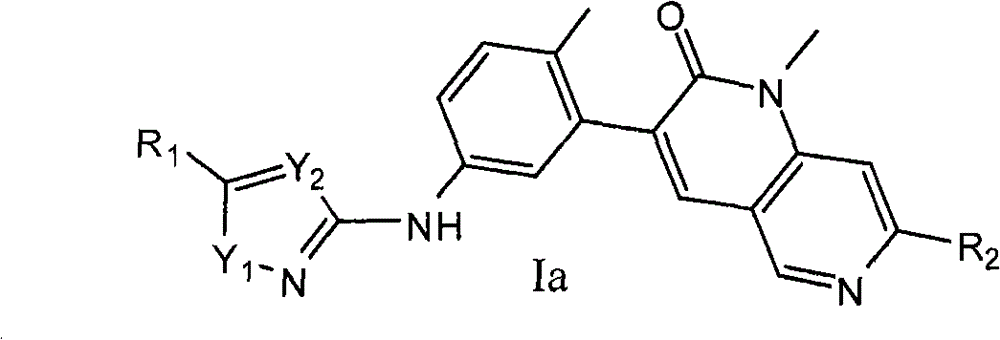
其中:in:
R1选自卤素、C1-6烷基、C3-12环烷基、C3-8杂环烷基、C6-10芳基和C3-10杂芳基;其中所述的R1的C1-6烷基任选被1-3个独立选自下列的基团取代:卤素、羟基、氰基、硝基、=N(OH)、C1-4烷氧基和苯氧基;其中所述的R1的环烷基、杂环烷基、芳基或杂芳基任选被1-3个独立选自下列的基团取代:卤素、羟基、氰基、硝基、C1-6烷基、卤素-取代的-C1-6烷基、羟基-取代的-C1-6烷基、C1-6烷氧基、卤素-取代的-C1-6烷氧基、-X1NR3aR3b、-X1C(O)R3a、-X1C(O)OR3a、-X1OR3a、C3-12环烷基、C3-8杂环烷基、C6-10芳基和C3-10杂芳基;其中X1选自键和C1-4亚烷基;其中R3a和R3b独立地选自氢和C1-6烷基;R2选自甲基和乙基;Y1选自O、S和NR4;其中R4选自氢和C1-4烷基;且Y2选自N和CR4;其中R4选自氢和C1-4烷基。R 1 is selected from halogen, C 1-6 alkyl, C 3-12 cycloalkyl, C 3-8 heterocycloalkyl, C 6-10 aryl and C 3-10 heteroaryl; wherein said R The C 1-6 alkyl of 1 is optionally substituted by 1-3 groups independently selected from the group consisting of halogen, hydroxy, cyano, nitro, =N(OH), C 1-4 alkoxy and phenoxy group; wherein the cycloalkyl, heterocycloalkyl, aryl or heteroaryl of R 1 is optionally substituted by 1-3 groups independently selected from the following groups: halogen, hydroxyl, cyano, nitro, C 1-6 alkyl, halogen-substituted-C 1-6 alkyl, hydroxy-substituted-C 1-6 alkyl, C 1-6 alkoxy, halogen-substituted-C 1-6 alkoxy group, -X 1 NR 3a R 3b , -X 1 C(O)R 3a , -X 1 C(O)OR 3a , -X 1 OR 3a , C 3-12 cycloalkyl, C 3-8 heterocycle Alkyl, C 6-10 aryl and C 3-10 heteroaryl; wherein X 1 is selected from bond and C 1-4 alkylene; wherein R 3a and R 3b are independently selected from hydrogen and C 1-6 alkane R 2 is selected from methyl and ethyl; Y 1 is selected from O, S and NR 4 ; wherein R 4 is selected from hydrogen and C 1-4 alkyl; and Y 2 is selected from N and CR 4 ; wherein R 4 selected from hydrogen and C 1-4 alkyl.
在另一个实施方案中,R1选自卤素、C1-6烷基、C3-12环烷基、C3-8杂环烷基、C6-10芳基和C3-10杂芳基;其中所述的R1的C1-6烷基任选被1-3个独立选自下列的基团取代:羟基、卤素、C1-6烷氧基、苯氧基和=N(OH);其中所述的R1的环烷基、杂环烷基、芳基或杂芳基任选被1-3个独立选自下列的基团取代:卤素、羟基、氰基、C1-6烷基、卤素-取代的-C1-6烷基、羟基-取代的-C1-6烷基、C1-6烷氧基、卤素-取代的-C1-6烷氧基、-X1NR3aR3b、-OR3a、-C(O)R3a和C3-10杂芳基;其中X1选自键和C1-4亚烷基;其中R3a和R3b独立地选自氢和C1-6烷基;且R2选自甲基和乙基。In another embodiment, R is selected from halogen, C 1-6 alkyl, C 3-12 cycloalkyl, C 3-8 heterocycloalkyl, C 6-10 aryl and C 3-10 heteroaryl wherein the C 1-6 alkyl of R 1 is optionally substituted by 1-3 groups independently selected from the following groups: hydroxyl, halogen, C 1-6 alkoxy, phenoxy and =N( OH); wherein the cycloalkyl, heterocycloalkyl, aryl or heteroaryl of R 1 is optionally substituted by 1-3 groups independently selected from the following groups: halogen, hydroxyl, cyano, C 1 -6 alkyl, halogen-substituted-C 1-6 alkyl, hydroxy-substituted-C 1-6 alkyl, C 1-6 alkoxy, halogen-substituted-C 1-6 alkoxy, -X 1 NR 3a R 3b , -OR 3a , -C(O)R 3a and C 3-10 heteroaryl; wherein X 1 is selected from a bond and C 1-4 alkylene; wherein R 3a and R 3b are independent R is selected from hydrogen and C 1-6 alkyl; and R is selected from methyl and ethyl.
在另一个实施方案中,R1选自乙基、叔丁基、叔丁基-甲基、异丁基、丙基、异丙基、新戊基、仲丁基、戊-3-基、2-羟基丙-2-基、1-羟基-2-甲基丙-2-基、1-羟基-丙-2-基、1-羟基-2-甲基丙基、1,1-二氟乙基、2-羟基-2-甲基丙基、2-羟基丙基、乙氧基-甲基、1-甲氧基乙基、1-苯氧基乙基、1-(羟基亚氨基)乙基、吡啶基、哌嗪基、呋喃基、苯基、噻唑基、2,3-二氢苯并呋喃-2-基、3-氧代环丁基、氧杂环丁-3-基、氧杂环丁-2-基、四氢-2H-吡喃-4-基、四氢-2H-吡喃-3-基、四氢-2H-吡喃-2-基、四氢呋喃基、1H-吲哚-2-基、环丁基、环丙基、环戊基和环己基;其中所述吡啶基、哌嗪基、呋喃基、苯基、噻唑基、2,3-二氢苯并呋喃-2-基、3-氧代环丁基、氧杂环丁-3-基、氧杂环丁-2-基、四氢-2H-吡喃-4-基、四氢-2H-吡喃-3-基、四氢-2H-吡喃-2-基、四氢呋喃基、1H-吲哚-2-基、环丁基、环丙基、环戊基或环己基任选被1-3个独立选自下列的基团取代:氯、氟、溴、羟基、羟基-甲基、吡啶基、氰基、甲基、甲氧基、氨基-甲基、甲基-羰基、三氟甲基、二氟乙基和三氟甲氧基。In another embodiment, R is selected from ethyl, tert-butyl, tert-butyl-methyl, isobutyl, propyl, isopropyl, neopentyl, sec-butyl, pent-3-yl, 2-Hydroxypropan-2-yl, 1-hydroxy-2-methylpropan-2-yl, 1-hydroxy-propan-2-yl, 1-hydroxy-2-methylpropyl, 1,1-difluoro Ethyl, 2-hydroxy-2-methylpropyl, 2-hydroxypropyl, ethoxy-methyl, 1-methoxyethyl, 1-phenoxyethyl, 1-(hydroxyimino) Ethyl, pyridyl, piperazinyl, furyl, phenyl, thiazolyl, 2,3-dihydrobenzofuran-2-yl, 3-oxocyclobutyl, oxetan-3-yl, Oxetan-2-yl, tetrahydro-2H-pyran-4-yl, tetrahydro-2H-pyran-3-yl, tetrahydro-2H-pyran-2-yl, tetrahydrofuryl, 1H- Indol-2-yl, cyclobutyl, cyclopropyl, cyclopentyl and cyclohexyl; wherein the pyridyl, piperazinyl, furyl, phenyl, thiazolyl, 2,3-dihydrobenzofuran -2-yl, 3-oxocyclobutyl, oxetan-3-yl, oxetan-2-yl, tetrahydro-2H-pyran-4-yl, tetrahydro-2H-pyran -3-yl, tetrahydro-2H-pyran-2-yl, tetrahydrofuranyl, 1H-indol-2-yl, cyclobutyl, cyclopropyl, cyclopentyl or cyclohexyl are optionally replaced by 1-3 Substituted by groups independently selected from the group consisting of chloro, fluoro, bromo, hydroxy, hydroxy-methyl, pyridyl, cyano, methyl, methoxy, amino-methyl, methyl-carbonyl, trifluoromethyl, Difluoroethyl and trifluoromethoxy.
在另一实施方案中,为选自下列的化合物:1,7-二甲基-3-(2-甲基-5-(5-(吡啶-2-基)-1,2,4-


在另一个实施方案中,为式Ib化合物:In another embodiment, is the compound of formula Ib:

其中:R1选自卤素、C1-6烷基、C3-12环烷基、C3-8杂环烷基、C6-10芳基和C3-10杂芳基;其中所述的R1的C1-6烷基任选被1-3个独立选自下列的基团取代:卤素、羟基、氰基、硝基、C1-4烷氧基和苯氧基;其中所述的R1的环烷基、杂环烷基、芳基或杂芳基任选被1-3个独立选自下列的基团取代:卤素、羟基、氰基、硝基、C1-6烷基、卤素-取代的-C1-6烷基、羟基-取代的-C1-6烷基、C1-6烷氧基、卤素-取代的-C1-6烷氧基、-X1NR3aR3b、-X1C(O)R3a、-X1C(O)OR3a、-X1OR3a、C3-12环烷基、C3-8杂环烷基、C6-10芳基和C3-10杂芳基;其中X1选自键和C1-4亚烷基;其中R3a和R3b独立地选自氢和C1-6烷基;R2选自甲基和乙基;且Y3选自O、S和NR4,其中R4选自氢和C1-4烷基。Wherein: R 1 is selected from halogen, C 1-6 alkyl, C 3-12 cycloalkyl, C 3-8 heterocycloalkyl, C 6-10 aryl and C 3-10 heteroaryl; wherein said The C 1-6 alkyl of R 1 is optionally substituted by 1-3 groups independently selected from the following groups: halogen, hydroxyl, cyano, nitro, C 1-4 alkoxy and phenoxy; wherein Said R cycloalkyl, heterocycloalkyl, aryl or heteroaryl is optionally substituted by 1-3 groups independently selected from the following groups: halogen, hydroxyl, cyano, nitro, C 1-6 Alkyl, halogen-substituted-C 1-6 alkyl, hydroxy-substituted-C 1-6 alkyl, C 1-6 alkoxy, halogen-substituted-C 1-6 alkoxy,-X 1 NR 3a R 3b , -X 1 C(O)R 3a , -X 1 C(O)OR 3a , -X 1 OR 3a , C 3-12 cycloalkyl, C 3-8 heterocycloalkyl, C 6-10 aryl and C 3-10 heteroaryl; wherein X 1 is selected from bond and C 1-4 alkylene; wherein R 3a and R 3b are independently selected from hydrogen and C 1-6 alkyl; R 2 is selected from methyl and ethyl; and Y 3 is selected from O, S and NR 4 , wherein R 4 is selected from hydrogen and C 1-4 alkyl.
在另一个实施方案中,R1选自乙基、叔丁基、叔丁基-甲基、异丁基、丙基、异丙基、新戊基、仲丁基、戊-3-基、2-羟基丙-2-基、1-羟基-2-甲基丙-2-基、1-羟基-丙-2-基、1-羟基-2-甲基丙基、1,1-二氟乙基、2-羟基-2-甲基丙基、2-羟基丙基、乙氧基-甲基、1-甲氧基乙基、1-苯氧基乙基、1-(羟基亚氨基)乙基、吡啶基、哌嗪基、呋喃基、苯基、噻唑基、2,3-二氢苯并呋喃-2-基、3-氧代环丁基、氧杂环丁-3-基、氧杂环丁-2-基、四氢-2H-吡喃-4-基、四氢-2H-吡喃-3-基、四氢-2H-吡喃-2-基、四氢呋喃基、1H-吲哚-2-基、环丁基、环丙基、环戊基和环己基;其中所述吡啶基、哌嗪基、呋喃基、苯基、噻唑基、2,3-二氢苯并呋喃-2-基、3-氧代环丁基、氧杂环丁-3-基、氧杂环丁-2-基、四氢-2H-吡喃-4-基、四氢-2H-吡喃-3-基、四氢-2H-吡喃-2-基、四氢呋喃基、1H-吲哚-2-基、环丁基、环丙基、环戊基或环己基任选被1-3个独立选自下列的基团取代:氯、氟、溴、羟基、羟基-甲基、吡啶基、氰基、甲基、甲氧基、氨基-甲基、甲基-羰基、三氟甲基、二氟乙基和三氟甲氧基。In another embodiment, R is selected from ethyl, tert-butyl, tert-butyl-methyl, isobutyl, propyl, isopropyl, neopentyl, sec-butyl, pent-3-yl, 2-Hydroxypropan-2-yl, 1-hydroxy-2-methylpropan-2-yl, 1-hydroxy-propan-2-yl, 1-hydroxy-2-methylpropyl, 1,1-difluoro Ethyl, 2-hydroxy-2-methylpropyl, 2-hydroxypropyl, ethoxy-methyl, 1-methoxyethyl, 1-phenoxyethyl, 1-(hydroxyimino) Ethyl, pyridyl, piperazinyl, furyl, phenyl, thiazolyl, 2,3-dihydrobenzofuran-2-yl, 3-oxocyclobutyl, oxetan-3-yl, Oxetan-2-yl, tetrahydro-2H-pyran-4-yl, tetrahydro-2H-pyran-3-yl, tetrahydro-2H-pyran-2-yl, tetrahydrofuryl, 1H- Indol-2-yl, cyclobutyl, cyclopropyl, cyclopentyl and cyclohexyl; wherein the pyridyl, piperazinyl, furyl, phenyl, thiazolyl, 2,3-dihydrobenzofuran -2-yl, 3-oxocyclobutyl, oxetan-3-yl, oxetan-2-yl, tetrahydro-2H-pyran-4-yl, tetrahydro-2H-pyran -3-yl, tetrahydro-2H-pyran-2-yl, tetrahydrofuranyl, 1H-indol-2-yl, cyclobutyl, cyclopropyl, cyclopentyl or cyclohexyl are optionally replaced by 1-3 Substituted by groups independently selected from the group consisting of chloro, fluoro, bromo, hydroxy, hydroxy-methyl, pyridyl, cyano, methyl, methoxy, amino-methyl, methyl-carbonyl, trifluoromethyl, Difluoroethyl and trifluoromethoxy.
在另一个实施方案中,为选自以下的化合物:1,7-二甲基-3-(2-甲基-5-{[5-(4-甲基苯基)-1,3,4-


在另一个实施方案中,为式Ic化合物:In another embodiment, is the compound of formula Ic:

其中:R1选自卤素、C1-6烷基、C3-12环烷基、C3-8杂环烷基、C6-10芳基和C3-10杂芳基;其中所述的R1的C1-6烷基任选被1-3个独立选自下列的基团取代:卤素、羟基、氰基、硝基、C1-4烷氧基和苯氧基;其中所述的R1的环烷基、杂环烷基、芳基或杂芳基任选被1-3个独立选自下列的基团取代:卤素、羟基、氰基、硝基、C1-6烷基、卤素-取代的-C1-6烷基、羟基-取代的-C1-6烷基、C1-6烷氧基、卤素-取代的-C1-6烷氧基、-X1NR3aR3b、-X1C(O)R3a、-X1C(O)OR3a、-X1OR3a、C3-12环烷基、C3-8杂环烷基、C6-10芳基和C3-10杂芳基;其中X1选自键和C1-4亚烷基;其中R3a和R3b独立地选自氢和C1-6烷基;R2选自甲基和乙基;且Y4选自CR4和NR4,其中R4选自氢和C1-4烷基。Wherein: R 1 is selected from halogen, C 1-6 alkyl, C 3-12 cycloalkyl, C 3-8 heterocycloalkyl, C 6-10 aryl and C 3-10 heteroaryl; wherein said The C 1-6 alkyl of R 1 is optionally substituted by 1-3 groups independently selected from the following groups: halogen, hydroxyl, cyano, nitro, C 1-4 alkoxy and phenoxy; wherein Said R cycloalkyl, heterocycloalkyl, aryl or heteroaryl is optionally substituted by 1-3 groups independently selected from the following groups: halogen, hydroxyl, cyano, nitro, C 1-6 Alkyl, halogen-substituted-C 1-6 alkyl, hydroxy-substituted-C 1-6 alkyl, C 1-6 alkoxy, halogen-substituted-C 1-6 alkoxy,-X 1 NR 3a R 3b , -X 1 C(O)R 3a , -X 1 C(O)OR 3a , -X 1 OR 3a , C 3-12 cycloalkyl, C 3-8 heterocycloalkyl, C 6-10 aryl and C 3-10 heteroaryl; wherein X 1 is selected from bond and C 1-4 alkylene; wherein R 3a and R 3b are independently selected from hydrogen and C 1-6 alkyl; R 2 is selected from methyl and ethyl; and Y 4 is selected from CR 4 and NR 4 , wherein R 4 is selected from hydrogen and C 1-4 alkyl.
在另一个实施方案中,R1选自乙基、叔丁基、叔丁基-甲基、异丁基、丙基、异丙基、新戊基、仲丁基、戊-3-基、2-羟基丙-2-基、1-羟基-2-甲基丙-2-基、1-羟基-丙-2-基、1-羟基-2-甲基丙基、1,1-二氟乙基、2-羟基-2-甲基丙基、2-羟基丙基、乙氧基-甲基、1-甲氧基乙基、1-苯氧基乙基、1-(羟基亚氨基)乙基、吡啶基、哌嗪基、呋喃基、苯基、噻唑基、2,3-二氢苯并呋喃-2-基、3-氧代环丁基、氧杂环丁-3-基、氧杂环丁-2-基、四氢-2H-吡喃-4-基、四氢-2H-吡喃-3-基、四氢-2H-吡喃-2-基、四氢呋喃基、1H-吲哚-2-基、环丁基、环丙基、环戊基和环己基;其中所述吡啶基、哌嗪基、呋喃基、苯基、噻唑基、2,3-二氢苯并呋喃-2-基、3-氧代环丁基、氧杂环丁-3-基、氧杂环丁-2-基、四氢-2H-吡喃-4-基、四氢-2H-吡喃-3-基、四氢-2H-吡喃-2-基、四氢呋喃基、1H-吲哚-2-基、环丁基、环丙基、环戊基或环己基任选被1-3个独立选自下列的基团取代:氯、氟、溴、羟基、羟基-甲基、吡啶基、氰基、甲基、甲氧基、氨基-甲基、甲基-羰基、三氟甲基、二氟乙基和三氟甲氧基。In another embodiment, R is selected from ethyl, tert-butyl, tert-butyl-methyl, isobutyl, propyl, isopropyl, neopentyl, sec-butyl, pent-3-yl, 2-Hydroxypropan-2-yl, 1-hydroxy-2-methylpropan-2-yl, 1-hydroxy-propan-2-yl, 1-hydroxy-2-methylpropyl, 1,1-difluoro Ethyl, 2-hydroxy-2-methylpropyl, 2-hydroxypropyl, ethoxy-methyl, 1-methoxyethyl, 1-phenoxyethyl, 1-(hydroxyimino) Ethyl, pyridyl, piperazinyl, furyl, phenyl, thiazolyl, 2,3-dihydrobenzofuran-2-yl, 3-oxocyclobutyl, oxetan-3-yl, Oxetan-2-yl, tetrahydro-2H-pyran-4-yl, tetrahydro-2H-pyran-3-yl, tetrahydro-2H-pyran-2-yl, tetrahydrofuryl, 1H- Indol-2-yl, cyclobutyl, cyclopropyl, cyclopentyl and cyclohexyl; wherein the pyridyl, piperazinyl, furyl, phenyl, thiazolyl, 2,3-dihydrobenzofuran -2-yl, 3-oxocyclobutyl, oxetan-3-yl, oxetan-2-yl, tetrahydro-2H-pyran-4-yl, tetrahydro-2H-pyran -3-yl, tetrahydro-2H-pyran-2-yl, tetrahydrofuranyl, 1H-indol-2-yl, cyclobutyl, cyclopropyl, cyclopentyl or cyclohexyl are optionally replaced by 1-3 Substituted by groups independently selected from the group consisting of chloro, fluoro, bromo, hydroxy, hydroxy-methyl, pyridyl, cyano, methyl, methoxy, amino-methyl, methyl-carbonyl, trifluoromethyl, Difluoroethyl and trifluoromethoxy.
在另一个实施方案中,为选自以下的化合物:1,7-二甲基-3-{2-甲基-5-[(3-苯基-1,2,4-


在另一个实施方案中,为下文中实施例和表格中叙述的化合物。In another embodiment, the compounds described in the Examples and Tables hereinafter.
本发明还包括本发明化合物或其药学上可接受的盐的所有适当的同位素变体(variations)。本发明化合物或其药学上可接受的盐的同位素变体定义为其中至少一个原子被具有相同原子序数但原子质量与自然界中通常可见的原子质量不同的原子替换的化合物。可以引入到本发明化合物和其药学上可接受的盐中的同位素的实例包括但不限于氢、碳、氮和氧的同位素,例如2H、3H、11C、13C、14C、15N、17O、18O、35S、18F、36Cl和123I。本发明化合物和其药学上可接受的盐的某些同位素变体,例如其中引入了放射性同位素例如3H或14C的那些,可用于药物和/或底物组织分布研究。在特定实例中,由于它们容易制备以及它们的可检测性,可以使用3H和14C同位素。在其它实例中,用同位素例如2H取代可以提供由于更高的代谢稳定性带来的某些治疗益处,例如增加的体内半衰期或降低的剂量需求。本发明化合物或其药学上可接受的盐的同位素变体通常可以通过常规方法采用适当试剂的合适同位素变体来制备。The present invention also includes all suitable isotopic variations of the compounds of the present invention or pharmaceutically acceptable salts thereof. An isotopic variation of a compound of the present invention or a pharmaceutically acceptable salt thereof is defined as a compound in which at least one atom is replaced by an atom having the same atomic number but an atomic mass different from that normally found in nature. Examples of isotopes that may be incorporated into the compounds of the present invention and pharmaceutically acceptable salts thereof include, but are not limited to, isotopes of hydrogen, carbon, nitrogen and oxygen, such as 2 H, 3 H, 11 C, 13 C, 14 C, 15 N, 17 O, 18 O, 35 S, 18 F, 36 Cl and 123 I. Certain isotopic variations of the compounds of the invention and their pharmaceutically acceptable salts, eg, those into which radioactive isotopes such as3H or14C have been incorporated, are useful in drug and/or substrate tissue distribution studies. In certain instances, 3H and14C isotopes can be used due to their ease of preparation and their detectability. In other examples, substitution with an isotope such as2H may confer certain therapeutic benefits resulting from greater metabolic stability, for example increased in vivo half-life or reduced dosage requirements. Isotopic variations of a compound of the present invention, or a pharmaceutically acceptable salt thereof, can generally be prepared by conventional methods using appropriate isotopic variations of appropriate reagents.
在一个实施方案中,本发明提供治疗受c-kit和PDGFRα/β激酶受体调节的疾病或疾患(condition)的方法,该方法包括施用式I化合物或其药学上可接受的盐或药物组合物。In one embodiment, the present invention provides a method for treating a disease or condition regulated by c-kit and PDGFRα/β kinase receptors, the method comprising administering a compound of formula I or a pharmaceutically acceptable salt thereof or a pharmaceutical combination thereof things.
可以用本发明化合物和组合物调节的c-kit和/或PDGFR介导的疾病或疾患的实例包括但不限于肿瘤性病症、过敏性病症、炎性病症、自身免疫性病症、移植物抗宿主疾病、疟原虫相关的疾病、肥大细胞相关的疾病、代谢综合征、CNS相关病症、神经变性病症、疼痛情况、物质滥用障碍、朊病毒病、癌症、心脏病、纤维变性疾病、肺动脉高压(PAH)或原发性肺动脉高压(PPH)。Examples of c-kit and/or PDGFR mediated diseases or disorders that may be modulated using the compounds and compositions of the invention include, but are not limited to, neoplastic disorders, allergic disorders, inflammatory disorders, autoimmune disorders, graft-versus-host Diseases, malaria parasite-related diseases, mast cell-related diseases, metabolic syndrome, CNS-related disorders, neurodegenerative disorders, pain conditions, substance abuse disorders, prion diseases, cancer, heart disease, fibrotic disease, pulmonary arterial hypertension (PAH ) or primary pulmonary hypertension (PPH).
可以用本发明化合物和组合物治疗的肥大细胞相关的疾病的实例包括但不限于痤疮和痤疮丙酸杆菌(Propionibacterium acnes)、进行性骨化性纤维发育不良(FOP)、由于接触化学或生物武器(如炭疽和硫芥子气)引起的炎症和组织破坏、囊性纤维化病;肾病、炎性肌肉病症、HIV、II型糖尿病、脑局部缺血、肥大细胞增多症、药物依赖和戒断症状、CNS病症、预防和最小化脱发、细菌感染、间质性膀胱炎、炎症性肠综合征(IBS)、炎性肠病(IBD)、肿瘤血管生成、自身免疫性疾病、炎性疾病、多发性硬化(MS)、过敏性病症(包括哮喘)和骨损失。Examples of mast cell-associated diseases that may be treated with the compounds and compositions of the present invention include, but are not limited to, acne and Propionibacterium acnes, fibrous dysplasia ossificans progressive (FOP), Inflammation and tissue destruction due to (such as anthrax and sulfur mustard), cystic fibrosis; kidney disease, inflammatory muscle disorders, HIV, type 2 diabetes, cerebral ischemia, mastocytosis, drug dependence and withdrawal symptoms, CNS disorders, prevention and minimization of hair loss, bacterial infection, interstitial cystitis, inflammatory bowel syndrome (IBS), inflammatory bowel disease (IBD), tumor angiogenesis, autoimmune disease, inflammatory disease, multiple sclerosis (MS), allergic disorders (including asthma) and bone loss.
可以用本发明化合物和组合物治疗的肿瘤性病症的实例包括但不限于肥大细胞增多症、胃肠道间质瘤、小细胞肺癌、非小细胞肺癌、急性髓细胞性白血病、急性淋巴细胞性白血病、脊髓发育不良综合征、慢性髓细胞性白血病、结直肠癌、胃癌、睾丸癌、成胶质细胞瘤或星形细胞瘤和黑色素瘤。Examples of neoplastic disorders that may be treated with the compounds and compositions of the present invention include, but are not limited to, mastocytosis, gastrointestinal stromal tumors, small cell lung cancer, non-small cell lung cancer, acute myeloid leukemia, acute lymphocytic Leukemia, myelodysplastic syndrome, chronic myelogenous leukemia, colorectal cancer, gastric cancer, testicular cancer, glioblastoma or astrocytoma, and melanoma.
可以用本发明化合物和组合物治疗的过敏性病症的实例包括但不限于哮喘、过敏性鼻炎、过敏性鼻窦炎、过敏性综合征、荨麻疹、血管性水肿、特应性皮炎、变应性接触性皮炎、皮肤病(dermatosis)、结节性红斑、多形性红斑、皮肤坏死性静脉炎(cutaneous necrotizing venulitis)、昆虫叮咬皮肤炎症或吸血性寄生虫侵袭。Examples of allergic conditions that may be treated with the compounds and compositions of the present invention include, but are not limited to, asthma, allergic rhinitis, allergic sinusitis, allergic syndrome, urticaria, angioedema, atopic dermatitis, allergic Contact dermatitis, dermatosis, erythema nodosum, erythema multiforme, cutaneous necrotizing venulitis, skin inflammation from insect bites, or infestation by blood-sucking parasites.
可以用本发明化合物和组合物治疗的炎性病症的实例包括但不限于类风湿性关节炎、IBS、IBD、结膜炎、类风湿性脊椎炎、骨关节炎或痛风性关节炎。Examples of inflammatory conditions that may be treated with the compounds and compositions of the present invention include, but are not limited to, rheumatoid arthritis, IBS, IBD, conjunctivitis, rheumatoid spondylitis, osteoarthritis, or gouty arthritis.
可以用本发明化合物和组合物治疗的自身免疫性病症的实例包括但不限于多发性硬化、银屑病、肠的炎性疾病、溃疡性结肠炎、克罗恩(Crohn’s)病、类风湿性关节炎、多关节炎、局部或系统性硬皮病、系统性红斑狼疮、盘状红斑狼疮、皮肤狼疮、皮肌炎、多发性肌炎、斯耶格伦氏(Sjogren’s)综合征、结节性全动脉炎、自身免疫性肠病或增生性肾小球肾炎。Examples of autoimmune disorders that may be treated with the compounds and compositions of the present invention include, but are not limited to, multiple sclerosis, psoriasis, inflammatory diseases of the bowel, ulcerative colitis, Crohn's disease, rheumatoid Arthritis, polyarthritis, localized or systemic scleroderma, systemic lupus erythematosus, discoid lupus erythematosus, cutaneous lupus, dermatomyositis, polymyositis, Sjogren's syndrome, nodules panarteritis, autoimmune enteropathy, or proliferative glomerulonephritis.
可以用本发明化合物和组合物治疗的移植物抗宿主疾病的实例包括但不限于器官移植如肾移植、胰腺移植、肝移植、心脏移植、肺移植或骨髓移植的移植物排斥。Examples of graft versus host diseases that may be treated with the compounds and compositions of the present invention include, but are not limited to, graft rejection of organ transplants such as kidney transplants, pancreas transplants, liver transplants, heart transplants, lung transplants, or bone marrow transplants.
可以用本发明化合物和组合物治疗的代谢综合征的实例包括但不限于I型糖尿病、II型糖尿病或肥胖。Examples of metabolic syndromes that may be treated with the compounds and compositions of the present invention include, but are not limited to, type I diabetes, type II diabetes, or obesity.
可以用本发明化合物和组合物治疗的CNS相关病症的实例包括但不限于抑郁、心境恶劣障碍、循环型情感性障碍、厌食症、易饿病(bulimia)、月经前期综合征、绝经后综合征、精神迟缓(mental slowing)、集中力缺失、悲观烦恼、精神激动、自嘲和性欲降低、焦虑症、精神病学病症(psychiatricdisorder)或精神分裂症。Examples of CNS-related disorders that may be treated with the compounds and compositions of the present invention include, but are not limited to, depression, dysthymic disorder, cyclothymmic disorder, anorexia, bulimia, premenstrual syndrome, postmenopausal syndrome , mental slowing, loss of concentration, pessimistic distress, agitation, self-mockery and decreased libido, anxiety, psychiatric disorder or schizophrenia.
可以用本发明化合物和组合物治疗的抑郁疾患的实例包括但不限于双相性抑郁、严重的或忧郁性抑郁、非典型的抑郁、难治性抑郁或季节性抑郁。可以用本发明化合物和组合物治疗的焦虑症的实例包括但不限于与换气过度和心律失常有关的焦虑、恐怖症、强迫症、创伤后应激障碍、急性应激障碍和泛化性焦虑症。可以用本发明化合物和组合物治疗的精神病学病症的实例包括但不限于恐慌发作,包括精神病,妄想性障碍、转换障碍、恐惧症、躁狂症、谵妄、分离性发作(dissociative episode)包括分离性遗忘症、分离性漫游和分离性自杀行为、自我忽视、剧烈的或攻击性行为、创伤、边缘型人格和急性精神病如精神分裂症,包括偏执型精神分裂症、错乱型精神分裂症、紧张型精神分裂症和未分化型精神分裂症。Examples of depressive disorders that may be treated with the compounds and compositions of the present invention include, but are not limited to, bipolar depression, major or melancholic depression, atypical depression, treatment-resistant depression, or seasonal depression. Examples of anxiety disorders that may be treated with the compounds and compositions of the present invention include, but are not limited to, anxiety associated with hyperventilation and cardiac arrhythmias, phobias, obsessive-compulsive disorder, post-traumatic stress disorder, acute stress disorder, and generalized anxiety disease. Examples of psychiatric disorders that may be treated with the compounds and compositions of the present invention include, but are not limited to, panic attacks, including psychosis, delusional disorders, conversion disorders, phobias, mania, delirium, dissociative episodes including dissociative episodes Sexual amnesia, dissociative wandering and dissociative suicidal behavior, self-neglect, violent or aggressive behavior, trauma, borderline personality, and acute psychosis such as schizophrenia, including paranoid schizophrenia, disorganized schizophrenia, catatonic schizophrenia and undifferentiated schizophrenia.
可以用本发明化合物和组合物治疗的神经变性病症的实例包括但不限于阿尔茨海默病、帕金森病、亨廷顿病、朊病毒病、运动神经元病(MND)或肌萎缩性侧索硬化(ALS)。Examples of neurodegenerative disorders that may be treated with the compounds and compositions of the present invention include, but are not limited to, Alzheimer's disease, Parkinson's disease, Huntington's disease, prion diseases, motor neuron disease (MND), or amyotrophic lateral sclerosis (ALS).
可以用本发明化合物和组合物治疗的疼痛情况的实例包括但不限于急性痛、术后痛、慢性痛、伤害性疼痛、癌症痛、神经性疼痛或心理性疼痛综合征。Examples of pain conditions that may be treated with the compounds and compositions of the invention include, but are not limited to, acute pain, postoperative pain, chronic pain, nociceptive pain, cancer pain, neuropathic pain, or psychopathic pain syndromes.
可以用本发明化合物和组合物治疗的物质使用障碍的实例包括但不限于药物成瘾、药物滥用、药物习惯性、药物依赖性、戒断综合征或超剂量用药。Examples of substance use disorders that may be treated with the compounds and compositions of the present invention include, but are not limited to, drug addiction, drug abuse, drug habit, drug dependence, withdrawal syndrome, or overdose.
可以用本发明化合物和组合物治疗的癌症的实例包括但不限于黑色素瘤、胃肠道间质瘤(GIST)、小细胞肺癌或其它实体肿瘤。Examples of cancers that may be treated with the compounds and compositions of the present invention include, but are not limited to, melanoma, gastrointestinal stromal tumor (GIST), small cell lung cancer, or other solid tumors.
可以用本发明化合物和组合物治疗的纤维变性疾病的实例包括但不限于丙型肝炎(HCV)、肝纤维化、非酒精性脂肪性肝炎(NASH)、肝硬化、肺纤维化或骨髓纤维化。Examples of fibrotic diseases that may be treated with the compounds and compositions of the present invention include, but are not limited to, hepatitis C (HCV), liver fibrosis, nonalcoholic steatohepatitis (NASH), liver cirrhosis, pulmonary fibrosis, or myelofibrosis .
在另一个实施方案中,本发明提供提供治疗受c-kit激酶受体调节的疾病或疾患的方法,该方法包括施用式I化合物或其药学上可接受的盐或药物组合物。In another embodiment, the present invention provides a method of treating a disease or condition modulated by c-kit kinase receptor, the method comprising administering a compound of formula I or a pharmaceutically acceptable salt or pharmaceutical composition thereof.
药理和用途Pharmacology and Uses
本发明化合物调节激酶的活性,并且例如可用于治疗其中激酶与疾病的病理和/或症状有关的疾病或病症。被本文所述的化合物和组合物抑制的并且本文所述的方法所针对的激酶的示例包括但不限于c-kit、Abl、Lyn、MAPK14(p38δ)、PDGFRα、PDGFRβ、ARG、BCR-Abl、BRK、EphB、Fms、Fyn、KDR、LCK、b-Raf、c-Raf、SAPK2、Src、Tie2和TrkB激酶。Compounds of the invention modulate the activity of kinases and are useful, for example, in the treatment of diseases or disorders in which kinases are associated with the pathology and/or symptoms of the disease. Examples of kinases inhibited by the compounds and compositions described herein and targeted by the methods described herein include, but are not limited to, c-kit, Abl, Lyn, MAPK14 (p38δ), PDGFRα, PDGFRβ, ARG, BCR-Abl, BRK, EphB, Fms, Fyn, KDR, LCK, b-Raf, c-Raf, SAPK2, Src, Tie2 and TrkB kinases.
肥大细胞(MC)是衍生自一特殊亚类的造血干细胞的组织元件,其产生大量的介质(mediators),这些介质大部分具有强的促炎活性。由于MC分布在几乎所有的身体部位,活化的元件造成的介质分泌过多可能导致多器官衰竭。因此,肥大细胞是与许多疾病有关的关键参预者。本发明涉及治疗肥大细胞相关的疾病的方法,该方法包括施用能够减少肥大细胞的化合物或抑制肥大细胞脱粒的化合物至需要此种治疗的人。所述化合物可以选自c-kit抑制剂并且更特别是无毒性的、选择性和有效的c-kit抑制剂。优选地,所述抑制剂不能够加速在IL-3存在下培养的IL-3依赖细胞的死亡。Mast cells (MC) are tissue elements derived from a specific subclass of hematopoietic stem cells that produce a large number of mediators, most of which have strong pro-inflammatory activity. Since MCs are distributed in almost all body parts, hypersecretion of mediators by activated elements may lead to multiple organ failure. Thus, mast cells are key players involved in many diseases. The present invention relates to methods of treating mast cell-related diseases comprising administering to a human in need of such treatment a compound capable of reducing mast cells or a compound that inhibits mast cell degranulation. Said compounds may be selected from c-kit inhibitors and more particularly non-toxic, selective and potent c-kit inhibitors. Preferably, the inhibitor is not capable of accelerating the death of IL-3 dependent cells cultured in the presence of IL-3.
肥大细胞相关的疾病包括但不限于:痤疮和痤疮丙酸杆菌(痤疮包括所有形式的皮肤慢性炎症,包括由痤疮丙酸杆菌诱导的那些);称为进行性骨化性纤维发育不良(FOP)的极其罕见并致残的结缔组织遗传病;由于接触化学或生物武器(如炭疽、硫芥子气等)引起的炎症和组织破坏的有害作用;囊性纤维化病(肺、消化系统和生殖系统遗传病);肾病例如急性肾综合征、肾小球肾炎、肾淀粉样变性、肾间质纤维化(在各种肾病变中导致末期肾病的最终常见途径);炎性肌肉病症,包括肌炎和肌营养不良;HIV(例如,减少HIV感染的肥大细胞可能是治疗HIV感染和相关疾病的一个新途径);治疗II型糖尿病、肥胖和相关的病症(肥大细胞调节许多促进动脉粥样硬化的发展的过程,包括高血糖症、高胆固醇血症、高血压、内皮功能障碍、胰岛素抵抗和血管重构;脑局部缺血;肥大细胞增多症(以不同组织中、主要是皮肤和骨髓中但还有脾、肝、淋巴结和胃肠道中的肥大细胞异常蓄积为特征的一组极庞杂的病症);药物依赖和戒断症状(特别是药物成瘾、药物滥用、药物习惯性、药物依赖性、戒断综合征和超剂量用药);CNS相关病症(特别是抑郁、精神分裂症、焦虑症、偏头痛、记忆丧失、疼痛和神经变性疾病);促进头发生长(包括预防和最小化脱发);细菌感染(特别是由FimH表达细菌引起的感染);间质性膀胱炎(特别是在膀胱内层的细胞之间的间隙处的导致组织损伤的膀胱壁的慢性炎症);炎性肠病(通常适用于四种肠疾症,即克罗恩病、溃疡性结肠炎、不确定的结肠炎和感染性结肠炎);肿瘤血管生成;自身免疫性疾病(特别是多发性硬化、溃疡性结肠炎、克罗恩病、类风湿性关节炎和多关节炎、硬皮病、红斑狼疮、皮肌炎、天疱疮、多发性肌炎、脉管炎和移植物抗宿主疾病);炎性病症例如类风湿性关节炎(RA);多发性硬化(MS);过敏性病症(特别是过敏性鼻炎、过敏性鼻窦炎、过敏性综合征、荨麻疹、血管性水肿、特应性皮炎、变应性接触性皮炎、结节性红斑、多形性红斑、皮肤坏死性静脉炎和昆虫叮咬皮肤炎症、支气管哮喘);和骨损失。Mast cell-associated disorders include, but are not limited to: acne and P. acnes (acne includes all forms of chronic inflammation of the skin, including those induced by P. acnes); termed fibrodysplasia ossificans progressive (FOP) extremely rare and disabling genetic disease of connective tissue; harmful effects of inflammation and tissue destruction due to exposure to chemical or biological weapons (such as anthrax, sulfur mustard, etc.); cystic fibrosis (a hereditary renal disease); renal diseases such as acute renal syndrome, glomerulonephritis, renal amyloidosis, renal interstitial fibrosis (the final common pathway leading to end-stage renal disease in various renal diseases); inflammatory muscle disorders, including myositis and Muscular dystrophy; HIV (eg, reduction of HIV-infected mast cells may be a new avenue for treatment of HIV infection and related diseases); treatment of type II diabetes, obesity and related conditions (mast cells regulate many including hyperglycemia, hypercholesterolemia, hypertension, endothelial dysfunction, insulin resistance, and vascular remodeling; cerebral ischemia; mastocytosis (in different tissues, mainly skin and bone marrow but also a very complex group of disorders characterized by abnormal accumulation of mast cells in the spleen, liver, lymph nodes and gastrointestinal tract); drug dependence and withdrawal symptoms (especially drug addiction, drug abuse, drug habit, drug dependence, withdrawal syndrome and overdose); CNS-related conditions (particularly depression, schizophrenia, anxiety, migraine, memory loss, pain and neurodegenerative disorders); hair growth promotion (including prevention and minimization of hair loss); Bacterial infections (particularly those caused by FimH-expressing bacteria); interstitial cystitis (chronic inflammation of the bladder wall causing tissue damage, particularly in the spaces between the cells lining the bladder); inflammatory bowel disease ( Generally applicable to four bowel disorders, namely Crohn's disease, ulcerative colitis, indeterminate colitis, and infectious colitis); tumor angiogenesis; autoimmune diseases (especially multiple sclerosis, ulcerative colitis arthritis, Crohn's disease, rheumatoid and polyarthritis, scleroderma, lupus erythematosus, dermatomyositis, pemphigus, polymyositis, vasculitis, and graft-versus-host disease); inflammatory Conditions such as rheumatoid arthritis (RA); multiple sclerosis (MS); allergic conditions (especially allergic rhinitis, allergic sinusitis, allergic syndrome, urticaria, angioedema, atopic dermatitis, allergic contact dermatitis, erythema nodosum, erythema multiforme, necrotizing phlebitis and insect bite skin inflammation, bronchial asthma); and bone loss.
Abelson酪氨酸激酶(即Abl,c-Abl)参与细胞周期的调节、对遗传毒性应激的细胞响应和通过整联蛋白信号传导来传递关于细胞环境的信息。总之,Abl蛋白似乎起作为细胞模块的复杂作用,该细胞模块整合来自各种细胞外和细胞内来源的信号并影响关于细胞周期和细胞凋亡的决定。Abelson酪氨酸激酶包括一些亚型衍生物如具有失调的酪氨酸激酶活性的嵌合体融合(癌蛋白)BCR-Abl或v-Abl。BCR-Abl在95%的慢性髓细胞性白血病(CML)和10%的急性淋巴细胞性白血病的发病机制中是十分关键的。STI-571(格列卫)是致癌的BCR-Abl酪氨酸激酶的抑制剂,并且用于治疗慢性髓样白血病(CML)。然而,由于BCR-Abl激酶的突变,一些处于CML的急性期(blast crisis stage)的患者对STI-571耐药。讫今已经报道了超过22个突变,最常见的为G250E、E255V、T315I、F317L和M351T。Abelson's tyrosine kinases (ie Abl, c-Abl) are involved in the regulation of the cell cycle, the cellular response to genotoxic stress and the transmission of information about the cellular environment through integrin signaling. Taken together, the Abl protein appears to function complexly as a cellular module that integrates signals from various extracellular and intracellular sources and influences decisions regarding the cell cycle and apoptosis. Abelson tyrosine kinases include some isoform derivatives such as chimeric fusion (oncoprotein) BCR-Abl or v-Abl with deregulated tyrosine kinase activity. BCR-Abl is critical in the pathogenesis of 95% of chronic myeloid leukemia (CML) and 10% of acute lymphoblastic leukemia. STI-571 (Gleevec) is an inhibitor of the oncogenic BCR-Abl tyrosine kinase and is used in the treatment of chronic myeloid leukemia (CML). However, some patients in the blast crisis stage of CML are resistant to STI-571 due to mutations in the BCR-Abl kinase. More than 22 mutations have been reported so far, the most common being G250E, E255V, T315I, F317L and M351T.
一些本发明化合物抑制abl激酶,尤其是v-abl激酶。一些本发明化合物还抑制野生型BCR-Abl激酶和BCR-Abl激酶的突变型,并且因此适用于治疗Bcr-abl-阳性的癌症和肿瘤疾病,如白血病(尤其是慢性髓样白血病和急性成淋巴细胞性白血病,其中尤其是发现了作用的细胞凋亡机理),还显示对白血病干细胞亚类有作用,并且在将所述细胞(例如骨髓细胞)取出后,可将本发明化合物用于这些细胞的体外纯化并且一旦清除了这些细胞中的癌细胞,可用于这些细胞的再植入(例如,纯化的骨髓细胞的再植入)。Certain compounds of the invention inhibit abl kinase, especially v-abl kinase. Some compounds of the present invention also inhibit wild-type BCR-Abl kinase and mutant forms of BCR-Abl kinase, and are therefore useful in the treatment of Bcr-abl-positive cancer and neoplastic diseases, such as leukemias (especially chronic myeloid leukemia and acute lymphoblastic leukemia). Leukemia, where in particular a mechanism of apoptosis has been found), has also been shown to have an effect on subsets of leukemia stem cells, and the compounds of the invention can be used on these cells after removal of said cells (e.g. bone marrow cells) The in vitro purification of these cells can be used for reimplantation of these cells (eg, reimplantation of purified bone marrow cells) once the cancer cells in these cells have been cleared.
Ras-Raf-MEK-ERK信号传导途径介导了对生长信号的细胞响应。在约15%的人类癌症中,Ras突变成致癌形式。Raf族属于丝氨酸/苏氨酸蛋白激酶并且包括三个成员——A-Raf、B-Raf和c-Raf(或Raf-1)。对于为药物靶点的Raf的关注集中在Raf作为Ras的下游效应器的关系上。但是,最近的数据显示,B-Raf在不需要活化的Ras等位基因的某些肿瘤的形成中有重要作用(Nature 417:949-954(2002年1月1日))。特别是,在很大百分比的恶性黑色素瘤中已经探测到B-Raf突变。The Ras-Raf-MEK-ERK signaling pathway mediates cellular responses to growth signals. In about 15 percent of human cancers, Ras mutates into an oncogenic form. The Raf family belongs to the serine/threonine protein kinases and includes three members - A-Raf, B-Raf and c-Raf (or Raf-1). Attention to Raf as a drug target has focused on the relationship of Raf as a downstream effector of Ras. However, recent data have shown that B-Raf plays an important role in the development of certain tumors that do not require an activating Ras allele (Nature 417:949-954 (January 1, 2002)). In particular, B-Raf mutations have been detected in a large percentage of malignant melanomas.
用于黑色素瘤的现有医药治疗受限于它们的效力,特别对于晚期黑色素瘤更是如此。本发明化合物还抑制涉及b-Raf激酶的细胞过程,从而提供了治疗人类癌症,尤其是黑色素瘤的新治疗机遇。Existing medical treatments for melanoma are limited in their efficacy, especially for advanced melanoma. The compounds of the present invention also inhibit cellular processes involving b-Raf kinase, thereby providing new therapeutic opportunities for the treatment of human cancers, especially melanoma.
本发明化合物还抑制涉及c-Raf激酶的细胞过程。c-Raf被ras癌基因激活,ras癌基因在许多人癌症中突变。因此,抑制c-Raf的激酶活性可以提供一种阻止ras介导的肿瘤生长的方法[Campbell,S.L.,Oncogene,17,1395(1998)]。The compounds of the invention also inhibit cellular processes involving c-Raf kinase. c-Raf is activated by the ras oncogene, which is mutated in many human cancers. Thus, inhibition of the kinase activity of c-Raf may provide a means to prevent ras-mediated tumor growth [Campbell, S.L., Oncogene, 17, 1395 (1998)].
PDGF(血小板衍生生长因子)是极其通常存在的生长因子,其在正常生长和病理性细胞增殖中起重要作用,其例如可见于癌发生和血管的平滑肌细胞的疾病中,例如可见于动脉粥样硬化和血栓形成中。本发明化合物可以抑制PDGF受体(PDGFR)活性,并因此适于治疗:肿瘤疾病,例如神经胶质瘤、肉瘤、前列腺肿瘤,以及结肠、乳腺和卵巢的肿瘤;嗜伊红细胞增多症;纤维化;肺高血压;和心血管疾病。PDGF (platelet-derived growth factor) is a very commonly occurring growth factor that plays an important role in normal growth and pathological cell proliferation, which can be found, for example, in carcinogenesis and in diseases of smooth muscle cells of blood vessels, such as in atherosclerosis sclerosis and thrombosis. The compounds of the invention can inhibit the activity of the PDGF receptor (PDGFR) and are therefore suitable for the treatment of: neoplastic diseases such as glioma, sarcoma, prostate tumors, and tumors of the colon, breast and ovary; eosinophilia; fibrosis ; pulmonary hypertension; and cardiovascular disease.
本发明化合物不仅可用作抑制肿瘤的物质(例如用于小细胞肺癌),而且还可用作治疗非恶性增殖性病症,如动脉粥样硬化、血栓形成、银屑病、硬皮病和纤维化的活性剂,还可用于保护干细胞,例如对抗化疗剂如5-氟尿嘧啶的血毒素作用;并且还可用于治疗哮喘。本发明化合物尤其是可用于治疗对PDGF受体激酶的抑制有响应的疾病。The compounds of the invention are useful not only as tumor suppressive substances (for example for small cell lung cancer) but also for the treatment of non-malignant proliferative disorders such as atherosclerosis, thrombosis, psoriasis, scleroderma and fibrous activating agents, and are also useful in protecting stem cells, for example, against the hemotoxic effects of chemotherapeutic agents such as 5-fluorouracil; and also in the treatment of asthma. The compounds of the invention are especially useful in the treatment of diseases which respond to inhibition of the PDGF receptor kinase.
本发明化合物在由移植例如同种异体移植导致的病症的治疗中表现出有用的作用,所述病症尤其是组织排斥,如尤其是闭塞性细支气管炎(OB),即同种异体肺移植物的慢性排斥。与未患OB的患者相反,那些患有OB的患者常常表现出支气管肺泡灌洗液中的PDGF浓度升高。Compounds of the invention exhibit useful effects in the treatment of conditions resulting from transplantation, such as allografting, especially tissue rejection, such as especially bronchiolitis obliterans (OB), i.e. allograft lung grafts chronic rejection. In contrast to patients without OB, those with OB often exhibit elevated PDGF concentrations in bronchoalveolar lavage fluid.
本发明化合物还对与血管平滑肌细胞迁移和增殖有关的疾病(在这些疾病中,PDGF和PDGFR也常常起作用)例如再狭窄和动脉粥样硬化有效。可以通过施用本发明化合物在体外和体内证实对于血管平滑肌细胞增殖或迁移的这些作用及其后果,并且还可以通过研究其对体内机械损伤后血管内膜增厚的作用来证明这一点。The compounds of the present invention are also effective against diseases associated with migration and proliferation of vascular smooth muscle cells (in which PDGF and PDGFR often also play a role) such as restenosis and atherosclerosis. These effects and their consequences on the proliferation or migration of vascular smooth muscle cells can be demonstrated in vitro and in vivo by administering the compounds of the invention, and can also be demonstrated by studying their effect on intimal thickening of vessels after mechanical injury in vivo.
神经营养因子受体的trk族(trkA、trkB、trkC)促进神经元或非神经元组织的存活、生长和分化。TrkB蛋白在小肠和结肠的神经内分泌型细胞、胰腺的α细胞、淋巴结和脾的单核细胞和巨噬细胞、以及表皮的颗粒细胞层中表达(Shibayama和Koizumi,1996)。已将TrkB蛋白的表达与Wilms瘤和成神经细胞瘤的恶化相联系。此外,TkrB在癌前列腺细胞而不在正常细胞中表达。trk受体的信号发送途径下游涉及通过Shc、活化的Ras、ERK-1和ERK-2基因的MAPK活化的级联(cascade)以及PLC-gammal转导途径(Sugimoto等人,2001)。The trk family of neurotrophin receptors (trkA, trkB, trkC) promote survival, growth and differentiation of neuronal or non-neuronal tissues. TrkB protein is expressed in neuroendocrine cells of the small intestine and colon, alpha cells of the pancreas, monocytes and macrophages of the lymph nodes and spleen, and the granulosa cell layer of the epidermis (Shibayama and Koizumi, 1996). The expression of TrkB protein has been linked to the progression of Wilms tumor and neuroblastoma. Furthermore, TkrB is expressed in cancerous prostate cells but not in normal cells. The signaling pathway downstream of the trk receptor involves a cascade of MAPK activation through Shc, activated Ras, ERK-1 and ERK-2 genes, and the PLC-gammal transduction pathway (Sugimoto et al., 2001).
激酶c-Src传递许多受体的致癌信号。例如,EGFR或HER2/neu在肿瘤中的过表达导致了c-src的组成活化,其是恶性细胞的特征,正常细胞并不具有该特征。另一方面,c-src表达不足的小鼠表现出一种骨硬化表型,表明c-src在破骨细胞功能中起关键作用并且可能在相关病症中被涉及。The kinase c-Src transmits oncogenic signals across many receptors. For example, overexpression of EGFR or HER2/neu in tumors leads to constitutive activation of c-src, a feature of malignant cells that is absent from normal cells. On the other hand, mice underexpressing c-src exhibited an osteosclerotic phenotype, suggesting that c-src plays a critical role in osteoclast function and may be involved in related disorders.
Tec族激酶,Bmx,一种非-受体蛋白-酪氨酸激酶,控制乳房上皮样癌细胞的增殖。Tec family kinase, Bmx, a non-receptor protein-tyrosine kinase, controls the proliferation of breast epithelioid carcinoma cells.
已证实成纤维细胞生长因子受体3对骨生长发挥负调节作用并对软骨细胞增殖发挥抑制作用。致死性骨发育不全是由成纤维细胞生长因子受体3的不同突变造成的,并且一种突变——TDII FGFR3具有活化转录因子Stat1的组成性酪氨酸激酶活性,从而导致了细胞周期抑制剂的表达、生长抑制和骨发育异常(Su等人,Nature 1997,386:288-292)。FGFR3也常常在多发性骨髓瘤型癌症中表达。FGFR3活性的抑制剂可用于治疗T-细胞介导的炎性或自身免疫性疾病包括但不限于类风湿性关节炎(RA)、胶原II型关节炎、多发性硬化(MS)、系统性红斑狼疮(SLE)、银屑病、青少年型糖尿病、斯耶格伦氏病、甲状腺病、肉瘤样病、自身免疫性葡萄膜炎、炎性肠病(克罗恩病和溃疡性结肠炎)、乳糜泻和重症肌无力。Fibroblast growth factor receptor 3 has been shown to negatively regulate bone growth and inhibit chondrocyte proliferation. Lethal osteodysplasia is caused by distinct mutations in fibroblast growth factor receptor 3, and one mutation, TDII FGFR3, has constitutive tyrosine kinase activity that activates the transcription factor Stat1, resulting in a cell cycle inhibitor Expression, growth inhibition and abnormal bone development (Su et al., Nature 1997, 386: 288-292). FGFR3 is also frequently expressed in multiple myeloma-type cancers. Inhibitors of FGFR3 activity can be used to treat T-cell mediated inflammatory or autoimmune diseases including but not limited to rheumatoid arthritis (RA), collagen type II arthritis, multiple sclerosis (MS), systemic erythema Lupus (SLE), psoriasis, juvenile diabetes, Sjogren's disease, thyroid disease, sarcoid, autoimmune uveitis, inflammatory bowel disease (Crohn's and ulcerative colitis), Celiac disease and myasthenia gravis.
血清和糖皮质激素调节的激酶(SGK)的活性与扰乱的离子通道活性、特别是钠和/或钾通道的活性相关,因此本发明化合物可用于治疗高血压。Serum and glucocorticoid-regulated kinase (SGK) activity correlates with disrupted ion channel activity, particularly sodium and/or potassium channel activity, and the compounds of the invention are therefore useful in the treatment of hypertension.
Lin等人(1997)J.Clin.Invest.100,8:2072-2078和P.Lin(1998)PNAS 95,8829-8834已经显示在腺病毒感染期间或在乳腺肿瘤和黑色素瘤异种移植模型中注射Tie-2(Tek)的胞外域期间肿瘤生长和血管形成抑制,并且肺转移减少。Tie2抑制剂可以用于其中新生血管形成不适当地发生的情况(即用于糖尿病视网膜病变、慢性炎症、银屑病、卡波西(Kaposi′s)肉瘤、由于黄斑变性引起的慢性新生血管形成、类风湿性关节炎、初期血管瘤和癌症)。Lin et al. (1997) J. Clin. Invest. 100, 8: 2072-2078 and P. Lin (1998) PNAS 95, 8829-8834 have shown that during adenoviral infection or in breast tumor and melanoma xenograft models Tumor growth and angiogenesis were inhibited during injection of the ectodomain of Tie-2(Tek), and lung metastasis was reduced. Tie2 inhibitors can be used in situations where neovascularization occurs inappropriately (i.e. for diabetic retinopathy, chronic inflammation, psoriasis, Kaposi's sarcoma, chronic neovascularization due to macular degeneration , rheumatoid arthritis, early hemangiomas and cancer).
Lck在T细胞信号发送中起重要作用。缺乏Lck基因的小鼠有很差的形成胸腺细胞的能力。Lck作为T细胞信号发送的正性活化剂的功能表明Lck抑制剂可用于治疗自身免疫性疾病例如类风湿性关节炎。Lck plays an important role in T cell signaling. Mice lacking the Lck gene have a poor ability to form thymocytes. The function of Lck as a positive activator of T cell signaling suggests that Lck inhibitors may be useful in the treatment of autoimmune diseases such as rheumatoid arthritis.
JNKs以及其它MAPKs已表明在调节对癌症、凝血酶-诱导的血小板聚集、免疫缺陷性病症、自身免疫性疾病、细胞死亡、过敏反应、骨质疏松症和心脏疾病的细胞响应中发挥作用。与JNK途径的活化相关的治疗靶标包括慢性髓细胞性白血病(CML)、类风湿性关节炎、哮喘、骨关节炎、局部缺血、癌症和神经变性疾病。因为与肝疾病或肝局部缺血的发作相关的JNK活化的重要性,本发明化合物还可用于治疗各种肝病症。已经报道了JNK在心血管疾病例如心肌梗塞或充血性心力衰竭中的作用,从而已经表明JNK介导了对各种形式的心区不适(cardiac stress)的肥大反应。已经证明JNK级联还在T细胞活化包括IL-2启动子的活化中起作用。因此,JNK抑制剂在改变病理性免疫应答中具有治疗价值。已经确定JNK活化在各种癌症中的作用,表明JNK抑制剂在癌症中的潜在用途。例如组成性活化的JNK与HTLV-1介导的肿瘤形成有关[Oncogene 13:135-42(1996)]。JNK可能在卡波西肉瘤(KS)中起作用。与KS增殖有关的其它细胞因子例如血管内皮生长因子(VEGF)、IL-6和TNFα的其它增殖作用也可以被JNK调节。此外,在p210BCR-ABL转变的细胞中的c-jun基因的调节与JNK活性相应,表明JNK抑制剂在治疗慢性髓细胞性白血病(CML)中的作用[Blood 92:2450-60(1998)]。JNKs, as well as other MAPKs, have been shown to play a role in regulating cellular responses to cancer, thrombin-induced platelet aggregation, immunodeficiency disorders, autoimmune diseases, cell death, allergic reactions, osteoporosis, and cardiac disease. Therapeutic targets associated with activation of the JNK pathway include chronic myelogenous leukemia (CML), rheumatoid arthritis, asthma, osteoarthritis, ischemia, cancer, and neurodegenerative diseases. Because of the importance of JNK activation associated with liver disease or the onset of hepatic ischemia, the compounds of the invention are also useful in the treatment of various liver disorders. The role of JNK in cardiovascular diseases such as myocardial infarction or congestive heart failure has been reported, thus JNK has been shown to mediate hypertrophic responses to various forms of cardiac stress. The JNK cascade has also been shown to play a role in T cell activation including activation of the IL-2 promoter. Therefore, JNK inhibitors have therapeutic value in altering pathological immune responses. A role for JNK activation in various cancers has been identified, suggesting the potential use of JNK inhibitors in cancer. For example, constitutively activated JNK has been implicated in HTLV-1 mediated tumor formation [Oncogene 13: 135-42 (1996)]. JNK may play a role in Kaposi's sarcoma (KS). Other proliferative effects of other cytokines involved in KS proliferation such as vascular endothelial growth factor (VEGF), IL-6, and TNF[alpha] can also be regulated by JNK. Furthermore, regulation of the c-jun gene in p210BCR-ABL transformed cells corresponds to JNK activity, suggesting a role for JNK inhibitors in the treatment of chronic myelogenous leukemia (CML) [Blood 92:2450-60 (1998)] .
某些异常的增殖性疾患被认为与raf表达相关,并且因此被认为对raf表达的抑制有反应。raf蛋白的异常高水平表达还与转化和异常细胞增殖相关。据相信这些异常增殖性疾患还对raf表达的抑制有反应。例如,据认为c-raf蛋白的表达在异常细胞增殖中起作用,因为已经报道所有肺癌细胞系的60%表达显著高水平的c-raf mRNA和蛋白质。此外,异常增殖性疾患的其它实例是过增殖性病症例如癌症、肿瘤、增生、肺纤维化、血管发生、银屑病、动脉粥样硬化和血管中的平滑肌细胞增殖,例如狭窄和血管成形术后的再狭窄。也已将raf为其一部分的细胞信号发送途径与特征为T细胞增殖(T细胞活化和生长)为特征的炎性病症例如组织移植物排斥、内毒素性休克和肾小球肾炎相关联。Certain abnormal proliferative disorders are thought to be associated with raf expression, and thus are thought to respond to inhibition of raf expression. Abnormally high levels of raf protein expression have also been associated with transformation and abnormal cell proliferation. It is believed that these dysproliferative disorders also respond to inhibition of raf expression. For example, expression of c-raf protein is thought to play a role in abnormal cell proliferation, as 60% of all lung cancer cell lines have been reported to express significantly high levels of c-raf mRNA and protein. Furthermore, other examples of dysproliferative disorders are hyperproliferative disorders such as cancer, tumors, hyperplasia, pulmonary fibrosis, angiogenesis, psoriasis, atherosclerosis and smooth muscle cell proliferation in blood vessels, such as stenosis and angioplasty subsequent restenosis. The cell signaling pathway of which raf is a part has also been linked to inflammatory disorders characterized by T cell proliferation (T cell activation and growth), such as tissue graft rejection, endotoxic shock and glomerulonephritis.
应激活化蛋白激酶(SAPKs)是代表导致c-jun转录因子活化和c-jun调控的基因表达的信号转导途径中的倒数第二步的一族蛋白激酶。具体来讲,c-jun与基因转录相关,所述基因为编码与DNA(由于遗传毒性创伤损伤的)的修复有关的蛋白质的基因。因此,抑制细胞中SAPK活性的物质阻止DNA修复并使细胞对诱导DNA损伤或抑制DNA合成的物质敏感,并诱导细胞凋亡或抑制细胞增殖。Stress-activated protein kinases (SAPKs) are a family of protein kinases that represent the penultimate step in the signal transduction pathway leading to c-jun transcription factor activation and c-jun-regulated gene expression. Specifically, c-jun is associated with the transcription of genes encoding proteins involved in the repair of DNA damaged by genotoxic trauma. Thus, substances that inhibit SAPK activity in cells prevent DNA repair and sensitize cells to substances that induce DNA damage or inhibit DNA synthesis, and induce apoptosis or inhibit cell proliferation.
细胞分裂素-活化蛋白激酶(MAPK)是活化转录因子、翻译因子和对许多细胞外信号发生响应的其它目标分子的保守信号传导途径的成员。MAPK通过细胞分裂素-活化蛋白激酶激酶(MKK)在具有Thr-X-Tyr序列的双重磷酸化基序上磷酸化而被活化。在高等真核生物中,已经将MAPK信号传导的生理学作用与一些细胞事件如增殖、肿瘤生成、发展和分化联系起来。因此,调节通过这些途径(特别是通过MKK4和MKK6)的信号传导的能力使得可以开发出用于与MAPK信号传导有关的人类疾病如炎性疾病、自身免疫性疾病和癌症的治疗和预防性疗法。Cytokinin-activated protein kinases (MAPKs) are members of a conserved signaling pathway that activates transcription factors, translation factors, and other target molecules in response to many extracellular signals. MAPK is activated by phosphorylation by cytokinin-activated protein kinase kinase (MKK) on a double phosphorylation motif with the sequence Thr-X-Tyr. In higher eukaryotes, the physiological role of MAPK signaling has been linked to several cellular events such as proliferation, tumorigenesis, development and differentiation. Therefore, the ability to modulate signaling through these pathways, especially through MKK4 and MKK6, allows the development of therapeutic and preventive therapies for human diseases related to MAPK signaling, such as inflammatory diseases, autoimmune diseases and cancer .
人核蛋白体S6蛋白激酶家族由至少8个成员(RSK1、RSK2、RSK3、RSK4、MSK1、MSK2、p70S6K和p70S6Kb)组成。核蛋白体蛋白S6蛋白激酶发挥重要的多效性功能,其中,一种关键作用是在蛋白生物合成期间调节mRNA翻译(Eur.J.Biochem 2000年11月,267(21):6321-30;ExpCell Res.1999年11月25日,253(1):100-9;Mol Cell Endocrinol.1999年5月25日,151(1-2):65-77)。已经表明在细胞活力的调节(Immunol.Cell Biol.2000年8月,78(4):447-51)和细胞生长(Prog.Nucleic Acid Res.Mol.Biol.2000,65:101-27)中涉及p70S6对S6核蛋白体蛋白的磷酸化,因此,其在肿瘤转移、免疫应答和组织修复以及其它一些疾病情况中可能很重要。The human ribosomal S6 protein kinase family consists of at least 8 members (RSK1, RSK2, RSK3, RSK4, MSK1, MSK2, p70S6K and p70S6Kb). The ribosomal protein S6 protein kinase plays important pleiotropic functions, one of which is the regulation of mRNA translation during protein biosynthesis (Eur.J.Biochem 2000 Nov., 267(21):6321-30; ExpCell Res. Nov. 25, 1999, 253(1): 100-9; Mol Cell Endocrinol. May 25, 1999, 151(1-2): 65-77). It has been shown in the regulation of cell viability (Immunol. Cell Biol. 2000 August, 78(4): 447-51) and cell growth (Prog. Nucleic Acid Res. Mol. Biol. 2000, 65: 101-27) Phosphorylation of the S6 ribosomal protein by p70S6 is involved and thus may be important in tumor metastasis, immune response and tissue repair, as well as in several other disease situations.
SAPK′s(也被称为“jun N-末端激酶”或“JNK′s”)是代表了导致c-jun转录因子的活化和c-jun调节的基因的表达的信号转导途径中的倒数第二步骤的一族蛋白激酶。具体地讲,c-jun参与基因的转录,所述基因编码因遗传毒性损伤而被损害的DNA的修复中所涉及的蛋白。抑制细胞中SAPK活性的物质阻止了DNA修复并使细胞对那些通过诱导DNA损害来起作用的癌症治疗疗法敏感。SAPK's (also known as "jun N-terminal kinases" or "JNK's") represent the reciprocal in the signal transduction pathway leading to the activation of c-jun transcription factors and the expression of c-jun-regulated genes A family of protein kinases of the second step. Specifically, c-jun is involved in the transcription of genes encoding proteins involved in the repair of DNA damaged by genotoxic damage. Substances that inhibit SAPK activity in cells prevent DNA repair and sensitize cells to cancer treatment therapies that work by inducing DNA damage.
BTK在自身免疫性和/或炎性疾病例如系统性红斑狼疮(SLE)、类风湿性关节炎、多发血管炎病、特发性血小板减少性紫癜(ITP)、重症肌无力和哮喘中起作用。由于BTK在B细胞活化中的作用,BTK抑制剂可用作B细胞介导的致病活性例如自身抗体产生的抑制剂,并可用于治疗B细胞淋巴瘤和白血病。BTK plays a role in autoimmune and/or inflammatory diseases such as systemic lupus erythematosus (SLE), rheumatoid arthritis, polyangiitis disease, idiopathic thrombocytopenic purpura (ITP), myasthenia gravis and asthma . Due to the role of BTK in B-cell activation, BTK inhibitors are useful as inhibitors of B-cell-mediated pathogenic activities such as autoantibody production, and in the treatment of B-cell lymphomas and leukemias.
CHK2是丝氨酸/苏氨酸蛋白激酶的关卡(checkpoint)激酶家族的成员,并参与用于监视DNA损伤例如由环境诱变剂和内源活性氧种类(species)引起的损伤的机制。因此,它涉及作为肿瘤抑制基因和癌症治疗的靶点。CHK2 is a member of the checkpoint kinase family of serine/threonine protein kinases and is involved in mechanisms for monitoring DNA damage such as that caused by environmental mutagens and endogenous reactive oxygen species. As such, it has been implicated as a tumor suppressor gene and a target for cancer therapy.
CSK影响癌症细胞特别是结肠癌的转移能力。CSK affects the metastatic ability of cancer cells, especially colon cancer.
Fes是参与多种细胞因子信号转导途径以及骨髓细胞分化的非受体蛋白酪氨酸激酶。Fes还是粒细胞分化机构的关键成分。Fes is a non-receptor protein tyrosine kinase involved in various cytokine signal transduction pathways and myeloid cell differentiation. Fes is also a key component of the granulocyte differentiation machinery.
Flt3受体酪氨酸激酶活性与白血病和骨髓增生异常综合征有关。在大约25%的AML中,白血病细胞在细胞表面表达组成性活化形式的自磷酸化的(p)FLT3酪氨酸激酶。p-FLT3的活性赋予白血病细胞生长和存活优势。患有急性白血病的患者(其白血病细胞表达p-FLT3激酶活性)具有差的总体临床结果。p-FLT3激酶活性的抑制诱导白血病细胞的凋亡(程序性细胞死亡)。Flt3 receptor tyrosine kinase activity is associated with leukemia and myelodysplastic syndromes. In approximately 25% of AML, leukemic cells express a constitutively active form of the autophosphorylated (p)FLT3 tyrosine kinase on the cell surface. The activity of p-FLT3 confers a growth and survival advantage on leukemia cells. Patients with acute leukemia whose leukemic cells express p-FLT3 kinase activity have a poor overall clinical outcome. Inhibition of p-FLT3 kinase activity induces apoptosis (programmed cell death) of leukemia cells.
IKKα和IKKβ(1&2)抑制剂是疾病的治疗剂,所述疾病包括类风湿性关节炎、移植排斥、炎性肠病、骨关节炎、哮喘、慢性阻塞性肺疾病、动脉粥样硬化、银屑病、多发性硬化、中风、系统性红斑狼疮、阿尔茨海默病、脑局部缺血、创伤性脑损伤、帕金森病、肌萎缩侧索硬化、蛛网膜下腔出血、或与脑和中枢神经系统炎性介质的过量产生相关的其它疾病或病症。IKKα and IKKβ (1 & 2) inhibitors are therapeutic agents for diseases including rheumatoid arthritis, transplant rejection, inflammatory bowel disease, osteoarthritis, asthma, chronic obstructive pulmonary disease, atherosclerosis, silver Psoriasis, multiple sclerosis, stroke, systemic lupus erythematosus, Alzheimer's disease, cerebral ischemia, traumatic brain injury, Parkinson's disease, amyotrophic lateral sclerosis, subarachnoid hemorrhage, or brain and Other diseases or disorders associated with overproduction of inflammatory mediators in the central nervous system.
Met与大多数类型的成人的癌症有关,并且其表达通常与预后不良和转移相联系。Met抑制剂是疾病的治疗剂,所述疾病包括癌症例如肺癌、NSCLC(非小细胞肺癌)、骨癌、胰腺癌、皮肤癌、头部和颈部的癌症、皮肤或眼内黑色素瘤、子宫癌、卵巢癌、直肠癌、肛区的癌症、胃癌、结肠癌、乳腺癌、妇科肿瘤(例如子宫肉瘤、输卵管癌、子宫内膜癌、宫颈癌、阴道癌或外阴癌)、霍奇金(Hodgkin′s)病、食道癌、小肠癌、内分泌系统癌(例如甲状腺、甲状旁腺或肾上腺的癌症)、软组织肉瘤、尿道癌、阴茎癌、前列腺癌、慢性或急性白血病、儿童的实体瘤、淋巴细胞淋巴瘤、膀胱癌、肾癌或输尿管癌(例如肾细胞癌、肾盂癌)、儿科恶性肿瘤、中枢神经系统的肿瘤(例如原发性CNS淋巴瘤、脊椎轴肿瘤、脑干神经胶质瘤或垂体腺瘤)、血液的癌症例如急性髓样白血病、慢性髓样白血病等、Barrett′s食管(恶化前综合征)瘤形成皮肤疾病、银屑病、蕈样肉芽肿病和良性前列腺肥大、糖尿病相关的疾病例如糖尿病视网膜病变、视网膜局部缺血和视网膜新生血管形成、肝硬化、心血管疾病例如动脉粥样硬化、免疫疾病例如自身免疫性疾病和肾疾病。优选地,所述疾病是癌症例如急性髓样白血病和结直肠癌。Met is associated with most types of cancer in adults and its expression is often associated with poor prognosis and metastasis. Met inhibitors are therapeutic agents for diseases including cancers such as lung cancer, NSCLC (non-small cell lung cancer), bone cancer, pancreatic cancer, skin cancer, cancers of the head and neck, skin or intraocular melanoma, uterine cancer, ovarian cancer, rectal cancer, cancer of the anal region, stomach cancer, colon cancer, breast cancer, gynecological tumors (such as uterine sarcoma, fallopian tube cancer, endometrial cancer, cervical cancer, vaginal cancer or vulvar cancer), Hodgkin ( Hodgkin's disease, cancer of the esophagus, cancer of the small intestine, cancer of the endocrine system (such as cancer of the thyroid, parathyroid, or adrenal glands), soft tissue sarcomas, cancer of the urethra, cancer of the penis, cancer of the prostate, chronic or acute leukemia, solid tumors in children, Lymphoblastic lymphoma, bladder cancer, renal or ureteral carcinoma (eg, renal cell carcinoma, renal pelvic carcinoma), pediatric malignancies, central nervous system tumors (eg, primary CNS lymphoma, spinal axis tumors, brainstem glial adenoma or pituitary adenoma), cancers of the blood such as acute myeloid leukemia, chronic myeloid leukemia, etc., Barrett's esophagus (premalignant syndrome) neoplastic skin disease, psoriasis, mycosis fungoides, and benign prostatic hypertrophy , diabetes-related diseases such as diabetic retinopathy, retinal ischemia and retinal neovascularization, liver cirrhosis, cardiovascular diseases such as atherosclerosis, immune diseases such as autoimmune diseases and renal diseases. Preferably, the disease is cancer such as acute myeloid leukemia and colorectal cancer.
Nima-相关的激酶2(Nek2)是定位于中心体的在有丝分裂的开始时具有最大活性的细胞周期调节蛋白激酶。功能研究揭示Nek2参与调节中心体分离和纺锤体形成。Nek2蛋白在得自多种人肿瘤包括宫颈、卵巢、前列腺和特别是乳腺肿瘤的细胞系中升高2至5倍。Nima-related kinase 2 (Nek2) is a centrosome-localized cell cycle-regulated protein kinase with maximal activity at the onset of mitosis. Functional studies reveal that Nek2 is involved in regulating centrosome segregation and spindle formation. Nek2 protein is elevated 2- to 5-fold in cell lines derived from a variety of human tumors including cervical, ovarian, prostate and especially breast tumors.
p70S6K-介导的疾病或疾患包括但不限于增殖性病症例如癌症和结节性硬化症。p70S6K-mediated diseases or disorders include, but are not limited to, proliferative disorders such as cancer and tuberous sclerosis.
根据前述,本发明还提供在需要此类治疗的个体中预防或治疗上述任何疾病或病症的方法,该方法包括向所述个体施用治疗有效量的(参见下面的“施用和药物组合物”)式I化合物或其药学上可接受的盐。对于任何上述用途,需要的剂量将根据施用模式、待治疗的具体疾患和所需要的效果而变化。In light of the foregoing, the present invention also provides a method of preventing or treating any of the above-mentioned diseases or conditions in an individual in need of such treatment, the method comprising administering to said individual a therapeutically effective amount of (see "Administration and Pharmaceutical Compositions" below) A compound of formula I or a pharmaceutically acceptable salt thereof. For any of the above uses, the required dosage will vary depending upon the mode of administration, the particular condition to be treated and the effect desired.
施用和药物组合物Administration and Pharmaceutical Compositions
本发明化合物通常通过本领域已知的任何常规和可接受的方式、单独地或与一种或多种治疗药物组合以治疗有效量进行施用。治疗有效量可随疾病的严重程度、个体的年龄和相对健康状况、所用化合物的效力和其它因素而在宽范围内变化。表明以每千克体重约0.03至2.5mg的日剂量系统性给药通常可获得满意结果。对于大型哺乳动物例如人而言,每日推荐剂量为约0.5mg至约1000mg,例如方便地以每日最多4次的分次剂量或以缓释剂型进行施用。口服施用的适宜单位剂型包含大约1至50mg活性成分。The compounds of the invention are generally administered in therapeutically effective amounts by any conventional and acceptable means known in the art, alone or in combination with one or more therapeutic agents. A therapeutically effective amount can vary widely depending on the severity of the disease, the age and relative health of the individual, the potency of the compound used and other factors. It has been shown that systemic administration at daily doses of about 0.03 to 2.5 mg/kg body weight generally gives satisfactory results. For large mammals, such as humans, the recommended daily dosage is from about 0.5 mg to about 1000 mg, eg conveniently administered in divided doses up to 4 times daily or in a sustained release dosage form. Suitable unit dosage forms for oral administration contain from about 1 to 50 mg of active ingredient.
本发明化合物可通过任何常规途径以药物组合物的形式施用,特别是可以被经肠施用,例如,口服施用,例如以片剂或胶囊剂的形式进行施用;或胃肠外施用,例如,以可注射的溶液或混悬液的形式进行施用;局部施用,例如,以洗剂、凝胶剂、软膏剂或乳膏剂的形式进行施用;或以鼻腔制剂、吸入形式或栓剂的形式进行施用。包含游离形式或药学上可接受的盐形式的本发明化合物和至少一种药学上可接受的载体或稀释剂的药物组合物可按照常规方式,通过混合、制粒或包衣方法来进行制备。例如,口服组合物可以是片剂或明胶胶囊,其含有活性成分和a)稀释剂,例如,乳糖、葡萄糖、蔗糖、甘露醇、山梨醇、纤维素和/或甘氨酸;b)润滑剂,例如,二氧化硅、滑石粉、硬脂酸、其镁盐或钙盐和/或聚乙二醇;对于片剂来说还可以含有c)粘合剂,例如,硅酸镁铝、淀粉糊、明胶、黄蓍胶、甲基纤维素、羧甲基纤维素钠和/或聚乙烯吡咯烷酮;如果需要的话,还可以含有d)崩解剂,例如,淀粉、琼脂、藻酸或其钠盐,或泡腾混合物;和/或e)吸收剂、着色剂、矫味剂和甜味剂。可注射的组合物可以是等渗水溶液或混悬液,并且栓剂可以由脂肪乳剂或混悬液来进行制备。组合物可以被灭菌和/或含有辅助剂,如防腐剂、稳定剂、润湿剂或乳化剂、溶解促进剂、调节渗透压的盐和/或缓冲剂。另外,它们还可以含有其它有治疗价值的物质。适宜的经皮应用的制剂包含有效量本发明化合物和载体。载体可以包括有助于通过宿主皮肤的可吸收的药理学上可接受的溶剂。例如,经皮装置是一种绷带形式,其包含背衬膜、含有所述化合物并任选含有载体的贮药库、使所述化合物在较长的一段时间内以受控和预定速度递送到宿主皮肤的控速屏障、以及确保所述装置附着在皮肤上的部件。也可以使用基质经皮制剂。合适的局部应用的制剂例如应用至皮肤和眼睛的制剂优选为本领域众所周知的水溶液、软膏剂、乳膏剂或凝胶剂。所述制剂可包含增溶剂、稳定剂、张力增强剂、缓冲剂和防腐剂。适当的药物赋形剂可以见于本领域中(参见药物赋形剂手册(Handbook of PharmaceuticalExcipients),第5版-Raymond Rowe,Paul Sheskey和Sian Owen编辑)。The compounds of the present invention can be administered in the form of pharmaceutical compositions by any conventional route, in particular can be administered enterally, for example, orally, for example in the form of tablets or capsules; or parenterally, for example, in the form of tablets or capsules; Administration is in the form of injectable solutions or suspensions; topically, for example, in the form of lotions, gels, ointments or creams; or in the form of nasal formulations, inhalation forms or suppositories. The pharmaceutical composition comprising the compound of the present invention in free form or pharmaceutically acceptable salt form and at least one pharmaceutically acceptable carrier or diluent can be prepared in a conventional manner by mixing, granulating or coating methods. For example, oral compositions may be tablets or gelatin capsules containing the active ingredient and a) diluents such as lactose, dextrose, sucrose, mannitol, sorbitol, cellulose and/or glycine; b) lubricating agents such as , silicon dioxide, talc, stearic acid, its magnesium or calcium salts and/or polyethylene glycol; for tablets may also contain c) binders, for example, magnesium aluminum silicate, starch paste, gelatin, tragacanth, methylcellulose, sodium carboxymethylcellulose and/or polyvinylpyrrolidone; if desired, d) disintegrants, for example, starch, agar, alginic acid or its sodium salts, or effervescent mixtures; and/or e) absorbents, colourants, flavors and sweeteners. Injectable compositions can be aqueous isotonic solutions or suspensions, and suppositories can be prepared from fatty emulsions or suspensions. The compositions can be sterilized and/or contain auxiliary agents, such as preservatives, stabilizers, wetting or emulsifying agents, dissolution promoters, salts for adjusting the osmotic pressure and/or buffers. In addition, they may also contain other therapeutically valuable substances. Suitable formulations for transdermal application comprise an effective amount of a compound of the invention and a carrier. The carrier may include an absorbable pharmacologically acceptable solvent to facilitate passage through the skin of the host. For example, a transdermal device is in the form of a bandage comprising a backing membrane, a reservoir containing the compound and optionally a carrier, allowing the compound to be delivered at a controlled and predetermined rate over an extended period of time to The rate-controlling barrier of the host's skin, and the means to ensure attachment of the device to the skin. Matrix transdermal formulations may also be used. Suitable formulations for topical application, eg to the skin and eyes, are preferably aqueous solutions, ointments, creams or gels, as are well known in the art. The formulations may contain solubilizers, stabilizers, tonicity enhancing agents, buffers and preservatives. Suitable pharmaceutical excipients can be found in the art (see Handbook of Pharmaceutical Excipients, 5th Edition - Edited by Raymond Rowe, Paul Sheskey and Sian Owen).
本发明化合物可以以治疗有效量与一种或多种治疗剂一起施用(药物组合产品)。例如,可以与其它哮喘治疗例如甾类和白三烯拮抗剂产生协同作用。The compounds of the invention may be administered in a therapeutically effective amount with one or more therapeutic agents (pharmaceutical combination). For example, synergy with other asthma treatments such as steroids and leukotriene antagonists may result.
例如,可以与其它免疫调节或抗炎物质产生协同作用,例如,当与下列物质联用时:环孢菌素、雷帕霉素或子囊霉素或其免疫抑制剂类似物,例如环孢菌素A(CsA)、环孢菌素G、FK-506、雷帕霉素或相当的化合物、皮质类固醇、环磷酰胺、硫唑嘌呤、甲氨蝶呤、布喹那、来氟米特、咪唑立宾、麦考酚酸、麦考酚酸莫酯、15-脱氧精胍菌素、免疫抑制剂抗体,尤其是白细胞受体的单克隆抗体例如MHC、CD2、CD3、CD4、CD7、CD25、CD28、B7、CD45、CD58或它们的配体,或其它免疫调节化合物,如CTLA41g。本发明化合物可以与以下物质联用:抗纤维化物质例如吡非尼酮和他克莫司;用于治疗PAH的物质例如内皮缩血管肽(endothelin)拮抗剂(例如波生坦)和PDE5抑制剂(例如西地那非);用于治疗哮喘的药物,例如支气管扩张剂例如β2-激动剂、黄嘌呤类(例如甲基黄嘌呤)和抗胆碱能药(anticholinerigcs);和抗炎剂。当本发明化合物与其它治疗剂一同施用时,共同施用的化合物的剂量当然将根据一起使用的药物类型、所使用的特定药物、被治疗的疾患等来进行调节。For example, a synergistic effect can be produced with other immunomodulatory or anti-inflammatory substances, for example, when combined with cyclosporine, rapamycin or ascomycin or their immunosuppressant analogues, such as cyclosporine A (CsA), cyclosporine G, FK-506, rapamycin or equivalent, corticosteroids, cyclophosphamide, azathioprine, methotrexate, buquinar, leflunomide, imidazole Libene, mycophenolic acid, mycophenolate mofetil, 15-deoxyspergualin, immunosuppressant antibodies, especially monoclonal antibodies to leukocyte receptors such as MHC, CD2, CD3, CD4, CD7, CD25, CD28, B7, CD45, CD58 or their ligands, or other immunomodulatory compounds such as CTLA41g. The compounds of the present invention may be used in combination with: anti-fibrotic substances such as pirfenidone and tacrolimus; substances useful in the treatment of PAH such as endothelin antagonists (e.g. bosentan) and PDE5 inhibitors drugs (such as sildenafil); drugs used to treat asthma, such as bronchodilators such as beta2-agonists, xanthines (such as methylxanthines) and anticholinergics (anticholinerigcs); and anti-inflammatory agents . When the compounds of the present invention are administered with other therapeutic agents, the dosage of the co-administered compound will of course be adjusted according to the type of drug used together, the particular drug used, the condition being treated, and the like.
本发明还提供了一种药物组合产品,例如药盒(kit),其包含a)游离形式或药学上可接受的盐形式的第一种药物,它是本文所公开的本发明化合物,和b)至少一种共活性剂(co-agent)。该药盒可包含用于指导施用的使用说明。The present invention also provides a pharmaceutical combination product, such as a kit, comprising a) a first drug in free form or in the form of a pharmaceutically acceptable salt, which is a compound of the invention disclosed herein, and b ) at least one co-active agent (co-agent). The kit can include instructions for use directing administration.
本文所用的术语“共同施用”或“联合施用”等意指包括向单个患者施用所选择的治疗物质,并且意指包括其中这些物质不必通过相同施用途径或同时被施用的治疗方案。As used herein, the terms "co-administration" or "combination administration" and the like are meant to include administration of selected therapeutic substances to a single patient and are meant to include treatment regimens in which the substances are not necessarily administered by the same route of administration or at the same time.
本文所用的术语“药物组合产品”是指通过将一种或多种活性成分混合或组合获得的产品,并且既包括活性成分的固定组合,又包括活性成分的非固定组合。术语“固定组合”是指活性成分例如式I的化合物和共活性剂以单一实体或剂量的形式被同时施用至患者。术语“非固定组合”是指活性成分例如式I的化合物和共活性剂以各独立的实体被同时、并行或在没有特定时间限制的情况下相继施用至患者,其中该类施用在患者体内提供了2种化合物的治疗有效水平。后一种情况也适用于鸡尾酒疗法,例如三种或更多种活性成分的施用。The term "pharmaceutical combination product" as used herein refers to a product obtained by mixing or combining one or more active ingredients, and includes both fixed and non-fixed combinations of active ingredients. The term "fixed combination" means that the active ingredients, eg, a compound of formula I, and a co-active agent are administered to a patient simultaneously in the form of a single entity or dosage. The term "non-fixed combination" means that the active ingredients such as a compound of formula I and a co-active agent are administered to a patient as separate entities simultaneously, concurrently or sequentially without specific time constraints, wherein such administration provides Therapeutically effective levels of the two compounds were determined. The latter case also applies to cocktail therapy, eg the administration of three or more active ingredients.
制备本发明化合物的方法Processes for the preparation of compounds of the invention
本发明还包括制备本发明化合物的方法。在所述反应中,可能有必要保护在终产物中需要的反应性官能团,例如羟基、氨基、亚氨基、巯基(thio)或羧基,以避免它们不必要地参与反应。可按照标准操作使用常规的保护基团,例如,参见T.W.Greene和P.G.M.Wuts,“有机化学中的保护基团(Protective Groups in Organic Chemistry)”,John Wiley and Sons,1991。The invention also includes methods of preparing the compounds of the invention. In such reactions, it may be necessary to protect reactive functional groups desired in the final product, such as hydroxyl, amino, imino, thio or carboxyl groups, in order to avoid their unnecessary participation in the reaction. Conventional protecting groups can be used according to standard practice, see, eg, T.W. Greene and P.G.M. Wuts, "Protective Groups in Organic Chemistry", John Wiley and Sons, 1991.
式Ia化合物可以通过下面反应流程I中所述的方法制备:Compounds of formula Ia can be prepared by the method described in the following reaction scheme I:
反应流程IReaction scheme I

其中R1和Y如发明概述中所述。式Ia化合物可以通过使式2化合物与适当的中间体(例如,NH2OH等)在适当的溶剂(例如,乙醇等)存在下反应来制备。反应在约50℃至约180℃的温度下进行,并可能花费高达24小时来完成反应。wherein R 1 and Y are as described in the Summary of the Invention. Compounds of formula Ia can be prepared by reacting compounds of formula 2 with appropriate intermediates (eg, NH2OH , etc.) in the presence of appropriate solvents (eg, ethanol, etc.). The reaction is carried out at a temperature of about 50°C to about 180°C and may take up to 24 hours to complete the reaction.
反应流程IIReaction scheme II
其中R1和Y如发明概述中所述。式Ib化合物可以通过使式3化合物与适当的试剂(例如,POCl3等)在适当的溶剂(例如,THF等)存在下反应来制备。反应在约50℃至约180℃的温度下进行,并可能花费高达24小时来完成反应。wherein R 1 and Y are as described in the Summary of the Invention. Compounds of formula Ib can be prepared by reacting compounds of formula 3 with a suitable reagent (eg, POCl 3 , etc.) in the presence of a suitable solvent (eg, THF, etc.). The reaction is carried out at a temperature of about 50°C to about 180°C and may take up to 24 hours to complete the reaction.
式I化合物的合成的详细实例可见于下面的实施例。Detailed examples of the synthesis of compounds of formula I can be found in the Examples below.
制备本发明化合物的其它方法Other methods of preparing compounds of the invention
可通过将游离碱形式的化合物与药学上可接受的无机或有机酸反应来将本发明化合物制备为药学上可接受的酸加成盐。或者,可通过将游离酸形式的化合物与药学上可接受的无机或有机碱反应来制备本发明化合物的药学上可接受的碱加成盐。或者,盐形式的本发明化合物可利用起始材料或中间体的盐来进行制备。The compounds of the present invention can be prepared as pharmaceutically acceptable acid addition salts by reacting the free base form of the compound with a pharmaceutically acceptable inorganic or organic acid. Alternatively, a pharmaceutically acceptable base addition salt of a compound of the invention can be prepared by reacting the free acid form of the compound with a pharmaceutically acceptable inorganic or organic base. Alternatively, compounds of the invention in salt form may be prepared using salts of the starting materials or intermediates.
游离酸或游离碱形式的本发明化合物可分别从相应的碱加成盐或酸加成盐制备。例如可通过用合适的碱(例如,氢氧化铵溶液、氢氧化钠等)进行处理来将酸加成盐形式的本发明化合物转化为相应的游离碱。可通过用合适的酸(例如,盐酸等)进行处理来将碱加成盐形式的本发明化合物转化为相应的游离酸。Compounds of the invention in free acid or free base form can be prepared from the corresponding base or acid addition salts, respectively. A compound of the invention in an acid addition salt form can be converted to the corresponding free base, for example, by treatment with a suitable base (eg, ammonium hydroxide solution, sodium hydroxide, etc.). A compound of the invention in a base addition salt form can be converted to the corresponding free acid by treating with an appropriate acid (eg, hydrochloric acid, etc.).
非氧化形式的本发明化合物可通过在适宜的惰性有机溶剂(例如乙腈、乙醇、二
本发明化合物的前药衍生物可用本领域普通技术人员已知的方法(例如,详情见Saulnier等人(1994),Bioorganic and Medicinal ChemistryLetters,第4卷,第1985页)来进行制备。例如,合适的前药可通过将未衍生化的本发明化合物与适宜的氨基甲酰化试剂(例如,1,1-酰氧基烷基氯甲酸酯(carbanochloridate)、对硝基苯基碳酸酯等)反应来制备。Prodrug derivatives of the compounds of the invention can be prepared by methods known to those of ordinary skill in the art (see, for example, Saulnier et al. (1994), Bioorganic and Medicinal Chemistry Letters, Vol. 4, p. 1985 for details). For example, suitable prodrugs can be prepared by reacting an underivatized compound of the invention with a suitable carbamoylating reagent (e.g., 1,1-acyloxyalkylcarbanochloridate, p-nitrophenylcarbonic acid Esters, etc.) reaction to prepare.
本发明化合物的被保护衍生物可用本领域普通技术人员已知的方法进行制备。用于产生保护基团和除去保护基团的技术的详细描述可见于T.W.Greene,“有机化学中的保护基团(Protecting Groups in OrganicChemistry)”,第3版,John Wiley and Sons,Inc.,1999。Protected derivatives of the compounds of the present invention can be prepared by methods known to those of ordinary skill in the art. A detailed description of techniques for generating and removing protecting groups can be found in T.W. Greene, "Protecting Groups in Organic Chemistry", 3rd Edition, John Wiley and Sons, Inc., 1999 .
在本发明化合物的制备过程中,本发明化合物可方便地被制备为或形成溶剂化物(例如水合物)。本发明化合物的水合物可通过采用有机溶剂如二
本发明化合物可通过将化合物的外消旋混合物与光学活性的拆分剂反应以形成一对非对映异构体化合物、分离非对映异构体并回收光学纯的对映异构体来制备其单独的立体异构体。而对映异构体的拆分可利用本发明化合物的共价非对映异构体衍生物来进行,易于离解的(dissociable)复合物是优选的(例如,结晶的非对映异构体盐)。非对映异构体具有不同的物理性质(例如,熔点、沸点、溶解度、反应性等)并且可以很容易地利用这些差异进行分离。非对映异构体可以通过色谱法分离,或者优选地,可以通过基于溶解度差异的分离/拆分技术进行分离。然后通过任何不会导致消旋化的操作方法回收光学纯的对映异构体与拆分剂。用于从外消旋混合物中拆分化合物的立体异构体的技术的更详细描述可见于Jean Jacques,AndreCollet,Samuel H.Wilen,“对映异构体、外消旋体和拆分(Enantiomers,Racemates and Resolutions)”,John Wiley And Sons,Inc.,1981。Compounds of the present invention can be recovered by reacting a racemic mixture of the compound with an optically active resolving agent to form a pair of diastereoisomeric compounds, separating the diastereomers and recovering the optically pure enantiomer The individual stereoisomers thereof are prepared. While resolution of enantiomers can be carried out using covalent diastereomeric derivatives of the compounds of the invention, readily dissociable complexes are preferred (e.g., crystalline diastereomeric Salt). Diastereomers have distinct physical properties (eg, melting points, boiling points, solubilities, reactivity, etc.) and can be readily separated by taking advantage of these differences. Diastereoisomers can be separated by chromatography or, preferably, by separation/resolution techniques based on differences in solubility. The optically pure enantiomer and resolving agent are then recovered by any manipulation that does not result in racemization. A more detailed description of techniques for resolving stereoisomers of compounds from racemic mixtures can be found in Jean Jacques, Andre Collet, Samuel H. Wilen, "Enantiomers, Racemates and Resolution (Enantiomers , Racemates and Resolutions), John Wiley And Sons, Inc., 1981.
总之,式I化合物可通过下述方法制备,所述方法包括:In summary, compounds of formula I can be prepared by the following methods, which include:
(a)反应流程I和II的方法;和(a) the methods of Reaction Schemes I and II; and
(b)任选地将本发明化合物转化为药学上可接受的盐;(b) optionally converting a compound of the invention into a pharmaceutically acceptable salt;
(c)任选地将盐形式的本发明化合物转化为非盐形式;(c) optionally converting a compound of the invention in salt form to a non-salt form;
(d)任选地将非氧化形式的本发明化合物转化为药学上可接受的N-氧化物;(d) optionally converting a non-oxidized form of a compound of the invention into a pharmaceutically acceptable N-oxide;
(e)任选地将N-氧化物形式的本发明化合物转化为其非氧化物形式;(e) optionally converting a compound of the invention in N-oxide form to its non-oxide form;
(f)任选地从异构体混合物拆分本发明化合物的单独的异构体;(f) optionally resolving individual isomers of compounds of the invention from a mixture of isomers;
(g)任选地将未衍生化的本发明化合物转化为药学上可接受的前药衍生物;和(g) optionally converting an underivatized compound of the invention into a pharmaceutically acceptable prodrug derivative; and
(h)任选地将本发明化合物的前药衍生物转化为其未衍生化的形式。(h) optionally converting a prodrug derivative of a compound of the invention into its underivatized form.
只要没有对起始原料的制备进行特别描述,则该化合物是已知的或者可以用与本领域已知方法或下文实施例中所公开方法类似的方法来进行制备。As long as the preparation of the starting materials is not specifically described, the compounds are known or can be prepared by methods analogous to methods known in the art or disclosed in the Examples below.
本领域技术人员将意识到,上面的转化仅仅是本发明化合物制备方法的代表,也可以类似地使用其它众所周知的方法。Those skilled in the art will appreciate that the above transformations are only representative of methods for preparing the compounds of the present invention and that other well known methods can similarly be used.
实施例 Example
用于阐明本发明的式I化合物的制备的下面的实施例进一步举例说明本发明,但不用于限制本发明。The following examples illustrating the preparation of compounds of formula I according to the invention further illustrate the invention but are not intended to limit it.
中间体的合成Synthesis of intermediates
3-(5-氨基-2-甲基苯基)-7-氯-1-甲基-1,6-萘啶-2(1H)-酮(8)的合成Synthesis of 3-(5-amino-2-methylphenyl)-7-chloro-1-methyl-1,6-naphthyridin-2(1H)-one (8)

将1,3-丙酮二甲酸二乙酯1(160g,0.79mol)、原甲酸三乙酯(129g,0.87mol)和乙酸酐(161g,1.58mol)置于2L烧瓶中。将得到的混合物加热至120℃反应1.5h。将混合物冷却至rt(即室温),并通过在90-100℃下真空蒸馏(150-200mm Hg)除去挥发物。将浅黄色油状物收集在冷凝器中。然后将留在烧瓶中的残留物在冰浴中冷却,并与30%氨(65mL)混合。将反应置于冰浴中1h,然后用2N HCl酸化至pH<5。在真空中浓缩混合物,并用快速色谱法(乙酸乙酯∶石油醚=1∶1)纯化粗产物。分离得到产物2,为无色油状物。Diethyl 1,3-acetone dicarboxylate 1 (160 g, 0.79 mol), triethyl orthoformate (129 g, 0.87 mol) and acetic anhydride (161 g, 1.58 mol) were placed in a 2L flask. The resulting mixture was heated to 120° C. for 1.5 h. The mixture was cooled to rt (ie room temperature) and the volatiles were removed by vacuum distillation (150-200 mm Hg) at 90-100 °C. A pale yellow oil was collected in the condenser. The residue remaining in the flask was then cooled in an ice bath and mixed with 30% ammonia (65 mL). The reaction was placed in an ice bath for 1 h, then acidified to pH <5 with 2N HCl. The mixture was concentrated in vacuo, and the crude product was purified by flash chromatography (ethyl acetate:petroleum ether=1:1). Product 2 was isolated as a colorless oil.
将4,6-二羟基烟酸乙酯2(5g,0.3mol)与POCl3(500mL)在2L烧瓶中混合,并加热至110℃反应3h。冷却至室温后,在真空中除去大部分POCl3。将深色的粗产物倒入少量的冰水混合物中,用饱和的碳酸钠水溶液中和。将产物用乙酸乙酯萃取两次。将合并的有机层用饱和的氯化钠水溶液洗涤,并用Na2SO4干燥。用快速色谱法(乙酸乙酯∶石油醚=1∶3)纯化,得到产物4,6-二氯烟酸乙酯3,为白色固体。1H NMR(300MHz,CDCl3)δ8.85(s,1H),7.47(s,1H),4.43(q,J=7.2Hz,2H),1.41(t,J=7.2Hz,3H).Mix ethyl 4,6-dihydroxynicotinate 2 (5 g, 0.3 mol) and POCl 3 (500 mL) in a 2 L flask, and heat to 110° C. for 3 h. After cooling to room temperature, most of the POCl3 was removed in vacuo. The dark crude product was poured into a small amount of ice-water mixture and neutralized with saturated aqueous sodium carbonate. The product was extracted twice with ethyl acetate. The combined organic layers were washed with saturated aqueous sodium chloride and dried over Na2SO4 . Purification by flash chromatography (ethyl acetate:petroleum ether=1:3) gave the product ethyl 4,6-dichloronicotinate 3 as a white solid. 1 H NMR (300MHz, CDCl 3 ) δ8.85(s, 1H), 7.47(s, 1H), 4.43(q, J=7.2Hz, 2H), 1.41(t, J=7.2Hz, 3H).
将4,6-二氯烟酸乙酯3(43g,195mmol)溶解在乙腈(600mL)中,冷却至0℃,缓慢加入甲胺(125mL 40%水溶液,977mmol)。将反应物在0℃搅拌30分钟,并升至室温再搅拌3h。在真空中除去溶剂,并将粗产物用快速色谱法(乙酸乙酯∶石油醚=1∶1)纯化。分离得到产物4,为白色固体。1H NMR(300MHz,CDCl3)δ8.66(s,1H),8.12(bs,1H),6.53(s,1H),4.34(q,J=7.2Hz,2H),2.92(s,3H),1.37(t,J=7.2Hz,3H).Ethyl 4,6-dichloronicotinate 3 (43 g, 195 mmol) was dissolved in acetonitrile (600 mL), cooled to 0°C, and methylamine (125 mL of 40% aqueous solution, 977 mmol) was added slowly. The reaction was stirred at 0 °C for 30 min and allowed to warm to room temperature for an additional 3 h. The solvent was removed in vacuo, and the crude product was purified by flash chromatography (ethyl acetate:petroleum ether=1:1). The product 4 was isolated as a white solid. 1 H NMR (300MHz, CDCl 3 ) δ8.66(s, 1H), 8.12(bs, 1H), 6.53(s, 1H), 4.34(q, J=7.2Hz, 2H), 2.92(s, 3H) , 1.37(t, J=7.2Hz, 3H).
将6-氯-4-甲基氨基烟酸乙酯4(33g,156mmol)溶解在无水THF(500mL)中并冷却至-78℃。向溶液中缓慢加入LAH(12.5g,329mmol)的THF(500mL)溶液。加入完成后,将反应在-78℃下保持1h。将混合物升温至rt,缓慢加入少量的MeOH/乙酸乙酯(1/1)以破坏过量的LAH。将粗产物通过硅藻土塞过滤,并用乙酸乙酯洗涤两次。真空中除去溶剂后,将粗产物通过快速色谱法(乙酸乙酯∶石油醚=1∶1)纯化。获得产物5,为白色固体。1H NMR(300MHz,CDCl3)δ7.36(s,1H),6.48(s,1H),5.55(bs,1H),4.63(s,2H),2.89(d,J=5.1Hz,3H).6-Chloro-4-methylaminonicotinic acid ethyl ester 4 (33 g, 156 mmol) was dissolved in anhydrous THF (500 mL) and cooled to -78 °C. To the solution was added LAH (12.5 g, 329 mmol) in THF (500 mL) slowly. After the addition was complete, the reaction was maintained at -78 °C for 1 h. The mixture was warmed to rt and a small amount of MeOH/ethyl acetate (1/1) was slowly added to destroy excess LAH. The crude product was filtered through a plug of celite and washed twice with ethyl acetate. After removing the solvent in vacuo, the crude product was purified by flash chromatography (ethyl acetate:petroleum ether=1:1). Product 5 was obtained as a white solid. 1 H NMR (300MHz, CDCl 3 ) δ7.36(s, 1H), 6.48(s, 1H), 5.55(bs, 1H), 4.63(s, 2H), 2.89(d, J=5.1Hz, 3H) .
将化合物5(20g,116mmol)溶解在DCM(250mL)中,加入MnO2(100g,1.16mol)。将反应物在rt搅拌过夜,然后通过硅藻土塞过滤,并用乙酸乙酯洗涤。在真空中除去溶剂后,获得6,其没有进一步纯化即用于下一步骤中。1H NMR(300MHz,CDCl3)δ9.85(s,1H),8.59(bs,1H),8.31(s,1H),6.59(s,1H),2.96(d,J=5.1Hz,3H).Compound 5 (20 g, 116 mmol) was dissolved in DCM (250 mL), and MnO 2 (100 g, 1.16 mol) was added. The reaction was stirred overnight at rt, then filtered through a plug of celite and washed with ethyl acetate. After removing the solvent in vacuo, 6 was obtained which was used in the next step without further purification. 1 H NMR (300MHz, CDCl 3 ) δ9.85(s, 1H), 8.59(bs, 1H), 8.31(s, 1H), 6.59(s, 1H), 2.96(d, J=5.1Hz, 3H) .
将6-氯-4-甲基氨基-吡啶-3-甲醛6(19.8g,116mmol)与2-(5-氨基-2-甲基-苯基)乙酸甲酯7(27g,151mmol)和碳酸钾(48.1g,348mmol)在DMF(1L)中混合。将混合物加热至100℃反应16h。冷却至室温后,在真空中除去溶剂,将粗产物用快速色谱法(乙酸乙酯∶石油醚=1∶1)纯化。获得标题化合物8,为苍白色固体。1H NMR(300MHz,CDCl3)δ8.56(s,1H),7.63(s,1H),7.27(s,1H),7.06(d,J=8.1Hz,1H),6.74(dd,J=2.4,8.1Hz,1H),6.58(d,J=2.4Hz,1H),3.71(s,2H),2.10(s,3H).6-Chloro-4-methylamino-pyridine-3-carbaldehyde 6 (19.8 g, 116 mmol) was mixed with 2-(5-amino-2-methyl-phenyl) methyl acetate 7 (27 g, 151 mmol) and carbonic acid Potassium (48.1 g, 348 mmol) was mixed in DMF (1 L). The mixture was heated to 100°C for 16h. After cooling to room temperature, the solvent was removed in vacuo and the crude product was purified by flash chromatography (ethyl acetate:petroleum ether=1:1). The title compound 8 was obtained as a pale solid. 1 H NMR (300MHz, CDCl 3 ) δ8.56(s, 1H), 7.63(s, 1H), 7.27(s, 1H), 7.06(d, J=8.1Hz, 1H), 6.74(dd, J= 2.4, 8.1Hz, 1H), 6.58(d, J=2.4Hz, 1H), 3.71(s, 2H), 2.10(s, 3H).
2-(5-氨基-2-甲基苯基)乙酸甲酯(7)的合成Synthesis of Methyl 2-(5-amino-2-methylphenyl)acetate (7)
将2-甲基-5-硝基苯甲酸9(125g,690mmol)溶解在无水THF(1.25L)中。加入硼烷(517mL,2M的THF溶液,1.04mol)后,将反应物在rt搅拌18h。使用碳酸钾水溶液(112.5g在2.5L中)猝灭反应。在真空中除去THF后,将水溶液用DCM萃取,将合并的有机层用盐水洗涤,并用硫酸钠干燥。过滤并在真空中除去溶剂后,获得产物10,为浅黄色固体。1H NMR(300MHz,CDCl3)δ8.29(d,J=3Hz,1H),8.50(m,1H),7.29(m,1H),4.78(s,2H),2.41(s,3H).2-Methyl-5-nitrobenzoic acid 9 (125 g, 690 mmol) was dissolved in anhydrous THF (1.25 L). After addition of borane (517 mL, 2M in THF, 1.04 mol), the reaction was stirred at rt for 18 h. The reaction was quenched with aqueous potassium carbonate (112.5 g in 2.5 L). After THF was removed in vacuo, the aqueous solution was extracted with DCM, the combined organic layers were washed with brine and dried over sodium sulfate. After filtration and removal of the solvent in vacuo, the product 10 was obtained as a pale yellow solid. 1 H NMR (300MHz, CDCl 3 ) δ8.29(d, J=3Hz, 1H), 8.50(m, 1H), 7.29(m, 1H), 4.78(s, 2H), 2.41(s, 3H).
将(2-甲基-5-硝基苯基)甲醇10(96g,574mmol)溶解在无水DCM(2.5L)中,冷却至0℃,用甲磺酰氯(72g,632mmol)和二异丙基乙胺(89g,689mmol)处理30分钟。将反应升温至rt并再搅拌30分钟。加入水(600mL)将其猝灭。将有机层用盐水洗涤,用硫酸钠干燥并过滤。在真空中除去溶剂后,分离得到为黄色油状物的产物11,其没有进一步纯化即用于下一步骤中。(2-Methyl-5-nitrophenyl)methanol 10 (96 g, 574 mmol) was dissolved in anhydrous DCM (2.5 L), cooled to 0 °C and washed with methanesulfonyl chloride (72 g, 632 mmol) and diisopropyl Ethylamine (89 g, 689 mmol) for 30 minutes. The reaction was warmed to rt and stirred for an additional 30 minutes. It was quenched by adding water (600 mL). The organic layer was washed with brine, dried over sodium sulfate and filtered. After removing the solvent in vacuo, the product 11 was isolated as a yellow oil which was used in the next step without further purification.
向粗制的11(141g,0.575mol)的乙腈(4L)溶液中加入氰化钠(84.4g,1.7mol),将得到的混合物加热回流8h。将反应物冷却至rt并在真空中除去溶剂。将粗产物溶解在DCM中并过滤。将滤液用盐水洗涤,并用硫酸钠干燥。在真空中除去溶剂后,将粗产物用快速色谱法(乙酸乙酯∶石油醚=1∶1)纯化。获得产物12,为黄色固体。1H NMR(300MHz,CDCl3)δ8.25(d,J=2.4Hz,1H),8.13(dd,J=2.4,8.1Hz,1H),7.41(d,J=8.1Hz,1H),3.78(s,2H),2.48(s,3H).Sodium cyanide (84.4 g, 1.7 mol) was added to a solution of crude 11 (141 g, 0.575 mol) in acetonitrile (4 L), and the resulting mixture was heated to reflux for 8 h. The reaction was cooled to rt and the solvent was removed in vacuo. The crude product was dissolved in DCM and filtered. The filtrate was washed with brine and dried over sodium sulfate. After removing the solvent in vacuo, the crude product was purified by flash chromatography (ethyl acetate:petroleum ether=1:1). The product 12 was obtained as a yellow solid. 1 H NMR (300MHz, CDCl 3 ) δ8.25 (d, J=2.4Hz, 1H), 8.13 (dd, J=2.4, 8.1Hz, 1H), 7.41 (d, J=8.1Hz, 1H), 3.78 (s, 2H), 2.48 (s, 3H).
将2-(2-甲基-5-硝基苯基)乙腈12(87g,494mmol)溶解在甲醇∶水=1∶1(1.2L)中。加入氢氧化钾(277g,4.94mol)的水(1L)溶液,并将反应物加热回流14h。冷却至室温并在真空中除去甲醇后,将水层用DCM和乙醚洗涤。将合并的有机层用盐水洗涤,用硫酸钠干燥,并过滤。在真空中除去溶剂后,获得产物13,为橙色固体。1H NMR(300MHz,CDCl3)δ8.07(m,2H),7.35(d,J=8.1Hz,1H),3.78(s,2H),2.43(s,3H).2-(2-Methyl-5-nitrophenyl)acetonitrile 12 (87 g, 494 mmol) was dissolved in methanol:water=1:1 (1.2 L). A solution of potassium hydroxide (277 g, 4.94 mol) in water (1 L) was added and the reaction was heated to reflux for 14 h. After cooling to room temperature and removing methanol in vacuo, the aqueous layer was washed with DCM and diethyl ether. The combined organic layers were washed with brine, dried over sodium sulfate, and filtered. After removing the solvent in vacuo, the product 13 was obtained as an orange solid. 1 H NMR (300MHz, CDCl 3 ) δ8.07(m, 2H), 7.35(d, J=8.1Hz, 1H), 3.78(s, 2H), 2.43(s, 3H).
将2-(2-甲基-5-硝基苯基)乙酸13(30g,154mmo1)溶解在甲醇(700mL)中,加入HCl(79mL 4M的1,4-二氧六环溶液,316mmol)。将反应物加热回流14h。冷却至室温后,在真空中除去溶剂,将粗产物溶解在水(500mL)中,并采用2N氢氧化钠碱化至pH>12。将溶液用乙酸乙酯萃取,将合并的有机层用盐水洗涤,用硫酸钠干燥并过滤。在真空中除去溶剂后,获得产物14,为深黄色固体。1H NMR(300MHz,CDCl3)δ8.06(m,2H),7.33(d,J=8.4Hz,1H),3.73(s,3H),3.72(s,2H),2.41(s,3H).2-(2-Methyl-5-nitrophenyl)acetic acid 13 (30 g, 154 mmol) was dissolved in methanol (700 mL), and HCl (79 mL of a 4M solution in 1,4-dioxane, 316 mmol) was added. The reaction was heated to reflux for 14h. After cooling to room temperature, the solvent was removed in vacuo and the crude product was dissolved in water (500 mL) and basified to pH>12 with 2N sodium hydroxide. The solution was extracted with ethyl acetate, the combined organic layers were washed with brine, dried over sodium sulfate and filtered. After removing the solvent in vacuo, the product 14 was obtained as a dark yellow solid. 1 H NMR (300MHz, CDCl 3 ) δ8.06(m, 2H), 7.33(d, J=8.4Hz, 1H), 3.73(s, 3H), 3.72(s, 2H), 2.41(s, 3H) .
将2-(2-甲基-5-硝基苯基)乙酸甲酯14(32g,153mmol)溶解在乙醇(750mL)中。向溶液中加入10%钯碳(3.2g)。将混合物脱气后,装配上填充氢气的气球。将反应物在rt搅拌16h。通过硅藻土塞过滤除去催化剂并在真空中除去溶剂后,将粗产物用快速色谱法(乙酸乙酯∶石油醚=5∶1)纯化。分离得到产物7,为黄色油状物。1H NMR(300MHz,CDCl3)δ6.9(d,J=7.8Hz),6.59(m,1H),6.56(m,1H),3.69(s,3H).Methyl 2-(2-methyl-5-nitrophenyl)acetate 14 (32 g, 153 mmol) was dissolved in ethanol (750 mL). To the solution was added 10% palladium on carbon (3.2 g). After degassing the mixture, a hydrogen-filled balloon was assembled. The reaction was stirred at rt for 16h. After removal of the catalyst by filtration through a plug of celite and removal of the solvent in vacuo, the crude product was purified by flash chromatography (ethyl acetate:petroleum ether=5:1). The product 7 was isolated as a yellow oil. 1 H NMR (300MHz, CDCl 3 ) δ6.9(d, J=7.8Hz), 6.59(m, 1H), 6.56(m, 1H), 3.69(s, 3H).
3-(5-氨基-2-甲基苯基)-1,7-二甲基-1,6-萘啶-2(1H)-酮(15)的合成Synthesis of 3-(5-amino-2-methylphenyl)-1,7-dimethyl-1,6-naphthyridin-2(1H)-one (15)

向3-(5-氨基-2-甲基苯基)-7-氯-1-甲基-1,6-萘啶-2-酮8(0.53mmol)的二氧六环(3mL)溶液中加入三苯基膦(0.08mmol)、Pd2(dba)3(16umol)和三甲基铝(0.8mL 2.0M的甲苯溶液)。将混合物脱气10分钟。将反应瓶密封,并经微波在150℃加热10分钟。将反应物冷却至rt,倒入1M HCl(30mL中,用EtOAc洗涤。将水层用3M NaOH碱化至碱性,并用EtOAc(3×20mL)萃取。将合并的有机层用硫酸镁干燥,过滤并蒸发至干。将粗制的黄色油状物通过硅胶快速色谱法采用含有3-5%MeOH的DCM作为洗脱剂进行纯化,得到黄色玻璃状固体15。1H NMR(400MHz,CDCl3)δ8.67(s,1H),7.63(s,1H),7.08(s,1H),7.05(d,J=8.4Hz,1H),6.65(dd,J=8.4,2.4Hz,1H),6.57(d,J=2.4Hz,1H),3.72(s,3H),2.70(s,3H),2.11(s,3H).MSm/z(M+1)+:280.1.To a solution of 3-(5-amino-2-methylphenyl)-7-chloro-1-methyl-1,6-naphthyridin-2-one 8 (0.53 mmol) in dioxane (3 mL) Triphenylphosphine (0.08mmol), Pd2 (dba) 3 (16umol) and trimethylaluminum (0.8mL of a 2.0M solution in toluene) were added. The mixture was degassed for 10 minutes. The reaction vial was sealed and heated via microwave at 150°C for 10 minutes. The reaction was cooled to rt, poured into 1M HCl (30 mL, washed with EtOAc. The aqueous layer was basified to basic with 3M NaOH and extracted with EtOAc (3 x 20 mL). The combined organic layers were dried over magnesium sulfate, Filtered and evaporated to dryness. The crude yellow oil was purified by flash chromatography on silica gel using 3-5% MeOH in DCM as eluent to give 15 as a yellow glassy solid. 1 H NMR (400 MHz, CDCl 3 ) δ8.67(s, 1H), 7.63(s, 1H), 7.08(s, 1H), 7.05(d, J=8.4Hz, 1H), 6.65(dd, J=8.4, 2.4Hz, 1H), 6.57 (d, J=2.4Hz, 1H), 3.72(s, 3H), 2.70(s, 3H), 2.11(s, 3H). MSm/z(M+1) + : 280.1.
3-(5-氨基-2-甲基苯基)-7-乙基-1-甲基-1,6-萘啶-2(1H)-酮(15a)的合成Synthesis of 3-(5-amino-2-methylphenyl)-7-ethyl-1-methyl-1,6-naphthyridin-2(1H)-one (15a)

以8(1.0mmol)为原料,制备3-(5-氨基-2-甲基苯基)-7-乙基-1-甲基-1,6-萘啶-2(1H)-酮(15a),并用与(15)相同的方式纯化,得到黄色固体。MS m/z(M+1)+:294.1.Starting from 8 (1.0 mmol), 3-(5-amino-2-methylphenyl)-7-ethyl-1-methyl-1,6-naphthyridin-2(1H)-one (15a ), and purified in the same manner as (15) to give a yellow solid. MS m/z(M+1) + : 294.1.
(E)-1-(3-(1,7-二甲基-2-氧代-1,2-二氢-1,6-萘啶-3-基)-4-甲基苯基)-2-羟基胍(17)的合成(E)-1-(3-(1,7-Dimethyl-2-oxo-1,2-dihydro-1,6-naphthyridin-3-yl)-4-methylphenyl)- Synthesis of 2-Hydroxyguanidine (17)

向溴化氰(0.08g,0.7mmol,1.0eq.(当量))的无水甲醇(3mL)溶液中加入乙酸钾(0.21g,2.1mmol,3.0eq.)并冷却至0℃。随后加入苯胺15(0.2g,0.7mmol,1.0eq.)的无水甲醇(2mL)溶液。加完后,将反应物升温至rt并再搅拌3h。通过LC/MS监测苯胺15完全消耗,此时将反应物用DCM(30mL)稀释,并用水和盐水洗涤。将有机层用硫酸镁干燥,过滤并除去溶剂。粗制的氰胺16无需进一步纯化直接用于下一步骤中。To a solution of cyanogen bromide (0.08 g, 0.7 mmol, 1.0 eq. (eq.)) in anhydrous methanol (3 mL) was added potassium acetate (0.21 g, 2.1 mmol, 3.0 eq.) and cooled to 0°C. A solution of aniline 15 (0.2 g, 0.7 mmol, 1.0 eq.) in dry methanol (2 mL) was then added. After the addition was complete, the reaction was warmed to rt and stirred for an additional 3h. Complete consumption of aniline 15 was monitored by LC/MS at which point the reaction was diluted with DCM (30 mL) and washed with water and brine. The organic layer was dried over magnesium sulfate, filtered and the solvent was removed. Crude cyanamide 16 was used directly in the next step without further purification.
向粗制的氰胺16(0.22g,0.7mmol)的无水乙醇(10mL)溶液中加入羟胺(0.07mL,1.5eq的50%水溶液)。将反应物在rt搅拌12h。将溶剂蒸发至干,并将粗制的残留物溶解在DCM(10-15mL)中并冷却至0℃。将得到的沉淀物过滤,用冷的DCM洗涤并干燥,得到17,为黄色沉淀物。1H NMR(400MHz,d6-DMSO)(s,1H),8.31(s,1H),7.87(s,1H),7.55(s,1H),7.41(s,2H),7.28(dd,J=8,2Hz,1H),7.15(d,J=2Hz,1H),7.03(d,J=8Hz,1H),5.02(s,2H),3.64(s,3H),2.61(s,3H),2.01(s,3H).MS m/z338.3(M+1).To a solution of crude cyanamide 16 (0.22 g, 0.7 mmol) in absolute ethanol (10 mL) was added hydroxylamine (0.07 mL, 1.5 eq of a 50% aqueous solution). The reaction was stirred at rt for 12h. The solvent was evaporated to dryness, and the crude residue was dissolved in DCM (10-15 mL) and cooled to 0 °C. The resulting precipitate was filtered, washed with cold DCM and dried to afford 17 as a yellow precipitate. 1 H NMR (400MHz, d 6 -DMSO) (s, 1H), 8.31(s, 1H), 7.87(s, 1H), 7.55(s, 1H), 7.41(s, 2H), 7.28(dd, J=8, 2Hz, 1H), 7.15(d , J=2Hz, 1H), 7.03(d, J=8Hz, 1H), 5.02(s, 2H), 3.64(s, 3H), 2.61(s, 3H), 2.01(s, 3H).MS m/ z338.3(M+1).
(E)-1-(3-(7-乙基-1-甲基-2-氧代-1,2-二氢-1,6-萘啶-3-基)-4-甲基苯基)-2-羟基胍(17a)的合成(E)-1-(3-(7-Ethyl-1-methyl-2-oxo-1,2-dihydro-1,6-naphthyridin-3-yl)-4-methylphenyl )-2-Hydroxyguanidine (17a) Synthesis

中间体17a用与化合物17相同的方法由15a为原料以0.3mmol的规模进行制备。Intermediate 17a was prepared by the same method as compound 17 starting from 15a on a 0.3 mmol scale.
N-(3-(1,7-二甲基-2-氧代-1,2-二氢-1,6-萘啶-3-基)-4-甲基苯基)-1H-咪唑-1-甲酰胺(18)的合成N-(3-(1,7-Dimethyl-2-oxo-1,2-dihydro-1,6-naphthyridin-3-yl)-4-methylphenyl)-1H-imidazole- Synthesis of 1-formamide (18)
向3-(5-氨基-2-甲基苯基)-1,7-二甲基-1,6-萘啶-2(1H)-酮15(22mg,0.08mmol)的ACN(0.5mL)溶液中加入CDI(16mg,0.09mmol)。在rt搅拌2h后,除去溶剂,粗制的N-(3-(1,7-二甲基-2-氧代-1,2-二氢-1,6-萘啶-3-基)-4-甲基苯基)-1H-咪唑-1-甲酰胺18无需进一步纯化直接使用。MS m/z 374.3(M+1).To 3-(5-amino-2-methylphenyl)-1,7-dimethyl-1,6-naphthyridin-2(1H)-one 15 (22 mg, 0.08 mmol) in ACN (0.5 mL) To the solution was added CDI (16 mg, 0.09 mmol). After stirring for 2 h at rt, the solvent was removed and the crude N-(3-(1,7-dimethyl-2-oxo-1,2-dihydro-1,6-naphthyridin-3-yl)- 4-Methylphenyl)-1H-imidazole-1-carboxamide 18 was used without further purification. MS m/z 374.3(M+1).
3-(5-异硫氰酸基-2-甲基苯基)-1,7-二甲基-1,6-萘啶-2(1H)-酮(19)的合成Synthesis of 3-(5-isothiocyanato-2-methylphenyl)-1,7-dimethyl-1,6-naphthyridin-2(1H)-one (19)

在rt下,向3-(5-氨基-2-甲基苯基)-1,7-二甲基-1,6-萘啶-2(1H)-酮15(280mg,1mmol)的DCM(5mL)溶液中,加入1,1′-硫代羰基二吡啶-2(1H)-酮(233mg,1mmol)。1h后在真空中除去溶剂。3-(5-异硫氰酸基-2-甲基苯基)-1,7-二甲基-1,6-萘啶-2(1H)-酮19的粗制白色固体没有进一步纯化直接使用。1H NMR(400MHz,CDCl3)δ8.64(s,1H),7.18(d,J=8.0Hz,1H),7.09(dd,J=2.4,8.0Hz,1H),7.05(d,J=2Hz,1H),7.04(s,1H),3.66(s,3H),2.64(s,3H),2.16(s,3H).MS m/z 322.2(M+1).To 3-(5-amino-2-methylphenyl)-1,7-dimethyl-1,6-naphthyridin-2(1H)-one 15 (280 mg, 1 mmol) in DCM at rt ( 5 mL) solution, 1,1'-thiocarbonyldipyridin-2(1H)-one (233 mg, 1 mmol) was added. After 1 h the solvent was removed in vacuo. The crude white solid of 3-(5-isothiocyanato-2-methylphenyl)-1,7-dimethyl-1,6-naphthyridin-2(1H)-one 19 was directly obtained without further purification use. 1 H NMR (400MHz, CDCl 3 ) δ8.64(s, 1H), 7.18(d, J=8.0Hz, 1H), 7.09(dd, J=2.4, 8.0Hz, 1H), 7.05(d, J= 2Hz, 1H), 7.04(s, 1H), 3.66(s, 3H), 2.64(s, 3H), 2.16(s, 3H). MS m/z 322.2(M+1).
本发明化合物的合成Synthesis of compounds of the present invention
方法1method 1
实施例A5Example A5
3-(5-(5-乙基-1,2,4-二唑-3-基氨基)-2-甲基苯基)-1,7-二甲基-1,6-萘啶-2(1H)-酮的合成3-(5-(5-ethyl-1,2,4- Synthesis of oxadiazol-3-ylamino)-2-methylphenyl)-1,7-dimethyl-1,6-naphthyridin-2(1H)-one

将丙酸酐(46uL,0.35mmol)加入至羟基胍17(0.1g,0.30mmol)的干燥二氧六环(3mL)溶液中。将得到的混合物在100℃搅拌3h。冷却并过滤后,将混合物用制备LC/MS纯化,得到3-(5-(5-乙基-1,2,4-
方法2Method 2
实施例A7Example A7
1,7-二甲基-3-(2-甲基-5-(5-苯基-1,2,4-

在rt下,向3-(5-氨基-2-甲基苯基)-1,7-二甲基-1,6-萘啶-2(1H)-酮15(280mg,1mmol)的DCM(5mL)溶液中加入苯甲酰基异氰酸酯(180mg,1.1mmol)。10分钟后在真空中除去溶剂。将残留物用EtOH洗涤,得到所需的产物N-(3-(1,7-二甲基-2-氧代-1,2-二氢-1,6-萘啶-3-基)-4-甲基苯基硫代氨甲酰基(carbamothioyl))苯甲酰胺20,为白色固体。MS m/z 443.1(M+1).To 3-(5-amino-2-methylphenyl)-1,7-dimethyl-1,6-naphthyridin-2(1H)-one 15 (280 mg, 1 mmol) in DCM at rt ( 5 mL) was added benzoyl isocyanate (180 mg, 1.1 mmol). After 10 minutes the solvent was removed in vacuo. The residue was washed with EtOH to give the desired product N-(3-(1,7-dimethyl-2-oxo-1,2-dihydro-1,6-naphthyridin-3-yl)- 4-Methylphenylcarbamothioyl)benzamide 20 as a white solid. MS m/z 443.1(M+1).
向N-(3-(1,7-二甲基-2-氧代-1,2-二氢-1,6-萘啶-3-基)-4-甲基苯基硫代氨甲酰基)苯甲酰胺20(22mg,0.05mmol)的DCM(0.5mL)溶液中,加入NaOH固体粉末(20mg,0.5mmol)和MeI(7mg,0.05mmol)。将混合物在rt搅拌1h,除去DCM后,得到(Z)-甲基N′-苯甲酰基-N-(3-(1,7-二甲基-2-氧代-1,2-二氢-1,6-萘啶-3-基)-4-甲基苯基)甲脒硫酯(carbamimidothioate)21。粗制的21无需进一步纯化直接使用。MS m/z457.2(M+1).To N-(3-(1,7-dimethyl-2-oxo-1,2-dihydro-1,6-naphthyridin-3-yl)-4-methylphenylthiocarbamoyl ) To a solution of benzamide 20 (22 mg, 0.05 mmol) in DCM (0.5 mL), NaOH solid powder (20 mg, 0.5 mmol) and MeI (7 mg, 0.05 mmol) were added. The mixture was stirred at rt for 1 h to afford (Z)-methyl N'-benzoyl-N-(3-(1,7-dimethyl-2-oxo-1,2-dihydro -1,6-naphthyridin-3-yl)-4-methylphenyl)carbamimidothioate 21 . Crude 21 was used without further purification. MS m/z457.2(M+1).
将盐酸羟胺(35mg,0.5mmol)和EtOH(1mL)加至粗制的21(0.05mmol)。将混合物在80℃加热2h。过滤后,将混合物通过制备LC/MS纯化,得到1,7-二甲基-3-(2-甲基-5-(5-苯基-1,2,4-
实施例A6Example A6
3-(5-(5-异丙基-1,2,4-

将异丁酰氯(160mg,1.5mmol)和异硫氰酸铵(114.2mg,1.5mmol)的丙酮(2.0mL)混合物在40℃加热3h。向上述反应混合物中,在rt下加入3-(5-氨基-2-甲基苯基)-1,7-二甲基-1,6-萘啶-2(1H)-酮(15)(419mg,1.5mmol),并搅拌30min。在真空下除去溶剂,得到N-(3-(1,7-二甲基-2-氧代-1,2-二氢-1,6-萘啶-3-基)-4-甲基苯基硫代氨甲酰基)异丁酰胺22,其无需纯化直接使用。MS m/z 409.2(M+1).A mixture of isobutyryl chloride (160 mg, 1.5 mmol) and ammonium isothiocyanate (114.2 mg, 1.5 mmol) in acetone (2.0 mL) was heated at 40 °C for 3 h. To the above reaction mixture, 3-(5-amino-2-methylphenyl)-1,7-dimethyl-1,6-naphthyridin-2(1H)-one (15) was added at rt. 419mg, 1.5mmol), and stirred for 30min. The solvent was removed under vacuum to give N-(3-(1,7-dimethyl-2-oxo-1,2-dihydro-1,6-naphthyridin-3-yl)-4-methylbenzene thiocarbamoyl)isobutyramide 22, which was used without purification. MS m/z 409.2(M+1).
向上面获得的粗制的N-(3-(1,7-二甲基-2-氧代-1,2-二氢-1,6-萘啶-3-基)-4-甲基苯基硫代氨甲酰基)异丁酰胺22的EtOH(2.0mL)混合物中,加入NaOH(180mg,4.5mmol)和MeI(213mg,1.5mmol),并将得到的混合物在rt搅拌1h。然后加入盐酸羟胺(313mg,4.5mmol),并将反应混合物在80℃加热30min。用HPLC和Prep-TLC纯化,得到3-(5-(5-异丙基-1,2,4-二唑-3-基氨基)-2-甲基苯基)-1,7-二甲基-1,6-萘啶-2(1H)-酮(A6)。1H NMR(400MHz,CDCl3)δ8.62(s,1H),7.62(s,1H),7.22-7.26(m,2H),7.14-7.18(m,1H),7.02(s,1H),3.66(s,3H),3.05(s,3H),2.12(s,3H),1.31(d,J=7.2Hz,6H).MS m/z 390.1(M+1).To the crude N-(3-(1,7-dimethyl-2-oxo-1,2-dihydro-1,6-naphthyridin-3-yl)-4-methylbenzene obtained above To a mixture of (thiocarbamoyl)isobutyramide 22 in EtOH (2.0 mL), NaOH (180 mg, 4.5 mmol) and MeI (213 mg, 1.5 mmol) were added, and the resulting mixture was stirred at rt for 1 h. Hydroxylamine hydrochloride (313 mg, 4.5 mmol) was then added and the reaction mixture was heated at 80 °C for 30 min. Purified with HPLC and Prep-TLC to obtain 3-(5-(5-isopropyl-1,2,4- Oxadiazol-3-ylamino)-2-methylphenyl)-1,7-dimethyl-1,6-naphthyridin-2(1H)-one (A6). 1 H NMR (400MHz, CDCl 3 ) δ8.62(s, 1H), 7.62(s, 1H), 7.22-7.26(m, 2H), 7.14-7.18(m, 1H), 7.02(s, 1H), 3.66(s, 3H), 3.05(s, 3H), 2.12(s, 3H), 1.31(d, J=7.2Hz, 6H). MS m/z 390.1(M+1).
方法3Method 3
实施例A7Example A7
1,7-二甲基-3-(2-甲基-5-(5-苯基-1,2,4-

在rt下并在无水Na2SO4(7g,50mmol)存在下,向苯甲酸(0.67g,5.5mmol)、HATU(2.09g,11mmol)和DIPEA(1.05mL,6mmol)的干燥DMF(10mL)溶液中缓慢加入17(1.69g,5mmol)。通过LC/MS监测17消耗完全。再加入无水DMF(40mL),并将混合物在100℃加热1h。过滤掉固体,并在真空下除去大部分的DMF。将残留物在水(150mL)、Na2CO3水溶液(2M,10mL)、EtOAc(200mL)和MeOH(20mL)的混合物之间分配。将有机相进一步用水洗涤(2×50mL)。干燥并除去EtOAc后,将固体残留物混悬在ACN(40mL)中并搅拌16h。过滤并用数倍量的ACN洗涤,得到为固体的A7。1H NMR(400MHz,d4-MeOH)δ9.03(s,1H),8.12(s,1H),8.1(d,J=1.5Hz,1H),8.05(s,1H),7.83(s,1H),7.65(d,J=6.2Hz,1H),7.59(d,J=6.3Hz,1H),7.57(d,J=7.2Hz,1H),7.5(d,J=2.4Hz,1H),7.43(dd,J=8.3,2.5Hz,1H),7.27(d,J=8.4Hz,1H),3.84(s,3H),2.83(s,3H),2.18(s,3H).MS m/z 424.1(M+1).To a solution of benzoic acid (0.67 g, 5.5 mmol), HATU (2.09 g, 11 mmol) and DIPEA (1.05 mL, 6 mmol) in dry DMF (10 mL) at rt in the presence of anhydrous Na2SO4 (7 g, 50 mmol) ) solution was slowly added 17 (1.69 g, 5 mmol). Complete consumption of 17 was monitored by LC/MS. Additional anhydrous DMF (40 mL) was added, and the mixture was heated at 100 °C for 1 h. The solids were filtered off and most of the DMF was removed under vacuum. The residue was partitioned between a mixture of water ( 150 mL), aqueous Na2CO3 (2M, 10 mL), EtOAc (200 mL) and MeOH (20 mL). The organic phase was further washed with water (2 x 50 mL). After drying and removal of EtOAc, the solid residue was suspended in ACN (40 mL) and stirred for 16 h. Filtration and washing with several amounts of ACN afforded A7 as a solid. 1 H NMR (400MHz, d 4 -MeOH) δ9.03(s, 1H), 8.12(s, 1H), 8.1(d, J=1.5Hz, 1H), 8.05(s, 1H), 7.83(s, 1H), 7.65(d, J=6.2Hz, 1H), 7.59(d, J=6.3Hz, 1H), 7.57(d, J=7.2Hz, 1H), 7.5(d, J=2.4Hz, 1H) , 7.43(dd, J=8.3, 2.5Hz, 1H), 7.27(d, J=8.4Hz, 1H), 3.84(s, 3H), 2.83(s, 3H), 2.18(s, 3H).MS m /z 424.1(M+1).
实施例A32Example A32
3-(5-(5-(2-羟基丙-2-基)-1,2,4-二唑-3-基氨基)-2-甲基苯基)-1,7-二甲基-1,6-萘啶-2(1H)-酮的合成3-(5-(5-(2-hydroxypropan-2-yl)-1,2,4- Synthesis of oxadiazol-3-ylamino)-2-methylphenyl)-1,7-dimethyl-1,6-naphthyridin-2(1H)-one

将2-羟基-2-甲基丙酸(16.1mg,0.15mmol)、HATU(59mg,0.15mmol)和DIPEA(0.027mL,0.15mmol)在干燥的DMF(3mL)中搅拌1h,然后在rt下加入17(50mg,0.14mmol)。继续搅拌1h,然后将其在100℃加热5h。冷却并过滤后,将混合物用制备LC/MS纯化,得到为固体的3-(5-(5-(2-羟基丙-2-基)-1,2,4-二唑-3-基氨基)-2-甲基苯基)-1,7-二甲基-1,6-萘啶-2(1H)-酮(A32)。1H NMR(400MHz,d4-MeOH)δ8.90(s,1H),7.94(s,1H),7.81(s,1H),7.62(dd,J=8,4Hz 1H),7.52(d,J=8,4Hz,1H),7.35(d,J=4Hz,1H),7.26(dd,J=8,4Hz,1H),7.14(d,J=8Hz,1H),3.79(s,3H),2.75(s,3H),2.06(s,3H),1.35(m,6H).MS m/z 406.2(M+1).2-Hydroxy-2-methylpropanoic acid (16.1 mg, 0.15 mmol), HATU (59 mg, 0.15 mmol) and DIPEA (0.027 mL, 0.15 mmol) were stirred in dry DMF (3 mL) for 1 h, then at rt Added 17 (50 mg, 0.14 mmol). Stirring was continued for 1 h, then it was heated at 100 °C for 5 h. After cooling and filtration, the mixture was purified by preparative LC/MS to afford 3-(5-(5-(2-hydroxypropan-2-yl)-1,2,4- Oxadiazol-3-ylamino)-2-methylphenyl)-1,7-dimethyl-1,6-naphthyridin-2(1H)-one (A32). 1 H NMR (400MHz, d 4 -MeOH) δ8.90(s, 1H), 7.94(s, 1H), 7.81(s, 1H), 7.62(dd, J=8, 4Hz 1H), 7.52(d, J=8, 4Hz, 1H), 7.35(d, J=4Hz, 1H), 7.26(dd, J=8, 4Hz, 1H), 7.14(d, J=8Hz, 1H), 3.79(s, 3H) , 2.75(s, 3H), 2.06(s, 3H), 1.35(m, 6H). MS m/z 406.2(M+1).
实施例A34Example A34
1,7-二甲基-3-(2-甲基-5-(5-(1-甲基环丙基)-1,2,4-二唑-3-基氨基)苯基)-1,6-萘啶-2(1H)-酮的合成1,7-Dimethyl-3-(2-methyl-5-(5-(1-methylcyclopropyl)-1,2,4- Synthesis of oxadiazol-3-ylamino)phenyl)-1,6-naphthyridin-2(1H)-one

向1-甲基环丙烷甲酸(6mg,0.06mmol)的DMF(1mL)溶液中加入DIPEA(31μL,0.18mmol)和HATU(23mg,0.06mmol)。在rt搅拌15min后,加入17(20mg,0.06mmol)的DMF(0.5mL)溶液。将反应物在rt搅拌,直到通过LC/MS确定17完全消耗,然后在100℃加热1h。随后将反应物冷却至rt,过滤并通过制备LC/MS纯化,得到1,7-二甲基-3-(2-甲基-5-(5-(1-甲基环丙基)-1,2,4-
实施例A35Example A35
3-(5-(5-(1-羟基-2-甲基丙-2-基)-1,2,4-二唑-3-基氨基)-2-甲基苯基)-1,7-二甲基-1,6-萘啶-2(1H)-酮的合成3-(5-(5-(1-hydroxy-2-methylpropan-2-yl)-1,2,4- Synthesis of oxadiazol-3-ylamino)-2-methylphenyl)-1,7-dimethyl-1,6-naphthyridin-2(1H)-one

向3-羟基-2,2-二甲基丙酸(88mg,0.7mmol)的DMF(5mL)溶液中加入DIPEA(0.26mL,1.5mmol)和HATU(0.21g,0.7mmol)。在rt搅拌15min后,加入17(0.25g,0.7mmol)的DMF(2mL)溶液。将反应物在rt搅拌直到通过LC/MS确定17完全消耗,然后在100℃加热1h。随后将反应物冷却至rt,用EtOAc(30mL)和5%NaHCO3水溶液(20mL)进行分配。将水层用新鲜的EtOAc洗涤(2×20mL)。将合并的有机层用硫酸镁干燥,过滤并缩减至干燥。将粗制的物质通过快速硅胶柱色谱法用DCM/4%MeOH作为洗脱剂进行纯化,得到3-(5-(5-(1-羟基-2-甲基丙-2-基)-1,2,4-
实施例A51Example A51
1,7-二甲基-3-(2-甲基-5-(5-(6-甲基吡啶-3-基)-1,2,4-
将6-甲基烟酸(0.67g,4.89mmol)、HATU(1.86g,4.89mmol)和DIPEA(0.85mL,4.89mmol)在干燥DMF(20mL)中搅拌1h,然后在rt下加入17(1.5g,4.44mmol)。继续搅拌1h,然后将其在100℃加热5h。冷却并过滤后,将混合物通过制备LC/MS纯化,得到为固体的1,7-二甲基-3-(2-甲基-5-(5-(6-甲基吡啶-3-基)-1,2,4-二唑-3-基氨基)苯基)-1,6-萘啶-2(1H)-酮(A51)。1H NMR(400MHz,d6-DMSO)
实施例A52Example A52
1,7-二甲基-3-(2-甲基-5-(5-(吡啶-2-基)-1,2,4-

在rt、无水Na2SO4(7g,50mmol)存在下,向2-吡啶甲酸(1.35g,11mmol)、HATU(4.18g,11mmol)和DIPEA(2.09mL,12mmol)的干燥DMF(50mL)溶液中缓慢加入17(3.37g,10mmol)。通过LC/MS确定17消耗完全。再加入无水DMF(50mL),并将混合物在100℃加热16h。过滤掉固体并在真空下除去大部分DMF。将残留物在水(200mL)、Na2CO3水溶液(2M,20mL)、EtOAc(300mL)和MeOH(30mL)的混合物之间分配。将有机相进一步用水洗涤(2×50mL)。干燥并除去EtOAc后,将残留物用DCM/MeOH混合物(30mL/3mL)处理,并用DCM洗涤,得到A52,为固体沉淀(1.4g)。将母液用硅胶色谱法(8%MeOH的DCM溶液)纯化,除去大部分杂质。合并含有产物的大部分流份(fractions),以获得固体产物,将其在ACN(60mL)中进一步研磨(trituated),并用ACN洗涤数次,得到0.9g产物A52。将含有一些产物但含有较多杂质的流份合并,以得到粗残留物,将其用制备HPLC纯化再回收0.3g A52。三个批次的所有1,7-二甲基-3-(2-甲基-5-(5-(吡啶-2-基)-1,2,4-
实施例A54Example A54
3-(5-(5-(1,1-二氟乙基)-1,2,4-二唑-3-基氨基)-2-甲基苯基)-1,7-二甲基-1,6-萘啶-2(1H)-酮的合成3-(5-(5-(1,1-difluoroethyl)-1,2,4- Synthesis of oxadiazol-3-ylamino)-2-methylphenyl)-1,7-dimethyl-1,6-naphthyridin-2(1H)-one

在rt、无水Na2SO4(71mg,0.5mmol)存在下,向2,2-二氟丙酸(11mg,0.1mmol)、HATU(42mg,0.11mmol)和DIPEA(15mg,0.12mmol)的干燥DMF(0.5mL)溶液中缓慢加入17(33.7mg,0.10mmol)。通过LC/MS确定17消耗完全。将混合物在100℃加热2h。过滤出固体,并将残留物用制备HPLC纯化,得到3-(5-(5-(1,1-二氟乙基)-1,2,4-
实施例A56Example A56
3-(5-(5-(2-羟基-2-甲基丙基)-1,2,4-二唑-3-基氨基)-2-甲基苯基)-1,7-二甲基-1,6-萘啶-2(1H)-酮的合成3-(5-(5-(2-hydroxy-2-methylpropyl)-1,2,4- Synthesis of oxadiazol-3-ylamino)-2-methylphenyl)-1,7-dimethyl-1,6-naphthyridin-2(1H)-one

向3-羟基-3-甲基丁酸(6mg,0.06mmol)的DMF(1mL)溶液中加入DIPEA(31μL,0.18mmol)和HATU(23mg,0.06mmol)。在rt搅拌15min后,加入17(20mg,0.06mmol)的DMF(0.5mL)溶液。将反应物在rt搅拌,直到通过LC/MS确定17消耗完全,然后在100℃加热1h。随后将反应物冷却至rt,过滤并通过制备LC/MS纯化,得到3-(5-(5-(2-羟基-2-甲基丙基)-1,2,4-
实施例A57Example A57
3-(5-(5-(1-羟基环丙基)-1,2,4-
向1-羟基环丙烷甲酸(6mg,0.06mmol)的DMF(1mL)溶液中加入DIPEA(31μL,0.18mmol)和HATU(23mg,0.06mmol)。在rt搅拌15min后,加入17(20mg,0.06mmol)的DMF(0.5mL)溶液。将反应物在rt搅拌直到通过LC/MS确定17消耗完全,然后在100℃加热1h。随后将反应物冷却至rt,过滤并通过制备LC/MS纯化,得到3-(5-(5-(1-羟基环丙基)-1,2,4-
实施例A58Example A58
1,7-二甲基-3-(2-甲基-5-(5-(1-(三氟甲基)环丙基)-1,2,4-二唑-3-基氨基)苯基)-1,6-萘啶-2(1H)-酮的合成1,7-Dimethyl-3-(2-methyl-5-(5-(1-(trifluoromethyl)cyclopropyl)-1,2,4- Synthesis of oxadiazol-3-ylamino)phenyl)-1,6-naphthyridin-2(1H)-one
向1-(三氟甲基)环丙烷甲酸(9mg,0.06mmol)的DMF(1mL)溶液中加入DIPEA(31μL,0.18mmol)和HATU(23mg,0.06mmol)。在rt搅拌15min后,加入17(20mg,0.06mmol)的DMF(0.5mL)溶液。将反应物在rt搅拌,直到通过LC/MS确定17消耗完全,然后在100℃加热1h。随后将反应物冷却至rt,过滤并通过制备LC/MS纯化,得到1,7-二甲基-3-(2-甲基-5-(5-(1-(三氟甲基)环丙基)-1,2,4-
实施例A64Example A64
3-(5-(5-(1-羟基-2-甲基丙基)-1,2,4-

向2-羟基-3-甲基丁酸(70mg,0.6mmol)的DMF(6mL)溶液中加入DIPEA(0.125mL,0.7mmol)和HATU(0.23g,0.6mmol)。在rt搅拌15min后,加入17(0.2g,0.6mmol)的DMF(2mL)溶液。将反应物在rt搅拌,直到通过LC/MS确定17消耗完全,然后在100℃加热1h。将反应物冷却至rt,通过制备LCMS纯化,得到粗物质,将其通过快速硅胶柱色谱法用DCM/2%MeOH作为洗脱剂进一步纯化,得到3-(5-(5-(1-羟基-2-甲基丙基)-1,2,4-
实施例A67Example A67
3-(5-(5-(1-羟基丙-2-基)-1,2,4-
将2-甲基-3-(三异丙基甲硅烷基氧基)丙酸(34mg,0.12mmol)、HATU(50mg,0.12mmol)和DIPEA(0.023mL,0.12mmol)在干燥DMF(3mL)中搅拌1h,然后在rt下加入17(40mg,0.118mmol)。继续搅拌1h,然后将其在100℃加热5h。冷却后,在rt加入TBAF(1ml,1M的THF溶液)并搅拌5h。过滤后,将混合物通过制备LC/MS纯化,得到为固体的3-(5-(5-(1-羟基丙-2-基)-1,2,4-
实施例A68Example A68
3-(5-(5-异丁基-1,2,4-

将3-甲基丁酸(13mg,0.12mmol)、HATU(50mg,0.12mmol)和DIPEA(0.023mL,0.12mmol)在干燥DMF(3mL)中搅拌1h,然后在rt下加入17(40mg,0.118mmol)。继续搅拌1h,然后将其在100℃加热5h。冷却并过滤后,将混合物通过制备LC/MS纯化,得到为固体的3-(5-(5-异丁基-1,2,4-
实施例A69Example A69
3-(5-(5-(1-(羟基甲基)环丙基)-1,2,4-

在rt、无水Na2SO4(284mg,2.0mmol)存在下,向1-(甲氧基羰基)环丙烷甲酸(56mg,0.39mmol)、HATU(180mg,0.47mmol)和DIPEA(0.082mL,0.47mmol)的干燥DMF(2mL)溶液中缓慢加入17(130mg,0.39mmol)。通过LC/MS确定17消耗完全。将混合物在100℃加热2h。过滤出固体,并将残留物溶解在EtOAc(50mL)中。将有机层用水洗涤两次,用Na2SO4干燥,过滤并蒸发,得到残留物,将其通过快速硅胶色谱法用3-5%MeOH的DCM溶液作为洗脱剂进行纯化,得到1-(3-(3-(1,7-二甲基-2-氧代-1,2-二氢-1,6-萘啶-3-基)-4-甲基苯基氨基)-1,2,4-
向1-(3-(3-(1,7-二甲基-2-氧代-1,2-二氢-1,6-萘啶-3-基)-4-甲基苯基氨基)-1,2,4-

实施例A73Example A73
3-(5-(5-(3-羟基环戊基)-1,2,4-

将3-氧代环戊烷甲酸(16.6mg,0.12mmol)、HATU(50mg,0.12mmol)和DIPEA(0.023mL,0.12mmol)在干燥的DMF(3mL)中搅拌1h,然后在rt下加入17(40mg,0.118mmol)。继续搅拌1h,然后将其在100℃加热5h。冷却后,加入NaBH4(20mg),并在rt搅拌5h。过滤后,将混合物通过制备LC/MS纯化,得到为固体的3-(5-(5-(3-羟基环戊基)-1,2,4-
实施例A76Example A76
(S)-3-(5-(5-(1-甲氧基乙基)-1,2,4-

向(S)-2-甲氧基丙酸(40mg,0.4mmol)的DMF(4mL)溶液中加入DIPEA(65μL,0.4mmol)和HATU(0.14g,0.4mmol)。在rt搅拌15min后,加入17(0.13g,0.4mmol)的DMF(1mL)溶液。将反应物在rt搅拌,直到通过LC/MS确定17消耗完全,然后在100℃加热3h。随后,将反应物冷却至rt,用EtOAc(30mL)和5%NaHCO3水溶液(20mL)进行分配。将水层用新鲜的EtOAc萃取(2×20mL)。将合并的有机层用硫酸镁干燥,过滤并蒸干。将粗制的物质通过快速硅胶柱色谱法用DCM/2%MeOH作为洗脱剂进行纯化,得到(S)-3-(5-(5-(1-甲氧基乙基)-1,2,4-
实施例A77Example A77
(S)-1,7-二甲基-3-(2-甲基-5-(5-(四氢呋喃-2-基)-1,2,4-

将(S)-四氢呋喃-2-甲酸(75.7mg,0.65mmol)、HATU(247mg,0.65mmol)和DIPEA(0.11mL,0.65mmol)在干燥的DMF(6mL)中搅拌1h,然后在rt加入17(200mg,0.59mmol)。继续搅拌1h,然后将其在100℃加热5h。冷却并过滤后,将混合物通过制备LC/MS纯化,得到为固体的(S)-1,7-二甲基-3-(2-甲基-5-(5-(四氢呋喃-2-基)-1,2,4-二唑-3-基氨基)苯基)-1,6-萘啶-2(1H)-酮(A77)。1H NMR(400MHz,d4-MeOH)δ9.07(s,1H),8.04(s,1H),7.91(s,1H),7.45(d,J=4Hz,1H),7.36(dd,J=8,4Hz,1H),7.25(d,J=4Hz,1H),5.10(dd,J=8,4Hz,1H),4.03(dd,J=12,8Hz,1H),3.96(dd,J=12,8Hz,1H),3.83(s,3H),2.85(s,3H),2.41-2.34(m,1H),2.28-2.20(m,1H),2.16(s,3H),2.12-2.03(m,2H).MS m/z 417.5,418.5(M+1).(S)-Tetrahydrofuran-2-carboxylic acid (75.7 mg, 0.65 mmol), HATU (247 mg, 0.65 mmol) and DIPEA (0.11 mL, 0.65 mmol) were stirred in dry DMF (6 mL) for 1 h, then 17 (200 mg, 0.59 mmol). Stirring was continued for 1 h, then it was heated at 100 °C for 5 h. After cooling and filtration, the mixture was purified by preparative LC/MS to afford (S)-1,7-dimethyl-3-(2-methyl-5-(5-(tetrahydrofuran-2-yl) as a solid -1, 2, 4- Oxadiazol-3-ylamino)phenyl)-1,6-naphthyridin-2(1H)-one (A77). 1 H NMR (400MHz, d 4 -MeOH) δ9.07(s, 1H), 8.04(s, 1H), 7.91(s, 1H), 7.45(d, J=4Hz, 1H), 7.36(dd, J =8, 4Hz, 1H), 7.25(d, J=4Hz, 1H), 5.10(dd, J=8, 4Hz, 1H), 4.03(dd, J=12, 8Hz, 1H), 3.96(dd, J =12, 8Hz, 1H), 3.83(s, 3H), 2.85(s, 3H), 2.41-2.34(m, 1H), 2.28-2.20(m, 1H), 2.16(s, 3H), 2.12-2.03 (m, 2H). MS m/z 417.5, 418.5 (M+1).
实施例A92Example A92
(R)-3-(5-(5-(1-羟基-2-甲基丙基)-1,2,4-

向(R)-2-(叔丁基二甲基甲硅烷基氧基)-3-甲基丁酸(83mg,0.35mmol)的DMF(2mL)溶液中加入DIPEA(52μL,0.3mmol)和HATU(0.11g,0.3mmol)。在rt搅拌15min后,加入17(0.10g,0.3mmol)的DMF(1mL)溶液。将反应物在rt搅拌,直到通过LC/MS确定17消耗完全,然后在100℃加热1h。随后,将反应冷却至rt,用EtOAc(30mL)和5%NaHCO3水溶液(20mL)进行分配。将水层用新鲜的EtOAc萃取(2×20mL)。将合并的有机层用硫酸镁干燥,过滤并蒸干。将粗制的物质溶解在THF中,加入TBAF(2.7mL 1.0M的THF溶液)。将混合物在rt搅拌2h。随后,将反应物用EtOAc(20mL)稀释,并用水和盐水洗涤。将有机层用硫酸镁干燥,过滤并蒸干。将粗产物通过制备LCMS纯化,得到(R)-3-(5-(5-(1-羟基-2-甲基丙基)-1,2,4-
实施例A104Example A104
7-乙基-3-(5-(5-异丙基-1,2,4-

向异丁酸(8μL,0.09mmol)的DMF(1mL)溶液中加入DIPEA(16μL,0.09mmol)和HATU(33mg,0.09mmol)。在rt搅拌15min后,加入17a(30mg,0.09mmol)的DMF(0.5mL)溶液。将反应物在rt搅拌,直到通过LC/MS确定17a消耗完全,然后在100℃加热1h。随后将反应物冷却至rt,过滤并通过制备LC/MS纯化,得到7-乙基-3-(5-(5-异丙基-1,2,4-
实施例A105Example A105
7-乙基-1-甲基-3-(2-甲基-5-(5-(吡啶-2-基)-1,2,4-

向2-吡啶甲酸(10mg,0.09mmol)的DMF(1mL)溶液中加入DIPEA(16μL,0.09mmol)和HATU(33mg,0.09mmol)。在rt搅拌15min后,加入17a(30mg,0.09mmol)的DMF(0.5mL)溶液。将反应物在rt搅拌直到通过LC/MS确定17a消耗完全,然后在100℃加热1h。随后将反应物冷却至rt,过滤并通过制备LC/MS纯化,得到7-乙基-1-甲基-3-(2-甲基-5-(5-(吡啶-2-基)-1,2,4-
方法4Method 4
实施例A9Example A9
1,7-二甲基-3-(2-甲基-5-(5-(噻唑-2-基)-1,2,4-二唑-3-基氨基)苯基)-1,6-萘啶-2(1H)-酮的合成1,7-Dimethyl-3-(2-methyl-5-(5-(thiazol-2-yl)-1,2,4- Synthesis of oxadiazol-3-ylamino)phenyl)-1,6-naphthyridin-2(1H)-one

向17(0.1mmol)的THF(1mL)溶液中加入噻唑-2-羰基氯(0.1mmol)。将反应混合物在rt搅拌30min。然后加入乙醇(1mL),加热回流3h。过滤后,将混合物通过制备LC/MS纯化,得到3-(5-(5-(噻唑-2-基)-1,2,4-二
方法5Method 5
实施例A3Example A3
3-(5-(5-环丙基-1,2,4-
将1-羟基吡咯烷-2,5-二酮(1.18g,10.3mmol)、环丙烷甲酸(1.01ml,10mmol)、EDC(2.01g,10.5mmol)和Et3N(2.8mmol,20mmol)的DCM溶液在rt搅拌5h,然后将其用饱和的NH4Cl溶液进行分配。将有机层用盐水洗涤,并用Na2SO4干燥。过滤并浓缩后,分离得到环丙烷甲酸2,5-二氧代吡咯烷-1-基酯24,其无需进一步纯化直接使用。1-hydroxypyrrolidine-2,5-dione (1.18g, 10.3mmol), cyclopropanecarboxylic acid (1.01ml, 10mmol), EDC (2.01g, 10.5mmol) and Et 3 N (2.8mmol, 20mmol) The DCM solution was stirred at rt for 5 h, then it was partitioned with saturated NH4Cl solution. The organic layer was washed with brine and dried over Na2SO4 . After filtration and concentration, 2,5-dioxopyrrolidin-1-yl cyclopropanecarboxylate 24 was isolated and used without further purification.
将环丙烷甲酸2,5-二氧代吡咯烷-1-基酯24(0.62g,3.38mmol)和羟基胍17(1.0g,2.96mmol)的干燥二氧六环(10mL)混合物在100℃搅拌4h。冷却并过滤后,将混合物通过制备LC/MS纯化,得到为固体的A3。MS m/z388.4(M+1).A dry dioxane (10 mL) mixture of 2,5-dioxopyrrolidin-1-yl cyclopropanecarboxylate 24 (0.62 g, 3.38 mmol) and hydroxyguanidine 17 (1.0 g, 2.96 mmol) was incubated at 100 °C Stir for 4h. After cooling and filtration, the mixture was purified by preparative LC/MS to afford A3 as a solid. MS m/z388.4(M+1).
方法6Method 6
实施例B4Example B4
1,7-二甲基-3-(2-甲基-5-(5-苯基-1,3,4-
将粗制的18(0.08mmol)溶解在THF(0.5mL)中,在rt下加入苯甲酰肼(14mg,0.1mmol)。将反应混合物在rt搅拌1h,得到粗制的2-苯甲酰基-N-(3-(1,7-二甲基-2-氧代-1,2-二氢-1,6-萘啶-3-基)-4-甲基苯基)肼甲酰胺25,其在除去THF后无需纯化直接使用。MS m/z 442.2(M+1).Crude 18 (0.08 mmol) was dissolved in THF (0.5 mL) and benzohydrazide (14 mg, 0.1 mmol) was added at rt. The reaction mixture was stirred at rt for 1 h to give crude 2-benzoyl-N-(3-(1,7-dimethyl-2-oxo-1,2-dihydro-1,6-naphthyridine -3-yl)-4-methylphenyl)hydrazinecarboxamide 25, which was used without purification after removal of THF. MS m/z 442.2(M+1).
将粗制的25(0.08mmol)在POCl3(0.1mL)中在回流下加热2h。蒸发后,将残留物通过制备LCMS纯化,得到为TFA盐的标题化合物B4。1HNMR(400MHz,d4-MeOH)δ9.07(s,1H),8.09(s,1H),7.96(m,2H),7.89(s,1H),7.64(d,J=2.4Hz,1H),7.55(m,3H),7.43(dd,J=8.3,2.4Hz,1H),7.32(d,J=8.3Hz,1H),3.84(s,3H),2.85(s,3H),2.2(s,3H).MS m/z424.3(M+1).Crude 25 (0.08 mmol) was heated in POCl3 (0.1 mL) at reflux for 2 h. After evaporation, the residue was purified by preparative LCMS to afford the title compound B4 as TFA salt. 1 HNMR (400MHz, d 4 -MeOH) δ9.07(s, 1H), 8.09(s, 1H), 7.96(m, 2H), 7.89(s, 1H), 7.64(d, J=2.4Hz, 1H ), 7.55(m, 3H), 7.43(dd, J=8.3, 2.4Hz, 1H), 7.32(d, J=8.3Hz, 1H), 3.84(s, 3H), 2.85(s, 3H), 2.2 (s, 3H).MS m/z 424.3(M+1).
实施例B5Example B5
3-(5-(5-异丁基-1,3,4-

将粗制的18(0.08mmol)溶解在THF(0.5mL)中,并在rt下加入3-甲基丁酰肼(12mg,0.1mmol)。将反应混合物在rt搅拌1h,得到粗制的N-(3-(1,7-二甲基-2-氧代-1,2-二氢-1,6-萘啶-3-基)-4-甲基苯基)-2-(3-甲基丁酰基)肼甲酰胺26,其在除去THF后无需纯化直接使用。MS m/z 422.2(M+1).Crude 18 (0.08 mmol) was dissolved in THF (0.5 mL), and 3-methylbutanylhydrazide (12 mg, 0.1 mmol) was added at rt. The reaction mixture was stirred at rt for 1 h to give crude N-(3-(1,7-dimethyl-2-oxo-1,2-dihydro-1,6-naphthyridin-3-yl)- 4-Methylphenyl)-2-(3-methylbutanoyl)hydrazinecarboxamide 26, which was used without purification after removal of THF. MS m/z 422.2(M+1).
将上述粗制的N-(3-(1,7-二甲基-2-氧代-1,2-二氢-1,6-萘啶-3-基)-4-甲基苯基)-2-(3-甲基丁酰基)肼甲酰胺26(0.08mmol)在POCl3(0.1mL)中加热回流2h。蒸发后,将残留物通过制备LCMS纯化,得到为TFA盐的标题化合物B5。MS m/z 404.2(M+1).The above crude N-(3-(1,7-dimethyl-2-oxo-1,2-dihydro-1,6-naphthyridin-3-yl)-4-methylphenyl) - 2-(3-Methylbutanoyl)hydrazinecarboxamide 26 (0.08mmol) was heated to reflux in POCl 3 (0.1mL) for 2h. After evaporation, the residue was purified by preparative LCMS to afford the title compound B5 as a TFA salt. MS m/z 404.2(M+1).
方法7Method 7
实施例C1Example C1
3-(5-(5-环戊基-4H-1,2,4-三唑-3-基氨基)-2-甲基苯基)-1,7-二甲基-1,6-萘啶-2(1H)-酮的合成3-(5-(5-cyclopentyl-4H-1,2,4-triazol-3-ylamino)-2-methylphenyl)-1,7-dimethyl-1,6-naphthalene Synthesis of pyridin-2(1H)-one
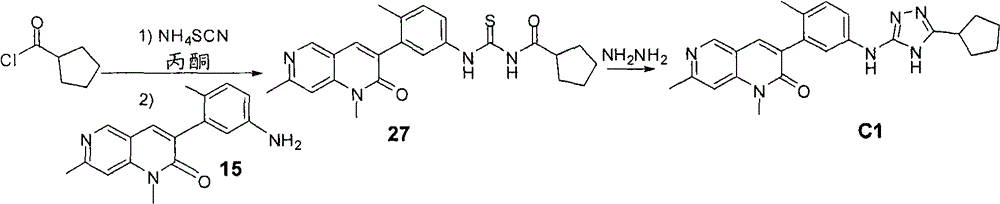
将环戊烷羰基氯(13mg,0.1mmol)和异硫氰酸铵(7.6mg,0.1mmol)的丙酮(1.0mL)混合物在40℃加热3h。向上述反应混合物中,在rt下加入3-(5-氨基-2-甲基苯基)-1,7-二甲基-1,6-萘啶-2(1H)-酮(15)(27.5mg,0.1mmol)并搅拌30min。在真空下除去溶剂,得到N-(3-(1,7-二甲基-2-氧代-1,2-二氢-1,6-萘啶-3-基)-4-甲基苯基硫代氨甲酰基)环戊烷甲酰胺27,其无需纯化直接使用。MS m/z 435.2(M+1).A mixture of cyclopentanecarbonyl chloride (13 mg, 0.1 mmol) and ammonium isothiocyanate (7.6 mg, 0.1 mmol) in acetone (1.0 mL) was heated at 40 °C for 3 h. To the above reaction mixture, 3-(5-amino-2-methylphenyl)-1,7-dimethyl-1,6-naphthyridin-2(1H)-one (15) was added at rt. 27.5mg, 0.1mmol) and stirred for 30min. The solvent was removed under vacuum to give N-(3-(1,7-dimethyl-2-oxo-1,2-dihydro-1,6-naphthyridin-3-yl)-4-methylbenzene (thiocarbamoyl)cyclopentanecarboxamide 27, which was used without purification. MS m/z 435.2(M+1).
向上面获得的粗制的N-(3-(1,7-二甲基-2-氧代-1,2-二氢-1,6-萘啶-3-基)-4-甲基苯基硫代氨甲酰基)环戊烷甲酰胺27的EtOH(1.0mL)混合物中,加入肼(4mg,0.12mmol),并将得到的混合物在80℃加热2h。将残留物通过制备LC/MS纯化,得到C1。MS m/z 415.2(M+1).To the crude N-(3-(1,7-dimethyl-2-oxo-1,2-dihydro-1,6-naphthyridin-3-yl)-4-methylbenzene obtained above To a mixture of (thiocarbamoyl)cyclopentanecarboxamide 27 in EtOH (1.0 mL), hydrazine (4 mg, 0.12 mmol) was added and the resulting mixture was heated at 80° C. for 2 h. The residue was purified by preparative LC/MS to afford Cl. MS m/z 415.2(M+1).
实施例C6Example C6
1,7-二甲基-3-(2-甲基-5-(5-苯基-4H-1,2,4-三唑-3-基氨基)苯基)-1,6-萘啶-2(1H)-酮的合成1,7-Dimethyl-3-(2-methyl-5-(5-phenyl-4H-1,2,4-triazol-3-ylamino)phenyl)-1,6-naphthyridine Synthesis of -2(1H)-one

向20(44mg,0.1mmol)的EtOH(1mL)溶液中加入肼(16μL,0.5mmol)。将混合物加热回流2h。在真空中除去溶剂,并将粗产物用制备LC/MS纯化,得到C6。1H NMR(400MHz,d4-MeOH)δ9.04(s,1H),8.05(s,1H),7.95(m,1H),7.93(d,J=2Hz,1H),7.86(s,1H),7.47(m,5H),7.25(d,J=7.9Hz,1H),7.29(d,J=8.4Hz,1H),3.83(s,3H),2.84(s,3H),2.17(s,3H).MS m/z 423.2(M+1).To a solution of 20 (44 mg, 0.1 mmol) in EtOH (1 mL) was added hydrazine (16 μL, 0.5 mmol). The mixture was heated to reflux for 2h. The solvent was removed in vacuo and the crude product was purified by preparative LC/MS to afford C6. 1 H NMR (400MHz, d 4 -MeOH) δ9.04(s, 1H), 8.05(s, 1H), 7.95(m, 1H), 7.93(d, J=2Hz, 1H), 7.86(s, 1H) ), 7.47(m, 5H), 7.25(d, J=7.9Hz, 1H), 7.29(d, J=8.4Hz, 1H), 3.83(s, 3H), 2.84(s, 3H), 2.17(s , 3H). MS m/z 423.2 (M+1).
方法8Method 8
实施例D1Example D1
1,7-二甲基-3-(2-甲基-5-(5-苯基异

在rt下,向苯乙酮(24.0mg,0.2mmol)和NaH(16.0mg,0.4mmol,60%在矿物油中)的DMF(1mL)溶液中加入3-(5-异硫氰酸基-2-甲基苯基)-1,7-二甲基-1,6-萘啶-2(1H)-酮19(64.5mg,0.2mmol)。1小时后,用水猝灭反应。将反应混合物用EtOAc萃取。将有机层用盐水洗涤,用Na2SO4干燥,过滤并浓缩,得到粗制的3-(5-异硫氰酸基-2-甲基苯基)-1,7-二甲基-1,6-萘啶-2(1H)-酮28,其无需纯化直接使用。MS m/z 442.2(M+1).To a solution of acetophenone (24.0 mg, 0.2 mmol) and NaH (16.0 mg, 0.4 mmol, 60% in mineral oil) in DMF (1 mL) was added 3-(5-isothiocyanato- 2-Methylphenyl)-1,7-dimethyl-1,6-naphthyridin-2(1H)-one 19 (64.5 mg, 0.2 mmol). After 1 hour, the reaction was quenched with water. The reaction mixture was extracted with EtOAc. The organic layer was washed with brine, dried over Na2SO4 , filtered and concentrated to give crude 3-(5-isothiocyanato-2-methylphenyl)-1,7-dimethyl-1 , 6-Naphthyridin-2(1H)-one 28, which was used without purification. MS m/z 442.2(M+1).
向3-(5-异硫氰酸基-2-甲基苯基)-1,7-二甲基-1,6-萘啶-2(1H)-酮28(22mg,0.05mmol)的EtOH(0.5mL)溶液中加入固体NaOH(20mg,0.5mmol)和MeI(7mg,0.05mmol)。将混合物在rt搅拌1h,得到3-(5-((Z)-1-(甲硫基)-3-氧代-3-苯基丙-1-烯基氨基)-2-甲基苯基)-1,7-二甲基-1,6-萘啶-2(1H)-酮29。将盐酸羟胺(35mg,0.5mmol)加入到上述反应混合物中,并将反应在80℃加热1h。过滤后,将混合物通过制备LC/MS纯化,得到3-(5-(5-苯基异
方法9Method 9
实施例D9Example D9
1,7-二甲基-3-(2-甲基-5-(5-(噻唑-2-基)异

在rt下向1-(噻唑-2-基)乙酮(24.0mg,0.2mmol)和NaH(16.0mg,0.4mmol,60%在矿物油中)的DMF(1mL)溶液中加入3-(5-异硫氰酸基-2-甲基苯基)-1,7-二甲基-1,6-萘啶-2(1H)-酮19(64.5mg,0.2mmol)。将反应物在rt下搅拌1h。然后加入MeI(29mg,0.20mmol)。10分钟后,用水猝灭反应,并用EtOAc萃取。将有机层用盐水洗涤,用Na2SO4干燥,过滤并浓缩,得到粗制的(Z)-1,7-二甲基-3-(2-甲基-5-(1-(甲硫基)-3-氧代-3-(噻唑-2-基)丙-1-烯基氨基)苯基)-1,6-萘啶-2(1H)-酮32,其无需纯化直接使用。MS m/z463.1(M+1).To a solution of 1-(thiazol-2-yl)ethanone (24.0 mg, 0.2 mmol) and NaH (16.0 mg, 0.4 mmol, 60% in mineral oil) in DMF (1 mL) was added 3-(5 -Isothiocyanato-2-methylphenyl)-1,7-dimethyl-1,6-naphthyridin-2(1H)-one 19 (64.5 mg, 0.2 mmol). The reaction was stirred at rt for 1 h. MeI (29 mg, 0.20 mmol) was then added. After 10 minutes, the reaction was quenched with water and extracted with EtOAc. The organic layer was washed with brine, dried over Na2SO4 , filtered and concentrated to give crude (Z)-1,7-dimethyl-3-(2-methyl - 5-(1-(methylsulfide yl)-3-oxo-3-(thiazol-2-yl)prop-1-enylamino)phenyl)-1,6-naphthyridin-2(1H)-one 32, which was used without purification. MS m/z463.1(M+1).
将(Z)-1,7-二甲基-3-(2-甲基-5-(1-(甲硫基)-3-氧代-3-(噻唑-2-基)丙-1-烯基氨基)苯基)-1,6-萘啶-2(1H)-酮32(462mg,1.0mmol)、O-(四氢-2H-吡喃-2-基)羟胺(293mg,2.5mmol)和K2CO3(415mg,3.0mmol)的1,4-二氧六环(5mL)混合物在密封瓶中在150℃加热30h。将混合物通过制备LC/MS纯化,得到1,7-二甲基-3-(2-甲基-5-(5-(噻唑-2-基)异唑-3-基氨基)苯基)-1,6-萘啶-2(1H)-酮(D9)。1H NMR(400MHz,d6-DMSO)δ10.73(s,1H),9.19(s,1H),8.11(s,1H),7.93(s,1H),7.87(d,J=3.2Hz,1H),7.74(d,J=3.2Hz,1H),7.65(d,J=2.4Hz,1H),7.61(s,1H),7.53(dd,J=2.4,8.0Hz,1H),7.27(d,J=8.0Hz,1H),3.72(s,3H),2.78(s,3H),2.10(s,3H).MS m/z430.2(M+1).(Z)-1,7-Dimethyl-3-(2-methyl-5-(1-(methylthio)-3-oxo-3-(thiazol-2-yl) prop-1- Alkenylamino)phenyl)-1,6-naphthyridin-2(1H)-one 32 (462mg, 1.0mmol), O-(tetrahydro-2H-pyran-2-yl)hydroxylamine (293mg, 2.5mmol ) and K 2 CO 3 (415 mg, 3.0 mmol) in 1,4-dioxane (5 mL) was heated at 150° C. for 30 h in a sealed bottle. The mixture was purified by preparative LC/MS to give 1,7-dimethyl-3-(2-methyl-5-(5-(thiazol-2-yl)iso Azol-3-ylamino)phenyl)-1,6-naphthyridin-2(1H)-one (D9). 1 H NMR (400MHz, d6-DMSO) δ10.73(s, 1H), 9.19(s, 1H), 8.11(s, 1H), 7.93(s, 1H), 7.87(d, J=3.2Hz, 1H ), 7.74(d, J=3.2Hz, 1H), 7.65(d, J=2.4Hz, 1H), 7.61(s, 1H), 7.53(dd, J=2.4, 8.0Hz, 1H), 7.27(d , J=8.0Hz, 1H), 3.72(s, 3H), 2.78(s, 3H), 2.10(s, 3H). MS m/z430.2(M+1).
方法10Method 10
实施例D4Example D4
3-(5-(5-环丙基异

在rt下向NaH(240mg,6.0mmol,60%在矿物油中)和1-环丙基乙酮(168.2mg,2.0mmol)的DMF(1mL)混合物中加入三硫代碳酸二甲酯(dimethyl carbonotrithioate)(304.3mg,2.2mmol)。3小时后,用水猝灭反应,用EtOAc萃取。将有机层用盐水洗涤,用Na2SO4干燥,过滤并浓缩,得到粗制的1-环丙基-3,3-双(甲硫基)丙-2-烯-1-酮30,将其通过硅胶快速色谱法用15%EtOAc的己烷溶液作为洗脱剂进行纯化。1H NMR(400MHz,CDCl3)δ6.14(s,1H),2.41(s,3H),2.40(s,3H),1.81(m,1H),1.00(m,2H),0.77(m,2H).MS m/z 189.0(M+1).To a mixture of NaH (240 mg, 6.0 mmol, 60% in mineral oil) and 1-cyclopropylethanone (168.2 mg, 2.0 mmol) in DMF (1 mL) was added dimethyl trithiocarbonate (dimethyl carbonotrithioate) (304.3mg, 2.2mmol). After 3 hours, the reaction was quenched with water and extracted with EtOAc. The organic layer was washed with brine , dried over Na2SO4 , filtered and concentrated to give crude 1-cyclopropyl-3,3-bis(methylthio)prop-2-en-1-one 30, which was It was purified by flash chromatography on silica gel using 15% EtOAc in hexanes as eluent. 1 H NMR (400MHz, CDCl 3 ) δ6.14(s, 1H), 2.41(s, 3H), 2.40(s, 3H), 1.81(m, 1H), 1.00(m, 2H), 0.77(m, 2H).MS m/z 189.0(M+1).
将3-(5-氨基-2-甲基苯基)-1,7-二甲基-1,6-萘啶-2(1H)-酮15(165mg,0.589mmol)和1-环丙基-3,3-双(甲硫基)丙-2-烯-1-酮30(111mg,0.589mmol)的1,4-二氧六环(2mL)混合物在密封瓶中在150℃加热过夜。除去溶剂,得到粗制的(Z)-3-(5-(3-环丙基-1-(甲硫基)-3-氧代丙-1-烯基氨基)-2-甲基苯基)-1,7-二甲基-1,6-萘啶-2(1H)-酮31,其无需进一步纯化直接使用。MS m/z 420.1(M+1).3-(5-Amino-2-methylphenyl)-1,7-dimethyl-1,6-naphthyridin-2(1H)-one 15 (165 mg, 0.589 mmol) and 1-cyclopropyl - A mixture of 3,3-bis(methylthio)prop-2-en-1-one 30 (111 mg, 0.589 mmol) in 1,4-dioxane (2 mL) was heated in a sealed bottle at 150°C overnight. Removal of solvent afforded crude (Z)-3-(5-(3-cyclopropyl-1-(methylthio)-3-oxoprop-1-enylamino)-2-methylphenyl )-1,7-Dimethyl-1,6-naphthyridin-2(1H)-one 31, which was used without further purification. MS m/z 420.1(M+1).
向上述的(Z)-3-(5-(3-环丙基-1-(甲硫基)-3-氧代丙-1-烯基氨基)-2-甲基苯基)-1,7-二甲基-1,6-萘啶-2(1H)-酮31的粗制混合物加入盐酸羟胺(174mg,2.4mmol)和DMF(2mL)。将得到的混合物在100℃加热30min。将混合物通过制备LC/MS纯化,得到3-(5-(5-环丙基异
方法11Method 11
实施例E2Example E2
1,7-二甲基-3-(2-甲基-5-(3-(吡啶-2-基)-1,2,4-

向15(40mg,0.14mmol)的DCM(2mL)溶液中加入DIPEA(75μL)和三光气(14mg,0.05mmol),并在rt搅拌30min。然后加入2-吡啶甲脒(23mg,014mmol),并在rt搅拌4h。随后将反应物用水进行分配,用盐水洗涤,用硫酸镁干燥,过滤并蒸干。粗制的中间体33没有纯化直接用于下一反应中。To a solution of 15 (40 mg, 0.14 mmol) in DCM (2 mL) was added DIPEA (75 μL) and triphosgene (14 mg, 0.05 mmol) and stirred at rt for 30 min. 2-Pyridinecarboxamidine (23mg, 014mmol) was then added and stirred at rt for 4h. The reaction was then partitioned with water, washed with brine, dried over magnesium sulfate, filtered and evaporated to dryness. Crude intermediate 33 was used directly in the next reaction without purification.
向33(60mg,0.14mmol)的MeOH/水(1∶1,2mL)溶液中加入HCl(0.14mL,1M溶液)和NaOCl(95μL,10-13%水溶液)。将反应物在rt搅拌均匀,然后加入Na2CO3(15mg,0.14mmol),将反应物加热至65℃反应12h。随后将反应物用DMF(~1mL)稀释,并用制备LC/MS纯化,得到1,7-二甲基-3-(2-甲基-5-(3-(吡啶-2-基)-1,2,4-
实施例E3Example E3
3-(5-(3-异丙基-1,2,4-二唑-5-基氨基)-2-甲基苯基)-1,7-二甲基-1,6-萘啶-2(1H)-酮的合成3-(5-(3-isopropyl-1,2,4- Synthesis of oxadiazol-5-ylamino)-2-methylphenyl)-1,7-dimethyl-1,6-naphthyridin-2(1H)-one

向15(40mg,0.14mmol)的DCM(2mL)溶液中加入DIPEA(75μL)和三光气(14mg,0.05mmol),并在rt搅拌30min。然后加入异丁脒(18mg,014mmol)并在rt搅拌4h。随后将反应物用水进行分配,用盐水洗涤,用硫酸镁干燥,过滤并蒸干。粗制的中间体34没有纯化即用于下一反应。To a solution of 15 (40 mg, 0.14 mmol) in DCM (2 mL) was added DIPEA (75 μL) and triphosgene (14 mg, 0.05 mmol) and stirred at rt for 30 min. Isobutyramide (18mg, 014mmol) was then added and stirred at rt for 4h. The reaction was then partitioned with water, washed with brine, dried over magnesium sulfate, filtered and evaporated to dryness. Crude intermediate 34 was used in the next reaction without purification.
向中间体34(55mg,0.14mmol)的MeOH∶水=1∶1(2mL)溶液中加入HCl(0.14mL,1M溶液)和NaOCl(95μL,10-13%水溶液)。将反应物在rt搅拌均匀,然后加入Na2CO3(15mg,0.14mmol),并将反应物加热至65℃反应12h。随后将反应物用DMF(~1mL)稀释,过滤并用制备LC/MS纯化,得到3-(5-(3-异丙基-1,2,4-
方法12Method 12
实施例F1Example F1
1,7-二甲基-3-(2-甲基-5-(3-(噻唑-2-基)异

向盐酸羟胺(42mg,0.6mmol)和KOH(34mg,0.6mmol)的EtOH(2mL)混合物中加入粗制的(Z)-1,7-二甲基-3-(2-甲基-5-(1-(甲硫基)-3-氧代-3-(噻唑-2-基)丙-1-烯基氨基)苯基)-1,6-萘啶-2(1H)-酮32。将得到的混合物在80℃加热30min。然后加入NaOEt(40.8mg,0.6mmol),将反应混合物回流1h。将混合物通过制备LC/MS纯化,得到1,7-二甲基-3-(2-甲基-5-(3-(噻唑-2-基)异
方法13Method 13
实施例G1Example G1
1,7-二甲基-3-(2-甲基-5-(3-(噻唑-2-基)异

将3-(5-氨基-2-甲基苯基)-1,7-二甲基-1,6-萘啶-2(1H)-酮15(30mg,0.107mmol)、3-氯-5-苯基-1,2,4-噻二唑(41mg,0.21mmol)和TsOH(10mg)在二氧六环(2ml)中在100℃加热。10h后,冷却溶液并过滤。将混合物通过制备LC/MS纯化,得到1,7-二甲基-3-(2-甲基-5-(5-苯基-1,2,4-噻二唑-3-基氨基)苯基)-1,6-萘啶-2(1H)-酮(G1)。MS m/z 440.5(M+1).3-(5-Amino-2-methylphenyl)-1,7-dimethyl-1,6-naphthyridin-2(1H)-one 15 (30mg, 0.107mmol), 3-chloro-5 -Phenyl-1,2,4-thiadiazole (41 mg, 0.21 mmol) and TsOH (10 mg) were heated in dioxane (2 ml) at 100°C. After 10 h, the solution was cooled and filtered. The mixture was purified by preparative LC/MS to afford 1,7-dimethyl-3-(2-methyl-5-(5-phenyl-1,2,4-thiadiazol-3-ylamino)benzene base)-1,6-naphthyridin-2(1H)-one (G1). MS m/z 440.5(M+1).
方法14Method 14
实施例H1Example H1
1,7-二甲基-3-(2-甲基-5-(5-苯基-1,3,4-噻二唑-2-基氨基)苯基)-1,6-萘啶-2(1H)-酮(H1)的合成1,7-Dimethyl-3-(2-methyl-5-(5-phenyl-1,3,4-thiadiazol-2-ylamino)phenyl)-1,6-naphthyridine- Synthesis of 2(1H)-ketone(H1)
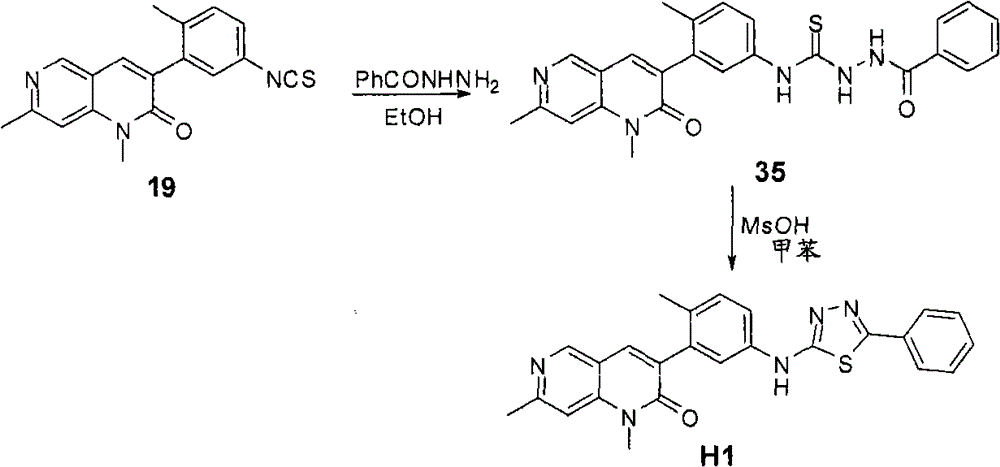
向19(50mg,0.16mmol)的EtOH(1.0mL)溶液中,加入苯甲酰肼(26mg,0.19mmol),在rt搅拌2h。在真空下除去溶剂,得到粗制的2-苯甲酰基-N-(3-(1,7-二甲基-2-氧代-1,2-二氢-1,6-萘啶-3-基)-4-甲基苯基)肼硫代甲酰胺(carbothioamide),其无需纯化直接使用。MS m/z 458.2(M+1).To a solution of 19 (50 mg, 0.16 mmol) in EtOH (1.0 mL) was added benzoylhydrazide (26 mg, 0.19 mmol) and stirred at rt for 2 h. The solvent was removed under vacuum to give crude 2-benzoyl-N-(3-(1,7-dimethyl-2-oxo-1,2-dihydro-1,6-naphthyridine-3 -yl)-4-methylphenyl)hydrazine carbothioamide, which was used directly without purification. MS m/z 458.2(M+1).
将粗制的2-苯甲酰基-N-(3-(1,7-二甲基-2-氧代-1,2-二氢-1,6-萘啶-3-基)-4-甲基苯基)肼硫代甲酰胺35和甲磺酸(2滴)的甲苯(1mL)混合物在密封瓶中在130℃加热过夜。将反应物蒸发至干,并将粗制的残留物通过制备LC/MS纯化,得到1,7-二甲基-3-(2-甲基-5-(5-苯基-1,3,4-噻二唑-2-基氨基)苯基)-1,6-萘啶-2(1H)-酮(H1)。MS m/z 440.1(M+1).The crude 2-benzoyl-N-(3-(1,7-dimethyl-2-oxo-1,2-dihydro-1,6-naphthyridin-3-yl)-4- A mixture of methylphenyl)hydrazine thiocarboxamide 35 and methanesulfonic acid (2 drops) in toluene (1 mL) was heated at 130° C. overnight in a sealed bottle. The reaction was evaporated to dryness and the crude residue was purified by preparative LC/MS to give 1,7-dimethyl-3-(2-methyl-5-(5-phenyl-1,3, 4-Thiadiazol-2-ylamino)phenyl)-1,6-naphthyridin-2(1H)-one (H1). MS m/z 440.1(M+1).
通过重复上面实施例(中间体和最终化合物)中所述的方法,采用适当的起始原料,获得以下的式I化合物,如表1中所示。By repeating the procedures described in the above examples (intermediates and final compounds), using appropriate starting materials, the following compounds of formula I were obtained, as shown in Table 1.
表1Table 1


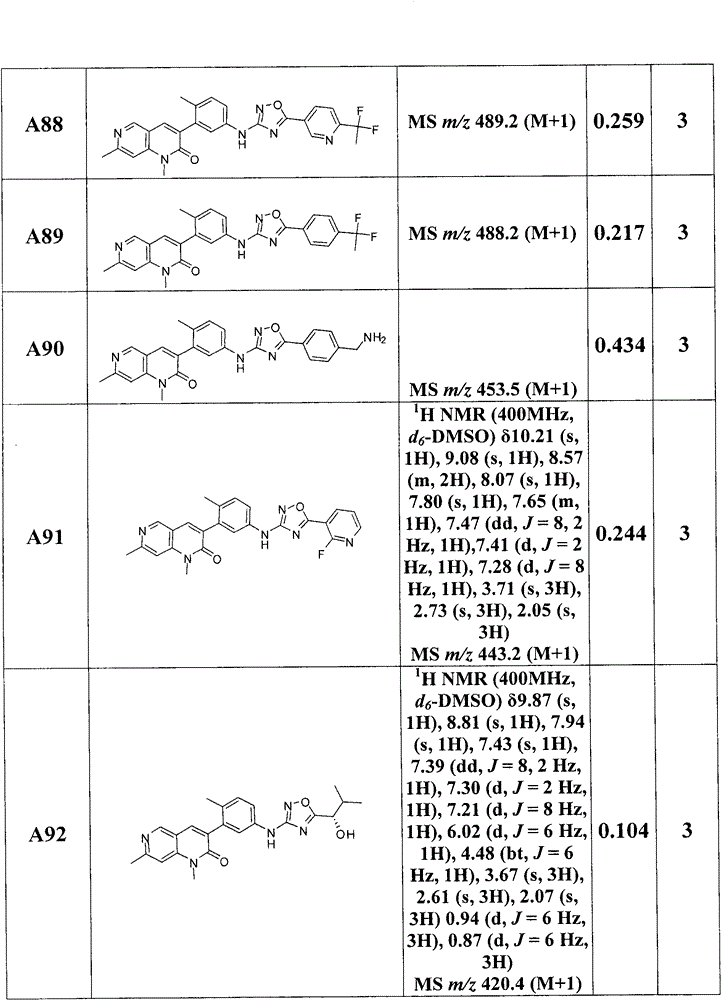


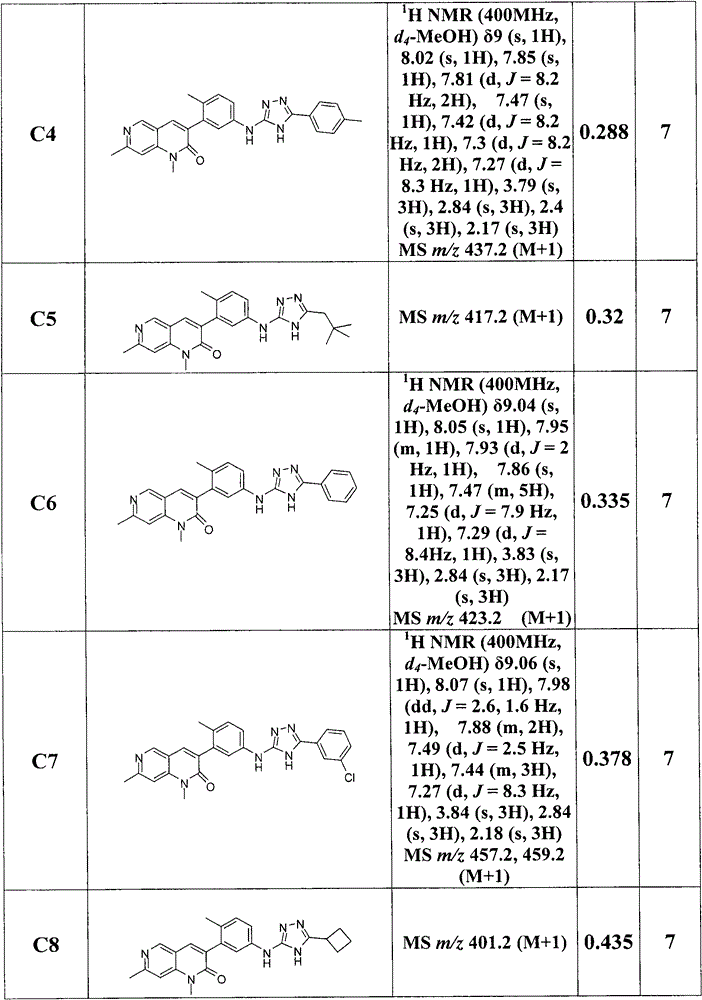


试验test
对本发明化合物进行测定以测量其选择性抑制野生型Ba/F3细胞和用Tel c-kit激酶和Tel PDGFR融合的酪氨酸激酶转化的Ba/F3细胞增殖的能力。另外本发明化合物可以选择性抑制Mo7e细胞的SCF依赖性增殖。此外,对化合物进行试验以测定它们抑制Abl、ARG、BCR-Abl、BRK、EphB、Fms、Fyn、KDR、c-Kit、LCK、PDGF-R、b-Raf、c-Raf、SAPK2、Src、Tie2和TrkB激酶的能力。Compounds of the invention were assayed to measure their ability to selectively inhibit the proliferation of wild-type Ba/F3 cells and Ba/F3 cells transformed with a Tel c-kit kinase and Tel PDGFR fused tyrosine kinase. In addition, the compound of the present invention can selectively inhibit the SCF-dependent proliferation of Mo7e cells. In addition, compounds were tested to determine their inhibition of Abl, ARG, BCR-Abl, BRK, EphB, Fms, Fyn, KDR, c-Kit, LCK, PDGF-R, b-Raf, c-Raf, SAPK2, Src, Competence of Tie2 and TrkB kinases.
增殖试验:BaF3Library-Bright glo读数方案Proliferation assay: BaF3Library-Bright glo read protocol
对化合物抑制野生型Ba/F3细胞和用Tel融合的酪氨酸激酶转化的Ba/F3细胞增殖的能力进行分析。将未被转化的Ba/F3细胞维持在包含重组IL3的培养基中。将细胞以每孔50μL培养基中5,000个细胞的密度涂到384-孔TC板中,并以0.06nM至10μM的浓度向其中加入测试化合物。然后,将这些细胞在37℃、5%CO2下孵育48小时。在对细胞进行孵育后,按照制造商的指导向各孔中加入25μL BRIGHT
Mo7e试验Mo7e test
用内源性表达c-kit的Mo7e细胞在96-孔板中对本文所述化合物抑制SCF依赖性增殖的作用进行试验。对两倍系列稀释的测试化合物(Cmax=10μM)对用人重组SCF刺激的Mo7e细胞的抗增殖活性进行评估。将其在37℃下孵育48小时后,用得自Promega的MTT比色测定法测量细胞活力。本发明化合物的IC50值引用在上面的表1中。The inhibition of SCF-dependent proliferation by the compounds described herein was tested in 96-well plates using Mo7e cells endogenously expressing c-kit. The anti-proliferative activity of two-fold serial dilutions of test compounds (Cmax = 10 [mu]M) on Mo7e cells stimulated with human recombinant SCF was assessed. After incubating them at 37°C for 48 hours, cell viability was measured with the MTT colorimetric assay from Promega. The IC50 values for the compounds of the invention are quoted in Table 1 above.
c-kit HTRF方案c-kit HTRF solution
将在激酶缓冲液(20mM Tris pH 7.5、10mM MgCl2、0.01%BSA、0.1%Brij35、1mM DTT、5%甘油、0.05mM Na3VO4)中的2x浓度的c-kit酶混合物25ng c-kit(5ng/μL)和2μMBiotin-EEEPQYEEIPIYLELLP-NH2肽的等分试样(5μL)加至384孔Proxiplate(Packard)的每一孔中。该Proxiplate的最后一排的每一孔含有5μL不含有c-kit的c-kit酶混合物,以确定本底水平。将本发明化合物加至每一孔中,将板在室温孵育30分钟。将在激酶缓冲液(5μL)中的2x ATP(40μM)加至每孔中,并将板在室温孵育3小时。将检测混合物(50%KF、40%激酶缓冲液、10%EDTA、1∶100稀释的Mab PT66-K(目录#61T66KLB)和1∶100稀释的Streptavidin-XL(目录#611SAXLB)(10μL)加至每孔中,将板在室温再孵育1-2小时。然后在检测器上读取HTRF信号。A 2x concentration of c -kit enzyme mix 25ng c- Aliquots (5 μL) of kit (5 ng/μL) and 2 μM Biotin-EEEPQYEEIPIYLELLP-NH 2 peptide were added to each well of a 384-well Proxiplate (Packard). Each well of the last row of the Proxiplate contained 5 μL of c-kit enzyme mix without c-kit to determine the background level. Compounds of the invention are added to each well and the plate is incubated for 30 minutes at room temperature. 2x ATP (40 μM) in kinase buffer (5 μL) was added to each well and the plate was incubated at room temperature for 3 hours. Assay mix (50% KF, 40% kinase buffer, 10% EDTA, 1:100 dilution of Mab PT66-K (Catalog #61T66KLB) and 1:100 dilution of Streptavidin-XL (Catalog #611SAXLB) (10 μL) was added to to each well and incubate the plate for an additional 1-2 hours at room temperature.Then read the HTRF signal on the detector.
人TG/HA-VSMC增殖试验Human TG/HA-VSMC Proliferation Assay
将人TG/HA-VSMC细胞(ATCC)以60,000细胞/mL再悬浮在补加有1%FBS和30ng/mL重组人PDGF-BB的DMEM中。将细胞以50μL/孔等分到384孔板中,并在37℃下在潮湿的孵育器中在5%二氧化碳存在下孵育4小时。将0.5μL稀释在DMSO中的测试化合物加至每孔中。将板放回到孵育器中再保持68小时。将25μL CellTiter-Glo(Promega)加入至每孔中,并将板在工作台上孵育15分钟。然后使用CLIPR CCD相机(Molecular Devices)对发光进行读数。Human TG/HA-VSMC cells (ATCC) were resuspended at 60,000 cells/mL in DMEM supplemented with 1% FBS and 30 ng/mL recombinant human PDGF-BB. Aliquot cells at 50 μL/well into 384-well plates and incubate for 4 h at 37 °C in a humidified incubator in the presence of 5% carbon dioxide. 0.5 μL of test compound diluted in DMSO was added to each well. Plates were returned to the incubator for another 68 hours. 25 μL of CellTiter-Glo (Promega) was added to each well and the plate was incubated on the bench for 15 minutes. Luminescence was then read using a CLIPR CCD camera (Molecular Devices).
游离形式或药学上可接受的盐形式的式I化合物展现出有价值的药理学性质。本发明化合物对于c-kit和PDGFR具有1×10⁻⁵至1×10⁻¹⁰M、优选小于500nM、更优选小于250nM和100nM的IC50。本发明化合物中的一些对c-kit具有增加的选择性(相对于PDGFR而言),例如如下表中所示:Compounds of formula I exhibit valuable pharmacological properties in free form or in pharmaceutically acceptable salt form. The compounds of the present invention have IC 50 for c-kit and PDGFR of 1×10 −5 to 1×10 −10 M, preferably less than 500 nM, more preferably less than 250 nM and 100 nM. Some of the compounds of the invention have increased selectivity for c-kit (relative to PDGFR), for example as shown in the table below:


大鼠A10增殖试验Rat A10 Proliferation Assay
将大鼠A10细胞(ATCC)以20,000细胞/mL重悬浮在补加有1%FBS和10ng/mL重组大鼠PDGF-BB的DMEM中。将细胞以50μL/孔等分到384孔板中,并在37℃下在潮湿的孵育器中在5%二氧化碳存在下孵育4小时。将0.5μL稀释在DMSO中的测试化合物加至每孔中。将板放回到孵育器中再孵育68小时。将25μL CellTiter-Glo(Promega)加入至每孔中,并将板在工作台(bench)上孵育15分钟。然后使用CLIPR CCD相机(Molecular Devices)对发光进行读数。Rat A10 cells (ATCC) were resuspended at 20,000 cells/mL in DMEM supplemented with 1% FBS and 10 ng/mL recombinant rat PDGF-BB. Aliquot cells at 50 μL/well into 384-well plates and incubate for 4 h at 37 °C in a humidified incubator in the presence of 5% carbon dioxide. 0.5 μL of test compound diluted in DMSO was added to each well. Plates were returned to the incubator for an additional 68 hours. 25 μL of CellTiter-Glo (Promega) was added to each well and the plate was incubated on the bench for 15 minutes. Luminescence was then read using a CLIPR CCD camera (Molecular Devices).
PDGFRα/β Lance试验方案PDGFRα/β Lance trial protocol
将2x浓度的PDGFRβ肽和ATP混合物(在试验缓冲液(20mM Hepes、54mM MgCl2、0.01%BSA、0.05%吐温20、1mM DTT、10%甘油、50μM Na3VO4)中的4μM生物素-βA-βA-βA-AEEEEYVFIEAKKK肽、20μM ATP))的等分试样(2.5μL)加至384孔Proxiplate(Packard)的每一孔中。将板离心,并通过针排式(pintool)分配器将本发明化合物(50nL)加至每孔中。向每孔中加入(2.5μL)2x浓度的酶混合物(在试验缓冲液中的4.5ng/μL PDGFRα(目录#PV4117)或1.5ng/μL PDGFRβ(目录#PV3591))或不含PDGFRα/β酶的试验缓冲液自身。将板在室温下孵育1.5小时。将检测混合物(5μL;50%1M KF、40%激酶缓冲液、10%EDTA、1∶100稀释的Mab PT66-K(目录#61T66KLB)和1∶100稀释的Streptavidin-XL(目录#611SAXLB)加至每孔中,将Proxiplate在室温再孵育1小时,然后在检测器上读取HTRF信号。A 2x concentration of PDGFRβ peptide and ATP mixture (4 μM biotin in assay buffer (20 mM Hepes, 54 mM MgCl 2 , 0.01% BSA, 0.05% Tween 20, 1 mM DTT, 10% glycerol, 50 μM Na 3 VO 4 ) Aliquots (2.5 μL) of -βA-βA-βA-AEEEEYVFIEAKKK peptide, 20 μM ATP)) were added to each well of a 384-well Proxiplate (Packard). Plates were centrifuged and compounds of the invention (50 nL) were added to each well via a pintool dispenser. Add (2.5 μL) 2x concentration of enzyme mix (4.5 ng/μL PDGFRα (catalog #PV4117) or 1.5 ng/μL PDGFRβ (catalog #PV3591) in assay buffer) or no PDGFRα/β enzyme to each well The assay buffer itself. Plates were incubated for 1.5 hours at room temperature. Assay mix (5 μL; 50% 1M KF, 40% Kinase Buffer, 10% EDTA, 1:100 dilution of Mab PT66-K (Catalog #61T66KLB) and 1:100 dilution of Streptavidin-XL (Catalog #611SAXLB) was added to to each well, the Proxiplate was incubated for an additional 1 hour at room temperature, and then the HTRF signal was read on the detector.
Ba/F3FL FLT3增殖试验Ba/F3FL FLT3 Proliferation Assay
所用鼠科动物细胞系是过表达全长FLT3构建体的Ba/F3鼠科动物pro-B细胞系。将这些细胞维持在补加了青霉素50μg/mL、链霉素50μg/mL和L-谷酰胺200mM的RPMI 1640/10%胎牛血清(RPMI/FBS)中,同时加入鼠科动物重组IL3。Ba/F3全长FLT3细胞经历16小时的IL3饥饿,然后以每孔25μL培养基中5,000个细胞的密度将其涂到384-孔TC板中;并以0.06nM至10μM的浓度向其中加入测试化合物。在加入化合物后,以适宜的浓度向各孔25μL的培养基中加入FLT3配体或用于细胞毒性控制的IL3。然后,将这些细胞在37℃、5%CO2下孵育48小时。在对细胞进行孵育后,按照制造商的指导向各孔中加入25μL BRIGHT(Promega)并用Analyst GT-Luminescence mode-50000积分时间在RLU中对这些板进行读数。The murine cell line used was the Ba/F3 murine pro-B cell line overexpressing the full length FLT3 construct. These cells were maintained in RPMI 1640/10% fetal bovine serum (RPMI/FBS) supplemented with penicillin 50 μg/mL, streptomycin 50 μg/mL and L-glutamine 200 mM, along with murine recombinant IL3. Ba/F3 full-length FLT3 cells were subjected to 16 hours of IL3 starvation and then plated at a density of 5,000 cells per well in 25 μL medium in 384-well TC plates; and assays were added thereto at concentrations ranging from 0.06 nM to 10 μM compound. After compound addition, FLT3 ligand or IL3 for cytotoxicity control was added to 25 μL of medium in each well at an appropriate concentration. These cells were then incubated for 48 hours at 37°C, 5% CO 2 . After incubating the cells, add 25 μL of BRIGHT to each well following the manufacturer's directions (Promega) and the plates were read in RLU with Analyst GT-Luminescence mode-50000 integration time.
对细胞BCR-Abl依赖性增殖的抑制(高通量方法)Inhibition of BCR-Abl-dependent proliferation of cells (high-throughput method)
所用的鼠细胞系是用BCR-Abl cDNA转化的32D造血祖细胞系(32D-p210)。将这些细胞保持在补充有青霉素(50μg/mL)、链霉素(50μg/mL)和L-谷酰胺(200mM)的RPMI/10%胎牛血清(RPMI/FCS)中。将未转化的32D细胞保持在类似条件下并添加15%WEHI条件培养基作为IL3源。The murine cell line used was the 32D hematopoietic progenitor cell line (32D-p210) transformed with the BCR-Abl cDNA. These cells were maintained in RPMI/10% fetal calf serum (RPMI/FCS) supplemented with penicillin (50 μg/mL), streptomycin (50 μg/mL) and L-glutamine (200 mM). Untransformed 32D cells were maintained under similar conditions and supplemented with 15% WEHI-conditioned medium as a source of IL3.
将50μL 32D或32D-p210细胞混悬液以每孔5000个细胞的密度接种于Greiner 384孔微孔板(黑色)中。向各孔中加入50nL测试化合物(1mM,在DMSO储备液中)(用STI571作为阳性对照)。在37℃、5%CO2下将细胞培养72小时。向各孔中加入10μL 60%的Alamar Blue溶液(Tek诊断试剂)并将细胞再孵育24小时。使用AcquestTM系统(Molecular Devices)测定荧光强度(530nm激发,580nm发射)。50 μL of 32D or 32D-p210 cell suspension was seeded in a Greiner 384-well microplate (black) at a density of 5000 cells per well. 50 nL of test compound (1 mM in DMSO stock) was added to each well (STI571 was used as a positive control). Cells were incubated for 72 hours at 37°C, 5% CO2 . 10 [mu]L of 60% Alamar Blue solution (Tek Diagnostics) was added to each well and the cells were incubated for an additional 24 hours. Fluorescence intensity (excitation at 530 nm, emission at 580 nm) was measured using the Acquest ™ system (Molecular Devices).
对细胞BCR-Abl依赖性增殖的抑制Inhibition of BCR-Abl-dependent proliferation of cells
将32D-p210细胞以每孔15,000个细胞的密度接种于96孔TC板中。向各孔中加入50μL测试化合物的两倍系列稀释液(Cmax为40μM)(包含STI571作为阳性对照)。将细胞在37℃、5%CO2下孵育48小时后,向各孔中加入15μL MTT(Promega)并将细胞再孵育5小时。通过分光光度法定量测定570nm处的光密度并通过量效曲线确定IC50值。32D-p210 cells were seeded in 96-well TC plates at a density of 15,000 cells per well. 50 [mu]L of two-fold serial dilutions of test compounds (with a Cmax of 40 [mu]M) were added to each well (including STI571 as a positive control). After incubating the cells for 48 hours at 37°C, 5% CO2 , 15 μL of MTT (Promega) was added to each well and the cells were incubated for an additional 5 hours. The optical density at 570 nm was quantified by spectrophotometry and IC50 values were determined by dose-effect curves.
对细胞周期分布的影响Effects on cell cycle distribution
将32D和32D-p210细胞以每孔5mL培养基中2.5x10⁶个细胞的数量接种于6孔TC板中并加入1或10μM的测试化合物(包含STI571作为对照)。然后,将细胞在37℃、5%CO2下孵育24或48小时。用PBS洗涤2ml细胞混悬液,在70%EtOH中固定1小时并用PBS/EDTA/RNase A处理30分钟。加入碘化丙啶(Cf=10μg/ml)并用流式细胞仪在FACScaliburTM系统(BD Biosciences)上测定荧光强度。本发明的测试化合物显示对32D-p210细胞具有细胞凋亡作用但不在32D母本细胞中诱导细胞凋亡。32D and 32D-p210 cells were seeded in 6-well TC plates at the number of 2.5×10 6 cells in 5 mL of medium per well, and 1 or 10 μM of test compounds were added (including STI571 as a control). Cells were then incubated at 37°C, 5% CO 2 for 24 or 48 hours. 2 ml of the cell suspension were washed with PBS, fixed in 70% EtOH for 1 hour and treated with PBS/EDTA/RNase A for 30 minutes. Propidium iodide (Cf = 10 μg/ml) was added and the fluorescence intensity was measured by flow cytometry on a FACScalibur ™ system (BD Biosciences). The test compounds of the invention showed an apoptotic effect on 32D-p210 cells but did not induce apoptosis in 32D parental cells.
对细胞BCR-Abl自身磷酸化的影响Effects on cellular BCR-Abl autophosphorylation
使用c-abl特异性捕获抗体和抗磷酸酪氨酸抗体通过捕获ELISA测定BCR-Abl的自身磷酸化作用。将32D-p210细胞以每孔50μL培养基中2x10⁵个细胞的数量加至96孔TC板中。每孔加入50μL测试化合物的两倍系列稀释液(Cmax为10μM)(包含STI571作为阳性对照)。在37℃、5%CO2下孵育细胞90分钟。然后,将细胞在冰上用150μL含有蛋白酶和磷酸酶抑制剂的裂解缓冲液(50mM Tris-HCl,pH7.4,150mM NaCl,5mM EDTA,1mM EGTA和1%NP-40)处理1小时。将50μL细胞溶胞产物加到96孔光学板中,该板预先用抗-abl特异性抗体涂覆和封闭。在4℃下孵育该板4小时。用TBS-吐温20缓冲液洗涤后,加入50μL结合有碱性磷酸酶的抗-磷酸酪氨酸抗体并将该板在4℃下孵育过夜。用TBS-吐温20缓冲液洗涤后,加入90μL发光底物并用AcquestTM体系(Molecular Devices)定量测定发光情况。本发明的测试化合物抑制表达BCR-Abl的细胞的增殖,以剂量依赖方式抑制细胞BCR-Abl自磷酸化。Autophosphorylation of BCR-Abl was determined by capture ELISA using c-abl specific capture antibody and anti-phosphotyrosine antibody. 32D-p210 cells were added to 96-well TC plates at the number of 2x10⁵ cells in 50 μL medium per well. 50 μL of two-fold serial dilutions of test compounds (with a Cmax of 10 μM) were added per well (including STI571 as a positive control). Incubate cells for 90 min at 37 °C, 5% CO2 . Cells were then treated with 150 μL of lysis buffer (50 mM Tris-HCl, pH 7.4, 150 mM NaCl, 5 mM EDTA, 1 mM EGTA and 1% NP-40) containing protease and phosphatase inhibitors for 1 hour on ice. 50 [mu]L of cell lysate was added to a 96-well optical plate that had been previously coated and blocked with an anti-abl specific antibody. The plate was incubated at 4°C for 4 hours. After washing with TBS-Tween 20 buffer, 50 μL of alkaline phosphatase-conjugated anti-phosphotyrosine antibody was added and the plate was incubated overnight at 4°C. After washing with TBS-Tween 20 buffer, 90 μL of luminescence substrate was added and the luminescence was quantitatively measured with Acquest TM system (Molecular Devices). The test compound of the present invention inhibits the proliferation of cells expressing BCR-Abl and inhibits the autophosphorylation of cellular BCR-Abl in a dose-dependent manner.
对表达突变型Bcr-abl的细胞增殖的影响Effects on the proliferation of cells expressing mutant Bcr-abl
测试本发明化合物对表达野生型或突变型BCR-Abl(G250E、E255V、T315I、F317L、M351T)的Ba/F3细胞的抗增殖作用,所述突变型BCR-Abl可以引起对STI571耐受或对其敏感性降低。以10、3.3、1.1和0.37μM的浓度如上所述(培养基中不含IL3)测试这些化合物对表达突变型-BCR-Abl的细胞和未转化的细胞的抗增殖作用。由如上所述获得的量效曲线确定对未转化的细胞缺乏毒性的化合物的IC50值。Test the anti-proliferative effect of the compounds of the present invention on Ba/F3 cells expressing wild-type or mutant BCR-Abl (G250E, E255V, T315I, F317L, M351T), which can cause tolerance to STI571 or to Its sensitivity is reduced. The antiproliferative effect of these compounds on mutant-BCR-Abl expressing cells and non-transformed cells was tested at concentrations of 10, 3.3, 1.1 and 0.37 [mu]M as described above (without IL3 in the medium). IC50 values for compounds lacking toxicity to untransformed cells were determined from dose-response curves obtained as described above.
FGFR3(酶试验)FGFR3 (enzyme test)
在终体积为10μL的含有0.25μg/mL酶的激酶缓冲液(30mM Tris-HClpH7.5、15mM MgCl2、4.5mM MnCl2、15μM Na3VO4和50μg/mL BSA)和底物(5μg/mL生物素-聚-EY(Glu,Tyr)(CIS-US,Inc.)和3μM ATP)中,使用纯化的FGFR3(Upstate)进行激酶活性试验。制备两种溶液:首先将含有位于激酶缓冲液中的FGFR3酶的5μL的第一种溶液分配到384-型
FGFR3(细胞试验)FGFR3 (cell assay)
测试本发明化合物抑制转化的Ba/F3-TEL-FGFR3细胞增殖(其依赖于FGFR3细胞激酶的活性)的能力。将Ba/F3-TEL-FGFR3在混悬液中培养至多达800,000细胞/mL,用补充有10%胎牛血清的RPMI1640作为培养基。将细胞以每孔5000个细胞分配于384-孔板中的50μL培养基中。将本发明化合物在二甲基亚砜(DMSO)中溶解和稀释。用DMSO制备12个1∶3的系列稀释液以产生范围通常在10mM到0.05μM的浓度梯度。将50nL的稀释化合物加到细胞中,在细胞培养箱中培养48小时。向细胞中加入Alamar

b-Raf-酶试验b-Raf-enzyme assay
测试本发明化合物抑制b-Raf活性的能力。在黑色壁和透明底的384孔MaxiSorp板(NUNC)中进行测定。将底物IκBα在DPBS中稀释(1∶750)并向各孔中加入15μL。将这些板在4℃下孵育过夜并用EMBLA板清洗器以TBST(25mM Tris,pH8.0,150mM NaCl和0.05%吐温-20)洗涤3次。在室温下用Superblock(15μL/孔)封闭板子3小时,用TBST洗涤3次并轻拍干燥。将含有20μM ATP的测试缓冲液(10μL)加入各孔,然后加入100nL或500nL化合物。将B-Raf在测试缓冲液中稀释(1μL稀释至25μl中)并将10μl被稀释的B-Raf加入各孔(0.4μg/孔)。将这些板在室温下孵育2.5小时。用TBST将板洗涤6次以终止激酶反应。以Superblock稀释Phosph-IκBα(Ser32/36)抗体(1∶10,000)并将15μL加入各孔。将这些板在4℃下孵育过夜并用TBST洗涤6次。用Superblock稀释AP结合的山羊-抗-小鼠IgG(1∶1,500)并将15μL加到各孔中。将这些板在室温下孵育1小时并用TBST洗涤6次。在各孔中加入15μL荧光Attophos AP底物(Promega)并将这些板在室温下孵育15分钟。在Acquest或Analyst GT上使用FluorescenceIntensity Program(于455nm激发,于580nm发射)对这些板进行读数。Compounds of the invention were tested for their ability to inhibit b-Raf activity. Assays were performed in 384-well MaxiSorp plates (NUNC) with black walls and clear bottom. The substrate IκBα was diluted (1 :750) in DPBS and 15 μL was added to each well. The plates were incubated overnight at 4°C and washed 3 times with TBST (25 mM Tris, pH 8.0, 150 mM NaCl and 0.05% Tween-20) using an EMBLA plate washer. Plates were blocked with Superblock (15 μL/well) for 3 hours at room temperature, washed 3 times with TBST and patted dry. Assay buffer (10 μL) containing 20 μM ATP was added to each well, followed by 100 nL or 500 nL of compound. B-Raf was diluted in assay buffer (1 μL diluted into 25 μl) and 10 μl of diluted B-Raf was added to each well (0.4 μg/well). The plates were incubated for 2.5 hours at room temperature. The plate was washed 6 times with TBST to stop the kinase reaction. Phosph-IκBα (Ser32/36) antibody (1:10,000) was diluted with Superblock and 15 μL was added to each well. The plates were incubated overnight at 4°C and washed 6 times with TBST. AP-conjugated goat-anti-mouse IgG (1:1,500) was diluted with Superblock and 15 [mu]L was added to each well. The plates were incubated for 1 hour at room temperature and washed 6 times with TBST. 15 μL of fluorescent Attophos AP substrate (Promega) was added to each well and the plates were incubated at room temperature for 15 minutes. The plates were read using the Fluorescence Intensity Program (excitation at 455nm, emission at 580nm) on an Acquest or Analyst GT.
b-Raf-细胞试验b-Raf-cell assay
在A375细胞中测试本发明化合物抑制MEK磷酸化的能力。A375细胞系(ATCC)得自人类黑色素瘤患者,它在B-Raf基因上具有V599E突变。由于B-Raf突变使得磷酸化的MEK水平上升。在无血清培养基中,在37℃下将接近汇合至汇合的A375细胞与化合物一起孵育2小时。然后用冷PBS洗涤细胞一次并用含有1%TritonX100的裂解缓冲液裂解细胞。离心后,上清液进行SDS-PAGE,接着将其转移到硝酸纤维素膜上。然后将膜用抗-磷酸MEK抗体(ser217/221)(细胞信号传导)进行蛋白质印迹分析。通过磷酸化MEK在硝酸纤维素膜上的条带密度监测磷酸化MEK的量。The compounds of the invention were tested for their ability to inhibit MEK phosphorylation in A375 cells. The A375 cell line (ATCC) was obtained from a human melanoma patient with the V599E mutation in the B-Raf gene. Phosphorylated MEK levels are elevated due to B-Raf mutations. Near-confluent to confluent A375 cells were incubated with compounds in serum-free medium for 2 hours at 37°C. Cells were then washed once with cold PBS and lysed with lysis buffer containing 1% TritonX100. After centrifugation, the supernatant was subjected to SDS-PAGE and then transferred to a nitrocellulose membrane. Membranes were then subjected to Western blot analysis with an anti-phosphoMEK antibody (ser217/221) (Cell Signaling). The amount of phosphorylated MEK was monitored by the band density of phosphorylated MEK on the nitrocellulose membrane.
Upstate KinaseProfilerUpstate Kinase Profiler TMtm -放射-酶促滤纸结合试验- Radiation-enzymatic filter paper binding assay
对本发明化合物抑制所述激酶小组各成员的能力进行评价。按照该一般方法一式两份地测定终浓度为10μM的化合物。在置于冰上的微量离心管中混合激酶缓冲液(2.5μL,10x,需要时可含有MnCl2)、活化的激酶(0.001-0.01个单位;2.5μL)、在激酶缓冲液中的特异性或多聚(Glu4-Tyr)肽(5-500μM或0.01mg/ml)和激酶缓冲液(50μM;5μL)。加入Mg/ATP混合物(10μL;67.5(或33.75)mM MgCl2、450(或225)μM ATP和1μCi/μl[γ-32p]-ATP(3000Ci/mmol))并在约30℃下将反应孵育约10分钟。将反应混合物(20μl)点在2cm×2cm P81(磷酸纤维素,用于带正电的肽底物)或Whatman No.1(用于多聚(Glu4-Tyr)肽底物)方形纸上。用0.75%磷酸洗涤该方形纸4次,每次5分钟,并用丙酮洗涤一次,洗涤5分钟。将该方形纸转移到闪烁小瓶中,加入5ml闪烁混合液并用Beckman闪烁计数器定量掺入肽底物中的32p(cpm)。计算每个反应的抑制百分比。Compounds of the invention were evaluated for their ability to inhibit members of the kinase panel. Compounds were assayed in duplicate at a final concentration of 10 [mu]M following this general procedure. In a microcentrifuge tube on ice mix kinase buffer (2.5 μL, 10x, can contain MnCl 2 if needed), activated kinase (0.001-0.01 units; 2.5 μL), specificity in kinase buffer or poly(Glu4-Tyr) peptide (5-500 μM or 0.01 mg/ml) and kinase buffer (50 μM; 5 μL). Add Mg/ATP mixture (10 μL; 67.5 (or 33.75) mM MgCl 2 , 450 (or 225) μM ATP and 1 μCi/μl [γ- 32 p]-ATP (3000 Ci/mmol)) and set the reaction at about 30° C. Incubate for about 10 minutes. The reaction mixture (20 μl) was spotted onto 2 cm x 2 cm P81 (phosphocellulose, for positively charged peptide substrates) or Whatman No. 1 (for poly(Glu4-Tyr) peptide substrates) square paper. The paper squares were washed 4 times with 0.75% phosphoric acid for 5 minutes each and once with acetone for 5 minutes. The paper squares were transferred to scintillation vials, 5 ml of scintillation mix was added and 32 p (cpm) incorporated into the peptide substrate was quantified with a Beckman scintillation counter. Calculate the percent inhibition for each reaction.
游离形式或药学上可接受的盐形式的式I化合物展示出有价值的药理学性质,例如如本申请中所述的体外测试所示。Compounds of formula I in free form or in pharmaceutically acceptable salt form exhibit valuable pharmacological properties, for example as shown in the in vitro tests described in this application.
应当理解,本文所述的实施例和实施方案仅仅是出于举例说明的目的,本领域技术人员可以据此进行各种修饰或改变,并且这些修饰和改变均包括在本申请的精神和范围内以及所附权利要求的保护范围之内。本文所引用的所有公开出版物、专利和专利申请均引入本文作为参考并用于所有目的。It should be understood that the examples and implementations described herein are for illustrative purposes only, and those skilled in the art may make various modifications or changes accordingly, and these modifications and changes are all included within the spirit and scope of the present application and within the scope of protection of the appended claims. All publications, patents, and patent applications cited herein are hereby incorporated by reference for all purposes.
Claims (33)

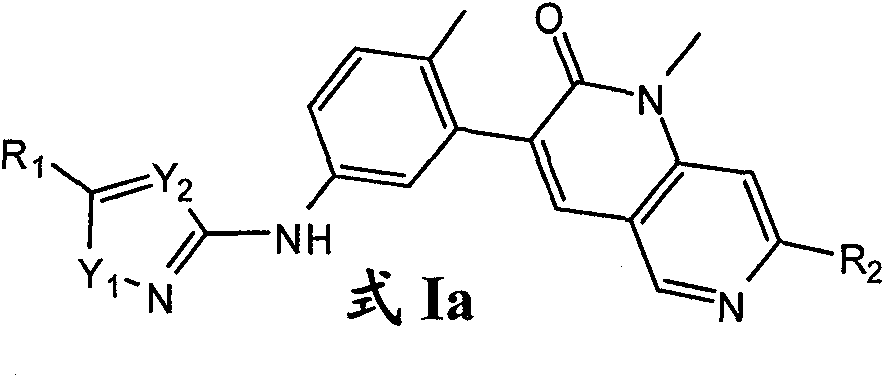


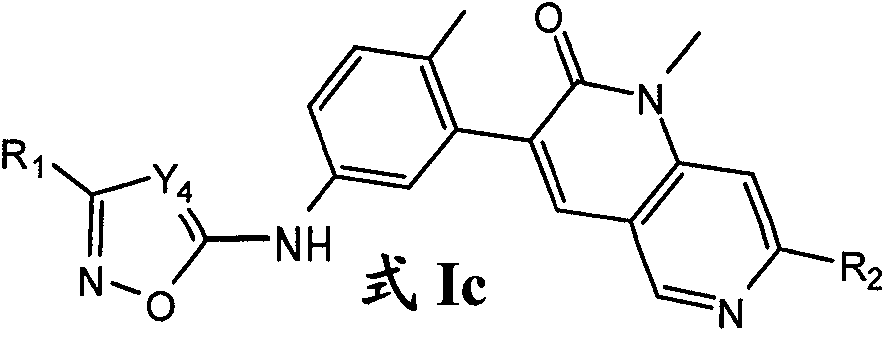


Applications Claiming Priority (3)
| Application Number | Priority Date | Filing Date | Title |
|---|---|---|---|
| US3091208P | 2008-02-22 | 2008-02-22 | |
| US61/030,912 | 2008-02-22 | ||
| PCT/US2009/034778 WO2009105712A1 (en) | 2008-02-22 | 2009-02-20 | Heterocyclic compounds and compositions as c-kit and pdgfr kinase inhibitors |
Publications (2)
| Publication Number | Publication Date |
|---|---|
| CN102083828A CN102083828A (en) | 2011-06-01 |
| CN102083828B true CN102083828B (en) | 2013-11-13 |
Family
ID=40577860
Family Applications (1)
| Application Number | Title | Priority Date | Filing Date |
|---|---|---|---|
| CN2009801139589A Expired - Fee Related CN102083828B (en) | 2008-02-22 | 2009-02-20 | Heterocyclic compounds and compositions as C-KIT and PDGFR kinase inhibitors |
Country Status (17)
| Country | Link |
|---|---|
| US (1) | US8278452B2 (en) |
| EP (1) | EP2252612B1 (en) |
| JP (1) | JP5230755B2 (en) |
| KR (1) | KR101216323B1 (en) |
| CN (1) | CN102083828B (en) |
| AR (1) | AR070469A1 (en) |
| AT (1) | ATE551342T1 (en) |
| AU (1) | AU2009217356B2 (en) |
| BR (1) | BRPI0908849A2 (en) |
| CA (1) | CA2714700C (en) |
| CL (1) | CL2009000400A1 (en) |
| EA (1) | EA018551B1 (en) |
| ES (1) | ES2383331T3 (en) |
| MX (1) | MX2010009207A (en) |
| PE (1) | PE20091492A1 (en) |
| TW (1) | TW200940538A (en) |
| WO (1) | WO2009105712A1 (en) |
Families Citing this family (46)
| Publication number | Priority date | Publication date | Assignee | Title |
|---|---|---|---|---|
| WO2011049625A1 (en) | 2009-10-20 | 2011-04-28 | Mansour Samadpour | Method for aflatoxin screening of products |
| HUE035059T2 (en) | 2009-11-05 | 2018-05-02 | Rhizen Pharmaceuticals S A | New benzopyran-kinate modulators |
| TWI619713B (en) * | 2010-04-21 | 2018-04-01 | 普雷辛肯公司 | Compounds and methods for kinase regulation and their indications |
| KR101821226B1 (en) * | 2011-03-01 | 2018-01-23 | 엔파마콘, 엘엘씨 | Use of n-(4-methoxyphenyl)-1-phenyl-1h-pyrazol-3-amine and related compounds |
| ES2710874T3 (en) | 2011-05-04 | 2019-04-29 | Rhizen Pharmaceuticals S A | Novel compounds as modulators of protein kinases |
| JP2014527969A (en) * | 2011-09-19 | 2014-10-23 | ジェンシア コーポレイション | Modified creatine compound |
| GEP20166496B (en) | 2011-12-22 | 2016-06-27 | Alios Biopharma Inc | Substituted nucleosides, nucleotides and analogs thereof |
| US9441007B2 (en) | 2012-03-21 | 2016-09-13 | Alios Biopharma, Inc. | Substituted nucleosides, nucleotides and analogs thereof |
| USRE48171E1 (en) | 2012-03-21 | 2020-08-25 | Janssen Biopharma, Inc. | Substituted nucleosides, nucleotides and analogs thereof |
| CA2871547C (en) | 2012-05-25 | 2021-05-25 | Janssen R&D Ireland | Uracyl spirooxetane nucleosides |
| US8461179B1 (en) | 2012-06-07 | 2013-06-11 | Deciphera Pharmaceuticals, Llc | Dihydronaphthyridines and related compounds useful as kinase inhibitors for the treatment of proliferative diseases |
| MX372814B (en) * | 2012-06-07 | 2020-07-03 | Deciphera Pharmaceuticals Llc | DIHYDRONAPHTYRIDINES AND RELATED COMPOUNDS USEFUL AS KINASE INHIBITORS FOR THE TREATMENT OF PROLIFERATIVE DISEASES. |
| SMT201900334T1 (en) | 2012-07-04 | 2019-07-11 | Rhizen Pharmaceuticals S A | Selective pi3k delta inhibitors |
| EP3421482A1 (en) | 2012-12-21 | 2019-01-02 | Alios Biopharma, Inc. | Substituted nucleosides, nucleotides and analogs thereof |
| PL3363790T3 (en) | 2013-09-06 | 2020-07-27 | Aurigene Discovery Technologies Limited | 1,2,4-oxadiazole derivatives as immunomodulators |
| CN104458674A (en) * | 2013-09-12 | 2015-03-25 | 中国药科大学 | High flux screening method for screening vascular endothelial growth factor 1 kinases inhibitor |
| CN104458675A (en) * | 2013-09-12 | 2015-03-25 | 中国药科大学 | High flux screening method for screening stem cell factor acceptor kinase inhibitor |
| CN113712989A (en) | 2013-10-11 | 2021-11-30 | 艾丽奥斯生物制药有限公司 | Substituted nucleosides, nucleotides and analogs thereof |
| EP4023645A1 (en) | 2015-03-10 | 2022-07-06 | Aurigene Discovery Technologies Limited | 1,2,4-oxadiazole and thiadiazole compounds as immunomodulators |
| MX2017011612A (en) * | 2015-03-10 | 2018-03-23 | Aurigene Discovery Tech Ltd | 3-substituted-1,2,4-oxadiazole and thiadiazole compounds as immunomodulators. |
| KR20180100227A (en) * | 2016-01-11 | 2018-09-07 | 메르크 파텐트 게엠베하 | Quinolin-2-one derivative |
| WO2019061324A1 (en) | 2017-09-29 | 2019-04-04 | Curis Inc. | Crystal forms of immunomodulators |
| JP7618445B2 (en) | 2017-10-11 | 2025-01-21 | オーリジーン オンコロジー リミテッド | Crystalline forms of 3-substituted 1,2,4-oxadiazoles |
| KR20200083503A (en) | 2017-11-03 | 2020-07-08 | 오리진 디스커버리 테크놀로지스 리미티드 | Double inhibitor of TIM-3 pathway and PD-1 pathway |
| WO2019087092A1 (en) | 2017-11-06 | 2019-05-09 | Aurigene Discovery Technologies Limited | Conjoint therapies for immunomodulation |
| SG11202007198WA (en) | 2018-01-31 | 2020-08-28 | Deciphera Pharmaceuticals Llc | Combination therapy for the treatment of gastrointestinal stromal tumors |
| CA3089630A1 (en) | 2018-01-31 | 2019-08-08 | Deciphera Pharmaceuticals, Llc | Combination therapy for the treatment of mastocytosis |
| US11472781B2 (en) | 2018-02-21 | 2022-10-18 | Southern Research Institute | 2-aminoaryl-5-aryloxazole analogs for the treatment of neurodegenerative diseases |
| WO2019222497A1 (en) | 2018-05-17 | 2019-11-21 | Southern Research Institute | 2,5-aryl-thiazole analogs for the treatment of neurodegenerative diseases |
| WO2020185812A1 (en) | 2019-03-11 | 2020-09-17 | Teva Pharmaceuticals International Gmbh | Solid state forms of ripretinib |
| JP2022526713A (en) | 2019-03-21 | 2022-05-26 | オンクセオ | Dbait molecule in combination with a kinase inhibitor for the treatment of cancer |
| AU2020268814A1 (en) | 2019-05-03 | 2021-12-16 | Kinnate Biopharma Inc. | Inhibitors of RAF kinases |
| TWI878335B (en) | 2019-08-12 | 2025-04-01 | 美商迪賽孚爾製藥有限公司 | Methods of treating gastrointestinal stromal tumors |
| KR20220045189A (en) | 2019-08-12 | 2022-04-12 | 데시페라 파마슈티칼스, 엘엘씨. | How to treat gastrointestinal stromal tumors |
| KR20220104702A (en) | 2019-10-24 | 2022-07-26 | 킨네이트 바이오파마 인크. | Inhibitors of RAF kinase |
| JP2023500906A (en) | 2019-11-08 | 2023-01-11 | インサーム(インスティテュ ナシオナル ドゥ ラ サンテ エ ドゥ ラ ルシェルシェ メディカル) | Methods of treating cancers with acquired resistance to kinase inhibitors |
| SMT202300467T1 (en) | 2019-12-30 | 2024-01-10 | Deciphera Pharmaceuticals Llc | Amorphous kinase inhibitor formulations and methods of use thereof |
| SMT202400484T1 (en) | 2019-12-30 | 2025-01-14 | Deciphera Pharmaceuticals Llc | COMPOSITIONS OF 1-(4-BROMO-5-(1-ETHYL-7-(METHYLAMINO)-2-OXO-1,2-DIHYDRO-1,6-NAPHTHYRIDIN-3-YL)-2-FLUOROPHENYL)-3-PHENYLUREA |
| WO2021148581A1 (en) | 2020-01-22 | 2021-07-29 | Onxeo | Novel dbait molecule and its use |
| WO2022060996A1 (en) | 2020-09-18 | 2022-03-24 | Kinnate Biopharma Inc. | Inhibitors of raf kinases |
| US11377431B2 (en) | 2020-10-12 | 2022-07-05 | Kinnate Biopharma Inc. | Inhibitors of RAF kinases |
| CA3216104A1 (en) | 2021-04-23 | 2022-10-27 | Aleksandra Franovic | Treatment of cancer with a raf inhibitor |
| CN113662938B (en) * | 2021-09-26 | 2022-08-16 | 广西科技大学 | Application of amine derivative in preparation of anti-tumor pharmaceutical composition |
| AR128440A1 (en) | 2022-02-03 | 2024-05-08 | Kinnate Biopharma Inc | RAF KINASE INHIBITORS |
| US11779572B1 (en) | 2022-09-02 | 2023-10-10 | Deciphera Pharmaceuticals, Llc | Methods of treating gastrointestinal stromal tumors |
| CN117263852A (en) * | 2023-08-24 | 2023-12-22 | 贵州大学 | Substituted 3-(pyridin-2-yl)phenylamino derivatives, their preparation methods and applications |
Citations (3)
| Publication number | Priority date | Publication date | Assignee | Title |
|---|---|---|---|---|
| WO2006052936A2 (en) * | 2004-11-09 | 2006-05-18 | Irm Llc | Compounds and compositions as protein kinase inhibitors |
| CN1863774A (en) * | 2003-10-08 | 2006-11-15 | Irm责任有限公司 | Compounds and compositions as protein kinase inhibitors |
| WO2007021795A2 (en) * | 2005-08-09 | 2007-02-22 | Irm Llc | Compounds and compositions as protein kinase inhibitors |
Family Cites Families (14)
| Publication number | Priority date | Publication date | Assignee | Title |
|---|---|---|---|---|
| ZA985870B (en) * | 1997-07-15 | 1999-01-27 | Dainippon Pharmaceutical Co | 5-substituted-3-oxadiazolyl-1, 6-naphthyridin-2(1H)-one derivatives |
| JP4965021B2 (en) | 1997-08-20 | 2012-07-04 | ワーナー−ランバート カンパニー リミテッド ライアビリティー カンパニー | Naphthyridinone for inhibiting protein tyrosine kinase and cell cycle kinase mediated cell proliferation |
| US6822097B1 (en) | 2002-02-07 | 2004-11-23 | Amgen, Inc. | Compounds and methods of uses |
| PA8577501A1 (en) * | 2002-07-25 | 2004-02-07 | Warner Lambert Co | KINASE INHIBITORS |
| US20070054916A1 (en) * | 2004-10-01 | 2007-03-08 | Amgen Inc. | Aryl nitrogen-containing bicyclic compounds and methods of use |
| AU2005325676A1 (en) * | 2004-12-23 | 2006-08-03 | Deciphera Pharmaceuticals, Llc | Anti-inflammatory medicaments |
| JP5197016B2 (en) * | 2004-12-23 | 2013-05-15 | デシファラ ファーマスーティカルズ, エルエルシー | Enzyme modulators and therapy |
| CA2622494A1 (en) | 2005-09-27 | 2007-04-05 | Irm Llc | Diarylamine-containing compounds and compositions, and their use as modulators of c-kit receptors |
| EP2018167A4 (en) * | 2006-05-15 | 2010-07-14 | Irm Llc | Compositions and methods for fgf receptor kinases inhibitors |
| US8188113B2 (en) * | 2006-09-14 | 2012-05-29 | Deciphera Pharmaceuticals, Inc. | Dihydropyridopyrimidinyl, dihydronaphthyidinyl and related compounds useful as kinase inhibitors for the treatment of proliferative diseases |
| US7897762B2 (en) * | 2006-09-14 | 2011-03-01 | Deciphera Pharmaceuticals, Llc | Kinase inhibitors useful for the treatment of proliferative diseases |
| CN101528744A (en) * | 2006-10-20 | 2009-09-09 | Irm责任有限公司 | Compositions and methods for modulating C-KIT and PDGFR receptors |
| US8268850B2 (en) | 2007-05-04 | 2012-09-18 | Irm Llc | Pyrimidine derivatives and compositions as C-kit and PDGFR kinase inhibitors |
| JP5160637B2 (en) | 2007-05-04 | 2013-03-13 | アイアールエム・リミテッド・ライアビリティ・カンパニー | Compounds and compositions as c-kit and PDGFR kinase inhibitors |
-
2009
- 2009-02-20 CN CN2009801139589A patent/CN102083828B/en not_active Expired - Fee Related
- 2009-02-20 CA CA2714700A patent/CA2714700C/en not_active Expired - Fee Related
- 2009-02-20 WO PCT/US2009/034778 patent/WO2009105712A1/en not_active Ceased
- 2009-02-20 PE PE2009000257A patent/PE20091492A1/en not_active Application Discontinuation
- 2009-02-20 AU AU2009217356A patent/AU2009217356B2/en not_active Ceased
- 2009-02-20 KR KR1020107021103A patent/KR101216323B1/en not_active Expired - Fee Related
- 2009-02-20 ES ES09711557T patent/ES2383331T3/en active Active
- 2009-02-20 EP EP09711557A patent/EP2252612B1/en not_active Not-in-force
- 2009-02-20 EA EA201001331A patent/EA018551B1/en not_active IP Right Cessation
- 2009-02-20 CL CL2009000400A patent/CL2009000400A1/en unknown
- 2009-02-20 MX MX2010009207A patent/MX2010009207A/en active IP Right Grant
- 2009-02-20 BR BRPI0908849-0A patent/BRPI0908849A2/en not_active IP Right Cessation
- 2009-02-20 US US12/918,801 patent/US8278452B2/en not_active Expired - Fee Related
- 2009-02-20 AT AT09711557T patent/ATE551342T1/en active
- 2009-02-20 JP JP2010547818A patent/JP5230755B2/en not_active Expired - Fee Related
- 2009-02-23 TW TW098105719A patent/TW200940538A/en unknown
- 2009-02-24 AR ARP090100626A patent/AR070469A1/en unknown
Patent Citations (3)
| Publication number | Priority date | Publication date | Assignee | Title |
|---|---|---|---|---|
| CN1863774A (en) * | 2003-10-08 | 2006-11-15 | Irm责任有限公司 | Compounds and compositions as protein kinase inhibitors |
| WO2006052936A2 (en) * | 2004-11-09 | 2006-05-18 | Irm Llc | Compounds and compositions as protein kinase inhibitors |
| WO2007021795A2 (en) * | 2005-08-09 | 2007-02-22 | Irm Llc | Compounds and compositions as protein kinase inhibitors |
Also Published As
| Publication number | Publication date |
|---|---|
| PE20091492A1 (en) | 2009-10-22 |
| US8278452B2 (en) | 2012-10-02 |
| JP5230755B2 (en) | 2013-07-10 |
| AU2009217356B2 (en) | 2012-05-03 |
| CA2714700C (en) | 2013-07-30 |
| TW200940538A (en) | 2009-10-01 |
| ES2383331T3 (en) | 2012-06-20 |
| KR20100115379A (en) | 2010-10-27 |
| AU2009217356A1 (en) | 2009-08-27 |
| CL2009000400A1 (en) | 2010-09-10 |
| US20110183997A1 (en) | 2011-07-28 |
| EP2252612A1 (en) | 2010-11-24 |
| CA2714700A1 (en) | 2009-08-27 |
| ATE551342T1 (en) | 2012-04-15 |
| MX2010009207A (en) | 2011-03-03 |
| WO2009105712A1 (en) | 2009-08-27 |
| CN102083828A (en) | 2011-06-01 |
| EA018551B1 (en) | 2013-08-30 |
| JP2011513231A (en) | 2011-04-28 |
| EA201001331A1 (en) | 2011-04-29 |
| KR101216323B1 (en) | 2012-12-27 |
| EP2252612B1 (en) | 2012-03-28 |
| BRPI0908849A2 (en) | 2015-08-25 |
| AR070469A1 (en) | 2010-04-07 |
Similar Documents
| Publication | Publication Date | Title |
|---|---|---|
| CN102083828B (en) | Heterocyclic compounds and compositions as C-KIT and PDGFR kinase inhibitors | |
| US8268850B2 (en) | Pyrimidine derivatives and compositions as C-kit and PDGFR kinase inhibitors | |
| JP5160637B2 (en) | Compounds and compositions as c-kit and PDGFR kinase inhibitors | |
| JP2010509349A (en) | Compounds and compositions as protein kinase inhibitors | |
| CN101291938A (en) | Compounds and compositions as protein kinase inhibitors | |
| CN101282975A (en) | Compounds and compositions as protein kinase inhibitors | |
| US20100184791A1 (en) | Compounds and compositions as c-kit and pdgfr kinase inhibitors | |
| JP2009525978A (en) | Compounds and compositions as protein kinase inhibitors | |
| CN101296928A (en) | Compounds and compositions as protein kinase inhibitors |
Legal Events
| Date | Code | Title | Description |
|---|---|---|---|
| C06 | Publication | ||
| PB01 | Publication | ||
| C10 | Entry into substantive examination | ||
| SE01 | Entry into force of request for substantive examination | ||
| C14 | Grant of patent or utility model | ||
| GR01 | Patent grant | ||
| CF01 | Termination of patent right due to non-payment of annual fee |
Granted publication date: 20131113 Termination date: 20150220 |
|
| EXPY | Termination of patent right or utility model |