CN102037004A - Glycoconjugation of polypeptides using oligosaccharyltransferases - Google Patents
Glycoconjugation of polypeptides using oligosaccharyltransferases Download PDFInfo
- Publication number
- CN102037004A CN102037004A CN2009801061349A CN200980106134A CN102037004A CN 102037004 A CN102037004 A CN 102037004A CN 2009801061349 A CN2009801061349 A CN 2009801061349A CN 200980106134 A CN200980106134 A CN 200980106134A CN 102037004 A CN102037004 A CN 102037004A
- Authority
- CN
- China
- Prior art keywords
- fgf
- polypeptide
- factor
- glcnac
- bmp
- Prior art date
- Legal status (The legal status is an assumption and is not a legal conclusion. Google has not performed a legal analysis and makes no representation as to the accuracy of the status listed.)
- Pending
Links
- 0 C*C([C@]1NC(C)=O)OC(CO)[C@@](C)C1O Chemical compound C*C([C@]1NC(C)=O)OC(CO)[C@@](C)C1O 0.000 description 4
Images


Classifications
-
- A—HUMAN NECESSITIES
- A61—MEDICAL OR VETERINARY SCIENCE; HYGIENE
- A61K—PREPARATIONS FOR MEDICAL, DENTAL OR TOILETRY PURPOSES
- A61K47/00—Medicinal preparations characterised by the non-active ingredients used, e.g. carriers or inert additives; Targeting or modifying agents chemically bound to the active ingredient
- A61K47/50—Medicinal preparations characterised by the non-active ingredients used, e.g. carriers or inert additives; Targeting or modifying agents chemically bound to the active ingredient the non-active ingredient being chemically bound to the active ingredient, e.g. polymer-drug conjugates
- A61K47/51—Medicinal preparations characterised by the non-active ingredients used, e.g. carriers or inert additives; Targeting or modifying agents chemically bound to the active ingredient the non-active ingredient being chemically bound to the active ingredient, e.g. polymer-drug conjugates the non-active ingredient being a modifying agent
- A61K47/54—Medicinal preparations characterised by the non-active ingredients used, e.g. carriers or inert additives; Targeting or modifying agents chemically bound to the active ingredient the non-active ingredient being chemically bound to the active ingredient, e.g. polymer-drug conjugates the non-active ingredient being a modifying agent the modifying agent being an organic compound
- A61K47/543—Lipids, e.g. triglycerides; Polyamines, e.g. spermine or spermidine
-
- A—HUMAN NECESSITIES
- A61—MEDICAL OR VETERINARY SCIENCE; HYGIENE
- A61K—PREPARATIONS FOR MEDICAL, DENTAL OR TOILETRY PURPOSES
- A61K47/00—Medicinal preparations characterised by the non-active ingredients used, e.g. carriers or inert additives; Targeting or modifying agents chemically bound to the active ingredient
- A61K47/50—Medicinal preparations characterised by the non-active ingredients used, e.g. carriers or inert additives; Targeting or modifying agents chemically bound to the active ingredient the non-active ingredient being chemically bound to the active ingredient, e.g. polymer-drug conjugates
- A61K47/51—Medicinal preparations characterised by the non-active ingredients used, e.g. carriers or inert additives; Targeting or modifying agents chemically bound to the active ingredient the non-active ingredient being chemically bound to the active ingredient, e.g. polymer-drug conjugates the non-active ingredient being a modifying agent
- A61K47/54—Medicinal preparations characterised by the non-active ingredients used, e.g. carriers or inert additives; Targeting or modifying agents chemically bound to the active ingredient the non-active ingredient being chemically bound to the active ingredient, e.g. polymer-drug conjugates the non-active ingredient being a modifying agent the modifying agent being an organic compound
- A61K47/549—Sugars, nucleosides, nucleotides or nucleic acids
-
- A—HUMAN NECESSITIES
- A61—MEDICAL OR VETERINARY SCIENCE; HYGIENE
- A61K—PREPARATIONS FOR MEDICAL, DENTAL OR TOILETRY PURPOSES
- A61K47/00—Medicinal preparations characterised by the non-active ingredients used, e.g. carriers or inert additives; Targeting or modifying agents chemically bound to the active ingredient
- A61K47/50—Medicinal preparations characterised by the non-active ingredients used, e.g. carriers or inert additives; Targeting or modifying agents chemically bound to the active ingredient the non-active ingredient being chemically bound to the active ingredient, e.g. polymer-drug conjugates
- A61K47/51—Medicinal preparations characterised by the non-active ingredients used, e.g. carriers or inert additives; Targeting or modifying agents chemically bound to the active ingredient the non-active ingredient being chemically bound to the active ingredient, e.g. polymer-drug conjugates the non-active ingredient being a modifying agent
- A61K47/56—Medicinal preparations characterised by the non-active ingredients used, e.g. carriers or inert additives; Targeting or modifying agents chemically bound to the active ingredient the non-active ingredient being chemically bound to the active ingredient, e.g. polymer-drug conjugates the non-active ingredient being a modifying agent the modifying agent being an organic macromolecular compound, e.g. an oligomeric, polymeric or dendrimeric molecule
- A61K47/59—Medicinal preparations characterised by the non-active ingredients used, e.g. carriers or inert additives; Targeting or modifying agents chemically bound to the active ingredient the non-active ingredient being chemically bound to the active ingredient, e.g. polymer-drug conjugates the non-active ingredient being a modifying agent the modifying agent being an organic macromolecular compound, e.g. an oligomeric, polymeric or dendrimeric molecule obtained otherwise than by reactions only involving carbon-to-carbon unsaturated bonds, e.g. polyureas or polyurethanes
- A61K47/60—Medicinal preparations characterised by the non-active ingredients used, e.g. carriers or inert additives; Targeting or modifying agents chemically bound to the active ingredient the non-active ingredient being chemically bound to the active ingredient, e.g. polymer-drug conjugates the non-active ingredient being a modifying agent the modifying agent being an organic macromolecular compound, e.g. an oligomeric, polymeric or dendrimeric molecule obtained otherwise than by reactions only involving carbon-to-carbon unsaturated bonds, e.g. polyureas or polyurethanes the organic macromolecular compound being a polyoxyalkylene oligomer, polymer or dendrimer, e.g. PEG, PPG, PEO or polyglycerol
-
- C—CHEMISTRY; METALLURGY
- C07—ORGANIC CHEMISTRY
- C07K—PEPTIDES
- C07K14/00—Peptides having more than 20 amino acids; Gastrins; Somatostatins; Melanotropins; Derivatives thereof
- C07K14/435—Peptides having more than 20 amino acids; Gastrins; Somatostatins; Melanotropins; Derivatives thereof from animals; from humans
- C07K14/475—Growth factors; Growth regulators
- C07K14/48—Nerve growth factor [NGF]
-
- C—CHEMISTRY; METALLURGY
- C07—ORGANIC CHEMISTRY
- C07K—PEPTIDES
- C07K14/00—Peptides having more than 20 amino acids; Gastrins; Somatostatins; Melanotropins; Derivatives thereof
- C07K14/435—Peptides having more than 20 amino acids; Gastrins; Somatostatins; Melanotropins; Derivatives thereof from animals; from humans
- C07K14/475—Growth factors; Growth regulators
- C07K14/50—Fibroblast growth factor [FGF]
-
- C—CHEMISTRY; METALLURGY
- C07—ORGANIC CHEMISTRY
- C07K—PEPTIDES
- C07K14/00—Peptides having more than 20 amino acids; Gastrins; Somatostatins; Melanotropins; Derivatives thereof
- C07K14/435—Peptides having more than 20 amino acids; Gastrins; Somatostatins; Melanotropins; Derivatives thereof from animals; from humans
- C07K14/475—Growth factors; Growth regulators
- C07K14/51—Bone morphogenetic factor; Osteogenins; Osteogenic factor; Bone-inducing factor
-
- C—CHEMISTRY; METALLURGY
- C07—ORGANIC CHEMISTRY
- C07K—PEPTIDES
- C07K14/00—Peptides having more than 20 amino acids; Gastrins; Somatostatins; Melanotropins; Derivatives thereof
- C07K14/435—Peptides having more than 20 amino acids; Gastrins; Somatostatins; Melanotropins; Derivatives thereof from animals; from humans
- C07K14/745—Blood coagulation or fibrinolysis factors
- C07K14/755—Factors VIII, e.g. factor VIII C (AHF), factor VIII Ag (VWF)
-
- C—CHEMISTRY; METALLURGY
- C12—BIOCHEMISTRY; BEER; SPIRITS; WINE; VINEGAR; MICROBIOLOGY; ENZYMOLOGY; MUTATION OR GENETIC ENGINEERING
- C12N—MICROORGANISMS OR ENZYMES; COMPOSITIONS THEREOF; PROPAGATING, PRESERVING, OR MAINTAINING MICROORGANISMS; MUTATION OR GENETIC ENGINEERING; CULTURE MEDIA
- C12N9/00—Enzymes; Proenzymes; Compositions thereof; Processes for preparing, activating, inhibiting, separating or purifying enzymes
- C12N9/14—Hydrolases (3)
- C12N9/48—Hydrolases (3) acting on peptide bonds (3.4)
- C12N9/50—Proteinases, e.g. Endopeptidases (3.4.21-3.4.25)
- C12N9/64—Proteinases, e.g. Endopeptidases (3.4.21-3.4.25) derived from animal tissue
- C12N9/6421—Proteinases, e.g. Endopeptidases (3.4.21-3.4.25) derived from animal tissue from mammals
- C12N9/6424—Serine endopeptidases (3.4.21)
- C12N9/6437—Coagulation factor VIIa (3.4.21.21)
-
- C—CHEMISTRY; METALLURGY
- C12—BIOCHEMISTRY; BEER; SPIRITS; WINE; VINEGAR; MICROBIOLOGY; ENZYMOLOGY; MUTATION OR GENETIC ENGINEERING
- C12N—MICROORGANISMS OR ENZYMES; COMPOSITIONS THEREOF; PROPAGATING, PRESERVING, OR MAINTAINING MICROORGANISMS; MUTATION OR GENETIC ENGINEERING; CULTURE MEDIA
- C12N9/00—Enzymes; Proenzymes; Compositions thereof; Processes for preparing, activating, inhibiting, separating or purifying enzymes
- C12N9/14—Hydrolases (3)
- C12N9/48—Hydrolases (3) acting on peptide bonds (3.4)
- C12N9/50—Proteinases, e.g. Endopeptidases (3.4.21-3.4.25)
- C12N9/64—Proteinases, e.g. Endopeptidases (3.4.21-3.4.25) derived from animal tissue
- C12N9/6421—Proteinases, e.g. Endopeptidases (3.4.21-3.4.25) derived from animal tissue from mammals
- C12N9/6424—Serine endopeptidases (3.4.21)
- C12N9/644—Coagulation factor IXa (3.4.21.22)
-
- C—CHEMISTRY; METALLURGY
- C12—BIOCHEMISTRY; BEER; SPIRITS; WINE; VINEGAR; MICROBIOLOGY; ENZYMOLOGY; MUTATION OR GENETIC ENGINEERING
- C12Y—ENZYMES
- C12Y204/00—Glycosyltransferases (2.4)
- C12Y204/99—Glycosyltransferases (2.4) transferring other glycosyl groups (2.4.99)
- C12Y204/99018—Dolichyl-diphosphooligosaccharide—protein glycotransferase (2.4.99.18)
-
- C—CHEMISTRY; METALLURGY
- C12—BIOCHEMISTRY; BEER; SPIRITS; WINE; VINEGAR; MICROBIOLOGY; ENZYMOLOGY; MUTATION OR GENETIC ENGINEERING
- C12Y—ENZYMES
- C12Y304/00—Hydrolases acting on peptide bonds, i.e. peptidases (3.4)
- C12Y304/21—Serine endopeptidases (3.4.21)
- C12Y304/21021—Coagulation factor VIIa (3.4.21.21)
-
- C—CHEMISTRY; METALLURGY
- C12—BIOCHEMISTRY; BEER; SPIRITS; WINE; VINEGAR; MICROBIOLOGY; ENZYMOLOGY; MUTATION OR GENETIC ENGINEERING
- C12Y—ENZYMES
- C12Y304/00—Hydrolases acting on peptide bonds, i.e. peptidases (3.4)
- C12Y304/21—Serine endopeptidases (3.4.21)
- C12Y304/21022—Coagulation factor IXa (3.4.21.22)
-
- A—HUMAN NECESSITIES
- A61—MEDICAL OR VETERINARY SCIENCE; HYGIENE
- A61K—PREPARATIONS FOR MEDICAL, DENTAL OR TOILETRY PURPOSES
- A61K38/00—Medicinal preparations containing peptides
Landscapes
- Health & Medical Sciences (AREA)
- Chemical & Material Sciences (AREA)
- Life Sciences & Earth Sciences (AREA)
- Organic Chemistry (AREA)
- General Health & Medical Sciences (AREA)
- Engineering & Computer Science (AREA)
- Zoology (AREA)
- Genetics & Genomics (AREA)
- Bioinformatics & Cheminformatics (AREA)
- Biochemistry (AREA)
- Medicinal Chemistry (AREA)
- Molecular Biology (AREA)
- Wood Science & Technology (AREA)
- General Engineering & Computer Science (AREA)
- Biophysics (AREA)
- Gastroenterology & Hepatology (AREA)
- Biomedical Technology (AREA)
- Proteomics, Peptides & Aminoacids (AREA)
- Toxicology (AREA)
- Pharmacology & Pharmacy (AREA)
- Epidemiology (AREA)
- Animal Behavior & Ethology (AREA)
- Veterinary Medicine (AREA)
- Public Health (AREA)
- Biotechnology (AREA)
- Microbiology (AREA)
- Hematology (AREA)
- Orthopedic Medicine & Surgery (AREA)
- Medicines That Contain Protein Lipid Enzymes And Other Medicines (AREA)
- Preparation Of Compounds By Using Micro-Organisms (AREA)
- Peptides Or Proteins (AREA)
- Enzymes And Modification Thereof (AREA)
- Micro-Organisms Or Cultivation Processes Thereof (AREA)
- Saccharide Compounds (AREA)
- Other Resins Obtained By Reactions Not Involving Carbon-To-Carbon Unsaturated Bonds (AREA)
Abstract
本发明提供了包括外源N联糖基化序列的多肽和多肽缀合物。N联糖基化序列优选是寡糖基转移酶(例如,细菌PglB)的底物,其可以催化糖基部分从脂质结合的糖基供体分子(例如,脂质-焦磷酸盐连接的糖基部分)到糖基化序列的天冬酰胺(N)残基的转移。在一个例子中,天冬酰胺残基是本发明的外源N联糖基化序列的部分。本发明进一步提供了制备多肽缀合物的方法,其包括在寡糖基转移酶的存在下,在足以使酶将糖基部分转移至N联糖基化序列的天冬酰胺残基的条件下,使具有本发明的N联糖基化序列的多肽和脂质-焦磷酸盐连接的糖基部分(或磷脂连接的糖基部分)相接触。可以与糖基化序列缀合的示例性糖基部分包括GlcNAc、GlcNH、bacillosamine、6-hydroybacillosamine、GalNAc、GalNH、GlcNAc-GlcNAc 、GlcNAc-GlcNH、GlcNAc-Gal、GlcNAc-GlcNAc-Gal-Sia、GlcNAc-Gal-Sia、GlcNAc-GlcNAc-Man和GlcNAc-GlcNAc-Man(Man)2。经转移的糖基部分任选由修饰基团例如聚合物(例如,PEG)进行修饰。在一个例子中,经修饰的糖基部分是GlcNAc或唾液酸部分。The invention provides polypeptides and polypeptide conjugates comprising exogenous N-linked glycosylation sequences. N-linked glycosylation sequences are preferably substrates for oligosaccharyltransferases (e.g., bacterial PglB), which can catalyze the conversion of glycosyl moieties from lipid-bound glycosyl donor molecules (e.g., lipid-pyrophosphate-linked glycosyl moiety) to the asparagine (N) residue of the glycosylation sequence. In one example, the asparagine residue is part of an exogenous N-linked glycosylation sequence of the invention. The invention further provides a method of preparing a Polypeptide Conjugate comprising, in the presence of an oligosaccharyltransferase, under conditions sufficient for the enzyme to transfer a glycosyl moiety to an asparagine residue of an N-linked glycosylation sequence , contacting a polypeptide having an N-linked glycosylation sequence of the invention with a lipid-pyrophosphate-linked glycosyl moiety (or a phospholipid-linked glycosyl moiety). Exemplary glycosyl moieties that can be conjugated to glycosylation sequences include GlcNAc, GlcNH, bacillosamine, 6-hydroybacillosamine, GalNAc, GalNH, GlcNAc-GlcNAc, GlcNAc-GlcNH, GlcNAc-Gal, GlcNAc-GlcNAc-Gal-Sia, GlcNAc - Gal-Sia, GlcNAc-GlcNAc-Man and GlcNAc-GlcNAc-Man(Man) 2 . The transferred glycosyl moiety is optionally modified with a modifying group such as a polymer (eg, PEG). In one example, the modified glycosyl moiety is GlcNAc or a sialic acid moiety.
Description
与相关申请的交叉参照Cross References to Related Applications
本申请要求于2008年1月8日提交的美国临时专利申请号61/019,805的利益,所述美国临时专利申请号的内容为了所有目的通过引用整体合并入本文。This application claims the benefit of US Provisional Patent Application No. 61/019,805, filed January 8, 2008, the contents of which are hereby incorporated by reference in their entirety for all purposes.
发明领域field of invention
本发明涉及通过糖基化的多肽修饰领域。特别地,本发明涉及使用短的酶识别的N联糖基化序列制备糖基化多肽的方法。The present invention relates to the field of polypeptide modification by glycosylation. In particular, the invention relates to methods for preparing glycosylated polypeptides using short enzyme-recognized N-linked glycosylation sequences.
发明背景Background of the invention
用于造成特定的生理学应答的糖基化和非糖基化多肽的施用是医学领域众所周知的。例如,经纯化的和重组的人生长激素(hGH)用于治疗与hGH缺陷相关的病状和疾病,例如儿童中的侏儒症。其他例子涉及具有已知的抗病毒活性的干扰素,以及刺激白血细胞产生的粒细胞集落刺激因子(G-CSF)。The administration of glycosylated and non-glycosylated polypeptides to elicit specific physiological responses is well known in the medical arts. For example, purified and recombinant human growth hormone (hGH) is used to treat conditions and diseases associated with hGH deficiency, such as dwarfism in children. Other examples involve interferon, which has known antiviral activity, and granulocyte colony-stimulating factor (G-CSF), which stimulates white blood cell production.
可以用于制造具有野生型糖基化模式的多肽的表达系统的缺乏已限制了此类多肽作为治疗试剂的用途。本领域已知不适当或不完全糖基化的多肽可以是免疫原性,导致肽的快速中和和/或变应性应答的发展。重组产生的糖肽的其他缺陷包括亚最佳的效力和从血流中的快速清除。The lack of expression systems that can be used to produce polypeptides with wild-type glycosylation patterns has limited the use of such polypeptides as therapeutic agents. It is known in the art that improperly or incompletely glycosylated polypeptides can be immunogenic, leading to rapid neutralization of the peptide and/or development of an allergic response. Other drawbacks of recombinantly produced glycopeptides include suboptimal potency and rapid clearance from the bloodstream.
解决糖基化多肽治疗剂产生中固有的问题的一种方法已在其表达后在体外修饰多肽。多肽的表达后体外修饰已用于现有聚糖结构的修饰和糖基部分与非糖基化的氨基酸残基的附着。重组真核生物糖基转移酶的广泛选择已变得可获得的,使得具有定制设计的糖基化模式和糖基结构的哺乳动物糖缀合物的体外酶促合成成为可能。参见例如,美国专利号5,876,980;6,030,815;5,728,554;5,922,577;以及WO/9831826;US2003180835;和WO 03/031464。One approach to address the problems inherent in the production of glycosylated polypeptide therapeutics has been to modify the polypeptide in vitro after its expression. Post-expression in vitro modification of polypeptides has been used for the modification of existing glycan structures and the attachment of glycosyl moieties to non-glycosylated amino acid residues. A broad selection of recombinant eukaryotic glycosyltransferases has become available, enabling the in vitro enzymatic synthesis of mammalian glycoconjugates with custom-designed glycosylation patterns and glycosyl structures. See, eg, US Patent Nos. 5,876,980; 6,030,815; 5,728,554; 5,922,577; and WO/9831826; US2003180835; and WO 03/031464.
此外,糖肽已用一种或多种非糖修饰基团例如水溶性聚合物进行衍生。已与肽缀合的示例性聚合物是聚(乙二醇)(“PEG”)。增加多肽的分子大小的PEG缀合已用于减少免疫原性,并且延长PEG缀合的多肽的血液清除时间。例如,给予Davis等人的美国专利号4,179,337公开了与聚乙二醇(PEG)或聚丙二醇(PPG)偶联的非免疫原性多肽,例如酶和多肽-激素。In addition, glycopeptides have been derivatized with one or more non-sugar modifying groups such as water-soluble polymers. An exemplary polymer to which the peptide has been conjugated is poly(ethylene glycol) ("PEG"). PEG conjugation to increase the molecular size of polypeptides has been used to reduce immunogenicity and prolong the blood clearance time of PEG-conjugated polypeptides. For example, US Patent No. 4,179,337 to Davis et al. discloses non-immunogenic polypeptides, such as enzymes and polypeptide-hormones, conjugated to polyethylene glycol (PEG) or polypropylene glycol (PPG).
用于使PEG及其衍生物与多肽附着的主要方法涉及通过氨基酸残基的非特异性键合(参见例如,美国专利号4,088,538美国专利号4,496,689、美国专利号4,414,147、美国专利号4,055,635和PCT WO87/00056)。PEG缀合的另一种方法涉及糖肽的糖基残基的非特异性氧化(参见例如,WO 94/05332)。The primary method used to attach PEG and its derivatives to polypeptides involves nonspecific bonding through amino acid residues (see, e.g., U.S. Patent No. 4,088,538 U.S. Patent No. 4,496,689, U.S. Patent No. 4,414,147, U.S. Patent No. 4,055,635 and PCT WO87/ 00056). Another method of PEG conjugation involves non-specific oxidation of glycosyl residues of glycopeptides (see, e.g., WO 94/05332).
在这些非特异性方法中,PEG以随机、非特异性方式加入多肽主链上的反应残基中。这种方法具有明显缺点,包括最终产物的同质性的缺乏,和经修饰的多肽的生物学或酶促活性减少的可能性。因此,高度需要用于治疗多肽的衍生方法,所述方法导致特异性标记的、可容易表征和基本上同质的产物的形成。In these nonspecific methods, PEG is added in a random, nonspecific manner to reactive residues on the polypeptide backbone. This approach has significant disadvantages, including lack of homogeneity of the final product, and the possibility of reduced biological or enzymatic activity of the modified polypeptide. Therefore, there is a high need for derivatization methods for therapeutic polypeptides that result in the formation of specifically labeled, readily characterizable and substantially homogeneous products.
特异性修饰的、同质的多肽治疗剂可以通过使用酶在体外产生。与用于使修饰基团例如合成聚合物与多肽附着的非特异性方法不同,基于酶的合成具有区域选择性和立体选择性的优点。用于在经标记的多肽的合成中使用的2个主要类别的酶是糖基转移酶(例如,唾液酸转移酶、寡糖基转移酶、N-乙酰葡糖氨基转移酶)和糖苷酶。这些酶可以用于糖的特异性附着,所述糖随后可以经改变以包括修饰基团。备选地,糖基转移酶和经修饰的糖苷酶可以用于将经修饰的糖直接转移给多肽主链(参见例如,美国专利6,399,336以及美国专利申请公开20030040037、20040132640、20040137557、20040126838和20040142856,其各自通过引用合并入本文)。使化学和酶促方法相组合的方法也是已知的(参见例如,Yamamoto等人,Carbohydr.Res.305:415-422(1998)和美国专利申请公开20040137557,其通过引用合并入本文)。Specifically modified, homogeneous polypeptide therapeutics can be produced in vitro through the use of enzymes. Unlike non-specific methods for attaching modifying groups such as synthetic polymers to polypeptides, enzyme-based syntheses have the advantages of regioselectivity and stereoselectivity. The two main classes of enzymes for use in the synthesis of labeled polypeptides are glycosyltransferases (eg, sialyltransferases, oligosaccharyltransferases, N-acetylglucosaminyltransferases) and glycosidases. These enzymes can be used for the specific attachment of sugars, which can then be altered to include modifying groups. Alternatively, glycosyltransferases and modified glycosidases can be used to transfer modified sugars directly to the polypeptide backbone (see, e.g., U.S. Pat. each of which is incorporated herein by reference). Methods combining chemical and enzymatic methods are also known (see eg, Yamamoto et al., Carbohydr. Res. 305:415-422 (1998) and US Patent Application Publication 20040137557, which are incorporated herein by reference).
碳水化合物以几种方法与糖肽附着,其中N联至天冬酰胺和O联至丝氨酸和苏氨酸是对于重组糖蛋白治疗剂最相关的。Carbohydrates are attached to glycopeptides in several ways, of which N-linkages to asparagine and O-linkages to serine and threonine are the most relevant for recombinant glycoprotein therapeutics.
并非所有多肽都包括糖基化序列作为其氨基酸序列的部分。此外,现有的糖基化序列可能不适合于附着修饰基团。此类修饰可以例如引起经修饰的多肽的生物活性中不希望有的降低。因此,本领域需要精确和可重现的糖基化和糖修饰方法。本发明解决了这些和其他需要。Not all polypeptides include a glycosylation sequence as part of their amino acid sequence. Additionally, existing glycosylation sequences may not be suitable for attachment of modifying groups. Such modifications may, for example, cause an undesired decrease in the biological activity of the modified polypeptide. Therefore, there is a need in the art for precise and reproducible glycosylation and sugar modification methods. The present invention addresses these and other needs.
发明概述Summary of the invention
本发明包括酶促糖缀合或糖基PEG化反应可以特异性靶向多肽内的特定N联糖基化序列的发现。在一个例子中,通过突变将所靶向的糖基化序列引入亲本多肽(例如野生型多肽)内,产生包括N联糖基化序列的突变体多肽,其中N联糖基化序列不存在于相对应的亲本多肽(外源N联糖基化序列)中,或不存在于相同位置处。此类突变体多肽命名为“序列子(sequon)多肽”。The present invention includes the discovery that enzymatic glycoconjugation or glycoPEGylation reactions can be specifically targeted to specific N-linked glycosylation sequences within polypeptides. In one example, a targeted glycosylation sequence is introduced into a parental polypeptide (e.g., a wild-type polypeptide) by mutation, resulting in a mutant polypeptide that includes an N-linked glycosylation sequence that is not present in In the corresponding parental polypeptide (exogenous N-linked glycosylation sequence), or not present at the same position. Such mutant polypeptides are named "sequon polypeptides".
在一个方面,本发明提供了包括至少一个外源N联糖基化序列的多肽和制备此类多肽的方法。本发明还提供了序列子多肽的文库。在一个代表性实施方案中,文库包括多个不同成员,其中文库的每个成员与共同的亲本多肽相对应,并且其中文库的每个成员包括本发明的外源N联糖基化序列。还提供的是制备且使用此类文库的方法。In one aspect, the invention provides polypeptides comprising at least one exogenous N-linked glycosylation sequence and methods of making such polypeptides. The invention also provides libraries of sequon polypeptides. In an exemplary embodiment, the library comprises a plurality of different members, wherein each member of the library corresponds to a common parent polypeptide, and wherein each member of the library comprises an exogenous N-linked glycosylation sequence of the invention. Also provided are methods of making and using such libraries.
在一个实施方案中,每个N联糖基化序列是酶的底物,所述酶例如寡糖基转移酶,例如本文描述的那些(例如,PglB或Stt3),所述酶可以将经修饰的或未经修饰的糖基部分从糖基供体种类转移到N联糖基化序列的天冬酰胺残基上。因此,在另一个方面,本发明提供了在糖基化多肽和修饰基团(例如,聚合修饰基团)之间的共价缀合物,其中多肽包括外源N联糖基化序列。聚合修饰基团经由糖基连接基团在N联糖基化序列内的天冬酰胺残基处与多肽缀合,所述糖基连接基团插入多肽和聚合修饰基团之间,并且与多肽和聚合修饰基团共价连接,其中糖基连接基团是选自单糖和寡糖的成员。本发明进一步提供了包括本发明的多肽缀合物的药物组合物。In one embodiment, each N-linked glycosylation sequence is a substrate for an enzyme, such as an oligosaccharyltransferase, such as those described herein (e.g., PglB or Stt3), which can convert the modified The free or unmodified glycosyl moiety is transferred from the glycosyl donor species to the asparagine residue of the N-linked glycosylation sequence. Accordingly, in another aspect, the invention provides a covalent conjugate between a glycosylated polypeptide and a modifying group (eg, a polymeric modifying group), wherein the polypeptide includes an exogenous N-linked glycosylation sequence. The polymeric modifying group is conjugated to the polypeptide at the asparagine residue within the N-linked glycosylation sequence via a glycosyl linking group inserted between the polypeptide and the polymeric modifying group, and attached to the polypeptide Covalently linked to a polymeric modifying group, wherein the glycosyl linking group is a member selected from monosaccharides and oligosaccharides. The present invention further provides pharmaceutical compositions comprising the Polypeptide Conjugates of the present invention.
在本发明的多肽中使用的示例性N联糖基化序列选自SEQ ID NO:1和SEQ ID NO:2:Exemplary N-linked glycosylation sequences for use in polypeptides of the invention are selected from SEQ ID NO: 1 and SEQ ID NO: 2:
X1NX2X3X4(SEQ ID NO:1);和X 1 NX 2 X 3 X 4 (SEQ ID NO: 1); and
X1DX2′NX2X3X4(SEQ ID NO:2),X 1 DX 2′NX 2 X 3 X 4 (SEQ ID NO: 2),
其中N是天冬酰胺;D是天冬氨酸;X3是选自苏氨酸(T)和丝氨酸(S)的成员;X1存在或不存在,并且当存在时是氨基酸;X4存在或不存在,并且当存在时是氨基酸;并且X2和X2′是独立地选择的氨基酸。在一个实施方案中,X2和X2′不是脯氨酸(P)。wherein N is asparagine; D is aspartic acid; X3 is a member selected from threonine (T) and serine (S); X1 is present or absent, and when present is an amino acid; X4 is present or absent, and when present are amino acids; and X2 and X2 ' are independently selected amino acids. In one embodiment, X2 and X2 ' are not proline (P).
本发明进一步提供了制备且使用多肽缀合物的方法。在一个例子中,使用无细胞的体外方法形成在多肽和修饰基团(例如,聚合修饰基团)之间的多肽缀合物。多肽包括包含天冬酰胺残基的本发明的N联糖基化序列。修饰基团经由糖基连接基团在天冬酰胺残基处与多肽共价连接,所述糖基连接基团插入多肽和修饰基团之间,并且与多肽和修饰基团共价连接。该方法包括在寡糖基转移酶的存在下,在足以使寡糖基转移酶将糖基部分从糖基供体种类转移到N联糖基化序列的天冬酰胺残基上的条件下,使本发明的多肽和糖基供体种类相接触。The invention further provides methods of making and using the Polypeptide Conjugates. In one example, a polypeptide conjugate between a polypeptide and a modifying group (eg, a polymeric modifying group) is formed using cell-free in vitro methods. Polypeptides include N-linked glycosylation sequences of the invention comprising asparagine residues. The modifying group is covalently linked to the polypeptide at the asparagine residue via a glycosyl linking group interposed between and covalently linked to the polypeptide and the modifying group. The method comprises, in the presence of an oligosaccharyltransferase, under conditions sufficient for the oligosaccharyltransferase to transfer a glycosyl moiety from a glycosyl donor species to an asparagine residue of an N-linked glycosylation sequence, A polypeptide of the invention is contacted with a glycosyl donor species.
形成多肽和修饰基团(例如,聚合修饰基团)之间的共价缀合物的另一个示例性方法涉及多肽在其中表达的宿主细胞内的细胞内糖基化。该方法利用内源和/或共表达的寡糖基转移酶。该方法包括在细胞内酶(例如,寡糖基转移酶)的存在下,在足以使酶将糖基部分从糖基供体种类转移到N联糖基化序列的天冬酰胺残基上的条件下,使包括N联糖基化序列的多肽(例如,本发明的多肽)和糖基供体种类相接触。在一个例子中,将糖基供体种类加入细胞培养基中,被宿主细胞内在化,并且用作通过细胞内(内源或共表达)寡糖基转移酶的底物。Another exemplary method of forming a covalent conjugate between a polypeptide and a modifying group (eg, a polymeric modifying group) involves intracellular glycosylation within a host cell in which the polypeptide is expressed. The method utilizes endogenous and/or co-expressed oligosaccharyltransferases. The method comprises, in the presence of an intracellular enzyme (e.g., an oligosaccharyltransferase) at an asparagine residue sufficient for the enzyme to transfer a glycosyl moiety from a glycosyl donor species to an N-linked glycosylation sequence A polypeptide comprising an N-linked glycosylation sequence (eg, a polypeptide of the invention) is brought into contact with a glycosyl donor species under conditions. In one example, a glycosyl donor species is added to the cell culture medium, internalized by the host cell, and used as a substrate by an intracellular (endogenous or co-expressed) oligosaccharyl transferase.
在另一个方面,本发明提供了在本发明的方法中使用的糖基供体种类。示例性糖基供体种类具有根据式(X)的结构:In another aspect, the invention provides glycosyl donor species for use in the methods of the invention. Exemplary glycosyl donor species have structures according to formula (X):

其中w是选自1至20的整数。在一个例子中,w选自1-8。整数p选自0和1。F是脂质部分;Z*是选自单糖和寡糖的糖基部分;每个La是独立地选自单键、官能团、取代或未取代的烷基、取代或未取代的杂烷基、取代或未取代的芳基、取代或未取代的杂芳基、和取代或未取代的杂环烷基的连接体部分;每个R6c是独立地选择的修饰基团,例如本文描述的线性或分支聚合修饰基团(例如,PEG);A1是选自P(磷)和C(碳)的成员;Y3是选自氧(O)和硫(S)的成员;Y4是选自O、S、SR1、OR1、OQ、CR1R2和NR3R4的成员;E2、E3和E4是独立地选自CR1R2、O、S和NR3的成员;并且每个W是独立地选自SR1、OR1、OQ、NR3R4、取代或未取代的烷基、取代或未取代的杂烷基、取代或未取代的芳基、取代或未取代的杂芳基、和取代或未取代的杂环烷基的成员,其中每个Q是独立地选自H、单个负电荷和阳离子(例如,Na+或K+)的成员。每个R1、每个R2、每个R3和每个R4是独立地选自H、取代或未取代的烷基、取代或未取代的杂烷基、取代或未取代的芳基、取代或未取代的杂芳基、和取代或未取代的杂环烷基的成员。wherein w is an integer selected from 1 to 20. In one example, w is selected from 1-8. The integer p is selected from 0 and 1. F is a lipid moiety; Z * is a glycosyl moiety selected from monosaccharides and oligosaccharides; each L a is independently selected from a single bond, a functional group, a substituted or unsubstituted alkyl, a substituted or unsubstituted heteroalkane radical, substituted or unsubstituted aryl, substituted or unsubstituted heteroaryl, and a linker moiety of substituted or unsubstituted heterocycloalkyl; each R 6c is an independently selected modifying group, such as described herein A linear or branched polymeric modification group (for example, PEG); A 1 is a member selected from P (phosphorus) and C (carbon); Y 3 is a member selected from oxygen (O) and sulfur (S); Y 4 is a member selected from O, S, SR 1 , OR 1 , OQ, CR 1 R 2 and NR 3 R 4 ; E 2 , E 3 and E 4 are independently selected from CR 1 R 2 , O, S and NR 3 ; and each W is independently selected from SR 1 , OR 1 , OQ, NR 3 R 4 , substituted or unsubstituted alkyl, substituted or unsubstituted heteroalkyl, substituted or unsubstituted aryl , substituted or unsubstituted heteroaryl, and a member of substituted or unsubstituted heterocycloalkyl, wherein each Q is a member independently selected from H, a single negative charge, and a cation (eg, Na + or K + ) . Each R 1 , each R 2 , each R 3 and each R 4 is independently selected from H, substituted or unsubstituted alkyl, substituted or unsubstituted heteroalkyl, substituted or unsubstituted aryl , substituted or unsubstituted heteroaryl, and a member of substituted or unsubstituted heterocycloalkyl.
本发明的另外方面、优点和目的由于下述详述将是显而易见的。Additional aspects, advantages and objects of the invention will be apparent from the following detailed description.
附图简述Brief description of the drawings
图1A和图1B(分别为SEQ ID NO:8和SEQ ID NO:9)各自显示因子VIII的示例性氨基酸序列。Figure 1A and Figure 1B (SEQ ID NO: 8 and SEQ ID NO: 9, respectively) each show an exemplary amino acid sequence of Factor VIII.
图2是示例性因子VIII氨基酸序列,其中B结构域(氨基酸残基741-1648)被去除(SEQ ID NO:3)。本发明的示例性多肽包括其中缺失的B结构域用至少一个氨基酸残基替换的那些(B结构域替换序列)。在一个实施方案中,在Arg740和Glu1649之间的B结构域替换序列包括至少一个O联或N联糖基化序列。Figure 2 is an exemplary Factor VIII amino acid sequence with the B domain (amino acid residues 741-1648) removed (SEQ ID NO: 3). Exemplary polypeptides of the invention include those in which a deleted B domain is replaced with at least one amino acid residue (B domain replacement sequence). In one embodiment, the B domain replacement sequence between Arg 740 and Glu 1649 includes at least one O-linked or N-linked glycosylation sequence.
图3是B结构域缺失的因子VIII的示例性氨基酸序列(SEQ IDNO:4)。Figure 3 is an exemplary amino acid sequence of B domain deleted Factor VIII (SEQ ID NO:4).
图4是B结构域缺失的因子VIII的示例性氨基酸序列(SEQ IDNO:5)。Figure 4 is an exemplary amino acid sequence of B domain deleted Factor VIII (SEQ ID NO:5).
图5B结构域缺失的因子VIII的示例性氨基酸序列(SEQ ID NO:6)。Figure 5 Exemplary amino acid sequence of Factor VIII with B domain deletion (SEQ ID NO: 6).
图6是描述本发明的示例性实施方案的表,其中本发明的特定多肽与本发明的特定N联糖基化序列结合使用。图6中的每行代表本发明的一个示例性实施方案,其中在多肽的氨基酸序列内的所示位置处将N联糖基化序列引入多肽内。Figure 6 is a table describing exemplary embodiments of the invention wherein specific polypeptides of the invention are used in combination with specific N-linked glycosylation sequences of the invention. Each row in Figure 6 represents an exemplary embodiment of the invention wherein an N-linked glycosylation sequence is introduced into the polypeptide at the indicated position within the amino acid sequence of the polypeptide.
发明详述Detailed description of the invention
I.缩写 I. Abbreviations
PEG,聚(乙二醇);m-PEG,甲氧基-聚(乙二醇);PPG,聚(丙二醇);m-PPG,甲氧基-聚(丙二醇);Fuc,岩藻糖或岩藻糖基;Gal,半乳糖或半乳糖基;GalNAc,N-乙酰半乳糖胺或N-乙酰半乳糖胺基;Glc,葡萄糖或葡萄糖基;GlcNAc,N-乙酰葡糖胺或N-乙酰葡糖胺基;Man,甘露糖或甘露糖基;ManAc,乙酸甘露糖胺或乙酸甘露糖胺基;Sia,唾液酸或唾液酸基;和NeuAc,N-乙酰神经酰胺或N-乙酰神经酰胺基。PEG, poly(ethylene glycol); m-PEG, methoxy-poly(ethylene glycol); PPG, poly(propylene glycol); m-PPG, methoxy-poly(propylene glycol); Fuc, fucose or Fucosyl; Gal, galactose or galactosyl; GalNAc, N-acetylgalactosamine or N-acetylgalactosamine; Glc, glucose or glucosyl; GlcNAc, N-acetylglucosamine or N-acetyl Glucosamine; Man, mannose or mannosyl; ManAc, mannosamine acetate or mannosamine acetate; Sia, sialic acid or sialyl; and NeuAc, N-acetylceramide or N-acetylceramide base.
II.定义 II. Definition
除非另有说明,本文使用的所有技术和科学术语一般具有与本发明所属领域普通技术人员通常理解相同的含义。一般地,本文使用的命名法以及细胞培养、分子遗传学、有机化学和核酸化学和杂交中的实验室操作是本领域众所周知且通常采用的那些。标准技术用于核酸和肽合成。技术和操作一般根据本领域的常规方法和各种一般参考文献来执行(一般参见,Sambrook等人Molecular Cloning:A Laboratory Manual,第2版(1989)Cold Spring Harbor Laboratory Press,Cold SpringHarbor,N.Y.,其通过引用合并入本文),所述参考文献在本文件自始至终提供。本文使用的命名法以及下文描述的分析化学和有机合成化学的实验室操作是本领域众所周知且通常采用的那些。标准技术或其修饰用于化学合成和化学分析。Unless defined otherwise, all technical and scientific terms used herein generally have the same meaning as commonly understood by one of ordinary skill in the art to which this invention belongs. Generally, the nomenclature and laboratory practices in cell culture, molecular genetics, organic and nucleic acid chemistry and hybridization used herein are those well known and commonly employed in the art. Standard techniques are used for nucleic acid and peptide synthesis. Techniques and procedures are generally performed according to conventional methods in the art and various general references (see generally, Sambrook et al. Molecular Cloning: A Laboratory Manual, 2nd Edition (1989) Cold Spring Harbor Laboratory Press, Cold Spring Harbor, N.Y., vol. incorporated herein by reference), said references being provided throughout this document. The nomenclature used herein and the laboratory procedures of analytical chemistry and synthetic organic chemistry described below are those well known and commonly employed in the art. Standard techniques or modifications thereof are used for chemical syntheses and chemical analyses.
本文描述的所有寡糖用关于非还原糖的名称或缩写(即,Gal)进行描述,随后为糖苷键的构型(α或β)、环键(1或2)、键中涉及的还原糖的环位置(2、3、4、6或8),并且随后为还原糖的名称或缩写(即,GlcNAc)。每种糖优选是吡喃糖。关于标准糖生物学命名法的综述,参见例如,Essentials of Glycobiology Varki等人编辑CSHL Press(1999)。寡糖可以包括糖基模拟部分作为糖组分之一。寡糖被视为具有还原末端和非还原末端,糖是否在还原末端处事实上是还原糖。All oligosaccharides described herein are described with the name or abbreviation for the non-reducing sugar (i.e., Gal), followed by the configuration of the glycosidic bond (α or β), the ring bond (1 or 2), the reducing sugar involved in the bond The ring position (2, 3, 4, 6 or 8) of , followed by the name or abbreviation of the reducing sugar (ie, GlcNAc). Each sugar is preferably a pyranose. For a review of standard glycobiology nomenclature see, eg, Essentials of Glycobiology Varki et al. eds CSHL Press (1999). An oligosaccharide may include a glycomimetic moiety as one of the sugar components. Oligosaccharides are considered to have reducing and non-reducing ends, whether or not the sugar at the reducing end is in fact a reducing sugar.
术语“糖基部分”意指衍生自糖残基的任何原子团。“糖基部分”包括单和寡糖并且包括“糖基模拟部分”。The term "glycosyl moiety" means any radical derived from a sugar residue. "Glycosyl moieties" include mono- and oligosaccharides and include "glycosyl mimetic moieties".
如本文所使用的,术语“糖基模拟部分”指在结构上与糖基部分(例如己糖或戊糖)类似的部分。“糖基模拟部分”的例子包括这样的部分,其中糖基部分的糖苷氧或环氧或两者已用键或另一个原子(例如,硫)或另一个部分(例如碳(例如,CH2)或含氮基团(例如,NH))替换。例子包括取代或未取代的环己基衍生物、环硫醚、环仲胺、包括硫代糖苷键的部分等。在一个例子中,“糖基模拟部分”在酶促催化的反应中转移到多肽的氨基酸残基或糖肽的糖基部分上。这可以例如通过用离去基团例如卤素激活“糖基模拟部分”来完成。As used herein, the term "glycosyl mimetic moiety" refers to a moiety that is structurally similar to a glycosyl moiety (eg, a hexose or pentose). Examples of "glycosyl mimetic moieties" include moieties in which the glycosidic oxygen or epoxy or both of the glycosyl moiety have been bonded or another atom (e.g., sulfur) or another moiety (e.g., carbon (e.g., CH2 ) ) or a nitrogen-containing group (eg, NH)) replacement. Examples include substituted or unsubstituted cyclohexyl derivatives, cyclic thioethers, cyclic secondary amines, moieties including thioglycosidic linkages, and the like. In one example, a "glycosyl mimetic moiety" is transferred to an amino acid residue of a polypeptide or a glycosyl moiety of a glycopeptide in an enzymatically catalyzed reaction. This can be accomplished, for example, by activating the "glycosyl mimetic moiety" with a leaving group such as a halogen.
术语“核酸”或“多核苷酸”指以单链或双链形式的脱氧核糖核酸(DNA)或核糖核酸(RNA)及其聚合物。除非明确限制,否则该术语包括包含天然核苷酸的已知类似物的核酸,所述天然核苷酸的已知类似物具有与参考核酸相似的结合性质,并且以与天然存在的核苷酸相似的方式代谢。除非另有说明,否则特定核酸序列还暗示包括其保守修饰的变体(例如简并密码子置换)、等位基因、直向同源物、SNP和互补序列以及明确指示的序列。特别地,简并密码子置换可以通过产生这样的序列来达到,在所述序列中一个或多个所选择的(或所有)密码子的第三个位置由混合碱基和/或脱氧肌苷残基置换(Batzer等人,Nucleic AcidRes.19:5081(1991);Ohtsuka等人,J.Biol.Chem.260:2605-2608(1985);和Rossolini等人,Mol. Cell.Probes 8:91-98(1994))。术语核酸可与基因、cDNA和由基因编码的mRNA互换使用。The term "nucleic acid" or "polynucleotide" refers to deoxyribonucleic acid (DNA) or ribonucleic acid (RNA) and polymers thereof in single- or double-stranded form. Unless expressly limited, the term includes nucleic acids that contain known analogs of natural nucleotides that have binding properties similar to the reference nucleic acid and that are similar to naturally occurring nucleotides. metabolized in a similar manner. Unless otherwise indicated, a particular nucleic acid sequence also implicitly includes conservatively modified variants thereof (eg, degenerate codon substitutions), alleles, orthologs, SNPs, and complementary sequences as well as the explicitly indicated sequence. In particular, degenerate codon replacement can be achieved by generating sequences in which the third position of one or more selected (or all) codons is replaced by mixed bases and/or deoxyinosine Residue substitution (Batzer et al., Nucleic Acid Res. 19:5081 (1991); Ohtsuka et al., J. Biol. Chem. 260:2605-2608 (1985); and Rossolini et al., Mol. Cell. Probes 8:91 -98(1994)). The term nucleic acid is used interchangeably with gene, cDNA, and mRNA encoded by a gene.
术语“基因”意指涉及产生多肽链的DNA区段。它可以包括在编码区前和后的区域(前导区和尾部)以及个别编码区段(外显子)之间的间插序列(内含子)。The term "gene" means a segment of DNA involved in the production of a polypeptide chain. It can include regions preceding and following the coding region (leader and trailer) as well as intervening sequences (introns) between individual coding segments (exons).
术语“经分离的”当应用于核酸或蛋白质时,指核酸或蛋白质基本上不含它在自然状态下与之结合的其他细胞组分。它优选处于同质状态,尽管它可以在干燥或水溶液中。纯度和同质性一般使用分析化学技术进行测定,所述分析化学技术例如聚丙烯酰胺凝胶电泳或高效液相色谱法。其为制剂中存在的占优势种类的蛋白质或核酸是基本上纯化的。特别地,经分离的基因与开放读码框分开,所述开放读码框侧接基因并且编码除目的基因外的蛋白质。术语“经纯化的”指核酸或蛋白质在电泳凝胶中基本上产生一个条带。特别地,它意指核酸或蛋白质是至少85%纯的,更优选至少95%纯的,并且最优选至少99%纯的。The term "isolated" when applied to a nucleic acid or protein means that the nucleic acid or protein is substantially free from other cellular components with which it is naturally associated. It is preferably in a homogeneous state, although it can be dry or in aqueous solution. Purity and homogeneity are generally determined using analytical chemistry techniques such as polyacrylamide gel electrophoresis or high performance liquid chromatography. It is substantially purified of the predominant species of protein or nucleic acid present in the preparation. In particular, an isolated gene is separated from open reading frames that flank the gene and encode a protein other than the gene of interest. The term "purified" refers to a nucleic acid or protein that yields substantially one band in an electrophoretic gel. In particular, it means that the nucleic acid or protein is at least 85% pure, more preferably at least 95% pure, and most preferably at least 99% pure.
术语“氨基酸”指天然存在的和合成氨基酸,以及以与天然存在的氨基酸相似的方式起作用的氨基酸类似物和氨基酸模拟物。天然存在的氨基酸是由遗传密码编码的氨基酸,以及随后被修饰的氨基酸,例如羟脯氨酸、γ-羧基谷氨酸和O-磷酸丝氨酸。氨基酸类似物指这样的化合物,其具有与天然存在的氨基酸相同的基本化学结构,即与氢结合的α碳、羧基、氨基和R基,例如高丝氨酸、正亮氨酸、甲硫氨酸亚砜、甲硫氨酸甲锍。此类类似物具有经修饰的R基(例如,正亮氨酸)或经修饰的肽主链,但保留与天然存在的氨基酸相同的基本化学结构。“氨基酸模拟物”指这样的化学化合物,其具有与氨基酸的一般化学结构不同的结构,但以与天然存在的氨基酸相似的方式起作用。The term "amino acid" refers to naturally occurring and synthetic amino acids, as well as amino acid analogs and amino acid mimetics that function in a manner similar to naturally occurring amino acids. Naturally occurring amino acids are those encoded by the genetic code, as well as amino acids that are subsequently modified, such as hydroxyproline, gamma-carboxyglutamic acid, and O-phosphoserine. Amino acid analogs are compounds that have the same basic chemical structure as a naturally occurring amino acid, namely a hydrogen-bonded alpha carbon, a carboxyl group, an amino group, and an R group, such as homoserine, norleucine, methionine Sulfone, methylsulfonium methionine. Such analogs have modified R groups (eg, norleucine) or modified peptide backbones, but retain the same basic chemical structure as a naturally occurring amino acid. "Amino acid mimetic" refers to a chemical compound that has a structure that differs from the general chemical structure of an amino acid, but functions in a manner similar to a naturally occurring amino acid.
术语“不带电的氨基酸”指不包括酸性(例如,-COOH)或碱性(例如,-NH2)官能团的氨基酸。碱性氨基酸包括赖氨酸(K)和精氨酸(R)。酸性氨基酸包括天冬氨酸(D)和谷氨酸(E)。“不带电的氨基酸”包括例如甘氨酸(G)、缬氨酸(V)、亮氨酸(L)、异亮氨酸(I)、苯丙氨酸(F),以及包括-OH、-SH或-SCH3基团的氨基酸(例如,苏氨酸(T)、丝氨酸(S)、酪氨酸(Y)、半胱氨酸(C)和甲硫氨酸(M))。The term "uncharged amino acid" refers to an amino acid that does not include acidic (eg, -COOH) or basic (eg, -NH2 ) functional groups. Basic amino acids include lysine (K) and arginine (R). Acidic amino acids include aspartic acid (D) and glutamic acid (E). "Uncharged amino acids" include, for example, glycine (G), valine (V), leucine (L), isoleucine (I), phenylalanine (F), and include -OH, -SH or -SCH3 group amino acids (eg, threonine (T), serine (S), tyrosine (Y), cysteine (C) and methionine (M)).
存在允许以位点特异性方式将非天然氨基酸衍生物或类似物掺入多肽链内的本领域已知的各种方法,参见例如,WO 02/086075。There are various methods known in the art which allow the incorporation of unnatural amino acid derivatives or analogs into polypeptide chains in a site-specific manner, see eg WO 02/086075.
氨基酸在本文中可以通过通常已知的三字母符号或通过由IUPAC-IUB Biochemical Nomenclature Commission推荐的单字母符号提及。同样地,核苷酸可以通过其通常公认的单字母编码提及。Amino acids may be referred to herein by either their commonly known three-letter symbols or by the one-letter symbols recommended by the IUPAC-IUB Biochemical Nomenclature Commission. Nucleotides, likewise, may be referred to by their commonly accepted single-letter codes.
“保守修饰的变体”应用于氨基酸和核酸序列。就特定的核酸序列而言,“保守修饰的变体”指编码等同或基本上等同的氨基酸序列的核酸,或当核酸不编码氨基酸序列时,指基本上等同的序列。由于遗传密码的简并性,大量功能上等同的核酸编码任何给定蛋白质。例如,密码子GCA、GCC、GCG和GCU全都编码氨基酸丙氨酸。因此,在其中丙氨酸由密码子指定的每个位置处,密码子可以改变为所述的任何相对应密码子而不改变所编码的多肽。此类核酸变异是“沉默变异”,其为保守修饰的变体的一个种类。本文编码多肽的每一个核酸序列也描述核酸的每一个可能的沉默变异。技术人员应认识到核酸中的每个密码子(除AUG和TGG外,所述AUG通常为甲硫氨酸的唯一密码子,所述TGG通常为色氨酸的唯一密码子)可以进行修饰,以产生功能上等同的分子。因此,编码多肽的核酸的每个沉默变异在每个所述序列中暗示。"Conservatively modified variants" applies to both amino acid and nucleic acid sequences. With respect to particular nucleic acid sequences, "conservatively modified variants" refers to nucleic acids that encode identical or essentially identical amino acid sequences, or where the nucleic acid does not encode an amino acid sequence, to essentially identical sequences. Due to the degeneracy of the genetic code, a large number of functionally equivalent nucleic acids encode any given protein. For example, the codons GCA, GCC, GCG and GCU all encode the amino acid alanine. Thus, at each position where an alanine is specified by a codon, the codon can be changed to any of the corresponding codons described without altering the encoded polypeptide. Such nucleic acid variations are "silent variations," which are one species of conservatively modified variants. Every nucleic acid sequence herein which encodes a polypeptide also describes every possible silent variation of the nucleic acid. The skilled artisan will recognize that each codon in a nucleic acid (except AUG, which is usually the only codon for methionine, and TGG, which is usually the only codon for tryptophan), can be modified, to produce functionally equivalent molecules. Accordingly, each silent variation of a nucleic acid which encodes a polypeptide is implied in each described sequence.
就氨基酸序列而言,技术人员应认识到关于核酸、肽、多肽或蛋白质序列的个别置换、缺失或添加(其改变、添加或缺失编码序列中的单个氨基酸或小百分比的氨基酸)是“保守修饰的变体”,其中改变导致氨基酸由化学上相似的氨基酸置换。提供功能上相似的氨基酸的保守置换表是本领域众所周知的。此类保守修饰的变体附加于并且不排除本发明的多态变体、种间同系物和等位基因。With respect to amino acid sequences, the skilled artisan will recognize that individual substitutions, deletions or additions to nucleic acid, peptide, polypeptide or protein sequences which alter, add or delete single amino acids or small percentages of amino acids in the coding sequence are "conservative modifications". "variant" in which the alteration results in the substitution of an amino acid by a chemically similar amino acid. Conservative substitution tables providing functionally similar amino acids are well known in the art. Such conservatively modified variants are in addition to and do not exclude polymorphic variants, interspecies homologs and alleles of the invention.
下述8个组各自包含彼此为保守置换的氨基酸:The following eight groups each contain amino acids that are conservative substitutions for each other:
1)丙氨酸(A)、甘氨酸(G);1) Alanine (A), glycine (G);
2)天冬氨酸(D)、谷氨酸(E);2) Aspartic acid (D), glutamic acid (E);
3)天冬酰胺(N)、谷氨酰胺(Q);3) Asparagine (N), glutamine (Q);
4)精氨酸(R)、赖氨酸(K);4) Arginine (R), lysine (K);
5)异亮氨酸(I)、亮氨酸(L)、甲硫氨酸(M)、缬氨酸(V);5) Isoleucine (I), Leucine (L), Methionine (M), Valine (V);
6)苯丙氨酸(F)、酪氨酸(Y)、色氨酸(W);6) Phenylalanine (F), Tyrosine (Y), Tryptophan (W);
7)丝氨酸(S)、苏氨酸(T);和7) serine (S), threonine (T); and
8)半胱氨酸(C)、甲硫氨酸(M)8) Cysteine (C), Methionine (M)
(参见例如,Creighton,Proteins(1984))。(See eg, Creighton, Proteins (1984)).
“肽”指包括通过酰胺键连接在一起的衍生自氨基酸的单体。本发明的肽在大小方面可以从例如2个氨基酸到数百或数千个氨基酸不等。较大的肽(例如至少10、至少20、至少30或至少50个氨基酸残基)备选地称为“多肽”或“蛋白质”。另外,还包括非天然氨基酸,例如β-丙氨酸、苯基甘氨酸、高精氨酸和高苯丙氨酸。非基因编码的氨基酸也可以在本发明中使用。此外,已进行修饰以包括反应基团、糖基化序列、聚合物、治疗部分、生物分子等的氨基酸也可以在本发明中使用。在本发明中使用的所有氨基酸都可以是D-或L-同分异构体。L-同分异构体一般是优选的。此外,其他模拟肽在本发明中也是有用的。如本文所使用的,“肽”或“多肽”指糖基化和非糖基化的肽或“多肽”。还包括的是通过表达多肽的系统不完全糖基化的多肽。关于一般综述,参见Spatola,A.F.,in CHEMISTRY AND BIOCHEMISTRY OF AMINO ACIDS,PEPTIDES AND PROTEINS,B.Weinstein,编辑,Marcel Dekker,NewYork,第267页(1983)。术语“多肽”还包括那种多肽的所有可能形式,例如突变形式(一个或多个突变)、截短形式、延长形式、包括多肽的融合蛋白、加标记的多肽、变体,其中特定结构域被去除或部分去除。术语“多肽”包括那种多肽的单体、寡聚物和聚合物。例如,术语“血管性血友病因子(von Willebrand Factor)”(vWF)包括vWF的单体、二聚和寡聚形式。"Peptide" is meant to include monomers derived from amino acids linked together by amide bonds. The peptides of the invention can vary in size from, for example, 2 amino acids to hundreds or thousands of amino acids. Larger peptides (eg, at least 10, at least 20, at least 30, or at least 50 amino acid residues) are alternatively referred to as "polypeptides" or "proteins." Also included are unnatural amino acids such as beta-alanine, phenylglycine, homoarginine, and homophenylalanine. Non-genetically encoded amino acids can also be used in the present invention. In addition, amino acids that have been modified to include reactive groups, glycosylation sequences, polymers, therapeutic moieties, biomolecules, and the like can also be used in the present invention. All amino acids used in the present invention may be D- or L-isomers. The L-isomer is generally preferred. In addition, other peptidomimetics are also useful in the present invention. As used herein, "peptide" or "polypeptide" refers to glycosylated and non-glycosylated peptides or "polypeptides". Also included are polypeptides that are not fully glycosylated by the system in which the polypeptide is expressed. For a general review, see Spatola, AF, in C HEMISTRY AND B IOCHEMISTRY OF A MINO A CIDS , P EPTIDES AND P ROTEINS , B. Weinstein, ed., Marcel Dekker, New York, p. 267 (1983). The term "polypeptide" also includes all possible forms of that polypeptide, such as mutated forms (one or more mutations), truncated forms, extended forms, fusion proteins comprising a polypeptide, tagged polypeptides, variants, wherein a specific domain removed or partially removed. The term "polypeptide" includes monomers, oligomers and polymers of that polypeptide. For example, the term "von Willebrand Factor" (vWF) includes monomeric, dimeric and oligomeric forms of vWF.
在本申请中,氨基酸残基根据其距离多肽的N末端氨基酸(例如,N末端甲硫氨酸)的相对位置进行编号(一般为上标),所述N末端氨基酸编号为“1”。N末端氨基酸可以是甲硫氨酸(M),编号为“1”。如果多肽的N末端不由甲硫氨酸开始,那么与每个氨基酸残基相关的编号可以容易地进行调整,以反映N末端甲硫氨酸的不存在。应当理解示例性多肽的N末端可以由或不由甲硫氨酸开始。In this application, amino acid residues are numbered (generally superscripted) according to their relative positions from the N-terminal amino acid (eg, N-terminal methionine) of the polypeptide, which is numbered "1". The N-terminal amino acid may be methionine (M), numbered "1". If the N-terminus of the polypeptide does not begin with a methionine, the numbering associated with each amino acid residue can readily be adjusted to reflect the absence of an N-terminal methionine. It is understood that the N-terminus of exemplary polypeptides may or may not begin with a methionine.
术语“亲本多肽”指这样的任何多肽,其具有不包括本发明的“外源”N联糖基化序列的氨基酸序列。然而,“亲本多肽”可以包括一个或多个天然存在的(内源)N联糖基化序列。例如,野生型多肽可以包括N联糖基化序列“NLT”。术语“亲本多肽”指任何多肽,包括野生型多肽、融合多肽、合成多肽、重组多肽(例如,治疗多肽)以及其任何变体(例如,先前通过氨基酸的一个或多个替换、氨基酸插入、氨基酸缺失等进行修饰的),只要此类修饰不等于形成本发明的N联糖基化序列。在一个实施方案中,亲本多肽的氨基酸序列、或编码亲本多肽的核酸序列是限定的且是以任何方式可公开获得的。例如,亲本多肽是野生型多肽,并且野生型多肽的氨基酸序列或核苷酸序列是可公开获得的蛋白质数据库(例如,EMBL Nucleotide Sequence Database、NCBIEntrez、ExPasy、Protein Data Bank等)的部分。在另一个例子中,亲本多肽不是野生型多肽,但用作治疗多肽(即,经认可的药物),并且此类多肽的序列可在科学出版物或专利中公开获得。在另外一个例子中,亲本多肽的氨基酸序列或编码亲本多肽的核酸序列在本发明的时间处以任何方式是可公开获得的。在一个实施方案中,亲本多肽是较大结构的部分。例如,亲本多肽与抗体的恒定区(Fc)或CH2结构域相对应,其中这些结构域可以是完整抗体的部分。在一个实施方案中,亲本多肽不是具有已知序列的抗体。The term "parent polypeptide" refers to any polypeptide having an amino acid sequence that does not include the "foreign" N-linked glycosylation sequence of the invention. However, a "parent polypeptide" may include one or more naturally occurring (endogenous) N-linked glycosylation sequences. For example, a wild-type polypeptide can include an N-linked glycosylation sequence "NLT." The term "parent polypeptide" refers to any polypeptide, including wild-type polypeptides, fusion polypeptides, synthetic polypeptides, recombinant polypeptides (e.g., therapeutic polypeptides), and any variants thereof (e.g., previously achieved by one or more substitutions of amino acids, insertions of amino acids, amino acid deletion, etc.), as long as such modification does not amount to the formation of the N-linked glycosylation sequence of the present invention. In one embodiment, the amino acid sequence of the parent polypeptide, or the nucleic acid sequence encoding the parent polypeptide, is defined and publicly available by any means. For example, the parent polypeptide is a wild-type polypeptide, and the amino acid sequence or nucleotide sequence of the wild-type polypeptide is part of a publicly available protein database (eg, EMBL Nucleotide Sequence Database, NCBIEntrez, ExPasy, Protein Data Bank, etc.). In another example, the parent polypeptide is not a wild-type polypeptide, but is used as a therapeutic polypeptide (ie, an approved drug), and the sequences of such polypeptides are publicly available in scientific publications or patents. In another example, the amino acid sequence of the parent polypeptide or the nucleic acid sequence encoding the parent polypeptide is by any means publicly available at the time of the present invention. In one embodiment, the parent polypeptide is part of a larger structure. For example, the parent polypeptide corresponds to the constant region ( Fc ) or CH2 domain of an antibody, where these domains may be part of an intact antibody. In one embodiment, the parent polypeptide is not an antibody of known sequence.
术语“突变体多肽”或“多肽变体”指这样的多肽形式,其中它的氨基酸序列不同于其相对应野生型形式、天然存在的形式或其他亲本形式的氨基酸序列。突变体多肽可以包含一个或多个突变,例如替换、插入、缺失等,这导致突变体多肽。The term "mutant polypeptide" or "polypeptide variant" refers to a form of a polypeptide in which its amino acid sequence differs from that of its corresponding wild-type form, naturally occurring form, or other parental form. A mutant polypeptide may comprise one or more mutations, eg, substitutions, insertions, deletions, etc., which result in a mutant polypeptide.
术语“序列子多肽”指在其氨基酸序列中包括“外源N联糖基化序列”的多肽变体。“序列子多肽”包含至少一个外源N联糖基化序列,还可以包括一个或多个内源(例如,天然存在的)N联糖基化序列。The term "sequon polypeptide" refers to a polypeptide variant that includes an "exogenous N-linked glycosylation sequence" in its amino acid sequence. A "sequon polypeptide" comprises at least one exogenous N-linked glycosylation sequence and may also include one or more endogenous (eg, naturally occurring) N-linked glycosylation sequences.
术语“外源N联糖基化序列”指引入亲本多肽(例如,野生型多肽)的氨基酸序列内的N联糖基化序列,其中亲本多肽不包括N联糖基化序列,或包括在不同位置处的N联糖基化序列。在一个例子中,将N联糖基化序列引入不具有N联糖基化序列的野生型多肽内。在另一个例子中,野生型多肽天然地包括在第一个位置处的第一个N联糖基化序列。将第二个N联糖基化在第二个位置处引入这个野生型多肽内。这种修饰导致在第二个位置处具有“外源N联糖基化序列”的多肽。外源N联糖基化序列可以通过突变引入亲本多肽内。备选地,具有外源N联糖基化序列的多肽可以通过化学合成进行制备。The term "exogenous N-linked glycosylation sequence" refers to an N-linked glycosylation sequence introduced into the amino acid sequence of a parental polypeptide (e.g., a wild-type polypeptide), wherein the parental polypeptide does not include the N-linked glycosylation sequence, or is included in a different N-linked glycosylation sequence at position. In one example, an N-linked glycosylation sequence is introduced into a wild-type polypeptide that does not have an N-linked glycosylation sequence. In another example, the wild-type polypeptide naturally includes a first N-linked glycosylation sequence at the first position. A second N-linked glycosylation is introduced into this wild-type polypeptide at the second position. This modification results in a polypeptide having an "exogenous N-linked glycosylation sequence" at the second position. Exogenous N-linked glycosylation sequences can be introduced into the parental polypeptide by mutation. Alternatively, polypeptides with exogenous N-linked glycosylation sequences can be prepared by chemical synthesis.
术语“与亲本多肽相对应”(或这个术语的语法变异)用于描述本发明的序列子多肽,其中序列子多肽的氨基酸序列仅由于本发明的至少一个外源N联糖基化序列的存在而不同于相对应亲本多肽的氨基酸序列。一般地,序列子多肽和亲本多肽的氨基酸序列显示高同一性百分比。在一个例子中,“与亲本多肽相对应”意指序列子多肽的氨基酸序列与亲本多肽的氨基酸序列具有至少约50%同一性,至少约60%、至少约70%、至少约80%、至少约90%、至少约95%或至少约98%同一性。在另一个例子中,编码序列子多肽的核酸序列与编码亲本多肽的核酸序列具有至少约50%同一性,至少约60%、至少约70%、至少约80%、至少约90%、至少约95%或至少约98%同一性。。The term "corresponding to a parent polypeptide" (or grammatical variations of this term) is used to describe a sequon polypeptide of the invention wherein the amino acid sequence of the sequon polypeptide is due solely to the presence of at least one exogenous N-linked glycosylation sequence of the invention Rather than the amino acid sequence of the corresponding parent polypeptide. Typically, the amino acid sequences of a sequon polypeptide and a parent polypeptide exhibit a high percent identity. In one example, "corresponding to the parent polypeptide" means that the amino acid sequence of the sequon polypeptide is at least about 50% identical to the amino acid sequence of the parent polypeptide, at least about 60%, at least about 70%, at least about 80%, at least About 90%, at least about 95%, or at least about 98% identical. In another example, the nucleic acid sequence encoding the sequon polypeptide has at least about 50% identity, at least about 60%, at least about 70%, at least about 80%, at least about 90%, at least about 95% or at least about 98% identity. .
术语“将糖基化序列(例如,N联糖基化序列)引入(或加入等)亲本多肽”(或其语法变异)内,或“修饰亲本多肽”以包括糖基化序列(或其语法变异),不一定意指亲本多肽是用于此类转变的物理原材料,而是意指亲本多肽提供用于制备另一个多肽的指导氨基酸序列。在一个例子中,“将糖基化序列引入亲本多肽内”意指关于亲本多肽的基因通过合适突变进行修饰,以产生编码序列子多肽的核苷酸序列。在另一个例子中,“将糖基化序列引入亲本多肽内”意指所得到的多肽使用亲本多肽序列作为指导在理论上进行设计。所设计的多肽随后可以通过化学或其他方式产生。The term "introducing (or adding, etc.) a glycosylation sequence (e.g., an N-linked glycosylation sequence) into a parent polypeptide" (or a grammatical variation thereof), or "modifying a parent polypeptide" to include a glycosylation sequence (or a grammatical variation thereof) variation), does not necessarily mean that the parent polypeptide is the physical starting material for such transformations, but that the parent polypeptide provides the guiding amino acid sequence for making another polypeptide. In one example, "introducing a glycosylation sequence into a parental polypeptide" means that the gene for the parental polypeptide is modified by appropriate mutations to produce a nucleotide sequence encoding a sequon polypeptide. In another example, "introducing a glycosylation sequence into a parental polypeptide" means that the resulting polypeptide is theoretically designed using the parental polypeptide sequence as a guide. The designed polypeptides can then be produced chemically or otherwise.
术语“引导多肽”指本发明的序列子多肽,其可以是例如通过本发明的方法有效糖基化的和/或糖缀合的(例如,糖基PEG化的)。对于作为引导多肽合适的本发明的序列子多肽,当实施合适的发育条件时,此类多肽优选是糖基化的或糖缀合的(例如,糖基PEG化的),其中反应得率为至少约50%,优选至少约60%,更优选至少约70%,并且更加优选约80%、约85%、约90%或约95%。最优选的是这样的本发明的引导多肽,其可以是糖基化的或糖缀合的(例如,糖基PEG化的),其中反应得率超过80%、超过85%、超过90%、或超过95%。在一个优选实施方案中,引导多肽是以这样的方式糖基化的或糖基PEG化的,使得每个N联糖基化序列的仅一个氨基酸残基是糖基化的或糖缀合的(例如,糖基PEG化的)(单糖基化)。在各种实施方案中,糖基化的或糖缀合的单个氨基酸残基位于外源N联糖基化序列内。The term "leader polypeptide" refers to a sequon polypeptide of the invention, which may be operatively glycosylated and/or glycoconjugated (eg, glycoPEGylated), eg, by the methods of the invention. For sequon polypeptides of the invention suitable as lead polypeptides, such polypeptides are preferably glycosylated or glycoconjugated (e.g., glycoPEGylated) when suitable developmental conditions are applied, wherein the reaction yield is At least about 50%, preferably at least about 60%, more preferably at least about 70%, and even more preferably about 80%, about 85%, about 90%, or about 95%. Most preferred are lead polypeptides of the invention which may be glycosylated or glycoconjugated (e.g., glycoPEGylated), wherein the reaction yield exceeds 80%, exceeds 85%, exceeds 90%, or more than 95%. In a preferred embodiment, the lead polypeptide is glycosylated or glycoPEGylated in such a way that only one amino acid residue per N-linked glycosylation sequence is glycosylated or glycoconjugated (eg, glycoPEGylated) (monoglycosylated). In various embodiments, the glycosylated or glycoconjugated single amino acid residue is located within the exogenous N-linked glycosylation sequence.
术语“文库”指不同多肽的集合,文库的每个成员与共同的亲本多肽相对应。文库中的每个多肽种类称为文库的“成员”。优选地,本发明的文库是具有足够数目和多样性的多肽的集合,以提供从其中鉴定引导多肽的群体。文库包括至少2个不同多肽。在一个实施方案中,文库包括约2至约10个成员。在另一个实施方案中,文库包括约10至约20个成员。在另外一个实施方案中,文库包括约20至约30个成员。在一个进一步的实施方案中,文库包括约30至约50个成员。在另一个实施方案中,文库包括约50至约100个成员。在另外一个实施方案中,文库包括超过100个成员。文库的成员可以是混合物的部分或可以彼此分离。在一个例子中,文库的成员是任选包括其他组分的混合物的部分。例如,至少2个序列子多肽存在于大量细胞培养肉汤中。在另一个例子中,文库的成员可以各自分开表达并且是任选分离的。经分离的序列子多肽可以任选包含在多孔容器中,其中每个孔包含不同类型的序列子多肽。The term "library" refers to a collection of distinct polypeptides, each member of the library corresponding to a common parent polypeptide. Each polypeptide species in the library is referred to as a "member" of the library. Preferably, a library of the invention is a collection of polypeptides of sufficient number and diversity to provide a population from which lead polypeptides are identified. The library includes at least 2 different polypeptides. In one embodiment, the library includes about 2 to about 10 members. In another embodiment, the library includes about 10 to about 20 members. In yet another embodiment, the library comprises about 20 to about 30 members. In a further embodiment, the library comprises about 30 to about 50 members. In another embodiment, the library includes about 50 to about 100 members. In another embodiment, the library includes more than 100 members. The members of the library can be part of a mixture or can be isolated from each other. In one example, the members of the library are part of a mixture that optionally includes other components. For example, at least 2 sequon polypeptides are present in bulk cell culture broth. In another example, the members of the library can each be expressed separately and optionally isolated. The isolated sequon polypeptides may optionally be contained in a multiwell container, wherein each well contains a different type of sequon polypeptide.
术语本发明的“CH2”结构域意欲描述免疫球蛋白重链恒定CH2结构域。在限定免疫球蛋白CH2结构域中,参考一般而言的免疫球蛋白且特别参考如通过Kabat E.A.(1978)Adv.Protein Chem.32:1-75应用于人IgG1的免疫球蛋白的结构域结构。The term " CH2 " domain of the present invention is intended to describe the constant CH2 domain of an immunoglobulin heavy chain. In defining the immunoglobulin CH2 domain, reference is made to immunoglobulins in general and to the structure of immunoglobulins as applied to human IgG1 by Kabat EA (1978) Adv. Protein Chem. 32: 1-75 in particular domain structure.
术语“包括CH2结构域的多肽”或“包括至少一个CH2结构域的多肽”意欲包括完整抗体分子、抗体片段(例如,Fc结构域)、或包括与免疫球蛋白的CH2区域等价的区域的融合蛋白。The term "polypeptide comprising a CH2 domain" or "polypeptide comprising at least one CH2 domain" is intended to include whole antibody molecules, antibody fragments (e.g., Fc domains), or comprising CH2 domains associated with immunoglobulins. Fusion proteins of regions equivalent to regions.
术语“多肽缀合物”指其中如本文所述多肽用糖部分(例如,经修饰的糖)进行糖缀合的本发明的种类。在一个代表性例子中,多肽是具有外源O联糖基化序列的序列子多肽。The term "polypeptide conjugate" refers to species of the invention in which a polypeptide as described herein is glycoconjugated with a sugar moiety (eg, a modified sugar). In a representative example, the polypeptide is a sequon polypeptide having an exogenous O-linked glycosylation sequence.
如本文所使用的,“接近脯氨酸残基”或“与脯氨酸残基接近”指这样的氨基酸,其远离脯氨酸残基小于约10个氨基酸,优选地,远离脯氨酸残基小于约9、8、7、6或5个氨基酸,更优选地,远离脯氨酸残基小于约4、3或2个氨基酸。“接近脯氨酸残基”的氨基酸可以在脯氨酸残基的C或N末端侧上。As used herein, "close to a proline residue" or "close to a proline residue" refers to an amino acid that is less than about 10 amino acids away from a proline residue, preferably, away from a proline residue The proline residue is less than about 9, 8, 7, 6 or 5 amino acids, more preferably less than about 4, 3 or 2 amino acids away from the proline residue. The amino acid "close to a proline residue" may be on the C- or N-terminal side of the proline residue.
术语“唾液酸”指九碳羧化糖家族的任何成员。唾液酸家族的最常见成员是N-乙酰-神经氨酸(2-酮-5-乙酰胺-3,5-双脱氧-D-甘油-D-galactononulopyranos-1-酮酸(通常缩写为Neu5Ac、NeuAc或NANA)。该家族的第二个成员是N-羟乙酰-神经氨酸(Neu5Gc或NeuGc),其中NeuAc的N-乙酰基是羟基化的。第三个唾液酸家族成员是2-酮-3-脱氧-nonulosonic acid(KDN)(Nadano等人(1986)J.Biol.Chem.261:11550-11557;Kanamori等人,J.Biol. Chem.265:21811-21819(1990))。还包括的是9-取代唾液酸例如9-O-C1-C6酰基-Neu5Ac,如9-O-乳酰-Neu5Ac或9-O-乙酰-Neu5Ac、9-脱氧-9-氟-Neu5Ac和9-叠氮基-9-脱氧-Neu5Ac。关于唾液酸家族的综述,参见例如,Varki,Glycobiology 2:25-40(1992);Sialic Acids:Chemistry,Metabolism and Function,R.Schauer,编辑(Springer-Verlag,New York(1992))。在唾液酸化操作中唾液酸化合物的合成和使用公开于1992年10月1日公开的国际申请WO 92/16640中。The term "sialic acid" refers to any member of the family of nine-carbon carboxylated sugars. The most common member of the sialic acid family is N-acetyl-neuraminic acid (2-keto-5-acetamide-3,5-dideoxy-D-glycerol-D-galactononulopyranos-1-ketoacid (often abbreviated as Neu5Ac, NeuAc or NANA). The second member of this family is N-glycolyl-neuraminic acid (Neu5Gc or NeuGc), in which the N-acetyl group of NeuAc is hydroxylated. The third member of the sialic acid family is the 2-keto - 3-deoxy-nonulosonic acid (KDN) (Nadano et al. (1986) J. Biol. Chem. 261: 11550-11557; Kanamori et al., J. Biol. Chem. 265: 21811-21819 (1990)). Also Included are 9-substituted sialic acids such as 9-OC 1 -C 6 acyl-Neu5Ac, such as 9-O-lactyl-Neu5Ac or 9-O-acetyl-Neu5Ac, 9-deoxy-9-fluoro-Neu5Ac and 9- Azido-9-deoxy-Neu5Ac. For a review of the sialic acid family, see, e.g., Varki, Glycobiology 2:25-40 (1992); Sialic Acids: Chemistry, Metabolism and Function, R. Schauer, ed. (Springer-Verlag , New York (1992)). The synthesis and use of sialic acid compounds in sialylation procedures is disclosed in International Application WO 92/16640, published October 1, 1992.
如本文所使用的,术语“经修饰的糖”指天然或非天然存在的碳水化合物。在一个实施方案中,“经修饰的糖”使用本发明的方法酶促加入多肽的氨基酸或糖基残基上。经修饰的糖选自许多酶底物,包括但不限于糖核苷酸(单、二和三磷酸盐)、活化糖(例如,糖基卤化物、糖基甲磺酸盐)和既未活化也不是核苷酸的糖。“经修饰的糖”用“修饰基团”共价官能化。有用的修饰基团包括但不限于,聚合修饰基团(例如,水溶性聚合物)、治疗部分、诊断部分、生物分子等。在一个实施方案中,修饰基团不是天然存在的糖基部分(例如,天然存在的多糖)。修饰基团优选是非天然存在的。在一个例子中,“非天然存在的修饰基团”是聚合修饰基团,其中至少一个聚合部分是非天然存在的。在另一个例子中,非天然存在的修饰基团是经修饰的碳水化合物。用修饰基团官能化的部位这样进行选择,使得它不阻止“经修饰的糖”酶促加入多肽。“经修饰的糖”也指任何糖基模拟部分,其用修饰基团官能化,并且是天然或经修饰的酶例如糖基转移酶的底物。As used herein, the term "modified sugar" refers to naturally or non-naturally occurring carbohydrates. In one embodiment, a "modified sugar" is enzymatically added to an amino acid or glycosyl residue of a polypeptide using the methods of the invention. Modified sugars are selected from many enzyme substrates, including but not limited to sugar nucleotides (mono-, di-, and triphosphates), activated sugars (e.g., glycosyl halides, glycosyl methanesulfonates) and neither activated Nor are sugars for nucleotides. A "modified sugar" is covalently functionalized with a "modifying group". Useful modifying groups include, but are not limited to, polymeric modifying groups (eg, water soluble polymers), therapeutic moieties, diagnostic moieties, biomolecules, and the like. In one embodiment, the modifying group is not a naturally occurring glycosyl moiety (eg, a naturally occurring polysaccharide). The modifying group is preferably non-naturally occurring. In one example, a "non-naturally occurring modifying group" is a polymeric modifying group in which at least one polymeric moiety is non-naturally occurring. In another example, the non-naturally occurring modifying group is a modified carbohydrate. The site of functionalization with the modifying group is selected such that it does not prevent the enzymatic addition of the "modified sugar" to the polypeptide. "Modified sugar" also refers to any glycosyl mimetic moiety that is functionalized with a modifying group and is a substrate for native or modified enzymes such as glycosyltransferases.
如本文所使用的,术语“聚合修饰基团”是包括至少一个聚合部分(聚合物)的修饰基团。在一个例子中,当加入多肽时,聚合修饰基团可以改变此类多肽的至少一种生物学性质,例如它的生物利用度、生物活性、它的体内半衰期或免疫原性。示例性聚合物包括水溶性和水不溶性聚合物。聚合修饰基团可以是线性或分支的,并且可以包括一个或多个独立选择的聚合部分,例如聚(亚烷基二醇)及其衍生物。在一个例子中,聚合物是非天然存在的。在一个示例性实施方案中,聚合修饰基团包括水溶性聚合物,例如聚(乙二醇)及其衍生物(PEG,m-PEG)、聚(丙二醇)及其衍生物(PPG,m-PPG)等。在一个优选实施方案中,聚(乙二醇)或聚(丙二醇)具有基本上均匀分散的分子量。在一个实施方案中,聚合修饰基团是天然存在或非天然存在的多糖(例如,多唾液酸)。As used herein, the term "polymeric modifying group" is a modifying group that includes at least one polymeric moiety (polymer). In one example, when added to a polypeptide, a polymeric modifying group can alter at least one biological property of such polypeptide, such as its bioavailability, biological activity, its in vivo half-life, or immunogenicity. Exemplary polymers include water soluble and water insoluble polymers. The polymeric modifying group can be linear or branched, and can include one or more independently selected polymeric moieties, such as poly(alkylene glycols) and derivatives thereof. In one example, the polymer is non-naturally occurring. In an exemplary embodiment, the polymeric modifying groups include water-soluble polymers such as poly(ethylene glycol) and its derivatives (PEG, m-PEG), poly(propylene glycol) and its derivatives (PPG, m- PPG) etc. In a preferred embodiment, the poly(ethylene glycol) or poly(propylene glycol) has a substantially uniformly dispersed molecular weight. In one embodiment, the polymeric modifying group is a naturally occurring or non-naturally occurring polysaccharide (eg, polysialic acid).
术语“水溶性的”指在水中具有一定可检测程度的溶解性的部分。检测和/或定量水溶性的方法是本领域众所周知的。示例性水溶性聚合物包括肽、寡糖和多糖、聚(醚)、聚(胺)、聚(羧酸)等。肽可以具有混合序列或可以由单一氨基酸组成[聚(氨基酸),例如聚(赖氨酸)]。示例性多糖是多(唾液酸)。示例性聚(醚)是聚(乙二醇),例如,m-PEG。聚(乙烯亚胺)是示例性聚胺,并且聚(丙烯)酸是代表性聚(羧酸)。The term "water-soluble" refers to a moiety that has some detectable degree of solubility in water. Methods of detecting and/or quantifying water solubility are well known in the art. Exemplary water soluble polymers include peptides, oligo- and polysaccharides, poly(ethers), poly(amines), poly(carboxylic acids), and the like. Peptides may have mixed sequences or may consist of a single amino acid [poly(amino acid), eg poly(lysine)]. An exemplary polysaccharide is poly(sialic acid). An exemplary poly(ether) is poly(ethylene glycol), eg, m-PEG. Poly(ethyleneimine) is an exemplary polyamine, and poly(acrylic) acid is a representative poly(carboxylic acid).
水溶性聚合物的聚合物主链可以是聚(乙二醇)(即,PEG)。然而,应当理解其他相关聚合物也适合于在本发明的实践中使用,并且术语PEG或聚(乙二醇)的使用在这方面意欲是包括的而不是排除的。术语PEG包括以其任何形式的聚(乙二醇),包括烷氧基PEG、双功能PEG、多臂PEG、叉状PEG、分支PEG、悬垂PEG(即,具有与聚合物主链悬垂的一个或多个官能团的PEG或相关聚合物)、或其中具有可降解连接的PEG。同样地,术语聚(环氧烷)意欲包括此类材料的所有形式,并且包括掺入超过一个类型的聚(环氧烷)的材料,例如PEG和PPG的组合。The polymer backbone of the water-soluble polymer can be poly(ethylene glycol) (ie, PEG). It should be understood, however, that other related polymers are also suitable for use in the practice of the invention, and use of the term PEG or poly(ethylene glycol) is intended to be inclusive and not exclusive in this regard. The term PEG includes poly(ethylene glycol) in any of its forms, including alkoxy PEGs, bifunctional PEGs, multiarmed PEGs, forked PEGs, branched PEGs, pendant PEGs (i.e., having one pendant pendant from the polymer backbone. or multiple functional groups of PEG or related polymers), or PEG with degradable linkages therein. Likewise, the term poly(alkylene oxide) is intended to include all forms of such materials, and includes materials incorporating more than one type of poly(alkylene oxide), such as combinations of PEG and PPG.
聚合物主链可以是线性或分支的。分支聚合物主链是本领域一般已知的。一般地,分支聚合物具有中心分支核心部分和与中心分支核心连接的多条线性聚合物链。PEG通常以分支形式使用,其可以通过将环氧乙烷加入各种多元醇中进行制备,所述多元醇例如甘油、季戊四醇和山梨糖醇。中心分支部分也可以衍生自几种氨基酸,例如赖氨酸或半胱氨酸。在一个例子中,分支聚(乙二醇)可以以一般形式表示为R(-PEG-OH)m,其中R表示核心部分,例如甘油或季戊四醇,并且m表示臂的数目。多臂PEG分子例如美国专利号5,932,462中描述的那些也可以用作聚合物主链,所述专利通过引用整体合并入本文。The polymer backbone can be linear or branched. Branched polymer backbones are generally known in the art. Generally, branched polymers have a central branched core portion and a plurality of linear polymer chains attached to the central branched core. PEG is generally used in branched form, which can be prepared by adding ethylene oxide to various polyols such as glycerol, pentaerythritol, and sorbitol. The central branch portion can also be derived from several amino acids, such as lysine or cysteine. In one example, branched poly(ethylene glycol) can be represented in general form as R(-PEG-OH) m , where R represents a core moiety, such as glycerol or pentaerythritol, and m represents the number of arms. Multi-armed PEG molecules such as those described in US Pat. No. 5,932,462, which is hereby incorporated by reference in its entirety, can also be used as polymer backbones.
许多其他聚合物也适合于本发明。非肽和水溶性的聚合物主链在本发明中特别有用。合适的聚合物的例子包括但不限于,其他聚(亚烷基二醇),例如聚(丙二醇)(“PPG”)、乙二醇和丙二醇的共聚物等、聚(氧乙基化多元醇)、聚(烯属醇)、聚(乙烯吡咯烷酮)、聚(羟丙基甲基丙烯酰胺)、聚(α-羟酸)、聚(乙烯醇)、聚膦腈、聚噁唑啉、聚(N-丙酰基吗啉),例如通过引用整体合并入本文的美国专利号5,629,384中描述的,以及其共聚物、三聚物和混合物。尽管聚合物主链的每条链的分子量可以改变,但它一般为约100Da至约100,000Da,通常约5,000Da至约80,000Da。Many other polymers are also suitable for the present invention. Non-peptidic and water-soluble polymer backbones are particularly useful in the present invention. Examples of suitable polymers include, but are not limited to, other poly(alkylene glycols) such as poly(propylene glycol) (“PPG”), copolymers of ethylene glycol and propylene glycol, etc., poly(oxyethylated polyols) , poly(olefinic alcohol), poly(vinylpyrrolidone), poly(hydroxypropylmethacrylamide), poly(alpha-hydroxy acid), poly(vinyl alcohol), polyphosphazene, polyoxazoline, poly( N-propionylmorpholine), such as described in US Patent No. 5,629,384, which is incorporated herein by reference in its entirety, and copolymers, terpolymers and mixtures thereof. Although the molecular weight of each chain of the polymer backbone can vary, it is generally from about 100 Da to about 100,000 Da, usually from about 5,000 Da to about 80,000 Da.
如本文所使用的,术语“糖缀合”指酶促介导的经修饰的糖种类与多肽的氨基酸或糖基残基的缀合,所述多肽例如本发明的突变型人生长激素。在一个例子中,经修饰的糖与一个或多个修饰基团共价附着。“糖缀合”的亚属是“二醇glycol-PEG化”或“糖基PEG化”,其中经修饰的糖的修饰基团是聚(乙二醇)或其衍生物,例如烷基衍生物(例如,m-PEG)或具有反应性官能团的衍生物(例如,H2N-PEG、HOOC-PEG)。As used herein, the term "glycoconjugation" refers to the enzymatically mediated conjugation of a modified carbohydrate species to an amino acid or glycosyl residue of a polypeptide, such as a mutant human growth hormone of the invention. In one example, the modified sugar is covalently attached to one or more modifying groups. A subgenus of "glycoconjugation" is "diol glycol-PEGylation" or "glycosyl-PEGylation", in which the modifying group of the modified sugar is poly(ethylene glycol) or its derivatives, e.g. alkyl derivatized substances (eg, m-PEG) or derivatives with reactive functional groups (eg, H 2 N-PEG, HOOC-PEG).
术语“大规模”和“工业规模”可互换使用,并且指这样的反应循环,其在单个反应循环完成时产生至少约250mg、优选至少约500mg、和更优选至少约1克糖缀合物。The terms "large scale" and "industrial scale" are used interchangeably and refer to a reaction cycle that yields at least about 250 mg, preferably at least about 500 mg, and more preferably at least about 1 gram of glycoconjugate upon completion of a single reaction cycle .
术语“N联糖基化序列”或“序列子”指包括至少一个天冬酰胺(N)残基的任何氨基酸序列(例如包含约3至约9个氨基酸、优选约3至约6个氨基酸)。在一个实施方案中,N联糖基化序列是酶例如寡糖基转移酶的底物,优选当多肽的氨基酸序列的部分时。在一个一般的实施方案中,酶通过修饰上述天冬酰胺残基的氨基将糖基部分转移到N联糖基化序列上,所述天冬酰胺残基被称为“糖基化位点”。本发明区分在野生型多肽或其任何其他亲本形式中天然存在的N联糖基化序列(内源N联糖基化序列)和“外源N联糖基化序列”。包括外源N联糖基化序列的多肽被称为“序列子多肽”。亲本多肽的氨基酸序列可以通过重组技术、化学合成或其他方式进行修饰,以包括外源N联糖基化序列。The term "N-linked glycosylation sequence" or "sequon" refers to any amino acid sequence comprising at least one asparagine (N) residue (e.g. comprising about 3 to about 9 amino acids, preferably about 3 to about 6 amino acids) . In one embodiment, the N-linked glycosylation sequence is a substrate for an enzyme, such as an oligosaccharyltransferase, preferably when part of the amino acid sequence of a polypeptide. In one general embodiment, the enzyme transfers the glycosyl moiety to the N-linked glycosylation sequence by modifying the amino group of the aforementioned asparagine residue, referred to as the "glycosylation site" . The present invention distinguishes between N-linked glycosylation sequences naturally occurring in wild-type polypeptides or any other parental form thereof (endogenous N-linked glycosylation sequences) and "exogenous N-linked glycosylation sequences". Polypeptides that include exogenous N-linked glycosylation sequences are referred to as "sequon polypeptides." The amino acid sequence of a parent polypeptide can be modified by recombinant techniques, chemical synthesis, or otherwise to include an exogenous N-linked glycosylation sequence.
如本文所使用的,术语“糖基连接基团”指修饰基团(例如,PEG部分、治疗部分、生物分子)与之共价附着的糖基残基;所述糖基连接基团使修饰基团与缀合物的其余部分连接。在本发明的方法中,“糖基连接基团”变得与糖基化或未糖基化的多肽共价附着,从而使修饰基团与多肽的氨基酸和/或糖基残基连接。“糖基连接基团”一般通过“经修饰的糖”与多肽的氨基酸和/或糖基残基的酶促附着而衍生自“经修饰的糖”。糖基连接基团可以是糖衍生的结构,其在修饰基团-经修饰的糖盒形成过程中降解(例如,氧化→希夫碱形成→还原),或糖基连接基团可以是“完整的糖基连接基团”。“糖基连接基团”可以包括糖基模拟部分。例如,用于将经修饰的糖加入糖基化多肽中的糖基转移酶(例如,唾液酸转移酶)显示出对于糖基模拟底物的耐受性(例如,其中糖部分是糖基模拟部分例如唾液酸模拟部分的经修饰的糖)。经修饰的糖基模拟糖的转移导致具有糖基连接基团的缀合物,所述糖基连接基团为糖基模拟部分。As used herein, the term "glycosyl linking group" refers to a glycosyl residue to which a modifying group (e.g., PEG moiety, therapeutic moiety, biomolecule) is covalently attached; the glycosyl linking group enables the modification The group is linked to the rest of the conjugate. In the methods of the invention, a "glycosyl linking group" becomes covalently attached to a glycosylated or unglycosylated polypeptide, thereby linking the modifying group to an amino acid and/or glycosyl residue of the polypeptide. A "glycosyl linking group" is generally derived from a "modified sugar" by enzymatic attachment of the "modified sugar" to an amino acid and/or glycosyl residue of a polypeptide. The glycosyl linking group can be a sugar-derived structure that degrades during the formation of the modifying group-modified sugar box (e.g., oxidation→Schiff base formation→reduction), or the glycosyl linking group can be an “intact glycosyl linking group". A "glycosyl linking group" may include a glycosyl mimetic moiety. For example, glycosyltransferases (e.g., sialyltransferases) used to add modified sugars to glycosylated polypeptides show tolerance to glycomimetic substrates (e.g., wherein the sugar moiety is a glycomimetic Moieties such as modified sugars of sialic acid mimetic moieties). Transfer of the modified glycomimetic sugar results in a conjugate having a glycosyl linking group that is a glycomimetic moiety.
术语“完整的糖基连接基团”指衍生自糖基部分的糖基连接基团,其中使修饰基团与缀合物的其余部分连接的糖单体未降解,例如使用的酶促氧化。例如,环结构通过经由高碘酸钠氧化而打开,或其中。本发明的示例性“完整的糖基连接基团”是唾液酸部分,其中C-6侧链是完整的(CHOH-CHOH-CH2OH)。The term "intact glycosyl linking group" refers to a glycosyl linking group derived from a glycosyl moiety wherein the sugar monomer linking the modifying group to the rest of the conjugate has not been degraded, eg, by enzymatic oxidation. For example, ring structures are opened by oxidation via sodium periodate, or therein. An exemplary "intact glycosyl linking group" of the invention is a sialic acid moiety wherein the C-6 side chain is intact (CHOH-CHOH- CH2OH ).
如本文所使用的,术语“靶向部分”指将选择性定位在身体的特定组织或区域中的种类。定位通过分子决定簇的特异性识别、靶向试剂或缀合物的分子大小、离子相互作用、疏水性相互作用等介导。使试剂靶向特定组织或区域的其他机制是本领域技术人员已知的。示例性靶向部分包括抗体、抗体片段、转铁蛋白、HS-糖蛋白、凝血因子、血清蛋白质、β-糖蛋白、G-CSF、GM-CSF、M-CSF、EPO等。As used herein, the term "targeting moiety" refers to a species that will be selectively localized in a particular tissue or region of the body. Localization is mediated by specific recognition of molecular determinants, molecular size of targeting agents or conjugates, ionic interactions, hydrophobic interactions, etc. Other mechanisms for targeting agents to specific tissues or regions are known to those skilled in the art. Exemplary targeting moieties include antibodies, antibody fragments, transferrin, HS-glycoproteins, coagulation factors, serum proteins, beta-glycoproteins, G-CSF, GM-CSF, M-CSF, EPO, and the like.
术语“连接基团”是使2个部分连接的任何化学基团。在一个例子中,连接基团包括至少一个杂原子。示例性连接基团包括醚、硫醚、胺、甲酰胺、磺胺、肼、羰基、氨基甲酸盐、尿素、硫脲、酯和碳酸酯。The term "linking group" is any chemical group that links two moieties. In one example, the linking group includes at least one heteroatom. Exemplary linking groups include ether, thioether, amine, formamide, sulfonamide, hydrazine, carbonyl, carbamate, urea, thiourea, ester, and carbonate.
如本文所使用的,“治疗部分”指对于治疗有用的任何试剂,包括但不限于抗生素、抗炎剂、抗肿瘤药物、细胞毒素和放射性试剂。“治疗部分”包括生物活性试剂的药物前体、其中超过一个治疗部分与载体结合的构建体,例如多价试剂。治疗部分还包括蛋白质和包括蛋白质的构建体。示例性蛋白质包括但不限于,促红细胞生成素(EPO)、粒细胞集落刺激因子(GCSF)、粒细胞巨噬细胞集落刺激因子(GMCSF)、干扰素(例如,干扰素-α、-β、-γ)、白介素(例如,白介素II)、血清蛋白质(例如,因子VII、VIIa、VIII、IX和X)、人绒毛膜促性腺素(HCG)、促卵泡激素(FSH)和促黄体激素(LH)和抗体融合蛋白(例如肿瘤坏死因子受体((TNFR)/Fc结构域融合蛋白))。As used herein, "therapeutic moiety" refers to any agent useful for therapy, including but not limited to antibiotics, anti-inflammatory agents, antineoplastic agents, cytotoxins, and radioactive agents. "Therapeutic moieties" include prodrugs of biologically active agents, constructs in which more than one therapeutic moiety is bound to a carrier, eg, multivalent agents. Therapeutic moieties also include proteins and constructs comprising proteins. Exemplary proteins include, but are not limited to, erythropoietin (EPO), granulocyte colony stimulating factor (GCSF), granulocyte macrophage colony stimulating factor (GMCSF), interferon (e.g., interferon-α, -β, -γ), interleukins (e.g., interleukin II), serum proteins (e.g., factors VII, VIIa, VIII, IX, and X), human chorionic gonadotropin (HCG), follicle-stimulating hormone (FSH), and luteinizing hormone ( LH) and antibody fusion proteins such as tumor necrosis factor receptor ((TNFR)/Fc domain fusion protein)).
如本文所使用的,“抗肿瘤药物”意指对抗癌症有用的任何试剂,包括但不限于细胞毒素和试剂例如抗代谢药、烷化剂、蒽环类、抗生素、抗有丝分裂药、丙卡巴肼、羟基脲、天冬酰胺酶、皮质类固醇、干扰素和放射性试剂。在术语“抗肿瘤药物”的范围内还包括的是具有抗肿瘤活性的多肽例如TNF-α的缀合物。缀合物包括但不限于在治疗蛋白质和本发明的糖蛋白之间形成的那些。代表性缀合物是在PSGL-1和TNF-α之间形成的那种。As used herein, "antineoplastic drug" means any agent useful against cancer, including but not limited to cytotoxins and agents such as antimetabolites, alkylating agents, anthracyclines, antibiotics, antimitotics, procarbazine , hydroxyurea, asparaginase, corticosteroids, interferons, and radioactive agents. Also included within the scope of the term "antineoplastic drug" are conjugates of polypeptides having antineoplastic activity, such as TNF-alpha. Conjugates include, but are not limited to, those formed between a therapeutic protein and a glycoprotein of the invention. A representative conjugate is that formed between PSGL-1 and TNF-α.
如本文所使用的,“细胞毒素或细胞毒素剂”意指对细胞有害的任何试剂。例子包括泰素、细胞松弛素B、短杆菌肽D、溴化乙啶、依米丁、丝裂霉素、依托泊苷、替尼泊苷(tenoposide)、长春新碱、长春碱、秋水仙碱、多柔比星、柔红霉素、二羟基蒽二酮、米托蒽醌、光辉霉素、放线菌素D、1-去氢睾酮、糖皮质激素、普鲁卡因、丁卡因、利多卡因、普萘洛尔和嘌呤霉素及其类似物或同系物。其他毒素包括但不限于例如蓖麻蛋白、CC-1065和类似物——多卡米星。另外其他的毒素包括白喉毒素和蛇毒(例如,眼镜蛇毒)。As used herein, "cytotoxin or cytotoxic agent" means any agent that is harmful to cells. Examples include taxol, cytochalasin B, gramicidin D, ethidium bromide, emetine, mitomycin, etoposide, tenoposide, vincristine, vinblastine, colchicine Alkali, doxorubicin, daunorubicin, dihydroxyanthracene, mitoxantrone, mitoxantrone, actinomycin D, 1-dehydrotestosterone, glucocorticoids, procaine, dika Lidocaine, propranolol, and puromycin and their analogs or homologues. Other toxins include, but are not limited to, for example, ricin, CC-1065 and the like, docarmycin. Still other toxins include diphtheria toxin and snake venom (eg, cobra venom).
如本文所使用的,“放射性试剂”包括在诊断或破坏肿瘤中有效的任何放射性同位素。例子包括但不限于铟-111、钴-60。此外,天然存在的放射性元素例如铀、镭和钍(其一般代表放射性同位素的混合物)是放射性试剂的合适例子。金属离子一般与有机螯合部分进行螯合。As used herein, "radioactive agent" includes any radioisotope that is effective in diagnosing or destroying tumors. Examples include, but are not limited to, indium-111, cobalt-60. Additionally, naturally occurring radioactive elements such as uranium, radium, and thorium, which generally represent mixtures of radioactive isotopes, are suitable examples of radioactive agents. Metal ions are generally chelated with organic chelating moieties.
许多有用的螯合基团、冠醚、穴状配体等是本领域已知的,并且可以掺入本发明的化合物内(例如,EDTA、DTPA、DOTA、NTA、HDTA等及其膦酸酯类似物,例如DTPP、EDTP、HDTP、NTP等)。参见例如Pitt等人,“The Design of Chelating Agents for the Treatment ofIron Overload,”In,INORGANIC CHEMISTRY IN BIOLOGY ANDMEDICINE;Martell,编辑;American Chemical Society,Washington,D.C.,1980,第279-312页;Lindoy,THE CHEMISTRY OF MACROCYCLICLIGAND COMPLEXES;Cambridge University Press,Cambridge,1989;Dugas,BIOORGANIC CHEMISTRY;Springer-Verlag,New York,1989,和其中包含的参考文献。Many useful chelating groups, crown ethers, cryptands, etc. are known in the art and can be incorporated into compounds of the invention (e.g., EDTA, DTPA, DOTA, NTA, HDTA, etc., and their phosphonates analogs, such as DTPP, EDTP, HDTP, NTP, etc.). See, e.g., Pitt et al., "The Design of Chelating Agents for the Treatment of Iron Overload," In, I NORGANIC C HEMISTRY IN B IOLOGY AND M EDICINE ; Martell, ed.; American Chemical Society, Washington, DC, 1980, pp. 279-312 Page; Lindoy, T HE C HEMISTRY OF M ACROCYCLIC L IGAND C OMPLEXES ; Cambridge University Press, Cambridge, 1989; Dugas, BIOORGANIC C HEMISTRY ; Springer-Verlag, New York, 1989, and references contained therein.
此外,允许螯合剂、冠醚和环糊精与其他分子附着的许多途径是本领域技术人员可用的。参见例如,Meares等人,“Properties of In VivoChelate-Tagged Proteins and Polypeptides.”In,MODIFICATION OFPROTEINS:FOOD,NUTRITIONAL,AND PHARMACOLOGICAL ASPECTS;”Feeney,等人,编辑,American Chemical Society,Washington,D.C.,1982,第370-387页;Kasina等人,Bioconjugate Chem.,9:108-117(1998);Song等人,Bioconjugate Chem.,8:249-255(1997)。In addition, many ways to allow attachment of chelators, crown ethers and cyclodextrins to other molecules are available to those skilled in the art. See, e.g., Meares et al., "Properties of In VivoChelate-Tagged Proteins and Polypeptides." In, MODIFICATION OF P ROTEINS : FOOD , NUTRITIONAL , AND P HARMACOLOGICAL A SPECTS ;" Feeney, et al., eds., American Chemical Society , Washington, DC, 1982, pp. 370-387; Kasina et al., Bioconjugate Chem., 9:108-117 (1998); Song et al., Bioconjugate Chem., 8:249-255 (1997).
如本文所使用的,“药学上可接受的载体”包括这样的任何材料,当与缀合物相组合时,所述材料保留缀合物的活性并且与受试者的免疫系统不反应。“药学上可接受的载体”包括固体和液体例如媒介物、稀释剂和溶剂。例子包括但不限于,标准药学载体中的任何,例如磷酸盐缓冲盐水溶液、水、乳状液例如油/水乳状液、和各种类型的湿润剂。其他载体还可以包括无菌溶液、片剂包括包衣片和胶囊。一般地,此类载体包含赋形剂例如淀粉、乳、糖、特定类型的粘土、明胶、硬脂酸或其盐、硬脂酸镁或钙、滑石、蔬菜脂肪或油、树胶、二醇或其他已知赋形剂。此类载体还可以包括调味和颜色添加剂或其他成分。包括此类载体的组合物通过众所周知的常规方法进行配制。As used herein, "pharmaceutically acceptable carrier" includes any material that, when combined with a conjugate, retains the activity of the conjugate and is nonreactive with the subject's immune system. "Pharmaceutically acceptable carrier" includes solids and liquids such as vehicles, diluents and solvents. Examples include, but are not limited to, any of the standard pharmaceutical carriers, such as phosphate buffered saline, water, emulsions such as oil/water emulsions, and various types of wetting agents. Other carriers may also include sterile solutions, tablets including coated tablets and capsules. Typically, such carriers comprise excipients such as starch, milk, sugar, certain types of clays, gelatin, stearic acid or salts thereof, magnesium or calcium stearate, talc, vegetable fats or oils, gums, glycols or other known excipients. Such carriers may also include flavor and color additives or other ingredients. Compositions including such carriers are formulated by well known conventional methods.
如本文所使用的,“施用”意指经口施用,作为栓剂施用,局部接触,静脉内、腹膜内、肌内、损伤内或皮下施用,通过吸入施用,或给受试者植入缓慢释放装置例如微型渗透泵。施用通过任何途径包括肠胃外和经粘膜(例如,经口、鼻、阴道、直肠或经皮),特别是通过吸入。肠胃外施用包括例如静脉内、肌内、小动脉内、真皮内、皮下、腹膜内、心室内和颅内。此外,当注射是治疗肿瘤例如诱导细胞凋亡时,施用可以直接对于肿瘤和/或进入肿瘤周围的组织内。其他递送方式包括但不限于,脂质体制剂的使用、静脉内输注、经皮贴剂等。As used herein, "administration" means oral administration, administration as a suppository, topical contact, intravenous, intraperitoneal, intramuscular, intralesional or subcutaneous administration, administration by inhalation, or implantation of a slow release drug into a subject. Devices such as miniature osmotic pumps. Administration is by any route including parenteral and transmucosal (eg, oral, nasal, vaginal, rectal or transdermal), especially by inhalation. Parenteral administration includes, for example, intravenous, intramuscular, intraarteriolar, intradermal, subcutaneous, intraperitoneal, intraventricular and intracranial. Furthermore, when the injection is to treat a tumor, eg, induce apoptosis, the administration can be directly to the tumor and/or into the tissue surrounding the tumor. Other modes of delivery include, but are not limited to, the use of liposomal formulations, intravenous infusion, transdermal patches, and the like.
术语“改善”指病理状态或病状的治疗中的任何成功标记,包括任何客观或主观参数,例如症状的减轻、缓解或减少,或患者的身体或精神正常中的改善。症状的改善可以基于客观或主观参数;包括体格检查和/或精神评估的结果。The term "improvement" refers to any marker of success in the treatment of a pathological state or condition, including any objective or subjective parameter, such as alleviation, remission or reduction of symptoms, or improvement in the physical or mental wellbeing of a patient. Improvement in symptoms can be based on objective or subjective parameters; including results of physical examination and/or psychiatric evaluation.
术语“疗法”指疾病或病状的“治疗”或“处理”,包括预防疾病或病状在受试者(例如,人)中发生,所述受试者可能对该疾病易感但仍未经历或显示出疾病的症状(预防治疗),抑制疾病(减缓或阻止其发展)、提供来自疾病的症状或副作用的缓解,和缓解疾病(引起疾病的消退)。The term "therapy" refers to the "treatment" or "treatment" of a disease or condition, including the prevention of a disease or condition in a subject (e.g., a human) who may be susceptible to the disease but has not yet experienced or Exhibiting symptoms of a disease (prophylactic treatment), inhibiting a disease (slowing or stopping its development), providing relief from symptoms or side effects of a disease, and palliating a disease (causing regression of a disease).
术语“有效量”或“有效的量”或“治疗有效量”或任何语法上等价的术语意指这样的量,当施用于动物或人用于治疗疾病时,所述量足以实现对于那种疾病的治疗。The term "effective amount" or "effective amount" or "therapeutically effective amount" or any grammatically equivalent term means an amount which, when administered to an animal or human for the treatment of a disease, is sufficient to achieve treatment of diseases.
术语“经分离的”指基本上或实际上不含用于产生材料的组分的材料。对于本发明的多肽缀合物,术语“经分离的”指基本上或实际上不含组分的材料,所述组分通常在用于制备多肽缀合物的混合物中伴随材料。“经分离的”和“纯的”可互换使用。一般地,本发明的经分离的多肽缀合物具有优选表示为范围的纯度水平。关于多肽缀合物的纯度范围的下限是约60%、约70%或约80%,并且纯度范围的上限是70%、约80%、约90%或超过约90%。The term "isolated" refers to a material that is substantially or virtually free of the components used to produce the material. With respect to the Polypeptide Conjugates of the invention, the term "isolated" refers to material that is substantially or virtually free of components that normally accompany the material in mixtures used to prepare the Polypeptide Conjugates. "Isolated" and "pure" are used interchangeably. In general, the isolated Polypeptide Conjugates of the invention will have a level of purity preferably expressed as a range. The lower end of the range of purity for the Polypeptide Conjugate is about 60%, about 70%, or about 80%, and the upper end of the range of purity is 70%, about 80%, about 90%, or more than about 90%.
当多肽缀合物超过约90%纯时,其纯度也优选表示为范围。纯度范围的下限是约90%、约92%、约94%、约96%或约98%。纯度范围的上限是约92%、约94%、约96%、约98%或约100%纯度。When the Polypeptide Conjugate is more than about 90% pure, its purity is also preferably expressed as a range. The lower end of the purity range is about 90%, about 92%, about 94%, about 96%, or about 98%. The upper end of the range of purity is about 92%, about 94%, about 96%, about 98%, or about 100% pure.
纯度通过任何领域公认的分析方法(例如,在银染色的凝胶上的条带强度、聚丙烯酰胺凝胶电泳、HPLC、质谱法或相似方法)进行测定。Purity is determined by any art-recognized analytical method (eg, band intensity on a silver-stained gel, polyacrylamide gel electrophoresis, HPLC, mass spectrometry, or the like).
如本文所使用的,“群体的基本上每个成员”描述本发明的多肽缀合物群体的特征,其中将加入多肽中的所选择百分比的经修饰的糖加入多肽上的多个等同的受体位点中。“群体的基本上每个成员”说的是与经修饰的糖缀合的多肽上的位点的“同质性”,并且指本发明的缀合物,所述本发明的缀合物是至少约80%、优选至少约90%和更优选至少约95%同质的。As used herein, "substantially every member of a population" describes the characteristics of a population of Polypeptide Conjugates of the invention wherein a selected percentage of the modified sugar added to the polypeptide is added to a plurality of equivalent subject cells on the polypeptide. body point. "Essentially every member of the population" refers to "homogeneity" to the site on the modified sugar-conjugated polypeptide and refers to the conjugates of the invention, which are At least about 80%, preferably at least about 90%, and more preferably at least about 95% homogeneous.
“同质性”指跨越经修饰的糖与之缀合的受体部分群体的结构一致性。因此,在其中每个经修饰的糖部分与受体位点(其具有和每一个其他经修饰的糖与之缀合的受体位点相同的结构)缀合的本发明的多肽缀合物中,多肽缀合物被说成是约100%同质的。同质性一般表示为范围。关于多肽缀合物的同质性范围的下限是约50%、约60%、约70%或约80%,并且纯度范围的上限是约70%、约80%、约90%或超过约90%。"Homogeneity"refers to structural identity across the population of acceptor moieties to which the modified carbohydrate is conjugated. Thus, a Polypeptide Conjugate of the invention in which each modified sugar moiety is conjugated to an acceptor site having the same structure as the acceptor site to which every other modified sugar is conjugated In, the Polypeptide Conjugates are said to be about 100% homogeneous. Homogeneity is generally expressed as a range. The lower limit of the homogeneity range for the Polypeptide Conjugate is about 50%, about 60%, about 70% or about 80%, and the upper limit of the range of purity is about 70%, about 80%, about 90% or more than about 90%. %.
当多肽缀合物超过或等于约90%同质时,其同质性也优选表示为范围。同质性范围的下限是约90%、约92%、约94%、约96%或约98%。纯度范围的上限是约92%、约94%、约96%、约98%或约100%同质性。多肽缀合物的纯度一般通过本领域技术人员已知的一种或多种方法进行测定,例如液相色谱法-质谱法(LC-MS)、基质辅助的激光解吸飞行时间质谱法(MALDITOF)、毛细管电泳法等。When the Polypeptide Conjugate is greater than or equal to about 90% homogeneous, its homogeneity is also preferably expressed as a range. The lower end of the homogeneity range is about 90%, about 92%, about 94%, about 96%, or about 98%. The upper end of the range of purity is about 92%, about 94%, about 96%, about 98%, or about 100% homogeneity. The purity of the Polypeptide Conjugate is generally determined by one or more methods known to those skilled in the art, such as liquid chromatography-mass spectrometry (LC-MS), matrix-assisted laser desorption time-of-flight mass spectrometry (MALDITOF) , capillary electrophoresis, etc.
“基本上均匀的糖型”或“基本上均匀的糖基化模式”当指糖肽种类时,指通过目的糖基转移酶(例如,GalNAc转移酶)而被糖基化的受体部分的百分比。例如,在α1,2岩藻糖基转移酶的情况下,如果基本上所有(如下定义)Galβ1,4-GlcNAc-R及其唾液酸化类似物在本发明的肽缀合物中是岩藻糖基化的,那么显示基本上均匀的岩藻糖基化模式。本领域技术人员应当理解,原材料可以包含糖基化的受体部分(例如,岩藻糖基化的Galβ1,4-GlcNAc-R部分)。因此,经计算的糖基化百分比将包括通过本发明的方法糖基化的受体部分,以及在原材料中已糖基化的那些受体部分。"Substantially uniform glycoform" or "substantially uniform glycosylation pattern" when referring to a glycopeptide species refers to the pattern of acceptor moieties that are glycosylated by a glycosyltransferase of interest (e.g., GalNAc transferase). percentage. For example, in the case of α1,2 fucosyltransferase, if substantially all (defined below) of Galβ1,4-GlcNAc-R and sialylated analogs thereof are fucose in the peptide conjugates of the invention sylated, then show a substantially uniform fucosylation pattern. Those skilled in the art will appreciate that the starting material may comprise a glycosylated acceptor moiety (eg, a fucosylated Galβ1,4-GlcNAc-R moiety). Thus, the calculated percent glycosylation will include acceptor moieties that are glycosylated by the methods of the invention, as well as those acceptor moieties that have been glycosylated in the starting material.
在“基本上均匀的”上文定义中的术语“基本上”一般意指对于特定糖基转移酶至少约40%、至少约70%、至少约80%,或更优选至少约90%,且更加优选至少约95%的受体部分是糖基化的。The term "substantially" in the above definition of "substantially homogeneous" generally means at least about 40%, at least about 70%, at least about 80%, or more preferably at least about 90%, for a particular glycosyltransferase, and Even more preferably at least about 95% of the acceptor moiety is glycosylated.
当取代基通过其从左到右书写的常规化学式指定时,它们相等地包括化学上等同的取代物,这将起因于从右到左书写结构,例如-CH2O-意欲还描述-OCH2-。When substituents are specified by their conventional chemical formula written from left to right, they equally include chemically equivalent substituents that would result from writing the structure from right to left, for example -CH2O- is intended to also describe -OCH2 -.
除非另有说明,否则术语“烷基”本身或作为另一个取代物的部分意指直链或支链、或环状(即环烷基)烃原子团,或其组合,其可以是完全饱和的、单或多不饱和的,并且可以包括具有指定碳原子数目(即,C1-C10意指1至10个碳)的二价(例如烷撑)和多价原子团。饱和烃原子团的例子包括但不限于基团,例如甲基、乙基、正丙基、异丙基、正丁基、叔丁基、异丁基、仲丁基、环己基、(环己基)甲基、环丙基甲基,例如正戊基、正己基、正庚基、正辛基的同系物和同分异构体等。不饱和的烷基是具有一个或多个双键或三键的基团。不饱和的烷基的例子包括但不限于,乙烯基、2-丙烯基、丁烯基、2-异戊烯基、2-(丁二烯基)、2,4-戊二烯基、3-(1,4-戊二烯基)、乙炔基、1和3-丙炔基、3-丁炔基、以及更高级的同系物和同分异构体。除非另有说明,否则术语“烷基”也意欲包括在下文更详细地定义的那些烷基衍生物,例如“杂烷基”。局限于烃基团的烷基命名为“同烷基(homoalkyl)”。Unless otherwise stated, the term "alkyl" by itself or as part of another substituent means a straight or branched chain, or cyclic (i.e., cycloalkyl) hydrocarbon radical, or combinations thereof, which may be fully saturated , mono- or polyunsaturated, and can include divalent (eg, alkylene) and multivalent atomic groups having the specified number of carbon atoms (ie, C 1 -C 10 means 1 to 10 carbons). Examples of saturated hydrocarbon radicals include, but are not limited to, groups such as methyl, ethyl, n-propyl, isopropyl, n-butyl, tert-butyl, isobutyl, sec-butyl, cyclohexyl, (cyclohexyl) Homologs and isomers of methyl, cyclopropylmethyl, such as n-pentyl, n-hexyl, n-heptyl, n-octyl, etc. An unsaturated alkyl group is a group having one or more double or triple bonds. Examples of unsaturated alkyl groups include, but are not limited to, vinyl, 2-propenyl, butenyl, 2-isopentenyl, 2-(butadienyl), 2,4-pentadienyl, 3 -(1,4-pentadienyl), ethynyl, 1 and 3-propynyl, 3-butynyl, and higher homologues and isomers. Unless otherwise stated, the term "alkyl" is also intended to include those alkyl derivatives defined in more detail below, eg "heteroalkyl". Alkyl groups confined to hydrocarbon groups are designated "homoalkyl".
术语“烷撑”本身或作为另一个取代物的部分意指衍生自烷烃的二价原子团,例如但不限于-CH2CH2CH2CH2-,并且进一步包括下文描述为“杂烷撑”的那些基团。一般地,烷基(或烷撑)基团将具有1至24个碳原子,其中具有10个或更少碳原子的那些基团在本发明中优选。“低级烷基”或“低级烷撑”是一般具有8个或更少碳原子的较短链的烷基或烷撑基团。The term "alkylene" by itself or as part of another substituent means a divalent atomic radical derived from an alkane, such as but not limited to -CH2CH2CH2CH2- , and further includes the hereinafter described as "heteroalkylene" of those groups. Generally, alkyl (or alkylene) groups will have from 1 to 24 carbon atoms, with those groups having 10 or fewer carbon atoms being preferred in the present invention. "Lower alkyl" or "lower alkylene" is a shorter chain alkyl or alkylene group, generally having 8 or fewer carbon atoms.
术语“烷氧基”、“烷氨基”和“烷硫基”(或硫代烷氧基)以其常规意义使用,并且分别指经由氧原子、氨基或硫原子与分子的其余部分附着的那些烷基。The terms "alkoxy", "alkylamino" and "alkylthio" (or thioalkoxy) are used in their conventional sense and refer to those attached to the rest of the molecule via an oxygen, amino or sulfur atom, respectively. alkyl.
除非另有说明,否则术语“杂烷基”本身或与另一个术语相组合意指稳定的直链或支链、或环状烃原子团、或其组合,由所述数目的碳原子和选自O、N、Si和S的至少一个杂原子组成,并且其中氮和硫原子可以任选是氧化的,并且氮杂原子可以任选是季铵化的。杂原子O、N、S和Si可以置于杂烷基的任何内部位置处或在其上烷基与分子的其余部分附着的位置处。例子包括但不限于-CH2-CH2-O-CH3、-CH2-CH2-NH-CH3、-CH2-CH2-N(CH3)-CH3、-CH2-S-CH2-CH3、-CH2-CH2,-S(O)-CH3、-CH2-CH2-S(O)2-CH3、-CH=CH-O-CH3、-Si(CH3)3、-CH2-CH=N-OCH3、和-CH=CH-N(CH3)-CH3。高达2个杂原子可以是相邻的,例如-CH2-NH-OCH3和-CH2-O-Si(CH3)3。类似地,术语“杂烷撑”本身或作为另一个取代物的部分意指衍生自杂烷基的二价原子团,例如但不限于-CH2-CH2-S-CH2-CH2-和-CH2-S-CH2-CH2-NH-CH2-。对于杂烷撑基团,杂原子也可以占据一个或两个链末端(例如,烷撑氧基(alkyleneoxy)、烷撑二氧基、烷撑氨基、烷撑二氨基等)。再进一步地,对于烷撑和杂烷撑连接基团,连接基团的方向不由其中连接基团的式书写的方向暗示。例如,式-CO2R’-代表-C(O)OR’和-OC(O)R’。Unless otherwise stated, the term "heteroalkyl" by itself or in combination with another term means a stable linear or branched chain, or cyclic hydrocarbon radical, or combinations thereof, consisting of the stated number of carbon atoms and selected from At least one heteroatom of O, N, Si, and S, and wherein the nitrogen and sulfur atoms may optionally be oxidized, and the nitrogen heteroatom may optionally be quaternized. The heteroatoms O, N, S and Si may be placed at any internal position of the heteroalkyl group or at the position at which the alkyl group is attached to the rest of the molecule. Examples include but are not limited to -CH 2 -CH 2 -O-CH 3 , -CH 2 -CH 2 -NH-CH 3 , -CH 2 -CH 2 -N(CH 3 )-CH 3 , -CH 2 -S -CH 2 -CH 3 , -CH 2 -CH 2 , -S(O)-CH 3 , -CH 2 -CH 2 -S(O) 2 -CH 3 , -CH=CH-O-CH 3 , - Si(CH 3 ) 3 , -CH 2 -CH=N-OCH 3 , and -CH=CH-N(CH 3 )-CH 3 . Up to 2 heteroatoms can be adjacent, eg -CH 2 -NH-OCH 3 and -CH 2 -O-Si(CH 3 ) 3 . Similarly, the term "heteroalkylene" by itself or as part of another substituent means a divalent atomic radical derived from a heteroalkyl group, such as, but not limited to, -CH2 - CH2 -S- CH2 - CH2- and -CH2 -S- CH2 - CH2 -NH- CH2- . For heteroalkylene groups, heteroatoms may also occupy one or both chain termini (eg, alkyleneoxy, alkylenedioxy, alkyleneamino, alkylenediamino, etc.). Still further, for alkylene and heteroalkylene linking groups, the orientation of the linking group is not implied by the direction in which the formula for the linking group is written. For example, the formula -CO 2 R'- represents -C(O)OR' and -OC(O)R'.
除非另有说明,否则术语“环烷基”和“杂环烷基”本身或与其他术语相组合分别代表“烷基”和“杂烷基”的环状形式。此外,对于杂环烷基,杂原子可以占据在其上杂环与分子的其余部分附着的位置。环烷基的例子包括但不限于环戊基、环己基、1-环己烯基、3-环己烯基、环庚基等。杂环烷基的例子包括但不限于,1-(1,2,5,6-四氢吡啶基)、1-哌啶基、2-哌啶基、3-哌啶基、4-吗啉基、3-吗啉基、四氢呋喃-2-基、四氢呋喃-3-基、四氢噻吩-2-基、四氢噻吩-3-基、1-哌嗪基、2-哌嗪基等。The terms "cycloalkyl" and "heterocycloalkyl", by themselves or in combination with other terms, represent, unless otherwise indicated, cyclic versions of "alkyl" and "heteroalkyl", respectively. Additionally, for heterocycloalkyl, a heteroatom can occupy the position at which the heterocycle is attached to the remainder of the molecule. Examples of cycloalkyl include, but are not limited to, cyclopentyl, cyclohexyl, 1-cyclohexenyl, 3-cyclohexenyl, cycloheptyl, and the like. Examples of heterocycloalkyl include, but are not limited to, 1-(1,2,5,6-tetrahydropyridyl), 1-piperidinyl, 2-piperidinyl, 3-piperidinyl, 4-morpholine base, 3-morpholinyl, tetrahydrofuran-2-yl, tetrahydrofuran-3-yl, tetrahydrothiophen-2-yl, tetrahydrothiophen-3-yl, 1-piperazinyl, 2-piperazinyl, etc.
除非另有说明,否则术语“卤素”或“卤代”本身或作为另一个取代物的部分意指氟、氯、溴或碘原子。此外,术语例如“卤烷基”意欲包括单卤烷基和多卤烷基。例如,术语“卤(C1-C4)烷基”意欲包括但不限于,三氟甲基、2,2,2-三氟乙基、4-氯丁基、3-溴丙基等。The term "halogen" or "halo" by itself or as part of another substitute means, unless otherwise stated, a fluorine, chlorine, bromine or iodine atom. Furthermore, terms such as "haloalkyl" are intended to include monohaloalkyl and polyhaloalkyl. For example, the term "halo(C 1 -C 4 )alkyl" is intended to include, but is not limited to, trifluoromethyl, 2,2,2-trifluoroethyl, 4-chlorobutyl, 3-bromopropyl, and the like.
除非另有说明,否则术语“芳基”意指其可以为单环或多环(优选1至3个环)的多不饱和、芳香族取代基,所述环融合在一起或共价连接。术语“杂芳基”指包含选自N、O、S、Si和B的1至4种杂原子的芳基(或环),其中氮和硫原子任选是氧化的,并且氮原子任选是季铵化的。杂芳基可以通过杂原子与分子的其余部分附着。芳基和杂芳基的非限制性例子包括苯基、1-萘基、2-萘基、4-联苯基、1-吡咯基、2-吡咯基、3-吡咯基、3-吡唑基、2-咪唑基、4-咪唑基、吡嗪基、2-噁唑基、4-噁唑基、2-苯基-4-噁唑基、5-噁唑基、3-异噁唑基、4-异噁唑基、5-异噁唑基、2-噻唑基、4-噻唑基、5-噻唑基、2-呋喃基、3-呋喃基、2-噻吩基、3-噻吩基、2-吡啶基、3-吡啶基、4-吡啶基、2-嘧啶基、4-嘧啶基、5-苯并噻唑基、嘌呤基、2-苯并咪唑基、5-吲哚基、1-异喹啉基、5-异喹啉基、2-喹噁啉基、5-喹噁啉基、3-喹啉基、和6-喹啉基。关于上述芳环和杂芳环系统各自的取代物选自下文描述的可接受的取代物。Unless otherwise stated, the term "aryl" means a polyunsaturated, aromatic substituent which may be monocyclic or polycyclic (preferably 1 to 3 rings), the rings being fused together or linked covalently. The term "heteroaryl" refers to an aryl group (or ring) comprising 1 to 4 heteroatoms selected from N, O, S, Si, and B, wherein the nitrogen and sulfur atoms are optionally oxidized, and the nitrogen atom is optionally is quaternized. A heteroaryl can be attached to the rest of the molecule through a heteroatom. Non-limiting examples of aryl and heteroaryl groups include phenyl, 1-naphthyl, 2-naphthyl, 4-biphenyl, 1-pyrrolyl, 2-pyrrolyl, 3-pyrrolyl, 3-pyrazole Base, 2-imidazolyl, 4-imidazolyl, pyrazinyl, 2-oxazolyl, 4-oxazolyl, 2-phenyl-4-oxazolyl, 5-oxazolyl, 3-isoxazole Base, 4-isoxazolyl, 5-isoxazolyl, 2-thiazolyl, 4-thiazolyl, 5-thiazolyl, 2-furyl, 3-furyl, 2-thienyl, 3-thienyl , 2-pyridyl, 3-pyridyl, 4-pyridyl, 2-pyrimidinyl, 4-pyrimidinyl, 5-benzothiazolyl, purinyl, 2-benzimidazolyl, 5-indolyl, 1 -isoquinolinyl, 5-isoquinolinyl, 2-quinoxalinyl, 5-quinoxolinyl, 3-quinolinyl, and 6-quinolinyl. Substituents for each of the above aromatic and heteroaryl ring systems are selected from the acceptable substituents described below.
为了间短起见,术语“芳基”当与其他术语相组合使用时(例如,芳氧基、芳硫氧基(arylthioxy)、芳烷基)包括如上定义的芳环和杂芳环。因此,术语“芳烷基”意欲包括其中芳基与烷基附着的那些原子团(例如苯甲基、苯乙基、吡啶甲基等),包括其中碳原子(例如,亚甲基)已由例如氧原子替换的那些烷基(例如,苯氧甲基、2-吡啶氧基甲基、3-(1-萘氧基)丙基等)。For the sake of brevity, the term "aryl" when used in combination with other terms (eg, aryloxy, arylthiooxy, aralkyl) includes both aryl and heteroaryl rings as defined above. Thus, the term "aralkyl" is intended to include those radicals in which an aryl group is attached to an alkyl group (e.g., benzyl, phenethyl, picolyl, etc.), including those in which a carbon atom (e.g., methylene) has been replaced by, for example, Those alkyl groups substituted with oxygen atoms (for example, phenoxymethyl group, 2-pyridyloxymethyl group, 3-(1-naphthyloxy)propyl group, etc.).
上述术语(例如,“烷基”、“杂烷基”、“芳基”和“杂芳基”)各自意欲包括取代或未取代形式的所示原子团。关于每种类型原子团的优选取代物在下文提供。Each of the above terms (eg, "alkyl," "heteroalkyl," "aryl," and "heteroaryl") is intended to include the indicated radical in either substituted or unsubstituted form. Preferred substituents for each type of radical are provided below.
关于烷基和杂烷基原子团(包括通常称为烷撑、烯基、杂烷撑、杂烯基、炔基、环烷基、杂环烷基、环烯基和杂环烯基的那些基团)的取代物在属类上称为“烷基取代物”,并且它们可以是选自但不限于下述的各种基团中的一种或多种:数目为0至(2m’+1)的取代或未取代的芳基、取代或未取代的杂芳基、取代或未取代的杂环烷基、-OR’、=O、=NR’、=N-OR’、-NR’R”、-SR’、-卤素、-SiR’R”R”’、-OC(O)R’、-C(O)R’、-CO2R’、-CONR’R”、-OC(O)NR’R”、-NR”C(O)R’、-NR’-C(O)NR”R”’、-NR”C(O)2R’、-NR-C(NR’R”R”’)=NR””、-NR-C(NR’R”)=NR”’、-S(O)R’、-S(O)2R’、-S(O)2NR’R”、-NRSO2R’、-CN和-NO2,其中m’是此类原子团中的碳原子的总数目。R’、R”、R”’和R””各自优选独立地指氢,取代或未取代的杂烷基,取代或未取代的芳基例如由1-3个卤素取代的芳基,取代或未取代的烷基、烷氧基或硫代烷氧基、或芳烷基。当本发明的化合物包括超过一个R基团时,例如R基团各自独立地选择为每个R’、R”、R”’和R””基团,当存在这些基团中的超过一个时。当R’和R”与相同氮原子附着时,它们可以与氮原子相组合,以形成5-、6-或7-成员环。例如,-NR’R”意欲包括但不限于,1-吡咯烷基和4-吗啉基。根据取代物的上文讨论,本领域技术人员应当理解术语“烷基”意欲包括包含这样的基团,其包括与除氢基团外的基团结合的碳原子,例如卤烷基(例如,-CF3和-CH2CF3)和芳基(例如,-C(O)CH3、-C(O)CF3、-C(O)CH2OCH3等)。With respect to alkyl and heteroalkyl radicals (including those commonly referred to as alkylene, alkenyl, heteroalkylene, heteroalkenyl, alkynyl, cycloalkyl, heterocycloalkyl, cycloalkenyl and heterocycloalkenyl) group) substituents are generically referred to as "alkyl substituents", and they may be one or more of various groups selected from, but not limited to: the number is 0 to (2m'+ 1) Substituted or unsubstituted aryl, substituted or unsubstituted heteroaryl, substituted or unsubstituted heterocycloalkyl, -OR', =O, =NR', =N-OR', -NR'R",-SR', -Halogen, -SiR'R"R"', -OC(O)R', -C(O)R', -CO 2 R', -CONR'R", -OC( O)NR'R", -NR"C(O)R', -NR'-C(O)NR"R"', -NR"C(O) 2 R', -NR-C(NR'R "R"')=NR"", -NR-C(NR'R")=NR"', -S(O)R', -S(O) 2 R', -S(O) 2 NR'R", -NRSO 2 R', -CN, and -NO 2 , where m' is the total number of carbon atoms in such radicals. R', R", R"' and R"" each preferably independently represent hydrogen, substituted or unsubstituted heteroalkyl, substituted or unsubstituted aryl such as aryl substituted by 1-3 halogen, substituted or Unsubstituted alkyl, alkoxy or thioalkoxy, or aralkyl. When a compound of the invention includes more than one R group, for example each R group is independently selected as each of the R', R", R"' and R"" groups, when more than one of these groups is present . When R' and R" are attached to the same nitrogen atom, they can combine with the nitrogen atom to form a 5-, 6-, or 7-membered ring. For example, -NR'R" is intended to include, but is not limited to, 1-pyrrole Alkyl and 4-morpholinyl. From the above discussion of substituents, those skilled in the art will understand that the term "alkyl" is intended to include groups comprising carbon atoms bonded to groups other than hydrogen groups, such as haloalkyl (e.g., -CF 3 and -CH 2 CF 3 ) and aryl groups (eg, -C(O)CH 3 , -C(O)CF 3 , -C(O)CH 2 OCH 3 , etc.).
类似于对于烷基原子团描述的取代物,关于芳基和杂芳基的取代物在属类上称为“芳基取代物”。取代物选自例如:取代或未取代的烷基、取代或未取代的杂烷基、取代或未取代的芳基、取代或未取代的杂芳基、取代或未取代的杂环烷基、-OR’、=O、=NR’、=N-OR’、-NR’R”、-SR’、-卤素、-SiR’R”R”’、-OC(O)R’、-C(O)R’、-CO2R’、-CONR’R”、-OC(O)NR’R”、-NR”C(O)R’、-NR’-C(O)NR”R”’、-NR”C(O)2R’、-NR-C(NR’R”R”’)=NR””、-NR-C(NR’R”)=NR”’、-S(O)R’、-S(O)2R’、-S(O)2NR’R”、-NRSO2R’、-CN和-NO2、-R’、-N3、-CH(Ph)2、氟(C1-C4)烷氧基和氟(C1-C4)烷基,数目为0至芳环系统上的开放效价的总数目;并且其中R’、R”、R”’和R””优选独立地选自氢、取代或未取代的烷基、取代或未取代的杂烷基、取代或未取代的芳基、和取代或未取代的杂芳基。当本发明的化合物包括超过一个R基团时,例如R基团各自独立地选择为每个R’、R”、R”’和R””基团,当存在这些基团中的超过一个时。Similar to the substituents described for alkyl radicals, substituents for aryl and heteroaryl groups are generically referred to as "aryl substituents". The substituent is selected from, for example: substituted or unsubstituted alkyl, substituted or unsubstituted heteroalkyl, substituted or unsubstituted aryl, substituted or unsubstituted heteroaryl, substituted or unsubstituted heterocycloalkyl, -OR', =O, =NR', =N-OR', -NR'R", -SR', -halogen, -SiR'R"R"', -OC(O)R', -C( O)R', -CO 2 R', -CONR'R", -OC(O)NR'R", -NR"C(O)R', -NR'-C(O)NR"R"' , -NR"C(O) 2 R', -NR-C(NR'R"R"')=NR"", -NR-C(NR'R")=NR"', -S(O) R', -S(O) 2 R', -S(O) 2 NR'R", -NRSO 2 R', -CN and -NO 2 , -R', -N 3 , -CH(Ph) 2 , fluoro(C 1 -C 4 )alkoxy and fluoro(C 1 -C 4 )alkyl in numbers ranging from 0 to the total number of open valencies on the aromatic ring system; and wherein R', R", R"' and R"" are preferably independently selected from hydrogen, substituted or unsubstituted alkyl, substituted or unsubstituted heteroalkyl, substituted or unsubstituted aryl, and substituted or unsubstituted heteroaryl. When a compound of the invention includes more than one R group, for example each R group is independently selected as each of the R', R", R"' and R"" groups, when more than one of these groups is present .
芳环或杂芳环的邻近原子上的2个取代物可以任选由式-T-C(O)-(CRR’)q-U-的取代物替换,其中T和U独立地是-NR-、-O-、-CRR’-或单键,并且q是0至3的整数。备选地,芳环或杂芳环的邻近原子上的2个取代物可以任选由式-A-(CH2)r-B-的取代物替换,其中A和B独立地是-CRR’-、-O-、-NR-、-S-、-S(O)-、-S(O)2-、-S(O)2NR’-或单键,并且r是1至4的整数。如此形成的新环的单键之一可以任选由双键替换。备选地,芳环或杂芳环的邻近原子上的2个取代物可以任选由式-(CRR’)s-X-(CR”R”’)d-的取代物替换,其中s和d独立地是0至3的整数,并且X是-O-、-NR’-、-S-、-S(O)-、-S(O)2-或-S(O)2NR’-。取代物R、R’、R”和R”’优选独立地选自氢或取代或未取代的(C1-C6)烷基。Two substituents on adjacent atoms of an aromatic or heteroaryl ring may optionally be replaced by substituents of the formula -TC(O)-(CRR') q -U-, wherein T and U are independently -NR-, -O-, -CRR'- or a single bond, and q is an integer of 0 to 3. Alternatively, 2 substituents on adjacent atoms of an aryl or heteroaryl ring may optionally be replaced by a substituent of the formula -A-( CH2 ) r -B-, where A and B are independently -CRR' -, -O-, -NR-, -S-, -S(O)-, -S(O) 2 -, -S(O) 2 NR'- or a single bond, and r is an integer of 1 to 4 . One of the single bonds of the new ring thus formed may optionally be replaced by a double bond. Alternatively, 2 substituents on adjacent atoms of an aromatic or heteroaryl ring may optionally be replaced by substituents of the formula -(CRR') s -X-(CR"R"') d- , where s and d is independently an integer from 0 to 3, and X is -O-, -NR'-, -S-, -S(O)-, -S(O) 2 - or -S(O) 2 NR'- . The substituents R, R', R" and R"' are preferably independently selected from hydrogen or substituted or unsubstituted (C 1 -C 6 )alkyl groups.
如本文所使用的,术语“酰基”描述包含羰基残基C(O)R的取代物。关于R的示例性种类包括H、卤素、烷氧基、取代或未取代的烷基、取代或未取代的芳基、取代或未取代的杂芳基、和取代或未取代的杂环烷基。As used herein, the term "acyl" describes a substituent comprising a carbonyl residue C(O)R. Exemplary species for R include H, halogen, alkoxy, substituted or unsubstituted alkyl, substituted or unsubstituted aryl, substituted or unsubstituted heteroaryl, and substituted or unsubstituted heterocycloalkyl .
如本文所使用的,术语“融合的环系统”意指至少2个环,其中每个环具有与另一个环共同的至少2个原子。“融合的环系统可以包括芳香族以及非芳香族环。“融合的环系统”的例子是萘、吲哚、喹啉、色烯等。As used herein, the term "fused ring system" means at least 2 rings, wherein each ring has at least 2 atoms in common with the other ring. "Fused ring systems may include aromatic as well as non-aromatic rings. Examples of "fused ring systems" are naphthalene, indole, quinoline, chromene, and the like.
如本文所使用的,术语“杂原子”包括氧(O)、氮(N)、硫(S)、硅(Si)、硼(B)和磷(P)。As used herein, the term "heteroatom" includes oxygen (O), nitrogen (N), sulfur (S), silicon (Si), boron (B), and phosphorus (P).
符号“R”是代表取代基的一般缩写。示例性取代基包括取代或未取代的烷基、取代或未取代的杂烷基、取代或未取代的芳基、取代或未取代的杂芳基、和取代或未取代的杂环烷基。The symbol "R" is a general abbreviation representing a substituent. Exemplary substituents include substituted or unsubstituted alkyl, substituted or unsubstituted heteroalkyl, substituted or unsubstituted aryl, substituted or unsubstituted heteroaryl, and substituted or unsubstituted heterocycloalkyl.
术语“药学上可接受的盐”包括依赖于在本文描述的化合物上发现的具体取代物,用分别地无毒酸或碱制备的盐。当本发明的化合物包含相对酸性的功能性时,通过使此类化合物(例如,其中性形式)与足够量的所需碱纯粹或在合适的惰性溶剂中相接触,可以获得碱加成盐。药学上可接受的碱加成盐的例子包括钠、钾、钙、铵、有机氨基或镁盐、或相似盐。当本发明的化合物包括相对碱性的功能性时,通过使此类化合物(例如,其中性形式)与足够量的所需酸纯粹或在合适的惰性溶剂中相接触,可以获得酸加成盐。药学上可接受的酸加成盐的例子包括衍生自无机酸的那些,所述无机酸如盐酸、磺酸、氢溴酸、硝酸、碳酸、单氢碳酸、磷酸、单氢磷酸、二氢磷酸、硫酸、单氢硫酸、氢碘酸或亚磷酸等,以及衍生自相对无毒的有机酸的盐,所述有机酸如乙酸、丙酸、异丁酸、马来酸、丙二酸、苯甲酸、琥珀酸、辛二酸、延胡索酸、乳酸、扁桃酸、苯二甲酸、苯磺酸、对甲苯磺酸、柠檬酸、酒石酸、甲磺酸等。还包括的是氨基酸的盐例如精氨酸盐(arginate)等,和有机酸例如葡糖醛酸或半乳糖醛酸)的盐等(参见例如,Berge等人,Journal ofPharmaceutical Science,66:1-19(1977))。本发明的特定特异性化合物包含碱性和酸性功能性,其允许化合物转变成碱或酸加成盐。The term "pharmaceutically acceptable salt" includes salts prepared with, respectively, non-toxic acids or bases, depending on the particular substituents found on the compounds described herein. When compounds of the present invention contain relatively acidic functionality, base addition salts can be obtained by contacting such compounds (eg, in their neutral form) with a sufficient amount of the desired base, either neat or in a suitable inert solvent. Examples of pharmaceutically acceptable base addition salts include sodium, potassium, calcium, ammonium, organic amino or magnesium salts, or similar salts. When compounds of the present invention include relatively basic functionalities, acid addition salts can be obtained by contacting such compounds (e.g., in their neutral form) with a sufficient amount of the desired acid, either neat or in a suitable inert solvent. . Examples of pharmaceutically acceptable acid addition salts include those derived from inorganic acids such as hydrochloric acid, sulfonic acid, hydrobromic acid, nitric acid, carbonic acid, monohydrogen carbonate, phosphoric acid, monohydrogen phosphoric acid, dihydrogen phosphoric acid , sulfuric acid, monohydrogen sulfuric acid, hydroiodic acid, or phosphorous acid, etc., and salts derived from relatively nontoxic organic acids such as acetic acid, propionic acid, isobutyric acid, maleic acid, malonic acid, benzene Formic acid, succinic acid, suberic acid, fumaric acid, lactic acid, mandelic acid, phthalic acid, benzenesulfonic acid, p-toluenesulfonic acid, citric acid, tartaric acid, methanesulfonic acid, etc. Also included are salts of amino acids such as arginate, etc., and salts of organic acids such as glucuronic acid or galacturonic acid, etc. (see, e.g., Berge et al., Journal of Pharmaceutical Science, 66: 1- 19(1977)). Certain specific compounds of the invention contain basic and acidic functionalities which allow the compounds to be converted into base or acid addition salts.
化合物的中性形式优选通过使盐与碱或酸相接触并且以常规方式分离亲本化合物而再生。化合物的亲本形式在特定物理性质(例如在极性溶剂中的溶解性)方面不同于各种盐形式,但在其他方面盐等价于化合物的亲本形式用于本发明的目的。Neutral forms of compounds are preferably regenerated by contacting the salt with a base or acid and isolating the parent compound in the conventional manner. The parent form of the compound differs from the various salt forms in certain physical properties, such as solubility in polar solvents, but otherwise the salts are equivalent to the parent form of the compound for the purposes of the present invention.
除盐形式外,本发明提供了以药物前体形式的化合物。本文描述的化合物的药物前体是在生理条件下容易地经历化学变化以提供本发明的化合物的那些化合物。此外,药物前体可以在离体环境中通过化学或生物化学方法转变成本发明的化合物。例如,当与合适的酶或化学试剂一起置于经皮贴剂储库中时,药物前体可以缓慢地转变成本发明的化合物。In addition to salt forms, the present invention provides compounds in prodrug form. Prodrugs of the compounds described herein are those compounds that readily undergo chemical changes under physiological conditions to provide the compounds of the invention. In addition, prodrugs can be converted to the compounds of the present invention by chemical or biochemical methods in an ex vivo environment. For example, prodrugs can be slowly converted to compounds of the invention when placed in a transdermal patch reservoir with a suitable enzyme or chemical reagent.
本发明的特定化合物可以以非溶剂化形式以及溶剂化形式包括水合物形式存在。一般而言,溶剂化形式等价于非溶剂化形式,并且包括在本发明的范围内。本发明的特定化合物可以以多结晶或无定形形式存在。一般而言,所有物理形式对于由本发明考虑的用途是等价的,并且预期在本发明的范围内。Certain compounds of the invention can exist in unsolvated forms as well as solvated forms, including hydrates. In general, the solvated forms are equivalent to unsolvated forms and are within the scope of the present invention. Certain compounds of the invention may exist in polycrystalline or amorphous forms. In general, all physical forms are equivalent for the uses contemplated by the present invention and are intended to be within the scope of the present invention.
本发明的特定化合物具有不对称碳原子(光学中心)或双键;外消旋物、非对映异构体、几何异构体和个别同分异构体包括在本发明的范围内。Certain compounds of the invention possess asymmetric carbon atoms (optical centers) or double bonds; racemates, diastereomers, geometric isomers and individual isomers are included within the scope of the invention.
本发明的化合物可以制备为单一同分异构体(例如,对映体、顺式-反式、位置、非对映体)或制备为同分异构体的混合物。在一个优选实施方案中,化合物制备为基本上单一的同分异构体。制备基本上同分异构纯的化合物的方法是本领域已知的。例如,对映体富集的混合物和纯的对映体化合物可以通过使用对映体纯的合成中间产物与这样的反应相组合进行制备,所述反应使得手性中心处的立体化学不改变或导致其完全倒置。备选地,沿着合成途径的最终产物或中间产物可以解析(resovle)成单一立体异构体。用于使特定立体中心倒置或不改变的技术,以及用于解析立体异构体的混合物的技术,是本领域众所周知的,并且选择用于特定情况的合适方法完全在本领域技术人员的能力内。一般参见,Furniss等人(编辑),VOGEL’S ENCYCLOPEDIA OF PRACTICALORGANIC CHEMISTRY第5版,Longman Scientific and Technical Ltd.,Essex,1991,第809-816页;和Heller,Acc.Chem.Res.23:128(1990)。Compounds of the present invention can be prepared as single isomers (eg, enantiomers, cis-trans, positional, diastereomers) or as mixtures of isomers. In a preferred embodiment, the compounds are prepared as substantially single isomers. Methods of preparing substantially isomerically pure compounds are known in the art. For example, enantiomerically enriched mixtures and pure enantiomeric compounds can be prepared by using enantiomerically pure synthetic intermediates in combination with reactions that leave the stereochemistry at the chiral center unchanged or causing it to be completely inverted. Alternatively, final products or intermediates along synthetic routes can be resolved into single stereoisomers. Techniques for inverting or not altering a particular stereocenter, as well as for resolving mixtures of stereoisomers, are well known in the art and it is well within the ability of those skilled in the art to select the appropriate method for a particular situation . See generally, Furniss et al. (eds.), V OGEL ' S E NCYCLOPEDIA OF P RACTICAL O RGANIC C HEMISTRY 5th Edition, Longman Scientific and Technical Ltd., Essex, 1991, pp. 809-816; and Heller, Acc. Chem . Res. 23: 128 (1990).
本文使用的外消旋、ambiscalemic和scalemic或对映体纯的化合物的图示取自Maehr,J.Chem.Ed.,62:114-120(1985):实心和折断的(broken)楔形用于指示手性单元的绝对构型;波浪线指示它代表的键可以产生的任何立体化学牵涉的否认;实心和折断的粗线是指示所示相对构型但不暗示任何绝对立体化学的几何学描述符;并且楔形轮廓和虚线或折线指示不确定的绝对构型的对映体纯的化合物。The diagrams used herein for racemic, ambiscalemic and scalemic or enantiomerically pure compounds are taken from Maehr, J. Chem. Ed., 62:114-120 (1985): solid and broken (broken) wedges for Indicates the absolute configuration of the chiral unit; the wavy line indicates the disclaimer of any stereochemical involvement that may arise from the bond it represents; solid and broken bold lines are geometrical descriptions indicating the relative configuration shown but do not imply any absolute stereochemistry symbols; and wedge-shaped outlines and dashed or broken lines indicate enantiomerically pure compounds of uncertain absolute configuration.
术语“对映体过量”和非对映体过量”在本文中可互换使用。具有单个立体中心的化合物被称为以“对映体过量”存在,具有至少2个立体中心的化合物被称为以“非对映体过量”存在。The terms "enantiomeric excess" and "diastereomeric excess" are used interchangeably herein. Compounds with a single stereocenter are said to exist in "enantiomeric excess" and compounds with at least 2 stereocenters are said to exist in "enantiomeric excess". To exist in "diastereomeric excess".
本发明的化合物还可以包含在构成此类化合物的一个或多个原子处的非天然比例的原子同位素。例如,化合物可以用放射性同位素进行放射性标记,所述放射性同位素例如氘(3H)、碘-125(125I)或碳-14(14C)。放射性或非放射性的本发明的化合物的所有同位素变异意欲包括在本发明的范围内。The compounds of the invention may also contain unnatural proportions of atomic isotopes at one or more of the atoms that constitute such compounds. For example, compounds can be radiolabeled with radioactive isotopes such as deuterium ( 3H ), iodine-125 ( 125I ), or carbon-14 ( 14C ). All isotopic variations of the compounds of the invention, radioactive or non-radioactive, are intended to be encompassed within the scope of the present invention.
如本文所使用的,“活性官能团”指基团,包括但不限于,烯属烃、乙炔、醇、酚、醚、氧化物、卤化物、醛、酮、羧酸、酯、酰胺、氰酸酯、异氰酸酯、硫氰酸酯、异硫氰酸酯、胺、肼、腙、酰肼、重氮基、重氮、硝基、腈、硫醇、硫化物、二硫化物、亚砜、砜、磺酸、亚磺酸、缩醛、缩酮、酐、硫酸盐、次磺酸异腈、脒、酰亚胺、亚氨酸酯(imidates)、硝酮、羟胺、肟、羟肟酸、硫羟肟酸、丙二烯、原酸酯、亚硫酸盐、烯胺、炔胺、尿素、假尿素、氨基脲、碳化二亚胺、氨基甲酸酯、亚胺、叠氮化物、偶氮化合物、氧化偶氮化合物、和亚硝基化合物。反应性官能团还包括用于制备生物缀合物的那些,例如,N-羟基琥珀酰亚胺酯、马来酰亚胺等。制备这些官能团中每一种的方法是本领域众所周知的,并且其用于具体用途的应用或修饰在本领域技术人员的能力内(参见例如,Sandler和Karo,编辑ORGANIC FUNCTIONAL GROUPPREPARATIONS,Academic Press,San Diego,1989)。As used herein, "reactive functional group" refers to a group including, but not limited to, alkenes, acetylenes, alcohols, phenols, ethers, oxides, halides, aldehydes, ketones, carboxylic acids, esters, amides, cyanic acids Ester, isocyanate, thiocyanate, isothiocyanate, amine, hydrazine, hydrazone, hydrazide, diazo, diazo, nitro, nitrile, mercaptan, sulfide, disulfide, sulfoxide, sulfone , sulfonic acid, sulfinic acid, acetal, ketal, anhydride, sulfate, sulfenic acid isocyanide, amidine, imide, imidates (imidates), nitrone, hydroxylamine, oxime, hydroxamic acid, Thiohydroxamic acid, propadiene, orthoester, sulfite, enamine, alkyneamine, urea, pseudourea, semicarbazide, carbodiimide, carbamate, imine, azide, azo compounds, azoxy compounds, and nitroso compounds. Reactive functional groups also include those used in the preparation of bioconjugates, eg, N-hydroxysuccinimide esters, maleimides, and the like. Methods for preparing each of these functional groups are well known in the art, and their application or modification for a particular application is within the ability of those skilled in the art (see, e.g., Sandler and Karo, eds. ORGANIC F UNCTIONAL G ROUP P REPARATIONS , Academic Press, San Diego, 1989).
“非共价蛋白质结合基团”是以结合方式与完整或变性多肽相互作用的部分。相互作用在生物环境中可以是可逆的或不可逆的。“非共价蛋白质结合基团”掺入本发明的螯合剂或复合物内,给试剂或复合物提供了以非共价方式与多肽相互作用的能力。示例性非共价相互作用包括疏水性-疏水性和静电相互作用。示例性“非共价蛋白质结合基团”包括阴离子基团,例如磷酸盐、硫代磷酸盐、膦酸盐、羧酸盐、硼酸盐、硫酸盐、砜、磺酸盐、硫代硫酸盐和硫代磺酸盐。A "non-covalent protein binding group" is a moiety that interacts in a binding manner with an intact or denatured polypeptide. Interactions can be reversible or irreversible in a biological environment. "Non-covalent protein-binding groups" are incorporated into the chelating agents or complexes of the invention to provide the agent or complex with the ability to interact with a polypeptide in a non-covalent manner. Exemplary non-covalent interactions include hydrophobic-hydrophobic and electrostatic interactions. Exemplary "non-covalent protein binding groups" include anionic groups such as phosphate, phosphorothioate, phosphonate, carboxylate, borate, sulfate, sulfone, sulfonate, thiosulfate and thiosulfonates.
“酶截短”或“截短的酶”或语法变体以及“结构域缺失的酶”或语法变体指这样的酶,其具有比相对应天然存在的酶更少的氨基酸残基,但保留特定酶促活性。可以缺失任何数目的氨基酸残基,只要酶保留活性。在某些实施方案中,可以缺失结构域或结构域的部分,例如,可以缺失膜锚着结构域,留下可溶性酶。某些GalNAcT酶例如GalNAc-T2具有C末端凝集素结构域,其可以缺失而不减少酶促活性。"Enzyme truncated" or "truncated enzyme" or grammatical variant and "domain-deleted enzyme" or grammatical variant refers to an enzyme that has fewer amino acid residues than the corresponding naturally occurring enzyme, but Retain specific enzymatic activity. Any number of amino acid residues can be deleted so long as the enzyme activity is retained. In certain embodiments, a domain or part of a domain can be deleted, for example, a membrane anchoring domain can be deleted, leaving a soluble enzyme. Certain GalNAcT enzymes such as GalNAc-T2 have a C-terminal lectin domain that can be deleted without reducing enzymatic activity.
“重折叠表达系统”指具有氧化细胞内环境的细菌或其他微生物,当在这种微生物中表达时,其具有以其正确/活性形式重折叠含二硫化物蛋白质的能力。例子包括基于大肠杆菌的系统(例如,OrigamiTM(经修饰的大肠杆菌trxB-/gor-),Origami 2TM等、假单胞菌属(Pseudomonas)(例如,荧光)。关于OrigamiTM技术的示例性参考文献,参见例如,Lobel等人(2001)Endocrine 14(2),205-212;和Lobel等人(2002)Protein Express.Purif.25(1),124-133。"Refolding expression system" refers to bacteria or other microorganisms with an oxidative intracellular environment that, when expressed in such microorganisms, have the ability to refold disulfide-containing proteins in their correct/active form. Examples include E. coli-based systems (e.g., Origami ™ (modified E. coli trxB-/gor-),
III.前言 III. Preface
本发明提供了包括至少一个外源N联糖基化序列(序列子多肽)的多肽。每个多肽与亲本多肽相对应。亲本多肽可以是任何多肽,包括野生型多肽和对于其氨基酸序列或核苷酸序列是已知的其他多肽(例如药学药物)。在一个实施方案中,亲本多肽不包括N联糖基化序列。在另一个实施方案中,亲本多肽(例如,野生型多肽)天然地包括N联糖基化序列。与此类亲本多肽相对应的序列子多肽包括在不同位置处的另外N联糖基化序列。在一个实施方案中,亲本多肽是治疗多肽,例如人生长激素(hGH)、促红细胞生成素(EPO)、治疗抗体、骨形态生成蛋白(例如,BMP-7)或血液因子(例如,因子VI、因子VIII或因子IX)。因此,本发明提供了治疗多肽变体,其在其氨基酸序列内包括一个或多个外源N联糖基化序列。The invention provides polypeptides comprising at least one exogenous N-linked glycosylation sequence (sequon polypeptide). Each polypeptide corresponds to a parent polypeptide. A parent polypeptide can be any polypeptide, including wild-type polypeptides and other polypeptides (eg, pharmaceutical drugs) for which amino acid sequences or nucleotide sequences are known. In one embodiment, the parent polypeptide does not include an N-linked glycosylation sequence. In another embodiment, the parent polypeptide (eg, wild-type polypeptide) naturally includes an N-linked glycosylation sequence. Sequon polypeptides corresponding to such parental polypeptides include additional N-linked glycosylation sequences at different positions. In one embodiment, the parent polypeptide is a therapeutic polypeptide, such as human growth hormone (hGH), erythropoietin (EPO), a therapeutic antibody, bone morphogenic protein (e.g., BMP-7), or a blood factor (e.g., Factor VI , Factor VIII or Factor IX). Accordingly, the invention provides therapeutic polypeptide variants that include within their amino acid sequence one or more exogenous N-linked glycosylation sequences.
在一个实施方案中,N联糖基化序列是酶(例如寡糖基转移酶,例如PglB)的底物。酶催化糖基部分从糖基供体种类(例如,脂质-焦磷酸盐连接的糖基部分)到天冬酰胺(N)残基的转移,所述天冬酰胺(N)残基是N联糖基化序列的部分。可以与糖基化序列缀合的示例性糖基部分包括GlcNAc、GlcNH、bacillosamine、6-hydroybacillosamine、GalNAc、GalNH、GlcNAc-GlcNAc、GlcNAc-GlcNH、GlcNAc-Gal、GlcNAc-GlcNAc-Gal-Sia、GlcNAc-Gal-Sia、GlcNAc-GlcNAc-Man和GlcNAc-GlcNAc-Man(Man)2。示例性糖基供体种类在本文中描述。In one embodiment, the N-linked glycosylation sequence is a substrate for an enzyme (eg, an oligosaccharyltransferase, eg, PglB). The enzyme catalyzes the transfer of a glycosyl moiety from a glycosyl donor species (e.g., a lipid-pyrophosphate-linked glycosyl moiety) to an asparagine (N) residue, which is the N Part of the linked glycosylation sequence. Exemplary glycosyl moieties that can be conjugated to glycosylation sequences include GlcNAc, GlcNH, bacillosamine, 6-hydroybacillosamine, GalNAc, GalNH, GlcNAc-GlcNAc, GlcNAc-GlcNH, GlcNAc-Gal, GlcNAc-GlcNAc-Gal-Sia, GlcNAc - Gal-Sia, GlcNAc-GlcNAc-Man and GlcNAc-GlcNAc-Man(Man) 2 . Exemplary glycosyl donor species are described herein.
因此,本发明提供了多肽缀合物,其中经修饰的或未经修饰的糖部分与本发明的N联糖基化序列附着。本发明进一步提供了制备此类多肽缀合物的方法。在一个代表性实施方案中,该方法是无细胞的体外方法,其中在糖基供体种类是其的底物的寡糖基转移酶的存在下,使多肽与糖基供体种类(例如脂质-焦磷酸盐连接的糖基部分,例如十一异戊烯-焦磷酸盐连接的糖基部分)相接触(例如,在反应容器中)。在这个糖基供体种类中的糖基部分是任选用修饰基团例如水溶性聚合修饰基团衍生的。该酶将经修饰的或未经修饰的糖基部分转移到多肽上,从而产生多肽缀合物。当修饰基团包括至少一个聚(乙二醇)部分时,那么此类糖基化反应被称为糖基PEG化。Accordingly, the invention provides Polypeptide Conjugates wherein a modified or unmodified sugar moiety is attached to an N-linked glycosylation sequence of the invention. The invention further provides methods for preparing such Polypeptide Conjugates. In an exemplary embodiment, the method is a cell-free in vitro method wherein the polypeptide is reacted with a glycosyl donor species (e.g., a lipid) in the presence of an oligosaccharyltransferase for which the glycosyl donor species is a substrate. (e.g., in a reaction vessel). The glycosyl moieties within this glycosyl donor class are optionally derivatized with modifying groups such as water-soluble polymeric modifying groups. The enzyme transfers a modified or unmodified glycosyl moiety to a polypeptide, thereby producing a polypeptide conjugate. When the modifying group includes at least one poly(ethylene glycol) moiety, then such glycosylation reactions are referred to as glycoPEGylation.
在另一个代表性方法中,上述酶促反应在多肽在其中表达的宿主细胞内发生。寡糖基转移酶可以内源存在于宿主细胞中,或可以在宿主细胞中过表达。根据这种方法的细胞内糖基化提供了超过无细胞的体外糖基化的各种优点。例如,不需要在糖基化前从细胞培养中纯化多肽。此外,可以利用其他内源或共表达的酶,其可以用于进一步修饰最初形成的糖基化多肽。In another representative method, the enzymatic reaction described above occurs within a host cell in which the polypeptide is expressed. The oligosaccharyltransferase can be present endogenously in the host cell, or can be overexpressed in the host cell. Intracellular glycosylation according to this method offers various advantages over cell-free in vitro glycosylation. For example, polypeptides need not be purified from cell culture prior to glycosylation. In addition, other endogenous or co-expressed enzymes can be utilized that can be used to further modify the initially formed glycosylated polypeptide.
本发明的糖修饰(例如糖基PEG化)方法可以对掺入N联糖基化序列的任何多肽进行实践。在一个实施方案中,由于例如通过免疫系统或网状内皮系统(RES)减少的清除率或减少的摄取率,本发明的方法提供了具有增加的治疗半衰期的多肽缀合物。在另一个实施方案中,本发明的方法提供了用于掩蔽多肽上的抗原决定簇的方法,从而减少或消除针对多肽的宿主免疫应答。使用合适的经修饰的糖使靶向试剂与多肽选择性附着,可以用于将多肽靶向对于特定靶向试剂特异的特定组织或细胞表面受体。还提供的是显示出针对经由蛋白水解的降解增强的抗性的多肽,通过改变多肽上由蛋白水解酶切割或识别的特定位点达到的结果。在一个实施方案中,此类位点由本发明的N联糖基化序列替换,或部分由本发明的N联糖基化序列替换。The sugar modification (eg, glycoPEGylation) methods of the invention can be practiced on any polypeptide that incorporates an N-linked glycosylation sequence. In one embodiment, the methods of the invention provide Polypeptide Conjugates with increased therapeutic half-life due to, for example, reduced clearance or reduced uptake by the immune system or the reticuloendothelial system (RES). In another embodiment, the methods of the invention provide a method for masking an antigenic determinant on a polypeptide, thereby reducing or eliminating the host immune response against the polypeptide. Selective attachment of a targeting agent to a polypeptide using an appropriate modified sugar can be used to target the polypeptide to a particular tissue or cell surface receptor specific for a particular targeting agent. Also provided are polypeptides exhibiting enhanced resistance to degradation via proteolysis by altering specific sites on the polypeptide that are cleaved or recognized by proteolytic enzymes. In one embodiment, such sites are replaced, or partially replaced, by N-linked glycosylation sequences of the invention.
此外,本发明的方法可以用于调节亲本多肽的“生物活性谱”。本发明人已认识到使用本发明的方法使修饰基团例如水溶性聚合物(例如,mPEG)与亲本多肽附着,不仅可以改变所得到的多肽种类的生物利用度、药效性质、免疫原性、代谢稳定性、生物分布和水溶性,还可以导致不希望有的治疗活性的减少或所需治疗活性的增加。例如,前者已对于造血试剂促红细胞生成素(EPO)观察到。例如,特定以化学方法PEG化的EPO变体显示减少的促红细胞生成素活性,而野生型多肽的组织保护活性得到维持。此类结果在例如美国专利6,531,121;WO2004/096148、WO2006/014466、WO2006/014349、WO2005/025606和WO2002/053580中描述。对于评估所选多肽的差异生物活性有用的示例性细胞系概括于下表1中:In addition, the methods of the invention can be used to modulate the "biological activity profile" of a parental polypeptide. The inventors have realized that using the methods of the present invention to attach modifying groups, such as water-soluble polymers (e.g., mPEG), to parental polypeptides can not only alter the bioavailability, pharmacodynamic properties, immunogenicity, , metabolic stability, biodistribution and aqueous solubility, can also result in an undesired decrease in therapeutic activity or an increase in desired therapeutic activity. For example, the former has been observed for the hematopoietic agent erythropoietin (EPO). For example, certain chemically PEGylated EPO variants exhibit reduced erythropoietin activity, while the tissue protective activity of the wild-type polypeptide is maintained. Such results are described, for example, in US Patent 6,531,121; WO2004/096148, WO2006/014466, WO2006/014349, WO2005/025606 and WO2002/053580. Exemplary cell lines useful for assessing differential biological activity of selected polypeptides are summarized in Table 1 below:
表1:用于多种多肽的生物学评估的细胞系 Table 1: Cell lines used for biological evaluation of various polypeptides

在一个实施方案中,本发明的多肽缀合物显示对于生物学靶蛋白质(例如,受体)、天然配体或非天然配体例如抑制剂减少或增强的结合亲和力。例如,取消对于一类特异性受体的结合亲和力可以减少或消除相关的细胞信号传导和下游生物学事件(例如,免疫应答)。因此,本发明的方法可以用于制备多肽缀合物,和缀合物与之相对应的亲本多肽相比较,其具有等同、相似或不同的治疗谱。本发明的方法可以用于鉴定具有特定(例如,改善的)生物学功能的糖基PEG化治疗剂,并且用于“微调”任何治疗多肽或其他生物学活性多肽的治疗谱。GlycoPEGylationTM是Neose Technologies的商标,并且指共同拥有的专利和专利申请例如,(WO2007/053731;WO2007/022512;WO2006/127896;WO2005/055946;WO2006/121569;和WO2005/070138)中公开的技术。In one embodiment, the Polypeptide Conjugates of the invention exhibit reduced or enhanced binding affinity for a biological target protein (eg, a receptor), a natural ligand, or a non-natural ligand such as an inhibitor. For example, abolishing binding affinity for a specific class of receptors can reduce or eliminate associated cellular signaling and downstream biological events (eg, immune responses). Thus, the methods of the present invention can be used to prepare polypeptide conjugates that have an equivalent, similar or different therapeutic profile than the parent polypeptide to which the conjugate corresponds. The methods of the invention can be used to identify glycoPEGylated therapeutics with specific (eg, improved) biological functions, and to "fine-tune" the therapeutic profile of any therapeutic polypeptide or other biologically active polypeptide. GlycoPEGylation ™ is a trademark of Neose Technologies and refers to the technology disclosed in commonly owned patents and patent applications, eg, (WO2007/053731; WO2007/022512; WO2006/127896; WO2005/055946; WO2006/121569; and WO2005/070138).
IV.组合物 IV. Composition
多肽polypeptide
在一个方面,本发明提供了具有氨基酸序列的多肽,所述氨基酸序列包括本发明的至少一个外源N联糖基化序列(序列子多肽)。N联糖基化序列在本文下文中描述。在一个实施方案中,多肽的氨基酸序列包括外源N联糖基化序列,其是一种或多种野生型、突变型或截短的寡糖基转移酶的底物。示例性寡糖基转移酶在本文下文中描述,并且包括本文描述的那些酶的全长或截短形式(例如,SEQ ID NO:102至114)。In one aspect, the invention provides a polypeptide having an amino acid sequence comprising at least one exogenous N-linked glycosylation sequence (sequon polypeptide) of the invention. N-linked glycosylation sequences are described herein below. In one embodiment, the amino acid sequence of the polypeptide includes an exogenous N-linked glycosylation sequence that is a substrate for one or more wild-type, mutant, or truncated oligosaccharyltransferases. Exemplary oligosaccharyltransferases are described herein below, and include full-length or truncated forms of those enzymes described herein (e.g., SEQ ID NOs: 102 to 114).
在一个示例性实施方案中,通过重组技术经由改变相对应亲本多肽(例如,野生型多肽)的氨基酸序列来产生本发明的多肽。用于制备重组多肽的方法是本领域技术人员已知的。示例性方法在本文下文中描述。多肽的氨基酸序列可以包括天然存在的和外源(即,非天然存在的)N联糖基化序列的组合。In an exemplary embodiment, a polypeptide of the invention is produced by recombinant techniques by altering the amino acid sequence of a corresponding parental polypeptide (eg, a wild-type polypeptide). Methods for preparing recombinant polypeptides are known to those skilled in the art. Exemplary methods are described herein below. The amino acid sequence of a polypeptide may include a combination of naturally occurring and exogenous (ie, non-naturally occurring) N-linked glycosylation sequences.
本发明的多肽或亲本多肽可以是任何多肽。在多种实施方案中,多肽是治疗多肽。在一个例子中,多肽是重组多肽。多肽可以是糖肽并且可以具有任何数目的氨基酸。在一个实施方案中,本发明的多肽具有约5kDa至约500kDa的分子量。在另一个实施方案中,多肽具有约10kDa至约400kDa、约10kDa至约350kDa、约10kDa至约300kDa、约10kDa至约250kDa、约10kDa至约200kDa或约10kDa至约150kDa的分子量。在另一个实施方案中,多肽具有约10kDa至约100kDa的分子量。在另外一个实施方案中,多肽具有约10kDa至约50kDa的分子量。在一个进一步的实施方案中,多肽具有约10kDa至约25kDa的分子量。The polypeptide or parent polypeptide of the invention can be any polypeptide. In various embodiments, the polypeptide is a therapeutic polypeptide. In one example, the polypeptide is a recombinant polypeptide. A polypeptide can be a glycopeptide and can have any number of amino acids. In one embodiment, a polypeptide of the invention has a molecular weight of about 5 kDa to about 500 kDa. In another embodiment, the polypeptide has a molecular weight of about 10 kDa to about 400 kDa, about 10 kDa to about 350 kDa, about 10 kDa to about 300 kDa, about 10 kDa to about 250 kDa, about 10 kDa to about 200 kDa, or about 10 kDa to about 150 kDa. In another embodiment, the polypeptide has a molecular weight of about 10 kDa to about 100 kDa. In yet another embodiment, the polypeptide has a molecular weight of about 10 kDa to about 50 kDa. In a further embodiment, the polypeptide has a molecular weight of about 10 kDa to about 25 kDa.
示例性多肽包括野生型多肽及其片段,以及由其天然存在的配对物进行修饰(例如,通过突变或截短)的多肽。多肽还可以是融合蛋白。示例性融合蛋白包括其中多肽与荧光蛋白质(例如,GFP)、治疗多肽、抗体、受体配体、蛋白质性质的毒素、MBP、His-标签等融合的融合蛋白。Exemplary polypeptides include wild-type polypeptides and fragments thereof, as well as polypeptides modified (eg, by mutation or truncation) from their naturally occurring counterparts. A polypeptide can also be a fusion protein. Exemplary fusion proteins include those in which a polypeptide is fused to a fluorescent protein (eg, GFP), a therapeutic polypeptide, an antibody, a receptor ligand, a proteinaceous toxin, MBP, a His-tag, and the like.
在一个例子中,本发明的多肽包括本发明的N联糖基化序列,并且另外包括O联糖基化序列。示例性O联糖基化序列和用于糖基化O联糖基化序列的示例性酶在2007年7月23日提交的美国专利申请11/781,885中描述,所述美国专利申请通过引用整体合并入本文。使用GlcNAc转移酶的O联糖基化序列在2008年6月4日提交的美国临时专利申请60/941,926和PCT/US2008/065825中描述,所述专利的公开内容也整体合并入本文。In one example, a polypeptide of the invention includes an N-linked glycosylation sequence of the invention, and additionally includes an O-linked glycosylation sequence. Exemplary O-linked glycosylation sequences and exemplary enzymes for glycosylation of O-linked glycosylation sequences are described in U.S. Patent Application 11/781,885, filed July 23, 2007, which is incorporated by reference in its entirety Incorporated into this article. O-linked glycosylation sequences using GlcNAc transferase are described in US Provisional Patent Applications 60/941,926 and PCT/US2008/065825, filed June 4, 2008, the disclosures of which are also incorporated herein in their entirety.
在一个实施方案中,多肽是治疗多肽,例如目前用作药学试剂(即,经认可的药物)的那些。多肽的非限制性选择显示于2006年6月8日提交的美国专利申请10/552,896的图28中,所述美国专利申请通过引用合并入本文。In one embodiment, the polypeptide is a therapeutic polypeptide, such as those currently used as pharmaceutical agents (ie, approved drugs). A non-limiting selection of polypeptides is shown in Figure 28 of US patent application Ser. No. 10/552,896, filed June 8, 2006, which is incorporated herein by reference.
示例性多肽包括生长因子,例如肝细胞生长因子(HGF)、神经生长因子(NGF)、表皮生长因子(EGF)、成纤维细胞生长因子(例如,FGF-1、FGF-2、FGF-3、FGF-4、FGF-5、FGF-6、FGF-7、FGF-8、FGF-9、FGF-10、FGF-11、FGF-12、FGF-13、FGF-14、FGF-15、FGF-16、FGF-17、FGF-18、FGF-19、FGF-20、FGF-21、FGF-22和FGF-23)、角质化细胞生长因子(KGF)、巨核细胞生长和发育因子(MGDF)、血小板衍生的生长因子(PDGF)、转化生长因子(例如,TGF-α、TGF-β、TGF-β2、TGF-β3)、血管内皮生长因子(VEGF;例如,VEGF-2)、VEGF抑制剂例如VEGF-TRAP(Aflibercept)、骨生长因子(BGF)、神经胶质生长因子、肝素结合的促神经突生长因子(HBNF)、C1酯酶抑制剂,激素例如人生长激素(hGH)、促卵泡激素(FSH)、促甲状腺激素(TSH)和甲状旁腺激素、促滤泡素(例如,促滤泡素-α、促滤泡素-β)、滤泡抑素、促黄体激素(LH),以及细胞因子,例如白介素(例如,IL-1、IL-2、IL-3、IL-4、IL-5、IL-6、IL-7、IL-8、IL-9、IL-10、IL-11、IL-12、IL-13、IL-14、IL-15、IL-16、IL-17、IL-18)、干扰素(例如,INF-α、INF-β、INF-γ、INF-ω、INF-τ)和胰岛素。Exemplary polypeptides include growth factors such as hepatocyte growth factor (HGF), nerve growth factor (NGF), epidermal growth factor (EGF), fibroblast growth factors (e.g., FGF-1, FGF-2, FGF-3, FGF-4, FGF-5, FGF-6, FGF-7, FGF-8, FGF-9, FGF-10, FGF-11, FGF-12, FGF-13, FGF-14, FGF-15, FGF- 16. FGF-17, FGF-18, FGF-19, FGF-20, FGF-21, FGF-22 and FGF-23), keratinocyte growth factor (KGF), megakaryocyte growth and development factor (MGDF), Platelet-derived growth factor (PDGF), transforming growth factor (eg, TGF-α, TGF-β, TGF-β2, TGF-β3), vascular endothelial growth factor (VEGF; eg, VEGF-2), VEGF inhibitors such as VEGF-TRAP (Aflibercept), bone growth factor (BGF), glial growth factor, heparin-binding neurite growth factor (HBNF), C1 esterase inhibitors, hormones such as human growth hormone (hGH), follicle-stimulating hormone (FSH), thyroid-stimulating hormone (TSH) and parathyroid hormone, follitropin (eg, follitropin-alpha, follitropin-beta), follistatin, luteinizing hormone (LH), and cytokines such as interleukins (e.g., IL-1, IL-2, IL-3, IL-4, IL-5, IL-6, IL-7, IL-8, IL-9, IL-10, IL -11, IL-12, IL-13, IL-14, IL-15, IL-16, IL-17, IL-18), interferons (e.g., INF-α, INF-β, INF-γ, INF -ω, INF-τ) and insulin.
其他示例性多肽包括酶,例如葡糖脑苷酯酶、α-半乳糖苷酶(例如,FabrazymeTM)、酸性-α-葡糖苷酶(酸性麦芽糖酶)、艾杜糖醛酸酶例如α-L-艾杜糖醛酸酶(例如,AldurazymeTM)、甲状腺过氧化物酶(TPO)、β-葡糖苷酶(参见例如,美国专利申请号10/411,044中描述的酶)、芳基硫酸酯酶、天冬酰胺酶、α-葡糖神经酰胺酶(glucoceramidase)(例如,伊米苷酶)、鞘磷脂酶、丁酰胆碱酯酶、尿激酶和α-半乳糖苷酶A(参见例如,美国专利号7,125,843中描述的酶)。Other exemplary polypeptides include enzymes such as glucocerebroside esterase, α-galactosidase (e.g., Fabrazyme ™ ), acid-α-glucosidase (acid maltase), iduronidase such as α- L-iduronidase (e.g., Aldurazyme ™ ), thyroid peroxidase (TPO), beta-glucosidase (see, e.g., enzymes described in U.S. Patent Application No. 10/411,044), aryl sulfates Enzyme, asparaginase, α-glucoceramidase (glucoceramidase) (for example, imiglucerase), sphingomyelinase, butyrylcholinesterase, urokinase and α-galactosidase A (see for example , the enzyme described in US Patent No. 7,125,843).
其他示例性亲本多肽包括骨形态发生蛋白质(例如,BMP-1、BMP-2、BMP-3、BMP-4、BMP-5、BMP-6、BMP-7、BMP-8、BMP-9、BMP-10、BMP-11、BMP-12、BMP-13、BMP-14、BMP-15)、神经营养素(例如,NT-3、NT-4、NT-5)、促红细胞生成素(EPO)、新红细胞生成刺激蛋白质(NESP;例如,Aranesp)、生长分化因子(例如,GDF-5)、神经胶质细胞系衍生的神经营养因子(GDNF)、脑源性神经营养因子(BDNF)、肌肉生长抑制素(myostatin)、神经生长因子(NGF)、粒细胞集落刺激因子(G-CSF;例如,)、粒细胞-巨噬细胞集落刺激因子(GM-CSF)、α1-抗胰蛋白酶(ATT或α-1蛋白酶抑制剂)、组织型纤溶酶原激活物(TPA)、水蛭素、瘦素、尿激酶、人DNA酶、胰岛素、乙型肝炎表面蛋白质(HbsAg)、人绒毛膜促性腺素(hCG)、骨桥蛋白、护骨素(osteoprotegrin)、蛋白质C、生长调节素-1、促生长素、生长激素、嵌合白喉毒素-IL-2、胰高血糖素样肽(例如,GLP-1和GLP-2)、凝血酶、血小板生成素、凝血酶敏感蛋白-2、抗凝血酶III(AT-III)、前动力蛋白(prokinetisin)、CD4、α-CD20、肿瘤坏死因子(例如,TNF-α)、TNF-α抑制剂、TNF受体(TNF-R)、P-选择素糖蛋白配体-1(PSGL-1)、补体、转铁蛋白、糖基化依赖性细胞粘附分子(GlyCAM)、神经细胞粘附分子(N-CAM)、TNF受体-IgG Fc区融合蛋白、extendin-4、BDNF、β-2-微球蛋白、睫状神经营养因子(CNTF)、淋巴毒素-β受体(LT-β受体)、纤维蛋白原、GDF(例如,GDF-1、GDF-2、GDF-3、GDF-4、GDF-5、GDF-6、GDF-7、GDF-8、GDF-9、GDF-10、GDF-11、GDF-12、GDF-13、GDF-14、GDF-15)、GLP-1、胰岛素样生长因子(例如,IGF1)、胰岛素样生长因子结合蛋白(例如,IGB-5)、IGF/IBP-2、IGF/IBP-3、IGF/IBP-4、IGF/IBP-5、IGF/IBP-6、IGF/IBP-7、IGF/IBP-8、IGF/IBP-9、IGF/IBP-10、IGF/IBP-11、IGF/IBP-12和IGF/IBP-13。关于上文列出的多肽中的某些的示例性氨基酸序列在美国专利号:7,214,660中描述,所述所有专利通过引用合并入本文。Other exemplary parent polypeptides include bone morphogenetic proteins (e.g., BMP-1, BMP-2, BMP-3, BMP-4, BMP-5, BMP-6, BMP-7, BMP-8, BMP-9, BMP -10, BMP-11, BMP-12, BMP-13, BMP-14, BMP-15), neurotrophins (eg, NT-3, NT-4, NT-5), erythropoietin (EPO), Neoerythropoiesis-stimulating protein (NESP; eg, Aranesp), growth differentiation factor (eg, GDF-5), glial cell line-derived neurotrophic factor (GDNF), brain-derived neurotrophic factor (BDNF), muscle growth Myostatin, nerve growth factor (NGF), granulocyte colony-stimulating factor (G-CSF; for example, ), granulocyte-macrophage colony-stimulating factor (GM-CSF), α1-antitrypsin (ATT or α-1 protease inhibitor), tissue plasminogen activator (TPA), hirudin, leptin , urokinase, human DNase, insulin, hepatitis B surface protein (HbsAg), human chorionic gonadotropin (hCG), osteopontin, osteoprotegerin (osteoprotegrin), protein C, somatoregulin-1, Auxin, growth hormone, chimeric diphtheria toxin-IL-2, glucagon-like peptides (eg, GLP-1 and GLP-2), thrombin, thrombopoietin, thrombospondin-2, anticoagulant Enzyme III (AT-III), prokinetisin, CD4, α-CD20, tumor necrosis factor (eg, TNF-α), TNF-α inhibitors, TNF receptor (TNF-R), P-selection Vegetarian glycoprotein ligand-1 (PSGL-1), complement, transferrin, glycosylation-dependent cell adhesion molecule (GlyCAM), neural cell adhesion molecule (N-CAM), TNF receptor-IgG Fc region Fusion proteins, extendin-4, BDNF, β-2-microglobulin, ciliary neurotrophic factor (CNTF), lymphotoxin-β receptor (LT-β receptor), fibrinogen, GDF (eg, GDF- 1. GDF-2, GDF-3, GDF-4, GDF-5, GDF-6, GDF-7, GDF-8, GDF-9, GDF-10, GDF-11, GDF-12, GDF-13, GDF-14, GDF-15), GLP-1, insulin-like growth factor (eg, IGF1), insulin-like growth factor binding protein (eg, IGB-5), IGF/IBP-2, IGF/IBP-3, IGF /IBP-4, IGF/IBP-5, IGF/IBP-6, IGF/IBP-7, IGF/IBP-8, IGF/IBP-9, IGF/IBP-10, IGF/IBP-11, IGF/IBP -12 and IGF/IBP-13. Exemplary amino acid sequences for some of the polypeptides listed above are described in US Patent No.: 7,214,660, all of which are incorporated herein by reference.
在一个例子中,多肽是血管性血友病因子(vWF)或vWF的部分。重组vWF已得到描述(参见例如,Fischer B.E.等人,Cell.Mol.Life Sci.1997,53:943-950,其通过引用合并入本文。在另一个例子中,多肽是切割vWF的蛋白酶(vWF-蛋白酶、vWF-降解蛋白酶)。In one example, the polypeptide is von Willebrand Factor (vWF) or a portion of vWF. Recombinant vWF has been described (see, e.g., Fischer B.E. et al., Cell. Mol. Life Sci. 1997, 53:943-950, which is incorporated herein by reference. In another example, the polypeptide is a protease that cleaves vWF (vWF - protease, vWF-degrading protease).
在一个例子中,本发明的多肽是血液凝固因子(血液因子)。示例性血液因子包括因子V、因子VII、因子VIII(例如,因子VIII-2、因子VIII-3)、因子IX、因子X和因子XIII。在另一个例子中,多肽是血液因子抑制剂(例如,因子Xa抑制剂)。In one example, the polypeptide of the invention is a blood coagulation factor (blood factor). Exemplary blood factors include Factor V, Factor VII, Factor VIII (eg, Factor VIII-2, Factor VIII-3), Factor IX, Factor X, and Factor XIII. In another example, the polypeptide is a blood factor inhibitor (eg, a Factor Xa inhibitor).
在一个具体例子中,多肽是因子VIII。因子VIII和因子VIII变体是本领域已知的。例如,美国专利号5,668,108描述了因子VIII变体,其中在位置1241处的天冬氨酸由谷氨酸替换。美国专利号5,149,637描述了包括糖基化或未糖基化的C末端部分的因子VIII变体,并且美国专利号5,661,008描述了包括通过至少3个氨基酸残基与氨基酸1649至2332连接的氨基酸1-740的因子VIII变体。因此,因子VIII的变体、衍生物、修饰和复合物是本领域众所周知的,并且包括在本发明的范围内。用于产生因子VIII的表达系统也是本领域众所周知的,并且包括原核和真核细胞,如美国专利号5,633,150、5,804,420和5,422,250中例示的。上文讨论的因子VIII序列中的任何都可以进行修饰,以包括外源O联、S联或N联糖基化序列。In a specific example, the polypeptide is Factor VIII. Factor VIII and Factor VIII variants are known in the art. For example, US Patent No. 5,668,108 describes a Factor VIII variant in which the aspartic acid at position 1241 is replaced with glutamic acid. US Patent No. 5,149,637 describes Factor VIII variants comprising a glycosylated or unglycosylated C-terminal portion, and US Patent No. 5,661,008 describes a Factor VIII variant comprising amino acids 1- 740 Factor VIII variants. Accordingly, variants, derivatives, modifications and complexes of Factor VIII are well known in the art and are included within the scope of the present invention. Expression systems for producing Factor VIII are also well known in the art and include prokaryotic and eukaryotic cells, as exemplified in US Pat. Nos. 5,633,150, 5,804,420, and 5,422,250. Any of the Factor VIII sequences discussed above can be modified to include exogenous O-linked, S-linked or N-linked glycosylation sequences.
在一个例子中,因子VIII是全长或野生型因子VIII多肽。关于全长因子VIII多肽的示例性氨基酸序列显示于图1A和1B(SEQ ID NO:8,SEQ ID NO:9)中。在另外一个例子中,多肽是因子VIII多肽,其中B结构域包括比野生型或全长因子VIII的B结构域更少的氨基酸残基。这些因子VIII多肽被称为B结构域缺失的或部分B结构域缺失的因子VIII。本领域技术人员将能够鉴定在给定因子VIII多肽内的B结构域。在一个例子中,B结构域包括在2个侧翼序列IEPR(在N末端侧上)和EITR(在C末端侧上)之间的氨基酸残基。然而,本领域技术人员应当理解这2个侧翼序列可以不存在,或可以例如通过突变进行修饰。在因子VIII多肽内的B结构域的一般定位在下图中举例说明:In one example, the Factor VIII is a full-length or wild-type Factor VIII polypeptide. Exemplary amino acid sequences for full-length Factor VIII polypeptides are shown in Figures 1A and 1B (SEQ ID NO:8, SEQ ID NO:9). In another example, the polypeptide is a Factor VIII polypeptide, wherein the B domain includes fewer amino acid residues than the B domain of wild-type or full-length Factor VIII. These Factor VIII polypeptides are referred to as B-domain deleted or partially B-domain deleted Factor VIII. Those skilled in the art will be able to identify the B domain within a given Factor VIII polypeptide. In one example, the B domain includes amino acid residues between the 2 flanking sequences IEPR (on the N-terminal side) and EITR (on the C-terminal side). However, those skilled in the art will appreciate that these 2 flanking sequences may be absent, or may be modified eg by mutation. The general location of the B domain within a Factor VIII polypeptide is illustrated in the figure below:
在示例性因子VIII多肽内的B结构域:B domains within exemplary Factor VIII polypeptides:
......IEPR-B结构域-EITR...。...IEPR-B domain-EITR....
在一个例子中,B结构域在全长因子VIII序列(例如,图1B中所示的序列)的氨基酸残基Arg740和Glu1649之间发现:In one example, the B domain is found between amino acid residues Arg 740 and Glu 1649 of the full-length Factor VIII sequence (e.g., the sequence shown in Figure 1B):
...IEPR740-B结构域-E1649ITR...。...IEPR 740 -B domain-E 1649 ITR....
在一个实施方案中,本发明的因子VIII多肽不包括通常与B结构域结合的任何氨基酸残基(完全B结构域缺失)。根据这个实施方案的示例性氨基酸序列显示于图2中,其中全长因子VIII序列(图1B)的Arg740和Glu1649之间的所有氨基酸残基被去除。在另一个实施方案中,原始B结构域替换为另一个序列(B结构域替换序列)。在一个例子中,因子VIII多肽的B结构域替换序列包括至少2个氨基酸。例如,至少2、至少3、至少4、至少5、至少6、至少7、至少8、至少9或至少10个氨基酸残基在图2中的Arg740和Glu1649之间发现。替换序列可以包括任何数目的氨基酸残基,并且可以具有任何氨基酸序列。In one embodiment, the Factor VIII polypeptides of the invention do not include any amino acid residues normally associated with a B domain (complete B domain deletion). An exemplary amino acid sequence according to this embodiment is shown in Figure 2, wherein all amino acid residues between Arg 740 and Glu 1649 of the full-length Factor VIII sequence (Figure IB) have been removed. In another embodiment, the original B domain is replaced with another sequence (B domain replacement sequence). In one example, the B domain replacement sequence of the Factor VIII polypeptide comprises at least 2 amino acids. For example, at least 2, at least 3, at least 4, at least 5, at least 6, at least 7, at least 8, at least 9, or at least 10 amino acid residues are found between Arg 740 and Glu 1649 in FIG. 2 . A replacement sequence may comprise any number of amino acid residues and may have any amino acid sequence.
在一个例子中,替换B结构域的序列包括部分B结构域序列。例如,替换B结构域的序列包括B结构域的约2、约4、约6、约8、约10、约12、约14或超过14个N末端氨基酸(例如,在图2中的Arg740和Glu1649之间)。例如,替换序列可以包括选自SFSQN、SFSQNS、SFSQNSR和SFSQNSRH的部分N末端B结构域序列。在另一个例子中,替换B结构域的序列包括原始B结构域的约2、约4、约6、约8、约10、约12、约14或超过14个C末端氨基酸(例如,在图2中的Arg740和Glu1649之间)。例如,替换序列可以包括选自QR、HQR、RHQR、KRHQR、LKRHQR、VLKRHQR和PPVLKRHQR的部分C末端B结构域序列。在另外一个例子中,替换B结构域的氨基酸序列包括超过一个部分序列的组合。例如,替换序列包括与原始B结构域的部分C末端序列连接的部分N末端序列,其中N末端和C末端B结构域任选经由另外的氨基酸残基例如一个或多个精氨酸残基连接。关于B结构域缺失的因子VIII多肽的示例性氨基酸序列包括图3-5(SEQ ID NO:4-6)中所示的那些序列。In one example, the sequence of the replacement B domain includes a partial B domain sequence. For example, the sequence replacing the B domain includes about 2, about 4, about 6, about 8, about 10, about 12, about 14, or more than 14 N-terminal amino acids of the B domain (e.g., Arg 740 in FIG. and Glu 1649 ). For example, the replacement sequence may comprise a partial N-terminal B-domain sequence selected from SFSQN, SFSQNS, SFSQNSR, and SFSQNSRH. In another example, the sequence of the replacement B domain includes about 2, about 4, about 6, about 8, about 10, about 12, about 14, or more than 14 C-terminal amino acids of the original B domain (e.g., in FIG. between Arg 740 and Glu 1649 in 2). For example, the replacement sequence may comprise a partial C-terminal B domain sequence selected from QR, HQR, RHQR, KRHQR, LKRHQR, VLKRHQR, and PPVLKRHQR. In another example, the amino acid sequence of the replacement B domain comprises a combination of more than one partial sequence. For example, the replacement sequence includes a partial N-terminal sequence joined to a partial C-terminal sequence of the original B domain, wherein the N-terminal and C-terminal B domains are optionally linked via additional amino acid residues, such as one or more arginine residues . Exemplary amino acid sequences for B domain deleted Factor VIII polypeptides include those shown in Figures 3-5 (SEQ ID NOs: 4-6).
在一个实施方案中,B结构域替换序列包括天然或非天然存在的(例如,外源)N联或O联糖基化序列。在一个例子中,原始B结构域以这样的方式进行截短,以便使得原始B结构域中天然存在的O联或N联糖基化序列中的至少一个保持完整。在另一个例子中,如上所述的部分B结构域序列的组合导致糖基化序列的形成。例子可以在图5中观察到:P749SQNP。In one embodiment, the B domain replacement sequence includes a naturally or non-naturally occurring (eg, exogenous) N-linked or O-linked glycosylation sequence. In one example, the native B domain is truncated in such a manner that at least one of the naturally occurring O-linked or N-linked glycosylation sequences in the native B domain remains intact. In another example, the combination of partial B domain sequences as described above results in the formation of a glycosylation sequence. Examples can be observed in Figure 5: P 749 SQNP.
在另外一个例子中,B结构域替换序列包括天然存在的B结构域中不存在的氨基酸序列,其中这个非天然存在的序列包括外源O联或N联糖基化序列(例如,本发明的O联糖基化序列)。在一个例子中,B结构域替换序列包括本发明的外源O联糖基化序列,例如PTP、PTEI、PTEIP、PTQA、PTQAP、PTINT、PTINTP、PTTVS、PTTVL、PTQGAM、PTQGAMP、TETP、PTVL、PTVLP、PTLSP、PTDAP、PTENP、PTQDP、PTASP、PTTVSP、PTQGA、PTSAV、PTTLYV、PTTLYVP、PSSGP或PSDGP。在另一个例子中,B结构域替换序列包括本发明的外源N联糖基化序列,例如NLT。In another example, the B domain replacement sequence includes an amino acid sequence that is not present in a naturally occurring B domain, wherein the non-naturally occurring sequence includes an exogenous O-linked or N-linked glycosylation sequence (e.g., the O-linked glycosylation sequence). In one example, the B domain replacement sequence comprises an exogenous O-linked glycosylation sequence of the invention, such as PTP, PTEI, PTEIP, PTQA, PTQAP, PTINT, PTINTP, PTTVS, PTTVL, PTQGAM, PTQGAMP, TETP, PTVL, PTVLP, PTLSP, PTDAP, PTENP, PTQDP, PTASP, PTTVSP, PTQGA, PTSAV, PTTLYV, PTTLYVP, PSSGP, or PSDGP. In another example, the B domain replacement sequence comprises an exogenous N-linked glycosylation sequence of the invention, eg, NLT.
在一个实施方案中,本发明提供了这样的因子VIII多肽,其包括根据图1A、图1B、图2、图3、图4或图5的氨基酸序列,并且进一步包括在N末端处或在选自1至740的氨基酸位置处(重链)引入所述氨基酸序列内的外源N联糖基化序列。在另一个示例性实施方案中,本发明提供了这样的因子VIII多肽,其包括根据图4的氨基酸序列,并且进一步包括在选自782至1,465的氨基酸位置处(轻链)引入所述氨基酸序列内的外源N联糖基化序列。在另一个示例性实施方案中,本发明提供了这样的因子VIII多肽,其包括根据图1A、图1B、图2、图3、图4或图5的氨基酸序列,并且进一步包括在所述因子VIII多肽的轻链内的氨基酸位置处引入所述氨基酸序列内的外源N联糖基化序列。在另一个示例性实施方案中,本发明提供了这样的因子VIII多肽,其包括根据图4的氨基酸序列,并且进一步包括在选自741至781的氨基酸位置处(B结构域片段)引入所述氨基酸序列内的外源N联糖基化序列。在另一个示例性实施方案中,本发明提供了这样的因子VIII多肽,其包括根据图1A、图1B、图2、图3、图4或图5的氨基酸序列,并且进一步包括在所述因子VIII多肽的B结构域或B结构域片段内引入所述氨基酸序列内的外源N联糖基化序列。在一个例子中,本发明的因子VIII多肽在CHO细胞中产生。在另一个例子中,因子VIII多肽使用本领域已知的trxB gor突变型大肠杆菌表达系统(Origami)产生。In one embodiment, the invention provides a Factor VIII polypeptide comprising an amino acid sequence according to Figure 1A, Figure 1B, Figure 2, Figure 3, Figure 4 or Figure 5, and further comprising at the N-terminus or at an optional Exogenous N-linked glycosylation sequences were introduced into the amino acid sequence at amino acid positions from 1 to 740 (heavy chain). In another exemplary embodiment, the present invention provides a Factor VIII polypeptide comprising the amino acid sequence according to Figure 4, and further comprising introducing said amino acid sequence at an amino acid position (light chain) selected from 782 to 1,465 Exogenous N-linked glycosylation sequences within. In another exemplary embodiment, the present invention provides a Factor VIII polypeptide comprising an amino acid sequence according to Figure 1A, Figure 1B, Figure 2, Figure 3, Figure 4 or Figure 5, and further comprising An exogenous N-linked glycosylation sequence introduced into the amino acid sequence at an amino acid position within the light chain of the VIII polypeptide. In another exemplary embodiment, the present invention provides a Factor VIII polypeptide comprising the amino acid sequence according to Figure 4, and further comprising introducing said Exogenous N-linked glycosylation sequence within the amino acid sequence. In another exemplary embodiment, the present invention provides a Factor VIII polypeptide comprising an amino acid sequence according to Figure 1A, Figure 1B, Figure 2, Figure 3, Figure 4 or Figure 5, and further comprising The exogenous N-linked glycosylation sequence introduced into the amino acid sequence in the B domain or B domain fragment of the VIII polypeptide. In one example, Factor VIII polypeptides of the invention are produced in CHO cells. In another example, Factor VIII polypeptides are produced using the trxB gor mutant E. coli expression system (Origami) known in the art.
在另一个例子中,多肽是2个或更多个多肽之间的融合蛋白。在另一个例子中,多肽是2个或更多个多肽之间的复合物。在一个示例性实施方案中,复合物包括血液因子。在另一个示例性实施方案中,复合物包括因子VIII。这种复合物中的因子VIII多肽可以是全长、B结构域缺失、或部分B结构域缺失的因子VIII。在一个例子中,复合物在因子VIII和血管性血友病因子(vWF)之间形成。In another example, the polypeptide is a fusion protein between 2 or more polypeptides. In another example, the polypeptide is a complex between 2 or more polypeptides. In an exemplary embodiment, the complex includes a blood factor. In another exemplary embodiment, the complex includes Factor VIII. The Factor VIII polypeptide in this complex can be full length, B domain deleted, or partially B domain deleted Factor VIII. In one example, a complex is formed between Factor VIII and von Willebrand Factor (vWF).
还在本发明的范围内是其为抗体的多肽。术语抗体意欲包括免疫球蛋白、抗体片段(例如,Fc结构域)、单链抗体、Lama抗体、纳米抗体等。在该术语中还包括的是抗体融合蛋白,例如Ig嵌合体。优选的抗体包括人源化、单克隆抗体或其片段。此类抗体的所有已知同种型在本发明的范围内。示例性抗体包括针对生长因子的那些,所述生长因子例如内皮生长因子(EGF)、血管内皮生长因子(例如针对VEGF-A的单克隆抗体,例如雷尼珠单抗(ranibizumab)(LucentisTM))和成纤维细胞生长因子,例如FGF-7、FGF-21和FGF-23)和针对其分别受体的抗体。其他示例性抗体包括抗TNF抗体,例如抗TNF-α单克隆抗体(参见例如,美国专利申请号10/411,043)、TNF受体-IgG Fc区融合蛋白(例如,EnbrelTM)、抗HER2单克隆抗体(例如,HerceptinTM)、针对呼吸道合胞病毒的蛋白质F的单克隆抗体(例如,SynagisTM)、针对TNF-α的单克隆抗体(例如,RemicadeTM),针对糖蛋白例如IIb/IIIa的单克隆抗体(例如,ReoproTM),针对CD20(例如,RituxanTM)、CD4、α-CD3、CD40L和CD154(例如,鲁利单抗)的单克隆抗体,针对PSGL-1和CEA的单克隆抗体。上文列出的多肽中任何的任何经修饰的(例如突变的)形式也在本发明的范围内。Also within the scope of the invention are polypeptides which are antibodies. The term antibody is intended to include immunoglobulins, antibody fragments (eg, Fc domains), single chain antibodies, Lama antibodies, Nanobodies, and the like. Also included within this term are antibody fusion proteins, such as Ig chimeras. Preferred antibodies include humanized, monoclonal antibodies or fragments thereof. All known isotypes of such antibodies are within the scope of the invention. Exemplary antibodies include those directed against growth factors such as endothelial growth factor (EGF), vascular endothelial growth factor (e.g. monoclonal antibodies against VEGF-A such as ranibizumab (Lucentis ™ ) ) and fibroblast growth factors such as FGF-7, FGF-21 and FGF-23) and antibodies against their respective receptors. Other exemplary antibodies include anti-TNF antibodies, such as anti-TNF-alpha monoclonal antibodies (see, e.g., U.S. Patent Application No. 10/411,043), TNF receptor-IgG Fc region fusion proteins (e.g., Enbrel ™ ), anti-HER2 monoclonal Antibodies (eg, Herceptin ™ ), monoclonal antibodies against protein F of respiratory syncytial virus (eg, Synagis ™ ), monoclonal antibodies against TNF-alpha (eg, Remicade ™ ), antibodies against glycoproteins such as IIb/IIIa Monoclonal antibodies (eg, Reopro ™ ), monoclonal antibodies against CD20 (eg, Rituxan ™ ), CD4, α-CD3, CD40L, and CD154 (eg, Lulizumab), monoclonal antibodies against PSGL-1 and CEA Antibody. Any modified (eg, mutated) forms of any of the above-listed polypeptides are also within the scope of the invention.
在一个示例性实施方案中,亲本多肽是包括(SEQ ID NO:7)的氨基酸序列的EPO,其在下文显示:In an exemplary embodiment, the parent polypeptide is EPO comprising the amino acid sequence of (SEQ ID NO: 7), which is shown below:
Ala Pro Pro Arg Leu Ile Cys Asp Ser Arg Val Leu Glu Arg Tyr LeuLeu Glu Ala Lys Glu Ala Glu Asn24Ile Thr Thr Gly Cys Ala Glu HisCys Ser Leu Asn Glu Asn38 Ile Thr Val Pro Asp Thr Lys Val Asn PheTyr Ala Trp Lys Arg Met Glu Val Gly Gln Gln Ala Val Glu Val TrpGln Gly Leu Ala Leu Leu Ser Glu Ala Val Leu Arg Gly Gln Ala LeuLeu Val Asn83 Ser Ser Gln Pro Trp Glu Pro Leu Gln Leu His Val AspLys Ala Val Ser Gly Leu Arg Ser Leu Thr Thr Leu Leu Arg Ala LeuGly Ala Gln Lys Glu Ala Ile Ser Pro Pro Asp Ala Ala Ser126 Ala Ala ProLeu Arg Thr Ile Thr Ala Asp Thr Phe Arg Lys Leu Phe Arg Val Tyr SerAsn Phe Leu Arg Gly Lys Leu Lys Leu Tyr Thr Gly Glu Ala Cys ArgThr Gly Asp。Ala Pro Arg Leu Ile Cys Asp Ser Arg Val Leu Glu Arg Tyr LeuLeu Glu Ala Lys Glu Ala Glu Asn 24 Ile Thr Thr Gly Cys Ala Glu HisCys Ser Leu Asn Glu Asn 38 Ile Thr Val Pro Asp Thr Lys Val Asn PheTyr Ala Trp Lys Arg Met Glu Val Gly Gln Gln Ala Val Glu Val TrpGln Gly Leu Ala Leu Leu Ser Glu Ala Val Leu Arg Gly Gln Ala LeuLeu Val Asn 83 Ser Ser Gln Pro Trp Glu Pro Leu Gln Leu His Val AspLys Ala Val Ser Gly Leu Arg Ser Leu Thr Thr Leu Leu Arg Ala LeuGly Ala Gln Lys Glu Ala Ile Ser Pro Pro Asp Ala Ala Ser 126 Ala Ala ProLeu Arg Thr Ile Thr Ala Asp Thr Phe Arg Lys Leu Phe Arg Val Tyr SerAsn Phe Leu Arg Gly Lys Leu Lys Leu Tyr Thr Gly Glu Ala Cys ArgThr Gly Asp.
在一个示例性实施方案中,亲本多肽包括具有由不带电的氨基酸(例如甘氨酸或丙氨酸)替换碱性氨基酸残基(例如精氨酸或赖氨酸)的至少一个突变的氨基酸序列。在另一个实施方案中,EPO多肽包括具有选自Arg139至Ala139、Arg143至Ala143和Lys154至Ala154的至少一个突变的氨基酸序列。In an exemplary embodiment, the parent polypeptide comprises an amino acid sequence having at least one mutation in which a basic amino acid residue (eg, arginine or lysine) is replaced by an uncharged amino acid (eg, glycine or alanine). In another embodiment, the EPO polypeptide comprises an amino acid sequence having at least one mutation selected from Arg 139 to Ala 139 , Arg 143 to Ala 143 and Lys 154 to Ala 154 .
N联糖基化序列N-linked glycosylation sequence
本发明的N联糖基化序列可以是任何的短氨基酸序列。在一个实施方案中,N联糖基化序列包括约3至约20、优选约3至约10、更优选约3至约9且最优选约3至约7个氨基酸残基。本发明的N联糖基化序列包括具有氨基的至少一个氨基酸残基。在一个实施方案中,本发明的N联糖基化序列包括至少一个天冬酰胺(N)残基。在另一个实施方案中,当对序列子多肽实施酶促糖基化或糖缀合反应时,天冬酰胺残基的氨基是糖基化的。在这个反应过程中,氨基的氢原子由糖基部分替换。接受糖基部分的氨基酸残基被称为“糖基化的位点”或“糖基化位点”。The N-linked glycosylation sequence of the present invention can be any short amino acid sequence. In one embodiment, the N-linked glycosylation sequence comprises about 3 to about 20, preferably about 3 to about 10, more preferably about 3 to about 9, and most preferably about 3 to about 7 amino acid residues. The N-linked glycosylation sequence of the present invention includes at least one amino acid residue with an amino group. In one embodiment, the N-linked glycosylation sequences of the invention include at least one asparagine (N) residue. In another embodiment, the amino group of the asparagine residue is glycosylated when the sequon polypeptide is subjected to an enzymatic glycosylation or glycoconjugation reaction. During this reaction, the hydrogen atom of the amino group is replaced by the sugar moiety. An amino acid residue that accepts a glycosyl moiety is referred to as a "glycosylation site" or "glycosylation site".
在一个实施方案中,本发明的N联糖基化序列天然存在于野生型多肽中。此类野生型多肽的多肽缀合物在本发明的范围内。在另一个实施方案中,N联糖基化序列不存在于相对应的亲本多肽(外源N联糖基化序列)中,或不存在于其的相同位置处。外源N联糖基化序列引入亲本多肽内产生本发明的序列子多肽。N联糖基化序列可以通过突变引入亲本多肽内。在另一个例子中,N联糖基化序列通过序列子多肽的化学合成引入亲本多肽的氨基酸序列内。In one embodiment, the N-linked glycosylation sequence of the invention occurs naturally in a wild-type polypeptide. Polypeptide conjugates of such wild-type polypeptides are within the scope of the invention. In another embodiment, the N-linked glycosylation sequence is absent from, or absent at the same position as, the corresponding parental polypeptide (exogenous N-linked glycosylation sequence). The introduction of an exogenous N-linked glycosylation sequence into a parental polypeptide produces a sequon polypeptide of the invention. N-linked glycosylation sequences can be introduced into a parent polypeptide by mutation. In another example, an N-linked glycosylation sequence is introduced into the amino acid sequence of a parent polypeptide by chemical synthesis of a sequon polypeptide.
在一个实施方案中,本发明的N联糖基化序列包括根据式(I)(SEQID NO:1)的氨基酸序列。在另一个实施方案中,N联糖基化序列包括根据式(II)(SEQ ID NO:2)的氨基酸序列。在另外一个实施方案中,N联糖基化序列由根据式(I)的氨基酸序列组成。在一个进一步的实施方案中,N联糖基化序列由根据式(II)的氨基酸序列组成:In one embodiment, the N-linked glycosylation sequence of the invention comprises an amino acid sequence according to formula (I) (SEQ ID NO: 1). In another embodiment, the N-linked glycosylation sequence comprises an amino acid sequence according to formula (II) (SEQ ID NO: 2). In yet another embodiment, the N-linked glycosylation sequence consists of an amino acid sequence according to formula (I). In a further embodiment, the N-linked glycosylation sequence consists of an amino acid sequence according to formula (II):
X1NX2X3X4(I)(SEQ ID NO:1)X 1 NX 2 X 3 X 4 (I) (SEQ ID NO: 1)
X1DX2’N X2X3X4(II)(SEQ ID NO:2)。X 1 DX 2 'N X 2 X 3 X 4 (II) (SEQ ID NO: 2).
在式(I)和式(II)中,N是天冬酰胺,并且D是天冬氨酸。在一个实施方案中,X3是苏氨酸(T)。在另一个实施方案中,X3是丝氨酸(S)。X1存在或不存在。当存在时,X1可以是任何氨基酸。在一个实施方案中,X1是选自甘氨酸(G)、丙氨酸(A)、缬氨酸(V)、亮氨酸(L)、异亮氨酸(I)、苯丙氨酸(F)、甲硫氨酸(M)、天冬酰胺(N)、谷氨酸(E)、谷氨酰胺(Q)、组氨酸(H)、赖氨酸(K)、精氨酸(R)、丝氨酸(S)、苏氨酸(T)、酪氨酸(Y)、色氨酸(W)、半胱氨酸(C)和脯氨酸(P)的成员。X4存在或不存在。当存在时,X4可以是任何氨基酸。在一个实施方案中,X4是选自甘氨酸(G)、丙氨酸(A)、缬氨酸(V)、亮氨酸(L)、异亮氨酸(I)、苯丙氨酸(F)、甲硫氨酸(M)、天冬酰胺(N)、谷氨酸(E)、谷氨酰胺(Q)、组氨酸(H)、赖氨酸(K)、精氨酸(R)、丝氨酸(S)、苏氨酸(T)、酪氨酸(Y)、色氨酸(W)、半胱氨酸(C)、脯氨酸(P)的成员。In formula (I) and formula (II), N is asparagine and D is aspartic acid. In one embodiment, X3 is threonine (T). In another embodiment, X3 is serine (S). X 1 is present or absent. When present, Xi can be any amino acid. In one embodiment, X is selected from glycine (G), alanine (A), valine (V), leucine (L), isoleucine (I), phenylalanine ( F), methionine (M), asparagine (N), glutamic acid (E), glutamine (Q), histidine (H), lysine (K), arginine ( Member of R), serine (S), threonine (T), tyrosine (Y), tryptophan (W), cysteine (C) and proline (P). X 4 is present or absent. When present, X4 can be any amino acid. In one embodiment, X is selected from glycine (G), alanine (A), valine (V), leucine (L), isoleucine (I), phenylalanine ( F), methionine (M), asparagine (N), glutamic acid (E), glutamine (Q), histidine (H), lysine (K), arginine ( Member of R), Serine (S), Threonine (T), Tyrosine (Y), Tryptophan (W), Cysteine (C), Proline (P).
在式(I)和式(II)中,X2可以是任何氨基酸。在一个优选实施方案中,X2不是脯氨酸(P)。X2’可以是任何氨基酸。在一个实施方案中,X2’不是脯氨酸。在一个实施方案中,X2和X2’是独立地选自甘氨酸(G)、丙氨酸(A)、缬氨酸(V)、亮氨酸(L)、异亮氨酸(I)、苯丙氨酸(F)、甲硫氨酸(M)、天冬酰胺(N)、谷氨酸(E)、谷氨酰胺(Q)、组氨酸(H)、赖氨酸(K)、精氨酸(R)、丝氨酸(S)、苏氨酸(T)、酪氨酸(Y)、色氨酸(W)和半胱氨酸(C)的成员。N联糖基化序列可以包括另外的C或N末端氨基酸残基。在一个实施方案中,另外的氨基酸用于调节在糖基化位点附近的多肽的三级结构。In formula (I) and formula (II), X2 can be any amino acid. In a preferred embodiment, X2 is not proline (P). X 2 ' can be any amino acid. In one embodiment, X2 ' is not proline. In one embodiment, X and X are independently selected from glycine (G), alanine (A), valine (V), leucine (L), isoleucine (I) , phenylalanine (F), methionine (M), asparagine (N), glutamic acid (E), glutamine (Q), histidine (H), lysine (K ), arginine (R), serine (S), threonine (T), tyrosine (Y), tryptophan (W) and cysteine (C). The N-linked glycosylation sequence may include additional C- or N-terminal amino acid residues. In one embodiment, additional amino acids are used to modulate the tertiary structure of the polypeptide near the glycosylation site.
在一个实施方案中,式(I)中的X2是不带电的氨基酸。在一个示例性实施方案中,N联糖基化序列是选自X1NGSX4、X1NGTX4、X1NASX4、X1NATX4、X1NVSX4、X1NVTX4、X1NLSX4、X1NLTX4、X1NISX4、X1NITX4、X1NFSX4、X1NFTX4、X1NSSX4、X1NSTX4、X1NTSX4、X1NTTX4、X1NCSX4、X1NCTX4、X1NYSX4和X1NYTX4的成员,其中X1和X4如上定义。在根据这个实施方案的一个例子中,X1不存在。在另一个例子中,X4不存在。在另外一个实施方案中,X1和X4都不存在。In one embodiment, X in formula (I) is an uncharged amino acid. In an exemplary embodiment, the N-linked glycosylation sequence is selected from X 1 NGSX 4 , X 1 NGTX 4 , X 1 NASX 4 , X 1 NATX 4 , X 1 NVSX 4 , X 1 NVTX 4 , X 1 NLSX 4 , X 1 NLTX 4 , X 1 NISX 4 , X 1 NITX 4 , X 1 NFSX 4 , X 1 NFTX 4 ,
因此,在另一个例子中,N联糖基化序列是选自NGS、NGT、NAS、NAT、NVS、NVT、NLS、NLT、NIS、NIT、NFS、NFT、NSS、NST、NTS、NTT、NCS、NCT、NYS和NYT的成员。Thus, in another example, the N-linked glycosylation sequence is selected from the group consisting of NGS, NGT, NAS, NAT, NVS, NVT, NLS, NLT, NIS, NIT, NFS, NFT, NSS, NST, NTS, NTT, NCS , NCT, NYS and NYT members.
在一个实施方案中,N联糖基化序列是根据式(II)的延长的糖基化序列。在另一个实施方案中,当寡糖基转移酶是细菌起源的酶(例如,PglB)时,使用延长的糖基化序列。在另一个实施方案中,式(II)中的X2是不带电的氨基酸。在根据这个实施方案的一个例子中,N联糖基化序列是选自X1D X2′NGSX4、X1DX2′NGTX4、X1DX2′NASX4、X1DX2′NATX4、X1DX2′NVSX4、X1DX2′NVTX4、X1DX2′NLSX4、X1DX2′NLTX4、X1DX2′NISX4、X1DX2′NITX4、X1DX2′NFSX4和X1DX2′NFTX4的成员,其中X1、X2′和X4如上定义。In one embodiment, the N-linked glycosylation sequence is an extended glycosylation sequence according to formula (II). In another embodiment, extended glycosylation sequences are used when the oligosaccharyltransferase is an enzyme of bacterial origin (eg, PglB). In another embodiment, X in formula (II) is an uncharged amino acid. In an example according to this embodiment, the N-linked glycosylation sequence is selected from X 1 D X 2 'NGSX 4 , X 1 DX 2 'NGTX 4 , X 1 DX 2 'NASX 4 , X 1 DX 2 'NATX 4 , X 1 DX 2 ′NVSX 4 , X 1 DX 2 ′ NVTX 4 , X 1 DX 2 ′NLSX 4 , X 1 DX 2 ′NLTX 4 , X 1 DX 2 ′NISX 4 , X 1 DX 2 ′ NITX 4 , X A member of 1 DX 2 'NFSX 4 and X 1 DX 2 'NFTX 4 , wherein X 1 , X 2 ' and X 4 are as defined above.
在另一个例子中,N联糖基化序列是选自D X2′NGS,DX2′NGT,DX2′NAS,DX2′NAT,DX2′NVS,DX2′NVT,DX2′NLS,DX2′NLT,DX2′NIS,DX2′NIT,DX2′NFS和DX2′NFT的成员,其中X2′如上定义。在另一个例子中,上述实施方案的任何中的X2′选自不带电的氨基酸。在一个例子中,X2′是G。在另一个例子中,X2′是A。在另外一个例子中,X2′是V。在一个进一步的例子中,X2′是L。在一个进一步的例子中,X2′是I。在一个进一步的实施方案中,X2′是F。In another example, the N-linked glycosylation sequence is selected from the group consisting of DX 2 'NGS, DX 2 'NGT, DX 2 'NAS, DX 2 'NAT, DX 2 'NVS, DX 2 'NVT, DX 2 'NLS, A member of DX2'NLT, DX2'NIS , DX2'NIT , DX2'NFS and DX2'NFT , wherein X2 ' is as defined above. In another example, X2 ' in any of the above embodiments is selected from uncharged amino acids. In one example, X2 ' is G. In another example, X2 ' is A. In another example, X2 ' is V. In a further example, X2 ' is L. In a further example, X2 ' is I. In a further embodiment, X2 ' is F.
N联糖基化序列的定位Mapping of N-linked glycosylation sequences
在一个实施方案中,当多肽的部分(例如,本发明的序列子多肽)时,N联糖基化序列是寡糖基转移酶(例如,Stt3p或PglB)的底物。在另一个例子中,糖基化序列是经修饰的酶例如具有缺失或截短的膜锚着结构域的酶的底物。本发明的每个N联糖基化序列在合适的糖基化反应过程中糖基化的效率可以依赖于酶的类型和性质,并且还可以依赖于糖基化序列的前后关系,特别是糖基化位点周围的多肽的三维结构。In one embodiment, when part of a polypeptide (eg, a sequon polypeptide of the invention), the N-linked glycosylation sequence is a substrate for an oligosaccharyltransferase (eg, Stt3p or PglB). In another example, the glycosylation sequence is a substrate for a modified enzyme, eg, an enzyme with a deleted or truncated membrane anchoring domain. The efficiency of glycosylation of each N-linked glycosylation sequence of the present invention during a suitable glycosylation reaction may depend on the type and nature of the enzyme, and may also depend on the context of the glycosylation sequence, particularly sugar The three-dimensional structure of the polypeptide around the ylation site.
一般地,N联糖基化序列可以在多肽的氨基酸序列内的任何位置处引入。在一个优选实施方案中,N联糖基化序列(在所使用的反应条件下)对于寡糖基转移酶是易接近的。在一个例子中,糖基化序列在亲本多肽的N末端处引入(即,在第一个氨基酸前或紧在第一个氨基酸后)(氨基末端突变体)。在另一个例子中,N联糖基化序列接近亲本多肽的氨基末端引入(例如,在N末端的10个氨基酸残基内)。在另一个例子中,N联糖基化序列紧在亲本多肽的最后一个氨基酸后定位于亲本多肽的C末端处(羧基末端突变体)。在另外一个例子中,N联糖基化序列接近亲本多肽的C末端引入(例如,在C末端的10个氨基酸残基内)。在另外一个例子中,N联糖基化序列定位于亲本多肽的N末端和C末端之间的任何地方(内部突变体)。一般优选经修饰的多肽是生物活性的,即使该生物活性由相对应的亲本多肽的生物活性改变。In general, N-linked glycosylation sequences can be introduced at any position within the amino acid sequence of the polypeptide. In a preferred embodiment, the N-linked glycosylation sequence is (under the reaction conditions used) accessible to the oligosaccharyltransferase. In one example, the glycosylation sequence is introduced at the N-terminus of the parental polypeptide (ie, before or immediately after the first amino acid) (amino-terminal mutant). In another example, the N-linked glycosylation sequence is introduced near the amino terminus of the parental polypeptide (eg, within 10 amino acid residues of the N-terminus). In another example, the N-linked glycosylation sequence is located at the C-terminus of the parental polypeptide immediately after the last amino acid of the parental polypeptide (carboxy-terminal mutant). In another example, the N-linked glycosylation sequence is introduced near the C-terminus of the parental polypeptide (eg, within 10 amino acid residues of the C-terminus). In another example, the N-linked glycosylation sequence is positioned anywhere between the N-terminus and C-terminus of the parent polypeptide (internal mutant). It is generally preferred that the modified polypeptide is biologically active, even if the biological activity is altered from that of the corresponding parent polypeptide.
影响序列子多肽的糖基化效率的重要因素是糖基化位点(例如,天冬酰胺侧链)对于糖基/糖基(saccharyl)转移酶和其他反应配偶体包括溶剂分子的易接近性。如果糖基化序列定位在多肽的内部结构域内,那么糖基化将可能是无效的。因此,在一个实施方案中,糖基化序列在与多肽的溶剂暴露表面相对应的多肽区域处引入。示例性多肽构象是其中糖基化序列的靶氨基不在内部定向的构象,与多肽的其他区域形成氢键。另一个示例性构象是其中氨基不太可能与附近蛋白质形成氢键的构象。An important factor affecting the efficiency of glycosylation of sequon polypeptides is the accessibility of the glycosylation site (e.g., asparagine side chain) to glycosyl/glycosyltransferases and other reaction partners, including solvent molecules. . Glycosylation will likely be ineffective if the glycosylation sequence is located within an internal domain of the polypeptide. Thus, in one embodiment, the glycosylation sequence is introduced at a region of the polypeptide corresponding to the solvent-exposed surface of the polypeptide. An exemplary polypeptide conformation is one in which the targeted amino groups of the glycosylation sequence are not oriented internally, forming hydrogen bonds with other regions of the polypeptide. Another exemplary conformation is one in which amino groups are less likely to form hydrogen bonds with nearby proteins.
在一个例子中,N联糖基化序列在亲本蛋白质的预先选择的特定区域内产生。在自然界中,多肽主链的糖基化通常在多肽的环区域内出现,并且一般不在螺旋或β-片层结构内出现。因此,在一个实施方案中,通过将N联糖基化序列引入与环结构域相对应的亲本多肽区域内来产生本发明的序列子多肽。In one example, the N-linked glycosylation sequence is generated within a preselected specific region of the parent protein. In nature, glycosylation of polypeptide backbones usually occurs within loop regions of polypeptides, and generally does not occur within helical or β-sheet structures. Thus, in one embodiment, the sequon polypeptides of the invention are produced by introducing an N-linked glycosylation sequence into the region of the parent polypeptide corresponding to the loop domain.
例如,蛋白质BMP-7的晶体结构包含在Ala72和Ala86以及Ile96和Pro103之间的2个延长的环区域。产生其中N联糖基化序列置于多肽序列的这些区域内的BMP-7突变体,可以导致其中突变引起多肽的原始三级结构的很少破坏或无破坏的多肽。For example, the crystal structure of the protein BMP-7 contains 2 extended loop regions between Ala 72 and Ala 86 and Ile 96 and Pro 103 . Generation of BMP-7 mutants in which N-linked glycosylation sequences are placed within these regions of the polypeptide sequence can result in polypeptides in which the mutation causes little or no disruption of the original tertiary structure of the polypeptide.
然而,在β-片层或α-螺旋构象内包括的氨基酸位置处引入N联糖基化序列也可以导致序列子多肽,其在新近引入的N联糖基化序列处被有效糖基化。N联糖基化序列引入β-片层或α-螺旋结构域内可以引起多肽的结构改变,这进而使有效糖基化成为可能。However, introduction of N-linked glycosylation sequences at amino acid positions included within the β-sheet or α-helical conformations can also result in sequon polypeptides that are efficiently glycosylated at the newly introduced N-linked glycosylation sequences. The introduction of N-linked glycosylation sequences into β-sheet or α-helical domains can cause structural changes in polypeptides, which in turn enables efficient glycosylation.
蛋白质的晶体结构可以用于鉴定野生型或亲本多肽的结构域,所述结构域最适合于引入N联糖基化序列,并且可以允许预先选择有希望的修饰位点。The crystal structure of the protein can be used to identify domains of the wild-type or parental polypeptide that are most suitable for the introduction of N-linked glycosylation sequences and can allow pre-selection of promising modification sites.
当晶体结构无法获得时,多肽的氨基酸序列可以用于预先选择有希望的修饰位点(例如,环结构域与α-螺旋结构域的预测)。然而,即使多肽的三级结构是已知的,但结构动力学和酶/受体相互作用在溶液中也是可变的。因此,合适的突变位点的鉴定以及合适的糖基化序列的选择,可能涉及几种序列子多肽(例如,本发明的序列子多肽的文库)的产生,并且使用合适的筛选方案例如本文描述的那些就所需特征测试这些变体。When a crystal structure is not available, the amino acid sequence of the polypeptide can be used to preselect promising modification sites (eg, prediction of loop domains versus α-helical domains). However, even when the tertiary structure of a polypeptide is known, structural dynamics and enzyme/receptor interactions are variable in solution. Thus, identification of suitable mutation sites, and selection of suitable glycosylation sequences, may involve the generation of several sequon polypeptides (e.g., libraries of sequon polypeptides of the invention) and the use of suitable screening protocols such as those described herein Those variants are tested for the desired characteristics.
在一个实施方案中,其中亲本多肽是抗体或抗体片段,抗体或抗体片段的恒定区(例如,CH2结构域)用本发明的N联糖基化序列进行修饰。在一个例子中,N联糖基化序列以这样的方式引入,使得天然存在的糖基化序列被替换或在功能上受损。关于抗体的恒定区的氨基酸和核酸序列是本领域技术人员已知的。In one embodiment, wherein the parent polypeptide is an antibody or antibody fragment, the constant region (eg, CH2 domain) of the antibody or antibody fragment is modified with an N-linked glycosylation sequence of the invention. In one example, the N-linked glycosylation sequence is introduced in such a way that the naturally occurring glycosylation sequence is replaced or functionally impaired. The amino acid and nucleic acid sequences for the constant regions of antibodies are known to those skilled in the art.
在一个实施方案中,经过CH2结构域的所选区域执行序列子扫描,产生各自包括本发明的外源N联糖基化序列的抗体的文库。在另外一个实施方案中,对所得到的多肽变体实施旨在给糖基化序列添加糖基部分的酶促糖基化反应。充分糖基化的那些变体可以就其结合合适受体(例如,Fc受体,例如FcγRIIIa)的能力进行分析。在一个实施方案中,当与亲本抗体或其天然糖基化形式相比较时,此类糖基化抗体或抗体片段显示出对于Fc受体增加的结合亲和力。本发明的这个方面在2007年1月18日提交的美国临时专利申请60/881,130中进一步描述,所述美国临时专利申请的公开内容整体合并入本文。所述修饰可以改变抗体的效应子功能。在一个实施方案中,糖基化的抗体变体显示出减少的效应子功能,例如对于天然杀伤细胞表面上或杀伤T细胞表面上发现的受体减少的结合亲和力。在另一个例子中,当与未经修饰的抗体相比较时,抗体的糖缀合用于修饰经修饰的抗体的药代动力学和/或药效性质。例如,糖缀合的抗体具有比未经修饰的抗体更长的体内半衰期。In one embodiment, sequence subscanning is performed through selected regions of the CH2 domain to generate a library of antibodies each comprising an exogenous N-linked glycosylation sequence of the invention. In another embodiment, the resulting polypeptide variant is subjected to an enzymatic glycosylation reaction aimed at adding a glycosyl moiety to the glycosylation sequence. Those variants that are sufficiently glycosylated can be assayed for their ability to bind a suitable receptor (eg, an Fc receptor, such as FcγRIIIa ). In one embodiment, such glycosylated antibodies or antibody fragments exhibit increased binding affinity for the Fc receptor when compared to the parent antibody or its native glycosylated form. This aspect of the invention is further described in US Provisional Patent Application 60/881,130, filed January 18, 2007, the disclosure of which is incorporated herein in its entirety. Such modifications can alter the effector function of the antibody. In one embodiment, the glycosylated antibody variant exhibits reduced effector function, eg, reduced binding affinity for receptors found on the surface of natural killer cells or on the surface of killer T cells. In another example, carbohydrate conjugation of the antibody is used to modify the pharmacokinetic and/or pharmacodynamic properties of the modified antibody when compared to the unmodified antibody. For example, glycoconjugated antibodies have a longer half-life in vivo than unmodified antibodies.
包括N联糖基化序列的肽连接体片段Peptide linker fragment including N-linked glycosylation sequence
在另一个实施方案中,不是将N联糖基化序列引入亲本多肽序列内,而是通过将肽连接体片段加入亲本多肽的N或C末端来延长亲本多肽的序列,其中肽连接体片段包括本发明的N联糖基化序列,例如“NLT”或“DFNVS”。肽连接体片段可以具有任何数目的氨基酸。在一个实施方案中,肽连接体片段包括至少约5、至少约10、至少约15、至少约20、至少约30、至少约50或超过50个氨基酸残基。肽连接体片段任选包括内部或末端氨基酸残基,其具有反应性官能团,例如氨基(例如,赖氨酸)或巯基(例如,半胱氨酸)。此类反应性官能团可以用于使多肽与另一个部分连接,所述另一个部分例如另一个多肽、细胞毒素、小分子药物或本发明的另一个修饰基团。本发明的这个方面在2007年1月18日提交的美国临时专利申请60/881,130中进一步描述,所述美国临时专利申请的公开内容整体合并入本文。In another embodiment, rather than introducing an N-linked glycosylation sequence into the sequence of the parent polypeptide, the sequence of the parent polypeptide is extended by adding a peptide linker fragment to the N- or C-terminus of the parent polypeptide, wherein the peptide linker fragment comprises The N-linked glycosylation sequence of the present invention, for example, "NLT" or "DFNVS". A peptide linker fragment can have any number of amino acids. In one embodiment, the peptide linker fragment comprises at least about 5, at least about 10, at least about 15, at least about 20, at least about 30, at least about 50, or more than 50 amino acid residues. Peptide linker fragments optionally include internal or terminal amino acid residues with reactive functional groups, such as amino groups (eg, lysine) or sulfhydryl groups (eg, cysteine). Such reactive functional groups can be used to link the polypeptide to another moiety, such as another polypeptide, a cytotoxin, a small molecule drug, or another modifying group of the invention. This aspect of the invention is further described in US Provisional Patent Application 60/881,130, filed January 18, 2007, the disclosure of which is incorporated herein in its entirety.
在一个实施方案中,由本发明的肽连接体片段修饰的亲本多肽是抗体或抗体片段。在根据这个实施方案的一个例子中,亲本多肽是scFv。本文描述的方法可以用于制备本发明的scFv,其中scFv或连接体用糖基部分或通过糖基连接基团与肽附着的修饰基团进行修饰。糖基化和糖缀合的示例性方法在例如PCT/US02/32263和美国专利申请号10/411,012中阐述,所述专利各自通过引用整体合并入本文。In one embodiment, the parent polypeptide modified by a peptide linker fragment of the invention is an antibody or antibody fragment. In one example according to this embodiment, the parent polypeptide is a scFv. The methods described herein can be used to prepare scFvs of the invention wherein the scFv or linker is modified with a glycosyl moiety or a modifying group attached to the peptide via a glycosyl linking group. Exemplary methods of glycosylation and glycoconjugation are set forth, for example, in PCT/US02/32263 and US Patent Application No. 10/411,012, each of which is incorporated herein by reference in its entirety.
在一个实施方案中,特定氨基酸残基包括在N联糖基化序列内,以调节突变多肽在特定生物体例如大肠杆菌的表达性、蛋白水解稳定性、多肽的结构特征和/或其他性质。In one embodiment, specific amino acid residues are included within the N-linked glycosylation sequence to modulate the expressivity, proteolytic stability, structural characteristics and/or other properties of the mutant polypeptide in a particular organism, such as E. coli.
示例性多肽Exemplary polypeptides
本发明的N联糖基化序列可以引入任何亲本多肽内,产生本发明的序列子多肽。本发明的序列子多肽可以使用本领域已知和本文下文描述的方法来产生(例如,通过重组技术或化学合成)。在一个实施方案中,亲本序列以这样的方式进行修饰,使得N联糖基化序列插入亲本序列内,给亲本多肽的氨基酸序列添加氨基酸的整个长度和各自的数目。在另一个实施方案中,N联糖基化序列替换亲本多肽的一个或多个氨基酸。在另一个实施方案中,使用一个或多个预先存在的氨基酸将N联糖基化序列引入亲本多肽,以成为糖基化序列的部分。例如,维持亲本肽中的天冬酰胺残基,并且使紧在脯氨酸后的那些氨基酸突变,以产生本发明的N联糖基化序列。在另外一个实施方案中,采用氨基酸插入和已有氨基酸替换的组合,产生N联糖基化序列。The N-linked glycosylation sequences of the invention can be introduced into any parent polypeptide, resulting in sequon polypeptides of the invention. Sequon polypeptides of the invention can be produced using methods known in the art and described herein below (eg, by recombinant techniques or chemical synthesis). In one embodiment, the parental sequence is modified in such a way that an N-linked glycosylation sequence is inserted into the parental sequence, adding the entire length and respective number of amino acids to the amino acid sequence of the parental polypeptide. In another embodiment, the N-linked glycosylation sequence replaces one or more amino acids of a parent polypeptide. In another embodiment, an N-linked glycosylation sequence is introduced into a parent polypeptide using one or more pre-existing amino acids as part of the glycosylation sequence. For example, the asparagine residues in the parental peptide are maintained and those amino acids immediately following the proline are mutated to generate the N-linked glycosylation sequences of the invention. In yet another embodiment, an N-linked glycosylation sequence is generated using a combination of amino acid insertions and existing amino acid substitutions.
在特定实施方案中,本发明的特定亲本多肽与本发明的特定N联糖基化序列结合使用。示例性亲本多肽/N联糖基化序列组合概括于图6中。图6中的每行代表本发明的一个示例性实施方案。所示组合可以在本发明的所有方面使用,包括单个序列子多肽、多肽的文库、多肽缀合物和本发明的方法。本领域技术人员应当理解对于所示亲本多肽在图6中所述的实施方案可以同样地应用于本文阐述的其他亲本多肽。本领域技术人员还应当理解所列出的多肽可以以举例说明性方式与本文阐述的任何糖基化序列一起使用。In certain embodiments, specific parent polypeptides of the invention are used in combination with specific N-linked glycosylation sequences of the invention. Exemplary parental polypeptide/N-linked glycosylation sequence combinations are summarized in FIG. 6 . Each row in Figure 6 represents an exemplary embodiment of the present invention. The combinations shown can be used in all aspects of the invention, including single sequon polypeptides, libraries of polypeptides, polypeptide conjugates and methods of the invention. Those skilled in the art will understand that the embodiments described in Figure 6 for the parent polypeptide shown can be equally applied to the other parent polypeptides set forth herein. Those skilled in the art will also understand that the listed polypeptides may be used in an illustrative manner with any of the glycosylation sequences set forth herein.
多肽的文库library of peptides
用于鉴定多肽(当实施糖基化或糖缀合(例如,糖基PEG化)时,其是有效(例如,具有满意的得率)糖基化或糖缀合的(例如,糖基PEG化的))的一个策略是在亲本多肽的氨基酸序列内的各种不同位置处插入本发明的N联糖基化序列,例如包括β-片层结构域和α-螺旋结构域,并且随后就其充当寡糖基转移酶的有效底物的能力测试许多所得到的序列子多肽。For identifying polypeptides that are efficiently (eg, with satisfactory yield) glycosylated or glycoconjugated (eg, glycoPEGylated) when glycosylated or glycoconjugated (eg, glycoPEGylated) is performed One strategy for this) is to insert the N-linked glycosylation sequences of the invention at various positions within the amino acid sequence of the parental polypeptide, for example including the β-sheet domain and the α-helical domain, and subsequently Many of the resulting sequon polypeptides were tested for their ability to serve as efficient substrates for oligosaccharyltransferases.
因此,在另一个方面,本发明提供了包括多个不同成员的序列子多肽的文库,其中文库的每个成员与共同的亲本多肽相对应,并且包括至少一个独立选择的本发明的外源N联糖基化序列。在一个实施方案中,文库的每个成员包括相同的N联糖基化序列,各自在亲本多肽内的不同氨基酸位置处。在另一个实施方案中,文库的每个成员包括不同的N联糖基化序列,然而,在亲本多肽的相同氨基酸位置处。与本发明的文库结合有用的N联糖基化序列在本文中描述。在一个实施方案中,在本发明的文库中有用的N联糖基化序列具有根据式(I)(SEQ ID NO:1)的氨基酸序列。在另一个实施方案中,在本发明的文库中有用的N联糖基化序列具有根据式(II)(SEQ ID NO:2)的氨基酸序列。式(I)和式(II)在本文上文中描述。Thus, in another aspect, the invention provides a library of sequon polypeptides comprising a plurality of different members, wherein each member of the library corresponds to a common parent polypeptide and comprises at least one independently selected exogenous N of the invention. Linked glycosylation sequence. In one embodiment, each member of the library comprises the same N-linked glycosylation sequence, each at a different amino acid position within the parental polypeptide. In another embodiment, each member of the library comprises a different N-linked glycosylation sequence, however, at the same amino acid position of the parental polypeptide. N-linked glycosylation sequences useful in conjunction with the libraries of the invention are described herein. In one embodiment, N-linked glycosylation sequences useful in the libraries of the invention have an amino acid sequence according to formula (I) (SEQ ID NO: 1). In another embodiment, N-linked glycosylation sequences useful in the libraries of the invention have an amino acid sequence according to formula (II) (SEQ ID NO: 2). Formula (I) and formula (II) are described herein above.
在一个优选实施方案中,与本发明的文库结合有用的N联糖基化序列具有选自下述的氨基酸序列:X1NGSX4、X1NGTX4、X1NASX4、X1NATX4、X1NVSX4、X1NVTX4、X1NLSX4、X1NLTX4、X1NISX4、X1NITX4、X1NFSX4和X1NFTX4、X1D X2′NGSX4、X1DX2′NGTX4、X1DX2′NASX4、X1DX2′NATX4、X1DX2′NVSX4、X1DX2′NVTX4、X1DX2′NLSX4、X1DX2′NLTX4、X1DX2′NISX4s、X1DX2′NITX4、X1DX2′NFSX4和X1DX2′NFTX4,其中X1、X2′和X4如上定义。In a preferred embodiment, the N-linked glycosylation sequence useful in combination with the library of the present invention has an amino acid sequence selected from the group consisting of: X 1 NGSX 4 , X 1 NGTX 4 , X 1 NASX 4 , X 1 NATX 4 , X 1 NVSX 4 , X 1 NVTX 4 , X 1 NLSX 4 , X 1 NLTX 4 , X 1 NISX 4 , X 1 NITX 4 ,
在一个实施方案中,其中文库的每个成员具有共同的N联糖基化序列,亲本多肽具有包括“m”个氨基酸的氨基酸序列。在一个例子中,序列子多肽的文库包括(a)在亲本多肽内的第一个氨基酸位置(AA)n处具有N联糖基化序列的第一个序列子多肽,其中n是选自1至m的成员;和(b)至少一个另外的序列子多肽,其中在每个另外的序列子多肽中,N联糖基化序列在另外的氨基酸位置处引入,每个另外的氨基酸位置处选自(AA)n+x和(AA)n-x’其中x是选自1至(m-n)的成员。例如,第一个序列子多肽通过在第一个氨基酸位置处引入所选N联糖基化序列而产生。后续序列子多肽随后可以通过在氨基酸位置处引入相同的N联糖基化序列而产生,所述N联糖基化序列进一步朝向亲本多肽的N或C末端定位。In one embodiment, wherein each member of the library has a common N-linked glycosylation sequence, the parental polypeptide has an amino acid sequence comprising "m" amino acids. In one example, the library of sequon polypeptides comprises (a) a first sequon polypeptide having an N-linked glycosylation sequence at a first amino acid position (AA) n within a parent polypeptide, wherein n is selected from 1 to a member of m; and (b) at least one additional sequon polypeptide, wherein in each additional sequon polypeptide, the N-linked glycosylation sequence is introduced at additional amino acid positions, each additional amino acid position being selected from from (AA) n+x and (AA) nx ' where x is a member selected from 1 to (mn). For example, a first sequon polypeptide is produced by introducing a selected N-linked glycosylation sequence at the first amino acid position. Subsequent sequon polypeptides can then be generated by introducing identical N-linked glycosylation sequences at amino acid positions further positioned towards the N- or C-terminus of the parent polypeptide.
在这个背景中,当n-x是0(AA0)时,那么糖基化序列紧在亲本多肽的N末端氨基酸前引入。示例性序列子多肽可以具有部分序列:“NLTM1...”In this context, when nx is 0 (AA 0 ), then the glycosylation sequence is introduced immediately before the N-terminal amino acid of the parental polypeptide. An exemplary sequon polypeptide may have a partial sequence: "NLTM 1 ..."
第一个氨基酸位置(AA)n可以是亲本多肽的氨基酸序列内的任何地方。在一个实施方案中,选择第一个氨基酸位置处(例如,在环结构域的开始处)。The first amino acid position (AA) n can be anywhere within the amino acid sequence of the parent polypeptide. In one embodiment, the first amino acid position is selected (eg, at the beginning of the loop domain).
每个另外的氨基酸位置可以是亲本多肽内的任何地方。在一个例子中,序列子多肽的文库包括在选自(AA)n+p和(AA)n-p的氨基酸位置处具有N联糖基化序列的第二个序列子多肽,其中p选自1至约10、优选1至约8、更优选1至约6、更加优选1至约4且最优选1至约2。在一个实施方案中,序列子多肽的文库包括在氨基酸位置(AA)n处具有N联糖基化序列的第一个序列子多肽,和在氨基酸位置(AA)n+1或(AA)n-1处具有N联糖基化序列的第二个序列子多肽。Each additional amino acid position can be anywhere within the parent polypeptide. In one example, the library of sequon polypeptides comprises a second sequon polypeptide having an N-linked glycosylation sequence at an amino acid position selected from (AA) n+p and (AA) np , wherein p is selected from 1 to About 10, preferably 1 to about 8, more preferably 1 to about 6, even more preferably 1 to about 4 and most preferably 1 to about 2. In one embodiment, the library of sequon polypeptides comprises a first sequon polypeptide having an N-linked glycosylation sequence at amino acid position (AA) n , and at amino acid position (AA) n+1 or (AA) n - A second sequon polypeptide with an N-linked glycosylation sequence at 1 .
在另一个例子中,另外的氨基酸位置各自与先前选择的氨基酸位置紧邻。在另外一个例子中,每个另外的氨基酸位置确切地远离先前选择的氨基酸位置1、2、3、4、5、6、7、8、9或10个氨基酸。In another example, the additional amino acid positions are each immediately adjacent to a previously selected amino acid position. In another example, each additional amino acid position is exactly 1, 2, 3, 4, 5, 6, 7, 8, 9 or 10 amino acids away from a previously selected amino acid position.
在亲本多肽的“给定氨基酸位置处”引入N联糖基化序列意指突变紧接着给定氨基酸位置(朝向C末端)的开始引入。引入可以通过完全插入(不替换任何已有氨基酸)或通过替换任何数目的已有氨基酸而发生。Introduction of an N-linked glycosylation sequence "at a given amino acid position" in a parent polypeptide means that the mutation is introduced immediately following the start of the given amino acid position (towards the C-terminus). Introduction can occur by complete insertion (without replacing any existing amino acids) or by replacing any number of existing amino acids.
在一个示例性实施方案中,如下产生序列子多肽的文库:通过在亲本多肽的连续氨基酸位置处引入N联糖基化序列,各自定位紧邻先前选择的氨基酸位置,从而在氨基酸链中“扫描”序列子多肽,直至达到所需的最终氨基酸位置。紧邻意指进一步朝向亲本多肽的N或C末端确切地一个氨基酸位置。例如,第一个突变体通过在氨基酸位置AAn处引入糖基化序列而产生。文库的第二个成员通过在氨基酸位置AAn+1处引入糖基化位点而产生,第三个突变体在AAn+2处,等等。这个操作已命名为“序列子扫描”。本领域技术人员应当理解序列子扫描可以涉及如此设计文库,使得第一个成员具有在氨基酸位置(AA)n处的糖基化序列,第二个成员在氨基酸位置(AA)n+2处,第三个在(AA)n+4处等。同样地,文库的成员可以通过糖基化序列的其他策略放置进行表征。例如:In an exemplary embodiment, a library of sequon polypeptides is generated by "scanning" through the chain of amino acids by introducing N-linked glycosylation sequences at contiguous amino acid positions of a parental polypeptide, each positioned immediately adjacent to a previously selected amino acid position Sequon polypeptides until the desired final amino acid position is reached. Immediately adjacent means exactly one amino acid position further towards the N- or C-terminus of the parent polypeptide. For example, a first mutant was generated by introducing a glycosylation sequence at amino acid position AA n . A second member of the library was generated by introducing a glycosylation site at amino acid position AA n+1 , a third mutant at AA n+2 , and so on. This operation has been named "Sequential Subscan". Those skilled in the art will appreciate that sequon scanning may involve designing the library such that a first member has a glycosylation sequence at amino acid position (AA) n , a second member is at amino acid position (AA) n+2 , The third waits at (AA) n+4 . Likewise, members of the library can be characterized by other strategic placements of glycosylation sequences. For example:
A)成员1:(AA)n;成员2:(AA)n+3;成员3:(AA)n+6;成员4:(AA)n+9等。A) Member 1: (AA) n ; Member 2: (AA) n+3 ; Member 3: (AA) n+6 ; Member 4: (AA) n+9 , etc.
B)成员1:(AA)n;成员2:(AA)n+4;成员3:(AA)n+8;成员4:(AA)n+12等。B) Member 1: (AA) n ; Member 2: (AA) n+4 ; Member 3: (AA) n+8 ; Member 4: (AA) n+12 , etc.
C)成员1:(AA)n;成员2:(AA)n+5;成员3:(AA)n+10;成员4:(AA)n+15等。C) Member 1: (AA) n ; Member 2: (AA) n+5 ; Member 3: (AA) n+10 ; Member 4: (AA) n+15 , etc.
在一个实施方案中,通过在亲本多肽的特定区域(例如从特定环区域的开始到那个环区域的结束)中扫描本发明的所选N联糖基化序列,制备序列子多肽的第一个文库。随后通过在多肽的另一个区域中扫描相同糖基化序列,制备第二个文库,“跳过”定位在第一个区域和第二个区域之间的那些氨基酸位置。省去的多肽链的部分可以例如对应于对于生物活性重要的结合结构域或已知不适合于糖基化的多肽序列的另一个区域。通过对于另外的多肽段执行“序列子扫描”,可以制备任何数目的另外文库。在一个示例性实施方案中,通过在整个多肽中扫描N联糖基化序列,在亲本多肽内的每个氨基酸位置引入突变而制备文库。In one embodiment, the first sequon polypeptide is prepared by scanning a selected N-linked glycosylation sequence of the invention through a specific region of the parent polypeptide (e.g., from the beginning of a particular loop region to the end of that loop region). library. A second library is then prepared by scanning another region of the polypeptide for the same glycosylation sequence, "skipping" those amino acid positions positioned between the first and second regions. The omitted portion of the polypeptide chain may, for example, correspond to a binding domain important for biological activity or another region of the polypeptide sequence known to be unsuitable for glycosylation. Any number of additional libraries can be prepared by performing "sequence scanning" for additional polypeptide segments. In an exemplary embodiment, the library is prepared by scanning the entire polypeptide for N-linked glycosylation sequences, introducing mutations at every amino acid position within the parental polypeptide.
在一个实施方案中,文库的成员可以是多肽的混合物的部分。例如,用多种表达载体感染细胞培养,其中每个载体包括关于本发明的不同序列子多肽的核酸序列。在表达后,培养肉汤可以包含多个不同的序列子多肽,并且因此包括序列子多肽的文库。这种技术可以用于测定文库的哪个序列子多肽在给定表达系统中最有效地表达。In one embodiment, the members of the library may be part of a mixture of polypeptides. For example, cell cultures are infected with multiple expression vectors, each vector comprising nucleic acid sequences for a different sequon polypeptide of the invention. After expression, the culture broth may contain a plurality of different sequon polypeptides, and thus include libraries of sequon polypeptides. This technique can be used to determine which sequon polypeptides of a library are most efficiently expressed in a given expression system.
在另一个实施方案中,文库的成员彼此分离存在。例如,可以分离上述混合物的至少2个序列子多肽。经分离的多肽一起代表文库。备选地,分开表达文库的每个序列子多肽,并且任选分离序列子多肽。在另一个例子中,文库的每个成员通过化学方法进行合成并且任选进行纯化。In another embodiment, the members of the library exist separately from each other. For example, at least 2 sequon polypeptides of the above mixture can be isolated. The isolated polypeptides together represent a library. Alternatively, each sequon polypeptide of the library is expressed separately, and the sequon polypeptides are optionally isolated. In another example, each member of the library is chemically synthesized and optionally purified.
示例性多肽和多肽文库Exemplary Polypeptides and Polypeptide Libraries
示例性亲本多肽是重组人BMP-7。BMP-7作为示例性亲本多肽的选择用于举例说明性目的,并且不意欲限制本发明的范围。本领域技术人员应当理解任何亲本多肽(例如,本文阐述的那些)同样地适合于下述示例性修饰。因此获得的任何多肽变体都包括在本发明的范围内。本发明的生物活性的BMP-7变体包括部分或完整的任何BMP-7多肽,其包括不导致其生物活性基本上或完全丧失的至少一个修饰,如通过本领域技术人员已知的任何合适的功能测定法测量的。下述序列(140个氨基酸)代表全长BMP-7序列(序列S.1)的生物活性部分:An exemplary parent polypeptide is recombinant human BMP-7. BMP-7 was chosen as an exemplary parent polypeptide for illustrative purposes and is not intended to limit the scope of the invention. Those of skill in the art will appreciate that any parent polypeptide (eg, those set forth herein) is equally amenable to the exemplary modifications described below. Any polypeptide variants thus obtained are included within the scope of the invention. Biologically active BMP-7 variants of the present invention include any BMP-7 polypeptide, partial or complete, which includes at least one modification that does not result in a substantial or complete loss of its biological activity, such as by any suitable method known to those skilled in the art. measured by functional assays. The following sequence (140 amino acids) represents the biologically active portion of the full-length BMP-7 sequence (Sequence S.1):
M1STGSKQRSQNRSKTPKNQEALRMANVAENSSSDQRQACKKHELYVSFRDLGWQDWIIAPEGYAAYYCEGECAFPLNSYMNATNHAIVQTLVHFINPETVPKPCCAPTQLNAISVLYFDDSSNVILKKYRNMVVRACGCH(SEQ ID NO:10)M 1 STGSKQRSQNRSKTPKNQEALRMANVAENSSSDQRQACKKHELYVSFRDLGWQDWIIAPEGYAAYYCEGECAFPLNSYMNATNHAIVQTLVHFINPETVPKPCCAPTQLNAISVLYFDDSSNVILKKYRNMVVRACGCH (SEQ ID NO: 10)
基于上述亲本多肽序列的示例性BMP-7变体多肽在下表3-11中列出。Exemplary BMP-7 variant polypeptides based on the parent polypeptide sequences described above are listed in Tables 3-11 below.
在一个示例性实施方案中,将突变引入野生型BMP-7氨基酸序列S.1(SEQ ID NO:10)内,替换亲本序列中相对应数目的氨基酸,导致包含与亲本多肽相同数目的氨基酸残基的序列子多肽。例如,用N联糖基化序列“精氨酸-亮氨酸-苏氨酸”(NLT)直接置换通常在BMP-7中的3个氨基酸,并且随后朝向多肽的C末端顺次移动NLT序列,提供各自包括NLT的137个BMP-7变体。根据这个实施方案的示例性序列在下表3中列出。In an exemplary embodiment, mutations are introduced into wild-type BMP-7 amino acid sequence S.1 (SEQ ID NO: 10), replacing the corresponding number of amino acids in the parental sequence, resulting in the same number of amino acid residues as the parental polypeptide. base sequon polypeptide. For example, direct replacement of 3 amino acids normally in BMP-7 with the N-linked glycosylation sequence "arginine-leucine-threonine" (NLT) and subsequent sequential shift of the NLT sequence towards the C-terminus of the polypeptide , providing 137 BMP-7 variants each including a NLT. Exemplary sequences according to this embodiment are listed in Table 3 below.
表3:包括140个氨基酸的BMP-7变体的示例性文库,其中3个已有氨基酸由N联糖基化序列“NLT”替换 Table 3: Exemplary library comprising 140 amino acid variants of BMP-7 in which 3 existing amino acids were replaced by the N-linked glycosylation sequence "NLT"
在位置1处的引入,替换3个已有氨基酸:Introduction at
M1NLTSKQRSQNRSKTPKNQEALRMANVAENSSSDQRQACKKHELYVSFRDLGWQDWIIAPEGYAAYYCEGECAFPLNSYMNATNHAIVQTLVHFINPETVPKPCCAPTQLNAISVLYFDDSSNVILKKYRNMVVRACGCH(SEQ ID NO:11)M 1 NLTSKQRSQNRSKTPKNQEALRMANVAENSSSDQRQACKKHELYVSFRDLGWQDWIIAPEGYAAYYCEGECAFPLNSYMNATNHAIVQTLVHFINPETVPKPCCAPTQLNAISVLYFDDSSNVILKKYRNMVVRACGCH (SEQ ID NO: 11)
在位置2处的引入,替换3个已有氨基酸:Introduction at
M1SNLTKQRSQNRSKTPKNQEALRMANVAENSSSDQRQACKKHELYVSFRDLGWQDWIIAPEGYAAYYCEGECAFPLNSYMNATNHAIVQTLVHFINPETVPKPCCAPTQLNAISVLYFDDSSNVILKKYRNMVVRACGCH(SEQ ID NO:12)M 1 SNLTKQRSQNRSKTPKNQEALRMANVAENSSSDQRQACKKHELYVSFRDLGWQDWIIAPEGYAAYYCEGECAFPLNSYMNATNHAIVQTLVHFINPETVPKPCCAPTQLNAISVLYFDDSSNVILKKYRNMVVRACGCH (SEQ ID NO: 12)
在位置3处的引入,替换3个已有氨基酸:Introduction at
M1STNLTQRSQNRSKTPKNQEALRMANVAENSSSDQRQACKKHELYVSFRDLGWQDWIIAPEGYAAYYCEGECAFPLNSYMNATNHAIVQTLVHFINPETVPKPCCAPTQLNAISVLYFDDSSNVILKKYRNMVVRACGCH(SEQ ID NO:13)M 1 STNLTQRSQNRSKTPKNQEALRMANVAENSSSDQRQACKKHELYVSFRDLGWQDWIIAPEGYAAYYCEGECAFPLNSYMNATNHAIVQTLVHFINPETVPKPCCAPTQLNAISVLYFDDSSNVILKKYRNMVVRACGCH (SEQ ID NO: 13)
通过以上述方式在整个序列中“扫描”糖基化序列,可以产生另外的BMP-7变体。因此获得的所有变体BMP-7序列在本发明的范围内。如此产生的最终序列子多肽具有下述序列:Additional BMP-7 variants can be generated by "scanning" the entire sequence for glycosylation sequences in the manner described above. All variant BMP-7 sequences thus obtained are within the scope of the invention. The final sequon polypeptide thus produced has the following sequence:
在位置137处的引入,替换3个已有氨基酸:Introduction at position 137, replacing 3 existing amino acids:
M1STGSKQRSQNRSKTPKNQEALRMANVAENS S SDQRQACKKHELYVSFRDLGWQDWIIAPEGYAAYYCEGECAFPLNSYMNATNHAIVQTLVHFINPETVPKPCCAPTQLNAISVLYFDDSSNVILKKYRNMVVRACNLT(SEQ ID NO:14)M 1 STGSKQRSQNRSKTPKNQEALRMANVAENS S SDQRQACKKHELYVSFRDLGWQDWIIAPEGYAAYYCEGECAFPLNSYMNATNHAIVQTLVHFINPETVPKPCCAPTQLNAISVLYFDDSSNVILKKYRNMVVRACNLT (SEQ ID NO: 14)
在另一个示例性实施方案中,通过给亲本序列添加一个或多个氨基酸,将N联糖基化序列引入野生型BMP-7氨基酸序列S.1(SEQ ID NO:10)内。例如,将N联糖基化序列NLT加入亲本BMP-7序列中,替换亲本序列中的2、1或0个氨基酸。在这个例子中,所加入的氨基酸残基的最大数目与所插入的糖基化序列的长度相对应。在一个示例性实施方案中,亲本序列延长确切地一个氨基酸。例如,将N联糖基化序列NLT加入亲本BMP-7肽中,替换通常存在于BMP-7中的2个氨基酸。根据这个实施方案的示例性序列在下表4中列出。In another exemplary embodiment, an N-linked glycosylation sequence is introduced into wild-type BMP-7 amino acid sequence S.1 (SEQ ID NO: 10) by adding one or more amino acids to the parental sequence. For example, the N-linked glycosylation sequence NLT is added to the parental BMP-7 sequence, replacing 2, 1 or 0 amino acids in the parental sequence. In this example, the maximum number of amino acid residues added corresponds to the length of the inserted glycosylation sequence. In an exemplary embodiment, the parent sequence is extended by exactly one amino acid. For example, the N-linked glycosylation sequence NLT was added to the parental BMP-7 peptide, replacing 2 amino acids normally present in BMP-7. Exemplary sequences according to this embodiment are listed in Table 4 below.
表4:包括141个氨基酸的突变型BMP-7多肽的示例性文库,其中2个已有氨基酸由N联糖基化序列“NLT”替换 Table 4: Exemplary library comprising mutant BMP-7 polypeptides of 141 amino acids, wherein 2 existing amino acids are replaced by the N-linked glycosylation sequence "NLT"
在位置1处的引入,替换2个氨基酸(ST)Introduction at
M1NLTGSKQRSQNRSKTPKNQEALRMANVAENSSSDQRQACKKHELYVSFRDLGWQDWIIAPEGYAAYYCEGECAFPLNSYMNATNHAIVQTLVHFINPETVPKPCCAPTQLNAISVLYFDD S SNVILKKYRNMVVRACGCH(SEQ ID NO:15)M 1 NLTGSKQRSQNRSKTPKNQEALRMANVAENSSSDQRQACKKHELYVSFRDLGWQDWIIAPEGYAAYYCEGECAFPLNSYMNATNHAIVQTLVHFINPETVPKPCCAPTQLNAISVLYFDDS SNVILKKYRNMVVRACGCH (SEQ ID NO: 15)
在位置2处的引入,替换2个氨基酸(TG)Introduction at
M1SNLTSKQRSQNRSKTPKNQEALRMANVAENSSSDQRQACKKHELYVSFRDLGWQDWIIAPEGYAAYYCEGECAFPLNSYMNATNHAIVQTLVHFINPETVPKPCCAPTQLNAISVLYFDDSSNVILKKYRNMVVRACGCH(SEQ ID NO:16)M 1 SNLTSKQRSQNRSKTPKNQEALRMANVAENSSSDQRQACKKHELYVSFRDLGWQDWIIAPEGYAAYYCEGECAFPLNSYMNATNHAIVQTLVHFINPETVPKPCCAPTQLNAISVLYFDDSSNVILKKYRNMVVRACGCH (SEQ ID NO: 16)
在位置3处的引入,替换2个氨基酸(GS)Introduction at
M1STNLTKQRSQNRSKTPKNQEALRMANVAENS S SDQRQACKKHELYVSFRDLGWQDWIIAPEGYAAYYCEGECAFPLNSYMNATNHAIVQTLVHFINPETVPKPCCAPTQLNAISVLYFDDS SNVILKKYRNMVVRACGCH(SEQ ID NO:17)M 1 STNLTKQRSQNRSKTPKNQEALRMANVAENS S SDQRQACKKHELYVSFRDLGWQDWIIAPEGYAAYYCEGECAFPLNSYMNATNHAIVQTLVHFINPETVPKPCCAPTQLNAISVLYFDDSSNVILKKYRNMVVRACGCH (SEQ ID NO: 17)
在位置4处的引入,替换2个氨基酸(SK)Introduction at position 4, replacing 2 amino acids (SK)
M1STGNLTQRSQNRSKTPKNQEALRMANVAENSSSDQRQACKKHELYVSFRDLGWQDWIIAPEGYAAYYCEGECAFPLNSYMNATNHAIVQTLVHFINPETVPKPCCAPTQLNAISVLYFDDSSNVILKKYRNMVVRACGCH(SEQ ID NO:18)M 1 STGNLTQRSQNRSKTPKNQEALRMANVAENSSSDQRQACKKHELYVSFRDLGWQDWIIAPEGYAAYYCEGECAFPLNSYMNATNHAIVQTLVHFINPETVPKPCCAPTQLNAISVLYFDDSSNVILKKYRNMVVRACGCH (SEQ ID NO: 18)
在位置5处的引入,替换2个氨基酸(KQ)Introduction at
M1STGSNLTRSQNRSKTPKNQEALRMANVAENSSSDQRQACKKHELYVSFRDLGWQDWIIAPEGYAAYYCEGECAFPLNSYMNATNHAIVQTLVHFINPETVPKPCCAPTQLNAISVLYFDDSSNVILKKYRNMVVRACGCH(SEQ ID NO:19)M 1 STGSNLTRSQNRSKTPKNQEALRMANVAENSSSDQRQACKKHELYVSFRDLGWQDWIIAPEGYAAYYCEGECAFPLNSYMNATNHAIVQTLVHFINPETVPKPCCAPTQLNAISVLYFDDSSNVILKKYRNMVVRACGCH (SEQ ID NO: 19)
通过以上述方式在整个序列中“扫描”糖基化序列直至达到下述序列,可以产生另外的BMP-7变体:Additional BMP-7 variants can be generated by "scanning" the glycosylation sequence throughout the sequence in the manner described above until the following sequence is reached:
在位置138处的引入,替换2个已有氨基酸(CH):Introduction at position 138, replacing 2 existing amino acids (CH):
M1STGSKQRSQNRSKTPKNQEALRMANVAENSSSDQRQACKKHELYVSFRDLGWQDWIIAPEGYAAYYCEGECAFPLNSYMNATNHAIVQTLVHFINPETVPKPCCAPTQLNAISVLYFDDSSNVILKKYRNMVVRACGNLT(SEQ ID NO:20)M 1 STGSKQRSQNRSKTPKNQEALRMANVAENSSSDQRQACKKHELYVSFRDLGWQDWIIAPEGYAAYYCEGECAFPLNSYMNATNHAIVQTLVHFINPETVPKPCCAPTQLNAISVLYFDDSSNVILKKYRNMVVRACGNLT (SEQ ID NO: 20)
因此获得的所有BMP-7变体在本发明的范围内。All BMP-7 variants thus obtained are within the scope of the present invention.
另一个例子涉及给亲本多肽(例如,BMP-7)添加N联糖基化序列(例如,NLT),替换亲本多肽中通常存在的1个氨基酸(双重氨基酸插入)。根据这个实施方案的示例性序列在下表5中列出。Another example involves adding an N-linked glycosylation sequence (eg, NLT) to a parental polypeptide (eg, BMP-7) in place of 1 amino acid normally present in the parental polypeptide (double amino acid insertion). Exemplary sequences according to this embodiment are listed in Table 5 below.
表5:包括NLT的BMP-7突变体的示例性文库;1个已有氨基酸的替换(142个氨基酸) Table 5: Exemplary library of BMP-7 mutants including NLT; 1 existing amino acid substitution (142 amino acids)
在位置1处的引入,替换1个氨基酸(S)Introduction at
M1NLTTGSKQRSQNRSKTPKNQEALRMANVAENSSSDQRQACKKHELYVSFRDLGWQDWIIAPEGYAAYYCEGECAFPLNSYMNATNHAIVQTLVHFINPETVPKPCCAPTQLNAISVLYFDDS SNVILKKYRNMVVRACGCH(SEQ ID NO:21)M 1 NLTTGSKQRSQNRSKTPKNQEALRMANVAENSSSDQRQACKKHELYVSFRDLGWQDWIIAPEGYAAYYCEGECAFPLNSYMNATNHAIVQTLVHFINPETVPKPCCAPTQLNAISVLYFDDSSNVILKKYRNMVVRACGCH (SEQ ID NO: 21)
在位置2处的引入,替换1个氨基酸(T)Introduction at
M1SNLTGSKQRSQNRSKTPKNQEALRMANVAENSSSDQRQACKKHELYVSFRDLGWQDWIIAPEGYAAYYCEGECAFPLNSYMNATNHAIVQTLVHFINPETVPKPCCAPTQLNAISVLYFDDSSNVILKKYRNMVVRACGCH(SEQ ID NO:22)M 1 SNLTGSKQRSQNRSKTPKNQEALRMANVAENSSSDQRQACKKHELYVSFRDLGWQDWIIAPEGYAAYYCEGECAFPLNSYMNATNHAIVQTLVHFINPETVPKPCCAPTQLNAISVLYFDDSSNVILKKYRNMVVRACGCH (SEQ ID NO: 22)
在位置3处的引入,替换1个氨基酸(G)Introduction at
M1STNLTSKQRSQNRSKTPKNQEALRMANVAENSSSDQRQACKKHELYVSFRDLGWQDWIIAPEGYAAYYCEGECAFPLNSYMNATNHAIVQTLVHFINPETVPKPCCAPTQLNAISVLYFDDSSNVILKKYRNMVVRACGCH(SEQ ID NO:23)M 1 STNLTSKQRSQNRSKTPKNQEALRMANVAENSSSDQRQACKKHELYVSFRDLGWQDWIIAPEGYAAYYCEGECAFPLNSYMNATNHAIVQTLVHFINPETVPKPCCAPTQLNAISVLYFDDSSNVILKKYRNMVVRACGCH (SEQ ID NO: 23)
在位置4处的引入,替换1个氨基酸(S)Introduction at position 4, replacing 1 amino acid (S)
M1STGNLTKQRSQNRSKTPKNQEALRMANVAENSSSDQRQACKKHELYVSFRDLGWQDWIIAPEGYAAYYCEGECAFPLNSYMNATNHAIVQTLVHFINPETVPKPCCAPTQLNAISVLYFDDSSNVILKKYRNMVVRACGCH(SEQ ID NO:24)M 1 STGNLTKQRSQNRSKTPKNQEALRMANVAENSSSDQRQACKKHELYVSFRDLGWQDWIIAPEGYAAYYCEGECAFPLNSYMNATNHAIVQTLVHFINPETVPKPCCAPTQLNAISVLYFDDSSNVILKKYRNMVVRACGCH (SEQ ID NO: 24)
在位置5处的引入,替换1个氨基酸(K)Introduction at
M1STGSNLTQRSQNRSKTPKNQEALRMANVAENSSSDQRQACKKHELYVSFRDLGWQDWIIAPEGYAAYYCEGECAFPLNSYMNATNHAIVQTLVHFINPETVPKPCCAPTQLNAISVLYFDDS SNVILKKYRNMVVRACGCH(SEQ ID NO:25)M 1 STGSNLTQRSQNRSKTPKNQEALRMANVAENSSSDQRQACKKHELYVSFRDLGWQDWIIAPEGYAAYYCEGECAFPLNSYMNATNHAIVQTLVHFINPETVPKPCCAPTQLNAISVLYFDDSSNVILKKYRNMVVRACGCH (SEQ ID NO: 25)
通过以上述方式在整个序列中“扫描”糖基化序列直至达到下述序列,可以产生另外的BMP-7变体:Additional BMP-7 variants can be generated by "scanning" the glycosylation sequence throughout the sequence in the manner described above until the following sequence is reached:
在位置139处的引入,替换1个已有氨基酸(H):Introduction at position 139, replacing 1 existing amino acid (H):
M1STGSKQRSQNRSKTPKNQEALRMANVAENS S SDQRQACKKHELYVSFRDLGWQDWIIAPEGYAAYYCEGECAFPLNSYMNATNHAIVQTLVHFINPETVPKPCCAPTQLNAISVLYFDDS SNVILKKYRNMVVRACGCNLT(SEQ ID NO:26)M 1 STGSKQRSQNRSKTPKNQEALRMANVAENS S SDQRQACKKHELYVSFRDLGWQDWIIAPEGYAAYYCEGECAFPLNSYMNATNHAIVQTLVHFINPETVPKPCCAPTQLNAISVLYFDDSSNVILKKYRNMVVRACGCNLT (SEQ ID NO: 26)
因此获得的所有BMP-7变体在本发明的范围内。All BMP-7 variants thus obtained are within the scope of the present invention.
另外一个例子涉及在亲本多肽(例如,BMP-7)内的N联糖基化序列(例如,NLT)的制备,不替换亲本多肽中通常存在的氨基酸,并且添加糖基化序列的整个长度(例如,关于NLT的三重氨基酸插入)。根据这个实施方案的示例性序列在下表6中列出。Another example involves making an N-linked glycosylation sequence (e.g., NLT) within a parental polypeptide (e.g., BMP-7) without replacing amino acids normally present in the parental polypeptide, and adding the entire length of the glycosylation sequence ( For example, triple amino acid insertions on NLT). Exemplary sequences according to this embodiment are listed in Table 6 below.
表6:包括NLT的BMP-7变体的示例性文库;3个氨基酸的添加(143个氨基酸) Table 6: Exemplary library of BMP-7 variants including NLT; 3 amino acid additions (143 amino acids)
在位置1处的引入,添加3个氨基酸Introduction at
M1NLTSTGSKQRSQNRSKTPKNQEALRMANVAENSSSDQRQACKKHELYVSFRDLGWQDWIIAPEGYAAYYCEGECAFPLNSYMNATNHAIVQTLVHFINPETVPKPCCAPTQLNAISVLYFDDSSNVILKKYRNMVVRACGCH(SEQ ID NO:27)M 1 NLTSTGSKQRSQNRSKTPKNQEALRMANVAENSSSDQRQACKKHELYVSFRDLGWQDWIIAPEGYAAYYCEGECAFPLNSYMNATNHAIVQTLVHFINPETVPKPCCAPTQLNAISVLYFDDSSNVILKKYRNMVVRACGCH (SEQ ID NO: 27)
在位置2处的引入,添加3个氨基酸Introduction at
M1SNLTTGSKQRSQNRSKTPKNQEALRMANVAENSSSDQRQACKKHELYVSFRDLGWQDWIIAPEGYAAYYCEGECAFPLNSYMNATNHAIVQTLVHFINPETVPKPCCAPTQLNAISVLYFDDS SNVILKKYRNMVVRACGCH(SEQ ID NO:28)M 1 SNLTTGSKQRSQNRSKTPKNQEALRMANVAENSSSDQRQACKKHELYVSFRDLGWQDWIIAPEGYAAYYCEGECAFPLNSYMNATNHAIVQTLVHFINPETVPKPCCAPTQLNAISVLYFDDSSNVILKKYRNMVVRACGCH (SEQ ID NO: 28)
在位置3处的引入,添加3个氨基酸Introduction at
M1STNLTGSKQRSQNRSKTPKNQEALRMANVAENSSSDQRQACKKHELYVSFRDLGWQDWIIAPEGYAAYYCEGECAFPLNSYMNATNHAIVQTLVHFINPETVPKPCCAPTQLNAISVLYFDDSSNVILKKYRNMVVRACGCH(SEQ ID NO:29) M1 STNLTGSKQRSQNRSKTPKNQEALRMANVAENSSSDQRQACKKHELYVSFRDLGWQDWIIAPEGYAAYYCEGECAFPLNSYMNATNHAIVQTLVHFINPETVPKPCCAPTQLNAISVLYFDDSSNVILKKYRNMVVRACGCH (SEQ ID NO: 29)
在位置4处的引入,添加3个氨基酸Introduction at
M1STGNLTSKQRSQNRSKTPKNQEALRMANVAENSSSDQRQACKKHELYVSFRDLGWQDWIIAPEGYAAYYCEGECAFPLNSYMNATNHAIVQTLVHFINPETVPKPCCAPTQLNAISVLYFDDSSNVILKKYRNMVVRACGCH(SEQ ID NO:30)M 1 STGNLTSKQRSQNRSKTPKNQEALRMANVAENSSSDQRQACKKHELYVSFRDLGWQDWIIAPEGYAAYYCEGECAFPLNSYMNATNHAIVQTLVHFINPETVPKPCCAPTQLNAISVLYFDDSSNVILKKYRNMVVRACGCH (SEQ ID NO: 30)
通过以上述方式在整个序列中“扫描”糖基化序列直至达到最终序列,可以产生另外的BMP-7突变体:Additional BMP-7 mutants can be generated by "scanning" the glycosylation sequence throughout the sequence in the manner described above until reaching the final sequence:
在位置140处的引入,添加3个氨基酸Introduction at
M1STGSKQRSQNRSKTPKNQEALRMANVAENSSSDQRQACKKHELYVSFRDLGWQDWIIAPEGYAAYYCEGECAFPLNSYMNATNHAIVQTLVHFINPETVPKPCCAPTQLNAISVLYFDDSSNVILKKYRNMVVRACGCHNLT(SEQ ID NO:31)M 1 STGSKQRSQNRSKTPKNQEALRMANVAENSSSDQRQACKKHELYVSFRDLGWQDWIIAPEGYAAYYCEGECAFPLNSYMNATNHAIVQTLVHFINPETVPKPCCAPTQLNAISVLYFDDSSNVILKKYRNMVVRACGCHNLT (SEQ ID NO: 31)
因此获得的所有BMP-7变体在本发明的范围内。All BMP-7 variants thus obtained are within the scope of the present invention.
使用本发明的任何N联糖基化序列,可以产生与表3-6中的这些例子类似的BMP-7变体。所有所得到的BMP-7变体在本发明的范围内。例如,代替NLT,可以使用序列DRNLT(SEQ ID NO:32)。在一个示例性实施方案中,将DRNLT引入亲本多肽内,替换BMP-7中通常存在的5个氨基酸。根据这个实施方案的示例性序列在下表7中列出:BMP-7 variants similar to these examples in Tables 3-6 can be generated using any of the N-linked glycosylation sequences of the invention. All resulting BMP-7 variants are within the scope of the invention. For example, instead of NLT, the sequence DRNLT (SEQ ID NO: 32) can be used. In an exemplary embodiment, DRNLT is introduced into a parental polypeptide to replace 5 amino acids normally present in BMP-7. Exemplary sequences according to this embodiment are listed in Table 7 below:
表7:包括DRNLT的BMP-7变体的示例性文库;5个氨基酸的替换(140个氨基酸) Table 7: Exemplary library of BMP-7 variants including DRNLT; 5 amino acid substitutions (140 amino acids)
M1DRNLTQRSQNRSKTPKNQEALRMANVAENSSSDQRQACKKHELYVSFRDLGWQDWIIAPEGYAAYYCEGECAFPLNSYMNATNHAIVQTLVHFINPETVPKPCCAPTQLNAISVLYFDDS SNVILKKYRNMVVRACGCH(SEQ ID NO:33)M 1 DRNLTQRSQNRSKTPKNQEALRMANVAENSSSDQRQACKKHELYVSFRDLGWQDWIIAPEGYAAYYCEGECAFPLNSYMNATNHAIVQTLVHFINPETVPKPCCAPTQLNAISVLYFDDSSNVILKKYRNMVVRACGCH (SEQ ID NO: 33)
M1SDRNLTRSQNRSKTPKNQEALRMANVAENSSSDQRQACKKHELYVSFRDLGWQDWIIAPEGYAAYYCEGECAFPLNSYMNATNHAIVQTLVHFINPETVPKPCCAPTQLNAISVLYFDDSSNVILKKYRNMVVRACGCH(SEQ ID NO:34) M1 SDRNLTRSQNRSKTPKNQEALRMANVAENSSSDQRQACKKHELYVSFRDLGWQDWIIAPEGYAAYYCEGECAFPLNSYMNATNHAIVQTLVHFINPETVPKPCCAPTQLNAISVLYFDDSSNVILKKYRNMVVRACGCH (SEQ ID NO: 34)
M1STDRNLTSQNRSKTPKNQEALRMANVAENSSSDQRQACKKHELYVSFRDLGWQDWIIAPEGYAAYYCEGECAFPLNSYMNATNHAIVQTLVHFINPETVPKPCCAPTQLNAISVLYFDDSSNVILKKYRNMVVRACGCH(SEQ ID NO:35) M1 STDRNLTSQNRSKTPKNQEALRMANVAENSSSDQRQACKKHELYVSFRDLGWQDWIIAPEGYAAYYCEGECAFPLNSYMNATNHAIVQTLVHFINPETVPKPCCAPTQLNAISVLYFDDSSNVILKKYRNMVVRACGCH (SEQ ID NO: 35)
M1STGDRNLTQNRSKTPKNQEALRMANVAENSSSDQRQACKKHELYVSFRDLGWQDWIIAPEGYAAYYCEGECAFPLNSYMNATNHAIVQTLVHFINPETVPKPCCAPTQLNAISVLYFDDSSNVILKKYRNMVVRACGCH(SEQ ID NO:36) M1 STGDRNLTQNRSKTPKNQEALRMANVAENSSSDQRQACKKHELYVSFRDLGWQDWIIAPEGYAAYYCEGECAFPLNSYMNATNHAIVQTLVHFINPETVPKPCCAPTQLNAISVLYFDDSSNVILKKYRNMVVRACGCH (SEQ ID NO: 36)
通过以上述方式在整个序列中“扫描”糖基化序列直至达到最终序列,可以产生另外的BMP-7突变体:Additional BMP-7 mutants can be generated by "scanning" the glycosylation sequence throughout the sequence in the manner described above until reaching the final sequence:
M1STGSKQRSQNRSKTPKNQEALRMANVAENSSSDQRQACKKHELYVSFRDLGWQDWIIAPEGYAAYYCEGECAFPLNSYMNATNHAIVQTLVHFINPETVPKPCCAPTQLNAISVLYFDDS SNVILKKYRNMVVRDRNLT(SEQ ID NO:37)M 1 STGSKQRSQNRSKTPKNQEALRMANVAENSSSDQRQACKKHELYVSFRDLGWQDWIIAPEGYAAYYCEGECAFPLNSYMNATNHAIVQTLVHFINPETVPKPCCAPTQLNAISVLYFDDSSNVILKKYRNMVVRDRNLT (SEQ ID NO: 37)
因此获得的所有突变型BMP-7序列在本发明的范围内。All mutant BMP-7 sequences thus obtained are within the scope of the present invention.
在另一个例子中,将N联糖基化序列DRNLT加入亲本多肽(例如,BMP-7)中在亲本序列的N或C末端处或接近于亲本序列的N或C末端,给亲本多肽添加1至5个氨基酸。根据这个实施方案的示例性序列在下表8中列出。In another example, the N-linked glycosylation sequence DRNLT is added to a parent polypeptide (e.g., BMP-7) at or near the N- or C-terminus of the parent sequence, adding 1 to 5 amino acids. Exemplary sequences according to this embodiment are listed in Table 8 below.
表8:包括DRNLT的BMP-7变体的示例性文库 Table 8: Exemplary libraries of BMP-7 variants including DRNLT
(141-145个氨基酸)(141-145 amino acids)
氨基末端突变体:N-terminal mutants:
在位置1处的引入,添加5个氨基酸Introduction at
M1DRNLTSTGSKQRSQNRSKTPKNQEALRMANVAENSSSDQRQACKKHELYVSFRDLGWQDWIIAPEGYAAYYCEGECAFPLNSYMNATNHAIVQTLVHFINPETVPKPCCAPTQLNAISVLYFDDS SNVILKKYRNMVVRACGCH(SEQ ID NO:38)M 1 DRNLTSTGSKQRSQNRSKTPKNQEALRMANVAENSSSDQRQACKKHELYVSFRDLGWQDWIIAPEGYAAYYCEGECAFPLNSYMNATNHAIVQTLVHFINPETVPKPCCAPTQLNAISVLYFDDSSNVILKKYRNMVVRACGCH (SEQ ID NO: 38)
在位置1处的引入,添加4个氨基酸,替换1个氨基酸(S)Introduction at
M1DRNLTTGSKQRSQNRSKTPKNQEALRMANVAENSSSDQRQACKKHELYVSFRDLGWQDWIIAPEGYAAYYCEGECAFPLNSYMNATNHAIVQTLVHFINPETVPKPCCAPTQLNAISVLYFDDS SNVILKKYRNMVVRACGCH(SEQ ID NO:39)M 1 DRNLTTGSKQRSQNRSKTPKNQEALRMANVAENSSSDQRQACKKHELYVSFRDLGWQDWIIAPEGYAAYYCEGECAFPLNSYMNATNHAIVQTLVHFINPETVPKPCCAPTQLNAISVLYFDDSSNVILKKYRNMVVRACGCH (SEQ ID NO: 39)
在位置1处的引入,添加3个氨基酸,替换2个氨基酸(ST)Introduction at
M1DRNLTGSKQRSQNRSKTPKNQEALRMANVAENSSSDQRQACKKHELYV SFRDLGWQDWIIAPEGYAAYYCEGECAFPLNSYMNATNHAIVQTLVHFINPETVPKPCCAPTQLNAISVLYFDDS SNVILKKYRNMVVRACGCH(SEQ ID NO:40)M 1 DRNLTGSKQRSQNRSKTPKNQEALRMANVAENSSSDQRQACKKHELYV SFRDLGWQDWIIAPEGYAAYYCEGECAFPLNSYMNATNHAIVQTLVHFINPETVPKPCCAPTQLNAISVLYFDDSSNVILKKYRNMVVRACGCH (SEQ ID NO: 40)
在位置1处的引入,添加2个氨基酸,替换3个氨基酸(STG)Introduction at
M1DRNLTSKQRSQNRSKTPKNQEALRMANVAENS S SDQRQACKKHELYVSFRDLGWQDWIIAPEGYAAYYCEGECAFPLNSYMNATNHAIVQTLVHFINPETVPKPCCAPTQLNAISVLYFDDSSNVILKKYRNMVVRACGCH(SEQ ID NO:41)M 1 DRNLTSKQRSQNRSKTPKNQEALRMANVAENS SDQRQACKKHELYVSFRDLGWQDWIIAPEGYAAYYCEGECAFPLNSYMNATNHAIVQTLVHFINPETVPKPCCAPTQLNAISVLYFDDSSNVILKKYRNMVVRACGCH (SEQ ID NO: 41)
在位置1处的引入,添加1个氨基酸,替换4个氨基酸(STGS)Introduction at
M1DRNLTKQRSQNRSKTPKNQEALRMANVAENS S SDQRQACKKHELYVSFRDLGWQDWIIAPEGYAAYYCEGECAFPLNSYMNATNHAIVQTLVHFINPETVPKPCCAPTQLNAISVLYFDDS SNVILKKYRNMVVRACGCH(SEQ ID NO:42)M 1 DRNLTKQRSQNRSKTPKNQEALRMANVAENS S SDQRQACKKHELYVSFRDLGWQDWIIAPEGYAAYYCEGECAFPLNSYMNATNHAIVQTLVHFINPETVPKPCCAPTQLNAISVLYFDDSSNVILKKYRNMVVRACGCH (SEQ ID NO: 42)
羧基末端突变体carboxy-terminal mutant
在位置140处的引入,添加5个氨基酸Introduction at
M1STGSKQRSQNRSKTPKNQEALRMANVAENS S SDQRQACKKHELYVSFRDLGWQDWIIAPEGYAAYYCEGECAFPLNSYMNATNHAIVQTLVHFINPETVPKPCCAPTQLNAISVLYFDDSSNVILKKYRNMVVRACGCHDRNLT(SEQ ID NO:43)M 1 STGSKQRSQNRSKTPKNQEALRMANVAENS S SDQRQACKKHELYVSFRDLGWQDWIIAPEGYAAYYCEGECAFPLNSYMNATNHAIVQTLVHFINPETVPKPCCAPTQLNAISVLYFDDSSNVILKKYRNMVVRACGCHDRNLT (SEQ ID NO: 43)
在位置139处的引入,添加4个氨基酸,替换1个氨基酸(H)Introduction at position 139, 4 amino acids added, 1 amino acid replaced (H)
M1STGSKQRSQNRSKTPKNQEALRMANVAENS S SDQRQACKKHELYVSFRDLGWQDWIIAPEGYAAYYCEGECAFPLNSYMNATNHAIVQTLVHFINPETVPKPCCAPTQLNAISVLYFDDS SNVILKKYRNMVVRACGCDRNLT(SEQ ID NO:44)M 1 STGSKQRSQNRSKTPKNQEALRMANVAENS S SDQRQACKKHELYVSFRDLGWQDWIIAPEGYAAYYCEGECAFPLNSYMNATNHAIVQTLVHFINPETVPKPCCAPTQLNAISVLYFDDSSNVILKKYRNMVVRACGCDRNLT (SEQ ID NO: 44)
在位置138处的引入,添加3个氨基酸,替换2个氨基酸(CH)Introduction at
M1STGSKQRSQNRSKTPKNQEALRMANVAENSSSDQRQACKKHELYVSFRDLGWQDWIIAPEGYAAYYCEGECAFPLNSYMNATNHAIVQTLVHFINPETVPKPCCAPTQLNAISVLYFDDSSNVILKKYRNMVVRACGDRNLT(SEQ ID NO:45)M 1 STGSKQRSQNRSKTPKNQEALRMANVAENSSSDQRQACKKHELYVSFRDLGWQDWIIAPEGYAAYYCEGECAFPLNSYMNATNHAIVQTLVHFINPETVPKPCCAPTQLNAISVLYFDDSSNVILKKYRNMVVRACGDRNLT (SEQ ID NO: 45)
在位置137处的引入,添加2个氨基酸,替换3个氨基酸(GCH)Introduction at
M1STGSKQRSQNRSKTPKNQEALRMANVAENSSSDQRQACKKHELYVSFRDLGWQDWIIAPEGYAAYYCEGECAFPLNSYMNATNHAIVQTLVHFINPETVPKPCCAPTQLNAISVLYFDDSSNVILKKYRNMVVRACDRNLT(SEQ ID NO:46)M 1 STGSKQRSQNRSKTPKNQEALRMANVAENSSSDQRQACKKHELYVSFRDLGWQDWIIAPEGYAAYYCEGECAFPLNSYMNATNHAIVQTLVHFINPETVPKPCCAPTQLNAISVLYFDDSSNVILKKYRNMVVRACDRNLT (SEQ ID NO: 46)
在位置136处的引入,添加1个氨基酸,替换4个氨基酸(CGCH)Introduction at
M1STGSKQRSQNRSKTPKNQEALRMANVAENSSSDQRQACKKHELYVSFRDLGWQDWIIAPEGYAAYYCEGECAFPLNSYMNATNHAIVQTLVHFINPETVPKPCCAPTQLNAISVLYFDDSSNVILKKYRNMVVRADRNLT(SEQ ID NO:47)M 1 STGSKQRSQNRSKTPKNQEALRMANVAENSSSDQRQACKKHELYVSFRDLGWQDWIIAPEGYAAYYCEGECAFPLNSYMNATNHAIVQTLVHFINPETVPKPCCAPTQLNAISVLYFDDSSNVILKKYRNMVVRADRNLT (SEQ ID NO: 47)
另外一个例子涉及将N联糖基化序列DFNVS(SEQ ID NO:48)插入亲本多肽(例如,BMP-7)内,给亲本多肽添加1至5个氨基酸。根据这个实施方案的示例性序列在下表9中列出。Another example involves the insertion of the N-linked glycosylation sequence DFNVS (SEQ ID NO: 48) into a parental polypeptide (eg, BMP-7), adding 1 to 5 amino acids to the parental polypeptide. Exemplary sequences according to this embodiment are listed in Table 9 below.
表9:包括DFNVS的BMP-7变体的示例性文库 Table 9: Exemplary libraries of BMP-7 variants including DFNVS
1个氨基酸的插入1 amino acid insertion
M1DFNVSKQRSQNRSKTPKNQEALRMANVAENSSSDQRQACKKHELYVSFRDLGWQDWIIAPEGYAAYYCEGECAFPLNSYMNATNHAIVQTLVHFINPETVPKPCCAPTQLNAISVLYFDDSSNVILKKYRNMVVRACGCH(SEQ ID NO:49)M 1 DFNVSKQRSQNRSKTPKNQEALRMANVAENSSSDQRQACKKHELYVSFRDLGWQDWIIAPEGYAAYYCEGECAFPLNSYMNATNHAIVQTLVHFINPETVPKPCCAPTQLNAISVLYFDDSSNVILKKYRNMVVRACGCH (SEQ ID NO: 49)
M1SDFNVSQRSQNRSKTPKNQEALRMANVAENSSSDQRQACKKHELYVSFRDLGWQDWIIAPEGYAAYYCEGECAFPLNSYMNATNHAIVQTLVHFINPETVPKPCCAPTQLNAISVLYFDDSSNVILKKYRNMVVRACGCH(SEQ ID NO:50)M 1 SDFNVSQRSQNRSKTPKNQEALRMANVAENSSSDQRQACKKHELYVSFRDLGWQDWIIAPEGYAAYYCEGECAFPLNSYMNATNHAIVQTLVHFINPETVPKPCCAPTQLNAISVLYFDDSSNVILKKYRNMVVRACGCH (SEQ ID NO: 50)
M1STDFNVSRSQNRSKTPKNQEALRMANVAENSSSDQRQACKKHELYV SFRDLGWQDWIIAPEGYAAYYCEGECAFPLNSYMNATNHAIVQTLVHFINPETVPKPCCAPTQLNAISVLYFDDSSNVILKKYRNMVVRACGCH(SEQ ID NO:51)M 1 STDFNVS R SQNRSKTPKNQEALRMANVAENSSSDQRQACKKHELYV SFRDLGWQDWIIAPEGYAAYYCEGECAFPLNSYMNATNHAIVQTLVHFINPETVPKPCCAPTQLNAISVLYFDDSSNVILKKYRNMVVRACGCH (SEQ ID NO: 51)
通过以上述方式在整个序列中“扫描”糖基化序列直至达到最终序列,可以产生另外的BMP-7突变体:Additional BMP-7 mutants can be generated by "scanning" the glycosylation sequence throughout the sequence in the manner described above until reaching the final sequence:
M1STGSKQRSQNRSKTPKNQEALRMANVAENSSSDQRQACKKHELYVSFRDLGWQDWIIAPEGYAAYYCEGECAFPLNSYMNATNHAIVQTLVHFINPETVPKPCCAPTQLNAISVLYFDDSSNVILKKYRNMVVRADFNVS(SEQ ID NO:52)M 1 STGSKQRSQNRSKTPKNQEALRMANVAENSSSDQRQACKKHELYVSFRDLGWQDWIIAPEGYAAYYCEGECAFPLNSYMNATNHAIVQTLVHFINPETVPKPCCAPTQLNAISVLYFDDSSNVILKKYRNMVVRADFNVS (SEQ ID NO: 52)
因此获得的所有BMP-7变体在本发明的范围内。All BMP-7 variants thus obtained are within the scope of the present invention.
2个氨基酸的插入2 amino acid insertions
M1DFNVSSKQRSQNRSKTPKNQEALRMANVAENSSSDQRQACKKHELYVSFRDLGWQDWIIAPEGYAAYYCEGECAFPLNSYMNATNHAIVQTLVHFINPETVPKPCCAPTQLNAISVLYFDDSSNVILKKYRNMVVRACGCH(SEQ ID NO:53)M 1 DFNVSSKQRSQNRSKTPKNQEALRMANVAENSSSDQRQACKKHELYVSFRDLGWQDWIIAPEGYAAYYCEGECAFPLNSYMNATNHAIVQTLVHFINPETVPKPCCAPTQLNAISVLYFDDSSNVILKKYRNMVVRACGCH (SEQ ID NO: 53)
M1SDFNVSKQRSQNRSKTPKNQEALRMANVAENSSSDQRQACKKHELYVSFRDLGWQDWIIAPEGYAAYYCEGECAFPLNSYMNATNHAIVQTLVHFINPETVPKPCCAPTQLNAISVLYFDDSSNVILKKYRNMVVRACGCH(SEQ ID NO:54)M 1 SDFNVSKQRSQNRSKTPKNQEALRMANVAENSSSDQRQACKKHELYVSFRDLGWQDWIIAPEGYAAYYCEGECAFPLNSYMNATNHAIVQTLVHFINPETVPKPCCAPTQLNAISVLYFDDSSNVILKKYRNMVVRACGCH (SEQ ID NO: 54)
M1STDFNVSQRSQNRSKTPKNQEALRMANVAENS S SDQRQACKKHELYVSFRDLGWQDWIIAPEGYAAYYCEGECAFPLNSYMNATNHAIVQTLVHFINPETVPKPCCAPTQLNAISVLYFDDSSNVILKKYRNMVVRACGCH(SEQ ID NO:55) M1 STDFNVSQRSQNRSKTPKNQEALRMANVAENS S SDQRQACKKHELYVSFRDLGWQDWIIAPEGYAAYYCEGECAFPLNSYMNATNHAIVQTLVHFINPETVPKPCCAPTQLNAISVLYFDDSSNVILKKYRNMVVRACGCH (SEQ ID NO: 55)
通过以上述方式在整个序列中“扫描”糖基化序列直至达到最终序列,可以产生另外的BMP-7变体:Additional BMP-7 variants can be generated by "scanning" the glycosylation sequence throughout the sequence in the manner described above until the final sequence is reached:
M1STGSKQRSQNRSKTPKNQEALRMANVAENSSSDQRQACKKHELYVSFRDLGWQDWIIAPEGYAAYYCEGECAFPLNSYMNATNHAIVQTLVHFINPETVPKPCCAPTQLNAISVLYFDDSSNVILKKYRNMVVRACDFNVS(SEQ ID NO:56) M1 STGSKQRSQNRSKTPKNQEALRMANVAENSSSDQRQACKKHELYVSFRDLGWQDWIIAPEGYAAYYCEGECAFPLNSYMNATNHAIVQTLVHFINPETVPKPCCAPTQLNAISVLYFDDSSNVILKKYRNMVVRACDFNVS (SEQ ID NO: 56)
因此获得的所有BMP-7变体在本发明的范围内。All BMP-7 variants thus obtained are within the scope of the present invention.
3个氨基酸的插入3 amino acid insertions
M1DFNVSGSKQRSQNRSKTPKNQEALRMANVAENSSSDQRQACKKHELYVSFRDLGWQDWIIAPEGYAAYYCEGECAFPLNSYMNATNHAIVQTLVHFINPETVPKPCCAPTQLNAISVLYFDDSSNVILKKYRNMVVRACGCH(SEQ ID NO:57)M 1 DFNVSGSKQRSQNRSKTPKNQEALRMANVAENSSSDQRQACKKHELYVSFRDLGWQDWIIAPEGYAAYYCEGECAFPLNSYMNATNHAIVQTLVHFINPETVPKPCCAPTQLNAISVLYFDDSSNVILKKYRNMVVRACGCH (SEQ ID NO: 57)
M1SDFNVSSKQRSQNRSKTPKNQEALRMANVAENS S SDQRQACKKHELYVSFRDLGWQDWIIAPEGYAAYYCEGECAFPLNSYMNATNHAIVQTLVHFINPETVPKPCCAPTQLNAISVLYFDDSSNVILKKYRNMVVRACGCH(SEQ ID NO:58)M 1 SDFNVSSKQRSQNRSKTPKNQEALRMANVAENS S SDQRQACKKHELYVSFRDLGWQDWIIAPEGYAAYYCEGECAFPLNSYMNATNHAIVQTLVHFINPETVPKPCCAPTQLNAISVLYFDDSSNVILKKYRNMVVRACGCH (SEQ ID NO: 58)
M1STDFNVSKQRS QNRSKTPKNQEALRMANVAENS S SDQRQACKKHELYVSFRDLGWQDWIIAPEGYAAYYCEGECAFPLNSYMNATNHAIVQTLVHFINPETVPKPCCAPTQLNAISVLYFDDSSNVILKKYRNMVVRACGCH(SEQ ID NO:59) M1 STDFNVSKQRS QNRSKTPKNQEALRMANVAENS S SDQRQACKKHELYVSFRDLGWQDWIIAPEGYAAYYCEGECAFPLNSYMNATNHAIVQTLVHFINPETVPKPCCAPTQLNAISVLYFDDSSNVILKKYRNMVVRACGCH (SEQ ID NO: 59)
通过以上述方式在整个序列中“扫描”糖基化序列直至达到最终序列,可以产生另外的BMP-7变体:Additional BMP-7 variants can be generated by "scanning" the glycosylation sequence throughout the sequence in the manner described above until the final sequence is reached:
M1STGSKQRSQNRSKTPKNQEALRMANVAENS S SDQRQACKKHELYVSFRDLGWQDWIIAPEGYAAYYCEGECAFPLNSYMNATNHAIVQTLVHFINPETVPKPCCAPTQLNAISVLYFDDSSNVILKKYRNMVVRACGDFNVS(SEQ ID NO:60)M 1 STGSKQRSQNRSKTPKNQEALRMANVAENS S SDQRQACKKHELYVSFRDLGWQDWIIAPEGYAAYYCEGECAFPLNSYMNATNHAIVQTLVHFINPETVPKPCCAPTQLNAISVLYFDDSSNVILKKYRNMVVRACGDFNVS (SEQ ID NO: 60)
因此获得的所有BMP-7变体在本发明的范围内。All BMP-7 variants thus obtained are within the scope of the present invention.
4个氨基酸的插入4 amino acid insertions
M1DFNVSTGSKQRSQNRSKTPKNQEALRMANVAENSSSDQRQACKKHELYVSFRDLGWQDWIIAPEGYAAYYCEGECAFPLNSYMNATNHAIVQTLVHFINPETVPKPCCAPTQLNAISVLYFDDSSNVILKKYRNMVVRACGCH(SEQ ID NO:61)M 1 DFNVSTGSKQRSQNRSKTPKNQEALRMANVAENSSSDQRQACKKHELYVSFRDLGWQDWIIAPEGYAAYYCEGECAFPLNSYMNATNHAIVQTLVHFINPETVPKPCCAPTQLNAISVLYFDDSSNVILKKYRNMVVRACGCH (SEQ ID NO: 61)
M1SDFNVSGSKQRSQNRSKTPKNQEALRMANVAENSSSDQRQACKKHELYVSFRDLGWQDWIIAPEGYAAYYCEGECAFPLNSYMNATNHAIVQTLVHFINPETVPKPCCAPTQLNAISVLYFDDS SNVILKKYRNMVVRACGCH(SEQ ID NO:62)M 1 SDFNVSGSKQRSQNRSKTPKNQEALRMANVAENSSSDQRQACKKHELYVSFRDLGWQDWIIAPEGYAAYYCEGECAFPLNSYMNATNHAIVQTLVHFINPETVPKPCCAPTQLNAISVLYFDDSSNVILKKYRNMVVRACGCH (SEQ ID NO: 62)
M1STDFNVS SKQRS QNRSKTPKNQEALRMANVAENSSSDQRQACKKHELYVSFRDLGWQDWIIAPEGYAAYYCEGECAFPLNSYMNATNHAIVQTLVHFINPETVPKPCCAPTQLNAISVLYFDDSSNVILKKYRNMVVRACGCH(SEQ ID NO:63) M1 STDFNVS SKQRS QNRSKTPKNQEALRMANVAENSSSDQRQACKKHELYVSFRDLGWQDWIIAPEGYAAYYCEGECAFPLNSYMNATNHAIVQTLVHFINPETVPKPCCAPTQLNAISVLYFDDSSNVILKKYRNMVVRACGCH (SEQ ID NO: 63)
通过以上述方式在整个序列中“扫描”糖基化序列直至达到最终序列,可以产生另外的BMP-7变体:Additional BMP-7 variants can be generated by "scanning" the glycosylation sequence throughout the sequence in the manner described above until the final sequence is reached:
M1STGSKQRSQNRSKTPKNQEALRMANVAENSSSDQRQACKKHELYVSFRDLGWQDWIIAPEGYAAYYCEGECAFPLNSYMNATNHAIVQTLVHFINPETVPKPCCAPTQLNAISVLYFDDSSNVILKKYRNMVVRACGCDFNVS(SEQ ID NO:64) M1 STGSKQRSQNRSKTPKNQEALRMANVAENSSSDQRQACKKHELYVSFRDLGWQDWIIAPEGYAAYYCEGECAFPLNSYMNATNHAIVQTLVHFINPETVPKPCCAPTQLNAISVLYFDDSSNVILKKYRNMVVRACGCDFNVS (SEQ ID NO: 64)
因此获得的所有BMP-7变体在本发明的范围内。All BMP-7 variants thus obtained are within the scope of the present invention.
5个氨基酸的插入5 amino acid insertions
M1DFNVSSTGSKQRSQNRSKTPKNQEALRMANVAENSSSDQRQACKKHELYVSFRDLGWQDWIIAPEGYAAYYCEGECAFPLNSYMNATNHAIVQTLVHFINPETVPKPCCAPTQLNAISVLYFDDSSNVILKKYRNMVVRACGCH(SEQ ID NO:65)M 1 DFNVSSTGSKQRSQNRSKTPKNQEALRMANVAENSSSDQRQACKKHELYVSFRDLGWQDWIIAPEGYAAYYCEGECAFPLNSYMNATNHAIVQTLVHFINPETVPKPCCAPTQLNAISVLYFDDSSNVILKKYRNMVVRACGCH (SEQ ID NO: 65)
M1SDFNVSTGSKQRSQNRSKTPKNQEALRMANVAENS S SDQRQACKKHELYVSFRDLGWQDWIIAPEGYAAYYCEGECAFPLNSYMNATNHAIVQTLVHFINPETVPKPCCAPTQLNAISVLYFDDS SNVILKKYRNMVVRACGCH(SEQ ID NO:66)M 1 SDFNVSTGSKQRSQNRSKTPKNQEALRMANVAENS S SDQRQACKKHELYVSFRDLGWQDWIIAPEGYAAYYCEGECAFPLNSYMNATNHAIVQTLVHFINPETVPKPCCAPTQLNAISVLYFDDSSNVILKKYRNMVVRACGCH (SEQ ID NO: 66)
M1STDFNVSGSKQRSQNRSKTPKNQEALRMANVAENSSSDQRQACKKHELYVSFRDLGWQDWIIAPEGYAAYYCEGECAFPLNSYMNATNHAIVQTLVHFINPETVPKPCCAPTQLNAISVLYFDDS SNVILKKYRNMVVRACGCH(SEQ ID NO:67) M1 STDFNVSGSKQRSQNRSKTPKNQEALRMANVAENSSSDQRQACKKHELYVSFRDLGWQDWIIAPEGYAAYYCEGECAFPLNSYMNATNHAIVQTLVHFINPETVPKPCCAPTQLNAISVLYFDDSSNVILKKYRNMVVRACGCH (SEQ ID NO: 67)
通过以上述方式在整个序列中“扫描”糖基化序列直至达到最终序列,可以产生另外的BMP-7变体:Additional BMP-7 variants can be generated by "scanning" the glycosylation sequence throughout the sequence in the manner described above until the final sequence is reached:
M1STGSKQRSQNRSKTPKNQEALRMANVAENSSSDQRQACKKHELYVSFRDLGWQDWIIAPEGYAAYYCEGECAFPLNSYMNATNHAIVQTLVHFINPETVPKPCCAPTQLNAISVLYFDDSSNVILKKYRNMVVRACGCHDFNVS(SEQ ID NO:68)M 1 STGSKQRSQNRSKTPKNQEALRMANVAENSSSDQRQACKKHELYVSFRDLGWQDWIIAPEGYAAYYCEGECAFPLNSYMNATNHAIVQTLVHFINPETVPKPCCAPTQLNAISVLYFDDSSNVILKKYRNMVVRACGCHDFNVS (SEQ ID NO: 68)
因此获得的所有BMP-7变体在本发明的范围内。All BMP-7 variants thus obtained are within the scope of the present invention.
在一个例子中,通过已有氨基酸的置换和/或通过插入,将N联糖基化序列(例如,NLT或NVS)放置在所选择的多肽区域内的所有可能的氨基酸位置处。根据这个实施方案的示例性序列在下表10和11中列出。In one example, N-linked glycosylation sequences (eg, NLT or NVS) are placed at all possible amino acid positions within the selected polypeptide region by substitution of existing amino acids and/or by insertion. Exemplary sequences according to this embodiment are listed in Tables 10 and 11 below.
表10:包括在A73和A82之间的NLT的BMP-7变体的示例性文库 Table 10: Exemplary library of BMP-7 variants comprising NLT between A73 and A82
已有氨基酸的置换Substitution of existing amino acids
---A73FPLNSYMNA82TNHAIVQTLVHFI95NPETVPKP103---(SE Q IDNO:69)(亲本)---A 73 FPLNSYMNA 82 TNHAIVQTLVHFI 95 NPETVPKP 103 ---(SE Q ID NO: 69) (parent)
---N73LTLNSYMNA82TNHAIVQTLVHFI95NPETVPKP103---(SEQID NO:70)---N 73 LTLNSYMNA 82 TNHAIVQTLVHFI 95 NPETVPKP 103 ---(SEQ ID NO: 70)
---A73NLTNSYMNA82TNHAIVQTLVHFI95NPETVPKP103---(SEQID NO:71)---A 73 NLTNSYMNA 82 TNHAIVQTLVHFI 95 NPETVPKP 103 ---(SEQ ID NO: 71)
---A73FNLTSYMNA82TNHAIVQTLVHFI95NPETVPKP103---(SEQ IDNO:72)---A 73 FNLTSYMNA 82 TNHAIVQTLVHFI 95 NPETVPKP 103 ---(SEQ ID NO: 72)
---A73FPNLTYMNA82TNHAIVQTLVHFI95NPETVPKP103---(SEQ IDNO:73)---A 73 FPNLTYMNA 82 TNHAIVQTLVHFI 95 NPETVPKP 103 ---(SEQ ID NO: 73)
---A73FPLNLTMNA82TNHAIVQTLVHFI95NPETVPKP103---(SEQ IDNO:74)---A 73 FPLNLTMNA 82 TNHAIVQTLVHFI 95 NPETVPKP 103 ---(SEQ ID NO: 74)
---A73FPLNNLTNA82TNHAIVQTLVHFI95NPETVPKP103---(SEQ IDNO:75)---A 73 FPLNNLTNA 82 TNHAIVQTLVHFI 95 NPETVPKP 103 ---(SEQ ID NO: 75)
---A73FPLNSNLTA82TNHAIVQTLVHFI95NPETVPKP103---(SEQ IDNO:76)---A 73 FPLNSNLTA 82 TNHAIVQTLVHFI 95 NPETVPKP 103 ---(SEQ ID NO: 76)
---A73FPLNSYNLT82TNHAIVQTLVHFI95NPETVPKP103---(SEQ IDNO:77)---A 73 FPLNSYNLT 82 TNHAIVQTLVHFI 95 NPETVPKP 103 ---(SEQ ID NO: 77)
表11:包括在I95和P103之间的NLT的BMP-7变体的示例性文库 Table 11: Exemplary library of BMP-7 variants comprising NLT between I 95 and P 103
已有氨基酸的置换Substitution of existing amino acids
---A73FPLNSYMNA82TNHAIVQTLVHFN95LTETVPKP103---(SEQID NO:78)---A 73 FPLNSYMNA 82 TNHAIVQTLVHFN 95 LTETVPKP 103 ---(SEQ ID NO: 78)
---A73FPLNSYMNA82TNHAIVQTLVHFI95NLTTVPKP103---(SEQ IDNO:79)---A 73 FPLNSYMNA 82 TNHAIVQTLVHFI 95 NLTTVPKP 103 ---(SEQ ID NO: 79)
---A73FPLNSYMNA82TNHAIVQTLVHFI95NNLTVPKP103---(SEQ IDNO:80)---A 73 FPLNSYMNA 82 TNHAIVQTLVHFI 95 NNLTVPKP 103 ---(SEQ ID NO: 80)
---A73FPLNSYMNA82TNHAIVQTLVHFI95NPNLTPKP103---(SEQ IDNO:81)---A 73 FPLNSYMNA 82 TNHAIVQTLVHFI 95 NPNLTPKP 103 ---(SEQ ID NO: 81)
---A73FPLNSYMNA82TNHAIVQTLVHFI95NPENLTKP103---(SEQ IDNO:82)---A 73 FPLNSYMNA 82 TNHAIVQTLVHFI 95 NPENLTKP 103 ---(SEQ ID NO: 82)
---A73FPLNSYMNA82TNHAIVQTLVHFI95NPETNLTP103---(SEQ IDNO:83)---A 73 FPLNSYMNA 82 TNHAIVQTLVHFI 95 NPETNLTP 103 ---(SEQ ID NO: 83)
---A73FPLNSYMNA82TNHAIVQTLVHFI95NPETVNLT103---(SEQ IDNO:84)---A 73 FPLNSYMNA 82 TNHAIVQTLVHFI 95 NPETVNLT 103 ---(SEQ ID NO: 84)
在已有氨基酸之间的插入(添加1个氨基酸)Insertion between existing amino acids (addition of 1 amino acid)
---N73LTPLNSYMNA83TNHAIVQTLVHFI96NPETVPKP104---(SEQID NO:85)---N 73 LTPLNSYMNA 83 TNHAIVQTLVHFI 96 NPETVPKP 104 ---(SEQ ID NO: 85)
---A73NLTLNSYMNA83TNHAIVQTLVHFI96NPETVPKP104---(SEQID NO:86)---A 73 NLTLNSYMNA 83 TNHAIVQTLVHFI 96 NPETVPKP 104 ---(SEQ ID NO: 86)
---A73FNLTNSYMNA83TNHAIVQTLVHFI96NPETVPKP104---(SEQID NO:87)---A 73 FNLTNSYMNA 83 TNHAIVQTLVHFI 96 NPETVPKP 104 ---(SEQ ID NO: 87)
---A73FPNLTSYMNA83TNHAIVQTLVHFI96NPETVPKP104---(SEQID NO:88)---A 73 FPNLTSYMNA 83 TNHAIVQTLVHFI 96 NPETVPKP 104 ---(SEQ ID NO: 88)
---A73FPLNLTYMNA83TNHAIVQTLVHFI96NPETVPKP104---(SEQID NO:89)---A 73 FPLNLTYMNA 83 TNHAIVQTLVHFI 96 NPETVPKP 104 ---(SEQ ID NO: 89)
---A73FPLNNLTMNA83TNHAIVQTLVHFI96NPETVPKP104---(SEQID NO:90)---A 73 FPLNNLTMNA 83 TNHAIVQTLVHFI 96 NPETVPKP 104 ---(SEQ ID NO: 90)
---A73FPLNSNLTNA83TNHAIVQTLVHFI96NPETVPKP104---(SEQID NO:91)---A 73 FPLNSNLTNA 83 TNHAIVQTLVHFI 96 NPETVPKP 104 ---(SEQ ID NO: 91)
---A73FPLNSYNLTA83TNHAIVQTLVHFI96NPETVPKP104---(SEQID NO:92)---A 73 FPLNSYNLTA 83 TNHAIVQTLVHFI 96 NPETVPKP 104 ---(SEQ ID NO: 92)
---A73FPLNSYMNLT83TNHAIVQTLVHFI96NPETVPKP104---(SEQID NO:93)---A 73 FPLNSYMNLT 83 TNHAIVQTLVHFI 96 NPETVPKP 104 ---(SEQ ID NO: 93)
在已有氨基酸之间的插入(添加1个氨基酸)Insertion between existing amino acids (addition of 1 amino acid)
---A73FPLNSYMNA82TNHAIVQTLVHFN95LTPETVPKP104---(SEQID NO:94)---A 73 FPLNSYMNA 82 TNHAIVQTLVHFN 95 LTPETVPKP 104 ---(SEQ ID NO: 94)
---A73FPLNSYMNA82TNHAIVQTLVHFI95NLTETVPKP104---(SEQID NO:95)---A 73 FPLNSYMNA 82 TNHAIVQTLVHFI 95 NLTETVPKP 104 ---(SEQ ID NO: 95)
---A73FPLNSYMNA82TNHAIVQTLVHFI95NNLTTVPKP104---(SEQID NO:96)---A 73 FPLNSYMNA 82 TNHAIVQTLVHFI 95 NNLTTVPKP 104 ---(SEQ ID NO: 96)
---A73FPLNSYMNA82TNHAIVQTLVHFI95NPNLTVPKP104---(SEQID NO:97)---A 73 FPLNSYMNA 82 TNHAIVQTLVHFI 95 NPNLTVPKP 104 ---(SEQ ID NO: 97)
---A73FPLNSYMNA82TNHAIVQTLVHFI95NPENLTPKP104---(SEQID NO:98)---A 73 FPLNSYMNA 82 TNHAIVQTLVHFI 95 NPENLTPKP 104 ---(SEQ ID NO: 98)
---A73FPLNSYMNA82TNHAIVQTLVHFI95NPETNLTKP104---(SEQID NO:99)---A 73 FPLNSYMNA 82 TNHAIVQTLVHFI 95 NPETNLTKP 104 ---(SEQ ID NO: 99)
---A73FPLNSYMNA82TNHAIVQTLVHFI95NPETVNLTP104---(SEQID NO:100)---A 73 FPLNSYMNA 82 TNHAIVQTLVHFI 95 NPETVNLTP 104 ---(SEQ ID NO: 100)
---A73FPLNSYMNA82TNHAIVQTLVHFI95NPETVPNLT104---(SEQID NO:101)---A 73 FPLNSYMNA 82 TNHAIVQTLVHFI 95 NPETVPNLT 104 ---(SEQ ID NO: 101)
上述置换和插入可以使用本发明的任何N联糖基化序列例如NLT和SEQ ID NO:32和48来进行。因此获得的所有BMP-7变体在本发明的范围内。The above substitutions and insertions can be performed using any of the N-linked glycosylation sequences of the invention, such as NLT and SEQ ID NO: 32 and 48. All BMP-7 variants thus obtained are within the scope of the present invention.
在另一个示例性实施方案中,将一个或多个N联糖基化序列(例如上文阐述的那些)插入血液凝固因子内,例如因子VII、因子VIII或因子IX多肽。如在BMP-7背景中所述,N联糖基化序列可以插入用BMP-7例示的多种基序中的任何中。例如,N联糖基化序列可以插入野生型序列内而不替换野生型序列天然的任何一个或多个氨基酸。在一个示例性实施方案中,N联糖基化序列插入在多肽的N或C末端处或接近多肽的N或C末端。在另一个示例性实施方案中,在插入N联糖基化序列前,去除野生型多肽序列天然的一个或多个氨基酸残基。在另外一个示例性实施方案中,野生型多肽序列天然的一个或多个氨基酸残基是N联糖基化序列的组分(例如,天冬酰胺),并且N联糖基化序列包括一个或多个野生型氨基酸。一个或多个野生型氨基酸可以在N联糖基化序列的任一末端处或N联糖基化序列的内部。In another exemplary embodiment, one or more N-linked glycosylation sequences, such as those set forth above, are inserted into a blood coagulation factor, such as a Factor VII, Factor VIII, or Factor IX polypeptide. As described in the context of BMP-7, N-linked glycosylation sequences can be inserted into any of a variety of motifs exemplified with BMP-7. For example, an N-linked glycosylation sequence can be inserted into the wild-type sequence without replacing any one or more amino acids native to the wild-type sequence. In an exemplary embodiment, the N-linked glycosylation sequence is inserted at or near the N- or C-terminus of the polypeptide. In another exemplary embodiment, one or more amino acid residues native to the wild-type polypeptide sequence are removed prior to insertion of the N-linked glycosylation sequence. In another exemplary embodiment, one or more amino acid residues native to the wild-type polypeptide sequence are components of an N-linked glycosylation sequence (e.g., asparagine), and the N-linked glycosylation sequence comprises one or Multiple wild-type amino acids. One or more wild-type amino acids can be at either end of the N-linked glycosylation sequence or within the N-linked glycosylation sequence.
此外,任何预先存在的N联或O联糖基化序列可以替换为本发明的N联糖基化序列。此外,N联糖基化序列可以插入邻近一个或多个O联糖基化序列。在一个实施方案中,N联糖基化序列的存在阻止O联糖基化序列的糖基化。In addition, any pre-existing N-linked or O-linked glycosylation sequences can be replaced with the N-linked glycosylation sequences of the invention. In addition, an N-linked glycosylation sequence can be inserted adjacent to one or more O-linked glycosylation sequences. In one embodiment, the presence of the N-linked glycosylation sequence prevents glycosylation of the O-linked glycosylation sequence.
在一个代表性例子中,亲本多肽是因子VIII。在这个实施方案中,N联糖基化序列可以插入根据上文阐述的任何基序的A、B或C结构域内。超过一个N联糖基化序列可以插入单个结构域或超过一个结构域内;再次,根据上文的任何基序。例如,N联糖基化序列可以插入A、B和C结构域、A和C结构域、A和B结构域或B和C结构域各自内。备选地,N联糖基化序列可以侧接A和B结构域或B和C结构域。关于因子VIII的示例性氨基酸序列在图2中提供。In a representative example, the parent polypeptide is Factor VIII. In this embodiment, the N-linked glycosylation sequence may be inserted within the A, B or C domain according to any of the motifs set forth above. More than one N-linked glycosylation sequence may be inserted within a single domain or within more than one domain; again, according to any of the motifs above. For example, an N-linked glycosylation sequence can be inserted within the A, B and C domains, the A and C domains, the A and B domains, or the B and C domains each. Alternatively, the N-linked glycosylation sequence may be flanked by A and B domains or B and C domains. An exemplary amino acid sequence for Factor VIII is provided in FIG. 2 .
在另一个示例性实施方案中,因子VIII多肽是B结构域缺失(BDD)的因子VIII多肽。在这个实施方案中,N联糖基化序列可以插入使因子VIII异二聚体的80Kd和90Kd亚单位连接的肽连接体内。备选地,N联糖基化序列可以侧接A结构域和连接体或C结构域和连接体。如上文在BMP-7背景中所述,N联糖基化序列可以插入而不替换已有氨基酸,或可以插入而替换亲本多肽的一个或多个氨基酸。关于B结构域缺失(BDD)的因子VIII的示例性序列在图3中提供。In another exemplary embodiment, the Factor VIII polypeptide is a B-domain deleted (BDD) Factor VIII polypeptide. In this embodiment, an N-linked glycosylation sequence can be inserted within a peptide linker linking the 80Kd and 90Kd subunits of the Factor VIII heterodimer. Alternatively, the N-linked glycosylation sequence may be flanked by an A domain and a linker or a C domain and a linker. As described above in the context of BMP-7, N-linked glycosylation sequences can be inserted without replacing existing amino acids, or can be inserted to replace one or more amino acids of the parental polypeptide. An exemplary sequence for B-domain deleted (BDD) Factor VIII is provided in FIG. 3 .
其他B结构域缺失的因子VIII多肽也适合于与本发明一起使用,包括例如Sandberg等人,Seminars in Hematology 38(2):4-12(2000)中公开的B结构域缺失的因子VIII多肽,其公开内容通过引用合并入本文。Other B-domain-deleted Factor VIII polypeptides are also suitable for use with the present invention, including, for example, the B-domain-deleted Factor VIII polypeptides disclosed in Sandberg et al., Seminars in Hematology 38(2):4-12 (2000), Its disclosure is incorporated herein by reference.
如对于本领域技术人员显而易见的,包括本发明的超过一个突变型N联糖基化序列的多肽也在本发明的范围内。可以引入另外的突变,以允许调节多肽性质,例如生物活性、代谢活性(例如,减少的蛋白水解)、药代动力学等。As will be apparent to those skilled in the art, polypeptides comprising more than one mutant N-linked glycosylation sequence of the invention are also within the scope of the invention. Additional mutations may be introduced to allow modulation of polypeptide properties such as biological activity, metabolic activity (eg, reduced proteolysis), pharmacokinetics, and the like.
制备多种变体后,它们可以就其充当用于N联糖基化或糖基PEG化的底物的能力进行评估。成功的糖基化和/或糖基PEG化可以使用本领域已知的方法进行检测且定量,所述方法例如质谱法(例如,MALDI-TOF或Q-TOF)、凝胶电泳(例如,与光密度法相组合)或色谱分析(例如,HPLC)。生物测定法例如酶抑制测定法、受体结合测定法和/或基于细胞的测定法可以用于分析给定多肽或多肽缀合物的生物活性。评估策略在本文下文中更详细地描述(参见例如,“引导多肽的鉴定”)。选择和/或开发用于每种多肽的化学和生物评估的合适测定法系统在本领域技术人员的能力内。After making variants, they can be evaluated for their ability to serve as substrates for N-linked glycosylation or glycoPEGylation. Successful glycosylation and/or glycoPEGylation can be detected and quantified using methods known in the art, such as mass spectrometry (e.g., MALDI-TOF or Q-TOF), gel electrophoresis (e.g., with densitometry) or chromatographic analysis (eg, HPLC). Biological assays such as enzyme inhibition assays, receptor binding assays and/or cell-based assays can be used to analyze the biological activity of a given polypeptide or Polypeptide Conjugate. Evaluation strategies are described in more detail herein below (see, eg, "Identification of Lead Polypeptides"). It is within the ability of those skilled in the art to select and/or develop suitable assay systems for the chemical and biological evaluation of each polypeptide.
多肽缀合物Polypeptide Conjugate
在另一个方面,本发明提供了在多肽(例如,序列子多肽)和所选择的修饰基团(例如,聚合修饰基团)之间的共价缀合物,其中修饰基团经由糖基连接基团(例如,完整的糖基连接基团)与多肽缀合。糖基连接基团插入多肽和修饰基团之间,并且与多肽和修饰基团连接。在制备目前的多肽缀合物中有用的示例性方法在本文中阐述。其他有用的方法在美国专利号5,876,980;6,030,815;5,728,554;和5,922,577,以及WO 98/31826;WO2003/031464;WO2005/070138;WO2004/99231;WO2004/10327;WO2006/074279;和美国专利申请公开2003180835中阐述,所有所述专利为了所有目的通过引用合并入本文。In another aspect, the invention provides a covalent conjugate between a polypeptide (e.g., a sequon polypeptide) and a selected modifying group (e.g., a polymeric modifying group), wherein the modifying group is linked via a sugar group A group (eg, an intact glycosyl linking group) is conjugated to the polypeptide. The glycosyl linking group is inserted between the polypeptide and the modifying group, and is linked to the polypeptide and the modifying group. Exemplary methods useful in preparing the present Polypeptide Conjugates are set forth herein. Other useful methods are disclosed in U.S. Patent Nos. 5,876,980; 6,030,815; 5,728,554; and 5,922,577, as well as in WO 98/31826; WO2003/031464; WO2005/070138; WO2004/99231; WO2004/10327; As stated, all said patents are hereby incorporated by reference for all purposes.
本发明的缀合物将一般对应于一般结构:The conjugates of the invention will generally correspond to the general structure:

其中符号a、b、c、d和s代表非零的正整数;并且t是0或正整数。“修饰基团”可以是治疗试剂、生物活性试剂(例如,毒素)、可检测标记、聚合物(例如,水溶性聚合物)等。连接体可以是下文广泛多样的连接基团中的任何。备选地,连接体可以是单键。多肽的特性并无限制。wherein the symbols a, b, c, d and s represent non-zero positive integers; and t is 0 or a positive integer. A "modifying group" can be a therapeutic agent, a biologically active agent (eg, a toxin), a detectable label, a polymer (eg, a water-soluble polymer), and the like. The linker can be any of the wide variety of linking groups below. Alternatively, the linker may be a single bond. The nature of the polypeptide is not limited.
示例性多肽缀合物包括N联GlcNAc或GlcNH残基,其通过寡糖基转移酶的作用与N联糖基化序列结合。在一个实施方案中,GlcNAc或GlcNH其自身用修饰基团进行衍生,并且代表糖基连接基团。在另一个实施方案中,另外的糖基残基与GlcNAc部分结合。例如,另一个GlcNAc、Gal或Gal-Sia部分(其各自可以用修饰基团进行修饰)与GlcNAc部分结合。在代表性实施方案中,N联糖基残基是GlcNAc-X*、GlcNH-X*、GlcNAc-GlcNAc-X*、GlcNAc-GlcNH-X*、GlcNAc-Gal-X*、GlcNAc-Gal-Sia-X*、GlcNAc-GlcNAc-Gal-Sia-X*,其中X*是修饰基团(例如,水溶性聚合修饰基团)。Exemplary Polypeptide Conjugates include N-linked GlcNAc or GlcNH residues that bind to N-linked glycosylation sequences through the action of oligosaccharyltransferases. In one embodiment, the GlcNAc or GlcNH is itself derivatized with a modifying group and represents a glycosyl linking group. In another embodiment, additional glycosyl residues are bound to the GlcNAc moiety. For example, another GlcNAc, Gal or Gal-Sia moiety (each of which may be modified with a modifying group) is bound to the GlcNAc moiety. In representative embodiments, the N-linked glycosyl residue is GlcNAc-X * , GlcNH-X * , GlcNAc-GlcNAc-X * , GlcNAc-GlcNH-X * , GlcNAc-Gal-X * , GlcNAc-Gal-Sia -X * , GlcNAc-GlcNAc-Gal-Sia-X * , wherein X * is a modification group (for example, a water-soluble polymer modification group).
在一个实施方案中,本发明提供了在其置换模式中高度同质的多肽缀合物。使用本发明的方法,可以形成多肽缀合物,其中在本发明的缀合物群体中基本上所有经修饰的糖部分与结构上等同的氨基酸或糖基残基附着。因此,在一个示例性实施方案中,本发明提供了包括至少一个修饰基团(例如,水溶性聚合修饰基团)的多肽缀合物,所述修饰基团通过糖基连接基团与N联糖基化序列内的氨基酸残基(例如,天冬酰胺)共价结合。在一个例子中,具有与之附着的糖基连接基团的每个氨基酸残基具有相同结构。在另一个示例性实施方案中,修饰基团(例如,水溶性聚合修饰基团)群体的基本上每个成员经由糖基连接基团与多肽的糖基残基结合,并且糖基连接基团与之附着的多肽的每个糖基残基具有相同结构。In one embodiment, the invention provides Polypeptide Conjugates that are highly homogeneous in their substitution patterns. Using the methods of the invention, polypeptide conjugates can be formed wherein substantially all of the modified sugar moieties in the population of conjugates of the invention are attached to structurally equivalent amino acid or glycosyl residues. Accordingly, in an exemplary embodiment, the invention provides a Polypeptide Conjugate comprising at least one modifying group (e.g., a water-soluble polymeric modifying group) that is linked to an N-linked group via a glycosyl linking group. Amino acid residues (eg, asparagine) within the glycosylation sequence are covalently bound. In one example, each amino acid residue that has a glycosyl linking group attached thereto has the same structure. In another exemplary embodiment, substantially every member of the population of modifying groups (e.g., water-soluble polymeric modifying groups) is bound to a glycosyl residue of the polypeptide via a glycosyl linking group, and the glycosyl linking group Each glycosyl residue of the polypeptide to which it is attached has the same structure.
在一个方面,本发明提供了多肽和修饰基团(例如,聚合修饰基团)之间的共价缀合物,其中多肽包括本发明的外源N联糖基化序列。一般地,N联糖基化序列包括天冬酰胺(N)残基。聚合修饰基团经由糖基连接基团在N联糖基化序列的天冬酰胺残基处与多肽共价缀合,所述糖基连接基团插入多肽和聚合修饰基团之间,并且与多肽和聚合修饰基团共价连接。糖基连接基团可以是单糖或寡糖。示例性N联糖基化序列在本文中描述,并且可以具有根据SEQ ID NO:1或SEQ ID NO:2的结构。示例性聚合修饰基团例如水溶性聚合修饰基团(例如,PEG或m-PEG)也在本文中描述。In one aspect, the invention provides a covalent conjugate between a polypeptide and a modifying group (eg, a polymeric modifying group), wherein the polypeptide comprises an exogenous N-linked glycosylation sequence of the invention. Typically, N-linked glycosylation sequences include asparagine (N) residues. The polymeric modification group is covalently conjugated to the polypeptide at the asparagine residue of the N-linked glycosylation sequence via a glycosyl linking group inserted between the polypeptide and the polymeric modification group, and The polypeptide and the polymeric modifying group are covalently linked. The glycosyl linking group can be a monosaccharide or an oligosaccharide. Exemplary N-linked glycosylation sequences are described herein and can have a structure according to SEQ ID NO: 1 or SEQ ID NO: 2. Exemplary polymeric modifying groups such as water-soluble polymeric modifying groups (eg, PEG or m-PEG) are also described herein.
在一个方面,本发明提供了包括具有N联糖基化序列(例如,外源N联糖基化序列)的序列子多肽的共价缀合物。在一个实施方案中,多肽缀合物包括根据式(III)的部分:In one aspect, the invention provides covalent conjugates comprising a sequon polypeptide having an N-linked glycosylation sequence (eg, an exogenous N-linked glycosylation sequence). In one embodiment, the Polypeptide Conjugate comprises a moiety according to formula (III):
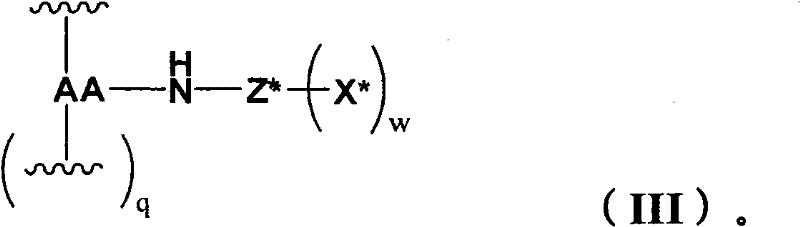
在式(III)中,w是选自0至20的整数。在一个实施方案中,w选自0至8。在另一个实施方案中,w选自0至4。在另外一个实施方案中,w选自0至1。在一个具体例子中,w是1。当w是0时,那么(X*)w由H替换。X*是修饰基团(例如,线性或分支聚合修饰基团)。在一个例子中,X*包括使修饰基团与Z*连接的连接体部分。在另一个例子中,X*是-La-R6c或-La-R6b。AA-NH-是衍生自N联糖基化序列内的氨基酸的部分,所述氨基酸具有包括氨基的侧链(例如,天冬酰胺)。在一个实施方案中,整数q是0,并且氨基酸是N末端或C末端氨基酸。在另一个实施方案中,q是1,并且氨基酸是内部氨基酸。In formula (III), w is an integer selected from 0 to 20. In one embodiment, w is selected from 0-8. In another embodiment, w is selected from 0-4. In another embodiment, w is selected from 0-1. In a specific example, w is 1. When w is 0, then (X * ) w is replaced by H. X * is a modifying group (eg, a linear or branched polymeric modifying group). In one example, X * includes a linker moiety linking the modifying group to Z * . In another example, X * is -L a -R 6c or -L a -R 6b . AA-NH- is a moiety derived from an amino acid within the N-linked glycosylation sequence that has a side chain that includes an amino group (eg, asparagine). In one embodiment, the integer q is 0 and the amino acid is an N-terminal or C-terminal amino acid. In another embodiment, q is 1 and the amino acid is an internal amino acid.
在式(III)中,Z*是选自单糖和寡糖的糖基部分。Z*可以是糖基模拟部分。当w是1或更大时,那么Z*是糖基连接基团。在一个实施方案中,Z*是天然存在的N联聚糖,例如三甘露糖基核心部分[GlcNAc-GlcNAc-Man(Man)2],其任选由岩藻糖残基置换。在一个实施方案中,Z*是单触角聚糖。在另一个实施方案中,Z*是二触角聚糖。在另外一个实施方案中,Z*是三触角聚糖。在一个进一步的实施方案中,Z*是四触角聚糖。Z*聚糖的每个触角可以与独立地选择的修饰基团共价连接。例如,Z*的每个末端糖部分可以与修饰基团共价连接。In formula (III), Z * is a glycosyl moiety selected from monosaccharides and oligosaccharides. Z * can be a glycosyl mimetic moiety. When w is 1 or greater, then Z * is a glycosyl linking group. In one embodiment, Z * is a naturally occurring N-linked glycan, such as a trimannosyl core moiety [GlcNAc-GlcNAc-Man(Man) 2 ], optionally replaced by a fucose residue. In one embodiment, Z * is a monoantennary glycan. In another embodiment, Z * is a biantennary glycan. In yet another embodiment, Z * is a triantennary glycan. In a further embodiment, Z * is a tetraantennary glycan. Each antennae of the Z * glycan can be covalently linked to an independently selected modifying group. For example, each terminal sugar moiety of Z * can be covalently linked to a modifying group.
在一个实施方案中,部分-Z*-(X*)w由下式表示,其包括单、二、三和四触角聚糖:In one embodiment, the moiety -Z * -(X * ) w is represented by the formula, which includes mono-, di-, tri-, and tetra-antennary glycans:
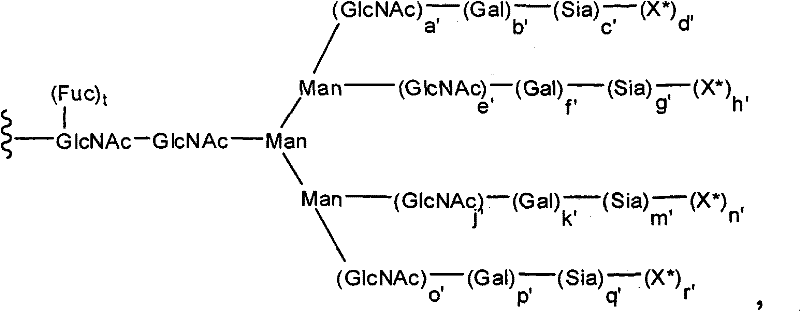
其中整数t、a’、b’、c’、d’、e’、f’、g’、h’、j’、k’、l’、m’、n’、o’、p’、q’和r’是独立地选自0和1的整数。在一个优选实施方案中,t是0。where the integers t, a', b', c', d', e', f', g', h', j', k', l', m', n', o', p', q ' and r' are integers independently selected from 0 and 1. In a preferred embodiment, t is zero.
任选与修饰基团结合的示例性N联聚糖在下文概述:Exemplary N-linked glycans optionally associated with modifying groups are outlined below:
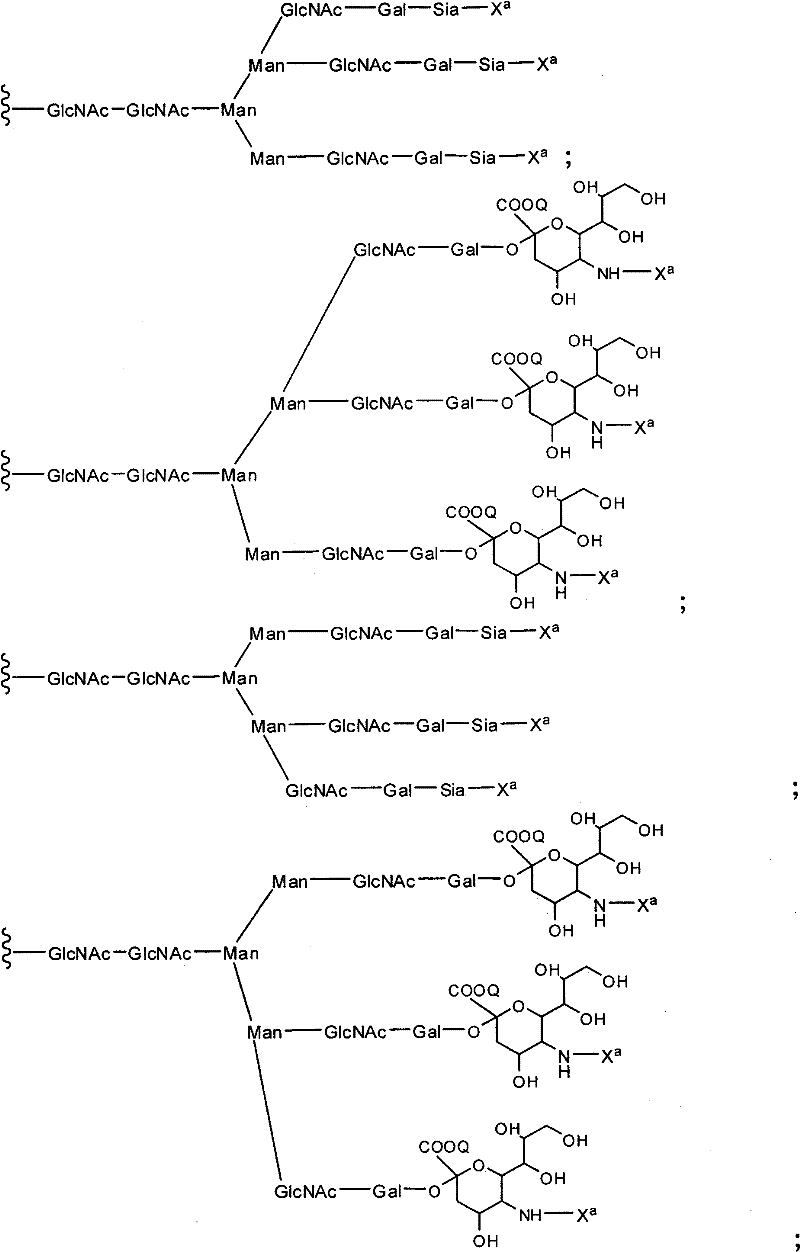
其中每个Q是独立地选自H、单个负电荷和阳离子(例如,Na+)的成员;并且每个Xa是独立地选自H、烷基、酰基(例如,乙酰基)和修饰基团(X*)的成员。在一个示例性实施方案中,本发明的N联聚糖包括至少一个修饰基团(至少一个Xa是X*)。另外的N联聚糖公开于2002年10月9日提交的WO03/31464和2004年4月9日提交的WO04/99231中,所述专利的公开内容为了所有目的通过引用合并入本文。wherein each Q is a member independently selected from H, a single negative charge, and a cation (e.g., Na + ); and each X is independently selected from H, an alkyl group, an acyl group (e.g., an acetyl group), and a modifier members of the group (X * ). In an exemplary embodiment, the N-linked glycans of the invention include at least one modifying group (at least one Xa is X * ). Additional N-linked glycans are disclosed in WO03/31464, filed October 9, 2002, and WO04/99231, filed April 9, 2004, the disclosures of which are incorporated herein by reference for all purposes.
在一个示例性实施方案中,式(III)中的Z*包括GlcNAc部分。在另一个示例性实施方案中,Z*包括GlcNH部分。在另外一个实施方案中,Z*包括GlcNAc-或GlcNH模拟部分。在一个进一步的实施方案中,Z*包括bacillosamine(即、2,4-二乙酰胺基-2,4,6-三脱氧葡萄糖)部分或其衍生物。在另一个实施方案中,Z*选自GlcNAc、GlcNH、Gal、Man、Glc、GalNAc、GalNH、Sia、Fuc、Xyl和这些部分的组合。在另外一个实施方案中,Z*是GlcNAc、Man和Glc部分的组合。在一个进一步的实施方案中,Z*是GlcNAc、Man、Gal和Sia部分的组合。在一个进一步的实施方案中,Z*是bacillosamine、GalNAc和Glc部分的组合。在一个实施方案中,Z*是GlcNAc部分。在另一个实施方案中,Z*是GlcNH部分。在另一个实施方案中,Z*是Man部分。在另外一个实施方案中,Z*是Sia部分。在另一个实施方案中,Z*是Glc部分。在另一个实施方案中,Z*是Gal部分。在另一个实施方案中,Z*是GalNAc部分。在另一个实施方案中,Z*是GalNH部分。在另一个实施方案中,Z*是Fuc部分。在另外一个实施方案中,Z*是GlcNAc-GlcNAc、GlcNH-GlcNAc、GlcNAc-GlcNH或GlcNH-GlcNH部分。在一个实施方案中,Z*是GlcNAc-Gal或GlcNH-Gal部分。在另一个实施方案中,Z*是GlcNAc-GlcNAc-Gal、GlcNH-GlcNAc-Gal、GlcNAc-GlcNH-Gal或GlcNH-GlcNH-Gal部分。在另一个实施方案中,Z*是GlcNAc-Gal-Sia部分。在另一个实施方案中,Z*是GlcNAc-GlcNAc-Gal-Sia、GlcNH-GlcNAc-Gal-Sia 、GlcNAc-GlcNH-Gal-Sia 或GlcNH-GlcNH-Gal-Sia部分。在另一个实施方案中,Z*是GlcNAc-GlcNAc-Man部分。In an exemplary embodiment, Z * in formula (III) includes a GlcNAc moiety. In another exemplary embodiment, Z * includes a GlcNH moiety. In another embodiment, Z * comprises a GlcNAc- or GlcNH mimetic moiety. In a further embodiment, Z * comprises a bacillosamine (ie, 2,4-diacetamido-2,4,6-trideoxyglucose) moiety or a derivative thereof. In another embodiment, Z * is selected from GlcNAc, GlcNH, Gal, Man, Glc, GalNAc, GalNH, Sia, Fuc, Xyl, and combinations of such moieties. In yet another embodiment, Z * is a combination of GlcNAc, Man and Glc moieties. In a further embodiment Z * is a combination of GlcNAc, Man, Gal and Sia moieties. In a further embodiment, Z * is a combination of bacillosamine, GalNAc and Glc moieties. In one embodiment, Z * is a GlcNAc moiety. In another embodiment, Z * is a GlcNH moiety. In another embodiment, Z * is a Man moiety. In another embodiment, Z * is a Sia moiety. In another embodiment, Z * is a Glc moiety. In another embodiment, Z * is a Gal moiety. In another embodiment, Z * is a GalNAc moiety. In another embodiment, Z * is a GalNH moiety. In another embodiment, Z * is a Fuc moiety. In yet another embodiment, Z * is a GlcNAc-GlcNAc, GlcNH-GlcNAc, GlcNAc-GlcNH or GlcNH-GlcNH moiety. In one embodiment, Z * is a GlcNAc-Gal or GlcNH-Gal moiety. In another embodiment, Z * is a GlcNAc-GlcNAc-Gal, GlcNH-GlcNAc-Gal, GlcNAc-GlcNH-Gal or GlcNH-GlcNH-Gal moiety. In another embodiment, Z * is a GlcNAc-Gal-Sia moiety. In another embodiment, Z * is a GlcNAc-GlcNAc-Gal-Sia, GlcNH-GlcNAc-Gal-Sia, GlcNAc-GlcNH-Gal-Sia or GlcNH-GlcNH-Gal-Sia moiety. In another embodiment, Z * is a GlcNAc-GlcNAc-Man moiety.
在一个实施方案中,本发明的多肽缀合物包括具有N联糖基化序列的多肽,所述N联糖基化序列具有天冬酰胺残基。在根据这个实施方案的一个例子中,多肽缀合物包括具有根据式(IV)的结构的部分:In one embodiment, the Polypeptide Conjugate of the invention comprises a polypeptide having an N-linked glycosylation sequence with an asparagine residue. In an example according to this embodiment, the Polypeptide Conjugate comprises a moiety having a structure according to formula (IV):
在式(IV)中,w、X*和Z*如上文对于式(III)定义。In formula (IV), w, X * and Z * are as defined above for formula (III).
糖基连接基团Glycosyl linking group
当插入多肽和修饰基团之间时,经修饰的糖的糖组分变成“糖基连接基团”。在一个示例性实施方案中,糖基连接基团衍生自经修饰的单糖或寡糖供体分子(例如,经修饰的多萜醇-焦磷酸盐糖),其是合适的寡糖基转移酶的底物。在另一个示例性实施方案中,糖基连接基团包括糖基模拟部分。本发明的多肽缀合物可以包括其为单价或多价(例如,触角结构)的糖基连接基团。因此,本发明的缀合物包括其中修饰基团经由单价糖基连接基团与多肽附着的种类。在本发明内还包括的是其中超过一个修饰基团经由多触角糖基连接连接基团与多肽附着的缀合物。The sugar component of the modified sugar becomes a "glycosyl linking group" when inserted between the polypeptide and the modifying group. In an exemplary embodiment, the glycosyl linking group is derived from a modified monosaccharide or oligosaccharide donor molecule (e.g., a modified dolichol-pyrophosphate sugar), which is a suitable oligosaccharide transfer Enzyme substrate. In another exemplary embodiment, the glycosyl linking group comprises a glycosyl mimetic moiety. Polypeptide conjugates of the invention can include glycosyl linking groups that are monovalent or multivalent (eg, antennal structures). Accordingly, the conjugates of the invention include those in which the modifying group is attached to the polypeptide via a monovalent glycosyl linking group. Also included within the invention are conjugates in which more than one modifying group is attached to the polypeptide via a polyantennary glycosyl linkage linking group.
在一个示例性实施方案中,式(III)或(IV)中的部分-Z*-(X*)w包括根据式(V)的部分:In an exemplary embodiment, the moiety -Z * -(X * ) w in formula (III) or (IV) includes a moiety according to formula (V):

在一个实施方案中,在式(V)中,E是O。在另一个实施方案中,E是S。在另外一个实施方案中,E是NR27或CHR28,其中R27和R28是独立地选自H、取代或未取代的烷基、取代或未取代的杂烷基、取代或未取代的芳基、取代或未取代的杂芳基、和取代或未取代的杂环烷基的成员。在一个实施方案中,E1是O。在另一个实施方案中,E1是S。在另一个实施方案中,E1是NR27(例如,NH)。在另一个实施方案中,E1是与多肽的氨基酸残基的键。In one embodiment, in formula (V), E is O. In another embodiment, E is S. In another embodiment, E is NR 27 or CHR 28 , wherein R 27 and R 28 are independently selected from H, substituted or unsubstituted alkyl, substituted or unsubstituted heteroalkyl, substituted or unsubstituted A member of aryl, substituted or unsubstituted heteroaryl, and substituted or unsubstituted heterocycloalkyl. In one embodiment, E 1 is O. In another embodiment, E 1 is S. In another embodiment, E 1 is NR 27 (eg, NH). In another embodiment, El is a bond to an amino acid residue of the polypeptide.
在一个实施方案中,在式(V)中,R2是H。在另一个实施方案中,R2是-R1。在另外一个实施方案中,R2是-CH2R1。在一个进一步的实施方案中,R2是-C(X1)R1。在这些实施方案中,R1选自OR9、SR9、NR10R11、取代或未取代的烷基、和取代或未取代的杂烷基,其中R9是选自H、金属离子、取代或未取代的烷基、取代或未取代的杂烷基和酰基的成员。R10和R11是独立地选自H、取代或未取代的烷基、取代或未取代的杂烷基和酰基的成员。在一个实施方案中,X1是O。在另一个实施方案中,X1是选自取代或未取代的烯基、S和NR8的成员,其中R8是选自H、OH、取代或未取代的烷基、和取代或未取代的杂烷基的成员。在一个具体例子中,R2是COOQ,其中Q是H、单个负电荷或盐抗衡离子(阳离子)。In one embodiment, in formula (V), R 2 is H. In another embodiment, R2 is -R1 . In yet another embodiment, R2 is -CH2R1 . In a further embodiment, R 2 is -C(X 1 )R 1 . In these embodiments, R 1 is selected from OR 9 , SR 9 , NR 10 R 11 , substituted or unsubstituted alkyl, and substituted or unsubstituted heteroalkyl, wherein R 9 is selected from H, a metal ion, Members of substituted or unsubstituted alkyl, substituted or unsubstituted heteroalkyl and acyl. R 10 and R 11 are members independently selected from H, substituted or unsubstituted alkyl, substituted or unsubstituted heteroalkyl, and acyl. In one embodiment, Xi is O. In another embodiment, X is a member selected from substituted or unsubstituted alkenyl, S and NR , wherein R is selected from H, OH, substituted or unsubstituted alkyl, and substituted or unsubstituted A member of the heteroalkyl group. In a specific example, R2 is COOQ, where Q is H, a single negative charge, or a salt counterion (cation).
在一个实施方案中,在式(V)中,Y是CH2。在另一个实施方案中,Y是CH(OH)CH2。在另外一个实施方案中,Y是CH(OH)CH(OH)CH2。在一个进一步的实施方案中,Y是CH。在一个实施方案中,Y是CH(OH)CH。在另一个实施方案中,Y是CH(OH)CH(OH)CH。在另外一个实施方案中,Y是CH(OH)。在一个进一步的实施方案中,Y是CH(OH)CH(OH)。在一个实施方案中,Y 是CH(OH)CH(OH)CH(OH)。Y2是选自H、OR6、R6、取代或未取代的烷基、取代或未取代的杂烷基的成员,In one embodiment, in formula (V), Y is CH2 . In another embodiment, Y is CH(OH) CH2 . In yet another embodiment, Y is CH(OH)CH(OH) CH2 . In a further embodiment, Y is CH. In one embodiment, Y is CH(OH)CH. In another embodiment, Y is CH(OH)CH(OH)CH. In another embodiment, Y is CH(OH). In a further embodiment, Y is CH(OH)CH(OH). In one embodiment, Y is CH(OH)CH(OH)CH(OH). Y 2 is a member selected from H, OR 6 , R 6 , substituted or unsubstituted alkyl, substituted or unsubstituted heteroalkyl,

其中R6和R7是独立地选自H、取代或未取代的烷基、取代或未取代的杂烷基和-La-R6b的成员。在一个例子中,-La-R6b包括C(O)R6b、C(O)-Lb-R6b、C(O)NH-Lb-R6b或NHC(O)-Lb-R6b。R6b是选自H、取代或未取代的烷基、取代或未取代的杂烷基和修饰基团的成员,所述修饰基团例如本发明的线性或分支聚合修饰基团。wherein R6 and R7 are members independently selected from H, substituted or unsubstituted alkyl, substituted or unsubstituted heteroalkyl, and -La - R6b . In one example, -L a -R 6b includes C(O)R 6b , C(O)-L b -R 6b , C(O)NH-L b -R 6b or NHC(O)-L b - R 6b . R 6b is a member selected from H, substituted or unsubstituted alkyl, substituted or unsubstituted heteroalkyl, and a modifying group such as a linear or branched polymeric modifying group of the present invention.
在式(V)中,R3、R3′和R4是独立地选自H、NHR3”、OR3″、SR3″、取代或未取代的烷基、取代或未取代的杂烷基和-La-R6c的成员。在一个例子中,-La-R6c包括-O-Lb-R6c、-C(O)-Lb-R6c、-C(O)NH-Lb-R6c、-NH-Lb-R6c、=N-Lb-R6c、-NHC(O)-Lb-R6c、-NHC(O)NH-Lb-R6c或-NHC(O)O-Lb-R6c,其中每个R3″是独立地选自H、取代或未取代的烷基、和取代或未取代的杂烷基的成员。每个R6c是独立地选自H、取代或未取代的烷基、取代或未取代的杂烷基、取代或未取代的芳基、取代或未取代的杂芳基、取代或未取代的杂环烷基、NR13R14和修饰基团的成员,其中R13和R14是独立地选自H、取代或未取代的烷基、和取代或未取代的杂烷基的成员。In formula (V), R 3 , R 3 ′ and R 4 are independently selected from H, NHR 3 ″, OR 3 ″, SR 3 ″, substituted or unsubstituted alkyl, substituted or unsubstituted heteroalkane group and a member of -L a -R 6c . In one example, -L a -R 6c includes -OL b -R 6c , -C(O)-L b -R 6c , -C(O)NH-L b -R 6c , -NH-L b -R 6c , =NL b -R 6c , -NHC(O)-L b -R 6c , -NHC(O)NH-L b -R 6c or -NHC(O )OL b -R 6c , wherein each R 3 ″ is a member independently selected from H, substituted or unsubstituted alkyl, and substituted or unsubstituted heteroalkyl. Each R 6c is independently selected from H, substituted or unsubstituted alkyl, substituted or unsubstituted heteroalkyl, substituted or unsubstituted aryl, substituted or unsubstituted heteroaryl, substituted or unsubstituted Members of heterocycloalkyl, NR 13 R 14 and modifying groups, wherein R 13 and R 14 are members independently selected from H, substituted or unsubstituted alkyl, and substituted or unsubstituted heteroalkyl.
在上述实施方案中,每个La和每个Lb是独立地选自键和连接体部分的成员,所述连接体部分选自取代或未取代的烷基、取代或未取代的杂烷基、取代或未取代的芳基、取代或未取代的杂芳基、取代和未取代的杂环烷基。In the above embodiments, each L a and each L b is a member independently selected from a bond and a linker moiety selected from a substituted or unsubstituted alkyl, a substituted or unsubstituted heteroalkane substituted or unsubstituted aryl, substituted or unsubstituted heteroaryl, substituted and unsubstituted heterocycloalkyl.
在一个实施方案中,式(V)的部分具有根据式(VI)的结构:In one embodiment, the moiety of formula (V) has a structure according to formula (VI):
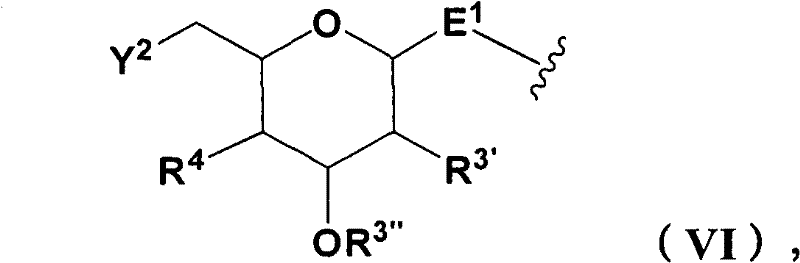
其中E1、R3′、R3″和R4如上定义。在一个实施方案中,在式(VI)中,E1是O。在另一个实施方案中,E1是NH。在另一个实施方案中,在式(VI)中,-OR3″是OH。在另外一个示例性实施方案中,R3′是NHAc或OH。wherein E 1 , R 3 ′, R 3 ″ and R4 are as defined above. In one embodiment, in formula (VI), E 1 is O. In another embodiment, E 1 is NH. In another embodiment In the scheme, in formula (VI), -OR 3 ″ is OH. In another exemplary embodiment, R3 ' is NHAc or OH.
在一个实施方案中,式(VI)的部分与多肽的氨基酸残基直接结合。在根据这个实施方案的一个例子中,E1是与氨基酸残基的键,并且式(VI)的部分具有其为选自下述的成员的结构:In one embodiment, the moiety of formula (VI) is directly bound to an amino acid residue of the polypeptide. In an example according to this embodiment, E is a bond to an amino acid residue, and the moiety of formula (VI) has a structure that is a member selected from:
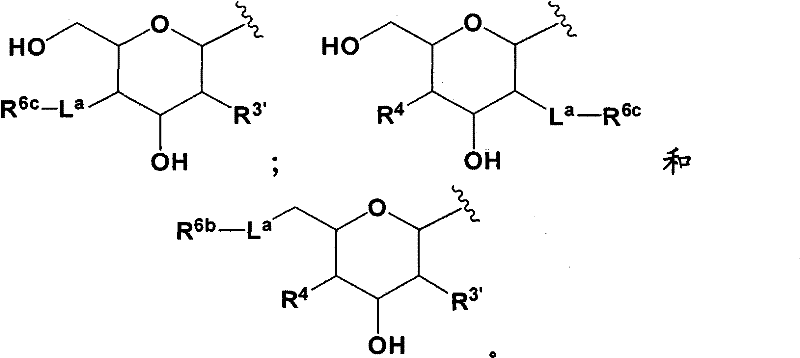
在另一个实施方案中,式(VI)的部分通过另一个糖残基与多肽结合。在一个示例性实施方案中,式(VI)的部分具有选自下述的结构:In another embodiment, the moiety of formula (VI) is bound to the polypeptide through another sugar residue. In an exemplary embodiment, the moiety of formula (VI) has a structure selected from:
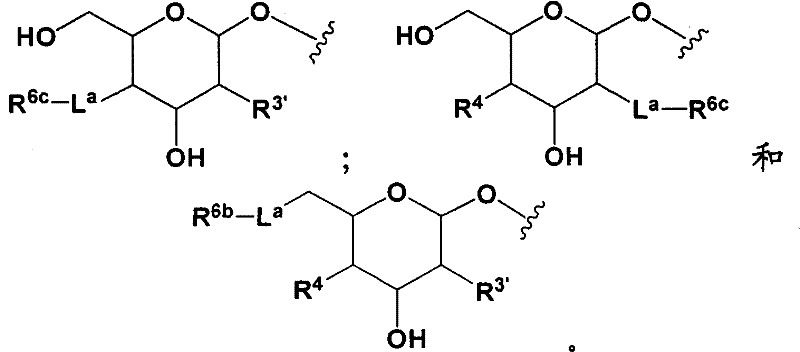
在一个例子中,根据上述实施方案中的任何,R3′和R4是独立地选自NHAc和OH的成员。In one example, according to any of the above embodiments, R3 ' and R4 are members independently selected from NHAc and OH.
在根据上述实施方案的一个例子中,式(V)或(VI)的部分是GlcNAc部分。在一个例子中,部分具有选自下述的结构:In one example according to the above embodiments, the moiety of formula (V) or (VI) is a GlcNAc moiety. In one example, the moiety has a structure selected from:
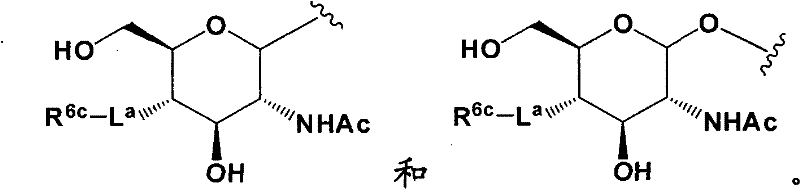
在另一个实施方案中,式(V)的部分具有根据式(VII)的结构:In another embodiment, the moiety of formula (V) has a structure according to formula (VII):
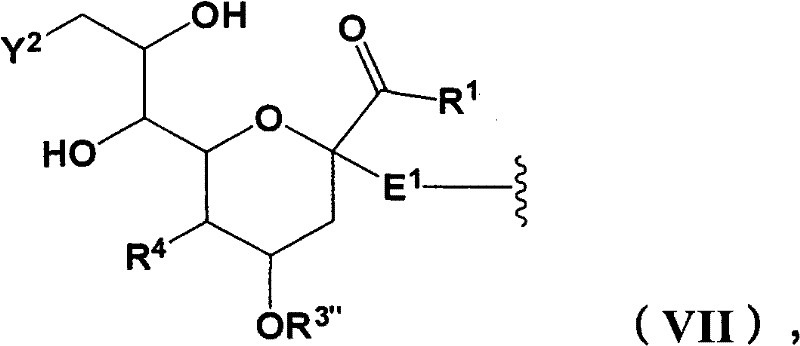
其中Y2、R1、E1、R3″和R4如上定义。在一个实施方案中,在式(VII)中,E1是O。在另一个实施方案中,E1是NH。在另一个实施方案中,E1是与多肽的氨基酸残基的键。在一个实施方案中,在式(VII)中,R1是OR9。在根据这个实施方案的一个例子中,R9是H、负电荷或盐抗衡离子(阳离子)。在另一个实施方案中,在式(VII)中,R3”是H。wherein Y 2 , R 1 , E 1 , R 3 ″ and R 4 are as defined above. In one embodiment, in formula (VII), E 1 is O. In another embodiment, E 1 is NH. In In another embodiment, E 1 is a bond to an amino acid residue of a polypeptide. In one embodiment, in formula (VII), R 1 is OR 9 . In an example according to this embodiment, R 9 is H. Negative charge or salt counterion (cation). In another embodiment, in formula (VII), R3 " is H.
在另一个实施方案中,式(VII)的部分具有其为选自下述的成员的结构:In another embodiment, the moiety of formula (VII) has a structure that is a member selected from:
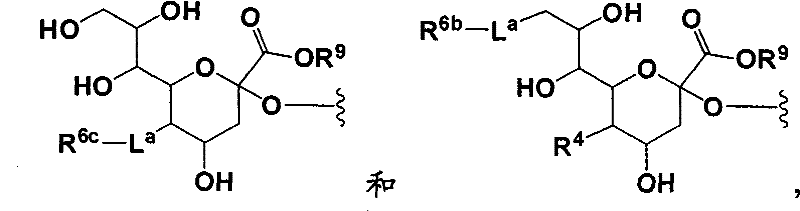
其中是R9是H、单个负电荷或盐抗衡离子。在一个例子中,R4是选自OH和NHAc的成员。wherein R9 is H, a single negative charge or a salt counterion. In one example, R4 is a member selected from OH and NHAc.
在一个例子中,根据上述实施方案中的任何(例如,在式V、VI或式VII中),-La-R6c包括其为选自下述的成员的部分:In one example, according to any of the above embodiments (eg, in Formula V, VI, or Formula VII), -L a -R 6c includes moieties that are members selected from:

其中r是选自1至20的整数,并且f和e是独立地选自1-5000的整数。R1和R2是独立地选自H和C1-C10取代或未取代的烷基的成员。在一个例子中,R1和R2是独立地选自H、甲基、乙基、丙基、异丙基、丁基和异丁基的成员。在一个实施方案中,R1和R2各自是甲基。wherein r is an integer selected from 1 to 20, and f and e are integers independently selected from 1-5000. R 1 and R 2 are members independently selected from H and C 1 -C 10 substituted or unsubstituted alkyl. In one example, R and R are members independently selected from H, methyl, ethyl, propyl, isopropyl, butyl, and isobutyl. In one embodiment, R1 and R2 are each methyl.
在根据上述实施方案中的任何的另一个例子中,-La-R6c或-La-R6c是:In another example according to any of the above embodiments, -La - R 6c or -La - R 6c is:

在根据上述实施方案的另一个例子中(例如,在式V、VI或式VII中),-La-R6c或-La-R6c是In another example according to the foregoing embodiments (eg, in formula V, VI, or formula VII), -L a -R 6c or -L a -R 6c is
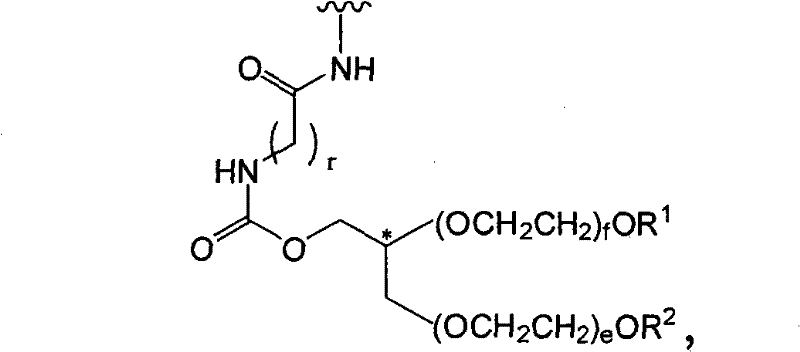
其中r是选自1至20的整数,并且f和e是独立地选自1-5000的整数。R1和R2是独立地选自H、甲基、乙基、丙基、异丙基、丁基和异丁基的成员。在一个实施方案中,R1和R2各自是甲基。用“*”指示的立体中心可以是外消旋的或限定的。在一个实施方案中,立体中心具有(S)构型。在另一个实施方案中,立体中心具有(R)构型。wherein r is an integer selected from 1 to 20, and f and e are integers independently selected from 1-5000. R and R are members independently selected from H, methyl, ethyl, propyl, isopropyl, butyl and isobutyl. In one embodiment, R1 and R2 are each methyl. Stereogenic centers indicated with " * " may be racemic or delimited. In one embodiment, the stereocenter has the (S) configuration. In another embodiment, the stereocenter has the (R) configuration.
在根据上述实施方案中的任何的另外一个例子中(例如,在式V、VI或式VII中),-La-R6c或-La-R6c是In another example according to any of the above embodiments (eg, in Formula V, VI, or Formula VII), -L a -R 6c or -L a -R 6c is

其中e、f、R1和R2如上定义。wherein e, f, R 1 and R 2 are as defined above.
在根据上述实施方案中的任何的一个进一步例子中(例如,在式V、VI或式VII中),-La-R6c或-La-R6c是In a further example according to any of the above embodiments (eg, in formula V, VI, or formula VII), -L a -R 6c or -L a -R 6c is
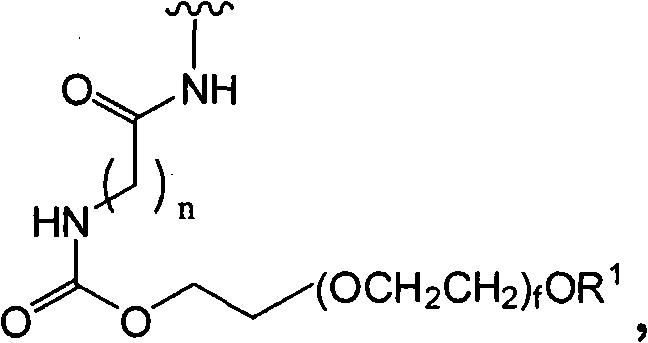
其中e、f、R1和R2如上定义。wherein e, f, R 1 and R 2 are as defined above.
在另外一个实施方案中,R6b(例如,在式V中)或R6c(例如,在式V至VII中)中的至少一个是选自下述的成员:In another embodiment, at least one of R 6b (eg, in Formula V) or R 6c (eg, in Formulas V to VII) is a member selected from:
其中g、j和k是独立地选自0至20的整数。每个e是独立地选自0至2500的整数。整数s选自1-5。R16和R17是独立地选择的聚合部分。G1和G2是使聚合部分R16和R17与C连接的独立地选择的连接片段。示例性连接片段不包括芳香族部分也不包括酯部分。备选地,这些连接片段可以包括这样的一个或多个部分,其设计为在生理学相关条件下降解,例如酯、二硫化物等。wherein g, j and k are integers independently selected from 0 to 20. Each e is an integer independently selected from 0 to 2500. The integer s is selected from 1-5. R 16 and R 17 are independently selected polymeric moieties. G1 and G2 are independently selected linking fragments linking polymeric moieties R16 and R17 to C. Exemplary linking fragments include neither aromatic moieties nor ester moieties. Alternatively, these linking fragments may include one or more moieties designed to degrade under physiologically relevant conditions, such as esters, disulfides, and the like.
示例性连接片段包括G1和G2是独立地选择的,并且包括S、SC(O)NH、HNC(O)S、SC(O)O、O、NH、NHC(O)、(O)CNH和NHC(O)O和OC(O)NH、CH2S、CH2O、CH2CH2O、CH2CH2S、(CH2)oO、(CH2)oS或(CH2)oY’-PEG,其中Y’是S、NH、NHC(O)、C(O)NH、NHC(O)O、OC(O)NH或O,并且o是1至50的整数。在一个示例性实施方案中,连接片段G1和G2是不同的连接片段。Exemplary linker segments including G1 and G2 are independently selected and include S, SC(O)NH, HNC(O)S, SC(O)O, O, NH, NHC(O), (O) CNH and NHC(O)O and OC(O)NH, CH 2 S, CH 2 O, CH 2 CH 2 O, CH 2 CH 2 S, (CH 2 ) o O, (CH 2 ) o S or (CH 2 ) o Y'-PEG, wherein Y' is S, NH, NHC(O), C(O)NH, NHC(O)O, OC(O)NH or O, and o is an integer from 1 to 50. In an exemplary embodiment, linking fragments G1 and G2 are different linking fragments.
G3是选自H、取代或未取代的烷基、取代或未取代的杂烷基、取代或未取代的杂环烷基、取代或未取代的芳基、取代或未取代的杂芳基的成员。A1、A2、A3、A4、A5、A6、A7、A8、A9、A10和A11是独立地选自H、取代或未取代的烷基、取代或未取代的杂烷基、取代或未取代的杂环烷基、取代或未取代的芳基、取代或未取代的杂芳基、-NA12A13、-OA12和-SiA12A13的成员,其中A12和A13是独立地选自H、取代或未取代的烷基、取代或未取代的杂烷基、取代或未取代的杂环烷基、取代或未取代的芳基、取代或未取代的杂芳基的成员。 G is selected from H, substituted or unsubstituted alkyl, substituted or unsubstituted heteroalkyl, substituted or unsubstituted heterocycloalkyl, substituted or unsubstituted aryl, substituted or unsubstituted heteroaryl a member of. A 1 , A 2 , A 3 , A 4 , A 5 , A 6 , A 7 , A 8 , A 9 , A 10 and A 11 are independently selected from H, substituted or unsubstituted alkyl, substituted or unsubstituted A member of substituted heteroalkyl, substituted or unsubstituted heterocycloalkyl, substituted or unsubstituted aryl, substituted or unsubstituted heteroaryl, -NA 12 A 13 , -OA 12 and -SiA 12 A 13 , wherein A 12 and A 13 are independently selected from H, substituted or unsubstituted alkyl, substituted or unsubstituted heteroalkyl, substituted or unsubstituted heterocycloalkyl, substituted or unsubstituted aryl, substituted or a member of an unsubstituted heteroaryl.
修饰基团Modification group
本发明的修饰基团可以是任何化学基团。示例性修饰基团在下文讨论。修饰基团可以就其改变给定多肽的性质(例如,生物或理化性质)的能力进行选择。可以通过使用修饰基团而改变的示例性多肽性质包括但不限于,药代动力学、药效学、代谢稳定性、生物分布、水溶性、亲油性、组织靶向能力和治疗活性谱。优选的修饰基团是改善本发明的多肽缀合物的药效学和药代动力学的那些,所述本发明的多肽缀合物已用此类修饰基团进行修饰。其他修饰基团可以用于修饰多肽,所述多肽在体外生物测定法系统包括诊断产物中发现应用。The modifying group of the present invention can be any chemical group. Exemplary modifying groups are discussed below. A modifying group can be selected for its ability to alter a property (eg, a biological or physicochemical property) of a given polypeptide. Exemplary polypeptide properties that can be altered through the use of modifying groups include, but are not limited to, pharmacokinetics, pharmacodynamics, metabolic stability, biodistribution, water solubility, lipophilicity, tissue targeting ability, and spectrum of therapeutic activity. Preferred modifying groups are those that improve the pharmacodynamics and pharmacokinetics of the Polypeptide Conjugates of the present invention that have been modified with such modifying groups. Other modifying groups may be used to modify polypeptides that find use in in vitro bioassay systems, including diagnostic products.
例如,治疗性糖肽的体内半衰期可以用聚乙二醇(PEG)部分得到增强。多肽用PEG的化学修饰(PEG化)增加其分子大小,并且一般减少表面和官能团易接近性,其各自依赖于与多肽附着的PEG部分的数目和大小。通常,这种修饰导致血浆半衰期和蛋白水解稳定性的改善,以及免疫原性和肝摄取中的减少(Chaffee等人J.Clin.Invest.89:1643-1651(1992);Pyatak等人Res.Commun.Chem.Pathol Pharmacol.29:113-127(1980))。例如,已报告白介素-2的PEG化增加其在体内的抗肿瘤效力(Katre等人Proc.Natl.Acad.Sci. USA.84:1487-1491(1987)),并且衍生自单克隆抗体A7的F(ab’)2的PEG化已改善其肿瘤定位(Kitamura等人Biochem.Biophys.Res.Commun.28:1387-1394(1990))。因此,在另一个实施方案中,相对于未经衍生的亲本多肽的体内半衰期,通过本发明的方法用PEG部分衍生的多肽的体内半衰期增加。For example, the in vivo half-life of therapeutic glycopeptides can be enhanced with polyethylene glycol (PEG) moieties. Chemical modification of a polypeptide with PEG (PEGylation) increases its molecular size and generally reduces surface and functional group accessibility, each of which depends on the number and size of PEG moieties attached to the polypeptide. Typically, such modifications lead to improvements in plasma half-life and proteolytic stability, as well as reductions in immunogenicity and hepatic uptake (Chaffee et al. J. Clin. Invest. 89:1643-1651 (1992); Pyatak et al. Res. Commun. Chem. Pathol Pharmacol. 29:113-127 (1980)). For example, PEGylation of interleukin-2 has been reported to increase its antitumor efficacy in vivo (Katre et al. Proc. PEGylation of F(ab')2 has improved its tumor localization (Kitamura et al. Biochem. Biophys. Res. Commun. 28:1387-1394 (1990)). Thus, in another embodiment, the in vivo half-life of a polypeptide derivatized with a PEG moiety by the methods of the invention is increased relative to the in vivo half-life of the non-derivatized parent polypeptide.
多肽体内半衰期中的增加最佳表示为相对于亲本多肽的增加百分比范围。增加百分比范围的下限是约40%、约60%、约80%、约100%、约150%或约200%。范围的上限是约60%、约80%、约100%、约150%、或超过约250%。An increase in the in vivo half-life of a polypeptide is best expressed as a range of percent increase relative to the parental polypeptide. The lower end of the range of percent increase is about 40%, about 60%, about 80%, about 100%, about 150%, or about 200%. The upper end of the range is about 60%, about 80%, about 100%, about 150%, or more than about 250%.
水溶性聚合修饰基团Water-soluble polymer modification group
在一个实施方案中,修饰基团是选自线性和分支的聚合修饰基团。在一个例子中,修饰基团包括一个或多个聚合部分,其中每个聚合部分独立地选择。In one embodiment, the modifying group is selected from linear and branched polymeric modifying groups. In one example, a modifying group includes one or more polymeric moieties, wherein each polymeric moiety is independently selected.
许多水溶性聚合物是本领域技术人员已知的,并且在实践本发明中有用。术语水溶性聚合物包括种类例如糖(例如,右旋糖酐、直链淀粉、透明质酸、聚(唾液酸)、类肝素、肝素等);聚(氨基酸),例如聚(天冬氨酸)和聚(谷氨酸);核酸;合成聚合物(例如,聚(丙烯酸)、聚(醚),例如聚(乙二醇);肽、蛋白质等。本发明可以用任何水溶性聚合物进行实践,唯一限制是聚合物必须包括缀合物的其余部分可以在其上附着的点。Many water soluble polymers are known to those skilled in the art and are useful in practicing the present invention. The term water-soluble polymers includes species such as sugars (e.g., dextran, amylose, hyaluronic acid, poly(sialic acid), heparinoids, heparin, etc.); poly(amino acids), such as poly(aspartic acid) and poly(aspartic acid) (glutamic acid); nucleic acids; synthetic polymers (e.g., poly(acrylic acid), poly(ether), such as poly(ethylene glycol); peptides, proteins, etc. The present invention can be practiced with any water-soluble polymer, only The limitation is that the polymer must include points to which the rest of the conjugate can attach.
修饰基团的反应衍生物(例如,反应PEG类似物)使修饰基团与一个或多个多肽部分附着的使用在本发明的范围内。本发明不受反应类似物的特性限制。The use of reactive derivatives of modifying groups (eg, reactive PEG analogs) to attach the modifying group to one or more polypeptide moieties is within the scope of the invention. The invention is not limited by the identity of the reactive analogs.
在一个优选实施方案中,修饰基团是PEG或PEG类似物。聚(乙二醇)的许多活化衍生物是商购可得的,并且在文献中描述。选择或需要时合成合适的活化PEG衍生物在本领域技术人员的能力内,用所述合适的活化PEG衍生物制备在本发明中有用的底物。参见,Abuchowski等人Cancer Biochem.Biophys.,7:175-186(1984);Abuchowski等人,J.Biol.Chem.,252:3582-3586(1977);Jackson等人,Anal.Biochem.,165:114-127(1987);Koide等人,Biochem Biophys.Res.Commun.,111:659-667(1983))、tresylate(Nilsson等人,Methods Enzymol.,104:56-69(1984);Delgado等人,Biotechnol.Appl.Biochem.,12:119-128(1990));N-琥珀酰亚胺衍生的活性酯(Buckmann等人,Makromol.Chem.,182:1379-1384(1981);Joppich等人,Makromol.Chem.,180:1381-1384(1979);Abuchowski等人,Cancer Biochem.Biophys.,7:175-186(1984);Katre等人Proc.Natl.Acad.Sci.U.S.A.,84:1487-1491(1987);Kitamura等人,Cancer Res.,51:4310-4315(1991);Boccu等人,Z. Naturforsch.,38C:94-99(1983)、碳酸酯(Zalipsky等人,POLY(ETHYLENE GLYCOL)CHEMISTRY:BIOTECHNICAL AND BIOMEDICAL APPLICATIONS,Harris,编辑,Plenum Press,NewYork,1992,第347-370页;Zalipsky等人,Biotechnol.Appl.Biochem.,15:100-114(1992);Veronese等人,Appl.Biochem.Biotech.,11:141-152(1985))、咪唑甲酸盐(Beauchamp等人,Anal.Biochem.,131:25-33(1983);Berger等人,Blood,71:1641-1647(1988))、4-二硫代吡啶(Woghiren等人,Bioconjugate Chem.,4:314-318(1993))、异氰酸酯(Byun等人,ASAIO Journal,M649-M-653(1992))和环氧化物(授予Noishiki等人,(1989)的美国专利号4,806,595。其他连接基团包括氨基和活化PEG之间的氨基甲酸乙酯连接。参见,Veronese,等人,Appl.Biochem.Biotechnol.,11:141-152(1985)。In a preferred embodiment, the modifying group is PEG or a PEG analog. Many activated derivatives of poly(ethylene glycol) are commercially available and described in the literature. It is within the ability of one skilled in the art to select or if desired synthesize a suitable activated PEG derivative with which to prepare a substrate useful in the present invention. See, Abuchowski et al. Cancer Biochem. Biophys., 7: 175-186 (1984); Abuchowski et al., J. Biol. Chem., 252: 3582-3586 (1977); Jackson et al., Anal. Biochem., 165 : 114-127 (1987); Koide et al., Biochem Biophys.Res.Commun., 111: 659-667 (1983)), tresylate (Nilsson et al., Methods Enzymol., 104: 56-69 (1984); Delgado et al., Biotechnol.Appl.Biochem., 12:119-128 (1990)); N-succinimide derived active esters (Buckmann et al., Makromol.Chem., 182:1379-1384 (1981); Joppich et al., Makromol. Chem., 180: 1381-1384 (1979); Abuchowski et al., Cancer Biochem. Biophys., 7: 175-186 (1984); Katre et al. Proc. Natl. Acad. Sci. USA, 84 : 1487-1491 (1987); Kitamura et al., Cancer Res., 51: 4310-4315 (1991); Boccu et al., Z. Naturforsch., 38C: 94-99 (1983), carbonates (Zalipsky et al., P OLY ( ETHYLENE GLYCOL ) C HEMISTRY : B IOTECHNICAL AND B IOMEDICAL A PPLICATIONS , Harris, ed., Plenum Press, New York, 1992, pp. 347-370; Zalipsky et al., Biotechnol. Appl. Biochem., 15: 100-114 (1992); Veronese et al., Appl.Biochem.Biotech., 11:141-152 (1985)), imidazole formate (Beauchamp et al., Anal.Biochem., 131:25-33 (1983); Berger et al. Human, Blood, 71:1641-1647 (1988)), 4-dithiopyridine (Woghiren et al., Bioconjugate Chem., 4:314-318 (1993)), isocyanate (Byun et al., ASAIO Jour nal, M649-M-653 (1992)) and epoxides (US Patent No. 4,806,595 to Noishiki et al., (1989). Other linking groups include urethane linkages between amino groups and activated PEG. See, Veronese, et al., Appl. Biochem. Biotechnol., 11:141-152 (1985).
用于活化聚合物的方法可以在WO 94/17039、美国专利号5,324,844、WO 94/18247、WO 94/04193、美国专利号5,219,564、美国专利号5,122,614、WO 90/13540、美国专利号5,281,698和WO 93/15189中找到,并且对于活化聚合物和肽之间的缀合,例如凝固因子因子VIII(WO 94/15625)、血红蛋白(WO 94/09027)、氧携带分子(美国专利号4,412,989)、核糖核酸酶和超氧化物歧化酶(Veronese at al.(疑为et al.,等人),App.Biochem.Biotech.11:141-45(1985))。Methods for activating polymers can be found in WO 94/17039, U.S. Pat. No. 5,324,844, WO 94/18247, WO 94/04193, U.S. Pat. No. 5,219,564, U.S. Pat. 93/15189, and for conjugation between activating polymers and peptides, such as coagulation factor VIII (WO 94/15625), hemoglobin (WO 94/09027), oxygen carrying molecules (US Patent No. 4,412,989), ribose Nucleases and superoxide dismutases (Veronese at al. (Suspect et al., et al.), App. Biochem. Biotech. 11:141-45 (1985)).
在本发明中有用的活化PEG分子和制备这些试剂的方法是本领域已知的,并且在例如WO04/083259中描述。Activated PEG molecules useful in the present invention and methods of preparing these reagents are known in the art and described, for example, in WO04/083259.
对于活化在制备本文所述化合物中使用的线性PEG合适的活化或离去基团包括但不限于下述种类:Suitable activating or leaving groups for activating the linear PEG used in the preparation of the compounds described herein include, but are not limited to, the following classes:

示例性水溶性聚合物是其中聚合物样品中基本比例的聚合物分子具有大约相同的分子量的那些;此类聚合物是“均匀分散的”。Exemplary water-soluble polymers are those in which a substantial proportion of the polymer molecules in a polymer sample have about the same molecular weight; such polymers are "uniformly dispersed."
本发明通过提及聚(乙二醇)缀合物进一步举例说明。关于PEG官能化和缀合的几个综述和专题论文是可获得的。参见例如,Harris,Macronol. Chem.Phys.C25:325-373(1985);Scouten,Methods inEnzymology 135:30-65(1987);Wong等人,Enzyme Microb.Technol.14:866-874(1992);Delgado等人,Critical Reviews in Therapeutic DrugCarrier Systems 9:249-304(1992);Zalipsky,Bioconjugate Ch em.6:150-165(1995);和Bhadra,等人,Pharmazie,57:5-29(2002)。使用反应分子用于制备反应性PEG分子且形成缀合物的途径是本领域已知的。例如,美国专利号5,672,662公开了聚合物酸的活性酯的水溶性和可分离的缀合物,所述聚合物酸选自线性或分支聚环氧烷、聚(氧乙基化多元醇)、聚(烯属醇)和聚(丙烯吗啉(acrylomorpholine))。The invention is further illustrated by reference to poly(ethylene glycol) conjugates. Several reviews and monographs on PEG functionalization and conjugation are available. See, e.g., Harris, Macronol. Chem. Phys. C25:325-373 (1985); Scouten, Methods in Enzymology 135:30-65 (1987); Wong et al., Enzyme Microb. Technol. 14:866-874 (1992) ; Delgado et al., Critical Reviews in Therapeutic Drug Carrier Systems 9:249-304 (1992); Zalipsky, Bioconjugate Chem. 6:150-165 (1995); and Bhadra, et al., Pharmazie, 57:5-29 (2002 ). Routes for preparing reactive PEG molecules and forming conjugates using reactive molecules are known in the art. For example, U.S. Patent No. 5,672,662 discloses water-soluble and isolatable conjugates of active esters of polymeric acids selected from linear or branched polyalkylene oxides, poly(oxyethylated polyols), poly(oxyethylated polyols), Poly(alkenyl alcohol) and poly(acrylomorpholine).
美国专利号6,376,604阐述了通过在有机溶剂中使聚合物的末端羟基与二(1-苯并三唑)碳酸酯反应,用于制备水溶性和非肽聚合物的水溶性1-苯并三唑碳酸酯的方法。活性酯用于形成与生物活性试剂例如多肽的缀合物。U.S. Patent No. 6,376,604 describes the use of water-soluble 1-benzotriazole in the preparation of water-soluble and non-peptidic polymers by reacting the terminal hydroxyl groups of the polymer with bis(1-benzotriazole) carbonate in an organic solvent Carbonate method. Active esters are used to form conjugates with biologically active agents such as polypeptides.
WO 99/45964描述了包括生物活性试剂和活化的水溶性聚合物的缀合物,所述活化的水溶性聚合物包括具有通过稳定连接与聚合物主链连接的至少一个末端的聚合物主链,其中至少一个末端包括具有与分支部分连接的近端反应基团的分支部分,其中生物活性试剂与近端反应基团中的至少一个连接。其他分支聚(乙二醇)在WO 96/21469中描述,美国专利号5,932,462描述了与分支PEG分子形成的缀合物,所述分支PEG分子包括包含反应性官能团的分支末端。游离反应基团可用于与生物活性种类例如多肽反应,形成聚(乙二醇)和生物活性种类之间的缀合物。美国专利号5,446,090描述了双功能PEG连接体,及其在形成在每个PEG连接体末端处具有肽的缀合物中的用途。WO 99/45964 describes conjugates comprising a biologically active agent and an activated water-soluble polymer comprising a polymer backbone having at least one end attached to the polymer backbone by a stable linkage , wherein at least one terminus includes a branched moiety having proximal reactive groups attached to the branched moiety, wherein a biologically active agent is attached to at least one of the proximal reactive groups. Other branched poly(ethylene glycol)s are described in WO 96/21469 and U.S. Pat. No. 5,932,462 describes conjugates formed with branched PEG molecules comprising branched ends comprising reactive functional groups. The free reactive group can be used to react with a biologically active species, such as a polypeptide, to form a conjugate between poly(ethylene glycol) and the biologically active species. US Patent No. 5,446,090 describes bifunctional PEG linkers and their use in forming conjugates with peptides at each PEG linker terminus.
包括可降解PEG连接的缀合物在WO 99/34833;和WO 99/14259,以及美国专利号6,348,558中描述。此类可降解连接可应用于本发明中。Conjugates comprising degradable PEG linkages are described in WO 99/34833; and WO 99/14259, as well as in US Patent No. 6,348,558. Such degradable linkages find use in the present invention.
上文所述的聚合物活化的领域公认方法在本发明的背景中用于形成本文所述的分支聚合物,以及用于这些分支聚合物与其他种类例如糖、糖核苷酸等的缀合。The art-recognized methods of polymer activation described above are used in the context of the present invention to form the branched polymers described herein, as well as for the conjugation of these branched polymers to other species such as sugars, sugar nucleotides, etc. .
示例性水溶性聚合物是聚(乙二醇),例如PEG或甲氧基-PEG(m-PEG)。在本发明中使用的聚(乙二醇)不限制于任何具体形式或分子量范围。对于每个独立地选择的聚(乙二醇)部分,分子量优选为约500Da至约100kDa。在一个实施方案中,PEG部分的分子量为约2至约80kDa。在另一个实施方案中,PEG部分的分子量为约2至约60kDa,优选约5至约40kDa。在一个示例性实施方案中,PEG部分具有约1kDa、约2kDa、约5kDa、约10kDa、约15kDa、约20kDa、约25kDa、约30kDa、约35kDa、约40kDa、约45kDa、约50kDa、约55kDa、约60kDa、约65kDa、约70kDa、约75kDa或约80kDa的分子量。An exemplary water soluble polymer is poly(ethylene glycol), such as PEG or methoxy-PEG (m-PEG). The poly(ethylene glycol) used in the present invention is not limited to any particular form or molecular weight range. The molecular weight is preferably from about 500 Da to about 100 kDa for each independently selected poly(ethylene glycol) moiety. In one embodiment, the PEG moiety has a molecular weight of about 2 to about 80 kDa. In another embodiment, the PEG moiety has a molecular weight of about 2 to about 60 kDa, preferably about 5 to about 40 kDa. In an exemplary embodiment, the PEG moiety has about 1 kDa, about 2 kDa, about 5 kDa, about 10 kDa, about 15 kDa, about 20 kDa, about 25 kDa, about 30 kDa, about 35 kDa, about 40 kDa, about 45 kDa, about 50 kDa, about 55 kDa, A molecular weight of about 60 kDa, about 65 kDa, about 70 kDa, about 75 kDa, or about 80 kDa.
在本发明中使用的示例性聚(乙二醇)分子包括但不限于具有下式的那些:Exemplary poly(ethylene glycol) molecules for use in the invention include, but are not limited to, those having the formula:

其中R8是H、OH、NH2、取代或未取代的烷基、取代或未取代的芳基、取代或未取代的杂芳基、取代或未取代的杂环烷基、取代或未取代的杂烷基,例如乙缩醛、OHC-、H2N-(CH2)q-、HS-(CH2)q或-(CH2)qC(Y)Z1。指数“e”代表1至2500的整数。指数b、d和q独立地代表0至20的整数。符号Z和Z1独立地代表OH、NH2、离去基团,例如咪唑、对硝基苯基、HOBT、四唑、卤化物、S-R9、活化酯的醇部分;-(CH2)pC(Y1)V或-(CH2)pU(CH2)sC(Y1)v。符号Y代表H(2)、=O、=S、=N-R10。符号X、Y、Y1、A1和U独立地代表部分O、S、N-R11。符号V代表OH、NH2、卤素、S-R12、活化酯的醇组分、活化酰胺的胺组分、糖-核苷酸和蛋白质。指数p、q、s和v是独立地选自0至20的整数的成员。符号R9、R10、R11和R12独立地代表H、取代或未取代的烷基、取代或未取代的杂烷基、取代或未取代的芳基、取代或未取代的杂环烷基、和取代或未取代的杂芳基。wherein R 8 is H, OH, NH 2 , substituted or unsubstituted alkyl, substituted or unsubstituted aryl, substituted or unsubstituted heteroaryl, substituted or unsubstituted heterocycloalkyl, substituted or unsubstituted A heteroalkyl group such as acetal, OHC-, H 2 N-(CH 2 ) q -, HS-(CH 2 ) q or -(CH 2 ) q C(Y)Z 1 . The index "e" represents an integer from 1 to 2500. The indices b, d and q independently represent integers from 0 to 20. The symbols Z and Z independently represent OH, NH 2 , leaving groups such as imidazole, p-nitrophenyl, HOBT, tetrazole, halides, SR 9 , alcohol moieties of activated esters; -(CH 2 ) p C(Y 1 )V or -(CH 2 ) p U(CH 2 ) s C(Y 1 ) v . The symbol Y represents H(2), =O, =S, =NR 10 . The symbols X, Y, Y 1 , A 1 and U independently represent the moieties O, S, NR 11 . The symbol V stands for OH, NH2 , halogen, SR12 , the alcohol component of activated esters, the amine component of activated amides, sugar-nucleotides and proteins. The indices p, q, s and v are members independently selected from integers from 0 to 20. The symbols R 9 , R 10 , R 11 and R 12 independently represent H, substituted or unsubstituted alkyl, substituted or unsubstituted heteroalkyl, substituted or unsubstituted aryl, substituted or unsubstituted heterocycloalkane group, and substituted or unsubstituted heteroaryl.
在形成本发明的缀合物中有用的聚(乙二醇)是线性的分支的。适合于在本发明中使用的分支聚(乙二醇)分子包括但不限于,由下式描述的那些:Poly(ethylene glycol)s useful in forming the conjugates of the invention are linear branched. Branched poly(ethylene glycol) molecules suitable for use in the present invention include, but are not limited to, those described by the formula:
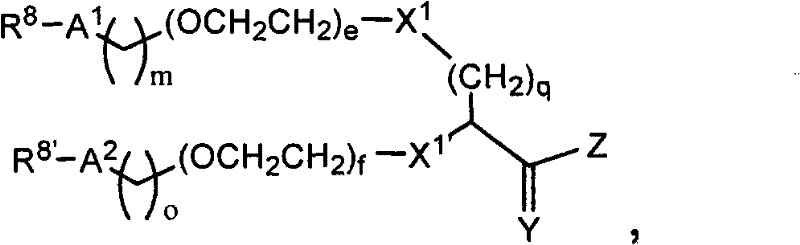
其中R8和R8′是独立地选自上文对于R8定义的基团的成员。A1和A2是独立地选自上文对于A1定义的基团的成员。指数e、f、o和q如上定义。Z和Y如上定义。X1和X1′是独立地选自S、SC(O)NH、HNC(O)S、SC(O)O、O、NH、NHC(O)、(O)CNH和NHC(O)O、OC(O)NH的成员。wherein R 8 and R 8 ′ are members independently selected from the groups defined above for R 8 . A 1 and A 2 are members independently selected from the groups defined above for A 1 . The indices e, f, o and q are as defined above. Z and Y are as defined above. X1 and X1 ' are independently selected from S, SC(O)NH, HNC(O)S, SC(O)O, O, NH, NHC(O), (O)CNH and NHC(O)O , Member of OC(O)NH.
在其他示例性实施方案中,分支PEG基于半胱氨酸、丝氨酸或二赖氨酸核心。在另一个示例性实施方案中,聚(乙二醇)分子选自下述结构:In other exemplary embodiments, the branched PEG is based on a cysteine, serine, or dilysine core. In another exemplary embodiment, the poly(ethylene glycol) molecule is selected from the following structures:
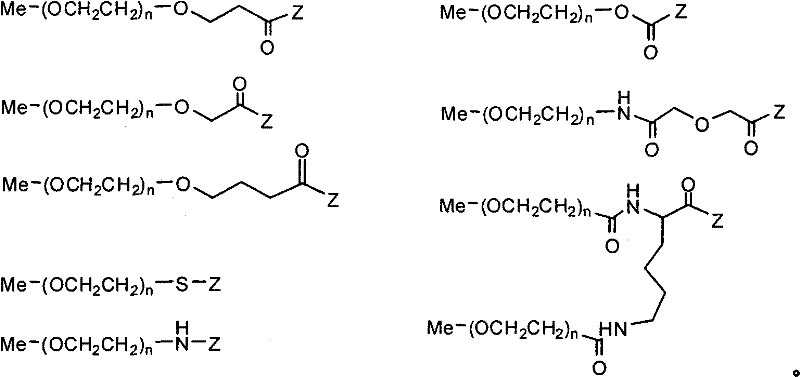
在一个进一步的实施方案中,聚(乙二醇)是具有超过一个附着的PEG部分的分支PEG。分支PEG的例子在美国专利号5,932,462;美国专利号5,342,940;美国专利号5,643,575;美国专利号5,919,455;美国专利号6,113,906;美国专利号5,183,660;WO 02/09766;Kodera Y.,Bioconjugate Chemistry 5:283-288(1994);和Yamasaki等人,Agric.Biol. Chem.,52:2125-2127,1998中描述。在一个优选实施方案中,分支PEG的每个聚(乙二醇)的分子量小于或等于40,000道尔顿。In a further embodiment, the poly(ethylene glycol) is a branched PEG having more than one attached PEG moiety. Examples of branched PEGs are in U.S. Patent No. 5,932,462; U.S. Patent No. 5,342,940; U.S. Patent No. 5,643,575; U.S. Patent No. 5,919,455; 288 (1994); and described in Yamasaki et al., Agric. Biol. Chem., 52:2125-2127, 1998. In a preferred embodiment, the molecular weight of each poly(ethylene glycol) of the branched PEG is less than or equal to 40,000 Daltons.
代表性聚合修饰基团包括基于含侧链的氨基酸(例如丝氨酸、半胱氨酸、赖氨酸)和小肽例如lys-lys的结构。示例性结构包括:Representative polymeric modification groups include structures based on amino acids containing side chains (eg, serine, cysteine, lysine) and small peptides such as lys-lys. Example structures include:
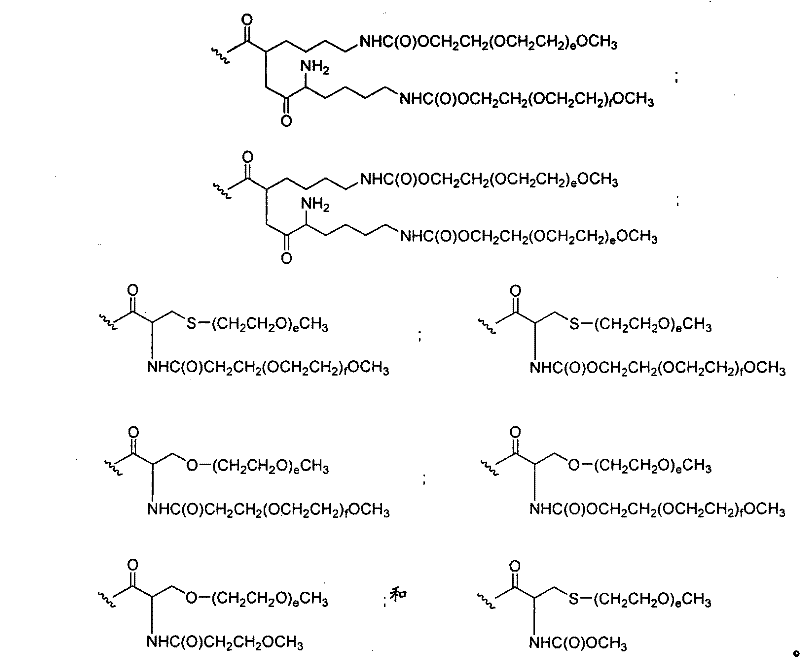
技术人员应当理解在二赖氨酸结构的游离胺也可以通过与PEG部分的酰胺或氨基甲酸乙酯键进行聚乙二醇化。The skilled artisan will understand that the free amine at the dilysine structure can also be pegylated via an amide or urethane linkage to the PEG moiety.
在另外一个实施方案中,聚合修饰基团是基于三赖氨酸肽的分支PEG部分。三赖氨酸可以是单、二、三或四PEG化的。根据这个实施方案的示例性种类具有下式:In yet another embodiment, the polymeric modifying group is a branched PEG moiety based on a trilysine peptide. Tri-lysines can be mono-, di-, tri- or tetra-PEGylated. Exemplary species according to this embodiment have the formula:

其中指数e、f和f’是独立地选自1至2500的整数;并且指数q、q’和q”是独立地选自1至20的整数。wherein the indices e, f and f' are integers independently selected from 1 to 2500; and the indices q, q' and q" are integers independently selected from 1 to 20.
如对于技术人员显而易见的,在本发明中使用的分支聚合物包括关于上文所述方案的变异。例如,上文显示的二赖氨酸-PEG缀合物可以包括3个聚合亚单位,第三个与α-胺键合,如上文结构中未经修饰显示的。类似地,用3个或4个聚合亚单位官能化的三赖氨酸的使用在本发明的范围内,所述聚合亚单位以所需方式用聚合修饰基团标记。As will be apparent to the skilled person, the branched polymers used in the present invention include variations on the protocols described above. For example, the dilysine-PEG conjugate shown above may comprise 3 polymeric subunits, the third being bonded to an α-amine, as shown without modification in the structure above. Similarly, the use of trilysines functionalized with 3 or 4 polymeric subunits labeled with polymeric modifying groups in the desired manner is within the scope of the invention.
用于形成具有分支修饰基团(其包括一个或多个聚合部分(例如,PEG))的多肽缀合物的示例性前体具有下式:An exemplary precursor for forming a Polypeptide Conjugate with a branched modifying group comprising one or more polymeric moieties (e.g., PEG) has the formula:
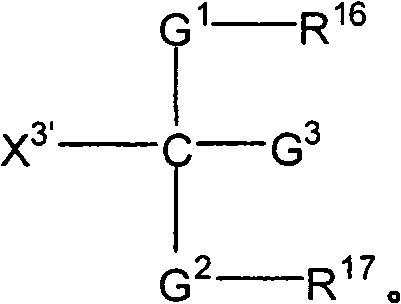
在一个实施方案中,根据这个式的分支聚合物种类是基本上纯的水溶性聚合物。X3′是包括可电离(例如,OH、COOH、H2PO4、HSO3、NH2及其盐等)或其他反应性官能团例如上文的部分。C是碳。G3是非反应基团(例如,H、CH3、OH等)。在一个实施方案中,G3优选不是聚合部分。R16和R17独立地选自非反应基团(例如,H、未取代的烷基、未取代的杂烷基)和聚合臂(例如,PEG)。G1和G2是优选在生理条件下基本上非反应的连接片段。G1和G2是独立地选择的。示例性连接体不包括芳香族也不包括酯部分。备选地,这些连接可以包括这样的一个或多个部分,其设计为在生理学相关条件下降解,例如酯、二硫化物等。G1和G2使聚合臂R16和R17与C连接。在一个实施方案中,当X3′与连接体、糖或连接体-糖盒上的互补反应性的反应性官能团反应时,X3′转变成连接片段的组分。In one embodiment, branched polymer species according to this formula are substantially pure water-soluble polymers. X3 ' is a moiety that includes ionizable (eg, OH, COOH, H2PO4 , HSO3 , NH2 and salts thereof, etc.) or other reactive functional groups such as above. C is carbon. G3 is a non-reactive group (eg, H, CH3 , OH, etc.). In one embodiment, G3 is preferably not a polymeric moiety. R 16 and R 17 are independently selected from non-reactive groups (eg, H, unsubstituted alkyl, unsubstituted heteroalkyl) and polymeric arms (eg, PEG). G1 and G2 are linker fragments that are preferably substantially non-reactive under physiological conditions. G1 and G2 are independently chosen. Exemplary linkers include neither aromatic nor ester moieties. Alternatively, these linkages may include one or more moieties designed to degrade under physiologically relevant conditions, such as esters, disulfides, and the like. G1 and G2 connect polymeric arms R16 and R17 to C. In one embodiment, X3 ' is converted to a component of the linked fragment when X3 ' is reacted with a complementary reactive functional group on the linker, sugar or linker-sugar box.
示例性连接片段包括G1和G2独立地选择,并且包括S、SC(O)NH、HNC(O)S、SC(O)O、O、NH、NHC(O)、(O)CNH和NHC(O)O和OC(O)NH、CH2S、CH2O、CH2CH2O、CH2CH2S、(CH2)oO、(CH2)oS或(CH2)oY’-PEG,其中Y’是S、NH、NHC(O)、C(O)NH、NHC(O)O、OC(O)NH或O,并且o是1至50的整数。在一个示例性实施方案中,连接片段G1和G2是不同的连接片段。Exemplary linker segments include G and G independently selected, and include S, SC(O)NH, HNC(O)S, SC(O)O, O, NH, NHC(O), (O)CNH , and NHC(O)O and OC (O)NH, CH 2 S, CH 2 O, CH 2 CH 2 O, CH 2 CH 2 S, (CH 2 ) o O, (CH 2 ) o S , or (CH 2 ) o Y'-PEG, wherein Y' is S, NH, NHC(O), C(O)NH, NHC(O)O, OC(O)NH or O, and o is an integer from 1 to 50. In an exemplary embodiment, linking fragments G1 and G2 are different linking fragments.
在一个示例性实施方案中,上述前体或其活化的衍生物之一,通过X3′和糖部分上的互补反应性基团例如胺之间的反应,与糖、活化糖或糖核苷酸反应且从而与之结合。备选地,X3′根据下文方案2与关于连接体La的前体上的反应性官能团反应。In an exemplary embodiment, one of the above-mentioned precursors or activated derivatives thereof is reacted with a sugar, activated sugar or sugar nucleoside via a reaction between X 3 ' and a complementary reactive group on the sugar moiety, such as an amine. The acid reacts and thus combines with it. Alternatively, X3 ' is reacted with a reactive functional group on the precursor for linker L a according to
方案2:Scenario 2:
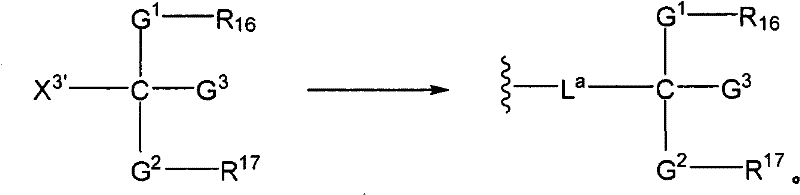
在一个示例性实施方案中,修饰基团衍生自天然或非天然的氨基酸、氨基酸类似物或氨基酸模拟物、或由一个或多个此类种类形成的小肽。例如,在本发明的化合物中发现的特定分支聚合物具有下式:In an exemplary embodiment, the modifying group is derived from a natural or unnatural amino acid, an amino acid analog or mimetic, or a small peptide formed from one or more of such species. For example, certain branched polymers found in the compounds of the present invention have the following formula:

在这个例子中,通过分支聚合修饰基团的前体上的反应性官能团例如X3′和糖部分上的反应性官能团或前体与连接体的反应,形成连接片段C(O)La。例如,当X3′是羧酸时,它可以是活化的并且与从氨基-糖(例如,Sia,GalNH2,GlcNH2,ManNH2等)悬垂的胺基直接结合,形成酰胺。另外的示例性反应性官能团和活化的前体在下文描述。符号具有与上文讨论的那些相同的特性。In this example, the connecting fragment C(O) La is formed by reaction of a reactive functional group on a precursor of a branched polymeric modifying group, such as X3 ', and a reactive functional group or precursor on a sugar moiety with a linker. For example, when X3 ' is a carboxylic acid, it can be activated and bind directly to an amine group pendant from an amino-sugar (eg, Sia, GalNH2 , GlcNH2 , ManNH2 , etc.), forming an amide. Additional exemplary reactive functional groups and activated precursors are described below. Symbols have the same properties as those discussed above.
在另一个示例性实施方案中,La是具有下述结构的连接部分:In another exemplary embodiment, La is a linking moiety having the structure:

其中Xa和Xb是独立地性选择的连接片段,并且L1选自键、取代或未取代的烷基、或者取代或未取代的杂烷基。wherein Xa and Xb are independently selected linking fragments, and L1 is selected from a bond, substituted or unsubstituted alkyl, or substituted or unsubstituted heteroalkyl.
关于Xa和Xb的示例性种类包括S、SC(O)NH、HNC(O)S、SC(O)O、O、NH、NHC(O)、C(O)NH和NHC(O)O和OC(O)NH。Exemplary species for Xa and Xb include S, SC(O)NH, HNC(O)S, SC(O)O, O, NH, NHC(O), C(O)NH, and NHC(O) O and OC(O)NH.
在另一个示例性实施方案中,G2是与R17键合的肽,所述R17为氨基酸、二肽(例如,Lys-Lys)或三肽(例如,Lys-Lys-Lys),其中一个或多个α-胺部分和/或一个或多个侧链杂原子用聚合修饰基团进行修饰。In another exemplary embodiment, G is a peptide bonded to R 17 which is an amino acid, a dipeptide (eg, Lys-Lys) or a tripeptide (eg, Lys -Lys-Lys), wherein One or more α-amine moieties and/or one or more side chain heteroatoms are modified with polymeric modifying groups.
上文所述的本发明的实施方案通过提及这样的种类进行进一步例示,其中聚合物是水溶性聚合物,特别是聚(乙二醇)(“PEG”),例如甲氧基-聚(乙二醇)。本领域技术人员应当理解在下文部分中的焦点为了举例说明起见,并且使用PEG作为示例性聚合物阐述的多种基序可同样地应用于其中利用除PEG外的聚合物的种类。Embodiments of the invention described above are further exemplified by reference to the class wherein the polymer is a water-soluble polymer, particularly poly(ethylene glycol) (“PEG”), such as methoxy-poly( ethylene glycol). Those skilled in the art will appreciate that the focus in the following sections is for illustration purposes and that the various motifs set forth using PEG as an exemplary polymer are equally applicable to species in which polymers other than PEG are utilized.
在其他示例性实施方案中,多肽缀合物包括选自下述的部分:In other exemplary embodiments, the Polypeptide Conjugate comprises a moiety selected from:

在上式各自中,指数e和f是独立地选自1至2500的整数。在一个进一步的示例性实施方案中,选择e和f,以提供其为约1kDa、2kDa、5kDa、10kDa、15kDa、20kDa、25kDa、30kDa、35kDa、40kDa、45kDa、50kDa、55kDa、60kDa、65kDa、70kDa、75kDa和80kDa的PEG部分。符号Q代表取代或未取代的烷基(例如C1-C6烷基,例如甲基)、取代或未取代的杂烷基或H。In each of the above formulas, the indices e and f are integers independently selected from 1 to 2500. In a further exemplary embodiment, e and f are selected to provide that they are about 1 kDa, 2 kDa, 5 kDa, 10 kDa, 15 kDa, 20 kDa, 25 kDa, 30 kDa, 35 kDa, 40 kDa, 45 kDa, 50 kDa, 55 kDa, 60 kDa, 65 kDa, PEG moieties of 70 kDa, 75 kDa and 80 kDa. The symbol Q represents substituted or unsubstituted alkyl (eg C 1 -C 6 alkyl, eg methyl), substituted or unsubstituted heteroalkyl or H.
其他分支聚合物具有基于二赖氨酸(Lys-Lys)肽的结构,例如:Other branched polymers have dilysine (Lys-Lys) peptide based structures such as:
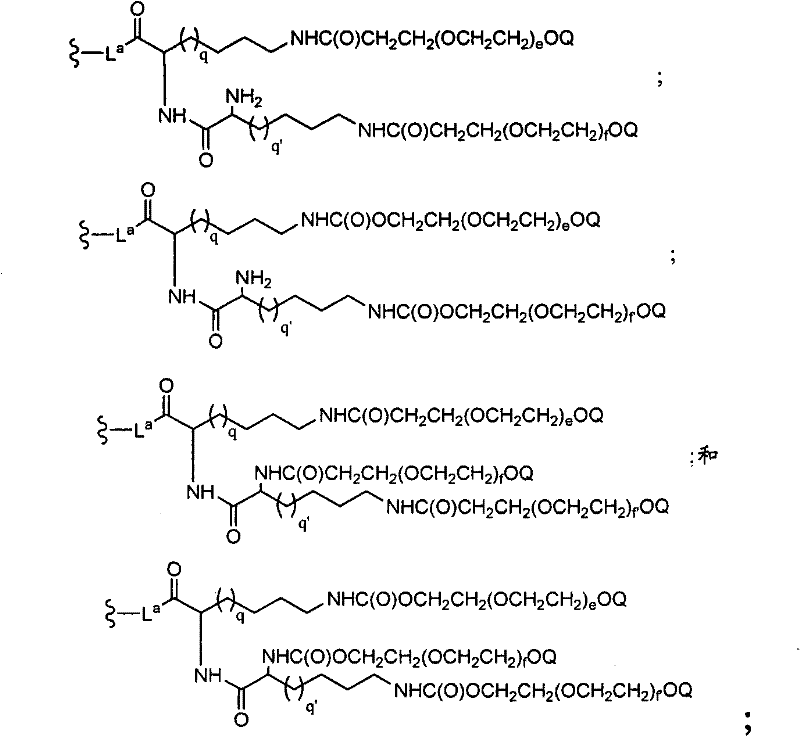
和基于三赖氨酸(Lys-Lys-Lys)肽的结构,例如:and triple lysine (Lys-Lys-Lys) peptide-based structures such as:

在上图各自中,指数e、f、f’和f”代表独立地选自1至2500的整数。指数q、q’和q”代表独立地选自1至20的整数。In each of the above figures, the indices e, f, f' and f" represent integers independently selected from 1 to 2500. The indices q, q' and q" represent integers independently selected from 1 to 20.
在另一个示例性实施方案中,本发明的缀合物包括其为选自下述的成员的式:In another exemplary embodiment, the conjugates of the invention include the formula that is a member selected from:
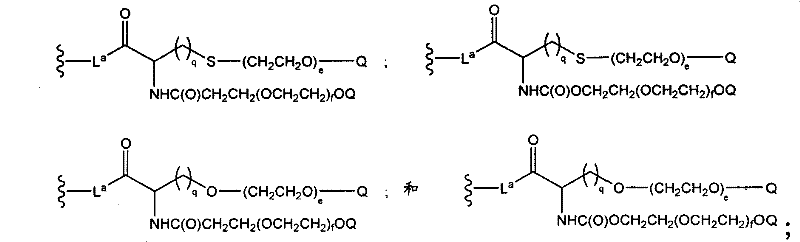
其中Q是选自H和取代或未取代的C1-C6烷基的成员。指数e和f是独立地选自1至2500的整数,并且指数q是选自0至20的整数。wherein Q is a member selected from H and substituted or unsubstituted C 1 -C 6 alkyl. The indices e and f are integers independently selected from 1 to 2500, and the index q is an integer selected from 0 to 20.
在另一个示例性实施方案中,本发明的缀合物包括其为选自下述的成员的式:In another exemplary embodiment, the conjugates of the invention include the formula that is a member selected from:
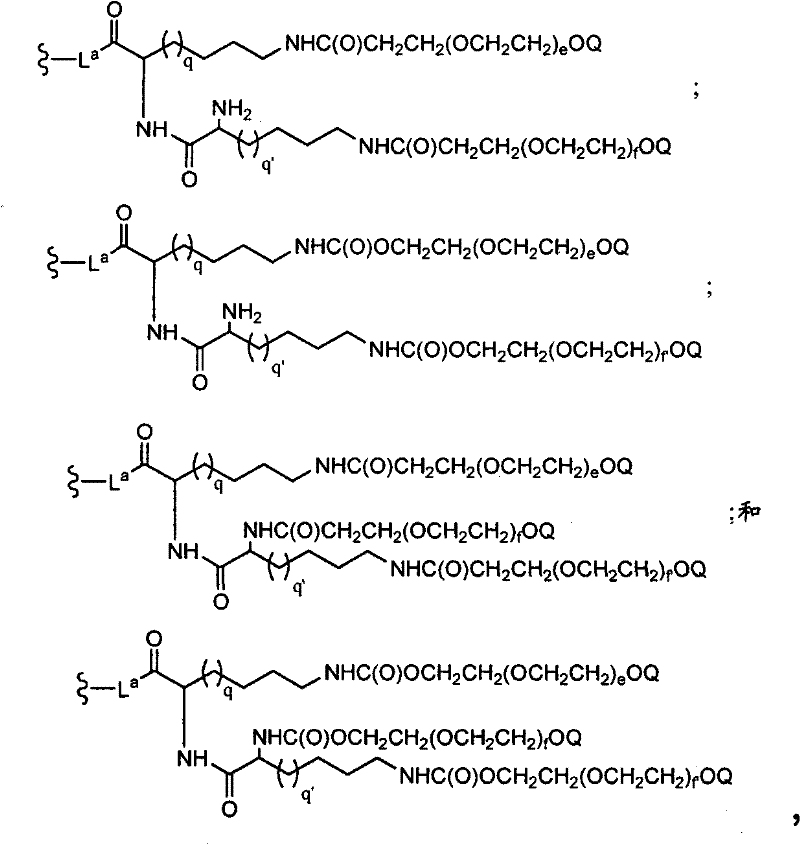
其中Q是选自H和取代或未取代的C1-C6烷基的成员,优选Me。指数e、f和f’是独立地选自0至2500的整数,并且指数q和q’是独立地选自1至20的整数。wherein Q is a member selected from H and substituted or unsubstituted C 1 -C 6 alkyl, preferably Me. The indices e, f and f' are integers independently selected from 0 to 2500, and the indices q and q' are integers independently selected from 1 to 20.
在另一个示例性实施方案中,本发明的缀合物包括根据下式的结构:In another exemplary embodiment, a conjugate of the invention comprises a structure according to the formula:
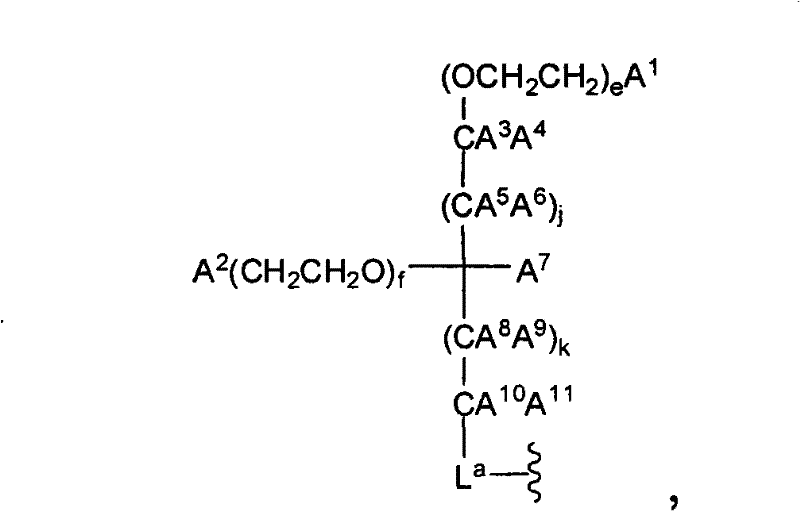
其中指数e和f独立地选自1至2500。指数j和k是独立地选自0至20的整数。A1、A2、A3、A4、A5、A6、A7、A8、A9、A10和A11是独立地选自H、取代或未取代的烷基、取代或未取代的杂烷基、取代或未取代的芳基、取代或未取代的环烷基、取代或未取代的杂环烷基、取代或未取代的杂芳基、-NA12A13、-OA12和-SiA12A13的成员。A12和A13是独立地选自H、取代或未取代的烷基、取代或未取代的杂烷基、取代或未取代的环烷基、取代或未取代的杂环烷基、取代或未取代的芳基、和取代或未取代的杂芳基的成员。where the exponents e and f are independently selected from 1 to 2500. Indices j and k are integers independently selected from 0 to 20. A 1 , A 2 , A 3 , A 4 , A 5 , A 6 , A 7 , A 8 , A 9 , A 10 and A 11 are independently selected from H, substituted or unsubstituted alkyl, substituted or unsubstituted Substituted heteroalkyl, substituted or unsubstituted aryl, substituted or unsubstituted cycloalkyl, substituted or unsubstituted heterocycloalkyl, substituted or unsubstituted heteroaryl, -NA 12 A 13 , -OA 12 and members of -SiA 12 A 13 . A 12 and A 13 are independently selected from H, substituted or unsubstituted alkyl, substituted or unsubstituted heteroalkyl, substituted or unsubstituted cycloalkyl, substituted or unsubstituted heterocycloalkyl, substituted or Unsubstituted aryl, and a member of substituted or unsubstituted heteroaryl.
在根据上式的一个实施方案中,分支聚合物具有根据下式的结构:In one embodiment according to the above formula, the branched polymer has a structure according to the following formula:
在一个示例性实施方案中,A1和A2是独立地选自OCH3和OH的成员。In an exemplary embodiment, A and A are members independently selected from OCH and OH.
在另一个示例性实施方案中,连接体La是选自氨基甘氨酸衍生物的成员。根据这个实施方案的示例性聚合修饰基团具有根据下式的结构:In another exemplary embodiment, the linker L a is a member selected from aminoglycine derivatives. Exemplary polymeric modifying groups according to this embodiment have structures according to the following formula:
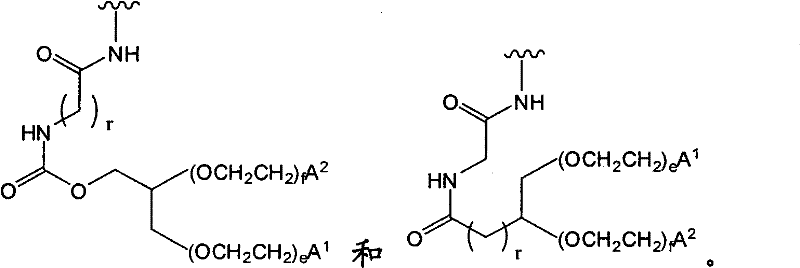
在一个例子中,A1和A2是独立地选自OCH3和OH的成员。根据这个例子的示例性聚合修饰基团包括:In one example, A1 and A2 are members independently selected from OCH3 and OH. Exemplary polymeric modifying groups according to this example include:

在上述实施方案各自中,其中修饰基团包括立体中心,例如包括氨基酸连接体或基于甘油的连接体的那些,立体中心可以是外消旋的或限定的。在一个实施方案中,其中此类立体中心是限定的,它具有(S)构型。在另一个实施方案中,立体中心具有(R)构型。In each of the above embodiments, wherein the modifying group comprises a stereogenic center, such as those comprising an amino acid linker or a glycerol-based linker, the stereogenic center may be racemic or defined. In one embodiment, wherein such stereocenter is defined, it has the (S) configuration. In another embodiment, the stereocenter has the (R) configuration.
本领域技术人员应当理解分支聚合物的一个或多个m-PEG臂可以由具有不同末端的PEG部分替换,所述末端例如OH、COOH、NH2、C2-C10-烷基等。此外,上文结构通过将烷基接头插入侧链的α-碳原子和官能团之间(或去除碳原子)容易地进行修饰。因此,“同”衍生物和更高级的同系物以及低级同系物,在用于在本发明中使用的分支PEG的核心的范围内。Those skilled in the art will understand that one or more m-PEG arms of a branched polymer may be replaced by a PEG moiety with a different terminus, such as OH, COOH, NH2 , C2 - C10 -alkyl, and the like. In addition, the above structure is easily modified by inserting an alkyl linker between the α-carbon atom of the side chain and the functional group (or removing a carbon atom). Thus, "homo" derivatives and higher homologues, as well as lower homologues, are within the scope of the core for the branched PEGs used in the present invention.
本文阐述的分支PEG种类通过诸如下文方案3中所述的那种方法容易地进行制备:The branched PEG species set forth herein are readily prepared by methods such as those described in
方案3:分支PEG种类的制备 Protocol 3: Preparation of branched PEG species

其中Xa是O或S,并且r是1至5的整数。指数e和f是独立地选自1至2500的整数。wherein X a is O or S, and r is an integer of 1 to 5. The indices e and f are integers independently selected from 1 to 2500.
因此,根据方案3,使天然或非天然氨基酸与活化的m-PEG衍生物相接触,所述活化的m-PEG衍生物在这种情况下是甲苯磺酸盐,通过使侧链杂原子Xa烷基化形成1。将单官能化的m-PEG氨基酸提交给具有反应性m-PEG衍生物的N-酰化条件,从而装配分支的m-PEG 2。如本领域技术人员应当理解的,甲苯磺酸盐离去基团可以由任何合适的离去基团替换,所述合适的离去基团例如卤素、甲磺酸盐、三氟甲磺酸盐等。类似地,用于酰化胺的反应碳酸酯可以替换为活性酯,例如N-羟基琥珀酰亚胺等,或酸可以使用脱水剂例如二环己基碳化二亚胺、羰基二咪唑等进行原位活化。Thus, according to
在一个示例性实施方案中,修饰基团是PEG部分,然而,任何修饰基团例如水溶性聚合物、水不溶性聚合物、治疗性部分等可以通过合适的连接掺入糖基部分中。经修饰的糖通过酶促方法、化学方法或其组合形成,从而产生经修饰的糖。在一个示例性实施方案中,糖在任何位置处由活性胺置换,所述位置允许附着修饰基团,仍允许糖充当酶的底物,所述酶能够使经修饰的糖与G-CSF多肽偶联。在一个示例性实施方案中,当半乳糖胺是经修饰的糖时,胺部分在6-位置处与碳原子附着。In an exemplary embodiment, the modifying group is a PEG moiety, however, any modifying group such as water soluble polymers, water insoluble polymers, therapeutic moieties, etc. may be incorporated into the glycosyl moiety through suitable linkages. Modified sugars are formed enzymatically, chemically, or a combination thereof, resulting in a modified sugar. In an exemplary embodiment, the sugar is replaced by an active amine at any position that allows for the attachment of the modifying group, yet allows the sugar to serve as a substrate for an enzyme capable of binding the modified sugar to the G-CSF polypeptide coupling. In an exemplary embodiment, when the galactosamine is a modified sugar, the amine moiety is attached to the carbon atom at the 6-position.
水不溶性聚合物water insoluble polymer
在另一个实施方案中,类似于上文讨论的那些,经修饰的糖包括水不溶性聚合物,而不是水溶性聚合物。本发明的缀合物还可以包括一种或多种水不溶性聚合物。本发明的这个实施方案通过使用缀合物作为媒介物进行举例说明,用所述媒介物以控制方式递送治疗性多肽。聚合药物递送系统是本领域已知的。参见例如,Dunn等人,编辑POLYMERICDRUGS AND DRUG DELIVERY SYSTEMS,ACS Symposiu m Series第469卷,American Chemical Society,Washington,D.C.1991。本领域技术人员应当理解基本上任何已知的药物递送系统都可应用于本发明的缀合物。In another embodiment, similar to those discussed above, the modified sugar comprises a water insoluble polymer instead of a water soluble polymer. The conjugates of the invention may also include one or more water insoluble polymers. This embodiment of the invention is exemplified by the use of the conjugate as a vehicle with which to deliver a therapeutic polypeptide in a controlled manner. Polymeric drug delivery systems are known in the art. See, eg, Dunn et al., eds. POLYMERIC D RUGS A ND D RUG D ELIVERY S YSTEMS , ACS Symposium Series Vol. 469, American Chemical Society, Washington, DC 1991. Those skilled in the art will appreciate that essentially any known drug delivery system can be applied to the conjugates of the present invention.
代表性水不溶性聚合物包括但不限于,polyphosphazines、聚(乙烯醇)、聚酰胺、聚碳酸酯、聚烷撑、聚丙烯酰胺、聚烷撑二醇、聚烷撑氧化物、聚烷撑对苯二酸盐、聚乙烯醚、聚乙烯酯、聚乙烯卤化物、聚乙烯吡咯烷酮、聚乙醇酸交酯、聚硅氧烷、聚氨基甲酸酯、聚(甲基甲基丙烯酸酯)、聚(乙基甲基丙烯酸酯)、聚(丁基甲基丙烯酸酯)、聚(异丁基甲基丙烯酸酯)、聚(己基甲基丙烯酸酯)、聚(异癸基甲基丙烯酸酯)、聚(月桂基甲基丙烯酸酯)、聚(苯基甲基丙烯酸酯)、聚(甲基丙烯酸酯)、聚(异丙基丙烯酸酯)、聚(异丁基丙烯酸酯)、聚(十八基丙烯酸酯)、聚乙烯、聚丙烯、聚(乙二醇)、聚(乙烯氧化物)、聚(乙烯对苯二酸盐)、聚(乙烯乙酸酯)、聚氯乙烯、聚苯乙烯、聚乙烯吡咯烷酮、普朗尼克和聚乙烯苯酚及其共聚物。Representative water-insoluble polymers include, but are not limited to, polyphosphazines, poly(vinyl alcohol), polyamides, polycarbonates, polyalkylenes, polyacrylamides, polyalkylene glycols, polyalkylene oxides, polyalkylene para Phthalate, polyvinyl ether, polyvinyl ester, polyvinyl halide, polyvinylpyrrolidone, polyglycolide, polysiloxane, polyurethane, poly(methacrylate), poly (ethyl methacrylate), poly(butyl methacrylate), poly(isobutyl methacrylate), poly(hexyl methacrylate), poly(isodecyl methacrylate), poly(lauryl methacrylate), poly(phenyl methacrylate), poly(methacrylate), poly(isopropyl acrylate), poly(isobutyl acrylate), poly(octadecyl acrylate) , polyethylene, polypropylene, poly(ethylene glycol), poly(ethylene oxide), poly(ethylene terephthalate), poly(ethylene acetate), polyvinyl chloride, polystyrene, polyvinylpyrrolidone , Pluronic and polyvinylphenol and their copolymers.
在本发明的缀合物中使用的合成修饰的天然聚合物包括但不限于,烷基纤维素、羟基烷基纤维素、纤维素醚、纤维素酯和硝化纤维素。广泛类别的合成修饰的天然聚合物的特别优选成员包括但不限于,甲基纤维素、乙基纤维素、羟丙基纤维素、羟丙基甲基纤维素、羟丁基甲基纤维素、乙酸纤维素、丙酸纤维素、乙酸丁酸纤维素、乙酸邻苯二甲酸纤维素、羧甲基纤维素、三乙酸纤维素、纤维素硫酸钠盐、以及丙烯酸和甲基丙烯酸酯和海藻酸的聚合物。Synthetically modified natural polymers useful in the conjugates of the invention include, but are not limited to, alkyl celluloses, hydroxyalkyl celluloses, cellulose ethers, cellulose esters, and nitrocellulose. Particularly preferred members of the broad class of synthetically modified natural polymers include, but are not limited to, methylcellulose, ethylcellulose, hydroxypropylcellulose, hydroxypropylmethylcellulose, hydroxybutylmethylcellulose, cellulose acetate cellulose, cellulose propionate, cellulose acetate butyrate, cellulose acetate phthalate, carboxymethyl cellulose, cellulose triacetate, sodium cellulose sulfate, and polymers of acrylic and methacrylates and alginic acid things.
本文讨论的这些和其他聚合物可以容易地得自商业来源例如SigmaChemical Co.(St.Louis,MO.)、Polysciences(Warrenton,PA.)、Aldrich(Milwaukee,WI.)、Fluka(Ronkonkoma,NY)和BioRad(Richmond,CA),要不就使用标准技术由得自这些供应商的单体合成。These and other polymers discussed herein are readily available from commercial sources such as Sigma Chemical Co. (St. Louis, MO.), Polysciences (Warrenton, PA.), Aldrich (Milwaukee, WI.), Fluka (Ronkonkoma, NY) and BioRad (Richmond, CA), or were synthesized from monomers obtained from these suppliers using standard techniques.
在本发明的缀合物中使用的代表性生物可降解聚合物包括但不限于,聚交酯、聚乙醇酸交酯及其共聚物、聚(乙烯对苯二酸盐)、聚(丁酸)、聚(戊酸)、聚(丙交酯共己内酯)、聚(丙交酯共乙交酯)、聚酐、聚原酸酯、其掺和物和共聚物。特别有用的是形成凝胶的组合物,例如包括胶原、普朗尼克等的那些。Representative biodegradable polymers for use in the conjugates of the invention include, but are not limited to, polylactide, polyglycolide and copolymers thereof, poly(ethylene terephthalate), poly(butyrate ), poly(valeric acid), poly(lactide-cocaprolactone), poly(lactide-coglycolide), polyanhydrides, polyorthoesters, blends and copolymers thereof. Particularly useful are gel-forming compositions such as those comprising collagen, pluronic, and the like.
在本发明中使用的聚合物包括“杂交”聚合物,其包括在其至少部分结构内具有生物吸收性分子的水不溶性材料。此类聚合物的例子是包括水不溶性共聚物的那种,其具有生物吸收性区域、亲水性区域和多个可交联官能团/聚合物链。Polymers useful in the present invention include "hybrid" polymers, which include water-insoluble materials having bioabsorbable molecules within at least a portion of their structure. Examples of such polymers are those comprising water insoluble copolymers having bioabsorbable regions, hydrophilic regions and multiple crosslinkable functional groups/polymer chains.
为了本发明的目的,“水不溶性材料”包括在水或含水环境中基本上不可溶的材料。因此,尽管共聚物的特定区域或区段可以是亲水的或甚至水溶性的,但聚合物分子就整体而言在水中无任何基本测量溶解。For the purposes of the present invention, "water-insoluble materials" include materials that are substantially insoluble in water or an aqueous environment. Thus, while specific regions or segments of the copolymer may be hydrophilic or even water soluble, the polymer molecules as a whole do not have any substantial measure of solubility in water.
为了本发明的目的,术语“生物吸收性分子”包括能够由机体通过正常排泄途径代谢或分解且再吸收和/或消除的区域。此类代谢产物或分解产物优选对机体基本上无毒。For the purposes of the present invention, the term "bioabsorbable molecule" includes regions capable of being metabolized or broken down and reabsorbed and/or eliminated by the body via normal excretory routes. Such metabolites or breakdown products are preferably substantially nontoxic to the body.
生物吸收性区域可以是疏水或亲水的,只要共聚物组合物就整体而言不变成水溶性的。因此,基于聚合物就整体而言保持水不溶性的优先来选择生物吸收性区域。因此,选择相对性质,即由生物吸收性区域包含的官能团的种类,和生物吸收性区域的相对比例以及亲水区,以确保有用的生物吸收性组合物保持水不溶性的。The bioabsorbable regions can be hydrophobic or hydrophilic, so long as the copolymer composition as a whole does not become water soluble. Thus, the bioabsorbable regions are selected based on the preference of the polymer as a whole to remain water insoluble. Accordingly, the relative properties, ie the types of functional groups comprised by the bioabsorbable domains, and the relative proportions of the bioabsorbable domains and hydrophilic regions are selected to ensure that useful bioabsorbable compositions remain water-insoluble.
示例性可吸收性聚合物包括例如合成产生的聚(α-羟基-羧酸)/聚(氧烷撑)的可吸收性嵌段共聚物(参见,Cohn等人,美国专利号4,826,945)。这些共聚物不是交联的并且是水溶性的,从而使得机体可以排泄经降解的嵌段共聚物组合物。参见,Younes等人,J Biomed.Mater.Res.21:1301-1316(1987);和Cohn等人,JBiomed.Mater.Res.22:993-1009(1988)。Exemplary absorbable polymers include, for example, synthetically produced absorbable block copolymers of poly(alpha-hydroxy-carboxylic acid)/poly(oxyalkylene) (see, Cohn et al., US Patent No. 4,826,945). These copolymers are not crosslinked and are water soluble, allowing the body to excrete the degraded block copolymer composition. See, Younes et al., J Biomed. Mater. Res. 21:1301-1316 (1987); and Cohn et al., J Biomed. Mater. Res. 22:993-1009 (1988).
目前优选的生物吸收性聚合物包括选自下述的一种或多种组分:聚(酯)、聚(羟酸)、聚(内酯)、聚(酰胺)、聚(酯-酰胺)、聚(氨基酸)、聚(酐)、聚(原酸酯)、聚(碳酸酯)、聚(偶磷氮)、聚(磷酸酯)、聚(硫酯)、多糖及其混合物。更加优选地,生物吸收性聚合物包括聚(羟基)酸组分。在聚(羟基)酸中,聚乳酸、聚乙醇酸、聚己酸、聚丁酸、聚戊酸及其共聚物和混合物是优选的。Presently preferred bioabsorbable polymers comprise one or more components selected from the group consisting of poly(esters), poly(hydroxy acids), poly(lactones), poly(amides), poly(ester-amides) , poly(amino acids), poly(anhydrides), poly(orthoesters), poly(carbonates), poly(aphosphorazides), poly(phosphates), poly(thioesters), polysaccharides, and mixtures thereof. Even more preferably, the bioabsorbable polymer comprises a poly(hydroxy)acid component. Among the poly(hydroxy) acids, polylactic acid, polyglycolic acid, polycaproic acid, polybutyric acid, polyvaleric acid, and copolymers and mixtures thereof are preferred.
除形成在体内吸收的(“生物吸收的”)片段外,用于在本发明的方法中使用的优选聚合涂层也可以形成可排泄和/或可代谢的片段。In addition to forming fragments that are absorbed in vivo ("bioabsorbable"), preferred polymeric coatings for use in the methods of the invention may also form excretable and/or metabolizable fragments.
更高级别的共聚物也可以在本发明中使用。例如,1984年3月20日颁发的Casey等人,美国专利号4,438,253,公开了由聚(乙醇酸)和羟基末端聚(烷撑二醇)的转酯作用产生的三嵌段共聚物。此类组合物公开用作可吸收性单丝缝线。通过将芳香族原碳酸酯例如四-对甲苯基原碳酸酯掺入共聚物结构内,控制此类组合物的弹性。Higher order copolymers may also be used in the present invention. For example, Casey et al., US Patent No. 4,438,253, issued March 20, 1984, disclose triblock copolymers produced from the transesterification of poly(glycolic acid) and hydroxyl terminated poly(alkylene glycol). Such compositions are disclosed for use as absorbable monofilament sutures. The elasticity of such compositions is controlled by incorporating an aromatic orthocarbonate such as tetra-p-tolyl orthocarbonate into the copolymer structure.
还可以利用基于乳酸和/或乙醇酸的其他聚合物。例如,1993年4月13日颁发的Spinu,美国专利号5,202,413,公开了具有聚交酯和/或聚乙醇酸交酯的顺次有序嵌段的生物可降解多嵌段共聚物,其通过丙交酯和/或乙交酯在寡聚二醇或二胺残基上的开环聚合,随后用双功能化合物例如二异氰酸酯、二酰基氯或二氯甲硅烷的链延伸而产生。Other polymers based on lactic acid and/or glycolic acid may also be utilized. For example, Spinu, U.S. Patent No. 5,202,413, issued April 13, 1993, discloses biodegradable multi-block copolymers having sequentially ordered blocks of polylactide and/or polyglycolide by Ring-opening polymerization of lactide and/or glycolide on oligomeric diol or diamine residues followed by chain extension with bifunctional compounds such as diisocyanates, diacid chlorides or dichlorosilanes results.
在本发明中有用的涂层的生物吸收性区域可以设计为可水解和/或酶促切割的。为了本发明的目的,“可水解切割的”指共聚物特别是生物吸收性区域对于在水或含水环境中的水解的敏感性。类似地,如本文所使用的,“可酶促切割的”指共聚物特别是生物吸收性区域对于通过内源或外源酶切割的敏感性。The bioabsorbable regions of coatings useful in the present invention can be designed to be hydrolyzable and/or enzymatically cleavable. For the purposes of the present invention, "hydrolytically cleavable" refers to the susceptibility of the copolymer, and in particular the bioabsorbable domain, to hydrolysis in water or an aqueous environment. Similarly, as used herein, "enzymatically cleavable" refers to the susceptibility of a copolymer, particularly a bioabsorbable region, to cleavage by endogenous or exogenous enzymes.
当置于体内时,亲水区可以加工成可排泄和/或可代谢的片段。因此,亲水区可以包括例如聚醚、聚烷撑氧化物、多元醇、聚(乙烯吡咯烷酮)、聚(乙烯醇)、聚(烷基噁唑啉)、多糖、碳水化合物、肽、蛋白质及其共聚物和混合物。此外,亲水区还可以是例如聚(烷撑)氧化物。此类聚(烷撑)氧化物可以包括例如聚(乙烯)氧化物、聚(丙烯)氧化物及其混合物和共聚物。When placed in vivo, the hydrophilic region can be processed into excretable and/or metabolizable fragments. Thus, the hydrophilic region may include, for example, polyethers, polyalkylene oxides, polyols, poly(vinylpyrrolidones), poly(vinyl alcohols), poly(alkyloxazolines), polysaccharides, carbohydrates, peptides, proteins, and Its copolymers and mixtures. Furthermore, the hydrophilic region can also be, for example, poly(alkylene) oxide. Such poly(alkylene) oxides may include, for example, poly(ethylene) oxides, poly(propylene) oxides, and mixtures and copolymers thereof.
其为水凝胶组分的聚合物也在本发明中有用。水凝胶是能够吸收相对大量水的聚合材料。形成水凝胶的化合物的例子包括但不限于,聚丙烯酸、羧甲基纤维素钠、聚乙烯醇、聚乙烯吡咯烷酮、明胶、角叉菜胶和其他多糖、甲基丙烯酸羟乙酯(HEMA)、以及其衍生物等。可以产生稳定的、生物可降解的和生物吸收性的水凝胶。此外,水凝胶组合物可以包括显示出这些性质中的一种或多种的亚单位。Polymers which are components of hydrogels are also useful in the present invention. Hydrogels are polymeric materials capable of absorbing relatively large amounts of water. Examples of hydrogel-forming compounds include, but are not limited to, polyacrylic acid, sodium carboxymethylcellulose, polyvinyl alcohol, polyvinylpyrrolidone, gelatin, carrageenan and other polysaccharides, hydroxyethyl methacrylate (HEMA) , and its derivatives. Stable, biodegradable and bioabsorbable hydrogels can be produced. Additionally, hydrogel compositions may include subunits that exhibit one or more of these properties.
其完整性可以通过交联得到控制的生物相容的水凝胶组合物是已知的,并且目前对于在本发明的方法中的使用是优选的。例如,1995年4月25日颁发的Hubbell等人,美国专利号5,410,016和1996年6月25日颁发的5,529,914,公开了水溶性系统,其是具有夹在2个水解不稳定的延长之间的水溶性中心嵌段区段的交联嵌段共聚物。此类共聚物用光致聚合的丙烯酸酯功能性进一步末端加帽。当交联时,这些系统变成水凝胶。此类共聚物的水溶性中心嵌段可以包括聚(乙二醇);而水解不稳定的延长可以是聚(α-羟酸),例如聚乙醇酸或聚乳酸。参见,Sawhney等人,Macromolecules 26:581-587(1993)。Biocompatible hydrogel compositions whose integrity can be controlled by crosslinking are known and are presently preferred for use in the methods of the invention. For example, Hubbell et al., U.S. Patent Nos. 5,410,016, issued April 25, 1995, and 5,529,914, issued June 25, 1996, disclose water-soluble systems that have a A crosslinked block copolymer of a water soluble central block segment. Such copolymers are further end-capped with photopolymerizable acrylate functionality. When cross-linked, these systems become hydrogels. The water-soluble central block of such copolymers may comprise poly(ethylene glycol); and the hydrolytically labile extension may be a poly(alpha-hydroxy acid), such as polyglycolic acid or polylactic acid. See, Sawhney et al., Macromolecules 26:581-587 (1993).
在另一个实施方案中,凝胶是热可逆凝胶。包括组分例如普朗尼克、胶原、明胶、透明质酸、多糖、聚氨基甲酸乙酯水凝胶、聚氨基甲酸乙酯-尿素水凝胶及其组合的热可逆凝胶是目前优选的。In another embodiment, the gel is a thermoreversible gel. Thermoreversible gels comprising components such as pluronic, collagen, gelatin, hyaluronic acid, polysaccharides, polyurethane hydrogels, polyurethane-urea hydrogels, and combinations thereof are presently preferred.
在另外一个示例性实施方案中,本发明的缀合物包括脂质体的组分。脂质体可以根据本领域技术人员已知的方法进行制备,例如,如1985年6月11日颁发的Eppstein等人,美国专利号4,522,811中描述的。例如,脂质体制剂可以通过在无机溶剂中溶解一种或多种合适的脂质(例如硬脂酰磷脂酰乙醇胺、硬脂酰磷脂酰胆碱、arachadoyl磷脂酰胆碱和胆固醇)进行制备,所述无机溶剂随后蒸发,在容器的表面上留下干燥脂质的薄膜。随后将活性化合物或其药学上可接受的盐的水溶液引入容器内。容器随后通过手工涡旋,以从容器的侧面释放脂质材料并且分散脂质聚集物,从而形成脂质体悬浮液。In yet another exemplary embodiment, the conjugates of the invention comprise components of liposomes. Liposomes can be prepared according to methods known to those skilled in the art, eg, as described in Eppstein et al., US Patent No. 4,522,811, issued June 11, 1985. For example, liposomal formulations can be prepared by dissolving one or more suitable lipids (e.g., stearoylphosphatidylethanolamine, stearoylphosphatidylcholine, arachadoylphosphatidylcholine, and cholesterol) in an inorganic solvent, The inorganic solvent then evaporates, leaving a thin film of dry lipids on the surface of the container. An aqueous solution of the active compound or a pharmaceutically acceptable salt thereof is then introduced into the container. The container is then swirled by hand to release lipid material from the sides of the container and to disperse lipid aggregates, thereby forming a liposomal suspension.
提供上述微粒和制备微粒的方法作为例子,并且它们不意欲限定在本发明中使用的微粒的范围。对于本领域技术人员显而易见的是,通过不同方法制造的微粒的阵列在本发明中有用。The above-described microparticles and methods of preparing the microparticles are provided as examples, and they are not intended to limit the scope of the microparticles used in the present invention. It will be apparent to those skilled in the art that arrays of microparticles made by different methods are useful in the present invention.
上文在直链和分支的水溶性聚合物的背景中讨论的结构形式就水不溶性聚合物而言一般也可应用。因此,例如,半胱氨酸、丝氨酸、二赖氨酸和三赖氨酸分支核心可以用2个水不溶性聚合物部分进行官能化。用于产生这些种类的方法一般紧密类似于用于产生水溶性聚合物的那些。 The structural forms discussed above in the context of linear and branched water-soluble polymers are also generally applicable with respect to water-insoluble polymers. Thus, for example, cysteine, serine, dilysine and trilysine branched cores can be functionalized with 2 water insoluble polymer moieties. The methods used to produce these species are generally closely similar to those used to produce water-soluble polymers. the
其他修饰基团Other modifying groups
本发明还提供了类似于上文描述的那些的缀合物,其中多肽经由糖基连接基团与治疗性部分、诊断性部分、靶向部分、毒素部分等连接。上述部分各自可以是小分子、天然聚合物(例如,多肽)或合成聚合物。The invention also provides conjugates similar to those described above, wherein the polypeptide is linked to a therapeutic moiety, diagnostic moiety, targeting moiety, toxin moiety, etc. via a glycosyl linking group. Each of the aforementioned moieties can be a small molecule, a natural polymer (eg, a polypeptide), or a synthetic polymer.
在再进一步的实施方案中,本发明提供了由于作为缀合物的组分的靶向试剂的存在,选择性定位于特定组织中的缀合物。在一个示例性实施方案中,靶向试剂是蛋白质。示例性蛋白质包括转铁蛋白(脑、血池)、HS-糖蛋白(骨、脑、血池)、抗体(脑、具有抗体特异性抗原的组织、血池)、凝固因子V-XII(受损组织、凝块、癌症、血池)、血清蛋白质,例如α-酸性糖蛋白、胎球蛋白、甲胎蛋白(脑、血池)、β2-糖蛋白(肝、动脉粥样硬化斑块、脑、血池)、G-CSF、GM-CSF、M-CSF和EPO(免疫刺激、癌症、血池、红血细胞超生产、神经保护)、白蛋白(增加的半衰期)、IL-2和IFN-α。In yet further embodiments, the invention provides conjugates that selectively localize in specific tissues due to the presence of a targeting agent as a component of the conjugate. In an exemplary embodiment, the targeting agent is a protein. Exemplary proteins include transferrin (brain, blood pool), HS-glycoprotein (bone, brain, blood pool), antibody (brain, tissue with antibody-specific antigen, blood pool), coagulation factors V-XII (infected damaged tissue, clots, cancer, blood pool), serum proteins such as α-acid glycoprotein, fetuin, alpha-fetoprotein (brain, blood pool), β2-glycoprotein (liver, atherosclerotic plaque, brain, blood pool), G-CSF, GM-CSF, M-CSF, and EPO (immunostimulation, cancer, blood pool, red blood cell hyperproduction, neuroprotection), albumin (increased half-life), IL-2, and IFN -alpha.
在示例性靶向缀合物中,干扰素α2β(IFN-α2β)经由双功能连接体与转铁蛋白缀合,所述双功能连接体包括在PEG部分的每个末端处的糖基连接基团(方案1)。例如,PEG连接体的一个末端用与转铁蛋白附着的完整的唾液酸连接体进行官能化,并且另一个末端用与IFN-α2β附着的完整的C联Man连接体进行官能化。In an exemplary targeting conjugate, interferon alpha 2beta (IFN-α2beta) is conjugated to transferrin via a bifunctional linker comprising a glycosyl linker at each end of the PEG moiety Mission (Scheme 1). For example, one end of the PEG linker is functionalized with an intact sialic acid linker attached to transferrin and the other end is functionalized with an intact C-linked Man linker attached to IFN-α2β.
生物分子Biomolecules
在另一个实施方案中,经修饰的糖具有生物分子。在再进一步的实施方案中,生物分子是功能蛋白质、酶、抗原、抗体、肽、核酸(例如,单个或多个核苷酸、寡核苷酸、多核苷酸以及单链和更高级链的核酸)、凝集素、受体或其组合。In another embodiment, the modified sugar has a biomolecule. In still further embodiments, the biomolecules are functional proteins, enzymes, antigens, antibodies, peptides, nucleic acids (e.g., single or multiple nucleotides, oligonucleotides, polynucleotides, and single- and higher-chain nucleic acids), lectins, receptors, or combinations thereof.
优选的生物分子是基本上无荧光的,或发出这样的最低限度量的荧光,使得它们不适合于在测定法中用作荧光标记。此外,一般优选使用非糖的生物分子。这种优先的例外是在其他方面天然存在的糖的使用,所述糖通过共价附着另一个实体(例如,PEG、生物分子、治疗部分、诊断部分等)进行修饰。在一个示例性实施方案中,其为生物分子的糖部分与连接体臂缀合,并且糖-连接体臂盒随后经由本发明的方法与多肽缀合。Preferred biomolecules are substantially non-fluorescent, or emit such minimal amounts of fluorescence that they are unsuitable for use as fluorescent labels in assays. Furthermore, it is generally preferred to use non-sugar biomolecules. An exception to this preference is the use of an otherwise naturally occurring sugar that has been modified by covalent attachment of another entity (eg, PEG, biomolecule, therapeutic moiety, diagnostic moiety, etc.). In an exemplary embodiment, it is a sugar moiety of a biomolecule conjugated to a linker arm, and the sugar-linker arm cassette is subsequently conjugated to a polypeptide via the methods of the invention.
在实践本发明中有用的生物分子可以衍生自任何来源。生物分子可以从天然来源中分离,或它们可以通过合成方法产生。多肽可以是天然多肽或突变多肽。突变可以通过化学诱变、定点诱变或本领域技术人员已知的其他诱导突变的方法来实现。在实践本发明中有用的多肽包括例如酶、抗原、抗体和受体。抗体可以是多克隆或单克隆的;完整的或片段。多肽任选是定向进化程序的产物。Biomolecules useful in practicing the invention may be derived from any source. Biomolecules can be isolated from natural sources, or they can be produced synthetically. A polypeptide can be a native polypeptide or a mutant polypeptide. Mutations can be achieved by chemical mutagenesis, site-directed mutagenesis, or other methods of inducing mutations known to those skilled in the art. Polypeptides useful in practicing the invention include, for example, enzymes, antigens, antibodies, and receptors. Antibodies can be polyclonal or monoclonal; whole or fragments. The polypeptide is optionally the product of a directed evolution program.
天然衍生的和合成的多肽和核酸与本发明结合使用;这些分子可以通过任何可用的反应基团与糖残基组分或交联剂附着。例如,多肽可以通过反应性的胺、羧基、巯基或羟基附着。反应基团可以位于多肽末端处或多肽链内部的位点处。核酸可以通过在碱上的反应基团(例如,环外胺)或在糖部分上可用的羟基(例如,3’-或5’-羟基)附着。肽和核酸链可以在一个或多个位点处进一步衍生,以允许在链上附着合适的反应基团。参见,Chrisey等人Nucleic Acids Res.24:3031-3039(1996)。Naturally derived and synthetic polypeptides and nucleic acids are used in conjunction with the present invention; these molecules can be attached to sugar residue components or cross-linking agents via any available reactive group. For example, polypeptides can be attached via reactive amine, carboxyl, sulfhydryl, or hydroxyl groups. The reactive group can be located at a polypeptide terminus or at a site within the polypeptide chain. Nucleic acids can be attached via reactive groups on bases (e.g., exocyclic amines) or available hydroxyl groups (e.g., 3'- or 5'-hydroxyls) on sugar moieties. Peptide and nucleic acid strands can be further derivatized at one or more sites to allow attachment of suitable reactive groups on the strand. See, Chrisey et al. Nucleic Acids Res. 24:3031-3039 (1996).
在一个进一步的实施方案中,选择生物分子以将通过本发明的方法修饰的多肽导向特定组织,从而相对于递送给组织的未经衍生的多肽的量,增强多肽对那个组织的递送。在再进一步的实施方案中,在所选时间段内递送给特定组织的经衍生的多肽的量通过衍生增强至少约20%、更优选至少约40%、并且更加优选至少约100%。目前,用于靶向应用的优选生物分子包括抗体、激素和细胞表面受体的配体。In a further embodiment, the biomolecule is selected to target a polypeptide modified by the methods of the invention to a particular tissue, thereby enhancing delivery of the polypeptide to that tissue relative to the amount of non-derivatized polypeptide delivered to that tissue. In still further embodiments, the amount of derivatized polypeptide delivered to a particular tissue is enhanced by derivatization by at least about 20%, more preferably at least about 40%, and even more preferably at least about 100% over a selected period of time. Currently, preferred biomolecules for targeting applications include antibodies, hormones, and ligands for cell surface receptors.
在再进一步的示例性实施方案中,提供了具有生物素的缀合物。因此,例如,选择性生物素化的多肽通过附着具有一个或多个修饰基团的抗生物素蛋白或链霉亲和素部分进行加工。In yet a further exemplary embodiment, a conjugate with biotin is provided. Thus, for example, selectively biotinylated polypeptides are processed by the attachment of an avidin or streptavidin moiety bearing one or more modifying groups.
治疗部分treatment part
在另一个实施方案中,经修饰的糖包括治疗性部分。本领域技术人员应当理解,在治疗性部分和生物分子的范畴之间存在重叠;许多生物分子具有治疗性质或潜力。In another embodiment, the modified sugar includes a therapeutic moiety. Those skilled in the art will appreciate that there is overlap between the categories of therapeutic moieties and biomolecules; many biomolecules have therapeutic properties or potential.
治疗性部分可以是已公认用于临床使用的试剂,或它们可以是其使用是实验性的,或其活性或作用机制处于研究下的药物。治疗性部分可以在给定疾病状态中具有已证明的作用,或可以仅假定在给定疾病状态中显示所需作用。在另一个实施方案中,治疗性部分是就其与选择的组织相互作用的能力进行筛选的化合物。在实践本发明中有用的治疗性部分包括来自具有各种药理学活性的广泛范围的药物类别的药物。优选的治疗性部分是基本上无荧光的,或发出这样的最低限度量的荧光,使得它们不适合于在测定法中用作荧光标记。此外,一般优选使用非糖的治疗部分。这种优先的例外是这样的糖的使用,所述糖通过共价附着另一个实体(例如,PEG、生物分子、治疗部分、诊断部分等)进行修饰。在另一个示例性实施方案中,治疗性糖部分与连接体臂缀合,并且糖-连接体臂盒随后经由本发明的方法与多肽缀合。Therapeutic moieties may be agents already established for clinical use, or they may be drugs whose use is experimental, or whose activity or mechanism of action is under investigation. A therapeutic moiety may have a proven effect in a given disease state, or may only be hypothesized to exhibit a desired effect in a given disease state. In another embodiment, the therapeutic moiety is a compound that is screened for its ability to interact with a selected tissue. Therapeutic moieties useful in practicing the invention include drugs from a wide variety of drug classes possessing various pharmacological activities. Preferred therapeutic moieties are substantially non-fluorescent, or emit such minimal amounts of fluorescence that they are unsuitable for use as fluorescent labels in assays. In addition, the use of non-sugar therapeutic moieties is generally preferred. An exception to this preference is the use of sugars that are modified by covalent attachment of another entity (eg, PEG, biomolecule, therapeutic moiety, diagnostic moiety, etc.). In another exemplary embodiment, a therapeutic sugar moiety is conjugated to a linker arm, and the sugar-linker arm cassette is subsequently conjugated to the polypeptide via the methods of the invention.
使治疗性和诊断性试剂与各种其他种类缀合的方法是本领域技术人员众所周知的。参见例如,Hermanson,BIOCONJUGATE TECHNIQUES,Academic Press,San Diego,1996;和Dunn等人,编辑POLYMERICDRUGS AND DRUG DELIVERY SYSTEMS,ACS Symposium Series第469卷,American Chemical Society,Washington,D.C.1991。Methods of conjugating therapeutic and diagnostic agents to various other species are well known to those skilled in the art. See, e.g., Hermanson, B IOCONJUGATE T ECHNIQUES , Academic Press, San Diego, 1996; and Dunn et al., eds. P OLYMERIC D RUGS A ND D RUG D ELIVERY S YSTEMS , ACS Symposium Series Vol. 469, American Chemical Society, Washington, DC1991.
在一个示例性实施方案中,治疗性部分经由在所选择的条件下被切割的连接与经修饰的糖附着。示例性条件包括但不限于,所选择的pH(例如,胃、肠、内吞液泡)、活性酶(例如,酯酶、还原酶、氧化酶)的存在、光、热等。许多可切割的基团是本领域已知的。参见例如,Jung等人,Biochem.Biophys.Acta,761:152-162(1983);Joshi等人,J.Biol. Chem.,265:14518-14525(1990);Zarling等人,J.Immunol.,124:913-920(1980);Bouizar等人,Eur.J.Biochem.,155:141-147(1986);Park等人,J.Biol. Chem.,261:205-210(1986);Browning等人,J.Immunol.,143:1859-1867(1989)。In an exemplary embodiment, the therapeutic moiety is attached to the modified sugar via a linkage that is cleaved under selected conditions. Exemplary conditions include, but are not limited to, selected pH (eg, stomach, intestine, endocytic vacuole), presence of active enzymes (eg, esterase, reductase, oxidase), light, heat, and the like. Many cleavable groups are known in the art. See, e.g., Jung et al., Biochem. Biophys. Acta, 761: 152-162 (1983); Joshi et al., J. Biol. Chem., 265: 14518-14525 (1990); Zarling et al., J. Immunol. , 124:913-920 (1980); Bouizar et al., Eur.J.Biochem., 155:141-147 (1986); Park et al., J.Biol.Chem., 261:205-210 (1986); Browning et al., J. Immunol., 143:1859-1867 (1989).
有用的治疗性部分的类别包括例如非类固醇抗炎药(NSAIDS)。NSAIDS可以例如选自下述范畴:(例如,丙酸衍生物、乙酸衍生物、芬那酸衍生物、联苯羧酸衍生物和昔康);类固醇抗炎药包括氢化可的松等;抗组胺药(例如,氯苯那敏、曲普利啶);镇咳药(例如,右美沙芬、可待因、卡拉美芬和咳必清);止痒药(例如,甲地嗪和三甲泼拉嗪);抗胆碱能药(例如,东莨菪碱、阿托品、后马托品、左旋多巴);镇吐药和止恶心药(例如,赛克力嗪、美克洛嗪、氯丙嗪、布克力嗪);减食欲药(例如,苄非他明、苯丁胺、对氯苯丁胺、芬氟拉明);中枢兴奋药(例如,苯丙胺、甲基苯丙胺、右旋安非他命和哌甲酯);抗心律失常药(例如,心得安、普鲁卡因胺、丙吡胺、奎尼丁、恩卡尼);β-肾上腺素能阻断剂药物(例如,美托洛尔、醋丁洛尔、倍他洛尔、拉贝洛尔和噻吗洛尔);强心药(例如,米力农、氨力农和多巴酚丁胺);降压药物(例如,依那普利、可乐定、肼屈嗪、米诺地尔、胍那决尔、胍乙啶);利尿药(例如,阿米洛利和氢氯噻嗪);血管扩张药(例如,地尔硫卓、胺碘酮、异克舒林、布酚宁、妥拉唑啉和维拉帕米);血管收缩药(例如,双氢麦角胺、麦角胺和methylsergide);抗溃疡药(例如,雷尼替丁和西咪替丁);麻醉药(例如,利多卡因、布比卡因、氯普鲁卡因、二丁卡因);抗抑郁药(例如,丙咪嗪、地昔帕明、阿米替林(amitryptiline)、去甲替林(nortryptiline);安定药和镇静药(例如,氯氮卓、贝那替秦(benacytyzine)、苯喹胺、氟西泮、羟嗪、洛沙平和丙嗪);抗精神病药(例如,氯普噻吨、氯非那嗪、氯哌啶醇、吗茚酮、硫利达嗪和三氟拉嗪);抗微生物药(抗菌、抗真菌、抗原生动物和抗病毒药)。Classes of useful therapeutic moieties include, for example, non-steroidal anti-inflammatory drugs (NSAIDS). NSAIDS can, for example, be selected from the following categories: (e.g., propionic acid derivatives, acetic acid derivatives, fenamic acid derivatives, biphenylcarboxylic acid derivatives, and oxicam); steroidal anti-inflammatory drugs including hydrocortisone, etc.; Histamines (eg, chlorpheniramine, triprolidine); antitussives (eg, dextromethorphan, codeine, caramiphen, and carbetidine); antipruritics (eg, methazine, trimetazine) perazine); anticholinergics (e.g., scopolamine, atropine, homatropine, levodopa); antiemetics and antinausea drugs (e.g., cyclizine, meclizine, chlorpromazine, bucrizine); anorectics (e.g., benzphetamine, phentermine, chlorphentermine, fenfluramine); central stimulants (e.g., amphetamine, methamphetamine, dextroamphetamine, and methyl esters); antiarrhythmics (eg, propranolol, procainamide, disopyramide, quinidine, encainide); beta-adrenergic blocking drugs (eg, metoprolol, acebutolol, betaxolol, labetalol, and timolol); cardiotonic drugs (eg, milrinone, amrinone, and dobutamine); antihypertensive drugs (eg, diuretics (e.g., amiloride and hydrochlorothiazide); vasodilators (e.g., diltiazem, amiodarone, vasoconstrictors (e.g., dihydroergotamine, ergotamine, and methylsergide); antiulcer agents (e.g., ranitidine and cimetidine narcotics (eg, lidocaine, bupivacaine, chloroprocaine, dibucaine); antidepressants (eg, imipramine, desipramine, amitriptyline ), nortryptiline; antipsychotics and sedatives (eg, chlordiazepoxide, benacytyzine, benzquilamine, flurazepam, hydroxyzine, loxapine, and promazine); antipsychotics drugs (e.g., chlorprothixene, chlorphenazine, loperidol, molindone, thioridazine, and trifluoperazine); antimicrobials (antibacterial, antifungal, antiprotozoal, and antiviral ).
对于掺入当前组合物内优选的抗微生物药包括例如,β-内酰胺药物、喹诺酮药物、环丙沙星、诺氟沙星、四环素、红霉素、阿米卡星、三氟生、多西环素、卷曲霉素、氯己定、金霉素、土霉素、克林霉素、乙胺丁醇、己脒定异硫代硫酸盐(isothionate)、甲硝唑、喷他脒、庆大霉素、卡那霉素、林可霉素(lineomycin)、甲烯土霉素、乌洛托品、米诺环素、新霉素、netilmycin(疑为netilmicin,萘替米星)、巴龙霉素、链霉素、妥布霉素、咪康唑和金刚烷胺的药学上可接受的盐。Preferred antimicrobials for incorporation into the present compositions include, for example, beta-lactam drugs, quinolone drugs, ciprofloxacin, norfloxacin, tetracyclines, erythromycin, amikacin, trifluxan, Cycycline, capreomycin, chlorhexidine, chlorhexidine, oxytetracycline, clindamycin, ethambutol, hexamidine isothionate, metronidazole, pentamidine, Gentamicin, kanamycin, lincomycin (lineomycin), methicycline, urotropine, minocycline, neomycin, netilmycin (suspected to be netilmicin, netilmicin), Pharmaceutically acceptable salts of paromomycin, streptomycin, tobramycin, miconazole and amantadine.
在实践本发明中使用的其他药物部分包括抗肿瘤药物(例如,抗雄激素(例如,亮丙瑞林或氟他胺)、杀细胞试剂(例如,阿霉素、多柔比星、泰素、环磷酰胺、白消安、顺铂、β-2-干扰素)、抗雌激素(例如,它莫西芬)、抗代谢药(例如,氟尿嘧啶、氨甲蝶呤、巯嘌呤、硫鸟嘌呤)。在这个类别内还包括的是用于诊断和治疗的基于放射性同位素的试剂,和经缀合的毒素,例如蓖麻蛋白、格尔德霉素、多卡米星、美坦辛、CC-1065和相关结构及其类似物。Other pharmaceutical moieties useful in practicing the invention include antineoplastic agents (e.g., antiandrogens (e.g., leuprolide or flutamide), cytocidal agents (e.g., doxorubicin, doxorubicin, taxol , cyclophosphamide, busulfan, cisplatin, beta-2-interferon), antiestrogens (eg, tamoxifen), antimetabolites (eg, fluorouracil, methotrexate, mercaptopurine, thioguanine Purines). Also included in this category are radioisotope-based reagents for diagnosis and therapy, and conjugated toxins such as ricin, geldanamycin, duocarmycin, maytansine, CC-1065 and related structures and their analogs.
治疗性部分还可以是激素(例如,甲羟孕酮、雌二醇、亮丙瑞林、甲地孕酮、奥曲肽或生长抑素);肌肉松弛药(例如,桂美君、环苯扎林、黄酮哌酯、奥芬那君、罂粟碱、美贝维林、异达维林、利托君、地芬诺酯、丹曲林和阿珠莫林);抗痉挛药;骨有效药(例如,二磷酸盐和膦烷基膦酸酯药物化合物);内分泌调节药(例如,避孕药(例如,炔诺醇、炔雌醇、炔诺酮、美雌醇、去氧孕烯、甲羟孕酮)、糖尿病调节剂(例如,格列本脲或氯磺丙脲)、合成代谢药物例如睾内酯或司坦唑醇、雄激素(例如,甲睾酮、睾酮或氟甲睾酮)、抗利尿药(例如,去氨加压素)和降钙素)。Therapeutic moieties can also be hormones (eg, medroxyprogesterone, estradiol, leuprolide, megestrol, octreotide, or somatostatin); muscle relaxants (eg, cinnamon, cyclobenzaprine , flavoxate, orphenadrine, papaverine, mebeverine, isodaverine, ritodrine, diphenoxylate, dantrolene, and azumolene); anticonvulsants; osteoactive drugs ( For example, bisphosphonates and phosphonyl phosphonate drug compounds); endocrine modulators (for example, contraceptives (for example, norethindrol, ethinyl estradiol, norethindrone, mestranol, desogestrel, medroxyl progesterone), diabetes modifiers (e.g., glibenclamide or chlorpropamide), anabolic drugs such as testolactone or stanozolol, androgens (e.g., methyltestosterone, testosterone, or fluoxymesterone), anti Diuretics (eg, desmopressin and calcitonin).
还在本发明中使用的是雌激素(例如,己烯雌酚),糖皮质激素(例如,曲安西龙、倍他米松等),和孕激素例如炔诺酮、炔诺醇、炔诺酮、左炔诺孕酮;甲状腺试剂(例如,碘塞罗宁或左甲状腺素)或抗甲状腺试剂(例如,甲巯咪唑);抗高催乳素血症药(例如,卡麦角林);激素抑制剂(例如,达那唑或戈舍瑞林)、催产药(例如,甲基麦角新碱或催产素)和前列腺素,例如米索前列醇(mioprostol)、前列地尔或地诺前列酮,也可以采用。Also useful in the present invention are estrogens (e.g., diethylstilbestrol), glucocorticoids (e.g., triamcinolone, betamethasone, etc.), and progestogens such as norethindrone, norethindrone, norethindrone, levon Norgestrel; thyroid agents (e.g., liothyronine or levothyroxine) or antithyroid agents (e.g., methimazole); antihyperprolactinemic agents (e.g., cabergoline); hormone inhibitors (e.g., , danazol or goserelin), oxytocics (for example, methylergonovine or oxytocin), and prostaglandins such as misoprostol (mioprostol), alprostadil, or dinoprostone can also be used .
其他有用的修饰基团包括免疫调节药(例如,抗组胺药、肥大细胞稳定剂例如洛度沙胺和/或色甘酸钠、类固醇(例如,曲安西龙、倍氯米松、可的松、地塞米松、泼尼松龙、甲泼尼龙、倍氯米松或氯倍他索)、组胺H2拮抗剂(例如,法莫替丁、西咪替丁、雷尼替丁)、免疫抑制剂(例如,硫唑嘌呤、环孢素)等。具有抗炎活性的组例如舒林酸、依托度酸、酮洛芬和酮咯酸也有用。与本发明结合使用的其他药物对于本领域技术人员将是显而易见的。Other useful modifying groups include immunomodulatory drugs (e.g., antihistamines, mast cell stabilizers such as lodoxamide and/or cromolyn sodium, steroids (e.g., triamcinolone, beclomethasone, cortisone, Dexamethasone, prednisolone, methylprednisolone, beclomethasone, or clobetasol), histamine H2 antagonists (eg, famotidine, cimetidine, ranitidine), immunosuppressants (e.g. azathioprine, cyclosporine) etc. Groups with anti-inflammatory activity such as sulindac, etodolac, ketoprofen and ketorolac are also useful. Other drugs used in conjunction with the present invention are known to those skilled in the art Personnel will be obvious.
糖基供体种类Types of Glycosyl Donors
在一个实施方案中,本发明的多肽缀合物通过在酶的存在下使多肽与糖基供体种类相接触进行制备,糖基供体种类是所述酶的底物。在一个例子中,糖基供体种类具有根据下式(X)的结构:In one embodiment, the Polypeptide Conjugate of the invention is prepared by contacting the polypeptide with a glycosyl donor species which is a substrate for the enzyme in the presence of an enzyme. In one example, the glycosyl donor species has a structure according to the following formula (X):
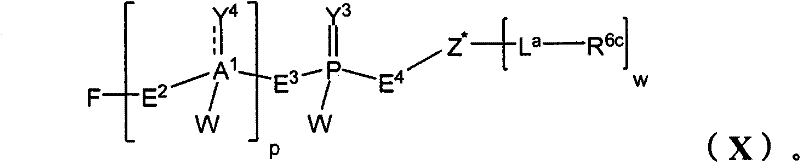
在式(X)中,p是选自0和1的整数;并且w是选自0至20的整数。在一个例子中,w选自1-8。在另一个例子中,w选自1-6。在另一个例子中,w选自1-4。在另外一个例子中,w是0,-La-R6c替换为H。F是脂质部分。示例性脂质部分在本文下文中描述。在一个例子中,脂质部分是多萜醇或十一异戊烯部分。In formula (X), p is an integer selected from 0 and 1; and w is an integer selected from 0 to 20. In one example, w is selected from 1-8. In another example, w is selected from 1-6. In another example, w is selected from 1-4. In another example, w is 0 and -L a -R 6c is replaced by H. F is the lipid fraction. Exemplary lipid moieties are described herein below. In one example, the lipid moiety is a dolichol or undecaprenyl moiety.
在式(X)中,Z*代表本发明的糖基部分。糖基部分在本文例如多肽缀合物的背景中(例如对于式III)定义,且同样地应用于本发明的糖基供体种类。在一个代表性实施方案中,糖基部分选自单糖和寡糖。在另一个代表性实施方案中,Z*选自单触角、二触角、三触角和四触角糖。在另一个实施方案中,Z*包括C-2-N-乙酰氨基,如在GlcNAc、GalNAc或bacillosamine中。In formula (X), Z * represents a glycosyl moiety of the present invention. Glycosyl moieties are defined herein eg in the context of Polypeptide Conjugates (eg for Formula III) and apply likewise to the glycosyl donor species of the invention. In a representative embodiment, the glycosyl moiety is selected from monosaccharides and oligosaccharides. In another representative embodiment, Z * is selected from monoantennary, diantennary, triantennary, and tetraantennary saccharides. In another embodiment, Z * comprises C-2-N-acetylamino, as in GlcNAc, GalNAc or bacillosamine.
在式(X)中,每个La是独立地选自单键、官能团、取代或未取代的烷基、取代或未取代的杂烷基、取代或未取代的芳基、取代或未取代的杂芳基、和取代或未取代的杂环烷基的连接体部分。每个R6c是独立地选择的本发明的修饰基团。A1是选自P(磷)和C(碳)的成员。Y3是选自氧(O)和硫(S)的成员。Y4是选自O、S、SR1、OR1、OQ、CR1R2和NR3R4的成员。E2、E3和E4是独立地选自CR1R2、O、S和NR3的成员。在一个例子中,E2是O。在另一个例子中,E3是O。在另外一个例子中,E4是O。在一个具体例子中,E2、E3和E4各自是O。每个W是独立地选自SR1、OR1、OQ、NR3R4、取代或未取代的烷基、取代或未取代的杂烷基、取代或未取代的芳基、取代或未取代的杂芳基、和取代或未取代的杂环烷基的成员。在式(X)中,每个Q是独立地选自H、负电荷和盐抗衡离子(阳离子)的成员,并且每个R1、每个R2、每个R3和每个R4是独立地选自H、取代或未取代的烷基、取代或未取代的杂烷基、取代或未取代的芳基、取代或未取代的杂芳基、和取代或未取代的杂环烷基的成员。在一个例子中,酶是寡糖基转移酶,并且糖基供体种类是脂质-焦磷酸盐连接的糖基部分。In formula (X), each L a is independently selected from single bond, functional group, substituted or unsubstituted alkyl, substituted or unsubstituted heteroalkyl, substituted or unsubstituted aryl, substituted or unsubstituted The linker moiety of heteroaryl, and substituted or unsubstituted heterocycloalkyl. Each R 6c is an independently selected modifying group of the invention. A 1 is a member selected from P (phosphorus) and C (carbon). Y3 is a member selected from oxygen (O) and sulfur (S). Y 4 is a member selected from O, S, SR 1 , OR 1 , OQ, CR 1 R 2 and NR 3 R 4 . E 2 , E 3 and E 4 are members independently selected from CR 1 R 2 , O, S and NR 3 . In one example, E2 is O. In another example, E3 is O. In another example, E4 is O. In a specific example, each of E2 , E3 and E4 is O. Each W is independently selected from SR 1 , OR 1 , OQ, NR 3 R 4 , substituted or unsubstituted alkyl, substituted or unsubstituted heteroalkyl, substituted or unsubstituted aryl, substituted or unsubstituted heteroaryl, and members of substituted or unsubstituted heterocycloalkyl. In formula (X), each Q is a member independently selected from H, a negative charge, and a salt counterion (cation), and each R 1 , each R 2 , each R 3 and each R 4 is independently selected from H, substituted or unsubstituted alkyl, substituted or unsubstituted heteroalkyl, substituted or unsubstituted aryl, substituted or unsubstituted heteroaryl, and substituted or unsubstituted heterocycloalkyl a member of. In one example, the enzyme is an oligosaccharyltransferase and the glycosyl donor species is a lipid-pyrophosphate-linked glycosyl moiety.
糖基供体的脂质部分lipid moiety of glycosyl donor
在一个实施方案中,式(X)的脂质部分包括在直链或支链中排列的1至约200个碳原子,优选约5至约100个碳原子。这条链中的碳-碳键独立地选自饱和和不饱和的。双键可以具有顺式或反式构型。在一个实施方案中,碳链包括至少一个芳香族或非芳香族环结构。在一个例子中,脂质部分包括至少5,优选至少6、至少7、至少8、至少9或至少10个碳原子。在另一个实施方案中,碳链由至少一个官能团间断。示例性官能团包括醚、硫醚、胺、甲酰胺、磺胺、肼、羰基、氨基甲酸酯、尿素、硫脲、酯和碳酸酯。In one embodiment, the lipid moiety of formula (X) comprises 1 to about 200 carbon atoms, preferably about 5 to about 100 carbon atoms, arranged in a linear or branched chain. The carbon-carbon bonds in this chain are independently selected from saturated and unsaturated. Double bonds can have either cis or trans configuration. In one embodiment, the carbon chain includes at least one aromatic or non-aromatic ring structure. In one example, the lipid moiety comprises at least 5, preferably at least 6, at least 7, at least 8, at least 9 or at least 10 carbon atoms. In another embodiment, the carbon chain is interrupted by at least one functional group. Exemplary functional groups include ether, thioether, amine, formamide, sulfonamide, hydrazine, carbonyl, carbamate, urea, thiourea, ester, and carbonate.
在一个实施方案中,脂质部分是取代或未取代的烷基。在另一个实施方案中,脂质部分包括至少一个异戊二烯基或还原的异戊二烯基部分。在另外一个实施方案中,脂质部分选自聚-异戊二烯基、还原的聚-异戊二烯基、和部分还原的聚-异戊二烯基。示例性脂质部分包括下述结构之一:In one embodiment, the lipid moiety is a substituted or unsubstituted alkyl. In another embodiment, the lipid moiety comprises at least one prenyl or reduced prenyl moiety. In yet another embodiment, the lipid moiety is selected from poly-prenyl, reduced poly-prenyl, and partially reduced poly-prenyl. Exemplary lipid moieties include one of the following structures:
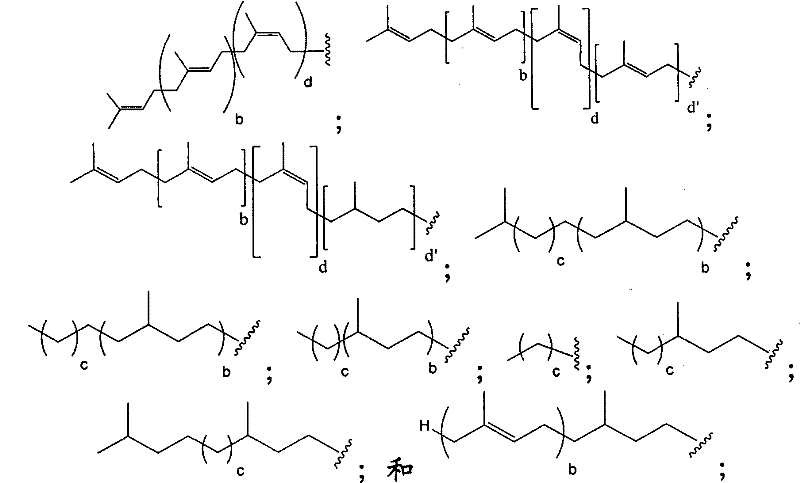
其中b、c、d和d’是独立地选自0至100的整数。在一个实施方案中,脂质部分包括总共约2至约40个异戊二烯基和/或还原的异戊二烯基单位。在另一个实施方案中,脂质部分包括约5至约22个异戊二烯基和/或还原的异戊二烯基单位。wherein b, c, d and d' are integers independently selected from 0 to 100. In one embodiment, the lipid moiety comprises a total of about 2 to about 40 prenyl and/or reduced prenyl units. In another embodiment, the lipid moiety comprises from about 5 to about 22 prenyl and/or reduced prenyl units.
在根据这个实施方案的一个例子中,脂质部分是十一异戊烯,C55类异戊二烯。在另一个例子中,脂质部分是还原或部分还原的十一异戊烯。示例性脂质部分包括:In one example according to this embodiment, the lipid moiety is undecaprenyl, a C55 isoprenoid. In another example, the lipid moiety is reduced or partially reduced undecaprenene. Exemplary lipid moieties include:
在另一个实施方案中,脂质部分衍生自脂肪酸醇,例如天然存在的那些。在另外一个实施方案中,脂质部分衍生自多萜醇或聚戊烯醇。在形成本发明的多肽缀合物中使用真核生物寡糖基转移酶时,多萜醇衍生的部分是特别有用的。在一个例子中,脂质部分具有一般结构:In another embodiment, the lipid moiety is derived from fatty acid alcohols, such as those that occur naturally. In yet another embodiment, the lipid moiety is derived from dolichol or polyprenol. Dolichol-derived moieties are particularly useful when eukaryotic oligosaccharyltransferases are used in forming the Polypeptide Conjugates of the invention. In one example, the lipid moiety has the general structure:
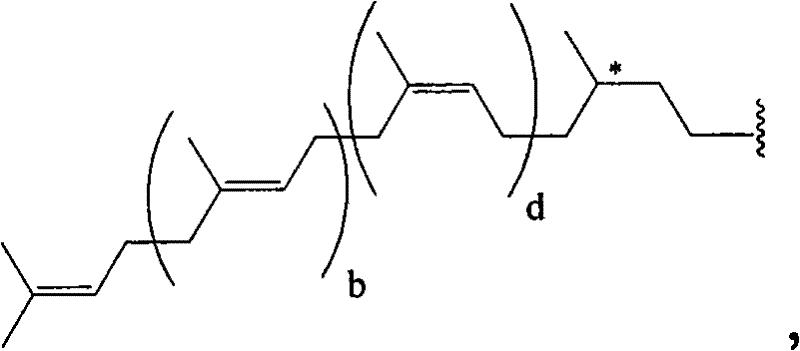
其中b和d是独立地选自0至100的整数。在一个例子中,d选自1至约50、优选1至约40、更优选1至约30并且更加优选1至约20或1至约10。在另一个例子中,d选自7至20,优选选自7-19、7-18、7-17、7-16、7-15、7-14、7-13、7-12、7-11、7-10、7-9或7-8。在另一个例子中,d选自13-20、优选选自14-19、并且更优选选自14-17。在另一个例子中,b选自0至6。在另外一个例子中,b选自0至2。在一个进一步例子中,多萜醇部分具有约15至约22个类异戊二烯单位。用星号标记的立体中心具有(S)或(R)构型。wherein b and d are integers independently selected from 0 to 100. In one example, d is selected from 1 to about 50, preferably 1 to about 40, more preferably 1 to about 30 and even more preferably 1 to about 20 or 1 to about 10. In another example, d is selected from 7 to 20, preferably selected from 7-19, 7-18, 7-17, 7-16, 7-15, 7-14, 7-13, 7-12, 7- 11, 7-10, 7-9 or 7-8. In another example, d is selected from 13-20, preferably from 14-19, and more preferably from 14-17. In another example, b is selected from 0-6. In another example, b is selected from 0-2. In a further example, the dolichol moiety has from about 15 to about 22 isoprenoid units. Stereogenic centers marked with an asterisk have the (S) or (R) configuration.
示例性多萜醇和聚异戊烯醇部分在例如T.Chojnacki等人,Cell.Biol. Mol. Lett.2001,6(2),192;T.Chojnacki和G.Dallner,Biochem.J.1988,251,1-9;E.Swiezewska等人,Acta Biochim.Polon.1994,221-260;和G.Van Duij等人,Chem.Scripta1987,27,95-100中描述,其公开内容为了所有目的整体合并入本文。在一个具体例子中,多萜醇部分具有下述结构:Exemplary dolichol and polyprenol moieties are described, for example, in T. Chojnacki et al., Cell. Biol. Mol. Lett. 2001, 6(2), 192; T. Chojnacki and G. Dallner, Biochem. J.1988, 251, 1-9; E.Swiezewska et al., Acta Biochim.Polon.1994, 221-260; and G.Van Duij et al., described in Chem.Scripta 1987, 27, 95-100, the disclosure of which is for all purposes in its entirety Incorporated into this article. In one specific example, the dolichol moiety has the following structure:
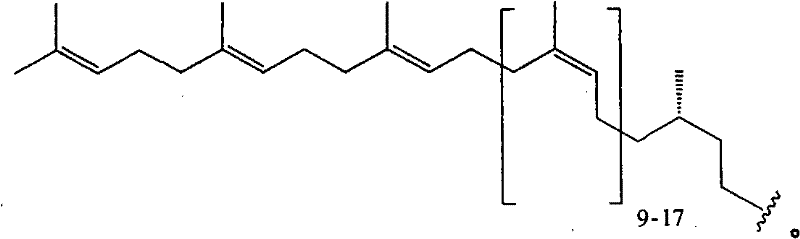
糖基供体的修饰基团Glycosyl donor modification group
在式(X)中,R6c代表本发明的修饰基团。修饰基团在本文例如多肽缀合物的背景中描述,并且同样地应用于本发明的化合物(例如,糖基供体种类)。在一个代表性实施方案中,式(X)的糖基供体种类包括具有结构的修饰基团R6c,所述结构是选自下述的成员:In formula (X), R 6c represents a modifying group of the present invention. Modifying groups are described herein in the context of, eg, Polypeptide Conjugates, and apply equally to compounds of the invention (eg, glycosyl donor species). In a representative embodiment, the glycosyl donor species of formula (X) includes a modifying group R 6c having the structure which is a member selected from the group consisting of:
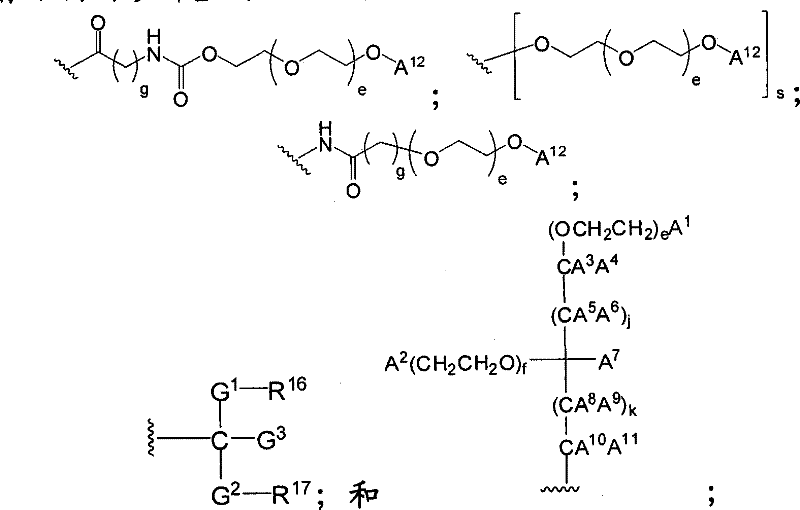
其中g、j、k、e、f、s、R16、R17、G1、G2、G3、A1、A2、A3、A4、A5、A6、A7、A8、A9、A10、A11和A12如上定义。where g, j, k, e, f, s, R 16 , R 17 , G 1 , G 2 , G 3 , A 1 , A 2 , A 3 , A 4 , A 5 , A 6 , A 7 , A 8 , A 9 , A 10 , A 11 and A 12 are as defined above.
示例性糖基供体种类Exemplary Glycosyl Donor Classes
在一个示例性实施方案中,糖基供体种类包括磷酸盐或焦磷酸盐部分,并且具有下述结构:In an exemplary embodiment, the glycosyl donor species comprises a phosphate or pyrophosphate moiety and has the following structure:
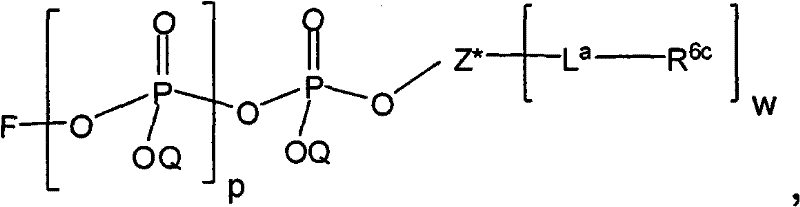
其中w、p、La、R6c、F、Q和Z*在本文上文对于式(X)定义。根据这个实施方案的示例性化合物包括下式的那些:wherein w, p, La , R 6c , F, Q and Z * are as defined herein above for formula (X). Exemplary compounds according to this embodiment include those of the formula:
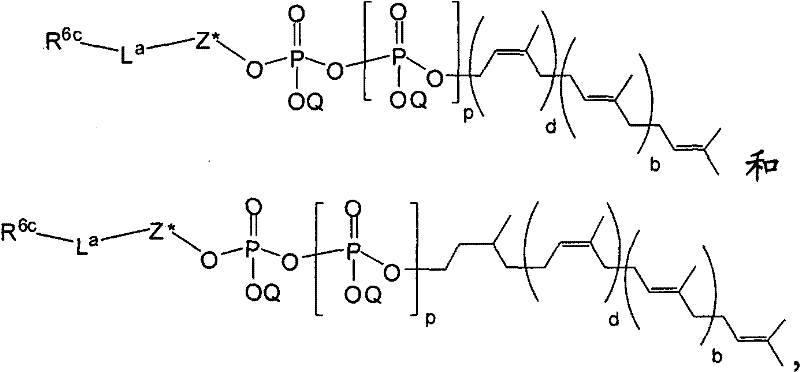
其中b和d独立地选自0至100。在一个实施方案中,b是3。在另一个实施方案中,d是7。在另外一个实施方案中,d是7,并且b是3。wherein b and d are independently selected from 0 to 100. In one embodiment, b is 3. In another embodiment, d is 7. In another embodiment, d is 7 and b is 3.
在一个示例性实施方案中,式(X)中的糖基部分Z*是选自GlcNAc-GlcNAc、GlcNH-GlcNAc、GlcNAc-GlcNH或GlcNH-GlcNH部分的成员。在一个实施方案中,Z*是GlcNAc-Gal或GlcNH-Gal部分。在另一个实施方案中,Z*是GlcNAc-GlcNAc-Gal、GlcNH-GlcNAc-Gal、GlcNAc-GlcNH-Gal或GlcNH-GlcNH-Gal部分。在另一个实施方案中,Z*是GlcNAc-Gal-Sia部分。在另一个实施方案中,Z*是GlcNAc-GlcNAc-Gal-Sia 、GlcNH-GlcNAc-Gal-Sia 、GlcNAc-GlcNH-Gal-Sia或GlcNH-GlcNH-Gal-Sia部分。示例性糖基供体种类包括:In an exemplary embodiment, the glycosyl moiety Z * in formula (X) is a member selected from the group consisting of GlcNAc-GlcNAc, GlcNH-GlcNAc, GlcNAc-GlcNH or GlcNH-GlcNH moieties. In one embodiment, Z * is a GlcNAc-Gal or GlcNH-Gal moiety. In another embodiment, Z * is a GlcNAc-GlcNAc-Gal, GlcNH-GlcNAc-Gal, GlcNAc-GlcNH-Gal or GlcNH-GlcNH-Gal moiety. In another embodiment, Z * is a GlcNAc-Gal-Sia moiety. In another embodiment, Z * is a GlcNAc-GlcNAc-Gal-Sia, GlcNH-GlcNAc-Gal-Sia, GlcNAc-GlcNH-Gal-Sia or GlcNH-GlcNH-Gal-Sia moiety. Exemplary glycosyl donor species include:


其中b、d、Q、La和R6c如本文上文定义。Q1是H、单个负电荷或阳离子(例如,Na+或K+)。A和B是独立地选自OR(例如,OH)和NHCOR(例如,NHAc)的成员。上文显示的焦磷酸盐可以任选是磷酸盐。wherein b, d, Q, La and R are as defined herein above . Q 1 is H, a single negative charge, or a cation (eg, Na + or K + ). A and B are members independently selected from OR (eg, OH) and NHCOR (eg, NHAc). The pyrophosphate shown above may optionally be a phosphate.
示例性糖基供体种类包括:Exemplary glycosyl donor species include:

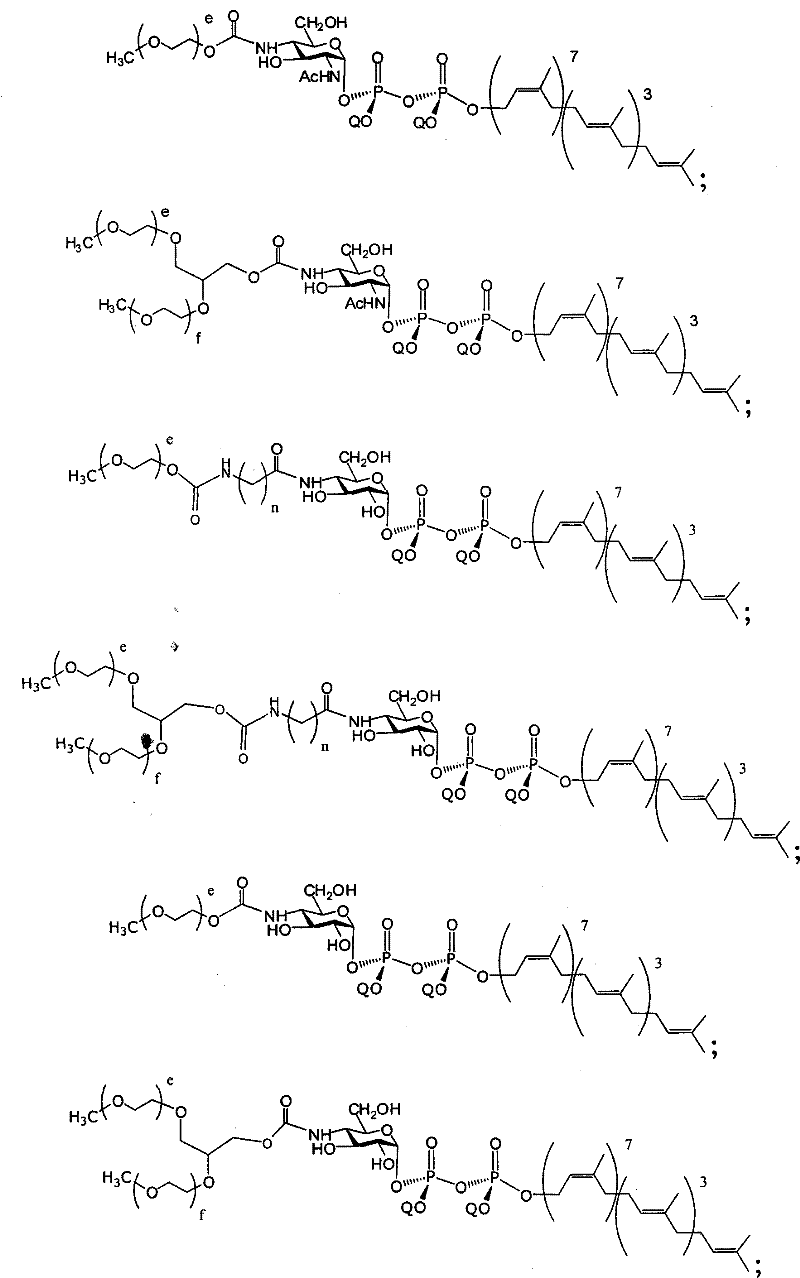

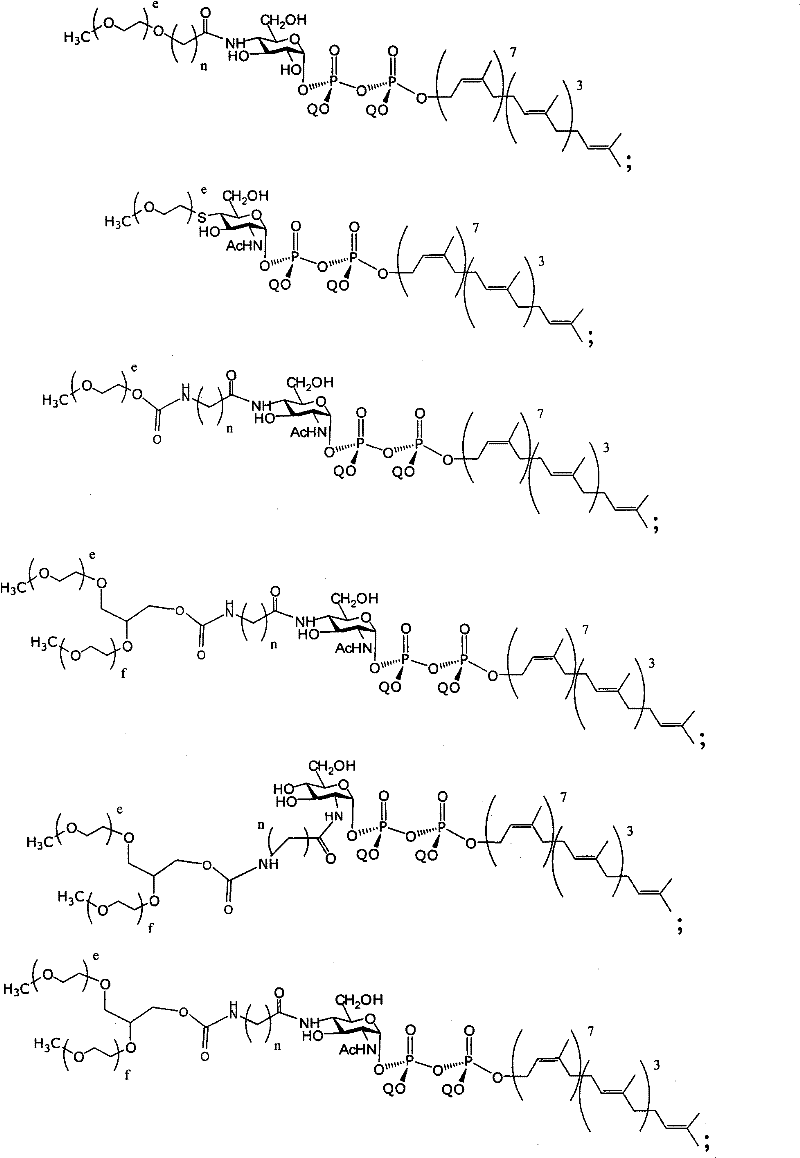

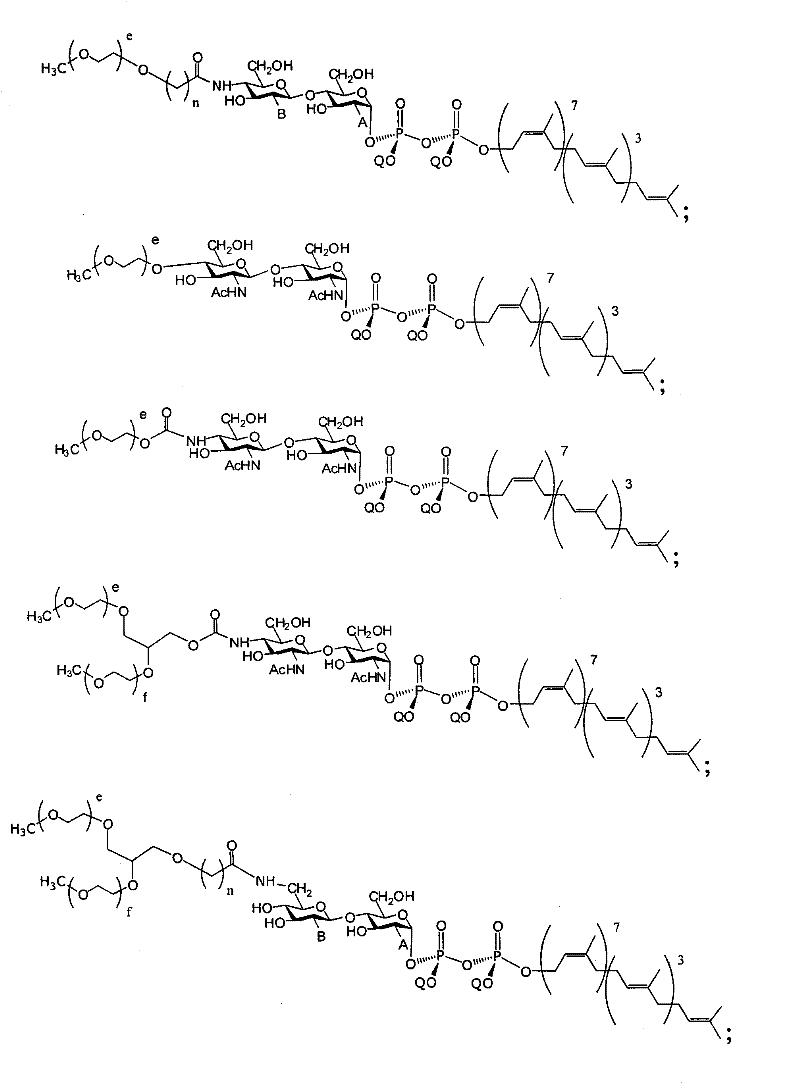
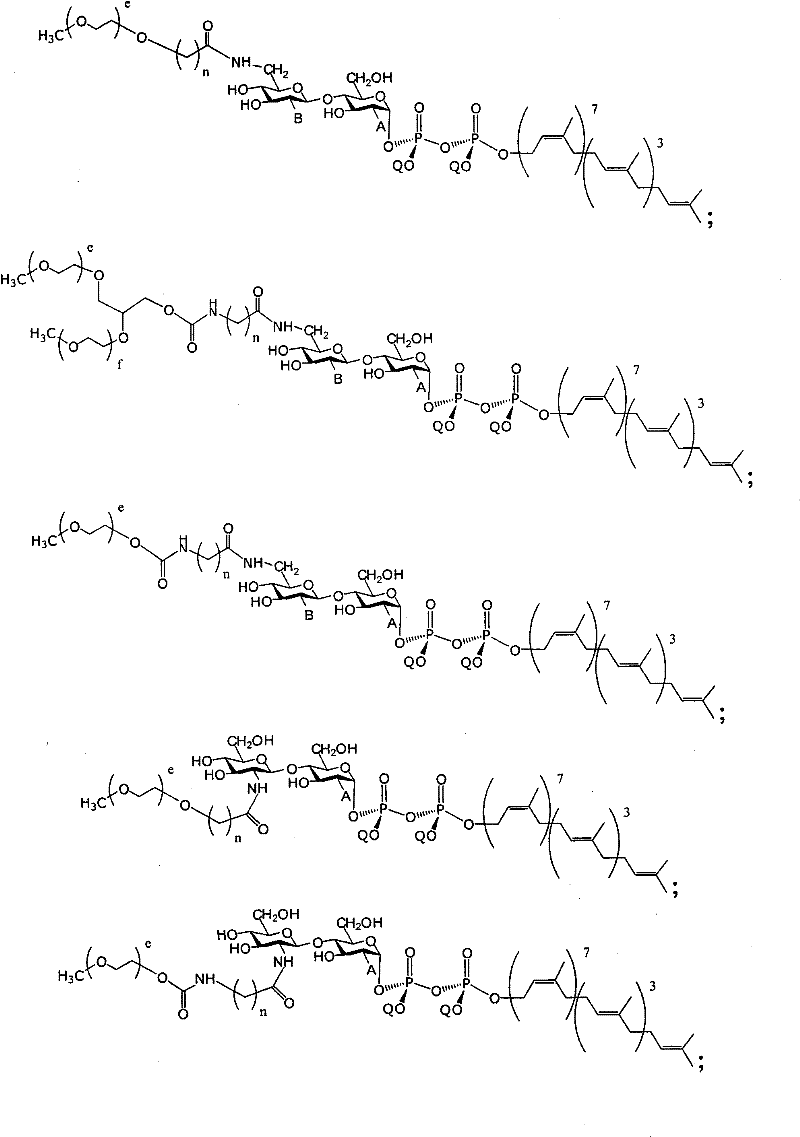
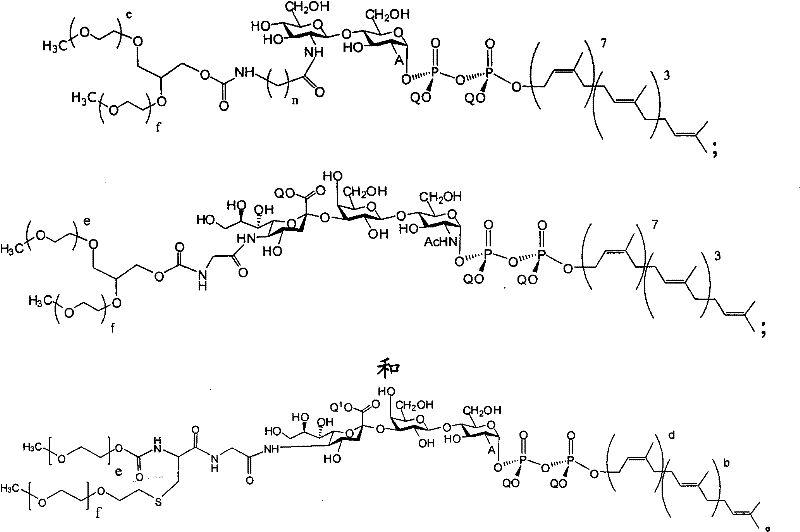
糖基供体种类的合成Synthesis of Glycosyl Donor Species
本发明的糖基供体种类可以使用领域公认的方法的组合进行合成。例如,十一异戊烯-焦磷酸盐连接的bacillosamine的合成已由E.Weerapana等人,J.Am.Chem.Soc.2005,127:13766-13767报告,其公开内容通过引用整体合并入本文。可以采用这个合成操作,以合成各种聚异戊烯糖。用于合成脂质-焦磷酸盐连接的GlcNAc部分的示例性合成途径在下文方案3中显示。The glycosyl donor species of the invention can be synthesized using a combination of art-recognized methods. For example, the synthesis of undecaprenyl-pyrophosphate linked bacillosamine has been reported by E. Weerapana et al., J. Am. Chem. Soc. 2005, 127: 13766-13767, the disclosure of which is incorporated herein by reference in its entirety . This synthetic procedure can be employed to synthesize various polyprenyl sugars. An exemplary synthetic pathway for the synthesis of lipid-pyrophosphate linked GlcNAc moieties is shown in
方案3a:脂质-磷酸盐和脂质-焦磷酸盐糖的示例性合成 Scheme 3a: Exemplary synthesis of lipid-phosphate and lipid-pyrophosphate sugars
在方案3a中,F是脂质部分,例如十一异戊烯;P*是适合于保护氨基的保护基团;并且整数q选自1-40。In Scheme 3a, F is a lipid moiety, such as undecaprenyl; P * is a protecting group suitable for protecting amino groups; and the integer q is selected from 1-40.
在方案3a中,化合物II可以由已知的苯甲基-2-乙酰胺基-2-脱氧-β-D-吡喃半乳糖苷I进行制备,通过例如用苯甲酰氯保护3-和6-羟基,5-羟基转变成离去基团(例如,三氟甲磺酸盐)和后续亲核取代(例如,使用叠氮化钠)。随后可以通过还原叠氮基和用合适的保护基团例如Fmoc保护所得到的氨基来合成化合物III。Bn保护基团的选择性去除和用碱(例如,LiHMDS)和受保护的磷酸盐供体例如受保护的磷酸酐(例如,[(BnO)2P(O)]2O)处理产物。磷酸基的后续脱保护得到化合物IV,所述化合物IV可以使用脂质磷酸盐(十一异戊烯磷酸盐)和合适的偶联试剂例如羰基二咪唑,随后氨基的脱保护而转变成V。通过与活化的修饰基团前体例如本文描述的那些反应,所得到的伯氨基可以用于使焦磷酸盐糖与修饰基团偶联。在一个例子中,修饰基团包括聚(乙二醇)部分。活化的PEG试剂是商购可得的。备选地,氨基可以转变成NHAc基团。In Scheme 3a, compound II can be prepared from the known benzyl-2-acetamido-2-deoxy-β-D-galactopyranoside I by, for example, protecting 3- and 6 with benzoyl chloride -Hydroxy, 5-Hydroxy converted to a leaving group (eg, triflate) and subsequent nucleophilic substitution (eg, using sodium azide). Compound III can then be synthesized by reduction of the azido group and protection of the resulting amino group with a suitable protecting group such as Fmoc. Selective removal of the Bn protecting group and treatment of the product with a base (eg, LiHMDS) and a protected phosphate donor such as protected phosphoric anhydride (eg, [(BnO) 2 P(O)] 2 O). Subsequent deprotection of the phosphate group yields compounds IV which can be converted to V using lipid phosphate (undecaprenyl phosphate) and a suitable coupling reagent such as carbonyldiimidazole, followed by deprotection of the amino group. The resulting primary amino group can be used to couple a pyrophosphate sugar to a modifying group by reaction with an activated modifying group precursor such as those described herein. In one example, the modifying group includes a poly(ethylene glycol) moiety. Activated PEG reagents are commercially available. Alternatively, the amino group can be converted to an NHAc group.
备选地,在方案3a中,化合物VI可以由已知的苯甲基-2-乙酰胺基-2-脱氧-β-D-吡喃半乳糖苷I进行制备,通过例如用苯甲酰氯保护3-和6-羟基,和例如通过Mitsunobu化学作用倒转在C-5处的立体中心。如上所述的后续磷酸化和脂质部分的偶联得到化合物VIII。使用一种或多种糖基转移酶和分别的糖供体例如核苷酸糖,将化合物进一步转变成IX。在一个例子中,糖供体是经修饰的核苷酸糖,其包括本发明的修饰基团(例如,经修饰的唾液酸部分)。经修饰的糖供体与糖基转移酶相组合使用,经修饰的糖供体是所述糖基转移酶(例如唾液酸转移酶)的底物。在方案3中的反应是示例性的并且不意欲限制本发明的范围。本领域技术人员应当理解,代替化合物I,可以使用任何其他糖部分作为原材料,以便通过相似的合成途径制备各种糖磷酸盐。Alternatively, in Scheme 3a, compound VI can be prepared from the known benzyl-2-acetamido-2-deoxy-β-D-galactopyranoside I by, for example, protecting 3- and 6-hydroxyl, and inversion of the stereocenter at C-5 eg by Mitsunobu chemistry. Subsequent phosphorylation and coupling of the lipid moiety as described above affords compound VIII. Compounds are further converted to IX using one or more glycosyltransferases and a respective sugar donor such as a nucleotide sugar. In one example, the sugar donor is a modified nucleotide sugar that includes a modifying group of the invention (eg, a modified sialic acid moiety). A modified sugar donor is used in combination with a glycosyltransferase for which the modified sugar donor is a substrate (eg, sialyltransferase). The reactions in
用于合成脂质-磷酸盐或脂质-焦磷酸盐糖的另一种方法在方案3b中举例说明。在这种方法中,在酶的存在下使脂质磷酸盐X与包含第一糖部分的糖核苷酸例如UDP-糖(例如,UDP-GlcNAc、UDP-GlcNH、UDP-GalNAc、UDP-GalNH、UDP-bacillosamine、UDP-Glc等)反应,所述酶可以将核苷酸糖的第一糖部分转移到脂质磷酸盐上,导致化合物XI,所述化合物XI可以包括磷酸基或焦磷酸基。在一个实施方案中,酶是磷-多萜醇-GlcNAc-1-磷酸盐转移酶(GPT)。示例性磷-多萜醇-GlcNAc-1-磷酸盐转移酶在本文下文中描述。使用一种或多种糖基转移酶和合适的糖核苷酸,随后可以将另外的糖部分加入第一糖部分中,以得到化合物XII。示例性糖基转移酶也在本文下文中描述。Another method for the synthesis of lipid-phosphate or lipid-pyrophosphate sugars is exemplified in Scheme 3b. In this method, lipid phosphate X is reacted in the presence of an enzyme with a sugar nucleotide comprising a first sugar moiety, such as a UDP-sugar (e.g., UDP-GlcNAc, UDP-GlcNH, UDP-GalNAc, UDP-GalNH , UDP-bacillosamine, UDP-Glc, etc.) reaction, the enzyme can transfer the first sugar moiety of the nucleotide sugar to the lipid phosphate, resulting in compound XI, which can include a phosphate group or a pyrophosphate group . In one embodiment, the enzyme is phospho-dolicenol-GlcNAc-1-phosphate transferase (GPT). Exemplary phospho-dolicenol-GlcNAc-1-phosphate transferases are described herein below. Additional sugar moieties can then be added to the first sugar moiety using one or more glycosyltransferases and suitable sugar nucleotides to give compound XII. Exemplary glycosyltransferases are also described herein below.
方案3b:Option 3b:
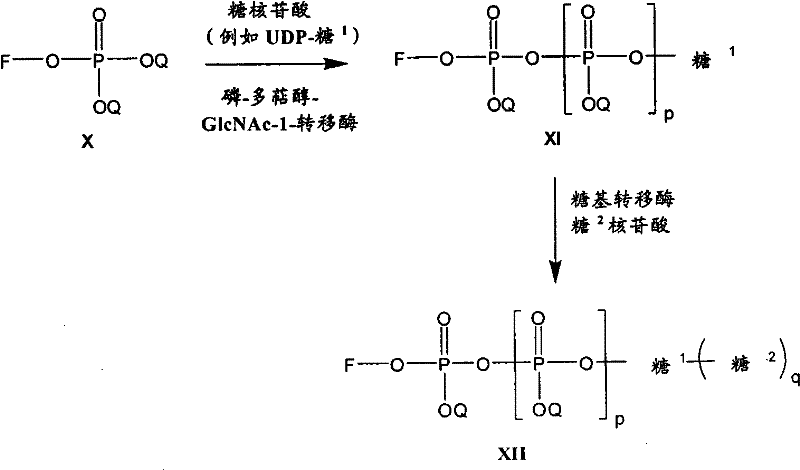
在方案3b中,每个Q是独立地选自H、单个负电荷和阳离子(例如,K+或Na+)的成员。整数p选自0和1;并且整数q选自1至40。In Scheme 3b, each Q is a member independently selected from H, a single negative charge, and a cation (eg, K + or Na + ). the integer p is selected from 0 and 1; and the integer q is selected from 1 to 40.
在一个实施方案中,方案3b中的第一糖部分是GlcNAc,并且第一糖核苷酸是UDP-GlcNAc。在一个例子中,第一GlcNAc部分与经修饰的GlcNAc-或GlcNH-部分连接。在另一个例子中,将另一个GlcNAc部分加入第一GlcNAc部分中。所得到的GlcNAc-GlcNAc部分随后可以与经修饰的Gal部分连接。备选地,GlcNAc-GlcNAc部分首先与Gal部分连接,并且将经修饰的Sia部分加入所得到的GlcNAc-GlcNAc-Gal部分中。根据这些实施方案的示例性合成途径在下文方案3c中举例说明。In one embodiment, the first sugar moiety in Scheme 3b is GlcNAc and the first sugar nucleotide is UDP-GlcNAc. In one example, the first GlcNAc moiety is linked to a modified GlcNAc- or GlcNH- moiety. In another example, another GlcNAc moiety is added to the first GlcNAc moiety. The resulting GlcNAc-GlcNAc moiety can then be linked to a modified Gal moiety. Alternatively, the GlcNAc-GlcNAc moiety is first linked to the Gal moiety, and the modified Sia moiety is added to the resulting GlcNAc-GlcNAc-Gal moiety. Exemplary synthetic routes according to these embodiments are illustrated in Scheme 3c below.
方案3c:经修饰的脂质-焦磷酸盐糖的示例性合成Scheme 3c: Exemplary synthesis of modified lipid-pyrophosphate sugars
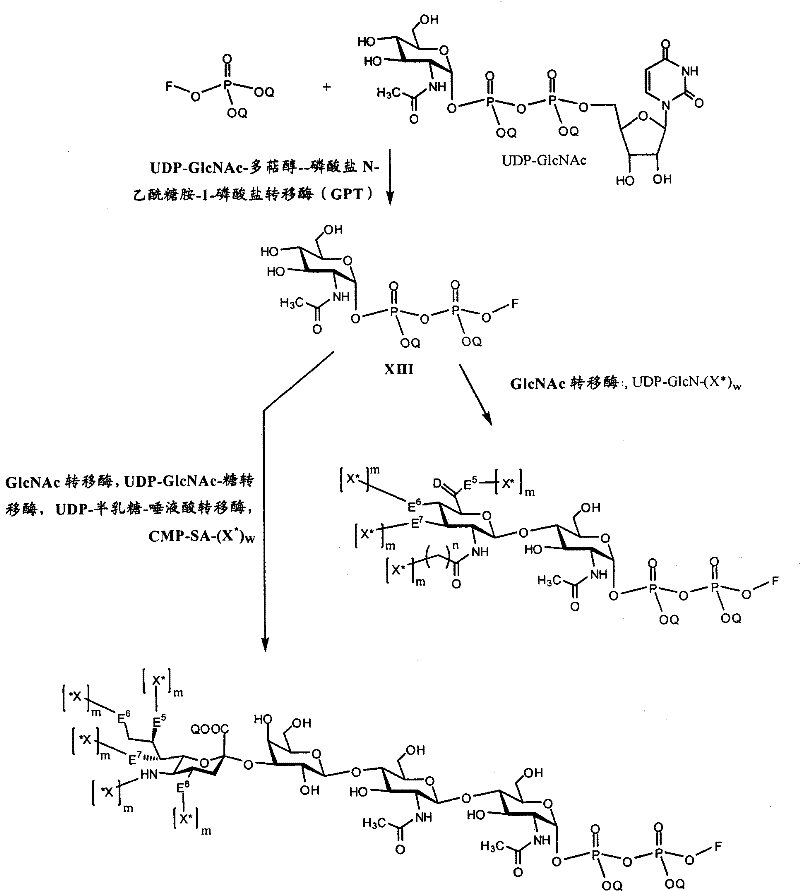
在另外一个实施方案中,方案3c中的化合物XIII的第一GlcNAc部分与经修饰的Gal部分连接。在一个进一步的实施方案中,化合物VIII的第一GlcNAc部分首先与Gal部分连接。Gal部分随后与经修饰的Sia或神经氨酸部分连接。这些实施方案在下文方案3d中举例说明:In another embodiment, the first GlcNAc moiety of compound XIII in Scheme 3c is linked to a modified Gal moiety. In a further embodiment, the first GlcNAc moiety of Compound VIII is first linked to the Gal moiety. The Gal moiety is then linked to a modified Sia or neuraminic acid moiety. These embodiments are illustrated in Scheme 3d below:
方案3d:Scenario 3d:

在另一个实施方案中,在合适的多萜醇磷酸N-乙酰葡糖胺-1-磷酸盐转移酶的存在下,使磷脂X与经修饰的糖核苷酸(例如,经修饰的UDP-GlcNAc)反应,以得到经修饰的脂质-磷酸盐或脂质焦磷酸盐糖。根据这个实施方案的示例性合成方法在下文方案3e中举例说明。In another embodiment, phospholipid X is combined with a modified sugar nucleotide (e.g., modified UDP- GlcNAc) to obtain modified lipid-phosphate or lipid pyrophosphate sugars. An exemplary synthetic method according to this embodiment is illustrated in Scheme 3e below.
方案3e:Option 3e:

在一个进一步的实施方案中,脂质-磷酸盐或脂质-焦磷酸盐糖根据下文方案3f中概述的合成途径进行合成。在这个例子中,单糖或多糖(例如,包括Gal部分的二糖)首先与经修饰的糖基部分(例如,经修饰的Sia)连接。在一个例子中,使用糖基转移酶例如唾液酸转移酶,和合适的经修饰的糖核苷酸(例如,经修饰的CMP-Sia),使经修饰的糖基部分与原材料连接。任何糖苷OH基团随后可以进行保护,例如作为其相对应的甲醚,并且所得到的受保护的经修饰的糖随后可以与磷脂或焦磷酸脂(pyrophospholipid)连接。In a further embodiment, lipid-phosphate or lipid-pyrophosphate sugars are synthesized according to the synthetic pathway outlined in Scheme 3f below. In this example, a monosaccharide or polysaccharide (eg, a disaccharide that includes a Gal moiety) is first attached to a modified glycosyl moiety (eg, a modified Sia). In one example, the modified glycosyl moiety is attached to the starting material using a glycosyltransferase, such as a sialyltransferase, and an appropriate modified sugar nucleotide (eg, modified CMP-Sia). Any glycosidic OH group can then be protected, for example as its corresponding methyl ether, and the resulting protected modified sugar can then be linked to a phospholipid or pyrophospholipid.
方案3f:Scenario 3f:
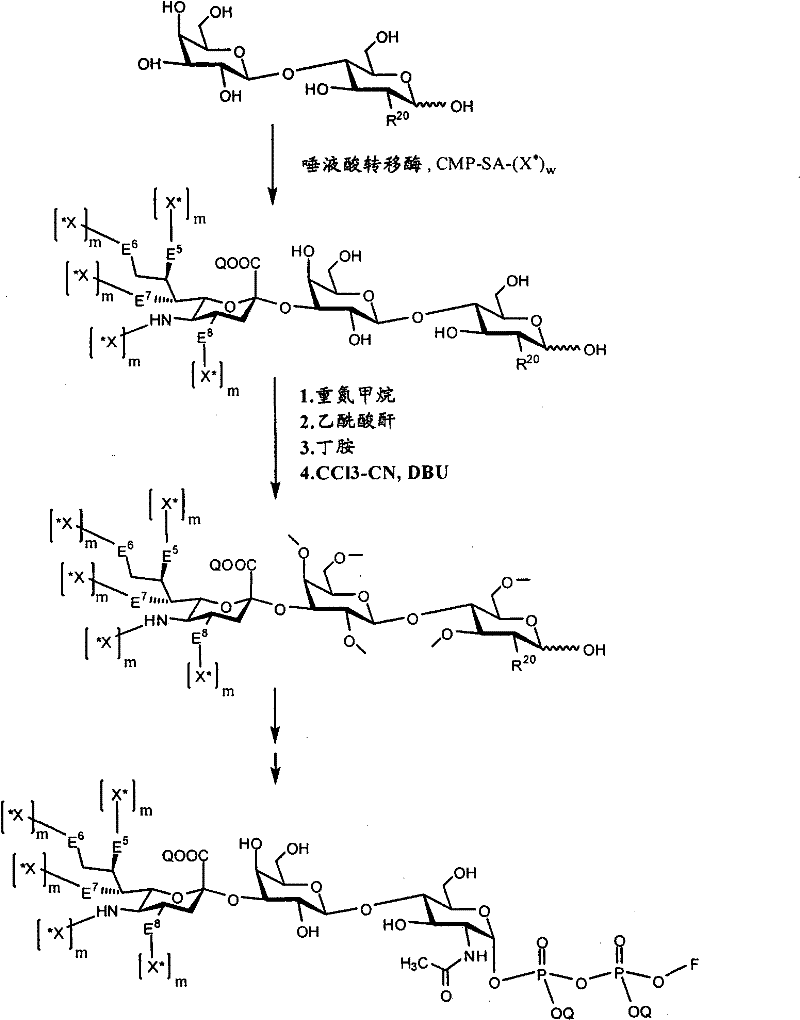
其中R20是选自OH、NH2、NHAc、NHCO芳基和NHCO烷基的成员。wherein R 20 is a member selected from OH, NH 2 , NHAc, NHCO aryl and NHCO alkyl.
在方案3c至3f中,F是本文描述的脂质部分;每个Q是独立地选自H、单个负电荷和阳离子(例如,K+或Na+)的成员。整数w选自1-8,优选选自1-4(例如,对于Glc或Gal部分)或1-5(例如,对于Sia部分);整数n选自0至40;并且每个整数m是独立地选自0和1的成员。当m是0时,那么(X*)m替换为H。在一个例子中,每个X*是独立地选自本文描述的线性和分支聚合修饰基团的成员。在另一个例子中,X*包括至少一个聚合部分,例如PEG部分(例如,mPEG)。在另外一个例子中,X*包括使聚合修饰基团与分子的其余部分连接的连接体部分。在一个进一步的例子中,每个X*是本文对于式(V)描述的Lb-R6c。E5、E6、E7和E8是独立地选自CR1R2(例如,CH2)和官能团的成员,所述官能团例如O、S、NR3(例如,NH)、C(O)、C(O)NR3(例如,CONH)、NHC(O)、NHC(O)NH、NHC(O)O等;并且D是选自H2(在这种情况下双键替换为2个单键)、O、S、NR3(例如,NH)的成员,其中每个R1、每个R2、每个R3和每个R4是独立地选自H、取代或未取代的烷基、取代或未取代的杂烷基、取代或未取代的芳基、取代或未取代的杂芳基、和取代或未取代的杂环烷基的成员。In Schemes 3c to 3f, F is a lipid moiety described herein; each Q is a member independently selected from H, a single negative charge, and a cation (eg, K + or Na + ). Integer w is selected from 1-8, preferably selected from 1-4 (for example, for Glc or Gal moiety) or 1-5 (for example, for Sia moiety); integer n is selected from 0 to 40; and each integer m is independently A member selected from 0 and 1. When m is 0, then (X * ) m is replaced by H. In one example, each X * is a member independently selected from the linear and branched polymeric modifying groups described herein. In another example, X * includes at least one polymeric moiety, such as a PEG moiety (eg, mPEG). In another example, X * includes a linker moiety linking the polymeric modifying group to the rest of the molecule. In a further example, each X * is Lb - R6c as described herein for formula (V). E 5 , E 6 , E 7 and E 8 are members independently selected from CR 1 R 2 (eg, CH 2 ) and functional groups such as O, S, NR 3 (eg, NH), C(O ), C(O)NR 3 (for example, CONH), NHC(O), NHC(O)NH, NHC(O)O, etc.; and D is selected from H 2 (in this case the double bond is replaced by 2 single bond), O, S, a member of NR 3 (e.g., NH), wherein each R 1 , each R 2 , each R 3 and each R 4 is independently selected from H, substituted or unsubstituted A member of alkyl, substituted or unsubstituted heteroalkyl, substituted or unsubstituted aryl, substituted or unsubstituted heteroaryl, and substituted or unsubstituted heterocycloalkyl.
各种糖基转移酶和合适的经修饰的或未经修饰的糖核苷酸可以用于加工磷酸盐或焦磷酸盐糖(例如,方案3中的化合物VIII)的第一糖部分。例如,第二GlcNAc部分可以加到第一GlcNAc部分上。第二GlcNAc部分可以任选用本发明的修饰基团进行修饰(对于例子比较方案3c)。在另一个例子中,经修饰的唾液酸部分可以酶促转移至磷酸盐或焦磷酸盐糖的GlcNAc、GlcNAc-GlcNAc-或GlcNAc-GlcNAc-Gal部分(对于例子比较方案3c)。备选地,使用合适的本文描述的糖基转移酶,可以将任何其他的糖基部分(例如,Gal、GalNAc等)加入第一糖部分中。Various glycosyltransferases and suitable modified or unmodified sugar nucleotides can be used to process the first sugar moiety of a phosphate or pyrophosphate sugar (eg, compound VIII in Scheme 3). For example, a second GlcNAc moiety can be added to a first GlcNAc moiety. The second GlcNAc moiety can optionally be modified with a modifying group of the invention (compare Scheme 3c for an example). In another example, the modified sialic acid moiety can be enzymatically transferred to the GlcNAc, GlcNAc-GlcNAc- or GlcNAc-GlcNAc-Gal moiety of a phosphate or pyrophosphate sugar (compare Scheme 3c for an example). Alternatively, any other glycosyl moiety (eg, Gal, GalNAc, etc.) can be added to the first glycomoiety using a suitable glycosyltransferase described herein.
使用经修饰的糖核苷酸或经修饰的活化糖与合适的糖基转移酶相组合,可以将经修饰的糖残基酶促加入已有的糖残基中,经修饰的糖种类是所述酶的底物。因此,经修饰的糖优选选自经修饰的糖核苷酸、活化的经修饰的糖和其为简单糖类(既不是核苷酸也不是活化的)的经修饰的糖。一般地,该结构将是单糖,但本发明并不限于经修饰的单糖的使用。寡糖、多糖和糖基模拟部分也是有用的。Modified sugar residues can be enzymatically added to existing sugar residues using modified sugar nucleotides or modified activated sugars in combination with a suitable glycosyltransferase, the modified sugar species being the substrates for the enzymes. Thus, the modified sugar is preferably selected from modified sugar nucleotides, activated modified sugars and modified sugars which are simple sugars (neither nucleotides nor activated). Typically, the structure will be a monosaccharide, but the invention is not limited to the use of modified monosaccharides. Oligosaccharides, polysaccharides, and glycomimetic moieties are also useful.
在另一个实施方案中,使用经纯化的酶(例如,来自细菌或酵母N-糖基化途径),由脂质-磷酸盐前体(例如,十一异戊烯-磷酸盐)合成糖基供体种类。使用重组酶的此类反应已由KJ Glover等人(PNAS2005,102(40):14255-14259)描述,其公开内容通过引用整体合并入本文。例如,PglC可以用于将来自UDP-bacillosamine的经修饰的或未经修饰的bacillosamine部分加到十一异戊烯-磷酸盐上,以得到十一异戊烯-焦磷酸盐连接的bacillosamine,其可以使用PglA和UDPGalNAc进一步转变成十一异戊烯-焦磷酸盐连接的bacillosamine-GalNAc,其中GalNAc部分可以任选是经修饰的。另外的糖部分可以使用其他酶例如PglHJ或PglI加入。这些反应中的2个或更多个可以在单个反应容器中执行。用于2个或更多个步骤的试剂(即,酶和核苷酸糖)可以顺次或同时加入。来自酵母途径的示例性酶包括Alg 1-14(例如,Alg1、Alg2、Alg 7和Alg13/14),所述酶可以用于制备本发明的糖基供体种类。In another embodiment, glycosyls are synthesized from lipid-phosphate precursors (e.g., undecaprenyl-phosphate) using purified enzymes (e.g., from bacterial or yeast N-glycosylation pathways) The type of donor. Such reactions using recombinases have been described by KJ Glover et al. (PNAS 2005, 102(40):14255-14259), the disclosure of which is incorporated herein by reference in its entirety. For example, PglC can be used to add modified or unmodified bacillosamine moieties from UDP-bacillosamine to undecaprenyl-phosphate to give undecaprenyl-pyrophosphate linked bacillosamine, which PglA and UDPGalNAc can be further converted to undecaprenyl-pyrophosphate linked bacillosamine-GalNAc, where the GalNAc moiety can optionally be modified. Additional sugar moieties can be added using other enzymes such as PglHJ or PglI. 2 or more of these reactions can be performed in a single reaction vessel. Reagents (ie, enzymes and nucleotide sugars) for 2 or more steps can be added sequentially or simultaneously. Exemplary enzymes from the yeast pathway include Alg 1-14 (e.g.,
修饰基团通过酶促方法、化学方法或其组合与糖部分附着,从而产生经修饰的糖。糖在任何位置处进行置换,所述位置允许附着修饰基团,所述修饰基团仍允许糖充当酶的底物,所述酶能够使经修饰的糖与接受结构偶联。在一个示例性实施方案中,当唾液酸是糖时,唾液酸在丙酮酰侧链处或在5-位胺处由修饰基团置换,所述5-位胺在唾液酸中通常是乙酰化的。The modifying group is attached to the sugar moiety by enzymatic means, chemical means, or a combination thereof, resulting in a modified sugar. The sugar is substituted at any position that allows the attachment of a modifying group that still allows the sugar to serve as a substrate for an enzyme capable of coupling the modified sugar to a receptive structure. In an exemplary embodiment, when the sialic acid is a sugar, the sialic acid is replaced by a modifying group at the pyruvyl side chain or at the 5-position amine, which in sialic acid is typically acetylated of.
经修饰的糖核苷酸modified sugar nucleotides
在本发明的特定实施方案中,经修饰的糖核苷酸用于将经修饰的糖部分加入糖基供体种类的前体中。在本发明以其经修饰的形式中使用的示例性糖核苷酸包括核苷酸单、二或三磷酸盐或其类似物。在一个优选实施方案中,经修饰的糖核苷酸选自UDP-糖苷、CMP-糖苷和GDP-糖苷。更加优选地,经修饰的糖核苷酸选自UDP-半乳糖、UDP-半乳糖胺、UDP-葡萄糖、UDP-葡糖胺、UDP-bacillosamine、UDP-6-hydroxybacillosamine、GDP-甘露糖、GDP-岩藻糖、CMP-唾液酸和CMP-NeuAc。糖核苷酸的N-乙酰胺衍生物也在本发明的方法中使用。In a particular embodiment of the invention, modified sugar nucleotides are used to add modified sugar moieties to precursors of glycosyl donor species. Exemplary sugar nucleotides for use in the invention in their modified forms include nucleotide mono-, di- or triphosphates or analogs thereof. In a preferred embodiment, the modified sugar nucleotides are selected from UDP-glycosides, CMP-glycosides and GDP-glycosides. More preferably, the modified sugar nucleotide is selected from UDP-galactose, UDP-galactosamine, UDP-glucose, UDP-glucosamine, UDP-bacillosamine, UDP-6-hydroxybacillosamine, GDP-mannose, GDP - Fucose, CMP-sialic acid and CMP-NeuAc. N-acetamide derivatives of sugar nucleotides are also useful in the methods of the invention.
在一个例子中,核苷酸糖种类用水溶性聚合物进行修饰。示例性经修饰的糖核苷酸具有通过在糖上的胺部分进行修饰的糖基团。经修饰的糖核苷酸例如糖核苷酸的糖基-胺衍生物也在本发明的方法中使用。例如,糖基胺部分(不含修饰基团)可以与多肽(或其种类)酶促缀合,并且游离糖基胺部分随后可以与所需修饰基团缀合。备选地,经修饰的糖核苷酸可以充当酶的底物,所述酶将经修饰的糖转移至多肽上的糖基受体。示例性经修饰的糖核苷酸包括经修饰的唾液酸核苷酸例如:In one example, the nucleotide sugar species are modified with a water soluble polymer. Exemplary modified sugar nucleotides have a sugar group modified by an amine moiety on the sugar. Modified sugar nucleotides such as sugar-amine derivatives of sugar nucleotides are also useful in the methods of the invention. For example, a glycosylamine moiety (without a modifying group) can be enzymatically conjugated to a polypeptide (or species thereof), and a free glycosylamine moiety can then be conjugated to a desired modifying group. Alternatively, modified sugar nucleotides can serve as substrates for enzymes that transfer modified sugars to glycosyl acceptors on polypeptides. Exemplary modified sugar nucleotides include modified sialic acid nucleotides such as:
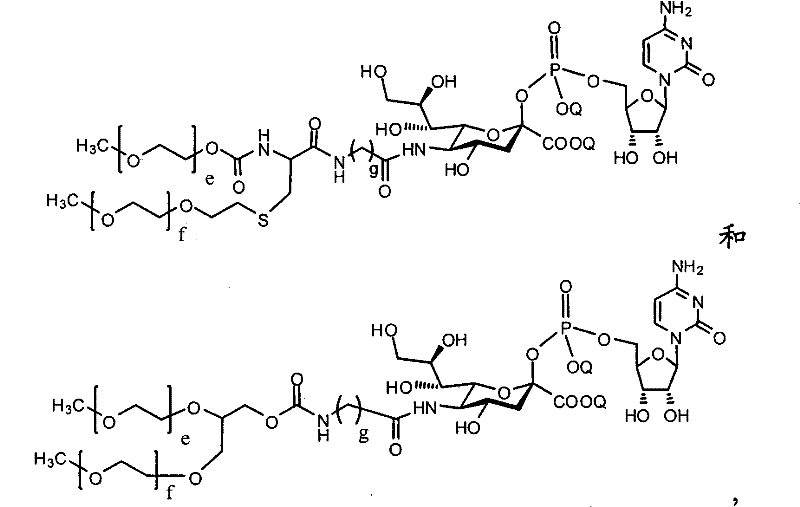
其中e、f和Q在本文上文中定义,并且g是选自1-20的整数。wherein e, f and Q are defined herein above and g is an integer selected from 1-20.
在一个示例性实施方案中,经修饰的糖基于6-氨基-N-乙酰基-糖基部分。如下文方案4中对于N-乙酰半乳糖胺所示,经修饰的糖核苷酸可以使用标准方法容易地制备。In an exemplary embodiment, the modified sugar is based on a 6-amino-N-acetyl-glycosyl moiety. As shown for N-acetylgalactosamine in Scheme 4 below, modified sugar nucleotides can be readily prepared using standard methods.
方案4:示例性经修饰的糖核苷酸的制备 Scheme 4: Preparation of Exemplary Modified Sugar Nucleotides

在上文方案4中,指数n代表0至2500的整数,优选10至1500,并且更加优选10至1200。符号“A”代表活化基团,例如卤素、活化酯(例如,N-羟基琥珀酰亚胺酯)的组分、碳酸酯(例如对硝基苯基碳酸酯)的组分等。本领域技术人员应当理解,其他PEG-酰胺核苷酸糖通过这种方法和类似方法容易地制备。In Scheme 4 above, the index n represents an integer of 0 to 2500, preferably 10 to 1500, and more preferably 10 to 1200. The symbol "A" represents an activating group such as a halogen, a component of an activated ester (eg, N-hydroxysuccinimide ester), a component of a carbonate (eg, p-nitrophenyl carbonate), and the like. Those skilled in the art will appreciate that other PEG-amide nucleotide sugars are readily prepared by this and analogous methods.
在其他示例性实施方案中,酰胺部分由基团例如氨基甲酸乙酯或尿素替换。In other exemplary embodiments, the amide moiety is replaced by a group such as urethane or urea.
在再进一步的实施方案中,R1是分支PEG,例如上文阐述的那些种类之一。根据这个实施方案的举例说明性化合物包括:In yet further embodiments, R 1 is a branched PEG, such as one of those species set forth above. Illustrative compounds according to this embodiment include:
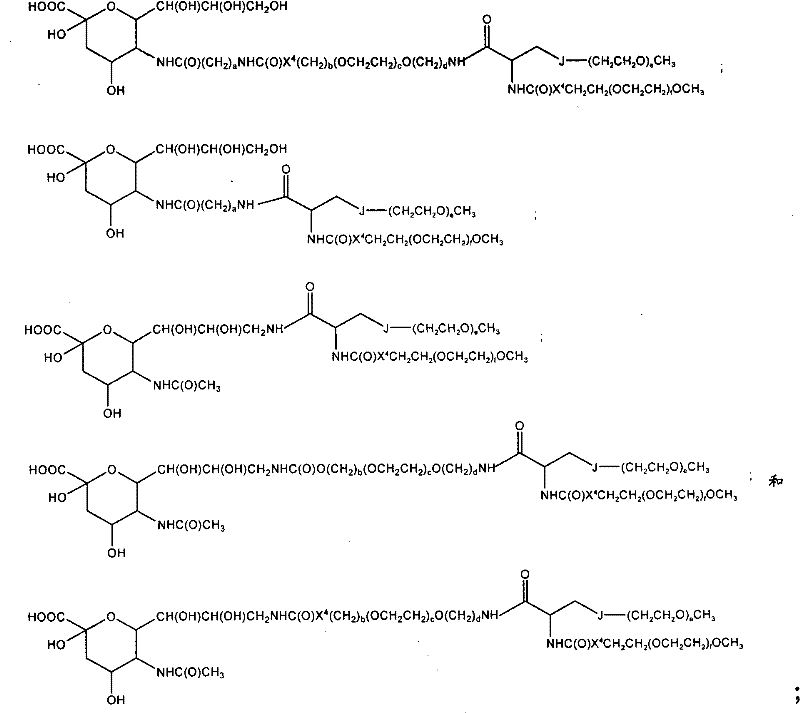
其中X4是键或O,并且J是S或O。where X4 is a bond or O, and J is S or O.
此外,如上所述,本发明提供了用水溶性聚合物修饰的核苷酸糖,所述水溶性聚合物是直链或分支的。例如,具有下文显示的式的化合物在本发明的范围内:Furthermore, as described above, the present invention provides nucleotide sugars modified with water-soluble polymers, which are linear or branched. For example, within the scope of this invention are compounds having the formula shown below:

其中X4是O或键,并且J是S或O。where X4 is O or a bond, and J is S or O.
类似地,本发明提供了使用那些经修饰的糖种类的核苷酸糖形成的多肽缀合物,其中在6-位置处的碳是经修饰的:Similarly, the invention provides polypeptide conjugates formed using nucleotide sugars of those modified sugar species, wherein the carbon at the 6-position is modified:

其中X4是键或O,J是S或O,并且y是0或1。where X4 is a bond or O, J is S or O, and y is 0 or 1.
还提供的是具有下式的多肽和糖肽缀合物:Also provided are polypeptides and glycopeptide conjugates having the formula:
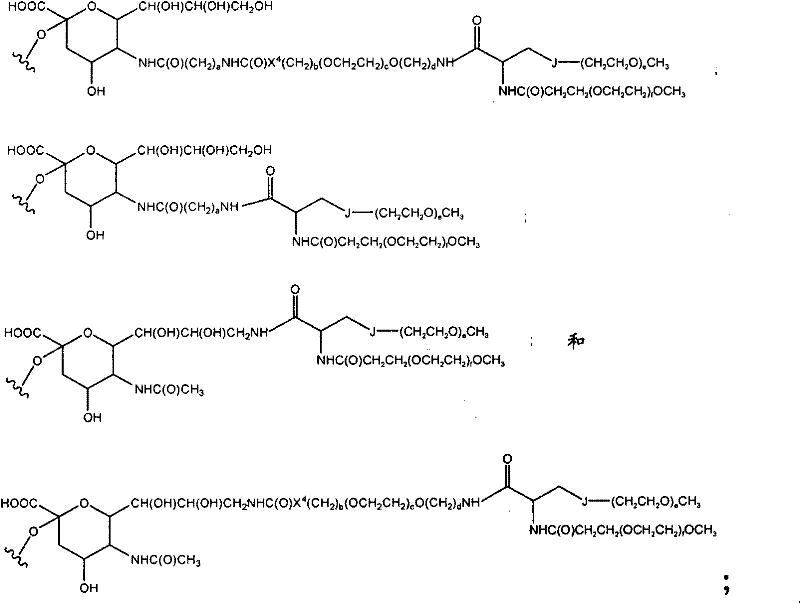
其中J是S或O。where J is S or O.
活化的糖activated sugar
在其他实施方案中,经修饰的糖是活化的糖。在本发明中有用的活化的、经修饰的糖一般是糖苷,其已进行合成改变,以包括离去基团。在一个例子中,活化的糖在酶促反应中用于将活化的糖转移到多肽或糖肽的受体上。在另一个例子中,通过化学方法将活化的糖加入多肽或糖肽中。“离去基团”(或活化基团)指这样的部分,其在酶调节的亲核取代反应中被容易地置换,或备选地在利用亲核反应配偶体(例如,携带巯基的糖基部分)的化学反应中被替换。选择合适的离去基团用于每个类型的反应在技术人员的能力内。许多活化的糖是本领域已知的。参见例如,Vocadlo等人,In CARBOHYDRATE CHEMISTRY AND BIOLOGY,第2卷,Ernst等人编辑,Wiley-VCH Verlag:Weinheim,Germany,2000;Kodama等人,Tetrahedron Lett.34:6419(1993);Lougheed,等人,J.Biol. Chem.274:37717(1999))。In other embodiments, the modified sugar is an activated sugar. Activated, modified sugars useful in the present invention are typically glycosides that have been synthetically altered to include a leaving group. In one example, the activated sugar is used in an enzymatic reaction to transfer the activated sugar to a polypeptide or glycopeptide receptor. In another example, an activated sugar is chemically added to a polypeptide or glycopeptide. "Leaving group" (or activating group) refers to a moiety that is readily displaced in an enzyme-mediated nucleophilic substitution reaction, or alternatively upon the use of a nucleophilic reaction partner (e.g., a sulfhydryl-bearing sugar moiety). Part) is replaced in the chemical reaction. It is within the ability of the skilled person to select an appropriate leaving group for each type of reaction. Many activated sugars are known in the art. See, eg, Vocadlo et al., In C ARBOHYDRATE C HEMISTRY AND B IOLOGY , Vol. 2, edited by Ernst et al., Wiley-VCH Verlag: Weinheim, Germany, 2000; Kodama et al., Tetrahedron Lett. 34:6419 (1993); Lougheed, et al., J. Biol. Chem. 274:37717 (1999)).
离去基团的例子包括卤素(例如,氟、氯、溴)、甲苯磺酸酯、甲磺酸酯、三氟甲磺酸酯等。用于在酶介导的反应中使用的优选的离去基团是不会显著地立体妨碍糖苷酶促转移至受体的离去基团。因此,活化的糖苷衍生物的优选实施方案包括糖基氟化物和糖基甲磺酸盐,其中糖基氟化物是特别优选的。在糖基氟化物中,α-半乳糖基氟化物、α-甘露糖基氟化物、α-葡糖基氟化物、α-岩藻糖基复合物、α-木糖基氟化物、α-唾液酸氟化物、α-N-乙酰葡糖胺氟化物、α-N-乙酰半乳糖胺氟化物、β-半乳糖基氟化物、β-甘露糖基氟化物、β-葡糖基氟化物、β-岩藻糖基复合物、β-木糖基氟化物、β-唾液酸氟化物、β-N-乙酰葡糖胺氟化物和β-N-乙酰半乳糖胺氟化物是最优选的。对于非酶促的亲核取代,这些和其他离去基团可以是有用的。例如,活化的供体糖苷可以是二硝基苯基(DNP)或溴-糖苷。Examples of leaving groups include halogen (eg, fluoro, chloro, bromo), tosylate, mesylate, triflate, and the like. A preferred leaving group for use in an enzyme-mediated reaction is one that does not significantly sterically interfere with the enzymatic transfer of the glycoside to the acceptor. Accordingly, preferred embodiments of activated glycoside derivatives include glycosyl fluorides and glycosyl methanesulfonates, with glycosyl fluorides being particularly preferred. Among the glycosyl fluorides, α-galactosyl fluoride, α-mannosyl fluoride, α-glucosyl fluoride, α-fucosyl complex, α-xylosyl fluoride, α- Sialic acid fluoride, α-N-acetylglucosamine fluoride, α-N-acetylgalactosamine fluoride, β-galactosyl fluoride, β-mannosyl fluoride, β-glucosyl fluoride , β-fucosyl complex, β-xylosyl fluoride, β-sialic acid fluoride, β-N-acetylglucosamine fluoride and β-N-acetylgalactosamine fluoride are most preferred . These and other leaving groups can be useful for non-enzymatic nucleophilic substitutions. For example, the activated donor glycoside can be dinitrophenyl (DNP) or bromo-glycoside.
通过举例说明,通过首先乙酰化并且随后用HF/吡啶处理糖部分,可以由游离糖制备糖基氟化物。这产生受保护的(乙酰化的)糖基氟化物的热力学最稳定的异头物(即,α-糖基氟化物)。如果需要较不稳定的异头物(即,β-糖基氟化物),那么可以通过用HBr/HOAc或HCI转换全乙酰化的(peracetylated)糖产生异头物溴化物或氯化物进行制备。使这种中间产物与氟化盐例如氟化银反应,以产生糖基氟化物。乙酰化的糖基氟化物可以通过在甲醇(例如NaOMe/MeOH)中与弱(催化的)碱反应进行脱保护。此外,许多糖基氟化物是商购可得的。By way of illustration, glycosyl fluorides can be prepared from free sugars by first acetylating and then treating the sugar moiety with HF/pyridine. This yields the thermodynamically most stable anomer of the protected (acetylated) glycosylfluoride (ie, α-glycosylfluoride). If a less stable anomer (ie, β-glycosyl fluoride) is desired, it can be prepared by converting a peracetylated sugar with HBr/HOAc or HCI to produce the anomer bromide or chloride. This intermediate is reacted with a fluoride salt, such as silver fluoride, to produce a glycosyl fluoride. Acetylated glycosyl fluorides can be deprotected by reaction with a weak (catalyzed) base in methanol (eg NaOMe/MeOH). In addition, many glycosyl fluorides are commercially available.
其他活化的糖基衍生物可以使用本领域技术人员已知的常规方法进行制备。例如,通过用甲磺酰氯处理完全苯甲基化的半缩醛形式的糖,随后为催化氢化以去除苯甲基,可以制备糖基甲磺酸盐。Other activated glycosyl derivatives can be prepared using conventional methods known to those skilled in the art. For example, glycosyl mesylate salts can be prepared by treating the fully benzylated hemiacetal form of the sugar with methanesulfonyl chloride, followed by catalytic hydrogenation to remove the benzyl group.
在一个进一步的示例性实施方案中,经修饰的糖是具有触角结构的寡糖。在另一个实施方案中,触角的一个或多个末端具有修饰基团。当超过一个修饰基团与具有触角结构的寡糖附着时,寡糖用于“扩增”修饰基团;与多肽缀合的每个寡糖单位使修饰基团的多个拷贝与多肽附着。如上图中所示的本发明的一般缀合物的一般结构包括起因于利用触角结构制备本发明的缀合物的多价种类。许多触角糖结构是本领域已知的,并且当前方法无限制地用它们进行实践。In a further exemplary embodiment, the modified sugar is an oligosaccharide with an antenna structure. In another embodiment, one or more ends of the antennae have a modifying group. When more than one modifying group is attached to an oligosaccharide with an antenna structure, the oligosaccharide is used to "amplify" the modifying group; each oligosaccharide unit conjugated to the polypeptide has multiple copies of the modifying group attached to the polypeptide. The general structure of the general conjugates of the invention as shown in the figure above includes multivalent species resulting from the use of the antenna structure to prepare the conjugates of the invention. Many antennal glycostructures are known in the art, and current methods are practiced with them without limitation.
经修饰的糖的制备Preparation of Modified Sugars
一般而言,通过使用反应性官能团形成糖部分(包括脂质-焦磷酸盐糖的那些)和修饰基团之间的共价键,所述反应性官能团一般通过连接过程转化到新有机官能团或非反应种类内。为了形成键,修饰基团和糖部分携带互补的反应性官能团。一个或多个反应性官能团可以定位在糖部分上的任何位置处。In general, a covalent bond between the sugar moiety (including those of lipid-pyrophosphate sugars) and the modifying group is formed through the use of a reactive functional group, which is typically converted to a new organic functional group or Within the non-responsive class. For bond formation, the modifying group and the sugar moiety carry complementary reactive functional groups. One or more reactive functional groups can be located anywhere on the sugar moiety.
在实践本发明中有用的反应基团和反应类别一般是生物缀合化学领域中众所周知的那些。对于反应性糖部分可用的目前有利的反应类别是在相对温和的条件下进行的那些。这些包括但不限于亲核取代(例如,胺和醇与酰卤、活性酯的反应)、亲电子取代(例如烯胺反应)和对于碳-碳和碳-杂原子重键的加成(例如,迈克尔(Michael)反应、狄-阿二氏(Diels-Alder)加成)。这些和其他有用的反应在例如March,ADVANCED ORGANIC CHEMISTRY,第3版,John Wiley&Sons,NewYork,1985;Hermanson,BIOCONJUGATE TECHNIQUES,Academic Press,San Diego,1996;和Feeney等人,MODIFICATION OF PROTEINS;Advancesin Chemistry Series,第198卷,American Chemical Society,Washington,D.C.,1982中讨论。Reactive groups and reactive classes useful in practicing the invention are generally those well known in the art of bioconjugation chemistry. A currently favored class of reactions available for reactive sugar moieties are those that proceed under relatively mild conditions. These include, but are not limited to, nucleophilic substitution (e.g., reaction of amines and alcohols with acid halides, active esters), electrophilic substitution (e.g., enamine reaction), and addition to carbon-carbon and carbon-heteroatom heavy bonds (e.g. , Michael (Michael) reaction, Diels-Alder (Diels-Alder) addition). These and other useful responses are found in, for example, March, A DVANCED O RGANIC C HEMISTRY , 3rd Edition, John Wiley & Sons, New York, 1985; Hermanson, B IOCONJUGATE T ECHNIQUES , Academic Press, San Diego, 1996; and Feeney et al., MODIFICATION Discussed in OF P ROTEINS ; Advances in Chemistry Series, Vol. 198, American Chemical Society, Washington, DC, 1982.
反应性官能团reactive functional group
从糖核或修饰基团悬垂的有用的反应性官能团包括但不限于:Useful reactive functional groups pendant from the sugar core or modifying group include, but are not limited to:
(a)羧基及其多种衍生物,包括但不限于,N-羟基琥珀酰亚胺酯、N-羟基苯并三唑酯、酸性卤化物、酰基咪唑、硫酯、对硝基苯基酯、烷基、烯基、炔基和芳香族酯;(a) Carboxyl and its various derivatives, including but not limited to, N-hydroxysuccinimide esters, N-hydroxybenzotriazole esters, acid halides, acyl imidazoles, thioesters, p-nitrophenyl esters , alkyl, alkenyl, alkynyl and aromatic esters;
(b)羟基,其可以转变成例如酯、醚、醛等。(b) Hydroxy groups, which can be converted into eg esters, ethers, aldehydes and the like.
(c)卤烷基,其中卤化物可以随后用亲核基团取代,所述亲核基团例如胺、羧酸阴离子、硫醇阴离子、负碳离子或醇盐离子,从而导致新基团在卤素原子的官能团处的共价附着;(c) Haloalkyl groups, where the halide can subsequently be substituted with a nucleophilic group such as an amine, carboxylate anion, thiolate anion, carbanion or alkoxide ion, resulting in the new group being Covalent attachment at functional groups of halogen atoms;
(d)二烯亲合体基团,其能够参与狄-阿二氏反应例如马来酰亚胺基团;(d) dienophile groups, which are capable of participating in a Di-Aldrich reaction such as a maleimide group;
(e)醛或酮基团,从而使得后续衍生经由形成羰基衍生物例如亚胺、腙、缩氨基脲或肟成为可能,或经由诸如Grignard加成或烷基锂加成的机制成为可能;(e) aldehyde or ketone groups, thereby enabling subsequent derivatization via formation of carbonyl derivatives such as imines, hydrazones, semicarbazones or oximes, or via mechanisms such as Grignard addition or alkyllithium addition;
(f)用于与胺的后续反应的磺酰卤基团,以形成磺胺;(f) a sulfonyl halide group for subsequent reaction with an amine to form a sulfonamide;
(g)硫醇基,其可以例如转变成二硫化物或与酰卤反应;(g) thiol groups, which can for example be converted into disulfides or reacted with acid halides;
(h)胺或巯基,其可以例如进行酰化、烷基化或氧化;(h) amines or mercapto groups, which may, for example, be acylated, alkylated or oxidized;
(i)烯烃,其可以经历例如环加成、酰化、迈克尔加成等;和(i) alkenes, which can undergo, for example, cycloaddition, acylation, Michael addition, etc.; and
(j)环氧化物,其可以与例如胺和羟基化合物反应。(j) Epoxides, which can be reacted with, for example, amines and hydroxyl compounds.
反应性官能团可以这样进行选择,使得它们不参与或干扰装配反应性糖核或修饰基团所需的反应。备选地,反应性官能团可以通过保护基团的存在使免于参与反应。本领域技术人员了解如何保护具体的官能团,从而使得它不干扰所选择的反应条件组。对于有用的保护基团的例子,参见例如,Greene等人,PROTECTIVE GROUPS IN ORGANICSYNTHESIS,John Wiley&Sons,New York,1991。Reactive functional groups can be selected such that they do not participate in or interfere with the reactions required to assemble the reactive sugar core or modifying group. Alternatively, a reactive functional group can be protected from participation in the reaction by the presence of a protecting group. Those skilled in the art know how to protect a particular functional group so that it does not interfere with the chosen set of reaction conditions. For examples of useful protecting groups see, eg, Greene et al., PROTECTIVE G ROUPS IN O RGANIC S YNTHESIS , John Wiley & Sons, New York, 1991.
交联基团Crosslinking group
用于在本发明的方法中使用的经修饰的糖的制备包括修饰基团与糖残基的附着和形成稳定的加合物,所述加合物是糖基转移酶的底物。糖和修饰基团可以通过零或更高级别的交联剂进行偶联。可以用于使修饰基团与碳水化合物部分附着的示例性双功能化合物包括但不限于,双功能聚(乙二醇)、聚酰胺、聚醚、聚酯等。用于使碳水化合物与其他分子交联的一般方法是文献中已知的。参见例如,Lee等人,Biochemistry28:1856(1989);Bhatia等人,Anal.Biochem.178:408(1989);Janda等人,J.Am.Chem.Soc.112:8886(1990)和Bednarski等人,WO 92/18135。在随后的讨论中,在新生的经修饰的糖的糖部分上反应性基团处理为良性的。讨论的焦点是为了举例说明起见。本领域技术人员应当理解讨论同样与修饰基团上的反应基团有关。The preparation of modified sugars for use in the methods of the invention involves the attachment of modifying groups to sugar residues and the formation of stable adducts which are substrates for glycosyltransferases. Sugars and modifying groups can be coupled with zero or higher order crosslinkers. Exemplary bifunctional compounds that can be used to attach modifying groups to carbohydrate moieties include, but are not limited to, bifunctional poly(ethylene glycol), polyamides, polyethers, polyesters, and the like. General methods for crosslinking carbohydrates with other molecules are known in the literature. See, eg, Lee et al., Biochemistry 28: 1856 (1989); Bhatia et al., Anal. Biochem. 178: 408 (1989); Janda et al., J. Am. Chem. Soc. 112: 8886 (1990) and Bednarski et al. people, WO 92/18135. In the discussion that follows, reactive group manipulations on the sugar moieties of nascent modified sugars are benign. The focus of the discussion is for the sake of illustration. Those skilled in the art will appreciate that the discussion also pertains to reactive groups on modifying groups.
多种试剂用于修饰具有分子内化学交联的经修饰的糖的组分(关于交联试剂和交联操作的综述,参见:Wold,F.,Meth.Enzymol.25:623-651,1972;Weetall,H.H.和Cooney,D.A.,In:ENZYMES AS DRUGS.(Holcenberg和Roberts,编辑)第395-442页,Wiley,New York,1981;Ji,T.H.,Meth.Enzymol.91:580-609,1983;Mattson等人,Mol.Biol.Rep.17:167-183,1993,所有这些参考文献通过引用合并入本文)。优选的交联试剂衍生自多种零长度、同双功能和异双功能交联试剂。零长度的交联试剂包括2个固有化学基团的直接缀合而不引入外来材料。催化二硫键形成的试剂属于这个范畴。另一个例子是诱导羧基和伯氨基缩合以形成酰胺键的试剂,例如碳化二亚胺、氯甲酸乙酯、Woodward′s试剂K(2-乙基-5-苯基异噁唑-3′-磺酸盐)和羰基二咪唑。除这些化学试剂外,酶转谷氨酰胺酶(谷氨酰-肽γ-谷氨酰转肽酶;EC2.3.2.13)也可以用作零长度交联试剂。这种酶催化在蛋白质结合的谷氨酰胺酰残基的甲酰胺基团处的酰基转移反应,通常用伯氨基作为底物。优选的同和异双功能试剂分别包含2个等同或2个不同的位点,其可以对于氨基、巯基、胍基、吲哚或非特异性基团反应。A variety of reagents are used to modify components of modified sugars with intramolecular chemical cross-links (for a review of cross-linking reagents and cross-linking procedures, see: Wold, F., Meth. Enzymol. 25:623-651, 1972 ; Weetall, HH and Cooney, DA, In: E NZYMES AS D RUGS . (Holcenberg and Roberts, eds.) pp. 395-442, Wiley, New York, 1981; Ji, TH, Meth. Enzymol. 91:580-609 , 1983; Mattson et al., Mol. Biol. Rep. 17:167-183, 1993, all of which are incorporated herein by reference). Preferred crosslinking reagents are derived from a variety of zero-length, homobifunctional and heterobifunctional crosslinking reagents. Zero-length cross-linking reagents involve the direct conjugation of 2 intrinsic chemical groups without introducing foreign materials. Reagents that catalyze disulfide bond formation fall into this category. Another example is a reagent that induces the condensation of a carboxyl group and a primary amino group to form an amide bond, such as carbodiimide, ethyl chloroformate, Woodward's reagent K (2-ethyl-5-phenylisoxazole-3'- Sulfonate) and carbonyldiimidazole. In addition to these chemical reagents, the enzyme transglutaminase (glutamyl-peptide γ-glutamyl transpeptidase; EC 2.3.2.13) can also be used as a zero-length crosslinking reagent. This enzyme catalyzes an acyl transfer reaction at the carboxamide group of a protein-bound glutaminyl residue, usually using a primary amino group as a substrate. Preferred homo- and hetero-bifunctional reagents contain 2 equivalent or 2 different sites, respectively, which can react with amino, sulfhydryl, guanidino, indole or non-specific groups.
除使用位点特异性反应部分外,本发明考虑了非特异性反应基团的使用,以使糖与修饰基团连接。In addition to the use of site-specific reactive moieties, the present invention contemplates the use of non-specific reactive groups to link sugars to modifying groups.
示例性非特异性交联剂包括在黑暗中完全惰性的光激活基团,其在吸收合适能量的光子后转变成反应种类。在一个实施方案中,光激活基团选自在叠氮化物加热或光解后产生的氮烯的前体。缺电子的氮烯是极端反应性的,并且可以与多种化学键反应,包括N-H、O-H、C-H和C=C。尽管可以采用3种类型的叠氮化物(芳基、烷基和芳基衍生物),但酰基叠氮化物是目前。芳基叠氮化物在光解后的反应性对于N-H和O-H优于C-H键。缺电子的芳基氮烯快速环扩展以形成脱氢吖庚因(dehydroazepines),其趋于与亲核体反应,而不是形成C-H插入产物。芳基叠氮化物的反应性可以通过环中的吸电子取代物例如硝基或羟基的存在得到增加。此类取代物将芳基叠氮化物的最大吸收推至较长波长。未取代的芳基叠氮化物具有在260-280nm范围中的最大吸收,而羟基和硝基芳基叠氮化物吸收超过305nm的显著光。因此,羟基和硝基芳基叠氮化物是最优选的,因为它们允许采用比未取代的芳基叠氮化物更不有害的光解条件用于亲和组分。Exemplary non-specific crosslinkers include photoactivatable groups that are completely inert in the dark, which convert to reactive species upon absorption of a photon of appropriate energy. In one embodiment, the photoactive group is selected from the precursors of nitrenes generated upon heating or photolysis of azides. Electron-deficient nitrenes are extremely reactive and can react with a variety of chemical bonds, including N-H, O-H, C-H, and C=C. Although 3 types of azides (aryl, alkyl and aryl derivatives) can be employed, acyl azides are present. The reactivity of aryl azides after photolysis is better for N–H and O–H bonds than for C–H bonds. Electron-deficient arylazenes undergo rapid ring expansion to form dehydroazepines, which tend to react with nucleophiles rather than form C-H insertion products. The reactivity of aryl azides can be enhanced by the presence of electron-withdrawing substituents such as nitro or hydroxyl groups in the ring. Such substituents push the absorption maximum of arylazides to longer wavelengths. Unsubstituted arylazides have absorption maxima in the 260-280 nm range, while hydroxyl and nitroarylazides absorb significant light beyond 305 nm. Therefore, hydroxy and nitroarylazides are most preferred because they allow the use of less deleterious photolysis conditions for the affinity component than unsubstituted arylazides.
在另外一个进一步的实施方案中,提供了具有这样的基团的连接体基团,所述基团可以进行切割,以释放来自糖残基的修饰基团。许多可切割的基团是本领域已知的。参见例如,Jung等人,Biochem.Biophys.Acta 761:152-162(1983);Joshi等人,J.Biol.Chem.265:14518-14525(1990);Zarling等人,J.Immunol.124:913-920(1980);Bouizar等人,Eur.J.Biochem.155:141-147(1986);Park等人,J.Biol.Chem.261:205-210(1986);Browning等人,J.Immunol.143:1859-1867(1989)。此外,广泛范围的可切割的、双功能(同和异双功能的)连接体基团从供应商例如Pierce商购可得。In yet a further embodiment, there is provided a linker group having a group that can be cleaved to release the modifying group from the sugar residue. Many cleavable groups are known in the art. See, eg, Jung et al., Biochem. Biophys. Acta 761: 152-162 (1983); Joshi et al., J. Biol. Chem. 265: 14518-14525 (1990); Zarling et al., J. Immunol. 124: 913-920 (1980); Bouizar et al., Eur.J.Biochem.155:141-147 (1986); Park et al., J.Biol.Chem.261:205-210 (1986); Browning et al., J. . Immunol. 143:1859-1867 (1989). In addition, a wide range of cleavable, bifunctional (homo- and heterobifunctional) linker groups are commercially available from suppliers such as Pierce.
示例性可切割部分可以使用光、热或试剂例如硫醇、羟胺、碱、高碘酸盐等进行切割。此外,特定的优选基团在体内响应内吞而被切割(例如,顺式-乌头;参见Shen等人,Biochem.Biophys.Res.Commun.102:1048(1991))。优选的可切割基团包括可切割部分,其是选自二硫化物、酯、酰亚胺、碳酸酯、硝基苯甲基、苯甲酰甲基和苯偶姻基团的成员。Exemplary cleavable moieties can be cleaved using light, heat, or reagents such as thiols, hydroxylamine, bases, periodates, and the like. Furthermore, certain preferred groups are cleaved in vivo in response to endocytosis (eg, cis-aconitum; see Shen et al., Biochem. Biophys. Res. Commun. 102:1048 (1991 )). Preferred cleavable groups include cleavable moieties that are members selected from the group consisting of disulfide, ester, imide, carbonate, nitrobenzyl, phenacyl and benzoin groups.
在下文讨论中,阐述了在实践本发明中有用的经修饰的糖的许多特别例子。在示例性实施方案中,唾液酸衍生物用作修饰基团与之附着的糖核。关于唾液酸衍生物的讨论焦点仅为了举例说明起见,并且不应解释为限制本发明的范围。本领域技术人员应当理解,以类似于使用唾液酸作为例子阐述的方式可以活化且衍生多种其他糖部分。例如,众多方法可用于修饰半乳糖、葡萄糖、N-乙酰半乳糖胺和岩藻糖,以列举少数糖底物,其通过领域公认的方法容易地进行修饰。参见例如,Elhalabi等人,Curr.Med.Chem.6:93(1999)和Schafer等人,J.Org.Chem.65:24(2000)。In the discussion below, a number of specific examples of modified sugars useful in practicing the invention are set forth. In an exemplary embodiment, a sialic acid derivative is used as the sugar core to which the modifying group is attached. The focus of the discussion on sialic acid derivatives is for illustrative purposes only and should not be construed as limiting the scope of the invention. Those skilled in the art will appreciate that a variety of other sugar moieties can be activated and derivatized in a manner similar to that set forth using sialic acid as an example. For example, numerous methods are available for modifying galactose, glucose, N-acetylgalactosamine, and fucose, to name a few sugar substrates, which are readily modified by art-recognized methods. See, eg, Elhalabi et al., Curr. Med. Chem. 6:93 (1999) and Schafer et al., J. Org. Chem. 65:24 (2000).
在一个示例性实施方案中,通过本发明的方法修饰的多肽是糖肽,其在原核细胞(例如,大肠杆菌)、真核细胞包括酵母和哺乳动物细胞(例如,CHO细胞)中,或在转基因动物中产生,并且因此包含不完全唾液酸化的N联和/或O联寡糖链。缺乏唾液酸且包含末端半乳糖残基的糖肽的寡糖链可以是糖基PEG化的、糖基PPG化的或以其他方式用经修饰的唾液酸修饰的。In an exemplary embodiment, the polypeptide modified by the method of the invention is a glycopeptide that is expressed in prokaryotic cells (e.g., E. coli), eukaryotic cells including yeast and mammalian cells (e.g., CHO cells), or in produced in transgenic animals and thus contain incompletely sialylated N-linked and/or O-linked oligosaccharide chains. The oligosaccharide chain of the glycopeptide lacking sialic acid and comprising a terminal galactose residue may be glycoPEGylated, glycoPPGylated or otherwise modified with a modified sialic acid.
在方案5中,氨基糖苷1用受保护的氨基酸(例如,甘氨酸)衍生物的活性酯进行处理,将糖胺残基转变成相对应的受保护的氨基酸酰胺加合物。加合物用醛缩酶进行处理,以形成α-羟基羧酸盐2。化合物2通过CMP-SA合成酶的作用转变成相对应的CMP衍生物,随后为CMP衍生物的催化氢化以产生化合物3。通过使化合物3与活化的(m-)PEG或(m-)PPG衍生物(例如,PEG-C(O)NHS、PPG-C(O)NHS)反应,经由形成甘氨酸加合物引入的胺用作PEG或PPG附着的部位,分别产生4或5。In
方案5
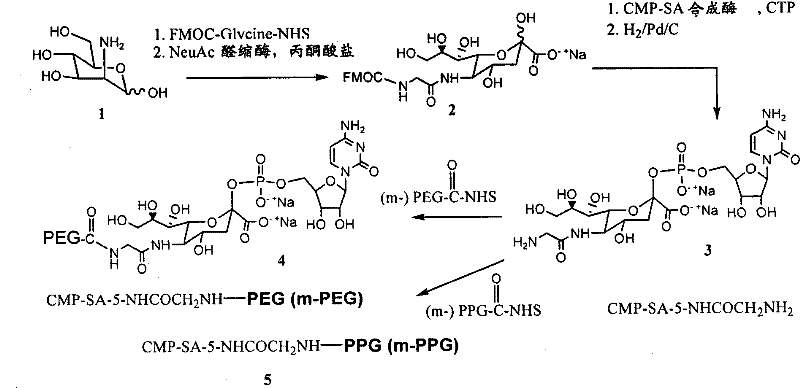
下表11阐述了用PEG或PPG部分衍生的糖单磷酸盐的代表性例子。表2的特定化合物通过方案4的方法进行制备。其他衍生物通过领域公认的方法进行制备。参见例如,Keppler等人,Glycobiology 11:11R(2001);和Charter等人,Glycobiology 10:1049(2000))。其他胺反应性PEG和PPG类似物是商购可得的,或它们可以通过本领域技术人员容易获得的方法进行制备。Table 11 below sets forth representative examples of sugar monophosphates derivatized with PEG or PPG moieties. Specific compounds of Table 2 were prepared by the method of Scheme 4. Other derivatives are prepared by art recognized methods. See, eg, Keppler et al., Glycobiology 11:11R (2001); and Charter et al., Glycobiology 10:1049 (2000)). Other amine-reactive PEG and PPG analogs are commercially available, or they can be prepared by methods readily available to those skilled in the art.
表11:用PEG或PPG衍生的糖单磷酸盐的例子 Table 11: Examples of sugar monophosphates derivatized with PEG or PPG


在实践本发明中使用的经修饰的糖磷酸盐可以在其他位置以及上文所述的那些中进行置换。唾液酸的目前优选的置换在式(VIII)中阐述:The modified sugar phosphates used in practicing the invention may be substituted at other positions as well as those described above. A presently preferred substitution of sialic acid is illustrated in formula (VIII):
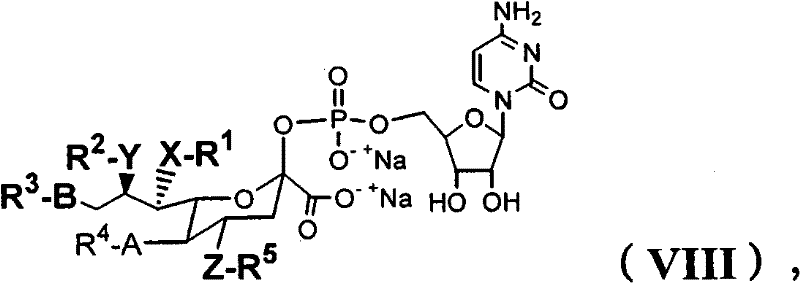
其中X是连接基团,其优选选自-O-、-N(H)-、-S、CH2-和-N(R)2,其中每个R是独立地选自R1-R5的成员。符号Y、Z、A和B各自代表选自上文对于X的特性阐述的基团。X、Y、Z、A和B各自独立地选择,并且因此它们可以是相同或不同的。符号R1、R2、R3、R4和R5代表H、水溶性聚合物、治疗性部分、生物分子或其他部分。备选地,这些符号代表与水溶性聚合物、治疗性部分、生物分子或其他部分结合的连接体。wherein X is a linking group preferably selected from -O-, -N(H)-, -S, CH2- and -N(R) 2 , wherein each R is independently selected from R1 - R5 a member of. The symbols Y, Z, A and B each represent a group selected from the groups set forth above for the identity of X. X, Y, Z, A and B are each independently selected, and thus they may be the same or different. The symbols R 1 , R 2 , R 3 , R 4 and R 5 represent H, water soluble polymers, therapeutic moieties, biomolecules or other moieties. Alternatively, these symbols represent linkers to water soluble polymers, therapeutic moieties, biomolecules or other moieties.
与本文公开的缀合物附着的示例性部分包括但不限于,PEG衍生物,(例如,烷基-PEG、酰基-PEG、酰基-烷基-PEG、烷基-酰基-PEG、氨甲酰基-PEG、芳基-PEG)、PPG衍生物(例如,烷基-PPG、酰基-PPG、酰基-烷基-PPG、烷基-酰基-PPG、氨甲酰基-PPG、芳基-PPG)、治疗性部分、诊断性部分、甘露糖-6-磷酸盐、肝素、类肝素、SLex、甘露糖、甘露糖-6-磷酸盐、Sialyl Lewis X、FGF、VFGF、蛋白质、软骨素、角质素、皮肤素、白蛋白、整联蛋白、触角寡糖、肽等。使多种修饰基团与糖部分缀合的方法是本领域技术人员容易获得的(POLY(ETHYLENEGLYCOL CHEMISTRY:BIOTECHNICAL AND BIOMEDICAL APPLICATIONS,J.Milton Harris,编辑,Plenum Pub.Corp.,1992;POLY(ETHYLENEGLYCOL)CHEMICAL AND BIOLOGICAL APPLICATIONS,J.Milton Harris,编辑,ACS Symposium Series No.680,American Chemical Society,1997;Hermanson,BIOCONJUGATE TECHNIQUES,Academic Press,SanDiego,1996;和Dunn等人,编辑POLYMERIC DRUGS AND DRUGDELIVERY SYSTEMS,ACS Symposium Series第469卷,AmericanChemical Society,Washington,D.C.1991)。Exemplary moieties attached to the conjugates disclosed herein include, but are not limited to, PEG derivatives, (e.g., alkyl-PEG, acyl-PEG, acyl-alkyl-PEG, alkyl-acyl-PEG, carbamoyl -PEG, aryl-PEG), PPG derivatives (e.g., alkyl-PPG, acyl-PPG, acyl-alkyl-PPG, alkyl-acyl-PPG, carbamoyl-PPG, aryl-PPG), Therapeutic portion, Diagnostic portion, Mannose-6-Phosphate, Heparin, Heparanoid, SLex, Mannose, Mannose-6-Phosphate, Sialyl Lewis X, FGF, VFGF, Protein, Chondroitin, Keratin, Dermatin, albumin, integrin, antennal oligosaccharides, peptides, etc. Methods for conjugating a variety of modifying groups to sugar moieties are readily available to those skilled in the art ( POLY (E THYLENE G LYCOL C HEMISTRY : B IOTECHNICAL AND B IOMEDICAL A PPLICATIONS , J. Milton Harris, ed., Plenum Pub. Corp., 1992; POLY (E THYLENE G LYCOL ) C HEMICAL AND B IOLOGICAL A PPLICATIONS , J. Milton Harris, editor, ACS Symposium Series No.680, American Chemical Society, 1997; Hermanson, B IOCONJUGATE T ECHNIQUES , Academic Press, San Diego, 1996; and Dunn et al., eds . POLYMERIC D RUGS A ND D RUG D ELIVERY S YSTEMS , ACS Symposium Series Vol. 469, American Chemical Society, Washington, DC 1991).
示例性策略涉及使用异双功能交联剂SPDP(n-琥珀酰亚胺酰-3-(2-吡啶二硫代)丙酸盐将受保护的巯基掺入糖上,并且随后使巯基脱保护用于与修饰基团上的另一个巯基形成二硫键。An exemplary strategy involves incorporation of protected thiols onto sugars using the heterobifunctional cross-linker SPDP (n-succinimidyl-3-(2-pyridyldithio)propionate) and subsequent deprotection of the thiols Used to form a disulfide bond with another sulfhydryl group on the modifying group.
如果SPDP有害地影响经修饰的糖充当糖基转移酶底物的能力,那么许多其他交联剂之一例如2-亚氨基硫烷盐或N-琥珀酰亚胺基S-乙酰硫代乙酸酯(SATA)用于形成二硫键。2-亚氨基硫烷盐与伯胺反应,立即将未受保护的巯基掺入含胺分子上。SATA也与伯胺反应,但掺入受保护的巯基,其随后使用羟胺脱乙酰化以产生游离巯基。在每种情况下,所掺入的巯基自由地与其他巯基或受保护的巯基反应,如SPDP,形成所需二硫键。If SPDP deleteriously affects the ability of the modified sugar to serve as a substrate for glycosyltransferases, then one of many other crosslinkers such as 2-iminosulfanyl salt or N-succinimidyl S-acetylthioacetic acid Esters (SATA) are used to form disulfide bonds. Reaction of 2-iminosulfanyl salts with primary amines immediately incorporates an unprotected sulfhydryl group onto the amine-containing molecule. SATA also reacts with primary amines, but incorporates protected thiols, which are subsequently deacetylated using hydroxylamine to yield free thiols. In each case, the incorporated thiols are free to react with other thiols or protected thiols, such as SPDP, to form the desired disulfide bonds.
上述策略对于在本发明中使用的连接体是示例性的,并且不是限制性的。可以在用于使修饰基团与多肽交联的不同策略中使用的其他交联剂是可用的。例如,TPCH(S-(2-硫代吡啶)-L-半胱氨酸酰肼和TPMPH((S-(2-硫代吡啶)硫氢基-丙酰肼)与碳水化合物部分反应,所述碳水化合物部分先前已通过弱高碘酸盐处理进行氧化,从而形成在交联剂的酰肼部分和高碘酸盐产生的醛之间的腙键。TPCH和TPMPH将受2-吡啶硫酮(pyridylthione)保护的巯基引入糖上,其可以用DTT脱保护并且随后用于缀合,例如在组分之间形成二硫键。The strategies described above are exemplary, and not limiting, of the linkers used in the present invention. Other crosslinking agents are available that can be used in different strategies for crosslinking modifying groups to polypeptides. For example, TPCH (S-(2-thiopyridine)-L-cysteine hydrazide and TPMPH ((S-(2-thiopyridine)sulfhydryl-propionyl hydrazide) react with carbohydrate moieties, so The carbohydrate moiety has previously been oxidized by weak periodate treatment, thereby forming a hydrazone bond between the hydrazide moiety of the crosslinker and the periodate-generated aldehyde. TPCH and TPMPH will be oxidized by 2-pyridinethione (pyridylthione)-protected sulfhydryl groups are introduced onto sugars, which can be deprotected with DTT and subsequently used for conjugation, eg, to form disulfide bonds between components.
如果发现二硫键合不适合于产生稳定的经修饰的糖,那么可以使用其他交联剂,其在组分之间掺入更稳定的键。异双功能交联剂GMBS(N-γ-马来酰亚胺丁酰氧)琥珀酰亚胺)和SMCC(琥珀酰亚胺酰4-(N-马来酰亚胺-甲基)环己烷)与伯胺反应,因此将马来酰亚胺基团引入组分上。马来酰亚胺基团随后可以与其他组分上的巯基反应,所述巯基可以通过先前提及的交联剂引入,因此在组分之间形成稳定的硫醚键。如果在组分之间的立体阻碍干扰任一组分的活性或经修饰的糖充当糖基转移酶底物的能力,那么可以使用这样的交联剂,其在组分之间引入长间隔臂,并且包括某些先前提及的交联剂的衍生物(即,SPDP)。因此,存在大量合适的有用的交联剂;所述交联剂各自依赖于它对最佳多肽缀合物和经修饰的糖产生的作用进行选择。If disulfide bonding is found to be unsuitable to produce stable modified sugars, other cross-linking agents can be used which incorporate more stable linkages between the components. Heterobifunctional crosslinkers GMBS (N-γ-maleimide butyryloxy) succinimide) and SMCC (succinimidyl 4-(N-maleimide-methyl)cyclohexane alkanes) react with primary amines, thus introducing maleimide groups onto the components. The maleimide groups can then react with sulfhydryl groups on other components, which can be introduced by the previously mentioned crosslinkers, thus forming stable thioether linkages between the components. If steric hindrance between the components interferes with the activity of either component or the ability of the modified sugar to serve as a substrate for a glycosyltransferase, then a cross-linker that introduces a long spacer between the components can be used , and include derivatives of certain previously mentioned crosslinkers (ie, SPDP). Thus, there is a large number of suitable useful cross-linking agents; each of which is selected depending on its effect on optimal Polypeptide Conjugate and Modified Sugar production.
多种试剂用于修饰具有分子内化学交联的经修饰的糖的组分(关于交联试剂和交联操作的综述,参见:Wold,F.,Meth.Enzymol.25:623-651,1972;Weetall,H.H.和Cooney,D.A.,In:ENZYMES AS DRUGS.(Holcenberg和Roberts,编辑)第395-442页,Wiley,New York,1981;Ji,T.H.,Meth.Enzymol. 91:580-609,1983;Mattson等人,Mol. Biol. Rep.17:167-183,1993,所有这些参考文献通过引用合并入本文)。优选的交联试剂衍生自多种零长度、同双功能和异双功能交联试剂。零长度的交联试剂包括2个固有化学基团的直接缀合而不引入外来材料。催化二硫键形成的试剂属于这个范畴。另一个例子是诱导羧基和伯氨基缩合以形成酰胺键的试剂,例如碳化二亚胺、氯甲酸乙酯、Woodward′s试剂K(2-乙基-5-苯基异噁唑-3′-磺酸盐)和羰基二咪唑。除这些化学试剂外,酶转谷氨酰胺酶(谷氨酰-肽γ-谷氨酰转肽酶;EC2.3.2.13)也可以用作零长度交联试剂。这种酶催化在蛋白质结合的谷氨酰胺酰残基的甲酰胺基团处的酰基转移反应,通常用伯氨基作为底物。优选的同和异双功能试剂分别包含2个等同或2个不同的位点,其可以对于氨基、巯基、胍基、吲哚或非特异性基团反应。A variety of reagents are used to modify components of modified sugars with intramolecular chemical cross-links (for a review of cross-linking reagents and cross-linking procedures, see: Wold, F., Meth. Enzymol. 25:623-651, 1972 ; Weetall, H.H. and Cooney, D.A., In: ENZYMES AS DRUGS. (Holcenberg and Roberts, eds.) pp. 395-442, Wiley, New York, 1981; Ji, T.H., Meth. Enzymol. 91:580-609, 1983 ; Mattson et al., Mol. Biol. Rep. 17:167-183, 1993, all of which are incorporated herein by reference). Preferred crosslinking reagents are derived from a variety of zero-length, homobifunctional and heterobifunctional crosslinking reagents. Zero-length cross-linking reagents involve the direct conjugation of 2 intrinsic chemical groups without introducing foreign materials. Reagents that catalyze disulfide bond formation fall into this category. Another example is a reagent that induces the condensation of a carboxyl group and a primary amino group to form an amide bond, such as carbodiimide, ethyl chloroformate, Woodward's reagent K (2-ethyl-5-phenylisoxazole-3'- Sulfonate) and carbonyldiimidazole. In addition to these chemical reagents, the enzyme transglutaminase (glutamyl-peptide γ-glutamyl transpeptidase; EC 2.3.2.13) can also be used as a zero-length crosslinking reagent. This enzyme catalyzes an acyl transfer reaction at the carboxamide group of a protein-bound glutaminyl residue, usually using a primary amino group as a substrate. Preferred homo- and hetero-bifunctional reagents contain 2 equivalent or 2 different sites, respectively, which can react with amino, sulfhydryl, guanidino, indole or non-specific groups.
在交联试剂中优选的特异位点Preferred specific sites in cross-linking reagents
1.氨基反应性基团 1. Amino reactive group
在一个实施方案中,交联剂上的位点是氨基反应性基团。有用的氨基反应性基团的非限制性例子包括N-羟基琥珀酰亚胺(NHS)酯、酰亚胺酯、异氰酸酯、酰卤、芳基叠氮化物、对硝基苯基酯、醛和磺酰氯。In one embodiment, the sites on the crosslinker are amino reactive groups. Non-limiting examples of useful amino-reactive groups include N-hydroxysuccinimide (NHS) esters, imide esters, isocyanates, acid halides, aryl azides, p-nitrophenyl esters, aldehydes, and Sulfonyl chloride.
NHS酯优先与经修饰的糖组分的伯(包括芳香族)氨基反应。已知组氨酸的咪唑基与伯胺竞争反应,但反应产物是不稳定的且容易水解。反应涉及NHS酯上的酸性羧基上的胺的亲核攻击,以形成酰胺,释放N-羟基琥珀酰亚胺。因此,原始氨基的正电荷丧失。NHS esters react preferentially with primary (including aromatic) amino groups of modified sugar components. It is known that the imidazole group of histidine competes with primary amines, but the reaction products are unstable and easily hydrolyzed. The reaction involves nucleophilic attack of the amine on the acidic carboxyl group on the NHS ester to form an amide, releasing N-hydroxysuccinimide. Therefore, the positive charge of the original amino group is lost.
酰亚胺酯是用于与经修饰的糖组分的氨基反应的最特异的酰化试剂,在7至10的pH下,酰亚胺酯仅与伯胺反应。伯胺亲核攻击亚氨酸酯以产生中间产物,所述中间产物在高pH下分解为脒或在低pH下分解为新亚氨酸酯。新亚氨酸酯可以与另一个伯胺反应,因此使2个氨基交联,假定的单功能亚氨酸酯双功能反应的情况。与伯胺反应的主产物是脒,所述脒是比原始胺更强的碱。原始氨基的正电荷因此被保留。Imide esters are the most specific acylating reagents for reacting with amino groups of modified sugar components, and at
异氰酸酯(和异硫氰酸酯)与经修饰的糖组分的伯胺反应,以形成稳定的键。它们与巯基、咪唑和酪氨酰基的反应得到相对不稳定的产物。Isocyanates (and isothiocyanates) react with the primary amines of the modified sugar components to form stable linkages. Their reactions with thiols, imidazoles, and tyrosyl groups give relatively unstable products.
酰叠氮化物也用作氨基特异性试剂,其中亲和组分的亲核胺在微碱性的条件例如pH 8.5下攻击酸性羧基。Acylazides are also used as amino-specific reagents, where the nucleophilic amine of the affinity component attacks the acidic carboxyl group under slightly basic conditions such as pH 8.5.
芳基卤例如1,5-二氟-2,4-二硝基苯优先与经修饰的糖组分的氨基和酪氨酸酚基反应,也与巯基和咪唑基反应。Aryl halides such as 1,5-difluoro-2,4-dinitrobenzene react preferentially with amino and tyrosine phenolic groups of modified sugar components, and also with sulfhydryl and imidazole groups.
单和二羧酸的对硝基苯基酯也是有用的氨基反应性基团。尽管试剂特异性不是非常高,但α-和ε-氨基看起来最快速地反应。The p-nitrophenyl esters of mono- and dicarboxylic acids are also useful amino-reactive groups. Although the reagent specificity is not very high, the α- and ε-amino groups appear to react most rapidly.
醛例如戊二醛与经修饰的糖的伯胺反应。尽管在氨基与醛的醛反应后形成不稳定的希夫碱,但戊二醛能够修饰具有稳定交联的经修饰的糖。在pH 6-8下,一般的交联条件的pH,环状聚合物经历脱水,以形成α-β不饱和的醛聚合物。然而,当与另一个双键缀合时,希夫碱是稳定的。2个双键的共振相互作用阻止希夫连接的水解。此外,在高局部浓度下的胺可以攻击烯双键,以形成稳定的迈克尔加成产物。Aldehydes such as glutaraldehyde react with the primary amines of the modified sugars. Although unstable Schiff bases are formed after the aldehyde reaction of amino groups with aldehydes, glutaraldehyde is able to modify modified sugars with stable crosslinks. At pH 6-8, the pH typical of crosslinking conditions, the cyclic polymer undergoes dehydration to form an α-β unsaturated aldehyde polymer. However, Schiff bases are stable when conjugated to another double bond. The resonant interaction of the 2 double bonds prevents the hydrolysis of the Schiff linkage. Furthermore, amines at high local concentrations can attack ene double bonds to form stable Michael addition products.
芳香族磺酰氯与经修饰的糖组分的多种位点反应,但与氨基的反应是最重要的,导致稳定的磺胺连接。Aromatic sulfonyl chlorides react with a variety of sites on the modified sugar component, but the reaction with the amino group is the most important, leading to a stable sulfonamide linkage.
2.巯基反应性基团 2. Thiol-reactive groups
在另一个实施方案中,位点是巯基反应性基团。有用的巯基反应性基团的非限制性例子包括马来酰亚胺、烷基卤、吡啶基二硫化物和硫代苯邻二甲酰亚胺(thiophthalimides)。In another embodiment, the site is a sulfhydryl reactive group. Non-limiting examples of useful thiol-reactive groups include maleimides, alkyl halides, pyridyl disulfides, and thiophthalimides.
马来酰亚胺优先与经修饰的糖组分的巯基反应,以形成稳定的硫醚键。它们还以慢得多的速率与组氨酸的伯氨基和咪唑基反应。然而,在pH 7下,马来酰亚胺基团可以视为巯基特异性基团,因为在这个pH下,简单硫醇的反应速率是相对应的胺的反应速率的1000倍。Maleimides react preferentially with the sulfhydryl groups of the modified sugar components to form stable thioether linkages. They also react at a much slower rate with the primary and imidazole groups of histidine. However, at
烷基卤与巯基、硫化物、咪唑和氨基反应。然而,在中性至微碱性pH下,烷基卤主要与巯基反应,以形成稳定的硫醚键。在较高的pH下,与氨基的反应是有利的。Alkyl halides react with mercaptos, sulfides, imidazoles, and amino groups. However, at neutral to slightly alkaline pH, alkyl halides react primarily with sulfhydryl groups to form stable thioether linkages. At higher pH, the reaction with amino groups is favored.
吡啶基二硫化物经由二硫化物交换与游离巯基反应,以得到混合的二硫化物。因此,吡啶基二硫化物是最特异的巯基反应性基团。Pyridyl disulfides react with free thiols via disulfide exchange to give mixed disulfides. Thus, pyridyl disulfides are the most specific sulfhydryl-reactive groups.
硫代苯邻二甲酰亚胺与游离的巯基反应,以形成二硫化物。Thiophthalimide reacts with free sulfhydryl groups to form disulfides.
3.羧基反应性残基 3. Carboxyl Reactive Residues
在另一个实施方案中,在水和有机溶剂中都可溶的碳化二亚胺用作羧基反应性试剂。这些化合物与游离的羧基反应,形成假尿素,所述假尿素随后可以与可用的胺偶联,得到酰胺连接,如何用碳化二亚胺修饰羧基的教导(Yamada等人,Biochemistry 20:4836-4842,1981)。In another embodiment, carbodiimides soluble in both water and organic solvents are used as carboxyl-reactive reagents. These compounds react with free carboxyl groups to form pseudoureas, which can then be coupled with available amines to give amide linkages, teaching how to modify carboxyl groups with carbodiimides (Yamada et al., Biochemistry 20:4836-4842 , 1981).
在交联试剂中优选的非特异位点Preferred non-specific sites in cross-linking reagents
除使用位点特异性的反应性部分外,本发明还考虑了使糖与修饰基团连接的非特异性反应性基团的使用。In addition to the use of site-specific reactive moieties, the present invention also contemplates the use of non-specific reactive groups to link the sugar to the modifying group.
示例性非特异性交联剂包括在黑暗中完全惰性的光激活基团,其在吸收合适能量的光子后转变成反应性种类。在一个实施方案中,光激活基团选自在对叠氮化物加热或光解后产生的氮烯的前体。缺电子的氮烯是极端反应性的,并且可以与多种化学键反应,包括N-H、O-H、C-H和C=C。尽管可以采用3种类型的叠氮化物(芳基、烷基和芳基衍生物),但酰基叠氮化物是目前。芳基叠氮化物在光解后的反应性对于N-H和O-H优于C-H键。缺电子的芳基氮烯快速环扩展以形成脱氢氮杂,其趋于与亲核体反应,而不是形成C-H插入产物。芳基叠氮化物的反应性可以通过环中的吸电子取代物例如硝基或羟基的存在得到增加。此类取代物将芳基叠氮化物的最大吸收推至较长波长。未取代的芳基叠氮化物具有在260-280nm范围中的最大吸收,而羟基和硝基芳基叠氮化物吸收超过305nm的显著光。因此,羟基和硝基芳基叠氮化物是最优选的,因为它们允许采用比未取代的芳基叠氮化物更不有害的光解条件用于亲和组分。Exemplary non-specific crosslinkers include photoactivatable groups that are completely inert in the dark, which convert to reactive species upon absorption of a photon of appropriate energy. In one embodiment, the photoactivatable group is selected from precursors of nitrenes produced upon heating or photolysis of azides. Electron-deficient nitrenes are extremely reactive and can react with a variety of chemical bonds, including N-H, O-H, C-H, and C=C. Although 3 types of azides (aryl, alkyl and aryl derivatives) can be employed, acyl azides are present. The reactivity of aryl azides after photolysis is better for N–H and O–H bonds than for C–H bonds. Electron-deficient arylazenes undergo rapid ring expansion to form dehydroazepines, which tend to react with nucleophiles rather than form C–H insertion products. The reactivity of aryl azides can be enhanced by the presence of electron-withdrawing substituents such as nitro or hydroxyl groups in the ring. Such substituents push the absorption maximum of arylazides to longer wavelengths. Unsubstituted arylazides have absorption maxima in the 260-280 nm range, while hydroxyl and nitroarylazides absorb significant light beyond 305 nm. Therefore, hydroxy and nitroarylazides are most preferred because they allow the use of less deleterious photolysis conditions for the affinity component than unsubstituted arylazides.
在另一个优选实施方案中,光激活基团选自氟化的芳基叠氮化物。氟化的芳基叠氮化物的光解产物是芳基氮烯,所有这些以高效率经历这个基团的特征性反应,包括C-H键插入(Keana等人,J.Org.Chem.55:3640-3647,1990)。In another preferred embodiment, the photoactive group is selected from fluorinated aryl azides. The photolysis products of fluorinated arylazides are arylazenes, all of which undergo with high efficiency the reactions characteristic of this group, including C–H bond insertion (Keana et al., J.Org.Chem. 55:3640 -3647, 1990).
在另一个实施方案中,光激活基团选自二苯甲酮残基。二苯甲酮试剂一般得到比芳基叠氮化物试剂更高的交联得率。In another embodiment, the photoactive group is selected from benzophenone residues. Benzophenone reagents generally give higher yields of crosslinking than aryl azide reagents.
在另一个实施方案中,光激活基团选自重氮化合物,其在光解后形成缺电子的碳烯。这些碳烯经历多种反应,包括插入C-H键内,加至双键(包括芳香族系统)、氢吸引和对于亲核中心的配位以得到碳离子。In another embodiment, the photoactivatable group is selected from diazo compounds, which upon photolysis form electron-deficient carbenes. These carbenes undergo a variety of reactions including insertion into C-H bonds, addition to double bonds (including aromatic systems), hydrogen attraction, and coordination to nucleophilic centers to give carboions.
在另外一个实施方案中,光激活基团选自重氮基丙酮酸盐。例如,对硝基苯基重氮基丙酮酸盐的对硝基苯基酯与脂肪族胺反应,以得到重氮基丙酮酸酰胺,其经历紫外线关节以形成醛。光解的重氮基丙酮酸盐经修饰的亲和组分将如同甲醛或戊二醛反应,形成交联。In yet another embodiment, the photoactive group is selected from diazopyruvate. For example, the p-nitrophenyl ester of p-nitrophenyldiazopyruvate reacts with aliphatic amines to give diazopyruvate amides, which undergo UV articulation to form aldehydes. Photolyzed diazopyruvate modified affinity components will react like formaldehyde or glutaraldehyde to form crosslinks.
同双功能试剂homobifunctional reagent
1.与伯胺反应的同双功能交联剂 1. Homobifunctional crosslinkers reacting with primary amines
胺反应性交联剂的合成、性质和应用在文献中在商业上描述(关于交联操作和试剂的综述,参见上文)。许多试剂是可用的(例如,PierceChemical Company,Rockford,Ill.;Sigma Chemical Company,St.Louis,Mo.;Molecular Probes,Inc.,Eugene,OR.)。The synthesis, properties and use of amine-reactive crosslinkers are commercially described in the literature (see above for a review of crosslinking procedures and reagents). Many reagents are available (eg, Pierce Chemical Company, Rockford, Ill.; Sigma Chemical Company, St. Louis, Mo.; Molecular Probes, Inc., Eugene, OR.).
同双功能NHS酯的优选的非限制性例子包括二琥珀酰亚胺基戊二酸盐(DSG)、二琥珀酰亚胺基辛二酸盐(DSS)、双(磺基琥珀酰亚胺基)辛二酸盐(BS)、二琥珀酰亚胺基酒石酸盐(DST)、二磺基琥珀酰亚胺基酒石酸盐(磺基-DST)、双-2-(琥珀酰亚胺氧基羰基氧基)乙砜(BSOCOES)、双-2-(磺基琥珀酰亚胺氧基-羰基氧基)乙砜(磺基-BSOCOES)、乙二醇双(琥珀酰亚胺基琥珀酸盐)(EGS)、乙二醇双(磺基琥珀酰亚胺基琥珀酸盐)(磺基-EGS)、二巯基二(琥珀酰亚胺基-丙酸盐(DSP)、和二巯基二(磺基琥珀酰亚胺基丙酸盐(磺基-DSP)。优选的同双功能酰亚胺酯的非限制性例子包括马来酰亚氨酸二甲酯(dimethyl malonimidate)(DMM)、琥珀酰亚氨酸二甲酯(dimethylsuccinimidate)(DMSC)、二甲基己二酸(DMA)、庚二亚氨酸二甲酯(dimethyl pimelimidate)(DMP)、二甲基辛二酸盐(DMS)、3,3′-氧基二丙亚氨酸二甲酯(dimethyl-3,3′-oxydipropionimidate)(DODP)、3,3′-(亚甲基二氧基)二丙亚氨酸二甲酯(DMDP)、3′-(二亚甲基二氧基)二丙亚氨酸二甲酯(DDDP)、3,3′-(四亚甲基二氧基)二丙亚氨酸二甲酯(DTDP)、和3,3′-二硫代双丙亚氨酸二甲酯(DTBP)。Preferred non-limiting examples of homobifunctional NHS esters include disuccinimidyl glutarate (DSG), disuccinimidyl suberate (DSS), bis(sulfosuccinimidyl ) suberate (BS), disuccinimidyl tartrate (DST), disulfosuccinimidyl tartrate (sulfo-DST), bis-2-(succinimidyloxycarbonyl Oxy)ethylsulfone (BSOCOES), bis-2-(sulfosuccinimidyloxy-carbonyloxy)ethylsulfone (sulfo-BSOCOES), ethylene glycol bis(succinimidylsuccinate) (EGS), ethylene glycol bis(sulfosuccinimidyl succinate) (sulfo-EGS), dimercapto bis(succinimidyl-propionate (DSP), and dimercapto bis(sulfo Succinimidyl propionate (sulfo-DSP). Non-limiting examples of preferred homobifunctional imide esters include dimethyl malonimidate (DMM), succinyl Dimethyl succinimidate (DMSC), dimethyl adipic acid (DMA), dimethyl pimelimidate (DMP), dimethyl suberate (DMS), 3,3'-Oxydipropionimidate (dimethyl-3,3'-oxydipropionimidate) (DODP), 3,3'-(methylenedioxy)dipropionimidate (DMDP), 3'-(dimethylenedioxy)dipropionimidate dimethyl (DDDP), 3,3'-(tetramethylenedioxy)dipropionimidate dimethyl ester (DTDP), and
同双功能异硫氰酸酯的优选的非限制性例子包括:对亚苯基二异硫氰酸酯(DITC)、和4,4′-二异硫代氰基-2,2′-二磺酸均二苯乙烯(DIDS)。Preferred non-limiting examples of homobifunctional isothiocyanates include: p-phenylene diisothiocyanate (DITC), and 4,4'-diisothiocyanato-2,2'-di Sulfonated stilbene (DIDS).
同双功能异氰酸酯的优选的非限制性例子包括二异氰酸二甲苯酯、2,4-二异氰酸甲苯酯、2-异氰酸酯-4-异硫氰酸甲苯酯、3-甲氧基二苯基甲烷-4,4′-二异氰酸酯、2,2′-二羧基-4,4′-偶氮苯基二异硫氰酸酯、和己二异氰酸酯。Preferred non-limiting examples of homobifunctional isocyanates include xylyl diisocyanate,
同双功能芳基卤的优选的非限制性例子包括1,5-二氟-2,4-二硝基苯(DFDNB)、和4,4′-二氟-3,3′-二硝基苯基-砜。Preferred non-limiting examples of homobifunctional aryl halides include 1,5-difluoro-2,4-dinitrobenzene (DFDNB), and 4,4'-difluoro-3,3'-dinitro Phenyl-sulfone.
同双功能脂肪族醛试剂的优选的非限制性例子包括乙二醛、丙二醛和戊二醛。Preferred, non-limiting examples of homobifunctional aliphatic aldehyde reagents include glyoxal, malondialdehyde, and glutaraldehyde.
同双功能酰化试剂的优选的非限制性例子包括二羧酸的硝基苯基酯。Preferred non-limiting examples of homobifunctional acylating agents include nitrophenyl esters of dicarboxylic acids.
同双功能芳香族磺酰氯的优选的非限制性例子包括苯酚-2,4-二磺酰氯、和α-萘酚-2,4-二磺酰氯。Preferred non-limiting examples of homobifunctional aromatic sulfonyl chlorides include phenol-2,4-disulfonyl chloride, and alpha-naphthol-2,4-disulfonyl chloride.
另外的氨基反应性同双功能试剂的优选的非限制性例子包括赤藓醇二碳酸酯,其与胺反应以产生二氨基甲酸酯。Preferred non-limiting examples of additional amino-reactive homobifunctional agents include erythritol dicarbonate, which reacts with amines to produce dicarbamates.
2.与游离的巯基反应的同双功能交联剂 2. Homobifunctional cross-linking agent that reacts with free sulfhydryl groups
此类试剂的合成、性质和应用在文献中描述(关于交联操作和试剂的综述,参见上文)。许多试剂是商购可得的(例如,Pierce ChemicalCompany,Rockford,Ill.;Sigma Chemical Company,St.Louis,Mo.;Molecular Probes,Inc.,Eugene,OR.)。The synthesis, properties and applications of such reagents are described in the literature (for a review of crosslinking procedures and reagents, see above). Many reagents are commercially available (eg, Pierce Chemical Company, Rockford, Ill.; Sigma Chemical Company, St. Louis, Mo.; Molecular Probes, Inc., Eugene, OR.).
同双功能马来酰亚胺的优选的非限制性例子包括双马来酰亚胺己烷(BMH)、N,N′-(1,3-亚苯基)双马来酰亚胺、N,N′-(1,2-亚苯基)双马来酰亚胺、偶氮苯基二马来酰亚胺、和双(N-马来酰亚胺甲基)醚。Preferred non-limiting examples of homobifunctional maleimides include bismaleimide hexane (BMH), N,N'-(1,3-phenylene)bismaleimide, N , N'-(1,2-phenylene)bismaleimide, azophenylbismaleimide, and bis(N-maleimidemethyl)ether.
同双功能吡啶基二硫化物的优选的非限制性例子包括1,4-二-3′-(2′-吡啶基二硫代)丙酰胺丁烷(DPDPB)。A preferred non-limiting example of a homobifunctional pyridyl disulfide includes 1,4-bis-3'-(2'-pyridyldithio)propionamide butane (DPDPB).
同双功能烷基卤的优选的非限制性例子包括2,2′-二羧基-4,4′-二碘乙酰胺偶氮苯、α,α′-二碘-对二甲苯磺酸、α,α′-二溴-对二甲苯磺酸、N,N′-双(b-溴乙基)苯甲胺、N,N′-双(溴乙酰)苯肼、和1,2-二(溴乙酰)氨基-3-苯基丙烷。Preferred non-limiting examples of homobifunctional alkyl halides include 2,2'-dicarboxy-4,4'-diiodoacetamide azobenzene, α,α'-diiodo-p-xylenesulfonic acid, α , α'-dibromo-p-xylenesulfonic acid, N,N'-bis(b-bromoethyl)benzylamine, N,N'-bis(bromoacetyl)phenylhydrazine, and 1,2-bis( bromoacetyl)amino-3-phenylpropane.
3.同双功能光激活交联剂 3. Same bifunctional light-activated cross-linking agent
此类试剂的合成、性质和应用在文献中描述(关于交联操作和试剂的综述,参见上文)。某些试剂是商购可得的(例如,Pierce ChemicalCompany,Rockford,Ill.;Sigma Chemical Company,St.Louis,Mo.;Molecular Probes,Inc.,Eugene,OR.)。The synthesis, properties and applications of such reagents are described in the literature (for a review of crosslinking procedures and reagents, see above). Certain reagents are available commercially (eg, Pierce Chemical Company, Rockford, Ill.; Sigma Chemical Company, St. Louis, Mo.; Molecular Probes, Inc., Eugene, OR.).
同双功能光激活交联剂的优选的非限制性例子包括双-β-(4-叠氮水杨氨基)乙基二硫化物(BASED)、二-N-(2-硝基-4-叠氮苯基)-胱胺-S,S-二氧化物(DNCO)、和4,4′-二硫代双苯基叠氮化物。Preferred non-limiting examples of homobifunctional photoactivatable crosslinkers include bis-β-(4-azidosalicylamino)ethyl disulfide (BASED), bis-N-(2-nitro-4- Azidophenyl)-cystamine-S,S-dioxide (DNCO), and 4,4'-dithiobisphenylazide.
异双功能试剂Heterobifunctional Reagents
1.具有吡啶基二硫化物部分的氨基反应性异双功能试剂 1. Amino-reactive heterobifunctional reagents with pyridyl disulfide moieties
此类试剂的合成、性质和应用在文献中描述(关于交联操作和试剂的综述,参见上文)。许多试剂是商购可得的(例如,Pierce ChemicalCompany,Rockford,Ill.;Sigma Chemical Company,St.Louis,Mo.;Molecular Probes,Inc.,Eugene,OR.)。The synthesis, properties and applications of such reagents are described in the literature (for a review of crosslinking procedures and reagents, see above). Many reagents are commercially available (eg, Pierce Chemical Company, Rockford, Ill.; Sigma Chemical Company, St. Louis, Mo.; Molecular Probes, Inc., Eugene, OR.).
具有吡啶基二硫化物部分和氨基反应性NHS酯的异双功能试剂的优选的非限制性例子包括N-琥珀酰亚胺基-3-(2-吡啶基二硫代)丙酸酯(SPDP)、琥珀酰亚胺基6-3-(2-吡啶基二硫代)丙酰胺己酸酯(LC-SPDP)、磺基琥珀酰亚胺基6-3-(2-吡啶基二硫代)丙酰胺己酸酯(磺基LCSPDP)、4-琥珀酰亚胺基氧基羰基-α-甲基-α-(2-吡啶基二硫代)甲苯(SMPT)、和磺基琥珀酰亚胺基6-α-甲基-α-(2-吡啶基二硫代)甲苯酰胺己酸酯(磺基-LC-SMPT)。Preferred non-limiting examples of heterobifunctional reagents having a pyridyl disulfide moiety and an amino-reactive NHS ester include N-succinimidyl-3-(2-pyridyldithio)propionate (SPDP ), succinimidyl 6-3-(2-pyridyldithio)propionamide hexanoate (LC-SPDP), sulfosuccinimidyl 6-3-(2-pyridyldithio ) propionamide caproate (sulfo-LCSPDP), 4-succinimidyloxycarbonyl-α-methyl-α-(2-pyridyldithio)toluene (SMPT), and sulfosuccinyl Amino 6-α-methyl-α-(2-pyridyldithio)toluamide hexanoate (sulfo-LC-SMPT).
2.具有马来酰亚胺部分的氨基反应性异双功能试剂 2. Amino-reactive heterobifunctional reagents with maleimide moieties
此类试剂的合成、性质和应用在文献中描述。具有马来酰亚胺部分和氨基反应性NHS酯的异双功能试剂的优选的非限制性例子包括琥珀酰亚胺基马来酰亚胺基乙酸酯(AMAS)、琥珀酰亚胺基3-马来酰亚胺基丙酸酯(BMPS)、N-γ-马来酰亚胺丁酰氧基琥珀酰亚胺酯(GMBS)、N-γ-马来酰亚胺丁酰氧基磺基琥珀酰亚胺酯(磺基-GMBS)、琥珀酰亚胺基6-马来酰亚胺基己酸酯(EMCS)、琥珀酰亚胺基3-马来酰亚胺基苯甲酸酯(SMB)、间马来酰亚胺基苯甲酰基-N-羟基琥珀酰亚胺酯(MBS)、间马来酰亚胺基苯甲酰基-N-羟基磺基琥珀酰亚胺酯(磺基-MBS)、琥珀酰亚胺基4-(N-马来酰亚胺甲基)-环己烷-1-羧酸酯(SMCC)、磺基琥珀酰亚胺基4-(N-马来酰亚胺甲基)环己烷-1-羧酸酯(磺基-SMCC)、琥珀酰亚胺基4-(对马来酰亚胺苯基)丁酸酯(SMPB)、和磺基琥珀酰亚胺基4-(对马来酰亚胺苯基)丁酸酯(磺基-SMPB)。The synthesis, properties and applications of such reagents are described in the literature. Preferred non-limiting examples of heterobifunctional reagents having a maleimide moiety and an amino-reactive NHS ester include succinimidyl maleimidyl acetate (AMAS), succinimidyl 3 -Maleimidopropionate (BMPS), N-γ-maleimide butyryloxysuccinimide ester (GMBS), N-γ-maleimide butyryloxysulfonate Succinimidyl Succinimidyl Ester (Sulfo-GMBS), Succinimidyl 6-Maleimidyl Hexanoate (EMCS), Succinimidyl 3-Maleimidyl Benzoate (SMB), m-maleimidobenzoyl-N-hydroxysuccinimide ester (MBS), m-maleimidobenzoyl-N-hydroxysulfosuccinimide ester (sulfo -MBS), succinimidyl 4-(N-maleimidomethyl)-cyclohexane-1-carboxylate (SMCC), sulfosuccinimidyl 4-(N-maleimide Succinimidomethyl)cyclohexane-1-carboxylate (sulfo-SMCC), succinimidyl 4-(p-maleimidephenyl)butyrate (SMPB), and sulfo Succinimidyl 4-(p-maleimidophenyl)butyrate (sulfo-SMPB).
3.具有烷基卤部分的氨基反应性异双功能试剂 3. Amino-reactive heterobifunctional reagents with alkyl halide moieties
此类试剂的合成、性质和应用在文献中描述。具有烷基卤部分和氨基反应性NHS酯的异双功能试剂的优选的非限制性例子包括N-琥珀酰亚胺基-(4-碘乙酰)氨基苯甲酸酯(SIAB)、磺基琥珀酰亚胺基-(4-碘乙酰)氨基苯甲酸酯(磺基-SIAB)、琥珀酰亚胺基-6-(碘乙酰)氨基己酸酯(SIAX)、琥珀酰亚胺基-6-(6-((碘乙酰)-氨基)己酰氨基)己酸酯(SIAXX)、琥珀酰亚胺基-6-(((4-(碘乙酰)-氨基)-甲基)-环己烷-1-羰基)氨基己酸酯(SIACX)、和琥珀酰亚胺基-4((碘乙酰)-氨基)甲基环己烷-1-羧酸酯(SIAC)。The synthesis, properties and applications of such reagents are described in the literature. Preferred non-limiting examples of heterobifunctional reagents having an alkyl halide moiety and an amino-reactive NHS ester include N-succinimidyl-(4-iodoacetyl)aminobenzoate (SIAB), sulfosuccinimidyl Imido-(4-iodoacetyl)aminobenzoate (sulfo-SIAB), succinimidyl-6-(iodoacetyl)aminocaproate (SIAX), succinimidyl-6 -(6-((iodoacetyl)-amino)hexanoylamino)hexanoate (SIAXX), succinimidyl-6-(((4-(iodoacetyl)-amino)-methyl)-cyclohexyl alkane-1-carbonyl)aminocaproate (SIACX), and succinimidyl-4((iodoacetyl)-amino)methylcyclohexane-1-carboxylate (SIAC).
具有氨基反应性NHS酯和烷基卤部分的异双功能试剂的例子是N-羟基琥珀酰亚胺基2,3-二溴丙酸酯(SDBP)。SDBP通过使其氨基缀合而将分子内交联引入至亲和组分。二溴丙酰基部分对于伯胺基团的反应性受反应温度控制(McKenzie等人,Protein Chem.7:581-592(1988))。An example of a heterobifunctional reagent having an amino-reactive NHS ester and an alkyl halide moiety is N-
具有烷基卤部分和氨基反应性对硝基苯基酯部分的异双功能试剂的优选的非限制性例子包括对硝基苯基碘乙酸酯(NPIA)。A preferred, non-limiting example of a heterobifunctional reagent having an alkyl halide moiety and an amino-reactive p-nitrophenyl ester moiety includes p-nitrophenyl iodoacetate (NPIA).
其他交联试剂的本领域技术人员已知的。参见例如,Pomato等人,美国专利号5,965,106。选择合适的交联试剂用于特定应用在本领域技术人员的能力内。Other crosslinking reagents are known to those skilled in the art. See, eg, Pomato et al., US Patent No. 5,965,106. It is within the ability of those skilled in the art to select an appropriate cross-linking reagent for a particular application.
可切割的连接体基团cleavable linker group
在另外一个进一步的实施方案中,提供了具有这样的基团的连接体基团,所述基团可以进行切割,以释放来自糖残基的修饰基团。许多可切割的基团是本领域已知的。参见例如,Jung等人,Biochem.Biophys.Acta 761:152-162(1983);Joshi等人,J.Biol. Chem.265:14518-14525(1990);Zarling等人,J.Immunol.124:913-920(1980);Bouizar等人,Eur.J.Biochem.155:141-147(1986);Park等人,J.Biol.Chem.261:205-210(1986);Browning等人,J.Immunol.143:1859-1867(1989)。此外,广泛范围的可切割的、双功能(同和异双功能的)连接体基团从供应商例如Pierce商购可得。In yet a further embodiment, there is provided a linker group having a group that can be cleaved to release the modifying group from the sugar residue. Many cleavable groups are known in the art. See, e.g., Jung et al., Biochem. Biophys. Acta 761: 152-162 (1983); Joshi et al., J. Biol. Chem. 265: 14518-14525 (1990); Zarling et al., J. Immunol. 124: 913-920 (1980); Bouizar et al., Eur.J.Biochem.155:141-147 (1986); Park et al., J.Biol.Chem.261:205-210 (1986); Browning et al., J. . Immunol. 143:1859-1867 (1989). In addition, a wide range of cleavable, bifunctional (homo- and heterobifunctional) linker groups are commercially available from suppliers such as Pierce.
示例性可切割部分可以使用光、热或试剂例如硫醇、羟胺、碱、高碘酸盐等进行切割。此外,特定的优选基团在体内响应内吞而被切割(例如,顺式-乌头;参见Shen等人,Biochem.Biophys.Res.Commun.102:1048(1991))。优选的可切割基团包括可切割部分,其是选自二硫化物、酯、酰亚胺、碳酸酯、硝基苯甲基、苯甲酰甲基和苯偶姻基团的成员。Exemplary cleavable moieties can be cleaved using light, heat, or reagents such as thiols, hydroxylamine, bases, periodates, and the like. Furthermore, certain preferred groups are cleaved in vivo in response to endocytosis (eg, cis-aconitum; see Shen et al., Biochem. Biophys. Res. Commun. 102:1048 (1991 )). Preferred cleavable groups include cleavable moieties that are members selected from the group consisting of disulfide, ester, imide, carbonate, nitrobenzyl, phenacyl and benzoin groups.
根据本发明的反应性PEG试剂的具体实施方案包括:Specific embodiments of reactive PEG reagents according to the invention include:
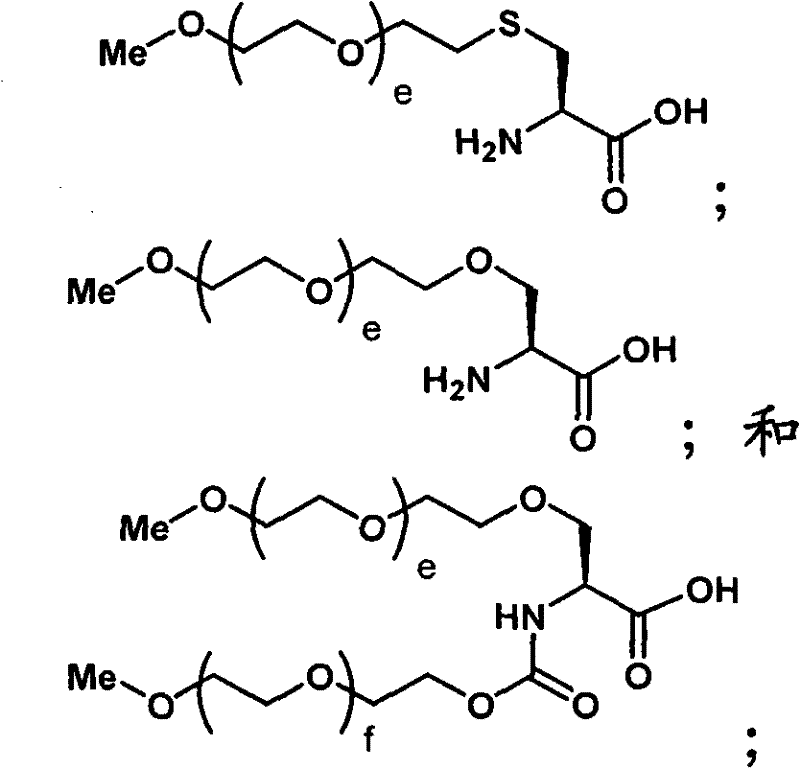
以及这些种类的碳酸酯和活性酯,例如:and these kinds of carbonates and active esters, such as:
核酸nucleic acid
在另一个方面,本发明提供了编码本发明的多肽的经分离的核酸。多肽在其氨基酸序列内包括一个或多个本发明的外源N联糖基化序列。在一个实施方案中,本发明的核酸是表达载体的部分。在另一个相关实施方案中,本发明提供了包括本发明的核酸的细胞。示例性细胞包括宿主细胞,例如大肠杆菌的各种菌株、昆虫细胞、酵母细胞和哺乳动物细胞例如CHO细胞。In another aspect, the invention provides an isolated nucleic acid encoding a polypeptide of the invention. The polypeptide includes within its amino acid sequence one or more exogenous N-linked glycosylation sequences of the invention. In one embodiment, the nucleic acid of the invention is part of an expression vector. In another related embodiment, the invention provides a cell comprising a nucleic acid of the invention. Exemplary cells include host cells such as various strains of E. coli, insect cells, yeast cells, and mammalian cells such as CHO cells.
药物组合物pharmaceutical composition
本发明的多肽缀合物具有广泛范围的药学应用。例如,糖缀合的促红细胞生成素(EPO)可以用于治疗一般性贫血、再生障碍性贫血、化学诱导的损伤(例如,对骨髓的损伤)、慢性肾衰竭、肾炎和地中海贫血。经修饰的EPO可以进一步用于治疗神经性障碍,例如脑/脊柱损伤、多发性硬化症和阿尔茨海默氏病。The polypeptide conjugates of the present invention have a wide range of pharmaceutical applications. For example, glycoconjugated erythropoietin (EPO) can be used to treat general anemia, aplastic anemia, chemically induced injury (eg, to bone marrow), chronic renal failure, nephritis, and thalassemia. Modified EPO can further be used to treat neurological disorders such as brain/spinal injury, multiple sclerosis and Alzheimer's disease.
第二个例子是干扰素-α(IFN-α),其可以用于治疗AIDS和乙型或丙型肝炎,由多种病毒引起的病毒感染,所述病毒例如人乳头状瘤病毒(HBV)、冠状病毒、人免疫缺陷病毒(HIV)、单纯疱疹病毒(HSV)和水痘带状疱疹病毒(VZV),癌症例如多毛细胞白血病、AIDS相关的卡波济肉瘤、恶性黑色素瘤、滤泡状非霍奇金淋巴瘤、Philladephia染色体(Ph)阳性、慢性期髓性白血病(CML)、肾癌、骨髓瘤、慢性髓性白血病、头与颈癌、骨癌、以及宫颈发育不良和中枢神经系统(CNS)病症例如多发性硬化症。此外,根据本发明的方法修饰的IFN-α用于治疗各种其他疾病和病状,例如Sjogren’s综合征(自身免疫疾病)、白塞氏(Behcet′s)病(自身免疫炎性疾病)、纤维肌痛(肌肉骨骼疼痛/疲劳病症)、口疮性溃疡(口疮)、慢性疲劳综合征和肺纤维化。A second example is interferon-alpha (IFN-alpha), which can be used in the treatment of AIDS and hepatitis B or C, viral infections caused by various viruses such as human papillomavirus (HBV) , coronavirus, human immunodeficiency virus (HIV), herpes simplex virus (HSV) and varicella zoster virus (VZV), cancers such as hairy cell leukemia, AIDS-related Kaposi's sarcoma, malignant melanoma, follicular Hodgkin's lymphoma, Philadephia chromosome (Ph) positive, chronic phase myeloid leukemia (CML), kidney cancer, myeloma, chronic myeloid leukemia, head and neck cancer, bone cancer, and cervical dysplasia and central nervous system ( CNS) disorders such as multiple sclerosis. In addition, IFN-α modified according to the methods of the present invention is useful in the treatment of various other diseases and conditions, such as Sjogren's syndrome (autoimmune disease), Behcet's disease (autoimmune inflammatory disease), fibrosis Myalgia (musculoskeletal pain/fatigue disorder), aphthous ulcers (mouth sores), chronic fatigue syndrome, and pulmonary fibrosis.
另一个例子是干扰素-β,其用于治疗CNS病症,例如多发性硬化症(复发/缓解型或慢性进展型),AIDS和乙型或丙型肝炎,由多种病毒引起的病毒感染,所述病毒例如人乳头状瘤病毒(HBV)、人免疫缺陷病毒(HIV)、单纯疱疹病毒(HSV)和水痘带状疱疹病毒(VZV),耳感染,肌肉骨骼感染,以及癌症包括乳腺癌、脑癌、结肠直肠癌、非小细胞肺癌、头与颈癌、基底细胞癌、宫颈发育不良、黑色素瘤、皮肤癌和肝癌。根据本发明的方法修饰的IFN-β也用于治疗其他疾病和病状,例如移植排斥(例如,骨髓移植)、亨廷顿舞蹈病、大肠炎、脑炎症、肺纤维化、黄斑变性、肝硬化和角膜结膜炎。Another example is interferon-beta, which is used in the treatment of CNS disorders such as multiple sclerosis (relapsing/remitting or chronic progressive), AIDS and hepatitis B or C, viral infections caused by a variety of viruses, Such viruses as human papilloma virus (HBV), human immunodeficiency virus (HIV), herpes simplex virus (HSV) and varicella zoster virus (VZV), ear infections, musculoskeletal infections, and cancers including breast cancer, Brain cancer, colorectal cancer, non-small cell lung cancer, head and neck cancer, basal cell carcinoma, cervical dysplasia, melanoma, skin cancer and liver cancer. IFN-beta modified according to the methods of the invention are also useful in the treatment of other diseases and conditions, such as transplant rejection (e.g., bone marrow transplantation), Huntington's disease, colitis, brain inflammation, pulmonary fibrosis, macular degeneration, liver cirrhosis, and corneal Conjunctivitis.
粒细胞集落刺激因子(G-CSF)是进一步的例子。根据本发明的方法修饰的G-CSF可以在用于治疗癌症的化学治疗中用作助剂(adjunct),并且用于预防或减轻与特定医学操作相关的病状或并发症,例如化学诱导的骨髓损伤;白血球减少症(一般性的);化学诱导的热性嗜中性白血球减少症;与骨髓移植相关的嗜中性白血球减少症;和严重的慢性嗜中性白血球减少症。经修饰的G-CSF还可以用于移植;外周血细胞动员;在将接受骨髓根除或骨髓抑制化学治疗的患者中的外周血祖细胞动员用于收集;和嗜中性白血球减少症持续时间中的减少、发热、抗生素使用、关于急性髓样白血病(AML)的诱导/巩固治疗后的住院治疗。可以用经修饰的G-CSF治疗的其他病状或病症包括哮喘和变应性鼻炎。Granulocyte colony stimulating factor (G-CSF) is a further example. G-CSF modified according to the methods of the present invention can be used as an adjunct in chemotherapy for the treatment of cancer, and for the prevention or alleviation of pathologies or complications associated with specific medical procedures, such as chemically induced bone marrow injury; leukopenia (general); chemically induced febrile neutropenia; neutropenia associated with bone marrow transplantation; and severe chronic neutropenia. Modified G-CSF can also be used for transplantation; peripheral blood cell mobilization; peripheral blood progenitor cell mobilization for collection in patients who will undergo myeloablative or myelosuppressive chemotherapy; and in the duration of neutropenia Reduction, fever, antibiotic use, hospitalization after induction/consolidation therapy for acute myeloid leukemia (AML). Other conditions or conditions that may be treated with modified G-CSF include asthma and allergic rhinitis.
作为一个另外的例子,根据本发明的方法修饰的人生长激素(hGH)可以用于治疗生长相关病状,例如侏儒症、儿童和成人中的身材矮小症、恶病质/肌肉消耗、一般性肌肉萎缩、和性染色体异常(例如,特纳(Turner′s)综合征)。可以使用经修饰的hGH治疗的其他病状包括:短肠综合征、脂营养不良、骨质疏松症、尿毒症、烧伤、女性不孕症、骨再生、一般性糖尿病、II型糖尿病、骨关节炎、慢性阻塞性肺病(COPD)和失眠。此外,经修饰的hGH还可以用于促进各种过程,例如一般的组织再生、骨再生和伤口愈合,或作为疫苗助剂。As a further example, human growth hormone (hGH) modified according to the methods of the invention may be used in the treatment of growth-related conditions such as dwarfism, short stature in children and adults, cachexia/muscle wasting, general muscle wasting, and sex chromosome abnormalities (eg, Turner's syndrome). Other conditions that can be treated with modified hGH include: short bowel syndrome, lipodystrophy, osteoporosis, uremia, burns, female infertility, bone regeneration, diabetes mellitus, type II diabetes, osteoarthritis , chronic obstructive pulmonary disease (COPD) and insomnia. Furthermore, modified hGH can also be used to promote various processes such as general tissue regeneration, bone regeneration and wound healing, or as a vaccine adjuvant.
因此,在另一个方面,本发明提供了药物组合物,其包括本发明的至少一种多肽或多肽缀合物和药学上可接受的载体。药学上可接受的载体包括稀释剂、媒介物、助剂及其组合。在一个示例性实施方案中,药物组合物包括在水溶性聚合物(例如,非天然存在的水溶性聚合物)和本发明的糖基化或非糖基化多肽之间的共价缀合物和药学上可接受的稀释剂。Accordingly, in another aspect, the invention provides a pharmaceutical composition comprising at least one polypeptide or polypeptide conjugate of the invention and a pharmaceutically acceptable carrier. Pharmaceutically acceptable carriers include diluents, vehicles, adjuvants and combinations thereof. In an exemplary embodiment, the pharmaceutical composition comprises a covalent conjugate between a water soluble polymer (e.g., a non-naturally occurring water soluble polymer) and a glycosylated or aglycosylated polypeptide of the invention and pharmaceutically acceptable diluents.
本发明的药物组合物适合于在各种药物递送系统中使用。用于在本发明中使用的合适制剂在Remington′s Pharmaceutical Sciences,MacePublishing Company,Philadelphia,PA,第17版(1985)中发现。关于用于药物递送的方法的简要综述,参见Langer,Science 249:1527-1533(1990)。The pharmaceutical compositions of the present invention are suitable for use in various drug delivery systems. Suitable formulations for use in the present invention are found in Remington's Pharmaceutical Sciences, Mace Publishing Company, Philadelphia, PA, 17th Edition (1985). For a brief review of methods for drug delivery, see Langer, Science 249:1527-1533 (1990).
药物组合物可以配制用于任何合适的施用方式,包括例如局部、经口、鼻、静脉内、颅内、腹膜内、皮下或肌内施用。对于肠胃外施用,例如皮下注射,载体优选包括水、盐水、醇、脂肪、蜡或缓冲剂。对于经口施用,可以采用任何上述载体或固体载体,例如甘露醇、乳糖、淀粉、硬脂酸镁、糖精钠、滑石、纤维素、葡萄糖、蔗糖和碳酸镁。生物可降解的基质例如微球体(例如,聚乳酸盐聚乙醇酸盐)也可以用作载体用于本发明的药物组合物。合适的生物可降解的微球体例如在美国专利号4,897,268和5,075,109中公开。The pharmaceutical compositions may be formulated for any suitable mode of administration including, for example, topical, oral, nasal, intravenous, intracranial, intraperitoneal, subcutaneous or intramuscular administration. For parenteral administration, such as subcutaneous injection, the carrier preferably includes water, saline, alcohol, fat, wax or buffer. For oral administration, any of the above carriers or solid carriers may be employed, such as mannitol, lactose, starch, magnesium stearate, sodium saccharine, talc, cellulose, glucose, sucrose and magnesium carbonate. Biodegradable matrices such as microspheres (eg, polylactate polyglycolate) can also be used as carriers for the pharmaceutical compositions of the invention. Suitable biodegradable microspheres are disclosed, for example, in US Patent Nos. 4,897,268 and 5,075,109.
通常,药物组合物皮下或肠胃外例如静脉内施用。因此,本发明提供了用于肠胃外施用的组合物,其包括在可接受的载体中溶解或悬浮的化合物,所述可接受的载体优选水载体,例如水、缓冲水、盐水、PBS等。组合物还可以包含洗涤剂例如Tween 20和Tween 80;稳定剂例如甘露醇、山梨糖醇、蔗糖和海藻糖;和防腐剂例如EDTA和间甲酚。需要时,组合物可以包含药学上可接受的辅助物质以接近生理条件,例如pH调整和缓冲剂、张力调整剂、湿润剂、洗涤剂等。Typically, the pharmaceutical composition is administered subcutaneously or parenterally, eg intravenously. Accordingly, the present invention provides compositions for parenteral administration comprising the compound dissolved or suspended in an acceptable carrier, preferably an aqueous carrier, such as water, buffered water, saline, PBS, and the like. The composition may also contain detergents such as Tween 20 and Tween 80; stabilizers such as mannitol, sorbitol, sucrose and trehalose; and preservatives such as EDTA and m-cresol. The composition may contain pharmaceutically acceptable auxiliary substances to approximate physiological conditions, such as pH adjusting and buffering agents, tonicity adjusting agents, wetting agents, detergents and the like, if desired.
这些组合物可以通过常规灭菌技术进行灭菌,或可以进行无菌过滤。所得到的水溶液可以经包装用于使用或冻干,冻干制剂在施用前与无菌水载体相组合。制剂的pH一般为3至11,更优选5至9,并且最优选7至8。These compositions can be sterilized by conventional sterilization techniques, or can be sterile filtered. The resulting aqueous solutions can be packaged for use or lyophilized, the lyophilized preparation being combined with a sterile aqueous carrier prior to administration. The pH of the formulation is generally 3-11, more preferably 5-9, and most preferably 7-8.
在某些实施方案中,本发明的糖肽可以掺入由标准囊泡成型脂质形成的脂质体内。多种方法可用于制备脂质体,如例如Szoka等人,Ann.Rev.Biophys.Bioeng.9:467(1980),美国专利号4,235,871、4,501,728和4,837,028中描述的。脂质体使用多种靶向试剂(例如,本发明的唾液酸酰半乳糖苷)的靶向是本领域众所周知的(参见例如,美国专利号4,957,773和4,603,044)。In certain embodiments, glycopeptides of the invention can be incorporated into liposomes formed from standard vesicle-forming lipids. A variety of methods are available for preparing liposomes, as described, eg, in Szoka et al., Ann. Rev. Biophys. Bioeng. 9:467 (1980), US Patent Nos. 4,235,871, 4,501,728, and 4,837,028. Targeting of liposomes using a variety of targeting agents (eg, sialylgalactosides of the invention) is well known in the art (see eg, US Patent Nos. 4,957,773 and 4,603,044).
可以使用用于使靶向试剂与脂质体偶联的标准方法。这些方法一般涉及将脂质组分例如磷脂酰乙醇胺(其可以活化用于附着靶向试剂)或经衍生的亲脂化合物例如本发明的脂质衍生的糖肽掺入脂质体内。Standard methods for coupling targeting agents to liposomes can be used. These methods generally involve the incorporation of lipid components such as phosphatidylethanolamine (which can be activated for attachment of targeting agents) or derivatized lipophilic compounds such as the lipid-derived glycopeptides of the invention into liposomes.
靶向机制一般要求靶向试剂以这样的方式放置在脂质体的表面上,使得靶部分可用于与靶例如细胞表面受体相互作用。在使用本领域技术人员已知的方法形成脂质体前(例如,碳水化合物上存在的羟基分别用长链烷基卤或用脂肪酸的烷基化或酰化),本发明的碳水化合物可以与脂质分子附着。备选地,脂质体可以以这样的方式形成,使得在形成膜时接头部分首先掺入膜内。接头部分必须具有亲脂部分,其牢固地嵌入且锚定在膜中。还必须具有反应性部分,其在脂质体的水表面上化学可用。反应性部分这样进行选择,使得它以化学方法适合于与随后添加的靶向试剂或碳水化合物形成稳定的化学键。在某些情况下,可以使靶试剂与接头分子直接附着,但在大多数情况下,使用第三种分子充当化学桥是更合适的,从而使在膜中的接头分子与从囊泡表面三维延伸出的靶试剂或碳水化合物连接。The targeting mechanism generally requires that the targeting agent be placed on the surface of the liposome in such a way that the targeting moiety is available to interact with the target, eg, a cell surface receptor. The carbohydrates of the present invention can be combined with Lipid molecules attach. Alternatively, liposomes may be formed in such a manner that the linker moiety is first incorporated into the membrane when the membrane is formed. The linker moiety must have a lipophilic portion, which is firmly embedded and anchored in the membrane. It is also necessary to have a reactive moiety, which is chemically available on the water surface of the liposome. The reactive moiety is selected such that it is chemically suitable to form a stable chemical bond with a subsequently added targeting agent or carbohydrate. In some cases, it is possible to attach the targeting agent directly to the adapter molecule, but in most cases it is more appropriate to use a third molecule to act as a chemical bridge, allowing the Extended target reagent or carbohydrate linkage.
通过本发明的方法制备的化合物还可以用作诊断性试剂。例如,经标记的化合物可以用于定位怀疑具有炎症的患者中的炎症或肿瘤转移区域。对于这个用途,化合物可以用可检测同位素例如125I、14C或氘进行标记。在另一个例子中,化合物用发光部分例如镧系元素复合物进行标记。Compounds prepared by the methods of the invention may also be used as diagnostic reagents. For example, labeled compounds can be used to localize areas of inflammation or tumor metastases in patients suspected of having inflammation. For this use, the compounds can be labeled with detectable isotopes such as 125I, 14C or deuterium. In another example, the compound is labeled with a luminescent moiety such as a lanthanide complex.
本发明的示例性缀合物Exemplary conjugates of the invention
在一个实施方案中,本发明的缀合物包括选自下述的部分:In one embodiment, the conjugates of the invention comprise a moiety selected from:
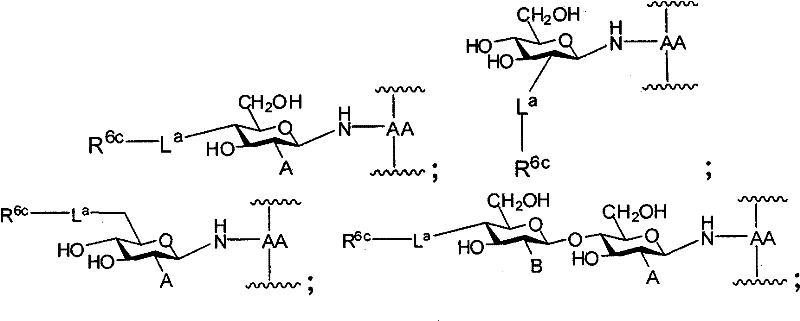

其中AA衍生自包括氨基的氨基酸残基。这个氨基酸残基是多肽的部分。在一个例子中,AA衍生自天冬酰胺残基。Q、La和R6c如本文上文定义。Q1是H、单个负电荷或阳离子(例如,Na+或K+)。A和B是独立地选自OR(例如,OH)和NHCOR(例如,NHAc)的成员。wherein AA is derived from amino acid residues including amino groups. This amino acid residue is part of the polypeptide. In one example, AA is derived from an asparagine residue. Q, La and R 6c are as defined herein above. Q 1 is H, a single negative charge, or a cation (eg, Na + or K + ). A and B are members independently selected from OR (eg, OH) and NHCOR (eg, NHAc).
在根据上述实施方案中的任何的一个例子中,缀合物包括选自下述的部分:In an example according to any of the above embodiments, the conjugate comprises a moiety selected from:
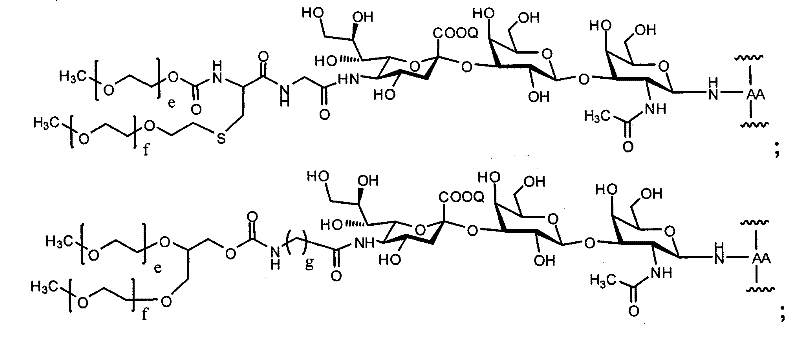
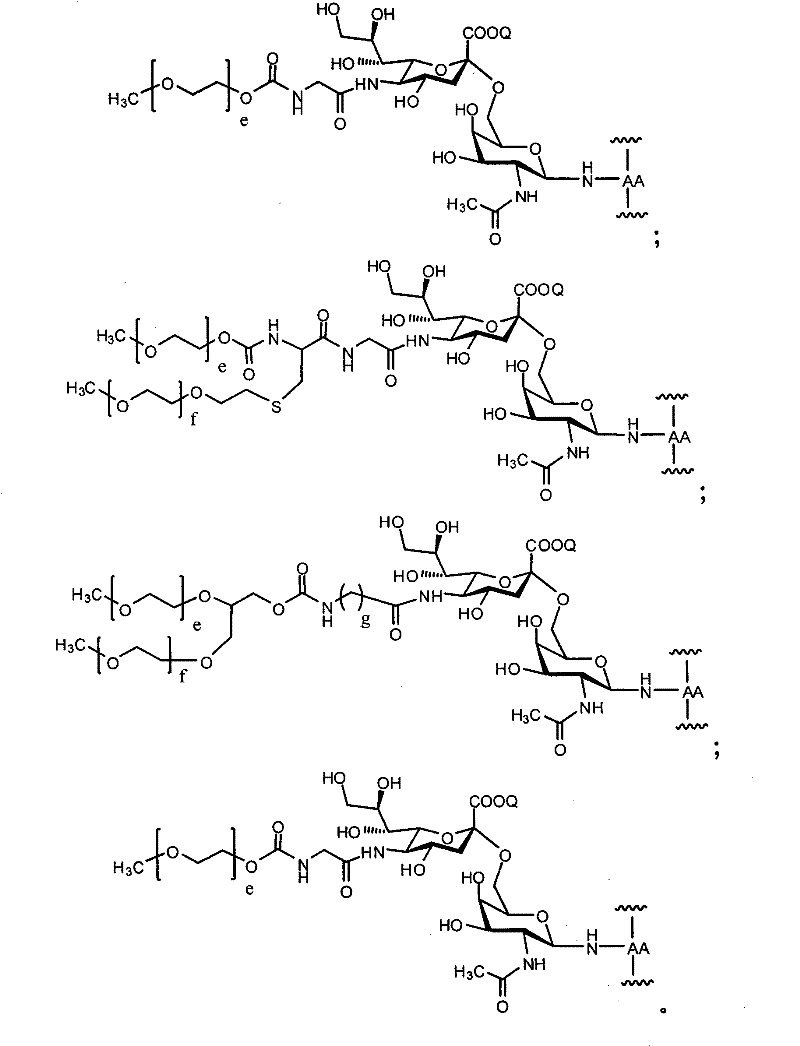
V.方法 V. method
多肽的产生production of peptides
产生多肽(例如,通过重组技术)的方法是本领域已知的。示例性方法在本文中描述。示例性方法包括:(i)产生包括编码多肽的核酸序列的表达载体,所述多肽具有外源N联糖基化序列。该方法可以进一步包括:(ii)用表达载体转染宿主细胞。该方法可以进一步包括:(iii)在宿主细胞中表达多肽。该方法可以进一步包括:(iv)分离多肽。该方法可以进一步包括:(v)例如使用内源或重组寡糖基转移酶,使多肽在N联糖基化序列处酶促糖基化。示例性糖基转移酶例如细菌PglB在本文中描述。Methods of producing polypeptides (eg, by recombinant techniques) are known in the art. Exemplary methods are described herein. Exemplary methods include: (i) generating an expression vector comprising a nucleic acid sequence encoding a polypeptide having an exogenous N-linked glycosylation sequence. The method may further comprise: (ii) transfecting the host cell with the expression vector. The method may further comprise: (iii) expressing the polypeptide in the host cell. The method may further comprise: (iv) isolating the polypeptide. The method may further comprise: (v) enzymatically glycosylating the polypeptide at the N-linked glycosylation sequence, eg, using an endogenous or recombinant oligosaccharyltransferase. Exemplary glycosyltransferases such as bacterial PglB are described herein.
多肽缀合物的形成Polypeptide Conjugate Formation
在另一个方面,本发明提供了形成修饰基团和多肽之间的共价缀合物的方法。本发明的多肽缀合物在糖基化或非糖基化的多肽和各种种类例如水溶性聚合物、治疗性部分、生物分子、诊断性部分、靶向部分等之间形成。聚合物、治疗性部分或生物分子经由糖基连接基团与多肽缀合,所述糖基连接基团插入多肽和修饰基团(例如,水溶性聚合物)之间,并且与多肽和修饰基团共价连接。In another aspect, the invention provides a method of forming a covalent conjugate between a modifying group and a polypeptide. Polypeptide conjugates of the invention are formed between glycosylated or non-glycosylated polypeptides and various species such as water-soluble polymers, therapeutic moieties, biomolecules, diagnostic moieties, targeting moieties, and the like. The polymer, therapeutic moiety, or biomolecule is conjugated to the polypeptide via a glycosyl linking group inserted between the polypeptide and the modifying group (e.g., a water-soluble polymer) and bonded to the polypeptide and the modifying group. group covalently linked.
多肽的无细胞的体外糖基化Cell-free in vitro glycosylation of polypeptides
在一个实施方案中,多肽的糖基化和/或糖基PEG化在体外执行。例如,多肽在宿主细胞中进行合成或表达并且任选进行纯化。随后对多肽实施涉及本发明的糖基供体种类(例如,十一异戊烯-焦磷酸盐连接的糖基部分)以及合适的寡糖基转移酶的糖基化或糖基PEG化。In one embodiment, glycosylation and/or glycoPEGylation of the polypeptide is performed in vitro. For example, a polypeptide is synthesized or expressed and optionally purified in a host cell. The polypeptide is then subjected to glycosylation or glycoPEGylation involving a glycosyl donor species of the invention (eg, an undecaprenyl-pyrophosphate-linked glycosyl moiety) and a suitable oligosaccharyltransferase.
在一个实施方案中,在糖基供体种类是其底物的寡糖基转移酶的存在下,通过使多肽与糖基供体种类相接触,使多肽与修饰基团共价连接,其中糖基供体种类的至少一个糖基供体部分与修饰基团共价连接。因此,在一个示例性实施方案中,本发明提供了形成多肽和修饰基团(例如,聚合修饰基团)之间的共价缀合物的无细胞的体外方法。在这种方法中,多肽包括本发明的N联糖基化序列,所述本发明的N联糖基化序列包括天冬酰胺残基。修饰基团经由糖基连接基团在天冬酰胺残基处与多肽共价连接,所述糖基连接基团插入多肽和修饰基团之间,并且与多肽和修饰基团共价连接。该方法包括:在寡糖基转移酶的存在下,在足以使寡糖基转移酶将糖基部分从糖基供体种类转移到N联糖基化序列的天冬酰胺残基上的条件下,使多肽和本发明的糖基供体种类相接触。该方法可以进一步包括:例如通过重组技术或化学合成产生多肽。用于产生多肽的方法在本文中描述。该方法可以进一步包括:分离共价缀合物。在一个实施方案中,多肽与其为治疗多肽的亲本多肽相对应。示例性亲本多肽在本文中描述。In one embodiment, the polypeptide is covalently linked to the modifying group by contacting the polypeptide with the glycosyl donor species in the presence of an oligosaccharyltransferase for which the glycosyl donor species is a substrate, wherein the saccharide At least one glycosyl donor moiety of the group donor species is covalently linked to the modifying group. Accordingly, in an exemplary embodiment, the invention provides a cell-free in vitro method of forming a covalent conjugate between a polypeptide and a modifying group (eg, a polymeric modifying group). In this method, the polypeptide comprises an N-linked glycosylation sequence of the invention comprising an asparagine residue. The modifying group is covalently linked to the polypeptide at the asparagine residue via a glycosyl linking group interposed between and covalently linked to the polypeptide and the modifying group. The method comprises: in the presence of an oligosaccharyltransferase, under conditions sufficient for the oligosaccharyltransferase to transfer a glycosyl moiety from a glycosyl donor species to an asparagine residue of an N-linked glycosylation sequence , contacting a polypeptide with a glycosyl donor species of the invention. The method may further comprise producing the polypeptide, eg, by recombinant techniques or chemical synthesis. Methods for producing polypeptides are described herein. The method may further comprise: isolating the covalent conjugate. In one embodiment, the polypeptide corresponds to its parent polypeptide which is a therapeutic polypeptide. Exemplary parent polypeptides are described herein.
在宿主细胞内的糖基化Glycosylation in host cells
包括本发明的N联糖基化序列的多肽的糖基化也可以在宿主细胞内发生,多肽在所述宿主细胞中表达。在一个实施方案中,使宿主细胞与本发明的合适的糖基供体种类相接触,并且内在化本发明的合适的糖基供体种类。例如,将糖基供体种类加入用于培养宿主细胞的细胞培养基中。在宿主细胞内的寡糖基转移酶使用经内在化的糖基供体种类作为底物,并且将糖基部分转移到所表达的多肽上。在一个实施方案中,通过使宿主细胞与糖基供体种类相接触,这种细胞内糖基化用于使修饰基团与多肽共价连接,所述糖基供体种类包括用修饰基团衍生的糖基部分。因此,本发明提供了形成多肽和修饰基团(例如,聚合修饰基团)之间的共价缀合物的方法,其中多肽包括N联糖基化序列,所述N联糖基化序列包括天冬酰胺残基。修饰基团经由糖基连接基团在天冬酰胺残基处与多肽共价连接,所述糖基连接基团插入多肽和修饰基团之间,并且与多肽和修饰基团共价连接。该方法包括:(i)在寡糖基转移酶的存在下,在足以使寡糖基转移酶将与修饰基团共价连接的糖基部分从糖基供体种类转移到N联糖基化序列的天冬酰胺残基上的条件下,使多肽和本发明的糖基供体种类相接触,其中接触在多肽在其中表达的宿主细胞内发生。该方法可以进一步包括(ii)使宿主细胞与本发明的糖基供体种类相接触。该方法可以进一步包括(iii)在足以使宿主细胞内在化糖基供体种类的条件下温育宿主细胞。该方法可以进一步包括(iii)例如通过重组技术或化学合成产生多肽。用于产生多肽的方法在本文中描述。该方法可以进一步包括(iv)分离共价缀合物。在一个实施方案中,多肽与其为治疗多肽的亲本多肽相对应。示例性亲本多肽在本文中描述。Glycosylation of a polypeptide comprising an N-linked glycosylation sequence of the invention can also occur within the host cell in which the polypeptide is expressed. In one embodiment, a host cell is contacted with a suitable glycosyl donor species of the invention and internalizes a suitable glycosyl donor species of the invention. For example, the glycosyl donor species is added to the cell culture medium used to grow the host cells. Oligosaccharyltransferases in host cells use internalized glycosyl donor species as substrates and transfer glycosyl moieties to expressed polypeptides. In one embodiment, such intracellular glycosylation is used to covalently attach the modifying group to the polypeptide by contacting the host cell with a glycosyl donor species comprising Derivatized glycosyl moieties. Accordingly, the invention provides methods of forming a covalent conjugate between a polypeptide and a modifying group (e.g., a polymeric modifying group), wherein the polypeptide includes an N-linked glycosylation sequence comprising Asparagine residues. The modifying group is covalently linked to the polypeptide at the asparagine residue via a glycosyl linking group interposed between and covalently linked to the polypeptide and the modifying group. The method comprises: (i) transferring, in the presence of an oligosaccharyltransferase, a glycosyl moiety covalently attached to a modifying group from a glycosyl donor species to N-linked glycosylation in the presence of an oligosaccharyltransferase sufficient to The polypeptide is brought into contact with a glycosyl donor species of the invention under conditions at the asparagine residue of the sequence, wherein the contacting takes place in the host cell in which the polypeptide is expressed. The method may further comprise (ii) contacting the host cell with a glycosyl donor species of the invention. The method may further comprise (iii) incubating the host cell under conditions sufficient for the host cell to internalize the glycosyl donor species. The method may further comprise (iii) producing the polypeptide, eg, by recombinant techniques or chemical synthesis. Methods for producing polypeptides are described herein. The method may further comprise (iv) isolating the covalent conjugate. In one embodiment, the polypeptide corresponds to its parent polypeptide which is a therapeutic polypeptide. Exemplary parent polypeptides are described herein.
在一个例子中,宿主细胞包括内源寡糖基转移酶,其能够使用经内在化的糖基供体种类作为底物,并且可以将糖基供体种类的糖基部分细胞内转移到多肽上。In one example, the host cell includes an endogenous oligosaccharyltransferase that is capable of using an internalized glycosyl donor species as a substrate and that can intracellularly transfer the glycosyl moiety of the glycosyl donor species to the polypeptide .
在另一个示例性实施方案中,寡糖基转移酶是重组酶,并且连同多肽一起在宿主细胞中共表达。随后通过共表达寡糖基转移酶完成细胞内糖基化,所述寡糖基转移酶可以使用所表达的多肽作为底物。使用经内在化的糖基供体种类作为糖基底物,所述酶能够在糖基化序列处细胞内地糖基化多肽。In another exemplary embodiment, the oligosaccharyltransferase is a recombinant enzyme and is co-expressed in the host cell along with the polypeptide. Subsequent intracellular glycosylation is accomplished by co-expressing an oligosaccharyltransferase that can use the expressed polypeptide as a substrate. Using an internalized glycosyl donor species as a glycosyl substrate, the enzyme is capable of intracellularly glycosylating a polypeptide at a glycosylation sequence.
宿主细胞可以是适合于表达多肽的任何细胞。在一个实施方案中,宿主细胞是细菌细胞。在另一个实施方案中,宿主细胞是真核细胞,例如酵母细胞、昆虫细胞或哺乳动物细胞。A host cell can be any cell suitable for expression of a polypeptide. In one embodiment, the host cell is a bacterial cell. In another embodiment, the host cell is a eukaryotic cell, such as a yeast cell, an insect cell, or a mammalian cell.
测定多肽是否有效糖基化的方法是可用的。例如,通过质谱法分析细胞裂解物(在一个或多个样品制备步骤后),以测量糖基化和非糖基化多肽之间的比。在另一个例子中,通过凝胶电泳来分析细胞裂解物,所述凝胶电泳使糖基化与非糖基化多肽分离。Methods for determining whether a polypeptide is efficiently glycosylated are available. For example, cell lysates (after one or more sample preparation steps) are analyzed by mass spectrometry to measure the ratio between glycosylated and non-glycosylated polypeptides. In another example, cell lysates are analyzed by gel electrophoresis, which separates glycosylated from non-glycosylated polypeptides.
在另一个示例性实施方案中,多肽在其中表达的微生物具有细胞内氧化环境。微生物可以进行遗传修饰,以具有细胞内氧化环境。细胞内糖基化并不限于单个糖基残基的转移。通过所需酶的共表达和分别的糖基供体的存在可以顺次添加几个糖基残基。这种方法还可以用于在商业规模上生产多肽。示例性技术在2006年9月6日提交的美国临时专利申请号60/842,926中描述,所述美国临时专利申请通过引用整体合并入本文。宿主细胞可以是原核微生物,例如大肠杆菌或假单胞菌属菌株)。在一个示例性实施方案中,宿主细胞是trxB gor supp突变型大肠杆菌细胞。In another exemplary embodiment, the microorganism in which the polypeptide is expressed has an intracellular oxidative environment. Microorganisms can be genetically modified to have an intracellular oxidative environment. Intracellular glycosylation is not limited to the transfer of a single glycosyl residue. Several glycosyl residues can be added sequentially by co-expression of the required enzymes and the presence of separate glycosyl donors. This method can also be used to produce polypeptides on a commercial scale. Exemplary techniques are described in US Provisional Patent Application No. 60/842,926, filed September 6, 2006, which is incorporated herein by reference in its entirety. The host cell may be a prokaryotic microorganism such as E. coli or a strain of Pseudomonas). In an exemplary embodiment, the host cell is a trxB gor supp mutant E. coli cell.
作为寡糖基转移酶的底物的序列子多肽的鉴定Identification of sequon polypeptides as substrates for oligosaccharyltransferases
用于鉴定序列子多肽(当使用酶和糖基供体种类实施糖基化反应时,其可以以满意的得率进行糖基化)的一个策略是制备序列子多肽的文库,其中每个序列子多肽包括至少一个本发明的外源N联糖基化序列,并且就其充当寡糖基转移酶的有效底物的能力测试每个序列子多肽。通过在亲本多肽的氨基酸序列内的不同位置处包括所选择的本发明的N联糖基化序列,可以产生序列子多肽的文库。One strategy for identifying sequon polypeptides that can be glycosylated in satisfactory yield when the glycosylation reaction is performed using an enzyme and a glycosyl donor species is to prepare a library of sequon polypeptides in which each sequence Daughter polypeptides include at least one exogenous N-linked glycosylation sequence of the invention, and each sequon polypeptide is tested for its ability to serve as an efficient substrate for an oligosaccharyltransferase. Libraries of sequon polypeptides can be generated by including selected N-linked glycosylation sequences of the invention at different positions within the amino acid sequence of a parent polypeptide.
序列子多肽的文库Libraries of Sequon Peptides
在一个方面,本发明提供了产生序列子多肽的一个或多个文库的方法,其中序列子多肽与亲本多肽(例如,野生型多肽)相对应。在一个实施方案中,亲本多肽具有包括m个氨基酸的氨基酸序列。产生序列子多肽的文库的示例性方法包括步骤:(i)通过在亲本多肽内的第一氨基酸位置(AA)n处引入本发明的N联糖基化序列,产生第一序列子多肽(例如,重组、化学或通过其他方法),其中n是选自1至m的成员;(ii)通过在另外的氨基酸位置处引入N联糖基化序列,产生至少一个另外的序列子多肽。在一个实施方案中,另外的氨基酸位置处是(AA)n+x’例如(AA)n+1。在另一个实施方案中,另外的氨基酸位置处是(AA)n-x’例如(AA)n-1。在这些实施方案中,x是选自1至(m-n)的成员。在一个实施方案中,另外的序列子多肽包括与第一序列子多肽相同的N联糖基化序列。在另一个实施方案中,另外的序列子多肽包括与第一序列子多肽不同的N联糖基化序列。在一个示例性实施方案中,通过本文上文描述的“序列子扫描”产生序列子多肽的文库。在本发明的文库中有用的示例性亲本多肽和N联糖基化序列也在本文中描述。In one aspect, the invention provides methods of generating one or more libraries of sequon polypeptides, wherein the sequon polypeptides correspond to a parent polypeptide (eg, a wild-type polypeptide). In one embodiment, the parent polypeptide has an amino acid sequence comprising m amino acids. An exemplary method of generating a library of sequon polypeptides comprises the steps of: (i) generating a first sequon polypeptide (e.g., , recombinant, chemical or by other means), wherein n is a member selected from 1 to m; (ii) at least one additional sequon polypeptide is produced by introducing an N-linked glycosylation sequence at an additional amino acid position. In one embodiment, the additional amino acid position is (AA) n+x ' such as (AA) n+1 . In another embodiment, at the additional amino acid position is (AA) nx ' such as (AA) n-1 . In these embodiments, x is a member selected from 1 to (mn). In one embodiment, the additional sequon polypeptide comprises the same N-linked glycosylation sequence as the first sequon polypeptide. In another embodiment, the additional sequon polypeptide comprises a different N-linked glycosylation sequence than the first sequon polypeptide. In an exemplary embodiment, a library of sequon polypeptides is generated by "sequon scanning" as described herein above. Exemplary parental polypeptides and N-linked glycosylation sequences useful in the libraries of the invention are also described herein.
引导多肽的鉴定Leading to the Identification of Peptides
可能希望在文库的成员中选择这样的多肽,当实施酶促糖基化和/或糖基PEG化反应时,所述多肽是有效糖基化和/或糖基PEG化的。发现其是有效糖基化和/或糖基PEG化的序列子多肽被称为“引导多肽”。在一个示例性实施方案中,酶促糖基化或糖基PEG化反应的得率用于选择一种或多种引导多肽。在另一个示例性实施方案中,关于引导多肽的酶促糖基化或糖基PEG化的得率为约10%至约100%,优选约30%至约100%,更优选约50%至约100%,并且最优选约70%至约100%。当多肽包括超过一个N联糖基化序列时,那么对于每个N联糖基化序列分开测定得率。例如通过对经糖基化的引导多肽实施另一个酶促糖基化或糖基PEG化反应,任选进一步评估可以有效糖基化的引导多肽。It may be desirable to select, among the members of the library, polypeptides that are efficiently glycosylated and/or glycoPEGylated when subjected to an enzymatic glycosylation and/or glycoPEGylation reaction. Sequon polypeptides which are found to be efficiently glycosylated and/or glycoPEGylated are referred to as "leader polypeptides". In an exemplary embodiment, the yield of an enzymatic glycosylation or glycoPEGylation reaction is used to select one or more lead polypeptides. In another exemplary embodiment, the yield for enzymatic glycosylation or glycoPEGylation of the lead polypeptide is from about 10% to about 100%, preferably from about 30% to about 100%, more preferably from about 50% to About 100%, and most preferably from about 70% to about 100%. When a polypeptide includes more than one N-linked glycosylation sequence, then the yield is determined separately for each N-linked glycosylation sequence. Lead polypeptides that can be efficiently glycosylated are optionally further evaluated, eg, by subjecting the glycosylated lead polypeptide to another enzymatic glycosylation or glycoPEGylation reaction.
因此,本发明提供了用于鉴定引导多肽的方法。示例性方法包括步骤:(i)产生本发明的序列子多肽的文库;(ii)对文库的至少一个成员实施酶促糖基化反应(或任选地酶促糖基PEG化反应)。在一个实施方案中,在这个反应过程中,糖基部分从糖基供体分子转移到至少一个N联糖基化序列上,其中糖基部分任选由修饰基团进行衍生。该方法可以进一步包括:(iii)测量关于文库的至少一个成员的关于酶促糖基化或糖基PEG化反应的得率。测量可以使用本领域已知的任何方法和本文下文描述的方法来完成。该方法可以在步骤(ii)前进一步包括:(iv)纯化文库的至少一个成员。Accordingly, the present invention provides methods for identifying lead polypeptides. An exemplary method comprises the steps of: (i) generating a library of sequon polypeptides of the invention; (ii) subjecting at least one member of the library to enzymatic glycosylation (or optionally enzymatic glycoPEGylation). In one embodiment, during this reaction, a glycosyl moiety is transferred from a glycosyl donor molecule to at least one N-linked glycosylation sequence, wherein the glycosyl moiety is optionally derivatized with a modifying group. The method may further comprise: (iii) measuring a yield for an enzymatic glycosylation or glycoPEGylation reaction on at least one member of the library. Measurements can be made using any method known in the art and described herein below. The method may further comprise, prior to step (ii): (iv) purifying at least one member of the library.
步骤(ii)经转移的糖基部分可以是任何糖基部分,包括单糖和寡糖以及糖基模拟基团,其任选由修饰基团例如水溶性聚合修饰基团进行衍生。在一个示例性实施方案中,在起始糖基化反应中加入序列子多肽中的糖基部分是GlcNAc部分、GalNAc部分、GlcNAc-GlcNAc部分或6-羟基-bacilloseamine部分。后续糖基化反应可以任选地用于将至少一个另外的糖基残基(例如经修饰的Sia部分)加入所得到的糖基化的多肽中。修饰基团可以是本发明的任何修饰基团,包括水溶性聚合物例如mPEG。在一个实施方案中,步骤(ii)的酶促糖基化反应在多肽在其中表达的宿主细胞中发生。该方法可以进一步包括(v):对步骤(ii)的产物实施PEG化反应。在一个实施方案中,步骤(ii)和步骤(v)在相同反应容器中执行。在一个实施方案中,PEG化反应是酶促糖基PEG化反应。在另一个实施方案中,PEG化反应是化学PEG化反应。该方法可以进一步包括:(vi)测量关于PEG化反应的得率。用于测量PEG化反应的得率的方法在下文描述。该方法可以进一步包括:(vii)产生包括编码序列子多肽的核酸序列的表达载体。该方法可以进一步包括:(viii):用表达载体转染宿主细胞。The glycosyl moiety transferred in step (ii) may be any glycosyl moiety, including mono- and oligosaccharides and glycosyl mimetic groups, optionally derivatized with a modifying group such as a water-soluble polymeric modifying group. In an exemplary embodiment, the glycosyl moiety added to the sequon polypeptide in the initial glycosylation reaction is a GlcNAc moiety, a GalNAc moiety, a GlcNAc-GlcNAc moiety, or a 6-hydroxy-bacilloseamine moiety. Subsequent glycosylation reactions can optionally be used to add at least one additional glycosyl residue (eg, a modified Sia moiety) to the resulting glycosylated polypeptide. The modifying group can be any modifying group of the invention, including water soluble polymers such as mPEG. In one embodiment, the enzymatic glycosylation reaction of step (ii) takes place in the host cell in which the polypeptide is expressed. The method may further comprise (v): performing a PEGylation reaction on the product of step (ii). In one embodiment step (ii) and step (v) are performed in the same reaction vessel. In one embodiment, the PEGylation reaction is an enzymatic glycoPEGylation reaction. In another embodiment, the PEGylation reaction is a chemical PEGylation reaction. The method may further comprise: (vi) measuring yield for the PEGylation reaction. The method used to measure the yield of the PEGylation reaction is described below. The method may further comprise: (vii) generating an expression vector comprising a nucleic acid sequence encoding a sequon polypeptide. The method may further include: (viii): transfecting the host cell with the expression vector.
在一个示例性实施方案中,对序列子多肽的文库的每个成员实施酶促糖基化反应。例如,对每个序列子多肽分开实施糖基化反应,并且测定关于一种或多种所选择的反应条件的糖基化反应的得率。In an exemplary embodiment, each member of the library of sequon polypeptides is subjected to an enzymatic glycosylation reaction. For example, a glycosylation reaction is performed separately on each sequon polypeptide, and the yield of the glycosylation reaction is determined for one or more selected reaction conditions.
在一个示例性实施方案中,在进一步加工例如糖基化和/或糖基PEG化前,纯化文库的一个或多个序列子多肽。In an exemplary embodiment, one or more sequon polypeptides of the library are purified prior to further processing, eg, glycosylation and/or glycoPEGylation.
在另一个例子中,序列子多肽的组可以相组合,并且可以对所得到的序列子多肽混合物实施糖基化或糖基PEG化反应。在一个示例性实施方案中,对包含文库的所有成员的混合物实施糖基化反应。在一个例子中,根据这个实施方案,糖基供体试剂可以以少于化学计量(就存在的糖基化位点而言)加入糖基化反应混合物中,产生其中序列子多肽竞争作为酶的底物的环境。例如通过质谱分析连同或不连同糖基化混合物的先前分离或纯化,随后可以鉴定其为酶的底物的这些序列子多肽。这个相同方法可以用于各自包含本发明的不同O联糖基化序列的一组序列子多肽。In another example, groups of sequon polypeptides can be combined and the resulting mixture of sequon polypeptides can be subjected to glycosylation or glycoPEGylation reactions. In an exemplary embodiment, the glycosylation reaction is performed on a mixture comprising all members of the library. In one example, according to this embodiment, a glycosyl donor reagent can be added to the glycosylation reaction mixture in less than stoichiometric amounts (in terms of glycosylation sites present), resulting in a glycosylation reaction in which the sequon polypeptide competes as an enzyme. environment of the substrate. These sequon polypeptides which are substrates for the enzyme can then be identified, for example by mass spectrometry, with or without previous isolation or purification of the glycosylation mixture. This same approach can be used for a set of sequon polypeptides each comprising a different O-linked glycosylation sequence of the invention.
使用本领域已知的任何合适的方法,可以测定关于酶促糖基化反应、酶促糖基PEG化反应或化学糖基PEG化反应的得率。在一个示例性实施方案中,用于区分糖基化或糖基PEG化的多肽和未反应(例如,非糖基化或糖基PEG化的)多肽的方法使用涉及质谱法的技术(例如,LC-MS、MALDI-TOF)进行测定。在另一个示例性实施方案中,使用涉及凝胶电泳的技术测定得率。在另外一个示例性实施方案中,使用涉及核磁共振(NMR)的技术测定得率。在一个进一步的示例性实施方案中,使用涉及色谱法的技术例如HPLC或GC测定得率。在一个实施方案中,多孔平板(例如,96孔平板)用于平行执行多个糖基化反应。平板可以任选在每个孔的底部配备分离或过滤介质(例如,凝胶过滤膜)。在通过质谱法或其他方法分析前,旋转可以用于预处理每种样品。Yields for enzymatic glycosylation reactions, enzymatic glycoPEGylation reactions, or chemical glycoPEGylation reactions can be determined using any suitable method known in the art. In an exemplary embodiment, the method for distinguishing glycosylated or glycoPEGylated polypeptides from unreacted (e.g., non-glycosylated or glycoPEGylated) polypeptides uses techniques involving mass spectrometry (e.g., LC-MS, MALDI-TOF) for measurement. In another exemplary embodiment, the yield is determined using a technique involving gel electrophoresis. In another exemplary embodiment, the yield is determined using techniques involving nuclear magnetic resonance (NMR). In a further exemplary embodiment, the yield is determined using techniques involving chromatography, such as HPLC or GC. In one embodiment, a multi-well plate (eg, a 96-well plate) is used to perform multiple glycosylation reactions in parallel. Plates can optionally be provided with a separation or filtration medium (eg, a gel filtration membrane) at the bottom of each well. Spinning can be used to pretreat each sample prior to analysis by mass spectrometry or other methods.
目的序列子多肽(例如,所选择的引导多肽)可以在工业规模上表达(例如,导致超过250mg、优选超过500mg蛋白质的分离)。A sequon polypeptide of interest (eg, a selected leader polypeptide) can be expressed on an industrial scale (eg, resulting in the isolation of more than 250 mg, preferably more than 500 mg of protein).
引导多肽的进一步评估Guided Further Evaluation of Peptides
在一个实施方案中,其中起始筛选操作涉及使用未经修饰的糖基部分(例如,GlcNAc部分的转移)的酶促糖基化,所选择的引导多肽可以就其成为用于进一步修饰(例如通过另一个酶促反应或化学修饰)的有效底物的能力进行进一步评估。在一个示例性实施方案中,后续“筛选”涉及对糖基化的引导多肽实施另一个糖基化和/或PEG化反应。In one embodiment, where the initial screening procedure involves enzymatic glycosylation using an unmodified glycosyl moiety (e.g., transfer of a GlcNAc moiety), the selected lead polypeptide can be used as such for further modification (e.g., The ability to be an effective substrate by another enzymatic reaction or chemical modification) is further evaluated. In an exemplary embodiment, subsequent "screening" involves subjecting the glycosylated lead polypeptide to another glycosylation and/or PEGylation reaction.
PEG化反应可以例如是化学PEG化反应或酶促糖基PEG化反应。为了鉴定被有效糖基PEG化的引导多肽,对至少一个引导多肽(任选先前糖基化的)实施PEG化反应,并且测定关于这个反应的得率。在一个例子中,测定关于每个引导多肽的PEG化反应得率。在一个示例性实施方案中,关于PEG化反应的得率为约10%至约100%,优选约30%至约100%,更优选约50%至约100%,并且最优选约70%至约100%。PEG化得率可以使用本领域已知的任何分析方法进行测定,所述分析方法适合于多肽分析,例如质谱法(例如,MALDI-TOF、Q-TOF)、凝胶电泳(例如,与用于定量的方法例如光密度法相组合)、NMR技术以及色谱法,例如使用用于分离所分析多肽的PEG化和非PEG化种类的合适柱材料的HPLC。如上文对于糖基化所述,多孔平板(例如,96孔平板)用于平行执行多个PEG化反应。平板可以任选在每个孔的底部配备分离或过滤介质(例如,凝胶过滤膜)。在通过质谱法或其他方法分析前,旋转可以用于预处理每种样品。The PEGylation reaction may, for example, be a chemical PEGylation reaction or an enzymatic glycoPEGylation reaction. To identify lead polypeptides that are efficiently glycoPEGylated, a PEGylation reaction is performed on at least one lead polypeptide (optionally previously glycosylated), and the yield for this reaction is determined. In one example, the yield of the PEGylation reaction is determined for each lead polypeptide. In an exemplary embodiment, the yield for the PEGylation reaction is about 10% to about 100%, preferably about 30% to about 100%, more preferably about 50% to about 100%, and most preferably about 70% to about 100%. About 100%. PEGylation yield can be determined using any analytical method known in the art suitable for polypeptide analysis, such as mass spectrometry (e.g., MALDI-TOF, Q-TOF), gel electrophoresis (e.g., with Quantitative methods such as densitometry in combination), NMR techniques and chromatography such as HPLC using suitable column materials for the separation of PEGylated and non-PEGylated species of the polypeptide analysed. As described above for glycosylation, multi-well plates (eg, 96-well plates) are used to perform multiple PEGylation reactions in parallel. Plates can optionally be provided with a separation or filtration medium (eg, a gel filtration membrane) at the bottom of each well. Spinning can be used to pretreat each sample prior to analysis by mass spectrometry or other methods.
在另一个示例性实施方案中,序列子多肽的糖基化和糖基PEG化在如下所述的“单罐(one pot)反应”中发生。在一个例子中,使序列子多肽与第一种酶(例如,GalNAc-T2)和合适的供体分子(例如,UDP-GalNAc)相接触。在加入第二种酶(例如,Core-1-GalT1)和第二种糖基供体(例如,UDP-Gal)前,使混合物温育合适的时间量。任何数目的另外糖基化/糖基PEG化反应可以以这种方式执行。备选地,超过一种酶和超过一种糖基供体可以与突变型多肽相接触,以在一个反应步骤中加入超过一个糖基残基。例如,在合适的缓冲系统中使突变型多肽与3种不同的酶(例如,GalNAc-T2、Core-1-GalT1和ST3Gal1)和3种不同的糖基供体种类(例如,UDP-GalNAc、UDP-Gal和CMP-SA-PEG)相接触,以产生糖基PEG化突变型多肽,例如多肽-GalNAc-Gal-SA-PEG(参见,实施例4.6)。总体得率可以使用上文描述的方法进行测定。In another exemplary embodiment, glycosylation and glycoPEGylation of a sequon polypeptide occurs in a "one pot reaction" as described below. In one example, a sequon polypeptide is contacted with a first enzyme (eg, GalNAc-T2) and a suitable donor molecule (eg, UDP-GalNAc). The mixture is incubated for an appropriate amount of time prior to the addition of the second enzyme (eg, Core-1-GalT1) and the second glycosyl donor (eg, UDP-Gal). Any number of additional glycosylation/glycoPEGylation reactions can be performed in this manner. Alternatively, more than one enzyme and more than one glycosyl donor can be contacted with the mutant polypeptide to add more than one glycosyl residue in one reaction step. For example, mutated polypeptides are mixed with 3 different enzymes (e.g., GalNAc-T2, Core-1-GalT1 and ST3Gal1) and 3 different glycosyl donor species (e.g., UDP-GalNAc, UDP-Gal and CMP-SA-PEG) are contacted to generate glycoPEGylated mutant polypeptides, such as polypeptide-GalNAc-Gal-SA-PEG (see, Example 4.6). Overall yield can be determined using the methods described above.
去除糖基部分Glycosyl removal
本发明还提供了将一个或多个所选择的糖基残基加入多肽(或从中去除)的方法,这之后使经修饰的糖与多肽的至少一个所选择的糖基残基缀合。例如,当希望使经修饰的糖与所选择的糖基残基缀合时,所述糖基残基既不存在于多肽上也不以所需量存在,当前实施方案是有用的。因此,在使经修饰的糖与多肽偶联前,通过酶促或化学偶联使所选择的糖基残基与多肽缀合。在另一个实施方案中,通过从糖肽中去除碳水化合物残基,在经修饰的糖缀合前改变糖肽的糖基化模式。参见例如,WO 98/31826。The invention also provides methods of adding (or removing) one or more selected glycosyl residues to a polypeptide, following which the modified sugar is conjugated to at least one selected glycosyl residue of the polypeptide. For example, the present embodiments are useful when it is desired to conjugate a modified sugar to a selected glycosyl residue that is neither present on the polypeptide nor present in a desired amount. Thus, the selected glycosyl residues are conjugated to the polypeptide by enzymatic or chemical coupling prior to coupling the modified carbohydrate to the polypeptide. In another embodiment, the glycosylation pattern of the glycopeptide is altered prior to conjugation of the modified carbohydrate by removing carbohydrate residues from the glycopeptide. See, e.g., WO 98/31826.
化学或酶促完成糖肽上存在的任何碳水化合物部分的添加或去除。化学去糖基化优选通过使多肽暴露于三氟甲磺酸或等价化合物来实现。这种处理导致除连接糖(N-乙酰葡糖胺或N-乙酰半乳糖胺)外的大多数或所有糖的切割,同时使多肽保持完整。化学去糖基化由Hakimuddin等人,Arch.Biochem.Biophys.259:52(1987)和Edge等人,Anal.Biochem.118:131(1981)描述。多肽变体上的碳水化合物部分的酶促切割通过使用多种内切和外切糖苷酶来实现,如由Thotakura等人,Meth.Enzymol.138:350(1987)描述的。Addition or removal of any carbohydrate moieties present on the glycopeptide is accomplished chemically or enzymatically. Chemical deglycosylation is preferably achieved by exposing the polypeptide to trifluoromethanesulfonic acid or an equivalent compound. This treatment results in the cleavage of most or all sugars except the linking sugar (N-acetylglucosamine or N-acetylgalactosamine), while leaving the polypeptide intact. Chemical deglycosylation is described by Hakimuddin et al., Arch. Biochem. Biophys. 259:52 (1987) and Edge et al., Anal. Biochem. 118:131 (1981). Enzymatic cleavage of carbohydrate moieties on polypeptide variants is achieved by the use of various endo- and exoglycosidases as described by Thotakura et al., Meth. Enzymol. 138:350 (1987).
通过任何领域公认的方法执行糖基部分的化学添加。糖部分的酶促添加优选使用本文所述方法的修饰来实现,置换关于本发明中使用的经修饰的糖的天然糖基单位。添加糖部分的其他方法公开于美国专利号5,876,980;6,030,815;5,728,554和5,922,577中。在本发明中使用的示例性方法在1987年9月11日公开的WO 87/05330中以及在Aplin和Wriston,CRC CRIT.REV.BIOCHEM.,第259-306页(1981)中描述。Chemical addition of glycosyl moieties is performed by any art-recognized method. Enzymatic addition of sugar moieties is preferably accomplished using modifications of the methods described herein, replacing the native glycosyl units on the modified sugars used in the invention. Other methods of adding sugar moieties are disclosed in US Patent Nos. 5,876,980; 6,030,815; 5,728,554 and 5,922,577. Exemplary methods used in the present invention are described in WO 87/05330 published September 11, 1987 and in Aplin and Wriston, CRC C RIT . R EV . B IOCHEM ., pp. 259-306 (1981) .
包括2个或更多个多肽的多肽缀合物Polypeptide conjugates comprising 2 or more polypeptides
还提供的是包括通过连接臂连接在一起的2个或更多个多肽的缀合物,即多功能缀合物;至少一个多肽是N-糖基化的或包括外源N联糖基化序列。本发明的多功能缀合物可以包括相同多肽的2个或更多个拷贝或具有不同结构和/或性质的各种多肽的集合。在根据这个实施方案的示例性缀合物中,2个多肽之间的连接体通过N联糖基残基(例如N联糖基完整的糖基连接基团)与至少一个多肽附着。Also provided are conjugates comprising two or more polypeptides linked together by a tether, i.e. multifunctional conjugates; at least one polypeptide is N-glycosylated or comprises exogenous N-linked glycosylation sequence. A multifunctional conjugate of the invention may comprise two or more copies of the same polypeptide or a collection of various polypeptides with different structures and/or properties. In exemplary conjugates according to this embodiment, the linker between two polypeptides is attached to at least one polypeptide via an N-linked glycosyl residue (eg, an N-linked glycosyl intact glycosyl linking group).
在一个实施方案中,本发明提供了通过连接基团用于使2个或更多个多肽连接的方法。连接基团具有任何有用的结构,并且可以选自直链和支链结构。优选地,与多肽附着的连接体的每个末端包括经修饰的糖(即,新生的完整的糖基连接基团)。在一个实施方案中,通过使用糖基供体种类来完成2个多肽的连接,所述糖基供体种类用多肽进行修饰。In one embodiment, the invention provides methods for linking two or more polypeptides via a linking group. The linking group has any useful structure and can be selected from linear and branched structures. Preferably, each terminus of the linker to which the polypeptide is attached includes a modified sugar (ie, a nascent intact glycosyl linking group). In one embodiment, linkage of two polypeptides is accomplished through the use of a glycosyl donor species that is modified with the polypeptide.
经修饰的糖与多肽的酶促缀合Enzymatic conjugation of modified sugars to polypeptides
使用合适的酶介导缀合,使经修饰的糖与糖基化的多肽缀合。优选地,这样选择一种或多种经修饰的供体糖、一种或多种酶和一种或多种受体多肽的浓度,使得糖基化进行直至耗尽受体时。在唾液酸转移酶的背景中阐述的下文讨论的考虑一般可应用于其他糖基转移酶反应。The modified sugar is conjugated to the glycosylated polypeptide using a suitable enzyme-mediated conjugation. Preferably, the concentrations of the one or more modified donor sugars, the one or more enzymes and the one or more acceptor polypeptides are selected such that glycosylation proceeds until the acceptor is depleted. The considerations discussed below, set forth in the context of sialyltransferases, are generally applicable to other glycosyltransferase reactions.
使用糖基转移酶合成所需寡糖结构的许多方法是已知的,并且一般可应用于本发明。示例性方法例如在WO 96/32491和Ito等人,Pure Appl.Chem.65:753(1993)以及美国专利号5,352,670;5,374,541和5,545,553中描述。A number of methods for the synthesis of desired oligosaccharide structures using glycosyltransferases are known and generally applicable to the present invention. Exemplary methods are described, for example, in WO 96/32491 and Ito et al., Pure Appl. Chem. 65:753 (1993) and US Patent Nos. 5,352,670; 5,374,541 and 5,545,553.
本发明使用单一糖基转移酶或糖基转移酶的组合进行实践。例如,可以使用唾液酸转移酶和半乳糖基转移酶的组合。在使用超过一种酶的实施方案中,酶和底物优选在起始反应混合物中相组合,或在第一酶促反应完成或接近反应后,将关于第二酶促反应的酶和试剂加入反应介质中。通过在单个容器中顺次进行2个酶促反应,总体得率改善超过其中分离中间产物种类的操作。此外,额外溶剂和副产物的清除和处置得到减少。The invention is practiced using a single glycosyltransferase or a combination of glycosyltransferases. For example, a combination of sialyltransferase and galactosyltransferase can be used. In embodiments where more than one enzyme is used, the enzyme and substrate are preferably combined in the initial reaction mixture, or the enzyme and reagents for the second enzymatic reaction are added after the first enzymatic reaction is complete or near reaction in the reaction medium. By performing 2 enzymatic reactions sequentially in a single vessel, the overall yield is improved over operations where intermediate species are isolated. In addition, the removal and disposal of extra solvents and by-products is reduced.
本发明的缀合物的O联糖基部分一般由GalNAc部分起始,所述GalNAc部分与多肽附着。GalNAc转移酶家族的任何成员(例如,本文在表13中描述的那些)都可以用于使GalNAc部分与多肽结合(参见例如,Hassan H,Bennett EP,Mandel U,Hollingsworth MA和Clausen H(2000);and Control of Mucin-Type O-Glycosylation:O-Glycan Occupancy is Directed by Substrate Specificities ofPolypeptide GalNAc-Transferases;编辑Ernst,Hart和Sinay;Wiley-VCH chapter″Carbohydrates in Chemistry and Biology-aComprehension Handbook″,273-292)。GalNAc部分其自身可以是糖基连接基团并且由修饰基团衍生。备选地,使用一种或多种酶和一种或多种合适的糖基供体底物构建糖基残基。经修饰的糖随后可以加入延长的糖基部分中。The O-linked glycosyl moiety of the conjugates of the invention typically begins with a GalNAc moiety to which the polypeptide is attached. Any member of the GalNAc transferase family (e.g., those described herein in Table 13) can be used to bind the GalNAc moiety to the polypeptide (see, e.g., Hassan H, Bennett EP, Mandel U, Hollingsworth MA, and Clausen H (2000) ; and Control of Mucin-Type O-Glycosylation: O-Glycan Occupancy is Directed by Substrate Specificities of Polypeptide GalNAc-Transferases; Editors Ernst, Hart and Sinay; Wiley-VCH chapter "Carbohydrates in Chemistry and Biology-a
所述酶通常通过合成步骤催化反应,所述合成步骤类似于内切葡聚糖酶(endoglycanase)水解步骤的逆反应。在这些实施方案中,糖基供体分子(例如,所需寡糖或单糖结构)包含离去基团,并且反应伴随给蛋白质上的GlcNAc残基添加供体分子而进行。例如,离去基团可以是卤素,例如氟化物。在其他实施方案中,离去基团是Asn或Asn-肽部分。在再进一步的实施方案中,糖基供体分子上的GlcNAc残基是经修饰的。例如,GlcNAc残基可以包括1,2噁唑啉部分。The enzymes typically catalyze the reaction by a synthetic step that is analogous to the reverse reaction of the endoglucanase hydrolysis step. In these embodiments, the glycosyl donor molecule (eg, the desired oligosaccharide or monosaccharide structure) comprises a leaving group, and the reaction proceeds with the addition of the donor molecule to a GlcNAc residue on the protein. For example, the leaving group may be a halogen such as fluoride. In other embodiments, the leaving group is Asn or an Asn-peptide moiety. In yet a further embodiment, the GlcNAc residue on the glycosyl donor molecule is modified. For example, a GlcNAc residue can include a 1,2 oxazoline moiety.
在另一个实施方案中,用于产生本发明的缀合物的每种酶以催化量存在。特定酶的催化量根据那种酶的底物浓度以及反应条件而改变,所述反应条件例如温度、时间和pH值。用于测定在预先选择的底物浓度和反应条件下关于给定酶的催化量的方法是本领域技术人员众所周知的。In another embodiment, each enzyme used to produce the conjugates of the invention is present in catalytic amounts. The catalytic amount of a particular enzyme varies depending on the concentration of the substrate for that enzyme, as well as reaction conditions such as temperature, time and pH. Methods for determining the catalytic amount for a given enzyme at preselected substrate concentrations and reaction conditions are well known to those skilled in the art.
执行上述过程的温度可以从紧在冷冻之上到大多数敏感酶变性的温度。优选的温度范围是约0℃至约55℃,并且更优选约20℃至约32℃。在另一个示例性实施方案中,当前方法的一种或多种组分在升高的温度下使用嗜热酶进行。The temperature at which the above procedure is performed can range from just above freezing to temperatures at which most sensitive enzymes are denatured. A preferred temperature range is from about 0°C to about 55°C, and more preferably from about 20°C to about 32°C. In another exemplary embodiment, one or more components of the present methods are performed at elevated temperatures using a thermophilic enzyme.
使反应混合物维持足以使受体糖基化的时间段,从而形成所需缀合物。某些缀合物通常可以在数小时后检测出,其中可回收量通常在24小时或更短时间内获得。本领域技术人员应当理解,反应速率依赖于许多可变因素(例如,酶浓度、供体浓度、受体浓度、温度、溶剂体积),其对于所选择的系统进行最佳化。The reaction mixture is maintained for a period of time sufficient to glycosylate the receptor, thereby forming the desired conjugate. Certain conjugates can often be detected after hours, with recoverable quantities usually obtained in 24 hours or less. Those skilled in the art will appreciate that the rate of reaction is dependent on many variables (eg, enzyme concentration, donor concentration, acceptor concentration, temperature, solvent volume), which are optimized for the chosen system.
本发明还提供了经修饰的多肽的工业规模生产。如本文所使用的,工业规模通常产生至少约250mg、优选至少约500mg、并且更优选至少约1克最终的、经纯化的缀合物,优选在单个反应循环后,即缀合物不是来自等同的、连续迭代的合成循环的反应产物的组合。The present invention also provides for the industrial scale production of the modified polypeptides. As used herein, an industrial scale typically yields at least about 250 mg, preferably at least about 500 mg, and more preferably at least about 1 gram of final, purified conjugate, preferably after a single reaction cycle, i.e., that the conjugate is not derived from an equivalent Combination of reaction products in successive iterative synthesis cycles.
在下文讨论中,本发明通过经修饰的唾液酸部分与糖基化多肽的缀合进行例示。示例性经修饰的唾液酸用(m-)PEG进行标记。关于使用PEG修饰的唾液酸和糖基化多肽的下述讨论的焦点是为了举例说明起见,并且不意欲暗示本发明限制于这2种配偶体的缀合。技术人员应当理解,讨论一般可应用于除唾液酸外的经修饰的糖基部分的添加。此外,讨论同样可应用于用除PEG外的试剂修饰糖基单位,所述试剂包括其他水溶性聚合物、治疗部分和生物分子。In the discussion below, the invention is exemplified by the conjugation of modified sialic acid moieties to glycosylated polypeptides. Exemplary modified sialic acids are labeled with (m-)PEG. The focus of the following discussion on the use of PEG-modified sialic acids and glycosylated polypeptides is for illustrative purposes and is not intended to imply that the invention is limited to the conjugation of these two partners. The skilled person will appreciate that the discussion applies generally to the addition of modified glycosyl moieties other than sialic acid. Furthermore, the discussion is equally applicable to the modification of glycosyl units with agents other than PEG, including other water-soluble polymers, therapeutic moieties, and biomolecules.
酶促方法可以用于在多肽或糖肽上选择性引入修饰基团(例如,mPEG或mPPG)。在一个实施方案中,该方法利用经修饰的糖,其包括与合适的糖基转移酶或糖合成酶(glycosynthase)相组合的修饰基团。通过选择将制备所需碳水化合物连接的糖基转移酶且利用经修饰的糖作为供体底物,可以将修饰基团直接引入多肽主链上,糖肽的现有糖残基上或已加入多肽中的糖残基上。在另一个实施方案中,该方法利用携带被掩蔽的反应性官能团的经修饰的糖,在经修饰的糖转移到多肽或糖肽上之后,所述被掩蔽的反应性官能团可以用于附着修饰基团。Enzymatic methods can be used to selectively introduce modifying groups (eg, mPEG or mPPG) on polypeptides or glycopeptides. In one embodiment, the method utilizes a modified sugar comprising a modifying group in combination with a suitable glycosyltransferase or glycosynthase. By selecting a glycosyltransferase that will make the desired carbohydrate linkage and utilizing the modified sugar as the donor substrate, the modifying group can be introduced directly onto the polypeptide backbone, on an existing sugar residue of the glycopeptide or already added sugar residues in polypeptides. In another embodiment, the method utilizes a modified sugar bearing a masked reactive functional group that can be used to attach the modified sugar after transfer of the modified sugar to the polypeptide or glycopeptide. group.
在一个例子中,糖基转移酶是唾液酸转移酶,用于给糖肽附加经修饰的唾液酸残基。关于唾液酸残基的糖苷受体可以例如在多肽表达的过程中加入O联糖基化序列中,或可以在多肽表达后,使用一种或多种合适的糖苷酶、一种或多种糖基转移酶或其组合化学或酶促加入。合适的受体部分包括例如,半乳糖基受体例如GalNAc、Galβ1,4GlcNAc、Galβ1,4GalNAc、Galβ1,3GalNAc、乳糖-N-四糖、Galβ1,3GlcNAc、Galβ1,3Ara、Galβ1,6GlcNAc、Galβ1,4Glc(乳糖),和本领域技术人员已知的其他受体(参见例如,Paulson等人,J.Biol. Chem.253:5617-5624(1978))。In one example, the glycosyltransferase is a sialyltransferase for appending modified sialic acid residues to glycopeptides. Glycoside acceptors for sialic acid residues may, for example, be added to the O-linked glycosylation sequence during expression of the polypeptide, or may be performed after expression of the polypeptide using one or more suitable glycosidases, one or more sugars A base transferase or a combination thereof is added chemically or enzymatically. Suitable acceptor moieties include, for example, galactosyl acceptors such as GalNAc, Galβ1,4GlcNAc, Galβ1,4GalNAc, Galβ1,3GalNAc, lactose-N-tetraose, Galβ1,3GlcNAc, Galβ1,3Ara, Galβ1,6GlcNAc, Galβ1,4Glc (lactose), and other receptors known to those skilled in the art (see, e.g., Paulson et al., J. Biol. Chem. 253:5617-5624 (1978)).
在一个示例性实施方案中,通过GalNAc转移酶的作用,将GalNAc残基加入O联糖基化序列中。Hassan H,Bennett EP,Mandel U,Hollingsworth MA和Clausen H(2000),Control of Mucin-TypeO-Glycosylation:O-Glycan Occupancy is Directed by SubstrateSpecificities of Polypeptide GalNAc-Transferases(编辑Ernst,Hart和Sinay),Wiley-VCH chapter″Carbohydrates in Chemistry and Biology-a Comprehension Handbook″,第273-292页。该方法包括使待修饰的多肽与反应混合物一起温育,所述反应混合物包含合适量的糖基转移酶和合适的半乳糖基供体。允许反应基本上进行至完成,或备选地,当加入预先选择量的半乳糖残基时,终止反应。装配所选择的糖受体的其他方法对于本领域技术人员是显而易见的。In an exemplary embodiment, the GalNAc residue is added to the O-linked glycosylation sequence by the action of GalNAc transferase. Hassan H, Bennett EP, Mandel U, Hollingsworth MA and Clausen H (2000), Control of Mucin-Type O-Glycosylation: O-Glycan Occupancy is Directed by SubstrateSpecificities of Polypeptide GalNAc-Transferases (eds. Ernst, Hart and Sinay), Wiley- VCH chapter "Carbohydrates in Chemistry and Biology-a Comprehension Handbook", pp. 273-292. The method involves incubating the polypeptide to be modified with a reaction mixture comprising a suitable amount of a glycosyltransferase and a suitable galactosyl donor. The reaction is allowed to proceed substantially to completion, or alternatively, is terminated when a preselected amount of galactose residue is added. Other methods of assembling selected sugar acceptors will be apparent to those skilled in the art.
在下文讨论中,本发明的方法通过使用具有与之附着的水溶性聚合物的经修饰的糖进行例示。讨论的焦点为了举例说明起见。本领域技术人员应当理解,讨论同样与其中经修饰的糖具有治疗性部分、生物分子等的那些实施方案相关。In the discussion below, the methods of the present invention are exemplified by the use of modified sugars having water soluble polymers attached thereto. The focus of the discussion is for the sake of illustration. Those skilled in the art will appreciate that the discussion is equally relevant to those embodiments in which the modified sugar has a therapeutic moiety, biomolecule, and the like.
在另一个示例性实施方案中,水溶性聚合物经由经修饰的半乳糖基(Gal)残基加入GalNAc残基中。备选地,未经修饰的Gal可以加入末端GalNAc残基中。In another exemplary embodiment, the water soluble polymer is added to the GalNAc residue via a modified galactosyl (Gal) residue. Alternatively, unmodified Gal can be added to the terminal GalNAc residue.
在再进一步的例子中,使用经修饰的唾液酸部分和合适的唾液酸转移酶,将水溶性聚合物(例如,PEG)加到末端Gal残基上。这个实施方案在下文方案9中举例说明。In yet a further example, a water soluble polymer (eg, PEG) is added to the terminal Gal residue using a modified sialic acid moiety and a suitable sialyltransferase. This embodiment is illustrated in
方案9:给糖蛋白添加经修饰的唾液酸部分 Protocol 9: Addition of Modified Sialic Acid Moieties to Glycoproteins
在再进一步的方法中,被掩蔽的反应功能性存在于唾液酸上。被掩蔽的反应基团优选通过用于使经修饰的唾液酸与多肽附着的条件而不受影响。在经修饰的唾液酸与多肽的共价附着后,去除掩蔽,并且通过经修饰的糖残基上的未被掩蔽的反应基团与反应性修饰基团的反应,使多肽与修饰基团例如水溶性聚合物(例如,PEG或PPG)缀合。这个策略在下文方案10中举例说明。In yet a further approach, the masked reactive functionality resides on the sialic acid. Masked reactive groups are preferably unaffected by the conditions used to attach the modified sialic acid to the polypeptide. Following covalent attachment of the modified sialic acid to the polypeptide, the masking is removed, and the polypeptide is reacted with a modifying group such as Water soluble polymer (eg, PEG or PPG) conjugation. This strategy is exemplified in Scenario 10 below.
方案10:使用携带反应性官能团的唾液酸部分修饰糖肽 Scheme 10: Modification of Glycopeptides Using Sialic Acid Moieties Bearing Reactive Functional Groups
任何经修饰的糖都可以与合适的糖基转移酶相组合使用,依赖于糖肽的寡糖侧链的末端糖(表12)。Any modified sugar can be used in combination with an appropriate glycosyltransferase, depending on the terminal sugar of the oligosaccharide side chain of the glycopeptide (Table 12).
表12:示例性经修饰的糖 Table 12: Exemplary Modified Sugars
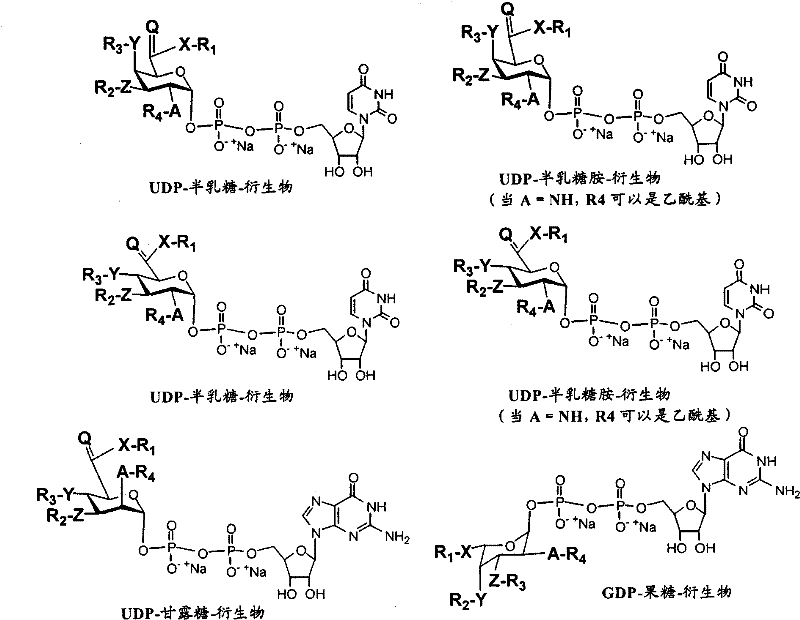
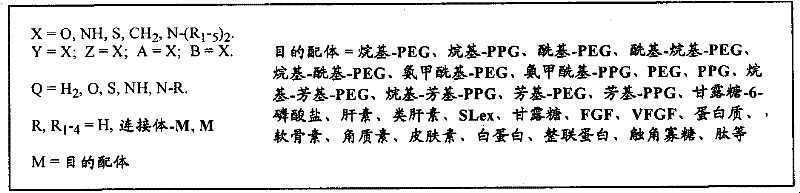
在一个备选实施方案中,使用糖基转移酶将经修饰的糖直接加入肽主链中,已知所述糖基转移酶将糖残基转移给多肽主链上的O联糖基化序列。这个示例性实施方案在下文方案11中阐述。在实践本发明中有用的示例性糖基转移酶包括但不限于GalNAc转移酶(GalNAc T1至GalNAc T20)、GlcNAc转移酶、岩藻糖基转移酶、葡糖基转移酶、木糖基转移酶、甘露糖基转移酶等。这种方法的使用允许经修饰的糖直接加到缺乏任何碳水化合物的多肽上,或备选地加到现有的糖肽上。In an alternative embodiment, the modified sugar is added directly to the peptide backbone using a glycosyltransferase known to transfer sugar residues to O-linked glycosylation sequences on the polypeptide backbone . This exemplary embodiment is set forth in Scheme 11 below. Exemplary glycosyltransferases useful in practicing the invention include, but are not limited to, GalNAc transferases (GalNAc T1 to GalNAc T20), GlcNAc transferases, fucosyltransferases, glucosyltransferases, xylosyltransferases , Mannosyltransferase, etc. The use of this method allows the direct addition of modified sugars to polypeptides lacking any carbohydrates, or alternatively to existing glycopeptides.
方案11:示例性经修饰的糖转移到多肽上而无先前糖基化 Scheme 11: Transfer of exemplary modified sugars to polypeptides without prior glycosylation

在上文阐述的示例性实施方案各自中,在经修饰的糖与多肽缀合后,可以利用一个或多个另外的化学或酶促修饰步骤。在一个示例性实施方案中,酶(例如,岩藻糖基转移酶)用于将糖基单位(例如,岩藻糖)附加到与多肽附着的末端经修饰的糖上。在另一个例子中,酶促反应利用经修饰的糖无法与之缀合的“帽”(例如,sialylate)位点。备选地,利用化学反应改变经缀合的经修饰的糖的结构。例如,使经缀合的经修饰的糖与试剂反应,所述试剂使其与多肽组分的连接稳定或不稳定,经修饰的糖与所述多肽组分附着。在另一个例子中,经修饰的糖的组分在其与多肽缀合后脱保护。本领域技术人员应当理解,存在在经修饰的糖与多肽缀合后的阶段时在本发明的方法中使用的许多酶促和化学操作。经修饰的糖-肽缀合物的进一步加工在本发明的范围内。In each of the exemplary embodiments set forth above, following conjugation of the modified carbohydrate to the polypeptide, one or more additional chemical or enzymatic modification steps may be utilized. In an exemplary embodiment, an enzyme (eg, fucosyltransferase) is used to append a glycosyl unit (eg, fucose) to a terminally modified sugar attached to a polypeptide. In another example, the enzymatic reaction utilizes a "cap" (eg, sialylate) site to which a modified sugar cannot be conjugated. Alternatively, chemical reactions are used to alter the structure of the conjugated modified sugar. For example, the conjugated modified sugar is reacted with a reagent that stabilizes or destabilizes its linkage to the polypeptide component to which the modified sugar is attached. In another example, the modified sugar component is deprotected after its conjugation to the polypeptide. Those skilled in the art will understand that there are many enzymatic and chemical manipulations used in the methods of the invention at a stage after conjugation of the modified sugar to the polypeptide. Further processing of the modified sugar-peptide conjugates is within the scope of the present invention.
在另一个示例性实施方案中,使糖肽与靶向试剂缀合,所述靶向试剂例如转铁蛋白(递送多肽经过血脑屏障,并且至胞内体)、肉毒碱(将多肽递送给肌细胞;参见例如,LeBorgne等人,Biochem.Pharmacol.59:1357-63(2000),和膦酸酯例如二膦酸酯(将多肽靶向骨和其他含钙组织;参见例如,Modern Drug Discovery,2002年8月,第10页)。对于靶向有用的其他试剂对于本领域技术人员是显而易见的。例如,葡萄糖、谷氨酰胺和IGF也用于靶向肌肉。In another exemplary embodiment, the glycopeptide is conjugated to a targeting agent such as transferrin (to deliver polypeptide across the blood-brain barrier and to endosomes), carnitine (to deliver polypeptide to muscle cells; see, e.g., LeBorgne et al., Biochem. Pharmacol. 59:1357-63 (2000), and phosphonates such as bisphosphonates (targeting polypeptides to bone and other calcium-containing tissues; see, e.g., Modern Drug Discovery, August 2002, p. 10). Other agents useful for targeting will be apparent to those skilled in the art. For example, glucose, glutamine, and IGF are also used to target muscle.
通过本文讨论或本领域另外已知的任何方法,使靶向部分和治疗性多肽缀合。本领域技术人员应当理解,除上文阐述的那些外的多肽也可以如本文所述进行衍生。示例性多肽在与2001年10月10日提交的共同未决的、共同拥有的美国临时专利申请号60/328,523中附加的附录中阐述。The targeting moiety and the therapeutic polypeptide are conjugated by any method discussed herein or otherwise known in the art. Those skilled in the art will appreciate that polypeptides other than those set forth above may also be derivatized as described herein. Exemplary polypeptides are set forth in the appendix attached to co-pending, commonly-owned US Provisional Patent Application No. 60/328,523, filed October 10, 2001.
在一个示例性实施方案中,靶向试剂和治疗性多肽经由连接体部分进行偶联。在这个实施方案中,根据本发明的方法,治疗性多肽或靶向试剂中的至少一种经由完整的糖基连接基团与连接体部分偶联。在一个示例性实施方案中,连接体部分包括聚(醚)例如聚(乙二醇)。在另一个示例性实施方案中,连接体部分包括至少一个这样的键,所述键在体内降解,从靶向试剂中释放治疗性多肽,随后将缀合物递送给机体的靶向组织或区域。In an exemplary embodiment, the targeting agent and therapeutic polypeptide are coupled via a linker moiety. In this embodiment, at least one of a therapeutic polypeptide or a targeting agent is coupled to a linker moiety via an integral glycosyl linking group according to the methods of the invention. In an exemplary embodiment, the linker moiety comprises a poly(ether) such as poly(ethylene glycol). In another exemplary embodiment, the linker moiety includes at least one bond that degrades in vivo, releasing the therapeutic polypeptide from the targeting agent, and subsequently delivering the conjugate to the targeted tissue or region of the body .
在另外一个示例性实施方案中,无需使治疗性多肽与靶向部分缀合,经由改变治疗性部分上的糖型来改变治疗性部分的体内分布。例如,通过用唾液酸(或其衍生物)给糖基基团的末端半乳糖部分加帽,治疗性多肽可以转向远离经由网状内皮系统的摄取。In another exemplary embodiment, the in vivo distribution of the therapeutic moiety is altered via altering the glycoform on the therapeutic moiety without conjugating the therapeutic polypeptide to the targeting moiety. For example, by capping the terminal galactose moiety of the glycosyl group with sialic acid (or a derivative thereof), a therapeutic polypeptide can be diverted away from uptake via the reticuloendothelial system.
酶enzyme
寡糖基转移酶oligosaccharyltransferase
在本发明的方法中使用的寡糖基转移酶可以是真核生物或原核生物酶。在一个实施方案中,寡糖基转移酶对于多肽在其中表达的特定宿主细胞是内源的。例如,当多肽在细菌宿主细胞中表达时,内源酶可以是PglB或与PglB具有显著序列同一性的其他酶。在一个例子中,内源酶与PglB或PglB的相对应部分具有至少约50%、至少约60%、至少约70%、至少约80%、至少约90%、至少约92%、至少约94%、至少约96%、至少约98%或超过98%序列同一性。在一个例子中,酶比PglB小,但具有与PglB序列的至少部分相对应的氨基酸序列。在另一个例子中,多肽在真核生物宿主细胞例如酵母细胞中表达。在这个例子中,内源寡糖基转移酶可以包括Stt3p酶或显示出与Stt3p的显著序列同一性的另一种酶。The oligosaccharyltransferase used in the method of the invention may be a eukaryotic or a prokaryotic enzyme. In one embodiment, the oligosaccharyltransferase is endogenous to the particular host cell in which the polypeptide is expressed. For example, when the polypeptide is expressed in a bacterial host cell, the endogenous enzyme can be PglB or another enzyme with significant sequence identity to PglB. In one example, the endogenous enzyme has at least about 50%, at least about 60%, at least about 70%, at least about 80%, at least about 90%, at least about 92%, at least about 94% %, at least about 96%, at least about 98%, or more than 98% sequence identity. In one example, the enzyme is smaller than PglB but has an amino acid sequence corresponding to at least part of the PglB sequence. In another example, the polypeptide is expressed in a eukaryotic host cell, such as a yeast cell. In this example, the endogenous oligosaccharyltransferase may include a Stt3p enzyme or another enzyme that exhibits significant sequence identity to Stt3p.
寡糖基转移酶可以是单一酶或蛋白质复合物的部分,任选是膜结合的。例如,包括具有寡糖基转移酶活性的膜结合的酶的膜制剂可以用作用于糖基化反应的试剂。在一个具体例子中,细菌酶PglB在宿主细胞(例如,细菌细胞)中过表达,并且此类宿主细胞的膜制剂用于无细胞的体外糖基化反应。The oligosaccharyltransferase may be a single enzyme or part of a protein complex, optionally membrane bound. For example, membrane preparations including membrane-bound enzymes with oligosaccharyltransferase activity can be used as reagents for glycosylation reactions. In one specific example, the bacterial enzyme PglB is overexpressed in host cells (eg, bacterial cells), and membrane preparations of such host cells are used in cell-free in vitro glycosylation reactions.
在一个实施方案中,寡糖基转移酶是重组酶。在根据这个实施方案的一个例子中,重组寡糖基转移酶在多肽在其中表达的宿主细胞中共表达。因此,在一个例子中,宿主细胞包括载体(其包括编码寡糖基转移酶(例如,PglB)的核酸序列)和另一种载体(其包括编码底物多肽的核酸序列)。备选地,寡糖基转移酶和多肽的核酸序列都是相同转染载体的部分。In one embodiment, the oligosaccharyltransferase is a recombinant enzyme. In one example according to this embodiment, the recombinant oligosaccharyltransferase is co-expressed in the host cell in which the polypeptide is expressed. Thus, in one example, a host cell includes a vector comprising a nucleic acid sequence encoding an oligosaccharyltransferase (eg, PglB) and another vector comprising a nucleic acid sequence encoding a substrate polypeptide. Alternatively, both the nucleic acid sequences of the oligosaccharyltransferase and the polypeptide are part of the same transfection vector.
在另一个实施方案中,寡糖基转移酶是缺乏功能性膜锚定结构域的可溶蛋白质。例如,酶可以是其中N末端疏水部分的至少部分被去除的PglB。此类截短可以涉及任何数目的氨基酸残基,只要剩余序列代表具有至少某些寡糖基转移酶活性的酶。在一个例子中,可溶性酶在宿主细胞中进行表达,并且随后进行分离。经分离的酶可以在体外糖基化方案中使用。In another embodiment, the oligosaccharyltransferase is a soluble protein lacking a functional membrane anchor domain. For example, the enzyme may be PglB in which at least part of the N-terminal hydrophobic portion is removed. Such truncations may involve any number of amino acid residues as long as the remaining sequence represents an enzyme having at least some oligosaccharyltransferase activity. In one example, a soluble enzyme is expressed in a host cell and subsequently isolated. The isolated enzymes can be used in in vitro glycosylation protocols.
寡糖基转移酶可以衍生自任何物种。寡糖基转移酶的代表性例子包括真核生物(例如,酵母、哺乳动物)蛋白质例如Stt3p,细菌(例如,大肠杆菌、空肠弯曲杆菌(Campylobacter jejuni))蛋白质例如PglB,昆虫蛋白质等。在一个例子中,本发明使用重组PglB,或与PglB酶具有高序列同一性的酶。本发明的示例性寡糖基转移酶包括根据SEQ IDNO:102的氨基酸序列。示例性寡糖基转移酶具有这样的氨基酸序列,其与SEQ ID NO:102的氨基酸序列或其STT3亚单位(氨基酸残基9-626)具有至少约50%、至少约60%、至少约70%、至少约80%、至少约90%、至少约92%、至少约94%、至少约96%、至少约98%或超过98%序列同一性。Oligosaccharyltransferases can be derived from any species. Representative examples of oligosaccharyltransferases include eukaryotic (eg, yeast, mammalian) proteins such as Stt3p, bacterial (eg, E. coli, Campylobacter jejuni) proteins such as PglB, insect proteins, and the like. In one example, the invention uses recombinant PglB, or an enzyme with high sequence identity to the PglB enzyme. Exemplary oligosaccharyltransferases of the invention include the amino acid sequence according to SEQ ID NO: 102. Exemplary oligosaccharyltransferases have amino acid sequences that share at least about 50%, at least about 60%, at least about 70% with the amino acid sequence of SEQ ID NO: 102 or its STT3 subunit (amino acid residues 9-626) %, at least about 80%, at least about 90%, at least about 92%, at least about 94%, at least about 96%, at least about 98%, or more than 98% sequence identity.
PglB(空肠弯曲杆菌,登记CAL35243)PglB (Campylobacter jejuni, accession CAL35243)
(SEQ ID NO:102)(SEQ ID NO: 102)
MLKKEYLKNPYLVLFAMIVLAYVFSVFCRFYWVWWASEFNEYFFNNQLMIISNDGYAFAEGARDMIAGFHQPNDLSYYGSSLSTLTYWLYKITPFSFESIILYMSTFLSSLVVIPIILLANEYKRPLMGFVAALLASVANSYYNRTMSGYYDTDMLVIVLPMFILFFMVRMILKKDFFSLIALPLFIGIYLWWYPSSYTLNVALIGLFLIYTLIFHRKEKIFYIAVILSSLTLSNIAWFYQSAIIVILFALFALEQKRLNFMIIGILGSATLIFLILSGGVDPILYQLKFYIFRSDESANLTQGFMYFNVNQTIQEVENVDFSEFMRRISGSEIVFLFSLFGFVWLLRKHKSMIMALPILVLGFLALKGGLRFTIYSVPVMALGFGFLLSEFKAILVKKYSQLTSNVCIVFATILTLAPVFIHIYNYKAPTVFSQNEASLLNQLKNIANREDYVVTWWDYGYPVRYYSDVKTLVDGGKHLGKDNFFPSFSLSKDEQAAANMARLSVEYTEKSFYAPQNDILKSDILQAMMKDYNQSNVDLFLASLSKPDFKIDTPKTRDIYLYMPARMSLIFSTVASFSFINLDTGVLDKPFTFSTAYPLDVKNGEIYLSNGVVLSDDFRSFKIGDNVVSVNSIVEINSIKQGEYKITPIDDKAQFYIFYLKDSAIPYAQFILMDKTMFNSAYVQMFFLGNYDKNLFDLVINSRDAKVFKLKIMLKKEYLKNPYLVLFAMIVLAYVFSVFCRFYWVWWASEFNEYFFNNQLMIISNDGYAFAEGARDMIAGFHQPNDLSYYGSSLSTLTYWLYKITPFSFESIILYMSTFLSSLVVIPIILLANEYKRPLMGFVAALLASVANSYYNRTMSGYYDTDMLVIVLPMFILFFMVRMILKKDFFSLIALPLFIGIYLWWYPSSYTLNVALIGLFLIYTLIFHRKEKIFYIAVILSSLTLSNIAWFYQSAIIVILFALFALEQKRLNFMIIGILGSATLIFLILSGGVDPILYQLKFYIFRSDESANLTQGFMYFNVNQTIQEVENVDFSEFMRRISGSEIVFLFSLFGFVWLLRKHKSMIMALPILVLGFLALKGGLRFTIYSVPVMALGFGFLLSEFKAILVKKYSQLTSNVCIVFATILTLAPVFIHIYNYKAPTVFSQNEASLLNQLKNIANREDYVVTWWDYGYPVRYYSDVKTLVDGGKHLGKDNFFPSFSLSKDEQAAANMARLSVEYTEKSFYAPQNDILKSDILQAMMKDYNQSNVDLFLASLSKPDFKIDTPKTRDIYLYMPARMSLIFSTVASFSFINLDTGVLDKPFTFSTAYPLDVKNGEIYLSNGVVLSDDFRSFKIGDNVVSVNSIVEINSIKQGEYKITPIDDKAQFYIFYLKDSAIPYAQFILMDKTMFNSAYVQMFFLGNYDKNLFDLVINSRDAKVFKLKI
PglB(淋病奈瑟球菌(Neisseria gonorrhoeae),登记YP_207258)(SEQ ID NO:103)PglB (Neisseria gonorrhoeae, accession YP_207258) (SEQ ID NO: 103)
MSKAVKRLFDIIASASGLIVLSPVFLVLIYLIRKNLGSPVFFIRERPGKDGKPFKMVKFRSMRDALDSDGIPLPDSERLTDFGKKLRATSLDELPELWNVLKGEMSLVGPRPLLMQYLPLYNKFQNRRHEMKPGITGWAQVNGRNALSWDEKFSCDVWYTDNFSFWLDMKILFLTVKKVLIKEGISAQGEATMPPFAGNRKLAVIGAGGHGKVVAELAAALGTYGEIVFLDDRTQGSVNGFPVIGTTLLLENSLSPEQFDITVAVGNNRIRRQITENAAALGFKLPVLIHPDATVSPSAIIGQGSVVMAKAVVQAGSVLKDGVIVNTAATVDHDCLLDAFVHISPGAHLSGNTRIGEESRIGTGACSRQQTTVGSGVTAGAGAVIVCDIPDGMTVAGNPAKPLTGKNPKTGTAMSKAVKRLFDIIASASGLIVLSPVFLVLIYLIRKNLGSPVFFIRERPGKDGKPFKMVKFRSMRDALDSDGIPLPDSERLTDFGKKLRATSLDELPELWNVLKGEMSLVGPRPLLMQYLPLYNKFQNRRHEMKPGITGWAQVNGRNALSWDEKFSCDVWYTDNFSFWLDMKILFLTVKKVLIKEGISAQGEATMPPFAGNRKLAVIGAGGHGKVVAELAAALGTYGEIVFLDDRTQGSVNGFPVIGTTLLLENSLSPEQFDITVAVGNNRIRRQITENAAALGFKLPVLIHPDATVSPSAIIGQGSVVMAKAVVQAGSVLKDGVIVNTAATVDHDCLLDAFVHISPGAHLSGNTRIGEESRIGTGACSRQQTTVGSGVTAGAGAVIVCDIPDGMTVAGNPAKPLTGKNPKTGTA
寡糖基转移酶(酿酒酵母(Saccharomyces cerevisiae),登记EDN64373)Oligosaccharyltransferase (Saccharomyces cerevisiae, accession EDN64373)
(SEQ ID NO:104)(SEQ ID NO: 104)
MKWCSTYIIIWLAIIFHKFQKSTATASHNIDDILQLKGDTGVITVTADNYPLLSRGVPGYFNILYITMRGTNSNGMSCQLCHDFEKTYQAVADVIRSQAPQSLNLFFTVDVNEVPQLVKDLKLQNVPHLVVYPPAESNKQSQFEWKTSPFYQYSLVPENAENTLQFGDFLAKILNISITVPQAFNVQEFVYYFVACMVVFIFIKKVILPKVTNKWKLFSMILSLGILLPSITGYKFVEMNAIPFIARDAKNRIMYFSGGSGWQFGIEIFSVSLMYIVMSALSVLLIYVPKISCVSEKMRGLLSSFLACVLFYFFSYFISCYLIKNPGYPIVFMKWCSTYIIIWLAIIFHKFQKSTATASHNIDDILQLKGDTGVITVTADNYPLLSRGVPGYFNILYITMRGTNSNGMSCQLCHDFEKTYQAVADVIRSQAPQSLNLFFTVDVNEVPQLVKDLKLQNVPHLVVYPPAESNKQSQFEWKTSPFYQYSLVPENAENTLQFGDFLAKILNISITVPQAFNVQEFVYYFVACMVVFIFIKKVILPKVTNKWKLFSMILSLGILLPSITGYKFVEMNAIPFIARDAKNRIMYFSGGSGWQFGIEIFSVSLMYIVMSALSVLLIYVPKISCVSEKMRGLLSSFLACVLFYFFSYFISCYLIKNPGYPIVF
寡糖基转移酶(智人(Homo sapiens),登记BAA23670)Oligosaccharyltransferase (Homo sapiens, accession BAA23670)
(SEQ ID NO:105)(SEQ ID NO: 105)
MGYFRCAGAGSFGRRRKMEPSTAARAWALFWLLLPLLGAVCASGPRTLVLLDNLNVRETHSLFFRSLKDRGFELTFKTADDPSLSLIKYGEFLYDNLIIFSPSVEDFGGNINVETISAFIDGGGSVLVAASSDIGDPLRELGSECGIEFDEEKTAVIDHHNYDISDLGQHTLIVADTENLLKAPTIVGKSSLNPILFRGVGMVADPDNPLVLDILTGSSTSYSFFPDKPITQYPHAVGKNTLLIAGLQARNNARVIFSGSLDFFSDSFFNSAVQKAAPGSQRYSQTGNYELAVALSRWVFKEEGVLRVGPVSHHRVGETAPPNAYTVTDLVEYSIVIQQLSNAKWVPFDGDDIQLEFVRIDPFVRTFLKKKGGKYSVQFKLPDVYGVFQFKVDYNRLGYTHLYSSTQVSVRPLQHTQYERFIPSAYPYYASAFPMMLGLFIFSIVFLHMKEKEKSDMGYFRCAGAGSFGRRRKMEPSTAARAWALFWLLLPLLGAVCASGPRTLVLLDNLNVRETHSLFFRSLKDRGFELTFKTADDPSLSLIKYGEFLYDNLIIFSPSVEDFGGNINVETISAFIDGGGSVLVAASSDIGDPLRELGSECGIEFDEEKTAVIDHHNYDISDLGQHTLIVADTENLLKAPTIVGKSSLNPILFRGVGMVADPDNPLVLDILTGSSTSYSFFPDKPITQYPHAVGKNTLLIAGLQARNNARVIFSGSLDFFSDSFFNSAVQKAAPGSQRYSQTGNYELAVALSRWVFKEEGVLRVGPVSHHRVGETAPPNAYTVTDLVEYSIVIQQLSNAKWVPFDGDDIQLEFVRIDPFVRTFLKKKGGKYSVQFKLPDVYGVFQFKVDYNRLGYTHLYSSTQVSVRPLQHTQYERFIPSAYPYYASAFPMMLGLFIFSIVFLHMKEKEKSD
寡糖基转移酶(小家鼠(Mus musculus),登记BAA23671)Oligosaccharyltransferase (Mus musculus, accession BAA23671)
(SEQ ID NO:106)(SEQ ID NO: 106)
MKMDPRLAVRAWPLCGLLLAVLGCVCASGPRTLVLLDNLNVRDTHSLFFRSLKDRGFELTFKTADDPSLSLIKYGEFLYDNLIIFSPSVEDFGGNINVETISAFIDGGGSVLVAASSDIGDPLRELGSECGIEFDEEKTAVIDHHNYDVSDLGQHTLIVADTENLLKAPTIVGKSSLNPILFRGVGMVADPDNPLVLDILTGSSTSYSFFPDKPITQYPHAVGRNTLLIAGLQARNNARVIFSGSLDFFSDAFFNSAVQKATPGAQRYSQTGNYELAVALSRWVFKEEGVLRVGPVSHHRVGEMAPPNAYTVTDLVEYSIVIEQLSNGKWVPFDGDDIQLEFVRIDPFVRTFLKRKGGKYSVQFKLPDVYGVFQFKVDYNRLGYTHLYSSTQVSVRPLQHTQYERFIPSAYPYYASAFSMMAGLFIFSIVFLHMKEKEKSDMKMDPRLAVRAWPLCGLLLAVLGCVCASGPRTLVLLDNLNVRDTHSLFFRSLKDRGFELTFKTADDPSLSLIKYGEFLYDNLIIFSPSVEDFGGNINVETISAFIDGGGSVLVAASSDIGDPLRELGSECGIEFDEEKTAVIDHHNYDVSDLGQHTLIVADTENLLKAPTIVGKSSLNPILFRGVGMVADPDNPLVLDILTGSSTSYSFFPDKPITQYPHAVGRNTLLIAGLQARNNARVIFSGSLDFFSDAFFNSAVQKATPGAQRYSQTGNYELAVALSRWVFKEEGVLRVGPVSHHRVGEMAPPNAYTVTDLVEYSIVIEQLSNGKWVPFDGDDIQLEFVRIDPFVRTFLKRKGGKYSVQFKLPDVYGVFQFKVDYNRLGYTHLYSSTQVSVRPLQHTQYERFIPSAYPYYASAFSMMAGLFIFSIVFLHMKEKEKSD
寡糖基转移酶(白色念珠菌(candida albicans),登记XP_714366或XP_440145)Oligosaccharyltransferase (Candida albicans, accession XP_714366 or XP_440145)
(SEQ ID NO:107)(SEQ ID NO: 107)
MAKSASNKKSIPTTSSSSTTTSAASSSVVLKEVKSTLTTTINNYFDTISAQPRLKLIDLFLIFLVLLGILQFIYVLIIGNFPFNSFLGGFISCVGQFVLLVSLRLQINDSTTTTTNKESDDQLELDEDKIENGTTGGGNGRLFKEITPERSFGDFIFASLILHFIVIHFINMAKSASNKKSIPTTSSSSTTTSAASSSVVLKEVKSTLTTTINNYFDTISAQPRLKLIDLFLIFLLVLLGILQFIYVLIIGNFPFNSFLGGFIVIHFIN
磷-多萜醇-GlcNAc-1-磷酸盐转移酶Phospho-dolicenol-GlcNAc-1-phosphate transferase
UDP-N-乙酰葡糖胺-多萜基-磷酸盐-N-乙酰葡糖胺-磷酸转移酶同种型b(智人,登记NP_976061)UDP-N-acetylglucosamine-polyterpenyl-phosphate-N-acetylglucosamine-phosphotransferase isoform b (Homo sapiens, accession NP_976061)
(SEQ ID NO:108)(SEQ ID NO: 108)
MIFLGFADDVLNLRWRHKLLLPTAASLPLLMVYFTNFGNTTIVVPKPFRPILGLHLDLGILYYVYMGLLAVFCTNAINILAGINGLEAGQSLVISASIIVFNLVELEGDCRDDHVFSLYFMIPFFFTTLGLLYHNWYPSRVFVGDTFCYFAGMTFAVVGILGHFSKTMLLFFMPQVFNFLYSLPQLLHIIPCPRHRIPRLNIKTGKLEMSYSKFKTKSLSFLGTFILKVAESLQLVTVHQSETEDGEFTECNNMTLINLLLKVLGPIHERNLTLLLLLLQILGSAITFSIRYQLVRLFYDVMIFLGFADDVLNLRWRHKLLLPTAASLPLLMVYFTNFGNTTIVVPKPFRPILGLHLDLGILYYVYMGLLAVFCTNAINILAGINGLEAGQSLVISASIIVFNLVELEGDCRDDHVFSLYFMIPFFFTTLGLLYHNWYPSRVFVGDTFCYFAGMTFAVVGILGHFSKTMLLFFMPQVFNFLYSLPQLLHIIPCPRHRIPRLNIKTGKLEMSYSKFKTKSLSFLGTFILKVAESLQLVTVHQSETEDGEFTECNNMTLINLLLKVLGPIHERNLTLLLLLLQILGSAITFSIRYQLVRLFYDV
UDP-N-乙酰葡糖胺-多萜基-磷酸盐-N-乙酰葡糖胺-磷酸转移酶同种型a(智人,登记NP_001373)UDP-N-acetylglucosamine-polyterpenyl-phosphate-N-acetylglucosamine-phosphotransferase isoform a (Homo sapiens, accession NP_001373)
(SEQ ID NO:109)(SEQ ID NO: 109)
MWAFSELPMPLLINLIVSLLGFVATVTLIPAFRGHFIAARLCGQDLNKTSRQQIPESQGVISGAVFLIILFCFIPFPFLNCFVKEQCKAFPHHEFVALIGALLAICCMIFLGFADDVLNLRWRHKLLLPTAASLPLLMVYFTNFGNTTIVVPKPFRPILGLHLDLGILYYVYMGLLAVFCTNAINILAGINGLEAGQSLVISASIIVFNLVELEGDCRDDHVFSLYFMIPFFFTTLGLLYHNWYPSRVFVGDTFCYFAGMTFAVVGILGHFSKTMLLFFMPQVFNFLYSLPQLLHIIPCPRHRIPRLNIKTGKLEMSYSKFKTKSLSFLGTFILKVAE SLQLVTVHQSETEDGEFTECNNMTLINLLLKVLGPIHERNLTLLLLLLQILGSAITFSIRYQLVRLFYDVMWAFSELPMPLLINLIVSLLGFVATVTLIPAFRGHFIAARLCGQDLNKTSRQQIPESQGVISGAVFLIILFCFIPFPFLNCFVKEQCKAFPHHEFVALIGALLAICCMIFLGFADDVLNLRWRHKLLLPTAASLPLLMVYFTNFGNTTIVVPKPFRPILGLHLDLGILYYVYMGLLAVFCTNAINILAGINGLEAGQSLVISASIIVFNLVELEGDCRDDHVFSLYFMIPFFFTTLGLLYHNWYPSRVFVGDTFCYFAGMTFAVVGILGHFSKTMLLFFMPQVFNFLYSLPQLLHIIPCPRHRIPRLNIKTGKLEMSYSKFKTKSLSFLGTFILKVAE SLQLVTVHQSETEDGEFTECNNMTLINLLLKVLGPIHERNLTLLLLLLQILGSAITFSIRYQLVRLFYDV
UDP-N-乙酰葡糖胺-多萜基-磷酸盐-N-乙酰葡糖胺-磷酸转移酶(GPT、G1PT、GlcNAc-1-P-转移酶)(小家鼠,登记P42867)UDP-N-acetylglucosamine-polyterpenyl-phosphate-N-acetylglucosamine-phosphotransferase (GPT, G1PT, GlcNAc-1-P-transferase) (Mus musculus, accession P42867)
(SEQ ID NO:110)(SEQ ID NO: 110)
MWAFPELPLPLPLLVNLIGSLLGFVATVTLIPAFRSHFIAARLCGQDLNKLSQQQIPESQGVISGAVFLIILFCFIPFPFLNCFVEEQCKAFPHHEFVALIGALLAICCMIFLGFADDVLNLRWRHKLLLPTAASLPLLMVYFTNFGNTTIVVPKPFRWILGLHLDLGILYYVYMGLLAVFCTNAINILAGINGLEAGQSLVISASIIVFNLVELEGDYRDDHIFSLYFMIPFFFTTLGLLYHNWYPSRVFVGDTFCYFAGMTFAVVGILGHFSKTMLLFFMPQVFNFLYSLPQLFHIIPCPRHRMPRLNAKTGKLEMSYSKFKTKNLSFLGTFILKVAENLRLVTVHQGESEDGAFTECNNMTLINLLLKVFGPIHERNLTLLLLLLQVLSSAATFSIRYQLVRLFYDVMWAFPELPLPLPLLVNLIGSLLGFVATVTLIPAFRSHFIAARLCGQDLNKLSQQQIPESQGVISGAVFLIILFCFIPFPFLNCFVEEQCKAFPHHEFVALIGALLAICCMIFLGFADDVLNLRWRHKLLLPTAASLPLLMVYFTNFGNTTIVVPKPFRWILGLHLDLGILYYVYMGLLAVFCTNAINILAGINGLEAGQSLVISASIIVFNLVELEGDYRDDHIFSLYFMIPFFFTTLGLLYHNWYPSRVFVGDTFCYFAGMTFAVVGILGHFSKTMLLFFMPQVFNFLYSLPQLFHIIPCPRHRMPRLNAKTGKLEMSYSKFKTKNLSFLGTFILKVAENLRLVTVHQGESEDGAFTECNNMTLINLLLKVFGPIHERNLTLLLLLLQVLSSAATFSIRYQLVRLFYDV
UDP-N-乙酰葡糖胺-多萜基-磷酸盐-N-乙酰葡糖胺-磷酸转移酶(GPT、G1PT、GlcNAc-1-P-转移酶)(酿酒酵母,登记P07286)UDP-N-acetylglucosamine-polyterpene-phosphate-N-acetylglucosamine-phosphotransferase (GPT, G1PT, GlcNAc-1-P-transferase) (Saccharomyces cerevisiae, accession P07286)
(SEQ ID NO:111)(SEQ ID NO: 111)
MLRLFSLALITCLIYYSKNQGPSALVAAVGFGIAGYLATDMLIPRVGKSFIKIGLFGKDLSKPGRPVLPETIGAIPAAVYLFVMFIYIPFIFYKYMVITTSGGGHRDVSVVEDNGMNSNIFPHDKLSEYLSAILCLESTVLLGIADDLFDLRWRHKFFLPAIAAIPLLMVYYVDFGVTHVLIPGFMERWLKKTSVDLGLWYYVYMASMAIFCPNSINILAGVNGLEVGQCIVLAILALLNDLLYFSMGPLATRDSHRFSAVLIIPFLGVSLALWKWNRWPATVFVGDTYCYFAGMVFAVVGILGHFSKTMLLLFIPQIVNFIYSCPQLFKLVPCPRHRLPKFNEKDGLMYPSRANLKEEPPKSIFKPILKLLYCLHLIDLEFDENNEIISTSNMTLINLTLVWFGPMREDKLCNTILKLQFCIGILALLGRHAIGAIIFGHDNLWTVRMLRLFSLALITCLIYYSKNQGPSALVAAVGFGIAGYLATDMLIPRVGKSFIKIGLFGKDLSKPGRPVLPETIGAIPAAVYLFVMFIYIPFIFYKYMVITTSGGGHRDVSVVEDNGMNSNIFPHDKLSEYLSAILCLESTVLLGIADDLFDLRWRHKFFLPAIAAIPLLMVYYVDFGVTHVLIPGFMERWLKKTSVDLGLWYYVYMASMAIFCPNSINILAGVNGLEVGQCIVLAILALLNDLLYFSMGPLATRDSHRFSAVLIIPFLGVSLALWKWNRWPATVFVGDTYCYFAGMVFAVVGILGHFSKTMLLLFIPQIVNFIYSCPQLFKLVPCPRHRLPKFNEKDGLMYPSRANLKEEPPKSIFKPILKLLYCLHLIDLEFDENNEIISTSNMTLINLTLVWFGPMREDKLCNTILKLQFCIGILALLGRHAIGAIIFGHDNLWTVR
用于合成糖基供体分子的其他酶Other Enzymes for Synthesis of Glycosyl Donor Molecules
PglC(空肠弯曲杆菌,登记AAD51385)PglC (Campylobacter jejuni, accession AAD51385)
(SEQ ID NO:112)(SEQ ID NO: 112)
MYEKVFKRIFDFILALVLLVLFSPVILITALLLKITQGSVIFTQNRPGLDEKIFKIYKFKTMSDERDEKGELLSDELRLKAFGKIVRSLSLDELLQLFNVLKGDMSFVGPRPLLVEYLSLYNEEQKLRHKVRPGITGWAQVNGRNAISWQKKFELDVYYVKNISFLLDLKIMFLTALKVLKRSGVSKEGHVTTEKFNGKNMYEKVFKRIFDFILALVLLVLFSPVILITALLLKITQGSVIFTQNRPGLDEKIFKIYKFKTMSDERDEKGELLSDELRLKAFGKIVRSLSLDELLQLFNVLKGDMSFVGPRPLLVEYLSLYNEEQKLRHKVRPGITGWAQVNGRNAISWQKKFELDVYYVVKNISFLLDLKIMFLTALKNGHKN
PglC(淋病奈瑟球菌,登记YP_207257)PglC (Neisseria gonorrhoeae, accession YP_207257)
(SEQ ID NO:113)(SEQ ID NO: 113)
MLNTALSPWPSFTREEADAVSKVLLSNKVNYWTGSECREFEKEFAAFAGTRYAVALSNGTLALDAALKAIGIGAGDDVIVTSRTFLASASCIVNAGANPVFADVDLNSQNISAETVKAVLTPNTKAVIVVHLAGMPAEMDGIMALAKEHDLWVIEDCAQAHGATYKGKSVGSIGHVGAWSFCQDKIITTGGEGGMVTTNDKTLWEKMWAYKDHGKSYDAVYHREHAPGFRWLHESFGTNWRMMEMQAVIGRIQLKHLPEWTARRQENAAKLAESLRKFKSIRLIEVAGYIGHAQYKFYAFVKPEHLKDDWTRDRIVSELNARNVPCYQGGCSEVYLEKAFDNTPWRPKERLKNAVELGGTALTFLVHPTLTDDEIAFCKKHIEAVLTEAARMLNTALSPWPSFTREEADAVSKVLLSNKVNYWTGSECREFEKEFAAFAGTRYAVALSNGTLALDAALKAIGIGAGDDVIVTSRTFLASASCIVNAGANPVFADVDLNSQNISAETVKAVLTPNTKAVIVVHLAGMPAEMDGIMALAKEHDLWVIEDCAQAHGATYKGKSVGSIGHVGAWSFCQDKIITTGGEGGMVTTNDKTLWEKMWAYKDHGKSYDAVYHREHAPGFRWLHESFGTNWRMMEMQAVIGRIQLKHLPEWTARRQENAAKLAESLRKFKSIRLIEVAGYIGHAQYKFYAFVKPEHLKDDWTRDRIVSELNARNVPCYQGGCSEVYLEKAFDNTPWRPKERLKNAVELGGTALTFLVHPTLTDDEIAFCKKHIEAVLTEAAR
糖基转移酶(史氏甲烷短杆菌(Methanobrevibacter smithii),登记YP_001273863)Glycosyltransferase (Methanobrevibacter smithii, registration YP_001273863)
(SEQ ID NO:114)(SEQ ID NO: 114)
MKTAVLIPCYNEELTIKKVILDFKKALPKADIYVYDNNSTDNSYEIAKDTGAIVKREYRQGKGNVVRSMFRDIDADCYILVDGDDTYPAEASKEIEELILSKKADMVIGDRLSSTYFEENKRRFHNSGNKLVRKLINTIFNSDISDIMTGMRGFSYEFVKSFPISSKEFEIETEMTIFALNHNFLIKELPIEYRDRMDGSESKLNTFSDGYKVISLLFGLFRDIRPLFFFSLVTLVLLIIAGLYFFPILIDFYRTGFVEKVPTLITVGVVAIVAVIIFFTGVVLHVIRKQHDENFEHHLNLIAQNKKRMKTAVLIPCYNEELTIKKVILDFKKALPKADIYVYDNNSTDNSYEIAKDTGAIVKREYRQGKGNVVRSMFRDIDADCYILVDGDDTYPAEASKEIEELILSKKADMVIGDRLSSTYFEENKRRFHNSGNKLVRKLINTIFNSDISDIMTGMRGFSYEFVKSFPISSKEFEIETEMTIFALNHNFLIKELPIEYRDRMDGSESKLNTFSDGYKVISLLFGLFRDIRPLFFFSLVTLVLLIIAGLYFFPILIDFYRTGFVEKVPTLITVGVVAIVAVIIFFTGVVLHVIRKQHDENFEHHLNLIAQNKKR
糖基转移酶Glycosyltransferase
在一个实施方案中,糖基转移酶用于合成本发明的糖基供体种类。在另一个实施方案中,糖基转移酶可以用于制备本发明的多肽缀合物的方法中。糖基转移酶以逐步方式催化活化的糖(供体-NDP-糖)加入蛋白质、糖肽、脂质或糖脂中,或加入成长中的寡糖的非还原末端中。例如,在第一个步骤中,多肽可以是使用本发明的糖基供体种类(例如,脂质-焦磷酸盐连接的糖基部分)和合适的寡糖基转移酶而被糖基化。这种糖基化反应可以任选在多肽在其中表达的宿主细胞中发生。在第二个步骤中,对糖基化的多肽实施糖基化或糖基PEG化反应,其涉及经修饰的或未经修饰的糖核苷酸和合适的糖基转移酶。In one embodiment, glycosyltransferases are used to synthesize the glycosyl donor species of the invention. In another embodiment, a glycosyltransferase can be used in a method of making a Polypeptide Conjugate of the invention. Glycosyltransferases catalyze in a stepwise manner the incorporation of activated sugars (donor-NDP-sugars) into proteins, glycopeptides, lipids or glycolipids, or into the non-reducing ends of growing oligosaccharides. For example, in a first step, a polypeptide can be glycosylated using a glycosyl donor species of the invention (eg, a lipid-pyrophosphate-linked glycosyl moiety) and a suitable oligosaccharyltransferase. Such glycosylation can optionally take place in the host cell in which the polypeptide is expressed. In the second step, the glycosylated polypeptide is subjected to a glycosylation or glycoPEGylation reaction involving modified or unmodified sugar nucleotides and a suitable glycosyltransferase.
大量糖基转移酶是本领域已知的。此类酶的例子包括Leloir途径糖基转移酶,例如半乳糖基转移酶、N-乙酰葡糖胺基转移酶、N-乙酰半乳糖胺基转移酶、岩藻糖基转移酶、唾液酸转移酶、甘露糖基转移酶、木糖基转移酶、葡糖醛酸基转移酶等。A large number of glycosyltransferases are known in the art. Examples of such enzymes include Leloir pathway glycosyltransferases such as galactosyltransferase, N-acetylglucosaminyltransferase, N-acetylgalactosyltransferase, fucosyltransferase, sialyltransferase Enzyme, mannosyltransferase, xylosyltransferase, glucuronosyltransferase, etc.
对于涉及糖基转移酶反应的酶促糖合成,可以从任何来源中克隆或分离糖基转移酶。许多经克隆的糖基转移酶是已知的,如它们的多核苷酸序列一样。糖基转移酶氨基酸序列和编码糖基转移酶的核苷酸序列(从其中可以推导氨基酸序列)在各种可公开获得的数据库中发现,包括GenBank、Swiss-Prot、EMBL及其他。For enzymatic sugar synthesis involving glycosyltransferase reactions, glycosyltransferases can be cloned or isolated from any source. Many cloned glycosyltransferases are known, as are their polynucleotide sequences. Glycosyltransferase amino acid sequences and nucleotide sequences encoding glycosyltransferases from which amino acid sequences can be deduced are found in various publicly available databases, including GenBank, Swiss-Prot, EMBL, and others.
可以在本发明的方法中采用的糖基转移酶包括但不限于,半乳糖基转移酶、岩藻糖基转移酶、葡糖基转移酶、N-乙酰半乳糖胺基转移酶、N-乙酰葡糖胺基转移酶、葡糖醛酸内酯转移酶、唾液酸转移酶、甘露糖基转移酶、葡糖醛酸转移酶、半乳糖醛酸转移酶和寡糖基转移酶。合适的糖基转移酶包括得自真核生物以及得自原核生物的那些。Glycosyltransferases that may be employed in the methods of the invention include, but are not limited to, galactosyltransferases, fucosyltransferases, glucosyltransferases, N-acetylgalactosaminotransferases, N-acetyl Glucosaminyltransferases, glucuronolactonetransferases, sialyltransferases, mannosyltransferases, glucuronyltransferases, galacturonyltransferases and oligosaccharyltransferases. Suitable glycosyltransferases include those from eukaryotes as well as from prokaryotes.
编码糖基转移酶的DNA可以这样获得:通过化学合成,通过筛选来自合适的细胞或细胞系培养的mRNA的逆转录物,通过筛选来自合适细胞的基因组文库,或通过这些操作的组合。mRNA或基因组DNA的筛选可以用寡核苷酸探针执行,所述寡核苷酸探针由糖基转移酶基因序列产生。探针可以依照已知操作用可检测基团进行标记,所述可检测基团例如荧光基团、放射性原子或化学发光基团,并且在常规杂交测定法中使用。在备选方案中,糖基转移酶基因序列可以通过使用聚合酶链反应(PCR)操作获得,其中PCR寡核苷酸引物由糖基转移酶基因序列产生(参见例如,给予Mullis等人的美国专利号4,683,195和给予Mullis的美国专利号4,683,202)。DNA encoding a glycosyltransferase can be obtained by chemical synthesis, by screening reverse transcripts from cultured mRNA of suitable cells or cell lines, by screening genomic libraries from suitable cells, or by a combination of these manipulations. Screening of mRNA or genomic DNA can be performed with oligonucleotide probes generated from glycosyltransferase gene sequences. Probes can be labeled with detectable groups, such as fluorescent groups, radioactive atoms, or chemiluminescent groups, according to known procedures, and used in conventional hybridization assays. In an alternative, the glycosyltransferase gene sequence can be obtained by using a polymerase chain reaction (PCR) procedure in which PCR oligonucleotide primers are generated from the glycosyltransferase gene sequence (see, e.g., the U.S. Patent No. 4,683,195 and US Patent No. 4,683,202 to Mullis).
糖基转移酶可以在用载体转化的宿主细胞中合成,所述载体包含编码糖基转移酶的DNA。载体用于扩增编码糖基转移酶的DNA和/或表达编码糖基转移酶的DNA。表达载体是可复制的DNA构建体,其中编码糖基转移酶的DNA序列与合适的控制序列可操作地连接,所述控制序列能够影响糖基转移酶在合适的宿主中的表达。关于此类控制序列的需要将依赖于所选择的宿主和所选择的转化方法而改变。一般地,控制序列包括转录启动子、控制转录的任选操纵子序列、编码合适的mRNA核糖体结合位点的序列、以及控制转录和翻译终止的序列。扩增载体不需要表达控制结构域。所需要全部的是通常由复制起点赋予的在宿主中复制的能力,和促进转化体的识别的选择基因。Glycosyltransferases can be synthesized in host cells transformed with a vector comprising DNA encoding the glycosyltransferases. The vector is used to amplify and/or express DNA encoding a glycosyltransferase. Expression vectors are replicable DNA constructs in which a DNA sequence encoding a glycosyltransferase is operably linked to suitable control sequences capable of effecting expression of the glycosyltransferase in a suitable host. The requirements for such control sequences will vary depending on the host chosen and the method of transformation chosen. Generally, control sequences include a transcriptional promoter, an optional operator sequence to control transcription, a sequence encoding a suitable mRNA ribosomal binding site, and sequences that control termination of transcription and translation. Amplification vectors do not require expression control domains. All that is required is the ability to replicate in the host, usually conferred by an origin of replication, and a selection gene to facilitate recognition of transformants.
在一个示例性实施方案中,本发明利用原核生物酶。此类糖基转移酶包括涉及脂寡糖(LOS)合成的酶,其由许多革兰氏阴性菌产生(Preston等人,Critical Reviews in Microbiology 23(3):139-180(1996))。此类酶包括但不限于,物种例如大肠杆菌和鼠伤寒沙门氏菌(Salmonella typhimurium)的rfa操纵子的蛋白质,其包括β1,6半乳糖基转移酶和β1,3半乳糖基转移酶(参见例如,EMBL登记号M80599和M86935(大肠杆菌);EMBL登记号S56361(鼠伤寒沙门氏菌))、葡糖基转移酶(Swiss-Prot登记号P25740(大肠杆菌)、β1,2-葡糖基转移酶(rfaJ)(Swiss-Prot登记号P27129(大肠杆菌)和Swiss-Prot登记号P19817(鼠伤寒沙门氏菌)、和β1,2-N-乙酰葡糖胺基转移酶(rfaK)(EMBL登记号U00039(大肠杆菌)。关于其氨基酸序列是已知的其他糖基转移酶包括由操纵子例如rfaB和铜绿假单胞菌(Pseudomonasaeruginosa)的rh1操纵子编码的那些,所述rfaB已在生物体例如肺炎克雷伯氏菌(Klebsiella pneumoniae)、大肠杆菌、鼠伤寒沙门氏菌、肠道沙门氏菌(Salmonella enterica)、小肠结肠炎耶尔森菌(Yersiniaenterocolitica)、(Mycobacterium leprosum)中进行表征。In an exemplary embodiment, the invention utilizes prokaryotic enzymes. Such glycosyltransferases include enzymes involved in lipooligosaccharide (LOS) synthesis, which are produced by many Gram-negative bacteria (Preston et al., Critical Reviews in Microbiology 23(3):139-180 (1996)). Such enzymes include, but are not limited to, proteins of species such as the rfa operon of Escherichia coli and Salmonella typhimurium, which include β1,6-galactosyltransferase and β1,3-galactosyltransferase (see, e.g., EMBL accession numbers M80599 and M86935 (Escherichia coli); EMBL accession number S56361 (Salmonella typhimurium)), glucosyltransferase (Swiss-Prot accession number P25740 (Escherichia coli), β1,2-glucosyltransferase (rfaJ ) (Swiss-Prot accession number P27129 (Escherichia coli) and Swiss-Prot accession number P19817 (Salmonella typhimurium), and β1,2-N-acetylglucosaminyl transferase (rfaK) (EMBL accession number U00039 (Escherichia coli ). Other glycosyltransferases whose amino acid sequences are known include those encoded by operons such as rfaB and the rh1 operon of Pseudomonas aeruginosa (Pseudomonas aeruginosa), which has been described in organisms such as Klebsiella pneumoniae Klebsiella pneumoniae, Escherichia coli, Salmonella typhimurium, Salmonella enterica, Yersinia enterocolitica, Mycobacterium leprosum.
还适合于在本发明中使用的是这样的糖基转移酶,其涉及产生包含下述的结构:乳糖-N-新四糖、D-半乳糖基-β-1,4-N-乙酰-D-葡糖胺基-β-1,3-D-半乳糖基-β-1,4-D-葡萄糖、和Pk血型三糖序列、D-半乳糖基-α-1,4-D-半乳糖基-β-1,4-D-葡萄糖,所述糖基转移酶已在粘膜病原体淋病奈瑟球菌和脑膜炎奈瑟球菌(N. meningitidis)的LOS中得到鉴定(Scholten等人,J.Med.Microbiol.41:236-243(1994))。来自脑膜炎奈瑟球菌和淋病奈瑟球菌的基因(其编码涉及这些结构的生物合成的糖基转移酶)已从脑膜炎奈瑟球菌免疫表型(immunotypes)L3和L1(Jennings等人,Mol. Microbiol. 18:729-740(1995))以及淋病奈瑟球菌突变型F62(Gotshlich,J.Exp.Med.180:2181-2190(1994))中得到鉴定。在脑膜炎奈瑟球菌中,由3种基因lgtA、lgtB和lg E组成的基因座编码在乳糖-N-新四糖链中添加最后3个糖所需的糖基转移酶(Wakarchuk等人,J.Biol. Chem.271:19166-73(1996))。近来,lgtB和lgtA基因产物的酶促活性得到证实,提供了关于提出的其糖基转移酶功能的第一个直接证据(Wakarchuk等人,J.Biol. Chem.271(45):28271-276(1996))。在淋病奈瑟球菌中,存在2个另外的基因,给乳糖-N-新四糖结构的末端半乳糖的3位置添加β-D-GalNAc的lgtD,和给截短的LOS的乳糖元件添加末端α-D-Gal的lgtC,从而产生Pk血型抗原结构(Gotshlich(1994),同上)。在脑膜炎奈瑟球菌中,分开的免疫表型L1也表达Pk血型抗原,并且已显示携带lgtC基因(Jennings等人,(1995),同上)。奈瑟球菌属糖基转移酶和相关基因也在USPN5,545,553(Gotschlich)中描述。关于来自幽门螺杆菌(Helicobacterpylori)的α1,2-岩藻糖基转移酶和α1,3-岩藻糖基转移酶的基因已也得到表征(Martin等人,J.Biol. Chem.272:21349-21356(1997))。在本发明中还有用的是空肠弯曲杆菌的糖基转移酶(参见例如,http://afmb.cnrs-mrs.fr/~pedro/CAZY/gtf_42.html)。Also suitable for use in the present invention are glycosyltransferases involved in the production of structures comprising: lactose-N-neotetraose, D-galactosyl-β-1,4-N-acetyl- D-glucosyl-β-1,3-D-galactosyl-β-1,4-D-glucose, and Pk blood trisaccharide sequence, D-galactosyl-α-1,4-D- Galactosyl-β-1,4-D-glucose, the glycosyltransferase has been identified in the LOS of the mucosal pathogens N. gonorrhoeae and N. meningitidis (Scholten et al., J Med. Microbiol. 41:236-243 (1994)). Genes from N. meningitidis and N. gonorrhoeae that encode glycosyltransferases involved in the biosynthesis of these structures have been removed from the N. meningitidis immunotypes L3 and L1 (Jennings et al., Mol. . Microbiol. 18: 729-740 (1995)) and Neisseria gonorrhoeae mutant F62 (Gotshlich, J. Exp. Med. 180: 2181-2190 (1994)). In N. meningitidis, a locus consisting of three genes, lgtA, lgtB, and lgE, encodes the glycosyltransferase required for the addition of the last three sugars in the lactose-N-neotetrasaccharide chain (Wakarchuk et al. J. Biol. Chem. 271:19166-73 (1996)). Recently, the enzymatic activity of the lgtB and lgtA gene products was demonstrated, providing the first direct evidence for their proposed glycosyltransferase function (Wakarchuk et al., J. Biol. Chem. 271(45): 28271-276 (1996)). In Neisseria gonorrhoeae, there are 2 additional genes, the lgtD of β-D-GalNAc added to
(a)GalNAc转移酶(a) GalNAc transferase
在一个实施方案中,糖基转移酶是UDP-GalNAc大家族的成员:多肽N-乙酰半乳糖胺基转移酶(GalNAc-转移酶),其通常将GalNAc转移给丝氨酸和苏氨酸受体位点(Hassan等人,J.Biol. Chem.275:38197-38205(2000))。迄今为止已鉴定且表征了哺乳动物GalNAc-转移酶家族的12个成员(Schwientek等人,J.Biol. Chem.277:22623-22638(2002)),并且根据基因组数据库的分析已预测了这个基因家族的几个另外的假定成员。GalNAc-转移酶同种型具有不同的动力学性质,并且显示出在时间和空间上的差异表达模式,暗示它们具有不同的生物学功能(Hassan等人,J.Biol. Chem.275:38197-38205(2000))。GalNAc-转移酶的序列分析已导致这些酶包含2个不同亚单位的假设:中心催化单位,和与植物凝集素蓖麻蛋白具有序列相似性的C末端单位,命名为“凝集素结构域”(Hagen等人,J.Biol. Chem.274:6797-6803(1999);Hazes,Protein Eng.10:1353-1356(1997);Breton等人,Curr.Opin.Struct.Biol.9:563-571(1999))。涉及所选择的保守残基的定点诱变的先前实验证实,在催化结构域中的突变消除催化活性。相比之下,在“凝集素结构域”中的突变对GalNAc-转移酶同种型GalNAc-T1的催化活性没有显著影响(Tenno等人,J.Biol. Chem.277(49):47088-96(2002))。因此,C末端“凝集素结构域”被认为不是功能性的,并且对于GalNAc-转移酶的酶促功能不发挥作用(Hagen等人,J.Biol.Chem.274:6797-6803(1999))。In one embodiment, the glycosyltransferase is a member of the UDP-GalNAc large family: Polypeptide N-acetylgalactosaminotransferase (GalNAc-transferase), which normally transfers GalNAc to serine and threonine acceptor sites point (Hassan et al., J. Biol. Chem. 275:38197-38205 (2000)). Twelve members of the mammalian GalNAc-transferase family have been identified and characterized to date (Schwientek et al., J. Biol. Chem. 277:22623-22638 (2002)), and this gene has been predicted from analysis of genomic databases Several additional putative members of the family. GalNAc-transferase isoforms have different kinetic properties and show differential expression patterns in time and space, implying that they have different biological functions (Hassan et al., J. Biol. Chem. 275:38197- 38205 (2000)). Sequence analysis of GalNAc-transferases has led to the hypothesis that these enzymes comprise 2 distinct subunits: a central catalytic unit, and a C-terminal unit with sequence similarity to the plant lectin ricin, named the "lectin domain" ( Hagen et al., J. Biol. Chem. 274: 6797-6803 (1999); Hazes, Protein Eng. 10: 1353-1356 (1997); Breton et al., Curr. Opin. Struct. Biol. 9: 563-571 (1999)). Previous experiments involving site-directed mutagenesis of selected conserved residues demonstrated that mutations in the catalytic domain abolish catalytic activity. In contrast, mutations in the "lectin domain" had no significant effect on the catalytic activity of the GalNAc-transferase isoform GalNAc-T1 (Tenno et al., J. Biol. Chem. 277(49): 47088- 96 (2002)). Therefore, the C-terminal "lectin domain" is not considered functional and not responsible for the enzymatic function of GalNAc-transferase (Hagen et al., J. Biol. Chem. 274:6797-6803 (1999)) .
未显示明显的GalNAc-糖肽特异性的多肽GalNAc-转移酶看起来也通过其假定的凝集素结构域而被调节(PCT WO 01/85215A2)。近来,发现GalNAc-T1假定凝集素结构域中的突变,类似于在GalNAc-T4中先前分析的那些(Hassan等人,J.Biol. Chem.275:38197-38205(2000)),以与GalNAc-T4相似的方式修饰酶的活性。因此,尽管野生型GalNAc-T1将多个保守的GalNAc残基加入具有多个受体位点的多肽底物内,但突变的GalNAc-T1无法将超过一个GalNAc残基加入相同底物中(Tenno等人,J.Biol. Chem.277(49):47088-96(2002))。最近,已测定了鼠类GalNAc-T1(Fritz等人,PNAS 2004,101(43):15307-15312)以及人GalNAc-T2(Fritz等人,J.Biol. Chem.2006,281(13):8613-8619)的x射线晶体结构。人GalNAc-T2结构揭示在催化和凝集素结构域之间出乎意料的弹性,并且暗示由GalNAc-T2用于捕获糖基化底物的新机制。缺乏凝集素结构域的GalNAc-T2的动力学分析证实这个结构域在作用于糖肽底物中的重要性。然而,就非糖基化底物而言的酶活性不受凝集素结构域去除的显著影响。因此,缺乏凝集素结构域的截短的人GalNAc-T2酶或具有截短的凝集素结构域的这些酶可以用于多肽底物的糖基化,其中不需要所得到的单糖基化多肽的进一步糖基化。The polypeptide GalNAc-transferase, which shows no apparent GalNAc-glycopeptide specificity, also appears to be regulated through its putative lectin domain (PCT WO 01/85215A2). Recently, mutations in the putative lectin domain of GalNAc-T1, similar to those previously analyzed in GalNAc-T4 (Hassan et al., J. Biol. Chem. 275:38197-38205 (2000)), were found to interact with GalNAc-T1. -T4 modifies enzyme activity in a similar manner. Thus, while wild-type GalNAc-T1 incorporates multiple conserved GalNAc residues into a polypeptide substrate with multiple acceptor sites, mutant GalNAc-T1 is unable to incorporate more than one GalNAc residue into the same substrate (Tenno et al., J. Biol. Chem. 277(49):47088-96(2002)). More recently, murine GalNAc-T1 (Fritz et al., PNAS 2004, 101(43):15307-15312) and human GalNAc-T2 (Fritz et al., J. Biol. Chem. 2006, 281(13): 8613-8619) x-ray crystal structure. The human GalNAc-T2 structure reveals an unexpected elasticity between the catalytic and lectin domains and suggests a new mechanism used by GalNAc-T2 to capture glycosylated substrates. Kinetic analysis of GalNAc-T2 lacking the lectin domain confirmed the importance of this domain in acting on glycopeptide substrates. However, enzymatic activity with respect to non-glycosylated substrates was not significantly affected by removal of the lectin domain. Thus, truncated human GalNAc-T2 enzymes lacking the lectin domain or these enzymes with truncated lectin domains can be used for glycosylation of polypeptide substrates where the resulting monoglycosylated polypeptide is not required further glycosylation.
通过基因工程由经克隆的基因产生蛋白质例如酶GalNAc T1-XX是众所周知的。参见例如,美国专利号4,761,371。一种方法涉及足够样品的收集,随后通过N末端测序来测定酶的氨基酸序列。这种信息随后用于分离编码全长(膜结合的)转移酶的cDNA克隆,所述全长转移酶在昆虫细胞系Sf9中表达后导致完全活性酶的合成。随后使用在16种不同蛋白质中的已知糖基化序列周围的氨基酸的半定量分析,随后为合成肽的体外糖基化研究,测定酶的受体特异性。这项工作已证实特定氨基酸残基在糖基化的肽区段中是过度表现的,并且在糖基化的丝氨酸和苏氨酸残基周围的特定位置中的残基可能比其他氨基酸部分对受体效率具有更明显的影响。The production of proteins such as the enzymes GalNAc T 1-XX from cloned genes by genetic engineering is well known. See, eg, US Patent No. 4,761,371. One method involves the collection of sufficient samples followed by N-terminal sequencing to determine the amino acid sequence of the enzyme. This information was subsequently used to isolate a cDNA clone encoding a full-length (membrane-bound) transferase that, when expressed in the insect cell line Sf9, resulted in the synthesis of fully active enzyme. The receptor specificity of the enzymes was then determined using semi-quantitative analysis of amino acids surrounding known glycosylation sequences in 16 different proteins, followed by in vitro glycosylation studies of synthetic peptides. This work has demonstrated that specific amino acid residues are over-represented in glycosylated peptide segments, and that residues in specific positions around glycosylated serine and threonine residues are likely to be more critical than other amino acid segments. Receptor efficiency has a more pronounced effect.
因为已证实GalNAc转移酶的突变可以用于产生与由野生型酶产生的那种不同的糖基化模式,所以在本发明中利用一种或多种突变型或截短的GalNAc转移酶在本发明的范围内。GalNAc-T2蛋白质的催化结构域和截短突变体在例如2004年6月3日提交的美国临时专利申请60/576,530;和2004年8月3日提交的美国临时专利申请60/598584中描述;所述2个美国临时专利申请为了所有目的通过引用合并入本文。催化结构域也可以通过与已知糖基转移酶比对进行鉴定。截短的GalNAc-T2酶例如人GalNAc-T2(Δ51)、人GalNAc-T2(Δ51Δ445),并且获得这些酶的方法也在WO 06/102652(2006年3月24日提交的PCT/US06/011065)和2005年1月6日提交的PCT/US05/00302中描述,所述专利为了所有目的通过引用合并入本文。Because it has been shown that mutations of the GalNAc transferase can be used to produce a different glycosylation pattern than that produced by the wild-type enzyme, in the present invention one or more mutant or truncated GalNAc transferases are utilized in this within the scope of the invention. The catalytic domain and truncation mutants of the GalNAc-T2 protein are described, for example, in U.S. Provisional Patent Application 60/576,530, filed June 3, 2004; and U.S. Provisional Patent Application 60/598,584, filed August 3, 2004; Said 2 US provisional patent applications are hereby incorporated by reference for all purposes. Catalytic domains can also be identified by alignment to known glycosyltransferases. Truncated GalNAc-T2 enzymes such as human GalNAc-T2 (Δ51), human GalNAc-T2 (Δ51Δ445), and methods for obtaining these enzymes are also described in WO 06/102652 (PCT/US06/011065 filed March 24, 2006 ) and PCT/US05/00302 filed January 6, 2005, which is incorporated herein by reference for all purposes.
(b)岩藻糖基转移酶(b) Fucosyltransferase
在某些实施方案中,在本发明的方法中使用的糖基转移酶是岩藻糖基转移酶。岩藻糖基转移酶是本领域技术人员已知的。示例性岩藻糖基转移酶包括将L-岩藻糖从GDP-岩藻糖转移给受体糖的羟基位置的酶。将非核苷酸糖转移给受体的岩藻糖基转移酶也在本发明中有用。In certain embodiments, the glycosyltransferase used in the methods of the invention is a fucosyltransferase. Fucosyltransferases are known to those skilled in the art. Exemplary fucosyltransferases include enzymes that transfer L-fucose from GDP-fucose to the hydroxyl position of the acceptor sugar. Fucosyltransferases that transfer non-nucleotide sugars to acceptors are also useful in the present invention.
在某些实施方案中,受体糖是例如在寡糖糖苷中的Galβ(1→3,4)GlcNAcβ-基团中的GlcNAc。用于这个反应的合适的岩藻糖基转移酶包括Galβ(1→3,4)GlcNAcβ1-α(1→3,4)岩藻糖基转移酶(FTIII E.C.No.2.4.1.65),其首先从人乳中得到表征(参见,Palcic,等人,CarbohydrateRes.190:1-11(1989);Prieels,等人,J.Biol. Chem.256:10456-10463(1981);和Nunez,等人,Can.J.Chem.59:2086-2095(1981)),和在人血清中发现的Galβ(1→4)GlcNAcβ-α岩藻糖基转移酶(FTIV、FTV、FTVI)。FTVII(E.C.No.2.4.1.65),唾液酸基α(2→3)Galβ((1→3)GlcNAcβ岩藻糖基转移酶,也已得到表征。重组形式的Galβ(1→3,4)GlcNAcβ-α(1→3,4)岩藻糖基转移酶也已得到表征(参见,Dumas,等人,Bioorg.Med.Letters 1:425-428(1991)和Kukowska-Latallo,等人,Genes and Development 4:1288-1303(1990))。其他示例性岩藻糖基转移酶包括例如α1,2岩藻糖基转移酶(E.C.No.2.4.1.69)。酶促岩藻糖基化可以通过Mollicone,等人,Eur.J.Biochem.191:169-176(1990)或美国专利号5,374,655中描述的方法执行。用于产生岩藻糖基转移酶的细胞还将包括用于合成GDP-岩藻糖的酶促系统。In certain embodiments, the acceptor sugar is GlcNAc, eg, in the Galβ(1→3,4)GlcNAcβ-group in oligosaccharide glycosides. Suitable fucosyltransferases for this reaction include Galβ(1→3,4)GlcNAcβ1-α(1→3,4)fucosyltransferase (FTIII E.C.No.2.4.1.65), which first Characterized from human milk (see, Palcic, et al., Carbohydrate Res. 190: 1-11 (1989); Prieels, et al., J. Biol. Chem. 256: 10456-10463 (1981); and Nunez, et al. , Can. J. Chem. 59:2086-2095 (1981)), and Galβ(1→4)GlcNAcβ-α fucosyltransferase (FTIV, FTV, FTVI) found in human serum. FTVII (E.C.No. 2.4.1.65), a sialyl α(2→3)Galβ((1→3)GlcNAcβ fucosyltransferase, has also been characterized. A recombinant form of Galβ(1→3,4) GlcNAc β-α(1→3,4) fucosyltransferase has also been characterized (see, Dumas, et al., Bioorg. Med. Letters 1: 425-428 (1991) and Kukowska-Latallo, et al., Genes and Development 4:1288-1303 (1990)). Other exemplary fucosyltransferases include, for example, α1, 2 fucosyltransferase (E.C.No. 2.4.1.69). Enzymatic fucosylation can be achieved by Mollicone, et al., Eur.J.Biochem.191:169-176 (1990) or U.S. Pat. No. 5,374,655 described method implementation.The cells used to produce fucosyltransferase will also include Enzymatic system of algalose.
(c)半乳糖基转移酶(c) Galactosyltransferase
在另一组实施方案中,糖基转移酶是半乳糖基转移酶。示例性半乳糖基转移酶包括α(1,3)半乳糖基转移酶(E.C.No.2.4.1.151,参见例如,Dabkowski等人,Transplant Proc.25:2921(1993)和Yamamoto等人Nature 345:229-233(1990)、牛(GenBank j04989,Joziasse等人,J.Biol. Chem.264:14290-14297(1989))、鼠类(GenBank m26925;Larsen等人,Proc.Nat’l. Acad.Sci. USA 86:8227-8231(1989))、猪(GenBank L36152;Strahan等人,Immunogenetics 41:101-105(1995))。另一种合适的α1,3半乳糖基转移酶是涉及B血型抗原合成的那种(EC 2.4.1.37,Yamamoto等人,J.Biol.Chem.265:1146-1151(1990)(人))。在本发明的实践中还合适的是可溶形式的α1,3-半乳糖基转移酶,例如由Cho,S.K.和Cummings,R.D.(1997)J.Biol.Chem.,272,13622-13628报告的那种。In another set of embodiments, the glycosyltransferase is a galactosyltransferase. Exemplary galactosyltransferases include α(1,3) galactosyltransferase (E.C.No. 2.4.1.151, see, e.g., Dabkowski et al., Transplant Proc. 25:2921 (1993) and Yamamoto et al. Nature 345: 229-233 (1990), bovine (GenBank j04989, Joziasse et al., J. Biol. Chem. 264:14290-14297 (1989)), murine (GenBank m26925; Larsen et al., Proc. Nat'l. Acad. Sci. USA 86:8227-8231 (1989)), pig (GenBank L36152; Strahan et al., Immunogenetics 41:101-105 (1995)).Another suitable α1,3 galactosyltransferase is involved in B blood group Antigen synthesis (EC 2.4.1.37, Yamamoto et al., J.Biol.Chem.265:1146-1151 (1990) (human)). Also suitable in the practice of the present invention are α1 in soluble form, 3-Galactosyltransferases such as that reported by Cho, S.K. and Cummings, R.D. (1997) J. Biol. Chem., 272, 13622-13628.
在另一个实施方案中,半乳糖基转移酶是β(1,3)-半乳糖基转移酶,例如核心-1-GalT1。人核心-1-β1,3-半乳糖基转移酶已得到描述(参见例如,Ju等人,J.Biol. Chem.2002,277(1):178-186)。黑腹果蝇(Drosophila melanogaster)酶在Correia等人,PNAS 2003,100(11):6404-6409和Muller等人,FEBS J.2005,272(17):4295-4305中描述。另外的核心-1-β3半乳糖基转移酶包括其截短形式,公开于WO/0144478和2006年9月6日提交的美国临时专利申请号60/842,926中。在一个示例性实施方案中,β(1,3)-半乳糖基转移酶是选自通过PubMed登记号AAF52724(CG9520-PC的转录物)描述的酶及其修饰形式的成员,所述修饰形式例如对于在细菌中表达进行密码子优化的那些变异。示例性、可溶性核心-1-GalT1(核心-1-GalT1Δ31)酶的序列在下文显示:In another embodiment, the galactosyltransferase is a beta(1,3)-galactosyltransferase, such as core-1-GalT1. Human core-1-β1,3-galactosyltransferase has been described (see eg, Ju et al., J. Biol. Chem. 2002, 277(1):178-186). Drosophila melanogaster enzymes are described in Correia et al., PNAS 2003, 100(11):6404-6409 and Muller et al., FEBS J. 2005, 272(17):4295-4305. Additional core-1-β3 galactosyltransferases, including truncated forms thereof, are disclosed in WO/0144478 and US Provisional Patent Application No. 60/842,926, filed September 6, 2006. In an exemplary embodiment, the β(1,3)-galactosyltransferase is a member selected from the group consisting of enzymes described by PubMed Accession No. AAF52724 (transcript of CG9520-PC) and modified forms thereof For example those variants that are codon optimized for expression in bacteria. The sequence of an exemplary, soluble core-1-GalT1 (core-1-GalT1Δ31) enzyme is shown below:
还适合于在本发明的方法中使用的是β(1,4)半乳糖基转移酶,其包括例如EC 2.4.1.90(LacNAc合成酶)和EC 2.4.1.22(乳糖合成酶)(牛(D′Agostaro等人,Eur.J.Biochem.183:211-217(1989))、人(Masri等人,Biochem.Biophys.Res.Commun.157:657-663(1988))、鼠类(Nakazawa等人,J.Biochem.104:165-168(1988)),以及E.C.2.4.1.38和神经酰胺半乳糖基转移酶(EC 2.4.1.45,Stahl等人,J.Neurosci.Res.38:234-242(1994))。其他合适的半乳糖基转移酶包括例如α1,2半乳糖基转移酶(来自例如栗酒裂殖酵母(Schizosaccharomycespombe),Chapell等人,Mol. Biol. Cell 5:519-528(1994))。Also suitable for use in the methods of the invention are beta(1,4)galactosyltransferases including, for example, EC 2.4.1.90 (LacNAc synthase) and EC 2.4.1.22 (lactose synthase) (bovine (D 'Agostaro et al., Eur.J.Biochem.183:211-217 (1989)), human (Masri et al., Biochem.Biophys.Res.Commun.157:657-663 (1988)), murine (Nakazawa et al. People, J.Biochem.104:165-168 (1988)), and E.C.2.4.1.38 and ceramide galactosyltransferase (EC 2.4.1.45, Stahl et al., J.Neurosci.Res.38:234-242 (1994)). Other suitable galactosyltransferases include, for example, α1,2 galactosyltransferase (from, for example, Schizosaccharomycespombe, Chapell et al., Mol. Biol. Cell 5:519-528 ( 1994)).
(d)唾液酸转移酶(d) sialyltransferase
唾液酸转移酶是在本发明的重组细胞和反应混合物中有用的另一种类型的糖基转移酶。产生重组唾液酸转移酶的细胞也将产生CMP-唾液酸,其是唾液酸转移酶的唾液酸供体。适合于在本发明中使用的唾液酸转移酶的例子包括ST3Gal III(例如,大鼠或人ST3Gal III)、ST3GalIV、ST3Gal I、ST6Gal I、ST3Gal V、ST6Gal II、ST6GalNAc I、ST6GalNAc II和ST6GalNAc III(在本文中使用的唾液酸转移酶命名法如Tsuji等人,Glycobiology 6:v-xiv(1996)中描述)。被称为α(2,3)唾液酸转移酶(EC 2.4.99.6)的示例性α(2,3)唾液酸转移酶,将唾液酸转移给Galβ1→3Glc二糖或糖苷的非还原末端Gal。参见,Van denEijnden等人,J.Biol. Chem.256:3159(1981),Weinstein等人,J.Biol.Chem.257:13845(1982)和Wen等人,J.Biol.Chem.267:21011(1992)。另一种示例性α2,3-唾液酸转移酶(EC 2.4.99.4)将唾液酸转移给二糖或糖苷的非还原末端Gal。参见,Rearick等人,J.Biol.Chem.254:4444(1979)和Gillespie等人,J.Biol.Chem.267:21004(1992)。进一步的示例性酶包括Gal-β-1,4-GlcNAc α-2,6唾液酸转移酶(参见,Kurosawa等人Eur.J.Biochem.219:375-381(1994))。Sialyltransferases are another type of glycosyltransferase useful in the recombinant cells and reaction mixtures of the invention. Cells that produce a recombinant sialyltransferase will also produce CMP-sialic acid, which is the sialic acid donor for the sialyltransferase. Examples of sialyltransferases suitable for use in the present invention include ST3Gal III (e.g., rat or human ST3Gal III), ST3Gal IV, ST3Gal I, ST6Gal I, ST3Gal V, ST6Gal II, ST6GalNAc I, ST6GalNAc II, and ST6GalNAc III (The sialyltransferase nomenclature used herein is as described in Tsuji et al., Glycobiology 6:v-xiv (1996)). An exemplary α(2,3) sialyltransferase, known as α(2,3) sialyltransferase (EC 2.4.99.6), transfers sialic acid to the non-reducing terminal Gal of the Galβ1 → 3Glc disaccharide or glycoside . See, Van denEijnden et al., J.Biol.Chem.256:3159 (1981), Weinstein et al., J.Biol.Chem.257:13845 (1982) and Wen et al., J.Biol.Chem.267:21011 (1992). Another exemplary α2,3-sialyltransferase (EC 2.4.99.4) transfers sialic acid to the non-reducing terminal Gal of a disaccharide or glycoside. See, Rearick et al., J. Biol. Chem. 254:4444 (1979) and Gillespie et al., J. Biol. Chem. 267:21004 (1992). Further exemplary enzymes include Gal-beta-1,4-GlcNAc alpha-2,6 sialyltransferase (see, Kurosawa et al. Eur. J. Biochem. 219:375-381 (1994)).
优选地,对于糖肽的碳水化合物的糖基化,唾液酸转移酶将能够将唾液酸转移给序列Galβ1,4GlcNAc-,在完全唾液酸化的碳水化合物结构上在末端唾液酸下的最常见的次末端序列(参见下表14)。Preferably, for glycosylation of carbohydrates of glycopeptides, the sialyltransferase will be able to transfer sialic acid to the sequence Galβ1,4GlcNAc-, the most common secondary under the terminal sialic acid on fully sialylated carbohydrate structures. Terminal sequences (see Table 14 below).
表14:使用Galβ1,4GlcNAc序列作为受体底物的唾液酸转移酶 Table 14: Sialyltransferases using Galβ1,4GlcNAc sequences as acceptor substrates

1)Goochee等人,Bio/Technology 9:1347-1355(1991)1) Goochee et al., Bio/Technology 9: 1347-1355 (1991)
2)Yamamoto等人,J.Biochem.120:104-110(1996)2) Yamamoto et al., J. Biochem. 120: 104-110 (1996)
3)Gilbert等人,J.Biol.Chem.271:28271-28276(1996)3) Gilbert et al., J. Biol. Chem. 271: 28271-28276 (1996)
在请求保护的方法中使用的唾液酸转移酶的例子是ST3Gal III,其也被称为α(2,3)唾液酸转移酶(EC 2.4.99.6)。这种酶催化唾液酸至Galβ1,3GlcNAc或Galβ1,4GlcNAc糖苷的Gal的转移(参见例如,Wen等人,J.Biol.Chem.267:21011(1992);Van den Eijnden等人,J.Biol.Chem.256:3159(1991)),并且负责糖肽中天冬酰胺连接的寡糖的唾液酸化。唾液酸通过在2个糖之间形成α-连接与Gal连接。糖之间的键合(连接)在NeuAc的2-位置和Gal的3-位置之间。这种具体酶可以分离自以下:大鼠肝中(Weinstein等人,J.Biol.Chem.257:13845(1982));人cDNA(Sasaki等人(1993)J.Biol.Chem.268:22782-22787;Kitagawa&Paulson(1994)J.Biol.Chem.269:1394-1401)和基因组(Kitagawa等人(1996)J.Biol.Chem.271:931-938)DNA序列是已知的,促进通过重组表达产生这种酶。在另一个实施方案中,请求保护的唾液酸化方法使用大鼠ST3Gal III。An example of a sialyltransferase used in the claimed method is ST3Gal III, which is also known as α(2,3) sialyltransferase (EC 2.4.99.6). This enzyme catalyzes the transfer of sialic acid to Gal of Galβ1,3GlcNAc or Galβ1,4GlcNAc glycosides (see, e.g., Wen et al., J. Biol. Chem. 267:21011 (1992); Van den Eijnden et al., J. Biol. Chem. 256:3159 (1991 )), and is responsible for the sialylation of asparagine-linked oligosaccharides in glycopeptides. Sialic acid is linked to Gal by forming an α-linkage between 2 sugars. The linkage (connection) between sugars is between the 2-position of NeuAc and the 3-position of Gal. This particular enzyme can be isolated from: rat liver (Weinstein et al., J. Biol. Chem. 257: 13845 (1982)); human cDNA (Sasaki et al. (1993) J. Biol. Chem. 268: 22782 -22787; Kitagawa & Paulson (1994) J.Biol.Chem.269:1394-1401) and genome (Kitagawa et al. (1996) J.Biol.Chem.271:931-938) DNA sequences are known, facilitated by recombination Expression produces this enzyme. In another embodiment, the claimed sialylation method uses rat ST3Gal III.
在本发明中使用的其他示例性唾液酸转移酶包括从空肠弯曲杆菌中分离的那些,包括α(2,3)。参见例如,WO99/49051。Other exemplary sialyltransferases for use in the invention include those isolated from C. jejuni, including α(2,3). See, eg, WO99/49051.
除表5中列出的那些外的唾液酸转移酶也在用于商业上重要的糖肽的唾液酸化的经济和有效的大规模过程中。作为发现这些其他酶的效用的简单测试,使多种量的每种酶(1-100mU/mg蛋白质)与去唾液酸-α1AGP(以1-10mg/ml)反应,以相对于牛ST6Gal I、ST3Gal III或两种唾液酸转移酶,比较目的唾液酸转移酶使糖肽唾液酸化的能力。备选地,从多肽主链中酶促释放的其他糖肽或糖肽、或N联寡糖可以用于代替去唾液酸-α1 AGP用于这种评估。具有比ST6Gal I更有效的使糖肽的N联寡糖唾液酸化的能力的唾液酸转移酶在用于多肽唾液酸化的实际大规模过程中有用(如在本公开内容中对于ST3Gal III举例说明的)。其他示例性唾液酸转移酶显示于图10中。Sialyltransferases other than those listed in Table 5 are also used in economical and efficient large-scale processes for the sialylation of commercially important glycopeptides. As a simple test of the utility of these other enzymes, various amounts of each enzyme (1-100 mU/mg protein) were reacted with asialo-α 1 AGP (at 1-10 mg/ml) relative to bovine ST6Gal I. ST3Gal III or two sialyltransferases, compare the ability of the target sialyltransferase to sialylate glycopeptides. Alternatively, other glycopeptides or glycopeptides, or N-linked oligosaccharides, enzymatically released from the polypeptide backbone can be used in place of asialo- α1 AGP for this assessment. Sialyltransferases with the ability to sialylate N-linked oligosaccharides of glycopeptides more efficiently than ST6Gal I are useful in practical large-scale processes for polypeptide sialylation (as exemplified for ST3Gal III in this disclosure ). Other exemplary sialyltransferases are shown in FIG. 10 .
在本发明的缀合物中,Sia-修饰基团盒可以以α-2,6或α-2,3连接与Gal连接。In the conjugates of the invention, the Sia-modifying group cassette can be linked to Gal with an α-2,6 or α-2,3 linkage.
融合蛋白fusion protein
在其他示例性实施方案中,本发明的方法利用融合蛋白,其具有超过一种涉及合成所需糖肽缀合物的酶促活性。融合多肽可以由例如与附属酶的催化活性结构域连接的糖基转移酶的催化活性结构域组成。附属酶催化结构域可以例如催化核苷酸糖形成中的步骤,所述核苷酸糖是糖基转移酶的供体,或催化涉及糖基转移酶循环的反应。例如,编码糖基转移酶的多核苷酸可以在框内与编码涉及核苷酸糖合成的酶的多核苷酸连接。所得到的融合蛋白随后不仅可以催化核苷酸糖的合成,还可以催化糖部分至受体分子的转移。融合蛋白可以是连接到一个可表达的核苷酸序列内的2种或更多种循环酶。在其他实施方案中,融合蛋白包括2种或更多种唾液酸转移酶的催化活性结构域。参见例如,5,641,668。本发明的经修饰的糖肽可以利用多种合适的融合蛋白容易地设计且制造(参见例如,1999年6月24日公开为WO 99/31224的PCT专利申请PCT/CA98/01180)。In other exemplary embodiments, the methods of the invention utilize fusion proteins having more than one enzymatic activity involved in the synthesis of a desired glycopeptide conjugate. A fusion polypeptide may consist, for example, of the catalytically active domain of a glycosyltransferase linked to the catalytically active domain of an accessory enzyme. The accessory enzyme catalytic domain may, for example, catalyze a step in the formation of a nucleotide sugar that is a donor for a glycosyltransferase, or catalyze a reaction involving the glycosyltransferase cycle. For example, a polynucleotide encoding a glycosyltransferase can be linked in frame to a polynucleotide encoding an enzyme involved in nucleotide sugar synthesis. The resulting fusion protein can then catalyze not only the synthesis of the nucleotide sugar, but also the transfer of the sugar moiety to the acceptor molecule. Fusion proteins can be two or more cycling enzymes linked into one expressible nucleotide sequence. In other embodiments, fusion proteins include the catalytically active domains of two or more sialyltransferases. See, eg, 5,641,668. The modified glycopeptides of the invention can be readily designed and manufactured using a variety of suitable fusion proteins (see, e.g., PCT patent application PCT/CA98/01180 published as WO 99/31224 on June 24, 1999).
固定化的酶immobilized enzyme
除细胞结合的酶外,本发明还提供了固定在固体和/或可溶性支持物上的酶的使用。在一个示例性实施方案中,提供了根据本发明的方法经由完整糖基连接体与PEG缀合的糖基转移酶。PEG-连接体-酶缀合物任选与固体支持物附着。固体支持的酶在本发明的方法中的使用简化了反应混合物的建立和反应产物的纯化,并且还使得酶的容易回收成为可能。糖基转移酶缀合物用于本发明的方法中。酶和载体的其他组合对于本领域技术人员是显而易见的。In addition to cell-associated enzymes, the present invention also provides the use of enzymes immobilized on solid and/or soluble supports. In an exemplary embodiment, a glycosyltransferase conjugated to PEG via an intact glycosyl linker according to the methods of the invention is provided. The PEG-linker-enzyme conjugate is optionally attached to a solid support. The use of solid-supported enzymes in the methods of the invention simplifies the setup of reaction mixtures and the purification of reaction products, and also enables easy recovery of the enzymes. Glycosyltransferase conjugates are used in the methods of the invention. Other combinations of enzymes and carriers will be apparent to those skilled in the art.
多肽缀合物的纯化Purification of Peptide Conjugates
通过本文上文描述的过程产生的多肽缀合物可以无需纯化而使用。然而,通常优选回收此类产物。用于纯化糖基化的多糖的标准的众所周知的技术,例如薄层或厚层色谱法、柱色谱法、离子交换色谱法或膜过滤。优选使用膜过滤,更优选利用反渗透膜,或用于回收的一种或多种柱色谱法技术,如下文和本文引用的参考文献中讨论的。例如,其中膜具有约3000至约10,000的分子量截止的膜过滤可以用于去除蛋白质例如糖基转移酶。纳米过滤或反渗透随后可以用于去除盐和/或纯化产物糖(参见例如,WO 98/15581)。纳米过滤膜是一类反渗透膜,其通过单价盐,但保留大于约100至约2,000道尔顿的多价盐和不带电的溶质,依赖于所使用的膜。因此,在一般的应用中,通过本发明的方法制备的糖将保留在膜中,并且污染盐将经过。Polypeptide conjugates produced by the processes described herein above can be used without purification. However, recovery of such products is generally preferred. Standard well-known techniques for purification of glycosylated polysaccharides, such as thin or thick layer chromatography, column chromatography, ion exchange chromatography or membrane filtration. Membrane filtration is preferably used, more preferably reverse osmosis membranes, or one or more column chromatography techniques for recovery, as discussed below and in the references cited herein. For example, membrane filtration wherein the membrane has a molecular weight cutoff of about 3000 to about 10,000 can be used to remove proteins such as glycosyltransferases. Nanofiltration or reverse osmosis can then be used to remove salts and/or purify product sugars (see, e.g., WO 98/15581). Nanofiltration membranes are a class of reverse osmosis membranes that pass monovalent salts but retain multivalent salts and uncharged solutes greater than about 100 to about 2,000 Daltons, depending on the membrane used. Thus, in typical applications, sugars produced by the process of the invention will remain in the membrane and contaminating salts will pass through.
如果经修饰的糖蛋白质在细胞内产生,那么作为第一个步骤,例如通过离心或超滤去除颗粒碎片,包括细胞和细胞碎片。任选地,蛋白质可以用商购可得的蛋白质浓缩滤器进行浓缩,随后通过一个或多个色谱法步骤使多肽变体与其他杂质分离,所述色谱法步骤例如免疫亲和色谱法、离子交换色谱法(例如,在二乙氨基乙基(DEAE)或包含羧甲基或磺丙基的基质上)、羟磷灰石色谱法和疏水相互作用色谱法(HIC)。示例性固定相包括Blue-Sepharose、CM Blue-Sepharose、MONO-Q、MONO-S、小扁豆凝集素-Sepharose、WGA-Sepharose、ConA-Sepharose、Ether Toyopearl、Butyl Toyopearl、Phenyl Toyopearl、SP-Sepharose、或蛋白质A Sepharose。If the modified glycoprotein is produced intracellularly, particulate debris, including cells and cell debris, is removed, eg, by centrifugation or ultrafiltration, as a first step. Optionally, the protein can be concentrated using commercially available protein concentration filters, followed by separation of the polypeptide variant from other impurities by one or more chromatographic steps such as immunoaffinity chromatography, ion exchange Chromatography (for example, on diethylaminoethyl (DEAE) or matrices containing carboxymethyl or sulfopropyl groups), hydroxyapatite chromatography and hydrophobic interaction chromatography (HIC). Exemplary stationary phases include Blue-Sepharose, CM Blue-Sepharose, MONO-Q, MONO-S, Lentil-Sepharose, WGA-Sepharose, ConA-Sepharose, Ether Toyopearl, Butyl Toyopearl, Phenyl Toyopearl, SP-Sepharose, or Protein A Sepharose.
其他色谱法技术包括SDS-PAGE色谱法、硅石色谱法、色谱聚焦、反相HPLC(例如,具有附加的脂肪族基团的硅胶)、使用例如Sephadex分子筛的凝胶过滤或尺寸排阻色谱法、在选择性结合多肽的柱上的色谱法、和乙醇或硫酸铵沉淀。Other chromatographic techniques include SDS-PAGE chromatography, silica chromatography, chromatographic focusing, reverse phase HPLC (e.g., silica gel with appended aliphatic groups), gel filtration or size exclusion chromatography using e.g. Sephadex molecular sieves, Chromatography on columns that selectively bind polypeptides, and ethanol or ammonium sulfate precipitation.
在培养中产生的经修饰的糖肽通常这样进行分离:通过从细胞中最初提取酶等,随后经过一个或多个浓缩、盐析、水离子交换或尺寸排阻色谱法步骤,例如SP Sepharose。此外,经修饰的糖蛋白可以通过亲和色谱法进行纯化,HPLC也可以用于一个或多个纯化步骤。Modified glycopeptides produced in culture are usually isolated by initial extraction of enzymes etc. from cells, followed by one or more steps of concentration, salting out, water ion exchange or size exclusion chromatography, e.g. SP Sepharose. In addition, modified glycoproteins can be purified by affinity chromatography, and HPLC can also be used for one or more purification steps.
在任何前述步骤中可以包括蛋白酶抑制剂例如甲基磺酰氟(PMSF)以抑制蛋白水解,并且可以包括抗生素以阻止偶发污染物的生长。Protease inhibitors such as methylsulfonyl fluoride (PMSF) may be included in any of the preceding steps to inhibit proteolysis, and antibiotics may be included to prevent the growth of incidental contaminants.
在另一个实施方案内,使用商购可得的蛋白质浓缩滤器,例如Amicon或Millipore Pellicon超滤装置,首先浓缩来自产生本发明的经修饰的糖肽的系统的上清液。在浓缩步骤后,浓缩物可以应用于合适的纯化基质。例如,合适的亲和基质可以包括与合适支持物结合的多肽、凝集素或抗体分子的配体。备选地,可以采用阴离子交换树脂,例如具有悬垂的DEAE基团的基质或底物。合适的基质包括丙烯酰胺、琼脂糖、右旋糖酐、纤维素或在蛋白质纯化中常用的其他类型。备选地,可以采用阳离子交换步骤。合适的阳离子交换剂包括包含磺丙基或羧甲基基团的各种不溶性基质。磺丙基是特别优选的。In another embodiment, the supernatant from a system producing a modified glycopeptide of the invention is first concentrated using a commercially available protein concentration filter, such as an Amicon or Millipore Pellicon ultrafiltration unit. Following the concentration step, the concentrate can be applied to a suitable purification matrix. For example, a suitable affinity matrix may comprise a ligand for a polypeptide, lectin or antibody molecule bound to a suitable support. Alternatively, anion exchange resins, such as a matrix or substrate with pendant DEAE groups, may be employed. Suitable matrices include acrylamide, agarose, dextran, cellulose, or other types commonly used in protein purification. Alternatively, a cation exchange step may be employed. Suitable cation exchangers include various insoluble matrices comprising sulfopropyl or carboxymethyl groups. Sulphopropyl is particularly preferred.
最后,采用疏水RP-HPLC介质例如具有悬垂的甲基或其他脂肪族基团的硅胶的一个或多个RP-HPLC步骤,可以用于进一步纯化多肽变体组合物。以各种组合的前述纯化步骤中的某些或全部也可以用于提供同质的经修饰的糖蛋白。Finally, one or more RP-HPLC steps using a hydrophobic RP-HPLC medium, such as silica gel with pendant methyl or other aliphatic groups, can be used to further purify the polypeptide variant compositions. Some or all of the aforementioned purification steps in various combinations may also be used to provide homogeneous modified glycoproteins.
起因于大规模发酵的本发明的经修饰的糖肽可以通过类似于由Urdal等人,J.Chromatog.296:171(1984)公开的那些的方法进行纯化。这个参考文献描述了在制备型HPLC柱上用于纯化重组人IL-2的2个顺次的RP-HPLC步骤。备选地,诸如亲和色谱法的技术可以用于纯化经修饰的糖蛋白。The modified glycopeptides of the invention resulting from large-scale fermentation can be purified by methods similar to those disclosed by Urdal et al., J. Chromatog. 296:171 (1984). This reference describes 2 sequential RP-HPLC steps on a preparative HPLC column for the purification of recombinant human IL-2. Alternatively, techniques such as affinity chromatography can be used to purify modified glycoproteins.
多肽编码序列的获得Obtaining the polypeptide coding sequence
一般的重组技术General Recombination Techniques
通过突变或通过多肽的完全化学合成,通过改变相对应亲本多肽的氨基酸序列,可以实现掺入本发明的O联糖基化序列的突变型多肽的制备。多肽氨基酸序列优选通过在DNA水平上的改变加以改变,特别是通过在预先选择的碱基处使编码多肽的DNA序列突变,以产生将翻译成所需氨基酸的密码子。一个或多个DNA突变优选使用本领域已知的方法进行制备。The preparation of mutant polypeptides incorporating the O-linked glycosylation sequence of the present invention can be achieved by changing the amino acid sequence of the corresponding parent polypeptide by mutation or by complete chemical synthesis of the polypeptide. The polypeptide amino acid sequence is preferably altered by changes at the DNA level, particularly by mutating the DNA sequence encoding the polypeptide at preselected bases to generate codons that will be translated into the desired amino acid. The one or more DNA mutations are preferably made using methods known in the art.
本发明依赖于重组遗传学领域中的常规技术。公开在本发明中使用的一般方法的基础课本包括Sambrook和Russell,Molecular Cloning,A Laboratory Manual(第3版2001);Kriegler,Gene Transfer andExpression:ALaboratory Manual(1990);和Ausubel等人,编辑,Current Protocols in Molecular Biology(1994)。The present invention relies on conventional techniques in the field of recombinant genetics. Basic texts disclosing the general methods used in the present invention include Sambrook and Russell, Molecular Cloning, A Laboratory Manual (3rd Edition 2001); Kriegler, Gene Transfer and Expression: A Laboratory Manual (1990); and Ausubel et al., eds., Current Protocols in Molecular Biology (1994).
核酸大小以千碱基(kb)或碱基对(bp)给出。这些是来自自琼脂糖或丙烯酰胺凝胶电泳、经测序的核酸、或所公开的DNA序列的估计值。对于蛋白质,大小以千道尔顿(kDa)或氨基酸残基数目给出。蛋白质大小是来自凝胶电泳、经测序的蛋白质、经衍生的氨基酸序列、或公开的蛋白质序列的估计值。Nucleic acid sizes are given in kilobases (kb) or base pairs (bp). These are estimates from agarose or acrylamide gel electrophoresis, sequenced nucleic acids, or published DNA sequences. For proteins, sizes are given in kilodaltons (kDa) or number of amino acid residues. Protein sizes are estimates from gel electrophoresis, sequenced proteins, derivatized amino acid sequences, or published protein sequences.
并非商购可得的寡核苷酸可以化学合成,例如根据首先由Beaucage& Caruthers,Tetrahedron Lett.22:1859-1862(1981)描述的固相亚磷酰胺三酯法,使用自动化合成仪,如Van Devanter等人,Nucleic AcidsRes.12:6159-6168(1984)中描述的。完整基因也可以化学合成。寡核苷酸的纯化使用任何领域公认的策略来执行,例如天然丙烯酰胺凝胶电泳或阴离子交换HPLC,如Pearson&Reanier,J.Chrom.255:137-149(1983)中描述的。Oligonucleotides that are not commercially available can be synthesized chemically, e.g., according to the solid-phase phosphoramidite triester method first described by Beaucage & Caruthers, Tetrahedron Lett. 22:1859-1862 (1981), using an automated synthesizer such as Van Described in Devanter et al., Nucleic Acids Res. 12:6159-6168 (1984). Complete genes can also be chemically synthesized. Purification of oligonucleotides is performed using any art-recognized strategy, such as native acrylamide gel electrophoresis or anion-exchange HPLC, as described in Pearson & Reanier, J. Chrom. 255:137-149 (1983).
在克隆后使用例如Wallace等人,Gene 16:21-26(1981)的用于测序双链模板的链终止法,可以验证经克隆的野生型多肽基因、编码突变型多肽的多核苷酸和合成的寡核苷酸的序列。Cloned wild-type polypeptide genes, polynucleotides encoding mutant polypeptides, and synthetic DNA can be verified after cloning using, for example, the chain termination method of Wallace et al., Gene 16:21-26 (1981) for sequencing double-stranded templates. the sequence of the oligonucleotide.
在一个示例性实施方案中,糖基化序列通过改组(shuffle)多核苷酸进行添加。编码候选多肽的多核苷酸可以用DNA改组方案进行调节。DNA改组是循环重组和突变的过程,通过相关基因库的随机片段化执行,随后为通过聚合酶链反应样过程的片段重新装配。参见例如,Stemmer,Proc.Natl.Acad.Sci.USA 91:10747-10751(1994);Stemmer,Nature 370:389-391(1994);以及美国专利号5,605,793、5,837,458、5,830,721和5,811,238。In an exemplary embodiment, glycosylation sequences are added by shuffling polynucleotides. Polynucleotides encoding candidate polypeptides can be modulated using DNA shuffling protocols. DNA shuffling is a process of cyclic recombination and mutation performed by random fragmentation of a pool of related genes, followed by reassembly of the fragments by a polymerase chain reaction-like process. See, e.g., Stemmer, Proc. Natl. Acad. Sci. USA 91:10747-10751 (1994); Stemmer, Nature 370:389-391 (1994);
野生型肽编码序列的克隆和亚克隆Cloning and subcloning of wild-type peptide coding sequences
编码野生型多肽的许多多核苷酸序列已得到测定,并且可从商业供应商获得,例如人生长激素,例如,GenBank登记号NM 000515、NM002059、NM 022556、NM 022557、NM 022558、NM 022559、NM 022560、NM 022561和NM 022562。Many polynucleotide sequences encoding wild-type polypeptides have been determined and are available from commercial suppliers, such as human growth hormone, e.g., GenBank Accession Nos. NM 000515, NM002059, NM 022556, NM 022557, NM 022558, NM 022559, NM 022560, NM 022561 and NM 022562.
在人基因组研究中的快速进展已使得这样的克隆方法成为可能,其中可以在人DNA序列数据库中搜索任何基因区段,所述基因区段与已知核苷酸序列(例如编码先前鉴定的多肽的序列)具有序列同源性的特定百分比。如此鉴定的任何DNA序列随后可以通过化学合成和/或聚合酶链反应(PCR)技术例如重叠延伸法获得。对于短序列,完全从头合成可以是足够的;而使用合成探针从人cDNA或基因组文库中进一步分离全长编码序列可以是获得较大基因所需的。Rapid advances in the study of the human genome have enabled cloning methods in which human DNA sequence databases can be searched for any gene segment that is compatible with a known nucleotide sequence (e.g., encoding a previously identified polypeptide). sequence) have a specific percentage of sequence identity. Any DNA sequence so identified can subsequently be obtained by chemical synthesis and/or polymerase chain reaction (PCR) techniques such as overlap extension. For short sequences, full de novo synthesis may be sufficient; whereas further isolation of full-length coding sequences from human cDNA or genomic libraries using synthetic probes may be required to obtain larger genes.
备选地,使用标准克隆技术例如聚合酶链反应(PCR),可以从人cDNA或基因组DNA文库中分离编码多肽的核酸序列,其中基于同源性的引物通常可以衍生自编码多肽的已知核酸序列。为了这个用途的最常用的技术在标准课本例如Sambrook和Russell,同上中描述。Alternatively, nucleic acid sequences encoding polypeptides can be isolated from human cDNA or genomic DNA libraries using standard cloning techniques such as polymerase chain reaction (PCR), where homology-based primers can often be derived from known nucleic acids encoding polypeptides sequence. The most common techniques for this purpose are described in standard texts such as Sambrook and Russell, supra.
适合于获得关于野生型多肽的编码序列的cDNA文库可以是商购可得的,或可以是构建的。分离mRNA、通过逆转录制备cDNA、将cDNA连接到重组载体内、转染到重组宿主内用于繁殖、筛选和克隆的一般方法是众所周知的(参见例如,Gubler和Hoffman,Gene,25:263-269(1983);Ausubel等人,同上)。在通过PCR获得核苷酸序列的扩增区段后,区段可以进一步用作探针以从cDNA文库中分离编码野生型多肽的全长多核苷酸序列。合适操作的一般描述可以在Sambrook和Russell,同上中找到。cDNA libraries suitable for obtaining coding sequences for wild-type polypeptides may be commercially available, or may be constructed. General methods for isolating mRNA, preparing cDNA by reverse transcription, ligating the cDNA into a recombinant vector, transfecting into a recombinant host for propagation, selection, and cloning are well known (see, e.g., Gubler and Hoffman, Gene, 25:263- 269 (1983); Ausubel et al., supra). After obtaining an amplified segment of the nucleotide sequence by PCR, the segment can be further used as a probe to isolate the full-length polynucleotide sequence encoding the wild-type polypeptide from a cDNA library. A general description of suitable procedures can be found in Sambrook and Russell, supra.
可以遵循类似操作,以从人基因组文库中获得编码野生型多肽的全长序列,例如上文提及的GenBank登记号中的任何一个。人基因组文库是商购可得的,或可以根据各种领域公认的方法进行构建。一般而言,为了构建基因组文库,首先从其中可能发现多肽的组织中提取DNA。随后将DNA机械剪切或酶促消化,以产生长度约12-20kb的片段。随后通过梯度离心使片段与具有不希望有的大小的多核苷酸片段分离,并且插入噬菌体λ载体中。这些载体和噬菌体在体外进行包装。重组噬菌体通过噬斑杂交进行分析,如Benton和Davis,Science,196:180-182(1977)中所述。集落杂交如由Grunstein等人,Proc.Natl.Acad.Sci.USA,72:3961-3965(1975)所述执行。Similar procedures can be followed to obtain full-length sequences encoding wild-type polypeptides from human genomic libraries, such as any of the GenBank accession numbers mentioned above. Human genomic libraries are commercially available or can be constructed according to various art-recognized methods. In general, to construct a genomic library, DNA is first extracted from the tissue in which the polypeptide is likely to be found. The DNA is then either mechanically sheared or enzymatically digested to generate fragments approximately 12-20 kb in length. The fragments are then separated from polynucleotide fragments of undesired size by gradient centrifugation and inserted into the phage lambda vector. These vectors and phage are packaged in vitro. Recombinant phage were analyzed by plaque hybridization as described in Benton and Davis, Science, 196:180-182 (1977). Colony hybridization was performed as described by Grunstein et al., Proc. Natl. Acad. Sci. USA, 72:3961-3965 (1975).
基于序列同源性,可以设计简并寡核苷酸作为引物组,并且可以在合适条件下执行PCR(参见例如,White等人,PCR Protocols:CurrentMethods and Applications,1993;Griffin和Griffin,PCR Technology,CRC Press Inc.1994),以扩增来自cDNA或基因组文库的核苷酸序列的区段。使用扩增片段作为探针,获得编码野生型多肽的全长核酸。Based on sequence homology, degenerate oligonucleotides can be designed as primer sets, and PCR can be performed under suitable conditions (see, e.g., White et al., PCR Protocols: Current Methods and Applications, 1993; Griffin and Griffin, PCR Technology, CRC Press Inc. 1994) to amplify segments of nucleotide sequences from cDNA or genomic libraries. Using the amplified fragment as a probe, a full-length nucleic acid encoding the wild-type polypeptide is obtained.
在获得编码野生型多肽的核酸序列后,可以将编码序列亚克隆到载体例如表达载体内,从而使得可以从所得到的载体产生重组野生型多肽。随后可以进行对于野生型多肽编码序列的进一步修饰,例如核苷酸置换,以改变分子的特征。After obtaining a nucleic acid sequence encoding a wild-type polypeptide, the coding sequence can be subcloned into a vector, such as an expression vector, so that a recombinant wild-type polypeptide can be produced from the resulting vector. Further modifications to the wild-type polypeptide coding sequence, such as nucleotide substitutions, can then be made to alter the characteristics of the molecule.
将突变引入多肽序列内Introducing mutations into the polypeptide sequence
根据编码多核苷酸序列,可以测定野生型多肽的氨基酸序列。随后,通过在氨基酸序列中的各个部位处引入另外的一个或多个糖基化序列,可以修饰这种氨基酸序列,以改变蛋白质的糖基化模式。Based on the encoding polynucleotide sequence, the amino acid sequence of the wild-type polypeptide can be determined. This amino acid sequence can then be modified to alter the glycosylation pattern of the protein by introducing additional glycosylation sequence(s) at various positions in the amino acid sequence.
几种类型的蛋白质糖基化序列是本领域众所周知的。例如,在真核生物中,N联糖基化在共有序列Asn-Xaa-Ser/Thr的天冬酰胺上发生,其中Xaa是除脯氨酸外的任何氨基酸(Kornfeld等人,Ann Rev Biochem54:631-664(1985);Kukuruzinska等人,Proc.Natl.Acad.Sci. USA 84:2145-2149(1987);Herscovics等人,FASEB J 7:540-550(1993);和Orlean,Saccharomyces第3卷(1996))。O联糖基化在丝氨酸或苏氨酸残基处发生(Tanner等人,Biochim.Biophys.Acta.906:81-91(1987);和Hounsell等人,Glycoconj.J.13:19-26(1996))。通过使糖基磷脂酰肌醇与蛋白质的羧基末端羧基连接而形成其他糖基化模式(Takeda等人,Trends Biochem.Sci. 20:367-371(1995);和Udenfriend等人,Ann.Rev.Biochem.64:593-591(1995)。基于这种认识,因此可以将合适的突变引入野生型多肽序列内,以形成新糖基化序列。Several types of protein glycosylation sequences are well known in the art. For example, in eukaryotes, N-linked glycosylation occurs on the asparagine of the consensus sequence Asn-X aa -Ser/Thr, where X aa is any amino acid except proline (Kornfeld et al., Ann Rev. Biochem 54: 631-664 (1985); Kukuruzinska et al., Proc. Natl. Acad. Sci. USA 84: 2145-2149 (1987); Herscovics et al., FASEB J 7: 540-550 (1993); and Orlean, Saccharomyces Volume 3 (1996)). O-linked glycosylation occurs at serine or threonine residues (Tanner et al., Biochim. Biophys. Acta. 906:81-91 (1987); and Hounsell et al., Glycoconj.J.13:19-26 ( 1996)). Other glycosylation patterns are formed by linking glycosylphosphatidylinositol to the carboxy-terminal carboxyl group of proteins (Takeda et al., Trends Biochem. Sci. 20:367-371 (1995); and Udenfriend et al., Ann. Rev. Biochem. 64:593-591 (1995).Based on this knowledge, it is therefore possible to introduce appropriate mutations into the wild-type polypeptide sequence to create new glycosylation sequences.
尽管在多肽序列内的氨基酸残基的直接修饰可能适合于引入新N联或O联糖基化序列,但更频繁地,通过使编码多肽的多核苷酸序列突变来完成新糖基化序列的引入。这可以通过使用任何已知的诱变方法来完成,所述诱变方法中的某些在下文讨论。Although direct modification of amino acid residues within a polypeptide sequence may be suitable for the introduction of new N-linked or O-linked glycosylation sequences, more frequently, the introduction of new glycosylation sequences is accomplished by mutating the polynucleotide sequence encoding the polypeptide. introduce. This can be accomplished using any known method of mutagenesis, some of which are discussed below.
各种突变产生方案在本领域中得到建立且描述。参见例如,Zhang等人,Proc.Natl.Acad.Sci. USA,94:4504-4509(1997);和Stemmer,Nature,370:389-391(1994)。操作可以分开或组合使用,以产生一组核酸变体,并且因此产生所编码多肽的变体。用于诱变、文库构建和其他多样性产生方法的试剂盒是商购可得的。Various mutation generation protocols are established and described in the art. See, eg, Zhang et al., Proc. Natl. Acad. Sci. USA, 94:4504-4509 (1997); and Stemmer, Nature, 370:389-391 (1994). Manipulations can be used separately or in combination to produce a set of nucleic acid variants, and thus variants of the encoded polypeptide. Kits for mutagenesis, library construction and other diversity generating methods are commercially available.
产生多样性的突变方法包括例如定点诱变(Botstein和Shortle,Science,229:1193-1201(1985))、使用含尿嘧啶的模板的诱变(Kunkel,Proc.Natl.Acad.Sci.USA,82:488-492(1985))、寡核苷酸指导的诱变(Zoller和Smith,Nucl.Acids Res.,10:6487-6500(1982))、硫代磷酸酯-经修饰的DNA诱变(Taylor等人,Nucl. Acids Res.,13:8749-8764和8765-8787(1985))、和使用缺口双链体DNA的诱变(Kramer等人,Nucl. Acids Res.,12:9441-9456(1984))。Mutation methods for generating diversity include, for example, site-directed mutagenesis (Botstein and Shortle, Science, 229:1193-1201 (1985)), mutagenesis using uracil-containing templates (Kunkel, Proc. Natl. Acad. Sci. USA, 82:488-492 (1985)), oligonucleotide-directed mutagenesis (Zoller and Smith, Nucl. Acids Res., 10:6487-6500 (1982)), phosphorothioate-modified DNA mutagenesis (Taylor et al., Nucl. Acids Res., 13:8749-8764 and 8765-8787 (1985)), and mutagenesis using gapped duplex DNA (Kramer et al., Nucl. Acids Res., 12:9441- 9456 (1984)).
用于产生突变的其他方法包括点错配修复(Kramer等人,Cell,38:879-887(1984))、使用修复缺失型宿主菌株的诱变(Carter等人,Nucl. Acids Res.,13:4431-4443(1985))、缺失诱变(Eghtedarzadeh和Henikoff,Nucl. Acids Res.,14:5115(1986))、限制-选择和限制-纯化(Wells等人,Phil.Trans.R.Soc.Lond.A,317:415-423(1986))、通过总基因合成的诱变(Nambiar等人,Science,223:1299-1301(1984))、双链断裂修复(Mandecki,Proc.Natl.Acad.Sci.USA,83:7177-7181(1986))、通过多核苷酸链终止法的诱变(美国专利号5,965,408)、和易错PCR(Leung等人,Biotechniques,1:11-15(1989))。Other methods for generating mutations include point mismatch repair (Kramer et al., Cell, 38:879-887 (1984)), mutagenesis using repair-deficient host strains (Carter et al., Nucl. Acids Res., 13 : 4431-4443 (1985)), deletion mutagenesis (Eghtedarzadeh and Henikoff, Nucl. Acids Res., 14: 5115 (1986)), restriction-selection and restriction-purification (Wells et al., Phil.Trans.R.Soc .Lond.A, 317:415-423 (1986)), mutagenesis by total gene synthesis (Nambiar et al., Science, 223:1299-1301 (1984)), double-strand break repair (Mandecki, Proc.Natl. Acad.Sci.USA, 83:7177-7181 (1986)), mutagenesis by the polynucleotide chain termination method (US Pat. No. 5,965,408), and error-prone PCR (Leung et al., Biotechniques, 1:11-15 ( 1989)).
对于在宿主生物体中的优选密码子使用的核酸修饰Nucleic acid modification for preferred codon usage in host organism
编码多肽变体的多核苷酸序列可以进一步改变,以符合特定宿主的优选密码子使用。例如,细菌细胞的一种菌株的优选密码子使用可以用于衍生多核苷酸,其编码本发明的多肽变体,并且包括由这种菌株偏爱的密码子。通过求出由宿主细胞表达的大量基因中的优选密码子使用的频率的平均值(例如,计算服务可从Kazusa DNA Research Institute,Japan的网站获得),可以计算出由宿主细胞显示出的优选密码子使用的频率。这种分析优选局限于由宿主细胞高度表达的基因。例如美国专利号5,824,864提供了由双子叶植物和单子叶植物显示出的通过高度表达的基因的密码子使用的频率。Polynucleotide sequences encoding polypeptide variants may be further altered to conform to the preferred codon usage of a particular host. For example, the preferred codon usage of a strain of bacterial cell can be used to derive polynucleotides encoding polypeptide variants of the invention and comprising codons favored by this strain. The preferred codons exhibited by a host cell can be calculated by averaging the frequencies of preferred codon usage among a large number of genes expressed by the host cell (e.g., calculation services are available from the Kazusa DNA Research Institute, Japan's website) frequency of use. Such analysis is preferably limited to genes highly expressed by the host cell. For example, US Patent No. 5,824,864 provides the frequency of codon usage by highly expressed genes exhibited by dicots and monocots.
在修饰完成时,多肽变体编码序列通过测序加以验证,并且随后亚克隆到合适的表达载体内,用于以与野生型多肽相同的方式重组产生。When modification is complete, the polypeptide variant coding sequence is verified by sequencing and subsequently subcloned into a suitable expression vector for recombinant production in the same manner as the wild-type polypeptide.
突变型多肽的表达Expression of Mutant Peptides
在序列验证后,依赖于编码本文公开的多肽的多核苷酸序列,使用重组遗传学领域中的常规技术可以产生本发明的多肽变体。Following sequence verification, polypeptide variants of the invention may be produced using routine techniques in the field of recombinant genetics, relying on the polynucleotide sequence encoding the polypeptide disclosed herein.
表达系统expression system
为了获得编码本发明的突变型多肽的核酸的高水平表达,通常将编码突变型多肽的多核苷酸亚克隆到表达载体内,所述表达载体包含指导转录的强启动子、转录/翻译终止子和用于翻译起始的核糖体结合位点。合适的细菌启动子是本领域众所周知的,并且例如在Sambrook和Russell,同上和Ausubel等人,同上中描述。用于表达野生型或突变型多肽的细菌表达系统可在例如大肠杆菌、芽孢杆菌属物种(Bacillus sp.)、沙门氏菌属(Salmonella)和柄杆菌属(Caulobacter)中获得。用于此类表达系统的试剂盒是商购可得的。用于哺乳动物细胞、酵母和昆虫细胞的真核生物表达系统是本领域众所周知的,并且也是商购可得的。在一个实施方案中,真核生物表达载体是腺病毒载体、腺伴随病毒载体或逆转录病毒载体。In order to obtain high-level expression of a nucleic acid encoding a mutant polypeptide of the present invention, the polynucleotide encoding the mutant polypeptide is usually subcloned into an expression vector comprising a strong promoter directing transcription, a transcription/translation terminator and ribosome binding sites for translation initiation. Suitable bacterial promoters are well known in the art and are described, for example, in Sambrook and Russell, supra and Ausubel et al., supra. Bacterial expression systems for expression of wild-type or mutant polypeptides are available, for example, in E. coli, Bacillus sp., Salmonella and Caulobacter. Kits for such expression systems are commercially available. Eukaryotic expression systems for mammalian cells, yeast and insect cells are well known in the art and are also commercially available. In one embodiment, the eukaryotic expression vector is an adenoviral vector, an adeno-associated viral vector, or a retroviral vector.
用于指导异源核酸表达的启动子依赖于具体应用。启动子任选放置在距离异源转录起始位点与它在其天然环境中距离转录起始位点大约相同的距离。然而,如本领域已知的,可以适应这个距离中的某些变动而无启动子功能的丧失。The promoter used to direct expression of the heterologous nucleic acid depends on the particular application. The promoter is optionally placed about the same distance from the heterologous transcription start site as it is in its native environment. However, some variation in this distance can be accommodated without loss of promoter function, as is known in the art.
除启动子外,表达载体一般包括转录单位或表达盒,其包含突变型多肽在宿主细胞中表达所需的所有的另外元件。一般的表达盒因此包含与编码突变型多肽的核酸序列和转录物的有效多腺苷酸化所需的信号可操作地连接的启动子,核糖体结合位点和翻译终止。编码多肽的核酸一般与可切割的信号肽序列连接,以促进多肽通过经转化的细胞的肽分泌。此类信号肽尤其包括来自组织型纤溶酶原激活物、胰岛素和神经元生长因子、以及烟芽夜蛾(Heliothis virescens)的保幼激素酯酶的信号肽。盒的另外元件可以包括增强子,并且如果基因组DNA用作结构基因,那么包括具有功能剪接供体和受体位点的内含子。In addition to a promoter, an expression vector typically includes a transcription unit or expression cassette that contains all additional elements required for expression of the mutant polypeptide in the host cell. A typical expression cassette thus comprises a promoter operably linked to the nucleic acid sequence encoding the mutant polypeptide and the signals required for efficient polyadenylation of the transcript, a ribosome binding site and translation termination. A nucleic acid encoding a polypeptide is typically linked to a cleavable signal peptide sequence to facilitate peptide secretion of the polypeptide by transformed cells. Such signal peptides include, inter alia, signal peptides from tissue plasminogen activator, insulin and neuronal growth factor, and juvenile hormone esterase from Heliothis virescens. Additional elements of the cassette may include enhancers and, if genomic DNA is used as the structural gene, introns with functional splice donor and acceptor sites.
除启动子序列外,表达盒还应包含在结构基因下游的转录终止区,以提供有效终止。终止区可以得自与启动子序列相同的基因或可以得自不同的基因。In addition to the promoter sequence, the expression cassette should contain a transcription termination region downstream of the structural gene to provide efficient termination. The termination region may be derived from the same gene as the promoter sequence or may be derived from a different gene.
用于将遗传信息转运到细胞内的具体表达载体不是特别关键的。可以使用用于在真核生物或原核生物细胞中表达的任何常规载体。标准细菌表达载体包括质粒例如基于pBR322的质粒、pSKF、pET23D,和融合表达系统例如GST和LacZ。附加标签例如c-myc也可以加入重组蛋白质中,以提供方便的分离方法。The particular expression vector used to transfer the genetic information into the cell is not particularly critical. Any conventional vector for expression in eukaryotic or prokaryotic cells may be used. Standard bacterial expression vectors include plasmids such as pBR322-based plasmids, pSKF, pET23D, and fusion expression systems such as GST and LacZ. Additional tags such as c-myc can also be added to recombinant proteins to provide a convenient isolation method.
包含来自真核生物病毒的调节元件的表达载体一般在真核生物表达载体中使用,例如SV40载体、乳头状瘤病毒载体和衍生自EB病毒的载体。其他示例性真核生物载体包括pMSG、pAV009/A+、pMTO10/A+、pMAMneo-5、杆状病毒pDSVE、和允许在下述启动子的指导下表达蛋白质的任何其他载体:SV40早期启动子、SV40晚期启动子、金属硫蛋白启动子、鼠类乳房肿瘤病毒启动子、劳斯肉瘤病毒启动子、多角体蛋白启动子、或显示对于在真核生物细胞中表达有效的其他启动子。Expression vectors comprising regulatory elements from eukaryotic viruses are commonly used in eukaryotic expression vectors, such as SV40 vectors, papilloma virus vectors, and vectors derived from Epstein-Barr virus. Other exemplary eukaryotic vectors include pMSG, pAV009/A + , pMTO10/A + , pMAMneo-5, baculovirus pDSVE, and any other vector that allows protein expression under the direction of the following promoters: SV40 early promoter, SV40 late promoter, metallothionein promoter, murine mammary tumor virus promoter, Rous sarcoma virus promoter, polyhedrin promoter, or other promoters shown to be effective for expression in eukaryotic cells.
在某些示例性实施方案中,表达载体选自pCWin1、pCWin2、pCWin2/MBP、pCWin2-MBP-SBD(pMS39)和pCWin2-MBP-MCS-SBD(pMXS39),如2004年4月9日提交的共同拥有的美国专利申请中公开的,所述美国专利申请通过引用合并入本文。In certain exemplary embodiments, the expression vector is selected from pCWin1, pCWin2, pCWin2/MBP, pCWin2-MBP-SBD (pMS 39 ) and pCWin2-MBP-MCS-SBD (pMXS 39 ), as published on April 9, 2004 disclosed in a commonly-owned US patent application filed, which is incorporated herein by reference.
某些表达系统具有提供基因扩增的标记,例如胸苷激酶、潮霉素B磷酸转移酶和二氢叶酸还原酶。备选地,不涉及基因扩增的高得率表达系统也是合适的,例如在昆虫细胞中的杆状病毒载体,具有在多角体蛋白启动子或其他强杆状病毒启动子的指导下编码突变体多肽的多核苷酸序列。Certain expression systems have markers that provide for gene amplification, such as thymidine kinase, hygromycin B phosphotransferase, and dihydrofolate reductase. Alternatively, high-yield expression systems that do not involve gene amplification are also suitable, such as baculovirus vectors in insect cells with encoding mutations under the direction of the polyhedrin promoter or other strong baculovirus promoters The polynucleotide sequence of the body polypeptide.
在表达载体中一般包括的元件还包括在大肠杆菌中起作用的复制子、编码抗生素抗性的基因以允许选择具有重组质粒的细菌、和在质粒的非必需区中的独特的限制位点以允许插入真核生物序列。所选择的具体抗生素抗性基因不是关键的,本领域已知的许多抗性基因中的任何都是合适的。原核生物序列任选这样进行选择,使得在需要时,它们不干扰DNA在真核生物细胞中的复制。Elements typically included in expression vectors also include replicons that function in E. coli, genes encoding antibiotic resistance to allow selection of bacteria with recombinant plasmids, and unique restriction sites in non-essential regions of the plasmids to Allows insertion of eukaryotic sequences. The particular antibiotic resistance gene chosen is not critical, any of the many resistance genes known in the art are suitable. Prokaryotic sequences are optionally selected such that, if desired, they do not interfere with DNA replication in eukaryotic cells.
当需要重组蛋白质(例如,本发明的hgh突变型)的周质表达时,表达载体进一步包括编码分泌信号的序列,例如大肠杆菌OppA(周质寡肽结合蛋白质)分泌信号或其修饰形式,其与待表达的蛋白质的编码序列的5′直接连接。这种信号序列指导在细胞质中产生的重组蛋白质通过细胞膜进入壁膜间隙内。表达载体可以进一步包括关于信号肽酶1的编码序列,当重组蛋白质进入壁膜间隙时,所述信号肽酶1能够酶促切割信号序列。关于重组蛋白质的周质生产的更详细的描述可以在例如,Gray等人,Gene 39:247-254(1985),美国专利号6,160,089和6,436,674中找到。When periplasmic expression of the recombinant protein (for example, the hgh mutant of the present invention) is desired, the expression vector further includes a sequence encoding a secretion signal, such as the Escherichia coli OppA (periplasmic oligopeptide binding protein) secretion signal or a modified version thereof, which directly linked to the 5' of the coding sequence of the protein to be expressed. This signal sequence directs recombinant proteins produced in the cytoplasm through the cell membrane and into the periplasmic space. The expression vector may further include a coding sequence for
如上所述,本领域技术人员应认识到,可以对任何野生型或突变型多肽或其编码序列进行各种保守置换,同时仍保留多肽的生物活性。此外,还可以进行多核苷酸编码序列的修饰,以适应在特定表达宿主中的优选密码子使用,而不改变所得到的氨基酸序列。As noted above, those skilled in the art will recognize that various conservative substitutions can be made to any wild-type or mutant polypeptide or its coding sequence while still retaining the biological activity of the polypeptide. In addition, modifications of the polynucleotide coding sequence can be made to accommodate preferred codon usage in a particular expression host without altering the resulting amino acid sequence.
转染方法Transfection method
标准转染方法用于产生表达大量突变型多肽的细菌、哺乳动物、酵母或昆虫细胞系,所述突变型多肽随后使用标准技术进行纯化(参见例如,Colley等人,J.Biol.Chem.264:17619-17622(1989);Guide to ProteinPurification,in Methods in Enzymology,第182卷(Deutscher,编辑,1990))。真核生物和原核生物细胞的转染根据标准技术来执行(参见例如,Morrison,J.Bact.132:349-351(1977);Clark-Curtiss&Curtiss,Methods in Enzymology 101:347-362(Wu等人,编辑,1983)。Standard transfection methods are used to generate bacterial, mammalian, yeast, or insect cell lines that express large amounts of mutant polypeptides that are subsequently purified using standard techniques (see, e.g., Colley et al., J. Biol. Chem. 264 : 17619-17622 (1989); Guide to Protein Purification, in Methods in Enzymology, Vol. 182 (Deutscher, ed., 1990)). Transfection of eukaryotic and prokaryotic cells is performed according to standard techniques (see, e.g., Morrison, J. Bact. 132:349-351 (1977); Clark-Curtiss & Curtiss, Methods in Enzymology 101:347-362 (Wu et al. , ed., 1983).
可以使用用于将外源核苷酸序列引入宿主细胞内的众所周知的操作中的任何。这些包括使用磷酸钙转染、聚凝胺、原生质体融合、电穿孔、脂质体、显微注射、血浆载体、病毒载体和用于将经克隆的基因组DNA、cDNA、合成DNA或其他外源遗传材料引入宿主细胞内的其他众所周知方法中的任何(参见例如,Sambrook和Russell,同上)。仅需要所使用的具体基因工程操作能够将至少一种基因成功引入能够表达突变型多肽的宿主细胞内。Any of the well-known procedures for introducing exogenous nucleotide sequences into host cells can be used. These include the use of calcium phosphate transfection, polybrene, protoplast fusion, electroporation, liposomes, microinjection, plasma vectors, viral vectors, and the use of cloned genomic DNA, cDNA, synthetic DNA, or other exogenous Any of the other well-known methods of introducing genetic material into host cells (see, eg, Sambrook and Russell, supra). It is only necessary that the particular genetic engineering procedure used be capable of successfully introducing at least one gene into a host cell capable of expressing the mutant polypeptide.
突变型多肽在宿主细胞中的表达的检测Detection of Mutant Polypeptide Expression in Host Cells
在表达载体引入合适的宿主细胞内后,经转染的细胞在有利于突变型多肽表达的条件下进行培养。细胞随后就重组多肽的表达进行筛选,所述重组多肽随后使用标准技术从培养物中回收(参见例如,Scopes,Protein Purification:Principles and Practice(1982);美国专利号4,673,641;Ausubel等人,同上;以及Sambrook和Russell,同上)。After the expression vector is introduced into a suitable host cell, the transfected cells are cultured under conditions favorable for the expression of the mutant polypeptide. The cells are then screened for expression of recombinant polypeptides, which are then recovered from the culture using standard techniques (see, e.g., Scopes, Protein Purification: Principles and Practice (1982); U.S. Patent No. 4,673,641; Ausubel et al., supra; and Sambrook and Russell, supra).
用于筛选基因表达的几种一般方法是本领域技术人员众所周知的。首先,基因表达可以在核酸水平上进行检测。通常使用使用核酸杂交技术的特异性DNA和RNA测量的多种方法(例如Sambrook和Russell,同上)。某些方法涉及电泳分离(例如,用于检测DNA的Southern印迹法和用于检测RNA的Northern印迹法),但DNA或RNA的检测同样可以无需电泳而进行(例如通过斑点印迹法)。在经转染的细胞中编码突变型多肽的核酸的存在也可以通过PCR或RT-PCR使用序列特异性引物进行检测。Several general methods for screening for gene expression are well known to those skilled in the art. First, gene expression can be detected at the nucleic acid level. Various methods of specific DNA and RNA measurements using nucleic acid hybridization techniques are commonly used (eg, Sambrook and Russell, supra). Some methods involve electrophoretic separation (eg, Southern blotting for DNA and Northern blotting for RNA), but detection of DNA or RNA can also be performed without electrophoresis (eg, by dot blot). The presence of nucleic acid encoding a mutant polypeptide in transfected cells can also be detected by PCR or RT-PCR using sequence-specific primers.
其次,基因表达可以在多肽水平上进行检测。本领域技术人员常规使用各种免疫学测定法,以测量基因产物的水平,特别是使用与本发明的突变型多肽特异性反应的多克隆或单克隆抗体(例如,Harlow和Lane,Antibodies,ALaboratory Manual,第14章,Cold Spring Harbor,1988;Kohler和Milstein,Nature,256:495-497(1975))。此类技术要求通过选择具有针对突变型多肽或其抗原性部分的高特异性的抗体的抗体制备。产生多克隆和单克隆抗体的方法是充分建立的,并且它们的描述可以在参考文献中找到,参见例如,Harlow和Lane,同上;Kohler和Milstein,Eur.J.Immunol.,6:511-519(1976)。制备针对本发明的突变型多肽的抗体且执行检测突变型多肽的免疫学测定法的更详细的描述在后文部分中提供。Second, gene expression can be detected at the peptide level. Those skilled in the art routinely use various immunological assays to measure the levels of gene products, particularly the use of polyclonal or monoclonal antibodies specifically reactive with the mutant polypeptides of the invention (e.g., Harlow and Lane, Antibodies, ALaboratory Manual, Chapter 14, Cold Spring Harbor, 1988; Kohler and Milstein, Nature, 256:495-497 (1975)). Such techniques require antibody preparation by selecting antibodies with high specificity for the mutant polypeptide or an antigenic portion thereof. Methods for producing polyclonal and monoclonal antibodies are well established and their descriptions can be found in the references, see, eg, Harlow and Lane, supra; Kohler and Milstein, Eur. J. Immunol., 6:511-519 (1976). A more detailed description of making antibodies against mutant polypeptides of the invention and performing immunological assays to detect mutant polypeptides is provided in later sections.
重组产生的突变型多肽的纯化Purification of recombinantly produced mutant polypeptides
证实重组突变型多肽在经转染的宿主细胞中的表达后,宿主细胞随后以合适的规模进行培养用于纯化重组多肽的目的。After confirming the expression of the recombinant mutant polypeptide in the transfected host cells, the host cells are then cultured on a suitable scale for the purpose of purifying the recombinant polypeptide.
1.从细菌中的纯化1. Purification from Bacteria
当本发明的突变型多肽通过经转染的细菌大量重组产生时,一般在启动子诱导后,尽管表达可以是组成性的,蛋白质可以形成不溶性聚集物。存在适合于纯化蛋白质包涵体的几种方案。例如,聚集物蛋白质(下文称为包涵体)的纯化一般涉及包涵体的提取、分离和/或纯化,通过细菌细胞的破坏,例如通过在约100-150μg/ml溶酶体和0.1%Nonidet P40(非离子型洗涤剂)的缓冲液中温育。细胞悬浮液随后可以使用Polytron研磨器(Brinkman Instruments,Westbury,NY)进行研磨。备选地,细胞可以在冰上进行超声处理。裂解细菌的备选方法在Ausubel等人and Sambrook和Russell,同上中描述,并且对于本领域技术人员是显而易见的。When the mutant polypeptides of the present invention are produced recombinantly in large quantities by transfected bacteria, generally after promoter induction, the protein may form insoluble aggregates, although expression may be constitutive. There are several protocols suitable for purifying protein inclusion bodies. For example, purification of aggregated proteins (hereinafter referred to as inclusion bodies) generally involves extraction, isolation and/or purification of inclusion bodies, by destruction of bacterial cells, for example by lysosomes at about 100-150 μg/ml and 0.1% Nonidet P40 (Non-ionic detergent) buffer. The cell suspension can then be ground using a Polytron grinder (Brinkman Instruments, Westbury, NY). Alternatively, cells can be sonicated on ice. Alternative methods for lysing bacteria are described in Ausubel et al. and Sambrook and Russell, supra, and will be apparent to those skilled in the art.
细胞悬浮液一般进行离心,并且使包含包涵体的团块重悬浮于缓冲液中,所述缓冲液不是溶解而是洗涤包涵体,例如20mM Tris-HCl(pH7.2)、1mM EDTA、150mM NaCl和2%Triton-X 100,非离子型洗涤剂。可能需要重复洗涤步骤以去除尽可能多的细胞碎片。包涵体的其余团块可以重悬浮于合适的缓冲液中(例如,20mM磷酸钠,pH 6.8,150mM NaCl)。其他合适的缓冲液对于本领域技术人员是显而易见的。The cell suspension is typically centrifuged and the pellet containing the inclusion bodies resuspended in a buffer that does not dissolve but washes the inclusion bodies, e.g. 20 mM Tris-HCl (pH 7.2), 1 mM EDTA, 150 mM NaCl and 2% Triton-X 100, non-ionic detergent. It may be necessary to repeat the washing step to remove as much cellular debris as possible. The remaining pellet of inclusion bodies can be resuspended in a suitable buffer (eg, 20 mM sodium phosphate, pH 6.8, 150 mM NaCl). Other suitable buffers will be apparent to those skilled in the art.
在洗涤步骤后,通过添加溶剂使包涵体溶解,所述溶剂是强氢受体和强氢供体(或各自具有这些性质中的一种的溶剂的组合)。形成包涵体的蛋白质随后可以通过用相容缓冲液稀释或透析进行复性。合适的溶剂包括但不限于,尿素(约4M至约8M)、甲酰胺(至少约80%,基于体积/体积)、和盐酸胍(约4M至约8M)。能够溶解形成聚集物的蛋白质的某些溶剂,例如SDS(十二烷基硫酸钠)和70%甲酸,可能不适合于在这个操作中使用,这是由于蛋白质的不可逆变性的可能,伴随免疫原性和/或活性的缺乏。尽管盐酸胍和相似试剂是变性剂,但这种变性不是不可逆的,并且复性可以在变性剂的去除(通过例如透析)或稀释后发生,允许重新形成免疫学和/或生物学活性的目的蛋白质。在溶解后,蛋白质可以通过标准分离技术与其他细菌蛋白质分离。关于从细菌包涵体中纯化重组多肽的进一步描述,参见例如,Patra等人,Protein Expression and Purification 18:182-190(2000)。After the washing step, the inclusion bodies are dissolved by adding solvents that are strong hydrogen acceptors and strong hydrogen donors (or a combination of solvents each having one of these properties). Proteins that form inclusion bodies can then be refolded by dilution with a compatible buffer or by dialysis. Suitable solvents include, but are not limited to, urea (about 4M to about 8M), formamide (at least about 80% on a v/v basis), and guanidine hydrochloride (about 4M to about 8M). Certain solvents capable of dissolving proteins that form aggregates, such as SDS (sodium dodecyl sulfate) and 70% formic acid, may not be suitable for use in this procedure due to the potential for irreversible denaturation of the proteins that accompany the immunogen sex and/or lack of activity. Although guanidine hydrochloride and similar reagents are denaturants, this denaturation is not irreversible, and renaturation can occur following removal of the denaturant (by, for example, dialysis) or dilution, allowing for the purpose of reestablishing immunological and/or biological activity protein. After solubilization, the protein can be separated from other bacterial proteins by standard separation techniques. For further description of the purification of recombinant polypeptides from bacterial inclusion bodies, see, eg, Patra et al., Protein Expression and Purification 18:182-190 (2000).
备选地,可以从细菌周质中纯化重组多肽,例如突变型多肽。当重组蛋白质输出到细菌的周质内时,细菌的周质部分可以通过冷渗透休克加上本领域技术人员已知的其他方法进行分离(参见例如,Ausubel等人,同上)。为了从周质中分离重组蛋白质,使细菌细胞离心以形成团块。使团块重悬浮于包含20%蔗糖的缓冲液中。为了裂解细胞,使细菌离心,并且使团块重悬浮于冰冷的5mM MgSO4中,并且在冰浴中保持约10分钟。使细胞悬浮液离心,并且倾析上清液且保存。通过本领域技术人员众所周知的标准分离技术,可以使上清液中存在的重组蛋白质与宿主蛋白质分离。Alternatively, recombinant polypeptides, such as mutant polypeptides, can be purified from the bacterial periplasm. When the recombinant protein is exported into the periplasm of the bacteria, the periplasmic fraction of the bacteria can be isolated by cold osmotic shock plus other methods known to those skilled in the art (see eg, Ausubel et al., supra). To isolate the recombinant protein from the periplasm, the bacterial cells were centrifuged to form a pellet. The pellet was resuspended in buffer containing 20% sucrose. To lyse the cells, the bacteria were centrifuged and the pellet resuspended in ice-cold 5 mM MgSO 4 and kept in an ice bath for approximately 10 minutes. The cell suspension was centrifuged and the supernatant decanted and saved. Recombinant proteins present in the supernatant can be separated from host proteins by standard separation techniques well known to those skilled in the art.
2.用于纯化的标准蛋白质分离技术2. Standard Protein Isolation Techniques for Purification
当重组多肽例如本发明的突变型多肽以可溶形式在宿主细胞中表达时,它的纯化可以遵循标准蛋白质纯化操作,例如本文下文描述的那些,或纯化可以使用其他地方例如在PCT公开号WO2006/105426中公开的方法来完成,所述专利通过引用合并入本文。When a recombinant polypeptide, such as a mutant polypeptide of the invention, is expressed in a soluble form in a host cell, its purification may follow standard protein purification procedures, such as those described herein below, or purification may be performed using other methods such as those described in PCT Publication No. WO2006. /105426, which is incorporated herein by reference.
溶解度分馏Solubility Fractionation
通常作为起始步骤,并且如果蛋白质混合物是复杂的,那么起始盐分级可以使许多不希望有的宿主细胞蛋白质(或衍生自细胞培养基的蛋白质)与目的重组蛋白质例如本发明的突变型多肽分离。优选的盐是硫酸铵。硫酸铵通过选择性减少蛋白质混合物中的水量而使蛋白质沉淀。蛋白质随后基于其溶解度进行沉淀。蛋白质越疏水,它就越可能在更低的硫酸铵浓度下沉淀。一般的方案是将饱和硫酸铵加入蛋白质溶液中,从而使得所得到的硫酸铵浓度为20-30%。这将沉淀大多数疏水蛋白质。弃去沉淀物(除非目的蛋白质是疏水的),并且将硫酸铵加入上清液中至已知使目的蛋白质沉淀的浓度。沉淀物随后在缓冲液中溶解,并且需要时通过透析或透析过滤去除过量的盐。依赖于蛋白质溶解度的其他方法例如冷乙醇沉淀,是本领域技术人员众所周知的,并且可以用于分级复杂的蛋白质混合物。Often as an initial step, and if the protein mixture is complex, the initial salt fractionation can allow many undesired host cell proteins (or proteins derived from cell culture media) to interact with recombinant proteins of interest, such as mutant polypeptides of the invention. separate. The preferred salt is ammonium sulfate. Ammonium sulfate precipitates proteins by selectively reducing the amount of water in the protein mixture. Proteins are then precipitated based on their solubility. The more hydrophobic the protein, the more likely it is to precipitate at lower ammonium sulfate concentrations. A general protocol is to add saturated ammonium sulfate to the protein solution so that the resulting ammonium sulfate concentration is 20-30%. This will precipitate most hydrophobic proteins. The precipitate is discarded (unless the protein of interest is hydrophobic) and ammonium sulfate is added to the supernatant to a concentration known to precipitate the protein of interest. The precipitate is then dissolved in buffer and excess salt is removed by dialysis or diafiltration if necessary. Other methods that rely on protein solubility, such as cold ethanol precipitation, are well known to those skilled in the art and can be used to fractionate complex protein mixtures.
超滤ultrafiltration
基于所计算的分子量,使用超滤通过不同孔径的膜(例如,Amicon或Millipore膜),可以分离更大和更小尺寸的蛋白质。作为第一步,使蛋白质混合物通过具有一定孔径的膜进行超滤,所述孔径具有比目的蛋白质例如突变型多肽的分子量更低的分子量截止。超滤的渗余物随后针对膜进行超滤,所述膜具有大于目的蛋白质的分子量的分子量截止。重组蛋白质将经过膜进入滤液内。滤液随后可以如下所述进行色谱法分析。Based on the calculated molecular weight, larger and smaller sized proteins can be separated using ultrafiltration through membranes of different pore sizes (eg, Amicon or Millipore membranes). As a first step, the protein mixture is subjected to ultrafiltration through a membrane with a pore size having a lower molecular weight cutoff than the molecular weight of the protein of interest, eg, a mutant polypeptide. The ultrafiltered retentate is then ultrafiltered against a membrane having a molecular weight cutoff greater than that of the protein of interest. The recombinant protein will pass through the membrane into the filtrate. The filtrate can then be subjected to chromatographic analysis as described below.
柱色谱法column chromatography
目的蛋白质(例如,本发明的突变型多肽)也可以基于其大小、净表面电荷、疏水性或对于配体的亲和力与其他蛋白质分离。此外,针对多肽产生的抗体可以与柱基质和待免疫纯化的多肽缀合。所有这些方法是本领域众所周知的。A protein of interest (eg, a mutant polypeptide of the invention) can also be separated from other proteins based on its size, net surface charge, hydrophobicity, or affinity for a ligand. In addition, antibodies raised against the polypeptide can be conjugated to the column matrix and the polypeptide to be immunopurified. All of these methods are well known in the art.
对于本领域技术人员显而易见的是,色谱法技术可以以任何规模并且使用来自许多不同制造商(例如,Pharmacia Biotech)的设备来执行。It will be apparent to those skilled in the art that chromatographic techniques can be performed on any scale and using equipment from many different manufacturers (eg, Pharmacia Biotech).
用于检测突变型多肽表达的免疫测定法Immunoassays for Detection of Mutant Polypeptide Expression
为了证实重组突变型多肽的产生,免疫学测定法可以用于检测样品中多肽的表达。免疫学测定法也用于定量重组激素的表达水平。针对突变型多肽的抗体是执行这些免疫学测定法必需的。To confirm the production of recombinant mutant polypeptides, immunological assays can be used to detect expression of the polypeptides in samples. Immunological assays were also used to quantify expression levels of recombinant hormones. Antibodies against the mutant polypeptide are necessary to perform these immunological assays.
针对突变型多肽的抗体的产生Generation of antibodies against mutant polypeptides
用于产生与目的免疫原特异性反应的多克隆和单克隆抗体的方法是本领域技术人员已知的(参见例如,Coligan,Current Protocols inImmunology Wiley/Greene,NY,1991;Harlow和Lane,Antibodies:ALaboratory Manual Cold Spring Harbor Press,NY,1989;Stites等人(编辑)Basic and Clinical Immunology(第4版)Lange MedicalPublications,Los Altos,CA,和其中引用的参考文献;Goding,Monoclonal Antibodies:Principles and Practice(第2版)Academic Press,New York,NY,1986;以及Kohler和Milstein Nature 256:495-497,1975)。此类技术包括通过从噬菌体或相似载体中的重组抗体的文库中分离抗体的抗体制备(参见,Huse等人,Science 246:1275-1281,1989;和Ward等人,Nature 341:544-546,1989)。Methods for producing polyclonal and monoclonal antibodies specifically reactive with an immunogen of interest are known to those skilled in the art (see, e.g., Coligan, Current Protocols in Immunology Wiley/Greene, NY, 1991; Harlow and Lane, Antibodies: A Laboratory Manual Cold Spring Harbor Press, NY, 1989; Stites et al. (eds.) Basic and Clinical Immunology (4th ed.) Lange Medical Publications, Los Altos, CA, and references cited therein; Goding, Monoclonal Antibodies: Principles and Practice ( 2nd edition) Academic Press, New York, NY, 1986; and Kohler and Milstein Nature 256:495-497, 1975). Such techniques include antibody production by isolating antibodies from libraries of recombinant antibodies in phage or similar vectors (see, Huse et al., Science 246:1275-1281, 1989; and Ward et al., Nature 341:544-546, 1989).
为了产生包含具有所需特异性的抗体的抗血清,目的多肽(例如,本发明的突变型多肽)或其抗原片段可以用于免疫接种合适的动物,例如小鼠、兔或灵长类动物。标准佐剂例如弗氏佐剂可以依照标准免疫接种方案使用。备选地,衍生自那种特定多肽的合成抗原肽可以与载体蛋白质缀合,并且随后用作免疫原。To generate antisera comprising antibodies with the desired specificity, the polypeptide of interest (eg, a mutant polypeptide of the invention) or an antigenic fragment thereof can be used to immunize a suitable animal, such as a mouse, rabbit or primate. Standard adjuvants such as Freund's adjuvant can be used according to standard immunization protocols. Alternatively, a synthetic antigenic peptide derived from that particular polypeptide can be conjugated to a carrier protein and subsequently used as an immunogen.
通过进行测试放血且测定针对目的抗原的反应性滴度,监控动物针对免疫原制剂的免疫应答。当获得针对抗原的合适的高抗体滴度时,从动物中收集血液并且制备抗血清。随后可以执行抗血清的进一步分级,以富集与抗原特异性反应的抗体,和抗体的纯化。参见,Harlow和Lane,同上,以及上文提供的蛋白质纯化的一般描述。The animal's immune response to the immunogen preparation is monitored by performing a test bleed and determining the reactivity titer against the antigen of interest. When suitably high antibody titers to the antigen are obtained, blood is collected from the animal and antiserum is prepared. Further fractionation of the antisera to enrich for antibodies specifically reactive with the antigen, and purification of the antibodies can then be performed. See, Harlow and Lane, supra, and the general description of protein purification provided above.
使用本领域技术人员熟悉的多种技术获得单克隆抗体。一般地,通常通过与骨髓瘤细胞融合,使来自用所需抗原免疫接种的动物的脾细胞永生化(参见Kohler和Milstein,Eur.J.Immunol. 6:511-519,1976)。永生化的备选方法包括例如用EB病毒、癌基因或逆转录病毒转化,或本领域众所周知的其他方法。就具有对于抗原的所需特异性和亲和力的抗体的产生筛选起于单一永生化细胞的集落,并且通过多种技术包括注射到脊椎动物宿主的腹膜腔内,可以增强通过此类细胞产生的单克隆抗体的得率。Monoclonal antibodies are obtained using a variety of techniques familiar to those skilled in the art. Typically, spleen cells from animals immunized with the desired antigen are immortalized, usually by fusion with myeloma cells (see Kohler and Milstein, Eur. J. Immunol. 6:511-519, 1976). Alternative methods of immortalization include, for example, transformation with Epstein-Barr virus, oncogenes, or retroviruses, or other methods well known in the art. Colonies derived from single immortalized cells are screened for the production of antibodies with the desired specificity and affinity for the antigen, and production of single immortalized cells by such cells can be enhanced by a variety of techniques including injection into the peritoneal cavity of a vertebrate host. Yield of Cloned Antibody.
此外,根据由Huse等人,同上概述的一般方案,通过筛选人B细胞cDNA文库,在鉴定编码具有所需特异性的抗体或此类抗体的结合片段后,也可以重组产生单克隆抗体。上文讨论的重组多肽生产的一般原理和方法可应用于通过重组方法的抗体生产。In addition, monoclonal antibodies can also be recombinantly produced by screening human B cell cDNA libraries following the identification of antibodies encoding antibodies with the desired specificity or binding fragments of such antibodies, according to the general protocol outlined by Huse et al., supra. The general principles and methods of recombinant polypeptide production discussed above can be applied to antibody production by recombinant methods.
需要时,能够特异性识别本发明的突变型多肽的抗体可以就其针对野生型多肽的交叉反应性进行测试,并且因此与针对野生型蛋白质的抗体区分开。例如,得自用突变型多肽免疫的动物的抗血清可以运行通过在其上固定有野生型多肽的柱。经过柱的抗血清的部分仅识别突变型多肽,并且不识别野生型多肽。类似地,针对突变型多肽的单克隆抗体也可以就其在仅识别突变型而不是野生型多肽方面的排他性进行筛选。Antibodies capable of specifically recognizing mutant polypeptides of the invention can be tested for their cross-reactivity against the wild-type polypeptide, and thus be distinguished from antibodies against the wild-type protein, if desired. For example, antisera from animals immunized with a mutant polypeptide can be run through a column on which the wild-type polypeptide is immobilized. The fraction of antisera that passed the column recognized only the mutant polypeptide, and not the wild-type polypeptide. Similarly, monoclonal antibodies directed against mutant polypeptides can also be screened for their exclusive recognition of only the mutant and not the wild-type polypeptide.
例如通过使样品与固定在固体支持物上的突变型多肽特异性的多克隆或单克隆抗体一起温育,仅特异性识别本发明的突变型多肽而不是野生型多肽的多克隆或单克隆抗体用于使突变型蛋白质与野生型蛋白质分离。Polyclonal or monoclonal antibodies that specifically recognize only the mutant polypeptide of the invention but not the wild-type polypeptide, for example by incubating the sample with polyclonal or monoclonal antibodies specific for the mutant polypeptide immobilized on a solid support Used to separate mutant proteins from wild-type proteins.
用于检测重组多肽表达的免疫测定法Immunoassays for Detection of Recombinant Polypeptide Expression
获得对于本发明的突变型多肽特异的抗体后,通过对技术人员提供定性和定量结果的各种免疫测定方法,可以测量样品例如细胞裂解物中的多肽量。关于一般而言的免疫学和免疫测定法操作的综述,参见例如,Stites,同上;美国专利号4,366,241;4,376,110;4,517,288;和4,837,168。After obtaining antibodies specific for a mutant polypeptide of the invention, the amount of polypeptide in a sample, such as a cell lysate, can be measured by various immunoassay methods that provide the skilled person with qualitative and quantitative results. For a review of immunology and immunoassay procedures in general, see, eg, Stites, supra; US Patent Nos. 4,366,241; 4,376,110; 4,517,288; and 4,837,168.
免疫测定法中的标记Labels in Immunoassays
免疫测定法通常利用标记试剂以与结合复合物特异性结合且标记结合复合物,所述结合复合物由抗体和靶蛋白质形成。标记试剂其自身可以是包括抗体/靶蛋白质复合物的部分之一,或可以是与抗体/靶蛋白质复合物特异性结合的第三种部分,例如另一种抗体。通过分光光度、光化学、生物化学、免疫化学、电子、光学或化学方法,标记可以是可检测的。例子包括但不限于,磁珠(例如,DynabeadsTM)、荧光染料(例如,异硫氰酸荧光素、德克萨斯红、罗丹明等)、放射性标记(例如,3H、125I、35S、14C或32P)、酶(例如,辣根过氧化物酶、碱性磷酸酶和ELISA中常用的其他酶)、和色度法标记例如胶体金或有色玻璃或塑料(例如,聚苯乙烯、聚丙烯、乳胶等)珠。Immunoassays typically utilize labeling reagents to specifically bind to and label the binding complexes formed by the antibody and the target protein. The labeling reagent may itself be one of the moieties comprising the antibody/target protein complex, or it may be a third moiety, such as another antibody, that specifically binds to the antibody/target protein complex. Labels may be detectable by spectrophotometric, photochemical, biochemical, immunochemical, electronic, optical or chemical methods. Examples include, but are not limited to, magnetic beads (eg, Dynabeads ™ ), fluorescent dyes (eg, fluorescein isothiocyanate, Texas Red, rhodamine, etc.), radioactive labels (eg, 3 H, 125 I, 35 S, 14 C, or 32 P), enzymes (e.g., horseradish peroxidase, alkaline phosphatase, and others commonly used in ELISA), and colorimetric labels such as colloidal gold or colored glass or plastics (e.g., poly styrene, polypropylene, latex, etc.) beads.
在某些情况下,标记试剂是具有可检测标记的第二种抗体。备选地,第二种抗体可以缺乏标记,但它可以反而由经标记的第三种抗体结合,所述第三种抗体对于第二种抗体与之相对应的物种的抗体特异。第二种抗体可以用可检测部分例如生物素进行修饰,第三种经标记的分子可以与所述可检测部分特异性结合,例如酶标记的链霉亲和素。In some cases, the labeling reagent is a second antibody with a detectable label. Alternatively, the second antibody may lack a label, but it may instead be bound by a labeled third antibody specific for an antibody of the species to which the second antibody corresponds. The second antibody can be modified with a detectable moiety, such as biotin, to which a third labeled molecule can specifically bind, such as enzyme-labeled streptavidin.
能够特异性结合免疫球蛋白恒定区的其他蛋白质,例如蛋白质A或蛋白质G,也可以用作标记试剂。这些蛋白质是链球菌细菌的细胞壁的正常组成成分。它们显示出与来自各种物种的免疫球蛋白恒定区的强非免疫原性反应性(一般参见,Kronval,等人J.Immunol.,111:1401-1406(1973);和Akerstrom,等人,J.Immunol.,135:2589-2542(1985))。Other proteins capable of specifically binding immunoglobulin constant regions, such as protein A or protein G, can also be used as labeling reagents. These proteins are normal components of the cell wall of Streptococcus bacteria. They show strong non-immunogenic reactivity with immunoglobulin constant regions from various species (see generally, Kronval, et al. J. Immunol., 111:1401-1406 (1973); and Akerstrom, et al., J. Immunol., 135:2589-2542 (1985)).
免疫测定法形式Immunoassay format
用于从样品中检测目的靶蛋白质(例如,突变型人生长激素)的免疫测定法可以是竞争性或非竞争性的。非竞争性免疫测定法是其中直接测量被捕获的靶蛋白质的量的测定法。在一种优选的“夹心”测定法中,例如,对于靶蛋白质特异的抗体可以与抗体固定在其中的固体底物直接结合。它随后捕获测试样品中的靶蛋白质。因此被固定的抗体/靶蛋白质复合物随后被标记试剂结合,例如具有标记的第二种或第三种抗体,如上所述。Immunoassays for detecting a target protein of interest (eg, mutant human growth hormone) from a sample can be competitive or noncompetitive. Noncompetitive immunoassays are assays in which the amount of captured target protein is measured directly. In a preferred "sandwich" assay, for example, an antibody specific for a target protein can be bound directly to a solid substrate on which the antibody is immobilized. It then captures the target protein in the test sample. The antibody/target protein complex thus immobilized is subsequently bound by a labeling reagent, eg, a second or third antibody with a label, as described above.
在竞争性测定法中,通过测量所加入的(外源)靶蛋白质被样品中存在的靶蛋白质从靶蛋白质特异的抗体中取代(或竞争掉),间接测量样品中的靶蛋白质的量。在此类测定法的一般例子中,使抗体固定,并且使外源靶蛋白质进行标记。因为与抗体结合的外源靶蛋白质的量与样品中存在的靶蛋白质的浓度成反比,所以基于与抗体结合且因此固定的外源靶蛋白质的量可以因此测定样品中的靶蛋白质水平。In a competition assay, the amount of target protein in a sample is measured indirectly by measuring the displacement (or competition out) of the added (exogenous) target protein by the target protein present in the sample from an antibody specific for the target protein. In a typical example of such an assay, antibodies are immobilized and the exogenous target protein is labeled. Since the amount of exogenous target protein bound to the antibody is inversely proportional to the concentration of target protein present in the sample, the level of target protein in the sample can thus be determined based on the amount of exogenous target protein bound to the antibody and thus immobilized.
在某些情况下,western印迹(免疫印迹)分析用于检测且定量样品中的突变型多肽的存在。该技术一般包括基于分子量通过凝胶电泳使样品蛋白质分离,将经分离的蛋白质转移至合适的固体支持物(例如,硝化纤维素滤器、尼龙滤器、或经衍生的尼龙滤器),并且使样品与特异性结合靶蛋白质的抗体一起温育。这些抗体可以是直接标记的,或备选地随后可以使用经标记的抗体(例如,经标记的绵羊抗小鼠抗体)检测,所述经标记的抗体与针对突变型多肽的抗体特异性结合。In certain instances, western blot (immunoblot) analysis is used to detect and quantify the presence of mutant polypeptides in a sample. The technique generally involves separating sample proteins based on molecular weight by gel electrophoresis, transferring the separated proteins to a suitable solid support (e.g., nitrocellulose filter, nylon filter, or derivatized nylon filter), and subjecting the sample to Antibodies that specifically bind the target protein are incubated together. These antibodies can be directly labeled, or alternatively can be subsequently detected using a labeled antibody (eg, a labeled sheep anti-mouse antibody) that specifically binds the antibody to the mutant polypeptide.
其他测定法形式包括脂质体免疫测定法(LIA),其使用经设计为结合特异性分子(例如,抗体)且释放被封装的试剂或标记的脂质体。被释放的化学制品随后根据标准技术进行检测(参见,Monroe等人,Amer.Clin.Prod.Rev.,5:34-41(1986))。Other assay formats include liposome immunoassay (LIA), which uses liposomes designed to bind specific molecules (eg, antibodies) and release encapsulated reagents or labels. The released chemicals are then detected according to standard techniques (see, Monroe et al., Amer. Clin. Prod. Rev., 5:34-41 (1986)).
处理方法Approach
除上文讨论的缀合物外,通过给处于发展疾病的危险中的受试者或具有疾病的受试者施用本发明的多肽缀合物,本发明还提供了预防、治愈或改善疾病状态的方法。另外,本发明提供了用于将本发明的缀合物靶向机体的特定组织或区域的方法。In addition to the conjugates discussed above, the present invention also provides for the prevention, cure or amelioration of a disease state by administering a Polypeptide Conjugate of the invention to a subject at risk of developing a disease or a subject with a disease Methods. In addition, the invention provides methods for targeting the conjugates of the invention to specific tissues or regions of the body.
提供下述实施例以举例说明本发明的组合物和方法,但不限制本发明。The following examples are provided to illustrate the compositions and methods of the invention, but not to limit the invention.
Claims (77)
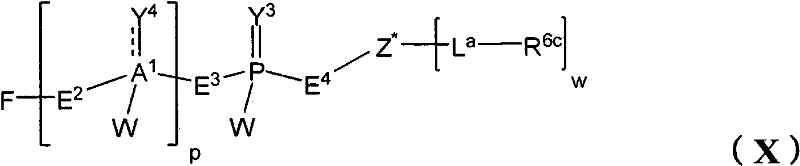
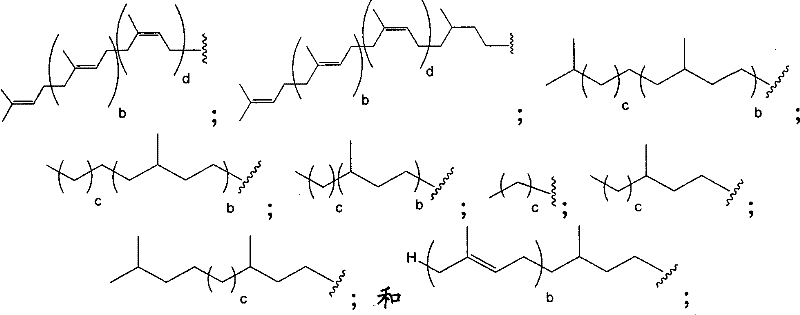
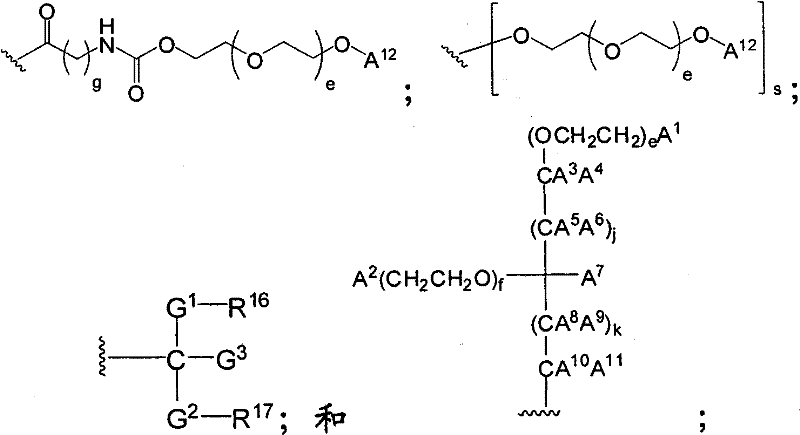
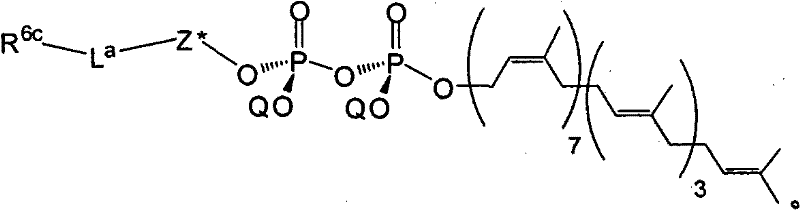
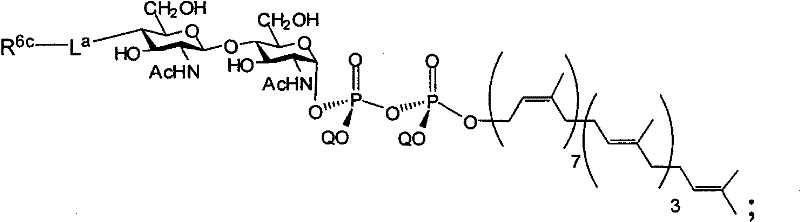


Applications Claiming Priority (3)
| Application Number | Priority Date | Filing Date | Title |
|---|---|---|---|
| US1980508P | 2008-01-08 | 2008-01-08 | |
| US61/019,805 | 2008-01-08 | ||
| PCT/US2009/030503 WO2009089396A2 (en) | 2008-01-08 | 2009-01-08 | Glycoconjugation of polypeptides using oligosaccharyltransferases |
Publications (1)
| Publication Number | Publication Date |
|---|---|
| CN102037004A true CN102037004A (en) | 2011-04-27 |
Family
ID=40853768
Family Applications (1)
| Application Number | Title | Priority Date | Filing Date |
|---|---|---|---|
| CN2009801061349A Pending CN102037004A (en) | 2008-01-08 | 2009-01-08 | Glycoconjugation of polypeptides using oligosaccharyltransferases |
Country Status (6)
| Country | Link |
|---|---|
| US (1) | US20100286067A1 (en) |
| EP (1) | EP2242505A4 (en) |
| JP (1) | JP5647899B2 (en) |
| CN (1) | CN102037004A (en) |
| CA (1) | CA2711503A1 (en) |
| WO (1) | WO2009089396A2 (en) |
Cited By (8)
| Publication number | Priority date | Publication date | Assignee | Title |
|---|---|---|---|---|
| CN102965415A (en) * | 2012-11-19 | 2013-03-13 | 华南理工大学 | Regioselective fucosylation modification method of enzymatic nuclear glucoside class medicine |
| CN104080921A (en) * | 2011-11-04 | 2014-10-01 | 康奈尔大学 | A prokaryote-based cell-free system for glycoprotein synthesis |
| CN107405384A (en) * | 2015-03-11 | 2017-11-28 | 尼克塔治疗公司 | The parts of IL 7 and the conjugate of polymer |
| WO2018036403A1 (en) * | 2016-08-22 | 2018-03-01 | 中国科学院上海药物研究所 | Oligosaccharide linker and antibody-drug conjugate with site-specific linkage prepared using the oligosaccharide linker |
| CN111225683A (en) * | 2017-09-04 | 2020-06-02 | 89生物有限公司 | Mutant FGF-21 peptide conjugates and uses thereof |
| CN113301911A (en) * | 2018-10-23 | 2021-08-24 | 费城儿童医院 | Compositions and methods for modulating factor VIII function |
| CN113518923A (en) * | 2019-03-13 | 2021-10-19 | 默克专利股份公司 | Method for the production of lipidated protein structures |
| CN113614233A (en) * | 2019-01-25 | 2021-11-05 | 西北大学 | Platform for production of glycoproteins, identification of glycosylation pathways |
Families Citing this family (104)
| Publication number | Priority date | Publication date | Assignee | Title |
|---|---|---|---|---|
| US8008252B2 (en) | 2001-10-10 | 2011-08-30 | Novo Nordisk A/S | Factor VII: remodeling and glycoconjugation of Factor VII |
| US7173003B2 (en) | 2001-10-10 | 2007-02-06 | Neose Technologies, Inc. | Granulocyte colony stimulating factor: remodeling and glycoconjugation of G-CSF |
| US7157277B2 (en) | 2001-11-28 | 2007-01-02 | Neose Technologies, Inc. | Factor VIII remodeling and glycoconjugation of Factor VIII |
| US7214660B2 (en) * | 2001-10-10 | 2007-05-08 | Neose Technologies, Inc. | Erythropoietin: remodeling and glycoconjugation of erythropoietin |
| DE60336555D1 (en) | 2002-06-21 | 2011-05-12 | Novo Nordisk Healthcare Ag | PEGYLATED GLYCO FORMS OF FACTOR VII |
| NZ542094A (en) | 2003-03-14 | 2008-12-24 | Neose Technologies Inc | Branched polymer conjugates comprising a peptide and water-soluble polymer chains |
| US8791070B2 (en) | 2003-04-09 | 2014-07-29 | Novo Nordisk A/S | Glycopegylated factor IX |
| US20070026485A1 (en) | 2003-04-09 | 2007-02-01 | Neose Technologies, Inc. | Glycopegylation methods and proteins/peptides produced by the methods |
| WO2005012484A2 (en) | 2003-07-25 | 2005-02-10 | Neose Technologies, Inc. | Antibody-toxin conjugates |
| US20080305992A1 (en) | 2003-11-24 | 2008-12-11 | Neose Technologies, Inc. | Glycopegylated erythropoietin |
| US8633157B2 (en) | 2003-11-24 | 2014-01-21 | Novo Nordisk A/S | Glycopegylated erythropoietin |
| US20060040856A1 (en) | 2003-12-03 | 2006-02-23 | Neose Technologies, Inc. | Glycopegylated factor IX |
| WO2005070138A2 (en) | 2004-01-08 | 2005-08-04 | Neose Technologies, Inc. | O-linked glycosylation of peptides |
| WO2006010143A2 (en) | 2004-07-13 | 2006-01-26 | Neose Technologies, Inc. | Branched peg remodeling and glycosylation of glucagon-like peptide-1 [glp-1] |
| US8268967B2 (en) | 2004-09-10 | 2012-09-18 | Novo Nordisk A/S | Glycopegylated interferon α |
| ES2566670T3 (en) | 2004-10-29 | 2016-04-14 | Ratiopharm Gmbh | Remodeling and glucopegilation of fibroblast growth factor (FGF) |
| JP4951527B2 (en) | 2005-01-10 | 2012-06-13 | バイオジェネリックス アーゲー | GlycoPEGylated granulocyte colony stimulating factor |
| US20070154992A1 (en) | 2005-04-08 | 2007-07-05 | Neose Technologies, Inc. | Compositions and methods for the preparation of protease resistant human growth hormone glycosylation mutants |
| EP2975135A1 (en) | 2005-05-25 | 2016-01-20 | Novo Nordisk A/S | Glycopegylated factor IX |
| US20070105755A1 (en) | 2005-10-26 | 2007-05-10 | Neose Technologies, Inc. | One pot desialylation and glycopegylation of therapeutic peptides |
| US20090048440A1 (en) | 2005-11-03 | 2009-02-19 | Neose Technologies, Inc. | Nucleotide Sugar Purification Using Membranes |
| US20080248959A1 (en) | 2006-07-21 | 2008-10-09 | Neose Technologies, Inc. | Glycosylation of peptides via o-linked glycosylation sequences |
| EP2054521A4 (en) | 2006-10-03 | 2012-12-19 | Novo Nordisk As | METHODS OF PURIFYING CONJUGATES OF POLYPEPTIDES |
| AU2007333049B2 (en) | 2006-12-15 | 2014-02-20 | Takeda Pharmaceutical Company Limited | Factor VIIa-(poly)sialic acid conjugate having prolonged in vivo half-life |
| PL2144923T3 (en) | 2007-04-03 | 2013-12-31 | Biogenerix Ag | Methods of treatment using glycopegylated g-csf |
| EP2170919B8 (en) | 2007-06-12 | 2016-01-20 | ratiopharm GmbH | Improved process for the production of nucleotide sugars |
| US8207112B2 (en) | 2007-08-29 | 2012-06-26 | Biogenerix Ag | Liquid formulation of G-CSF conjugate |
| EP2626079A3 (en) | 2008-02-27 | 2014-03-05 | Novo Nordisk A/S | Conjungated factor VIII molecules |
| WO2010017290A1 (en) * | 2008-08-05 | 2010-02-11 | The Trustees Of Columbia University In The City Of New York | Müllerian inhibiting substance (mis) analogues |
| CN102341409A (en) | 2009-01-28 | 2012-02-01 | 斯马特塞尔斯公司 | Crystalline insulin-conjugates |
| JP2012516340A (en) | 2009-01-28 | 2012-07-19 | スマートセルズ・インコーポレイテツド | Synthetic conjugates and uses thereof |
| WO2010088268A1 (en) | 2009-01-28 | 2010-08-05 | Smartcells, Inc. | Exogenously triggered controlled release materials and uses thereof |
| EP2391218B1 (en) | 2009-01-28 | 2020-03-18 | Smartcells, Inc. | Conjugate based systems for controlled drug delivery |
| EP2408808A4 (en) | 2009-03-20 | 2015-05-06 | Smartcells Inc | FUNCTIONALIZED CONJUGATES AT THE END AND USES THEREOF |
| EP2408470A4 (en) | 2009-03-20 | 2012-08-29 | Smartcells Inc | Soluble non-soluble insulin conjugates and their uses |
| US8642737B2 (en) | 2010-07-26 | 2014-02-04 | Baxter International Inc. | Nucleophilic catalysts for oxime linkage |
| KR101832937B1 (en) | 2009-07-27 | 2018-02-28 | 박스알타 인코퍼레이티드 | Blood coagulation protein conjugates |
| HUE028056T2 (en) | 2009-07-27 | 2016-11-28 | Baxalta GmbH | Blood coagulation protein conjugates |
| US8809501B2 (en) | 2009-07-27 | 2014-08-19 | Baxter International Inc. | Nucleophilic catalysts for oxime linkage |
| US9795683B2 (en) | 2009-07-27 | 2017-10-24 | Lipoxen Technologies Limited | Glycopolysialylation of non-blood coagulation proteins |
| AU2010322454B2 (en) | 2009-11-19 | 2016-05-19 | Glaxosmithkline Biologicals S.A. | Biosynthetic system that produces immunogenic polysaccharides in prokaryotic cells |
| EP2507267B1 (en) | 2009-12-02 | 2016-09-14 | Acceleron Pharma, Inc. | Compositions and methods for increasing serum half-life of fc fusion proteins |
| EP2460527A1 (en) | 2010-01-21 | 2012-06-06 | Sanofi | Pharmaceutical composition for treating a metabolic syndrome |
| CN102812039B (en) | 2010-02-16 | 2016-01-20 | 诺沃—诺迪斯克有限公司 | Conjugated protein |
| EP2536753B1 (en) * | 2010-02-16 | 2017-12-20 | Novo Nordisk A/S | Factor viii molecules with reduced vwf binding |
| SG185433A1 (en) * | 2010-05-06 | 2012-12-28 | Glycovaxyn Ag | Capsular gram-positive bacteria bioconjugate vaccines |
| WO2012006623A1 (en) | 2010-07-09 | 2012-01-12 | Biogen Idec Hemophilia Inc. | Systems for factor viii processing and methods thereof |
| US9074015B2 (en) | 2010-07-28 | 2015-07-07 | Smartcells, Inc. | Recombinantly expressed insulin polypeptides and uses thereof |
| CA2805739A1 (en) | 2010-07-28 | 2012-02-02 | Smartcells, Inc. | Drug-ligand conjugates, synthesis thereof, and intermediates thereto |
| US9068013B2 (en) | 2010-07-28 | 2015-06-30 | Smart Cells, Inc. | Recombinant lectins, binding-site modified lectins and uses thereof |
| HUE049352T2 (en) | 2010-12-22 | 2020-09-28 | Baxalta GmbH | Materials and methods for conjugating a water soluble fatty acid derivative to a protein |
| WO2012131306A1 (en) * | 2011-03-31 | 2012-10-04 | Ferring B.V. | Pharmaceutical preparation |
| DK2694116T3 (en) | 2011-04-06 | 2018-09-03 | Univ Texas | LIPID-BASED NANOPARTICLES |
| WO2012170938A1 (en) | 2011-06-08 | 2012-12-13 | Acceleron Pharma Inc. | Compositions and methods for increasing serum half-life |
| EP2548570A1 (en) | 2011-07-19 | 2013-01-23 | Sanofi | Pharmaceutical composition for treating a metabolic syndrome |
| US8906681B2 (en) * | 2011-08-02 | 2014-12-09 | The Scripps Research Institute | Reliable stabilization of N-linked polypeptide native states with enhanced aromatic sequons located in polypeptide tight turns |
| US20140336366A1 (en) * | 2011-09-06 | 2014-11-13 | Glycovaxyn Ag | Bioconjugate vaccines made in prokaryotic cells |
| UY34317A (en) | 2011-09-12 | 2013-02-28 | Genzyme Corp | T cell antireceptor antibody (alpha) / ß |
| MY167234A (en) | 2011-09-23 | 2018-08-14 | Novo Nordisk As | Novel glucagon analogues |
| US12384848B2 (en) | 2011-12-19 | 2025-08-12 | The Rockefeller University | Anti-inflammatory polypeptides |
| CN104220097B (en) * | 2011-12-19 | 2019-08-09 | 建新公司 | TSH composition |
| SG11201403311SA (en) * | 2011-12-19 | 2014-07-30 | Univ Rockefeller | Non-sialylated anti-inflammatory polypeptides |
| ES2855165T3 (en) | 2012-01-20 | 2021-09-23 | Ananth Annapragada | Methods and compositions to objectively characterize medical images |
| US9550819B2 (en) | 2012-03-27 | 2017-01-24 | Ngm Biopharmaceuticals, Inc. | Compositions and methods of use for treating metabolic disorders |
| US9790268B2 (en) | 2012-09-12 | 2017-10-17 | Genzyme Corporation | Fc containing polypeptides with altered glycosylation and reduced effector function |
| WO2014070953A1 (en) | 2012-10-30 | 2014-05-08 | Biogen Idec Ma Inc. | Methods of Using FVIII Polypeptide |
| EP2925345B1 (en) | 2012-12-03 | 2018-09-05 | Merck Sharp & Dohme Corp. | Method for making o-glycosylated carboxy terminal portion (ctp) peptide-based insulin and insulin analogues |
| NZ707777A (en) | 2013-01-17 | 2019-12-20 | X4 Pharmaceuticals Austria Gmbh | Mdr e. coli specific antibody |
| US8945872B2 (en) | 2013-01-25 | 2015-02-03 | Warsaw Orthopedic, Inc. | Methods of purifying human recombinant growth and differentiation factor-5 (rhGDF-5) protein |
| US9359417B2 (en) | 2013-01-25 | 2016-06-07 | Warsaw Orthopedic, Inc. | Cell cultures and methods of human recombinant growth and differentiaton factor-5 (rhGDF-5) |
| US9169308B2 (en) | 2013-01-25 | 2015-10-27 | Warsaw Orthopedic, Inc. | Methods and compositions of human recombinant growth and differentiation factor-5 (rhGDF-5) isolated from inclusion bodies |
| US9051389B2 (en) | 2013-01-25 | 2015-06-09 | Warsaw Orthopedic, Inc. | Expression conditions and methods of human recombinant growth and differentiation factor-5 (rhGDF-5) |
| US8956829B2 (en) | 2013-01-25 | 2015-02-17 | Warsaw Orthopedic, Inc. | Human recombinant growth and differentiaton factor-5 (rhGDF-5) |
| CA2899170C (en) | 2013-01-30 | 2022-08-02 | Ngm Biopharmaceuticals, Inc. | Compositions and methods of use in treating metabolic disorders |
| US9161966B2 (en) | 2013-01-30 | 2015-10-20 | Ngm Biopharmaceuticals, Inc. | GDF15 mutein polypeptides |
| SG10201809779RA (en) | 2013-03-11 | 2018-12-28 | Genzyme Corp | Site-specific antibody-drug conjugation through glycoengineering |
| JP6330026B2 (en) | 2013-03-15 | 2018-05-23 | バイオベラティブ セラピューティクス インコーポレイテッド | Factor VIII polypeptide preparation |
| WO2014170496A1 (en) | 2013-04-18 | 2014-10-23 | Novo Nordisk A/S | Stable, protracted glp-1/glucagon receptor co-agonists for medical use |
| EP3613468A1 (en) | 2013-05-02 | 2020-02-26 | Glykos Finland Oy | Glycoprotein-toxic payload conjugates |
| EP3003473B1 (en) | 2013-05-30 | 2018-08-22 | Graham H. Creasey | Topical neurological stimulation |
| US11229789B2 (en) | 2013-05-30 | 2022-01-25 | Neurostim Oab, Inc. | Neuro activator with controller |
| BR112016007176A2 (en) | 2013-10-04 | 2018-01-23 | Merck Sharp & Dohme | conjugate, composition, uses of a conjugate and composition, and method for treating an individual having diabetes |
| US10325687B2 (en) | 2013-12-06 | 2019-06-18 | Bioverativ Therapeutics Inc. | Population pharmacokinetics tools and uses thereof |
| EP3110441B1 (en) | 2014-02-24 | 2024-04-03 | GlaxoSmithKline Biologicals S.A. | Novel polysaccharide and uses thereof |
| CN106471010A (en) | 2014-03-19 | 2017-03-01 | 建新公司 | Site-specific glycoengineering of targeting modules |
| WO2015185640A1 (en) | 2014-06-04 | 2015-12-10 | Novo Nordisk A/S | Glp-1/glucagon receptor co-agonists for medical use |
| SG11201700378PA (en) | 2014-07-30 | 2017-02-27 | Ngm Biopharmaceuticals Inc | Compositions and methods of use for treating metabolic disorders |
| EP4035688B1 (en) | 2014-10-08 | 2025-03-26 | Texas Children's Hospital | Mri imaging of amyloid plaque using liposomes |
| DK3212226T3 (en) | 2014-10-31 | 2020-06-15 | Ngm Biopharmaceuticals Inc | COMPOSITIONS AND METHODS OF USE FOR TREATING METABOLIC DISORDERS |
| US11077301B2 (en) | 2015-02-21 | 2021-08-03 | NeurostimOAB, Inc. | Topical nerve stimulator and sensor for bladder control |
| CN107847586A (en) | 2015-03-04 | 2018-03-27 | 洛克菲勒大学 | Anti-inflammatory polypeptide |
| TWI715617B (en) | 2015-08-24 | 2021-01-11 | 比利時商葛蘭素史密斯克藍生物品公司 | Methods and compositions for immune protection against extra-intestinal pathogenic e. coli |
| SG11201807279QA (en) | 2016-03-31 | 2018-09-27 | Ngm Biopharmaceuticals Inc | Binding proteins and methods of use thereof |
| AR109621A1 (en) | 2016-10-24 | 2018-12-26 | Janssen Pharmaceuticals Inc | FORMULATIONS OF VACCINES AGAINST GLUCOCONJUGADOS OF EXPEC |
| KR102390246B1 (en) | 2016-12-21 | 2022-04-22 | 에프. 호프만-라 로슈 아게 | Reuse of Enzymes for In Vitro Glycoengineering of Antibodies |
| AU2017381657B2 (en) | 2016-12-21 | 2020-07-23 | F. Hoffmann-La Roche Ag | Method for in vitro glycoengineering of antibodies |
| CA3082390C (en) | 2017-11-07 | 2023-01-31 | Neurostim Oab, Inc. | Non-invasive nerve activator with adaptive circuit |
| WO2019165369A2 (en) * | 2018-02-26 | 2019-08-29 | Ichor Therapeutics, Inc. | Improving enzyme augmentation therapies by modifying glycosylation |
| KR102574882B1 (en) | 2019-03-18 | 2023-09-04 | 얀센 파마슈티칼즈, 인코포레이티드 | Methods for producing bioconjugates of E. coli O-antigen polysaccharides, compositions thereof and methods of use thereof |
| JOP20210256A1 (en) | 2019-03-18 | 2023-01-30 | Janssen Pharmaceuticals Inc | Bioconjugates of e. coli o-antigen polysaccharides, methods of production thereof, and methods of use thereof |
| MA55529A (en) | 2019-04-03 | 2022-02-09 | Genzyme Corp | REDUCED FRAGMENTATION ANTI-ALPHA BETA TCR BINDING POLYPEPTIDES |
| WO2020264214A1 (en) | 2019-06-26 | 2020-12-30 | Neurostim Technologies Llc | Non-invasive nerve activator with adaptive circuit |
| US11730958B2 (en) | 2019-12-16 | 2023-08-22 | Neurostim Solutions, Llc | Non-invasive nerve activator with boosted charge delivery |
| PH12023550020A1 (en) | 2020-09-17 | 2024-03-11 | Janssen Pharmaceuticals Inc | Multivalent vaccine compositions and uses thereof |
Family Cites Families (100)
| Publication number | Priority date | Publication date | Assignee | Title |
|---|---|---|---|---|
| US721466A (en) * | 1902-10-25 | 1903-02-24 | John Rocke | Portable grain dump and elevator. |
| US4438253A (en) * | 1982-11-12 | 1984-03-20 | American Cyanamid Company | Poly(glycolic acid)/poly(alkylene glycol) block copolymers and method of manufacturing the same |
| US4496689A (en) * | 1983-12-27 | 1985-01-29 | Miles Laboratories, Inc. | Covalently attached complex of alpha-1-proteinase inhibitor with a water soluble polymer |
| US4565653A (en) * | 1984-03-30 | 1986-01-21 | Pfizer Inc. | Acyltripeptide immunostimulants |
| US5206344A (en) * | 1985-06-26 | 1993-04-27 | Cetus Oncology Corporation | Interleukin-2 muteins and polymer conjugation thereof |
| JPS6238172A (en) * | 1985-08-12 | 1987-02-19 | 株式会社 高研 | Production of anti-thrombotic medical material |
| SE451849B (en) * | 1985-12-11 | 1987-11-02 | Svenska Sockerfabriks Ab | VIEW TO SYNTHETIZE GYCLOSIDIC BINDINGS AND USE OF THIS RECEIVED PRODUCTS |
| US5104651A (en) * | 1988-12-16 | 1992-04-14 | Amgen Inc. | Stabilized hydrophobic protein formulations of g-csf |
| US5194376A (en) * | 1989-02-28 | 1993-03-16 | University Of Ottawa | Baculovirus expression system capable of producing foreign gene proteins at high levels |
| US5182107A (en) * | 1989-09-07 | 1993-01-26 | Alkermes, Inc. | Transferrin receptor specific antibody-neuropharmaceutical or diagnostic agent conjugates |
| US5595900A (en) * | 1990-02-14 | 1997-01-21 | The Regents Of The University Of Michigan | Methods and products for the synthesis of oligosaccharide structures on glycoproteins, glycolipids, or as free molecules, and for the isolation of cloned genetic sequences that determine these structures |
| DE4009630C2 (en) * | 1990-03-26 | 1995-09-28 | Reinhard Prof Dr Dr Brossmer | CMP-activated fluorescent sialic acids and processes for their preparation |
| EP0481038B1 (en) * | 1990-04-16 | 2002-10-02 | The Trustees Of The University Of Pennsylvania | Saccharide compositions, methods and apparatus for their synthesis |
| US5951972A (en) * | 1990-05-04 | 1999-09-14 | American Cyanamid Company | Stabilization of somatotropins and other proteins by modification of cysteine residues |
| US5399345A (en) * | 1990-05-08 | 1995-03-21 | Boehringer Mannheim, Gmbh | Muteins of the granulocyte colony stimulating factor |
| CA2073511A1 (en) * | 1990-11-14 | 1992-05-29 | Matthew R. Callstrom | Conjugates of poly(vinylsaccharide) with proteins for the stabilization of proteins |
| US5861374A (en) * | 1991-02-28 | 1999-01-19 | Novo Nordisk A/S | Modified Factor VII |
| US5278299A (en) * | 1991-03-18 | 1994-01-11 | Scripps Clinic And Research Foundation | Method and composition for synthesizing sialylated glycosyl compounds |
| US5281698A (en) * | 1991-07-23 | 1994-01-25 | Cetus Oncology Corporation | Preparation of an activated polymer ester for protein conjugation |
| US5384249A (en) * | 1991-12-17 | 1995-01-24 | Kyowa Hakko Kogyo Co., Ltd. | α2→3 sialyltransferase |
| US5858751A (en) * | 1992-03-09 | 1999-01-12 | The Regents Of The University Of California | Compositions and methods for producing sialyltransferases |
| US6037452A (en) * | 1992-04-10 | 2000-03-14 | Alpha Therapeutic Corporation | Poly(alkylene oxide)-Factor VIII or Factor IX conjugate |
| US5614184A (en) * | 1992-07-28 | 1997-03-25 | New England Deaconess Hospital | Recombinant human erythropoietin mutants and therapeutic methods employing them |
| EP0664710A4 (en) * | 1992-08-07 | 1998-09-30 | Progenics Pharm Inc | NON-PEPTIDYL MOIETY-CONJUGATED CD4-GAMMA2 AND CD4-IgG2 IMMUNOCONJUGATES, AND USES THEREOF. |
| US5202413A (en) * | 1993-02-16 | 1993-04-13 | E. I. Du Pont De Nemours And Company | Alternating (ABA)N polylactide block copolymers |
| JPH0770195A (en) * | 1993-08-23 | 1995-03-14 | Yutaka Mizushima | Sugar-modified interferon |
| US5874075A (en) * | 1993-10-06 | 1999-02-23 | Amgen Inc. | Stable protein: phospholipid compositions and methods |
| US5605793A (en) * | 1994-02-17 | 1997-02-25 | Affymax Technologies N.V. | Methods for in vitro recombination |
| US5492841A (en) * | 1994-02-18 | 1996-02-20 | E. I. Du Pont De Nemours And Company | Quaternary ammonium immunogenic conjugates and immunoassay reagents |
| MX9504664A (en) * | 1994-03-07 | 1997-05-31 | Dow Chemical Co | CONJUGATES OF BIOACTIVE AND / OR DIRECTED DENDRIMEROS. |
| US5545553A (en) * | 1994-09-26 | 1996-08-13 | The Rockefeller University | Glycosyltransferases for biosynthesis of oligosaccharides, and genes encoding them |
| US5824784A (en) * | 1994-10-12 | 1998-10-20 | Amgen Inc. | N-terminally chemically modified protein compositions and methods |
| US5876980A (en) * | 1995-04-11 | 1999-03-02 | Cytel Corporation | Enzymatic synthesis of oligosaccharides |
| US6030815A (en) * | 1995-04-11 | 2000-02-29 | Neose Technologies, Inc. | Enzymatic synthesis of oligosaccharides |
| US5728554A (en) * | 1995-04-11 | 1998-03-17 | Cytel Corporation | Enzymatic synthesis of glycosidic linkages |
| US6015555A (en) * | 1995-05-19 | 2000-01-18 | Alkermes, Inc. | Transferrin receptor specific antibody-neuropharmaceutical or diagnostic agent conjugates |
| US5858752A (en) * | 1995-06-07 | 1999-01-12 | The General Hospital Corporation | Fucosyltransferase genes and uses thereof |
| US5716812A (en) * | 1995-12-12 | 1998-02-10 | The University Of British Columbia | Methods and compositions for synthesis of oligosaccharides, and the products formed thereby |
| EP0888377B1 (en) * | 1996-03-08 | 2007-12-12 | The Regents Of The University Of Michigan | MURINE alpha(1,3)-FUCOSYLTRANSFERASE (Fuc-TVII) |
| US6183738B1 (en) * | 1997-05-12 | 2001-02-06 | Phoenix Pharamacologics, Inc. | Modified arginine deiminase |
| US20030027257A1 (en) * | 1997-08-21 | 2003-02-06 | University Technologies International, Inc. | Sequences for improving the efficiency of secretion of non-secreted protein from mammalian and insect cells |
| ES2222689T3 (en) * | 1998-03-12 | 2005-02-01 | Nektar Therapeutics Al, Corporation | DERIVATIVES OF POLYETHYLENE GLYCOL WITH PROXIMAL REACTIVE GROUPS. |
| DE19852729A1 (en) * | 1998-11-16 | 2000-05-18 | Werner Reutter | Recombinant glycoproteins, processes for their preparation, medicaments containing them and their use |
| JO2291B1 (en) * | 1999-07-02 | 2005-09-12 | اف . هوفمان لاروش ايه جي | Erythopintin derivatives |
| US6348558B1 (en) * | 1999-12-10 | 2002-02-19 | Shearwater Corporation | Hydrolytically degradable polymers and hydrogels made therefrom |
| US6646110B2 (en) * | 2000-01-10 | 2003-11-11 | Maxygen Holdings Ltd. | G-CSF polypeptides and conjugates |
| AU2001281463A1 (en) * | 2000-03-16 | 2001-09-24 | The Regents Of The University Of California | Chemoselective ligation |
| AU2001263149A1 (en) * | 2000-05-12 | 2001-11-26 | Neose Technologies, Inc. | In vitro fucosylation recombinant glycopeptides |
| MXPA02011303A (en) * | 2000-05-15 | 2003-04-25 | Hoffmann La Roche | Liquid pharmaceutical composition containing an erythropoietin derivate. |
| US6531121B2 (en) * | 2000-12-29 | 2003-03-11 | The Kenneth S. Warren Institute, Inc. | Protection and enhancement of erythropoietin-responsive cells, tissues and organs |
| SE0004932D0 (en) * | 2000-12-31 | 2000-12-31 | Apbiotech Ab | A method for mixed mode adsorption and mixed mode adsorbents |
| KR100453877B1 (en) * | 2001-07-26 | 2004-10-20 | 메덱스젠 주식회사 | METHOD OF MANUFACTURING Ig-FUSION PROTEINS BY CONCATAMERIZATION, TNFR/Fc FUSION PROTEINS MANUFACTURED BY THE METHOD, DNA CODING THE PROTEINS, VECTORS INCLUDING THE DNA, AND CELLS TRANSFORMED BY THE VECTOR |
| US7399613B2 (en) * | 2001-10-10 | 2008-07-15 | Neose Technologies, Inc. | Sialic acid nucleotide sugars |
| US7265084B2 (en) * | 2001-10-10 | 2007-09-04 | Neose Technologies, Inc. | Glycopegylation methods and proteins/peptides produced by the methods |
| US7179617B2 (en) * | 2001-10-10 | 2007-02-20 | Neose Technologies, Inc. | Factor IX: remolding and glycoconjugation of Factor IX |
| US8008252B2 (en) * | 2001-10-10 | 2011-08-30 | Novo Nordisk A/S | Factor VII: remodeling and glycoconjugation of Factor VII |
| US7265085B2 (en) * | 2001-10-10 | 2007-09-04 | Neose Technologies, Inc. | Glycoconjugation methods and proteins/peptides produced by the methods |
| US7173003B2 (en) * | 2001-10-10 | 2007-02-06 | Neose Technologies, Inc. | Granulocyte colony stimulating factor: remodeling and glycoconjugation of G-CSF |
| US7125843B2 (en) * | 2001-10-19 | 2006-10-24 | Neose Technologies, Inc. | Glycoconjugates including more than one peptide |
| US7157277B2 (en) * | 2001-11-28 | 2007-01-02 | Neose Technologies, Inc. | Factor VIII remodeling and glycoconjugation of Factor VIII |
| US7214660B2 (en) * | 2001-10-10 | 2007-05-08 | Neose Technologies, Inc. | Erythropoietin: remodeling and glycoconjugation of erythropoietin |
| US7696163B2 (en) * | 2001-10-10 | 2010-04-13 | Novo Nordisk A/S | Erythropoietin: remodeling and glycoconjugation of erythropoietin |
| ES2466024T3 (en) * | 2001-10-10 | 2014-06-09 | Ratiopharm Gmbh | Remodeling and glycoconjugation of fibroblast growth factor (FGF) |
| US7473680B2 (en) * | 2001-11-28 | 2009-01-06 | Neose Technologies, Inc. | Remodeling and glycoconjugation of peptides |
| US20060035224A1 (en) * | 2002-03-21 | 2006-02-16 | Johansen Jack T | Purification methods for oligonucleotides and their analogs |
| DE60336555D1 (en) * | 2002-06-21 | 2011-05-12 | Novo Nordisk Healthcare Ag | PEGYLATED GLYCO FORMS OF FACTOR VII |
| AU2003254665C1 (en) * | 2002-08-01 | 2010-08-19 | National Research Council Of Canada | Campylobacter glycans and glycopeptides |
| AU2003275952A1 (en) * | 2002-11-08 | 2004-06-07 | Glycozym Aps | Inactivated ga1 - nac - transferases, methods for inhibitors of such transferases and their use |
| US20050064540A1 (en) * | 2002-11-27 | 2005-03-24 | Defrees Shawn Ph.D | Glycoprotein remodeling using endoglycanases |
| US7041635B2 (en) * | 2003-01-28 | 2006-05-09 | In2Gen Co., Ltd. | Factor VIII polypeptide |
| NZ542094A (en) * | 2003-03-14 | 2008-12-24 | Neose Technologies Inc | Branched polymer conjugates comprising a peptide and water-soluble polymer chains |
| US20080146782A1 (en) * | 2006-10-04 | 2008-06-19 | Neose Technologies, Inc. | Glycerol linked pegylated sugars and glycopeptides |
| US20070026485A1 (en) * | 2003-04-09 | 2007-02-01 | Neose Technologies, Inc. | Glycopegylation methods and proteins/peptides produced by the methods |
| BRPI0410164A (en) * | 2003-05-09 | 2006-05-16 | Neose Technologies Inc | compositions and methods for preparing human growth hormone glycosylation mutants |
| WO2005012484A2 (en) * | 2003-07-25 | 2005-02-10 | Neose Technologies, Inc. | Antibody-toxin conjugates |
| US20060198819A1 (en) * | 2003-08-08 | 2006-09-07 | Novo Nordisk Healthcare A/G | Use of galactose oxidase for selective chemical conjugation of protractor molecules to proteins of therapeutic interest |
| EP1694347B1 (en) * | 2003-11-24 | 2013-11-20 | BioGeneriX AG | Glycopegylated erythropoietin |
| US8633157B2 (en) * | 2003-11-24 | 2014-01-21 | Novo Nordisk A/S | Glycopegylated erythropoietin |
| US20060040856A1 (en) * | 2003-12-03 | 2006-02-23 | Neose Technologies, Inc. | Glycopegylated factor IX |
| US7956032B2 (en) * | 2003-12-03 | 2011-06-07 | Novo Nordisk A/S | Glycopegylated granulocyte colony stimulating factor |
| JP2007515410A (en) * | 2003-12-03 | 2007-06-14 | ネオス テクノロジーズ インコーポレイテッド | GlycoPEGylated follicle stimulating hormone |
| WO2005070138A2 (en) * | 2004-01-08 | 2005-08-04 | Neose Technologies, Inc. | O-linked glycosylation of peptides |
| US20070037966A1 (en) * | 2004-05-04 | 2007-02-15 | Novo Nordisk A/S | Hydrophobic interaction chromatography purification of factor VII polypeptides |
| WO2006010143A2 (en) * | 2004-07-13 | 2006-01-26 | Neose Technologies, Inc. | Branched peg remodeling and glycosylation of glucagon-like peptide-1 [glp-1] |
| US20060024286A1 (en) * | 2004-08-02 | 2006-02-02 | Paul Glidden | Variants of tRNA synthetase fragments and uses thereof |
| US8268967B2 (en) * | 2004-09-10 | 2012-09-18 | Novo Nordisk A/S | Glycopegylated interferon α |
| ES2566670T3 (en) * | 2004-10-29 | 2016-04-14 | Ratiopharm Gmbh | Remodeling and glucopegilation of fibroblast growth factor (FGF) |
| US20090054623A1 (en) * | 2004-12-17 | 2009-02-26 | Neose Technologies, Inc. | Lipo-Conjugation of Peptides |
| JP2008526864A (en) * | 2005-01-06 | 2008-07-24 | ネオス テクノロジーズ インコーポレイテッド | Sugar linkage using sugar fragments |
| US20070154992A1 (en) * | 2005-04-08 | 2007-07-05 | Neose Technologies, Inc. | Compositions and methods for the preparation of protease resistant human growth hormone glycosylation mutants |
| EP2311972B1 (en) * | 2005-05-11 | 2015-01-21 | ETH Zurich | Recombinant N-glycosylated proteins from procaryotic cells |
| US20110003744A1 (en) * | 2005-05-25 | 2011-01-06 | Novo Nordisk A/S | Glycopegylated Erythropoietin Formulations |
| WO2007031559A2 (en) * | 2005-09-14 | 2007-03-22 | Novo Nordisk Health Care Ag | Human coagulation factor vii polypeptides |
| US20090048440A1 (en) * | 2005-11-03 | 2009-02-19 | Neose Technologies, Inc. | Nucleotide Sugar Purification Using Membranes |
| US7645860B2 (en) * | 2006-03-31 | 2010-01-12 | Baxter Healthcare S.A. | Factor VIII polymer conjugates |
| ITMI20061624A1 (en) * | 2006-08-11 | 2008-02-12 | Bioker Srl | SINGLE-CONJUGATE SITE-SPECIFIC OF G-CSF |
| ES2531934T3 (en) * | 2006-09-01 | 2015-03-20 | Novo Nordisk Health Care Ag | Modified glycoproteins |
| EP2054521A4 (en) * | 2006-10-03 | 2012-12-19 | Novo Nordisk As | METHODS OF PURIFYING CONJUGATES OF POLYPEPTIDES |
| US20090053167A1 (en) * | 2007-05-14 | 2009-02-26 | Neose Technologies, Inc. | C-, S- and N-glycosylation of peptides |
| EP2170919B8 (en) * | 2007-06-12 | 2016-01-20 | ratiopharm GmbH | Improved process for the production of nucleotide sugars |
-
2009
- 2009-01-08 CN CN2009801061349A patent/CN102037004A/en active Pending
- 2009-01-08 WO PCT/US2009/030503 patent/WO2009089396A2/en not_active Ceased
- 2009-01-08 EP EP09700164A patent/EP2242505A4/en not_active Withdrawn
- 2009-01-08 US US12/811,963 patent/US20100286067A1/en not_active Abandoned
- 2009-01-08 JP JP2010542355A patent/JP5647899B2/en not_active Expired - Fee Related
- 2009-01-08 CA CA2711503A patent/CA2711503A1/en not_active Abandoned
Cited By (14)
| Publication number | Priority date | Publication date | Assignee | Title |
|---|---|---|---|---|
| CN104080921A (en) * | 2011-11-04 | 2014-10-01 | 康奈尔大学 | A prokaryote-based cell-free system for glycoprotein synthesis |
| US11193154B2 (en) | 2011-11-04 | 2021-12-07 | Cornell University | Prokaryote-based cell-free system for the synthesis of glycoproteins |
| CN112980907A (en) * | 2011-11-04 | 2021-06-18 | 康奈尔大学 | Cell-free system based on prokaryotes for glycoprotein synthesis |
| CN102965415A (en) * | 2012-11-19 | 2013-03-13 | 华南理工大学 | Regioselective fucosylation modification method of enzymatic nuclear glucoside class medicine |
| CN102965415B (en) * | 2012-11-19 | 2014-02-12 | 华南理工大学 | Regioselective fucosylation modification method of enzymatic nuclear glucoside class medicine |
| CN107405384A (en) * | 2015-03-11 | 2017-11-28 | 尼克塔治疗公司 | The parts of IL 7 and the conjugate of polymer |
| CN107778372B (en) * | 2016-08-22 | 2019-11-26 | 中国科学院上海药物研究所 | A kind of oligosaccharides connexon and the antibody-drug conjugates of the fixed point connection using oligosaccharides connexon preparation |
| CN107778372A (en) * | 2016-08-22 | 2018-03-09 | 中国科学院上海药物研究所 | A kind of oligosaccharides connexon and the antibody drug conjugates of the fixed point connection prepared using the oligosaccharides connexon |
| WO2018036403A1 (en) * | 2016-08-22 | 2018-03-01 | 中国科学院上海药物研究所 | Oligosaccharide linker and antibody-drug conjugate with site-specific linkage prepared using the oligosaccharide linker |
| CN111225683A (en) * | 2017-09-04 | 2020-06-02 | 89生物有限公司 | Mutant FGF-21 peptide conjugates and uses thereof |
| CN111225683B (en) * | 2017-09-04 | 2022-04-05 | 89生物有限公司 | Mutant FGF-21 peptide conjugates and uses thereof |
| CN113301911A (en) * | 2018-10-23 | 2021-08-24 | 费城儿童医院 | Compositions and methods for modulating factor VIII function |
| CN113614233A (en) * | 2019-01-25 | 2021-11-05 | 西北大学 | Platform for production of glycoproteins, identification of glycosylation pathways |
| CN113518923A (en) * | 2019-03-13 | 2021-10-19 | 默克专利股份公司 | Method for the production of lipidated protein structures |
Also Published As
| Publication number | Publication date |
|---|---|
| US20100286067A1 (en) | 2010-11-11 |
| EP2242505A2 (en) | 2010-10-27 |
| JP2011512121A (en) | 2011-04-21 |
| WO2009089396A2 (en) | 2009-07-16 |
| CA2711503A1 (en) | 2009-07-16 |
| WO2009089396A3 (en) | 2009-10-15 |
| EP2242505A4 (en) | 2012-03-07 |
| JP5647899B2 (en) | 2015-01-07 |
Similar Documents
| Publication | Publication Date | Title |
|---|---|---|
| JP5647899B2 (en) | Glycoconjugation of polypeptides using oligosaccharyltransferase | |
| CN101516388B (en) | Glycosylation of peptides via O-linked glycosylation sequences | |
| US8361961B2 (en) | O-linked glycosylation of peptides | |
| US8791066B2 (en) | Branched PEG remodeling and glycosylation of glucagon-like peptide-1 [GLP-1] | |
| US20110177029A1 (en) | O-linked glycosylation using n-acetylglucosaminyl transferases | |
| US20090053167A1 (en) | C-, S- and N-glycosylation of peptides | |
| MXPA06007725A (en) | O-linked glycosylation of peptides |
Legal Events
| Date | Code | Title | Description |
|---|---|---|---|
| C06 | Publication | ||
| PB01 | Publication | ||
| C10 | Entry into substantive examination | ||
| SE01 | Entry into force of request for substantive examination | ||
| ASS | Succession or assignment of patent right |
Owner name: WEISUOFAN CO., LTD. Free format text: FORMER OWNER: BIOGENERIX AG Effective date: 20140617 |
|
| C41 | Transfer of patent application or patent right or utility model | ||
| TA01 | Transfer of patent application right |
Effective date of registration: 20140617 Address after: Ulm Applicant after: Weisuofan Co., Ltd. Address before: Mannheim Applicant before: Biogenerix AG |
|
| C02 | Deemed withdrawal of patent application after publication (patent law 2001) | ||
| WD01 | Invention patent application deemed withdrawn after publication |
Application publication date: 20110427 |