Disclosure of Invention
The object of the present invention is to solve at least one of the above technical drawbacks.
In order to achieve the above object, the present invention provides a method for searching three-dimensional objects based on a hypergraph, which performs correlation analysis between three-dimensional objects by modeling three-dimensional images using the hypergraph.
Therefore, the invention provides a three-dimensional object retrieval method based on a hypergraph, which comprises the following steps: calculating a distance matrix between all views of the three-dimensional object in the database; clustering all the views according to the distance matrix to obtain a plurality of clustering results, and constructing a plurality of hypergraphs corresponding to the three-dimensional object according to the plurality of clustering results; fusing the hypergraphs to form a fused hypergraph, analyzing the fused hypergraph, and establishing the relevance between the three-dimensional objects according to the analysis result; and retrieving the three-dimensional object according to the relevance.
In an embodiment of the present invention, the calculating a distance matrix between all views of the three-dimensional object in the database further comprises: performing feature extraction on all the views by taking Zernike Moments as image features to obtain feature extraction results; and calculating the distance between any two views by applying Euclidean distance according to the feature extraction result until the distance between all the views is calculated, and obtaining a distance matrix between all the views.
In an embodiment of the present invention, the clustering all the views according to the distance matrix to obtain a plurality of clustering results further includes: and clustering all the views by adopting a K-means clustering method, wherein the clustering result is changed according to the difference of the K values.
In an embodiment of the present invention, the constructing a plurality of hypergraphs corresponding to the three-dimensional object according to the plurality of clustering results further includes: and taking the corresponding view set of the three-dimensional objects as a hyper-edge of the hyper-graph, and connecting the vertexes taking each three-dimensional object as the corresponding hyper-graph to form a plurality of hyper-graphs.
In an embodiment of the present invention, the fusing the plurality of hypergraphs to form a fused hypergraph, analyzing the fused hypergraph, and establishing the association between the three-dimensional objects according to the analysis result further includes: performing average fusion on the plurality of hypergraphs to form a fused hypergraph; and analyzing the labels between the vertexes of the fused hypergraph according to a preset objective function to obtain the relevance between any three-dimensional objects in the database, wherein the vertexes meeting the relevance requirement have similar labels.
Another aspect of the present invention further provides an apparatus for three-dimensional object based retrieval, including: a distance matrix calculation module for calculating a distance matrix between all views of a three-dimensional object in a database; the hypergraph construction module is used for clustering all the views according to the distance matrix to obtain a plurality of clustering results and constructing a plurality of hypergraphs corresponding to the three-dimensional object according to the clustering results; the association module is used for fusing the hypergraphs to form a fused hypergraph, analyzing the fused hypergraph and establishing association between the three-dimensional objects according to an analysis result; and a retrieval module for retrieving the three-dimensional object according to the relevance.
In an embodiment of the present invention, the calculating a distance matrix between all views of the three-dimensional object in the database further comprises: performing feature extraction on all the views by taking Zernike Moments as image features to obtain feature extraction results; and calculating the distance between any two views by applying Euclidean distance according to the feature extraction result.
In an embodiment of the present invention, the hypergraph construction module includes a clustering module and a construction module, wherein the clustering module is configured to cluster all the views by using a K-means clustering method, and the clustering result varies according to the difference of the K values; the building module is used for connecting the vertexes of the corresponding hypergraphs which are the three-dimensional objects by taking the corresponding view sets of the three-dimensional objects as the hypergraph edges of the hypergraph so as to form a plurality of hypergraphs.
In an embodiment of the present invention, the association module includes a fusion module and an association establishment module, wherein the fusion module is configured to perform average fusion on the plurality of hypergraphs to form a fused hypergraph; the association establishing module is used for analyzing the labels between the vertexes of the fused hypergraph according to a preset objective function so as to obtain the association between any three-dimensional objects in the database, wherein the vertexes meeting the association requirement have similar labels.
By the method, the defects of low retrieval accuracy, high calculation complexity and the like caused by the complexity of the three-dimensional object information can be effectively overcome. The method carries out modeling through the hypergraph, and can effectively carry out relevance analysis on the three-dimensional object, so that more accurate and more effective three-dimensional object retrieval effect can be obtained.
Additional aspects and advantages of the invention will be set forth in part in the description which follows and, in part, will be obvious from the description, or may be learned by practice of the invention.
Detailed Description
Reference will now be made in detail to all embodiments of the invention, examples of which are illustrated in the accompanying drawings, wherein like reference numerals refer to the same or similar elements or elements having the same or similar function throughout. The embodiments described below with reference to the drawings are illustrative only and should not be construed as limiting the invention.
The invention provides a hypergraph-based three-dimensional object retrieval method aiming at the defects of poor accuracy and difficult analysis of the existing three-dimensional object retrieval.
The following describes in detail a three-dimensional object retrieval method based on a hypergraph according to an embodiment of the present invention with reference to the drawings.
As shown in fig. 1, which is a flowchart of a method for retrieving a three-dimensional object based on a hypergraph according to an embodiment of the present invention, the method includes the following steps:
step S101, a distance matrix between all views of the three-dimensional object in the database is calculated.
Specifically, Zernike momentas are used as image features of three-dimensional object views in a database, Zernike momentas feature extraction is carried out on the views according to a feature extraction algorithm, so that feature extraction results of all the views are obtained, then, the obtained Zernike momentas feature extraction results are used, Euclidean distances are used as calculation distances, a distance calculation method is applied to the views, the distance between any two views is calculated, and accordingly a distance value between any two views is calculated. Similarly, for all the views, the distance between all the views is calculated by adopting the distance calculation method, so that a distance matrix between all the views is obtained.
And S102, clustering all the views according to the distance matrix to obtain a plurality of clustering results, and constructing a plurality of hypergraphs corresponding to the three-dimensional object according to the plurality of clustering results.
Specifically, all views are clustered by using a K-means clustering method, wherein different clustering results are generated by setting different K values, each three-dimensional object is used as a vertex of a hypergraph on the basis of each group of clustering results, and each view set obtained is used as a hyper-edge of the hypergraph and is used for connecting the vertices of the hypergraph, so that a plurality of hypergraphs are formed.
In specific embodiments of the present invention, such as: g1=(V1,E1,w1),G2=(V2,E2,w2),...Gκ=(Vκ,Eκ,wκ) To represent the K hypergraphs obtained, where in a particular embodiment, the value of K may take a positive integer greater than 1. According to a specific embodiment of the invention, for the definition of the hypergraph, H1,H2,L HκIs used to represent G1=(V1,E1,w1),G2=(V2,E2,w2),...Gκ=(Vκ,Eκ,wκ) Correlation matrix of hypergraphs, Dv1,Dv2,L DvκThe vertex degree matrix used to represent the hypergraph, De1,De2,L DeκThe edge matrix used to represent the hypergraph is described above.
Wherein, H matrix (with H)iFor example) the establishment method is as follows:
according to the above formula, when a vertex belongs to a super edge, the corresponding position of the H matrix is 1, otherwise, the corresponding position is 0.
According to the embodiment of the invention, the other two matrixes are established as follows:
d(vi)=∑e∈Eh(vi,e);
<math>
<mi>d</mi>
<mrow>
<mrow>
<mo>(</mo>
<msub>
<mi>e</mi>
<mi>i</mi>
</msub>
<mo>)</mo>
</mrow>
<mo>=</mo>
<msub>
<mi>Σ</mi>
<mrow>
<mi>v</mi>
<mo>∈</mo>
<msub>
<mi>e</mi>
<mi>i</mi>
</msub>
</mrow>
</msub>
<mi>h</mi>
<mrow>
<mo>(</mo>
<mi>v</mi>
<mo>,</mo>
<msub>
<mi>e</mi>
<mi>i</mi>
</msub>
<mo>)</mo>
</mrow>
<mo>.</mo>
</mrow>
</math>
and S103, fusing the hypergraphs to form a fused hypergraph, analyzing the fused hypergraph, and establishing the relevance between the three-dimensional objects according to the analysis result.
Specifically, all the acquired hypergraphs are fused to form a fused hypergraph. Further, all hypergraphs are fused averagely, namely each hypergraph has the same weight, and then labels among nodes on the hypergraphs are analyzed by applying the set objective function, so that the relevance among any three-dimensional objects in the database is obtained. In an embodiment of the present invention, the three-dimensional object retrieval method requires vertices with more relevance to have similar labels.
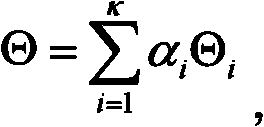
In the embodiment of the present invention, let the vector of the label be f, and define the objective function on the fused hypergraph as:
wherein
<math>
<mrow>
<mi>Ω</mi>
<mrow>
<mo>(</mo>
<mi>f</mi>
<mo>)</mo>
</mrow>
<mo>=</mo>
<munderover>
<mi>Σ</mi>
<mrow>
<mi>i</mi>
<mo>=</mo>
<mn>1</mn>
</mrow>
<mi>κ</mi>
</munderover>
<msub>
<mi>α</mi>
<mi>i</mi>
</msub>
<munder>
<mi>Σ</mi>
<mrow>
<mi>e</mi>
<mo>∈</mo>
<msub>
<mi>E</mi>
<mi>l</mi>
</msub>
</mrow>
</munder>
<munder>
<mi>Σ</mi>
<mrow>
<mi>u</mi>
<mo>,</mo>
<mi>v</mi>
<mo>∈</mo>
<mi>e</mi>
</mrow>
</munder>
<mfrac>
<mrow>
<msub>
<mi>w</mi>
<mi>i</mi>
</msub>
<mrow>
<mo>(</mo>
<mi>e</mi>
<mo>)</mo>
</mrow>
<msub>
<mi>h</mi>
<mi>i</mi>
</msub>
<mrow>
<mo>(</mo>
<mi>u</mi>
<mo>,</mo>
<mi>e</mi>
<mo>)</mo>
</mrow>
<msub>
<mi>h</mi>
<mi>i</mi>
</msub>
<mrow>
<mo>(</mo>
<mi>v</mi>
<mo>,</mo>
<mi>e</mi>
<mo>)</mo>
</mrow>
</mrow>
<mrow>
<mi>δ</mi>
<mrow>
<mo>(</mo>
<mi>e</mi>
<mo>)</mo>
</mrow>
</mrow>
</mfrac>
<mrow>
<mo>(</mo>
<mfrac>
<mrow>
<msup>
<mi>f</mi>
<mn>2</mn>
</msup>
<mrow>
<mo>(</mo>
<mi>u</mi>
<mo>)</mo>
</mrow>
</mrow>
<msqrt>
<msub>
<mi>d</mi>
<mi>i</mi>
</msub>
<mrow>
<mo>(</mo>
<mi>u</mi>
<mo>)</mo>
</mrow>
</msqrt>
</mfrac>
<mo>-</mo>
<mfrac>
<mrow>
<mi>f</mi>
<mrow>
<mo>(</mo>
<mi>u</mi>
<mo>)</mo>
</mrow>
<mi>f</mi>
<mrow>
<mo>(</mo>
<mi>v</mi>
<mo>)</mo>
</mrow>
</mrow>
<msqrt>
<msub>
<mi>d</mi>
<mi>i</mi>
</msub>
<mrow>
<mo>(</mo>
<mi>u</mi>
<mo>)</mo>
</mrow>
<msub>
<mi>d</mi>
<mi>i</mi>
</msub>
<mrow>
<mo>(</mo>
<mi>v</mi>
<mo>)</mo>
</mrow>
</msqrt>
</mfrac>
<mo>)</mo>
</mrow>
</mrow>
</math>
<math>
<mrow>
<mo>=</mo>
<munderover>
<mi>Σ</mi>
<mrow>
<mi>i</mi>
<mo>=</mo>
<mn>1</mn>
</mrow>
<mi>κ</mi>
</munderover>
<msub>
<mi>α</mi>
<mi>i</mi>
</msub>
<mo>{</mo>
<munder>
<mi>Σ</mi>
<mrow>
<mi>u</mi>
<mo>∈</mo>
<msub>
<mi>V</mi>
<mi>i</mi>
</msub>
</mrow>
</munder>
<msup>
<mi>f</mi>
<mn>2</mn>
</msup>
<mrow>
<mo>(</mo>
<mi>u</mi>
<mo>)</mo>
</mrow>
<munder>
<mi>Σ</mi>
<mrow>
<mi>e</mi>
<mo>∈</mo>
<msub>
<mi>E</mi>
<mi>i</mi>
</msub>
</mrow>
</munder>
<mfrac>
<mrow>
<msub>
<mi>w</mi>
<mi>i</mi>
</msub>
<mrow>
<mo>(</mo>
<mi>e</mi>
<mo>)</mo>
</mrow>
<msub>
<mi>h</mi>
<mi>i</mi>
</msub>
<mrow>
<mo>(</mo>
<mi>u</mi>
<mo>,</mo>
<mi>e</mi>
<mo>)</mo>
</mrow>
</mrow>
<mrow>
<msub>
<mi>d</mi>
<mi>i</mi>
</msub>
<mrow>
<mo>(</mo>
<mi>u</mi>
<mo>)</mo>
</mrow>
</mrow>
</mfrac>
<munder>
<mi>Σ</mi>
<mrow>
<mi>v</mi>
<mo>∈</mo>
<msub>
<mi>V</mi>
<mi>i</mi>
</msub>
</mrow>
</munder>
<mfrac>
<mrow>
<msub>
<mi>h</mi>
<mi>i</mi>
</msub>
<mrow>
<mo>(</mo>
<mi>v</mi>
<mo>,</mo>
<mi>e</mi>
<mo>)</mo>
</mrow>
</mrow>
<mrow>
<mi>δ</mi>
<mrow>
<mo>(</mo>
<mi>e</mi>
<mo>)</mo>
</mrow>
</mrow>
</mfrac>
</mrow>
</math>
<math>
<mrow>
<mo>-</mo>
<munder>
<mi>Σ</mi>
<mrow>
<mi>e</mi>
<mo>∈</mo>
<msub>
<mi>E</mi>
<mi>i</mi>
</msub>
</mrow>
</munder>
<munder>
<mi>Σ</mi>
<mrow>
<mi>u</mi>
<mo>,</mo>
<mi>v</mi>
<mo>∈</mo>
<mi>e</mi>
</mrow>
</munder>
<mfrac>
<mrow>
<mi>f</mi>
<mrow>
<mo>(</mo>
<mi>u</mi>
<mo>)</mo>
</mrow>
<msub>
<mi>h</mi>
<mi>i</mi>
</msub>
<mrow>
<mo>(</mo>
<mi>u</mi>
<mo>,</mo>
<mi>e</mi>
<mo>)</mo>
</mrow>
<msub>
<mi>w</mi>
<mi>i</mi>
</msub>
<mrow>
<mo>(</mo>
<mi>e</mi>
<mo>)</mo>
</mrow>
<msub>
<mi>h</mi>
<mi>i</mi>
</msub>
<mrow>
<mo>(</mo>
<mi>v</mi>
<mo>,</mo>
<mi>e</mi>
<mo>)</mo>
</mrow>
<mi>f</mi>
<mrow>
<mo>(</mo>
<mi>v</mi>
<mo>)</mo>
</mrow>
</mrow>
<msqrt>
<msub>
<mi>d</mi>
<mi>i</mi>
</msub>
<mrow>
<mo>(</mo>
<mi>u</mi>
<mo>)</mo>
</mrow>
<msub>
<mi>d</mi>
<mi>i</mi>
</msub>
<mrow>
<mo>(</mo>
<mi>v</mi>
<mo>)</mo>
</mrow>
<mi>v</mi>
</msqrt>
</mfrac>
<mo>}</mo>
</mrow>
</math>
<math>
<mrow>
<mo>=</mo>
<msub>
<mi>α</mi>
<mi>i</mi>
</msub>
<msup>
<mi>f</mi>
<mi>T</mi>
</msup>
<mrow>
<mo>(</mo>
<mi>I</mi>
<mo>-</mo>
<msub>
<mi>Θ</mi>
<mi>i</mi>
</msub>
<mo></mo>
<mo>)</mo>
</mrow>
<mi>f</mi>
</mrow>
</math>
<math>
<mrow>
<mo>=</mo>
<msup>
<mi>f</mi>
<mi>T</mi>
</msup>
<munderover>
<mi>Σ</mi>
<mrow>
<mi>i</mi>
<mo>=</mo>
<mn>1</mn>
</mrow>
<mi>κ</mi>
</munderover>
<msub>
<mi>α</mi>
<mi>i</mi>
</msub>
<mrow>
<mo>(</mo>
<mi>I</mi>
<mo>-</mo>
<msub>
<mi>Θ</mi>
<mi>i</mi>
</msub>
<mo>)</mo>
</mrow>
<mi>f</mi>
</mrow>
</math>
Wherein,
order to
Wherein
Thereby. Can obtain omega (f) ═ f
TΔf。
Remp(f) For empirical risk, it is defined as follows:
<math>
<mrow>
<msup>
<mrow>
<mo>|</mo>
<mo>|</mo>
<mi>f</mi>
<mo>-</mo>
<mi>y</mi>
<mo>|</mo>
<mo>|</mo>
</mrow>
<mn>2</mn>
</msup>
<mo>=</mo>
<munder>
<mi>Σ</mi>
<mrow>
<mi>u</mi>
<mo>∈</mo>
<mi>V</mi>
</mrow>
</munder>
<msup>
<mrow>
<mo>(</mo>
<mi>f</mi>
<mrow>
<mo>(</mo>
<mi>u</mi>
<mo>)</mo>
</mrow>
<mo>-</mo>
<mi>y</mi>
<mrow>
<mo>(</mo>
<mi>u</mi>
<mo>)</mo>
</mrow>
<mo>)</mo>
</mrow>
<mn>2</mn>
</msup>
</mrow>
</math>
where y is the existing label vector and f is the optimized label vector.
Thus, the analysis on the hypergraph is to optimize the following equation:
Φ(f)=fTΔf+λ||f-y||2wherein λ > 0.
By the operation, the following results can be obtained:
<math>
<mrow>
<mi>f</mi>
<mo>=</mo>
<msup>
<mrow>
<mo>(</mo>
<mi>I</mi>
<mo>+</mo>
<mfrac>
<mn>1</mn>
<mi>λ</mi>
</mfrac>
<mi>Δ</mi>
<mo>)</mo>
</mrow>
<mrow>
<mo>-</mo>
<mn>1</mn>
</mrow>
</msup>
<mi>y</mi>
</mrow>
</math>
as can be seen from the results, given a three-dimensional object for retrieval, the corresponding element in y is set to 1, and the other elements are set to 0. Finally, f is obtained as the correlation between other three-dimensional objects in the database and the retrieval object for retrieval.
And step S104, retrieving the three-dimensional object according to the relevance.
In order to clearly understand the method of the present invention, the following detailed description will be made of the searching method of the present invention with reference to specific examples.
[ examples ] A method for producing a compound
This embodiment is a 3D object database based on image collection, which selects National Taiwan University, where each object is represented by 20 images, and a total of 500 objects are selected as an experimental database. In the experiment, each object is taken as an object to be retrieved respectively, retrieval is carried out, and the final comprehensive retrieval effect is analyzed.
Firstly, Zernike Moments are adopted as image features of three-dimensional object views in a 3D object database, Zernike Moments feature extraction is carried out on the views according to a feature extraction algorithm, so that feature extraction results of all the views are obtained, then, the obtained Zernike Moments feature extraction results are used, Euclidean distances are adopted as calculation distances, a distance calculation method is applied to the views, the distance between any two views is calculated, and therefore a distance value between any two views is calculated. Similarly, for all the views, the distance between all the views is calculated by adopting the distance calculation method, so that a distance matrix between all the views is obtained.
Then, all attempts are clustered using a K-means clustering method, wherein different clustering results are generated by setting different K values. In this example, K takes values of 50, 100, 200, 400, 600, 1000, 1500, 2000, and 3000, respectively. And on the basis of each group of clustering results, each object is used as a vertex of the hypergraph, and each obtained view set is used as a hyperedge of the hypergraph and is used for connecting the vertices of the hypergraph, so that a plurality of hypergraphs are formed. Where G is1=(V1,E1,w1),G2=(V2,E2,w2),...Gκ=(Vκ,Eκ,wκ) Used to represent the κ hypergraphs obtained. Definition for hypergraphs, H1,H2,L Hκ,Dv1,Dv2,L Dvκ,...De1,De2,L DeκThe correlation matrix, vertex degree matrix, and edge degree matrix used to represent these hypergraphs.
Wherein, H matrix (with H)iFor example) the establishment method is as follows:
<math>
<mrow>
<msub>
<mi>h</mi>
<mi>i</mi>
</msub>
<mrow>
<mo>(</mo>
<mi>v</mi>
<mo>,</mo>
<mi>e</mi>
<mo>)</mo>
</mrow>
<mo>=</mo>
<mfenced open='{' close=''>
<mtable>
<mtr>
<mtd>
<mn>1</mn>
</mtd>
<mtd>
<mi>if</mi>
</mtd>
<mtd>
<mi>v</mi>
<mo>∈</mo>
<mi>e</mi>
</mtd>
</mtr>
<mtr>
<mtd>
<mn>0</mn>
</mtd>
<mtd>
<mi>f</mi>
</mtd>
<mtd>
<mi>v</mi>
<mo>∉</mo>
<mi>e</mi>
</mtd>
</mtr>
</mtable>
</mfenced>
<mo>,</mo>
</mrow>
</math> wherein E ∈ Ei。
According to the above formula, when a vertex belongs to a super edge, the corresponding position of the H matrix is 1, otherwise, the corresponding position is 0.
According to the embodiment of the invention, the other two matrixes are established as follows:
d(vi)=∑e∈Eh(vi,e);
<math>
<mrow>
<mi>d</mi>
<mrow>
<mo>(</mo>
<msub>
<mi>e</mi>
<mi>i</mi>
</msub>
<mo>)</mo>
</mrow>
<mo>=</mo>
<msub>
<mi>Σ</mi>
<mrow>
<mi>v</mi>
<mo>∈</mo>
<msub>
<mi>e</mi>
<mi>i</mi>
</msub>
</mrow>
</msub>
<mi>h</mi>
<mrow>
<mo>(</mo>
<mi>v</mi>
<mo>,</mo>
<msub>
<mi>e</mi>
<mi>i</mi>
</msub>
<mo>)</mo>
</mrow>
<mo>.</mo>
</mrow>
</math>
and finally, fusing all the obtained hypergraphs to form a fused hypergraph. Further, all hypergraphs are fused averagely, namely each hypergraph has the same weight, and then labels among nodes on the hypergraphs are analyzed by applying the set objective function, so that the relevance among any three-dimensional objects in the database is obtained. In an embodiment of the present invention, the three-dimensional object retrieval method requires vertices with more relevance to have similar labels.
The specific steps are explained by combining a formula:
let the vector of the label be f, and define the objective function on the fused hypergraph as:
wherein
<math>
<mrow>
<mi>Ω</mi>
<mrow>
<mo>(</mo>
<mi>f</mi>
<mo>)</mo>
</mrow>
<mo>=</mo>
<munderover>
<mi>Σ</mi>
<mrow>
<mi>i</mi>
<mo>=</mo>
<mn>1</mn>
</mrow>
<mi>κ</mi>
</munderover>
<msub>
<mi>α</mi>
<mi>i</mi>
</msub>
<munder>
<mi>Σ</mi>
<mrow>
<mi>e</mi>
<mo>∈</mo>
<msub>
<mi>E</mi>
<mi>i</mi>
</msub>
</mrow>
</munder>
<munder>
<mi>Σ</mi>
<mrow>
<mi>u</mi>
<mo>,</mo>
<mi>v</mi>
<mo>∈</mo>
<mi>e</mi>
</mrow>
</munder>
<mfrac>
<mrow>
<msub>
<mi>w</mi>
<mi>i</mi>
</msub>
<mrow>
<mo>(</mo>
<mi>e</mi>
<mo>)</mo>
</mrow>
<msub>
<mi>h</mi>
<mi>i</mi>
</msub>
<mrow>
<mo>(</mo>
<mi>u</mi>
<mo>,</mo>
<mi>e</mi>
<mo>)</mo>
</mrow>
<msub>
<mi>h</mi>
<mi>i</mi>
</msub>
<mrow>
<mo>(</mo>
<mi>v</mi>
<mo>,</mo>
<mi>e</mi>
<mo>)</mo>
</mrow>
</mrow>
<mrow>
<mi>δ</mi>
<mrow>
<mo>(</mo>
<mi>e</mi>
<mo>)</mo>
</mrow>
</mrow>
</mfrac>
<mrow>
<mo>(</mo>
<mfrac>
<mrow>
<msup>
<mi>f</mi>
<mn>2</mn>
</msup>
<mrow>
<mo>(</mo>
<mi>u</mi>
<mo>)</mo>
</mrow>
</mrow>
<msqrt>
<msub>
<mi>d</mi>
<mi>i</mi>
</msub>
<mrow>
<mo>(</mo>
<mi>u</mi>
<mo>)</mo>
</mrow>
</msqrt>
</mfrac>
<mo>-</mo>
<mfrac>
<mrow>
<mi>f</mi>
<mrow>
<mo>(</mo>
<mi>u</mi>
<mo>)</mo>
</mrow>
<mi>f</mi>
<mrow>
<mo>(</mo>
<mi>v</mi>
<mo>)</mo>
</mrow>
</mrow>
<msqrt>
<msub>
<mi>d</mi>
<mi>i</mi>
</msub>
<mrow>
<mo>(</mo>
<mi>u</mi>
<mo>)</mo>
</mrow>
<msub>
<mi>d</mi>
<mi>i</mi>
</msub>
<mrow>
<mo>(</mo>
<mi>v</mi>
<mo>)</mo>
</mrow>
</msqrt>
</mfrac>
<mo>)</mo>
</mrow>
</mrow>
</math>
<math>
<mrow>
<mo>=</mo>
<munderover>
<mi>Σ</mi>
<mrow>
<mi>i</mi>
<mo>=</mo>
<mn>1</mn>
</mrow>
<mi>κ</mi>
</munderover>
<msub>
<mi>α</mi>
<mi>i</mi>
</msub>
<mo>{</mo>
<munder>
<mi>Σ</mi>
<mrow>
<mi>u</mi>
<mo>∈</mo>
<msub>
<mi>V</mi>
<mi>i</mi>
</msub>
</mrow>
</munder>
<msup>
<mi>f</mi>
<mn>2</mn>
</msup>
<mrow>
<mo>(</mo>
<mi>u</mi>
<mo>)</mo>
</mrow>
<munder>
<mi>Σ</mi>
<mrow>
<mi>e</mi>
<mo>∈</mo>
<msub>
<mi>E</mi>
<mi>i</mi>
</msub>
</mrow>
</munder>
<mfrac>
<mrow>
<msub>
<mi>w</mi>
<mi>i</mi>
</msub>
<mrow>
<mo>(</mo>
<mi>e</mi>
<mo>)</mo>
</mrow>
<msub>
<mi>h</mi>
<mi>i</mi>
</msub>
<mrow>
<mo>(</mo>
<mi>u</mi>
<mo>,</mo>
<mi>e</mi>
<mo>)</mo>
</mrow>
</mrow>
<mrow>
<msub>
<mi>d</mi>
<mi>i</mi>
</msub>
<mrow>
<mo>(</mo>
<mi>u</mi>
<mo>)</mo>
</mrow>
</mrow>
</mfrac>
<munder>
<mi>Σ</mi>
<mrow>
<mi>v</mi>
<mo>∈</mo>
<msub>
<mi>V</mi>
<mi>i</mi>
</msub>
</mrow>
</munder>
<mfrac>
<mrow>
<msub>
<mi>h</mi>
<mi>i</mi>
</msub>
<mrow>
<mo>(</mo>
<mi>v</mi>
<mo>,</mo>
<mi>e</mi>
<mo>)</mo>
</mrow>
</mrow>
<mrow>
<mi>δ</mi>
<mrow>
<mo>(</mo>
<mi>e</mi>
<mo>)</mo>
</mrow>
</mrow>
</mfrac>
</mrow>
</math>
<math>
<mrow>
<mo>-</mo>
<munder>
<mi>Σ</mi>
<mrow>
<mi>e</mi>
<mo>∈</mo>
<msub>
<mi>E</mi>
<mi>i</mi>
</msub>
</mrow>
</munder>
<munder>
<mi>Σ</mi>
<mrow>
<mi>u</mi>
<mo>,</mo>
<mi>v</mi>
<mo>∈</mo>
<mi>e</mi>
</mrow>
</munder>
<mfrac>
<mrow>
<mi>f</mi>
<mrow>
<mo>(</mo>
<mi>u</mi>
<mo>)</mo>
</mrow>
<msub>
<mi>h</mi>
<mi>i</mi>
</msub>
<mrow>
<mo>(</mo>
<mi>u</mi>
<mo>,</mo>
<mi>e</mi>
<mo>)</mo>
</mrow>
<msub>
<mi>w</mi>
<mi>i</mi>
</msub>
<mrow>
<mo>(</mo>
<mi>e</mi>
<mo>)</mo>
</mrow>
<msub>
<mi>h</mi>
<mi>i</mi>
</msub>
<mrow>
<mo>(</mo>
<mi>v</mi>
<mo>,</mo>
<mi>e</mi>
<mo>)</mo>
</mrow>
<mi>f</mi>
<mrow>
<mo>(</mo>
<mi>v</mi>
<mo>)</mo>
</mrow>
</mrow>
<msqrt>
<msub>
<mi>d</mi>
<mi>i</mi>
</msub>
<mrow>
<mo>(</mo>
<mi>u</mi>
<mo>)</mo>
</mrow>
<msub>
<mi>d</mi>
<mi>i</mi>
</msub>
<mrow>
<mo>(</mo>
<mi>v</mi>
<mo>)</mo>
</mrow>
<mi>v</mi>
</msqrt>
</mfrac>
<mo>}</mo>
</mrow>
</math>
<math>
<mrow>
<mo>=</mo>
<msub>
<mi>α</mi>
<mi>i</mi>
</msub>
<msup>
<mi>f</mi>
<mi>T</mi>
</msup>
<mrow>
<mo>(</mo>
<mi>I</mi>
<mo>-</mo>
<msub>
<mi>Θ</mi>
<mi>i</mi>
</msub>
<mo></mo>
<mo>)</mo>
</mrow>
<mi>f</mi>
</mrow>
</math>
<math>
<mrow>
<mo>=</mo>
<msup>
<mi>f</mi>
<mi>T</mi>
</msup>
<munderover>
<mi>Σ</mi>
<mrow>
<mi>i</mi>
<mo>=</mo>
<mn>1</mn>
</mrow>
<mi>κ</mi>
</munderover>
<msub>
<mi>α</mi>
<mi>i</mi>
</msub>
<mrow>
<mo>(</mo>
<mi>I</mi>
<mo>-</mo>
<msub>
<mi>Θ</mi>
<mi>i</mi>
</msub>
<mo>)</mo>
</mrow>
<mi>f</mi>
</mrow>
</math>
Wherein,
order to
Wherein
Thereby. We can obtain Ω (f) ═ f
TΔf。
Remp(f) For empirical risk, it is defined as follows:
<math>
<mrow>
<msup>
<mrow>
<mo>|</mo>
<mo>|</mo>
<mi>f</mi>
<mo>-</mo>
<mi>y</mi>
<mo>|</mo>
<mo>|</mo>
</mrow>
<mn>2</mn>
</msup>
<mo>=</mo>
<munder>
<mi>Σ</mi>
<mrow>
<mi>u</mi>
<mo>∈</mo>
<mi>V</mi>
</mrow>
</munder>
<msup>
<mrow>
<mo>(</mo>
<mi>f</mi>
<mrow>
<mo>(</mo>
<mi>u</mi>
<mo>)</mo>
</mrow>
<mo>-</mo>
<mi>y</mi>
<mrow>
<mo>(</mo>
<mi>u</mi>
<mo>)</mo>
</mrow>
<mo>)</mo>
</mrow>
<mn>2</mn>
</msup>
</mrow>
</math>
where y is the existing label vector and f is the optimized label vector.
Thus, the analysis on the hypergraph is to optimize the following equation:
Φ(f)=fTΔf+λ||f-y||2wherein λ > 0.
By the operation, the following results can be obtained:
<math>
<mrow>
<mi>f</mi>
<mo>=</mo>
<msup>
<mrow>
<mo>(</mo>
<mi>I</mi>
<mo>+</mo>
<mfrac>
<mn>1</mn>
<mi>λ</mi>
</mfrac>
<mi>Δ</mi>
<mo>)</mo>
</mrow>
<mrow>
<mo>-</mo>
<mn>1</mn>
</mrow>
</msup>
<mi>y</mi>
</mrow>
</math>
as can be seen from the results, given a three-dimensional object for retrieval, the corresponding element in y is set to 1, and the other elements are set to 0. Finally, f is obtained as the correlation between other three-dimensional objects in the database and the retrieval object for retrieval.
The three-dimensional object search result of the embodiment is shown in fig. 2, which is a comparison graph of the search result of the method applied to the embodiment of the present invention and the search results of the other three search methods. The recall-precision curve is given in fig. 2, the first method 203 calculates the Hausdorff distance (HAUS) in two sets of three-dimensional object views, the second method 204 calculates the MEAN of the sum of all image distances (MEAN) in the two sets of views, and the third method 202 first calculates the minimum distance in each view of the retrieved object from the respective view of the other object and then sums all distances (SumMin). The retrieval method 201(Hypergraph) in the embodiment of the present invention can achieve a better effect on the retrieval effect of the three-dimensional object than the conventional method.
In an embodiment of the present invention, a three-dimensional object retrieving apparatus based on a hypergraph is further provided, and as shown in fig. 3, the structure diagram of the three-dimensional object retrieving apparatus based on a hypergraph according to the embodiment of the present invention is shown. The hypergraph-based three-dimensional object retrieval apparatus 300 includes a distance matrix calculation module 310, a hypergraph construction module 320, an association module 330, and a retrieval module 340. The distance matrix calculation module 310 is configured to calculate a distance matrix between all views of the three-dimensional object in the database; the hypergraph construction module 320 is configured to cluster all the views according to the distance matrix to obtain a plurality of clustering results, and construct a plurality of hypergraphs corresponding to the three-dimensional object according to the plurality of clustering results; the association module 330 is configured to fuse the hypergraphs to form a fused hypergraph, analyze the fused hypergraph, and establish an association between the three-dimensional objects according to an analysis result; the retrieving module 340 is configured to retrieve the three-dimensional object according to the relevance.
Further, the hypergraph construction module 320 includes a clustering module 321 and a construction module 322. The clustering module 321 is configured to cluster all the views by using a K-means clustering method, where the clustering result changes according to the difference of the K values; the building module 322 is configured to connect vertices of the respective hypergraphs with the respective sets of views of the three-dimensional objects as the hypergraphs to form a plurality of hypergraphs.
The association module 330 includes a fusion module 331 and an association establishment module 332. The fusion module 331 is configured to perform average fusion on the plurality of hypergraphs to form a fused hypergraph; the association establishing module 332 is configured to analyze the labels between the vertices of the fused hypergraph according to a preset objective function to obtain the association between any three-dimensional objects in the database, where the vertices meeting the association requirement have similar labels.
The hypergraph-based three-dimensional object retrieval method and the hypergraph-based three-dimensional object retrieval device can change the traditional three-dimensional object correlation method directly based on view matching, perform modeling by applying the hypergraph through the correlation of the bottom view, and further obtain the higher-level correlation of the three-dimensional object by applying the learning on the hypergraph. And the method can effectively avoid the following two problems, wherein the first problem is that when only a few views of the same type of three-dimensional objects are similar, the method of direct matching based on the views can generate wrong results, and the second problem is that when the individual images of two non-same type of objects are very similar, the wrong results can be generated. Of course, the method can more effectively perform the relevance analysis of the three-dimensional object, thereby obtaining a better retrieval result. In addition, the method provided by the invention is simple in design and easy to realize.
Although embodiments of the present invention have been shown and described, it will be appreciated by those skilled in the art that changes, modifications, substitutions and alterations can be made in these embodiments without departing from the principles and spirit of the invention, the scope of which is defined in the appended claims and their equivalents.