CN101896526B - High modulus polyurethane and polyurethane/urea compositions - Google Patents
High modulus polyurethane and polyurethane/urea compositions Download PDFInfo
- Publication number
- CN101896526B CN101896526B CN2008801178729A CN200880117872A CN101896526B CN 101896526 B CN101896526 B CN 101896526B CN 2008801178729 A CN2008801178729 A CN 2008801178729A CN 200880117872 A CN200880117872 A CN 200880117872A CN 101896526 B CN101896526 B CN 101896526B
- Authority
- CN
- China
- Prior art keywords
- polyurethane
- urethane
- urea compositions
- goods
- vulcabond
- Prior art date
- Legal status (The legal status is an assumption and is not a legal conclusion. Google has not performed a legal analysis and makes no representation as to the accuracy of the status listed.)
- Active
Links
Images

Classifications
-
- C—CHEMISTRY; METALLURGY
- C08—ORGANIC MACROMOLECULAR COMPOUNDS; THEIR PREPARATION OR CHEMICAL WORKING-UP; COMPOSITIONS BASED THEREON
- C08G—MACROMOLECULAR COMPOUNDS OBTAINED OTHERWISE THAN BY REACTIONS ONLY INVOLVING UNSATURATED CARBON-TO-CARBON BONDS
- C08G18/00—Polymeric products of isocyanates or isothiocyanates
- C08G18/06—Polymeric products of isocyanates or isothiocyanates with compounds having active hydrogen
- C08G18/28—Polymeric products of isocyanates or isothiocyanates with compounds having active hydrogen characterised by the compounds used containing active hydrogen
- C08G18/40—High-molecular-weight compounds
- C08G18/42—Polycondensates having carboxylic or carbonic ester groups in the main chain
- C08G18/4266—Polycondensates having carboxylic or carbonic ester groups in the main chain prepared from hydroxycarboxylic acids and/or lactones
- C08G18/428—Lactides
-
- A—HUMAN NECESSITIES
- A61—MEDICAL OR VETERINARY SCIENCE; HYGIENE
- A61L—METHODS OR APPARATUS FOR STERILISING MATERIALS OR OBJECTS IN GENERAL; DISINFECTION, STERILISATION OR DEODORISATION OF AIR; CHEMICAL ASPECTS OF BANDAGES, DRESSINGS, ABSORBENT PADS OR SURGICAL ARTICLES; MATERIALS FOR BANDAGES, DRESSINGS, ABSORBENT PADS OR SURGICAL ARTICLES
- A61L27/00—Materials for grafts or prostheses or for coating grafts or prostheses
- A61L27/14—Macromolecular materials
- A61L27/18—Macromolecular materials obtained otherwise than by reactions only involving carbon-to-carbon unsaturated bonds
-
- A—HUMAN NECESSITIES
- A61—MEDICAL OR VETERINARY SCIENCE; HYGIENE
- A61L—METHODS OR APPARATUS FOR STERILISING MATERIALS OR OBJECTS IN GENERAL; DISINFECTION, STERILISATION OR DEODORISATION OF AIR; CHEMICAL ASPECTS OF BANDAGES, DRESSINGS, ABSORBENT PADS OR SURGICAL ARTICLES; MATERIALS FOR BANDAGES, DRESSINGS, ABSORBENT PADS OR SURGICAL ARTICLES
- A61L31/00—Materials for other surgical articles, e.g. stents, stent-grafts, shunts, surgical drapes, guide wires, materials for adhesion prevention, occluding devices, surgical gloves, tissue fixation devices
- A61L31/04—Macromolecular materials
- A61L31/06—Macromolecular materials obtained otherwise than by reactions only involving carbon-to-carbon unsaturated bonds
-
- C—CHEMISTRY; METALLURGY
- C08—ORGANIC MACROMOLECULAR COMPOUNDS; THEIR PREPARATION OR CHEMICAL WORKING-UP; COMPOSITIONS BASED THEREON
- C08G—MACROMOLECULAR COMPOUNDS OBTAINED OTHERWISE THAN BY REACTIONS ONLY INVOLVING UNSATURATED CARBON-TO-CARBON BONDS
- C08G18/00—Polymeric products of isocyanates or isothiocyanates
- C08G18/06—Polymeric products of isocyanates or isothiocyanates with compounds having active hydrogen
- C08G18/28—Polymeric products of isocyanates or isothiocyanates with compounds having active hydrogen characterised by the compounds used containing active hydrogen
- C08G18/40—High-molecular-weight compounds
- C08G18/42—Polycondensates having carboxylic or carbonic ester groups in the main chain
- C08G18/4266—Polycondensates having carboxylic or carbonic ester groups in the main chain prepared from hydroxycarboxylic acids and/or lactones
- C08G18/4283—Hydroxycarboxylic acid or ester
-
- C—CHEMISTRY; METALLURGY
- C08—ORGANIC MACROMOLECULAR COMPOUNDS; THEIR PREPARATION OR CHEMICAL WORKING-UP; COMPOSITIONS BASED THEREON
- C08G—MACROMOLECULAR COMPOUNDS OBTAINED OTHERWISE THAN BY REACTIONS ONLY INVOLVING UNSATURATED CARBON-TO-CARBON BONDS
- C08G18/00—Polymeric products of isocyanates or isothiocyanates
- C08G18/06—Polymeric products of isocyanates or isothiocyanates with compounds having active hydrogen
- C08G18/28—Polymeric products of isocyanates or isothiocyanates with compounds having active hydrogen characterised by the compounds used containing active hydrogen
- C08G18/65—Low-molecular-weight compounds having active hydrogen with high-molecular-weight compounds having active hydrogen
- C08G18/66—Compounds of groups C08G18/42, C08G18/48, or C08G18/52
- C08G18/6633—Compounds of group C08G18/42
- C08G18/6637—Compounds of group C08G18/42 with compounds of group C08G18/32 or polyamines of C08G18/38
- C08G18/664—Compounds of group C08G18/42 with compounds of group C08G18/32 or polyamines of C08G18/38 with compounds of group C08G18/3203
-
- C—CHEMISTRY; METALLURGY
- C08—ORGANIC MACROMOLECULAR COMPOUNDS; THEIR PREPARATION OR CHEMICAL WORKING-UP; COMPOSITIONS BASED THEREON
- C08G—MACROMOLECULAR COMPOUNDS OBTAINED OTHERWISE THAN BY REACTIONS ONLY INVOLVING UNSATURATED CARBON-TO-CARBON BONDS
- C08G18/00—Polymeric products of isocyanates or isothiocyanates
- C08G18/06—Polymeric products of isocyanates or isothiocyanates with compounds having active hydrogen
- C08G18/70—Polymeric products of isocyanates or isothiocyanates with compounds having active hydrogen characterised by the isocyanates or isothiocyanates used
- C08G18/72—Polyisocyanates or polyisothiocyanates
- C08G18/721—Two or more polyisocyanates not provided for in one single group C08G18/73 - C08G18/80
- C08G18/722—Combination of two or more aliphatic and/or cycloaliphatic polyisocyanates
-
- B—PERFORMING OPERATIONS; TRANSPORTING
- B33—ADDITIVE MANUFACTURING TECHNOLOGY
- B33Y—ADDITIVE MANUFACTURING, i.e. MANUFACTURING OF THREE-DIMENSIONAL [3-D] OBJECTS BY ADDITIVE DEPOSITION, ADDITIVE AGGLOMERATION OR ADDITIVE LAYERING, e.g. BY 3-D PRINTING, STEREOLITHOGRAPHY OR SELECTIVE LASER SINTERING
- B33Y80/00—Products made by additive manufacturing
-
- C—CHEMISTRY; METALLURGY
- C08—ORGANIC MACROMOLECULAR COMPOUNDS; THEIR PREPARATION OR CHEMICAL WORKING-UP; COMPOSITIONS BASED THEREON
- C08G—MACROMOLECULAR COMPOUNDS OBTAINED OTHERWISE THAN BY REACTIONS ONLY INVOLVING UNSATURATED CARBON-TO-CARBON BONDS
- C08G2230/00—Compositions for preparing biodegradable polymers
Landscapes
- Chemical & Material Sciences (AREA)
- Health & Medical Sciences (AREA)
- Chemical Kinetics & Catalysis (AREA)
- Medicinal Chemistry (AREA)
- Polymers & Plastics (AREA)
- Organic Chemistry (AREA)
- Life Sciences & Earth Sciences (AREA)
- General Health & Medical Sciences (AREA)
- Veterinary Medicine (AREA)
- Epidemiology (AREA)
- Public Health (AREA)
- Animal Behavior & Ethology (AREA)
- Dermatology (AREA)
- Oral & Maxillofacial Surgery (AREA)
- Transplantation (AREA)
- Heart & Thoracic Surgery (AREA)
- Surgery (AREA)
- Vascular Medicine (AREA)
- Polyurethanes Or Polyureas (AREA)
- Materials For Medical Uses (AREA)
- Medicinal Preparation (AREA)
- Biological Depolymerization Polymers (AREA)
Abstract
本发明提供了一种聚氨酯或聚氨酯/脲组合物,其在0℃~60℃的温度下及0%~100%的相对湿度下的拉伸强度高于10MPa、弹性模量高于400MPa、断裂伸长率高于30%。本发明还提供了本发明的组合物在生物医学血管支架、矫形植入物、药物传递包衣中或组织工程中的用途。
This invention provides a polyurethane or polyurethane/urea composition having a tensile strength greater than 10 MPa, an elastic modulus greater than 400 MPa, and an elongation at break greater than 30% at a temperature of 0°C to 60°C and a relative humidity of 0% to 100%. This invention also provides the use of the composition of this invention in biomedical vascular stents, orthopedic implants, drug delivery coatings, or tissue engineering.
Description
发明领域 field of invention
本发明涉及具有高模量、高强度和高伸长率的可加工聚氨酯和聚氨酯/脲的组合物。所述组合物特别适于用作需要保持力学强度直至组织再生/修复过程完成时的生物可相容的生物可降解植入物。所述组合物可用在组织工程用支架、矫形固定、血管支架以及骨替代物或支架中。 The present invention relates to processable polyurethanes and polyurethane/urea compositions having high modulus, high strength and high elongation. The composition is particularly suitable for use as a biocompatible biodegradable implant that needs to maintain mechanical strength until the tissue regeneration/repair process is complete. The composition can be used in scaffolds for tissue engineering, orthopedic fixation, vascular scaffolds, and bone substitutes or scaffolds. the
背景技术 Background technique
合成的生物医学聚合物可大致分为不可生物降解的和生物可降解的聚合物。不可生物降解的那些广泛用在需要医用装置无限期地在该处固定或在该处固定直至决定不再需要该装置并可安全地移除时,即用在永久固定装置中。这些聚合物需要在所置的环境中是完全不可生物降解的或降解性极小,它们例如广泛用于如乳房植入物的领域中、矫形应用如骨固定装置中,并且新近用来替代重要组织如心瓣膜。 Synthetic biomedical polymers can be broadly classified into non-biodegradable and biodegradable polymers. Those that are not biodegradable are widely used when it is desired that the medical device be held there indefinitely or until it is decided that the device is no longer needed and can be safely removed, ie in permanent fixtures. These polymers need to be completely non-biodegradable or minimally degradable in the environment in which they are placed, and they are widely used, for example, in fields such as breast implants, in orthopedic applications such as bone fixation devices, and are more recently used to replace important Tissues such as heart valves. the
聚硅氧烷、聚氨酯和/或其共聚物广泛用于这样的应用中。其他实例包括聚酯如涤纶和聚醚醚酮(PEEK)。 Polysiloxanes, polyurethanes and/or copolymers thereof are widely used in such applications. Other examples include polyesters such as Dacron and polyetheretherketone (PEEK). the
另一方面,当生物可降解聚合物用在体内时提供力学支承并用作生物组织再生或修复的平台,它在一段时间后会降解,这取决于生物可降解聚合物的类型和组织环境。由此,生物可降解聚合物特别适用于矫形应用以及组织工程产品和疗法中。 On the other hand, when a biodegradable polymer is used in vivo to provide mechanical support and serve as a platform for regeneration or repair of biological tissue, it degrades after a period of time, depending on the type of biodegradable polymer and the tissue environment. As such, biodegradable polymers are particularly suitable for use in orthopedic applications as well as tissue engineering products and therapies. the
所研究的大多数生物可降解聚合物属于聚酯家族。其中聚(α-羟基酸)如聚(乙醇酸)、聚(乳酸)和其一系列共聚物已在历史上构成已发表的生物可降解聚酯材料的主体,并且长期以来在许多临床应用中用作合成的生物可降解材料。在这些应用中,聚(乙醇酸)、聚(乳酸)及它们的共聚物、聚(对二氧环己酮)、以及三亚甲基碳酸酯与乙 交酯的共聚物是使用最广泛的。其主要应用包括可吸收缝合线、药物传递系统和矫形固定装置(如销钉、棒(rod)和螺钉)。在合成聚合物家族中,聚酯在这些应用领域的使用具有吸引力,这是因为其易于通过其酯键的水解而降解以及其降解产物在某些情况下通过代谢途径被吸收且其具有“量身定制”其结构以改变降解速率的潜力。 Most of the biodegradable polymers studied belong to the polyester family. Among them, poly(α-hydroxy acids) such as poly(glycolic acid), poly(lactic acid), and a series of their copolymers have historically formed the majority of published biodegradable polyester materials and have long been used in many clinical applications. Used as a synthetic biodegradable material. Among these applications, poly(glycolic acid), poly(lactic acid) and their copolymers, poly(p-dioxanone), and copolymers of trimethylene carbonate and glycolide are the most widely used. Its primary applications include absorbable sutures, drug delivery systems, and orthopedic fixation devices such as pins, rods, and screws. Among the family of synthetic polymers, polyesters are attractive for use in these applications because of their ease of degradation by hydrolysis of their ester linkages and the absorption of their degradation products through metabolic pathways in some cases and their " potential to tailor" its structure to alter the rate of degradation. the
合成聚合物具有根据预期用途通过选择适宜的单体和单体组合来“量身定制”所需力学性质和其他性质的优势。因此已开发出多种共聚方法来由聚酯家族制备具有宽范围力学性质的聚合物。乳酸、乙醇酸和ε-己内酯的共聚物为几个实例。 Synthetic polymers have the advantage of being "tailor-made" for desired mechanical and other properties according to the intended use by selecting the appropriate monomers and combinations of monomers. Various copolymerization methods have therefore been developed to prepare polymers with a wide range of mechanical properties from the polyester family. Copolymers of lactic acid, glycolic acid and ε-caprolactone are a few examples. the
大多数高模量和高强度聚合物通常非常脆,断裂伸长率为约10%或更低。实例包括聚(乳酸)、聚(乙醇酸)和聚酸酐。同样,高模量生物稳定聚合物如PEEK和ElastEon 4(美国专利6,437,073B1)的断裂伸长率低于50%。 Most high modulus and high strength polymers are generally very brittle with an elongation at break of about 10% or less. Examples include poly(lactic acid), poly(glycolic acid), and polyanhydrides. Likewise, high modulus biostable polymers such as PEEK and ElastEon 4 (US Patent 6,437,073B1) have elongations at break below 50%. the
已采用多种策略来改进合成聚合物的韧性。所采用的主要策略之一是橡胶增韧,向脆的无定形聚合物中混入微米尺寸的橡胶颗粒[J Appl Polym Sci,76,1074(2000)]。这种方法的缺点在于必须引入由于不相容性以及力学性质不匹配所以对于许多医用植入物应用来说不希望的第二聚合物。此外,伸长率的改进伴随着模量和强度的损失。类似地,无机填料的引入可提高模量但损害伸长率和强度,故而这样的材料对于需要高伸长率的医用植入物应用来说是不合乎需要的。 Various strategies have been employed to improve the toughness of synthetic polymers. One of the main strategies employed is rubber toughening, the incorporation of micron-sized rubber particles into brittle amorphous polymers [J Appl Polym Sci, 76, 1074 (2000)]. The disadvantage of this approach is that a second polymer must be introduced which is undesirable for many medical implant applications due to incompatibility and mismatch of mechanical properties. Furthermore, improvements in elongation are accompanied by losses in modulus and strength. Similarly, the incorporation of inorganic fillers can increase modulus at the expense of elongation and strength, so such materials are undesirable for medical implant applications requiring high elongation. the
高强度生物可降解聚合物是应用如血管支架、骨折固定植入物和其他矫形应用如椎间融合器(spinal cage)中所需要的。特别需要的是力学性质能保持到直至修复过程完成的高模量但脆性较低的材料。例如,在冠状动脉支架中,在血管患部经气囊扩张后,需要支架提供数月的力学支承,从而允许受损血管有足够的时间来修复。在此过程中,支架周围发生细胞生长以重建受损血管。对于这类应用,需要材料性质能在生理条件(37℃,体内)下保持。因此,为使植入物在生物环境中表现最佳性能,材料具有高模量、高强度和高伸长率以防止植入物脆断是关键性的。 High strength biodegradable polymers are required in applications such as vascular stents, fracture fixation implants and other orthopedic applications such as spinal cages. What is particularly needed are high modulus but less brittle materials that retain their mechanical properties until completion of the repair process. For example, in coronary artery stents, after the affected part of the blood vessel is expanded by the balloon, the stent needs to provide mechanical support for several months, so as to allow enough time for the damaged blood vessel to repair. During this process, cell growth occurs around the scaffold to rebuild the damaged blood vessel. For such applications, material properties need to be maintained under physiological conditions (37°C, in vivo). Therefore, for an implant to perform optimally in a biological environment, it is critical that the material has high modulus, high strength, and high elongation to prevent brittle fracture of the implant. the
聚氨酯作为合成聚合物中的一类在设计具有这类性质的材料方面比其他类的聚合物具有优势。通过选择不同比例的试剂的适宜组合可制备出具有从弹性体到刚性材料的不同性质的广泛聚合物。二异氰酸酯、多元醇和扩链剂是用来制备聚氨酯的三种主要试剂。二异氰酸酯和扩链剂的比例高通常生成具有高模量和高强度的刚性聚氨酯。通过仅使扩链剂与二异氰酸酯反应形成的聚氨酯通常是非常刚性的,具有高模量但非常脆并难以热加工。例如,由4,4’-亚甲基二苯基二异氰酸酯(MDI)和1,4-丁二醇(BDO)制备的聚氨酯由于其结晶度高故非常脆且高于210℃时熔融[PolyurethanesChemistry,Technology and Applications,Ellis Harwood 118页(1993)]。此外,这样的材料具有高模量但由于脆性故而应用非常有限。 Polyurethanes as a class of synthetic polymers have advantages over other classes of polymers in designing materials with these properties. A wide range of polymers with different properties ranging from elastomers to rigid materials can be prepared by selecting appropriate combinations of reagents in different ratios. Diisocyanates, polyols and chain extenders are the three main reagents used to prepare polyurethanes. A high ratio of diisocyanate to chain extender generally produces a rigid polyurethane with high modulus and high strength. Polyurethanes formed by reacting only chain extenders with diisocyanates are generally very rigid, have high modulus but are very brittle and difficult to heat process. For example, polyurethane prepared from 4,4'-methylene diphenyl diisocyanate (MDI) and 1,4-butanediol (BDO) is very brittle due to its high crystallinity and melts above 210°C [PolyurethanesChemistry , Technology and Applications, Ellis Harwood p. 118 (1993)]. Furthermore, such materials have high modulus but have very limited applications due to their brittleness. the
聚氨酯文献中已报道引入填料、橡胶增韧、聚合物共混作为改进韧性的方法[参见例如J Appl Polym Sci,76,1074,(2000);Polymer,39,865,(1998);Macromolecules,30,2876,(1997);J ApplPolym Sci,63,1335,(1997);J Appl Polym Sci,63,1865,(1997);WO2006010278]。这些研究的结果表明,断裂伸长率的提高(韧性的提高)总是伴随着弹性模量的降低。在大多数情况下,断裂伸长率低于5%。 The introduction of fillers, rubber toughening, and polymer blending have been reported in the polyurethane literature as methods to improve toughness [see e.g. J Appl Polym Sci, 76, 1074, (2000); Polymer, 39, 865, (1998); Macromolecules, 30 , 2876, (1997); J Appl Polym Sci, 63, 1335, (1997); J Appl Polym Sci, 63, 1865, (1997); WO2006010278]. The results of these studies show that an increase in elongation at break (increase in toughness) is always accompanied by a decrease in elastic modulus. In most cases, the elongation at break is below 5%. the
在医用植入物如椎间融合器和血管支架中,材料初始强度的保持对于植入物恰当发挥作用是关键性的。脆性材料将因运动或生物体系中存在的其他力而损坏。同样,用于骨折固定装置中的植入物的材料不仅应具有足够的力学强度以使固定稳定,而且也应在数周到数月的时间段内保持强度以便于受损骨的恰当愈合。 In medical implants such as intervertebral fusions and vascular stents, the maintenance of the initial strength of the material is critical for proper functioning of the implant. Brittle materials will be damaged by motion or other forces present in biological systems. Likewise, materials for implants used in fracture fixation devices should not only have sufficient mechanical strength for stable fixation, but should also retain strength over a period of weeks to months to allow proper healing of damaged bone. the
因此,本发明的一个目的是开发用于需要承载能力应用中的具有高模量、高强度和高断裂伸长率的聚合物组合物。理想的所述组合物是生物可相容的,能在生理条件下保持初始力学性质直至再生的组织结构能提供足够的力学性质,并且随后在不再需要力学支承时所述聚合物降解。 It is therefore an object of the present invention to develop polymer compositions having high modulus, high strength and high elongation at break for use in applications requiring load carrying capacity. Desirably the composition is biocompatible, retains the original mechanical properties under physiological conditions until the regenerated tissue structure provides adequate mechanical properties, and then the polymer degrades when the mechanical support is no longer required. the
发明内容 Contents of the invention
为此,本发明提供一种聚氨酯或聚氨酯/脲组合物,其在0~60℃的温度下及0%~100%的相对湿度下,具有: For this reason, the present invention provides a kind of polyurethane or polyurethane/urea composition, and it is under the temperature of 0~60 ℃ and the relative humidity of 0%~100%, has:
(a)高于10MPa的拉伸强度 (a) Tensile strength higher than 10MPa
(b)高于400MPa的弹性模量 (b) Elastic modulus higher than 400MPa
(c)高于30%的断裂伸长率。 (c) Elongation at break higher than 30%. the
优选所述聚氨酯或聚氨酯/脲组合物在0~60℃的温度下及0%~100%的相对湿度下的断裂伸长率高于75%。 Preferably, the elongation at break of the polyurethane or polyurethane/urea composition at a temperature of 0-60°C and a relative humidity of 0%-100% is higher than 75%. the
更优选所述聚氨酯或聚氨酯/脲组合物在0~60℃的温度下及0%~100%的相对湿度下的断裂伸长率高于150%。 More preferably, the elongation at break of the polyurethane or polyurethane/urea composition at a temperature of 0-60°C and a relative humidity of 0%-100% is higher than 150%. the
在一个优选的实施方案中,所述聚氨酯或聚氨酯/脲组合物包含至少两种具有不同玻璃化转变温度(Tg)的聚氨酯和/或聚氨酯/脲。这优选通过使用二异氰酸酯的组合达到。该聚氨酯或聚氨酯/脲组合物可原位形成或作为替代方案通过共混所述至少两种聚氨酯或聚氨酯/脲形成,这样可获得具有该实施方案的力学性质的聚氨酯或聚氨酯/脲。 In a preferred embodiment, the polyurethane or polyurethane/urea composition comprises at least two polyurethanes and/or polyurethane/ureas having different glass transition temperatures (Tg). This is preferably achieved by using a combination of diisocyanates. The polyurethane or polyurethane/urea composition can be formed in situ or alternatively by blending said at least two polyurethanes or polyurethane/ureas, so that a polyurethane or polyurethane/urea having the mechanical properties of this embodiment can be obtained. the
在本发明的另一优选的实施方案中,所述聚氨酯或聚氨酯/脲组合物得自至少两种二异氰酸酯,其中所述二异氰酸酯中至少之一以不对称构型含异氰酸酯部分。 In a further preferred embodiment of the present invention, the polyurethane or polyurethane/urea composition is obtained from at least two diisocyanates, wherein at least one of the diisocyanates contains isocyanate moieties in an asymmetric configuration. the
在本发明的这一实施方案的一个特别优选的形式中,所述二异氰酸酯中至少之一以对称构型含异氰酸酯部分而所述二异氰酸酯中至少之一以不对称构型含异氰酸酯部分。 In a particularly preferred form of this embodiment of the invention at least one of said diisocyanates contains isocyanate moieties in a symmetrical configuration and at least one of said diisocyanates contains isocyanate moieties in an asymmetric configuration. the
术语“对称”指关于二异氰酸酯结构内的两个异氰酸酯官能团的结构对称性。在这样的化合物中存在对称线或对称面并因此具有在聚氨酯或聚氨酯/脲中形成有序的或结晶的硬链段的潜力。 The term "symmetric" refers to structural symmetry about the two isocyanate functional groups within the diisocyanate structure. A line or plane of symmetry exists in such compounds and thus has the potential to form ordered or crystalline hard segments in polyurethanes or polyurethanes/ureas. the
在本发明的另一优选的实施方案中,所述聚氨酯或聚氨酯/脲组合物得自至少一种含与环状结构相连的异氰酸酯部分的二异氰酸酯。 In a further preferred embodiment of the present invention, the polyurethane or polyurethane/urea composition is obtained from at least one diisocyanate comprising an isocyanate moiety attached to a ring structure. the
在本发明的这一实施方案的一个特别优选的形式中,所述聚氨酯或聚氨酯/脲组合物得自至少一种含与直链结构相连的异氰酸酯部分的二异氰酸酯。 In a particularly preferred form of this embodiment of the invention, the polyurethane or polyurethane/urea composition is derived from at least one diisocyanate comprising isocyanate moieties attached to a linear structure. the
在本发明的任何实施方案中,所述聚氨酯或聚氨酯/脲组合物优 选包含两种或更多种二异氰酸酯、一种或更多种多元醇、以及一种或更多种扩链剂的混合物。 In any embodiment of the invention, the polyurethane or polyurethane/urea composition preferably comprises two or more diisocyanates, one or more polyols, and one or more chain extenders mixture. the
所述扩链剂中至少之一可为含可水解官能团的扩链剂。 At least one of the chain extenders may be a chain extender containing a hydrolyzable functional group. the
根据本发明的组合物优选是生物可相容的,更优选是生物可降解的。 The compositions according to the invention are preferably biocompatible, more preferably biodegradable. the
已发现,根据本发明的组合物特别适用于需要高模量、高强度和高伸长率的应用中,例如需要高承载能力的应用如医用装置中。 It has been found that the compositions according to the invention are particularly suitable for use in applications requiring high modulus, high strength and high elongation, eg in applications requiring high load carrying capacity such as medical devices. the
还已发现,根据本发明的组合物在生理条件(37℃,体内)下保持高模量、高强度和高伸长率的性质,从而具有用于这类生物医学应用中的优势。例如,在提供用作血管支架的植入物时,根据本发明的组合物在足以允许组织生长和修复进行的时间段内保持材料性质。此外,在提供身体需求应用中的植入物如椎间融合器时,所述组合物保持力学强度并还提供柔性以使脆断最小化。 It has also been found that the compositions according to the invention retain the properties of high modulus, high strength and high elongation under physiological conditions (37°C, in vivo) and thus have advantages for use in such biomedical applications. For example, when providing an implant for use as a stent for a blood vessel, the composition according to the invention maintains the material properties for a period of time sufficient to allow tissue growth and repair to proceed. Furthermore, the composition maintains mechanical strength and also provides flexibility to minimize brittle fracture when providing implants in physically demanding applications such as intervertebral fusions. the
根据本发明的组合物还是生物可降解的,使得在生理条件下在一段时间后所述组合物降解成生物可相容的降解产物。 The composition according to the invention is also biodegradable such that under physiological conditions the composition degrades after a period of time into biocompatible degradation products. the
优选根据本发明的组合物具有拉伸强度在10~100MPa范围内、弹性模量在400MPa~3000MPa范围内、断裂伸长率在30~400%范围内,所有参数均是在0~60℃的温度下及0%~100%的相对湿度下测量的。更优选所述聚氨酯或聚氨酯/脲组合物在0~60℃的温度下及0%~100%的相对湿度下的断裂伸长率在75%~400%范围内。最优选所述聚氨酯或聚氨酯/脲组合物在0~60℃的温度下及0%~100%的相对湿度下的断裂伸长率在150%到400%之间。 Preferably, the composition according to the invention has a tensile strength in the range of 10-100 MPa, a modulus of elasticity in the range of 400 MPa-3000 MPa, and an elongation at break in the range of 30-400%, all parameters being at 0-60°C. Measured at temperature and relative humidity from 0% to 100%. More preferably, the elongation at break of the polyurethane or polyurethane/urea composition at a temperature of 0-60°C and a relative humidity of 0%-100% is in the range of 75%-400%. Most preferably, the polyurethane or polyurethane/urea composition has an elongation at break between 150% and 400% at a temperature of 0-60°C and a relative humidity of 0%-100%. the
还优选所述组合物在生理环境(37℃,体内)中初始性质保持一周或更长的时间。 It is also preferred that the composition maintains its original properties in a physiological environment (37°C, in vivo) for a period of one week or longer. the
在本发明的另一方面,提供任一种根据本发明的聚氨酯和聚氨酯/脲组合物在优选生物可降解的生物医学血管支架中的用途。生物活性剂如抗栓剂、抗炎剂或抗增殖剂可引入作为支架上的包衣或与聚合物共混。生物剂的实例包括紫杉醇、雷帕霉素和肝素。 In another aspect of the present invention there is provided the use of any polyurethane and polyurethane/urea composition according to the present invention in a preferably biodegradable biomedical vascular stent. Bioactive agents such as antithrombotic, antiinflammatory or antiproliferative agents can be incorporated as coatings on the stent or blended with the polymer. Examples of biological agents include paclitaxel, rapamycin, and heparin. the
在本发明的再一方面,提供任一种根据本发明的聚氨酯和聚氨酯/脲组合物在优选生物可降解的矫形植入物中的用途。实例包括椎间融合器、骨折固定件包括固定板、螺钉、销钉或棒(rod)。 In a further aspect of the present invention there is provided the use of any of the polyurethane and polyurethane/urea compositions according to the invention in preferably biodegradable orthopedic implants. Examples include intervertebral fusions, fracture fixation including fixation plates, screws, pins or rods. the
在本发明的又一方面,提供任一种根据本发明的聚氨酯和聚氨酯/脲组合物在药物传递包衣中的用途。 In yet another aspect of the present invention, there is provided the use of any one of the polyurethanes and polyurethane/urea compositions according to the present invention in drug delivery coatings. the
在本发明的再一方面,提供任一种根据本发明的聚氨酯和聚氨酯/脲组合物在需要组织修复或工程这种治疗的患者中的组织修复或工程中的用途,所述使用包括在所述患者中插入通过快速成型技术如但不限于熔融沉积成型制备的根据本发明的生物可相容、生物可降解的聚氨酯或聚氨酯/脲支架。所述聚氨酯或聚氨酯/脲可优选包含生物添加剂如细胞、祖细胞、生长因子或其他适宜的材料或其他添加剂如用于药物传递中的药物以辅助例如受损骨或软骨的修复。使用的生物添加剂可优选包括成骨细胞、软骨细胞、成纤维细胞、纤维蛋白、胶原蛋白、转谷氨酰胺酶体系等。 In yet another aspect of the present invention there is provided the use of any of the polyurethane and polyurethane/urea compositions according to the present invention in tissue repair or engineering in a patient in need of such treatment, said use comprising: A biocompatible, biodegradable polyurethane or polyurethane/urea stent according to the present invention prepared by rapid prototyping techniques such as, but not limited to, fused deposition modeling was inserted into said patient. The polyurethane or polyurethane/urea may preferably contain biological additives such as cells, progenitor cells, growth factors or other suitable materials or other additives such as drugs for use in drug delivery to assist eg in the repair of damaged bone or cartilage. The biological additives used may preferably include osteoblasts, chondrocytes, fibroblasts, fibrin, collagen, transglutaminase system and the like. the
本发明还提供根据本发明的生物可相容、生物可降解的聚氨酯和聚氨酯/脲组合物作为组织工程支架以辅助组织工程应用如作为骨和软骨修复中的支架的用途。 The present invention also provides the use of the biocompatible, biodegradable polyurethane and polyurethane/urea compositions according to the present invention as tissue engineering scaffolds to assist tissue engineering applications such as scaffolds in bone and cartilage repair. the
还提供一种由任一种根据本发明的聚氨酯或聚氨酯/脲组合物形成的制品,所述制品为医用装置、骨固定装置、支架(stent)、椎间融合器、医用植入物或支架(scaffold)。 Also provided is an article formed from any one of the polyurethane or polyurethane/urea compositions according to the invention, said article being a medical device, bone fixation device, stent, intervertebral cage, medical implant or stent (scaffold). the
通过下面对本发明的多个方面的详细描述,本发明的其他实施方案将变得明了。 Other embodiments of the invention will become apparent from the following detailed description of various aspects of the invention. the
在整个说明书中,术语“包含”或“包括”或其语法变型应理解为指存在所述特征、整体(integer)、步骤或组分但不排除存在或添加一个或更多个未明确提及的其他特征、整体、步骤、组分或其组合。 Throughout the specification, the term "comprises" or "comprises" or its grammatical variants should be understood as meaning the presence of stated features, integers, steps or components but not excluding the presence or addition of one or more not explicitly mentioned Other features, integers, steps, components or combinations thereof. the
具体实施方式 Detailed ways
适于制备本发明的聚氨酯或聚氨酯/脲组合物的异氰酸酯为选自对称和不对称二异氰酸酯的那些。 Isocyanates suitable for preparing the polyurethane or polyurethane/urea compositions of the invention are those selected from symmetrical and unsymmetrical diisocyanates. the
适于制备本发明的聚氨酯或聚氨酯/脲组合物的对称二异氰酸酯为选自未取代的直链或环状脂族二异氰酸酯、取代或未取代的芳族二异氰酸酯和受阻二异氰酸酯的那些。对称二异氰酸酯的实例包 括: Symmetrical diisocyanates suitable for preparing the polyurethane or polyurethane/urea compositions of the invention are those selected from unsubstituted linear or cyclic aliphatic diisocyanates, substituted or unsubstituted aromatic diisocyanates and hindered diisocyanates. Examples of symmetrical diisocyanates include:
1.1,6-六亚甲基二异氰酸酯 1.1,6-Hexamethylene diisocyanate
2.反式-环己烷二异氰酸酯 2. Trans-cyclohexane diisocyanate
3.1,4-丁烷二异氰酸酯 3.1,4-butane diisocyanate
4.1,2-乙烷二异氰酸酯 4.1,2-Ethane diisocyanate
5.1,3-丙烷二异氰酸酯 5.1,3-propane diisocyanate
6.对-四甲基二甲苯二异氰酸酯 6. p-tetramethylxylene diisocyanate
7.4,4’-亚甲基二苯基二异氰酸酯 7.4,4'-methylene diphenyl diisocyanate
8.1,4-萘二异氰酸酯 8.1,4-naphthalene diisocyanate
9.对-亚苯基二异氰酸酯 9. p-phenylene diisocyanate
10.4,4’-亚甲基-双(环己基异氰酸酯) 10.4,4'-Methylene-bis(cyclohexyl isocyanate)
11.间-四甲基二甲苯二异氰酸酯 11. m-tetramethylxylene diisocyanate
12.顺式-环己烷二异氰酸酯 12. Cis-cyclohexane diisocyanate
相应的异硫氰酸酯也是适合的对称二异氰酸酯,实例包括1,4-丁烷二异硫氰酸酯和1,6-己烷二异硫氰酸酯。 The corresponding isothiocyanates are also suitable symmetrical diisocyanates, examples include 1,4-butane diisothiocyanate and 1,6-hexane diisothiocyanate. the
适于制备本发明的聚氨酯或聚氨酯/脲组合物的不对称二异氰酸酯为选自取代的直链或环状脂族二异氰酸酯、取代或未取代的芳族二异氰酸酯和受阻二异氰酸酯的那些。所述二异氰酸酯对于结构内的两个异氰酸酯官能团不具有结构对称性,并因此在聚氨酯/脲中通常形成无定形或有序度较低的硬链段结构。不对称二异氰酸酯的实例包括: Unsymmetrical diisocyanates suitable for preparing the polyurethane or polyurethane/urea compositions of the invention are those selected from the group consisting of substituted linear or cyclic aliphatic diisocyanates, substituted or unsubstituted aromatic diisocyanates and hindered diisocyanates. The diisocyanates do not have structural symmetry for the two isocyanate functional groups within the structure, and thus generally form amorphous or less ordered hard segment structures in polyurethane/ureas. Examples of unsymmetrical diisocyanates include:
1.异氟尔酮二异氰酸酯 1. Isophorone diisocyanate
2.甲苯二异氰酸酯 2. Toluene diisocyanate
3.赖氨酸乙酯二异氰酸酯 3. Ethyl lysine diisocyanate
4.赖氨酸甲酯二异氰酸酯 4. Lysine methyl diisocyanate
5.2,4,4-三甲基1,6-己烷二异氰酸酯 5.2,4,4-Trimethyl 1,6-hexane diisocyanate
还适于制备本发明的聚氨酯或聚氨酯/脲组合物的异氰酸酯为其中异氰酸酯部分与环状结构相连的那些。这样的异氰酸酯可以是对称的或不对称的。 Isocyanates which are also suitable for preparing the polyurethane or polyurethane/urea compositions of the invention are those in which the isocyanate moiety is attached to a ring structure. Such isocyanates may be symmetrical or asymmetrical. the
已发现环状和直链二异氰酸酯的组合产生具有特别合乎需要性质的聚氨酯和聚氨酯/脲组合物。例如反式-环己烷二异氰酸酯(对称的)或异氟尔酮二异氰酸酯(不对称的)生成玻璃化转变温度高的聚氨酯或聚氨酯/脲,而1,6-六亚甲基二异氰酸酯(对称的)产生玻璃化转变温度低的聚氨酯或聚氨酯/脲。使用上面提到的二异氰酸酯或其他适合的二异氰酸酯,通过共混、或通过原位生成玻璃化转变温度高和低的聚氨酯或聚氨酯/脲,产生具有所需力学性质的组合物。 Combinations of cyclic and linear diisocyanates have been found to produce polyurethane and polyurethane/urea compositions with particularly desirable properties. For example trans-cyclohexane diisocyanate (symmetrical) or isophorone diisocyanate (asymmetrical) produces polyurethane or polyurethane/urea with a high glass transition temperature, while 1,6-hexamethylene diisocyanate ( Symmetrical) produces polyurethane or polyurethane/urea with a low glass transition temperature. Using the diisocyanates mentioned above or other suitable diisocyanates, either by blending, or by in situ generation of high and low glass transition temperature polyurethanes or polyurethane/ureas, results in compositions with the desired mechanical properties. the
在本说明书通篇中,术语“多元醇”应理解为指具有能够与异氰酸酯基团反应形成氨酯基团的至少两个或更多个羟基官能团的分子。多元醇的实例包括但不限于二元醇、三元醇和多元醇如大分子二元醇。多元醇可为羟基酸、羟基酸与二元醇引发剂、或二羧酸与二元醇的缩合反应产物。多元醇可由例如羟基、硫醇基或羧酸基团封端。 Throughout the present description, the term "polyol" is understood to mean a molecule having at least two or more hydroxyl functional groups capable of reacting with isocyanate groups to form urethane groups. Examples of polyols include, but are not limited to, diols, triols, and polyols such as macrodiols. The polyol can be a hydroxy acid, a hydroxy acid and a diol initiator, or a condensation reaction product of a dicarboxylic acid and a diol. Polyols can be terminated by, for example, hydroxyl, thiol or carboxylic acid groups. the
多元醇的结构优选: The preferred structure of polyols:

其中h和/或k可等于0或与j一样为整数,R4和R8独立地选自氢、羟基烷基、氨基烷基(伯和仲)和羧基烷基,R6、R5和R7不能为氢但可独立地为直链或支链烷基、烯基、氨基烷基、烷氧基或芳基。R5和R7可相同或不同并在多元醇结构中交替地、无规地或成嵌段地分布。 wherein h and/or k may be equal to 0 or an integer like j, R and R are independently selected from hydrogen, hydroxyalkyl, aminoalkyl (primary and secondary) and carboxyalkyl, R6 , R5 and R7 cannot be hydrogen but can independently be straight or branched alkyl, alkenyl, aminoalkyl, alkoxy or aryl. R5 and R7 can be the same or different and are distributed alternately, randomly or in blocks in the polyol structure.
多元醇的分子量优选为350~3000,更优选350~1500。 The molecular weight of the polyol is preferably 350-3000, more preferably 350-1500. the
例如,多元醇可由羟基酸如乙醇酸和1,4-丁二醇制备: For example, polyols can be prepared from hydroxy acids such as glycolic acid and 1,4-butanediol:

其中R5和R7为-CH2-,R6为-CH2-CH2-,R4和R8为H,j=1, h+k=5.4,多元醇的平均分子量为438.34。 Wherein R 5 and R 7 are -CH 2 -, R 6 is -CH 2 -CH 2 -, R 4 and R 8 are H, j=1, h+k=5.4, and the average molecular weight of the polyol is 438.34.
类似地,通过使ε-己内酯、乳酸和乙二醇反应可制备含由一个以上羟基酸得到的链段的多元醇。如下结构示意了平均分子量为620.68的共聚物多元醇: Similarly, polyols containing segments derived from more than one hydroxy acid can be prepared by reacting ε-caprolactone, lactic acid, and ethylene glycol. The following structure illustrates a copolymer polyol with an average molecular weight of 620.68:

其中R5和R7分别为(CH-CH3)和(CH2)5,但在多元醇结构内无规地分布。R6为-CH2-CH2-,R4和R8为H,j=1,h+k=6。 Wherein R 5 and R 7 are (CH—CH 3 ) and (CH 2 ) 5 respectively, but are distributed randomly within the polyol structure. R 6 is -CH 2 -CH 2 -, R 4 and R 8 are H, j=1, h+k=6.
得自二羧酸如琥珀酸与1,4-丁二醇缩合物的多元醇也适用于制备根据本发明的聚氨酯和聚氨酯脲。 Polyols obtained from the condensation products of dicarboxylic acids such as succinic acid with 1,4-butanediol are also suitable for the preparation of the polyurethanes and polyurethaneureas according to the invention. the
可作为软链段的其他多元醇的实例包括聚-(4-羟基丁酸酯)二醇(P4HB二醇)、聚-(3-羟基丁酸酯)二醇(P3HB二醇)、聚丙二醇及其任何共聚物,包括PLGA二醇、P(LA/CL)二醇和P(3HB/4HB)二醇。 Examples of other polyols that may serve as soft segments include poly-(4-hydroxybutyrate) diol (P4HB diol), poly-(3-hydroxybutyrate) diol (P3HB diol), polypropylene glycol and any copolymers thereof, including PLGA diol, P(LA/CL) diol and P(3HB/4HB) diol. the
聚醚多元醇如聚(四氢呋喃)、聚碳酸酯多元醇如聚(六亚甲基碳酸酯)二醇也可用作形成软链段的多元醇。 Polyether polyols such as poly(tetrahydrofuran), polycarbonate polyols such as poly(hexamethylene carbonate) diol can also be used as the polyol forming the soft segment. the
在本说明书通篇中,术语“扩链剂”应理解为指具有两个或更多个对异氰酸酯呈活性的官能团且分子量低于350的低分子量化合物。活性官能团的实例包括羟基(OH)、氨基(NH2)、羧基(COOH)和硫醇基(SH)。常规扩链剂优选双官能团的并可为二醇、二硫醇、二胺、氨基酸、羟基胺、羟基酸或二羧酸。二醇的实例包括乙二醇、二甘醇、四甘醇、1,3-丙二醇、1,4-丁二醇、1,6-己二醇、1,7-庚二醇、1,8-辛二醇、1,9-壬二醇、1,10-癸二醇。二胺和氨基酸的实例包括1,4-丁二胺、乙二胺、1,3-丙二胺、1,6-己二胺、异氟尔酮二胺、甘氨酸。羟基胺的实例包括乙醇胺、2-丁基氨基乙醇、丙醇胺、N-甲基二乙醇胺、N-烷基二乙醇胺,二硫醇的实例包括例如烷基二硫醇如乙二硫醇或丙二硫醇。扩链剂还可包括三官能团的氨基酸如赖氨酸。 Throughout the present description, the term "chain extender" is understood to mean a low molecular weight compound having two or more isocyanate-reactive functional groups and having a molecular weight below 350. Examples of reactive functional groups include hydroxyl (OH), amino (NH 2 ), carboxyl (COOH) and thiol (SH) groups. Conventional chain extenders are preferably difunctional and may be diols, dithiols, diamines, amino acids, hydroxylamines, hydroxyacids or dicarboxylic acids. Examples of diols include ethylene glycol, diethylene glycol, tetraethylene glycol, 1,3-propanediol, 1,4-butanediol, 1,6-hexanediol, 1,7-heptanediol, 1,8 - Octanediol, 1,9-nonanediol, 1,10-decanediol. Examples of diamines and amino acids include 1,4-butanediamine, ethylenediamine, 1,3-propylenediamine, 1,6-hexanediamine, isophoronediamine, glycine. Examples of hydroxylamines include ethanolamine, 2-butylaminoethanol, propanolamine, N-methyldiethanolamine, N-alkyldiethanolamine, examples of dithiols include, for example, alkyldithiols such as ethanedithiol or Propanedithiol. Chain extenders may also include trifunctional amino acids such as lysine.
扩链剂还包括具有可降解或可水解的主链的功能单体。这样的扩链剂可用来向聚氨酯或聚氨酯/脲结构中引入易于降解的硬链段。 引入这样的扩链剂可制备出降解产物较少的易于降解的聚氨酯。例如,基于赖氨酸乙酯二异氰酸酯、基于乙醇酸的多元醇以及基于乙醇酸和乙二醇的扩链剂的聚氨酯降解为乙醇酸、赖氨酸、乙二醇、二氧化碳和乙醇。 Chain extenders also include functional monomers with degradable or hydrolyzable backbones. Such chain extenders can be used to introduce easily degradable hard segments into the polyurethane or polyurethane/urea structure. The introduction of such chain extenders can produce easily degradable polyurethanes with fewer degradation products. For example, polyurethanes based on lysine ethyl ester diisocyanate, glycolic acid-based polyols, and glycolic acid and glycol-based chain extenders degrade to glycolic acid, lysine, ethylene glycol, carbon dioxide, and ethanol. the
本发明的可降解扩链剂在骨架中具有一个或更多个可水解的(可降解的)官能团。术语“可水解的(可降解的)官能团”指可为扩链剂的一部分的任何分子部分,并优选在由所述扩链剂形成的生物可相容、生物可降解的聚氨酯或聚氨酯脲在体内降解时是生物可相容且生物可吸收的。 The degradable chain extenders of the present invention have one or more hydrolyzable (degradable) functional groups in the backbone. The term "hydrolyzable (degradable) functional group" refers to any molecular moiety that may be part of a chain extender, and is preferably present in a biocompatible, biodegradable polyurethane or polyurethane urea formed from said chain extender. Biocompatible and bioabsorbable when degraded in vivo. the
本发明的可降解扩链剂基于在骨架中可选地含一个或更多个可自由基聚合官能团的α-羟基酸或二羧酸的酯二醇。当这些扩链剂单独地或与常规扩链剂组合地使用来形成聚氨酯或聚氨酯脲时,该聚氨酯比基于常规扩链剂的那些以更快的速率降解。此外,这样的聚氨酯或聚氨酯脲降解为低分子量化合物,这是因为由本发明扩链剂形成的硬链段以与软链段相当的速率降解,从而使降解产物中的低聚硬链段物处于最低水平。基于二羧酸的酯二醇的扩链剂在扩链剂骨架内具有两个可水解的(可降解的)官能团以促进硬链段结构甚至更快的分解。骨架中可自由基聚合的官能团的存在还促进硬链段的交联。基于这些扩链剂的聚氨酯或聚氨酯脲可被加工并随后交联形成具有改进的力学性质的网络结构。 The degradable chain extenders of the present invention are based on alpha-hydroxy acids or ester diols of dicarboxylic acids optionally containing one or more free-radically polymerizable functional groups in the backbone. When these chain extenders are used alone or in combination with conventional chain extenders to form polyurethanes or polyurethaneureas, the polyurethanes degrade at a faster rate than those based on conventional chain extenders. In addition, such polyurethane or polyurethane urea degrades into low molecular weight compounds because the hard segment formed by the chain extender of the present invention degrades at a rate comparable to the soft segment, so that the oligomeric hard segment in the degradation product is in the minimum level. Dicarboxylic acid ester diol based chain extenders have two hydrolyzable (degradable) functional groups within the chain extender backbone to facilitate even faster breakdown of the hard segment structure. The presence of radically polymerizable functional groups in the backbone also facilitates crosslinking of the hard segments. Polyurethanes or polyurethaneureas based on these chain extenders can be processed and subsequently crosslinked to form network structures with improved mechanical properties. the
优选的可降解扩链剂具有下面所示的式(Ia)和(Ib): Preferred degradable chain extenders have formulas (Ia) and (Ib) shown below:
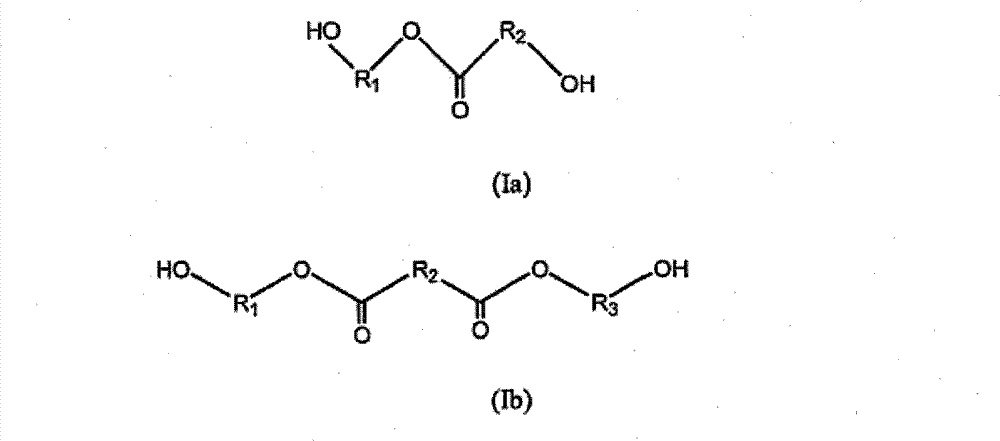
其中R1、R2和R3独立地选自可选取代的C1-20亚烷基和可选取代的C2-C20亚烯基,所述亚烷基和亚烯基均可可选地被可选取代的芳基或可选取代的杂环基、优选可选取代的C1-6亚烷基或可选取代的C2-6亚烯基所中断。 Wherein R1, R2 and R3 are independently selected from optionally substituted C1-20 alkylene and optionally substituted C2-C20 alkenylene, both of which can be optionally substituted by Interrupted by aryl or optionally substituted heterocyclic group, preferably optionally substituted C1-6 alkylene or optionally substituted C2-6 alkenylene. the
式(Ia)化合物的代表性实例有如下: Representative examples of compounds of formula (Ia) are as follows:

羟基-乙酸3-羟基-丙酯(GA-1,3-PD) Hydroxy-acetic acid 3-hydroxy-propyl ester (GA-1, 3-PD)

6-羟基-己酸2-羟基乙酯(CL-EG) 2-Hydroxyethyl 6-Hydroxy-hexanoate (CL-EG)

6-羟基-己酸4-羟基丁酯(CL-BDO) 4-Hydroxybutyl 6-Hydroxy-hexanoate (CL-BDO)
式(Ib)的化合物的代表性实例有如下: Representative examples of compounds of formula (Ib) are as follows:

乙二醇琥珀酸二酯二醇(EG-Suc-EG) Ethylene glycol succinate diester diol (EG-Suc-EG)
(琥珀酸双-(2-羟基-乙基)酯) (Bis-(2-hydroxy-ethyl)succinate)
乙二醇富马酸二酯二醇(EG-Fum-EG) Ethylene glycol fumarate diester diol (EG-Fum-EG)
(反式-2-丁烯二酸双-(2-羟基-乙基)酯) (trans-2-butenedioic acid bis-(2-hydroxy-ethyl) ester)
根据本发明的一种优选组合物由多元醇、扩链剂和至少两种二异氰酸酯制备。 A preferred composition according to the invention is prepared from a polyol, a chain extender and at least two diisocyanates. the
更优选所述至少两种二异氰酸酯是不同的。最优选所述二异氰酸酯中至少之一以对称构型含异氰酸酯部分且所述二异氰酸酯中至少之一以不对称构型含异氰酸酯部分。作为替代方案,所述二异氰酸酯中至少之一含与环状结构相连的异氰酸酯部分。在此替代实施方案中,优选所述二异氰酸酯中至少之一含与直链结构相连的异氰酸酯部分。 More preferably said at least two diisocyanates are different. Most preferably at least one of the diisocyanates contains isocyanate moieties in a symmetrical configuration and at least one of the diisocyanates contains isocyanate moieties in an asymmetric configuration. Alternatively, at least one of the diisocyanates contains an isocyanate moiety attached to a ring structure. In this alternative embodiment, it is preferred that at least one of the diisocyanates contains isocyanate moieties attached to a linear structure. the
根据本发明的得自扩链剂和二异氰酸酯混合物的“硬链段”是赋予共聚物机械强度的链段。 The "hard segments" derived from the chain extender and diisocyanate mixture according to the invention are the segments that impart mechanical strength to the copolymer. the
当硬链段占100%重量时,扩链剂具有扩链剂和多元醇的双重功能。 When the hard segment accounts for 100% by weight, the chain extender has dual functions of chain extender and polyol. the
聚氨酯和聚氨酯/脲组合物可用本体聚合和溶液聚合程序制备。本体聚合是优选的选择,可使用一步、两步或反应挤出法来合成聚合物。在一步法中,所有成分被混合在一锅中,充分混合形成均匀的混合物并随后固化以完成聚合过程。在两步法中,多元醇和/或部分扩链剂与二异氰酸酯混合物混合,在第二步中加入余下的扩链剂,充分混合并固化以完成聚合。 Polyurethane and polyurethane/urea compositions can be prepared using bulk and solution polymerization procedures. Bulk polymerization is the preferred option and polymers can be synthesized using one-step, two-step or reactive extrusion methods. In the one-step process, all ingredients are combined in one pot, mixed well to form a homogeneous mixture and then cured to complete the polymerization process. In the two-step process, the polyol and/or part of the chain extender is mixed with the diisocyanate mixture, the remainder of the chain extender is added in a second step, mixed well and cured to complete polymerization. the
聚氨酯和聚氨酯/脲组合物可使用不同二异氰酸酯的混合物例如对称和不对称的二异氰酸酯的混合物或环状和直链二异氰酸酯的混合物来制备。二异氰酸酯可预先混合并一起加到多元醇中。作为替代方案,可先向多元醇中加入对称二异氰酸酯,然后加入不对称二异氰酸酯,或反之亦然。类似的变化方案可使用于使用环状和直链二异氰酸酯。制备方法中的这些变化可提供对“硬链段”的性质和形态的控制。 Polyurethane and polyurethane/urea compositions can be prepared using mixtures of different diisocyanates, for example mixtures of symmetrical and asymmetrical diisocyanates or mixtures of cyclic and linear diisocyanates. The diisocyanates can be premixed and added together to the polyol. As an alternative, the symmetrical diisocyanate and then the unsymmetrical diisocyanate can be added to the polyol first, or vice versa. Similar variants can be used for the use of cyclic and linear diisocyanates. These variations in the method of preparation can provide control over the nature and morphology of the "hard segment". the
硬链段可占聚氨酯/聚氨酯/脲的40~100%重量。更优选硬链段占60~100%重量。多元醇和扩链剂可为相同的化合物,这对应于其中硬链段对应于聚氨酯/聚氨酯/脲的100%重量的实施方案。还已发现,必须有适度高比例的硬链段以便材料具有适当的性质来满足预期应用的性质要求。 The hard segment can account for 40-100% by weight of polyurethane/polyurethane/urea. More preferably, the hard segment accounts for 60-100% by weight. The polyol and the chain extender may be the same compound, which corresponds to an embodiment in which the hard segment corresponds to 100% by weight of the polyurethane/polyurethane/urea. It has also been found that a moderately high proportion of hard segments is necessary in order for the material to have suitable properties to meet the property requirements of the intended application. the
聚氨酯和聚氨酯/脲组合物可通过共混使用不同的二异氰酸酯制得的聚氨酯和聚氨酯/脲的混合物来制备。因此,分别使用例如不对称和对称的二异氰酸酯制备的组合物可经共挤出以提供根据本发明的组合物。类似地,可分别用环状和直链二异氰酸酯制备聚氨酯或聚氨酯/脲,再通过共混制备本发明的组合物。 Polyurethane and polyurethane/urea compositions can be prepared by blending polyurethane and polyurethane/urea mixtures prepared using different diisocyanates. Thus, compositions prepared using eg asymmetric and symmetric diisocyanates respectively can be coextruded to provide compositions according to the invention. Similarly, cyclic and linear diisocyanates may be used to prepare polyurethanes or polyurethane/ureas, respectively, and then blended to prepare the compositions of the present invention. the
可选地可引入一种催化剂、或两种或更多种催化剂的组合以加快聚合反应。优选的催化剂包括辛酸亚锡(2-乙基己酸亚锡)、二月桂酸二丁基锡、1,4-二氮杂双环[2.2.2]辛烷和三乙胺。可使用的其他催化剂包括钛酸四正丁酯、乙酰丙酮钛、三乙醇胺钛酸酯、乙酰乙酸乙酯钛、钛酸四乙酯、钛酸四异丙酯、钛-乳酸螯合物和可从DuPont以TYZOR系列获得的其他催化剂。 Optionally, one catalyst, or a combination of two or more catalysts may be introduced to accelerate the polymerization reaction. Preferred catalysts include stannous octoate (stannous 2-ethylhexanoate), dibutyltin dilaurate, 1,4-diazabicyclo[2.2.2]octane and triethylamine. Other catalysts that can be used include tetra-n-butyl titanate, titanium acetylacetonate, triethanolamine titanate, ethyl acetoacetate titanium, tetraethyl titanate, tetraisopropyl titanate, titanium-lactic acid chelate and Other catalysts available from DuPont in the TYZOR series. the
可对所述聚氨酯和聚氨酯/脲组合物灭菌而不对其物理和化学性质带来风险,优选使用γ辐射以确保无菌。可使用其他常见灭菌方法如环氧乙烷处理来对所述聚合物或由所述聚合物制得的植入物或其他制品灭菌。 The polyurethane and polyurethane/urea compositions can be sterilized without risking their physical and chemical properties, preferably using gamma radiation to ensure sterility. Other common sterilization methods such as ethylene oxide treatment can be used to sterilize the polymer or implants or other articles made from the polymer. the
所述聚氨酯可用已知的技术如挤出、注塑和压塑容易地加工。 The polyurethanes can be easily processed by known techniques such as extrusion, injection molding and compression molding. the
所述聚氨酯可溶于一系列常见有机溶剂,包括THF、氯仿、二氯甲烷、N,N-二甲基甲酰胺(DMF)、N,N-二甲基乙酰胺(DMAC)。因此,所述聚合物可用来制备医用植入物上的包衣。例如,所述聚合物可用作支架上的药物传递包衣。 The polyurethanes are soluble in a range of common organic solvents, including THF, chloroform, dichloromethane, N,N-dimethylformamide (DMF), N,N-dimethylacetamide (DMAC). Thus, the polymers can be used to prepare coatings on medical implants. For example, the polymers can be used as drug delivery coatings on stents. the
所述聚氨酯也可通过引入不透射线的物质如硫酸钡、碳酸钡或含卤化合物或填料如磷酸三钙和羟基磷灰石而制成不透射线的。这些化合物可在聚合物合成时或加工如挤出过程中引入聚氨酯中。也可在制造的植入物的不同位置处引入不透射线的标记物如金以使植入物不透射线。 The polyurethanes can also be made radiopaque by incorporating radiopaque substances such as barium sulfate, barium carbonate or halogen-containing compounds or fillers such as tricalcium phosphate and hydroxyapatite. These compounds can be incorporated into the polyurethane during polymer synthesis or during processing such as extrusion. Radiopaque markers such as gold can also be introduced at various locations on the fabricated implant to render the implant radiopaque. the
优选根据本发明制备的固化支架在0~60℃的温度下和0%~100%的相对湿度下试验时的拉伸强度在10~100MPa范围内、弹性模量在400MPa~3000MPa范围内、断裂伸长率在30~400%范围内。还优选所述支架在生理环境(37℃,体内)下其初始物理性质保持一周或更长时间。更优选固化的支架在0~60℃的温度下和0%~100%的相对湿度下的断裂伸长率在75%~400%范围内。最 优选固化的支架在0~60℃的温度下和0%~100%的相对湿度下的断裂伸长率在150%~400%之间。 Preferably, the cured support prepared according to the present invention has a tensile strength in the range of 10 to 100 MPa, a modulus of elasticity in the range of 400 MPa to 3000 MPa, and a fracture rate of The elongation is in the range of 30-400%. It is also preferred that the scaffold retains its original physical properties for a week or more in a physiological environment (37°C, in vivo). More preferably, the elongation at break of the cured scaffold is in the range of 75% to 400% at a temperature of 0 to 60°C and a relative humidity of 0% to 100%. Most preferably, the elongation at break of the cured scaffold is between 150% and 400% at a temperature of 0 to 60°C and a relative humidity of 0% to 100%. the
在根据本发明的一种组合物中,多元醇为分子量1033.1的乳酸-乙醇酸共聚多元醇,扩链剂为1,4-丁二醇,异氰酸酯为1,6-六亚甲基二异氰酸酯和异氟尔酮二异氰酸酯的混合物。 In a composition according to the present invention, the polyol is a lactic acid-glycolic acid copolyol with a molecular weight of 1033.1, the chain extender is 1,4-butanediol, and the isocyanate is 1,6-hexamethylene diisocyanate and Mixture of isophorone diisocyanates. the
在根据本发明的另一组合物中,多元醇为分子量1027.33的聚-DL-乳酸,扩链剂为1,4-丁二醇,异氰酸酯为1,6-六亚甲基二异氰酸酯和异氟尔酮二异氰酸酯的混合物。 In another composition according to the present invention, the polyol is poly-DL-lactic acid with a molecular weight of 1027.33, the chain extender is 1,4-butanediol, and the isocyanate is 1,6-hexamethylene diisocyanate and isofluoro A mixture of ketone diisocyanates. the
下面的实施例意在说明本发明的范围和使其能重现和比较,而非意在以任何方式限制本发明的范围。 The following examples are intended to illustrate the scope of the invention and to enable reproducibility and comparison, but are not intended to limit the scope of the invention in any way. the
实施例 Example
实施例1 Example 1
本实施例说明使用IPDI和HDI的80/20(摩尔比)的混合物制备硬链段重量百分数为60、70、80、90和100%的聚氨酯系列。软链段为分子量1033.1的LLA-GA(摩尔比90∶10)多元醇,扩链剂为1,4-丁二醇(BDO)。 This example illustrates the use of an 80/20 (molar ratio) mixture of IPDI and HDI to prepare a series of polyurethanes with 60, 70, 80, 90 and 100% by weight hard segment. The soft segment is LLA-GA (molar ratio 90:10) polyol with a molecular weight of 1033.1, and the chain extender is 1,4-butanediol (BDO). the
步骤1:乳酸-乙醇酸共聚多元醇(LLA-GA)的制备 Step 1: Preparation of lactic acid-glycolic acid copolyol (LLA-GA)
材料 Material
乙醇酸(GA)、L-乳酸(LLA)和1,4-丁二醇(BDO)按收到的原样使用。乳酸-乙醇酸共聚多元醇按如下程序制备。 Glycolic acid (GA), L-lactic acid (LLA) and 1,4-butanediol (BDO) were used as received. Lactic acid-glycolic acid copolyols were prepared as follows. the
方法 method
向3L的五颈圆底烧瓶中称取乙醇酸(142.17g,70%的水溶液)、L-乳酸(1205.6g,88%的水溶液)和BDO(75.10g)。烧瓶装配有冷凝器、氮气入口、温度计、磁力搅拌珠,并将该装置置于油浴中。油浴逐渐加热至190℃。72h后停止反应。 Glycolic acid (142.17 g, 70% in water), L-lactic acid (1205.6 g, 88% in water) and BDO (75.10 g) were weighed into a 3 L five-neck round bottom flask. The flask was fitted with a condenser, nitrogen inlet, thermometer, magnetic stirring beads and the apparatus was placed in an oil bath. The oil bath was gradually heated to 190°C. The reaction was stopped after 72h. the
分别按方法ASTM D1980-87和ASTM E1899-02测定该多元醇的酸值和羟值。基于羟值(106.09),该多元醇的分子量为1033.1,酸值为2.516。 The acid value and hydroxyl value of the polyol were determined according to methods ASTM D1980-87 and ASTM E1899-02 respectively. Based on the hydroxyl value (106.09), the polyol had a molecular weight of 1033.1 and an acid value of 2.516. the
步骤2:具有不同硬链段百分数的聚氨酯系列的制备 Step 2: Preparation of polyurethane series with different percentages of hard segments
材料 Material
BDO在用于合成之前在真空(0.1托)下于70℃干燥以将水分含量减至低于200ppm。HDI、IPDI和辛酸亚锡按收到的原样使用。多元醇(PLLA:GA,MW 1033.1)在用于聚合之前在真空(0.01托)下干燥直至水分含量低于200ppm。 BDO was dried under vacuum (0.1 Torr) at 70° C. to reduce the moisture content to below 200 ppm before being used in the synthesis. HDI, IPDI and stannous octoate were used as received. The polyol (PLLA:GA, MW 1033.1) was dried under vacuum (0.01 Torr) until the moisture content was below 200 ppm before being used for polymerization. the
方法 method
下面的程序说明通过一步法制备具有80%硬链段的聚氨酯。 The following procedure illustrates the preparation of polyurethane with 80% hard segments by a one-step process. the
向玻璃烧杯中准确称取多元醇(10.0000g)和BDO(11.3409g)。用铝箔盖住烧杯并置于70℃的干燥氮气烘箱中。向经湿修正的(wet-tared)聚丙烯烧杯中称取IPDI(24.1001g)和HDI(4.5590g),用箔盖住并置于70℃的干燥氮气烘箱中。一旦烧杯达到温度即向多元醇和BDO混合物中加入异氰酸酯混合物并手动搅拌直至混合物变均匀。搅拌下加入辛酸亚锡(总质量的0.05%)。反应放热完全后将粘稠的反应混合物倒到聚四氟乙烯托盘上并在氮气氛下于80℃烘箱中放置过夜。 Accurately weigh polyol (10.0000 g) and BDO (11.3409 g) into a glass beaker. Cover the beaker with aluminum foil and place in a dry nitrogen oven at 70 °C. IPDI (24.1001 g) and HDI (4.5590 g) were weighed into a wet-tared polypropylene beaker, covered with foil and placed in a dry nitrogen oven at 70°C. Once the beaker was at temperature the isocyanate mixture was added to the polyol and BDO mixture and stirred manually until the mixture became homogeneous. Stannous octoate (0.05% of the total mass) was added under stirring. After the reaction exotherm was complete, the viscous reaction mixture was poured onto Teflon trays and placed in an oven at 80°C overnight under a nitrogen atmosphere. the
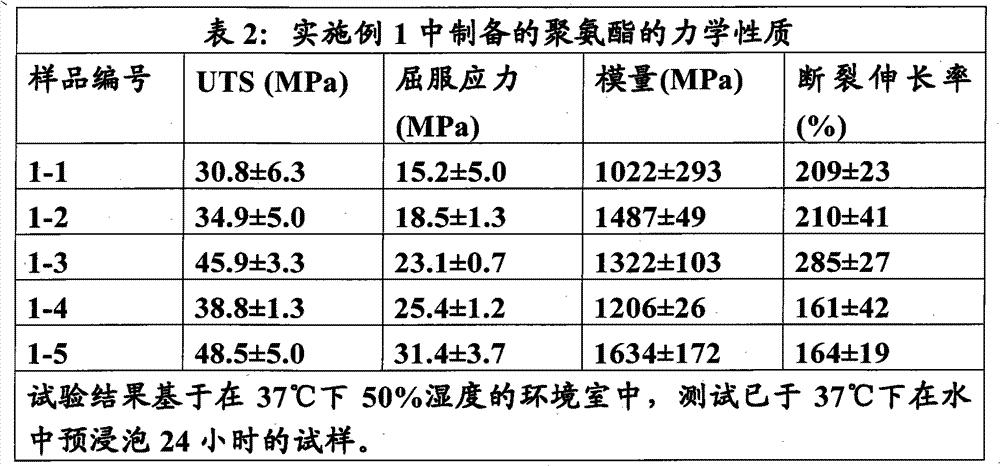
用表1中所示的试剂量按类似程序制备具有60、70、90和100%的硬链段的聚氨酯。 Polyurethanes with 60, 70, 90 and 100% hard segments were prepared by a similar procedure using the reagent amounts shown in Table 1 . the

将聚合物压塑成100微米厚的片体以制备拉伸试验的试样。压塑用Wabash熔融压机(Wabash Melt Press)在190℃下进行。将聚合物片置于0.1mm厚黄铜模板内的熔融钻石(diamond-fusion)玻璃板之间,并在190℃下施加高达8吨压力以形成膜。冷却后从 模具上取下膜,将其切割成5mm×45mm的矩形试条并在氮气下于80℃退火过夜。进行拉伸试验前将试样于37℃下在水中调节24小时。 The polymers were compression molded into 100 micron thick sheets to prepare specimens for tensile testing. Compression molding was performed at 190°C with a Wabash Melt Press. The polymer sheet was placed between diamond-fusion glass plates within a 0.1 mm thick brass template and a pressure of up to 8 tons was applied at 190°C to form a film. After cooling, the film was removed from the mold, cut into 5 mm x 45 mm rectangular test strips and annealed at 80 °C overnight under nitrogen. The specimens were conditioned in water at 37°C for 24 hours prior to tensile testing. the
拉伸试验按ASTM D638用装配有Merlin 2002软件的5568型Instron Universal Testing System进行。标距(十字头距离)为25mm,应变速率为12.5mm/min。除非另有指出,所有力学性质均用于37℃下预浸泡24小时的试样在37℃的环境室中进行测试。 Tensile testing was performed according to ASTM D638 using an Instron Universal Testing System Model 5568 equipped with Merlin 2002 software. The gauge length (crosshead distance) is 25 mm and the strain rate is 12.5 mm/min. Unless otherwise indicated, all mechanical properties were tested on specimens pre-soaked at 37°C for 24 hours in an environmental chamber at 37°C. the
实施例2 Example 2
本实施例说明改变HDI和IPDI的摩尔比而保持硬链段重量百分数恒定为60%来制备聚氨酯。软链段多元醇为P(LLA:GA)∶90∶10(MW 1033.1),扩链剂为BDO。 This example illustrates the preparation of polyurethane by changing the molar ratio of HDI and IPDI while keeping the weight percentage of hard segment constant at 60%. The soft segment polyol is P(LLA:GA):90:10 (MW 1033.1), and the chain extender is BDO. the
材料 Material
BDO在用于合成之前在真空(0.1托)下于70℃干燥以将水分含量减至低于200ppm。HDI、IPDI和辛酸亚锡按收到的原样使用。多元醇(PLLA:GA,MW 1033.1,按实施例1中所述方法制得)在用于聚合之前在真空(0.01托)下于90℃干燥4小时。 BDO was dried under vacuum (0.1 Torr) at 70° C. to reduce the moisture content to below 200 ppm before being used in the synthesis. HDI, IPDI and stannous octoate were used as received. The polyol (PLLA:GA, MW 1033.1, prepared as described in Example 1) was dried under vacuum (0.01 Torr) at 90° C. for 4 hours before being used for polymerization. the
方法 method
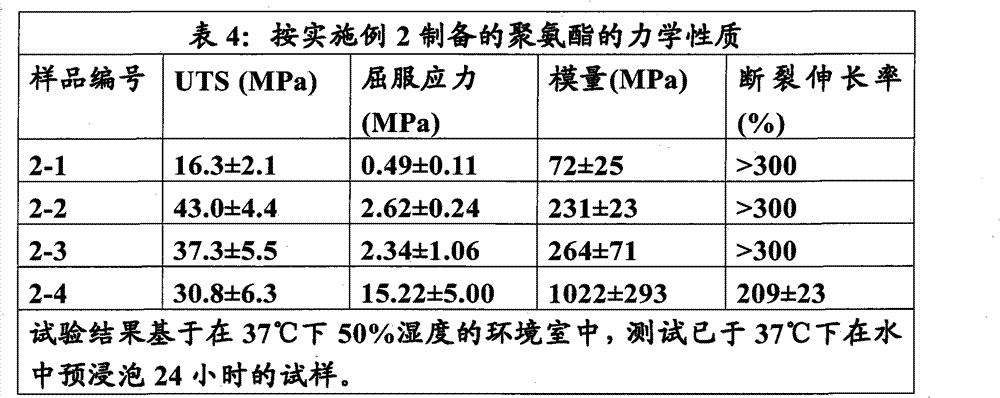
用表3中所示试剂制备四种聚氨酯。用下面的程序制备样品2-1,用类似程序制备系列中的其他样品,不同的是如表3中所示, 所用试剂的量不同。 Four polyurethanes were prepared using the reagents shown in Table 3. Sample 2-1 was prepared using the following procedure, and other samples in the series were prepared using similar procedures, except that, as shown in Table 3, different amounts of reagents were used. the
聚合方法与实施例1相同,但用表3中所示的量。 The polymerization method was the same as in Example 1, but with the amounts shown in Table 3. the
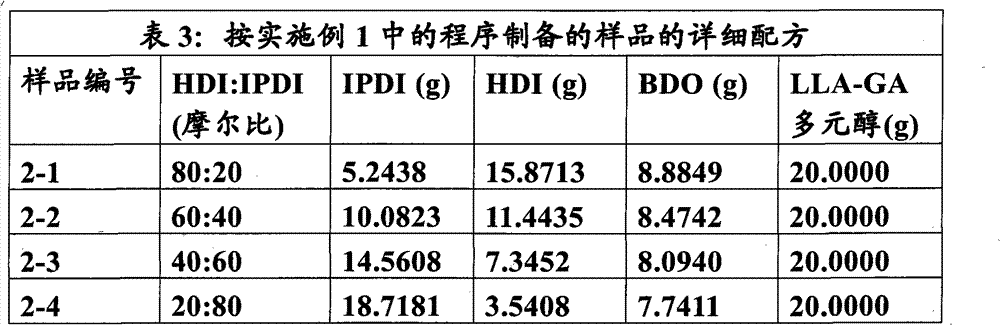
试样制备和拉伸试验使用实施例1中所述程序进行。 Specimen preparation and tensile testing were performed using the procedure described in Example 1. the
来自实施例2的材料2-2用实施例1中所述的方法压塑并在环境温度和干燥条件下测试。聚合物的UTS为53.2±1.8MPa,弹性模量为2261±104MPa,断裂伸长率为160±98%。 Material 2-2 from Example 2 was compression molded by the method described in Example 1 and tested at ambient temperature and dry conditions. The UTS of the polymer is 53.2±1.8MPa, the modulus of elasticity is 2261±104MPa, and the elongation at break is 160±98%. the
实施例3 Example 3
本实施例说明实施例1中所述样品编号为1-3的聚氨酯样品(一批产量1kg)的两步聚合以评价加工性能。 This example illustrates the two-step polymerization of the polyurethane samples (1 kg batch size) described in Example 1 with sample numbers 1-3 to evaluate processability. the
材料 Material
BDO在用于合成之前在真空(0.1托)下于70℃干燥。HDI、IPDI和辛酸亚锡按收到的原样使用。多元醇(PLLA:GA,MW 1033.1)在 用于聚合之前在真空(0.01托)下干燥至水分含量低于200ppm。 BDO was dried under vacuum (0.1 Torr) at 70°C before being used in the synthesis. HDI, IPDI and stannous octoate were used as received. The polyol (PLLA:GA, MW 1033.1) was dried under vacuum (0.01 Torr) to a moisture content below 200 ppm before being used for polymerization. the
方法 method
向2L玻璃烧杯中准确称取多元醇(200.0g)和BDO(90.72g,所需的40%)。用铝箔盖住烧杯顶部并将其置于70℃的烘箱中。向单独的经湿修正的玻璃烧杯中称取IPDI(482.0g)和HDI(91.18g)并加热至70℃。向多元醇和BDO混合物中加入异氰酸酯混合物并手动搅拌直至混合物变均匀。不断搅拌下向其中加入辛酸亚锡(总混合物的0.05wt%)催化剂并用热电偶监测反应混合物的温度。由于反应放热,故温度升高。使反应混合物在氮气下冷却至80℃,加入剩余的BDO(136.08g)并搅拌形成均匀混合物。反应放热完全后将粘稠的聚合物溶液倒到聚四氟乙烯托盘上并在氮气氛下于80℃烘箱中放置过夜。 Accurately weigh polyol (200.0 g) and BDO (90.72 g, 40% of required) into a 2L glass beaker. Cover the top of the beaker with aluminum foil and place it in a 70°C oven. IPDI (482.0 g) and HDI (91.18 g) were weighed into separate wet corrected glass beakers and heated to 70°C. Add the isocyanate mixture to the polyol and BDO mixture and mix by hand until the mixture becomes homogeneous. To this was added stannous octoate (0.05 wt% of the total mixture) catalyst with constant stirring and the temperature of the reaction mixture was monitored with a thermocouple. The temperature increased due to the exothermic reaction. The reaction mixture was cooled to 80°C under nitrogen, the remaining BDO (136.08 g) was added and stirred to form a homogeneous mixture. After the reaction exotherm was complete, the viscous polymer solution was poured onto Teflon trays and placed in an oven at 80°C overnight under a nitrogen atmosphere. the
通过凝胶渗透色谱测得聚合物的分子量(Mn)和多分散度分别为111780和2.05。 The molecular weight (Mn) and polydispersity of the polymer measured by gel permeation chromatography were 111780 and 2.05, respectively. the
使固化的聚合物成粒,在80℃的氮气循环烘箱中干燥过夜并挤出为粒料。 The cured polymer was pelletized, dried overnight in a nitrogen circulating oven at 80°C and extruded into pellets. the
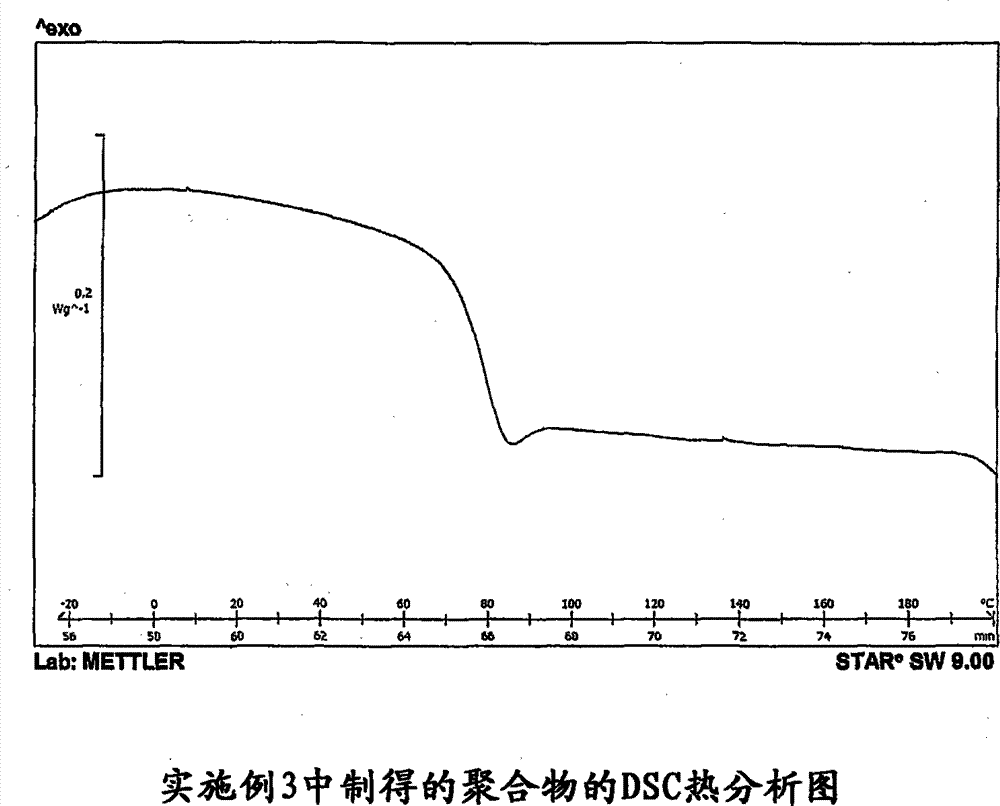
通过差示扫描量热法(DSC)分析聚合物样品,DSC曲线在附图中示出。玻璃化转变温度的起点和中点分别为70℃和75℃。 The polymer samples were analyzed by Differential Scanning Calorimetry (DSC) and the DSC curves are shown in the accompanying drawings. The onset and midpoint of the glass transition temperature are 70°C and 75°C, respectively. the
实施例4 Example 4
本实施例说明引入可降解扩链剂制得的聚合物。 This example illustrates a polymer made by incorporating a degradable chain extender. the
材料 Material
BDO在用于合成之前在真空(0.1托)下于70℃干燥。HDI、IPDI和辛酸亚锡按收到的原样使用。多元醇(PLLA:GA,MW 1033.1)在用于聚合之前在真空(0.01托)下于90℃干燥4小时。可降解扩链剂乳酸-乙二醇酯二醇(LA-EG)使用如下程序制备。 BDO was dried under vacuum (0.1 Torr) at 70°C before being used in the synthesis. HDI, IPDI and stannous octoate were used as received. The polyol (PLLA:GA, MW 1033.1) was dried under vacuum (0.01 Torr) at 90°C for 4 hours before being used for polymerization. The degradable chain extender lactic acid-ethylene glycol ester diol (LA-EG) was prepared using the following procedure. the
方法 method
将L-乳酸(56.7g)置于装配有氮气入口、冷凝器和磁力搅拌棒的1L圆底烧瓶中。将烧瓶置于油浴中并加热至220℃保持5小时以蒸 出冷凝水。从烧瓶收集呈白色固体的所得产物聚乳酸。将聚(乳酸)(43g)和乙二醇(283.6g)在1L圆底烧瓶中于200℃加热17小时。通过用Kugelrohr装置于50℃和真空(0.01~0.0001托)下蒸馏反应产物纯化LA-EG酯二醇。收集LA-EG馏分并重蒸馏以进一步纯化。经纯化的LA-EG为澄清液体,反应收率为53%。 L-lactic acid (56.7 g) was placed in a 1 L round bottom flask equipped with nitrogen inlet, condenser and magnetic stir bar. The flask was placed in an oil bath and heated to 220°C for 5 hours to distill off the condensed water. The resulting product polylactic acid was collected from the flask as a white solid. Poly(lactic acid) (43 g) and ethylene glycol (283.6 g) were heated in a 1 L round bottom flask at 200° C. for 17 hours. The LA-EG ester diol was purified by distillation of the reaction product with a Kugelrohr apparatus at 50°C under vacuum (0.01-0.0001 Torr). The LA-EG fractions were collected and redistilled for further purification. The purified LA-EG was a clear liquid, and the reaction yield was 53%. the
聚氨酯合成:向玻璃烧杯中称取PLLA:GA多元醇(9.8430g,MW 1067.6,按实施例1中的方法制备),并向其中加入BDO(5.3066g)和LA-EG(7.8981g)可降解扩链剂。用铝箔盖上烧杯并升温至70℃。向单独经湿修正的聚丙烯烧杯中称取IPDI(20.3523g)和HDI(6.6000g)并升温至70℃。向多元醇混合物中加入异氰酸酯混合物并用刮勺搅拌直至混合物变均匀。向混合物中加入辛酸亚锡(0.0253,总量的0.05wt%)并剧烈搅拌,当溶液粘度增大时,将其倒到聚四氟乙烯托盘上并在80℃和氮气下固化以完成聚合。 Synthesis of polyurethane: Weigh PLLA:GA polyol (9.8430g, MW 1067.6, prepared according to the method in Example 1) into a glass beaker, and add BDO (5.3066g) and LA-EG (7.8981g) to it to degrade chain extender. Cover the beaker with aluminum foil and raise the temperature to 70 °C. IPDI (20.3523 g) and HDI (6.6000 g) were weighed into separate wet corrected polypropylene beakers and warmed to 70°C. Add the isocyanate mixture to the polyol mixture and stir with a spatula until the mixture is homogeneous. Stannous octoate (0.0253, 0.05 wt% of the total) was added to the mixture with vigorous stirring, and when the solution became viscous, it was poured onto Teflon trays and cured at 80°C under nitrogen to complete polymerization. the
经GPC分析得到数均分子量和多分散度分别为54120和1.96。 The number average molecular weight and polydispersity obtained by GPC analysis were 54120 and 1.96, respectively. the
使用实施例1中所述的程序测定聚合物的力学性质。聚合物的UTS为34.4±9.4MPa,弹性模量为1314±353MPa,屈服应力为15.7±5.7MPa,断裂伸长率为223±50%。 The mechanical properties of the polymers were determined using the procedure described in Example 1. The UTS of the polymer is 34.4±9.4MPa, the elastic modulus is 1314±353MPa, the yield stress is 15.7±5.7MPa, and the elongation at break is 223±50%. the
实施例5 Example 5
材料 Material
DL-乳酸(DLLA)和丁二醇(BDO)按收到的原样使用。将多元醇(DLLA,MW 1027.33)在真空(0.1托)下于80℃干燥直至水分含量低于200ppm。聚DLLA多元醇按如下程序制备。 DL-lactic acid (DLLA) and butanediol (BDO) were used as received. The polyol (DLLA, MW 1027.33) was dried at 80 °C under vacuum (0.1 Torr) until the moisture content was below 200 ppm. PolyDLLA polyol was prepared according to the following procedure. the
方法 method
向5L的五颈圆底烧瓶中称取DL-乳酸(3854g,90%的水溶液)和BDO(225.3g)。烧瓶装配有顶置式搅拌器、冷凝器、氮气入口和温度计并将该装置置于油浴中。将搅拌器速度设置为150±5rpm并将油浴逐渐加热至180℃。用铝箔盖住油表面上方的烧瓶部分以减少热损失和保持恒定的水蒸发速率。搅拌约30分钟后,反应混合物变得澄清、均匀。保持加热和搅拌并在反应48小时后监测酸值。 当反应混合物的酸值达到4.095时,停止反应并使产物冷却至环境温度。 DL-lactic acid (3854 g, 90% in water) and BDO (225.3 g) were weighed into a 5 L five-neck round bottom flask. The flask was fitted with an overhead stirrer, condenser, nitrogen inlet and thermometer and the apparatus was placed in an oil bath. The stirrer speed was set to 150±5 rpm and the oil bath was gradually heated to 180°C. Cover the portion of the flask above the oil surface with aluminum foil to reduce heat loss and maintain a constant rate of water evaporation. After stirring for about 30 minutes, the reaction mixture became clear and homogeneous. Heating and stirring was maintained and the acid value was monitored after 48 hours of reaction. When the acid number of the reaction mixture reached 4.095, the reaction was stopped and the product was allowed to cool to ambient temperature. the
分别按ASTM方法ASTM D1980-87和ASTM E1899-02测定该多元醇的酸值和羟值。基于羟值(105.3),该多元醇的分子量为1027.33,酸值为4.095。 The acid value and hydroxyl value of the polyol were determined according to ASTM methods ASTM D1980-87 and ASTM E1899-02 respectively. Based on the hydroxyl value (105.3), the polyol had a molecular weight of 1027.33 and an acid value of 4.095. the
材料 Material
BDO在用于合成之前在真空(0.1托)下于70℃干燥。HDI、IPDI和辛酸亚锡按收到的原样使用。多元醇(PDLLA 1027.33)在用于聚合之前在真空(0.01托)下于80℃干燥直至水分含量低于200ppm。 BDO was dried under vacuum (0.1 Torr) at 70°C before being used in the synthesis. HDI, IPDI and stannous octoate were used as received. The polyol (PDLLA 1027.33) was dried under vacuum (0.01 Torr) at 80°C until the moisture content was below 200 ppm before being used in the polymerization. the
方法 method
向150mL Bomex玻璃烧杯中准确称取多元醇(9.8866g)和BDO(11.2090g)。用铝箔盖住烧杯并在70℃的烘箱中放置15~30分钟。向单独经湿修正的玻璃耐热烧杯中称取IPDI(24.3064g)和HDI(4.5980g),盖上铝箔并加热至70℃保持10~15分钟。首先充分搅拌和混合多元醇和BDO混合物。然后向多元醇/BDO混合物中加入异氰酸酯混合物并手动搅拌直至混合物变均匀。在不断搅拌的同时向其中加入辛酸亚锡(总混合物的0.05wt%)催化剂直至混合物变得非常粘稠且热。将该粘稠的聚合物溶液倒到聚四氟乙烯托盘上并在氮气下于100℃烘箱中放置过夜。 Accurately weigh polyol (9.8866g) and BDO (11.2090g) into a 150mL Bomex glass beaker. Cover the beaker with aluminum foil and place in a 70°C oven for 15-30 minutes. IPDI (24.3064 g) and HDI (4.5980 g) were weighed into separate wet-corrected glass heat-resistant beakers, covered with aluminum foil and heated to 70° C. for 10-15 minutes. Stir and mix the polyol and BDO mixture well first. The isocyanate mixture was then added to the polyol/BDO mixture and stirred by hand until the mixture became homogeneous. To this was added stannous octoate (0.05 wt% of the total mixture) catalyst with constant stirring until the mixture became very viscous and hot. The viscous polymer solution was poured onto Teflon trays and placed in a 100°C oven overnight under nitrogen. the
使用实施例1中所述的程序在37℃下测定聚合物的力学性质。聚合物的UTS为39.8±8.0MPa,弹性模量为1501±21MPa,屈服应力为17.9±2.4MPa,断裂伸长率为212±154%。 The mechanical properties of the polymers were determined using the procedure described in Example 1 at 37°C. The UTS of the polymer is 39.8±8.0MPa, the elastic modulus is 1501±21MPa, the yield stress is 17.9±2.4MPa, and the elongation at break is 212±154%. the
实施例6 Example 6
本实施例说明聚氨酯在加速试验条件下的降解。 This example illustrates the degradation of polyurethane under accelerated test conditions. the
材料和方法 Materials and methods
本研究中使用聚氨酯1-3、1-5(实施例1中制得)及实施例4和5中制得的聚氨酯。 Polyurethanes 1-3, 1-5 (prepared in Example 1) and polyurethanes prepared in Examples 4 and 5 were used in this study. the
将全部四种聚氨酯均压塑成100微米厚的片体以制备本研究的 试样。压塑用Wabash熔融压机在190℃下进行。将聚合物片置于0.1mm厚黄铜模板内的熔融钻石(diamond-fusion)玻璃板之间并在190℃下施加高达8吨压力以形成膜。冷却后从模具上取下膜,将其切割成5mm×45mm的矩形试条并在氮气下于80℃退火过夜。 All four polyurethanes were compression molded into 100 micron thick sheets to prepare the samples for this study. Compression molding was performed at 190°C using a Wabash melt press. The polymer sheet was placed between diamond-fusion glass plates within a 0.1 mm thick brass template and a pressure of up to 8 tons was applied at 190°C to form a film. After cooling the film was removed from the mold, cut into 5mm x 45mm rectangular test strips and annealed at 80°C overnight under nitrogen. the
每种聚合物取三个试条放在单独的玻璃小瓶中并加入PBS缓冲溶液(pH 7.4±0.2)以完全盖住试条。将封盖的小瓶置于70℃的培养箱中。两周后从培养箱中取出样品,使其冷却至室温并在去离子水中调节2-3天以完全除去来自缓冲溶液的任何盐。经洗涤的试条于40℃干燥4-5天并准确称量以确定质量损失。表5示出了在该加速降解试验条件下的质量损失数据。 Three strips of each polymer were placed in separate glass vials and PBS buffer solution (pH 7.4 ± 0.2) was added to completely cover the strips. Place the capped vial in a 70°C incubator. Samples were removed from the incubator after two weeks, allowed to cool to room temperature and conditioned in deionized water for 2-3 days to completely remove any salt from the buffer solution. The washed strips were dried at 40°C for 4-5 days and accurately weighed to determine mass loss. Table 5 shows the mass loss data under the accelerated degradation test conditions. the

实施例7 Example 7
本实验中使用实施例3中制备的聚氨酯。试样按实施例1中所述的程序制备。本实施例说明当在高于正常体温的温度下试验时所述聚氨酯也具有高模量和高伸长率。 The polyurethane prepared in Example 3 was used in this experiment. Samples were prepared according to the procedure described in Example 1. This example demonstrates that the polyurethane also has high modulus and high elongation when tested at temperatures above normal body temperature. the
聚合物的力学性质用实施例1中所述的程序测定;但试验温度为37℃和40℃。聚合物性质和试验条件在表6中示出。 The mechanical properties of the polymers were determined using the procedure described in Example 1; however, the test temperatures were 37°C and 40°C. The polymer properties and test conditions are shown in Table 6. the
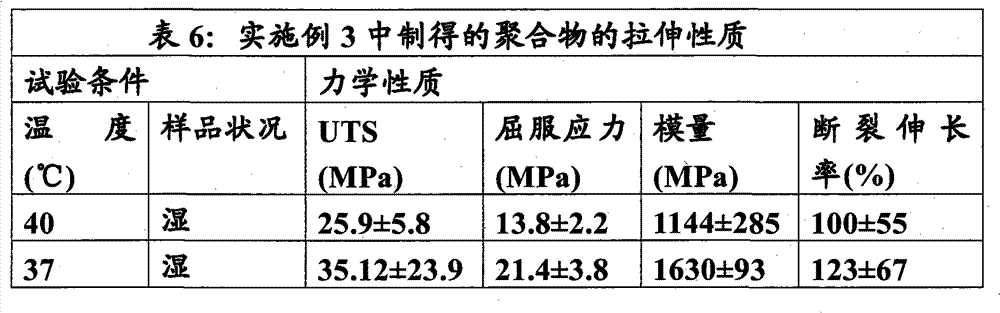
实施例8 Example 8
材料 Material
BDO在真空(0.1托)下于70℃干燥,多元醇(LLA-GA 1033.1)按实施例1制备并在使用前于真空下脱气,IPDI和辛酸亚锡按收到的原样使用。 BDO was dried under vacuum (0.1 Torr) at 70°C, polyol (LLA-GA 1033.1) was prepared as in Example 1 and degassed under vacuum before use, IPDI and stannous octoate were used as received. the
方法 method
向玻璃烧杯中准确称取BDO和多元醇。用铝箔盖住烧杯并将其置于70℃的干燥氮气烘箱中。向经湿修正的玻璃烧杯中称取IPDI,使用箔盖住并置于70℃的干燥氮气烘箱中。一旦烧杯达到温度即向BDO/多元醇中加入IPDI并手动搅拌直至混合物变均匀。搅拌下加入辛酸亚锡(总量的0.05%)。反应放热完全后将粘稠的反应混合物倒到聚四氟乙烯托盘上并在氮气氛下于80℃烘箱中放置过夜。使用表7中示出的详细配方制备一组四种聚氨酯。 Accurately weigh BDO and polyol into a glass beaker. Cover the beaker with aluminum foil and place it in a dry nitrogen oven at 70 °C. IPDI was weighed into a wet trimmed glass beaker, covered with foil and placed in a dry nitrogen oven at 70°C. Once the beaker was at temperature, the IPDI was added to the BDO/polyol and stirred manually until the mixture became homogeneous. Stannous octoate (0.05% of total) was added with stirring. After the reaction exotherm was complete, the viscous reaction mixture was poured onto Teflon trays and placed in an oven at 80°C overnight under a nitrogen atmosphere. A set of four polyurethanes was prepared using the detailed formulation shown in Table 7. the

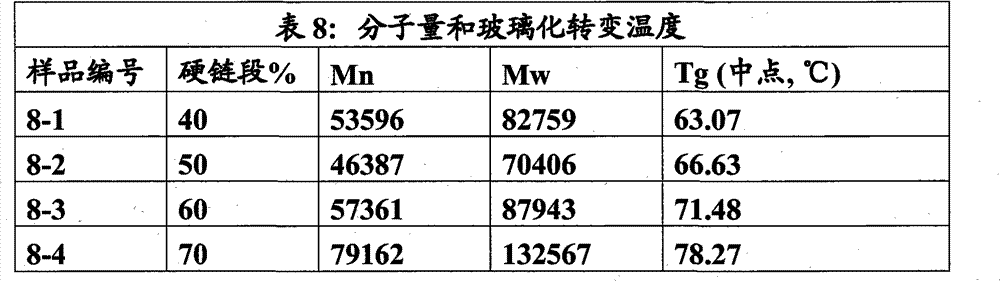
将聚合物熔融压制成100μm的膜,切成条(5mm×50mm),然后通过首先加热热风枪、随后用手拉伸至初始长度的约100%而取向。量取40mm长的各个经拉伸的聚合物并将其在37℃的蒸馏水中放置20小时。20小时后再测定试条以估算收缩百分数。 The polymer was melt pressed into 100 μm films, cut into strips (5 mm x 50 mm), and then oriented by first heating a heat gun followed by hand stretching to about 100% of the original length. A 40 mm length of each stretched polymer was measured and placed in distilled water at 37° C. for 20 hours. The strips were retested 20 hours later to estimate percent shrinkage. the
实施例9 Example 9
本实施例说明两种聚氨酯的制备和随后的加速降解。聚合物的组成如下: This example illustrates the preparation and subsequent accelerated degradation of two polyurethanes. The composition of the polymer is as follows:
材料 Material
BDO(Aldrich)在真空(0.1托)下于70℃干燥,IPDI(Aldrich)和辛酸亚锡(Aldrich)按收到的原样使用。LA-EG按实施例4制备并在真空(0.1托)下于50℃干燥。 BDO (Aldrich) was dried under vacuum (0.1 Torr) at 70°C, IPDI (Aldrich) and stannous octoate (Aldrich) were used as received. LA-EG was prepared as in Example 4 and dried at 50°C under vacuum (0.1 Torr). the
方法 method
向玻璃烧杯中准确称取扩链剂。用铝箔盖住烧杯并置于70℃的干燥氮气烘箱中。向经湿修正的玻璃烧杯中称取IPDI,用箔盖住并置于70℃的干燥氮气烘箱中。一旦烧杯达到温度即向扩链剂中加入IPDI并手动搅拌直至混合物变均匀。搅拌下加入辛酸亚锡(总量的0.05%)。反应放热完全后将粘稠的反应混合物倒到聚四氟乙烯托盘上并在氮气氛下于80℃烘箱中放置过夜。 Accurately weigh the chain extender into a glass beaker. Cover the beaker with aluminum foil and place in a dry nitrogen oven at 70 °C. IPDI was weighed into a wet trimmed glass beaker, covered with foil and placed in a dry nitrogen oven at 70°C. Once the beaker was at temperature the IPDI was added to the chain extender and stirred by hand until the mixture became homogeneous. Stannous octoate (0.05% of total) was added with stirring. After the reaction exotherm was complete, the viscous reaction mixture was poured onto Teflon trays and placed in an oven at 80°C overnight under a nitrogen atmosphere. the
挤出聚合物9-1的纤维并用装配有Merlin 2002软件的5568型Instron Universal Testing System测定力学性质:拉伸模量为2274MPa±308;断裂伸长率为163MPa±13;UTS为200MPa±15。纤维的直径为117±4微米。 Fibers of Polymer 9-1 were extruded and mechanical properties were measured with an Instron Universal Testing System Model 5568 equipped with Merlin 2002 software: tensile modulus 2274 MPa ± 308; elongation at break 163 MPa ± 13; UTS 200 MPa ± 15. The diameter of the fibers was 117 ± 4 microns. the
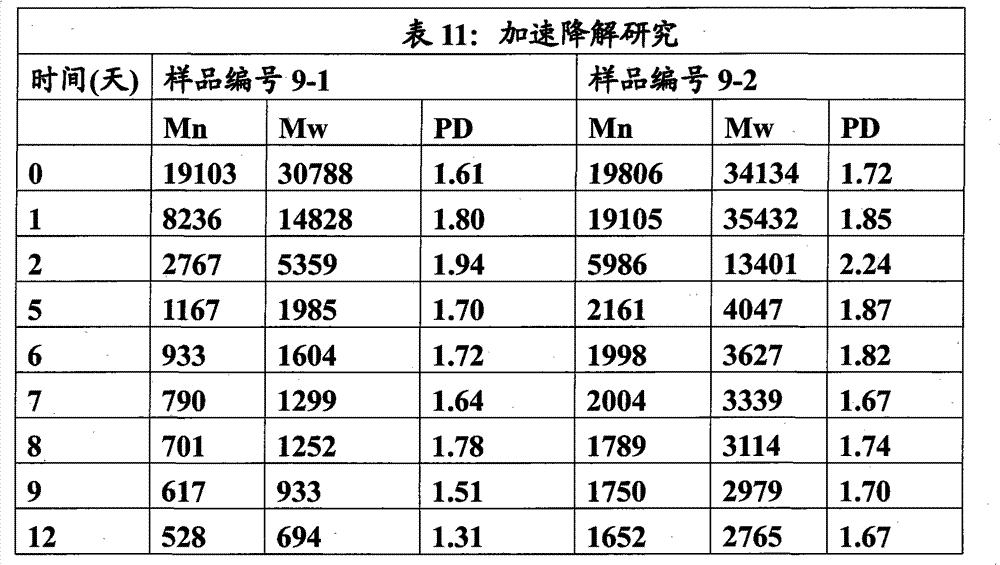
降解:将聚合物切割成小片并称重以进行降解试验。将聚合物置于单独的圆底烧瓶中(10-1为5.0531g,10-2为4.9996g),各烧瓶中加入250ml去离子水且各圆底烧瓶装配有立式冷凝器和磁力 
在不同的时间点对聚合物残余物取样并通过GPC(THF)分析。 The polymer residue was sampled at different time points and analyzed by GPC (THF). the
实施例10 Example 10
实时降解研究 Real-time degradation studies
材料和方法 Materials and methods
本研究中使用聚氨酯1-3、1-5(实施例1中制得)及实施例4和5中制得的聚氨酯。 Polyurethanes 1-3, 1-5 (prepared in Example 1) and polyurethanes prepared in Examples 4 and 5 were used in this study. the
按实施例6中所述的方法制备研究用试样。 Study samples were prepared as described in Example 6. the
对于每个时间点,每种聚合物取10个试条(5×4.5mm)放在单独的玻璃小瓶中并加入PBS缓冲溶液(pH 7.4±0.2)以完全盖住试条。将封盖的小瓶置于37℃的振荡培养箱中。于预定的时间点从培养箱中取出样品,使其冷却至室温并在去离子水中调节2-3天以完全除去来自缓冲溶液的任何盐。经洗涤的试条于40℃干燥4~5天,并准确称量三个样品以确定质量损失,其余的用来测试力学性质。表7示 出了力学性质随时间的变化。 For each time point, 10 strips (5 x 4.5 mm) of each polymer were placed in individual glass vials and PBS buffer solution (pH 7.4 ± 0.2) was added to completely cover the strips. Place the capped vial in a shaking incubator at 37 °C. Samples were removed from the incubator at predetermined time points, allowed to cool to room temperature and conditioned in deionized water for 2-3 days to completely remove any salt from the buffer solution. The washed test strips were dried at 40°C for 4-5 days, and three samples were accurately weighed to determine the mass loss, and the rest were used to test the mechanical properties. Table 7 shows the change in mechanical properties with time. the
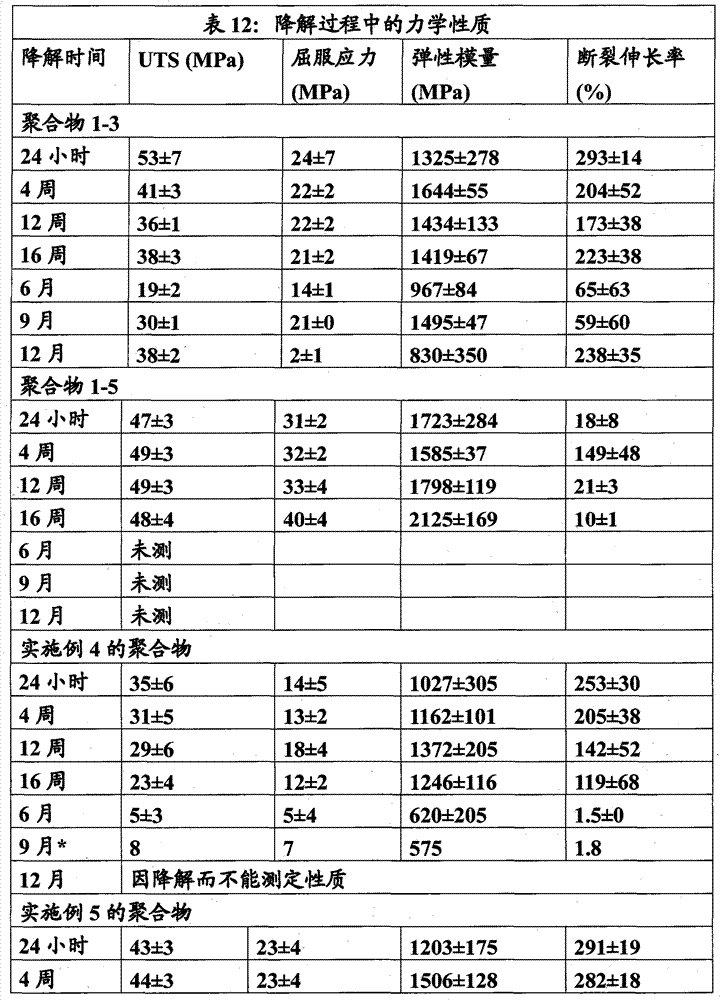

*由于样品因降解而变脆,故仅测定了一个试样。 * Since the sample becomes brittle due to degradation, only one sample was measured.
实施例11 Example 11
将实施例1中制备的聚合物1-3在不同的挤出条件和拉伸比下通过反应挤出重新制成直径0.20~0.35mm的纤维。将纤维切成100mm长,置于37℃的水中并测定不同时间下的纤维长度。6天后纤维收缩0%到最大7%(表13)。 The polymers 1-3 prepared in Example 1 were re-formed into fibers with a diameter of 0.20-0.35 mm by reactive extrusion under different extrusion conditions and draw ratios. Fibers were cut into 100 mm lengths, placed in water at 37°C and the fiber length was measured at different times. After 6 days the fibers shrank from 0% to a maximum of 7% (Table 13). the
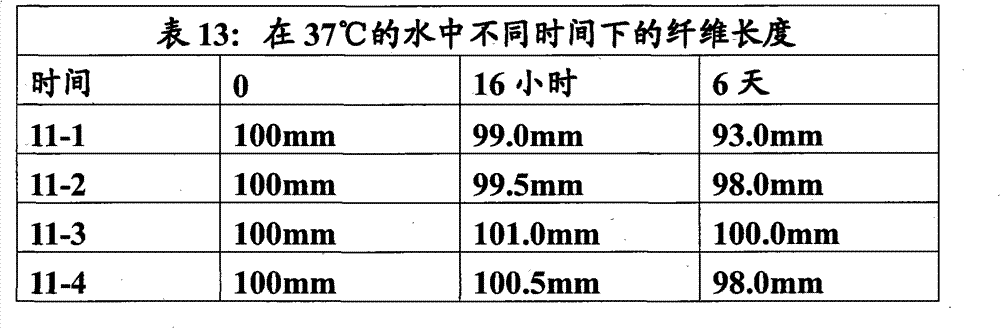
实施例12 Example 12
将BDO(Aldrich)在真空(0.1托)下于70℃干燥,HDI(Fluka)、反式-1,4-环己烷二异氰酸酯(CHDI,德国Synthon Chemicals)和二月桂酸二丁基锡(DBTL,Aldrich)按收到的原样使用。 BDO (Aldrich) was dried under vacuum (0.1 Torr) at 70 °C, HDI (Fluka), trans-1,4-cyclohexane diisocyanate (CHDI, Synthon Chemicals, Germany) and dibutyltin dilaurate (DBTL, Aldrich) to be used as received. the
方法 method
向烧杯中称取CHDI、HDI和DBTL并于80℃充分混合,然后加到经预热的注射泵中,该注射泵提供85℃的加热。BDO在加到第二注射泵中之前于真空下干燥过夜。将含异氰酸酯和催化剂的注射泵及含BDO的注射泵以适宜的质量流量向反应挤出机中注射,在反应挤出机中发生聚合并挤出纤维。 CHDI, HDI and DBTL were weighed into beakers and mixed well at 80°C, then added to a preheated syringe pump which provided 85°C heating. BDO was dried under vacuum overnight before being added to the second syringe pump. The syringe pump containing isocyanate and catalyst and the syringe pump containing BDO are injected into the reaction extruder at a suitable mass flow rate, and polymerization occurs in the reaction extruder and fibers are extruded. the
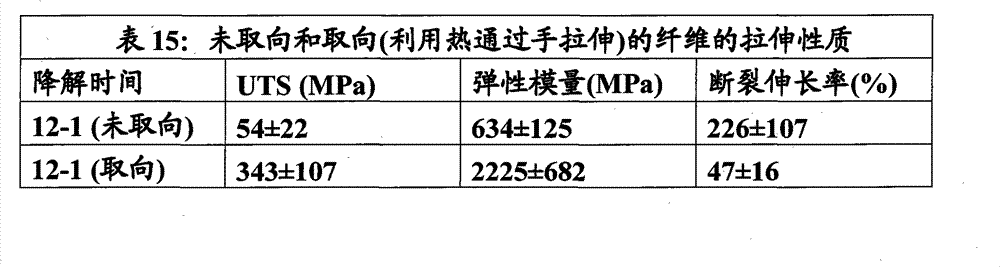
Claims (19)

Applications Claiming Priority (3)
| Application Number | Priority Date | Filing Date | Title |
|---|---|---|---|
| AU2007905409 | 2007-10-03 | ||
| AU2007905409A AU2007905409A0 (en) | 2007-10-03 | High modulus polyurethanes and polyurethaneureas | |
| PCT/AU2008/001460 WO2009043099A1 (en) | 2007-10-03 | 2008-10-03 | High modulus polyurethane and polyurethane/urea compositions |
Publications (2)
| Publication Number | Publication Date |
|---|---|
| CN101896526A CN101896526A (en) | 2010-11-24 |
| CN101896526B true CN101896526B (en) | 2013-09-11 |
Family
ID=40525766
Family Applications (1)
| Application Number | Title | Priority Date | Filing Date |
|---|---|---|---|
| CN2008801178729A Active CN101896526B (en) | 2007-10-03 | 2008-10-03 | High modulus polyurethane and polyurethane/urea compositions |
Country Status (6)
| Country | Link |
|---|---|
| US (1) | US8357767B2 (en) |
| EP (1) | EP2195361B1 (en) |
| JP (1) | JP5600062B2 (en) |
| CN (1) | CN101896526B (en) |
| AU (1) | AU2008307139B2 (en) |
| WO (1) | WO2009043099A1 (en) |
Families Citing this family (58)
| Publication number | Priority date | Publication date | Assignee | Title |
|---|---|---|---|---|
| AU2002950340A0 (en) * | 2002-07-23 | 2002-09-12 | Commonwealth Scientific And Industrial Research Organisation | Biodegradable polyurethane/urea compositions |
| EP1596765A2 (en) * | 2003-02-10 | 2005-11-23 | Smith & Nephew, Inc. | Resorbable devices |
| GB0329654D0 (en) * | 2003-12-23 | 2004-01-28 | Smith & Nephew | Tunable segmented polyacetal |
| WO2007020432A2 (en) * | 2005-08-18 | 2007-02-22 | Smith & Nephew, Plc | High strength devices and composites |
| CN101296958B (en) * | 2005-09-20 | 2012-07-18 | 宝利诺沃生物材料有限公司 | Chain extenders |
| CA2679365C (en) * | 2006-11-30 | 2016-05-03 | Smith & Nephew, Inc. | Fiber reinforced composite material |
| EP2142353A1 (en) | 2007-04-18 | 2010-01-13 | Smith & Nephew PLC | Expansion moulding of shape memory polymers |
| JP5520814B2 (en) | 2007-04-19 | 2014-06-11 | スミス アンド ネフュー インコーポレーテッド | Multimodal shape memory polymer |
| EP2150288B1 (en) | 2007-04-19 | 2011-04-13 | Smith & Nephew, Inc. | Graft fixation |
| US8501290B2 (en) * | 2008-01-15 | 2013-08-06 | Abbott Cardiovascular Systems Inc. | Implantable medical devices fabricated from polyurethanes with biodegradable hard and soft blocks and blends thereof |
| US9259515B2 (en) | 2008-04-10 | 2016-02-16 | Abbott Cardiovascular Systems Inc. | Implantable medical devices fabricated from polyurethanes with grafted radiopaque groups |
| US8142501B2 (en) * | 2008-04-21 | 2012-03-27 | The Board Of Regents Of The University Of Texas System | Artificial ligaments and tendons comprising multifilaments and nanofibers and methods for making |
| US8992601B2 (en) | 2009-05-20 | 2015-03-31 | 480 Biomedical, Inc. | Medical implants |
| US20110319987A1 (en) * | 2009-05-20 | 2011-12-29 | Arsenal Medical | Medical implant |
| EP3858299B1 (en) * | 2009-05-20 | 2025-10-08 | Lyra Therapeutics, Inc. | Method of loading a self-expanding implant |
| US8888840B2 (en) * | 2009-05-20 | 2014-11-18 | Boston Scientific Scimed, Inc. | Drug eluting medical implant |
| US9265633B2 (en) | 2009-05-20 | 2016-02-23 | 480 Biomedical, Inc. | Drug-eluting medical implants |
| US9309347B2 (en) | 2009-05-20 | 2016-04-12 | Biomedical, Inc. | Bioresorbable thermoset polyester/urethane elastomers |
| CN103037809B (en) | 2010-06-08 | 2016-11-16 | 史密夫和内修有限公司 | Implant components and methods |
| BR112013004411A2 (en) | 2010-08-26 | 2016-05-31 | Smith & Nephew Inc | implants, surgical methods, and instrumentation for use in femoracetabular invasion surgeries |
| WO2012068247A1 (en) | 2010-11-16 | 2012-05-24 | The Board Of Trustees Of The Leland Stanford Junior University | Systems and methods for treatment of dry eye |
| US9821159B2 (en) | 2010-11-16 | 2017-11-21 | The Board Of Trustees Of The Leland Stanford Junior University | Stimulation devices and methods |
| EP3597206A1 (en) | 2011-06-21 | 2020-01-22 | BVW Holding AG | Medical device comprising boswellic acid |
| US9364986B1 (en) * | 2012-05-22 | 2016-06-14 | Rapid Prototype and Manufacturing LLC | Method for three-dimensional manufacturing and high density articles produced thereby |
| WO2014004334A1 (en) * | 2012-06-25 | 2014-01-03 | Lubrizol Advanced Materials, Inc. | Process for making biodegradable and/or bioabsorbable polymers |
| WO2014004333A1 (en) * | 2012-06-25 | 2014-01-03 | Lubrizol Advanced Materials, Inc. | Method for identifying bioabsorbable polymers |
| US9717627B2 (en) | 2013-03-12 | 2017-08-01 | Oculeve, Inc. | Implant delivery devices, systems, and methods |
| WO2014172693A2 (en) | 2013-04-19 | 2014-10-23 | Oculeve, Inc. | Nasal stimulation devices and methods |
| CN111298285A (en) | 2014-02-25 | 2020-06-19 | 奥库利维公司 | Polymer formulations for nasolacrimal stimulation |
| CN114734628A (en) | 2014-06-23 | 2022-07-12 | 卡本有限公司 | Method for producing three-dimensional objects from materials with multiple hardening mechanisms |
| US10995298B2 (en) | 2014-07-23 | 2021-05-04 | Becton, Dickinson And Company | Self-lubricating polymer composition |
| CA2956176A1 (en) | 2014-07-25 | 2016-01-28 | Oculeve, Inc. | Stimulation patterns for treating dry eye |
| KR102149304B1 (en) | 2014-09-17 | 2020-08-28 | 에스케이케미칼 주식회사 | Polylactic acid resin composition for 3d printing |
| WO2016065211A1 (en) | 2014-10-22 | 2016-04-28 | Oculeve, Inc. | Contact lens for increasing tear production |
| WO2016065213A1 (en) | 2014-10-22 | 2016-04-28 | Oculeve, Inc. | Implantable nasal stimulator systems and methods |
| MX2017005204A (en) | 2014-10-22 | 2017-12-14 | Oculeve Inc | Stimulation devices and methods for treating dry eye. |
| KR102177707B1 (en) * | 2014-11-24 | 2020-11-11 | 피피지 인더스트리즈 오하이오 인코포레이티드 | Methods for reactive three-dimensional printing by extrusion |
| CN108026242A (en) * | 2015-07-17 | 2018-05-11 | 路博润先进材料公司 | Thermoplastic polyurethane composite for the manufacture of entity free forming |
| US20180282471A1 (en) * | 2015-10-01 | 2018-10-04 | Lubrizol Advanced Materials, Inc. | Thermoplastic Polyurethane Compositions For Solid Freeform Fabrication |
| US10426958B2 (en) | 2015-12-04 | 2019-10-01 | Oculeve, Inc. | Intranasal stimulation for enhanced release of ocular mucins and other tear proteins |
| DE102016000197A1 (en) * | 2016-01-11 | 2017-07-13 | Gkt Gräfenthaler Kunststofftechnik Gmbh | Reaction injection molding compounds, process for their preparation and processing, and uses |
| US10252048B2 (en) | 2016-02-19 | 2019-04-09 | Oculeve, Inc. | Nasal stimulation for rhinitis, nasal congestion, and ocular allergies |
| NL2016526B1 (en) * | 2016-03-31 | 2017-11-02 | Polyganics Ip B V | Improved biomedical polyurethanes |
| WO2017192572A1 (en) | 2016-05-02 | 2017-11-09 | Oculeve, Inc. | Intranasal stimulation for treatment of meibomian gland disease and blepharitis |
| US10704866B2 (en) * | 2016-09-15 | 2020-07-07 | Honeywell International Inc. | High kinetic energy absorption with low back face deformation ballistic composites |
| AU2017317607B2 (en) | 2016-10-19 | 2018-05-17 | Beta Cell Technologies Pty Ltd | Cell population seeding in dermal matrices for endocrine |
| CA3045018A1 (en) | 2016-12-02 | 2018-06-07 | Oculeve, Inc. | Apparatus and method for dry eye forecast and treatment recommendation |
| IL249400A0 (en) * | 2016-12-05 | 2017-01-31 | Cassit Orthopedics Ltd | Orthopedic splints and methods therefor |
| CN108314769A (en) * | 2017-01-16 | 2018-07-24 | 中国科学院宁波材料技术与工程研究所 | A kind of reactive extrursion prepares the method and its application of polylactic acid based polyurethanes elastomer |
| US10316213B1 (en) | 2017-05-01 | 2019-06-11 | Formlabs, Inc. | Dual-cure resins and related methods |
| EP3727198B1 (en) * | 2017-12-22 | 2024-01-17 | Polynovo Biomaterials Pty Limited | Soft tissue implant pocket |
| WO2019119061A1 (en) * | 2017-12-22 | 2019-06-27 | Polynovo Biomaterials Pty Limited | Tissue repair laminates |
| US11911533B2 (en) * | 2017-12-22 | 2024-02-27 | Polynovo Biomaterials Pty Limited | Tissue repair laminates |
| CN108421086B (en) * | 2018-04-19 | 2020-11-03 | 济南羽时信息科技有限公司 | Nano-hydroxyapatite modified polyurethane urea bone repair material and preparation method thereof |
| US11613719B2 (en) | 2018-09-24 | 2023-03-28 | Becton, Dickinson And Company | Self-lubricating medical articles |
| JP7453975B2 (en) * | 2018-12-21 | 2024-03-21 | ポリノボ バイオマテリアルズ ピーティーワイ リミテッド | oriented biodegradable polyurethane |
| CN114787227A (en) * | 2019-12-17 | 2022-07-22 | 科思创知识产权两合公司 | Additive manufacturing method using build material with high hard segment ratio |
| WO2024129790A2 (en) | 2022-12-12 | 2024-06-20 | The Lycra Company Llc | Degradable elastic polyurethane composition |
Citations (4)
| Publication number | Priority date | Publication date | Assignee | Title |
|---|---|---|---|---|
| US4284506A (en) * | 1979-12-26 | 1981-08-18 | Nl Industries, Inc. | Biomedical devices |
| US6262296B1 (en) * | 1999-04-15 | 2001-07-17 | Mitsubishi Gas Chemical Company, Inc. | Polyisocyanate prepolymer |
| CN1332758A (en) * | 1999-09-10 | 2002-01-23 | 三井化学株式会社 | Polyurethane resin with degradability |
| US20070167980A1 (en) * | 2005-11-14 | 2007-07-19 | Jen.Meditec Gmbh | Self-expanding medical occlusion device |
Family Cites Families (54)
| Publication number | Priority date | Publication date | Assignee | Title |
|---|---|---|---|---|
| US3007899A (en) * | 1958-07-16 | 1961-11-07 | Union Carbide Corp | Polyurethane (ester glycol) compositions |
| DE1155905B (en) * | 1960-08-25 | 1963-10-17 | Albert Ag Chem Werke | Process for the production of molded bodies or coatings |
| US3281378A (en) * | 1963-06-06 | 1966-10-25 | Merck & Co Inc | Diisocyanato substituted aliphatic carboxylic acid ester urethane reaction products |
| US3360546A (en) * | 1963-09-16 | 1967-12-26 | Monsanto Co | Purification of hydroxyalkyl fumarate esters |
| US4192827A (en) * | 1974-06-27 | 1980-03-11 | Ciba-Geigy Corporation | Water-insoluble hydrophilic copolymers |
| US4035274A (en) * | 1976-05-24 | 1977-07-12 | Scm Corporation | Dual cure cathodic electrocoating |
| US4293679A (en) * | 1979-06-13 | 1981-10-06 | W. R. Grace & Co. | Composition and method of controlling solid polyurethane particle size with water reactant |
| US4273690A (en) * | 1979-10-09 | 1981-06-16 | E. I. Du Pont De Nemours And Company | Coating compositions of an alkyd-acrylic graft copolymer |
| US4412033A (en) * | 1980-10-24 | 1983-10-25 | H. B. Fuller Company | One-part, curable polyurethane |
| US4438253A (en) * | 1982-11-12 | 1984-03-20 | American Cyanamid Company | Poly(glycolic acid)/poly(alkylene glycol) block copolymers and method of manufacturing the same |
| US4451523A (en) * | 1982-11-12 | 1984-05-29 | Loctite Corporation | Conformal coating systems |
| US4424252A (en) * | 1982-11-12 | 1984-01-03 | Loctite Corporation | Conformal coating systems |
| DE3318730A1 (en) * | 1983-05-21 | 1984-11-22 | Akzo Gmbh, 5600 Wuppertal | Biocompatible polyurethanes |
| US5276068A (en) * | 1985-03-29 | 1994-01-04 | Jeneric/Pentron, Inc. | Dental resin materials |
| US4908406A (en) * | 1988-01-14 | 1990-03-13 | Ciba-Geigy Corporation | Curable mixture |
| US4935480A (en) * | 1988-03-28 | 1990-06-19 | Becton, Dickinson And Company | Fluorinated polyetherurethanes and medical devices therefrom |
| US5041516A (en) * | 1989-06-21 | 1991-08-20 | Cornell Research Foundation, Inc. | Dendritic molecules and method of production |
| JP2670006B2 (en) | 1993-09-07 | 1997-10-29 | 昭和高分子株式会社 | Method for producing biodegradable high molecular weight polyester |
| US5578662A (en) * | 1994-07-22 | 1996-11-26 | United States Surgical Corporation | Bioabsorbable branched polymers containing units derived from dioxanone and medical/surgical devices manufactured therefrom |
| DE19524045A1 (en) * | 1995-07-01 | 1997-01-02 | Basf Ag | Highly functionalized polyurethanes |
| US5886127A (en) * | 1996-08-28 | 1999-03-23 | University Of South Florida | Combinatorial method of forming cascade polymer surfaces |
| GB9618504D0 (en) * | 1996-09-05 | 1996-10-16 | Lrc Products | Thin walled elastic articles |
| CA2218447C (en) | 1996-10-17 | 2009-01-20 | United States Surgical Corporation | Bioabsorbable branched polymers containing units derived from dioxanone and medical/surgical devices manufactured therefrom |
| US6211249B1 (en) | 1997-07-11 | 2001-04-03 | Life Medical Sciences, Inc. | Polyester polyether block copolymers |
| US6124384A (en) * | 1997-08-19 | 2000-09-26 | Mitsui Chemicals, Inc. | Composite resin composition |
| AUPP268898A0 (en) * | 1998-03-31 | 1998-04-23 | Cardiac Crc Nominees Pty Limited | High modulus polyurethane compositions |
| US6319988B1 (en) | 1998-08-31 | 2001-11-20 | Ppg Industries Ohio, Inc. | Thermosetting compositions containing hydroxy functional polymers prepared by atom transfer radical polymerization |
| DE19904444A1 (en) * | 1999-02-04 | 2000-08-10 | Basf Ag | Dendrimers and highly branched polyurethanes |
| US6376742B1 (en) * | 1999-02-17 | 2002-04-23 | Richard J. Zdrahala | In vivo tissue engineering with biodegradable polymers |
| JP4558213B2 (en) * | 1999-04-12 | 2010-10-06 | コーネル・リサーチ・ファンデーション・インコーポレイテッド | Aqueous gel-forming system with hydrophobic and hydrophilic components |
| EP1176993B1 (en) | 1999-05-07 | 2003-06-04 | Salviac Limited | Biostable polyurethane products |
| US6124370A (en) * | 1999-06-14 | 2000-09-26 | The Dow Chemical Company | Crosslinked polyolefinic foams with enhanced physical properties and a dual cure process of producing such foams |
| AUPQ170799A0 (en) * | 1999-07-20 | 1999-08-12 | Cardiac Crc Nominees Pty Limited | Shape memory polyurethane or polyurethane-urea polymers |
| JP2001081152A (en) * | 1999-09-10 | 2001-03-27 | Mitsui Chemicals Inc | Polyurethane resin having decomposing property |
| DE19962272A1 (en) * | 1999-12-23 | 2001-06-28 | Basf Ag | Modules containing isocyanate groups and their use for the functionalization or modification of compounds or surfaces |
| IT1317725B1 (en) * | 2000-01-17 | 2003-07-15 | Ausimont Spa | COMPOSITIONS FOR (PER) FLUOROPOLYETER COATINGS. |
| DE10031258A1 (en) * | 2000-06-27 | 2002-01-10 | Basf Ag | Curable aqueous polyurethane dispersions |
| US6613314B1 (en) | 2000-07-27 | 2003-09-02 | L'oreal | Reshapable hair styling composition comprising polyurethane dispersions |
| DE60141502D1 (en) | 2000-07-28 | 2010-04-22 | Woodbridge Foam Corp | IMPROVED HARDNESS PROPERTIES MOUNTING STUNNING ISOCYANATE BASED POLYMER AND METHOD OF MANUFACTURING THEREOF |
| BR0017309A (en) | 2000-07-31 | 2003-09-30 | Ppg Ind Ohio Inc | Dual cure coating compositions having improved scratch resistance, coated substrates and related methods |
| BR0114368A (en) * | 2000-10-02 | 2003-12-09 | Huntsman Int Llc | Process for preparing a polyurea elastomer and polyurea elastomer |
| CA2427156A1 (en) * | 2000-10-31 | 2003-04-28 | Basf Drucksysteme Gmbh | Use of hyperbranched polyurethanes for producing printing inks |
| KR20020063098A (en) * | 2001-01-26 | 2002-08-01 | 히다찌 플랜트 겐세쓰 가부시키가이샤 | Method for removing hormone disrupting chemicals from water |
| AU2002950340A0 (en) | 2002-07-23 | 2002-09-12 | Commonwealth Scientific And Industrial Research Organisation | Biodegradable polyurethane/urea compositions |
| WO2004065450A2 (en) | 2003-01-16 | 2004-08-05 | Carnegie Mellon University | Biodegradable polyurethanes and use thereof |
| KR100526171B1 (en) * | 2003-07-10 | 2005-11-03 | 학교법인연세대학교 | A preparation method of aromatic-aliphatic isocyanate hybrid aqueous polyurethane |
| US7179874B2 (en) * | 2003-11-21 | 2007-02-20 | Chia Nan University Of Pharmacy And Science | Biodegradable cationic polymer |
| MY146259A (en) | 2004-03-24 | 2012-07-31 | Polynovo Biomaterials Pty Ltd | Boidegradable polyurethane and polyurethane ureas |
| WO2006010278A1 (en) * | 2004-07-26 | 2006-02-02 | Synthes Gmbh | Biocompatible, biodegradable polyurethane materials with controlled hydrophobic to hydrophilic ratio |
| US7247692B2 (en) * | 2004-09-30 | 2007-07-24 | Johnson & Johnson Vision Care, Inc. | Biomedical devices containing amphiphilic block copolymers |
| JP2007077359A (en) * | 2005-09-16 | 2007-03-29 | Tama Tlo Kk | Segmented polyurethane containing fluorine and silicon in main chain, medical device containing the polyurethane and biocompatible element containing the polyurethane |
| CN101296958B (en) * | 2005-09-20 | 2012-07-18 | 宝利诺沃生物材料有限公司 | Chain extenders |
| EP1818348A1 (en) * | 2006-02-10 | 2007-08-15 | Mnemoscience GmbH | Polymer material for useful medical devices |
| WO2007123536A1 (en) * | 2006-04-24 | 2007-11-01 | Carnegie Mellon University | Biodegradable polyurethanes |
-
2008
- 2008-10-03 CN CN2008801178729A patent/CN101896526B/en active Active
- 2008-10-03 JP JP2010527289A patent/JP5600062B2/en active Active
- 2008-10-03 EP EP08800095.5A patent/EP2195361B1/en active Active
- 2008-10-03 AU AU2008307139A patent/AU2008307139B2/en active Active
- 2008-10-03 US US12/245,491 patent/US8357767B2/en active Active
- 2008-10-03 WO PCT/AU2008/001460 patent/WO2009043099A1/en not_active Ceased
Patent Citations (4)
| Publication number | Priority date | Publication date | Assignee | Title |
|---|---|---|---|---|
| US4284506A (en) * | 1979-12-26 | 1981-08-18 | Nl Industries, Inc. | Biomedical devices |
| US6262296B1 (en) * | 1999-04-15 | 2001-07-17 | Mitsubishi Gas Chemical Company, Inc. | Polyisocyanate prepolymer |
| CN1332758A (en) * | 1999-09-10 | 2002-01-23 | 三井化学株式会社 | Polyurethane resin with degradability |
| US20070167980A1 (en) * | 2005-11-14 | 2007-07-19 | Jen.Meditec Gmbh | Self-expanding medical occlusion device |
Also Published As
| Publication number | Publication date |
|---|---|
| JP2010540731A (en) | 2010-12-24 |
| CN101896526A (en) | 2010-11-24 |
| EP2195361B1 (en) | 2014-11-26 |
| EP2195361A1 (en) | 2010-06-16 |
| AU2008307139A1 (en) | 2009-04-09 |
| WO2009043099A1 (en) | 2009-04-09 |
| AU2008307139B2 (en) | 2012-12-20 |
| US8357767B2 (en) | 2013-01-22 |
| EP2195361A4 (en) | 2013-08-14 |
| US20090099600A1 (en) | 2009-04-16 |
| JP5600062B2 (en) | 2014-10-01 |
Similar Documents
| Publication | Publication Date | Title |
|---|---|---|
| CN101896526B (en) | High modulus polyurethane and polyurethane/urea compositions | |
| CN1950098B (en) | Biodegradable polyurethane and polyurethane ureas | |
| Gunatillake et al. | Designing biostable polyurethane elastomers for biomedical implants | |
| CN101296958B (en) | Chain extenders | |
| US9770539B2 (en) | Pendant hydrophile bearing biodegradable compositions and related devices | |
| Park et al. | Catalyst-free synthesis of high elongation degradable polyurethanes containing varying ratios of isosorbide and polycaprolactone: physical properties and biocompatibility | |
| Yagci et al. | Development of metformin chain extended polyurethane elastomers as bone regenerative films | |
| WO2016135349A1 (en) | Phase segregated block copolymers with tunable properties | |
| US7902303B2 (en) | Aliphatic polyester polymer compositions and preparation method thereof | |
| WO2024062300A1 (en) | Biodegradable elastomeric copolymer | |
| EP2014695B1 (en) | Aliphatic polyester polymer compositions and preparation method thereof | |
| AU2005223917B2 (en) | Biodegradable polyurethane and polyurethane ureas | |
| KR20220118848A (en) | Shape memory polymer and manufacturing method thereof, and the use of the same | |
| McMullin | Biodegradable thermoplastic elastomers and smart composites | |
| Wnek et al. | Elastomers, Biodegradable/John J. Stankus, Jianjun Guan, William R. Wagner | |
| Jamiolkowski et al. | The Poly (a-Esters) | |
| JP2008120888A (en) | Biodegradable copolymer and method for producing the same | |
| Herath | Synthesis and characterization of novel biodegradable crosslinked polyesters |
Legal Events
| Date | Code | Title | Description |
|---|---|---|---|
| C06 | Publication | ||
| PB01 | Publication | ||
| C10 | Entry into substantive examination | ||
| SE01 | Entry into force of request for substantive examination | ||
| C14 | Grant of patent or utility model | ||
| GR01 | Patent grant |