CN101833710B - Semantics-based article information tracking and tracing method for Internet of things - Google Patents
Semantics-based article information tracking and tracing method for Internet of things Download PDFInfo
- Publication number
- CN101833710B CN101833710B CN2010101714072A CN201010171407A CN101833710B CN 101833710 B CN101833710 B CN 101833710B CN 2010101714072 A CN2010101714072 A CN 2010101714072A CN 201010171407 A CN201010171407 A CN 201010171407A CN 101833710 B CN101833710 B CN 101833710B
- Authority
- CN
- China
- Prior art keywords
- item
- information
- node
- tracking
- queried
- Prior art date
- Legal status (The legal status is an assumption and is not a legal conclusion. Google has not performed a legal analysis and makes no representation as to the accuracy of the status listed.)
- Expired - Fee Related
Links
- 238000000034 method Methods 0.000 title claims abstract description 125
- 230000008569 process Effects 0.000 claims abstract description 75
- 238000011144 upstream manufacturing Methods 0.000 claims abstract description 68
- 238000013507 mapping Methods 0.000 claims abstract description 17
- 238000012545 processing Methods 0.000 claims description 24
- 239000000284 extract Substances 0.000 claims description 16
- 238000003860 storage Methods 0.000 claims description 7
- 238000006243 chemical reaction Methods 0.000 claims description 5
- 230000003068 static effect Effects 0.000 claims description 2
- 238000012856 packing Methods 0.000 abstract description 6
- 239000000047 product Substances 0.000 description 69
- 239000002994 raw material Substances 0.000 description 27
- 238000004519 manufacturing process Methods 0.000 description 16
- 239000006227 byproduct Substances 0.000 description 12
- 239000012634 fragment Substances 0.000 description 12
- 238000005516 engineering process Methods 0.000 description 10
- 230000008859 change Effects 0.000 description 9
- 238000009826 distribution Methods 0.000 description 9
- 239000000463 material Substances 0.000 description 9
- 238000004806 packaging method and process Methods 0.000 description 9
- 238000010586 diagram Methods 0.000 description 6
- 125000002015 acyclic group Chemical group 0.000 description 4
- 230000003993 interaction Effects 0.000 description 3
- 238000009395 breeding Methods 0.000 description 2
- 230000001488 breeding effect Effects 0.000 description 2
- 239000012792 core layer Substances 0.000 description 2
- 230000036541 health Effects 0.000 description 2
- 238000002372 labelling Methods 0.000 description 2
- 239000010410 layer Substances 0.000 description 2
- 238000007726 management method Methods 0.000 description 2
- 235000013622 meat product Nutrition 0.000 description 2
- 235000013311 vegetables Nutrition 0.000 description 2
- 241000287828 Gallus gallus Species 0.000 description 1
- 230000004931 aggregating effect Effects 0.000 description 1
- 238000013459 approach Methods 0.000 description 1
- 230000009286 beneficial effect Effects 0.000 description 1
- 238000004891 communication Methods 0.000 description 1
- 239000000306 component Substances 0.000 description 1
- 238000010276 construction Methods 0.000 description 1
- 238000013480 data collection Methods 0.000 description 1
- 238000013499 data model Methods 0.000 description 1
- 238000011161 development Methods 0.000 description 1
- 235000013305 food Nutrition 0.000 description 1
- 230000006872 improvement Effects 0.000 description 1
- 230000010365 information processing Effects 0.000 description 1
- 238000007689 inspection Methods 0.000 description 1
- 230000010354 integration Effects 0.000 description 1
- 239000008267 milk Substances 0.000 description 1
- 210000004080 milk Anatomy 0.000 description 1
- 235000013336 milk Nutrition 0.000 description 1
- 238000012986 modification Methods 0.000 description 1
- 230000004048 modification Effects 0.000 description 1
- 238000005457 optimization Methods 0.000 description 1
- 230000008520 organization Effects 0.000 description 1
- 235000015277 pork Nutrition 0.000 description 1
- 238000007781 pre-processing Methods 0.000 description 1
- 230000001105 regulatory effect Effects 0.000 description 1
- 239000004575 stone Substances 0.000 description 1
- 238000013068 supply chain management Methods 0.000 description 1
- 210000001364 upper extremity Anatomy 0.000 description 1
- 210000001835 viscera Anatomy 0.000 description 1
Images


Landscapes
- Management, Administration, Business Operations System, And Electronic Commerce (AREA)
Abstract
本发明公开了一种基于语义的物联网物品信息跟踪与追溯方法,通过在物品流经的各个节点上,将物品的基本属性、状态属性,以及物品流通的上下游关系、上下游节点物品信息的访问地址和上下游节点之间物品唯一编码的映射关系分别记录在对应的语义标签中,进而通过对各节点上标签内容的有序访问,实现在物品流通的任一环节对某个特定物品单元从上游至下游的物品信息跟踪以及从下游至上游的物品信息追溯。本方法克服了物流过程中组装、打包、分拆等操作带来物品标签数据隐藏而造成的跟踪断链问题。使用本方法,上游节点可随时了解产品去向,在出现质量事故时实施准确的产品召回;下游节点可迅速判断物品来历,出现质量事故时快速追查责任原因。
The invention discloses a method for tracking and tracing item information of the Internet of Things based on semantics. The basic attributes and status attributes of the items, the upstream and downstream relationships of the item circulation, and the item information of the upstream and downstream nodes are recorded on each node through which the items flow. The mapping relationship between the access address and the unique code of the item between the upstream and downstream nodes is respectively recorded in the corresponding semantic label, and then through the orderly access to the content of the label on each node, it is realized in any link of the item circulation. Unit tracking of item information from upstream to downstream and tracing of item information from downstream to upstream. The method overcomes the problem of tracking broken chain caused by the hiding of item label data caused by operations such as assembling, packing, and dismantling in the logistics process. Using this method, the upstream node can know the whereabouts of the product at any time, and implement an accurate product recall in the event of a quality accident; the downstream node can quickly determine the origin of the item, and quickly trace the cause of responsibility in the event of a quality accident.
Description
技术领域 technical field
本发明属于信息技术领域,尤其涉及一种基于语义的物联网物品信息的跟踪与追溯方法。The invention belongs to the field of information technology, and in particular relates to a semantic-based tracking and tracing method for item information of the Internet of Things.
背景技术 Background technique
随着信息技术的迅速发展,RFID技术、传感器技术和嵌入式智能技术为网络服务提供了基础的“信息传感器”,将通过物质世界极大程度地数字化,将物质世界中的物质流动过程和虚拟世界中的信息处理的过程有效地结合起来。物联网通过装置在物体上的各种信息传感设备,如RFID装置、红外感应器、全球定位系统、激光扫描器等等,赋予物体智能,并通过接口与互联网相连而形成一个物品与物品相连的巨大网络。通过为每一个物品赋予一个唯一的电子标识,就可以基于RFID等自动识别和数据采集技术将物品流动的过程与信息流动的过程结合起来,并通过与互联网相连的信息服务器提供对应该唯一电子标识的物品的全部信息。融合了RFID技术、传感器技术和嵌入式智能技术,物联网将任何时间、任何地点人与人之间交互的互联网拓展延伸到人与物、物与物之间交互新维度。其最终目标不仅是为每一件物品建立唯一的、开放的标识,更重要的是依靠高效的信息获取和信息交换,实现信息在物品价值链相关者(供应链上下游、行业监管部门等)之间及时、准确、方便的共享和交互,在对物品进行单品实时跟踪的同时,还能够促进整个供应链的优化,提高生产效率。With the rapid development of information technology, RFID technology, sensor technology and embedded intelligent technology provide the basic "information sensor" for network services, which will greatly digitize the material world and integrate the material flow process in the material world with the virtual The process of information processing in the world is effectively combined. The Internet of Things endows objects with intelligence through various information sensing devices installed on objects, such as RFID devices, infrared sensors, global positioning systems, laser scanners, etc., and connects to the Internet through interfaces to form an item-to-item connection huge network. By assigning a unique electronic identification to each item, the process of item flow and information flow can be combined based on automatic identification and data collection technologies such as RFID, and the unique electronic identification can be provided through an information server connected to the Internet. All information about the item. Integrating RFID technology, sensor technology and embedded intelligence technology, the Internet of Things extends the Internet of interaction between people at any time and anywhere to a new dimension of interaction between people and things, and between things and things. Its ultimate goal is not only to establish a unique and open identification for each item, but more importantly, to rely on efficient information acquisition and information exchange to realize information sharing between stakeholders in the item value chain (upstream and downstream of the supply chain, industry regulatory authorities, etc.) Timely, accurate, and convenient sharing and interaction between each other, while tracking items in real time, can also promote the optimization of the entire supply chain and improve production efficiency.
随着生产力水平和社会物质水平的提高,企业、消费者以及社会相关管理部门都迫切希望能够掌握每件产品的来龙去脉,从而实现对产品质量/安全的严格把关。通过对物品信息的跟踪和追溯,提供物品从源头到消耗使用的全生命周期信息,是物联网公共服务体系价值的重要体现。通常来说,物品跟踪是指从物品流经的上游至下游,跟随一个特定的物品单元或一批产品所运行的路径,获得路径上各个环节的重要信息的能力,例如:对于蔬菜和肉类产品的跟踪,指获得其从种植、饲养到加工、包装销售各个环节相关信息的能力,这一能力对于召回对人类健康有威胁的产品,具有重要的意义。物品追溯则是指从供应链的下游至上游,识别一个特定的单元或一批产品的来源的能力,即通过记录标识的方法回溯某个实体来历的能力。物品追溯对于发现质量问题,落实问题责任具有重要的意义。通过实施有效、准确的物品跟踪与追溯,不仅可以确定原料或部件的来源、产品的加工历史、产品配送过程中的流通和位置,还可以为用户提供某个时间和空间范围内定性和定量的对海量物品信息的快速查找方式。With the improvement of productivity level and social material level, enterprises, consumers and relevant social management departments are eager to grasp the ins and outs of each product, so as to realize strict control of product quality/safety. Through the tracking and tracing of item information, providing the full life cycle information of items from source to consumption is an important embodiment of the value of the public service system of the Internet of Things. Generally speaking, item tracking refers to the ability to follow the path of a specific item unit or a batch of products from the upstream to the downstream of the item flow, and obtain the important information of each link on the path, for example: for vegetables and meat Product tracking refers to the ability to obtain relevant information from planting, breeding, processing, packaging and sales. This ability is of great significance for recalling products that pose a threat to human health. Item traceability refers to the ability to identify the source of a specific unit or batch of products from the downstream to the upstream of the supply chain, that is, the ability to trace the origin of an entity by recording and marking. Item traceability is of great significance for discovering quality problems and implementing responsibility for problems. By implementing effective and accurate item tracking and tracing, not only can the source of raw materials or components, product processing history, circulation and location during product distribution be determined, but also qualitative and quantitative information within a certain time and space can be provided for users. A quick way to find massive item information.
更加便捷和透明化的信息获取模式使企业信息系统不再局限于企业内部的局部应用,而不断向企业价值链的上下游延伸拓展,从集中式的闭环本地后台信息系统逐渐发展成为广域、分布、开环、综合的复杂系统——物联网应用。开环物联网应用往往涉及跨越企业边界、区域甚至国界的多个参与者,各类数据分布异构。随着应用需求的不断增加,需要能够透明地获取和处理来自海量数据源中的有用数据,实现多个软硬件系统以及不同信息源之间的互操作。这就需要建立异构系统之间信息共享和交换的物品信息模型,用以描述物联网应用中所有物品相关的需要共享和交换的数据。现有的物品信息模型虽然可以应用在存货跟踪、事务自动处理、供应链管理、机器操纵和物对物通讯等方面,但是由于是以物品唯一电子标识作为索引,因此很难满足每个企业、每个行业的需要。如EPC global的EPC信息网络体系中以EPC编码作为索引,使用物理标识语言(PML)作为数据交换的基础。物理标识语言分为核心层(PML Core)与扩展层(PML Extension)两部分,其核心层用于描述由RFID前端采集的数据,包括位置信息、传感信息等,扩展层则用于提供与RFID系统相关的业务事件的描述。PML只能记录标记有唯一电子标识的物品和其所处环境最基本的物理属性,但对于物品流通过程中的复杂编码信息交换,或者从上游至下游的跟踪以及从下游至上游的追溯则无能为力。The more convenient and transparent information acquisition mode makes the enterprise information system no longer limited to local applications within the enterprise, but continues to extend to the upstream and downstream of the enterprise value chain, gradually developing from a centralized closed-loop local background information system to a wide-area, Distributed, open-loop, integrated complex systems - IoT applications. Open-loop IoT applications often involve multiple participants across enterprise boundaries, regions, or even national boundaries, and various types of data are distributed heterogeneously. With the continuous increase of application requirements, it is necessary to be able to transparently obtain and process useful data from massive data sources, and realize the interoperability between multiple software and hardware systems and different information sources. This requires the establishment of an item information model for information sharing and exchange between heterogeneous systems to describe the data that needs to be shared and exchanged for all items in IoT applications. Although the existing item information model can be applied to inventory tracking, automatic transaction processing, supply chain management, machine manipulation, and object-to-item communication, it is difficult to satisfy each enterprise, needs of every industry. For example, in the EPC information network system of EPC global, the EPC code is used as the index, and the Physical Markup Language (PML) is used as the basis for data exchange. PML is divided into two parts, the core layer (PML Core) and the extension layer (PML Extension). The core layer is used to describe the data collected by the RFID front end, including location information, sensor information, etc., and the extension layer is used to provide information related to Description of business events related to the RFID system. PML can only record the most basic physical attributes of items marked with a unique electronic identifier and their environment, but it is powerless for the exchange of complex coded information in the process of item circulation, or the tracking from upstream to downstream and the traceability from downstream to upstream .
例如在很多典型开环供应链应用中,原材料供应商、生产商、第三方物流商、分销商和零售商等按照物品流动的前后顺序关系相互联,系构成了供应链的多个参与节点。携带电子标识的物品从起点开始,在各个参与节点之间顺序流动。但是物流期间由于在制造、配送、分销、零售等不同物流节点上的加工、组装、装箱、分拆等操作,带来物品标识基本承载体的变化,使标识物品的电子标签的形态和标签中的数据都可能发生改变。例如:在生产商节点某单件商品由6个零件组装构成,在经过生产商节点后,原有的6个零件的物品标识被一个新商品的标识所替代;在分销商节点将30件商品装入一个包装箱,500个包装箱装又装入一个集装箱内运输,使原有的商品标识被隐含在包装箱或集装箱的标识中。如此等等,在绝大多数典型的物联网应用中,很难保证物品流通过程中“可见”的(系统中记录的)电子标识从始至终的唯一性。因此,如果仅根据单一电子标识(如某个零件或某个包装箱的唯一电子标识)进行信息交换、跟踪与追溯,那么由于组装、装箱、分拆等物流操作造成物流过程中该标识被隐藏,使信息跟踪与追溯只能获得由该标识标记的片段,而无法得到完整的物品信息。For example, in many typical open-loop supply chain applications, raw material suppliers, manufacturers, third-party logistics providers, distributors, and retailers are interconnected according to the sequence of item flow, forming multiple participating nodes in the supply chain. Items with electronic identification start from the starting point and flow sequentially among participating nodes. However, during the logistics period, due to the processing, assembly, packing, dismantling and other operations on different logistics nodes such as manufacturing, distribution, distribution, and retailing, the basic carrier of item identification changes, making the shape and label of the electronic tag for identifying items The data in is subject to change. For example: at the manufacturer node, a single product is assembled from 6 parts. After passing through the manufacturer node, the original 6 parts' item identification is replaced by a new product identification; at the distributor node, 30 items are Pack into one packing case, and 500 packing cases are loaded into a container for transportation, so that the original product identification is implied in the packing case or container identification. And so on, in most typical Internet of Things applications, it is difficult to guarantee the uniqueness of the "visible" (recorded in the system) electronic identification in the process of item circulation from beginning to end. Therefore, if only a single electronic identification (such as the unique electronic identification of a certain part or a package) is used for information exchange, tracking and tracing, then due to logistics operations such as assembly, packing, and disassembly, the identification will be lost during the logistics process. Hiding, so that information tracking and tracing can only obtain the fragments marked by the logo, but not the complete item information.
针对开环物联网应用中物流操作造成物品唯一编码在物流过程中被隐藏的常见模式,需要一种能够利用分布在物品各个流通过程中的信息片段,最终拼接出包含物品从原材料、加工、运输、销售直到使用全生命周期过程关键信息的完整记录的物品信息跟踪与追溯方法。这种方法既是将物品流动与信息流动的过程结合起来实现信息增值的重要手段,也是产品防伪、食品安全监管等重要社会性应用的技术支撑。Aiming at the common mode that the logistics operation in the open-loop Internet of Things application causes the unique code of the item to be hidden in the logistics process, it is necessary to use the information fragments distributed in each circulation process of the item, and finally splicing out the items including raw materials, processing, and transportation. 1. A tracking and tracing method for item information with complete records of key information in the whole life cycle process from sale to use. This method is not only an important means of combining the process of item flow and information flow to realize information value-added, but also a technical support for important social applications such as product anti-counterfeiting and food safety supervision.
发明内容 Contents of the invention
为了解决现有技术在开环物联网应用中随着物流操作使物品的形态发生变化,监管的对象信息也随之发生改变,如组装操作使原来的多个物品标识被隐含到组装形成的新物品标识中,从而带来的信息跟踪断链问题,本发明的目的是提供一种基于语义的物联网物品信息跟踪与追溯方法。In order to solve the existing technology in the open-loop Internet of Things application, as the shape of the item changes with the logistics operation, the object information of the supervision also changes accordingly. In the identification of new items, there is a problem of information tracking and broken links. The purpose of the present invention is to provide a method for tracking and tracing information of Internet of Things items based on semantics.
为达成所述目的,本发明的一方面是提供一种利用物联网物品信息跟踪系统,实现基于语义的物联网物品信息跟踪方法的步骤包括如下:In order to achieve the stated purpose, one aspect of the present invention is to provide a tracking system for item information of the Internet of Things, and the steps of implementing a semantic-based tracking method for item information of the Internet of Things include the following steps:
步骤1:查询物品信息的用户在物品流通过程的起始节点或某一个中间节点通过物品信息跟踪与追溯客户端输入需要跟踪的物品唯一编码,发起针对该唯一编码物品的跟踪查询请求;Step 1: The user who inquires about the item information enters the unique code of the item to be tracked through the item information tracking and tracing client at the initial node or an intermediate node of the item circulation process, and initiates a tracking query request for the uniquely coded item;
步骤2:在物品信息跟踪与追溯服务器上,将发起物品信息跟踪请求的节点作为被查询的当前节点,将物品唯一编码作为被查询物品编码,使用由被查询物品编码和当前节点上的信息服务器地址组成的二元值对作为对当前查询节点的标识;Step 2: On the item information tracking and tracing server, the node that initiates the item information tracking request is taken as the current node being queried, and the unique code of the item is used as the queried item code, using the queried item code and the information server on the current node The binary value pair composed of the address serves as the identification of the current query node;
步骤3:物品信息跟踪与追溯服务器使用当前节点的二元值对标识中所提供的被查询物品编码作为参数,按照当前节点标识中所提供的信息服务器地址调用当前节点提供的信息服务,查询在当前节点上标签属性值为被查询物品编码的物品信息记录;Step 3: The item information tracking and tracing server uses the binary value pair identifier of the current node to provide the queried item code as a parameter, and calls the information service provided by the current node according to the information server address provided in the current node identifier. The item information record whose tag attribute value is the code of the queried item on the current node;
步骤4:物品信息跟踪与追溯服务器从调用当前节点信息服务获取的物品信息记录中提取当前节点的节点类型,并从操作属性中标识物品去向的去往语义标签中提取其中记录的下游信息服务器地址以及去往下游的物品编码的数据,将这些数据加入到一个待查询列表的头部;所述待查询列表由多个二元值对组成,其中的每个二元值对由下游物品编码和下游信息服务器地址构成,并以栈的形式存储该待查询列表;Step 4: The item information tracking and tracing server extracts the node type of the current node from the item information record obtained by calling the current node information service, and extracts the downstream information server address recorded in it from the destination semantic label that identifies the whereabouts of the item in the operation attribute And the data of the item code going to the downstream, these data are added to the header of a list to be queried; the list to be queried is composed of multiple binary value pairs, and each binary value pair is composed of the downstream item code and The address of the downstream information server is formed, and the list to be queried is stored in the form of a stack;
步骤5:当从去往语义标签中提取的数据已全部被加入到待查询列表中,物品信息跟踪与追溯服务器将当前节点的状态设置为已访问,并将当前节点的标识加入到一个已访问列表中;Step 5: When all the data extracted from the destination semantic tags have been added to the list to be queried, the item information tracking and tracing server sets the status of the current node as visited, and adds the identity of the current node to a visited List;
步骤6:物品信息跟踪与追溯服务器从待查询列表中弹出位于栈首的元素,所述栈首元素是一个由下游物品编码和下游信息服务器地址构成的二元值对,判断该元素是否已存在于已访问列表中,如果在已访问列表中已经存在,表示该元素标识的节点已经被访问过,抛弃该元素,重复步骤6,否则进行步骤7;Step 6: The item information tracking and tracing server pops up the element located at the head of the stack from the list to be queried. The element at the head of the stack is a binary value pair composed of the downstream item code and the address of the downstream information server, and judges whether the element already exists In the visited list, if it already exists in the visited list, it means that the node identified by the element has been visited, discard the element, repeat
步骤7:物品信息跟踪与追溯服务器检查从待查询列表中弹出的元素,如果弹出的元素为空值,说明待查询列表中已经没有等待查询的内容,物品信息跟踪过程已经完成,转步骤8,否则,将从待查询列表栈首弹出的元素作为新的当前节点的标识,转步骤3;Step 7: The item information tracking and tracing server checks the elements popped up from the list to be queried. If the popped-up element is empty, it means that there is no content waiting to be queried in the list to be queried, and the item information tracking process has been completed. Go to
步骤8:物品信息跟踪与追溯服务器对按上述步骤从物品流经的各个节点所获取的物品流通过程相关信息进行整合,获得整合信息,将整合后的信息发送给发起跟踪查询请求的物品信息跟踪与追溯客户端。Step 8: The item information tracking and tracing server integrates the information related to the item circulation process obtained from each node of the item flow through the above steps, obtains the integrated information, and sends the integrated information to the item information tracking that initiates the tracking query request with the traceback client.
其中:所述物品信息包括对物品流通过程中流经的不同节点分别使用不同的标记进行标注;并在每个物品流经的节点上,对静态的标签属性、物品属性和动态的物流操作事件属性、状态属性及流向属性分别建立对应的语义标签进行存储,并使用物品的唯一编码建立索引;所述节点具有不同类型,所述节点类型是起点节点、流经节点、组装节点、分拆节点和终点这五种类型之一。Wherein: the article information includes labeling different nodes that flow through during the circulation of the article with different tags; , state attributes and flow direction attributes respectively establish corresponding semantic tags for storage, and use the unique code of the item to establish an index; the nodes have different types, and the node types are starting nodes, flow-through nodes, assembly nodes, split nodes and One of these five types of endpoints.
其中:所述物品唯一编码是由物品流通环节的各个节点为经过该节点的物品赋予的有规则的数字及符号的组合,其规则保证该数字及符号的组合不会在任何其它物品上出现。Among them: the unique code of the item is a combination of regular numbers and symbols assigned by each node of the item circulation link to the items passing through the node, and the rules ensure that the combination of numbers and symbols will not appear on any other items.
其中:所述物品信息服务器地址是IP地址、网址、数据库指针或文件路径。Wherein: the item information server address is an IP address, a website, a database pointer or a file path.
其中:所述操作属性是提供对物品在流通过程中所经历的物流业务事件的名称、时间、操作人员,以及物品在业务过程中的状态和流动去向信息的描述,是动态的信息,针对不同应用具有不同的电子档案扩展语义结构。Among them: the operation attribute is to provide the description of the name, time, operator of the logistics business event experienced by the item in the circulation process, as well as the status and flow of the item in the business process. It is dynamic information and is aimed at different Applications have different e-Dossier extension semantic structures.
其中:所述标识物品去向的去往语义标签是提供物品从当前节点所去向的下游节点的物品信息存储位置,即所述信息服务器地址,以及在当前节点由于加工再造、分拆和组装这三类物流操作带来物品唯一编码一对一、一对多或多对一的映射转换关系。Wherein: the whereabouts semantic tag identifying the whereabouts of the item is to provide the item information storage location of the downstream node where the item goes from the current node, that is, the address of the information server, and the current node due to the three factors of remanufacturing, disassembly and assembly Class logistics operations bring about one-to-one, one-to-many, or many-to-one mapping conversions of unique codes for items.
其中:所述从操作属性的去往语义标签中所提取的记录的下游信息服务器地址以及去往下游的物品编码的数据,对于起点、流经节点和组装类型的节点,该数据是一个由下游物品编码和下游信息服务器地址构成的二元值对;对于分拆类型的节点,该数据是多个由下游物品编码和下游信息服务器地址构成的值对;而对于终点,则该数据为空值。Among them: the address of the downstream information server of the record extracted from the semantic label of the operation attribute and the data of the item encoding to the downstream, for the starting point, the flow node and the node of the assembly type, the data is a data sent by the downstream A binary value pair composed of item code and downstream information server address; for split type nodes, the data is multiple value pairs composed of downstream item code and downstream information server address; for the end point, the data is empty .
为达成所述目的,本发明的第二方面是提供一种利用基于语义的物联网物品信息跟踪的追溯方法,该追溯方法包括以下步骤:In order to achieve the stated purpose, the second aspect of the present invention is to provide a traceability method using semantic-based Internet of Things item information tracking, the traceability method includes the following steps:
步骤S1:查询物品信息的用户在物品流通过程的终止节点或某一个中间节点通过物品信息跟踪与追溯客户端输入需要跟踪的物品唯一编码,发起针对该唯一编码物品的追溯查询请求;Step S1: The user who inquires about the item information enters the unique code of the item to be tracked through the item information tracking and tracing client at the end node of the item circulation process or an intermediate node, and initiates a traceability query request for the uniquely coded item;
步骤S2:在物品信息跟踪与追溯服务器上,将发起物品信息追溯请求的节点作为被查询的当前节点,将物品唯一编码作为被查询物品编码,使用由被查询物品编码和当前节点上的信息服务器地址组成的二元值对作为对当前查询节点的标识;Step S2: On the item information tracking and traceability server, the node that initiates the item information traceability request is taken as the current node being queried, and the unique code of the item is used as the queried item code, using the queried item code and the information server on the current node The binary value pair composed of the address serves as the identification of the current query node;
步骤S3:物品信息跟踪与追溯服务器使用当前节点的二元值对标识中所提供的被查询物品编码作为参数,按照当前节点标识中所提供的信息服务器地址调用当前节点提供的信息服务,查询在当前节点上标签属性值为被查询物品编码的物品信息记录;Step S3: The item information tracking and tracing server uses the binary value pair identifier of the current node to provide the queried item code as a parameter, calls the information service provided by the current node according to the information server address provided in the current node ID, and queries in The item information record whose tag attribute value is the code of the queried item on the current node;
步骤S4:物品信息跟踪与追溯服务器从调用当前节点信息服务获取的物品信息记录中提取当前节点的节点类型,从操作属性中标识物品来源的来自语义标签中提取其中记录的上游信息服务器地址以及对应的上游物品唯一编码的数据,将这些数据加入到一个待查询列表的头部,所述待查询列表由多个二元值对组成,其中的每个二元值对由上游物品编码和上游信息服务器地址构成,并以栈的形式存储该待查询列表;Step S4: The item information tracking and tracing server extracts the node type of the current node from the item information record obtained by calling the current node information service, and extracts the upstream information server address and corresponding The uniquely coded data of the upstream item, and these data are added to the head of a list to be queried. The list to be queried is composed of multiple binary value pairs, and each binary value pair is composed of the upstream item code and the upstream information The address of the server is formed, and the list to be queried is stored in the form of a stack;
步骤S5:当从来自语义标签中提取的数据已经被全部加入到待查询列表后,物品信息跟踪与追溯服务器将当前节点的状态设置为已访问,并将当前节点的标识加入到一个已访问列表中;Step S5: When all the data extracted from the semantic tags have been added to the list to be queried, the item information tracking and tracing server sets the status of the current node as visited, and adds the identity of the current node to a visited list middle;
步骤S6:物品信息跟踪与追溯服务器从待查询列表中弹出位于栈首的元素,所述栈首的元素是一个由上游物品编码和上游信息服务器地址构成的二元值对,判断该元素是否已存在于已访问列表中,如果在已访问列表中已经存在,表示该元素标识的节点已经被访问过,抛弃该元素,重复步骤S6,否则进行步骤S7;Step S6: The item information tracking and tracing server pops up the element at the head of the stack from the list to be queried. The element at the head of the stack is a binary value pair composed of the upstream item code and the address of the upstream information server, and judges whether the element has Exists in the visited list, if it already exists in the visited list, it means that the node identified by the element has been visited, discard the element, repeat step S6, otherwise proceed to step S7;
步骤S7:物品信息跟踪与追溯服务器检从查待查询列表中弹出的元素,如果弹出元素为空值,说明待查询列表中已经没有等待查询的内容,物品信息追溯过程已经完成,转步骤S8,否则,将从待查询列表栈首弹出的元素设为新的当前节点的标识,转步骤S3;Step S7: The item information tracking and tracing server checks the pop-up elements from the list to be checked. If the pop-up element is empty, it means that there is no content waiting to be queried in the list to be queried, and the item information traceability process has been completed. Go to step S8. Otherwise, set the element popped from the head of the list to be queried as the identifier of the new current node, and go to step S3;
步骤S8:物品信息跟踪与追溯服务器对按上述步骤对从物品流经的各节点所获取的物品流通过程相关信息进行整合,获得整合信息,将整合后的信息发送给发起追溯查询请求的客户端。Step S8: The item information tracking and tracing server integrates the information related to the item circulation process obtained from each node through which the item flows according to the above steps, obtains the integrated information, and sends the integrated information to the client that initiates the traceability query request .
其中:所述标识物品来源的来自语义标签是提供对于当前节点上某物品所来自的上游节点的物品信息存储位置为信息服务器地址,以及在当前节点由于加工再造、分拆和组装这三类物流操作带来物品唯一编码一对一、一对多或多对一的映射转换关系。Wherein: the source semantic tag for identifying the source of the item is to provide the item information storage location of the upstream node from which an item on the current node is the address of the information server, and the three types of logistics at the current node due to processing and remanufacturing, splitting and assembling The operation brings about one-to-one, one-to-many or many-to-one mapping conversion relationship of the unique code of the item.
其中:所述从操作属性的来自语义标签中所提取的记录的上游信息服务器地址以及对应的上游物品唯一编码的数据,对于终点、流经节点和分拆类型的节点,该数据是一个由上游物品编码和上游信息服务器地址构成的二元值对;对于组装类型的节点,该数据是多个由上游物品编码和上游信息服务器地址构成的值对;而对于起点,则该数据为空值。Among them: the upstream information server address of the record extracted from the semantic label of the operation attribute and the uniquely encoded data of the corresponding upstream item. A binary value pair composed of item code and upstream information server address; for assembly type nodes, the data is multiple value pairs composed of upstream item code and upstream information server address; for the starting point, the data is a null value.
本发明的有益效果是:使用本发明的方法,上游节点可随时获得产品的流向信息,在出现质量事故时也可实施准确的产品召回;而下游节点可迅速地判断物品来历,在出现质量事故时也可快速地追查责任原因。利用操作语义标签所提供的上下游物品编码的映射关系,实现从节点信息片段到物品全生命周期信息的拼接,解决开环物联网应用中,物流操作造成物品唯一编码在物流过程中被隐藏时无法查找完整记录的问题。The beneficial effect of the present invention is: using the method of the present invention, the upstream node can obtain the flow direction information of the product at any time, and can implement accurate product recall when a quality accident occurs; The cause of responsibility can also be quickly traced. Using the mapping relationship between the upstream and downstream item codes provided by the operational semantic tags, the splicing from node information fragments to item life cycle information is realized, which solves the problem that the unique code of the item is hidden during the logistics process in the open-loop Internet of Things application. Unable to find fully documented issues.
附图说明 Description of drawings
图1为本发明提供的一种物品流通过程中标识物品的电子编码随物品或其包装形态变化而发生改变的示意图。Fig. 1 is a schematic diagram of the change of the electronic code identifying the item during the circulation process of the item according to the present invention as the item or its packaging changes.
图1a为对图1所示物品流通过程的抽象描述图。Fig. 1a is an abstract description diagram of the item circulation process shown in Fig. 1 .
图2为本发明提供的物联网物品信息跟踪系统示意图。Fig. 2 is a schematic diagram of the IoT item information tracking system provided by the present invention.
图3为本发明提供的一种基于语义的物联网物品信息跟踪方法的流程图。FIG. 3 is a flow chart of a semantic-based method for tracking item information in the Internet of Things provided by the present invention.
图4为本发明提供的一种基于语义的物联网物品信息追溯方法的流程图。Fig. 4 is a flow chart of a semantic-based method for tracing item information of the Internet of Things provided by the present invention.
图5为本发明提供的一个具体实施例的物品流通过程的全生命周期抽象描述图。Fig. 5 is an abstract description diagram of the whole life cycle of the item circulation process in a specific embodiment provided by the present invention.
具体实施方式 Detailed ways
为使本发明的目的、技术方案和优点更加清楚明白,以下结合具体实施例,并参照附图,对本发明进一步详细说明。In order to make the object, technical solution and advantages of the present invention clearer, the present invention will be described in further detail below in conjunction with specific embodiments and with reference to the accompanying drawings.
本发明提供一个物联网物品信息跟踪系统以及在该系统基础之上的一种基于语义的物联网物品信息跟踪方法及追溯方法。该方法以射频识别(RFID)电子标签对物品的唯一标识为基础,将物品流经的节点分为起点、终点、流经节点、组装节点、和分拆节点五种类型,将物品信息使用标签属性、节点属性、物品属性和操作属性等不同的语义标签进行标注,并分布地存储于物品流经的各个节点上,使物品的跟踪与追溯过程可以根据语义标签提供的节点语义和操作语义获得物品在加工再造、分拆或组合前后的编码映射关系,并能够根据语义标签所提供的上下游节点关系和物品信息的访问地址,从相关节点提取的需要信息片段,最终按照物品流经关系拼接形成物品全生命周期的完整信息。The invention provides a system for tracking item information of the Internet of Things and a semantically-based tracking method and a tracing method for item information of the Internet of Things based on the system. Based on the unique identification of items by radio frequency identification (RFID) electronic tags, this method divides the nodes that items flow through into five types: starting point, end point, flow-through node, assembly node, and split node, and uses tag Attributes, node attributes, item attributes, and operational attributes are marked with different semantic tags, and distributed and stored on each node that the item flows through, so that the tracking and tracing process of the item can be obtained according to the node semantics and operational semantics provided by the semantic tags The coding and mapping relationship of items before and after processing and remanufacturing, splitting or assembling, and according to the upstream and downstream node relationships provided by semantic tags and the access addresses of item information, the required information fragments extracted from relevant nodes can be finally spliced according to the item flow relationship Complete information about the entire life cycle of an item is formed.
(一)物品流通过程描述(1) Description of the circulation process of goods
附图1为本发明提供的一种物品流通过程中标识物品的电子编码随物品或其包装形态变化而发生改变的示意图。图中示意了物联网中最常见的商品流通过程,包括:制造商节点甲1、制造商节点乙2、分销商节点甲3、分销商节点乙4、零售商节点甲5、零售商节点乙6、零售商节点丙7、消费者8,以及产品9、产品10、产品11、产品12和包装运输箱13,其中制造商节点生产的每一件产品均采用唯一电子编码进行标识,经分销商节点配送到零售商节点销售,最终流入消费者手中。附图1示意了:制造商节点甲1生产的产品9、产品10分别以唯一编码UID1和唯一编码UID2标识,制造商节点乙2生产的产品11、产品12分别以唯一编码UID3和唯一编码UID4标识;使用唯一编码UID1标识的产品9由分销商节点甲3配送给零售商节点甲5;使用唯一编码UID4标识的产品12由分销商节点乙4配送给零售商节点丙7;来自制造商节点甲1编码为UID2的产品10和来自制造商节点乙2编码为UID3的产品11均通过分销商节点甲3配送给零售商节点乙6,分销商节点甲3将编码为UID2的产品10和编码为UID3的产品11这两件产品打包到一个以唯一编码UID5标识的包装运输箱13中,配送到零售商节点乙6;在零售商节点乙6处,再将运输箱13拆包,得到标识为唯一编码UID2和唯一编码UID3的产品10和产品11,最终将其销售给不同的消费者8。Accompanying drawing 1 is a schematic diagram of the change of the electronic code identifying the item in the process of item circulation provided by the present invention as the item or its packaging changes. The figure shows the most common commodity circulation process in the Internet of Things, including: Manufacturer Node A1, Manufacturer Node B2, Distributor Node A3, Distributor Node B4, Retailer Node A5,
如图1所示的物品流通过程中,产品在从源头到消费者流动时由于打包、分拆等物流操作的作用,导致物品的形态、物品标识的载体和标识携带的数据(物品编码)多次发生改变。现有依靠物品唯一编码进行检索的物品信息跟踪方法,只能得到图1中出现该唯一编码环节的信息片段,而无法为使用者提供产品全生命周期过程所有关键信息的完整记录。例如在附图1中,消费者采用现有依赖于物品唯一编码的信息跟踪方法追溯标志为唯一编码UID2的产品10的信息,则只能获得标记为UID2的产品10来自零售商节点乙6的信息片段,由于在零售环节的上游产品10的唯一编码UID2被隐含在包装运输箱13中,现有方法因为缺乏对编码变更关系的考虑而无法将存在关联关系的信息片段拼接成为物品的全生命周期信息链,在出现质量事故时,将难以迅速追查责任原因,并对同样可能出现事故的其它产品实施准确召回。In the process of article circulation as shown in Figure 1, when the product flows from the source to the consumer, due to the role of logistics operations such as packaging and dismantling, the shape of the article, the carrier of the article identification, and the data (item code) carried by the identification are many. times changed. The existing item information tracking method that relies on the item's unique code for retrieval can only obtain the information fragment that appears in the unique code link in Figure 1, but cannot provide users with a complete record of all key information in the product's entire life cycle process. For example in accompanying drawing 1, consumer adopts the existing information tracking method that relies on the unique code of item to trace back the information of the
带来物品标识变化的途径可基本归结为三种:其一是分拆——一个大件的物品被拆分成多个更小的物品,每一个新物品将被分配新的标签,例如猪肉生产过程中,整猪被分解为各个不同部位贴标销售;其二是组合——多个物品被打包成为一个更大的单元,合并后被分配给一个新的唯一编码,这在物品货运过程中十分常见,例如打包、集装箱货运;三是再造,即一个物品经过重新加工后成为一件新的物品,在加工的过程中物品的形态已经发生了很大的变化,不能再用加工前的唯一编码来表示,例如将一块原木加工为一张圆桌,或将一块石头加工为一件工艺品。There are basically three ways to bring about changes in item identification: one is splitting—a large item is split into multiple smaller items, and each new item will be assigned a new label, such as pork During the production process, the whole pig is decomposed into different parts for labeling and selling; the second is combination - multiple items are packaged into a larger unit, and are assigned a new unique code after merging. The third is remanufacturing, that is, an item becomes a new item after being reprocessed, and the shape of the item has changed a lot during the process of processing, and the pre-processing cannot be reused. It can be represented by a unique code, such as processing a log into a round table, or processing a stone into a handicraft.
基于以上所述三种途径,本发明将附图1所示物联网物品流通过程中涉及的节点1-7抽象为如图1a所示的:起点14、流经节点15、组装节点16、拆分节点17和终点18五种类别,得到对物品流通过程的抽象描述。利用RFID的识别能力和数据获取能力收集分布在物品各个流经节点上的信息片段,并通过建立分拆、组合和再造操作所带来物品编码变更的前后映射关系,实现物品全生命周期信息链的拼接。Based on the above three approaches, the present invention abstracts the nodes 1-7 involved in the circulation process of the Internet of Things shown in Figure 1 as shown in Figure 1a: starting
各类节点上物品标识的变化关系如下:The change relationship of item identification on various nodes is as follows:
流经节点15:流经关系,物品只流经,除了入库、出处等物流操作外,不对物品进行加工操作,物品编码在通过节点前后保持一致,流经关系是一种一对一定关系;Flow-through node 15: Flow-through relationship. Items only flow through. Except for logistics operations such as warehousing and source, no processing operations are performed on the items. The item codes are consistent before and after passing through the node. The flow-through relationship is a one-to-one fixed relationship;
组装节点16:组装关系,多个部件被组装形成一个新的物品,是一种多对一的关系,例如冰箱由压缩机、柜体、柜门组装形成。Assembly node 16: Assembly relationship. Multiple components are assembled to form a new item, which is a many-to-one relationship. For example, a refrigerator is formed by assembling a compressor, a cabinet body, and a cabinet door.
拆分节点17:拆分关系,一个物品被分解成为多个更小的新物品,是一种一对多的关系,例如一头整猪被分解成为:内脏、前腿、后腿、排骨等等部件被贴标销售。Split node 17: split relationship, an item is decomposed into multiple smaller new items, which is a one-to-many relationship, for example, a whole pig is decomposed into: internal organs, front legs, hind legs, ribs, etc. Parts are labeled for sale.
起点14:物品从无到有经生产和制造产生,只有输出的物品,无输入物品和上游节点,是物品信息追溯的源头。Starting point 14: Items are produced from scratch through production and manufacturing. There are only output items, no input items and upstream nodes, which is the source of item information traceability.
终点18:与起点相反,物品从有到无被消耗,只有输入的物品,无输出的物品和下游节点,是物品信息跟踪的终点。End point 18: Contrary to the starting point, items are consumed from existence to non-existence, there are only input items, no output items and downstream nodes, which is the end point of item information tracking.
以上五类节点和三种基本关系,是物品流通过程中存在的基本关系,例如前文所述的“再造”操作节点,可以用只有一个部件的一类特殊组装关系或拆分关系来描述。其它更为复杂的关系,则可通过上述三种基本关系的组合获得。例如包装运输关系可由组装→流经→分拆组合表达:被运输的物品首先经过组装节点,多个小件物品被封装在更大的运输单元中;运输过程中的运输单元流经多个企业,也可能在运输过程中进一步被打包进入车皮、集装箱等等;到分销环节,打包运输的运输单元再通过拆分节点,被拆分为小件包装,分发到不同的零售门店;零售门店将小件包装拆分为物品单品出售。其中,同一个单位在不同物品的流通过程中,可能具有不同的节点类型。以图1中的分销商节点甲3为例,它在编码标记为UID1的产品9的流通过程中扮演流经节点的角色,而在编码为UID2和UID3的产品10和产品11的流通过程中则是组装节点:它将分别标记为UID2和UID3的产品10、产品11打包到编码为UID5的运输包装箱13中运输。The above five types of nodes and the three basic relationships are the basic relationships that exist in the circulation of goods. For example, the "reengineering" operation node mentioned above can be described by a special assembly relationship or disassembly relationship with only one component. Other more complex relationships can be obtained through the combination of the above three basic relationships. For example, the packaging and transportation relationship can be expressed by the combination of assembly → flow through → disassembly: the transported items first pass through the assembly node, and multiple small items are packaged in a larger transport unit; the transport unit in the transport process flows through multiple enterprises , may also be further packaged into wagons, containers, etc. during the transportation process; in the distribution link, the packaged transport units are then split into small packages through split nodes and distributed to different retail stores; the retail stores will Small packages are split into individual items for sale. Among them, the same unit may have different node types in the circulation process of different items. Taking distributor node A3 in Figure 1 as an example, it plays the role of a flow-through node in the circulation process of product 9 coded as UID1, while in the circulation process of
(二)物联网物品信息跟踪系统(2) IoT item information tracking system
附图2示意了实现本发明基于语义的物联网物品信息跟踪与追溯方法的物联网物品信息跟踪系统,图中示出:物品信息跟踪与追溯服务器F1、物品信息跟踪与追溯客户端F2、物品信息服务器F3和查询物品信息F4的用户。如图2所示的物联网物品信息跟踪系统由多个物品信息跟踪与追溯客户端F2、多个物品信息服务器F3和一到多个物品信息跟踪与追溯服务器F1构成。其中,物品信息跟踪与追溯客户端F2由显示设备和RFID读写装置构成;物品信息服务器F3包括存储物品信息的数据库,并以信息服务的方式向物品信息跟踪与追溯服务器F1提供对物品信息的访问。Accompanying drawing 2 has schematically realized the Internet of Things article information tracking system of the present invention based on semantic Internet of Things article information tracking and tracing method, shows in the figure: article information tracking and tracing server F1, article information tracking and tracing client F2, article Information server F3 and users who inquire about item information F4. The IoT item information tracking system shown in Figure 2 is composed of multiple item information tracking and tracing clients F2, multiple item information servers F3 and one or more item information tracking and tracing servers F1. Among them, the item information tracking and tracing client F2 is composed of a display device and an RFID read-write device; the item information server F3 includes a database for storing item information, and provides item information to the item information tracking and tracing server F1 in the form of information services. access.
在物品流经的每一个物理节点上(包括所有物流的参与者,如附图1所示的节点1-7上)均同时部署物品信息跟踪与追溯客户端F2和物品信息服务器F3;物品信息跟踪与追溯服务器F1可以部署在上述任意一个或多个节点上,也可以设立专用的物品信息跟踪与追服务节点;物品信息跟踪与追溯服务器F1通过有线或无线数据网络与物品信息跟踪与追溯客户端F2和物品信息服务器F3相连接。On each physical node (including all logistics participants, as shown in Figure 1 on the node 1-7) that the item flows through, the item information tracking and tracing client F2 and the item information server F3 are deployed at the same time; the item information The tracking and tracing server F1 can be deployed on any one or more of the above nodes, and a dedicated item information tracking and tracing service node can also be set up; the item information tracking and tracing server F1 can track and trace customers through wired or wireless data networks and item information The terminal F2 is connected to the article information server F3.
查询物品信息的用户F4可以在任一物品流经的节点使用物品信息跟踪与追溯客户端F2,通过其中的RFID读写装置读入物品上的唯一编码向物品信息跟踪与追溯服务器F1发起对物品信息的跟踪或追溯查询;物品信息跟踪与追溯服务器F1使用本发明所述的物品信息跟踪与追溯方法获得物品物流过程全部信息,并通过数据网络将跟踪与追溯的结果发送到发起物品信息查询请求的客户端F2上,显示给查询用户。The user F4 who inquires about the item information can use the item information tracking and tracing client F2 at any node where the item flows through, and read the unique code on the item through the RFID reading and writing device to initiate an item information tracking and tracing server F1. Tracking or retrospective query; Item information tracking and tracing server F1 uses the item information tracking and tracing method described in the present invention to obtain all information on the item logistics process, and sends the tracking and tracing results to the server that initiated the item information query request through the data network On the client F2, it is displayed to the query user.
(三)物品流通信息语义模型(3) Semantic Model of Item Circulation Information
在如图2所示物联网物品跟踪系统中,物品流通的相关信息分布地存储于地域分布的各个物流节点上的物品信息服务器F3中,以信息服务的方式供物品信息跟踪与追溯服务器F1访问。要实现对物品全生命周期的信息跟踪与追溯,在物品信息服务器F2上除了能够提供物品流通过程中的每一个相关节点前后的物品编码变更的映射关系,还必须记录本节点上下游的物品信息访问的地址和节点与节点之间的上下游关系,这样才能保证跟踪与追溯方法能够从分布的物流节点中获取所有的物品相关信息,并根据上下游关系和编码映射关系,拼接获得物品全生命周期的完整信息记录。In the IoT item tracking system shown in Figure 2, the relevant information on item circulation is distributed and stored in the item information server F3 on each logistics node distributed geographically, and is accessed by the item information tracking and traceability server F1 in the form of information service . In order to realize the information tracking and tracing of the entire life cycle of the item, in addition to providing the mapping relationship of the item code change before and after each relevant node in the item information server F2 in the item circulation process, it is also necessary to record the item information upstream and downstream of the node The address of the visit and the upstream and downstream relationship between nodes can ensure that the tracking and tracing method can obtain all item-related information from the distributed logistics nodes, and splicing and obtaining the entire life of the item according to the upstream-downstream relationship and the coding mapping relationship Full information record of the cycle.
因此,为了将物品在流通过程中分布于起点、流经节点、组合节点、分拆节点和终点上的信息片段收集并按物品的流经过程有序地组织起来,需要在现有的物联网数据模型中引入标签属性、基本属性、事件属性、状态属性、上下游关系、编码映射关系等语义,语义化地描述物品商业信息、流动信息和质量信息,形成对标准物品信息描述语言的扩展集,以生成相应的描述方案。通过将扩展信息与已有系统相互融合的信息服务接口,用户可根据需求自由定制丰富的物品信息,计算机可联网利用语义上下文对信息进行聚合,加强信息的有效利用,实现信息管理的智能化。基于语义的物联网物品信息模型可以用来描述各种物品信息,以实现物品信息的分类和分级,便于在各种应用平台下进行信息交换和信息集成。Therefore, in order to collect and organize the information fragments distributed on the starting point, flow-through node, combination node, split node and end point of the item in the circulation process and organize them in an orderly manner according to the flow-through process of the item, it is necessary to use the existing Internet of Things Semantics such as tag attributes, basic attributes, event attributes, status attributes, upstream and downstream relationships, and coding mapping relationships are introduced into the data model to semantically describe item business information, flow information, and quality information, forming an extended set of standard item information description languages , to generate the corresponding description scheme. Through the information service interface that integrates the extended information with the existing system, users can freely customize rich item information according to their needs. Computers can be networked and use semantic context to aggregate information, strengthen the effective use of information, and realize intelligent information management. The semantic-based IoT item information model can be used to describe various item information, so as to realize the classification and classification of item information, and facilitate information exchange and information integration under various application platforms.
基于语义的物联网物品信息模型包括以下三方面内容,这些信息可通过通用的标准词汇表来分配和确定,同时对于物品个性化信息的描述,物品信息的描述规范也可支持语义扩展,从而使物品信息的描述更具灵活性和开放性。The semantic-based IoT item information model includes the following three aspects. These information can be assigned and determined through a common standard vocabulary. At the same time, for the description of item personalized information, the description specification of item information can also support semantic extension, so that The description of item information is more flexible and open.
(1)物品标签属性:使用语义标签<ta>、</ta>标注。提供物品上粘贴的电子标签内存储的相应数据,主要记录与物品对应的唯一电子编码,它是由物品流通环节各个节点为经过该节点的物品赋予的有规则数字及符号的组合,其规则保证该数字及符号的组合不会在任何其它物品上出现。物品编码现已有多种公开规则,按这些规则的编码均可保证物品编码的唯一性。(1) Item tag attributes: use semantic tags <ta>, </ta> to mark. Provide the corresponding data stored in the electronic label pasted on the item, mainly record the unique electronic code corresponding to the item, which is a combination of regular numbers and symbols given by each node in the item circulation link to the item passing through the node, and its rules guarantee This number and symbol combination will not appear on any other item. There are many public rules for article coding, and the coding according to these rules can guarantee the uniqueness of article coding.
(2)物品属性:使用语义标签使用语义标签<pa>、</pa>标注。提供对物品特征及相关属性的描述。物品属性又分为描述物品通用属性的基础属性和对某些物品特有属性进行描述的扩展属性。基础属性使用语义标签<ba>、</ba>标注,提供任何产品都应具有的基础属性,如物品名称、产地、生产厂商、分类、批次等静态信息,揭示所有物品的通用属性。扩展属性使用语义标签<xa></xa>标注,记录某些产品所特有的属性,不同产品的扩展属性各不相同,可根据具体应用扩展定义。例如在冷链物流应用中,纸屋牛奶具有扩展属性:储藏温度低于2摄氏度。(2) Item attributes: Use semantic tags Use semantic tags <pa>, </pa> to mark. Provides a description of the item's characteristics and associated attributes. Item attributes are further divided into basic attributes that describe the general attributes of items and extended attributes that describe certain item-specific attributes. The basic attributes are marked with semantic tags <ba>, </ba> to provide basic attributes that any product should have, such as static information such as item name, origin, manufacturer, classification, batch, etc., revealing the common attributes of all items. Extended attributes are marked with semantic tags <xa></xa> to record the unique attributes of certain products. The extended attributes of different products are different, and can be extended and defined according to specific applications. For example, in cold chain logistics applications, paper house milk has extended properties: the storage temperature is below 2 degrees Celsius.
(3)物品操作属性:使用语义标签<oa>、</oa>标注。提供物品所经历的物流操作相关信息,记录物品所经历的物流操作名称、操作时间、操作人员等信息,以及物流操作所带来的新旧物品编码映射关系、物流上下游关系等。物品操作属性又分为事件属性、状态属性和流向属性,分别用语义标签<ea></ea>、<sa></sa>、<fa></fa>标记。其中事件属性<ea></ea>提供物品在流通过程中发生的业务事件的描述,如生产、分发、货运、补货、检验等业务过程,操作人员;状态属性<sa></sa>提供物品在流通过程中所发生的业务事件的具体参数,如扫描时间、扫描节点、当前温度等信息。事件属性和状态属性均属于动态信息,根据不同应用跟踪与追溯的具体需求以确定具体内容。流向属性<fa></fa>提供物品的来自和去往语义,分别用<from></from>和<to></to>语义标签标注。“from”语义标签记录本节点所接收的物品唯一编码及其来源的上游节点信息服务地址;“to”语义标签则记录本节点发出的物品的编码及其去向的下游节点信息服务地址。(3) Item operation attributes: marked with semantic tags <oa>, </oa>. Provide relevant information about the logistics operation experienced by the item, record the name of the logistics operation experienced by the item, the operation time, the operator and other information, as well as the mapping relationship between the new and old item codes brought about by the logistics operation, and the upstream and downstream logistics relationship. Item operation attributes are further divided into event attributes, state attributes and flow direction attributes, which are marked with semantic tags <ea></ea>, <sa></sa>, <fa></fa> respectively. Among them, the event attribute <ea></ea> provides a description of the business events that occur during the circulation of the item, such as production, distribution, freight, replenishment, inspection and other business processes, operators; the status attribute <sa></sa> Provide specific parameters of business events that occur during the circulation of items, such as scanning time, scanning nodes, current temperature and other information. Both event attributes and state attributes are dynamic information, and the specific content is determined according to the specific requirements of different application tracking and tracing. The flow attribute <fa></fa> provides the from and to semantics of the item, marked with <from></from> and <to></to> semantic tags respectively. The "from" semantic label records the unique code of the item received by this node and the upstream node information service address of its source; the "to" semantic label records the code of the item sent by this node and the downstream node information service address of its destination.
基于语义标签的物品信息模型如下表所示:The item information model based on semantic tags is shown in the following table:


上述物联网物品信息模型中提供了Who、What、Where和When这4W语义要素。例如:标签属性下的<UID>语义标签中的数据标识了物品的Who属性;物品基本属性中的物品名称、造厂商、生产批次和物品扩展属性则标识了物品的Who和What属性;当物品标签被某个特定位置的读写装置识读时,操作属性中的读写装置身份信息即标定了操作发生的位置空间Where属性;而from和to语义标签中的address数据还提供了网络环境中的物品信息空间Where属性;最后,物品经过读取点的读取时间记录了物品流通过程中发生的每件事件的时间When属性。通过在物品流经的各个节点上存储的物品语义标签记录了物品的标签属性、物品属性和操作属性,在跟踪或追溯时不仅可以通过物品唯一编码进行检索,还可以通过物品属性值和物品唯一编码映射表进行批量检索——例如查找在某个物流仓库在10:32发出的一辆温度曾高于26度的冷冻货车中运送的50箱速冻鸡肉的最终销售地点,或查找某辆刹车板出现质量安全事故的汽车的刹车板供货商生产的该批次产品质量检验员等。The 4W semantic elements of Who, What, Where and When are provided in the above-mentioned IoT item information model. For example: the data in the <UID> semantic tag under the tag attribute identifies the Who attribute of the item; the item name, manufacturer, production batch, and item extended attribute in the basic attribute of the item identify the Who and What attribute of the item; When the item tag is read by a read-write device at a specific location, the identity information of the read-write device in the operation attribute calibrates the location space where the operation occurs; while the address data in the from and to semantic tags also provide the network environment The Where attribute of the item information space in ; finally, the reading time of the item passing through the reading point records the time When attribute of each event that occurs during the item circulation process. The label attribute, item attribute and operation attribute of the item are recorded by the item semantic tag stored on each node of the item flow. When tracking or tracing, not only the unique code of the item can be retrieved, but also the item attribute value and item uniqueness can be retrieved. Encoded mapping table for bulk retrieval - e.g. to find where 50 cases of quick-frozen chicken shipped in a refrigerated truck with a temperature above 26 degrees sent out at 10:32 by a logistics warehouse ended up being sold, or to find the brake pads of a certain vehicle The quality inspector of the batch of products produced by the supplier of the brake pads of the car that has a quality safety accident, etc.
此外,物品流通过程中所流经的不同类型节点,其类型语义使用语义标签<node>、</node>进行标注,其中起点用sn(start node)表示,流经节点用fn(flow-by node)表示,组装节点用an(aggregating node)表示,分拆节点用dn(dispatching node)表示,终点用en(end node)表示。In addition, the type semantics of the different types of nodes that flow through during the circulation of goods are marked with semantic tags <node>, </node>, where the starting point is represented by sn (start node), and the flow-through node is represented by fn (flow-by node), the assembly node is represented by an (aggregating node), the split node is represented by dn (dispatching node), and the end point is represented by en (end node).
上述物品信息在原材料供应商、制造厂商、配送商、批发商、零售商等环节的信息服务器中分布存储,各供应链参与者享有对本环节物流信息的掌控权,以信息服务的方式与合作合伙进行信息共享。使用本发明所述的物品信息跟踪与追溯方法,可以在其中的任意节点发起物品跟踪或追溯请求,将分布在不同节点上分散存储的物品信息安照物品流经的顺序,拼接成为一条以原材料供货商为起点,直至零售商为终点的物品全生命周期信息链,使得在任何时刻、任何地点均可掌握系统中任何物品的来龙去脉。The above-mentioned item information is distributed and stored in the information servers of raw material suppliers, manufacturers, distributors, wholesalers, retailers, etc., and each supply chain participant has the right to control the logistics information of this link, and cooperates with partners in the form of information services To share information. Using the item information tracking and tracing method described in the present invention, an item tracking or tracing request can be initiated at any node, and the item information distributed and stored on different nodes can be spliced into a raw material according to the order of item flow. The information chain of the whole life cycle of items from the supplier as the starting point to the retailer as the end point makes it possible to grasp the ins and outs of any item in the system at any time and any place.
(四)物品流通信息跟踪与追溯方法基本原理(4) Basic principles of item circulation information tracking and tracing methods
本发明所述的一种基于语义的物联网物品信息跟踪与追溯方法,包括物品信息跟踪和物品信息追溯两部分内容。物品信息跟踪指从物品流经的上游至下游,跟随一个特定的物品单元或一批产品所运行的路径,获得路径上各个环节的重要信息的能力,例如:对于蔬菜和肉类产品的跟踪,指获得其从种植、饲养到加工、包装销售各个环节相关信息的能力,这一能力对于招回对人类健康有威胁的产品,具有重要的意义。追溯则是指从供应链的下游至上游,识别一个特定的单元或一批产品的来源的能力,即通过记录标识的方法回溯某个实体来历的能力。追溯对于发现质量问题,落实问题责任具有重要的意义。A method for tracking and tracing item information based on semantics in the present invention includes two parts: item information tracking and item information tracking. Item information tracking refers to the ability to follow the path of a specific item unit or a batch of products from the upstream to the downstream of the item flow, and obtain the important information of each link on the path, for example: for the tracking of vegetables and meat products, Refers to the ability to obtain relevant information in all links from planting, breeding, processing, packaging and sales. This ability is of great significance for recalling products that pose a threat to human health. Traceability refers to the ability to identify the source of a specific unit or batch of products from the downstream to the upstream of the supply chain, that is, the ability to trace back the origin of an entity by recording and marking. Traceability is of great significance for discovering quality problems and implementing responsibility for problems.
基于语义的物联网物品信息跟踪与追溯,其基本原理是:根据存储于各节点信息服务器中的物品信息语义模型,在发起查询的节点上通过物品唯一编码为索引,查询标签属性与被查询编码匹配的物品信息,获得节点上存储的物品生命周期信息片段。进一步根据物品信息模型中操作属性提供的“流向属性”<fa></fa>标签,可从<from></from>语义标签获得该产品来自的上游节点信息访问地址,以及在上游节点上所对应物品编码标识;进而使用从<from></from>语义标签所获得的物品编码访问上游节点的信息服务器,得到在上游节点上存储的物品信息片段;以此类推,通过依次对上游节点的访问,追溯物品流通过程的全部信息。同理,根据流向属性中的<to></to>语义标签中对下游节点信息访问地址和对应的物品编码的记录,可依次访问下游节点,实现对物品流通过程中的信息跟踪。对于组装和分拆这两类节点存在多对一和一对多的编码映射关系,在物品信息跟踪与追溯方法中采用泛洪(flood)方式,依次使用<from></from>和<to></to>标签中所记录的所有映射编码到其相应的信息服务器上检索物品信息。由于物品信息模型的<from></from>和<to></to>语义标签即提供了物品流向信息,又提供了物流节点带来了物品编码变化的映射关系,尽管物品来流通过程中由于物流操作而带来了多次表示编码的转换,如多个部件被组装形成一个新的物品的多对一关系,或一个物品被分解成为多个更小的新物品的一对多关系,甚至是一个物品经过加工形成一个新的物品的一转一关系,都可以利用分布在物品各个物流节点上的信息片段,根据编码映射关系及上下游物流关系拼接出物品全生命周期过程中全部关键信息的完整记录,实现从原材料到最终消费品的物品全生命周期跟踪与追溯。The basic principle of semantic-based tracking and tracing of IoT item information is: according to the item information semantic model stored in the information server of each node, the unique code of the item is used as an index on the node that initiates the query, and the query tag attribute and the queried code Matched item information to obtain the item life cycle information fragment stored on the node. Further according to the "flow direction attribute" <fa></fa> tag provided by the operation attribute in the item information model, the upstream node information access address from which the product comes from can be obtained from the <from></from> semantic tag, as well as the upstream node The corresponding item code identification; and then use the item code obtained from the <from></from> semantic tag to access the information server of the upstream node, and obtain the item information fragment stored on the upstream node; and so on, by sequentially updating the upstream node access and trace all the information of the circulation process of the goods. In the same way, according to the <to></to> semantic tag in the flow direction attribute, the downstream node information access address and the corresponding item code are recorded, the downstream nodes can be accessed in turn, and the information tracking during the item circulation process can be realized. There are many-to-one and one-to-many coding mapping relationships for the two types of nodes of assembly and disassembly. In the item information tracking and tracing method, the flood method is adopted, and <from></from> and <to All mapping codes recorded in the ></to> tag are retrieved from the corresponding information server to retrieve item information. Since the <from></from> and <to></to> semantic tags of the item information model not only provide the item flow information, but also provide the mapping relationship that the logistics node brings about the change of the item code, although the item is in the circulation process Due to logistics operations, multiple conversions of representation codes are brought about, such as the many-to-one relationship in which multiple parts are assembled to form a new item, or the one-to-many relationship in which an item is decomposed into multiple smaller new items, Even the one-to-one relationship in which an item is processed to form a new item can use the information fragments distributed on each logistics node of the item to stitch together all the key points in the entire life cycle of the item according to the coding mapping relationship and upstream and downstream logistics relationships. The complete record of information realizes the tracking and tracing of the entire life cycle of items from raw materials to final consumer goods.
(五)物品流通信息跟踪方法步骤(5) Method and steps of item circulation information tracking
基于语义的物联网物品信息跟踪方法,是将物品流经过程按从上游到下游顺序描述为一棵由<物品编码,流经信息服务器地址>作为节点的有向无环树:该有向树以发起物品信息跟踪查询的物品编码和对应的信息服务器地址作为根节点;对构成树的各个节点,以其相应的物品信息模型中<to></to>语义标签中的每一对<UID,address>元组作为该节点的子节点。物品流通信息跟踪的实现,即是对上述有向无环树的构造和遍历过程。本发明采用深度优先的遍历原则,物品流通信息跟踪方法具体步骤如附图3所示:The semantics-based method for tracking item information in the Internet of Things is to describe the process of item flow from upstream to downstream as a directed acyclic tree with <item code, address of information server> as nodes: the directed tree Take the item code and the corresponding information server address that initiated the item information tracking query as the root node; for each node that constitutes the tree, use each pair of <UID in the <to></to> semantic tags in the corresponding item information model , address> tuple as child nodes of this node. The realization of item circulation information tracking is the process of constructing and traversing the above-mentioned directed acyclic tree. The present invention adopts the depth-first traversal principle, and the specific steps of the article circulation information tracking method are shown in Figure 3:
S301:查询物品信息的用户在物品流通过程的起始节点或某一个中间节点通过物品信息跟踪与追溯客户端输入需要跟踪的物品唯一编码以及属性信息,发起针对该唯一编码物品的跟踪查询请求;S301: The user who inquires about the item information inputs the unique code and attribute information of the item to be tracked through the item information tracking and tracing client at the initial node or an intermediate node of the item circulation process, and initiates a tracking query request for the uniquely encoded item;
S302:物品信息跟踪与追溯服务器将发起物品信息跟踪请求的节点作为被查询的当前节点,以S301所输入的物品唯一编码作为被查询物品编码,使用二元值对被查询物品编码和当前节点的信息服务器地址来标识被查询的当前节点;S302: The item information tracking and tracing server takes the node that initiates the item information tracking request as the current node being queried, takes the item unique code input in S301 as the queried item code, and uses a binary value to pair the queried item code and the current node's Information server address to identify the current node being queried;
S303:物品信息跟踪与追溯服务器使用当前节点标识中所提供的被查询物品编码为参数,按照当前节点标识所提供的当前节点的信息服务器地址调用当前节点的信息服务,查询在当前节点上标签属性被查询物品编码相匹配的物品信息记录;S303: The item information tracking and tracing server uses the queried item code provided in the current node ID as a parameter, calls the information service of the current node according to the information server address of the current node provided by the current node ID, and queries the tag attributes on the current node Item information records that match the code of the queried item;
S304:在物品信息跟踪与追溯服务器上,从获取的物品信息记录中提取当前节点的节点类型,从操作属性中标识物品去向的<to></to>语义标签中提取其中记录的下游信息服务器地址以及去往下游的物品编码:对于流经节点和组装节点,从<to></to>语义标签中将获得由下游物品编码和下游信息服务器地址组成的一个二元值对;对于分拆节点,则将从<to></to>语义标签中获得由多个<下游物品编码,下游信息服务器地址>值对所构成的一个列表;而对于终点,则从<to></to>语义标签中提取的数据为空;进一步,把从<to></to>语义标签中提取的上述数据加入到一个待查询列表的头部,该待查询列表是由多个<下游物品编码,下游信息服务器地址>值对所构成的一个列表,以栈的形式进行存储;S304: On the item information tracking and tracing server, extract the node type of the current node from the obtained item information record, and extract the downstream information server recorded in it from the <to></to> semantic tag identifying the whereabouts of the item in the operation attribute Address and item code going downstream: For flow-through nodes and assembly nodes, a binary value pair consisting of downstream item code and downstream information server address will be obtained from the <to></to> semantic tag; for split node, a list consisting of multiple <downstream item code, downstream information server address> value pairs will be obtained from the <to></to> semantic tag; and for the end point, it will be obtained from <to></to> The data extracted from the semantic tag is empty; further, add the above data extracted from the <to></to> semantic tag to the head of a list to be queried, the list to be queried is coded by multiple <downstream items, A list of downstream information server address>value pairs, stored in the form of a stack;
S305:把<to></to>语义标签记录全部提取并加入到待查询列表后,物品信息跟踪与追溯服务器将当前节点的状态设置为已访问,加入到已访问列表中;S305: After extracting all <to></to> semantic tag records and adding them to the list to be queried, the item information tracking and tracing server sets the state of the current node as visited, and adds it to the visited list;
S306:物品信息跟踪与追溯服务器从待查询列表中弹出位于栈首的元素,该元素是一个由下游物品编码,下游信息服务器地址组成的二元值对;判断该元素是否已存在于已访问列表中,如果在已访问列表中已经存在,则表示该元素标识的节点已经被访问过,抛弃该元素,重复步骤S306,否则转S307;S306: The item information tracking and tracing server pops up the element at the top of the stack from the list to be queried, which is a binary value pair consisting of the downstream item code and the address of the downstream information server; determine whether the element already exists in the visited list , if it already exists in the visited list, it means that the node identified by the element has been visited, discard the element, repeat step S306, otherwise go to S307;
S307:检查从待查询列表中弹出的元素,如果该元素为空值,说明物品信息跟踪过程已经完成,转S308。否则,物品信息跟踪与追溯服务器将从带查询列表栈首弹出的元素设为当前节点,转S303。S307: Check the element popped up from the list to be queried, if the element is empty, it means that the item information tracking process has been completed, go to S308. Otherwise, the item information tracking and tracing server sets the element popped from the head of the stack with query list as the current node, and goes to S303.
S308:物品信息跟踪与追溯服务器整合从按上述步骤从物品流经各节点所获取的物品流通过程相关信息,将整合后的信息发送给发起跟踪查询请求的物品信息跟踪与追溯客户端,显示给用户。S308: The item information tracking and tracing server integrates the information related to the item circulation process obtained from the items flowing through each node according to the above steps, and sends the integrated information to the item information tracking and tracing client that initiates the tracking query request, and displays it to user.
(六)物品流通信息追溯方法步骤(6) Method steps for traceability of commodity circulation information
基于语义的物联网物品信息追溯方法,是将物品流经过程按从下游到上游的顺序描述为一棵由物品编码和流经信息服务器地址作为节点的有向无环树:该有向树以发起物品信息跟踪查询的物品编码和对应的信息服务器地址作为根节点;对构成树的各个节点,以其相应的物品信息模型中<from></from>语义标签中的每一对<UID,address>元组作为该节点的子节点。与物品流通信息跟踪方法类似,物品流通信息追溯的实现,也是对上述有向无环树的构造和遍历过程,本发明仍然采用深度优先的遍历原则,具体步骤如附图4所示:The semantics-based method for tracing item information in the Internet of Things is to describe the process of item flow from downstream to upstream as a directed acyclic tree with item codes and addresses of information servers as nodes: the directed tree starts with The item code that initiates the item information tracking query and the corresponding information server address are taken as the root node; for each node that constitutes the tree, each pair of <UID in the <from></from> semantic tag in the corresponding item information model, address> tuple as children of this node. Similar to the article circulation information tracking method, the realization of the article circulation information traceability is also the construction and traversal process of the above-mentioned directed acyclic tree. The present invention still adopts the depth-first traversal principle, and the specific steps are shown in Figure 4:
S401:查询物品信息的用户在物品流终止节点或某一个起始或中间节点通过物品信息跟踪与追溯客户端输入需要跟踪的物品唯一编码以及属性信息,发起针对该唯一编码物品的追溯查询请求;S401: The user who inquires about the item information inputs the unique code and attribute information of the item to be tracked through the item information tracking and tracing client at the end node of the item flow or a certain starting or intermediate node, and initiates a traceability query request for the uniquely coded item;
S402:物品信息跟踪与追溯服务器将发起物品信息跟踪请求的节点作为当前节点,S401所输入的物品唯一编码作为被查询物品编码使用二元值对被查询物品编码和当前节点的信息服务器地址来标识被查询的当前节点;S402: The item information tracking and tracing server takes the node that initiates the item information tracking request as the current node, and the unique code of the item input in S401 is used as the code of the queried item, and uses a binary value to identify the queried item code and the address of the information server of the current node the current node being queried;
S403:物品信息跟踪与追溯服务器使用当前节点标识所提供的被查询物品编码为参数,按照当前节点标识所提供的当前节点信息服务器地址调用当前节点的信息服务,查询在当前节点上标签属性被查询物品编码相匹配的物品信息记录;S403: The item information tracking and tracing server uses the queried item code provided by the current node ID as a parameter, calls the information service of the current node according to the address of the current node information server provided by the current node ID, and queries the label attributes on the current node to be queried Item information records that match item codes;
S404:在物品信息跟踪与追溯服务器上,从获取的物品信息记录中提取当前节点的节点类型,从操作属性中标识物品来源的<from></from>语义标签中提取其中记录的上游信息服务器地址以及对应的上游物品唯一编码:对于流经节点和分拆节点,从<from></from>语义标签中将获得由上游物品编码和上游信息服务器地址组成的一个值对;对于组装节点,则将从<from></from>语义标签中获得由上游物品编码和上游信息服务器地址组成的多个值对所构成的一个列表;而对于起点,则从<from></from>语义标签中提取的数据为空;进一步,把从<from></from>语义标签中提取的数据加入到一个待查询列表的头部:该待查询列表是由多个上游物品编码和上游信息服务器地址二元值对所构成的一个列表,以栈的形式存储;S404: On the item information tracking and tracing server, extract the node type of the current node from the obtained item information record, and extract the upstream information server recorded in it from the <from></from> semantic tag identifying the source of the item in the operation attribute Address and the unique code of the corresponding upstream item: for flow-through nodes and split nodes, a value pair consisting of the upstream item code and the address of the upstream information server will be obtained from the <from></from> semantic tag; for the assembly node, A list consisting of multiple value pairs consisting of upstream item codes and upstream information server addresses will be obtained from the <from></from> semantic tag; and for the starting point, from the <from></from> semantic tag The data extracted in is empty; further, add the data extracted from the <from></from> semantic tag to the head of a list to be queried: the list to be queried is composed of multiple upstream item codes and upstream information server addresses A list of binary value pairs, stored in the form of a stack;
S405:把<from></from>语义标签中的记录全部提取并加入到待查询列表后,物品信息跟踪与追溯服务器并将当前节点的状态设置为已访问,加入到已访问列表中;S405: After extracting all the records in the <from></from> semantic tags and adding them to the list to be queried, the item information tracking and tracing server sets the state of the current node as visited, and adds them to the visited list;
S406:物品信息跟踪与追溯服务器从待查询列表中弹出位于栈首的元素,该元素是一个由上游物品编码和上游信息服务器地址组成的二元值对,判断该元素是否已存在于已访问列表中,如果在已访问列表中已经存在,则表示该元素标识的节点已经被访问过,抛弃该元素,重复步骤S406,否则转S407;S406: The item information tracking and tracing server pops up the element at the head of the stack from the list to be queried, which is a binary value pair composed of the upstream item code and the address of the upstream information server, and determines whether the element already exists in the visited list , if it already exists in the visited list, it means that the node identified by the element has been visited, discard the element, repeat step S406, otherwise go to S407;
S407:如果从待查询列表中弹出的元素为空,说明物品信息追溯过程已经完成,转S408。否则,将从带查询列表栈首弹出的元素设为当前节点,转S403。S407: If the element popped up from the list to be queried is empty, it means that the item information tracing process has been completed, go to S408. Otherwise, set the element popped from the top of the stack with query list as the current node, and go to S403.
S408:物品信息跟踪与追溯服务器整合从按上述步骤从物品流经各节点所获取的物品流通过程相关信息,将整合后的信息发送给发起追溯查询请求的用户。S408: The item information tracking and tracing server integrates the information related to the item circulation process obtained from the items flowing through each node according to the above steps, and sends the integrated information to the user who initiated the traceability query request.
(七)基于语义的物联网物品信息跟踪和追溯方法实施示例(7) Implementation example of semantic-based IoT item information tracking and tracing method
如附图5示意了一个物品从原材料供应商G1经过加工车间G2、中转仓库G3、制造车间G4、制成品仓库G5、第三方货运配送商G6,最终以零售商G7为终点的物品全生命周期过程。As shown in Figure 5, an item passes through the processing workshop G2 from the raw material supplier G1, the transit warehouse G3, the manufacturing workshop G4, the finished product warehouse G5, the third-party freight forwarder G6, and finally ends at the retailer G7. cycle process.
制造产品的基础原材料的从原材料供应商G1发货,原材料供应商G1构成了物品流通生命周期的起点。这一节点上的物料信息中:<node></node>语义标签内的节点属性标识为sn,说明该段信息记录存储于物流起点上;相应的,<from></from>语义标签内的记录则为空;<to></to>语义标签内包含一对元素<UID>UID0</UID>和<address>××制造制造厂的信息服务访问地址</address>,表明物品唯一编码为UID0的物料被送往××制造厂,在××制造厂中标志为UID0的物料信息,可以使用<address></address>语义标签中记录的信息服务器地址去访问。原材料供应商提供的物品信息存储在原材料供应商的信息服务器上,通过信息服务接口供业务伙伴查询,其具体内容如下所示:The basic raw materials for manufacturing products are shipped from the raw material supplier G1, and the raw material supplier G1 constitutes the starting point of the item circulation life cycle. In the material information on this node: the node attribute in the <node></node> semantic tag is identified as sn, indicating that this segment of information records is stored at the starting point of logistics; correspondingly, the <from></from> semantic tag The record is empty; the <to></to> semantic tag contains a pair of elements <UID>UID0</UID> and <address>×× manufacturing plant’s information service access address</address>, indicating that the item is unique The material coded as UID0 is sent to the ×× factory, and the material information marked as UID0 in the ×× factory can be accessed using the information server address recorded in the <address></address> semantic tag. The item information provided by the raw material supplier is stored on the information server of the raw material supplier, and can be queried by business partners through the information service interface. The specific content is as follows:

当一件标志为UID0的基础原材料运至制造商的加工车间G2,首先在加工车间G2经过加工后形成三件副产品,分别用唯一编码UID1,UID2和UID3标识。即加工车间是一个分拆节点,经过该分拆节点后,原编码UID0被新产生的三个新编码UID1、UID2和UID3所替代。在加工车间G2节点,其对于基础原材料UID0而言是一个将UID0分拆成为UID1、UID2和UID3的分拆节点,因此在加工车间G2节点上存储的对应UID0的物品信息中,<node></node>语义标签内的节点属性标识为dn,说明该段信息记录存储在物流环节中的一个分拆节点;<from></from>语义标签中记录其对应的上游节点中存储的索引即物品唯一信息UID0,以及相应的上游××原材料厂的信息服务访问地址;由于物品被分拆为三个副产品,产生了UID1、UID2和UID3三个新物品编码,因此在物品信息内容中包含3个<to></to>语义标签,分别提供UID1、UID2和UID3及其相应去往的下游节点的信息服务访问地址。加工车间节点上,物品UID0的信息内容记录如下:When a basic raw material marked UID0 is transported to the manufacturer's processing workshop G2, three by-products are formed after processing in the processing workshop G2, which are respectively identified by unique codes UID1, UID2 and UID3. That is, the processing workshop is a split node. After passing through the split node, the original code UID0 is replaced by three new codes UID1, UID2 and UID3. In the G2 node of the processing workshop, for the basic raw material UID0, it is a split node that splits UID0 into UID1, UID2 and UID3. Therefore, in the item information corresponding to UID0 stored on the G2 node of the processing workshop, <node>< The node attribute in the /node> semantic tag is marked as dn, indicating that the information record of this segment is stored in a split node in the logistics link; the index stored in the corresponding upstream node is recorded in the <from></from> semantic tag. The unique information UID0 of the item, and the corresponding access address of the information service of the upstream ×× raw material factory; since the item is split into three by-products, three new item codes UID1, UID2 and UID3 are generated, so 3 is included in the item information content A <to></to> semantic tag provides information service access addresses of UID1, UID2 and UID3 and their corresponding downstream nodes respectively. On the processing workshop node, the information content of item UID0 is recorded as follows:

同时,在加工车间G2节点分拆所产生的副产品UID1、UID2和UID3的信息,也被分别存储于制造商的信息服务器上,对于这三个物品唯一编码索引的物品信息而言,<node></node>语义标签内的节点属性标识为dn,<from></from>语义标签内的记录为UID0和原材料厂的信息服务地址。以第一种副产品UID1为例,其信息内容在信息服务器上记录如下:At the same time, the information of the by-products UID1, UID2 and UID3 produced by the splitting of the G2 node in the processing workshop is also stored on the manufacturer's information server respectively. For the item information of the unique code index of these three items, <node> The node attribute in the </node> semantic tag is identified as dn, and the record in the <from></from> semantic tag is UID0 and the information service address of the raw material factory. Taking the first by-product UID1 as an example, its information content is recorded on the information server as follows:
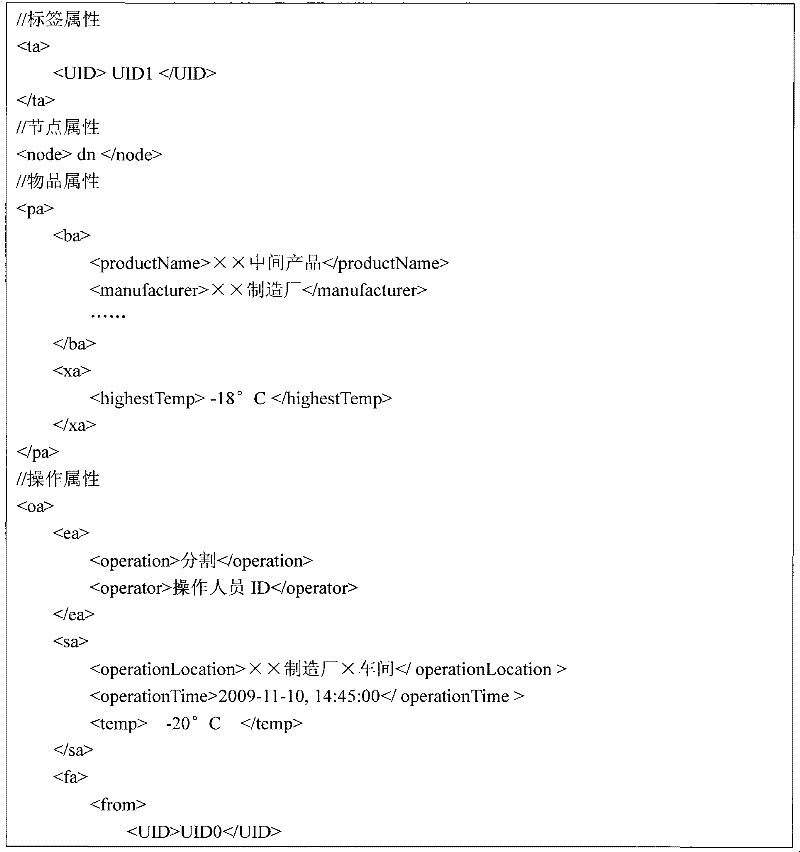
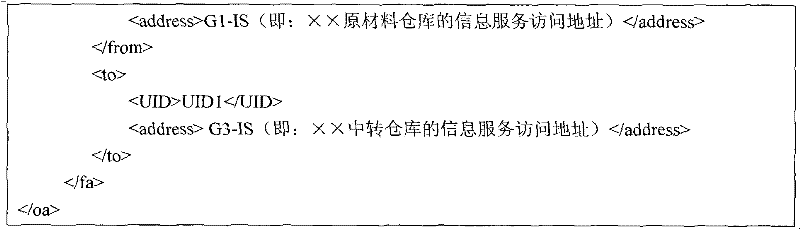
三种副产品运输到企业中转仓库G3中进行临时中转,中转仓库G3节点属于流经节点,物品唯一编码没有发生变化。在中转库G3节点信息服务器中存储的物品信息,<node></node>语义标签内的节点属性标识为fn,说明对于该编码索引的物品,本节点为流经节点;因为物品在经过流经节点前后并无变化,因此该节点上物品属性为空;流经属性中存在一个<from></from>标签和一个<to></to>标签。仍然以副产品UID1为例,在中转仓库G3节点所记录的该副产品的信息内容如下:The three by-products are transported to the enterprise's transit warehouse G3 for temporary transit. The G3 node of the transit warehouse belongs to the flow-through node, and the unique code of the item has not changed. For the item information stored in the G3 node information server of the transit warehouse, the node attribute in the <node></node> semantic tag is marked as fn, indicating that for the item indexed by this code, this node is a flow-through node; because the item is passing through the flow There is no change before and after the node, so the item attribute on the node is empty; there is a <from></from> tag and a <to></to> tag in the flow-through attribute. Still taking the by-product UID1 as an example, the information of the by-product recorded in the G3 node of the transit warehouse is as follows:
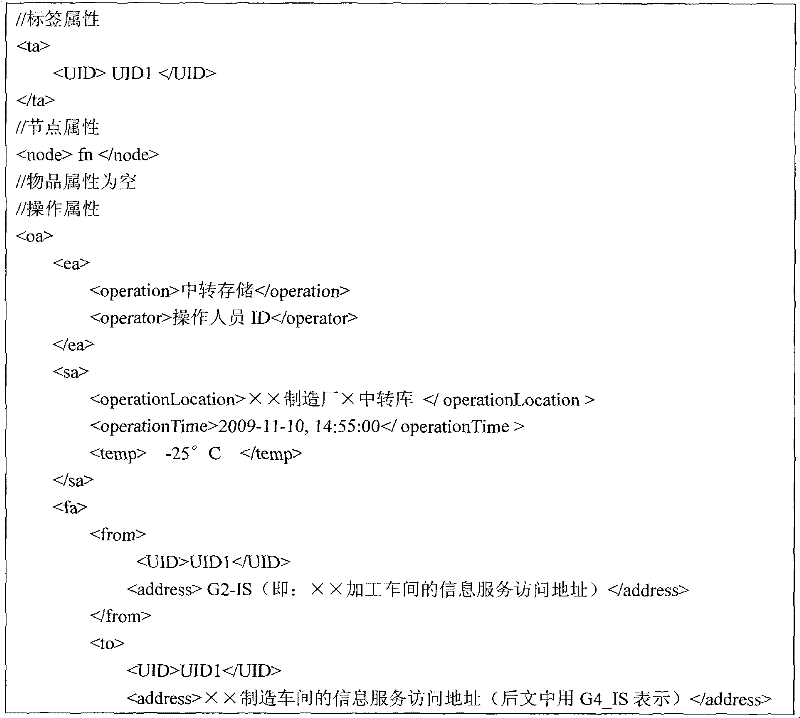

如附图3所示进入制造车间G4环节,在制造车间G4出现了两种情况一是标识为UID1和第UID2的副产品被加工整合为一种新产品UID4,二是标识为UID3的副产品经过另一套生产线被加工为标识为UID5新产品。因此该制造车间G4节点对于UID1和UID2副产品而言是组装节点。对于标识为UID3的副产品,制造车间G4节点则可以视为一种只有一个单输入的特殊组装节点。对于这三个唯一编码索引的物品信息,<node></node>语义标签属性值为an,流向属性中,只有一个<from></from>标签和一个<to></to>标签。在制造车间G4节点信息服务器上,对标识为UID1的产品信息记录如下:As shown in Figure 3, when entering the G4 link of the manufacturing workshop, there are two situations in the manufacturing workshop G4. One is that the by-products marked as UID1 and UID2 are processed and integrated into a new product UID4, and the other is that the by-products marked as UID3 pass through another A production line is processed as a new product identified as UID5. The shop floor G4 node is therefore an assembly node for UID1 and UID2 by-products. For the by-product identified as UID3, the manufacturing workshop G4 node can be regarded as a special assembly node with only a single input. For the item information of these three uniquely coded indexes, the semantic tag attribute value of <node></node> is an, and there is only one <from></from> tag and one <to></to> tag in the flow direction attribute. On the G4 node information server of the manufacturing workshop, the product information identified as UID1 is recorded as follows:
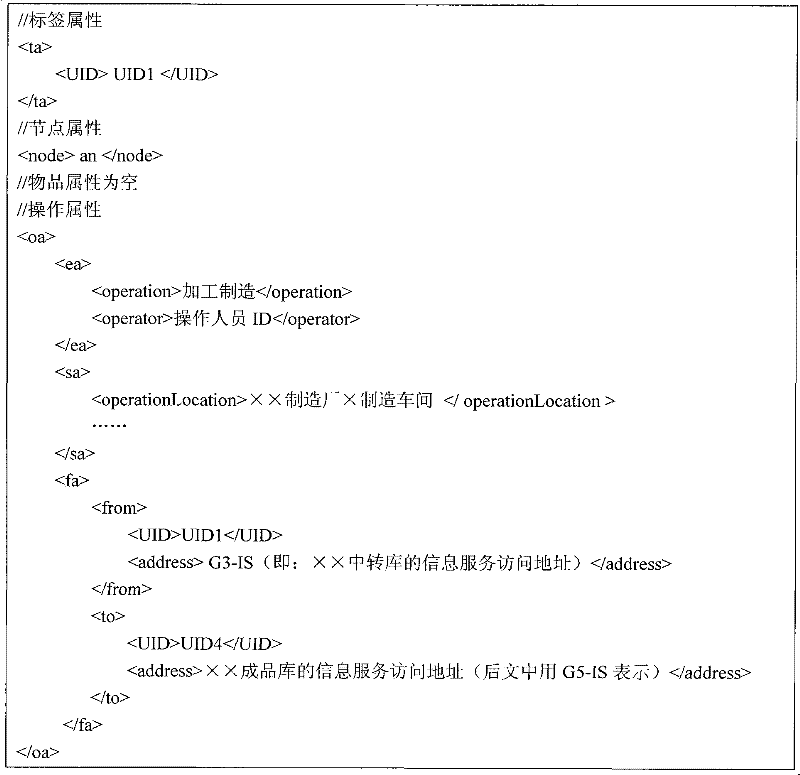
对UID2和UID3副产品的信息记录,除标签属性外,与上相同。除此以外,制造车间节点还作为组装节点,记录标识为UID4和UID5的制成品信息。其中对于UID4索引的物品信息,其流向属性中有对应UID1和UID2的两个<from></from>语义标签,和一个对应UID4的<to></to>语义标签。The information records of UID2 and UID3 by-products are the same as above except for the label attributes. In addition, the manufacturing workshop node also acts as an assembly node, recording the finished product information identified as UID4 and UID5. Among them, for the item information indexed by UID4, there are two <from></from> semantic tags corresponding to UID1 and UID2 in its flow attribute, and one <to></to> semantic tag corresponding to UID4.
图例3中,标志为UID4和UID5的两件新产品进入企业的制成品仓库G5储存之后,这两件产品与其它产品一道被打在一个集装箱中,经过第三方配送机构运输到批发商G6处后,再次拆分为单件商品并交给零售商G7上架销售。对于成品UID4和UID5,成品库G5作为组装节点,使成品库G5之后的物流中,UID4和UID5标识的成品被一个新的标识UID6所代替;第三方配送机构和批发商G6则是对应于UID6的拆分节点。由于唯一编码为UID4和UID5所对应的两件产品在销售到最终消费者手中后即消耗掉,因此产品的生命周期到零售商7节点处就全部结束,零售商G7成为产品流通的终点。制成品仓库G5节点、第三方配送机构和批发商G6节点所记录的信息内容都与前例类似,零售商节点G7的信息服务器地址在后文中表示为G7-IS,在此不再赘述。而对于UID4和UID5索引的物品而言零售商G7节点是其物流的终点,其<node></node>语义标签中属性为en,流向属性中的<to></to>语义标签内容为空。以唯一编码为UID4所对应的产品为例,零售商G7节点记录的信息如下:In Figure 3, after two new products marked UID4 and UID5 enter the company’s finished product warehouse G5 for storage, these two products are packaged together with other products in a container, and are transported to the wholesaler G6 by a third-party distribution agency After processing, it will be split into individual items again and handed over to the retailer G7 for sale. For the finished products UID4 and UID5, the finished product warehouse G5 is used as the assembly node, so that in the logistics after the finished product warehouse G5, the finished products identified by UID4 and UID5 are replaced by a new identification UID6; the third-party distribution agency and wholesaler G6 corresponds to UID6 split node. Since the two products corresponding to the unique codes UID4 and UID5 are consumed after being sold to the final consumer, the life cycle of the product ends at the

根据如附图3所示物品信息跟踪方法的步骤,对于如图5所示实施例的物品信息跟踪具体实施过程如下:According to the steps of the item information tracking method as shown in accompanying drawing 3, the specific implementation process for the item information tracking of the embodiment shown in Figure 5 is as follows:
(1)原材料供应商G1使用部署于其上的的物品信息跟踪与追溯客户端F2,通过与客户端集成的RFID读写器扫描物品RFID标签或直接输入物品唯一编码,发起针对标识为唯一编码UID0的原材料的信息跟踪;(1) The raw material supplier G1 uses the item information tracking and tracing client F2 deployed on it, scans the item RFID tag through the RFID reader integrated with the client or directly enters the unique code of the item, and initiates the identification of the unique code Information tracking of raw materials of UID0;
(2)物品信息跟踪与追溯服务器F1将发起物品信息跟踪请求的原材料供应商节点G1作为被查询的当前节点,以唯一编码UID0作为被查询物品编码,使用二元值对<UID0,G1-IS>标识该查询节点(其中G1-IS代表原材料供应商节点G1上部署的信息服务访问地址);(2) The item information tracking and tracing server F1 takes the raw material supplier node G1 that initiated the item information tracking request as the current node being queried, uses the unique code UID0 as the queried item code, and uses the binary value pair <UID0, G1-IS > Identify the query node (where G1-IS represents the information service access address deployed on the raw material supplier node G1);
(3)物品信息跟踪与追溯服务器使用唯一编码UID0,调用G1-IS所对应的信息服务,获得如24页第1行至36行所示的标签属性值为UID0的一个物品信息XML文档,得到存储在节点G1上的编码为UID0的原材料的物料信息;(3) The item information tracking and traceability server uses the unique code UID0 to call the information service corresponding to G1-IS to obtain an item information XML document whose tag attribute value is UID0 as shown in line 1 to line 36 on page 24, and obtain The material information of the raw material encoded as UID0 stored on the node G1;
(4)物品信息跟踪与追溯服务器提取上个步骤获得的XML文档中<node></node>语义标签中的属性值为sn,得知G1是标记为UID0的原材料的起始节点;再提取<to></to>语义标签中的内容,则根据图例5所示物流抽象描述图,从<to></to>语义标签中将提取到一个二元值对,内容为<UID0,G2-IS>,将其加入待查询列表的头部。(4) The item information tracking and tracing server extracts the attribute value sn in the <node></node> semantic tag in the XML document obtained in the previous step, and learns that G1 is the starting node of the raw material marked UID0; then extract For the content in the <to></to> semantic tag, according to the logistics abstract description diagram shown in Figure 5, a binary value pair will be extracted from the <to></to> semantic tag, and the content is <UID0, G2 -IS>, add it to the head of the list to be queried.
(5)将二元值对<UID0,G1-IS>加入已访问列表。则当前待查询列表为{<UID0,G2-IS>},已查询列表为{<UID0,G1-IS>};(5) Add the binary value pair <UID0, G1-IS> to the visited list. Then the current query list is {<UID0, G2-IS>}, and the query list is {<UID0, G1-IS>};
(6)物品信息查询与跟踪服务器从待查询列表中弹出栈首元素<UID0,G2-IS>,因该节点不存在于已查询列表中,因此将<UID0,G2-IS>标记为当前节点;(6) The item information query and tracking server pops up the top element <UID0, G2-IS> from the list to be queried, and marks <UID0, G2-IS> as the current node because this node does not exist in the queried list ;
(7)物品信息跟踪与追溯服务器使用唯一编码UID0,调用G2-IS所对应的信息服务,获得如25页第10行至26页第6行所示的标签属性值为UID0的一个物品信息XML文档,得到存储在节点G2上的编码为UID0的原材料的物料信息;(7) The item information tracking and tracing server uses the unique code UID0 to call the information service corresponding to G2-IS to obtain an item information XML whose tag attribute value is UID0 as shown in
(8)物品信息跟踪与追溯服务器提取XML文档中<node></node>语义标签中的属性值为dn,得知G2是标记为UID0的原材料的拆分节点;再提取<to></to>语义标签中的内容,得到由三个二元值组成的一个列表为{<UID1,G3-IS>,<UID2,G3-IS>,<UID3,G3-IS>},将其加入待查询列表的头部。(8) The item information tracking and tracing server extracts the attribute value of the <node></node> semantic tag in the XML document as dn, and learns that G2 is the split node of the raw material marked UID0; then extracts <to></ to> content in the semantic tag, get a list consisting of three binary values as {<UID1, G3-IS>, <UID2, G3-IS>, <UID3, G3-IS>}, add it to be Query the head of the list.
(9)物品信息跟踪与追溯服务器将<UID0,G2-IS>加入到已访问节点列表中,则当前待查询列表为{<UID1,G3-IS>,<UID2,G3-IS>,<UID3,G3-IS>},已访问节点列表为{<UID0,G1-IS>,<UID0,G2-IS>};(9) Item information tracking and tracing server adds <UID0, G2-IS> to the list of visited nodes, then the current query list is {<UID1, G3-IS>, <UID2, G3-IS>, <UID3 , G3-IS>}, the list of visited nodes is {<UID0, G1-IS>, <UID0, G2-IS>};
(10)从待查询列表中弹出栈首元素<UID1,G3-IS>,该元素在已查询列表中不存在,因此将其标记为当前节点;(10) pop up the stack head element <UID1, G3-IS> from the list to be queried, this element does not exist in the queried list, so it is marked as the current node;
(11)物品信息跟踪与追溯服务器使用唯一编码UID1,调用G3-IS所对应的信息服务,获得如27页第17行至28页第4行所示存储在节点G3上标签属性值为UID1的物品信息XML文档,如此重复步骤(8)(9)类似过程,得到当前待查询列表为{<UID1,G4-IS>,<UID2,G3-IS>,<UID3,G3-IS>},已访问节点列表为{<UID0,G1-IS>,<UID0,G2-IS>,<UID1,G3-IS>};(11) The item information tracking and tracing server uses the unique code UID1 to call the information service corresponding to G3-IS, and obtain the tag attribute value stored on node G3 as shown in
(12)从待查询列表弹出栈首元素<UID1,G4-IS>,如此不断重复步骤(6)-(9)相似的过程,直到从待查询列表中弹出的元素为空值为止。在此不再赘述。(12) Pop the top element <UID1, G4-IS> from the list to be queried, and repeat steps (6)-(9) similarly until the element popped from the list to be queried is null. I won't repeat them here.
按上述实施步骤,对于如图5所示物流过程中物品标识为UID0的原材料的全生命周期信息跟踪过程,依次访问的节点标识为:<UID0,G1-IS>→<UID0,G2-IS>→<UID1,G3-IS>→<UID1,G4-IS>→<UID4,G5-IS>→<UID6,G6-IS>→<UID4,G7-IS>到达物流的一个终点。此时待查询列表中仍有元素,说明该物流过程不只有一个终点,重复步骤(6)-(9)访问到节点<UID5,G7-IS>到达物流的另一个终点。继续对待查询列表中的元素重复执行步骤(6)-(9),依次访问的节点标识为<UID2,G3-IS>→<UID2,G4-IS>→<UID4,G5-IS>→<UID6,G6-IS>,发现<UID6,G6-IS>已经存在于已访问列表中,说明其后续的物流过程信息已经跟踪过,按物品信息跟踪方法步骤S306所述,抛弃该节点不再往下追踪,上述从<UID2,G3-IS>至<UID4,G5-IS>的路径构成原材料UID0物流全生命周期过程中一条分支。重新从待查询列表中弹出栈首元素为<UID2,G3-IS>,则获得<UID2,G3-IS>→<UID2,G4-IS>→<UID4,G5-IS>这一原材料UID0物流全生命周期过程中的又一条分支。同理可依次访问物流过程的第三条分支,即:<UID3,G3-IS>→<UID3,G4-IS>→<UID5,G5-IS>→<UID6,G6-IS>。According to the above implementation steps, for the whole life cycle information tracking process of the raw materials whose item ID is UID0 in the logistics process as shown in Figure 5, the node IDs visited in turn are: <UID0, G1-IS>→<UID0, G2-IS> →<UID1, G3-IS>→<UID1, G4-IS>→<UID4, G5-IS>→<UID6, G6-IS>→<UID4, G7-IS> reaches an end point of the logistics. At this time, there are still elements in the list to be queried, indicating that the logistics process has more than one end point. Repeat steps (6)-(9) to visit the node <UID5, G7-IS> to reach another end point of the logistics process. Continue to repeat steps (6)-(9) for the elements in the query list, and the nodes to be visited in turn are identified as <UID2, G3-IS>→<UID2, G4-IS>→<UID4, G5-IS>→<UID6 , G6-IS>, it is found that <UID6, G6-IS> already exists in the visited list, indicating that its subsequent logistics process information has been tracked, and according to step S306 of the item information tracking method, discard this node and stop going down Tracking, the above path from <UID2, G3-IS> to <UID4, G5-IS> constitutes a branch in the whole life cycle process of raw material UID0 logistics. Pop up the first element of the stack from the list to be queried again as <UID2, G3-IS>, then get the raw material UID0 logistics complete list of <UID2, G3-IS>→<UID2, G4-IS>→<UID4, G5-IS> Yet another branch in the lifecycle process. Similarly, the third branch of the logistics process can be accessed sequentially, namely: <UID3, G3-IS>→<UID3, G4-IS>→<UID5, G5-IS>→<UID6, G6-IS>.
如附图4所示物品信息追溯方法步骤的具体实施与上述说明类似,在此不再赘述。The specific implementation of the steps of the item information tracing method shown in FIG. 4 is similar to the above description, and will not be repeated here.
上面描述是用于实现本发明及其实施例,本发明的范围不应由该描述来限定,本领域的技术人员应该理解,在不脱离本发明的范围的任何修改或局部替换,均属于本发明权利要求来限定的范围。The above description is used to realize the present invention and its embodiments, and the scope of the present invention should not be limited by the description. Those skilled in the art should understand that any modification or partial replacement without departing from the scope of the present invention belongs to the present invention. The scope of the invention is defined by the claims.
Claims (10)
Priority Applications (1)
| Application Number | Priority Date | Filing Date | Title |
|---|---|---|---|
| CN2010101714072A CN101833710B (en) | 2010-05-07 | 2010-05-07 | Semantics-based article information tracking and tracing method for Internet of things |
Applications Claiming Priority (1)
| Application Number | Priority Date | Filing Date | Title |
|---|---|---|---|
| CN2010101714072A CN101833710B (en) | 2010-05-07 | 2010-05-07 | Semantics-based article information tracking and tracing method for Internet of things |
Publications (2)
| Publication Number | Publication Date |
|---|---|
| CN101833710A CN101833710A (en) | 2010-09-15 |
| CN101833710B true CN101833710B (en) | 2012-04-25 |
Family
ID=42717773
Family Applications (1)
| Application Number | Title | Priority Date | Filing Date |
|---|---|---|---|
| CN2010101714072A Expired - Fee Related CN101833710B (en) | 2010-05-07 | 2010-05-07 | Semantics-based article information tracking and tracing method for Internet of things |
Country Status (1)
| Country | Link |
|---|---|
| CN (1) | CN101833710B (en) |
Families Citing this family (38)
| Publication number | Priority date | Publication date | Assignee | Title |
|---|---|---|---|---|
| DE102012218966B4 (en) | 2011-10-31 | 2018-07-12 | International Business Machines Corporation | Method and system for identifying original data generated by things in the Internet of Things |
| CN106250568B (en) * | 2012-06-06 | 2019-09-17 | 阿里巴巴集团控股有限公司 | Service range determines method, logistics service provider recommended method and related device |
| CN102881125B (en) * | 2012-09-25 | 2014-06-18 | 杭州立高科技有限公司 | Alarm monitoring system based on multi-information fusion centralized processing platform |
| US9609062B2 (en) * | 2013-06-26 | 2017-03-28 | Qualcomm Incorporated | Semantic mappings from human readable messages to programmatic interfaces |
| US10990894B2 (en) | 2013-07-11 | 2021-04-27 | Neura, Inc. | Situation forecast mechanisms for internet of things integration platform |
| US9600571B2 (en) * | 2013-07-11 | 2017-03-21 | Neura, Inc. | Interoperability mechanisms for internet of things integration platform |
| US9871865B2 (en) | 2013-07-11 | 2018-01-16 | Neura, Inc. | Physical environment profiling through internet of things integration platform |
| CN103345064B (en) * | 2013-07-16 | 2015-08-26 | 深圳市智帽科技开发有限公司 | The 3D recognition methods of the cap that a kind of integrated 3D identifies and cap |
| CN103455896B (en) * | 2013-09-30 | 2016-10-12 | 南京航空航天大学 | With no paper assembling Quality Control method based on Internet of Things |
| CN103678507B (en) * | 2013-11-22 | 2017-04-19 | 广东泛在无线射频识别公共技术支持有限公司 | Method and system for achieving cross-mechanism product flow event information inquiry |
| CN103745325A (en) * | 2013-12-19 | 2014-04-23 | 柳州职业技术学院 | Internet of things logistics communication system based on data fusion |
| CN104239920B (en) * | 2014-09-18 | 2018-01-02 | 许昌学院 | A kind of physical distribution localization method |
| CN105634803A (en) * | 2015-12-29 | 2016-06-01 | 清华大学 | Engineering machinery life-cycle information tracing system and tracing method |
| CN107180064A (en) * | 2016-03-11 | 2017-09-19 | 阿里巴巴集团控股有限公司 | A kind of logistics information processing method, device and logistic information systems |
| CN107180321A (en) * | 2016-03-11 | 2017-09-19 | 阿里巴巴集团控股有限公司 | For the information processing method and device of merchandise return request overseas |
| CN107292551A (en) * | 2016-04-01 | 2017-10-24 | 阿里巴巴集团控股有限公司 | A kind of logistics distribution network generation method and device |
| CN106228331B (en) * | 2016-07-29 | 2020-02-21 | 东莞理工学院 | A method for semantic processing of Internet of Things information and its logistics resource collaborative integration platform |
| CN106570674A (en) * | 2016-11-15 | 2017-04-19 | 广州中国科学院计算机网络信息中心 | Supply chain information query method and device |
| CN108256872B (en) * | 2016-12-28 | 2021-05-25 | 中国科学院沈阳自动化研究所 | A collaborative traceability method for batch assembly information of auto parts |
| CN107220871B (en) * | 2017-05-11 | 2021-01-26 | 微重力(北京)科技有限公司 | Article query comparison method and device, storage medium and processor |
| JP6748046B2 (en) * | 2017-09-29 | 2020-08-26 | 日立建機株式会社 | Parts procurement system and parts procurement method |
| CN109067851B (en) * | 2018-07-13 | 2020-11-13 | 中国电子科技集团公司第十五研究所 | Discovery method of object information in Internet of things |
| CN111199259B (en) * | 2018-11-19 | 2023-06-20 | 中国电信股份有限公司 | Identification conversion method, device and computer-readable storage medium |
| US10977612B2 (en) | 2019-04-02 | 2021-04-13 | Coupang, Corp. | Electronic inventory tracking system and associated user interfaces |
| CN110781204B (en) * | 2019-09-09 | 2024-02-20 | 腾讯大地通途(北京)科技有限公司 | Identification information determining method, device, equipment and storage medium of target object |
| CN111259638B (en) * | 2020-01-13 | 2023-04-07 | 江门市链程科技有限公司 | Information processing method and device applied to international logistics transportation and storage medium |
| CN111597777B (en) * | 2020-05-15 | 2023-06-02 | 上海电机系统节能工程技术研究中心有限公司 | Material data processing method and device and electronic equipment |
| CN111625737B (en) * | 2020-05-27 | 2023-04-07 | 腾讯科技(深圳)有限公司 | Label display method, device, equipment and storage medium |
| CN111680952A (en) * | 2020-06-05 | 2020-09-18 | 深圳市华云中盛科技股份有限公司 | Article flow direction judging method and device, computer equipment and storage medium |
| CN111932175B (en) * | 2020-08-05 | 2024-06-25 | 王振华 | Logistics information processing method and device based on Internet of things |
| JP7545268B2 (en) * | 2020-09-10 | 2024-09-04 | 横河電機株式会社 | Integrated management system, integrated management method, and integrated management program |
| CN114119042A (en) * | 2021-11-08 | 2022-03-01 | 支付宝(杭州)信息技术有限公司 | Agricultural product tracing method and device |
| CN114997614B (en) * | 2022-05-19 | 2025-07-18 | 深圳市云恋科技有限公司 | Information tracking method based on execution packet mode, electronic equipment and storage medium |
| CN115471067A (en) * | 2022-09-14 | 2022-12-13 | 北京虎蜥信息技术有限公司 | Method and device for monitoring processing state of grouped jacking parts and electronic equipment |
| CN115511507A (en) * | 2022-09-30 | 2022-12-23 | 中车青岛四方机车车辆股份有限公司 | Raw material information tracing method and device |
| CN115712684B (en) * | 2022-11-24 | 2023-10-24 | 南京鼎山信息科技有限公司 | Storage method and system for dynamic information of articles in Internet of things |
| CN119204456B (en) * | 2024-11-27 | 2025-05-02 | 申雕智能科技(苏州)有限公司 | Material circulation tracing method and device for automatic production line of material trays |
| CN121212161A (en) * | 2025-11-28 | 2025-12-26 | 华东师范大学 | Cross-level demand traceability link construction method and system of embedded system |
Family Cites Families (3)
| Publication number | Priority date | Publication date | Assignee | Title |
|---|---|---|---|---|
| US7199715B2 (en) * | 2005-03-01 | 2007-04-03 | Kimberly-Clark Worldwide, Inc. | System and method for tracking ID tags using a data structure of tag reads |
| JP2006285545A (en) * | 2005-03-31 | 2006-10-19 | Kyodo Printing Co Ltd | Distribution information management system |
| US7630917B2 (en) * | 2006-04-14 | 2009-12-08 | At&T Intellectual Property Ii, L.P. | Automatic learning for mapping spoken/text descriptions of products onto available products |
-
2010
- 2010-05-07 CN CN2010101714072A patent/CN101833710B/en not_active Expired - Fee Related
Also Published As
| Publication number | Publication date |
|---|---|
| CN101833710A (en) | 2010-09-15 |
Similar Documents
| Publication | Publication Date | Title |
|---|---|---|
| CN101833710B (en) | Semantics-based article information tracking and tracing method for Internet of things | |
| Vanderroost et al. | The digitization of a food package’s life cycle: Existing and emerging computer systems in the logistics and post-logistics phase | |
| Minbo et al. | Information service system of agriculture IoT | |
| US20070156545A1 (en) | Product flow based auto-id infrastructure | |
| Ha et al. | Relation model describing the effects of introducing RFID in the supply chain: evidence from the food and beverage industry in South Korea | |
| CN113994358A (en) | Centralized printing application for asset sourcing aspects | |
| WO2021128588A1 (en) | Tracing method and system for item circulation system | |
| US20070050305A1 (en) | RFID system for predictive product purchase date evaluation | |
| CN115936598A (en) | Enterprise logistics supply chain management information platform system based on digital technology | |
| CN116228257A (en) | Acquisition method, device, computer equipment, and storage medium for item traceability data | |
| Frendi et al. | Physical internet based ontology for supporting traceability in logistic IoT | |
| Lumsden et al. | Smart freight to enhance control of supply chains | |
| Zhang | A supply chain information pushing method for logistics park based on internet of things technology | |
| KR101410252B1 (en) | Object movement chasing method in the EPCglobal network | |
| De Virgilio et al. | Semantic-based rfid data management | |
| Zhang et al. | Application analysis of Internet of Things on the management of supply chain and intelligent logistics | |
| CN118037312A (en) | Commodity traceability system based on blockchain | |
| TWI586962B (en) | A food safety cloud system and tracking method | |
| Wu et al. | Intelligent logistics warehousing strategy based on 5g network and cloud computing in the era of big data | |
| Hackenbroich et al. | Optimizing business processes by automatic data acquisition: RFID technology and beyond | |
| Wang et al. | Design and development of a Traceability Service for EPC-enabled food supply chains | |
| CN116205661A (en) | Intelligent Internet of things-based food whole-flow tracing system and method | |
| CN106056225A (en) | Fast-moving consumer goods supply chain product tracking recall management system and method | |
| WO2020223905A1 (en) | Method for tracking product history | |
| Roussos | Computing with RFID: drivers, technology and implications |
Legal Events
| Date | Code | Title | Description |
|---|---|---|---|
| C06 | Publication | ||
| PB01 | Publication | ||
| C10 | Entry into substantive examination | ||
| SE01 | Entry into force of request for substantive examination | ||
| C14 | Grant of patent or utility model | ||
| GR01 | Patent grant | ||
| TR01 | Transfer of patent right | ||
| TR01 | Transfer of patent right |
Effective date of registration: 20181107 Address after: 100061 305, room 2, 2 sunset street, Dongcheng District, Beijing. Patentee after: China net union Gold Technology (Beijing) Co.,Ltd. Address before: 100080 No. 95 East Zhongguancun Road, Beijing, Haidian District Patentee before: Institute of Automation, Chinese Academy of Sciences |
|
| CF01 | Termination of patent right due to non-payment of annual fee | ||
| CF01 | Termination of patent right due to non-payment of annual fee |
Granted publication date: 20120425 |