CN101823692B - Reversible hydrogen adsorption and desorption method using piperidine as media and device - Google Patents
Reversible hydrogen adsorption and desorption method using piperidine as media and device Download PDFInfo
- Publication number
- CN101823692B CN101823692B CN2010101525174A CN201010152517A CN101823692B CN 101823692 B CN101823692 B CN 101823692B CN 2010101525174 A CN2010101525174 A CN 2010101525174A CN 201010152517 A CN201010152517 A CN 201010152517A CN 101823692 B CN101823692 B CN 101823692B
- Authority
- CN
- China
- Prior art keywords
- hydrogen
- piperidine
- hydrogen storage
- storage alloy
- pyridine
- Prior art date
- Legal status (The legal status is an assumption and is not a legal conclusion. Google has not performed a legal analysis and makes no representation as to the accuracy of the status listed.)
- Expired - Fee Related
Links
Images


Classifications
-
- Y—GENERAL TAGGING OF NEW TECHNOLOGICAL DEVELOPMENTS; GENERAL TAGGING OF CROSS-SECTIONAL TECHNOLOGIES SPANNING OVER SEVERAL SECTIONS OF THE IPC; TECHNICAL SUBJECTS COVERED BY FORMER USPC CROSS-REFERENCE ART COLLECTIONS [XRACs] AND DIGESTS
- Y02—TECHNOLOGIES OR APPLICATIONS FOR MITIGATION OR ADAPTATION AGAINST CLIMATE CHANGE
- Y02E—REDUCTION OF GREENHOUSE GAS [GHG] EMISSIONS, RELATED TO ENERGY GENERATION, TRANSMISSION OR DISTRIBUTION
- Y02E60/00—Enabling technologies; Technologies with a potential or indirect contribution to GHG emissions mitigation
- Y02E60/30—Hydrogen technology
- Y02E60/32—Hydrogen storage
Landscapes
- Filling Or Discharging Of Gas Storage Vessels (AREA)
Abstract
本发明涉及新的吸放氢的方法,旨在提供一种以哌啶为介质的可逆吸放氢方法及装置。该方法以储氢合金为催化剂,其可逆的吸放氢过程包括:放氢过程,在120~350℃的温度条件下,哌啶在储氢合金的作用下转化为吡啶,同时释放出氢气;吸氢过程,在95~115℃的温度条件下,向吡啶内通入氢气,吡啶在储氢合金的作用下与氢气生成哌啶。使用哌啶作为储氢介质可提供比金属储氢合金高得多的储氢量,有望成为燃料电池的氢源进行发电,作为燃料电池车的动力。哌啶分解得到的氢气纯净,不含CO,可直接用于燃料电池,不必像甲醇改质得到的氢气那样需要净化,因此系统简单、操作方便。
The invention relates to a new hydrogen absorption and desorption method, and aims to provide a reversible hydrogen absorption and desorption method and device using piperidine as a medium. The method uses a hydrogen storage alloy as a catalyst, and its reversible hydrogen absorption and desorption process includes: the hydrogen desorption process, under the temperature condition of 120-350 ° C, piperidine is converted into pyridine under the action of the hydrogen storage alloy, and hydrogen is released at the same time; In the hydrogen absorption process, under the temperature condition of 95-115°C, hydrogen gas is passed into pyridine, and pyridine generates piperidine with hydrogen gas under the action of hydrogen storage alloy. The use of piperidine as a hydrogen storage medium can provide a much higher hydrogen storage capacity than metal hydrogen storage alloys, and is expected to become a hydrogen source for fuel cells for power generation, as the power of fuel cell vehicles. The hydrogen obtained from the decomposition of piperidine is pure and does not contain CO, and can be directly used in fuel cells without the need for purification like the hydrogen obtained by reforming methanol, so the system is simple and easy to operate.
Description
技术领域 technical field
本发明涉及一种新的吸放氢的方法,更具体地说,本发明涉及利用哌啶和金属储氢合金、吡啶和金属储氢合金之间的氢平衡关系,使用通过表面处理的金属储氢合金作为催化剂实现哌啶放氢和吡啶吸氢可逆过程的方法,以及实现该方法的装置。The present invention relates to a new method for hydrogen absorption and desorption, more specifically, the present invention relates to utilizing the hydrogen balance relationship between piperidine and metal hydrogen storage alloys, pyridine and metal hydrogen storage alloys, and using surface-treated metal storage The hydrogen alloy is used as a catalyst to realize the reversible process of piperidine hydrogen desorption and pyridine hydrogen absorption, and a device for realizing the method.
背景技术 Background technique
氢能源清洁、环境友好、可再生,被认为是21世纪最理想的二次能源,质子交换膜为电解质的燃料电池(PEMFC)技术已经日趋成熟。作为燃料电池燃料的氢气,其储存有物理法和化学法两大类。物理法主要有:液氢储存、高压氢气储存、玻璃微球储存、地下岩洞储存、活性炭吸附储存、碳纳米管储存(也包含部分的化学吸附储存)。化学法主要有:金属氢化物储存、有机液态氢化物储存、无机物储存等形式。Hydrogen energy is clean, environmentally friendly, and renewable, and is considered to be the most ideal secondary energy source in the 21st century. Proton exchange membrane-electrolyte fuel cell (PEMFC) technology has become increasingly mature. There are two types of storage of hydrogen as a fuel cell fuel, physical method and chemical method. Physical methods mainly include: liquid hydrogen storage, high-pressure hydrogen storage, glass microsphere storage, underground cavern storage, activated carbon adsorption storage, and carbon nanotube storage (including some chemical adsorption storage). Chemical methods mainly include: metal hydride storage, organic liquid hydride storage, inorganic storage and other forms.
Sultan和Shaw于1975年首次提出了利用可循环液体化学氢载体储氢的构想,开辟了新型储氢技术研究的领域。虽然苯、甲苯加氢反应温度较低,但生成的环己烷或甲基环己烷却通常需要300℃以上的温度才能脱氢,存在脱氢温度偏高、脱氢转化率偏低、催化剂容易积碳而失活的严重问题。In 1975, Sultan and Shaw first proposed the idea of using recyclable liquid chemical hydrogen carriers to store hydrogen, which opened up the field of research on new hydrogen storage technologies. Although the hydrogenation reaction temperature of benzene and toluene is relatively low, the generated cyclohexane or methylcyclohexane usually requires a temperature above 300°C to be dehydrogenated. A serious problem of easy carbon deposition and deactivation.
哌啶、别名六氢吡啶是一个杂环化合物,分子式为(CH2)5NH。它是一个仲胺,可看作环己烷一个碳被氮替代后形成的化合物,即氮杂环己烷。工业上,它由吡啶氢化制备,用二硫化钼作催化剂:Piperidine, also known as hexahydropyridine, is a heterocyclic compound with the molecular formula (CH 2 ) 5 NH. It is a secondary amine, which can be regarded as a compound formed by replacing one carbon of cyclohexane with nitrogen, that is, azacyclohexane. Industrially, it is prepared by the hydrogenation of pyridine, using molybdenum disulfide as a catalyst:
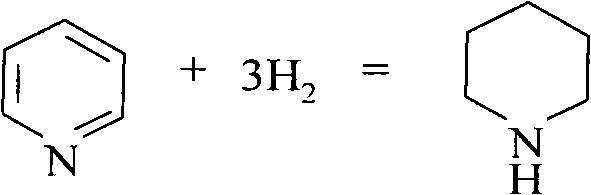
用钠-乙醇溶液也可将吡啶还原为哌啶,形成的哌啶可以通过脱氢生成吡啶。吡啶是含有一个氮杂原子的六元杂环化合物。可以看做苯分子中的一个(CH)被N取代的化合物,故又称氮苯。哌啶的含氢量很高,为12.9wt.%。哌啶和吡啶间的有效储氢量为7.1wt.%,是一种高效的储氢介质。常温常压下哌啶为无色澄清液体,熔点为-7℃,沸点为106℃,易于运输和储存。常温常压下吡啶亦为无色澄清液体,熔点为-41.6℃,沸点为115.3℃。Pyridine can also be reduced to piperidine with sodium-ethanol solution, and the formed piperidine can be dehydrogenated to generate pyridine. Pyridine is a six-membered heterocyclic compound containing a nitrogen heteroatom. It can be regarded as a compound in which one (CH) in the benzene molecule is replaced by N, so it is also called nitrogen benzene. The hydrogen content of piperidine is very high, 12.9 wt.%. The effective hydrogen storage capacity between piperidine and pyridine is 7.1wt.%, which is an efficient hydrogen storage medium. At normal temperature and pressure, piperidine is a colorless clear liquid with a melting point of -7°C and a boiling point of 106°C, which is easy to transport and store. Pyridine is also a colorless clear liquid at normal temperature and pressure, with a melting point of -41.6°C and a boiling point of 115.3°C.
哌啶作为储氢材料具有储氢量大,储存、运输、维护、保养安全方便,其储氢量远远高于传统高压压缩储氢和金属氢化物储氢。便于利用现有储油和运输设备,可多次循环使用等优点。As a hydrogen storage material, piperidine has a large hydrogen storage capacity, and is safe and convenient for storage, transportation, maintenance, and maintenance. Its hydrogen storage capacity is much higher than that of traditional high-pressure compression hydrogen storage and metal hydride hydrogen storage. It is convenient to use the existing oil storage and transportation equipment, and it can be recycled for many times.
金属储氢合金具有很强的捕捉氢的能力,可以在一定的温度和压力条件下,氢分子在合金表面分解成单个的原子,与合金进行化学反应生成金属氢化物,外在表现为大量“吸收”氢气,同时放出热量。而当对这些金属氢化物进行加热时发生分解反应,氢原子又能结合成氢分子释放出来,而且伴随有明显的吸热效应。采用储氢合金来储氢,能耗低,工作压力低、使用方便的特点,而且可免去庞大的钢制容器,从而使存储和运输方便而且安全。目前储氢合金主要包括有钛系、锆系、镁系及稀土系储氢合金。Metal hydrogen storage alloys have a strong ability to capture hydrogen. Under certain temperature and pressure conditions, hydrogen molecules can be decomposed into individual atoms on the surface of the alloy, and chemically react with the alloy to form metal hydrides. The external performance is a large number of " Absorbs "hydrogen gas and releases heat at the same time. When these metal hydrides are heated, a decomposition reaction occurs, and hydrogen atoms can be combined into hydrogen molecules to be released, accompanied by an obvious endothermic effect. The hydrogen storage alloy is used to store hydrogen, which has the characteristics of low energy consumption, low working pressure and convenient use, and can avoid huge steel containers, so that storage and transportation are convenient and safe. At present, hydrogen storage alloys mainly include titanium, zirconium, magnesium and rare earth hydrogen storage alloys.
哌啶的脱氢和吡啶的加氢反应都是气-固-液三相反应。传统的二硫化钼或贵金属作为催化剂时,哌啶的H吸附在催化剂的活化中心(Mo或贵金属原子),然后哌啶的C-H和N-H键发生断裂,建立C=C和C=N双键,形成吡啶;在催化剂的活化中心形成氢原子,由于哌啶环上的C-H和N-H的断键并非同时发生且空间位置各不相同,氢原子需要在催化剂上进行表面扩散,当两个氢原子相遇后才能形成氢分子,才能析出氢气。Both the dehydrogenation of piperidine and the hydrogenation of pyridine are gas-solid-liquid three-phase reactions. When the traditional molybdenum disulfide or noble metal is used as a catalyst, the H of piperidine is adsorbed on the active center of the catalyst (Mo or noble metal atom), and then the C-H and N-H bonds of piperidine are broken, and C=C and C=N double bonds are established. Pyridine is formed; a hydrogen atom is formed at the active center of the catalyst. Since the C-H and N-H bond breaks on the piperidine ring do not occur simultaneously and the spatial positions are different, the hydrogen atom needs to diffuse on the catalyst surface. When two hydrogen atoms meet Only then can hydrogen molecules be formed and hydrogen gas can be precipitated.
当吡啶吸氢时,由于催化剂被吡啶(或生成物哌啶)液膜所包覆,氢气必须通过扩散通过液膜才能到达催化剂表面。而吡啶在催化剂表面发生吸附,吡啶的C=C和C=N双键转换成C-C和C-N单键时必须等待吸附在催化剂活化中心上氢分子化学解离后得到的氢原子,才能与吡啶的C和N发生键合。而且,由于吡啶的C和N空间位置的不同,氢分子化学解离后得到的氢原子必须通过表面扩散才能到达吡啶的C和N位置与之键合,随后发生脱附形成哌啶。因此,哌啶的形成取决于催化剂的氢原子供给能力。When pyridine absorbs hydrogen, since the catalyst is covered by the pyridine (or product piperidine) liquid film, hydrogen must diffuse through the liquid film to reach the surface of the catalyst. And pyridine is adsorbed on the surface of the catalyst. When the C=C and C=N double bonds of pyridine are converted into C-C and C-N single bonds, it is necessary to wait for the hydrogen atoms obtained after the chemical dissociation of hydrogen molecules to be adsorbed on the active center of the catalyst. C and N are bonded. Moreover, due to the difference in the C and N spatial positions of pyridine, the hydrogen atoms obtained after the chemical dissociation of hydrogen molecules must diffuse through the surface to reach the C and N positions of pyridine to bond with them, and then desorb to form piperidine. Therefore, the formation of piperidine depends on the hydrogen atom donating ability of the catalyst.
发明内容 Contents of the invention
本发明要解决的技术问题是,克服现有技术中的不足,提供一种以哌啶为介质的可逆吸放氢方法及装置。The technical problem to be solved by the present invention is to overcome the deficiencies in the prior art and provide a reversible hydrogen absorption and desorption method and device using piperidine as a medium.
本发明为解决其技术问题,提供了一种以哌啶为介质的可逆吸放氢方法,以储氢合金为催化剂,其可逆的吸放氢过程包括:放氢过程,在120~350℃的温度条件下,哌啶在储氢合金的作用下转化为吡啶,同时释放出氢气;吸氢过程,在95~115℃的温度条件下,向吡啶内通入氢气,吡啶在储氢合金的作用下与氢气生成哌啶。In order to solve the technical problem, the present invention provides a reversible hydrogen absorption and desorption method using piperidine as a medium, using a hydrogen storage alloy as a catalyst, and its reversible hydrogen absorption and desorption process includes: hydrogen desorption process, at 120-350 ° C Under temperature conditions, piperidine is converted into pyridine under the action of hydrogen storage alloy, and hydrogen gas is released at the same time; during the hydrogen absorption process, hydrogen gas is introduced into pyridine at a temperature of 95-115 °C, and pyridine acts on the hydrogen storage alloy. Under the generation of piperidine with hydrogen.
本发明中,所述储氢合金以通式表示为MgaRbNicCodAle,式中:R为锆、钙、稀土或混合稀土;其中,0≤a≤16;0≤b≤2;0<c≤5;0≤d≤1;0≤e≤0.5,且a与b不得同时为零。In the present invention, the hydrogen storage alloy is represented by the general formula Mg a R b Ni c Co d Al e , where: R is zirconium, calcium, rare earth or mixed rare earth; wherein, 0≤a≤16; 0≤b ≤2; 0<c≤5;0≤d≤1; 0≤e≤0.5, and a and b cannot be zero at the same time.
本发明中,通过对所述储氢合金进行热碱处理或酸洗,以提高储氢合金表面的催化活性。In the present invention, the catalytic activity of the surface of the hydrogen storage alloy is improved by performing hot alkali treatment or pickling on the hydrogen storage alloy.
本发明中,所述热碱处理是:将经过表面渗硼处理的储氢合金在浓度为2~6M L-1的KOH或NaOH溶液中浸渍0.5~5h,浸渍温度50~90℃,过滤取出储氢合金;用去离子水洗涤过滤后,70~90℃下真空干燥6~12h。In the present invention, the hot alkali treatment is: immerse the hydrogen storage alloy that has undergone surface boronizing treatment in KOH or NaOH solution with a concentration of 2-6M L -1 for 0.5-5h, the immersion temperature is 50-90°C, and take out by filtration Hydrogen storage alloy; after washing and filtering with deionized water, vacuum drying at 70-90°C for 6-12 hours.
本发明中,所述的酸洗的处理步骤如下:在室温下将经过表面渗硼处理的储氢合金在浓度为0.01~0.5M L-1草酸、冰醋酸或盐酸溶液中浸渍0.5~5h,过滤取出储氢合金;用去离子水洗涤过滤后,70~90℃下真空干燥6~12h。In the present invention, the pickling treatment steps are as follows: at room temperature, immerse the hydrogen storage alloy that has undergone surface boronizing treatment in oxalic acid, glacial acetic acid or hydrochloric acid solution with a concentration of 0.01-0.5M L -1 for 0.5-5h, and filter Take out the hydrogen storage alloy; wash and filter with deionized water, then vacuum dry at 70-90° C. for 6-12 hours.
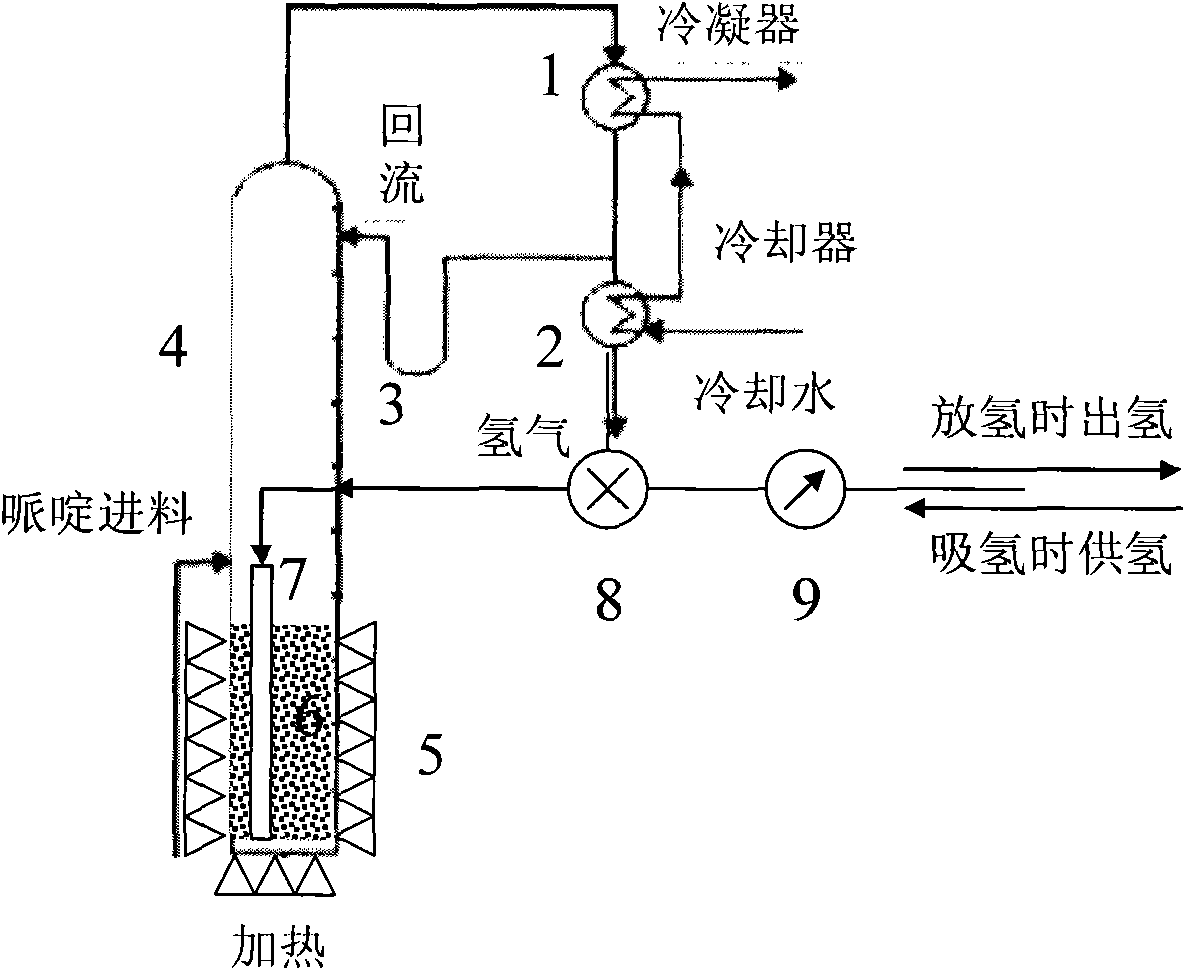
本发明还提供了一种用于实现前述方法的装置,包括反应器、冷凝器、冷却器和回流装置;反应器内的底部设有用于加载储氢合金的催化剂床,反应器底部的外围设加热装置用于控制反应温度;反应器侧面的中部设有氢气入口和哌啶加料口,氢气入口连接氢气导流管并伸入至催化剂床中;反应器顶部通过管路依次连接冷凝器和冷却器,冷凝器出口的管路还通过回流装置连接至反应器上部,冷却器出口为氢气出口。The present invention also provides a device for realizing the aforementioned method, including a reactor, a condenser, a cooler and a reflux device; the bottom of the reactor is provided with a catalyst bed for loading a hydrogen storage alloy, and the periphery of the bottom of the reactor is provided with The heating device is used to control the reaction temperature; the middle part of the side of the reactor is equipped with a hydrogen inlet and a piperidine feeding port, and the hydrogen inlet is connected to the hydrogen guide pipe and extends into the catalyst bed; The pipeline at the outlet of the condenser is also connected to the upper part of the reactor through a reflux device, and the outlet of the cooler is a hydrogen outlet.
本发明中,所述氢气入口和氢气出口处分别设置有接了转子流量计的三通阀。In the present invention, the hydrogen inlet and the hydrogen outlet are respectively provided with three-way valves connected with rotameters.
储氢合金对哌啶催化放氢机理如下:The hydrogen storage alloy catalytic hydrogen desorption mechanism of piperidine is as follows:
首先哌啶在储氢合金(M)表面发生吸附,哌啶的H吸附在储氢合金的活化中心(Ni原子)。哌啶的C-H和N-H键发生断裂,建立C=C和C=N双键,形成吡啶;在储氢合金的活化中心(Ni原子)形成氢原子,氢原子通过储氢合金的点阵空隙进入储氢合金形成金属氢化物。由于金属氢化物的氢原子与储氢合金的活化中心(Ni原子)相邻非常近,一旦哌啶的C-H和N-H键发生断裂而产生一个氢原子,就能与金属氢化物表面的氢原子非常容易形成氢分子而析出。因此,采用储氢合金作为催化剂可提高哌啶的放氢速度。First, piperidine is adsorbed on the surface of the hydrogen storage alloy (M), and the H of piperidine is adsorbed on the active center (Ni atom) of the hydrogen storage alloy. The C-H and N-H bonds of piperidine are broken, and C=C and C=N double bonds are established to form pyridine; hydrogen atoms are formed at the activation center (Ni atom) of the hydrogen storage alloy, and the hydrogen atoms enter through the lattice gap of the hydrogen storage alloy Hydrogen storage alloys form metal hydrides. Since the hydrogen atom of the metal hydride is very close to the activation center (Ni atom) of the hydrogen storage alloy, once the C-H and N-H bonds of piperidine are broken to generate a hydrogen atom, it can be very close to the hydrogen atom on the surface of the metal hydride. It is easy to form hydrogen molecules and precipitate. Therefore, the use of hydrogen storage alloys as catalysts can increase the hydrogen desorption rate of piperidine.
储氢合金对吡啶催化吸氢机理如下:Hydrogen storage alloy catalytic hydrogen absorption mechanism of pyridine is as follows:
当氢气吹入含有储氢合金的吡啶混合物时,由于金属储氢合金具有很强的捕捉氢的能力,首先储氢合金吸收氢气形成金属氢化物。吡啶在金属氢化物(MH)表面发生吸附,吡啶的C=C和C=N双键转换成C-C和C-N单键;吸附在储氢合金的活化中心(Ni原子)上的氢原子与吡啶的C和N发生键合,随后吸附H原子和储氢合金的活化中心(Ni原子)分离形成哌啶。由于金属氢化物的氢原子与储氢合金的活化中心(Ni原子)相邻非常近,一旦吡啶的C=C和C=N双键转换成C-C和C-N单键时,金属氢化物表面的氢原子都能及时地与吡啶的N和各位的C键合形成NH和CH2。因此,采用储氢合金作为催化剂可提高吡啶的吸氢速度。When hydrogen is blown into the pyridine mixture containing the hydrogen storage alloy, because the metal hydrogen storage alloy has a strong ability to capture hydrogen, the hydrogen storage alloy first absorbs hydrogen to form a metal hydride. Pyridine is adsorbed on the surface of metal hydride (MH), and the C=C and C=N double bonds of pyridine are converted into CC and CN single bonds; C and N bond, followed by the separation of adsorbed H atoms and active centers (Ni atoms) of hydrogen storage alloys to form piperidine. Since the hydrogen atom of the metal hydride is very close to the activation center (Ni atom) of the hydrogen storage alloy, once the C=C and C=N double bonds of pyridine are converted into CC and CN single bonds, the hydrogen on the surface of the metal hydride Atoms can bond in time to the N of pyridine and the C of each bit to form NH and CH 2 . Therefore, the use of hydrogen storage alloys as catalysts can increase the hydrogen absorption rate of pyridine.
与现有技术相比,本发明的有益效果是:Compared with prior art, the beneficial effect of the present invention is:
使用哌啶作为储氢介质可提供比金属储氢合金高得多的储氢量,有望成为燃料电池的氢源进行发电,作为燃料电池车的动力。哌啶分解得到的氢气纯净,不含CO,可直接用于燃料电池,不必像甲醇改质得到的氢气那样需要净化,因此系统简单、操作方便。同时,哌啶/吡啶系统可实现在线充氢,用于车载系统十分便利。使用表面处理的储氢合金作为哌啶脱氢、吡啶加氢反应的催化剂,可显著加快两者反应的速度,降低反应温度,实现体系的可逆吸放氢。对比传统催化剂,作为催化剂的储氢合金本身也能进行可逆吸放氢,因此采用储氢合金作为催化剂的哌啶/吡啶吸放氢的系统储氢密度要大于传统催化剂的哌啶/吡啶吸放氢的系统储氢密度。The use of piperidine as a hydrogen storage medium can provide a much higher hydrogen storage capacity than metal hydrogen storage alloys, and is expected to become a hydrogen source for fuel cells for power generation, as the power of fuel cell vehicles. The hydrogen obtained from the decomposition of piperidine is pure and does not contain CO, and can be directly used in fuel cells without the need for purification like the hydrogen obtained by reforming methanol, so the system is simple and easy to operate. At the same time, the piperidine/pyridine system can realize online hydrogen charging, which is very convenient for vehicle-mounted systems. Using surface-treated hydrogen storage alloys as catalysts for piperidine dehydrogenation and pyridine hydrogenation reactions can significantly speed up the reaction between the two, reduce the reaction temperature, and realize the reversible hydrogen absorption and desorption of the system. Compared with traditional catalysts, hydrogen storage alloys as catalysts can also perform reversible hydrogen absorption and desorption. Therefore, the hydrogen storage density of piperidine/pyridine hydrogen absorption and desorption systems using hydrogen storage alloys as catalysts is higher than that of traditional catalysts. Hydrogen system hydrogen storage density.
说明书附图Instructions attached
图1吡啶/哌啶吸放氢装置示意图。Fig. 1 Schematic diagram of pyridine/piperidine hydrogen absorption and desorption device.
图2为二硫化钼和草酸表面处理后的LaNi4.25Co0.25Al0.5作为催化剂时哌啶的放氢行为比较。Figure 2 is a comparison of the hydrogen desorption behavior of piperidine when molybdenum disulfide and oxalic acid surface-treated LaNi 4.25 Co 0.25 Al 0.5 are used as catalysts.
图3为二硫化钼和草酸表面处理后的LaNi4.25Co0.25Al0.5作为催化剂时吡啶的吸氢行为比较。Figure 3 is a comparison of the hydrogen absorption behavior of pyridine when molybdenum disulfide and LaNi 4.25 Co 0.25 Al 0.5 after surface treatment with oxalic acid are used as catalysts.
图1中的附图标记为:冷凝器1,冷却器2,回流装置3,反应器4,加热装置5,催化剂床6,氢气导入管7,三通阀8,转子流量计9。The reference signs in Fig. 1 are:
图2中的附图标记为:The reference numbers in Fig. 2 are:
①为以二硫化钼作为催化剂时哌啶的放氢行为,②LaNi4.25Co0.25Al0.5作为催化剂时哌啶的放氢行为,③草酸表面处理后的LaNi4.25Co0.25Al0.5作为催化剂时哌啶的放氢行为,④反应器加热保温时的温度控制模式。① is the hydrogen desorption behavior of piperidine when molybdenum disulfide is used as the catalyst, ② the hydrogen desorption behavior of piperidine is when LaNi 4.25 Co 0.25 Al 0.5 is used as the catalyst, ③ the behavior of piperidine is when LaNi 4.25 Co 0.25 Al 0.5 is used as the catalyst after oxalic acid surface treatment Hydrogen desorption behavior, ④The temperature control mode when the reactor is heated and kept warm.
图3中的附图标记为:The reference numbers in Fig. 3 are:
①为以二硫化钼作为催化剂时哌啶的放氢行为,②LaNi4.25Co0.25Al0.5作为催化剂时吡啶的吸氢行为,③草酸表面处理后的LaNi4.25Co0.25Al0.5作为催化剂时吡啶的吸氢行为。①The hydrogen desorption behavior of piperidine when molybdenum disulfide is used as the catalyst, ②the hydrogen absorption behavior of pyridine when LaNi 4.25 Co 0.25 Al 0.5 is used as the catalyst, ③the hydrogen absorption behavior of pyridine when LaNi 4.25 Co 0.25 Al 0.5 is used as the catalyst after oxalic acid surface treatment Behavior.
具体实施方式 Detailed ways
下面将对本发明进行详细描述。The present invention will be described in detail below.
实施例1:储氢合金粉末的制备Embodiment 1: Preparation of hydrogen storage alloy powder
按表1各合金中金属元素的原子比例,秤取相应金属,放入坩埚。对于含钙、镁的储氢合金,置于氩气保护的管式炉内,在氩气保护下升温至800℃,在800℃下保持2小时后冷却至室温,得到相应的块状钙基或镁基合金。用机械破碎方法进行破碎,通过筛选获得粒径小于2毫米的粒子,置于不锈钢反应器中,升温至350℃,抽真空至反应器压力10-3Torr以下,然后加氢升压至40大气压进行氢化,当反应器内氢压不再下降时,升温至450℃进行减压脱氢。冷却后从反应器取出得到储氢合金粉末,筛选粒径200目~400目。According to the atomic ratio of the metal elements in the alloys in Table 1, weigh the corresponding metals and put them into the crucible. For hydrogen storage alloys containing calcium and magnesium, put them in an argon-protected tube furnace, raise the temperature to 800°C under the protection of argon, keep at 800°C for 2 hours and then cool to room temperature to obtain the corresponding bulk calcium-based or magnesium-based alloys. Crushing by mechanical crushing, screening to obtain particles with a particle size of less than 2 mm, placing them in a stainless steel reactor, raising the temperature to 350°C, vacuuming the reactor to a pressure below 10 -3 Torr, and then increasing the pressure to 40 atmospheres by hydrogenation For hydrogenation, when the hydrogen pressure in the reactor no longer drops, the temperature is raised to 450°C for dehydrogenation under reduced pressure. After cooling, the hydrogen storage alloy powder was taken out from the reactor, and the particle size was screened to 200 mesh to 400 mesh.
表1MgaRbNicCodAle储氢合金的成分例举Table 1 Mg a R b Ni c Co d Al e hydrogen storage alloy composition example
对于不含钙、镁的储氢合金,置于感应炉内,在氩气保护下升温至2000℃,保持0.2小时后冷却至室温,得到块状储氢合金。用机械破碎方法进行破碎,通过筛选获得粒径小于2毫米的储氢材料粒子,置于不锈钢反应器中,升温至350℃,抽真空至反应器压力10-3Torr以下,然后加氢升压至40大气压进行氢化,当反应器内氢压不再下降时,升温至100℃进行减压脱氢。冷却后从反应器取出得到储氢合金粉末。For hydrogen storage alloys without calcium and magnesium, place them in an induction furnace, raise the temperature to 2000°C under the protection of argon, keep it for 0.2 hours, and then cool to room temperature to obtain block hydrogen storage alloys. Crushing by means of mechanical crushing, screening to obtain hydrogen storage material particles with a particle size of less than 2 mm, placing them in a stainless steel reactor, raising the temperature to 350°C, vacuuming the reactor to a pressure below 10 -3 Torr, and then adding hydrogen to increase the pressure Hydrogenation was carried out at 40 atmospheric pressure, and when the hydrogen pressure in the reactor no longer dropped, the temperature was raised to 100°C for dehydrogenation under reduced pressure. After cooling, the hydrogen storage alloy powder was taken out from the reactor.
实施例2:储氢合金的表面处理Embodiment 2: surface treatment of hydrogen storage alloy
室温下实施例1中一些储氢合金粉末10克置于200毫升浓度为0.01~0.5M L-1的盐酸、草酸或冰醋酸溶液中室温下浸渍0.5~5h,或置于200毫升浓度为2~6M L-1的NaOH或KOH溶液中,50~90℃下浸渍0.5~5h,过滤取出后用去离子水洗涤过滤后,真空70~90℃下干燥6~12h,即可,其表面处理工艺条件列于表2。Put 10 grams of some hydrogen storage alloy powders in Example 1 at room temperature in 200 ml of hydrochloric acid, oxalic acid or glacial acetic acid solution with a concentration of 0.01 to 0.5 M L In 6M L -1 NaOH or KOH solution, immerse at 50-90°C for 0.5-5h, filter and take out, wash and filter with deionized water, dry at 70-90°C for 6-12h in vacuum, the surface treatment process Conditions are listed in Table 2.
表2储氢合金的表面处理工艺条件Table 2 Surface treatment process conditions of hydrogen storage alloys

实施例3:吡啶/哌啶吸放氢的装置Embodiment 3: The device of pyridine/piperidine hydrogen absorption and desorption
本发明中所述的吡啶/哌啶吸放氢的装置原理图如图1所示,包括反应器4、冷凝器1、冷却器2和回流装置3;反应器4内的底部设有用于加载储氢合金的催化剂床6,反应器4底部的外围设加热装置5用于控制反应温度;反应器4侧面的中部设有氢气入口和哌啶加料口,氢气入口连接氢气导流管7并伸入至催化剂床6中;反应器4顶部通过管路依次连接冷凝器1和冷却器2,冷凝器1出口的管路还通过回流装置3连接至反应器4上部,冷却器2出口为氢气出口。The device schematic diagram of the pyridine/piperidine hydrogen absorption and desorption described in the present invention is as shown in Figure 1, comprises
其工作原理如下所示:It works as follows:
首先在反应器4底部放置相应量的催化剂,然后将一定量的哌啶加入反应器4中,由加热装置5以一定速度加热反应器4,使之温度达到120~350℃,然后进行保温。当温度升至哌啶沸点106℃以上时,哌啶蒸发后通过反应器4进入冷凝器1进行冷凝,通过回流装置3重新回到反应器4中的催化剂床6。当催化剂床温度升至产氢温度时,氢气伴随哌啶和吡啶蒸汽通过反应4进入冷凝器1进行冷凝,通过冷凝的哌啶和吡啶回流装置3重新回到反应器4中的催化剂床6。氢气则通过冷却器2进一步冷却,通过三通阀8进入转子流量计9测定放氢量。当反应器4中的哌啶全部转化为吡啶时,放氢结束。若催化剂床温度过高,将导致哌啶的开环、碳化,这不但影响催化剂的性能,也会导致吸放氢容量的下降。若催化剂床温度过低则直接影响哌啶放氢的动力学性能。First place a corresponding amount of catalyst at the bottom of the
待哌啶全部转换成吡啶后,通过加热装置5控制催化剂床的温度在95~115℃,将氢气从外部经转子流量计9计量,通过三通阀8导入反应器4中,由氢气导入管7将氢气吹入催化剂床6。由于哌啶沸点低于吡啶的沸点,因此吡啶氢化以后依靠反应的放热使生成的哌啶蒸发,脱离催化剂表面使得催化剂能够继续对吡啶加氢。哌啶蒸发后通过反应器4进入冷凝器1进行冷凝,通过回流装置3重新回到反应器4中的催化剂床6。当反应器4中的吡啶全部转化为哌啶时,充氢结束。若催化剂床温度过高,将导致吡啶的蒸发,影响吡啶加氢反应进行。若反应温度过低,哌啶不能蒸发,则催化剂的利用率会下降,导致氢化速度下降。After the piperidine is completely converted into pyridine, the temperature of the catalyst bed is controlled at 95-115°C by the
实施例4:储氢合金和二硫化钼对哌啶放氢催化作用的比较Embodiment 4: the comparison of hydrogen storage alloy and molybdenum disulfide to piperidine dehydrogenation catalysis
首先在反应器4中放置相应的100克催化剂,然后将200克的哌啶加入反应器4中,由加热装置5以10℃/min的速度加热反应器4,使之温度达到300℃,然后进行保温。当温度升至哌啶沸点106℃以上时,哌啶蒸发后通过反应器4进入冷凝器1进行冷凝,通过回流装置3重新回到反应器4中的催化剂床6。当催化剂床温度升至产氢温度时,氢气伴随哌啶和吡啶蒸汽通过反应4进入冷凝器1进行冷凝,通过冷凝的哌啶和吡啶回流装置3重新回到反应器4中的催化剂床6。氢气则通过冷却器2进一步冷却,通过三通阀8进入转子流量计9测定放氢量。当反应器4中的哌啶全部转化为吡啶时,放氢结束。First place corresponding 100 grams of catalysts in
以实施例2中的LaNi4.25Co0.25Al0.5作为比较对象,草酸表面处理前后的LaNi4.25Co0.25Al0.5与二硫化钼对哌啶放氢行为的影响如图2所示,从图中可以看出,无论是否经过草酸表面处理,LaNi4.25Co0.25Al0.5作为催化剂时哌啶的放氢量和放氢速度都要高于二硫化钼作为催化剂的情况。通过草酸进行表面处理可使LaNi4.25Co0.25Al0.5的催化活性进一步增强,使哌啶的放氢率和放氢速度都得以提高。使用LaNi4.25Co0.25Al0.5作为催化剂时,从图中可以发现低于300℃就有氢气释放,这是由于LaNi4.25Co0.25Al0.5夺取哌啶中的氢生成的金属氢化物放氢所致。Taking LaNi 4.25 Co 0.25 Al 0.5 in Example 2 as a comparison object, the influence of LaNi 4.25 Co 0.25 Al 0.5 and molybdenum disulfide on the hydrogen desorption behavior of piperidine before and after oxalic acid surface treatment is shown in Figure 2, as can be seen from the figure It can be seen that no matter whether it has been treated with oxalic acid or not, the amount and rate of hydrogen desorption of piperidine when LaNi 4.25 Co 0.25 Al 0.5 is used as a catalyst is higher than that of molybdenum disulfide as a catalyst. Surface treatment by oxalic acid can further enhance the catalytic activity of LaNi 4.25 Co 0.25 Al 0.5 , and increase the hydrogen desorption rate and speed of piperidine. When using LaNi 4.25 Co 0.25 Al 0.5 as a catalyst, it can be seen from the figure that hydrogen is released below 300 °C, which is due to the release of hydrogen from the metal hydride formed by LaNi 4.25 Co 0.25 Al 0.5 taking hydrogen from piperidine.
实施例5:储氢合金和二硫化钼对吡啶吸氢催化作用的比较Example 5: Comparison of Hydrogen Storage Alloy and Molybdenum Disulfide on Pyridine Hydrogen Absorption Catalysis
待实施例4中的哌啶全部转换成吡啶后,通过加热装置5控制催化剂床的温度在115℃,将氢气从外部经转子流量计9计量,通过三通阀8导入反应器4中,由氢气导入管7将氢气吹入催化剂床6。由于哌啶沸点低于吡啶的沸点,因此吡啶氢化以后依靠反应的放热使生成的哌啶蒸发,脱离催化剂表面使得催化剂能够继续对吡啶加氢。哌啶蒸发后通过反应器4进入冷凝器1进行冷凝,通过回流装置3重新回到反应器4中的催化剂床6。After the piperidine in Example 4 is completely converted into pyridine, the temperature of the catalyst bed is controlled at 115° C. by the
草酸表面处理前后的LaNi4.25Co0.25Al0.5与二硫化钼对吡啶吸氢行为的影响如图3所示,从图中可以看出,无论是否经过草酸表面处理,LaNi4.25Co0.25Al0.5作为催化剂时吡啶的吸氢速度都要高于二硫化钼作为催化剂的情况。通过草酸进行表面处理可使LaNi4.25Co0.25Al0.5的催化活性进一步增强,使吡啶的吸氢速度进一步提高。The effect of LaNi 4.25 Co 0.25 Al 0.5 and molybdenum disulfide on the hydrogen absorption behavior of pyridine before and after oxalic acid surface treatment is shown in Fig . The hydrogen absorption rate of pyridine is higher than that of molybdenum disulfide as catalyst. Surface treatment by oxalic acid can further enhance the catalytic activity of LaNi 4.25 Co 0.25 Al 0.5 and further increase the hydrogen absorption rate of pyridine.
实施例6:合金成分、温度对吡啶/哌啶系统吸放氢催化作用的影响Example 6: Effect of Alloy Composition and Temperature on Hydrogen Absorption and Desorption Catalysis of Pyridine/Piperidine System
以达到充放氢为哌啶理论储氢量(7.1wt.%相当于0.8L H2/g哌啶)的一半所需的时间来评价储氢合金成份对的吡啶/哌啶系统吸放氢催化作用,所用时间越短,说明储氢合金的催化作用越强。表3给出了实施例2中一些储氢合金经过表面处理,对吡啶/哌啶系统吸放氢反应的催化作用。从结果中可以看出,放氢温度对哌啶的放氢动力学影响非常大。The hydrogen absorption and desorption catalysis of the pyridine/piperidine system for the hydrogen storage alloy composition is evaluated by the time required to achieve half of the theoretical hydrogen storage capacity of piperidine (7.1wt.% is equivalent to 0.8L H 2 /g piperidine). The shorter the time used, the stronger the catalytic effect of the hydrogen storage alloy. Table 3 shows the catalytic effect of some hydrogen storage alloys in Example 2 on the hydrogen absorption and desorption reactions of the pyridine/piperidine system after surface treatment. It can be seen from the results that the dehydrogenation temperature has a great influence on the dehydrogenation kinetics of piperidine.
表3合金成分、温度对吡啶/哌啶系统吸放氢催化作用的影响Table 3 Effect of alloy composition and temperature on hydrogen absorption and desorption catalysis of pyridine/piperidine system
最后,还需要注意的是,以上列举的仅是本发明的具体实施例。显然,本发明不限于以上实施例,还可以有许多变形。本领域的普通技术人员能从本发明公开的内容直接导出或联想到的所有变形,均应认为是本发明的保护范围。Finally, it should also be noted that what is listed above are only specific embodiments of the present invention. Obviously, the present invention is not limited to the above embodiments, and many variations are possible. All deformations that can be directly derived or associated by those skilled in the art from the content disclosed in the present invention should be considered as the protection scope of the present invention.
Claims (3)
Priority Applications (1)
| Application Number | Priority Date | Filing Date | Title |
|---|---|---|---|
| CN2010101525174A CN101823692B (en) | 2010-04-20 | 2010-04-20 | Reversible hydrogen adsorption and desorption method using piperidine as media and device |
Applications Claiming Priority (1)
| Application Number | Priority Date | Filing Date | Title |
|---|---|---|---|
| CN2010101525174A CN101823692B (en) | 2010-04-20 | 2010-04-20 | Reversible hydrogen adsorption and desorption method using piperidine as media and device |
Publications (2)
| Publication Number | Publication Date |
|---|---|
| CN101823692A CN101823692A (en) | 2010-09-08 |
| CN101823692B true CN101823692B (en) | 2012-03-14 |
Family
ID=42687893
Family Applications (1)
| Application Number | Title | Priority Date | Filing Date |
|---|---|---|---|
| CN2010101525174A Expired - Fee Related CN101823692B (en) | 2010-04-20 | 2010-04-20 | Reversible hydrogen adsorption and desorption method using piperidine as media and device |
Country Status (1)
| Country | Link |
|---|---|
| CN (1) | CN101823692B (en) |
Families Citing this family (8)
| Publication number | Priority date | Publication date | Assignee | Title |
|---|---|---|---|---|
| CN102403489A (en) * | 2010-09-17 | 2012-04-04 | 北京有色金属研究总院 | Negative hydrogen storage alloy for long-life low-self-discharge power battery |
| CN103107314A (en) * | 2011-11-11 | 2013-05-15 | 北京有色金属研究总院 | Hydrogen storage alloy for cathode of long-service life low-self-discharge power battery and preparation process of hydrogen storage alloy |
| CN104016302B (en) * | 2014-05-24 | 2016-05-04 | 罗文浪 | A kind of rare earth alloy slurries hydrogen-storing device and hydrogen storage method thereof |
| KR101862012B1 (en) | 2016-09-09 | 2018-05-30 | 한국화학연구원 | System for storage and release of hydrogen using pyridine-based hydrogen storage materials |
| AU2020268228B2 (en) * | 2019-05-06 | 2025-11-06 | China Petroleum & Chemical Corporation | Catalyst for dehydrogenating organic hydrogen storage raw material, carrier for catalyst, hydrogen storage alloy, and method for providing high purity hydrogen |
| CN114749111B (en) * | 2022-04-21 | 2024-03-19 | 云南电网有限责任公司电力科学研究院 | Reactor for testing hydrogen absorption and desorption performance of organic liquid hydrogen storage material |
| US20240425285A1 (en) * | 2023-06-26 | 2024-12-26 | Saudi Arabian Oil Company | Natural hydrogenation of an organic carrier at upstream conditions |
| DE102023120080A1 (en) * | 2023-07-28 | 2025-01-30 | Fraunhofer-Gesellschaft zur Förderung der angewandten Forschung eingetragener Verein | Method and device for the dehydrogenation of hydrogen carriers |
Family Cites Families (3)
| Publication number | Priority date | Publication date | Assignee | Title |
|---|---|---|---|---|
| JPS61167443A (en) * | 1984-10-02 | 1986-07-29 | Masahiro Suzuki | Method for reducing organic and inorganic substance by using magnesium-water system |
| US7101530B2 (en) * | 2003-05-06 | 2006-09-05 | Air Products And Chemicals, Inc. | Hydrogen storage by reversible hydrogenation of pi-conjugated substrates |
| US7485161B2 (en) * | 2005-01-04 | 2009-02-03 | Air Products And Chemicals, Inc. | Dehydrogenation of liquid fuel in microchannel catalytic reactor |
-
2010
- 2010-04-20 CN CN2010101525174A patent/CN101823692B/en not_active Expired - Fee Related
Also Published As
| Publication number | Publication date |
|---|---|
| CN101823692A (en) | 2010-09-08 |
Similar Documents
| Publication | Publication Date | Title |
|---|---|---|
| CN101823692B (en) | Reversible hydrogen adsorption and desorption method using piperidine as media and device | |
| Ren et al. | An improved hydrogen storage performance of MgH2 enabled by core-shell structure Ni/Fe3O4@ MIL | |
| CN111893361A (en) | AB2Hydrogen storage alloy, preparation method and application thereof, and method for purifying hydrogen containing organic matters | |
| Fang et al. | Kinetic-and thermodynamic-based improvements of lithium borohydride incorporated into activated carbon | |
| CN101457321B (en) | A magnesium-based composite hydrogen storage material and its preparation method | |
| Wang et al. | The recent research, development and industrial applications of metal hydrides in the People's Republic of China | |
| CN111892018A (en) | Method for providing high purity hydrogen | |
| Yang et al. | Improvement of Mg‐based hydrogen storage materials by metal catalysts: review and summary | |
| Wang et al. | Striking enhanced effect of PrF3 particles on Ti3C2 MXene for hydrogen storage properties of MgH2 | |
| Xie et al. | Catalytic effects of decorating AlV3 nanocatalyst on hydrogen storage performance of Mg@ Mg17Al12 nanocomposite: experimental and theoretical study | |
| CN104069842A (en) | Porous carbon loaded nano metal oxide catalyst, preparation method of catalyst, and hydrogen storage material | |
| CN101476070A (en) | A kind of magnesium-based hydrogen storage alloy and preparation method thereof | |
| CN116786151B (en) | Bimetallic nitride catalyst and preparation method and application thereof | |
| Li et al. | Enhanced hydrogen storage performance of magnesium hydride catalyzed by medium-entropy alloy CrCoNi nanosheets | |
| CN115007186A (en) | A kind of carbon nitride-based site-specific double single-atom catalyst, preparation and application | |
| CN102517487B (en) | Hydrogen-storage alloy producing high-pressure hydrogen | |
| CN108658038A (en) | One kind being based on LiAlH4Hydrogen storage material and preparation method thereof | |
| Zhang et al. | Catalytic effect of two-dimensional Mo2TiC2 MXene for tailoring hydrogen storage performance of MgH2 | |
| CN114804020A (en) | Slurry hydrogen storage material and preparation method thereof | |
| CN112609102B (en) | Preparation method of magnesium-based hydrogen storage material coated by rare earth oxide and nano nickel-boron | |
| CN111041277A (en) | A kind of rare earth nano-hydrogen storage alloy for catalyzing hydrogen absorption and desorption of organic hydrogen storage liquid and preparation method thereof | |
| CN115957734A (en) | Catalyst and preparation method thereof, hydrogen storage material containing the catalyst and preparation method thereof | |
| CN102807191A (en) | Method for synthesizing Li-Mg-B-H hydrogen storage material | |
| CN116651464A (en) | Preparation method and application of organic liquid hydrogenation catalyst | |
| CN103420334A (en) | A LiBH4-Fe2O3-TiF3 composite hydrogen storage material and its preparation |
Legal Events
| Date | Code | Title | Description |
|---|---|---|---|
| C06 | Publication | ||
| PB01 | Publication | ||
| C10 | Entry into substantive examination | ||
| SE01 | Entry into force of request for substantive examination | ||
| C14 | Grant of patent or utility model | ||
| GR01 | Patent grant | ||
| C17 | Cessation of patent right | ||
| CF01 | Termination of patent right due to non-payment of annual fee |
Granted publication date: 20120314 Termination date: 20140420 |