Rare earth nano hydrogen storage alloy for catalyzing organic hydrogen storage liquid to absorb and discharge hydrogen and preparation method thereof
Technical Field
The invention belongs to the technical field of hydrogen storage, and particularly relates to a rare earth nano hydrogen storage alloy for catalyzing organic hydrogen storage liquid to absorb and discharge hydrogen and a preparation method thereof.
Background
The hydrogen energy has a series of advantages of cleanness, no pollution, high calorific value and the like, and is considered by many people as the best option for changing the current structure taking fossil energy as main energy and realizing the sustainable development of the human society. There are three major bottlenecks to the utilization of hydrogen energy: large scale production of hydrogen, storage of hydrogen and efficiency of fuel cells. Particularly in the hydrogen storage field, the commercially successful technologies at present are high-pressure hydrogen storage and low-temperature liquefied hydrogen, which have high requirements on the safety of storage equipment, and usually require high pressure (700-.
Organic hydrogen storage liquid represented by N-ethyl carbazole is one of the most possible solutions to the problem of hydrogen storage, and the safety and liquid characteristics of the organic hydrogen storage liquid are particularly suitable for large-scale storage and hydrogen transportation. However, the hydrogen absorption and desorption kinetics are poor, the hydrogen absorption and desorption catalysts which are commonly used at present are all noble metals, and the noble metals used in the two processes are different, so that the use cost is too high, and the catalyst is difficult to put into practical application. N-ethylcarbazole is exemplified, and the best catalyst for the hydrogen absorption process is Ru/Al2O3The best catalyst for the hydrogen discharge process is Pd/SiO2The two metals Ru and Pd form an alloy which can simultaneously catalyze the hydrogen absorption and desorption reaction.
LaNi5As the hydrogen absorbing alloy which was first discovered, there has been a history of several decades of research. Besides the traditional electric arc melting method, China invented a plurality of soft chemical synthesis methods in the eighties of the last century: such as oxalic acid precipitation, citric acid complex reduction, combustion propagation-CaH2A synthetic method of reduction.LaNi synthesized by soft chemistry method5The catalyst has small particle size (usually several microns or hundreds of nanometers), improved hydrogen storage performance and better catalytic activity in hydrogenation reaction. However, these methods generally use reduction temperatures greater than 900 ℃, are complicated in precursor preparation, and are used for catalytic hydrogenation of LaNi5The alloy is compatible and easy to decompose.
Disclosure of Invention
In order to solve the problems in the prior art, the invention provides a rare earth nano hydrogen storage alloy for catalyzing organic hydrogen storage liquid to absorb and discharge hydrogen and a preparation method thereof. The invention is based on hydrogen storage alloy LaNi5The characteristic of rapid reversible hydrogen absorption and desorption develops a non-noble metal catalyst with the capability of catalyzing the hydrogen absorption and desorption of the N-ethyl carbazole, obviously reduces the cost of the catalyst, realizes the assumption that the hydrogen storage alloy is applied to the reaction related to the hydrogen, and has important significance for the practicability of organic hydrogen storage liquid.
In order to solve the problems existing in the prior art, the specific technical scheme is as follows:
a rare-earth nano hydrogen-storing alloy for catalyzing organic hydrogen-storing liquid to absorb and release hydrogen is LaNi5Alloy of the LaNi5The alloy is prepared by the following steps: 1) adding LaCl3∙7H2O and NiCl2∙6H2Mixing O in proportion to obtain a mixed solution, and adding a concentrated alkali solution to react to obtain a mixed hydroxide precursor; 2) mixing the mixed hydroxide precursor with KCl and CaH2Mixing, and performing high-temperature reduction reaction to obtain LaNi5And (3) alloying.
Preferably, in step 1), the LaCl is3∙7H2O and NiCl2∙6H2The molar ratio of O is 1:5 to 5.5.
More preferably, in step 1), the LaCl is added3∙7H2O and NiCl2∙6H2Dissolving O in deionized water under stirring to obtain a mixed solution, wherein each millimole of LaCl3∙7H2O is dissolved in deionized water per 10 ml.
More preferably, in step 1), the concentrated alkali solution is a NaOH solution with a concentration of 4 mol/L, and the volume ratio of the concentrated alkali solution to the deionized water is 1: 1.
more preferably, in step 2), the mixed hydroxide precursor is mixed with KCl and CaH2The mass ratio of (1): 4: 1.5.
a preparation method of rare earth nano hydrogen storage alloy for catalyzing organic hydrogen storage liquid to absorb and discharge hydrogen comprises the following steps:
1) adding LaCl3∙7H2O and NiCl2∙6H2O is prepared by mixing the following components in a molar ratio of 1: 5-5.5, mixing, stirring and dissolving in deionized water;
2) adding a concentrated NaOH solution under vigorous stirring, reacting to obtain a mixed hydroxide precursor, and performing centrifugal separation;
3) washing the obtained separated substance with deionized water, drying in an oven, grinding the mixed hydroxide precursor under the protective gas Ar atmosphere, and mixing the ground mixed hydroxide precursor powder with KCl and CaH2Mixing uniformly to obtain mixed powder;
4) transferring the obtained mixed powder into a crucible, and carrying out high-temperature reduction reaction in a tubular furnace in protective gas Ar atmosphere to obtain a mixture;
5) washing the obtained mixture with diluted acetic acid under the condition of protective gas Ar atmosphere to remove CaO generated by reduction reaction and unreacted CaH2And KCl solid, and performing centrifugal separation;
6) and (3) respectively washing the precipitate obtained by centrifugal separation in the step 5) with water and ethanol, and finally drying in a vacuum oven for later use to obtain the rare earth nano hydrogen storage alloy for catalyzing the organic hydrogen storage liquid to absorb and release hydrogen.
Preferably, the volume ratio of the deionized water in the step 1) to the concentrated NaOH solution in the step 2) is 1: 1, the concentration of the concentrated NaOH solution is 4 mol/L, and the mixed hydroxide precursor powder is mixed with KCl and CaH2The mass ratio of (1): 4: 1.5.
more preferably, the high-temperature reduction reaction in the step 4) is carried out at the reaction temperature of 700 ℃ for 2 h.
The rare earth nano hydrogen storage alloy is used as a catalyst to be applied to hydrogen absorption and hydrogen desorption reactions of organic hydrogen storage liquid.
Preferably, the organic hydrogen storage liquid is N-ethylcarbazole.
Compared with the prior art, the invention has the following advantages:
1) the rare earth nano hydrogen storage alloy simultaneously solves two problems: on one hand, the problems that the cost of the high-efficiency hydrogen absorption and desorption catalyst using the organic hydrogen storage liquid is higher and different noble metals are needed to be used in the prior art are solved; on the other hand, the problem of preparing nano LaNi in the prior art is solved5The process is complicated, and the obtained catalyst has poor stability.
2) Nano LaNi with best hydrogen absorption and desorption effects by catalyzing N-ethyl carbazole5(La: Ni =1: 5.5) as an example, in nanometer LaNi5Under the catalysis of (2), the hydrogen absorption reaction of N-ethyl carbazole can be carried out at 180 ℃ and 7 MPa H2Under the condition of (1), the reaction is completely carried out for 8H, and the corresponding hydrogen release reaction can be carried out at 200 ℃ and 0.1 MPa H2The hydrogen release rate after 5 hours is more than 5.5 wt% (the hydrogen yield is 95%), the reaction rate and the selectivity are not obviously reduced after three hydrogen absorption and release cycles, the hydrogen absorption performance is slightly inferior to that of a Ru-based catalyst, but the hydrogen release performance can be comparable to that of a Pd-based catalyst. After three cycles, the catalyst is partially decomposed, but most of the catalyst still can maintain LaNi5The alloy phase of (3). According to measurement and calculation, when the hydrogen absorption and desorption speed of the N-ethyl carbazole is ensured to be 1 Kg/h, the cost of the Ru-based catalyst for hydrogen absorption is 2.4 ten thousand yuan; the cost of Pd-based catalyst used for hydrogen release is 40 ten thousand yuan, while the cost of hydrogen absorption catalyst is reduced to 0.68 ten thousand yuan and the cost of hydrogen release catalyst is reduced to 0.30 ten thousand yuan by using nano LaNi5 catalyst. This will strongly drive the practical application of organic hydrogen storage liquids in large scale hydrogen storage.
Drawings
FIG. 1 shows a nanometer LaNi prepared in example 1 of the present invention5Before and after three cycles of (a)The X-ray diffraction spectrum (b) is an X-ray photoelectron spectrum before and after three cycles.
FIG. 2 shows a nano-LaNi prepared in example 1 of the present invention5SEM electron micrograph of (1).
FIG. 3 shows nanometer LaNi prepared in example 1 of the present invention5A graph of catalyzing the hydrogen absorption and desorption process of N-ethyl carbazole.
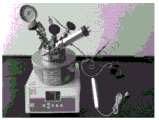
FIG. 4 is a schematic diagram of an apparatus for testing hydrogen absorption/desorption kinetics curves of organic hydrogen storage liquid according to the present invention.
FIG. 5 is a schematic diagram of a hydrogen absorption and desorption kinetics curve of the test organic hydrogen storage liquid of the present invention.
Description of the drawings: the hydrogen absorption and desorption cycle tests of the N-ethyl carbazole are all carried out in a high-pressure reaction kettle as shown in figures 4-5. The hydrogen absorption amount is converted by the pressure drop in the autoclave, the hydrogen discharge amount is directly calculated by a connected gas flowmeter, and the final hydrogen absorption and discharge result is further corrected by using the nuclear magnetic resonance hydrogen spectrum of the liquid product. H generated in the presentation apparatus of FIG. 42Can be directly supplied to a fuel cell for use, and lights a 5 w LED lamp.
Detailed Description
The present invention will be described in further detail with reference to the following embodiments.
A rare earth nano hydrogen storage alloy catalyst for catalyzing organic hydrogen storage liquid to absorb and discharge hydrogen is prepared by the following steps: 1mmol of LaCl was added to a beaker3∙7H2O and NiCl in different molar ratios2∙6H2O (La: Ni =1:5, La: Ni =1: 5.5), dissolved in deionized water with stirring, and concentrated NaOH solution was added under vigorous stirring to obtain a mixed hydroxide precursor, and subjected to centrifugal separation, and the obtained centrifuge was washed with deionized water and dried in an oven overnight. Grinding the mixed hydroxide in a glove box filled with protective gas Ar, mixing the ground mixed hydroxide powder with KCl and CaH2Uniformly mixing, transferring into a crucible, carrying out high-temperature reaction in a tubular furnace in the atmosphere of protective gas Ar in the reduction process, washing the obtained mixture with dilute acetic acid under the condition of protective gas Ar to remove CaO generated by the reduction reaction and unreacted CaH2And KCl solid, and precipitatingCentrifuging, washing twice with water and ethanol respectively, and drying in a vacuum oven for later use. The catalyst is characterized by XRD, XPS, SEM and the like.
Performance testing of the catalyst: the hydrogen absorption and desorption performance of the sample is carried out in a hydrogen absorption and desorption testing system which is mainly assembled by a micro high-pressure reaction kettle. Hydrogen absorption test: putting an organic substrate (N-ethyl carbazole without hydrogenation) and a catalyst into a reaction kettle body in a glove box, sealing the reaction kettle, vacuumizing, and detecting leakage. And heating the reaction kettle to a set temperature, then quickly filling hydrogen with specified pressure, sealing the reaction kettle, and recording the pressure change by using a pressure sensor to obtain a hydrogen absorption curve. And (3) hydrogen discharge test: the hydrogen discharge test is directly carried out by using the mixture after hydrogen absorption, and after the reaction kettle is vacuumized and subjected to leak detection, H with the pressure of more than 1 MPa is filled2And the reaction kettle and a mass flow meter (D07, Beijing seven-star Hua Chuang electronic Co., Ltd., measuring range 50 mL/min, with a one-way valve inside) are communicated after the reaction kettle is closed, hydrogen is released to 1 bar pressure, then heating is started, and the flow of the flow meter is recorded, so that a hydrogen release curve is obtained. Neither solvent nor stirring was used for the hydrogen absorption and desorption tests. After the reaction, the reaction kettle is opened, and the supernatant is taken for H-NMR characterization.
Example 1
0.371 g of LaCl was added to the beaker3∙7H2O and 1.307 g NiCl2∙6H2O, stirring and dissolving in 10mL of deionized water, and dropwise adding 10mL of 4 mol/L concentrated NaOH solution under vigorous stirring to obtain a mixed hydroxide precursor; centrifuging, washing the obtained isolate with deionized water for three times, and drying in an oven at 80 deg.C overnight; the dried mixed hydroxide precursor was mixed with 4 g KCl and 1.5 g CaH in a glove box2Grinding and mixing to obtain mixed powder, transferring into a crucible, reducing at 700 deg.C for 2h in a tube furnace under protective gas Ar atmosphere to obtain a hardened solid mixture, washing with 0.1mol/L diluted acetic acid under protective gas Ar for three times, dissolving CaO produced by reaction, and unreacted CaH2And KCl solid, performing centrifugal separation, washing the separated precipitate with water and ethanol respectively, and drying in a vacuum oven for useRare earth nano hydrogen storage alloy LaNi for catalyzing organic hydrogen storage liquid to absorb and discharge hydrogen5A catalyst.
FIG. 1 shows a nanometer LaNi film prepared according to the present invention5An X-ray diffraction spectrum before and after three cycles of (a) and an X-ray photoelectron energy spectrum before and after three cycles of (b). As shown by the X-ray diffraction pattern in FIG. 1 (a), the alloy prepared by the method is pure LaNi5The phase and the crystallinity are better; after catalyzing N-ethyl carbazole to absorb and release hydrogen for three cycles, the spectral line is widened, the proportion of simple substance Ni is improved, but the main phase of the catalyst is still LaNi5. The X-ray photoelectron spectrum of FIG. 1 (b) shows that the alloy surface before reaction is mainly La2O3And NiO, which represents an oxide film formed on the surface of the alloy during the test and the sample transfer; after three catalytic reactions, simple substances Ni and LaH appear3The characteristic peak of (A) indicates that the surface of the alloy has phase separation phenomenon after catalytic reaction.
FIG. 2 shows a nanometer LaNi film prepared according to the present invention5SEM electron micrograph of (1). SEM electron micrograph shows LaNi synthesized by the method5Is particles with the diameter of tens to hundreds of nanometers, and has obvious difference with the bulk particles with the diameter of tens of micrometers obtained by grinding by a smelting method.
The obtained catalyst is subjected to evaluation of the hydrogen absorption and desorption performance of catalyzing N-ethyl carbazole, referring to fig. 3, for the hydrogen absorption reaction, the reaction can be completed in 8 h at 180 ℃ under 7 MPa, and the hydrogen absorption amount in 8 h reaches 5.7 wt%; corresponding hydrogen evolution reaction is carried out at 200 ℃ and 0.1 MPa H2Hydrogen is discharged for 5 hours under the condition of more than 5.5 wt percent (H)2Yield 95%).
Example 2
0.371 g of LaCl was added to the beaker3∙7H2O and 1.188 g NiCl2∙6H2O, stirring and dissolving in 10mL of deionized water, and dropwise adding 10mL of 4 mol/L concentrated NaOH solution under vigorous stirring to obtain a mixed hydroxide precursor; centrifuging, washing the obtained isolate with deionized water for three times, and drying in an oven at 80 deg.C overnight; the dried mixed hydroxide precursor was mixed with 4 g KCl and 1.5 g CaH in a glove box2Grinding and mixing to obtain mixed powder, transferring into a crucible, reducing at 700 deg.C for 2h in a tube furnace under protective gas Ar atmosphere to obtain a hardened solid mixture, washing with 0.1mol/L diluted acetic acid under protective gas Ar for three times, dissolving CaO produced by reaction, and unreacted CaH2And KCl solid, performing centrifugal separation, washing the separated precipitate with water and ethanol respectively, and drying in a vacuum oven for later use to obtain the rare earth nano hydrogen storage alloy LaNi for catalyzing the hydrogen absorption and desorption of the organic hydrogen storage liquid5A catalyst.
The obtained catalyst is evaluated in the performance of catalyzing the hydrogen absorption and desorption of N-ethylcarbazole, and 5.5 wt% of H can be absorbed for 20H under the conditions of 180 ℃ and 7 MPa in the hydrogen absorption reaction2The corresponding hydrogen releasing reaction is carried out at 200 ℃ and 0.1 MPa H2Hydrogen is discharged for 10 hours under the condition of more than 5.5 wt percent (H)2Yield 95%).
FIG. 4 is a schematic diagram of an apparatus for testing hydrogen absorption/desorption kinetics curves of organic hydrogen storage liquid according to the present invention. FIG. 5 is a schematic diagram of a hydrogen absorption and desorption kinetics curve of the test organic hydrogen storage liquid of the present invention. The N-ethylcarbazole hydrogen absorption and desorption cycle tests in examples 1 and 2 were conducted in a high-pressure reaction vessel as shown in fig. 4 to 5. The hydrogen absorption amount is converted by the pressure drop in the autoclave, the hydrogen discharge amount is directly calculated by a connected gas flowmeter, and the final hydrogen absorption and discharge result is further corrected by using the nuclear magnetic resonance hydrogen spectrum of the liquid product. H generated in the presentation apparatus of FIG. 42Can be directly supplied to a fuel cell for use, and lights a 5 w LED lamp.
Comparative example 1
0.371 g of LaCl was added to the beaker3∙7H2O,0.238 g CoCl2∙6H2O and 0.713 g NiCl2∙6H2O, stirring and dissolving in 10mL of deionized water, and dropwise adding 10mL of 4 mol/L concentrated NaOH solution under vigorous stirring to obtain a mixed hydroxide precursor; centrifuging, washing the obtained isolate with deionized water for three times, and drying in an oven at 80 deg.C overnight; the dried precursor was mixed with 4 g KCl and 1.5 g CaH in a glove box2Grinding, mixing, transferring into crucible, and keepingReducing for 2 hours at 700 ℃ in a tube furnace under the protective gas Ar atmosphere; the hardened solid mixture is obtained, and is washed three times by using 0.1M diluted acetic acid under the protection of protective gas Ar, CaO generated by the reaction and unreacted CaH are dissolved2And KCl, performing centrifugal separation, washing the separated precipitate with water and ethanol respectively, and drying in a vacuum oven for later use to obtain the rare earth nano hydrogen storage alloy LaNi for catalyzing the hydrogen absorption and desorption of the organic hydrogen storage liquid5A catalyst.
The obtained catalyst is subjected to evaluation of hydrogen absorption and desorption performance of catalyzing N-ethylcarbazole, and the hydrogen absorption reaction can be completed in 5 hours at 180 ℃ and 7 MPa, and the corresponding hydrogen desorption reaction is carried out at 200 ℃ and 0.1 MPa H2Hydrogen evolution for 13H under the condition is more than 5.0 wt percent (H)2Yield 86%).
Also using the method, a small amount of Co is doped in the precursor, and then the LaNi doped with a small amount of Co can be synthesized5Alloy, X-ray diffraction spectrum still shows LaNi5Characteristic spectral line of (1). The hydrogen absorption performance of the alloy catalyst is superior to that of single LaNi5However, the alloy phase becomes less stable after Co doping, and the catalytic hydrogen release performance is inferior to that of LaNi5 alloy.
Comparative example 2
0.371 g of LaCl was added to the beaker3∙7H2O,1.426 g NiCl2∙6H2O and 4 g KCl are stirred and dissolved in 10mL deionized water, and the water is evaporated at the heating temperature of 200 ℃ to obtain a mixed hydroxide precursor; the dried mixed hydroxide precursor was mixed with 1.5 g CaH in a glove box2Grinding, mixing, transferring into a crucible, and reducing for 2h at 700 ℃ in a tube furnace in protective gas Ar atmosphere; the hardened solid mixture is obtained, and is washed three times by using 0.1M diluted acetic acid under the protection of protective gas Ar, CaO generated by the reaction and unreacted CaH are dissolved2And KCl, performing centrifugal separation, washing the separated precipitate with water and ethanol respectively, and drying in a vacuum oven for later use to obtain the rare earth nano hydrogen storage alloy LaNi for catalyzing the hydrogen absorption and desorption of the organic hydrogen storage liquid5A catalyst.
The obtained catalyst is subjected to evaluation of hydrogen absorption and desorption performance of catalyzing N-ethylcarbazole, and the hydrogen absorption reaction can be completed in 5 hours at 180 ℃ and 7 MPa, and the corresponding hydrogen desorption reaction is carried out at 200 ℃ and 0.1 MPa H2The catalyst can not effectively catalyze and release hydrogen under the condition, and the release hydrogen is only 1.3 wt% in 24 h.
In this comparative example, the molar ratio of the metals in the precursor, La: Ni =1:6, and the X-ray diffraction spectrum shows that there is a phase of a small amount of elemental Ni in the alloy, which is superior to the pure-phase alloy when La: Ni =1:5 and 5.5 in catalytic hydrogen absorption performance, but poor in catalytic hydrogen desorption performance.