CN101801955A - Pyrimidyl cyclopentanes as akt protein kinase inhibitors - Google Patents
Pyrimidyl cyclopentanes as akt protein kinase inhibitors Download PDFInfo
- Publication number
- CN101801955A CN101801955A CN200880105869A CN200880105869A CN101801955A CN 101801955 A CN101801955 A CN 101801955A CN 200880105869 A CN200880105869 A CN 200880105869A CN 200880105869 A CN200880105869 A CN 200880105869A CN 101801955 A CN101801955 A CN 101801955A
- Authority
- CN
- China
- Prior art keywords
- compound
- phenyl
- described compound
- alkyl
- methyl
- Prior art date
- Legal status (The legal status is an assumption and is not a legal conclusion. Google has not performed a legal analysis and makes no representation as to the accuracy of the status listed.)
- Granted
Links
Classifications
-
- C—CHEMISTRY; METALLURGY
- C07—ORGANIC CHEMISTRY
- C07D—HETEROCYCLIC COMPOUNDS
- C07D403/00—Heterocyclic compounds containing two or more hetero rings, having nitrogen atoms as the only ring hetero atoms, not provided for by group C07D401/00
- C07D403/02—Heterocyclic compounds containing two or more hetero rings, having nitrogen atoms as the only ring hetero atoms, not provided for by group C07D401/00 containing two hetero rings
- C07D403/12—Heterocyclic compounds containing two or more hetero rings, having nitrogen atoms as the only ring hetero atoms, not provided for by group C07D401/00 containing two hetero rings linked by a chain containing hetero atoms as chain links
-
- A—HUMAN NECESSITIES
- A61—MEDICAL OR VETERINARY SCIENCE; HYGIENE
- A61P—SPECIFIC THERAPEUTIC ACTIVITY OF CHEMICAL COMPOUNDS OR MEDICINAL PREPARATIONS
- A61P1/00—Drugs for disorders of the alimentary tract or the digestive system
- A61P1/04—Drugs for disorders of the alimentary tract or the digestive system for ulcers, gastritis or reflux esophagitis, e.g. antacids, inhibitors of acid secretion, mucosal protectants
-
- A—HUMAN NECESSITIES
- A61—MEDICAL OR VETERINARY SCIENCE; HYGIENE
- A61P—SPECIFIC THERAPEUTIC ACTIVITY OF CHEMICAL COMPOUNDS OR MEDICINAL PREPARATIONS
- A61P11/00—Drugs for disorders of the respiratory system
- A61P11/06—Antiasthmatics
-
- A—HUMAN NECESSITIES
- A61—MEDICAL OR VETERINARY SCIENCE; HYGIENE
- A61P—SPECIFIC THERAPEUTIC ACTIVITY OF CHEMICAL COMPOUNDS OR MEDICINAL PREPARATIONS
- A61P11/00—Drugs for disorders of the respiratory system
- A61P11/08—Bronchodilators
-
- A—HUMAN NECESSITIES
- A61—MEDICAL OR VETERINARY SCIENCE; HYGIENE
- A61P—SPECIFIC THERAPEUTIC ACTIVITY OF CHEMICAL COMPOUNDS OR MEDICINAL PREPARATIONS
- A61P13/00—Drugs for disorders of the urinary system
- A61P13/08—Drugs for disorders of the urinary system of the prostate
-
- A—HUMAN NECESSITIES
- A61—MEDICAL OR VETERINARY SCIENCE; HYGIENE
- A61P—SPECIFIC THERAPEUTIC ACTIVITY OF CHEMICAL COMPOUNDS OR MEDICINAL PREPARATIONS
- A61P15/00—Drugs for genital or sexual disorders; Contraceptives
-
- A—HUMAN NECESSITIES
- A61—MEDICAL OR VETERINARY SCIENCE; HYGIENE
- A61P—SPECIFIC THERAPEUTIC ACTIVITY OF CHEMICAL COMPOUNDS OR MEDICINAL PREPARATIONS
- A61P17/00—Drugs for dermatological disorders
-
- A—HUMAN NECESSITIES
- A61—MEDICAL OR VETERINARY SCIENCE; HYGIENE
- A61P—SPECIFIC THERAPEUTIC ACTIVITY OF CHEMICAL COMPOUNDS OR MEDICINAL PREPARATIONS
- A61P17/00—Drugs for dermatological disorders
- A61P17/02—Drugs for dermatological disorders for treating wounds, ulcers, burns, scars, keloids, or the like
-
- A—HUMAN NECESSITIES
- A61—MEDICAL OR VETERINARY SCIENCE; HYGIENE
- A61P—SPECIFIC THERAPEUTIC ACTIVITY OF CHEMICAL COMPOUNDS OR MEDICINAL PREPARATIONS
- A61P17/00—Drugs for dermatological disorders
- A61P17/06—Antipsoriatics
-
- A—HUMAN NECESSITIES
- A61—MEDICAL OR VETERINARY SCIENCE; HYGIENE
- A61P—SPECIFIC THERAPEUTIC ACTIVITY OF CHEMICAL COMPOUNDS OR MEDICINAL PREPARATIONS
- A61P19/00—Drugs for skeletal disorders
- A61P19/02—Drugs for skeletal disorders for joint disorders, e.g. arthritis, arthrosis
-
- A—HUMAN NECESSITIES
- A61—MEDICAL OR VETERINARY SCIENCE; HYGIENE
- A61P—SPECIFIC THERAPEUTIC ACTIVITY OF CHEMICAL COMPOUNDS OR MEDICINAL PREPARATIONS
- A61P25/00—Drugs for disorders of the nervous system
-
- A—HUMAN NECESSITIES
- A61—MEDICAL OR VETERINARY SCIENCE; HYGIENE
- A61P—SPECIFIC THERAPEUTIC ACTIVITY OF CHEMICAL COMPOUNDS OR MEDICINAL PREPARATIONS
- A61P25/00—Drugs for disorders of the nervous system
- A61P25/14—Drugs for disorders of the nervous system for treating abnormal movements, e.g. chorea, dyskinesia
- A61P25/16—Anti-Parkinson drugs
-
- A—HUMAN NECESSITIES
- A61—MEDICAL OR VETERINARY SCIENCE; HYGIENE
- A61P—SPECIFIC THERAPEUTIC ACTIVITY OF CHEMICAL COMPOUNDS OR MEDICINAL PREPARATIONS
- A61P25/00—Drugs for disorders of the nervous system
- A61P25/28—Drugs for disorders of the nervous system for treating neurodegenerative disorders of the central nervous system, e.g. nootropic agents, cognition enhancers, drugs for treating Alzheimer's disease or other forms of dementia
-
- A—HUMAN NECESSITIES
- A61—MEDICAL OR VETERINARY SCIENCE; HYGIENE
- A61P—SPECIFIC THERAPEUTIC ACTIVITY OF CHEMICAL COMPOUNDS OR MEDICINAL PREPARATIONS
- A61P27/00—Drugs for disorders of the senses
- A61P27/02—Ophthalmic agents
-
- A—HUMAN NECESSITIES
- A61—MEDICAL OR VETERINARY SCIENCE; HYGIENE
- A61P—SPECIFIC THERAPEUTIC ACTIVITY OF CHEMICAL COMPOUNDS OR MEDICINAL PREPARATIONS
- A61P29/00—Non-central analgesic, antipyretic or antiinflammatory agents, e.g. antirheumatic agents; Non-steroidal antiinflammatory drugs [NSAID]
-
- A—HUMAN NECESSITIES
- A61—MEDICAL OR VETERINARY SCIENCE; HYGIENE
- A61P—SPECIFIC THERAPEUTIC ACTIVITY OF CHEMICAL COMPOUNDS OR MEDICINAL PREPARATIONS
- A61P3/00—Drugs for disorders of the metabolism
- A61P3/04—Anorexiants; Antiobesity agents
-
- A—HUMAN NECESSITIES
- A61—MEDICAL OR VETERINARY SCIENCE; HYGIENE
- A61P—SPECIFIC THERAPEUTIC ACTIVITY OF CHEMICAL COMPOUNDS OR MEDICINAL PREPARATIONS
- A61P3/00—Drugs for disorders of the metabolism
- A61P3/08—Drugs for disorders of the metabolism for glucose homeostasis
- A61P3/10—Drugs for disorders of the metabolism for glucose homeostasis for hyperglycaemia, e.g. antidiabetics
-
- A—HUMAN NECESSITIES
- A61—MEDICAL OR VETERINARY SCIENCE; HYGIENE
- A61P—SPECIFIC THERAPEUTIC ACTIVITY OF CHEMICAL COMPOUNDS OR MEDICINAL PREPARATIONS
- A61P31/00—Antiinfectives, i.e. antibiotics, antiseptics, chemotherapeutics
-
- A—HUMAN NECESSITIES
- A61—MEDICAL OR VETERINARY SCIENCE; HYGIENE
- A61P—SPECIFIC THERAPEUTIC ACTIVITY OF CHEMICAL COMPOUNDS OR MEDICINAL PREPARATIONS
- A61P31/00—Antiinfectives, i.e. antibiotics, antiseptics, chemotherapeutics
- A61P31/04—Antibacterial agents
-
- A—HUMAN NECESSITIES
- A61—MEDICAL OR VETERINARY SCIENCE; HYGIENE
- A61P—SPECIFIC THERAPEUTIC ACTIVITY OF CHEMICAL COMPOUNDS OR MEDICINAL PREPARATIONS
- A61P31/00—Antiinfectives, i.e. antibiotics, antiseptics, chemotherapeutics
- A61P31/12—Antivirals
-
- A—HUMAN NECESSITIES
- A61—MEDICAL OR VETERINARY SCIENCE; HYGIENE
- A61P—SPECIFIC THERAPEUTIC ACTIVITY OF CHEMICAL COMPOUNDS OR MEDICINAL PREPARATIONS
- A61P33/00—Antiparasitic agents
-
- A—HUMAN NECESSITIES
- A61—MEDICAL OR VETERINARY SCIENCE; HYGIENE
- A61P—SPECIFIC THERAPEUTIC ACTIVITY OF CHEMICAL COMPOUNDS OR MEDICINAL PREPARATIONS
- A61P35/00—Antineoplastic agents
-
- A—HUMAN NECESSITIES
- A61—MEDICAL OR VETERINARY SCIENCE; HYGIENE
- A61P—SPECIFIC THERAPEUTIC ACTIVITY OF CHEMICAL COMPOUNDS OR MEDICINAL PREPARATIONS
- A61P37/00—Drugs for immunological or allergic disorders
- A61P37/02—Immunomodulators
- A61P37/06—Immunosuppressants, e.g. drugs for graft rejection
-
- A—HUMAN NECESSITIES
- A61—MEDICAL OR VETERINARY SCIENCE; HYGIENE
- A61P—SPECIFIC THERAPEUTIC ACTIVITY OF CHEMICAL COMPOUNDS OR MEDICINAL PREPARATIONS
- A61P37/00—Drugs for immunological or allergic disorders
- A61P37/08—Antiallergic agents
-
- A—HUMAN NECESSITIES
- A61—MEDICAL OR VETERINARY SCIENCE; HYGIENE
- A61P—SPECIFIC THERAPEUTIC ACTIVITY OF CHEMICAL COMPOUNDS OR MEDICINAL PREPARATIONS
- A61P43/00—Drugs for specific purposes, not provided for in groups A61P1/00-A61P41/00
-
- A—HUMAN NECESSITIES
- A61—MEDICAL OR VETERINARY SCIENCE; HYGIENE
- A61P—SPECIFIC THERAPEUTIC ACTIVITY OF CHEMICAL COMPOUNDS OR MEDICINAL PREPARATIONS
- A61P9/00—Drugs for disorders of the cardiovascular system
-
- A—HUMAN NECESSITIES
- A61—MEDICAL OR VETERINARY SCIENCE; HYGIENE
- A61P—SPECIFIC THERAPEUTIC ACTIVITY OF CHEMICAL COMPOUNDS OR MEDICINAL PREPARATIONS
- A61P9/00—Drugs for disorders of the cardiovascular system
- A61P9/10—Drugs for disorders of the cardiovascular system for treating ischaemic or atherosclerotic diseases, e.g. antianginal drugs, coronary vasodilators, drugs for myocardial infarction, retinopathy, cerebrovascula insufficiency, renal arteriosclerosis
-
- C—CHEMISTRY; METALLURGY
- C07—ORGANIC CHEMISTRY
- C07D—HETEROCYCLIC COMPOUNDS
- C07D401/00—Heterocyclic compounds containing two or more hetero rings, having nitrogen atoms as the only ring hetero atoms, at least one ring being a six-membered ring with only one nitrogen atom
- C07D401/02—Heterocyclic compounds containing two or more hetero rings, having nitrogen atoms as the only ring hetero atoms, at least one ring being a six-membered ring with only one nitrogen atom containing two hetero rings
- C07D401/12—Heterocyclic compounds containing two or more hetero rings, having nitrogen atoms as the only ring hetero atoms, at least one ring being a six-membered ring with only one nitrogen atom containing two hetero rings linked by a chain containing hetero atoms as chain links
Landscapes
- Health & Medical Sciences (AREA)
- Chemical & Material Sciences (AREA)
- Organic Chemistry (AREA)
- Life Sciences & Earth Sciences (AREA)
- Veterinary Medicine (AREA)
- General Health & Medical Sciences (AREA)
- Animal Behavior & Ethology (AREA)
- Public Health (AREA)
- Medicinal Chemistry (AREA)
- Pharmacology & Pharmacy (AREA)
- Chemical Kinetics & Catalysis (AREA)
- General Chemical & Material Sciences (AREA)
- Nuclear Medicine, Radiotherapy & Molecular Imaging (AREA)
- Bioinformatics & Cheminformatics (AREA)
- Engineering & Computer Science (AREA)
- Immunology (AREA)
- Biomedical Technology (AREA)
- Neurosurgery (AREA)
- Neurology (AREA)
- Diabetes (AREA)
- Pulmonology (AREA)
- Dermatology (AREA)
- Oncology (AREA)
- Communicable Diseases (AREA)
- Endocrinology (AREA)
- Hematology (AREA)
- Cardiology (AREA)
- Rheumatology (AREA)
- Urology & Nephrology (AREA)
- Heart & Thoracic Surgery (AREA)
- Obesity (AREA)
- Ophthalmology & Optometry (AREA)
- Hospice & Palliative Care (AREA)
- Tropical Medicine & Parasitology (AREA)
- Child & Adolescent Psychology (AREA)
- Vascular Medicine (AREA)
- Virology (AREA)
- Transplantation (AREA)
- Psychology (AREA)
- Emergency Medicine (AREA)
Abstract
Description
本申请的优选权priority of this application
本申请要求2007年7月5日提交的美国临时申请序列号60/948,138和2008年1月9日提交的美国临时申请序列号61/020,088的优先权,在此将二者的全文引入作为参考。This application claims priority to U.S. Provisional Application Serial No. 60/948,138, filed July 5, 2007, and U.S. Provisional Application Serial No. 61/020,088, filed January 9, 2008, both of which are hereby incorporated by reference in their entirety .
技术领域technical field
本发明涉及丝氨酸/苏氨酸蛋白激酶(例如,AKT和相关激酶)的新抑制剂、含所述抑制剂的药物组合物和制备这些抑制剂的方法。例如,所述抑制剂可用于治疗哺乳动物的过度增生性疾病,例如癌症和炎症。The present invention relates to novel inhibitors of serine/threonine protein kinases (eg, AKT and related kinases), pharmaceutical compositions containing said inhibitors, and methods of preparing these inhibitors. For example, the inhibitors are useful in the treatment of hyperproliferative diseases, such as cancer and inflammation, in mammals.
背景技术Background technique
蛋白激酶(PK)是通过从ATP转移末端(γ)磷酸对在蛋白质的酪氨酸、丝氨酸和苏氨酸残基上的羟基的磷酸化进行催化的酶。通过信号传导途径,这些激酶根据PK活性以种种方式调节细胞生长、分化和增殖,即,几乎细胞生命的所有方面(Hardie,G.和Hanks,S.(1995)The Protein Kinase FactsBook.I and II,Academic Press,San Diego,CA)。而且,异常PK活性与多种障碍有关,这些障碍的范围从相对无生命危险的疾病如银屑病至极其致命的疾病如成胶质细胞瘤(脑癌)。蛋白激酶是治疗性调节的重要靶标类别(Cohen,P.(2002)Nature Rev.Drug Discovery 1:309)。Protein kinases (PKs) are enzymes that catalyze the phosphorylation of hydroxyl groups on tyrosine, serine and threonine residues of proteins by transferring a terminal (gamma) phosphate from ATP. Through signaling pathways, these kinases regulate cell growth, differentiation and proliferation, i.e., almost all aspects of cell life, in various ways depending on PK activity (Hardie, G. and Hanks, S. (1995) The Protein Kinase Facts Book. I and II , Academic Press, San Diego, CA). Furthermore, aberrant PK activity is associated with a variety of disorders ranging from relatively non-life-threatening diseases such as psoriasis to extremely fatal diseases such as glioblastoma (brain cancer). Protein kinases are an important target class for therapeutic regulation (Cohen, P. (2002) Nature Rev. Drug Discovery 1:309).
值得注意的是,经常有报道称非典型蛋白质磷酸化和/或表达是癌症中的异常细胞增生、转移和细胞存活的一个成因性影响。各种激酶(包括Akt、VEGF、ILK、ROCK、p70S6K、Bcl、PKA、PKC、Raf、Src、PDK1、ErbB2、MEK、IKK、Cdk、EGFR、BAD、CHK1、CHK2和GSK3等)的异常调节和/或表达已经特异性地与癌症相关联。Notably, atypical protein phosphorylation and/or expression is frequently reported as a causative effect of abnormal cell proliferation, metastasis and cell survival in cancer. Abnormal regulation and and/or expression has been specifically associated with cancer.
蛋白激酶包括两类;蛋白酪氨酸激酶(PTK)和丝氨酸-苏氨酸激酶(STK)。蛋白激酶B/Akt酶是在多种人类肿瘤中被过表达的一组丝氨酸/苏氨酸激酶。PI3K脂质产物的表征最为充分的靶标之一是在信号传导途径中PI3K下游的57KD丝氨酸/苏氨酸蛋白激酶Akt(Hemmings,B.A.(1997)Science275:628;Hay N.(2005)Cancer Cell 8:179-183)。Akt是急性转化型逆转录病毒AKT8的原癌基因v-akt的人类同源物。由于它与蛋白激酶A和C的高序列同源性,所以也将Akt称为蛋白激酶B(PKB)和与A和C相关(Related to Aand C,RAC)。已知存在Akt的三种同工型,即Akt1、Akt2和Akt3,其呈现出80%的总体同源性(Staal,S.P.(1987)Proc.Natl.Acad.Sci.84:5034;Nakatani,K.(1999)Biochem.Biophys.Res.Commun.257:906;Li等人(2002)Current Topics in Med.Chem.2:939-971;WO 2005/113762)。Akt同工型共用共同域结构,所述共同域结构由N-端的普列克底物蛋白(pleckstrin)同源域、激酶催化域和C-端的短调节区组成。而且,Akt2和Akt3均呈现出剪接变体。在被PtdInd(3,4,5)P3募集至细胞膜后,Akt被PDK1分别在T308、T309和T305处磷酸化(活化)为同工型Akt1(PKB α)、Akt2(PKBβ)和Akt3(PKBγ)以及分别在S473、S474和S472处磷酸化(活化)为同工型Akt1、Akt2和Akt3。该磷酸化由尚未知晓的激酶(推定名为PDK2)所导致,不过已经显示在该过程中涉及PDK1(Balendran,A.,(1999)Curr.Biol.9:393)、自磷酸化(Toker,A.(2000)J.Biol.Chem.275:8271)和整联蛋白关联的激酶(integrin-linkedkinase,ILK)(Delcommenne,M.(1998)Proc.Natl.Acad.Sci.USA,95:11211)。Akt活化需要它在C-端疏水性基序中的残基Ser 473上的磷酸化(Brodbeck等人(1999)J.Biol.Chem.274:9133-9136;Coffer等人(1991)Eur.J.Biochem.201:475-481;Alessi等人(1997)Curr.Biol.7:261-269)。尽管Akt的单磷酸化活化激酶,但是为得到最大激酶活性则需要二(磷酸化)。Protein kinases include two classes; protein tyrosine kinases (PTKs) and serine-threonine kinases (STKs). Protein kinase B/Akt enzymes are a group of serine/threonine kinases that are overexpressed in a variety of human tumors. One of the best characterized targets of PI3K lipid products is the 57KD serine/threonine protein kinase Akt downstream of PI3K in the signaling pathway (Hemmings, B.A. (1997) Science 275:628; Hay N. (2005) Cancer Cell 8 : 179-183). Akt is the human homologue of the proto-oncogene v-akt of the acutely transforming retrovirus AKT8. Due to its high sequence homology with protein kinases A and C, Akt is also called protein kinase B (PKB) and related to A and C (Related to A and C, RAC). Three isoforms of Akt are known, namely Akt1, Akt2 and Akt3, which exhibit an overall homology of 80% (Staal, S.P. (1987) Proc. Natl. Acad. Sci. 84:5034; Nakatani, K (1999) Biochem. Biophys. Res. Commun. 257: 906; Li et al. (2002) Current Topics in Med. Chem. 2: 939-971; WO 2005/113762). Akt isoforms share a common domain structure consisting of an N-terminal pleckstrin homology domain, a kinase catalytic domain and a C-terminal short regulatory region. Moreover, both Akt2 and Akt3 exhibit splice variants. After being recruited to the cell membrane by PtdInd(3,4,5)P3, Akt is phosphorylated (activated) by PDK1 at T308, T309 and T305, respectively, into isoforms Akt1 (PKBα), Akt2 (PKBβ) and Akt3 (PKBγ ) and phosphorylation (activation) to the isoforms Akt1, Akt2 and Akt3 at S473, S474 and S472, respectively. This phosphorylation is caused by an as yet unknown kinase (putatively named PDK2), but it has been shown that PDK1 is involved in the process (Balendran, A., (1999) Curr. Biol. 9:393), autophosphorylation (Toker, A. (2000) J.Biol.Chem.275:8271) and integrin-linked kinase (integrin-linkedkinase, ILK) (Delcommenne, M. (1998) Proc.Natl.Acad.Sci.USA, 95:11211 ). Akt activation requires its phosphorylation on residue Ser 473 in the C-terminal hydrophobic motif (Brodbeck et al. (1999) J.Biol.Chem.274:9133-9136; Coffer et al. (1991) Eur.J . Biochem. 201: 475-481; Alessi et al. (1997) Curr. Biol. 7: 261-269). Although monophosphorylation of Akt activates the kinase, di(phosphorylation) is required for maximal kinase activity.
Akt被认为通过抑制细胞凋亡以及增强血管生成和增殖而发挥它对癌症的作用(Toker等人(2006)Cancer Res.66(8):3963-3966)。Akt在许多形式的人类癌症中过表达,这些癌症包括但不限于结肠癌(Zinda等人(2001)Clin.Cancer Res.7:2475)、卵巢癌(Cheng等人(1992)Proc.Natl.Acad.Sci.USA89:9267)、脑癌(Haas Kogan等人(1998)Curr.Biol.8:1195)、肺癌(Brognard等人(2001)Cancer Res.61:3986)、胰腺癌(Bellacosa等人(1995)Int.J.Cancer64:280-285;Cheng等人(1996)Proc.Natl.Acad.Sci.93:3636-3641)、前列腺癌(Graff等人(2000)J.Biol.Chem.275:24500)和胃癌(Staal等人(1987)Proc.Natl.Acad.Sci.USA 84:5034-5037)。Akt is thought to exert its effects on cancer by inhibiting apoptosis and enhancing angiogenesis and proliferation (Toker et al. (2006) Cancer Res. 66(8):3963-3966). Akt is overexpressed in many forms of human cancer including, but not limited to, colon cancer (Zinda et al. (2001) Clin. Cancer Res. 7:2475), ovarian cancer (Cheng et al. (1992) Proc. Natl. Acad .Sci.USA89:9267), brain cancer (Haas Kogan et al (1998) Curr.Biol.8:1195), lung cancer (Brognard et al (2001) Cancer Res.61:3986), pancreatic cancer (Bellacosa et al ( 1995) Int.J.Cancer64:280-285; Cheng et al. (1996) Proc.Natl.Acad.Sci.93:3636-3641), prostate cancer (Graff et al. (2000) J.Biol.Chem.275: 24500) and gastric cancer (Staal et al. (1987) Proc. Natl. Acad. Sci. USA 84:5034-5037).
对于靶向小分子抑制剂治疗,已经探索了PI3K/Akt/雷帕霉素哺乳动物靶标(mammalian target of rapamycin,mTOR)途径(Georgakis,G.和Younes,A.(2006)Expert Rev.Anticancer Ther.6(1):131-140;Granville等人(2006)Clin.Cancer Res.12(3):679-689)。抑制PI3K/Akt信号传导诱发细胞凋亡和抑制具有高Akt水平的肿瘤细胞的生长(Kim等人(2005)Current Opinion in Investig.Drugs 6(12):1250-1258;Luo等人(2005)Molecular Cancer Ther.4(6):977-986)。For targeted small molecule inhibitor therapy, the PI3K/Akt/mammalian target of rapamycin (mTOR) pathway has been explored (Georgakis, G. and Younes, A. (2006) Expert Rev. Anticancer Ther 6(1):131-140; Granville et al. (2006) Clin. Cancer Res. 12(3):679-689). Inhibition of PI3K/Akt signaling induces apoptosis and inhibits growth of tumor cells with high Akt levels (Kim et al. (2005) Current Opinion in Investig. Drugs 6(12): 1250-1258; Luo et al. (2005) Molecular Cancer Ther. 4(6):977-986).
开发以异常调节途径并最终导致疾病作为靶标的激酶抑制剂对于医药界具有巨大的伦理和商业上的利益。抑制以下(1)、(2)、(3)或(4)的化合物能够成为有价值的抗癌剂:(1)募集Akt至细胞膜、(2)PDK1或PDK2所导致的活化、(3)底物磷酸化或者(4)Akt的下游靶标之一,作为独立的疗法或与其它认可的方法联合。The development of kinase inhibitors that target dysregulated pathways that ultimately lead to disease is of enormous ethical and commercial interest to the medical community. Compounds that inhibit (1), (2), (3) or (4) could be valuable anticancer agents: (1) recruitment of Akt to the cell membrane, (2) activation by PDK1 or PDK2, (3) Phosphorylation of a substrate or (4) one of Akt's downstream targets, either as a stand-alone therapy or in combination with other approved approaches.
美国专利申请公开文本2005/0130954披露了多种充当AKT抑制剂的化合物等。所述化合物可用于过度增生性疾病如癌症的治疗。US Patent Application Publication 2005/0130954 discloses various compounds that act as AKT inhibitors, among others. The compounds are useful in the treatment of hyperproliferative diseases such as cancer.
美国专利申请公开文本2008/0058327和美国专利申请公开文本2008/0051399披露了多种充当AKT抑制剂的化合物等。US Patent Application Publication 2008/0058327 and US Patent Application Publication 2008/0051399 disclose various compounds that act as AKT inhibitors, among others.
发明内容Contents of the invention
本发明提供了抑制AKT蛋白激酶的新化合物。本发明化合物具有作为治疗剂的效用,用于能够通过抑制AKT蛋白激酶进行治疗的疾病和病症。The present invention provides novel compounds that inhibit AKT protein kinase. The compounds of the invention have utility as therapeutic agents for diseases and conditions that can be treated by inhibition of the AKT protein kinase.
本发明包括具有通式I的化合物以及它们的对映异构体和盐,The present invention includes compounds of general formula I and their enantiomers and salts,

其中G、R1、R1a、R2、R2a、R3、R4、R5、R5a和j如下面所定义。wherein G, R 1 , R 1a , R 2 , R 2a , R 3 , R 4 , R 5 , R 5a and j are as defined below.
本发明还提供了含式I化合物或者它们的对映异构体或可药用盐的药物组合物。The present invention also provides pharmaceutical compositions containing the compound of formula I or their enantiomers or pharmaceutically acceptable salts.
在又一方面,本发明提供了治疗哺乳动物中由AKT蛋白激酶介导的疾病或医学病症的方法,所述方法包括向所述哺乳动物以有效治疗或预防所述障碍的量给药一种或多种式I化合物或者它们的对映异构体或可药用盐。能够根据本发明方法治疗的AKT蛋白激酶介导的病症包括但不限于炎性、过度增生性、心血管、神经变性、妇科和皮肤疾病和障碍。In yet another aspect, the invention provides a method of treating a disease or medical condition mediated by AKT protein kinase in a mammal, said method comprising administering to said mammal an amount effective to treat or prevent said disorder. or more compounds of formula I or their enantiomers or pharmaceutically acceptable salts. AKT protein kinase-mediated conditions that can be treated according to the methods of the invention include, but are not limited to, inflammatory, hyperproliferative, cardiovascular, neurodegenerative, gynecological and dermatological diseases and disorders.
在又一方面,本发明提供了抑制在哺乳动物中生成AKT蛋白激酶的方法,所述方法包括向所述哺乳动物以有效抑制AKT蛋白激酶生成的量给药式I化合物或者它们的对映异构体或可药用盐。In yet another aspect, the present invention provides a method of inhibiting the production of AKT protein kinase in a mammal, said method comprising administering to said mammal a compound of formula I or an enantiomer thereof in an amount effective to inhibit the production of AKT protein kinase Constructs or pharmaceutically acceptable salts.
在又一方面,本发明提供了抑制AKT蛋白激酶活性的方法,所述方法包括使所述激酶与式I化合物接触。In yet another aspect, the present invention provides a method of inhibiting the activity of an AKT protein kinase, the method comprising contacting the kinase with a compound of formula I.
本发明化合物可以有利地与其它已知治疗剂组合使用。因此,本发明还提供了药物组合物,所述药物组合物包含式I化合物或者它们的对映异构体或可药用盐,以及第二治疗剂。The compounds of the invention may be advantageously used in combination with other known therapeutic agents. Accordingly, the present invention also provides a pharmaceutical composition comprising a compound of formula I, or an enantiomer or a pharmaceutically acceptable salt thereof, and a second therapeutic agent.
本发明还提供了在AKT蛋白激酶介导的病症的治疗中用作药物的式I化合物以及它们的对映异构体和可药用盐。The present invention also provides compounds of formula I and their enantiomers and pharmaceutically acceptable salts for use as medicaments in the treatment of AKT protein kinase mediated disorders.
本发明的另一方面是式I化合物或者它们的对映异构体或可药用盐,其用于治疗。在一种实施方式中,所述治疗包括AKT蛋白激酶介导的病症的治疗。Another aspect of the invention is a compound of formula I, or an enantiomer or a pharmaceutically acceptable salt thereof, for use in therapy. In one embodiment, the treatment comprises treatment of an AKT protein kinase mediated condition.
本发明还提供了用于治疗AKT蛋白激酶介导的疾病或障碍的试剂盒,所述试剂盒包含式I化合物或者它们的对映异构体或可药用盐,容器和任选的标示治疗的包装说明书或标签。所述试剂盒还可以包含可用于治疗所述疾病或障碍的第二化合物或含第二药剂的制剂。The present invention also provides a kit for treating a disease or disorder mediated by AKT protein kinase, said kit comprising a compound of formula I or their enantiomers or pharmaceutically acceptable salts, a container and optionally an indicated treatment package insert or label. The kit may also comprise a second compound or a formulation comprising a second agent useful in the treatment of the disease or disorder.
本发明的另一方面提供了式I化合物以用于过度增生性疾病的治疗。在又一方面,所述过度增生性疾病是癌症。Another aspect of the invention provides compounds of formula I for use in the treatment of hyperproliferative diseases. In yet another aspect, the hyperproliferative disease is cancer.
本发明还包括本发明化合物的制备方法、分离方法和纯化方法。The invention also includes methods for the preparation, isolation and purification of the compounds of the invention.
在下面的描述中部分地阐述本发明的其它优点和新特征,并且在阅读以下说明书后对于本领域技术人员而言部分优点和新特征将变得显而易见,或者可以通过实践本发明得知。本发明的优点可以通过所附权利要求中具体指出的手段、组合、组合物和方法而实现和获得。Other advantages and novel features of the present invention are partially set forth in the following description, and some of the advantages and novel features will become apparent to those skilled in the art after reading the following description, or can be learned by practicing the present invention. The advantages of the invention may be realized and obtained by means of the instrumentalities, combinations, compositions and methods particularly pointed out in the appended claims.
具体实施方式Detailed ways
现详细参照本发明的某些实施方式,以附加的结构和化学式阐明本发明的实施例。当本发明与所列举的实施方式结合描述时,应该理解,它们并非旨在将本发明局限于那些实施方式。相反地,本发明旨在涵盖可包括在如权利要求定义的本发明的范围内的所有变化形式、修改形式和等价形式。本领域技术人员会认识到与本申请描述的那些方法或物质类似或等价的多种方法和物质,这些方法和物质可用于本发明的实践中。本发明决不限于所描述的方法和物质。如果一篇或多篇引入的文献和类似材料与本申请不同或矛盾(包括但不限于所定义的术语、术语的用法、所描述的技术等),那么以本申请为准。Referring now in detail to certain embodiments of the invention, examples of the invention are set forth in the attached structures and formulae. While the invention is described in conjunction with the enumerated embodiments, it should be understood that they are not intended to limit the invention to those embodiments. On the contrary, the invention is intended to cover all alternatives, modifications and equivalents which may be included within the scope of the present invention as defined by the claims. One skilled in the art will recognize various methods and materials similar or equivalent to those described herein, which could be used in the practice of the present invention. The present invention is in no way limited to the methods and materials described. In the event that one or more of the incorporated literature and similar materials differs from or contradicts this application, including but not limited to defined terms, term usage, described techniques, etc., this application controls.
定义definition
本申请使用的术语“烷基”是指1至12个碳原子的饱和直链或支链一价烃基,其中烷基可以任选被一个或多个如下所述的取代基独立地取代。在一种实施方式中,烷基包括C1-C4烷基。在另一种实施方式中,烷基包括C1-C3烷基。在另一种实施方式中,烷基包括C1-C6烷基。烷基的实例包括,但不限于,甲基(“Me”,-CH3)、乙基(“Et”,-CH2CH3)、1-丙基(“n-Pr”,正丙基,-CH2CH2CH3)、2-丙基(“i-Pr”、异丙基,-CH(CH3)2)、1-丁基(“n-Bu”,正丁基,-CH2CH2CH2CH3)、2-甲基-1-丙基(“i-Bu”,异丁基,-CH2CH(CH3)2)、2-丁基(“s-Bu”,仲丁基,-CH(CH3)CH2CH3)、2-甲基-2-丙基(“t-Bu”,叔丁基,-C(CH3)3)、2,2-二甲基丙基(-CH2C(CH3)3)、1-戊基(正戊基,-CH2CH2CH2CH2CH3)、2-戊基(-CH(CH3)CH2CH2CH3)、3-戊基(-CH(CH2CH3)2)、2-甲基-2-丁基(-C(CH3)2CH2CH3)、3-甲基-2-丁基(-CH(CH3)CH(CH3)2)、3-甲基-1-丁基(-CH2CH2CH(CH3)2)、2-甲基-1-丁基(-CH2CH(CH3)CH2CH3)、1-己基(-CH2CH2CH2CH2CH2CH3)、2-己基(-CH(CH3)CH2CH2CH2CH3)、3-己基(-CH(CH2CH3)(CH2CH2CH3))、2-甲基-2-戊基(-C(CH3)2CH2CH2CH3)、3-甲基-2-戊基(-CH(CH3)CH(CH3)CH2CH3)、4-甲基-2-戊基(-CH(CH3)CH2CH(CH3)2)、3-甲基-3-戊基(-C(CH3)(CH2CH3)2)、2-甲基-3-戊基(-CH(CH2CH3)CH(CH3)2)、2,3-二甲基-2-丁基(-C(CH3)2CH(CH3)2)、3,3-二甲基-2-丁基(-CH(CH3)C(CH3)3、1-庚基、1-辛基等。The term "alkyl" as used herein refers to a saturated linear or branched monovalent hydrocarbon group of 1 to 12 carbon atoms, wherein the alkyl group may be optionally substituted independently by one or more substituents as described below. In one embodiment, alkyl includes C 1 -C 4 alkyl. In another embodiment, alkyl includes C 1 -C 3 alkyl. In another embodiment, alkyl includes C 1 -C 6 alkyl. Examples of alkyl groups include, but are not limited to, methyl ("Me", -CH 3 ), ethyl ("Et", -CH 2 CH 3 ), 1-propyl ("n-Pr", n-propyl , -CH 2 CH 2 CH 3 ), 2-propyl ("i-Pr", isopropyl, -CH(CH 3 ) 2 ), 1-butyl ("n-Bu", n-butyl, - CH 2 CH 2 CH 2 CH 3 ), 2-methyl-1-propyl (“i-Bu”, isobutyl, -CH 2 CH(CH 3 ) 2 ), 2-butyl (“s-Bu ", sec-butyl, -CH(CH 3 ) CH 2 CH 3 ), 2-methyl-2-propyl ("t-Bu", tert-butyl, -C(CH 3 ) 3 ), 2,2 -Dimethylpropyl (-CH 2 C(CH 3 ) 3 ), 1-pentyl (n-pentyl, -CH 2 CH 2 CH 2 CH 2 CH 3 ), 2-pentyl (-CH(CH 3 )CH 2 CH 2 CH 3 ), 3-pentyl (-CH(CH 2 CH 3 ) 2 ), 2-methyl-2-butyl (-C(CH 3 ) 2 CH 2 CH 3 ), 3- Methyl-2-butyl (-CH(CH 3 )CH(CH 3 ) 2 ), 3-methyl-1-butyl (-CH 2 CH 2 CH(CH 3 ) 2 ), 2-methyl- 1-butyl (-CH 2 CH(CH 3 )CH 2 CH 3 ) , 1-hexyl (-CH 2 CH 2 CH 2 CH 2 CH 2 CH 3 ), 2-hexyl (-CH(CH 3 )CH 2 CH 2 CH 2 CH 3 ), 3-hexyl (-CH(CH 2 CH 3 )(CH 2 CH 2 CH 3 )), 2-methyl-2-pentyl (-C(CH 3 ) 2 CH 2 CH 2 CH 3 ), 3-methyl-2-pentyl (-CH(CH 3 )CH(CH 3 )CH 2 CH 3 ), 4-methyl-2-pentyl (-CH(CH 3 )CH 2 CH(CH 3 ) 2 ), 3-methyl-3-pentyl (-C(CH 3 )(CH 2 CH 3 ) 2 ), 2-methyl-3-pentyl (-CH(CH 2 CH 3 ) CH(CH 3 ) 2 ), 2,3-dimethyl-2-butyl (-C(CH 3 ) 2 CH(CH 3 ) 2 ), 3,3-dimethyl-2-butyl ( -CH(CH 3 )C(CH 3 ) 3 , 1-heptyl, 1-octyl, etc.
术语“环烷基”是指具有3至12个碳原子的饱和或部分不饱和的环状烃基。在一种实施方式中,环烷基包括5-6元的环烷基。在另一种实施方式中,环烷基包括C3-C6环烷基。在另一种实施方式中,环烷基包括5元环烷基。在另一种实施方式中,环烷基包括6元环烷基。术语“环烷基”包括单环和多环(例如,二环和三环)环烷基结构,其中多环结构任选地包含稠合至饱和、部分不饱和或芳族的环烷基环或杂环的饱和或部分不饱和的环烷基环。环烷基可以任选被一个或多个本申请所述的取代基独立地取代。The term "cycloalkyl" refers to a saturated or partially unsaturated cyclic hydrocarbon group having 3 to 12 carbon atoms. In one embodiment, cycloalkyl includes 5-6 membered cycloalkyl. In another embodiment, cycloalkyl includes C 3 -C 6 cycloalkyl. In another embodiment, cycloalkyl includes 5-membered cycloalkyl. In another embodiment, cycloalkyl includes 6-membered cycloalkyl. The term "cycloalkyl" includes monocyclic and polycyclic (e.g., bicyclic and tricyclic) cycloalkyl structures, wherein the polycyclic structures optionally comprise cycloalkyl rings fused to saturated, partially unsaturated, or aromatic Or a heterocyclic saturated or partially unsaturated cycloalkyl ring. Cycloalkyl groups can be optionally substituted independently with one or more substituents described herein.
环烷基的实例包括但不限于环丙基、环丁基、环戊基、1-环戊烯-1-基(1-cyclopent-1-enyl)、1-环戊烯-2-基(1-cyclopent-2-enyl)、1-环戊烯-3-基(1-cyclopent-3-enyl)、环己基、1-环己烯-1-基(1-cyclohex-1-enyl)、1-环己烯-2-基(1-cyclohex-2-enyl)、1-环己烯-3-基(1-cyclohex-3-enyl)、环己二烯基(cyclohexadienyl)、环庚基、环辛基、环壬基、环癸基、环十一烷基、环十二烷基、二环[2.2.1]庚烷、二环[2.2.2]辛烷和二环[3.2.2]壬烷。Examples of cycloalkyl groups include, but are not limited to, cyclopropyl, cyclobutyl, cyclopentyl, 1-cyclopent-1-yl (1-cyclopent-1-enyl), 1-cyclopenten-2-yl ( 1-cyclopent-2-enyl), 1-cyclopentene-3-yl (1-cyclopent-3-enyl), cyclohexyl, 1-cyclohexen-1-yl (1-cyclohex-1-enyl), 1-cyclohexen-2-yl (1-cyclohex-2-enyl), 1-cyclohexen-3-yl (1-cyclohex-3-enyl), cyclohexadienyl (cyclohexadienyl), cycloheptyl , cyclooctyl, cyclononyl, cyclodecyl, cycloundecyl, cyclododecyl, bicyclo[2.2.1]heptane, bicyclo[2.2.2]octane and bicyclo[3.2. 2] Nonane.
有时将缩写与元素缩写和化学结构联用,例如,甲醇(“MeOH”)或乙醇(“EtOH”)。Abbreviations are sometimes used in conjunction with element abbreviations and chemical structures, for example, methanol ("MeOH") or ethanol ("EtOH").
在整篇申请中均使用氢的元素缩写(即,“H”)。The element abbreviation for hydrogen (ie, "H") is used throughout the application.
本申请使用的术语“杂芳基”是指具有5-、6-或7-元环的单价芳族基团,以及包括含至少一个杂原子的具有5-10个原子的稠环体系(至少一个环是芳香性的),所述杂原子独立地选自氮、氧和硫。在允许的情况下,所述杂芳基可以是C-连接的(C-attached)或N-连接的(N-attached)。杂芳基可以任选地被一个或多个本申请所述的取代基独立地取代。在一种实施方式中,杂芳基是5-6元的杂芳基。在另一种实施方式中,杂芳基是9-10元的二环杂芳基。As used herein, the term "heteroaryl" refers to a monovalent aromatic group having a 5-, 6- or 7-membered ring, and includes fused ring systems of 5-10 atoms containing at least one heteroatom (at least One ring is aromatic), said heteroatoms are independently selected from nitrogen, oxygen and sulfur. Where permitted, the heteroaryl can be C-attached or N-attached. Heteroaryl groups can be optionally substituted independently with one or more substituents described herein. In one embodiment, the heteroaryl is a 5-6 membered heteroaryl. In another embodiment, the heteroaryl is a 9-10 membered bicyclic heteroaryl.
杂芳基的实例包括但不限于吡啶基、咪唑基、咪唑并吡啶基、嘧啶基、吡唑基、三唑基、吡嗪基、四唑基、呋喃基、噻吩基、异噁唑基、噻唑基、噁唑基、异噻唑基、吡咯基、喹啉基、异喹啉基、吲哚基、苯并咪唑基、苯并呋喃基、噌啉基、吲唑基、吲嗪基、酞嗪基、哒嗪基、三嗪基、异吲哚基、蝶啶基、嘌呤基、噁二唑基、三唑基、噻二唑基、噻二唑基、呋咱基、苯并呋咱基、苯并噻吩基、苯并噻唑基、苯并噁唑基、喹唑啉基、喹喔啉基、萘啶基和呋喃并吡啶基(furopyridinyl)。Examples of heteroaryl groups include, but are not limited to, pyridyl, imidazolyl, imidazopyridyl, pyrimidinyl, pyrazolyl, triazolyl, pyrazinyl, tetrazolyl, furyl, thienyl, isoxazolyl, Thiazolyl, oxazolyl, isothiazolyl, pyrrolyl, quinolinyl, isoquinolyl, indolyl, benzimidazolyl, benzofuryl, cinnolinyl, indazolyl, indolyl, phthaloyl Azinyl, pyridazinyl, triazinyl, isoindolyl, pteridinyl, purinyl, oxadiazolyl, triazolyl, thiadiazolyl, thiadiazolyl, furazanyl, benzofurazanyl benzothienyl, benzothiazolyl, benzoxazolyl, quinazolinyl, quinoxalinyl, naphthyridinyl and furopyridinyl (furopyridinyl).
术语“杂环”是指具有3至8个环原子的饱和或部分不饱和的碳环基团,其中至少一个环原子是独立地选自氮、氧和硫的杂原子,剩余环原子是C,其中一个或多个环原子可以任选地被一个或多个本申请所述的取代基独立地取代。在一种实施方式中,杂环是4-6元基团。在其它实施方式中,杂环是5-6元基团、5-元基团或6-元基团。“杂环”包括杂环基团与饱和、部分不饱和或芳族环状基团稠合的基团。The term "heterocycle" refers to a saturated or partially unsaturated carbocyclic group having from 3 to 8 ring atoms, at least one of which is a heteroatom independently selected from nitrogen, oxygen and sulfur, and the remaining ring atoms are C , wherein one or more ring atoms may be optionally substituted independently with one or more substituents described herein. In one embodiment, the heterocycle is a 4-6 membered group. In other embodiments, the heterocycle is a 5-6 membered group, a 5-membered group or a 6-membered group. "Heterocycle" includes groups in which a heterocyclic group is fused to a saturated, partially unsaturated or aromatic cyclic group.
示例性杂环基团包括但不限于环氧乙基、氮杂环丙基、硫杂环丙基、氮杂环丁基、氧杂环丁基、硫杂环丁基、1,2-二硫杂环丁基、1,3-二硫杂环丁基、吡咯烷基、哌啶基、吗啉基、硫吗啉基、噻噁烷基、哌嗪基、高哌嗪基、高哌啶基、氧杂环庚基、硫杂环庚基、氧杂氮杂


本申请使用的术语“卤素”是指氟、氯、溴或碘。As used herein, the term "halogen" refers to fluorine, chlorine, bromine or iodine.
术语“对映异构体”是指化合物的两个立体异构体,这两个立体异构体是彼此的不可重叠的镜像。The term "enantiomer" refers to two stereoisomers of a compound that are non-superimposable mirror images of each other.
术语“非对映异构体”是指一对光学异构体,这对光学异构体不是彼此的镜像。The term "diastereoisomers" refers to a pair of optical isomers, which are not mirror images of each other.
术语“互变异构体”或“互变形式”是指具有不同能量的结构异构体,所述结构异构体可通过低能垒相互转化。The term "tautomer" or "tautomeric form" refers to structural isomers with different energies that are interconvertible through a low energy barrier.
措辞“可药用”表示物质或组合物与构成制剂的其它成分和/或用其治疗的哺乳动物在化学上和/或毒理学上是相容的。The wording "pharmaceutically acceptable" means that the substance or composition is chemically and/or toxicologically compatible with the other ingredients making up the formulation and/or with the mammal being treated therewith.
措辞“有效量”是指:当给药至有此治疗需要的哺乳动物时,足以产生下列效果的化合物的量:(i)治疗或预防一种或多种AKT蛋白激酶、酪氨酸激酶、其它丝氨酸/苏氨酸激酶和/或双重特异性激酶的活性所介导的具体疾病、病症或障碍,(ii)减弱、改善或消除具体疾病、病症或障碍的一种或多种症状,或(iii)预防或延迟本申请所述的具体疾病、病症或障碍的一种或多种症状的发作。The phrase "effective amount" refers to an amount of a compound sufficient to: (i) treat or prevent one or more of AKT protein kinases, tyrosine kinases, The particular disease, condition or disorder mediated by the activity of other serine/threonine kinases and/or dual specificity kinases, (ii) attenuation, amelioration or elimination of one or more symptoms of the particular disease, condition or disorder, or (iii) preventing or delaying the onset of one or more symptoms of a particular disease, condition or disorder described herein.
“治疗”是指将由一种或多种AKT蛋白激酶、酪氨酸激酶、其它丝氨酸/苏氨酸激酶和/或双重特异性激酶的活性所影响的(至少部分地)的哺乳动物如人的病症至少减轻。术语“治疗”和“医治”指的是治疗性治疗以及预防或防止性措施,其中目的是预防或延迟(减慢)不希望的生理变化或障碍。对本发明来说,有利的或所需临床效果包括,但不限于,症状减轻,疾病程度降低,疾病状态稳定化(即未恶化),延迟或减缓疾病发展,改善或减缓疾病状态,和症状缓解(不论是部分的或全部的),不论是可检测的还是不可检测的。“治疗”还可以是指:与如果不得到医治而预料的存活相比,可以延长存活。需要治疗的那些包括:患有病症或障碍的那些,以及发现倾向于患有病症但还没有诊断为患有病症;从而调节和/或抑制病症的那些。术语“治疗”包括防止性(即,预防性)和减轻性治疗。"Treatment" refers to a treatment in a mammal such as a human being affected (at least in part) by the activity of one or more AKT protein kinases, tyrosine kinases, other serine/threonine kinases and/or dual specificity kinases Symptoms are at least alleviated. The terms "treatment" and "treatment" refer to both therapeutic treatment as well as prophylactic or preventive measures, wherein the object is to prevent or delay (slow down) an undesired physiological change or disorder. For the purposes of the present invention, beneficial or desired clinical effects include, but are not limited to, alleviation of symptoms, reduction in extent of disease, stabilization of disease state (i.e., not worsening), delay or slowing of disease progression, amelioration or slowing of disease state, and remission of symptoms (whether partial or total), whether detectable or not. "Treatment" can also mean prolonging survival compared to expected survival if not receiving treatment. Those in need of treatment include those having the condition or disorder as well as those found predisposed to having the condition but not yet diagnosed as having the condition; thereby modulating and/or inhibiting the condition. The term "treatment" includes preventative (ie, prophylactic) and palliative treatment.
本申请使用的术语“哺乳动物”是指患有本申请所述疾病或处于本申请所述疾病的发展危险之中的温血动物,包括但不限于豚鼠、狗、猫、大鼠、小鼠、仓鼠和灵长类,包括人。As used herein, the term "mammal" refers to a warm-blooded animal suffering from or at risk of developing a disease described herein, including but not limited to guinea pigs, dogs, cats, rats, mice , hamsters and primates, including humans.
术语“包装说明书”指的是通常包括在治疗产品的商业包装中的说明,其包括关于这种治疗产品的指标、用途、剂量、给药、禁忌症和/或涉及使用的警告的信息。The term "package insert" refers to instructions commonly included in commercial packages of therapeutic products that include information regarding the indications, uses, dosage, administration, contraindications and/or warnings concerning the use of such therapeutic products.
本申请使用的术语“a”是指一个或多个。As used herein, the term "a" means one or more.
本申请使用的术语“该发明化合物”、“本发明化合物”和“式I化合物”包括式I化合物及其互变异构体、拆分的对映异构体、拆分的非对映异构体、外消旋混合物、溶剂合物、代谢产物、盐(包括可药用盐)和可药用前药。As used herein, the terms "compounds of the invention", "compounds of the invention" and "compounds of formula I" include compounds of formula I and their tautomers, resolved enantiomers, resolved diastereomers Constructs, racemic mixtures, solvates, metabolites, salts (including pharmaceutically acceptable salts) and pharmaceutically acceptable prodrugs.
应当理解,在顺序使用两个或更多个基团来定义连接至结构的取代基的情况下,第一个命名的基团被认为是端部基团,最后命名的基团被认为与所述结构相连接。由此,例如,杂芳烷基基团通过烷基与所述结构相连接。It should be understood that where two or more groups are used sequentially to define a substituent attached to a structure, the first named group is considered to be a terminal group and the last named group is considered to be the same connected to the above structure. Thus, for example, a heteroaralkyl group is attached to the structure through an alkyl group.
AKT抑制剂AKT inhibitor
本发明的式I化合物可用于抑制AKT蛋白激酶。除AKT之外,式I化合物也可以用作酪氨酸激酶以及丝氨酸和苏氨酸激酶的抑制剂。这种化合物具有作为治疗剂的效用,用于可以通过抑制AKT蛋白激酶信号途径以及酪氨酸和丝氨酸/苏氨酸激酶受体途径进行治疗的疾病。The compounds of formula I of the present invention are useful for inhibiting AKT protein kinase. In addition to AKT, the compounds of the formula I can also be used as inhibitors of tyrosine kinases and of serine and threonine kinases. Such compounds have utility as therapeutic agents for diseases that can be treated by inhibiting the AKT protein kinase signaling pathway as well as the tyrosine and serine/threonine kinase receptor pathways.
一般地,本发明包括式I化合物以及它们的拆分的对映异构体、拆分的非对映异构体和可药用盐,Generally, the present invention includes compounds of formula I as well as their resolved enantiomers, resolved diastereomers and pharmaceutically acceptable salts,
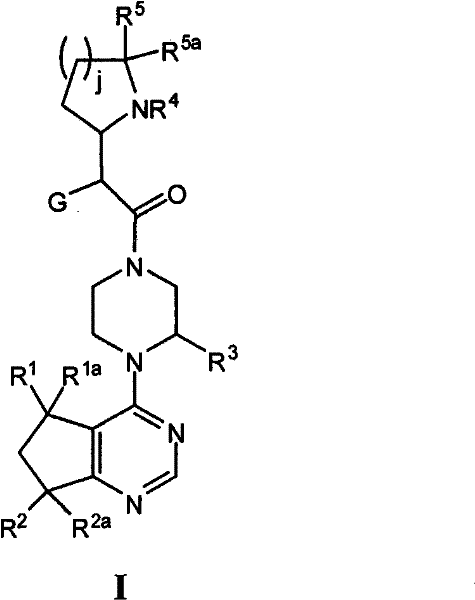
其中:in:
G是苯基、萘基、5-6元杂芳基或9-10元二环杂芳基,其中所述苯基、萘基或杂芳基任选地取代有1至4个Ra基团;G is phenyl, naphthyl, 5-6 membered heteroaryl or 9-10 membered bicyclic heteroaryl, wherein said phenyl, naphthyl or heteroaryl is optionally substituted with 1 to 4 R groups group;
R1和R1a独立地选自H、Me、Et、-CH=CH2、-CH2OH、CF3、CHF2或CH2F;R 1 and R 1a are independently selected from H, Me, Et, -CH═CH 2 , -CH 2 OH, CF 3 , CHF 2 or CH 2 F;
R2选自H、-OH、-OMe或F;R is selected from H, -OH, -OMe or F;
R2a选自H、Me或F,或者R 2a is selected from H, Me or F, or
R2和R2a是氧代;R and R are oxo;
R3是H、Me、Et或CF3;R 3 is H, Me, Et or CF 3 ;
R4是H、4-6元杂环基团、环丙基甲基或C1-C4烷基,所述基团任选被F、-OH或-O(C1-C3烷基)取代;R 4 is H, 4-6 membered heterocyclic group, cyclopropylmethyl or C 1 -C 4 alkyl, said group is optionally replaced by F, -OH or -O(C 1 -C 3 alkyl )replace;
R5和R5a独立地选自H和C1-C4烷基,或者R5和R5a与它们连接的原子一起形成羰基、5-6元环烷基或5-6元杂环基团,其中所述杂环基团具有氧杂原子;R 5 and R 5a are independently selected from H and C 1 -C 4 alkyl, or R 5 and R 5a form carbonyl, 5-6 membered cycloalkyl or 5-6 membered heterocyclic group together with the atoms they are connected to , wherein the heterocyclic group has an oxygen heteroatom;
Ra各自独立地为卤素、C1-C6烷基、C3-C6环烷基、-O-(C1-C6烷基)、CF3、-OCF3、S(C1-C6烷基)、CN、苯基、-OCH2-苯基、NH2、-NO2、-NH-(C1-C6烷基)、-N-(C1-C6烷基)2、哌啶基团、吡咯烷基团、吡唑基团、吡啶基团、2-氨基吡啶基团、CH2F、CHF2、-OCH2F、-OCHF2、-OH、-SO2(C1-C6烷基)、C(O)NH2、C(O)NH(C1-C6烷基)和C(O)N(C1-C6烷基)2;以及Each R a is independently halogen, C 1 -C 6 alkyl, C 3 -C 6 cycloalkyl, -O-(C 1 -C 6 alkyl), CF 3 , -OCF 3 , S(C 1 - C 6 alkyl), CN, phenyl, -OCH 2 -phenyl, NH 2 , -NO 2 , -NH-(C 1 -C 6 alkyl), -N-(C 1 -C 6 alkyl) 2. Piperidine group, pyrrolidinyl group, pyrazole group, pyridine group, 2-aminopyridine group, CH 2 F, CHF 2 , -OCH 2 F, -OCHF 2 , -OH, -SO 2 (C 1 -C 6 alkyl), C(O)NH 2 , C(O)NH(C 1 -C 6 alkyl) and C(O)N(C 1 -C 6 alkyl) 2 ; and
j为1或2;并且当j是2时,可以用O杂原子替换与NR4相对的j环碳。j is 1 or 2; and when j is 2, the j ring carbon opposite to NR 4 may be replaced with an O heteroatom.
一般地,本发明包括式I化合物以及它们的拆分的对映异构体、拆分的非对映异构体和可药用盐,Generally, the present invention includes compounds of formula I as well as their resolved enantiomers, resolved diastereomers and pharmaceutically acceptable salts,
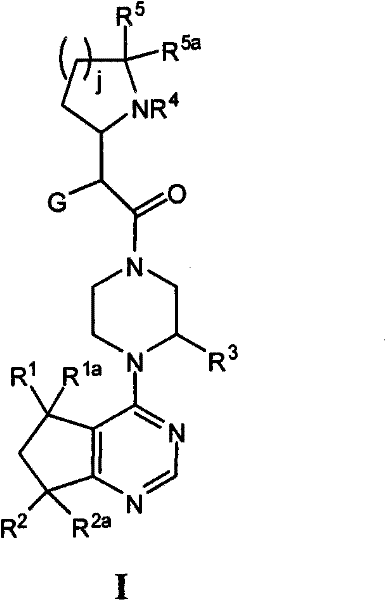
其中:in:
G为任选地取代有1至4个Ra基团的苯基或任选地被卤素取代的5-6元杂芳基;G is phenyl optionally substituted with 1 to 4 R groups or 5-6 membered heteroaryl optionally substituted with halogen;
R1和R1a独立地选自H、Me、Et、-CH=CH2、-CH2OH、CF3、CHF2或CH2F;R 1 and R 1a are independently selected from H, Me, Et, -CH═CH 2 , -CH 2 OH, CF 3 , CHF 2 or CH 2 F;
R2选自H、-OH、-OMe或F;R is selected from H, -OH, -OMe or F;
R2a选自H、Me或F,或者R 2a is selected from H, Me or F, or
R2和R2a是氧代;R and R are oxo;
R3是H、Me、Et或CF3;R 3 is H, Me, Et or CF 3 ;
R4是H、4-6元杂环基团、环丙基甲基或C1-C4烷基,所述基团任选被F、-OH或-O(C1-C3烷基)取代;R 4 is H, 4-6 membered heterocyclic group, cyclopropylmethyl or C 1 -C 4 alkyl, said group is optionally replaced by F, -OH or -O(C 1 -C 3 alkyl )replace;
R5和R5a独立地选自H和C1-C4烷基,或者R5和R5a与它们连接的原子一起形成5-6元环烷基或5-6元杂环基团,其中所述杂环基团具有氧杂原子;R 5 and R 5a are independently selected from H and C 1 -C 4 alkyl, or R 5 and R 5a form a 5-6 membered cycloalkyl group or a 5-6 membered heterocyclic group together with the atoms they are connected to, wherein The heterocyclic group has an oxygen heteroatom;
Ra各自独立地为卤素、C1-C6-烷基、C3-C6环烷基、-O-(C1-C6-烷基)、CF3、-OCF3、S(C1-C6-烷基)、CN、-OCH2-苯基、NH2、-NO2、-NH-(C1-C6-烷基)、-N-(C1-C6-烷基)2、哌啶基团、吡咯烷基团、CH2F、CHF2、-OCH2F、-OCHF2、-OH、-SO2(C1-C6-烷基)、C(O)NH2、C(O)NH(C1-C6-烷基)和C(O)N(C1-C6-烷基)2;Each R a is independently halogen, C 1 -C 6 -alkyl, C 3 -C 6 cycloalkyl, -O-(C 1 -C 6 -alkyl), CF 3 , -OCF 3 , S(C 1 -C 6 -alkyl), CN, -OCH 2 -phenyl, NH 2 , -NO 2 , -NH-(C 1 -C 6 -alkyl), -N-(C 1 -C 6 -alk group) 2 , piperidine group, pyrrolidinyl group, CH 2 F, CHF 2 , -OCH 2 F, -OCHF 2 , -OH, -SO 2 (C 1 -C 6 -alkyl), C(O )NH 2 , C(O)NH(C 1 -C 6 -alkyl) and C(O)N(C 1 -C 6 -alkyl) 2 ;
j为1或2;并且当j是2时,可以用O杂原子替换与NR4相对的j环碳。j is 1 or 2; and when j is 2, the j ring carbon opposite to NR 4 may be replaced with an O heteroatom.
在式I的又一种实施方式中,R2选自H、-OH、-OMe或F;In yet another embodiment of formula I, R is selected from H, -OH, -OMe or F;
R2a选自H、Me或F;R 2a is selected from H, Me or F;
R4是H、4-6元杂环基团、环丙基甲基或C1-C4烷基,所述基团任选被-OH或-O(C1-C3烷基)取代;R 4 is H, 4-6 membered heterocyclic group, cyclopropylmethyl or C 1 -C 4 alkyl, said group is optionally substituted by -OH or -O(C 1 -C 3 alkyl) ;
R5和R5a独立地选自H和C1-C4烷基;以及R and R are independently selected from H and C 1 -C 4 alkyl; and
J为1或2。J is 1 or 2.
提到式I的G基团,实例包括任选地取代有一个或多个Ra基团的苯基(“Ph”),所述Ra基团独立地选自F、Cl、Br、I、甲基、乙基、异丙基、叔丁基、环丙基、CN、CF3、-OMe、-OEt、-OCF3、-NO2、-SMe和-OCH2Ph。G的示例性实施方式包括苯基、2-氯苯基、3-氯苯基、4-氯苯基、4-氟苯基、4-溴苯基、4-甲基苯基、4-乙基苯基、4-异丙基苯基、4-三氟甲基苯基、4-氰基苯基、4-甲氧基苯基、4-乙氧基苯基、4-甲硫基苯基(4-thiomethylphenyl)、4-三氟甲氧基苯基、4-环丙基苯基、4-氯-3-氟苯基、3,4-二氟苯基、4-溴-3-氟苯基、3-氟-4-甲基苯基、3-氟-4-甲氧基苯基、3-氟-4-三氟甲基苯基、4-氰基-3-氟苯基、3,4-二氯苯基、2,4-二氯苯基、2,4-二氟苯基、2-氯-4-氟苯基、2-氟-4-氯苯基、3,5-二氯苯基、3,5-二氟苯基、3-氯-5-氟苯基、3-氯-4-氟苯基、3-溴-4-氟苯基、3,5-二氟-4-氯苯基、2,3-二氟-4-氯苯基、2,5-二氟-4-氯苯基、3,5-二氟-4-溴苯基、2,3-二氟-4-溴苯基、2,5-二氟-4-溴苯基、4-(OCH2Ph)-苯基、4-氯苯基、2,4-二氯苯基、3,4-二氯苯基、4-氯-3-氟苯基、3-氯-4-氟苯基、3-氟-4-溴苯基、4-氟苯基、3,4-二氟苯基、2,4-二氟苯基、4-溴苯基、4-氯-2-氟苯基、4-甲氧基苯基、4-甲基苯基、4-氰基苯基、4-三氟甲基苯基、4-碘苯基、4-硝基苯基、4-叔丁基苯基、2-氟苯基、3-三氟甲基苯基、2-氟-4-三氟甲基苯基、3-氟-4-三氟甲氧基苯基、3-氟-4-三氟甲基苯基和4-三氟甲氧基苯基。Referring to the G group of formula I, examples include phenyl ("Ph") optionally substituted with one or more Ra groups independently selected from F, Cl, Br, I , methyl, ethyl, isopropyl, tert-butyl, cyclopropyl, CN, CF3 , -OMe, -OEt, -OCF3 , -NO2 , -SMe, and -OCH2Ph . Exemplary embodiments of G include phenyl, 2-chlorophenyl, 3-chlorophenyl, 4-chlorophenyl, 4-fluorophenyl, 4-bromophenyl, 4-methylphenyl, 4-ethane phenyl, 4-isopropylphenyl, 4-trifluoromethylphenyl, 4-cyanophenyl, 4-methoxyphenyl, 4-ethoxyphenyl, 4-methylthiophenyl Base (4-thiomethylphenyl), 4-trifluoromethoxyphenyl, 4-cyclopropylphenyl, 4-chloro-3-fluorophenyl, 3,4-difluorophenyl, 4-bromo-3- Fluorophenyl, 3-fluoro-4-methylphenyl, 3-fluoro-4-methoxyphenyl, 3-fluoro-4-trifluoromethylphenyl, 4-cyano-3-fluorophenyl , 3,4-dichlorophenyl, 2,4-dichlorophenyl, 2,4-difluorophenyl, 2-chloro-4-fluorophenyl, 2-fluoro-4-chlorophenyl, 3, 5-dichlorophenyl, 3,5-difluorophenyl, 3-chloro-5-fluorophenyl, 3-chloro-4-fluorophenyl, 3-bromo-4-fluorophenyl, 3,5- Difluoro-4-chlorophenyl, 2,3-difluoro-4-chlorophenyl, 2,5-difluoro-4-chlorophenyl, 3,5-difluoro-4-bromophenyl, 2, 3-difluoro-4-bromophenyl, 2,5-difluoro-4-bromophenyl, 4-(OCH 2 Ph)-phenyl, 4-chlorophenyl, 2,4-dichlorophenyl, 3,4-dichlorophenyl, 4-chloro-3-fluorophenyl, 3-chloro-4-fluorophenyl, 3-fluoro-4-bromophenyl, 4-fluorophenyl, 3,4-di Fluorophenyl, 2,4-difluorophenyl, 4-bromophenyl, 4-chloro-2-fluorophenyl, 4-methoxyphenyl, 4-methylphenyl, 4-cyanophenyl , 4-trifluoromethylphenyl, 4-iodophenyl, 4-nitrophenyl, 4-tert-butylphenyl, 2-fluorophenyl, 3-trifluoromethylphenyl, 2-fluoro- 4-trifluoromethylphenyl, 3-fluoro-4-trifluoromethoxyphenyl, 3-fluoro-4-trifluoromethylphenyl and 4-trifluoromethoxyphenyl.
提到式I的G基团,措辞“任选地被卤素取代的5-6元杂芳基”包括任选地被卤素取代的噻吩基团和吡啶基团。具体实例包括但不限于以下结构:Referring to the G group of formula I, the expression "5-6 membered heteroaryl optionally substituted by halogen" includes thiophene groups and pyridine groups optionally substituted by halogen. Specific examples include but are not limited to the following structures:

在式I的一种实施方式中,R3是H。In one embodiment of formula I, R3 is H.
在式I的另一种实施方式中,R3是甲基,其中所述甲基任选地为(S)构型。In another embodiment of formula I, R3 is methyl, wherein said methyl is optionally in the (S) configuration.
在式I的另一种实施方式中,R3是乙基。In another embodiment of formula I, R3 is ethyl.
在一种实施方式中,R5是H。在又一种实施方式中,R5a是H。In one embodiment, R5 is H. In yet another embodiment, R 5a is H.
在另一种实施方式中,R5是甲基。在又一种实施方式中,R5a是甲基。In another embodiment, R5 is methyl. In yet another embodiment, R 5a is methyl.
在另一种实施方式中,R5是乙基。在又一种实施方式中,R5a是乙基。In another embodiment, R 5 is ethyl. In yet another embodiment, R 5a is ethyl.
在一种实施方式中,R5a是H。In one embodiment, R 5a is H.
在另一种实施方式中,R5a是甲基。In another embodiment, R 5a is methyl.
在另一种实施方式中,R5a是乙基。In another embodiment, R 5a is ethyl.
在某些实施方式中,R5和R5a独立地选自H和C1-C4烷基,或者R5和R5a与它们连接的原子一起形成羰基、5-6元环烷基或5-6元杂环基团,其中所述杂环基团具有氧杂原子。In certain embodiments, R 5 and R 5a are independently selected from H and C 1 -C 4 alkyl, or R 5 and R 5a form carbonyl, 5-6 membered cycloalkyl or 5 - a 6-membered heterocyclic group, wherein the heterocyclic group has an oxygen heteroatom.
在某些实施方式中,R5和R5a独立地选自H和C1-C4烷基,或者R5和R5a是氧代,或与它们连接的原子一起形成5-6元环烷基或5-6元杂环基团,其中所述杂环基团具有氧杂原子。In certain embodiments, R 5 and R 5a are independently selected from H and C 1 -C 4 alkyl, or R 5 and R 5a are oxo, or together with the atoms to which they are attached form a 5-6 membered cycloalkane A group or a 5-6 membered heterocyclic group, wherein the heterocyclic group has an oxygen heteroatom.
在某些实施方式中,R5和R5a与它们连接的原子一起形成羰基,所述化合物包含以下结构:In certain embodiments, R and R together with the atoms to which they are attached form a carbonyl, said compound comprising the following structure:

其中波形线是所述结构连接至式I所需要的哌嗪基团的地方。where the wavy line is where the structure is attached to the piperazine group required by formula I.
在某些实施方式中,R5和R5a与它们连接的原子一起形成5-6元环烷基。该实施方式形成了二环螺环。在某些实施方式中,R5和R5a与它们连接的原子一起形成5-6元环烷基,所述化合物包含以下结构:In certain embodiments, R 5 and R 5a together with the atoms to which they are attached form a 5-6 membered cycloalkyl. This embodiment forms a bicyclic spirocycle. In certain embodiments, R and R together with the atoms to which they are attached form a 5-6 membered cycloalkyl, said compound comprising the following structure:

其中k是1或2,以及波形线是所述结构连接至式I所需要的哌嗪基团的地方。where k is 1 or 2, and the wavy line is where the structure is attached to the piperazine group required by Formula I.
在某些实施方式中,R5和R5a与它们连接的原子一起形成5元环烷基,所述化合物包含以下结构:In certain embodiments, R and R together with the atoms to which they are attached form a 5-membered cycloalkyl, the compound comprising the following structure:

其中波形线是所述结构连接至式I所需要的哌嗪基团的地方。where the wavy line is where the structure is attached to the piperazine group required by formula I.
在某些实施方式中,R5和R5a与它们连接的原子一起形成6元环烷基,所述化合物包含以下结构:In certain embodiments, R and R together with the atoms to which they are attached form a 6-membered cycloalkyl, the compound comprising the following structure:

其中波形线是所述结构连接至式I所需要的哌嗪基团的地方。where the wavy line is where the structure is attached to the piperazine group required by formula I.
在某些实施方式中,R5和R5a与它们连接的原子一起形成5-6元杂环基团,其中所述杂环基团具有氧杂原子。该实施方式形成螺环基团。在某些实施方式中,R5和R5a与它们连接的原子一起形成5-6元杂环基团,其中所述杂环基团具有氧杂原子,所述化合物包含以下结构:In certain embodiments, R 5 and R 5a together with the atoms to which they are attached form a 5-6 membered heterocyclic group, wherein the heterocyclic group has an oxygen heteroatom. This embodiment forms a spirocyclic group. In certain embodiments, R and R together with the atoms to which they are attached form a 5-6 membered heterocyclic group, wherein the heterocyclic group has an oxygen heteroatom, and the compound comprises the following structure:

其中k为1或2,以及波形线是所述结构连接至式I所需要的哌嗪基团的地方。where k is 1 or 2, and the wavy line is where the structure is attached to the piperazine group required by Formula I.
在某些实施方式中,R5和R5a与它们连接的原子一起形成5元杂环基团,其中所述杂环基团具有氧杂原子,所述化合物包含以下结构:In certain embodiments, R and R together with the atoms to which they are attached form a 5 -membered heterocyclic group, wherein the heterocyclic group has an oxygen heteroatom, the compound comprising the following structure:

其中波形线是所述结构连接至式I所需要的哌嗪基团的地方。where the wavy line is where the structure is attached to the piperazine group required by formula I.
在某些实施方式中,R5和R5a与它们连接的原子一起形成6元杂环基团,其中所述杂环基团具有氧杂原子,所述化合物包含以下结构:In certain embodiments, R and R together with the atoms to which they are attached form a 6-membered heterocyclic group, wherein the heterocyclic group has an oxygen heteroatom, the compound comprising the following structure:
其中波形线是所述结构连接至式I所需要的哌嗪基团的地方。where the wavy line is where the structure is attached to the piperazine group required by formula I.
在某些实施方式中,R1为(R)构型。In certain embodiments, R 1 is in the (R) configuration.
在式I的一种实施方式中,R1是甲基,其中所述甲基任选地为(R)构型。在式I的某些实施方式中,R1a是H。在式I的某些实施方式中,R1和R1a均为甲基。In one embodiment of formula I, R 1 is methyl, wherein said methyl is optionally in the (R) configuration. In certain embodiments of formula I, R 1a is H. In certain embodiments of formula I, both R and R are methyl.
在式I的另一种实施方式中,R1是H。在式I的某些实施方式中,R1a是H。In another embodiment of formula I, R1 is H. In certain embodiments of formula I, R 1a is H.
在式I的另一种实施方式中,R1是乙基。在式I的某些实施方式中,R1a是H。In another embodiment of formula I, R 1 is ethyl. In certain embodiments of formula I, R 1a is H.
在式I的另一种实施方式中,R1是CH=CH2(乙烯基)。在式I的某些实施方式中,R1a是H。In another embodiment of formula I, R 1 is CH═CH 2 (vinyl). In certain embodiments of formula I, R 1a is H.
在式I的另一种实施方式中,R1是CH2OH。在式I的某些实施方式中,R1a是H。In another embodiment of formula I, R1 is CH2OH . In certain embodiments of formula I, R 1a is H.
在某些实施方式中,R1是CH2F。在式I的某些实施方式中,R1a是H。In certain embodiments, R1 is CH2F . In certain embodiments of formula I, R 1a is H.
在式I的一种实施方式中,R1a是H。In one embodiment of formula I, R 1a is H.
在某些实施方式中,R2为(R)构型。In certain embodiments, R is in the (R) configuration.
在某些实施方式中,R2为(S)构型。In certain embodiments, R is in the (S) configuration.
在某些实施方式中,R2是H。In certain embodiments, R is H.
在式I的一种实施方式中,R2和R2a是H。In one embodiment of formula I, R2 and R2a are H.
在某些实施方式中,R2是F。In certain embodiments, R 2 is F.
在式I的另一种实施方式中,R2和R2a为F。In another embodiment of formula I, R2 and R2a are F.
在式I的另一种实施方式中,R2是F且R2a是H。在某些实施方式中,R2是(R)构型的F。在某些实施方式中,R2是(S)构型的F。In another embodiment of formula I, R2 is F and R2a is H. In certain embodiments, R 2 is F in the (R) configuration. In certain embodiments, R 2 is F in the (S) configuration.
在式I的另一种实施方式中,R2是OH。在式I的某些实施方式中,R2a是H。在某些实施方式中,R2是(R)构型的OH。在某些实施方式中,R2是(S)构型的OH。In another embodiment of formula I, R2 is OH. In certain embodiments of formula I, R 2a is H. In certain embodiments, R 2 is OH in the (R) configuration. In certain embodiments, R 2 is OH in the (S) configuration.
在式I的另一种实施方式中,R2是OH。在式I的某些实施方式中,R2a是CH3。在某些实施方式中,R2是(R)构型的OH。在某些实施方式中,R2是(S)构型的OH。In another embodiment of formula I, R2 is OH. In certain embodiments of formula I, R 2a is CH 3 . In certain embodiments, R 2 is OH in the (R) configuration. In certain embodiments, R 2 is OH in the (S) configuration.
在式I的另一种实施方式中,R2是-OMe。在某些实施方式中,R2是(R)构型的-OMe。In another embodiment of formula I, R2 is -OMe. In certain embodiments, R 2 is -OMe in the (R) configuration.
在某些实施方式中,R2和R2a是氧代。In certain embodiments, R and R are oxo .
在某些实施方式中,R2a为(R)构型。In certain embodiments, R 2a is in the (R) configuration.
在某些实施方式中,R2a为(S)构型。In certain embodiments, R 2a is in the (S) configuration.
在某些实施方式中,R2a是H。In certain embodiments, R 2a is H.
在某些实施方式中,R2a是CH3。In certain embodiments, R 2a is CH 3 .
在某些实施方式中,R2a是F。In certain embodiments, R 2a is F.
在某些实施方式中,G是苯基、萘基、5-6元杂芳基或9-10元二环杂芳基,其中所述苯基、萘基或杂芳基任选地取代有1至4个Ra基团。在某些实施方式中,G是苯基、萘基、5-6元杂芳基或9-10元二环杂芳基,其中所述苯基、萘基或杂芳基任选地取代有1至4个Ra基团,其中所述杂芳基含有1或2个选自氮和氧的杂原子。在某些实施方式中,G是苯基、萘基、5-6元杂芳基或9-10元二环杂芳基,其中所述苯基、萘基或杂芳基任选地取代有1至4个Ra基团,其中所述5-6元杂芳基是噻吩基团,以及所述9-10元二环杂芳基是吲哚基团或苯并异噁唑基团。在某些实施方式中,G是苯基、萘基、5-6元杂芳基或9-10元二环杂芳基,其中所述苯基、萘基或杂芳基任选地取代有1至4个Ra基团,其中所述5-6元杂芳基是噻吩基团,以及所述9-10元二环杂芳基是吲哚基团。In certain embodiments, G is phenyl, naphthyl, 5-6 membered heteroaryl, or 9-10 membered bicyclic heteroaryl, wherein the phenyl, naphthyl or heteroaryl is optionally substituted with 1 to 4 R a groups. In certain embodiments, G is phenyl, naphthyl, 5-6 membered heteroaryl, or 9-10 membered bicyclic heteroaryl, wherein the phenyl, naphthyl or heteroaryl is optionally substituted with 1 to 4 R a groups, wherein the heteroaryl contains 1 or 2 heteroatoms selected from nitrogen and oxygen. In certain embodiments, G is phenyl, naphthyl, 5-6 membered heteroaryl, or 9-10 membered bicyclic heteroaryl, wherein the phenyl, naphthyl or heteroaryl is optionally substituted with 1 to 4 R a groups, wherein the 5-6 membered heteroaryl group is a thiophene group, and the 9-10 membered bicyclic heteroaryl group is an indole group or a benzisoxazole group. In certain embodiments, G is phenyl, naphthyl, 5-6 membered heteroaryl, or 9-10 membered bicyclic heteroaryl, wherein the phenyl, naphthyl or heteroaryl is optionally substituted with 1 to 4 R a groups, wherein the 5-6 membered heteroaryl is a thiophene group, and the 9-10 membered bicyclic heteroaryl is an indole group.
在某些实施方式中,G是任选地取代有1至4个Ra基团的苯基、任选地取代有卤素的5-6元杂芳基、萘基或9-10元二环杂芳基。In certain embodiments, G is phenyl optionally substituted with 1 to 4 R groups, 5-6 membered heteroaryl optionally substituted with halogen, naphthyl, or 9-10 membered bicyclic heteroaryl.
在式I的一种实施方式中,G是任选地取代有1至4个Ra基团的苯基。在某些实施方式中,Ra各自独立地为卤素、C1-C6-烷基、C3-C6环烷基、-O-(C1-C6-烷基)、CF3、-OCF3、S(C1-C6-烷基)、CN、苯基、-OCH2-苯基、NH2、-NO2、-NH-(C1-C6-烷基)、-N-(C1-C6-烷基)2、哌啶基团、吡咯烷基团、吡唑基团、吡啶基团、2-氨基吡啶基团、CH2F、CHF2、-OCH2F、-OCHF2、-OH、-SO2(C1-C6-烷基)、C(O)NH2、C(O)NH(C1-C6-烷基)和C(O)N(C1-C6-烷基)2。G的示例性实施方式包括苯基、2-氯苯基、3-氯苯基、4-氯苯基、4-氟苯基、4-溴苯基、4-甲基苯基、4-乙基苯基、4-异丙基苯基、4-三氟甲基苯基、4-氰基苯基、4-甲氧基苯基、4-乙氧基苯基、4-甲硫基苯基、4-三氟甲氧基苯基、4-环丙基苯基、4-氯-3-氟苯基、3,4-二氟苯基、4-溴-3-氟苯基、3-氟-4-甲基苯基、3-氟-4-甲氧基苯基、3-氟-4-三氟甲基苯基、4-氰基-3-氟苯基、3,4-二氯苯基、2,4-二氯苯基、2,4-二氟苯基、2-氯-4-氟苯基、2-氟-4-氯苯基、3,5-二氯苯基、3,5-二氟苯基、3-氯-5-氟苯基、3-氯-4-氟苯基、3-溴-4-氟苯基、3,5-二氟-4-氯苯基、2,3-二氟-4-氯苯基、2,5-二氟-4-氯苯基、3,5-二氟-4-溴苯基、2,3-二氟-4-溴苯基、2,5-二氟-4-溴苯基、4-(OCH2Ph)-苯基、3-氟-4-溴苯基、4-碘苯基、4-硝基苯基、4-叔丁基苯基、2-氟苯基、3-三氟甲基苯基、2-氟-4-三氟甲基苯基、3-氟-4-三氟甲氧基苯基、4-三氟甲氧基苯基、4-溴-2-氟苯基、2-氟-4-甲基苯基、4-氟-3-三氟甲基苯基、3-溴苯基、3-氟苯基、2-氟-4-甲氧基苯基、4-(1H-吡唑-4-基)苯基、联苯-4-基、4-(2-氨基嘧啶-5-基)苯基、2,3-二氟-4-三氟甲基苯基、2-氟-3-(三氟甲基)苯基和2-氟-5-(三氟甲基)苯基。In one embodiment of formula I, G is phenyl optionally substituted with 1 to 4 R a groups. In certain embodiments, each R a is independently halogen, C 1 -C 6 -alkyl, C 3 -C 6 cycloalkyl, -O-(C 1 -C 6 -alkyl), CF 3 , -OCF 3 , S(C 1 -C 6 -alkyl), CN, phenyl, -OCH 2 -phenyl, NH 2 , -NO 2 , -NH-(C 1 -C 6 -alkyl), - N-(C 1 -C 6 -alkyl) 2 , piperidine group, pyrrolidinyl group, pyrazole group, pyridine group, 2-aminopyridine group, CH 2 F, CHF 2 , -OCH 2 F, -OCHF 2 , -OH, -SO 2 (C 1 -C 6 -alkyl), C(O)NH 2 , C(O)NH(C 1 -C 6 -alkyl) and C(O) N(C 1 -C 6 -alkyl) 2 . Exemplary embodiments of G include phenyl, 2-chlorophenyl, 3-chlorophenyl, 4-chlorophenyl, 4-fluorophenyl, 4-bromophenyl, 4-methylphenyl, 4-ethane phenyl, 4-isopropylphenyl, 4-trifluoromethylphenyl, 4-cyanophenyl, 4-methoxyphenyl, 4-ethoxyphenyl, 4-methylthiophenyl Base, 4-trifluoromethoxyphenyl, 4-cyclopropylphenyl, 4-chloro-3-fluorophenyl, 3,4-difluorophenyl, 4-bromo-3-fluorophenyl, 3 -Fluoro-4-methylphenyl, 3-fluoro-4-methoxyphenyl, 3-fluoro-4-trifluoromethylphenyl, 4-cyano-3-fluorophenyl, 3,4- Dichlorophenyl, 2,4-dichlorophenyl, 2,4-difluorophenyl, 2-chloro-4-fluorophenyl, 2-fluoro-4-chlorophenyl, 3,5-dichlorobenzene Base, 3,5-difluorophenyl, 3-chloro-5-fluorophenyl, 3-chloro-4-fluorophenyl, 3-bromo-4-fluorophenyl, 3,5-difluoro-4- Chlorophenyl, 2,3-difluoro-4-chlorophenyl, 2,5-difluoro-4-chlorophenyl, 3,5-difluoro-4-bromophenyl, 2,3-difluoro- 4-bromophenyl, 2,5-difluoro-4-bromophenyl, 4-(OCH 2 Ph)-phenyl, 3-fluoro-4-bromophenyl, 4-iodophenyl, 4-nitro Phenyl, 4-tert-butylphenyl, 2-fluorophenyl, 3-trifluoromethylphenyl, 2-fluoro-4-trifluoromethylphenyl, 3-fluoro-4-trifluoromethoxy Phenyl, 4-trifluoromethoxyphenyl, 4-bromo-2-fluorophenyl, 2-fluoro-4-methylphenyl, 4-fluoro-3-trifluoromethylphenyl, 3-bromo Phenyl, 3-fluorophenyl, 2-fluoro-4-methoxyphenyl, 4-(1H-pyrazol-4-yl)phenyl, biphenyl-4-yl, 4-(2-aminopyrimidine -5-yl)phenyl, 2,3-difluoro-4-trifluoromethylphenyl, 2-fluoro-3-(trifluoromethyl)phenyl and 2-fluoro-5-(trifluoromethyl ) phenyl.
在式I的一种实施方式中,G是任选地取代有一个或多个基团的苯基,所述一个或多个基团独立地选自F、Cl、Br、I、甲基、乙基、异丙基、叔丁基、环丙基、CN、CF3、OMe、OEt、OCF3、NO2、SMe和OCH2Ph。G的示例性实施方式包括苯基、2-氯苯基、3-氯苯基、4-氯苯基、4-氟苯基、4-溴苯基、4-甲基苯基、4-乙基苯基、4-异丙基苯基、4-三氟甲基苯基、4-氰基苯基、4-甲氧基苯基、4-乙氧基苯基、4-甲硫基苯基、4-三氟甲氧基苯基、4-环丙基苯基、4-氯-3-氟苯基、3,4-二氟苯基、4-溴-3-氟苯基、3-氟-4-甲基苯基、3-氟-4-甲氧基苯基、3-氟-4-三氟甲基苯基、4-氰基-3-氟苯基、3,4-二氯苯基、2,4-二氯苯基、2,4-二氟苯基、2-氯-4-氟苯基、2-氟-4-氯苯基、3,5-二氯苯基、3,5-二氟苯基、3-氯-5-氟苯基、3-氯-4-氟苯基、3-溴-4-氟苯基、3,5-二氟-4-氯苯基、2,3-二氟-4-氯苯基、2,5-二氟-4-氯苯基、3,5-二氟-4-溴苯基、2,3-二氟-4-溴苯基、2,5-二氟-4-溴苯基、4-(OCH2Ph)-苯基、4-氯苯基、2,4-二氯苯基、3,4-二氯苯基、4-氯-3-氟苯基、3-氯-4-氟苯基、3-氟-4-溴苯基、4-氟苯基、3,4-二氟苯基、2,4-二氟苯基、4-溴苯基、4-氯-2-氟苯基、4-甲氧基苯基、4-甲基苯基、4-氰基苯基、4-三氟甲基苯基、4-碘苯基、4-硝基苯基、4-叔丁基苯基、2-氟苯基、3-三氟甲基苯基、2-氟-4-三氟甲基苯基、3-氟-4-三氟甲氧基苯基、3-氟-4-三氟甲基苯基和4-三氟甲氧基苯基。在具体实施方式中,G选自4-氯苯基、3-氟-4-氯苯基、3-氟-4-三氟甲基苯基和4-环丙基苯基。In one embodiment of formula I, G is phenyl optionally substituted with one or more groups independently selected from F, Cl, Br, I, methyl, Ethyl, isopropyl, t-butyl, cyclopropyl, CN, CF3 , OMe, OEt, OCF3 , NO2 , SMe and OCH2Ph . Exemplary embodiments of G include phenyl, 2-chlorophenyl, 3-chlorophenyl, 4-chlorophenyl, 4-fluorophenyl, 4-bromophenyl, 4-methylphenyl, 4-ethane phenyl, 4-isopropylphenyl, 4-trifluoromethylphenyl, 4-cyanophenyl, 4-methoxyphenyl, 4-ethoxyphenyl, 4-methylthiophenyl Base, 4-trifluoromethoxyphenyl, 4-cyclopropylphenyl, 4-chloro-3-fluorophenyl, 3,4-difluorophenyl, 4-bromo-3-fluorophenyl, 3 -Fluoro-4-methylphenyl, 3-fluoro-4-methoxyphenyl, 3-fluoro-4-trifluoromethylphenyl, 4-cyano-3-fluorophenyl, 3,4- Dichlorophenyl, 2,4-dichlorophenyl, 2,4-difluorophenyl, 2-chloro-4-fluorophenyl, 2-fluoro-4-chlorophenyl, 3,5-dichlorobenzene Base, 3,5-difluorophenyl, 3-chloro-5-fluorophenyl, 3-chloro-4-fluorophenyl, 3-bromo-4-fluorophenyl, 3,5-difluoro-4- Chlorophenyl, 2,3-difluoro-4-chlorophenyl, 2,5-difluoro-4-chlorophenyl, 3,5-difluoro-4-bromophenyl, 2,3-difluoro- 4-bromophenyl, 2,5-difluoro-4-bromophenyl, 4-(OCH 2 Ph)-phenyl, 4-chlorophenyl, 2,4-dichlorophenyl, 3,4-di Chlorophenyl, 4-chloro-3-fluorophenyl, 3-chloro-4-fluorophenyl, 3-fluoro-4-bromophenyl, 4-fluorophenyl, 3,4-difluorophenyl, 2 , 4-difluorophenyl, 4-bromophenyl, 4-chloro-2-fluorophenyl, 4-methoxyphenyl, 4-methylphenyl, 4-cyanophenyl, 4-trifluoro Methylphenyl, 4-iodophenyl, 4-nitrophenyl, 4-tert-butylphenyl, 2-fluorophenyl, 3-trifluoromethylphenyl, 2-fluoro-4-trifluoromethyl phenyl, 3-fluoro-4-trifluoromethoxyphenyl, 3-fluoro-4-trifluoromethylphenyl and 4-trifluoromethoxyphenyl. In a specific embodiment, G is selected from 4-chlorophenyl, 3-fluoro-4-chlorophenyl, 3-fluoro-4-trifluoromethylphenyl and 4-cyclopropylphenyl.
在式I的一种实施方式中,G可以是任选地被一个或多个卤素取代的5-6元单环杂芳基。在某些实施方式中,G可以是任选地被卤素取代的噻吩基团或吡啶基团。具体实施方式包括:In one embodiment of formula I, G can be a 5-6 membered monocyclic heteroaryl optionally substituted with one or more halogens. In certain embodiments, G can be a thiophene group or a pyridine group optionally substituted with halogen. Specific implementation methods include:

在某些实施方式中,G是任选地取代有1至4个Ra基团的萘基。在某些实施方式中,G是萘基。在某些实施方式中,G是萘-1-基或萘-2-基。In certain embodiments, G is naphthyl optionally substituted with 1 to 4 R a groups. In certain embodiments, G is naphthyl. In certain embodiments, G is naphthalen-1-yl or naphthalen-2-yl.
在某些实施方式中,G是9-10元二环杂芳基。在某些实施方式中,G是9-10元二环杂芳基,其中所述杂芳基含有1至2个选自氮和氧的杂原子。在某些实施方式中,G是9-10元二环杂芳基,其中所述杂芳基含有1个氮杂原子。在某些实施方式中,G是9-10元二环杂芳基,其中所述杂芳基为吲哚基团或苯并异噁唑基团。在某些实施方式中,G是9-10元二环杂芳基,其中所述杂芳基是吲哚基团。在某些实施方式中,G是9-10元二环杂芳基,其中所述杂芳基是1H-吲哚-3-基。In certain embodiments, G is a 9-10 membered bicyclic heteroaryl. In certain embodiments, G is a 9-10 membered bicyclic heteroaryl, wherein said heteroaryl contains 1 to 2 heteroatoms selected from nitrogen and oxygen. In certain embodiments, G is a 9-10 membered bicyclic heteroaryl, wherein the heteroaryl contains 1 nitrogen heteroatom. In certain embodiments, G is a 9-10 membered bicyclic heteroaryl, wherein said heteroaryl is an indole group or a benzisoxazole group. In certain embodiments, G is a 9-10 membered bicyclic heteroaryl, wherein said heteroaryl is an indole group. In certain embodiments, G is a 9-10 membered bicyclic heteroaryl, wherein said heteroaryl is 1H-indol-3-yl.
在某些实施方式中,G被1个Ra基团所取代。In certain embodiments, G is substituted with 1 R a group.
在某些实施方式中,Ra是Cl。In certain embodiments, Ra is Cl.
在某些实施方式中,Ra是Br。In certain embodiments, Ra is Br.
在某些实施方式中,Ra是环丙基。In certain embodiments, Ra is cyclopropyl.
在某些实施方式中,Ra是三氟甲基。In certain embodiments, Ra is trifluoromethyl.
在某些实施方式中,Ra是氰基。In certain embodiments, Ra is cyano.
在某些实施方式中,Ra是-SO2(C1-C6-烷基)。在某些实施方式中,Ra是-SO2CH3。In certain embodiments, R a is -SO 2 (C 1 -C 6 -alkyl). In certain embodiments, R a is -SO 2 CH 3 .
在某些实施方式中,Ra是C(O)NH2。在某些实施方式中,G是苯甲酰胺基团。In certain embodiments, R a is C(O)NH 2 . In certain embodiments, G is a benzamide group.
在某些实施方式中,Ra是F。In certain embodiments, Ra is F.
在某些实施方式中,Ra是苯基。In certain embodiments, Ra is phenyl.
在某些实施方式中,Ra是2-氨基嘧啶基团。在某些实施方式中,Ra是2-氨基嘧啶-5-基。In certain embodiments, Ra is 2-aminopyrimidine group. In certain embodiments, Ra is 2-aminopyrimidin-5-yl.
在某些实施方式中,Ra是C1-C6烷基。在某些实施方式中,Ra是甲基或叔丁基。In certain embodiments, R a is C 1 -C 6 alkyl. In certain embodiments, Ra is methyl or tert-butyl.
在某些实施方式中,Ra是1H-吡唑基团。在某些实施方式中,Ra是1H-吡唑-4-基。In certain embodiments, Ra is 1H-pyrazole. In certain embodiments, Ra is 1H-pyrazol-4-yl.
在某些实施方式中,Ra是甲氧基。In certain embodiments, Ra is methoxy.
在某些实施方式中,Ra是三氟甲氧基。In certain embodiments, Ra is trifluoromethoxy.
在某些实施方式中,G被2个Ra基团所取代。在某些实施方式中,Ra选自F、Cl、CF3或CN。In certain embodiments, G is substituted with 2 R a groups. In certain embodiments, Ra is selected from F, Cl, CF 3 or CN.
在某些实施方式中,G是4-氯苯基、4-溴苯基、4-环丙基苯基、4-三氟甲基苯基、4-氰基苯基、4-氨甲酰基苯基(4-benzamide)、4-(甲基磺酰基)苯基、2-氟-4-三氟甲基苯基、3-氟-4-氯苯基、3-氟-4-三氟甲基苯基、3-氟-4-氰基苯基、4-氯-2,5-二氟苯基、4-氯-2-氟苯基、4-溴-2-氟苯基、4-溴-3-氟苯基、3-氯苯基、2-氟-4-甲基苯基、2,4-二氯苯基、3,4-二氯苯基、4-氟苯基、4-氟-3-三氟甲基苯基、3-溴苯基、3-三氟甲基苯基、3-氟苯基、2-氟-4-甲氧基苯基、4-(1H-吡唑-4-基)苯基、联苯-4-基、4-(2-氨基嘧啶-5-基)苯基、4-叔丁基苯基、2,3-二氟-4-(三氟甲基)苯基、2-氟-3-(三氟甲基)苯基、2-氟-5-(三氟甲基)苯基、4-(三氟甲氧基)苯基和3-氟-4-(三氟甲氧基)苯基。In certain embodiments, G is 4-chlorophenyl, 4-bromophenyl, 4-cyclopropylphenyl, 4-trifluoromethylphenyl, 4-cyanophenyl, 4-carbamoyl Phenyl (4-benzamide), 4-(methylsulfonyl)phenyl, 2-fluoro-4-trifluoromethylphenyl, 3-fluoro-4-chlorophenyl, 3-fluoro-4-trifluoro Methylphenyl, 3-fluoro-4-cyanophenyl, 4-chloro-2,5-difluorophenyl, 4-chloro-2-fluorophenyl, 4-bromo-2-fluorophenyl, 4 -Bromo-3-fluorophenyl, 3-chlorophenyl, 2-fluoro-4-methylphenyl, 2,4-dichlorophenyl, 3,4-dichlorophenyl, 4-fluorophenyl, 4-fluoro-3-trifluoromethylphenyl, 3-bromophenyl, 3-trifluoromethylphenyl, 3-fluorophenyl, 2-fluoro-4-methoxyphenyl, 4-(1H -pyrazol-4-yl)phenyl, biphenyl-4-yl, 4-(2-aminopyrimidin-5-yl)phenyl, 4-tert-butylphenyl, 2,3-difluoro-4- (Trifluoromethyl)phenyl, 2-fluoro-3-(trifluoromethyl)phenyl, 2-fluoro-5-(trifluoromethyl)phenyl, 4-(trifluoromethoxy)phenyl and 3-fluoro-4-(trifluoromethoxy)phenyl.
在某些实施方式中,G是4-氯苯基、4-溴苯基、4-环丙基苯基、4-三氟甲基苯基、4-氰基苯基、4-氨甲酰基苯基、4-(甲基磺酰基)苯基、2-氟-4-三氟甲基苯基、3-氟-4-氯苯基、3-氟-4-三氟甲基苯基、3-氟-4-氰基苯基、4-氯-2,5-二氟苯基、4-氯-2-氟苯基、4-溴-2-氟苯基、4-溴-3-氟苯基、2-氟-4-甲基苯基、2,4-二氯苯基、3,4-二氯苯基、4-氟苯基、4-氟-3-三氟甲基苯基、2-氟-4-甲氧基苯基、4-(1H-吡唑-4-基)苯基、联苯-4-基、4-(2-氨基嘧啶-5-基)苯基、4-叔丁基苯基、2,3-二氟-4-(三氟甲基)苯基、2-氟-3-(三氟甲基)苯基、2-氟-5-(三氟甲基)苯基、4-(三氟甲氧基)苯基和3-氟-4-(三氟甲氧基)苯基。In certain embodiments, G is 4-chlorophenyl, 4-bromophenyl, 4-cyclopropylphenyl, 4-trifluoromethylphenyl, 4-cyanophenyl, 4-carbamoyl Phenyl, 4-(methylsulfonyl)phenyl, 2-fluoro-4-trifluoromethylphenyl, 3-fluoro-4-chlorophenyl, 3-fluoro-4-trifluoromethylphenyl, 3-fluoro-4-cyanophenyl, 4-chloro-2,5-difluorophenyl, 4-chloro-2-fluorophenyl, 4-bromo-2-fluorophenyl, 4-bromo-3- Fluorophenyl, 2-fluoro-4-methylphenyl, 2,4-dichlorophenyl, 3,4-dichlorophenyl, 4-fluorophenyl, 4-fluoro-3-trifluoromethylbenzene Base, 2-fluoro-4-methoxyphenyl, 4-(1H-pyrazol-4-yl)phenyl, biphenyl-4-yl, 4-(2-aminopyrimidin-5-yl)phenyl , 4-tert-butylphenyl, 2,3-difluoro-4-(trifluoromethyl)phenyl, 2-fluoro-3-(trifluoromethyl)phenyl, 2-fluoro-5-(three Fluoromethyl)phenyl, 4-(trifluoromethoxy)phenyl and 3-fluoro-4-(trifluoromethoxy)phenyl.
在某些实施方式中,G是4-氯苯基、4-溴苯基、4-环丙基苯基、4-三氟甲基苯基、4-氰基苯基、4-氨甲酰基苯基、4-(甲基磺酰基)苯基、2-氟-4-三氟甲基苯基、3-氟-4-氯苯基、3-氟-4-三氟甲基苯基或3-氟-4-氰基苯基。In certain embodiments, G is 4-chlorophenyl, 4-bromophenyl, 4-cyclopropylphenyl, 4-trifluoromethylphenyl, 4-cyanophenyl, 4-carbamoyl Phenyl, 4-(methylsulfonyl)phenyl, 2-fluoro-4-trifluoromethylphenyl, 3-fluoro-4-chlorophenyl, 3-fluoro-4-trifluoromethylphenyl or 3-fluoro-4-cyanophenyl.
在式I的一种实施方式中,R4是C1-C4烷基。在具体实施方式中,R4选自甲基、乙基、异丙基或异丁基。In one embodiment of formula I, R 4 is C 1 -C 4 alkyl. In a particular embodiment, R is selected from methyl, ethyl, isopropyl or isobutyl.
在式I的一种实施方式中,R4是任选地取代有-OH的C1-C4烷基。在具体实施方式中,R4是CH2CH2OH、CH2CH2CH2OH或CH2C(CH3)2OH。In one embodiment of formula I, R 4 is C 1 -C 4 alkyl optionally substituted with -OH. In particular embodiments , R4 is CH2CH2OH , CH2CH2CH2OH or CH2C ( CH3 ) 2OH .
在式I的一种实施方式中,R4是任选地取代有-O(C1-C3烷基)的C1-C4烷基。在一种具体实施方式中,R4是CH2CH2OCH3。In one embodiment of formula I, R 4 is C 1 -C 4 alkyl optionally substituted with —O(C 1 -C 3 alkyl). In a specific embodiment , R4 is CH2CH2OCH3 .
在式I的一种实施方式中,R4是任选地取代有F的C1-C4烷基。在具体实施方式中,R4是CH2CF3、CH2CH2F或CH2CHF2。In one embodiment of formula I, R 4 is C 1 -C 4 alkyl optionally substituted with F. In specific embodiments , R4 is CH2CF3 , CH2CH2F or CH2CHF2 .
在式I的一种实施方式中,R4是环丙基甲基。In one embodiment of formula I, R 4 is cyclopropylmethyl.
在式I的一种实施方式中,R4是4-6元杂环基团。在一种具体实施方式中,R4是6元杂环基团。在又一种实施方式中,R4是含氧原子的6元杂环基团。在又一种实施方式中,R4是四氢吡喃基。In one embodiment of formula I, R 4 is a 4-6 membered heterocyclic group. In a specific embodiment, R 4 is a 6-membered heterocyclic group. In yet another embodiment, R 4 is a 6 membered heterocyclic group containing an oxygen atom. In yet another embodiment, R4 is tetrahydropyranyl.
在又一种实施方式中,R4是四氢吡喃-4-基。In yet another embodiment, R4 is tetrahydropyran-4-yl.
在式I的另一种实施方式中,R4是H。In another embodiment of formula I, R4 is H.
在式I的一种实施方式中,j是1。当j是1时,式I具有式IA的结构:In one embodiment of formula I, j is 1. When j is 1, Formula I has the structure of Formula IA:

在式I的另一种实施方式中,j是2。当j是2时,式I具有式IB的结构:In another embodiment of formula I, j is 2. When j is 2, formula I has the structure of formula IB:
在式I的另一种实施方式中,j是2,以及可以用O杂原子替换与NR4相对的j环碳。式I的这种实施方式在下面作为式IC示出:In another embodiment of formula I, j is 2, and the j ring carbon opposite NR 4 may be replaced with an O heteroatom. This embodiment of Formula I is shown below as Formula IC:

在式I的另一种实施方式中,G是3-取代的苯基。式I的这种实施方式在下面作为式II示出:In another embodiment of formula I, G is 3-substituted phenyl. This embodiment of Formula I is shown below as Formula II:
其中R1、R1a、R2、R2a、R3、R4、R5、R5a、Ra和j如本申请中所定义。wherein R 1 , R 1a , R 2 , R 2a , R 3 , R 4 , R 5 , R 5a , R a and j are as defined in the present application.
在式II的某些实施方式中,Ra是卤素或CF3。In certain embodiments of formula II, R a is halogen or CF 3 .
在某些实施方式中,式I化合物不含式II化合物。In certain embodiments, the compound of formula I is free of the compound of formula II.
在某些实施方式中,除非另有陈述,盐是“可药用盐”,其包括保持具体化合物的相应游离酸或碱的生物有效性,并且不是生物学或其他不合需要的盐。In certain embodiments, unless otherwise stated, a salt is a "pharmaceutically acceptable salt," which includes salts that retain the biological effectiveness of the corresponding free acid or base of the particular compound and are not biologically or otherwise undesirable.
式I化合物还包括这些化合物的其它盐,其不一定是可药用盐,并且其可以用作制备和/或纯化式I化合物的中间体和/或分离式I化合物的对映异构体的中间体。Compounds of formula I also include other salts of these compounds, which are not necessarily pharmaceutically acceptable salts, and which can be used as intermediates for the preparation and/or purification of compounds of formula I and/or for the separation of enantiomers of compounds of formula I intermediate.
式I化合物的合成Synthesis of Formula I Compounds
本发明的化合物可以利用包括与化学领域中熟知的方法相类似的方法的合成路线,具体地按照本申请所包含的描述来合成。起始原料通常可得自商品渠道,例如Sigma-Aldrich(St.Louis,MO)、Alfa Aesar(Ward Hill,MA)或TCI(Portland,OR),或者使用本领域技术人员熟知的方法方便地制备(例如,利用描述在下列中的方法来制备:Louis F.Fieser和Mary Fieser,Reagentsfor Organic Synthesis,v.1-19,Wiley,N.Y.(1967-1999ed.),或BeilsteinsHandbuch der organischen Chemie,4,Aufl.ed.Springer-Verlag,Berlin,包括增刊(也可通过Beilstein在线数据库获得))。The compounds of the present invention can be synthesized using synthetic routes involving methods analogous to those well known in the chemical arts, in particular as described contained herein. Starting materials are generally available from commercial sources such as Sigma-Aldrich (St. Louis, MO), Alfa Aesar (Ward Hill, MA) or TCI (Portland, OR), or are conveniently prepared using methods well known to those skilled in the art. (For example, prepared using the method described in: Louis F. Fieser and Mary Fieser, Reagents for Organic Synthesis, v.1-19, Wiley, N.Y. (1967-1999ed.), or Beilsteins Handbuch der organischen Chemie, 4, Aufl .ed. Springer-Verlag, Berlin, including supplements (also available through the Beilstein online database)).
可以单独制备式I化合物,或以包括至少2个,例如5至1,000个化合物或10至100个化合物的化合物库形式来制备。式I化合物库可以通过组合的“分开和混合(split and mix)”方法或通过多重平行合成(multiple parallelsyntheses),利用本领域技术人员已知的操作,使用液相或固相化学过程进行制备。因此,按照本发明的其它方面,提供了包括至少2个式I化合物或其盐的化合物库。Compounds of formula I may be prepared individually, or as compound libraries comprising at least 2, for example 5 to 1,000 compounds or 10 to 100 compounds. Libraries of compounds of formula I can be prepared by combinatorial "split and mix" methods or by multiple parallel syntheses, using procedures known to those skilled in the art, using either liquid or solid phase chemistry. Thus, according to other aspects of the invention there is provided a compound library comprising at least 2 compounds of formula I or salts thereof.
出于示例性的目的,方案1-8显示了制备本发明化合物以及关键中间体的通用方法。对于单个反应步骤的更详细的描述,参见下面的实施例部分。本领域技术人员将理解,可以使用其它合成路线来合成本发明的化合物。尽管在方案中描述了具体起始原料和试剂并且在下面进行了讨论,但可以容易地替换为其它起始原料和试剂,以提供各种衍生物和/或反应条件。此外,可以按照本公开,使用本领域技术人员熟知的常规化学过程,将通过如下所述方法制备的许多化合物进行进一步修饰。For illustrative purposes, Schemes 1-8 show general methods for the preparation of compounds of the invention as well as key intermediates. For a more detailed description of the individual reaction steps see the Examples section below. Those skilled in the art will appreciate that other synthetic routes may be used to synthesize the compounds of the invention. Although specific starting materials and reagents are described in the schemes and discussed below, other starting materials and reagents can be readily substituted to provide various derivatives and/or reaction conditions. In addition, many of the compounds prepared by the methods described below can be further modified in accordance with the present disclosure using routine chemistry well known to those skilled in the art.

方案1plan 1
方案1示出制备具有通式10的化合物的方法。适当取代的苯基乙酸(1)与手性助剂(例如,Evans’噁唑烷酮(2))的缩合可以使用酰氯如新戊酰氯作为活化剂在叔胺碱如Hunig’s碱的存在下进行。用还原剂(例如,二异丁基氢化铝(“DIBAL-H”),在-78℃至25℃)还原内酰胺(4),并用甲醇且在酸如对甲苯磺酸(“pTsA”)的存在下淬灭,得到中间体甲氧基杂环(5)。(3)和(5)的缩合可以使用适合的路易斯酸和弱碱(例如,四氯化钛和二异丙基乙基胺)完成,以形成2-取代的杂环(6)。该反应可能需要在低温(例如,-100℃至0℃)进行,以在反应中获得可接受的非对映异构选择性。使用碱(例如,LiOH、H2O2)在0℃至50℃水解手性助剂,得到羧酸(7)。可以使用肽键形成条件(例如,2-(1H-苯并三唑-1-基)-1,1,3,3-四甲基脲鎓六氟磷酸盐(“2-(1H-benzotriazole-1-yl)-1,1,3,3-tetramethyluronium hexafluorophosphate,HBTU”),N,N-二异丙基乙基胺(“DIEA”),在0℃至50℃)将酸(7)偶联至哌嗪中间体(8),从而合成完全加工的类似物(fully elaborated analog)。使用无水酸(例如,二噁烷中的HCl)将化合物(9)脱保护,得到游离胺。如果需要,在标准条件下该胺的还原胺化(使用醛和还原剂(例如,NaBH(OAc)3))、烷基化或酰基化容许制备叔胺(10)。Scheme 1 shows a method for preparing compounds of general formula 10 . Condensation of appropriately substituted phenylacetic acids (1) with chiral auxiliaries (e.g., Evans' oxazolidinone (2)) can be carried out using acid chlorides such as pivaloyl chloride as activators in the presence of tertiary amine bases such as Hunig's base . Reduction of the lactam (4) with a reducing agent (e.g., diisobutylaluminum hydride ("DIBAL-H") at -78°C to 25°C) and reduction of the lactam (4) with methanol and in an acid such as p-toluenesulfonic acid ("pTsA") Quenching in the presence of gives the intermediate methoxyheterocycle (5). Condensation of (3) and (5) can be accomplished using a suitable Lewis acid and weak base (eg, titanium tetrachloride and diisopropylethylamine) to form the 2-substituted heterocycle (6). The reaction may need to be performed at low temperatures (eg, -100°C to 0°C) to obtain acceptable diastereoselectivity in the reaction. Hydrolysis of the chiral auxiliary using a base (eg, LiOH, H2O2 ) at 0 °C to 50°C affords carboxylic acid (7). Peptide bond forming conditions (e.g., 2-(1H-benzotriazol-1-yl)-1,1,3,3-tetramethyluronium hexafluorophosphate (“2-(1H-benzotriazole-1-yl) 1-yl)-1,1,3,3-tetramethyluronium hexafluorophosphate, HBTU"), N,N-diisopropylethylamine ("DIEA"), coupling acid (7) at 0°C to 50°C) Linkage to the piperazine intermediate (8) leads to the synthesis of a fully elaborated analog. Deprotection of compound (9) using anhydrous acid (eg, HCl in dioxane) affords the free amine. Reductive amination (using an aldehyde and a reducing agent (eg, NaBH(OAc) 3 )), alkylation or acylation of this amine under standard conditions allows the preparation of tertiary amines (10), if desired.
使用可选择的手性助剂、不同立体化学的Evans’助剂或反应条件/试剂可以导致分离出产物的可选择的立体异构体,从而提供得到化合物6的可选择的绝对立体化学的一般路线。Use of alternative chiral auxiliaries, Evans' auxiliaries of different stereochemistry, or reaction conditions/reagents can result in the isolation of alternative stereoisomers of the product, thus providing a general guide to alternative absolute stereochemistry of compound 6. route.

方案2Scenario 2
方案2示出了制备式I的化合物19(其中R2、R2a和R1是氢,R1a是甲基)的方法。根据方案1,中间体13可以通过以下方法制备:溴化(+)-长叶薄荷酮11以提供二溴化物12,然后用碱如乙醇钠处理二溴化物12。将蒲勒烯酸酯(pulegenate)13臭氧分解,得到酮酯14。通过在碱如KOH的存在下使酮酯14与硫脲反应而构成嘧啶环。通过用催化剂如Raney Ni在氨中还原,将在化合物15的2-位的巯基除去。对羟基嘧啶16进行氯化,得到4-氯嘧啶17。氯嘧啶17与哌嗪的SNAr反应提供中间体18。在将中间体18脱保护后,用适当取代的氨基酸酰化哌嗪衍生物,然后进行第二次脱保护步骤和任选的其它官能化,提供化合物19。Scheme 2 shows a method for the preparation of compound 19 of formula I wherein R 2 , R 2a and R 1 are hydrogen and R 1a is methyl. According to Scheme 1, intermediate 13 can be prepared by bromination of (+)-menthone 11 to provide dibromide 12, followed by treatment of dibromide 12 with a base such as sodium ethoxide. Ozonolysis of pulegenate 13 afforded ketoester 14. The pyrimidine ring is formed by reacting ketoester 14 with thiourea in the presence of a base such as KOH. The mercapto group at the 2-position of compound 15 is removed by reduction with a catalyst such as Raney Ni in ammonia. Chlorination of hydroxypyrimidine 16 affords 4-chloropyrimidine 17. SNAr reaction of chloropyrimidine 17 with piperazine affords intermediate 18. After deprotection of intermediate 18, acylation of the piperazine derivative with an appropriately substituted amino acid followed by a second deprotection step and optional further functionalization provides compound 19.

方案3Option 3
方案3阐述了制备式I的化合物26(其中R1是甲基,R2和R2a是F,R1a是H)的方法。根据方案3,使用适当的氧化剂如间氯过氧苯甲酸(“m-CPBA”)、过硫酸氢钾制剂(Oxone)等,于适合的温度(例如,0℃至室温),在适当的溶剂如二氯甲烷(“DCM”)或氯仿中对化合物20(根据方案2的方法制备)(其中Pg是适当的胺保护基团(对于适合的胺保护基团,参见Greene和Wuts的Protective Groups in Organic Synthesis,Wiley-Interscience,第三版,第7章))进行氧化,得到N-氧化物21,然后可以将N-氧化物21用适当的酸酐如乙酸酐酰化,并加热,以提供酯22的混合物。使用碱如NaOH或LiOH的水溶液进行酯水解,得到仲醇23的混合物,然后,可以在标准条件下氧化仲醇23的混合物(对于将醇氧化至酮的适当的实例,参见Larock的Comprehensive Organic Transformations),以得到酮24。用氟化试剂如DAST或Deoxo-Fluor,在适当的溶剂如DCM或氯仿中处理酮24,提供偕二氟化的化合物25。在适当的条件下从化合物25除去氮保护基团(参见Greene和Wuts的Protective Groups in Organic Synthesis,Wiley-Interscience,第三版,第7章),得到相应的脱保护的胺(未示出)。使用标准偶联试剂(参见,例如,Miklos Bodanszky的Principles of Peptide Synthesis),在存在叔胺碱的情况下或不存在叔胺碱的情况下,在适合的溶剂(例如,二甲基甲酰胺(“DMF”)、DCM、氯仿、四氢呋喃(“THF”)等)中,用适当保护的氨基酸酰化脱保护的哌嗪,然后除去保护基团,并另外进行任选的官能化,得到化合物26。Scheme 3 illustrates a method for the preparation of compound 26 of formula I (wherein R 1 is methyl, R 2 and R 2a are F, R 1a is H). According to protocol 3, using an appropriate oxidizing agent such as m-chloroperoxybenzoic acid ("m-CPBA"), potassium persulfate preparation (Oxone), etc., at a suitable temperature (eg, 0 °C to room temperature), in an appropriate solvent Compound 20 (prepared according to the method of Scheme 2) as in dichloromethane ("DCM") or chloroform (wherein Pg is an appropriate amine protecting group (for suitable amine protecting groups, see Greene and Wuts, Protective Groups in Organic Synthesis, Wiley-Interscience, Third Edition, Chapter 7)) is oxidized to give the N-oxide 21, which can then be acylated with a suitable anhydride such as acetic anhydride and heated to provide the ester 22 mixture. Ester hydrolysis using an aqueous base such as NaOH or LiOH yields a mixture of secondary alcohols 23, which can then be oxidized under standard conditions (for a suitable example of oxidation of alcohols to ketones, see Larock's Comprehensive Organic Transformations ), to obtain ketone 24. Treatment of ketone 24 with a fluorinating reagent such as DAST or Deoxo-Fluor in an appropriate solvent such as DCM or chloroform provides gem-difluorinated compound 25. Removal of the nitrogen protecting group from compound 25 under appropriate conditions (see Greene and Wuts, Protective Groups in Organic Synthesis, Wiley-Interscience, Third Edition, Chapter 7) affords the corresponding deprotected amine (not shown) . Using standard coupling reagents (see, e.g., Principles of Peptide Synthesis by Miklos Bodanszky), in the presence or absence of a tertiary amine base, in a suitable solvent (e.g., dimethylformamide ( "DMF"), DCM, chloroform, tetrahydrofuran ("THF"), etc., acylation of the deprotected piperazine with an appropriately protected amino acid followed by removal of the protecting group and additional optional functionalization affords compound 26 .

方案4Option 4
方案4示出制备化合物40、40a、41和42的方法。根据方案4,使用氨合成子胺化化合物27,得到化合物28。使用例如甲酸铵,在甲酰胺的存在下,在50℃至250℃和/或在高压形成嘧啶,得到二环单元29。使用例如POCl3或SOCl2活化化合物29,得到活化的嘧啶30。使用适合的保护/取代的哌啶在0℃至150℃置换该离去基团,得到哌啶31。使用例如m-CPBA或过硫酸氢钾制剂在-20℃至50℃进行氧化,得到N-氧化物32。用酰化剂(例如,乙酸酐)进行处理,然后加热(40℃至200℃),导致重排以得到化合物33。使用例如LiOH或NaOH在0℃至50℃进行水解,得到醇34。使用例如Swern条件、MnO4或吡啶-SO3络合物,在适当的温度进行氧化,得到酮35。使用例如在氢存在下的催化手性催化剂、Corey-Bakshi-Shibata催化剂(“CBS催化剂”)或在手性配体存在下的硼氢化物还原剂进行不对称还原,在醇36或37处得到(R)或(S)立体化学。可选择地,可以使用非手性还原剂(例如,H2、Pd/C),使环戊烷单元上的甲基提供面选择性和非对映异构选择性。如果还原给出较低的非对映异构选择性,则可以使用例如色谱法、结晶或衍生化来分离非对映异构体。用氟化剂(例如,DAST,在-20℃至100℃)处理化合物36或37,分别得到具有反转立体化学的氟化类似物38或39。最终,使用例如酸在0℃至50℃除去叔丁氧基羰基(“Boc”)、使用适当官能化的氨基酸进行酰化并最后对该氨基酸的胺进行官能化(例如,除去任何保护基、烷基化、还原胺化或酰化,以引入新取代基),得到最终的化合物41和42。Scheme 4 shows a method for the preparation of compounds 40, 40a, 41 and 42. Amination of compound 27 using the ammonia synthon affords compound 28 according to Scheme 4. Formation of pyrimidines using, for example, ammonium formate in the presence of formamide at 50°C to 250°C and/or at high pressure affords the bicyclic unit 29. Activation of compound 29 using, for example, POCl3 or SOCl2 affords activated pyrimidine 30. Displacement of the leaving group using an appropriately protected/substituted piperidine at 0°C to 150°C affords piperidine 31. Oxidation using, for example, m-CPBA or potassium persulfate formulations at -20°C to 50°C affords N-oxide 32. Treatment with an acylating agent (eg, acetic anhydride) followed by heating (40°C to 200°C) results in a rearrangement to give compound 33. Hydrolysis using eg LiOH or NaOH at 0°C to 50°C affords alcohol 34. Oxidation using, for example, Swern conditions, MnO4 or pyridine- SO3 complexes at appropriate temperatures affords ketones 35. Asymmetric reduction using, for example, a catalytic chiral catalyst in the presence of hydrogen, a Corey-Bakshi-Shibata catalyst ("CBS catalyst"), or a borohydride reducing agent in the presence of a chiral ligand affords at alcohols 36 or 37 (R) or (S) stereochemistry. Alternatively, the methyl group on the cyclopentane unit can provide face selectivity and diastereoselectivity using an achiral reducing agent (eg, H2 , Pd/C). If the reduction gives lower diastereoselectivity, the diastereoisomers can be separated using, for example, chromatography, crystallization or derivatization. Treatment of compounds 36 or 37 with a fluorinating agent (eg, DAST at -20°C to 100°C) affords the fluorinated analogs 38 or 39, respectively, with inverted stereochemistry. Finally, removal of the tert-butoxycarbonyl group ("Boc") using, for example, an acid at 0°C to 50°C, acylation with an appropriately functionalized amino acid and finally functionalization of the amine of the amino acid (e.g., removal of any protecting groups, Alkylation, reductive amination or acylation to introduce new substituents) to obtain the final compounds 41 and 42.
可选择地,使用例如酸在0℃至50℃除去36或37的Boc-基团,使用适当官能化的氨基酸进行酰化并最后对该氨基酸的胺进行官能化(例如,除去任何保护基、烷基化、还原胺化或酰化,以引入新取代基),得到最终的化合物40和40a。Alternatively, the Boc-group of 36 or 37 is removed using, for example, an acid at 0°C to 50°C, acylation with an appropriately functionalized amino acid and finally functionalization of the amine of the amino acid (e.g., removal of any protecting groups, Alkylation, reductive amination or acylation to introduce new substituents) afforded the final compounds 40 and 40a.
可选择地,可以任选地将化合物34官能化,然后使用色谱或非对映体技术进行分离,接着进行任选的脱官能化(例如,参见方案8),以得到化合物36和37。Alternatively, compound 34 can be optionally functionalized, followed by separation using chromatographic or diastereomeric techniques, followed by optional defunctionalization (eg, see Scheme 8) to give compounds 36 and 37.
在方案4中,R5和R5a独立地选自H和C1-C4烷基,或者R5和R5a与它们连接的原子一起形成5-6元环烷基或5-6元杂环基团,其中所述杂环基团具有氧杂原子。In Scheme 4, R5 and R5a are independently selected from H and C1 - C4 alkyl, or R5 and R5a together with the atoms they are attached to form a 5-6 membered cycloalkyl or a 5-6 membered hetero A cyclic group, wherein the heterocyclic group has an oxygen heteroatom.

方案5Option 5
方案5示出制备化合物47的方法。根据方案5,使用氨合成子胺化化合物43,得到化合物44。使用例如甲酸铵,在甲酰胺的存在下,在50°至250℃和/或在高压形成嘧啶,得到二环单元45。使用例如POCl3或SOCl2活化化合物45,得到活化嘧啶,并使用适合的保护/取代的哌啶在0℃至150℃置换该离去基团,得到哌啶46。使用例如酸在0℃至50℃除去Boc-基团、使用适当官能化的氨基酸进行酰化并最后对该氨基酸的胺进行官能化(例如,除去任何保护基、烷基化、还原胺化或酰化,以引入新取代基),得到最终的化合物47。然后可以对这些类似物实施分离技术,以得到单一的对映异构体。Scheme 5 shows a method for preparing compound 47. Amination of compound 43 using the ammonia synthon affords compound 44 according to Scheme 5. Formation of pyrimidines using, for example, ammonium formate in the presence of formamide at 50° to 250° C. and/or at high pressure affords the bicyclic unit 45. Activation of compound 45 using, for example, POCl3 or SOCl2 affords activated pyrimidines and displacement of the leaving group with an appropriately protected/substituted piperidine at 0°C to 150°C affords piperidines 46. Removal of the Boc-group using e.g. an acid at 0°C to 50°C, acylation with an appropriately functionalized amino acid and finally functionalization of the amine of the amino acid (e.g. removal of any protecting groups, alkylation, reductive amination or Acylation to introduce new substituents) afforded the final compound 47. Separation techniques can then be performed on these analogs to obtain the individual enantiomers.
方案6Option 6
方案6示出制备化合物53、55和56的方法,其包括R1的后期官能化。根据方案6,使用氨合成子胺化化合物48,得到化合物49。使用例如甲酸铵,在甲酰胺的存在下,在50℃至250℃和/或在高压形成嘧啶,得到二环单元50。使用例如POCl3或SOCl2活化化合物50,得到活化的嘧啶,并使用适合的保护/取代的哌啶在0℃至150℃置换该离去基团,得到哌啶51。烯烃可以保持原样,或者使用例如臭氧在-100℃至-50℃进行官能化,接着进行还原后处理(work up)(例如,NaBH4),可得到羟甲基衍生物52。可选择地,使用例如H2/Pd/C,在0℃至50℃,在1atm至50atm还原烯烃,得到乙基衍生物54。随后,使用例如酸在0℃至50℃将Boc-基团脱保护,使用适当官能化的氨基酸进行酰化,并对该氨基酸的胺进行最终的官能化(例如,除去任何保护基,烷基化、还原胺化或酰化,以引入新取代基),得到最终的化合物53、55和56。然后,可以对这些类似物实施分离技术,以得到单一对映异构体。Scheme 6 shows a method for the preparation of compounds 53, 55 and 56 involving a late functionalization of R 1 . According to Scheme 6, compound 48 was aminated using ammonia synthon to afford compound 49. Formation of pyrimidines using, for example, ammonium formate in the presence of formamide at 50° C. to 250° C. and/or at high pressure affords the bicyclic unit 50 . Activation of compound 50 using eg POCl3 or SOCl2 affords the activated pyrimidine and displacement of the leaving group with an appropriately protected/substituted piperidine at 0°C to 150°C affords piperidine 51. Alkenes can be left as such or functionalized using eg ozone at -100°C to -50°C followed by reductive work up (eg NaBH4 ) to give hydroxymethyl derivatives 52. Alternatively, reduction of the alkene using eg H 2 /Pd/C at 0° C. to 50° C. at 1 atm to 50 atm affords the ethyl derivative 54 . Subsequently, the Boc-group is deprotected using, for example, an acid at 0°C to 50°C, acylated with an appropriately functionalized amino acid, and the final functionalization of the amine of the amino acid (e.g. removal of any protecting groups, alkyl , reductive amination or acylation to introduce new substituents) to obtain the final compounds 53, 55 and 56. Separation techniques can then be performed on these analogs to obtain the individual enantiomers.
方案7Option 7
方案7示出了制备式I的化合物66(其中R2是OH,R2a是H)的方法。嘧啶58的形成可以通过以下方法实现:在碱如KOH的存在下,在适当的溶剂如乙醇中,使酮酯57与硫脲进行反应。在标准还原条件下(例如,RaneyNi和NH4OH)将化合物58的巯基还原以提供化合物59之后,可以在标准条件下(例如,在DIEA/二氯乙烯(“DCE”)中的POCl3)活化羟基嘧啶59以提供化合物60。然后,在标准条件下(例如,在适当的溶剂如CHCl3中的m-CPBA)氧化化合物60以给出嘧啶氧化物61。用乙酸酐处理嘧啶氧化物,得到重排产物62。化合物63通过以下方法获得:在标准SNAr反应条件下,使化合物62与适当取代的哌啶进行反应,以提供化合物63。将化合物63水解以提供化合物64,然后将化合物64脱保护以得到中间体65。用适当的氨基酸在偶联试剂如HBTU的存在下酰化哌嗪基环戊二烯并[d]嘧啶65,接着任选的进行官能化,得到式I的化合物66。Scheme 7 shows a method for the preparation of compound 66 of formula I wherein R2 is OH and R2a is H. Formation of pyrimidine 58 can be achieved by reacting ketoester 57 with thiourea in the presence of a base such as KOH in a suitable solvent such as ethanol. After reduction of the sulfhydryl group of compound 58 under standard reducing conditions (e.g., RaneyNi and NH4OH ) to provide compound 59, it can be reduced under standard conditions (e.g., POCl3 in DIEA/dichloroethylene ("DCE")) Activation of hydroxypyrimidine 59 affords compound 60. Compound 60 is then oxidized to give pyrimidine oxide 61 under standard conditions (eg, m-CPBA in a suitable solvent such as CHCl 3 ). Treatment of the pyrimidine oxide with acetic anhydride affords rearrangement product 62. Compound 63 is obtained by reacting compound 62 with an appropriately substituted piperidine under standard S N Ar reaction conditions to provide compound 63. Compound 63 is hydrolyzed to provide compound 64, which is then deprotected to provide intermediate 65. Acylation of piperazinylcyclopenta[d]pyrimidine 65 with an appropriate amino acid in the presence of a coupling reagent such as HBTU, followed by optional functionalization, affords compounds 66 of formula I.

方案8Option 8
方案8示出制备式I的化合物74、75、76和77(其中R1是甲基,R2是羟基或甲氧基)的方法。根据方案8,在标准条件下(例如,POCl3)氯化羟基嘧啶67提供4-氯嘧啶68。用氧化剂如m-CPBA或过氧化氢氧化4-氯嘧啶68提供N-氧化物69。用乙酸酐重排N-氧化物69,得到中间体70。使化合物70与需要的哌嗪进行反应,以提供化合物71。对化合物71进行分离(例如,具有手性固定相的HPLC),然后用碱如氢氧化锂处理使其水解,以分别提供化合物72和73。然后使化合物72和73脱保护(例如,用于Boc基团的4N HCl/二噁烷),接着与适当的氨基酸进行反应并任选地官能化(例如,还原胺化、烷基化、酰化等),以分别提供化合物74和75。Scheme 8 shows a method for the preparation of compounds 74, 75, 76 and 77 of formula I wherein R 1 is methyl and R 2 is hydroxy or methoxy. According to Scheme 8, chlorination of hydroxypyrimidine 67 under standard conditions (eg, POCl3 ) affords 4-chloropyrimidine 68. Oxidation of 4-chloropyrimidine 68 with an oxidizing agent such as m-CPBA or hydrogen peroxide affords N-oxide 69. Rearrangement of N-oxide 69 with acetic anhydride affords intermediate 70. Compound 70 is reacted with the required piperazine to provide compound 71 . Compound 71 is isolated (eg, HPLC with a chiral stationary phase) and hydrolyzed by treatment with a base such as lithium hydroxide to provide compounds 72 and 73, respectively. Compounds 72 and 73 are then deprotected (e.g., 4N HCl/dioxane for the Boc group), followed by reaction with the appropriate amino acid and optionally functionalized (e.g., reductive amination, alkylation, acyl etc.), to provide compounds 74 and 75, respectively.
可选择地,可以将化合物72和73的7-羟基用烷基化试剂如烷基卤(例如,MeI)在碱如NaH或KOH的存在下烷基化,接着脱保护(例如,用于Boc基团的4N HCl/二噁烷);与适当的氨基酸反应并任选地官能化(例如,还原胺化、烷基化、酰化等),以提供化合物76和77,其中R2是甲氧基。Alternatively, the 7-hydroxyl group of compounds 72 and 73 can be alkylated with an alkylating agent such as an alkyl halide (e.g., MeI) in the presence of a base such as NaH or KOH, followed by deprotection (e.g., for Boc group of 4N HCl/dioxane); reaction with an appropriate amino acid and optionally functionalization (e.g., reductive amination, alkylation, acylation, etc.) to provide compounds 76 and 77, wherein R is methane Oxygen.
可选择地,可以将化合物71水解(例如,碱如LiOH),然后官能化以易于分离(例如,4-硝基苯甲酰氯、三乙胺),分离并水解(例如,碱如氢氧化锂),以得到醇72和73。Alternatively, compound 71 can be hydrolyzed (e.g., base such as LiOH), then functionalized for ease of isolation (e.g., 4-nitrobenzoyl chloride, triethylamine), isolated and hydrolyzed (e.g., base such as lithium hydroxide ), to obtain alcohols 72 and 73.

方案9Option 9
方案9示出形成受保护的氨基酸单元83的方法,所述受保护的氨基酸单元83的立体化学是化合物7中所示的另一种立体化学。可以通过以下方法将适合的酯(例如,化合物1)转化成重氮类似物80:在例如乙腈中,在胺碱(例如,DBU)的存在下,在-20℃至室温用适合的叠氮化物(例如,4-乙酰氨基苯磺酰叠氮化物,79;4-乙酰氨基苯磺酰叠氮化物本身通过以下方法获得:用叠氮化钠,在丙酮/水中,于0℃至室温处理磺酰氯,78)进行处理,以得到化合物80。可以用适当保护且任选取代的环状胺81,在手性铑催化剂(例如,Rh2(S-DOSP)4(四[N-[(4-十二烷基苯基)磺酰基]-(L)-脯氨酸根]二铑))或类似催化剂(如Davies,Huw ML等人,J.Am.Chem.Soc.,Vol.118,No.29,pp.6897-6907(1996)和Davies,Huw ML等人,J.Am.Chem.Soc.,Vol.125,No.21,pp.6462-6468(2003))的存在下,于-78℃至100℃的温度处理该化合物80,以得到化合物82。通过改变配体、配体的立体化学或温度,可以获得可选择的立体化学结果或对映异构体/非对映异构体过量(参见,例如,Davies,Huw ML等人,J.Am.Chem.Soc.,Vol.125,No.21,pp.6462-6468(2003)和其中引用的参考文献)。随后使用例如氢氧化锂,在水性有机溶剂体系(例如,H2O/THF)中,于0℃至室温进行水解,得到所需的酸83。酸83可以与方案1-8中所述的任何以哌嗪为核心的体系(例如,化合物8)偶联。Scheme 9 shows a method of forming protected amino acid unit 83 with another stereochemistry than that shown in compound 7. A suitable ester (eg, compound 1) can be converted to the diazo analog 80 by using the appropriate azide in, eg, acetonitrile, in the presence of an amine base (eg, DBU) at -20°C to room temperature. Compounds (e.g., 4-acetamidobenzenesulfonyl azide, 79; 4-acetamidobenzenesulfonyl azide itself were obtained by treatment with sodium azide in acetone/water at 0°C to room temperature Sulfonyl chloride, 78) to give compound 80. An appropriately protected and optionally substituted cyclic amine 81 can be used in a chiral rhodium catalyst (eg, Rh 2 (S-DOSP) 4 (tetrakis[N-[(4-dodecylphenyl)sulfonyl]- (L)-prolinate] dirhodium)) or similar catalysts (such as Davies, people such as Huw ML, J.Am.Chem.Soc., Vol.118, No.29, pp.6897-6907 (1996) and Davies, Huw ML et al., J.Am.Chem.Soc., Vol.125, No.21, pp.6462-6468 (2003)), the compound 80 was treated at a temperature of -78°C to 100°C , to obtain compound 82. Alternative stereochemical outcomes or enantiomeric/diastereomeric excesses can be obtained by altering the ligand, the stereochemistry of the ligand, or the temperature (see, e.g., Davies, Huw ML et al., J.Am. .Chem.Soc., Vol.125, No.21, pp.6462-6468 (2003) and references cited therein). Subsequent hydrolysis using, for example, lithium hydroxide in an aqueous organic solvent system (eg, H 2 O/THF) at 0° C. to room temperature affords the desired acid 83 . Acid 83 can be coupled with any of the piperazine-cored systems described in Schemes 1-8 (eg, compound 8).
因此,本发明的另一方面提供了制备式I化合物的方法,所述方法包括:Therefore, another aspect of the present invention provides a process for the preparation of a compound of formula I, said process comprising:
(a)使式8化合物或其盐与式7化合物进行反应,以制备式9化合物:(a) reacting a compound of formula 8 or a salt thereof with a compound of formula 7 to prepare a compound of formula 9:

式(8),Formula (8),
在式(8)中R1、R1a、R2、R2a和R3如本申请所定义;In formula (8), R 1 , R 1a , R 2 , R 2a and R 3 are as defined in this application;

式(7),Formula (7),
在式(7)中R5、R5a和j如本申请中所定义;In formula (7), R 5 , R 5a and j are as defined in this application;
式(9),Formula (9),
(b)将式9化合物脱保护;以及(b) deprotecting the compound of formula 9; and
(c)任选地将式9化合物官能化以制备式I化合物。(c) Optionally functionalizing a compound of formula 9 to prepare a compound of formula I.
因此,本发明的另一方面提供了制备式I化合物的方法,所述方法包括:Therefore, another aspect of the present invention provides a process for the preparation of a compound of formula I, said process comprising:
(a)使式8化合物或其盐与式83化合物进行反应,以制备式84化合物:(a) reacting a compound of formula 8 or a salt thereof with a compound of formula 83 to prepare a compound of formula 84:

式(8),Formula (8),
其中R1、R1a、R2、R2a和R3如本申请中所定义;Wherein R 1 , R 1a , R 2 , R 2a and R 3 are as defined in this application;

式(83),Equation (83),
其中R5、R5a和j如本申请中所定义;Wherein R 5 , R 5a and j are as defined in this application;
式(84)Formula (84)
(b)将式84化合物脱保护;以及(b) deprotecting the compound of formula 84; and
(c)任选地将式84化合物官能化,以制备式I化合物。(c) Optionally functionalizing a compound of formula 84 to prepare a compound of formula I.
在式I化合物的制备中,可能需要保护中间体的远端官能团(remotefunctionalities)(例如伯胺或仲胺等)。对这种保护的需要是不同的,这取决于远端官能团的性质和制备方法的条件。合适的氨基-保护基(NH-Pg)包括乙酰基、三氟乙酰基、叔丁氧羰基(BOC)、苄氧羰基(CBz)和9-芴基亚甲基氧基羰基(Fmoc)。本领域技术人员容易确定这种保护的需要。对于保护基和其用途的概述,参见T.W.Greene,Protective Groups in Organic Synthesis,JohnWiley & Sons,New York,1991。In the preparation of compounds of formula I, it may be necessary to protect remote functionalities (eg primary or secondary amines, etc.) of intermediates. The need for such protection will vary depending on the nature of the remote functionality and the conditions of the preparation method. Suitable amino-protecting groups (NH-Pg) include acetyl, trifluoroacetyl, t-butoxycarbonyl (BOC), benzyloxycarbonyl (CBz) and 9-fluorenylmethyleneoxycarbonyl (Fmoc). Those skilled in the art can readily determine the need for such protection. For an overview of protecting groups and their uses, see T.W. Greene, Protective Groups in Organic Synthesis, John Wiley & Sons, New York, 1991.
分离方法Separation method
本发明化合物可以具有一个或多个不对称中心;因此,这些化合物可以作为单独的(R)-或(S)-立体异构体或作为它们的混合物的形式制备。除非另外指明,在说明书和权利要求中对具体化合物的描述或命名意在包括单独的对映异构体和非对映异构体,以及它们的混合物、外消旋物或非消旋物。因此,本发明还包括本发明化合物的所有的该异构体(包括非对映体混合物、纯的非对映异构体和纯的对映异构体)。非对映异构体具有不同的物理性质,例如,熔点、沸点、光谱性质和反应性。The compounds of the present invention may possess one or more asymmetric centers; thus, these compounds may be prepared as individual (R)- or (S)-stereoisomers or as mixtures thereof. Unless otherwise indicated, descriptions or names of specific compounds in the specification and claims are intended to include individual enantiomers and diastereomers, as well as mixtures, racemates or non-racemates thereof. Accordingly, the present invention also includes all such isomers (including diastereomeric mixtures, pure diastereomers and pure enantiomers) of the compounds of the present invention. Diastereomers have different physical properties, eg, melting points, boiling points, spectral properties and reactivity.
将反应产物互相分离和/或从起始原料中分离可能是有利的。利用本领域普通技术,将各个步骤或系列步骤的所需产物分离和/或纯化(下文中称为分离)至所需均匀度。典型地,这种分离包括多相萃取、从溶剂或溶剂混合物中结晶、蒸馏、升华或色谱分离。色谱分离可以包括许多方法,包括例如:反相和正相色谱;空间排阻色谱;离子交换色谱;高、中和低压液相色谱法和装置;小型分析;模拟移动床(SMB)和制备薄层色谱法或厚层色谱法,以及小规模薄层和快速色谱技术。本领域技术人员将施用最可能的技术以实现所需分离。It may be advantageous to separate the reaction products from each other and/or from the starting materials. Using ordinary techniques in the art, the desired product of each step or series of steps is separated and/or purified (hereinafter separated) to the desired degree of homogeneity. Typically, such separations involve multiphase extraction, crystallization from a solvent or solvent mixture, distillation, sublimation or chromatography. Chromatographic separations can include many methods including, for example: reversed-phase and normal-phase chromatography; size-exclusion chromatography; ion-exchange chromatography; high, medium and low pressure liquid chromatography methods and devices; small scale analysis; simulated moving bed (SMB) and preparative thin layer Chromatography or thick-layer chromatography, as well as small-scale thin-layer and flash chromatography techniques. Those skilled in the art will employ the best available techniques to achieve the desired isolation.
基于物理化学差异,利用本领域技术人员熟知的方法,例如色谱法和/或分级结晶,可以将非对映异构体混合物分离为其单一非对映异构体。对映异构体可以如下分离:通过与合适的旋光性化合物(例如手性助剂,例如手性醇或Mosher′s酰氯)反应,将对映异构体混合物转化为非对映异构体混合物,分离非对映异构体,并将单一非对映异构体转化(例如水解)为相应的纯对映异构体。还可以使用手性HPLC柱分离对映异构体。Diastereomeric mixtures can be separated into their individual diastereomers on the basis of physicochemical differences by methods well known to those skilled in the art, such as chromatography and/or fractional crystallization. Enantiomers may be separated by conversion of the enantiomeric mixture into the diastereoisomers by reaction with a suitable optically active compound such as a chiral auxiliary such as a chiral alcohol or Mosher's acid chloride mixture, the diastereomers are separated, and the individual diastereomers are converted (eg hydrolyzed) to the corresponding pure enantiomers. Enantiomers can also be separated using a chiral HPLC column.
基本不含立体异构体的单一立体异构体(例如,对映异构体)可以通过以下方法获得:使用诸如用旋光拆分剂形成非对映异构体的方法拆分外消旋混合物(Eliel,E.和Wilen,S.″Stereochemistry of Organic Compounds,″JohnWiley & Sons,Inc.,New York,1994;Lochmuller,C.H.,(1975)J.Chromatogr.,113(3):283-302)。可以使用任何适合的方法将本发明手性化合物的外消旋混合物分离和拆分,包括:(1)用手性化合物形成离子型非对映异构体的盐并使用分级结晶或其它方法进行分离,(2)用手性衍生化试剂形成非对映异构体化合物,分离所述非对映异构体并转化成纯立体异构体,和(3)直接在手性条件下分离基本纯的或富集的立体异构体。参见:″Drug Stereochemistry,Analytical Methods and Pharmacology,″Irving W.Wainer,Ed.,Marcel Dekker,Inc.,New York(1993)。Single stereoisomers (e.g., enantiomers) substantially free of stereoisomers can be obtained by resolution of a racemic mixture using, for example, the formation of diastereoisomers with an optical resolving agent (Eliel, E. and Wilen, S. "Stereochemistry of Organic Compounds," John Wiley & Sons, Inc., New York, 1994; Lochmuller, C.H., (1975) J. Chromatogr., 113(3):283-302) . The racemic mixtures of the chiral compounds of the present invention can be separated and resolved using any suitable method, including: (1) forming ionic diastereomeric salts with the chiral compounds and using fractional crystallization or other methods Separation, (2) formation of diastereoisomeric compounds with chiral derivatizing reagents, separation of said diastereomers and conversion into pure stereoisomers, and (3) separation of substantially Pure or enriched stereoisomers. See: "Drug Stereochemistry, Analytical Methods and Pharmacology," Irving W. Wainer, Ed., Marcel Dekker, Inc., New York (1993).
在方法(1)中,非对映异构体盐可以由对映异构体纯的手性碱例如番木鳖碱、奎宁、麻黄碱、马钱子碱、α-甲基-β-苯乙胺(苯丙胺)等与携带酸性官能团例如羧酸官能团和磺酸官能团的不对称化合物的反应形成。通过分级结晶或离子色谱,可以诱导分离非对映异构体盐。对于氨基化合物的旋光异构体的分离,加入手性羧酸或磺酸,例如樟脑磺酸、酒石酸、扁桃酸或乳酸,可以致使形成非对映异构体盐。In method (1), diastereomeric salts can be obtained from enantiomerically pure chiral bases such as strychnine, quinine, ephedrine, strychnine, α-methyl-β- Formed by the reaction of phenethylamine (amphetamine) etc. with asymmetric compounds carrying acidic functional groups such as carboxylic acid functional groups and sulfonic acid functional groups. Separation of diastereoisomeric salts can be induced by fractional crystallization or ion chromatography. For the separation of the optical isomers of amino compounds, the addition of chiral carboxylic or sulfonic acids, such as camphorsulfonic acid, tartaric acid, mandelic acid or lactic acid, can result in the formation of diastereoisomeric salts.
可选择地,通过方法(2),使所要拆分的底物与手性化合物的一个对映异构体反应,形成非对映异构体对(E.和Wilen,S.″Stereochemistry ofOrganic Compounds″,John Wiley & Sons,Inc.,1994,p.322)。非对映异构体化合物可以由不对称化合物与对映异构体纯的手性衍生化试剂例如薄荷基衍生物的反应而形成,然后分离非对映异构体,并水解,以产生纯的或富集的对映异构体。测定光学纯度的方法包括:在碱的存在下制备外消旋混合物的手性酯,例如薄荷基酯如(-)氯甲酸薄荷基酯,或Mosher酯,α-甲氧基-α-(三氟甲基)苯基乙酸酯(Jacob III.J.Org.Chem.(1982)47:4165),并分析1H NMR光谱,确定两种阻转异构的对映异构体或非对映异构体的存在情况。按照分离阻转异构的萘基-异喹啉的方法(WO 96/15111),通过正和反相色谱法,可以分离和拆分阻转异构化合物的稳定的非对映异构体。Alternatively, by method (2), the substrate to be resolved is reacted with one enantiomer of the chiral compound to form a diastereomeric pair (E. and Wilen, S. "Stereochemistry of Organic Compounds ", John Wiley & Sons, Inc., 1994, p.322). Diastereoisomeric compounds may be formed by reaction of asymmetric compounds with enantiomerically pure chiral derivatizing reagents such as menthyl derivatives, followed by separation of the diastereomers and hydrolysis to yield pure or enriched enantiomer. Methods for determining optical purity include the preparation of chiral esters of racemic mixtures in the presence of a base, such as menthyl esters such as (-) menthyl chloroformate, or Mosher esters, α-methoxy-α-(tri Fluoromethyl) phenyl acetate (Jacob III.J.Org.Chem. (1982) 47: 4165), and analysis of 1 H NMR spectrum to determine the two atropisomers of enantiomers or diastereomers The presence of enantiomers. The stable diastereomers of atropisomeric compounds can be separated and resolved by normal and reverse phase chromatography following the method for the separation of atropisomeric naphthyl-isoquinolines (WO 96/15111).
通过方法(3),可以通过色谱法使用手性固定相来分离两种对映异构体的外消旋混合物(″Chiral Liquid Chromatography″(1989)W.J.Lough编,Chapman和Hall,New York;Okamoto,J.of Chromatogr.,(1990)513:375-378)。通过区别其它手性分子(带有不对称碳原子)所使用的方法(例如旋光和圆二色性),可以区别富集的或纯对映异构体。By method (3), a racemic mixture of two enantiomers can be separated by chromatography using a chiral stationary phase ("Chiral Liquid Chromatography" (1989) edited by W.J. Lough, Chapman and Hall, New York; Okamoto , J. of Chromatogr., (1990) 513: 375-378). Enriched or pure enantiomers can be distinguished by the methods used to distinguish other chiral molecules (with asymmetric carbon atoms), such as optical rotation and circular dichroism.
本发明化合物还可以以不同的互变异构的形式存在,所有的这些形式包括在本发明范围内。例如,质子互变异构体(亦称质子迁移互变异构体(prototripic tautomer))包括通过质子的迁移而进行的相互转化,例如酮-烯醇和亚胺-烯胺异构化。价键互变异构体包括通过一些成键电子的重构而进行的相互转化。The compounds of the present invention may also exist in different tautomeric forms, all of which are included within the scope of the present invention. For example, proton tautomers (also known as prototripic tautomers) include interconversions via migration of a proton, such as keto-enol and imine-enamine isomerizations. Bonded tautomers include interconversions by reconfiguration of some of the bonding electrons.
在本申请显示的结构中,如果任何具体手性原子的立体化学没有具体指出,那么考虑所有的立体异构体且包括为本发明化合物。如果立体化学用表示具体构型的实体楔形或虚线来说明,那么该立体异构体就为如此说明和定义的。In the structures shown in this application, if the stereochemistry of any particular chiral atom is not specified, then all stereoisomers are contemplated and included as compounds of the invention. If stereochemistry is indicated by a solid wedge or dashed line indicating a particular configuration, then that stereoisomer is so indicated and defined.
给药和药物制剂Administration and Drug Formulation
本发明的化合物可以通过适合于所治疗病症的任何适宜的途径给药。合适的途径包括口服、肠胃外(包括皮下、肌内、静脉内、动脉内、真皮内、鞘内和硬膜外)、经皮、直肠、经鼻、局部(包括口腔和舌下)、阴道、腹膜内、肺内和鼻内。The compounds of the invention may be administered by any suitable route appropriate to the condition being treated. Suitable routes include oral, parenteral (including subcutaneous, intramuscular, intravenous, intraarterial, intradermal, intrathecal and epidural), transdermal, rectal, nasal, topical (including buccal and sublingual), vaginal , intraperitoneal, intrapulmonary and intranasal.
所述化合物可以以任何适宜的给药形式给药,例如,片剂、粉剂、胶囊剂、溶液剂、分散剂、混悬剂、糖浆剂、喷雾剂、栓剂、凝胶剂、乳剂、贴片剂等。该组合物可以含有药物制备中的常规组分,例如,稀释剂、载体、pH调节剂、甜味剂、填充剂和其它活性剂。如果希望肠胃外给药,组合物将是无菌的且呈适于注射或输注的溶液剂或混悬剂的形式。The compounds may be administered in any suitable administration form, for example, tablets, powders, capsules, solutions, dispersions, suspensions, syrups, sprays, suppositories, gels, emulsions, patches agent etc. The composition may contain conventional components in pharmaceutical preparations, for example, diluents, carriers, pH adjusters, sweeteners, fillers and other active agents. If parenteral administration is desired, the composition will be sterile and in the form of a solution or suspension suitable for injection or infusion.
典型制剂通过混合本发明化合物和载体或赋形剂而制备。适合的载体和赋形剂是本领域技术人员公知的,详细描述于例如Howard C.Ansel等人,Pharmaceutical Dosage Forms and Drug Delivery Systems,(8th Ed.2004);Alfonso R.Gennaro等人,Remington:The Science and Practice ofPharmacy,(20th Ed.2000);和Raymond C.Rowe,Handbook of PharmaceuticalExcipients,(5th Ed.2005)。所述制剂还可以包含一种或多种缓冲剂、稳定剂、表面活性剂、湿润剂、润滑剂、乳化剂、悬浮剂、防腐剂、抗氧化剂、遮光剂(opaquing agents)、助流剂、加工助剂、着色剂、甜味剂、芳香剂、矫味剂、稀释剂和其它已知添加剂,以提供药物(即,本发明化合物或其药物组合物)的精美外观或有助于药物产品(即,药物)的制造。Typical formulations are prepared by mixing a compound of the invention and a carrier or excipient. Suitable carriers and excipients are well known to those skilled in the art and are described in detail in, for example, Howard C. Ansel et al., Pharmaceutical Dosage Forms and Drug Delivery Systems, (8 th Ed. 2004); Alfonso R. Gennaro et al., Remington : The Science and Practice of Pharmacy, (20 th Ed. 2000); and Raymond C. Rowe, Handbook of Pharmaceutical Excipients, (5 th Ed. 2005). The formulation may also contain one or more buffers, stabilizers, surfactants, wetting agents, lubricants, emulsifying agents, suspending agents, preservatives, antioxidants, opaquing agents, glidants, Processing aids, coloring agents, sweetening agents, flavoring agents, flavoring agents, diluents and other known additives to provide an aesthetic appeal to the drug (i.e., a compound of this invention or a pharmaceutical composition thereof) or to facilitate the drug product (i.e., drug) manufacture.
本发明的一种实施方式包括含式I化合物或其立体异构体或可药用盐的药物组合物。在又一种实施方式中,本发明提供了含式I化合物或其立体异构体或可药用盐,以及可药用载体或赋形剂的药物组合物。One embodiment of the present invention includes a pharmaceutical composition comprising a compound of formula I or a stereoisomer or a pharmaceutically acceptable salt thereof. In yet another embodiment, the present invention provides a pharmaceutical composition comprising a compound of formula I or a stereoisomer or a pharmaceutically acceptable salt thereof, and a pharmaceutically acceptable carrier or excipient.
用式I化合物的治疗方法Methods of treatment with compounds of formula I
本发明化合物可以用作预防剂或治疗剂,用于治疗通过调控或调节AKT蛋白激酶、酪氨酸激酶、其它丝氨酸/苏氨酸激酶和/或双重特异性激酶所介导的疾病或障碍。可以按照本发明方法治疗的AKT蛋白激酶介导的病症包括,但不限于,炎性、过度增生性、心血管、神经变性、妇科和皮肤疾病和障碍。The compounds of the present invention may be used as prophylactic or therapeutic agents for the treatment of diseases or disorders mediated by regulation or modulation of AKT protein kinases, tyrosine kinases, other serine/threonine kinases and/or dual specificity kinases. AKT protein kinase-mediated conditions that may be treated in accordance with the methods of the present invention include, but are not limited to, inflammatory, hyperproliferative, cardiovascular, neurodegenerative, gynecological and dermatological diseases and disorders.
在一种实施方式中,所述药物组合物用于治疗过度增生性障碍,包括下列类型的癌症:(1)心脏:肉瘤(血管肉瘤、纤维肉瘤、横纹肌肉瘤、脂肉瘤)、粘液瘤、横纹肌瘤、纤维瘤、脂肪瘤和畸胎瘤;(2)肺:支气管癌(鳞状细胞癌、未分化的小细胞癌、未分化的大细胞癌、腺癌)、蜂窝状(细支气管)癌、支气管腺瘤、肉瘤、淋巴瘤、软骨瘤性错构瘤、间皮瘤、非小细胞肺癌、小细胞肺癌;(3)胃肠:食道(鳞状细胞癌、腺癌、平滑肌肉瘤、淋巴瘤)、胃(癌、淋巴瘤、平滑肌肉瘤)、胰腺(导管(ductal)腺癌、胰岛瘤、胰升血糖素瘤、胃泌素瘤、类癌瘤、舒血管肠肽瘤)、小肠(腺癌、淋巴瘤、类癌瘤、卡波斯肉瘤(Karposi′s sarcoma)、平滑肌瘤、血管瘤、脂肪瘤、纤维神经瘤、纤维瘤)、大肠(腺癌、管状腺瘤、绒毛状腺瘤、错构瘤、平滑肌瘤);(4)泌尿生殖道:肾脏(腺癌、胚胎性癌肉瘤[韦母氏瘤]、淋巴瘤、白血病)、膀胱和尿道(鳞状细胞癌、转移细胞癌、腺癌)、前列腺(腺癌、肉瘤)、睾丸(精原细胞瘤、畸胎瘤、胚胎性癌、畸胎癌、绒膜癌、肉瘤、间质细胞癌、纤维瘤、纤维腺瘤、腺瘤样瘤、脂肪瘤);(5)肝脏:肝癌(肝细胞癌)、肝胆管型肝癌、肝胚细胞瘤、血管肉瘤、肝细胞性的腺瘤、血管瘤;(6)骨骼:骨原性肉瘤(骨肉瘤)、纤维肉瘤、恶性的纤维组织细胞瘤、软骨肉瘤、尤因氏肉瘤、恶性淋巴瘤(网状细胞肉瘤)、多重骨髓癌、恶性的巨细胞瘤脊索瘤、骨软骨瘤(骨软骨性外生骨疣)、良性软骨瘤、成软骨细胞瘤、软骨黏液样纤维瘤、骨样骨瘤和巨细胞瘤;(7)神经体系:头骨(骨瘤、血管瘤、肉芽瘤、黄瘤、畸形性骨炎)、脑膜(脑膜瘤、脑膜肉瘤、神经胶质瘤病)、脑(星形细胞瘤、成神经管细胞瘤、神经胶质瘤、室管膜瘤、胚组织瘤[松果体瘤]、多形性恶性胶质瘤、少突神经胶质细胞瘤、神经鞘瘤、成视网膜细胞瘤、先天性肿瘤)、脊髓纤维神经瘤、脑膜瘤、神经胶质瘤、肉瘤);(8)妇科疾病:子宫(子宫内膜癌)、宫颈(宫颈癌、肿瘤前子宫颈非典型增生)、卵巢(卵巢癌[浆液性囊腺癌、粘液性囊腺癌、未分类的癌]、粒膜-膜的细胞肿瘤、卵巢塞莱二氏细胞瘤、无性细胞瘤、恶性畸胎瘤)、外阴(鳞状细胞癌、上皮内癌、腺癌、纤维肉瘤、黑素瘤)、阴道(透明细胞癌、鳞状细胞癌、葡萄样肉瘤(胚胎性横纹肌肉瘤)、输卵管(癌);(9)血液:血液(骨髓性白血病[急性和慢性]、急性淋巴母细胞性白血病、慢性淋巴细胞性白血病、骨髓组织增生性疾病、多重骨髓癌、脊髓发育不良综合症)、霍奇金氏病、非霍奇金氏淋巴瘤[恶性淋巴瘤];(10)皮肤:晚期黑素瘤、恶性黑素瘤、皮肤基底细胞癌、鳞状细胞癌、卡波斯肉瘤、结构不良型痣(moles dysplastic nevi)、脂肪瘤、血管瘤、皮肤纤维瘤、瘢痕瘤、牛皮癣;(11)肾上腺:神经母细胞瘤;(12)乳腺:转移性的乳腺癌;乳腺腺癌;(13)结肠;(14)口腔;(15)毛细胞白血病;(16)头和颈;(17)及其它,包括难治疗的转移性疾病;卡波济氏肉瘤;Bannayan-Zonana综合症;和考登病(Cowden disease)或Lhermitte-Duclos病,及其它种类的过度增生性障碍。In one embodiment, the pharmaceutical composition is used for the treatment of hyperproliferative disorders, including the following types of cancer: (1) Heart: sarcoma (angiosarcoma, fibrosarcoma, rhabdomyosarcoma, liposarcoma), myxoma, rhabdomyosarcoma (2) Lung: bronchial carcinoma (squamous cell carcinoma, undifferentiated small cell carcinoma, undifferentiated large cell carcinoma, adenocarcinoma), honeycomb (bronchiole) carcinoma , bronchial adenoma, sarcoma, lymphoma, chondromatous hamartoma, mesothelioma, non-small cell lung cancer, small cell lung cancer; (3) Gastrointestinal: esophagus (squamous cell carcinoma, adenocarcinoma, leiomyosarcoma, lymphoid tumor), stomach (carcinoma, lymphoma, leiomyosarcoma), pancreas (ductal adenocarcinoma, insulinoma, glucagonoma, gastrinoma, carcinoid tumor, vasodilatory intestinal peptide tumor), small intestine ( Adenocarcinoma, lymphoma, carcinoid tumor, Karposi's sarcoma, leiomyoma, hemangioma, lipoma, neurofibroma, fibroma), large intestine (adenocarcinoma, tubular adenoma, villous gland (4) genitourinary tract: kidney (adenocarcinoma, embryonal carcinosarcoma [Weimer's tumor], lymphoma, leukemia), bladder and urethra (squamous cell carcinoma, metastatic cell carcinoma, adenocarcinoma), prostate (adenocarcinoma, sarcoma), testis (seminoma, teratoma, embryonal carcinoma, teratocarcinoma, choriocarcinoma, sarcoma, stromal cell carcinoma, fibroma, fibroma tumor, adenomatoid tumor, lipoma); (5) liver: liver cancer (hepatocellular carcinoma), hepatobiliary liver cancer, hepatoblastoma, angiosarcoma, hepatocellular adenoma, hemangioma; (6) bone : Osteogenic sarcoma (osteosarcoma), fibrosarcoma, malignant fibrous histiocytoma, chondrosarcoma, Ewing's sarcoma, malignant lymphoma (reticulocyte sarcoma), multiple myeloma, malignant giant cell tumor chordoma, Osteochondroma (osteochondral exostoses), benign chondroma, chondroblastoma, chondromyxoid fibroma, osteoid osteoma, and giant cell tumor; (7) Nervous system: skull (osteoma, hemangioma , granuloma, xanthoma, osteitis deformans), meninges (meningioma, meningiosarcoma, gliomatosis), brain (astrocytoma, medulloblastoma, glioma, ependymoma , Embryonic tumor [pineal tumor], malignant glioma multiforme, oligodendroglioma, schwannoma, retinoblastoma, congenital tumor), spinal fibroneuroma, meningioma, nerve Glioma, sarcoma); (8) Gynecological diseases: uterus (endometrial cancer), cervix (cervical cancer, preneoplastic cervical dysplasia), ovary (ovarian cancer [serous cystadenocarcinoma, mucinous cystadenocarcinoma] Carcinoma, Unclassified Carcinoma], Granular-Membranous Cell Tumor, Ovarian Seleigh Cell Tumor, Dysgerminoma, Malignant Teratoma), Vulva (Squamous Cell Carcinoma, Intraepithelial Carcinoma, Adenocarcinoma, Fibrosarcoma , melanoma), vagina (clear cell carcinoma, squamous cell carcinoma, botryoid sarcoma (embryonal rhabdomyosarcoma), fallopian tube (carcinoma); (9) blood: blood (myelogenous leukemia [acute and chronic], acute lymphoid leukemia, chronic lymphocytic leukemia, myeloproliferative disease, multiple myeloma, myelodysplastic syndrome), Hodgkin's disease, non-Hodgkin's lymphoma [malignant lymphoma]; (10) skin: advanced melanoma, malignant Melanoma, basal cell carcinoma of the skin, squamous cell carcinoma, Kaposi's sarcoma, moles dysplastic nevi, lipoma, hemangioma, dermatofibroma, keloid, psoriasis; (11) adrenal gland: neuroblast (12) breast: metastatic breast cancer; breast adenocarcinoma; (13) colon; (14) oral cavity; (15) hairy cell leukemia; (16) head and neck; Treated metastatic disease; Kaposi's sarcoma; Bannayan-Zonana syndrome; and Cowden disease or Lhermitte-Duclos disease, among other kinds of hyperproliferative disorders.
本发明的化合物和方法也可以用于治疗下列疾病和病症:例如类风湿性关节炎、骨关节炎、节段性回肠炎、血管纤维瘤、眼睛疾病(例如视网膜血管再生、糖尿病性视网膜病、年龄相关的黄斑变性、黄斑变性等)、多发性脑硬化、肥胖症、再狭窄、自身免疫疾病、过敏、哮喘、子宫内膜异位、动脉粥样硬化、静脉移植狭窄、迫位吻合修复移植狭窄、前列腺增生、慢性阻塞性肺病、牛皮癣、由于组织修复而造成的神经损伤抑制、瘢痕组织形成(可以帮助创伤愈合)、多发性脑硬化、炎性疾病肠病、感染、尤其是细菌、病毒、逆转录病毒或寄生虫感染(通过增加细胞凋亡)、肺病、瘤、帕金森氏症、移植排斥(免疫抑制剂)、脓毒性休克等。The compounds and methods of the invention are also useful in the treatment of diseases and conditions such as rheumatoid arthritis, osteoarthritis, Crohn's disease, angiofibromas, eye diseases (e.g., retinal neovascularization, diabetic retinopathy, age-related macular degeneration, macular degeneration, etc.), multiple sclerosis, obesity, restenosis, autoimmune disease, allergy, asthma, endometriosis, atherosclerosis, vein graft stenosis, forced anastomosis repair graft Stenosis, benign prostatic hyperplasia, COPD, psoriasis, inhibition of nerve damage due to tissue repair, scar tissue formation (can aid in wound healing), multiple sclerosis, inflammatory bowel disease, infections, especially bacteria, viruses , retroviral or parasitic infection (by increasing apoptosis), lung disease, neoplasm, Parkinson's disease, transplant rejection (immunosuppressant), septic shock, etc.
因此,本发明的另一个方面提供了治疗哺乳动物中AKT蛋白激酶介导的疾病或医学病症的方法,包括向所述哺乳动物以有效治疗或预防所述障碍的量给药一种或多种式I化合物或其可药用盐或前药。Accordingly, another aspect of the invention provides a method of treating an AKT protein kinase mediated disease or medical condition in a mammal comprising administering to said mammal one or more A compound of formula I or a pharmaceutically acceptable salt or prodrug thereof.
在癌的情况下,有效量的药物可以减少癌细胞数目;降低肿瘤大小;抑制(即在某种程度上减缓,优选终止)癌细胞浸透到周围器官中;抑制(即在某种程度上减缓,优选终止)肿瘤转移;在某种程度上抑制肿瘤生长;和/或在某种程度上减轻与癌相关的一种或多种症状。为了达到药物可以防止生长和/或将已存在的癌细胞杀死的程度,其可以具有细胞生长抑制性和/或细胞毒性。对于癌症治疗,可以例如通过评价疾病进展的时间(TTP)和/或测定应答率(RR)来测量其效果。In the case of cancer, an effective amount of the drug can reduce the number of cancer cells; reduce tumor size; inhibit (i.e. slow to some extent, preferably stop) the infiltration of cancer cells into surrounding organs; inhibit (i.e. slow to some extent , preferably terminating) tumor metastasis; inhibiting tumor growth to some extent; and/or alleviating to some extent one or more symptoms associated with cancer. To the extent the drug can prevent growth and/or kill existing cancer cells, it can be cytostatic and/or cytotoxic. For cancer therapy, the effect can be measured, for example, by assessing the time to disease progression (TTP) and/or determining the response rate (RR).
满足该要求的式I化合物的量将根据许多因素而变化,例如具体化合物、病症和其严重程度、需要治疗的哺乳动物的特性(例如体重),然而,通常可以由本领域技术人员来确定。The amount of a compound of formula I to meet this requirement will vary depending on many factors, such as the particular compound, the condition and its severity, the characteristics (eg body weight) of the mammal in need of treatment, but can generally be determined by one skilled in the art.
本发明还提供了式I化合物,其用于治疗AKT蛋白激酶介导的病症。The present invention also provides compounds of formula I for use in the treatment of disorders mediated by AKT protein kinase.
本发明的另一个方面是式I化合物在药物制备中的用途,所述药物用于治疗,例如用于治疗或预防AKT蛋白激酶介导的病症。Another aspect of the invention is the use of a compound of formula I for the manufacture of a medicament for therapy, eg for the treatment or prevention of disorders mediated by AKT protein kinase.
组合治疗combination therapy
本发明化合物和其立体异构体和可药用盐可以单独使用或与其它治疗剂组合使用,以用于治疗。在一种实施方式中,本发明化合物可以单独使用或与化学治疗剂组合使用。本发明化合物可以与一种或多种另外的药物(例如,通过不同的作用机理起作用的抗炎化合物)组合使用。所述药物组合制剂或给药方案的第二化合物优选的是对本发明化合物具有补充活性,使得它们互相不造成不利影响。这些分子在组合中以对于预期目的有效的量适合地存在。所述化合物可以在单一药物组合物中一起给药,或者分开给药,当分开给药时,可以同时给药,或者以任何次序顺序给药。该顺序给药可以在时间上接近或在时间上远离。The compounds of the present invention and their stereoisomers and pharmaceutically acceptable salts may be used alone or in combination with other therapeutic agents for therapy. In one embodiment, the compounds of the invention may be used alone or in combination with chemotherapeutic agents. The compounds of the invention may be used in combination with one or more additional drugs (eg, anti-inflammatory compounds that act through a different mechanism of action). The second compound of the pharmaceutical combination formulation or dosing regimen preferably has complementary activities to the compounds of the present invention such that they do not adversely affect each other. These molecules are suitably present in combination in amounts effective for the intended purpose. The compounds may be administered together in a single pharmaceutical composition, or separately, and when administered separately, simultaneously, or sequentially in any order. The sequential administration may be close in time or far apart in time.
化学治疗剂的实例包括埃洛替尼(Erlotinib)(


制品products
在本发明的另一种实施方式中,提供了含可用于治疗上述障碍的材料的制品或“试剂盒”。在一种实施方式中,试剂盒包含容器,该容器包含本发明的化合物。合适的容器包括例如瓶、小瓶、注射器、泡罩包装等。容器可以由各种材料例如玻璃或塑料形成。容器可以容纳对于治疗病症有效的本发明化合物或其制剂,并且可以具有无菌的入口(例如,容器可以是静脉内溶液袋或具有可以用皮下注射针刺穿的塞子的小瓶)。In another embodiment of the present invention, an article of manufacture or "kit" containing materials useful in the treatment of the disorders described above is provided. In one embodiment, the kit comprises a container comprising a compound of the invention. Suitable containers include, for example, bottles, vials, syringes, blister packs, and the like. The container can be formed from various materials such as glass or plastic. The container may contain a compound of the invention or a formulation thereof effective for treating a condition, and may have a sterile access port (for example, the container may be an intravenous solution bag or a vial with a stopper pierceable with a hypodermic needle).
试剂盒还可以在容器上或与容器相关地包含标签或包装说明书。在一种实施方式中,标签或包装说明书注明包含本发明化合物的组合物可用于治疗例如AKT激酶介导的病症。标签或包装说明书还可以注明组合物可用于治疗其它障碍。The kit can also comprise a label or package insert on or associated with the container. In one embodiment, the label or package insert states that a composition comprising a compound of the invention is useful for treating, for example, an AKT kinase-mediated disorder. The label or package insert may also state that the composition is useful for treating other disorders.
在某些实施方式中,试剂盒适于递送固体口服形式的本发明化合物,例如片剂或胶囊剂。优选的是,这种试剂盒包含许多单位剂量。这种试剂盒可以包含卡片,其上面标明了与它们的预期用途有关的剂量。这种试剂盒的实例是“泡罩包装”。泡罩包装在包装工业中为大家所熟知,并且广泛地用于包装药物单位剂型。如果需要的话,可以提供记忆辅助工具,例如,以数字、字母或其它标志形式,或用日程表,在可给药剂量的治疗日程中标明天数。In certain embodiments, the kit is suitable for the delivery of a compound of the invention in solid oral form, such as a tablet or capsule. Preferably, such kits contain a number of unit doses. Such kits may contain cards bearing the dosages pertaining to their intended use. An example of such a kit is a "blister pack". Blister packs are well known in the packaging industry and are widely used for packaging pharmaceutical unit dosage forms. If desired, memory aids can be provided, for example, in the form of numbers, letters, or other symbols, or a calendar, marking the number of days in the schedule for the administration of doses.
按照另一种实施方式,试剂盒可以包括(a)第一容器,其中含有本发明化合物;和(b)第二容器,其中含有第二药物制剂,其中第二药物制剂包括可用于治疗AKT激酶介导障碍的第二化合物。可选择地,或另外地,试剂盒还可以包含第三容器,其包含可药用的缓冲液例如抑菌注射用水(BWFI)、磷酸盐缓冲盐水、林格溶液和葡萄糖溶液。其还可以包含其它合乎需要的材料(从商品和使用者观点来说),包含其它缓冲液、稀释剂、过滤器、针和注射器。According to another embodiment, a kit may comprise (a) a first container containing a compound of the invention; and (b) a second container containing a second pharmaceutical formulation, wherein the second pharmaceutical formulation comprises a compound useful for the treatment of AKT kinase The second compound that mediates the disorder. Alternatively, or in addition, the kit may also comprise a third container comprising a pharmaceutically acceptable buffer such as bacteriostatic water for injection (BWFI), phosphate buffered saline, Ringer's solution, and dextrose solution. It may also contain other desirable materials (from a commercial and user standpoint), including other buffers, diluents, filters, needles and syringes.
试剂盒还可以包含给药本发明化合物和第二药物制剂(如果存在的话)的指示。例如,如果试剂盒包含第一组合物(包含本发明化合物)和第二药物制剂,则试剂盒还可以包含向需要的患者同时、顺序或分开给药第一和第二药物组合物的指示。The kit may also contain instructions for administering the compound of the invention and, if present, a second pharmaceutical agent. For example, if the kit comprises a first composition (comprising a compound of the invention) and a second pharmaceutical formulation, the kit may also comprise instructions for simultaneous, sequential or separate administration of the first and second pharmaceutical compositions to a patient in need thereof.
在其中试剂盒包含本发明组合物和第二治疗剂的某些其它实施方式中,试剂盒可以包含用于容纳单独组合物的容器,例如分离的瓶或分离的薄箔包装,然而,单独的组合物也可以包含在单一未分离的容器之内。在某些实施方式中,试剂盒包含给药单独组分的说明书。当单独组分优选以不同剂型(例如口服和肠胃外)给药时,以不同的剂量间隔给药时,或当处方医师希望对所述组合的单个组分进行滴定时,试剂盒形式是特别有利的。In certain other embodiments where the kit comprises a composition of the invention and a second therapeutic agent, the kit may comprise a container for holding the separate compositions, such as a separate bottle or separate foil package, however, separate Compositions may also be contained within a single unseparated container. In certain embodiments, the kit comprises instructions for administering the individual components. The kit form is particularly useful when the individual components are preferably administered in different dosage forms (e.g. oral and parenteral), at different dosage intervals, or when the prescribing physician wishes to titrate the individual components of the combination. advantageous.
因此,本发明的又一方面提供了用于治疗Akt激酶介导的障碍或疾病的试剂盒,其中所述试剂盒包含:a)第一药物组合物,其包含本发明化合物或其可药用盐;和b)使用说明书。Accordingly, a further aspect of the present invention provides a kit for use in the treatment of an Akt kinase-mediated disorder or disease, wherein said kit comprises: a) a first pharmaceutical composition comprising a compound of the invention or a pharmaceutically acceptable salt; and b) instructions for use.
在某些实施方式中,试剂盒还包含:(c)第二药物组合物,其中第二药物组合物包含适于治疗Akt激酶介导的障碍或疾病的第二化合物。在包含第二药物组合物的某些实施方式中,试剂盒进一步包含说明书,用于说明向需要的患者同时、顺序或分开给药所述第一和第二药物组合物。在某些实施方式中,所述第一和第二药物组合物包含在分开的容器中。在其它实施方式中,所述第一和第二药物组合物包含在相同容器中。In certain embodiments, the kit further comprises: (c) a second pharmaceutical composition, wherein the second pharmaceutical composition comprises a second compound suitable for treating an Akt kinase-mediated disorder or disease. In certain embodiments comprising a second pharmaceutical composition, the kit further comprises instructions for the simultaneous, sequential or separate administration of said first and second pharmaceutical compositions to a patient in need thereof. In certain embodiments, the first and second pharmaceutical compositions are contained in separate containers. In other embodiments, the first and second pharmaceutical compositions are contained in the same container.
尽管首先式I化合物具有作为哺乳动物治疗剂的价值,但它们还可用于(根据需要)控制AKT蛋白激酶、酪氨酸激酶、其它丝氨酸/苏氨酸激酶和/或双重特异性激酶。因此,它们可用作药理学标准品,用于开发新的生物试验和寻找新的药理学试剂。While compounds of formula I have value as mammalian therapeutics in the first place, they may also be useful (as desired) for the control of AKT protein kinases, tyrosine kinases, other serine/threonine kinases and/or dual specificity kinases. Therefore, they are useful as pharmacological standards for developing new biological assays and finding new pharmacological reagents.
可在体外、体内或在细胞系中测试本发明化合物对于AKT蛋白激酶、酪氨酸激酶、其它丝氨酸/苏氨酸激酶和/或双重特异性激酶的活性。体外测试包括测定抑制激酶活性的测试。交替性体外测试可定量抑制剂与激酶结合的能力,并且可以通过在结合之前放射性标记抑制剂、分离抑制剂/激酶复合物以及测定结合的放射性标记的量来测量,或通过运行竞争性实验(其中用已知的放射性配体培养新的抑制剂)来测量。这些以及其它用于体外和细胞培养的测试对于本领域技术人员是公知的。Compounds of the invention can be tested for activity against AKT protein kinases, tyrosine kinases, other serine/threonine kinases and/or dual specificity kinases in vitro, in vivo or in cell lines. In vitro assays include assays that measure inhibition of kinase activity. Alternative in vitro assays quantify the ability of an inhibitor to bind to a kinase and can be measured by radiolabeling the inhibitor prior to binding, isolating the inhibitor/kinase complex, and determining the amount of radiolabel bound, or by running a competition assay ( where new inhibitors are incubated with known radioligands) are measured. These and other assays for in vitro and cell culture are well known to those skilled in the art.
尽管已经在某种程度上详细地描述和说明了本发明,但应当理解,仅仅通过举例完成了本公开,在不背离下文所要求的本发明的主旨和范围的情况下,本领域技术人员可以借助于各个部分的组合和排列作出许多变化。While the present invention has been described and illustrated to some extent in detail, it should be understood that this disclosure has been done by way of example only, and that those skilled in the art can do so without departing from the spirit and scope of the invention as hereinafter claimed. Many variations are possible by means of combinations and arrangements of parts.
生物学实施例biological example
AKT-1激酶测试AKT-1 Kinase Test
本发明描述的化合物的活性可用以下激酶测试来确定,所述测试使用市售IMAP试剂盒通过荧光偏振(fluorescence polarization)来测量全长人重组活性AKT-1对荧光标记的肽进行的磷酸化。The activity of compounds described in this invention can be determined using a kinase assay that measures phosphorylation of fluorescently labeled peptides by full-length human recombinant active AKT-1 by fluorescence polarization using a commercially available IMAP kit.
测试物质获自IMAP AKT Assay Bulk Kit(产品编号R8059,MolecularDevices,Sunnyvale,CA)。试剂盒物质包括IMAP反应缓冲液(5×)。稀释的1×IMAP反应缓冲液含有10mM Tris-HCl(pH 7.2)、10mM MgCl2、0.1%BSA和0.05%NaN3。在即将使用前常规地添加DTT至1mM的最终浓度。还包括IMAP结合缓冲液(5×)和IMAP结合试剂。将结合溶液制备成IMAP结合试剂在1×IMAP结合缓冲液中的1∶400稀释液。Test substances were obtained from the IMAP AKT Assay Bulk Kit (Product No. R8059, Molecular Devices, Sunnyvale, CA). Kit materials include IMAP reaction buffer (5X). Diluted 1×IMAP reaction buffer contained 10 mM Tris-HCl (pH 7.2), 10 mM MgCl 2 , 0.1% BSA and 0.05% NaN 3 . DTT was routinely added to a final concentration of 1 mM just before use. Also included are IMAP Binding Buffer (5X) and IMAP Binding Reagent. Binding solution was prepared as a 1:400 dilution of IMAP binding reagent in 1X IMAP binding buffer.
荧光标记的AKT底物(Crosstide)具有序列(F1)-GRPRTSSFAEG。将20μM储备溶液在1×IMAP反应缓冲液中配制。The fluorescently labeled AKT substrate (Crosstide) has the sequence (F1)-GRPRTSSFAEG. A 20 μM stock solution was made up in 1× IMAP reaction buffer.
所使用的板包括用于化合物稀释和制备化合物-ATP混合物的Costar3657(由聚丙烯制成的382孔并具有白色V形底)。测试板为PackardProxyPlateTM-384F。Plates used included Costar 3657 (382 wells made of polypropylene with white V-bottom) for compound dilution and preparation of compound-ATP mixes. The test plate was Packard ProxyPlate ™ -384F.
所使用的AKT-1从用PDK1和MAP激酶2激活的全长人重组AKT-1来制备。The AKT-1 used was prepared from full-length human recombinant AKT-1 activated with PDK1 and MAP kinase 2.
为了进行测试,制备化合物于二甲基亚砜(“DMSO”)中的10mM储备溶液。将储备溶液和对照化合物连续稀释(1∶2,九次)在DMSO(10μL化合物+10μL DMSO)中,得到遍及期望剂量范围的50×稀释系列。接着,将化合物于DMSO中的2.1μL等分液转移至Costar 3657板(含有50μL 10.4μM ATP于含有1mM DTT的1×IMAP反应缓冲液中的溶液)。充分混合后,将2.5μL等分液转移至ProxyPlateTM-384F板。For testing, 10 mM stock solutions of compounds in dimethylsulfoxide ("DMSO") were prepared. Stock solutions and control compounds were serially diluted (1 :2, nine times) in DMSO (10 μL compound + 10 μL DMSO), resulting in a 50× dilution series over the desired dose range. Next, 2.1 μL aliquots of compounds in DMSO were transferred to Costar 3657 plates (containing 50 μL of 10.4 μM ATP in 1×IMAP reaction buffer containing 1 mM DTT). After thorough mixing, a 2.5 μL aliquot was transferred to a ProxyPlate ™ -384F plate.
通过加入2.5μL含有200nM荧光标记的肽底物和4nM AKT-1的等分溶液来开始测试。将板以1000g离心1分钟,然后在环境温度孵育60分钟。然后通过加入15μL结合溶液来淬灭反应,再次离心,在环境温度再孵育30分钟,然后在所配置的Victor 1420 Multilabel HTS计数器上读取,从而测量荧光偏振。Start the test by adding 2.5 µL of an aliquot containing 200 nM fluorescently labeled peptide substrate and 4 nM AKT-1. Plates were centrifuged at 1000g for 1 minute and then incubated at ambient temperature for 60 minutes. The reaction was then quenched by adding 15 μL of binding solution, centrifuged again, incubated for an additional 30 minutes at ambient temperature, and read on a Victor 1420 Multilabel HTS counter configured to measure fluorescence polarization.
在上述测试中,对实施例1-100的化合物进行测试,发现具有小于1μM的IC50。In the above assay, the compounds of Examples 1-100 were tested and found to have an IC 50 of less than 1 μM.
在上述测试中,对实施例1-141的化合物进行测试,发现具有小于1μM的IC50。In the above assay, the compounds of Examples 1-141 were tested and found to have an IC 50 of less than 1 μM.
制备实施例Preparation Example
为了说明本发明,包含了下列实施例。然而,应该理解,这些实施例不是限制本发明的,而仅仅提出实践本发明的方法。本领域技术人员可以认识到,可以容易地修改所描述的化学反应,以制备许多其它的本发明化合物,并且认为制备本发明化合物的其它方法在本发明范围之内。例如,利用对本领域技术人员显而易见的改进,可以成功地进行未举例说明的本发明化合物的合成,例如,通过恰当地保护干扰基团,通过使用本领域已知的其它合适试剂(不是所描述的那些试剂),和/或通过进行反应条件的常规改进。或者,认为本申请公开的或本领域已知的其它反应对于制备本发明的其它化合物具有实用性。In order to illustrate the invention, the following examples are included. It should be understood, however, that these examples do not limit the invention, but merely suggest a method of practicing the invention. Those skilled in the art will recognize that the chemical reactions described can be readily modified to prepare many other compounds of the invention and that other methods of preparing the compounds of the invention are considered to be within the scope of the invention. For example, the synthesis of non-illustrated compounds of the invention can be successfully carried out using modifications obvious to those skilled in the art, for example, by properly protecting interfering groups, by using other suitable reagents known in the art (not the described those reagents), and/or by making routine modifications of the reaction conditions. Alternatively, other reactions disclosed herein or known in the art are believed to have utility for preparing other compounds of the invention.
在如下所述实施例中,除非另有陈述,所有的温度以摄氏温度列出。试剂是从商品供应商如Sigma-Aldrich、Alfa Aesar或TCI购买的,并且未经进一步纯化即使用,除非另有陈述。四氢呋喃(“THF”)、二氯甲烷(“DCM”)、甲苯和二噁烷是从Aldrich购买的,在可靠的密封瓶中,并且按原样使用。In the examples described below, unless otherwise stated, all temperatures are listed in degrees Celsius. Reagents were purchased from commercial suppliers such as Sigma-Aldrich, Alfa Aesar or TCI and used without further purification unless otherwise stated. Tetrahydrofuran ("THF"), dichloromethane ("DCM"), toluene and dioxane were purchased from Aldrich in secure seal bottles and used as received.
下面列出的反应一般在氮或氩气的正压下或用干燥管(除非另有说明)在无水溶剂中进行,反应烧瓶通常配备橡胶隔片,用于通过针筒引入底物(substrate)和试剂。玻璃器皿是烘干的和/或加热干燥的。The reactions listed below are generally carried out in anhydrous solvents under positive pressure of nitrogen or argon or with drying tubes (unless otherwise specified), and reaction flasks are usually equipped with rubber septa for introducing substrates through syringes. ) and reagents. Glassware is oven dried and/or heat dried.
1H NMR光谱是在Varian仪器(在400MHz运转)上记录的。1H-NMR光谱是以CDCl3、CD3OD、D2O或d6-DMSO溶液获得的(以ppm报道),使用四甲基硅烷(0.00ppm)或残余溶剂(CDCl3:7.25ppm;CD3OD:3.31ppm;D2O:4.79ppm;d6-DMSO:2.50ppm)作为参考标准。当报道峰值多重性时,使用下列缩写:s(单峰),d(双峰),t(三重峰),q(四重峰),m(多重峰),br(宽峰),dd(双二重峰),dt(双三重峰)。偶合常数(当给出时)是以赫兹(Hz)报道。 1 H NMR spectra were recorded on a Varian instrument (operated at 400 MHz). 1 H-NMR spectra were obtained as solutions in CDCl 3 , CD 3 OD, D 2 O or d 6 -DMSO (reported in ppm), using tetramethylsilane (0.00 ppm) or residual solvent (CDCl 3 : 7.25 ppm; CD 3 OD: 3.31 ppm; D 2 O: 4.79 ppm; d 6 -DMSO: 2.50 ppm) were used as reference standards. When peak multiplicity is reported, the following abbreviations are used: s (singlet), d (doublet), t (triplet), q (quartet), m (multiplet), br (broad), dd ( double doublet), dt (double triplet). Coupling constants (when given) are reported in Hertz (Hz).
实施例AExample A

4-((5R)-7-羟基-5,7-二甲基-6,7-二氢-5H-环戊二烯并[d]嘧啶-4-基)哌嗪4-((5R)-7-Hydroxy-5,7-dimethyl-6,7-dihydro-5H-cyclopenta[d]pyrimidin-4-yl)piperazine -1-羧酸叔丁酯-1-tert-butyl carboxylate
在-78℃将(R)-4-(5-甲基-7-氧代-6,7-二氢-5H-环戊二烯并[d]嘧啶-4-基)哌嗪-1-羧酸叔丁酯(40mg,0.120mmol;参见实施例3,步骤8)在THF(4mL)中的溶液添加至甲基锂在乙醚(0.088mL,0.132mmol)中的1.5M溶液中。将所得的混合物在-78℃搅拌1小时并用饱和NH4Cl水溶液淬灭。用EtOAc萃取水层(2X)。将有机层干燥(MgSO4)并浓缩。通过二氧化硅柱(5.0g)纯化(用EtOAc洗脱)残留物,得到作为固体的4-((5R)-7-羟基-5,7-二甲基-6,7-二氢-5H-环戊二烯并[d]嘧啶-4-基)哌嗪-1-羧酸叔丁酯(29mg,69%)。LCMS(APCI+)[M-Boc+H]+349.1;保留时间:2.49分钟。(R)-4-(5-methyl-7-oxo-6,7-dihydro-5H-cyclopentadieno[d]pyrimidin-4-yl)piperazine-1- A solution of tert-butyl carboxylate (40 mg, 0.120 mmol; see Example 3, Step 8) in THF (4 mL) was added to a 1.5 M solution of methyllithium in ether (0.088 mL, 0.132 mmol). The resulting mixture was stirred at -78 °C for 1 h and quenched with saturated aqueous NH4Cl . The aqueous layer was extracted with EtOAc (2X). The organic layer was dried ( MgSO4 ) and concentrated. Purification of the residue by silica column (5.0 g) (eluting with EtOAc) afforded 4-((5R)-7-hydroxy-5,7-dimethyl-6,7-dihydro-5H as a solid - tert-butyl cyclopenta[d]pyrimidin-4-yl)piperazine-1-carboxylate (29 mg, 69%). LCMS (APCI+) [M-Boc+H]+ 349.1; retention time: 2.49 min.
实施例BExample B

(S)-2-((S)-1-(叔丁氧基羰基)-5,5-二甲基吡咯烷-2-基)-2-(3-氯苯基)乙酸(S)-2-((S)-1-(tert-butoxycarbonyl)-5,5-dimethylpyrrolidin-2-yl)-2-(3-chlorophenyl)acetic acid
步骤1:在N2下的1000mL烧瓶中,将2-(3-氯苯基)乙酸(3.50g,20.51mmol)添加至无水THF(300mL)中,并将内容物冷却至0℃。向搅拌的溶液添加DIEA(3.93mL,22.6mmol),接着分批添加三甲基乙酰氯(2.60g,21.5mmol)。在分开的烧瓶中,在N2下将(R)-4-苄基噁唑烷-2-酮(3.82g,21.5mmol)添加至无水THF(75mL)中并冷却至-78℃。向该冷的搅拌着的溶液中添加n-BuLi(8.21mL,20.5mmol),并将整个内容物在-78℃搅拌30分钟。然后在0℃将该溶液缓慢添加至混合酸酐中。将反应搅拌2小时并通过TLC(25%乙酸乙酯/己烷,KMnO4染色)确认完成。将反应用水(250mL)淬灭并用乙酸乙酯(250mL)稀释。将各层分开,并将有机物用盐水(100mL)洗涤,干燥(MgSO4)且浓缩成油状物。使用快速色谱法(10%乙酸乙酯/己烷至25%乙酸乙酯/己烷)纯化该油状物,得到(R)-4-苄基-3-(2-(3-氯苯基)乙酰基)噁唑烷-2-酮(1.99g,6.03mmol,29.4%收率)。1H NMR(400MHz,CDCl3)7.37-7.20(m,7H),7.14(d,J=6.64Hz,2H),4.73-4.64(m,1H),4.28(dd,J1=16.00Hz,J2=33.97Hz,2H),4.22-4.16(m,2H),3.27(dd,J1=3.12Hz,J2=13.27Hz,1H),2.77(dd,J1=9.37Hz,J2=13.27Hz,1H)。 Step 1 : In a 1000 mL flask under N2 , 2-(3-chlorophenyl)acetic acid (3.50 g, 20.51 mmol) was added to anhydrous THF (300 mL), and the contents were cooled to 0 °C. To the stirred solution was added DIEA (3.93 mL, 22.6 mmol), followed by trimethylacetyl chloride (2.60 g, 21.5 mmol) in portions. In a separate flask, (R)-4-benzyloxazolidin-2-one (3.82 g, 21.5 mmol) was added to anhydrous THF (75 mL) under N2 and cooled to -78 °C. To the cold stirred solution was added n-BuLi (8.21 mL, 20.5 mmol) and the whole was stirred at -78 °C for 30 min. This solution was then slowly added to the mixed anhydride at 0 °C. The reaction was stirred for 2 hours and completed by TLC (25% ethyl acetate/hexane, KMnO 4 stain). The reaction was quenched with water (250 mL) and diluted with ethyl acetate (250 mL). The layers were separated and the organics were washed with brine (100 mL), dried ( MgSO4 ) and concentrated to an oil. Purification of the oil using flash chromatography (10% ethyl acetate/hexane to 25% ethyl acetate/hexane) gave (R)-4-benzyl-3-(2-(3-chlorophenyl) Acetyl)oxazolidin-2-one (1.99 g, 6.03 mmol, 29.4% yield). 1 H NMR (400MHz, CDCl 3 ) 7.37-7.20(m, 7H), 7.14(d, J=6.64Hz, 2H), 4.73-4.64(m, 1H), 4.28(dd, J1=16.00Hz, J2= 33.97Hz, 2H), 4.22-4.16(m, 2H), 3.27(dd, J1=3.12Hz, J2=13.27Hz, 1H), 2.77(dd, J1=9.37Hz, J2=13.27Hz, 1H).
步骤2:将(R)-4-苄基-3-(2-(3-氯苯基)乙酰基)噁唑烷-2-酮(0.975g,2.96mmol)在无水DCM(125mL)中的溶液冷却至-78℃,并加入TiCl4(3.10mL,3.10mmol)。向该搅拌着的冷溶液添加DIEA(0.566mL,3.25mmol),持续15分钟。将5-甲氧基-2,2-二甲基吡咯烷-1-羧酸叔丁酯(0.881g,3.84mmol)在DCM(20mL)中的溶液添加至该冷混合物中。将该反应在-78℃搅拌15分钟,然后升温至-10℃(冰/丙酮)并搅拌3小时。用NH4Cl淬灭反应,用DCM(50mL)、水(50mL)稀释,并将各层分开。用DCM(25mL)萃取水层,干燥(MgSO4)并浓缩成油状物。TLC(10%乙酸乙酯/己烷)在Rf~0.2处示出希望的产物。使用快速色谱法(5%乙酸乙酯/己烷-10%乙酸乙酯/己烷)进行纯化,得到(S)-5-((S)-2-((R)-4-苄基-2-氧代噁唑烷-3-基)-1-(3-氯苯基)-2-氧代乙基)-2,2-二甲基吡咯烷-1-羧酸叔丁酯(0.98g,1.86mmol,62.9%收率)。HPLC,254nm,100%纯度,保留时间=3.86分钟。 Step 2 : (R)-4-Benzyl-3-(2-(3-chlorophenyl)acetyl)oxazolidin-2-one (0.975 g, 2.96 mmol) in dry DCM (125 mL) The solution of the solution was cooled to -78°C, and TiCl4 (3.10 mL, 3.10 mmol) was added. To the stirred cold solution was added DIEA (0.566 mL, 3.25 mmol) for 15 min. A solution of tert-butyl 5-methoxy-2,2-dimethylpyrrolidine-1-carboxylate (0.881 g, 3.84 mmol) in DCM (20 mL) was added to the cold mixture. The reaction was stirred at -78°C for 15 minutes, then warmed to -10°C (ice/acetone) and stirred for 3 hours. The reaction was quenched with NH4Cl, diluted with DCM (50 mL), water (50 mL), and the layers were separated. The aqueous layer was extracted with DCM (25 mL), dried ( MgSO4 ) and concentrated to an oil. TLC (10% ethyl acetate/hexanes) showed the desired product at Rf~0.2. Purification using flash chromatography (5% ethyl acetate/hexane to 10% ethyl acetate/hexane) gave (S)-5-((S)-2-((R)-4-benzyl- 2-oxooxazolidin-3-yl)-1-(3-chlorophenyl)-2-oxoethyl)-2,2-dimethylpyrrolidine-1-carboxylic acid tert-butyl ester (0.98 g, 1.86 mmol, 62.9% yield). HPLC, 254nm, 100% purity, retention time = 3.86 min.
步骤3:将30%H2O2(0.447mL,4.65mmol)添加至LiOH-H2O(0.156g,3.72mmol)在THF/水(75mL;2∶1)中的溶液,并将该溶液在室温搅拌10分钟。将该溶液冷却至0℃并用THF(15mL)中的(S)-5-((S)-2-((R)-4-苄基-2-氧代噁唑烷-3-基)-1-(3-氯苯基)-2-氧代乙基)-2,2-二甲基吡咯烷-1-羧酸叔丁酯(0.98g,1.9mmol)处理。然后将该混合物在0℃搅拌2小时,接着使其升温至室温并搅拌过夜。将该反应混合物冷却至0℃,用1M Na2SO3(10mL)处理并搅拌10分钟。然后将该反应混合物升温至室温并搅拌10分钟。将反应混合物浓缩,用乙酸乙酯(2X50mL)萃取。将水溶液部分用HSO4(s)酸化至约1至约2的pH,用DCM/MeOH(3X100mL;10∶1)萃取并浓缩,得到(S)-2-((S)-1-(叔丁氧基羰基)-5,5-二甲基吡咯烷-2-基)-2-(3-氯苯基)乙酸(0.330g,0.897mmol,48.2%收率)。LC/MS,保留时间=3.59分钟,(APCI+)m/z=284[M+H,-100amu,(boc)]。Step 3: 30% H 2 O 2 (0.447 mL, 4.65 mmol) was added to a solution of LiOH—H 2 O (0.156 g, 3.72 mmol) in THF/water (75 mL; 2:1), and the solution Stir at room temperature for 10 minutes. The solution was cooled to 0 °C and treated with (S)-5-((S)-2-((R)-4-benzyl-2-oxooxazolidin-3-yl)- Treat with tert-butyl 1-(3-chlorophenyl)-2-oxoethyl)-2,2-dimethylpyrrolidine-1-carboxylate (0.98 g, 1.9 mmol). The mixture was then stirred at 0 °C for 2 hours, then allowed to warm to room temperature and stirred overnight. The reaction mixture was cooled to 0 °C, treated with 1M Na2SO3 (10 mL ) and stirred for 10 min. The reaction mixture was then warmed to room temperature and stirred for 10 minutes. The reaction mixture was concentrated and extracted with ethyl acetate (2X50 mL). The aqueous portion was acidified with HSO 4 (s) to a pH of about 1 to about 2, extracted with DCM/MeOH (3×100 mL; 10:1) and concentrated to give (S)-2-((S)-1-(tert Butoxycarbonyl)-5,5-dimethylpyrrolidin-2-yl)-2-(3-chlorophenyl)acetic acid (0.330 g, 0.897 mmol, 48.2% yield). LC/MS, retention time = 3.59 min, (APCI+) m/z = 284 [M+H, -100 amu, (boc)].
实施例CExample C

(2S)-2-(4-氯苯基)-2-(5-氧代吡咯烷-2-基)乙酸(2S)-2-(4-Chlorophenyl)-2-(5-oxopyrrolidin-2-yl)acetic acid
可以使用5-甲氧基-2-吡咯烷酮(可商购自供应商如TRC BiomedicalResearch Chemicals of North York,Ontario,Canada)如实施例B中所述制备(2S)-2-(4-氯苯基)-2-(5-氧代吡咯烷-2-基)乙酸。(2S)-2-(4-Chlorophenyl) can be prepared as described in Example B using 5-methoxy-2-pyrrolidinone (commercially available from suppliers such as TRC Biomedical Research Chemicals of North York, Ontario, Canada) )-2-(5-oxopyrrolidin-2-yl)acetic acid.
实施例1Example 1
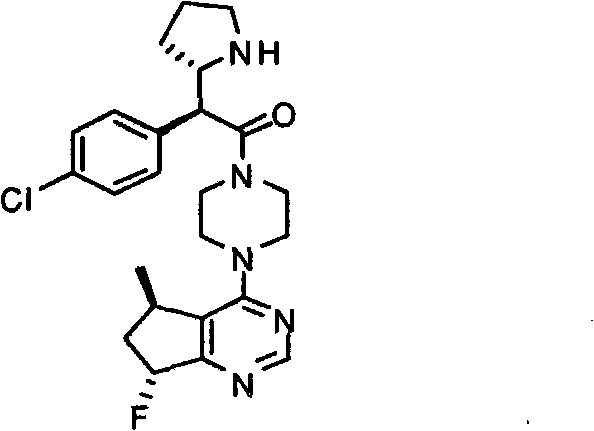
(S)-2-(4-氯苯基)-1-(4-((5R,7R)-7-氟-5-甲基-6,7-二氢-5H-环戊二烯并[d](S)-2-(4-chlorophenyl)-1-(4-((5R, 7R)-7-fluoro-5-methyl-6,7-dihydro-5H-cyclopentadiene[ d] 嘧啶-4-基)哌嗪-1-基)-2-((S)-吡咯烷-2-基)乙酮Pyrimidin-4-yl)piperazin-1-yl)-2-((S)-pyrrolidin-2-yl)ethanone
步骤1:将4-((5R,7S)-7-羟基-5-甲基-6,7-二氢-5H-环戊二烯并[d]嘧啶-4-基)哌嗪-1-羧酸叔丁酯(0.843g,2.521mmol)溶解在二氯甲烷(40mL)中并冷却至-20℃。用DAST(0.9992mL,7.562mmol)处理该溶液并在-20℃搅拌100分钟。3小时之后,用冰淬灭反应,然后升温至环境温度。分离混合物。用二氯甲烷(2X)萃取水相(pH为约1),并将合并的有机物用6%NaHCO3(2X)洗涤,经Na2SO4干燥,并浓缩成深色油状物(0.91g)。在SiO2(Biotage 40S,装填有洗脱液)上对该物质进行色谱分离并用2∶1己烷/乙酸乙酯(“EtOAc”)洗脱。干净地回收希望的4-((5R,7R)-7-氟-5-甲基-6,7-二氢-5H-环戊二烯并[d]嘧啶-4-基)哌嗪-1-羧酸叔丁酯(0.6138g,72%)。将4-((5R,7R)-7-氟-5-甲基-6,7-二氢-5H-环戊二烯并[d]嘧啶-4-基)哌嗪-1-羧酸叔丁酯(0.6138g,1.825mmol)溶解在二噁烷(5mL)中并冷却至0℃。滴加HCl在二噁烷(11.40mL,45.61mmol;4M)中的溶液,然后使反应混合物升温至环境温度,同时搅拌60小时。将反应混合物真空浓缩,再次悬浮在MeOH中并再次浓缩(3X)。将残留物溶解在MeOH(3.7mL)中并滴加至含乙醚(100mL)的快速搅拌的烧瓶中。将固体在氮气氛下过滤,用乙醚洗涤并在氮气下干燥,得到作为固体的(5R,7R)-7-氟-5-甲基-4-(哌嗪-1-基)-6,7-二氢-5H-环戊二烯并[d]嘧啶二盐酸盐(539mg,96%)。LC/MS(APCI)+m/z 237.2。 Step 1 : 4-((5R,7S)-7-Hydroxy-5-methyl-6,7-dihydro-5H-cyclopentadieno[d]pyrimidin-4-yl)piperazine-1- Tert-butyl carboxylate (0.843 g, 2.521 mmol) was dissolved in dichloromethane (40 mL) and cooled to -20°C. The solution was treated with DAST (0.9992 mL, 7.562 mmol) and stirred at -20 °C for 100 min. After 3 hours, the reaction was quenched with ice and allowed to warm to ambient temperature. Separate the mixture. The aqueous phase was extracted with dichloromethane (2X) (pH ~1) and the combined organics were washed with 6% NaHCO3 ( 2X ), dried over Na2SO4 and concentrated to a dark oil (0.91 g) . This material was chromatographed on SiO2 (Biotage 40S, packed with eluent) and eluted with 2:1 hexane/ethyl acetate ("EtOAc"). The desired 4-((5R,7R)-7-fluoro-5-methyl-6,7-dihydro-5H-cyclopenta[d]pyrimidin-4-yl)piperazine-1 was recovered cleanly - tert-butyl carboxylate (0.6138 g, 72%). 4-((5R,7R)-7-fluoro-5-methyl-6,7-dihydro-5H-cyclopentadieno[d]pyrimidin-4-yl)piperazine-1-carboxylic acid tert Butyl ester (0.6138 g, 1.825 mmol) was dissolved in dioxane (5 mL) and cooled to 0 °C. A solution of HCl in dioxane (11.40 mL, 45.61 mmol; 4M) was added dropwise and the reaction mixture was allowed to warm to ambient temperature while stirring for 60 hours. The reaction mixture was concentrated in vacuo, resuspended in MeOH and concentrated again (3X). The residue was dissolved in MeOH (3.7 mL) and added dropwise to a rapidly stirring flask containing diethyl ether (100 mL). The solid was filtered under nitrogen, washed with ether and dried under nitrogen to give (5R,7R)-7-fluoro-5-methyl-4-(piperazin-1-yl)-6,7 as a solid - Dihydro-5H-cyclopenta[d]pyrimidine dihydrochloride (539 mg, 96%). LC/MS (APCI) + m/z 237.2.
步骤2:在甲苯(100mL)中混合2-(4-氯苯基)乙酸(20.00g,117.2mmol)和(R)-4-苄基噁唑烷-2-酮(10.39g,58.62mmol)。添加三乙胺(32.68mL,234.5mmol),并将溶液加热至80℃。滴加新戊酰氯(14.42mL,117.2mmol)在甲苯(25mL)中的溶液。在添加后,将混合物加热回流16小时。将反应混合物冷却,用2N HCl(2X)、水、5%Na2CO3(2X)、饱和NaCl洗涤,经Na2SO4干燥并真空浓缩成固体(约10g)。在SiO2上用4∶1己烷/乙酸乙酯洗脱对粗固体进行色谱分离。回收作为固体的(R)-4-苄基-3-(2-(4-氯苯基)乙酰基)噁唑烷-2-酮(15.4g,80%)。1H NMR(CDCl3,400MHz)δ7.34-7.26(m,7H),7.16-7.11(m,2H),4.71-4.64(m,1H),4.35-4.16(m,4H),3.26(dd,J1=2.9,J2=13.2,1H),2.76(dd,J1=9.3,J2=13.2,1H)。 Step 2 : Mix 2-(4-chlorophenyl)acetic acid (20.00 g, 117.2 mmol) and (R)-4-benzyloxazolidin-2-one (10.39 g, 58.62 mmol) in toluene (100 mL) . Triethylamine (32.68 mL, 234.5 mmol) was added and the solution was heated to 80 °C. A solution of pivaloyl chloride (14.42 mL, 117.2 mmol) in toluene (25 mL) was added dropwise. After the addition, the mixture was heated to reflux for 16 hours. The reaction mixture was cooled, washed with 2N HCl (2X), water , 5% Na2CO3 (2X), saturated NaCl , dried over Na2SO4 and concentrated in vacuo to a solid (ca. 10 g). The crude solid was chromatographed on SiO2 eluting with 4:1 hexanes/ethyl acetate. (R)-4-Benzyl-3-(2-(4-chlorophenyl)acetyl)oxazolidin-2-one (15.4 g, 80%) was recovered as a solid. 1 H NMR (CDCl 3 , 400MHz) δ7.34-7.26(m, 7H), 7.16-7.11(m, 2H), 4.71-4.64(m, 1H), 4.35-4.16(m, 4H), 3.26(dd , J 1 =2.9, J 2 =13.2, 1H), 2.76 (dd, J 1 =9.3, J 2 =13.2, 1H).
步骤3:将2-氧代吡咯烷-1-羧酸叔丁酯(12.33g,66.57mmol)溶解在Et2O(60mL)中并冷却至-78℃。用DIBAL-H(45.27mL,67.90mmol)[1.5M,在甲苯中]滴加处理该悬浮液,并将混合物在-78℃搅拌2小时。用浴使混合物升温至环境温度并搅拌过夜。通过添加对甲苯磺酸水合物(0.075g)在MeOH(75mL)中的溶液淬灭反应。将混合物在环境温度搅拌16小时。将白色悬浮液真空浓缩成白色固体。将该白色固体再次悬浮在Rochelle′s盐(0.5N)和乙酸乙酯的混合物中。将各层分开,并用二氯甲烷洗涤水层两遍。将合并的有机层用饱和NaCl洗涤,经Na2SO4干燥并真空浓缩,得到油状物。将氯化钛(IV)溶液(10.007mL,10.007mmol)[1M,在甲苯中]冷却至0℃,并用溶解在二氯甲烷(20mL)中的(R)-4-苄基-3-(2-(4-氯苯基)乙酰基)噁唑烷-2-酮(3.000g,9.0970mmol)溶液处理。5分钟之后,添加二异丙基乙基胺(1.7430mL,10.007mmol)。将所得的溶液在0℃搅拌1小时,然后冷却至-20℃。添加溶解在二氯甲烷(20mL)中的2-甲氧基吡咯烷-1-羧酸叔丁酯(2.5549g,13.646mmol)溶液,并将混合物在-20℃搅拌75分钟。将混合物用饱和NH4Cl(约100mL)淬灭并用水稀释,以溶解固体。在分离后,用二氯甲烷(3X)洗涤水层。将合并的有机物用水(2X)洗涤,经Na2SO4干燥并真空浓缩。在SiO2上用8∶1己烷/乙酸乙酯洗脱对回收的油状物进行色谱分离。回收作为粘性泡沫的(S)-2-((S)-2-((R)-4-苄基-2-氧代噁唑烷-3-基)-1-(4-氯苯基)-2-氧代乙基)吡咯烷-1-羧酸叔丁酯(1.8g,40%)。MS(APCI+)[M+Na]521.1。 Step 3 : tert-butyl 2-oxopyrrolidine-1-carboxylate (12.33 g, 66.57 mmol) was dissolved in Et2O (60 mL) and cooled to -78 °C. The suspension was treated dropwise with DIBAL-H (45.27 mL, 67.90 mmol) [1.5M in toluene], and the mixture was stirred at -78°C for 2 hours. The mixture was warmed to ambient temperature with a bath and stirred overnight. The reaction was quenched by the addition of p-toluenesulfonic acid hydrate (0.075 g) in MeOH (75 mL). The mixture was stirred at ambient temperature for 16 hours. The white suspension was concentrated in vacuo to a white solid. The white solid was resuspended in a mixture of Rochelle's salt (0.5N) and ethyl acetate. The layers were separated and the aqueous layer was washed twice with dichloromethane. The combined organic layers were washed with saturated NaCl, dried over Na2SO4 and concentrated in vacuo to give an oil. A solution of titanium(IV) chloride (10.007 mL, 10.007 mmol) [1 M in toluene] was cooled to 0 °C and washed with (R)-4-benzyl-3-( 2-(4-Chlorophenyl)acetyl)oxazolidin-2-one (3.000 g, 9.0970 mmol) was treated in solution. After 5 minutes, diisopropylethylamine (1.7430 mL, 10.007 mmol) was added. The resulting solution was stirred at 0°C for 1 hour, then cooled to -20°C. A solution of tert-butyl 2-methoxypyrrolidine-1-carboxylate (2.5549 g, 13.646 mmol) dissolved in dichloromethane (20 mL) was added, and the mixture was stirred at -20°C for 75 minutes. The mixture was quenched with saturated NH4Cl (ca. 100 mL) and diluted with water to dissolve the solids. After separation, the aqueous layer was washed with dichloromethane (3X). The combined organics were washed with water (2X), dried over Na2SO4 and concentrated in vacuo. The recovered oil was chromatographed on SiO2 eluting with 8:1 hexane/ethyl acetate. (S)-2-((S)-2-((R)-4-benzyl-2-oxooxazolidin-3-yl)-1-(4-chlorophenyl) was recovered as a viscous foam -2-Oxoethyl)pyrrolidine-1-carboxylic acid tert-butyl ester (1.8 g, 40%). MS (APCI+) [M+Na] 521.1.
步骤4:将氢氧化锂水合物(0.04709g,1.122mmol)添加至THF/水(3∶1,19mL)溶液中并搅拌至溶解。将混合物冷却至0℃并用30%过氧化氢(0.2314mL,2.244mmol)处理并搅拌10分钟。添加(S)-2-((S)-2-((R)-4-苄基-2-氧代噁唑烷-3-基)-1-(4-氯苯基)-2-氧代乙基)吡咯烷-1-羧酸叔丁酯(0.280g,0.5611mmol)在THF(2mL)中的溶液。将反应混合物在0℃搅拌30分钟。薄层色谱(“TLC”)显示出没有很大进展。因此,使反应混合物升温至环境温度并搅拌过夜。通过添加1.5M Na2SO3(1mL)淬灭反应并搅拌15分钟。将反应混合物用Et2O稀释并分离。用Et2O洗涤(2X)水溶液部分,然后用3N HCl调节pH为1。用乙酸乙酯萃取水溶液部分(3X)。将合并的有机层用水(2X)、饱和NaCl洗涤,经Na2SO4干燥并真空浓缩成缓慢固化的粘稠的油(0.15g,81%)。1H NMR(CDCl3,400MHz)δ7.30(d,2H),7.21(d,2H),4.53-4.40(m,1H),4.37-4.27(m,1H),3.34-3.22(m,1H),2.98-2.90(m,1H),2.02-1.90(m,1H),1.83-1.74(m,1H),1.64-1.53(m,2H),1.50(s,9H)。 Step 4 : Lithium hydroxide hydrate (0.04709 g, 1.122 mmol) was added to THF/water (3:1, 19 mL) solution and stirred until dissolved. The mixture was cooled to 0 °C and treated with 30% hydrogen peroxide (0.2314 mL, 2.244 mmol) and stirred for 10 minutes. Add (S)-2-((S)-2-((R)-4-benzyl-2-oxooxazolidin-3-yl)-1-(4-chlorophenyl)-2-oxo A solution of ethyl)pyrrolidine-1-carboxylic acid tert-butyl ester (0.280 g, 0.5611 mmol) in THF (2 mL). The reaction mixture was stirred at 0 °C for 30 minutes. Thin layer chromatography ("TLC") showed no significant progress. Therefore, the reaction mixture was allowed to warm to ambient temperature and stirred overnight. The reaction was quenched by the addition of 1.5M Na2SO3 (1 mL) and stirred for 15 minutes. The reaction mixture was diluted with Et2O and separated. The aqueous portion was washed ( 2X ) with Et2O, then the pH was adjusted to 1 with 3N HCl. The aqueous portion was extracted with ethyl acetate (3X). The combined organic layers were washed with water (2X), saturated NaCl, dried over Na2SO4 and concentrated in vacuo to a slowly solidifying viscous oil (0.15 g, 81%). 1 H NMR (CDCl 3 , 400MHz) δ7.30(d, 2H), 7.21(d, 2H), 4.53-4.40(m, 1H), 4.37-4.27(m, 1H), 3.34-3.22(m, 1H) ), 2.98-2.90 (m, 1H), 2.02-1.90 (m, 1H), 1.83-1.74 (m, 1H), 1.64-1.53 (m, 2H), 1.50 (s, 9H).
步骤5:使(5R,7R)-7-氟-5-甲基-4-(哌嗪-1-基)-6,7-二氢-5H-环戊二烯并[d]嘧啶二盐酸盐(0.050g,0.16mmol)与(S)-2-((S)-1-(叔丁氧基羰基)吡咯烷-2-基)-2-(4-氯苯基)乙酸(0.055g,0.16mmol)在二氯甲烷(10mL)中混合。添加二异丙基乙基胺(0.1mL,0.57mmol)和HBTU(0.061g,0.16mmol),并将混合物在环境温度搅拌1小时。通过真空浓缩除去溶剂,并通过柱色谱法在SiO2上用2∶1的己烷/乙酸乙酯洗脱纯化残留物。将产物溶解在二噁烷(1mL)中并用4M HCl在二噁烷(2mL)中的溶液进行处理。在环境温度搅拌2小时之后,将混合物真空浓缩,得到(S)-2-(4-氯苯基)-1-(4-((5R,7R)-7-氟-5-甲基-6,7-二氢-5H-环戊二烯并[d]嘧啶-4-基)哌嗪-1-基)-2-((S)-吡咯烷-2-基)乙酮盐酸盐(0.060g,81%收率)。MS(APCI+)[M+H]458.2。 Step 5 : Making (5R,7R)-7-fluoro-5-methyl-4-(piperazin-1-yl)-6,7-dihydro-5H-cyclopenta[d]pyrimidine disalt Salt (0.050g, 0.16mmol) and (S)-2-((S)-1-(tert-butoxycarbonyl)pyrrolidin-2-yl)-2-(4-chlorophenyl)acetic acid (0.055 g, 0.16 mmol) were mixed in dichloromethane (10 mL). Diisopropylethylamine (0.1 mL, 0.57 mmol) and HBTU (0.061 g, 0.16 mmol) were added, and the mixture was stirred at ambient temperature for 1 hour. The solvent was removed by concentration in vacuo and the residue was purified by column chromatography on SiO2 eluting with 2:1 hexane/ethyl acetate. The product was dissolved in dioxane (1 mL) and treated with 4M HCl in dioxane (2 mL). After stirring at ambient temperature for 2 hours, the mixture was concentrated in vacuo to afford (S)-2-(4-chlorophenyl)-1-(4-((5R,7R)-7-fluoro-5-methyl-6 , 7-dihydro-5H-cyclopentadiene[d]pyrimidin-4-yl)piperazin-1-yl)-2-((S)-pyrrolidin-2-yl)ethanone hydrochloride ( 0.060 g, 81% yield). MS (APCI+) [M+H] 458.2.
实施例2Example 2

(S)-2-(4-氯苯基)-1-(4-((5R,7S)-7-氟-5-甲基-6,7-二氢-5H-环戊二烯并[d](S)-2-(4-chlorophenyl)-1-(4-((5R, 7S)-7-fluoro-5-methyl-6,7-dihydro-5H-cyclopentadiene[ d] 嘧啶-4-基)哌嗪-1-基)-2-((S)-吡咯烷-2-基)乙酮Pyrimidin-4-yl)piperazin-1-yl)-2-((S)-pyrrolidin-2-yl)ethanone
步骤1:将4-((5R,7R)-7-羟基-5-甲基-6,7-二氢-5H-环戊二烯并[d]嘧啶-4-基)哌嗪-1-羧酸叔丁酯(1.190g,3.558mmol)溶解在二氯甲烷(55mL)中并冷却至-20℃。将该溶液用DAST(1.410mL,10.68mmol)处理并在-20℃搅拌1小时。用冰淬灭反应,然后升温至环境温度。用饱和NH4Cl稀释混合物并分离。用二氯甲烷(2X)萃取水相,并将合并的有机物经Na2SO4干燥且浓缩成油状物。在SiO2(Biotage 40S,装填有二氯甲烷)上对该油状物进行色谱分离,然后用2.5%MeOH/DCM洗脱,再用3.5%MeOH/DCM洗脱。将混合级分(fractions)浓缩,并在SiO2(Biotage 40S,装填有DCM)上对该物质再次进行色谱分离,并用2己烷/EtOAc洗脱。收集作为油的产物,得到4-((5R,7S)-7-氟-5-甲基-6,7-二氢-5H-环戊二烯并[d]嘧啶-4-基)哌嗪-1-羧酸叔丁酯(0.725g,61%)。LCMS(APCI+)m/z 337.0[M+H]+;Rf3.13min。 Step 1 : 4-((5R,7R)-7-hydroxy-5-methyl-6,7-dihydro-5H-cyclopentadieno[d]pyrimidin-4-yl)piperazine-1- Tert-butyl carboxylate (1.190 g, 3.558 mmol) was dissolved in dichloromethane (55 mL) and cooled to -20°C. The solution was treated with DAST (1.410 mL, 10.68 mmol) and stirred at -20°C for 1 hour. The reaction was quenched with ice, then allowed to warm to ambient temperature. The mixture was diluted with saturated NH4Cl and separated. The aqueous phase was extracted with dichloromethane (2X), and the combined organics were dried over Na2SO4 and concentrated to an oil . The oil was chromatographed on SiO2 (Biotage 40S packed with dichloromethane) eluting with 2.5% MeOH/DCM then 3.5% MeOH/DCM. The combined fractions were concentrated and the material was rechromatographed on SiO2 (Biotage 40S packed with DCM) eluting with 2 hexane/EtOAc. The product was collected as an oil to give 4-((5R,7S)-7-fluoro-5-methyl-6,7-dihydro-5H-cyclopenta[d]pyrimidin-4-yl)piperazine - tert-butyl 1-carboxylate (0.725 g, 61%). LCMS (APCI+) m/z 337.0 [M+H] + ; Rf 3.13min.
步骤2:将4-((5R,7S)-7-氟-5-甲基-6,7-二氢-5H-环戊二烯并[d]嘧啶-4-基)哌嗪-1-羧酸叔丁酯(0.725g,2.155mmol)溶解在二噁烷(5mL)中并冷却至0℃。滴加HCl在二噁烷(13.47mL,53.88mmol;4M)中的溶液。使反应混合物升温至环境温度并搅拌16小时。在约8小时后形成白色沉淀物。将反应混合物真空浓缩,再次悬浮在MeOH中,并再次浓缩(3X)。将残留物溶解在MeOH(约2至3mL)中并滴加至含乙醚(80mL)的快速搅拌的烧瓶。将白色固体在氮气氛下过滤并在氮气下干燥,得到作为白色固体的(5R,7S)-7-氟-5-甲基-4-(哌嗪-1-基)-6,7-二氢-5H-环戊二烯并[d]嘧啶二盐酸盐(555mg,83%)。LCMS(ESI+)m/z 237.2[M+H]+;Rf:1.70min。 Step 2 : 4-((5R,7S)-7-fluoro-5-methyl-6,7-dihydro-5H-cyclopentadieno[d]pyrimidin-4-yl)piperazine-1- Tert-butyl carboxylate (0.725 g, 2.155 mmol) was dissolved in dioxane (5 mL) and cooled to 0°C. A solution of HCl in dioxane (13.47 mL, 53.88 mmol; 4M) was added dropwise. The reaction mixture was allowed to warm to ambient temperature and stirred for 16 hours. A white precipitate formed after about 8 hours. The reaction mixture was concentrated in vacuo, resuspended in MeOH, and concentrated again (3X). The residue was dissolved in MeOH (ca. 2-3 mL) and added dropwise to a rapidly stirring flask containing diethyl ether (80 mL). The white solid was filtered and dried under nitrogen to give (5R,7S)-7-fluoro-5-methyl-4-(piperazin-1-yl)-6,7-bis as a white solid Hydrogen-5H-cyclopenta[d]pyrimidine dihydrochloride (555 mg, 83%). LCMS (ESI+) m/z 237.2 [M+H] + ; Rf: 1.70 min.
步骤3:根据对实施例1所述的操作,使用(5R,7S)-7-氟-5-甲基-4-(哌嗪-1-基)-6,7-二氢-5H-环戊二烯并[d]嘧啶二盐酸盐制备(S)-2-(4-氯苯基)-1-(4-((5R,7S)-7-氟-5-甲基-6,7-二氢-5H-环戊二烯并[d]嘧啶-4-基)哌嗪-1-基)-2-((S)-吡咯烷-2-基)乙酮二盐酸盐(0.66g,89%)。MS(APCI+)[M+H]458.2 Step 3 : Following the procedure described for Example 1, using (5R,7S)-7-fluoro-5-methyl-4-(piperazin-1-yl)-6,7-dihydro-5H-cyclo Preparation of (S)-2-(4-chlorophenyl)-1-(4-((5R,7S)-7-fluoro-5-methyl-6, 7-dihydro-5H-cyclopentadieno[d]pyrimidin-4-yl)piperazin-1-yl)-2-((S)-pyrrolidin-2-yl)ethanone dihydrochloride ( 0.66 g, 89%). MS(APCI+)[M+H]458.2
实施例3Example 3

(S)-2-(4-氯苯基)-1-(4-((5R,7R)-7-羟基-5-甲基-6,7-二氢-5H-环戊二烯并(S)-2-(4-chlorophenyl)-1-(4-((5R,7R)-7-hydroxy-5-methyl-6,7-dihydro-5H-cyclopentadiene [d]嘧啶-4-基)哌嗪-1-基)-2-((S)-吡咯烷-2-基)乙酮[d]pyrimidin-4-yl)piperazin-1-yl)-2-((S)-pyrrolidin-2-yl)ethanone
步骤1:使用干冰-异丙醇浴将在EtOAc(900mL)中的蒲勒烯酸乙酯(130g,662mmol)冷却至-78℃。对该混合物进行臭氧分解,直到反应混合物在颜色上变为紫色。在该点,停止臭氧发生,并将反应混合物从干冰浴移开。鼓泡氧气通过反应混合物,直到反应混合物变为黄色。在真空下浓缩反应混合物,并将所得的残留物溶解在冰乙酸(400mL)中。将溶液冷却至0℃,并历经30分钟分批添加Zn粉(65g,993mmol)。然后将反应混合物搅拌2小时,在该点通过硅藻土(Celite)垫过滤反应混合物以除去锌粉。将乙酸用NaOH和NaHCO3水溶液中和至pH 7并用乙醚(3X800mL)萃取。将合并的有机物用盐水洗涤,经MgSO4干燥并浓缩,得到作为褐色液体的(2R)-2-甲基-5-氧代环戊烷羧酸乙酯(107g,95%)。 Step 1 : Ethyl pulenate (130 g, 662 mmol) in EtOAc (900 mL) was cooled to -78 °C using a dry ice-isopropanol bath. The mixture was subjected to ozonolysis until the reaction mixture turned purple in color. At this point, ozonogenesis was stopped, and the reaction mixture was removed from the dry ice bath. Oxygen was bubbled through the reaction mixture until the reaction mixture turned yellow. The reaction mixture was concentrated under vacuum, and the resulting residue was dissolved in glacial acetic acid (400 mL). The solution was cooled to 0°C, and Zn powder (65 g, 993 mmol) was added portionwise over 30 minutes. The reaction mixture was then stirred for 2 hours at which point the reaction mixture was filtered through a pad of Celite to remove zinc dust. Acetic acid was neutralized to pH 7 with aqueous NaOH and NaHCO 3 and extracted with diethyl ether (3×800 mL). The combined organics were washed with brine, dried over MgSO 4 and concentrated to give ethyl (2R)-2-methyl-5-oxocyclopentanecarboxylate (107 g, 95%) as a brown liquid.
步骤2:将乙酸铵(240.03g,3113.9mmol)添加至(R)-2-甲基-5-氧代环戊烷羧酸乙酯(106.0g,622.78mmol)在MeOH(1.2L)中的溶液。将反应混合物在氮气下于室温搅拌20小时,之后通过TLC和HPLC确认反应完成。浓缩反应混合物以除去MeOH。将所得的残留物溶解在DCM中,用H2O洗涤两遍,用盐水洗涤一遍,干燥(Na2SO4),过滤并浓缩,得到作为橙色油状的(R)-2-氨基-5-甲基环戊-1-烯羧酸乙酯(102g,97%收率)。LC/MS(APCI+)m/z170[M+H]+。 Step 2 : Add ammonium acetate (240.03 g, 3113.9 mmol) to ethyl (R)-2-methyl-5-oxocyclopentanecarboxylate (106.0 g, 622.78 mmol) in MeOH (1.2 L) solution. The reaction mixture was stirred at room temperature under nitrogen for 20 hours before completion of the reaction was confirmed by TLC and HPLC. The reaction mixture was concentrated to remove MeOH. The resulting residue was dissolved in DCM, washed twice with H2O , once with brine, dried ( Na2SO4 ), filtered and concentrated to afford (R)-2-amino-5- Ethyl methylcyclopent-1-enecarboxylate (102 g, 97% yield). LC/MS (APCI+) m/z 170 [M+H]+.
步骤3:将在甲酰胺(303.456mL,7640.19mmol)中含(R)-2-氨基-5-甲基环戊-1-烯羧酸乙酯(161.61g,955.024mmol)和甲酸铵(90.3298g,1432.54mmol)的溶液加热至150℃的内温并搅拌17小时。将反应混合物冷却,并转移至2L单颈烧瓶(single nextracted flask)。然后通过高真空蒸馏除去过量的甲脒。一旦甲脒停止馏出,将在蒸馏锅中剩余的油溶解在DCM中并用盐水(3X200mL)洗涤。用DCM萃取合并的水洗涤液。将合并的有机萃取液干燥(Na2SO4),过滤并浓缩。将所得的油溶解在最少量的DCM中,并使用分液漏斗将该溶液添加至搅拌的乙醚溶液(约5体积的乙醚对DCM溶液),形成一些沉淀物。通过中等熔结漏斗(medium frit funnel)用乙醚洗涤过滤除去该沉淀物,并丢弃。浓缩滤液,再重复两遍从乙醚研磨,然后在高真空管线上干燥,得到作为糊状固体的(R)-5-甲基-6,7-二氢-5H-环戊二烯并[d]嘧啶-4-醇(93.225g,65.00%收率)。LC/MS(APCI-)m/z 149.2。 Step 3 : Ethyl (R)-2-amino-5-methylcyclopent-1-enecarboxylate (161.61 g, 955.024 mmol) and ammonium formate (90.3298 g, 1432.54 mmol) was heated to an internal temperature of 150°C and stirred for 17 hours. The reaction mixture was cooled and transferred to a 2L single nexttracted flask. Excess formamidine was then removed by high vacuum distillation. Once formamidine stopped distilling, the remaining oil in the still pot was dissolved in DCM and washed with brine (3×200 mL). The combined aqueous washes were extracted with DCM. The combined organic extracts were dried ( Na2SO4 ), filtered and concentrated. The resulting oil was dissolved in a minimal amount of DCM and this solution was added to a stirred ether solution (approximately 5 volumes of ether in DCM) using a separatory funnel, forming some precipitate. The precipitate was removed by filtration through a medium frit funnel washing with ether and discarded. Concentration of the filtrate and trituration from diethyl ether were repeated two more times, followed by drying on the high vacuum line to give (R)-5-methyl-6,7-dihydro-5H-cyclopenta[d ] Pyrimidin-4-ol (93.225 g, 65.00% yield). LC/MS (APCI-) m/z 149.2.
步骤4:将纯的POCl3(463.9mL,5067mmol)通过添加漏斗(additionfunnel)缓慢添加至(R)-5-甲基-6,7-二氢-5H-环戊二烯并[d]嘧啶-4-醇(152.2g,1013mmol)在DCE(1.2L)中的0℃溶液中。在添加完成后,反应混合物升温至室温,然后加热至回流并搅拌70分钟。通过HPLC确认反应完成。将反应混合物冷却至室温,分4部分如下淬灭过量POCl3:将反应混合物转移至分液漏斗并滴入在冰浴中冷却的含冰和饱和NaHCO3溶液的烧杯中。一旦每个部分的反应混合物加入完成,将淬灭的混合物搅拌30分钟,以确保在转移至分液漏斗中之前POCl3完全消除。将混合物转移至分液漏斗,并用DCM萃取两遍。将合并的萃取液干燥(Na2SO4),过滤并浓缩。在硅胶上如下纯化粗产物:将硅胶(1kg)在9∶1己烷∶乙酸乙酯中成浆到3L熔结漏斗上(在真空下沉降硅胶,顶部有沙)。用DCM/己烷混合物装填粗产物,使用1L侧口烧瓶在真空下洗脱化合物。高Rf副产物首先洗脱,然后是作为油状的(R)-4-氯-5-甲基-6,7-二氢-5H-环戊二烯并[d]嘧啶(104.4g,61.09%收率)。将三乙胺(93.0mL,534mmol)和哌嗪-1-羧酸叔丁酯(34.8g,187mmol)添加至(R)-4-氯-5-甲基-6,7-二氢-5H-环戊二烯并[d]嘧啶(30.0g,178mmol)在n-BuOH(250mL)中的溶液。将反应混合物在氮气下加热至回流并搅拌过夜(17小时),之后在旋转蒸发器上浓缩。将所得的油状物溶解在DCM中,用H2O洗涤,干燥(Na2SO4),过滤并浓缩。在硅胶上,首先用2∶1己烷∶乙酸乙酯洗脱,直到产物干净地洗脱,然后用梯度为1∶1至1∶5的DCM∶乙酸乙酯洗脱,从而纯化所得的油状物,得到作为粉末的(R)-4-(5-甲基-6,7-二氢-5H-环戊二烯并[d]嘧啶-4-基)哌嗪-1-羧酸叔丁酯(42.0g,74.1%收率)。LC/MS(APCI+)m/z 319.1[M+H]+。 Step 4 : Pure POCl3 (463.9 mL, 5067 mmol) was slowly added to (R)-5-methyl-6,7-dihydro-5H-cyclopenta[d]pyrimidine through an addition funnel -4-ol (152.2 g, 1013 mmol) in DCE (1.2 L) at 0°C. After the addition was complete, the reaction mixture was warmed to room temperature, then heated to reflux and stirred for 70 minutes. Reaction completion was confirmed by HPLC. The reaction mixture was cooled to room temperature and excess POCl3 was quenched in 4 portions as follows: the reaction mixture was transferred to a separatory funnel and dropped into a beaker containing ice and saturated NaHCO3 solution cooled in an ice bath. Once the addition of each portion of the reaction mixture was complete, the quenched mixture was stirred for 30 min to ensure complete elimination of POCl before transferring to a separatory funnel. The mixture was transferred to a separatory funnel and extracted twice with DCM. The combined extracts were dried ( Na2SO4 ), filtered and concentrated. The crude product was purified on silica gel as follows: Silica gel (1 kg) was slurried in 9:1 hexanes:ethyl acetate onto a 3 L fritted funnel (silica settled under vacuum with sand on top). The crude product was charged with a DCM/hexane mixture and the compound was eluted under vacuum using a 1 L side port flask. The high Rf by-product eluted first, followed by (R)-4-chloro-5-methyl-6,7-dihydro-5H-cyclopenta[d]pyrimidine as an oil (104.4 g, 61.09% yield). Add triethylamine (93.0 mL, 534 mmol) and tert-butyl piperazine-1-carboxylate (34.8 g, 187 mmol) to (R)-4-chloro-5-methyl-6,7-dihydro-5H - A solution of cyclopenta[d]pyrimidine (30.0 g, 178 mmol) in n-BuOH (250 mL). The reaction mixture was heated to reflux under nitrogen and stirred overnight (17 hours) before being concentrated on a rotary evaporator. The resulting oil was dissolved in DCM, washed with H2O , dried ( Na2SO4 ), filtered and concentrated . The resulting oil was purified on silica gel by eluting first with 2:1 hexanes:ethyl acetate until the product eluted cleanly, then with a gradient of 1:1 to 1:5 DCM:ethyl acetate to obtain (R)-tert-butyl 4-(5-methyl-6,7-dihydro-5H-cyclopenta[d]pyrimidin-4-yl)piperazine-1-carboxylate as a powder Ester (42.0 g, 74.1% yield). LC/MS (APCI+) m/z 319.1 [M+H] + .
步骤5:将固体77%max.m-CPBA(23.9g,107mmol)分批添加至(R)-4-(5-甲基-6,7-二氢-5H-环戊二烯并[d]嘧啶-4-基)哌嗪-1-羧酸叔丁酯(20.0g,62.8mmol)在CHCl3(310mL)中的0℃溶液。将反应混合物搅拌5分钟,然后升温至室温并搅拌90分钟。7.5小时之后,HPLC表现类似。将反应混合物冷却至0℃,然后添加NaHCO3(13.2g,157mmol)和另外0.5当量的m-CPBA。将反应混合物搅拌过夜(14小时)。将反应混合物冷却至0℃,并通过添加漏斗滴加Na2S2O3(29.8g,188mmol)在H2O(50mL)中的溶液。接着,通过添加漏斗加入Na2CO3(24.6g,232mmol)在H2O(70mL)中的溶液(混合物变得均匀)。将反应混合物搅拌30分钟,然后用CHCl3(3X150mL)萃取混合物。将合并的萃取液干燥(Na2SO4),过滤并浓缩,得到N-氧化物。LC/MS(APCI+)m/z 335.1[M+H]+。 Step 5 : Add solid 77% max.m-CPBA (23.9 g, 107 mmol) to (R)-4-(5-methyl-6,7-dihydro-5H-cyclopenta[d ]pyrimidin-4-yl)piperazine-1-carboxylate tert-butyl ester (20.0 g, 62.8 mmol) in CHCl3 (310 mL) at 0°C. The reaction mixture was stirred for 5 minutes, then allowed to warm to room temperature and stirred for 90 minutes. After 7.5 hours, HPLC behaved similarly. The reaction mixture was cooled to 0°C, then NaHCO 3 (13.2 g, 157 mmol) and another 0.5 equiv of m-CPBA were added. The reaction mixture was stirred overnight (14 hours). The reaction mixture was cooled to 0° C., and a solution of Na 2 S 2 O 3 (29.8 g, 188 mmol) in H 2 O (50 mL) was added dropwise via addition funnel. Next, a solution of Na2CO3 (24.6 g, 232 mmol) in H2O (70 mL) was added via addition funnel ( the mixture became homogeneous). The reaction mixture was stirred for 30 minutes, then the mixture was extracted with CHCl 3 (3×150 mL). The combined extracts were dried ( Na2SO4 ), filtered and concentrated to give the N-oxide. LC/MS (APCI+) m/z 335.1 [M+H]+.
步骤6:将Ac2O(77.0mL,816mmol)添加至得自步骤5的N-氧化物(21.0g,62.8mmol)。将反应混合物在氮气下在90℃沙浴中加热并搅拌100分钟。将反应混合物冷却至室温,并通过旋转蒸发除去过量乙酸酐。将所得的油溶解在DCM中,然后将其小心地倾入冰饱和的Na2CO3中。用DCM萃取混合物,并且将合并的萃取液干燥(Na2SO4),过滤并浓缩,得到作为泡沫的(5R)-4-(7-乙酰氧基-5-甲基-6,7-二氢-5H-环戊二烯并[d]嘧啶-4-基)哌嗪-1-羧酸叔丁酯(23.6g,100%)。LC/MS(APCI+)m/z 377.1[M+H]+。 Step 6 : Ac2O (77.0 mL, 816 mmol) was added to the N-oxide from Step 5 (21.0 g, 62.8 mmol). The reaction mixture was heated and stirred in a 90 °C sand bath under nitrogen for 100 min. The reaction mixture was cooled to room temperature and excess acetic anhydride was removed by rotary evaporation. The resulting oil was dissolved in DCM and poured carefully into ice-saturated Na2CO3 . The mixture was extracted with DCM and the combined extracts were dried ( Na2SO4 ), filtered and concentrated to give (5R)-4-(7-acetoxy-5-methyl-6,7-di tert-butyl hydro-5H-cyclopenta[d]pyrimidin-4-yl)piperazine-1-carboxylate (23.6 g, 100%). LC/MS (APCI+) m/z 377.1 [M+H]+.
步骤7:将LiOH-H2O(6.577g,156.7mmol)添加至(5R)-4-(7-乙酰氧基-5-甲基-6,7-二氢-5H-环戊二烯并[d]嘧啶-4-基)哌嗪-1-羧酸叔丁酯(23.6g,62.69mmol)在2∶1THF∶H2O(320mL)中的0℃溶液。将反应混合物搅拌10分钟,然后升温至室温。LC/MS在3小时和4.5小时看起来相同。将反应混合物冷却至0℃,然后向该混合物添加饱和NH4Cl。将混合物搅拌5分钟,并通过旋转蒸发除去大部分THF。用EtOAc(3X250mL)萃取混合物,并将合并的萃取液干燥(Na2SO4),过滤并浓缩。在Biotage 65M上对粗产物进行快速色谱分离:首先用4∶1的DCM∶乙酸乙酯,然后用梯度为1∶1至1∶4的DCM∶乙酸乙酯。一旦产物洗脱,则使乙酸乙酯快速通过柱。然后,用30∶1的DCM∶MeOH洗脱剩余的产物(8.83g)。用Biotage 40M,使用相同的条件,再次对混合的级分进行快速色谱分离,又得到2.99g,得到合并产率的作为泡沫的(5R)-4-(7-羟基-5-甲基-6,7-二氢-5H-环戊二烯并[d]嘧啶-4-基)哌嗪-1-羧酸叔丁酯(11.82g,56.38%收率)。LC/MS(APCI+)m/z 335.1[M+H]+。 Step 7 : Add LiOH- H2O (6.577g, 156.7mmol) to (5R)-4-(7-acetoxy-5-methyl-6,7-dihydro-5H-cyclopentadiene [d] A 0° C. solution of pyrimidin-4-yl)piperazine-1-carboxylate tert-butyl ester (23.6 g, 62.69 mmol) in 2:1 THF:H 2 O (320 mL). The reaction mixture was stirred for 10 minutes and then allowed to warm to room temperature. LC/MS looked the same at 3 hours and 4.5 hours. The reaction mixture was cooled to 0 °C, then saturated NH4Cl was added to the mixture. The mixture was stirred for 5 minutes and most of the THF was removed by rotary evaporation. The mixture was extracted with EtOAc (3×250 mL), and the combined extracts were dried (Na 2 SO 4 ), filtered and concentrated. The crude product was flash chromatographed on a Biotage 65M: first with 4:1 DCM:ethyl acetate, then with a gradient of 1:1 to 1:4 DCM:ethyl acetate. Once the product eluted, the ethyl acetate was passed through the column quickly. The remaining product (8.83 g) was then eluted with 30:1 DCM:MeOH. The combined fractions were flash chromatographed again on a Biotage 40M using the same conditions to give a further 2.99 g, giving a combined yield of (5R)-4-(7-hydroxy-5-methyl-6 , tert-butyl 7-dihydro-5H-cyclopenta[d]pyrimidin-4-yl)piperazine-1-carboxylate (11.82 g, 56.38% yield). LC/MS (APCI+) m/z 335.1 [M+H]+.
步骤8:将DMSO(5.45mL,76.8mmol)在DCM(50mL)中的溶液通过添加漏斗滴加至草酰氯(3.35mL,38.4mmol)在DCM(150mL)中的-78℃溶液中。将反应混合物搅拌35分钟,然后通过添加漏斗缓慢添加(5R)-4-(7-羟基-5-甲基-6,7-二氢-5H-环戊二烯并[d]嘧啶-4-基)哌嗪-1-羧酸叔丁酯(9.17g,27.4mmol)在DCM(80mL)中的溶液。将反应混合物在-78℃再搅拌1小时,然后向该混合物添加纯的三乙胺(18.0mL,129mmol)。然后使反应混合物升温至室温,接着搅拌30分钟。添加H2O。用DCM(3X200mL)萃取混合物,并将合并的萃取液干燥(Na2SO4),过滤并真空浓缩。在硅胶(Biotage 65M)上纯化粗产物:用约800mL 4∶1DCM∶EtOAc冲洗柱,然后梯度至1∶1DCM∶乙酸乙酯,直到产物洗脱,然后用1∶4DCM∶EtOAc洗脱产物,得到作为泡沫的(R)-4-(5-甲基-7-氧代-6,7-二氢-5H-环戊二烯并[d]嘧啶-4-基)哌嗪-1-羧酸叔丁酯(7.5g,82.3%收率)。从DCM/己烷浓缩(3X)该泡沫,得到泡沫。HPLC>95%面积。LC/MS(APCI+)m/z 333[M+H]+。 Step 8 : A solution of DMSO (5.45 mL, 76.8 mmol) in DCM (50 mL) was added dropwise to a solution of oxalyl chloride (3.35 mL, 38.4 mmol) in DCM (150 mL) at -78 °C via an addition funnel. The reaction mixture was stirred for 35 minutes, then (5R)-4-(7-hydroxy-5-methyl-6,7-dihydro-5H-cyclopenta[d]pyrimidine-4- A solution of tert-butyl piperazine-1-carboxylate (9.17 g, 27.4 mmol) in DCM (80 mL). The reaction mixture was stirred at -78°C for another 1 hour, then neat triethylamine (18.0 mL, 129 mmol) was added to the mixture. The reaction mixture was then allowed to warm to room temperature, followed by stirring for 30 minutes. Add H2O . The mixture was extracted with DCM (3×200 mL), and the combined extracts were dried (Na 2 SO 4 ), filtered and concentrated in vacuo. The crude product was purified on silica gel (Biotage 65M): Rinse the column with about 800 mL of 4:1 DCM:EtOAc, then gradient to 1:1 DCM:ethyl acetate until the product eluted, then eluted the product with 1:4 DCM:EtOAc to give (R)-4-(5-Methyl-7-oxo-6,7-dihydro-5H-cyclopenta[d]pyrimidin-4-yl)piperazine-1-carboxylic acid as foam tert-Butyl ester (7.5 g, 82.3% yield). The foam was concentrated (3X) from DCM/hexanes to give a foam. HPLC >95% area. LC/MS (APCI+) m/z 333 [M+H]+.
步骤9:将三乙胺(4.33mL,31.1mmol;在使用前用氮气脱气30分钟)和甲酸(1.36mL,36.1mmol;在使用前用氮气脱气30分钟)添加至(R)-4-(5-甲基-7-氧代-6,7-二氢-5H-环戊二烯并[d]嘧啶-4-基)哌嗪-1-羧酸叔丁酯(9.75g,29.3mmol)在DCM(210mL;在使用前用氮气脱气30分钟)中的溶液。将混合物搅拌5分钟,然后添加Ru催化剂(0.0933g,0.147mmol)。将反应在正氮气压力下搅拌过夜(18小时)。将反应混合物浓缩至干,并高真空干燥。在装填了1∶1DCM∶乙酸乙酯的Biotage 65M上对不纯物质进行快速色谱分离:用500mL冲洗,然后用1∶4DCM∶乙酸乙酯洗脱,直到产物出现为止(第二个斑点),然后梯度至纯的乙酸乙酯,然后用25∶1DCM∶MeOH洗脱剩余产物。合并级分并在旋转蒸发器上浓缩。再次从DCM/己烷浓缩残留物,得到作为泡沫的4-((5R,7R)-7-羟基-5-甲基-6,7-二氢-5H-环戊二烯并[d]嘧啶-4-基)哌嗪-1-羧酸叔丁酯(较多)和4-((5R,7S)-7-羟基-5-甲基-6,7-二氢-5H-环戊二烯并[d]嘧啶-4-基)哌嗪-1-羧酸叔丁酯(较少)(9.35g,95.3%收率)的混合物。LC/MS(APCI+)m/z 335[M+H]+。通过对原醇次甲基(carbinol methine)进行积分,1H NMR(CDCl3)显示88%的非对映异构选择性。 Step 9 : Triethylamine (4.33 mL, 31.1 mmol; degassed with nitrogen for 30 minutes before use) and formic acid (1.36 mL, 36.1 mmol; degassed with nitrogen for 30 minutes before use) were added to (R)-4 -(5-Methyl-7-oxo-6,7-dihydro-5H-cyclopentadien[d]pyrimidin-4-yl)piperazine-1-carboxylic acid tert-butyl ester (9.75g, 29.3 mmol) in DCM (210 mL; degas with nitrogen for 30 min before use). The mixture was stirred for 5 minutes, then Ru catalyst (0.0933 g, 0.147 mmol) was added. The reaction was stirred overnight (18 hours) under positive nitrogen pressure. The reaction mixture was concentrated to dryness and dried under high vacuum. The impure material was flash chromatographed on a Biotage 65M packed with 1:1 DCM:ethyl acetate: rinse with 500 mL, then elute with 1:4 DCM:ethyl acetate until the product appeared (second spot), Then a gradient to pure ethyl acetate was then used to elute the remaining product with 25:1 DCM:MeOH. Fractions were combined and concentrated on a rotary evaporator. The residue was again concentrated from DCM/hexanes to give 4-((5R,7R)-7-hydroxy-5-methyl-6,7-dihydro-5H-cyclopenta[d]pyrimidine as a foam -4-yl)piperazine-1-carboxylate tert-butyl ester (more) and 4-((5R,7S)-7-hydroxy-5-methyl-6,7-dihydro-5H-cyclopentadiene Mixture of tert-butyl (alkeno[d]pyrimidin-4-yl)piperazine-1-carboxylate (less) (9.35 g, 95.3% yield). LC/MS (APCI+) m/z 335 [M+H]+. 1 H NMR (CDCl 3 ) indicated a diastereoselectivity of 88% by integration over the carbinol methine.
步骤10:将4-硝基苯甲酰氯(4.27g,23.0mmol)添加至4-((5R,7R)-7-羟基-5-甲基-6,7-二氢-5H-环戊二烯并[d]嘧啶-4-基)哌嗪-1-羧酸叔丁酯(7.0g,20.9mmol)和三乙胺(4.38mL,31.4mmol)在DCM(110mL)中的0℃溶液。将反应混合物在室温搅拌过夜,之后添加饱和NaHCO3。搅拌混合物10分钟,然后用DCM萃取。将合并的萃取液干燥(Na2SO4),过滤并浓缩。在Biotage65M上对粗产物进行快速色谱分离(用3∶1己烷∶乙酸乙酯装填粗产物,然后用2∶1己烷∶乙酸乙酯洗脱4-((5R,7R)-5-甲基-7-(4-硝基苯甲酰氧基)-6,7-二氢-5H-环戊二烯并[d]嘧啶-4-基)哌嗪-1-羧酸叔丁酯和少许混合级分)。然后,使用1∶2己烷∶乙酸乙酯洗脱4-((5R,7S)-5-甲基-7-(4-硝基苯甲酰氧基)-6,7-二氢-5H-环戊二烯并[d]嘧啶-4-基)哌嗪-1-羧酸叔丁酯。通过旋转蒸发浓缩具有产物的级分,得到作为泡沫的4-((5R,7R)-5-甲基-7-(4-硝基苯甲酰氧基)-6,7-二氢-5H-环戊二烯并[d]嘧啶-4-基)哌嗪-1-羧酸叔丁酯(8.55g,84.5%收率)。LC/MS(APCI+)m/z 484[M+H]+。1H NMR(CDCl3)显示单一非对映异构体)。通过旋转蒸发浓缩具有其它非对映异构体的级分,得到作为泡沫的4-((5R,7S)-5-甲基-7-(4-硝基苯甲酰氧基)-6,7-二氢-5H-环戊二烯并[d]嘧啶-4-基)哌嗪-1-羧酸叔丁酯(0.356g,3.52%收率)。LC/MS(APCI+)m/z 484[M+H]+。 Step 10 : Add 4-nitrobenzoyl chloride (4.27 g, 23.0 mmol) to 4-((5R,7R)-7-hydroxy-5-methyl-6,7-dihydro-5H-cyclopentadiene A 0° C. solution of alkeno[d]pyrimidin-4-yl)piperazine-1-carboxylate tert-butyl ester (7.0 g, 20.9 mmol) and triethylamine (4.38 mL, 31.4 mmol) in DCM (110 mL). The reaction mixture was stirred overnight at room temperature, after which saturated NaHCO3 was added. The mixture was stirred for 10 minutes, then extracted with DCM. The combined extracts were dried ( Na2SO4 ), filtered and concentrated. The crude product was subjected to flash chromatography on a Biotage 65M (pack the crude product with 3:1 hexane:ethyl acetate and then elute the 4-((5R,7R)-5-methanol with 2:1 hexane:ethyl acetate). tert-butyl-7-(4-nitrobenzoyloxy)-6,7-dihydro-5H-cyclopentadien[d]pyrimidin-4-yl)piperazine-1-carboxylate and a little mixed fraction). Then, 4-((5R,7S)-5-methyl-7-(4-nitrobenzoyloxy)-6,7-dihydro-5H was eluted using 1:2 hexane:ethyl acetate - tert-butyl cyclopenta[d]pyrimidin-4-yl)piperazine-1-carboxylate. Fractions with product were concentrated by rotary evaporation to give 4-((5R,7R)-5-methyl-7-(4-nitrobenzoyloxy)-6,7-dihydro-5H as a foam - tert-butyl cyclopenta[d]pyrimidin-4-yl)piperazine-1-carboxylate (8.55 g, 84.5% yield). LC/MS (APCI+) m/z 484 [M+H]+. 1 H NMR (CDCl 3 ) showed a single diastereomer). Fractions with the other diastereomer were concentrated by rotary evaporation to give 4-((5R,7S)-5-methyl-7-(4-nitrobenzoyloxy)-6 as a foam, tert-butyl 7-dihydro-5H-cyclopenta[d]pyrimidin-4-yl)piperazine-1-carboxylate (0.356 g, 3.52% yield). LC/MS (APCI+) m/z 484 [M+H]+.
步骤11:将LiOH-H2O(0.499g,11.9mmol)添加至4-((5R,7R)-5-甲基-7-(4-硝基苯甲酰氧基)-6,7-二氢-5H-环戊二烯并[d]嘧啶-4-基)哌嗪-1-羧酸叔丁酯(2.30g,4.76mmol)在2∶1THF∶H2O(40mL)中的0℃溶液。使反应混合物升温至室温并搅拌1小时。通过旋转蒸发除去THF,添加饱和NaHCO3,并用乙酸乙酯萃取混合物。将合并的萃取液用饱和NaHCO3洗涤(1X),干燥(Na2SO4),过滤并浓缩,得到作为泡沫的4-((5R,7R)-7-羟基-5-甲基-6,7-二氢-5H-环戊二烯并[d]嘧啶-4-基)哌嗪-1-羧酸叔丁酯(1.59g,100.0%收率)。HPLC显示,在刚刚后处理之后,产物>98面积%纯度。LC/MS(APCI+)m/z 335[M+H]+。使用类似的方法制备4-((5R,7S)-7-羟基-5-甲基-6,7-二氢-5H-环戊二烯并[d]嘧啶-4-基)哌嗪-1-羧酸叔丁酯。 Step 11 : Add LiOH-H 2 O (0.499 g, 11.9 mmol) to 4-((5R,7R)-5-methyl-7-(4-nitrobenzoyloxy)-6,7- 0 ℃ solution. The reaction mixture was allowed to warm to room temperature and stirred for 1 hour. THF was removed by rotary evaporation, saturated NaHCO3 was added, and the mixture was extracted with ethyl acetate. The combined extracts were washed with saturated NaHCO3 (1X), dried ( Na2SO4 ), filtered and concentrated to give 4-((5R,7R)-7-hydroxy-5-methyl-6 as a foam, tert-butyl 7-dihydro-5H-cyclopenta[d]pyrimidin-4-yl)piperazine-1-carboxylate (1.59 g, 100.0% yield). HPLC showed that the product was >98 area % pure immediately after work-up. LC/MS (APCI+) m/z 335 [M+H]+. 4-((5R,7S)-7-Hydroxy-5-methyl-6,7-dihydro-5H-cyclopenta[d]pyrimidin-4-yl)piperazine-1 was prepared using a similar method - tert-butyl carboxylate.
步骤12:将4M HCl/二噁烷(11.2mL,44.9mmol)添加至4-((5R,7R)-7-羟基-5-甲基-6,7-二氢-5H-环戊二烯并[d]嘧啶-4-基)哌嗪-1-羧酸叔丁酯(0.600g,1.79mmol)在二噁烷(15mL)中的溶液。将反应混合物在氮气下于室温搅拌过夜(20小时)。将混合物浓缩至干并在高真空管线上干燥。将粗产物悬浮在乙醚中,超声处理并搅拌5分钟。将固体通过中等熔结漏斗用氮气压过滤分离,用乙醚洗,在氮气压下干燥,并在高真空管线上进一步干燥,得到作为粉末的(5R,7R)-5-甲基-4-(哌嗪-1-基)-6,7-二氢-5H-环戊二烯并[d]嘧啶-7-醇二盐酸盐(0.440g,79.8%收率)。LC/MS(APCI+)m/z 235。使用类似的方法制备(5R,7S)-5-甲基-4-(哌嗪-1-基)-6,7-二氢-5H-环戊二烯并[d]嘧啶-7-醇二盐酸盐。 Step 12 : Add 4M HCl/dioxane (11.2 mL, 44.9 mmol) to 4-((5R,7R)-7-hydroxy-5-methyl-6,7-dihydro-5H-cyclopentadiene A solution of [d]pyrimidin-4-yl)piperazine-1-carboxylic acid tert-butyl ester (0.600 g, 1.79 mmol) in dioxane (15 mL). The reaction mixture was stirred overnight (20 hours) at room temperature under nitrogen. The mixture was concentrated to dryness and dried on the high vacuum line. The crude product was suspended in ether, sonicated and stirred for 5 minutes. The solid was isolated by filtration through a medium sintered funnel under nitrogen pressure, washed with diethyl ether, dried under nitrogen pressure, and further dried on a high vacuum line to give (5R,7R)-5-methyl-4-( Piperazin-1-yl)-6,7-dihydro-5H-cyclopenta[d]pyrimidin-7-ol dihydrochloride (0.440 g, 79.8% yield). LC/MS (APCI+) m/z 235. Using a similar procedure to prepare (5R,7S)-5-methyl-4-(piperazin-1-yl)-6,7-dihydro-5H-cyclopenta[d]pyrimidin-7-ol di Hydrochloride.
步骤13:使(S)-2-((S)-1-(叔丁氧基羰基)吡咯烷-2-基)-2-(4-氯苯基)乙酸(0.1765g,0.5194mmol)与(5R,7R)-5-甲基-4-(哌嗪-1-基)-6,7-二氢-5H-环戊二烯并[d]嘧啶-7-醇二盐酸盐(0.1596g,0.5194mmol)混合,然后在二氯甲烷(4.5mL)中浆化。将该悬浮液用二异丙基乙基胺(0.2714mL,1.558mmol)处理,然后用HBTU(0.1970g,0.5194mmol)处理,并将混合物在环境温度搅拌16小时。用10%Na2CO3淬灭反应,然后分离。将水溶液部分用二氯甲烷洗涤两遍。将合并的有机物部分用Na2SO4干燥并真空浓缩。在SiO2上用4%MeOH/二氯甲烷洗脱,对残留物进行色谱分离,得到(S)-2-((S)-1-(4-氯苯基)-2-(4-((5R,7R)-7-羟基-5-甲基-6,7-二氢-5H-环戊二烯并[d]嘧啶-4-基)哌嗪-1-基)-2-氧代乙基)吡咯烷-1-羧酸叔丁酯(0.256g,89%)。MS(ESI+)[M+H]556.1/558.1。 Step 13 : Combine (S)-2-((S)-1-(tert-butoxycarbonyl)pyrrolidin-2-yl)-2-(4-chlorophenyl)acetic acid (0.1765 g, 0.5194 mmol) with (5R, 7R)-5-methyl-4-(piperazin-1-yl)-6,7-dihydro-5H-cyclopentadiene[d]pyrimidin-7-ol dihydrochloride (0.1596 g, 0.5194 mmol) and then slurried in dichloromethane (4.5 mL). The suspension was treated with diisopropylethylamine (0.2714 mL, 1.558 mmol) followed by HBTU (0.1970 g, 0.5194 mmol), and the mixture was stirred at ambient temperature for 16 hours. The reaction was quenched with 10% Na2CO3 and then isolated. The aqueous portion was washed twice with dichloromethane. The combined organic fractions were dried over Na2SO4 and concentrated in vacuo . The residue was chromatographed on SiO2 eluting with 4% MeOH/dichloromethane to afford (S)-2-((S)-1-(4-chlorophenyl)-2-(4-( (5R,7R)-7-Hydroxy-5-methyl-6,7-dihydro-5H-cyclopentadien[d]pyrimidin-4-yl)piperazin-1-yl)-2-oxo Ethyl)pyrrolidine-1-carboxylic acid tert-butyl ester (0.256 g, 89%). MS (ESI+) [M+H] 556.1/558.1.
步骤14:将(S)-2-((S)-1-(4-氯苯基)-2-(4-((5R,7R)-7-羟基-5-甲基-6,7-二氢-5H-环戊二烯并[d]嘧啶-4-基)哌嗪-1-基)-2-氧代乙基)吡咯烷-1-羧酸叔丁酯(0.74g,1.331mmol)溶于二噁烷(3mL)中并用在二噁烷(8.317mL,33.27mmol)中的4M氯化氢进行处理。将混合物在环境温度搅拌8小时。将反应混合物真空浓缩,再次溶解并从MeOH再次浓缩,重复三遍。然后,将残留物再次溶解在MeOH(3mL)中并滴加至搅拌的Et2O(100mL)。在搅拌30分钟之后,将固体收集,用Et2O洗涤,然后在氮气氛下风干。回收作为白色固体的(S)-2-(4-氯苯基)-1-(4-((5R,7R)-7-羟基-5-甲基-6,7-二氢-5H-环戊二烯并[d]嘧啶-4-基)哌嗪-1-基)-2-((S)-吡咯烷-2-基)乙酮(0.47g,79%)。MS(ESI+)[M+H]456.1/458.1。 Step 14 : Add (S)-2-((S)-1-(4-chlorophenyl)-2-(4-((5R,7R)-7-hydroxy-5-methyl-6,7- Dihydro-5H-cyclopentadieno[d]pyrimidin-4-yl)piperazin-1-yl)-2-oxoethyl)pyrrolidine-1-carboxylic acid tert-butyl ester (0.74g, 1.331mmol ) was dissolved in dioxane (3 mL) and treated with 4M hydrogen chloride in dioxane (8.317 mL, 33.27 mmol). The mixture was stirred at ambient temperature for 8 hours. The reaction mixture was concentrated in vacuo, redissolved and reconcentrated from MeOH three times. Then, the residue was redissolved in MeOH (3 mL) and added dropwise to stirred Et2O (100 mL). After stirring for 30 minutes, the solid was collected, washed with Et2O , and air dried under nitrogen. (S)-2-(4-Chlorophenyl)-1-(4-((5R,7R)-7-hydroxy-5-methyl-6,7-dihydro-5H-ring was recovered as a white solid Pentadieno[d]pyrimidin-4-yl)piperazin-1-yl)-2-((S)-pyrrolidin-2-yl)ethanone (0.47 g, 79%). MS (ESI+) [M+H] 456.1/458.1.
实施例4Example 4

(S)-2-(4-氯苯基)-1-(4-((5R,7R)-7-羟基-5-甲基-6,7-二氢-5H-环戊二烯并(S)-2-(4-chlorophenyl)-1-(4-((5R,7R)-7-hydroxy-5-methyl-6,7-dihydro-5H-cyclopentadiene [d]嘧啶-4-基)哌嗪-1-基)-2-((S)-哌啶-2-基)乙酮[d]pyrimidin-4-yl)piperazin-1-yl)-2-((S)-piperidin-2-yl)ethanone
步骤1:根据对实施例1所述的操作,使用2-氧代哌啶-1-羧酸叔丁酯制备(S)-2-((S)-2-((R)-4-苄基-2-氧代噁唑烷-3-基)-1-(4-氯苯基)-2-氧代乙基)哌啶-1-羧酸叔丁酯。1H NMR(CDCl3,400MHz)δ7.35-7.25(m,7H),7.16-7.10(m,2H),4.71-4.64(m,1H),4.35-4.17(m,3H),3.26(dd,1H),3.17-3.05(m,3H),2.76(dd,1H),1.89-1.61(m,6H),1.49(s,9H)。 Step 1 : Preparation of (S)-2-((S)-2-((R)-4-benzyl tert-butyl-2-oxooxazolidin-3-yl)-1-(4-chlorophenyl)-2-oxoethyl)piperidine-1-carboxylate. 1 H NMR (CDCl 3 , 400MHz) δ7.35-7.25(m, 7H), 7.16-7.10(m, 2H), 4.71-4.64(m, 1H), 4.35-4.17(m, 3H), 3.26(dd , 1H), 3.17-3.05 (m, 3H), 2.76 (dd, 1H), 1.89-1.61 (m, 6H), 1.49 (s, 9H).
步骤2:根据对实施例1所述的操作,使用(S)-2-((S)-2-((R)-4-苄基-2-氧代噁唑烷-3-基)-1-(4-氯苯基)-2-氧代乙基)哌啶-1-羧酸叔丁酯制备(S)-2-((S)-1-(叔丁氧基羰基)哌啶-2-基)-2-(4-氯苯基)乙酸。MS(APCI-)[M-H]352.1/354.1。 Step 2 : According to the procedure described for Example 1, using (S)-2-((S)-2-((R)-4-benzyl-2-oxooxazolidin-3-yl)- Preparation of (S)-2-((S)-1-(tert-butoxycarbonyl)piperidine from tert-butyl 1-(4-chlorophenyl)-2-oxoethyl)piperidine-1-carboxylate -2-yl)-2-(4-chlorophenyl)acetic acid. MS (APCI-) [MH] 352.1/354.1.
步骤3:根据对实施例3所述的操作,使用(S)-2-((S)-1-(叔丁氧基羰基)哌啶-2-基)-2-(4-氯苯基)乙酸制备(S)-2-((S)-1-(4-氯苯基)-2-(4-((5R,7R)-7-羟基-5-甲基-6,7-二氢-5H-环戊二烯并[d]嘧啶-4-基)哌嗪-1-基)-2-氧代乙基)哌啶-1-羧酸叔丁酯。MS(APCI+)[M+H]570.1。 Step 3 : Following the procedure described for Example 3, using (S)-2-((S)-1-(tert-butoxycarbonyl)piperidin-2-yl)-2-(4-chlorophenyl ) Acetic acid preparation (S)-2-((S)-1-(4-chlorophenyl)-2-(4-((5R, 7R)-7-hydroxyl-5-methyl-6,7-di tert-butyl hydro-5H-cyclopenta[d]pyrimidin-4-yl)piperazin-1-yl)-2-oxoethyl)piperidine-1-carboxylate. MS (APCI+) [M+H] 570.1.
步骤4:根据对实施例3所述的操作,使用(S)-2-((S)-1-(4-氯苯基)-2-(4-((5R,7R)-7-羟基-5-甲基-6,7-二氢-5H-环戊二烯并[d]嘧啶-4-基)哌嗪-1-基)-2-氧代乙基)哌啶-1-羧酸叔丁酯制备(S)-2-(4-氯苯基)-1-(4-((5R,7R)-7-羟基-5-甲基-6,7-二氢-5H-环戊二烯并[d]嘧啶-4-基)哌嗪-1-基)-2-((S)-哌啶-2-基)乙酮。MS(APCI+)[M+H]470.2;2.28分钟。 Step 4 : According to the procedure described for Example 3, using (S)-2-((S)-1-(4-chlorophenyl)-2-(4-((5R,7R)-7-hydroxy -5-Methyl-6,7-dihydro-5H-cyclopentadien[d]pyrimidin-4-yl)piperazin-1-yl)-2-oxoethyl)piperidine-1-carboxy Preparation of (S)-2-(4-chlorophenyl)-1-(4-((5R,7R)-7-hydroxy-5-methyl-6,7-dihydro-5H-cyclo Pentadieno[d]pyrimidin-4-yl)piperazin-1-yl)-2-((S)-piperidin-2-yl)ethanone. MS (APCI+) [M+H] 470.2; 2.28 min.
实施例5Example 5
(S)-2-(3-氟-4-(三氟甲基)苯基)-1-(4-((5R,7R)-7-羟基-5-甲基-6,7-二氢(S)-2-(3-fluoro-4-(trifluoromethyl)phenyl)-1-(4-((5R,7R)-7-hydroxy-5-methyl-6,7-dihydro -5H-环戊二烯并[d]嘧啶-4-基)哌嗪-1-基)-2-((S)-吡咯烷-2-基)乙酮-5H-cyclopentadieno[d]pyrimidin-4-yl)piperazin-1-yl)-2-((S)-pyrrolidin-2-yl)ethanone
步骤1:(R)-4-苄基-3-(2-(3-氟-4-(三氟甲基)苯基)乙酰基)噁唑烷-2-酮:将2-(3-氟-4-(三氟甲基)苯基)乙酸(5.0g,22.5mmol)溶解在乙醚(100mL)中的溶液冷却至0℃,然后用三乙胺(3.3mL,23.7mmol)和新戊酰氯(2.9mL,23.5mmol)处理。将所得的溶液在0℃搅拌1小时,然后冷却至-78℃。同时,将(R)-4-苄基噁唑烷-2-酮(3.99g,22.5mmol)溶解在THF(100mL)中的溶液冷却至-78℃并用丁基锂(12mL,25.2mmol)缓慢处理。将所得的溶液在-78℃搅拌15分钟,然后通过套管(cannula)添加至混合的酸酐溶液中。将混合物在-78℃搅拌15分钟,然后升温至0℃,保持30分钟。添加饱和NH4Cl(50mL)以淬灭反应。真空浓缩反应混合物,并用乙酸乙酯(3X150mL)萃取残留物。有机相经Na2SO4干燥并浓缩。通过柱色谱法,用己烷/乙酸乙酯(4∶1)洗脱,将残留物纯化(4.9g,57.1%收率)。1H NMR(CDCl3,400MHz)δ7.59(t,J=8.2,1H),7.34-7.12(m,7H),4.74-4.66(m,1H),4.39(d,J=16,1H),4.29(d,J=16,1H),4.27-4.19(m,2H),3.27(dd,1H),2.78(dd,1H)。 Step 1 : (R)-4-benzyl-3-(2-(3-fluoro-4-(trifluoromethyl)phenyl)acetyl)oxazolidin-2-one: 2-(3- A solution of fluoro-4-(trifluoromethyl)phenyl)acetic acid (5.0 g, 22.5 mmol) dissolved in diethyl ether (100 mL) was cooled to 0° C., then treated with triethylamine (3.3 mL, 23.7 mmol) and neopentyl Acid chloride (2.9 mL, 23.5 mmol) was treated. The resulting solution was stirred at 0°C for 1 hour, then cooled to -78°C. Meanwhile, a solution of (R)-4-benzyloxazolidin-2-one (3.99g, 22.5mmol) dissolved in THF (100mL) was cooled to -78°C and washed slowly with butyl lithium (12mL, 25.2mmol). deal with. The resulting solution was stirred at -78°C for 15 minutes and then added via cannula to the combined anhydride solution. The mixture was stirred at -78°C for 15 minutes, then warmed to 0°C for 30 minutes. Sat NH4Cl (50 mL) was added to quench the reaction. The reaction mixture was concentrated in vacuo, and the residue was extracted with ethyl acetate (3X150 mL). The organic phase was dried over Na2SO4 and concentrated. The residue was purified by column chromatography eluting with hexane/ethyl acetate (4:1) (4.9 g, 57.1% yield). 1 H NMR (CDCl 3 , 400MHz) δ7.59(t, J=8.2, 1H), 7.34-7.12(m, 7H), 4.74-4.66(m, 1H), 4.39(d, J=16, 1H) , 4.29 (d, J=16, 1H), 4.27-4.19 (m, 2H), 3.27 (dd, 1H), 2.78 (dd, 1H).
步骤2:(S)-2-((S)-2-((R)-4-苄基-2-氧代噁唑烷-3-基)-1-(3-氟-4-(三氟甲基)苯基)-2-氧代乙基)吡咯烷-1-羧酸叔丁酯:将(R)-4-苄基-3-(2-(3-氟-4-(三氟甲基)苯基)乙酰基)噁唑烷-2-酮(1.6g,4.20mmol)溶解在二氯甲烷(40mL)中,冷却至-78℃并用氯化钛(IV)(4.4mL,4.40mmol)缓慢处理。接着用二异丙基乙基胺(0.76mL,4.36mmol)处理。在-78℃搅拌混合物15分钟,并添加2-甲氧基吡咯烷-1-羧酸叔丁酯(1.0g,4.97mmol)。在15分钟之后,使反应升温至环境温度,保持一小时。用饱和NH4Cl(20mL)淬灭反应,并用二氯甲烷(3X100mL)萃取。有机相经Na2SO4干燥并真空浓缩。通过柱色谱法,用己烷/乙酸乙酯(4∶1)洗脱,将残留物纯化(1.44g,62.3%收率)。7.55(t,J=8.2,1H),7.38-7.18(m,7H),5.61-5.51(m,1H),4.72-4.56(m,2H),4.16-4.02(m,2H),3.43-3.34(m,1H),3.28-3.15(m,1H),2.77-2.61(m,1H),1.96-1.80(m,1H),1.75-1.56(m,4H),1.48(s,9H)。 Step 2 : (S)-2-((S)-2-((R)-4-benzyl-2-oxooxazolidin-3-yl)-1-(3-fluoro-4-(tri Fluoromethyl)phenyl)-2-oxoethyl)pyrrolidine-1-carboxylic acid tert-butyl ester: (R)-4-benzyl-3-(2-(3-fluoro-4-(tri Fluoromethyl)phenyl)acetyl)oxazolidin-2-one (1.6g, 4.20mmol) was dissolved in dichloromethane (40mL), cooled to -78°C and washed with titanium(IV) chloride (4.4mL, 4.40mmol) was processed slowly. This was followed by treatment with diisopropylethylamine (0.76 mL, 4.36 mmol). The mixture was stirred at -78°C for 15 minutes, and tert-butyl 2-methoxypyrrolidine-1-carboxylate (1.0 g, 4.97 mmol) was added. After 15 minutes, the reaction was allowed to warm to ambient temperature for one hour. The reaction was quenched with saturated NH 4 Cl (20 mL), and extracted with dichloromethane (3×100 mL). The organic phase was dried over Na2SO4 and concentrated in vacuo. The residue was purified by column chromatography eluting with hexane/ethyl acetate (4:1) (1.44 g, 62.3% yield). 7.55(t, J=8.2, 1H), 7.38-7.18(m, 7H), 5.61-5.51(m, 1H), 4.72-4.56(m, 2H), 4.16-4.02(m, 2H), 3.43-3.34 (m, 1H), 3.28-3.15 (m, 1H), 2.77-2.61 (m, 1H), 1.96-1.80 (m, 1H), 1.75-1.56 (m, 4H), 1.48 (s, 9H).
步骤3:(S)-2-((S)-1-(叔丁氧基羰基)吡咯烷-2-基)-2-(3-氟-4-(三氟甲基)苯基)乙酸:将氢氧化锂水合物(0.22g,5.24mmol)溶解在THF(20mL)和水(10mL)中,然后用过氧化氢(35wt%)(1.00g,10.3mmol)处理。在环境温度搅拌30分钟之后,将溶液冷却至0℃。以在THF(10mL)中的溶液的形式添加(S)-2-((S)-2-((R)-4-苄基-2-氧代噁唑烷-3-基)-1-(3-氟-4-(三氟甲基)苯基)-2-氧代乙基)吡咯烷-1-羧酸叔丁酯(1.44g,2.62mmol)。将混合物在0℃搅拌1小时,然后升温至环境温度过夜。用10%K2SO3(4mL)和饱和NaHCO3(4mL)淬灭反应,并在环境温度搅拌20分钟。真空浓缩反应混合物,并用乙醚(3X50mL)洗涤水相。将水相用乙酸乙酯(50mL)稀释,冷却至0℃,并用1N HCl酸化pH为3。分离有机相,并用乙酸乙酯(3X50mL)萃取水相。将合并的有机相用1N HCl(2X20mL)洗涤,经Na2SO4干燥,然后真空浓缩(0.036g,3.52%收率)。MS(APCI-)[M-H]389.8。 Step 3 : (S)-2-((S)-1-(tert-butoxycarbonyl)pyrrolidin-2-yl)-2-(3-fluoro-4-(trifluoromethyl)phenyl)acetic acid : Lithium hydroxide hydrate (0.22 g, 5.24 mmol) was dissolved in THF (20 mL) and water (10 mL), then treated with hydrogen peroxide (35 wt %) (1.00 g, 10.3 mmol). After stirring at ambient temperature for 30 minutes, the solution was cooled to 0°C. Add (S)-2-((S)-2-((R)-4-benzyl-2-oxooxazolidin-3-yl)-1- as a solution in THF (10 mL) (3-Fluoro-4-(trifluoromethyl)phenyl)-2-oxoethyl)pyrrolidine-1-carboxylic acid tert-butyl ester (1.44 g, 2.62 mmol). The mixture was stirred at 0 °C for 1 h, then allowed to warm to ambient temperature overnight. The reaction was quenched with 10% K2SO3 (4 mL) and saturated NaHCO3 ( 4 mL), and stirred at ambient temperature for 20 min. The reaction mixture was concentrated in vacuo, and the aqueous phase was washed with diethyl ether (3X50 mL). The aqueous phase was diluted with ethyl acetate (50 mL), cooled to 0 °C, and acidified to pH 3 with 1N HCl. The organic phase was separated and the aqueous phase was extracted with ethyl acetate (3X50 mL). The combined organic phases were washed with 1N HCl (2×20 mL), dried over Na 2 SO 4 , and concentrated in vacuo (0.036 g, 3.52% yield). MS (APCI-) [MH] 389.8.
步骤4:(S)-2-((S)-1-(3-氟-4-(三氟甲基)苯基)-2-(4-((5R,7R)-7-羟基-5-甲基-6,7-二氢-5H-环戊二烯并[d]嘧啶-4-基)哌嗪-1-基)-2-氧代乙基)吡咯烷-1-羧酸叔丁酯:使(S)-2-((S)-1-(叔丁氧基羰基)吡咯烷-2-基)-2-(3-氟-4-(三氟甲基)苯基)乙酸(0.036g,0.092mmol)和(5R,7R)-5-甲基-4-(哌嗪-1-基)-6,7-二氢-5H-环戊二烯并[d]嘧啶-7-醇二盐酸盐(0.028g,0.092mmol)在二氯甲烷(5mL)中浆化,然后用二异丙基乙基胺(0.06mL,0.34mmol)处理。然后用HBTU(0.036g,0.095mmol)处理。在环境温度搅拌混合物1小时。真空浓缩反应混合物,并通过柱色谱法用乙酸乙酯洗脱纯化(0.040g,72%收率)。MS(APCI+)[M+H]608.2。 Step 4 : (S)-2-((S)-1-(3-fluoro-4-(trifluoromethyl)phenyl)-2-(4-((5R,7R)-7-hydroxy-5 -Methyl-6,7-dihydro-5H-cyclopentadieno[d]pyrimidin-4-yl)piperazin-1-yl)-2-oxoethyl)pyrrolidine-1-carboxylic acid tert Butyl ester: (S)-2-((S)-1-(tert-butoxycarbonyl)pyrrolidin-2-yl)-2-(3-fluoro-4-(trifluoromethyl)phenyl) Acetic acid (0.036g, 0.092mmol) and (5R,7R)-5-methyl-4-(piperazin-1-yl)-6,7-dihydro-5H-cyclopenta[d]pyrimidine- 7-Ol dihydrochloride (0.028 g, 0.092 mmol) was slurried in dichloromethane (5 mL), then treated with diisopropylethylamine (0.06 mL, 0.34 mmol). It was then treated with HBTU (0.036 g, 0.095 mmol). The mixture was stirred at ambient temperature for 1 hour. The reaction mixture was concentrated in vacuo and purified by column chromatography eluting with ethyl acetate (0.040 g, 72% yield). MS (APCI+) [M+H] 608.2.
步骤5:(S)-2-(3-氟-4-(三氟甲基)苯基)-1-(4-((5R,7R)-7-羟基-5-甲基-6,7-二氢-5H-环戊二烯并[d]嘧啶-4-基)哌嗪-1-基)-2-((S)-吡咯烷-2-基)乙酮:将(S)-2-((S)-1-(3-氟-4-(三氟甲基)苯基)-2-(4-((5R,7R)-7-羟基-5-甲基-6,7-二氢-5H-环戊二烯并[d]嘧啶-4-基)哌嗪-1-基)-2-氧代乙基)吡咯烷-1-羧酸叔丁酯(0.040g,0.066mmol)溶解在二氯甲烷(4mL)和MeOH(1mL)中并用在二噁烷(2mL,8.0mmol)中的HCl处理。将混合物在环境温度搅拌过夜。将反应混合物真空浓缩以制备希望的产物(0.033g,99%收率)。MS(APCI+)[M+H]508.1;2.13分钟。 Step 5 : (S)-2-(3-fluoro-4-(trifluoromethyl)phenyl)-1-(4-((5R,7R)-7-hydroxy-5-methyl-6,7 -Dihydro-5H-cyclopentadieno[d]pyrimidin-4-yl)piperazin-1-yl)-2-((S)-pyrrolidin-2-yl)ethanone: the (S)- 2-((S)-1-(3-fluoro-4-(trifluoromethyl)phenyl)-2-(4-((5R,7R)-7-hydroxy-5-methyl-6,7 -Dihydro-5H-cyclopentadieno[d]pyrimidin-4-yl)piperazin-1-yl)-2-oxoethyl)pyrrolidine-1-carboxylic acid tert-butyl ester (0.040g, 0.066 mmol) was dissolved in dichloromethane (4 mL) and MeOH (1 mL) and treated with HCl in dioxane (2 mL, 8.0 mmol). The mixture was stirred overnight at ambient temperature. The reaction mixture was concentrated in vacuo to produce the desired product (0.033 g, 99% yield). MS (APCI+) [M+H] 508.1; 2.13 min.
实施例6Example 6

(S)-2-(4-氯苯基)-1-(4-((5R,7R)-7-羟基-5-甲基-6,7-二氢-5H-环戊二烯并(S)-2-(4-chlorophenyl)-1-(4-((5R,7R)-7-hydroxy-5-methyl-6,7-dihydro-5H-cyclopentadiene [d]嘧啶-4-基)哌嗪-1-基)-2-((S)-1-甲基哌啶-2-基)乙酮[d] pyrimidin-4-yl)piperazin-1-yl)-2-((S)-1-methylpiperidin-2-yl)ethanone
根据对实施例7所述的操作,使用(S)-2-(4-氯苯基)-1-(4-((5R,7R)-7-羟基-5-甲基-6,7-二氢-5H-环戊二烯并[d]嘧啶-4-基)哌嗪-1-基)-2-((S)-哌啶-2-基)乙酮制备(0.0056g,50%)。MS(ESI+)[M+H]484.2。According to the procedure described for Example 7, using (S)-2-(4-chlorophenyl)-1-(4-((5R,7R)-7-hydroxy-5-methyl-6,7- Preparation of dihydro-5H-cyclopenta[d]pyrimidin-4-yl)piperazin-1-yl)-2-((S)-piperidin-2-yl)ethanone (0.0056g, 50% ). MS (ESI+) [M+H] 484.2.
实施例7Example 7

(S)-2-(4-氯苯基)-1-(4-((5R,7R)-7-羟基-5-甲基-6,7-二氢-5H-环戊二烯并(S)-2-(4-chlorophenyl)-1-(4-((5R,7R)-7-hydroxy-5-methyl-6,7-dihydro-5H-cyclopentadiene [d]嘧啶-4-基)哌嗪-1-基)-2-((S)-1-甲基吡咯烷-2-基)乙酮[d] pyrimidin-4-yl)piperazin-1-yl)-2-((S)-1-methylpyrrolidin-2-yl)ethanone
用37%甲醛水溶液(0.1109mL,4.027mmol)、甲酸(0.1519mL,4.027mmol)和水(400uL)处理(S)-2-(4-氯苯基)-1-(4-((5R,7R)-7-羟基-5-甲基-6,7-二氢-5H-环戊二烯并[d]嘧啶-4-基)哌嗪-1-基)-2-((S)-吡咯烷-2-基)乙酮二盐酸盐(0.213g,0.4027mmol)。将混合物加热至回流,保持6小时。在冷却后,将反应混合物用饱和NaHCO3中和,然后用二氯甲烷萃取。用二氯甲烷(2X)萃取水溶液。将合并的有机物部分经Na2SO4干燥并真空浓缩。在SiO2上,用从2%MeOH/1%NH4OH/二氯甲烷至5%MeOH/1%NH4OH/二氯甲烷的分级梯度洗脱,对残留物进行色谱分离。将游离碱收集并真空浓缩。从MeOH浓缩残留物,然后再次溶解在MeOH中。用在二噁烷中的HCl(4M,1mL,4mmol)处理该溶液。将溶液真空浓缩,再次悬浮在MeOH中并再次浓缩,重复三遍。将溶液再次溶解在MeOH(0.25mL+0.125mL洗涤液)中,并滴加至含Et2O(15mL)的搅拌的烧瓶。搅拌悬浮液30分钟。然后将该悬浮液过滤,用Et2O洗涤,并在氮气氛下干燥。回收作为固体的(S)-2-(4-氯苯基)-1-(4-((5R,7R)-7-羟基-5-甲基-6,7-二氢-5H-环戊二烯并[d]嘧啶-4-基)哌嗪-1-基)-2-((S)-1-甲基吡咯烷-2-基)乙酮二盐酸盐(0.117g,62%)。MS(ESI+)[M+H]470.1/472.1。1H NMR(CD3OD,400MHz)δ8.57(s,1H),7.47-7.41(dd,4H),5.31(t,J=8.0Hz,1H),4.54(d,J=9.1Hz,1H),4.25-4.16(m,2H),4.11-4.05(m,1H),3.93-3.62(m,6H),3.51-3.42(m,1H),3.26-3.17(m,1H),2.95(s,3H),2.34-2.26(m,1H),2.23-2.06(m,3H),2.05-1.92(m,1H),1.85-1.73(m,1H),1.21-1.16(d,3H)。(S)-2-(4-Chlorophenyl)-1-(4-((5R, 7R)-7-Hydroxy-5-methyl-6,7-dihydro-5H-cyclopentadien[d]pyrimidin-4-yl)piperazin-1-yl)-2-((S)- Pyrrolidin-2-yl)ethanone dihydrochloride (0.213 g, 0.4027 mmol). The mixture was heated to reflux for 6 hours. After cooling, the reaction mixture was neutralized with saturated NaHCO 3 , then extracted with dichloromethane. The aqueous solution was extracted with dichloromethane (2X). The combined organic fractions were dried over Na2SO4 and concentrated in vacuo . The residue was chromatographed on SiO2 eluting with a step gradient from 2% MeOH/1% NH4OH /dichloromethane to 5% MeOH/1% NH4OH /dichloromethane. The free base was collected and concentrated in vacuo. The residue was concentrated from MeOH, then redissolved in MeOH. The solution was treated with HCl in dioxane (4M, 1 mL, 4 mmol). The solution was concentrated in vacuo, resuspended in MeOH and concentrated again three times. The solution was redissolved in MeOH (0.25 mL + 0.125 mL washes) and added dropwise to a stirred flask containing Et2O (15 mL). The suspension was stirred for 30 minutes. The suspension was then filtered, washed with Et2O , and dried under nitrogen atmosphere. (S)-2-(4-Chlorophenyl)-1-(4-((5R,7R)-7-hydroxy-5-methyl-6,7-dihydro-5H-cyclopentadiene was recovered as a solid Dieno[d]pyrimidin-4-yl)piperazin-1-yl)-2-((S)-1-methylpyrrolidin-2-yl)ethanone dihydrochloride (0.117g, 62% ). MS (ESI+) [M+H] 470.1/472.1. 1 H NMR (CD 3 OD, 400MHz) δ8.57(s, 1H), 7.47-7.41(dd, 4H), 5.31(t, J=8.0Hz, 1H), 4.54(d, J=9.1Hz, 1H ), 4.25-4.16(m, 2H), 4.11-4.05(m, 1H), 3.93-3.62(m, 6H), 3.51-3.42(m, 1H), 3.26-3.17(m, 1H), 2.95(s , 3H), 2.34-2.26(m, 1H), 2.23-2.06(m, 3H), 2.05-1.92(m, 1H), 1.85-1.73(m, 1H), 1.21-1.16(d, 3H).
实施例8Example 8

(S)-2-(4-氯苯基)-1-(4-((5R,7R)-7-羟基-5-甲基-6,7-二氢-5H-环戊二烯并(S)-2-(4-chlorophenyl)-1-(4-((5R,7R)-7-hydroxy-5-methyl-6,7-dihydro-5H-cyclopentadiene [d]嘧啶-4-基)哌嗪-1-基)-2-((S)-1-异丙基吡咯烷-2-基)乙酮[d] pyrimidin-4-yl)piperazin-1-yl)-2-((S)-1-isopropylpyrrolidin-2-yl)ethanone
将(S)-2-(4-氯苯基)-1-(4-((5R,7R)-7-羟基-5-甲基-6,7-二氢-5H-环戊二烯并[d]嘧啶-4-基)哌嗪-1-基)-2-((S)-吡咯烷-2-基)乙酮二盐酸盐(0.074g,0.1399mmol)溶解在1,2-二氯乙烷(0.50mL)中并用二异丙基乙基胺(0.04874mL,0.2798mmol)、丙-2-酮(0.03082mL,0.4197mmol)和三乙酰氧基硼氢化钠(0.1483g,0.6996mmol)进行处理。在40℃搅拌混合物18小时。用3N HCl淬灭反应并搅拌30分钟。通过缓慢添加饱和NaHCO3,将反应混合物中和至pH为约8至约8.5。将反应混合物用二氯甲烷稀释并分离。用二氯甲烷(2X)洗涤水层,并且将合并的有机物经Na2SO4干燥并真空浓缩。在SiO2上用5%MeOH/1%NH4OH/二氯甲烷洗脱,对该物质进行色谱分离。将回收的游离碱(51.2mg)溶解在二噁烷(1mL)中并用在二噁烷(1.5mL)中的4N HCl处理。在搅拌5分钟之后,真空浓缩混合物。用MeOH将混合物再次溶解并再次真空浓缩,重复三遍。将混合物再次溶解在MeOH(0.5mL+0.25mL洗涤液)中并滴加至搅拌的Et2O(30mL)。搅拌所得的固体30分钟。然后将该固体过滤,用Et2O洗涤并在氮气氛下干燥。回收作为固体的(S)-2-(4-氯苯基)-1-(4-((5R,7R)-7-羟基-5-甲基-6,7-二氢-5H-环戊二烯并[d]嘧啶-4-基)哌嗪-1-基)-2-((S)-1-异丙基吡咯烷-2-基)乙酮二盐酸盐(0.026g,59%)。MS(ESI+)[M+H]498.2/500.1。1H NMR(CD3OD,400MHz)δ8.56(s,1H),7.44(dd,4H),5.29(t,J=8.1Hz,1H),4.56(d,J=10.3,1H),4.44-4.35(m,1H),4.29-4.06(m,3H),3.87-3.75(m,3H),3.72-3.62(m,1H),3.60-3.35(m,5H),2.31-2.25(m,1H),2.23-2.08(m,2H),2.07-1.95(m,1H),1.90-1.78(m,1H),1.78-1.68(m,1H),1.39(d,3H),1.32(d,3H),1.18(d,3H)。(S)-2-(4-chlorophenyl)-1-(4-((5R,7R)-7-hydroxy-5-methyl-6,7-dihydro-5H-cyclopentadiene [d] pyrimidin-4-yl)piperazin-1-yl)-2-((S)-pyrrolidin-2-yl)ethanone dihydrochloride (0.074g, 0.1399mmol) was dissolved in 1,2- Diisopropylethylamine (0.04874mL, 0.2798mmol), propan-2-one (0.03082mL, 0.4197mmol) and sodium triacetoxyborohydride (0.1483g, 0.6996 mmol) for processing. The mixture was stirred at 40°C for 18 hours. The reaction was quenched with 3N HCl and stirred for 30 minutes. The reaction mixture was neutralized to a pH of about 8 to about 8.5 by the slow addition of saturated NaHCO3 . The reaction mixture was diluted with dichloromethane and separated. The aqueous layer was washed with dichloromethane (2X), and the combined organics were dried over Na2SO4 and concentrated in vacuo . The material was chromatographed on SiO2 eluting with 5% MeOH/1% NH4OH /dichloromethane. The recovered free base (51.2 mg) was dissolved in dioxane (1 mL) and treated with 4N HCl in dioxane (1.5 mL). After stirring for 5 minutes, the mixture was concentrated in vacuo. The mixture was redissolved with MeOH and concentrated in vacuo again three times. The mixture was redissolved in MeOH (0.5 mL+0.25 mL washes) and added dropwise to stirred Et2O (30 mL). The resulting solid was stirred for 30 minutes. The solid was then filtered, washed with Et2O and dried under nitrogen atmosphere. (S)-2-(4-Chlorophenyl)-1-(4-((5R,7R)-7-hydroxy-5-methyl-6,7-dihydro-5H-cyclopentadiene was recovered as a solid Dieno[d]pyrimidin-4-yl)piperazin-1-yl)-2-((S)-1-isopropylpyrrolidin-2-yl)ethanone dihydrochloride (0.026g, 59 %). MS (ESI+) [M+H] 498.2/500.1. 1 H NMR (CD 3 OD, 400MHz) δ8.56(s, 1H), 7.44(dd, 4H), 5.29(t, J=8.1Hz, 1H), 4.56(d, J=10.3, 1H), 4.44 -4.35(m, 1H), 4.29-4.06(m, 3H), 3.87-3.75(m, 3H), 3.72-3.62(m, 1H), 3.60-3.35(m, 5H), 2.31-2.25(m, 1H), 2.23-2.08(m, 2H), 2.07-1.95(m, 1H), 1.90-1.78(m, 1H), 1.78-1.68(m, 1H), 1.39(d, 3H), 1.32(d, 3H), 1.18(d, 3H).
实施例9Example 9
(S)-2-(4-氯苯基)-1-(4-((5R,7R)-7-羟基-5-甲基-6,7-二氢-5H-环戊二烯并(S)-2-(4-chlorophenyl)-1-(4-((5R,7R)-7-hydroxy-5-methyl-6,7-dihydro-5H-cyclopentadiene [d]嘧啶-4-基)哌嗪-1-基)-2-((S)-1-异丁基吡咯烷-2-基)乙酮[d] pyrimidin-4-yl)piperazin-1-yl)-2-((S)-1-isobutylpyrrolidin-2-yl)ethanone
根据对实施例8所述的操作,使用异丁醛制备。MS(ESI+)[M+H]512.2。1H NMR(CD3OD,400MHz)δ8.56(s,1H),7.44(dd,4H),5.28(t,1H),4.60(d,J=8.9Hz,1H),4.30-4.16(m,2H),4.11-4.02(m,1H),3.93-3.59(m,5H),3.55-3.42(m,2H),3.37-3.23(m,1H),3.09-3.03(dd,1H),2.32-2.24(m,1H),2.22-1.94(m,5H),1.85-1.75(m,1H),1.17(d,3H),1.08(d,3H),1.00(d,3H)。Prepared according to the procedure described for Example 8 using isobutyraldehyde. MS (ESI+) [M+H] 512.2. 1 H NMR (CD 3 OD, 400MHz) δ8.56(s, 1H), 7.44(dd, 4H), 5.28(t, 1H), 4.60(d, J=8.9Hz, 1H), 4.30-4.16(m , 2H), 4.11-4.02(m, 1H), 3.93-3.59(m, 5H), 3.55-3.42(m, 2H), 3.37-3.23(m, 1H), 3.09-3.03(dd, 1H), 2.32 -2.24 (m, 1H), 2.22-1.94 (m, 5H), 1.85-1.75 (m, 1H), 1.17 (d, 3H), 1.08 (d, 3H), 1.00 (d, 3H).
实施例10Example 10

(S)-2-(4-氯苯基)-1-(4-((5R,7S)-7-羟基-5-甲基-6,7-二氢-5H-环戊二烯并(S)-2-(4-chlorophenyl)-1-(4-((5R,7S)-7-hydroxy-5-methyl-6,7-dihydro-5H-cyclopentadiene [d]嘧啶-4-基)哌嗪-1-基)-2-((S)-1-甲基吡咯烷-2-基)乙酮[d] pyrimidin-4-yl)piperazin-1-yl)-2-((S)-1-methylpyrrolidin-2-yl)ethanone
根据对实施例7所述的操作,使用(S)-2-(4-氯苯基)-1-(4-((5R,7S)-7-羟基-5-甲基-6,7-二氢-5H-环戊二烯并[d]嘧啶-4-基)哌嗪-1-基)-2-((S)-吡咯烷-2-基)乙酮制备。MS(ESI+)[M+H]470.1/472.1。1H NMR(CDCl3,400MHz)δ8.59(s,1H),7.43(dd,4H),5.13(dd,1H),4.53(d,1H),4.30-4.13(m,2H),3.97-3.88(m,1H),3.80-3.64(m,3H),3.57-3.41(m,2H),3.26-3.17(m,1H),2.95(s,3H),2.84-2.75(m,1H),2.16-2.06(m,2H),2.03-1.92(m,1H),1.85-1.74(m,1H),1.65-1.58(dt,1H),1.24(d,3H)。According to the procedure described for Example 7, using (S)-2-(4-chlorophenyl)-1-(4-((5R,7S)-7-hydroxy-5-methyl-6,7- Preparation of Dihydro-5H-cyclopentadieno[d]pyrimidin-4-yl)piperazin-1-yl)-2-((S)-pyrrolidin-2-yl)ethanone. MS (ESI+) [M+H] 470.1/472.1. 1 H NMR (CDCl 3 , 400MHz) δ8.59(s, 1H), 7.43(dd, 4H), 5.13(dd, 1H), 4.53(d, 1H), 4.30-4.13(m, 2H), 3.97- 3.88(m, 1H), 3.80-3.64(m, 3H), 3.57-3.41(m, 2H), 3.26-3.17(m, 1H), 2.95(s, 3H), 2.84-2.75(m, 1H), 2.16-2.06 (m, 2H), 2.03-1.92 (m, 1H), 1.85-1.74 (m, 1H), 1.65-1.58 (dt, 1H), 1.24 (d, 3H).
实施例11Example 11

(S)-2-(4-氯苯基)-1-(4-((5R,7S)-7-羟基-5-甲基-6,7-二氢-5H-环戊二烯并(S)-2-(4-chlorophenyl)-1-(4-((5R,7S)-7-hydroxy-5-methyl-6,7-dihydro-5H-cyclopentadiene [d]嘧啶-4-基)哌嗪-1-基)-2-((S)-吡咯烷-2-基)乙酮[d]pyrimidin-4-yl)piperazin-1-yl)-2-((S)-pyrrolidin-2-yl)ethanone
步骤1:根据对实施例3所述的操作,使用(5R,7S)-5-甲基-4-(哌嗪-1-基)-6,7-二氢-5H-环戊二烯并[d]嘧啶-7-醇二盐酸盐制备(S)-2-((S)-1-(4-氯苯基)-2-(4-((5R,7S)-7-羟基-5-甲基-6,7-二氢-5H-环戊二烯并[d]嘧啶-4-基)哌嗪-1-基)-2-氧代乙基)吡咯烷-1-羧酸叔丁酯(0.22g,87%)。MS(ESI+)[M+H]556.0/558.0。 Step 1 : Following the procedure described for Example 3, using (5R,7S)-5-methyl-4-(piperazin-1-yl)-6,7-dihydro-5H-cyclopentadiene [d] Preparation of pyrimidin-7-ol dihydrochloride (S)-2-((S)-1-(4-chlorophenyl)-2-(4-((5R,7S)-7-hydroxyl- 5-Methyl-6,7-dihydro-5H-cyclopentadieno[d]pyrimidin-4-yl)piperazin-1-yl)-2-oxoethyl)pyrrolidine-1-carboxylic acid tert-Butyl ester (0.22 g, 87%). MS (ESI+) [M+H] 556.0/558.0.
步骤2:根据对实施例3所述的操作,使用(S)-2-((S)-1-(4-氯苯基)-2-(4-((5R,7S)-7-羟基-5-甲基-6,7-二氢-5H-环戊二烯并[d]嘧啶-4-基)哌嗪-1-基)-2-氧代乙基)吡咯烷-1-羧酸叔丁酯制备(S)-2-(4-氯苯基)-1-(4-((5R,7S)-7-羟基-5-甲基-6,7-二氢-5H-环戊二烯并[d]嘧啶-4-基)哌嗪-1-基)-2-((S)-吡咯烷-2-基)乙酮(0.175g,84%)。MS(ESI+)[M+H]456.1/458.1。1H NMR(CD3OD,400MHz)δ8.59(s,1H),7.43(dd,4H),5.12(dd,1H),4.45(d,J=9.8Hz,1H),4.26-4.16(m,1H),4.14-4.05(m,1H),3.94-3.82(m,2H),3.79-3.67(m,3H),3.56-3.47(m,1H),3.46-3.37(m,1H),3.37-3.31(m,2H),2.84-2.75(dt,1H),2.16-2.05(m,1H),1.98-1.74(m,3H),1.65-1.58(dt,1H),1.40-1.34(m,3H),1.23(d,3H)。 Step 2 : According to the procedure described for Example 3, using (S)-2-((S)-1-(4-chlorophenyl)-2-(4-((5R,7S)-7-hydroxy -5-methyl-6,7-dihydro-5H-cyclopentadieno[d]pyrimidin-4-yl)piperazin-1-yl)-2-oxoethyl)pyrrolidine-1-carboxy Preparation of (S)-2-(4-chlorophenyl)-1-(4-((5R,7S)-7-hydroxy-5-methyl-6,7-dihydro-5H-cyclo Pentadieno[d]pyrimidin-4-yl)piperazin-1-yl)-2-((S)-pyrrolidin-2-yl)ethanone (0.175 g, 84%). MS (ESI+) [M+H] 456.1/458.1. 1 H NMR (CD 3 OD, 400MHz) δ8.59(s, 1H), 7.43(dd, 4H), 5.12(dd, 1H), 4.45(d, J=9.8Hz, 1H), 4.26-4.16(m , 1H), 4.14-4.05(m, 1H), 3.94-3.82(m, 2H), 3.79-3.67(m, 3H), 3.56-3.47(m, 1H), 3.46-3.37(m, 1H), 3.37 -3.31(m, 2H), 2.84-2.75(dt, 1H), 2.16-2.05(m, 1H), 1.98-1.74(m, 3H), 1.65-1.58(dt, 1H), 1.40-1.34(m, 3H), 1.23(d, 3H).
实施例12Example 12
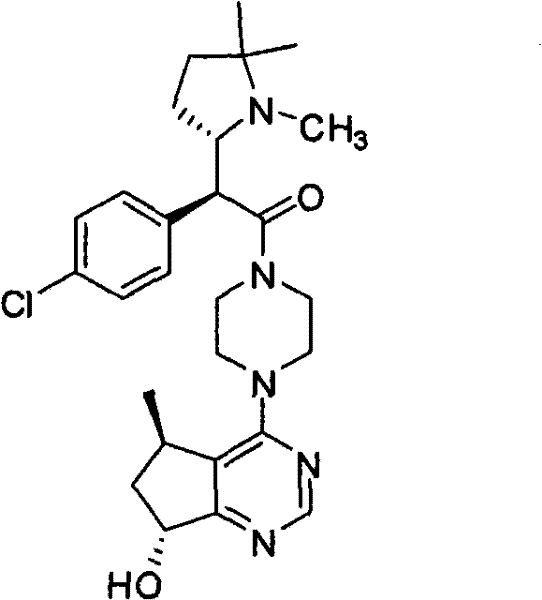
(S)-2-(4-氯苯基)-1-(4-((5R,7R)-7-羟基-5-甲基-6,7-二氢-5H-环戊二烯并(S)-2-(4-chlorophenyl)-1-(4-((5R,7R)-7-hydroxy-5-methyl-6,7-dihydro-5H-cyclopentadiene [d]嘧啶-4-基)哌嗪-1-基)-2-((S)-1,5,5-三甲基吡咯烷-2-基)乙酮[d] pyrimidin-4-yl)piperazin-1-yl)-2-((S)-1,5,5-trimethylpyrrolidin-2-yl)ethanone
步骤1:将5,5-二甲基吡咯烷-2-酮(0.1078g,0.95265mmol)[Ganem,B.和Osby,JO;Tet Lett 26:6413(1985)]溶解在THF(3mL)中并冷却至-20℃。将该溶液用六甲基二硅基胺化锂(“lithium hexamethyldisilazide,LHMDS”;1.0479mL,1.0479mmol)处理并在-20℃搅拌30分钟。添加重碳酸二叔丁酯(di-tert-Butyl dicarbonate,0.24950g,1.1432mmol),并使反应混合物升温至环境温度。将反应混合物在环境温度搅拌2小时,然后用饱和NH4Cl淬灭,用乙酸乙酯稀释并分离。将有机层用饱和NH4Cl、饱和NaHCO3、饱和NaCl洗涤,经Na2SO4干燥并真空浓缩成油状物。在SiO2上用4∶1己烷/乙酸乙酯洗脱,对粗产物进行色谱分离。回收作为固体的2,2-二甲基-5-氧代吡咯烷-1-羧酸叔丁酯(Rf为0.11,在4∶1己烷/乙酸乙酯中)(0.087g,43%)。1HNMR(CDCl3,400MHz)δ2.48(t,J=7.8,2H),1.85(t,2H),1.54(s,9H),1.47(s,6H)。 Step 1 : 5,5-Dimethylpyrrolidin-2-one (0.1078 g, 0.95265 mmol) [Ganem, B. and Osby, JO; Tet Lett 26 :6413 (1985)] was dissolved in THF (3 mL) and cooled to -20°C. The solution was treated with lithium hexamethyldisilazide ("lithium hexamethyldisilazide, LHMDS"; 1.0479 mL, 1.0479 mmol) and stirred at -20°C for 30 minutes. Di-tert-Butyl dicarbonate (0.24950 g, 1.1432 mmol) was added and the reaction mixture was allowed to warm to ambient temperature. The reaction mixture was stirred at ambient temperature for 2 hours, then quenched with saturated NH4Cl , diluted with ethyl acetate and separated. The organic layer was washed with sat. NH 4 Cl, sat. NaHCO 3 , sat. NaCl, dried over Na 2 SO 4 and concentrated in vacuo to an oil. The crude product was chromatographed on SiO2 eluting with 4:1 hexane/ethyl acetate. 2,2-Dimethyl-5-oxopyrrolidine-1-carboxylic acid tert-butyl ester (Rf 0.11 in 4:1 hexane/ethyl acetate) was recovered as a solid (0.087 g, 43%) . 1 H NMR (CDCl 3 , 400 MHz) δ 2.48 (t, J=7.8, 2H), 1.85 (t, 2H), 1.54 (s, 9H), 1.47 (s, 6H).
步骤2:将2,2-二甲基-5-氧代吡咯烷-1-羧酸叔丁酯(1.170g,5.4859mmol)溶解在Et2O(15mL)中并冷却至-78℃。用DIBAL-H(3.7304mL,5.5956mmol)处理该溶液。将混合物在-78℃搅拌2小时,然后升温至环境温度过夜。通过添加对甲苯磺酸水合物(0.012g)在MeOH(12mL)中的溶液的等分液(7mL)淬灭反应。将混合物在环境温度搅拌60小时。将该悬浮液真空浓缩并再次悬浮在Rochelle′s盐(0.5N)和乙酸乙酯的混合物中。在分离后,用乙酸乙酯(2X)洗涤水溶液部分。然后将合并的有机物用饱和NaCl洗涤,经Na2SO4干燥并真空浓缩成浅色油状物(92%)。将氯化钛(IV)(3.7128ml,3.7128mmol)在甲苯中的溶液冷却至0℃并用(R)-4-苄基-3-(2-(4-氯苯基)乙酰基)噁唑烷-2-酮(1.1131g,3.3753mmol)溶解在二氯甲烷(7mL)中的溶液处理。在5分钟后,添加二异丙基乙基胺(0.64671mL,3.7128mmol)。将所得的溶液在0℃搅拌1小时,然后冷却至-20℃。添加5-甲氧基-2,2-二甲基吡咯烷-1-羧酸叔丁酯(1.090g,5.0630mmol)在二氯甲烷(7mL)中的溶液,并将混合物在-20℃搅拌75分钟。用饱和NH4Cl(约4mL)淬灭反应并用水稀释,以溶解固体。在分离后,用二氯甲烷(3X)洗涤水溶液部分。将合并的有机物用水(2X)洗涤,经Na2SO4干燥并真空浓缩。在SiO2上用9∶1己烷/乙酸乙酯洗脱,对粗产物进行色谱分离,得到(S)-5-(((S)-2-((R)-4-苄基-2-氧代噁唑烷-3-基)-1-(4-氯苯基)-2-氧代乙基)-2,2-二甲基吡咯烷-1-羧酸叔丁酯(1.09g,61%)。MS(ESI+)[M+H]526.7/528.8。 Step 2 : tert-butyl 2,2-dimethyl-5-oxopyrrolidine-1-carboxylate (1.170 g, 5.4859 mmol) was dissolved in Et2O (15 mL) and cooled to -78 °C. The solution was treated with DIBAL-H (3.7304 mL, 5.5956 mmol). The mixture was stirred at -78°C for 2 hours, then allowed to warm to ambient temperature overnight. The reaction was quenched by adding an aliquot (7 mL) of p-toluenesulfonic acid hydrate (0.012 g) in MeOH (12 mL). The mixture was stirred at ambient temperature for 60 hours. The suspension was concentrated in vacuo and resuspended in a mixture of Rochelle's salt (0.5N) and ethyl acetate. After separation, the aqueous portion was washed with ethyl acetate (2X). The combined organics were then washed with saturated NaCl, dried over Na2SO4 and concentrated in vacuo to a light oil (92%). A solution of titanium(IV) chloride (3.7128ml, 3.7128mmol) in toluene was cooled to 0°C and treated with (R)-4-benzyl-3-(2-(4-chlorophenyl)acetyl)oxazole A solution of the alkan-2-one (1.1131 g, 3.3753 mmol) dissolved in dichloromethane (7 mL) was worked up. After 5 minutes, diisopropylethylamine (0.64671 mL, 3.7128 mmol) was added. The resulting solution was stirred at 0°C for 1 hour, then cooled to -20°C. A solution of tert-butyl 5-methoxy-2,2-dimethylpyrrolidine-1-carboxylate (1.090 g, 5.0630 mmol) in dichloromethane (7 mL) was added, and the mixture was stirred at -20 °C 75 minutes. The reaction was quenched with saturated NH4Cl (about 4 mL) and diluted with water to dissolve the solids. After separation, the aqueous portion was washed with dichloromethane (3X). The combined organics were washed with water (2X), dried over Na2SO4 and concentrated in vacuo. The crude product was chromatographed on SiO2 eluting with 9:1 hexane/ethyl acetate to afford (S)-5-(((S)-2-((R)-4-benzyl-2 -Oxooxazolidin-3-yl)-1-(4-chlorophenyl)-2-oxoethyl)-2,2-dimethylpyrrolidine-1-carboxylic acid tert-butyl ester (1.09g , 61%). MS (ESI+) [M+H] 526.7/528.8.
步骤3:根据对实施例1所述的操作,使用(S)-5-((S)-2-((R)-4-苄基-2-氧代噁唑烷-3-基)-1-(4-氯苯基)-2-氧代乙基)-2,2-二甲基吡咯烷-1-羧酸叔丁酯制备(S)-2-((S)-1-(叔丁氧基羰基)-5,5-二甲基吡咯烷-2-基)-2-(4-氯苯基)乙酸(0.55g,72%)。1H NMR(CDCl3,400MHz)δ7.33-7.21(m,4H),4.60-4.51(m,1H),4.39-4.32(m,1H),2.04-1.92(m,2H),1.78-1.68(m,2H),1.51(s,9H),1.22(s,6H)。 Step 3 : According to the procedure described for Example 1, using (S)-5-((S)-2-((R)-4-benzyl-2-oxooxazolidin-3-yl)- 1-(4-chlorophenyl)-2-oxoethyl)-2,2-dimethylpyrrolidine-1-carboxylic acid tert-butyl ester preparation (S)-2-((S)-1-( tert-butoxycarbonyl)-5,5-dimethylpyrrolidin-2-yl)-2-(4-chlorophenyl)acetic acid (0.55 g, 72%). 1 H NMR (CDCl 3 , 400MHz) δ7.33-7.21(m, 4H), 4.60-4.51(m, 1H), 4.39-4.32(m, 1H), 2.04-1.92(m, 2H), 1.78-1.68 (m, 2H), 1.51 (s, 9H), 1.22 (s, 6H).
步骤4:根据对实施例3所述的操作,使用(S)-2-((S)-1-(叔丁氧基羰基)-5,5-二甲基吡咯烷-2-基)-2-(4-氯苯基)乙酸制备(S)-5-((S)-1-(4-氯苯基)-2-(4-((5R,7R)-7-羟基-5-甲基-6,7-二氢-5H-环戊二烯并[d]嘧啶-4-基)哌嗪-1-基)-2-氧代乙基)-2,2-二甲基吡咯烷-1-羧酸叔丁酯(0.315g,79%)。MS(ESI+)[M+H]584.0/586.1。 Step 4 : According to the procedure described for Example 3, using (S)-2-((S)-1-(tert-butoxycarbonyl)-5,5-dimethylpyrrolidin-2-yl)- Preparation of (S)-5-((S)-1-(4-chlorophenyl)-2-(4-((5R,7R)-7-hydroxyl-5- Methyl-6,7-dihydro-5H-cyclopentadieno[d]pyrimidin-4-yl)piperazin-1-yl)-2-oxoethyl)-2,2-dimethylpyrrole tert-Butyl alkane-1-carboxylate (0.315 g, 79%). MS (ESI+) [M+H] 584.0/586.1.
步骤5:根据对实施例3所述的操作,使用(S)-5-((S)-1-(4-氯苯基)-2-(4-((5R,7R)-7-羟基-5-甲基-6,7-二氢-5H-环戊二烯并[d]嘧啶-4-基)哌嗪-1-基)-2-氧代乙基)-2,2-二甲基吡咯烷-1-羧酸叔丁酯制备(S)-2-(4-氯苯基)-2-((S)-5,5-二甲基吡咯烷-2-基)-1-(4-((5R,7R)-7-羟基-5-甲基-6,7-二氢-5H-环戊二烯并[d]嘧啶-4-基)哌嗪-1-基)乙酮(0.278g,93%)。MS(ESI+)[M+H]484.2/486.2。 Step 5 : According to the procedure described for Example 3, using (S)-5-((S)-1-(4-chlorophenyl)-2-(4-((5R,7R)-7-hydroxy -5-Methyl-6,7-dihydro-5H-cyclopentadien[d]pyrimidin-4-yl)piperazin-1-yl)-2-oxoethyl)-2,2-di Preparation of (S)-2-(4-chlorophenyl)-2-((S)-5,5-dimethylpyrrolidin-2-yl)-1 from tert-butyl methylpyrrolidine-1-carboxylate -(4-((5R,7R)-7-Hydroxy-5-methyl-6,7-dihydro-5H-cyclopentadien[d]pyrimidin-4-yl)piperazin-1-yl) Ethyl ketone (0.278 g, 93%). MS (ESI+) [M+H] 484.2/486.2.
步骤6:根据对实施例7所述的操作,使用(S)-2-(4-氯苯基)-2-((S)-5,5-二甲基吡咯烷-2-基)-1-(4-((5R,7R)-7-羟基-5-甲基-6,7-二氢-5H-环戊二烯并[d]嘧啶-4-基)哌嗪-1-基)乙酮制备(S)-2-(4-氯苯基)-1-(4-((5R,7R)-7-羟基-5-甲基-6,7-二氢-5H-环戊二烯并[d]嘧啶-4-基)哌嗪-1-基)-2-((S)-1,5,5-三甲基吡咯烷-2-基)乙酮(0.016g,62%)。MS(ESI+)[M+H]498.2/500.1。1H NMR(CD3OD,400MHz)δ8.57(s,1H),7.52-7.42(m,4H),5.28(t,J=7.8Hz,1H),4.81-4.76(m,1H),4.40-4.31(q,1H),4.22-4.12(m,1H),4.05-3.97(m,1H),3.96-3.63(m,5H),3.56-3.49(m,1H),2.55(s,3H),2.32-2.24(m,1H),2.23-1.96(m,4H),1.86-1.76(m,1H),1.55(s,3H),1.34(s,3H),1.19(d,3H)。 Step 6 : According to the procedure described for Example 7, using (S)-2-(4-chlorophenyl)-2-((S)-5,5-dimethylpyrrolidin-2-yl)- 1-(4-((5R,7R)-7-Hydroxy-5-methyl-6,7-dihydro-5H-cyclopentadien[d]pyrimidin-4-yl)piperazin-1-yl ) Ethanone to prepare (S)-2-(4-chlorophenyl)-1-(4-((5R,7R)-7-hydroxyl-5-methyl-6,7-dihydro-5H-cyclopenta Dieno[d]pyrimidin-4-yl)piperazin-1-yl)-2-((S)-1,5,5-trimethylpyrrolidin-2-yl)ethanone (0.016g, 62 %). MS (ESI+) [M+H] 498.2/500.1. 1 H NMR (CD 3 OD, 400MHz) δ8.57(s, 1H), 7.52-7.42(m, 4H), 5.28(t, J=7.8Hz, 1H), 4.81-4.76(m, 1H), 4.40 -4.31(q, 1H), 4.22-4.12(m, 1H), 4.05-3.97(m, 1H), 3.96-3.63(m, 5H), 3.56-3.49(m, 1H), 2.55(s, 3H) , 2.32-2.24 (m, 1H), 2.23-1.96 (m, 4H), 1.86-1.76 (m, 1H), 1.55 (s, 3H), 1.34 (s, 3H), 1.19 (d, 3H).
实施例13Example 13

(S)-2-(4-环丙基苯基)-1-(4-((5R,7R)-7-羟基-5-甲基-6,7-二氢-5H-环戊二(S)-2-(4-cyclopropylphenyl)-1-(4-((5R,7R)-7-hydroxy-5-methyl-6,7-dihydro-5H-cyclopentadiene 烯并[d]嘧啶-4-基)哌嗪-1-基)-2-((S)-吡咯烷-2-基)乙酮Ekeno[d]pyrimidin-4-yl)piperazin-1-yl)-2-((S)-pyrrolidin-2-yl)ethanone
步骤1:用氯化锌(II)(64.00mL,32.00mmol)在THF中的溶液处理在THF中的环丙基溴化镁(64.0mL,32.00mmol)。将混合物在环境温度搅拌20分钟。以在THF(2mL)中的溶液的形式添加2-(4-溴苯基)乙腈(5.228g,26.67mmol)和双[三叔丁基膦]合钯(bis[tri-t-butyl phosphine]palladium,0.6814g,1.333mmol)。在氮气下于环境温度搅拌反应混合物12小时。将反应用饱和NH4Cl淬灭,用二氯甲烷稀释并分离。用二氯甲烷(2X)洗涤水层,然后将合并的有机层用水(3X)洗涤,经Na2SO4干燥并真空浓缩。在SiO2上用25∶1己烷/乙酸乙酯洗脱,对粗产物进行色谱分离,得到2-(4-环丙基苯基)乙腈(2.76g,66%)。1H NMR(CDCl3,400MHz)δ7.20(d,J=8.2,2H),7.07(d,J=8.2,2H),3.70(s,2H),1.94-1.85(m,1H),1.01-0.95(m,2H),0.71-0.66(m,2H)。 Step 1 : Cyclopropylmagnesium bromide (64.0 mL, 32.00 mmol) in THF was treated with zinc(II) chloride (64.00 mL, 32.00 mmol) in THF. The mixture was stirred at ambient temperature for 20 minutes. 2-(4-Bromophenyl)acetonitrile (5.228 g, 26.67 mmol) and bis[tri-t-butylphosphine]palladium (bis[tri-t-butylphosphine] palladium, 0.6814g, 1.333mmol). The reaction mixture was stirred at ambient temperature under nitrogen for 12 hours. The reaction was quenched with saturated NH4Cl , diluted with dichloromethane and separated. The aqueous layer was washed with dichloromethane (2X), then the combined organic layers were washed with water (3X), dried over Na2SO4 and concentrated in vacuo . The crude product was chromatographed on SiO2 eluting with 25:1 hexane/ethyl acetate to afford 2-(4-cyclopropylphenyl)acetonitrile (2.76 g, 66%). 1 H NMR (CDCl 3 , 400MHz) δ7.20 (d, J=8.2, 2H), 7.07 (d, J=8.2, 2H), 3.70 (s, 2H), 1.94-1.85 (m, 1H), 1.01 -0.95 (m, 2H), 0.71-0.66 (m, 2H).
步骤2:将甲醇(65mL)冷却至0℃并用HCl(g)饱和。用2-(4-环丙基苯基)乙腈(2.76g,17.56mmol)在甲醇(6mL)中的溶液处理该溶液。在使用含CaSO4的干燥管的情况下将反应混合物加热至回流过夜。将反应混合物冷却并真空浓缩。将粗混合物再次悬浮在乙酸乙酯和水中,然后分离。将有机层用饱和NaHCO3、饱和NaCl洗涤,经Na2SO4干燥并真空浓缩,得到作为油状物的2-(4-环丙基苯基)乙酸甲酯(3.10g,93%)。1H NMR(CDCl3,400MHz)δ7.16(d,J=8.3,2H),7.02(d,2H),3.68(s,3H),3.58(s,2H),1.92-1.83(m,1H),0.97-0.91(m,2H),0.70-0.64(m,2H)。 Step 2 : Methanol (65 mL) was cooled to 0°C and saturated with HCl (g). This solution was treated with a solution of 2-(4-cyclopropylphenyl)acetonitrile (2.76 g, 17.56 mmol) in methanol (6 mL). The reaction mixture was heated to reflux overnight using a drying tube containing CaSO4 . The reaction mixture was cooled and concentrated in vacuo. The crude mixture was resuspended in ethyl acetate and water and separated. The organic layer was washed with sat. NaHCO 3 , sat. NaCl, dried over Na 2 SO 4 and concentrated in vacuo to give methyl 2-(4-cyclopropylphenyl)acetate (3.10 g, 93%) as an oil. 1 H NMR (CDCl 3 , 400MHz) δ7.16 (d, J=8.3, 2H), 7.02 (d, 2H), 3.68 (s, 3H), 3.58 (s, 2H), 1.92-1.83 (m, 1H) ), 0.97-0.91 (m, 2H), 0.70-0.64 (m, 2H).
步骤3:将2-(4-环丙基苯基)乙酸甲酯(3.10g,16.30mmol)溶解在THF/MeOH/水(2∶2∶1,80mL)混合物中,并用氢氧化锂水合物(0.8548g,20.37mmol)处理该溶液。然后在环境温度搅拌该混合物4小时。将反应混合物用3N HCl中和至pH为4并真空浓缩。将固体再次溶解在乙酸乙酯和水中。将pH用3N HCl再次调节为约3至约4。然后将各层分离。用乙酸乙酯(2X)洗涤水层。然后,将合并的有机层用饱和NaCl洗涤,经Na2SO4干燥并浓缩,得到2-(4-环丙基苯基)乙酸(2.82g,98%)。1H NMR(CDCl3,400MHz)δ7.16(d,J=8.2,2H),7.03(d,2H),3.60(s,2H),1.92-1.83(m,1H),0.98-0.91(m,2H),0.70-0.64(m,2H)。 Step 3 : Methyl 2-(4-cyclopropylphenyl)acetate (3.10 g, 16.30 mmol) was dissolved in a THF/MeOH/water (2:2:1, 80 mL) mixture and hydrated with lithium hydroxide (0.8548 g, 20.37 mmol) worked up the solution. The mixture was then stirred at ambient temperature for 4 hours. The reaction mixture was neutralized to pH 4 with 3N HCl and concentrated in vacuo. The solid was redissolved in ethyl acetate and water. The pH was readjusted to about 3 to about 4 with 3N HCl. The layers were then separated. The aqueous layer was washed with ethyl acetate (2X). Then, the combined organic layers were washed with saturated NaCl, dried over Na2SO4 and concentrated to give 2-(4-cyclopropylphenyl)acetic acid (2.82 g, 98%). 1 H NMR (CDCl 3 , 400MHz) δ7.16 (d, J=8.2, 2H), 7.03 (d, 2H), 3.60 (s, 2H), 1.92-1.83 (m, 1H), 0.98-0.91 (m , 2H), 0.70-0.64 (m, 2H).
步骤4:使2-(4-环丙基苯基)乙酸(2.82g,16.003mmol)与(R)-4-苄基噁唑烷-2-酮(3.4030g,19.204mmol)在甲苯(14mL)中混合。用三乙胺(6.6917mL,48.010mmol)处理该悬浮液,然后加热至80℃。用新戊酰氯(1.9893mL,16.003mmol)在甲苯(3.5mL)中的溶液滴加处理该溶液。将反应混合物在80℃加热过夜。将反应混合物冷却并用2N HCl洗涤,然后分离。用甲苯洗涤水层,然后将合并的有机物用2N HCl、水、饱和NaHCO3(2X)、饱和NaCl洗涤,经Na2SO4干燥并真空浓缩。在SiO2上用9∶1己烷/乙酸乙酯洗脱,对粗产物进行色谱分离,得到(R)-4-苄基-3-(2-(4-环丙基苯基)乙酰基)噁唑烷-2-酮(3.43g,64%)。1H NMR(CDCl3,400MHz)δ7.33-7.20(m,5H),7.16-7.11(m,2H),7.05(d,J=8.2,2H),4.70-4.63(m,1H),4.32-4.14(m,4H),3.26(dd,J1=3.2,J2=13.3,1H),2.75(dd,J1=9.5,J2=13.3,1H),1.93-1.85(m,1H),0.98-0.92(m,2H),0.72-0.66(m,2H)。 Step 4 : Make 2-(4-cyclopropylphenyl)acetic acid (2.82g, 16.003mmol) and (R)-4-benzyl oxazolidin-2-one (3.4030g, 19.204mmol) in toluene (14mL ) mixed in. The suspension was treated with triethylamine (6.6917 mL, 48.010 mmol) and then heated to 80 °C. This solution was treated dropwise with a solution of pivaloyl chloride (1.9893 mL, 16.003 mmol) in toluene (3.5 mL). The reaction mixture was heated at 80 °C overnight. The reaction mixture was cooled and washed with 2N HCl, then separated. The aqueous layer was washed with toluene, then the combined organics were washed with 2N HCl, water, sat NaHCO3 (2X), sat NaCl , dried over Na2SO4 and concentrated in vacuo. The crude product was chromatographed on SiO2 eluting with 9:1 hexane/ethyl acetate to afford (R)-4-benzyl-3-(2-(4-cyclopropylphenyl)acetyl ) oxazolidin-2-one (3.43 g, 64%). 1 H NMR (CDCl 3 , 400MHz) δ7.33-7.20 (m, 5H), 7.16-7.11 (m, 2H), 7.05 (d, J=8.2, 2H), 4.70-4.63 (m, 1H), 4.32 -4.14 (m, 4H), 3.26 (dd, J1 = 3.2, J2 = 13.3, 1H), 2.75 (dd, J1 = 9.5, J2 = 13.3, 1H), 1.93-1.85 (m, 1H), 0.98-0.92 (m, 2H), 0.72-0.66 (m, 2H).
步骤5:根据对实施例1所述的操作,使用(R)-4-苄基-3-(2-(4-环丙基苯基)乙酰基)噁唑烷-2-酮制备(S)-2-((S)-1-(叔丁氧基羰基)吡咯烷-2-基)-2-(4-环丙基苯基)乙酸(0.287g,26%)。MS(ESI+)[M+H]345.7。 Step 5 : According to the procedure described for Example 1, the preparation of (S )-2-((S)-1-(tert-butoxycarbonyl)pyrrolidin-2-yl)-2-(4-cyclopropylphenyl)acetic acid (0.287 g, 26%). MS (ESI+) [M+H] 345.7.
步骤6:根据对实施例3所述的操作,使用(S)-2-((S)-1-(叔丁氧基羰基)吡咯烷-2-基)-2-(4-环丙基苯基)乙酸制备(S)-2-((S)-1-(4-环丙基苯基)-2-(4-((5R,7R)-7-羟基-5-甲基-6,7-二氢-5H-环戊二烯并[d]嘧啶-4-基)哌嗪-1-基)-2-氧代乙基)吡咯烷-1-羧酸叔丁酯(0.199g,94%)。MS(ESI+)[M+H]562.1。 Step 6 : Following the procedure described for Example 3, using (S)-2-((S)-1-(tert-butoxycarbonyl)pyrrolidin-2-yl)-2-(4-cyclopropyl Preparation of (S)-2-((S)-1-(4-cyclopropylphenyl)-2-(4-((5R,7R)-7-hydroxy-5-methyl-6 , 7-dihydro-5H-cyclopentadieno[d]pyrimidin-4-yl)piperazin-1-yl)-2-oxoethyl)pyrrolidine-1-carboxylic acid tert-butyl ester (0.199g , 94%). MS (ESI+) [M+H] 562.1.
步骤7:根据对实施例3所述的操作,使用(S)-2-((S)-1-(4-环丙基苯基)-2-(4-((5R,7R)-7-羟基-5-甲基-6,7-二氢-5H-环戊二烯并[d]嘧啶-4-基)哌嗪-1-基)-2-氧代乙基)吡咯烷-1-羧酸叔丁酯制备(S)-2-(4-环丙基苯基)-1-(4-((5R,7R)-7-羟基-5-甲基-6,7-二氢-5H-环戊二烯并[d]嘧啶-4-基)哌嗪-1-基)-2-((S)-吡咯烷-2-基)乙酮(0.145g,77%)。MS(ESI+)[M+H]462.2。1HNMR(CD3OD,400MHz)δ8.56(s,1H),7.26(d,2H),7.13(d,2H),5.29(dd,1H),5.32-5.26(dd,1H),4.32(d,1H),4.29-4.18(m,1H),4.12-3.95(m,2H),3.88-3.61(m,6H),3.51-3.38(m,1H),3.35-3.30(m,1H),2.32-2.24(m,1H),2.22-2.03(m,2H),1.95-1.85(m,2H),1.82-1.73(m,2H),1.40-1.34(m,1H),1.16(d,3H),1.01-0.95(m,2H),0.69-0.64(m,2H)。 Step 7 : According to the procedure described for Example 3, using (S)-2-((S)-1-(4-cyclopropylphenyl)-2-(4-((5R,7R)-7 -Hydroxy-5-methyl-6,7-dihydro-5H-cyclopentadieno[d]pyrimidin-4-yl)piperazin-1-yl)-2-oxoethyl)pyrrolidine-1 - Preparation of (S)-2-(4-cyclopropylphenyl)-1-(4-((5R,7R)-7-hydroxy-5-methyl-6,7-dihydro from tert-butyl carboxylate) -5H-Cyclopenta[d]pyrimidin-4-yl)piperazin-1-yl)-2-((S)-pyrrolidin-2-yl)ethanone (0.145 g, 77%). MS (ESI+) [M+H] 462.2. 1 HNMR (CD 3 OD, 400MHz) δ8.56(s, 1H), 7.26(d, 2H), 7.13(d, 2H), 5.29(dd, 1H), 5.32-5.26(dd, 1H), 4.32( d, 1H), 4.29-4.18(m, 1H), 4.12-3.95(m, 2H), 3.88-3.61(m, 6H), 3.51-3.38(m, 1H), 3.35-3.30(m, 1H), 2.32-2.24(m, 1H), 2.22-2.03(m, 2H), 1.95-1.85(m, 2H), 1.82-1.73(m, 2H), 1.40-1.34(m, 1H), 1.16(d, 3H) ), 1.01-0.95 (m, 2H), 0.69-0.64 (m, 2H).
表1中所示的实施例14-32也可以根据上述方法制备。Examples 14-32 shown in Table 1 were also prepared according to the method described above.
表1Table 1


实施例33Example 33
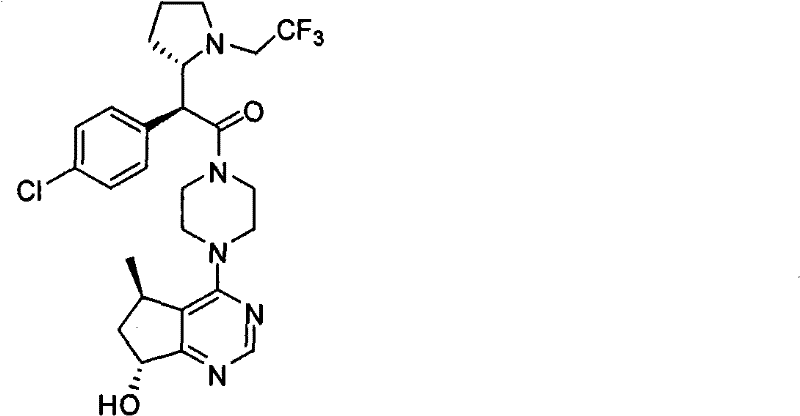
(S)-2-(4-氯苯基)-1-(4-((5R,7R)-7-羟基-5-甲基-6,7-二氢-5H-环戊二烯并(S)-2-(4-chlorophenyl)-1-(4-((5R,7R)-7-hydroxy-5-methyl-6,7-dihydro-5H-cyclopentadiene [d]嘧啶-4-基)哌嗪-1-基)-2-((S)-1-(2,2,2-三氟乙基)吡咯烷-2-基)乙酮[d]pyrimidin-4-yl)piperazin-1-yl)-2-((S)-1-(2,2,2-trifluoroethyl)pyrrolidin-2-yl)ethanone
使(S)-2-(4-氯苯基)-1-(4-((5R,7R)-7-羟基-5-甲基-6,7-二氢-5H-环戊二烯并[d]嘧啶-4-基)哌嗪-1-基)-2-((S)-吡咯烷-2-基)乙酮(28mg,0.53mmol;参见实施例3)在丙酮(0.4mL)中浆化,并用二异丙基乙基胺(0.032mL,0.18mmol)、4-二甲基氨基吡啶(“DMAP”;0.0006g,0.005mmol)和三氟甲磺酸3,3,3-三氟丙酯(0.016g,0.066mmol)处理。将反应混合物加热至回流,保持9小时。添加另外的三氟甲磺酸3,3,3-三氟丙酯(0.016g,0.066mmol),并将混合物在回流的情况下加热16小时。将反应混合物使用N2(g)浓缩并在SiO2上用2%MeOH/二氯甲烷洗脱进行色谱分离。在色谱分离后,将产物溶解在乙酸乙酯中并用饱和NH4Cl洗涤3遍,用饱和NaHCO3洗涤1遍,用饱和NaCl洗涤1遍,经Na2SO4干燥并真空浓缩。将残留物从二噁烷浓缩,用在二噁烷(2mL)中的4M HCl处理并真空浓缩。将该盐再次溶解在MeOH中并再次浓缩,重复三遍。将该盐溶解在最少量的MeOH中并滴加至Et2O。将该盐过滤并用Et2O洗涤,然后在真空下干燥(12.8mg,39%)。MS(ESI+)[M+H]538.2/540.1。1H NMR(CD3OD,400MHz)
实施例34Example 34

(S)-2-(4-氯苯基)-1-(4-((5R,7R)-7-羟基-5-甲基-6,7-二氢-5H-环戊二烯并(S)-2-(4-chlorophenyl)-1-(4-((5R,7R)-7-hydroxy-5-methyl-6,7-dihydro-5H-cyclopentadiene [d]嘧啶-4-基)哌嗪-1-基)-2-((R)-吡咯烷-2-基)乙酮[d]pyrimidin-4-yl)piperazin-1-yl)-2-((R)-pyrrolidin-2-yl)ethanone
步骤1:将在水(60mL)中的KOH(8.3g,147.9mmol)添加至(2R)-2-甲基-5-氧代环戊烷羧酸乙酯(20g,117.5mmol)和硫脲(9.2g,120.9mmol)的混合物在乙醇(100mL)中的溶液。将混合物回流10小时。在冷却后,除去溶剂。将所得的残留物用浓HCl(12mL)在0℃中和,然后用DCM(3X150mL)萃取。除去溶剂,并通过硅胶色谱法用己烷/乙酸乙酯(2∶1)洗脱纯化所得的残留物,得到(R)-2-巯基-5-甲基-6,7-二氢-5H-环戊二烯并[d]嘧啶-4-醇(12g,56%)。MS(APCI+)[M+H]+183。 Step 1 : KOH (8.3 g, 147.9 mmol) in water (60 mL) was added to ethyl (2R)-2-methyl-5-oxocyclopentanecarboxylate (20 g, 117.5 mmol) and thiourea (9.2 g, 120.9 mmol) in ethanol (100 mL). The mixture was refluxed for 10 hours. After cooling, the solvent was removed. The resulting residue was neutralized with cone. HCl (12 mL) at 0° C., then extracted with DCM (3×150 mL). The solvent was removed and the resulting residue was purified by silica gel chromatography eluting with hexane/ethyl acetate (2:1) to afford (R)-2-mercapto-5-methyl-6,7-dihydro-5H - Cyclopenta[d]pyrimidin-4-ol (12 g, 56%). MS(APCI+)[M+H] +183 .
步骤2:将Raney镍(15g)和NH4OH(20mL)添加至(R)-2-巯基-5-甲基-6,7-二氢-5H-环戊二烯并[d]嘧啶-4-醇(12g,65.8mmol)在蒸馏水(100mL)中的悬浮液中。将混合物回流3小时,然后过滤。浓缩滤液,得到(R)-5-甲基-6,7-二氢-5H-环戊二烯并[d]嘧啶-4-醇(9.89g,99%)。MS(APCI+)[M+H]+151。 Step 2 : Add Raney nickel (15 g) and NH4OH (20 mL) to (R)-2-mercapto-5-methyl-6,7-dihydro-5H-cyclopenta[d]pyrimidine- 4-Alcohol (12 g, 65.8 mmol) in suspension in distilled water (100 mL). The mixture was refluxed for 3 hours, then filtered. The filtrate was concentrated to give (R)-5-methyl-6,7-dihydro-5H-cyclopenta[d]pyrimidin-4-ol (9.89 g, 99%). MS(APCI+)[M+H] +151 .
步骤3:根据实施例3步骤4-7的操作将(R)-5-甲基-6,7-二氢-5H-环戊二烯并[d]嘧啶-4-醇转化成(5R)-4-(7-羟基-5-甲基-6,7-二氢-5H-环戊二烯并[d]嘧啶-4-基)哌嗪-1-羧酸叔丁酯。 Step 3 : Convert (R)-5-methyl-6,7-dihydro-5H-cyclopentadien[d]pyrimidin-4-ol into (5R) according to the operation of Step 4-7 of Example 3 - tert-butyl 4-(7-hydroxy-5-methyl-6,7-dihydro-5H-cyclopenta[d]pyrimidin-4-yl)piperazine-1-carboxylate.
步骤4:将(R)-4-(7-羟基-5-甲基-6,7-二氢-5H-环戊二烯并[d]嘧啶-4-基)哌嗪-1-羧酸叔丁酯(2.50g,7.48mmol)溶解在二氯甲烷(30mL)中,冷却至0℃并用4-溴苄基氯(1.81g,8.22mmol)和三乙胺(3.13mL,22.4mmol)处理。立即移除冰浴,并将反应混合物在环境温度搅拌3小时。将反应混合物倾入饱和NaHCO3中并分离。用二氯甲烷(2X)洗涤水层。然后将合并的有机层用饱和NaHCO3(2X)、6%NaHCO3(1X)洗涤,经Na2SO4干燥并真空浓缩。用2∶1己烷∶乙酸乙酯洗脱,对残留物进行柱层析(Biotage 40M),得到(R)-4-(7-(4-溴苯甲酰氧基)-5-甲基-6,7-二氢-5H-环戊二烯并[d]嘧啶-4-基)哌嗪-1-羧酸叔丁酯(1.29g,33%)。 Step 4 : Adding (R)-4-(7-hydroxy-5-methyl-6,7-dihydro-5H-cyclopentadieno[d]pyrimidin-4-yl)piperazine-1-carboxylic acid tert-Butyl ester (2.50 g, 7.48 mmol) was dissolved in dichloromethane (30 mL), cooled to 0 °C and treated with 4-bromobenzyl chloride (1.81 g, 8.22 mmol) and triethylamine (3.13 mL, 22.4 mmol) . The ice bath was removed immediately, and the reaction mixture was stirred at ambient temperature for 3 hours. The reaction mixture was poured into saturated NaHCO 3 and separated. The aqueous layer was washed with dichloromethane (2X). The combined organic layers were then washed with saturated NaHCO3 ( 2X), 6% NaHCO3 (1X), dried over Na2SO4 and concentrated in vacuo. Column chromatography (Biotage 40M) of the residue, eluting with 2:1 hexane:ethyl acetate, afforded (R)-4-(7-(4-bromobenzoyloxy)-5-methyl -tert-butyl 6,7-dihydro-5H-cyclopenta[d]pyrimidin-4-yl)piperazine-1-carboxylate (1.29 g, 33%).
步骤5:在SiO2上对(R)-4-(7-(4-溴苯甲酰氧基)-5-甲基-6,7-二氢-5H-环戊二烯并[d]嘧啶-4-基)哌嗪-1-羧酸叔丁酯(0.832g,1.608mmol)进行色谱分离,用2∶1己烷∶乙酸乙酯洗脱,得到4-((5R,7R)-7-(4-溴苯甲酰氧基)-5-甲基-6,7-二氢-5H-环戊二烯并[d]嘧啶-4-基)哌嗪-1-羧酸叔丁酯(0.31g,37%);然后转换成1∶1己烷∶乙酸乙酯,得到4-((5R,7S)-7-(4-溴苯甲酰氧基)-5-甲基-6,7-二氢-5H-环戊二烯并[d]嘧啶-4-基)哌嗪-1-羧酸叔丁酯(415.3mg,49%)。 Step 5 : p-(R)-4-(7-(4-bromobenzoyloxy)-5-methyl-6,7-dihydro-5H-cyclopenta[d] on SiO Pyrimidin-4-yl)piperazine-1-carboxylic acid tert-butyl ester (0.832g, 1.608mmol) was chromatographed eluting with 2:1 hexane:ethyl acetate to give 4-((5R,7R)- tert-butyl 7-(4-bromobenzoyloxy)-5-methyl-6,7-dihydro-5H-cyclopenta[d]pyrimidin-4-yl)piperazine-1-carboxylate ester (0.31 g, 37%); then switching to 1:1 hexane:ethyl acetate afforded 4-((5R,7S)-7-(4-bromobenzoyloxy)-5-methyl- tert-butyl 6,7-dihydro-5H-cyclopenta[d]pyrimidin-4-yl)piperazine-1-carboxylate (415.3 mg, 49%).
步骤6:在0℃将氢氧化锂水合物(0.779mL,28.0mmol)添加至4-((5R,7R)-7-(4-溴苯甲酰氧基)-5-甲基-6,7-二氢-5H-环戊二烯并[d]嘧啶-4-基)哌嗪-1-羧酸叔丁酯(5.8g,11.2mmol)在THF∶H2O(150mL,2∶1)中的溶液。使混合物升温至室温并在室温搅拌1小时。将混合物真空浓缩,吸收到饱和碳酸氢钠(100mL)中并萃取到EtOAc(2X200mL)中。将反应混合物经Na2SO4干燥并真空浓缩,得到作为泡沫的4-((5R,7R)-7-羟基-5-甲基-6,7-二氢-5H-环戊二烯并[d]嘧啶-4-基)哌嗪-1-羧酸叔丁酯(3.8g,11.4mmol,100%收率)。类似地,将4-((5R,7S)-7-(4-溴苯甲酰氧基)-5-甲基-6,7-二氢-5H-环戊二烯并[d]嘧啶-4-基)哌嗪-1-羧酸叔丁酯(1.29g,2.49mmol)溶解在THF∶H2O(10mL,2∶1)中,冷却至0℃,然后用固体氢氧化锂水合物处理。在环境温度搅拌该溶液16小时。用饱和NH4Cl淬灭反应并真空浓缩。用乙酸乙酯和少量的水稀释所得的残留物。将各层分离,并用乙酸乙酯洗涤水层。将合并的有机层用饱和NaHCO3(2X)、饱和NaCl洗涤,经Na2SO4干燥并真空浓缩。在高真空下干燥所得的残留物,得到作为泡沫的4-((5R,7S)-7-羟基-5-甲基-6,7-二氢-5H-环戊二烯并[d]嘧啶-4-基)哌嗪-1-羧酸叔丁酯(0.843g,100%)。 Step 6 : Lithium hydroxide hydrate (0.779 mL, 28.0 mmol) was added to 4-((5R,7R)-7-(4-bromobenzoyloxy)-5-methyl-6 at 0 °C, 7-Dihydro-5H-cyclopentadieno[d]pyrimidin-4-yl)piperazine-1-carboxylic acid tert-butyl ester (5.8g, 11.2mmol) in THF:H 2 O (150mL, 2:1 ) in the solution. The mixture was allowed to warm to room temperature and stirred at room temperature for 1 hour. The mixture was concentrated in vacuo, taken up into saturated sodium bicarbonate (100 mL) and extracted into EtOAc (2×200 mL). The reaction mixture was dried over Na2SO4 and concentrated in vacuo to afford 4-((5R,7R)-7-hydroxy-5-methyl-6,7-dihydro-5H-cyclopentadiene as a foam[ d] pyrimidin-4-yl)piperazine-1-carboxylic acid tert-butyl ester (3.8 g, 11.4 mmol, 100% yield). Similarly, 4-((5R,7S)-7-(4-bromobenzoyloxy)-5-methyl-6,7-dihydro-5H-cyclopentadieno[d]pyrimidine- 4-yl)piperazine-1-carboxylate tert-butyl ester (1.29 g, 2.49 mmol) was dissolved in THF:H 2 O (10 mL, 2:1), cooled to 0 °C, then hydrated with solid lithium hydroxide deal with. The solution was stirred at ambient temperature for 16 hours. The reaction was quenched with saturated NH4Cl and concentrated in vacuo. The resulting residue was diluted with ethyl acetate and a small amount of water. The layers were separated, and the aqueous layer was washed with ethyl acetate. The combined organic layers were washed with sat. NaHCO 3 (2X), sat. NaCl, dried over Na 2 SO 4 and concentrated in vacuo. The resulting residue was dried under high vacuum to give 4-((5R,7S)-7-hydroxy-5-methyl-6,7-dihydro-5H-cyclopenta[d]pyrimidine as a foam -4-yl)piperazine-1-carboxylate tert-butyl ester (0.843 g, 100%).
步骤7:将4M HCl/二噁烷(11.2mL,44.9mmol)添加至4-((5R,7R)-7-羟基-5-甲基-6,7-二氢-5H-环戊二烯并[d]嘧啶-4-基)哌嗪-1-羧酸叔丁酯(0.600g,1.79mmol)在二噁烷(15mL)中的溶液。将反应混合物在氮气下于室温搅拌过夜(20小时)。将混合物浓缩至干并在高真空管线上干燥。将粗产物悬浮在乙醚中,超声处理并搅拌5分钟。将固体通过中等熔结漏斗在氮气压下过滤分离,用乙醚洗,在氮气压下干燥并在高真空管线上进一步干燥,得到作为粉末的(5R,7R)-5-甲基-4-(哌嗪-1-基)-6,7-二氢-5H-环戊二烯并[d]嘧啶-7-醇二盐酸盐(0.440g,79.8%收率)。LC/MS(APCI+)m/z 235。使用类似的方法制备(5R,7S)-5-甲基-4-(哌嗪-1-基)-6,7-二氢-5H-环戊二烯并[d]嘧啶-7-醇二盐酸盐。 Step 7 : Add 4M HCl/dioxane (11.2 mL, 44.9 mmol) to 4-((5R,7R)-7-hydroxy-5-methyl-6,7-dihydro-5H-cyclopentadiene A solution of [d]pyrimidin-4-yl)piperazine-1-carboxylic acid tert-butyl ester (0.600 g, 1.79 mmol) in dioxane (15 mL). The reaction mixture was stirred overnight (20 hours) at room temperature under nitrogen. The mixture was concentrated to dryness and dried on the high vacuum line. The crude product was suspended in ether, sonicated and stirred for 5 minutes. The solid was isolated by filtration through a medium sintered funnel under nitrogen, washed with diethyl ether, dried under nitrogen and further dried on a high vacuum line to give (5R,7R)-5-methyl-4-( Piperazin-1-yl)-6,7-dihydro-5H-cyclopenta[d]pyrimidin-7-ol dihydrochloride (0.440 g, 79.8% yield). LC/MS (APCI+) m/z 235. Using a similar procedure to prepare (5R,7S)-5-methyl-4-(piperazin-1-yl)-6,7-dihydro-5H-cyclopenta[d]pyrimidin-7-ol di Hydrochloride.
步骤8:将叠氮化钠(7.8g,120mmol)装入含有水的1L圆底烧瓶中。将4-乙酰氨基苯-1-磺酰氯(23.4g,100mmol)溶解在丙酮中,并将该溶液缓慢添加至叠氮化钠溶液。然后将反应混合物在室温搅拌16小时并用水稀释。然后除去丙酮。过滤固体,得到作为白色固体的4-乙酰氨基苯磺酰叠氮化物(21g,87%)。 Step 8 : Sodium azide (7.8 g, 120 mmol) was charged to a 1 L round bottom flask containing water. 4-Acetamidobenzene-1-sulfonyl chloride (23.4 g, 100 mmol) was dissolved in acetone, and this solution was slowly added to the sodium azide solution. The reaction mixture was then stirred at room temperature for 16 hours and diluted with water. Acetone was then removed. The solid was filtered to give 4-acetamidobenzenesulfonyl azide (21 g, 87%) as a white solid.
步骤9:将4-乙酰氨基苯磺酰叠氮化物(1.43g,5.96mmol)和2-(4-氯苯基)乙酸甲酯(1g,5.42mmol)在乙腈(27mL)中的溶液冷却至0℃。然后将DBU(0.907g,0.891mL,5.96mmol)滴加至反应混合物。将混合物搅拌过夜,之后使其通过二氧化硅填充物并用柱色谱法(EtOAc)纯化,得到作为固体的2-(4-氯苯基)-2-重氮基乙酸甲酯(0.95g,83%)。 Step 9 : A solution of 4-acetylaminobenzenesulfonyl azide (1.43 g, 5.96 mmol) and methyl 2-(4-chlorophenyl)acetate (1 g, 5.42 mmol) in acetonitrile (27 mL) was cooled to 0°C. Then DBU (0.907 g, 0.891 mL, 5.96 mmol) was added dropwise to the reaction mixture. The mixture was stirred overnight before it was passed through a pad of silica and purified by column chromatography (EtOAc) to give methyl 2-(4-chlorophenyl)-2-diazoacetate as a solid (0.95 g, 83 %).
步骤10:将在己烷(4.7mL,0.2M)中的2-(4-氯苯基)-2-重氮基乙酸甲酯(200mg,0.95mmol,1当量)缓慢添加至搅拌的吡咯烷-1-羧酸叔丁酯(325mg,1.9mmol,2当量)和Rh2(S-DOSP)4(6.25mg,0.01mmol,0.01当量)在己烷(4.7mL)中的溶液。将该溶液冷却至-40℃。搅拌反应混合物1.5小时。将反应混合物升温至室温,真空浓缩并用EtOAc洗脱通过SiO2填充物。将其浓缩成泡沫且不经纯化即使用,得到含(R)-2-((S)-1-(4-氯苯基)-2-甲氧基-2-氧代乙基)吡咯烷-1-羧酸叔丁酯的物质(336mg,100%)。MS(ESI+)[M+H]353.8。 Step 10 : Methyl 2-(4-chlorophenyl)-2-diazoacetate (200 mg, 0.95 mmol, 1 equiv) in hexane (4.7 mL, 0.2 M) was added slowly to the stirred pyrrolidine - A solution of tert-butyl 1-carboxylate (325 mg, 1.9 mmol, 2 equiv) and Rh 2 (S-DOSP) 4 (6.25 mg, 0.01 mmol, 0.01 equiv) in hexane (4.7 mL). The solution was cooled to -40°C. The reaction mixture was stirred for 1.5 hours. The reaction mixture was warmed to room temperature, concentrated in vacuo and eluted through a plug of SiO2 with EtOAc. It was concentrated to a foam and used without purification to give (R)-2-((S)-1-(4-chlorophenyl)-2-methoxy-2-oxoethyl)pyrrolidine containing - Material of tert-butyl 1-carboxylate (336 mg, 100%). MS (ESI+) [M+H] 353.8.
步骤11:将(R)-2-((S)-1-(4-氯苯基)-2-甲氧基-2-氧代乙基)吡咯烷-1-羧酸叔丁酯(336mg)溶解在THF/H2O(3∶1,4.7mL)中,并添加LiOH(42mg,1.05当量)。在室温搅拌混合物3小时。用10%KHSO4和EtOAc淬灭反应。用EtOAc(2X)洗涤水层。将合并的有机层经MgSO4干燥,过滤并浓缩,得到含(S)-2-((R)-1-(叔丁氧基羰基)吡咯烷-2-基)-2-(4-氯苯基)乙酸的物质(144mg,45%)。MS(ESI+)[M+H]337.9。 Step 11 : (R)-2-((S)-1-(4-chlorophenyl)-2-methoxy-2-oxoethyl)pyrrolidine-1-carboxylic acid tert-butyl ester (336mg ) was dissolved in THF/ H2O (3:1, 4.7 mL), and LiOH (42 mg, 1.05 equiv) was added. The mixture was stirred at room temperature for 3 hours. The reaction was quenched with 10% KHSO4 and EtOAc. The aqueous layer was washed with EtOAc (2X). The combined organic layers were dried over MgSO, filtered and concentrated to give (S)-2-((R)-1-(tert-butoxycarbonyl)pyrrolidin-2-yl)-2-(4-chloro Phenyl)acetic acid material (144 mg, 45%). MS (ESI+) [M+H] 337.9.
步骤12:使用类似于实施例1步骤5所述的操作将(S)-2-((R)-1-(叔丁氧基羰基)吡咯烷-2-基)-2-(4-氯苯基)乙酸(144mg,0.424mmol)转化成(S)-2-(4-氯苯基)-1-(4-((5R,7R)-7-羟基-5-甲基-6,7-二氢-5H-环戊二烯并[d]嘧啶-4-基)哌嗪-1-基)-2-((R)-吡咯烷-2-基)乙酮(25mg,10%)。LCMS(apci+)456.0/458.0[M+H]+;1.93分钟。还分离出一些(S)-2-(4-氯苯基)-1-(4-((5R,7R)-7-羟基-5-甲基-6,7-二氢-5H-环戊二烯并[d]嘧啶-4-基)哌嗪-1-基)-2-(((S)-吡咯烷-2-基)乙酮(66mg,28%)。 Step 12 : Using a procedure similar to that described in Example 1, Step 5, (S)-2-((R)-1-(tert-butoxycarbonyl)pyrrolidin-2-yl)-2-(4-chloro Conversion of phenyl)acetic acid (144 mg, 0.424 mmol) to (S)-2-(4-chlorophenyl)-1-(4-((5R,7R)-7-hydroxy-5-methyl-6,7 -Dihydro-5H-cyclopenta[d]pyrimidin-4-yl)piperazin-1-yl)-2-((R)-pyrrolidin-2-yl)ethanone (25 mg, 10%) . LCMS (apci+) 456.0/458.0 [M+H]+; 1.93 min. Some (S)-2-(4-chlorophenyl)-1-(4-((5R,7R)-7-hydroxy-5-methyl-6,7-dihydro-5H-cyclopenta Dieno[d]pyrimidin-4-yl)piperazin-1-yl)-2-(((S)-pyrrolidin-2-yl)ethanone (66 mg, 28%).
实施例35Example 35

(S)-2-(4-氯苯基)-2-((S)-5,5-二甲基吡咯烷-2-基)-1-(4-((5R,7R)-5-(氟甲(S)-2-(4-chlorophenyl)-2-((S)-5,5-dimethylpyrrolidin-2-yl)-1-(4-((5R,7R)-5- (fluoroform 基)-7-羟基-6,7-二氢-5H-环戊二烯并[d]嘧啶-4-基)哌嗪-1-基)乙酮Base)-7-hydroxyl-6,7-dihydro-5H-cyclopentadien[d]pyrimidin-4-yl)piperazin-1-yl)ethanone
步骤1:使用实施例3步骤2-4中所述的操作将2-氧代-5-乙烯基环戊烷羧酸乙酯(Nugent,W.A.;Hobbs,Jr,F.W.,J.Org.Chem,1986,51,3376-3378)转化成4-(5-乙烯基-6,7-二氢-5H-环戊二烯并[d]嘧啶-4-基)哌嗪-1-羧酸叔丁酯。 Step 1 : Ethyl 2-oxo-5-vinylcyclopentanecarboxylate (Nugent, WA; Hobbs, Jr, FW, J. Org. Chem, 1986, 51 , 3376-3378) into 4-(5-vinyl-6,7-dihydro-5H-cyclopentadien[d]pyrimidin-4-yl)piperazine-1-carboxylic acid tert-butyl ester.
步骤2:将4-(5-乙烯基-6,7-二氢-5H-环戊二烯并[d]嘧啶-4-基)哌嗪-1-羧酸叔丁酯(566mg)在DCM(20mL)中的溶液冷却至-78℃。用臭氧流鼓泡15分钟。在-78℃用氧气鼓泡,接着用氮气鼓泡。添加乙基甲基硫醚(Ethyl methylsulfide,2mL)。使混合物历经1小时升温至室温。浓缩内容物。使所得的残留物在DCM和半饱和NaCl溶液之间分配。分离有机层。用DCM(2X)萃取水层。将合并的有机溶液干燥(Na2SO4)。将粗产物溶解在MeOH(10mL)中并冷却至0℃。分批添加NaBH4(150mg)。在0℃搅拌混合物2小时。用10%HOAc(5mL)淬灭反应。将混合物浓缩并在水和EtOAc之间分配。分离有机层。用EtOAc(2X)萃取水层。将合并的有机溶液干燥(Na2SO4)。用快速色谱法纯化粗物质,得到4-(5-(羟基甲基)-6,7-二氢-5H-环戊二烯并[d]嘧啶-4-基)哌嗪-1-羧酸叔丁酯(73mg,13%)。MS:335.2(M+1)。可以使用手性柱色谱法拆分该物质。 Step 2 : tert-butyl 4-(5-vinyl-6,7-dihydro-5H-cyclopenta[d]pyrimidin-4-yl)piperazine-1-carboxylate (566 mg) in DCM (20 mL) was cooled to -78 °C. Bubble a stream of ozone for 15 minutes. Oxygen was sparged at -78°C followed by nitrogen. Ethyl methylsulfide (2 mL) was added. The mixture was allowed to warm to room temperature over 1 hour. Concentrate the contents. The resulting residue was partitioned between DCM and half saturated NaCl solution. Separate the organic layer. The aqueous layer was extracted with DCM (2X). The combined organic solutions were dried ( Na2SO4 ). The crude product was dissolved in MeOH (10 mL) and cooled to 0 °C. NaBH 4 (150 mg) was added portionwise. The mixture was stirred at 0°C for 2 hours. The reaction was quenched with 10% HOAc (5 mL). The mixture was concentrated and partitioned between water and EtOAc. Separate the organic layer. The aqueous layer was extracted with EtOAc (2X). The combined organic solutions were dried ( Na2SO4 ). The crude material was purified by flash chromatography to give 4-(5-(hydroxymethyl)-6,7-dihydro-5H-cyclopenta[d]pyrimidin-4-yl)piperazine-1-carboxylic acid tert-Butyl ester (73 mg, 13%). MS: 335.2 (M+1). The material can be resolved using chiral column chromatography.
步骤3:将(R)-4-(5-(羟基甲基)-6,7-二氢-5H-环戊二烯并[d]嘧啶-4-基)哌嗪-1-羧酸叔丁酯(30.0mg,0.0897mmol)溶解在四氢呋喃(0.080mL)中。向该溶液添加全氟-1-丁烷磺酰氟(0.0644mL,0.359mmol)和三乙胺三氢氟酸盐(triethylamine trishydrofluoride,0.0584mL,0.359mmol),接着添加三乙胺(0.150mL,0.726mmol)。在室温搅拌反应混合物12小时。浓缩反应混合物,并在SiO2上用10%MeOH/DCM洗脱,对该物质进行色谱分离。分离出希望的4-((R)-5-氟甲基-6,7-二氢-5H-环戊二烯并嘧啶-4-基)-哌嗪-1-羧酸叔丁酯(25.0mg,83%)。LC/MS(APCI)+m/z 337.2。 Step 3 : (R)-4-(5-(Hydroxymethyl)-6,7-dihydro-5H-cyclopentadieno[d]pyrimidin-4-yl)piperazine-1-carboxylic acid tert Butyl ester (30.0 mg, 0.0897 mmol) was dissolved in tetrahydrofuran (0.080 mL). To this solution were added perfluoro-1-butanesulfonyl fluoride (0.0644 mL, 0.359 mmol) and triethylamine trishydrofluoride (0.0584 mL, 0.359 mmol), followed by triethylamine (0.150 mL, 0.726 mmol). The reaction mixture was stirred at room temperature for 12 hours. The reaction mixture was concentrated and the material was chromatographed on SiO2 eluting with 10% MeOH/DCM. The desired tert-butyl 4-((R)-5-fluoromethyl-6,7-dihydro-5H-cyclopentadienopyrimidin-4-yl)-piperazine-1-carboxylate (25.0 mg, 83%). LC/MS (APCI) + m/z 337.2.
步骤4:使用类似于实施例3步骤12-14中所述的操作,将4-((R)-5-氟甲基-6,7-二氢-5H-环戊二烯并嘧啶-4-基)-哌嗪-1-羧酸叔丁酯转化成(S)-2-(4-氯苯基)-2-((S)-5,5-二甲基吡咯烷-2-基)-1-(4-((5R,7R)-5-(氟甲基)-7-羟基-6,7-二氢-5H-环戊二烯并[d]嘧啶-4-基)哌嗪-1-基)乙酮。m/z 502.2;1H NMR(500MHz,CD3OD)d ppm 8.60(s,1H),7.44(q,J=8.73Hz,4H),5.29-5.20(m,1H),4.61-4.52(m,1H),4.50-4.36(m,1H),4.34-4.13(m,2H),4.13-3.95(m,2H),3.90-3.83(m,1H),3.80-3.73(m,1H),3.70-3.62(m,1H),3.60-3.54(m,2H),3.52-3.41(m,2H),2.54-2.43(m,1H),2.27-2.13(m,1H),2.05-1.85(m,4H),1.54(s,3H),1.44(s,3H)。 Step 4 : Using a procedure similar to that described in Example 3 Steps 12-14, 4-((R)-5-fluoromethyl-6,7-dihydro-5H-cyclopentapyrimidine-4 -yl)-piperazine-1-carboxylic acid tert-butyl ester is converted into (S)-2-(4-chlorophenyl)-2-((S)-5,5-dimethylpyrrolidin-2-yl )-1-(4-((5R,7R)-5-(fluoromethyl)-7-hydroxyl-6,7-dihydro-5H-cyclopentadien[d]pyrimidin-4-yl)piper Azin-1-yl)ethanone. m/z 502.2; 1 H NMR (500MHz, CD 3 OD) d ppm 8.60(s, 1H), 7.44(q, J=8.73Hz, 4H), 5.29-5.20(m, 1H), 4.61-4.52(m , 1H), 4.50-4.36(m, 1H), 4.34-4.13(m, 2H), 4.13-3.95(m, 2H), 3.90-3.83(m, 1H), 3.80-3.73(m, 1H), 3.70 -3.62(m, 1H), 3.60-3.54(m, 2H), 3.52-3.41(m, 2H), 2.54-2.43(m, 1H), 2.27-2.13(m, 1H), 2.05-1.85(m, 4H), 1.54(s, 3H), 1.44(s, 3H).
实施例36Example 36

(S)-2-(4-氯苯基)-1-(4-((R)-7,7-二氟-5-甲基-6,7-二氢-5H-环戊二烯并[d](S)-2-(4-chlorophenyl)-1-(4-((R)-7,7-difluoro-5-methyl-6,7-dihydro-5H-cyclopentadiene [d] 嘧啶-4-基)哌嗪-1-基)-2-((S)-5,5-二甲基吡咯烷-2-基)乙酮Pyrimidin-4-yl)piperazin-1-yl)-2-((S)-5,5-dimethylpyrrolidin-2-yl)ethanone
步骤1:在塑料瓶中将(R)-4-(5-甲基-7-氧代-6,7-二氢-5H-环戊二烯并[d]嘧啶-4-基)哌嗪-1-羧酸叔丁酯(1.0g,3.0mmol,参见实施例3)溶解在DCM(15mL)中,然后历经约5分钟添加纯的DAST。在42小时之后于室温通过倾入到混合有冰的饱和的碳酸氢钠水溶液中淬灭反应。将有机层用EtOAc稀释,用水洗涤3遍,用盐水洗涤1遍,然后经硫酸钠干燥。在过滤后,将残留物浓缩并经柱色谱法(首先用70∶30己烷/乙酸乙酯,然后用1∶1己烷/乙酸乙酯)纯化,得到(R)-4-(7,7-二氟-5-甲基-6,7-二氢-5H-环戊二烯并[d]嘧啶-4-基)哌嗪-1-羧酸叔丁酯(300mg,28%)。 Step 1 : Dissolve (R)-4-(5-methyl-7-oxo-6,7-dihydro-5H-cyclopenta[d]pyrimidin-4-yl)piperazine in a plastic bottle - tert-butyl 1-carboxylate (1.0 g, 3.0 mmol, see Example 3) was dissolved in DCM (15 mL), then neat DAST was added over about 5 minutes. After 42 hours the reaction was quenched at room temperature by pouring into saturated aqueous sodium bicarbonate mixed with ice. The organic layer was diluted with EtOAc, washed 3 times with water, 1 time with brine, then dried over sodium sulfate. After filtration, the residue was concentrated and purified by column chromatography (first with 70:30 hexane/ethyl acetate, then with 1:1 hexane/ethyl acetate) to afford (R)-4-(7, tert-butyl 7-difluoro-5-methyl-6,7-dihydro-5H-cyclopenta[d]pyrimidin-4-yl)piperazine-1-carboxylate (300 mg, 28%).
步骤2:将4M HCl/二噁烷(2.27mL,9.09mmol)添加至(R)-4-(7,7-二氟-5-甲基-6,7-二氢-5H-环戊二烯并[d]嘧啶-4-基)哌嗪-1-羧酸叔丁酯(0.092g,0.260mmol)在二噁烷(2mL)中的溶液。将反应混合物在室温搅拌过夜,之后将其浓缩至干并在高真空下干燥,得到作为固体的(R)-7,7-二氟-5-甲基-4-(哌嗪-1-基)-6,7-二氢-5H-环戊二烯并[d]嘧啶二盐酸盐(0.079g,93.0%收率)。 Step 2 : Add 4M HCl/dioxane (2.27 mL, 9.09 mmol) to (R)-4-(7,7-difluoro-5-methyl-6,7-dihydro-5H-cyclopentadiene A solution of tert-butyl (eno[d]pyrimidin-4-yl)piperazine-1-carboxylate (0.092 g, 0.260 mmol) in dioxane (2 mL). The reaction mixture was stirred at room temperature overnight before it was concentrated to dryness and dried under high vacuum to afford (R)-7,7-difluoro-5-methyl-4-(piperazin-1-yl )-6,7-Dihydro-5H-cyclopenta[d]pyrimidine dihydrochloride (0.079 g, 93.0% yield).
步骤3:使用实施例3步骤13和14中所述的操作,将(R)-7,7-二氟-5-甲基-4-(哌嗪-1-基)-6,7-二氢-5H-环戊二烯并[d]嘧啶二盐酸盐转化成(S)-2-(4-氯苯基)-1-(4-((R)-7,7-二氟-5-甲基-6,7-二氢-5H-环戊二烯并[d]嘧啶-4-基)哌嗪-1-基)-2-((S)-5,5-二甲基吡咯烷-2-基)乙酮。LCMS(apci+)578.6[M+H]+;2.22min;1H NMR(400MHz,D2O)δppm(8.38(s,1H),7.31(d,J=8.6Hz,2H),7.22(d,J=8.2Hz,2H),4.26-4.20(m,1H),4.18-3.98(m,2H),3.89-3.80(m,1H),3.71-3.63(m,1H),3.57-3.43(m,4H),3.18-3.10(m,1H),2.81-2.62(m,1H),2.26-2.12(m,1H),1.87-1.69(m,4H),1.35(s,3H),1.30(s,3H),1.02(d,J=6.6,3H)。 Step 3 : Using the procedure described in Example 3 Steps 13 and 14, (R)-7,7-difluoro-5-methyl-4-(piperazin-1-yl)-6,7-di Hydrogen-5H-cyclopenta[d]pyrimidine dihydrochloride is converted to (S)-2-(4-chlorophenyl)-1-(4-((R)-7,7-difluoro- 5-Methyl-6,7-dihydro-5H-cyclopentadien[d]pyrimidin-4-yl)piperazin-1-yl)-2-((S)-5,5-dimethyl pyrrolidin-2-yl)ethanone. LCMS (apci+) 578.6[M+H]+; 2.22min; 1 H NMR (400MHz, D2O) δppm (8.38(s, 1H), 7.31(d, J=8.6Hz, 2H), 7.22(d, J= 8.2Hz, 2H), 4.26-4.20(m, 1H), 4.18-3.98(m, 2H), 3.89-3.80(m, 1H), 3.71-3.63(m, 1H), 3.57-3.43(m, 4H) , 3.18-3.10(m, 1H), 2.81-2.62(m, 1H), 2.26-2.12(m, 1H), 1.87-1.69(m, 4H), 1.35(s, 3H), 1.30(s, 3H) , 1.02 (d, J=6.6, 3H).
表2中示出的实施例37-96也可以根据上述方法制备。Examples 37-96 shown in Table 2 were also prepared according to the method described above.
表2Table 2
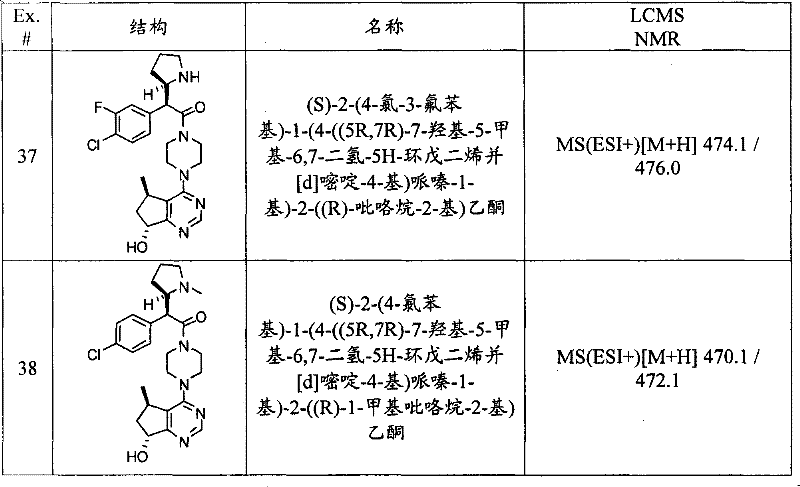


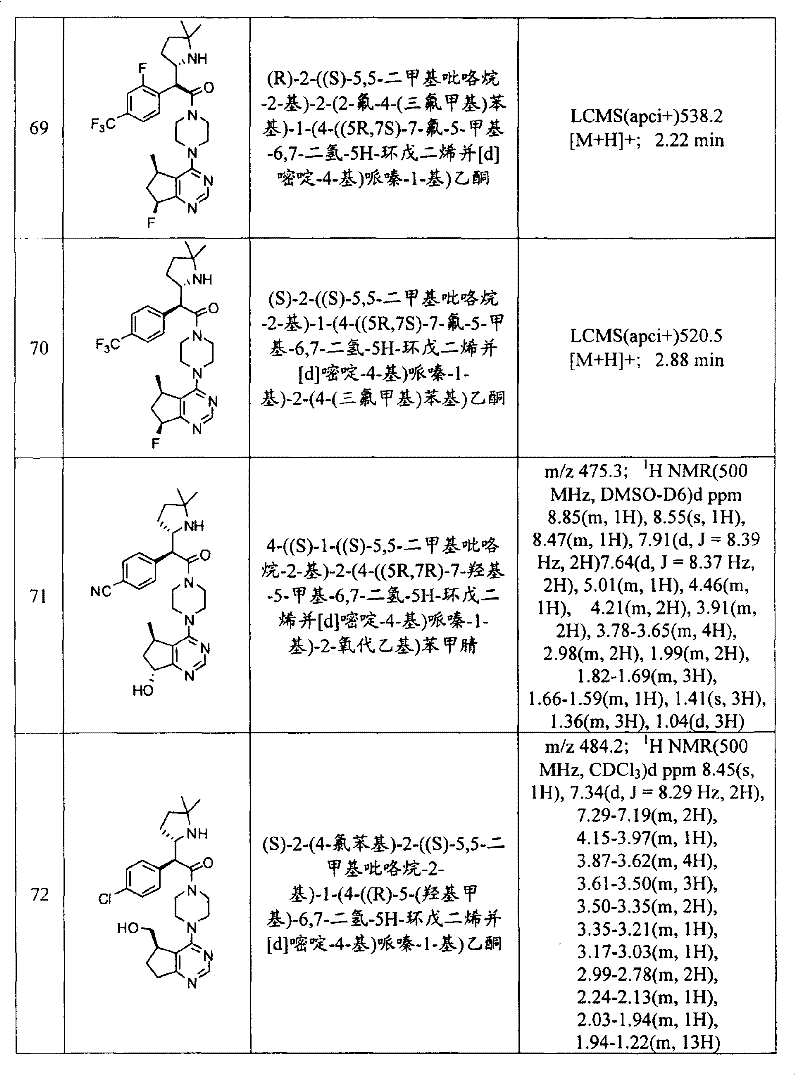


实施例97Example 97
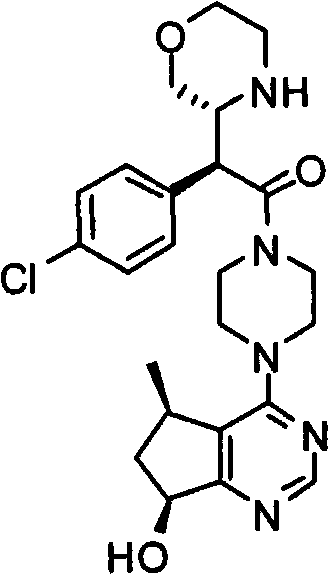
(S)-2-(4-氯苯基)-1-(4-((5R,7S)-7-羟基-5-甲基-6,7-二氢-5H-环戊二烯并(S)-2-(4-chlorophenyl)-1-(4-((5R,7S)-7-hydroxy-5-methyl-6,7-dihydro-5H-cyclopentadiene [d]嘧啶-4-基)哌嗪-1-基)-2-((R)-吗啉-3-基)乙酮[d] pyrimidin-4-yl)piperazin-1-yl)-2-((R)-morpholin-3-yl)ethanone
步骤1:将3-氧代吗啉-4-羧酸叔丁酯(8.65g,43.0mmol;如Chandrakumar,N.S.等人;在J Med Chem 35:2928(1992)中所述制备)溶解在Et2O(45mL)中并冷却至-78℃。用DIBAL-H(在甲苯中的1.5M溶液;29.2mL,43.8mmol)滴加处理该溶液,并将混合物在-78℃搅拌90分钟。然后使混合物升温至环境温度并搅拌过夜。用饱和NH4Cl(50mL)淬灭反应并搅拌20分钟。将反应混合物用乙酸乙酯(100mL)和Rochelle′s盐(50mL的0.5N溶液)稀释,然后搅拌20分钟。添加另外的Rochelle′s盐(75mL,0.5N),然后将反应混合物搅拌20分钟并分离。用乙酸乙酯(2X)洗涤水溶液部分。然后将合并的有机物用Rochelle′s盐(0.5N)、饱和NaHCO3、饱和NaCl洗涤两遍,经Na2SO4干燥并浓缩成油,3-羟基吗啉-4-羧酸叔丁酯(7.0g,80%)。 Step 1 : tert-butyl 3-oxomorpholine-4-carboxylate (8.65 g, 43.0 mmol; prepared as described by Chandrakumar, NS et al; in J Med Chem 35:2928 (1992)) was dissolved in Et 2 O (45 mL) and cooled to -78°C. The solution was treated dropwise with DIBAL-H (1.5M solution in toluene; 29.2 mL, 43.8 mmol), and the mixture was stirred at -78°C for 90 min. The mixture was then allowed to warm to ambient temperature and stirred overnight. The reaction was quenched with saturated NH4Cl (50 mL) and stirred for 20 minutes. The reaction mixture was diluted with ethyl acetate (100 mL) and Rochelle's salt (50 mL of a 0.5N solution), then stirred for 20 minutes. Additional Rochelle's salt (75 mL, 0.5N) was added and the reaction mixture was stirred for 20 minutes and separated. The aqueous portion was washed with ethyl acetate (2X). The combined organics were then washed twice with Rochelle's salt (0.5N), saturated NaHCO3 , saturated NaCl , dried over Na2SO4 and concentrated to an oil, tert-butyl 3-hydroxymorpholine-4-carboxylate ( 7.0 g, 80%).
步骤2:将3-羟基吗啉-4-羧酸叔丁酯(7.0g,34.4mmol)溶解在MeOH(65mL)中并用对甲苯磺酸水合物(0.65g,3.4mmol)处理。将反应在环境温度搅拌40小时。真空浓缩反应混合物。然后将所得的残留物溶解在乙酸乙酯中并用10%Na2CO3(2X)、饱和NaCl洗涤,经Na2SO4干燥并真空浓缩成油状物,3-甲氧基吗啉-4-羧酸叔丁酯(5.85g,78%)。1H NMR(CDCl3,400MHz)δ4.00-3.91(m,2H),3.81-3.58(m,1H),3.58-3.46(m,2H),3.38-3.21(m,2H),3.32(s,3H),1.49(s,9H)。 Step 2 : tert-butyl 3-hydroxymorpholine-4-carboxylate (7.0 g, 34.4 mmol) was dissolved in MeOH (65 mL) and treated with p-toluenesulfonic acid hydrate (0.65 g, 3.4 mmol). The reaction was stirred at ambient temperature for 40 hours. The reaction mixture was concentrated in vacuo. The resulting residue was then dissolved in ethyl acetate and washed with 10% Na2CO3 (2X), saturated NaCl , dried over Na2SO4 and concentrated in vacuo to an oil, 3-methoxymorpholine-4- tert-Butyl carboxylate (5.85 g, 78%). 1 H NMR (CDCl 3 , 400MHz) δ4.00-3.91(m, 2H), 3.81-3.58(m, 1H), 3.58-3.46(m, 2H), 3.38-3.21(m, 2H), 3.32(s , 3H), 1.49(s, 9H).
步骤3:将氯化钛(IV)(2.00mL,2.00mmol;1M,在甲苯中)溶液冷却至0℃并用(R)-4-苄基-3-(2-(4-氯苯基)乙酰基)噁唑烷-2-酮(0.60g,1.82mmol)溶解在二氯甲烷(3.5mL)中的溶液处理。在5分钟后,添加二异丙基乙基胺(0.348mL,2.00mmol)。将所得的溶液在0℃搅拌1小时,然后冷却至-20℃。添加3-甲氧基吗啉-4-羧酸叔丁酯(0.592g,2.72mmol)溶解在二氯甲烷(3.5mL)中的溶液,并将混合物在-20℃搅拌15分钟。然后使反应混合物升温至0℃。使反应混合物在浴中历经3小时缓慢升温至10℃。用饱和NH4Cl(约4mL)淬灭反应,并用水稀释,以溶解固体。在分离之后,用二氯甲烷(3X)洗涤水溶液部分。将合并的有机物用水(2X)洗涤,经Na2SO4干燥并真空浓缩。在SiO2上用10至25%乙酸乙酯/己烷的梯度洗脱,对粗产物进行色谱分离。回收作为泡沫的(R)-3-((S)-2-((R)-4-苄基-2-氧代噁唑烷-3-基)-1-(4-氯苯基)-2-氧代乙基)吗啉-4-羧酸叔丁酯(0.607g,65%)。MS(APCI+)[M+H]514.7/516.8。 Step 3 : A solution of titanium(IV) chloride (2.00 mL, 2.00 mmol; 1 M in toluene) was cooled to 0° C. and treated with (R)-4-benzyl-3-(2-(4-chlorophenyl) Acetyl)oxazolidin-2-one (0.60 g, 1.82 mmol) dissolved in dichloromethane (3.5 mL) was treated. After 5 minutes, diisopropylethylamine (0.348 mL, 2.00 mmol) was added. The resulting solution was stirred at 0°C for 1 hour, then cooled to -20°C. A solution of tert-butyl 3-methoxymorpholine-4-carboxylate (0.592 g, 2.72 mmol) dissolved in dichloromethane (3.5 mL) was added, and the mixture was stirred at -20°C for 15 minutes. The reaction mixture was then allowed to warm to 0 °C. The reaction mixture was slowly warmed to 10 °C in the bath over 3 hours. The reaction was quenched with saturated NH4Cl (about 4 mL) and diluted with water to dissolve the solids. After separation, the aqueous portion was washed with dichloromethane (3X). The combined organics were washed with water (2X), dried over Na2SO4 and concentrated in vacuo. The crude product was chromatographed on SiO2 eluting with a gradient of 10 to 25% ethyl acetate/hexanes. (R)-3-((S)-2-((R)-4-benzyl-2-oxooxazolidin-3-yl)-1-(4-chlorophenyl)- tert-butyl 2-oxoethyl)morpholine-4-carboxylate (0.607 g, 65%). MS (APCI+) [M+H] 514.7/516.8.
步骤4:将氢氧化锂水合物(0.098g,2.3mmol)溶解在水(28mL)中,冷却至0℃并用THF(83mL)稀释。将该溶液用30%过氧化氢(0.48mL,4.7mmol)处理并搅拌10分钟。添加(R)-3-((S)-2-((R)-4-苄基-2-氧代噁唑烷-3-基)-1-(4-氯苯基)-2-氧代乙基)吗啉-4-羧酸叔丁酯(0.607g,1.17mmol)溶解在THF(3mL)中的溶液。将反应混合物在浴中升温至环境温度并搅拌20小时。用Na2SO3(约7mL,1.5M)淬灭反应,直到反应混合物对淀粉-碘试纸呈阴性。然后将反应混合物真空浓缩。用乙酸乙酯(2X)萃取水层。将水层用3N HCl调节pH为约1至约2并用乙酸乙酯(3X)萃取。将最终的乙酸乙酯萃取液经Na2SO4干燥并真空浓缩成固体,(S)-2-((R)-4-(叔丁氧基羰基)吗啉-3-基)-2-(4-氯苯基)乙酸(310mg,74%)。MS(APCI+)[M+H-Boc]256.0/258.0。 Step 4 : Lithium hydroxide hydrate (0.098 g, 2.3 mmol) was dissolved in water (28 mL), cooled to 0° C. and diluted with THF (83 mL). The solution was treated with 30% hydrogen peroxide (0.48 mL, 4.7 mmol) and stirred for 10 minutes. Add (R)-3-((S)-2-((R)-4-benzyl-2-oxooxazolidin-3-yl)-1-(4-chlorophenyl)-2-oxo A solution of ethyl) tert-butyl morpholine-4-carboxylate (0.607 g, 1.17 mmol) dissolved in THF (3 mL). The reaction mixture was warmed to ambient temperature in the bath and stirred for 20 hours. The reaction was quenched with Na2SO3 (ca. 7 mL, 1.5 M) until the reaction mixture was negative to starch-iodine paper. The reaction mixture was then concentrated in vacuo. The aqueous layer was extracted with ethyl acetate (2X). The aqueous layer was adjusted to pH about 1 to about 2 with 3N HCl and extracted with ethyl acetate (3X). The final ethyl acetate extract was dried over Na2SO4 and concentrated in vacuo to a solid, (S)-2-((R)-4-(tert-butoxycarbonyl)morpholin-3-yl)-2- (4-Chlorophenyl)acetic acid (310 mg, 74%). MS (APCI+) [M+H-Boc] 256.0/258.0.
步骤5:将(S)-2-((R)-4-(叔丁氧基羰基)吗啉-3-基)-2-(4-氯苯基)乙酸(0.051g,0.143mmol)与(5R,7S)-5-甲基-4-(哌嗪-1-基)-6,7-二氢-5H-环戊二烯并[d]嘧啶-7-醇二盐酸盐(0.0440g,0.143mmol)混合,然后在二氯甲烷(1.4mL)中浆化。将悬浮液用二异丙基乙基胺(0.0749mL,0.430mmol)处理,然后用HBTU(0.0544g,0.143mmol)处理。然后将混合物在环境温度搅拌60小时。用10%Na2CO3淬灭反应并分离。用二氯甲烷(3X)洗涤反应混合物,然后将合并的有机物用Na2SO4干燥并真空浓缩。在SiO2(Biotage 12M)上对所得的残留物进行色谱分离(用二氯甲烷(96mL)洗脱,然后用0%至5%MeOH/二氯甲烷(500mL)洗脱和用5%MeOH/二氯甲烷(96mL)洗脱)。希望的物质在大约1%MeOH/二氯甲烷中干净地洗脱,得到作为油状物的(R)-3-((S)-1-(4-氯苯基)-2-(4-((5R,7S)-7-羟基-5-甲基-6,7-二氢-5H-环戊二烯并[d]嘧啶-4-基)哌嗪-1-基)-2-氧代乙基)吗啉-4-羧酸叔丁酯(81.2mg,99%)。 Step 5 : Mix (S)-2-((R)-4-(tert-butoxycarbonyl)morpholin-3-yl)-2-(4-chlorophenyl)acetic acid (0.051 g, 0.143 mmol) with (5R, 7S)-5-methyl-4-(piperazin-1-yl)-6,7-dihydro-5H-cyclopentadiene[d]pyrimidin-7-ol dihydrochloride (0.0440 g, 0.143 mmol) and then slurried in dichloromethane (1.4 mL). The suspension was treated with diisopropylethylamine (0.0749 mL, 0.430 mmol) followed by HBTU (0.0544 g, 0.143 mmol). The mixture was then stirred at ambient temperature for 60 hours. The reaction was quenched with 10% Na2CO3 and separated. The reaction mixture was washed with dichloromethane (3X), then the combined organics were dried over Na2SO4 and concentrated in vacuo. The resulting residue was chromatographed on SiO 2 (Biotage 12M) eluting with dichloromethane (96 mL) followed by 0% to 5% MeOH/dichloromethane (500 mL) and 5% MeOH/ dichloromethane (96 mL) to elute). The desired material eluted cleanly in approximately 1% MeOH/dichloromethane to afford (R)-3-((S)-1-(4-chlorophenyl)-2-(4-( (5R,7S)-7-Hydroxy-5-methyl-6,7-dihydro-5H-cyclopentadien[d]pyrimidin-4-yl)piperazin-1-yl)-2-oxo Ethyl) tert-butyl morpholine-4-carboxylate (81.2 mg, 99%).
步骤6:将(R)-3-((S)-1-(4-氯苯基)-2-(4-((5R,7S)-7-羟基-5-甲基-6,7-二氢-5H-环戊二烯并[d]嘧啶-4-基)哌嗪-1-基)-2-氧代乙基)吗啉-4-羧酸叔丁酯(0.0389g,0.0680mmol)溶解在二噁烷(1mL)中并用在二噁烷中的4M氯化氢(0.425mL,1.70mmol)处理。将该溶液在环境温度搅拌过夜。将反应混合物真空浓缩,再次悬浮在二噁烷中并真空浓缩。从MeOH(3遍)浓缩残留物,然后溶解在MeOH中。然后将该溶液滴加至Et2O,得到(S)-2-(4-氯苯基)-1-(4-((5R,7S)-7-羟基-5-甲基-6,7-二氢-5H-环戊二烯并[d]嘧啶-4-基)哌嗪-1-基)-2-((R)-吗啉-3-基)乙酮二盐酸盐(20mg,54%)。m/z 472.1/474.0;1HNMR(400MHz,CD3OD)d ppm 8.57(s,1H),7.48(d,2H),7.40(d,2H),5.13-5.07(m,1H),4.50(d,1H),4.15-4.05(m,1H),4.01-3.55(m,13H),3.53-3.39(m,1H),2.83-2.73(m,1H),1.65-1.56(m,1H),1.23(d,3H)。 Step 6 : Add (R)-3-((S)-1-(4-chlorophenyl)-2-(4-((5R,7S)-7-hydroxyl-5-methyl-6,7- Dihydro-5H-cyclopentadieno[d]pyrimidin-4-yl)piperazin-1-yl)-2-oxoethyl)morpholine-4-carboxylic acid tert-butyl ester (0.0389g, 0.0680mmol ) was dissolved in dioxane (1 mL) and treated with 4M hydrogen chloride in dioxane (0.425 mL, 1.70 mmol). The solution was stirred overnight at ambient temperature. The reaction mixture was concentrated in vacuo, resuspended in dioxane and concentrated in vacuo. The residue was concentrated from MeOH (3 times), then dissolved in MeOH. This solution was then added dropwise to Et2O to give (S)-2-(4-chlorophenyl)-1-(4-((5R,7S)-7-hydroxy-5-methyl-6,7 -Dihydro-5H-cyclopentadieno[d]pyrimidin-4-yl)piperazin-1-yl)-2-((R)-morpholin-3-yl)ethanone dihydrochloride (20mg , 54%). m/z 472.1/474.0; 1 HNMR (400MHz, CD 3 OD)d ppm 8.57(s, 1H), 7.48(d, 2H), 7.40(d, 2H), 5.13-5.07(m, 1H), 4.50( d, 1H), 4.15-4.05(m, 1H), 4.01-3.55(m, 13H), 3.53-3.39(m, 1H), 2.83-2.73(m, 1H), 1.65-1.56(m, 1H), 1.23(d,3H).
表3中示出的实施例98-100也可以根据上述方法制备。Examples 98-100 shown in Table 3 were also prepared according to the method described above.
表3table 3


实施例101Example 101

(S)-2-(4-氯-2,5-二氟苯基)-2-((S)-5,5-二甲基吡咯烷-2-(S)-2-(4-chloro-2,5-difluorophenyl)-2-((S)-5,5-dimethylpyrrolidine-2- 基)-1-(4-((5R,7R)-7-羟基-5-甲基-6,7-二氢-5H-环戊二烯并[d]嘧啶-4-基)哌嗪Base)-1-(4-((5R,7R)-7-hydroxy-5-methyl-6,7-dihydro-5H-cyclopentadien[d]pyrimidin-4-yl)piperazine -1-基)乙酮-1-yl)ethanone
步骤1:在室温将三氟甲磺酸(9.9mL,110mmol)添加至2-氯-1,4-二氟苯(2.2g,15mmol),然后冷却至0℃。然后分多份添加N-碘代琥珀酰亚胺(3.16g,14.1mmol)。在10分钟之后,将反应混合物升温至室温并搅拌2小时。将反应混合物倾入冰水并用己烷萃取。将有机层用饱和Na2SO4洗涤,干燥并浓缩。用硅胶色谱法(100%己烷)纯化粗产物,得到1-氯-2,5-二氟-4-碘代苯(3.0g,74%)。1H NMR(400MHz,CDCl3)δ7.52(dd,J=5.4,7.8,1H),7.17-7.08(m,1H)。 Step 1 : Add trifluoromethanesulfonic acid (9.9 mL, 110 mmol) to 2-chloro-1,4-difluorobenzene (2.2 g, 15 mmol) at room temperature, then cool to 0 °C. Then N-iodosuccinimide (3.16 g, 14.1 mmol) was added in portions. After 10 minutes, the reaction mixture was warmed to room temperature and stirred for 2 hours. The reaction mixture was poured into ice water and extracted with hexane. The organic layer was washed with saturated Na2SO4 , dried and concentrated. The crude product was purified by silica gel chromatography (100% hexanes) to afford 1-chloro-2,5-difluoro-4-iodobenzene (3.0 g, 74%). 1 H NMR (400 MHz, CDCl 3 ) δ 7.52 (dd, J=5.4, 7.8, 1H), 7.17-7.08 (m, 1H).
步骤2:在氮气下将碘化亚铜(I)(69.4mg,0.364mmol)、2-苯基苯酚(93.0mg,0.546mmol)和碳酸铯(1.78g,5.46mmol)添加至干燥烧瓶中。向该混合物添加丙二酸乙酯(1.11mL,7.29mmol),接着添加在四氢呋喃(3.64mL,44.9mmol)中的1-氯-2,5-二氟-4-碘代苯(1.00g,3.64mmol)。将反应混合物密封并加热至90℃。在12小时之后,使反应混合物冷却至室温,然后用饱和NH4Cl和EtOAc稀释。将有机层分离,干燥并通过硅藻土过滤。通过硅胶色谱法(0-30%EtOAc-己烷)纯化褐色油,得到2-(4-氯-2,5-二氟苯基)丙二酸二乙酯(0.65g,58%)。1H NMR(400MHz,CDCl3)δ7.37(dd,J=6.3,9.3,1H),7.17(dd,J=6.1,8.9,1H),4.91(s,1H),4.33-4.14(m,4H),1.28(t,J=7.2,6H)。 Step 2 : Add copper(I) iodide (69.4 mg, 0.364 mmol), 2-phenylphenol (93.0 mg, 0.546 mmol) and cesium carbonate (1.78 g, 5.46 mmol) into a dry flask under nitrogen. To this mixture was added ethyl malonate (1.11 mL, 7.29 mmol), followed by 1-chloro-2,5-difluoro-4-iodobenzene (1.00 g, 3.64 mmol). The reaction mixture was sealed and heated to 90 °C. After 12 hours, the reaction mixture was cooled to room temperature, then diluted with saturated NH4Cl and EtOAc. The organic layer was separated, dried and filtered through celite. The brown oil was purified by silica gel chromatography (0-30% EtOAc-hexanes) to give diethyl 2-(4-chloro-2,5-difluorophenyl)malonate (0.65 g, 58%). 1 H NMR (400MHz, CDCl 3 ) δ7.37 (dd, J=6.3, 9.3, 1H), 7.17 (dd, J=6.1, 8.9, 1H), 4.91(s, 1H), 4.33-4.14(m, 4H), 1.28 (t, J=7.2, 6H).
步骤3:将2-(4-氯-2,5-二氟苯基)丙二酸二乙酯(330mg,1.08mmol)溶解在EtOH(1mL)中,然后添加NaOH(0.6mL,5N)。将所得的溶液在环境温度搅拌12小时。此时,将反应混合物加热至60℃,保持3小时,之后用HCl(1N)酸化至pH为1。将反应混合物用水(1mL)稀释,然后用乙醚萃取2遍。将合并的有机物经硫酸镁干燥,过滤并浓缩,得到2-(4-氯-2,5-二氟苯基)乙酸,其未经进一步纯化即使用。 Step 3 : Diethyl 2-(4-chloro-2,5-difluorophenyl)malonate (330 mg, 1.08 mmol) was dissolved in EtOH (1 mL), then NaOH (0.6 mL, 5N) was added. The resulting solution was stirred at ambient temperature for 12 hours. At this point, the reaction mixture was heated to 60° C. for 3 hours before acidifying to pH 1 with HCl (1 N). The reaction mixture was diluted with water (1 mL), then extracted 2 times with ether. The combined organics were dried over magnesium sulfate, filtered and concentrated to give 2-(4-chloro-2,5-difluorophenyl)acetic acid which was used without further purification.
步骤4:如实施例B步骤1-3中所述,从2-(4-氯-2,5-二氟苯基)乙酸开始制备(S)-2-((S)-1-(叔丁氧基羰基)-5,5-二甲基吡咯烷-2-基)-2-(4-氯-2,5-二氟苯基)乙酸。 Step 4 : Preparation of (S)-2-((S)-1-(tert butoxycarbonyl)-5,5-dimethylpyrrolidin-2-yl)-2-(4-chloro-2,5-difluorophenyl)acetic acid.
步骤5:如实施例1步骤5中所述,使用(S)-2-((S)-1-(叔丁氧基羰基)-5,5-二甲基吡咯烷-2-基)-2-(4-氯-2,5-二氟苯基)乙酸制备(S)-2-(4-氯-2,5-二氟苯基)-2-((S)-5,5-二甲基吡咯烷-2-基)-1-(4-((5R,7R)-7-羟基-5-甲基-6,7-二氢-5H-环戊二烯并[d]嘧啶-4-基)哌嗪-1-基)乙酮。1H NMR(400MHz,D2O)δ8.37(s,1H),7.37(dd,J=6.2,9.2,1H),7.16-7.08(m,1H),5.24(t,J=7.9,1H),4.49(d,J=9.1,1H),4.25-4.13(m,1H),4.11-3.99(m,1H),3.85-3.66(m,J=19.2,3H),3.64-3.29(m,4H),2.23-2.13(m,1H),2.08-1.96(m,J=13.2,1H),1.93-1.71(m,4H),1.37(s,3H),1.31(s,3H),1.20(d,J=5.9,3H),0.98(d,J=7.0,3H)。 Step 5 : As described in Example 1, Step 5, using (S)-2-((S)-1-(tert-butoxycarbonyl)-5,5-dimethylpyrrolidin-2-yl)- Preparation of (S)-2-(4-chloro-2,5-difluorophenyl)-2-((S)-5,5- Dimethylpyrrolidin-2-yl)-1-(4-((5R,7R)-7-hydroxy-5-methyl-6,7-dihydro-5H-cyclopentadieno[d]pyrimidine -4-yl)piperazin-1-yl)ethanone. 1 H NMR (400MHz, D 2 O) δ8.37(s, 1H), 7.37(dd, J=6.2, 9.2, 1H), 7.16-7.08(m, 1H), 5.24(t, J=7.9, 1H ), 4.49 (d, J=9.1, 1H), 4.25-4.13 (m, 1H), 4.11-3.99 (m, 1H), 3.85-3.66 (m, J=19.2, 3H), 3.64-3.29 (m, 4H), 2.23-2.13(m, 1H), 2.08-1.96(m, J=13.2, 1H), 1.93-1.71(m, 4H), 1.37(s, 3H), 1.31(s, 3H), 1.20( d, J=5.9, 3H), 0.98 (d, J=7.0, 3H).
实施例102Example 102
(S)-2-(4-氯-2-氟苯基)-2-((S)-5,5-二甲基吡咯烷-2-基)-1-(4-((5R,7R)-7-羟(S)-2-(4-chloro-2-fluorophenyl)-2-((S)-5,5-dimethylpyrrolidin-2-yl)-1-(4-((5R, 7R )-7-hydroxyl 基-5-甲基-6,7-二氢-5H-环戊二烯并[d]嘧啶-4-基)哌嗪-1-基)乙酮Base-5-methyl-6,7-dihydro-5H-cyclopentadien[d]pyrimidin-4-yl)piperazin-1-yl)ethanone
步骤1:将(5R,7R)-5-甲基-4-(哌嗪-1-基)-6,7-二氢-5H-环戊二烯并[d]嘧啶-7-醇二盐酸盐(0.109g,0.356mmol;参见实施例3,步骤12)、HATU(0.123g,0.324mmol)和可力丁(collidine,0.171mL,1.30mmol)添加至(S)-2-((S)-1-(叔丁氧基羰基)-5,5-二甲基吡咯烷-2-基)-2-(4-氯-2-氟苯基)乙酸(0.125g,0.324mmol;类似于实施例B中所述的方法制备)在DCM(25mL)中的溶液。将反应在室温搅拌过夜。在水(20mL)和DCM(50mL)之间分配反应混合物,并将各层分离。用水(2X10mL)洗涤有机物。用DCM(25mL)反萃取水溶液部分,干燥(MgSO4)并浓缩成油状物,用快速色谱法(5%MeOH/DCM)纯化该油,得到(S)-5-((S)-1-(4-氯-2-氟苯基)-2-(4-((5R,7R)-7-羟基-5-甲基-6,7-二氢-5H-环戊二烯并[d]嘧啶-4-基)哌嗪-1-基)-2-氧代乙基)-2,2-二甲基吡咯烷-1-羧酸叔丁酯(0.116g,0.193mmol,59.5%收率)。LC/MS=3.79分钟,(APCI+)m/z=602[M+H]+。 Step 1 : (5R,7R)-5-Methyl-4-(piperazin-1-yl)-6,7-dihydro-5H-cyclopenta[d]pyrimidin-7-ol disalt Salt (0.109g, 0.356mmol; see Example 3, step 12), HATU (0.123g, 0.324mmol) and collidine (collidine, 0.171mL, 1.30mmol) were added to (S)-2-((S )-1-(tert-butoxycarbonyl)-5,5-dimethylpyrrolidin-2-yl)-2-(4-chloro-2-fluorophenyl)acetic acid (0.125g, 0.324mmol; similar to prepared by the method described in Example B) in DCM (25 mL). The reaction was stirred overnight at room temperature. The reaction mixture was partitioned between water (20 mL) and DCM (50 mL), and the layers were separated. The organics were washed with water (2X10 mL). The aqueous portion was back extracted with DCM (25 mL), dried (MgSO 4 ) and concentrated to an oil which was purified by flash chromatography (5% MeOH/DCM) to give (S)-5-((S)-1- (4-Chloro-2-fluorophenyl)-2-(4-((5R,7R)-7-hydroxy-5-methyl-6,7-dihydro-5H-cyclopentadiene[d] Pyrimidin-4-yl)piperazin-1-yl)-2-oxoethyl)-2,2-dimethylpyrrolidine-1-carboxylic acid tert-butyl ester (0.116g, 0.193mmol, 59.5% yield ). LC/MS = 3.79 min, (APCI+) m/z = 602 [M+H]+.
步骤2:将在二噁烷(3mL,0.191mmol)中的4N HCl添加至(S)-5-((S)-1-(4-氯-2-氟苯基)-2-(4-((5R,7R)-7-羟基-5-甲基-6,7-二氢-5H-环戊二烯并[d]嘧啶-4-基)哌嗪-1-基)-2-氧代乙基)-2,2-二甲基吡咯烷-1-羧酸叔丁酯(0.115g,0.191mmol)在无水DCM(30mL)中的溶液并在室温搅拌2小时。将反应混合物浓缩至干,得到(S)-2-(4-氯-2-氟苯基)-2-((S)-5,5-二甲基吡咯烷-2-基)-1-(4-((5R,7R)-7-羟基-5-甲基-6,7-二氢-5H-环戊二烯并[d]嘧啶-4-基)哌嗪-1-基)乙酮二盐酸盐(0.093g,0.162mmol,84.7%收率)。HPLC,220nM=1.93分钟,100%纯度。LC/MS=2.22分钟,(APCI+)m/z=502[M+H]+。1HNMR(400MHz,D2O)8.38(s,1H),7.27(d,J=10.54Hz,1H),7.21-7.15(m,2H),5.22(t,J=7.81Hz,1H),4.43(d,J=8.98Hz,1H),4.19(dd,J1=8.59Hz,J2=14.8Hz,1H),4.15-4.05(m,1H),3.87-3.75(m,2H),3.74-3.46(m,5H),3.42(q,J=7.03Hz,2H),3.39-3.25(m,2H),2.19(dd,J1=7.08Hz,J2=13.27Hz,1H),2.07-1.97(m,1H),1.90-1.72(m,4H),1.36(s,3H),1.31(s,3H),1.04(t,J=7.03Hz,2H),0.97(d,J=7.03Hz,3H)。 Step 2 : Add 4N HCl in dioxane (3 mL, 0.191 mmol) to (S)-5-((S)-1-(4-chloro-2-fluorophenyl)-2-(4- ((5R,7R)-7-Hydroxy-5-methyl-6,7-dihydro-5H-cyclopentadiene[d]pyrimidin-4-yl)piperazin-1-yl)-2-oxo A solution of tert-butyl)-2,2-dimethylpyrrolidine-1-carboxylate (0.115 g, 0.191 mmol) in anhydrous DCM (30 mL) was stirred at room temperature for 2 hours. The reaction mixture was concentrated to dryness to give (S)-2-(4-chloro-2-fluorophenyl)-2-((S)-5,5-dimethylpyrrolidin-2-yl)-1- (4-((5R,7R)-7-Hydroxy-5-methyl-6,7-dihydro-5H-cyclopentadien[d]pyrimidin-4-yl)piperazin-1-yl)ethyl Ketone dihydrochloride (0.093 g, 0.162 mmol, 84.7% yield). HPLC, 220 nM = 1.93 min, 100% purity. LC/MS = 2.22 min, (APCI+) m/z = 502 [M+H]+. 1 HNMR (400MHz, D 2 O) 8.38(s, 1H), 7.27(d, J=10.54Hz, 1H), 7.21-7.15(m, 2H), 5.22(t, J=7.81Hz, 1H), 4.43 (d, J=8.98Hz, 1H), 4.19 (dd, J1=8.59Hz, J2=14.8Hz, 1H), 4.15-4.05(m, 1H), 3.87-3.75(m, 2H), 3.74-3.46( m, 5H), 3.42(q, J=7.03Hz, 2H), 3.39-3.25(m, 2H), 2.19(dd, J1=7.08Hz, J2=13.27Hz, 1H), 2.07-1.97(m, 1H ), 1.90-1.72 (m, 4H), 1.36 (s, 3H), 1.31 (s, 3H), 1.04 (t, J=7.03Hz, 2H), 0.97 (d, J=7.03Hz, 3H).
实施例103Example 103

(S)-2-(4-溴-2-氟苯基)-2-((S)-5,5-二甲基吡咯烷-2-基)-1-(4-((5R,7R)-7-羟(S)-2-(4-bromo-2-fluorophenyl)-2-((S)-5,5-dimethylpyrrolidin-2-yl)-1-(4-((5R, 7R )-7-hydroxyl 基-5-甲基-6,7-二氢-5H-环戊二烯并[d]嘧啶-4-基)哌嗪-1-基)乙酮Base-5-methyl-6,7-dihydro-5H-cyclopentadien[d]pyrimidin-4-yl)piperazin-1-yl)ethanone
步骤1:将HATU(0.149g,0.391mmol)添加至(R)-2-(4-溴-2-氟苯基)-2-((S)-1-(叔丁氧基羰基)-5,5-二甲基吡咯烷-2-基)乙酸(0.168g,0.391mmol;类似于实施例B中所述的方法制备)、(5R,7R)-5-甲基-4-(哌嗪-1-基)-6,7-二氢-5H-环戊二烯并[d]嘧啶-7-醇二盐酸盐(0.1g,0.326mmol;参见实施例3,步骤12)和N-乙基-N-异丙基丙-2-胺(0.171mL,0.977mmol)在DCM(8mL)中的溶液,并将反应混合物在室温搅拌过夜。然后用H2O淬灭反应。用H2O(3X30mL)洗涤反应混合物。将有机层用MgSO4干燥,过滤并浓缩。用快速色谱法纯化,得到(S)-5-((S)-1-(4-溴-2-氟苯基)-2-(4-((5R,7R)-7-羟基-5-甲基-6,7-二氢-5H-环戊二烯并[d]嘧啶-4-基)哌嗪-1-基)-2-氧代乙基)-2,2-二甲基吡咯烷-1-羧酸叔丁酯(0.0334g,0.0517mmol,15.9%收率)。LCMS(APCI+)646.4,648.5 m/z [M+H]+;保留时间=4.25分钟。 Step 1 : Add HATU (0.149 g, 0.391 mmol) to (R)-2-(4-bromo-2-fluorophenyl)-2-((S)-1-(tert-butoxycarbonyl)-5 , 5-dimethylpyrrolidin-2-yl)acetic acid (0.168g, 0.391mmol; prepared analogously to the method described in Example B), (5R,7R)-5-methyl-4-(piperazine -1-yl)-6,7-dihydro-5H-cyclopenta[d]pyrimidin-7-ol dihydrochloride (0.1 g, 0.326 mmol; see Example 3, step 12) and N- Ethyl-N-isopropylpropan-2-amine (0.171 mL, 0.977 mmol) was dissolved in DCM (8 mL), and the reaction mixture was stirred at room temperature overnight. The reaction was then quenched with H2O . The reaction mixture was washed with H 2 O (3×30 mL). The organic layer was dried over MgSO4 , filtered and concentrated. Purification by flash chromatography afforded (S)-5-((S)-1-(4-bromo-2-fluorophenyl)-2-(4-((5R,7R)-7-hydroxy-5- Methyl-6,7-dihydro-5H-cyclopentadieno[d]pyrimidin-4-yl)piperazin-1-yl)-2-oxoethyl)-2,2-dimethylpyrrole tert-Butyl alkane-1-carboxylate (0.0334 g, 0.0517 mmol, 15.9% yield). LCMS (APCI+) 646.4, 648.5 m/z [M+H]+; retention time = 4.25 min.
步骤2:将4.0M HCl/二噁烷(0.121mL,0.483mmol)添加至(S)-5-((S)-1-(4-溴-2-氟苯基)-2-(4-((5R,7R)-7-羟基-5-甲基-6,7-二氢-5H-环戊二烯并[d]嘧啶-4-基)哌嗪-1-基)-2-氧代乙基)-2,2-二甲基吡咯烷-1-羧酸叔丁酯(0.104g,0.161mmol)在DCM(1mL)中的溶液。将该溶液搅拌过夜,并除去溶剂,得到(S)-2-(4-溴-2-氟苯基)-2-((R)-5,5-二甲基吡咯烷-2-基)-1-(4-((5R,7R)-7-羟基-5-甲基-6,7-二氢-5H-环戊二烯并[d]嘧啶-4-基)哌嗪-1-基)乙酮二盐酸盐(0.0618g,0.0998mmol,62.0%收率)。HPLC,254nm=1.988分钟,99.66%纯度,LCMS(APCI+)547.7m/z[M+H]+;保留时间=2.45分钟。1H NMR(400MHz,D2O)8.58(s,1H),7.54(dd,J1=1.952Hz,J2=9.761Hz,1H),7.46(dd,J1=1.562Hz,J2=8.199Hz,1H),7.35(t,J=7.809Hz,1H),5.32(t,J=8.199Hz,1H),4.79(d,J=9.761Hz,1H),4.40-4.31(m,1H),4.0-3.9(m,2H),3.82-3.62(m,3H),2.30-2.28(m,1H),2.27-2.15(m,1H),2.02-1.84(m,4H),1.58(s,3H),1.44(s,3H),1.29(d,J=6.637Hz,3H)。 Step 2 : Add 4.0M HCl/dioxane (0.121 mL, 0.483 mmol) to (S)-5-((S)-1-(4-bromo-2-fluorophenyl)-2-(4- ((5R,7R)-7-Hydroxy-5-methyl-6,7-dihydro-5H-cyclopentadiene[d]pyrimidin-4-yl)piperazin-1-yl)-2-oxo A solution of tert-butyl)-2,2-dimethylpyrrolidine-1-carboxylate (0.104 g, 0.161 mmol) in DCM (1 mL). The solution was stirred overnight and the solvent was removed to give (S)-2-(4-bromo-2-fluorophenyl)-2-((R)-5,5-dimethylpyrrolidin-2-yl) -1-(4-((5R,7R)-7-hydroxy-5-methyl-6,7-dihydro-5H-cyclopentadien[d]pyrimidin-4-yl)piperazine-1- base) Ethanone dihydrochloride (0.0618 g, 0.0998 mmol, 62.0% yield). HPLC, 254nm = 1.988 min, 99.66% purity, LCMS (APCI+) 547.7 m/z [M+H]+; retention time = 2.45 min. 1 H NMR (400MHz, D 2 O) 8.58(s, 1H), 7.54(dd, J1=1.952Hz, J2=9.761Hz, 1H), 7.46(dd, J1=1.562Hz, J2=8.199Hz, 1H) , 7.35(t, J=7.809Hz, 1H), 5.32(t, J=8.199Hz, 1H), 4.79(d, J=9.761Hz, 1H), 4.40-4.31(m, 1H), 4.0-3.9( m, 2H), 3.82-3.62(m, 3H), 2.30-2.28(m, 1H), 2.27-2.15(m, 1H), 2.02-1.84(m, 4H), 1.58(s, 3H), 1.44( s, 3H), 1.29 (d, J = 6.637 Hz, 3H).
实施例104Example 104

(S)-2-(4-溴-3-氟苯基)-2-((S)-5,5-二甲基吡咯烷-2-基)-1-(4-((5R,7R)-7-羟(S)-2-(4-bromo-3-fluorophenyl)-2-((S)-5,5-dimethylpyrrolidin-2-yl)-1-(4-((5R, 7R )-7-hydroxyl 基-5-甲基-6,7-二氢-5H-环戊二烯并[d]嘧啶-4-基)哌嗪-1-基)乙酮Base-5-methyl-6,7-dihydro-5H-cyclopentadien[d]pyrimidin-4-yl)piperazin-1-yl)ethanone
步骤1:将N-乙基-N-异丙基丙-2-胺(0.045mL,0.26mmol)添加至(S)-2-(4-溴-3-氟苯基)-2-((S)-1-(叔丁氧基羰基)-5,5-二甲基吡咯烷-2-基)乙酸(0.035g,0.081mmol;类似于实施例B中所述的方法制备)、(5R,7R)-5-甲基-4-(哌嗪-1-基)-6,7-二氢-5H-环戊二烯并[d]嘧啶-7-醇二盐酸盐(0.025g,0.081mmol;参见实施例3,步骤12)和2-(3H-[1,2,3]三唑并[4,5-b]吡啶-3-基)-1,1,3,3-四甲基异脲鎓六氟磷(V)酸盐(2-(3H-[1,2,3]triazolo[4,5-b]pyridin-3-yl)-1,1,3,3-tetramethylisouroniumhexafluorophosphate(V),0.031g,0.081mmol)在DCM(5mL)中的溶液。将反应在室温搅拌过夜。然后将反应用H2O淬灭,用H2O(3X30mL)洗涤,用MgSO4干燥,过滤并浓缩。用快速色谱法纯化所得的残留物,得到(S)-5-((S)-1-(4-溴-3-氟苯基)-2-(4-((5R,7R)-7-羟基-5-甲基-6,7-二氢-5H-环戊二烯并[d]嘧啶-4-基)哌嗪-1-基)-2-氧代乙基)-2,2-二甲基吡咯烷-1-羧酸叔丁酯(23%收率)。LCMS(APCI+)648.2m/z[M+H]+;保留时间=4.28分钟。 Step 1 : Add N-ethyl-N-isopropylpropan-2-amine (0.045 mL, 0.26 mmol) to (S)-2-(4-bromo-3-fluorophenyl)-2-(( S)-1-(tert-butoxycarbonyl)-5,5-dimethylpyrrolidin-2-yl)acetic acid (0.035 g, 0.081 mmol; prepared analogously to the method described in Example B), (5R ,7R)-5-methyl-4-(piperazin-1-yl)-6,7-dihydro-5H-cyclopentadieno[d]pyrimidin-7-ol dihydrochloride (0.025g, 0.081 mmol; see Example 3, step 12) and 2-(3H-[1,2,3]triazolo[4,5-b]pyridin-3-yl)-1,1,3,3-tetra Methylisouronium hexafluorophosphate (2-(3H-[1,2,3]triazolo[4,5-b]pyridin-3-yl)-1,1,3,3-tetramethylisouroniumhexafluorophosphate (V), 0.031 g, 0.081 mmol) in DCM (5 mL). The reaction was stirred overnight at room temperature. The reaction was then quenched with H2O , washed with H2O (3X30 mL), dried over MgSO4 , filtered and concentrated. The resulting residue was purified by flash chromatography to give (S)-5-((S)-1-(4-bromo-3-fluorophenyl)-2-(4-((5R,7R)-7- Hydroxy-5-methyl-6,7-dihydro-5H-cyclopentadien[d]pyrimidin-4-yl)piperazin-1-yl)-2-oxoethyl)-2,2- Dimethylpyrrolidine-1-carboxylate tert-butyl ester (23% yield). LCMS (APCI+) 648.2 m/z [M+H]+; retention time = 4.28 min.
步骤2:将在二噁烷(1.5mL)中的4.0M HCl添加至(S)-5-((S)-1-(4-溴-3-氟苯基)-2-(4-((5R,7R)-7-羟基-5-甲基-6,7-二氢-5H-环戊二烯并[d]嘧啶-4-基)哌嗪-1-基)-2-氧代乙基)-2,2-二甲基吡咯烷-1-羧酸叔丁酯(0.012g,0.0186mmol)在DCM(5mL)中的溶液。将该溶液在室温搅拌过夜,然后除去溶剂,得到(S)-2-(4-溴-3-氟苯基)-2-((S)-5,5-二甲基吡咯烷-2-基)-1-(4-((5R,7R)-7-羟基-5-甲基-6,7-二氢-5H-环戊二烯并[d]嘧啶-4-基)哌嗪-1-基)乙酮二盐酸盐(0.00367g,0.00593mmol,31.9%收率)。HPLC,254nm=1.99分钟,96.93%纯度,LCMS(APCI+)548.3m/z[M+H]+;保留时间=2.56分钟,1HNMR(400MHz,CD3OD)8.59(s,1H),7.71(t,J=7.418Hz,1H),7.39(dd,J1=1.562Hz,J2=9.761Hz,1H),7.22(d,J=7.418Hz,1H),5.30(t,J=7.809Hz,1H),4.53(d,J=9.371Hz,1H),3.81-3.65(m,6H),2.30(dd,J1=7.809Hz,J2=12.884Hz,1H),2.21-2.15(m,1H),2.02-1.85(m,4H),1.55(s,3H),1.45(s,3H),1.19(d,J=7.028Hz,3H)。 Step 2 : Add 4.0M HCl in dioxane (1.5 mL) to (S)-5-((S)-1-(4-bromo-3-fluorophenyl)-2-(4-( (5R,7R)-7-Hydroxy-5-methyl-6,7-dihydro-5H-cyclopentadien[d]pyrimidin-4-yl)piperazin-1-yl)-2-oxo Ethyl)-2,2-dimethylpyrrolidine-1-carboxylic acid tert-butyl ester (0.012 g, 0.0186 mmol) in DCM (5 mL). The solution was stirred overnight at room temperature, then the solvent was removed to give (S)-2-(4-bromo-3-fluorophenyl)-2-((S)-5,5-dimethylpyrrolidine-2- Base)-1-(4-((5R,7R)-7-hydroxy-5-methyl-6,7-dihydro-5H-cyclopentadien[d]pyrimidin-4-yl)piperazine- 1-yl)ethanone dihydrochloride (0.00367g, 0.00593mmol, 31.9% yield). HPLC, 254nm=1.99 minutes, 96.93% purity, LCMS (APCI+) 548.3m/z[M+H]+; retention time=2.56 minutes, 1 HNMR (400MHz, CD 3 OD) 8.59(s, 1H), 7.71( t, J=7.418Hz, 1H), 7.39(dd, J1=1.562Hz, J2=9.761Hz, 1H), 7.22(d, J=7.418Hz, 1H), 5.30(t, J=7.809Hz, 1H) , 4.53(d, J=9.371Hz, 1H), 3.81-3.65(m, 6H), 2.30(dd, J1=7.809Hz, J2=12.884Hz, 1H), 2.21-2.15(m, 1H), 2.02- 1.85 (m, 4H), 1.55 (s, 3H), 1.45 (s, 3H), 1.19 (d, J=7.028Hz, 3H).
实施例105Example 105

(S)-2-(3-氯苯基)-2-((S)-5,5-二甲基吡咯烷-2-基)-1-(4-((5R,7R)-7-羟基-5-(S)-2-(3-chlorophenyl)-2-((S)-5,5-dimethylpyrrolidin-2-yl)-1-(4-((5R,7R)-7- Hydroxy-5- 甲基-6,7-二氢-5H-环戊二烯并[d]嘧啶-4-基)哌嗪-1-基)乙酮Methyl-6,7-dihydro-5H-cyclopentadien[d]pyrimidin-4-yl)piperazin-1-yl)ethanone
步骤1:将(5R,7R)-5-甲基-4-(哌嗪-1-基)-6,7-二氢-5H-环戊二烯并[d]嘧啶-7-醇二盐酸盐(0.0661g,0.215mmol)、HATU(0.0744g,0.196mmol)和DIEA(d 0.742;0.0341mL,0.196mmol)添加至(S)-2-((S)-1-(叔丁氧基羰基)-5,5-二甲基吡咯烷-2-基)-2-(3-氯苯基)乙酸(0.072g,0.196mmol,参见实施例B,步骤3)在DCM(25mL)中的溶液。将反应在室温搅拌过夜。在水(20mL)和DCM(50mL)之间分配反应混合物,并将各层分离。用水(2X10mL)洗涤有机物。用DCM(25mL)反萃取水溶液部分,干燥(MgSO4),浓缩成油状物并用快速色谱法(5%MeOH/DCM)纯化,得到(S)-5-((S)-1-(3-氯苯基)-2-(4-((5R,7R)-7-羟基-5-甲基-6,7-二氢-5H-环戊二烯并[d]嘧啶-4-基)哌嗪-1-基)-2-氧代乙基)-2,2-二甲基吡咯烷-1-羧酸叔丁酯(0.090g,0.154mmol,78.7%收率)。LC/MS=3.79分钟,(APCI+)m/z=584[M+H]+。 Step 1 : (5R,7R)-5-Methyl-4-(piperazin-1-yl)-6,7-dihydro-5H-cyclopenta[d]pyrimidin-7-ol disalt Acid salt (0.0661g, 0.215mmol), HATU (0.0744g, 0.196mmol) and DIEA (d 0.742; 0.0341mL, 0.196mmol) were added to (S)-2-((S)-1-(tert-butoxy Carbonyl)-5,5-dimethylpyrrolidin-2-yl)-2-(3-chlorophenyl)acetic acid (0.072 g, 0.196 mmol, see Example B, step 3) in DCM (25 mL) solution. The reaction was stirred overnight at room temperature. The reaction mixture was partitioned between water (20 mL) and DCM (50 mL), and the layers were separated. The organics were washed with water (2X10 mL). The aqueous portion was back extracted with DCM (25 mL), dried (MgSO 4 ), concentrated to an oil and purified by flash chromatography (5% MeOH/DCM) to give (S)-5-((S)-1-(3- Chlorophenyl)-2-(4-((5R,7R)-7-hydroxy-5-methyl-6,7-dihydro-5H-cyclopentadien[d]pyrimidin-4-yl)piper tert-butylazin-1-yl)-2-oxoethyl)-2,2-dimethylpyrrolidine-1-carboxylate (0.090 g, 0.154 mmol, 78.7% yield). LC/MS = 3.79 min, (APCI+) m/z = 584 [M+H]+.
步骤2:将在二噁烷(6mL,24mmol)中的4M HCl添加至(S)-5-((S)-1-(3-氯苯基)-2-(4-((5R,7R)-7-羟基-5-甲基-6,7-二氢-5H-环戊二烯并[d]嘧啶-4-基)哌嗪-1-基)-2-氧代乙基)-2,2-二甲基吡咯烷-1-羧酸叔丁酯(0.020g,0.034mmol)在无水DCM(15mL)中的溶液并搅拌过夜。将溶剂蒸发至干,得到(S)-2-(3-氯苯基)-2-((S)-5,5-二甲基吡咯烷-2-基)-1-(4-((5R,7R)-7-羟基-5-甲基-6,7-二氢-5H-环戊二烯并[d]嘧啶-4-基)哌嗪-1-基)乙酮二盐酸盐(0.015g,0.027mmol,79%收率)。HPLC,220nm,保留时间=1.91分钟,92%纯度。LC/MS,保留时间=2.15分钟,(APCI+)m/z=484[M+H]+。1H NMR(400MHz,D2O)8.35(s,1H),7.35-7.28(m,3H),7.25-7.15(m,1H),5.22(t,J=8.20Hz,1H),4.28-4.00(m,2H),3.88-3.71(m,1H),3.67-3.55(m,1H),3.55-3.42(m,4H),3.36-3.05(m,1H),2.16(dd,J1=7.81Hz,J2=13.27Hz,1H),2.10-1.93(m,1H),1.88-1.70(m,4H),1.36(s,3H),1.30(s,3H),0.94(d,J=7.03Hz,3H)。 Step 2 : Add 4M HCl in dioxane (6 mL, 24 mmol) to (S)-5-((S)-1-(3-chlorophenyl)-2-(4-((5R,7R )-7-hydroxy-5-methyl-6,7-dihydro-5H-cyclopentadien[d]pyrimidin-4-yl)piperazin-1-yl)-2-oxoethyl)- A solution of tert-butyl 2,2-dimethylpyrrolidine-1-carboxylate (0.020 g, 0.034 mmol) in anhydrous DCM (15 mL) was stirred overnight. The solvent was evaporated to dryness to give (S)-2-(3-chlorophenyl)-2-((S)-5,5-dimethylpyrrolidin-2-yl)-1-(4-(( 5R,7R)-7-Hydroxy-5-methyl-6,7-dihydro-5H-cyclopenta[d]pyrimidin-4-yl)piperazin-1-yl)ethanone dihydrochloride (0.015 g, 0.027 mmol, 79% yield). HPLC, 220nm, retention time = 1.91 min, 92% purity. LC/MS, retention time = 2.15 min, (APCI+) m/z = 484 [M+H]+. 1 H NMR (400MHz, D 2 O) 8.35(s, 1H), 7.35-7.28(m, 3H), 7.25-7.15(m, 1H), 5.22(t, J=8.20Hz, 1H), 4.28-4.00 (m, 2H), 3.88-3.71(m, 1H), 3.67-3.55(m, 1H), 3.55-3.42(m, 4H), 3.36-3.05(m, 1H), 2.16(dd, J1=7.81Hz , J2=13.27Hz, 1H), 2.10-1.93(m, 1H), 1.88-1.70(m, 4H), 1.36(s, 3H), 1.30(s, 3H), 0.94(d, J=7.03Hz, 3H).
实施例106Example 106

(S)-1-(4-((5R,7R)-7-甲氧基-5-甲基-6,7-二氢-5H-环戊二烯并[d]嘧啶-4-(S)-1-(4-((5R,7R)-7-methoxy-5-methyl-6,7-dihydro-5H-cyclopentadieno[d]pyrimidine-4- 基)哌嗪-1-基)-2-((S)-吡咯烷-2-基)-2-(4-(三氟甲基)苯基)乙酮Base) piperazin-1-yl)-2-((S)-pyrrolidin-2-yl)-2-(4-(trifluoromethyl)phenyl)ethanone
步骤1:在0℃将4-((5R,7R)-7-羟基-5-甲基-6,7-二氢-5H-环戊二烯并[d]嘧啶-4-基)哌嗪-1-羧酸叔丁酯在DMF(2mL)中的溶液滴加至NaH(50mg,1.98mmol)在DMF(5mL)中的悬浮液中。然后滴加碘甲烷(700mg,5mmol)在DMF(1mL)中的溶液。在0℃搅拌反应混合物1小时。将反应用冰/饱和NH4Cl淬灭,用DCM(2X10mL)萃取。将合并的有机物干燥(Na2SO4),过滤并浓缩,得到作为油状物的4-((5R,7R)-7-甲氧基-5-甲基-6,7-二氢-5H-环戊二烯并[d]嘧啶-4-基)哌嗪-1-羧酸叔丁酯,其未经纯化即使用。MS(APCI+)[M+H]+349.0。类似地,如实施例3步骤12-14中所述,代替适当的起始材料,使用该物质制备标题化合物。m/z 504.3;1H NMR(400MHz,D2O)d ppm 8.49(s,1H),7.81(d,J=8.4Hz,2H),7.58(d,J=8.4Hz,2H),5.16(t,J=7.6Hz,1H),4.49-3.61(m,10H),3.47(s,3H),3.38-3.33(m,3H),2.37-1.78(m,6H),1.36-1.32(m,2H),1.08(d,J=6.8Hz,3H)。 Step 1 : 4-((5R,7R)-7-hydroxy-5-methyl-6,7-dihydro-5H-cyclopentadien[d]pyrimidin-4-yl)piperazine at 0°C - A solution of tert-butyl 1-carboxylate in DMF (2 mL) was added dropwise to a suspension of NaH (50 mg, 1.98 mmol) in DMF (5 mL). A solution of iodomethane (700 mg, 5 mmol) in DMF (1 mL) was then added dropwise. The reaction mixture was stirred at 0 °C for 1 hour. The reaction was quenched with ice/sat. NH4Cl , extracted with DCM (2X10 mL). The combined organics were dried ( Na2SO4 ), filtered and concentrated to give 4-((5R,7R)-7-methoxy-5-methyl-6,7 - dihydro-5H- Cyclopenta[d]pyrimidin-4-yl)piperazine-1-carboxylic acid tert-butyl ester was used without purification. MS (APCI+) [M+H]+349.0. Similarly, this material was used to prepare the title compound as described in Example 3, Steps 12-14, substituting the appropriate starting material. m/z 504.3; 1 H NMR (400MHz, D 2 O) d ppm 8.49 (s, 1H), 7.81 (d, J = 8.4Hz, 2H), 7.58 (d, J = 8.4Hz, 2H), 5.16 ( t, J=7.6Hz, 1H), 4.49-3.61(m, 10H), 3.47(s, 3H), 3.38-3.33(m, 3H), 2.37-1.78(m, 6H), 1.36-1.32(m, 2H), 1.08 (d, J=6.8Hz, 3H).
表4中所示的实施例107-141也可以根据上述方法制备。Examples 107-141 shown in Table 4 were also prepared according to the method described above.
表4Table 4


尽管连同列举的实施方式描述了本发明,但是应理解的是,它们不意在将本发明限制于这些实施方式。相反,本发明意在覆盖所有的可选方案(alternatives)、改变(modifications)和等同物(equivalents),所述可选方案、改变和等同物可以包括在权利要求所定义的本发明范围内。因此,前面的描述被认为仅是说明本发明的主旨。While the invention has been described in conjunction with the enumerated embodiments, it will be understood that they are not intended to limit the invention to those embodiments. On the contrary, the invention is intended to cover all alternatives, modifications and equivalents, which may be included within the scope of the present invention as defined by the claims. Accordingly, the foregoing description is considered as illustrative only of the gist of the invention.
当在说明书和下面的权利要求中使用时,词语“包括”、“包含”、“含有”和“含”意在具体说明所叙述的性能、整体、组分或步骤的存在,但不排除存在或填加一或多种其它性能、整体、组分、步骤或基团。When used in the specification and the following claims, the words "comprises", "comprises", "comprises" and "comprising" are intended to specify the presence of recited properties, integers, components or steps but not to exclude the presence of Or add one or more other properties, integers, components, steps or groups.
Claims (57)


Applications Claiming Priority (5)
| Application Number | Priority Date | Filing Date | Title |
|---|---|---|---|
| US94813807P | 2007-07-05 | 2007-07-05 | |
| US60/948,138 | 2007-07-05 | ||
| US2008808P | 2008-01-09 | 2008-01-09 | |
| US61/020,088 | 2008-01-09 | ||
| PCT/US2008/069144 WO2009006567A2 (en) | 2007-07-05 | 2008-07-03 | Pyrimidyl cyclopentanes as akt protein kinase inhibitors |
Related Child Applications (1)
| Application Number | Title | Priority Date | Filing Date |
|---|---|---|---|
| CN201310128477.3A Division CN103396409B (en) | 2007-07-05 | 2008-07-03 | Pyrimidyl cyclopentanes as AKT protein kinase inhibitors |
Publications (2)
| Publication Number | Publication Date |
|---|---|
| CN101801955A true CN101801955A (en) | 2010-08-11 |
| CN101801955B CN101801955B (en) | 2013-05-08 |
Family
ID=40076864
Family Applications (2)
| Application Number | Title | Priority Date | Filing Date |
|---|---|---|---|
| CN201310128477.3A Active CN103396409B (en) | 2007-07-05 | 2008-07-03 | Pyrimidyl cyclopentanes as AKT protein kinase inhibitors |
| CN2008801058695A Active CN101801955B (en) | 2007-07-05 | 2008-07-03 | Pyrimidyl cyclopentanes as akt protein kinase inhibitors |
Family Applications Before (1)
| Application Number | Title | Priority Date | Filing Date |
|---|---|---|---|
| CN201310128477.3A Active CN103396409B (en) | 2007-07-05 | 2008-07-03 | Pyrimidyl cyclopentanes as AKT protein kinase inhibitors |
Country Status (19)
| Country | Link |
|---|---|
| US (1) | US8618097B2 (en) |
| EP (1) | EP2170863B1 (en) |
| JP (2) | JP5628028B2 (en) |
| KR (2) | KR20150089099A (en) |
| CN (2) | CN103396409B (en) |
| AR (1) | AR067413A1 (en) |
| AU (1) | AU2008272830B8 (en) |
| BR (1) | BRPI0813999A2 (en) |
| CA (1) | CA2692502C (en) |
| CO (1) | CO6251283A2 (en) |
| CR (1) | CR11229A (en) |
| EC (1) | ECSP109937A (en) |
| ES (1) | ES2551352T3 (en) |
| MA (1) | MA31679B1 (en) |
| NZ (1) | NZ582692A (en) |
| RU (1) | RU2486181C2 (en) |
| SG (1) | SG185274A1 (en) |
| TW (1) | TWI450720B (en) |
| WO (1) | WO2009006567A2 (en) |
Cited By (2)
| Publication number | Priority date | Publication date | Assignee | Title |
|---|---|---|---|---|
| CN108601355A (en) * | 2015-11-17 | 2018-09-28 | 爱瑞制药公司 | Process for preparing kinase inhibitors and intermediates thereof |
| WO2023109540A1 (en) * | 2021-12-17 | 2023-06-22 | 中国医药研究开发中心有限公司 | Heterocyclic compound with akt kinase inhibitory activity, preparation method therefor and medical use thereof |
Families Citing this family (31)
| Publication number | Priority date | Publication date | Assignee | Title |
|---|---|---|---|---|
| EP2526948A1 (en) | 2006-09-20 | 2012-11-28 | Aerie Pharmaceuticals, Inc. | RHO kinase inhibitors |
| US8455513B2 (en) | 2007-01-10 | 2013-06-04 | Aerie Pharmaceuticals, Inc. | 6-aminoisoquinoline compounds |
| US9409886B2 (en) | 2007-07-05 | 2016-08-09 | Array Biopharma Inc. | Pyrimidyl cyclopentanes as AKT protein kinase inhibitors |
| US8846683B2 (en) | 2007-07-05 | 2014-09-30 | Array Biopharma, Inc. | Pyrimidyl cyclopentanes as Akt protein kinase inhibitors |
| ES2394759T3 (en) | 2008-01-08 | 2013-02-05 | Array Biopharma, Inc. | Pyrrolopyridines as kinase inhibitors |
| JP5539225B2 (en) * | 2008-01-09 | 2014-07-02 | アレイ バイオファーマ、インコーポレイテッド | Hydroxylated pyrimidylcyclopentane as an AKT protein kinase inhibitor |
| US8372842B2 (en) | 2008-01-09 | 2013-02-12 | Array Biopharma Inc. | Pyrazolopyridines as kinase inhibitors |
| CA2711782C (en) | 2008-01-09 | 2017-01-03 | Array Biopharma Inc. | 5h-cyclopenta[d]pyrimidines as akt protein kinase inhibitors |
| US8835434B2 (en) | 2008-01-09 | 2014-09-16 | Array Biopharma, Inc. | Hydroxylated pyrimidyl cyclopentanes as akt protein kinase inhibitors |
| PE20091315A1 (en) * | 2008-01-09 | 2009-09-21 | Array Biopharma Inc | PYRIMIDYL CYCLOPENTANES AS INHIBITORS OF PROTEIN KINASE AKT |
| US8450344B2 (en) | 2008-07-25 | 2013-05-28 | Aerie Pharmaceuticals, Inc. | Beta- and gamma-amino-isoquinoline amide compounds and substituted benzamide compounds |
| US8394826B2 (en) | 2009-05-01 | 2013-03-12 | Aerie Pharmaceuticals, Inc. | Dual mechanism inhibitors for the treatment of disease |
| WO2011130654A1 (en) | 2010-04-16 | 2011-10-20 | Genentech, Inc. | Fox03a as predictive biomarker for pi3k/akt kinase pathway inhibitor efficacy |
| EP2694959B8 (en) | 2011-04-01 | 2019-12-25 | Genentech, Inc. | Biomarkers for predicting sensitivity to cancer treatments |
| MY170086A (en) | 2012-05-17 | 2019-07-04 | Genentech Inc | Amorphous form of an akt inhibiting pyrimidinyl - cyclopentane compound, compositions and methods thereof |
| US9452990B2 (en) | 2012-06-20 | 2016-09-27 | Novartis Ag | Complement pathway modulators and uses thereof |
| CA2901126C (en) | 2013-02-25 | 2022-01-25 | Genentech, Inc. | Methods and compositions for detecting and treating drug resistant akt mutant |
| EP2976080B1 (en) | 2013-03-15 | 2019-12-25 | Aerie Pharmaceuticals, Inc. | Conjugates of isoquinoline compounds and prostaglandins |
| US9643927B1 (en) | 2015-11-17 | 2017-05-09 | Aerie Pharmaceuticals, Inc. | Process for the preparation of kinase inhibitors and intermediates thereof |
| WO2017156350A1 (en) | 2016-03-09 | 2017-09-14 | K-Gen, Inc. | Methods of cancer treatment |
| KR102568082B1 (en) | 2016-08-31 | 2023-08-17 | 에어리 파마슈티컬즈, 인코포레이티드 | ophthalmic composition |
| SG11201903483VA (en) | 2016-10-28 | 2019-05-30 | Icahn School Med Mount Sinai | Compositions and methods for treating ezh2-mediated cancer |
| AU2018243687C1 (en) | 2017-03-31 | 2020-12-24 | Alcon Inc. | Aryl cyclopropyl-amino-isoquinolinyl amide compounds |
| AU2019231689A1 (en) * | 2018-03-06 | 2020-09-24 | Icahn School Of Medicine At Mount Sinai | Serine threonine kinase (AKT) degradation / disruption compounds and methods of use |
| JP7720698B2 (en) * | 2018-04-04 | 2025-08-08 | アルビナス・オペレーションズ・インコーポレイテッド | Modulators of protein degradation and related methods of use |
| WO2019246570A1 (en) | 2018-06-21 | 2019-12-26 | Icahn School Of Medicine At Mount Sinai | Wd40 repeat domain protein 5 (wdr5) degradation / disruption compounds and methods of use |
| EP3849555A4 (en) | 2018-09-14 | 2022-05-04 | Aerie Pharmaceuticals, Inc. | ARYL CYCLOPROPYL AMINO ISOCHINOLINYL AMIDE COMPOUNDS |
| WO2020198526A2 (en) * | 2019-03-27 | 2020-10-01 | St. Jude Children's Research Hospital | Small molecule modulators of pank |
| CN114423463B (en) | 2019-05-06 | 2025-09-26 | 西奈山伊坎医学院 | Heterobifunctional compounds as degraders of HPK1 |
| US12103924B2 (en) | 2020-06-01 | 2024-10-01 | Icahn School Of Medicine At Mount Sinai | Mitogen-activated protein kinase kinase (MEK) degradation compounds and methods of use |
| AU2024212035A1 (en) | 2023-01-26 | 2025-08-14 | Arvinas Operations, Inc. | Cereblon-based kras degrading protacs ans uses related thereto |
Family Cites Families (102)
| Publication number | Priority date | Publication date | Assignee | Title |
|---|---|---|---|---|
| US3885035A (en) | 1972-04-05 | 1975-05-20 | Sandoz Ag | Method for treating arrhythmia by using 1,4-bis(4 quinazolinyl) piperazines |
| US3956495A (en) | 1973-10-30 | 1976-05-11 | Eli Lilly And Company | 2,4-Diaminoquinazolines as antithrombotic agents |
| US3966936A (en) | 1974-02-21 | 1976-06-29 | Pfizer Inc. | Piperazino quinazoline bronchodilators |
| US4060615A (en) | 1976-02-18 | 1977-11-29 | Mead Johnson & Company | 2-Piperazinyl-6,7-dimethoxyquinazolines |
| JPS562968A (en) | 1979-06-21 | 1981-01-13 | Mitsubishi Yuka Yakuhin Kk | Novel pyrimidine derivative |
| US4749704A (en) | 1985-03-07 | 1988-06-07 | Sankyo Company Limited | Cyclopenta[d]pyrimidine derivatives and use as antidepressants |
| WO1990007926A1 (en) | 1989-01-20 | 1990-07-26 | Pfizer Inc. | 3-(1,2,5,6-tetrahydropyridyl)-pyrrolopyridines |
| WO1994007890A1 (en) | 1992-10-05 | 1994-04-14 | Ube Industries, Ltd. | Pyrimidine compound |
| WO1995003286A1 (en) | 1993-07-23 | 1995-02-02 | The Green Cross Corporation | Triazole derivative and pharmaceutical use thereof |
| GB9416189D0 (en) | 1994-08-10 | 1994-09-28 | Merck Sharp & Dohme | Therapeutic agents |
| RU2129549C1 (en) | 1994-08-13 | 1999-04-27 | Юхан Корпорейшн | Pyrimidine derivatives and methods of preparing thereof |
| US5525625A (en) | 1995-01-24 | 1996-06-11 | Warner-Lambert Company | 2-(2-Amino-3-methoxyphenyl)-4-oxo-4H-[1]benzopyran for treating proliferative disorders |
| US7125880B1 (en) | 1995-06-06 | 2006-10-24 | Pfizer Inc. | Corticotropin releasing factor antagonists |
| ZA979961B (en) | 1996-11-15 | 1999-05-05 | Lilly Co Eli | 5-HT1F agonists |
| UA73073C2 (en) | 1997-04-03 | 2005-06-15 | Уайт Холдінгз Корпорейшн | Substituted 3-cyan chinolines |
| US6310060B1 (en) | 1998-06-24 | 2001-10-30 | Warner-Lambert Company | 2-(4-bromo or 4-iodo phenylamino) benzoic acid derivatives and their use as MEK inhibitors |
| IL132840A (en) | 1997-07-01 | 2004-12-15 | Warner Lambert Co | 4-bromo or 4-iodo phenylamino benzhydroxamic acid derivatives and pharmaceutical compositions comprising them for use as mek inhibitors |
| US6506798B1 (en) | 1997-07-01 | 2003-01-14 | Warner-Lambert Company | 4-Arylamino, 4-aryloxy, and 4-arylthio diarylamines and derivatives thereof as selective MEK inhibitors |
| US6821963B2 (en) | 1997-07-01 | 2004-11-23 | Warner-Lambert Company | 4-Bromo or 4-iodo phenylamino benzhydroxamic acid derivatives and their use as MEK inhibitors |
| AU756586C (en) | 1997-07-01 | 2004-01-29 | Warner-Lambert Company | 2-(4-bromo or 4-iodo phenylamino) benzoic acid derivatives and their use as MEK inhibitors |
| DE69943144D1 (en) | 1998-03-31 | 2011-03-03 | Kyowa Hakko Kirin Co Ltd | NITROGEN-CONTAINING HETEROCYCLIC COMPOUNDS |
| DE19853278A1 (en) | 1998-11-19 | 2000-05-25 | Aventis Pharma Gmbh | New 4-amino-2-aryl-cyclopentapyrimidine derivatives are activators of soluble guanylate cyclase, useful for treating or preventing e.g. thrombosis and restenosis |
| AU2483000A (en) | 1999-01-07 | 2000-07-24 | Warner-Lambert Company | Treatment of asthma with mek inhibitors |
| JP2002534381A (en) | 1999-01-07 | 2002-10-15 | ワーナー−ランバート・カンパニー | Antiviral method using MEK inhibitor |
| BR9916857A (en) | 1999-01-13 | 2001-12-04 | Warner Lambert Co | 4 heteroaryl diarylamines |
| CA2348236A1 (en) | 1999-01-13 | 2000-07-20 | Stephen Douglas Barrett | 4-arylamino, 4-aryloxy, and 4-arylthio diarylamines and derivatives thereof as selective mek inhibitors |
| ES2251851T3 (en) | 1999-01-13 | 2006-05-01 | Warner-Lambert Company Llc | SULFOHYDROXAMIC AND SULFOHYDROXAMATE ACIDS AND ITS USE WITH MEK INHIBITORS. |
| KR20020002370A (en) | 1999-01-13 | 2002-01-09 | 로즈 암스트롱, 크리스틴 에이. 트러트웨인 | Benzoheterocycles and Their Use as MEK Inhibitors |
| EP1144394B1 (en) | 1999-01-13 | 2005-08-24 | Warner-Lambert Company LLC | 1-heterocycle substituted diarylamines |
| WO2000042003A1 (en) | 1999-01-13 | 2000-07-20 | Warner-Lambert Company | Benzenesulfonamide derivatives and their use as mek inhibitors |
| GB9910577D0 (en) | 1999-05-08 | 1999-07-07 | Zeneca Ltd | Chemical compounds |
| CA2377092A1 (en) | 1999-07-16 | 2001-01-25 | Warner-Lambert Company | Method for treating chronic pain using mek inhibitors |
| IL147617A0 (en) | 1999-07-16 | 2002-08-14 | Warner Lambert Co | Method for treating chronic pain using mek inhibitors |
| EP1202724B1 (en) | 1999-07-16 | 2003-10-01 | Warner-Lambert Company | Method for treating chronic pain using mek inhibitors |
| NZ515567A (en) | 1999-07-16 | 2004-03-26 | Warner Lambert Co | Method for treating chronic pain using MEK inhibitors |
| AU2001247372A1 (en) | 2000-03-15 | 2001-09-24 | Warner Lambert Company | 5-amide substituted diarylamines as mex inhibitors |
| HU230251B1 (en) | 2000-07-19 | 2015-11-30 | Warner-Lambert Co. | Ester derivatives of 4-iodo phenylamino benzhydroxamic acids and pharmaceutical compositions containing them |
| AU2001277044A1 (en) | 2000-08-25 | 2002-03-13 | Warner-Lambert Company Llc | Process for making N-aryl-anthranilic acids and their derivatives |
| ES2242771T5 (en) * | 2000-09-15 | 2011-10-14 | Vertex Pharmaceuticals Incorporated | PIRAZOL COMPOUNDS USEFUL AS PROTEIN QUINASE INHIBITORS. |
| JP2004514718A (en) | 2000-11-02 | 2004-05-20 | アストラゼネカ アクチボラグ | Substituted quinolines as anticancer agents |
| WO2002083139A1 (en) | 2001-04-10 | 2002-10-24 | Merck & Co., Inc. | Inhibitors of akt activity |
| ES2301633T3 (en) | 2001-04-30 | 2008-07-01 | Glaxo Group Limited | PYRIMIDINS CONDENSED AS ANTAGONISTS OF THE CORTICOTROPINE RELEASE FACTOR (CRF). |
| WO2003022214A2 (en) | 2001-09-06 | 2003-03-20 | Millennium Pharmaceuticals, Inc. | Piperazine and homopiperazine compounds |
| US20030187026A1 (en) | 2001-12-13 | 2003-10-02 | Qun Li | Kinase inhibitors |
| TW200306819A (en) | 2002-01-25 | 2003-12-01 | Vertex Pharma | Indazole compounds useful as protein kinase inhibitors |
| SI2275102T1 (en) | 2002-03-13 | 2015-12-31 | Array Biopharma, Inc. | N3 alkylated benzimidazole derivatives as MEK inhibitors |
| US7235537B2 (en) | 2002-03-13 | 2007-06-26 | Array Biopharma, Inc. | N3 alkylated benzimidazole derivatives as MEK inhibitors |
| UA76837C2 (en) | 2002-03-13 | 2006-09-15 | Еррей Байофарма Інк. | N3 alkylated derivatives of benzimidazole as mek inhibitors |
| JP4394959B2 (en) | 2002-04-08 | 2010-01-06 | メルク エンド カムパニー インコーポレーテッド | Inhibitor of AKT activity |
| CA2480800C (en) | 2002-04-08 | 2008-09-23 | Mark T. Bilodeau | Inhibitors of akt activity |
| EP1494676B1 (en) | 2002-04-08 | 2013-05-08 | Merck Sharp & Dohme Corp. | Fused quinoxaline derivatives as inhibitors of akt activity |
| JP4451136B2 (en) | 2002-04-08 | 2010-04-14 | メルク エンド カムパニー インコーポレーテッド | Akt activity inhibitor |
| EP1503761A1 (en) | 2002-05-10 | 2005-02-09 | Neurocrine Biosciences, Inc. | Substituted piperazines as melanocortin receptor ligands |
| EP1558586B1 (en) | 2002-10-30 | 2011-03-30 | Merck Sharp & Dohme Corp. | Inhibitors of akt activity |
| US20040102360A1 (en) | 2002-10-30 | 2004-05-27 | Barnett Stanley F. | Combination therapy |
| GB0308208D0 (en) | 2003-04-09 | 2003-05-14 | Glaxo Group Ltd | Chemical compounds |
| CN1809351A (en) | 2003-04-24 | 2006-07-26 | 麦克公司 | Inhibitors of Akt activity |
| EP1646615B1 (en) | 2003-06-06 | 2009-08-26 | Vertex Pharmaceuticals Incorporated | Pyrimidine derivatives as modulators of atp-binding cassette transporters |
| JP4808156B2 (en) | 2003-08-05 | 2011-11-02 | バーテックス ファーマシューティカルズ インコーポレイテッド | Condensed pyrimidine compounds as inhibitors of voltage-gated ion channels |
| CN100398524C (en) | 2003-08-12 | 2008-07-02 | 弗·哈夫曼-拉罗切有限公司 | Tetrahydroquinazoline derivatives as CRF antagonists |
| AU2004272437A1 (en) | 2003-09-09 | 2005-03-24 | Ono Pharmaceutical Co., Ltd. | CRF antagonists and heterobicyclic compounds |
| WO2005039564A1 (en) | 2003-10-02 | 2005-05-06 | Vertex Pharmaceuticals Incorporated | Phthalimide compounds useful as protein kinase inhibitors |
| US20050130954A1 (en) * | 2003-11-21 | 2005-06-16 | Mitchell Ian S. | AKT protein kinase inhibitors |
| EP1750727A2 (en) | 2004-04-23 | 2007-02-14 | Exelixis, Inc. | Kinase modulators and methods of use |
| WO2005113762A1 (en) | 2004-05-18 | 2005-12-01 | Pfizer Products Inc. | CRYSTAL STRUCTURE OF PROTEIN KINASE B-α (AKT-1) AND USES THEREOF |
| US20060025074A1 (en) | 2004-07-30 | 2006-02-02 | Chih-Ming Liang | Bluetooth-based headset |
| US7521457B2 (en) | 2004-08-20 | 2009-04-21 | Boehringer Ingelheim International Gmbh | Pyrimidines as PLK inhibitors |
| GB0419161D0 (en) | 2004-08-27 | 2004-09-29 | Novartis Ag | Organic compounds |
| TWM266655U (en) | 2004-09-23 | 2005-06-01 | Blueexpert Technology Corp | Bluetooth earphone device capable of wirelessly receiving and transmitting stereo sound signal and digital information signal |
| TW200621257A (en) * | 2004-10-20 | 2006-07-01 | Astellas Pharma Inc | Pyrimidine derivative fused with nonaromatic ring |
| UY29177A1 (en) | 2004-10-25 | 2006-05-31 | Astex Therapeutics Ltd | SUBSTITUTED DERIVATIVES OF PURINA, PURINONA AND DEAZAPURINA, COMPOSITIONS THAT CONTAIN METHODS FOR THEIR PREPARATION AND ITS USES |
| JP5274842B2 (en) | 2004-12-28 | 2013-08-28 | エグゼリクシス, インコーポレイテッド | [1H-piperazo [3,4-d] pyrimidin-4-yl] -piperazine as a serine-threonine kinase modulator (p70S6K, Akt-1 and Akt-2) for the treatment of immune, inflammatory and proliferative disorders Or [1H-piperazo [3,4-d] pyrimidin-4-yl] -piperazine compounds |
| US20090111805A1 (en) | 2005-02-24 | 2009-04-30 | Pfizer Inc. | Bicyclic heteroaromatic derivatives useful as anticancer agents |
| KR20080020602A (en) * | 2005-04-28 | 2008-03-05 | 수퍼젠, 인크. | Protein kinase inhibitors |
| WO2006127587A1 (en) | 2005-05-20 | 2006-11-30 | Vertex Pharmaceuticals Incorporated | Pyrrolopyridines useful as inhibitors of protein kinase |
| WO2006135627A2 (en) | 2005-06-10 | 2006-12-21 | Merck & Co., Inc. | Inhibitors of akt activity |
| AR054485A1 (en) | 2005-06-21 | 2007-06-27 | Cancer Rec Tech Ltd | ARIL-ALQUILAMINAS AND HETEROARIL-ALQUILAMINAS AS INHIBITORS OF PROTEIN QUINASA A AND B, A PROCESS FOR THEIR PREPARATION, PHARMACEUTICAL COMPOSITIONS CONTAINING THEM, AND THEIR USE IN THE MANUFACTURE OF MEDICINES FOR THE TREATMENT OR PROFILAXITY OF ENFORCEMENT |
| JP2009511528A (en) | 2005-10-13 | 2009-03-19 | グラクソ グループ リミテッド | Pyrrolopyrimidine derivatives as Syk inhibitors |
| US20090253687A1 (en) | 2005-12-28 | 2009-10-08 | Shoji Fukumoto | Fused Heterocyclic Compounds and Their Use as Mineralocorticoid Receptor Ligands |
| JP2009534454A (en) | 2006-04-25 | 2009-09-24 | アステックス、セラピューティックス、リミテッド | Pharmaceutical compounds |
| KR20090024834A (en) | 2006-07-05 | 2009-03-09 | 인터뮨, 인크. | New Inhibitors of Hepatitis C Virus Replication |
| CA2656566C (en) | 2006-07-06 | 2014-06-17 | Array Biopharma Inc. | Dihydrofuro pyrimidines as akt protein kinase inhibitors |
| BRPI0714062A2 (en) | 2006-07-06 | 2012-12-18 | Glaxo Group Ltd | Substituted n-phenylmethyl-5-oxo-proline-2-amides as p2x receptor antagonists, and their methods of use |
| US8063050B2 (en) | 2006-07-06 | 2011-11-22 | Array Biopharma Inc. | Hydroxylated and methoxylated pyrimidyl cyclopentanes as AKT protein kinase inhibitors |
| UA95641C2 (en) | 2006-07-06 | 2011-08-25 | Эррей Биофарма Инк. | HYDROXYLATED PYRIMIDYL CYCLOPENTANE AS AKT PROTEIN KINASE INHIBITORS |
| GB0613518D0 (en) | 2006-07-06 | 2006-08-16 | Phytopharm Plc | Chemical compounds |
| ES2372955T3 (en) | 2006-07-06 | 2012-01-30 | Array Biopharma, Inc. | CICLOPENTA [D] PYRIMIDINS AS INHIBITORS OF THE PROTEIN CINASA AKT. |
| US7910747B2 (en) | 2006-07-06 | 2011-03-22 | Bristol-Myers Squibb Company | Phosphonate and phosphinate pyrazolylamide glucokinase activators |
| WO2008012635A2 (en) | 2006-07-26 | 2008-01-31 | Pfizer Products Inc. | Amine derivatives useful as anticancer agents |
| US8329159B2 (en) * | 2006-08-11 | 2012-12-11 | Bristol-Myers Squibb Company | Hepatitis C virus inhibitors |
| US7659270B2 (en) * | 2006-08-11 | 2010-02-09 | Bristol-Myers Squibb Company | Hepatitis C virus inhibitors |
| CN101553488A (en) * | 2006-09-08 | 2009-10-07 | 协和发酵生化株式会社 | Hypertension-ameliorating agent |
| US7741347B2 (en) * | 2007-05-17 | 2010-06-22 | Bristol-Myers Squibb Company | Hepatitis C virus inhibitors |
| JP5542282B2 (en) | 2007-07-05 | 2014-07-09 | アレイ バイオファーマ、インコーポレイテッド | Pyrimidylcyclopentane as an AKT protein kinase inhibitor |
| US8629171B2 (en) * | 2007-08-08 | 2014-01-14 | Bristol-Myers Squibb Company | Crystalline form of methyl ((1S)-1-((25)-2-(5-(4'-(2-((25)-1((2S)-2-((methoxycarbonyl)amino)-3-methylbutanoyl)-2-pyrrolidinyl)-1H-imidazol-2-yl)-1-pyrrolidinyl)carbonyl)-2-methylpropyl)carbamate dihydrochloride salt |
| CA2711782C (en) | 2008-01-09 | 2017-01-03 | Array Biopharma Inc. | 5h-cyclopenta[d]pyrimidines as akt protein kinase inhibitors |
| JP5539225B2 (en) | 2008-01-09 | 2014-07-02 | アレイ バイオファーマ、インコーポレイテッド | Hydroxylated pyrimidylcyclopentane as an AKT protein kinase inhibitor |
| US8835434B2 (en) | 2008-01-09 | 2014-09-16 | Array Biopharma, Inc. | Hydroxylated pyrimidyl cyclopentanes as akt protein kinase inhibitors |
| US7704992B2 (en) * | 2008-02-13 | 2010-04-27 | Bristol-Myers Squibb Company | Hepatitis C virus inhibitors |
| US7906655B2 (en) * | 2008-08-07 | 2011-03-15 | Bristol-Myers Squibb Company | Hepatitis C virus inhibitors |
| WO2010096462A1 (en) * | 2009-02-17 | 2010-08-26 | Enanta Pharmaceuticals, Inc | Linked diimidazole derivatives |
| MX360800B (en) * | 2009-05-13 | 2018-11-16 | Gilead Pharmasset Llc Star | Antiviral compounds. |
-
2008
- 2008-07-03 KR KR1020157020046A patent/KR20150089099A/en not_active Ceased
- 2008-07-03 KR KR1020107002558A patent/KR101650956B1/en not_active Expired - Fee Related
- 2008-07-03 BR BRPI0813999A patent/BRPI0813999A2/en not_active Application Discontinuation
- 2008-07-03 ES ES08781337.4T patent/ES2551352T3/en active Active
- 2008-07-03 CA CA2692502A patent/CA2692502C/en not_active Expired - Fee Related
- 2008-07-03 SG SG2012073854A patent/SG185274A1/en unknown
- 2008-07-03 NZ NZ582692A patent/NZ582692A/en not_active IP Right Cessation
- 2008-07-03 EP EP08781337.4A patent/EP2170863B1/en active Active
- 2008-07-03 CN CN201310128477.3A patent/CN103396409B/en active Active
- 2008-07-03 AR ARP080102885A patent/AR067413A1/en unknown
- 2008-07-03 AU AU2008272830A patent/AU2008272830B8/en not_active Ceased
- 2008-07-03 RU RU2010103813/04A patent/RU2486181C2/en active
- 2008-07-03 JP JP2010515269A patent/JP5628028B2/en active Active
- 2008-07-03 WO PCT/US2008/069144 patent/WO2009006567A2/en not_active Ceased
- 2008-07-03 CN CN2008801058695A patent/CN101801955B/en active Active
- 2008-07-03 US US12/667,848 patent/US8618097B2/en active Active
- 2008-07-03 TW TW097125055A patent/TWI450720B/en not_active IP Right Cessation
-
2010
- 2010-01-19 CR CR11229A patent/CR11229A/en unknown
- 2010-01-29 CO CO10009431A patent/CO6251283A2/en active IP Right Grant
- 2010-02-04 EC EC2010009937A patent/ECSP109937A/en unknown
- 2010-02-05 MA MA32596A patent/MA31679B1/en unknown
-
2013
- 2013-10-02 JP JP2013207007A patent/JP2014028842A/en not_active Withdrawn
Cited By (3)
| Publication number | Priority date | Publication date | Assignee | Title |
|---|---|---|---|---|
| CN108601355A (en) * | 2015-11-17 | 2018-09-28 | 爱瑞制药公司 | Process for preparing kinase inhibitors and intermediates thereof |
| CN108601355B (en) * | 2015-11-17 | 2021-03-30 | 爱瑞制药公司 | Process for preparing kinase inhibitors and intermediates thereof |
| WO2023109540A1 (en) * | 2021-12-17 | 2023-06-22 | 中国医药研究开发中心有限公司 | Heterocyclic compound with akt kinase inhibitory activity, preparation method therefor and medical use thereof |
Also Published As
Similar Documents
| Publication | Publication Date | Title |
|---|---|---|
| CN101801955B (en) | Pyrimidyl cyclopentanes as akt protein kinase inhibitors | |
| CN101631778B (en) | Cyclopenta[D]pyrimidines as AKT protein kinase inhibitors | |
| KR101495408B1 (en) | Hydroxylated and methoxylated cyclopenta[d]pyrimidines as akt protein kinase inhibitors | |
| CN101918373B (en) | Pyrimidyl cyclopentanes as akt protein kinase inhibitors | |
| US9409886B2 (en) | Pyrimidyl cyclopentanes as AKT protein kinase inhibitors | |
| HK1147255B (en) | Pyrimidyl cyclopentanes as akt protein kinase inhibitors | |
| HK1185873A (en) | Cyclopenta [d] pyrimidines as akt protein kinase inhibitors |
Legal Events
| Date | Code | Title | Description |
|---|---|---|---|
| C06 | Publication | ||
| PB01 | Publication | ||
| C10 | Entry into substantive examination | ||
| SE01 | Entry into force of request for substantive examination | ||
| REG | Reference to a national code |
Ref country code: HK Ref legal event code: DE Ref document number: 1147255 Country of ref document: HK |
|
| C14 | Grant of patent or utility model | ||
| GR01 | Patent grant | ||
| REG | Reference to a national code |
Ref country code: HK Ref legal event code: GR Ref document number: 1147255 Country of ref document: HK |