EP2976080B1 - Conjugates of isoquinoline compounds and prostaglandins - Google Patents
Conjugates of isoquinoline compounds and prostaglandins Download PDFInfo
- Publication number
- EP2976080B1 EP2976080B1 EP14719999.6A EP14719999A EP2976080B1 EP 2976080 B1 EP2976080 B1 EP 2976080B1 EP 14719999 A EP14719999 A EP 14719999A EP 2976080 B1 EP2976080 B1 EP 2976080B1
- Authority
- EP
- European Patent Office
- Prior art keywords
- hydrogen
- compound
- group
- alkyl
- latanoprost
- Prior art date
- Legal status (The legal status is an assumption and is not a legal conclusion. Google has not performed a legal analysis and makes no representation as to the accuracy of the status listed.)
- Active
Links
- 0 *N(*)*C(Nc(cc1)cc2c1cncc2)=O Chemical compound *N(*)*C(Nc(cc1)cc2c1cncc2)=O 0.000 description 5
- RPSSRWRFUGEXCQ-JVOBNBRESA-N CC(C)(/C(/C=N)=C\C)N Chemical compound CC(C)(/C(/C=N)=C\C)N RPSSRWRFUGEXCQ-JVOBNBRESA-N 0.000 description 1
- GMELMFSDPDSXOZ-UHFFFAOYSA-N CC(C)(C(Cl)(Cl)Cl)OC(Cl)=O Chemical compound CC(C)(C(Cl)(Cl)Cl)OC(Cl)=O GMELMFSDPDSXOZ-UHFFFAOYSA-N 0.000 description 1
- QRFGUIBYCFWQNO-HXUWFJFHSA-N CC(C)(C)OC(NC[C@@H](C(Nc(cc1)cc2c1cncc2)=O)c(cc1)ccc1Cl)=O Chemical compound CC(C)(C)OC(NC[C@@H](C(Nc(cc1)cc2c1cncc2)=O)c(cc1)ccc1Cl)=O QRFGUIBYCFWQNO-HXUWFJFHSA-N 0.000 description 1
- RIGRQUWZTOVESX-LLVKDONJSA-N CC(C)(C)OC(NC[C@@H](C(O)=O)c(cc1)ccc1Cl)=O Chemical compound CC(C)(C)OC(NC[C@@H](C(O)=O)c(cc1)ccc1Cl)=O RIGRQUWZTOVESX-LLVKDONJSA-N 0.000 description 1
- UVRYCVZMBZTDJY-CAHPQOGWSA-N CC(CCC/C=C\C[C@@H]([C@H](C[C@H]1O)O)[C@H]1/C=C/[C@H](CCc1ccccc1)O)=O Chemical compound CC(CCC/C=C\C[C@@H]([C@H](C[C@H]1O)O)[C@H]1/C=C/[C@H](CCc1ccccc1)O)=O UVRYCVZMBZTDJY-CAHPQOGWSA-N 0.000 description 1
- PTOBEIAYTKREJC-LDKLMVGZSA-N CC(CCC/C=C\C[C@@H]([C@H](C[C@H]1O)O)[C@H]1/C=C/[C@H](COc1cccc(C(F)(F)F)c1)O)=O Chemical compound CC(CCC/C=C\C[C@@H]([C@H](C[C@H]1O)O)[C@H]1/C=C/[C@H](COc1cccc(C(F)(F)F)c1)O)=O PTOBEIAYTKREJC-LDKLMVGZSA-N 0.000 description 1
- BWZVCCNYKMEVEX-UHFFFAOYSA-N Cc1cc(C)nc(C)c1 Chemical compound Cc1cc(C)nc(C)c1 BWZVCCNYKMEVEX-UHFFFAOYSA-N 0.000 description 1
Images


Classifications
-
- A—HUMAN NECESSITIES
- A61—MEDICAL OR VETERINARY SCIENCE; HYGIENE
- A61K—PREPARATIONS FOR MEDICAL, DENTAL OR TOILETRY PURPOSES
- A61K31/00—Medicinal preparations containing organic active ingredients
- A61K31/33—Heterocyclic compounds
- A61K31/395—Heterocyclic compounds having nitrogen as a ring hetero atom, e.g. guanethidine or rifamycins
- A61K31/435—Heterocyclic compounds having nitrogen as a ring hetero atom, e.g. guanethidine or rifamycins having six-membered rings with one nitrogen as the only ring hetero atom
- A61K31/47—Quinolines; Isoquinolines
- A61K31/472—Non-condensed isoquinolines, e.g. papaverine
-
- A—HUMAN NECESSITIES
- A61—MEDICAL OR VETERINARY SCIENCE; HYGIENE
- A61K—PREPARATIONS FOR MEDICAL, DENTAL OR TOILETRY PURPOSES
- A61K31/00—Medicinal preparations containing organic active ingredients
- A61K31/33—Heterocyclic compounds
- A61K31/395—Heterocyclic compounds having nitrogen as a ring hetero atom, e.g. guanethidine or rifamycins
- A61K31/435—Heterocyclic compounds having nitrogen as a ring hetero atom, e.g. guanethidine or rifamycins having six-membered rings with one nitrogen as the only ring hetero atom
- A61K31/47—Quinolines; Isoquinolines
-
- A—HUMAN NECESSITIES
- A61—MEDICAL OR VETERINARY SCIENCE; HYGIENE
- A61K—PREPARATIONS FOR MEDICAL, DENTAL OR TOILETRY PURPOSES
- A61K31/00—Medicinal preparations containing organic active ingredients
- A61K31/33—Heterocyclic compounds
- A61K31/395—Heterocyclic compounds having nitrogen as a ring hetero atom, e.g. guanethidine or rifamycins
- A61K31/435—Heterocyclic compounds having nitrogen as a ring hetero atom, e.g. guanethidine or rifamycins having six-membered rings with one nitrogen as the only ring hetero atom
- A61K31/47—Quinolines; Isoquinolines
- A61K31/472—Non-condensed isoquinolines, e.g. papaverine
- A61K31/4725—Non-condensed isoquinolines, e.g. papaverine containing further heterocyclic rings
-
- A—HUMAN NECESSITIES
- A61—MEDICAL OR VETERINARY SCIENCE; HYGIENE
- A61K—PREPARATIONS FOR MEDICAL, DENTAL OR TOILETRY PURPOSES
- A61K31/00—Medicinal preparations containing organic active ingredients
- A61K31/557—Eicosanoids, e.g. leukotrienes or prostaglandins
-
- A—HUMAN NECESSITIES
- A61—MEDICAL OR VETERINARY SCIENCE; HYGIENE
- A61K—PREPARATIONS FOR MEDICAL, DENTAL OR TOILETRY PURPOSES
- A61K31/00—Medicinal preparations containing organic active ingredients
- A61K31/557—Eicosanoids, e.g. leukotrienes or prostaglandins
- A61K31/5575—Eicosanoids, e.g. leukotrienes or prostaglandins having a cyclopentane, e.g. prostaglandin E2, prostaglandin F2-alpha
-
- A—HUMAN NECESSITIES
- A61—MEDICAL OR VETERINARY SCIENCE; HYGIENE
- A61K—PREPARATIONS FOR MEDICAL, DENTAL OR TOILETRY PURPOSES
- A61K31/00—Medicinal preparations containing organic active ingredients
- A61K31/557—Eicosanoids, e.g. leukotrienes or prostaglandins
- A61K31/559—Eicosanoids, e.g. leukotrienes or prostaglandins having heterocyclic rings containing hetero atoms other than oxygen
-
- A—HUMAN NECESSITIES
- A61—MEDICAL OR VETERINARY SCIENCE; HYGIENE
- A61K—PREPARATIONS FOR MEDICAL, DENTAL OR TOILETRY PURPOSES
- A61K47/00—Medicinal preparations characterised by the non-active ingredients used, e.g. carriers or inert additives; Targeting or modifying agents chemically bound to the active ingredient
- A61K47/06—Organic compounds, e.g. natural or synthetic hydrocarbons, polyolefins, mineral oil, petrolatum or ozokerite
- A61K47/08—Organic compounds, e.g. natural or synthetic hydrocarbons, polyolefins, mineral oil, petrolatum or ozokerite containing oxygen, e.g. ethers, acetals, ketones, quinones, aldehydes, peroxides
- A61K47/10—Alcohols; Phenols; Salts thereof, e.g. glycerol; Polyethylene glycols [PEG]; Poloxamers; PEG/POE alkyl ethers
-
- A—HUMAN NECESSITIES
- A61—MEDICAL OR VETERINARY SCIENCE; HYGIENE
- A61K—PREPARATIONS FOR MEDICAL, DENTAL OR TOILETRY PURPOSES
- A61K47/00—Medicinal preparations characterised by the non-active ingredients used, e.g. carriers or inert additives; Targeting or modifying agents chemically bound to the active ingredient
- A61K47/06—Organic compounds, e.g. natural or synthetic hydrocarbons, polyolefins, mineral oil, petrolatum or ozokerite
- A61K47/26—Carbohydrates, e.g. sugar alcohols, amino sugars, nucleic acids, mono-, di- or oligo-saccharides; Derivatives thereof, e.g. polysorbates, sorbitan fatty acid esters or glycyrrhizin
-
- A—HUMAN NECESSITIES
- A61—MEDICAL OR VETERINARY SCIENCE; HYGIENE
- A61K—PREPARATIONS FOR MEDICAL, DENTAL OR TOILETRY PURPOSES
- A61K47/00—Medicinal preparations characterised by the non-active ingredients used, e.g. carriers or inert additives; Targeting or modifying agents chemically bound to the active ingredient
- A61K47/50—Medicinal preparations characterised by the non-active ingredients used, e.g. carriers or inert additives; Targeting or modifying agents chemically bound to the active ingredient the non-active ingredient being chemically bound to the active ingredient, e.g. polymer-drug conjugates
- A61K47/51—Medicinal preparations characterised by the non-active ingredients used, e.g. carriers or inert additives; Targeting or modifying agents chemically bound to the active ingredient the non-active ingredient being chemically bound to the active ingredient, e.g. polymer-drug conjugates the non-active ingredient being a modifying agent
- A61K47/54—Medicinal preparations characterised by the non-active ingredients used, e.g. carriers or inert additives; Targeting or modifying agents chemically bound to the active ingredient the non-active ingredient being chemically bound to the active ingredient, e.g. polymer-drug conjugates the non-active ingredient being a modifying agent the modifying agent being an organic compound
-
- A—HUMAN NECESSITIES
- A61—MEDICAL OR VETERINARY SCIENCE; HYGIENE
- A61K—PREPARATIONS FOR MEDICAL, DENTAL OR TOILETRY PURPOSES
- A61K47/00—Medicinal preparations characterised by the non-active ingredients used, e.g. carriers or inert additives; Targeting or modifying agents chemically bound to the active ingredient
- A61K47/50—Medicinal preparations characterised by the non-active ingredients used, e.g. carriers or inert additives; Targeting or modifying agents chemically bound to the active ingredient the non-active ingredient being chemically bound to the active ingredient, e.g. polymer-drug conjugates
- A61K47/51—Medicinal preparations characterised by the non-active ingredients used, e.g. carriers or inert additives; Targeting or modifying agents chemically bound to the active ingredient the non-active ingredient being chemically bound to the active ingredient, e.g. polymer-drug conjugates the non-active ingredient being a modifying agent
- A61K47/54—Medicinal preparations characterised by the non-active ingredients used, e.g. carriers or inert additives; Targeting or modifying agents chemically bound to the active ingredient the non-active ingredient being chemically bound to the active ingredient, e.g. polymer-drug conjugates the non-active ingredient being a modifying agent the modifying agent being an organic compound
- A61K47/55—Medicinal preparations characterised by the non-active ingredients used, e.g. carriers or inert additives; Targeting or modifying agents chemically bound to the active ingredient the non-active ingredient being chemically bound to the active ingredient, e.g. polymer-drug conjugates the non-active ingredient being a modifying agent the modifying agent being an organic compound the modifying agent being also a pharmacologically or therapeutically active agent, i.e. the entire conjugate being a codrug, i.e. a dimer, oligomer or polymer of pharmacologically or therapeutically active compounds
-
- A—HUMAN NECESSITIES
- A61—MEDICAL OR VETERINARY SCIENCE; HYGIENE
- A61K—PREPARATIONS FOR MEDICAL, DENTAL OR TOILETRY PURPOSES
- A61K9/00—Medicinal preparations characterised by special physical form
- A61K9/0012—Galenical forms characterised by the site of application
- A61K9/0048—Eye, e.g. artificial tears
-
- A—HUMAN NECESSITIES
- A61—MEDICAL OR VETERINARY SCIENCE; HYGIENE
- A61K—PREPARATIONS FOR MEDICAL, DENTAL OR TOILETRY PURPOSES
- A61K9/00—Medicinal preparations characterised by special physical form
- A61K9/08—Solutions
-
- A—HUMAN NECESSITIES
- A61—MEDICAL OR VETERINARY SCIENCE; HYGIENE
- A61P—SPECIFIC THERAPEUTIC ACTIVITY OF CHEMICAL COMPOUNDS OR MEDICINAL PREPARATIONS
- A61P27/00—Drugs for disorders of the senses
- A61P27/02—Ophthalmic agents
-
- A—HUMAN NECESSITIES
- A61—MEDICAL OR VETERINARY SCIENCE; HYGIENE
- A61P—SPECIFIC THERAPEUTIC ACTIVITY OF CHEMICAL COMPOUNDS OR MEDICINAL PREPARATIONS
- A61P27/00—Drugs for disorders of the senses
- A61P27/02—Ophthalmic agents
- A61P27/06—Antiglaucoma agents or miotics
-
- A—HUMAN NECESSITIES
- A61—MEDICAL OR VETERINARY SCIENCE; HYGIENE
- A61P—SPECIFIC THERAPEUTIC ACTIVITY OF CHEMICAL COMPOUNDS OR MEDICINAL PREPARATIONS
- A61P43/00—Drugs for specific purposes, not provided for in groups A61P1/00-A61P41/00
-
- C—CHEMISTRY; METALLURGY
- C07—ORGANIC CHEMISTRY
- C07D—HETEROCYCLIC COMPOUNDS
- C07D217/00—Heterocyclic compounds containing isoquinoline or hydrogenated isoquinoline ring systems
- C07D217/22—Heterocyclic compounds containing isoquinoline or hydrogenated isoquinoline ring systems with hetero atoms or with carbon atoms having three bonds to hetero atoms with at the most one bond to halogen, e.g. ester or nitrile radicals, directly attached to carbon atoms of the nitrogen-containing ring
-
- C—CHEMISTRY; METALLURGY
- C07—ORGANIC CHEMISTRY
- C07D—HETEROCYCLIC COMPOUNDS
- C07D409/00—Heterocyclic compounds containing two or more hetero rings, at least one ring having sulfur atoms as the only ring hetero atoms
- C07D409/02—Heterocyclic compounds containing two or more hetero rings, at least one ring having sulfur atoms as the only ring hetero atoms containing two hetero rings
- C07D409/12—Heterocyclic compounds containing two or more hetero rings, at least one ring having sulfur atoms as the only ring hetero atoms containing two hetero rings linked by a chain containing hetero atoms as chain links
Definitions
- IOP intraocular pressure
- the disclosure may provide a composition comprising:
- the disclosure may provide a compound according to formula (II): or a pharmaceutically acceptable salt thereof, wherein:
- the disclosure may provide a compound of formula (III): wherein:
- the disclosure may provide a composition comprising:
- the disclosure may provide a composition comprising:
- the disclosure may provide a composition comprising:
- the disclosure may provide a composition comprising:
- the disclosure may provide a composition comprising:
- the disclosure may provide a composition comprising:
- the disclosure may provide a composition comprising:
- the disclosure may provide a composition comprising:
- the disclosure may provide a composition comprising:
- the disclosure may provide a method of treating an ocular disorder in a subject in need of treatment, comprising administering to the subject a compound or composition described herein.
- the ocular disorder is glaucoma.
- the disclosure may provide a method of reducing intraocular pressure in a subject in need thereof, comprising topically administering to an eye of the subject a a compound or composition described herein.
- the disclosure may provide compound selected from the group consisting of:
- compositions that include an isoquinoline compound (e.g., a compound of formula (I)) and a prostaglandin or prostaglandin analog or a pharmaceutically acceptable salt thereof (e.g., latanoprost, bimatoprost, travoprost, tafluprost, AR-102, cloprostenol, latanoprostene bunod, unoprostone, PGF 2 ⁇ or fluprostenol) are described herein.
- an isoquinoline compound e.g., a compound of formula (I)
- a prostaglandin or prostaglandin analog or a pharmaceutically acceptable salt thereof e.g., latanoprost, bimatoprost, travoprost, tafluprost, AR-102, cloprostenol, latanoprostene bunod, unoprostone, PGF 2 ⁇ or fluprostenol
- compounds of formula (II) which include an isoquinoline compound that is covalently linked to a prostaglandin or a prostaglandin analog
- compounds of formula (III) which are salts of an isoquinoline compound and a free acid of a prostaglandin or a prostaglandin analog.
- Such compounds and compositions may be effective for treating ocular disorders such as glaucoma, for example, by lowering intraocular pressure.
- Acyl or “carbonyl” refers to the group -C(O)R wherein R is selected from the group consisting of hydrogen, alkyl, alkenyl, alkynyl, aryl, cycloalkyl, heterocyclyl, heteroaryl, arylalkyl, cycloalkylalkyl, heteroarylalkyl and heterocyclylalkyl, any of which may be optionally substituted, e.g., with one or more substituents.
- R is alkyl
- such a group may be referred to as an alkylcarbonyl group.
- administering refers to administration of the compounds as needed to achieve a desired effect.
- Alkoxy refers to the group -O-R wherein R is alkyl, alkenyl, alkynyl, cycloalkyl or heterocyclyl, any of which may be optionally substituted, e.g., with one or more substituents.
- Alkyl refers to a saturated aliphatic hydrocarbon chain, which may be straight or branched.
- An alkyl group may have an indicated number of carbon atoms.
- C 1 -C 12 alkyl refers to an alkyl group having from 1 to 12 (inclusive) carbon atoms.
- C 1 -C 4 alkyl refers to an alkyl group having 1, 2, 3 or 4 carbon atoms, such as methyl, ethyl, n -propyl, isopropyl, n- butyl, sec -butyl or tert -butyl.
- An alkyl group may be optionally substituted, e.g., with one or more substituents.
- Alkylene refers to a divalent alkyl group, e.g., -CH 2 -, -CH 2 CH 2 -, -CH 2 CH 2 CH 2 - or -CH 2 CH(CH 3 )CH 2 -.
- An alkyl or alkylene may be optionally substituted, e.g., with one or more substituents.
- alkenyl refers to a straight or branched hydrocarbon chain having one or more double bonds.
- An alkenyl group may have an indicated number of carbon atoms.
- C 2 -C 12 alkenyl refers to an alkenyl group having from 2 to 12 (inclusive) carbon atoms.
- C 2 -C 4 alkenyl refers to an alkenyl group having 2, 3 or 4 carbon atoms.
- Examples of alkenyl groups include, but are not limited to, allyl, propenyl, 2-butenyl, 3-hexenyl and 3-octenyl groups.
- One of the double bond carbons may optionally be the point of attachment of the alkenyl substituent.
- An alkenyl or alkenylene may be optionally substituted, e.g., with one or more substituents.
- alkynyl refers to a straight or branched hydrocarbon chain having one or more triple bonds.
- An alkynyl group may have an indicated number of carbon atoms.
- C 2 -C 12 alkynyl refers to an alkynyl group having from 2 to 12 (inclusive) carbon atoms.
- C 2 -C 4 alkynyl refers to an alkynyl group having 2, 3 or 4 carbon atoms.
- Examples of alkynyl groups include, but are not limited to, ethynyl, propargyl, and 3-hexynyl.
- One of the triple bond carbons may optionally be the point of attachment of the alkynyl substituent.
- alkynylene refers to a divalent alkynyl, e.g., -C ⁇ C- or -C ⁇ C-CH 2 -.
- An alkynyl or alkynylene may be optionally substituted, e.g., with one or more substituents.
- Amino refers to the group -NR'R" wherein R' and R" are each independently selected from the group consisting of hydrogen, alkyl, alkenyl, alkynyl, aryl, cycloalkyl, heterocyclyl, heteroaryl, arylalkyl, cycloalkylalkyl, heteroarylalkyl and heterocyclylalkyl, or R' and R", together with the nitrogen to which they are attached, may form a ring.
- amino groups include, but are not limited to, -NH 2 , alkylamino groups such as -NHCH 3 , - NHCH 2 CH 3 and -NHCH(CH 3 ) 2 , dialkylamino groups such as -N(CH 3 ) 2 and -N(CH 2 CH 3 ) 2 , and arylamino groups such as -NHPh.
- alkylamino groups such as -NHCH 3 , - NHCH 2 CH 3 and -NHCH(CH 3 ) 2
- dialkylamino groups such as -N(CH 3 ) 2 and -N(CH 2 CH 3 ) 2
- arylamino groups such as -NHPh.
- cyclic amino groups include, but are not limited to, aziridinyl, azetidinyl, pyrrolidinyl, piperidino, piperazinyl, perhydrodiazepinyl, morpholino, and thiomorpholino.
- the groups R' and R" may be optionally substituted, e.g., with one or more substituents, or when R' and R" together with the nitrogen to which they are attached form a ring, the ring may be optionally substituted, e.g., with one or more substituents.
- AR-102 refers to the compound 3-hydroxy-2,2-bis(hydroxymethyl)propyl7-((1R,2R,3R,5S)-2-((R)-3-(benzo[b]-thiophen-2-yl)-3-hydroxypropyl)-3,5-dihydroxycyclopentyl)heptanoate.
- AR-102 free acid refers to the compound 7-((1R,2R,3R,5S)-2-((R)-3-(benzo[b]thiophen-2-yl)-3-hydroxypropyl)-3,5-dihydroxycyclopentyl)heptanoic acid.
- Aryl refers to an aromatic monocyclic, bicyclic, or tricyclic hydrocarbon ring system, wherein any ring atom capable of substitution can be substituted (e.g., with one or more substituents).
- the substituents may be positioned at various locations on an aryl group.
- substituents on a phenyl group may be located at an ortho- position, a meta- position, the para- position, or combinations thereof.
- aryl groups include, but are not limited to, phenyl, naphthyl, and anthracenyl.
- Arylalkyl refers to an alkyl group in which an alkyl hydrogen atom is replaced with an aryl group.
- Arylalkyl includes groups in which more than one hydrogen atom has been replaced with an aryl group.
- arylalkyl groups include but are not limited to benzyl, 2-phenylethyl, 3-phenylpropyl, 9-fluorenyl, benzhydryl, and trityl groups.
- Arylalkyl groups can be optionally substituted, e.g., with one or more substituents on either the alkyl portion or the aryl portion of the arylalkyl group.
- Aryloxy refers to the group -O-R wherein R is aryl or heteroaryl, either of which may be optionally substituted, e.g., with one or more substituents.
- Buffer or “buffer system” refers to a compound or combination of compounds that provide a buffering system in solution that exhibits buffering capacity, that is, the capacity to neutralize, within limits, either acids or bases with relatively little or no change in the original pH.
- buffering capacity is defined to mean the millimoles (mM) of strong acid or base (or respectively, hydrogen or hydroxide ions) required to change the pH by one unit when added to one liter (a standard unit) of the buffer solution.
- the buffer capacity will depend on the type and concentration of the buffer components.
- Carbonylamino or “amido” refers to the group -C(O)NR'R" wherein R' and R" are independently selected from the group consisting of hydrogen, alkyl, alkenyl, alkynyl, aryl, cycloalkyl, heterocyclyl, heteroaryl, arylalkyl, cycloalkylalkyl, heteroarylalkyl and heterocyclylalkyl, or R' and R", together with the nitrogen to which they are attached, may form a ring.
- the groups R' and R" may be optionally substituted, e.g., with one or more substituents, or when R' and R" together with the nitrogen to which they are attached form a ring, the ring may be optionally substituted, e.g., with one or more substituents.
- Cycloalkyl refers to nonaromatic, saturated or partially unsaturated monocyclic, bicyclic, tricyclic or polycyclic hydrocarbon groups. Cycloalkyl groups may include about 3 to about 12 carbon atoms. For example, monocyclic cycloalkyl groups may include 3 to 10 carbon atoms, e.g., 3, 4, 5, 6, 7 or 8 carbon atoms. Bicyclic carbocyclic groups contain 8 to 12 carbon atoms, e.g., 9 or 10 carbon atoms. Any ring atom can be substituted (e.g., with one or more substituents). Cycloalkyl groups include fused, spiro, and bridged bicyclic ring systems.
- cycloalkyl groups include, but are not limited to, cyclopropyl, cyclobutyl, cyclopentyl, cyclohexyl, cyclohexenyl, cyclohexadienyl, methylcyclohexyl, adamantyl, norbornyl and norbornenyl.
- Cycloalkylalkyl refers to an alkyl group substituted with a cycloalkyl group.
- Excipient refers to physiologically compatible additives useful in preparation of a pharmaceutical composition.
- Examples of pharmaceutically acceptable carriers and excipients can, for example, be found in Remington Pharmaceutical Science, 16th Ed .
- Haloalkyl refers to an alkyl group in which one or more hydrogen atoms are replaced with a halogen, and includes alkyl moieties in which all hydrogens have been replaced with halogens (e.g., perfluoroalkyl such as CF 3 ).
- Halogen or halo refers to fluoro, chloro, bromo or iodo moieties.
- Heteroalkyl refers to an alkyl group, as defined herein, wherein at least one carbon atom of the alkyl group is replaced with a heteroatom. Suitable heteroalkyl groups include, but are not limited to, methoxymethyl (-CH 2 -O-CH 3 ).
- Heteroaryl or “heteroaromatic” refers to an aromatic monocyclic, bicyclic or tricyclic ring having one or more heteroatoms.
- a heteroaryl group may be an aromatic 5-8 membered monocyclic ring having 1-4 heteroatoms, an 8-12 membered bicyclic ring having 1-6 heteroatoms, or an 11-14 membered tricyclic ring system having 1-9 heteroatoms.
- Heteroaryl groups can contain fused rings, which are rings that share one or more common atoms. Any ring atom capable of substitution can be substituted (e.g., with one or more substituents).
- heteroaryl groups include, but are not limited to, tetrazoylyl, triazolyl, thienyl, thiazolyl, isothiazolyl, purinyl, pyrimidyl, pyridyl, pyrazinyl, pyridazinyl, pyrrolyl, imidazolyl, pyrazolyl, oxazolyl, isoxazolyl, furanyl, quinolinyl, isoquinolinyl, quinoxalinyl, quinazolinyl, cinnolinyl, indolyl, isoindolyl, indolizinyl, indazolyl, benzimidazolyl, phthalazinyl, pteridinyl, carbazolyl, carbolinyl, phenanthridinyl, acridinyl, phenanthrolinyl, phenazinyl and naphthyridiny
- heteroarylalkyl refers to an alkyl group substituted with a heteroaryl group.
- Heteroatom refers to an atom other than carbon in the ring of a heterocyclic group or a heteroaromatic group or the chain of a heteroalkyl group.
- heteroatoms may be selected from the group consisting of nitrogen, oxygen, silicon, phosphorus and sulfur. Particularly suitable heteroatoms are nitrogen, oxygen and sulfur. Groups containing more than one heteroatom may contain different heteroatoms.
- Heterocyclyl or “heterocycloalkyl” refers to a nonaromatic, saturated or partially unsaturated hydrocarbon ring system containing at least one heteroatom.
- Heterocyclyl groups may include about 3 to about 12 member atoms.
- monocyclic cycloalkyl groups may include 3 to 10 member atoms, e.g., 3, 4, 5, 6, 7 or 8 member atoms.
- Bicyclic carbocyclic groups contain 8 to 12 member atoms, e.g., 9 or 10 member atoms. Any ring atom capable of substitution can be substituted (e.g., with one or more substituents).
- Heterocyclyl groups include fused, spiro, and bridged bicyclic ring systems.
- heterocyclyl groups include, but are not limited to, epoxy, tetrahydrofuranyl, homopiperidinyl, tetrahydrothienyl, tetrahydropyranyl, piperidinyl, piperazinyl, morpholinyl, pyrrolinyl, pyrimidinyl, pyrrolidinyl, indolinyl, tetrahydropyridinyl, dihydropyran, thianthrene, pyran, benzopyran, xanthene, phenoxathiin, phenothiazinyl, furazanyl, lactones, lactams such as azetidinones and pyrrolidinones, sultams, sultones, and the like.
- heterocyclylalkyl or “heterocycloalkylalkyl”, as used herein, refers to an alkyl group substituted with a heterocyclyl group.
- Linker means a chain of n member atoms where n is an integer from 1 to 4.
- Member atom means a carbon, nitrogen, oxygen or sulfur atom. Member atoms may be substituted up to their normal valence.
- mercapto or "thiol” refers to an -SH radical.
- thioalkoxy or “thioether” refers to an -S-alkyl radical.
- thioaryloxy refers to an -S-aryl radical.
- ocular disorder includes, but is not limited to, glaucoma, allergy, cancers of the eye, neurodegenerative diseases of the eye, dry eye, and corneal epithelial damage.
- a "method of treating an ocular disorder” may refer to a method of treating glaucoma, allergy, cancers of the eye, neurodegenerative diseases of the eye, dry eye, and corneal epithelial damage, or may refer to a method of preserving retinal ganglion cells.
- oxo refers to an oxygen atom, which forms a carbonyl when attached to carbon, an N-oxide when attached to nitrogen, and a sulfoxide or sulfone when attached to sulfur.
- thioxo refers to a sulfur atom, which forms a thiocarbonyl when attached to carbon.
- Phosphonate refers to -P(O)(OR) 2 , wherein each R is independently selected from the group consisting of hydrogen, alkyl, alkenyl, aryl, cycloalkyl, heterocyclyl, heteroaryl, arylalkyl, cycloalkylalkyl, heteroarylalkyl and heterocyclylalkyl, each of which may be optionally substituted, e.g., with one or more substituents.
- a “prostaglandin” refers to any compound having a prostanoic acid skeleton:
- prostaglandin analog refers to a compound that has the potential to bind to a prostaglandin receptor.
- Prostaglandin analogs include protected prostaglandins or prostaglandin prodrugs, e.g. prostaglandins with esters or amides at the C1, C9, C11 and/or C15 positions.
- Prostaglandin free acid refers to a prostaglandin or prostaglandin analog that has a carboxylic acid moiety at the C1 position.
- Prostaglandin F analog refers to a compound, generally structurally similar to naturally occurring PGF 2 ⁇ , which has the potential to bind to and activate a prostaglandin F-type receptor.
- F-type receptors include, but are not limited to the FP receptor.
- Prostaglandin E analog “PGE analog,” “analog of PGE 2 “ or “analog of PGE 1” refers to a compound, generally structurally similar to naturally occurring PGE 2 or PGE 1 , which has the potential to bind to and activate a prostaglandin E-type receptor.
- E-type receptors include, but are not limited to the EP1, EP2, EP3 and EP4 receptors.
- Prostaglandin D analog refers to a compound, generally structurally similar to naturally occurring PGD 2 , which has the potential to bind to and activate a prostaglandin D-type receptor.
- D-type receptors include, but are not limited to the DP1 and DP2 receptors.
- Rings means a collection of member atoms that are cyclic. Rings may be carbocyclic, aromatic, or heterocyclic or heteroaromatic, and may be substituted or unsubstituted, and may be saturated or unsaturated. Ring junctions with the main chain may be fused or spirocyclic. Rings may be monocyclic or bicyclic. Rings contain at least 3 member atoms and at most 12 member atoms. Monocyclic rings may contain 3 to 10 member atoms and bicyclic rings may contain from 8 to 12 member atoms. Bicyclic rings themselves may be fused or spirocyclic. Rings may be optionally substituted or unsubstituted, e.g., with one or more substituents.
- ROCKi refers to an inhibitor of a Rho-associated protein kinase (ROCK).
- Substituent refers to a group “substituted” on a group such as an alkyl, alkylene, alkenyl, alkynyl, cycloalkyl, cycloalkylalkyl, heterocyclyl, heterocyclylalkyl, aryl, arylalkyl, heteroaryl or heteroarylalkyl group, at any substitutable atom of that group.
- substituents on a group are independently any one single, or any combination of the aforementioned substituents.
- a substituent may itself be substitutedo.
- “Sulfonyl” refers to a -S(O) 2 R group, wherein R is selected from the group consisting of hydrogen, alkyl, alkenyl, alkynyl, aryl, cycloalkyl, heterocyclyl, heteroaryl, arylalkyl, cycloalkylalkyl, heteroarylalkyl and heterocyclylalkyl, any of which may be optionally substituted (e.g., with one or more substituents).
- “Sulfonamido” refers to a -S(O) 2 NR'R" group wherein R' and R" are independently selected from the group consisting of hydrogen, alkyl, alkenyl, alkynyl, aryl, cycloalkyl, heterocyclyl, heteroaryl, arylalkyl, cycloalkylalkyl, heteroarylalkyl and heterocyclylalkyl, any of which may be optionally substituted (e.g., with one or more substituents).
- “Therapeutically effective amount” refers to a dosage of the compounds or compositions effective for influencing, reducing or inhibiting the activity of or preventing activation of a kinase. This term as used herein may also refer to an amount effective at bringing about a desired in vivo effect in an animal, preferably, a human, such as reduction in intraocular pressure.
- Thioalkyl refers to the group -S-alkyl.
- Thioamido refers to -C(S)NR'R" wherein R' and R" are independently selected from the group consisting of hydrogen, alkyl, alkenyl, alkynyl, aryl, cycloalkyl, heterocyclyl, heteroaryl, arylalkyl, cycloalkylalkyl, heteroarylalkyl and heterocyclylalkyl, or R' and R", together with the nitrogen to which they are attached, may form a ring.
- the groups R' and R" may be optionally substituted, e.g., with one or more substituents, or when R' and R" together with the nitrogen to which they are attached form a ring, the ring may be optionally substituted, e.g., with one or more substituents.
- Treating refers to administering a regimen to the subject, e.g., the administration a compound or composition described herein, such that the disorder or at least one symptom of the disorder is healed, alleviated, relieved, altered, remedied, ameliorated, and/or improved. Treating includes administering an amount effective to alleviate, relieve, alter, remedy, ameliorate, improve and/or affect the disorder or the symptoms of the disorder.
- the treatment may inhibit deterioration or worsening of a symptom of a disorder.
- “Ureido” refers to -N(R)C(O)NR'R", wherein each R, R' and R" is independently selected from the group consisting selected from the group consisting of hydrogen, alkyl, alkenyl, alkynyl, aryl, cycloalkyl, heterocyclyl, heteroaryl, arylalkyl, cycloalkylalkyl, heteroarylalkyl and heterocyclylalkyl, any of which may be optionally substituted (e.g., with one or more substituents).
- substituent groups are specified by their conventional chemical formulae, written from left to right, they optionally encompass substituents resulting from writing the structure from right to left, e.g., -CH 2 NH- optionally also recites -NHCH 2 -. While certain lists of substituent groups include a group shown in both orientations, it should be expressly understood that any substituent group written in a certain direction (e.g., left to right) also encompasses the same group in the other direction (e.g.,. right to left).
- the group is used in structural formulas herein to depict a bond that is the point of attachment of the moiety or substituent to the core or backbone structure.
- groups and substituents thereof are to be selected in accordance with permitted valence of the atoms and the substituents, such that the selections and substitutions result in a stable compound, e.g., which does not spontaneously undergo transformation such as by rearrangement, cyclization, elimination, etc.
- any numerical range recited herein includes all values from the lower value to the upper value.
- concentration range is stated as 1% to 50%, it is intended that values such as 2% to 40%, 10% to 30%, or 1% to 3%, etc., are expressly enumerated in this specification.
- values such as 2% to 40%, 10% to 30%, or 1% to 3%, etc., are expressly enumerated in this specification.
- Compounds that may be used in compositions described herein include isoquinoline compounds. Such compounds and the compositions including them may have kinase inhibitory activity and thus may be useful in influencing or inhibiting the action of kinases, and in treatment and/or prevention of diseases or conditions influenced by kinases.
- Exemplary kinases that may be influenced include, but are not limited to, ROCK-I, ROCK-II, PKA, PKC, CAM Kinases, GRK-2, GRK-3, GRK-5 or GRK-6.
- the kinase inhibited may be a Rho-associated protein kinase (ROCK).
- X 1 is hydrogen, X 2 is hydroxy, R 1 is alkyl (e.g., methyl), R 2 is alkyl (e.g., methyl), A is -CH(R 10 )-, and R 10 is aryl (e.g., phenyl).
- X 1 is hydrogen
- X 2 is hydroxy
- R 1 and R 2 together form a heterocyclyl ring
- A is -CH(R 10 )-
- R 10 is alkyl
- X 1 and X 2 are hydrogen, R 1 is alkyl (e.g., methyl), and R 2 is alkyl (e.g., methyl), A is -CH(R 10 )-, and R 10 is heteroaryl (e.g., thienyl).
- X 1 and X 2 are hydrogen, R 1 is hydrogen, and R 2 is hydrogen, A is -CH 2 CH(R 10 )-, and R 10 is a substituted aryl group.
- X 1 is hydrogen, X 2 is hydroxy, R 1 is alkyl (e.g., methyl), R 2 is alkyl (e.g., methyl), A is -CH(R 10 )-, and R 10 is heteroaryl (e.g., thienyl).
- X 1 and X 2 are hydrogen, R 1 is alkyl (e.g., methyl), and R 2 is hydrogen, A is -CH(R 10 )-, and R 10 is heteroaryl (e.g., thienyl).
- the disclosure further relates to compounds of formula (Ia) which has a tautomeric form, also shown here for clarification purposes: or a pharmaceutically acceptable salt thereof, wherein:
- R 10 is aryl (e.g., phenyl). In some aspects of the disclosure R 10 is heteroaryl (e.g., thienyl). In some aspects of the disclosure R 1 and R 2 are independently selected from the group consisting of hydrogen and methyl, or R 1 and R 2 are taken together with the nitrogen to which they are attached to form a heterocyclyl ring (e.g., pyrrolidone or piperidine).
- a heterocyclyl ring e.g., pyrrolidone or piperidine.
- the disclosure further relates to compounds of formula (Ib): or a pharmaceutically acceptable salt thereof, wherein:
- R 10 is aryl (e.g., phenyl).
- R 10 is aryl (e.g., phenyl) substituted with -CH 2 -OC(O)-R a , wherein R a is optionally substituted aryl (e.g., phenyl, e.g., 2,4-dimethylphenyl).
- R 10 is optionally substituted phenyl (e.g., 4-chlorophenyl).
- R 10 is aryl (e.g., phenyl) substituted with -CH 2 -OC(O)-NH-R b , wherein R b is optionally substituted aryl (e.g., phenyl, e.g., 2-chlorophenyl or 4-chlorophenyl or 4-methoxyphenyl) or wherein R b is optionally substituted alkyl (e.g. C 1-4 alkyl, such as butyl).
- aryl e.g., phenyl substituted with -CH 2 -OC(O)-NH-R b
- R b is optionally substituted aryl (e.g., phenyl, e.g., 2-chlorophenyl or 4-chlorophenyl or 4-methoxyphenyl) or wherein R b is optionally substituted alkyl (e.g. C 1-4 alkyl, such as butyl).
- R 1 and R 2 are independently selected from the group consisting of hydrogen and methyl, or R 1 and R 2 are taken together with the nitrogen to which they are attached to form a heterocyclyl ring (e.g., pyrrolidone or piperidine).
- a heterocyclyl ring e.g., pyrrolidone or piperidine
- the compound of formula (I) may be selected from the group consisting of:
- Compounds of formula (I) may be synthesized by methods known in the art. For example, compounds may be synthesized using methods described in U.S. Patent Publication No. 2009/0186917 .
- the compounds used according to the present invention are compounds in which an isoquinoline compound is covalently linked to a prostaglandin or a prostaglandin analog.
- Such compounds include compounds of formula (II): or a pharmaceutically acceptable salt thereof, wherein:
- acyl radical of a prostaglandin or a prostaglandin analog refers to a prostaglandin or a prostaglandin analog in which the C1 position has the group -C(O)-.
- acyl radicals of latanoprost, bimatoprost and travoprost are illustrated below:
- X 1 and X 2 are hydrogen
- B is -CH 2 NR 1 R 2
- R 1 is alkyl ( e.g., methyl)
- R 2 is alkyl ( e.g., methyl)
- PG is the acyl radical of latanoprost.
- X 1 and X 2 are hydrogen
- B is -CH 2 NR 1 R 2
- R 1 and R 2 are hydrogen
- PG is the acyl radical of latanoprost.
- X 1 is hydrogen
- X 2 is hydroxy
- B is - CH 2 NR 1 R 2
- R 1 and R 2 are hydrogen
- PG is the acyl radical of latanoprost.
- X 1 is hydrogen
- X 2 is hydroxy
- B is -NR 1 R 2
- R 1 is hydrogen
- R 2 is hydrogen
- PG is the acyl radical of travoprost.
- X 1 is hydrogen
- X 2 is hydroxy
- B is -NR 1 R 2
- R 1 is alkyl ( e.g., methyl)
- R 2 is alkyl ( e.g., methyl)
- PG is the acyl radical of latanoprost.
- X 1 and X 2 are hydrogen
- B is -CH 2 NR 1 R 2
- R 1 is hydrogen
- R 2 is hydrogen
- PG is the acyl radical of travoprost.
- X 1 and X 2 are hydrogen
- B is -CH 2 NR 1 R 2
- R 1 is hydrogen
- R 2 is hydrogen
- PG is the acyl radical of bimatoprost.
- PG is the acyl radical of latanoprost, bimatoprost, travoprost, tafluprost, AR-102, cloprostenol, latanoprostene bunod, unoprostone, PGF 2 ⁇ or fluprostenol.
- Step (a) may be conducted in a suitable solvent and in the presence of a suitable coupling agent, such as a carbodiimide. Following coupling in step (a), the product may be deprotected in step (b) using methods particular to the protecting groups that were used.
- Such compounds include compounds of formula (III):
- salts of isoquinoline compounds and prostaglandin free acids include compounds of formula (III): wherein:
- a "deprotonated free acid of a prostaglandin or a prostaglandin analog” refers to a prostaglandin or a prostaglandin analog in which the C1 position has the group -C(O)O - .
- deprotonated free acids of latanoprost, bimatoprost and travoprost are illustrated below:
- X 1 is hydrogen
- X 2 is hydroxy
- R 1 is alkyl (e.g., methyl)
- R 2 is alkyl (e.g., methyl)
- A is -CH(R 10 )-
- R 10 is aryl (e.g., phenyl).
- X 1 is hydrogen
- X 2 is hydroxy
- R 1 and R 2 together form a heterocyclyl ring
- A is -CH(R 10 )-
- R 10 is alkyl
- X 1 and X 2 are hydrogen, R 1 is alkyl (e.g., methyl), and R 2 is alkyl (e.g., methyl), A is -CH(R 10 )-, and R 10 is heteroaryl (e.g., thienyl).
- X 1 and X 2 are hydrogen, R 1 is hydrogen, and R 2 is hydrogen, A is -CH 2 CH(R 10 )-, and R 10 is a substituted aryl group.
- X 1 is hydrogen
- X 2 is hydroxy
- R 1 is alkyl (e.g., methyl)
- R 2 is alkyl (e.g., methyl)
- A is -CH(R 10 )-
- R 10 is heteroaryl (e.g., thienyl).
- X 1 and X 2 are hydrogen, R 1 is alkyl (e.g., methyl), and R 2 is hydrogen, A is -CH(R 10 )-, and R 10 is heteroaryl (e.g., thienyl).
- PG ⁇ is a deprotonated free acid of latanoprost, bimatoprost, travoprost, tafluprost, AR-102, latanoprostene bunod, or unoprostone.
- PG ⁇ is the deprotonated form of cloprostenol, 13,14-dihydrocloprostenol, PGE 1, PGF 1 ⁇ , PGF 2 ⁇ , PGF 3 ⁇ or fluprostenol.
- Compounds of formula (III) may be synthesized by combining a prostaglandin free acid and an isoquinoline compound, e.g., in a suitable solvent.
- the starting materials may be combined in an approximately 1:1 ratio.
- the mixture may be heated to promote dissolution of the starting materials if necessary.
- the solvent can then be removed to provide the salt compound.
- compositions described herein may include a prostaglandin or a prostaglandin analog covalently bound to a compound of formula (II).
- a prostaglandin or a prostaglandin analog may comprise a compound of formula (IV): or an optical isomer, diastereomer or enantiomer thereof, wherein:
- no carbon atom in a compound of formula (IV) has two or more heteroatoms attached to it unless the two or more heteroatoms are member atoms in a heteroaromatic ring system.
- the relative stereochemistry at C8, C9, and C12 is as specified. That is, the bond between C7 and C8 is in the ⁇ orientation, the alcohol (protected or unprotected) at C9 is in the ⁇ orientation, and the bond between C12 and C13 is in the ⁇ orientation.
- the invention also includes optical isomers, diastereomers and enantiomers of the above structure. At all stereocenters where stereochemistry is not defined (e.g. C11 and C15), both epimers are envisioned. In some embodiments, stereochemistry at all such stereocenters of the invention mimic that of naturally occurring PGF 2 ⁇ .
- Q1 is either H or an alcohol protecting group and Q2 and Q3 are alcohol protecting groups. In other embodiments, Q1, Q2, and Q3 are all alcohol protecting groups and may be different alcohol protecting groups and may be the same alcohol protecting group.
- prostaglandins and prostaglandin analogs which may be used according to the present invention include latanoprost, bimatoprost, travoprost, tafluprost, AR-102, cloprostenol 13,14-dihydrocloprostenol unoprostone, PGF 1 ⁇ PGF 2 ⁇ , PGF 3 ⁇ .
- a pharmaceutically acceptable salt of a prostaglandin or prostaglandin analog is used.
- the salt may be an amino acid salt of a prostaglandin, e.g. arginine.
- the prostaglandin or prostaglandin analog may be latanoprost arginine salt.
- prostaglandins discloses herein include the following:
- Compounds described herein may exist in one or more particular geometric, optical, enantiomeric, diastereomeric, epimeric, atropic, stereoisomer, tautomeric, conformational, or anomeric forms, including but not limited to, cis- and trans-forms; E- and Z-forms; c-, t-, and r- forms; endo- and exo-forms; R-, S-, and meso-forms; D- and L-forms; d- and 1-forms; (+) and (-) forms; keto-, enol-, and enolate-forms; syn- and anti-forms; synclinal- and anticlinal-forms; ⁇ - and ⁇ -fbrms; axial and equatorial forms; boat-, chair-, twist-, envelope-, and half chair-forms; and
- a compound described herein may be an enantiomerically enriched isomer of a stereoisomer described herein.
- the compound may have an enantiomeric excess of at least about 10%, 15%, 20%, 25%, 30%, 35%, 40%, 45%, 50%, 55%, 60%, 65%, 70%, 75%, 80%, 85%, 90%, 95%, 96%, 97%, 98%, or 99%.
- Enantiomer when used herein, refers to either of a pair of chemical compounds whose molecular structures have a mirror-image relationship to each other.
- a preparation of a compound disclosed herein is enriched for an isomer of the compound having a selected stereochemistry, e.g., R or S, corresponding to a selected stereocenter.
- the compound has a purity corresponding to a compound having a selected stereochemistry of a selected stereocenter of at least about 60%, 65%, 70%, 75%, 80%, 85%, 90%, 95%, 96%, 97%, 98%, or 99%.
- a composition described herein includes a preparation of a compound disclosed herein that is enriched for a structure or structures having a selected stereochemistry, e.g., R or S, at a selected stereocenter.
- a selected stereochemistry e.g., R or S
- Exemplary R/S configurations can be those provided in an example described herein.
- enriched preparation is enriched for a selected stereoconfiguration of one, two, three or more selected stereocenters within the subject compound.
- Exemplary selected stereocenters and exemplary stereoconfigurations thereof can be selected from those provided herein, e.g., in an example described herein.
- enriched is meant at least 60%, e.g., of the molecules of compound in the preparation have a selected stereochemistry of a selected stereocenter. In an embodiment it is at least 65%, 70%, 75%, 80%, 85%, 90%, 95%, 96%, 97%, 98%, or 99%.
- Enriched refers to the level of a subject molecule(s) and does not connote a process limitation unless specified.
- Compounds may be prepared in racemic form or as individual enantiomers or diastereomers by either stereospecific synthesis or by resolution.
- the compounds may, for example, be resolved into their component enantiomers or diastereomers by standard techniques, such as the formation of stereoisomeric pairs by salt formation with an optically active base, followed by fractional crystallization and regeneration of the free acid.
- the compounds may also be resolved by formation of stereoisomeric esters or amides, followed by chromatographic separation and removal of the chiral auxiliary. Alternatively, the compounds may be resolved using a chiral HPLC column.
- the enantiomers also may be obtained from kinetic resolution of the racemate of corresponding esters using lipase enzymes.
- isomers are structural (or constitutional) isomers (i.e., isomers which differ in the connections between atoms rather than merely by the position of atoms in space).
- a reference to a methoxy group, -OCH 3 is not to be construed as a reference to its structural isomer, a hydroxymethyl group, -CH 2 OH.
- a reference to ortho-chlorophenyl is not to be construed as a reference to its structural isomer, meta-chlorophenyl.
- a reference to a class of structures may well include structurally isomeric forms falling within that class (e.g., C 3 -alkyl or propyl includes n-propyl and iso-propyl; C 4 -alkyl or butyl includes n-, iso-, sec-, and tert-butyl; methoxyphenyl includes ortho-, meta-, and para-methoxyphenyl).
- C 3 -alkyl or propyl includes n-propyl and iso-propyl
- C 4 -alkyl or butyl includes n-, iso-, sec-, and tert-butyl
- methoxyphenyl includes ortho-, meta-, and para-methoxyphenyl
- keto-, enol-, and enolate-forms as in, for example, the following tautomeric pairs: keto/enol, imine/enamine, amide/imino alcohol, amidine/amidine, nitroso/oxime, thioketone/enethiol, N-nitroso/hydroxyazo, and nitro/aci-nitro.
- H may be in any isotopic form, including 1 H, 2 H (D), and 3 H (T); C may be in any isotopic form, including 12 C, 13 C, and 14 C; O may be in any isotopic form, including 16 O and 18 O; and the like.
- a compound described herein can be in the form of a salt, e.g., a pharmaceutically acceptable salt.
- pharmaceutically acceptable salt includes salts of the active compounds that are prepared with relatively nontoxic acids or bases, depending on the particular substituents found on the compounds described herein. Neutral forms of the compounds may be regenerated by contacting the salt with a base or acid and isolating the parent compound in a conventional manner.
- the parent form of the compound differs from the various salt forms in certain physical properties, such as solubility in polar solvents, but otherwise the salts are equivalent to the parent form of the compound for the purposes of this disclosure. Examples of pharmaceutically acceptable salts are discussed in Berge et al, 1977, “Pharmaceutically Acceptable Salts.” J. Pharm. Sci. Vol. 66, pp. 1-19 .
- a salt may be formed with a suitable cation.
- suitable inorganic cations include, but are not limited to, alkali metal ions such as Na + and K + , alkaline earth cations such as Ca 2+ and Mg 2+ , and other cations.
- suitable organic cations include, but are not limited to, ammonium ion (i.e., NH 4 + ) and substituted ammonium ions (e.g., NH 3 R 1 + , NH 2 R 2 + , NHR 3 + , NR 4 + ).
- substituted ammonium ions examples include those derived from: ethylamine, diethylamine, dicyclohexylamine, triethylamine, butylamine, ethylenediamine, ethanolamine, diethanolamine, piperazine, benzylamine, phenylbenzylamine, choline, meglumine, and tromethamine, as well as amino acids, such as lysine and arginine.
- a salt may be formed with a suitable anion.
- suitable inorganic anions include, but are not limited to, those derived from the following inorganic acids: hydrochloric, hydrobromic, hydroiodic, sulfuric, sulfurous, nitric, nitrous, phosphoric, and phosphorous.
- Suitable organic anions include, but are not limited to, those derived from the following organic acids: 2-acetyoxybenzoic, acetic, ascorbic, aspartic, benzoic, camphorsulfonic, cinnamic, citric, edetic, ethanedisulfonic, ethanesulfonic, fumaric, glucoheptonic, gluconic, glutamic, glycolic, hydroxymaleic, hydroxynaphthalene carboxylic, isethionic, lactic, lactobionic, lauric, maleic, malic, methanesulfonic, mucic, oleic, oxalic, palmitic, pamoic, pantothenic, phenylacetic, phenylsulfonic, propionic, pyruvic, salicylic, stearic, succinic, sulfanilic, tartaric, p-toluenesulfonic, and valeric.
- a reference to a particular compound also includes salt forms thereof.
- chemically protected form is used herein in the conventional chemical sense and pertains to a compound in which one or more reactive functional groups are protected from undesirable chemical reactions under specified conditions (e.g., pH, temperature, radiation, solvent, and the like).
- specified conditions e.g., pH, temperature, radiation, solvent, and the like.
- well known chemical methods are employed to reversibly render unreactive a functional group, which otherwise would be reactive, under specified conditions.
- one or more reactive functional groups are in the form of a protected or protecting group (also known as a masked or masking group or a blocked or blocking group).
- a hydroxy group may be protected as an ether (-OR) or an ester (-OC(O)R), for example, as: a t-butyl ether; a benzyl, benzhydryl (diphenylmethyl), or trityl (triphenylmethyl) ether; a trimethylsilyl or t-butyldimethylsilyl ether; or an acetyl ester (-OC(O)CH 3 , -OAc).
- the aldehyde or ketone group is readily regenerated by hydrolysis using a large excess of water in the presence of acid.
- An amine group may be protected, for example, as an amide (- NRC(O)R) or a urethane (-NRC(O)OR), for example, as: a methyl amide (-NHC(O)CH 3 ); a benzyloxy amide (-NHC(O)OCH 2 C 6 H 5 , -NH-Cbz); as a t-butoxy amide (- NHC(O)OC(CH 3 ) 3 , -NH-Boc); a 2-biphenyl-2-propoxy amide (-NHCO(O)C(CH 3 ) 2 C 6 H 4 C 6 H 5 , -NH-Bpoc), as a 9- fluorenylmethoxy amide (-NH-Fmoc), as a 6-nitroveratryloxy amide (-NH-Nvoc), as a 2-trimethylsilylethyloxy amide (-NH- Teoc), as a 2,2,2-trichloroethyloxy
- a carboxylic acid group may be protected as an ester, for example, as: an alkyl ester (e.g., a methyl ester; a t-butyl ester); a haloalkyl ester (e.g., a haloalkyl ester); a trialkylsilylalkyl ester; or an arylalkyl ester (e.g., a benzyl ester; a nitrobenzyl ester); or as an amide, for example, as a methyl amide.
- an alkyl ester e.g., a methyl ester; a t-butyl ester
- a haloalkyl ester e.g., a haloalkyl ester
- a trialkylsilylalkyl ester e.g., a benzyl ester; a nitrobenzyl ester
- an amide for example, as a methyl
- a thiol group may be protected as a thioether (-SR), for example, as: a benzyl thioether; an acetamidomethyl ether (-S-CH 2 NHC(O)CH 3 )
- the present invention may also provide compounds that are in a prodrug form.
- Prodrugs of the compounds described herein are those compounds that readily undergo chemical changes under physiological conditions to provide the compounds described herein.
- Prodrugs can be converted to the compounds of the present invention by chemical or biochemical methods in an ex vivo environment. For example, prodrugs can be slowly converted to the compounds of the present invention when placed in a transdermal patch reservoir with or without a suitable enzyme or chemical reagent.
- a compound described herein can also be modified by appending appropriate functionalities to enhance selective biological properties.
- modifications are known in the art and include those that increase biological penetration into a given biological system (e.g., blood, lymphatic system, central nervous system), increase oral availability, increase solubility to allow administration by injection, alter metabolism, and/or alter rate of excretion. Examples of these modifications include, but are not limited to, esterification with polyethylene glycols, derivatization with pivolates or fatty acid substituents, conversion to carbamates, hydroxylation of aromatic rings, and heteroatom substitution in aromatic rings.
- the disclosure provides a composition
- a compound of formula (I) as described herein e.g., a compound of formula (I), a compound of formula (Ia), or a compound of formula (Ib)
- a prostaglandin or a prostaglandin analog e.g., a compound of formula (IV)
- the disclosure may provide a composition comprising 2-(dimethylamino)-N-(1-hydroxyisoquinolin-6-yl)-2-(thiophen-3-yl)acetamide hydrochloride (e.g., the racemic compound or the (R) or (S) enantiomer), and a compound selected from the group consisting of latanoprost, bimatoprost, travoprost, tafluprost, AR-102, cloprostenol isopropyl ester, 13,14-dihydrocloprostenol isopropyl ester, latanoprostene bunod, unoprostone, PGF 1 ⁇ isopropyl ester, PGF 2 ⁇ isopropyl ester, PGF 3 ⁇ isopropyl ester, and fluprostenol isopropyl ester.
- the disclosure may provide a composition comprising 4-(3-amino-1-(isoquinolin-6-ylamino)-1-oxopropan-2-yl)benzyl 2,4-dimethylbenzoate (e.g., the racemic compound or the (R) or (S) enantiomer), and a compound selected from the group consisting of latanoprost, bimatoprost, travoprost, tafluprost, AR-102, cloprostenol isopropyl ester, 13,14-dihydrocloprostenol isopropyl ester, latanoprostene bunod, unoprostone, PGF 1 ⁇ isopropyl ester, PGF 2 ⁇ isopropyl ester, PGF 3 ⁇ isopropyl ester, and fluprostenol isopropyl ester.
- the disclosure may provide a composition comprising 3-amino-2-(4-chlorophenyl)-N-(isoquinolin-6-yl)propanamide (e.g., the racemic compound or the (R) or (S) enantiomer), and a compound selected from the group consisting of latanoprost, bimatoprost, travoprost, tafluprost, AR-102, cloprostenol isopropyl ester, 13,14-dihydrocloprostenol isopropyl ester, latanoprostene bunod, unoprostone, PGF 1 ⁇ isopropyl ester, PGF 2 ⁇ isopropyl ester, PGF 3 ⁇ isopropyl ester, and fluprostenol isopropyl ester.
- the disclosure provides a composition comprising a compound of formula (II) as described herein.
- the disclosure provides a composition comprising a compound of formula (II
- compositions of the present disclosure may comprise safe and effective amounts of the subject compounds.
- safe and effective amount means an amount of a compound sufficient to significantly induce a positive modification in the condition to be treated, but low enough to avoid serious side effects (at a reasonable benefit/risk ratio), within the scope of sound medical judgment.
- a safe and effective amount of a compound will vary with the particular condition being treated, the age and physical condition of the patient being treated, the severity of the condition, the duration of treatment, the nature of concurrent therapy, the particular pharmaceutically-acceptable carrier utilized, and like factors within the knowledge and expertise of the attending physician.
- a composition may include a compound of formula (II) (III) at an amount of about 0.001% to about 2.0% w/v, e.g., about 0.01% to about 1.0% w/v.
- a compound of formula (II) may be included in a composition at an amount of less than about 0.0025%, less than about 0.010%, less than about 0.015%, less than about 0.025%, less than about 0.05%, less than about 0.080%, less than about 0.10%, less than about 0.20%, less than about 0.40%, less than about 0.60%, less than about 0.80%, less than about 0.10%, less than about 0.5%, less than about 0.7%, less than about 1.0%, less than about 1.2%, less than about 1.4%, less than about 1.5%, less than about 1.6%, less than about 1.8, less than about 2.0%, at least about 0.0025%, at least about 0.010%, at least about 0.015%, at least about 0.020%, at least about
- a composition may include a prostaglandin or a prostaglandin analog (e.g., a compound of formula (IV), or latanoprost, bimatoprost, travoprost, tafluprost, AR-102, cloprostenol isopropyl ester, 13, 14-cloprostenol isopropyl ester, latanoprostene bunod, unoprostone, PGF 1 ⁇ isopropyl ester, PGF 2 ⁇ isopropyl ester, PGF 3 ⁇ isopropyl ester, or fluprostenol isopropyl ester) at an amount of about 0.0001% to about 0.5% w/v, e.g., about 0.0005% to about 0.1% w/v, or about 0.001% to about 0.05%.
- a prostaglandin or a prostaglandin analog e.g., a compound of formula (IV), or latanoprost, bimatopro
- a prostaglandin or prostaglandin analog may be included in a composition at an amount of about 0.001%, about 0.002%, about 0.003%, about 0.004%, about 0.005%, about 0.006%, about 0.007%, about 0.008%, about 0.009%, about 0.010%, about 0.011%, about 0.012%, about 0.013%, about 0.014%, about 0.015%, about 0.016%, about 0.017%, about 0.018%, about 0.019%, about 0.020%, about 0.021%, about 0.022%, about 0.023%, about 0.024%, about 0.025%, about 0.026%, about 0.027%, about 0.028%, about 0.029%, about 0.030%, about 0.031%, about 0.032%, about 0.033%, about 0.034%, about 0.035%, about 0.036%, about 0.037%, about 0.038%, about 0.039%, about 0.040%, about 0.041%, about 0.042%, about 0.043%, about 0.044%, about 0.045%, about 0.04
- compositions of the present disclosure may further include one or more pharmaceutically acceptable excipients.
- compositions may include additional, pharmaceutically acceptable components such as buffers, tonicity agents, chelating agents, sugars or sugar alcohols, viscosity enhancers and surfactants.
- a buffer may comprise, for example, phosphate buffer, borate buffer, citrate buffer, maleate buffer, tartrate buffer, acetate buffer, tris(hydroxymethyl)aminomethane (TRIS), an amino acid buffer (e.g., glycine), combination buffers such as borate/phosphate buffer, citrate/phosphate buffer, and the like.
- a composition may include an amount of a buffer that is effective to provide a suitable buffering capacity to a composition.
- Other components of the compositions while having other functions, may also affect the buffer capacity. For example, ethylenediaminetetraacetic acid (EDTA), often used as a chelating agent, can have an effect on the buffer capacity of a solution.
- EDTA ethylenediaminetetraacetic acid
- Compositions may include one or more tonicity agents, such that the composition may be isotonic with body fluids.
- a tonicity agent can be non-ionic or ionic.
- Non-ionic tonicity agents include sugars, sugar alcohols and other polyols, diols such as glycerol, mannitol, erythritol, and sugars such as dextrose.
- Other non-ionic tonicity agents such as polyethylene glycols, propylene glycol, which also function as co-solvents, can also be used.
- a tonicity agent can also be an ionic agent such as, for example, sodium chloride, potassium chloride, a balanced salt solution, sodium phosphate, or sodium citrate.
- a non-ionic tonicity agent may be included in a composition at an amount of about 0.10 to about 20%, about 1.0 to about 10%, or about 2.0 to about 6.0%.
- An ionic tonicity agent may be included in a composition at an amount of about 0.10% to about 2.5%, about 0.25% to about 2.0%, or about 0.50% to about 1.0% w/v.
- Compositions may also include one or more chelating agents or sequestering agents.
- chelating agents A wide range of organic acids, amines or compounds which include an acid group and an amine function are capable of acting as chelating agents.
- Ethylenediaminetetraacetic acid and its alkali metal salts, are suitable chelating agents, such as the disodium salt of EDTA (also known as disodium edetate).
- a chelating agent may be included in a composition at an amount of about 0.001% to about 0.25% w/v, about 0.005% to about 0.15% w/v, or about 0.01% to about 0.1% w/v.
- a composition may include a chelating agent in an amount effective to enhance the effectiveness of an antimicrobial component and/or to form a complex with metal ions.
- Compositions may further include one or more preservatives.
- Suitable preservatives include, but are not limited to, sodium bisulfite, sodium bisulfate, sodium thiosulfate, ascorbate, benzalkonium chloride, benzododecinium bromide, chlorobutanol, thimerosal, phenylmercuric acetate, phenylmercuric borate, phenylmercuric nitrate, parabens such as methylparaben, ethylparaben and propylparaben, polyvinyl alcohol, benzyl alcohol, phenylethanol, sodium benzoate, sorbic acid, polyquaternium-1, and the like and mixtures thereof.
- a composition may include a preservative in amounts of 0.001 to about 1% or about 0.005 to about 0.10% w/v. In embodiments, a composition may include a preservative in an amount that is effective to inhibit microbial growth or contamination of the composition.
- Compositions may additionally include a surfactant.
- Surfactants include non-ionic, anionic, amphoteric and zwitterionic surfactants.
- Exemplary surfactants include but are not limited to sodium lauryl sulfate, polyethoxylated sorbitan fatty acid esters, polyoxyethylene alkyl ethers, polyoxyethylene stearates (e.g., polyoxyethylene(40) stearate such as MyrjTM-52), poloxamers, polaxamines, sorbitan fatty acid esters, polyethylene glycols (e.g., PEG-400), polyethoxylated alcohols, polyethoxylated castor oils (e.g., PEG-40 hydrogenated castor oil, such as Cremophor® RH 40), docusate sodium, quaternary ammonium compounds, medium and long chain fatty acids, sugar esters of fatty acids and glycerides of fatty acids, lecithin, polysorbate 80
- Suitable surfactants include those disclosed in the C.T.F.A. Cosmetic Ingredient Handbook, 1992, pp. 587-592 ; Remington's Pharmaceutical Sciences, 15th Ed. 1975, pp. 335-337 ; and McCutcheon's Volume 1, Emulsifiers & Detergents, 1994, North American Edition, pp. 236-239 . Surfactants may be included in compositions at amounts of about 0.01% to about 5%, or about 0.1% to about 2% w/v.
- compositions may also include a viscosity enhancer, which may increase the resident time of a composition on the ocular surface.
- exemplary viscosity enhancers include but are not limited to water soluble natural gums, cellulose-derived polymers and the like. Suitable natural gums include guar gum, gum tragacanth and the like. Suitable cellulose-derived viscosity inducing components include cellulose-derived polymers, such as sodium carboxymethylcellulose, hydroxypropyl cellulose, hydroxypropylmethyl cellulose, carboxymethyl cellulose, methyl cellulose, ethyl cellulose, hydroxyethyl cellulose and the like. Viscosity enhancers may be included in compositions at amounts of about 0.01% to about 5%, or about 0.1% to about 3% w/v.
- compositions described herein may also include a solvent.
- Compositions are typically aqueous, but may also include optional co-solvents.
- Suitable co-solvents include but are not limited to alcohols such as ethanol and isopropanol, ethylene glycol monoethyl ether, diethylene glycol monobutyl ether, diethylene glycol monoethyl ether, dimethylsulfoxide, dimethyl formamide, castor oil and combinations thereof.
- the balance of a composition may comprise solvent.
- compositions can affect both stability of the compound and its efficacy. For example, higher pH may result in decomposition of a compound of formula (I), while lower pH may be irritating to the eye.
- the pH may be about 4.0 to about 7.0, or about 5.0 to about 6.0.
- a composition may have a pH of at least about 5.0, at least about 5.5, at least about 6.0, at least about 6.5, at least about 7.0, less than about 5.0, less than about 5.5, less than about 6.0, less than about 6.5, less than about 7.0, about 5.0, about 5.1, about 5.2, about 5.3, about 5.4, about 5.5, about 5.6, about 5.7, about 5.8, about 5.9, or about 6.0.
- Composition pH can be adjusted with acid or base, if necessary. Any acid or base compatible with the components of the composition can be used.
- Exemplary acids include hydrochloric acid, citric acid, gluconic acid, lactic acid, acetic acid, and glycolic acid.
- Exemplary bases include sodium hydroxide, potassium hydroxide, and triethanolamine.
- compositions may be prepared using standard methods.
- composition components may be combined in water (e.g., purified water) with stirring, followed by pH adjustment to a suitable final pH.
- Techniques for preparing compositions may generally be found in " Remington's Pharmaceutical Sciences", (Meade Publishing Co., Easton, Pa .).
- compositions When preparing compositions, components should be selected to optimize solubility, stability and compatibility. Compositions should typically be sterile and stable under the conditions of manufacture and storage. Compositions may be sterilized by filtering the composition through a sterilizing grade filter, such as a filter with a 0.22 micron nominal pore size.
- a sterilizing grade filter such as a filter with a 0.22 micron nominal pore size.
- compositions may be evaluated for stability using established procedures. For example, compositions may be subjected to accelerated stability testing. For example, compositions remain stable, and do not undergo precipitation or become cloudy when they are stored at 40 °C for at least 1 month, 3 months or 6 months prior to evaluation.
- the active component e.g., a 6- or 7-aminoisoquinoline compound
- Methods of evaluating such compounds include, for example, high performance liquid chromatography (HPLC) or determination of optical rotation (e.g., to determine if a compound has begun to racemize).
- Compositions may also be evaluated using the Preservative Effectiveness Test of the United States Pharmacopoeia for parenteral/ophthalmic products.
- the Preservative Effectiveness Test of the United States Pharmacopoeia for parenteral/ophthalmic products.
- five indicator organisms are utilized for the purpose of challenging the preservative system in a product.
- Three of the five USP indicator organisms address the growth of bacteria: Escherichia coli, Pseudomonas aeruginosa , and Staphylococcus aureus.
- Candida albicans is the representative yeast, while Aspergillus niger is a mold.
- a product is inoculated (contaminated) with a number of organisms between 1 x 10 5 (100,000) to 1 x 10 6 (1,000,000) colony forming units (CFU) per mL of product.
- CFU colony forming units
- the composition is tested to determine its ability to control reproduction or destroy the microorganisms. A logarithmic reduction is evaluated at each test interval required for the category. By test definition, any growth over the allotted amount for any of the indicated microorganisms renders the preservative in the product not effective.
- Compositions may also be evaluated using the European Pharmacopoeia Preservative Effectiveness Test, which also evaluates growth of P. aeruginosa, S. aureus, C. albicans and A. niger.
- the compositions of the present disclosure will pass at least one of these preservative effectiveness tests.
- Pharmacological activity for glaucoma can be demonstrated using assays designed to test the ability of the subject compounds to decrease intraocular pressure. Examples of such assays are described in the following paper, incorporated herein by reference: C. Liljebris, G. Selen, B. Resul, J. Sternschantz, and U.hacksell, "Derivatives of 17-Phenyl-18,19,20-trinorprostaglandin F2 ⁇ Isopropyl Ester: Potential Anti-glaucoma Agents", Journal of Medicinal Chemistry, Vol. 38 (2) 1995, pp. 289-304 . Further methods are described in the Examples.
- One aspect of the disclosure relates to a method of treating an ocular disorder in a subject in need of treatment, comprising administering to the subject a safe and effective amount of a composition comprising an isoquinoline compound such as a compound of formula (I), and a prostaglandin or a prostaglandin analog.
- An embodiment of the invention relates to compounds of formula (II) for use in a method of treating an ocular disorder in a subject in need of treatment, comprising administering to the subject a safe and effective amount of a composition comprising a compound of formula (II).
- Another aspect of the disclosure includes a method of reducing intraocular pressure comprising administering to a subject in need thereof a safe and effective amount of a composition comprising an isoquinoline compound such as a compound of formula (I), and a prostaglandin or a prostaglandin analog.
- Another embodiment of the invention includes compounds of formula (II) for use in a method of reducing intraocular pressure comprising administering to a subject in need thereof a safe and effective amount of a composition comprising a compound of formula (II).
- the compounds of formula (I) and (II) and compositions including them may have kinase inhibitory activity and are thus useful in influencing or inhibiting the action of kinases, and in treatment and/or prevention of diseases or conditions influenced by kinases.
- exemplary kinases that may be influenced include, but are not limited to, ROCK-I, ROCK-II, PKA, PKC, CAM Kinases, GRK-2, GRK-3, GRK-5 or GRK-6.
- the kinase inhibited is a Rho-associated protein kinase.
- compositions of the present disclosure may be topically administered.
- Topical compositions that can be applied locally to the eye may be in any form known in the art, non-limiting examples of which include drops, sprays, ointments, or a sustained or non-sustained release unit placed in the conjunctival cul-du-sac of the eye or another appropriate location.
- Dosages may be varied based on the patient being treated, the condition being treated, the severity of the condition being treated, the route of administration, etc. to achieve the desired effect.
- Administration of a compound or a composition described herein may result in a decrease in intraocular pressure (IOP) of at least about 3.0 mmHg, at least about 3.5 mmHg, at least about 4.0 mmHg, at least about 4.5 mmHg, at least about 5.0 mmHg, at least about 5.5 mmHg, at least about 6.0 mmHg, at least about 6.5 mmHg, at least about 7.0 mmHg, at least about 7.5 mmHg, at least about 8.0 mmHg, at least about 8.5 mmHg, at least about 9.0 mmHg, at least about 9.5 mmHg, at least about 10.0 mmHg, about 3.0 mmHg, about 3.5 mmHg, about 4.0 mmHg, about 4.5 mmHg, about 5.0 mmHg, about 5.5 mmHg, about 6.0 mmHg, about 6.5 mmHg, about 7.0 mmHg, about 7.5
- administration of a composition comprising a compound of formula (I) and a prostaglandin or prostaglandin analog may reduce intraocular pressure more than either single compound alone, or more than intraocular pressure is reduced when both compounds are administered to a subject in separate compositions.
- Topical pharmaceutical compositions for lowering intraocular pressure were prepared by conventional methods and formulated as follows: Formulation 1 (% w/w) 2 (% w/w) 3 (% w/w) 4 (% w/w) ( rac )-2-(dimethylamino)-N-(1-hydroxyisoquinolin-6-yl)-2-(thiophen-3-yl)acetamide hydrochloride 0.5 0.5 0.25 0.5 Travoprost 0.004 0.004 0.004 0.004 Boric acid 0.05 0.05 0.05 0.05 0.05 0.05 0.05 D-mannitol 3.0 3.0 3.0 3.0 Benzalkonium chloride 0.015 0.015 0.015 - Polyoxyl 40 stearate (Myrj-52) 0.5 - 0.5 0.5 0.5 0.5 0.5 0.5 Cremophor RH 40 - 0.5 - - - Polyethylene glycol 400 (PEG-400) 2.5 2.5 2.5 2.5 2.5 EDTA 0.01 0.01 0.01 0.
- Formulations 1-3 were prepared by adding boric acid, D-mannitol, PEG-400, EDTA, and Myrj-52 or Cremophor RH40 in a labeled 150-milliliter (mL) plastic container. 100 milliliters (mL) of purified water were then added to bring the solution almost to 100%. The solution was stirred for 10 minutes. Stock solutions of 1.5% benzalkonium chloride, 0.4% travoprost, and ( rac )-2-(dimethylamino)-N-(1-hydroxyisoquinolin-6-yl)-2-(thiophen-3-yl)acetamide hydrochloride were then added and dissolved by stirring the solution for another 10 minutes, and the pH was adjusted to approximately 5.5.
- Formulation 4 was prepared by adding boric acid, D-mannitol, PEG-400, EDTA, and Myrj-52 or Cremophor RH40 in a labeled 150-mL plastic container. 100 mL purified water was then added to bring the solution almost to 100%. The solution was stirred for 10 minutes. (R)-2-(dimethylamino)-N-(1-hydroxyisoquinolin-6-yl)-2-(thiophen-3-yl)acetamide hydrochloride and travoprost were then added and dissolved by stirring the solution for another 10 minutes, and the pH was adjusted to approximately 5.5.
- Formulation 1 passed the requirements of the United States Pharmacopoeia Preservative Effectiveness Test for parenteral/ophthalmic products (USP), the European Pharmacopoeia Preservative Effectiveness Test (EP-A) and the European Pharmacopoeia Preservative Effectiveness Test (EP-B).
- USP United States Pharmacopoeia Preservative Effectiveness Test for parenteral/ophthalmic products
- EP-A European Pharmacopoeia Preservative Effectiveness Test
- EP-B European Pharmacopoeia Preservative Effectiveness Test
- Topical pharmaceutical compositions for lowering intraocular pressure were prepared by conventional methods and formulated as follows: Formulation 5 (% w/w) 6 (% w/w) ( rac )-2-(dimethylamino)-N-(1-hydroxyisoquinolin-6-yl)-2-(thiophen-3-yl)acetamide hydrochloride 0.5 0.7 Latanoprost 0.005 0.005 Sodium Phosphate Monobasic 0.031 0.0155 Sodium Phosphate Dibasic 0.07 0.0035 Benzalkonium chloride 0.015 0.015 sodium chloride 0.7 0.7 EDTA 0.05 0.05 Purified water q.s. q.s.
- Formulations 5 and 6 were prepared by adding sodium phosphate monobasic, sodium phosphate dibasic, sodium chloride, and EDTA in a labeled 150-milliliter (mL) plastic storage container. 100 milliliter (mL) of purified water was then added to bring the solution almost to 100%. The solution was stirred for 10 minutes. Stock solutions of 1.5% benzalkonium chloride, and 0.5% latanoprost, and ( rac )-2-(dimethylamino)-N-(1-hydroxyisoquinolin-6-yl)-2-(thiophen-3-yl)acetamide hydrochloride were then added and dissolved by stirring the solution for another 10 minutes, and the pH was adjusted to approximately 5.5.
- Formulation 7 (% w/w) 8 (% w/w) ( rac )-2-(dimethylamino)-N-(1-hydroxyisoquinolin-6-yl)-2-(thiophen-3-yl)acetamide hydrochloride 0.5 0.7 Latanoprost 0.005 0.005 Boric acid 0.05 0.05 D-mannitol 4.3 4.0 Benzalkonium chloride 0.015 0.015 EDTA 0.01 0.01 Purified water q.s. q.s.
- Formulations 7 and 8 were prepared by adding boric acid, D-mannitol, and EDTA in a labeled 150-milliliter (mL) plastic container. 100 milliliter (mL) of purified water was then added to bring the solution almost to 100%. The solution was stirred for 10 minutes. Stock solutions of 1.5% benzalkonium chloride, 0.5% travoprost, and ( rac )-2-(dimethylamino)-N-(1-hydroxyisoquinolin-6-yl)-2-(thiophen-3-yl)acetamide hydrochloride were then added and dissolved by stirring the solution for another 10 minutes, and the pH was adjusted to approximately 5.5.
- Topical pharmaceutical compositions for lowering intraocular pressure were prepared by conventional methods and formulated as follows: Formulation 9 (% w/w) 10 (% w/w) 11 (% w/w) ( rac )-2-(dimethylamino)-N-(1-hydroxyisoquinolin-6-yl)-2-(thiophen-3-yl)acetamide hydrochloride 0.5 0.5 0.5 Bimatoprost 0.03 0.01 0.03 Boric acid - - 0.05 D-mannitol - - 4.3 Sodium Phosphate Monobasic 0.31 0.31 - Sodium Phosphate Dibasic 0.07 0.07 - Benzalkonium chloride 0.0075 0.02 - Sodium chloride 0.7 0.7 - EDTA 0.05 - Purified water q.s. q.s. q.s.
- Formulations 9 and 10 were prepared by adding sodium phosphate monobasic, sodium phosphate dibasic, sodium chloride, and EDTA in a labeled 150-milliliter (mL) plastic storage container. 100 milliliter (mL) of purified water was then added to bring the solution almost to 100%. The solution was stirred for 10 minutes. 1.5% stock solution of benzalkonium chloride, bimatoprost, and ( rac )-2-(dimethylamino)-N-(1-hydroxyisoquinolin-6-yl)-2-(thiophen-3-yl)acetamide hydrochloride were then added and dissolved by stirring the solution for another 10 minutes, and the pH was adjusted to approximately 5.5.
- Formulation 11 was prepared by adding boric acid and D-mannitol in a labeled 150-milliliter (mL) plastic storage container. 100 milliliter (mL) of purified water was then added to bring the solution almost to 100%. The solution was stirred for 10 minutes. Bimatoprost and ( rac )-2-(dimethylamino)-N-(1-hydroxyisoquinolin-6-yl)-2-(thiophen-3-yl)acetamide hydrochloride were then added and dissolved by stirring the solution for another 10 minutes, and the pH was adjusted to approximately 5.5.
- Formosan Rock macaque monkeys Macaca cyclopis
- animal identification consisting of uniquely numbered tattoos and color-coded cage cards were used in this study.
- the animals were at least four years old, and weighed at least 4 kg.
- IOP intraocular pressure
- IOP intraocular pressure
- ocular anaesthetic (0.5% proparacaine) was topically applied to each eye and allowed to take effect for at least 30 seconds prior to each IOP measurement.
- ocular anaesthetic (0.5% proparacaine) was topically applied to each eye and allowed to take effect for at least 30 seconds prior to each IOP measurement.
- 3 independent measurements were obtained and averaged for each eye, at every time point.
- Rho Kinase inhibitor Three Rho Kinase inhibitor (ROCKi) formulations were prepared by dissolving 0.5% ROCKi ( rac )-2-(dimethylamino)-N-(1-hydroxyisoquinolin-6-yl)-2-(thiophen-3-yl)acetamide hydrochloride directly in the commercially-used formulations of 0.004% travoprost (Travatan® Z), 0.005% latanoprost (Xalatan) and 0.01% bimatoprost (Lumigan), with adjustment of the final pH to 5.5. When tested according to the above protocol, significant IOP reductions were observed for each combination above what the components would do individually. Results are illustrated graphically in Figure 1 . (Data for individual compounds are not shown for clarity.)
- Topical pharmaceutical compositions for lowering intraocular pressure were prepared by conventional methods and formulated as follows: Formulation 12 13 ( S )-4-(3-amino-1-(isoquinolin-6-ylamino)-1-oxopropan-2-yl)benzyl 2,4-dimethylbenzoate 0.02 0.02 Travoprost - 0.004 Boric acid 0.05 0.05 D-mannitol 4.7 3.5 Benzalkonium chloride 0.015 0.015 Polyoxyl 40 stearate (Myrj-52) - 0.5 Polyethylene glycol 400 (PEG-400) - 2.5 EDTA - 0.01 Purified water q.s. q.s.
- Formulation 12 was prepared by adding boric acid, D-mannitol, and EDTA in a labeled 150-mL plastic container. 100 mL purified water was then added to bring the solution almost to 100%. The solution was stirred for 10 minutes. Stock solutions of 5% benzalkonium chloride, 0.4% travoprost and (S)-4-(3-amino-1-(isoquinolin-6-ylamino)-1-oxopropan-2-yl)benzyl 2,4-dimethylbenzoate were then added and dissolved by stirring the solution for another 10 minutes, and the pH was adjusted to approximately 5.0.
- Formulation 13 was prepared by adding boric acid, D-mannitol, PEG-400, EDTA, and Myrj-52 in a labeled 150-mL plastic container. 100 mL purified water was then added to bring the solution almost to 100%. The solution was stirred for 10 minutes. Stock solutions of 1.5% benzalkonium chloride, 0.4% travoprost, and ROCKi (S)-4-(3-amino-1-(isoquinolin-6-ylamino)-1-oxopropan-2-yl)benzyl 2,4-dimethylbenzoate were then added and dissolved by stirring the solution for another 10 minutes, and the pH was adjusted to approximately 5.0.
- Topical pharmaceutical compositions for lowering intraocular pressure are prepared by conventional methods and formulated as follows: Formulation 14 15 ( S )-4-(3-ammo-1-(isoquinolin-6-ylamino)-1-oxopropan-2-yl)benzyl 2,4-dimethylbenzoate 0.02 0.02 Latanoprost - 0.004 Boric acid 0.05 0.05 D-mannitol 4.7 3.5 Benzalkonium chloride 0.015 0.015 Polyoxyl 40 stearate (Myrj-52) - 0.5 Polyethylene glycol 400 (PEG-400) - 2.5 EDTA - 0.01 Purified water q.s. q.s.
- Formulation 14 is prepared by adding boric acid, D-mannitol, and EDTA in a labeled 150-mL plastic container. 100 mL purified water is then added to bring the solution almost to 100%. The solution is stirred for 10 minutes. Stock solutions of 5% benzalkonium chloride, 0.4% latanoprost and (S)-4-(3-amino-1-(isoquinolin-6-ylamino)-1-oxopropan-2-yl)benzyl 2,4-dimethylbenzoate are then added and dissolved by stirring the solution for another 10 minutes, and the pH was adjusted to approximately 5.0.
- Formulation 15 is prepared by adding boric acid, D-mannitol, PEG-400, EDTA, and Myrj-52 in a labeled 150-mL plastic container. 100 mL purified water is then added to bring the solution almost to 100%. The solution is stirred for 10 minutes. Stock solutions of 1.5% benzalkonium chloride, 0.4% latanoprost, and ROCKi (S)-4-(3-amino-1-(isoquinolin-6-ylamino)-1-oxopropan-2-yl)benzyl 2,4-dimethylbenzoate are then added and dissolved by stirring the solution for another 10 minutes, and the pH was adjusted to approximately 5.0.
- a sterile, isotonic, aqueous solution was prepared, containing ( rac )-2-(dimethylamino)-N-(1-hydroxyisoquinolin-6-yl)-2-(thiophen-3-yl)acetamide hydrochloride and travoprost at concentrations of 0.5% and 0.004%, respectively, and the following excipients: Boric Acid (NF), Mannitol (USP), Polyethylene glycol 400 (USP), Polyoxyl 40 Stearate (NF), Edetate Disodium (USP), Water for Injection (USP), and benzalkonium chloride (NF) 0.015% as a preservative.
- the product may be adjusted with NaOH (USP) and/or HCL (USP) to pH 5.2 - 5.9.
- IOP intraocular pressure
- Formosan Rock macaque monkeys Macaca cyclopis
- animal identification consisting of uniquely numbered tattoos and color-coded cage cards were used in this study.
- the animals were at least four years old, and weighed at least 4 kg.
- the Model 30 ClassicTM pneumatonometer achieves this by means of a floating pneumatic tube which applies the exact amount of applanation force necessary to take the measurement.
- One drop of ocular anesthetic (0.5% proparacaine) was topically applied to each eye and allowed to take effect for at least 30 seconds prior to each IOP measurement.
- 3 independent measurements were obtained and averaged for each eye, at all timepoints.
- the 0.02% PG324 Ophthalmic Solution was prepared in formulation PG324-CF01 containing 0.02% ( S )-4-(3-amino-1-(isoquinolin-6-ylamino)-1-oxopropan-2-yl)benzyl 2,4-dimethylbenzoate and 0.005% latanoprost as active ingredients, 4.7% D-mannitol, 0.05% boric acid, and 0.02% benzalkonium chloride (BAK), at pH 5.0.
- SA benzalkonium chloride
- the 0.02% AR-13324 Ophthalmic Solution was prepared in formulation CF324-01 containing 0.02% ( S )-4-(3-amino-1-(isoquinolin-6-ylamino)-1-oxopropan-2-yl)benzyl 2,4-dimethylbenzoate, 0.05% boric acid, 4.7% D-mannitol, and 0.015% BAK, at pH 5.0.
- Xalatan Ophthalmic Solution was obtained from a commercial supplier and contained sodium chloride, sodium dihydrogen phosphate monohydrate, disodium hydrogen phosphate anhydrous, and 0.02% BAK added as a preservative, at a pH of approximately 6.7.
- the treatment effect was the difference in IOP between the treated eye and the untreated eye ( ⁇ IOP).
- the ⁇ IOP was calculated for each animal at each time point. Means and variances (standard error of the mean) were calculated for observed IOP and ⁇ IOP for each treatment group at each observation time. Probability comparisons for ⁇ IOP were performed using a one-sample, two-tailed paired Student's t-test. A critical p-value of p ⁇ 0.05 was used to determine statistical significance.
- a sterile, isotonic, aqueous solution is prepared, containing (S)-4-(3-amino-1-(isoquinolin-6-ylamino)-1-oxopropan-2-yl)benzyl 2,4-dimethylbenzoate dimesylate and latanoprost at concentrations of 0.02% and 0.005%, respectively, and the following excipients: Boric Acid (NF), Mannitol (USP), Water for Injection (USP), and benzalkonium chloride (NF) 0.02% as a preservative.
- the product may be adjusted with NaOH (USP) and/or HCL (USP) to approximately pH 5.
- IOP intraocular pressure
- Salts 24 and 25 were prepared similarly to salt 23.
- Salt 27 was prepared from 26 following the same method, but without heat.
Landscapes
- Health & Medical Sciences (AREA)
- Chemical & Material Sciences (AREA)
- Life Sciences & Earth Sciences (AREA)
- Veterinary Medicine (AREA)
- Medicinal Chemistry (AREA)
- Pharmacology & Pharmacy (AREA)
- Animal Behavior & Ethology (AREA)
- General Health & Medical Sciences (AREA)
- Public Health (AREA)
- Epidemiology (AREA)
- Organic Chemistry (AREA)
- Engineering & Computer Science (AREA)
- Bioinformatics & Cheminformatics (AREA)
- Ophthalmology & Optometry (AREA)
- General Chemical & Material Sciences (AREA)
- Chemical Kinetics & Catalysis (AREA)
- Nuclear Medicine, Radiotherapy & Molecular Imaging (AREA)
- Oil, Petroleum & Natural Gas (AREA)
- Biochemistry (AREA)
- Molecular Biology (AREA)
- Pharmaceuticals Containing Other Organic And Inorganic Compounds (AREA)
- Medicinal Preparation (AREA)
- Emergency Medicine (AREA)
- Plural Heterocyclic Compounds (AREA)
Description
- A number of ocular conditions are caused by, or aggravated by, damage to the optic nerve head, degeneration of ocular tissues, and/or elevated intraocular pressure (IOP). For example, "glaucomas" are a group of debilitating eye diseases that are a leading cause of irreversible blindness in the United States and other developed nations. There is a continuing need for therapies that control elevated IOP to limit glaucomatous damage without undesirable side-effects.
- The invention is limited to the subject-matter defined in the appended claims; the following description is limited to this limitation. In one aspect, the disclosure may provide a composition comprising:
- a) a compound according to formula (I):

- R1 and R2 are independently selected from the group consisting of hydrogen and C1-C4 alkyl, or R1 and R2 are taken together with the nitrogen atom to which they are attached to form a ring of 3, 4, 5, 6, 7 or 8 member atoms;
- A is selected from the group consisting of -CH2NH-, -CH(R10)-, -C(CH3)(R10)-, - CH2CH2-, -CH(R10)CH2-, -CH2CH2CH(R10)-, - CH2CH(R10)-, and -C(CH3)(R10)CH2-;
- each R10 is independently selected from the group consisting of alkyl, alkenyl, alkynyl, amino, aryl, heteroaryl, cycloalkyl or heterocycloalkyl, any of which may be optionally substituted; and
- X2 and X2 are independently selected from the group consisting of hydrogen, hydroxy, halogen, alkyl, amino, nitro, cyano, carbonyl, carbonylamino, alkoxy, aryloxy, sulfonyl, sulfonamido, thioalkyl, and carboxyl; and
- b) a prostaglandin or a prostaglandin analog or a pharmaceutically acceptable salt thereof.
- In another aspect, the disclosure may provide a compound according to formula (II):
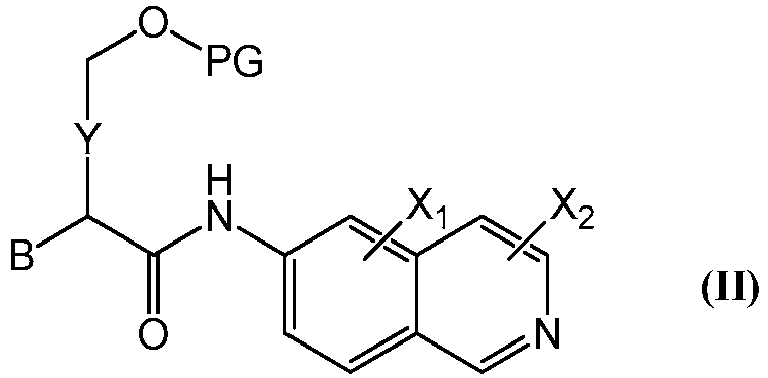
- Y is selected from the group consisting of alkylene, aryl, heteroaryl, cycloalkyl, and heterocyclyl, any of which may be optionally substituted;
- B is selected from the group consisting of -NR1R2, -CH2NR1R2, -CH(R10)R2, - CCH3(R10) R2, -NHCH(R10)R2, -N(CH3)R2, -CH2CH2R2, -CH(R10)CH2R2, and - CH2CH(R10)R2;
- R1, R2 and R10 are each independently selected from the group consisting of hydrogen, alkyl, alkenyl, alkynyl, amino, aryl, heteroaryl, cycloalkyl and heterocycloalkyl, any of which may be optionally substituted;
- X1 and X2 are independently selected from the group consisting of hydrogen, hydroxy, halogen, alkyl, amino, nitro, cyano, carbonyl, carbonylamino, alkoxy, aryloxy, sulfonyl, sulfonamido, thioalkyl, and carboxyl; and
- PG is the acyl radical of a prostaglandin or a prostaglandin analog.
- In another aspect, the disclosure may provide a compound of formula (III):

- R1 and R2 are independently selected from the group consisting of hydrogen and C1-C4 alkyl, or R1 and R2 are taken together with the nitrogen atom to which they are attached to form a ring of 3, 4, 5, 6, 7 or 8 member atoms;
- A is selected from the group consisting of -CH2NH-, -CH(R10)-, -C(CH3)(R10)-, - CH2CH2-, -CH(R10)CH2-, -CH2CH2CH(R10)-, - CH2CH(R10)-, and -C(CH3)(R10)CH2-;
- each R10 is independently selected from the group consisting of alkyl, alkenyl, alkynyl, amino, aryl, heteroaryl, cycloalkyl or heterocycloalkyl, any of which may be optionally substituted;
- X1 and X2 are independently selected from the group consisting of hydrogen, hydroxy, halogen, alkyl, amino, nitro, cyano, carbonyl, carbonylamino, alkoxy, aryloxy, sulfonyl, sulfonamido, thioalkyl, and carboxyl; and
- PG Θ is a deprotonated free acid of a prostaglandin or a prostaglandin analog.
- In another aspect, the disclosure may provide a composition comprising:
- a) (rac)-2-(dimethylamino)-N-(1-hydroxyisoquinolin-6-yl)-2-(thiophen-3-yl)acetamide hydrochloride; and
- b) a prostaglandin selected from the group consisting of latanoprost, bimatoprost, travoprost, tafluprost, AR-102, cloprostenol isopropyl ester, 13,14-dihydrocloprostenol isopropyl ester, latanoprostene bunod, unoprostone, PGF1α isopropyl ester, PGF2α, isopropyl ester PGF3α isopropyl ester, and fluprostenol isopropyl ester.
- In another aspect, the disclosure may provide a composition comprising:
- a) (R)-2-(dimethylamino)-N-(1-hydroxyisoquinolin-6-yl)-2-(thiophen-3-yl)acetamide hydrochloride; and
- b) a prostaglandin selected from the group consisting of latanoprost, bimatoprost, travoprost, tafluprost, AR-102, cloprostenol isopropyl ester, 13,14-dihydrocloprostenol isopropyl ester, latanoprostene bunod, unoprostone, PGF1α isopropyl ester, PGF2α, isopropyl ester PGF3α isopropyl ester, and fluprostenol isopropyl ester.
- In another aspect, the disclosure may provide a composition comprising:
- a) (S)-2-(dimethylamino)-N-(1-hydroxyisoquinolin-6-yl)-2-(thiophen-3-yl)acetamide hydrochloride; and
- b) a prostaglandin selected from the group consisting of latanoprost, bimatoprost, travoprost, tafluprost, AR-102, cloprostenol isopropyl ester, 13,14-dihydrocloprostenol isopropyl ester, latanoprostene bunod, unoprostone, PGF1α isopropyl ester, PGF2α, isopropyl ester PGF3α isopropyl ester, and fluprostenol isopropyl ester.
- In another aspect, the disclosure may provide a composition comprising:
- a) (rac)-4-(3-amino-1-(isoquinolin-6-ylamino)-)-1-oxopropan-2-yl)
benzyl 2,4-dimethylbenzoate dimesylate; and - b) a prostaglandin selected from the group consisting of latanoprost, bimatoprost, travoprost, tafluprost, AR-102, cloprostenol isopropyl ester, 13,14-dihydrocloprostenol isopropyl ester, latanoprostene bunod, unoprostone, PGF1α isopropyl ester, PGF2α, isopropyl ester PGF3α isopropyl ester, and fluprostenol isopropyl ester.
- In another aspect, the disclosure may provide a composition comprising:
- a) (R)-4-(3-amino-1-(isoquinolin-6-ylamino)-)-1-oxopropan-2-yl)
benzyl 2,4-dimethylbenzoate dimesylate; and - b) a prostaglandin selected from the group consisting of latanoprost, bimatoprost, travoprost, tafluprost, AR-102, cloprostenol isopropyl ester, 13,14-dihydrocloprostenol isopropyl ester, latanoprostene bunod, unoprostone, PGF1α isopropyl ester, PGF2α, isopropyl ester PGF3α isopropyl ester, and fluprostenol isopropyl ester.
- In another aspect, the disclosure may provide a composition comprising:
- a) (S)-4-(3-amino-1-(isoquinolin-6-ylamino)-1-oxopropan-2-yl)
benzyl 2,4-dimethylbenzoate dimesylate; and - b) a prostaglandin selected from the group consisting of latanoprost, bimatoprost, travoprost, tafluprost, AR-102, cloprostenol isopropyl ester, 13,14-dihydrocloprostenol isopropyl ester, latanoprostene bunod, unoprostone, PGF1α isopropyl ester, PGF2α, isopropyl ester PGF3α isopropyl ester, and fluprostenol isopropyl ester.
- In another aspect, the disclosure may provide a composition comprising:
- a) (rac)- 3-amino-2-(4-chlorophenyl)-N-(isoquinolin-6-yl)propanamide; and
- b) a prostaglandin selected from the group consisting of latanoprost, bimatoprost, travoprost, tafluprost, AR-102, cloprostenol isopropyl ester, 13,14-dihydrocloprostenol isopropyl ester, latanoprostene bunod, unoprostone, PGF1α isopropyl ester, PGF2a, isopropyl ester PGF3α isopropyl ester, and fluprostenol isopropyl ester.
- In another aspect, the disclosure may provide a composition comprising:
- a) (R)- 3-amino-2-(4-chlorophenyl)-N-(isoquinolin-6-yl)propanamide; and
- b) a prostaglandin selected from the group consisting of latanoprost, bimatoprost, travoprost, tafluprost, AR-102, cloprostenol isopropyl ester, 13,14-dihydrocloprostenol isopropyl ester, latanoprostene bunod, unoprostone, PGF1α isopropyl ester, PGF2a, isopropyl ester PGF3α isopropyl ester, and fluprostenol isopropyl ester.
- In another aspect, the disclosure may provide a composition comprising:
- a) (S)- 3-amino-2-(4-chlorophenyl)-N-(isoquinolin-6-yl)propanamide; and
- b) a prostaglandin selected from the group consisting of latanoprost, bimatoprost, travoprost, tafluprost, AR-102, cloprostenol isopropyl ester, 13,14-dihydrocloprostenol isopropyl ester, latanoprostene bunod, unoprostone, PGF1α isopropyl ester, PGF2α, isopropyl ester PGF3α isopropyl ester, and fluprostenol isopropyl ester.
- In another aspect, the disclosure may provide a method of treating an ocular disorder in a subject in need of treatment, comprising administering to the subject a compound or composition described herein. In some embodiments, the ocular disorder is glaucoma.
- In another aspect, the disclosure may provide a method of reducing intraocular pressure in a subject in need thereof, comprising topically administering to an eye of the subject a a compound or composition described herein.
- In another aspect, the disclosure may provide compound selected from the group consisting of:
- a) (R)-4-(3-amino-1-(isoquinolin-6-ylamino)-)-1-oxopropan-2-yl)
benzyl 2,4-dimethylbenzoate dimesylate; - b) (S)-4-(3-amino-1-(isoquinolin-6-ylamino)-1-oxopropan-2-yl)
benzyl 2,4-dimethylbenzoate dimesylate; and - c) (rac)-4-(3-amino-1-(isoquinolin-6-ylamino)-)-1-oxopropan-2-yl)
benzyl 2,4-dimethylbenzoate dimesylate. - Other aspects and embodiments of the disclosure will become apparent in light of the following description.
-
-
FIG. 1 is a graph showing intraocular pressure following administration of compositions described in Example 4. -
FIG. 2 is a graph showing intraocular pressure following administration of compositions described in Example 5. -
FIG. 3 is a graph showing intraocular pressure following administration of compositions described in Example 8. - Compositions that include an isoquinoline compound (e.g., a compound of formula (I)) and a prostaglandin or prostaglandin analog or a pharmaceutically acceptable salt thereof (e.g., latanoprost, bimatoprost, travoprost, tafluprost, AR-102, cloprostenol, latanoprostene bunod, unoprostone, PGF2α or fluprostenol) are described herein. Also described herein are compounds of formula (II), which include an isoquinoline compound that is covalently linked to a prostaglandin or a prostaglandin analog, and compounds of formula (III), which are salts of an isoquinoline compound and a free acid of a prostaglandin or a prostaglandin analog. Such compounds and compositions may be effective for treating ocular disorders such as glaucoma, for example, by lowering intraocular pressure.
- Before any embodiments of the disclosure are detailed, it is to be understood that the present disclosure is not limited in its application to the details of construction and the arrangement of components set forth in the following description or illustrated in the following drawings. The disclosure is capable of other embodiments and of being practiced or of being carried out in various ways. Also, it is to be understood that the phraseology and terminology used herein is for the purpose of description and should not be regarded as limiting. The use of "including," "comprising," or "having" and variations thereof herein is meant to encompass the items listed thereafter and equivalents thereof as well as additional items.
- Definitions of specific functional groups and chemical terms are described in more detail below. For purposes of this disclosure, the chemical elements are identified in accordance with the Periodic Table of the Elements, CAS version, Handbook of Chemistry and Physics, 75th Ed., inside cover, and specific functional groups are generally defined as described therein. Additionally, general principles of organic chemistry, as well as specific functional moieties and reactivity, are described in Organic Chemistry, Thomas Sorrell, University Science Books, Sausalito, 1999; Smith and March March 's Advanced Organic Chemistry, 5th Edition, John Wiley & Sons, Inc., New York, 2001; Larock, Comprehensive Organic Transformations, VCH Publishers, Inc., New York, 1989; Carruthers, Some Modern Methods of Organic Synthesis, 3rd Edition, Cambridge University Press, Cambridge, 1987.
- "Acyl" or "carbonyl" refers to the group -C(O)R wherein R is selected from the group consisting of hydrogen, alkyl, alkenyl, alkynyl, aryl, cycloalkyl, heterocyclyl, heteroaryl, arylalkyl, cycloalkylalkyl, heteroarylalkyl and heterocyclylalkyl, any of which may be optionally substituted, e.g., with one or more substituents. For example, when R is alkyl, such a group may be referred to as an alkylcarbonyl group.
- "Administering" as used herein refers to administration of the compounds as needed to achieve a desired effect.
- "Alkoxy" refers to the group -O-R wherein R is alkyl, alkenyl, alkynyl, cycloalkyl or heterocyclyl, any of which may be optionally substituted, e.g., with one or more substituents.
- "Alkyl" refers to a saturated aliphatic hydrocarbon chain, which may be straight or branched. An alkyl group may have an indicated number of carbon atoms. For example, C1-C12 alkyl refers to an alkyl group having from 1 to 12 (inclusive) carbon atoms. C1-C4 alkyl refers to an alkyl group having 1, 2, 3 or 4 carbon atoms, such as methyl, ethyl, n-propyl, isopropyl, n-butyl, sec-butyl or tert-butyl. An alkyl group may be optionally substituted, e.g., with one or more substituents.
- "Alkylene" refers to a divalent alkyl group, e.g., -CH2-, -CH2CH2-, -CH2CH2CH2- or -CH2CH(CH3)CH2-. An alkyl or alkylene may be optionally substituted, e.g., with one or more substituents.
- "Alkenyl" refers to a straight or branched hydrocarbon chain having one or more double bonds. An alkenyl group may have an indicated number of carbon atoms. For example, C2-C12 alkenyl refers to an alkenyl group having from 2 to 12 (inclusive) carbon atoms. C2-C4 alkenyl refers to an alkenyl group having 2, 3 or 4 carbon atoms. Examples of alkenyl groups include, but are not limited to, allyl, propenyl, 2-butenyl, 3-hexenyl and 3-octenyl groups. One of the double bond carbons may optionally be the point of attachment of the alkenyl substituent. The term "alkenylene" refers to a divalent alkenyl, e.g., -CH=CH-, -CH=CH2CH2- or - CH=C=CH-. An alkenyl or alkenylene may be optionally substituted, e.g., with one or more substituents.
- The term "alkynyl" refers to a straight or branched hydrocarbon chain having one or more triple bonds. An alkynyl group may have an indicated number of carbon atoms. For example, C2-C12 alkynyl refers to an alkynyl group having from 2 to 12 (inclusive) carbon atoms. C2-C4 alkynyl refers to an alkynyl group having 2, 3 or 4 carbon atoms. Examples of alkynyl groups include, but are not limited to, ethynyl, propargyl, and 3-hexynyl. One of the triple bond carbons may optionally be the point of attachment of the alkynyl substituent. The term "alkynylene" refers to a divalent alkynyl, e.g., -C≡C- or -C≡C-CH2-. An alkynyl or alkynylene may be optionally substituted, e.g., with one or more substituents.
- "Amino" refers to the group -NR'R" wherein R' and R" are each independently selected from the group consisting of hydrogen, alkyl, alkenyl, alkynyl, aryl, cycloalkyl, heterocyclyl, heteroaryl, arylalkyl, cycloalkylalkyl, heteroarylalkyl and heterocyclylalkyl, or R' and R", together with the nitrogen to which they are attached, may form a ring. Examples of amino groups include, but are not limited to, -NH2, alkylamino groups such as -NHCH3, - NHCH2CH3 and -NHCH(CH3)2, dialkylamino groups such as -N(CH3)2 and -N(CH2CH3)2, and arylamino groups such as -NHPh. Examples of cyclic amino groups include, but are not limited to, aziridinyl, azetidinyl, pyrrolidinyl, piperidino, piperazinyl, perhydrodiazepinyl, morpholino, and thiomorpholino. The groups R' and R" may be optionally substituted, e.g., with one or more substituents, or when R' and R" together with the nitrogen to which they are attached form a ring, the ring may be optionally substituted, e.g., with one or more substituents.
- "AR-102" refers to the compound 3-hydroxy-2,2-bis(hydroxymethyl)propyl7-((1R,2R,3R,5S)-2-((R)-3-(benzo[b]-thiophen-2-yl)-3-hydroxypropyl)-3,5-dihydroxycyclopentyl)heptanoate. "AR-102 free acid" refers to the compound 7-((1R,2R,3R,5S)-2-((R)-3-(benzo[b]thiophen-2-yl)-3-hydroxypropyl)-3,5-dihydroxycyclopentyl)heptanoic acid.
- "Aryl" refers to an aromatic monocyclic, bicyclic, or tricyclic hydrocarbon ring system, wherein any ring atom capable of substitution can be substituted (e.g., with one or more substituents). The substituents may be positioned at various locations on an aryl group. For example, substituents on a phenyl group may be located at an ortho- position, a meta- position, the para- position, or combinations thereof. Examples of aryl groups include, but are not limited to, phenyl, naphthyl, and anthracenyl.
- "Arylalkyl" refers to an alkyl group in which an alkyl hydrogen atom is replaced with an aryl group. Arylalkyl includes groups in which more than one hydrogen atom has been replaced with an aryl group. Examples of arylalkyl groups include but are not limited to benzyl, 2-phenylethyl, 3-phenylpropyl, 9-fluorenyl, benzhydryl, and trityl groups. Arylalkyl groups can be optionally substituted, e.g., with one or more substituents on either the alkyl portion or the aryl portion of the arylalkyl group.
- "Aryloxy" refers to the group -O-R wherein R is aryl or heteroaryl, either of which may be optionally substituted, e.g., with one or more substituents.
- "Buffer" or "buffer system" refers to a compound or combination of compounds that provide a buffering system in solution that exhibits buffering capacity, that is, the capacity to neutralize, within limits, either acids or bases with relatively little or no change in the original pH. The term "buffering capacity" is defined to mean the millimoles (mM) of strong acid or base (or respectively, hydrogen or hydroxide ions) required to change the pH by one unit when added to one liter (a standard unit) of the buffer solution. The buffer capacity will depend on the type and concentration of the buffer components.
- "Carboxyl" refers to the group -C(=O)OR, wherein R is selected from the group consisting of hydrogen, alkyl, alkenyl, alkynyl, aryl, cycloalkyl, heterocyclyl, heteroaryl, arylalkyl, cycloalkylalkyl, heteroarylalkyl and heterocyclylalkyl any of which may be optionally substituted, e.g., with one or more substituents.
- "Carbonylamino" or "amido" refers to the group -C(O)NR'R" wherein R' and R" are independently selected from the group consisting of hydrogen, alkyl, alkenyl, alkynyl, aryl, cycloalkyl, heterocyclyl, heteroaryl, arylalkyl, cycloalkylalkyl, heteroarylalkyl and heterocyclylalkyl, or R' and R", together with the nitrogen to which they are attached, may form a ring. The groups R' and R" may be optionally substituted, e.g., with one or more substituents, or when R' and R" together with the nitrogen to which they are attached form a ring, the ring may be optionally substituted, e.g., with one or more substituents.
- "Cycloalkyl" refers to nonaromatic, saturated or partially unsaturated monocyclic, bicyclic, tricyclic or polycyclic hydrocarbon groups. Cycloalkyl groups may include about 3 to about 12 carbon atoms. For example, monocyclic cycloalkyl groups may include 3 to 10 carbon atoms, e.g., 3, 4, 5, 6, 7 or 8 carbon atoms. Bicyclic carbocyclic groups contain 8 to 12 carbon atoms, e.g., 9 or 10 carbon atoms. Any ring atom can be substituted (e.g., with one or more substituents). Cycloalkyl groups include fused, spiro, and bridged bicyclic ring systems. Examples of cycloalkyl groups include, but are not limited to, cyclopropyl, cyclobutyl, cyclopentyl, cyclohexyl, cyclohexenyl, cyclohexadienyl, methylcyclohexyl, adamantyl, norbornyl and norbornenyl.
- "Cycloalkylalkyl", as used herein, refers to an alkyl group substituted with a cycloalkyl group.
- "Excipient" refers to physiologically compatible additives useful in preparation of a pharmaceutical composition. Examples of pharmaceutically acceptable carriers and excipients can, for example, be found in Remington Pharmaceutical Science, 16th Ed.
- "Haloalkyl" as used herein refers to an alkyl group in which one or more hydrogen atoms are replaced with a halogen, and includes alkyl moieties in which all hydrogens have been replaced with halogens (e.g., perfluoroalkyl such as CF3).
- "Halogen" or "halo" refers to fluoro, chloro, bromo or iodo moieties.
- "Heteroalkyl" refers to an alkyl group, as defined herein, wherein at least one carbon atom of the alkyl group is replaced with a heteroatom. Suitable heteroalkyl groups include, but are not limited to, methoxymethyl (-CH2-O-CH3).
- "Heteroaryl" or "heteroaromatic" refers to an aromatic monocyclic, bicyclic or tricyclic ring having one or more heteroatoms. For example a heteroaryl group may be an aromatic 5-8 membered monocyclic ring having 1-4 heteroatoms, an 8-12 membered bicyclic ring having 1-6 heteroatoms, or an 11-14 membered tricyclic ring system having 1-9 heteroatoms. Heteroaryl groups can contain fused rings, which are rings that share one or more common atoms. Any ring atom capable of substitution can be substituted (e.g., with one or more substituents). Examples of heteroaryl groups include, but are not limited to, tetrazoylyl, triazolyl, thienyl, thiazolyl, isothiazolyl, purinyl, pyrimidyl, pyridyl, pyrazinyl, pyridazinyl, pyrrolyl, imidazolyl, pyrazolyl, oxazolyl, isoxazolyl, furanyl, quinolinyl, isoquinolinyl, quinoxalinyl, quinazolinyl, cinnolinyl, indolyl, isoindolyl, indolizinyl, indazolyl, benzimidazolyl, phthalazinyl, pteridinyl, carbazolyl, carbolinyl, phenanthridinyl, acridinyl, phenanthrolinyl, phenazinyl and naphthyridinyl.
- The term "heteroarylalkyl", as used herein, refers to an alkyl group substituted with a heteroaryl group.
- "Heteroatom" refers to an atom other than carbon in the ring of a heterocyclic group or a heteroaromatic group or the chain of a heteroalkyl group. For example, heteroatoms may be selected from the group consisting of nitrogen, oxygen, silicon, phosphorus and sulfur. Particularly suitable heteroatoms are nitrogen, oxygen and sulfur. Groups containing more than one heteroatom may contain different heteroatoms.
- "Heterocyclyl" or "heterocycloalkyl" refers to a nonaromatic, saturated or partially unsaturated hydrocarbon ring system containing at least one heteroatom. Heterocyclyl groups may include about 3 to about 12 member atoms. For example, monocyclic cycloalkyl groups may include 3 to 10 member atoms, e.g., 3, 4, 5, 6, 7 or 8 member atoms. Bicyclic carbocyclic groups contain 8 to 12 member atoms, e.g., 9 or 10 member atoms. Any ring atom capable of substitution can be substituted (e.g., with one or more substituents). Heterocyclyl groups include fused, spiro, and bridged bicyclic ring systems. Examples of heterocyclyl groups include, but are not limited to, epoxy, tetrahydrofuranyl, homopiperidinyl, tetrahydrothienyl, tetrahydropyranyl, piperidinyl, piperazinyl, morpholinyl, pyrrolinyl, pyrimidinyl, pyrrolidinyl, indolinyl, tetrahydropyridinyl, dihydropyran, thianthrene, pyran, benzopyran, xanthene, phenoxathiin, phenothiazinyl, furazanyl, lactones, lactams such as azetidinones and pyrrolidinones, sultams, sultones, and the like.
- The term "heterocyclylalkyl" or "heterocycloalkylalkyl", as used herein, refers to an alkyl group substituted with a heterocyclyl group.
- "Hydroxy" or "hydroxyl" refers to the group -OH.
- "Linker" means a chain of n member atoms where n is an integer from 1 to 4.
- "Member atom" means a carbon, nitrogen, oxygen or sulfur atom. Member atoms may be substituted up to their normal valence.
- The term "mercapto" or "thiol" refers to an -SH radical. The term "thioalkoxy" or "thioether" refers to an -S-alkyl radical. The term "thioaryloxy" refers to an -S-aryl radical.
- The term "ocular disorder" as used herein includes, but is not limited to, glaucoma, allergy, cancers of the eye, neurodegenerative diseases of the eye, dry eye, and corneal epithelial damage. A "method of treating an ocular disorder" may refer to a method of treating glaucoma, allergy, cancers of the eye, neurodegenerative diseases of the eye, dry eye, and corneal epithelial damage, or may refer to a method of preserving retinal ganglion cells.
- The term "oxo" refers to an oxygen atom, which forms a carbonyl when attached to carbon, an N-oxide when attached to nitrogen, and a sulfoxide or sulfone when attached to sulfur. The term "thioxo" refers to a sulfur atom, which forms a thiocarbonyl when attached to carbon.
- "Phosphonate" refers to -P(O)(OR)2, wherein each R is independently selected from the group consisting of hydrogen, alkyl, alkenyl, aryl, cycloalkyl, heterocyclyl, heteroaryl, arylalkyl, cycloalkylalkyl, heteroarylalkyl and heterocyclylalkyl, each of which may be optionally substituted, e.g., with one or more substituents.
- A "prostaglandin" refers to any compound having a prostanoic acid skeleton:
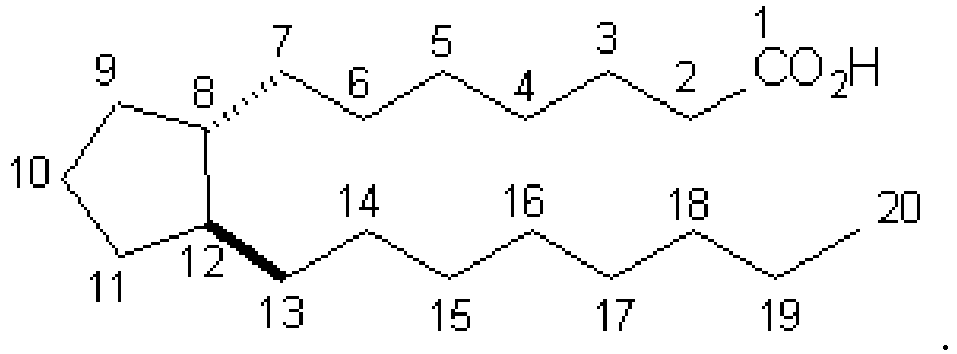
- A "prostaglandin analog" refers to a compound that has the potential to bind to a prostaglandin receptor. Prostaglandin analogs include protected prostaglandins or prostaglandin prodrugs, e.g. prostaglandins with esters or amides at the C1, C9, C11 and/or C15 positions.
- "Prostaglandin free acid" refers to a prostaglandin or prostaglandin analog that has a carboxylic acid moiety at the C1 position.
- "Prostaglandin F analog," "PGF analog" or "analog of PGF2α" refers to a compound, generally structurally similar to naturally occurring PGF2α, which has the potential to bind to and activate a prostaglandin F-type receptor. F-type receptors include, but are not limited to the FP receptor.
- "Prostaglandin E analog," "PGE analog," "analog of PGE2" or "analog of PGE1" refers to a compound, generally structurally similar to naturally occurring PGE2 or PGE1, which has the potential to bind to and activate a prostaglandin E-type receptor. E-type receptors include, but are not limited to the EP1, EP2, EP3 and EP4 receptors.
- "Prostaglandin D analog," "PGD analog" or "analog of PGD2" refers to a compound, generally structurally similar to naturally occurring PGD2, which has the potential to bind to and activate a prostaglandin D-type receptor. D-type receptors include, but are not limited to the DP1 and DP2 receptors.
- "Ring" means a collection of member atoms that are cyclic. Rings may be carbocyclic, aromatic, or heterocyclic or heteroaromatic, and may be substituted or unsubstituted, and may be saturated or unsaturated. Ring junctions with the main chain may be fused or spirocyclic. Rings may be monocyclic or bicyclic. Rings contain at least 3 member atoms and at most 12 member atoms. Monocyclic rings may contain 3 to 10 member atoms and bicyclic rings may contain from 8 to 12 member atoms. Bicyclic rings themselves may be fused or spirocyclic. Rings may be optionally substituted or unsubstituted, e.g., with one or more substituents.
- "ROCKi" as used herein refers to an inhibitor of a Rho-associated protein kinase (ROCK).
- "Substituent" refers to a group "substituted" on a group such as an alkyl, alkylene, alkenyl, alkynyl, cycloalkyl, cycloalkylalkyl, heterocyclyl, heterocyclylalkyl, aryl, arylalkyl, heteroaryl or heteroarylalkyl group, at any substitutable atom of that group. Suitable substituents include, without limitation: acyl, alkoxy, alkyl, alkenyl, alkynyl, amino, aryl, arylalkyl, carbonylamino, carboxy, cycloalkyl, cycloalkylalkyl, cyano, halo, haloalkyl, heteroalkyl, heteroaryl, heteroarylalkyl, heterocyclyl, heterocyclylalkyl, hydroxy, nitro, oxo (e.g., C=O), phosphonate, sulfinyl, sulfonyl, sulfonate, sulfonamido, thioamido, thiol, thioalkyl, thioxo (e.g., C=S), and ureido. In embodiments, substituents on a group are independently any one single, or any combination of the aforementioned substituents. In embodiments, a substituent may itself be substituted with any one of the above substituents.
- The above substituents may be abbreviated herein, for example, the abbreviations Me, Et, Ph, Bn and Ac represent methyl, ethyl, phenyl, benzyl and acetyl respectively. A more comprehensive list of the abbreviations used by organic chemists of ordinary skill in the art appears in the first issue of each volume of the Journal of Organic Chemistry; this list is typically presented in a table entitled Standard List of Abbreviations. The abbreviations contained in said list, and all abbreviations used by organic chemists of ordinary skill in the art, are hereby incorporated by reference.
- "Sulfinyl" refers to a -S(=O)R group, wherein R is selected from the group consisting of alkyl, alkenyl, alkynyl, aryl, cycloalkyl, heterocyclyl, heteroaryl, arylalkyl, cycloalkylalkyl, heteroarylalkyl and heterocyclylalkyl, any of which may be optionally substituted (e.g., with one or more substituents).
- "Sulfonic acid" and "sulfonate" refer to -S(O)2OH and -S(O)2O- groups respectively
- "Sulfonyl" refers to a -S(O)2R group, wherein R is selected from the group consisting of hydrogen, alkyl, alkenyl, alkynyl, aryl, cycloalkyl, heterocyclyl, heteroaryl, arylalkyl, cycloalkylalkyl, heteroarylalkyl and heterocyclylalkyl, any of which may be optionally substituted (e.g., with one or more substituents).
- "Sulfonamido" refers to a -S(O)2NR'R" group wherein R' and R" are independently selected from the group consisting of hydrogen, alkyl, alkenyl, alkynyl, aryl, cycloalkyl, heterocyclyl, heteroaryl, arylalkyl, cycloalkylalkyl, heteroarylalkyl and heterocyclylalkyl, any of which may be optionally substituted (e.g., with one or more substituents).
- "Therapeutically effective amount" refers to a dosage of the compounds or compositions effective for influencing, reducing or inhibiting the activity of or preventing activation of a kinase. This term as used herein may also refer to an amount effective at bringing about a desired in vivo effect in an animal, preferably, a human, such as reduction in intraocular pressure.
- "Thioalkyl" refers to the group -S-alkyl.
- "Thioamido" refers to -C(S)NR'R" wherein R' and R" are independently selected from the group consisting of hydrogen, alkyl, alkenyl, alkynyl, aryl, cycloalkyl, heterocyclyl, heteroaryl, arylalkyl, cycloalkylalkyl, heteroarylalkyl and heterocyclylalkyl, or R' and R", together with the nitrogen to which they are attached, may form a ring. The groups R' and R" may be optionally substituted, e.g., with one or more substituents, or when R' and R" together with the nitrogen to which they are attached form a ring, the ring may be optionally substituted, e.g., with one or more substituents.
- "Treat" or "treating" as used herein refers to administering a regimen to the subject, e.g., the administration a compound or composition described herein, such that the disorder or at least one symptom of the disorder is healed, alleviated, relieved, altered, remedied, ameliorated, and/or improved. Treating includes administering an amount effective to alleviate, relieve, alter, remedy, ameliorate, improve and/or affect the disorder or the symptoms of the disorder. The treatment may inhibit deterioration or worsening of a symptom of a disorder.
- "Ureido" refers to -N(R)C(O)NR'R", wherein each R, R' and R" is independently selected from the group consisting selected from the group consisting of hydrogen, alkyl, alkenyl, alkynyl, aryl, cycloalkyl, heterocyclyl, heteroaryl, arylalkyl, cycloalkylalkyl, heteroarylalkyl and heterocyclylalkyl, any of which may be optionally substituted (e.g., with one or more substituents).
- Where substituent groups are specified by their conventional chemical formulae, written from left to right, they optionally encompass substituents resulting from writing the structure from right to left, e.g., -CH2NH- optionally also recites -NHCH2-. While certain lists of substituent groups include a group shown in both orientations, it should be expressly understood that any substituent group written in a certain direction (e.g., left to right) also encompasses the same group in the other direction (e.g.,. right to left).
- In accordance with a convention used in the art, the group:

- For compounds described herein, groups and substituents thereof are to be selected in accordance with permitted valence of the atoms and the substituents, such that the selections and substitutions result in a stable compound, e.g., which does not spontaneously undergo transformation such as by rearrangement, cyclization, elimination, etc.
- It specifically is understood that any numerical range recited herein includes all values from the lower value to the upper value. For example, if a concentration range is stated as 1% to 50%, it is intended that values such as 2% to 40%, 10% to 30%, or 1% to 3%, etc., are expressly enumerated in this specification. These are only examples of what is specifically intended, and all possible combinations of numerical values between and including the lowest value and the highest value enumerated are to be considered to be expressly stated in this application.
- All percentages, ratios, and proportions used herein are percent by weight per volume (% wt/vol or w/v) unless otherwise specified.
- Compounds that may be used in compositions described herein include isoquinoline compounds. Such compounds and the compositions including them may have kinase inhibitory activity and thus may be useful in influencing or inhibiting the action of kinases, and in treatment and/or prevention of diseases or conditions influenced by kinases. Exemplary kinases that may be influenced include, but are not limited to, ROCK-I, ROCK-II, PKA, PKC, CAM Kinases, GRK-2, GRK-3, GRK-5 or GRK-6. For example, the kinase inhibited may be a Rho-associated protein kinase (ROCK).
- The disclosure relates to compounds of formula (I):
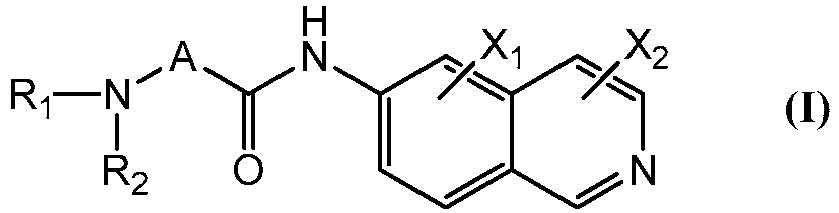
- R1 and R2 are independently selected from the group consisting of hydrogen and C1-C4 alkyl, or R1 and R2 are taken together with the nitrogen atom to which they are attached to form a ring of 3, 4, 5, 6, 7 or 8 member atoms;
- A is selected from the group consisting of -CH2NH-, -CH(R10)-, -C(CH3)(R10)-, - CH2CH2-, -CH(R10)CH2-, -CH2CH2CH(R10)-, - CH2CH(R10)-, and -C(CH3)(R10)CH2-;
- each R10 is independently selected from the group consisting of alkyl, alkenyl, alkynyl, amino, aryl, heteroaryl, cycloalkyl or heterocycloalkyl, any of which may be optionally substituted; and
- X2 and X2 are independently selected from the group consisting of hydrogen, hydroxy, halogen, alkyl, amino, nitro, cyano, carbonyl, carbonylamino, alkoxy, aryloxy, sulfonyl, sulfonamido, thioalkyl, and carboxyl.
- In some aspects of the disclosure of formula (I), X1 is hydrogen, X2 is hydroxy, R1 is alkyl (e.g., methyl), R2 is alkyl (e.g., methyl), A is -CH(R10)-, and R10 is aryl (e.g., phenyl).
- In some aspects of the disclosure of formula (I), X1 is hydrogen, X2 is hydroxy, R1 and R2 together form a heterocyclyl ring, A is -CH(R10)-, and R10 is alkyl.
- In some aspects of the disclosure of formula (I), X1 and X2 are hydrogen, R1 is alkyl (e.g., methyl), and R2 is alkyl (e.g., methyl), A is -CH(R10)-, and R10 is heteroaryl (e.g., thienyl).
- In some aspects of the disclosure of formula (I), X1 and X2 are hydrogen, R1 is hydrogen, and R2 is hydrogen, A is -CH2CH(R10)-, and R10 is a substituted aryl group.
- In some aspects of the disclosure of formula (I), X1 is hydrogen, X2 is hydroxy, R1 is alkyl (e.g., methyl), R2 is alkyl (e.g., methyl), A is -CH(R10)-, and R10 is heteroaryl (e.g., thienyl).
- In some aspects of the disclosure of formula (I), X1 and X2 are hydrogen, R1 is alkyl (e.g., methyl), and R2 is hydrogen, A is -CH(R10)-, and R10 is heteroaryl (e.g., thienyl).
- The disclosure further relates to compounds of formula (Ia) which has a tautomeric form, also shown here for clarification purposes:


- R1 and R2 are independently selected from the group consisting of hydrogen and C1-C4 alkyl, or R1 and R2 are taken together with the nitrogen atom to which they are attached to form a ring of 3, 4, 5, 6, 7 or 8 member atoms; and
- R10 is selected from the group consisting of alkyl, alkenyl, alkynyl, amino, aryl, heteroaryl, cycloalkyl and heterocyclyl, any of which may be optionally substituted.
- In some aspects of the disclosure R10 is aryl (e.g., phenyl). In some aspects of the disclosure R10 is heteroaryl (e.g., thienyl). In some aspects of the disclosure R1 and R2 are independently selected from the group consisting of hydrogen and methyl, or R1 and R2 are taken together with the nitrogen to which they are attached to form a heterocyclyl ring (e.g., pyrrolidone or piperidine).
- The disclosure further relates to compounds of formula (Ib):

- R1 and R2 are independently selected from the group consisting of hydrogen and C1-C4 alkyl, or R1 and R2 are taken together with the nitrogen atom to which they are attached to form a ring of 3, 4, 5, 6, 7 or 8 member atoms; and
- R10 is selected from the group consisting of alkyl, alkenyl, alkynyl, amino, aryl, heteroaryl, cycloalkyl and heterocyclyl, any of which may be optionally substituted.
- In some aspects of the disclosure R10 is aryl (e.g., phenyl). In some aspects of the disclosure R10 is aryl (e.g., phenyl) substituted with -CH2-OC(O)-Ra, wherein Ra is optionally substituted aryl (e.g., phenyl, e.g., 2,4-dimethylphenyl). In some aspects of the disclosure , R10 is optionally substituted phenyl (e.g., 4-chlorophenyl). In some aspects of the disclosure R10 is aryl (e.g., phenyl) substituted with -CH2-OC(O)-NH-Rb, wherein Rb is optionally substituted aryl (e.g., phenyl, e.g., 2-chlorophenyl or 4-chlorophenyl or 4-methoxyphenyl) or wherein Rb is optionally substituted alkyl (e.g. C1-4 alkyl, such as butyl). In some aspects of the disclosure, R1 and R2 are independently selected from the group consisting of hydrogen and methyl, or R1 and R2 are taken together with the nitrogen to which they are attached to form a heterocyclyl ring (e.g., pyrrolidone or piperidine).
- In some aspects of the disclosure, the compound of formula (I) may be selected from the group consisting of:
- (rac)-2-(dimethylamino)-N-(1-hydroxyisoquinolin-6-yl)-2-(thiophen-3-yl)acetamide;
- (R)-2-(dimethylamino)-N-(1-hydroxyisoquinolin-6-yl)-2-(thiophen-3-yl)acetamide;
- (S)-2-(dimethylamino)-N-(1-hydroxyisoquinolin-6-yl)-2-(thiophen-3-yl)acetamide;
- (rac)-4-(3-amino-1-(isoquinolin-6-ylamino)-1-oxopropan-2-yl)
benzyl 2,4-dimethylbenzoate; - (R)-4-(3-amino-1-(isoquinolin-6-ylamino)-1-oxopropan-2-yl)
benzyl 2,4-dimethylbenzoate; and - (S)-4-(3-amino-1-(isoquinolin-6-ylamino)-)-1-oxopropan-2-yl)
benzyl 2,4-dimethylbenzoate, - (rac)- 3-amino-2-(4-chlorophenyl)-N-(isoquinolin-6-yl)propanamide,
- (R)- 3-amino-2-(4-chlorophenyl)-N-(isoquinolin-6-yl)propanamide,
- (S)- 3-amino-2-(4-chlorophenyl)-N-(isoquinolin-6-yl)propanamide,
- Compounds of formula (I) may be synthesized by methods known in the art. For example, compounds may be synthesized using methods described in
U.S. Patent Publication No. 2009/0186917 . - The compounds used according to the present invention are compounds in which an isoquinoline compound is covalently linked to a prostaglandin or a prostaglandin analog. Such compounds include compounds of formula (II):

- Y is selected from the group consisting of alkylene, aryl, heteroaryl, cycloalkyl, and heterocyclyl, any of which may be optionally substituted;
- B is selected from the group consisting of -NR1R2, -CH2NR1R2, -CH(R10)R2, -CCH3(R10) R2, -NHCH(R10)R2, -N(CH3)R2, -CH2CH2R2, -CH(R10)CH2R2, and -CH2CH(R10)R2;
- R1, R2 and R10 are each independently selected from the group consisting of hydrogen, alkyl, alkenyl, alkynyl, amino, aryl, heteroaryl, cycloalkyl and heterocycloalkyl, any of which may be optionally substituted;
- X1 and X2 are independently selected from the group consisting of hydrogen, hydroxy, halogen, alkyl, amino, nitro, cyano, carbonyl, carbonylamino, alkoxy, aryloxy, sulfonyl, sulfonamido, thioalkyl, and carboxyl; and
- PG is the acyl radical of a prostaglandin or a prostaglandin analog.
- An "acyl radical of a prostaglandin or a prostaglandin analog" refers to a prostaglandin or a prostaglandin analog in which the C1 position has the group -C(O)-. For example, acyl radicals of latanoprost, bimatoprost and travoprost are illustrated below:
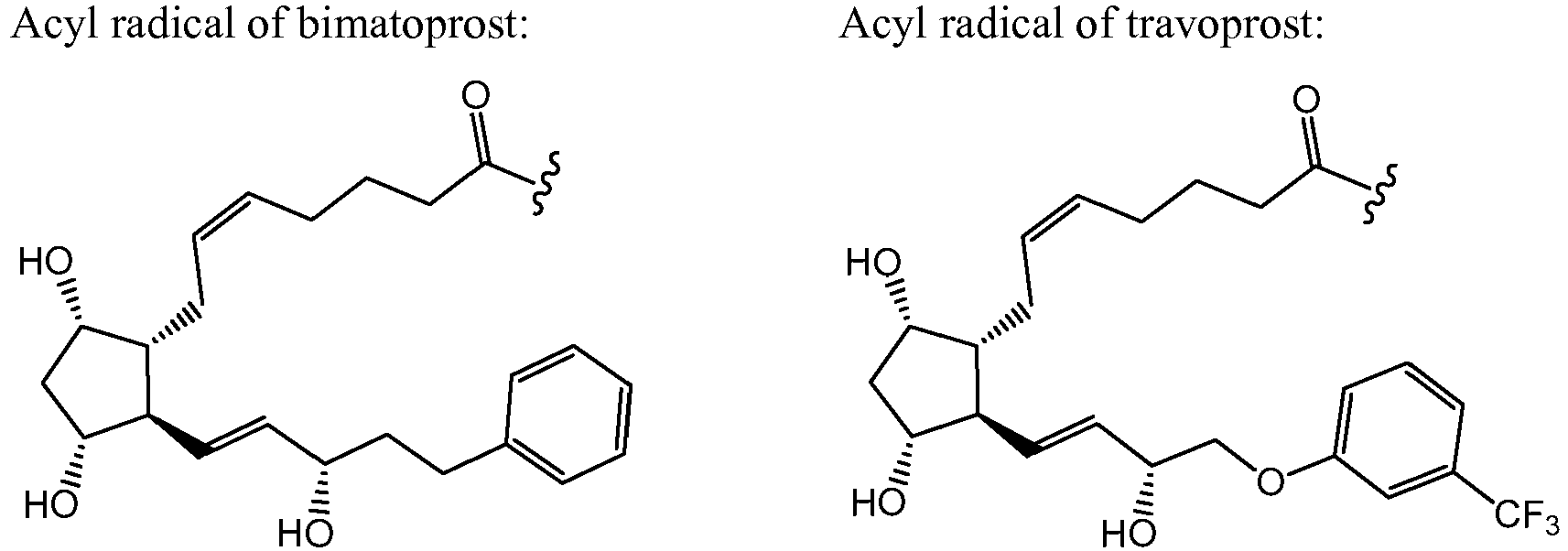


- In some embodiments of formula (II), X1 and X2 are hydrogen, B is -CH2NR1R2, R1 is alkyl (e.g., methyl), R2 is alkyl (e.g., methyl), and PG is the acyl radical of latanoprost.
- In some embodiments of formula (II), X1 and X2 are hydrogen, B is -CH2NR1R2, R1 and R2 are hydrogen, and PG is the acyl radical of latanoprost.
- In some embodiments of formula (II), X1 is hydrogen, X2 is hydroxy, B is - CH2NR1R2, R1 and R2 are hydrogen, and PG is the acyl radical of latanoprost.
- In some embodiments of formula (II), X1 is hydrogen, X2 is hydroxy, B is -NR1R2, R1 is hydrogen, R2 is hydrogen, and PG is the acyl radical of travoprost.
- In some embodiments of formula (II), X1 is hydrogen, X2 is hydroxy, B is -NR1R2, R1 is alkyl (e.g., methyl), R2 is alkyl (e.g., methyl), and PG is the acyl radical of latanoprost.
- In some embodiments of formula (II), ), X1 and X2 are hydrogen, B is -CH2NR1R2, R1 is hydrogen, R2 is hydrogen, and PG is the acyl radical of travoprost.
- In some embodiments of formula (II), X1 and X2 are hydrogen, B is -CH2NR1R2, R1 is hydrogen, R2 is hydrogen, and PG is the acyl radical of bimatoprost.
- In some embodiments of formula (II), PG is the acyl radical of latanoprost, bimatoprost, travoprost, tafluprost, AR-102, cloprostenol, latanoprostene bunod, unoprostone, PGF2α or fluprostenol.
- Compounds of formula (II) may be synthesized according a method similar to that shown below in
Scheme 1, wherein each R is independently a protecting group. One skilled in the art will appreciate that the starting protected prostaglandin free acid and isoquinoline can be prepared using known methods; see, for example, Protective Groups in Organic Synthesis (T. Green and P. Wuts; 3rd Edition; John Wiley and Sons, 1999). Step (a) may be conducted in a suitable solvent and in the presence of a suitable coupling agent, such as a carbodiimide. Following coupling in step (a), the product may be deprotected in step (b) using methods particular to the protecting groups that were used. It will be noted that whileScheme 1 illustrates coupling of latanoprost free acid and a specific isoquinoline compound, one skilled in the art will appreciate that such a general synthesis scheme could be applied to any prostaglandin free acid and isoquinoline compound bearing a suitably reactive functional group such as a hydroxy group, amine group, or the like. Specific syntheses including protecting and deprotecting steps are illustrated in the Examples.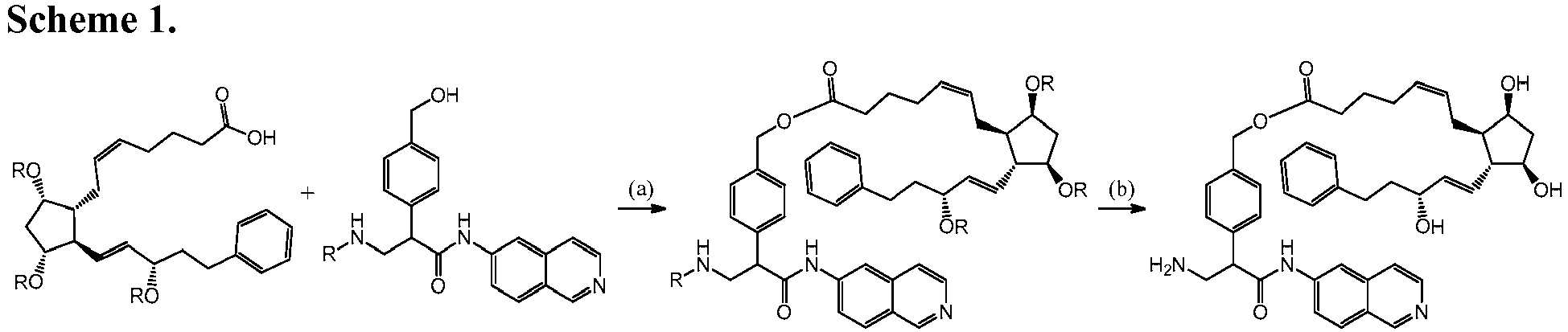
- Also disclosed herein are compounds in which an isoquinoline compound and a prostaglandin or a prostaglandin analog together form a salt. Such compounds include compounds of formula (III):
- Also disclosed herein are salts of isoquinoline compounds and prostaglandin free acids. Such compounds include compounds of formula (III):

- R1 and R2 are independently selected from the group consisting of hydrogen and C1-C4 alkyl, or R1 and R2 are taken together with the nitrogen atom to which they are attached to form a ring of 3, 4, 5, 6, 7 or 8 member atoms;
- A is selected from the group consisting of -CH2NH-, -CH(R10)-, -C(CH3)(R10)-, - CH2CH2-, -CH(R10)CH2-, -CH2CH2CH(R10)-, - CH2CH(R10)-, and -C(CH3)(R10)CH2-;
- each R10 is independently selected from the group consisting of alkyl, alkenyl, alkynyl, amino, aryl, heteroaryl, cycloalkyl or heterocycloalkyl, any of which may be optionally substituted;
- X1 and X2 are independently selected from the group consisting of hydrogen, hydroxy, halogen, alkyl, amino, nitro, cyano, carbonyl, carbonylamino, alkoxy, aryloxy, sulfonyl, sulfonamido, thioalkyl, and carboxyl; and
- PGΘ is a deprotonated free acid of a prostaglandin or a prostaglandin analog.
- A "deprotonated free acid of a prostaglandin or a prostaglandin analog" refers to a prostaglandin or a prostaglandin analog in which the C1 position has the group -C(O)O-. For example, deprotonated free acids of latanoprost, bimatoprost and travoprost are illustrated below:


- In some aspects of the disclosure of formula (III), X1 is hydrogen, X2 is hydroxy, R1 is alkyl (e.g., methyl), R2 is alkyl (e.g., methyl), A is -CH(R10)-, and R10 is aryl (e.g., phenyl).
- In some aspects of the disclosure of formula (III), X1 is hydrogen, X2 is hydroxy, R1 and R2 together form a heterocyclyl ring, A is -CH(R10)-, and R10 is alkyl.
- In some aspects of the disclosure of formula (III), X1 and X2 are hydrogen, R1 is alkyl (e.g., methyl), and R2 is alkyl (e.g., methyl), A is -CH(R10)-, and R10 is heteroaryl (e.g., thienyl).
- In some aspects of the disclosure of formula (III), X1 and X2 are hydrogen, R1 is hydrogen, and R2 is hydrogen, A is -CH2CH(R10)-, and R10 is a substituted aryl group.
- In some aspects of the disclosure of formula (III), X1 is hydrogen, X2 is hydroxy, R1 is alkyl (e.g., methyl), R2 is alkyl (e.g., methyl), A is -CH(R10)-, and R10 is heteroaryl (e.g., thienyl).
- In some aspects of the disclosure of formula (III), X1 and X2 are hydrogen, R1 is alkyl (e.g., methyl), and R2 is hydrogen, A is -CH(R10)-, and R10 is heteroaryl (e.g., thienyl).
- In some aspects of the disclosure of formula (III), PGΘ is a deprotonated free acid of latanoprost, bimatoprost, travoprost, tafluprost, AR-102, latanoprostene bunod, or unoprostone. In some embodiments of formula (III), PGΘ is the deprotonated form of cloprostenol, 13,14-dihydrocloprostenol, PGE1, PGF1α, PGF2α, PGF3α or fluprostenol.
- Compounds of formula (III) may be synthesized by combining a prostaglandin free acid and an isoquinoline compound, e.g., in a suitable solvent. The starting materials may be combined in an approximately 1:1 ratio. The mixture may be heated to promote dissolution of the starting materials if necessary. The solvent can then be removed to provide the salt compound.
- Compositions described herein may include a prostaglandin or a prostaglandin analog covalently bound to a compound of formula (II).
- In some embodiments, a prostaglandin or a prostaglandin analog may comprise a compound of formula (IV):
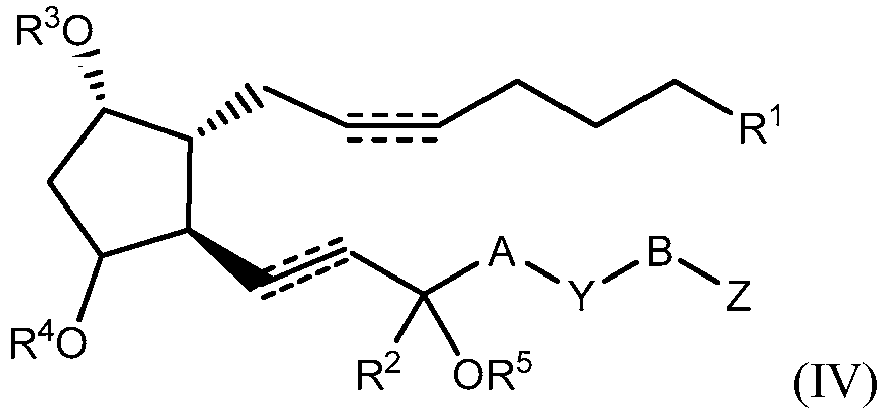
- the dashed lines independently indicate the presence or absence of a bond;
- A and B are independently -(CRaRb)n-, wherein each Ra and Rb is independently hydrogen or C1-C6 alkyl, and n is 0, 1, 2, 3 or 4;
- R1 is -C(O)ORc, -CONHRd, -C(O)NHOH, -CH2OH, -S(O)2Re or -C(O)NHS(O)2Rf;
- R2 is hydrogen or C1-C6 alkyl;
- R3, R4 and R5 are independently selected from hydrogen and an alcohol protecting group;
- Y is a bond, -O-, -S-, -S(O), -SO2-, -C(Rg)2-, -CRh=CRi-, -NRj-, or -C=C-;
- Z is hydrogen, cycloalkyl, heterocyclyl, aryl or heteroaryl;
- Rc is selected from hydrogen, C1-C6 alkyl, C1-C6 heteroalkyl, aryl, heteroaryl, cycloalkyl and heterocyclyl;
- Rd, Re and Rf are independently selected from C1-C6 alkyl, heteroalkyl, aryl, heteroaryl, cycloalkyl and heterocyclyl;
- Rg, Rh and Ri are independently selected from hydrogen, C1-C6 alkyl, alkoxy and hydroxy; and
- Rj is hydrogen or C1-C6 alkyl.
- Suitably, no carbon atom in a compound of formula (IV) has two or more heteroatoms attached to it unless the two or more heteroatoms are member atoms in a heteroaromatic ring system.
- In formula (IV), the relative stereochemistry at C8, C9, and C12 is as specified. That is, the bond between C7 and C8 is in the α orientation, the alcohol (protected or unprotected) at C9 is in the α orientation, and the bond between C12 and C13 is in the β orientation. The invention also includes optical isomers, diastereomers and enantiomers of the above structure. At all stereocenters where stereochemistry is not defined (e.g. C11 and C15), both epimers are envisioned. In some embodiments, stereochemistry at all such stereocenters of the invention mimic that of naturally occurring PGF2α.
- In some embodiments, Q1 is either H or an alcohol protecting group and Q2 and Q3 are alcohol protecting groups. In other embodiments, Q1, Q2, and Q3 are all alcohol protecting groups and may be different alcohol protecting groups and may be the same alcohol protecting group.
- Further prostaglandins and prostaglandin analogs which may be used according to the present invention include latanoprost, bimatoprost, travoprost, tafluprost, AR-102, cloprostenol 13,14-dihydrocloprostenol unoprostone, PGF1α PGF2α , PGF3α.
- In some embodiments, a pharmaceutically acceptable salt of a prostaglandin or prostaglandin analog is used. For example, the salt may be an amino acid salt of a prostaglandin, e.g. arginine. In some embodiments, the prostaglandin or prostaglandin analog may be latanoprost arginine salt.
- Further prostaglandins discloses herein include the following:
- 1. 5-Thia-omega substituted phenyl-prostaglandin E derivatives, process for producing the same and drugs containing the same as the active ingredient.
WO 00/3980 - 2. Aromatic C16 - C20 - substituted tetrahydro prostaglandins useful as FP agonists
WO 99/12895 US 5977173, Nov. 2, 1999 . - 3. Aromatic C16-C20-substituted tetrahydro prostaglandins useful as FP agonists
WO 99/12898 - 4. Aromatic C16-C20- substituted tetrahydro prostaglandins useful as FP agonists.
WO 99/12896 US 6048895 Apr. 11, 2000 . - 5. Prostaglandins of the F series
US 5770759. Jun. 23 1998 . - 6. EP2-receptor agonists as neuroprotective agents for the eye
WO 99/26629 - 7. Prostaglandin derivatives for the treatment of glaucoma or ocular hypertension.
US6030999, Feb. 29 2000 . - 8. Cyclopentane heptan(ene)oic acid, 2-heteroarylalkenyl derivatives as therapeutic agents
WO 99/25358 US 6037364 Mar. 14 2000 . - 9. Use of cloprostenol and fluprostenol analogues to treat glaucoma and ocular hypertension
US 5889052, Mar. 30 1999 . - 10. Cis-delta-4- analogs of prostaglandins as ocular hypotensives.
WO 98/21182 US 5994397 Nov. 30, 1999 . - 11. Tetrahydrofuran analogs of prostaglandins as ocular hypotensives.
WO 98/57930 US-6,025,392 Mar. 14, 2000 . - 12. Conformationally rigid aryl- or heteroaryl prostaglandins for use in glaucoma therapy.
WO 98/21180 - 13. Keto-substituted tetrahydrofuran analogs of prostaglandins as ocular hypotensives
WO 98/57930 - 14. 13-oxa prostaglandins for the treatment of glaucoma and ocular hypertension
WO 99/32441 - 15. 13-Thia prostaglandins for use in glaucoma therapy
WO 98/39293 - 16. 15-Ketal prostaglandins for the treatment of glaucoma or ocular hypertension
WO 98/20881 - 17. 9-Oxa prostaglandin analogs as ocular hypotensives.
WO 98/57942 - 18. 15-Fluoro prostaglandins as ocular hypotensives
WO 98/21181 - 19. 11-Halo prostaglandins for the treatment of glaucoma or ocular hypertension
WO 98/20880 - 20. Use of 9-deoxy prostaglandin derivatives to treat glaucoma
WO 96/10407 - 21. Prostaglandin product
WO 00/3736 - 22. Substituted tetrahydrofuran analogs of prostaglandins as ocular hypotensives
WO 97/23223 - 23. EP2-receptor agonists as agents for lowering intraocular pressure
WO 95/19964 - 24. Prostaglandin derivatives devoid of side-effects for the treatment of glaucoma.
WO 99/02165 - 25. 8-Iso prostaglandins for glaucoma therapy
WO 98/50024 US 6037368 Mar. 14 2000 . - 26. Fluorinated prostaglandin derivatives and medicines
WO 98/12175 - Compounds described herein (e.g., compounds of formula (I), (Ia), (Ib), (II), (III) and (IV)) may exist in one or more particular geometric, optical, enantiomeric, diastereomeric, epimeric, atropic, stereoisomer, tautomeric, conformational, or anomeric forms, including but not limited to, cis- and trans-forms; E- and Z-forms; c-, t-, and r- forms; endo- and exo-forms; R-, S-, and meso-forms; D- and L-forms; d- and 1-forms; (+) and (-) forms; keto-, enol-, and enolate-forms; syn- and anti-forms; synclinal- and anticlinal-forms; α- and β-fbrms; axial and equatorial forms; boat-, chair-, twist-, envelope-, and half chair-forms; and combinations thereof, hereinafter collectively referred to as "isomers" (or "isomeric forms").
- In one embodiment, a compound described herein may be an enantiomerically enriched isomer of a stereoisomer described herein. For example, the compound may have an enantiomeric excess of at least about 10%, 15%, 20%, 25%, 30%, 35%, 40%, 45%, 50%, 55%, 60%, 65%, 70%, 75%, 80%, 85%, 90%, 95%, 96%, 97%, 98%, or 99%. Enantiomer, when used herein, refers to either of a pair of chemical compounds whose molecular structures have a mirror-image relationship to each other.
- In one embodiment, a preparation of a compound disclosed herein is enriched for an isomer of the compound having a selected stereochemistry, e.g., R or S, corresponding to a selected stereocenter. For example, the compound has a purity corresponding to a compound having a selected stereochemistry of a selected stereocenter of at least about 60%, 65%, 70%, 75%, 80%, 85%, 90%, 95%, 96%, 97%, 98%, or 99%.
- In one embodiment, a composition described herein includes a preparation of a compound disclosed herein that is enriched for a structure or structures having a selected stereochemistry, e.g., R or S, at a selected stereocenter. Exemplary R/S configurations can be those provided in an example described herein.
- An "enriched preparation," as used herein, is enriched for a selected stereoconfiguration of one, two, three or more selected stereocenters within the subject compound. Exemplary selected stereocenters and exemplary stereoconfigurations thereof can be selected from those provided herein, e.g., in an example described herein. By enriched is meant at least 60%, e.g., of the molecules of compound in the preparation have a selected stereochemistry of a selected stereocenter. In an embodiment it is at least 65%, 70%, 75%, 80%, 85%, 90%, 95%, 96%, 97%, 98%, or 99%. Enriched refers to the level of a subject molecule(s) and does not connote a process limitation unless specified.
- Compounds may be prepared in racemic form or as individual enantiomers or diastereomers by either stereospecific synthesis or by resolution. The compounds may, for example, be resolved into their component enantiomers or diastereomers by standard techniques, such as the formation of stereoisomeric pairs by salt formation with an optically active base, followed by fractional crystallization and regeneration of the free acid. The compounds may also be resolved by formation of stereoisomeric esters or amides, followed by chromatographic separation and removal of the chiral auxiliary. Alternatively, the compounds may be resolved using a chiral HPLC column. The enantiomers also may be obtained from kinetic resolution of the racemate of corresponding esters using lipase enzymes.
- Except as discussed below for tautomeric forms, specifically excluded from the term "isomers," as used herein, are structural (or constitutional) isomers (i.e., isomers which differ in the connections between atoms rather than merely by the position of atoms in space). For example, a reference to a methoxy group, -OCH3, is not to be construed as a reference to its structural isomer, a hydroxymethyl group, -CH2OH. Similarly, a reference to ortho-chlorophenyl is not to be construed as a reference to its structural isomer, meta-chlorophenyl. However, a reference to a class of structures may well include structurally isomeric forms falling within that class (e.g., C3-alkyl or propyl includes n-propyl and iso-propyl; C4-alkyl or butyl includes n-, iso-, sec-, and tert-butyl; methoxyphenyl includes ortho-, meta-, and para-methoxyphenyl).
- The above exclusion does not pertain to tautomeric forms, for example, keto-, enol-, and enolate-forms, as in, for example, the following tautomeric pairs: keto/enol, imine/enamine, amide/imino alcohol, amidine/amidine, nitroso/oxime, thioketone/enethiol, N-nitroso/hydroxyazo, and nitro/aci-nitro.
- Note that specifically included in the term "isomer" are compounds with one or more isotopic substitutions. For example, H may be in any isotopic form, including 1H, 2H (D), and 3H (T); C may be in any isotopic form, including 12C, 13C, and 14C; O may be in any isotopic form, including 16O and 18O; and the like.
- A compound described herein can be in the form of a salt, e.g., a pharmaceutically acceptable salt. The term "pharmaceutically acceptable salt" includes salts of the active compounds that are prepared with relatively nontoxic acids or bases, depending on the particular substituents found on the compounds described herein. Neutral forms of the compounds may be regenerated by contacting the salt with a base or acid and isolating the parent compound in a conventional manner. The parent form of the compound differs from the various salt forms in certain physical properties, such as solubility in polar solvents, but otherwise the salts are equivalent to the parent form of the compound for the purposes of this disclosure. Examples of pharmaceutically acceptable salts are discussed in Berge et al, 1977, "Pharmaceutically Acceptable Salts." J. Pharm. Sci. Vol. 66, pp. 1-19.
- For example, if the compound is anionic, or has a functional group which may be anionic (e.g., -COOH may be -COO-), then a salt may be formed with a suitable cation. Examples of suitable inorganic cations include, but are not limited to, alkali metal ions such as Na+ and K+, alkaline earth cations such as Ca2+ and Mg2+, and other cations. Examples of suitable organic cations include, but are not limited to, ammonium ion (i.e., NH4 +) and substituted ammonium ions (e.g., NH3R1 +, NH2R2 +, NHR3 +, NR4 +). Examples of some suitable substituted ammonium ions are those derived from: ethylamine, diethylamine, dicyclohexylamine, triethylamine, butylamine, ethylenediamine, ethanolamine, diethanolamine, piperazine, benzylamine, phenylbenzylamine, choline, meglumine, and tromethamine, as well as amino acids, such as lysine and arginine.
- If the compound is cationic, or has a functional group that may be cationic (e.g., -NH2 may be -NH3 +), then a salt may be formed with a suitable anion. Examples of suitable inorganic anions include, but are not limited to, those derived from the following inorganic acids: hydrochloric, hydrobromic, hydroiodic, sulfuric, sulfurous, nitric, nitrous, phosphoric, and phosphorous.
- Examples of suitable organic anions include, but are not limited to, those derived from the following organic acids: 2-acetyoxybenzoic, acetic, ascorbic, aspartic, benzoic, camphorsulfonic, cinnamic, citric, edetic, ethanedisulfonic, ethanesulfonic, fumaric, glucoheptonic, gluconic, glutamic, glycolic, hydroxymaleic, hydroxynaphthalene carboxylic, isethionic, lactic, lactobionic, lauric, maleic, malic, methanesulfonic, mucic, oleic, oxalic, palmitic, pamoic, pantothenic, phenylacetic, phenylsulfonic, propionic, pyruvic, salicylic, stearic, succinic, sulfanilic, tartaric, p-toluenesulfonic, and valeric. Examples of suitable polymeric organic anions include, but are not limited to, those derived from the following polymeric acids: tannic acid, carboxymethyl cellulose.
- Unless otherwise specified, a reference to a particular compound also includes salt forms thereof.
- It may be convenient or desirable to prepare, purify, and/or handle an active compound in a chemically protected form. The term "chemically protected form" is used herein in the conventional chemical sense and pertains to a compound in which one or more reactive functional groups are protected from undesirable chemical reactions under specified conditions (e.g., pH, temperature, radiation, solvent, and the like). In practice, well known chemical methods are employed to reversibly render unreactive a functional group, which otherwise would be reactive, under specified conditions. In a chemically protected form, one or more reactive functional groups are in the form of a protected or protecting group (also known as a masked or masking group or a blocked or blocking group). By protecting a reactive functional group, reactions involving other unprotected reactive functional groups can be performed, without affecting the protected group; the protecting group may be removed, usually in a subsequent step, without substantially affecting the remainder of the molecule. See, for example, Protective Groups in Organic Synthesis (T. Green and P. Wuts; 3rd Edition; John Wiley and Sons, 1999). Unless otherwise specified, a reference to a particular compound also includes chemically protected forms thereof.
- A wide variety of such "protecting," "blocking," or "masking" methods are widely used and well known in organic synthesis. For example, a compound which has two nonequivalent reactive functional groups, both of which would be reactive under specified conditions, may be derivatized to render one of the functional groups "protected," and therefore unreactive, under the specified conditions; so protected, the compound may be used as a reactant which has effectively only one reactive functional group. After the desired reaction (involving the other functional group) is complete, the protected group may be "deprotected" to return it to its original functionality.
- A hydroxy group may be protected as an ether (-OR) or an ester (-OC(O)R), for example, as: a t-butyl ether; a benzyl, benzhydryl (diphenylmethyl), or trityl (triphenylmethyl) ether; a trimethylsilyl or t-butyldimethylsilyl ether; or an acetyl ester (-OC(O)CH3, -OAc).
- An aldehyde or ketone group may be protected as an acetal (RCH(OR)2) or ketal (R2C(OR)2), respectively, in which the carbonyl group (R2C=O) is converted to a diether (R2C(OR)2), by reaction with, for example, a primary alcohol. The aldehyde or ketone group is readily regenerated by hydrolysis using a large excess of water in the presence of acid.
- An amine group may be protected, for example, as an amide (- NRC(O)R) or a urethane (-NRC(O)OR), for example, as: a methyl amide (-NHC(O)CH3); a benzyloxy amide (-NHC(O)OCH2C6H5, -NH-Cbz); as a t-butoxy amide (- NHC(O)OC(CH3)3, -NH-Boc); a 2-biphenyl-2-propoxy amide (-NHCO(O)C(CH3)2C6H4C6H5, -NH-Bpoc), as a 9- fluorenylmethoxy amide (-NH-Fmoc), as a 6-nitroveratryloxy amide (-NH-Nvoc), as a 2-trimethylsilylethyloxy amide (-NH- Teoc), as a 2,2,2-trichloroethyloxy amide (-NH-Troc), as an allyloxy amide (-NH-Alloc), as a 2(-phenylsulphonyl)ethyloxy amide (-NH-Psec); or, in suitable cases (e.g., cyclic amines), as a nitroxide radical (>N-0«).
- A carboxylic acid group may be protected as an ester, for example, as: an alkyl ester (e.g., a methyl ester; a t-butyl ester); a haloalkyl ester (e.g., a haloalkyl ester); a trialkylsilylalkyl ester; or an arylalkyl ester (e.g., a benzyl ester; a nitrobenzyl ester); or as an amide, for example, as a methyl amide.
- A thiol group may be protected as a thioether (-SR), for example, as: a benzyl thioether; an acetamidomethyl ether (-S-CH2NHC(O)CH3)
- In addition to salt forms, the present invention may also provide compounds that are in a prodrug form. Prodrugs of the compounds described herein are those compounds that readily undergo chemical changes under physiological conditions to provide the compounds described herein. Prodrugs can be converted to the compounds of the present invention by chemical or biochemical methods in an ex vivo environment. For example, prodrugs can be slowly converted to the compounds of the present invention when placed in a transdermal patch reservoir with or without a suitable enzyme or chemical reagent.
- A compound described herein can also be modified by appending appropriate functionalities to enhance selective biological properties. Such modifications are known in the art and include those that increase biological penetration into a given biological system (e.g., blood, lymphatic system, central nervous system), increase oral availability, increase solubility to allow administration by injection, alter metabolism, and/or alter rate of excretion. Examples of these modifications include, but are not limited to, esterification with polyethylene glycols, derivatization with pivolates or fatty acid substituents, conversion to carbamates, hydroxylation of aromatic rings, and heteroatom substitution in aromatic rings.
- In one aspect, the disclosure provides a composition comprising a compound of formula (I) as described herein (e.g., a compound of formula (I), a compound of formula (Ia), or a compound of formula (Ib)), and a prostaglandin or a prostaglandin analog (e.g., a compound of formula (IV)). In another aspect, the disclosure may provide a composition comprising 2-(dimethylamino)-N-(1-hydroxyisoquinolin-6-yl)-2-(thiophen-3-yl)acetamide hydrochloride (e.g., the racemic compound or the (R) or (S) enantiomer), and a compound selected from the group consisting of latanoprost, bimatoprost, travoprost, tafluprost, AR-102, cloprostenol isopropyl ester, 13,14-dihydrocloprostenol isopropyl ester, latanoprostene bunod, unoprostone, PGF1α isopropyl ester, PGF2α isopropyl ester, PGF3α isopropyl ester, and fluprostenol isopropyl ester. In another aspect, the disclosure may provide a composition comprising 4-(3-amino-1-(isoquinolin-6-ylamino)-1-oxopropan-2-yl)
benzyl 2,4-dimethylbenzoate (e.g., the racemic compound or the (R) or (S) enantiomer), and a compound selected from the group consisting of latanoprost, bimatoprost, travoprost, tafluprost, AR-102, cloprostenol isopropyl ester, 13,14-dihydrocloprostenol isopropyl ester, latanoprostene bunod, unoprostone, PGF1α isopropyl ester, PGF2α isopropyl ester, PGF3α isopropyl ester, and fluprostenol isopropyl ester. In another aspect, the disclosure may provide a composition comprising 3-amino-2-(4-chlorophenyl)-N-(isoquinolin-6-yl)propanamide (e.g., the racemic compound or the (R) or (S) enantiomer), and a compound selected from the group consisting of latanoprost, bimatoprost, travoprost, tafluprost, AR-102, cloprostenol isopropyl ester, 13,14-dihydrocloprostenol isopropyl ester, latanoprostene bunod, unoprostone, PGF1α isopropyl ester, PGF2α isopropyl ester, PGF3α isopropyl ester, and fluprostenol isopropyl ester. In another aspect, the disclosure provides a composition comprising a compound of formula (II) as described herein. In another aspect, the disclosure provides a composition comprising a compound of formula (III) as described herein. - Compositions of the present disclosure may comprise safe and effective amounts of the subject compounds. As used herein, "safe and effective amount" means an amount of a compound sufficient to significantly induce a positive modification in the condition to be treated, but low enough to avoid serious side effects (at a reasonable benefit/risk ratio), within the scope of sound medical judgment. A safe and effective amount of a compound will vary with the particular condition being treated, the age and physical condition of the patient being treated, the severity of the condition, the duration of treatment, the nature of concurrent therapy, the particular pharmaceutically-acceptable carrier utilized, and like factors within the knowledge and expertise of the attending physician.
- According to the invention, a composition may include a compound of formula (II) (III) at an amount of about 0.001% to about 2.0% w/v, e.g., about 0.01% to about 1.0% w/v. Further according to the invention, a compound of formula (II) may be included in a composition at an amount of less than about 0.0025%, less than about 0.010%, less than about 0.015%, less than about 0.025%, less than about 0.05%, less than about 0.080%, less than about 0.10%, less than about 0.20%, less than about 0.40%, less than about 0.60%, less than about 0.80%, less than about 0.10%, less than about 0.5%, less than about 0.7%, less than about 1.0%, less than about 1.2%, less than about 1.4%, less than about 1.5%, less than about 1.6%, less than about 1.8, less than about 2.0%, at least about 0.0025%, at least about 0.010%, at least about 0.015%, at least about 0.020%, at least about 0.05%, at least about 0.075%, at least about 0.10%, at least about 0.20%, at least about 0.40%, at least about 0.60%, at least about 0.80, at least about 1.0%, at least about 1.2%, at least about 1.4%, at least about 1.6%, at least about 1.8%, at least about 2.0, about 0.0025%, about 0.010%, about 0.015%, about 0.03%, about 0.05%, about 0.10%, about 0.20%, about 0.40%, about 0.60%, about 0.80%, about 1.0%, about 1.2%, about 1.4%, about 1.6%, about 1.8%, or about 2.0%.
- In embodiments, a composition may include a prostaglandin or a prostaglandin analog (e.g., a compound of formula (IV), or latanoprost, bimatoprost, travoprost, tafluprost, AR-102, cloprostenol isopropyl ester, 13, 14-cloprostenol isopropyl ester, latanoprostene bunod, unoprostone, PGF1α isopropyl ester, PGF2α isopropyl ester, PGF3α isopropyl ester, or fluprostenol isopropyl ester) at an amount of about 0.0001% to about 0.5% w/v, e.g., about 0.0005% to about 0.1% w/v, or about 0.001% to about 0.05%. In embodiments, a prostaglandin or prostaglandin analog may be included in a composition at an amount of about 0.001%, about 0.002%, about 0.003%, about 0.004%, about 0.005%, about 0.006%, about 0.007%, about 0.008%, about 0.009%, about 0.010%, about 0.011%, about 0.012%, about 0.013%, about 0.014%, about 0.015%, about 0.016%, about 0.017%, about 0.018%, about 0.019%, about 0.020%, about 0.021%, about 0.022%, about 0.023%, about 0.024%, about 0.025%, about 0.026%, about 0.027%, about 0.028%, about 0.029%, about 0.030%, about 0.031%, about 0.032%, about 0.033%, about 0.034%, about 0.035%, about 0.036%, about 0.037%, about 0.038%, about 0.039%, about 0.040%, about 0.041%, about 0.042%, about 0.043%, about 0.044%, about 0.045%, about 0.046%, about 0.047%, about 0.048%, about 0.049%, or about 0.050%.
- Compositions of the present disclosure may further include one or more pharmaceutically acceptable excipients. For example, compositions may include additional, pharmaceutically acceptable components such as buffers, tonicity agents, chelating agents, sugars or sugar alcohols, viscosity enhancers and surfactants.
- A buffer may comprise, for example, phosphate buffer, borate buffer, citrate buffer, maleate buffer, tartrate buffer, acetate buffer, tris(hydroxymethyl)aminomethane (TRIS), an amino acid buffer (e.g., glycine), combination buffers such as borate/phosphate buffer, citrate/phosphate buffer, and the like. In embodiments, a composition may include an amount of a buffer that is effective to provide a suitable buffering capacity to a composition. Other components of the compositions, while having other functions, may also affect the buffer capacity. For example, ethylenediaminetetraacetic acid (EDTA), often used as a chelating agent, can have an effect on the buffer capacity of a solution.
- Compositions may include one or more tonicity agents, such that the composition may be isotonic with body fluids. A tonicity agent can be non-ionic or ionic. Non-ionic tonicity agents include sugars, sugar alcohols and other polyols, diols such as glycerol, mannitol, erythritol, and sugars such as dextrose. Other non-ionic tonicity agents such as polyethylene glycols, propylene glycol, which also function as co-solvents, can also be used. A tonicity agent can also be an ionic agent such as, for example, sodium chloride, potassium chloride, a balanced salt solution, sodium phosphate, or sodium citrate. For example, a non-ionic tonicity agent may be included in a composition at an amount of about 0.10 to about 20%, about 1.0 to about 10%, or about 2.0 to about 6.0%. An ionic tonicity agent may be included in a composition at an amount of about 0.10% to about 2.5%, about 0.25% to about 2.0%, or about 0.50% to about 1.0% w/v.
- Compositions may also include one or more chelating agents or sequestering agents. A wide range of organic acids, amines or compounds which include an acid group and an amine function are capable of acting as chelating agents. For example, nitrilotriacetic acid, diethylenetriaminepentacetic acid, hydroxyethylethylenediaminetriacetic acid, 1,2-diaminocyclohexane tetraacetic acid, hydroxyethylaminodiacetic acid, ethylenediaminetetraacetic acid and its salts, polyphosphates, citric acid and its salts, tartaric acid and its salts, and the like and mixtures thereof, are useful as chelating agents. Ethylenediaminetetraacetic acid (EDTA) and its alkali metal salts, are suitable chelating agents, such as the disodium salt of EDTA (also known as disodium edetate). In embodiments, a chelating agent may be included in a composition at an amount of about 0.001% to about 0.25% w/v, about 0.005% to about 0.15% w/v, or about 0.01% to about 0.1% w/v. In embodiments, a composition may include a chelating agent in an amount effective to enhance the effectiveness of an antimicrobial component and/or to form a complex with metal ions.
- Compositions may further include one or more preservatives. Suitable preservatives include, but are not limited to, sodium bisulfite, sodium bisulfate, sodium thiosulfate, ascorbate, benzalkonium chloride, benzododecinium bromide, chlorobutanol, thimerosal, phenylmercuric acetate, phenylmercuric borate, phenylmercuric nitrate, parabens such as methylparaben, ethylparaben and propylparaben, polyvinyl alcohol, benzyl alcohol, phenylethanol, sodium benzoate, sorbic acid, polyquaternium-1, and the like and mixtures thereof. In embodiments, a composition may include a preservative in amounts of 0.001 to about 1% or about 0.005 to about 0.10% w/v. In embodiments, a composition may include a preservative in an amount that is effective to inhibit microbial growth or contamination of the composition.
- Compositions may additionally include a surfactant. Surfactants include non-ionic, anionic, amphoteric and zwitterionic surfactants. Exemplary surfactants include but are not limited to sodium lauryl sulfate, polyethoxylated sorbitan fatty acid esters, polyoxyethylene alkyl ethers, polyoxyethylene stearates (e.g., polyoxyethylene(40) stearate such as Myrj™-52), poloxamers, polaxamines, sorbitan fatty acid esters, polyethylene glycols (e.g., PEG-400), polyethoxylated alcohols, polyethoxylated castor oils (e.g., PEG-40 hydrogenated castor oil, such as Cremophor® RH 40), docusate sodium, quaternary ammonium compounds, medium and long chain fatty acids, sugar esters of fatty acids and glycerides of fatty acids, lecithin,
polysorbate 80, phospholipids and sodium lauryl sulfate. Suitable surfactants include those disclosed in the C.T.F.A. Cosmetic Ingredient Handbook, 1992, pp. 587-592; Remington's Pharmaceutical Sciences, 15th Ed. 1975, pp. 335-337; and McCutcheon's . Surfactants may be included in compositions at amounts of about 0.01% to about 5%, or about 0.1% to about 2% w/v. - Compositions may also include a viscosity enhancer, which may increase the resident time of a composition on the ocular surface. Exemplary viscosity enhancers include but are not limited to water soluble natural gums, cellulose-derived polymers and the like. Suitable natural gums include guar gum, gum tragacanth and the like. Suitable cellulose-derived viscosity inducing components include cellulose-derived polymers, such as sodium carboxymethylcellulose, hydroxypropyl cellulose, hydroxypropylmethyl cellulose, carboxymethyl cellulose, methyl cellulose, ethyl cellulose, hydroxyethyl cellulose and the like. Viscosity enhancers may be included in compositions at amounts of about 0.01% to about 5%, or about 0.1% to about 3% w/v.
- Compositions described herein may also include a solvent. Compositions are typically aqueous, but may also include optional co-solvents. Suitable co-solvents include but are not limited to alcohols such as ethanol and isopropanol, ethylene glycol monoethyl ether, diethylene glycol monobutyl ether, diethylene glycol monoethyl ether, dimethylsulfoxide, dimethyl formamide, castor oil and combinations thereof. In addition to a compound of formula (I) or (II) a prostaglandin, and other optional components, the balance of a composition may comprise solvent.
- The pH of compositions can affect both stability of the compound and its efficacy. For example, higher pH may result in decomposition of a compound of formula (I), while lower pH may be irritating to the eye. In embodiments, the pH may be about 4.0 to about 7.0, or about 5.0 to about 6.0. In embodiments, a composition may have a pH of at least about 5.0, at least about 5.5, at least about 6.0, at least about 6.5, at least about 7.0, less than about 5.0, less than about 5.5, less than about 6.0, less than about 6.5, less than about 7.0, about 5.0, about 5.1, about 5.2, about 5.3, about 5.4, about 5.5, about 5.6, about 5.7, about 5.8, about 5.9, or about 6.0.
- Composition pH can be adjusted with acid or base, if necessary. Any acid or base compatible with the components of the composition can be used. Exemplary acids include hydrochloric acid, citric acid, gluconic acid, lactic acid, acetic acid, and glycolic acid. Exemplary bases include sodium hydroxide, potassium hydroxide, and triethanolamine.
- Compositions may be prepared using standard methods. In embodiments, composition components may be combined in water (e.g., purified water) with stirring, followed by pH adjustment to a suitable final pH. Techniques for preparing compositions may generally be found in "Remington's Pharmaceutical Sciences", (Meade Publishing Co., Easton, Pa.).
- When preparing compositions, components should be selected to optimize solubility, stability and compatibility. Compositions should typically be sterile and stable under the conditions of manufacture and storage. Compositions may be sterilized by filtering the composition through a sterilizing grade filter, such as a filter with a 0.22 micron nominal pore size.
- Compositions may be evaluated for stability using established procedures. For example, compositions may be subjected to accelerated stability testing. For example, compositions remain stable, and do not undergo precipitation or become cloudy when they are stored at 40 °C for at least 1 month, 3 months or 6 months prior to evaluation. The active component (e.g., a 6- or 7-aminoisoquinoline compound) should not react with other formulation components, or decompose. Methods of evaluating such compounds include, for example, high performance liquid chromatography (HPLC) or determination of optical rotation (e.g., to determine if a compound has begun to racemize).
- Compositions may also be evaluated using the Preservative Effectiveness Test of the United States Pharmacopoeia for parenteral/ophthalmic products. In such tests, which will be known to those skilled in the art, five indicator organisms are utilized for the purpose of challenging the preservative system in a product. Three of the five USP indicator organisms address the growth of bacteria: Escherichia coli, Pseudomonas aeruginosa, and Staphylococcus aureus. Candida albicans is the representative yeast, while Aspergillus niger is a mold. A product is inoculated (contaminated) with a number of organisms between 1 x 10⁵ (100,000) to 1 x 10⁶ (1,000,000) colony forming units (CFU) per mL of product. At various intervals, depending on the category, the composition is tested to determine its ability to control reproduction or destroy the microorganisms. A logarithmic reduction is evaluated at each test interval required for the category. By test definition, any growth over the allotted amount for any of the indicated microorganisms renders the preservative in the product not effective. Compositions may also be evaluated using the European Pharmacopoeia Preservative Effectiveness Test, which also evaluates growth of P. aeruginosa, S. aureus, C. albicans and A. niger. The compositions of the present disclosure will pass at least one of these preservative effectiveness tests.
- Pharmacological activity for glaucoma can be demonstrated using assays designed to test the ability of the subject compounds to decrease intraocular pressure. Examples of such assays are described in the following paper, incorporated herein by reference: C. Liljebris, G. Selen, B. Resul, J. Sternschantz, and U. Hacksell, "Derivatives of 17-Phenyl-18,19,20-trinorprostaglandin F2α Isopropyl Ester: Potential Anti-glaucoma Agents", Journal of Medicinal Chemistry, Vol. 38 (2) 1995, pp. 289-304. Further methods are described in the Examples.
- One aspect of the disclosure relates to a method of treating an ocular disorder in a subject in need of treatment, comprising administering to the subject a safe and effective amount of a composition comprising an isoquinoline compound such as a compound of formula (I), and a prostaglandin or a prostaglandin analog. An embodiment of the invention relates to compounds of formula (II) for use in a method of treating an ocular disorder in a subject in need of treatment, comprising administering to the subject a safe and effective amount of a composition comprising a compound of formula (II). Another aspect of the disclosure includes a method of reducing intraocular pressure comprising administering to a subject in need thereof a safe and effective amount of a composition comprising an isoquinoline compound such as a compound of formula (I), and a prostaglandin or a prostaglandin analog. Another embodiment of the invention includes compounds of formula (II) for use in a method of reducing intraocular pressure comprising administering to a subject in need thereof a safe and effective amount of a composition comprising a compound of formula (II).
- The compounds of formula (I) and (II) and compositions including them may have kinase inhibitory activity and are thus useful in influencing or inhibiting the action of kinases, and in treatment and/or prevention of diseases or conditions influenced by kinases. Exemplary kinases that may be influenced include, but are not limited to, ROCK-I, ROCK-II, PKA, PKC, CAM Kinases, GRK-2, GRK-3, GRK-5 or GRK-6. In a suitable embodiment, the kinase inhibited is a Rho-associated protein kinase.
- In embodiments, the compositions of the present disclosure may be topically administered. Topical compositions that can be applied locally to the eye may be in any form known in the art, non-limiting examples of which include drops, sprays, ointments, or a sustained or non-sustained release unit placed in the conjunctival cul-du-sac of the eye or another appropriate location.
- Dosages may be varied based on the patient being treated, the condition being treated, the severity of the condition being treated, the route of administration, etc. to achieve the desired effect.
- Administration of a compound or a composition described herein may result in a decrease in intraocular pressure (IOP) of at least about 3.0 mmHg, at least about 3.5 mmHg, at least about 4.0 mmHg, at least about 4.5 mmHg, at least about 5.0 mmHg, at least about 5.5 mmHg, at least about 6.0 mmHg, at least about 6.5 mmHg, at least about 7.0 mmHg, at least about 7.5 mmHg, at least about 8.0 mmHg, at least about 8.5 mmHg, at least about 9.0 mmHg, at least about 9.5 mmHg, at least about 10.0 mmHg, about 3.0 mmHg, about 3.5 mmHg, about 4.0 mmHg, about 4.5 mmHg, about 5.0 mmHg, about 5.5 mmHg, about 6.0 mmHg, about 6.5 mmHg, about 7.0 mmHg, about 7.5 mmHg, about 8.0 mmHg, about 8.5 mmHg, about 9.0 mmHg, about 9.5 mmHg, or about 10.0 mmHg. In some embodiments, administration of a composition comprising a compound of formula (I) and a prostaglandin or prostaglandin analog may reduce intraocular pressure more than either single compound alone, or more than intraocular pressure is reduced when both compounds are administered to a subject in separate compositions.
- The following examples are intended to be illustrative.
- Topical pharmaceutical compositions for lowering intraocular pressure were prepared by conventional methods and formulated as follows:
Formulation 1 (% w/w) 2 (% w/w) 3 (% w/w) 4 (% w/w) (rac)-2-(dimethylamino)-N-(1-hydroxyisoquinolin-6-yl)-2-(thiophen-3-yl)acetamide hydrochloride 0.5 0.5 0.25 0.5 Travoprost 0.004 0.004 0.004 0.004 Boric acid 0.05 0.05 0.05 0.05 D-mannitol 3.0 3.0 3.0 3.0 Benzalkonium chloride 0.015 0.015 0.015 - Polyoxyl 40 stearate (Myrj-52)0.5 - 0.5 0.5 Cremophor RH 40 - 0.5 - - Polyethylene glycol 400 (PEG-400) 2.5 2.5 2.5 2.5 EDTA 0.01 0.01 0.01 0.01 Purified water q.s. q.s. q.s. q.s. - Formulations 1-3 were prepared by adding boric acid, D-mannitol, PEG-400, EDTA, and Myrj-52 or Cremophor RH40 in a labeled 150-milliliter (mL) plastic container. 100 milliliters (mL) of purified water were then added to bring the solution almost to 100%. The solution was stirred for 10 minutes. Stock solutions of 1.5% benzalkonium chloride, 0.4% travoprost, and (rac)-2-(dimethylamino)-N-(1-hydroxyisoquinolin-6-yl)-2-(thiophen-3-yl)acetamide hydrochloride were then added and dissolved by stirring the solution for another 10 minutes, and the pH was adjusted to approximately 5.5.
-
Formulation 4 was prepared by adding boric acid, D-mannitol, PEG-400, EDTA, and Myrj-52 or Cremophor RH40 in a labeled 150-mL plastic container. 100 mL purified water was then added to bring the solution almost to 100%. The solution was stirred for 10 minutes. (R)-2-(dimethylamino)-N-(1-hydroxyisoquinolin-6-yl)-2-(thiophen-3-yl)acetamide hydrochloride and travoprost were then added and dissolved by stirring the solution for another 10 minutes, and the pH was adjusted to approximately 5.5. -
Formulation 1 passed the requirements of the United States Pharmacopoeia Preservative Effectiveness Test for parenteral/ophthalmic products (USP), the European Pharmacopoeia Preservative Effectiveness Test (EP-A) and the European Pharmacopoeia Preservative Effectiveness Test (EP-B). - Topical pharmaceutical compositions for lowering intraocular pressure were prepared by conventional methods and formulated as follows:
Formulation 5 (% w/w) 6 (% w/w) (rac)-2-(dimethylamino)-N-(1-hydroxyisoquinolin-6-yl)-2-(thiophen-3-yl)acetamide hydrochloride 0.5 0.7 Latanoprost 0.005 0.005 Sodium Phosphate Monobasic 0.031 0.0155 Sodium Phosphate Dibasic 0.07 0.0035 Benzalkonium chloride 0.015 0.015 sodium chloride 0.7 0.7 EDTA 0.05 0.05 Purified water q.s. q.s. -
Formulations Formulation 7 (% w/w) 8 (% w/w) (rac)-2-(dimethylamino)-N-(1-hydroxyisoquinolin-6-yl)-2-(thiophen-3-yl)acetamide hydrochloride 0.5 0.7 Latanoprost 0.005 0.005 Boric acid 0.05 0.05 D-mannitol 4.3 4.0 Benzalkonium chloride 0.015 0.015 EDTA 0.01 0.01 Purified water q.s. q.s. -
Formulations - Topical pharmaceutical compositions for lowering intraocular pressure were prepared by conventional methods and formulated as follows:
Formulation 9 (% w/w) 10 (% w/w) 11 (% w/w) (rac)-2-(dimethylamino)-N-(1-hydroxyisoquinolin-6-yl)-2-(thiophen-3-yl)acetamide hydrochloride 0.5 0.5 0.5 Bimatoprost 0.03 0.01 0.03 Boric acid - - 0.05 D-mannitol - - 4.3 Sodium Phosphate Monobasic 0.31 0.31 - Sodium Phosphate Dibasic 0.07 0.07 - Benzalkonium chloride 0.0075 0.02 - Sodium chloride 0.7 0.7 - EDTA 0.05 0.05 - Purified water q.s. q.s. q.s. - Formulations 9 and 10 were prepared by adding sodium phosphate monobasic, sodium phosphate dibasic, sodium chloride, and EDTA in a labeled 150-milliliter (mL) plastic storage container. 100 milliliter (mL) of purified water was then added to bring the solution almost to 100%. The solution was stirred for 10 minutes. 1.5% stock solution of benzalkonium chloride, bimatoprost, and (rac)-2-(dimethylamino)-N-(1-hydroxyisoquinolin-6-yl)-2-(thiophen-3-yl)acetamide hydrochloride were then added and dissolved by stirring the solution for another 10 minutes, and the pH was adjusted to approximately 5.5.
- Formulation 11 was prepared by adding boric acid and D-mannitol in a labeled 150-milliliter (mL) plastic storage container. 100 milliliter (mL) of purified water was then added to bring the solution almost to 100%. The solution was stirred for 10 minutes. Bimatoprost and (rac)-2-(dimethylamino)-N-(1-hydroxyisoquinolin-6-yl)-2-(thiophen-3-yl)acetamide hydrochloride were then added and dissolved by stirring the solution for another 10 minutes, and the pH was adjusted to approximately 5.5.
- Formosan Rock macaque monkeys (Macaca cyclopis), animal identification consisting of uniquely numbered tattoos and color-coded cage cards were used in this study. On
Study Day 1, the animals were at least four years old, and weighed at least 4 kg. The ocular hypotensive efficacy and tolerability were determined using a paired study design in which composition was administered q.d. AM for three days to one eye of each monkey (n=6 per group) with the untreated contralateral eye serving as an internal control. Each dose was administered just after the t=0, t=24, and t=48 hour measurement of intraocular pressure (IOP). IOP was taken in both eyes at time points of 0, 4, 8, 24, 48, 52, 56, and 72 hours after baseline (t=0) IOP measurement. Mortality observations, clinical observations, ocular irritation, and intraocular pressures were monitored, recorded, or measured throughout the in-life portion of the study. All treatments were administered as eye drops (one drop per eye). Each animal was sedated intramuscularly (IM) with approximately 5 mg/kg ketamine HCl (or to effect) with the objective of using the minimal dose necessary to achieve acceptable sedation to perform the IOP measurement and dosing procedure. A Model 30 Classic™ pneumatonometer was used to measure intraocular pressure (IOP) non-invasively (Reichert, Inc, Depew, NY). One drop of ocular anaesthetic (0.5% proparacaine) was topically applied to each eye and allowed to take effect for at least 30 seconds prior to each IOP measurement. Using the pneumatonometer manual tonometry mode, and with the animal maintained in an upright position, 3 independent measurements were obtained and averaged for each eye, at every time point. - Three Rho Kinase inhibitor (ROCKi) formulations were prepared by dissolving 0.5% ROCKi (rac)-2-(dimethylamino)-N-(1-hydroxyisoquinolin-6-yl)-2-(thiophen-3-yl)acetamide hydrochloride directly in the commercially-used formulations of 0.004% travoprost (Travatan® Z), 0.005% latanoprost (Xalatan) and 0.01% bimatoprost (Lumigan), with adjustment of the final pH to 5.5. When tested according to the above protocol, significant IOP reductions were observed for each combination above what the components would do individually. Results are illustrated graphically in
Figure 1 . (Data for individual compounds are not shown for clarity.) - Topical pharmaceutical compositions for lowering intraocular pressure were prepared by conventional methods and formulated as follows:
Formulation 12 13 (S)-4-(3-amino-1-(isoquinolin-6-ylamino)-1-oxopropan-2-yl) benzyl 2,4-dimethylbenzoate0.02 0.02 Travoprost - 0.004 Boric acid 0.05 0.05 D-mannitol 4.7 3.5 Benzalkonium chloride 0.015 0.015 Polyoxyl 40 stearate (Myrj-52) - 0.5 Polyethylene glycol 400 (PEG-400) - 2.5 EDTA - 0.01 Purified water q.s. q.s. - Formulation 12 was prepared by adding boric acid, D-mannitol, and EDTA in a labeled 150-mL plastic container. 100 mL purified water was then added to bring the solution almost to 100%. The solution was stirred for 10 minutes. Stock solutions of 5% benzalkonium chloride, 0.4% travoprost and (S)-4-(3-amino-1-(isoquinolin-6-ylamino)-1-oxopropan-2-yl)
benzyl 2,4-dimethylbenzoate were then added and dissolved by stirring the solution for another 10 minutes, and the pH was adjusted to approximately 5.0. - Formulation 13 was prepared by adding boric acid, D-mannitol, PEG-400, EDTA, and Myrj-52 in a labeled 150-mL plastic container. 100 mL purified water was then added to bring the solution almost to 100%. The solution was stirred for 10 minutes. Stock solutions of 1.5% benzalkonium chloride, 0.4% travoprost, and ROCKi (S)-4-(3-amino-1-(isoquinolin-6-ylamino)-1-oxopropan-2-yl)
benzyl 2,4-dimethylbenzoate were then added and dissolved by stirring the solution for another 10 minutes, and the pH was adjusted to approximately 5.0. - For certain topical ophthalmic glaucoma medications, fixed-dose formulations containing mixtures of two compounds have proven to be less effective than concomitant administration of the separate compounds. Using the protocol as described in Example 4, above, an experiment was conducted to see if administering an admixture of a ROCKi and travoprost (Formulation 13) was less effective than concomitant administration of the separate compounds. Surprisingly, not only was there no loss of efficacy with Formulation 13, dosing with the admixture resulted in a substantially better IOP response than concomitant dosing of the two separate compounds (Formulation 12 and Travatan Z). Results are illustrated graphically in
Figure 2 . - Topical pharmaceutical compositions for lowering intraocular pressure are prepared by conventional methods and formulated as follows:
Formulation 14 15 (S)-4-(3-ammo-1-(isoquinolin-6-ylamino)-1-oxopropan-2-yl) benzyl 2,4-dimethylbenzoate0.02 0.02 Latanoprost - 0.004 Boric acid 0.05 0.05 D-mannitol 4.7 3.5 Benzalkonium chloride 0.015 0.015 Polyoxyl 40 stearate (Myrj-52) - 0.5 Polyethylene glycol 400 (PEG-400) - 2.5 EDTA - 0.01 Purified water q.s. q.s. - Formulation 14 is prepared by adding boric acid, D-mannitol, and EDTA in a labeled 150-mL plastic container. 100 mL purified water is then added to bring the solution almost to 100%. The solution is stirred for 10 minutes. Stock solutions of 5% benzalkonium chloride, 0.4% latanoprost and (S)-4-(3-amino-1-(isoquinolin-6-ylamino)-1-oxopropan-2-yl)
benzyl 2,4-dimethylbenzoate are then added and dissolved by stirring the solution for another 10 minutes, and the pH was adjusted to approximately 5.0. - Formulation 15 is prepared by adding boric acid, D-mannitol, PEG-400, EDTA, and Myrj-52 in a labeled 150-mL plastic container. 100 mL purified water is then added to bring the solution almost to 100%. The solution is stirred for 10 minutes. Stock solutions of 1.5% benzalkonium chloride, 0.4% latanoprost, and ROCKi (S)-4-(3-amino-1-(isoquinolin-6-ylamino)-1-oxopropan-2-yl)
benzyl 2,4-dimethylbenzoate are then added and dissolved by stirring the solution for another 10 minutes, and the pH was adjusted to approximately 5.0. - A sterile, isotonic, aqueous solution was prepared, containing (rac)-2-(dimethylamino)-N-(1-hydroxyisoquinolin-6-yl)-2-(thiophen-3-yl)acetamide hydrochloride and travoprost at concentrations of 0.5% and 0.004%, respectively, and the following excipients: Boric Acid (NF), Mannitol (USP), Polyethylene glycol 400 (USP),
Polyoxyl 40 Stearate (NF), Edetate Disodium (USP), Water for Injection (USP), and benzalkonium chloride (NF) 0.015% as a preservative. The product may be adjusted with NaOH (USP) and/or HCL (USP) to pH 5.2 - 5.9. - Using the formulation above, a human diagnosed with elevated intraocular pressure (IOP) was treated once daily with approximately 35 microliter drop(s) in both eyes for up to 28 days. Following this dosing regimen, a measurement of IOP showed a significant reduction from baseline.
- Formosan Rock macaque monkeys (Macaca cyclopis), animal identification consisting of uniquely numbered tattoos and color-coded cage cards were used in this study. On
Study Day 1, the animals were at least four years old, and weighed at least 4 kg. The ocular hypotensive efficacy and tolerability were determined using a paired study design in which test article was administered q.d. AM for three days to one eye of each monkey (n=6 per group) with the untreated contralateral eye serving as an internal control. Each dose was administered just after the t=0, t=24, and t=48 hour measurement of IOP. IOP was taken in both eyes at time points of 0, 4, 8, 24, 48, 52, 56, and 72 hours after baseline (t=0) IOP measurement. Mortality observations, clinical observations, ocular irritation, and intraocular pressures were monitored, recorded, or measured throughout the in-life portion of the study. All treatments were administered via once daily eye drops (one drop per eye) for three days. Each animal was sedated intramuscularly (IM) with approximately 5 mg/kg ketamine HCl (or to effect) with the objective of using the minimal dose necessary to achieve acceptable sedation to perform the IOP measurement and dosing procedure. A Model 30 Classic™ pneumatonometer was used to measure IOP non-invasively (Reichert, Inc, Depew, NY). The pneumatonometer is a well-studied and well-accepted example of an applanation tonometer. The instrument measures IOP by determining the corneal area flattened by constant force. The Model 30 Classic™ pneumatonometer achieves this by means of a floating pneumatic tube which applies the exact amount of applanation force necessary to take the measurement. One drop of ocular anesthetic (0.5% proparacaine) was topically applied to each eye and allowed to take effect for at least 30 seconds prior to each IOP measurement. Using the pneumatonometer manual tonometry mode, and with the animal maintained in an upright position, 3 independent measurements were obtained and averaged for each eye, at all timepoints. For each session, dosing consisted of a single drop (approx. 30 µL) of the composition instilled into the right eye (OD) at t=0, 24, and 48 hours. - Three solutions were used for comparison in this study. The 0.02% PG324 Ophthalmic Solution was prepared in formulation PG324-CF01 containing 0.02% (S)-4-(3-amino-1-(isoquinolin-6-ylamino)-1-oxopropan-2-yl)
benzyl 2,4-dimethylbenzoate and 0.005% latanoprost as active ingredients, 4.7% D-mannitol, 0.05% boric acid, and 0.02% benzalkonium chloride (BAK), at pH 5.0. The 0.02% AR-13324 Ophthalmic Solution was prepared in formulation CF324-01 containing 0.02% (S)-4-(3-amino-1-(isoquinolin-6-ylamino)-1-oxopropan-2-yl)benzyl 2,4-dimethylbenzoate, 0.05% boric acid, 4.7% D-mannitol, and 0.015% BAK, at pH 5.0. Xalatan Ophthalmic Solution was obtained from a commercial supplier and contained sodium chloride, sodium dihydrogen phosphate monohydrate, disodium hydrogen phosphate anhydrous, and 0.02% BAK added as a preservative, at a pH of approximately 6.7. - In this unilateral treatment study, the treatment effect was the difference in IOP between the treated eye and the untreated eye (ΔIOP). The ΔIOP was calculated for each animal at each time point. Means and variances (standard error of the mean) were calculated for observed IOP and ΔIOP for each treatment group at each observation time. Probability comparisons for ΔIOP were performed using a one-sample, two-tailed paired Student's t-test. A critical p-value of p< 0.05 was used to determine statistical significance.
- The data were analyzed using GraphPad Prism statistical software (Version 4.03 for Windows, GraphPad Software, Inc., San Diego CA). Some analyses, including the tables in Appendix C and additional graphs were produced using Microsoft Office Excel 2010 (Microsoft, Inc., Seattle, WA).
- All three formulations produced highly statistically significant (p<0.01) reductions in IOP as compared to the contralateral control eye at all post-dose time points during the study (Student's paired t-test). The largest reductions in IOP were obtained with the 0.02% PG324 Ophthalmic Solution. The FDC produced larger IOP reductions than that of either Xalatan® Ophthalmic Solution or 0.02% AR-13324 alone (
Figure 3 ). Following the final dose on Day 3, IOP reductions ranged from 2.0 to2.1 mmHg for Xalatan Ophthalmic Solution, 4.1 to 5.2 mmHg for 0.02% AR-13324 Ophthalmic Solution, and 4.8 to 6.2 mmHg for 0.02% PG324 Ophthalmic Solution. - A sterile, isotonic, aqueous solution is prepared, containing (S)-4-(3-amino-1-(isoquinolin-6-ylamino)-1-oxopropan-2-yl)
benzyl 2,4-dimethylbenzoate dimesylate and latanoprost at concentrations of 0.02% and 0.005%, respectively, and the following excipients: Boric Acid (NF), Mannitol (USP), Water for Injection (USP), and benzalkonium chloride (NF) 0.02% as a preservative. The product may be adjusted with NaOH (USP) and/or HCL (USP) to approximatelypH 5. - Using the formulation above, a human diagnosed with elevated intraocular pressure (IOP) is treated once daily with approximately 35 microliter drop(s) in both eyes for up to one year. Following this dosing regimen, a measurement of IOP shows a significant reduction from baseline.
-


-
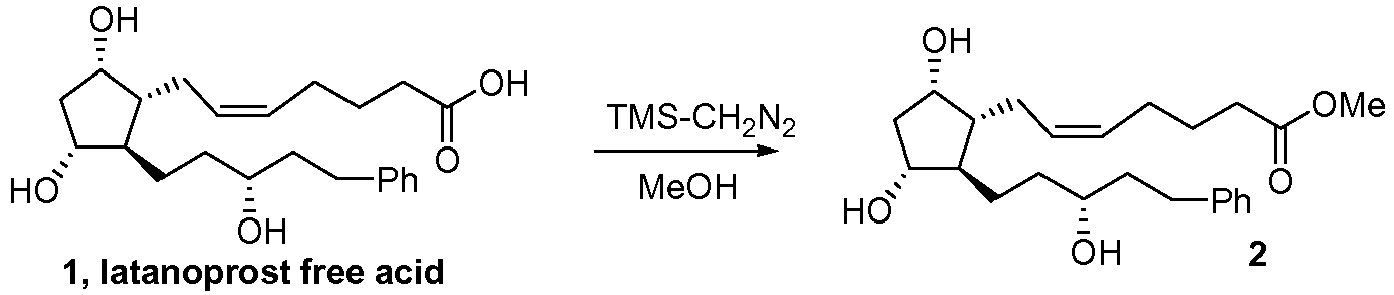
- To Latanoprost free acid in MeOH at 0 °C was added TMS-CH2N2 until the solution persisted a yellow color. AcOH (2 drops) were added to quench excess TMS-CH2N2 and the solvents were evaporated. Column chromatography 70%-100% EtOAc/Hexanes gave pure (Z)-methyl 7-((1R,2R,3R,5S)-3,5-dihydroxy-2-((R)-3-hydroxy-5-phenylpentyl)cyclopentyl)hept-5-enoate (2).
-

- To (Z)-methyl 7-((1R,2R,3R,5S)-3,5-dihydroxy-2-((R)-3-hydroxy-5-phenylpentyl)cyclopentyl)hept-5-enoate (2) in CH2Cl2 cooled to 0 °C was added 2,6-lutidine and TIPS-OTf and solution was stirred for 30 min at 0 °C and then stirred for 2.5 hours at room temperature. The solution was poured into EtOAc and NH4Cl(sat)/HCl (1 N) (3:1) and further extracted with EtOAc. The organics were dried (Na2SO4), filtered and evaporated. Column chromatography 10% EtOAc/Hexanes gave (Z)-methyl 7-((1R,2R,3R,5S)-2-((R)-5-phenyl-3-(triisopropylsilyloxy)pentyl)-3,5-bis(triisopropylsilyloxy)cyclopentyl)hept-5-enoate (3).
-

- To 3 in THF/MeOH/H2O was added LiOH*H2O and the solution was stirred overnight at room temperature. The solution was poured into EtOAc and NH4Cl(sat)/HCl (1 N) (3:1) and further extracted with EtOAc. The organics were dried (Na2SO4), filtered and evaporated to give (Z)-7-((1R,2R,3R,5)-2-((R)-5-phenyl-3-(triisopropylsilyloxy)pentyl)-3,5-bis(triisopropylsilyloxy)cyclopentyl)hept-5-enoic acid (4).
-
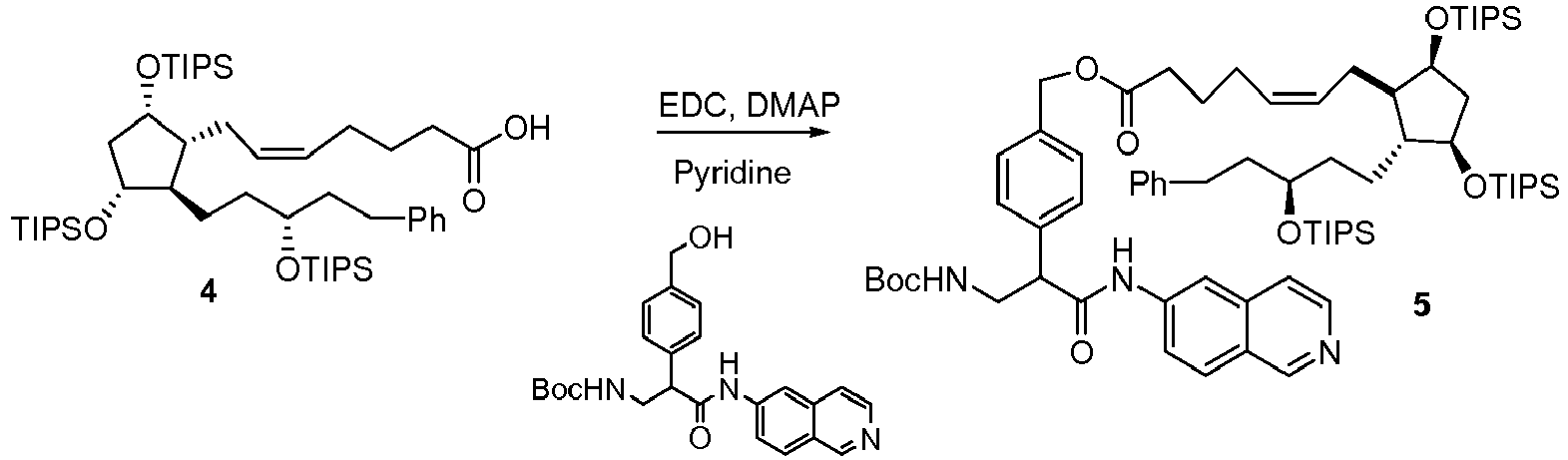
- To 4 in pyridine was added tert-butyl 2-(4-(hydroxymethyl)phenyl)-3-(isoquinolin-6-ylamino)-3-oxopropylcarbamate, EDC, and DMAP and the solution was flushed with Argon, capped and stirred overnight. The mixture as poured into NaHCO3(sat) and extracted with EtOAc, dried (Na2SO4), filtered and evaporated.
Column chromatography 4 % MeOH/CH2Cl2 and then 50%EtOAc/Hexanes gave pure (Z)-4-(3-(tert-butoxycarbonylamino)-1-(isoquinolin-6-ylamino)-1-oxopropan-2-yl)benzyl 7-((1R,2R,3R,5S)-2-((R)-5-phenyl-3-(triisopropylsilyloxy)pentyl)-3,5-bis(triisopropylsilyloxy)cyclopentyl)hept-5-enoate (5). -
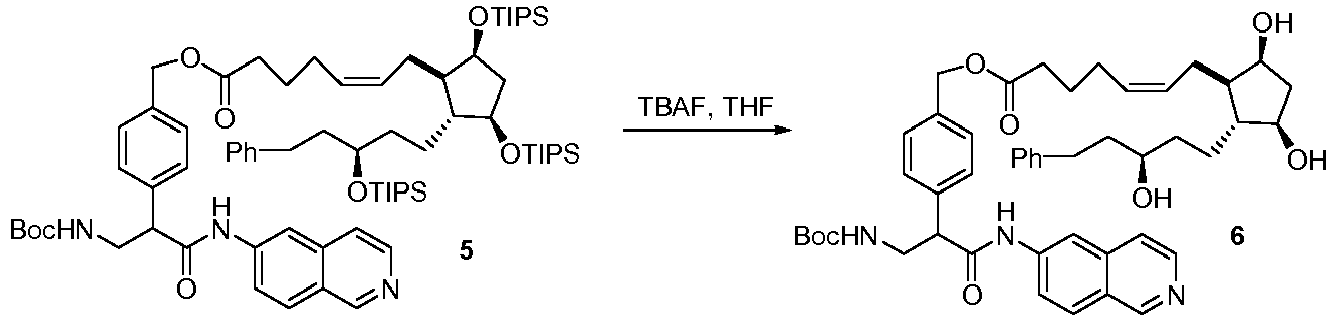
- To 5 in THF cooled to 0 °C was added TBAF and the solution was stirred 5 min at 0 °C and 12 h at room temperature. The mixture was poured into NH4Cl (sat)- EtOAc and extracted with EtOAc, dried (Na2SO4), filtered and evaporated . Column chromatography 5-8% MeOH /CH2Cl2 gave pure (Z)-4-(3-(tert-butoxycarbonylamino)-1-(isoquinolin-6-ylamino)-1-oxopropan-2-yl)benzyl 7-((1R,2R,3R,5S)-3,5-dihydroxy-2-((R)-3-hydroxy-5-phenylpentyl)cyclopentyl)hept-5-enoate (6).
-
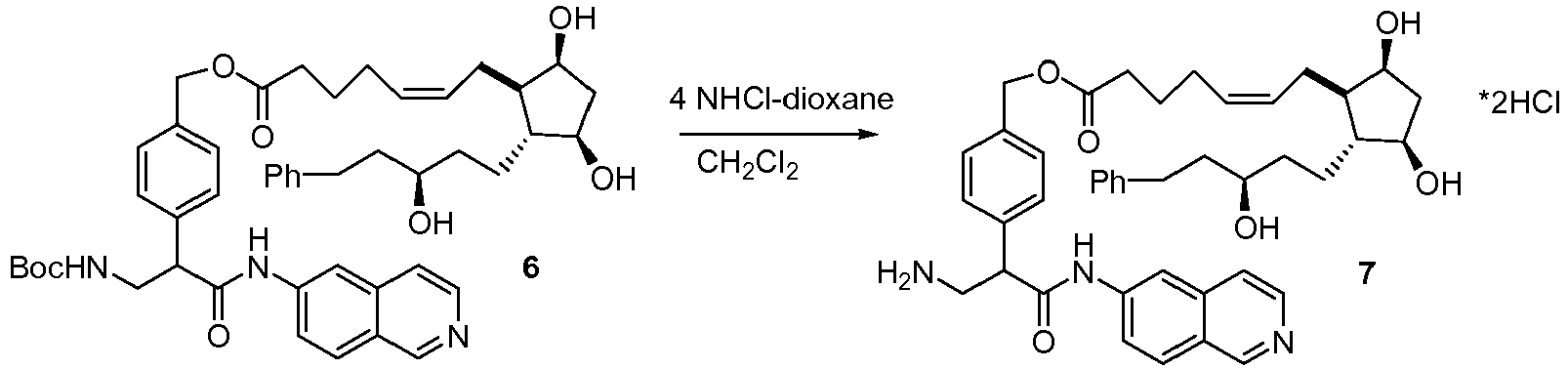
- To 6 in CH2Cl2 was added HCl (4N in dioxane) and the solution was stirred for 2 hours at room temperature. The solvents were evaporated to give (Z)-4-(3-amino-1-(isoquinolin-6-ylamino)-1-oxopropan-2-yl)benzyl 7-((1R,2R,3R,5S)-3,5-dihydroxy-2-((R)-3-hydroxy-5-phenylpentyl)cyclopentyl)hept-5-enoate dihydrochloride (7).
-
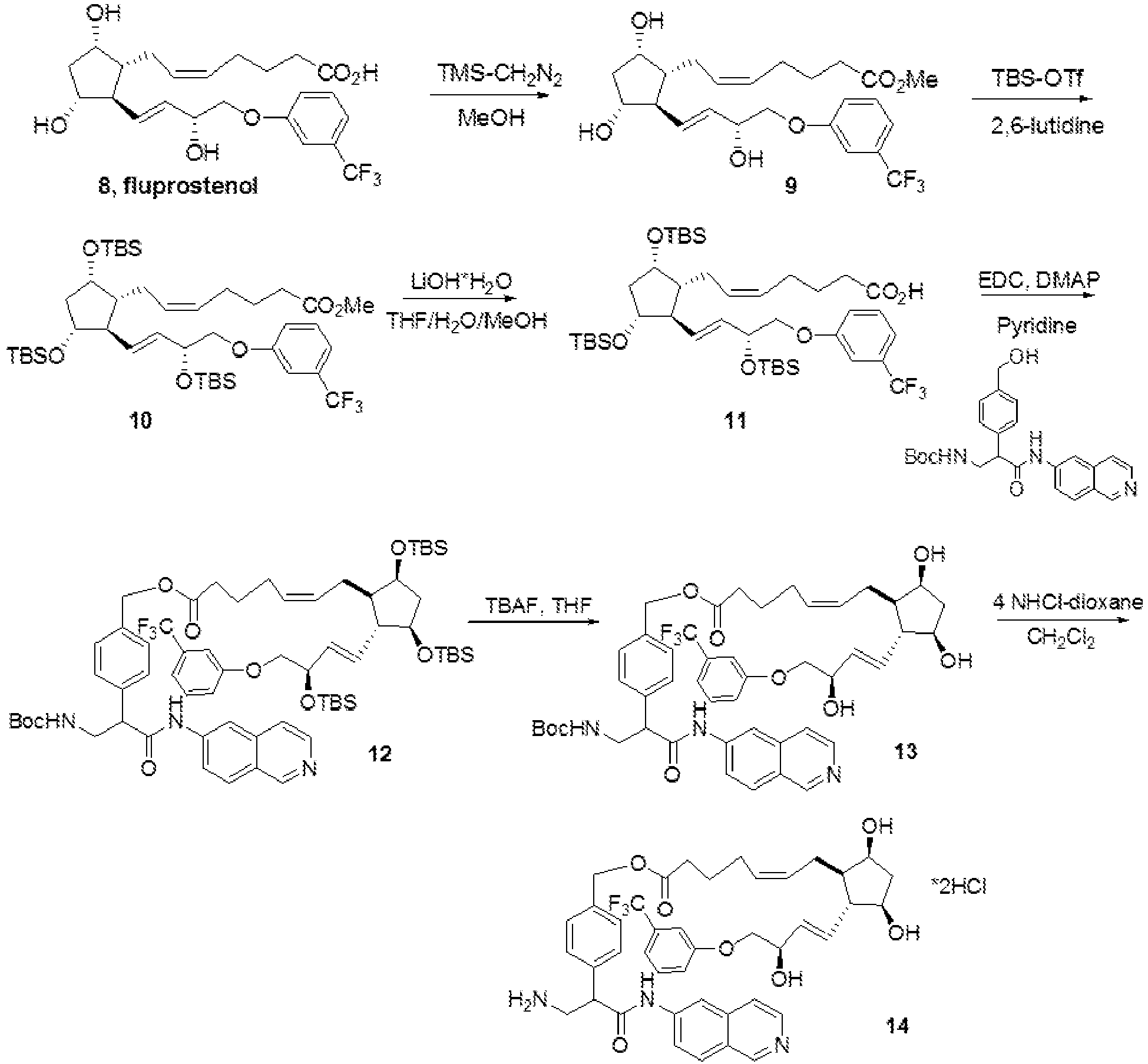
-

- To fluprostenol in MeOH at 0 °C was added TMS-CH2N2 until the solution persisted a yellow color. AcOH (2 drops) were added to quench excess TMS-CH2N2 and the solvents were evaporated. Column chromatography 90%-100% EtOAc/Hexanes gave pure (Z)-methyl 7-((1R,2R,3R,5S)-3,5-dihydroxy-2-((R,E)-3-hydroxy-4-(3-(trifluoromethyl)phenoxy)but-1-enyl)cyclopentyl)hept-5-enoate (9).
-

- To (Z)-methyl 7-((1R,2R,3R,5S)-3,5-dihydroxy-2-((R,E)-3-hydroxy-4-(3-(trifluoromethyl)phenoxy)but-1-enyl)cyclopentyl)hept-5-enoate (9) in CH2Cl2 cooled to 0 °C was added 2,6-lutidine and TBS-OTf and solution was stirred for 30 min at 0 °C and then stirred for 12 hours at room temperature. The solution was poured into EtOAc and NH4Cl(sat)/ HCl (1 N) (3:1) and further extracted with EtOAc. The organics were dried (Na2SO4),filtered and evaporated. Column chromatography 10% EtOAc/Hexanes gave (Z)-methyl 7-((1R,2R,3R,5S)-3,5-bis(tert-butyldimethylsilyloxy)-2-((R,E)-3-(tert-butyldimethylsilyloxy)-4-(3-(trifluoromethyl)phenoxy)but-1-enyl)cyclopentyl)hept-5-enoate (10).
-
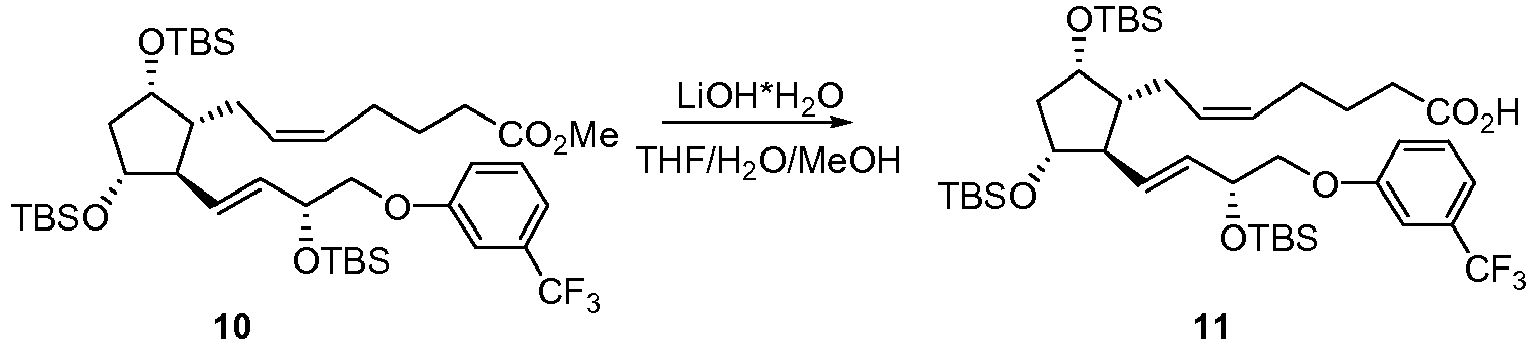
- To 10 in THF/MeOH/H2O was added LiOH*H2O and the solution was stirred overnight at room temperature. The solution was poured into EtOAc and NH4Cl(sat)/ HCl (1 N) (3:1) and further extracted with EtOAc. The organics were dried (Na2SO4),filtered and evaporated. Column chromatography 10% EtOAc/Hexanes 1.5% AcOH gave pure (Z)-7-((1R,2R,3R,5S)-3,5-bis(tert-butyldimethylsilyloxy)-2-((R,E)-3-(tert-butyldimethylsilyloxy)-4-(3-(trifluoromethyl)phenoxy)but-1-enyl)cyclopentyl)hept-5-enoic acid (11).
-

- To 11 in pyridine was added tert-butyl 2-(4-(hydroxymethyl)phenyl)-3-(isoquinolin-6-ylamino)-3-oxopropylcarbamate, EDC, and DMAP and the solution was flushed with Argon, capped and stirred overnight. The mixture as poured into NaHCO3(sat) and extracted with EtOAc, dried (Na2SO4), filtered and evaporated. Column chromatography using 4 % MeOH/CH2Cl2 gave pure (Z)-4-(3-(tert-butoxycarbonylamino)-1-(isoquinolin-6-ylamino)-1-oxopropan-2-yl)benzyl 7-((1R,2R,3R,5S)-3,5-bis(tert-butyldimethylsilyloxy)-2-((R,E)-3-(tert-butyldimethylsilyloxy)-4-(3-(trifluoromethyl)phenoxy)but-1-enyl)cyclopentyl)hept-5-enoate (12).
-
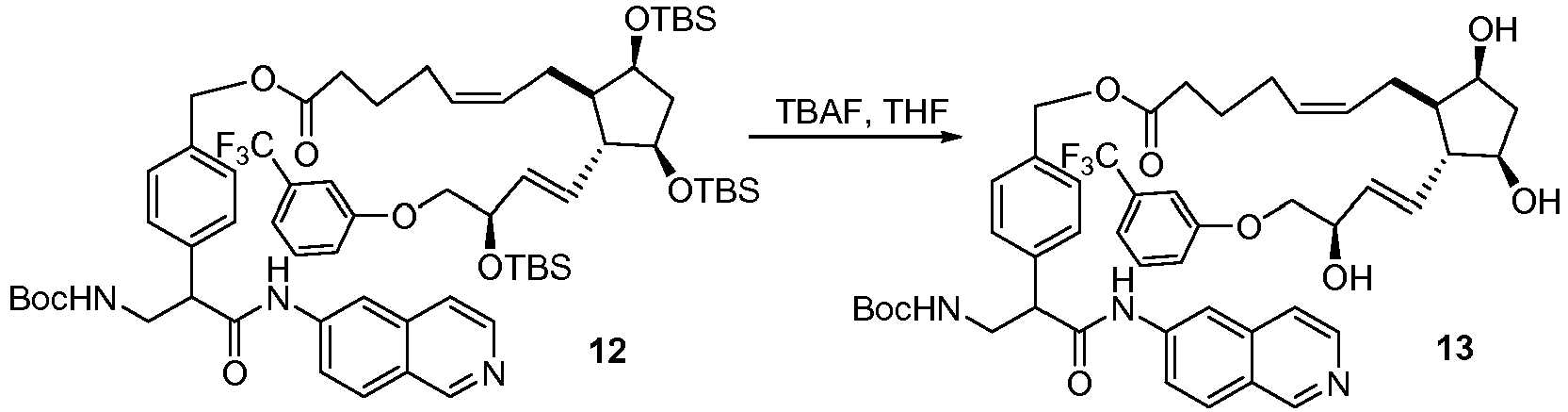
- To 12 in THF cooled to 0 °C was added TBAF and the solution was stirred 5 min at 0 °C and 12 h at room temperature. The mixture was poured into NH4Cl (sat)- EtOAc and extracted with EtOAc. The EtOAc layer was then washed with NH4Cl(sat),dried (Na2SO4), filtered and evaporated . Column chromatography using 5-10% MeOH /CH2Cl2 gave pure (Z)-4-(3-(tert-butoxycarbonylamino)-1-(isoquinolin-6-ylamino)-1-oxopropan-2-yl)benzyl 7-((1R,2R,3R,5S)-3,5-dihydroxy-2-((R,E)-3-hydroxy-4-(3-(trifluoromethyl)phenoxy)but-1-enyl)cyclopentyl)hept-5-enoate (13).
-

- To 13 in CH2Cl2 was added HCl (4N in dioxane) and the solution was stirred for 2 hours at room temperature . The solvents were evaporated and column chromatography using 10-20% MeOH/CH2Cl2 gave pure (Z)-4-(3-amino-1-(isoquinolin-6-ylamino)-1-oxopropan-2-yl)benzyl 7-((1R,2R,3R,5 S)-3 ,5-dihydroxy-2-((R,E)-3-hydroxy-4-(3-(trifluoromethyl)phenoxy)but-1-enyl)cyclopentyl)hept-5-enoate dihydrochloride (14).
-


-

- To AR-102 free acid (15) in MeOH at 0 °C was added TMS-CH2N2 until the solution persisted a yellow color. AcOH (2 drops) were added to quench excess TMS-CH2N2 and the solvents were evaporated. Column chromatography (90%-100% EtOAc/Hexanes) gave pure methyl 7-((1R,2R,3R,5S)-2-((R)-3-(benzo[b]thiophen-2-yl)-3-hydroxypropyl)-3,5-dihydroxycyclopentyl)heptanoate (16).
-

- To (methyl 7-((1R,2R,3R,SS)-2-((R)-3-(benzo[b]thiophen-2-yl)-3-hydroxypropyl)-3,5-dihydroxycyclopentyl)heptanoate (16) in CH2Cl2 cooled to 0 °C was added 2,6-lutidine and TBS-OTf and solution was stirred for 30 min at 0 °C and then stirred for 12 hours at room temperature. The solution was poured into EtOAc and NH4Cl(sat)/ HCl (1 N) (3:1) and further extracted with EtOAc. The organics were dried (Na2SO4),filtered and evaporated. Column chromatography (10% EtOAc/Hexanes) gave methyl 7-((1R,2R,3R,5S)-2-((R)-3-(benzo[b]thiophen-2-yl)-3-(tert-butyldimethylsilyloxy)propyl)-3,5-bis(tert-butyldimethylsilyloxy)cyclopentyl)heptanoate (17).
-
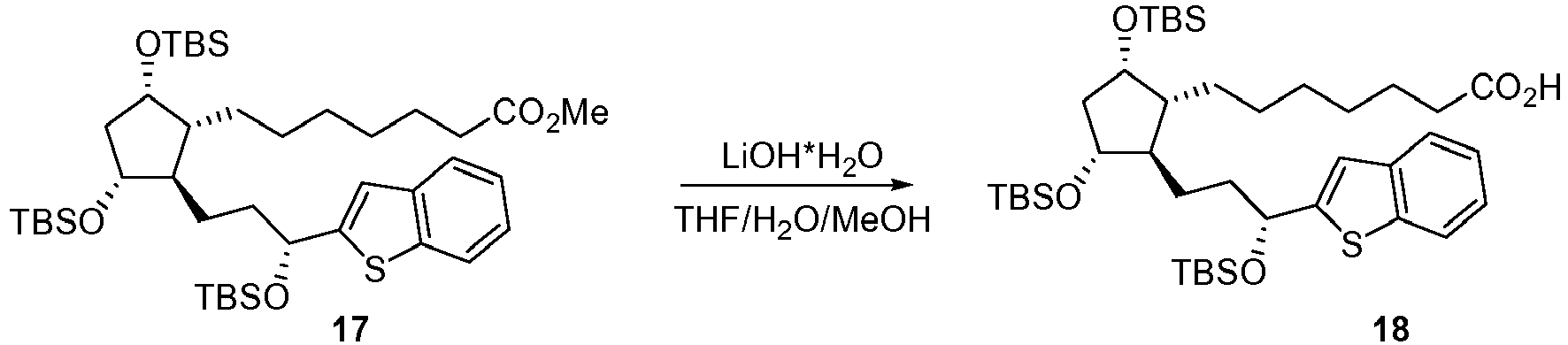
- To 17 in THF/MeOH/H2O was added LiOH*H2O and the solution was stirred overnight at room temperature. The solution was poured into EtOAc and NH4Cl(sat)/ HCl (1 N) (3:1) and further extracted with EtOAc. The organics were dried (Na2SO4),filtered and evaporated. Column chromatography (10% EtOAc/Hexanes) 1.5% AcOH gave pure 7-((1R,2R,3R,5S)-2-((R)-3-(benzo[b]thiophen-2-yl)-3-(tert-butyldimethylsilyloxy)propyl)-3,5-bis(tert-butyldimethylsilyloxy)cyclopentyl)heptanoic acid (18).
-

- To 18 in pyridine was added tert-butyl 2-(4-(hydroxymethyl)phenyl)-3-(isoquinolin-6-ylamino)-3-oxopropylcarbamate, EDC, and DMAP and the solution was flushed with Argon, capped and stirred overnight. The mixture as poured into NaHCO3(sat) and extracted with EtOAc, dried (Na2SO4), filtered and evaporated. Column chromatography using 4 % MeOH/CH2Cl2 gave pure 4-(3-(tert-butoxycarbonylamino)-1-(isoquinolin-6-ylamino)-1-oxopropan-2-yl)benzyl 7-((1R,2R,3R,5S)-2-((R)-3-(benzo[b]thiophen-2-yl)-3-(tert-butyldimethylsilyloxy)propyl)-3,5-bis(tert-butyldimethylsilyloxy)cyclopentyl)heptanoate (19).
-

- To 19 in THF cooled to 0 °C was added TBAF and the solution was stirred 5 min at 0 °C and 12 h at room temperature. The mixture was poured into NH4Cl (sat)- EtOAc and extracted with EtOAc. The EtOAc layer was then washed with NH4Cl(sat),dried (Na2SO4), filtered and evaporated. Column chromatography using 5-10% MeOH /CH2Cl2 gave pure 4-(3-(tert-butoxycarbonylamino)-1-(isoquinolin-6-ylamino)-1-oxopropan-2-yl)benzyl 7-((1R,2R,3R,5S)-2-((R)-3-(benzo[b]thiophen-2-yl)-3-hydroxypropyl)-3,5-dihydroxycyclopentyl)heptanoate (20).
-

- To 20 in CH2Cl2 was added 2,6 lutidine (11 eq) and TMS-OTF (11 eq) and the solution was stirred for 40 min at room temperature . The mixture was poured into NaHCO3 (sat) and extracted with CH2Cl2. The organics were dried (Na2SO4), filtered and evaporated. To the crude mixture was added THF and TBAF (1 eq) and the solution was stirred at room temperature for 15 min. The mixture was poured into NaHCO3 (sat) and extracted with CH2Cl2, dried (Na2SO4) filtered and evaporated. Column chromatography (20% MeOH/CH2Cl2) gave pure 4-(3-amino-1-(isoquinolin-6-ylamino)-1-oxopropan-2-yl)benzyl 7-((1R,2R,3R,5S)-2-((R)-3-(benzo[b]thiophen-2-yl)-3-hydroxypropyl)-3,5-dihydroxycyclopentyl)heptanoate (21).
-

- To 22 in MeOH was added PGF2α and the solution was heated to approximately 70 °C to dissolve the materials. The solvents were then evaporated to give salt 23.
-
Salts 24 and 25 were prepared similarly to salt 23. Salt 27 was prepared from 26 following the same method, but without heat. -

- To (S)-3-(tert-butoxycarbonylamino)-2-(4-chlorophenyl)propanoic acid (28) (8.5 g, 28.4 mmol) in DMF cooled to 0 °C was added 2,4,6-trimethylpyridine and 2,2,2-trichloro-1,1-dimethylethyl chloroformate in DMF. Then, 6-aminoisoquinoline in DMF was added and the solution stirred for 2 h at 0 °C. The mixture was poured into NaHCO3 (sat) and extracted with EtOAc. The organic layers were washed with H2O, dried (Na2SO4), filtered and evaporated to give crude 29. Column chromatography (30% EtOAc-Hexanes) and recrystallization (EtOAc/Hexanes) gave pure (S)-tert-butyl 2-(4-chlorophenyl)-3-(isoquinolin-6-ylamino)-3-oxopropylcarbamate (29, 7.8 g, 64%, >99% S enantiomer).
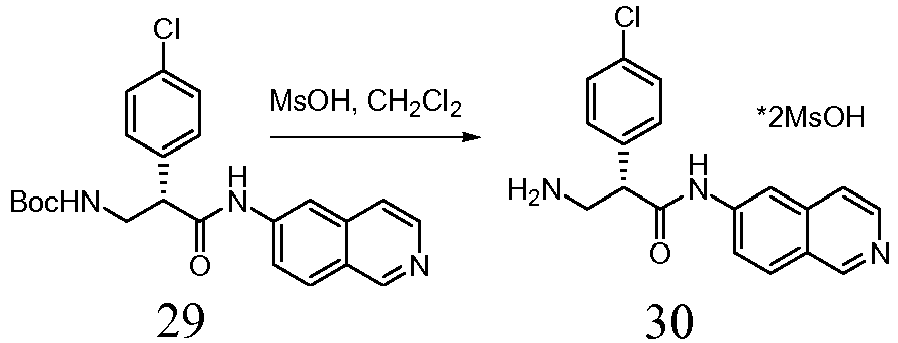
- To (S)-tert-butyl 2-(4-chlorophenyl)-3-(isoquinolin-6-ylamino)-3-oxopropylcarbamate (29, 7.8 g) was added CH2Cl2 and MsOH and the solution was stirred overnight at room temperature. The solvents were evaporated and the crude 30 was dried on the high vacuum. Recrystallization (isopropanol) and drying on the high vacuum gave pure (S)-3-amino-2-(4-chlorophenyl)-N-(isoquinolin-6-yl)propanamide dimesylate salt (30, 7.2 g, 77%, >99% S-enantiomer).
Claims (15)
- A compound according to formula (II):
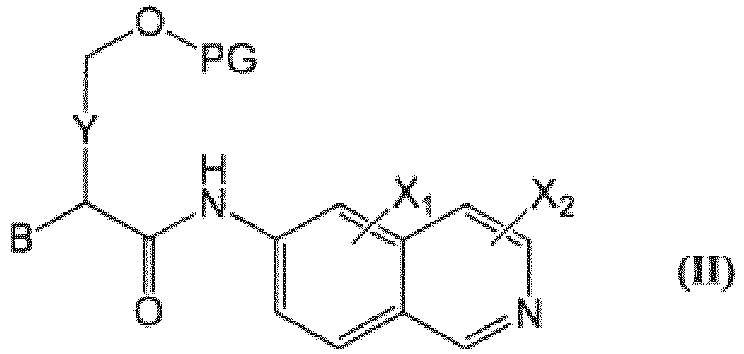 Y is selected from the group consisting of alkylene, aryl, heteroaryl, cycloalkyl, and heterocyclyl, any of which may be optionally substituted;B is selected from the group consisting of -NR1R2, -CH2NR1R2, -CH(R10)R2, -CCH3(R10) R2, -NHCH(R10)R2, -N(CH3)R2, -CH2CH2R2, -CH(R10)CH2R2, and -CH2CH(R10)R2;R1, R2 and R10 are each independently selected from the group consisting of hydrogen, alkyl, alkenyl, alkynyl, amino, aryl, heteroaryl, cycloalkyl and heterocycloalkyl, any of which may be optionally substituted;X1 and X2 are independently selected from the group consisting of hydrogen, hydroxy, halogen, alkyl, amino, nitro, cyano, carbonyl, carbonylamino, alkoxy, aryloxy, sulfonyl, sulfonamido, thioalkyl, and carboxyl; andPG is an acyl radical of a prostaglandin selected from latanoprost, bimatoprost, travoprost, tafluprost, AR-102, cloprostenol, 13,14-dihydrocloprostenol, unoprostone, PGF1α, PGF2α, and PGF3α, or an acyl radical of formula (IV):
 the dashed lines independently indicate the presence or absence of a bond;A and B are independently -(CRaRb)n-, wherein each Ra and Rb is independently hydrogen or C1-C6 alkyl, and n is 0, 1, 2, 3, or 4;R1 is -C(O)-;R2 is hydrogen or C1-C6 alkyl;R3, R4 and R5 are independently hydrogen or an alcohol protecting group;Y is a bond, -O-, -S-, -S(O), -SO2-, -C(Rg)2-, -CRh=CRi-, -NRj-, or - C=C-;Z is hydrogen, cycloalkyl, heterocyclyl, aryl, or heteroaryl;Rg, Rh and Ri are independently hydrogen, C1-C6 alkyl, alkoxy, or hydroxy; andRj is hydrogen or C1-C6 alkyl.
 - The compound of claim 1, wherein the compound is:

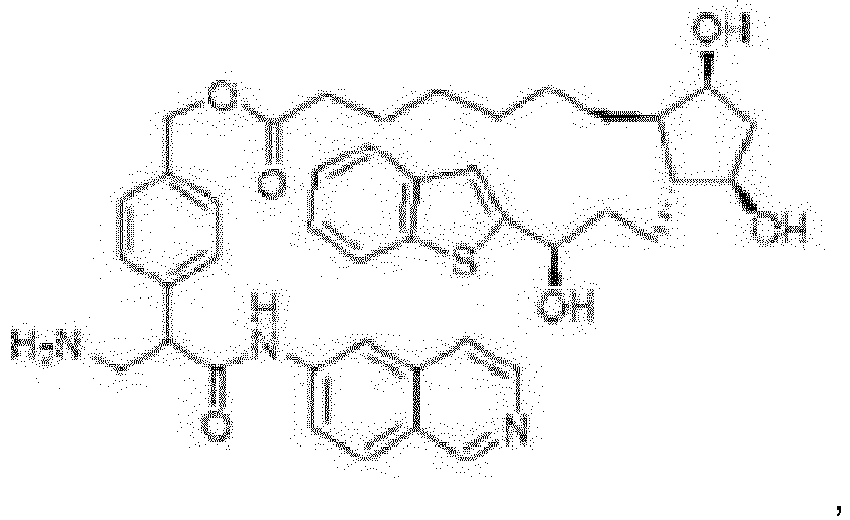


- The compound of claim 1, wherein PG is:


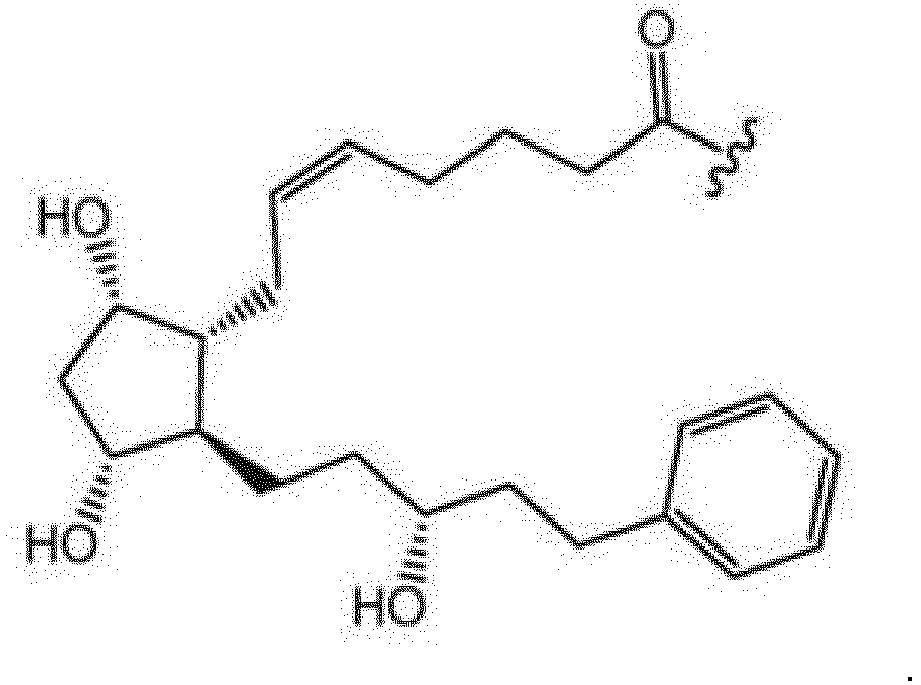
- The compound of claim 1, wherein X1 and X2 are hydrogen, B is -CH2NR1R2, R1 is alkyl, R2 is alkyl, and PG is the acyl radical of latanoprost.
- The compound of claim 1, wherein X1 and X2 are hydrogen, B is -CH2NR1R2, R1 is methyl, R2 is methyl, and PG is the acyl radical of latanoprost.
- The compound of claim 1, wherein X1 and X2 are hydrogen, B is -CH2NR1R2, R1 and R2 are hydrogen, and PG is the acyl radical of latanoprost.
- The compound of claim 1, wherein X1 is hydrogen, X2 is hydroxy, B is -CH2NR1R2, R1 and R2 are hydrogen, and PG is the acyl radical of latanoprost.
- The compound of claim 1, wherein X1 is hydrogen, X2 is hydroxy, B is -NR1R2, R1 is hydrogen, R2 is hydrogen, and PG is the acyl radical of travoprost.
- The compound of claim 1, wherein X1 is hydrogen, X2 is hydroxy, B is -NR1R2, R1 is alkyl, R2 is alkyl, and PG is the acyl radical of latanoprost.
- The compound of claim 1, wherein X1 is hydrogen, X2 is hydroxy, B is -NR1R2, R1 is methyl, R2 is methyl, and PG is the acyl radical of latanoprost.
- The compound of claim 1, wherein X1 and X2 are hydrogen, B is -CH2NR1R2, R1 is hydrogen, R2 is hydrogen, and PG is the acyl radical of travoprost.
- The compound of claim 1, wherein X1 and X2 are hydrogen, B is -CH2NR1R2, R1 is hydrogen, R2 is hydrogen, and PG is the acyl radical of bimatoprost.
- A compound or composition according to any of claims 1 to 12 for use in treating an ocular disorder in a subject in need of treatment.
- The compound or composition for use according to claim 13, wherein the ocular disorder is glaucoma.
- A compound or composition according to any of claims 1 to 12 for use in reducing intraocular pressure in a subject in need thereof, comprising topically administering to an eye of the subject the compound or composition.
Priority Applications (5)
| Application Number | Priority Date | Filing Date | Title |
|---|---|---|---|
| EP23156661.3A EP4218759A3 (en) | 2013-03-15 | 2014-03-14 | Combination therapy |
| EP23199180.3A EP4335507A3 (en) | 2013-03-15 | 2014-03-14 | Combination therapy |
| EP18206195.2A EP3461484B9 (en) | 2013-03-15 | 2014-03-14 | Dimesylate salts of 4-(3-amino-1-(isoquinolin-6-ylamino)-1-oxopropan-2-yl)benzyl, their combinations with prostaglandins and the use thereof in the treatment of ocular disorders |
| EP20207657.6A EP3811943B1 (en) | 2013-03-15 | 2014-03-14 | Compound for use in the treatment of ocular disorders |
| NL301101C NL301101I2 (en) | 2013-03-15 | 2021-05-10 | Latanoprost or a pharmaceutically acceptable salt thereof and netarsudil mesylate |
Applications Claiming Priority (2)
| Application Number | Priority Date | Filing Date | Title |
|---|---|---|---|
| US201361787883P | 2013-03-15 | 2013-03-15 | |
| PCT/US2014/029335 WO2014144781A1 (en) | 2013-03-15 | 2014-03-14 | Combination therapy |
Related Child Applications (5)
| Application Number | Title | Priority Date | Filing Date |
|---|---|---|---|
| EP23199180.3A Division EP4335507A3 (en) | 2013-03-15 | 2014-03-14 | Combination therapy |
| EP23156661.3A Division EP4218759A3 (en) | 2013-03-15 | 2014-03-14 | Combination therapy |
| EP20207657.6A Division EP3811943B1 (en) | 2013-03-15 | 2014-03-14 | Compound for use in the treatment of ocular disorders |
| EP18206195.2A Division EP3461484B9 (en) | 2013-03-15 | 2014-03-14 | Dimesylate salts of 4-(3-amino-1-(isoquinolin-6-ylamino)-1-oxopropan-2-yl)benzyl, their combinations with prostaglandins and the use thereof in the treatment of ocular disorders |
| EP18206195.2A Division-Into EP3461484B9 (en) | 2013-03-15 | 2014-03-14 | Dimesylate salts of 4-(3-amino-1-(isoquinolin-6-ylamino)-1-oxopropan-2-yl)benzyl, their combinations with prostaglandins and the use thereof in the treatment of ocular disorders |
Publications (2)
| Publication Number | Publication Date |
|---|---|
| EP2976080A1 EP2976080A1 (en) | 2016-01-27 |
| EP2976080B1 true EP2976080B1 (en) | 2019-12-25 |
Family
ID=50588903
Family Applications (5)
| Application Number | Title | Priority Date | Filing Date |
|---|---|---|---|
| EP14719999.6A Active EP2976080B1 (en) | 2013-03-15 | 2014-03-14 | Conjugates of isoquinoline compounds and prostaglandins |
| EP20207657.6A Active EP3811943B1 (en) | 2013-03-15 | 2014-03-14 | Compound for use in the treatment of ocular disorders |
| EP23156661.3A Pending EP4218759A3 (en) | 2013-03-15 | 2014-03-14 | Combination therapy |
| EP18206195.2A Active EP3461484B9 (en) | 2013-03-15 | 2014-03-14 | Dimesylate salts of 4-(3-amino-1-(isoquinolin-6-ylamino)-1-oxopropan-2-yl)benzyl, their combinations with prostaglandins and the use thereof in the treatment of ocular disorders |
| EP23199180.3A Pending EP4335507A3 (en) | 2013-03-15 | 2014-03-14 | Combination therapy |
Family Applications After (4)
| Application Number | Title | Priority Date | Filing Date |
|---|---|---|---|
| EP20207657.6A Active EP3811943B1 (en) | 2013-03-15 | 2014-03-14 | Compound for use in the treatment of ocular disorders |
| EP23156661.3A Pending EP4218759A3 (en) | 2013-03-15 | 2014-03-14 | Combination therapy |
| EP18206195.2A Active EP3461484B9 (en) | 2013-03-15 | 2014-03-14 | Dimesylate salts of 4-(3-amino-1-(isoquinolin-6-ylamino)-1-oxopropan-2-yl)benzyl, their combinations with prostaglandins and the use thereof in the treatment of ocular disorders |
| EP23199180.3A Pending EP4335507A3 (en) | 2013-03-15 | 2014-03-14 | Combination therapy |
Country Status (14)
| Country | Link |
|---|---|
| US (12) | US9415043B2 (en) |
| EP (5) | EP2976080B1 (en) |
| JP (6) | JP2016515520A (en) |
| CN (3) | CN109528721B (en) |
| AU (4) | AU2014228790B2 (en) |
| CA (1) | CA2905089C (en) |
| DK (1) | DK3811943T3 (en) |
| ES (3) | ES2942898T3 (en) |
| FI (1) | FI3811943T3 (en) |
| HU (1) | HUE061618T2 (en) |
| NL (1) | NL301101I2 (en) |
| PL (1) | PL3811943T3 (en) |
| PT (1) | PT3811943T (en) |
| WO (1) | WO2014144781A1 (en) |
Families Citing this family (28)
| Publication number | Priority date | Publication date | Assignee | Title |
|---|---|---|---|---|
| EP2526948A1 (en) | 2006-09-20 | 2012-11-28 | Aerie Pharmaceuticals, Inc. | RHO kinase inhibitors |
| US8455513B2 (en) | 2007-01-10 | 2013-06-04 | Aerie Pharmaceuticals, Inc. | 6-aminoisoquinoline compounds |
| US8450344B2 (en) | 2008-07-25 | 2013-05-28 | Aerie Pharmaceuticals, Inc. | Beta- and gamma-amino-isoquinoline amide compounds and substituted benzamide compounds |
| US8394826B2 (en) | 2009-05-01 | 2013-03-12 | Aerie Pharmaceuticals, Inc. | Dual mechanism inhibitors for the treatment of disease |
| EP2976080B1 (en) | 2013-03-15 | 2019-12-25 | Aerie Pharmaceuticals, Inc. | Conjugates of isoquinoline compounds and prostaglandins |
| AU2015305269B2 (en) | 2014-08-22 | 2021-12-23 | Auckland Uniservices Limited | Channel modulators |
| AU2015414743B2 (en) * | 2015-11-17 | 2019-07-18 | Alcon Inc. | Process for the preparation of kinase inhibitors and intermediates thereof |
| US9643927B1 (en) | 2015-11-17 | 2017-05-09 | Aerie Pharmaceuticals, Inc. | Process for the preparation of kinase inhibitors and intermediates thereof |
| WO2018034702A1 (en) * | 2016-08-19 | 2018-02-22 | Aerie Pharmaceuticals, Inc. | Beta-amino-isoquinolinyl amide compounds |
| KR102568082B1 (en) * | 2016-08-31 | 2023-08-17 | 에어리 파마슈티컬즈, 인코포레이티드 | ophthalmic composition |
| CN106620678A (en) * | 2016-11-28 | 2017-05-10 | 同济大学 | Novel application of PKA inhibitor H-89 |
| AR110401A1 (en) | 2016-12-21 | 2019-03-27 | Chiesi Farm Spa | BICYCLIC DIHYDROPIRIMIDINE-CARBOXAMIDE DERIVATIVES AS RHO-QUINASA INHIBITORS |
| US10442770B2 (en) * | 2017-02-02 | 2019-10-15 | Assia Chemical Industries Ltd. | Solid state forms of netarsudil mesylate |
| KR20190119055A (en) | 2017-02-28 | 2019-10-21 | 코와 가부시키가이샤 | Medicinal preparations |
| KR20190120215A (en) | 2017-02-28 | 2019-10-23 | 코와 가부시키가이샤 | medicine |
| JP7108597B2 (en) * | 2017-02-28 | 2022-07-28 | 興和株式会社 | pharmaceuticals |
| KR20190128657A (en) | 2017-03-27 | 2019-11-18 | 코와 가부시키가이샤 | Medicinal preparations |
| AU2018243687C1 (en) | 2017-03-31 | 2020-12-24 | Alcon Inc. | Aryl cyclopropyl-amino-isoquinolinyl amide compounds |
| KR102069205B1 (en) * | 2017-08-09 | 2020-01-22 | 연성정밀화학(주) | Process for Preparing Latanoprostene bunod and Intermediate Therefor |
| JP7165185B2 (en) * | 2018-02-28 | 2022-11-02 | 興和株式会社 | Pharmaceutical formulation |
| MX2020010300A (en) * | 2018-03-30 | 2020-10-20 | Aerie Pharmaceuticals Inc | Mono-(acid) salts of 6-aminoisoquinolines and uses thereof. |
| JP7191541B2 (en) * | 2018-04-26 | 2022-12-19 | 興和株式会社 | Pharmaceutical formulation |
| JP7437384B2 (en) * | 2018-08-31 | 2024-02-22 | アエリエ ファーマシューティカルズ インコーポレイテッド | Isoquinoline steroid conjugates and their uses |
| EP3849555A4 (en) | 2018-09-14 | 2022-05-04 | Aerie Pharmaceuticals, Inc. | ARYL CYCLOPROPYL AMINO ISOCHINOLINYL AMIDE COMPOUNDS |
| WO2021024039A1 (en) | 2019-08-07 | 2021-02-11 | Ripple Therapeutics Corporation | Compositions and methods for the treatment of pain and dependance disorders |
| CN110437043A (en) * | 2019-08-24 | 2019-11-12 | 黄泳华 | The eutectic that is made of resveratrol and prostaglandin analogue agent and its purposes in the preparation of antitumor drugs |
| CA3162689A1 (en) * | 2020-01-08 | 2021-07-15 | Kevin Peters | Combinations of tie-2 activators and prostaglandins and uses thereof |
| WO2021220061A2 (en) | 2020-05-01 | 2021-11-04 | Ripple Therapeutics Corporation | Heterodimer compositions and methods for the treatment of ocular disorders |
Family Cites Families (158)
| Publication number | Priority date | Publication date | Assignee | Title |
|---|---|---|---|---|
| AT251624B (en) | 1962-05-02 | 1967-01-10 | Knapsack Ag | Ferrosilicon as a deoxidizer, slag reduction, inoculant and / or alloying agent |
| DE2623228C3 (en) | 1976-05-24 | 1981-09-10 | Ludwig Merckle Kg Chem. Pharm. Fabrik, 7902 Blaubeuren | N-acyl-substituted benzamides, processes for their preparation and pharmaceuticals containing such benzamides |
| JPS5587771A (en) | 1978-12-27 | 1980-07-02 | Teikoku Hormone Mfg Co Ltd | 1-phenylisoquinoline derivative |
| US4456757A (en) | 1981-03-20 | 1984-06-26 | Asahi Kasei Kogyo Kabushiki Kaisha | Isoquinolinesulfonyl derivatives and process for the preparation thereof |
| JPS5993054A (en) | 1982-11-18 | 1984-05-29 | Asahi Chem Ind Co Ltd | Isoquinolinesulfonic acid amide derivative |
| DK8386A (en) | 1986-01-15 | 1987-07-09 | Tpo Pharmachim | NEW N-SUBSTITUTED 1-BENZYL-2-CARBAMOYLTETRAHYDROISOQUINOLINES AND PROCEDURES FOR THE PREPARATION OF THE SAME |
| US4911928A (en) | 1987-03-13 | 1990-03-27 | Micro-Pak, Inc. | Paucilamellar lipid vesicles |
| US5591887A (en) | 1987-04-30 | 1997-01-07 | R-Tech Ueno, Ltd. | Prostaglandins of the F series |
| JPH01139528A (en) | 1987-11-24 | 1989-06-01 | Showa Denko Kk | Antiulcerative |
| ATE101342T1 (en) | 1988-09-06 | 1994-02-15 | Kabi Pharmacia Ab | PROSTAGLAND INDIVIDUALS FOR THE TREATMENT OF GREEN STAR OR OCULAR HYPERTENSION. |
| EP0389995B1 (en) | 1989-03-28 | 1995-05-31 | Nisshin Flour Milling Co., Ltd. | Isoquinoline derivatives for the treatment of glaucoma or ocular hypertension |
| KR920008026A (en) | 1990-10-24 | 1992-05-27 | 오노 화아마슈티칼 캄파니 리미팃드 | Isoquinolinone derivatives or nontoxic acid addition salts thereof or hydrates thereof, methods for preparing the same, and pharmaceutical compositions comprising the same |
| WO1993018028A1 (en) | 1992-03-12 | 1993-09-16 | Smithkline Beecham Plc | Indole derivatives as 5ht1c antagonists |
| US5972991A (en) | 1992-09-21 | 1999-10-26 | Allergan | Cyclopentane heptan(ene) oic acid, 2-heteroarylalkenyl derivatives as therapeutic agents |
| DE4332168A1 (en) | 1993-02-22 | 1995-03-23 | Thomae Gmbh Dr K | Cyclic derivatives, pharmaceutical compositions containing these compounds and process for their preparation |
| US5510383A (en) | 1993-08-03 | 1996-04-23 | Alcon Laboratories, Inc. | Use of cloprostenol, fluprostenol and their salts and esters to treat glaucoma and ocular hypertension |
| US6124344A (en) | 1993-12-28 | 2000-09-26 | Allergan Sales, Inc. | Cyclopentane heptan(ene)oic acid, 2-heteroarylalkenyl derivatives as therapeutic agents |
| US5462968A (en) | 1994-01-19 | 1995-10-31 | Allergan, Inc. | EP2 -receptor agonists as agents for lowering intraocular pressure |
| US5698733A (en) | 1994-09-30 | 1997-12-16 | Alcon Laboratories, Inc. | Use of 9-deoxy prostaglandin derivatives to treat glaucoma |
| AU7672096A (en) | 1995-06-07 | 1998-06-03 | Alcon Laboratories, Inc. | Conformationally rigid aryl- or heteroaryl prostaglandins for use in glaucoma therapy |
| US5814660A (en) | 1995-12-22 | 1998-09-29 | Alcon Laboratories, Inc. | 9-oxa prostaglandin analogs as ocular hypotensives |
| AU714272B2 (en) | 1995-12-22 | 1999-12-23 | Alcon Laboratories, Inc. | Substituted tetrahydrofuran analogs of prostaglandins as ocular hypotensives |
| US5866602A (en) | 1995-12-22 | 1999-02-02 | Alcon Laboratories, Inc. | Keto-substituted tetrahydrofuran analogs of prostaglandins as ocular hypotensives |
| US6586425B2 (en) | 1996-02-21 | 2003-07-01 | Wisconsin Alumni Research Foundation | Cytoskeletal active agents for glaucoma therapy |
| US5798380A (en) | 1996-02-21 | 1998-08-25 | Wisconsin Alumni Research Foundation | Cytoskeletal active agents for glaucoma therapy |
| ATE221048T1 (en) | 1996-09-17 | 2002-08-15 | Asahi Glass Co Ltd | FLUORINATED PROSTAGLAND DERIVATIVES AND MEDICATIONS |
| CA2269853A1 (en) | 1996-11-12 | 1998-05-22 | Paul W. Zinke | Use of cis-.delta.4 analogs of prostaglandins as ocular hypotensives |
| WO1998020881A1 (en) | 1996-11-12 | 1998-05-22 | Alcon Laboratories, Inc | 15-ketal prostaglandins for the treatment of glaucoma or ocular hypertension |
| AU5436198A (en) | 1996-11-12 | 1998-06-03 | Alcon Laboratories, Inc. | 11-halo prostaglandins for the treatment of glaucoma or ocular hypertension |
| DE69705421T2 (en) | 1996-11-12 | 2002-05-16 | Alcon Laboratories, Inc. | 15-FLUORO-PROSTAGLANDINE AS AN EYE PRESSURING AGENT |
| CA2276666A1 (en) | 1997-03-07 | 1998-09-11 | Alcon Laboratories, Inc. | 13-thia prostaglandins for use in glaucoma therapy |
| EP1007028A4 (en) | 1997-05-09 | 2002-06-05 | 8-iso-prostaglandins for glaucoma therapy | |
| US5891646A (en) | 1997-06-05 | 1999-04-06 | Duke University | Methods of assaying receptor activity and constructs useful in such methods |
| SE9702706D0 (en) | 1997-07-11 | 1997-07-11 | Pharmacia & Upjohn Ab | Prostaglandin derivatives devoid of side effects for the treatment of glaucoma |
| WO2000077027A2 (en) | 1999-06-14 | 2000-12-21 | Tularik Limited | Serine protease inhibitors |
| CN1269785A (en) | 1997-09-09 | 2000-10-11 | 普罗克特和甘保尔公司 | Aromatic C16-C20 substituted tetrahydro prostaglandius useful as EP agonists |
| BR9811774A (en) | 1997-09-09 | 2000-08-29 | Procter & Gamble | Aromatic tetrahydroprostaglandins substituted by c16-c20 useful as fp agonists |
| TR200000673T2 (en) | 1997-09-09 | 2000-11-21 | The Procter & Gamble Company | Aromatic C16-C20-substituted tetrahydro prostaglandins useful as FP agonists. |
| US5877211A (en) | 1997-11-21 | 1999-03-02 | Allergan | EP2 receptor agonists as neuroprotective agents for the eye |
| US6232344B1 (en) | 1997-12-22 | 2001-05-15 | Alcon Laboratories, Inc. | 13-Oxa prostaglandins for the treatment of glaucoma and ocular hypertension |
| DE69922916T2 (en) | 1998-07-14 | 2005-06-09 | Alcon Manufacturing Ltd., Fort Worth | POLYPROPYLENE BASED CONTAINERS FOR PROSTAGLANDIN CONTAINING PRODUCTS |
| TWI249520B (en) | 1998-07-15 | 2006-02-21 | Ono Pharmaceutical Co | 5-Thia-omega-substituted phenyl prostaglandin E derivatives, method for producing the same and medicines containing the same as the active ingredient |
| US6720175B1 (en) | 1998-08-18 | 2004-04-13 | The Johns Hopkins University School Of Medicine | Nucleic acid molecule encoding homer 1B protein |
| US20020065296A1 (en) | 1999-01-13 | 2002-05-30 | Bayer Corporation | Heteroaryl ureas containing nitrogen hetero-atoms as p38 kinase inhibitors |
| CA2374947A1 (en) | 1999-05-24 | 2000-11-30 | Robert M. Scarborough | Inhibitors of factor xa |
| CA2389681C (en) | 1999-11-26 | 2010-11-02 | Shionogi & Co., Ltd. | Npy y5 antagonist |
| WO2001047891A1 (en) | 1999-12-28 | 2001-07-05 | Eisai Co., Ltd. | Heterocyclic compounds having sulfonamide groups |
| YU54202A (en) | 2000-01-18 | 2006-01-16 | Agouron Pharmaceuticals Inc. | Indazole compounds,pharmaceutical compositions,and methods for mediating or inhibiting cell proliferation |
| HN2001000008A (en) | 2000-01-21 | 2003-12-11 | Inc Agouron Pharmaceuticals | AMIDA COMPOSITE AND PHARMACEUTICAL COMPOSITIONS TO INHIBIT PROTEINKINASES, AND THE INSTRUCTIONS FOR USE |
| RU2240826C2 (en) | 2000-02-03 | 2004-11-27 | Эйсай Ко., Лтд. | Inhibitor of integrin expression |
| US6362177B1 (en) | 2000-05-16 | 2002-03-26 | Teijin Limited | Cyclic amine derivatives and their use as drugs |
| US6908741B1 (en) | 2000-05-30 | 2005-06-21 | Transtech Pharma, Inc. | Methods to identify compounds that modulate RAGE |
| US6855690B2 (en) * | 2000-06-01 | 2005-02-15 | Children's Medical Center Corporation | Methods and compositions for treating ocular disorders |
| US6323228B1 (en) | 2000-09-15 | 2001-11-27 | Abbott Laboratories | 3-substituted indole angiogenesis inhibitors |
| IL155333A0 (en) | 2000-10-17 | 2003-11-23 | Applied Res | Sulfanilide derivatives for use in medicine, certain such new derivatives and their preparation |
| US7163800B2 (en) | 2000-11-03 | 2007-01-16 | Molecular Devices Corporation | Methods of screening compositions for G protein-coupled receptor desensitization inhibitory activity |
| AU2002245590B2 (en) | 2001-03-05 | 2006-06-29 | Transtech Pharma, Inc. | Benzimidazole derivatives as therapeutic agents |
| EP1379505B1 (en) | 2001-04-20 | 2007-02-28 | Bayer Pharmaceuticals Corporation | Inhibition of raf kinase using quinolyl, isoquinolyl or pyridyl ureas |
| US6956035B2 (en) | 2001-08-31 | 2005-10-18 | Inotek Pharmaceuticals Corporation | Isoquinoline derivatives and methods of use thereof |
| AU2003202263A1 (en) | 2002-01-10 | 2003-07-30 | Bayer Healthcare Ag | Roh-kinase inhibitors |
| TW200306819A (en) | 2002-01-25 | 2003-12-01 | Vertex Pharma | Indazole compounds useful as protein kinase inhibitors |
| ATE416168T1 (en) | 2002-02-15 | 2008-12-15 | Glaxo Group Ltd | MODULATORS OF THE VANILLOID RECEPTOR |
| WO2003073999A2 (en) | 2002-03-01 | 2003-09-12 | Pintex Pharmaceuticals, Inc. | Pini-modulating compounds and methods of use thereof |
| CA2476594C (en) | 2002-03-05 | 2012-10-09 | Transtech Pharma, Inc. | Mono-and bicyclic azole derivatives that inhibit the interaction of ligands with rage |
| GB0206876D0 (en) | 2002-03-22 | 2002-05-01 | Merck Sharp & Dohme | Therapeutic agents |
| US7645878B2 (en) | 2002-03-22 | 2010-01-12 | Bayer Healthcare Llc | Process for preparing quinazoline Rho-kinase inhibitors and intermediates thereof |
| WO2003097795A2 (en) | 2002-05-13 | 2003-11-27 | Norak Biosciences, Inc. | Constitutively translocating cell line |
| TWI350170B (en) | 2002-08-29 | 2011-10-11 | Santen Pharmaceutical Co Ltd | Treating agent for glaucoma comprising rho kinase inhibitor and prostaglandin |
| JP4482726B2 (en) * | 2002-08-29 | 2010-06-16 | 参天製薬株式会社 | Glaucoma treatment agent comprising Rho kinase inhibitor and prostaglandins |
| US7345158B2 (en) | 2002-08-30 | 2008-03-18 | Anges Mg, Inc. | Actin related cytoskeletal protein “LACS” |
| US7615564B2 (en) | 2002-09-12 | 2009-11-10 | Kirin Beer Kabushiki Kaisha | Isoquinoline derivatives having kinasae inhibitory activity and drugs containing the same |
| AU2003285952A1 (en) | 2002-10-21 | 2004-05-13 | Irm Llc | Pyrrolidones with anti-hiv activity |
| UY28213A1 (en) | 2003-02-28 | 2004-09-30 | Bayer Pharmaceuticals Corp | NEW CYANOPIRIDINE DERIVATIVES USEFUL IN THE TREATMENT OF CANCER AND OTHER DISORDERS. |
| MXPA05013434A (en) | 2003-06-12 | 2006-03-17 | Astellas Pharma Inc | Benzamide derivative or salt thereof. |
| AU2004268621C1 (en) | 2003-08-29 | 2011-08-18 | Exelixis, Inc. | c-Kit modulators and methods of use |
| JP2007507547A (en) | 2003-10-06 | 2007-03-29 | グラクソ グループ リミテッド | Preparation of 1,7-disubstituted azabenzimidazoles as kinase inhibitors |
| JP2007008816A (en) | 2003-10-15 | 2007-01-18 | Ube Ind Ltd | New isoquinoline derivatives |
| CA2542609C (en) | 2003-10-15 | 2013-06-04 | Ube Industries, Ltd. | Novel indazole derivatives |
| DE10348023A1 (en) | 2003-10-15 | 2005-05-19 | Imtm Gmbh | New alanyl aminopeptidase inhibitors for the functional manipulation of different cells and for the treatment of immunological, inflammatory, neuronal and other diseases |
| SE0400284D0 (en) | 2004-02-10 | 2004-02-10 | Astrazeneca Ab | Novel compounds |
| JP2005227441A (en) | 2004-02-12 | 2005-08-25 | Konica Minolta Medical & Graphic Inc | Photothermographic imaging material |
| JP4857128B2 (en) | 2004-02-20 | 2012-01-18 | グラクソスミスクライン・リミテッド・ライアビリティ・カンパニー | New compounds |
| US20080096238A1 (en) | 2004-03-30 | 2008-04-24 | Alcon, Inc. | High throughput assay for human rho kinase activity with enhanced signal-to-noise ratio |
| DE102004017438A1 (en) | 2004-04-08 | 2005-11-03 | Bayer Healthcare Ag | Hetaryloxy-substituted phenylaminopyrimidines |
| US7453002B2 (en) | 2004-06-15 | 2008-11-18 | Bristol-Myers Squibb Company | Five-membered heterocycles useful as serine protease inhibitors |
| JP2008503492A (en) | 2004-06-17 | 2008-02-07 | スミスクライン・ビーチャム・コーポレイション | Novel inhibitors of Rho-kinase |
| EP2202609B8 (en) | 2004-06-18 | 2016-03-09 | Tobii AB | Eye control of computer apparatus |
| PL1786785T3 (en) | 2004-08-26 | 2010-08-31 | Pfizer | Enantiomerically pure aminoheteroaryl compounds as protein kinases |
| EP1810965A4 (en) | 2004-10-13 | 2009-10-28 | Eisai R&D Man Co Ltd | Hydrazide derivatives |
| UY29198A1 (en) | 2004-11-09 | 2006-05-31 | Cancer Rec Tech Ltd | SUBSTITUTED DERIVATIVES OF QUINAZOLINONA AND REPLACED DERIVATIVES OF QUINAZOLINA-2, 4-DIONA, COMPOSITIONS CONTAINING THEM, PREPARATION PROCEDURES AND APPLICATIONS |
| GB0425026D0 (en) | 2004-11-12 | 2004-12-15 | Biofocus Discovery Ltd | Compounds which bind to the active site of protein kinase enzymes |
| CA2589271A1 (en) | 2004-12-07 | 2006-06-15 | Locus Pharmaceuticals, Inc. | Urea inhibitors of map kinases |
| US20080207677A1 (en) | 2004-12-31 | 2008-08-28 | Gpc Biotech Ag | Napthyridine Compounds As Rock Inhibitors |
| US7652041B2 (en) | 2005-01-14 | 2010-01-26 | Millennium Pharmaceuticals, Inc. | Cinnamide and hydrocinnamide derivatives with kinase inhibitory activity |
| MX2007009137A (en) | 2005-01-28 | 2007-09-12 | Irm Llc | Phenyl-substituted pyrrolidones. |
| EP1851197A2 (en) | 2005-02-09 | 2007-11-07 | Microbia, Inc. | Phenylazetidinone derivatives |
| MX2007014774A (en) | 2005-05-25 | 2008-02-19 | Wyeth Corp | Methods of synthesizing 6-alkylaminoquinoline derivatives. |
| ES2580108T3 (en) | 2005-07-11 | 2016-08-19 | Aerie Pharmaceuticals, Inc | Isoquinoline compounds |
| US20070135499A1 (en) | 2005-07-11 | 2007-06-14 | Aerie Pharmaceuticals, Inc. | Hydrazide compounds |
| EP2111863B1 (en) | 2005-10-26 | 2012-03-28 | Asahi Kasei Pharma Corporation | Fasudil in combination with bosentan for the treament of pulmonary arterial hypertension |
| TW200738682A (en) | 2005-12-08 | 2007-10-16 | Organon Nv | Isoquinoline derivatives |
| RU2008130111A (en) | 2005-12-22 | 2010-01-27 | Алькон Рисерч, Лтд. (Us) | (INDAZOL-5-IL) Pyrazines and (1,3-dihydroindole-2-OH) Pyrazines for the Treatment of Mediated RNA KINASE DISEASES AND CONDITIONS |
| AR057252A1 (en) | 2005-12-27 | 2007-11-21 | Alcon Mfg Ltd | INHIBITION OF RHO KINASE MEDIATED BY ARNI FOR THE TREATMENT OF EYE DISORDERS |
| PT2420491E (en) | 2005-12-30 | 2013-10-14 | Novartis Ag | 3 , 5-substitued piperidine compounds as renin inhibitors |
| KR101452520B1 (en) | 2006-01-27 | 2014-10-21 | 샹하이 헨그루이 파마수티컬 컴퍼니 리미티드 | Pyrrolo [3,2-C] pyridin-4-one 2-indolinone protein kinase inhibitor |
| JP5476559B2 (en) | 2006-02-10 | 2014-04-23 | 国立大学法人九州大学 | Novel substrate polypeptide of phosphorylase |
| WO2007101204A1 (en) * | 2006-02-27 | 2007-09-07 | Alcon Research, Ltd. | Method of treating glaucoma |
| JP2009528365A (en) | 2006-02-28 | 2009-08-06 | アムゲン インコーポレイティッド | Cinnoline and quinazoline derivatives as phosphodiesterase 10 inhibitors |
| JP2007246466A (en) | 2006-03-17 | 2007-09-27 | Osaka Univ | Neural function reconstruction method using Rho kinase inhibitor for olfactory mucosal transplantation for central nerve injury |
| RU2008152065A (en) | 2006-06-08 | 2010-07-20 | Убе Индастриз, Лтд (Jp) | NEW IMIDAZOLE DERIVATIVES WITH SPYROCYCLIC STRUCTURE IN THE SIDE CHAIN |
| WO2008036459A2 (en) | 2006-07-20 | 2008-03-27 | Borchardt Allen J | Inhibitors of rho kinase |
| BRPI0713187A2 (en) | 2006-07-20 | 2012-10-16 | Mehmet Kahraman | method of inhibiting rho kinase, method of treating rho kinase mediated disease, compound and pharmaceutical composition |
| WO2008016016A1 (en) | 2006-07-31 | 2008-02-07 | Senju Pharmaceutical Co., Ltd. | Aqueous liquid preparation containing amide compound |
| EP2526948A1 (en) | 2006-09-20 | 2012-11-28 | Aerie Pharmaceuticals, Inc. | RHO kinase inhibitors |
| CA2700988A1 (en) | 2006-09-27 | 2008-05-08 | Surface Logix, Inc. | Rho kinase inhibitors |
| WO2008044700A1 (en) | 2006-10-11 | 2008-04-17 | Takeda Pharmaceutical Company Limited | GSK-3β INHIBITOR |
| US8949825B1 (en) | 2006-10-17 | 2015-02-03 | Manageiq, Inc. | Enforcement of compliance policies in managed virtual systems |
| US20090036465A1 (en) | 2006-10-18 | 2009-02-05 | United Therapeutics Corporation | Combination therapy for pulmonary arterial hypertension |
| WO2008049919A2 (en) | 2006-10-26 | 2008-05-02 | Devgen N.V. | Rho kinase inhibitors |
| US8071779B2 (en) | 2006-12-18 | 2011-12-06 | Inspire Pharmaceuticals, Inc. | Cytoskeletal active rho kinase inhibitor compounds, composition and use |
| WO2008079945A2 (en) | 2006-12-20 | 2008-07-03 | University Of South Florida | Rock inhibitors and uses thereof |
| AR064420A1 (en) | 2006-12-21 | 2009-04-01 | Alcon Mfg Ltd | OPHTHALMIC PHARMACEUTICAL COMPOSITIONS THAT INCLUDE AN EFFECTIVE AMOUNT OF ANALOGS OF 6-AMINOIMIDAZO [1,2B] PIRIDAZINAS, USEFUL FOR THE TREATMENT OF GLAUCOMA AND / OR CONTROL THE NORMAL OR ELEVATED INTRAOCULAR PRESSURE (IOP). |
| KR101517154B1 (en) | 2006-12-27 | 2015-04-30 | 사노피 | Substituted isoquinoline and isoquinolinone derivatives as inhibitors of Rho-kinase |
| CN101573353B (en) | 2006-12-27 | 2014-08-06 | 塞诺菲-安万特股份有限公司 | Substituted isoquinoline and isoquinolinone derivatives |
| MY148514A (en) | 2006-12-27 | 2013-04-30 | Sanofi Aventis | Cycloalkylamine substituted isoquinolone and isoquinolinone derivatives |
| JP5405314B2 (en) | 2006-12-27 | 2014-02-05 | サノフイ | Cycloalkylamine substituted isoquinolone derivatives |
| RS51655B (en) | 2006-12-27 | 2011-10-31 | Sanofi-Aventis | Isoquinoline derivatives and isoquinolinone derivatives substituted by cycloalkylamine |
| JP5313919B2 (en) | 2006-12-27 | 2013-10-09 | サノフイ | Novel substituted isoquinoline and isoquinolinone derivatives |
| MY151953A (en) | 2006-12-27 | 2014-07-31 | Sanofi Aventis | Cycloalkylamine substituted isoquinoline derivatives |
| US8455513B2 (en) | 2007-01-10 | 2013-06-04 | Aerie Pharmaceuticals, Inc. | 6-aminoisoquinoline compounds |
| WO2008105058A1 (en) | 2007-02-27 | 2008-09-04 | Asahi Kasei Pharma Corporation | Sulfonamides |
| EP2136634A4 (en) | 2007-04-10 | 2011-07-06 | Boehringer Ingelheim Int | MIMETIC GLUCOCORTICOID SUBSTANCES, PREPARATION METHODS THEREOF, PHARMACEUTICAL COMPOSITIONS AND USES THEREOF |
| KR20150089099A (en) | 2007-07-05 | 2015-08-04 | 어레이 바이오파마 인크. | Pyrimidyl cyclopentanes as akt protein kinase inhibitors |
| AU2008322616B2 (en) | 2007-11-16 | 2013-07-18 | Vertex Pharmaceuticals Incorporated | Isoquinoline modulators of ATP-Binding Cassette transporters |
| US8455514B2 (en) | 2008-01-17 | 2013-06-04 | Aerie Pharmaceuticals, Inc. | 6-and 7-amino isoquinoline compounds and methods for making and using the same |
| US8450344B2 (en) | 2008-07-25 | 2013-05-28 | Aerie Pharmaceuticals, Inc. | Beta- and gamma-amino-isoquinoline amide compounds and substituted benzamide compounds |
| US8673961B2 (en) | 2008-08-15 | 2014-03-18 | N30 Pharmaceuticals, Inc. | Pyrrole inhibitors of S-nitrosoglutathione reductase as therapeutic agents |
| US8394826B2 (en) * | 2009-05-01 | 2013-03-12 | Aerie Pharmaceuticals, Inc. | Dual mechanism inhibitors for the treatment of disease |
| AU2010261206B2 (en) | 2009-06-19 | 2015-10-08 | D. Western Therapeutics Institute, Inc. | Substituted isoquinoline derivative |
| WO2011085351A2 (en) | 2010-01-11 | 2011-07-14 | The Johns Hopkins University | Method of treating kcnq related disorders |
| EP2663553B1 (en) | 2010-09-01 | 2015-08-26 | Ambit Biosciences Corporation | Quinoline and isoquinoline derivatives for use as jak modulators |
| CN103249429A (en) | 2010-11-08 | 2013-08-14 | 希尔洛有限公司 | Buffered ophthalmic compositions and methods of using same |
| EP2671586B1 (en) | 2011-02-04 | 2018-05-30 | Kowa Co., Ltd. | Drug therapy for preventing or treating glaucoma |
| JP2013035802A (en) | 2011-08-10 | 2013-02-21 | D Western Therapeutics Institute Inc | Prophylactic or therapeutic agent for glaucoma or ocular hypertension |
| EP2671883A1 (en) | 2012-06-05 | 2013-12-11 | Bioprojet | New 6,11-dihydro-5H-benzo[d]imidazo[1,2-a]azepines derivatives as histamine H4 receptor ligands |
| JP2014019650A (en) | 2012-07-13 | 2014-02-03 | Santen Pharmaceut Co Ltd | Combination of sulfonamide compound and tafluprost |
| CN104884432A (en) | 2012-08-01 | 2015-09-02 | 默沙东公司 | Alpha7 nicotinic acetylcholine receptor modulators and uses thereof-I |
| CN105051005B (en) | 2012-10-12 | 2017-06-13 | 武田药品工业株式会社 | Cyclopropylamine compounds and uses thereof |
| EP2976080B1 (en) | 2013-03-15 | 2019-12-25 | Aerie Pharmaceuticals, Inc. | Conjugates of isoquinoline compounds and prostaglandins |
| WO2016009076A1 (en) | 2014-07-17 | 2016-01-21 | Merck Patent Gmbh | Novel naphthryidines and isoquinolines and their use as cdk8/19 inhibitors |
| WO2016123627A1 (en) | 2015-01-30 | 2016-08-04 | Vanderbilt University | Isoquiniline and napthalene-substituted compounds as mglur4 allosteric potentiators, compounds, and methods of treating neurological dysfunction |
| US9770466B2 (en) | 2015-07-02 | 2017-09-26 | Veloce Biopharma, Llc | Ophthalmic composition and methods of use |
| US9643927B1 (en) | 2015-11-17 | 2017-05-09 | Aerie Pharmaceuticals, Inc. | Process for the preparation of kinase inhibitors and intermediates thereof |
| WO2018034702A1 (en) | 2016-08-19 | 2018-02-22 | Aerie Pharmaceuticals, Inc. | Beta-amino-isoquinolinyl amide compounds |
| KR102568082B1 (en) | 2016-08-31 | 2023-08-17 | 에어리 파마슈티컬즈, 인코포레이티드 | ophthalmic composition |
| AU2018243687C1 (en) | 2017-03-31 | 2020-12-24 | Alcon Inc. | Aryl cyclopropyl-amino-isoquinolinyl amide compounds |
| MX2020010300A (en) | 2018-03-30 | 2020-10-20 | Aerie Pharmaceuticals Inc | Mono-(acid) salts of 6-aminoisoquinolines and uses thereof. |
| EP3849555A4 (en) | 2018-09-14 | 2022-05-04 | Aerie Pharmaceuticals, Inc. | ARYL CYCLOPROPYL AMINO ISOCHINOLINYL AMIDE COMPOUNDS |
-
2014
- 2014-03-14 EP EP14719999.6A patent/EP2976080B1/en active Active
- 2014-03-14 AU AU2014228790A patent/AU2014228790B2/en active Active
- 2014-03-14 EP EP20207657.6A patent/EP3811943B1/en active Active
- 2014-03-14 WO PCT/US2014/029335 patent/WO2014144781A1/en not_active Ceased
- 2014-03-14 DK DK20207657.6T patent/DK3811943T3/en active
- 2014-03-14 CN CN201811109366.7A patent/CN109528721B/en active Active
- 2014-03-14 ES ES20207657T patent/ES2942898T3/en active Active
- 2014-03-14 EP EP23156661.3A patent/EP4218759A3/en active Pending
- 2014-03-14 HU HUE20207657A patent/HUE061618T2/en unknown
- 2014-03-14 FI FIEP20207657.6T patent/FI3811943T3/en active
- 2014-03-14 ES ES18206195T patent/ES2852377T3/en active Active
- 2014-03-14 PL PL20207657.6T patent/PL3811943T3/en unknown
- 2014-03-14 US US14/213,961 patent/US9415043B2/en active Active
- 2014-03-14 JP JP2016503064A patent/JP2016515520A/en not_active Withdrawn
- 2014-03-14 CA CA2905089A patent/CA2905089C/en active Active
- 2014-03-14 EP EP18206195.2A patent/EP3461484B9/en active Active
- 2014-03-14 ES ES14719999T patent/ES2776199T3/en active Active
- 2014-03-14 CN CN201910531443.6A patent/CN110396085B/en active Active
- 2014-03-14 PT PT202076576T patent/PT3811943T/en unknown
- 2014-03-14 US US14/213,940 patent/US20140275160A1/en not_active Abandoned
- 2014-03-14 EP EP23199180.3A patent/EP4335507A3/en active Pending
- 2014-03-14 CN CN201480027763.3A patent/CN105263494A/en active Pending
-
2016
- 2016-04-29 US US15/142,461 patent/US9849122B2/en active Active
- 2016-08-15 US US15/236,625 patent/US9931336B2/en active Active
-
2017
- 2017-06-19 US US15/627,238 patent/US9993470B2/en active Active
-
2018
- 2018-02-21 US US15/901,361 patent/US10568878B2/en active Active
- 2018-04-30 AU AU2018202965A patent/AU2018202965B2/en active Active
- 2018-04-30 AU AU2018202990A patent/AU2018202990C1/en active Active
- 2018-05-03 US US15/970,635 patent/US10588901B2/en active Active
-
2019
- 2019-01-28 JP JP2019011857A patent/JP2019094339A/en not_active Withdrawn
- 2019-12-30 US US16/730,015 patent/US11020385B2/en active Active
-
2020
- 2020-02-03 US US16/780,294 patent/US20200276179A1/en not_active Abandoned
- 2020-05-08 JP JP2020082445A patent/JP2020125355A/en not_active Withdrawn
- 2020-06-05 JP JP2020098292A patent/JP2020143163A/en not_active Withdrawn
- 2020-06-15 AU AU2020203976A patent/AU2020203976A1/en not_active Abandoned
- 2020-12-22 JP JP2020212021A patent/JP2021046439A/en not_active Withdrawn
-
2021
- 2021-04-23 US US17/238,554 patent/US11197853B2/en active Active
- 2021-04-23 US US17/238,550 patent/US11185538B2/en active Active
- 2021-05-10 NL NL301101C patent/NL301101I2/en unknown
- 2021-12-07 US US17/544,648 patent/US20220088000A1/en not_active Abandoned
-
2022
- 2022-12-20 JP JP2022202875A patent/JP2023030072A/en active Pending
Non-Patent Citations (1)
| Title |
|---|
| None * |
Also Published As
Similar Documents
| Publication | Publication Date | Title |
|---|---|---|
| US11185538B2 (en) | Compositions for treating glaucoma or reducing intraocular pressure | |
| HK40096549A (en) | Combination therapy | |
| HK40110765A (en) | Combination therapy | |
| HK40050047A (en) | Compound for use in the treatment of ocular disorders | |
| HK40050047B (en) | Compound for use in the treatment of ocular disorders | |
| HK40003804B (en) | Dimesylate salts of 4-(3-amino-1-(isoquinolin-6-ylamino)-1-oxopropan-2-yl)benzyl, their combinations with prostaglandins and the use thereof in the treatment of ocular disorders | |
| HK40003804A (en) | Dimesylate salts of 4-(3-amino-1-(isoquinolin-6-ylamino)-1-oxopropan-2-yl)benzyl, their combinations with prostaglandins and the use thereof in the treatment of ocular disorders | |
| HK40004468B (en) | Combination therapy |
Legal Events
| Date | Code | Title | Description |
|---|---|---|---|
| PUAI | Public reference made under article 153(3) epc to a published international application that has entered the european phase |
Free format text: ORIGINAL CODE: 0009012 |
|
| 17P | Request for examination filed |
Effective date: 20151009 |
|
| AK | Designated contracting states |
Kind code of ref document: A1 Designated state(s): AL AT BE BG CH CY CZ DE DK EE ES FI FR GB GR HR HU IE IS IT LI LT LU LV MC MK MT NL NO PL PT RO RS SE SI SK SM TR |
|
| AX | Request for extension of the european patent |
Extension state: BA ME |
|
| DAX | Request for extension of the european patent (deleted) | ||
| STAA | Information on the status of an ep patent application or granted ep patent |
Free format text: STATUS: EXAMINATION IS IN PROGRESS |
|
| 17Q | First examination report despatched |
Effective date: 20170327 |
|
| GRAP | Despatch of communication of intention to grant a patent |
Free format text: ORIGINAL CODE: EPIDOSNIGR1 |
|
| STAA | Information on the status of an ep patent application or granted ep patent |
Free format text: STATUS: GRANT OF PATENT IS INTENDED |
|
| INTG | Intention to grant announced |
Effective date: 20190719 |
|
| GRAS | Grant fee paid |
Free format text: ORIGINAL CODE: EPIDOSNIGR3 |
|
| GRAA | (expected) grant |
Free format text: ORIGINAL CODE: 0009210 |
|
| STAA | Information on the status of an ep patent application or granted ep patent |
Free format text: STATUS: THE PATENT HAS BEEN GRANTED |
|
| AK | Designated contracting states |
Kind code of ref document: B1 Designated state(s): AL AT BE BG CH CY CZ DE DK EE ES FI FR GB GR HR HU IE IS IT LI LT LU LV MC MK MT NL NO PL PT RO RS SE SI SK SM TR |
|
| REG | Reference to a national code |
Ref country code: GB Ref legal event code: FG4D |
|
| REG | Reference to a national code |
Ref country code: CH Ref legal event code: EP |
|
| REG | Reference to a national code |
Ref country code: DE Ref legal event code: R096 Ref document number: 602014058892 Country of ref document: DE |
|
| REG | Reference to a national code |
Ref country code: AT Ref legal event code: REF Ref document number: 1216385 Country of ref document: AT Kind code of ref document: T Effective date: 20200115 |
|
| REG | Reference to a national code |
Ref country code: IE Ref legal event code: FG4D |
|
| REG | Reference to a national code |
Ref country code: NL Ref legal event code: MP Effective date: 20191225 |
|
| PG25 | Lapsed in a contracting state [announced via postgrant information from national office to epo] |
Ref country code: FI Free format text: LAPSE BECAUSE OF FAILURE TO SUBMIT A TRANSLATION OF THE DESCRIPTION OR TO PAY THE FEE WITHIN THE PRESCRIBED TIME-LIMIT Effective date: 20191225 Ref country code: NO Free format text: LAPSE BECAUSE OF FAILURE TO SUBMIT A TRANSLATION OF THE DESCRIPTION OR TO PAY THE FEE WITHIN THE PRESCRIBED TIME-LIMIT Effective date: 20200325 Ref country code: GR Free format text: LAPSE BECAUSE OF FAILURE TO SUBMIT A TRANSLATION OF THE DESCRIPTION OR TO PAY THE FEE WITHIN THE PRESCRIBED TIME-LIMIT Effective date: 20200326 Ref country code: LV Free format text: LAPSE BECAUSE OF FAILURE TO SUBMIT A TRANSLATION OF THE DESCRIPTION OR TO PAY THE FEE WITHIN THE PRESCRIBED TIME-LIMIT Effective date: 20191225 Ref country code: SE Free format text: LAPSE BECAUSE OF FAILURE TO SUBMIT A TRANSLATION OF THE DESCRIPTION OR TO PAY THE FEE WITHIN THE PRESCRIBED TIME-LIMIT Effective date: 20191225 Ref country code: LT Free format text: LAPSE BECAUSE OF FAILURE TO SUBMIT A TRANSLATION OF THE DESCRIPTION OR TO PAY THE FEE WITHIN THE PRESCRIBED TIME-LIMIT Effective date: 20191225 Ref country code: BG Free format text: LAPSE BECAUSE OF FAILURE TO SUBMIT A TRANSLATION OF THE DESCRIPTION OR TO PAY THE FEE WITHIN THE PRESCRIBED TIME-LIMIT Effective date: 20200325 |
|
| REG | Reference to a national code |
Ref country code: LT Ref legal event code: MG4D |
|
| PG25 | Lapsed in a contracting state [announced via postgrant information from national office to epo] |
Ref country code: HR Free format text: LAPSE BECAUSE OF FAILURE TO SUBMIT A TRANSLATION OF THE DESCRIPTION OR TO PAY THE FEE WITHIN THE PRESCRIBED TIME-LIMIT Effective date: 20191225 Ref country code: RS Free format text: LAPSE BECAUSE OF FAILURE TO SUBMIT A TRANSLATION OF THE DESCRIPTION OR TO PAY THE FEE WITHIN THE PRESCRIBED TIME-LIMIT Effective date: 20191225 |
|
| PG25 | Lapsed in a contracting state [announced via postgrant information from national office to epo] |
Ref country code: AL Free format text: LAPSE BECAUSE OF FAILURE TO SUBMIT A TRANSLATION OF THE DESCRIPTION OR TO PAY THE FEE WITHIN THE PRESCRIBED TIME-LIMIT Effective date: 20191225 |
|
| REG | Reference to a national code |
Ref country code: ES Ref legal event code: FG2A Ref document number: 2776199 Country of ref document: ES Kind code of ref document: T3 Effective date: 20200729 |
|
| PG25 | Lapsed in a contracting state [announced via postgrant information from national office to epo] |
Ref country code: NL Free format text: LAPSE BECAUSE OF FAILURE TO SUBMIT A TRANSLATION OF THE DESCRIPTION OR TO PAY THE FEE WITHIN THE PRESCRIBED TIME-LIMIT Effective date: 20191225 Ref country code: EE Free format text: LAPSE BECAUSE OF FAILURE TO SUBMIT A TRANSLATION OF THE DESCRIPTION OR TO PAY THE FEE WITHIN THE PRESCRIBED TIME-LIMIT Effective date: 20191225 Ref country code: CZ Free format text: LAPSE BECAUSE OF FAILURE TO SUBMIT A TRANSLATION OF THE DESCRIPTION OR TO PAY THE FEE WITHIN THE PRESCRIBED TIME-LIMIT Effective date: 20191225 Ref country code: PT Free format text: LAPSE BECAUSE OF FAILURE TO SUBMIT A TRANSLATION OF THE DESCRIPTION OR TO PAY THE FEE WITHIN THE PRESCRIBED TIME-LIMIT Effective date: 20200520 Ref country code: RO Free format text: LAPSE BECAUSE OF FAILURE TO SUBMIT A TRANSLATION OF THE DESCRIPTION OR TO PAY THE FEE WITHIN THE PRESCRIBED TIME-LIMIT Effective date: 20191225 |
|
| PG25 | Lapsed in a contracting state [announced via postgrant information from national office to epo] |
Ref country code: SM Free format text: LAPSE BECAUSE OF FAILURE TO SUBMIT A TRANSLATION OF THE DESCRIPTION OR TO PAY THE FEE WITHIN THE PRESCRIBED TIME-LIMIT Effective date: 20191225 Ref country code: IS Free format text: LAPSE BECAUSE OF FAILURE TO SUBMIT A TRANSLATION OF THE DESCRIPTION OR TO PAY THE FEE WITHIN THE PRESCRIBED TIME-LIMIT Effective date: 20200425 Ref country code: SK Free format text: LAPSE BECAUSE OF FAILURE TO SUBMIT A TRANSLATION OF THE DESCRIPTION OR TO PAY THE FEE WITHIN THE PRESCRIBED TIME-LIMIT Effective date: 20191225 |
|
| REG | Reference to a national code |
Ref country code: DE Ref legal event code: R097 Ref document number: 602014058892 Country of ref document: DE |
|
| PG25 | Lapsed in a contracting state [announced via postgrant information from national office to epo] |
Ref country code: MC Free format text: LAPSE BECAUSE OF FAILURE TO SUBMIT A TRANSLATION OF THE DESCRIPTION OR TO PAY THE FEE WITHIN THE PRESCRIBED TIME-LIMIT Effective date: 20191225 Ref country code: DK Free format text: LAPSE BECAUSE OF FAILURE TO SUBMIT A TRANSLATION OF THE DESCRIPTION OR TO PAY THE FEE WITHIN THE PRESCRIBED TIME-LIMIT Effective date: 20191225 |
|
| PLBE | No opposition filed within time limit |
Free format text: ORIGINAL CODE: 0009261 |
|
| REG | Reference to a national code |
Ref country code: CH Ref legal event code: PL |
|
| STAA | Information on the status of an ep patent application or granted ep patent |
Free format text: STATUS: NO OPPOSITION FILED WITHIN TIME LIMIT |
|
| REG | Reference to a national code |
Ref country code: AT Ref legal event code: MK05 Ref document number: 1216385 Country of ref document: AT Kind code of ref document: T Effective date: 20191225 |
|
| PG25 | Lapsed in a contracting state [announced via postgrant information from national office to epo] |
Ref country code: SI Free format text: LAPSE BECAUSE OF FAILURE TO SUBMIT A TRANSLATION OF THE DESCRIPTION OR TO PAY THE FEE WITHIN THE PRESCRIBED TIME-LIMIT Effective date: 20191225 |
|
| 26N | No opposition filed |
Effective date: 20200928 |
|
| REG | Reference to a national code |
Ref country code: BE Ref legal event code: MM Effective date: 20200331 |
|
| PG25 | Lapsed in a contracting state [announced via postgrant information from national office to epo] |
Ref country code: LU Free format text: LAPSE BECAUSE OF NON-PAYMENT OF DUE FEES Effective date: 20200314 |
|
| PG25 | Lapsed in a contracting state [announced via postgrant information from national office to epo] |
Ref country code: AT Free format text: LAPSE BECAUSE OF FAILURE TO SUBMIT A TRANSLATION OF THE DESCRIPTION OR TO PAY THE FEE WITHIN THE PRESCRIBED TIME-LIMIT Effective date: 20191225 Ref country code: LI Free format text: LAPSE BECAUSE OF NON-PAYMENT OF DUE FEES Effective date: 20200331 Ref country code: IE Free format text: LAPSE BECAUSE OF NON-PAYMENT OF DUE FEES Effective date: 20200314 Ref country code: CH Free format text: LAPSE BECAUSE OF NON-PAYMENT OF DUE FEES Effective date: 20200331 |
|
| PG25 | Lapsed in a contracting state [announced via postgrant information from national office to epo] |
Ref country code: PL Free format text: LAPSE BECAUSE OF FAILURE TO SUBMIT A TRANSLATION OF THE DESCRIPTION OR TO PAY THE FEE WITHIN THE PRESCRIBED TIME-LIMIT Effective date: 20191225 Ref country code: BE Free format text: LAPSE BECAUSE OF NON-PAYMENT OF DUE FEES Effective date: 20200331 |
|
| PG25 | Lapsed in a contracting state [announced via postgrant information from national office to epo] |
Ref country code: TR Free format text: LAPSE BECAUSE OF FAILURE TO SUBMIT A TRANSLATION OF THE DESCRIPTION OR TO PAY THE FEE WITHIN THE PRESCRIBED TIME-LIMIT Effective date: 20191225 Ref country code: MT Free format text: LAPSE BECAUSE OF FAILURE TO SUBMIT A TRANSLATION OF THE DESCRIPTION OR TO PAY THE FEE WITHIN THE PRESCRIBED TIME-LIMIT Effective date: 20191225 Ref country code: CY Free format text: LAPSE BECAUSE OF FAILURE TO SUBMIT A TRANSLATION OF THE DESCRIPTION OR TO PAY THE FEE WITHIN THE PRESCRIBED TIME-LIMIT Effective date: 20191225 |
|
| PG25 | Lapsed in a contracting state [announced via postgrant information from national office to epo] |
Ref country code: MK Free format text: LAPSE BECAUSE OF FAILURE TO SUBMIT A TRANSLATION OF THE DESCRIPTION OR TO PAY THE FEE WITHIN THE PRESCRIBED TIME-LIMIT Effective date: 20191225 |
|
| REG | Reference to a national code |
Ref country code: FR Ref legal event code: PLFP Year of fee payment: 10 |
|
| P01 | Opt-out of the competence of the unified patent court (upc) registered |
Effective date: 20230528 |
|
| PGFP | Annual fee paid to national office [announced via postgrant information from national office to epo] |
Ref country code: DE Payment date: 20250218 Year of fee payment: 12 |
|
| PGFP | Annual fee paid to national office [announced via postgrant information from national office to epo] |
Ref country code: FR Payment date: 20250224 Year of fee payment: 12 |
|
| PGFP | Annual fee paid to national office [announced via postgrant information from national office to epo] |
Ref country code: IT Payment date: 20250226 Year of fee payment: 12 Ref country code: GB Payment date: 20250220 Year of fee payment: 12 |
|
| REG | Reference to a national code |
Ref country code: DE Ref legal event code: R081 Ref document number: 602014058892 Country of ref document: DE Owner name: ALCON INC., CH Free format text: FORMER OWNER: AERIE PHARMACEUTICALS, INC., RESEARCH TRIANGLE PARK, N.C., US |
|
| PGFP | Annual fee paid to national office [announced via postgrant information from national office to epo] |
Ref country code: ES Payment date: 20250410 Year of fee payment: 12 |
|
| REG | Reference to a national code |
Ref country code: GB Ref legal event code: 732E Free format text: REGISTERED BETWEEN 20250904 AND 20250910 |