[go: up one dir, main page]

CN101711027B - Method for managing dispersed keys based on identities in wireless sensor network - Google Patents

Method for managing dispersed keys based on identities in wireless sensor network Download PDF

Info

Publication number
CN101711027B
CN101711027B CN2009102005418A CN200910200541A CN101711027B CN 101711027 B CN101711027 B CN 101711027B CN 2009102005418 A CN2009102005418 A CN 2009102005418A CN 200910200541 A CN200910200541 A CN 200910200541A CN 101711027 B CN101711027 B CN 101711027B
Authority
CN
China
Prior art keywords
node
key
signature
nodes
identity
Prior art date
Legal status (The legal status is an assumption and is not a legal conclusion. Google has not performed a legal analysis and makes no representation as to the accuracy of the status listed.)
Expired - Fee Related
Application number
CN2009102005418A
Other languages
Chinese (zh)
Other versions
CN101711027A (en
Inventor
王潮
陈大军
应仲平
Current Assignee (The listed assignees may be inaccurate. Google has not performed a legal analysis and makes no representation or warranty as to the accuracy of the list.)
University of Shanghai for Science and Technology
Original Assignee
University of Shanghai for Science and Technology
Priority date (The priority date is an assumption and is not a legal conclusion. Google has not performed a legal analysis and makes no representation as to the accuracy of the date listed.)
Filing date
Publication date
Application filed by University of Shanghai for Science and Technology filed Critical University of Shanghai for Science and Technology
Priority to CN2009102005418A priority Critical patent/CN101711027B/en
Publication of CN101711027A publication Critical patent/CN101711027A/en
Application granted granted Critical
Publication of CN101711027B publication Critical patent/CN101711027B/en
Expired - Fee Related legal-status Critical Current
Anticipated expiration legal-status Critical

Links

Images

Landscapes

  • Mobile Radio Communication Systems (AREA)

Abstract

本发明公开了一种无线传感器网络中基于身份的分散密钥管理方法,其步骤如下:1对系统参数进行初始化,设定参数,得出系统参数和系统的主密钥及主密钥对;2对系统中的节点进行双向认证,系统得出主密钥后,节点i申请加密密钥时向掌握系统秘密份额的节点获取,首先验证节点i的有效性;3设置密钥使用期限来实现通信组密钥的更新,定义节点i在时间段t开始时,拥有系统秘密份额为经过更新后拥有系统秘密份额为该方法在通信密钥建立过程,采用签名双向认证过程,首先验证节点i的有效性,即它是否为网络的合法节点,以防止恶意节点加入;此外对于应答节点j发送的秘密份额,请求节点i同样验证其签名,检查其合法性,从而实现双向认证,有效提高了安全性。

The invention discloses an identity-based decentralized key management method in a wireless sensor network. The steps are as follows: 1. Initialize system parameters, set parameters, and obtain system parameters, system master keys and master key pairs; 2. Perform two-way authentication on the nodes in the system. After the system obtains the master key, node i obtains the encryption key from the node that holds the secret share of the system when applying for the encryption key. First, verify the validity of node i; 3. Set the key usage period to achieve The update of the communication group key, it is defined that node i owns the system secret share at the beginning of time period t as After the update has a system secret share of In the process of establishing the communication key, the method adopts the signature two-way authentication process, and first verifies the validity of node i, that is, whether it is a legitimate node of the network, so as to prevent malicious nodes from joining; in addition, for the secret share sent by the responding node j, the requesting node i i also verifies its signature and checks its legitimacy, thereby realizing two-way authentication and effectively improving security.

Description

In a kind of wireless sensor network based on the distributed key management method of identity
Technical field
The present invention relates to a kind of distributed key management method of in wireless sensor network (Wireless Sensor Networks is called for short WSNs), recognizing, when sensor network nodes establishes a communications link, can realize the method for secure communication based on identity.
Background technology
The wireless network that wireless sensor network is made up of with the self-organizing mode the sensor node that has radio communication, sensing, data-handling capacity in a large number; Its objective is the information of perceptive object in the geographic area of the perception of each network node (nodes) cooperation ground, collection and the processing network coverage, and be distributed to the observer.It all has boundless application prospect in the military and civilian field, like military surveillance, environmental monitoring, space exploration etc.Internodal safety communicating method in the wireless sensor network; Employing is trusted security system based on the dispersion of elliptic curve (ECC); Based on the ECC algorithm of discrete logarithm computational problem (ECDLP) intractability on the elliptic curve is that the key management of wireless sensor network provides higher fail safe, is more suitable for being applied in the resource-constrained wireless sensor network.But wireless senser has some the reality constraints of himself.It is limited to be mainly reflected in power, and computing capability is not enough, and memory space is narrow and small, network topology dynamic change, insufficient bandwidth.These characteristics make most of security mechanisms of present conventional communication networks and security protocol be difficult to be applied on the wireless sensor network.Several criteriaization and believable AES also can't directly be applied in above the wireless sensor network, need a kind of new safety approach to ensure their sustainable development.In WSNs; In order to satisfy demand for security and to avoid being attacked as far as possible, the technology that adopts usually is to set up safe route, makes the assailant not know the transmission link of data; But this often need abandon optimum routing strategy, thereby becomes current main research direction.
Summary of the invention
Technical problem to above-mentioned prior art existence; The object of the present invention is to provide in a kind of wireless sensor network distributed key management method based on identity; This method can be separated counterfeit node of malice and malice transmission deceptive information node fast from system, effectively improve the fail safe of network service.
In order to achieve the above object, the present invention solves the problems of the technologies described above the technical scheme that is adopted and is:
Based on the distributed key management method of identity, its concrete steps comprise as follows in a kind of wireless sensor network:
(1), the parameter of system is carried out initialization
Setup parameter k, the master key s and the master key that draw node operational factor and system in the system are to (s, P Pub);
(2), the node in the system is carried out two-way authentication
After system draws master key, node i application encryption key the time obtain to the node of grasping the system secret share, at first verify the validity of node i, promptly whether node i is the legal node of network, to prevent the adding of malicious node;
(3), the key useful life is set and realizes changing the communication set key updating.
System's lifetime is divided into several time periods by length t; Defined node i is when time period t begins, and the system secret share that process has after upgrading for is
Figure GSB00000660226400022
to the system secret share that has
The advantage that has compared with prior art based on the distributed key management method of identity in a kind of wireless sensor network of the present invention: this method is at the generation phase of key; PKI is constant; Private key is lifted generation altogether by n user; (Private Key Generator PKG) just need not preserve the PKI and the certificate of a large number of users as the CA center of existing PKI system based on the PKG of KMC of identity like this; The user uses public-key when encrypting, and also no longer need pass through complicated certificate verification process; In the process of setting up of communication key, adopt the mutual authentication process of BLS short signature scheme signature, at first need verify the validity of node i, promptly whether check post i is the legal node of network, to prevent the adding of malicious node; For replying the secret share that node j sends, requesting node i verifies node j signature equally, checks its legitimacy in addition, thereby realizes two-way authentication.Effectively like this improved fail safe.
Description of drawings
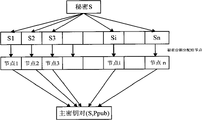
Fig. 1 be in a kind of wireless sensor network of the present invention based on master key s of system and master key in the distributed key management method of identity to (s, P Pub) the combination sketch map;
Fig. 2 is based on the flow chart of the distributed key management method of identity in a kind of wireless sensor network of the present invention;
Fig. 3 is the practical implementation schematic diagram of the distributed key management method based on identity of the present invention.
Embodiment
Below in conjunction with accompanying drawing embodiments of the invention are done further explain.
Referring to Fig. 1,2,3, based on the distributed key management method of identity, its concrete steps are following in a kind of wireless sensor network of the present invention:
(1), the parameter of system is carried out initialization
Setup parameter k, the master key s and the master key that draw node operational factor and system in the system are to (s, P Pub), its concrete steps are following:
(1-1), the operation of the node in the system, generations parameter is k, calculates elliptic curve E (Fp), wherein p is greater than 3 prime number or is 2 m, input parameter k generates big prime number q, the crowd that to set up two rank be q: addition cyclic group G 1With multiplication loop crowd G 2, make and calculate the problem that Diffie-Hellman (CDH) problem is a difficulty, set up a bilinearity to e:G 1* G 1→ G 2, select a generator P ∈ G arbitrarily 1
(1-2), node lift the generation system altogether master key s and master key to (s, P Pub)
Identify label is ID iNode i, select s at random iSecret share and coefficient a as master key s I, j(j ∈ 1,2 ..., k-1), to set up (n, k) thresholding polynomial f i(x):
f i=s i+a i,1x+a i,2x 2+...+a i,k-1x k-1?mod?P (1)
Node i is calculated V 0=s iP and V i=a I, jP (j ∈ 1,2 ..., k-1) send node j to,
Node j receives f i(j), V 0And V iAfter, checking If this formula is set up, then checking is passed through, and message is sent out by node i, otherwise concludes that message is not that node i is sent.
Node j receives n the thresholding multinomial that node sent in the automatic network, calculates f j(j), lift the master key s that draws network altogether:
f 1(j)+f 2(j)+...+f n(j)=s 1+a 1,1x+a 1,2x 2+....+a 1,k-1x k-1+s 2+a 2,1x+a 2,2x 2+....
+a 2,k-1x k-1+...+s n+a n,1x+a n,2x 2+....+a n,k-1x k-1
=(s 1+s 2+...+s n)+(a 1,1+a 2,1+...+a n,1)x+ (2)
(a 1,2+a 2,2+...+a n,2)x 2+...+(a 1,k-1+a 2,k-1+...+a n,k-1)x k-1
=s+a 1x+a 2x 2+...+a k-1x k-1?mod?P=f(x)
Calculate P Pub=sP, thus, the key that draws system is to (s, P Pub).
(2), the node in the system carries out two-way authentication
After system enumerates master key altogether; Node i application encryption key the time obtain to the node of grasping the system secret share, at first verify the validity of node i, promptly whether node i is the legal node of network; To prevent the adding of malicious node; Proof procedure is based on the BLS signature algorithm, and is as shown in Figure 2, and its concrete steps are following:
(2-1), the node i of encryption key request is selected at random
Figure GSB00000660226400041
As private key, and calculate Q i=r iP sends to node j as corresponding public key;
(2-2), after node j receives the request of node i, the identity of checking node i, node j is legal node, this node has encryption key to (SK j, PK j), select information m at random, send r=(m, PK j) to node i, the signature of wait node i;
(2-3), after node i receives that signature requires, select at random
Figure GSB00000660226400042
As private key, its corresponding PKI is u i=t iH 2(ID i).Compute signature σ=[H 2(ID i)+t i] -1P is the identity (u that signs i, σ) send node j to.
(2-4), after node j receives the signature of node i, carry out signature authentication.If e (P, P)=e (H 2(ID i) P+t iP, σ), then the signature of node j recipient node i is thought legal node to it; Otherwise refuse its signature;
(2-5), for replying the secret share that node j sends, requesting node i verifies node j signature equally, checks its legitimacy, realizes two-way authentication.
(3), the key useful life is set and realizes the communication set key updating
In the environment of wireless sensor network, the network topology dynamic change has node at any time and adds or withdraw from.This key managing project is based on that (in case there be k node victim to capture in the system, the safety of whole network just suffers crushing blow for n, threshold schemes k), so system is necessary regularly more new key.
System's lifetime is divided into several time periods by length t; Defined node i is when time period t begins, and the system secret share that has is following for
Figure GSB00000660226400044
its step of updating through the system secret share that has after upgrading for
Figure GSB00000660226400043
:
(3-1), system's lifetime is divided into several time periods by length t, in each time period, the node i of system is set up (n, k ') thresholding multinomial:
f i’(x)=b i,1x+b i,2x 2+....+b i,k’-1x k’-1 (3)
Node i is calculated f i' (j) (j=1,2 ..., k '-1) as the renewal amount of the key share of other nodes, and broadcasting b I, jP (j=1,2 ..., k '-1);
(3-2), node i according to above-mentioned steps 2 in the identical step of step (2-1) to (2-3), generate signature sigma, and key share renewal amount and signature (f i' (j), σ) encryption sends node corresponding to;
(3-3), the identity signature of node j checking node i,
If e (P, P)=e (H 2(ID j) P+t jP, σ), the signature of node j recipient node i then, otherwise refuse its signature.Node j calculates after obtaining the key share renewal from node i
Figure GSB00000660226400051
With f i' (j) whether P equal, confirms f i' (j) validity.
(3-4), after node j receives in the system key share renewal amount that n node send, calculate the new secret share of node j:
s j t = s j t , + Σ i = 1 n f i ( j ) - - - ( 4 )
The above-mentioned steps 3 described key useful life that are provided with realize that the communication set key updating also can realize cancelling of communication set key, and it is specific as follows:
At wireless sensor network; Sex-limited when user's ID has service time, through behind identify label or E-mail, adding temporal information, the identification id in the construction system; PKI as node; Demand and service time according to the user are updated periodically PKI, can reach the purpose of key revocation.
, as shown in Figure 3 in a kind of wireless sensor network of the present invention based on the distributed key management method practical implementation principle of identity.This method can be used subscriber identity information: addresses of items of mail, SSN etc. solve in the PKI system problem of public key management and PKI validation verification as user's PKI.When Alice to Bob during to mail that address bobb.com send to encrypt; Only need his address information " bobb.com " as PKI email encryption; After Bob receives privacy enhanced mail; Get in touch the acquisition private key with trusted third party, the trusted third party here be called the private key maker (Private Key Generator, PKG).Bob promptly can read PKI and the certificate that need not preserve a large number of users based on the PKG of KMC of identity as the CA center of present PKI system with this private key and corresponding decipherment algorithm deciphering mail; The user uses public-key when encrypting, and also no longer need pass through complicated certificate verification process.
Claims (1)

1.一种无线传感器网络中基于身份的分散密钥管理方法,其特征在于,该方法包括步骤如下:1. an identity-based decentralized key management method in a wireless sensor network, characterized in that the method comprises steps as follows: (1)、对系统的参数进行初始化,设定参数k,得出系统中的节点运行参数和系统的主密钥s及主密钥对(s,Ppub),其具体步骤如下:(1), initialize the parameters of the system, set the parameter k, and obtain the operating parameters of the nodes in the system, the master key s of the system and the master key pair (s, P pub ), the specific steps are as follows: (1-1)、系统中的节点运行,生成参数k,计算椭圆曲线E(Fp),其中p为大于3的素数或为2m,m为随机选择信息,输入参数k生成大素数q,建立两个阶为q的群;加法循环群G1和乘法循环群G2,使得计算Diffie-Hellman(CDH)问题是困难的问题,建立一个双线性对e:G1×G1→G2,任意选择一个生成元P∈G1(1-1) The nodes in the system run, generate parameter k, and calculate the elliptic curve E(Fp), where p is a prime number greater than 3 or 2 m , m is random selection information, and the input parameter k generates a large prime number q, Establish two groups with order q; the additive cyclic group G 1 and the multiplicative cyclic group G 2 , making it difficult to calculate the Diffie-Hellman (CDH) problem, and establish a bilinear pair e: G 1 ×G 1 →G 2. Randomly choose a generator P∈G 1 ; (1-2)、节点共举产生系统的主密钥s及主密钥对(s,Ppub)(1-2), the nodes jointly generate the master key s and the master key pair (s, P pub ) of the system 身份标识为IDi的节点i,随机选择si作为主密钥s的秘密份额和系数ai,j(j∈1,2,...,k-1),以建立(n,k)门限多项式fi(x):The node i whose identity is ID i randomly selects si as the secret share of the master key s and coefficients a i,j (j∈1,2,...,k-1) to establish (n,k) Threshold polynomial f i (x): fi=si+ai,1x+ai,2x2+...+ai,k-1xk-1mod P    (1)f i = s i +a i, 1 x+a i, 2 x 2 +...+a i, k-1 x k-1 mod P (1) 节点i计算V0=siP及Vi=ai,jP(j∈1,2,...,k-1)传送给节点j,节点j收到fi(j)、V0和Vi后,验证
Figure FSB00000700997300011
如果该公式成立则验证通过,消息为节点i所发,否则断定消息并非节点i发送,
Node i calculates V 0 =s i P and V i =a i,j P(j∈1,2,...,k-1) and sends it to node j, and node j receives f i (j), V 0 and V i after verifying
Figure FSB00000700997300011
If the formula is true, the verification is passed, and the message is sent by node i, otherwise it is concluded that the message was not sent by node i,
节点j收到来自网络中的n个节点所发送的门限多项式,计算fi(j),共举得出网络的主密钥s:Node j receives the threshold polynomial sent by n nodes in the network, calculates f i (j), and obtains the master key s of the network: f1(j)+f2(j)+...+fn(j)=s1+a1,1x+a1,2x2+....+a1,k-1xk-1+s2+a2,1x+a2,2x2+....f 1 (j)+f 2 (j)+...+f n (j)=s 1 +a 1,1 x+a 1,2 x 2 +...+a 1,k-1 x k-1 +s 2 +a 2, 1 x+a 2, 2 x 2 +....                      +a2,k-1xk-1+...+sn+an,1x+an,2x2+....+an,k-1xk-1 +a 2, k-1 x k-1 +...+s n +a n, 1 x+a n, 2 x 2 +....+a n, k-1 x k-1                      =(s1+s2+...+sn)+(a1,1+a2,1+...+an,1)x+         (2)=(s 1 +s 2 +...+s n )+(a 1,1 +a 2,1 +...+a n,1 )x+ (2)                      (a1,2+a2,2+...+an,2)x2+...+(a1,k-1+a2,k-1+...+an,k-1)xk-1 (a 1,2 +a 2,2 +...+a n,2 )x 2 +...+(a 1,k-1 +a 2,k-1 +...+a n,k -1 )x k-1                      =s+a1x+a2x2+...+ak-1xk-1 mod P=f(x)=s+a 1 x+a 2 x 2 +...+a k-1 xk -1 mod P=f(x) 计算Ppub=sP,由此,得出系统的密钥对(s,Ppub);Calculate P pub =sP, thus, obtain the key pair (s, P pub ) of the system; (2)、对系统中的节点进行双向认证,在系统得出主密钥后,节点i申请加密密钥是通过向掌握系统秘密份额的节点申请获取,首先验证节点i的有效性,其具体步骤如下:(2) Two-way authentication is performed on the nodes in the system. After the system obtains the master key, node i applies for the encryption key by applying for the node that holds the secret share of the system, and first verifies the validity of node i. Proceed as follows: (2-1)、请求加密密钥的节点i随机选择
Figure FSB00000700997300021
作为私钥,并计算Qi=riP作为相应的公钥发送给节点j;
(2-1), the node i requesting the encryption key is randomly selected
Figure FSB00000700997300021
As a private key, and calculate Q i = r i P as the corresponding public key and send it to node j;
(2-2)、节点j接收到节点i的请求后,验证节点i的身份,节点j是合法的节点,该节点拥有加密密钥对(SKj,PKj),m为随机选择信息,发送r=(m,PKj)给节点i,等待节点i的签名;(2-2) After node j receives the request from node i, it verifies the identity of node i, node j is a legal node, and the node has an encryption key pair (SK j , PK j ), m is randomly selected information, Send r=(m, PK j ) to node i, waiting for the signature of node i; (2-3)、节点i收到签名要求后,随机选择
Figure FSB00000700997300022
作为私钥,其对应的公钥为ui=tiH2(IDi),计算身份签名σ=[H2(IDi)+ti]-1P,把身份签名(ui,σ)传送给节点j;
(2-3) After node i receives the signature request, it randomly selects
Figure FSB00000700997300022
As a private key, its corresponding public key is u i =t i H 2 (ID i ), calculate the identity signature σ=[H 2 (ID i )+t i ] -1 P, and put the identity signature (u i ,σ ) to node j;
(2-4)、节点j收到节点i的签名后,进行签名认证,(2-4) After node j receives the signature from node i, it performs signature verification, 如果e(P,P)=e(H2(IDi)P+tiP,σ),则节点j接受节点i的签名,把它认为是合法节点;否则拒绝其签名;If e(P, P)=e(H 2 (ID i )P+t i P, σ), then node j accepts the signature of node i and regards it as a legal node; otherwise, rejects its signature; (2-5)、对于应答节点j发送的秘密份额,请求节点i同样验证节点j签名,检查其合法性,实现双向认证;(2-5), for the secret share sent by the responding node j, the requesting node i also verifies the signature of the node j, checks its legitimacy, and realizes two-way authentication; (3)、设置密钥使用期限来实现更换通信组密钥的更新,将系统生存期按长度t划分为若干个时间段,定义节点i在时间段t开始时,拥有的系统秘密份额为
Figure FSB00000700997300023
经过更新后拥有的系统秘密份额为
Figure FSB00000700997300024
其更新步骤如下:
(3) Set the key usage period to realize the update of the replacement communication group key, divide the system lifetime into several time periods according to the length t, and define the system secret share owned by node i at the beginning of time period t as
Figure FSB00000700997300023
The updated system secret share is
Figure FSB00000700997300024
The update steps are as follows:
(3-1)、将系统生存期按长度t划分为若干个时间段,在每一个时间段,节点i建立(n,k’)门限多项式:(3-1), the system lifetime is divided into several time periods according to the length t, and in each time period, node i establishes (n, k') threshold polynomial: f’i(x)=bi,1x+bi,2x2+....+bi,k’-1xk-1    (3)f' i (x)=bi , 1 x+bi , 2 x 2 +....+ bi, k'-1 x k ' -1 (3) 节点i计算fi’(j)(j=1,2,...,k’-1)作为其他节点的密钥份额的更新量,并广播bi,jP(j=1,2,...,k’-1);Node i calculates f i '(j)(j=1,2,...,k'-1) as the update amount of other nodes' key shares, and broadcasts b i,j P(j=1,2, ...,k'-1); (3-2)、节点i按照与上述步骤2中步骤(2-1)至(2-3)相同的步骤,生成签名σ,并把密钥份额更新量和签名(f’i(j),σ)加密传送给相应的节点;(3-2), node i follows the same steps as steps (2-1) to (2-3) in the above step 2 to generate a signature σ, and update the key share and the signature (f' i (j) , σ) encrypted and sent to the corresponding node; (3-3)、节点j验证节点i的身份签名,如果e(P,P)=e(H2(IDj)P+tjP,σ),则节点j接受节点i的签名,否则拒绝其签名,节点j得到来自节点i的密钥份额更新后,计算
Figure FSB00000700997300031
是否相等,确认f’i(j)的有效性;
(3-3) Node j verifies the identity signature of node i, if e(P, P)=e(H 2 (ID j )P+t j P,σ), then node j accepts the signature of node i, otherwise Reject its signature, after node j gets the key share update from node i, calculate
Figure FSB00000700997300031
Whether they are equal, confirm the validity of f' i (j);
(3-4)、节点j收到系统中n个节点发送的密钥份额更新量后,计算出节点j新的秘密份额:(3-4) After node j receives the key share update amount sent by n nodes in the system, it calculates the new secret share of node j: sthe s jj tt == sthe s jj tt ,, ++ ΣΣ ii == 11 nno ff ii (( jj )) -- -- -- (( 44 )) ..
CN2009102005418A 2009-12-22 2009-12-22 Method for managing dispersed keys based on identities in wireless sensor network Expired - Fee Related CN101711027B (en)

Priority Applications (1)

Application Number Priority Date Filing Date Title
CN2009102005418A CN101711027B (en) 2009-12-22 2009-12-22 Method for managing dispersed keys based on identities in wireless sensor network

Applications Claiming Priority (1)

Application Number Priority Date Filing Date Title
CN2009102005418A CN101711027B (en) 2009-12-22 2009-12-22 Method for managing dispersed keys based on identities in wireless sensor network

Publications (2)

Publication Number Publication Date
CN101711027A CN101711027A (en) 2010-05-19
CN101711027B true CN101711027B (en) 2012-07-04

Family

ID=42403782

Family Applications (1)

Application Number Title Priority Date Filing Date
CN2009102005418A Expired - Fee Related CN101711027B (en) 2009-12-22 2009-12-22 Method for managing dispersed keys based on identities in wireless sensor network

Country Status (1)

Country Link
CN (1) CN101711027B (en)

Families Citing this family (19)

* Cited by examiner, † Cited by third party
Publication number Priority date Publication date Assignee Title
CN102012984A (en) * 2010-11-19 2011-04-13 中兴通讯股份有限公司 Method for updating key of mobile terminal and mobile terminal
CN102547690B (en) * 2010-12-13 2014-10-22 中兴通讯股份有限公司 Wireless sensor network system, node equipment and secret key generating method thereof
CN102256248B (en) * 2011-07-05 2015-01-21 淮阴工学院 Scheme for managing Ad hoc group key
CN102624741A (en) * 2012-03-30 2012-08-01 奇智软件(北京)有限公司 A TLV-based data transmission method and system
CN103813316B (en) * 2012-11-07 2017-03-22 中国移动通信集团公司 Session key negotiation method and hierarchical wireless sensor network node authentication method
CN102970679B (en) * 2012-11-21 2015-12-09 越亮传奇科技股份有限公司 The secure signing method of identity-based
CN104980270B (en) * 2014-04-01 2018-10-23 东南大学 A kind of key management method of wireless sensor network of identity-based
CN104967517B (en) * 2015-07-24 2018-03-20 电子科技大学 A kind of network data convergence method for wireless senser
CN105871929A (en) * 2016-06-21 2016-08-17 重庆邮电大学 Wireless sensor network anonymity communication method
JP7065887B2 (en) * 2017-06-07 2022-05-12 エヌチェーン ホールディングス リミテッド Methods and systems for establishing reliable peer-to-peer communication between nodes in a blockchain network
CN107689867B (en) * 2017-09-08 2019-12-10 晋商博创(北京)科技有限公司 A key protection method and system in an open environment
CN109871668B (en) * 2019-03-08 2022-11-15 重庆邮电大学 Authentication, authorization and access control method based on time-limited attribute password in smart grid
CN111193590B (en) * 2019-12-31 2023-07-18 华测电子认证有限责任公司 A key authorization method for supporting dynamic changes of nodes in the consortium chain
CN112995784B (en) * 2021-05-19 2021-09-21 杭州海康威视数字技术股份有限公司 Video data slice encryption method, device and system
CN114257373B (en) * 2021-11-12 2024-07-09 中国南方电网有限责任公司 Hybrid encryption system key storage management method, system, computer equipment and medium
CN118473658A (en) * 2022-03-29 2024-08-09 蚂蚁区块链科技(上海)有限公司 Method, system and consensus node for realizing distributed key generation on block chain
CN114640451A (en) * 2022-03-29 2022-06-17 蚂蚁区块链科技(上海)有限公司 Method, system and consensus node for realizing distributed key generation on block chain
CN114499863B (en) * 2022-04-15 2022-08-23 深圳市永达电子信息股份有限公司 Multi-party authentication method based on time division and space division and computer readable storage medium
CN117040729B (en) * 2023-07-25 2025-08-19 上海樊讯电子科技有限公司 User private key issuing method based on blockchain

Citations (2)

* Cited by examiner, † Cited by third party
Publication number Priority date Publication date Assignee Title
CN101005459A (en) * 2007-01-18 2007-07-25 西安电子科技大学 Radio sensor access control method based on key chain
CN101247264A (en) * 2008-03-20 2008-08-20 中科院嘉兴中心微系统所分中心 Flexible and efficient performance management method suitable for wireless sensor network

Patent Citations (2)

* Cited by examiner, † Cited by third party
Publication number Priority date Publication date Assignee Title
CN101005459A (en) * 2007-01-18 2007-07-25 西安电子科技大学 Radio sensor access control method based on key chain
CN101247264A (en) * 2008-03-20 2008-08-20 中科院嘉兴中心微系统所分中心 Flexible and efficient performance management method suitable for wireless sensor network

Non-Patent Citations (2)

* Cited by examiner, † Cited by third party
Title
孔凡天.《无线传感器网络节点定位与数据融合技术研究及实现》.2006, *
郑朝霞.《无线传感器网络节点芯片关键技术的研究与实现》.2008, *

Also Published As

Publication number Publication date
CN101711027A (en) 2010-05-19

Similar Documents

Publication Publication Date Title
CN101711027B (en) Method for managing dispersed keys based on identities in wireless sensor network
Ali et al. Bilinear pairing-based hybrid signcryption for secure heterogeneous vehicular communications
CN108667616B (en) Identity-based cross-cloud security authentication system and method
Mahimkar et al. SecureDAV: A secure data aggregation and verification protocol for sensor networks
Pothumarti et al. A lightweight authentication scheme for 5G mobile communications: a dynamic key approach
Farooq et al. A survey of authentication techniques in vehicular ad-hoc networks
KR20090104421A (en) Elliptic Curve Password-Based Key Setting Method in Wireless Sensor Network and Wireless Sensor Network System and Recording Media
CN109462484B (en) An Identity-Based Security Mutual Authentication Method Combining the Advantages of Broadcasting
Xi et al. A trust management scheme based on behavior feedback for opportunistic networks
Riley et al. A survey of authentication schemes for vehicular ad hoc networks
Hamouid et al. LSTR: lightweight and secure tree-based routing for wireless sensor networks
Elkhalil et al. Practical heterogeneous signcryption system for vehicular communication in VANETs
Kim et al. A novel elliptical curve ID cryptography protocol for multi‐hop ZigBee sensor networks
Da Silva et al. Towards a fully self-organized identity-based key management system for MANETs
Cahyadi et al. An improved efficient authentication scheme for vehicular ad hoc networks with batch verification using bilinear pairings
Lara-Nino et al. Key-establishment protocols for constrained cyber-physical systems
Ruj et al. Improved access control mechanism in vehicular ad hoc networks
Sung et al. ID-based sensor node authentication for multi-layer sensor networks
Boubakri et al. ZAO-AKA: a zero knowledge proof chaotic authentication and key agreement scheme for securing smart city cyber physical system
Ambareen et al. LEES: a hybrid lightweight elliptic ElGamal-Schnorr-based cryptography for secure D2D communications
Mnif et al. An ID-based user authentication scheme for wireless sensor networks using ECC
Sarbini et al. A lightweight multifactor authentication scheme for wireless sensor networks in the Internet of Things
Zhang et al. Comparative analysis of VANET authentication architecture and scheme
Hoeper et al. Bootstrapping security in mobile ad hoc networks using identity-based schemes
KR101507572B1 (en) ID-Based Key Authentication Method for Security of Sensor Data Communications

Legal Events

Date Code Title Description
C06 Publication
PB01 Publication
C10 Entry into substantive examination
SE01 Entry into force of request for substantive examination
C14 Grant of patent or utility model
GR01 Patent grant
CF01 Termination of patent right due to non-payment of annual fee

Granted publication date: 20120704

Termination date: 20141222

EXPY Termination of patent right or utility model