CN101678079A - Modified erythropoietin polypeptides and uses thereof for treatment - Google Patents
Modified erythropoietin polypeptides and uses thereof for treatment Download PDFInfo
- Publication number
- CN101678079A CN101678079A CN200780050562A CN200780050562A CN101678079A CN 101678079 A CN101678079 A CN 101678079A CN 200780050562 A CN200780050562 A CN 200780050562A CN 200780050562 A CN200780050562 A CN 200780050562A CN 101678079 A CN101678079 A CN 101678079A
- Authority
- CN
- China
- Prior art keywords
- polypeptide
- modified
- epo
- amino acid
- epo polypeptide
- Prior art date
- Legal status (The legal status is an assumption and is not a legal conclusion. Google has not performed a legal analysis and makes no representation as to the accuracy of the status listed.)
- Granted
Links
Images

Classifications
-
- C—CHEMISTRY; METALLURGY
- C07—ORGANIC CHEMISTRY
- C07K—PEPTIDES
- C07K14/00—Peptides having more than 20 amino acids; Gastrins; Somatostatins; Melanotropins; Derivatives thereof
- C07K14/435—Peptides having more than 20 amino acids; Gastrins; Somatostatins; Melanotropins; Derivatives thereof from animals; from humans
- C07K14/475—Growth factors; Growth regulators
- C07K14/505—Erythropoietin [EPO]
-
- A—HUMAN NECESSITIES
- A61—MEDICAL OR VETERINARY SCIENCE; HYGIENE
- A61K—PREPARATIONS FOR MEDICAL, DENTAL OR TOILETRY PURPOSES
- A61K38/00—Medicinal preparations containing peptides
- A61K38/16—Peptides having more than 20 amino acids; Gastrins; Somatostatins; Melanotropins; Derivatives thereof
- A61K38/17—Peptides having more than 20 amino acids; Gastrins; Somatostatins; Melanotropins; Derivatives thereof from animals; from humans
- A61K38/19—Cytokines; Lymphokines; Interferons
-
- A—HUMAN NECESSITIES
- A61—MEDICAL OR VETERINARY SCIENCE; HYGIENE
- A61K—PREPARATIONS FOR MEDICAL, DENTAL OR TOILETRY PURPOSES
- A61K31/00—Medicinal preparations containing organic active ingredients
- A61K31/33—Heterocyclic compounds
- A61K31/555—Heterocyclic compounds containing heavy metals, e.g. hemin, hematin, melarsoprol
-
- A—HUMAN NECESSITIES
- A61—MEDICAL OR VETERINARY SCIENCE; HYGIENE
- A61K—PREPARATIONS FOR MEDICAL, DENTAL OR TOILETRY PURPOSES
- A61K33/00—Medicinal preparations containing inorganic active ingredients
- A61K33/24—Heavy metals; Compounds thereof
- A61K33/26—Iron; Compounds thereof
-
- A—HUMAN NECESSITIES
- A61—MEDICAL OR VETERINARY SCIENCE; HYGIENE
- A61K—PREPARATIONS FOR MEDICAL, DENTAL OR TOILETRY PURPOSES
- A61K38/00—Medicinal preparations containing peptides
- A61K38/16—Peptides having more than 20 amino acids; Gastrins; Somatostatins; Melanotropins; Derivatives thereof
- A61K38/17—Peptides having more than 20 amino acids; Gastrins; Somatostatins; Melanotropins; Derivatives thereof from animals; from humans
- A61K38/19—Cytokines; Lymphokines; Interferons
- A61K38/193—Colony stimulating factors [CSF]
-
- A—HUMAN NECESSITIES
- A61—MEDICAL OR VETERINARY SCIENCE; HYGIENE
- A61K—PREPARATIONS FOR MEDICAL, DENTAL OR TOILETRY PURPOSES
- A61K38/00—Medicinal preparations containing peptides
- A61K38/16—Peptides having more than 20 amino acids; Gastrins; Somatostatins; Melanotropins; Derivatives thereof
- A61K38/17—Peptides having more than 20 amino acids; Gastrins; Somatostatins; Melanotropins; Derivatives thereof from animals; from humans
- A61K38/19—Cytokines; Lymphokines; Interferons
- A61K38/20—Interleukins [IL]
-
- A—HUMAN NECESSITIES
- A61—MEDICAL OR VETERINARY SCIENCE; HYGIENE
- A61K—PREPARATIONS FOR MEDICAL, DENTAL OR TOILETRY PURPOSES
- A61K38/00—Medicinal preparations containing peptides
- A61K38/16—Peptides having more than 20 amino acids; Gastrins; Somatostatins; Melanotropins; Derivatives thereof
- A61K38/17—Peptides having more than 20 amino acids; Gastrins; Somatostatins; Melanotropins; Derivatives thereof from animals; from humans
- A61K38/19—Cytokines; Lymphokines; Interferons
- A61K38/21—Interferons [IFN]
-
- A—HUMAN NECESSITIES
- A61—MEDICAL OR VETERINARY SCIENCE; HYGIENE
- A61K—PREPARATIONS FOR MEDICAL, DENTAL OR TOILETRY PURPOSES
- A61K45/00—Medicinal preparations containing active ingredients not provided for in groups A61K31/00 - A61K41/00
- A61K45/06—Mixtures of active ingredients without chemical characterisation, e.g. antiphlogistics and cardiaca
-
- A—HUMAN NECESSITIES
- A61—MEDICAL OR VETERINARY SCIENCE; HYGIENE
- A61P—SPECIFIC THERAPEUTIC ACTIVITY OF CHEMICAL COMPOUNDS OR MEDICINAL PREPARATIONS
- A61P21/00—Drugs for disorders of the muscular or neuromuscular system
- A61P21/02—Muscle relaxants, e.g. for tetanus or cramps
-
- A—HUMAN NECESSITIES
- A61—MEDICAL OR VETERINARY SCIENCE; HYGIENE
- A61P—SPECIFIC THERAPEUTIC ACTIVITY OF CHEMICAL COMPOUNDS OR MEDICINAL PREPARATIONS
- A61P25/00—Drugs for disorders of the nervous system
-
- A—HUMAN NECESSITIES
- A61—MEDICAL OR VETERINARY SCIENCE; HYGIENE
- A61P—SPECIFIC THERAPEUTIC ACTIVITY OF CHEMICAL COMPOUNDS OR MEDICINAL PREPARATIONS
- A61P25/00—Drugs for disorders of the nervous system
- A61P25/06—Antimigraine agents
-
- A—HUMAN NECESSITIES
- A61—MEDICAL OR VETERINARY SCIENCE; HYGIENE
- A61P—SPECIFIC THERAPEUTIC ACTIVITY OF CHEMICAL COMPOUNDS OR MEDICINAL PREPARATIONS
- A61P25/00—Drugs for disorders of the nervous system
- A61P25/08—Antiepileptics; Anticonvulsants
-
- A—HUMAN NECESSITIES
- A61—MEDICAL OR VETERINARY SCIENCE; HYGIENE
- A61P—SPECIFIC THERAPEUTIC ACTIVITY OF CHEMICAL COMPOUNDS OR MEDICINAL PREPARATIONS
- A61P25/00—Drugs for disorders of the nervous system
- A61P25/14—Drugs for disorders of the nervous system for treating abnormal movements, e.g. chorea, dyskinesia
- A61P25/16—Anti-Parkinson drugs
-
- A—HUMAN NECESSITIES
- A61—MEDICAL OR VETERINARY SCIENCE; HYGIENE
- A61P—SPECIFIC THERAPEUTIC ACTIVITY OF CHEMICAL COMPOUNDS OR MEDICINAL PREPARATIONS
- A61P25/00—Drugs for disorders of the nervous system
- A61P25/18—Antipsychotics, i.e. neuroleptics; Drugs for mania or schizophrenia
-
- A—HUMAN NECESSITIES
- A61—MEDICAL OR VETERINARY SCIENCE; HYGIENE
- A61P—SPECIFIC THERAPEUTIC ACTIVITY OF CHEMICAL COMPOUNDS OR MEDICINAL PREPARATIONS
- A61P25/00—Drugs for disorders of the nervous system
- A61P25/22—Anxiolytics
-
- A—HUMAN NECESSITIES
- A61—MEDICAL OR VETERINARY SCIENCE; HYGIENE
- A61P—SPECIFIC THERAPEUTIC ACTIVITY OF CHEMICAL COMPOUNDS OR MEDICINAL PREPARATIONS
- A61P25/00—Drugs for disorders of the nervous system
- A61P25/28—Drugs for disorders of the nervous system for treating neurodegenerative disorders of the central nervous system, e.g. nootropic agents, cognition enhancers, drugs for treating Alzheimer's disease or other forms of dementia
-
- A—HUMAN NECESSITIES
- A61—MEDICAL OR VETERINARY SCIENCE; HYGIENE
- A61P—SPECIFIC THERAPEUTIC ACTIVITY OF CHEMICAL COMPOUNDS OR MEDICINAL PREPARATIONS
- A61P25/00—Drugs for disorders of the nervous system
- A61P25/30—Drugs for disorders of the nervous system for treating abuse or dependence
- A61P25/32—Alcohol-abuse
-
- A—HUMAN NECESSITIES
- A61—MEDICAL OR VETERINARY SCIENCE; HYGIENE
- A61P—SPECIFIC THERAPEUTIC ACTIVITY OF CHEMICAL COMPOUNDS OR MEDICINAL PREPARATIONS
- A61P27/00—Drugs for disorders of the senses
- A61P27/02—Ophthalmic agents
-
- A—HUMAN NECESSITIES
- A61—MEDICAL OR VETERINARY SCIENCE; HYGIENE
- A61P—SPECIFIC THERAPEUTIC ACTIVITY OF CHEMICAL COMPOUNDS OR MEDICINAL PREPARATIONS
- A61P29/00—Non-central analgesic, antipyretic or antiinflammatory agents, e.g. antirheumatic agents; Non-steroidal antiinflammatory drugs [NSAID]
-
- A—HUMAN NECESSITIES
- A61—MEDICAL OR VETERINARY SCIENCE; HYGIENE
- A61P—SPECIFIC THERAPEUTIC ACTIVITY OF CHEMICAL COMPOUNDS OR MEDICINAL PREPARATIONS
- A61P7/00—Drugs for disorders of the blood or the extracellular fluid
- A61P7/06—Antianaemics
-
- A—HUMAN NECESSITIES
- A61—MEDICAL OR VETERINARY SCIENCE; HYGIENE
- A61P—SPECIFIC THERAPEUTIC ACTIVITY OF CHEMICAL COMPOUNDS OR MEDICINAL PREPARATIONS
- A61P9/00—Drugs for disorders of the cardiovascular system
- A61P9/02—Non-specific cardiovascular stimulants, e.g. drugs for syncope, antihypotensives
-
- A—HUMAN NECESSITIES
- A61—MEDICAL OR VETERINARY SCIENCE; HYGIENE
- A61P—SPECIFIC THERAPEUTIC ACTIVITY OF CHEMICAL COMPOUNDS OR MEDICINAL PREPARATIONS
- A61P9/00—Drugs for disorders of the cardiovascular system
- A61P9/10—Drugs for disorders of the cardiovascular system for treating ischaemic or atherosclerotic diseases, e.g. antianginal drugs, coronary vasodilators, drugs for myocardial infarction, retinopathy, cerebrovascula insufficiency, renal arteriosclerosis
-
- A—HUMAN NECESSITIES
- A61—MEDICAL OR VETERINARY SCIENCE; HYGIENE
- A61K—PREPARATIONS FOR MEDICAL, DENTAL OR TOILETRY PURPOSES
- A61K38/00—Medicinal preparations containing peptides
-
- Y—GENERAL TAGGING OF NEW TECHNOLOGICAL DEVELOPMENTS; GENERAL TAGGING OF CROSS-SECTIONAL TECHNOLOGIES SPANNING OVER SEVERAL SECTIONS OF THE IPC; TECHNICAL SUBJECTS COVERED BY FORMER USPC CROSS-REFERENCE ART COLLECTIONS [XRACs] AND DIGESTS
- Y02—TECHNOLOGIES OR APPLICATIONS FOR MITIGATION OR ADAPTATION AGAINST CLIMATE CHANGE
- Y02A—TECHNOLOGIES FOR ADAPTATION TO CLIMATE CHANGE
- Y02A50/00—TECHNOLOGIES FOR ADAPTATION TO CLIMATE CHANGE in human health protection, e.g. against extreme weather
- Y02A50/30—Against vector-borne diseases, e.g. mosquito-borne, fly-borne, tick-borne or waterborne diseases whose impact is exacerbated by climate change
Landscapes
- Health & Medical Sciences (AREA)
- Life Sciences & Earth Sciences (AREA)
- Chemical & Material Sciences (AREA)
- General Health & Medical Sciences (AREA)
- Medicinal Chemistry (AREA)
- Pharmacology & Pharmacy (AREA)
- Animal Behavior & Ethology (AREA)
- Public Health (AREA)
- Veterinary Medicine (AREA)
- Bioinformatics & Cheminformatics (AREA)
- Engineering & Computer Science (AREA)
- Organic Chemistry (AREA)
- Chemical Kinetics & Catalysis (AREA)
- Nuclear Medicine, Radiotherapy & Molecular Imaging (AREA)
- General Chemical & Material Sciences (AREA)
- Neurology (AREA)
- Epidemiology (AREA)
- Neurosurgery (AREA)
- Biomedical Technology (AREA)
- Zoology (AREA)
- Proteomics, Peptides & Aminoacids (AREA)
- Gastroenterology & Hepatology (AREA)
- Immunology (AREA)
- Pain & Pain Management (AREA)
- Psychiatry (AREA)
- Cardiology (AREA)
- Heart & Thoracic Surgery (AREA)
- Toxicology (AREA)
- Molecular Biology (AREA)
- Genetics & Genomics (AREA)
- Biophysics (AREA)
- Biochemistry (AREA)
- Addiction (AREA)
- Inorganic Chemistry (AREA)
- Urology & Nephrology (AREA)
- Vascular Medicine (AREA)
- Orthopedic Medicine & Surgery (AREA)
- Hospice & Palliative Care (AREA)
- Rheumatology (AREA)
- Psychology (AREA)
Abstract
Modified erythropoietin (EPO) polypeptides and other modified therapeutic polypeptides are provided. The EPO polylpeptides and other modified therapeutic polypeptides are modified to exhibit physicalproperties and activities that differ from the corresponding unmodified EPO polypeptides and other unmodified therapeutic polypeptides, respectively. Nucleic acid molecules encoding these polypeptidesalso are provided. Also provided are methods of treatment and diagnosis using the polypeptides.
Description
Related application
Require to submit on November 28th, 2006 be entitled as " MODIFIED ERYTHROPOIETINPOLYPEPTIDES AND USES THEREOF; " U.S. Provisional Application 60/861,615 priority, the application people of this provisional application is Thierry Guyon, Giles Borrelly, Xavier Gallet, Lila Drittanti and Manuel Vega.
The application relates to corresponding U. S. application, internal number 17109-021001/931, be entitled as " MODIFIED ERYTHROPOIETIN POLYPEPTIDES AND USESTHEREOF ", the application people is Thierry Guyon, Giles Borrelly, Xavier Gallet, LilaDrittanti and Manuel Vega.The application relates to the U. S. application 11/176 that is entitled as " RATIONAL EVOLUTION OF CYTOKINES FOR HIGHER STABILITY; THE CYTOKINES AND ENCODING NUCLEIC ACID MOLECULES " of submission on July 6th, 2005,830, applicant Rene Gantier, Thierry Guyon, Manuel Vega and LilaDrittanti, it is disclosed as U. S. application US 2006-0020116, it is the U. S. application 10/658 that is entitled as " RATIONAL EVOLUTION OF CYTOKINES FOR HIGHERSTABILITY; THE CYTOKINES AND ENCODING NUCLEIC ACIDMOLECULES " of JIUYUE in 2003 submission on the 8th, 834 continuation application, applicant Rene Gantier, Thierry Guyon, Manuel Vega and Lila Drittanti are disclosed as U. S. application US-2004-0132977-A1.The application also relates on August 2nd, 2005 and submits to is entitled as " RATIONALDIRECTED PROTEIN EVOLUTION USING TWO-DIMENSIONALRATIONAL MUTAGENESIS SCANNING " U. S. application 11/196,067, applicant Rene Gantier, Thierry Guyon, Hugo Cruz Ramos, Manuel Vega and LilaDrittanti, be disclosed as U. S. application US-2006-0020396-A1, it is the U. S. application 10/658 of JIUYUE in 2003 submission on the 8th, 355 continuation application, applicant Rene Gantier, Thierry Guyon, Hugo Cruz Ramos, Manuel Vega and Lila Drittanti, be entitled as " RATIONALDIRECTED PROTEIN EVOLUTION USING TWO-DIMENSIONALRATIONAL MUTAGENESIS SCANNING ", be disclosed as US 2005-0202438.
The application also relates to the U. S. application 10/658 of JIUYUE in 2003 submission on the 8th, 834, and disclosed international pct application WO 2004/022593, applicant Rene Gantier, Thierry Guyon, Manuel Vega and Lila Drittanti are entitled as " RATIONAL EVOLUTION OFCYTOKINES FOR HIGHER STABILITY, THE CYTOKINES ANDENCODING NUCLEIC ACID MOLECULES ".The application also relates to the U. S. application 10/658 of JIUYUE in 2003 submission on the 8th, 355, and international pct application WO 2004/022747, applicant Rene Gantier, Thierry Guyon, Hugo Cruz Ramos, Manuel Vega and LilaDrittanti are entitled as " RATIONAL DIRECTED PROTEIN EVOLUTION USINGTWO-DIMENSIONAL RATIONAL MUTAGENESIS SCANNING. ".
Under situation about allowing, in the theme of each of above-mentioned application all is included in full as a reference.
Invention field
The invention provides erythropoietin (EPO) polypeptide of modification and the therapeutical peptide of other modifications.The therapeutical peptide of described EPO polypeptide and other modifications is modified to show different physical property and the activity of therapeutical peptide with corresponding unmodified EPO polypeptide and other unmodifieds respectively.The nucleic acid molecules of these polypeptide of encoding also the invention provides.The method of utilizing described polypeptide to treat and diagnose also is provided.
Background of invention
Effectively sending of the human cytokines of clinical use is challenge to pharmaceutical science.In case in blood flow, these albumen are removed from circulation by different physiological process usually at short notice, the cleaning that comprises metabolism and utilize normal protein removing approach to carry out is such as the protein cleavage in kidney filtration (for example glomerule) or the blood.In case arrive the digestive tract intracavity, these albumen are usually by the intracavity protease digestion.The latter influences the albumen restricted process of half life, and described albumen is as therapeutic agent, is used for oral administration or subcutaneous, intravenous or intramuscular injection.The problem relevant with these route of administration is known and attempted to utilize multiple strategy to solve these problems.In addition, many human cytokines are glycosylated, and preparation glycosylation human cytokines is very expensive, alterable height and be difficult to carry out.The preparation of these proteic non-glycosylated forms can not realize owing to protein degradation usually.
Cytokine family is administration and the clinical position of biological assimilation and the focus of research of improving protein family, comprising erythropoietin (EPO).The EPO polypeptide of reorganization preparation is used for the treatment of various anemias by approval, the anemia that causes such as renal failure, chronic infection, cancer and AIDS etc.; But, still be starved of more stable erythropoietin and be used for the treatment of.The blood plasma half life of erythropoietin relatively short (Spivak, J.L. and Hogans, B.B., Blood 73 (1): 90-99 (1989); McMahon, F.G., et al., Blood 76 (9): 1718-1722 (1990)), therefore, the therapeutic plasma level can reduce rapidly, must repeat intravenous administration.Because naturally occurring variant has adverse side effect and administration, bioavailability and the problem of short half life, the character that need improve EPO is to be used as biopharmaceuticals.Therefore, in purpose of the present invention, a purpose provides EPO polypeptide and other therapeutical peptide of modification, and it has the therapeutic properties of improvement.
Summary of the invention
The invention provides the pharmaceutical composition of the therapeutical peptide of erythropoietin (EPO) polypeptide of modification and other modification, it is compared with the therapeutical peptide of corresponding unmodified and shows the protein stability that increases.The EPO polypeptide of modification provided by the invention and the therapeutical peptide of other modification are compared with the therapeutical peptide of corresponding unmodified and are shown the protease resistant that increases.The EPO polypeptide of the modification of the protein stability that demonstration provided by the invention increases and other therapeutical peptide are compared with the therapeutical peptide of corresponding unmodified and are shown in the body that increases and external albumen half life.For example, the EPO polypeptide of modification of the present invention and other therapeutical peptide show the stability that increases in blood flow after oral administration or injection, and/or show the stability that increases under condition of storage.The resistance that the protein stability of the EPO polypeptide of modification of the present invention or the increase of other treatment polypeptide can show as the protease digestion effect increases.The stability of described increase comprises the stability of assessing by to blood, intestinal or other any resistance towards proteases.
The present invention also provides the pharmaceutical composition of the therapeutical peptide of nonglycosylated modification.The therapeutical peptide of described nonglycosylated modification is compared demonstration with the therapeutical peptide of unmodified to be increased resistance towards proteases.The therapeutical peptide of the modification of the non-glycosylated and protease resistant that show to increase is nonglycosylated and shows erythropoietin (EPO) polypeptide of the modification of the protease resistant that increases.The example of other treatment polypeptide includes but not limited to, il-1 β (IL-1), interleukin-2 (IL-2), interleukin-3 (IL-3), interleukin-4 (IL-4), interleukin-5 (IL-5), interleukin-6 (IL-6) interleukin-9 (IL-9), interferon-beta (IFN-β), interferon-gamma (IFN-γ), granular cell-colony stimulating factor (G-CSF), granular cell macrophage-colony stimulating factor (GM-CSF), macrophage-colony stimulating factor (M-CSF), thrombopoietin (TPO), leukaemia inhibitory factor (LIF), stem cell factor (SCF), oncostatin M (OSM) and VEGF (VEGF).
The therapeutical peptide of described modification can be the EPO polypeptide of comparing the modification that shows the protein stability that increases with the EPO polypeptide of unmodified.The EPO polypeptide that the present invention modifies is the mutant that shows the EPO that improves protein stability.The EPO polypeptide of modification of the present invention can be glycosylated or deglycosylated.In some examples, the EPO polypeptide of the modification of the protein stability that described demonstration increases is deglycosylated.
The invention provides the pharmaceutical composition of the therapeutical peptide of modification, wherein the therapeutical peptide of (i) described modification is compared with the therapeutical peptide of unmodified and is contained one or more aminoacid replacement, and (ii) the therapeutical peptide of described modification is compared with the therapeutical peptide of unmodified owing to one or more aminoacid replacement, insertion and/or disappearance show increases proteoclastic resistance; (iii) the therapeutical peptide of described unmodified contains at least one glycosylation site, and glycosylation is that the therapeutic activity of therapeutical peptide of unmodified is required; (iv) the therapeutical peptide of described modification is not glycosylated and shows therapeutic activity.The pharmaceutical composition of the therapeutical peptide of modifying also is provided, wherein the therapeutical peptide of (i) described modification is compared with the therapeutical peptide of unmodified and is contained one or more aminoacid replacement, and (ii) the therapeutical peptide of described modification is compared with the therapeutical peptide of unmodified owing to one or more aminoacid replacement, insertion and/or disappearance show increases proteoclastic resistance; (iii) the therapeutical peptide of described unmodified contains at least one glycosylation site; And (iv) the therapeutical peptide of described modification is nonglycosylated and is not interferon-' alpha '.The therapeutical peptide of described modification also can comprise the modification that one or more eliminates all glycosylation sites.In some examples, the therapeutical peptide of described modification also can comprise the modification that imports the non-natural glycosylation site.In some examples, described polypeptide produces in such as colibacillary prokaryotic hosts, and described thus polypeptide is nonglycosylated.In some examples, the therapeutical peptide of described modification is a cytokine.The therapeutical peptide of modifying includes but not limited to, erythropoietin (EPO), il-1 β (IL-1), interleukin-2 (IL-2), interleukin-3 (IL-3), interleukin-4 (IL-4), interleukin-5 (IL-5), interleukin-6 (IL-6) interleukin-9 (IL-9), interferon-beta (IFN-β), interferon-gamma (IFN-γ), granular cell-colony stimulating factor (G-CSF), granular cell macrophage-colony stimulating factor (GM-CSF), macrophage-colony stimulating factor (M-CSF), thrombopoietin (TPO), leukaemia inhibitory factor (LIF), stem cell factor (SCF), oncostatin M (OSM) and VEGF (VEGF).The therapeutical peptide of described modification can be the precursor of ripe therapeutical peptide.Usually, the therapeutical peptide of described modification remains on one or more activity of the therapeutical peptide of the unmodified that produces under the condition identical with the therapeutical peptide of described modification.The therapeutical peptide of described modification can keep one or more activity of the therapeutical peptide of complete glycosylated unmodified.One or more activity of the therapeutical peptide of described modification is compared with the therapeutical peptide of unmodified to be increased or reduces.In some examples, the therapeutical peptide of described modification comprises the active part or the fragment of described therapeutical peptide, and wherein said active part or fragment keep one or more of therapeutical peptide of described unmodified active and compare with the therapeutical peptide of described unmodified and to comprise one or more aminoacid replacement.The therapeutical peptide of modification of the present invention comprises with the therapeutical peptide of unmodified to be compared 1,2, and 3,4,5,6,7,8,9,10,11,12,13,14,15,16,17,18,19,20 or more a plurality of positions modified polypeptides.The therapeutical peptide of described modification of the present invention is compared its protein stability to be increased with the therapeutical peptide of described unmodified.In the certain situation, the therapeutical peptide of described modification shows that the proteolysed resistance to serum, blood, saliva, Digestive system or external one or more protease increases.For example, described protease can be pepsin, trypsin, Chymotrypsin, elastoser, aminopeptidase, gelatinase B, gelatin enzyme A, Chymetin, carboxypeptidase, endoproteinase Arg-C, endoproteinase Asp-N, endoproteinase Glu-C, endoproteinase Lys-C, the inner chamber pepsin, microvillus endopeptidase, dipeptidyl peptidase peptidase, erepsin, hydrolytic enzyme, NS3, factor Xa, Cytotoxic cell proteinase-1, thrombin, fibrinolysin, urokinase, tPA and PSA.When with modified polypeptides through intravenous, oral, per nasal, when lung administration or its are present in the digestive tract, it shows increases proteoclastic resistance.The therapeutical peptide of described modification with compare demonstration with the polypeptide of unmodified the Proteolytic enzyme resistance of one or more protease increased.In some examples, the therapeutical peptide of described modification is further modified, and described modification is a carboxylation, hydroxylating; hasylation, carbamylation, sulphation; phosphorylation, albuminization (albumination), oxidation or with the coupling of Polyethylene Glycol (PEG) part in one or more.The therapeutical peptide of described modification can contain also that one or more is other amino acid modified, and it causes the immunogenicity of the therapeutical peptide of described modification, carboxylation, hydroxylating; hasylation, carbamylation, sulphation; phosphorylation, oxidation, PEGization or protease resistant change.
In some examples, the therapeutical peptide of described modification is erythropoietin (EPO) polypeptide.The mature form EPO of the therapeutical peptide of unmodified has aminoacid sequence SEQ ID NO:2 or 237 or its allele variant or plant variant (species variant).In some examples, except that amino acid modified, described allele variant or kind variant and polypeptide SEQ ID NO:2 or 237 have 40%, 50%, 60%, 70%, 80%, 90%, 91%, 92%, 93%, 94%, 95%, 96%, 97%, 98%, or 99% sequence homogeny.The therapeutical peptide EPO polypeptide of described modification can contain one or more aminoacid replacement, and described one or more aminoacid replacement correspondence is selected from any following residue in the one-tenth acquaintance EPO polypeptide with SEQ ID NO:2 or 237 or its allele variant or plants corresponding residue in the variant: P2S, P2A, P3S, P3A, R4H, R4Q, L5I, L5V, C7S, C7V, C7A, C7I, C7T, D8Q, D8H, D8N, R10H, R10Q, L12V, L12I, E13Q, E13H, E13N, R14H, R14Q, Y15H, Y15I, L16I, L16V, L17I, L17V, E18Q, E18H, E18N, E21Q, E21H, E21N, E23Q, E23H, E23N, C29S, C29V, C29A, C29I, C29T, E31Q, E31H, E31N, L35V, L35I, E37Q, E37H, E37N, K20Q, K20T, K20N, P42S, P42A, D43Q, D43H, D43N, K45Q, K45T, K45N, F48I, F48V, Y49H, Y49I, W51S, W51H, K52Q, K52T, K52N, R53H, R53Q, M54V, M54I, E55Q, E55H, E55N, E62Q, E62H, E62N, W64S, W64H, L67I, L67V, L69V, L69I, L70I, L70V, E72Q, E72H, E72N, L75V, L75I, R76H, R76Q, L80V, L80I, L81I, L81V, P87S, P87A, W88S, W88H, E89Q, E89H, E89N, P90S, P90A, L91I, L91V, L93V, L93I, D96Q, D96H, D96N, K97Q, K97T, K97N, L102V, L102I, R103H, R103Q, L105I, L105V, L108I, L108V, L109I, L109V, R110H, R110Q, L112V, L112I, K116Q, K116T, K116N, E117Q, E117H, E117N, P121S, P121A, P122S, P122A, D123Q, D123H, D123N, P129S, P129A, L130V, L130I, R131H, R131Q, D136Q, D136H, D136N, F138I, F138V, R139H, R139Q, K140N, K140Q, L141I, L141V, F142I, F142V, R143H, R143Q, Y145H, Y145I, F148I, F148V, L149I, L149V, R150H, R150Q, K152Q, K152T, K152N, L153I, L153V, K154Q, K154T, K154N, L155V, L155I, Y156H, Y156I, E159Q, E159H, E159N, R162H, R162Q, D165Q, D165H, D165N, R166H and R166Q.
The therapeutical peptide EPO polypeptide of described modification can contain amino acid modified at one or more glycosylation site, such as N-glycosylation site N24, N38 and N83.For example, described polypeptide can contain and is selected from N24H, the aminoacid replacement of N38H and N83H.The therapeutical peptide of described modification can contain with therapeutical peptide the same terms of described modification under one or more activity of therapeutical peptide of the unmodified that produces.In some examples, the therapeutical peptide of described modification keeps one or more activity of the therapeutical peptide of complete glycosylated unmodified.
The invention still further relates to the EPO polypeptide of modification, it is amino acid modified that it contains one or more of corresponding following amino acid position: 2,3,4,5,7,8,10,12,13,14,15,16,17,18,20,21,23,29,31,35,37,42,43,45,48,49,51,52,53,54,55,62,64,67,69,70,72,75,76,80,81,87,88,89,90,91,93,96,97,102,103,105,108,109,110,112,116,117,121,122,123,129,130,131,136,138,139,140,141,142,143,145,148,149,150,152,153,154,155,156,159,162,165 and 166, wherein the amino acid position correspondence of Xiu Shiing has the one-tenth acquaintance EPO polypeptide of sequence SEQ ID NO:2 or 237 or becomes the allele variant of acquaintance EPO polypeptide or the relevant position in the kind variant, wherein becoming the allele variant of acquaintance EPO polypeptide or planting variant is such EPO polypeptide, and it has at least 65%, 75%, 85% with becoming acquaintance EPO polypeptide, 90%, 91%, 92%, 93%, 94%, 95%, 96%, 97%, 98%, 99% or higher sequence homogeny, or the fragment of described EPO polypeptide, it comprises, and described one or more is amino acid modified and keep at least a activity of total length EPO or show EPO activity.For example, any one aminoacid replacement comprises any following replacement in one or more amino acid position: P2, P3, R4, L5, C7, D8, R10, L12, E13, R14, Y15, L16, L17, E18, K20, E21, E23, C29, E31, L35, E37, P42, D43, K45, F48, Y49, W51, K52, R53, M54, E55, E62, W64, L67, L69, L70, E72, L75, R76, L80, L81, P87, W88, E89, P90, L91, L93, D96, K97, L102, R103, L105, L108, L109, R110, L112, K116, E117, P121, P122, D123, P129, L130, R131, D136, F138, R139, K140, L141, F142, R143, Y145, F148, L149, R150, K152, L153, K154, L155, Y156, E159, R162, D165, and R166.
The invention still further relates to the EPO polypeptide that contains one or more amino acid modified modification, corresponding any EPO polypeptide: P2S, P2A, P3S with following corresponding modification, P3A, R4H, R4Q, L5I, L5V, C7S, C7V, C7A, C7I, C7T, D8Q, D8H, D8N, R10H, R10Q, L12V, L12I, E13Q, E13H, E13N, R14H, R14Q, Y15H, Y15I, L16I, L16V, L17I, L17V, E18Q, E18H, E18N, K20Q, K20T, K20N, E21Q, E21H, E21N, E23Q, E23H, E23N, C29S, C29V, C29A, C29I, C29T, E31Q, E31H, E31N, L35V, L35I, E37Q, E37H, E37N, P42S, P42A, D43Q, D43H, D43N, K45Q, K45T, K45N, F48I, F48V, Y49H, Y49I, W51S, W51H, K52Q, K52T, K52N, R53H, R53Q, M54V, M54I, E55Q, E55H, E55N, E62Q, E62H, E62N, W64S, W64H, L67I, L67V, L69V, L69I, L70I, L70V, E72Q, E72H, E72N, L75V, L75I, R76H, R76Q, L80V, L80I, L81I, L81V, P87S, P87A, W88S, W88H, E89Q, E89H, E89N, P90S, P90A, L91I, L91V, L93V, L93I, D96Q, D96H, D96N, K97Q, K97T, K97N, L102V, L102I, R103H, R103Q, L105I, L105V, L108I, L108V, L109I, L109V, R110H, R110Q, L112V, L112I, K116Q, K116T, K116N, E117Q, E117H, E117N, P121S, P121A, P122S, P122A, D123Q, D123H, D123N, P129S, P129A, L130V, L130I, R131H, R131Q, D136Q, D136H, D136N, F138I, F138V, R139H, R139Q, K140N, K140Q, L141I, L141V, F142I, F142V, R143H, R143Q, Y145H, Y145I, F148I, F148V, L149I, L149V, R150H, R150Q, K152Q, K152T, K152N, L153I, L153V, K154Q, K154T, K154N, L155V, L155I, Y156H, Y156I, E159Q, E159H, E159N, R162H, R162Q, D165Q, D165H, D165N, R166H, and R166Q, wherein the amino acid position correspondence of Xiu Shiing has the one-tenth acquaintance EPO polypeptide of sequence SEQ ID NO:2 or 237 or becomes the allele variant of acquaintance EPO polypeptide or the relevant position in the kind variant, and wherein becoming the allele variant of acquaintance EPO polypeptide or planting variant is such EPO polypeptide, it has at least 65%, 75%, 85% with becoming acquaintance EPO polypeptide, 90%, 91%, 92%, 93%, 94%, 95%, 96%, 97%, 98%, 99% or higher sequence homogeny, or the fragment of described EPO polypeptide, it comprises, and described one or more is amino acid modified and keep at least a activity of total length EPO or show EPO activity.In concrete example, the modification in the EPO polypeptide is selected from: P2S, P2A, P3S, P3A, R4H, R4Q, L5I, L5V, C7V, C7I, C7T, D8Q, D8H, D8N, R10H, R10Q, L12V, L12I, E13H, E13N, R14H, Y15H, L16I, L16V, L17I, L17V, E18Q, E18H, E18N, K20Q, K20T, K20N, E21Q, E21H, E21N, E23Q, E23H, E23N, C29I, C29T, E31Q, E31H, E31N, L35V, L35I, E37Q, E37H, E37N, P42S, D43H, K45T, W51H, K52T, E62Q, E62H, E62N, W64S, W64H, L67I, L67V, L69V, L69I, L70I, L70V, L80V, L80I, L81I, L81V, P87A, W88S, W88H, E89Q, E89H, E89N, P90S, L91I, L91V, L93V, L93I, D96Q, D96H, D96N, K97Q, K97T, K97N, L102V, L102I, L105I, L105V, L108I, L108V, L109I, L109V, R110H, R110Q, L112V, L112I, K116Q, K116T, K116N, E117Q, E117H, E117N, D123H, D136Q, D136H, D136N, R139H, R139Q, K140N, K140Q, L141I, L141V, R143H, R143Q, Y145H, F148I, L149I, L149V, R150H, K152Q, K152T, K152N, L153I, L153V, K154Q, K154N, L155V, L155I, Y156H, E159Q, E159H, E159N, D165H, R166H, and R166Q.
The invention still further relates to the EPO polypeptide that comprises two or more amino acid modified modifications, wherein said modification of modifying corresponding any two or more positions, described amino acid position correspondence has the one-tenth acquaintance EPO polypeptide of sequence SEQ ID NO:2 or 237 or becomes the allele variant of acquaintance EPO polypeptide or the relevant position in the kind variant, wherein becoming the allele variant of acquaintance EPO polypeptide or planting variant is such EPO polypeptide, it has at least 65% with becoming acquaintance EPO polypeptide, 75%, 85%, 90%, 91%, 92%, 93%, 94%, 95%, 96%, 97%, 98%, 99% or higher sequence homogeny, or the fragment of described EPO polypeptide, it comprises described one or more at least a activity or demonstration EPO activity amino acid modified and maintenance total length EPO.For example, can comprise any replacement in the following replacement at the aminoacid replacement of any two or more amino acid positions: P2S, P2A, P3S, P3A, R4H, R4Q, L5I, L5V, C7S, C7V, C7A, C7I, C7T, D8Q, D8H, D8N, R10H, R10Q, L12V, L12I, E13Q, E13H, E13N, R14H, R14Q, Y15H, Y15I, L16I, L16V, L17I, L17V, E18Q, E18H, E18N, K20Q, K20T, K20N, E21Q, E21H, E21N, E23Q, E23H, E23N, C29S, C29V, C29A, C29I, C29T, E31Q, E31H, E31N, L35V, L35I, E37Q, E37H, E37N, P42S, P42A, D43Q, D43H, D43N, K45Q, K45T, K45N, F48I, F48V, Y49H, Y49I, W51S, W51H, K52Q, K52T, K52N, R53H, R53Q, M54V, M54I, E55Q, E55H, E55N, E62Q, E62H, E62N, W64S, W64H, L67I, L67V, L69V, L69I, L70I, L70V, E72Q, E72H, E72N, L75V, L75I, R76H, R76Q, L80V, L80I, L81I, L81V, P87S, P87A, W88S, W88H, E89Q, E89H, E89N, P90S, P90A, L91I, L91V, L93V, L93I, D96Q, D96H, D96N, K97Q, K97T, K97N, L102V, L102I, R103H, R103Q, L105I, L105V, L108I, L108V, L109I, L109V, R110H, R110Q, L112V, L112I, K116Q, K116T, K116N, E117Q, E117H, E117N, P121S, P121A, P122S, P122A, D123Q, D123H, D123N, P129S, P129A, L130V, L130I, R131H, R131Q, D136Q, D136H, D136N, F138I, F138V, R139H, R139Q, K140N, K140Q, L141I, L141V, F142I, F142V, R143H, R143Q, Y145H, Y145I, F148I, F148V, L149I, L149V, R150H, R150Q, K152Q, K152T, K152N, L153I, L153V, K154Q, K154T, K154N, L155V, L155I, Y156H, Y156I, E159Q, E159H, E159N, R162H, R162Q, D165Q, D165H, D165N, R166H, and R166Q.
The invention provides the EPO polypeptide of any above-mentioned modification of further modifying: P2, P3, R4, L5, C7, D8, R10 in one or more position of the following position of correspondence, L12, E13, R14, Y15, L16, L17, E18, K20, E21, E23, C29, E31, L35, E37, P42, D43, K45, F48, Y49, W51, K52, R53, M54, E55, E62, W64, L67, L69, L70, E72, L75, R76, L80, L81, P87, W88, E89, P90, L91, L93, D96, K97, L102, R103, L105, L108, L109, R110, L112, K116, E117, P121, P122, D123, P129, L130, R131, D136, F138, R139, K140, L141, F142, R143, Y145, F148, L149, R150, K152, L153, K154, L155, Y156, E159, R162, D165, and R166, wherein the amino acid position of modifying is with reference to the position in the one-tenth acquaintance EPO polypeptide with SEQ ID NO:2 or 237.For example, can comprise any replacement in the following replacement at the aminoacid replacement of any one or more other amino acid position: P2S, P2A, P3S, P3A, R4H, R4Q, L5I, L5V, C7S, C7V, C7A, C7I, C7T, D8Q, D8H, D8N, R10H, R10Q, L12V, L12I, E13Q, E13H, E13N, R14H, R14Q, Y15H, Y15I, L16I, L16V, L17I, L17V, E18Q, E18H, E18N, K20Q, K20T, K20N, E21Q, E21H, E21N, E23Q, E23H, E23N, C29S, C29V, C29A, C29I, C29T, E31Q, E31H, E31N, L35V, L35I, E37Q, E37H, E37N, P42S, P42A, D43Q, D43H, D43N, K45Q, K45T, K45N, F48I, F48V, Y49H, Y49I, W51S, W51H, K52Q, K52T, K52N, R53H, R53Q, M54V, M54I, E55Q, E55H, E55N, E62Q, E62H, E62N, W64S, W64H, L67I, L67V, L69V, L69I, L70I, L70V, E72Q, E72H, E72N, L75V, L75I, R76H, R76Q, L80V, L80I, L81I, L81V, P87S, P87A, W88S, W88H, E89Q, E89H, E89N, P90S, P90A, L91I, L91V, L93V, L93I, D96Q, D96H, D96N, K97Q, K97T, K97N, L102V, L102I, R103H, R103Q, L105I, L105V, L108I, L108V, L109I, L109V, R110H, R110Q, L112V, L112I, K116Q, K116T, K116N, E117Q, E117H, E117N, P121S, P121A, P122S, P122A, D123Q, D123H, D123N, P129S, P129A, L130V, L130I, R131H, R131Q, D136Q, D136H, D136N, F138I, F138V, R139H, R139Q, K140N, K140Q, L141I, L141V, F142I, F142V, R143H, R143Q, Y145H, Y145I, F148I, F148V, L149I, L149V, R150H, R150Q, K152Q, K152T, K152N, L153I, L153V, K154Q, K154T, K154N, L155V, L155I, Y156H, Y156I, E159Q, E159H, E159N, R162H, R162Q, D165Q, D165H, D165N, R166H.
The present invention also provides the EPO polypeptide of modifying, and it contains aminoacid replacement K20Q in the ripe EP0 polypeptide that correspondence has SEQ ID NO:2 or 237 and/or the modification of R139H, or the modification in the corresponding residue in the EPO polypeptide.K20Q or R139H are only modifications in some examples.In other examples, also mix in the EPO polypeptide of modification in one or more other modification of one or more amino acid position.For example, one or more that described modification can be in following amino acid position: 2,3,4,5,7,8,10,12,13,14,15,16,17,18,20,21,23,29,31,35,37,42,43,45,48,49,51,52,53,54,62,64,67,69,70,72,75,76,80,81,87,88,89,90,91,93,96,97,102,103,105,108,109,110,112,116,117,121,122,123,129,130,131,136,138,139,140,141,142,143,145,148,149,150,152,153,154,155,156,159,162,165 and 166, correspondence has the one-tenth acquaintance EPO polypeptide of SEQ ID NO:2 or 237.Other modification in described position can be aminoacid replacement, such as P2S, and P2A, P3S, P3A, R4H, R4Q, L5I, L5V, C7S, C7V, C7A, C7I, C7T, D8Q, D8H, D8N, R10H, R10Q, L12V, L12I, E13Q, E13H, E13N, R14H, R14Q, Y15H, Y15I, L16I, L16V, L17I, L17V, E18Q, E18H, E18N, K20Q, K20T, K20N, E21Q, E21H, E21N, E23Q, E23H, E23N, C29S, C29V, C29A, C29I, C29T, E31Q, E31H, E31N, L35V, L35I, E37Q, E37H, E37N, P42S, P42A, D43Q, D43H, D43N, K45Q, K45T, K45N, F48I, F48V, Y49H, Y49I, W51S, W51H, K52Q, K52T, K52N, R53H, R53Q, M54V, M54I, E55Q, E55H, E55N, E62Q, E62H, E62N, W64S, W64H, L67I, L67V, L69V, L69I, L70I, L70V, E72Q, E72H, E72N, L75V, L75I, R76H, R76Q, L80V, L80I, L81I, L81V, P87S, P87A, W88S, W88H, E89Q, E89H, E89N, P90S, P90A, L91I, L91V, L93V, L93I, D96Q, D96H, D96N, K97Q, K97T, K97N, L102V, L102I, R103H, R103Q, L105I, L105V, L108I, L108V, L109I, L109V, R110H, R110Q, L112V, L112I, K116Q, K116T, K116N, E117Q, E117H, E117N, P121S, P121A, P122S, P122A, D123Q, D123H, D123N, P129S, P129A, L130V, L130I, R131H, R131Q, D136Q, D136H, D136N, F138I, F138V, R139H, R139Q, K140N, K140Q, L141I, L141V, F142I, F142V, R143H, R143Q, Y145H, Y145I, F148I, F148V, L149I, L149V, R150H, R150Q, K152Q, K152T, K152N, L153I, L153V, K154Q, K154T, K154N, L155V, L155I, Y156H, Y156I, E159Q, E159H, E159N, R162H, R162Q, D165Q, D165H, D165N, R166H, and R166Q.
The example of the EPO polypeptide that the present invention modifies includes but not limited to, contain the EPO polypeptide that surpasses a sudden change, described sudden change is such as R139H/R4H, R139H/L93I, R139H/K20Q, R139H/E159N, R139H/K52N, R139H/L153V, R139H/L93V, R139H/L80I, R139H/L93I, K20Q/L80I/R139H, K20Q/L93I/R139H, K20Q/L93V/R139H, R4H/K20Q/R139H/L80I, E159N/K20Q/R139H/L93I, K20Q/R139H/L153V, L153V/K20Q/R139H/L80I and E159N/K20Q/R139H/L80I.
The invention provides the EPO polypeptide of modification, it contains one or more other aminoacid replacement, such as A30N, and H32T, P87V, W88N and/or P90T.
The EPO polypeptide of modification of the present invention can be glycosylated or deglycosylated.Deglycosylated EPO polypeptide can produce in such as escherichia coli at prokaryotic hosts.In some examples, the EPO polypeptide of described modification has one or more modification, and it eliminates 1,1,3 or 4 Natively glycosylated sites or all glycosylation sites.Described modification can be at the O-glycosylation site, such as S126, and/or at the N-glycosylation site, such as N24, N38 and/or N83.For example, the EPO polypeptide of described modification can contain one or more following aminoacid replacement: N24H, N38H and N83H.Therefore, the invention provides the EPO polypeptide that contains following modification: N38H/R139H, N38H/R139H/R4H, N38H/R139H/L93I, N38H/R139H/K20Q, N38H/R139H/E159N, N38H/R139H/K52N, N38H/R139H/L153V, N38H/N83H/R139H, K20Q/N38H/N83H/R139H, N38H/N83H/R139H/L93V, N38H/N83H/R139H/L80I, N38H/N83H/R139H/L93I, K20Q/N38H/L80I/N83H/R139H, K20Q/N38H/N83H/L93I/R139H, K20Q/N38H/N83H/L93V/R139H, N24H/N38H/N83H/R139H/L80I, N24H/N38H/N83H/R139H/L93I, N24H/N38H/N83H/R139H/L93V, K20Q/N24H/N38H/N83H/R139H/L80I, K20Q/N24H/N38H/N83H/R139H/L93I, K20Q/N24H/N38H/N83H/R139H/L93V, R4H/K20Q/N24H/N38H/N83H/R139H/L80I, E159N/K20Q/N24H/N38H/N83H/R139H/L93I, K20Q/N24H/N38H/N83H/R139H/L153V, L153V/K20Q/N24H/N38H/N83H/R139H/L80I and E159N/K20Q/N24H/N38H/N83H/R139H/L80I.
The EPO polypeptide of modification of the present invention comprises precursor forms and mature form, such as the modification to wild type people EPO polypeptide with SEQ ID NO:1 (precursor forms) or SEQ ID NO:2 (mature form).The EPO polypeptide of exemplary modification has aminoacid sequence SEQ ID NOS:3-201.Should understand the amino acid modified SEQ of the can be ID NO:2 of EPO polypeptide or 237 allele variant, plant variant, or the isotype variant will also be understood that amino acid modified its allele, kind or the isotype variant of can be of EPO polypeptide, the position of modifying except wherein, and described allele variant or the polypeptide of planting in variant and SEQ ID NO:2 or 237 have 40%, 50%, 60%, 70%, 80%, 90%, 91%, 92%, 93%, 94%, 95%, 96%, 97%, 98%, or 99% sequence homogeny.The EPO polypeptide of modifying can be human polypeptides or non-human polypeptides.The site of modifying is determined with reference to the aminoacid numbering of the ripe EPO polypeptide of the known, unmodified with aminoacid sequence SEQID NO:2 or 237.Those skilled in the art can easily determine the relevant position on the concrete polypeptide, such as by unaltered residue is compared.In addition, variant shortening or lengthening that keeps active and have aminoacid insertion or disappearance specifically at any end, can easily prepare and determine the site of corresponding sudden change.
The therapeutical peptide of modification provided by the invention or EPO polypeptide comprise compares in the position 1,2,3,4,5,6,7 with the therapeutical peptide of the modification of unmodified or EPO polypeptide, 8,9,10,11,12,13,14,15,16,17,18,19,20 or more on the multiposition modified polypeptides takes place.The therapeutical peptide of described modification provided by the invention or EPO polypeptide are compared the protein stability with increase with the therapeutical peptide or the EPO polypeptide of unmodified.The invention provides therapeutical peptide or EPO polypeptide, wherein the protein stability increase of modified polypeptides is the result that the primary sequence of described therapeutical peptide or EPO polypeptide is modified.The protein stability of the increase that described therapeutical peptide or EPO polypeptide show can show as the protease resistant of increase.In the certain situation, the protein stability of the increase of therapeutical peptide or EPO polypeptide be since when being exposed to one or more protease to existing serum, blood, saliva, Digestive system or external proteoclastic resistance to increase.Modified polypeptides shows through vein, oral, per nasal, through the lung administration time or when existing in the digestive tract to be increased proteoclastic resistance.The therapeutical peptide of described modification or EPO polypeptide are compared the proteolysis resistance increase of demonstration to one or more protease with the polypeptide of unmodified.For example, described protease can be pepsin, trypsin, Chymotrypsin, elastoser, aminopeptidase, gelatinase B, gelatin enzyme A, Chymetin, carboxypeptidase, endoproteinase Arg-C, endoproteinase Asp-N, endoproteinase Glu-C, endoproteinase Lys-C, inner chamber pepsin (luminal pepsin), microvillus endopeptidase, dipeptidyl peptidase peptidase, erepsin, hydrolytic enzyme, NS3, factor Xa, Cytotoxic cell proteinase-1, thrombin, fibrinolysin, urokinase, any among tPA and the PSA.
The EPO polypeptide of modification provided by the invention can be exposed polypeptide chain or can be post translational modification.Modify after the exemplary translation and comprise glycosylation, carboxylation, hydroxylating, hasylation, carbamylation, sulphation, phosphorylation, or with albumin or the coupling of Polyethylene Glycol (PEG) part.The EPO polypeptide of modification of the present invention can further be modified at one or more amino acid position, and described modification can cause immunogenicity, the glycosylation of the EPO polypeptide of described modification, carboxylation; hydroxylating, hasylation, carbamylation; sulphation, phosphorylation, PEG fire-transformation protease resistant changes.Exemplary amino acid modification comprises with natural amino acid, alpha-non-natural amino acid or its combination and replacing.Described modification can increase the stability of EPO polypeptide.
The invention provides the therapeutical peptide or the EPO polypeptide of any above-mentioned modification, wherein further contain one or more pseudo-wild-type sudden change.In the embodiment, described pseudo-wild-type sudden change includes but not limited to, one or more in the insertion of the amino acid residue of the therapeutical peptide of unmodified or EPO polypeptide, disappearance or the replacement.
Usually, the EPO polypeptide of modification of the present invention is compared one or more activity that protein stability increases and keep the EPO polypeptide of unmodified with the EPO polypeptide of unmodified.The invention provides the EPO polypeptide of any above-mentioned modification, it is compared with the polypeptide of unmodified and shows the activity that increases.The invention provides the EPO polypeptide of any above-mentioned modification, it is compared with the polypeptide of unmodified and shows the activity that reduces.The activity of EPO polypeptide can be by for example, measures external or the interior erythropoiesis activity of body or organization protection's activity are assessed.Described result of experiment is relevant with activity in vivo, and is relevant with biological activity thus.In some examples, the EPO polypeptide of described modification promotes erythropoiesis.In some examples, the EPO polypeptide of described modification alleviates or prevents tissue injury.In some examples, the EPO polypeptide of described modification promotes erythropoiesis and alleviates or prevent tissue injury.
The invention provides the therapeutical peptide or the EPO polypeptide of any above-mentioned modification, wherein the protein stability of Zeng Jiaing shows as in the body or the increase of external half life.Among the embodiment, the stability of increase shows as half life increase when giving object.Among another embodiment, the therapeutical peptide of described modification or the half life of EPO, compared increase at least 1%, 2%, 3%, 4%, 5% with the therapeutical peptide of unmodified or the half life of EPO, 6%, 7%, 8%, 9%, 10%, 20%, 30%, 40%, 50%, 60%, 70%, 80%, 90%, 91%, 92%, 93%, 94%, 95%, 96%, 97%, 98%, 99%, 100%, 200%, 300%, 400%, 500%.In another example, compare at least 1.5 times of the half life increases of the therapeutical peptide of described modification or EPO, 2 times, 3 times with the therapeutical peptide of unmodified or the half life of EPO, 4 times, 5 times, 6 times, 7 times, 8 times, 9 times, 10 times, 20 times, 30 times, 40 times, 50 times, 60 times, 70 times, 80 times, 90 times, 100 times, 200 times, 300 times, 400 times, 500 times, 600 times, 700 times, 800 times, 900 times and 1000 times, or more times.
The invention provides the therapeutical peptide or the EPO polypeptide of any above-mentioned modification, it is to comprise signal propeptide polypeptide.In the example, described signal sequence is the amino acid/11-27 of the aminoacid sequence of precursor EPO molecule shown in the SEQ ID NO:1.The invention provides the therapeutical peptide or the EPO polypeptide of any above-mentioned modification with signal peptide.The therapeutical peptide or the EPO polypeptide that do not have the modification of signal peptide are referred to herein as ripe therapeutical peptide or EPO polypeptide.In the certain situation, the therapeutical peptide of described modification of the present invention or EPO polypeptide are secreting types.Described secreted polypeptides has finished signal sequence before secretion.Described secreting type therapeutical peptide or EPO polypeptide can comprise post translational modification, such as for example, and glycosylation, carboxylation, hydroxylating, sulphation or phosphorylation. in some examples, the C-end amino acid (for example, R166) is removed or through proteolytic cleavage.In other examples, the therapeutical peptide of described modification or EPO polypeptide are at further truncate 1,2,3,4,5,6 of C-terminal or amino acids more.
The invention provides the set (or library) of the EPO polypeptide of modification, comprise 2,3,4,5,10,50,100,500,1000,10
3, 10
4Or the EPO polypeptide of more a plurality of modifications of the present invention.
The invention provides the nucleic acid molecules of the nucleotide sequence of coding therapeutical peptide of modification of the present invention or EPO polypeptide.The invention provides the set (or library) of the nucleic acid molecules that comprises a plurality of molecules of the present invention.
The invention provides the carrier of the nucleic acid molecules that contains therapeutical peptide that code book invention modifies or EPO polypeptide.Exemplary carrier includes but not limited to, prokaryotic vector, viral vector or eukaryotic vector.Exemplary viral vector comprises adenovirus, adeno associated virus, retrovirus, herpesvirus, vaccinia virus, slow virus, poxvirus and cytomegalovirus carrier.In some examples, nucleic acid in the carrier and promoter can be operatively connected, such as viral vector or eukaryotic vector. and described carrier can be composing type carrier or induction type carrier.The invention provides the set (or library) of described carrier, wherein contain 2,3,4,5,10,50,100,500,1000,10
3, 10
4Or the carrier of the nucleic acid molecules of more a plurality of therapeutical peptides that contain the modification of the present invention of encoding or EPO polypeptide.
The invention provides the cell of the nucleic acid molecules of the therapeutical peptide that contains the modification of the present invention of encoding or EPO polypeptide.The invention provides the cell of the carrier of the nucleic acid molecules that comprises the therapeutical peptide that contains the modification of the present invention of encoding or EPO polypeptide.Described cell can be protokaryon or eukaryotic cell, and can express the therapeutical peptide or the EPO polypeptide of described modification.
The invention provides the antibody special to the EPO polypeptide of modification of the present invention.
The invention provides the therapeutical peptide of expression modification or the method for EPO polypeptide.Described method can may further comprise the steps: the nucleic acid of i) will the encode therapeutical peptide modified or EPO polypeptide or contain therapeutical peptide that coding modifies or the carrier of the nucleic acid of EPO polypeptide is introduced cell and ii) cultivated described cell under the condition of the therapeutical peptide of the modification of expressing described coding or EPO polypeptide.In the embodiment, cell is an eukaryotic cell.In another embodiment, described cell is a prokaryotic cell.In the embodiment, the therapeutical peptide of described modification or EPO polypeptide are through post translational modification.In the therapeutical peptide that another expression is modified or the method for EPO polypeptide, therapeutical peptide that coding is modified or the nucleic acid molecules of EPO or contain therapeutical peptide that coding modifies or the carrier of the nucleic acid molecules of EPO is introduced into cell free translation system are expressed the therapeutical peptide or the EPO polypeptide of the modification of coding thus.In above-mentioned expression, described method also can comprise therapeutical peptide or the EPO polypeptide that detects described modification.
The invention provides the non-human transgenic animal of the exogenous nucleic acid of the EPO polypeptide that contains the coding modification.Exemplary non-human transgenic animal comprises pig, goat, sheep, rabbit, rat and cattle.The invention provides and in the non-human transgenic animal, express EPO polypeptide of modifying and the method that detects the EPO polypeptide of the modification of expressing.The EPO polypeptide of modifying can separate from non-human transgenic animal's tissue or body fluid, such as from serum, milk or ovum.The EPO polypeptide of expressed modification can be through post translational modification.For example, the EPO polypeptide of modification can be by glycosylation, and is carboxylated, hydroxylating, hasylated, carbamylation, sulphation, phosphorylation, albuminization (albumination), oxidation or with the coupling of Polyethylene Glycol (PEG) part.
The invention provides the therapeutical peptide that comprises any modification of the present invention or the pharmaceutical composition of EPO polypeptide.In some examples, the EPO polypeptide of described modification is any aminoacid among SEQ ID NOS:3-201 and the 247-272.
The invention provides the pharmaceutical composition of preparation, be used for part (local), system or local (topical) administration.Pharmaceutical composition for example provided by the invention can prepare be used for oral, per nasal, through lung, in cheek, through mucous membrane, transdermal, subcutaneous, duodenum, intestinal, parenteral, intravenous or intramuscular administration.In the concrete example, described pharmaceutical composition is mixed with and is used for oral administration.
The invention provides the therapeutical peptide of modification or the pharmaceutical composition of EPO polypeptide, thereby wherein said polypeptide is modified opposing protease by replacing one or more aminoacid in its primary structure, and described compositions is formulated into and is used for oral administration.
The invention provides the therapeutical peptide of modification or the pharmaceutical composition of EPO polypeptide, wherein the EPO polypeptide of Xiu Shiing comprises at least 1,2,3,4,5,6,7,8,9,10,11,12,13,14,15,16,17,18,19,20 or more many places modify.The invention provides the pharmaceutical composition of therapeutical peptide or EPO polypeptide, wherein only modify the primary sequence of described polypeptide, and described polypeptide shows the protein stability that increases.The pharmaceutical composition of described therapeutical peptide or EPO polypeptide can comprise removes the proteolytic digestion site.
The invention provides the therapeutical peptide of modification or the pharmaceutical composition of EPO polypeptide, wherein the protein stability of Zeng Jiaing shows as increases the Proteolytic enzyme resistance.In the certain situation, the therapeutical peptide of the modification in the described pharmaceutical formulation or EPO polypeptide are compared with the polypeptide of unmodified and show the protein stability that increases in gastrointestinal tract under being selected from the condition of organizing down: the protease one-level that be exposed to saliva, is exposed in the gastrointestinal tract is exposed to low pH condition.In the certain situation, proteoclastic resistance increase is appeared at serum, blood, saliva, Digestive system or external when being exposed to one or more protease.Protease includes but not limited to inner chamber pepsin, trypsin, Chymotrypsin, elastoser, aminopeptidase, gelatinase B, gelatin enzyme A, Chymetin, carboxypeptidase, endoproteinase Arg-C, endoproteinase Asp-N, endoproteinase Glu-C, endoproteinase Lys-C, the inner chamber pepsin, microvillus endopeptidase, dipeptidyl peptidase peptidase, erepsin, hydrolytic enzyme, NS3, factor Xa, Cytotoxic cell proteinase-1, thrombin, fibrinolysin, urokinase, one or more among tPA and the PSA.In the certain situation, the EPO polypeptide of modifying in the pharmaceutical formulation shows the protease resistant that increases at oral administration or when existing in the digestive tract.
The invention provides the therapeutical peptide of modification or the pharmaceutical composition of EPO polypeptide; it is the therapeutical peptide that exposes or exposed EPO polypeptide, or the polypeptide of post translational modification, such as following therapeutical peptide or the EPO polypeptide of modifying takes place: glycosylation; carboxylated; hydroxylating, hasylated, carbamylation; sulphation; phosphorylation, albuminization (albumination), oxidation or with the coupling of Polyethylene Glycol (PEG) part.
The invention provides the therapeutical peptide of modification or the pharmaceutical composition of EPO polypeptide; it is other amino acid modified further to comprise one or more; the immunogenicity that causes the EPO polypeptide modified, glycosylation, carboxylation; hydroxylating; hasylation, carbamylation, sulphation; phosphorylation, PEGization or protease resistant change.The invention provides the therapeutical peptide of modification or the pharmaceutical composition of EPO polypeptide, wherein one or more the other amino acid modified natural amino acid that is selected from, alpha-non-natural amino acid or its combinations.The invention provides the therapeutical peptide of modification or the pharmaceutical composition of EPO polypeptide, wherein one or more other amino acid modified stability of polypeptide that makes increases.
The invention provides the therapeutical peptide of modification or the pharmaceutical composition of EPO polypeptide, it further comprises one or more pseudo-wild-type sudden change, comprises the insertion of the amino acid residue of unmodified polypeptide, disappearance and replacement.
The invention provides the therapeutical peptide of modification or the pharmaceutical composition of EPO polypeptide, it compares one or more activity that shows the protein stability that increases and keep the therapeutical peptide or the EPO polypeptide of unmodified with the therapeutical peptide or the EPO polypeptide of unmodified.The invention provides the pharmaceutical composition of the EPO polypeptide of modification, it promotes erythrocyte propagation.
The invention provides the therapeutical peptide of modification or the pharmaceutical composition of EPO polypeptide, the protein stability increase of wherein said therapeutical peptide or EPO polypeptide causes the interior or external half life increase of the body of described therapeutical peptide or EPO polypeptide.The albumen half life that the protein stability increase can cause giving behind the object, increase.Compare with the albumen half life of the therapeutical peptide of unmodified or EPO polypeptide, the albumen half life, can increase about at least 1%, 2%, 3%, 4%, 5%, 6%, 7%, 8%, 9%, 10%, 20%, 30%, 40%, 50%, 60%, 70%, 80%, 90%, 91%, 92%, 93%, 94%, 95%, 96%, 97%, 98%, 99%, 100%, 200%, 300%, 400%, 500%, or more.Perhaps, compare with unmodified protein, the albumen half life, can increase at least 6 times, at least 7 times, at least 8 times, at least 9 times, at least 10 times, at least 20 times, at least 30 times, at least 40 times, at least 50 times, at least 60 times, at least 70 times, at least 80 times, at least 90 times, at least 100 times, at least 200 times, at least 300 times, at least 400 times, at least 500 times, at least 600 times, at least 700 times, at least 800 times, at least 900 times or at least 1000 times.In the example, the therapeutical peptide of the modification in the pharmaceutical composition or EPO show albumen half life or the bioavailability that increases in gastrointestinal tract.
The invention provides the therapeutical peptide of modification or the pharmaceutical composition of EPO polypeptide and comprise the compositions that also contains pharmaceutically suitable carrier, solvent or excipient.The invention provides the therapeutical peptide of modification or the pharmaceutical composition of EPO polypeptide, wherein excipient is bonding agent, filler, lubricant, disintegrating agent or wetting agent.In concrete example, excipient is anhydrous maltose crystal (anhydrouscrystalline maltose) or magnesium stearate.The invention provides the therapeutical peptide of modification or the pharmaceutical composition of EPO polypeptide, wherein additive is a suspending agent, emulsifying agent, non-aqueous carrier or antiseptic.
The invention provides the therapeutical peptide of modification or the pharmaceutical composition of EPO polypeptide, wherein said pharmaceutical composition is formulated as and is used for to be selected from fluid, pill, tablet, lozenge and capsular form administration.In the concrete pharmaceutical composition, the therapeutical peptide of described modification or EPO polypeptide orally give gastrointestinal tract.Usually, described oral preparaton is ingested and is delivered to the hypomere gastrointestinal tract.Exemplary pill, tablet or pharmaceutical capsules compositions comprise enteric coating.In the other pharmaceutical composition, described pill or tablet can be chewed or be solvable during the saliva in being exposed to tongue or mouth.In other pharmaceutical composition, described capsule is a liquid form.The exemplary fluids pharmaceutical composition comprises solution, syrup or suspension.In some pharmaceutical compositions, the therapeutical peptide of described modification or EPO polypeptide are mixed with the slow release form.
The invention provides the pharmaceutical composition that need not to utilize the protease inhibitor preparation, such as the Bowman-Birk inhibitor, link coupled Bowman-Birk inhibitor, aprotinin and camostat.The invention provides the pharmaceutical composition that need not to utilize the preparation of protectiveness chemical compound.
The invention provides pharmaceutical composition, it comprises the nucleic acid molecules of the therapeutical peptide of any modification of the present invention of encoding or EPO polypeptide or contains the therapeutical peptide of any modification of the present invention of encoding or the carrier and the pharmaceutically acceptable excipient of the nucleic acid molecules of EPO polypeptide.
The invention provides treatment and suffer from the method for the object of the disease that can utilize the treatment of described therapeutical peptide or disease.The invention provides the method that treatment shows or have the object of the disease mediated or disease of EPO, it is undertaken by giving any pharmaceutical composition of the present invention.For example, described pharmaceutical composition can comprise the EPO polypeptide of the modification with one of aminoacid sequence SEQ ID NOS:3-201 and 247-272.In some examples, the disease of described EPO-mediation or disease are by giving active EPO polypeptide treatment.Usually, utilizing pharmaceutical composition to treat alleviates or alleviation and described disease or the relevant symptom of disease.The invention provides in the monitoring target method of the change of the symptom relevant with the disease of EPO mediation or disease.
In the example, the disease or the disease of EPO mediation include but not limited to anemia, such as the anemia that renal failure causes, and AIDS, malignant disease or chronic inflammatory disease.When for example described disease to be treated was anemia, described disease or disease can be congenital or acquisition.Promote erythrocyte propagation (for example) if desired, can promote the EPO polypeptide of the modification of cell proliferation for anemia.
In the example, the disease or the disease of tEPO mediation include but not limited to such disease or disease, and its organization protection's activity of utilizing the EPO polypeptide is to be protected from damage or restore funcitons after the damage of reactive mammalian cell, tissue or organ.The example of described disease or disease includes but not limited to, epilepsy (seizure disorder), multiple sclerosis, apoplexy, hypertension, sudden cardiac arrest, ischemia, myocardial infarction, inflammation, the forfeiture of age related cognitive function, radiation injury, cerebral palsy (cerebral palsy), neurodegenerative disease, Alzheimer, Parkinson's disease, the Leigh disease, AIDS dementia, the loss of memory, amyotrophic lateral sclerosis disease, alcoholism, dysthymic disorder (mood disorder), anxiety neurosis (anxietydisorder), attention deficit (attention deficit disorder), schizophrenia, autism (autism), the Creutzfeld-Jakob disease, brain or spinal cord injury or ischemia, the heart-lung bypass (heart-lung bypass), chronic brain decline (chronic head failure), degeneration of macula, the neuropathy of toxin-induced, diabetic neuropathy, diabetic retinopathy, glaucoma, retinal ischemia, or retina injury.
The invention provides the object that shows or have the symptom of the disease of EPO mediation or disease by the EPO polypeptide modified and other factor in treatment.
The invention provides the EPO polypeptide of one or more modifications and the combination of the factor that one or more are other, be used for the treatment of the disease or the disease of EPO mediation.
The invention provides goods, include but not limited to, packaging material and the pharmaceutical composition that is included in the EPO polypeptide of the modification of the present invention in the described packaging material.In the specific embodiments, the pharmaceutical composition in the goods is effectively treated the disease or the disease of EPO mediation, and the EPO that packaging material comprise the indication modification can be used for treating the disease of EPO mediation or the label of disease.
The invention provides the test kit of the pharmaceutical composition that comprises therapeutical peptide that the present invention modifies or EPO polypeptide, give the therapeutical peptide of described modification or the device of EPO polypeptide, and the explanation of administration alternatively.The purposes of the compositions of the therapeutical peptide modified and EPO polypeptide has also been described.Described purposes comprises disease or the disease of treatment to utilizing described therapeutical peptide or EPO polypeptide to treat, and prepares to be used for the treatment of and can utilize described therapeutical peptide or the disease of EPO polypeptide treatment or the medicine of disease.
The invention provides the method for the EPO polypeptide of preparation modification, described EPO polypeptide has improved predetermined character, and wherein improved predetermined character is that protein stability increases, and it shows as protease resistant increases.In described example, the protein stability increase that improves the EPO polypeptide is that wherein only the primary sequence of modified polypeptide is given described character because amino acid modified.In some examples, described method comprises modifies one or more other aminoacid, and it causes the immunogenicity of the EPO polypeptide modified, glycosylation, carboxylation, hydroxylating, hasylation, carbamylation, sulphation, the change of phosphorylation or PEGization.
The invention provides with complete glycosylated therapeutical peptide and compare, increase nonglycosylated or deglycosylated in native form the method for the protease resistant of glycosylated therapeutical peptide, undertaken by the responsive site of protease that modification is exposed in the non-glycosylated or deglycosylated therapeutical peptide.
The accompanying drawing summary
Fig. 1 display list is shown two views (A and B) of zonal erythropoietin.The glycosylation site N24 that 3 N-connect, N38 and N83 and the representative corresponding residue (being respectively K20Q, R139H and L80I) that is selected to modified protein enzyme resistance show by the blank in the blank map.The other residue that is selected to protease resistant also by the blank in the blank map show (for example, R4H, L153V, E159N).
Summary of the invention
Architectural overview
A. definition
B. erythropoietin (EPO)
C. modify the illustrative methods of the therapeutical peptide of EPO polypeptide and other modification
1. non-limiting rational mutation one dimension (1D)-scanning
2. the rational scanning of two dimension (2D) (limiting rational mutation)
A. identify in-silico HITs
B. identify replacement amino acid
C. make up mutain and bioassary method
3. three-dimensional (3D) scanning
A. homology
B.3D-scan (structural homology) method
4.Super-LEAD and the site directed mutagenesis that adds up (additive directional mutagenesis) (ADM)
5. multiple folded primer extension
D. the EPO polypeptide that shows the modification of the protein stability that increases
1. protease resistant
A. serine protease
B. matrix metalloproteinase
C. increase the Proteolytic enzyme resistance by removing the Proteolytic enzyme site
D. the EPO polypeptide that shows the modification of the protease resistant that increases
E. the EPO variant that increases of evaluating protein hydrolysis resistance
2.Super-LEAD
3. other EPO modify
A. immunogenicity
B. glycosylation
C. other modifications
E. increase modification in the glycosylated glycosylation therapeutical peptide of non-glycosylated or part to proteoclastic resistance
1. the modification in the responsive site of protease
2. the therapeutical peptide for preparing nonglycosylated modification
3. be used to the exemplary glycosylated therapeutical peptide modified
4. other modifications
A. increase deliquescent modification
5. increase the method for the protease resistant of the glycosylated or nonglycosylated therapeutical peptide of part by targeting modification
A. the targeting modification in the protease sensitivity site that exposes of deglycosylation
F. the therapeutical peptide for preparing EPO polypeptide and other modification
1. expression system
A. prokaryotic expression
B. yeast
C. insecticide and insect cell
D. mammalian cell
E. plant
2. purification
3. fusion rotein
4. peptide modified
5. nucleotide sequence
G. assess the character and the activity of the EPO polypeptide of modifying
1. experiment in vitro
2. non-human animal model
3. clinical trial
H. preparation/packing/administration
1. the EPO polypeptide of modifying and the therapeutical peptide of other modification
2. the encode nucleic acid (gene therapy) of therapeutical peptide of the EPO polypeptide modified or other modifications
I. therapeutic use
1. anemia
2. tissue protective treatment
J. diagnostic uses
K. therapeutic alliance
L. goods and test kit
M. the antibody of the therapeutical peptide of the EPO polypeptide of Xiu Shiing and other modification
N. embodiment
A. definition
Except as otherwise noted, all technology and scientific terminology all have the common implication of those skilled in the art.All patents, patent application, public publication, the GenBank sequence, website and other open materials are included in this as a reference except as otherwise noted.If term of the present invention has various definitions, to be as the criterion in this part.When describing URL or other and identifying son or address, should understand that described evaluations can change and the specifying information on the Internet upgrades at any time, relevant information can find by searching for the Internet.Its disclosure can be used as the foundation of public's gained.
Among the present invention, " therapeutical peptide " is to give the polypeptide of animal such as people's object, is used for the treatment of disease or disease.Therapeutical peptide is known in the art, normally has the polypeptide of activity in vivo, such as cytokine (for example, erythropoietin (EPO)), and can treat disease or disease (promptly alleviating the symptom of disease or disease) after deliberation.Described polypeptide can prepare by any method, includes but not limited to thus, and the polypeptide that reorganization produces, the synthetic polypeptide that produces, therapeutical peptide, it extracts from cell or tissue and other sources.The ripe therapeutical peptide length difference of separating or preparing from any source.The heterologous of therapeutical peptide is according to the source difference of described therapeutical peptide.Therapeutical peptide refers to preparation or isolating heterogeneous population thus.The homology prepared product will illustrate that it is for homologous.Therapeutical peptide also relates to their monomer, dimer or other forms of polymer.
The human therapy polypeptide comprises the allele variant isotype, and the synthetic molecules that coding nucleic acid molecule produces separates albumen, synthetic proteins and modified forms thereof from people's tissue and cell.The ripe human therapy polypeptide of exemplary unmodified includes but not limited to, unmodified with natural (being wild type) therapeutical peptide and comprise signal peptide unmodified and natural precursor therapeutical peptide and/or former peptide, and the natural therapeutical peptide of pleomorphism.Other exemplary human therapy polypeptide are at those of the terminal truncate of N-or C-.
Therapeutical peptide also comprises the allele variant of therapeutical peptide or plants variant, with and clipped form or fragment, wherein contain the modification the modification that removes the increase protease resistant.Therapeutical peptide comprises the homeopeptide from different plant species, includes but not limited to animal, comprises people and inhuman species, such as other mammals.The same with the human therapy polypeptide, non--human therapy polypeptide also comprises different length or the fragment or the part of sufficiently long therapeutical peptide or comprises at least a active appropriate area that keeps the total length mature polypeptide.
Non--human therapy polypeptide comprises therapeutical peptide, the allele variant isotype, from the synthetic molecules of nucleic acids for preparation, from the albumen of inhuman tissue and cell separation, with and the form of modifying.The therapeutical peptide in inhuman source includes but not limited to, cattle, and sheep, pig, horse, Mus, hare, dog, cat, fowl and other primatess are such as the therapeutical peptide in chimpanzee and macaque source.
Among the present invention, " natural therapeutical peptide " refers to exist the therapeutical peptide of naturally occurring gene code in the natural biological body, and described organism comprises people or other animals.Natural therapeutical peptide comprises the precursor polypeptide of coding, and the form of its fragment or processing is such as before the mature form that lacks signal peptide and any translation or the form of translation post-treatment or modification.Natural therapeutical peptide also comprises those of process post translational modification, and described modification includes but not limited to by glycosylation, carboxylation, hydroxylating, hasylation, carbamylation, those of sulphation and phosphorylation modification.
Among the present invention, non--glycosylated polypeptide is not have glycosylated polypeptide (promptly not containing the carbohydrate part that is attached to the protein glycosylation site).Non-glycosylated polypeptide is by express producing in such as prokaryotic hosts the host, the described polypeptide of not glycosylation of described host, or produce by eliminating all glycosylation sites (for example glycosylation site sudden change).
Among the present invention, glycosylation site refers to can connect in the polypeptide the amino position of carbohydrate part.Usually glycosylated protein contains one or more amino acid residue, such as arginine or serine to connect the carbohydrate part.
Among the present invention, complete glycosylated polypeptide be in this polypeptide all Natively glycosylated sites all by glycosylated polypeptide.
Among the present invention, deglycosylated polypeptide is compared glycosylation and is reduced with Natively glycosylated albumen, because it is less wherein to adhere to the carbohydrate part of polypeptide, such as owing to removed less up to all glycosylation sites by sudden change.Deglycosylated polypeptide comprises that also wherein one or more carbohydrate partly passes through the polypeptide that chemistry or enzymatic lysis are removed or part is removed.
Among the present invention, Natively glycosylated site wherein connects the amino of carbohydrate part when referring to the natural generation of natural polypeptides.
Among the present invention, " natural polypeptides " refers to that organism comprises the polypeptide of naturally occurring gene code in people or other animals.
Among the present invention, term " under the same conditions produce " refers to utilize identical production method to produce every peptide species and prepares two or multiple polypeptides.
Among the present invention, " erythropoietin " polypeptide (EPO) refers to any erythropoietin polypeptides, include but not limited to, the polypeptide that reorganization produces, the synthetic polypeptide that produces, the natural EPO polypeptide, from the erythropoietin polypeptides of cell and tissue extraction, described tissue includes but not limited to kidney, liver, urine and blood.Other titles of erythropoietin comprise epoietin.Erythropoietin is called for short and comprises EPO, hEPO (human forcing erythrogenin), and rhuEPO (recombinant human erythropoietin).Erythropoietin comprises the related polypeptide of different plant species, includes but not limited to people or inhuman source animal.Human forcing erythrogenin (hEPO) comprises erythropoietin, and the allele variant isotype from the synthetic molecules of nucleic acid, separates the protein from people's tissue and cell, and modified forms.The ripe human forcing erythrogenin polypeptide of exemplary unmodified includes but not limited to, the wild type precursor erythropoietin polypeptides that comprises signal peptide of natural erythropoietin polypeptides of the wild type of unmodified (such as the polypeptide that comprises sequence SEQ ID NO:2 or 237) and unmodified (for example, the precursor EPO polypeptide of SEQ ID NO:1).Position and precursor EPO polypeptide SEQ ID NO:1 that those skilled in the art understand ripe erythropoietin polypeptides (SEQID NO:2) differ 27 amino acid residues, and SEQ ID NO:1 is the erythropoietin polypeptides that contains signal peptide sequence.The 28th amino acid residue of the 1st amino acid residue " correspondence " the SEQ ID NO:1 of SEQ ID NO:2.Term " erythropoietin " also comprises the recombinant epo polypeptide of having removed by the erythropoietin polypeptides or the C-terminal arginine of the preparation of proteolytic cleavage C-terminal arginine from ripe EPO polypeptide (SEQ ID NO:2) (for example, SEQ ID NOS:236 (precursor) and 237 (maturations)).EPO polypeptide of the present invention can further be modified, such as by chemical modification or post translational modification.Described modification includes but not limited to, PEGization, and albuminization, glycosylation, farnesylation (farnysylation), carboxylation, hydroxylating, hasylation, carbamylation, sulphation, phosphorylation and other known peptide are modified.EPO polypeptide of the present invention can be by to disappearance, the interpolation of one-level aminoacid sequence or replace one or more aminoacid and further modify.
The erythropoietin of any species comprises erythropoietin (among the present invention, planting variant), comprises people and non--people's species.Non--people EPO polypeptide of originating includes but not limited to, Mus, dog, cat, hare, fowl, cattle, sheep, pig, horse, fish, the erythropoietin polypeptides of the frog and other primatess.Exemplary non--people's EPO polypeptide of originating comprises, for example, macaque (Macaca mulatta, for example, SEQ ID NO:202), mice (Mus musculus, for example, SEQ ID NO:203), rat (Rattusnorvegicus, for example, SEQ ID NO:204), pig (Sus scrofa, for example, SEQ ID NO:205), dog (Canis familiaris, for example, SEQ ID NO:206), cat (Felis catus, for example, SEQ ID NO:207), rabbit (Oryctolagus cuniculus, for example, SEQ ID NO:208), bull (Bos taurus, for example, SEQ ID NO:209), and horse (Equus caballus, for example, SEQ ID NO:210), sheep (Ovisaries, for example, SEQ ID NO:211), chimpanzee (Pan troglodytes, for example, SEQ ID NO:212), Brachydanio rerio (Danio rerio, for example, SEQ ID NO:213), and Japanese puffer fish (Takifugurubripes, for example, SEQ ID NO:214), orangutan (Pongo pygmaeus, for example, SEQ ID NO:225), gorilla (Gorilla gorilla, SEQ ID NO:226) etc. for example, (for example, SEQ ID NOS:215-224).Usually, people EPO polypeptide kind variant is compared with people EPO polypeptide has at least 40%, 50%, and 60%, 70%, 80%, 90%, 91%, 92%, 93%, 94%, 95%, 96%, 97%, 98%, 99% or homoamino acid homogeny more.
People and non--people EPO polypeptide comprises the EPO polypeptide, the allele variant isotype, tissue specificity isotype and allele variant, synthetic variant with one or more amino acid mutation, replacement, disappearance, insertion or interpolation, synthetic molecules by the translation nucleic acids for preparation, separation is from the albumen of people and inhuman tissue and cell, chimeric EPO polypeptide and modified forms thereof.People and non--people EPO also comprises fragment or the part of sufficiently long EPO or comprises that suitable zone is to keep at least a activity of total length mature polypeptide.In addition, the fragment of the modification EPO polypeptide among the present invention or part comprise one or more amino acid modified (example is as shown in table 3 amino acid modified) of the present invention.
Among the present invention, " ripe erythropoietin " refers to lack the EPO polypeptide of signal sequence.Usually the signal sequence targeting proteins is used for by cleaved in secretion of endoplasmic reticulum (ER) Gorky approach and the translation process after inserting ER.Therefore, ripe EPO polypeptide secreted polypeptides normally.In the example, become acquaintance EPO polypeptide shown in SEQ ID NO:2.The difference of precursor polypeptide shown in aminoacid sequence shown in the SEQ ID NO:2 and the SEQ ID NO:1 is that SEQ ID NO:2 lacks signal sequence, and described signal sequence comprises the residue 1-28 of SEQ ID NO:1.
Among the present invention, " natural erythropoietin " refers to exist organism to comprise the EPO polypeptide of the natural EPO gene code in people or other animals.The natural EPO polypeptide comprises the precursor polypeptide of coding, and its fragment, and the form of processing are such as before the mature form that lacks signal peptide and any translation or the form translation post-treatment or that modify.For example, the people expresses EPO.Exemplary natural human EPO sequence is SEQ ID NO:1 (having signal propeptide EPO) and SEQ ID NO:2 (the ripe EPO that lacks signal peptide).The natural EPO polypeptide also comprises through those of post translational modification, includes but not limited to by glycosylation carboxylation, hydroxylating, hasylation, carbamylation, sulphation, and phosphorylation modification.Those of proteolytic cleavage take place in the R166 that the natural EPO polypeptide is also included within SEQ ID NO:2.Other animals produce natural EPO, include but not limited to primates, mice, rat, pig, Canis familiaris L., cat, rabbit, chicken, cattle, sheep, the frog and fish.The exemplary natural EPO sequence of other animals is shown in SEQ IDNOS:202-226.
Among the present invention, " protease-resistant polypeptides " is to compare the albumen that comprises one or more modification in the one grade amino acid sequence and compare the Proteolytic enzyme resistance that shows increase with the natural or wild type peptide that does not have described one or more aminoacid replacement with natural or wild type peptide.
Among the present invention, the polypeptide that has a protease resistant through the change of primary structure is modified refers to one or more the amino acid modified polypeptide in the primary sequence of polypeptide, and it gives protease resistant.Comprising the change that does not cause in the post translational modification in this site.
Can assess by the concrete protease activity afterwards that detection is exposed in gastrointestinal tract and/or the serum the protease resistant increase.Usually compare with the homopolypeptide mutually that shortage is given the change in the aminoacid sequence of described resistance, protease resistant increases at least about 1%, 2%, and 3%, 4%, 5%, 6%, 7%, 8%, 9%, 10%, 20%, 30%, 40%, 50%, 60%, 70%, 80%, 90%, 91%, 92%, 93%, 94%, 95%, 96%, 97%, 98%, 99%, 100%, 200%, 300%, 400%, 500%, or more.In other embodiments, give the homopolypeptide mutually that the aminoacid sequence of resistance changes with shortage and compare, at least 2 times of the protease resistant increases of variant polypeptide in the oral preparaton, 3 times, 4 times, 5 times, 6 times, 7 times, 8 times, 9 times, 10 times, 20 times, 30 times, 40 times, 50 times, 60 times, 70 times, 80 times, 90 times, 100 times, 200 times, 300 times, 400 times, 500 times, 600 times, 700 times, 800 times, 900 times, 1000 times, or more.
Among the present invention, " Proteolytic enzyme resistance " refers to that polypeptide is by the reduction of cracked any amount of protein hydrolytic reagent, such as protease.This can be made this polypeptide not compare cracked susceptibility reduction with there being described modified polypeptides under same protein enzyme, the same terms by the concrete amino acid residue in the polypeptide of concrete protease cracking by modifying easily.The modified polypeptides that shows the increase of Proteolytic enzyme resistance is for example compared demonstration, 1%, 2%, 3%, 4%, 5% with the described amino acid modified homopolypeptide mutually of shortage, 6%, 7%, 8%, 9%, 10%, 20%, 30%, 40%, 50%, 60%, 70%, 80%, 90%, 91%, 92%, 93%, 94%, 95%, 96%, 97%, 98%, 99%, 100%, 200%, 300%, 400%, 500%, or more Proteolytic enzyme resistance.
Among the present invention, " protease, " " protein enzyme " or " peptidase " are used interchangeably, and refer to the enzyme of the hydrolysis of catalysis covalency peptide bond.Protease comprises, for example, and serine protease and matrix metalloproteinase.Serine protease or serine endopeptidase constitute a class peptidase, and feature is to have the serine residue that is positioned at enzyme active center.Serine protease participates in the multiple function of body, comprises the digestive enzyme in blood clotting, inflammation and prokaryote and the eukaryote." serine protease " cracked mechanism is based on the nucleophillic attack of serine to the target peptide bond.Cysteine, threonine or also play such effect with the hydrone of aspartic acid or melts combine.The side chain of the arrangement of serine, histidine and aspartic acid forms the common catalysis trisome of most of serine proteases.Serine protease site shape is a slit-like, wherein is combined with peptide substrate.The peptide substrate N-terminal to the amino acid residue of C-terminal be labeled as (Pi ..., P3, P2, P1, P1 ', P2 ', P3 ' ..., Pj).Representative in conjunction with sublocus be labeled (Si ..., S3, S2, S1, S1 ', S2 ', S3 ' ..., Sj).Cracking catalysis between P1 and P1 '.
Among the present invention, matrix metalloproteinase (MMP) refers to the metal dependency of any family, such as Zn
2+-dependency, endopeptidase, the component of its degradation of cell epimatrix (ECM).MMP comprises four types: Collagenase, extracellular matrix degrading enzyme, membranous type metalloproteases and gelatinase.The protein cleavage activity of MMP and activator of plasminogen, with and mortifier, be important for keeping the ECM integrity.Cell-ECM reaction influence and mediation various procedures comprise propagation, differentiation, adhesion and the migration of various cell types.MMP also processes the various kinds of cell surface factor, and receptor and other soluble proteins also participate in reconstructed tissue, such as wound healing, and pregnancy and angiogenesis.Under the physiological condition, MMP is synthetic and cleaved to produce activity form as nonactive precursor (proenzyme) in vivo.In addition, described enzyme is called as the endogenous mortifier specificity adjusting of matrix metalloproteinase mortifier (TIMPs).
Among the present invention, corresponding residue refers to allele variant or plants variant or other isotype polypeptide residue Comparatively speaking.Those skilled in the art can identify the corresponding residue in the described polypeptide easily.For example, by arranging the sequence of EPO polypeptide, those skilled in the art can identify corresponding residue, utilize conservative and identical amino acid residue as guide.For example, the A28 of the corresponding SEQ ID NO:1 of the A1 of SEQ ID NO:2 (ripe erythropoietin) (precursor erythropoietin, it has signal peptide sequence).Can identify corresponding zone in the other situation.Those skilled in the art can utilize conserved amino acid as the corresponding amino acid residue that guides among finder and the non-human sequence.For example, the residue P147 among the corresponding precursor mice EPO SEQ ID NO:203 of the residue P148 of precursor people EPOSEQ ID NO:1 (becoming the residue P121 of acquaintance EPO SEQ ID NO:2).
Among the present invention, " active part or the fragment " of erythropoietin (EPO) polypeptide or other treatment polypeptide refers to the part of polypeptide, it comprise at least a modification of the present invention and show active, active or have other activity such as one or more of full-length polypeptide.For example, for the EPO polypeptide, described activity includes but not limited to, erythropoiesis or organization protection's activity.Activity can be the active percent of full-length polypeptide (more or less), includes but not limited to compare 1%, 2% with full-length polypeptide, 3%, 4%, 5%, 10%, 20%, 30%, 40%, 50%, 60%, 70%, 80%, 90%, 91%, 92%, 93%, 94%, 95%, 96%, 97%, 98%, 99%, 100%, 200%, 300%, 400%, 500% activity, or higher activity.Described activity can be determined by experience.Determine the function of therapeutical peptide of EPO polypeptide or other modifications or active experiment comprise known in the art those, also illustrate among the present invention.The mensuration of EPO polypeptide comprises, for example, but is not limited to the erythrocyte proliferation experiment, and cell survival experiment or clinical trial are to measure the therapeutic benefit.The form of active fragment that also comprises the EPO polypeptide or modification or the therapeutical peptide of other modifications have and activity that the EPO polypeptide of full-length polypeptide or unmodified does not have.
Among the present invention, " target protein of unmodified, " " albumen of unmodified, " " polypeptide of unmodified, " " EPO of unmodified, " " therapeutical peptide of unmodified " with and grammatical variants refer to so initial polypeptide, it is selected to modification of the present invention.Initial target polypeptide can be naturally occurring wild type peptide.In addition, initial target polypeptide can change or suddenly change, thereby different with natural wild type isotype, but is also referred to as initial unmodified target polypeptide with respect to modified polypeptides at this paper.Therefore, thus known in the art exist albumen to be modified to compare increase with the reference polypeptide of unmodified or reduce with required concrete activity or character can be selected and as initial unmodified target protein.For example, such albumen can be target protein: by one or more but increase or reduction that amino acid change is modified and had required character its native form, reduction (is for example seen such as immunogenicity, U.S. Patent application 2004-0063917,2005-0220800,2006-035322, and 2006-0073563) or change its amino acid residue to change glycosylation, be referred to herein as the albumen of unmodified, with the further modification of identical or different character.The EPO polypeptide of exemplary modification known in the art for example comprises any EPO polypeptide, United States Patent (USP) 4,703,008,4,835,260,5,457,089,5,614,184,5,856,298,6,831,060,6,555,343,6,831,060 and 7,041,794; U.S. Patent application 2004-0063917,2005-0107591,2005-0176627,2006-029094, and 2006-0008872; The open WO8603520 of international monopoly, EP0640619, WO04003176, EP1228214, WO05103076, those described in the WO9424160WO9012874.
Existing protein well known in the prior art can selection as described herein and is used differentiating the homologous locus of structure on the homologous target protein of other structure, described existing protein previous by modify with in particular biological activity or character with unmodified or reference protein compare have hope change as increasing or reducing.For example, by one or more monamino acid modifications and have the character of hope or active for example can be used for method provided herein to the increase of the resistance of proteolysis or the protein of reduction, to differentiate the homologous locus of corresponding structure on the homologous target protein of structure, the active increase or the reduction of its hope can be replaced and test to described locus with suitable replacement amino acid.
As used herein, " activity " of EPO polypeptide or other treatment polypeptide or " functional activity " are meant any activity that is shown by described polypeptide.This activity can be determined by rule of thumb.For the EPO polypeptide, this activity includes but not limited to that promoting erythrocyte generates or organization protection's activity.Activity can the external or interior assessment of body with known mensuration.For example, for the EPO polypeptide, activity can be assessed by external or in-vivo measurement erythrocyte propagation.The polypeptide that shows of this mensuration shows that active result can be relevant with the activity in vivo of polypeptide, and wherein activity in vivo can be called as therapeutic activity or biologic activity.The activity of modified polypeptides can be any level of percent of unmodified polypeptide active, includes but not limited to 1% activity of comparing with the unmodified polypeptide, 2%, 3%, 4%, 5%, 10%, 20%, 30%, 40%, 50%, 60%, 70%, 80%, 90%, 91%, 92%, 93%, 94%, 95%, 96%, 97%, 98%, 99%, 100%, 200%, 300%, 400%, 500% or more active.Be used for determining that the functional or active mensuration of EPO modified forms is well known by persons skilled in the art.The mensuration of the assessment EPO polypeptide active of illustrative comprises that promoting erythrocyte generates mensuration, and it is measured erythrocyte propagation and describes in an embodiment.
As used herein, " therapeutic activity " is meant the activity in vivo of treatment polypeptide.Usually, therapeutic activity is the activity that is used for the treatment of disease or disease.The therapeutic activity of modified polypeptide can be any level of percent of the therapeutic activity of unmodified polypeptide, include but not limited to 1% activity compared with the unmodified polypeptide, 2%, 3%, 4%, 5%, 10%, 20%, 30%, 40%, 50%, 60%, 70%, 80%, 90%, 91%, 92%, 93%, 94%, 95%, 96%, 97%, 98%, 99%, 100%, 200%, 300%, 400%, 500% or more therapeutic activities.
As used herein, glycosylation is meant that for " therapeutic activity is required " or " is important for therapeutic activity " the glycosylation form of polypeptide has deglycosylation or the higher therapeutic activity (activity in vivo when giving) of non-glycosylated form (promptly not glycosylated polypeptide form is as polypeptide expressed in bacterial host) than the treatment polypeptide.For example, if the therapeutic activity of glycosylated polypeptides is higher than non-glycosylated form, when particularly non-glycosylated form can not be used for the treatment of, glycosylation was that therapeutic activity is required.This activity difference depends on protein, whether is fit to therapeutic use but those skilled in the art can recognize specified protein.This proteinic be erythropoietin (EPO) for example, it is a glycosylated protein, and gives as the glycosylated protein therapeutic.The activity difference of glycosylation treatment albumen form and non-glycosylated form depends on protein as described, but can be higher by 15%, 25%, 30%, 50%, 100% than the therapeutic activity of treatment deglycosylation of polypeptide or non-glycosylated form, comprise at least or about 1 times, at least or about 2 times, 3 times, 4 times, 5 times, 6 times, 7 times, 8 times, 9 times, 10 times, 20 times, 30 times, 40 times, 50 times, 60 times, 70 times, 80 times, 90 times, 100 times, 200 times, 300 times, 400 times, 500 times, 600 times, 700 times, 800 times, 900 times, 1000 times or more times.
As used herein, " showing at least a activity " or " keeping at least a activity " be meant show as the EPO polypeptide modified or other treatment polypeptide by modified polypeptides with do not contain the activity that modified polypeptides is compared.Keep the active modified polypeptide of unmodified polypeptide can show the activity of improvement or the activity (for example, the promoting erythrocyte of EPO polypeptide generates or organization protection's activity) of maintenance unmodified polypeptide.In some cases, modified polypeptide can keep comparing with the unmodified polypeptide activity of increase.In some cases, modified polypeptide can keep comparing with the unmodified polypeptide activity of reduction.The activity of modified polypeptide can be any level of percent of unmodified polypeptide active, 1% activity, 2%, 3%, 4%, 5%, 10%, 20%, 30%, 40%, 50%, 60%, 70%, 80%, 90%, 91%, 92%, 93%, 94%, 95%, 96%, 97%, 98%, 99%, 100%, 200%, 300%, 400% that includes but not limited to compare with the unmodified polypeptide, 500% or high activity more.For example, modifying the EPO polypeptide keeps at least approximately or the activity of 1%, 2%, 3%, 4%, 5%, 6%, 7%, 8%, 9%, 10%, 20%, 30%, 40%, 50%, 60%, 70%, 80%, 90%, 91%, 92%, 93%, 94%, 95%, 96%, 97%, 98% or 99% unmodified polypeptide at least.In other embodiments, activity change is higher than about at least 2 times, 3 times, 4 times, 5 times, 6 times, 7 times, 8 times, 9 times, 10 times, 20 times, 30 times, 40 times, 50 times, 60 times, 70 times, 80 times, 90 times, 100 times, 200 times, 300 times, 400 times, 500 times, 600 times, 700 times, 800 times, 900 times, 1000 times or more times of unmodified polypeptide.Keep active mensuration to depend on activity to be kept.This mensuration can be external or body in carry out.Activity can for example be used the known and mensuration measurement that describe in the following embodiments of prior art, such as but not limited to cell proliferation and cell survival activity.The activity of comparing modified polypeptide with the unmodified polypeptide also can be based on interior therapeutic after giving polypeptide or biologic activity or outcome evaluation.For example, for the EPO polypeptide, this activity includes but not limited to that hematocrit levels, reticulocyte count, erythrocyte quality, blood plasma ferrum turnover rate, bone marrow reply change in the stimulation by time (marrow transit time) or hemoglobin concentration (being that HbC is synthetic stimulates) or reticulocyte.
As used herein, " character " of erythropoietin or other treatment polypeptide is meant any character that erythropoietin polypeptides or treatment polypeptide show.This character includes but not limited to protein stability, proteolysis resistance, conformational stability, heat tolerance and pH contingent tolerance.Qualitative change can change polypeptide " activity ".For example, the variation of the protease resistant of treatment polypeptide can change the interior therapeutic polypeptide.
As used herein, " protein stability " is meant the protein half life that increases under one or more condition, and described condition includes but not limited to be exposed to protease, increases temperature, specific pH condition and/or is exposed to the degeneration composition.The conformational stability that the protein stability of the increase that is shown by polypeptide can be presented as the protease resistant of increase or increase is as the temperature that increases, pH toleration or to the toleration of other degeneration composition.The modified polypeptide of the protein stability that increases in the outer or body of display body is than modified polypeptide more stable for example 1%, 2%, 3%, 4%, 5%, 6%, 7%, 8%, 9%, 10%, 20%, 30%, 40%, 50%, 60%, 70%, 80%, 90%, 91%, 92%, 93%, 94%, 95%, 96%, 97%, 98%, 99%, 100%, 200%, 300%, 400%, 500% or higher.Whether the protein stability of polypeptide for example can change with the activity of determining polypeptide in protease resistant or conformational stability the resistance of variations in temperature (for example to) measured in assessment, as described in following embodiment.For example; modified polypeptide and wild type peptide compare protease (Chymetin for example; carboxypeptidase; endoproteinase Arg-C; endoproteinase Asp-N, endoproteinase Glu-C, endoproteinase Lys-C and trypsin) resistance of enzymolysis can test by rule of thumb; it is by using Protease Treatment polypeptide certain hour, testing remaining functional activity such as promoting erythrocyte generation or organization protection's activity of polypeptide then.
As used herein, " serum stability " is meant the protein stability in the serum.
As used herein, " proteolysis resistance " is meant the reduction to the cracked any amount of polypeptide of proteolysis agent such as protease.This can be by modifying to the particular amino acid residue of specific protein enzymatic lysis sensitivity so that they are with to compare cracking by the cracking of same protein enzyme under the same conditions more insensitive.That the modified polypeptide of the proteolysis resistance that show to increase shows is for example high by 1% than unmodified polypeptide, 2%, 3%, 4%, 5%, 6%, 7%, 8%, 9%, 10%, 20%, 30%, 40%, 50%, 60%, 70%, 80%, 90%, 91%, 92%, 93%, 94%, 95%, 96%, 97%, 98%, 99%, 100%, 200%, 300%, 400%, 500% or more proteolysis resistance.
As used herein, " protease responsive site " is to the amino acid position of specific protein enzymatic lysis sensitivity in the polypeptide.The responsive site of protease exchanges with protease recognition site or protease cracking site in this article and uses.
As used herein, " conformational stability " is meant the increase of polypeptide to any amount of the toleration of degeneration.This can followingly realize: modify particular amino acid residue to the degeneration condition responsive so that they are more insensitive to degeneration under the same conditions.Conformational stability can be determined the resistance or the susceptibility of degeneration condition by the assessment polypeptide, for example to the resistance of temperature or pH.The modified polypeptide demonstration that shows the conformational stability that increases for example is higher than unmodified polypeptide 1%, 2%, 3%, 4%, 5%, 6%, 7%, 8%, 9%, 10%, 20%, 30%, 40%, 50%, 60%, 70%, 80%, 90%, 91%, 92%, 93%, 94%, 95%, 96%, 97%, 98%, 99%, 100%, 200%, 300%, 400%, 500% or more resistance.
As used herein, " degeneration " is meant any non-covalent variation in the protein structure.This variation can change the secondary of peptide molecule, three grades and/or quarternary structure.The degeneration of polypeptide can be by realizing such as but not limited to the reagent such as the dithiothreitol, DTT that are exposed to chaotropic agent such as urea and guanidine hydrochloride, detergent, temperature, pH and cracking disulphide bridges.
As used herein, " heat tolerance " is meant the variation of protein stability any temperature effect or that rely on.For example, a kind of heat tolerance that changes as increase can be reflected in after (the particularly increasing) temperature that is exposed to change or compares the amount of the polypeptide degeneration of reduction with the unmodified protein matter under the same terms.The modified polypeptide of the heat tolerance that show to increase demonstrate under the temperature that changes compare with the unmodified polypeptide high by 1%, 2%, 3%, 4%, 5%, 6%, 7%, 8%, 9%, 10%, 20%, 30%, 40%, 50%, 60%, 70%, 80%, 90%, 91%, 92%, 93%, 94%, 95%, 96%, 97%, 98%, 99%, 100%, 200%, 300%, 400%, 500% or higher stability.For example, modified polypeptide can show heat tolerance in the body of comparing increase with the unmodified polypeptide when giving object, shows the serum half life that increases thus.
As used herein, " EC
50" be meant that the maximum that produces half replys the valid density of required treatment polypeptide.Be this paper purpose, measured should be any activity of EPO, such as but not limited to the activity in promoting erythrocyte generation or organization protection's mensuration.
As used herein, " half life " be meant that effectiveness, activity and the valid density of the parameter of measurement such as peptide molecule drops to its original level half as its half required time in original effectiveness, activity or the valid density of 0 time point.Therefore, the parameter of peptide molecule such as effectiveness, activity or valid density are measured usually in time.Be this paper purpose, half life, can external or in-vivo measurement.For example; the half life of the treatment polypeptide of treatment polypeptide or modification, can in-vitro measurements; for example be exposed to the activity (for example promoting erythrocyte generates or organization protection's activity) that increases in time after being evaluated at insulation under protease or degeneration condition such as temperature or the pH promptly under certain condition.In another embodiment, the half life of the treatment polypeptide of treatment polypeptide or modification can be after polypeptide being given (for example in intravenous, subcutaneous, the duodenum, oral) human or other animal in-vivo measurement, subsequently in time blood sampling with the residue valid density and/or the activity of polypeptide in definite blood sample.
As used herein, " disease or the disease of the mediation of treatment polypeptide " is meant any such disease or disease, wherein improved any symptom or the performance of this disease or disease with treatment polypeptide (or treatment polypeptide of modifying) treatment.
As used herein, " disease or the disease of erythropoietin or EPO mediation " is meant any such disease or disease, wherein uses erythropoietin (or erythropoietin of modifying) treatment to improve any symptom or the performance of this disease or disease.Organization protection's activity that the disease of erythropoietin mediation for example or disease include but not limited to anemia such as chronic inflammatory disease, renal failure, AIDS, anemia that malignant tumor causes or use the EPO polypeptide is with the disease or the disease of anti-damage of protection behind responsiveness mammalian cell, tissue or organ injury or functional rehabilitation.
As used herein, the object that " treatment " suffers from disease or disease is meant that the symptom of object partially or completely alleviates, and perhaps keeps stable after treatment.Therefore treatment comprises prevention, treatment and/or cures.Prevention is meant and prevents potential disease or disease and/or prevent severity of symptoms or the progress of disease or disease.Ward off disease or disease comprises and alleviates or eliminate one or more risks and assumptions that causes disease or disease to take place.Treatment also comprises any materia medica application of the treatment polypeptide and the Orally administered composition of modification provided herein.
As used herein, treatment comprises prevention, treatment and/or cures.For example, treatment comprises the erythropoietin of modification provided herein or any materia medica application of other treatment polypeptide and its compositions provided herein.
As used herein, prevention is meant and prevents potential disease and/or prevent severity of symptoms or the progress of disease.
As used herein, prevent to be meant definitely to prevent specified disease or disease.Whether never take place because can not determine disease or disease usually, therefore prevent from also to comprise the risk that reduces generation or suffer from disease or disease.
As used herein, do not comprise that the compositions of the protease that external source adds is not add protease and composition prepared.Any other protease-producing strain that exists in the compositions is from the preparation method.
As used herein, " the treatment effective dose that gives " or " treatment effective dose " are meant the amount of medicament in the dosage preparation (dosage formulation) that is enough in object to produce therapeutical effect at least, chemical compound, material.Typically, described amount is enough high, to reach the treatment effective dose in blood.Treatment effective dose in the blood that reaches is known for the many treatment polypeptide that adopt in the method, has set up dosage preparation effective dose at the unmodified polypeptide.For modifying protein, the treatment effective dose of the protease resistant polypeptide that is used for the treatment of will change according to the factor in the knowledge and skills category that can be accepted excipient and/or attending doctor by the seriousness of the specified conditions of being treated, the patient's age of being treated and physical condition, disease, treatment persistent period, the character of concurrent treatment, the specific proteases resistant polypeptides of employing, specific materia medica.
As used herein, term " materia medica can be accepted excipient " comprises any physiology's inertia well known by persons skilled in the art, materia medica non-viable material, and its physicochemical characteristic with the specific proteases resistant polypeptides of selecting to use is compatible.Materia medica can be accepted excipient and include but not limited to polymer, resin, plasticizer, filler, lubricant, solvent, cosolvent, buffer system, surfactant, antiseptic, sweeting agent, flavoring agent, pharmaceutical grade dyestuff or pigment and viscosity agent.It can be the part of enteric coating that the materia medica that contains in the pharmaceutical composition described herein can be accepted all or part of of excipient.
As used herein, " orally give " or " oral delivery " of treatment polypeptide is meant that will treat polypeptide by ingesting gives gastrointestinal tract.Typically, compositions that is used for orally give provided herein and mucosal delivery difference are to treat polypeptide and are delivered to the low level intestinal to absorb blood.
As used herein, term " low level intestinal " is meant small intestinal and large intestine.
As used herein, " mucosal administration " or " mucosal delivery " treatment polypeptide is meant and gives mucomembranous surface with the treatment polypeptide, comprises that nose, lung, vagina, rectum, urethra and Sublingual or cheek send.
As used herein, " oral mucosa (oromucosal) " is meant the mucous layer of oral cavity and/or cavum nasopharyngeum.
As used herein, term " enteric coating " relates to the mixture that materia medica can be accepted excipient, it puts on the protease resistant polypeptide, with the protease resistant polypeptides in combination, mix with the protease resistant polypeptide or alternate manner joins the protease resistant polypeptide.Enteric coating is implemented in early stage digestion or the degraded that the low level intestinal discharges the protease resistant polypeptide and prevents tablet, capsule or other peroral dosage form.Coating can put on compressed tablets, gelatine capsule and/or pearl, granule (granules), granule (particles) or the freeze-dried powder of protease resistant polypeptide, and described freeze-dried powder is enclosed in starch or the gelatine capsule or is compressed into tablet.
Therefore, enteric coating can put on compressed tablets, and this compressed tablets contains granule (granules), granule (particles) or the freeze-dried powder of protease resistant polypeptide; But at granule (granules) or granule (particles) was under the situation of enteric coating before being compressed into tablet originally, and then the enteric coating of compressed tablets self is chosen wantonly.Enteric coating also can put on treatment polypeptide pearl or the granule, and it can be enclosed in starch or the gelatine capsule.If wish that capsule can carry out coating with enteric coating then.Because its enteric coating, these oral preparations can stop the protease resistant polypeptide undesirably to be delivered to the upper gastrointestinal particularly mucosa and the epithelial tissue of oral cavity, pharynx and esophagus.By select forming excipient, its type and/or its thickness of coating, coating has also been realized active component is delivered to the point that the low level gastrointestinal can be operated by those skilled in the art.
As used herein, it is sending of protease resistant polypeptide that term " postpones to discharge ", it so that being released in some common predictable positions of low level intestinal realizes, when changing can not realize the position that discharge if described position has away from sending of treatment polypeptide by the protease resistant polypeptide being formulated in the pharmaceutical composition.Be used to realize that the exemplary method that the delay of active component discharges comprises with a kind of material coating (or alternate manner encapsulation) active component, described material is not absorbed or can't help the gastro-intestinal Fluid degraded, thereby up to the special expected-site ability release of active ingredients that arrives small intestinal.The type for example of delay release formulations used herein realizes by a kind of tablet, capsule or granule (particles), granule (granules) or pearl of material coating active component, described material is that pH is dependent, promptly degrade under the pH that in small intestinal, exists usually, but under the pH that oral cavity, pharynx, esophagus or stomach exist usually, do not degrade.But, if wish to realize that pharmaceutical composition local delivery that oral administration contains the protease resistant polypeptide is to large intestine only, or be delivered to whole intestinal from small intestinal, then can change or change the selection of coating material and/or the coating material or the other medicines of coating or combined protein enzyme resistant polypeptides and selection as described herein or by any method known to those skilled in the art and learn the method that can accept excipient.
As used herein, " therapeutical effect " or " treatment benefit " is meant the positive result of treatment symptom, can comprise for example useful variation of clinical indices, for example, in the situation with the treatment of EPO polypeptide, cytometry (RBC), platelet count, hematocrit (HCT), hemoglobin level (HbC) and subjective index such as pain reduce, fatigue reduces, muscle power is improved or the sensation improvement.
As used herein, " responsive cell " is meant mammalian cell, and by being exposed to the treatment polypeptide of modification, its function or viability can be held, promote, strengthen, regenerate or be benefited with any alternate manner.
As used herein, " object " to be treated comprises the mankind and the mankind or non-human animal.Mammal comprises primates, as people, chimpanzee, gorilla and monkey; Domestic animal, as Canis familiaris L., horse, cat, pig, goat, cattle, and Rodents, as mice, rat, hamster and gerbil jird.
As used herein, " patient " or " object " to be treated comprise the mankind or non-human animal.Mammal comprises primates, as people, chimpanzee, gorilla and monkey; Domestic animal is as Canis familiaris L., horse, cat, pig, goat, cattle; And Rodents, as mice, rat, hamster and gerbil jird.
As used herein, " orthogenesis (directed evolution) method " is meant " adaptation " protein, the method that comprises native protein, synthetic protein or protein domain, having the ratio of change, as the ability that in different or existing natural or artificial chemistry or biological environment, works and/or cause new function and/or increase or reduce given activity and/or regulate given feature.Directed evolution method for example comprises rational directed evolution method, as described in open application number US 2003-0134351A1 of the U.S. and US-2004-0132977A1.
As used herein, " two-dimentional rational mutation scanning (2-D scanning) " is meant method provided herein, wherein scan the two dimension of specified protein sequence: (1) one dimension is to differentiate that special amino acid residue on the protein sequence is to replace with different aminoacids, be called the is-HIT target position, reaching (2) second dimensions is to select to be used to replace the aminoacid type of specific is-HIT target, is called replacement amino acid.
As used herein, " in silico " is meant research and the experiment of carrying out with computer.In silico method includes but not limited to molecule Modeling Research and biomolecule stop experiment.
As used herein, " is-HIT " is meant the amino acid position that in silico differentiates on the target protein sequence, it is based on i) specified protein character to be evolved, ii) proteinic aminoacid sequence, and/or iii) each amino acid whose known properties and differentiating.These is-HIT positions on the protein sequence need not to use the experimental biology method and differentiate.For example, in case selected protein characteristic to be optimized, used various information sources or prior knowledge (being protein one-level, secondary or tertiary structure, document, patent) to determine to be easy to by replace those amino acid positions that improve the protein fitness with different aminoacids.This step is used " in silico " protein analysis.May participate on the target protein primary sequence the being evolved whole possible candidate amino acid position of feature is referred to herein as " in silico HIT " (" is-HIT ").First dimension (target residue position) of two-dimensional scan method provided herein has been represented in the set of all is-HIT that differentiate in this step (library).
As used herein, " being easy to provide the predetermined character or the activity of evolution " in differentiating the is-HIT context is meant the amino acid position on the protein, and it is analyzed to be considered to have based in silico and cause the active character of hope or the feature of evolving when being replaced.Phrase in differentiating the replacement amino acid context " is easy to provide the predetermined character or the activity of evolution " and is meant the specific amino acids type, and it is analyzed to be considered to have based on insilico and causes wishing when being used for replacing the original aminoacid of unmodified initiation protein or the character or the feature of the active evolution of preliminary election.
As used herein, " high flux screening " (HTS) is meant a kind of method, it tests a large amount of samples, as test protein or contain the sample of cell of the nucleic acid of coding proteins of interest matter, to differentiate structure of interest or discriminating and variant proteins or to contain the test compounds of their cell interaction.HTS operation be easy to automatization and by computerization typically to handle the subsequent treatment of sample preparation, mensuration program and Large Volume Data.
As used herein, term " restricted " is at the is-HIT amino acid position of gal4 amino acid residue that differentiate to select to be used for amino acid replacement and/or differentiate the context of replacement amino acid, is meant to be less than on the protein skeleton that whole aminoacid are selected to carry out amino acid replacement and/or be less than all the other 19 can be used for replacing the original amino acid whose aminoacid that exists in the unmodified initiation protein and being selected for displacement.In the particular of method provided herein, the is-HIT amino acid position is restricted, thereby is less than the selected amino acid replacement that carries out of whole aminoacid on the protein skeleton.In other embodiments, replacement amino acid is restricted, is selected for displacement thereby be less than all the other 19 aminoacid that can be used for replacing the natural amino acid that exists in the unmodified initiation protein.In the embodiment of giving an example, two kinds of scannings differentiating is-HIT amino acid position and replacement amino acid are restricted, and whole aminoacid is selected to carry out amino acid replacement and be less than all the other 19 aminoacid that can be used for replacing natural amino acid being selected for displacement thereby be less than on the protein skeleton.
As used herein, " candidate LEAD " is mutein, its design has the change in character, activity or other attribute, character, activity or other attribute of predetermined typically or preliminary election, as chemistry, physics or biological property or the activity of seeking this change.Described change can be added, be changed, removes or alternate manner changes character, activity or other attribute of polypeptide.In this paper method, candidate LEAD usually by with restricted inferior collection or all the is-HITS position in all the other 19 aminoacid systematicness replacement protein matter or its domain produce, such as analyze with PAM acquisition.Candidate LEAD can produce by other method well known by persons skilled in the art, is tested by this paper high throughput method.
As used herein, " LEAD " is " candidate LEAD ", and its character, activity or other attribute are changed, optimize, improve, add or eliminate.Be this paper purpose, at interested character or the activity in the unmodified polypeptide that shows this activity or character, " LEAD " typically have be different from modification and/or wild type (natural) protein at least approximately is or 1%, 2%, 3%, 4%, 5%, 6%, 7%, 8%, 9%, 10%, 20%, 30%, 40%, 50%, 60%, 70%, 80%, 90%, 91%, 92%, 93%, 94%, 95%, 96%, 97%, 98%, 99%, 100%, 200%, 300%, 400%, 500% or more active.In some embodiments, activity change is to be higher than unmodified and/or wild type (natural) activity of proteins about at least 2 times, 3 times, 4 times, 5 times, 6 times, 7 times, 8 times, 9 times, 10 times, 20 times, 30 times, 40 times, 50 times, 60 times, 70 times, 80 times, 90 times, 100 times, 200 times, 300 times, 400 times, 500 times, 600 times, 700 times, 800 times, 900 times, 1000 times or more times.The change of wishing can be actively to increase or reduce, and depends on interested function or character (for example at least approximately be or 10%, at least approximately be or 20% etc.).LEAD can further optimize to produce " super-LEAD " by a plurality of (2 or a plurality of) " is-HIT " target position on the displacement same protein molecule.
As used herein, term " super-LEAD " is meant the protein mutant (variant) that the single mutation that will exist in two or more LEAD molecules joins in the single protein molecule and obtain.Therefore, in the context of modifying protein provided herein, phrase " comprises the metathetical protein of one or more monamino acid " and comprises a related protein is added two or more sudden changes described herein.For example, the metathetical modifying protein of one or more monamino acid that contains provided herein can have any 2,3,4,5,6,7,8,9,10,11,12,13,14,15,16,17,18,19,20 or more a plurality of amino acid replacement in the displacement position that discloses.The set of super-LEAD mutant molecule is produced, is tested and phenotypic evaluation one by one in addressable array.The Super-LEAD mutant molecule is the molecule that contains variable number and type LEAD sudden change.Displaying is called as super-LEAD for those molecules of the fitness of the further improvement of the special characteristic of being evolved.Super-LEAD can produce and be tested by the high throughput method of this paper by other method well known by persons skilled in the art.Be this paper purpose, super-LEAD typically has the activity at function interested, it has amount different of hope with the activity of the change of LEAD (or new active or activity of eliminating), as different with its deutero-LEAD mutant of institute at least approximately is or 1%, 2%, 3%, 4%, 5%, 6%, 7%, 8%, 9%, 10%, 20%, 30%, 40%, 50%, 60%, 70%, 80%, 90%, 91%, 92%, 93%, 94%, 95%, 96%, 97%, 98%, 99%, 100%, 200%, 300%, 400%, 500% or more.The same with LEAD, the activity change of super-LEAD depends on by the activity of " evolution ".The change of wishing, it can be active increase or reduction, depends on interested function or character.The change of wishing can also be character or active interpolation or elimination.
As used herein, phrase " position of change " is meant the change phenotype or the active is-HIT amino acid position of wishing with generation with different replacement amino acid displacements among LEAD or the super-LEAD.
As used herein, " residue of exposure " is meant that its surface more than 15% is exposed to solvent.
As used herein, phrase " structural homology " is meant space consistent degree between two or more protein skeletons.Take the same protein structure, folding, and when three dimensional structure is overlapping the protein skeleton of display space similarity can be considered to structure homologous.Structural homology is not based on sequence homology, and is based on three-dimensional homology.Two aminoacid that are called as in homologous two different proteins based on the structural homology between the protein are not the homology zones that must be arranged in based on sequence.For example, in given locus or the localized area have protein skeleton less than the root-mean-square (RMS) of 3.5,3.0,2.5,2.0,1.7 or 1.5 dusts difference each other can be considered to be in this regional structure homologous, and be referred to herein as and between their skeleton, have " high concordance ".Expection herein, (for example " structurally associated the ") amino acid position of equal value basically that is positioned on two or more different proteins sequences of sharing structural homology to a certain degree has suitable functional task; Also be referred to herein as " the same source position of structure ".These two aminoacid can be known as each other " structural similarity " or " structurally associated " then, even they do not match each other when contrasting their sequence at the accurate one-level linear position on the aminoacid sequence." structurally associated " aminoacid can be away from each other in the one-level protein sequence, when these sequences during according to the contrast of classic sequence homology rule.
As used herein, " structure homologue " is the protein by structural homology identification.EPO structure homologue for example comprises many other cytokines, comprises for example granulocyte-macrophage colony stimutaing factor (GM-CSF), interleukin-2 (IL-2), interleukin-3 (IL-3), interleukin-4 (IL-4), interleukin-5 (IL-5), interleukin-13 (IL-13), Flt3 part and stem cell factor (SCF).
As used herein, two or more polypeptide, as " corresponding to the structurally associated " position on two EPO polypeptide or other polypeptide of EPO structure homologue, be meant based on determine based on structural homology with three-dimensional eclipsed those amino acid positions between the maximization polypeptide.
As used herein, " variant ", " treatment polypeptide variants ", " the treatment polypeptide of modification " are meant with unmodified treatment polypeptide with " the treatment protein of modification " compares the treatment polypeptide with one or more sudden change." erythropoietin ", " erythropoietin polypeptides of modification " and " the erythropoietin albumen of modification " are meant compares the EPO polypeptide with one or more sudden change with the unmodified erythropoietin polypeptides.Described one or more sudden change can be one or more amino acid replacements, insertion or disappearance and any combination thereof.Typically, modified polypeptide is compared with the unmodified polypeptide and have one or more modification in primary sequence.For example, modified polypeptide provided herein is compared with the unmodified polypeptide and can be had 1,2,3,4,5,6,7,8,9,10,11,12,13,14,15,16,17,18,19,20 or more a plurality of sudden change.The polypeptide of any length includes interior, as long as the gained polypeptide shows at least a activity relevant with natural polypeptides.
As used herein, " monamino acid displacement " is meant that an aminoacid is by another amino acid replacement.Displacement can be undertaken by natural amino acid or alpha-non-natural amino acid.When an aminoacid was by another amino acid replacement in the protein, the aminoacid sum in this protein was constant.
As used herein, phrase " only an amino acid replacement occurs on each target protein " is meant the modification of target protein, thereby it changes different with unmodified form target protein with monamino acid.For example, in one embodiment, monamino acid residue by the only is-HIT target position on the replacement protein matter skeleton carries out mutation (for example in addressable array " one by one "), thereby each mutant that is produced is the mono-product species of each single mutagenesis reaction.At each replacement amino acid of selecting at each is-HIT target position, repeat monamino acid displacement mutagenesis reaction.Therefore, produce a plurality of mutein molecules, each mutein contains in the only monamino acid displacement of an is-HIT target position thus.
As used herein, phrase " pseudo-wild-type " is in the context of single or a plurality of amino acid replacements, be such aminoacid, although they are different with original (for example natural) aminoacid at given amino acid position, can replace the natural amino acid of this position and do not import the active any measurable variation of specified protein.
The set of a group of encoding mutant elements collection (library) nucleic acid molecules is produced and phenotypic evaluation, so that select such protein, it has and is different from original amino acid whose aminoacid sequence, but the hope activity the same of still substantially the same level (promptly at least approximately be or 10%, 50%, 80%, 90%, 91%, 92%, 93%, 94%, 95%, 96%, 97%, 98%, 99% or 100%, according to protein) and type with urporotein.A set (or library) contains two, three, four, five, 10,50,100,500,1000,10
3, 10
4Or the treatment polypeptide of more a plurality of modifications.
As used herein, " corresponding to the position of proteinic amino acid position " is meant such amino acid position, and they are based on being determined corresponding to each other with the sequence of concrete reference protein and/or structure contrast.For example, can be by with aminoacid sequence shown in the SEQ ID NO:2 and interested specific EPO polypeptide contrast and definite by rule of thumb corresponding to the position of the amino acid position of SEQ ID EPO that NO:2 lets others have a look at.The relevant position can be made by those skilled in the art and contrast by hand or use various obtainable contrast programs (for example BLASTP) to carry out this contrast and determine.The relevant position also can contrast based on structure, and mimic protein structure contrast for example uses a computer.The aminoacid of definition polypeptide is meant corresponding to the aminoacid in the open sequence, as described in use standard contrast algorithm contrasts as the GAP algorithm polypeptide and as described in the aminoacid differentiated with maximization homogeny or homology (when conserved amino acid compares) of open sequence.
As used herein, and " corresponding to ... the position " be meant interested position in a nucleic acid molecules or the protein (being base numbering or residue numbering) with respect to the position in another reference nucleic acid or the protein.Corresponding to the interested position of the position in another reference protein can be for example in precursor protein, allele variant, heterologous protein, aminoacid sequence (being the species variants) from the same protein of another species.The relevant position can determine that for example, thereby the homogeny between sequence is preferably greater than 96% greater than 95% by the nucleotide or the residue number that compare and the contrast sequence is mated with maximization, more preferably greater than 97%, also more preferably greater than 98%, most preferably greater than 99%.Interested position is given the numbering in the reference nucleic acid molecule then.
As used herein, term " homology " and " homogeny " are used interchangeably, and change but proteinic homology can comprise conserved amino acid.With differentiate the relevant position in the same, aminoacid sequence contrasted in case obtains the superlative degree mate (referring to for example:
Computational Molecular Biology, Lesk, A.M., ed., Oxford University Press, New York, 1988;
Biocomputing: Informatics and Genome Projects, Smith, D.W., ed., Academic Press, New York, 1993;
Computer Analysis of Sequence Data, PartI, Griffin, A.M., and Griffin, H.G., eds., Humana Press, New Jersey, 1994;
Sequence Analysis in Molecular Biology, von Heinje, G., Academic Press, 1987; And
Sequence Analysis Primer, Gribskov, M.and Devereux, J., eds., M Stockton Press, New York, 1991; Carillo et al. (1988) SIAMJApplied Math 48:1073).
As used herein, identical aminoacid (or nucleotide base) was counted during " sequence homogeny " was meant and compares between test and reference polypeptide or polynucleotide.Homeopeptide is meant the identical of predetermined number or homologous amino acid residue.Homology comprises that conserved amino acid replaces and identical residue.The sequence homogeny can contrast algorithm routine by standard and determine the default gap point penalty of using each supplier to establish.The homologous nucleic acid molecule is meant the identical or same exogenous nucleotide of predetermined number.Homology comprises replacement (i.e. " the reticent replacement ") and the identical residue that does not change amino acids coding.Basically homologous nucleic acid molecules typically medium stringency or high stringency on the nucleic acid molecules total length interested or nucleic acid molecules total length interested about at least 70%, 80%, 85%, 90%, 91%, 92%, 93%, 94%, 95%, 96%, 97%, 98% or 99% on hybridization.Also comprise such nucleic acid molecules, it contains the codon in the degenerate codon replacement hybrid nucleic acid molecule.(for determining proteinic homology, conserved amino acid and same amino acid can be contrasted; In this case, homogeny percentage ratio is different with percent homology).Whether any two nucleic acid molecules have at least 70%, 80%, 85%, 90%, 91%, 92%, 93%, 94%, 95%, 96%, 97%, 98% or 99% " identical " nucleotide sequence (whether perhaps any two polypeptide have such aminoacid sequence) can be determined as " FASTA " program with known computerized algorithm, (other program comprises GCG program package (Devereux for example to use the described default parameters of Pearson et al.Proc.Natl.Acad.Sci.USA 85:2444 (1988), J., et al., Nucleic Acids Research 12 (I): 387 (1984)), BLASTP, BLASTN, FASTA (Atschul, S.F., et al., J.Molec.Biol.215:403 (1990);
Guide To Huge Computers, Martin J.Bishop, ed., Academic Press, San Diego (1994), and Carillo et al.SIAM J Applied Math 48:1073 (1988)).For example, NationalCenter for Biotechnology Information data base's BLAST function can be used for determining homogeny.Other commercial or public program of utilizing comprises DNAStar " MegAlign " program (Madison is WI) with University of Wisconsin Genetics Computer Group (UWG) " Gap " program (Madison WI)).The homology of protein and/or nucleic acid molecules or homogeny percentage ratio can be for example determine with GAP computer program comparative sequences information that (Needleman et al.J.Mol.Biol.48:443 (1970) for example is by Smith and Waterman (Adv.Appl.Math.2:482 (1981) correction).In brief, the GAP program determines that similarity is that similar contrast symbol (being nucleotide or aminoacid) number is obtained divided by the total number of symbols of shorter one in two sequences.The default parameters of GAP program can comprise: (1) monobasic comparator matrix (1 represents homogeny, the non-homogeny of 0 representative), and the weighting comparator matrix of Gribskov et al.Nucl.Acids Res.14:6745 (1986), as Schwartz and Dayhoff, eds.,
Atlas of Protein Sequence and Structure, NationalBiomedical Research Foundation, pp.353-358 (1979) is described; (2) each breach point penalty 3.0, other 0.10 point penalty of each each symbol of breach; Reach not point penalty of (3) terminal breach.
Therefore, as used herein, the comparison between test and reference polypeptide or the polynucleotide represented in term " homogeny ".In a non-limiting example, " at least 90% is identical " is meant the homogeny percentage ratio with respect to reference polypeptide from 90 to 100%.90% or the homogeny of above level show the following fact, be assumed to purpose for example, length is that 100 amino acid whose tests and reference polypeptide are compared, and test is no more than 10% in the polypeptide, and (promptly 100 in 10) aminoacid is different from the aminoacid of reference polypeptide.Similarly relatively can carry out in test with between with reference to polynucleotide.This species diversity can be the point mutation that is randomly distributed in the aminoacid sequence total length, perhaps they can bunch collection in the position of one or more different length, until admissible for example 10/100 aminoacid difference (about 90% homogeny).Difference is defined as nucleic acid or aminoacid replacement, insertion or disappearance.In homology that is higher than about 85-90% or homogeny level, the result should not rely on program and gap parameters collection; This high-level homogeny can easily be assessed, and need not depended software usually.
As used herein, phrase " sequence related protein " is meant the protein that has at least 50%, at least 60%, at least 70%, at least 80%, at least 90%, at least 91%, at least 92%, at least 93%, at least 94%, at least 95%, at least 96%, at least 97%, at least 98% or at least 99% aminoacid sequence homogeny or homology each other.
As used herein, irrelevant protein or " the uncorrelated protein of sequence " be meant have each other less than 50%, less than 40%, less than 30%, less than the protein of 20% aminoacid homogeny or homology.
As used herein, will also be understood that term " substantially the same " or " similar " with change in context, various equivalent modifications is understood this point.
As used herein, " naked polypeptide chain " is meant and do not carry out post translational modification or other chemical modification only contains covalently bound amino acid whose polypeptide.
As used herein, polypeptide complex comprises the polypeptide that is produced by chemical modification or post translational modification.This modification includes but not limited to Pegylation, albuminization, glycosylation, farnesylation, hasylation, carbamylation, sulphation, carboxylated, hydroxylating, phosphorylation and known in the art other is peptide modified.
As used herein, " output signal " is meant can tracked in time and randomly quantitative parameter.For example, when recombiant protein was imported in the cell, the cell that contains recombiant protein experienced many variations.Can be monitored and be used to assess and transform or any this variation of transfection is exactly an output signal, cell is called as the report cell; Code nucleic acid is called as reporter gene; The construct that comprises code nucleic acid is the report construct.Output signal includes but not limited to enzymatic activity, fluorescence, luminous, the product amount and other signal that produce.Output signal comprises expression of gene or gene outcome, comprises the heterologous gene (transgenic) that is inserted in the plasmid construction body.Output signal is the function of time (" t "), and relevant with the albumen quality that is used for compositions.For the protein of higher concentration, output signal can be higher or lower.For any specific concentrations, output signal is as the function of time and increase until reaching stable state.Output signal can also be measured the interaction between cell, expression of heterologous genes and the biological agents.
As used herein, the nucleic acid molecules set group of encoding mutant body set (or library) is meant and carries (i.e. coding) plasmid of genetic mutation or set of other carrier.Therefore, individual plasmid or other individual carrier carry the genes of individuals variant.Each element (or member) of set in suitable addressable array with other element (or member) physical separation, and produce as the mono-product species of independent mutagenesis reaction.When relating to this protein set (or library), it is so statement.Set (or library) contains 3,4,5,10,50,100,500,1000,10
3, 10
4Or the treatment polypeptide of the EPO polypeptide of more a plurality of modifications or modification.
As used herein, " report cell " is to reply a kind of condition and the cell that experiences variation.For example, reply report cell " report " (promptly show or show and change) with protein or the viral variation that is exposed to its outside or internal medium.
As used herein, " reporter " or " report part " is meant and makes and can detect molecule (s) of interest as the proteinic any part by cellular expression.Report part includes but not limited to that fluorescin (for example red, blueness and green fluorescent protein), LacZ and other can detect protein and gene outcome.For expressing in cell, the nucleic acid of coding report part can be used as with the expressing fusion protein of protein of interest matter or expresses under the control of interested promoter.
As used herein, phenotype is meant physics, physiology or other embodiment of genotype (gene order).In this paper method, assessment derives from the phenotype that genotype changes.
As used herein, culture medium is any exsomatize culture medium of viability, growth and/or differentiation of mammalian cell that is suitable for supporting.This culture medium is well known by persons skilled in the art.The example of culture medium includes but not limited to X-Vivo15 (BioWhittaker), and RPMI 1640, DMEM, Ham=sF12, McCoys 5A and Medium 199.Culture medium can be added other composition, comprises that serum, serum albumin, growth inhibited and growth helping matter such as mitogenesis monoclonal antibody and selective agent are used to select the cell of genetic engineering or modification.
As used herein, the aminoacid that exists in various aminoacid sequences provided herein is according to its known trigram or single-letter abbreviation identification (table 1).The standard single-letter name nominating that the nucleotide that exists in various nucleic acid fragments uses with this area routine.
As used herein, " aminoacid " is a kind of organic compound, and it contains amino and hydroxy-acid group.Polypeptide comprises 2 or a plurality of aminoacid.Be this paper purpose, aminoacid comprises aminoacid, alpha-non-natural amino acid and the amino acid analogue (for example wherein alpha-carbon has the aminoacid of side chain) of 20 natural generations.
As used herein; the abbreviation of any blocking group, aminoacid and other chemical compound all meets the abbreviation or IUPAC-IUB Commission onBiochemical Nomenclature (1972) Biochem.11:1726 of its method commonly used, approval except as otherwise noted.The L-aminoacid of each natural generation adds preEPO " L-" expression with standard trigram code (or single-letter code) or standard trigram code (or single-letter code); The amino acid whose stereoisomeric forms in any ratio of preEPO " D-" expression is D.
As used herein, " amino acid residue " is meant the aminoacid that forms at its peptide bond chemical digestion (hydrolysis) polypeptide.Amino acid residue described herein is assumed to " L " isomeric form.The residue of " D " isomeric form can replace any L-amino acid residue, as long as the functional character of wishing is kept by polypeptide." NH
2" be meant the free amine group that the amino terminal of polypeptide exists." COOH " is meant the free carboxy that the carboxyl terminal of polypeptide exists.For with J.Biol.Chem., that 243:3552-3559 (1969) describes and the name of 37C.F.R.. § § 1.821-1.822 accepted standard polypeptide is consistent, the amino acid residue abbreviation is as shown in table 1:
Table 1-correspondence table
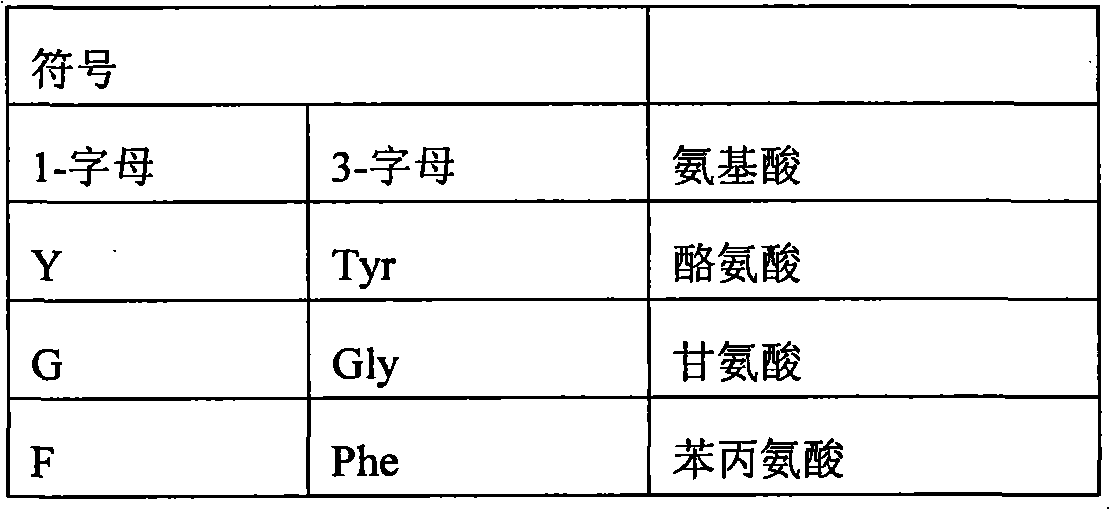
Should understand this paper by all amino acid residue sequences of chemical formula representative from left to right direction be that conventional amino terminal is to the carboxyl terminal direction.In addition, phrase " amino acid residue " extensively is defined as and comprises aminoacid that correspondence table (table 1) is listed and modification and uncommon aminoacid, goes into those of 37C.F.R. § § 1.821-1.822 indication, and its this paper that induces one does reference.In addition, should notice that strigula "-" in amino acid residue sequence beginning or ending is meant sequence, amino terminal group such as the NH with other one or more amino acid residue
2Or with the peptide bond of carboxyl terminal group such as COOH.
As used herein, " naturally occurring aminoacid " is meant 20 L-aminoacid that exist in the polypeptide.
As used herein, term " alpha-non-natural amino acid " is meant to have with the natural amino acid similar structures but by structure and the reactive organic compound of structural modification with the simulation natural amino acid.Therefore the aminoacid that non-natural takes place comprise for example aminoacid except that the aminoacid of 20 natural generations or amino acid analogue, and include but not limited to amino acid whose D-stereoisomer (isostereomer).Alpha-non-natural amino acid is for example described and is well known by persons skilled in the art at this paper.
As used herein, nucleic acid comprises DNA, RNA and analog thereof, comprises protein nucleic acid (PNA) and composition thereof.Nucleic acid can be strand or two strands.When referring to probe or primer, (randomly use detectable such as fluorescence or radio-labeled substance markers), be meant single chain molecule.This molecule typical case has such length, thereby the unique low copy number of their statistics (typically less than 5, usually less than 3) is used to detect or cause the library.Usually probe or primer contain the sequence of at least 10,15,20,25 or 30 continuous nucleotides complementary or identical with gene of interest.Probe and primer can be 5,6,7,8,9,10 or more, 20 or more, 30 or more, 50 or more, 100 or more a plurality of nucleotide long.
As used herein, allos or external nucleic acid such as DNA and RNA are used interchangeably, and are meant not to be naturally occurring as its existing genome part, perhaps find in being different from its naturally occurring locus.Heterologous nucleic acids comprises and is not that its cell that imports is endogenic but nucleic acid that obtain from another cell or synthetic preparation.Usually, although not necessarily, this nucleic acid coding is not RNA and the protein that is normally produced by the cell of expressing it.The allogeneic dna sequence DNA of this paper comprises and those skilled in the art recognize that or think that for the cell or the locus of expressing it be allos or external any DNA or RNA.Allogeneic dna sequence DNA and RNA also codified transcribe, translate by influence or other scalable Biochemical processes mediate or change in the source DNA RNA or the protein of expressing.The example of heterologous nucleic acids include but not limited to the to encode nucleic acid of traceable labelled protein (for example giving the protein of drug resistance), the nucleic acid of coding treatment active substance (for example anticarcinogen), enzyme and hormone, and the DNA of other type protein (for example antibody) of encoding.Therefore, allogeneic dna sequence DNA or foreign DNA comprise not with the accurate direction of the corresponding dna molecular found in genome and the dna molecular that the position exists herein.It also can refer to the dna molecular (being external source) from another organism or species.
As used herein, " is isolating about nucleic acid molecules or polypeptide or other biomolecule " is meant that described nucleic acid or polypeptide separate with the genotypic environment that obtains described polypeptide or nucleic acid.It also can represent to change from native state.For example, natural polynucleotide or the polypeptide that is present in the living animal is not " isolating ", but identical polynucleotide or the polypeptide opened with the coexistence material separation of its native state are " isolating ", the term that adopts as this paper.Therefore, in recombinant host cell, produce and/or the polypeptide or the polynucleotide that comprise are considered to isolating." isolating polypeptide " or " isolating polynucleotide " also is intended to comprise from recombinant host cell or from natural origin part or the polypeptide or the polynucleotide of purification basically.For example, the chemical compound that reorganization produces can pass through Smith et al., Gene, and the described one-step method of 67:31-40 (1988) is purification basically.Being used interchangeably of the isolating and purification of term.
Therefore, " isolating " is meant that nucleic acid does not contain the coded sequence of those genes, and described gene is the gene of the gene flank of next-door neighbour's coding nucleic acid interested in the genome (if there is) of the natural generation of organism.Separated DNA can be strand or two strands, and can be genomic DNA, cDNA, reorganization hybrid DNA or synthetic DNA.It can be identical with the initiate dna sequence or can be by disappearance, add or replace one or more nucleotide and different with this sequence.
Be meant from " purification " prepared product of biological cell or host preparation and contain specified DNA or proteinic cell extract, comprise interested DNA or proteinic crude extract.For example, in proteinic situation, the prepared product of purification can be by single technology or a series of preparation or Measurement for Biochemistry acquisition, and interested DNA or protein can be present in these prepared products with different purity.Described program can include but not limited to ammonium sulfate fractionated, gel filtration, ion-exchange chromatography, affinity chromatograph, density gradient centrifugation and electrophoresis.
" pure basically " or " isolating " DNA or protein prepared product are meant the prepared product that is substantially free of the natural normal bonded natural generating material of this DNA or protein, and it contains 5% or other pollutant still less.
Contain interested DNA or proteinic cell extract and be meant homogenate prepared product or the acellular prepared product that derives from the described protein of expression or contain the cell of DNA interested.Term " cell extract " is intended to comprise culture medium, has particularly removed the exhausted culture medium of cell.
As used herein, " targeting agent " is meant can be in conjunction with any molecule of another target molecule, as antibody, receptor or part.
As used herein, " receptor " is meant specifically the biologically active molecules in conjunction with other molecule.Term " receptor protein " can be used for more specifically indicating the protein properties of special receptor.
As used herein, " recombinant " is meant any filial generation that is formed by genetic engineering.
As used herein, " promoter region " is meant to control and can handles the part of the gene of transcribing of the DNA that is connected with it.Promoter region comprises the distinguished sequence that is enough to for RNA polymerase identification, combination and transcription initiation.This part of promoter region is called " promoter ".In addition, promoter region comprises the sequence of this identification, combination and the transcription initiation of regulating RNA polymerase.Promoter according to the character of regulating can be composing type or regulate by cis acting or trans acting factor.
As used herein, phrase " operably is connected " the section of DNA covalent bond that typically refers to sequence or sections and strand or double chain form with nucleic acid molecules, thus the control on sections or regulate sequence control or allow the expression of other sections or duplicate or other this control.These two sections must not be adjacent.For gene expression, DNA sequence and the connected mode of regulating sequence are such, when suitable molecule for example transcriptional activator albumen with regulate sequence when combining, control or permission gene expression.
As used herein, " producing through recombination form with recombinant DNA method " is meant that the molecular biology method known expresses by the protein of clone's dna encoding, comprises the purposes and the method for the clonal expression of gene.
As used herein, splice variant is that described difference processing produces and surpasses one type mRNA by the variant of the difference processing generation of the primary transcript of genomic DNA.
As used herein, compositions is meant any mixture of two or more products or chemical compound (for example medicament, instrumentality, instrumentality etc.).It can be solution, suspension, liquid, powder, cream, aqueous or non-aqueous preparation or its any combination.
As used herein, combination is meant any combination of two or more project.The project that is used to give the combination of object can give separately or together, uses simultaneously or in succession, perhaps packaging together or packing separately.
As used herein, " manufacture " is manufactured and product sold.In this application, this term is intended to be included in EPO polypeptide or the treatment polypeptide of other modification and/or the pharmaceutical composition of nucleic acid of the modification as herein described that contains in the connection with wrapping of piece.
As used herein, " test kit " is meant modified polypeptide described herein or nucleic acid molecules and the combination of another purpose that is provided in the pharmaceutical composition, described project is used for following purpose, and described purpose includes but not limited to the activity or the character of administration, diagnosis and evaluation polypeptide described herein.Test kit randomly comprises operation instruction.
As used herein, " substantially the same with product " is meant enough similar, can use substantially the same product to replace described product thereby interested character is enough constant.
As used herein, term " carrier " is meant a kind of nucleic acid molecules, and it can transport connected another nucleic acid.One type the carrier of giving an example is an episome, nucleic acid that can extrachromosomal replication.Carrier for example is can self-replicating and/or express the carrier of its nucleic acid that connects, and this carrier typically comprises origin of replication.Carrier also can be designed for and be integrated in the host chromosome.Can instruct and be referred to herein as " expression vector " with its carrier that can handle the gene expression that is connected.Expression vector is " plasmid " form normally, and it typically refers to the circular double stranded DNA ring, and it does not combine with chromosome when carrier format." plasmid " and " carrier " is used interchangeably, because plasmid is the carrier of most common form.The expression vector of other this form plays effect of equal value and is known in the art.
As used herein, carrier also comprises " viral vector ".Viral vector is an engineering virus, and it operationally is connected with exogenous gene so that cell is advanced in this exogenous gene transfer (as the carrier or the body that shuttles back and forth).
As used herein, " allele " is used interchangeably with " allele variant " in this article, is meant gene or its part variable form in colony.Allele occupies locus identical on the homologous chromosome or position.When object had two phase iso-alleles of a gene, this object was called as this gene or allele is isozygotied.When object has two of a gene not during iso-allele, it is heterozygosis that this object is called as this gene.The allele of concrete gene can have the difference of 1 nucleotide or several nucleotide mutually, and can comprise replacement, disappearance and the insertion of nucleotide.The allele of gene also can be the gene form that contains sudden change.Typically, allele variant and wild type and/or have at least 80%, 90%, 91%, 92%, 93%, 94%, 95%, 96%, 97%, 98%, 99% or higher aminoacid homogeny from the advantage form of same species.
As used herein, term " gene " or " recombination " are meant and contain open reading frame and comprise at least one exon and the nucleic acid molecules of intron coded sequence randomly.Gene can be RNA or DNA.Gene can comprise before the coding region and zone (targeting sequencing and non-transcribed tail region) afterwards.
As used herein, " intron " be meant exist in the gene but the dna fragmentation in the mRNA maturation process, removed by montage.
As used herein, " with the complementary nucleotide sequence of nucleotide sequence of the aminoacid sequence of coding SEQ ID NO:1 " is meant the complementary nucleotide sequence of the nucleic acid chains of coding one peptide species, and described polypeptide comprises the aminoacid sequence with this specific SEQ ID NO:1.
Term " complementary strand " is used interchangeably with term " complementary series " in this article.The complementary series of nucleic acid chains can be the complementary series of coding strand or the complementary series of noncoding strand.When referring to double-strandednucleic acid, the complementary series of nucleic acid that coding contains the amino acid residue of the sequence with specific SEQ ID NO:1 is meant the complementary strand of chain of the aminoacid sequence of this specific SEQ ID NO:1 of coding, perhaps refers to contain any nucleic acid molecules of the complementary nucleotide sequence of this specific nucleic acid sequence.When referring to contain the single stranded nucleic acid molecule of a nucleotide sequence, the complementary series of this nucleic acid is the nucleic acid that has with the complementary nucleotide sequence of sequence of this specific nucleic acid sequence.
As used herein, term " coded sequence " is meant the part of the aminoacid sequence that exists in the coded protein of gene.
As used herein, " sense strand " is meant a chain of double chain acid molecule, and it has the mRNA sequence of coding by this double chain acid molecule amino acid sequence coded.
As used herein, term " antisense strand " is meant a chain of double chain acid molecule, and it is the complementary series of coding by the mRNA sequence of this double chain acid molecule amino acid sequence coded.
As used herein, " array " is meant the element that contains three or more member such as the set of nucleic acid molecules.Addressable array is such array, wherein the member of array is identifiable, typically by the position on solid support or by can differentiating or detectable labelling is differentiated, described differentiate or detectable labelling for example is color, fluorescence, the signal of telecommunication (for example RF, microwave or significantly do not change interactional other frequency of molecules of interest), bar code or other symbolism, chemistry or other this labelling.In certain embodiments, on the discrete position differentiated of array member immobilization to the solid phase surface, perhaps directly or indirectly with can differentiate that labelling connects or relevant in addition, as invest on the microsphere or on other granule holder (this paper is called pearl) and be suspended in solution or expansion from the teeth outwards.
As used herein, " holder " (for example substrate holder, substrate, insoluble holder or solid supports etc.) are meant the semi-solid or insoluble holder of any solid, and molecule (s) of interest (biological example molecule, organic molecule or biospecific ligands) is connected or contact with it.This material comprises as affinity substrate or holder carrying out any material of chemistry and biology molecule synthesis and analysis, such as but not limited to: polystyrene, Merlon, polypropylene, nylon, glass, glucosan, chitin, sand, Pumex, agarose, polysaccharide, dendrimers, buckyball, polyacrylamide, silicon, rubber and as holder to carry out solid phase synthesis, the affine separation and other material of purification, hybridization, immunoassay and other this application.The substrate of this paper can be granular or can be the continuous surface form, as titer plate or hole, slide, silicon wafer, NC Nitroncellulose sheet material, nylon mesh or other this material.When being graininess, typically described particulate one dimension at least is a 5-10mm scope or littler.This granule is referred to as " pearl ", usually but be not must be spherical.But, this geometry that is not restriction substrate that refers to, it can be an Any shape, comprises randomly shaped, needle-like, fiber and lengthening.General is spheric " pearl ", in the microsphere that particularly can be used for liquid phase is also included within." pearl " can comprise other composition, as is used for carrying out isolating magnetic or paramagnetic particle (referring to for example Dynabeads (Dynal, Oslo, Norway)), as long as described other composition does not disturb the method for this paper and analyzes with Magnet.
As used herein, substrate or support particles are meant the host material that is the discrete particle form.Granule has Any shape and size, is of a size of 100mm or littler, 50mm or littler, 10mm or littler, 1mm or littler, 100m or littler, 50m or littler but typically have at least one dimension, typically has size and is 100mm
3Or littler, 50mm
3Or littler, 10mm
3Or littler, 1mm
3Or littler, 100m
3Or littler, and can be the cu level.This granule is referred to as " pearl ".
As used herein; for the abbreviation of any protecting group, aminoacid and other chemical compound except as otherwise noted; otherwise the abbreviation or IUPAC-IUB Commission onBiochemical Nomenclature (1972) Biochem. that meet its usage, approval, 11:942-944.
B. erythropoietin (EPO)
Erythropoietin (EPO) is the member of the hemopoietic growth factor family of working as hormone.It is responsible for regulating erythropoiesis and keeps the body red cell volume in optimum level.EPO generates by the oxygen content that reduces in the renal artery circulation to be stimulated, by the transcription factor mediation of oxygen sensitivity.EPO is mainly produced by the tubule week capillary vascular endothelial cell of kidney.Excretory EPO in conjunction with bone marrow red be the lip-deep EPO receptor of precursor, cause their quick copy and ripe be functional erythrocyte.This stimulation cause the fast rise of red blood cell count(RBC) and the rising of consequent hematocrit (the % erythrocyte in the blood) (D ' Andrea et al. (1989) Cell 57:277-285; Lodish et al. (1995) Cold SpringHarb Symp Quant Biol 60:93-104).
Human EPO is at first by Lin et al. (1985) Proc Nat Acad Sci USA 82:7582-4and Jacobs et al. (1985) Nature 313:806-810 clone and report aminoacid sequence.Human EPO is molecular weight about 30400 daltonian acidoglycoproteins.It is made up of 165 amino acid whose single polypeptide chains, contains 4 cysteine residues (in the position 7,29,33 and 161), and described cysteine forms inner disulfide bond (Lai et al. (1986) J Biol Chem 261:3116-3121; Recny etal. (1987) J Biol Chem 262:17156-17163).It is important that disulfide bond between the cysteine 7 and 161 generates activity for promoting erythrocyte.Report and the description in Cheetham et al. (1988) Nat Struct Biol 5:861-866 and Syed et al. (1998) Nature 395:511-516 of the structure of human EPO.Human EPO is 4 helical bundles, and this is typical in the hemopoietic growth factor family member.
In vivo, EPO is by the glycosylation post translational modification.The carbohydrate of EPO part is by forming (referring to for example Browne et al. (1986) Cold Spring Harb Symp Quant Biol 51:693-702 at Asn24,3 N connection sugar of 38 and 83 and at 1 the O connection sugar of Ser 126; Egrie etal. (1986) Immunbiology 172:213-224).The carbohydrate structure that is attached to EPO is variable, and this feature is called microheterogeneity.The difference of carbohydrate part in branching pattern, complexity size and electric charge has far-reaching effect to pharmacokinetics and the pharmacodynamics of EPO.The effect of different glycosylation pattern have fine research (referring to for example, Darling et al. (2002) Biochemistry 41:14524-14531; Storring et al. (1998) Br J Haematol 100:79-89; Halstenson etal. (1991 Clin Pharmacol Ther 50:702-712; Takeuchi et al. (1990) JBiol Chem265:12127-12130).
Following EPO polypeptide has the identical aminoacid sequence with recombinant human epo (rhEPO), and the difference in production method and the glycosylation distinguishes these products.Epoetin α (produce from genomic DNA) and epoetin β (producing from cDNA) be at United States Patent (USP) 4,703, description in 008 and 5,955,422.These polypeptide have the aminoacid sequence identical with human EPO and produce in Chinese hamster ovary (CHO) cell.Epoetin α can trade name
(Ortho Biotech),
(Johnson ﹠amp; Johnson),
 (Chugai) or
(Amgen) obtain.Epoetin β can trade name
(Chugai) or
(Amgen) obtain.Epoetin β can trade name
 Or
Or
 (Hoffmann-La Roche) obtains.It is used for the treatment of the anemia relevant with nephropathy by the GeneticsInstitute exploitation.Epoetin ω at United States Patent (USP) 5,688, describes in 679, has the aminoacid sequence identical with human EPO and generation in baby hamster kidney cell (BHK-21).Epoetin ω can trade name
 (Elanex) obtain.
Darbepoetin α (also be known as Novel Erythropoiesis Stimulating Protein, NESP) also can trade name by the Amgen exploitation
 Obtain (Macdougall (2002) Kidney IntSuppl.80:55-61).Its design contains 5 N and connects carbohydrate chain (Duoing 2 than rhEPO).
 Aminoacid sequence and rhEPO different be 5 aminoacid replacement (A30N, H32T, P87V, W88N P90T), therefore makes other oligosaccharide be attached on the asparagine residue of position 30 and 88.Because the carbohydrate content of its increase,
Be different from rhEPO, the negative charge that it has higher molecular weight (37100, than 30400 dalton), sialic acid content (22, than 14 sialic acid residueses) and increases.
Aminoacid sequence and rhEPO different be 5 aminoacid replacement (A30N, H32T, P87V, W88N P90T), therefore makes other oligosaccharide be attached on the asparagine residue of position 30 and 88.Because the carbohydrate content of its increase,
Be different from rhEPO, the negative charge that it has higher molecular weight (37100, than 30400 dalton), sialic acid content (22, than 14 sialic acid residueses) and increases.
 The carbohydrate content that increases has been explained its unique biological chemistry and biology activity, particularly when circulation half life higher 3 times than other erythropoietin when intravenous or subcutaneous route give.Yet EPO receptor binding affinity and carbohydrate content paraphase are closed relatively,
The relative affinity that displaying is lower 4.3 times than rhEPO to the EPO receptor.After subcutaneous giving,
The carbohydrate content that increases has been explained its unique biological chemistry and biology activity, particularly when circulation half life higher 3 times than other erythropoietin when intravenous or subcutaneous route give.Yet EPO receptor binding affinity and carbohydrate content paraphase are closed relatively,
The relative affinity that displaying is lower 4.3 times than rhEPO to the EPO receptor.After subcutaneous giving,
 Absorb slowly and be speed limit, it is maximum that serum levels reached in average 54 hours.Reach the length of rhEPO of the time ratio report of Cmax, may be because
 Molecular size increases.But the circulation half life that prolongs at present, make
 Ratio
Ratio
 Significant clinical advantage is arranged, because its administration frequency is low.
Dynepo (Epoetin δ; Transkaryotic Therapies (associating Aventis Pharma) exploitation) is the human erythropoietin of gene activation, in people's cell culture, produces, be used for the treatment of the anemia of patients with renal failure.Successive erythropoietin receptor activator (CERA; By Roche exploitation) or R-744 be second filial generation erythropoietin, be used for the potential treatment anemia relevant with chemotherapy.CERA contains the single methoxy poly (ethylene glycol) polymer of the 30kDa that has an appointment, and it has prolonged the half life of this medicament.
EPO is main biologics, and global marketing is up to 3,000,000,000 dollars.It is mainly used in the erythrocyte that increases among the patient and forms with treatment and chronic renal failure, cancer chemotherapy, HIV infection, paediatric applications, anemia that the premature infant is relevant, and the blood transfusion needs that reduce the anemia patient who experiences select a time non-heart and non-vascular surgery.In the mankind, found it is safe and well-tolerated with the EPO dosage treatment.
Recently, several line evidences point out erythropoietin to carry out other important physical function as the member of cytokine superfamily, and these functions are mediated by the interaction with erythropoietin receptor (EPOR).These effects comprise mitogenesis, regulate that the calcium current enter smooth muscle cell and neurocyte is gone into, erythropoiesis, platelet superactivation, blood platelet generates and to the metabolic effect in centre.It is believed that erythropoietin provides compensation to reply, be used to improve the hypoxic cell microenvironment and regulate the programmed cell death that causes by metabolic stress.Therefore, except its promoting erythrocyte generated activity, EPO is the display organization protective capability also.In addition, this organization protection activity seems not rely on its promoting erythrocyte systematic function.
EPO can be oral, in the general, cheek, percutaneous, intravenous, intramuscular and subcutaneous giving, typically, use in the therapeutic scheme repeatedly to give.Preparation typically is stored in cold preservation (2-8 ℃) condition to guarantee activity.Therefore, the EPO stability (half life) of improvement can be improved its purposes and efficient as medicine in administration condition (in the body) as serum stability and external (for example in process of production, under purification and the condition of storage).
This paper provides EPO variant polypeptides, and they show that wherein the mutant variant shows the protein half life that increases by the improved stability that the resistance of protease (blood, small intestinal etc.) is assessed and/or the heat tolerance and/or the pH condition of increase.The EPO variant that shows improved stability in the administration condition as at blood, gastrointestinal tract, at low pH condition (for example stomach), oral cavity, larynx and/or under condition of storage, have the stability of increase.
C. be used to modify the exemplary method of EPO polypeptide and other treatment polypeptide
This paper provides by increasing the proteolysis resistance increases EPO polypeptide and the stability of other treatment polypeptide and the method for half life.This paper provides modification EPO polypeptide and other treatment polypeptide with the method for increase to the resistance of the proteolysis of protease (blood, serum, gastrointestinal tract etc.), and modified polypeptides shows half life in the external and/or body that increases thus.This paper provides EPO polypeptide and other treatment polypeptide of modifying, and wherein the one-level aminoacid sequence is modified to give the protein stability of increase.Provided herein amino acid modified be such modification, it is included in the primary sequence of EPO polypeptide and other treatment polypeptide replacement amino acid to reduce the protease cracking of polypeptide.The further modification of the EPO polypeptide of modifying or other treatment polypeptide can be included, such as but not limited to adding carbohydrate, phosphoric acid, sulfur, hydroxyl, carboxyl and Polyethylene Glycol (PEG) part.Therefore, the EPO polypeptide of modification provided herein and other treatment polypeptide can be for example the further modification by glycosylation, phosphorylation, sulphation, hydroxylating, carboxylated and/or PEGization.But this modification body is interior or external carrying out.
This paper provides the modified therapeutic polypeptide to contact the method for Profilin enzymatic activity thus with increase with inhibitor peptides to the resistance of the proteolysis of protease and with protease.This paper also provides the modified polypeptides that is produced by described method.This paper provides EPO polypeptide and other treatment polypeptide of showing by the improved stability that protease resistant is assessed; Show that therefore the EPO polypeptide of described modification of these character and other treatment polypeptide have the external of increase or body internal protein half life.
The EPO polypeptide of modifying and other treatment polypeptide (this paper is also referred to as variant) are more stable than the treatment polypeptide of the EPO polypeptide of unmodified or other unmodified.Increase stability (being half life in the aleuroplast) and can cause keeping the required frequency of injection decline of levels of drugs enough in the serum, cause thus: i) treatment target comfort level and acceptance that especially human subjects is higher, ii) lower reach the suitable required dosage of biological action, and iii) consequently, alleviated (dose dependent) second-order effect.
The stability of the increase of EPO polypeptide and other treatment polypeptide can be for example helps conformational stability and the residue of temperature, pH or other denaturant degeneration sensitivity is realized by destroying protease target residue or sequence and/or being modified with.Can keep active do not become with respect to unmodified or wild type treatment polypeptide in and realize increasing the modification of EPO polypeptide and other treatment polypeptide stability.Perhaps, the modification of EPO or other treatment polypeptide stability can realize compare the active while of increase with unmodified or wild type peptide.Any method known in the art all can be used for producing the EPO polypeptide of modification and the treatment polypeptide of other modification.In method described herein, select to modify with the 2D scanning mutagenesis method described in open WO2004/022747 of for example PCT and the WO 2004/022593.
In principle, there are some universal methods to be described to be used for protein orthogenesis based on mutation.Any of these method separately or combination can be used to modify the EPO polypeptide and other treats stability and/or the proteolysis resistance of polypeptide to realize increasing.This method comprises random mutagenesis, and wherein the aminoacid in the initiation protein sequence produces single or a plurality of displacements in the different aminoacids position of same molecular simultaneously with whole (or one group) 20 amino acid replacements.Another method restriction random mutagenesis imports whole 20 aminoacid or DNA bias (DNA-biased) residue.Bias is based on DNA sequence but not based on protein sequence, with at random or half random fashion known participation in advance by " evolution " active proteinic restriction or presumptive area in.In addition, rational method of mutagenesis comprises that 1D scanning, 2D scanning and 3D scanning can be used to make up the EPO variant of modification alone or in combination.
1. unrestricted rational mutation one dimension (1D) scanning
Rational scanning is also referred to as 1D scanning, is two-stage process, and describes in common unsettled U. S. application series number 10/022,249 (US publication 2003/0134351-A1).1D scanning can be used for modifying the EPO polypeptide and other treats polypeptide, and additionally be used to differentiate the position, to be used for through other method such as 2D and 3D scanning and further to modify.In brief, in the first step, carry out full length amino acid scanning, wherein all of initial treatment peptide sequence (for example EPO polypeptide of SEQ ID NO:2) are replaced with reference to aminoacid (for example alanine) with each aminoacid is appointed.Only replace a monamino acid on each each protein molecule.Generation has the metathetical protein molecule set of monamino acid, thereby these molecules are different because of metathetical amino acid position takes place each other.Design mutant dna molecular produces and clones one by one through mutation, as in addressable array, thus their mutual physical separation, and each is the single product of independent mutagenesis reaction.Derived from the mutein molecule of mutant nucleic acid molecules set also is mutual physical separation, as by formaing in addressable array.When by displacement, cause active those amino acid positions that descend feasible can the discriminating of the assessment of the activity on each protein molecule, show that thus this specific amino acids position participates in proteinic biologic activity and/or conformation, it causes the fitness of the special characteristic of evolving.These amino acid positions are called as HIT.
In second step, the new set that produces molecule, thus each molecule is different because of the aminoacid that each HIT position of differentiating in step 1 exists each other.Each HIT position of differentiating in step 1 imports whole 20 aminoacid (all the other 19); Simultaneously each individual molecular contains one and amino acid replacement only in principle.Design mutant dna molecular produces and clones one by one through mutation, as in addressable array, thus their mutual physical separation, and each is the single product of independent mutagenesis reaction.Derived from the mutein molecule of mutant dna molecular set also is mutual physical separation, as by formaing in addressable array.On each idiovariation molecule, carry out the activity assessment then one by one.The mutant of the new generation of the change that causes wishing in the protein active (as improvement) is called as LEAD.This method makes can retrieve character or activity change indirectly, as improved stability, it is based on a rational amino acid replacement and each sequence variation in the single amino acids position, with retrieval some new not predicted amino acid sequences of estimation range not on protein, thereby produce to show wish active protein active or that change, as compared with the better protein of beginning protein performance.
In this method, amino acid position or replacement amino acid type are all unrestricted.In the first step, carry out full length protein scanning to differentiate the HIT position, then at all 20 aminoacid of each HIT position measurement, to differentiate the LEAD sequence; Simultaneously, as starting point, on each molecule at every turn only an aminoacid replaced.Be used for the activity experiment data of the selection of second target region that goes on foot (HIT reaches aminoacid on every side) based on first step acquisition.Therefore, do not need knowledge formerly to protein structure and/or function.Use this method, the LEAD sequence is found and is positioned at previous unknown the participation on the active zone of adorned particular biological on the protein; Therefore emphasized that this method finds the ability of unpredictable zone (HIT) as the target of fitness improvement.
2. the rational scanning of two dimension (2D) (limiting rational mutation (restricted rational mutagenesis))
Be used for rational 2D scanning (or limiting rational mutation) method of evolving of protein (the open application number US 2005-0202438A1 of the residue U.S. and US-2004-0132977-A1 and disclosed International Application No. WO 2004/022593 and WO 2004/022747) and be based on the scanning on the two dimension.First dimension is the amino acid position on the protein sequence, to differentiate the is-HIT target position.Second dimension is the aminoacid type that scanning selects to be used to replace specific is-HIT amino acid position.The advantage of 2D scan method provided herein be at least one typically amino acid position and/or replacement amino acid can be restricted, thereby be less than the selected amino acid replacement that carries out of whole aminoacid on the protein skeleton; And/or be less than all the other 19 and can be used for replacing original aminoacid and be selected for displacement as natural amino acid.
In specific embodiment, based on i) the specified protein character that will the evolve resistance of proteolysis (for example to), ii) proteinic aminoacid sequence, and iii) each amino acid whose known properties, insilico selects some target position on the protein sequence, is called " is-HIT target position ".Is-HIT target position number is reasonably big, thereby includes at all reasonable possible target position of the special characteristic of evolving.Especially, when the is-HIT target position that limits the number is selected in the metathetical embodiment, selection just is used to replace, and the aminoacid of the is-HIT target position on optimised specified protein can be whole all the other 19 aminoacid, perhaps more frequently, be the group that more limits, it comprises expection and has aminoacid to the selection of the hope effect of protein active.In another embodiment, as long as use the replacement amino acid that limits the number, the whole amino acid positions on the protein skeleton can selected is-HIT target position as amino acid replacement.Carry out mutation (for example " one by one " is as in addressable array) by the special is-HIT target position displacement monamino acid residue on the protein skeleton then, thereby each the idiovariation body that is produced is the single product of each single mutagenesis reaction.Design mutant dna molecular produces and clones one by one through mutation, as in addressable array, thus their mutual physical separation, and each is the single product of independent mutagenesis reaction.Derived from the mutein molecule of mutant dna molecular set also is mutual physical separation, as by formaing in addressable array.Therefore, produce a plurality of mutein molecules.Each mutein only contains the monamino acid displacement at an is-HIT target position.At protein expression with after measuring suitable activity, on each individual proteins mutating molecule, carry out the activity assessment one by one then.Implement the example of this method and see embodiment, wherein produce mutant EPO molecule.
Cause protein that change, the typically active new generation of target protein of improvement to be called as LEAD.This method depends on the protein composition improvement of indirect retrieval at given activity, as the proteolysis resistance that increases, it is based on amino acid replacement and each in the single amino acids position or in another embodiment in the sequence variation of a limited number of amino acid position.The result is, the protein of optimization that has the aminoacid sequence of modification on some zones of protein is differentiated and separate that the protein of described optimization is compared with beginning protein performance better (active or other character in particular target) or be different from initiation protein.
2D scanning on the EPO is used to produce variant, and its protein stability aspect improves, and comprises the proteolysis resistance of improvement.For realizing this modification, select amino acid position with the in silico analysis of EPO.
A. differentiate in-silico HIT
The 2D scan method that is used for directed evolution of proteins is included in to be differentiated on the protein sequence and selects (using in silico to analyze) expection directly or indirectly to participate in by the special aminoacid of evolution feature and amino acid position (this paper is called is-HIT).As indicate, the 2D scan method that provides comprises following two steps.First step is that in silico retrieves proteinic target amino acid sequence can be used as the active target of being evolved with discriminating all possible amino acid position.This is by for example realizing with the effect of any known standard software assessment amino acid residue to the character that will change on the protein.The details that in silico analyzes is the function of the character that will modify.
After the discriminating, these amino acid positions or target sequence are called as " is-HIT " (in silico HIT).Insilico HIT is defined as participating in those amino acid positions (or target position) of " evolution " feature such as direct proteolysis resistance.Distinguishing is-HIT in proteinic all amino acid positions can carry out based on the aminoacid type of each position and protein secondary or tertiary structure information.In silico HIT has formed the mutating molecule set, thereby representative participates in all possible aminoacid, amino acid position or the target sequence of evolution feature potentially.The strong theory of not carrying out at this stage between aminoacid or amino acid position is distinguished.In silico HIT position distribution is in the protein sequence total length.Each single or a limited number of is-HIT aminoacid is replaced on target EPO polypeptide or other treatment polypeptide.
Can analyze various parameters to determine whether a specific amino acids on the protein may participate in the feature of evolving, typically use a limited number of initial prerequisite (typically being no more than 2) to determine insilico HIT.For example, as described herein, for increasing the stability of EPO polypeptide and other treatment polypeptide, first condition is the amino acid whose character relevant with stability of molecule, as its property of participation in instructing protease cracking.Second prerequisite for example can be relevant with the special position of those aminoacid on protein structure.
Differentiating that according to method provided herein each aminoacid is considered one by one whether to assess it be the is-HIT candidate on the protein sequence in the first step of is-HIT.This retrieval is carried out one by one, and the decision of candidate that whether is considered to is-HIT about described aminoacid is based on (1) aminoacid type; (2) if position in protein and protein structure is known words; (3) interaction of this aminoacid and its prediction of contiguous aminoacid between sequence and space.
Various character for EPO have been differentiated is-HIT, and they have contribution to protein stability, removing/modifying as the responsive site of protease.Therefore this being modified with helps protein stability, helps to increase in external, the body of the EPO polypeptide that provides and other treatment polypeptide or stripped half life.
B. differentiate replacement amino acid
In case selected the is-HIT target position, next step is to differentiate at original those aminoacid as natural amino acid of each is-HIT position displacement, to change the activity level of the special characteristic of being evolved.It can be different from specific that the replacement amino acid that is used for as natural amino acid original in the displacement of each is-HIT position is gathered for specific is-HIT position.Following demand is considered in the selection of replacement amino acid, promptly keeps hydrophobicity, electric charge and the polarity of physicochemical properties as crucial (for example catalysis, combination etc.) residue, and changes more proteinic other character (for example protein stability).The amino acid whose replacement amino acid number of all the other 19 non-naturals (or non-original) that can be used for replacing specific is-HIT target position is from 1 to about 19, and between the two arbitrary number, this depends on the character of carrying out specific modification.
It is well known in the art selecting the whole bag of tricks of replacement amino acid (replacing amino acids) (being also referred to as " replacement amino acid (replacement amino acids) " in this article).The protein chemistry man has determined that some aminoacid replacement take place usually in the related protein from different plant species.Because having these replacements, protein still has function, so substituted aminoacid and protein structure and function are compatible.Usually, these replacements are at the similar aminoacid of chemistry, although the variation of other type relatively rareness also can take place.
The contrast and the aminoacid replacement that can help to predict any protein sequence set to the understanding of change type the most common and least common in a large amount of protein.The aminoacid replacement matrix is used for this purpose.There are several matrixes to utilize.The detailed description of this matrix can find that in common unsettled U. S. application US 2005-0202438A1 and US-2004-0132977-A1 and disclosed International Application No. WO 2004/022593 and WO 2004/022747 each document is incorporated herein in full does reference.This matrix still is known in the art and obtainable, for example in following list of references.
In the aminoacid replacement matrix, aminoacid is listed with vertical by level, and each matrix position is filled with scoring, the paired frequency of another aminoacid in its aminoacid of reflection and the correlated related protein sequence.The probability that aminoacid " A " is changed to aminoacid " B " is assumed that to become the inverse probability of " A " identical with " B ".Make this supposition and be because for any two sequences, the ancestors' aminoacid in the phylogenetic tree is normally unknown.In addition, metathetical probability should depend on product and their chemistry and the physical similarity of two amino acid whose occurrence frequencies.The prediction of this model is that amino acid frequency does not change (Dayhoff et al., Atlas of Protein Sequence andStructure, 5 (3): 345-352,1978) with the evolution time.Several aminoacid replacement matrixes of giving an example include but not limited to (BLOSUM) (Henikoff et al. of piece substitution matrix (block substitution matrix), Proc.Nat.Acad.Sci.USA, 89:10915-10919 (1992)), Jones et al. (Comput.Appl.Biosci., 8:275-282 (1992)), Gonnet et al. (Science, 256:1433-1445 (1992)), Fitch (J.Mol.Evol., 16 (1): 9-16 (1966)), Feng et al. (J.Mol.Evol., 21:112-125 (1985)), McLachlan (J.Mol.Biol., 61:409-424 (1971)), Grantham (Science, 185:862-864 (1974)), Miyata (J.Mol.Evol., 12:219-236 (1979)), Rao (J.Pept.ProteinRes., 29:276-281 (1987)), Risler (J.Mol.Biol., 204:1019-1029 (1988)), Johnson et al (J.Mol.Biol., 233:716-738 (1993)), with Point Accepted Mutation (PAM) (Dayhoff et al., Atlas Protein Seq.Struct.5:345-352 (1978)).
Dayhoff and colleague have developed a kind of protein evolution model, it causes having developed widely used permutation matrix set (Dayhoff et al., Atlas of Protein Sequence and Structure, 5 (3): 345-352 (1978)), it is named as percentage ratio can accept to suddenly change matrix (percent acceptedmutation matrices) (PAM).When deriving these matrixes, current amino acid whose each variation of specific site all is assumed that the previous catastrophic event that does not rely in this site.Therefore, the probability that any aminoacid A is changed to aminoacid B is identical, and how no matter this site is previous changes and regardless of the position of aminoacid A in protein sequence.
In the Dayhoff approach, replacement rate is derived from least 85% identical protein sequence contrasts; This restriction has guaranteed that specific sudden change is that the probability of a series of results of mutation in succession is very low.Because these variations are observed in the protein that is closely related, so they have represented the aminoacid replacement that does not significantly change protein function.Therefore, they are called as " can accept sudden change ", and are defined as the aminoacid that can be accepted by natural selection and change the same.
The result of above-mentioned two steps that in silico carries out is: (1) is differentiated (being called is-HIT) as the amino acid position of mutation target; (2) the original replacement amino acid as natural amino acid that is used to replace is-HIT is differentiated, to provide expected behavior the candidate LEAD mutant molecule set different with natural molecule.The optimization of the determined hope of these molecules, improvement or change activity.
C. make up and measure the protein and the biology of modifying
In case selected is-HIT as mentioned above, then imported replacement amino acid.Mutein is typically assessed the given activity of optimizing (feature) with the recombinant DNA method preparation and in measuring suitable biology.The exemplary method of preparation mutein is primary as natural gene with method mutation well known in the art.Mutating molecule produces one by one, and for example in addressable array, each the idiovariation body that is produced thus is the single product of each single independent mutagenesis reaction.Each mutagenesis reaction separately carries out, and for example in addressable array, their mutual physical separation are opened in described array.In case prepared the nucleic acid molecules set group of mutein separately that encodes, one by one each imported in the suitable cell to produce corresponding mutein.This also can for example carry out in addressable array, and each nucleic acid molecules set of the mutain separately of encoding in described array is imported in the cell in the hole that is limited in discrete positions such as porous titer plate.Each idiovariation protein carries out phenotypic evaluation one by one, and with the mensuration qualitative assessment that is fit to just optimised feature (feature of promptly evolving).Equally, this step can be carried out in addressable array.Comparing with primary as natural molecule of show wishing increases or the mutant of the performance of reduction is called LEAD by discriminated union.T begins until the reading and analyzing of results of property from producing the mutant DNA molecular process, and each candidate's mutant is as being produced one by one, generate and analyze from its self address addressable array.This method is fit to automatization.
3. three-dimensional (3D) scanning
3D scanning, as described in common unsettled U. S. application publication number US 2005-0202438A1 and US-2004-0132977-A1 and disclosed PCT application WO 2004/022747 and WO2004/022593, be another rational evolution method of protein of potential target site (is-HIT) that is used for mutation based on discriminating.This method is utilized the comparison of the folding pattern of protein skeleton between the structurally associated protein, and no matter how be compared proteinic sequence.In case on proteins of interest matter, differentiated structure related amino acid position, then can adopt suitable amino acid replacement standard such as PAM to analyze to differentiate candidate LEAD, be used for making up and screening.
For example, between some relevant cell factors " " analysis can be used on each member of cytokine family differentiating the amino acid position and the residue of similar or structurally associated to structural homology.For example, 3D scanning can be used to differentiate the amino acid position on the EPO, described position and the similar or structurally associated of finding of those positional structures in the cytokine mutant that is for example had improved stability by modification.Cytokine for example includes but not limited to granulocyte-macrophage colony stimutaing factor (GM-CSF), interleukin-2 (IL-2), interleukin-3 (IL-3), interleukin-4 (IL-4), interleukin-5 (IL-5), interleukin-13 (IL-13), Flt3 part and stem cell factor (SCF).
Use 3D scan method described herein, after in case the protein (for example EPO in the cytokine family) in the protein families is modified with the method for generation LEAD mutant provided herein, can be by differentiate the is-HIT of other or all protein in the specific family with this paper following structures homology analysis (relatively the differentiating of 3D structure based on family member and urporotein is used for metathetical residue accordingly) discriminating corresponding amino acid position wherein.The family member's of Jian Bieing is-HIT can carry out next step then in this way, differentiates replacement amino acid, and the pacing of going forward side by side is fixed to obtain LEAD as herein described or super-LEAD.Similarly, the information of the 2D scanning of carrying out on next comfortable other cytokine can be used to optimize the EPO polypeptide, described cytokine for example is a granulocyte-macrophage colony stimutaing factor (GM-CSF), interleukin-2 (IL-2), interleukin-3 (IL-3), interleukin-4 (IL-4), interleukin-5 (IL-5), interleukin-13 (IL-13), Flt3 part and the hepatocyte factor (SCF).
This method can use any protein such as cytokine as the parent material of evolution program and be used for any phenotype of wishing, described evolution program for example is rational oriented program or the two-dimensional scan method described herein of U. S. application publication number US 2003-0134351A1.On the family member, change the corresponding residue of structure then and have the other cytokine of similar phenotypic alternation with generation.
A. homology
Typically, homology between the protein is to compare at their amino acid sequence level, it is based on when from an object of reference normally during the initial contrast sequence of the residue of start codon coding, each aminoacid, each amino acid whose concordance percentage ratio or level.For example, when they separately aminoacid sequence when when contrast shows to a certain degree coupling, two homologys that protein is called as " homologous " or has some degree.Relatively molecular biology is mainly based on this method.From the homology or the degree of consistency between two aminoacid sequences, can draw the conclusion of evolutionary distance between two or more protein sequences and biology system.
The notion of " convergent evolution " is used to describe such phenomenon, wherein system take place incoherent organism or biology system as to from the replying of common power, constraint and the evolution demand of surrounding and live organism, evolved to sharing and their feature of anatomy, physiology and structurally associated.Perhaps, " divergent evolution " is used to describe such phenomenon, wherein strong system take place relevant organism or biology system as to from the replying of different power, constraint and the evolution demand of surrounding and live organism, having evolved is to break away from homogeny or similarity.
In the typical traditional analysis of homologous protein matter, two notional bias are arranged, corresponding to: i) " convergent evolution " and ii) " divergent evolution ".When correlated two proteinic aminoacid sequences match each other when bad, these protein are considered to " incoherent " mutually or " not too relevant " and have different systems originate from.Do not have (or having low) homology between these protein, they are gene homology (or show very little homology) not separately.If these two " non-homogeneous " protein in the research show some common functional characters and (for example interact with other specific molecular, or it is active), they are confirmed as from " convergent evolution " (promptly by their non-homogeneous aminoacid sequence of evolution like this, making their finally produce the structure that function " is correlated with ").
Be considered to when correlated two proteinic aminoacid sequences have to a certain degree coupling, these protein mutually really on the other hand, " relevant " and share common system and originate from.The homology of given degree is endowed this two protein, and their genes are separately shared the homology of respective degrees similarly.In the evolutionary process of their initial homologous aminoacid sequences of height, accumulate in such a manner with enough variations, thereby finally they produce " not too relevant " sequence and not too relevant function.The divergence of coupling fully between these two " homology " protein from research is considered to from " divergent evolution ".
B.3D scan (structural homology) method
Structural homology is meant the homology between two proteinic topologys and the three dimensional structure.Structural homology must be not relevant with " convergent evolution " or " divergent evolution ", and it is not relevant with aminoacid sequence yet.On the contrary, structural homology is likely by protein and will be fit to drive (through natural evolution) by the special conformation demand that its environment applies.Specific structure homologous " point " or " position " are not allowed to break away from prototype structure, even the sequence of itself breaks away from really.This structural homology is used to differentiate the position that is used to suddenly change in this article.
There are suitable biochemistry and architecture signals in the proteinic aminoacid sequence, thereby realize that with independence or conpanion's supplementary mode special space is folding.Really, the folding final decision in this special space protein properties and activity.Protein and other protein and facilitative interactions are normally by their special topology and space conformations.In principle, these interactions are not only based on the accurate aminoacid sequence under related topology or the conformation.If protein properties, activity (behavior and phenotype) and interaction depend on protein topology and conformation, then act on evolution force on the protein and constraint can predictive role in topology and conformation.Enjoy the protein of identity function and in its topology and conformation, share suitable feature, and regardless of the aminoacid sequence that produces those topologys and conformation.
4.Super-LEAD and adduction site directed mutagenesis (additive directional mutagenesis (ADM))
The modification of EPO polypeptide and other treatment polypeptide also can comprise two or more sudden changes of combination.For example, adduction site directed mutagenesis (ADM) is used in a plurality of sudden changes that are present on each LEAD molecule of assembling on the single mutein, thereby produces super-LEAD mutain (referring to common unsettled U. S. application publication number US 2005-0202438A1 and US-2004-0132977-A1 and disclosed PCT application WO 2004/022747 and WO 2004/022593).ADM is the rapid method of a kind of repetition multistep, wherein in each step, after producing first LEAD mutein, adds new LEAD sudden change to produce super-LEAD mutein in succession on previous LEAD mutein.ADM is not based on gene recombinaton mechanism, neither be based on the reorganization method; It is a kind of simple every next mutation method, repeats desired times and is imported on the same molecular until the sum of hope sudden change.For fear of the single mutation of on same molecular, placing given number and issuable institute might combined number the index increase, this paper provides a kind of method, although it does not cover the possible space of all combinations, it still catches the potentiality of most combination." combination (Combinatorial) " used herein is that its mathematics implication (is the Asia collection of element set, it contains some elements of any possibility order), but not molecular biology or orthogenesis implication (promptly producing storehouse, mixture or the set of molecule by the element that mixes them at random).
Encode nucleic acid molecules set group generation in addressable array, test and the phenotypic evaluation one by one of set of new super-LEAD mutant molecule.The Super-LEAD mutant molecule is such, and each molecule contains the LEAD sudden change of variable number and type.Those molecules at the fitness of the feature of evolving of showing further improvement are called as super-LEAD.Super-LEAD can produce and test by the high throughput method of this paper by other method well known by persons skilled in the art.Be this paper purpose, at interested function or biologic activity, super-LEAD is different with the modified activity amount of being hopeful of LEAD typically, for example have with its at least one of LEAD mutant of deriving at least approximately to be or 1%, 2%, 3%, 4%, 5%, 6%, 7%, 8%, 9%, 10%, 20%, 30%, 40%, 50%, 60%, 70%, 80%, 90%, 91%, 92%, 93%, 94%, 95%, 96%, 97%, 98%, 99%, 100%, 200%, 300%, 400%, 500% or higher different.In other embodiments, described activity change be than derive its LEAD molecule about at least 2 times, 3 times, 4 times, 5 times, 6 times, 7 times, 8 times, 9 times, 10 times, 20 times, 30 times, 40 times, 50 times, 60 times, 70 times, 80 times, 90 times, 100 times, 200 times, 300 times, 400 times, 500 times, 600 times, 700 times, 800 times, 900 times, 1000 times of at least one height or more many times.The same with LEAD, the active variation of super-LEA is depending on the character of " evolution ".The change of wishing can be the increase or the reduction of feature or character, and it depends on interested function or character.
In one embodiment, the ADM method adopts a plurality of repeating steps, thereby a new sudden change is added on the given molecule in each step.Although there are countless different modes can be used for each LEAD sudden change is combined in super-LEAD protein, but an exemplary method is as follows, (1 (m1) for example suddenlys change in wherein new sudden change, sudden change 2 (m2), sudden change 3 (m3), sudden change 4 (m4), sudden change 5 (m5), sudden change n (mn)) can add corresponding to following chart:
m1
m1+m2
m1+m2+m3
m1+m2+m3+m4
m1+m2+m3+m4+m5
m1+m2+m3+m4+m5+...+mn
m1+m2+m4
m1+m2+m4+m5
m1+m2+m4+m5+...+mn
m1+m2+m5
m1+m2+m5+...+mn
m2
m2+m3
m2+m3+m4
m2+m3+m4+m5
m2+m3+m4+m5+...+mn
m2+m4
m2+m4+m5
m2+m4+m5+...+mn
m2+m5
m2+m5+...+mn
..., or the like ...
5. multiple folded primer extension
Another method that can be used to produce the combination of two or more sudden changes is to use the oligonucleotide mediated mutation that is called " multiple folded primer extension ".This method can be used for rational combinatorial mutagenesis LEAD to form super-LEAD.This method makes several sudden changes is imported the protein zone that spreads all over small protein matter or known array simultaneously.Design the long overlapping oligonucleotide of typically about 70 bases (increase because longer oligonucleotide leads to errors) in such a manner from the proteic DNA sequence of encoding mutant body LEAD (gene), they overlap each other in the zone of about 20 bases typically thus.Although typically about 70 bases are used to produce described overlapping oligonucleotide, the length of the other overlapping oligonucleotide that is to use can be from about 30 bases until about 100 bases.Similarly, although typically the overlapping region of described overlapping oligonucleotide is about 20 bases, other overlapping region length used herein can be until about 40 bases from about 5 bases.These overlapping oligonucleotide (comprising or do not comprise point mutation) in first step PCR (use to proofread and correct polymerase for example Pfu archaeal dna polymerase to avoid unexpected sudden change) as template and primer to produce a small amount of full-length gene.This uses flank primer to be increased by selectivity at the second step PCR then from the full-length gene of first PCR in generation, described flank primer each all with restriction site with promotion clone subsequently.A multiple folded extension process produces total length (multimutation) nucleic acid molecules, and its coding has the candidate super-LEAD protein derived from a plurality of sudden changes of LEAD mutein.
D. the EPO that shows the modification of the protein stability that increases
This paper provides the EPO polypeptide of modifying (this paper is also referred to as the EPO variant), and it shows the protein stability (for example protease resistant of Zeng Jiaing, or the conformational stability that increases, it for example makes polypeptide that the degeneration that temperature or pH variation cause is had more resistance) of improvement.(after for example giving object) polypeptide half life in that the EPO polypeptide of the modification of the protein stability that demonstration provided herein increases can cause increasing is external (for example in production, purification with between the storage life) or the body.For example, the half life of increase, can take place after polypeptide is given object such as human subjects.The half life of the increase of the EPO polypeptide of modifying, compared the amount that can increase with the half life of unmodified EPO polypeptide.In certain embodiments, the half life of the increase of the EPO polypeptide of modification,, compare the amount that can increase with the half life of unmodified EPO polypeptide be at least 6 times, 7 times, 8 times, 9 times, 10 times, 20 times, 30 times, 40 times, 50 times, 60 times, 70 times, 80 times, 90 times, 100 times, 200 times, 300 times, 400 times, 500 times, 600 times, 700 times, 800 times, 900 times, 1000 times or more times.Therefore, the EPO polypeptide of modification provided herein provides advantage to EPO, comprise and keep the required frequency of injection reduction of enough levels of drugs in the serum, cause for example comfort level and the acceptance of object Geng Gao thus, lower reach the suitable required dosage of biological action, and alleviated second-order effect.
This paper provides the EPO polypeptide of modifying, and sudden change that it contains the arbitrary or multiple character of the EPO that changes causes the protein stability that increases, as the protease resistant that increases, with and any combination of modifying.The protein stability that increases can realize by amino acid replacement, thereby by can realizing by direct destruction protease target residue or sequence resistance towards proteases that amino acid replacement causes.Normally, the EPO polypeptide of modification keeps one or more activity of unmodified EPO polypeptide.For example, the EPO polypeptide of modification provided herein shows at least a activity that does not change (changing less than 1%, 5% or 10%) of comparing with unmodified or wild type EPO basically.In other embodiments, the activity of the EPO polypeptide of modification is compared with unmodified EPO polypeptide increases or reduces.Activity comprises such as but not limited to promoting erythrocyte generation or organization protection's activity.Activity can be external or body in assessment, and can compare with the EPO polypeptide of unmodified, the EPO polypeptide of described unmodified for example is a sophisticated wild type natural EPO polypeptide (SEQ ID NO:2 or 237), wild type precursor EPO polypeptide (SEQ ID NO:1), or as well known by persons skilled in the art any other EPO polypeptide of parent material.
The EPO polypeptide of modification provided herein can be modified at one or more amino acid position corresponding to the amino acid position of ripe EPO polypeptide, and described ripe EPO polypeptide for example is the ripe EPO polypeptide with aminoacid sequence shown in SEQ IDNO:2 or 237.The EPO polypeptide can be than the precursor that has the aminoacid sequence shown in SEQ ID NO:1 or 2 respectively or ripe EPO polypeptide and is modified.The EPO polypeptide can be modified than precursor or ripe EPO polypeptide that C-terminal arginine wherein is removed the aminoacid sequence that for example has SEQ IDNO:236 or 237 respectively.The EPO polypeptide of modification provided herein also comprises people EPO (hEPO) variant of natural generation.HEPO variant for example occurs in amino acid position C7, Y15, D43, Y49, G77, S120, the Y145 of ripe hEPO polypeptide, wherein amino acid modified be C7H, Y15F, D43N, Y49F, G77S, S120C, Y145F (referring to for example U.S.Pat.No.4,703,008 and 7,041,794; SEQ ID NO:238-243).The hEPO polypeptide can originate from anyone tissue or cell type.The EPO polypeptide of modification provided herein also comprises the variant of the EPO of non-human origin.This contrast and choice of location can be undertaken by the position of itself and hEPO being carried out the sequence contrast and select to be used to accordingly modify with any EPO polypeptide.For example, the EPO polypeptide of modification can be the variant of inhuman EPO, includes but not limited to mice, rat, Cavia porcellus, cattle, sheep, Canis familiaris L., cat, chicken, pig, rabbit, fish and chimpanzee EPO.The inhuman EPO polypeptide of unmodified for example has aminoacid sequence shown in the SEQ ID NO:202-226.The EPO polypeptide of modifying also comprises the synthetic EPO polypeptide reorganization preparation, synthetic or that make up based on known peptide with other method known in the art.
Typically, modify displacement (promptly replacing), interpolation, disappearance or its combination that comprises amino acid residue described herein.The EPO polypeptide of modifying comprises having 1,2,3,4,5,6,7,8,9,10,11,12,13,14,15,16,17,18,19,20 or the those polypeptides of more a plurality of modifications position.Usually, modify at least a activity such as promoting erythrocyte generation or the organization protection's activity (at least a activity that promptly keeps this paper to limit) that causes the stability that increases and do not lose the EPO polypeptide of unmodified.The modification EPO that compares the protein stability of the demonstration increase that contains the single amino acids variation in the is-HIT position with unmodified EPO is called LEAD.EPO polypeptide candidate LEAD polypeptide can be included in the amino acid replacement of for example analyzing the arbitrary or a plurality of is-HIT position that obtains with PAM with this paper describes or method known in the art is selected.Corresponding to the amino acid position of ripe EPO polypeptide give an example amino acid modified as shown in table 3, described position can help the protein stability with regard to protease resistant to increase.In following table 3, sequence identifier (SEQ ID NO) is arranged in the bracket that each replacement is right after.
Variant provided herein also comprises comparing with natural or wild type EPO to have 2 or the EPO polypeptide of the modification of a plurality of modifications.The EPO polypeptide of modifying comprises having 2,3,4,5,6,7,8,9,10,11,12,13,14,15,16,17,18,19,20 or the those polypeptides of more a plurality of modifications position.Described two or more modification can comprise two or more modifications of same nature, for example two modifications of modified protein enzyme (blood, intestinal etc.) resistance.In another embodiment, described two or more modification comprises separately the combination to the contributive character of EPO stability.For example, the EPO variant can comprise one or more modification of removing the responsive site of protease and one or more modification that changes the EPO conformational stability.Be carried at the displacement in an above is-HIT site and show that the EPO variant of improved stability is called super-LEAD.EPO super-LEAD compares with wild type or unmodified EPO can for example contain 2,3,4,5,6,7,8,9, and 10 or 10 change with upper amino acid.In one embodiment, the EPO polypeptide candidate super-LEAD of modification can contain two or more modify shown in the table 3 amino acid modified that are selected from.
1. protease resistant
With stable peptide and protein drug delivery is the main challenge of pharmaceutical industries to the patient.The medicine of these types often comprises internalization, glomerular filtration and proteolysis by different physiological process and eliminates or remove in human body.The latter often is the limit procedure of influence as the proteinic half life of the therapeutic agent of oral administration or intravenous or intramuscular injection.Therefore, interested is the treatment protein that increases protein stability, and described protein stability increase is embodied in the resistance of the protease digestion of increase.Treating proteinic modification is the protection that increases protease inhibitor digestion, but does not destroy or eliminate a kind of maybe this kind therapeutic activity.This variation is useful for producing more persistent treatment protein.Therefore, in one aspect in, EPO polypeptide provided herein has been modified to increase the resistance to proteolysis, increases (for example serum stability) half life in external (for example produce, process, store, mensuration etc.) of the EPO polypeptide modified or the body thus.Therefore, the EPO polypeptide of modification provided herein can be used as more persistent treatment protein.
Protease (Proteases, proteinases) or the hydrolysis of peptide enzyme catalysis covalency peptide bond.The EPO polypeptide of modification provided herein shows the resistance to protease hydrolyzed that increases, described protease is included in those protease that exist in body fluid and the tissue, and described body fluid and organizing for example includes but not limited to saliva, blood, serum, intestinal, stomach, blood, cell lysate, cell and other.These comprise all types of protease, for example serine protease and matrix metalloproteinase.
The modification of EPO polypeptide includes but not limited to one or more resistance towards proteases, described protease includes but not limited to pepsin, trypsin, Chymotrypsin, elastoser, aminopeptidase, gelatinase B, gelatin enzyme A, Chymetin, carboxypeptidase, endoproteinase Arg-C, endoproteinase Asp-N, endoproteinase Glu-C, endoproteinase Lys-C, the inner chamber pepsin, microvillus endopeptidase (microvillar endopeptidase), dipeptidyl peptidase, erepsin (enteropeptidase), hydrolytic enzyme, NS3, factor Xa, granzyme (Granzyme) B, thrombin, fibrinolysin, urokinase, tPA and PSA.
The EPO polypeptide of modification provided herein shows proteolysis, particularly is present in the resistance of the proteolysis of the enzyme in serum, blood, intestinal, oral cavity and other body fluid.This resistance increase is presented as EPO polypeptide half life and (human blood in vivo, human serum, saliva, Digestive system, intestinal etc.) or contain amount that unmodified in the external mixture of one or more protease or wild type EPO polypeptide compare increase and at least approximately be or 1%, 2%, 3%, 4%, 5%, 6%, 7%, 8%, 9%, 10%, 20%, 30%, 40%, 50%, 60%, 70%, 80%, 90%, 91%, 92%, 93%, 94%, 95%, 96%, 97%, 98%, 99%, 100%, 200%, 300%, 400%, 500% or higher.Typically, in the external or body of the EPO polypeptide of modification provided herein half life with at blood, serum, saliva or contain the external prepared product of one or more protease or amount that the unmodified in the mixture or wild type EPO polypeptide are compared increase is selected from and at least approximately is or 1%, 2%, 3%, 4%, 5%, 6%, 7%, 8%, 9%, 10%, 20%, 30%, 40%, 50%, 60%, 70%, 80%, 90%, 91%, 92%, 93%, 94%, 95%, 96%, 97%, 98%, 99%, 100%, 200%, 300%, 400%, 500% or higher.
Typically, the EPO polypeptide of modification provided herein show with unmodified or wild type EPO compare the activity of at least a constant basically (changing) less than 1%, 5% or 10%.In certain embodiments, with unmodified EPO specific activity increase mutually.In other embodiments, with the specific activity reduction mutually of unmodified EPO polypeptide.Activity comprises that for example promoting erythrocyte generates or organization protection's activity; and can compare with the unmodified polypeptide; described unmodified polypeptide for example is a sophisticated wild type natural EPO polypeptide (SEQ ID NO:2 or 237), wild type precursor EPO polypeptide (SEQ ID NO:1 or 236) or as any precursor EPO polypeptide of parent material.
A. serine protease
Serine protease participates in a series of functions of body, comprises the digestive enzyme in blood coagulation, inflammation and prokaryote and the eukaryote.Serine protease is sequence-specific.Although protease cascade activates blood coagulation and complement, other protease participates in the degradation function in signal pathway, enzyme activation and different cells or the extracellular compartment.
Serine protease includes but not limited to Chymotrypsin, trypsin, elastoser, NS3, factor Xa, Cytotoxic cell proteinase-1, thrombin, fibrinolysin, urokinase, tPA and PSA.Chymotrypsin, trypsin and elastoser are synthetic by the pancreas glandular cell, secrete in small intestinal and responsible catalysis peptide bond hydrolysis.All these three kinds of enzymes are similar by their x-ray structure display structure.The zones of different of each target polypeptide chain of these digestibility serine proteases, based on around the amino acid residue of cracking site with side chain and different.The avtive spot of serine protease is configured as the crack, and peptide substrate is combined in this.Amino acid residue be the N from peptide substrate hold the C end (Pi ..., P3, P2, P1, P1 ', P2 ', P3 ' ..., Pj) and separately in conjunction with sublocus (Si ..., S3, S2, S1, S1 ', S2 ', S3 ' ..., sj) labelling.Cracking catalysis between P1 and P1 '.Chymotrypsin hydrolysis both sides are big hydrophobic amino acid residues peptide bond.Specific residue comprises phenylalanine, tryptophan and tyrosine, and they are fit to into proximate hydrophobic pocket (snughydrophobic pocket).The peptide bond of the amino acid residue of the positive electric charge in trypsin hydrolyzing both sides.Replace having the Chymotrypsin hydrophobic pocket, trypsin has an asparagicacid residue at the pocket back, and it can interact with positive electric charge residue such as arginine and lysine.Elastin laminin enzyme hydrolysis both sides are the peptide bond of little neutral amino acid residue such as alanine, glycine and valine.Opposite with trypsin and Chymotrypsin, elastoser contains the pocket of useful valine and threonine arrangement, and it is just shunk, and it can hold less amino acid residue.The serine protease omnipresence is in prokaryote and eukaryote and important different biological function such as hemostasis, fibrinolysis, complement forms and dietary protein digests.
The elastoser that belongs to the serine stretch protein enzyme family is showed the sequence homology widely that comprises trypsin and Chymotrypsin with other serine protease.The polypeptide that the preferential cracking of serine elastoser is adjacent with the aliphatic amino acid residue typically is alanine, valine and methionine, and weaker leucine and the isoleucine of degree.The mankind have 6 kinds of elastoser genes, the protein that their coding structures are similar, elastoser 1 (ELA-1, also be known as the pancreas elastoser, PE), elastoser 2 (neutrophil cell elastoser, NE, also be known as the PMN elastoser, bone marrow serine protease, medullasin, human leukocyte elastase, HLE), elastoser 2A (ELA-2A), elastoser 2B (ELA-2B), elastoser 3A (ELA-3A, elastoser IIIA, protease E), and elastoser-3B (ELA-3B, elastoser IIIB, protease E).Other serine protease with elastase activity includes but not limited to proteinase-3 (PR-3), endogenous blood vessel elasticity protease (EVE) and endotheliocyte elastoser (ECE).
The elementary azurophil granule of neutrophilia is carried NE (ELA-2) and PR-3, and they are released when neutrophil activation.NE participates in extracellular matrix (ECM) degraded, comprises the degraded of elastin laminin, chondroproteoglycan, collagen protein and fibronectin, and absorbs the into digestion of the material of cell by phagocytosis.NE also helps degrade proteins, takes off auxilliary albumen as immunoglobulin and surfactant.The preferential cracking Val-X of NE key, and the weaker Ala-X key of degree.Unusual or the excessive release of NE interrelates with connective tissue renewal, arthritis and inflammation.Be similar to NE, PR-3 also activates proenzyme, as metalloproteases and cytokine such as TNF-α, IL-1 β and interleukin-8 (IL-8).
The preferential cracking Ala-X key of pancreas elastoser (ELA-1) is also mainly expressed in skin keratin formation cell.The expression of ELA is not normally found in becoming the human pancreas, although it expresses and be used as the labelling of cancer of pancreas in the cancer of pancreas of being everlasting.The elastase activity of Normal Pancreas is owing to ELA-2A and ELA-2B.ELA-2A and ELA-2B preferential cracking Leu-X, Met-X and Phe-X key.
It is believed that some pathology symptom to small parts are owing to unbalance causing between elastoser and their the endogenous inhibitor.The neutrophil cell elastoser particularly not controlled proteasome degradation that causes of ELA-2 participates in multiple pathology symptom, as emphysema, adult respiratory distress syndrome, septic shock, multiple organ failure, MOF, rheumatoid arthritis and cystic fibrosis.
The elastoser of high concentration can be found in gastrointestinal tract and blood.Therefore, the effective therapeutic agent that gives through these approach can be realized by the modification of elastoser cracking site.
B. matrix metalloproteinase
Matrix metalloproteinase (MMP) is Zn
2+With Ca-dependent endopeptidase family, its degraded extracellular matrix (ECM) composition.In addition, MMP can also process many cell surface cytokines, receptor and other soluble protein.They participate in the normal structure remodeling process such as wound healing, pregnancy and blood vessel take place.Under physiological condition, MMP produces and is processed to its activity form as inactive precursor (proenzyme).In addition, described enzyme is by the endogenous inhibitor specific regulating that is called matrix metalloprotease tissue depressant (TIMP).The proteolytic activity of MMP works as the effector mechanism of the tissue remodeling in physiology and the pathological conditions, and works as inflammatory mediator.These are proteinic excessive synthetic and produce the accelerated degradation that causes ECM, and it is with disease and disease are relevant separately, for example bone marrow stable state, arthritis, cancer, multiple sclerosis and rheumatoid arthritis.In neural inflammatory diseases, MMP participates in following process, for example (a) blood brain barrier (BBB) and blood one neural barrier open, (b) the deutero-immunocyte invasion and attack of blood nervous tissue, (c) cytokine and cytokine receptor come off (shedding), and (d) around with central nervous system disease in direct primary cellular defect (Leppertet al.Brain Res.Rev.36 (2-3): 249-57 (2001); Borkakoti et al.Prog.Biophys.Mol.Biol.70 (1): 73-94 (1998)).
The MMP family member comprises that Collagenase, gelatinase, extracellular matrix degrading enzyme, matrilysin and film are in conjunction with MMP.Most of MMP secrete with the non-activity zymogen forms.Excretory proenzyme MMP can activate by several short inflammatory factors, and short inflammatory factor for example oxidant, protease comprises elastoser, fibrinolysin and trypsin and other MMP (Cuzner and Opdenakker.J.Neuroimmunol.94 (1-2): 1-14 (1999)).In tissue, physiology blood MMP activator comprises tissue or plasma proteinase or chance bacterialprotease.For example, activator of plasminogen/fibrinolysin system, comprise that omnipresence plasminogen and urokinase (u-Pa) and tissue plasminogen activator (t-Pa) they are the important activators of pro-MMP under the pathological conditions.The MMP activity can be suppressed by tissue inhibitor of metalloproteinase (TIMP), is suppressed by serpin (serpins), and is suppressed by nonspecific protease inhibitor such as alpha2-macroglobulin.TIMP suppresses the MMP activity by non-covalent active zinc binding site in conjunction with MMP.The proteolytic activity of MMP and activator of plasminogen and inhibitor thereof are being kept aspect the ECM integrity very importantly, and the influence and mediate extensive process because cell-ECM interacts comprises propagation, differentiation, adhesion and the migration of various cell types.The excessive generation of matrix metalloproteinase involves (St-Pierre et al.Curr.Drug Targets Inflamm.Allergy 2 (3): 206-215 (2003) in histologic lesion and wound healing, inflammatory diseases, proliferative disease and the autoimmune disease; Opdenakker, G.Verh.K.Acad.Geneeskd.Belg.59 (6): 489-514 (1997)).
C. by removing the proteolysis resistance of the increase that the proteolysis site causes
The 2D scan method has been used to differentiate the amino acid change that stability increases when attacking with protease (blood, intestinal etc.), hemolysate or serum that causes on the hEPO.Increase is included in herein the protein stability of protease (blood, lysate, intestinal, serum etc.), with half life in the longer body that the specified protein molecule is provided, reduces the required administration frequency of object thus.
The first step of design proteolysis resistance hEPO mutant comprises differentiates the site that is subject to the proteolysis attack on the protein sequence.Based on the blood of selecting, intestinal or any other type protease tabulation (table 2), at first determine can be by the tabulation fully of all aminoacid of those protease targeting and aminoacid sequence among the hEPO in silico.These protease target position (aminoacid on the hEPO polypeptide or aminoacid sequence) are called as in silico HIT (is-HIT).Because body endoproteinase mixture is formed quite complicated, can expect that the most of residues in the given protein sequence can be by the proteolysis targeting.
If comprising, second step of the hEPO of design proteolysis resistance differentiates suitable replacement amino acid, described albumen (i) the proteolysis resistance that becomes so that they have replaced the natural amino acid of the hEPO at is-HIT place; And (ii) cause at least and the suitable activity level of wild type hEPO polypeptide.The selection of replacement amino acid must be considered the wide spectrum target-specific of some protease and hydrophobicity, electric charge and the polar demand that keeps crucial (for example catalysis row, combination etc.) residue among physicochemical property such as the hEPO.
" sudden change (Point Accepted Mutation) that point is accepted " (PAM; Dayhoff et al., 1978) can be as the part of 2D scan method.The PAM value is used to produce the contrast between protein sequence at first, can obtain with the probability matrix form, and it has reflected the evolutionary distance between the aminoacid.The conservative replacement of the residue in the reference sequences is such replacement, its to accordingly with reference to similar on residue physics and the function, promptly have similar size, shape, electric charge and/or chemical property, comprise forming covalent bond or hydrogen bond and other interactional ability.But conservative the replacement, show the PAM matrix standard that is fit to the acceptance point mutant form with the highest scoring.The PAM250 matrix is used for 2D scanning framework and is used for candidate's replacement amino acid of is-HIT with discriminating, to produce the conservative sudden change that does not influence protein function.Selected at least two aminoacid to be used for replacing at each is-HIT, described aminoacid has the peak corresponding to conservative replacement or acceptable point sudden change in the PAM250 matrix.Clearly avoid aminoacid to replace, because this variation can cause intermolecular disulfide bond to form by cysteine.
In brief, use PROTEOL algorithm (online deriving from
Infobiogen.frWith bioinfo.hku.hk/services/analyseq/cgi-bin/proteol in.pl), set up the tabulation of the residue of the substrate that can be identified as protease (blood, intestinal etc.) on 166 amino acid whose ripe hEPO polypeptide (SEQ ID NO:2), seen Table 2.This algorithm has generated protease digestion figure based on the proteolysis specificity of protease, protease and the polypeptid acid sequence that is transfused to.It is that the in silico of target position amino acid position of the proteolysis that carries out with protease of selecting and chemical treatment differentiates that table 2 illustrates.
Table 2
| Abbreviation | Amino acid position | Protease or chemical treatment |
| ??AspN | ??D | Endoproteinase Asp-N |
| ??Chymo | ??(F,W,Y,M,L)~P | Chymotrypsin |
| ??Clos | ??R | Clostripain |
| ??CnBr | ??M | Bromine cyanide. |
| ??IBzO | ??W | O-iodobenzoic acid |
| ??Myxo | ??K | ??Myxobacter |
| ??NH2OH | ??NG | Azanol |
| ??pH2.5 | ??DP | ??pH?2.5 |
| ??ProEn | ??P | The proline endopeptidase |
| ??Staph | ??E | SP |
| ??Tryp | ??(K,R)~P | Trypsin |
| ??TrypK | ??K~P | Trypsin Arg is blocked) |
| ??TrypR | ??R~P | Trypsin Lys is blocked) |
Is-HIT has been produced the LEAD that the proteolysis of hEPO is had higher resistance by discriminated union.At the natural amino acid of each is-HIT position and the replacement amino acid that is used to increase the proteolysis resistance can include but not limited to E, D, K, R, N, Q, S and T any displacement Y, A, L, S, T, I, V, F, Q any.Is-HITS and LEAD can be included in the modification of susceptible in the zone of proteolysis.
D. the EPO polypeptide that shows the modification of the protease resistant that increases
Use method described herein, differentiated that following is-HIT position is to eliminate the protein stability of responsive site of protease and increase EPO polypeptide: 2,3,4,5,7,8,10,12,13,14,15,16,17,18,20,21,23,29,31,35,37,42,43,45,48,49,51,52,53,54,55,62,64,67,69,70,72,75,76,80,81,87,88,89,90,91,93,96,97,102,103,105,108,109,110,112,116,117,121,122,123,129,130,131,136,138,139,140,141,142,143,145,148,149,150,152,153,154,155,156,159,162,165 and 166.Can carry out amino acid replacement in one or more position: the P2 of ripe EPO polypeptide shown in the SEQ ID NO:2 corresponding to following arbitrary position, P3, R4, L5, C7, D8, R10, L12, E13, R14, Y15, L16, L17, E18, K20, E21, E23, C29, E31, L35, E37, P42, D43, K45, F48, Y49, W51, K52, R53, M54, E55, E62, W64, L67, L69, L70, E72, L75, R76, L80, L81, P87, W88, E89, P90, L91, L93, D96, K97, L102, R103, L105, L108, L109, R11O, L112, K116, E117, P121, P122, D123, P129, L130, R131, D136, F138, R139, K140, L141, F142, R143, Y145, F148, L149, R150, K152, L153, K154, L155, Y156, E159, R162, D165 and R166.
In one embodiment, the typically following displacement in position: with N or 1 displacement D, with H, Q or N displacement E, with I or V displacement F, with Q or N displacement K, with I or V displacement L, with I or V displacement M, with Q or S displacement N, with A or S displacement P, with H or Q displacement R, with H or S displacement W, with I or H displacement Y, with Q, H or N displacement A, G, I, S, T or V.
In one embodiment, the amino acid replacement (LEAD) that position corresponding to hEPO selected (is-HITS) and preparation have the resistance that proteolysis is increased, described displacement includes but not limited to corresponding to the displacement shown in the table 3, and wherein said displacement is to compare with the aminoacid sequence of SEQ ID NO:2 and prepare.Table 3 provides the non-limitative example that the proteolysis resistance is also increased thus the amino acid replacement of protein stability corresponding to the increase of the amino acid position of ripe EPO polypeptide.
In this mutant, first aminoacid (single-letter abbreviation) is corresponding to by metathetical aminoacid, numeral is corresponding to the position in the hEPO peptide sequence of reference SEQ ID NO:2, and second aminoacid (single-letter abbreviation) is corresponding to first amino acid whose aminoacid of selecting to be used to replace this position.In table 3, represent in the bracket of sequence identifier (SEQ ID NO.) after each replaces.The EPO polypeptide that is used to modify can be any EPO polypeptide, comprises other mammalian EPO polypeptide.Relevant position discriminating as described herein and modification by suitable sequence comparative evaluation.
Table 3
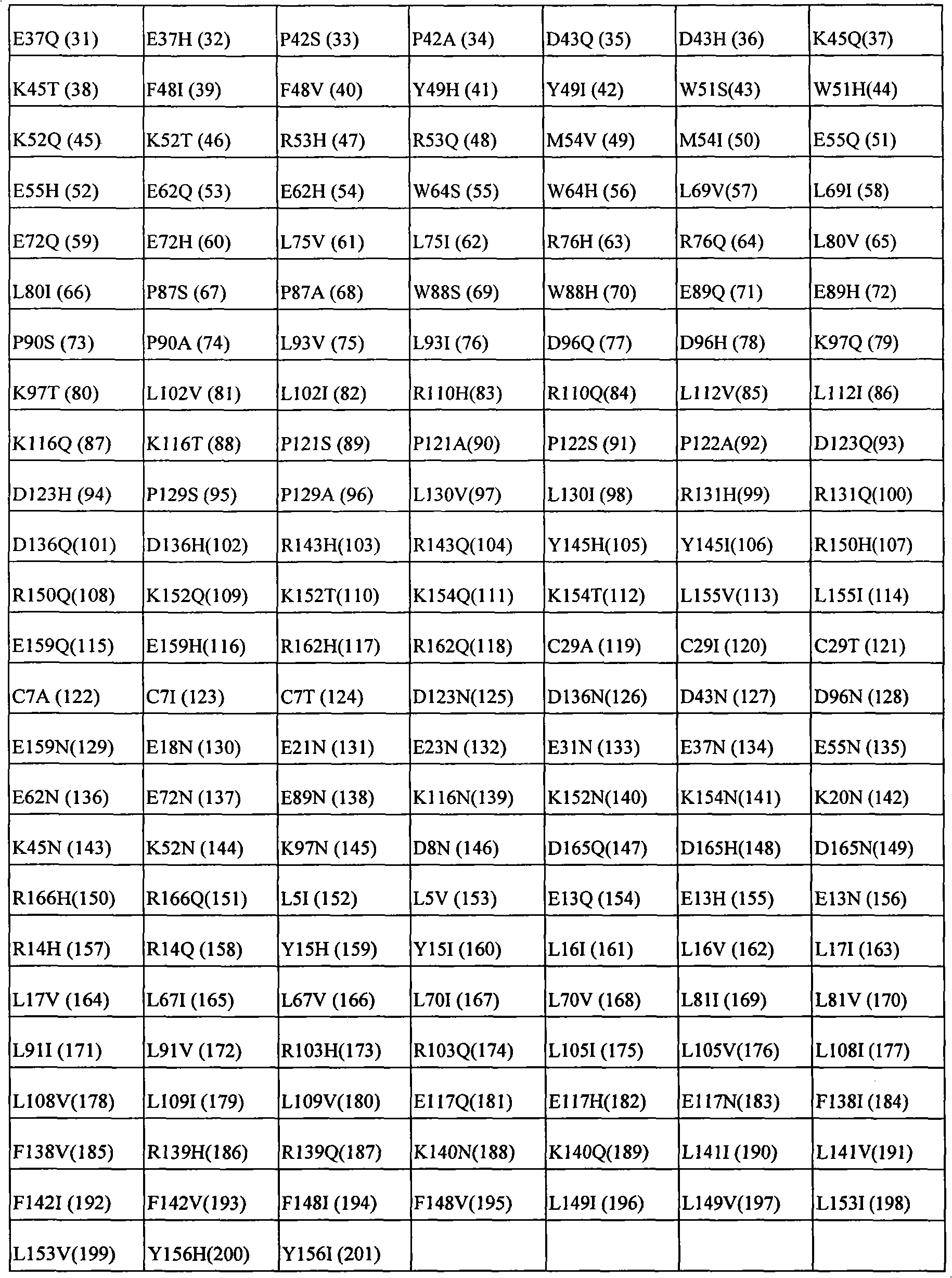
The EPO polypeptide of the modification of the protease resistant that demonstration provided herein increases can contain that one or more is amino acid modified, described modification is corresponding to following arbitrary or a plurality of modification: P2S (promptly replacing P corresponding to the position of the amino acid position 2 that becomes acquaintance EPO (for example SEQ ID NO:2) with S), P2A, P3S, P3A, R4H, R4Q, L5I, L5V, C7S, C7V, C7A, C7I, C7T, D8Q, D8H, D8N, R10H, R10Q, L12V, L12I, E13Q, E13H, E13N, R14H, R14Q, Y15H, Y15I, L16I, L16V, L17I, L17V, E18Q, E18H, E18N, K20Q, K20T, K20N, E21Q, E21H, E21N, E23Q, E23H, E23N, C29S, C29V, C29A, C29I, C29T, E31Q, E31H, E31N, L35V, L35I, E37Q, E37H, E37N, P42S, P42A, D43Q, D43H, D43N, K45Q, K45T, K45N, F48I, F48V, Y49H, Y49I, W51S, W51H, K52Q, K52T, K52N, R53H, R53Q, M54V, M54I, E55Q, E55H, E55N, E62Q, E62H, E62N, W64S, W64H, L67I, L67V, L69V, L69I, L70I, L70V, E72Q, E72H, E72N, L75V, L75I, R76H, R76Q, L80V, L80I, L81I, L81V, P87S, P87A, W88S, W88H, E89Q, E89H, E89N, P90S, P90A, L91I, L91V, L93V, L93I, D96Q, D96H, D96N, K97Q, K97T, K97N, L102V, L102I, R103H, R103Q, L105I, L105V, L108I, L108V, L109I, L109V, R110H, R110Q, L112V, L112I, K116Q, K116T, K116N, E117Q, E117H, E117N, P121S, P121A, P122S, P122A, D123Q, D123H, D123N, P129S, P129A, L130V, L130I, R131H, R131Q, D136Q, D136H, D136N, F138I, F138V, R139H, R139Q, K140N, K140Q, L141I, L141V, F142I, F142V, R143H, R143Q, Y145H, Y145I, F148I, F148V, L149I, L149V, R150H, R150Q, K152Q, K152T, K152N, L153I, L153V, K154Q, K154T, K154N, L155V, L155I, Y156H, Y156I, E159Q, E159H, E159N, R162H, R162Q, D165Q, D165H, D165N, R166H and R166Q, wherein modified polypeptides shows the proteolysis resistance that increases.In certain embodiments, modification is in unmodified EPO polypeptide, as has among the EPO of aminoacid sequence shown in SEQ IDNO:2 or 237.The EPO LEAD candidate polypeptide of modification for example is as shown in SEQ ID NO:3-201 is arbitrary.
In addition, the EPO polypeptide of above-mentioned modification can contain with unmodified EPO polypeptide and compares further modification.Usually, the EPO polypeptide of gained modification keeps one or more activity of unmodified EPO polypeptide.
E. assess EPO variant with proteolysis resistance
The proteolysis resistance of the increase of EPO variant can be assessed with evaluating protein enzyme stability known in the art, heat tolerance, protease sensitivity and resistance and/or the active any method of EPO.In an example, protease resistant is to be incubated with one or more protease by the EPO polypeptide that will modify, assesses the residual activity of comparing with untreated contrast then and measures.The EPO that modifies can with the unmodified of under condition of similarity, handling and/or the wild type natural EPO compare, whether keep more more active to determine specific variants than unmodified EPO.Activity can for example be assessed by the generation of measurement promoting erythrocyte or organization protection's activity with any method assessment known in the art.
The dynamics research of protease resistant also can be used to assess the EPO polypeptide of modification.For example, the EPO polypeptide of modification and the insulation of one or more protease, and at a series of point in time sampling.At each time point, inactivating protein enzyme, the EPO activity of specimen then.In one embodiment, modified polypeptides has proteolysis and at least approximately is or 1%, 2%, 3%, 4%, 5%, 6%, 7%, 8%, 9%, 10%, 20%, 30%, 40%, 50%, 60%, 70%, 80%, 90%, 91%, 92%, 93%, 94%, 95%, 96%, 97%, 98%, 99%, 100%, 200%, 300%, 400%, 500% or more resistance.
In an embodiment of giving an example, with the protease resistant of protease and proteolysis condition mixture assessment EPO variant, it comprises pepsin, trypsin, Chymotrypsin, elastoser, aminopeptidase, gelatinase B, gelatin enzyme A, Chymetin, carboxypeptidase, endoproteinase Arg-C, endoproteinase Asp-N, endoproteinase Glu-C, endoproteinase Lys-C, the inner chamber pepsin, microvillus endopeptidase, dipeptidyl peptidase, erepsin, hydrolytic enzyme, NS3, factor Xa, Cytotoxic cell proteinase-1, thrombin, fibrinolysin, urokinase, tPA and PSA.For example, cell proliferating determining can be used to assess the promoting erythrocyte that the EPO polypeptide of modification compares with unmodified EPO polypeptide and generates active.Especially, the erythrocyte proliferation activity of EPO can be determined by the ability of the EPO polypeptid induction cell proliferation modified in erythrocyte cell proliferating determining such as TF-1 proliferation assay.Comparing the EPO polypeptide of modification can analyze by the EPO polypeptide is mixed with protease the resistance of enzymatic lysis with wild type EPO.After being exposed to protease, can assessing promoting erythrocyte and generate or organization protection's activity.
In one embodiment, the generation of the promoting erythrocyte of the EPO of modification is active in assessing in the mensuration of measuring EPO ability of back adjusting cell proliferation in joining sample of modifying.Before measuring activity, the EPO polypeptide can comprise following condition attack with protease (for example blood, intestinal etc.), i.e. simulation gives condition, measure (being external test) as serum, blood, saliva or digestion, and/or give object such as mice or people's (being to measure in the body), during difference insulation or back frequency injection.The activity of measuring is then corresponding to the residual activity after being exposed to the proteolysis mixture.Activity can be compared with unmodified EPO, as modifying protease stability and measuring active effect.In one embodiment, the EPO of unmodified is the wild type natural EPO.In another embodiment, the EPO of unmodified is used as parent material to import the variant form EPO of further modification.The EPO polypeptide of modifying can also compare with any known EPO polypeptide in any mensuration known in the art, to compare protease sensitivity, heat tolerance and/or any other activity.
2.Super-LEAD
The modification of EPO polypeptide can also comprise combination aforesaid two or multiple modification.The EPO super-LEAD polypeptide of modifying is the combination that is present in the monamino acid sudden change in two or more EPO LEAD polypeptide of modifying separately.Therefore, the EPO super-LEAD polypeptide of modification has the two or more monamino acid displacements derived from two or more EPO LEAD polypeptide of modifying separately.Reach following detailed description as mentioned above, the EPO polypeptide of modification provided herein shows the protein stability that increases, and shows as the proteolysis resistance of increase.Typically, the EPO LEAD polypeptide of the modification that is produced is that character is optimized with respect to the unmodified polypeptide, and described optimization is to be undertaken by carry out monamino acid displacement modification an is-HIT position.The EPO super-LEAD polypeptide of modifying is produced, and described thus polypeptide contains two or more EPO LEAD to be modified, and each is in different is-HIT positions.The modification that increases the proteolysis resistance can join in other modification provided herein or known in the art to increase the proteolysis resistance.In one embodiment, increasing stable modification can join in the modification provided herein or known in the art to increase the proteolysis resistance.The modification that increases protease resistant and/or stability also can join the change function and comprise in the modification of active EPO, influences in any other known modification of modification and this area of post translational protein modification.
In case use 2D scan method for example to differentiate the LEAD polypeptide of modifying, can be by scanning and multiple folded primer extension method makes up two or more LEAD and produce super-LEAD with for example reorganization of well known method, mutation and DNA reorganization or by above-mentioned for example adduction site directed mutagenesis, 3D.
The EPO super-LEAD of the modification of the protein stability that demonstration for example increases can comprise comparing with unmodified EPO polypeptide and contains two or more amino acid modified EPO polypeptide.In certain embodiments, the EPO polypeptide can contain 2,3,4,5, and 6,7,8,9,10,11,12,13,14,15,16,17,18,19,20 or more a plurality of modifications position.Normally, the protein stability that show to increase of gained EPO polypeptide and the activity that keeps at least a unmodified EPO polypeptide.The EPO polypeptide of modifying can comprise shown in the table 3 any two or several amino acids modify.For example, the EPO polypeptide of modification can contain corresponding to two or the several amino acids modification that is selected from following any two or multiple modification: the P2S of the ripe EPO polypeptide shown in the SEQ ID NO:2, P2A, P3S, P3A, R4H, R4Q, L5I, L5V, C7S, C7V, C7A, C7I, C7T, D8Q, D8H, D8N, R10H, R10Q, L12V, L12I, E13Q, E13H, E13N, R14H, R14Q, Y15H, Y15I, L16I, L16V, L17I, L17V, E18Q, E18H, E18N, K20Q, K20T, K20N, E21Q, E21H, E21N, E23Q, E23H, E23N, C29S, C29V, C29A, C29I, C29T, E31Q, E31H, E31N, L35V, L35I, E37Q, E37H, E37N, P42S, P42A, D43Q, D43H, D43N, K45Q, K45T, K45N, F48I, F48V, Y49H, Y49I, W51S, W51H, K52Q, K52T, K52N, R53H, R53Q, M54V, M54I, E55Q, E55H, E55N, E62Q, E62H, E62N, W64S, W64H, L67I, L67V, L69V, L69I, L70I, L70V, E72Q, E72H, E72N, L75V, L75I, R76H, R76Q, L80V, L80I, L81I, L81V, P87S, P87A, W88S, W88H, E89Q, E89H, E89N, P90S, P90A, L91I, L91V, L93V, L93I, D96Q, D96H, D96N, K97Q, K97T, K97N, L102V, L102I, R103H, R103Q, L105I, L105V, L108I, L108V, L109I, L109V, R110H, R110Q, L112V, L112I, K116Q, K116T, K116N, E117Q, E117H, E117N, P121S, P121A, P122S, P122A, D123Q, D123H, D123N, P129S, P129A, L130V, L130I, R131H, R131Q, D136Q, D136H, D136N, F138I, F138V, R139H, R139Q, K140N, K140Q, L141I, L141V, F142I, F142V, R143H, R143Q, Y145H, Y145I, F148I, F148V, L149I, L149V, R150H, R150Q, K152Q, K152T, K152N, L153I, L153V, K154Q, K154T, K154N, L155V, L155I, Y156H, Y156I, E159Q, E159H, E159N, R162H, R162Q, D165Q, D165H, D165N, R166H and R166Q.In certain embodiments, modification is in the unmodified EPO of the aminoacid sequence with SEQ ID NO:237 polypeptide.
The EPO polypeptide that contains the modification provided herein of modifying more than for example includes but not limited to R139H/R4H, R139H/L93I, R139H/K20Q, R139H/E159N, R139H/K52N, R139H/L153V, R139H/L93V, R139H/L80I, R139H/L93I, K20Q/L80I/R139H, K20Q/L93I/R139H, K20Q/L93V/R139H, R4H/K20Q/R139H/L80I, E159N/K20Q/R139H/L93I, K20Q/R139H/L153V, L153V/K20Q/R139H/L80I and E159N/K20Q/R139H/L80I.
3. other EPO modifies
Except as herein described arbitrary or a plurality of amino acid modified, the EPO that modifies also can contain one or more other modification, comprise those modifications well known by persons skilled in the art, include but not limited to PEGization, super glycosylation, go immunization and other (referring to for example United States Patent (USP) 5,856,298 U.S. Patent Publication No. 2003-0120045,2004-0063917,2005-0220800,2005-0107591,2006-0035322 and 2006-0073563; And International PCT publication number WO 01/81405).Usually, modify at least a activity that causes the stability that increases and do not lose the EPO polypeptide of unmodified, generate or organization protection's activity (promptly keeping at least a activity as herein described) as promoting erythrocyte.For example, other in the EPO polypeptide are further modified and are comprised amino acid modified and/or one or more chemical modification that one or more is other.This modification includes but not limited to change the modification of any other known properties of immunogenicity, glycosylation, activity or EPO.In another embodiment, chemical modification comprises proteinic post translational modification, for example, and the glycosylation that partly causes by carbohydrate; acyl groupization (for example acetylation or succinylation) methylates phosphorylation; hasylation, carbamylation, sulphation; isoprenylation, oxidation, guanidine radicalsization; amidineization, carbamylation (being carbamoylation), trinitrophenylization; nitrated, PEGization, or its combination.In addition, protein modification also can comprise the modification of the detection, purification and the mensuration exploitation that promote polypeptide, for example, so that primary amine is attached on the protein, perhaps be used for other similar modification of fluorescence, heterotope or radioactivity with Sulfo-NHS-LC-biotin modification polypeptide.Further modification in the EPO polypeptide for example is as described below.Also provide and puted together and/or the modified polypeptide of labelling.For example, this paper provides modified polypeptide, and it is puted together in peg moiety, or contain with polypeptide on the covalently bound carbohydrate part of one or more glycosylation site.
In another embodiment, except provided herein arbitrary or a plurality of amino acid modified, other known properties of EPO polypeptide can also be modified.This modification includes but not limited to that the promoting erythrocyte that changes the EPO polypeptide generates or organization protection's activity.Can be with one or more parameter of the modification EPO polypeptide of any mensuration test gained as herein described with assessment polypeptide character, as protein stability (for example protease resistant of Zeng Jiaing), perhaps polypeptide active is as promoting erythrocyte generation or organization protection's activity.
A. immunogenicity
There are many situations, wherein treat proteinic effect by proteinicly not wishing immunoreation and limit to treating.The immunne response of treatment protein such as EPO is presented approach through MHC II class peptide carries out.At this, exogenous proteins is swallowed up and is processed with relevant with DR, DQ or DP type MHC II quasi-molecule and present.MHC II quasi-molecule by full-time antigen-presenting cell (APC) as expression such as macrophage and dendritic cell.The state of activation of related TXi Baoshouti on the T cell surface in the engagement (engagement) of MHC II class peptide complexes and some other co-receptors such as CD4 molecule can inducing T cells.Activation causes discharging cytokine, further activates other lymphocyte such as B cell producing antibody or activation T killer cell, with as complete cellullar immunologic response.
Peptide (t cell epitope) depends on multiple factor in conjunction with given MHC II quasi-molecule with the ability of presenting on the APC surface, be apparent that its primary sequence most.This can influence its to the tendency of proteolysis with and the peptide that is combined in MHC II quasi-molecule in conjunction with the affinity in the crack.The lip-deep MHC II of APC class/peptide complexes provides mating surface to specific TXi Baoshouti (TCR), the described determinant that provided by the exposed residue of peptide and MHC II quasi-molecule by physical ability identification.
Formation to the inhibition antibody of therapeutic EPO polypeptide is known in the art (referring to for example Casadevall et al. (2002) N.Engl.J.Med.346:469-475; Macdougall (2004) Curr.Med.Res.Opin.20:83-86; Verhelst et al. (2004) Lancet 363:1768-1771; Locatelli and Del Vecchio (2003) J.Nephrol.16:461-466).Therefore, can improve the therapeutic properties of EPO polypeptide after the EPO polypeptide of modification provided herein makes up with the whole immunogenic modification that reduces the EPO polypeptide of modifying.The discriminating of t cell epitope can be carried out according to means known in the art (referring to for example U.S. Patent Publication No. 2004-0063917,2005-0220800,2006-0035322 and 2006-0073563) and can be used to differentiate the tendency that combines of EPO peptide and MHC II quasi-molecule.
Can comprise the modification of at least one amino acid residue to the further modification of the EPO polypeptide of modification provided herein, it causes protein active to reduce greatly or eliminates one or more t cell epitope from protein, and promptly polypeptide goes immunization.Join in any MHC II class that one or more of intravital ad-hoc location is amino acid modified can to produce immunization EPO polypeptide, when it gave host such as human host as therapeutic agent, its immunogenicity reduced.
Being used for t cell epitope modifies the amino acid position of giving an example that removes immunization EPO polypeptide of the immunogenicity potentiality obtain having reduction thus and is included in amino acid modified corresponding to one or more position of following arbitrary position: the R4 of the ripe EPO polypeptide shown in the SEQ ID NO:2 or 237, L5, I6, D8, S9, R10, V11, L12, E13, R14, Y15, L16, L17, E18, A19, K20, E21, A22, E23, N24, I25, T27, G28, A30, C33, L35, N38, I39, T40, V41, D43, V46, F48, Y49, W51, K52, R53, M54A, M54C, M54D, M54E, M54G, M54, E55, V56, G57, Q58, Q59, A60, V61, E62, V63, W64, Q65, G66, L67, A68, L69P, L70, S71, E72, A73Q, A73, V74, L75, R76, G77, A79, L80, L81, V82, W88, E89, L91, Q92, L93, H94, V95, D96, K97, A98, V99, S 100, G101, L102, R103, S 104, L105, T107, L108, L109, R110, L112, G113, A114, Q115, K116, E117, A118, A118K, I119, S120, A124, A125, A127, L130, I133, A135, D136, F138, R139, K140, L141, F142, R143, V144, Y145, S146, N147, F148, L149, R150, G151, K152, L153E, K154, L155, Y156, T157, G158, E159, A160, C161, R162, T163 and G164.
Can comprise arbitrary or a plurality of amino acid modified corresponding to arbitrary or a plurality of modifications of table 4 to contributive give an example amino acid modified of the immunogenicity of the reduction of EPO polypeptide, the modification of table 4 is corresponding to the amino acid position of the ripe EPO polypeptide shown in SEQ ID NO:2 or 237.
Table 4

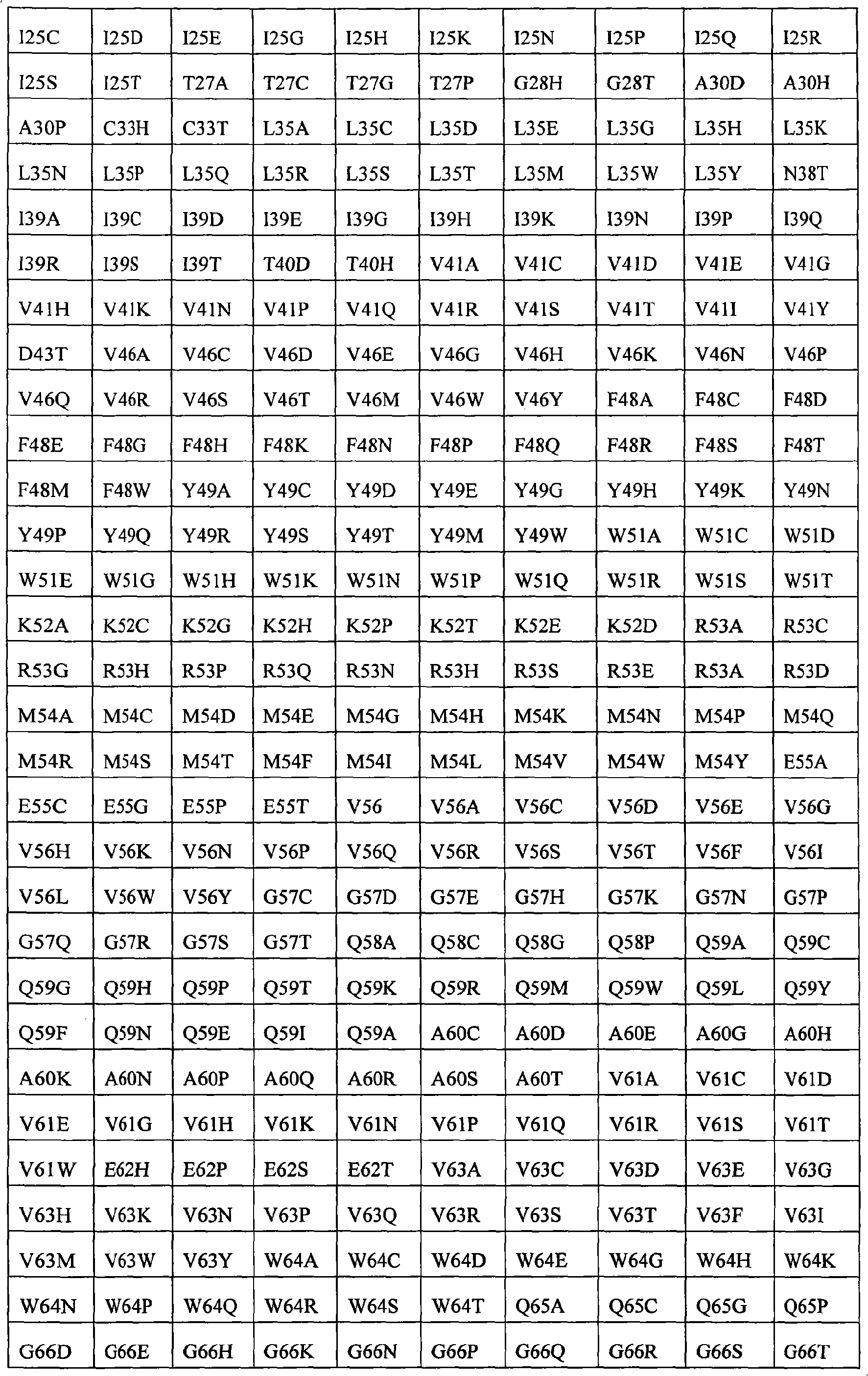
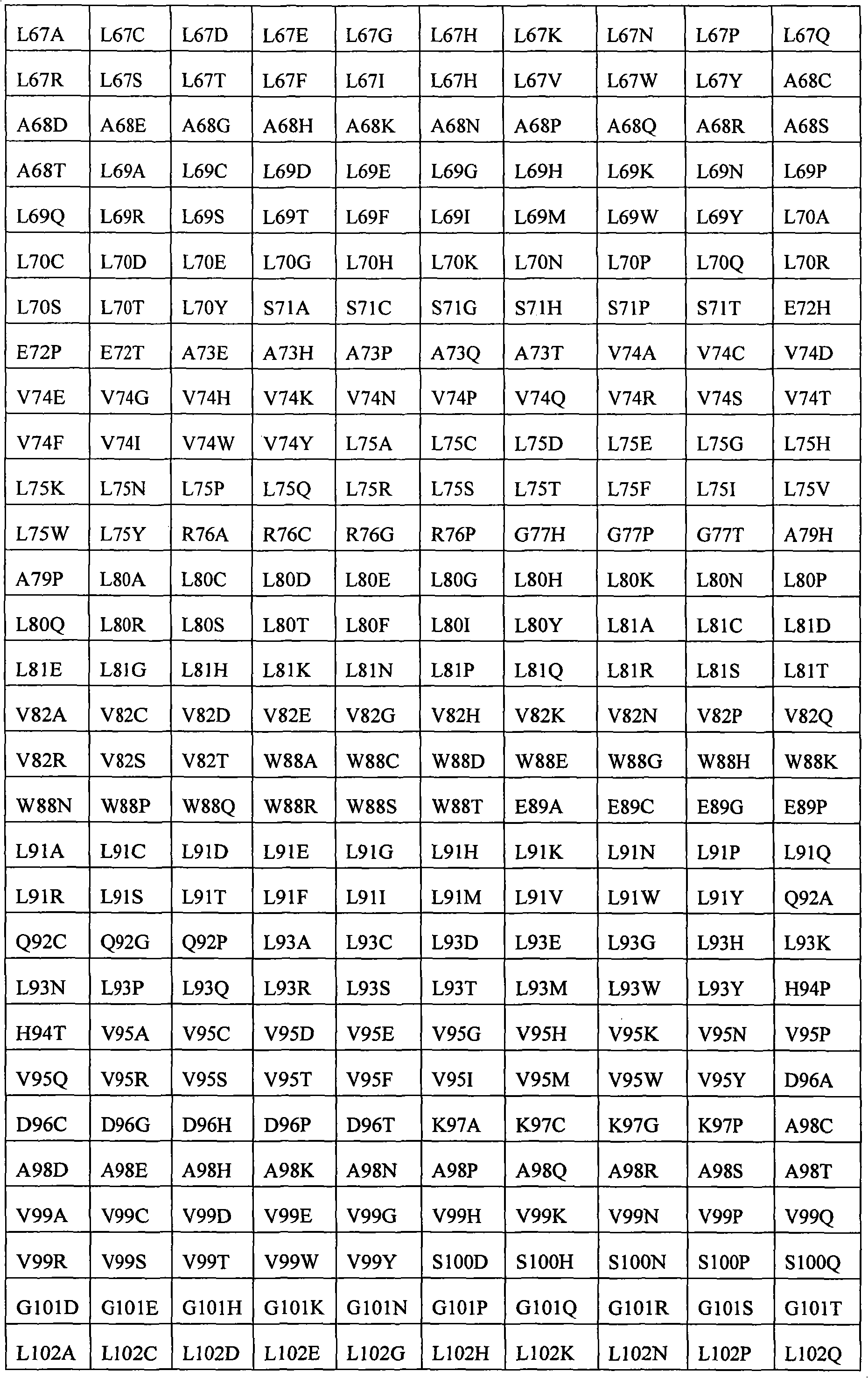

B. glycosylation
Many protein with therapeutic activity contain one or more glycosylation site, promptly by the glycosylated aminoacid sequence of eukaryotic cell.Treating proteinic degree of glycosylation can be changed to realize 1) immunogenicity that reduces; 2) the protein administration frequency reduces; 3) protein stability of Zeng Jiaing is as the serum half life of increase; With 4) disadvantageous side effect such as inflammation reduce.Glycosylation site provides and has been used for the carbohydrate part attached to the site on the polypeptide, and when described polypeptide produced in the glycosylated eukaryotic cell of energy, described polypeptide was by glycosylation thus.One or more advantage is given in the further glycosylation of EPO polypeptide, comprises the serum half life of increase; The immunogenicity that reduces; Half life in the function gonosome that increases; The degraded that reduces by gastrointestinal tract condition such as gastrointestinal tract protease; And the speed that is absorbed by intestinal epithelial cell that increases.It is important that the degraded by the gastrointestinal tract condition of speed that is absorbed by intestinal epithelial cell that increases and reduction is filled a prescription for the intestinal (for example oral) of EPO polypeptide.
Glycosylation can be by increasing proteinic stability, dissolubility and reducing the serum half life that immunogenicity increases polypeptide.Glycosylation can by reduce proteinic proteolysis increase protein stability and can protected protein confrontation heat resistanceheat resistant degraded, be exposed to that damage and pH change due to denaturant, the oxygen-derived free radicals.Glycosylation can also make target protein escape purge mechanism, and it can relate to and is bonded to other protein and comprises cell surface receptor.Contain sialic carbohydrate part and can influence proteinic dissolubility.Sialic acid partly is highly hydrophilic and can the proteic hydrophobic residue of shielded target.This has reduced the gathering and the precipitation of target protein.The gathering that reduces also helps to prevent the immunne response at target protein.Carbohydrate can be shielded from the immunogenicity sequence outside the immune system in addition.The spatial volume that is partly occupied by carbohydrate can reduce the surface area that can supply immune system to check.These character cause the immunogenic reduction of target protein.
Proteinic glycosylation causes forming glycoprotein owing to oligosaccharide is covalently attached to polypeptide.The carbohydrate modification of finding in glycoprotein is connected through O-glycosides key or N-glycosidic bond with protein component.It is through the N-glycosidic bond that main carbohydrate in the mammalian cell glycoprotein adheres to.The N-glycosidic bond is that the nitrogen through the amide group of agedoite carries out.Carbohydrate is attached to the site of N-connection glycoprotein and finds to be arranged in consensus amino acid sequences N-X-S/T, and wherein X is the arbitrary amino acid except that proline.Connect in the glycosylation at N-, directly being attached to proteinic carbohydrate is 14 residue oligosaccharide N-acetyl-glucosamines (GlcNAc).Glycosyl transferase changes the oligosaccharide that adheres to subsequently to form ripe N-polysaccharide.N-connects oligosaccharide and contains mannose, N-acetyl-glucosamine, and typically have some carbohydrates branch, each branches end is electronegative sialic acid residues.Secondary protein structure can influence the utilizability of total site as the glycosylation target.Because glycosylation is known is that the height cell is dependent, and connecting the relevant sugar chain of glycosylation with proteinic N-can different (Kagawa et al., (1988) JBC 263:17508-17515).The O-glycosides key is the hydroxyl that is connected in serine, threonine or oxylysine.Connect in the glycoprotein at Ser or Thr type O-, directly being attached to proteinic carbohydrate is monosaccharide, as N-acetylgalactosamine (GalNac) or galactose.Glycosyl transferase partly is attached to other carbohydrate the residue of modification subsequently to form ripe O-polysaccharide, and its typical case is contained 1-4 saccharide residue.O-connects glycosylation typically to be taken place as the site that the corner that prolongs limits by secondary protein structure.Many O-known in the art connect glycosylation site and report in the literature, referring to for example Ten Hagen et al. (1999) J.Biol.Chem., 274:27867-74; Hanisch et al. (2001) Glycobiology, 11:731-740; And Ten Hagen et al., (2003) Glycobiology, 13:1R-16R.
The EPO polypeptide of modification provided herein can be compared with unmodified EPO polypeptide further by glycosylation (promptly super glycosylation), promptly, the carbohydrate part is covalently bound at least one non-natural glycosylation site of not finding in unmodified EPO polypeptide, perhaps the carbohydrate part covalently bound at least one in unmodified EPO polypeptide, find but not glycosylated Natively glycosylated site.The EPO polypeptide can be modified to influence the glycosylation of polypeptide in one or more position.Super glycosylation EPO polypeptide can comprise that O-connects glycosylation, N-connects glycosylation and/or its combination.In certain embodiments, super glycosylation EPO polypeptide can comprise 1,2,3,4,5 or more a plurality of carbohydrate part, and each is connected to the different glycosylation site.Described glycosylation site can be Natively glycosylated site.In other embodiments, super glycosylated polypeptides can be in the glycosylation of single non-natural glycosylation site.In other embodiments, super glycosylated polypeptides can be in the glycosylation of an above non-natural glycosylation site, and for example, described super glycosylation EPO polypeptide can be 1,2,3,4,5 or the glycosylation of more a plurality of non-natural glycosylation site.Glycosylation site in the EPO polypeptide can be produced, be changed, be eliminated or be reset.For example, Natively glycosylated site can be modified preventing glycosylation or promotion or to reduce glycosylation, and other position in the EPO polypeptide can be modified to produce new glycosylation site or promotion or to reduce the glycosylation in existing site.In certain embodiments, the carbohydrate content of EPO polypeptide can be modified.For example, the carbohydrate that joins the EPO polypeptide position number, bond strength, structure and the composition that connect the key glycosidic bond character or the ramose carbohydrate structure of carbohydrate (promptly based on) can be changed.This character is at different known recombinant erythropoietins such as epoetin-α, and epoetin-β is between epoetin-ω and the epoetin-δ and be different between the Urina Hominis erythropoietin.In one embodiment, the number of the sialic acid of the EPO polypeptide of modification provided herein part is modified.
The carbohydrate content of EPO polypeptide provided herein comprises that the variation in the sialic acid content can produce by any method known in the art, includes but not limited to modification, enzymatic or the chemical modification of EPO polypeptide primary sequence, produces the purification process that has the EPO polypeptide of special glycosylation spectrum with the difference that produces glycosylation pattern and enrichment in the host cell of different host cells or modification.These methods are known in the art, and comprise for example Application No. 2004-0137557,2005-0153879,2005-0181359,2005-0192211,2005-0288220, the EPO polypeptide of the modification of describing among 2006-0088906 and the 2006-0121611.In addition, the growth conditions (for example culture medium composition) of the EPO polypeptide of host cell expression modification can be changed so that the variation in glycosylation, the particularly sialic acid content (referring to for example Application No. 2004-0115768) to be provided.
The commercial product that contains the EPO polypeptide is developed, and they are different in the glycosylation of EPO polypeptide, and for example glycosylation site number of variations or glycosylation pattern or the carbohydrate content that is attached to the EPO polypeptide change.For example
(Amgen) be the alpha-glycosyl form that produces in Chinese hamster ovary celI, have 22 sialic acides, molecular weight is 30400Da;
 (or
(or
 Roche) be the EPO of β-glycosylation form of producing in Chinese hamster ovary celI, it has higher molecular weight and lower sialylated polysaccharide residue number;
 (Elanex), or epoetin-ω, in bhk cell, produce, have the 35kDa molecular weight, be different from α and beta form aspect glycosylation, the particularly different sialylated amount.
In some cases, super glycosylation EPO polypeptide is in the glycosylation of Natively glycosylated site.For example, EPO contains at the N-of N24, N38 and N83 as the people EPO of aminoacid sequence with SEQ ID NO:2 or 237 and is connected glycosylation site and connects glycosylation site (at the ripe EPO polypeptide shown in SEQ ID NO:2 or 237) at the O-of S126.The EPO polypeptide can be in single Natively glycosylated site glycosylation, perhaps in Natively glycosylated site more than, for example 1,2,3,4,5 or more a plurality of Natively glycosylated site glycosylation.Super glycosylation EPO polypeptide also can be in a Natively glycosylated site and the glycosylation of a non-natural glycosylation site.Super glycosylation EPO polypeptide can also be in a plurality of natural and non-natural glycosylation site glycosylations.
When synthesizing in the eukaryotic cell that can carry out N-connection and/or O-connection protein glycosylation, the EPO polypeptide of modification provided herein can have at least one undiscovered other carbohydrate part in unmodified EPO polypeptide.For example, compare with the EPO polypeptide of unmodified, super glycosylation modified EPO polypeptide can have at least 1, at least 2, at least 3, at least 4, at least 5, at least 6, at least 7, at least 8, at least 9, at least 10 or more a plurality of other carbohydrate part.For example, when unmodified EPO polypeptide had a covalently bound carbohydrate part, super glycosylation EPO polypeptide can have 2,3,4,5,6,7,8,9,10 or more a plurality of covalently bound carbohydrate part.In certain embodiments, the super glycosylation EPO polypeptide of the EPO polypeptide of modification provided herein lacks the carbohydrate part covalently bound with the non-natural glycosylation site, but has the other carbohydrate part that at least 1, at least 2, at least 3, at least 4, at least 5, at least 6, at least 7, at least 8, at least 9, at least 10 or more a plurality of and Natively glycosylated site are adhered to.In other embodiments, super glycosylation EPO polypeptide lacks the carbohydrate part covalently bound with Natively glycosylated site, but has at least 2, at least 3, at least 4, at least 5, at least 6, at least 7, at least 8, at least 9, at least 10 or carbohydrate part more a plurality of and that the non-natural glycosylation site adheres to.
The amino acid position of giving an example that this paper comprises is used to modify glycosylation site, be used to adhere to the carbohydrate part comprises the position corresponding to natural place, described natural place is the N24 of the ripe EPO polypeptide shown in the SEQ ID NO:2 or 237 for example, N38, N83 and S126.In certain embodiments, the EPO polypeptide of modification has one or more modification, and it has eliminated one, two, three or four Natively glycosylated sites or whole glycosylation site.Can be modified with prevent glycosylation, produce new glycosylation site, enhancing or the amino acid replacement that reduces existing site glycosylation or its combination be known in the art.For example, amino acid modifiedly comprise in the following non-limitative example one or more: the N38H/R139H of the ripe EPO polypeptide shown in the SEQ IDNO:2 or 237, N38H/R139H/R4H, N38H/R139H/L93I, N38H/R139H/K20Q, N38H/R139H/E159N, N38H/R139H/K52N, N38H/R139H/L153V, N38H/N83H/R139H, K20Q/N38H/N83H/R139H, N38H/N83H/R139H/L93V, N38H/N83H/R139H/L80I, N38H/N83H/R139H/L93I, K20Q/N38H/L80I/N83H/R139H, K20Q/N38H/N83H/L93I/R139H, K20Q/N38H/N83H/L93V/R139H, N24H/N38H/N83H/R139H/L80I, N24H/N38H/N83H/R139H/L93I, N24H/N38H/N83H/R139H/L93V, K20Q/N24H/N38H/N83H/R139H/L80I, K20Q/N24H/N38H/N83H/R139H/L93I, K20Q/N24H/N38H/N83H/R139H/L93V, R4H/K20Q/N24H/N38H/N83H/R139H/L80I, E159N/K20Q/N24H/N38H/N83H/R139H/L93I, K20Q/N24H/N38H/N83H/R139H/L153V, L153V/K20Q/N24H/N38H/N83H/R139H/L80I, E159N/K20Q/N24H/N38H/N83H/R139H/L80I, A30N, W51N, G57N, L69N, W88N, E89N, D136N, F138N, K52N/M54T, R53N/E55T, A30N/H32T/P87V/W88N/P90T, A30N/H32T/P87V/W88N/P90T/A125T, A30N/H32T/R53N/E55T/P87V/W88N/P90T, E55N/G57T, Q86N/P87V/W88T, P87A/W88N/P90T, P87V/W88N/P90S, P87V/W88N/E89G/P90T, A30N/H32T/R53N/E55T, A114N/K116T, A30N/H32T/A114N/K116T, A30N/H32T/R53N/E55T/P87V/W88N/P90T/A114N/K116T, A30N/H32T/E55N/G57T, A30N/H32T/E55N/G57T/P87V/W88N/P90T, A30N/H32T/E55N/G57T/A114N/K116T, A30N/H32T/P87V/W88N/P90T/A114N/K116T, A30N/H32T/E55N/G57T/P87V/W88N/P90T/A114N/K116T, A30N/H32T/E55N/G57T/P87V/W88N/P90T/A124P/A125T/S126T, A30N/H32T/E55N/G57T/A114N/K116T/A124P/A125T/S126T, R4N/I6S, S9N/V11S, L69N, A124N, A125N/A127S, T163N/D165S, A125T, A125T/A124P, L69N/S71T, L69N/A68S/S71T, A125N/A127T, A125N/A127T/R131T, A125N/A124P/A127S, A125N/A124P/A127T, A125T/S126T, A125T/A124P/S126T/R131S, A30N/H32T, A30N/H32T/P87V/W88N/P90T, W51N/R53T, P87V/W88N/P90T, P87S/W88N/P90T, P87S/W88N/E89G/P90T, P87S/W88N/P90T/Q92T, P87S/W88N/P90T/R162A, L69N/S71T/P87S/W88N/P90T, L69N/S71T/P87V/W88N/P90T, E89N/P90I/L91T, P87S/E89N/P90I/L91T, D136N/F138T, F138N/K140T, A125T, A124P/A125T, N24Q/P87S/W88N/P90T, N38Q/P87S/W88N/P90T, N83Q/P87S/W88N/P90T is (referring to for example United States Patent (USP) 5,856,298, U.S. Patent Publication No. 2003-0120045; International Patent Publication No. EP 0640619).In certain embodiments, the amino acid modified N38 of Natively glycosylated site such as ripe EPO that comprises relocates to another site, as W51, and G57, L69, W88, E89, D136 or F138 (referring to for example PCT Pub.No.WO 01/81405).In a particular, be by agedoite (N) or Soviet Union's aminoacid (T) replacement amino acid to the contributive amino acid replacement of super glycosylation of the EPO polypeptide modified.In another particular, amino acid modified one or more of following modification of being selected from: A30N/H32T and P87V/W88N/P90T (Elliot et al. (2004) J.Biol.Chem.279 (16): 16854-16862; Elliott et al. (2003) Nat.Biotechnol.21:414-421.).Any modification provided herein can be made up with any modification that produces super glycosylation erythropoietin analog.A non-limiting super glycosylation erythropoietin analog is new erythropoiesis stimulating protein (NESP), and it contains amino acid modified A30N, H32T, and P87V, W88N, P90T (referring to for example PCT publication WO00/24893, can
 (Amgen Inc) obtains).
The EPO polypeptide whether has the N-connection and/or O-connection glycosylation can easily be determined with standard technique, standard technique for example (is for example seen " Techniques in Glycobiology " R.Townsend and A.Hotchkiss, eds. (1997) Marcel Dekker for enzyme processing, electrophoretic analysis, isoelectrofocusing and immunohistochemistry; " Glycoanalysis Protocols (Methods in Molecular Biology, Vol.76) " E.Hounsell, ed. (1998) Humana Press.Protein handle with chemistry or enzymatic deglycosylation (for example handling) with endoglycosidase and/or exoglycosidase before and the variation in the electrophoretic mobility afterwards be used for definite proteinic glycosylation state routinely.The enzymatic deglycosylation can be carried out with various enzymes, includes but not limited to peptide-N4-(N-acetyl-β-D-glucose amido) aspartic acid amide enzyme (PNGase F); Endoglycosidase F1, endoglycosidase F2, endoglycosidase F3, α (2 → 3,6,8,9) neuraminidase etc.For example, use PNGaseF proteinic sodium dodecyl sulfate-polyacrylamide gel electrophoresis (SDS-PAGE) pretreated or that do not handle to analyze with PNGaseF.The variation of the remarkable reduction of bandwidth and migration position is considered to N-and connects glycosylated diagnostic characteristic after handling with PNGaseF.The carbohydrate content of glycosylated protein also can be with the agglutinin analyzing and testing of protein spot (for example with SDS-PAGE isolating and be transferred to protein on holder such as the nylon membrane).Agglutinin is conjugated protein from the carbohydrate of various plant tissues, has high-affinity and narrow specificity (Cummings (1994) Methods in Enzymol.230:66-86) at the sugared epi-position of finding on the glycoprotein polysaccharide widely of determining.Agglutinin can be able to be detected ground mark (directly or indirectly labelling), makes to detect combining of carbohydrate on agglutinin and the glycosylated protein.For example, when puting together with biotin or digoxin, the agglutinin that is bonded to glycosylated protein can be by using the avidin puted together with enzyme such as alkali phosphatase, beta galactosidase, luciferase or horseradish peroxidase or anti digoxin antibody reaction can detect product with generation and easily being differentiated on the film trace.Provide the considerable information of replenishing with one group of specific agglutinin screening about the glycoprotein carbohydrate with good qualification.
As indicated above, developed glycosylation or super glycosylated EPO polypeptide, comprise commercial glycosylation or super glycosylated recombinant forms EPO.Find that this glycosylation form compares with nonglycosylated EPO polypeptide and have higher proliferation activity in vivo, be likely owing to (see for example Lukowsky and Painter (1972) Can.J.Biochem.60:909-917 due to the quick removing of non-glycosylated form; Goldwasser et al. (1974) J.Biol.Chem.249,4202-4206; Sasaki (1987) Methods Enzymol.147:328-340; Goto et al. (1988) Bio/technology 6:67-71).Yet, though the EPO polypeptide of some forms of low glycosylation or sugar basedization presents lower in vivo proliferation activity, but also have report to compare with the EPO of wild type glycosylation EPO and other glycosylation form, it has higher proliferation activity and (sees for example Yamaguchi et al. (1991) 266 (30): 20434-20439) with stronger the combining of EPO polypeptide in external test.Therefore, can select expression system (for example antibacterial or various mammalian cell such as CHO or BHK) to express the EPO polypeptide of modification provided herein, depend on the EPO polypeptide of application and produce the EPO glycosylation or the sugar basedization of specified level.The EPO polypeptide of the modification of non-glycosylated form can be used as the active contrast of EPO and for example is used in particular in the external test, to detect EPO acceptor density, the mensuration that perhaps is used for screening the EPO inhibitor.
C. other modification
The other modification of polypeptide provided herein comprises the chemical derivatization of polypeptide, includes but not limited to acetylation and carboxylation; Change in the aminoacid sequence makes protein for PEGization or other character of modifying susceptible or changing the EPO polypeptide.The present invention also relates to be used to modify the relevant portion of EPO polypeptide, include but not limited to copolymer, carboxymethyl cellulose, glucosan, polyvinyl alcohol, polyvinylpyrrolidone or polyproline (the Abuchowski et al. (1981) of Polyethylene Glycol and polypropylene glycol; Newmark et al. (1982); Katre et al. (1987)).The EPO polypeptide of modification provided herein can be modified (PEGization) with one or more polyalkylene glycol moiety.Activatory PEG derivant can be used for and EPO polypeptide direct interaction, and comprise the active ester or the carbonic acid ester derivative of carboxylic acid, particularly wherein leaving group is those materials of N-hydroxy-succinamide, p-nitrophenols, imidazoles or 1-hydroxyl-2-Nitrobenzol-4-sulphonic acid ester.The PEG derivant that contains dimaleoyl imino or halo acetyl group can be used for modifying mercapto groups, and the PEG reagent that contains hydrazine or hydrazides group can be used for modifying the aldehyde that the periodate oxidation of carbonic acid group produces.In some cases, the EPO polypeptide of modification provided herein can contain the site that PEGization takes place one or more non-natural, and PEG derivatization polypeptide to provide the serum clearance rate to reduce is provided for it.The amino acid modified A1C that includes but not limited to ripe EPO polypeptide of generation PEGization for example, P2C, P3C, R4C, D8C, S9C, N24C, I25C, T26C, T27C, G28C, A30C, E31C, H32C, S34C, N36C, N38C, I39C, T40C, D43C, T44C, K45C, N47C, A50C, K52C, E55C, G57C, Q58C, G77C, Q78C, A79C, N83C, S84C, S85C, Q86C, W88C, E89C, T107C, R110C, A111C, G113C, A114C, Q115C, K116C, E117C, A118C, S120C, P121C, P122C, D123C, A124C, A125C, A127C, A128C, T132C, K154C, T157C, G158C, E159C, A160C, T163C, G164C and D165C (seeing for example U.S. Patent Publication No. 2005-0107591 and international monopoly publication No.WO 90/12874).In addition, can add the N-terminal cysteine at the EPO polypeptide and be used for the free mercaptan group that group adheres to, as peg moiety (seeing for example U.S. Patent Publication No. 2005-0170457) with generation.
The invention still further relates to the EPO peptide sequence of modification, it has the phosphorylated amino acid residue, for example phosphono tyrosine, phosphoserine or phosphothreonine (seeing for example U.S. Patent No. 6,335,176).
Other suitable other modification of the EPO polypeptide of modification provided herein is such polypeptide, and it by using common chemical technology to modify to improve its proteolysis resistance, to optimize solubility properties, perhaps makes it be more suitable for as therapeutic agent.For example, the main chain of described peptide can cyclisation with enhanced stability (seeing for example Friedler et al. (2000) J.Biol.Chem.275:23783-23789).The EPO polypeptide that another modification of giving an example is included in modification provided herein adds hydroxyalkyl starch (HAS) part.The hasylation method of EPO polypeptide for example is known in the art, and is for example describing among the U.S. Patent application No.2006-0019877.Another modification of giving an example comprises the N-terminal aminoacid of the EPO polypeptide of modification provided herein or the carbamylation of primary amine.The method to EPO polypeptide carbamylation for example is known in the art, and is for example describing among the U.S. Patent application No.2006-0135754.
In the EPO of modification provided herein polypeptide, can mix alpha-non-natural amino acid.Alpha-non-natural amino acid also can be incorporated in the site of this paper discriminating to increase protease resistant.Can use analog, it comprises the residue except the L-aminoacid of natural generation, for example the synthesizing amino acid of D-aminoacid or non-natural generation.The synthesizing amino acid that non-natural for example takes place includes but not limited to the non-natural analog of tyrosine; The non-natural analog of glutamine; The non-natural analog of phenylalanine; The non-natural analog of serine; The non-natural analog of threonine; Alkyl, aryl, acyl group, azido, cyano group, halo, hydrazine, hydrazides, hydroxyl, thiazolinyl, alkynyl, ether, mercaptan, sulfonyl, seleno, ester, thio-acid, borate, phosphate, phosphono, phosphine, heterocycle, enone, imines, aldehyde, azanol, ketone group or the amino aminoacid that replaces, perhaps its combination in any; But aminoacid with photosensitization cross-linking agent; The aminoacid of spin labeling; Fluorescence aminoacid; Aminoacid with non-natural functional group; With the covalently or non-covalently interactional aminoacid of another molecule; Melts combine aminoacid; The aminoacid that contains metal; Radioactivity aminoacid; Light sensation (photocaged) but and/or light isomerization (photoisomerizable) aminoacid; The aminoacid that contains biotin or biotin analog; The aminoacid of glycosylation or carbohydrate modification; The aminoacid that comprises Polyethylene Glycol or polyester; The aminoacid that heavy atom replaces; But but aminoacid chemical cracking or photodestruciton; Aminoacid with side chain of prolongation; The aminoacid that contains toxophore; Sugar-substituted aminoacid, for example sugar-substituted serine etc.; The aminoacid that contains the sugar of carbon connection; Redox active amino acids; Contain alpha-hydroxy aminoacid; Amino thio acid containing amino acid; α, α-disubstituted aminoacid; Beta-amino acids; And the annular aminoacid except proline.For example; alpha-non-natural amino acid can be but be not limited to be O-methyl-L-tyrosine; L-3-(2-naphthyl) alanine; the 3-methylphenylalanine; O-4-pi-allyl-L-tyrosine; 4-propyl group-L-tyrosine; three-O-acetyl group-GlcNAc β-serine; L-Dopa; fluoridize phenylalanine; isopropyl-L-phenylalanine; p-azido-L-phenylalanine; p-acyl group-L-phenylalanine; p-benzoyl-L-phenylalanine; the L-phosphoserine; the phosphono serine; phosphono tyrosine; p-iodo-phenylalanine; the p-bromophenyl alanine; p-amino-L-phenylalanine; right-acyl group-phenylalanine (pAcF); L-difluoro methionine (DFM), and isopropyl-L-phenylalanine.
Alpha-non-natural amino acid can mix in the EPO polypeptide provided herein by any method known in the art, described method includes but not limited to reactive side chain derivatization aminoacid, chemosynthesis, enzyme connects, native chemical connects, the external biological synthetic method, wherein repressor tRNA uses alpha-non-natural amino acid through chemistry or enzymatic acylation, method in the body, wherein repressor tRNA mixes by selection pressure and uses the alpha-non-natural amino acid acidylate, modification has the synzyme of correction mechanism to mix alpha-non-natural amino acid on tRNA, alpha-non-natural amino acid is mixed the microinjection technique of the tRNA in the protein, the interior method of body of perhaps using quadrature tRNA synzyme to produce the quadrature tRNA of the modification of carrying alpha-non-natural amino acid (is seen for example Dawson and Kent, (2000) Annu.Rev.Biochem.69:923; Cornish et al. (1995) Chem.Int.Ed.Engl.34:621; Noren et al. (1989) Science244:182-188; Bain et al. (1989) J.Am.Chem.Soc.111:8013-8014; Budisa etal. (1999) FASEB J., 13:41; Nowak et al. (1995) Science 268:439; Dougherty (2000) Curr.Opm.Chem.Biol.4:645; Brunner (19993) Chem.Soc.Rev.22:183-189; U.S. Patent application No.2006-0233744 and 2006-0153860).
The modification of EPO polypeptide provided herein also can be made up with the modification of the translation post-treatment of improveing the EPO polypeptide.For example, can modify protease cracking, perhaps improve post translational modification such as glycosylation, as mentioned above EPO with the modified signal sequence.
The modification of EPO polypeptide provided herein also can be with the stability of further improvement EPO polypeptide, combine the amino acid modified combination of character and serum half life.For example, further modification can comprise the sudden change of the ability that influences EPO polypeptide and its receptor such as EPO receptor (EPOR) or secondary receptors bind.For example, the molecule contact area between EPO polypeptide and its receptor produces amino acid modified.This modification can increase or the interaction of reduction and receptor, perhaps increases or reduce the activation of EPO to receptor.Can influence amino acid modified following non-limitative example: the C7A that comprises that gives an example of EPO and its acceptor interaction, R14A/Y15A, L16A, P42A, D43A, F48A, Y49A, T132A, I133A, T134A, N147A, P148A, R150A, K152W, G151A, G158A, C161A, R162A, F48V, F138V F142V, F148VD8S, S9A, S9N, R10A, E13A, R14L, Y15F, L16A, L16S, L17A, L17S, K20A, K20I, K20R, K45A, K45R, N47A, F48I, F48S, Y49F, Y49S, K52S, K52R, K52Q, Q78A, Q78E, Q78R, D96A, K97R, S100A, S103K, T107A, T107L, T107S, R110T, R131T, K140A, K140R, K140M, K140T, R143E, K154A, K154R, K154S, R10I, V11S, R14A, R14E, R14Q, Y15I, K20E, T44I, K45I, K45D, V46A, F48G, K52E, D96R, K97A, K97E, V99A, V99S, S100R, S100E, S100T, S103A, S103E, S103H, S103N, S103Q, S104A, S104I, L108A, L108K, R110E, R143A, N147A, N147K, R150A, R150Q, R150E, G151A, L155A and L155N (see for example U.S. Patent Publication No. 2004-0122216,2005-0176627,2006-0008872; Syed (1998) Nature 395:511-516).
The modification of EPO polypeptide provided herein also can be extended combination with the carboxyl terminal that can improve EPO polypeptide character.A non-restrictive example is the proteinic extension (SSSSKAPPPSLPSPSRLPGPSDTPILPQ of derived from human chorionic-gonadotropin hormone C-terminal; See for example U.S. Patent Publication No. 2003-0120045).In another non-limiting example, the basic amino acid that adds positive charge at the carboxyl terminal of the EPO of modification provided herein polypeptide can increase the biological activity (seeing for example U.S. Patent No. 5457089) of EPO.In a non-limiting example, add one or more arginine or lysine residue (for example R166/R167, R166/R167/A168, R166/R167/K168/R169, R166/R167/K168/R169/A170, R166/R167-176 (polylysine), R166/R167-176 (polylysine)/A177) at the C-terminal of the EPO of modification provided herein polypeptide.
The modification of EPO polypeptide provided herein also can be modified combination with other, makes the EPO polypeptide have the character of improvement, includes but not limited to improved stability, improvement serum half life, improvement purification or change promoting erythrocyte generate or organization protection's activity.Modification for example includes but not limited to I6A, C7A, C7S, C7H, S9A, R10A, R10I, V11S, L12A, E13A, R14A, R14L, R14E, R14Q, Y15F, Y15A, Y15I, L16A, L17A, E18A, K20A, K20E, E21A, N24Q, N38Q, N24K, C29S, C29Y, A30N, H32T, C33S, C33Y, N38K, P42N, P42A, D43A, T44I, K45A, K45D, V46A, N47A, F48A, F48I, F48S, Y49A, Y49S, Y49F, Y49A, A50S, A50S, W51F, W51N, W51S, K52A, K52S, M54L, Q59A, Q59N, E62A, E62T, W64A, Q65A, G66A, L67S, L69A, L70A, S71A, E72A, A73G, R76A, Q78A, N83K, N83Q, Q92A, L93A, H94A, V95A, D96R, D96A, K97A, S100A, S100R, S100E, S100T, G101A, G101I, L102A, R103A, R103D, R103N, R103E, R103Q, R103H, R103L, R103K, S104A, S104A, S104I, L105A, T106A, T106I, T107A, T107L, L108A, L108K, L109A, K116A, E117G, S126A, S126T, S126G, T132A, I133A, T134A, D136A, R139A, R139C, K140A, F142I, R143A, Y145F, Y145A, S146A, N147A, N147K, F148Y, L149A, R150A, R150E, G151A, K152A, K152W, L153A, K154A, L155A, Y156A, Y156F, T157A, G158A, E159A, C160S, C161A, R162A, R166G, K45D/S100E, A30N/H32T, K45D/R150E, R103E/L108S, K140A/K52A, K140A/K52A/K45A, K97A/K152A, K97A/K152A/K45A, K97A/K152A/K45A/K52A, K97A/K152A/K45A/K52A/K140A, K97A/K152A/K45A/K52A/K140A/K154A, N24K/N38K/N83K, N24K/Y15A, C33X/R139C/ Δ R166, R139C/ Δ R166 (sees for example U.S. Patent No. 4,703,008,4,835,260,5,457,089,5,614,195,6,048,971,6,489,293; U.S. Patent Publication No. US 2005-0176627; International monopoly publication No.WO 86/03520, WO94/25055, WO 94/24160, WO 2001/36489, WO 2004/003176, WO2005/103076).
The other modification of the EPO polypeptide of modification provided herein comprises the disappearance of the EPO polypeptide of at least a active modification that keeps the EPO polypeptide.This disappearance is included in the truncate or the inner disappearance of arbitrary end of polypeptide.This disappearance is known in the art, for example comprise truncate (for example residue A 160, C161, R162, T163, G164, D165, R166), (see for example U.S. Patent No. 4 in the truncate (for example residue P2, P3, R4, L5, I6) and the inner disappearance (for example T27-E55) of EPO polypeptide N-end at EPO peptide C end, 703,008,5,457,089).
The character of change EPO polypeptide known in the art or activity generate as promoting erythrocyte and the active any other modification of organization protection all can be made up with modification provided herein.As the result who modifies or combination is modified, can change one or more character of EPO polypeptide.Nonrestrictive example comprise the improvement promoting erythrocyte generate active to the modification in the site of EPO acceptor interaction, some are modified at above and list.
The modification of EPO polypeptide provided herein also can be with the variant combination of the EPO of natural generation or derived from the SNP of EPO.Natural variant for example comprises for example C7H, Y15F, Y49F, Y145F, S126M, D43N, G77S and S120C (seeing for example U.S. Patent No. 4,703,008,5,955,422 and 7,041,794).
E. in the glycosylation treatment polypeptide of non-glycosylated or part glycosylation form, increase the modification of proteolysis resistance
The invention provides the treatment polypeptide of modification, it is nonglycosylated or the glycosylation site decreased number.In the proteic primary sequence of described treatment, modify so that it compares the protease resistant increase with the situation of unmodified.In addition, described treatment polypeptide is glycosylated in vivo or contains the those polypeptides of one or more glycosylation site.Glycosylated minimizing or eliminate and can realize by any appropriate method, for example by in prokaryotic hosts, expressing, perhaps by sudden change as one or more amino acid residue of replacing glycosylation site to eliminate one or more glycosylation site.
Normally, the glycosylation of glycosylated treatment protein requirement is effectively to give in vivo.For example, the glycosylation of modification treatment albumen or its variant can be expressed to give in vivo in antibacterial.Protease resistant is given the enough serum stabilities in the situation of sugar basedization.These polypeptide keep enough treatment effective actives.In addition, glycosylation site or glycosylated elimination make and can differentiate the protease target site of being sheltered or being shielded by glycosylation.Therefore the invention provides the method for differentiating the protease target site.This site modified provides protease resistant mutants, and it can not be differentiated by the method for screening glycosylated polypeptides.
Therefore, the invention provides glycosylation treatment variant polypeptides, its one or more of protease resistant that contains the treatment polypeptide that increases part glycosylation or non-glycosylated form is amino acid modified.The present invention also provides and has produced this method of protein.The treatment polypeptide of the native form of the unmodified that provides is normally glycosylated in vivo.Glycosylated treatment albumen contains one or more site, makes carbohydrate partly be attached to proteinic specific site, as agedoite (N-connection) or serine (O-connects) amino acid residue.Glycosylation typical case protection native protein avoids during protein produces perhaps exempting from secretion back extracellular protein enzymatic degradation by the proteasome degradation of secretory pathway.In addition, glycosylation can protect the treatment polypeptide to avoid the proteasome degradation of blood or digestive system after therapeutic gives.When there be not (for example protein for example produces in the escherichia coli at prokaryote body such as antibacterial) in the proteic glycosylation of treatment or be removed (for example the modification of one or more glycosylation site or carbohydrate are removed in vivo), the treatment albumen of modification provided herein presented the protease resistant of increase.
The treatment polypeptide of modification for example is a cytokine.Cytokine for example is EPO.The method of generation, expression and modification EPO can be used for any other treatment polypeptide.The method of differentiating decorating site is known in the art and can utilizes (seeing the international pct application No.WO 04/022593 and the WO 04/022747 that for example publish).The treatment polypeptide of modification is for example also described in this paper other places, and is that those skilled in the art are known.
The treatment polypeptide of the nonglycosylated modification that demonstration protease resistant provided herein increases can cause described treatment polypeptide to compare in external (for example in generation, purification with between the storage life) or the half life of (after for example giving object) increases or serum stability increases in vivo at the amino acid modified non-glycosylated form of protease resistant with not having.For more unsettled treatment albumen in the situation of sugar basedization in vivo, half life prolong or stability to increase be significant, obtain the similar protein of half life of the polypeptide of the glycosylation form of modification with not increasing at protease resistant.For example, after giving the treatment polypeptide of object as nonglycosylated modification as described in the people, presenting half life increases.When comparing with the half life of the treatment polypeptide of nonglycosylated unmodified, the half life of the increase of the treatment polypeptide of nonglycosylated modification, can increase at least approximately or 1%, 2%, 3%, 4%, 5%, 6%, 7%, 8%, 9%, 10%, 20%, 30%, 40%, 50%, 60%, 70%, 80%, 90%, 91%, 92%, 93%, 94%, 95%, 96%, 97%, 98%, 99%, 100%, 200%, 300%, 400%, 500% or more at least.In certain embodiments, when comparing with the half life of the treatment polypeptide of nonglycosylated unmodified, the half life of the prolongation of the treatment polypeptide of nonglycosylated modification, can increase at least 6 times, 7 times, 8 times, 9 times, 10 times, 20 times, 30 times, 40 times, 50 times, 60 times, 70 times, 80 times, 90 times, 100 times, 200 times, 300 times, 400 times, 500 times, 600 times, 700 times, 800 times, 900 times, 1000 times or more times.Therefore, the nonglycosylated polypeptide of modification provided herein provides such advantage, promptly reduce the frequency of injection that keeps the enough levels of drugs of serum and need, therefore for example increase the comfort level and the acceptance of object, reduce and realize the dosage that suitable biological effect needs and alleviate second-order effect.This advantage can not need the glycosylation of polypeptide and realize.
The invention provides the treatment polypeptide of nonglycosylated modification, it contains the modification that increases protease resistant.The protease resistant that increases can be realized by direct destruction protease target residue or sequence.Typically, modify displacement (promptly replacing), interpolation, disappearance or these combinations that comprise amino acid residue.The treatment polypeptide of nonglycosylated modification comprises having 1,2,3,4,5,6,7,8,9,10,11,12,13,14,15,16,17,18,19,20 or the those polypeptides of more a plurality of modifications position.Normally, the treatment polypeptide of nonglycosylated modification keeps one or more activity of natural treatment polypeptide.
Normally, the treatment polypeptide of gained modification keeps one or more therapeutic activity of the polypeptide of unmodified.In some cases, remove one or more carbohydrate part can influence activity of proteins (for example increase or reduce the interaction between the protein, as and receptor between interaction).In this case, can in the treatment polypeptide, carry out other modification to compensate these effects.Thisly be modified to known in the artly, and provide (for example providing in this paper other places increases the amino acid modified of EPO and its acceptor interaction) at this paper.
1. the modification in the responsive site of protease
The invention provides glycosylated treatment variant polypeptides, it is modified in primary sequence to increase its protease resistant when polypeptide is not a carbohydrate part decreased number glycosylated or that adhere to described polypeptide when treating.Nonglycosylated treatment polypeptide is normally unsettled, and part is because due to the proteasome degradation increase in vivo.Therefore, the invention provides the modification that increases protease resistant, to compensate glycosylated removal.The treatment polypeptide of modifying is compared the protease resistant that presents increase with the treatment polypeptide of unmodified.Treatment polypeptide provided herein is modified by removing or replace one or more protease sensitivity site in the described treatment polypeptide.Treatment albumen provided herein contains that to increase one or more of protease resistant of treatment polypeptide amino acid modified by modifying the responsive site of one or more protease.The proteic amino acid modified protease resistant that increased of treatment provided herein, it is stronger to compare protease resistant at the protein of modifying described in the situation of sugar basedization and the polypeptide of unmodified thus.
In some cases, remove all or part carbohydrate part by protease sensitivity site being exposed to proteolysis attack the having increased susceptibility of described treatment polypeptide for proteasome degradation.In the glycosylation form of polypeptide, glycosylation can protect the treatment polypeptide to avoid degraded by sheltering or shield these protease sensitivity sites.For example, physical interventions or the change in protein conformation and can prevent near protease sensitivity site of glycosylation by carbohydrate part.The invention provides by remove or the replacement therapy polypeptide in the treatment polypeptide modified of one or more protease sensitivity site, wherein said one or more protease sensitivity site in non-glycosylated or the glycosylated treatment polypeptide of part with in complete glycosylated polypeptide, compare, attack more susceptible for proteolysis.
By transforming variant to increase the protease resistant of non-glycosylated polypeptide or part glycosylated polypeptides, the protein of glycosylation and non-glycosylated form is all protected in order to avoid degraded.Glycosylated protein if desired, modification provided herein will protect treatment protein to be avoided degraded in vivo in the deglycosylated situation.The proteic deglycosylation of glycosylated treatment can take place in vivo by the born of the same parents' exoglycosidase (for example Lactose enzyme, neuraminidase, amylase) that is exposed to circulation and digestive system.Terminal sialic acid residues has exposed galactose residue by removing of sialidase such as neuraminidase, its mediated in the hepatocyte that glycoprotein removes from circulation other sugared specific receptor of galactose specificity (for example N-acetyl-glucosamine, mannose, trehalose and phosphomannose) identification and in conjunction with (seeing Ashwell andHarford (1982) Ann.Rev.Biochem.51:531 summary).Amino acid modified make provided herein can produce glycosylation treatment polypeptide, and it is for having resistance owing to remove the degraded that one or more carbohydrate partly causes after giving in vivo.In addition, amino acid modified making provided herein can produce non-glycosylated treatment polypeptide, and it has been avoided by the degraded due to the purge mechanism of identification carbohydrate part.
2. the generation of the therapeutical peptide of nonglycosylated modification
The method of increase protease resistant provided herein makes and can produce is glycosylated non-glycosylated form of therapy polypeptide usually in vivo.The generation of glycosylated protein in eukaryotic cell causes the highly variable of saccharide residue usually.When giving in vivo, the heterogeneity in the group causes undesirable antibody to produce.Therefore, the modification of the protease resistant of the non-glycosylated therapeutical peptide of increase provided herein also increases the homogeneity of treatment product.The production cost that the ability of the treatment product of homogeneous more of producing can reduce the immunogenicity of product and reduce described treatment polypeptide.
The generation of non-glycosylated protein matter can be expressed in the system that can not make protein glycosylation by the treatment polypeptide of modifying and realize; Perhaps by further modified therapeutic polypeptide, described thus treatment polypeptide can not be realized by glycosylation.For example, described treatment polypeptide can produce in prokaryote body such as antibacterial (for example escherichia coli).This system is described in this paper other places.Described treatment polypeptide also can be by preventing glycosylated one or more amino acid modified modification of protease.For example, described treatment polypeptide can be modified at one or more glycosylation site, comprises glycosylated one or more attachment site (for example agedoite (N) or serine (S)) in the treatment polypeptide.In one embodiment, the treatment polypeptide of modification is the EPO polypeptide, and the EPO polypeptide of modifying can be by further being modified in the modification of one or more amino acid position of N24, N38, N83 and S126.In another embodiment, the treatment albumen of modification is the epo protein of modifying, and N24, N38 and N83 are modified.In another certain embodiments, the N24 in the EPO polypeptide, N38 and N83 residue are by histidine (H) displacement (for example SEQ ID NO:307 or 308).In another certain embodiments, the N24 in the EPO polypeptide, N38 and N83 residue are by lysine (K) displacement (for example SEQ ID NO:309 or 310).The EPO polypeptide of this modification can be used for differentiating that protease sensitivity site is to modify.
As described elsewhere herein, multiple expression known in the art, these methods can be used for producing nonglycosylated treatment polypeptide.This method is included in host cell or the host animal nucleic acid molecules that imports the treatment polypeptide that coding modifies, and the nucleic acid molecules of the described treatment polypeptide of encoding is external or express in vivo or the nucleic acid molecules of the described treatment polypeptide of encoding is expressed in cell free system.Expressive host includes but not limited to antibacterial (for example escherichia coli), yeast, plant, insect cell, mammalian cell, comprises human cell line and transgenic animal.The treatment albumen of the modification of non-glycosylated form can produce in prokaryote body such as antibacterial to prevent glycosylation by modifying one or more glycosylation site, perhaps can produce in eukaryotic cell such as algae or mammalian cell.
3. the glycosylation therapeutical peptide that is used to modify of giving an example
Can use method provided herein is that glycosylated therapeutic protein is modified to its native form, to produce non-glycosylated or the glycosylated protease resistant polypeptide of part.Typically, the therapeutical peptide that uses method provided herein to modify has higher interior therapeutic activity in its glycosylation form.For example, the described therapeutic protein of deglycosylation form is degraded more quickly after giving, and causes lower therapeutic activity.Glycosylation therapeutical peptide for example includes but not limited to hormone (insulin for example, thyroxin, catecholamine, promoting sexual gland hormone, trophic hormone (trophic hormones), prolactin antagonist, oxytocin, dopamine, bovine growth hormone or leptin (leptins)), growth hormone (for example human growth hormone), somatomedin (epithelium growth factor for example, nerve growth factor or insulin like growth factor), growth factor receptors, cytokine and immune system protein (interleukin for example, colony stimulating factor (CSF), granulocyte colony-stimulating factor (G-CSF), granulocyte-macrophage colony stimutaing factor (GM-CSF), tumor necrosis factor (TNF), interferon such as IFN α, IFN β or IFN γ, erythropoietin, integrin, addressins, select albumen, homing receptor, TXi Baoshouti, immunoglobulin, solvable main tissue compatible compound as antigen, immunologic competence antigen such as antibacterial, parasite, perhaps virus antigen or allergen or self antigen, enzyme (tissue plasminogen activator for example, streptokinase, cholesterol biosynthesis or digestive enzyme, steroidogenic enzyme, kinases, phosphodiesterase, methylase, demethylase, dehydrogenase, cellulase, protease, lipase, phospholipase, aromatase (aromatases), cytochrome, adenylic acid or guanylate cyclase and ceramidase), receptor (for example steroid hormone receptor or peptide receptor), conjugated protein (steroid binding protein for example, growth hormone or growth factor bindin), transcribe and translation factor, oncoprotein or proto-protein (for example cyclin), myogen (for example myosin or tropomyosin), marrow albumen, neural activity albumen, tumor growth Profilin (for example angiostatin (angiostatin) or angiostatin (endostatin)), anticorrosion albumen (for example killing bacillary power/permeability increasing protein), structural protein (collagen for example, fibroin, Fibrinogen, elastin laminin, tubulin, actin or myosin), blood protein (thrombin for example, serum albumin, factor VII, Factor IX, insulin, factors IX, factor X, tissue plasminogen activator, C albumen, the von Willebrand factor, antithrombase, glucocerebrosidase, granulocyte colony-stimulating factor (GCSF) or the Factor IX of modifying, anticoagulant such as huridin).
The therapeutical peptide of modification for example is a cytokine.The cytokine family that contains the glycosylation cytokine for example comprises interferon, interleukin, erythropoietin and chemotactic factor.Glycosylation cytokine for example include but not limited to erythropoietin (EPO), thrombopoietin (TPO), granulocyte colony-stimulating factor (G-CSF); Granulocyte macrophage colony stimulating factor (GM-CSF), M-CSF (M-CSF), leukaemia inhibitory factor (LIF), IL-1, IL-2, IL-3, IL-4, IL-5, IL-6, IL-9, OSM, stem cell factor (SCF), IFN-β, IFN-γ and VEGF (VEGF).
a.EPO
Glycosylation cytokine for example is erythropoietin (EPO).Discuss as mentioned, EPO is mainly produced by kidney, and is the main instrumentality that erythrocyte produces.193 amino acid whose precursor proteins of EPO gene code (SEQ ID NO:1), it is included in 27 amino acid whose signal peptides of N-terminal.It is 166 ripe epo proteins (SEQ IDNO:2) of amino acid whose glycosylation that processing produces length, and length is 165 aminoacid (SEQ IDNO:237) if the arginine of C-terminal is also cleaved.The EPO polypeptide contains three N-glycosylation sites, corresponding to ripe EPO sequence of N 24, N38 and N83 shown in SEQ ID NO:2 and 237, and N51, N65 and the N110 of precursor polypeptide shown in the SEQ ID NO:1.The 136th amino acids residue at maturation protein shown in SEQ ID NO:2 and 237 also has an O-glycosylation site (corresponding to the 153rd amino acids residue of precursor polypeptide shown in the SEQ ID NO:1).One of major function of EPO is the generation that promotes blood rbc differentiation and growth and initial hemoglobin.EPO by in conjunction with the receptor on the bone marrow erythrocyte precursor, stimulate it to be converted into mature erythrocyte to work.
The invention provides the non-glycosylated EPO polypeptide of modification, it compares the proteolysis resistance that presents increase with the non-glycosylated EPO polypeptide of unmodified.Protease resistant EPO polypeptide for example comprises that one or more is amino acid modified corresponding to amino acid replacement in SEQ ID NO:2 or 237 as shown in table 5, and wherein said one or more amino acid replacement causes higher protease resistant.The EPO polypeptide of nonglycosylated modification provided herein can produce by using prokaryotic expression system, for example uses the expression system of escherichia coli as host cell.In other embodiments, protease resistant EPO polypeptide can produce as non-glycosylated protein by the modification of one or more glycosylation site.For example, the modification at one or two amino acid position of the N24 of ripe EPO polypeptide (SEQ ID NO:2 and 237) and N37 can produce non-glycosylated protein matter.Nonglycosylated protease resistant polypeptide provided herein keeps the activity of the complete glycosylated EPO polypeptide of non-protease resistant.Therefore, described nonglycosylated protease resistant EPO polypeptide can be used for treating disease and the disease that EPO is generally used for treating.Recombinant epo has been licensed for the treatment anemia relevant with chronic renal failure, has been secondary to the anemia of the AZT treatment of AIDS, and the anemia relevant with cancer.EPO also can be used in myocardial cell protection and the neuroprotective; for example treat epilepsy; multiple sclerosis; apoplexy; hypotension; sudden cardiac arrest; ischemia; myocardial infarction; inflammation; the cognitive function forfeiture that age is relevant; radiation damage; cerebral palsy; neurodegenerative disease; Alzheimer; parkinson; the Leigh disease; the AIDS dementia; memory loss; amyotrophic lateral sclerosis; alcoholism; affective disorders; anxiety neurosis; attention deficit hyperactivity disorder;. schizophrenia; autism; the Creutzfeld-Jakob disease; brain or spinal cord injury or ischemia; cardiopulmonary bypass; chronic heart failure; degeneration of macula; the neuropathy of toxin-induced; diabetic neuropathy; diabetic retinopathy; glaucoma; retinal ischemia, perhaps retina wound.
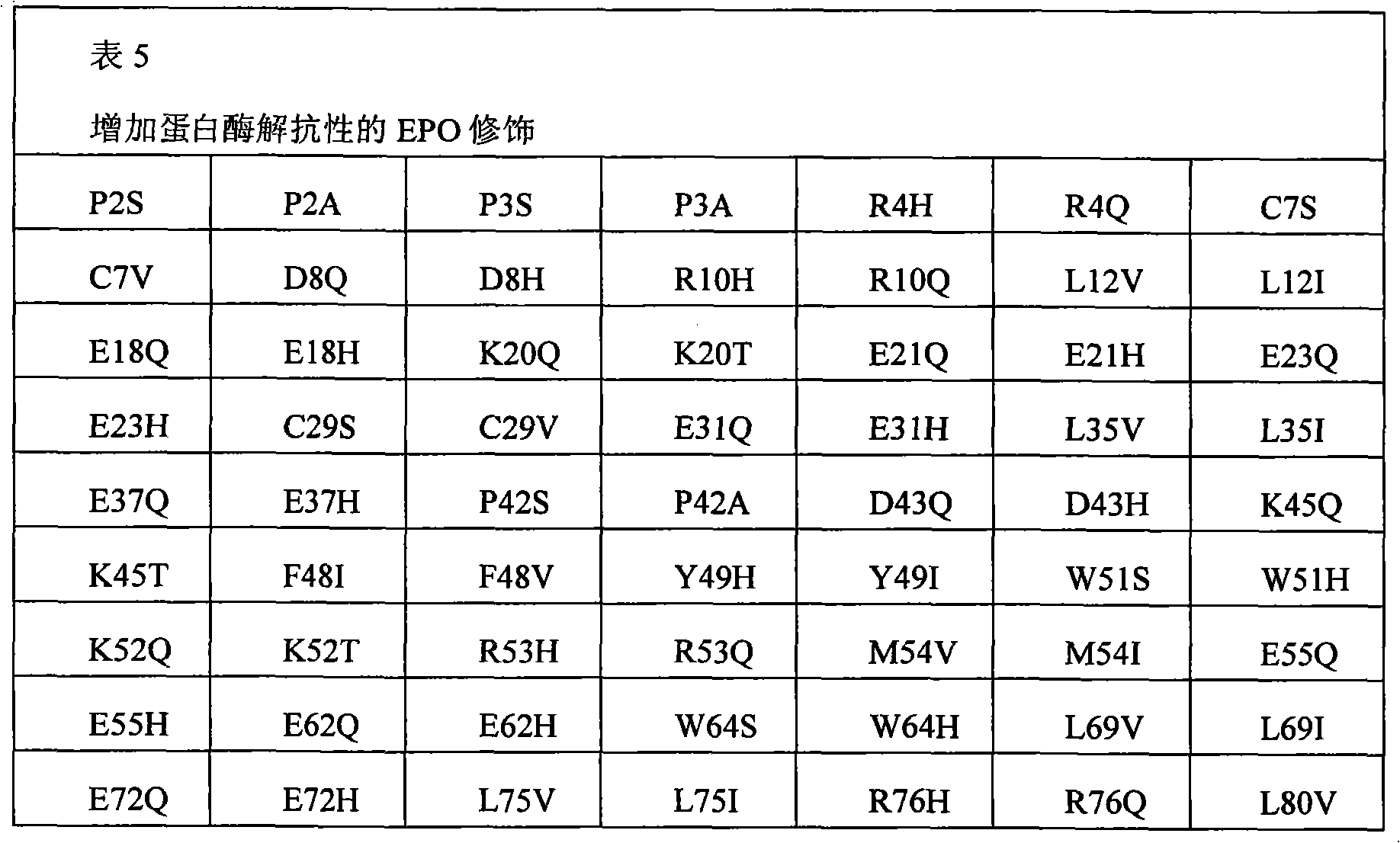
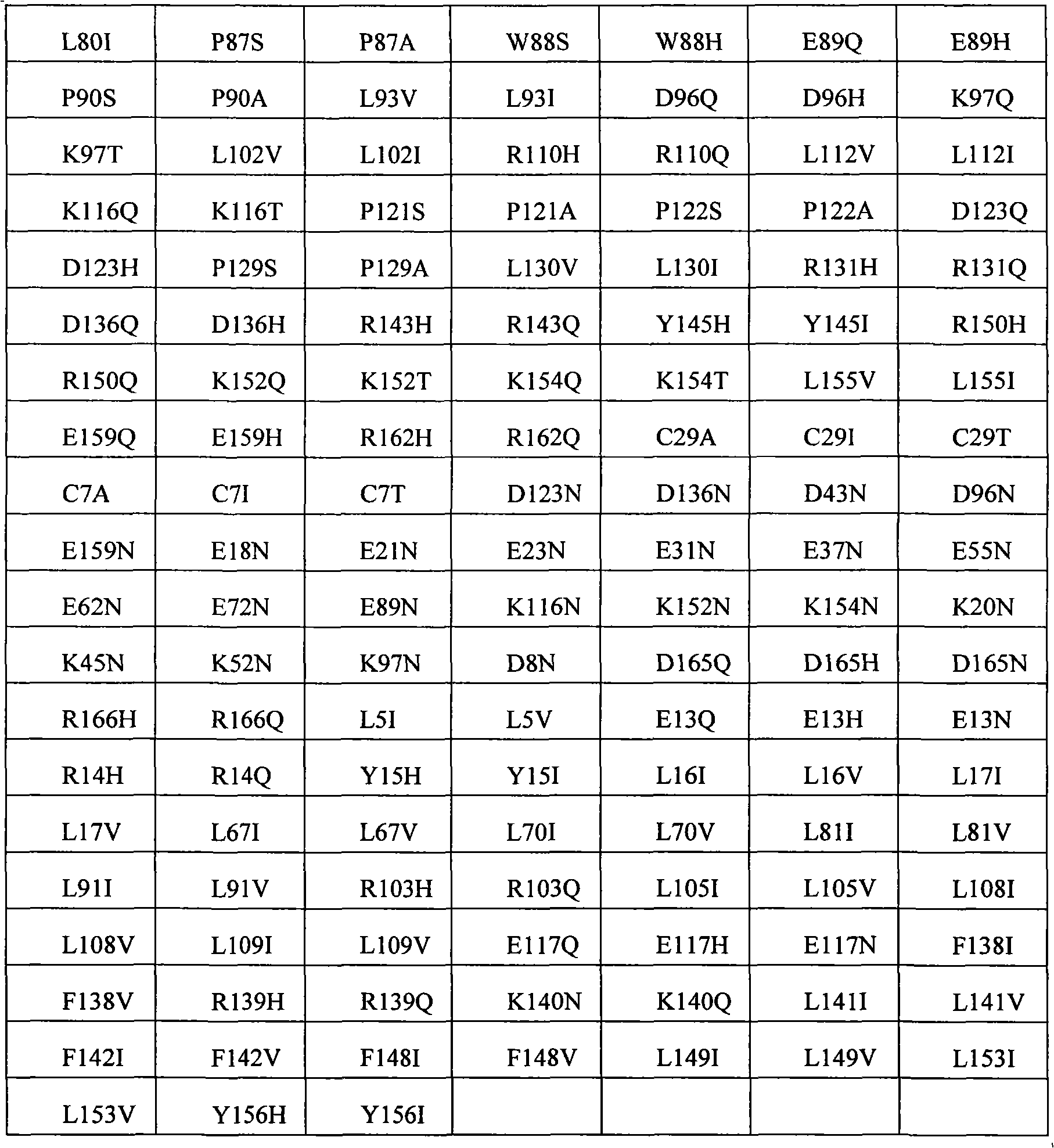
b.GM-CSF
Granulocyte-macrophage colony stimutaing factor (GM-CSF) is the glycoprotein that is produced by various kinds of cell, and described cell includes but not limited to lymphocyte, endotheliocyte, mastocyte, fibroblast, mononuclear cell and some malignant cells.144 amino acid whose precursor proteins of GM-CSF gene code (SEQ ID NO:273), it comprises 17 amino acid whose signal peptides.The translation post-treatment produces glycosylated ripe GM-CSF albumen, and its length is 127 aminoacid (SEQ IDNO:274).Ripe GM-CSF is that N-is glycosylated in two sites, and these two sites are corresponding to the N44 and the N54 of precursor polypeptide shown in ripe GM-CSF sequence of N 27 shown in the SEQ ID NO:274 and N37 and the SEQ ID NO:273.Also have four O-glycosylation sites to be positioned at the N-terminal of maturation protein, at S5, S7, S9 and the T10 amino acid position (corresponding to S22, S24, S26 and the T27 amino acid position of precursor polypeptide shown in the SEQ ID NO:273) of sequence shown in the SEQ ID NO:274.GM-CSF is many cells system (multilineage) colony stimulating factor, and it can stimulate the propagation and the differentiation of the hemopoietic progenitor cell in neutrophil cell, eosinophilic granulocyte and mononuclear cell source.Just so, its can therapeutic be used for bone marrow transplantation or bone marrow transplantation plant live failure or postpone the back or from blood progenitor cell around the body transplant and old acute myelogenous leukemia chemotherapy after marrow-reconstitution.
The invention provides the non-glycosylated GM-CSF polypeptide of modification, it compares the proteolysis resistance that presents increase with the non-glycosylated GM-CSF polypeptide of unmodified.Protease resistant GM-CSF polypeptide for example comprises that one or more is amino acid modified corresponding to amino acid replacement among the SEQ ID NO:274 as shown in table 6, and wherein said one or more amino acid replacement causes higher protease resistant.The GM-CSF polypeptide of nonglycosylated modification provided herein can produce by using prokaryotic expression system, for example uses the expression system of escherichia coli as host cell.In other embodiments, protease resistant GM-CSF polypeptide can produce as non-glycosylated protein by the modification of one or more glycosylation site.For example, the modification at one or two amino acid position of the N27 of ripe GM-CSF polypeptide (SEQ ID NO:274) and N37 can produce non-glycosylated protein matter.Nonglycosylated protease resistant polypeptide provided herein keeps the activity of the complete glycosylated GM-CSF polypeptide of non-protease resistant.Therefore, nonglycosylated protease resistant GM-CSF polypeptide can be used for treating disease and the disease that GM-CSF is generally used for treating, and includes but not limited to neutrophil cell and monocytic reconstruction after chemotherapy or the bone marrow transplantation.
c.M-CSF
M-CSF is the glycosylation cytokine that is produced by various kinds of cell, and described cell comprises lymphocyte, mononuclear cell, fibroblast, endotheliocyte, sarcoplast and osteoblast.As the result of difference montage, the M-CSF gene produces three kinds of different isomers.Isomer 1 is expressed as 554 amino acid whose precursors (SEQ ID NO:275), comprises 32 amino acid whose signal sequences.The proteic length of ripe isomer 1M-CSF is 522 aminoacid, shown in SEQ ID NO:276.Isomer 2 is expressed as 438 amino acid whose precursors (SEQ ID NO:277), comprises 32 amino acid whose signal sequences.Ripe isomer 2M-CSF length protein is 406 aminoacid, shown in SEQID NO:278.Isomer 3 is expressed as 256 amino acid whose precursors (SEQ ID NO:279), comprises 32 amino acid whose signal sequences.The proteic length of ripe isomer 3M-CSF is 224 aminoacid, shown in SEQ ID NO:280.M-CSF has two N-glycosylation sites (corresponding to the 154th and 172 amino acids residues of each precursor polypeptide shown in the SEQ ID NO:275,277 and 279, and the 122nd and the 140th amino acids of each mature polypeptide shown in the SEQ ID NO:276,278 and 280).M-CSF is the crucial instrumentality of blood monocyte, tissue macrophages and progenitor cells propagation, differentiation and survival.M-CSF also plays an important role in regulating skin thickness and male and female fertility.
The invention provides the non-glycosylated M-CSF polypeptide of protease resistant.This M-CSF protease resistant polypeptide comprises having one or more amino acid modified those polypeptides, and wherein said one or more amino acid modifiedly causes higher protease resistant.The amino acid position that can be modified to increase protease resistant in the M-CSF polypeptide can be differentiated by using the method for describing in the U.S. Patent Publication No. 20050202438.In one embodiment, nonglycosylated protease resistant M-CSF cytokine can produce by produce the protease resistant polypeptide in can not glycosylated host cell, and described host cell comprises for example prokaryotic hosts such as escherichia coli.In another embodiment, nonglycosylated protease resistant M-CSF cytokine can produce by one or more sudden change until all glycosylation sites in the described polypeptide.For example, the protease resistant polypeptide with one or more modification that increases the proteolysis resistance can further be included in the modification of one or more amino acid position of N122 and/or N140.Nonglycosylated protease resistant polypeptide provided herein keeps the activity of the complete glycosylated M-CSF polypeptide of non-protease resistant.This non-glycosylated protein enzyme resistant polypeptides can be used for treating disease or the disease that M-CSF is generally used for treating.For example this disease or disease include but not limited to malignant tumor, are included in hematopoietic function recovery, arteriosclerosis and fungal infection after the bone marrow transplantation.
d.G-CSF
Glycosylation cytokine for example is granulocyte colony-stimulating factor (G-CSF).G-CSF is produced by mononuclear cell, macrophage, neutrophil cell, fibroblast and endotheliocyte as 207 amino acid whose precursor polypeptide (SEQ ID NO:281), has 30 amino acid whose signal sequences.177 amino acid whose maturation proteins shown in the SEQ ID NO:282 produce after the signal sequence cracking.The difference montage of G-CSF mRNA can produce another kind of precursor variant-isomer b, and its length is 204 aminoacid (SEQ ID NO:283).The cracking of signal peptide produces 174 amino acid whose ripe isomer b G-CSF polypeptide (SEQ ID NO:284).G-CSF is the glycosylated (corresponding to the T166 of precursor polypeptide shown in the SEQ IDNO:281 of O-connection in the T136 amino acids of mature polypeptide shown in the SEQ ID NO:282; The T133 of ripe isomer b polypeptide shown in the SEQ ID NO:284; The T163 of the polypeptide of precursor isomer b shown in the SEQ ID NO:283).Granulocyte colony-stimulating factor (G-CSF) is the outer instrumentalities of granulocytopoietic main born of the same parents, propagation and the survival by stimulating special bone marrow precursor and be divided into the generation that granulocyte is regulated neutrophil cell.
The invention provides the non-glycosylated G-CSF polypeptide of modification, it presents the proteolysis resistance of increase.Protease resistant G-CSF polypeptide for example comprises corresponding to as shown in table 7 one or more of amino acid replacement among the SEQ ID NO:282 amino acid modified, and wherein said one or more amino acid replacement causes higher protease resistant.In one embodiment, nonglycosylated protease resistant G-CSF cytokine can produce by produce the protease resistant polypeptide in can not glycosylated host cell, and described host cell comprises for example prokaryotic hosts such as escherichia coli.In another embodiment, nonglycosylated protease resistant G-CSF cytokine can produce by the sudden change of O-glycosylation site in the described polypeptide.For example, has the modification that can further be included in the T136 amino acid position corresponding to the protease resistant polypeptide of one or more modification as shown in table 7 of the amino acid replacement among the SEQ ID NO:282.Non-glycosylated protein enzyme resistant polypeptides provided herein keeps the activity of the complete glycosylated G-CSF polypeptide of non-protease resistant.This nonglycosylated protease resistant polypeptide can be used for treating disease or the disease that G-CSF is generally used for treating.This disease for example or disease include but not limited to that Crohn disease, heart disease, neutrophil cell minimizing day after tomorrow disease (for example because due to the chemotherapy), congenital neutrophil cell reduce disease and asthma.
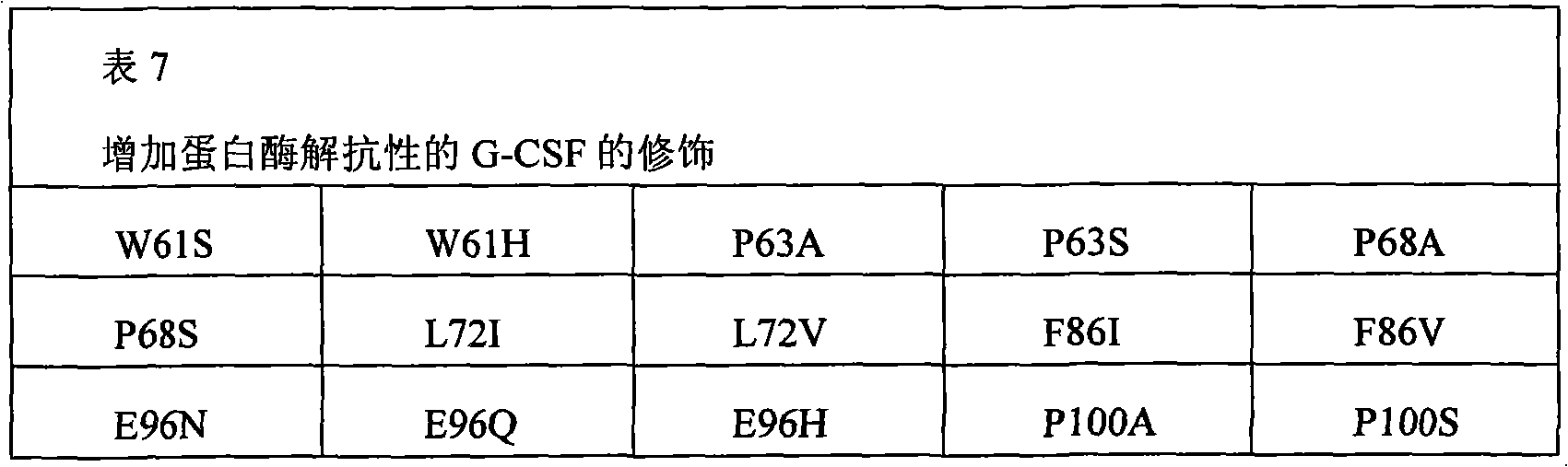
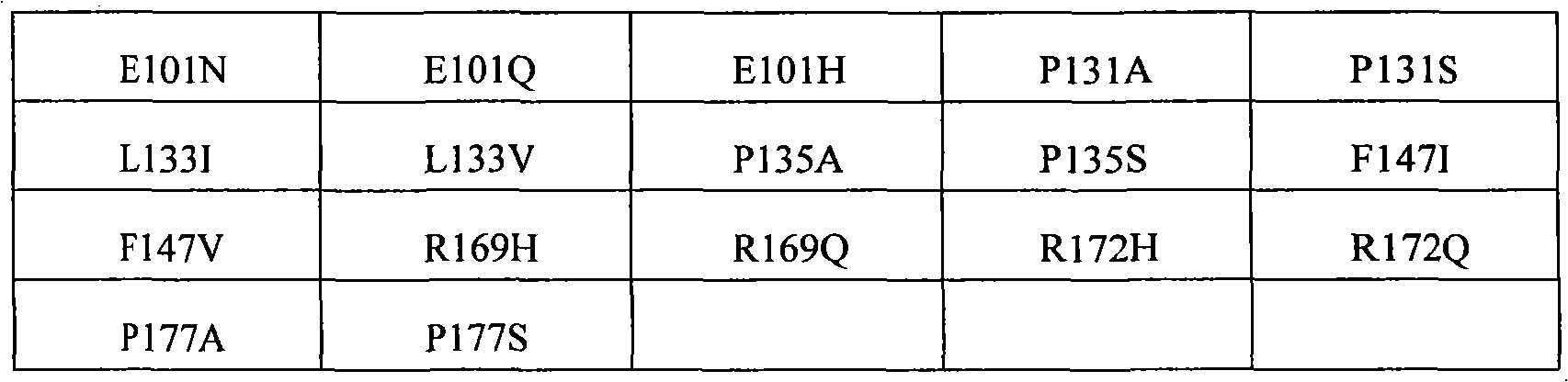
e.LIF
Leukaemia inhibitory factor (LIF) is a glycoprotein.202 amino acid whose precursor proteins of described LIF gene code (SEQ ID NO:285) comprise 22 amino acid whose signal peptides.The translation post-treatment causes glycosylated ripe LIF, and its length is 180 aminoacid (SEQ ID NO:286).Ripe LIF contains a plurality of N-glycosylation sites, corresponding to ripe LIF sequence of N 7 shown in the SEQ ID NO:286, N34, N63, N73, N96 and N116 (N31, N56, N85, N95, N118 and the N138 of precursor polypeptide shown in the SEQ ID NO:285).LIF has extensive effect, comprises the stimulus object that propagation, bone formation, adipose cell lipid transfer, thyroliberin generation, neuronal survival and formation, muscle satellite cell propagation and hepatocellular acute stage as platelet formation, some hematopoietic cells produce.LIF is that blastocyst implantation and Hippocampus and the neuronic normal development of olfactory receptor are necessary.
The invention provides the non-glycosylated LIF polypeptide of modification, it compares the proteolysis resistance that presents increase with the non-glycosylated LIF polypeptide of unmodified.Protease resistant LIF polypeptide for example comprises that one or more is amino acid modified corresponding to the amino acid replacement among the SEQ ID NO:286 as shown in table 8, and wherein said one or more amino acid replacement causes higher protease resistant.The LIF polypeptide of non-glycosylated modification provided herein can produce by using prokaryotic expression system, for example uses the expression system of escherichia coli as host cell.In other embodiments, protease resistant LIF polypeptide can produce as non-glycosylated protein matter by the modification of one or more glycosylation site.For example, N7, N34, N63, N73, N96 and the N116 of ripe LIF polypeptide (SEQ ID NO:286) one or the modification of two amino acid positions can produce non-glycosylated protein matter.Non-glycosylated protein enzyme resistant polypeptides provided herein keeps the activity of the complete glycosylation LIF polypeptide of non-protease resistant.Therefore, nonglycosylated protease resistant LIF polypeptide can be used for treating disease and the disease that LIF is generally used for treating, and includes but not limited to neutrophil cell and monocytic reconstruction after chemotherapy or the bone marrow transplantation.

F. interleukin 1 β
Interleukin 1 β (IL-1 β) is synthesized as the precursor of 268 aminoacid (SEQ ID NO:287), comprises 116 amino acid whose propetides.The sequence of ripe IL-1 β is shown in SEQ ID NO:288, and its length is 152 aminoacid.IL-1 β has the glycosylation site that a N-connects, corresponding to the 7th amino acids of mature polypeptide shown in precursor polypeptide the 123rd amino acids shown in the SEQ ID NO:287 and the SEQ ID NO:288.IL-1 β is the proinflammatory cytokine that produces in various kinds of cell, and described cell comprises mononuclear cell, tissue macrophages, keratinocyte and other epithelial cell.IL-1 and IL-1 β are in conjunction with same receptor and have the biological property of similar (if inequality).These cytokines have extensive activity, comprise the ability that stimulates thymocyte proliferation, B cell maturation and propagation, mitogenesis FGF sample is active and stimulates prostaglandin and collagenase to discharge from the synovial cell by inducing IL-2 to discharge.
The invention provides the non-glycosylated IL-1 beta polypeptides of protease resistant.This IL-1 β protease resistant polypeptide comprises having one or more amino acid modified those polypeptides, and wherein said one or more amino acid modifiedly causes higher protease resistant.Can be modified in the M-CSF polypeptide so that the amino acid position that protease resistant increases can be differentiated by using the method for describing in the U.S. Patent Publication No. 20050202438.In one embodiment, non-glycosylated protein enzyme resistance IL-1 β cytokine can produce by produce the protease resistant polypeptide in can not glycosylated host cell, and described host cell comprises for example prokaryotic hosts such as escherichia coli.In another embodiment, nonglycosylated protease resistant IL-1 β cytokine can produce by one or more sudden change until all glycosylation sites in the described polypeptide.For example, have increase protease resistant can further be included in the modification of N7 amino acid position corresponding to the protease resistant polypeptide of one or more modification of amino acid replacement among the SEQ ID NO:288.Non-glycosylated protein enzyme resistant polypeptides provided herein keeps the activity of the complete glycosylated IL-1 beta polypeptides of non-protease resistant.This nonglycosylated protease resistant polypeptide can be used for treating disease or the disease that IL-1 β is generally used for treating.This disease or disease for example includes but not limited to cancer, comprises the immune system after using IL-1 β with the recovery chemotherapy, and the ischemia/reperfusion injury and the day after tomorrow and congenital neutrophil cell reduce disease.
G. interleukin II
Interleukin II (IL-2) is the glycoprotein that is become by t cell response antigen or mitogenesis primary stimuli.153 amino acid whose precursor proteins of IL-2 gene code (SEQ ID NO:289) comprise 20 amino acid whose signal peptides.The translation post-treatment produces glycosylated ripe IL-2 albumen, and its length is 133 aminoacid (SEQ ID NO:290).Ripe IL-2 is that O-is glycosylated in the T23 site corresponding to precursor polypeptide shown in the T3 of ripe IL-2 sequence shown in the SEQ ID NO:290 and the SEQ ID NO:289.IL-2 is a T cell proliferation and necessary for regulating vital other activity of immunne response.It can stimulate B cell, mononuclear cell, the activated killer cell of lymphokine, natural killer cell and neuroglial cytoma.
The invention provides the non-glycosylated IL-2 polypeptide of modification, it is compared with the non-glycosylated IL-2 polypeptide of unmodified and presents the increase of proteolysis resistance.Protease resistant IL-2 polypeptide for example comprises corresponding to as shown in table 9 one or more of amino acid replacement among the SEQ ID NO:290 amino acid modified, and wherein said one or more amino acid replacement causes higher protease resistant.The IL-2 polypeptide of non-glycosylated modification provided herein can produce by using prokaryotic expression system, and for example escherichia coli are as the expression system of host cell.In other embodiments, protease resistant IL-2 polypeptide can produce as nonglycosylated protein by the modification of one or more glycosylation site.For example, the modification at the T3 of ripe IL-2 polypeptide (SEQ ID NO:290) can cause non-glycosylated protein matter.Non-glycosylated protein enzyme resistant polypeptides provided herein keeps the activity of the complete glycosylation IL-2 polypeptide of non-protease resistant.Therefore, nonglycosylated protease resistant IL-2 polypeptide can be used for treating disease and the disease that IL-2 is generally used for treating, comprise infecting as HIV and cytomegalovirus infection, lymphopenia, and cancer, comprise the melanoma of transfer and the renal carcinoma of transfer.
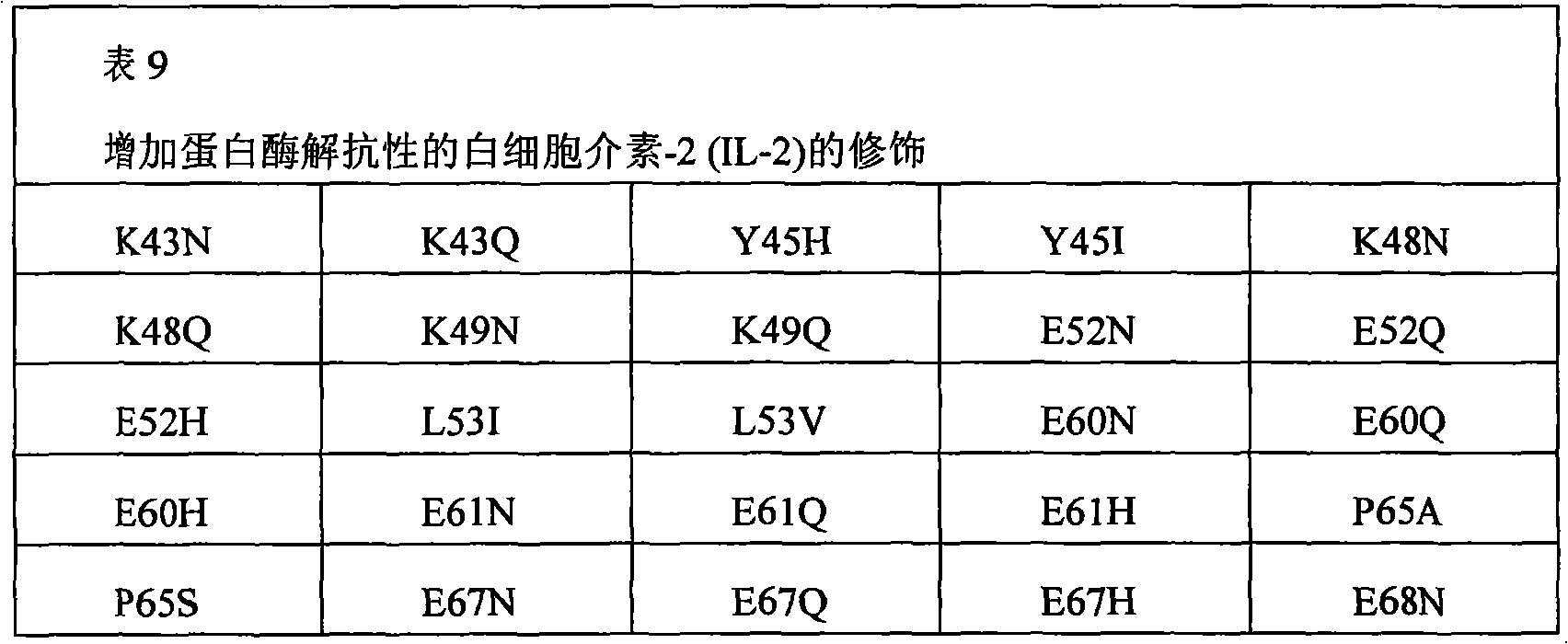
H. interleukin
Glycosylation cytokine for example is interleukin (IL-3).IL-3 is produced by activated T cells, monocyte/macrophage and stromal cell as 152 amino acid whose precursor polypeptide (SEQ ID NO:291), has 19 amino acid whose signal sequences.133 amino acid whose maturation proteins shown in SEQ ID NO:292 produce after the signal sequence cracking.The IL-3 polypeptide contains the glycosylation site (corresponding to the N34 and the N89 of precursor polypeptide shown in the SEQ ID NO:291) that the N-of the N15 of mature polypeptide shown in the SEQ IDNO:292 and N70 position is connected.IL3 is the multiple-effect hemopoietic growth factor, regulates the growth and the differentiation of myeloid lineage, erythron and megakaryocytic series hemopoietic progenitor cell, and ripe neutrophil cell of functional activation and macrophage.Just so, IL-3 can be used for the expanding hemopoietic cell mass.
The invention provides the non-glycosylated IL-3 polypeptide of modification, it presents the proteolysis resistance of increase.Protease resistant IL-3 polypeptide for example comprises corresponding to as shown in table 10 one or more of amino acid replacement among the SEQ ID NO:292 to be modified, and wherein said one or more amino acid replacement causes higher protease resistant.In one embodiment, non-glycosylated protein enzyme resistance IL-3 cytokine can produce by produce the protease resistant polypeptide in can not glycosylated host cell, and described host comprises for example prokaryotic hosts such as escherichia coli.In another embodiment, nonglycosylated protease resistant IL-3 cytokine can produce by the sudden change of one or two N-glycosylation site in the described polypeptide.For example, have protease resistant polypeptide, can further be included in the modification of the amino acid position of N15 and/or N70 corresponding to one or more modification as shown in table 10 of amino acid replacement among the SEQ ID NO:292.Nonglycosylated protease resistant polypeptide provided herein keeps the activity of the complete glycosylated IL-3 polypeptide of non-protease resistant.This non-glycosylated protein enzyme resistant polypeptides can be used for treating disease or the disease that IL-3 is generally used for treating.This disease for example or disease includes but not limited to congenital or the day after tomorrow neutrophil cell reduce disease and thrombocytopenia, for example inductive these diseases of chemotherapy.
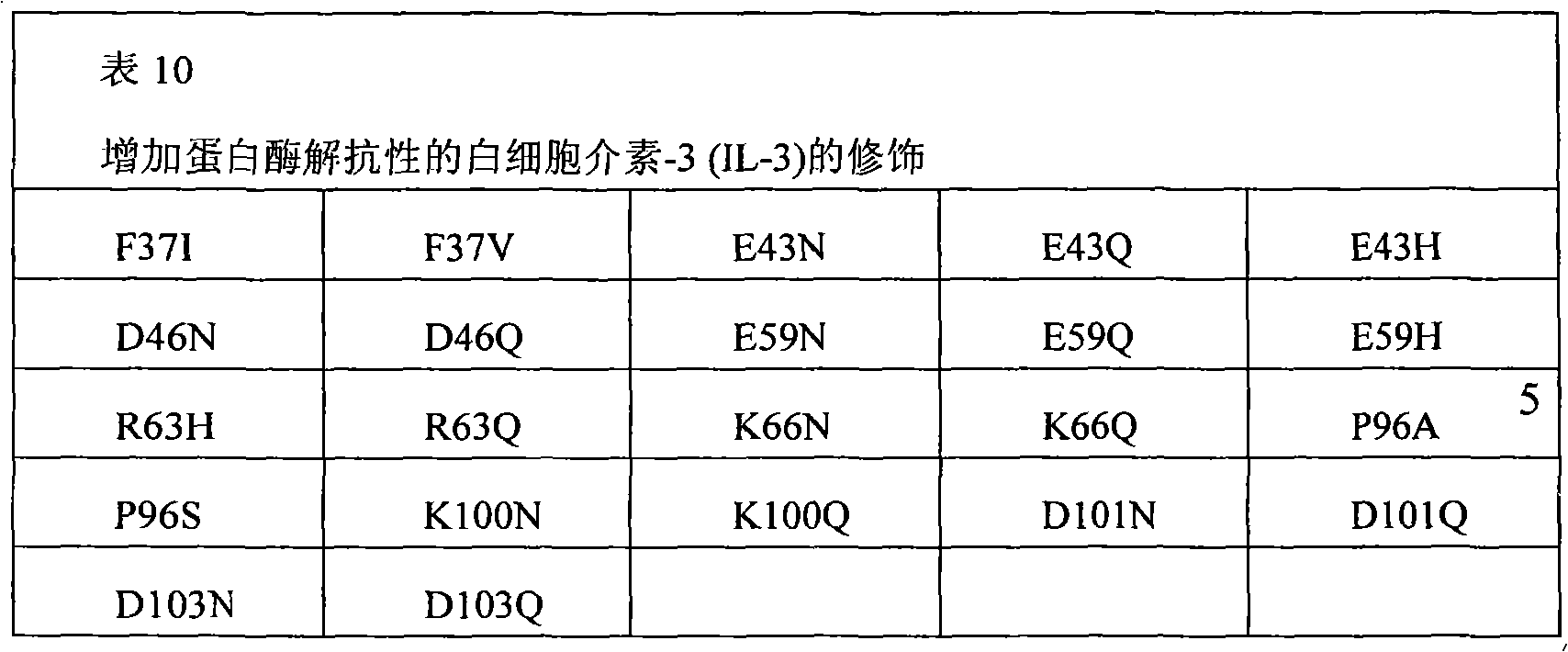
I. the interleukin-4 glycosylation cytokine of giving an example is interleukin-4 (IL-4).IL-4 is synthesized as the precursor of 153 aminoacid (SEQ IDNO:293), and described precursor comprises 24 amino acid whose signal peptides.The sequence of ripe IL-4 is shown in SEQ ID NO:294 (UniProt No.P05112), and length is 129 aminoacid.IL-4 has the glycosylation site that two N-connect (corresponding to the 38th and 105 amino acids of mature polypeptide shown in the 62nd of precursor polypeptide shown in the SEQ ID NO:293 and the 129th amino acids and the SEQ ID NO:294).IL-4 also contains six cysteine residues that participate in disulfide bond formation.IL-4 inducing natural helper T cell is divided into the Th2 cell.IL-4 also works in the stimulation of activatory B cell and T cell proliferation.Therefore, IL-4 is the instrumentality of tumor and acquired immunity.
The invention provides the non-glycosylated IL-4 polypeptide of protease resistant.This IL-4 protease resistant polypeptide comprises having one or more amino acid modified those polypeptides, and wherein said one or more amino acid modifiedly causes higher protease resistant.This modification for example includes but not limited to the modification shown in the following table 11, and it is corresponding to the amino acid replacement in the aminoacid sequence shown in the SEQ ID NO:294.In one embodiment, non-glycosylated protein enzyme resistance IL-4 cytokine can produce by produce the protease resistant polypeptide in can not glycosylated host cell, and described host cell comprises for example prokaryotic hosts such as escherichia coli.In another embodiment, nonglycosylated protease resistant IL-4 cytokine can produce by one or more sudden change until all glycosylation sites in the described polypeptide.For example, have protease resistant polypeptide, can further be included in the modification of one or more amino acid position of N38 and/or N105 corresponding to one or more modification as shown in table 12 of amino acid replacement among the SEQ ID NO:294.Nonglycosylated protease resistant polypeptide provided herein keeps the activity of the complete glycosylated IL-4 polypeptide of non-protease resistant.This non-glycosylated protein enzyme resistant polypeptides can be used for treating disease or the disease that IL-4 is generally used for treating.This disease or disease for example includes but not limited to inflammation and autoimmune disease, for example collagen-induced arthritis, Autoimmune Diabetes, multiple sclerosis and inflammatory bowel; And cancer, include but not limited to colon cancer and breast carcinoma.
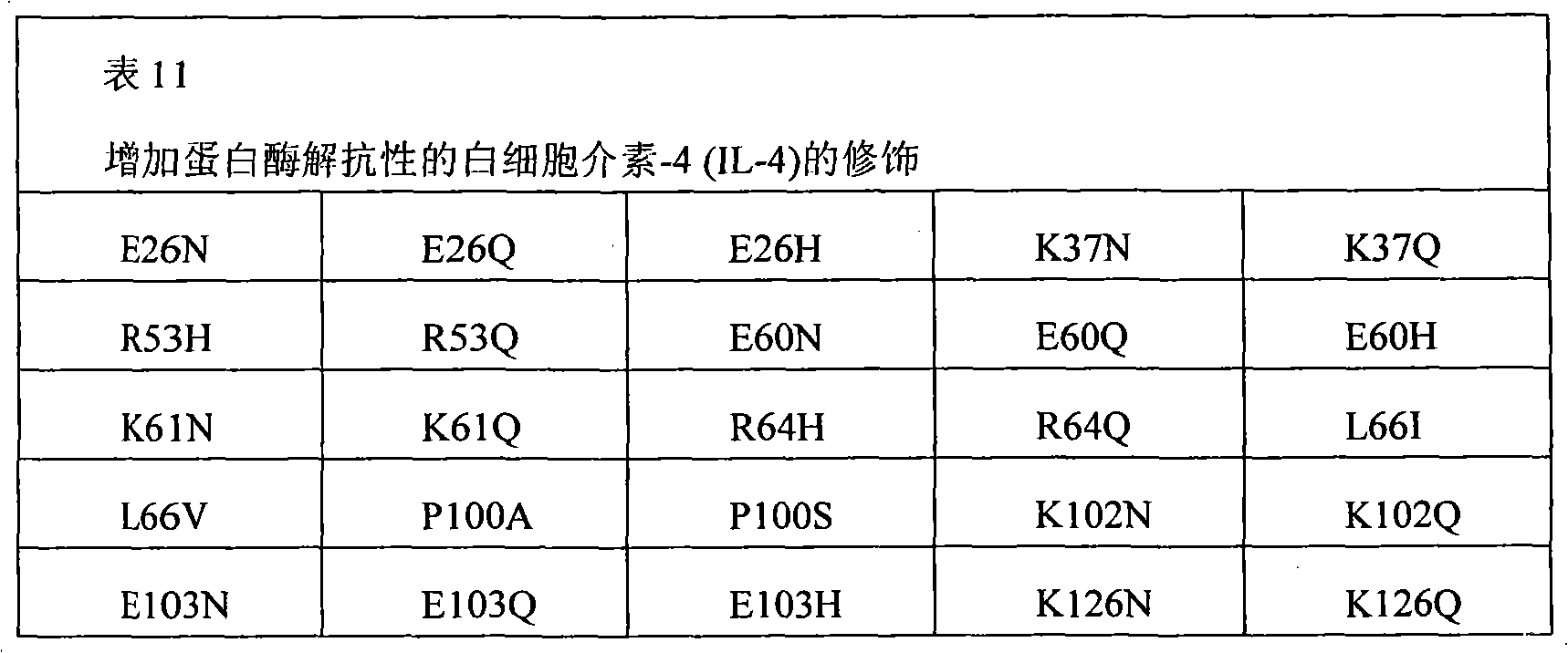
J. t cell growth factor
Glycosylation cytokine for example is IL-5.IL-5 promotes eosinophilic granulocyte's propagation, differentiation and activatory homodimer glycoprotein.IL-5 also works to stimulate the growth of B cell and increases immunoglobulin secretion.IL-5 is synthesized as the precursor of 134 aminoacid (SEQ ID NO:295), and described precursor comprises 19 amino acid whose signal peptides.The sequence of ripe IL-5 is shown in SEQ ID NO:296, and length is 115 aminoacid.IL-5 is the antiparallel dimer that is connected by two cysteine (corresponding to the C44 and C86 of aminoacid sequence shown in the SEQ ID NO:296).IL-5 also by the glycosylation that is connected with N-that is connected at the O-of T3 and N28 respectively by glycosylation, described site corresponding to aminoacid sequence shown in the SEQ ID NO:296 (Minamitake et al. (1990) J.Biochem., 107:2:292-297).The invention provides the non-glycosylated IL-5 polypeptide of protease resistant.This IL-5 protease resistant polypeptide comprises having one or more amino acid modified those polypeptides, and wherein said one or more amino acid modifiedly causes higher protease resistant.This modification for example includes but not limited to modify shown in the following table 12, and it is corresponding to the amino acid replacement in the aminoacid sequence shown in the SEQ ID NO:296.In one embodiment, nonglycosylated protease resistant IL-5 cytokine can produce by produce protease resistant IL-5 cytokine in can not glycosylated host cell, and described host is prokaryotic hosts such as escherichia coli for example.In another embodiment, nonglycosylated protease resistant IL-5 cytokine can produce by one or more sudden change until all glycosylation sites in the described polypeptide.For example, have protease resistant polypeptide, can further be included in the modification of one or more amino acid position of T3 and/or N28 corresponding to one or more modification as shown in table 12 of amino acid replacement among the SEQ ID NO:296.Non-glycosylated protein enzyme resistant polypeptides provided herein keeps the activity of the complete glycosylated IL-5 polypeptide of non-protease resistant.This non-glycosylated protein enzyme resistant polypeptides can be used for treating disease or the disease that IL-5 is generally used for treating, and for example comprises that eosinophilic granulocyte wherein causes any disease of prognosis.This disease for example includes but not limited to cancer, for example colon cancer, gastric cancer and pulmonary carcinoma, bladder cancer, cervical cancer and head and neck cancer; And transplant rejection.
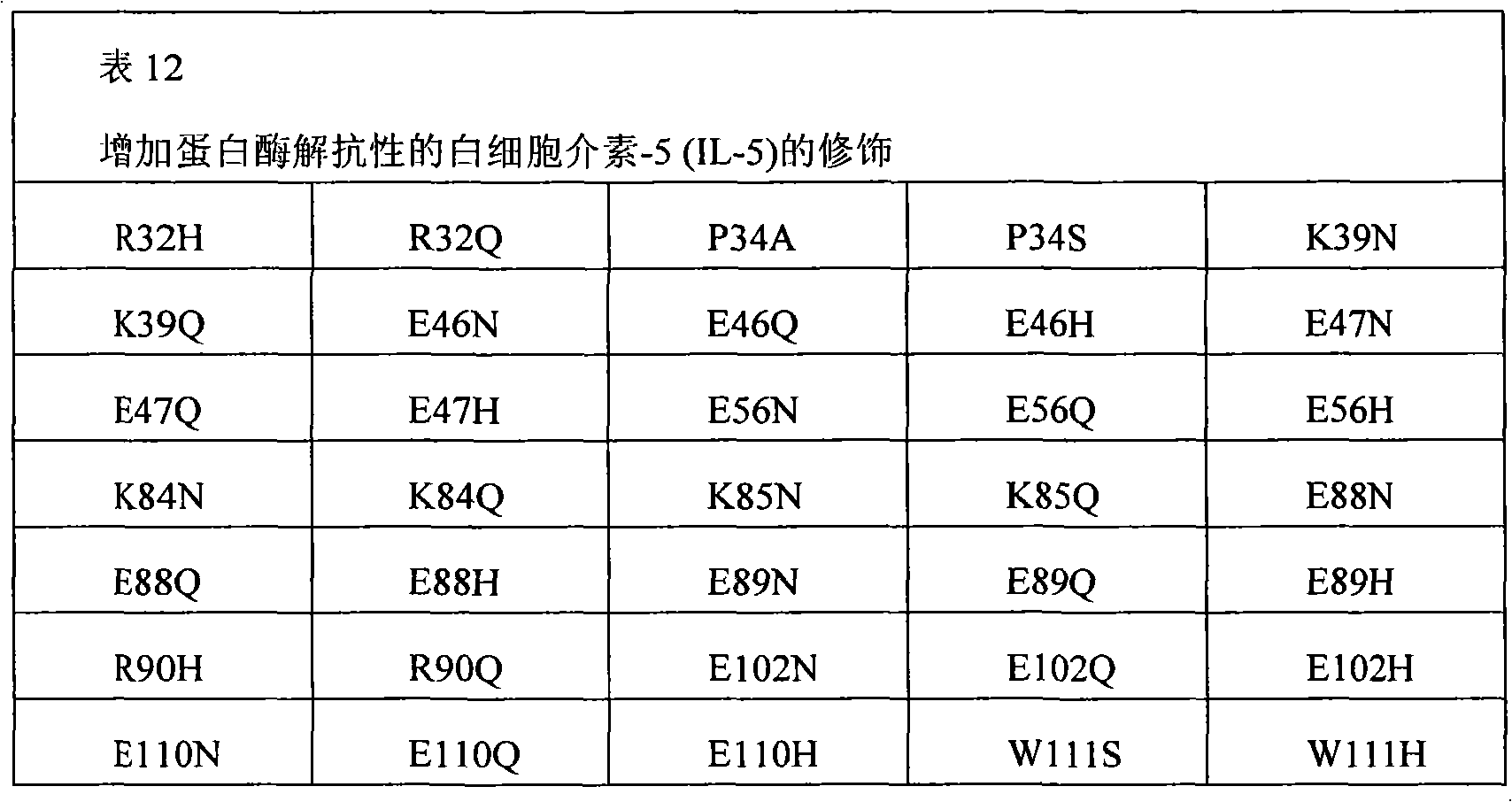
K. interleukin-6
Glycosylation cytokine for example is interleukin-6 (IL-6).IL-6 produces the protease resistant polypeptide in a kind of host cell of multiple-effect cell and produces, and described host cell comprises for example prokaryotic hosts such as escherichia coli.In another embodiment, nonglycosylated protease resistant IL-6 cytokine can produce by one or more sudden change until all glycosylation sites in the described polypeptide.For example, have protease resistant polypeptide, can further comprise the modification of one or more amino acid position of T137, N44 and/or N143 corresponding to one or more modification as shown in table 13 of amino acid replacement among the SEQ ID NO:298.Nonglycosylated protease resistant polypeptide provided herein keeps the activity of the complete glycosylated IL-6 of non-protease resistant.This non-glycosylated protein enzyme resistant polypeptides can be used for treating disease or the disease that IL-6 is generally used for treating.This disease for example includes but not limited to cancer, thrombocytopenia and neutropenia (for example inducing) by chemotherapy, diseases associated with inflammation (except glomerulonephritis) is as multiple sclerosis, septic shock, disorder of joint is the disorder of joint of pathogen-inducible particularly, the sick arthritis of Lyme for example, the arthritis of bacteria-induction and polyarthritis (polioarthritis); Multiple sclerosis and other neural demyelinating disease (promptly are characterised in that the disease of demyelination in nerve, brain and/or the spinal cord, comprise multiple sclerosis, acute disseminated encephalomyelitis or postinfectious encephalitis, optic neuromyelitis, tinnitus, diffuse cerebrosclerosis, Schilder ' s disease, leukodystrophy, three phase Lyme diseases, the spastic paraparesis in the torrid zone, and wherein demyelination especially the demyelination of autoimmune mediation be other disease of cardinal symptom); Acute serious inflammatory conditions is as burn, septic shock, meningitis and pneumonia; And autoimmune disease, comprise polychondritis, sclerodoma, Wegener granulomatosis, dermatomyositis, chronic active hepatitis, myasthenia gravis, psoriasis, psoriatic arthritis, the Steven-Johnson syndrome, idiopathic steatorrhea, autoimmune inflammatory bowel (comprising for example ulcerative colitis and Crohn disease), endocrine ophthalmopathy, the Graves disease, sarcoidosis, primary biliary cirrhosis, child's diabetes (type i diabetes), uveitis (front and rear), keratoconjunctivitis sicca and vernal keratoconjunctivitis, and interstitial pulmonary fibrosis.The factor can stimulate growth, propagation and the maturation of many hematopoietic cells.IL-6 also is that the B cell maturation is that IgSC is necessary.IL-6 also works in the inducing of acute phase protein in the metabolism of the differentiation of neurocyte, bone and hepatocyte.IL-6 is synthesized as the precursor of 212 aminoacid (SEQ ID NO:297), and described precursor comprises 29 amino acid whose signal peptides.The sequence of ripe IL-6 is shown in SEQ ID NO:298, and length is 183 aminoacid.IL-6 is expressed by T cell, macrophage, fibroblast, endotheliocyte and keratinocyte.Express the source according to it, ripe excretory people IL-6 contains 183-186 residue.For example, the amino terminal of the deutero-IL-6 of fibroblast is the Ala28 of aminoacid sequence shown in the SEQ ID NO:297.By the glycosylation that is connected with O that N connects IL-6 is carried out post translational modification.For example, Thr166 is the glycosylation site that O connects, Asn73 is the glycosylation site that N is connected with Asn172, and these sites are corresponding to the residue in the precursor sequence shown in the SEQ ID NO:297 (and respectively corresponding to the 137th, 44 and 143 residue among the SEQ ID NO:298).
The invention provides the non-glycosylated IL-6 polypeptide of protease resistant.This IL-6 protease resistant polypeptide comprises having one or more amino acid modified those polypeptides, and wherein said one or more amino acid modifiedly causes higher protease resistant.This modification for example includes but not limited to modify shown in the following table 13, and it is corresponding to the amino acid replacement in the aminoacid sequence shown in the SEQ ID NO:298.In one embodiment, nonglycosylated protease resistant IL-6 cytokine can be by can not glycosylation
L. Oncostatin. (Oncostatin) M
Glycosylation cytokine for example is oncostatin M (OSM).OSM is by T cell that is upset and the synthetic multiple-effect cytokine of mononuclear cell, participates in liver growth, hemoposieis, inflammation and CNS and grows.OSM is synthesized as the precursor of 252 aminoacid (SEQ ID NO:299), comprises 25 amino acid whose signal peptides.The sequence of ripe OSM is shown in SEQ ID NO:300, and length is 227 aminoacid.Cracking at 31 COOH terminal amino acid residues of trypsin-like cracking site produces the OSM of active 196 residue forms fully.There are 4 in 5 cysteine residues in the OSM sequence and participate in disulfide bond (being between C31 and the C152 and between C74 and the C192) corresponding to residue shown in the SEQ ID NO:299.Disulfide bond between A spiral and the B spiral (C74 and C192) is that the OSM activity is necessary.Free cysteine residues (C105) does not mediate the Dimerized of OSM.The glycosylation that connects by N is to the further post translational modification of OSM.For example, Asn100 is the glycosylation site that N is connected with Asn217, and it is corresponding to the residue in the precursor sequence shown in the SEQ ID NO:299 (and respectively corresponding to the 75th and 192 residue among the SEQ ID NO:300).
The invention provides the non-glycosylated OSM polypeptide of protease resistant.This OSM protease resistant polypeptide comprises having one or more amino acid modified those polypeptides, and wherein said one or more amino acid modifiedly causes higher protease resistant.This modification for example includes but not limited to modify shown in the following table 14, and it is corresponding to the amino acid replacement in the aminoacid sequence shown in the SEQ ID NO:300.In one embodiment, non-glycosylated protein enzyme resistance OSM cytokine can produce by produce the protease resistant polypeptide in can not glycosylated host cell, and described host cell comprises prokaryotic hosts such as escherichia coli.In another embodiment, nonglycosylated protease resistant OSM cytokine can produce by one or more sudden change until all glycosylation sites in the described polypeptide.For example, have protease resistant polypeptide, may further include modification at one or more amino acid position of N75 and/or N192 corresponding to one or more modification as shown in table 14 of amino acid replacement among the SEQ ID NO:300.Non-glycosylated protein enzyme resistant polypeptides provided herein keeps the activity of the complete glycosylation OSM polypeptide of non-protease resistant.This non-glycosylated protein enzyme resistant polypeptides can be used for treating disease or the disease that OSM is generally used for treating.This disease for example or treatment include but not limited to chronic inflammation disease, acute and chronic inflammatory disorders of gastrointestinal tract, rheumatoid arthritis and multiple sclerosis and histologic lesion's inhibition.
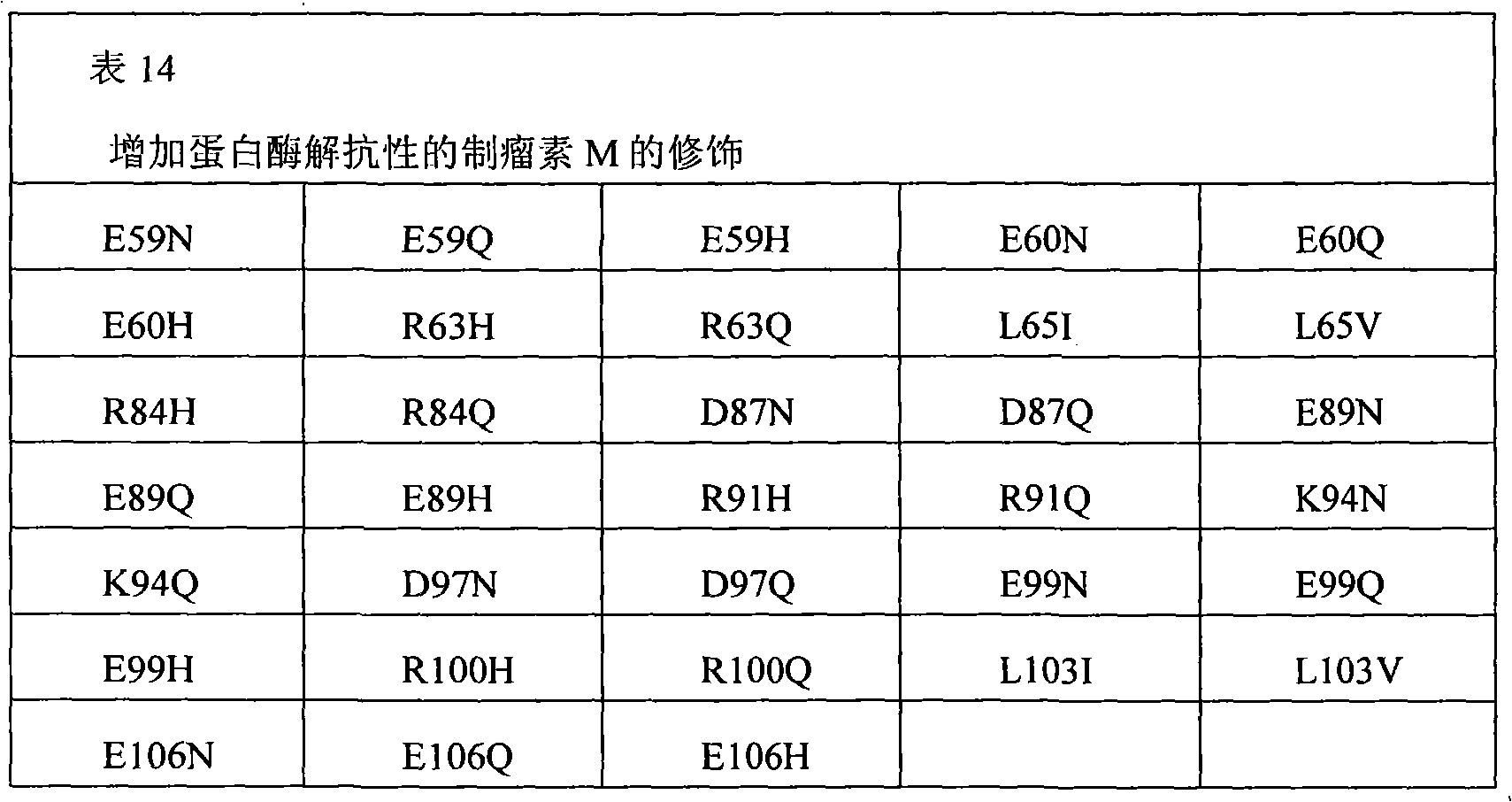
M. stem cell factor
Glycosylation cytokine for example is stem cell factor (SCF).SCF (being also referred to as " the steel factor " or " c-kit part ") is the cytokine (c-Kit) in conjunction with CD117, and is that survival, propagation and the differentiation of hematopoietic stem cell and other hemopoietic progenitor cell is important factor.One of its function for example is to be CFU-E (red is colony forming unit) cell with erythron erythrocyte precursor BFU-E (burst forming unit-erythroid (BFU-E)) cell change the earliest.SCF is synthetic as the precursor of 273 aminoacid (SEQ IDNO:301), comprises 25 amino acid whose signal peptides.The sequence of ripe SCF is shown in SEQID NO:302, and length is 248 aminoacid.SCF exists with two kinds of forms, the bonded SCF of cell surface and solvable (perhaps free) SCF.Solvable SCF produces 189 amino acid whose polypeptide that the cracking of the bonded SCF in surface produces corresponding to SEQ ID NO:301 26-214 amino acids by metalloproteases.SCF has two disulfide bond between the cysteine corresponding to the residue C29 in the precursor sequence shown in the SEQ ID NO:301 and C114 and C68 and C163 position.The glycosylation that connects by N is to the further post translational modification of SCF.For example, Asn90, Asn97, Asn118, Asn145 and Asn195 are the glycosylation sites that N is connected, and these sites are corresponding to the residue in the precursor sequence shown in the SEQID NO:301 (and respectively corresponding to the 65th, 72,93,120 and 170 residue among the SEQ ID NO:302).
The invention provides the nonglycosylated SCF polypeptide of protease resistant.This SCF protease resistant polypeptide comprises having one or more amino acid modified those polypeptides, wherein said one or more amino acid modified causing for the higher resistance of protease.This modification for example includes but not limited to the modification shown in following table 15, and it is corresponding to the amino acid replacement in the aminoacid sequence shown in the SEQ ID NO:302.In one embodiment, non-glycosylated protein enzyme resistance SCF cytokine can produce by produce the protease resistant polypeptide in can not glycosylated host cell, and described host cell comprises for example prokaryotic hosts such as escherichia coli.In another embodiment, non-glycosylated protein enzyme resistance SCF cytokine can produce by one or more sudden change until all glycosylation sites in the described polypeptide.For example, have protease resistant polypeptide, can further be included in the modification of one or more amino acid position of N65, N72, N93, N120 and/or N170 corresponding to one or more sudden change shown in the table 15 of amino acid replacement among the SEQ ID NO:302.Non-glycosylated protein enzyme resistant polypeptides provided herein keeps the activity of the complete glycosylated SCF polypeptide of non-protease resistant.This non-glycosylated protein enzyme resistant polypeptides can be used for treating disease or the disease that SCF is generally used for treating.This disease or treatment for example includes but not limited to hepar damnification, asthma, hematopoietic stem cell transplantation (hematopoieticengraftment).
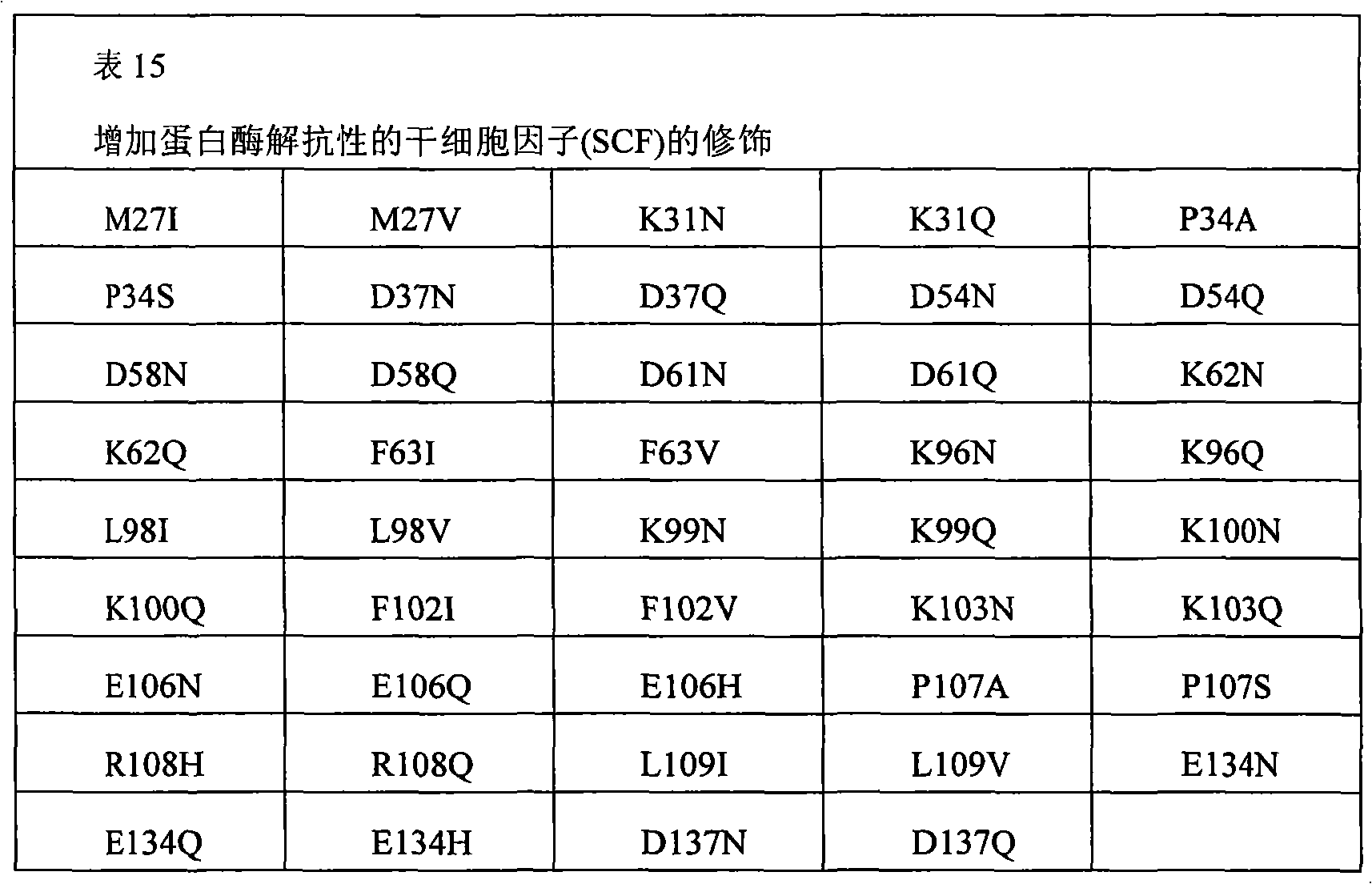
N. interferon beta
Glycosylation cytokine for example is interferon beta (IFN-β).IFN-β is I type interferon member, is the globular protein that contains 5 spirals.Normally, IFN-β is an anti-inflammatory molecular, and its that observes comprises for example following several respects for the effect of various immunocytes (for example T cell, NK cell, mononuclear cell, macrophage and dendritic cell): the cytotoxicity that strengthens the T cell; Adjusting antibody produces; Suppressor T cell propagation and migration; The negative adhesion molecule of regulating; Strengthen the expression of the relevant surface antigen of tumor; Stimulate surface molecular such as MHC I type antigen; Induce or activate short apoptogene and protein (for example tumor necrosin relative death inducing ligand, caspases, Bak, Bax and p53); Suppress anti-apoptotic genes expression (for example Bcl-2, inhibitor of apoptosis protein); And (Pestka et al.Immunological Reviews 202:8-32 (2004) takes place in the inhibition blood vessel; Holten et al., (2002), Arthritis Research, 4:346-352).
IFN-β produces as the precursor that comprises 187 amino acid whose polypeptide (SEQ ID NO:303), and it comprises 21 amino acid whose signal peptides.Ripe IFN-beta polypeptides can be a different length, and the typical case comprises that length is 166 (SEQ ID NO:304), 164 and 165 amino acid whose polypeptide.IFN-β has corresponding to a residue C52 in the precursor sequence shown in the SEQ ID NO:303 and a disulfide bond between the cysteine residues of C162 position.The further post translational modification of glycosylation quilt that IFN-β connects by N.For example, Asn101 is the glycosylation site that connects of N (corresponding to the 101st residue in the precursor sequence shown in the SEQ ID NO:303, and corresponding to the 80th residue in the sequence shown in the SEQ ID NO:304).The IFN-β of business form comprises with trade mark
 With
With
 Those commodity of selling.IFN-β-1a (
 Biogen Inc, CA, USA, and
 Serono Inc., Geneva is to produce in the Chinese hamster ovary celI of the cDNA that has imported coding IFN-β Switzerland).The length of IFN-β-1a is 166 aminoacid, and is identical with the deutero-people IFN-of fibroblast β (SEQ ID NO:304), is included in the glycosylation (Nelissen et al.Brain 126:1371-1381 (2003)) of the 80th asparagine residue.
 IFN-β-1a with
 The difference of IFN-β-1a is that it is at giving skin (being subcutaneous giving) rather than giving and prepare at intramuscular.IFN-β-1b (
Berlex laboratories, Richmond, CA is to produce in the escherichia coli of the genetic modification plasmid with coding people IFN-β USA).IFN-β-1b product that gained is expressed is not glycosylated, lacks amino terminal methionine (Met1), and is sported serine at the cysteine residues of the 17th (SEQ ID NO:304).The length of IFN-β-1b is 165 aminoacid, is not included in the carbohydrate side chain of finding among the natural human IFN-β (Nelissen et al.Brain 126:1371-1381 (2003)).
The difference of IFN-β-1a is that it is at giving skin (being subcutaneous giving) rather than giving and prepare at intramuscular.IFN-β-1b (
Berlex laboratories, Richmond, CA is to produce in the escherichia coli of the genetic modification plasmid with coding people IFN-β USA).IFN-β-1b product that gained is expressed is not glycosylated, lacks amino terminal methionine (Met1), and is sported serine at the cysteine residues of the 17th (SEQ ID NO:304).The length of IFN-β-1b is 165 aminoacid, is not included in the carbohydrate side chain of finding among the natural human IFN-β (Nelissen et al.Brain 126:1371-1381 (2003)).
The invention provides the non-glycosylated IFN-beta polypeptides of protease resistant.This IFN-β protease resistant polypeptide comprises having one or more amino acid modified those polypeptides, wherein said one or more amino acid modified causing for the higher resistance of protease.This modification for example includes but not limited to the modification shown in the following table 16, and it is corresponding to the amino acid replacement in the aminoacid sequence shown in the SEQ ID NO:304.In one embodiment, non-glycosylated protein enzyme resistance IFN-β cytokine can produce by produce the protease resistant polypeptide in can not glycosylated host cell, and described host cell comprises for example prokaryotic hosts such as escherichia coli.In another embodiment, non-glycosylated protein enzyme resistance IFN-β cytokine can produce by one or more sudden change until all glycosylation sites in the described polypeptide.For example, the protease resistant polypeptide that has corresponding to one or more modification shown in table 16 of amino acid replacement among the SEQ ID NO:304 can further be included in the amino acid modified of N80 position.Non-glycosylated protein enzyme resistant polypeptides provided herein keeps the activity of the complete glycosylated IFN-beta polypeptides of non-protease resistant.This nonglycosylated protease resistant polypeptide can be used for treating that IFN-β is generally used for treating and/or for giving those diseases or the disease that IFN-β reacts.This disease for example includes but not limited to viral infection, proliferative disease, autoimmune disease and inflammation disease.The disease of being treated is among the embodiment of autoimmune disease therein, described disease or disease can be but be not limited to be any multiple sclerosis, rheumatoid arthritis, chronic viral hepatitis, hepatitis A, hepatitis B, and Cardiovirus infects.The disease of being treated is in the example of proliferative disease therein, and described disease or disease can be but be not limited to be cancer or osteopathia.That gives an example can comprise tunica uvea melanoma, colon cancer, hepatocarcinoma or metastatic carcinoma with the cancer of medicine composite for curing provided herein.Osteopathia for example is osteoporosis or osteopenia (osteopenia).When being inflammation disease by the disease of being treated, described disease or disease can be but be not limited to be any asthma, Guillain Barre syndrome, and inflammatory bowel for example ulcerative colitis or Crohn disease.In the disease of being treated is in another example of viral infection, and described infection can be but be not limited to be that chronic viral hepatitis or cardiac muscle infect.


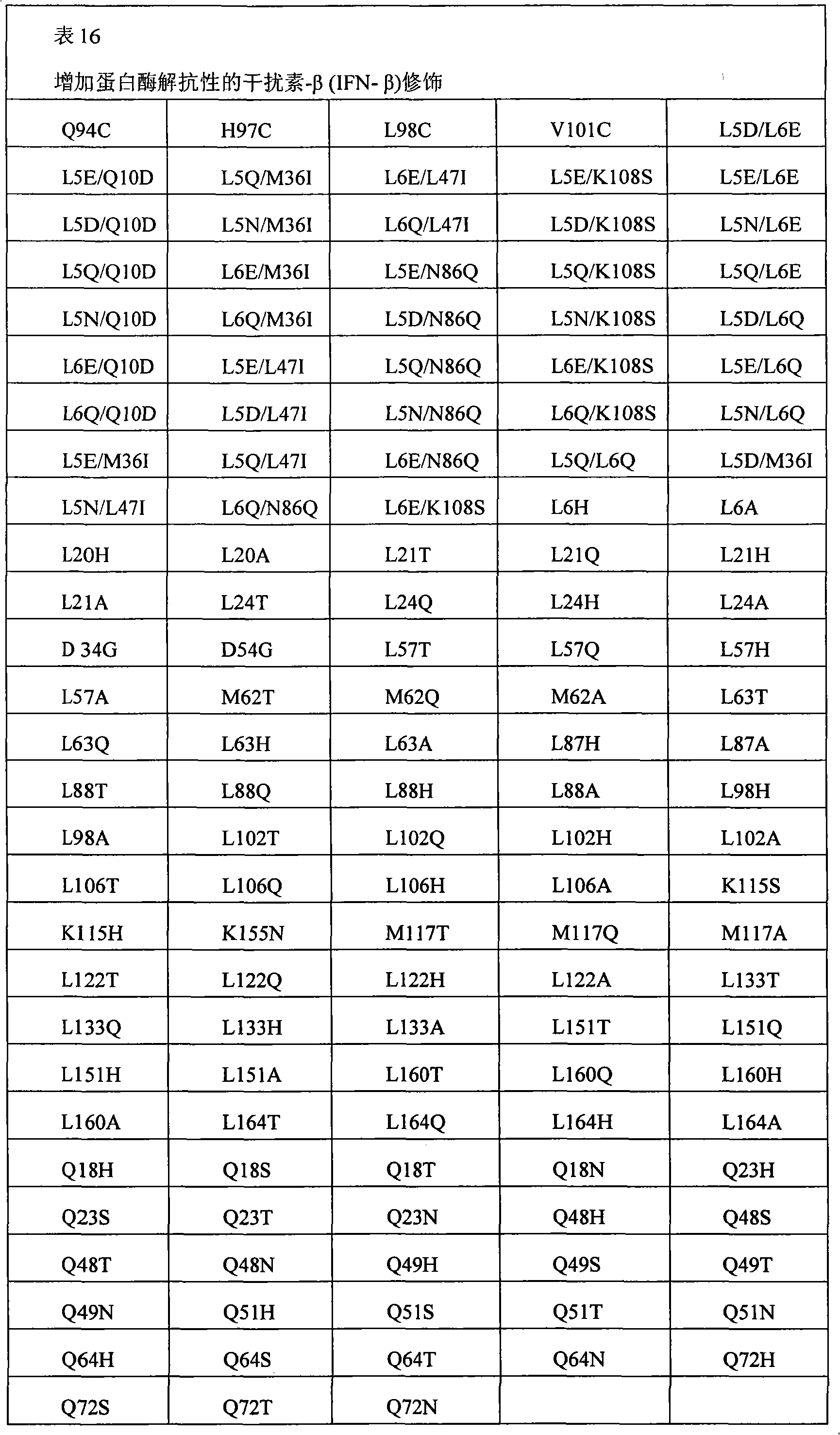
O. interferon gamma
Glycosylation cytokine for example is interferon gamma (IFN-γ).Normally, IFN-γ comprises the pleiotropy cytokine that activated T cell and NK cell produce by immunocyte.IFN-γ and the cell that produces it in host defense by playing a crucial role for various kinds of cell type performance antiviral, antiproliferative and immunoregulation effect.For example, IFN-γ has the ability that strengthens I type and II type MHC antigen presentation on macrophage function activity, promotion T cell and B cell differentiation, the adjusting various kinds of cell, activates natural killer cell and neutrophil cell and the survival of prolongation neutrophil cell.IFN-γ polypeptide is heterogeneous polypeptide, is made up of the aminoacid sequence of different length, the polypeptide that produces that includes but not limited to recombinate, the synthetic polypeptide that produces and from cell with organize the IFN-γ of extraction for example the T lymphocyte and natural killer cell (NK).Normally, IFN-γ produces as bigger polypeptide, and maturation is less polypeptide when the signal sequence cracking.Ripe IFN-γ polypeptide length is typically 124-146 aminoacid after the signal sequence cracking.The precursor forms of people IFN-γ is 166 amino acid whose polypeptide (for example shown in the SEQID NO:305), comprise cleaved signal sequence (being 1-20 aminoacid), thereby the acquisition mature polypeptide for example has 146 amino acid whose mature polypeptides shown in the SEQ ID NO:306.IFN-γ further post translational modification of quilt by the glycosylation of N connection.For example, Asn48 is the glycosylation site that N is connected with Asn120, corresponding to the residue in the precursor sequence shown in the SEQ ID NO:305 (and respectively corresponding to the 28th and 100 residue among the SEQ ID NO:306).
In addition, ripe IFN-γ can length be less than 146 amino acid whose forms existence, and for example length is 124,125,138,139,140,141,142,143,144 and 145 aminoacid.The heterogeneity of IFN-γ polypeptide is derived from the natural truncate in the C-terminal generation of IFN-γ, for example because before secretion and due to the digestion of proteolysis afterwards.For example, described truncate can be by due to the inscribe and/or circumscribed proteinase activity of host cell generation.In some cases, the proteasome degradation after secretion is owing to due to the existence of proteolysis enzyme in the culture medium.
Also reported aminoacid deletion at the N-terminal of IFN-γ.In some cases, the residue of N-terminal disappearance is because due to the post translational modification.Source according to IFN-γ, the post translational modification of IFN-γ can comprise first three aminoacid of removing mature polypeptide shown in the SEQ ID NO:306, be amino acid residue Cys-Tyr-Cys (The Cytokine FactsBook, (1994) Callard R., and GearingA., (eds) pp.157-158).
For the present invention, the modification of IFN-γ polypeptide is meant that length is the IFN-γ polypeptide of 146 aminoacid (SEQ IDNO:306).Yet the IFN-γ polypeptide that should understand modification provided herein can produce by method known to those skilled in the art, and can produce the polypeptide of different length.Therefore, the IFN-γ polypeptide of modification provided herein comprises that length is 146 amino acid whose those polypeptides (promptly containing amino acid modified), it is in N-terminal or the C-terminal fragment of truncate, perhaps its combination in various degree in ripe IFN-γ polypeptide shown in the SEQ ID NO:306.If desired, IFN-γ polypeptide can purification be any equal pledge of wishing length.Provided herein is the non-glycosylated IFN-γ polypeptide of protease resistant.This IFN-γ protease resistant polypeptide comprises having one or more amino acid modified those polypeptides, and wherein said one or more modification causes for the higher resistance of protease.This modification for example includes but not limited to the modification shown in the following table 17, and it is corresponding to the amino acid replacement in the aminoacid sequence shown in the SEQ ID NO:306.In one embodiment, the nonglycosylated protease resistant IFN-gamma cells factor can produce by produce the protease resistant polypeptide in can not glycosylated host cell, and described host cell comprises for example prokaryotic hosts such as escherichia coli.In another embodiment, the non-glycosylated protein enzyme resistance IFN-gamma cells factor can produce until whole glycosylation sites by in the described polypeptide one or more.For example, has the modification that can further be included in one or more amino acid position of N28 and N100 corresponding to the protease resistant polypeptide of one or more modification as shown in Table 17 of amino acid replacement among the SEQ ID NO:306.Non-glycosylated protein enzyme resistant polypeptides provided herein keeps the activity of the complete glycosylated IFN-γ polypeptide of non-protease resistant.This non-glycosylated protein enzyme resistant polypeptides can be used for treating those diseases or the disease that IFN-γ is generally used for treating.This disease for example includes but not limited to viral infection (for example hepatitis C, acquired immune deficiency syndrome (AIDS)), bacterial infection, fungal infection (for example aspergillosis, candidiasis), cancer sample disease (for example neutropenia, hematopoietic cell transplantation), cancer, hepatopathy, pneumonopathy or disease, pernicious osteopetrosis or chronic granuloma.
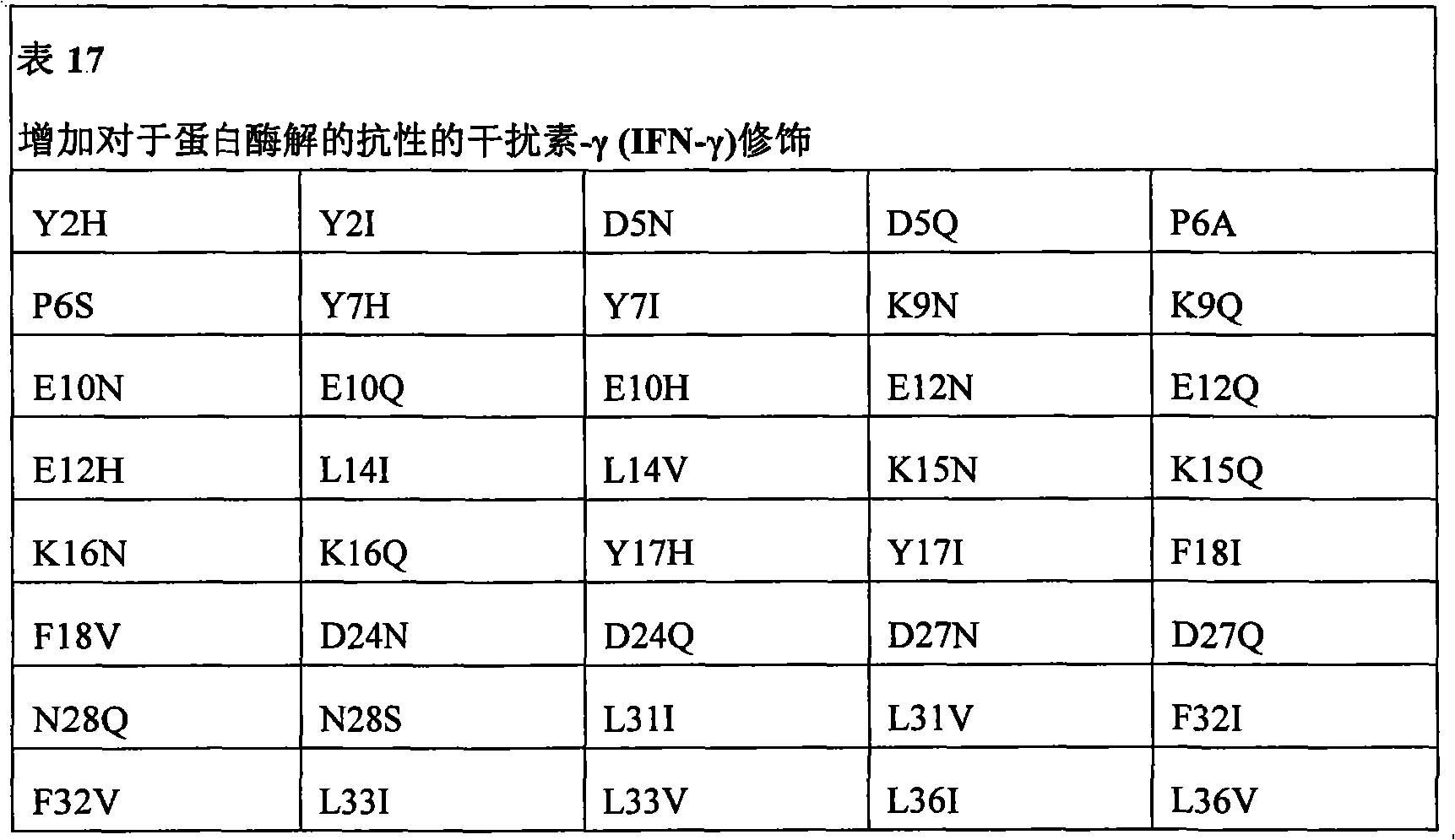
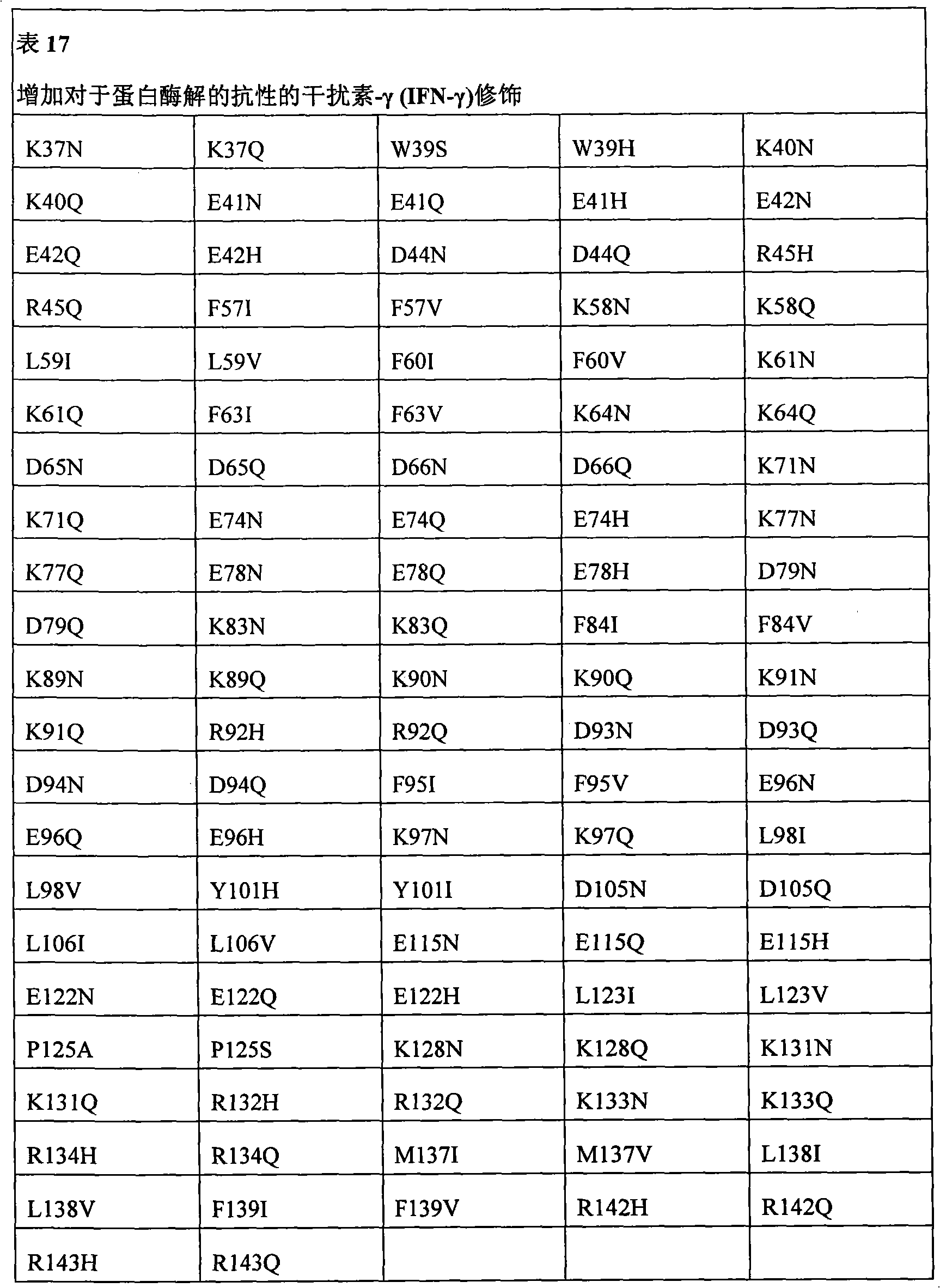
4. other modifications of therapeutical peptide
Except be used to increase protease resistant any one or more is amino acid modified, the therapeutical peptide of modification also can comprise one or more other modifications.Common described modification causes described therapeutical peptide stability to increase and does not lose its at least a activity.
For example, other modifications in the therapeutical peptide comprise modification and/or one or more chemical modification that one or more is other.Described modification includes but not limited to, changes immunogenicity, glycosylation, those of other any known properties of activity or therapeutical peptide.In some examples, the character of described amino acid modified change therapeutical peptide is the active required of described polypeptide.For example, describedly amino acid modifiedly increase or reduce described therapeutical peptide and other polypeptide such as the interaction between the receptor.In some examples, the active loss of described amino acid modified compensation.For example, if a kind of amino acid modified reduction is active, such as bind receptor, different loci another kind of amino acid modified recovers described combination.
Other other modifications comprise amino acid modified and/or one or more chemical modification that one or more is other in the therapeutical peptide, and perhaps one or more is other amino acid modified, and it allows other chemical modification (for example producing the site that is used for chemical modification).Described modification includes but not limited to, PEGization is gone immunization, and acidylate (for example, acetylation or succinylation), methylate phosphorylation, hasylation, carbamylation, sulphation, prenylation, oxidation, guanidine radicalsization (guanidination), amidination, carbamylation (being carbamylation), trinitrobenzeneization, nitrated, and other modifications known in the art (are for example seen, U.S.Patent Nos.5,856,298; U.S.Patent Publication Nos.2003-0120045,2004-0063917,2005-0220800,2005-0107591,2006-0035322, and 2006-0073563; With International PCT Pub.No.:WO 01/81405) or its combination.
Protease resistant increases when the therapeutical peptide of described modification makes the shortage glycosylation through transforming, in the non-natural site glycosylation of described therapeutical peptide, the therapeutical peptide of described modification can further be modified to import one or more non--Natively glycosylated site and be used to connect the carbohydrate part if desired.Being used to modify EPO provides in other part with the illustrative methods that imports other glycosylation site, and can be used for the therapeutical peptide of modification of the present invention.
In addition, protein modification also can comprise detection, purification that promotes polypeptide and the modification that detects exploitation, such as for example, utilize Sulfo-NHS-LC-biotin modification polypeptide with the primary amine on the covalently bound albumen, or other modifications are used to connect fluorescent labeling, heterotope labelling or radioactivity labelling.Described modified therapeutic protein also can be blended in one or more polypeptide and use to promote the polypeptide targeted therapy, detects, and purification and mensuration are developed or are blended in other therapeutical peptide and is used for the treatment of.
A. increase deliquescent modification
The therapeutical peptide of described modification also can further be modified to increase protein solubility.For example, not that polar residues on the required described protein surface of proteic activity can be modified gathering (Narhi et al. (2001) Prot.Eng.14 (2) 135-140) when preventing that polypeptide from producing in antibacterial.Common described residue is modified, and makes described albumen keep proteic one or more activity of unmodified treatment.The residue that is used to modify includes but not limited to, the asparagine residue, and it is the protein glycosylation site.Usually, neutral asparagine residue can be replaced by alkaline amino acid residue, such as lysine or histidine.In the example, the human cytokines of described modification is that epo protein and one or more asparagine residue modified are selected from amino acid N 24, and N38 and N83 modify.In the instantiation, the N24 in the EPO polypeptide, N38 and N83 residue are replaced (for example, SEQ ID NOS:309 or 310) by lysine.
5. increase the method for the glycosylated or nonglycosylated therapeutical peptide protease resistant of part by the modification of targeting
The method of decorating site that identify to increase the therapeutical peptide of protease resistant is locally described and is (see, for example, disclosed international pct application Nos.WO 04/022593 and WO 04/022747) known in the art at other.The modification of giving the protease resistant of increase can produce in any following glycosylation therapeutical peptide, and it is prepared as nonglycosylated or the glycosylated polypeptide of part or modified to remove one or more glycosylation site.In the glycosylated therapeutical peptide of nonglycosylated or part, the modification of giving the protease resistant of increase can compensate because the increase of the protein degradation that the removal carbohydrate partly causes.The exemplary modification that is used for protease resistant in the therapeutical peptide of modifying is shown in table 3,5-17.
The method in the responsive site of protease that the evaluation that is used for targeting also is provided or has modified the glycosylation therapeutical peptide, wherein the responsive site of one or more protease is covered by glycosylation.Described modification can be at described therapeutical peptide glycosylated fully, produce in the glycosylated or nonglycosylated form of part.When existing in the glycosylation form of described therapeutical peptide, described modification also can protect polypeptide not degrade, and condition is that one or more carbohydrate part is removed from albumen after the vivo medicine-feeding.
A. the targeting modification of the protease site that exposes of deglycosylation
The invention provides the method that increases the proteic protease resistant of treatment, be tested and appraised and modify to modify after being translated and carry out such as the responsive site of the hidden protease of glycosylation.Adopt method of the present invention, can obtain the non-glycosylated variant of proteoclastic sensitivity with the therapeutical peptide that the natural treatment polypeptide of glycosylation is suitable fully.
The amino acid modified selection of protease resistant that is used to increase non-glycosylated polypeptide is based on to existing the evaluation of determining the responsive site of protease of distance apart from the carbohydrate connection site of natural polypeptides.Usually, protease sensitivity site is arranged in glycosylation site or about 0-25
 Utilize the three dimensional structure of described therapeutical peptide, can identify that existence is apart from the potential protease sensitivity site in the definite distance of glycosylation site.The initial list in potential protease sensitivity site (LEAD) can be tested and appraised method and produce, all 2D-as indicated above and 3D-scan method.Can select to exist apart from glycosylation site and determine that the LEAD in the site that distance is interior is used for detecting.
In order to identify the modification that increases protease resistant in the nonglycosylated therapeutical peptide, described therapeutical peptide is at first modified to prevent in this site generation glycosylation at glycosylation site.Usually, described glycosylation site is modified by the aminoacid that replacement is used to connect the carbohydrate part.Usually, select such substituted amino acid, make described replacement not change proteic structural intergrity.For example, N-connects the asparagine of glycosylation site usually by histidine or lysine replacement.
The LEAD of every kind of selection is introduced into the polypeptide with sudden change glycosylation site subsequently.The protease resistant of the therapeutical peptide of every kind of modification utilizes embodiment and the described method of other parts to measure subsequently, and compares with glycosylation site mutant and/or complete glycosylated therapeutical peptide.Be determined in case give the modification of the protease resistant of deglycosylation albumen increase, the human cytokines of the modification of generation can only have the protease resistant modification or modify combination with glycosylation site.
If concrete therapeutical peptide has a plurality of glycosylation sites, the step of described method can be for each glycosylation site respectively, simultaneously or carry out successively.For example, but two or more glycosylation site simultaneous mutations, and the modification in protease resistant site can detect on the therapeutical peptide that contains a plurality of glycosylation site sudden changes.In another example, first glycosylation site can suddenly change in described therapeutical peptide and corresponding first protease resistant mutants is identified.Subsequently, the sudden change in second glycosylation site can be introduced double-mutant, and the corresponding second glycosylation resistant mutants is identified thus.In another example, first glycosylation site suddenlys change in described therapeutical peptide and has identified the corresponding first protease antibody variant.Subsequently, second glycosylation site can suddenly change in isolating therapeutical peptide, and identifies the corresponding second protease resistant variant.Identify after the protease resistant variant of each glycosylation site, can produce the therapeutical peptide of modification, wherein contain described modification.In some examples, the therapeutical peptide of generation has the glycosylation site sudden change and protease resistant is modified.In other examples, the therapeutical peptide of generation only has protease resistant and modifies.
Giving other modifications of the protease resistant of increase can identify by introduce one or more other modification in the therapeutical peptide of modifying.Described modification be selected from a series of from method such as potential protease resistant modify described method such as 2D-or 3-D scan method.Any modification that is accredited as the protease resistant that increases therapeutical peptide can be in the corresponding site transformation in other homology therapeutical peptides.
To the evaluation in the responsive site of potential protease of exemplary treatment polypeptide (EPO) referring to embodiment.EPO contains the glycosylation site that 3 N-connect, the glycosylation site S126 that N24, N38 and N83 are connected with an O-.Fig. 1 has described the position of the three dimensional structure and the glycosylation site that N connects of EPO polypeptide.Shown in table 18, can identify so potential protease sensitivity site, it is 10 of each glycosylation site
 Or 15
In.In order to implement described method, the glycosylation site that the N-of EPO polypeptide connects can be by modifying described aminoacid such as histidine or lysine with the aminoacid replacement agedoite.Be modified at the deglycosylated EPO polypeptide of position N24 to improve the potential site of protease resistant, include but not limited to L17, K20, E21, E23, F142, R143, R14, L16, E18, E31, W88, E89, P90, L91, L93, K97, F138, R139, K140, L141 and Y145.Being modified at position N38 is that deglycosylated EPO polypeptide includes but not limited to L35, E37, R76, L80, D136, F138 with the potential site of improving protease resistant, K140, P42, D43, L69, L70, E72, L75, L81, P129, L130, R131, R139, L141 and F142.Be modified at the deglycosylated EPO polypeptide of position N83 and include but not limited to L35, L75, R76, L80, L81, E37, E72, P87, W88, P90, L91, L93 and D96 with the potential site of improving protease resistant.Be modified at the deglycosylated EPO polypeptide of position S126 and include but not limited to L69, E72, P121, P122, D123, P129, L130, P42, E62, W64, L67, L70, L75, R76 and R131 with the potential site of improving protease resistant.The EPO LEAD that utilizes the 2-D scan method to identify selects the protease resistant in these sites to modify (for example seeing table 3).The corresponding modification of each glycosylation site is as evaluation as described in the embodiment.The exemplary modification of giving at the EPO polypeptide of the deglycosylated EPO polypeptide protein of N24 enzyme resistance is K20.The exemplary modification of giving at the EPO polypeptide of the deglycosylated EPO polypeptide protein of N38 enzyme resistance is N139.The exemplary modification of giving at the EPO polypeptide of the deglycosylated EPO polypeptide protein of N93 enzyme resistance comprises L80I, L93I and L93V.The position of each exemplary modification is used for protease and is described in Fig. 1.The modification that other being used to increases protease resistant in the EPO polypeptide of modifying includes but not limited to R4H, K52N, L153V and E159N.
Or 15
In.In order to implement described method, the glycosylation site that the N-of EPO polypeptide connects can be by modifying described aminoacid such as histidine or lysine with the aminoacid replacement agedoite.Be modified at the deglycosylated EPO polypeptide of position N24 to improve the potential site of protease resistant, include but not limited to L17, K20, E21, E23, F142, R143, R14, L16, E18, E31, W88, E89, P90, L91, L93, K97, F138, R139, K140, L141 and Y145.Being modified at position N38 is that deglycosylated EPO polypeptide includes but not limited to L35, E37, R76, L80, D136, F138 with the potential site of improving protease resistant, K140, P42, D43, L69, L70, E72, L75, L81, P129, L130, R131, R139, L141 and F142.Be modified at the deglycosylated EPO polypeptide of position N83 and include but not limited to L35, L75, R76, L80, L81, E37, E72, P87, W88, P90, L91, L93 and D96 with the potential site of improving protease resistant.Be modified at the deglycosylated EPO polypeptide of position S126 and include but not limited to L69, E72, P121, P122, D123, P129, L130, P42, E62, W64, L67, L70, L75, R76 and R131 with the potential site of improving protease resistant.The EPO LEAD that utilizes the 2-D scan method to identify selects the protease resistant in these sites to modify (for example seeing table 3).The corresponding modification of each glycosylation site is as evaluation as described in the embodiment.The exemplary modification of giving at the EPO polypeptide of the deglycosylated EPO polypeptide protein of N24 enzyme resistance is K20.The exemplary modification of giving at the EPO polypeptide of the deglycosylated EPO polypeptide protein of N38 enzyme resistance is N139.The exemplary modification of giving at the EPO polypeptide of the deglycosylated EPO polypeptide protein of N93 enzyme resistance comprises L80I, L93I and L93V.The position of each exemplary modification is used for protease and is described in Fig. 1.The modification that other being used to increases protease resistant in the EPO polypeptide of modifying includes but not limited to R4H, K52N, L153V and E159N.
Among the deglycosylated EPO of table 18.<10
 With<15
 The evaluation in the responsive site of potential protease
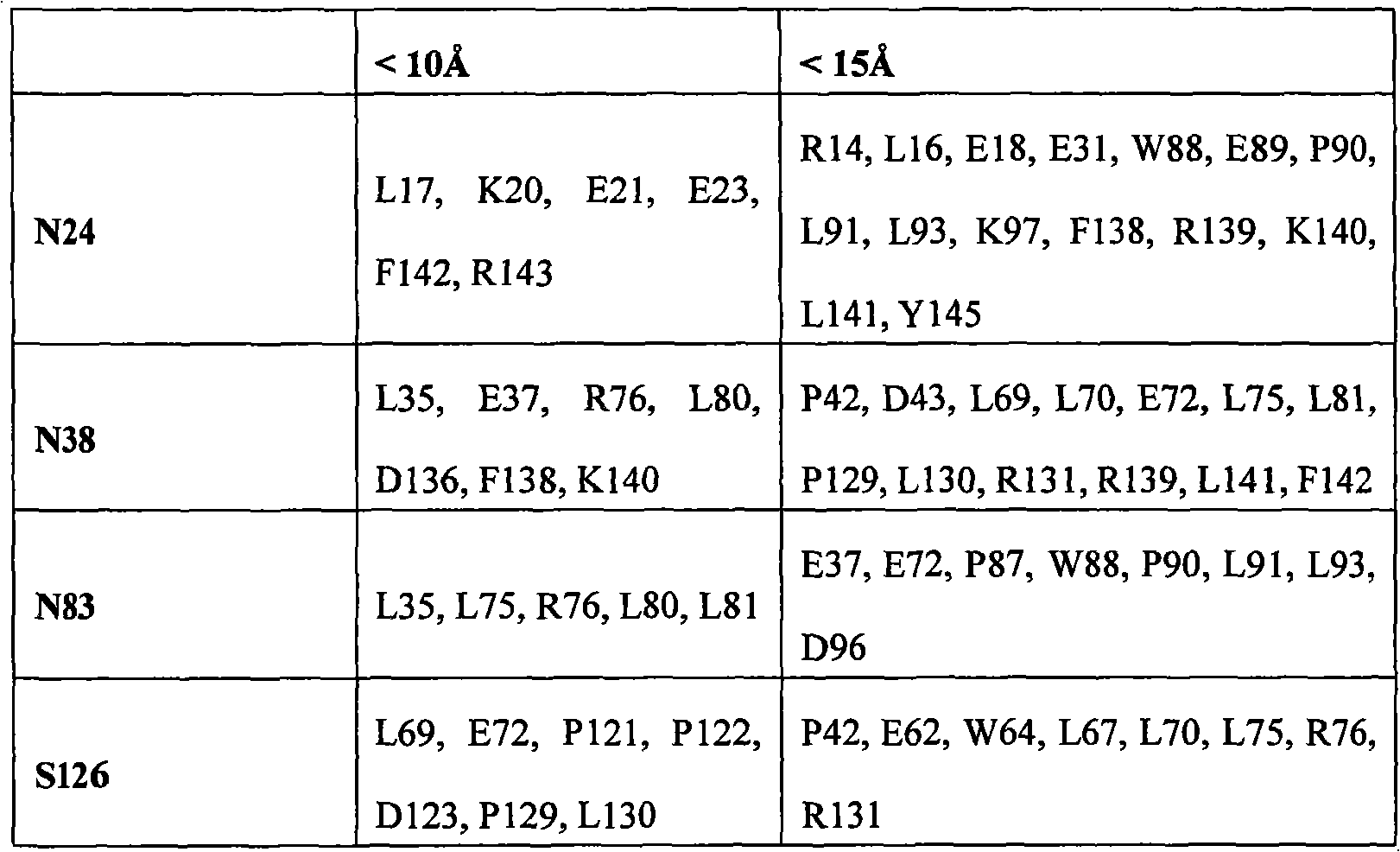
F. prepare EPO polypeptide and other therapeutical peptide
1. expression system
EPO polypeptide and other therapeutical peptide (modification with unmodified) can prepare by any protein preparation method known in the art, comprise that the nucleic acid molecules with coding EPO polypeptide or other treatment polypeptide imports host cell, host animal is also expressed at external nucleic acid molecules from coding EPO polypeptide or other treatment polypeptide.Expressive host comprises escherichia coli, yeast, and plant, insect cell, mammalian cell comprise human cell line and transgenic animal.The albumen generation level of expressive host and have post translational modification type difference on the expressed protein.The selection of expressive host can be based on these and other factors, such as regulating and security consideration the needs of preparation cost and purification and method.
Expression in eucaryon host can be included in yeast such as such as saccharomyces cerevisiae and pichia pastoris, and insect cell such as drosophila cell and lepidoptera cell, plant and plant cell be such as Nicotiana tabacum L., corn, rice, algae, and the expression in the Herba Spirodelae.The eukaryotic cell that is used to express also comprises mammal cell line such as Chinese hamster ovary (CHO) cell or young hamster kidney (BHK) cell.The eukaryotic expression host is also included within the transgenic animal and prepares, and for example is included in serum, urine, emulsion and the ovum to be prepared.The transgenic animal that are used to prepare wild type EPO polypeptide and other therapeutical peptide or EPO fused polypeptide and other therapeutic fused polypeptide are that the EPO polypeptide of known in the art and suitable preparation modification of the present invention and the therapeutical peptide of other modification (are for example seen Mikus et al. (2004) TransgenicRes.13 (5): 487-98; Korhonen et al. (1997) Eur.J.Biochem.245:482-489; Kwon et al. (2006) Transgenic Res.15 (1): 37-55).
Many expression vectors can be used for expressing EPO polypeptide and other therapeutical peptide.The influence that the selection of expression vector is selected by host expression system.Described selection is in those skilled in the art's limit of power.Usually, expression vector can comprise transcription vector and optional enhancer, translation signals and transcribing and the translation termination signal.The expression vector that is used for stable conversion has selectable marker usually, and it allows to select and keep cell transformed.In the certain situation, the source of duplicating can be used for the copy number of carrier in the amplifying cells.
The method for preparing EPO polypeptide and other therapeutical peptide can comprise one or more other heterologous polypeptide that the auxiliary EPO polypeptide of coexpression and other therapeutical peptide produce.For example, described polypeptide can cause the cracking of signal peptide or the secretion or the translation post-treatment (for example, glycosylation) of auxiliary EPO polypeptide or other treatment polypeptide.One or more polypeptide can be from expressing with the identical or different expression vector of EPO polypeptide or other treatment polypeptide.
A. prokaryotic expression
Prokaryote, especially escherichia coli, provide preparation a large amount of EPO polypeptide and other therapeutical peptide system (see, for example, Platis et al. (2003) Protein Exp.Purif.31 (2): 222-30; With Khalizzadeh et al. (2004) J.Ind.Microbiol.Biotechnol.31 (2): 63-69).Colibacillary conversion is a simple and technology fast known in the art.Coli expression carrier can comprise and be used to induce the expression of high-level Danba and express some toxic proteic inducible promoters that show host cell.The example of inducible promoters comprises the 1ac promoter, trp promoter, heterozygosis tac promoter, T7 and SP6RNA promoter and thermoregulator λ P
LPromoter.
EPO polypeptide and other therapeutical peptide can be expressed in colibacillary endochylema environment.Endochylema is a reducing environment, and for some molecules, can cause insoluble endosome to form.Reducing agent such as dithiothreitol, DTT and beta-mercaptoethanol and denaturant (for example, such as guanidine-HCl and carbamide) can be used for dissolving described albumen again.Another kind method is to express EPO polypeptide or other treatment polypeptide in all gaps of the kytoplasm of antibacterial, and oxidation environment and chaperone sample and disulphide isomerase wherein are provided, and causes producing soluble protein.Usually, targeting sequencing is blended in treats expressed proteins, refers to described albumen to pericentral siphon.Leading subsequently by the removal of the signal peptidase in the pericentral siphon.The targeting sequencing of targeting pericentral siphon comprises from the pelB of pectin lyase gene leading, and is originated from alkaline phosphatase gene before described.In the certain situation, periplasmic expression allows the expressed proteins culture medium of bleeding.Proteic secretion allows from culture supernatant purification fast and simply.There is not excretory albumen to derive from pericentral siphon by the infiltration cracking.Express similarly with kytoplasm, albumen can be changed into insoluble and can utilize denaturant and Reducing agent to promote dissolving and folding again in the certain situation.The temperature of inducing and growing also can influence expression and dissolubility.Usually, use the temperature of 25 ℃ and 37 ℃.Also can utilize sudden change to increase the dissolubility of expressed proteins.Usually, antibacterial produces glycosylated albumen.Therefore, if the protein requirement glycosylation with the performance function, glycosylation can add behind host cell at external purification.
B. yeast
Yeast is such as saccharomyces cerevisiae, schizosaccharomyces pombe, Yarrowia lipolytica, lactose kluyveromyces (Kluyveromyces lactis) and pichia pastoris (Pichia pastoris) are that the host who is used to express EPO polypeptide and other therapeutical peptide (for example sees Skoko et al. (2003) Biotechnol.Appl.Biochem.38 (Pt3): 257-65).Yeast can utilize the episome replicating vector to transform or stablize chromosomal integration by homologous recombination.Usually, inducible promoters is used for the regulator gene expression.The example of described promoter comprises GAL1, and GAL7 and GAL5 gene and metallothionein promoter are such as CUP1.Expression vector generally includes selectable marker such as LEU2, TRP1, and HIS3, and URA3 are used to the DNA that selects and keep transforming.In the yeast expressed proteins usually solvable and with the chaperone coexpression, such as Bip and protein disulphideisomerase, thereby improve expression and dissolubility.In addition, expressed proteins can guide secretion such as merging from the yeast mating type alpha-factor secretion signal fusion of saccharomyces cerevisiae and with yeast cell surface albumen such as Aga2p copulation adhesion receptor or Arxula adeninivorans glucoamylase with secreting signal peptide in the yeast.Protease cracking site (for example, Kex-2 protease) can be through transforming, thereby they remove the sequence that merges from described polypeptide when leaving secretory pathway.Yeast also can be in the glycosylation of Asn-X-Ser/Thr motif.
C. insecticide and insect cell
Insecticide and insect cell specifically are to utilize baculovirus expression system, can be used for express polypeptide such as EPO polypeptide and other therapeutical peptide (see, for example, Quelle et al. (1992) Protein Expr.Purif.3 (6): 461-9).Insect cell and insect larvae are included in the hemolymph expresses, and expresses high-level albumen and can carry out the post translational modification that most of high eucaryon animals are used.Baculovirus has the host range of restriction, and its safety has improved and reduced the adjusting problem of eukaryotic expression.Usually, expression vector utilizes carrier to be used for high level expression such as baculovirus polyhedrin body protein carrier.Normally used rhabdovirus system comprises that baculovirus is such as Autographa californica nucleopolyhedrosis virus (AcNPV), bombyx mori nucleopolyhedrosis virus (BmNPV) and insect cell line are such as Sf9, it is from Spodoptera frugiperda, Pseudaletia unipuncta (A7S) and Danaus plexippus (DpNl).For high level expression, wait that the nucleotide sequence of expressing molecule closely is connected with viral polyhedrin start codon downstream.The mammal secretion signal is accurately processed in insect cell and be can be used for expressed proteins is secreted into culture medium.In addition, cell line Pseudaletia unipuncta (A7S) has produced the albumen with glycosylation pattern similar to mammlian system with Danaus plexippus (DpNl).
Another natural expression system is the cell that utilizes stable conversion in the host cell.Cell line such as Schnieder 2 (S2) and Kc cell (Drosophila melanogaster) and C7 cell (Aedesalbopictus) can be used for expressing.Fruit bat can be used for expressing.Fruit bat metallothionein carrier is used in heavy metal and induces and utilize cadmium or copper inducible high level expression under existing.Expression vector is usually by utilizing selectable marker thing such as neomycin and hygromycin to keep.
D. mammalian cell
Mammalian expression systems can be used for expressing EPO polypeptide and other therapeutical peptide.Expression construct can be by virus such as the infection of adenovirus or vaccinia virus, or shifts such as liposome by direct DNA, calcium phosphate, DEAE-glucosan and be transferred to mammalian cell by physical method such as electroporation and microinjection.The expression vector of mammalian cell generally includes the mRNA capsite, TATA frame, translation initiation sequence (Kozak consensus sequence) and polyadenylic acid element.Described carrier generally includes the transcription vector enhancer and is used for high level expression, SV40 carrier enhancer for example, and human cytomegalic inclusion disease virus (CMV) promoter, and the length of Rous sarcoma virus (RSV) is terminal repetition.These promoter-enhancers all have activity in many cell types.Tissue and cell type promoter and enhancer zone also can be used for expressing.Exemplary promoter/enhancer zone includes but not limited to, from those of following gene: such as elastoser I, insulin, immunoglobulin, mouse mammary tumor virus, albumin, alpha-fetoprotein, alpha 1-antitrypsin, the beta-globulin, myelin basic protein, myosin light chain-2, and gonadotropin releasing hormone Gene Handling.Selectable marker can be used for selecting and keeping having the cell of expression construct.The example of selectable marker gene includes but not limited to, hygromycin B phosphotransferase, ADA Adenosine deaminase, xanthine-guanine phosphoribosyl transferase, glucosaminide phosphotransferase, dihydrofolate reductase and thymidine kinase.With the cell surface signaling molecule such as TCR-ζ and Fc
εThe fusion of RI-γ can be instructed the expression of the albumen of activated state at cell surface.
The many cell lines that are used for the mammal expression comprise mice, rat, people, monkey, chicken and hamster cell.Exemplary cells system includes but not limited to CHO, VERO, BHK, HT1080, MDCK, W138, Balb/3T3, HeLa, MT2, mice NS0 (non--secreting type) and other myeloma cell line, hybridoma and hetero hybridoma cells system, lymphocyte, RPMI 1788 cells, fibroblast, Sp2/0, COS, NIH3T3, HEK293,293S, 2B8, EBNA-1 and HKB cell (are seen for example U.S.Pat, Nos.5,618,698,6,777,205).Cell line also can be suitable for serum-free medium, and it helps from the purifying secreted albumen of cell culture medium (for example, EBNA-1, Pham et al., (2003) Biotechnol.Bioeng.84:332-42).The reorganization wild type EPO polypeptide expression that structure that expression known in the art is similar to the EPO in urine source and translation back Kohlenhydrate are modified, some of them show that sialic acid partly connects difference and (sees, for example, Takeuchi et al. (1988) J.Biol.Chem.263 (8): 3657-3663; Inoue et al. (1995) Biotechnol.Annu.Rev.1:297-313).The method of optimizing the erythropoietin expression also is (for example, Tsao et al. (1992) Ann N Y Acad Sci.665:127-36 known in the art; Wang et al. (2002) Biotechnol Bioeng.77:194-203; Sethuraman and Stadheim (2006) Curr.Opin.Biotech.17:341-346; Yoon et al. (2001) Biomed.Life Sci.37 (2) 119-132).
E. plant
Transgenic plant cells and plant can be used for expressing EPO polypeptide and other therapeutical peptide.Expression construct is utilized the protoplast of direct DNA transfer such as microinjection bombardment and PEG mediation to shift usually and is transferred to cell.Expression vector can comprise promoter and enhancer sequence, tanscription termination element, and translation control element (for example, Ti-plasmids).Expression vector and transformation technology are generally used for dicotyledonous host such as arabidopsis and Nicotiana tabacum L., and the monocotyledon host, such as Semen Maydis and rice.The example of the plant promoter that is used to express comprises cauliflower mosaic virus promoter, nopaline synthase promoter, ribose diphosphonic acid carboxylase (ribose bisphosphate carboxylase) promoter and ubiquitin and UBQ3 promoter.Selectable marker is such as hygromycin, and phosphomannose isomerase and neomycin phosphotransferase are generally used for promoting to select and keep cell transformed.The plant transformed cell can be used as cell, aggregation (callus) remains in the culture medium or regeneration is complete plant.Transgenic plant cells also can comprise through transform producing proteic algae (see, for example, Mayfield et al. (2003) PNAS 100:438-442).The plant cell system that is used to express also comprises with the virus expression carrier plant that infects of cauliflower mosaic virus (CaMV) or tobacco mosaic virus (TMV) (TMV) for example.Because plant has the glycosylation pattern that is different from mammalian cell, can influence the selection that in these hosts, produces EPO.
2. purification
Depend on selected host cell and expression system from the method for host cell purification EPO polypeptide and other therapeutical peptide.For excretory molecule, usually after removing cell from the culture medium purifying protein.For cell inner expression, cell can be cleaved and from the extract purifying protein.When using transgenic organism such as transgenic plant and animal to express, but using-system or organ as initial substance to prepare cracked cell extract.In addition, transgenic animal produce to be included in and produce polypeptide in milk or the ovum, and described polypeptide can be collected and described if desired albumen can utilize this area standard method extraction and carry out purification subsequently.
EPO polypeptide and other therapeutical peptide can utilize standard protein purification technology known in the art to come purification, include but not limited to SDS-PAGE, differential precipitation, diafiltration, ultrafiltration, the post electrofocusing, dull and stereotyped electrofocusing, gel filtration, isotachophoresis, size fractionation, ammonium sulfate precipitation, high performance liquid chroma-tography, chelating chromatography, adsorption chromatography, ion-exchange chromatography, hydrophobic interaction chromatography, and molecular exclusion chromatography.The affinity purification technology also can be used for improving the efficient and the purity of preparation.For example, antibody, receptor and other molecules in conjunction with EPO or other treatment polypeptide can be used in the affinity purification.Expression construct also can be added affinity labeling such as the myc epi-position through transforming, and GST merges or His
6Also utilize myc antibody, glutathion resin and Ni-resin affinity purification respectively to protein.Purity can comprise gel electrophoresis and spectrophotometer measurement technology by any means known in the art assessment.The example technique of purification EPO polypeptide and other therapeutical peptide is known in the art and sees, for example, and U.S.Pat.No.4,377,513,4,667,016,4,677,195,5,733,761,6,682,910,7,012,130; Miyake et al. (1977) J.Biol.Chem.252 (15) 5558-5564; Spivak et al. (1977) Proc.Natl.Acad.Sci.USA 74 (10): 4633-4635.
3. fusion rotein
In some embodiments, the EPO polypeptide of modification or other treatment polypeptide comprise that further heterologous polypeptide (for example fusion partner) is connected joint such as chemical means to form fusion rotein or to pass through with polypeptide.Suitable fusion partner comprises peptide and polypeptide, and it gives enhanced body internal stability (for example, enhanced serum half life); Thereby the facilitation purification, for example, histidine mark (His)
n, (for example, 6xHis, etc.); Help fusion rotein from emiocytosis; Epi-position labelling (for example, GST, hemagglutinin (HA), FLAG, c-myc etc.) is provided; Detectable signal (for example, generation can detect the enzyme (for example, beta galactosidase, luciferase) of product) is provided, or detectable albumen own (for example, green fluorescent protein (GFP), etc.); Be used for polymerization (for example, the Fc part of polymer domain such as immunoglobulin); Deng.
The fusion rotein that contains the therapeutical peptide of the EPO polypeptide of targeting agent and modification or other modifications is also included among the present invention.Comprise described fusion rotein preparation and be used for being also contained in the present invention, for example be specifically used for oral administration by the pharmaceutical composition of suitable route administration.Fusion rotein is by EPO polypeptide or other treatment polypeptide and medicament formation with any modification that is linked in sequence, described medicament such as antibody or its fragment, somatomedin, receptor, part, and other are used to instruct the medicament of mutain to the cell or tissue of targeting.Connection can directly or indirectly form via joint.Fusion rotein can be recombinated to produce or connect by chemistry and be utilized chemical method to produce, such as connecting or other connections by isodigeranyl functional agent or sulfydryl.Described fusion rotein is commonly referred to protein conjugate.The joint that is fit to the conjugate that chemistry connects includes but not limited to being connected, disulfide bond, and thioether bond (hindered) has sterically hindered disulfide bond, and covalently bound between free responding group such as amido and the mercapto.These bondings utilize heterobifunctional agent produce with one or all two polypeptide on produce reactive mercapto, the reactive mercapto or the amido of coupled reaction dimaleoyl imino (maleimido) or mercapto react on the mercapto on polypeptide and another polypeptide then.The exemplary group that is used for isodigeranyl function cross-linking reagent includes but not limited to, aryl azide chemical compound, maleimide, Carbodiimides, N-hydroxy-succinamide (NHS)-ester, hydrazides, PFP-ester, the methylol phosphine, psoralen, acid imide esters, PEA, isocyanates/ester, and vinyl sulfone.
Fusion rotein can contain other component, and such as escherichia coli maltose-binding protein (MBP), its assist in dissolving, folding, purification and cell are to proteic absorption.In another embodiment, the EPO of modification is blended in the polypeptide of auxiliary stability, (for example sees U.S.Pat Pub.Nos.6,987,006,6,548,653,7,101,971 such as albumin; U.S.Pat.Pub.No.2004-0063635,2006-0058236; Albupoietin
TMCoGenesys).
Optional, the EPO polypeptide of modification or other treatment polypeptide can polymeric form prepare, by for example expressing as the Fc fusion rotein or with the fusions of other polymer domains.EPO fused polypeptide and other therapeutic fused polypeptide also can comprise fusion, or the two or more therapeutical peptides of dimerization/multimerization (are for example seen U.S.Patent No.5580853; Sytkowski (1999) J.Biol.Chem.274 (35): 24773-24778).Dimerization or multimerization (for example can directly be realized, single polypeptide and two or more EPO molecules, series connection) or via joint indirectly (for example, the same bi-functional cross-linking agent of XOR) or with EPO polypeptide or other treatment polypeptide be blended in can dimerization maybe can be right by the polypeptide of chemical means dimerization.In the latter event, the polypeptide that is blended in EPO polypeptide or other treatment polypeptide can be phase homopolypeptide or homopolypeptide (two kinds of albumen that for example, can interosculate) not.Exemplary poly domain is known in the art, include but not limited to, the Fc domain, or similar antibody print section, leucine zipper motif, helical structure territory, hydrophobic region, hydrophilic area is included in polypeptide or " protuberance-into-cavity (protruding into intracavity) " domain of forming the free sulfhydryl base of intermolecular disulfide bond between two or more multimerization domains and (for example sees that WO 94/10308; U.S.Pat.No.5,731,168, Lovejoy et al. (1993), Science 259:1288-1293; Harbury et al. (1993), Science262:1401-05; Harbury et al. (1994), Nature 371:80-83; Hakansson et al. (1999), Structure 7:255-64.
Other exemplary EPO fusion rotein and other therapeutic fused polypeptide and preparation method provide in the art, comprise, for example, but are not limited to Fc fusion and the fusion of beta-lactoglobulin, (U.S.Pat.No.6,992,174,6,165,476; U.S.Pat.Pub.No.2003-0064480,2005-0202538,2005-0192211; Korhonen et al. (1997) Eur.J.Bioch.245:482-489).When being built together with human cytokines, the Fc domain can provide long half life or comprise described function as Fc receptors bind, dimerization, protein A combination, and complement fixation is even Placenta Hominis shifts.In the described fusion rotein, the described character of EPO polypeptide and other therapeutical peptide can further be improved by one or more modification.In the non-limiting example, the modification of EPO polypeptide is such as H32G, C33, W88C, causing the disulfide bond syntype to be reset by Cys29-Cys33 with P90A is Cys29-Cys88, under Fc-Epo fusion rotein background, can cause described character obviously to be improved and (for example see Way et al. (2005) Protein Eng.Des.Sel.18 (3): 111-8).In addition, the EPO polypeptide that the present invention modifies and the fusion rotein of other therapeutical peptide can with the other modification combination (for example, sudden change, glycosylation, PEGization, HASylation etc.) of EPO polypeptide or other treatment polypeptide or known in the art those.
4. peptide modified
The EPO polypeptide of modifying and other therapeutical peptide can be used as exposed polypeptide chain or prepare as complex.Use for some, the EPO of the modification of needs preparation naked form or the therapeutical peptide of other modifications, it does not translate back or other chemical modifications.Exposed polypeptide chain can prepare in suitable host, does not wherein modify described therapeutical peptide after translation.Described polypeptide also can utilize chemical polypeptide synthesis preparation in vitro system.Use for other, concrete required modification comprises PEGization, albuminization, glycosylation, carboxylation, hydroxylating, phosphorylation, or other known modifications.Modification can be carried out external, or EPO and other therapeutical peptide of for example modifying by preparation in the suitable host who produces described modification.
5. nucleotide sequence
Provide can be operatively connected in the EPO polypeptide of the coding modification that connects promoter and the nucleotide sequence of other therapeutical peptide or fusion rotein, described promoter is used for expressing such as mammalian cell at protokaryon or eukaryotic cell such as inducible promoters.Described carrier includes but not limited to, protokaryon, eucaryon or viral vector.Be used for depending on the cell type that is used to express in the selection of cell expression promoter.Be used for including but not limited to CMV and SV40 promoter in the exemplary promoter that mammalian cell is expressed; Adenovirus promoter, such as the raq gene promoter, it is in response to HPV E7 proto-protein; The PV promoter, such as PBV p89 promoter, it is in response to PV E2 albumen; With other can be by HIV or PV or the activatory promoter of proto-oncogene.
The EPO polypeptide of modification of the present invention and other therapeutical peptide also can be delivered to cell in gene transfer vector.The other therapeutic agent of described transfer vector codified is used for the treatment of disease or disease such as the treatment hemophilia, and genetic diseases and other can give the disease of EPO.The transfer vector of the EPO polypeptide that coding is modified can be used for whole body by giving object with described nucleic acid.For example, transfer vector can be viral vector, such as adenovirus vector.The carrier of coding EPO or other treatment polypeptide also can mix stem cell, but described stem cell administration object, for example by transplanting or move into hepatocyte in the treatment site.For example, the therapeutical peptide of the EPO that mescenchymal stem cell (MSC) can be through transform to express modifying or other modifications and move into described MSC at tumor sites and treat.
G. assess the EPO polypeptide character and the activity of modifying
EPO activity and character can be assessed in external and/or body.The experiment of described assessment be known in the art and known be subjected to examination active relevant and cause treating and activity in vivo.In the example, the EPO variant can compared to unmodified and/or wild type EPO assessment.In other examples, the EPO polypeptide that can assess modification in external or body, be exposed to protein stabilized sexually revise condition after the biological activity of (promptly being exposed to protease or the degeneration factor such as temperature or pH).Experiment in vitro comprises any laboratory experiment known in the art such as for example, comprises the erythropoiesis test, cell viability experiment, cell survival experiment, albumen experiment, and molecular biology experiment based on the experiment of cell.In the body experiment be included in the animal model the EPO experiment and to people's administration.In the certain situation, the EPO activity in vivo can be determined by the measuring thing of assessment blood, serum or other body fluid.Also can detect the EPO variant in vivo to assess activity or character such as stability (for example half life) and therapeutic effect.Described result of experiment can be used for evaluate parameter, such as, but not limited to the treatment effectiveness, and dosage level, dosage regimen, and to the disease of EPO mediation to be treated or the serviceability of disease or diagnostic test.
The present invention and the EPO of being used for character known in the art and active experiment can be used for assessing character and one or more other modification active and the EPO polypeptide of modifying of the EPO polypeptide that the present invention modifies, comprise translation back or chemical modification or aminoacid replacement or in the disappearance or the interpolation of the one-level aminoacid sequence of the EPO polypeptide of modifying.Other modifications of the EPO polypeptide of modifying can system be introduced in the EPO polypeptide, but and experience determine one or more activity.
1. experiment in vitro
Exemplary experiment in vitro comprises assessment polypeptide stability and active experiment.Stability experiment comprises the interior or experiment in vitro of body of the physical property of evaluating protein enzyme resistance and other indication polypeptide stability.Stability also can be tested by protein structure known in the art and conformation and be assessed.Activity experiment includes but not limited to, the erythrocyte proliferation experiment.
The concentration of the EPO polypeptide of modifying can be assessed by methods known in the art, includes but not limited to enzyme-linked immunosorbent assay (ELISA), SDS-PAGE; Bradford, Lowry, BCA method; UV absorbance and other be the protein labeling method quantitatively, such as, but not limited to immunology, radioactivity, fluorescence and correlation technique.
The catabolite of the proteolysis reaction of assessment comprises that the cracking of EPO can utilize standard method known in the art to carry out, and includes but not limited to, SDS-PAGE analyzes, SABC, immunoprecipitation, NH
2-end sequencing, chromogenic substrate cracking (chromogenic substrate cleavage), HPLC, and protein labeling.Can carry out NH to the EPO polypeptide that is exposed to protease
2-end sequencing is with the position or the change of the cracking site of definite EPO polypeptide of modifying.
Can detect combining of EPO polypeptide and EPO receptor.For example, can assess EPO utilizes any combination experiment known in the art to include but not limited to combining of EPO receptor or EPO receptor fragments, immunoprecipitation, column purification, non-reduced SDS-PAGE, surface plasmon resonance (SPR), FRET (fluorescence resonance energy transfer) (fluorescence resonance energy transfer) (FRET), fluorescence polarization (FP), isothermal titration calorimetry (ITC), circular dichroism (CD), protein fragments complementation test (PCA), nuclear magnetic resonance, NMR (NMR) spectrum, light scattering, sedimentation equilibrium, zonule gel permeation chromatography (small-zone gel filtrationchromatography), gel retardation, the Far-western trace, fluorescence polarization, hydroxyl-free radical albumen footprinting (hydroxyl-radical protein footprinting), phage display and various pairs of heterological systems.
Can utilize experiment known in the art to detect the erythropoiesis activity of EPO polypeptide.For example, some experiments include but not limited to, based on the experiment of cell, such as the TF-1 proliferation experiment.The TF-1 cell is a human erythorleukemia cell line, expresses the EPO receptor.The propagation of TF-1 cell can determine that it is the active function of erythropoiesis (function) (Hammerlling et al., (1996) J.Pharm.Biomed.Anal.14:1455 by mixing tritiated thymidine; Kitamura et al., (1989) J.CellularPhysiol.140:323).Similarly experiment can utilize FDCP-1 cell line (see, for example, Dexter et al. (1980) J.Exp.Med.152:1036-1047).FDCP-1 is the original hemopoietic ancestral of growth factor dependency Mus multipotency (primitive hematopoietic progenitor) cell line, can breed when replenishing the culture medium (culture medium that contains IL-3, ATCC TIB-68) that WEHI-3-regulates but does not break up.For described experiment, FDCP-1 cell line can be by people or mice EPO-R transfection to produce FDCP-1-hEPO-R or FDCP-1-mEPO-R cell line, can breed in the presence of EPO but can not break up.In the described experiment, cell in the presence of the somatomedin of necessity, grow into half static concentration (see, U.S.Pat.Nos.5 for example, 773,569 and U.S.Pat.Pub.No.2005-0137329).Described cell washs in PBS and in the full culture medium of no somatomedin hungry 16-24 hour.Determine (for example passing through trypan blue staining) after the cell survival, make stock solution (in full culture medium, not containing somatomedin) about 10
5The per 50 μ L of cell.The serial dilution of the EPO polypeptide that tried to modify is placed 96 hole tissue culturing plates, the every hole of final volume 50 μ L.(50 μ L) adds each hole and is incubated 24-48 hour with cell, and under such condition, negative control should death or dormancy.By technical measurement known in the art, such as the MTT algoscopy, it measures H to cell proliferation subsequently
3-thymidine mixes indicator cells propagation (for example seeing Mosmann (1983) J.Immunol.Meth.65:55-63).The EPO modified polypeptides can be fastened assessment in EPO-R express cell system and parental generation non-expressing cell.Half the required peptide concentration that tried that produces maximum cell propagation is recorded as EC
50
In other exemplary experiment, described cell grows into resting stage in the culture medium of replenishing EPO, collects, and cultivates in the culture medium that does not contain EPO 18 hours subsequently again.Described cell is divided into three groups, and every group of cell density equates: a group does not have the polypeptide (negative control) of interpolation, and one group has EPO (positive control), and utilizes the experimental group that is tried to modify the EPO polypeptide.Cultured cells is collected at each time point subsequently, and is fixing, with the dyeing of DNA binding fluorescent dyes (for example propidium iodide or Hoechst dyestuff, all can from Sigma).For example utilize FACS Scan cells were tested by flow cytometry fluorescence subsequently.The percentage ratio of each stages of cell of cell cycle can be measured subsequently, for example, can utilize CelIFIT software (Becton Dickinson) SOBR pattern.With respect to negative control group, the cell of handling with the EPO peptide of EPO or activity modifying shows higher S phase cell proportion (measuring by the fluorescence increase that the indication dna content increases).
In other exemplary algoscopys, can use expressing human EPO-R and further before the Mus with fos carrier-driving luciferase reporter gene construct-B-cell line.Be exposed to EPO or other EPO-R agonist, the reaction of described cell is synthetic luciferase.It is luminous when luciferase causes adding the substrate luciferin.The EPO-R activation levels can be come quantitatively by measuring luciferase activity in the described cell.Being tried the activity of polypeptide can measure in cell by the serial dilution thing that adding is tried polypeptide, is incubated 4 hours subsequently.After the insulation, the luciferin substrate is added cell, measure light emission.Cause the peptide concentration record that tried of half maximum luminous note to be EC
50
In other tests, can utilize Krystal (1983) Exp.Hematol 11:649-660 microarray based on H
3-thymidine mixes the ability that splenocyte is determined the EPO polypeptide promotion cell proliferation that the present invention modifies.In brief, B6C3F
1Mice is injected phenylhydrazine (60mg/kg), continuous two days every day.The 3rd day, take out splenocyte and utilize the MTT algoscopy to measure the ability that described cell was bred in 24 hours.
Proteic tyrosine phosphorylation in the zygotic induction receptor of EPO and EPO-R and the various kinds of cell comprises Shc, vav and JAK2 in erythropoietin-reacting cells system.Therefore, another experiment in vitro is measured the EPO polypeptid induction EPO-R and the proteic tyrosine phosphorylation of downstream intracellular signal transduction of modification of the present invention.The bioactive peptide that utilizes above-mentioned combination and proliferation test to identify, the phosphorylation pattern that excites are almost the same with the phosphorylation pattern that EPO excited in the erythropoietin reacting cells.For this test, FDC-P1/ER cell (Dexter, et al. (1980) J Exp Med 152:1036-47) remains on the cultivation that has replenished EPO and concentrates and grow into resting stage.These cells are not cultivated 24hr subsequently in having the culture medium of EPO.The described cell of some is incubated about 10min with the EPO polypeptide of modifying at 37 ℃ subsequently.Control sample with cell of EPO also detects in each algoscopy.The cell of handling is resuspended in the SDS lysis buffer subsequently by centrifugal collection, carries out the SDS polyacrylamide gel electrophoresis.Electrophoretic albumen is transferred to cellulose in the gel, and the proteic phosphotyrosine that contains on the point sample shows by the standard immunoassay technology.For example, described trace can utilize anti-phosphotyrosine antibody to detect (for example, mouse anti phosphotyrosine IgG, Upstate Biotechnology, Inc.), washing, detect (for example, the peroxidase of goat anti-mouse IgG labelling, Kirkegaard ﹠amp with secondary antibody subsequently; Perry Laboratories, Inc. (Washington, D.C.)).After this, the albumen that contains phosphotyrosine can show by standard technique, comprises the colorimetric analysis experiment, chemiluminescence experiment, or fluorescence experiments.For example, utilize the ECL Western trace system of Amersham to carry out chemoluminescence test.
Can be used for assessing modification the EPO polypeptide active other be the cluster test based on the cells in vitro algoscopy, wherein utilize Os Mus marrow or human peripheral liquid cell.The Os Mus marrow can derive from the femur of mice, and human peripheral liquid sample can obtain from the donor of health.For peripheral blood, mononuclear cell is at first from blood separation, and for example (Stem Cell Technologies, Inc. (Vancouver, Canada)) is centrifugal by the Ficoll-Hypaque gradient.For this experiment, carry out the nucleated cell counting to determine the quantity and the concentration of nucleated cell in the primary sample.(StemCell Technologies, Inc. (Vancouver, Canada)) is plated on the methylcellulose film cell that ascertains the number according to manufacturer's explanation.Experimental group is to utilize the EPO polypeptide treatment of modifying, and positive controls is that negative control group is not accepted processing with the EPO treatment.After certain temperature retention time, generally be 10 days and 18 days, the number of the colony of growth in each group of scoring respectively.Bioactive peptide promotes colony to form.
Active other extracorporeal biologies tests that can be used for confirming the EPO polypeptide of the modification that the invention provides are disclosed in Greenberger, et al. (1983) Proc.Natl.Acad.Sci.USA 80:2931-2935 (EPO-dependency hemopoietic progenitor cell system); Quelle and Wojchowski (1991) J.Biol.Chem.266:609-614 (protein tyrosine phosphatase in the B6SUt.EP cell); Dusanter-Fourt, et al. (1992) J.Biol.Chem.287:10670-10678 (tyrosine phosphorylation of EPO receptor in the people EPO reacting cells); Quelle, et al. (1992) J.Biol.Chem.267:17055-17060 (tyrosine phosphorylation of cytoplasmic protein pp 100 in the FDC-ER cell); Worthington, et al. (1987) Exp.Hematol.15:85-92 (hemoglobin colour comparison mensuration); Kaiho and Miuno (1985) Anal.Biochem.149:117-120 (utilizing 2,7 diamin of luorene to detect hemoglobin); Patel, et al. (1992) J.Biol.Chem.267:21300-21302 (expressing c-myb); Witthuhn, et al. (1993) Cell74:227-236 (combination of JAK2 and tyrosine phosphorylation); Leonard, et al. (1993) Blood82:1071-1079 (expressing GATA transcription factor transcription factors); And Ando, et al. (1993) Proc.Natl.Acad.Sci.USA 90:9571-9575 (regulating GI by cyclin D2 and D3 passes through).
The device microphysiometer of Molecular Devices Corp. design can be used to measure agonist and antagonist to the influence on the various receptors, and the basis of this device is to measure the acidification rate of extracellular culture medium in response to receptor activation.
Also can assess the existence of post translational modification in the EPO polypeptide of the present invention.Described test known in the art comprises the mensuration glycosylation, hydroxylating, oxidation, sulphation, the test of carboxylation and phosphorylation.In the exemplary glycosylation experiment, can carry out carbohydrate analysis, for example, utilize SDS page analysis to be exposed to the EPO polypeptide of hydrazinolysis or endo-glycosidase processing.By being incubated with anhydrous hydrazine, hydrazinolysis is from the polysaccharide of glycoprotein release N or O connection, and endo-glycosidase discharges and relates to PNGase F, and it discharges most of N-polysaccharide from glycoprotein.The hydrazinolysis of EPO polypeptide or endo-glycosidase are handled generation can be by the reduction end of fluorophor or chromophore labelling.The EPO polypeptide of labelling can pass through the analysis of fluorophor-auxiliary carbohydrate electrophoresis (FACE).The fluorescent labeling of polysaccharide also can be used for the monosaccharide analysis, and the complicated glycosylation pattern of mapping or fingerprint image passes through HPLC.Exemplary HPLC method comprises hydrophilic interaction chro-matography, electro ultrafiltration chromatography, ion-exchange chromatography, hydrophobic interaction chromatography and size exclusion chromatography.Exemplary polysaccharide probe includes but not limited to, 3-(acetylamino)-6-aminoacridine (AA-Ac) and 2-amino benzoic Acid (2-AA).Carbohydrate moiety also can detect through using specific antibody, and the glycosylated EPO polypeptide of described antibody recognition (is for example seen Mi et al. (2006) J.Immunoassay Immunochem.27 (2): 115-128).
The construction features of the EPO polypeptide of modifying also can be assessed.For example, the X-radiocrystallography of the EPO polypeptide that can modify, nuclear magnetic resonance, NMR (NMR), and cryotronics micrography (cryo-EM) is assessed other character of the three dimensional structure and/or the EPO polypeptide of EPO polypeptide, (for example see Cheetham et al. (1998) Nat.Struct.Biol.5:861-866 such as receptors bind and carbohydrate modification; Watson et al. (1994) Glycobiology 4 (2): 227-237).
2. non-human animal model
Non--people's animal model can be used for assessing EPO polypeptide active and stable of modification.For example, non--people animal can be used for the model of assess disease or disease.Can inject disease and/or phenotype induction material to the non-human animal and give the influence of EPO variant monitoring then disease process.Genetic model is also available.Animal can be produced as by crossing expression, hanging down to express or knock out one or more gene and simulate disease or disease such as mice.Described animal can or utilize naturally occurring inductive mutant to produce by transgenic technology of preparing profit known in the art.The example of the useful non-human animal disease model relevant with EPO includes but not limited to, animal is such as mice, rat, rabbit, anemia model in Canis familiaris L. and the primates, comprise the reaping hook cell anemia, Secondary cases marrow failure syndrome, thalassemia, acute anemia, aplastic anemia, the inductive anemia of pernicious anemia and renal failure or cancer (is for example seen Nagel (1998) N.Engl J Med.339 (3): 194-5; Chen (2005) Clin.Med.Res.3:102-108; Chenet al. (2004) Blood 104:1671-1678; McMullin et al. (1989) Biochem MedMetab Biol.41 (1): 30-5; Alderuccio et al. (2002) Clin.Immun.102 (1): 48-58; Kawamura et al. (1990) Biotherapy 2 (1): 77-85; Bohl et al. (2000) Blood 95:2793-2798).These non--people's animal models can be used for monitoring the activity of EPO variant with respect to wild type EPO polypeptide.
Animal model also can be used for monitoring stability, half life and the removing of the EPO polypeptide of modification.The EPO polypeptide that described algoscopy can be used for relatively modifying and being used to calculates dosage and the dosage regimen for other non-human animals and people's test.For example, the EPO polypeptide injectable of modification is gone into the tail vein of mice.Injection back each time point (such as after with minute, hour and time of day calculating) get blood sample, body sample includes but not limited to that the level of the EPO polypeptide modified in serum or the blood plasma can monitor by for example ELISA or radioimmunoassay at particular point in time.Also can utilize the erythropoiesis activity that detects blood sample such as the method for erythrocyte proliferation assay.
The example of algoscopy includes but not limited in the body, hematocrit (HCT) algoscopy, and the ferrum picked-up, and the skein cell algoscopy (is for example seen Cotes et al. (1961) Nature 191:1065; U.S.Pat.No.6,099,830).The HCT assay determination derives from the volume of erythrocyte in the blood sample of animal of erythropoietin-processing, and can and measure the cumulative volume that the precipitation erythrocyte occupies by the blood in the centrifugal capillary tube.The skein cell algoscopy is measured new erythrocyte or skein cell, and it has just broken up and still had the characteristic nucleic acid residue of precursor from precursor.For this algoscopy, the EPO peptide of injection EPO of the present invention or modification for three days on end under the normal untreated mice percutaneous.The 3rd day, to mice through the lumbar injection iron dextran.The 5th day, collect blood sample from mice.Skein cell percentage ratio (%) in the blood is by utilizing nucleic acid staining agent such as acridine orange or thiazole orange, and flow cytometry (skein cell technical program) is measured.Skein cell is by the skein cell part of counting positive staining.In addition, hematocrit is measured by hand.
It is erythrocytosis mice bioassary method (polycythemic exhypoxic mouse bioassay) that other example gonosome internal strengths of effectiveness that are used to measure the EPO peptide of modification can be tested.For this experiment, mice is changed adjusting circulate (alternating conditioning cycle) a couple of days.In this circulation, mice alternately experiences hypobaric hypoxia and ambient pressure conditions phase.Subsequently, keep mice to give given the test agent in 2-3 days then at ambient pressure.EPO polypeptide sample that is tried to modify or EPO standard are injected into the mice through regulating under the percutaneous in the positive control mice.Radiolabeled ferrum (for example,
59Fe) administration after 2 days gives radio-labeled ferrum and got blood sample afterwards in 2 days.Pass through the hematocrit and the radioactivity of each blood sample of measured by standard techniques subsequently.Injected the active blood sample that is tried the mice of peptide show the radioactivity higher than the mice of EPO polypeptide of accepting to modify or natural EPO (since corpuscular hemoglobin with
59The combination of Fe).
Also can utilize animal model to detect the immunologic tolerance of the EPO polypeptide of modifying.The animal model of immunologic tolerance comprises that primates and Rodents can be used for detecting long-term expression by injection polypeptide or gene transfer vector.The blood sample that different time points is taked after injection can be used for assessing anti-EPO production of antibodies.
3. clinical experiment
Many experiments can be used for assessing the clinical practice of EPO.Described experiment comprises assessment erythropoiesis activity, organization protection's activity, or interior half life of body and phenotype analytical.The experiment that phenotype analytical and being used to is assessed the EPO clinical therapeutic efficacy comprise assess EPO blood levels (for example, after each time point comprises administration for the first time before the mensuration administration, after the administration, at last successively after the administration at once, and between the serum EPO of different time points, and proofread and correct with respect to Body Mass Index (BMI)), the phenotypic response of EPO treatment comprises and compares alleviation symptom in time with object unmodified and/or wild type EPO or Placenta Hominis processing.The example of the active clinical experiment of assessment EPO is found in, for example at Marsden (2006) Ann Clin Biochem 43:97-104; Gascon (2005) Eur J Cancer 41 (17): 2601-12; ANNA is Aug J.1989; 16 (5): 344-8.After acute events such as hemorrhage, wound or operating administration, the patient can be monitored in a period of time of routine or repeat administration.
H. preparation/packing/administration
Utilize the EPO variant of optimization or the pharmaceutical composition of other treatment polypeptide of containing of the present invention, comprise EPO variant (modification) polypeptide, EPO fusion rotein or the coding nucleic acid molecule modified can be by with the polypeptide of selected amount and one or more physiology can accept carrier or mixed with excipients is prepared.The selection of carrier or excipient is in administration professional and technical personnel's the limit of power and depends on a plurality of parameters.These comprise, for example, and the disease of administering mode (for example, systematicness (for example, intravenous or intraperitoneal injection), oral, intranasal,, transdermal, parenteral, per rectum, part, local or other any ways) and treatment through lung.The compositions of EPO polypeptide and other therapeutical peptide can be formulated as and contain the other factor, and such as one or more therapeutic agent, it can be used for disease to be treated or disease, and the present invention is used for other parts that are combined in of therapeutic agents in compositions and describes.Pharmaceutical composition of the present invention can be mixed with single agent (directly) administration or diluent or other modifications.Compound concentration in the preparaton makes can send certain amount when administration, described amount is effective for the treatment of intention.Usually, described compositions is mixed with and is used for single agent administration.For compositions formulated,, the part of chemical compound or its mixture alleviate or alleviate the disease of treatment in the selected carrier thereby can valid density dissolving, suspend, disperse or be blended in.The pharmaceutical carrier that is suitable for administration chemical compound of the present invention comprises any carrier that is suitable for concrete administering mode known in the art.
1. the EPO polypeptide modified of administration and the therapeutical peptide of other modification
Described polypeptide can be prepared as active constituents of medicine independent in the compositions or can make up with other active component.But described polypeptide targeted delivery, such as by with targeting agent such as antibody coupling.The liposome suspension comprise tissue target to liposome, also can be used as suitable pharmaceutically suitable carrier.Can prepare according to methods known in the art.For example, the liposome formulation agent can be as for example, U.S.Patent Nos.6,645,522 or 6,726,924 described preparations.Liposome delivery also can comprise the slow release preparaton, comprise the liposome that drug matrices such as collagen gel and fibronectin modify (see, for example, Weiner et al. (1985) JPharm Sci.74 (9): 922-5).
Reactive compound does not have the amount of adverse side effect to be included in pharmaceutically suitable carrier so that treatment target is enough to show therapeutic effect.Therapeutic valid density can be determined by the chemical compound in the system in the known external and body of empirical detection.Described reactive compound can be by any suitable route administration, and is for example oral, per nasal, and through lung, parenteral, intravenous, Intradermal, subcutaneous or local, in liquid, semiliquid or solid form, and prepare in the mode of suitable every kind of route of administration.In the specific embodiments, described EPO polypeptide or other treatment polypeptide oral administration.
The EPO of described modification or the therapeutical peptide of other modifications and physiologically acceptable salt and solvate can be prepared and be used for sucking (through port or nose), and be oral, transdermal, and through lung, parenteral or rectally.For inhalation, the EPO that modifies and the therapeutical peptide of other modification can the application of sample packings or are utilized the form of the aerosol spray that the nebulizer of suitable propellant presents to send, described propellant is dichlorodifluoromethane for example, Arcton 11, dichlorotetra-fluoroethane, carbon dioxide or other suitable gas.Under the situation of pressurized aerosol, can determine the unit metering with the amount of sending metering by valve is provided.For example being used for the capsule of gel of inhaler or insufflator and cartridge case can be mixed with and comprise therapeutic compound and suitable powder substrate such as the lactose or the mixture of powders of starch.
For through lung administration pulmonary, the EPO of modification and the therapeutical peptide of other modification can be from nebulizers, and the aerosol spray form that the suitable propellant of oral inhaler utilization of the metering of turbulent flow nebulizer or microprocessor control is presented is sent.Usually, granular size is less, such as the 0.5-5 micron.Be used for pharmaceutical composition through the lung administration for preparation, detergent surfactants is not used usually.Pulmonary drug delivery is the noninvasive method likely of systemic administration.Lung is the good approach that medicine is sent, and mainly is because sorbent surface is long-pending big, and alveolar epithelium is thin, and vascularization is extensive, lack liver first by (hepatic first-pass) metabolism, and metabolic activity is relatively low.
For oral administration, pharmaceutical composition can be for example tablet, pill, liquid suspension or capsular form can be utilized pharmaceutically acceptable excipient preparation by conventional method, and described excipient such as bonding agent (for example, pregelatinised corn starch, polyvinylpyrrolidone or hydroxypropyl emthylcellulose); Filler (for example, lactose, microcrystalline Cellulose or calcium hydrogen phosphate); Lubricant (for example, magnesium stearate, Talcum or Silicon stone); Disintegrating agent (for example, potato starch or primojel); Or wetting agent (for example, sodium lauryl sulphate).Tablet can utilize methods known in the art bag quilt.The liquid oral prepared product can be for example form of solution, syrup, suspension, or can be the dry that utilizes water or other appropriate carrier to prepare before use.Described liquid prepared product can utilize officinal salt, pharmaceutically acceptable additive (for example sorbitol syrups, the edible fat of cellulose derivative or hydrogenation) by conventional means; Emulsifying agent (for example, lecithin or acacia); Non--aqueous carrier (for example, almond oil, oily ester, ethanol or fractionated vegetable oil); And antiseptic (for example, methyl or propyl group-p-hydroxybenzoate or sorbic acid) prepares.Described prepared product also can contain suitable buffer salt, flavoring agent, coloring agent and sweeting agent.
The oral administration prepared product can be mixed with the slow releasing agent of reactive compound.For through the cheek administration, described compositions can be the tablet or the lozenge of conventional preparation.
The EPO polypeptide of described modification and the therapeutical peptide of other modification show that in gastrointestinal tract the Proteolytic enzyme resistance increases and half life prolongs.Therefore, the oral administration prepared product can be prepared aptly and need not to utilize protease inhibitor, such as the Bowman-Birk inhibitor, and link coupled Bowman-Birk inhibitor, aprotinin and camostat.But described chemical compound also can be included in the compositions of the present invention.
The EPO polypeptide of modifying and the therapeutical peptide of other modification can be prepared patent medicine pond chemical compound.The preparaton of described long duration of action can be by implantation (for example subcutaneous or intramuscular) administration or by the intramuscular injection administration.Therefore, for example treating chemical compound can be formulated together with suitable polymer or hydrophobic substance (for example can accept the emulsion in the oil) or ion exchange resin, or as indissoluble derivant difficulty soluble salt for example.
The EPO polypeptide of modifying and the therapeutical peptide of other modification can be mixed with and for example be used for by injection (for example by injecting or continuous infusion) parenteral.The preparaton of drug administration by injection can be the unit dosage form (for example in ampoule bottle or in the multi-agent container) that adds antiseptic.Described compositions can be suspension, and solution or emulsion also can contain preparation agent such as suspending agent, stabilizing agent and/or dispersant in oiliness or aqueous carrier.Optional, active component can be freeze dried powder type and is used for utilizing before use for example aseptic pathogen-free domestic water dissolution of suitable carrier.
Activating agent can be prepared and be used for part or local administration, such as being applied topically to skin (transdermal) and mucosa, such as in eye, with the form of gel, emulsifiable paste and washing liquid and be used for eye, or is used in Intraventricular or the spinal cord.Described solution specifically is the solution that is used for eye, and available suitable salt is formulated as the 0.01%-10% isotonic solution, and pH is about 5-7.Described chemical compound can be mixed with and be used for topical application (seeing that for example, U.S patent 4,044,126,4,414,209 and 4,364,923, its description is used for the treatment of the aerosol delivery that inflammatory diseases specifically is the steroid of asthma, is included in this as a reference).
The concentration of the reactive compound in the pharmaceutical composition depends on the absorption of reactive compound, deactivation and secreting rate, dosage, and dosage and other factors known in the art.As further described herein, the dosage therapeutical peptide that can utilize the dosage of therapeutical peptide of the EPO of unmodified known in the art or other unmodifieds and the EPO that relatively modifies or other modifications and unmodified and/or character natural EPO or other unmodifieds and/or natural therapeutical peptide and active experience mensuration.
If desired, described compositions can exist in the packing, in the test kit, or in the allotter, wherein contains the unit dosage form that one or more comprises active component.Described packing for example contains metal or plastic foil, such as blister pack.But described packing or allotter collateral use explanation.The compositions that contains active agents can be packaged into and contain packing material, medicament of the present invention and the goods that the label of the disease that described medicament is treated is described.
The EPO polypeptide of modification of the present invention and the therapeutical peptide of other modification comprise the such EPO polypeptide and the therapeutical peptide of other modification, and it is modified to strengthen the stability to the oral delivery condition.Oral delivery comprises and giving mouthful and/or gastrointestinal tract.Described modification is included under one or more condition such as being exposed to saliva, is exposed to the protease in the gastrointestinal tract, is exposed to concrete pH condition, has the albumen half life of increase under the pH condition such as the low pH value of gastric and/or enteral.Modification can comprise and one or more protease comprised pepsin, trypsin, Chymotrypsin, elastoser, aminopeptidase, gelatinase B, gelatin enzyme A, Chymetin, carboxypeptidase, endoproteinase Arg-C, endoproteinase Asp-N, endoproteinase Glu-C, endoproteinase Lys-C, and trypsin, the inner chamber pepsin, the microvillus endopeptidase, dipeptidyl peptidase peptidase, erepsin, hydrolytic enzyme, NS3, elastoser, factor Xa, Cytotoxic cell proteinase-1, thrombin, trypsin, fibrinolysin, urokinase, the resistance of tPA and PSA.Modify also can comprise increase to possible degeneration or conformational change condition such as temperature tolerance, and to mixing and the stability in the large of the toleration of aeration (for example chewing).
The EPO polypeptide of modified suitable oral delivery and other therapeutical peptide can utilize any method preparation known in the art.For example, 2D-that albumen is rationally evolved and 3D-scanning mutagenesis method (see, the open US 2005-0202438A1 of co-pending U.S. and the open US-2004-0132977-A1 of U.S. and disclosed International Application No. WO 2004/022593 and WO 2004/022747) can be used for preparing the EPO of modification and the therapeutical peptide of other modification.The modification that is suitable for the therapeutical peptide of the EPO polypeptide of oral delivery and other modification can comprise the stability in the large of removing the proteolytic digestion site and/or increasing protein structure.The therapeutic variant of described EPO variant and other modification is compared with unmodified and/or wild type natural EPO or other unmodifieds and/or the natural therapeutical peptide of wild type and show albumen half life increase under one or more oral delivery condition.For example, the EPO of modification or other treatment polypeptide have the albumen half life and/or the bioavailability of increase in time in mouth, larynx (for example, by the mucosal lining layer), gastrointestinal tract or the system.
In the embodiment, compare with the half life of the natural EPO polypeptide that is exposed to one or more oral delivery condition, the half life of the EPO polypeptide that the present invention modifies, increase at least about 1%, 2%, and 3%, 4%, 5%, 6%, 7%, 8%, 9%, 10%, 20%, 30%, 40%, 50%, 60%, 70%, 80%, 90%, 91%, 92%, 93%, 94%, 95%, 96%, 97%, 98%, 99%, 100%, 200%, 300%, 400%, 500%, or more.In other embodiments, compare at least 6 times of the half life increases of the EPO polypeptide that the present invention modifies, 7 times, 8 times with the half life of the natural EPO polypeptide that is exposed to one or more oral delivery condition, 9 times, 10 times, 20 times, 30 times, 40 times, 50 times, 60 times, 70 times, 80 times, 90 times, 100 times, 200 times, 300 times, 400 times, 500 times, 600 times, 700 times, 800 times, 900 times, 1000 times, or more.
In the example, the EPO polypeptide of modification or the half life of other treatment polypeptide prolonged by half life in the presence of one or more protease to be assessed, and described protease is such as pepsin, trypsin, Chymotrypsin, elastoser, aminopeptidase, gelatinase B, gelatin enzyme A, Chymetin, carboxypeptidase, endoproteinase Arg-C, endoproteinase Asp-N, endoproteinase Glu-C, endoproteinase Lys-C, and trypsin, inner chamber pepsin, microvillus endopeptidase, the dipeptidyl peptidase peptidase, erepsin, hydrolytic enzyme, NS3, elastoser, factor Xa, Cytotoxic cell proteinase-1, thrombin, trypsin, fibrinolysin, urokinase, tPA and PSA.The EPO of described modification or other treatment polypeptide can mix with one or more protease, measure activity and/or protein structure after the suitable response time.The assessment of half life can comprise the temperature that is exposed to increase, such as the body temperature of object; Be exposed to the gastric juice of gastric juice and/or stimulation; Be exposed to the concrete pH condition and/or the combination of two or more conditions.Be exposed to after one or more condition, the assessment of activity and/or protein structure can be used for comparing with suitable contrast (be unmodified and/or wild type EPO polypeptide) half life of the therapeutical peptide of EPO that assessment modifies or other modifications.
The EPO polypeptide of described modification and the therapeutical peptide of other modification can be formulated as oral administration, such as tablet, and capsule, the carrier of liquid or other suitable for oral administration administrations.The preparation of combination of oral medication that comprises the therapeutical peptide of the EPO of modification or other modifications comprises the EPO polypeptide modified with oral preparaton preparation known in the art or the therapeutical peptide of other modifications.Composition prepared does not need to add the required composition of modifying with wild type of therapeutical peptide that protease inhibitor and/or other are being exposed to that protease, pH and other oral delivery conditions following times stablize unmodified.For example, described compositions exhibit stabilization under the condition that lacks following chemical compound: such as actinonin or epirubicin and derivant thereof; Bowman-Birk inhibitor and conjugate thereof; Aprotinin and camostat.But described chemical compound also can be included in the compositions of the present invention.
In addition, because the therapeutical peptide of the EPO polypeptide of modification of the present invention and other modification has the protein stability of increase, the administration of pharmaceutical composition is compared more flexible with the corresponding polypeptide of their unmodifieds.Usually, use (promptly before digestive enzyme is activated) before the polypeptide of oral absorption is taken food in the morning.Modified polypeptides of the present invention shows the pharmaceutical composition that the protease resistant of digestive enzyme and other times that can be is by day existed and have the therapeutical peptide of using the EPO polypeptide that comprises modification or other modifications under the active condition at digestive enzyme.
For oral administration, pharmaceutical composition can be and comprises for example tablet or capsular form, can utilize pharmaceutically acceptable excipient preparation by conventional method, and described excipient such as bonding agent (for example, pregelatinised corn starch, polyvinylpyrrolidone or hydroxypropyl emthylcellulose); Filler (for example, lactose, microcrystalline Cellulose or calcium hydrogen phosphate); Lubricant (for example, magnesium stearate, Talcum or Silicon stone); Disintegrating agent (for example, potato starch or primojel); Or wetting agent (for example, sodium lauryl sulphate).Tablet can utilize methods known in the art bag quilt.The liquid oral prepared product can be for example form of solution, syrup, suspension, or can be the dry that utilizes water or other appropriate carrier to prepare before use.Described liquid prepared product can utilize officinal salt, pharmaceutically acceptable additive (for example sorbitol syrups, the edible fat of cellulose derivative or hydrogenation) by conventional means; Emulsifying agent (for example, lecithin or acacia); Non--aqueous carrier (for example, almond oil, oily ester, ethanol or fractionated vegetable oil); And antiseptic (for example, methyl or propyl group-p-hydroxybenzoate or sorbic acid) prepares.Described prepared product also can contain suitable buffer salt, flavoring agent, coloring agent and sweeting agent.
The oral administration prepared product can be mixed with and make the controlled release of described reactive compound or continue to discharge or discharge in by stomach or small intestinal the time.Liquid preparations for oral administration can be tablet, capsule, and liquid, lozenge and other are suitable for the form of oral administration.The preparaton that is suitable for oral administration comprise lozenge and other with pharmaceutical composition deliver to oral cavity, larynx and/or gastrointestinal tract mucous preparaton.Lozenge can be formulated as has suitable composition, comprises excipient, for example anhydrous maltose crystal and magnesium stearate.Modified polypeptides of the present invention shows the resistance of blood or intestinal protease and can not utilize other protease inhibitor or other protectiveness chemical compounds to prepare.The prepared product of oral administration can comprise that also the therapeutical peptide of the proteoclastic EPO polypeptide that comprises modification of opposing or other modifications utilizes one or more to give protease resistant or give at other of other conditions such as the stability in the concrete pH condition and become assignment systems.
2. the nucleic acid (gene therapy) of the therapeutical peptide of the EPO polypeptide modified of administration coding or other modifications
The nucleic acid molecules and their compositions of expression vector of encoding of the therapeutical peptide of EPO polypeptide that coding modifies or other modifications also being provided, and it is suitable for gene therapy.With proteinic send different, but the nucleic acid vivo medicine-feeding for example be administered systemically or by other approach or stripped administration,, comprise lymphocyte such as by taking out cell, import nucleic acid of the present invention, and import host or compatible receptor again.
The EPO polypeptide of modifying and the therapeutical peptide of other modification can be delivered to cell and tissue by the express nucleic acid molecule.The EPO polypeptide of modifying and the therapeutical peptide of other modification can be used as the nucleic acid molecules administration of the therapeutical peptide of EPO polypeptide that coding modifies or other modifications, comprise the technology of exsomatizing and direct expression in vivo.Nucleic acid can be sent by any method known in the art, for example comprise exposed dna direct is injected tissue, such as skeletal muscle tissue, to express (for example seeing Rizzuto et al. (1999) Proc Natl Acad Sci USA 96:6417-6422).Isolated nucleic acid sequences can be mixed carrier with further operation.Among the present invention, carrier (or plasmid) refers to isolating element, is used for the allogeneic dna sequence DNA transfered cell being expressed or duplicating.The selection of described carrier or utilization are known in the art.
Come the method for the therapeutical peptide of EPO polypeptide that administration modifies and other modification to comprise the administration recombinant vector by expressing coding nucleic acid molecule.Described carrier can be designed to keep additive type, such as by comprising origin of replication, maybe can be designed to be integrated into the chromosome in the cell.The EPO polypeptide of modifying and the therapeutical peptide of other modification also can utilize non-virus carrier to be used for the gene expression of exsomatizing.For example, cell can be expressed the EPO polypeptide of modification or the therapeutical peptide of other modifications through transformation, nucleic acid such as the therapeutical peptide of the EPO polypeptide of modifying by encoding or other modifications is integrated into the genome position, and described nucleic acid can be operatively connected in regulating sequence or its position and can be operatively connected in regulating sequence in genomic position.Described cell subsequently can the local or object that is administered systemically, such as the patient of the described treatment of needs.
Can use viral vector, comprise, adenovirus for example, adeno associated virus (AAV), poxvirus, herpesvirus, retrovirus and other are designed for other viruses of gene therapy.Described carrier can keep additive type maybe can be integrated in the chromosome of object of treatment.The EPO polypeptide of modifying or the therapeutical peptide of other modifications can be by expressing virals, and it can need the object of treatment.The viral vector that is suitable for gene therapy comprises adenovirus, adeno associated virus (AAV), retrovirus, slow virus, vaccinia virus and other above-mentioned virus.For example, the gland virus expression technology is known in the art and adenovirus produces and medication also is known in the art.Adenoviral serotype can get, for example derive from American type culture collection (ATCC, Rockville, MD).The adenovirus use of can exsomatizing for example, from patient's isolated cell of needs treatment, and utilizes the adenovirus vector transduction of expressing the EPO polypeptide of modifying.Suitable culture is after the time, and the cell of transduction is local and/or systematically give object.Optional, the adenovirus particles of the therapeutical peptide of express modifying is separated and prepare in pharmaceutically suitable carrier and prevent with the delivery treatments effective dose, the disease or the disease of treatment or alleviation object.Usually, adenovirus particles is with 1-10
14The dosage range of granule per kilogram object body weight sends common 10
6Or 10
8Granule to 10
12Granule per kilogram object body weight.In the certain situation, need provide the medicament of nucleic acid source and targeted cells, such as cell surface memebrane protein or target cell specific antibody, or the part of receptor in target cell.The therapeutical peptide of EPO polypeptide and other modification also can be by targeted delivery to particular cell types, and the adenovirus vector of the therapeutical peptide of for example encode EPO polypeptide or other modifications can be entered particular cell types by targeted delivery.The adenovirus vector of therapeutical peptide of EPO polypeptide or other modifications of for example encoding is used in stably express in Unseparated Cell such as liver or the Skeletal Muscle Cell and (for example sees Tipathy et al. (1994) Proc Natl Acad Sci USA.91 (24): 11557-11561; Svensson et al. (1997) Hum Gene Ther 8:1797; Setoguchi et al. (1994) Blood 84 (9): 2946-2953; U.S.Patent No.6,613,319).Among other embodiment, the virus of the therapeutical peptide of coding EPO polypeptide or other modifications or non-virus carrier be transducible goes into isolated cells and is used for sending subsequently.Other are used to express and the cell type of sending the therapeutical peptide of EPO and other modification is known in the art and includes but not limited to, be delivered to pancreatic cell, lung epithelial and mesothelial cell (Fenjves et al. (2004) Transplantation 77 (1): 13-8; Davis et al. (2004) Mol Ther.10 (3): 500-6).
Nucleic acid molecules can import artificial chromosome and other non--viral vector.Artificial chromosome (is seen Lindenbaum et al.Nucleic Acids Res.2004Dec 7 such as ACES; 32 (21): e172) can be through transforming coding and expressing isotype.In brief, in the self-replicating of nonconformity pattern, artificial mammalian chromosome (MACs) provides induces the hereditary information of high payload to enter cell.The MAC uniqueness be, based on the artificial chromosome of mammal satellite DNA express (ACE) in the cell line of different plant species from the beginning replicability produce, and easily from the host cell chromosome purification.The mammal ACE of purification can import multiple recipient cell again, and wherein they utilize the ACE system stability to keep the time that prolongs under the condition that lacks selection pressure.Utilize this method, the certain loads of one or more gene target can realize in LMTK (-) and Chinese hamster ovary celI.
The method that the nucleic acid of the EPO polypeptide of other modifications of will encoding or the therapeutical peptide of other modifications imports is the step of two in a yeast gene replacement technique, from being cloned in yeast artificial chromosome's (YAC) complete adenoviral gene group (Ad2; Ketner et al. (1994) Proc.Natl.Acad.Sci.USA 91:6186-6190), contain the plasmid of the adenoviral sequence of specific region in the targeting yac clone, the destination gene expression box, and positive and negative selectable marker begins.YAC is specifically interested, because they allow to insert bigger gene.This method can be used for making up the carrier based on adenovirus, and its nucleic acid that carries the therapeutical peptide of the coding EPO polypeptide of any described modification or other modifications is used for the gene transfer to mammalian cell or intact animal.
Nucleic acid can be wrapped in carrier such as in the liposome, or transfered cell such as antibacterial specifically is the cell of the antibacterial of attenuation, or imports viral vector.For example, when utilizing liposome, with combine born of the same parents' endocytosis relevant cell surface membrane protein albumen and can be used for targeting and/or auxiliary picked-up, the viral capsid proteins or its fragment that for example have the particular cell types tropism, the proteic antibody of the internalization in the experience circulation, and the albumen of locating and prolong half life in the cell in the targeted cells.
For method in stripped and the body, the nucleic acid molecules of the EPO polypeptide that coding is modified or the therapeutical peptide of other modifications is imported into the cell from suitable donor or object to be treated.Can import the cell that nucleic acid is used for the treatment of purpose and comprise, for example, any required, cell type that is suitable for disease or disease to be treated that can get, include but not limited to epidermis cell, endotheliocyte, keratin forms cell, fibroblast, muscle cell, hepatocyte, blood cell is such as the T lymphocyte, bone-marrow-derived lymphocyte, mononuclear cell, macrophage, neutrophilic granulocyte, the oxyphil cell, megalokaryocyte, granulocyte, various doing or CFU-GM, specifically be that hemopoietic is done or CFU-GM, for example such as deriving from bone marrow, Cord blood, peripheral blood, the stem cell in tire liver and other sources.
For the treatment of exsomatizing, be removed from the cell or the cell to be treated of the donor compatible with object to be treated, nucleic acid is imported these isolated cells, and give object the cell of modifying.Treatment comprises direct administration, such as being wrapped in the perforated membrane, its implantable patient (see, for example, U.S.Patent Nos.4,892,538 and 5,283,187, every piece of document all is incorporated herein by reference).Be suitable for comprising and utilize liposome and cation lipid (for example, DOTMA, DOPE and DC-Chol) electroporation, microinjection, cell fusion, DEAE-glucosan, and calcium phosphate precipitation method in the external technology that nucleic acid is transferred to mammalian cell.The DNA delivery technique is used for the EPO polypeptide of expression in vivo modification and the therapeutical peptide of other modification.Described method comprises the liposome delivery of nucleic acid and sending of exposed DNA, comprises concrete and system sends, and such as utilizing electroporation, ultrasonicly sends with calcium phosphate.Other technologies comprise microinjection, cell fusion, and the gene transfer of chromosome mediation, the gene transfer and the spheroplast of microcell mediation merge.
The expression in vivo of the EPO polypeptide of modifying or the therapeutical peptide of other modifications can be connected with the expression of other molecules.For example, the expression of the therapeutical peptide of the EPO polypeptide of modification or other modifications can with toxic product such as in the virus of transforming, being connected or in virulent virus, expressing.But the concrete cell type of described virus targeting, it is the target of treatment effect.The EPO polypeptide of the modification of expressing or the therapeutical peptide of other modifications can be used for the cytotoxicity of enhanced virus.
The expression in vivo of the EPO polypeptide of modifying or the therapeutical peptide of other modifications can comprise that the therapeutical peptide nucleic acid molecules that coding is modified can be operatively connected in specific regulating and controlling sequence, such as cell-specific or tissue specificity carrier.The EPO polypeptide of modifying and the therapeutical peptide of other modification also can be from specific infection and/or the vector expressions that duplicates target cell type and/or tissue.Derivable carrier can be used for the expression that selectivity is regulated modified polypeptides.The exemplary adjustments expression system includes but not limited to, mifepristone, doxycycline and tetracycline gene expression system, its therapeutical peptide that has been used to regulate recombinant epo or other modifications is expressed in (Serguera et al. (1999) people Gene Therapy 10 (3): 375-383 in the skeletal muscle; Bohl et al. (1998) Blood 2 (5): 1512-1517; Rizutto et al. (1999) Proc Natl Acad Sci USA.96 (11): 6417-6422; Rendahl etal. (2002) people Gene Therapy 13 (2): 335-342).
Nucleic acid molecules, as exposed nucleic acid or in carrier, artificial chromosome, liposome and other carriers can give object by systematicness, part, local or other administration route.When systematicness or vivo medicine-feeding, but described nucleic acid molecules or contain the carrier targeted cells of described nucleic acid molecules.
Administration also can directly be carried out, such as by giving the carrier or the common cell of targeted cells or tissue.For example tumor cell and proliferative cell can be the targeted cells of expression in vivo of the therapeutical peptide of the EPO polypeptide modified and other modification.The cell that is used for the therapeutical peptide of EPO polypeptide that expression in vivo modifies or other modifications also comprises patient's autogenous cell.Described cell can take out from the patient, and the nucleic acid of the EPO polypeptide that the importing expression is modified or the therapeutical peptide of other modifications is implanted by injection or graft then and given the patient.
Polynucleotide of the present invention and expression vector can be by any proper method preparations.The nucleic acid carrier that comprises nucleic acid molecules of the present invention also is provided, has comprised the nucleic acid molecules that contains EPO polypeptide shown in one of coding SEQ ID NOS:3-201 or its segmental nucleotide sequence.Nucleic acid carrier that comprises above-mentioned nucleic acid molecules and the cell that contains these carriers also are provided.
I. therapeutic is used
The EPO polypeptide that the present invention modifies and the therapeutical peptide of other modification and nucleic acid molecules can be used for treating the disease of the therapeutical peptide of any EPO that utilizes unmodified or unmodified.The EPO polypeptide of modifying and the therapeutical peptide of other modification have independent therapeutic activity or make up with other medicaments.Modified polypeptides of the present invention is designed to keep therapeutic activity but the character of display change, specifically is that stability increases.The character of described change for example can be improved the treatment effectiveness of described polypeptide and/or other route of administration can be provided, such as oral administration.The EPO polypeptide of described modification and the therapeutical peptide of other modification and coding nucleic acid molecule can be used for treating any curative disease of utilizing the EPO or the unmodified of unmodified.These treatments are application of the therapeutical peptide of EPO polypeptide exemplary and not restriction modification or other modifications.
The EPO polypeptide of modification of the present invention and the therapeutical peptide of other modification can be used in multiple treatment and the diagnostic method, wherein adopt EPO or described therapeutical peptide.Described method includes but not limited to, treats described and the physiology hereinafter listed and the method for medical conditions.The EPO polypeptide of modification of the present invention and the therapeutical peptide of other modification demonstration activity in vivo are compared improvement with therapeutic effect with corresponding wild type therapeutical peptide, comprise that lower dosage can realize identical effect, the improvement of the therapeutic effect of Chi Xuing and other administrations and treatment aspect more.
The EPO polypeptide of modification of the present invention and the therapeutical peptide of other modification have the protein stability of increase and the half life of prolongation.Therefore, the therapeutical peptide of the EPO polypeptide of modification and other modification can be used for sending longer, more stable treatment of persistent period.The example that the treatment of the EPO polypeptide of utilize modifying and the therapeutical peptide of other modification improves includes but not limited to, lower dosage, administration, the side effect of reduction and the therapeutic effect of increase of less and/or lower frequency.
Particularly, the EPO polypeptide of modification intention is used for the Therapeutic Method that utilizes EPO to treat.Described method includes but not limited to, the method for treatment disease and disease, described disease or disease such as but not limited to, anemia is such as the anemia of following renal failure, AIDS, malignant disease and chronic inflammatory disease.The exemplary anemia of the EPO polypeptide of other available modifications treatment comprises thalassemia, the reaping hook cell anemia, and minor's anemia is followed the anemia of plus cisplatin in treatment, and heavy dose of radiotherapy and/or chemotherapy add the anemia after the bone marrow transplantation.
The EPO polypeptide of modification of the present invention is used to regulate cell survival, propagation and differentiation.For example, the EPO polypeptide of described modification and the compositions that contains the EPO polypeptide of modification can be used for promoting erythrocyte system precursor propagation and can be in vivo, exsomatize original position or external use.For example, the compositions that contains the people EPO polypeptide of the modification that is selected from one of SEQ IDNOS:3-201 can be used for treating and is derived from individual stripped erythrocyte precursor, and the cell that will breed raising feeds back to individuality.The present invention does not show that the active EPO modified polypeptides of erythropoiesis can be kept for treating the EPO activity of the disease of EPO mediation; such as organization protection's activity, or can be used as natural erythropoietin antagonist (for example be used for the treatment of erythrocytosis or with the relevant disease of the excessive generation of erythropoietin) or be used for diagnostic test.
EPO polypeptide of utilize modifying or the therapeutical peptide of other modifications treatment disease and disease can utilize suitable preparaton of the present invention to carry out by any suitable route of administration, include but not limited to injection, through lung, oral and transdermal administration.If desired, but experience is determined or extrapolate concrete dosage and persistent period and dosage.For example, the reorganization and the exemplary dose of natural EPO polypeptide or other treatment polypeptide can be used as starting point and determine appropriate dosage.The EPO polypeptide of the modification of half life and the therapeutical peptide of other modification can effectively reduce dosage and frequency in the stable more and concrete body that increases.For example, because the improvement of character such as serum stability, compare dosage with the amount of the therapeutical peptide of the EPO of unmodified or other unmodifieds and can reduce.The dosage of the EPO polypeptide of unmodified or the therapeutical peptide of other unmodifieds also can be used as the dosage that instructs definite corresponding modified polypeptides.Activity level that factor such as modified polypeptides is compared with the polypeptide of unmodified and half life, can be used for described definite.But concrete dosage and scheme experience are determined.
For the EPO polypeptide of any modification of the present invention and the therapeutical peptide of other modification, the effectively concrete dosage of treatment can utilize multiple technologies known in the art according to a preliminary estimate.For example, in the cell culture algoscopy, can in animal model, prepare medicament to realize being included in the circulation composition scope of the IC50 that measures in the cell culture.The dosage range that is fit to people's object can for example utilize the data that derive from cell culture experiments and other zooscopies to determine.
Dosage level and scheme can determine based on known dosage and scheme, can and/or can determine based on multiple factor experience based on the character extrapolation of modified polypeptides if desired.Described factor comprises the body weight of object, general health, age, the activity of used specific compound, sex, diet, administration time, secretion speed, drug regimen, the disease severity and the course of disease, and disease of patient susceptibility and doctor's judgement.Other determine that the factor of dosage comprises required biologically active level or result, such as, but not limited to required hematocrit levels.Common and pharmaceutically suitable carrier combination of activating agent polypeptide.With the amount of the activating agent of carrier mass combination results single dose form or multiple dose form can be according to the concrete pattern of the host of treatment and administration and different.
After conditions of patients improves, can give the chemical compound or the compositions of maintenance dose, if desired, dosage, dosage form and administration frequency or its combination can change.In the certain situation, described object need be at the interruption long-term treatment of the recurrence of any disease symptoms, or planned administration.In other situations, need other administration to tackle acute time such as hemorrhage, wound or surgical operation.
The system of selection of preferred effective and non-toxicity dosage can be determined according to known facts by those skilled in the art.Described factor is the EPO polypeptide of the example modification that comprises concrete form or the therapeutical peptide of other modifications; The pharmacokinetic parameter of modified polypeptides, such as bioavailability, metabolism, half life etc. (offering those skilled in the art); Disease to be treated or disease; Benefit to be achieved in the normal individual; Weight in patients; Medication; Administration frequency, promptly chronic, acute, intermittence, concomitant drugs; Factor with the effectiveness of other medicaments that influence administration known in the art.Therefore, accurate dose should be according to doctor's judgement and concrete patient's situation.
The exemplary dose of administration EPO polypeptide is known in the art and can be used as the basis of the dosage of the EPO polypeptide of determining that the present invention modifies.For example, wherein recombinant human epo's polypeptide has the erythropoiesis activity with the treatment anemia, and recombinant human epo's predose is generally 50-150 unit/kg body weight, 3 times weekly, about 6-8 week, the hematocrit scope by intravenous or subcutaneous injection administration to recover to recommend.The patient obtains after the required hematocrit levels, amount such as about 30%-36%, described level can keep by the maintenance dose of EPO, maintenance dose is to be enough to and with the amount of the frequency administration that is fit to keep the normal plasma cell specific volume level that the EPO predose realizes, condition is not exist iron deficiency just and altogether sending out disease.Though dosage need be according to individual patients needs difference, maintenance dose administration 3 times (can reduce number of times if provide than heavy dose) weekly usually.Effective dose should give the drug compound metapedes about 10,000,15,000 to realize surpassing, or 20, the chemical compound serum levels of 000mU/ml serum.Described serum levels can be about 1,2,3,4,5,6,7,8,9 in administration, or obtain after 10 hours.Described dosage such as needs can repeat, but for example every day repeat administration, as long as clinical needs are administration, or administration after the proper spacing time, for example every 1-12 week, preferred every 1-3 week.
The EPO polypeptide that the present invention modifies increases protease resistant, causes serum half life increase.Therefore, effectiveness also prolongs in its body.As a result, the administration frequency or the dosage of the EPO polypeptide of the present invention's modification are compared and can be reduced with existing recombinant epo compositions.
Below be some exemplary diseases, wherein EPO can be used as independent treatment or makes up with other medicaments.
Below be EPO be used as independent therapeutic agent or with the illustrating of other medicaments combination.
1. anemia
The purification EPO therapeutic agent of treatment that is used for disease such as the anemia of EPO mediation comprises: Epoietin α isotype, comprise product such as

 Epoietin β isoformsincluding products such as

 And
And
 Epoietin ω isotype, comprise product such as
 And
And
 Epoietin δ isotype, comprise product such as
Darbepoietin α isotype, comprise product such as
Epoietin δ isotype, comprise product such as
Darbepoietin α isotype, comprise product such as
 The continuous erythropoietin receptor activator of R-744 (CERA); With synthetic erythropoietin albumen (SEP).All described products can be as described herein description modify and/or with the EPO polypeptide replacement of the modification of this paper.The nucleic acid of the EPO polypeptide that the present invention modifies and the EPO polypeptide of the described modification of encoding can be used for treating anemia, comprises that treatment lacks relevant disease with erythrocyte.The EPO polypeptide that the present invention modifies can be used for for example promoting erythropoiesis and regeneration of erythrocytes.The exemplary anemia for the treatment of with the EPO polypeptide of the present invention's modification comprises renal failure, AIDS, the anemia that malignant disease and chronic inflammatory disease cause.Other exemplary anemias with the EPO polypeptide treatment that the present invention modifies comprise hemoglobinopathy, such as thalassemia and reaping hook cytopathy, anemia of prematurity, ferrum storage characteristics disease (iron storage disorders), the anemia that chemotherapeutics such as cisplatin or radiation cause, aplitic anemia, the anemia that therapeutic agent causes such as the ribavirin that is used for the treatment of hepatitis C, anemia with following disease association: the malignant disease (solid carcinoma of any kind for example, metastatic breast cancer, or leukemia comprises leukemia, lymphoma or multiple myeloma), hemocyte excessively destroys (haemolysis, hemolytic anemia, eryptosis), (acute such as hemorrhage or lose blood on a small quantity for a long time) loses blood excessively, aging, chronic nephropathy (CDK), hepatitis, renal failure, the zidovudine treatment among the AIDS patient (for example AZT treatment), Gelineau's syndrome blood is through albuminuria (PNH), cystic fibrosis, diabetic neuropathy, sepsis, cerebral anoxia/ischemia, rheumatism, myelodysplastic syndrome, congestive heart failure (CHF), the Gaucher disease, the Castleman disease, and the anemia that a large amount of radiotherapy and/or chemotherapy add after the bone marrow transplantation (is for example seen Little et al. (2006) Haematologica 91 (8): 1076-83; Eisenstaedt et al. (2006) Blood Rev.20 (4): 213-26; Rodgers and Lessin (1989) Blood 73 (8): 2228-9; Boogaerts et al. (2005) Oncology.69Suppl 2:22-30; Regnier et al. (1989) ANNA J. (7): 512-3, Olsson et al. (2002) Acta Oncol.41 (6): 517-24; Ritz and Haxsen (2005) Eur J Clin Invest.35Suppl 3:66-74, Nurko (2006) Cleveland Clin.J.Med.73 (3): 289-297; Koltwasser et al. (2001) J Rheumatol.28 (11): 2430-6; Kuehl and Noormohamed (1995) AnnPharmacother.29 (7-8): 778-9; Singer et al. (2005) Ann N Y Acad Sci.1054:250-6).The EPO polypeptide that the present invention modifies also can be used for treating with angor, pulmonary disease, hypertension, congestive heart failure or causes the relevant anemia of cerebrovascular disease of transient ischemic attack.The EPO polypeptide that the present invention modifies also can be used for treating the object that undergos surgery, can be before operation, among or administration afterwards, described operation is such as non-heart that the excessive danger of losing blood is arranged or non-vascular surgery.The EPO polypeptide that the present invention modifies also can be used for treating deficiency anemia, and such as iron deficiency anemia or folic acid deficiency anemia, it can make up with ferrum or vitamin supplement therapy.
Except the treatment anemia, the nucleic acid of the EPO polypeptide that EPO polypeptide that the present invention modifies and code book invention are modified can be used for treating in the therapy of iron overload disease.The excessive erythrocyte (see for example U.S.Pat.No.5,013,718) of EPO polypeptide that can suffer from the object modification of iron overload disease to increase erythropoiesis and described object to be carried out subsequently venotomy removal generation.
The nucleic acid of the EPO polypeptide that EPO polypeptide that the present invention modifies and code book invention are modified can be used in the treatment of abnormal hemostasis.For example, the EPO polypeptide of modifying can be used for treating, control and prevent to suffer from the hemorrhage (U.S.Pat.No.6 among the patient of congenital or Secondary cases blood coagulation disease, blood platelet disorder or the patient of angiopathy and receiving treatment property or excessive anticoagulant or antiplatelet drug, 274,158).
The erythrocytic method that increases in the object is provided, has been undertaken by giving the modification EPO polypeptide that containing of described object effective dose comprise the aminoacid sequence that is selected from one of SEQ ID NOS:3-201 and the compositions of pharmaceutically acceptable medium.Erythrocyte number in the object can utilize for example hematocrit determination.In addition, can provide by the compositions that gives modification EPO polypeptide that containing of object effective dose comprise the aminoacid sequence that is selected from one of SEQ ID NOS:3-201 and pharmaceutically acceptable medium increases erythrocytic method in the object, and wherein said object suffers from anemia.For example, the compositions of the EPO polypeptide of the EPO polypeptide of modification or the modification amount that can effectively increase the hematocrit in the anemia object gives.Anemia can be caused by multiple factor, comprises diet and inherited genetic factors and pathology.For example, anemia can owing to chronic kidney hypofunction cause or can be used as the cancer patient chemotherapy side effect and induced.
The protein stability of the EPO polypeptide that the present invention modifies and half life, increase.Concrete interested is protease resistant EPO polypeptide.Therefore, the EPO polypeptide of modification can be used for carrying out the long-term and more stable treatment of anemia.Described polypeptide comprises the EPO polypeptide of for example modifying, and it is selected from one of SEQ ID NOS:3-201.Utilize the example of the treatment improvement of the EPO polypeptide of modifying to include but not limited to lower dosage, less and/or lower administration frequency, the side effect of reduction, and the therapeutic effect that increases.Can measure the treatment effectiveness of the EPO polypeptide of modification, for example by utilizing animal model to measure.For example anemia mice, or other any known anemia disease models can be utilized the EPO polypeptide treatment of modification.The improvement of disease symptoms and phenotype can be monitored to assess the effect of the EPO polypeptide of modifying.The EPO polypeptide of modifying also can give animal model and object such as the object in the clinical experiment to assess itself and placebo and/or to utilize effectiveness in the contrast body Comparatively speaking of unmodified EPO.
The EPO polypeptide of modifying can be used for carrying out long-term and more stable anemia therapy.Therefore, the EPO polypeptide that the present invention modifies can be than other recombinant forms of unmodified or natural EPO polypeptide or EPO such as Epoietin α, β, ω, dosage that δ and Darbepoietin α isotype are lower and/or frequency administration keep one or more therapeutic activity simultaneously and/or have the side effect of one or more minimizing/reduction.
2. organization protection's treatment
The nucleic acid of the EPO polypeptide that EPO polypeptide that the present invention modifies and code book invention are modified can be used for protecting in the therapy of anti-damage or the functional rehabilitation after the damage of reactive mammalian cell, tissue or organ.The exemplary reaction mammalian cell comprises neuron, brain, spinal cord, retina, muscle, heart, lung, kidney, small intestinal, adrenal cortex, adrenal medulla, blood capillary, endotheliocyte, testis, ovary, endometrium or stem cell.Other exemplary reaction mammalian cell comprises photoreceptor, neuroganglion, desmacyte, horizontal cell (horizontal), amacrine cell (amacrine), M ü ller, cardiac muscle, rhythm and pace of moving things cell (pace maker), sinuatrial node (sinoatrial node), hole knot (sinus node), atrioventricular node, His bundle, hepatocyte, spider cell, Kupffer cell, mesangial cell, goblet cell, intestinal glands cell, enterocyte, endocrine cell, messangial cell (glomerulosa), zona fasciculata cell (fasciculate), reticular zone cell (reticulate), pheochromocyte, pericyte, the Leydig cell, Sestoli cell, sperm, the Graafian follicular cells, the primordial follicle cell, endometrial stromal cell, and endometrial cell.
The nucleic acid of the EPO polypeptide that EPO polypeptide that the present invention modifies and code book invention are modified can be used for preparing the pharmaceutical composition that is used for the treatment of following disease: have former going crazy or the central nervous system or the peripheral nervous system relevant disease of mental symptom, ocular disease, cardiovascular disease, heart and lung diseases, respiratory disorder, nephropathy, diseases of urinary system, reproductive system disease, osteopathia, dermatosis, gastroenteropathy, and E﹠M is unusual.The nucleic acid of the EPO polypeptide that EPO polypeptide that the present invention modifies and code book invention are modified can provide the dysfunction that local or the systemic protective effect or the recovery of cell, tissue and organ in the object or the described disease of regenerating are caused.
Particularly, described disease and disease comprise hypoxia condition, it has a negative impact to excitable tissue, excitable tissue such as the brain in described excitable tissue such as central nervous system tissue, peripheral nervous system tissue or heart tissue or the retinal tissue, the heart or retina/eye.Any nucleic acid that causes stress, destroying and cause at last the EPO polypeptide that EPO polypeptide that the disease of the reduction nervous system oxygen supply of neuronal cell death can modify by administration the present invention and code book invention modify be treated.Generally include hypoxia and/or ischemia, these diseases are derived from or include but not limited to apoplexy, angiemphraxis, in utero or birth back oxygen deprivation, suffocate choke, asthma, near drowning, carbon monoxide poisoning, cigarette sucks, and wound comprises surgical operation and radiotherapy, suffocate epilepsy, hypoglycemia, chronic obstructive pulmonary disease, emphysema, adult respiratory distress syndrome, hypotensive shock, sepsis shock, anaphylactic shock, insulin shock, sickle cell crisis, heartbeat is poly-to stop dysrhythmia, nitrogen narcosis, and the neurological handicap that the heart-the lung by-pass operation causes.
Therefore the nucleic acid of the EPO polypeptide modified of the EPO polypeptide modified of the present invention and code book invention can be generally used for following treatment of diseases or prophylactic treatment: have former going crazy or the human central nervous system or the peripheral nervous system of mental symptom, ocular disease, cardiovascular disease, heart and lung diseases, respiratory disorder, nephropathy, diseases of urinary system, reproductive system disease, osteopathia, dermatosis, gastroenteropathy, and E﹠M is unusual.Particularly, described disease and disease comprise the hypoxia disease, and it has a negative impact to excitable tissue, such as excitable tissue such as the brain in central nervous system tissue, peripheral nervous system tissue or heart tissue or the retinal tissue, the heart or retina/eye.Therefore, the nucleic acid of the EPO polypeptide of the EPO polypeptide of the present invention's modification and code book invention modification can be used for treating or preventing the damage that hypoxia condition causes excitable tissue under multiple disease or the situation.The administration of the nucleic acid of the EPO polypeptide that EPO polypeptide that the present invention modifies and code book invention are modified can be used for protection antagonism damage such as epilepsy, multiple sclerosis, apoplexy, hypertension, sudden cardiac arrest, ischemia, myocardial infarction, inflammation, the forfeiture of age related cognitive function, radiation injury, cerebral palsy, neurodegenerative disease, Alzheimer, Parkinson's disease, Leigh disease, the AIDS dementia, the loss of memory, amyotrophic lateral sclerosis disease, alcoholism, dysthymic disorder, anxiety neurosis, attention deficit, schizophrenia, autism, Creutzfeld-Jakob disease, brain or spinal cord injury or ischemia, the heart-lung bypass, chronic heart failure, degeneration of macula, the neuropathy of toxin-induced, diabetic neuropathy, diabetic retinopathy, glaucoma, retinal ischemia, or retina injury (is seen for example Grasso et al. (2006) J Neurosurg Spine 4 (4): 310-80; Boogaert et al. (2005) Oncology.69 Suppl 2:22-30; Krebs et al. (2006) Expert OpinPharmacother.7 (7): 837-48).
The nucleic acid of the EPO polypeptide that EPO polypeptide that the present invention modifies and code book invention are modified can be used for the sacred disease in the treatment target, is undertaken by giving the EPO polypeptide that the present invention that containing of object effective dose have aminoacid sequence SEQID NOS:3-201 modifies and the compositions of pharmaceutically acceptable medium.For example, the pharmaceutical composition preventability that contains the EPO polypeptide that the present invention modifies has the object of sacred disease risk or can use after the incident of apoplexy or other nerve injury.As mentioned above, sacred disease can be the pathologic conditions of affect the nerves system's neuron or glial cell.The pathologic conditions of unit or glial cell of affecting the nerves comprises ischemia, apoptosis, necrosis, oxidation or radical damage, and excitotoxicity.For example sacred disease includes but not limited to, brain and ischemia of spinal cord, and brain injury, spinal cord injury, retinal diseases and neurodegenerative disease, such as Alzheimer, parkinson disease, Huntington Chorea and ALS
The EPO polypeptide that the present invention modifies provides the protein stability of increase and the albumen half life of increase.Concrete interested is protease resistant EPO polypeptide.Therefore, the EPO polypeptide of modification can be used for carrying out the long-term and more stable treatment of anemia with damage afterwards function damage or the functional rehabilitation of protection opposing to reactive mammalian cell, tissue or organ.Described polypeptide comprises the EPO polypeptide of for example modifying, and it is selected from one of SEQ ID NOS:3-201.Utilize the example of the treatment improvement of the EPO polypeptide of modifying to include but not limited to lower dosage, less and/or lower administration frequency, the side effect of reduction, and the therapeutic effect that increases.Can measure the treatment effectiveness of the EPO polypeptide of modification, for example by utilizing the animal model of the EPO polypeptide treatment that can utilize modification.The improvement of disease symptoms and phenotype can be monitored to assess the effect of the EPO polypeptide of modifying.The EPO polypeptide of modifying also can give animal model and object such as the object in the clinical experiment to assess itself and placebo and/or to utilize effectiveness in the contrast body Comparatively speaking of unmodified EPO.
The EPO polypeptide of modifying can be used for carrying out long-term and more stable treatment with protection opposing damage or to the functional rehabilitation after the damage of reactive mammalian cell, tissue or organ.Therefore, the EPO polypeptide that the present invention modifies can be than other recombinant forms of unmodified or natural EPO polypeptide or EPO such as Epoietin α, β, ω, δ, dosage and/or the frequency administration lower with Darbepoietin α isotype keep one or more therapeutic activity simultaneously and/or have the side effect of one or more minimizing/reduction.
J. diagnostic uses
The EPO polypeptide that the present invention modifies also can be used for diagnostic purpose.For example, the EPO polypeptide of modification can be used for detecting the existence of erythropoietin receptor and determines its amount if desired or in the active analytic process of relatively inducing the erythropoietic factor.EPO polypeptide with enhanced active modification can be used for, and for example increases to relate to the sensitivity of the bonded experiment of receptor and reduce temperature retention time.The EPO polypeptide that the present invention modifies also can be used to external in conjunction with testing to determine the bonded influence of new drug for erythropoietin albumen and its receptor.
The research reagent that the EPO polypeptide that the present invention modifies also provides usefulness to be further specifying the effect of erythropoietin in erythropoiesis, and erythropoietin and living cells generate the structure/functional relationship of plain receptor.For example, the EPO polypeptide of modification can be used for illustrating the growth of material adjusting erythrocyte CFU-GM and the ability of differentiation.The exemplary test that explanation material is regulated the growth of erythrocyte CFU-GM and differentiation is the comparison material and the combining and the EPO polypeptide of modification and combining of erythropoietin receptor of erythropoietin receptor.If with the combining of the erythropoietin receptor that is tried material (being material to be assessed) and suitable with combining of the erythropoietin receptor of the only polypeptide of modifying of EPO, the so described ability of regulating the growth of erythrocyte CFU-GM and differentiation in conjunction with this material of explanation of the being tried material approximately ability with the secretion mutant erythropoietin of modification is identical.Can utilize multiple means known in the art to determine with combining of erythropoietin receptor.For example, such as Yonekura et al. (1991) Proc.Natl.Acad.Sci.USA 88:1-5; Chern et al. (1990) Blood 76 (11): 2204-2209; The described method of and Krystal (1983) Exp.Hematol.11:649-660, its instruction is included in this as a reference.
K. therapeutic alliance
The nucleic acid molecules of the EPO polypeptide that the EPO polypeptide of any modification and coding are modified can be with other treatment agent or method combination, before the other treatment agent, with the other treatment agent intermittently or administration after the other treatment agent, described other treatment agent includes but not limited to other biological micromolecular compound and operation.For any disease or disease of can or having utilized EPO treatment or available other medicaments and therapy for treating, comprise mentioned above those, EPO can be used in combination with other medicaments.Therefore, the EPO polypeptide of the present invention's modification can similarly use.According to disease to be treated or disease, example combinations includes but not limited to and colony stimulating factor, hemoglobin that chemotherapeutics (for example, cytokine, somatomedin, hormone, photosensitizer, radionuclide toxin, antimetabolite, the signal effect thing, antitumor antibiotic, anticancrin, anticancer oligopeptide, angiogenesis inhibitor, radiotherapy, chemotherapy compound, perhaps its combination) or ferrum is (for example, Tabron, Ferosol, chromophore, Niferex, the compositions of ferrous sulfate or ferrous fumarate, iron dextran).
The EPO polypeptide that the present invention modifies is used for the treatment of the patient and suffers from hemoglobinopathy, such as sickle cell anemia or Hb E (Hb)-β
0-thalassemia, can with reorganization hematochrome or the medicament that improves fetal hemoglobin endogenous output such as, but not limited to the medicament of hydroxyurea and phenylbutyrate sodium or the dehydration of blocking-up erythrocyte such as the clotrimazole administration.The EPO polypeptide that the present invention modifies can with administration or the administration successively altogether of one or more other colony stimulating factors (CF), comprise cytokine, lymphokine, interleukin, hemopoietic growth factor, include but not limited to GM-CSF (for example, Sargramostim,
 ), G-CSF (e.g., filgrastim,
), c-mpl part (also being known as thrombopoietin (TPO) or MGDF), M-CSF (also being known as CSF-1), IL-1, IL-4, IL-2, IL-3, IL-5, IL 6, IL-7, IL-8, IL-9, IL-10, IL-11, IL-12, IL-13, IL-15, LIF, the human growth hormone, B-cell growth factor, B-cell differentiation factor, EDF and the hepatocyte factor (SCF, the c-kit part, the steel factor), PIXY321 (GMCSF/IL-3 fusion rotein), or interferon, such as interferon-gamma.The EPO polypeptide that the present invention modifies can be used in combination with other erythropoietin forms (epoetin alfa,
), G-CSF (e.g., filgrastim,
), c-mpl part (also being known as thrombopoietin (TPO) or MGDF), M-CSF (also being known as CSF-1), IL-1, IL-4, IL-2, IL-3, IL-5, IL 6, IL-7, IL-8, IL-9, IL-10, IL-11, IL-12, IL-13, IL-15, LIF, the human growth hormone, B-cell growth factor, B-cell differentiation factor, EDF and the hepatocyte factor (SCF, the c-kit part, the steel factor), PIXY321 (GMCSF/IL-3 fusion rotein), or interferon, such as interferon-gamma.The EPO polypeptide that the present invention modifies can be used in combination with other erythropoietin forms (epoetin alfa,
 ).The combination of the described factor and modification EPO polypeptide of the present invention can have the conventional active biology or the physiologically active that maybe can have the active sum that surpasses described factor of every kind of peptide.Described combination also can provide to active enhanced influence or with the different activity of time expection that has EPO or other factors.Described administration altogether also can have the activity profile of improvement, comprises the unacceptable bioactive reduction relevant with natural human EPO.Except above-mentioned described content, the modified forms of the factor can be used for also that (for example see that IL-3WO 94/12639, WO 94/12638, the variant among WO 95/21197 and the WO 95/21254 in the described combination; G-CSF receptor stimulating agent in 97/12977; C-mpl receptor stimulating agent among the WO 97/12978; IL-3 receptor stimulating agent among the WO 97/12979; Multifunctional receptor agonist among the WO 97/12985)." IL-3 variant " herein relates to the IL-3 variant of WO 94/12639 and WO94/12638 instruction.
The EPO polypeptide that the present invention modifies also can be used in the therapeutic alliance of disease or disease, the anemia that treatment drug treatment chemical compound or medicament cause.For example, the treatment of hepatitis C (HCV)-infected patient is usually directed to the combination of administration ribavirin (RBV) and interferon-alpha (IFN-α).Described treatment can cause anemia (in reaching 10% the object that is given these prescriptions) thereby enough seriously must reduce dosage or suspend treatment, and hemoglobin reductions>3g/dl (seeing the people that 54% usefulness RBV and IFN-α treat).Ribavirin (RBV) and interferon-alpha (IFN-α) but the problem (U.S.Pat.No.6,833,351) of the inductive anemia of combined therapy remissive treatment.Therefore, the EPO polypeptide of the present invention's modification can be used for the anemia that combined therapy causes with treatment ribavirin (RBV) and interferon-alpha (IFN-α) administration.
L. goods and test kit
The EPO polypeptide of modifying and the therapeutical peptide of other modifications or the nucleic acid or derivatives thereof of the described modified polypeptides of encoding or the pharmaceutical composition of biologically-active moiety can be packaged into the goods that contain packaging material, it can effectively treat the disease or the disease of disease mediated or disease of EPO or therapeutical peptide mediation, and the disease or disease or the disease of therapeutical peptide mediation or the explanation of disease that can be used for treating the EPO mediation of the EPO polypeptide modified of indication or nucleic acid molecules.
Goods of the present invention contain packing material.The packing material that is used for the packaged pharmaceuticals product is known in the art.For example see, United States Patent (USP) 5,323,907,5,052,558 and 5,033,352, be included in this as a reference.The example of drug packages material includes but not limited to, blister pack, bottle, pipe, inhaler, pump, bag, bottle, container, syringe, bottle and any administering mode of selected preparaton and intention and packing material of treatment of being suitable for.The multiple preparaton series of The compounds of this invention and compositions relates to disease or disease or the disease of therapeutical peptide mediation or the various treatments of disease of any EPO mediation.
The EPO polypeptide of modifying and the therapeutical peptide of other modifications and the nucleic acid molecules of the described modified polypeptides of encoding also can be made into test kit.Test kit comprises pharmaceutical composition of the present invention and administration explanation.For example the therapeutical peptide of the EPO of Xiu Shiing or other modifications can utilize doser to provide, such as syringe, and inhaler, jigger, dropper or applicator.Described test kit is optional to comprise the administration explanation, comprises dosage, the explanation of dosage regimen and mode of administration.Test kit also can comprise the pharmaceutical composition and the diagnosis explanation of part.For example described test kit can comprise the EPO regulating system of the concentration, amount or active device or the object that are used to measure EPO or other treatment polypeptide.
M. the antibody of the EPO polypeptide of Xiu Shiing and the therapeutical peptide of other modifications
Can produce the antibody of the therapeutical peptide of EPO polypeptide that identification modifies or other modifications.Described antibody comprises for example monoclonal antibody and polyclonal antibody, single-chain antibody, chimeric antibody, difunctional or bi-specific antibody, humanized antibody, people's antibody, and the antibody of complement determining area (CDR)-transplanting, comprise that chemical compound comprises CDR or antibodies sequence, its specificity is in conjunction with the EPO polypeptide of modifying or the therapeutical peptide of other modifications.Antibody fragment comprises Fab, Fab ', and F (ab ') .sub.2, and Fv also provide in this article.The exclusiveness of determining the screening test of binding specificity or antibody of the present invention is known in the artly (for example to see Harlow et al. (Eds), Antibodies A Laboratory Manual; ColdSpring Harbor Laboratory; Cold Spring Harbor, N.Y. (1988)).
Antibody can utilize methods known in the art, utilizes the EPO polypeptide of modification or therapeutical peptide or its fragment that contains modification of other modifications to produce.Immunogenic polypeptide is separable from natural origin, but recombinant host cell or chemosynthesis.The EPO polypeptide of modifying and the therapeutical peptide of other modifications also can with hapten such as keyhole limpet hemocyanin (KLH) coupling to increase immunogenicity.The method of synthetic described peptide is known in the art, as Merrifield (1963) J.Amer.Chem.Soc.85:2149-2154; Krstenansky, et al. (1987) FEBS Lett.211:10.The antibody of the EPO polypeptide that the present invention modifies or the therapeutical peptide of other modifications also can utilize the nucleic acids for preparation (for example seeing Fan et al. (1999) Nat.Biotech.17:870-872) of the EPO polypeptide of coding modification by immunity.After topical administration exposed plasmid DNA or injection, for example after the intramuscular injection DNA, the DNA of the EPO polypeptide that coding is modified or the therapeutical peptide of other modifications can be used for producing the antibody of anti-encoded polypeptides.
The non-human antibody can pass through the means known in the art humanization.In a kind of method, inhuman CDR can insert people's antibody or total antibody framework sequence.Other change also can import antibody framework adjusting affinity or immunocompetence subsequently.Antibody also comprises the polymer (MIPs) (Haupt and Mosbauch (1998) TIBTech 16:468-475) of plastic (plastic) antibody or molecular engram.The antibody of the type can be used for for example immune affinity analyzing, chromatography, solid phase extractions, and immunoassay as immunosensor, and is used for screening chemistry or biological library.The advantage of the type antibody is need not animal immune, and the preparation cost of described antibody is lower, the opposing organic solvent, and can reuse for a long time.
The antibody of the EPO polypeptide of modifying in conjunction with the present invention or the therapeutical peptide of other modifications can be used in diagnosis and the Therapeutic Method.For example, antibody can be in vivo, external or original position is used for existence, disappearance or the amount that diagnostic test detects the therapeutical peptide of modifying, and for example detects it in specific cells, tissue or expression of serum.Various known diagnosis experimental techniques all can be used, such as competition combination experiment, direct or indirect sandwich experiment, and immunoprecipitation test (Zola (1987) the Monoclonal Antibodies:A Manual of Techniques that carries out in mutually in allos or homology, CRC Press, Inc.147-158).
The antibody that the present invention discerns the EPO polypeptide of modification can be the specific antibody of the EPO polypeptide of modification.The specific antibody of the EPO polypeptide that the present invention modifies can be with than wild type EPO polypeptide, from the higher affinity of the EPO polypeptide of the EPO polypeptide (promptly planting variant) of other species or other modifications in conjunction with modified polypeptides.The antibody of the EPO polypeptide that specific recognition is modified can be used to EPO polypeptide and the wild type EPO polypeptide of diagnostic test to distinguish concrete modification, from the EPO polypeptide (promptly planting variant) of other species or the EPO polypeptide of other modifications.In addition, but described antibody available treatment part such as chemotherapeutics labelling and be used for for example reducing the cell of the described polypeptide of internalization.In addition, the antibody of the EPO polypeptide modified of identification the present invention can competitiveness or the mode of dominant negative work to disturb or to reduce erythropoietin activity.
But the antibody that is used for diagnostic test can be with the test section labelling to help detection.But described test section can directly or indirectly produce detectable signal.For example, but described test section can be radiosiotope such as
3H,
14C,
32P,
35S or
125I, fluorescein or chemiluminescence compound, such as Fluorescein isothiocyanate, rhodamine or luciferin, or enzyme is such as alkali phosphatase, beta-tilactase or horseradish peroxidase.Known in the art any but antibody and the link coupled method in test section all can be used comprises Hunter et al. (1962) Nature, 144:945; David et al. (1974) Biochemistry, 13:1014; Pain et al. (1981) J.Immunol.Meth., 40:219; AndNygren (1982) Histochem.and Cytochem.30:407.Part can connect the therapeutical peptide of modifying in any position in therapeutical peptide, comprising the antibody of discerning the EPO polypeptide of modifying such as fluorescence molecule.The chemical method that is used to connect various parts and polypeptide is known in the art.The therapeutical peptide that can be connected in modification such as the part of test section comprises antibody, utilizes for example carbodiimides coupling (Bauminger and Wilchek (1980) Meth.Enzymol.70:151-159).Carbodiimides comprises one group of chemical compound, and it has general formula R-N=C=N-R ', and wherein R and R ' can be aliphatic or aromatic series, and can be used for synthetic polypeptide key.Preparation method is comparatively simple, and is quick relatively, and can carry out under any temperate condition.Carbodiimide compound is attacked hydroxy-acid group, and they are changed into the reactive site of free amine group.The carbodiimides coupling can be used for multiple chemical compound is coupled to carrier to produce antibody.Water-soluble carbodiimide 1-ethyl-3-(3-dimethylaminopropyl) carbodiimides (EDC) can be used for described part is coupled to polypeptide, comprises antibody of the present invention.
The antibody of the EPO polypeptide of modifying in conjunction with the present invention or the therapeutical peptide of other modifications can be used for the therapeutical peptide modified from reconstitution cell culture or natural origin affinity purification.In the method, the antibody of the anti-therapeutical peptide of modifying is fixed on the suitable holder, such as Sephadex resin or filter paper, utilizes technology known in the art.Described fixed antibody contacts with the sample of the therapeutical peptide that contains modification to be purified subsequently, wash described holder with The suitable solvent then, basically all substances of the therapeutical peptide of modifying except removing in the sample, the therapeutical peptide of described modification is incorporated into fixed antibody.At last, wash described holder, discharge the therapeutical peptide of modifying from antibody with other suitable solvent.
But specificity of the present invention is in conjunction with the antibody administration of the therapeutical peptide of the EPO polypeptide of modifying or other modifications so that with the form of therapy various diseases of pharmaceutical composition.Preparaton of the present invention also can contain and surpass a kind of active substance, is used for concrete indication to be treated, preferably have do not produce negative interactional replenish active those.Optional or in addition, described compositions comprises such medicament, its increased functionality is cytotoxic agent for example, cytokine, chemotherapeutics, growth inhibitor.Described molecule compatibly exists in the combination effectively to measure for the purpose of intention.
N. embodiment
Following examples only are used for explanation and are not to limit the scope of the invention.
Embodiment 1
The clone of EPO mutant and generation
1. the clone of the cDNA of coding EPO and insert mammalian expression vector
Use following primer adopt standard technique known in the art from
 The people clones IDRG001720 and (expresses positive set---catalog number (Cat.No.) #H-K1000, Invitrogen from ResGen ORF; Sequence is carried on mammal expression plasmid pcDNA3.1/GS, Invitrogen, SEQID NO:230) comprise the nucleotide sequence of coded sequence (SEQ ID NO:229) of people's erythropoietin by polymerase chain reaction (PCR) amplification:
EPO BamHI forward primer: 5 '-GGGAATTCCATATGGGGGTGCACGAATGTCCTGCCTGG-3 ' (SEQ IDNO:231) and
EPO NdeI reverse primer: 5 '-CGGGATCCTCATCTGTCCCCTGTCCTGCAGGCCTCCC-3 ' (SEQ IDNO:232).
Sequence people's erythropoietin cDNA sequence clone of described amplification is gone into pTOPO-TA carrier (Invitrogen) to produce plasmid pTOPO-TA-hEPO.Detect the sequence of described EPO cDNA by the automated DNA order-checking.Then described pTOPO-TA-hEPO plasmid is used both digestion of NotI and SpeI restricted enzyme, and hEPO fragment sub-clone is gone into the pNAUT that digests with NotI and XbaI, to produce pNAUT-hEPO construct (SEQ ID NO:233).Confirm the sequence of described EPO-cDNA by using following primer order-checking:
PNAUT forward primer: 5 '-TATAAGCAGAGCTCTCTG-3 ' (SEQ ID NO:234)
PNAUT reverse primer: 5 '-CACAGTCGAGGCTGATCAG-3 ' (SEQ ID NO:235).
The described EPO polypeptide of coded mature form has the aminoacid sequence as shown in SEQ ID NO:2.
2.EPO the generation of mutant
Produce the set of the targeting mutant of design in advance, thereby individually, physically each other separately and in addressable array, set up and handle each independent mutant.Be used for designing and obtain to have the hEPO mutant of the Proteolytic enzyme resistance of improvement in this record and the two-dimensional scanning technique in disclosed U. S. application US-2004-0132977-A1 and US 2005-0202438A1, put down in writing.Based on following identification is-HITs:(1) will protein properties be improved (for example Proteolytic enzyme resistance or stability); (2) aminoacid sequence; And (3) independent amino acid whose character.
The LEADS that sets up for the higher Proteolytic enzyme resistance that obtains EPO
Use the two-dimensional scan design variable that the position of Proteolytic enzyme resistance can be provided with identification.The position (numbering does not promptly contain described signal peptide corresponding to the amino acid position in the ripe hEPO polypeptide as shown in SEQID NO:2) of going up selected (is-HITs) at hEPO (SEQ ID NO:2) is: P2, P3, R4, L5, D8, R10, L12, E13, R14, Y15, L16, L17, E18, K20, E21, E23, E31, L35, E37, P42, D43, K45, F48, Y49, W51, K52, R53, M54, E55, E62, W64, L67, L69, L70, E72, L75, R76, L80, L81, P87, W88, E89, P90, L91, L93, D96, K97, L102, R103, L105, L108, L109, R110, L112, K116, E117, P121, P122, D123, P129, L130, R131, D136, F138, R139, K140, L141, F142, R143, Y145, F148, L149, R150, K152, L153, K154, L155, Y156, E159, R162, D165, R166.
Be substituted in the natural amino acid of each above-listed is-HIT position with residue as shown in Table 19.
Table 19
| The aminoacid at is-HIT place | Substituted amino acid |
| ??R | ??H,Q |
| ??E | ??Q,H,N |
| ??K | ??Q,T,N |
| ??D | ??Q,H,N |
| ??M | ??I,V |
| ??P | ??A,S |
| ??Y | ??I,H |
| ??F | ??I,V |
| ??W | ??H,S |
| ??L | ??I,V |
Classify being used to of being produced in the table 20 as and test the EPO variant (SEQ ID NOS:3-201) of the Proteolytic enzyme resistance of its increase.The variant that is produced is as follows: P2S, P2A, P3S, P3A, R4H, R4Q, L5I, L5V, C7S, C7V, C7A, C7I, C7T, D8Q, D8H, D8N, R10H, R10Q, L12V, L12I, E13Q, E13H, E13N, R14H, R14Q, Y15H, Y15I, L16I, L16V, L17I, L17V, E18Q, E18H, E18N, K20Q, K20T, K20N, E21Q, E21H, E21N, E23Q, E23H, E23N, C29S, C29V, C29A, C29I, C29T, E31Q, E31H, E31N, L35V, L35I, E37Q, E37H, E37N, P42S, P42A, D43Q, D43H, D43N, K45Q, K45T, K45N, F48I, F48V, Y49H, Y49I, W51S, W51H, K52Q, K52T, K52N, R53H, R53Q, M54V, M54I, E55Q, E55H, E55N, E62Q, E62H, E62N, W64S, W64H, L67I, L67V, L69V, L69I, L70I, L70V, E72Q, E72H, E72N, L75V, L75I, R76H, R76Q, L80V, L80I, L81I, L81V, P87S, P87A, W88S, W88H, E89Q, E89H, E89N, P90S, P90A, L91I, L91V, L93V, L93I, D96Q, D96H, D96N, K97Q, K97T, K97N, L102V, L102I, R103H, R103Q, L105I, L105V, L108I, L108V, L109I, L109V, R110H, R110Q, L112V, L112I, K116Q, K116T, K116N, E117Q, E117H, E117N, P121S, P121A, P122S, P122A, D123Q, D123H, D123N, P129S, P129A, L130V, L130I, R131H, R131Q, D136Q, D136H, D136N, F138I, F138V, R139H, R139Q, K140N, K140Q, L141I, L141V, F142I, F142V, R143H, R143Q, Y145H, Y145I, F148I, F148V, L149I, L149V, R150H, R150Q, K152Q, K152T, K152N, L153I, L153V, K154Q, K154T, K154N, L155V, L155I, Y156H, Y156I, E159Q, E159H, E159N, R162H, R162Q, D165Q, D165H, D165N, R166H, and R166Q.
Table 20

Embodiment 2
Generation and the yield of people EPO polypeptide (protein) in mammalian cell natural and that modify measured
Chinese hamster ovary (CHO) cell of in the Eagle ' s culture medium of the Dulbecco ' s improvement that contains 10% hyclone (FCS), growing.In transfection the previous day, with every hole 5 * 10
5The density of cell, in the DMEM that contains 10%FCS (antibiotic-free), under 37 ℃, containing 7%CO
2In the humid atmosphere of composition described Chinese hamster ovary celI is laid in 6 orifice plates, with converging at transfection several days realization 50-90% subsequently.
Use Perfectin reagent (Ozyme) according to the EPO mutant DNA transfection CHO cell of manufacturer's explanation with 2 μ g.After transfection, cell plates are existed
 Containing 7%CO at 37 ℃ in the reductive blood serum medium (Invitrogen)
2Incubation is 4 hours in the humid atmosphere of composition.After the incubation, transfection media is replaced with the fresh 1ml DMEM culture medium that contains 1%FCS.Collecting cell supernatant after 96 hours, five equilibrium is gone in 96 orifice plates, and-80 ℃ of storages.
Containing 7%CO at 37 ℃ in the reductive blood serum medium (Invitrogen)
2Incubation is 4 hours in the humid atmosphere of composition.After the incubation, transfection media is replaced with the fresh 1ml DMEM culture medium that contains 1%FCS.Collecting cell supernatant after 96 hours, five equilibrium is gone in 96 orifice plates, and-80 ℃ of storages.
(IBL, Hamburg Germany) illustrate the concentration of measuring the hEPO variant polypeptide in the collected cell conditioned medium liquid according to manufacturer to end user's erythropoietin specific ELISA test kit.Standardization hEPO variant concentration is to be used for the protease resistant test.
Embodiment 3
Measure the activity specific of people EPO by the TF-1 proliferation test
Each aliquot that the dynamic (dynamical) different time point of proteasome degradation in human erythorleukemia cell line TF-1 bioassay is taken a sample is carried out proliferation test, to measure residual proliferation activity (EC contained in each kinetics point sample
50).
In the RPMI of the people's leukine that is supplemented with I0%FCS, 2mM L-glutaminate and 2ng/ml 1640 culture medium (Invitrogen), under 37 ℃, containing 7%CO
2Under the humid atmosphere of/95% composition of air, in T175 (175cm
2) keep TF-1 cell line in the polystyrene tissue culture flask, and divide twice weekly.Before being in the proliferation test to use 24 hours, in ice-cold PBS, cell is washed twice, and in being supplemented with the RPMI culture medium that does not contain GM-CSF of 2mM glutamine and 10%FCS resuspending 16 hours.
With the TF1 cell with every hole 4 * 10
4Cell, in the RPMI culture medium that does not contain GM-CSF that is supplemented with 2mM glutamine and 10%FCS of 70 μ l, be laid in 96 orifice plates.Two times of serial dilutions of each aliquot are gone in the 96-deep-well plates, and be 70000 to 34.2pg/ml the Kong Zhongzhi ultimate density that EPO diluent (30 μ l) adds the TF-1 cell contain 70 μ l respectively.Triplicate each EPO sample diluting liquid of evaluation.In order to estimate the basic absorbance of non-proliferative cell, do not add GM-CSF to the footline (G is capable) of described flat 96 orifice plates.Also will comprise the standard (NIBSC of the EPO Second International, 88/574) and the standard (NIBSC of the GMCSF First International, 88/646) both inside positive control 2-times serial dilutions (70000 to 34.2pg/ml), and be added into the plate test in triplicate with standardization propagation result.
With plate at 37 ℃ at moistening, 7%CO
2Incubation is 48 hours under the atmosphere.After growth 48 hours, be added into the Cell titer 96 Aqueous one solution reagent (Promega) of 20 μ l in each hole and at 37 ℃ at 7%CO
2Atmosphere in incubation 3 hours.Reduce the solubility first of the colour developing that described MTS generates in order to measure by cell
Amount, use Elisa read the plate device (
 ) measure the absorbance of described dyestuff at 490nm.
Plotted against concentration with calibrated absorbance (deducting " G " row basic value) the pair cell factor in the 490nm acquisition.By determining to calculate EC corresponding to half X-axis value of the difference of minimum and maximum absorbance
50Value.(EC
50=obtain half necessary cytokine concentrations of maximum reaction).
Embodiment 4
To the Proteolytic enzyme resistance
The protease resistant of test EPO variant.In order to estimate, to carry out enzyme action 37 ℃ of different times of following processing and cut of the protection of EPO mutant with respect to wild type EPO.Respectively for EPO mutant and EPO native protein, the mixture solution of RPMI culture medium that does not contain serum by mixing 400 μ L and 1.5% proteinase mixture (w/w) preparation protease, described mixture solution contains every kind of following protease: alpha-chymotrypsin, endoproteinase GluC and trypsin Sigma).For carrying out dynamic analysis, add proteinase mixture solution in each EPO mutant by the 557.2ng in the DMEM culture medium that is supplemented with 1%FCS (CHOK culture medium) at 300 μ L or the native protein and begin proteolytic degradation.The incubation time is: 0h, 0.5h, 1h, 2h, 3h, 4h, 5h, 6h and 7h.At different kinetics time points,, get 70 μ l aliquots and mix with the protease inhibitor mixture (mini EDTA free, Roche-a slice are dissolved in the RPMI that 10ml is supplemented with 10%FCS) of 10 μ l to stop proteolysis reaction for each sample.With sample in-80 ℃ of storages until measuring remaining proliferation activity.
Be subject to processing the cell proliferation induced activity of sample to measure the residue proliferation activity of each time point as analysis as described in the embodiment 3.The protease resistant of exemplary nonrestrictive modified EPO polypeptide is shown in table 21, compares the resistance towards proteases no change with the residue proliferation activity of natural EPO or resistance increases under identical Protease Treatment condition.
Described data are not to represent all protease, but show containing the example data of the Proteolytic enzyme resistance of the exemplary proteinase mixture of protease as mentioned above.Therefore, described data do not represent comprehensively and not that other EPO polypeptide does not show protease resistant.
Table 21
EPO Proteolytic enzyme resistance natural and mutein
| ??Nemo ??Code ??# | Sudden change | Protease resistant | ??Nemo ??Code# | Sudden change | Protease resistant |
| ??1 | ??P2S | ??nt | ??101 | ??R143H | ??+ |
| ??2 | ??P2A | ??- | ??102 | ??R143Q | ??+ |
| ??3 | ??P3S | ??- | ??103 | ??Y145H | ??nt |
| ??4 | ??P3A | ??+ | ??104 | ??Y145I | ??nt |
| ??5 | ??R4H | ??+ | ??105 | ??R150H | ??+ |
| ??6 | ??R4Q | ??+ | ??106 | ??R150Q | ??+ |
| ??7 | ??C7S | ??nt | ??107 | ??K152Q | ??nt |
| ??8 | ??C7V | ??nt | ??108 | ??K152T | ??nt |
| ??9 | ??D8Q | ??+ | ??109 | ??K154Q | ??- |
| ??10 | ??D8H | ??- | ??110 | ??K154T | ??nt |
| ??11 | ??R10H | ??+ | ??111 | ??L155V | ??nt |
| ??12 | ??R10Q | ??- | ??112 | ??L155I | ??nt |
| ??13 | ??L12V | ??- | ??113 | ??E159Q | ??- |
| ??14 | ??L12I | ??- | ??114 | ??E159H | ??nt |
| ??15 | ??E18Q | ??+ | ??115 | ??R162H | ??nt |
| ??16 | ??E18H | ??- | ??116 | ??R162Q | ??nt |
| ??17 | ??K20Q | ??+ | ??117 | ??C29A | ??nt |
| ??18 | ??K20T | ??- | ??118 | ??C29I | ??nt |
| ??19 | ??E21Q | ??+ | ??119 | ??C29T | ??nt |
| ??20 | ??E21H | ??- | ??120 | ??C7A | ??nt |
| ??21 | ??E23Q | ??- | ??121 | ??C7I | ??nt |
| ??Nemo ??Code ??# | Sudden change | Protease resistant | ??Nemo ??Code# | Sudden change | Protease resistant |
| ??22 | ??E23H | ??- | ??122 | ??C7T | ??nt |
| ??23 | ??C29S | ??nt | ??123 | ??D123N | ??+ |
| ??24 | ??C29V | ??nt | ??124 | ??D136N | ??+ |
| ??25 | ??E31Q | ??+ | ??125 | ??D43N | ??nt |
| ??26 | ??E31H | ??- | ??126 | ??D96N | ??- |
| ??27 | ??L35V | ??- | ??127 | ??E159N | ??+ |
| ??28 | ??L35I | ??- | ??128 | ??E18N | ??nt |
| ??29 | ??E37Q | ??+ | ??129 | ??E21N | ??nt |
| ??30 | ??E37H | ??nt | ??130 | ??E23N | ??nt |
| ??31 | ??P42S | ??nt | ??131 | ??E31N | ??nt |
| ??32 | ??P42A | ??nt | ??132 | ??E37N | ??nt |
| ??33 | ??D43Q | ??nt | ??133 | ??E55N | ??+ |
| ??34 | ??D43H | ??nt | ??134 | ??E62N | ??nt |
| ??35 | ??K45Q | ??- | ??135 | ??E72N | ??nt |
| ??36 | ??K45T | ??+ | ??136 | ??E89N | ??nt |
| ??37 | ??F48I | ??- | ??137 | ??K116N | ??+ |
| ??38 | ??F48V | ??+ | ??138 | ??K152N | ??nt |
| ??39 | ??Y49H | ??- | ??139 | ??K154N | ??nt |
| ??40 | ??Y49I | ??+ | ??140 | ??K20N | ??nt |
| ??41 | ??W51S | ??- | ??141 | ??K45N | ??+ |
| ??42 | ??W51H | ??nt | ??142 | ??K52N | ??+ |
| ??43 | ??K52Q | ??+ | ??143 | ??K97N | ??nt |
| ??44 | ??K52T | ??- | ??144 | ??D8N | ??nt |
| ??45 | ??R53H | ??+ | ??145 | ??D165Q | ??+ |
| ??46 | ??R53Q | ??nt | ??146 | ??D165H | ??+ |
| ??47 | ??M54V | ??- | ??147 | ??D165N | ??+ |
| ??48 | ??M54I | ??- | ??148 | ??R166H | ??+ |
| ??Nemo ??Code ??# | Sudden change | Protease resistant | ??Nemo ??Code# | Sudden change | Protease resistant |
| ??49 | ??E55Q | ??- | ??149 | ??R166Q | ??+ |
| ??50 | ??E55H | ??nt | ??354 | ??L5I | ??nt |
| ??51 | ??E62Q | ??- | ??355 | ??L5V | ??- |
| ??52 | ??E62H | ??- | ??356 | ??E13Q | ??nt |
| ??53 | ??W64S | ??+ | ??357 | ??E13H | ??nt |
| ??54 | ??W64H | ??- | ??358 | ??E13N | ??nt |
| ??55 | ??L69V | ??- | ??359 | ??R14H | ??nt |
| ??56 | ??L69I | ??+ | ??360 | ??R14Q | ??nt |
| ??57 | ??E72Q | ??nt | ??361 | ??Y15H | ??nt |
| ??58 | ??E72H | ??nt | ??362 | ??Y15I | ??nt |
| ??59 | ??L75V | ??nt | ??363 | ??L16I | ??+ |
| ??60 | ??L75I | ??+ | ??364 | ??L16V | ??nt |
| ??61 | ??R76H | ??- | ??365 | ??L17I | ??nt |
| ??62 | ??R76Q | ??- | ??366 | ??L17V | ??nt |
| ??63 | ??L80V | ??- | ??367 | ??L67I | ??+ |
| ??64 | ??L80I | ??+ | ??368 | ??L67V | ??nt |
| ??65 | ??P87S | ??+ | ??369 | ??L70I | ??nt |
| ??66 | ??P87A | ??+ | ??370 | ??L70V | ??nt |
| ??67 | ??W88S | ??- | ??371 | ??L81I | ??nt |
| ??68 | ??W88H | ??nt | ??372 | ??L81V | ??nt |
| ??69 | ??E89Q | ??+ | ??373 | ??L91I | ??nt |
| ??70 | ??E89H | ??+ | ??374 | ??L91V | ??+ |
| ??71 | ??P90S | ??+ | ??375 | ??R103H | ??nt |
| ??72 | ??P90A | ??nt | ??376 | ??R103Q | ??nt |
| ??73 | ??L93V | ??+ | ??377 | ??L105I | ??+ |
| ??74 | ??L93I | ??+ | ??378 | ??L105V | ??nt |
| ??75 | ??D96Q | ??+ | ??379 | ??L108I | ??nt |
| ??Nemo ??Code ??# | Sudden change | Protease resistant | ??Nemo ??Code# | Sudden change | Protease resistant |
| ??76 | ??D96H | ??+ | ??380 | ??L108V | ??nt |
| ??77 | ??K97Q | ??nt | ??381 | ??L109I | ??nt |
| ??78 | ??K97T | ??nt | ??382 | ??L109V | ??- |
| ??79 | ??L102V | ??+ | ??383 | ??E117Q | ??nt |
| ??80 | ??L102I | ??+ | ??384 | ??E117H | ??nt |
| ??81 | ??R110H | ??+ | ??385 | ??E117N | ??nt |
| ??82 | ??R110Q | ??+ | ??386 | ??F138I | ??nt |
| ??83 | ??L112V | ??nt | ??387 | ??F138V | ??nt |
| ??84 | ??L112I | ??nt | ??388 | ??R139H | ??nt |
| ??85 | ??K116Q | ??+ | ??389 | ??R139Q | ??nt |
| ??86 | ??K116T | ??+ | ??390 | ??K140N | ??nt |
| ??87 | ??P121S | ??nt | ??391 | ??K140Q | ??nt |
| ??88 | ??P121A | ??+ | ??392 | ??L141I | ??nt |
| ??89 | ??P122S | ??+ | ??393 | ??L141V | ??nt |
| ??90 | ??P122A | ??+ | ??394 | ??F142I | ??nt |
| ??91 | ??D123Q | ??nt | ??395 | ??F142V | ??nt |
| ??92 | ??D123H | ??+ | ??396 | ??F148I | ??nt |
| ??93 | ??P129S | ??+ | ??397 | ??F148V | ??nt |
| ??94 | ??P129A | ??+ | ??398 | ??L149I | ??nt |
| ??95 | ??L130V | ??nt | ??399 | ??L149V | ??nt |
| ??96 | ??L130I | ??+ | ??400 | ??L153I | ??nt |
| ??97 | ??R131H | ??+ | ??401 | ??L153V | ??+ |
| ??98 | ??R131Q | ??+ | ??402 | ??Y156H | ??nt |
| ??99 | ??D136Q | ??nt | ??403 | ??Y156I | ??nt |
| ??100 | ??D136H | ??nt |
-=no change; +=proteoclastic resistance is increased; The nt=not test (N.T.)
In second test, use the protease of higher concentration to measure proteoclastic resistance.The scheme that is used to test is same as above, but uses following every kind of protease of 3%: alpha-chymotrypsin, endoproteinase GluC and trypsin Sigma) proteinase mixture (w/w) carry out Proteolytic enzyme.Described test for data is shown in table 22.Data are expressed with the relevant antagonism of protease in the given the test agent: (+), (++) or (+++), wherein (+++) represents high protein enzyme resistance.
Table 22
EPO Proteolytic enzyme resistance natural and mutein
| ??Nemo ??Code ??# | Sudden change | Protease resistant | ??Nemo ??Code# | Sudden change | Protease resistant |
| ??1 | ??P2S | ??- | ??101 | ??R143H | ??++ |
| ??2 | ??P2A | ??- | ??102 | ??R143Q | ??+++ |
| ??3 | ??P3S | ??- | ??103 | ??Y145H | ??nt |
| ??4 | ??P3A | ??+++ | ??104 | ??Y145I | ??nt |
| ??5 | ??R4H | ??+ | ??105 | ??R150H | ??+++ |
| ??6 | ??R4Q | ??+ | ??106 | ??R150Q | ??+ |
| ??7 | ??C7S | ??nt | ??107 | ??K152Q | ??- |
| ??8 | ??C7V | ??nt | ??108 | ??K152T | ??- |
| ??9 | ??D8Q | ??- | ??109 | ??K154Q | ??- |
| ??10 | ??D8H | ??- | ??110 | ??K154T | ??- |
| ??11 | ??R10H | ??+ | ??111 | ??L155V | ??- |
| ??12 | ??R10Q | ??- | ??112 | ??L155I | ??- |
| ??13 | ??L12V | ??- | ??113 | ??E159Q | ??- |
| ??14 | ??L12I | ??- | ??114 | ??E159H | ??- |
| ??15 | ??E18Q | ??+ | ??115 | ??R162H | ??- |
| ??16 | ??E18H | ??- | ??116 | ??R162Q | ??- |
| ??17 | ??K20Q | ??+++ | ??117 | ??C29A | ??nt |
| ??18 | ??K20T | ??- | ??118 | ??C29I | ??nt |
| ??19 | ??E21Q | ??+ | ??119 | ??C29T | ??- |
| ??Nemo ??Code ??# | Sudden change | Protease resistant | ??Nemo ??Code# | Sudden change | Protease resistant |
| ??20 | ??E21H | ??- | ??120 | ??C7A | ??nt |
| ??21 | ??E23Q | ??- | ??121 | ??C7I | ??nt |
| ??22 | ??E23H | ??- | ??122 | ??C7T | ??nt |
| ??23 | ??C29S | ??nt | ??123 | ??D123N | ??++ |
| ??24 | ??C29V | ??nt | ??124 | ??D136N | ??++ |
| ??25 | ??E31Q | ??+ | ??125 | ??D43N | ??+ |
| ??26 | ??E31H | ??- | ??126 | ??D96N | ??+ |
| ??27 | ??L35V | ??- | ??127 | ??E159N | ??+++ |
| ??28 | ??L35I | ??- | ??128 | ??E18N | ??- |
| ??29 | ??E37Q | ??+ | ??129 | ??E21N | ??- |
| ??30 | ??E37H | ??- | ??130 | ??E23N | ??- |
| ??31 | ??P42S | ??nt | ??131 | ??E31N | ??- |
| ??32 | ??P42A | ??nt | ??132 | ??E37N | ??- |
| ??33 | ??D43Q | ??- | ??133 | ??E55N | ??- |
| ??34 | ??D43H | ??- | ??134 | ??E62N | ??- |
| ??35 | ??K45Q | ??- | ??135 | ??E72N | ??- |
| ??36 | ??K45T | ??++ | ??136 | ??E89N | ??+ |
| ??37 | ??F48I | ??++ | ??137 | ??K116N | ??++ |
| ??38 | ??F48V | ??+ | ??138 | ??K152N | ??- |
| ??39 | ??Y49H | ??- | ??139 | ??K154N | ??nt |
| ??40 | ??Y49I | ??+ | ??140 | ??K20N | ??- |
| ??41 | ??W51S | ??- | ??141 | ??K45N | ??++ |
| ??42 | ??W51H | ??- | ??142 | ??K52N | ??++ |
| ??43 | ??K52Q | ??++ | ??143 | ??K97N | ??- |
| ??44 | ??K52T | ??+ | ??144 | ??D8N | ??- |
| ??45 | ??R53H | ??+ | ??145 | ??D165Q | ??++ |
| ??46 | ??R53Q | ??nt | ??146 | ??D165H | ??++ |
| ??Nemo ??Code ??# | Sudden change | Protease resistant | ??Nemo ??Code# | Sudden change | Protease resistant |
| ??47 | ??M54V | ??- | ??147 | ??D165N | ??++ |
| ??48 | ??M54I | ??- | ??148 | ??R166H | ??++ |
| ??49 | ??E55Q | ??- | ??149 | ??R166Q | ??+ |
| ??50 | ??E55H | ??- | ??354 | ??L5I | ??- |
| ??51 | ??E62Q | ??- | ??355 | ??L5V | ??- |
| ??52 | ??E62H | ??- | ??356 | ??E13Q | ??- |
| ??53 | ??W64S | ??- | ??357 | ??E13H | ??- |
| ??54 | ??W64H | ??- | ??358 | ??E13N | ??- |
| ??55 | ??L69V | ??- | ??359 | ??R14H | ??- |
| ??56 | ??L69I | ??+ | ??360 | ??R14Q | ??- |
| ??57 | ??E72Q | ??nt | ??361 | ??Y15H | ??- |
| ??58 | ??E72H | ??nt | ??362 | ??Y15I | ??- |
| ??59 | ??L75V | ??- | ??363 | ??L16I | ??++ |
| ??60 | ??L75I | ??+ | ??364 | ??L16V | ??++ |
| ??61 | ??R76H | ??- | ??365 | ??L17I | ??++ |
| ??62 | ??R76Q | ??- | ??366 | ??L17V | ??+ |
| ??63 | ??L80V | ??- | ??367 | ??L67I | ??nt |
| ??64 | ??L80I | ??++ | ??368 | ??L67V | ??nt |
| ??65 | ??P87S | ??+ | ??369 | ??L70I | ??nt |
| ??66 | ??P87A | ??+ | ??370 | ??L70V | ??nt |
| ??67 | ??W88S | ??- | ??371 | ??L81I | ??- |
| ??68 | ??W88H | ??nt | ??372 | ??L81V | ??- |
| ??69 | ??E89Q | ??++ | ??373 | ??L91I | ??- |
| ??70 | ??E89H | ??++ | ??374 | ??L91V | ??- |
| ??71 | ??P90S | ??++ | ??375 | ??R103H | ??- |
| ??72 | ??P90A | ??+ | ??376 | ??R103Q | ??- |
| ??73 | ??L93V | ??+ | ??377 | ??L105I | ??+ |
| ??Nemo ??Code ??# | Sudden change | Protease resistant | ??Nemo ??Code# | Sudden change | Protease resistant |
| ??74 | ??L93I | ??+++ | ??378 | ??L105V | ??- |
| ??75 | ??D96Q | ??+++ | ??379 | ??L108I | ??- |
| ??76 | ??D96H | ??+ | ??380 | ??L108V | ??- |
| ??77 | ??K97Q | ??- | ??381 | ??L109I | ??- |
| ??78 | ??K97T | ??- | ??382 | ??L109V | ??- |
| ??79 | ??L102V | ??- | ??383 | ??E117Q | ??- |
| ??80 | ??L102I | ??- | ??384 | ??E117H | ??- |
| ??81 | ??R110H | ??- | ??385 | ??E117N | ??- |
| ??82 | ??R110Q | ??+ | ??386 | ??F138I | ??nt |
| ??83 | ??L112V | ??- | ??387 | ??F138V | ??- |
| ??84 | ??L112I | ??nt | ??388 | ??R139H | ??+++ |
| ??85 | ??K116Q | ??+ | ??389 | ??R139Q | ??+++ |
| ??86 | ??K116T | ??++ | ??390 | ??K140N | ??- |
| ??87 | ??P121S | ??- | ??391 | ??K140Q | ??- |
| ??88 | ??P121A | ??+ | ??392 | ??L141I | ??- |
| ??89 | ??P122S | ??+ | ??393 | ??L141V | ??- |
| ??90 | ??P122A | ??+ | ??394 | ??F142I | ??nt |
| ??91 | ??D123Q | ??++ | ??395 | ??F142V | ??nt |
| ??92 | ??D123H | ??+ | ??396 | ??F148I | ??nt |
| ??93 | ??P129S | ??+ | ??397 | ??F148V | ??nt |
| ??94 | ??P129A | ??+ | ??398 | ??L149I | ??- |
| ??95 | ??L130V | ??++ | ??399 | ??L149V | ??- |
| ??96 | ??L130I | ??+++ | ??400 | ??L153I | ??- |
| ??97 | ??R131H | ??+ | ??401 | ??L153V | ??++ |
| ??98 | ??R131Q | ??++ | ??402 | ??Y156H | ??- |
| ??99 | ??D136Q | ??- | ??403 | ??Y156I | ??nt |
| ??100 | ??D136H | ??- |
-=no change; +=proteoclastic resistance is increased; The nt=not test (N.T.)
In order to select EPO LEADS, relatively with remaining proliferation activity and the protein concentration that is exposed to the non-degraded epo protein behind the protease.The epo protein concentration (shown in the table 22) that is used for above test adopts human specific ELISA test kit (R﹠amp according to manufacturer's explanation; D Systems) measures.By carrying out the related leads of selection to determine to have the protease resistant EPO polypeptide of increase with respect to twice experiment of the residue proliferation activity level of the amount of epo protein in the sample.Selected EPO LEAD data are shown in table 23.Data are expressed with the relevant antagonism of protease among the selected EPO LEAD: (+), (++) or (+++), wherein (+++) represents high protein enzyme resistance.
Table 23
Selected EPO LEAD
| ??Nemo ??Code# | Sudden change | Protease resistant |
| ??5 | ??R4H | ??+++ |
| ??105 | ??R150H | ??+++ |
| ??102 | ??R143Q | ??+++ |
| ??127 | ??E159N | ??+++ |
| ??388 | ??R139H | ??+++ |
| ??389 | ??R139Q | ??+++ |
| ??74 | ??L93I | ??+++ |
| ??75 | ??D96Q | ??+++ |
| ??96 | ??L130I | ??+++ |
| ??401 | ??L153V | ??+++ |
| ??17 | ??K20Q | ??+++ |
| ??37 | ??F48I | ??++ |
| ??98 | ??R131Q | ??++ |
| ??141 | ??K45N | ??++ |
| ??142 | ??K52N | ??++ |
| ??43 | ??K52Q | ??++ |
| ??64 | ??L80I | ??++ |
| ??Nemo ??Code# | Sudden change | Protease resistant |
| ??86 | ??K116T | ??++ |
| ??123 | ??D123N | ??++ |
| ??124 | ??D136N | ??++ |
| ??71 | ??P90S | ??++ |
| ??145 | ??D165Q | ??++ |
| ??146 | ??D165H | ??++ |
| ??147 | ??D165N | ??++ |
| ??137 | ??K116N | ??++ |
| ??101 | ??R143H | ??++ |
| ??148 | ??R166H | ??++ |
| ??363 | ??L16I | ??++ |
| ??364 | ??L16V | ??++ |
The usefulness that is presented at data instance ground shown in the last table contains in the special test of the exemplary proteinase mixture of protease as mentioned above proteoclastic resistance.Therefore, described data do not represent comprehensively and not that other EPO polypeptide does not show protease resistant.
Embodiment 5
The possible Proteolytic enzyme site that evaluation is hidden by glycosylation
Can generate and contain the EPO variant of aminoacid replacement N24H (SEQ ID NO:244), N38H (SEQ IDNO:245) or N83H (SEQ ID NO:246) respectively and test them by the responsive site of the Proteolytic enzyme that glycosylation is hidden in order to identify on the natural EPO proteoclastic resistance.In Chinese hamster ovary celI, express each deglycosylated variant.In brief, transfection the previous day under 37 ℃ of humid airs, with Chinese hamster ovary celI with every hole 5 * 10
5Cell, (Invitrogen, CA) middle berth is gone into 6 orifice plates containing the DMEM culture medium of 10%FCS.Use the EPO mutant DNA transfection CHO cell of Perfectin reagent (Ozyme, France) according to manufacturer's explanation with 2 μ g.(InVitrogen, CA) middle incubation is 4 hours in the Optimem culture medium with described transfectional cell under 37 ℃ of humid airs after the transfection.The fresh DMEM culture medium that contains 1%FCS with 1ml is replaced described transfection media then, and gathers cell conditioned medium liquid, also-80 ℃ storage of five equilibrium that contains the EPO polypeptide after 96 hours.According to manufacturer's explanation, use Quantikine IVD people EPOELISA test kit (R﹠amp; D Systems, UK) concentration of each EPO variant of standardization.
In order to estimate of the sensitivity of each variant, compare with complete glycosylated natural EPO polypeptide, carry out enzyme action with a histone enzyme between incubation period and cut protease.The RPMI culture medium that does not contain serum by mixing 400 μ L and contain alpha-chymotrypsin, endoproteinase GluC and trypsin Sigma) the mixture of 1.5% proteinase mixture (w/w) preparation protease.By adding the initial proteoclastic degradation kinetics of proteinase mixture solution in each the EPO polypeptide in the DMEM culture medium that is being supplemented with 1%FCS (CHOK1 culture medium).EPO polypeptide and protease are at 37 ℃ of following incubations.In each sample, get five equilibrium and mix to stop Proteolytic enzyme at different kinetics time point (0hr, 0.5hr, 1hr, 2hr, 3hr, 4hr, 5hr, 6hr and 8hr) with protease inhibitor mixture (mini EDTA free, Roche-a slice is dissolved in the RPMI that 10ml is supplemented with 10%FCS).As mentioned above, before the EPO concentration of determining each sample by ELISA that sample is freezing down at-80 ℃.
According to observations, the sudden change of N38 glycosylation site causes the EPO variant very easily by Proteolytic enzyme.The sudden change of N83 and N24 glycosylation site causes the EPO variant that the Proteolytic enzyme of medium or reduced levels easily takes place respectively.Thus, determine that N38 is the most responsive site, N83 is considered to medium site and N24 is considered to the lower site of sensitivity.
Carry out from the N-glycosylation site to embodiment being identified as 1.2 easy generation Proteolytic enzyme site is-HITs distance analysis with measure which is-HITs can be in glycosylated EPO polypeptide " hiding " and under the deglycosylation effect, be exposed to protease.Table 24 provides radius from the glycosylation site 10
 Perhaps 15
Interior is-HITs (corresponding to the numbering of the ripe hEPO polypeptide amino acid position shown in SEQ ID NO:2, i.e. no signal peptide).
Perhaps 15
Interior is-HITs (corresponding to the numbering of the ripe hEPO polypeptide amino acid position shown in SEQ ID NO:2, i.e. no signal peptide).
Table 24
Is-HITs is apart from the distance of N-glycosylation site
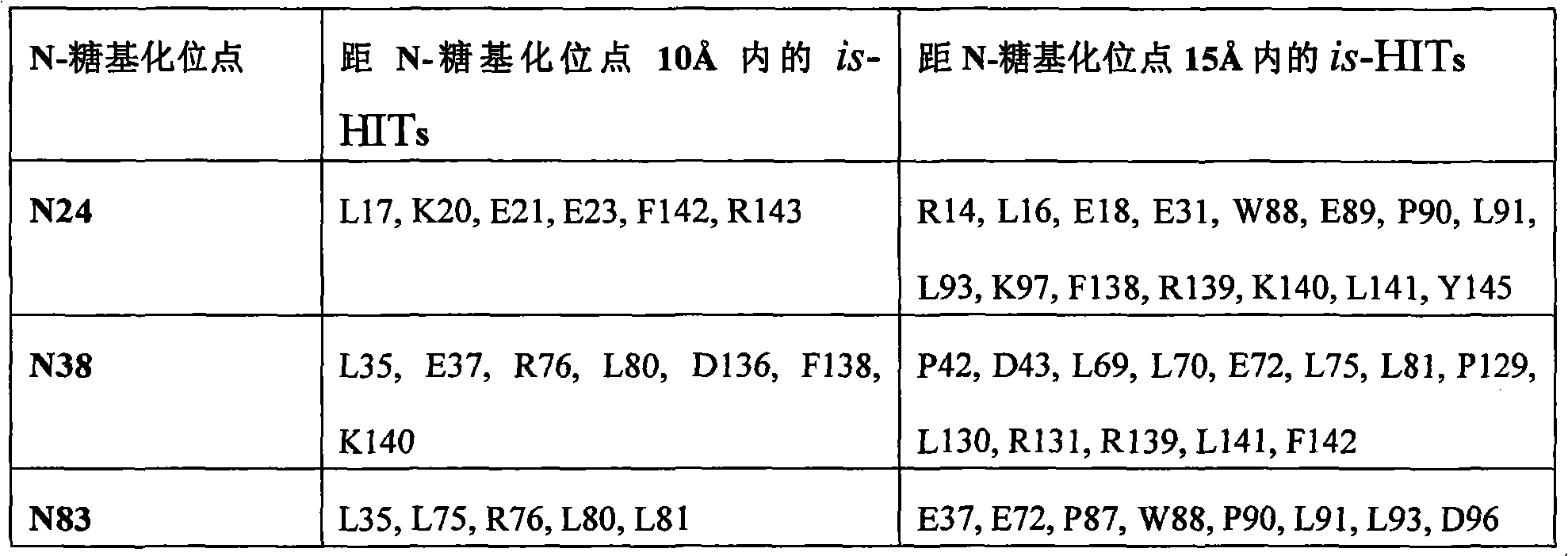
Embodiment 6
The generation of deglycosylation EPO variant with Proteolytic enzyme resistance of increase
The EPO polypeptide that has the reduction glycosylation in one or more selected is-HIT positions modifications has the Proteolytic enzyme resistance of increase with generation deglycosylated EPO variant.Following 1-3 part is described, adopts three initial approach the deglycosylated EPO mutant of part to be had the sudden change of protective effect with identification.Continuous sudden change by one of N38 and N83 is gradually to the deglycosylation of EPO polypeptide.Take turns deglycosylation on for each, also be introduced in the polypeptide to remove the site of Proteolytic enzyme sensitivity and to measure deglycosylated variant on which sudden change protection N38 and the N83 in the selected locational sudden change of is-HIT.These sudden changes comprise aminoacid replacement R139H, K20Q, E159N, L153V, K52N, L80I, L93I, L93V and R4H, are the sudden changes of being carried by the LEADs with anti-Proteolytic enzyme protective effect that discerns in embodiment 1-4.Estimate the protease resistant of EPO variant and will show the template of the variant of the protease resistant that increases as the introducing new mutation.Below the final step of the described method of the 4th part comprise the sudden change of last N-glycosylation site N24, and mix following sudden change, thereby described sudden change shows protectedly do not have the N-glycosylation not by proteoclastic EPO variant to produce.
Generate the EPO variant and use above embodiment 1 and 2 described methods expression, and determine concentration by ELISA as mentioned above.Also produce glycosylated natural EPO polypeptide fully.By glycosylated epo protein matter (European Pharmacopoeia (EP) reference standard; E1515000, batches 3.0) deglycosylation effect generates complete nonglycosylated EPO polypeptide.(Prozyme GK80110) realizes the deglycosylation effect to use GlycoPro enzymatic deglycosylation test kit according to manufacturer's explanation.In brief, under 37 ℃ with 1 * 10
7The incubation buffering liquid of the EPO of pg/ml and 1 * contain N-dextranase PNGase F, sialidase A, O-dextranase, tilactase b (1-4) and b-N-acetylaminoglucosidase is incubated overnight.
In order to estimate the Proteolytic enzyme resistance of EPO mutant and contrast polypeptide (fully glycosylated natural EPO and complete deglycosylated EPO), carry out the enzyme action of a period of time under 37 ℃ and cut.The RPMI culture medium that does not contain FCS by mixing 400 μ L and contain alpha-chymotrypsin, endoproteinase GluC and trypsin Sigma) the mixture of 1.5% proteinase mixture (w/w) preparation protease.Begin proteoclastic degradation kinetics by adding proteinase mixture solution in each the EPO polypeptide in the DMEM culture medium that is being supplemented with 1%FCS (CHOK1 culture medium).EPO polypeptide and protease are at 37 ℃ of following incubations.In each sample, get aliquot and mix with protease inhibitor goods (no mini EDTA, Roche-a slice are dissolved in the RPMI that 10ml is supplemented with 10%FCS) at different kinetics time points to stop Proteolytic enzyme.Using QuantikineIVD people EPO ELISA test kit (R﹠amp; D Systems, UK) determine before the EPO residual concentration of each sample sample is freezing down at-80 ℃.Determine the percentage ratio of the preceding original concentration of Proteolytic enzyme then.
1. the generation of part deglycosylation N38H EPO variant that has the Proteolytic enzyme resistance of increase
First tentative approach has discerned because the EPO polypeptide of the deglycosylated protease-resistance of N38H sudden change part.In order to reverse the viewed Proteolytic enzyme sensitivity of the deglycosylated EPO polypeptide of part that contains the N38H sudden change, N38H variant polypeptide and test proteins hydrolysis resistance are mixed in the selected LEAD sudden change that will discern in example 2 to 4 successively.Also tested the EPO polypeptide of complete glycosylation or sugar basedization (being complete deglycosylation).
At first the R139H sudden change is mixed the N38H variant to produce N38H/R139H EPO variant (SEQ ID NO:247).Measure the Proteolytic enzyme resistance of N38H variant and glycosylated fully and deglycosylated polypeptide as mentioned above.The EPO variant that contains N38H and R139H sudden change shows the proteoclastic sensitivity of similar complete glycosylated natural EPO.The concentration of complete glycosylated EPO and the deglycosylated N38H/R139H EPO of part variant is respectively 48% and 44% of initial concentration after the protein hydrolase 11 hour.By contrast, 17% unprotect N38H variant residue only after 1 hour.Nearly all complete deglycosylated EPO polypeptide is cut by protease between 1 hour incubation period.After the protein hydrolase 12 hour, 2% unprotect N38H variant residue only, and complete glycosylated EPO and the deglycosylated N38H/R139H EPO of part variant are respectively 15% and 14%.The protective effect to the EPO polypeptide that R139H sudden change can replace the glycosylation at amino acid position N38 to provide usually is provided these results.
Then other is discerned in example 2 to 4 and is included in sudden change among the LEADs mix carry N38H and R139H sudden change the EPO variant to produce Trimutant EPO polypeptide.Generate respectively contain the two sudden changes of N38H/R139H and R4H (SEQ ID NO:248), L93I (SEQ IDNO:249), K20Q (SEQ ID NO:250), E159N (SEQ ID NO:251), K52N (SEQID NO:252) and L153V (SEQ ID NO:253) the EPO polypeptide also evaluation to the sensitivity of various protease.In some cases, the LEAD sudden change is mixed N38H/R139H EPO variant with the responsive site of other protease of removing the Proteolytic enzyme resistance that causes relative N38H/R139H double-mutant and complete glycosylated natural EPO increase.After the protein hydrolase 11 hour, about 46% N38H/R139H variant and fully-glycosylated EPO polypeptide residue.The variant that carries N38H/R139H/R4H, N38H/R139H/K52N or N38H/R139H/L93I sudden change obtains similar or good slightly result.Deglycosylated N38H/R139H/L153V of part and N38H/R139H/E159N variant are 60% of initial concentration approximately after the protein hydrolase 11 hour.Described three N38H/R139H/K20Q variants are identified as the variant with the strongest Proteolytic enzyme resistance, remain 64% described protein after the protein hydrolase 11 hour.After protease incubation 2 hours, the N38H/R139H/K20Q variant of residue 43%, and N38H/R139H mutant and complete glycosylated natural EPO are respectively 14% and 18%.
2. the generation of part deglycosylation N38H/N83H EPO variant that has the Proteolytic enzyme resistance of increase
Second test approach discerned because the EPO polypeptide of the deglycosylated protease-resistance of sudden change part of N38H and N83.The EPO variant that contains the two sudden changes of N38H/N83H is mixed in the R139H sudden change.Resulting N38H/N83H/R139H variant (SEQ ID NO:254) generates four mutant K20Q/N38H/N83H/R139H (SEQ ID NO:255) as the template of further mixing sudden change K20Q.The EPO variant is with expressing cho cell and test proteins hydrolysis resistance as mentioned above.Also test contains the EPO variant of single N38H sudden change or two N38H/R139H sudden change and the protease resistant of complete glycosylation and deglycosylated EPO polypeptide.Remain 45% and 49% with respect to N38H/R139H variant and complete glycosylated epo protein matter respectively after protein hydrolase 11 hour, the N38H/N83H/R139H variant shows that the Proteolytic enzyme resistance reduces, and only remains 17%.This glycosylation that demonstrates N83 gives the EPO polypeptide how many anti-Proteolytic enzyme protections.Yet described protection recovers by mixing the K20Q sudden change.Described four K20Q/N38H/N83H/R139H mutants show the similar Proteolytic enzyme resistance level to N38H/R139H variant and complete glycosylated epo protein matter.After the protein hydrolase 11 hour, K20Q/N38H/N83H/R139H variant residue 48%.After the protein hydrolase 12 hour, residue 21%, the viewed situation of a little higher than N38H/R139H variant (16%) and littlely be lower than the complete viewed situation of glycosylated epo protein matter (25%).
3. the generation of part deglycosylation N38H/N83H EPO variant that has the Proteolytic enzyme resistance of increase
The 3rd experimental approach utilizes the N38H/N83H/R139H variant to increase the ability of Proteolytic enzyme resistance as the template of further mixing other sudden change to evaluate these sudden changes.Generation contains the EPO variant of N38H/N83H/R139H and one of L93V (SEQ ID NO:256), L80I (SEQ ID NO:257) or L93I (SEQ ID NO:258) and expresses in Chinese hamster ovary celI.As the N38H/N83H/R139H variant and fully glycosylated and deglycosylated EPO polypeptide estimate the protease resistant of described variant.With respect to the N38H/N83H/R139H mutant, the protease resistant of giving increase in the N38H/N83H/R139H background is mixed in one of L93V, L80I and L93I sudden change.After the protein hydrolase 11 hour, about 26% N38H/N83H/R139H residue and 46% complete glycosylated natural EPO residue.By contrast, remain 30%, 37% and 45% N38H/N83H/R139H/L93I, N38H/N83H/R139H/L80I and N38H/N83H/R139H/L93V variant after 1 hour respectively with the protease incubation.After the protein hydrolase 12 hour, the N38H/N83H/R139H/L93I variant residue of 8% N38H/N83H/R139H/L80I and N38H/N83H/R139H/L93V variant and 3%, by contrast, 14% complete glycosylated protein and 4% N38H/N83H/R139H variant residue.
Each four mutant (N38H/R139H/N83H/L80I (SEQ ID NO:257), N38H/R139H/N83H/L93I (SEQ ID NO:258) and N38H/R139H/N83H/L93V (SEQID NO:256)) all are called " Umbrella 83 " variant, and as further introducing the template that sudden change K20Q replaces sudden change.This causes the generation of following variant: K20Q/N38H/L80I/N83H/R139H (SEQ ID NO:259); K20Q/N38H/N83H/L93I/R139H (SEQ ID NO:260); And K20Q/N38H/N83H/L93V/R139H (SEQ ID NO:261).Adopt the protease resistant of aforesaid these variants of experimental evaluation in addition.With respect to the N38H/N83H/R139H variant, the K20Q sudden change is mixed Umbrella 83 variants and is given the protease resistant that the EPO polypeptide increases.After the protein hydrolase 11 hour, 37% of N38H/N83H/R139H variant residue initial concentration.By contrast, the K20Q/N38H/L80I/N83H/R139H of residue 58% and the K20Q/N38H/N83H/L93I/R139H variant of K20Q/N38H/N83H/L93V/R139H variant and 71%.The protease resistant of this level is suitable with complete-glycosylated EPO polypeptide (71% residue).
4. the generation of complete deglycosylation N24H/N38H/N83H EPO variant that has the Proteolytic enzyme resistance of increase
As above the described three approach of 1-3 part has been identified the sudden change of giving the remarkable protease resistant of the deglycosylated EPO polypeptide of part.Particularly, the seemingly proteoclastic critical sites of is-HIT site K20, the protease resistant of the deglycosylated EPO polypeptide increase of part that contains N38 and/or N83 sudden change is given in the suitable sudden change in this site thus.Because it, supposes that the K20H sudden change can also give the deglycosylation protection extremely near other N-glycosylation site N24 on 24 sites.Give the ability of deglycosylation EPO polypeptide protein enzyme resistance in order to evaluate K20H sudden change and other LEAD sudden change, produce the variant of a series of wherein each N-glycosylation site through sudden change.
First serial variant generates (embodiment 6.3 on being derived from) by Umbrella 83 mutants are introduced in the N24H sudden change.Therefore the complete deglycosylation EPO variant of gained comprises following sudden change: N24H/N38H/N83H/R139H/L80I (SEQ ID NO:262); N24H/N38H/N83H/R139H/L93I (SEQ ID NO:263); Perhaps N24H/N38H/N83H/R139H/L93V (SEQ ID NO:264).Test the Proteolytic enzyme resistance of these variants and N38H, N38H/R139H and N38H/N83H/R139H variant and natural complete glycosylated and deglycosylated polypeptide.Compare with deglycosylated N38H/R139H variant partly with complete glycosylated EPO polypeptide, remove the resistance that the N24 glycosylation site has reduced the EPO variant, resistance is still more arranged significantly but compare with complete deglycosylated contrast EPO polypeptide by mutation.The concentration of complete glycosylated EPO and deglycosylated N38H/R139H of part and N38H EPO variant is respectively 62% and 27% of initial concentration after the protein hydrolase 11 hour.After 1 hour only 4% complete deglycosylated natural EPO polypeptide do not cut by protease yet.By contrast, after 1 hour 21%, 22% and deglycosylation N24H/N38H/N83H/R139H/L93I, the N24H/N38H/N83H/R139H/L80I of % and the variant residue of N24H/N38H/N83H/R139H/L93V.
In order to evaluate the protective effect of K20Q sudden change, N24H/N38H/N83H/R139H/L80I, N24H/N38H/N83H/R139H/L93I or N24H/N38H/N83H/R139H/L93V variant are used separately as the template of mixing the K20Q sudden change to aforesaid complete deglycosylated variant.Therefore the complete deglycosylated EPO variant of gained comprises following sudden change: K20Q/N24H/N38H/N83H/R139H/L80I (SEQ ID NO:265); K20Q/N24H/N38H/N83H/R139H/L93I (SEQ ID NO:266); Perhaps K20Q/N24H/N38H/N83H/R139H/L93V (SEQ ID NO:267).Test the Proteolytic enzyme resistance of these variants and N38H, N38H/R139H and N38H/N83H/R139H variant and natural complete glycosylated and deglycosylated polypeptide.Described deglycosylated K20Q/N24H/N38H/N83H/R139H/L80I, K20Q/N24H/N38H/N83H/R139H/L93I and K20Q/N24H/N38H/N83H/R139H/L93V variant show and the viewed similar protease resistant of N38H/N83H/R139H variant, not by the amount from 35% to 42% of the residue polypeptide of protease cracking.This resistance level is more much higher than the complete deglycosylated EPO polypeptide that does not comprise the protection sudden change viewed (4% residue), but lacks than glycosylated fully natural shown (71% residue) and shown (62% residue) of the deglycosylated N38H/R139H variant of part of EPO polypeptide.
Other LEAD sudden change is mixed deglycosylated variant to measure complete deglycosylated EPO polypeptide whether can the protected protein hydrolysis.The deglycosylated EPO variant of gained comprises: R4H/K20Q/N24H/N38H/N83H/R139H/L80I (SEQ ID NO:268); E 159N/K20Q/N24H/N38H/N83H/R139H/L93I (SEQ ID NO:269); K20Q/N24H/N38H/N83H/R139H/L153V (SEQ ID NO:270); L153V/K20Q/N24H/N38H/N83H/R139H/L80I (SEQ ID NO:271) and E159N/K20Q/N24H/N38H/N83H/R139H/L80I (SEQ ID NO:272).Test the Proteolytic enzyme resistance of these variants and N38H, N38H/R139H and N38H/N83H/R139H variant and natural complete glycosylated and deglycosylated polypeptide.These neomorphs show respectively and equal or the Proteolytic enzyme resistance level of a little higher than fully glycosylated natural EPO polypeptide.After the protein hydrolase 11 hour, the initial concentration percentage ratio of residue polypeptide is 75% E159N/K20Q/N24H/N38H/N83H/R139H/L93I, 76% K20Q/N24H/N38H/N83H/R139H/L153V, 79% R4H/K20Q/N24H/N38H/N83H/R139H/L80I and the E159N/K20Q/N24H/N38H/N83H/R139H/L80I of L153V/K20Q/N24H/N38H/N83H/R139H/L80I and 81%.By contrast, the complete deglycosylated EPO that only remains 71% complete glycosylated EPO polypeptide and only remain 4% after the protein hydrolase 11 hour.After protein hydrolase 12 .5 hour, the percentage ratio of still remaining EPO polypeptide initial concentration is 24% K20Q/N24H/N38H/N83H/R139H/L153V, 25% L153V/K20Q/N24H/N38H/N83H/R139H/L80I, E159N/K20Q/N24H/N38H/N83H/R139H/L80I and the R4H/K20Q/N24H/N38H/N83H/R139H/L80I of E159N/K20Q/N24H/N38H/N83H/R139H/L93I and 27%.By contrast, remain 23% complete glycosylated EPO polypeptide after the protein hydrolase 12 hour and do not have complete deglycosylated EPO residue.
Because it is conspicuous modifying to those skilled in the art, so the present invention should be limit by the scope of appended claims only.
Sequence table
<110〉Hanall Pharmaceutical Company
Thierry?Guyon
Gilles?Borrelly
Xavier?Gallet
Lila?Drittanti
Manuel?Vega
<120〉erythropoietin polypeptides of Xiu Shiing and therapeutic use thereof
<130>17109-021001/931
<140>Not?yet?assigned
<141>Herewith
<150>60/861,615
<151>2006-11-28
<160>310
<170>FastSEQ?for?Windows?Version?4.0
<210>1
<211>193
<212>PRT
<213>Homo?sapiens
<220>
<223>human?EPO-immature?protein
<400>1
Met?Gly?Val?His?Glu?Cys?Pro?Ala?Trp?Leu?Trp?Leu?Leu?Leu?Ser?Leu
1???????????????5??????????????????10??????????????????15
Leu?Ser?Leu?Pro?Leu?Gly?Leu?Pro?Val?Leu?Gly?Ala?Pro?Pro?Arg?Leu
20??????????????????25??????????????????30
Ile?Cys?Asp?Ser?Arg?Val?Leu?Glu?Arg?Tyr?Leu?Leu?Glu?Ala?Lys?Glu
35??????????????????40??????????????????45
Ala?Glu?Asn?Ile?Thr?Thr?Gly?Cys?Ala?Glu?His?Cys?Ser?Leu?Asn?Glu
50??????????????????55??????????????????60
Asn?Ile?Thr?Val?Pro?Asp?Thr?Lys?Val?Asn?Phe?Tyr?Ala?Trp?Lys?Arg
65??????????????????70??????????????????75??????????????????80
Met?Glu?Val?Gly?Gln?Gln?Ala?Val?Glu?Val?Trp?Gln?Gly?Leu?Ala?Leu
85??????????????????90??????????????????95
Leu?Ser?Glu?Ala?Val?Leu?Arg?Gly?Gln?Ala?Leu?Leu?Val?Asn?Ser?Ser
100?????????????????105?????????????????110
Gln?Pro?Trp?Glu?Pro?Leu?Gln?Leu?His?Val?Asp?Lys?Ala?Val?Ser?Gly
115?????????????????120?????????????????125
Leu?Arg?Ser?Leu?Thr?Thr?Leu?Leu?Arg?Ala?Leu?Gly?Ala?Gln?Lys?Glu
130?????????????????135?????????????????140
Ala?Ile?Ser?Pro?Pro?Asp?Ala?Ala?Ser?Ala?Ala?Pro?Leu?Arg?Thr?Ile
145?????????????????150?????????????????155?????????????????160
Thr?Ala?Asp?Thr?Phe?Arg?Lys?Leu?Phe?Arg?Val?Tyr?Ser?Asn?Phe?Leu
165?????????????????170?????????????????175
Arg?Gly?Lys?Leu?Lys?Leu?Tyr?Thr?Gly?Glu?Ala?Cys?Arg?Thr?Gly?Asp
180?????????????????185?????????????????190
Arg
<210>2
<211>166
<212>PRT
<213>Homo?sapiens
<220>
<223>Human?EPO-mature?protein
<400>2
Ala?Pro?Pro?Arg?Leu?Ile?Cys?Asp?Ser?Arg?Val?Leu?Glu?Arg?Tyr?Leu
1???????????????5??????????????????10??????????????????15
Leu?Glu?Ala?Lys?Glu?Ala?Glu?Asn?Ile?Thr?Thr?Gly?Cys?Ala?Glu?His
20??????????????????25??????????????????30
Cys?Ser?Leu?Asn?Glu?Asn?Ile?Thr?Val?Pro?Asp?Thr?Lys?Val?Asn?Phe
35??????????????????40??????????????????45
Tyr?Ala?Trp?Lys?Arg?Met?Glu?Val?Gly?Gln?Gln?Ala?Val?Glu?Val?Trp
50??????????????????55??????????????????60
Gln?Gly?Leu?Ala?Leu?Leu?Ser?Glu?Ala?Val?Leu?Arg?Gly?Gln?Ala?Leu
65??????????????????70??????????????????75??????????????????80
Leu?Val?Asn?Ser?Ser?Gln?Pro?Trp?Glu?Pro?Leu?Gln?Leu?His?Val?Asp
85??????????????????90??????????????????95
Lys?Ala?Val?Ser?Gly?Leu?Arg?Ser?Leu?Thr?Thr?Leu?Leu?Arg?Ala?Leu
100?????????????????105?????????????????110
Gly?Ala?Gln?Lys?Glu?Ala?Ile?Ser?Pro?Pro?Asp?Ala?Ala?Ser?Ala?Ala
115?????????????????120?????????????????125
Pro?Leu?Arg?Thr?Ile?Thr?Ala?Asp?Thr?Phe?Arg?Lys?Leu?Phe?Arg?Val
130?????????????????135?????????????????140
Tyr?Ser?Asn?Phe?Leu?Arg?Gly?Lys?Leu?Lys?Leu?Tyr?Thr?Gly?Glu?Ala
145?????????????????150?????????????????155?????????????????160
Cys?Arg?Thr?Gly?Asp?Arg
165
<210>3
<211>166
<212>PRT
<213>Artificial?Sequence
<220>
<223>EPO_1_P2S
<400>3
Ala?Ser?Pro?Arg?Leu?Ile?Cys?Asp?Ser?Arg?Val?Leu?Glu?Arg?Tyr?Leu
1???????????????5??????????????????10??????????????????15
Leu?Glu?Ala?Lys?Glu?Ala?Glu?Asn?Ile?Thr?Thr?Gly?Cys?Ala?Glu?His
20??????????????????25??????????????????30
Cys?Ser?Leu?Asn?Glu?Asn?Ile?Thr?Val?Pro?Asp?Thr?Lys?Val?Asn?Phe
35??????????????????40??????????????????45
Tyr?Ala?Trp?Lys?Arg?Met?Glu?Val?Gly?Gln?Gln?Ala?Val?Glu?Val?Trp
50??????????????????55??????????????????60
Gln?Gly?Leu?Ala?Leu?Leu?Ser?Glu?Ala?Val?Leu?Arg?Gly?Gln?Ala?Leu
65??????????????????70??????????????????75??????????????????80
Leu?Val?Asn?Ser?Ser?Gln?Pro?Trp?Glu?Pro?Leu?Gln?Leu?His?Val?Asp
85??????????????????90??????????????????95
Lys?Ala?Val?Ser?Gly?Leu?Arg?Ser?Leu?Thr?Thr?Leu?Leu?Arg?Ala?Leu
100?????????????????105?????????????????110
Gly?Ala?Gln?Lys?Glu?Ala?Ile?Ser?Pro?Pro?Asp?Ala?Ala?Ser?Ala?Ala
115?????????????????120?????????????????125
Pro?Leu?Arg?Thr?Ile?Thr?Ala?Asp?Thr?Phe?Arg?Lys?Leu?Phe?Arg?Val
130?????????????????135?????????????????140
Tyr?Ser?Asn?Phe?Leu?Arg?Gly?Lys?Leu?Lys?Leu?Tyr?Thr?Gly?Glu?Ala
145?????????????????150?????????????????155?????????????????160
Cys?Arg?Thr?Gly?Asp?Arg
165
<210>4
<211>166
<212>PRT
<213>Artificial?Sequence
<220>
<223>EPO_2_P2A
<400>4
Ala?Ala?Pro?Arg?Leu?Ile?Cys?Asp?Ser?Arg?Val?Leu?Glu?Arg?Tyr?Leu
1???????????????5??????????????????10??????????????????15
Leu?Glu?Ala?Lys?Glu?Ala?Glu?Asn?Ile?Thr?Thr?Gly?Cys?Ala?Glu?His
20??????????????????25??????????????????30
Cys?Ser?Leu?Asn?Glu?Asn?Ile?Thr?Val?Pro?Asp?Thr?Lys?Val?Asn?Phe
35??????????????????40??????????????????45
Tyr?Ala?Trp?Lys?Arg?Met?Glu?Val?Gly?Gln?Gln?Ala?Val?Glu?Val?Trp
50??????????????????55??????????????????60
Gln?Gly?Leu?Ala?Leu?Leu?Ser?Glu?Ala?Val?Leu?Arg?Gly?Gln?Ala?Leu
65??????????????????70??????????????????75??????????????????80
Leu?Val?Asn?Ser?Ser?Gln?Pro?Trp?Glu?Pro?Leu?Gln?Leu?His?Val?Asp
85??????????????????90??????????????????95
Lys?Ala?Val?Ser?Gly?Leu?Arg?Ser?Leu?Thr?Thr?Leu?Leu?Arg?Ala?Leu
100?????????????????105?????????????????110
Gly?Ala?Gln?Lys?Glu?Ala?Ile?Ser?Pro?Pro?Asp?Ala?Ala?Ser?Ala?Ala
115?????????????????120?????????????????125
Pro?Leu?Arg?Thr?Ile?Thr?Ala?Asp?Thr?Phe?Arg?Lys?Leu?Phe?Arg?Val
130?????????????????135?????????????????140
Tyr?Ser?Asn?Phe?Leu?Arg?Gly?Lys?Leu?Lys?Leu?Tyr?Thr?Gly?Glu?Ala
145?????????????????150?????????????????155?????????????????160
Cys?Arg?Thr?Gly?Asp?Arg
165
<210>5
<211>166
<212>PRT
<213>Artificial?Sequence
<220>
<223>EPO_3_P3S
<400>5
Ala?Pro?Ser?Arg?Leu?Ile?Cys?Asp?Ser?Arg?Val?Leu?Glu?Arg?Tyr?Leu
1???????????????5??????????????????10??????????????????15
Leu?Glu?Ala?Lys?Glu?Ala?Glu?Asn?Ile?Thr?Thr?Gly?Cys?Ala?Glu?His
20??????????????????25??????????????????30
Cys?Ser?Leu?Asn?Glu?Asn?Ile?Thr?Val?Pro?Asp?Thr?Lys?Val?Asn?Phe
35??????????????????40??????????????????45
Tyr?Ala?Trp?Lys?Arg?Met?Glu?Val?Gly?Gln?Gln?Ala?Val?Glu?Val?Trp
50??????????????????55??????????????????60
Gln?Gly?Leu?Ala?Leu?Leu?Ser?Glu?Ala?Val?Leu?Arg?Gly?Gln?Ala?Leu
65??????????????????70??????????????????75??????????????????80
Leu?Val?Asn?Ser?Ser?Gln?Pro?Trp?Glu?Pro?Leu?Gln?Leu?His?Val?Asp
85??????????????????90??????????????????95
Lys?Ala?Val?Ser?Gly?Leu?Arg?Ser?Leu?Thr?Thr?Leu?Leu?Arg?Ala?Leu
100?????????????????105?????????????????110
Gly?Ala?Gln?Lys?Glu?Ala?Ile?Ser?Pro?Pro?Asp?Ala?Ala?Ser?Ala?Ala
115?????????????????120?????????????????125
Pro?Leu?Arg?Thr?Ile?Thr?Ala?Asp?Thr?Phe?Arg?Lys?Leu?Phe?Arg?Val
130?????????????????135?????????????????140
Tyr?Ser?Asn?Phe?Leu?Arg?Gly?Lys?Leu?Lys?Leu?Tyr?Thr?Gly?Glu?Ala
145?????????????????150?????????????????155?????????????????160
Cys?Arg?Thr?Gly?Asp?Arg
165
<210>6
<211>166
<212>PRT
<213>Artificial?Sequence
<220>
<223>EPO_4_P3A
<400>6
Ala?Pro?Ala?Arg?Leu?Ile?Cys?Asp?Ser?Arg?Val?Leu?Glu?Arg?Tyr?Leu
1???????????????5??????????????????10??????????????????15
Leu?Glu?Ala?Lys?Glu?Ala?Glu?Asn?Ile?Thr?Thr?Gly?Cys?Ala?Glu?His
20??????????????????25??????????????????30
Cys?Ser?Leu?Asn?Glu?Asn?Ile?Thr?Val?Pro?Asp?Thr?Lys?Val?Asn?Phe
35??????????????????40??????????????????45
Tyr?Ala?Trp?Lys?Arg?Met?Glu?Val?Gly?Gln?Gln?Ala?Val?Glu?Val?Trp
50??????????????????55??????????????????60
Gln?Gly?Leu?Ala?Leu?Leu?Ser?Glu?Ala?Val?Leu?Arg?Gly?Gln?Ala?Leu
65??????????????????70??????????????????75??????????????????80
Leu?Val?Asn?Ser?Ser?Gln?Pro?Trp?Glu?Pro?Leu?Gln?Leu?His?Val?Asp
85??????????????????90??????????????????95
Lys?Ala?Val?Ser?Gly?Leu?Arg?Ser?Leu?Thr?Thr?Leu?Leu?Arg?Ala?Leu
100?????????????????105?????????????????110
Gly?Ala?Gln?Lys?Glu?Ala?Ile?Ser?Pro?Pro?Asp?Ala?Ala?Ser?Ala?Ala
115?????????????????120?????????????????125
Pro?Leu?Arg?Thr?Ile?Thr?Ala?Asp?Thr?Phe?Arg?Lys?Leu?Phe?Arg?Val
130?????????????????135?????????????????140
Tyr?Ser?Asn?Phe?Leu?Arg?Gly?Lys?Leu?Lys?Leu?Tyr?Thr?Gly?Glu?Ala
145?????????????????150?????????????????155?????????????????160
Cys?Arg?Thr?Gly?Asp?Arg
165
<210>7
<211>166
<212>PRT
<213>Artificial?Sequence
<220>
<223>EPO_5_R4H
<400>7
Ala?Pro?Pro?His?Leu?Ile?Cys?Asp?Ser?Arg?Val?Leu?Glu?Arg?Tyr?Leu
1???????????????5??????????????????10??????????????????15
Leu?Glu?Ala?Lys?Glu?Ala?Glu?Asn?Ile?Thr?Thr?Gly?Cys?Ala?Glu?His
20??????????????????25??????????????????30
Cys?Ser?Leu?Asn?Glu?Asn?Ile?Thr?Val?Pro?Asp?Thr?Lys?Val?Asn?Phe
35??????????????????40??????????????????45
Tyr?Ala?Trp?Lys?Arg?Met?Glu?Val?Gly?Gln?Gln?Ala?Val?Glu?Val?Trp
50??????????????????55??????????????????60
Gln?Gly?Leu?Ala?Leu?Leu?Ser?Glu?Ala?Val?Leu?Arg?Gly?Gln?Ala?Leu
65??????????????????70??????????????????75??????????????????80
Leu?Val?Asn?Ser?Ser?Gln?Pro?Trp?Glu?Pro?Leu?Gln?Leu?His?Val?Asp
85??????????????????90??????????????????95
Lys?Ala?Val?Ser?Gly?Leu?Arg?Ser?Leu?Thr?Thr?Leu?Leu?Arg?Ala?Leu
100?????????????????105?????????????????110
Gly?Ala?Gln?Lys?Glu?Ala?Ile?Ser?Pro?Pro?Asp?Ala?Ala?Ser?Ala?Ala
115?????????????????120?????????????????125
Pro?Leu?Arg?Thr?Ile?Thr?Ala?Asp?Thr?Phe?Arg?Lys?Leu?Phe?Arg?Val
130?????????????????135?????????????????140
Tyr?Ser?Asn?Phe?Leu?Arg?Gly?Lys?Leu?Lys?Leu?Tyr?Thr?Gly?Glu?Ala
145?????????????????150?????????????????155?????????????????160
Cys?Arg?Thr?Gly?Asp?Arg
165
<210>8
<211>166
<212>PRT
<213>Artificial?Sequence
<220>
<223>EPO_6_R4Q
<400>8
Ala?Pro?Pro?Gln?Leu?Ile?Cys?Asp?Ser?Arg?Val?Leu?Glu?Arg?Tyr?Leu
1???????????????5??????????????????10??????????????????15
Leu?Glu?Ala?Lys?Glu?Ala?Glu?Asn?Ile?Thr?Thr?Gly?Cys?Ala?Glu?His
20??????????????????25??????????????????30
Cys?Ser?Leu?Asn?Glu?Asn?Ile?Thr?Val?Pro?Asp?Thr?Lys?Val?Asn?Phe
35??????????????????40??????????????????45
Tyr?Ala?Trp?Lys?Arg?Met?Glu?Val?Gly?Gln?Gln?Ala?Val?Glu?Val?Trp
50??????????????????55??????????????????60
Gln?Gly?Leu?Ala?Leu?Leu?Ser?Glu?Ala?Val?Leu?Arg?Gly?Gln?Ala?Leu
65??????????????????70??????????????????75??????????????????80
Leu?Val?Asn?Ser?Ser?Gln?Pro?Trp?Glu?Pro?Leu?Gln?Leu?His?Val?Asp
85??????????????????90??????????????????95
Lys?Ala?Val?Ser?Gly?Leu?Arg?Ser?Leu?Thr?Thr?Leu?Leu?Arg?Ala?Leu
100?????????????????105?????????????????110
Gly?Ala?Gln?Lys?Glu?Ala?Ile?Ser?Pro?Pro?Asp?Ala?Ala?Ser?Ala?Ala
115?????????????????120?????????????????125
Pro?Leu?Arg?Thr?Ile?Thr?Ala?Asp?Thr?Phe?Arg?Lys?Leu?Phe?Arg?Val
130?????????????????135?????????????????140
Tyr?Ser?Asn?Phe?Leu?Arg?Gly?Lys?Leu?Lys?Leu?Tyr?Thr?Gly?Glu?Ala
145?????????????????150?????????????????155?????????????????160
Cys?Arg?Thr?Gly?Asp?Arg
165
<210>9
<211>166
<212>PRT
<213>Artificial?Sequence
<220>
<223>EPO_7_C7S
<400>9
Ala?Pro?Pro?Arg?Leu?Ile?Ser?Asp?Ser?Arg?Val?Leu?Glu?Arg?Tyr?Leu
1???????????????5??????????????????10??????????????????15
Leu?Glu?Ala?Lys?Glu?Ala?Glu?Asn?Ile?Thr?Thr?Gly?Cys?Ala?Glu?His
20??????????????????25??????????????????30
Cys?Ser?Leu?Asn?Glu?Asn?Ile?Thr?Val?Pro?Asp?Thr?Lys?Val?Asn?Phe
35??????????????????40??????????????????45
Tyr?Ala?Trp?Lys?Arg?Met?Glu?Val?Gly?Gln?Gln?Ala?Val?Glu?Val?Trp
50??????????????????55??????????????????60
Gln?Gly?Leu?Ala?Leu?Leu?Ser?Glu?Ala?Val?Leu?Arg?Gly?Gln?Ala?Leu
65??????????????????70??????????????????75??????????????????80
Leu?Val?Asn?Ser?Ser?Gln?Pro?Trp?Glu?Pro?Leu?Gln?Leu?His?Val?Asp
85??????????????????90??????????????????95
Lys?Ala?Val?Ser?Gly?Leu?Arg?Ser?Leu?Thr?Thr?Leu?Leu?Arg?Ala?Leu
100?????????????????105?????????????????110
Gly?Ala?Gln?Lys?Glu?Ala?Ile?Ser?Pro?Pro?Asp?Ala?Ala?Ser?Ala?Ala
115?????????????????120?????????????????125
Pro?Leu?Arg?Thr?Ile?Thr?Ala?Asp?Thr?Phe?Arg?Lys?Leu?Phe?Arg?Val
130?????????????????135?????????????????140
Tyr?Ser?Asn?Phe?Leu?Arg?Gly?Lys?Leu?Lys?Leu?Tyr?Thr?Gly?Glu?Ala
145?????????????????150?????????????????155?????????????????160
Cys?Arg?Thr?Gly?Asp?Arg
165
<210>10
<211>166
<212>PRT
<213>Artificial?Sequence
<220>
<223>EPO_8_C7V
<400>10
Ala?Pro?Pro?Arg?Leu?Ile?Val?Asp?Ser?Arg?Val?Leu?Glu?Arg?Tyr?Leu
1???????????????5??????????????????10??????????????????15
Leu?Glu?Ala?Lys?Glu?Ala?Glu?Asn?Ile?Thr?Thr?Gly?Cys?Ala?Glu?His
20??????????????????25??????????????????30
Cys?Ser?Leu?Asn?Glu?Asn?Ile?Thr?Val?Pro?Asp?Thr?Lys?Val?Asn?Phe
35??????????????????40??????????????????45
Tyr?Ala?Trp?Lys?Arg?Met?Glu?Val?Gly?Gln?Gln?Ala?Val?Glu?Val?Trp
50??????????????????55??????????????????60
Gln?Gly?Leu?Ala?Leu?Leu?Ser?Glu?Ala?Val?Leu?Arg?Gly?Gln?Ala?Leu
65??????????????????70??????????????????75??????????????????80
Leu?Val?Asn?Ser?Ser?Gln?Pro?Trp?Glu?Pro?Leu?Gln?Leu?His?Val?Asp
85??????????????????90??????????????????95
Lys?Ala?Val?Ser?Gly?Leu?Arg?Ser?Leu?Thr?Thr?Leu?Leu?Arg?Ala?Leu
100?????????????????105?????????????????110
Gly?Ala?Gln?Lys?Glu?Ala?Ile?Ser?Pro?Pro?Asp?Ala?Ala?Ser?Ala?Ala
115?????????????????120?????????????????125
Pro?Leu?Arg?Thr?Ile?Thr?Ala?Asp?Thr?Phe?Arg?Lys?Leu?Phe?Arg?Val
130?????????????????135?????????????????140
Tyr?Ser?Asn?Phe?Leu?Arg?Gly?Lys?Leu?Lys?Leu?Tyr?Thr?Gly?Glu?Ala
145?????????????????150?????????????????155?????????????????160
Cys?Arg?Thr?Gly?Asp?Arg
165
<210>11
<211>166
<212>PRT
<213>Artificial?Sequence
<220>
<223>EPO_9_D8Q
<400>11
Ala?Pro?Pro?Arg?Leu?Ile?Cys?Gln?Ser?Arg?Val?Leu?Glu?Arg?Tyr?Leu
1???????????????5??????????????????10??????????????????15
Leu?Glu?Ala?Lys?Glu?Ala?Glu?Asn?Ile?Thr?Thr?Gly?Cys?Ala?Glu?His
20??????????????????25??????????????????30
Cys?Ser?Leu?Asn?Glu?Asn?Ile?Thr?Val?Pro?Asp?Thr?Lys?Val?Asn?Phe
35??????????????????40??????????????????45
Tyr?Ala?Trp?Lys?Arg?Met?Glu?Val?Gly?Gln?Gln?Ala?Val?Glu?Val?Trp
50??????????????????55??????????????????60
Gln?Gly?Leu?Ala?Leu?Leu?Ser?Glu?Ala?Val?Leu?Arg?Gly?Gln?Ala?Leu
65??????????????????70??????????????????75??????????????????80
Leu?Val?Asn?Ser?Ser?Gln?Pro?Trp?Glu?Pro?Leu?Gln?Leu?His?Val?Asp
85??????????????????90??????????????????95
Lys?Ala?Val?Ser?Gly?Leu?Arg?Ser?Leu?Thr?Thr?Leu?Leu?Arg?Ala?Leu
100?????????????????105?????????????????110
Gly?Ala?Gln?Lys?Glu?Ala?Ile?Ser?Pro?Pro?Asp?Ala?Ala?Ser?Ala?Ala
115?????????????????120?????????????????125
Pro?Leu?Arg?Thr?Ile?Thr?Ala?Asp?Thr?Phe?Arg?Lys?Leu?Phe?Arg?Val
130?????????????????135?????????????????140
Tyr?Ser?Asn?Phe?Leu?Arg?Gly?Lys?Leu?Lys?Leu?Tyr?Thr?Gly?Glu?Ala
145?????????????????150?????????????????155?????????????????160
Cys?Arg?Thr?Gly?Asp?Arg
165
<210>12
<211>166
<212>PRT
<213>Artificial?Sequence
<220>
<223>EPO_10_D8H
<400>12
Ala?Pro?Pro?Arg?Leu?Ile?Cys?His?Ser?Arg?Val?Leu?Glu?Arg?Tyr?Leu
1???????????????5??????????????????10??????????????????15
Leu?Glu?Ala?Lys?Glu?Ala?Glu?Asn?Ile?Thr?Thr?Gly?Cys?Ala?Glu?His
20??????????????????25??????????????????30
Cys?Ser?Leu?Asn?Glu?Asn?Ile?Thr?Val?Pro?Asp?Thr?Lys?Val?Asn?Phe
35??????????????????40??????????????????45
Tyr?Ala?Trp?Lys?Arg?Met?Glu?Val?Gly?Gln?Gln?Ala?Val?Glu?Val?Trp
50??????????????????55??????????????????60
Gln?Gly?Leu?Ala?Leu?Leu?Ser?Glu?Ala?Val?Leu?Arg?Gly?Gln?Ala?Leu
65??????????????????70??????????????????75??????????????????80
Leu?Val?Asn?Ser?Ser?Gln?Pro?Trp?Glu?Pro?Leu?Gln?Leu?His?Val?Asp
85??????????????????90??????????????????95
Lys?Ala?Val?Ser?Gly?Leu?Arg?Ser?Leu?Thr?Thr?Leu?Leu?Arg?Ala?Leu
100?????????????????105?????????????????110
Gly?Ala?Gln?Lys?Glu?Ala?Ile?Ser?Pro?Pro?Asp?Ala?Ala?Ser?Ala?Ala
115?????????????????120?????????????????125
Pro?Leu?Arg?Thr?Ile?Thr?Ala?Asp?Thr?Phe?Arg?Lys?Leu?Phe?Arg?Val
130?????????????????135?????????????????140
Tyr?Ser?Asn?Phe?Leu?Arg?Gly?Lys?Leu?Lys?Leu?Tyr?Thr?Gly?Glu?Ala
145?????????????????150?????????????????155?????????????????160
Cys?Arg?Thr?Gly?Asp?Arg
165
<210>13
<211>166
<212>PRT
<213>Artificial?Sequence
<220>
<223>EPO_11_R10H
<400>13
Ala?Pro?Pro?Arg?Leu?Ile?Cys?Asp?Ser?His?Val?Leu?Glu?Arg?Tyr?Leu
1???????????????5??????????????????10??????????????????15
Leu?Glu?Ala?Lys?Glu?Ala?Glu?Asn?Ile?Thr?Thr?Gly?Cys?Ala?Glu?His
20??????????????????25??????????????????30
Cys?Ser?Leu?Asn?Glu?Asn?Ile?Thr?Val?Pro?Asp?Thr?Lys?Val?Asn?Phe
35??????????????????40??????????????????45
Tyr?Ala?Trp?Lys?Arg?Met?Glu?Val?Gly?Gln?Gln?Ala?Val?Glu?Val?Trp
50??????????????????55??????????????????60
Gln?Gly?Leu?Ala?Leu?Leu?Ser?Glu?Ala?Val?Leu?Arg?Gly?Gln?Ala?Leu
65??????????????????70??????????????????75??????????????????80
Leu?Val?Asn?Ser?Ser?Gln?Pro?Trp?Glu?Pro?Leu?Gln?Leu?His?Val?Asp
85??????????????????90??????????????????95
Lys?Ala?Val?Ser?Gly?Leu?Arg?Ser?Leu?Thr?Thr?Leu?Leu?Arg?Ala?Leu
100?????????????????105?????????????????110
Gly?Ala?Gln?Lys?Glu?Ala?Ile?Ser?Pro?Pro?Asp?Ala?Ala?Ser?Ala?Ala
115?????????????????120?????????????????125
Pro?Leu?Arg?Thr?Ile?Thr?Ala?Asp?Thr?Phe?Arg?Lys?Leu?Phe?Arg?Val
130?????????????????135?????????????????140
Tyr?Ser?Asn?Phe?Leu?Arg?Gly?Lys?Leu?Lys?Leu?Tyr?Thr?Gly?Glu?Ala
145?????????????????150?????????????????155?????????????????160
Cys?Arg?Thr?Gly?Asp?Arg
165
<210>14
<211>166
<212>PRT
<213>Artificial?Sequence
<220>
<223>EPO_12_R10Q
<400>14
Ala?Pro?Pro?Arg?Leu?Ile?Cys?Asp?Ser?Gln?Val?Leu?Glu?Arg?Tyr?Leu
1???????????????5??????????????????10??????????????????15
Leu?Glu?Ala?Lys?Glu?Ala?Glu?Asn?Ile?Thr?Thr?Gly?Cys?Ala?Glu?His
20??????????????????25??????????????????30
Cys?Ser?Leu?Asn?Glu?Asn?Ile?Thr?Val?Pro?Asp?Thr?Lys?Val?Asn?Phe
35??????????????????40??????????????????45
Tyr?Ala?Trp?Lys?Arg?Met?Glu?Val?Gly?Gln?Gln?Ala?Val?Glu?Val?Trp
50??????????????????55??????????????????60
Gln?Gly?Leu?Ala?Leu?Leu?Ser?Glu?Ala?Val?Leu?Arg?Gly?Gln?Ala?Leu
65??????????????????70??????????????????75??????????????????80
Leu?Val?Asn?Ser?Ser?Gln?Pro?Trp?Glu?Pro?Leu?Gln?Leu?His?Val?Asp
85??????????????????90??????????????????95
Lys?Ala?Val?Ser?Gly?Leu?Arg?Ser?Leu?Thr?Thr?Leu?Leu?Arg?Ala?Leu
100?????????????????105?????????????????110
Gly?Ala?Gln?Lys?Glu?Ala?Ile?Ser?Pro?Pro?Asp?Ala?Ala?Ser?Ala?Ala
115?????????????????120?????????????????125
Pro?Leu?Arg?Thr?Ile?Thr?Ala?Asp?Thr?Phe?Arg?Lys?Leu?Phe?Arg?Val
130?????????????????135?????????????????140
Tyr?Ser?Asn?Phe?Leu?Arg?Gly?Lys?Leu?Lys?Leu?Tyr?Thr?Gly?Glu?Ala
145?????????????????150?????????????????155?????????????????160
Cys?Arg?Thr?Gly?Asp?Arg
165
<210>15
<211>166
<212>PRT
<213>Artificial?Sequence
<220>
<223>EPO_13_L12V
<400>15
Ala?Pro?Pro?Arg?Leu?Ile?Cys?Asp?Ser?Arg?Val?Val?Glu?Arg?Tyr?Leu
1???????????????5??????????????????10??????????????????15
Leu?Glu?Ala?Lys?Glu?Ala?Glu?Asn?Ile?Thr?Thr?Gly?Cys?Ala?Glu?His
20??????????????????25??????????????????30
Cys?Ser?Leu?Asn?Glu?Asn?Ile?Thr?Val?Pro?Asp?Thr?Lys?Val?Asn?Phe
35??????????????????40??????????????????45
Tyr?Ala?Trp?Lys?Arg?Met?Glu?Val?Gly?Gln?Gln?Ala?Val?Glu?Val?Trp
50??????????????????55??????????????????60
Gln?Gly?Leu?Ala?Leu?Leu?Ser?Glu?Ala?Val?Leu?Arg?Gly?Gln?Ala?Leu
65??????????????????70??????????????????75??????????????????80
Leu?Val?Asn?Ser?Ser?Gln?Pro?Trp?Glu?Pro?Leu?Gln?Leu?His?Val?Asp
85??????????????????90??????????????????95
Lys?Ala?Val?Ser?Gly?Leu?Arg?Ser?Leu?Thr?Thr?Leu?Leu?Arg?Ala?Leu
100?????????????????105?????????????????110
Gly?Ala?Gln?Lys?Glu?Ala?Ile?Ser?Pro?Pro?Asp?Ala?Ala?Ser?Ala?Ala
115?????????????????120?????????????????125
Pro?Leu?Arg?Thr?Ile?Thr?Ala?Asp?Thr?Phe?Arg?Lys?Leu?Phe?Arg?Val
130?????????????????135?????????????????140
Tyr?Ser?Asn?Phe?Leu?Arg?Gly?Lys?Leu?Lys?Leu?Tyr?Thr?Gly?Glu?Ala
145?????????????????150?????????????????155?????????????????160
Cys?Arg?Thr?Gly?Asp?Arg
165
<210>16
<211>166
<212>PRT
<213>Artificial?Sequence
<220>
<223>EPO_14_L12I
<400>16
Ala?Pro?Pro?Arg?Leu?Ile?Cys?Asp?Ser?Arg?Val?Ile?Glu?Arg?Tyr?Leu
1???????????????5??????????????????10??????????????????15
Leu?Glu?Ala?Lys?Glu?Ala?Glu?Asn?Ile?Thr?Thr?Gly?Cys?Ala?Glu?His
20??????????????????25??????????????????30
Cys?Ser?Leu?Asn?Glu?Asn?Ile?Thr?Val?Pro?Asp?Thr?Lys?Val?Asn?Phe
35??????????????????40??????????????????45
Tyr?Ala?Trp?Lys?Arg?Met?Glu?Val?Gly?Gln?Gln?Ala?Val?Glu?Val?Trp
50??????????????????55??????????????????60
Gln?Gly?Leu?Ala?Leu?Leu?Ser?Glu?Ala?Val?Leu?Arg?Gly?Gln?Ala?Leu
65??????????????????70??????????????????75??????????????????80
Leu?Val?Asn?Ser?Ser?Gln?Pro?Trp?Glu?Pro?Leu?Gln?Leu?His?Val?Asp
85??????????????????90??????????????????95
Lys?Ala?Val?Ser?Gly?Leu?Arg?Ser?Leu?Thr?Thr?Leu?Leu?Arg?Ala?Leu
100?????????????????105?????????????????110
Gly?Ala?Gln?Lys?Glu?Ala?Ile?Ser?Pro?Pro?Asp?Ala?Ala?Ser?Ala?Ala
115?????????????????120?????????????????125
Pro?Leu?Arg?Thr?Ile?Thr?Ala?Asp?Thr?Phe?Arg?Lys?Leu?Phe?Arg?Val
130?????????????????135?????????????????140
Tyr?Ser?Asn?Phe?Leu?Arg?Gly?Lys?Leu?Lys?Leu?Tyr?Thr?Gly?Glu?Ala
145?????????????????150?????????????????155?????????????????160
Cys?Arg?Thr?Gly?Asp?Arg
165
<210>17
<211>166
<212>PRT
<213>Artificial?Sequence
<220>
<223>EPO_15_E18Q
<400>17
Ala?Pro?Pro?Arg?Leu?Ile?Cys?Asp?Ser?Arg?Val?Leu?Glu?Arg?Tyr?Leu
1???????????????5??????????????????10??????????????????15
Leu?Gln?Ala?Lys?Glu?Ala?Glu?Asn?Ile?Thr?Thr?Gly?Cys?Ala?Glu?His
20??????????????????25??????????????????30
Cys?Ser?Leu?Asn?Glu?Asn?Ile?Thr?Val?Pro?Asp?Thr?Lys?Val?Asn?Phe
35??????????????????40??????????????????45
Tyr?Ala?Trp?Lys?Arg?Met?Glu?Val?Gly?Gln?Gln?Ala?Val?Glu?Val?Trp
50??????????????????55??????????????????60
Gln?Gly?Leu?Ala?Leu?Leu?Ser?Glu?Ala?Val?Leu?Arg?Gly?Gln?Ala?Leu
65??????????????????70??????????????????75??????????????????80
Leu?Val?Asn?Ser?Ser?Gln?Pro?Trp?Glu?Pro?Leu?Gln?Leu?His?Val?Asp
85??????????????????90??????????????????95
Lys?Ala?Val?Ser?Gly?Leu?Arg?Ser?Leu?Thr?Thr?Leu?Leu?Arg?Ala?Leu
100?????????????????105?????????????????110
Gly?Ala?Gln?Lys?Glu?Ala?Ile?Ser?Pro?Pro?Asp?Ala?Ala?Ser?Ala?Ala
115?????????????????120?????????????????125
Pro?Leu?Arg?Thr?Ile?Thr?Ala?Asp?Thr?Phe?Arg?Lys?Leu?Phe?Arg?Val
130?????????????????135?????????????????140
Tyr?Ser?Asn?Phe?Leu?Arg?Gly?Lys?Leu?Lys?Leu?Tyr?Thr?Gly?Glu?Ala
145?????????????????150?????????????????155?????????????????160
Cys?Arg?Thr?Gly?Asp?Arg
165
<210>18
<211>166
<212>PRT
<213>Artificial?Sequence
<220>
<223>EPO_16_E18H
<400>18
Ala?Pro?Pro?Arg?Leu?Ile?Cys?Asp?Ser?Arg?Val?Leu?Glu?Arg?Tyr?Leu
1???????????????5??????????????????10??????????????????15
Leu?His?Ala?Lys?Glu?Ala?Glu?Asn?Ile?Thr?Thr?Gly?Cys?Ala?Glu?His
20??????????????????25??????????????????30
Cys?Ser?Leu?Asn?Glu?Asn?Ile?Thr?Val?Pro?Asp?Thr?Lys?Val?Asn?Phe
35??????????????????40??????????????????45
Tyr?Ala?Trp?Lys?Arg?Met?Glu?Val?Gly?Gln?Gln?Ala?Val?Glu?Val?Trp
50??????????????????55??????????????????60
Gln?Gly?Leu?Ala?Leu?Leu?Ser?Glu?Ala?Val?Leu?Arg?Gly?Gln?Ala?Leu
65??????????????????70??????????????????75??????????????????80
Leu?Val?Asn?Ser?Ser?Gln?Pro?Trp?Glu?Pro?Leu?Gln?Leu?His?Val?Asp
85??????????????????90??????????????????95
Lys?Ala?Val?Ser?Gly?Leu?Arg?Ser?Leu?Thr?Thr?Leu?Leu?Arg?Ala?Leu
100?????????????????105?????????????????110
Gly?Ala?Gln?Lys?Glu?Ala?Ile?Ser?Pro?Pro?Asp?Ala?Ala?Ser?Ala?Ala
115?????????????????120?????????????????125
Pro?Leu?Arg?Thr?Ile?Thr?Ala?Asp?Thr?Phe?Arg?Lys?Leu?Phe?Arg?Val
130?????????????????135?????????????????140
Tyr?Ser?Asn?Phe?Leu?Arg?Gly?Lys?Leu?Lys?Leu?Tyr?Thr?Gly?Glu?Ala
145?????????????????150?????????????????155?????????????????160
Cys?Arg?Thr?Gly?Asp?Arg
165
<210>19
<211>166
<212>PRT
<213>Artificial?Sequence
<220>
<223>EPO_17_K20Q
<400>19
Ala?Pro?Pro?Arg?Leu?Ile?Cys?Asp?Ser?Arg?Val?Leu?Glu?Arg?Tyr?Leu
1???????????????5??????????????????10??????????????????15
Leu?Glu?Ala?Gln?Glu?Ala?Glu?Asn?Ile?Thr?Thr?Gly?Cys?Ala?Glu?His
20??????????????????25??????????????????30
Cys?Ser?Leu?Asn?Glu?Asn?Ile?Thr?Val?Pro?Asp?Thr?Lys?Val?Asn?Phe
35??????????????????40??????????????????45
Tyr?Ala?Trp?Lys?Arg?Met?Glu?Val?Gly?Gln?Gln?Ala?Val?Glu?Val?Trp
50??????????????????55??????????????????60
Gln?Gly?Leu?Ala?Leu?Leu?Ser?Glu?Ala?Val?Leu?Arg?Gly?Gln?Ala?Leu
65??????????????????70??????????????????75??????????????????80
Leu?Val?Asn?Ser?Ser?Gln?Pro?Trp?Glu?Pro?Leu?Gln?Leu?His?Val?Asp
85??????????????????90??????????????????95
Lys?Ala?Val?Ser?Gly?Leu?Arg?Ser?Leu?Thr?Thr?Leu?Leu?Arg?Ala?Leu
100?????????????????105?????????????????110
Gly?Ala?Gln?Lys?Glu?Ala?Ile?Ser?Pro?Pro?Asp?Ala?Ala?Ser?Ala?Ala
115?????????????????120?????????????????125
Pro?Leu?Arg?Thr?Ile?Thr?Ala?Asp?Thr?Phe?Arg?Lys?Leu?Phe?Arg?Val
130?????????????????135?????????????????140
Tyr?Ser?Asn?Phe?Leu?Arg?Gly?Lys?Leu?Lys?Leu?Tyr?Thr?Gly?Glu?Ala
145?????????????????150?????????????????155?????????????????160
Cys?Arg?Thr?Gly?Asp?Arg
165
<210>20
<211>166
<212>PRT
<213>Artificial?Sequence
<220>
<223>EPO_18_K20T
<400>20
Ala?Pro?Pro?Arg?Leu?Ile?Cys?Asp?Ser?Arg?Val?Leu?Glu?Arg?Tyr?Leu
1???????????????5??????????????????10??????????????????15
Leu?Glu?Ala?Thr?Glu?Ala?Glu?Asn?Ile?Thr?Thr?Gly?Cys?Ala?Glu?His
20??????????????????25??????????????????30
Cys?Ser?Leu?Asn?Glu?Asn?Ile?Thr?Val?Pro?Asp?Thr?Lys?Val?Asn?Phe
35??????????????????40??????????????????45
Tyr?Ala?Trp?Lys?Arg?Met?Glu?Val?Gly?Gln?Gln?Ala?Val?Glu?Val?Trp
50??????????????????55??????????????????60
Gln?Gly?Leu?Ala?Leu?Leu?Ser?Glu?Ala?Val?Leu?Arg?Gly?Gln?Ala?Leu
65??????????????????70??????????????????75??????????????????80
Leu?Val?Asn?Ser?Ser?Gln?Pro?Trp?Glu?Pro?Leu?Gln?Leu?His?Val?Asp
85??????????????????90??????????????????95
Lys?Ala?Val?Ser?Gly?Leu?Arg?Ser?Leu?Thr?Thr?Leu?Leu?Arg?Ala?Leu
100?????????????????105?????????????????110
Gly?Ala?Gln?Lys?Glu?Ala?Ile?Ser?Pro?Pro?Asp?Ala?Ala?Ser?Ala?Ala
115?????????????????120?????????????????125
Pro?Leu?Arg?Thr?Ile?Thr?Ala?Asp?Thr?Phe?Arg?Lys?Leu?Phe?Arg?Val
130?????????????????135?????????????????140
Tyr?Ser?Asn?Phe?Leu?Arg?Gly?Lys?Leu?Lys?Leu?Tyr?Thr?Gly?Glu?Ala
145?????????????????150?????????????????155?????????????????160
Cys?Arg?Thr?Gly?Asp?Arg
165
<210>21
<211>166
<212>PRT
<213>Artificial?Sequence
<220>
<223>EPO_19_E21Q
<400>21
Ala?Pro?Pro?Arg?Leu?Ile?Cys?Asp?Ser?Arg?Val?Leu?Glu?Arg?Tyr?Leu
1???????????????5??????????????????10??????????????????15
Leu?Glu?Ala?Lys?Gln?Ala?Glu?Asn?Ile?Thr?Thr?Gly?Cys?Ala?Glu?His
20??????????????????25??????????????????30
Cys?Ser?Leu?Asn?Glu?Asn?Ile?Thr?Val?Pro?Asp?Thr?Lys?Val?Asn?Phe
35??????????????????40??????????????????45
Tyr?Ala?Trp?Lys?Arg?Met?Glu?Val?Gly?Gln?Gln?Ala?Val?Glu?Val?Trp
50??????????????????55??????????????????60
Gln?Gly?Leu?Ala?Leu?Leu?Ser?Glu?Ala?Val?Leu?Arg?Gly?Gln?Ala?Leu
65??????????????????70??????????????????75??????????????????80
Leu?Val?Asn?Ser?Ser?Gln?Pro?Trp?Glu?Pro?Leu?Gln?Leu?His?Val?Asp
85??????????????????90??????????????????95
Lys?Ala?Val?Ser?Gly?Leu?Arg?Ser?Leu?Thr?Thr?Leu?Leu?Arg?Ala?Leu
100?????????????????105?????????????????110
Gly?Ala?Gln?Lys?Glu?Ala?Ile?Ser?Pro?Pro?Asp?Ala?Ala?Ser?Ala?Ala
115?????????????????120?????????????????125
Pro?Leu?Arg?Thr?Ile?Thr?Ala?Asp?Thr?Phe?Arg?Lys?Leu?Phe?Arg?Val
130?????????????????135?????????????????140
Tyr?Ser?Asn?Phe?Leu?Arg?Gly?Lys?Leu?Lys?Leu?Tyr?Thr?Gly?Glu?Ala
145?????????????????150?????????????????155?????????????????160
Cys?Arg?Thr?Gly?Asp?Arg
165
<210>22
<211>166
<212>PRT
<213>Artificial?Sequence
<220>
<223>EPO_20_E21H
<400>22
Ala?Pro?Pro?Arg?Leu?Ile?Cys?Asp?Ser?Arg?Val?Leu?Glu?Arg?Tyr?Leu
1???????????????5??????????????????10??????????????????15
Leu?Glu?Ala?Lys?His?Ala?Glu?Asn?Ile?Thr?Thr?Gly?Cys?Ala?Glu?His
20??????????????????25??????????????????30
Cys?Ser?Leu?Asn?Glu?Asn?Ile?Thr?Val?Pro?Asp?Thr?Lys?Val?Asn?Phe
35??????????????????40??????????????????45
Tyr?Ala?Trp?Lys?Arg?Met?Glu?Val?Gly?Gln?Gln?Ala?Val?Glu?Val?Trp
50??????????????????55??????????????????60
Gln?Gly?Leu?Ala?Leu?Leu?Ser?Glu?Ala?Val?Leu?Arg?Gly?Gln?Ala?Leu
65??????????????????70??????????????????75??????????????????80
Leu?Val?Asn?Ser?Ser?Gln?Pro?Trp?Glu?Pro?Leu?Gln?Leu?His?Val?Asp
85??????????????????90??????????????????95
Lys?Ala?Val?Ser?Gly?Leu?Arg?Ser?Leu?Thr?Thr?Leu?Leu?Arg?Ala?Leu
100?????????????????105?????????????????110
Gly?Ala?Gln?Lys?Glu?Ala?Ile?Ser?Pro?Pro?Asp?Ala?Ala?Ser?Ala?Ala
115?????????????????120?????????????????125
Pro?Leu?Arg?Thr?Ile?Thr?Ala?Asp?Thr?Phe?Arg?Lys?Leu?Phe?Arg?Val
130?????????????????135?????????????????140
Tyr?Ser?Asn?Phe?Leu?Arg?Gly?Lys?Leu?Lys?Leu?Tyr?Thr?Gly?Glu?Ala
145?????????????????150?????????????????155?????????????????160
Cys?Arg?Thr?Gly?Asp?Arg
165
<210>23
<211>166
<212>PRT
<213>Artificial?Sequence
<220>
<223>EPO_21_E23Q
<400>23
Ala?Pro?Pro?Arg?Leu?Ile?Cys?Asp?Ser?Arg?Val?Leu?Glu?Arg?Tyr?Leu
1???????????????5??????????????????10??????????????????15
Leu?Glu?Ala?Lys?Glu?Ala?Gln?Asn?Ile?Thr?Thr?Gly?Cys?Ala?Glu?His
20??????????????????25??????????????????30
Cys?Ser?Leu?Asn?Glu?Asn?Ile?Thr?Val?Pro?Asp?Thr?Lys?Val?Asn?Phe
35??????????????????40??????????????????45
Tyr?Ala?Trp?Lys?Arg?Met?Glu?Val?Gly?Gln?Gln?Ala?Val?Glu?Val?Trp
50??????????????????55??????????????????60
Gln?Gly?Leu?Ala?Leu?Leu?Ser?Glu?Ala?Val?Leu?Arg?Gly?Gln?Ala?Leu
65??????????????????70??????????????????75??????????????????80
Leu?Val?Asn?Ser?Ser?Gln?Pro?Trp?Glu?Pro?Leu?Gln?Leu?His?Val?Asp
85??????????????????90??????????????????95
Lys?Ala?Val?Ser?Gly?Leu?Arg?Ser?Leu?Thr?Thr?Leu?Leu?Arg?Ala?Leu
100?????????????????105?????????????????110
Gly?Ala?Gln?Lys?Glu?Ala?Ile?Ser?Pro?Pro?Asp?Ala?Ala?Ser?Ala?Ala
115?????????????????120?????????????????125
Pro?Leu?Arg?Thr?Ile?Thr?Ala?Asp?Thr?Phe?Arg?Lys?Leu?Phe?Arg?Val
130?????????????????135?????????????????140
Tyr?Ser?Asn?Phe?Leu?Arg?Gly?Lys?Leu?Lys?Leu?Tyr?Thr?Gly?Glu?Ala
145?????????????????150?????????????????155?????????????????160
Cys?Arg?Thr?Gly?Asp?Arg
165
<210>24
<211>166
<212>PRT
<213>Artificial?Sequence
<220>
<223>EPO_22_E23H
<400>24
Ala?Pro?Pro?Arg?Leu?Ile?Cys?Asp?Ser?Arg?Val?Leu?Glu?Arg?Tyr?Leu
1???????????????5??????????????????10??????????????????15
Leu?Glu?Ala?Lys?Glu?Ala?His?Asn?Ile?Thr?Thr?Gly?Cys?Ala?Glu?His
20??????????????????25??????????????????30
Cys?Ser?Leu?Asn?Glu?Asn?Ile?Thr?Val?Pro?Asp?Thr?Lys?Val?Asn?Phe
35??????????????????40??????????????????45
Tyr?Ala?Trp?Lys?Arg?Met?Glu?Val?Gly?Gln?Gln?Ala?Val?Glu?Val?Trp
50??????????????????55??????????????????60
Gln?Gly?Leu?Ala?Leu?Leu?Ser?Glu?Ala?Val?Leu?Arg?Gly?Gln?Ala?Leu
65??????????????????70??????????????????75??????????????????80
Leu?Val?Asn?Ser?Ser?Gln?Pro?Trp?Glu?Pro?Leu?Gln?Leu?His?Val?Asp
85??????????????????90??????????????????95
Lys?Ala?Val?Ser?Gly?Leu?Arg?Ser?Leu?Thr?Thr?Leu?Leu?Arg?Ala?Leu
100?????????????????105?????????????????110
Gly?Ala?Gln?Lys?Glu?Ala?Ile?Ser?Pro?Pro?Asp?Ala?Ala?Ser?Ala?Ala
115?????????????????120?????????????????125
Pro?Leu?Arg?Thr?Ile?Thr?Ala?Asp?Thr?Phe?Arg?Lys?Leu?Phe?Arg?Val
130?????????????????135?????????????????140
Tyr?Ser?Asn?Phe?Leu?Arg?Gly?Lys?Leu?Lys?Leu?Tyr?Thr?Gly?Glu?Ala
145?????????????????150?????????????????155?????????????????160
Cys?Arg?Thr?Gly?Asp?Arg
165
<210>25
<211>166
<212>PRT
<213>Artificial?Sequence
<220>
<223>EPO_23_C29S
<400>25
Ala?Pro?Pro?Arg?Leu?Ile?Cys?Asp?Ser?Arg?Val?Leu?Glu?Arg?Tyr?Leu
1???????????????5??????????????????10??????????????????15
Leu?Glu?Ala?Lys?Glu?Ala?Glu?Asn?Ile?Thr?Thr?Gly?Ser?Ala?Glu?His
20??????????????????25??????????????????30
Cys?Ser?Leu?Asn?Glu?Asn?Ile?Thr?Val?Pro?Asp?Thr?Lys?Val?Asn?Phe
35??????????????????40??????????????????45
Tyr?Ala?Trp?Lys?Arg?Met?Glu?Val?Gly?Gln?Gln?Ala?Val?Glu?Val?Trp
50??????????????????55??????????????????60
Gln?Gly?Leu?Ala?Leu?Leu?Ser?Glu?Ala?Val?Leu?Arg?Gly?Gln?Ala?Leu
65??????????????????70??????????????????75??????????????????80
Leu?Val?Asn?Ser?Ser?Gln?Pro?Trp?Glu?Pro?Leu?Gln?Leu?His?Val?Asp
85??????????????????90??????????????????95
Lys?Ala?Val?Ser?Gly?Leu?Arg?Ser?Leu?Thr?Thr?Leu?Leu?Arg?Ala?Leu
100?????????????????105?????????????????110
Gly?Ala?Gln?Lys?Glu?Ala?Ile?Ser?Pro?Pro?Asp?Ala?Ala?Ser?Ala?Ala
115?????????????????120?????????????????125
Pro?Leu?Arg?Thr?Ile?Thr?Ala?Asp?Thr?Phe?Arg?Lys?Leu?Phe?Arg?Val
130?????????????????135?????????????????140
Tyr?Ser?Asn?Phe?Leu?Arg?Gly?Lys?Leu?Lys?Leu?Tyr?Thr?Gly?Glu?Ala
145?????????????????150?????????????????155?????????????????160
Cys?Arg?Thr?Gly?Asp?Arg
165
<210>26
<211>166
<212>PRT
<213>Artificial?Sequence
<220>
<223>EPO_24_C29V
<400>26
Ala?Pro?Pro?Arg?Leu?Ile?Cys?Asp?Ser?Arg?Val?Leu?Glu?Arg?Tyr?Leu
1???????????????5??????????????????10??????????????????15
Leu?Glu?Ala?Lys?Glu?Ala?Glu?Asn?Ile?Thr?Thr?Gly?Val?Ala?Glu?His
20??????????????????25??????????????????30
Cys?Ser?Leu?Asn?Glu?Asn?Ile?Thr?Val?Pro?Asp?Thr?Lys?Val?Asn?Phe
35??????????????????40??????????????????45
Tyr?Ala?Trp?Lys?Arg?Met?Glu?Val?Gly?Gln?Gln?Ala?Val?Glu?Val?Trp
50??????????????????55??????????????????60
Gln?Gly?Leu?Ala?Leu?Leu?Ser?Glu?Ala?Val?Leu?Arg?Gly?Gln?Ala?Leu
65??????????????????70??????????????????75??????????????????80
Leu?Val?Asn?Ser?Ser?Gln?Pro?Trp?Glu?Pro?Leu?Gln?Leu?His?Val?Asp
85??????????????????90??????????????????95
Lys?Ala?Val?Ser?Gly?Leu?Arg?Ser?Leu?Thr?Thr?Leu?Leu?Arg?Ala?Leu
100?????????????????105?????????????????110
Gly?Ala?Gln?Lys?Glu?Ala?Ile?Ser?Pro?Pro?Asp?Ala?Ala?Ser?Ala?Ala
115?????????????????120?????????????????125
Pro?Leu?Arg?Thr?Ile?Thr?Ala?Asp?Thr?Phe?Arg?Lys?Leu?Phe?Arg?Val
130?????????????????135?????????????????140
Tyr?Ser?Asn?Phe?Leu?Arg?Gly?Lys?Leu?Lys?Leu?Tyr?Thr?Gly?Glu?Ala
145?????????????????150?????????????????155?????????????????160
Cys?Arg?Thr?Gly?Asp?Arg
165
<210>27
<211>166
<212>PRT
<213>Artificial?Sequence
<220>
<223>EPO_25_E3lQ
<400>27
Ala?Pro?Pro?Arg?Leu?Ile?Cys?Asp?Ser?Arg?Val?Leu?Glu?Arg?Tyr?Leu
1???????????????5??????????????????10??????????????????15
Leu?Glu?Ala?Lys?Glu?Ala?Glu?Asn?Ile?Thr?Thr?Gly?Cys?Ala?Gln?His
20??????????????????25??????????????????30
Cys?Ser?Leu?Asn?Glu?Asn?Ile?Thr?Val?Pro?Asp?Thr?Lys?Val?Asn?Phe
35??????????????????40??????????????????45
Tyr?Ala?Trp?Lys?Arg?Met?Glu?Val?Gly?Gln?Gln?Ala?Val?Glu?Val?Trp
50??????????????????55??????????????????60
Gln?Gly?Leu?Ala?Leu?Leu?Ser?Glu?Ala?Val?Leu?Arg?Gly?Gln?Ala?Leu
65??????????????????70??????????????????75??????????????????80
Leu?Val?Asn?Ser?Ser?Gln?Pro?Trp?Glu?Pro?Leu?Gln?Leu?His?Val?Asp
85??????????????????90??????????????????95
Lys?Ala?Val?Ser?Gly?Leu?Arg?Ser?Leu?Thr?Thr?Leu?Leu?Arg?Ala?Leu
100?????????????????105?????????????????110
Gly?Ala?Gln?Lys?Glu?Ala?Ile?Ser?Pro?Pro?Asp?Ala?Ala?Ser?Ala?Ala
115?????????????????120?????????????????125
Pro?Leu?Arg?Thr?Ile?Thr?Ala?Asp?Thr?Phe?Arg?Lys?Leu?Phe?Arg?Val
130?????????????????135?????????????????140
Tyr?Ser?Asn?Phe?Leu?Arg?Gly?Lys?Leu?Lys?Leu?Tyr?Thr?Gly?Glu?Ala
145?????????????????150?????????????????155?????????????????160
Cys?Arg?Thr?Gly?Asp?Arg
165
<210>28
<211>166
<212>PRT
<213>Artificial?Sequence
<220>
<223>EPO_26_E31H
<400>28
Ala?Pro?Pro?Arg?Leu?Ile?Cys?Asp?Ser?Arg?Val?Leu?Glu?Arg?Tyr?Leu
1???????????????5??????????????????10??????????????????15
Leu?Glu?Ala?Lys?Glu?Ala?Glu?Asn?Ile?Thr?Thr?Gly?Cys?Ala?His?His
20??????????????????25??????????????????30
Cys?Ser?Leu?Asn?Glu?Asn?Ile?Thr?Val?Pro?Asp?Thr?Lys?Val?Asn?Phe
35??????????????????40??????????????????45
Tyr?Ala?Trp?Lys?Arg?Met?Glu?Val?Gly?Gln?Gln?Ala?Val?Glu?Val?Trp
50??????????????????55??????????????????60
Gln?Gly?Leu?Ala?Leu?Leu?Ser?Glu?Ala?Val?Leu?Arg?Gly?Gln?Ala?Leu
65??????????????????70??????????????????75??????????????????80
Leu?Val?Asn?Ser?Ser?Gln?Pro?Trp?Glu?Pro?Leu?Gln?Leu?His?Val?Asp
85??????????????????90??????????????????95
Lys?Ala?Val?Ser?Gly?Leu?Arg?Ser?Leu?Thr?Thr?Leu?Leu?Arg?Ala?Leu
100?????????????????105?????????????????110
Gly?Ala?Gln?Lys?Glu?Ala?Ile?Ser?Pro?Pro?Asp?Ala?Ala?Ser?Ala?Ala
115?????????????????120?????????????????125
Pro?Leu?Arg?Thr?Ile?Thr?Ala?Asp?Thr?Phe?Arg?Lys?Leu?Phe?Arg?Val
130?????????????????135?????????????????140
Tyr?Ser?Asn?Phe?Leu?Arg?Gly?Lys?Leu?Lys?Leu?Tyr?Thr?Gly?Glu?Ala
145?????????????????150?????????????????155?????????????????160
Cys?Arg?Thr?Gly?Asp?Arg
165
<210>29
<211>166
<212>PRT
<213>Artificial?Sequence
<220>
<223>EPO_27_L35V
<400>29
Ala?Pro?Pro?Arg?Leu?Ile?Cys?Asp?Ser?Arg?Val?Leu?Glu?Arg?Tyr?Leu
1???????????????5??????????????????10??????????????????15
Leu?Glu?Ala?Lys?Glu?Ala?Glu?Asn?Ile?Thr?Thr?Gly?Cys?Ala?Glu?His
20??????????????????25??????????????????30
Cys?Ser?Val?Asn?Glu?Asn?Ile?Thr?Val?Pro?Asp?Thr?Lys?Val?Asn?Phe
35??????????????????40??????????????????45
Tyr?Ala?Trp?Lys?Arg?Met?Glu?Val?Gly?Gln?Gln?Ala?Val?Glu?Val?Trp
50??????????????????55??????????????????60
Gln?Gly?Leu?Ala?Leu?Leu?Ser?Glu?Ala?Val?Leu?Arg?Gly?Gln?Ala?Leu
65??????????????????70??????????????????75??????????????????80
Leu?Val?Asn?Ser?Ser?Gln?Pro?Trp?Glu?Pro?Leu?Gln?Leu?His?Val?Asp
85??????????????????90??????????????????95
Lys?Ala?Val?Ser?Gly?Leu?Arg?Ser?Leu?Thr?Thr?Leu?Leu?Arg?Ala?Leu
100?????????????????105?????????????????110
Gly?Ala?Gln?Lys?Glu?Ala?Ile?Ser?Pro?Pro?Asp?Ala?Ala?Ser?Ala?Ala
115?????????????????120?????????????????125
Pro?Leu?Arg?Thr?Ile?Thr?Ala?Asp?Thr?Phe?Arg?Lys?Leu?Phe?Arg?Val
130?????????????????135?????????????????140
Tyr?Ser?Asn?Phe?Leu?Arg?Gly?Lys?Leu?Lys?Leu?Tyr?Thr?Gly?Glu?Ala
145?????????????????150?????????????????155?????????????????160
Cys?Arg?Thr?Gly?Asp?Arg
165
<210>30
<211>166
<212>PRT
<213>Artificial?Sequence
<220>
<223>EPO_28_L35I
<400>30
Ala?Pro?Pro?Arg?Leu?Ile?Cys?Asp?Ser?Arg?Val?Leu?Glu?Arg?Tyr?Leu
1???????????????5??????????????????10??????????????????15
Leu?Glu?Ala?Lys?Glu?Ala?Glu?Asn?Ile?Thr?Thr?Gly?Cys?Ala?Glu?His
20??????????????????25??????????????????30
Cys?Ser?Ile?Asn?Glu?Asn?Ile?Thr?Val?Pro?Asp?Thr?Lys?Val?Asn?Phe
35??????????????????40??????????????????45
Tyr?Ala?Trp?Lys?Arg?Met?Glu?Val?Gly?Gln?Gln?Ala?Val?Glu?Val?Trp
50??????????????????55??????????????????60
Gln?Gly?Leu?Ala?Leu?Leu?Ser?Glu?Ala?Val?Leu?Arg?Gly?Gln?Ala?Leu
65??????????????????70??????????????????75??????????????????80
Leu?Val?Asn?Ser?Ser?Gln?Pro?Trp?Glu?Pro?Leu?Gln?Leu?His?Val?Asp
85??????????????????90??????????????????95
Lys?Ala?Val?Ser?Gly?Leu?Arg?Ser?Leu?Thr?Thr?Leu?Leu?Arg?Ala?Leu
100?????????????????105?????????????????110
Gly?Ala?Gln?Lys?Glu?Ala?Ile?Ser?Pro?Pro?Asp?Ala?Ala?Ser?Ala?Ala
115?????????????????120?????????????????125
Pro?Leu?Arg?Thr?Ile?Thr?Ala?Asp?Thr?Phe?Arg?Lys?Leu?Phe?Arg?Val
130?????????????????135?????????????????140
Tyr?Ser?Asn?Phe?Leu?Arg?Gly?Lys?Leu?Lys?Leu?Tyr?Thr?Gly?Glu?Ala
145?????????????????150?????????????????155?????????????????160
Cys?Arg?Thr?Gly?Asp?Arg
165
<210>31
<211>166
<212>PRT
<213>Artificial?Sequence
<220>
<223>EPO_29_E37Q
<400>31
Ala?Pro?Pro?Arg?Leu?Ile?Cys?Asp?Ser?Arg?Val?Leu?Glu?Arg?Tyr?Leu
1???????????????5??????????????????10??????????????????15
Leu?Glu?Ala?Lys?Glu?Ala?Glu?Asn?Ile?Thr?Thr?Gly?Cys?Ala?Glu?His
20??????????????????25??????????????????30
Cys?Ser?Leu?Asn?Gln?Asn?Ile?Thr?Val?Pro?Asp?Thr?Lys?Val?Asn?Phe
35??????????????????40??????????????????45
Tyr?Ala?Trp?Lys?Arg?Met?Glu?Val?Gly?Gln?Gln?Ala?Val?Glu?Val?Trp
50??????????????????55??????????????????60
Gln?Gly?Leu?Ala?Leu?Leu?Ser?Glu?Ala?Val?Leu?Arg?Gly?Gln?Ala?Leu
65??????????????????70??????????????????75??????????????????80
Leu?Val?Asn?Ser?Ser?Gln?Pro?Trp?Glu?Pro?Leu?Gln?Leu?His?Val?Asp
85??????????????????90??????????????????95
Lys?Ala?Val?Ser?Gly?Leu?Arg?Ser?Leu?Thr?Thr?Leu?Leu?Arg?Ala?Leu
100?????????????????105?????????????????110
Gly?Ala?Gln?Lys?Glu?Ala?Ile?Ser?Pro?Pro?Asp?Ala?Ala?Ser?Ala?Ala
115?????????????????120?????????????????125
Pro?Leu?Arg?Thr?Ile?Thr?Ala?Asp?Thr?Phe?Arg?Lys?Leu?Phe?Arg?Val
130?????????????????135?????????????????140
Tyr?Ser?Asn?Phe?Leu?Arg?Gly?Lys?Leu?Lys?Leu?Tyr?Thr?Gly?Glu?Ala
145?????????????????150?????????????????155?????????????????160
Cys?Arg?Thr?Gly?Asp?Arg
165
<210>32
<211>166
<212>PRT
<213>Artificial?Sequence
<220>
<223>EPO_30_E37H
<400>32
Ala?Pro?Pro?Arg?Leu?Ile?Cys?Asp?Ser?Arg?Val?Leu?Glu?Arg?Tyr?Leu
1???????????????5??????????????????10??????????????????15
Leu?Glu?Ala?Lys?Glu?Ala?Glu?Asn?Ile?Thr?Thr?Gly?Cys?Ala?Glu?His
20??????????????????25??????????????????30
Cys?Ser?Leu?Asn?His?Asn?Ile?Thr?Val?Pro?Asp?Thr?Lys?Val?Asn?Phe
35??????????????????40??????????????????45
Tyr?Ala?Trp?Lys?Arg?Met?Glu?Val?Gly?Gln?Gln?Ala?Val?Glu?Val?Trp
50??????????????????55??????????????????60
Gln?Gly?Leu?Ala?Leu?Leu?Ser?Glu?Ala?Val?Leu?Arg?Gly?Gln?Ala?Leu
65??????????????????70??????????????????75??????????????????80
Leu?Val?Asn?Ser?Ser?Gln?Pro?Trp?Glu?Pro?Leu?Gln?Leu?His?Val?Asp
85??????????????????90??????????????????95
Lys?Ala?Val?Ser?Gly?Leu?Arg?Ser?Leu?Thr?Thr?Leu?Leu?Arg?Ala?Leu
100?????????????????105?????????????????110
Gly?Ala?Gln?Lys?Glu?Ala?Ile?Ser?Pro?Pro?Asp?Ala?Ala?Ser?Ala?Ala
115?????????????????120?????????????????125
Pro?Leu?Arg?Thr?Ile?Thr?Ala?Asp?Thr?Phe?Arg?Lys?Leu?Phe?Arg?Val
130?????????????????135?????????????????140
Tyr?Ser?Asn?Phe?Leu?Arg?Gly?Lys?Leu?Lys?Leu?Tyr?Thr?Gly?Glu?Ala
145?????????????????150?????????????????155?????????????????160
Cys?Arg?Thr?Gly?Asp?Arg
165
<210>33
<211>166
<212>PRT
<213>Artificial?Sequence
<220>
<223>EPO_31_P42S
<400>33
Ala?Pro?Pro?Arg?Leu?Ile?Cys?Asp?Ser?Arg?Val?Leu?Glu?Arg?Tyr?Leu
1???????????????5??????????????????10??????????????????15
Leu?Glu?Ala?Lys?Glu?Ala?Glu?Asn?Ile?Thr?Thr?Gly?Cys?Ala?Glu?His
20??????????????????25??????????????????30
Cys?Ser?Leu?Asn?Glu?Asn?Ile?Thr?Val?Ser?Asp?Thr?Lys?Val?Asn?Phe
35??????????????????40??????????????????45
Tyr?Ala?Trp?Lys?Arg?Met?Glu?Val?Gly?Gln?Gln?Ala?Val?Glu?Val?Trp
50??????????????????55??????????????????60
Gln?Gly?Leu?Ala?Leu?Leu?Ser?Glu?Ala?Val?Leu?Arg?Gly?Gln?Ala?Leu
65??????????????????70??????????????????75??????????????????80
Leu?Val?Asn?Ser?Ser?Gln?Pro?Trp?Glu?Pro?Leu?Gln?Leu?His?Val?Asp
85??????????????????90??????????????????95
Lys?Ala?Val?Ser?Gly?Leu?Arg?Ser?Leu?Thr?Thr?Leu?Leu?Arg?Ala?Leu
100?????????????????105?????????????????110
Gly?Ala?Gln?Lys?Glu?Ala?Ile?Ser?Pro?Pro?Asp?Ala?Ala?Ser?Ala?Ala
115?????????????????120?????????????????125
Pro?Leu?Arg?Thr?Ile?Thr?Ala?Asp?Thr?Phe?Arg?Lys?Leu?Phe?Arg?Val
130?????????????????135?????????????????140
Tyr?Ser?Asn?Phe?Leu?Arg?Gly?Lys?Leu?Lys?Leu?Tyr?Thr?Gly?Glu?Ala
145?????????????????150?????????????????155?????????????????160
Cys?Arg?Thr?Gly?Asp?Arg
165
<210>34
<211>166
<212>PRT
<213>Artificial?Sequence
<220>
<223>EPO_32_P42A
<400>34
Ala?Pro?Pro?Arg?Leu?Ile?Cys?Asp?Ser?Arg?Val?Leu?Glu?Arg?Tyr?Leu
1???????????????5??????????????????10??????????????????15
Leu?Glu?Ala?Lys?Glu?Ala?Glu?Asn?Ile?Thr?Thr?Gly?Cys?Ala?Glu?His
20??????????????????25??????????????????30
Cys?Ser?Leu?Asn?Glu?Asn?Ile?Thr?Val?Ala?Asp?Thr?Lys?Val?Asn?Phe
35??????????????????40??????????????????45
Tyr?Ala?Trp?Lys?Arg?Met?Glu?Val?Gly?Gln?Gln?Ala?Val?Glu?Val?Trp
50??????????????????55??????????????????60
Gln?Gly?Leu?Ala?Leu?Leu?Ser?Glu?Ala?Val?Leu?Arg?Gly?Gln?Ala?Leu
65??????????????????70??????????????????75??????????????????80
Leu?Val?Asn?Ser?Ser?Gln?Pro?Trp?Glu?Pro?Leu?Gln?Leu?His?Val?Asp
85??????????????????90??????????????????95
Lys?Ala?Val?Ser?Gly?Leu?Arg?Ser?Leu?Thr?Thr?Leu?Leu?Arg?Ala?Leu
100?????????????????105?????????????????110
Gly?Ala?Gln?Lys?Glu?Ala?Ile?Ser?Pro?Pro?Asp?Ala?Ala?Ser?Ala?Ala
115?????????????????120?????????????????125
Pro?Leu?Arg?Thr?Ile?Thr?Ala?Asp?Thr?Phe?Arg?Lys?Leu?Phe?Arg?Val
130?????????????????135?????????????????140
Tyr?Ser?Asn?Phe?Leu?Arg?Gly?Lys?Leu?Lys?Leu?Tyr?Thr?Gly?Glu?Ala
145?????????????????150?????????????????155?????????????????160
Cys?Arg?Thr?Gly?Asp?Arg
165
<210>35
<211>166
<212>PRT
<213>Artificial?Sequence
<220>
<223>EPO_33_D43Q
<400>35
Ala?Pro?Pro?Arg?Leu?Ile?Cys?Asp?Ser?Arg?Val?Leu?Glu?Arg?Tyr?Leu
1???????????????5??????????????????10??????????????????15
Leu?Glu?Ala?Lys?Glu?Ala?Glu?Asn?Ile?Thr?Thr?Gly?Cys?Ala?Glu?His
20??????????????????25??????????????????30
Cys?Ser?Leu?Asn?Glu?Asn?Ile?Thr?Val?Pro?Gln?Thr?Lys?Val?Asn?Phe
35??????????????????40??????????????????45
Tyr?Ala?Trp?Lys?Arg?Met?Glu?Val?Gly?Gln?Gln?Ala?Val?Glu?Val?Trp
50??????????????????55??????????????????60
Gln?Gly?Leu?Ala?Leu?Leu?Ser?Glu?Ala?Val?Leu?Arg?Gly?Gln?Ala?Leu
65??????????????????70??????????????????75??????????????????80
Leu?Val?Asn?Ser?Ser?Gln?Pro?Trp?Glu?Pro?Leu?Gln?Leu?His?Val?Asp
85??????????????????90??????????????????95
Lys?Ala?Val?Ser?Gly?Leu?Arg?Ser?Leu?Thr?Thr?Leu?Leu?Arg?Ala?Leu
100?????????????????105?????????????????110
Gly?Ala?Gln?Lys?Glu?Ala?Ile?Ser?Pro?Pro?Asp?Ala?Ala?Ser?Ala?Ala
115?????????????????120?????????????????125
Pro?Leu?Arg?Thr?Ile?Thr?Ala?Asp?Thr?Phe?Arg?Lys?Leu?Phe?Arg?Val
130?????????????????135?????????????????140
Tyr?Ser?Asn?Phe?Leu?Arg?Gly?Lys?Leu?Lys?Leu?Tyr?Thr?Gly?Glu?Ala
145?????????????????150?????????????????155?????????????????160
Cys?Arg?Thr?Gly?Asp?Arg
165
<210>36
<211>166
<212>PRT
<213>Artificial?Sequence
<220>
<223>EPO_34_D43H
<400>36
Ala?Pro?Pro?Arg?Leu?Ile?Cys?Asp?Ser?Arg?Val?Leu?Glu?Arg?Tyr?Leu
1???????????????5??????????????????10??????????????????15
Leu?Glu?Ala?Lys?Glu?Ala?Glu?Asn?Ile?Thr?Thr?Gly?Cys?Ala?Glu?His
20??????????????????25??????????????????30
Cys?Ser?Leu?Asn?Glu?Asn?Ile?Thr?Val?Pro?His?Thr?Lys?Val?Asn?Phe
35??????????????????40??????????????????45
Tyr?Ala?Trp?Lys?Arg?Met?Glu?Val?Gly?Gln?Gln?Ala?Val?Glu?Val?Trp
50??????????????????55??????????????????60
Gln?Gly?Leu?Ala?Leu?Leu?Ser?Glu?Ala?Val?Leu?Arg?Gly?Gln?Ala?Leu
65??????????????????70??????????????????75??????????????????80
Leu?Val?Asn?Ser?Ser?Gln?Pro?Trp?Glu?Pro?Leu?Gln?Leu?His?Val?Asp
85??????????????????90??????????????????95
Lys?Ala?Val?Ser?Gly?Leu?Arg?Ser?Leu?Thr?Thr?Leu?Leu?Arg?Ala?Leu
100?????????????????105?????????????????110
Gly?Ala?Gln?Lys?Glu?Ala?Ile?Ser?Pro?Pro?Asp?Ala?Ala?Ser?Ala?Ala
115?????????????????120?????????????????125
Pro?Leu?Arg?Thr?Ile?Thr?Ala?Asp?Thr?Phe?Arg?Lys?Leu?Phe?Arg?Val
130?????????????????135?????????????????140
Tyr?Ser?Asn?Phe?Leu?Arg?Gly?Lys?Leu?Lys?Leu?Tyr?Thr?Gly?Glu?Ala
145?????????????????150?????????????????155?????????????????160
Cys?Arg?Thr?Gly?Asp?Arg
165
<210>37
<211>166
<212>PRT
<213>Artificial?Sequence
<220>
<223>EPO_35_K45Q
<400>37
Ala?Pro?Pro?Arg?Leu?Ile?Cys?Asp?Ser?Arg?Val?Leu?Glu?Arg?Tyr?Leu
1???????????????5??????????????????10??????????????????15
Leu?Glu?Ala?Lys?Glu?Ala?Glu?Asn?Ile?Thr?Thr?Gly?Cys?Ala?Glu?His
20??????????????????25??????????????????30
Cys?Ser?Leu?Asn?Glu?Asn?Ile?Thr?Val?Pro?Asp?Thr?Gln?Val?Asn?Phe
35??????????????????40??????????????????45
Tyr?Ala?Trp?Lys?Arg?Met?Glu?Val?Gly?Gln?Gln?Ala?Val?Glu?Val?Trp
50??????????????????55??????????????????60
Gln?Gly?Leu?Ala?Leu?Leu?Ser?Glu?Ala?Val?Leu?Arg?Gly?Gln?Ala?Leu
65??????????????????70??????????????????75??????????????????80
Leu?Val?Asn?Ser?Ser?Gln?Pro?Trp?Glu?Pro?Leu?Gln?Leu?His?Val?Asp
85??????????????????90??????????????????95
Lys?Ala?Val?Ser?Gly?Leu?Arg?Ser?Leu?Thr?Thr?Leu?Leu?Arg?Ala?Leu
100?????????????????105?????????????????110
Gly?Ala?Gln?Lys?Glu?Ala?Ile?Ser?Pro?Pro?Asp?Ala?Ala?Ser?Ala?Ala
115?????????????????120?????????????????125
Pro?Leu?Arg?Thr?Ile?Thr?Ala?Asp?Thr?Phe?Arg?Lys?Leu?Phe?Arg?Val
130?????????????????135?????????????????140
Tyr?Ser?Asn?Phe?Leu?Arg?Gly?Lys?Leu?Lys?Leu?Tyr?Thr?Gly?Glu?Ala
145?????????????????150?????????????????155?????????????????160
Cys?Arg?Thr?Gly?Asp?Arg
165
<210>38
<211>166
<212>PRT
<213>Artificial?Sequence
<220>
<223>EPO_36_K45T
<400>38
Ala?Pro?Pro?Arg?Leu?Ile?Cys?Asp?Ser?Arg?Val?Leu?Glu?Arg?Tyr?Leu
1???????????????5??????????????????10??????????????????15
Leu?Glu?Ala?Lys?Glu?Ala?Glu?Asn?Ile?Thr?Thr?Gly?Cys?Ala?Glu?His
20??????????????????25??????????????????30
Cys?Ser?Leu?Asn?Glu?Asn?Ile?Thr?Val?Pro?Asp?Thr?Thr?Val?Asn?Phe
35??????????????????40??????????????????45
Tyr?Ala?Trp?Lys?Arg?Met?Glu?Val?Gly?Gln?Gln?Ala?Val?Glu?Val?Trp
50??????????????????55??????????????????60
Gln?Gly?Leu?Ala?Leu?Leu?Ser?Glu?Ala?Val?Leu?Arg?Gly?Gln?Ala?Leu
65??????????????????70??????????????????75??????????????????80
Leu?Val?Asn?Ser?Ser?Gln?Pro?Trp?Glu?Pro?Leu?Gln?Leu?His?Val?Asp
85??????????????????90??????????????????95
Lys?Ala?Val?Ser?Gly?Leu?Arg?Ser?Leu?Thr?Thr?Leu?Leu?Arg?Ala?Leu
100?????????????????105?????????????????110
Gly?Ala?Gln?Lys?Glu?Ala?Ile?Ser?Pro?Pro?Asp?Ala?Ala?Ser?Ala?Ala
115?????????????????120?????????????????125
Pro?Leu?Arg?Thr?Ile?Thr?Ala?Asp?Thr?Phe?Arg?Lys?Leu?Phe?Arg?Val
130?????????????????135?????????????????140
Tyr?Ser?Asn?Phe?Leu?Arg?Gly?Lys?Leu?Lys?Leu?Tyr?Thr?Gly?Glu?Ala
145?????????????????150?????????????????155?????????????????160
Cys?Arg?Thr?Gly?Asp?Arg
165
<210>39
<211>166
<212>PRT
<213>Artificial?Sequence
<220>
<223>EPO_37_F48I
<400>39
Ala?Pro?Pro?Arg?Leu?Ile?Cys?Asp?Ser?Arg?Val?Leu?Glu?Arg?Tyr?Leu
1???????????????5??????????????????10??????????????????15
Leu?Glu?Ala?Lys?Glu?Ala?Glu?Asn?Ile?Thr?Thr?Gly?Cys?Ala?Glu?His
20??????????????????25??????????????????30
Cys?Ser?Leu?Asn?Glu?Asn?Ile?Thr?Val?Pro?Asp?Thr?Lys?Val?Asn?Ile
35??????????????????40??????????????????45
Tyr?Ala?Trp?Lys?Arg?Met?Glu?Val?Gly?Gln?Gln?Ala?Val?Glu?Val?Trp
50??????????????????55??????????????????60
Gln?Gly?Leu?Ala?Leu?Leu?Ser?Glu?Ala?Val?Leu?Arg?Gly?Gln?Ala?Leu
65??????????????????70??????????????????75??????????????????80
Leu?Val?Asn?Ser?Ser?Gln?Pro?Trp?Glu?Pro?Leu?Gln?Leu?His?Val?Asp
85??????????????????90??????????????????95
Lys?Ala?Val?Ser?Gly?Leu?Arg?Ser?Leu?Thr?Thr?Leu?Leu?Arg?Ala?Leu
100?????????????????105?????????????????110
Gly?Ala?Gln?Lys?Glu?Ala?Ile?Ser?Pro?Pro?Asp?Ala?Ala?Ser?Ala?Ala
115?????????????????120?????????????????125
Pro?Leu?Arg?Thr?Ile?Thr?Ala?Asp?Thr?Phe?Arg?Lys?Leu?Phe?Arg?Val
130?????????????????135?????????????????140
Tyr?Ser?Asn?Phe?Leu?Arg?Gly?Lys?Leu?Lys?Leu?Tyr?Thr?Gly?Glu?Ala
145?????????????????150?????????????????155?????????????????160
Cys?Arg?Thr?Gly?Asp?Arg
165
<210>40
<211>166
<212>PRT
<213>Artificial?Sequence
<220>
<223>EPO_38_F48V
<400>40
Ala?Pro?Pro?Arg?Leu?Ile?Cys?Asp?Ser?Arg?Val?Leu?Glu?Arg?Tyr?Leu
1???????????????5??????????????????10??????????????????15
Leu?Glu?Ala?Lys?Glu?Ala?Glu?Asn?Ile?Thr?Thr?Gly?Cys?Ala?Glu?His
20??????????????????25??????????????????30
Cys?Ser?Leu?Asn?Glu?Asn?Ile?Thr?Val?Pro?Asp?Thr?Lys?Val?Asn?Val
35??????????????????40??????????????????45
Tyr?Ala?Trp?Lys?Arg?Met?Glu?Val?Gly?Gln?Gln?Ala?Val?Glu?Val?Trp
50??????????????????55??????????????????60
Gln?Gly?Leu?Ala?Leu?Leu?Ser?Glu?Ala?Val?Leu?Arg?Gly?Gln?Ala?Leu
65??????????????????70??????????????????75??????????????????80
Leu?Val?Asn?Ser?Ser?Gln?Pro?Trp?Glu?Pro?Leu?Gln?Leu?His?Val?Asp
85??????????????????90??????????????????95
Lys?Ala?Val?Ser?Gly?Leu?Arg?Ser?Leu?Thr?Thr?Leu?Leu?Arg?Ala?Leu
100?????????????????105?????????????????110
Gly?Ala?Gln?Lys?Glu?Ala?Ile?Ser?Pro?Pro?Asp?Ala?Ala?Ser?Ala?Ala
115?????????????????120?????????????????125
Pro?Leu?Arg?Thr?Ile?Thr?Ala?Asp?Thr?Phe?Arg?Lys?Leu?Phe?Arg?Val
130?????????????????135?????????????????140
Tyr?Ser?Asn?Phe?Leu?Arg?Gly?Lys?Leu?Lys?Leu?Tyr?Thr?Gly?Glu?Ala
145?????????????????150?????????????????155?????????????????160
Cys?Arg?Thr?Gly?Asp?Arg
165
<210>41
<211>166
<212>PRT
<213>Artificial?Sequence
<220>
<223>EPO_39_Y49H
<400>41
Ala?Pro?Pro?Arg?Leu?Ile?Cys?Asp?Ser?Arg?Val?Leu?Glu?Arg?Tyr?Leu
1???????????????5??????????????????10??????????????????15
Leu?Glu?Ala?Lys?Glu?Ala?Glu?Asn?Ile?Thr?Thr?Gly?Cys?Ala?Glu?His
20??????????????????25??????????????????30
Cys?Ser?Leu?Asn?Glu?Asn?Ile?Thr?Val?Pro?Asp?Thr?Lys?Val?Asn?Phe
35??????????????????40??????????????????45
His?Ala?Trp?Lys?Arg?Met?Glu?Val?Gly?Gln?Gln?Ala?Val?Glu?Val?Trp
50??????????????????55??????????????????60
Gln?Gly?Leu?Ala?Leu?Leu?Ser?Glu?Ala?Val?Leu?Arg?Gly?Gln?Ala?Leu
65??????????????????70??????????????????75??????????????????80
Leu?Val?Asn?Ser?Ser?Gln?Pro?Trp?Glu?Pro?Leu?Gln?Leu?His?Val?Asp
85??????????????????90??????????????????95
Lys?Ala?Val?Ser?Gly?Leu?Arg?Ser?Leu?Thr?Thr?Leu?Leu?Arg?Ala?Leu
100?????????????????105?????????????????110
Gly?Ala?Gln?Lys?Glu?Ala?Ile?Ser?Pro?Pro?Asp?Ala?Ala?Ser?Ala?Ala
115?????????????????120?????????????????125
Pro?Leu?Arg?Thr?Ile?Thr?Ala?Asp?Thr?Phe?Arg?Lys?Leu?Phe?Arg?Val
130?????????????????135?????????????????140
Tyr?Ser?Asn?Phe?Leu?Arg?Gly?Lys?Leu?Lys?Leu?Tyr?Thr?Gly?Glu?Ala
145?????????????????150?????????????????155?????????????????160
Cys?Arg?Thr?Gly?Asp?Arg
165
<210>42
<211>166
<212>PRT
<213>Artificial?Sequence
<220>
<223>EPO_40_Y49I
<400>42
Ala?Pro?Pro?Arg?Leu?Ile?Cys?Asp?Ser?Arg?Val?Leu?Glu?Arg?Tyr?Leu
1???????????????5??????????????????10??????????????????15
Leu?Glu?Ala?Lys?Glu?Ala?Glu?Asn?Ile?Thr?Thr?Gly?Cys?Ala?Glu?His
20??????????????????25??????????????????30
Cys?Ser?Leu?Asn?Glu?Asn?Ile?Thr?Val?Pro?Asp?Thr?Lys?Val?Asn?Phe
35??????????????????40??????????????????45
Ile?Ala?Trp?Lys?Arg?Met?Glu?Val?Gly?Gln?Gln?Ala?Val?Glu?Val?Trp
50??????????????????55??????????????????60
Gln?Gly?Leu?Ala?Leu?Leu?Ser?Glu?Ala?Val?Leu?Arg?Gly?Gln?Ala?Leu
65??????????????????70??????????????????75??????????????????80
Leu?Val?Asn?Ser?Ser?Gln?Pro?Trp?Glu?Pro?Leu?Gln?Leu?His?Val?Asp
85??????????????????90??????????????????95
Lys?Ala?Val?Ser?Gly?Leu?Arg?Ser?Leu?Thr?Thr?Leu?Leu?Arg?Ala?Leu
100?????????????????105?????????????????110
Gly?Ala?Gln?Lys?Glu?Ala?Ile?Ser?Pro?Pro?Asp?Ala?Ala?Ser?Ala?Ala
115?????????????????120?????????????????125
Pro?Leu?Arg?Thr?Ile?Thr?Ala?Asp?Thr?Phe?Arg?Lys?Leu?Phe?Arg?Val
130?????????????????135?????????????????140
Tyr?Ser?Asn?Phe?Leu?Arg?Gly?Lys?Leu?Lys?Leu?Tyr?Thr?Gly?Glu?Ala
145?????????????????150?????????????????155?????????????????160
Cys?Arg?Thr?Gly?Asp?Arg
165
<210>43
<211>166
<212>PRT
<213>Artificial?Sequence
<220>
<223>EPO_41_W51S
<400>43
Ala?Pro?Pro?Arg?Leu?Ile?Cys?Asp?Ser?Arg?Val?Leu?Glu?Arg?Tyr?Leu
1???????????????5??????????????????10??????????????????15
Leu?Glu?Ala?Lys?Glu?Ala?Glu?Asn?Ile?Thr?Thr?Gly?Cys?Ala?Glu?His
20??????????????????25??????????????????30
Cys?Ser?Leu?Asn?Glu?Asn?Ile?Thr?Val?Pro?Asp?Thr?Lys?Val?Asn?Phe
35??????????????????40??????????????????45
Tyr?Ala?Ser?Lys?Arg?Met?Glu?Val?Gly?Gln?Gln?Ala?Val?Glu?Val?Trp
50??????????????????55??????????????????60
Gln?Gly?Leu?Ala?Leu?Leu?Ser?Glu?Ala?Val?Leu?Arg?Gly?Gln?Ala?Leu
65??????????????????70??????????????????75??????????????????80
Leu?Val?Asn?Ser?Ser?Gln?Pro?Trp?Glu?Pro?Leu?Gln?Leu?His?Val?Asp
85??????????????????90??????????????????95
Lys?Ala?Val?Ser?Gly?Leu?Arg?Ser?Leu?Thr?Thr?Leu?Leu?Arg?Ala?Leu
100?????????????????105?????????????????110
Gly?Ala?Gln?Lys?Glu?Ala?Ile?Ser?Pro?Pro?Asp?Ala?Ala?Ser?Ala?Ala
115?????????????????120?????????????????125
Pro?Leu?Arg?Thr?Ile?Thr?Ala?Asp?Thr?Phe?Arg?Lys?Leu?Phe?Arg?Val
130?????????????????135?????????????????140
Tyr?Ser?Asn?Phe?Leu?Arg?Gly?Lys?Leu?Lys?Leu?Tyr?Thr?Gly?Glu?Ala
145?????????????????150?????????????????155?????????????????160
Cys?Arg?Thr?Gly?Asp?Arg
165
<210>44
<211>166
<212>PRT
<213>Artificial?Sequence
<220>
<223>EPO_42_W51H
<400>44
Ala?Pro?Pro?Arg?Leu?Ile?Cys?Asp?Ser?Arg?Val?Leu?Glu?Arg?Tyr?Leu
1???????????????5??????????????????10??????????????????15
Leu?Glu?Ala?Lys?Glu?Ala?Glu?Asn?Ile?Thr?Thr?Gly?Cys?Ala?Glu?His
20??????????????????25??????????????????30
Cys?Ser?Leu?Asn?Glu?Asn?Ile?Thr?Val?Pro?Asp?Thr?Lys?Val?Asn?Phe
35??????????????????40??????????????????45
Tyr?Ala?His?Lys?Arg?Met?Glu?Val?Gly?Gln?Gln?Ala?Val?Glu?Val?Trp
50??????????????????55??????????????????60
Gln?Gly?Leu?Ala?Leu?Leu?Ser?Glu?Ala?Val?Leu?Arg?Gly?Gln?Ala?Leu
65??????????????????70??????????????????75??????????????????80
Leu?Val?Asn?Ser?Ser?Gln?Pro?Trp?Glu?Pro?Leu?Gln?Leu?His?Val?Asp
85??????????????????90??????????????????95
Lys?Ala?Val?Ser?Gly?Leu?Arg?Ser?Leu?Thr?Thr?Leu?Leu?Arg?Ala?Leu
100?????????????????105?????????????????110
Gly?Ala?Gln?Lys?Glu?Ala?Ile?Ser?Pro?Pro?Asp?Ala?Ala?Ser?Ala?Ala
115?????????????????120?????????????????125
Pro?Leu?Arg?Thr?Ile?Thr?Ala?Asp?Thr?Phe?Arg?Lys?Leu?Phe?Arg?Val
130?????????????????135?????????????????140
Tyr?Ser?Asn?Phe?Leu?Arg?Gly?Lys?Leu?Lys?Leu?Tyr?Thr?Gly?Glu?Ala
145?????????????????150?????????????????155?????????????????160
Cys?Arg?Thr?Gly?Asp?Arg
165
<210>45
<211>166
<212>PRT
<213>Artificial?Sequence
<220>
<223>EPO_43_K52Q
<400>45
Ala?Pro?Pro?Arg?Leu?Ile?Cys?Asp?Ser?Arg?Val?Leu?Glu?Arg?Tyr?Leu
1???????????????5??????????????????10??????????????????15
Leu?Glu?Ala?Lys?Glu?Ala?Glu?Asn?Ile?Thr?Thr?Gly?Cys?Ala?Glu?His
20??????????????????25??????????????????30
Cys?Ser?Leu?Asn?Glu?Asn?Ile?Thr?Val?Pro?Asp?Thr?Lys?Val?Asn?Phe
35??????????????????40??????????????????45
Tyr?Ala?Trp?Gln?Arg?Met?Glu?Val?Gly?Gln?Gln?Ala?Val?Glu?Val?Trp
50??????????????????55??????????????????60
Gln?Gly?Leu?Ala?Leu?Leu?Ser?Glu?Ala?Val?Leu?Arg?Gly?Gln?Ala?Leu
65??????????????????70??????????????????75??????????????????80
Leu?Val?Asn?Ser?Ser?Gln?Pro?Trp?Glu?Pro?Leu?Gln?Leu?His?Val?Asp
85??????????????????90??????????????????95
Lys?Ala?Val?Ser?Gly?Leu?Arg?Ser?Leu?Thr?Thr?Leu?Leu?Arg?Ala?Leu
100?????????????????105?????????????????110
Gly?Ala?Gln?Lys?Glu?Ala?Ile?Ser?Pro?Pro?Asp?Ala?Ala?Ser?Ala?Ala
115?????????????????120?????????????????125
Pro?Leu?Arg?ThrIle?Thr?Ala?Asp?Thr?Phe?Arg?Lys?Leu?Phe?Arg?Val
130?????????????????135?????????????????140
Tyr?Ser?Asn?Phe?Leu?Arg?Gly?Lys?Leu?Lys?Leu?Tyr?Thr?Gly?Glu?Ala
145?????????????????150?????????????????155?????????????????160
Cys?Arg?Thr?Gly?Asp?Arg
165
<210>46
<211>166
<212>PRT
<213>Artificial?Sequence
<220>
<223>EPO_44_K52T
<400>46
Ala?Pro?Pro?Arg?Leu?Ile?Cys?Asp?Ser?Arg?Val?Leu?Glu?Arg?Tyr?Leu
1???????????????5??????????????????10??????????????????15
Leu?Glu?Ala?Lys?Glu?Ala?Glu?Asn?Ile?Thr?Thr?Gly?Cys?Ala?Glu?His
20??????????????????25??????????????????30
Cys?Ser?Leu?Asn?Glu?Asn?Ile?Thr?Val?Pro?Asp?Thr?Lys?Val?Asn?Phe
35??????????????????40??????????????????45
Tyr?Ala?Trp?Thr?Arg?Met?Glu?Val?Gly?Gln?Gln?Ala?Val?Glu?Val?Trp
50??????????????????55??????????????????60
Gln?Gly?Leu?Ala?Leu?Leu?Ser?Glu?Ala?Val?Leu?Arg?Gly?Gln?Ala?Leu
65??????????????????70??????????????????75??????????????????80
Leu?Val?Asn?Ser?Ser?Gln?Pro?Trp?Glu?Pro?Leu?Gln?Leu?His?Val?Asp
85??????????????????90??????????????????95
Lys?Ala?Val?Ser?Gly?Leu?Arg?Ser?Leu?Thr?Thr?Leu?Leu?Arg?Ala?Leu
100?????????????????105?????????????????110
Gly?Ala?Gln?Lys?Glu?Ala?Ile?Ser?Pro?Pro?Asp?Ala?Ala?Ser?Ala?Ala
115?????????????????120?????????????????125
Pro?Leu?Arg?Thr?Ile?Thr?Ala?Asp?Thr?Phe?Arg?Lys?Leu?Phe?Arg?Val
130?????????????????135?????????????????140
Tyr?Ser?Asn?Phe?Leu?Arg?Gly?Lys?Leu?Lys?Leu?Tyr?Thr?Gly?Glu?Ala
145?????????????????150?????????????????155?????????????????160
Cys?Arg?Thr?Gly?Asp?Arg
165
<210>47
<211>166
<212>PRT
<213>Artificial?Sequence
<220>
<223>EPO_45_R53H
<400>47
Ala?Pro?Pro?Arg?Leu?Ile?Cys?Asp?Ser?Arg?Val?Leu?Glu?Arg?Tyr?Leu
1???????????????5??????????????????10??????????????????15
Leu?Glu?Ala?Lys?Glu?Ala?Glu?Asn?Ile?Thr?Thr?Gly?Cys?Ala?Glu?His
20??????????????????25??????????????????30
Cys?Ser?Leu?Asn?Glu?Asn?Ile?Thr?Val?Pro?Asp?Thr?Lys?Val?Asn?Phe
35??????????????????40??????????????????45
Tyr?Ala?Trp?Lys?His?Met?Glu?Val?Gly?Gln?Gln?Ala?Val?Glu?Val?Trp
50??????????????????55??????????????????60
Gln?Gly?Leu?Ala?Leu?Leu?Ser?Glu?Ala?Val?Leu?Arg?Gly?Gln?Ala?Leu
65??????????????????70??????????????????75??????????????????80
Leu?Val?Asn?Ser?Ser?Gln?Pro?Trp?Glu?Pro?Leu?Gln?Leu?His?Val?Asp
85??????????????????90??????????????????95
Lys?Ala?Val?Ser?Gly?Leu?Arg?Ser?Leu?Thr?Thr?Leu?Leu?Arg?Ala?Leu
100?????????????????105?????????????????110
Gly?Ala?Gln?Lys?Glu?Ala?Ile?Ser?Pro?Pro?Asp?Ala?Ala?Ser?Ala?Ala
115?????????????????120?????????????????125
Pro?Leu?Arg?Thr?Ile?Thr?Ala?Asp?Thr?Phe?Arg?Lys?Leu?Phe?Arg?Val
130?????????????????135?????????????????140
Tyr?Ser?Asn?Phe?Leu?Arg?Gly?Lys?Leu?Lys?Leu?Tyr?Thr?Gly?Glu?Ala
145?????????????????150?????????????????155?????????????????160
Cys?Arg?Thr?Gly?Asp?Arg
165
<210>48
<211>166
<212>PRT
<213>Artificial?Seauence
<220>
<223>EPO_46_R53Q
<400>48
Ala?Pro?Pro?Arg?Leu?Ile?Cys?Asp?Ser?Arg?Val?Leu?Glu?Arg?Tyr?Leu
1???????????????5??????????????????10??????????????????15
Leu?Glu?Ala?Lys?Glu?Ala?Glu?Asn?Ile?Thr?Thr?Gly?Cys?Ala?Glu?His
20??????????????????25??????????????????30
Cys?Ser?Leu?Asn?Glu?Asn?Ile?Thr?Val?Pro?Asp?Thr?Lys?Val?Asn?Phe
35??????????????????40??????????????????45
Tyr?Ala?Trp?Lys?Gln?Met?Glu?Val?Gly?Gln?Gln?Ala?Val?Glu?Val?Trp
50??????????????????55??????????????????60
Gln?Gly?Leu?Ala?Leu?Leu?Ser?Glu?Ala?Val?Leu?Arg?Gly?Gln?Ala?Leu
65??????????????????70??????????????????75??????????????????80
Leu?Val?Asn?Ser?Ser?Gln?Pro?Trp?Glu?Pro?Leu?Gln?Leu?His?Val?Asp
85??????????????????90??????????????????95
Lys?Ala?Val?Ser?Gly?Leu?Arg?Ser?Leu?Thr?Thr?Leu?Leu?Arg?Ala?Leu
100?????????????????105?????????????????110
Gly?Ala?Gln?Lys?Glu?Ala?Ile?Ser?Pro?Pro?Asp?Ala?Ala?Ser?Ala?Ala
115?????????????????120?????????????????125
Pro?Leu?Arg?Thr?Ile?Thr?Ala?Asp?Thr?Phe?Arg?Lys?Leu?Phe?Arg?Val
130?????????????????135?????????????????140
Tyr?Ser?Asn?Phe?Leu?Arg?Gly?Lys?Leu?Lys?Leu?Tyr?Thr?Gly?Glu?Ala
145?????????????????150?????????????????155?????????????????160
Cys?Arg?Thr?Gly?Asp?Arg
165
<210>49
<211>166
<212>PRT
<213>Artificial?Sequence
<220>
<223>EPO_47_M54V
<400>49
Ala?Pro?Pro?Arg?Leu?Ile?Cys?Asp?Ser?Arg?Val?Leu?Glu?Arg?Tyr?Leu
1???????????????5??????????????????10??????????????????15
Leu?Glu?Ala?Lys?Glu?Ala?Glu?Asn?Ile?Thr?Thr?Gly?Cys?Ala?Glu?His
20??????????????????25??????????????????30
Cys?Ser?Leu?Asn?Glu?Asn?Ile?Thr?Val?Pro?Asp?Thr?Lys?Val?Asn?Phe
35??????????????????40??????????????????45
Tyr?Ala?Trp?Lys?Arg?Val?Glu?Val?Gly?Gln?Gln?Ala?Val?Glu?Val?Trp
50??????????????????55??????????????????60
Gln?Gly?Leu?Ala?Leu?Leu?Ser?Glu?Ala?Val?Leu?Arg?Gly?Gln?Ala?Leu
65??????????????????70??????????????????75??????????????????80
Leu?Val?Asn?Ser?Ser?Gln?Pro?Trp?Glu?Pro?Leu?Gln?Leu?His?Val?Asp
85??????????????????90??????????????????95
Lys?Ala?Val?Ser?Gly?Leu?Arg?Ser?Leu?Thr?Thr?Leu?Leu?Arg?Ala?Leu
100?????????????????105?????????????????110
Gly?Ala?Gln?Lys?Glu?Ala?Ile?Ser?Pro?Pro?Asp?Ala?Ala?Ser?Ala?Ala
115?????????????????120?????????????????125
Pro?Leu?Arg?Thr?Ile?Thr?Ala?Asp?Thr?Phe?Arg?Lys?Leu?Phe?Arg?Val
130?????????????????135?????????????????140
Tyr?Ser?Asn?Phe?Leu?Arg?Gly?Lys?Leu?Lys?Leu?Tyr?Thr?Gly?Glu?Ala
145?????????????????150?????????????????155?????????????????160
Cys?Arg?Thr?Gly?Asp?Arg
165
<210>50
<211>166
<212>PRT
<213>Artificial?Sequence
<220>
<223>EPO_48_M54I
<400>50
Ala?Pro?Pro?Arg?Leu?Ile?Cys?Asp?Ser?Arg?Val?Leu?Glu?Arg?Tyr?Leu
1???????????????5??????????????????10??????????????????15
Leu?Glu?Ala?Lys?Glu?Ala?Glu?Asn?Ile?Thr?Thr?Gly?Cys?Ala?Glu?His
20??????????????????25??????????????????30
Cys?Ser?Leu?Asn?Glu?Asn?Ile?Thr?Val?Pro?Asp?Thr?Lys?Val?Asn?Phe
35??????????????????40??????????????????45
Tyr?Ala?Trp?Lys?Arg?Ile?Glu?Val?Gly?Gln?Gln?Ala?Val?Glu?Val?Trp
50??????????????????55??????????????????60
Gln?Gly?Leu?Ala?Leu?Leu?Ser?Glu?Ala?Val?Leu?Arg?Gly?Gln?Ala?Leu
65??????????????????70??????????????????75??????????????????80
Leu?Val?Asn?Ser?Ser?Gln?Pro?Trp?Glu?Pro?Leu?Gln?Leu?His?Val?Asp
85??????????????????90??????????????????95
Lys?Ala?Val?Ser?Gly?Leu?Arg?Ser?Leu?Thr?Thr?Leu?Leu?Arg?Ala?Leu
100?????????????????105?????????????????110
Gly?Ala?Gln?Lys?Glu?Ala?Ile?Ser?Pro?Pro?Asp?Ala?Ala?Ser?Ala?Ala
115?????????????????120?????????????????125
Pro?Leu?Arg?Thr?Ile?Thr?Ala?Asp?Thr?Phe?Arg?Lys?Leu?Phe?Arg?Val
130?????????????????135?????????????????140
Tyr?Ser?Asn?Phe?Leu?Arg?Gly?Lys?Leu?Lys?Leu?Tyr?Thr?Gly?Glu?Ala
145?????????????????150?????????????????155?????????????????160
Cys?Arg?Thr?Gly?Asp?Arg
165
<210>51
<211>166
<212>PRT
<213>Artificial?Sequence
<220>
<223>EPO_49_E55Q
<400>51
Ala?Pro?Pro?Arg?Leu?Ile?Cys?Asp?Ser?Arg?Val?Leu?Glu?Arg?Tyr?Leu
1???????????????5??????????????????10??????????????????15
Leu?Glu?Ala?Lys?Glu?Ala?Glu?Asn?Ile?Thr?Thr?Gly?Cys?Ala?Glu?His
20??????????????????25??????????????????30
Cys?Ser?Leu?Asn?Glu?Asn?Ile?Thr?Val?Pro?Asp?Thr?Lys?Val?Asn?Phe
35??????????????????40??????????????????45
Tyr?Ala?Trp?Lys?Arg?Met?Gln?Val?Gly?Gln?Gln?Ala?Val?Glu?Val?Trp
50??????????????????55??????????????????60
Gln?Gly?Leu?Ala?Leu?Leu?Ser?Glu?Ala?Val?Leu?Arg?Gly?Gln?Ala?Leu
65??????????????????70??????????????????75??????????????????80
Leu?Val?Asn?Ser?Ser?Gln?Pro?Trp?Glu?Pro?Leu?Gln?Leu?His?Val?Asp
85??????????????????90??????????????????95
Lys?Ala?Val?Ser?Gly?Leu?Arg?Ser?Leu?Thr?Thr?Leu?Leu?Arg?Ala?Leu
100?????????????????105?????????????????110
Gly?Ala?Gln?Lys?Glu?Ala?Ile?Ser?Pro?Pro?Asp?Ala?Ala?Ser?Ala?Ala
115?????????????????120?????????????????125
Pro?Leu?Arg?Thr?Ile?Thr?Ala?Asp?Thr?Phe?Arg?Lys?Leu?Phe?Arg?Val
130?????????????????135?????????????????140
Tyr?Ser?Asn?Phe?Leu?Arg?Gly?Lys?Leu?Lys?Leu?Tyr?Thr?Gly?Glu?Ala
145?????????????????150?????????????????155?????????????????160
Cys?Arg?Thr?Gly?Asp?Arg
165
<210>52
<211>166
<212>PRT
<213>Artificial?Sequence
<220>
<223>EPO_50_E55H
<400>52
Ala?Pro?Pro?Arg?Leu?Ile?Cys?Asp?Ser?Arg?Val?Leu?Glu?Arg?Tyr?Leu
1???????????????5??????????????????10??????????????????15
Leu?Glu?Ala?Lys?Glu?Ala?Glu?Asn?Ile?Thr?Thr?Gly?Cys?Ala?Glu?His
20??????????????????25??????????????????30
Cys?Ser?Leu?Asn?Glu?Asn?Ile?Thr?Val?Pro?Asp?Thr?Lys?Val?Asn?Phe
35??????????????????40??????????????????45
Tyr?Ala?Trp?Lys?Arg?Met?His?Val?Gly?Gln?Gln?Ala?Val?Glu?Val?Trp
50??????????????????55??????????????????60
Gln?Gly?Leu?Ala?Leu?Leu?Ser?Glu?Ala?Val?Leu?Arg?Gly?Gln?Ala?Leu
65??????????????????70??????????????????75??????????????????80
Leu?Val?Asn?Ser?Ser?Gln?Pro?Trp?Glu?Pro?Leu?Gln?Leu?His?Val?Asp
85??????????????????90??????????????????95
Lys?Ala?Val?Ser?Gly?Leu?Arg?Ser?Leu?Thr?Thr?Leu?Leu?Arg?Ala?Leu
100?????????????????105?????????????????110
Gly?Ala?Gln?Lys?Glu?Ala?Ile?Ser?Pro?Pro?Asp?Ala?Ala?Ser?Ala?Ala
115?????????????????120?????????????????125
Pro?Leu?Arg?Thr?Ile?Thr?Ala?Asp?Thr?Phe?Arg?Lys?Leu?Phe?Arg?Val
130?????????????????135?????????????????140
Tyr?Ser?Asn?Phe?Leu?Arg?Gly?Lys?Leu?Lys?Leu?Tyr?Thr?Gly?Glu?Ala
145?????????????????150?????????????????155?????????????????160
Cys?Arg?Thr?Gly?Asp?Arg
165
<210>53
<211>166
<212>PRT
<213>Artificial?Sequence
<220>
<223>EPO_51_E62Q
<400>53
Ala?Pro?Pro?Arg?Leu?Ile?Cys?Asp?Ser?Arg?Val?Leu?Glu?Arg?Tyr?Leu
1???????????????5??????????????????10??????????????????15
Leu?Glu?Ala?Lys?Glu?Ala?Glu?Asn?Ile?Thr?Thr?Gly?Cys?Ala?Glu?His
20??????????????????25??????????????????30
Cys?Ser?Leu?Asn?Glu?Asn?Ile?Thr?Val?Pro?Asp?Thr?Lys?Val?Asn?Phe
35??????????????????40??????????????????45
Tyr?Ala?Trp?Lys?Arg?Met?Glu?Val?Gly?Gln?Gln?Ala?Val?Gln?Val?Trp
50??????????????????55??????????????????60
Gln?Gly?Leu?Ala?Leu?Leu?Ser?Glu?Ala?Val?Leu?Arg?Gly?Gln?Ala?Leu
65??????????????????70??????????????????75??????????????????80
Leu?Val?Asn?Ser?Ser?Gln?Pro?Trp?Glu?Pro?Leu?Gln?Leu?His?Val?Asp
85??????????????????90??????????????????95
Lys?Ala?Val?Ser?Gly?Leu?Arg?Ser?Leu?Thr?Thr?Leu?Leu?Arg?Ala?Leu
100?????????????????105?????????????????110
Gly?Ala?Gln?Lys?Glu?Ala?Ile?Ser?Pro?Pro?Asp?Ala?Ala?Ser?Ala?Ala
115?????????????????120?????????????????125
Pro?Leu?Arg?Thr?Ile?Thr?Ala?Asp?Thr?Phe?Arg?Lys?Leu?Phe?Arg?Val
130?????????????????135?????????????????140
Tyr?Ser?Asn?Phe?Leu?Arg?Gly?Lys?Leu?Lys?Leu?Tyr?Thr?Gly?Glu?Ala
145?????????????????150?????????????????155?????????????????160
Cys?Arg?Thr?Gly?Asp?Arg
165
<210>54
<211>166
<212>PRT
<213>Artificial?Sequence
<220>
<223>EPO_52_E62H
<400>54
Ala?Pro?Pro?Arg?Leu?Ile?Cys?Asp?Ser?Arg?Val?Leu?Glu?Arg?Tyr?Leu
1???????????????5??????????????????10??????????????????15
Leu?Glu?Ala?Lys?Glu?Ala?Glu?Asn?Ile?Thr?Thr?Gly?Cys?Ala?Glu?His
20??????????????????25??????????????????30
Cys?Ser?Leu?Asn?Glu?Asn?Ile?Thr?Val?Pro?Asp?Thr?Lys?Val?Asn?Phe
35??????????????????40??????????????????45
Tyr?Ala?Trp?Lys?Arg?Met?Glu?Val?Gly?Gln?Gln?Ala?Val?His?Val?Trp
50??????????????????55??????????????????60
Gln?Gly?Leu?Ala?Leu?Leu?Ser?Glu?Ala?Val?Leu?Arg?Gly?Gln?Ala?Leu
65??????????????????70??????????????????75??????????????????80
Leu?Val?Asn?Ser?Ser?Gln?Pro?Trp?Glu?Pro?Leu?Gln?Leu?His?Val?Asp
85??????????????????90??????????????????95
Lys?Ala?Val?Ser?Gly?Leu?Arg?Ser?Leu?Thr?Thr?Leu?Leu?Arg?Ala?Leu
100?????????????????105?????????????????110
Gly?Ala?Gln?Lys?Glu?Ala?Ile?Ser?Pro?Pro?Asp?Ala?Ala?Ser?Ala?Ala
115?????????????????120?????????????????125
Pro?Leu?Arg?Thr?Ile?Thr?Ala?Asp?Thr?Phe?Arg?Lys?Leu?Phe?Arg?Val
130?????????????????135?????????????????140
Tyr?Ser?Asn?Phe?Leu?Arg?Gly?Lys?Leu?Lys?Leu?Tyr?Thr?Gly?Glu?Ala
145?????????????????150?????????????????155?????????????????160
Cys?Arg?Thr?Gly?Asp?Arg
165
<210>55
<211>166
<212>PRT
<213>Artificial?Sequence
<220>
<223>EPO_53_W64S
<400>55
Ala?Pro?Pro?Arg?Leu?Ile?Cys?Asp?Ser?Arg?Val?Leu?Glu?Arg?Tyr?Leu
1???????????????5??????????????????10??????????????????15
Leu?Glu?Ala?Lys?Glu?Ala?Glu?Asn?Ile?Thr?Thr?Gly?Cys?Ala?Glu?His
20??????????????????25??????????????????30
Cys?Ser?Leu?Asn?Glu?Asn?Ile?Thr?Val?Pro?Asp?Thr?Lys?Val?Asn?Phe
35??????????????????40??????????????????45
Tyr?Ala?Trp?Lys?Arg?Met?Glu?Val?Gly?Gln?Gln?Ala?Val?Glu?Val?Ser
50??????????????????55??????????????????60
Gln?Gly?Leu?Ala?Leu?Leu?Ser?Glu?Ala?Val?Leu?Arg?Gly?Gln?Ala?Leu
65??????????????????70??????????????????75??????????????????80
Leu?Val?Asn?Ser?Ser?Gln?Pro?Trp?Glu?Pro?Leu?Gln?Leu?His?Val?Asp
85??????????????????90??????????????????95
Lys?Ala?Val?Ser?Gly?Leu?Arg?Ser?Leu?Thr?Thr?Leu?Leu?Arg?Ala?Leu
100?????????????????105?????????????????110
Gly?Ala?Gln?Lys?Glu?Ala?Ile?Ser?Pro?Pro?Asp?Ala?Ala?Ser?Ala?Ala
115?????????????????120?????????????????125
Pro?Leu?Arg?Thr?Ile?Thr?Ala?Asp?Thr?Phe?Arg?Lys?Leu?Phe?Arg?Val
130?????????????????135?????????????????140
Tyr?Ser?Asn?Phe?Leu?Arg?Gly?Lys?Leu?Lys?Leu?Tyr?Thr?Gly?Glu?Ala
145?????????????????150?????????????????155?????????????????160
Cys?Arg?Thr?Gly?Asp?Arg
165
<210>56
<211>166
<212>PRT
<213>Artificial?Sequence
<220>
<223>EPO_54_W64H
<400>56
Ala?Pro?Pro?Arg?Leu?Ile?Cys?Asp?Ser?Arg?Val?Leu?Glu?Arg?Tyr?Leu
1???????????????5??????????????????10??????????????????15
Leu?Glu?Ala?Lys?Glu?Ala?Glu?Asn?Ile?Thr?Thr?Gly?Cys?Ala?Glu?His
20??????????????????25??????????????????30
Cys?Ser?Leu?Asn?Glu?Asn?Ile?Thr?Val?Pro?Asp?Thr?Lys?Val?Asn?Phe
35??????????????????40??????????????????45
Tyr?Ala?Trp?Lys?Arg?Met?Glu?Val?Gly?Gln?Gln?Ala?Val?Glu?Val?His
50??????????????????55??????????????????60
Gln?Gly?Leu?Ala?Leu?Leu?Ser?Glu?Ala?Val?Leu?Arg?Gly?Gln?Ala?Leu
65??????????????????70??????????????????75??????????????????80
Leu?Val?Asn?Ser?Ser?Gln?Pro?Trp?Glu?Pro?Leu?Gln?Leu?His?Val?Asp
85??????????????????90??????????????????95
Lys?Ala?Val?Ser?Gly?Leu?Arg?Ser?Leu?Thr?Thr?Leu?Leu?Arg?Ala?Leu
100?????????????????105?????????????????110
Gly?Ala?Gln?Lys?Glu?Ala?Ile?Ser?Pro?Pro?Asp?Ala?Ala?Ser?Ala?Ala
115?????????????????120?????????????????125
Pro?Leu?Arg?Thr?Ile?Thr?Ala?Asp?Thr?Phe?Arg?Lys?Leu?Phe?Arg?Val
130?????????????????135?????????????????140
Tyr?Ser?Asn?Phe?Leu?Arg?Gly?Lys?Leu?Lys?Leu?Tyr?Thr?Gly?Glu?Ala
145?????????????????150?????????????????155?????????????????160
Cys?Arg?Thr?Gly?Asp?Arg
165
<210>57
<211>166
<212>PRT
<213>Artificial?Sequence
<220>
<223>EPO_55_L69V
<400>57
Ala?Pro?Pro?Arg?Leu?Ile?Cys?Asp?Ser?Arg?Val?Leu?Glu?Arg?Tyr?Leu
1???????????????5??????????????????10??????????????????15
Leu?Glu?Ala?Lys?Glu?Ala?Glu?Asn?Ile?Thr?Thr?Gly?Cys?Ala?Glu?His
20??????????????????25??????????????????30
Cys?Ser?Leu?Asn?Glu?Asn?Ile?Thr?Val?Pro?Asp?Thr?Lys?Val?Asn?Phe
35??????????????????40??????????????????45
Tyr?Ala?Trp?Lys?Arg?Met?Glu?Val?Gly?Gln?Gln?Ala?Val?Glu?Val?Trp
50??????????????????55??????????????????60
Gln?Gly?Leu?Ala?Val?Leu?Ser?Glu?Ala?Val?Leu?Arg?Gly?Gln?Ala?Leu
65??????????????????70??????????????????75??????????????????80
Leu?Val?Asn?Ser?Ser?Gln?Pro?Trp?Glu?Pro?Leu?Gln?Leu?His?Val?Asp
85??????????????????90??????????????????95
Lys?Ala?Val?Ser?Gly?Leu?Arg?Ser?Leu?Thr?Thr?Leu?Leu?Arg?Ala?Leu
100?????????????????105?????????????????110
Gly?Ala?Gln?Lys?Glu?Ala?Ile?Ser?Pro?Pro?Asp?Ala?Ala?Ser?Ala?Ala
115?????????????????120?????????????????125
Pro?Leu?Arg?Thr?Ile?Thr?Ala?Asp?Thr?Phe?Arg?Lys?Leu?Phe?Arg?Val
130?????????????????135?????????????????140
Tyr?Ser?Asn?Phe?Leu?Arg?Gly?Lys?Leu?Lys?Leu?Tyr?Thr?Gly?Glu?Ala
145?????????????????150?????????????????155?????????????????160
Cys?Arg?Thr?Gly?Asp?Arg
165
<210>58
<211>166
<212>PRT
<213>Artificial?Sequence
<220>
<223>EPO_56_L69I
<400>58
Ala?Pro?Pro?Arg?Leu?Ile?Cys?Asp?Ser?Arg?Val?Leu?Glu?Arg?Tyr?Leu
1???????????????5??????????????????10??????????????????15
Leu?Glu?Ala?Lys?Glu?Ala?Glu?Asn?Ile?Thr?Thr?Gly?Cys?Ala?Glu?His
20??????????????????25??????????????????30
Cys?Ser?Leu?Asn?Glu?Asn?Ile?Thr?Val?Pro?Asp?Thr?Lys?Val?Asn?Phe
35??????????????????40??????????????????45
Tyr?Ala?Trp?Lys?Arg?Met?Glu?Val?Gly?Gln?Gln?Ala?Val?Glu?Val?Trp
50??????????????????55??????????????????60
Gln?Gly?Leu?Ala?Ile?Leu?Ser?Glu?Ala?Val?Leu?Arg?Gly?Gln?Ala?Leu
65??????????????????70??????????????????75??????????????????80
Leu?Val?Asn?Ser?Ser?Gln?Pro?Trp?Glu?Pro?Leu?Gln?Leu?His?Val?Asp
85??????????????????90??????????????????95
Lys?Ala?Val?Ser?Gly?Leu?Arg?Ser?Leu?Thr?Thr?Leu?Leu?Arg?Ala?Leu
100?????????????????105?????????????????110
Gly?Ala?Gln?Lys?Glu?Ala?Ile?Ser?Pro?Pro?Asp?Ala?Ala?Ser?Ala?Ala
115?????????????????120?????????????????125
Pro?Leu?Arg?Thr?Ile?Thr?Ala?Asp?Thr?Phe?Arg?Lys?Leu?Phe?Arg?Val
130?????????????????135?????????????????140
Tyr?Ser?Asn?Phe?Leu?Arg?Gly?Lys?Leu?Lys?Leu?Tyr?Thr?Gly?Glu?Ala
145?????????????????150?????????????????155?????????????????160
Cys?Arg?Thr?Gly?Asp?Arg
165
<210>59
<211>166
<212>PRT
<213>Artificial?Sequence
<220>
<223>EPO_57_E72Q
<400>59
Ala?Pro?Pro?Arg?Leu?Ile?Cys?Asp?Ser?Arg?Val?Leu?Glu?Arg?Tyr?Leu
1???????????????5??????????????????10??????????????????15
Leu?Glu?Ala?Lys?Glu?Ala?Glu?Asn?Ile?Thr?Thr?Gly?Cys?Ala?Glu?His
20??????????????????25??????????????????30
Cys?Ser?Leu?Asn?Glu?Asn?Ile?Thr?Val?Pro?Asp?Thr?Lys?Val?Asn?Phe
35??????????????????40??????????????????45
Tyr?Ala?Trp?Lys?Arg?Met?Glu?Val?Gly?Gln?Gln?Ala?Val?Glu?Val?Trp
50??????????????????55??????????????????60
Gln?Gly?Leu?Ala?Leu?Leu?Ser?Gln?Ala?Val?Leu?Arg?Gly?Gln?Ala?Leu
65??????????????????70??????????????????75??????????????????80
Leu?Val?Asn?Ser?Ser?Gln?Pro?Trp?Glu?Pro?Leu?Gln?Leu?His?Val?Asp
85??????????????????90??????????????????95
Lys?Ala?Val?Ser?Gly?Leu?Arg?Ser?Leu?Thr?Thr?Leu?Leu?Arg?Ala?Leu
100?????????????????105?????????????????110
Gly?Ala?Gln?Lys?Glu?Ala?Ile?Ser?Pro?Pro?Asp?Ala?Ala?Ser?Ala?Ala
115?????????????????120?????????????????125
Pro?Leu?Arg?Thr?Ile?Thr?Ala?Asp?Thr?Phe?Arg?Lys?Leu?Phe?Arg?Val
130?????????????????135?????????????????140
Tyr?Ser?Asn?Phe?Leu?Arg?Gly?Lys?Leu?Lys?Leu?Tyr?Thr?Gly?Glu?Ala
145?????????????????150?????????????????155?????????????????160
Cys?Arg?Thr?Gly?Asp?Arg
165
<210>60
<211>166
<212>PRT
<213>Artificial?Sequence
<220>
<223>EPO_58_E72H
<400>60
Ala?Pro?Pro?Arg?Leu?Ile?Cys?Asp?Ser?Arg?Val?Leu?Glu?Arg?Tyr?Leu
1???????????????5??????????????????10??????????????????15
Leu?Glu?Ala?Lys?Glu?Ala?Glu?Asn?Ile?Thr?Thr?Gly?Cys?Ala?Glu?His
20??????????????????25??????????????????30
Cys?Ser?Leu?Asn?Glu?Asn?Ile?Thr?Val?Pro?Asp?Thr?Lys?Val?Asn?Phe
35??????????????????40??????????????????45
Tyr?Ala?Trp?Lys?Arg?Met?Glu?Val?Gly?Gln?Gln?Ala?Val?Glu?Val?Trp
50??????????????????55??????????????????60
Gln?Gly?Leu?Ala?Leu?Leu?Ser?His?Ala?Val?Leu?Arg?Gly?Gln?Ala?Leu
65??????????????????70??????????????????75??????????????????80
Leu?Val?Asn?Ser?Ser?Gln?Pro?Trp?Glu?Pro?Leu?Gln?Leu?His?Val?Asp
85??????????????????90??????????????????95
Lys?Ala?Val?Ser?Gly?Leu?Arg?Ser?Leu?Thr?Thr?Leu?Leu?Arg?Ala?Leu
100?????????????????105?????????????????110
Gly?Ala?Gln?Lys?Glu?Ala?Ile?Ser?Pro?Pro?Asp?Ala?Ala?Ser?Ala?Ala
115?????????????????120?????????????????125
Pro?Leu?Arg?Thr?Ile?Thr?Ala?Asp?Thr?Phe?Arg?Lys?Leu?Phe?Arg?Val
130?????????????????135?????????????????140
Tyr?Ser?Asn?Phe?Leu?Arg?Gly?Lys?Leu?Lys?Leu?Tyr?Thr?Gly?Glu?Ala
145?????????????????150?????????????????155?????????????????160
Cys?Arg?Thr?Gly?Asp?Arg
165
<210>61
<211>166
<212>PRT
<213>Artificial?Sequence
<220>
<223>EPO_59_L75V
<400>61
Ala?Pro?Pro?Arg?Leu?Ile?Cys?Asp?Ser?Arg?Val?Leu?Glu?Arg?Tyr?Leu
1???????????????5??????????????????10??????????????????15
Leu?Glu?Ala?Lys?Glu?Ala?Glu?Asn?Ile?Thr?Thr?Gly?Cys?Ala?Glu?His
20??????????????????25??????????????????30
Cys?Ser?Leu?Asn?Glu?Asn?Ile?Thr?Val?Pro?Asp?Thr?Lys?Val?Asn?Phe
35??????????????????40??????????????????45
Tyr?Ala?Trp?Lys?Arg?Met?Glu?Val?Gly?Gln?Gln?Ala?Val?Glu?Val?Trp
50??????????????????55??????????????????60
Gln?Gly?Leu?Ala?Leu?Leu?Ser?Glu?Ala?Val?Val?Arg?Gly?Gln?Ala?Leu
65??????????????????70??????????????????75??????????????????80
Leu?Val?Asn?Ser?Ser?Gln?Pro?Trp?Glu?Pro?Leu?Gln?Leu?His?Val?Asp
85??????????????????90??????????????????95
Lys?Ala?Val?Ser?Gly?Leu?Arg?Ser?Leu?Thr?Thr?Leu?Leu?Arg?Ala?Leu
100?????????????????105?????????????????110
Gly?Ala?Gln?Lys?Glu?Ala?Ile?Ser?Pro?Pro?Asp?Ala?Ala?Ser?Ala?Ala
115?????????????????120?????????????????125
Pro?Leu?Arg?Thr?Ile?Thr?Ala?Asp?Thr?Phe?Arg?Lys?Leu?Phe?Arg?Val
130?????????????????135?????????????????140
Tyr?Ser?Asn?Phe?Leu?Arg?Gly?Lys?Leu?Lys?Leu?Tyr?Thr?Gly?Glu?Ala
145?????????????????150?????????????????155?????????????????160
Cys?Arg?Thr?Gly?Asp?Arg
165
<210>62
<211>166
<212>PRT
<213>Artificial?Sequence
<220>
<223>EPO_60_L75I
<400>62
Ala?Pro?Pro?Arg?Leu?Ile?Cys?Asp?Ser?Arg?Val?Leu?Glu?Arg?Tyr?Leu
1???????????????5??????????????????10??????????????????15
Leu?Glu?Ala?Lys?Glu?Ala?Glu?Asn?Ile?Thr?Thr?Gly?Cys?Ala?Glu?His
20??????????????????25??????????????????30
Cys?Ser?Leu?Asn?Glu?Asn?Ile?Thr?Val?Pro?Asp?Thr?Lys?Val?Asn?Phe
35??????????????????40??????????????????45
Tyr?Ala?Trp?Lys?Arg?Met?Glu?Val?Gly?Gln?Gln?Ala?Val?Glu?Val?Trp
50??????????????????55??????????????????60
Gln?Gly?Leu?Ala?Leu?Leu?Ser?Glu?Ala?Val?Ile?Arg?Gly?Gln?Ala?Leu
65??????????????????70??????????????????75??????????????????80
Leu?Val?Asn?Ser?Ser?Gln?Pro?Trp?Glu?Pro?Leu?Gln?Leu?His?Val?Asp
85??????????????????90??????????????????95
Lys?Ala?Val?Ser?Gly?Leu?Arg?Ser?Leu?Thr?Thr?Leu?Leu?Arg?Ala?Leu
100?????????????????105?????????????????110
Gly?Ala?Gln?Lys?Glu?Ala?Ile?Ser?Pro?Pro?Asp?Ala?Ala?Ser?Ala?Ala
115?????????????????120?????????????????125
Pro?Leu?Arg?Thr?Ile?Thr?Ala?Asp?Thr?Phe?Arg?Lys?Leu?Phe?Arg?Val
130?????????????????135?????????????????140
Tyr?Ser?Asn?Phe?Leu?Arg?Gly?Lys?Leu?Lys?Leu?Tyr?Thr?Gly?Glu?Ala
145?????????????????150?????????????????155?????????????????160
Cys?Arg?Thr?Gly?Asp?Arg
165
<210>63
<211>166
<212>PRT
<213>Artificial?Sequence
<220>
<223>EPO_61_R76H
<400>63
Ala?Pro?Pro?Arg?Leu?Ile?Cys?Asp?Ser?Arg?Val?Leu?Glu?Arg?Tyr?Leu
1???????????????5??????????????????10??????????????????15
Leu?Glu?Ala?Lys?Glu?Ala?Glu?Asn?Ile?Thr?Thr?Gly?Cys?Ala?Glu?His
20??????????????????25??????????????????30
Cys?Ser?Leu?Asn?Glu?Asn?Ile?Thr?Val?Pro?Asp?Thr?Lys?Val?Asn?Phe
35??????????????????40??????????????????45
Tyr?Ala?Trp?Lys?Arg?Met?Glu?Val?Gly?Gln?Gln?Ala?Val?Glu?Val?Trp
50??????????????????55??????????????????60
Gln?Gly?Leu?Ala?Leu?Leu?Ser?Glu?Ala?Val?Leu?His?Gly?Gln?Ala?Leu
65??????????????????70??????????????????75??????????????????80
Leu?Val?Asn?Ser?Ser?Gln?Pro?Trp?Glu?Pro?Leu?Gln?Leu?His?Val?Asp
85??????????????????90??????????????????95
Lys?Ala?Val?Ser?Gly?Leu?Arg?Ser?Leu?Thr?Thr?Leu?Leu?Arg?Ala?Leu
100?????????????????105?????????????????110
Gly?Ala?Gln?Lys?Glu?Ala?Ile?Ser?Pro?Pro?Asp?Ala?Ala?Ser?Ala?Ala
115?????????????????120?????????????????125
Pro?Leu?Arg?Thr?Ile?Thr?Ala?Asp?Thr?Phe?Arg?Lys?Leu?Phe?Arg?Val
130?????????????????135?????????????????140
Tyr?Ser?Asn?Phe?Leu?Arg?Gly?Lys?Leu?Lys?Leu?Tyr?Thr?Gly?Glu?Ala
145?????????????????150?????????????????155?????????????????160
Cys?Arg?Thr?Gly?Asp?Arg
165
<210>64
<211>166
<212>PRT
<213>Artificial?Sequence
<220>
<223>EPO_62_R76q
<400>64
Ala?Pro?Pro?Arg?Leu?Ile?Cys?Asp?Ser?Arg?Val?Leu?Glu?Arg?Tyr?Leu
1???????????????5??????????????????10??????????????????15
Leu?Glu?Ala?Lys?Glu?Ala?Glu?Asn?Ile?Thr?Thr?Gly?Cys?Ala?Glu?His
20??????????????????25??????????????????30
Cys?Ser?Leu?Asn?Glu?Asn?Ile?Thr?Val?Pro?Asp?Thr?Lys?Val?Asn?Phe
35??????????????????40??????????????????45
Tyr?Ala?Trp?Lys?Arg?Met?Glu?Val?Gly?Gln?Gln?Ala?Val?Glu?Val?Trp
50??????????????????55??????????????????60
Gln?Gly?Leu?Ala?Leu?Leu?Ser?Glu?Ala?Val?Leu?Gln?Gly?Gln?Ala?Leu
65??????????????????70??????????????????75??????????????????80
Leu?Val?Asn?Ser?Ser?Gln?Pro?Trp?Glu?Pro?Leu?Gln?Leu?His?Val?Asp
85??????????????????90??????????????????95
Lys?Ala?Val?Ser?Gly?Leu?Arg?Ser?Leu?Thr?Thr?Leu?Leu?Arg?Ala?Leu
100?????????????????105?????????????????110
Gly?Ala?Gln?Lys?Glu?Ala?Ile?Ser?Pro?Pro?Asp?Ala?Ala?Ser?Ala?Ala
115?????????????????120?????????????????125
Pro?Leu?Arg?Thr?Ile?Thr?Ala?Asp?Thr?Phe?Arg?Lys?Leu?Phe?Arg?Val
130?????????????????135?????????????????140
Tyr?Ser?Asn?Phe?Leu?Arg?Gly?Lys?Leu?Lys?Leu?Tyr?Thr?Gly?Glu?Ala
145?????????????????150?????????????????155?????????????????160
Cys?Arg?Thr?Gly?Asp?Arg
165
<210>65
<211>166
<212>PRT
<213>Artificial?Sequence
<220>
<223>EPO_63_L80V
<400>65
Ala?Pro?Pro?Arg?Leu?Ile?Cys?Asp?Ser?Arg?Val?Leu?Glu?Arg?Tyr?Leu
1???????????????5??????????????????10??????????????????15
Leu?Glu?Ala?Lys?Glu?Ala?Glu?Asn?Ile?Thr?Thr?Gly?Cys?Ala?Glu?His
20??????????????????25??????????????????30
Cys?Ser?Leu?Asn?Glu?Asn?Ile?Thr?Val?Pro?Asp?Thr?Lys?Val?Asn?Phe
35??????????????????40??????????????????45
Tyr?Ala?Trp?Lys?Arg?Met?Glu?Val?Gly?Gln?Gln?Ala?Val?Glu?Val?Trp
50??????????????????55??????????????????60
Gln?Gly?Leu?Ala?Leu?Leu?Ser?Glu?Ala?Val?Leu?Arg?Gly?Gln?Ala?Val
65??????????????????70??????????????????75??????????????????80
Leu?Val?Asn?Ser?Ser?Gln?Pro?Trp?Glu?Pro?Leu?Gln?Leu?His?Val?Asp
85??????????????????90??????????????????95
Lys?Ala?Val?Ser?Gly?Leu?Arg?Ser?Leu?Thr?Thr?Leu?Leu?Arg?Ala?Leu
100?????????????????105?????????????????110
Gly?Ala?Gln?Lys?Glu?Ala?Ile?Ser?Pro?Pro?Asp?Ala?Ala?Ser?Ala?Ala
115?????????????????120?????????????????125
Pro?Leu?Arg?Thr?Ile?Thr?Ala?Asp?Thr?Phe?Arg?Lys?Leu?Phe?Arg?Val
130?????????????????135?????????????????140
Tyr?Ser?Asn?Phe?Leu?Arg?Gly?Lys?Leu?Lys?Leu?Tyr?Thr?Gly?Glu?Ala
145?????????????????150?????????????????155?????????????????160
Cys?Arg?Thr?Gly?Asp?Arg
165
<210>66
<211>166
<212>PRT
<213>Artificial?Sequence
<220>
<223>EPO_64_L80I
<400>66
Ala?Pro?Pro?Arg?Leu?Ile?Cys?Asp?Ser?Arg?Val?Leu?Glu?Arg?Tyr?Leu
1???????????????5??????????????????10??????????????????15
Leu?Glu?Ala?Lys?Glu?Ala?Glu?Asn?Ile?Thr?Thr?Gly?Cys?Ala?Glu?His
20??????????????????25??????????????????30
Cys?Ser?Leu?Asn?Glu?Asn?Ile?Thr?Val?Pro?Asp?Thr?Lys?Val?Asn?Phe
35??????????????????40??????????????????45
Tyr?Ala?Trp?Lys?Arg?Met?Glu?Val?Gly?Gln?Gln?Ala?Val?Glu?Val?Trp
50??????????????????55??????????????????60
Gln?Gly?Leu?Ala?Leu?Leu?Ser?Glu?Ala?Val?Leu?Arg?Gly?Gln?Ala?Ile
65??????????????????70??????????????????75??????????????????80
Leu?Val?Asn?Ser?Ser?Gln?Pro?Trp?Glu?Pro?Leu?Gln?Leu?His?Val?Asp
85??????????????????90??????????????????95
Lys?Ala?Val?Ser?Gly?Leu?Arg?Ser?Leu?Thr?Thr?Leu?Leu?Arg?Ala?Leu
100?????????????????105?????????????????110
Gly?Ala?Gln?Lys?Glu?Ala?Ile?Ser?Pro?Pro?Asp?Ala?Ala?Ser?Ala?Ala
115?????????????????120?????????????????125
Pro?Leu?Arg?Thr?Ile?Thr?Ala?Asp?Thr?Phe?Arg?Lys?Leu?Phe?Arg?Val
130?????????????????135?????????????????140
Tyr?Ser?Asn?Phe?Leu?Arg?Gly?Lys?Leu?Lys?Leu?Tyr?Thr?Gly?Glu?Ala
145?????????????????150?????????????????155?????????????????160
Cys?Arg?Thr?Gly?Asp?Arg
165
<210>67
<211>166
<212>PRT
<213>Artificial?Sequence
<220>
<223>EPO_65_P87S
<400>67
Ala?Pro?Pro?Arg?Leu?Ile?Cys?Asp?Ser?Arg?Val?Leu?Glu?Arg?Tyr?Leu
1???????????????5??????????????????10??????????????????15
Leu?Glu?Ala?Lys?Glu?Ala?Glu?Asn?Ile?Thr?Thr?Gly?Cys?Ala?Glu?His
20??????????????????25??????????????????30
Cys?Ser?Leu?Asn?Glu?Asn?Ile?Thr?Val?Pro?Asp?Thr?Lys?Val?Asn?Phe
35??????????????????40??????????????????45
Tyr?Ala?Trp?Lys?Arg?Met?Glu?Val?Gly?Gln?Gln?Ala?Val?Glu?Val?Trp
50??????????????????55??????????????????60
Gln?Gly?Leu?Ala?Leu?Leu?Ser?Glu?Ala?Val?Leu?Arg?Gly?Gln?Ala?Leu
65??????????????????70??????????????????75??????????????????80
Leu?Val?Asn?Ser?Ser?Gln?Ser?Trp?Glu?Pro?Leu?Gln?Leu?His?Val?Asp
85??????????????????90??????????????????95
Lys?Ala?Val?Ser?Gly?Leu?Arg?Ser?Leu?Thr?Thr?Leu?Leu?Arg?Ala?Leu
100?????????????????105?????????????????110
Gly?Ala?Gln?Lys?Glu?Ala?Ile?Ser?Pro?Pro?Asp?Ala?Ala?Ser?Ala?Ala
115?????????????????120?????????????????125
Pro?Leu?Arg?Thr?Ile?Thr?Ala?Asp?Thr?Phe?Arg?Lys?Leu?Phe?Arg?Val
130?????????????????135?????????????????140
Tyr?Ser?Asn?Phe?Leu?Arg?Gly?Lys?Leu?Lys?Leu?Tyr?Thr?Gly?Glu?Ala
145?????????????????150?????????????????155?????????????????160
Cys?Arg?Thr?Gly?Asp?Arg
165
<210>68
<211>166
<212>PRT
<213>Artificial?Sequence
<220>
<223>EPO_66_P87A
<400>68
Ala?Pro?Pro?Arg?Leu?Ile?Cys?Asp?Ser?Arg?Val?Leu?Glu?Arg?Tyr?Leu
1???????????????5??????????????????10??????????????????15
Leu?Glu?Ala?Lys?Glu?Ala?Glu?Asn?Ile?Thr?Thr?Gly?Cys?Ala?Glu?His
20??????????????????25??????????????????30
Cys?Ser?Leu?Asn?Glu?Asn?Ile?Thr?Val?Pro?Asp?Thr?Lys?Val?Asn?Phe
35??????????????????40??????????????????45
Tyr?Ala?Trp?Lys?Arg?Met?Glu?Val?Gly?Gln?Gln?Ala?Val?Glu?Val?Trp
50??????????????????55??????????????????60
Gln?Gly?Leu?Ala?Leu?Leu?Ser?Glu?Ala?Val?Leu?Arg?Gly?Gln?Ala?Leu
65??????????????????70??????????????????75??????????????????80
Leu?Val?Asn?Ser?Ser?Gln?Ala?Trp?Glu?Pro?Leu?Gln?Leu?His?Val?Asp
85??????????????????90??????????????????95
Lys?Ala?Val?Ser?Gly?Leu?Arg?Ser?Leu?Thr?Thr?Leu?Leu?Arg?Ala?Leu
100?????????????????105?????????????????110
Gly?Ala?Gln?Lys?Glu?Ala?Ile?Ser?Pro?Pro?Asp?Ala?Ala?Ser?Ala?Ala
115?????????????????120?????????????????125
Pro?Leu?Arg?Thr?Ile?Thr?Ala?Asp?Thr?Phe?Arg?Lys?Leu?Phe?Arg?Val
130?????????????????135?????????????????140
Tyr?Ser?Asn?Phe?Leu?Arg?Gly?Lys?Leu?Lys?Leu?Tyr?Thr?Gly?Glu?Ala
145?????????????????150?????????????????155?????????????????160
Cys?Arg?Thr?Gly?Asp?Arg
165
<210>69
<211>166
<212>PRT
<213>Artificial?Sequence
<220>
<223>EPO_67_W88S
<400>69
Ala?Pro?Pro?Arg?Leu?Ile?Cys?Asp?Ser?Arg?Val?Leu?Glu?Arg?Tyr?Leu
1???????????????5??????????????????10??????????????????15
Leu?Glu?Ala?Lys?Glu?Ala?Glu?Asn?Ile?Thr?Thr?Gly?Cys?Ala?Glu?His
20??????????????????25??????????????????30
Cys?Ser?Leu?Asn?Glu?Asn?Ile?Thr?Val?Pro?Asp?Thr?Lys?Val?Asn?Phe
35??????????????????40??????????????????45
Tyr?Ala?Trp?Lys?Arg?Met?Glu?Val?Gly?Gln?Gln?Ala?Val?Glu?Val?Trp
50??????????????????55??????????????????60
Gln?Gly?Leu?Ala?Leu?Leu?Ser?Glu?Ala?Val?Leu?Arg?Gly?Gln?Ala?Leu
65??????????????????70??????????????????75??????????????????80
Leu?Val?Asn?Ser?Ser?Gln?Pro?Ser?Glu?Pro?Leu?Gln?Leu?His?Val?Asp
85??????????????????90??????????????????95
Lys?Ala?Val?Ser?Gly?Leu?Arg?Ser?Leu?Thr?Thr?Leu?Leu?Arg?Ala?Leu
100?????????????????105?????????????????110
Gly?Ala?Gln?Lys?Glu?Ala?Ile?Ser?Pro?Pro?Asp?Ala?Ala?Ser?Ala?Ala
115?????????????????120?????????????????125
Pro?Leu?Arg?Thr?Ile?Thr?Ala?Asp?Thr?Phe?Arg?Lys?Leu?Phe?Arg?Val
130?????????????????135?????????????????140
Tyr?Ser?Asn?Phe?Leu?Arg?Gly?Lys?Leu?Lys?Leu?Tyr?Thr?Gly?Glu?Ala
145?????????????????150?????????????????155?????????????????160
Cys?Arg?Thr?Gly?Asp?Arg
165
<210>70
<211>166
<212>PRT
<213>Artificial?Sequence
<220>
<223>EPO_68_W88H
<400>70
Ala?Pro?Pro?Arg?Leu?Ile?Cys?Asp?Ser?Arg?Val?Leu?Glu?Arg?Tyr?Leu
1???????????????5??????????????????10??????????????????15
Leu?Glu?Ala?Lys?Glu?Ala?Glu?Asn?Ile?Thr?Thr?Gly?Cys?Ala?Glu?His
20??????????????????25??????????????????30
Cys?Ser?Leu?Asn?Glu?Asn?Ile?Thr?Val?Pro?Asp?Thr?Lys?Val?Asn?Phe
35??????????????????40??????????????????45
Tyr?Ala?Trp?Lys?Arg?Met?Glu?Val?Gly?Gln?Gln?Ala?Val?Glu?Val?Trp
50??????????????????55??????????????????60
Gln?Gly?Leu?Ala?Leu?Leu?Ser?Glu?Ala?Val?Leu?Arg?Gly?Gln?Ala?Leu
65??????????????????70??????????????????75??????????????????80
Leu?Val?Asn?Ser?Ser?Gln?Pro?His?Glu?Pro?Leu?Gln?Leu?His?Val?Asp
85??????????????????90??????????????????95
Lys?Ala?Val?Ser?Gly?Leu?Arg?Ser?Leu?Thr?Thr?Leu?Leu?Arg?Ala?Leu
100?????????????????105?????????????????110
Gly?Ala?Gln?Lys?Glu?Ala?Ile?Ser?Pro?Pro?Asp?Ala?Ala?Ser?Ala?Ala
115?????????????????120?????????????????125
Pro?Leu?Arg?Thr?Ile?Thr?Ala?Asp?Thr?Phe?Arg?Lys?Leu?Phe?Arg?Val
130?????????????????135?????????????????140
Tyr?Ser?Asn?Phe?Leu?Arg?Gly?Lys?Leu?Lys?Leu?Tyr?Thr?Gly?Glu?Ala
145?????????????????150?????????????????155?????????????????160
Cys?Arg?Thr?Gly?Asp?Arg
165
<210>71
<211>166
<212>PRT
<213>Artificial?Sequence
<220>
<223>EPO_69_E89Q
<400>71
Ala?Pro?Pro?Arg?Leu?Ile?Cys?Asp?Ser?Arg?Val?Leu?Glu?Arg?Tyr?Leu
1???????????????5??????????????????10??????????????????15
Leu?Glu?Ala?Lys?Glu?Ala?Glu?Asn?Ile?Thr?Thr?Gly?Cys?Ala?Glu?His
20??????????????????25??????????????????30
Cys?Ser?Leu?Asn?Glu?Asn?Ile?Thr?Val?Pro?Asp?Thr?Lys?Val?Asn?Phe
35??????????????????40??????????????????45
Tyr?Ala?Trp?Lys?Arg?Met?Glu?Val?Gly?Gln?Gln?Ala?Val?Glu?Val?Trp
50??????????????????55??????????????????60
Gln?Gly?Leu?Ala?Leu?Leu?Ser?Glu?Ala?Val?Leu?Arg?Gly?Gln?Ala?Leu
65??????????????????70??????????????????75??????????????????80
Leu?Val?Asn?Ser?Ser?Gln?Pro?Trp?Gln?Pro?Leu?Gln?Leu?His?Val?Asp
85??????????????????90??????????????????95
Lys?Ala?Val?Ser?Gly?Leu?Arg?Ser?Leu?Thr?Thr?Leu?Leu?Arg?Ala?Leu
100?????????????????105?????????????????110
Gly?Ala?Gln?Lys?Glu?Ala?Ile?Ser?Pro?Pro?Asp?Ala?Ala?Ser?Ala?Ala
115?????????????????120?????????????????125
Pro?Leu?Arg?Thr?Ile?Thr?Ala?Asp?Thr?Phe?Arg?Lys?Leu?Phe?Arg?Val
130?????????????????135?????????????????140
Tyr?Ser?Asn?Phe?Leu?Arg?Gly?Lys?Leu?Lys?Leu?Tyr?Thr?Gly?Glu?Ala
145?????????????????150?????????????????155?????????????????160
Cys?Arg?Thr?Gly?Asp?Arg
165
<2l0>72
<211>166
<212>PRT
<213>Artificial?Sequence
<220>
<223>EPO_70_E89H
<400>72
Ala?Pro?Pro?Arg?Leu?Ile?Cys?Asp?Ser?Arg?Val?Leu?Glu?Arg?Tyr?Leu
1???????????????5??????????????????10??????????????????15
Leu?Glu?Ala?Lys?Glu?Ala?Glu?Asn?Ile?Thr?Thr?Gly?Cys?Ala?Glu?His
20??????????????????25??????????????????30
Cys?Ser?Leu?Asn?Glu?Asn?Ile?Thr?Val?Pro?Asp?Thr?Lys?Val?Asn?Phe
35??????????????????40??????????????????45
Tyr?Ala?Trp?Lys?Arg?Met?Glu?Val?Gly?Gln?Gln?Ala?Val?Glu?Val?Trp
50??????????????????55??????????????????60
Gln?Gly?Leu?Ala?Leu?Leu?Ser?Glu?Ala?Val?Leu?Arg?Gly?Gln?Ala?Leu
65??????????????????70??????????????????75??????????????????80
Leu?Val?Asn?Ser?Ser?Gln?Pro?Trp?His?Pro?Leu?Gln?Leu?His?Val?Asp
85??????????????????90??????????????????95
Lys?Ala?Val?Ser?Gly?Leu?Arg?Ser?Leu?Thr?Thr?Leu?Leu?Arg?Ala?Leu
100?????????????????105?????????????????110
Gly?Ala?Gln?Lys?Glu?Ala?Ile?Ser?Pro?Pro?Asp?Ala?Ala?Ser?Ala?Ala
115?????????????????120?????????????????125
Pro?Leu?Arg?Thr?Ile?Thr?Ala?Asp?Thr?Phe?Arg?Lys?Leu?Phe?Arg?Val
130?????????????????135?????????????????140
Tyr?Ser?Asn?Phe?Leu?Arg?Gly?Lys?Leu?Lys?Leu?Tyr?Thr?Gly?Glu?Ala
145?????????????????150?????????????????155?????????????????160
Cys?Arg?Thr?Gly?Asp?Arg
165
<210>73
<211>166
<212>PRT
<213>Artificial?Sequence
<220>
<223>EPO_71_P90S
<400>73
Ala?Pro?Pro?Arg?Leu?Ile?Cys?Asp?Ser?Arg?Val?Leu?Glu?Arg?Tyr?Leu
1???????????????5??????????????????10??????????????????15
Leu?Glu?Ala?Lys?Glu?Ala?Glu?Asn?Ile?Thr?Thr?Gly?Cys?Ala?Glu?His
20??????????????????25??????????????????30
Cys?Ser?Leu?Asn?Glu?Asn?Ile?Thr?Val?Pro?Asp?Thr?Lys?Val?Asn?Phe
35??????????????????40??????????????????45
Tyr?Ala?Trp?Lys?Arg?Met?Glu?Val?Gly?Gln?Gln?Ala?Val?Glu?Val?Trp
50??????????????????55??????????????????60
Gln?Gly?Leu?Ala?Leu?Leu?Ser?Glu?Ala?Val?Leu?Arg?Gly?Gln?Ala?Leu
65??????????????????70??????????????????75??????????????????80
Leu?Val?Asn?Ser?Ser?Gln?Pro?Trp?Glu?Ser?Leu?Gln?Leu?His?Val?Asp
85??????????????????90??????????????????95
Lys?Ala?Val?Ser?Gly?Leu?Arg?Ser?Leu?Thr?Thr?Leu?Leu?Arg?Ala?Leu
100?????????????????105?????????????????110
Gly?Ala?Gln?Lys?Glu?Ala?Ile?Ser?Pro?Pro?Asp?Ala?Ala?Ser?Ala?Ala
115?????????????????120?????????????????125
Pro?Leu?Arg?Thr?Ile?Thr?Ala?Asp?Thr?Phe?Arg?Lys?Leu?Phe?Arg?Val
130?????????????????135?????????????????140
Tyr?Ser?Asn?Phe?Leu?Arg?Gly?Lys?Leu?Lys?Leu?Tyr?Thr?Gly?Glu?Ala
145?????????????????150?????????????????155?????????????????160
Cys?Arg?Thr?Gly?Asp?Arg
165
<210>74
<211>166
<212>PRT
<213>Artificial?Sequence
<220>
<223>EPO_72_P90A
<400>74
Ala?Pro?Pro?Arg?Leu?Ile?Cys?Asp?Ser?Arg?Val?Leu?Glu?Arg?Tyr?Leu
1???????????????5??????????????????10??????????????????15
Leu?Glu?Ala?Lys?Glu?Ala?Glu?Asn?Ile?Thr?Thr?Gly?Cys?Ala?Glu?His
20??????????????????25??????????????????30
Cys?Ser?Leu?Asn?Glu?Asn?Ile?Thr?Val?Pro?Asp?Thr?Lys?Val?Asn?Phe
35??????????????????40??????????????????45
Tyr?Ala?Trp?Lys?Arg?Met?Glu?Val?Gly?Gln?Gln?Ala?Val?Glu?Val?Trp
50??????????????????55??????????????????60
Gln?Gly?Leu?Ala?Leu?Leu?Ser?Glu?Ala?Val?Leu?Arg?Gly?Gln?Ala?Leu
65??????????????????70??????????????????75??????????????????80
Leu?Val?Asn?Ser?Ser?Gln?Pro?Trp?Glu?Ala?Leu?Gln?Leu?His?Val?Asp
85??????????????????90??????????????????95
Lys?Ala?Val?Ser?Gly?Leu?Arg?Ser?Leu?Thr?Thr?Leu?Leu?Arg?Ala?Leu
100?????????????????105?????????????????110
Gly?Ala?Gln?Lys?Glu?Ala?Ile?Ser?Pro?Pro?Asp?Ala?Ala?Ser?Ala?Ala
115?????????????????120?????????????????125
Pro?Leu?Arg?Thr?Ile?Thr?Ala?Asp?Thr?Phe?Arg?Lys?Leu?Phe?Arg?Val
130?????????????????135?????????????????140
Tyr?Ser?Asn?Phe?Leu?Arg?Gly?Lys?Leu?Lys?Leu?Tyr?Thr?Gly?Glu?Ala
145?????????????????150?????????????????155?????????????????160
Cys?Arg?Thr?Gly?Asp?Arg
165
<210>75
<211>166
<212>PRT
<213>Artificial?Sequence
<220>
<223>EPO_73_L93V
<400>75
Ala?Pro?Pro?Arg?Leu?Ile?Cys?Asp?Ser?Arg?Val?Leu?Glu?Arg?Tyr?Leu
1???????????????5??????????????????10??????????????????15
Leu?Glu?Ala?Lys?Glu?Ala?Glu?Asn?Ile?Thr?Thr?Gly?Cys?Ala?Glu?His
20??????????????????25??????????????????30
Cys?Ser?Leu?Asn?Glu?Asn?Ile?Thr?Val?Pro?Asp?Thr?Lys?Val?Asn?Phe
35??????????????????40??????????????????45
Tyr?Ala?Trp?Lys?Arg?Met?Glu?Val?Gly?Gln?Gln?Ala?Val?Glu?Val?Trp
50??????????????????55??????????????????60
Gln?Gly?Leu?Ala?Leu?Leu?Ser?Glu?Ala?Val?Leu?Arg?Gly?Gln?Ala?Leu
65??????????????????70??????????????????75??????????????????80
Leu?Val?Asn?Ser?Ser?Gln?Pro?Trp?Glu?Pro?Leu?Gln?Val?His?Val?Asp
85??????????????????90??????????????????95
Lys?Ala?Val?Ser?Gly?Leu?Arg?Ser?Leu?Thr?Thr?Leu?Leu?Arg?Ala?Leu
100?????????????????105?????????????????110
Gly?Ala?Gln?Lys?Glu?Ala?Ile?Ser?Pro?Pro?Asp?Ala?Ala?Ser?Ala?Ala
115?????????????????120?????????????????125
Pro?Leu?Arg?Thr?Ile?Thr?Ala?Asp?Thr?Phe?Arg?Lys?Leu?Phe?Arg?Val
130?????????????????135?????????????????140
Tyr?Ser?Asn?Phe?Leu?Arg?Gly?Lys?Leu?Lys?Leu?Tyr?Thr?Gly?Glu?Ala
145?????????????????150?????????????????155?????????????????160
Cys?Arg?Thr?Gly?Asp?Arg
165
<210>76
<211>166
<212>PRT
<213>Artificial?Sequence
<220>
<223>EPO_74_L93I
<400>76
Ala?Pro?Pro?Arg?Leu?Ile?Cys?Asp?Ser?Arg?Val?Leu?Glu?Arg?Tyr?Leu
1???????????????5??????????????????10??????????????????15
Leu?Glu?Ala?Lys?Glu?Ala?Glu?Asn?Ile?Thr?Thr?Gly?Cys?Ala?Glu?His
20??????????????????25??????????????????30
Cys?Ser?Leu?Asn?Glu?Asn?Ile?Thr?Val?Pro?Asp?Thr?Lys?Val?Asn?Phe
35??????????????????40??????????????????45
Tyr?Ala?Trp?Lys?Arg?Met?Glu?Val?Gly?Gln?Gln?Ala?Val?Glu?Val?Trp
50??????????????????55??????????????????60
Gln?Gly?Leu?Ala?Leu?Leu?Ser?Glu?Ala?Val?Leu?Arg?Gly?Gln?Ala?Leu
65??????????????????70??????????????????75??????????????????80
Leu?Val?Asn?Ser?Ser?Gln?Pro?Trp?Glu?Pro?Leu?Gln?Ile?His?Val?Asp
8??????????????????590??????????????????95
Lys?Ala?Val?Ser?Gly?Leu?Arg?Ser?Leu?Thr?Thr?Leu?Leu?Arg?Ala?Leu
100?????????????????105?????????????????110
Gly?Ala?Gln?Lys?Glu?Ala?Ile?Ser?Pro?Pro?Asp?Ala?Ala?Ser?Ala?Ala
115?????????????????120?????????????????125
Pro?Leu?Arg?Thr?Ile?Thr?Ala?Asp?Thr?Phe?Arg?Lys?Leu?Phe?Arg?Val
130?????????????????135?????????????????140
Tyr?Ser?Asn?Phe?Leu?Arg?Gly?Lys?Leu?Lys?Leu?Tyr?Thr?Gly?Glu?Ala
145?????????????????150?????????????????155?????????????????160
Cys?Arg?Thr?Gly?Asp?Arg
165
<210>77
<211>166
<212>PRT
<213>Artificial?Seauence
<220>
<223>EPO_75_D96Q
<400>77
Ala?Pro?Pro?Arg?Leu?Ile?Cys?Asp?Ser?Arg?Val?Leu?Glu?Arg?Tyr?Leu
1???????????????5??????????????????10??????????????????15
Leu?Glu?Ala?Lys?Glu?Ala?Glu?Asn?Ile?Thr?Thr?Gly?Cys?Ala?Glu?His
20??????????????????25??????????????????30
Cys?Ser?Leu?Asn?Glu?Asn?Ile?Thr?Val?Pro?Asp?Thr?Lys?Val?Asn?Phe
35??????????????????40??????????????????45
Tyr?Ala?Trp?Lys?Arg?Met?Glu?Val?Gly?Gln?Gln?Ala?Val?Glu?Val?Trp
50??????????????????55??????????????????60
Gln?Gly?Leu?Ala?Leu?Leu?Ser?Glu?Ala?Val?Leu?Arg?Gly?Gln?Ala?Leu
65??????????????????70??????????????????75??????????????????80
Leu?Val?Asn?Ser?Ser?Gln?Pro?Trp?Glu?Pro?Leu?Gln?Leu?His?Val?Gln
85??????????????????90??????????????????95
Lys?Ala?Val?Ser?Gly?Leu?Arg?Ser?Leu?Thr?Thr?Leu?Leu?Arg?Ala?Leu
100?????????????????105?????????????????110
Gly?Ala?Gln?Lys?Glu?Ala?Ile?Ser?Pro?Pro?Asp?Ala?Ala?Ser?Ala?Ala
115?????????????????120?????????????????125
Pro?Leu?Arg?Thr?Ile?Thr?Ala?Asp?Thr?Phe?Arg?Lys?Leu?Phe?Arg?Val
130?????????????????135?????????????????140
Tyr?Ser?Asn?Phe?Leu?Arg?Gly?Lys?Leu?Lys?Leu?Tyr?Thr?Gly?Glu?Ala
145?????????????????150?????????????????155?????????????????160
Cys?Arg?Thr?Gly?Asp?Arg
165
<210>78
<211>166
<212>PRT
<213>Artifiicial?Sequence
<220>
<223>EPO_76_D96H
<400>78
Ala?Pro?Pro?Arg?Leu?Ile?Cys?Asp?Ser?Arg?Val?Leu?Glu?Arg?Tyr?Leu
1???????????????5??????????????????10??????????????????15
Leu?Glu?Ala?Lys?Glu?Ala?Glu?Asn?Ile?Thr?Thr?Gly?Cys?Ala?Glu?His
20??????????????????25??????????????????30
Cys?Ser?Leu?Asn?Glu?Asn?Ile?Thr?Val?Pro?Asp?Thr?Lys?Val?Asn?Phe
35??????????????????40??????????????????45
Tyr?Ala?Trp?Lys?Arg?Met?Glu?Val?Gly?Gln?Gln?Ala?Val?Glu?Val?Trp
50??????????????????55??????????????????60
Gln?Gly?Leu?Ala?Leu?Leu?Ser?Glu?Ala?Val?Leu?Arg?Gly?Gln?Ala?Leu
65??????????????????70??????????????????75??????????????????80
Leu?Val?Asn?Ser?Ser?Gln?Pro?Trp?Glu?Pro?Leu?Gln?Leu?His?Val?His
85??????????????????90??????????????????95
Lys?Ala?Val?Ser?Gly?Leu?Arg?Ser?Leu?Thr?Thr?Leu?Leu?Arg?Ala?Leu
100?????????????????105?????????????????110
Gly?Ala?Gln?Lys?Glu?Ala?Ile?Ser?Pro?Pro?Asp?Ala?Ala?Ser?Ala?Ala
115?????????????????120?????????????????125
Pro?Leu?Arg?Thr?Ile?Thr?Ala?Asp?Thr?Phe?Arg?Lys?Leu?Phe?Arg?Val
130?????????????????135?????????????????140
Tyr?Ser?Asn?Phe?Leu?Arg?Gly?Lys?Leu?Lys?Leu?Tyr?Thr?Gly?Glu?Ala
145?????????????????150?????????????????155?????????????????160
Cys?Arg?Thr?Gly?Asp?Arg
165
<210>79
<211>166
<212>PRT
<213>Artificial?Sequence
<220>
<223>EPO_77_K97Q
<400>79
Ala?Pro?Pro?Arg?Leu?Ile?Cys?Asp?Ser?Arg?Val?Leu?Glu?Arg?Tyr?Leu
1???????????????5??????????????????10??????????????????15
Leu?Glu?Ala?Lys?Glu?Ala?Glu?Asn?Ile?Thr?Thr?Gly?Cys?Ala?Glu?His
20??????????????????25??????????????????30
Cys?Ser?Leu?Asn?Glu?Asn?Ile?Thr?Val?Pro?Asp?Thr?Lys?Val?Asn?Phe
35??????????????????40??????????????????45
Tyr?Ala?Trp?Lys?Arg?Met?Glu?Val?Gly?Gln?Gln?Ala?Val?Glu?Val?Trp
50??????????????????55??????????????????60
Gln?Gly?Leu?Ala?Leu?Leu?Ser?Glu?Ala?Val?Leu?Arg?Gly?Gln?Ala?Leu
65??????????????????70??????????????????75??????????????????80
Leu?Val?Asn?Ser?Ser?Gln?Pro?Trp?Glu?Pro?Leu?Gln?Leu?His?Val?Asp
85??????????????????90??????????????????95
Gln?Ala?Val?Ser?Gly?Leu?Arg?Ser?Leu?Thr?Thr?Leu?Leu?Arg?Ala?Leu
100?????????????????105?????????????????110
Gly?Ala?Gln?Lys?Glu?Ala?Ile?Ser?Pro?Pro?Asp?Ala?Ala?Ser?Ala?Ala
115?????????????????120?????????????????125
Pro?Leu?Arg?Thr?Ile?Thr?Ala?Asp?Thr?Phe?Arg?Lys?Leu?Phe?Arg?Val
130?????????????????135?????????????????140
Tyr?Ser?Asn?Phe?Leu?Arg?Gly?Lys?Leu?Lys?Leu?Tyr?Thr?Gly?Glu?Ala
145?????????????????150?????????????????155?????????????????160
Cys?Arg?Thr?Gly?Asp?Arg
165
<210>80
<211>166
<212>PRT
<213>Artificial?Sequence
<220>
<223>EPO_78_K97T
<400>80
Ala?Pro?Pro?Arg?Leu?Ile?Cys?Asp?Ser?Arg?Val?Leu?Glu?Arg?Tyr?Leu
1???????????????5??????????????????10??????????????????15
Leu?Glu?Ala?Lys?Glu?Ala?Glu?Asn?Ile?Thr?Thr?Gly?Cys?Ala?Glu?His
20??????????????????25??????????????????30
Cys?Ser?Leu?Asn?Glu?Asn?Ile?Thr?Val?Pro?Asp?Thr?Lys?Val?Asn?Phe
35??????????????????40??????????????????45
Tyr?Ala?Trp?Lys?Arg?Met?Glu?Val?Gly?Gln?Gln?Ala?Val?Glu?Val?Trp
50??????????????????55??????????????????60
Gln?Gly?Leu?Ala?Leu?Leu?Ser?Glu?Ala?Val?Leu?Arg?Gly?Gln?Ala?Leu
65??????????????????70??????????????????75??????????????????80
Leu?Val?Asn?Ser?Ser?Gln?Pro?Trp?Glu?Pro?Leu?Gln?Leu?His?Val?Asp
85??????????????????90??????????????????95
Thr?Ala?Val?Ser?Gly?Leu?Arg?Ser?Leu?Thr?Thr?Leu?Leu?Arg?Ala?Leu
100?????????????????105?????????????????110
Gly?Ala?Gln?Lys?Glu?Ala?Ile?Ser?Pro?Pro?Asp?Ala?Ala?Ser?Ala?Ala
115?????????????????120?????????????????125
Pro?Leu?Arg?Thr?Ile?Thr?Ala?Asp?Thr?Phe?Arg?Lys?Leu?Phe?Arg?Val
130?????????????????135?????????????????140
Tyr?Ser?Asn?Phe?Leu?Arg?Gly?Lys?Leu?Lys?Leu?Tyr?Thr?Gly?Glu?Ala
145?????????????????150?????????????????155?????????????????160
Cys?Arg?Thr?Gly?Asp?Arg
165
<210>81
<211>166
<212>PRT
<213>APPRLICDSRVLERYLLEAKEAENITTGCAEHCSLNENITVPDTKVNFYA
<220>
<223>EPO_79_L102V
<400>81
Ala?Pro?Pro?Arg?Leu?Ile?Cys?Asp?Ser?Arg?Val?Leu?Glu?Arg?Tyr?Leu
1???????????????5??????????????????10??????????????????15
Leu?Glu?Ala?Lys?Glu?Ala?Glu?Asn?Ile?Thr?Thr?Gly?Cys?Ala?Glu?His
20??????????????????25??????????????????30
Cys?Ser?Leu?Asn?Glu?Asn?Ile?Thr?Val?Pro?Asp?Thr?Lys?Val?Asn?Phe
35??????????????????40??????????????????45
Tyr?Ala?Trp?Lys?Arg?Met?Glu?Val?Gly?Gln?Gln?Ala?Val?Glu?Val?Trp
50??????????????????55??????????????????60
Gln?Gly?Leu?Ala?Leu?Leu?Ser?Glu?Ala?Val?Leu?Arg?Gly?Gln?Ala?Leu
65??????????????????70??????????????????75??????????????????80
Leu?Val?Asn?Ser?Ser?Gln?Pro?Trp?Glu?Pro?Leu?Gln?Leu?His?Val?Asp
85??????????????????90??????????????????95
Lys?Ala?Val?Ser?Gly?Val?Arg?Ser?Leu?Thr?Thr?Leu?Leu?Arg?Ala?Leu
100?????????????????105?????????????????110
Gly?Ala?Gln?Lys?Glu?Ala?Ile?Ser?Pro?Pro?Asp?Ala?Ala?Ser?Ala?Ala
115?????????????????120?????????????????125
Pro?Leu?Arg?Thr?Ile?Thr?Ala?Asp?Thr?Phe?Arg?Lys?Leu?Phe?Arg?Val
130?????????????????135?????????????????140
Tyr?Ser?Asn?Phe?Leu?Arg?Gly?Lys?Leu?Lys?Leu?Tyr?Thr?Gly?Glu?Ala
145?????????????????150?????????????????155?????????????????160
Cys?Arg?Thr?Gly?Asp?Arg
165
<210>82
<211>166
<212>PRT
<213>Artificial?Sequence
<220>
<223>EPO_80_L102I
<400>82
Ala?Pro?Pro?Arg?Leu?Ile?Cys?Asp?Ser?Arg?Val?Leu?Glu?Arg?Tyr?Leu
1???????????????5??????????????????10??????????????????15
Leu?Glu?Ala?Lys?Glu?Ala?Glu?Asn?Ile?Thr?Thr?Gly?Cys?Ala?Glu?His
20??????????????????25??????????????????30
Cys?Ser?Leu?Asn?Glu?Asn?Ile?Thr?Val?Pro?Asp?Thr?Lys?Val?Asn?Phe
35??????????????????40??????????????????45
Tyr?Ala?Trp?Lys?Arg?Met?Glu?Val?Gly?Gln?Gln?Ala?Val?Glu?Val?Trp
50??????????????????55??????????????????60
Gln?Gly?Leu?Ala?Leu?Leu?Ser?Glu?Ala?Val?Leu?Arg?Gly?Gln?Ala?Leu
65??????????????????70??????????????????75??????????????????80
Leu?Val?Asn?Ser?Ser?Gln?Pro?Trp?Glu?Pro?Leu?Gln?Leu?His?Val?Asp
85??????????????????90??????????????????95
Lys?Ala?Val?Ser?Gly?Ile?Arg?Ser?Leu?Thr?Thr?Leu?Leu?Arg?Ala?Leu
100?????????????????105?????????????????110
Gly?Ala?Gln?Lys?Glu?Ala?Ile?Ser?Pro?Pro?Asp?Ala?Ala?Ser?Ala?Ala
115?????????????????120?????????????????125
Pro?Leu?Arg?Thr?Ile?Thr?Ala?Asp?Thr?Phe?Arg?Lys?Leu?Phe?Arg?Val
130?????????????????135?????????????????140
Tyr?Ser?Asn?Phe?Leu?Arg?Gly?Lys?Leu?Lys?Leu?Tyr?Thr?Gly?Glu?Ala
145?????????????????150?????????????????155?????????????????160
Cys?Arg?Thr?Gly?Asp?Arg
165
<210>83
<211>166
<212>PRT
<213>Artificial?Sequence
<220>
<223>EPO_81_R110H
<400>83
Ala?Pro?Pro?Arg?Leu?Ile?Cys?Asp?Ser?Arg?Val?Leu?Glu?Arg?Tyr?Leu
1???????????????5??????????????????10??????????????????15
Leu?Glu?Ala?Lys?Glu?Ala?Glu?Asn?Ile?Thr?Thr?Gly?Cys?Ala?Glu?His
20??????????????????25??????????????????30
Cys?Ser?Leu?Asn?Glu?Asn?Ile?Thr?Val?Pro?Asp?Thr?Lys?Val?Asn?Phe
35??????????????????40??????????????????45
Tyr?Ala?Trp?Lys?Arg?Met?Glu?Val?Gly?Gln?Gln?Ala?Val?Glu?Val?Trp
50??????????????????55??????????????????60
Gln?Gly?Leu?Ala?Leu?Leu?Ser?Glu?Ala?Val?Leu?Arg?Gly?Gln?Ala?Leu
65??????????????????70??????????????????75??????????????????80
Leu?Val?Asn?Ser?Ser?Gln?Pro?Trp?Glu?Pro?Leu?Gln?Leu?His?Val?Asp
85??????????????????90??????????????????95
Lys?Ala?Val?Ser?Gly?Leu?Arg?Ser?Leu?Thr?Thr?Leu?Leu?His?Ala?Leu
100?????????????????105?????????????????110
Gly?Ala?Gln?Lys?Glu?Ala?Ile?Ser?Pro?Pro?Asp?Ala?Ala?Ser?Ala?Ala
115?????????????????120?????????????????125
Pro?Leu?Arg?Thr?Ile?Thr?Ala?Asp?Thr?Phe?Arg?Lys?Leu?Phe?Arg?Val
130?????????????????135?????????????????140
Tyr?Ser?Asn?Phe?Leu?Arg?Gly?Lys?Leu?Lys?Leu?Tyr?Thr?Gly?Glu?Ala
145?????????????????150?????????????????155?????????????????160
Cys?Arg?Thr?Gly?Asp?Arg
165
<210>84
<211>166
<212>PRT
<213>Artificial?Sequence
<220>
<223>EPO_82_R110Q
<400>84
Ala?Pro?Pro?Arg?Leu?Ile?Cys?Asp?Ser?Arg?Val?Leu?Glu?Arg?Tyr?Leu
1???????????????5??????????????????10??????????????????15
Leu?Glu?Ala?Lys?Glu?Ala?Glu?Asn?Ile?Thr?Thr?Gly?Cys?Ala?Glu?His
20??????????????????25??????????????????30
Cys?Ser?Leu?Asn?Glu?Asn?Ile?Thr?Val?Pro?Asp?Thr?Lys?Val?Asn?Phe
35??????????????????40??????????????????45
Tyr?Ala?Trp?Lys?Arg?Met?Glu?Val?Gly?Gln?Gln?Ala?Val?Glu?Val?Trp
50??????????????????55??????????????????60
Gln?Gly?Leu?Ala?Leu?Leu?Ser?Glu?Ala?Val?Leu?Arg?Gly?Gln?Ala?Leu
65??????????????????70??????????????????75??????????????????80
Leu?Val?Asn?Ser?Ser?Gln?Pro?Trp?Glu?Pro?Leu?Gln?Leu?His?Val?Asp
85??????????????????90??????????????????95
Lys?Ala?Val?Ser?Gly?Leu?Arg?Ser?Leu?Thr?Thr?Leu?Leu?Gln?Ala?Leu
100?????????????????105?????????????????110
Gly?Ala?Gln?Lys?Glu?Ala?Ile?Ser?Pro?Pro?Asp?Ala?Ala?Ser?Ala?Ala
115?????????????????120?????????????????125
Pro?Leu?Arg?Thr?Ile?Thr?Ala?Asp?Thr?Phe?Arg?Lys?Leu?Phe?Arg?Val
130?????????????????135?????????????????140
Tyr?Ser?Asn?Phe?Leu?Arg?Gly?Lys?Leu?Lys?Leu?Tyr?Thr?Gly?Glu?Ala
145?????????????????150?????????????????155?????????????????160
Cys?Arg?Thr?Gly?Asp?Arg
165
<210>85
<211>166
<212>PRT
<213>Artificial?Sequence
<220>
<223>EPO_83_L122V
<400>85
Ala?Pro?Pro?Arg?Leu?Ile?Cys?Asp?Ser?Arg?Val?Leu?Glu?Arg?Tyr?Leu
1???????????????5??????????????????10??????????????????15
Leu?Glu?Ala?Lys?Glu?Ala?Glu?Asn?Ile?Thr?Thr?Gly?Cys?Ala?Glu?His
20??????????????????25??????????????????30
Cys?Ser?Leu?Asn?Glu?Asn?Ile?Thr?Val?Pro?Asp?Thr?Lys?Val?Asn?Phe
35??????????????????40??????????????????45
Tyr?Ala?Trp?Lys?Arg?Met?Glu?Val?Gly?Gln?Gln?Ala?Val?Glu?Val?Trp
50??????????????????55??????????????????60
Gln?Gly?Leu?Ala?Leu?Leu?Ser?Glu?Ala?Val?Leu?Arg?Gly?Gln?Ala?Leu
65??????????????????70??????????????????75??????????????????80
Leu?Val?Asn?Ser?Ser?Gln?Pro?Trp?Glu?Pro?Leu?Gln?Leu?His?Val?Asp
85??????????????????90??????????????????95
Lys?Ala?Val?Ser?Gly?Leu?Arg?Ser?Leu?Thr?Thr?Leu?Leu?Arg?Ala?Val
100?????????????????105?????????????????110
Gly?Ala?Gln?Lys?Glu?Ala?Ile?Ser?Pro?Pro?Asp?Ala?Ala?Ser?Ala?Ala
115?????????????????120?????????????????125
Pro?Leu?Arg?Thr?Ile?Thr?Ala?Asp?Thr?Phe?Arg?Lys?Leu?Phe?Arg?Val
130?????????????????135?????????????????140
Tyr?Ser?Asn?Phe?Leu?Arg?Gly?Lys?Leu?Lys?Leu?Tyr?Thr?Gly?Glu?Ala
145?????????????????150?????????????????155?????????????????160
Cys?Arg?Thr?Gly?Asp?Arg
165
<210>86
<211>166
<212>PRT
<213>Artificial?Sequence
<220>
<223>EPO_84_L122I
<400>86
Ala?Pro?Pro?Arg?Leu?Ile?Cys?Asp?Ser?Arg?Val?Leu?Glu?Arg?Tyr?Leu
1???????????????5??????????????????10??????????????????15
Leu?Glu?Ala?Lys?Glu?Ala?Glu?Asn?Ile?Thr?Thr?Gly?Cys?Ala?Glu?His
20??????????????????25??????????????????30
Cys?Ser?Leu?Asn?Glu?Asn?Ile?Thr?Val?Pro?Asp?Thr?Lys?Val?Asn?Phe
35??????????????????40??????????????????45
Tyr?Ala?Trp?Lys?Arg?Met?Glu?Val?Gly?Gln?Gln?Ala?Val?Glu?Val?Trp
50??????????????????55??????????????????60
Gln?Gly?Leu?Ala?Leu?Leu?Ser?Glu?Ala?Val?Leu?Arg?Gly?Gln?Ala?Leu
65??????????????????70??????????????????75??????????????????80
Leu?Val?Asn?Ser?Ser?Gln?Pro?Trp?Glu?Pro?Leu?Gln?Leu?His?Val?Asp
85??????????????????90??????????????????95
Lys?Ala?Val?Ser?Gly?Leu?Arg?Ser?Leu?Thr?Thr?Leu?Leu?Arg?Ala?Ile
100?????????????????105?????????????????110
Gly?Ala?Gln?Lys?Glu?Ala?Ile?Ser?Pro?Pro?Asp?Ala?Ala?Ser?Ala?Ala
115?????????????????120?????????????????125
Pro?Leu?Arg?Thr?Ile?Thr?Ala?Asp?Thr?Phe?Arg?Lys?Leu?Phe?Arg?Val
130?????????????????135?????????????????140
Tyr?Ser?Asn?Phe?Leu?Arg?Gly?Lys?Leu?Lys?Leu?Tyr?Thr?Gly?Glu?Ala
145?????????????????150?????????????????155?????????????????160
Cys?Arg?Thr?Gly?Asp?Arg
165
<210>87
<211>166
<212>PRT
<213>Artificial?Sequence
<220>
<223>EPO_85_K116Q
<400>87
Ala?Pro?Pro?Arg?Leu?Ile?Cys?Asp?Ser?Arg?Val?Leu?Glu?Arg?Tyr?Leu
1???????????????5??????????????????10??????????????????15
Leu?Glu?Ala?Lys?Glu?Ala?Glu?Asn?Ile?Thr?Thr?Gly?Cys?Ala?Glu?His
20??????????????????25??????????????????30
Cys?Ser?Leu?Asn?Glu?Asn?Ile?Thr?Val?Pro?Asp?Thr?Lys?Val?Asn?Phe
35??????????????????40??????????????????45
Tyr?Ala?Trp?Lys?Arg?Met?Glu?Val?Gly?Gln?Gln?Ala?Val?Glu?Val?Trp
50??????????????????55??????????????????60
Gln?Gly?Leu?Ala?Leu?Leu?Ser?Glu?Ala?Val?Leu?Arg?Gly?Gln?Ala?Leu
65??????????????????70??????????????????75??????????????????80
Leu?Val?Asn?Ser?Ser?Gln?Pro?Trp?Glu?Pro?Leu?Gln?Leu?His?Val?Asp
85??????????????????90??????????????????95
Lys?Ala?Val?Ser?Gly?Leu?Arg?Ser?Leu?Thr?Thr?Leu?Leu?Arg?Ala?Leu
100?????????????????105?????????????????110
Gly?Ala?Gln?Gln?Glu?Ala?Ile?Ser?Pro?Pro?Asp?Ala?Ala?Ser?Ala?Ala
115?????????????????120?????????????????125
Pro?Leu?Arg?Thr?Ile?Thr?Ala?Asp?Thr?Phe?Arg?Lys?Leu?Phe?Arg?Val
130?????????????????135?????????????????140
Tyr?Ser?Asn?Phe?Leu?Arg?Gly?Lys?Leu?Lys?Leu?Tyr?Thr?Gly?Glu?Ala
145?????????????????150?????????????????155?????????????????160
Cys?Arg?Thr?Gly?Asp?Arg
165
<210>88
<211>166
<212>PRT
<213>Artificial?Sequence
<220>
<223>EPO_86_K116T
<400>88
Ala?Pro?Pro?Arg?Leu?Ile?Cys?Asp?Ser?Arg?Val?Leu?Glu?Arg?Tyr?Leu
1???????????????5??????????????????10??????????????????15
Leu?Glu?Ala?Lys?Glu?Ala?Glu?Asn?Ile?Thr?Thr?Gly?Cys?Ala?Glu?His
20??????????????????25??????????????????30
Cys?Ser?Leu?Asn?Glu?Asn?Ile?Thr?Val?Pro?Asp?Thr?Lys?Val?Asn?Phe
35??????????????????40??????????????????45
Tyr?Ala?Trp?Lys?Arg?Met?Glu?Val?Gly?Gln?Gln?Ala?Val?Glu?Val?Trp
50??????????????????55??????????????????60
Gln?Gly?Leu?Ala?Leu?Leu?Ser?Glu?Ala?Val?Leu?Arg?Gly?Gln?Ala?Leu
65??????????????????70??????????????????75??????????????????80
Leu?Val?Asn?Ser?Ser?Gln?Pro?Trp?Glu?Pro?Leu?Gln?Leu?His?Val?Asp
85??????????????????90??????????????????95
Lys?Ala?Val?Ser?Gly?Leu?Arg?Ser?Leu?Thr?Thr?Leu?Leu?Arg?Ala?Leu
100?????????????????105?????????????????110
Gly?Ala?Gln?Thr?Glu?Ala?Ile?Ser?Pro?Pro?Asp?Ala?Ala?Ser?Ala?Ala
115?????????????????120?????????????????125
Pro?Leu?Arg?Thr?Ile?Thr?Ala?Asp?Thr?Phe?Arg?Lys?Leu?Phe?Arg?Val
130?????????????????135?????????????????140
Tyr?Ser?Asn?Phe?Leu?Arg?Gly?Lys?Leu?Lys?Leu?Tyr?Thr?Gly?Glu?Ala
145?????????????????150?????????????????155?????????????????160
Cys?Arg?Thr?Gly?Asp?Arg
165
<210>89
<211>166
<212>PRT
<213>Artificial?Sequence
<220>
<223>EPO_87_P121S
<400>89
Ala?Pro?Pro?Arg?Leu?Ile?Cys?Asp?Ser?Arg?Val?Leu?Glu?Arg?Tyr?Leu
1???????????????5??????????????????10??????????????????15
Leu?Glu?Ala?Lys?Glu?Ala?Glu?Asn?Ile?Thr?Thr?Gly?Cys?Ala?Glu?His
20??????????????????25??????????????????30
Cys?Ser?Leu?Asn?Glu?Asn?Ile?Thr?Val?Pro?Asp?Thr?Lys?Val?Asn?Phe
35??????????????????40??????????????????45
Tyr?Ala?Trp?Lys?Arg?Met?Glu?Val?Gly?Gln?Gln?Ala?Val?Glu?Val?Trp
50??????????????????55??????????????????60
Gln?Gly?Leu?Ala?Leu?Leu?Ser?Glu?Ala?Val?Leu?Arg?Gly?Gln?Ala?Leu
65??????????????????70??????????????????75??????????????????80
Leu?Val?Asn?Ser?Ser?Gln?Pro?Trp?Glu?Pro?Leu?Gln?Leu?His?Val?Asp
85??????????????????90??????????????????95
Lys?Ala?Val?Ser?Gly?Leu?Arg?Ser?Leu?Thr?Thr?Leu?Leu?Arg?Ala?Leu
100?????????????????105?????????????????110
Gly?Ala?Gln?Lys?Glu?Ala?Ile?Ser?Ser?Pro?Asp?Ala?Ala?Ser?Ala?Ala
115?????????????????120?????????????????125
Pro?Leu?Arg?Thr?Ile?Thr?Ala?Asp?Thr?Phe?Arg?Lys?Leu?Phe?Arg?Val
130?????????????????135?????????????????140
Tyr?Ser?Asn?Phe?Leu?Arg?Gly?Lys?Leu?Lys?Leu?Tyr?Thr?Gly?Glu?Ala
145?????????????????150?????????????????155?????????????????160
Cys?Arg?Thr?Gly?Asp?Arg
165
<210>90
<211>166
<212>PRT
<213>Artificial?Sequence
<220>
<223>EPO_88_P121A
<400>90
Ala?Pro?Pro?Arg?Leu?Ile?Cys?Asp?Ser?Arg?Val?Leu?Glu?Arg?Tyr?Leu
1???????????????5??????????????????10??????????????????15
Leu?Glu?Ala?Lys?Glu?Ala?Glu?Asn?Ile?Thr?Thr?Gly?Cys?Ala?Glu?His
20??????????????????25??????????????????30
Cys?Ser?Leu?Asn?Glu?Asn?Ile?Thr?Val?Pro?Asp?Thr?Lys?Val?Asn?Phe
35??????????????????40??????????????????45
Tyr?Ala?Trp?Lys?Arg?Met?Glu?Val?Gly?Gln?Gln?Ala?Val?Glu?Val?Trp
50??????????????????55??????????????????60
Gln?Gly?Leu?Ala?Leu?Leu?Ser?Glu?Ala?Val?Leu?Arg?Gly?Gln?Ala?Leu
65??????????????????70??????????????????75??????????????????80
Leu?Val?Asn?Ser?Ser?Gln?Pro?Trp?Glu?Pro?Leu?Gln?Leu?His?Val?Asp
85??????????????????90??????????????????95
Lys?Ala?Val?Ser?Gly?Leu?Arg?Ser?Leu?Thr?Thr?Leu?Leu?Arg?Ala?Leu
100?????????????????105?????????????????110
Gly?Ala?Gln?Lys?Glu?Ala?Ile?Ser?Ala?Pro?Asp?Ala?Ala?Ser?Ala?Ala
115?????????????????120?????????????????125
Pro?Leu?Arg?Thr?Ile?Thr?Ala?Asp?Thr?Phe?Arg?Lys?Leu?Phe?Arg?Val
130?????????????????135?????????????????140
Tyr?Ser?Asn?Phe?Leu?Arg?Gly?Lys?Leu?Lys?Leu?Tyr?Thr?Gly?Glu?Ala
145?????????????????150?????????????????155?????????????????160
Cys?Arg?Thr?Gly?Asp?Arg
165
<210>91
<211>166
<212>PRT
<213>Artificial?Sequence
<220>
<223>EPO_89_P122S
<400>91
Ala?Pro?Pro?Arg?Leu?Ile?Cys?Asp?Ser?Arg?Val?Leu?Glu?Arg?Tyr?Leu
1???????????????5??????????????????10??????????????????15
Leu?Glu?Ala?Lys?Glu?Ala?Glu?Asn?Ile?Thr?Thr?Gly?Cys?Ala?Glu?His
20??????????????????25??????????????????30
Cys?Ser?Leu?Asn?Glu?Asn?Ile?Thr?Val?Pro?Asp?Thr?Lys?Val?Asn?Phe
35??????????????????40??????????????????45
Tyr?Ala?Trp?Lys?Arg?Met?Glu?Val?Gly?Gln?Gln?Ala?Val?Glu?Val?Trp
50??????????????????55??????????????????60
Gln?Gly?Leu?Ala?Leu?Leu?Ser?Glu?Ala?Val?Leu?Arg?Gly?Gln?Ala?Leu
65??????????????????70??????????????????75??????????????????80
Leu?Val?Asn?Ser?Ser?Gln?Pro?Trp?Glu?Pro?Leu?Gln?Leu?His?Val?Asp
85??????????????????90??????????????????95
Lys?Ala?Val?Ser?Gly?Leu?Arg?Ser?Leu?Thr?Thr?Leu?Leu?Arg?Ala?Leu
100?????????????????105?????????????????110
Gly?Ala?Gln?Lys?Glu?Ala?Ile?Ser?Pro?Ser?Asp?Ala?Ala?Ser?Ala?Ala
115?????????????????120?????????????????125
Pro?Leu?Arg?Thr?Ile?Thr?Ala?Asp?Thr?Phe?Arg?Lys?Leu?Phe?Arg?Val
130?????????????????135?????????????????140
Tyr?Ser?Asn?Phe?Leu?Arg?Gly?Lys?Leu?Lys?Leu?Tyr?Thr?Gly?Glu?Ala
145?????????????????150?????????????????155?????????????????160
Cys?Arg?Thr?Gly?Asp?Arg
165
<210>92
<211>166
<212>PRT
<213>Artificial?Sequence
<220>
<223>EPO_90_P122A
<400>92
Ala?Pro?Pro?Arg?Leu?Ile?Cys?Asp?Ser?Arg?Val?Leu?Glu?Arg?Tyr?Leu
1???????????????5??????????????????10??????????????????15
Leu?Glu?Ala?Lys?Glu?Ala?Glu?Asn?Ile?Thr?Thr?Gly?Cys?Ala?Glu?His
20??????????????????25??????????????????30
Cys?Ser?Leu?Asn?Glu?Asn?Ile?Thr?Val?Pro?Asp?Thr?Lys?Val?Asn?Phe
35??????????????????40??????????????????45
Tyr?Ala?Trp?Lys?Arg?Met?Glu?Val?Gly?Gln?Gln?Ala?Val?Glu?Val?Trp
50??????????????????55??????????????????60
Gln?Gly?Leu?Ala?Leu?Leu?Ser?Glu?Ala?Val?Leu?Arg?Gly?Gln?Ala?Leu
65??????????????????70??????????????????75??????????????????80
Leu?Val?Asn?Ser?Ser?Gln?Pro?Trp?Glu?Pro?Leu?Gln?Leu?His?Val?Asp
85??????????????????90??????????????????95
Lys?Ala?Val?Ser?Gly?Leu?Arg?Ser?Leu?Thr?Thr?Leu?Leu?Arg?Ala?Leu
100?????????????????105?????????????????110
Gly?Ala?Gln?Lys?Glu?Ala?Ile?Ser?Pro?Ala?Asp?Ala?Ala?Ser?Ala?Ala
115?????????????????120?????????????????125
Pro?Leu?Arg?Thr?Ile?Thr?Ala?Asp?Thr?Phe?Arg?Lys?Leu?Phe?Arg?Val
130?????????????????135?????????????????140
Tyr?Ser?Asn?Phe?Leu?Arg?Gly?Lys?Leu?Lys?Leu?Tyr?Thr?Gly?Glu?Ala
145?????????????????150?????????????????155?????????????????160
Cys?Arg?Thr?Gly?Asp?Arg
165
<210>93
<211>166
<212>PRT
<213>Artificial?Sequence
<220>
<223>EPO_91_D123Q
<400>93
Ala?Pro?Pro?Arg?Leu?Ile?Cys?Asp?Ser?Arg?Val?Leu?Glu?Arg?Tyr?Leu
1???????????????5??????????????????10??????????????????15
Leu?Glu?Ala?Lys?Glu?Ala?Glu?Asn?Ile?Thr?Thr?Gly?Cys?Ala?Glu?His
20??????????????????25??????????????????30
Cys?Ser?Leu?Asn?Glu?Asn?Ile?Thr?Val?Pro?Asp?Thr?Lys?Val?Asn?Phe
35??????????????????40??????????????????45
Tyr?Ala?Trp?Lys?Arg?Met?Glu?Val?Gly?Gln?Gln?Ala?Val?Glu?Val?Trp
50??????????????????55??????????????????60
Gln?Gly?Leu?Ala?Leu?Leu?Ser?Glu?Ala?Val?Leu?Arg?Gly?Gln?Ala?Leu
65??????????????????70??????????????????75??????????????????80
Leu?Val?Asn?Ser?Ser?Gln?Pro?Trp?Glu?Pro?Leu?Gln?Leu?His?Val?Asp
85??????????????????90??????????????????95
Lys?Ala?Val?Ser?Gly?Leu?Arg?Ser?Leu?Thr?Thr?Leu?Leu?Arg?Ala?Leu
100?????????????????105?????????????????110
Gly?Ala?Gln?Lys?Glu?Ala?Ile?Ser?Pro?Pro?Gln?Ala?Ala?Ser?Ala?Ala
115?????????????????120?????????????????125
Pro?Leu?Arg?Thr?Ile?Thr?Ala?Asp?Thr?Phe?Arg?Lys?Leu?Phe?Arg?Val
130?????????????????135?????????????????140
Tyr?Ser?Asn?Phe?Leu?Arg?Gly?Lys?Leu?Lys?Leu?Tyr?Thr?Gly?Glu?Ala
145?????????????????150?????????????????155?????????????????160
Cys?Arg?Thr?Gly?Asp?Arg
165
<210>94
<211>166
<212>PRT
<213>Artificial?Sequence
<220>
<223>EPO_92_D123H
<400>94
Ala?Pro?Pro?Arg?Leu?Ile?Cys?Asp?Ser?Arg?Val?Leu?Glu?Arg?Tyr?Leu
1???????????????5??????????????????10??????????????????15
Leu?Glu?Ala?Lys?Glu?Ala?Glu?Asn?Ile?Thr?Thr?Gly?Cys?Ala?Glu?His
20??????????????????25??????????????????30
Cys?Ser?Leu?Asn?Glu?Asn?Ile?Thr?Val?Pro?Asp?Thr?Lys?Val?Asn?Phe
35??????????????????40??????????????????45
Tyr?Ala?Trp?Lys?Arg?Met?Glu?Val?Gly?Gln?Gln?Ala?Val?Glu?Val?Trp
50??????????????????55??????????????????60
Gln?Gly?Leu?Ala?Leu?Leu?Ser?Glu?Ala?Val?Leu?Arg?Gly?Gln?Ala?Leu
65??????????????????70??????????????????75??????????????????80
Leu?Val?Asn?Ser?Ser?Gln?Pro?Trp?Glu?Pro?Leu?Gln?Leu?His?Val?Asp
85??????????????????90??????????????????95
Lys?Ala?Val?Ser?Gly?Leu?Arg?Ser?Leu?Thr?Thr?Leu?Leu?Arg?Ala?Leu
100?????????????????105?????????????????110
Gly?Ala?Gln?Lys?Glu?Ala?Ile?Ser?Pro?Pro?His?Ala?Ala?Ser?Ala?Ala
115?????????????????120?????????????????125
Pro?Leu?Arg?Thr?Ile?Thr?Ala?Asp?Thr?Phe?Arg?Lys?Leu?Phe?Arg?Val
130?????????????????135?????????????????140
Tyr?Ser?Asn?Phe?Leu?Arg?Gly?Lys?Leu?Lys?Leu?Tyr?Thr?Gly?Glu?Ala
145?????????????????150?????????????????155?????????????????160
Cys?Arg?Thr?Gly?Asp?Arg
165
<210>95
<211>166
<212>PRT
<213>Artificial?Sequence
<220>
<223>EPO_93_P129S
<400>95
Ala?Pro?Pro?Arg?Leu?Ile?Cys?Asp?Ser?Arg?Val?Leu?Glu?Arg?Tyr?Leu
1???????????????5??????????????????10??????????????????15
Leu?Glu?Ala?Lys?Glu?Ala?Glu?Asn?Ile?Thr?Thr?Gly?Cys?Ala?Glu?His
20??????????????????25??????????????????30
Cys?Ser?Leu?Asn?Glu?Asn?Ile?Thr?Val?Pro?Asp?Thr?Lys?Val?Asn?Phe
35??????????????????40??????????????????45
Tyr?Ala?Trp?Lys?Arg?Met?Glu?Val?Gly?Gln?Gln?Ala?Val?Glu?Val?Trp
50??????????????????55??????????????????60
Gln?Gly?Leu?Ala?Leu?Leu?Ser?Glu?Ala?Val?Leu?Arg?Gly?Gln?Ala?Leu
65??????????????????70??????????????????75??????????????????80
Leu?Val?Asn?Ser?Ser?Gln?Pro?Trp?Glu?Pro?Leu?Gln?Leu?His?Val?Asp
85??????????????????90??????????????????95
Lys?Ala?Val?Ser?Gly?Leu?Arg?Ser?Leu?Thr?Thr?Leu?Leu?Arg?Ala?Leu
100?????????????????105?????????????????110
Gly?Ala?Gln?Lys?Glu?Ala?Ile?Ser?Pro?Pro?Asp?Ala?Ala?Ser?Ala?Ala
115?????????????????120?????????????????125
Ser?Leu?Arg?Thr?Ile?Thr?Ala?Asp?Thr?Phe?Arg?Lys?Leu?Phe?Arg?Val
130?????????????????135?????????????????140
Tyr?Ser?Asn?Phe?Leu?Arg?Gly?Lys?Leu?Lys?Leu?Tyr?Thr?Gly?Glu?Ala
145?????????????????150?????????????????155?????????????????160
Cys?Arg?Thr?Gly?Asp?Arg
165
<210>96
<211>166
<212>PRT
<213>Artificial?Sequence
<220>
<223>EPO_94_P129A
<400>96
Ala?Pro?Pro?Arg?Leu?Ile?Cys?Asp?Ser?Arg?Val?Leu?Glu?Arg?Tyr?Leu
1???????????????5??????????????????10??????????????????15
Leu?Glu?Ala?Lys?Glu?Ala?Glu?Asn?Ile?Thr?Thr?Gly?Cys?Ala?Glu?His
20??????????????????25??????????????????30
Cys?Ser?Leu?Asn?Glu?Asn?Ile?Thr?Val?Pro?Asp?Thr?Lys?Val?Asn?Phe
35??????????????????40??????????????????45
Tyr?Ala?Trp?Lys?Arg?Met?Glu?Val?Gly?Gln?Gln?Ala?Val?Glu?Val?Trp
50??????????????????55??????????????????60
Gln?Gly?Leu?Ala?Leu?Leu?Ser?Glu?Ala?Val?Leu?Arg?Gly?Gln?Ala?Leu
65??????????????????70??????????????????75??????????????????80
Leu?Val?Asn?Ser?Ser?Gln?Pro?Trp?Glu?Pro?Leu?Gln?Leu?His?Val?Asp
85??????????????????90??????????????????95
Lys?Ala?Val?Ser?Gly?Leu?Arg?Ser?Leu?Thr?Thr?Leu?Leu?Arg?Ala?Leu
100?????????????????105?????????????????110
Gly?Ala?Gln?Lys?Glu?Ala?Ile?Ser?Pro?Pro?Asp?Ala?Ala?Ser?Ala?Ala
115?????????????????120?????????????????125
Ala?Leu?Arg?Thr?Ile?Thr?Ala?Asp?Thr?Phe?Arg?Lys?Leu?Phe?Arg?Val
130?????????????????135?????????????????140
Tyr?Ser?Asn?Phe?Leu?Arg?Gly?Lys?Leu?Lys?Leu?Tyr?Thr?Gly?Glu?Ala
145?????????????????150?????????????????155?????????????????160
Cys?Arg?Thr?Gly?Asp?Arg
165
<210>97
<211>166
<212>PRT
<213>Artificial?Sequence
<220>
<223>EPO_95_L130V
<400>97
Ala?Pro?Pro?Arg?Leu?Ile?Cys?Asp?Ser?Arg?Val?Leu?Glu?Arg?Tyr?Leu
1???????????????5??????????????????10??????????????????15
Leu?Glu?Ala?Lys?Glu?Ala?Glu?Asn?Ile?Thr?Thr?Gly?Cys?Ala?Glu?His
20??????????????????25??????????????????30
Cys?Ser?Leu?Asn?Glu?Asn?Ile?Thr?Val?Pro?Asp?Thr?Lys?Val?Asn?Phe
35??????????????????40??????????????????45
Tyr?Ala?Trp?Lys?Arg?Met?Glu?Val?Gly?Gln?Gln?Ala?Val?Glu?Val?Trp
50??????????????????55??????????????????60
Gln?Gly?Leu?Ala?Leu?Leu?Ser?Glu?Ala?Val?Leu?Arg?Gly?Gln?Ala?Leu
65??????????????????70??????????????????75??????????????????80
Leu?Val?Asn?Ser?Ser?Gln?Pro?Trp?Glu?Pro?Leu?Gln?Leu?His?Val?Asp
85??????????????????90??????????????????95
Lys?Ala?Val?Ser?Gly?Leu?Arg?Ser?Leu?Thr?Thr?Leu?Leu?Arg?Ala?Leu
100?????????????????105?????????????????110
Gly?Ala?Gln?Lys?Glu?Ala?Ile?Ser?Pro?Pro?Asp?Ala?Ala?Ser?Ala?Ala
115?????????????????120?????????????????125
Pro?Val?Arg?Thr?Ile?Thr?Ala?Asp?Thr?Phe?Arg?Lys?Leu?Phe?Arg?Val
130?????????????????135?????????????????140
Tyr?Ser?Asn?Phe?Leu?Arg?Gly?Lys?Leu?Lys?Leu?Tyr?Thr?Gly?Glu?Ala
145?????????????????150?????????????????155?????????????????160
Cys?Arg?Thr?Gly?Asp?Arg
165
<210>98
<211>166
<212>PRT
<213>Artificial?Sequence
<220>
<223>EPO_96_L130I
<400>98
Ala?Pro?Pro?Arg?Leu?Ile?Cys?Asp?Ser?Arg?Val?Leu?Glu?Arg?Tyr?Leu
1???????????????5??????????????????10??????????????????15
Leu?Glu?Ala?Lys?Glu?Ala?Glu?Asn?Ile?Thr?Thr?Gly?Cys?Ala?Glu?His
20??????????????????25??????????????????30
Cys?Ser?Leu?Asn?Glu?Asn?Ile?Thr?Val?Pro?Asp?Thr?Lys?Val?Asn?Phe
35??????????????????40??????????????????45
Tyr?Ala?Trp?Lys?Arg?Met?Glu?Val?Gly?Gln?Gln?Ala?Val?Glu?Val?Trp
50??????????????????55??????????????????60
Gln?Gly?Leu?Ala?Leu?Leu?Ser?Glu?Ala?Val?Leu?Arg?Gly?Gln?Ala?Leu
65??????????????????70??????????????????75??????????????????80
Leu?Val?Asn?Ser?Ser?Gln?Pro?Trp?Glu?Pro?Leu?Gln?Leu?His?Val?Asp
85??????????????????90??????????????????95
Lys?Ala?Val?Ser?Gly?Leu?Arg?Ser?Leu?Thr?Thr?Leu?Leu?Arg?Ala?Leu
100?????????????????105?????????????????110
Gly?Ala?Gln?Lys?Glu?Ala?Ile?Ser?Pro?Pro?Asp?Ala?Ala?Ser?Ala?Ala
115?????????????????120?????????????????125
Pro?Ile?Arg?Thr?Ile?Thr?Ala?Asp?Thr?Phe?Arg?Lys?Leu?Phe?Arg?Val
130?????????????????135?????????????????140
Tyr?Ser?Asn?Phe?Leu?Arg?Gly?Lys?Leu?Lys?Leu?Tyr?Thr?Gly?Glu?Ala
145?????????????????150?????????????????155?????????????????160
Cys?Arg?Thr?Gly?Asp?Arg
165
<210>99
<211>166
<212>PRT
<213>Artificial?Sequence
<220>
<223>EPO_97_R131H
<400>99
Ala?Pro?Pro?Arg?Leu?Ile?Cys?Asp?Ser?Arg?Val?Leu?Glu?Arg?Tyr?Leu
1??????????????5??????????????????10??????????????????15
Leu?Glu?Ala?Lys?Glu?Ala?Glu?Asn?Ile?Thr?Thr?Gly?Cys?Ala?Glu?His
20??????????????????25??????????????????30
Cys?Ser?Leu?Asn?Glu?Asn?Ile?Thr?Val?Pro?Asp?Thr?Lys?Val?Asn?Phe
35??????????????????40??????????????????45
Tyr?Ala?Trp?Lys?Arg?Met?Glu?Val?Gly?Gln?Gln?Ala?Val?Glu?Val?Trp
50??????????????????55??????????????????60
Gln?Gly?Leu?Ala?Leu?Leu?Ser?Glu?Ala?Val?Leu?Arg?Gly?Gln?Ala?Leu
65??????????????????70??????????????????75??????????????????80
Leu?Val?Asn?Ser?Ser?Gln?Pro?Trp?Glu?Pro?Leu?Gln?Leu?His?Val?Asp
85??????????????????90??????????????????95
Lys?Ala?Val?Ser?Gly?Leu?Arg?Ser?Leu?Thr?Thr?Leu?Leu?Arg?Ala?Leu
100?????????????????105?????????????????110
Gly?Ala?Gln?Lys?Glu?Ala?Ile?Ser?Pro?Pro?Asp?Ala?Ala?Ser?Ala?Ala
115?????????????????120?????????????????125
Pro?Leu?His?Thr?Ile?Thr?Ala?Asp?Thr?Phe?Arg?Lys?Leu?Phe?Arg?Val
130?????????????????135?????????????????140
Tyr?Ser?Asn?Phe?Leu?Arg?Gly?Lys?Leu?Lys?Leu?Tyr?Thr?Gly?Glu?Ala
145?????????????????150?????????????????155?????????????????160
Cys?Arg?Thr?Gly?Asp?Arg
165
<210>100
<211>166
<212>PRT
<213>Artificial?Sequence
<220>
<223>EPO_98_R131Q
<400>100
Ala?Pro?Pro?Arg?Leu?Ile?Cys?Asp?Ser?Arg?Val?Leu?Glu?Arg?Tyr?Leu
1???????????????5??????????????????10??????????????????15
Leu?Glu?Ala?Lys?Glu?Ala?Glu?Asn?Ile?Thr?Thr?Gly?Cys?Ala?Glu?His
20??????????????????25??????????????????30
Cys?Ser?Leu?Asn?Glu?Asn?Ile?Thr?Val?Pro?Asp?Thr?Lys?Val?Asn?Phe
35??????????????????40??????????????????45
Tyr?Ala?Trp?Lys?Arg?Met?Glu?Val?Gly?Gln?Gln?Ala?Val?Glu?Val?Trp
50??????????????????55??????????????????60
Gln?Gly?Leu?Ala?Leu?Leu?Ser?Glu?Ala?Val?Leu?Arg?Gly?Gln?Ala?Leu
65??????????????????70??????????????????75??????????????????80
Leu?Val?Asn?Ser?Ser?Gln?Pro?Trp?Glu?Pro?Leu?Gln?Leu?His?Val?Asp
85??????????????????90??????????????????95
Lys?Ala?Val?Ser?Gly?Leu?Arg?Ser?Leu?Thr?Thr?Leu?Leu?Arg?Ala?Leu
100?????????????????105?????????????????110
Gly?Ala?Gln?Lys?Glu?Ala?Ile?Ser?Pro?Pro?Asp?Ala?Ala?Ser?Ala?Ala
115?????????????????120?????????????????125
Pro?Leu?Gln?Thr?Ile?Thr?Ala?Asp?Thr?Phe?Arg?Lys?Leu?Phe?Arg?Val
130?????????????????135?????????????????140
Tyr?Ser?Asn?Phe?Leu?Arg?Gly?Lys?Leu?Lys?Leu?Tyr?Thr?Gly?Glu?Ala
145?????????????????150?????????????????155?????????????????160
Cys?Arg?Thr?Gly?Asp?Arg
165
<210>101
<211>166
<212>PRT
<213>Artificial?Sequence
<220>
<223>EPO_99_D136Q
<400>101
Ala?Pro?Pro?Arg?Leu?Ile?Cys?Asp?Ser?Arg?Val?Leu?Glu?Arg?Tyr?Leu
1???????????????5??????????????????10??????????????????15
Leu?Glu?Ala?Lys?Glu?Ala?Glu?Asn?Ile?Thr?Thr?Gly?Cys?Ala?Glu?His
20??????????????????25??????????????????30
Cys?Ser?Leu?Asn?Glu?Asn?Ile?Thr?Val?Pro?Asp?Thr?Lys?Val?Asn?Phe
35??????????????????40??????????????????45
Tyr?Ala?Trp?Lys?Arg?Met?Glu?Val?Gly?Gln?Gln?Ala?Val?Glu?Val?Trp
50??????????????????55??????????????????60
Gln?Gly?Leu?Ala?Leu?Leu?Ser?Glu?Ala?Val?Leu?Arg?Gly?Gln?Ala?Leu
65??????????????????70??????????????????75??????????????????80
Leu?Val?Asn?Ser?Ser?Gln?Pro?Trp?Glu?Pro?Leu?Gln?Leu?His?Val?Asp
85??????????????????90??????????????????95
Lys?Ala?Val?Ser?Gly?Leu?Arg?Ser?Leu?Thr?Thr?Leu?Leu?Arg?Ala?Leu
100?????????????????105?????????????????110
Gly?Ala?Gln?Lys?Glu?Ala?Ile?Ser?Pro?Pro?Asp?Ala?Ala?Ser?Ala?Ala
115?????????????????120?????????????????125
Pro?Leu?Arg?Thr?Ile?Thr?Ala?Gln?Thr?Phe?Arg?Lys?Leu?Phe?Arg?Val
130?????????????????135?????????????????140
Tyr?Ser?Asn?Phe?Leu?Arg?Gly?Lys?Leu?Lys?Leu?Tyr?Thr?Gly?Glu?Ala
145?????????????????150?????????????????155?????????????????160
Cys?Arg?Thr?Gly?Asp?Arg
165
<210>102
<211>166
<212>PRT
<213>Artificial?Sequence
<220>
<223>EPO_100_D136H
<400>102
Ala?Pro?Pro?Arg?Leu?Ile?Cys?Asp?Ser?Arg?Val?Leu?Glu?Arg?Tyr?Leu
1???????????????5??????????????????10??????????????????15
Leu?Glu?Ala?Lys?Glu?Ala?Glu?Asn?Ile?Thr?Thr?Gly?Cys?Ala?Glu?His
20??????????????????25??????????????????30
Cys?Ser?Leu?Asn?Glu?Asn?Ile?Thr?Val?Pro?Asp?Thr?Lys?Val?Asn?Phe
35??????????????????40??????????????????45
Tyr?Ala?Trp?Lys?Arg?Met?Glu?Val?Gly?Gln?Gln?Ala?Val?Glu?Val?Trp
50??????????????????55??????????????????60
Gln?Gly?Leu?Ala?Leu?Leu?Ser?Glu?Ala?Val?Leu?Arg?Gly?Gln?Ala?Leu
65??????????????????70??????????????????75??????????????????80
Leu?Val?Asn?Ser?Ser?Gln?Pro?Trp?Glu?Pro?Leu?Gln?Leu?His?Val?Asp
85??????????????????90??????????????????95
Lys?Ala?Val?Ser?Gly?Leu?Arg?Ser?Leu?Thr?Thr?Leu?Leu?Arg?Ala?Leu
100?????????????????105?????????????????110
Gly?Ala?Gln?Lys?Glu?Ala?Ile?Ser?Pro?Pro?Asp?Ala?Ala?Ser?Ala?Ala
115?????????????????120?????????????????125
Pro?Leu?Arg?Thr?Ile?Thr?Ala?His?Thr?Phe?Arg?Lys?Leu?Phe?Arg?Val
130?????????????????135?????????????????140
Tyr?Ser?Asn?Phe?Leu?Arg?Gly?Lys?Leu?Lys?Leu?Tyr?Thr?Gly?Glu?Ala
145?????????????????150?????????????????155?????????????????160
Cys?Arg?Thr?Gly?Asp?Arg
165
<210>103
<211>166
<212>PRT
<213>Artificial?Sequence
<220>
<223>EPO_101_R143H
<400>103
Ala?Pro?Pro?Arg?Leu?Ile?Cys?Asp?Ser?Arg?Val?Leu?Glu?Arg?Tyr?Leu
1???????????????5??????????????????10??????????????????15
Leu?Glu?Ala?Lys?Glu?Ala?Glu?Asn?Ile?Thr?Thr?Gly?Cys?Ala?Glu?His
20??????????????????25??????????????????30
Cys?Ser?Leu?Asn?Glu?Asn?Ile?Thr?Val?Pro?Asp?Thr?Lys?Val?Asn?Phe
35??????????????????40??????????????????45
Tyr?Ala?Trp?Lys?Arg?Met?Glu?Val?Gly?Gln?Gln?Ala?Val?Glu?Val?Trp
50??????????????????55??????????????????60
Gln?Gly?Leu?Ala?Leu?Leu?Ser?Glu?Ala?Val?Leu?Arg?Gly?Gln?Ala?Leu
65??????????????????70??????????????????75??????????????????80
Leu?Val?Asn?Ser?Ser?Gln?Pro?Trp?Glu?Pro?Leu?Gln?Leu?His?Val?Asp
85??????????????????90??????????????????95
Lys?Ala?Val?Ser?Gly?Leu?Arg?Ser?Leu?Thr?Thr?Leu?Leu?Arg?Ala?Leu
100?????????????????105?????????????????110
Gly?Ala?Gln?Lys?Glu?Ala?Ile?Ser?Pro?Pro?Asp?Ala?Ala?Ser?Ala?Ala
115?????????????????120?????????????????125
Pro?Leu?Arg?Thr?Ile?Thr?Ala?Asp?Thr?Phe?Arg?Lys?Leu?Phe?His?Val
130?????????????????135?????????????????140
Tyr?Ser?Asn?Phe?Leu?Arg?Gly?Lys?Leu?Lys?Leu?Tyr?Thr?Gly?Glu?Ala
145?????????????????150?????????????????155?????????????????160
Cys?Arg?Thr?Gly?Asp?Arg
165
<210>104
<211>166
<212>PRT
<213>Artificial?Sequence
<220>
<223>EPO_102_R143Q
<400>104
Ala?Pro?Pro?Arg?Leu?Ile?Cys?Asp?Ser?Arg?Val?Leu?Glu?Arg?Tyr?Leu
1???????????????5??????????????????10??????????????????15
Leu?Glu?Ala?Lys?Glu?Ala?Glu?Asn?Ile?Thr?Thr?Gly?Cys?Ala?Glu?His
20??????????????????25??????????????????30
Cys?Ser?Leu?Asn?Glu?Asn?Ile?Thr?Val?Pro?Asp?Thr?Lys?Val?Asn?Phe
35??????????????????40??????????????????45
Tyr?Ala?Trp?Lys?Arg?Met?Glu?Val?Gly?Gln?Gln?Ala?Val?Glu?Val?Trp
50??????????????????55??????????????????60
Gln?Gly?Leu?Ala?Leu?Leu?Ser?Glu?Ala?Val?Leu?Arg?Gly?Gln?Ala?Leu
65??????????????????70??????????????????75??????????????????80
Leu?Val?Asn?Ser?Ser?Gln?Pro?Trp?Glu?Pro?Leu?Gln?Leu?His?Val?Asp
85??????????????????90??????????????????95
Lys?Ala?Val?Ser?Gly?Leu?Arg?Ser?Leu?Thr?Thr?Leu?Leu?Arg?Ala?Leu
100?????????????????105?????????????????110
Gly?Ala?Gln?Lys?Glu?Ala?Ile?Ser?Pro?Pro?Asp?Ala?Ala?Ser?Ala?Ala
115?????????????????120?????????????????125
Pro?Leu?Arg?Thr?Ile?Thr?Ala?Asp?Thr?Phe?Arg?Lys?Leu?Phe?Gln?Val
130?????????????????135?????????????????140
Tyr?Ser?Asn?Phe?Leu?Arg?Gly?Lys?Leu?Lys?Leu?Tyr?Thr?Gly?Glu?Ala
145?????????????????150?????????????????155?????????????????160
Cys?Arg?Thr?Gly?Asp?Arg
165
<210>105
<211>166
<212>PRT
<213>Artificial?Sequence
<220>
<223>EPO_103_Y145H
<400>105
Ala?Pro?Pro?Arg?Leu?Ile?Cys?Asp?Ser?Arg?Val?Leu?Glu?Arg?Tyr?Leu
1???????????????5??????????????????10??????????????????15
Leu?Glu?Ala?Lys?Glu?Ala?Glu?Asn?Ile?Thr?Thr?Gly?Cys?Ala?Glu?His
20??????????????????25??????????????????30
Cys?Ser?Leu?Asn?Glu?Asn?Ile?Thr?Val?Pro?Asp?Thr?Lys?Val?Asn?Phe
35??????????????????40??????????????????45
Tyr?Ala?Trp?Lys?Arg?Met?Glu?Val?Gly?Gln?Gln?Ala?Val?Glu?Val?Trp
50??????????????????55??????????????????60
Gln?Gly?Leu?Ala?Leu?Leu?Ser?Glu?Ala?Val?Leu?Arg?Gly?Gln?Ala?Leu
65??????????????????70??????????????????75??????????????????80
Leu?Val?Asn?Ser?Ser?Gln?Pro?Trp?Glu?Pro?Leu?Gln?Leu?His?Val?Asp
85??????????????????90??????????????????95
Lys?Ala?Val?Ser?Gly?Leu?Arg?Ser?Leu?Thr?Thr?Leu?Leu?Arg?Ala?Leu
100?????????????????105?????????????????110
Gly?Ala?Gln?Lys?Glu?Ala?Ile?Ser?Pro?Pro?Asp?Ala?Ala?Ser?Ala?Ala
115?????????????????120?????????????????125
Pro?Leu?Arg?Thr?Ile?Thr?Ala?Asp?Thr?Phe?Arg?Lys?Leu?Phe?Arg?Val
130?????????????????135?????????????????140
His?Ser?Asn?Phe?Leu?Arg?Gly?Lys?Leu?Lys?Leu?Tyr?Thr?Gly?Glu?Ala
145?????????????????150?????????????????155?????????????????160
Cys?Arg?Thr?Gly?Asp?Arg
165
<210>106
<211>166
<212>PRT
<213>Artificial?Sequence
<220>
<223>EPO_104_Y145I
<400>106
Ala?Pro?Pro?Arg?Leu?Ile?Cys?Asp?Ser?Arg?Val?Leu?Glu?Arg?Tyr?Leu
1???????????????5??????????????????10??????????????????15
Leu?Glu?Ala?Lys?Glu?Ala?Glu?Asn?Ile?Thr?Thr?Gly?Cys?Ala?Glu?His
20??????????????????25??????????????????30
Cys?Ser?Leu?Asn?Glu?Asn?Ile?Thr?Val?Pro?Asp?Thr?Lys?Val?Asn?Phe
35??????????????????40??????????????????45
Tyr?Ala?Trp?Lys?Arg?Met?Glu?Val?Gly?Gln?Gln?Ala?Val?Glu?Val?Trp
50??????????????????55??????????????????60
Gln?Gly?Leu?Ala?Leu?Leu?Ser?Glu?Ala?Val?Leu?Arg?Gly?Gln?Ala?Leu
65??????????????????70??????????????????75??????????????????80
Leu?Val?Asn?Ser?Ser?Gln?Pro?Trp?Glu?Pro?Leu?Gln?Leu?His?Val?Asp
85??????????????????90??????????????????95
Lys?Ala?Val?Ser?Gly?Leu?Arg?Ser?Leu?Thr?Thr?Leu?Leu?Arg?Ala?Leu
100?????????????????105?????????????????110
Gly?Ala?Gln?Lys?Glu?Ala?Ile?Ser?Pro?Pro?Asp?Ala?Ala?Ser?Ala?Ala
115?????????????????120?????????????????125
Pro?Leu?Arg?Thr?Ile?Thr?Ala?Asp?Thr?Phe?Arg?Lys?Leu?Phe?Arg?Val
130?????????????????135?????????????????140
Ile?Ser?Asn?Phe?Leu?Arg?Gly?Lys?Leu?Lys?Leu?Tyr?Thr?Gly?Glu?Ala
145?????????????????150?????????????????155?????????????????160
Cys?Arg?Thr?Gly?Asp?Arg
165
<210>107
<211>166
<212>PRT
<213>Artificial?Sequence
<220>
<223>EPO_105_R150H
<400>107
Ala?Pro?Pro?Arg?Leu?Ile?Cys?Asp?Ser?Arg?Val?Leu?Glu?Arg?Tyr?Leu
1????????????????5??????????????????10??????????????????15
Leu?Glu?Ala?Lys?Glu?Ala?Glu?Asn?Ile?Thr?Thr?Gly?Cys?Ala?Glu?His
20??????????????????25??????????????????30
Cys?Ser?Leu?Asn?Glu?Asn?Ile?Thr?Val?Pro?Asp?Thr?Lys?Val?Asn?Phe
35??????????????????40??????????????????45
Tyr?Ala?Trp?Lys?Arg?Met?Glu?Val?Gly?Gln?Gln?Ala?Val?Glu?Val?Trp
50??????????????????55??????????????????60
Gln?Gly?Leu?Ala?Leu?Leu?Ser?Glu?Ala?Val?Leu?Arg?Gly?Gln?Ala?Leu
65??????????????????70??????????????????75??????????????????80
Leu?Val?Asn?Ser?Ser?Gln?Pro?Trp?Glu?Pro?Leu?Gln?Leu?His?Val?Asp
85??????????????????90??????????????????95
Lys?Ala?Val?Ser?Gly?Leu?Arg?Ser?Leu?Thr?Thr?Leu?Leu?Arg?Ala?Leu
100?????????????????105?????????????????110
Gly?Ala?Gln?Lys?Glu?Ala?Ile?Ser?Pro?Pro?Asp?Ala?Ala?Ser?Ala?Ala
115?????????????????120?????????????????125
Pro?Leu?Arg?Thr?Ile?Thr?Ala?Asp?Thr?Phe?Arg?Lys?Leu?Phe?Arg?Val
130?????????????????135?????????????????140
Tyr?Ser?Asn?Phe?Leu?His?Gly?Lys?Leu?Lys?Leu?Tyr?Thr?Gly?Glu?Ala
145?????????????????150?????????????????155?????????????????160
Cys?Arg?Thr?Gly?Asp?Arg
165
<210>108
<211>166
<212>PRT
<213>Artificial?Sequence
<220>
<223>EPO_106_R150Q
<400>108
Ala?Pro?Pro?Arg?Leu?Ile?Cys?Asp?Ser?Arg?Val?Leu?Glu?Arg?Tyr?Leu
1???????????????5??????????????????10??????????????????15
Leu?Glu?Ala?Lys?Glu?Ala?Glu?Asn?Ile?Thr?Thr?Gly?Cys?Ala?Glu?His
20??????????????????25??????????????????30
Cys?Ser?Leu?Asn?Glu?Asn?Ile?Thr?Val?Pro?Asp?Thr?Lys?Val?Asn?Phe
35??????????????????40??????????????????45
Tyr?Ala?Trp?Lys?Arg?Met?Glu?Val?Gly?Gln?Gln?Ala?Val?Glu?Val?Trp
50??????????????????55??????????????????60
Gln?Gly?Leu?Ala?Leu?Leu?Ser?Glu?Ala?Val?Leu?Arg?Gly?Gln?Ala?Leu
65??????????????????70??????????????????75??????????????????80
Leu?Val?Asn?Ser?Ser?Gln?Pro?Trp?Glu?Pro?Leu?Gln?Leu?His?Val?Asp
85??????????????????90??????????????????95
Lys?Ala?Val?Ser?Gly?Leu?Arg?Ser?Leu?Thr?Thr?Leu?Leu?Arg?Ala?Leu
100?????????????????105?????????????????110
Gly?Ala?Gln?Lys?Glu?Ala?Ile?Ser?Pro?Pro?Asp?Ala?Ala?Ser?Ala?Ala
115?????????????????120?????????????????125
Pro?Leu?Arg?Thr?Ile?Thr?Ala?Asp?Thr?Phe?Arg?Lys?Leu?Phe?Arg?Val
130?????????????????135?????????????????140
Tyr?Ser?Asn?Phe?Leu?Gln?Gly?Lys?Leu?Lys?Leu?Tyr?Thr?Gly?Glu?Ala
145?????????????????150?????????????????155?????????????????160
Cys?Arg?Thr?Gly?Asp?Arg
165
<210>109
<211>166
<212>PRT
<213>Artificial?Sequence
<220>
<223>EPO_107_K152Q
<400>109
Ala?Pro?Pro?Arg?Leu?Ile?Cys?Asp?Ser?Arg?Val?Leu?Glu?Arg?Tyr?Leu
1???????????????5??????????????????10??????????????????15
Leu?Glu?Ala?Lys?Glu?Ala?Glu?Asn?Ile?Thr?Thr?Gly?Cys?Ala?Glu?His
20??????????????????25??????????????????30
Cys?Ser?Leu?Asn?Glu?Asn?Ile?Thr?Val?Pro?Asp?Thr?Lys?Val?Asn?Phe
35??????????????????40??????????????????45
Tyr?Ala?Trp?Lys?Arg?Met?Glu?Val?Gly?Gln?Gln?Ala?Val?Glu?Val?Trp
50??????????????????55??????????????????60
Gln?Gly?Leu?Ala?Leu?Leu?Ser?Glu?Ala?Val?Leu?Arg?Gly?Gln?Ala?Leu
65??????????????????70??????????????????75??????????????????80
Leu?Val?Asn?Ser?Ser?Gln?Pro?Trp?Glu?Pro?Leu?Gln?Leu?His?Val?Asp
85??????????????????90??????????????????95
Lys?Ala?Val?Ser?Gly?Leu?Arg?Ser?Leu?Thr?Thr?Leu?Leu?Arg?Ala?Leu
100?????????????????105?????????????????110
Gly?Ala?Gln?Lys?Glu?Ala?Ile?Ser?Pro?Pro?Asp?Ala?Ala?Ser?Ala?Ala
115?????????????????120?????????????????125
Pro?Leu?Arg?Thr?Ile?Thr?Ala?Asp?Thr?Phe?Arg?Lys?Leu?Phe?Arg?Val
130?????????????????135?????????????????140
Tyr?Ser?Asn?Phe?Leu?Arg?Gly?Gln?Leu?Lys?Leu?Tyr?Thr?Gly?Glu?Ala
145?????????????????150?????????????????155?????????????????160
Cys?Arg?Thr?Gly?Asp?Arg
165
<210>110
<211>166
<212>PRT
<213>Artificial?Sequence
<220>
<223>EPO_108_K152T
<400>110
Ala?Pro?Pro?Arg?Leu?Ile?Cys?Asp?Ser?Arg?Val?Leu?Glu?Arg?Tyr?Leu
1???????????????5??????????????????10??????????????????15
Leu?Glu?Ala?Lys?Glu?Ala?Glu?Asn?Ile?Thr?Thr?Gly?Cys?Ala?Glu?His
20??????????????????25??????????????????30
Cys?Ser?Leu?Asn?Glu?Asn?Ile?Thr?Val?Pro?Asp?Thr?Lys?Val?Asn?Phe
35??????????????????40??????????????????45
Tyr?Ala?Trp?Lys?Arg?Met?Glu?Val?Gly?Gln?Gln?Ala?Val?Glu?Val?Trp
50??????????????????55??????????????????60
Gln?Gly?Leu?Ala?Leu?Leu?Ser?Glu?Ala?Val?Leu?Arg?Gly?Gln?Ala?Leu
65??????????????????70??????????????????75??????????????????80
Leu?Val?Asn?Ser?Ser?Gln?Pro?Trp?Glu?Pro?Leu?Gln?Leu?His?Val?Asp
85??????????????????90??????????????????95
Lys?Ala?Val?Ser?Gly?Leu?Arg?Ser?Leu?Thr?Thr?Leu?Leu?Arg?Ala?Leu
100?????????????????105?????????????????110
Gly?Ala?Gln?Lys?Glu?Ala?Ile?Ser?Pro?Pro?Asp?Ala?Ala?Ser?Ala?Ala
115?????????????????120?????????????????125
Pro?Leu?Arg?Thr?Ile?Thr?Ala?Asp?Thr?Phe?Arg?Lys?Leu?Phe?Arg?Val
130?????????????????135?????????????????140
Tyr?Ser?Asn?Phe?Leu?Arg?Gly?Thr?Leu?Lys?Leu?Tyr?Thr?Gly?Glu?Ala
145?????????????????150?????????????????155?????????????????160
Cys?Arg?Thr?Gly?Asp?Arg
165
<210>111
<211>166
<212>PRT
<213>Artificial?Sequence
<220>
<223>EPO_109_K154Q
<400>111
Ala?Pro?Pro?Arg?Leu?Ile?Cys?Asp?Ser?Arg?Val?Leu?Glu?Arg?Tyr?Leu
1???????????????5??????????????????10??????????????????15
Leu?Glu?Ala?Lys?Glu?Ala?Glu?Asn?Ile?Thr?Thr?Gly?Cys?Ala?Glu?His
20??????????????????25??????????????????30
Cys?Ser?Leu?Asn?Glu?Asn?Ile?Thr?Val?Pro?Asp?Thr?Lys?Val?Asn?Phe
35??????????????????40??????????????????45
Tyr?Ala?Trp?Lys?Arg?Met?Glu?Val?Gly?Gln?Gln?Ala?Val?Glu?Val?Trp
50??????????????????55??????????????????60
Gln?Gly?Leu?Ala?Leu?Leu?Ser?Glu?Ala?Val?Leu?Arg?Gly?Gln?Ala?Leu
65??????????????????70??????????????????75??????????????????80
Leu?Val?Asn?Ser?Ser?Gln?Pro?Trp?Glu?Pro?Leu?Gln?Leu?His?Val?Asp
85??????????????????90??????????????????95
Lys?Ala?Val?Ser?Gly?Leu?Arg?Ser?Leu?Thr?Thr?Leu?Leu?Arg?Ala?Leu
100?????????????????105?????????????????110
Gly?Ala?Gln?Lys?Glu?Ala?Ile?Ser?Pro?Pro?Asp?Ala?Ala?Ser?Ala?Ala
115?????????????????120?????????????????125
Pro?Leu?Arg?Thr?Ile?Thr?Ala?Asp?Thr?Phe?Arg?Lys?Leu?Phe?Arg?Val
130?????????????????135?????????????????140
Tyr?Ser?Asn?Phe?Leu?Arg?Gly?Lys?Leu?Gln?Leu?Tyr?Thr?Gly?Glu?Ala
145?????????????????150?????????????????155?????????????????160
Cys?Arg?Thr?Gly?Asp?Arg
165
<210>112
<211>166
<212>PRT
<213>Artificial?Sequence
<220>
<223>EPO_110_K154T
<400>112
Ala?Pro?Pro?Arg?Leu?Ile?Cys?Asp?Ser?Arg?Val?Leu?Glu?Arg?Tyr?Leu
1???????????????5??????????????????10??????????????????15
Leu?Glu?Ala?Lys?Glu?Ala?Glu?Asn?Ile?Thr?Thr?Gly?Cys?Ala?Glu?His
20??????????????????25??????????????????30
Cys?Ser?Leu?Asn?Glu?Asn?Ile?Thr?Val?Pro?Asp?Thr?Lys?Val?Asn?Phe
35??????????????????40??????????????????45
Tyr?Ala?Trp?Lys?Arg?Met?Glu?Val?Gly?Gln?Gln?Ala?Val?Glu?Val?Trp
50??????????????????55??????????????????60
Gln?Gly?Leu?Ala?Leu?Leu?Ser?Glu?Ala?Val?Leu?Arg?Gly?Gln?Ala?Leu
6??????????????????570??????????????????75??????????????????80
Leu?Val?Asn?Ser?Ser?Gln?Pro?Trp?Glu?Pro?Leu?Gln?Leu?His?Val?Asp
85??????????????????90??????????????????95
Lys?Ala?Val?Ser?Gly?Leu?Arg?Ser?Leu?Thr?Thr?Leu?Leu?Arg?Ala?Leu
100?????????????????105?????????????????110
Gly?Ala?Gln?Lys?Glu?Ala?Ile?Ser?Pro?Pro?Asp?Ala?Ala?Ser?Ala?Ala
115?????????????????120?????????????????125
Pro?Leu?Arg?Thr?Ile?Thr?Ala?Asp?Thr?Phe?Arg?Lys?Leu?Phe?Arg?Val
130?????????????????135?????????????????140
Tyr?Ser?Asn?Phe?Leu?Arg?Gly?Lys?Leu?Thr?Leu?Tyr?Thr?Gly?Glu?Ala
145?????????????????150?????????????????155?????????????????160
Cys?Arg?Thr?Gly?Asp?Arg
165
<210>113
<211>166
<212>PRT
<213>Artificial?Sequence
<220>
<223>EPO_111_L155V
<400>113
Ala?Pro?Pro?Arg?Leu?Ile?Cys?Asp?Ser?Arg?Val?Leu?Glu?Arg?Tyr?Leu
1???????????????5??????????????????10??????????????????15
Leu?Glu?Ala?Lys?Glu?Ala?Glu?Asn?Ile?Thr?Thr?Gly?Cys?Ala?Glu?His
20??????????????????25??????????????????30
Cys?Ser?Leu?Asn?Glu?Asn?Ile?Thr?Val?Pro?Asp?Thr?Lys?Val?Asn?Phe
35??????????????????40??????????????????45
Tyr?Ala?Trp?Lys?Arg?Met?Glu?Val?Gly?Gln?Gln?Ala?Val?Glu?Val?Trp
50??????????????????55??????????????????60
Gln?Gly?Leu?Ala?Leu?Leu?Ser?Glu?Ala?Val?Leu?Arg?Gly?Gln?Ala?Leu
65??????????????????70??????????????????75??????????????????80
Leu?Val?Asn?Ser?Ser?Gln?Pro?Trp?Glu?Pro?Leu?Gln?Leu?His?Val?Asp
85??????????????????90??????????????????95
Lys?Ala?Val?Ser?Gly?Leu?Arg?Ser?Leu?Thr?Thr?Leu?Leu?Arg?Ala?Leu
100?????????????????105?????????????????110
Gly?Ala?Gln?Lys?Glu?Ala?Ile?Ser?Pro?Pro?Asp?Ala?Ala?Ser?Ala?Ala
115?????????????????120?????????????????125
Pro?Leu?Arg?Thr?Ile?Thr?Ala?Asp?Thr?Phe?Arg?Lys?Leu?Phe?Arg?Val
130?????????????????135?????????????????140
Tyr?Ser?Asn?Phe?Leu?Arg?Gly?Lys?Leu?Lys?Val?Tyr?Thr?Gly?Glu?Ala
145?????????????????150?????????????????155?????????????????160
Cys?Arg?Thr?Gly?Asp?Arg
165
<210>114
<211>166
<212>PRT
<213>Artificial?Sequence
<220>
<223>EPO_112_L155I
<400>114
Ala?Pro?Pro?Arg?Leu?Ile?Cys?Asp?Ser?Arg?Val?Leu?Glu?Arg?Tyr?Leu
1???????????????5??????????????????10??????????????????15
Leu?Glu?Ala?Lys?Glu?Ala?Glu?Asn?Ile?Thr?Thr?Gly?Cys?Ala?Glu?His
20??????????????????25??????????????????30
Cys?Ser?Leu?Asn?Glu?Asn?Ile?Thr?Val?Pro?Asp?Thr?Lys?Val?Asn?Phe
35??????????????????40??????????????????45
Tyr?Ala?Trp?Lys?Arg?Met?Glu?Val?Gly?Gln?Gln?Ala?Val?Glu?Val?Trp
50??????????????????55??????????????????60
Gln?Gly?Leu?Ala?Leu?Leu?Ser?Glu?Ala?Val?Leu?Arg?Gly?Gln?Ala?Leu
65??????????????????70??????????????????75??????????????????80
Leu?Val?Asn?Ser?Ser?Gln?Pro?Trp?Glu?Pro?Leu?Gln?Leu?His?Val?Asp
85??????????????????90??????????????????95
Lys?Ala?Val?Ser?Gly?Leu?Arg?Ser?Leu?Thr?Thr?Leu?Leu?Arg?Ala?Leu
100?????????????????105?????????????????110
Gly?Ala?Gln?Lys?Glu?Ala?Ile?Ser?Pro?Pro?Asp?Ala?Ala?Ser?Ala?Ala
115?????????????????120?????????????????125
Pro?Leu?Arg?Thr?Ile?Thr?Ala?Asp?Thr?Phe?Arg?Lys?Leu?Phe?Arg?Val
130?????????????????135?????????????????140
Tyr?Ser?Asn?Phe?Leu?Arg?Gly?Lys?Leu?Lys?Ile?Tyr?Thr?Gly?Glu?Ala
145?????????????????150?????????????????155?????????????????160
Cys?Arg?Thr?Gly?Asp?Arg
165
<210>115
<211>166
<212>PRT
<213>Artificial?Sequence
<220>
<223>EPO_113_E159Q
<400>115
Ala?Pro?Pro?Arg?Leu?Ile?Cys?Asp?Ser?Arg?Val?Leu?Glu?Arg?Tyr?Leu
1???????????????5??????????????????10??????????????????15
Leu?Glu?Ala?Lys?Glu?Ala?Glu?Asn?Ile?Thr?Thr?Gly?Cys?Ala?Glu?His
20??????????????????25??????????????????30
Cys?Ser?Leu?Asn?Glu?Asn?Ile?Thr?Val?Pro?Asp?Thr?Lys?Val?Asn?Phe
35??????????????????40??????????????????45
Tyr?Ala?Trp?Lys?Arg?Met?Glu?Val?Gly?Gln?Gln?Ala?Val?Glu?Val?Trp
50??????????????????55??????????????????60
Gln?Gly?Leu?Ala?Leu?Leu?Ser?Glu?Ala?Val?Leu?Arg?Gly?Gln?Ala?Leu
65??????????????????70??????????????????75??????????????????80
Leu?Val?Asn?Ser?Ser?Gln?Pro?Trp?Glu?Pro?Leu?Gln?Leu?His?Val?Asp
85??????????????????90??????????????????95
Lys?Ala?Val?Ser?Gly?Leu?Arg?Ser?Leu?Thr?Thr?Leu?Leu?Arg?Ala?Leu
100?????????????????105?????????????????110
Gly?Ala?Gln?Lys?Glu?Ala?Ile?Ser?Pro?Pro?Asp?Ala?Ala?Ser?Ala?Ala
115?????????????????120?????????????????125
Pro?Leu?Arg?Thr?Ile?Thr?Ala?Asp?Thr?Phe?Arg?Lys?Leu?Phe?Arg?Val
130?????????????????135?????????????????140
Tyr?Ser?Asn?Phe?Leu?Arg?Gly?Lys?Leu?Lys?Leu?Tyr?Thr?Gly?Gln?Ala
145?????????????????150?????????????????155?????????????????160
Cys?Arg?Thr?Gly?Asp?Arg
165
<210>116
<211>166
<212>PRT
<213>Artificial?Sequence
<220>
<223>EPO_114_E159H
<400>116
Ala?Pro?Pro?Arg?Leu?Ile?Cys?Asp?Ser?Arg?Val?Leu?Glu?Arg?Tyr?Leu
1???????????????5??????????????????10??????????????????15
Leu?Glu?Ala?Lys?Glu?Ala?Glu?Asn?Ile?Thr?Thr?Gly?Cys?Ala?Glu?His
20??????????????????25??????????????????30
Cys?Ser?Leu?Asn?Glu?Asn?Ile?Thr?Val?Pro?Asp?Thr?Lys?Val?Asn?Phe
35??????????????????40??????????????????45
Tyr?Ala?Trp?Lys?Arg?Met?Glu?Val?Gly?Gln?Gln?Ala?Val?Glu?Val?Trp
50??????????????????55??????????????????60
Gln?Gly?Leu?Ala?Leu?Leu?Ser?Glu?Ala?Val?Leu?Arg?Gly?Gln?Ala?Leu
65??????????????????70??????????????????75??????????????????80
Leu?Val?Asn?Ser?Ser?Gln?Pro?Trp?Glu?Pro?Leu?Gln?Leu?His?Val?Asp
85??????????????????90??????????????????95
Lys?Ala?Val?Ser?Gly?Leu?Arg?Ser?Leu?Thr?Thr?Leu?Leu?Arg?Ala?Leu
100?????????????????105?????????????????110
Gly?Ala?Gln?Lys?Glu?Ala?Ile?Ser?Pro?Pro?Asp?Ala?Ala?Ser?Ala?Ala
115?????????????????120?????????????????125
Pro?Leu?Arg?Thr?Ile?Thr?Ala?Asp?Thr?Phe?Arg?Lys?Leu?Phe?Arg?Val
130?????????????????135?????????????????140
Tyr?Ser?Asn?Phe?Leu?Arg?Gly?Lys?Leu?Lys?Leu?Tyr?Thr?Gly?His?Ala
145?????????????????150?????????????????155?????????????????160
Cys?Arg?Thr?Gly?Asp?Arg
165
<210>117
<211>166
<212>PRT
<213>Artificial?Sequence
<220>
<223>EPO_115_R162H
<400>117
Ala?Pro?Pro?Arg?Leu?Ile?Cys?Asp?Ser?Arg?Val?Leu?Glu?Arg?Tyr?Leu
1???????????????5??????????????????10??????????????????15
Leu?Glu?Ala?Lys?Glu?Ala?Glu?Asn?Ile?Thr?Thr?Gly?Cys?Ala?Glu?His
20??????????????????25??????????????????30
Cys?Ser?Leu?Asn?Glu?Asn?Ile?Thr?Val?Pro?Asp?Thr?Lys?Val?Asn?Phe
35??????????????????40??????????????????45
Tyr?Ala?Trp?Lys?Arg?Met?Glu?Val?Gly?Gln?Gln?Ala?Val?Glu?Val?Trp
50??????????????????55??????????????????60
Gln?Gly?Leu?Ala?Leu?Leu?Ser?Glu?Ala?Val?Leu?Arg?Gly?Gln?Ala?Leu
65??????????????????70??????????????????75??????????????????80
Leu?Val?Asn?Ser?Ser?Gln?Pro?Trp?Glu?Pro?Leu?Gln?Leu?His?Val?Asp
85??????????????????90??????????????????95
Lys?Ala?Val?Ser?Gly?Leu?Arg?Ser?Leu?Thr?Thr?Leu?Leu?Arg?Ala?Leu
100?????????????????105?????????????????110
Gly?Ala?Gln?Lys?Glu?Ala?Ile?Ser?Pro?Pro?Asp?Ala?Ala?Ser?Ala?Ala
115?????????????????120?????????????????125
Pro?Leu?Arg?Thr?Ile?Thr?Ala?Asp?Thr?Phe?Arg?Lys?Leu?Phe?Arg?Val
130?????????????????135?????????????????140
Tyr?Ser?Asn?Phe?Leu?Arg?Gly?Lys?Leu?Lys?Leu?Tyr?Thr?Gly?Glu?Ala
145?????????????????150?????????????????155?????????????????160
Cys?His?Thr?Gly?Asp?Arg
165
<210>118
<211>166
<212>PRT
<213>Artificial?Sequence
<220>
<223>EPO_116_R162Q
<400>118
Ala?Pro?Pro?Arg?Leu?Ile?Cys?Asp?Ser?Arg?Val?Leu?Glu?Arg?Tyr?Leu
1???????????????5??????????????????10??????????????????15
Leu?Glu?Ala?Lys?Glu?Ala?Glu?Asn?Ile?Thr?Thr?Gly?Cys?Ala?Glu?His
20??????????????????25??????????????????30
Cys?Ser?Leu?Asn?Glu?Asn?Ile?Thr?Val?Pro?Asp?Thr?Lys?Val?Asn?Phe
35??????????????????40??????????????????45
Tyr?Ala?Trp?Lys?Arg?Met?Glu?Val?Gly?Gln?Gln?Ala?Val?Glu?Val?Trp
50??????????????????55??????????????????60
Gln?Gly?Leu?Ala?Leu?Leu?Ser?Glu?Ala?Val?Leu?Arg?Gly?Gln?Ala?Leu
65??????????????????70??????????????????75??????????????????80
Leu?Val?Asn?Ser?Ser?Gln?Pro?Trp?Glu?Pro?Leu?Gln?Leu?His?Val?Asp
85??????????????????90??????????????????95
Lys?Ala?Val?Ser?Gly?Leu?Arg?Ser?Leu?Thr?Thr?Leu?Leu?Arg?Ala?Leu
100?????????????????105?????????????????110
Gly?Ala?Gln?Lys?Glu?Ala?Ile?Ser?Pro?Pro?Asp?Ala?Ala?Ser?Ala?Ala
115?????????????????120?????????????????125
Pro?Leu?Arg?Thr?Ile?Thr?Ala?Asp?Thr?Phe?Arg?Lys?Leu?Phe?Arg?Val
130?????????????????135?????????????????140
Tyr?Ser?Asn?Phe?Leu?Arg?Gly?Lys?Leu?Lys?Leu?Tyr?Thr?Gly?Glu?Ala
145?????????????????150?????????????????155?????????????????160
Cys?Gln?Thr?Gly?Asp?Arg
165
<210>119
<211>166
<212>PRT
<213>Artificial?Sequence
<220>
<223>EPO_117_C29A
<400>119
Ala?Pro?Pro?Arg?Leu?Ile?Cys?Asp?Ser?Arg?Val?Leu?Glu?Arg?Tyr?Leu
1???????????????5??????????????????10??????????????????15
Leu?Glu?Ala?Lys?Glu?Ala?Glu?Asn?Ile?Thr?Thr?Gly?Ala?Ala?Glu?His
20??????????????????25??????????????????30
Cys?Ser?Leu?Asn?Glu?Asn?Ile?Thr?Val?Pro?Asp?Thr?Lys?Val?Asn?Phe
35??????????????????40??????????????????45
Tyr?Ala?Trp?Lys?Arg?Met?Glu?Val?Gly?Gln?Gln?Ala?Val?Glu?Val?Trp
50??????????????????55??????????????????60
Gln?Gly?Leu?Ala?Leu?Leu?Ser?Glu?Ala?Val?Leu?Arg?Gly?Gln?Ala?Leu
65??????????????????70??????????????????75??????????????????80
Leu?Val?Asn?Ser?Ser?Gln?Pro?Trp?Glu?Pro?Leu?Gln?Leu?His?Val?Asp
85??????????????????90??????????????????95
Lys?Ala?Val?Ser?Gly?Leu?Arg?Ser?Leu?Thr?Thr?Leu?Leu?Arg?Ala?Leu
100?????????????????105?????????????????110
Gly?Ala?Gln?Lys?Glu?Ala?Ile?Ser?Pro?Pro?Asp?Ala?Ala?Ser?Ala?Ala
115?????????????????120?????????????????125
Pro?Leu?Arg?Thr?Ile?Thr?Ala?Asp?Thr?Phe?Arg?Lys?Leu?Phe?Arg?Val
130?????????????????135?????????????????140
Tyr?Ser?Asn?Phe?Leu?Arg?Gly?Lys?Leu?Lys?Leu?Tyr?Thr?Gly?Glu?Ala
145?????????????????150?????????????????155?????????????????160
Cys?Arg?Thr?Gly?Asp?Arg
165
<210>120
<211>166
<212>PRT
<213>Artificial?Sequence
<220>
<223>EPO_118_C29I
<400>120
Ala?Pro?Pro?Arg?Leu?Ile?Cys?Asp?Ser?Arg?Val?Leu?Glu?Arg?Tyr?Leu
1???????????????5??????????????????10??????????????????15
Leu?Glu?Ala?Lys?Glu?Ala?Glu?Asn?Ile?Thr?Thr?Gly?Ile?Ala?Glu?His
20??????????????????25??????????????????30
Cys?Ser?Leu?Asn?Glu?Asn?Ile?Thr?Val?Pro?Asp?Thr?Lys?Val?Asn?Phe
35??????????????????40??????????????????45
Tyr?Ala?Trp?Lys?Arg?Met?Glu?Val?Gly?Gln?Gln?Ala?Val?Glu?Val?Trp
50??????????????????55??????????????????60
Gln?Gly?Leu?Ala?Leu?Leu?Ser?Glu?Ala?Val?Leu?Arg?Gly?Gln?Ala?Leu
65??????????????????70??????????????????75??????????????????80
Leu?Val?Asn?Ser?Ser?Gln?Pro?Trp?Glu?Pro?Leu?Gln?Leu?His?Val?Asp
85??????????????????90??????????????????95
Lys?Ala?Val?Ser?Gly?Leu?Arg?Ser?Leu?Thr?Thr?Leu?Leu?Arg?Ala?Leu
100?????????????????105?????????????????110
Gly?Ala?Gln?Lys?Glu?Ala?Ile?Ser?Pro?Pro?Asp?Ala?Ala?Ser?Ala?Ala
115?????????????????120?????????????????125
Pro?Leu?Arg?Thr?Ile?Thr?Ala?Asp?Thr?Phe?Arg?Lys?Leu?Phe?Arg?Val
130?????????????????135?????????????????140
Tyr?Ser?Asn?Phe?Leu?Arg?Gly?Lys?Leu?Lys?Leu?Tyr?Thr?Gly?Glu?Ala
145?????????????????150?????????????????155?????????????????160
Cys?Arg?Thr?Gly?Asp?Arg
165
<210>121
<211>166
<212>PRT
<213>Artificial?Sequence
<220>
<223>EPO_119_C29T
<400>121
Ala?Pro?Pro?Arg?Leu?Ile?Cys?Asp?Ser?Arg?Val?Leu?Glu?Arg?Tyr?Leu
1???????????????5??????????????????10??????????????????15
Leu?Glu?Ala?Lys?Glu?Ala?Glu?Asn?Ile?Thr?Thr?Gly?Thr?Ala?Glu?His
20??????????????????25??????????????????30
Cys?Ser?Leu?Asn?Glu?Asn?Ile?Thr?Val?Pro?Asp?Thr?Lys?Val?Asn?Phe
35??????????????????40??????????????????45
Tyr?Ala?Trp?Lys?Arg?Met?Glu?Val?Gly?Gln?Gln?Ala?Val?Glu?Val?Trp
50??????????????????55??????????????????60
Gln?Gly?Leu?Ala?Leu?Leu?Ser?Glu?Ala?Val?Leu?Arg?Gly?Gln?Ala?Leu
65??????????????????70??????????????????75??????????????????80
Leu?Val?Asn?Ser?Ser?Gln?Pro?Trp?Glu?Pro?Leu?Gln?Leu?His?Val?Asp
85??????????????????90??????????????????95
Lys?Ala?Val?Ser?Gly?Leu?Arg?Ser?Leu?Thr?Thr?Leu?Leu?Arg?Ala?Leu
100?????????????????105?????????????????110
Gly?Ala?Gln?Lys?Glu?Ala?Ile?Ser?Pro?Pro?Asp?Ala?Ala?Ser?Ala?Ala
115?????????????????120?????????????????125
Pro?Leu?Arg?Thr?Ile?Thr?Ala?Asp?Thr?Phe?Arg?Lys?Leu?Phe?Arg?Val
130?????????????????135?????????????????140
Tyr?Ser?Asn?Phe?Leu?Arg?Gly?Lys?Leu?Lys?Leu?Tyr?Thr?Gly?Glu?Ala
145?????????????????150?????????????????155?????????????????160
Cys?Arg?Thr?Gly?Asp?Arg
165
<210>122
<211>166
<212>PRT
<213>Artificial?Sequence
<220>
<223>EPO_120_C7A
<400>122
Ala?Pro?Pro?Arg?Leu?Ile?Ala?Asp?Ser?Arg?Val?Leu?Glu?Arg?Tyr?Leu
1???????????????5??????????????????10??????????????????15
Leu?Glu?Ala?Lys?Glu?Ala?Glu?Asn?Ile?Thr?Thr?Gly?Cys?Ala?Glu?His
20??????????????????25??????????????????30
Cys?Ser?Leu?Asn?Glu?Asn?Ile?Thr?Val?Pro?Asp?Thr?Lys?Val?Asn?Phe
35??????????????????40??????????????????45
Tyr?Ala?Trp?Lys?Arg?Met?Glu?Val?Gly?Gln?Gln?Ala?Val?Glu?Val?Trp
50??????????????????55??????????????????60
Gln?Gly?Leu?Ala?Leu?Leu?Ser?Glu?Ala?Val?Leu?Arg?Gly?Gln?Ala?Leu
65??????????????????70??????????????????75??????????????????80
Leu?Val?Asn?Ser?Ser?Gln?Pro?Trp?Glu?Pro?Leu?Gln?Leu?His?Val?Asp
85??????????????????90??????????????????95
Lys?Ala?Val?Ser?Gly?Leu?Arg?Ser?Leu?Thr?Thr?Leu?Leu?Arg?Ala?Leu
100?????????????????105?????????????????110
Gly?Ala?Gln?Lys?Glu?Ala?Ile?Ser?Pro?Pro?Asp?Ala?Ala?Ser?Ala?Ala
115?????????????????120?????????????????125
Pro?Leu?Arg?Thr?Ile?Thr?Ala?Asp?Thr?Phe?Arg?Lys?Leu?Phe?Arg?Val
130?????????????????135?????????????????140
Tyr?Ser?Asn?Phe?Leu?Arg?Gly?Lys?Leu?Lys?Leu?Tyr?Thr?Gly?Glu?Ala
145?????????????????150?????????????????155?????????????????160
Cys?Arg?Thr?Gly?Asp?Arg
165
<210>123
<211>166
<212>PRT
<213>Artificial?Sequence
<220>
<223>EPO_121_C7I
<400>123
Ala?Pro?Pro?Arg?Leu?Ile?Ile?Asp?Ser?Arg?Val?Leu?Glu?Arg?Tyr?Leu
1???????????????5??????????????????10??????????????????15
Leu?Glu?Ala?Lys?Glu?Ala?Glu?Asn?Ile?Thr?Thr?Gly?Cys?Ala?Glu?His
20??????????????????25??????????????????30
Cys?Ser?Leu?Asn?Glu?Asn?Ile?Thr?Val?Pro?Asp?Thr?Lys?Val?Asn?Phe
35??????????????????40??????????????????45
Tyr?Ala?Trp?Lys?Arg?Met?Glu?Val?Gly?Gln?Gln?Ala?Val?Glu?Val?Trp
50??????????????????55??????????????????60
Gln?Gly?Leu?Ala?Leu?Leu?Ser?Glu?Ala?Val?Leu?Arg?Gly?Gln?Ala?Leu
65??????????????????70??????????????????75??????????????????80
Leu?Val?Asn?Ser?Ser?Gln?Pro?Trp?Glu?Pro?Leu?Gln?Leu?His?Val?Asp
85??????????????????90??????????????????95
Lys?Ala?Val?Ser?Gly?Leu?Arg?Ser?Leu?Thr?Thr?Leu?Leu?Arg?Ala?Leu
100?????????????????105?????????????????110
Gly?Ala?Gln?Lys?Glu?Ala?Ile?Ser?Pro?Pro?Asp?Ala?Ala?Ser?Ala?Ala
115?????????????????120?????????????????125
Pro?Leu?Arg?Thr?Ile?Thr?Ala?Asp?Thr?Phe?Arg?Lys?Leu?Phe?Arg?Val
130?????????????????135?????????????????140
Tyr?Ser?Asn?Phe?Leu?Arg?Gly?Lys?Leu?Lys?Leu?Tyr?Thr?Gly?Glu?Ala
145?????????????????150?????????????????155?????????????????160
Cys?Arg?Thr?Gly?Asp?Arg
165
<210>124
<211>166
<212>PRT
<213>Artificial?Sequence
<220>
<223>EPO_122_C7T
<400>124
Ala?Pro?Pro?Arg?Leu?Ile?Thr?Asp?Ser?Arg?Val?Leu?Glu?Arg?Tyr?Leu
1???????????????5??????????????????10??????????????????15
Leu?Glu?Ala?Lys?Glu?Ala?Glu?Asn?Ile?Thr?Thr?Gly?Cys?Ala?Glu?His
20??????????????????25??????????????????30
Cys?Ser?Leu?Asn?Glu?Asn?Ile?Thr?Val?Pro?Asp?Thr?Lys?Val?Asn?Phe
35??????????????????40??????????????????45
Tyr?Ala?Trp?Lys?Arg?Met?Glu?Val?Gly?Gln?Gln?Ala?Val?Glu?Val?Trp
50??????????????????55??????????????????60
Gln?Gly?Leu?Ala?Leu?Leu?Ser?Glu?Ala?Val?Leu?Arg?Gly?Gln?Ala?Leu
65??????????????????70??????????????????75??????????????????80
Leu?Val?Asn?Ser?Ser?Gln?Pro?Trp?Glu?Pro?Leu?Gln?Leu?His?Val?Asp
85??????????????????90??????????????????95
Lys?Ala?Val?Ser?Gly?Leu?Arg?Ser?Leu?Thr?Thr?Leu?Leu?Arg?Ala?Leu
100?????????????????105?????????????????110
Gly?Ala?Gln?Lys?Glu?Ala?Ile?Ser?Pro?Pro?Asp?Ala?Ala?Ser?Ala?Ala
115?????????????????120?????????????????125
Pro?Leu?Arg?Thr?Ile?Thr?Ala?Asp?Thr?Phe?Arg?Lys?Leu?Phe?Arg?Val
130?????????????????135?????????????????140
Tyr?Ser?Asn?Phe?Leu?Arg?Gly?Lys?Leu?Lys?Leu?Tyr?Thr?Gly?Glu?Ala
145?????????????????150?????????????????155?????????????????160
Cys?Arg?Thr?Gly?Asp?Arg
165
<210>125
<211>166
<212>PRT
<213>Artificial?Sequence
<220>
<223>EPO)123_D123N
<400>125
Ala?Pro?Pro?Arg?Leu?Ile?Cys?Asp?Ser?Arg?Val?Leu?Glu?Arg?Tyr?Leu
1???????????????5??????????????????10??????????????????15
Leu?Glu?Ala?Lys?Glu?Ala?Glu?Asn?Ile?Thr?Thr?Gly?Cys?Ala?Glu?His
20??????????????????25??????????????????30
Cys?Ser?Leu?Asn?Glu?Asn?Ile?Thr?Val?Pro?Asp?Thr?Lys?Val?Asn?Phe
35??????????????????40??????????????????45
Tyr?Ala?Trp?Lys?Arg?Met?Glu?Val?Gly?Gln?Gln?Ala?Val?Glu?Val?Trp
50??????????????????55??????????????????60
Gln?Gly?Leu?Ala?Leu?Leu?Ser?Glu?Ala?Val?Leu?Arg?Gly?Gln?Ala?Leu
65??????????????????70??????????????????75??????????????????80
Leu?Val?Asn?Ser?Ser?Gln?Pro?Trp?Glu?Pro?Leu?Gln?Leu?His?Val?Asp
85??????????????????90??????????????????95
Lys?Ala?Val?Ser?Gly?Leu?Arg?Ser?Leu?Thr?Thr?Leu?Leu?Arg?Ala?Leu
100?????????????????105?????????????????110
Gly?Ala?Gln?Lys?Glu?Ala?Ile?Ser?Pro?Pro?Asn?Ala?Ala?Ser?Ala?Ala
115?????????????????120?????????????????125
Pro?Leu?Arg?Thr?Ile?Thr?Ala?Asp?Thr?Phe?Arg?Lys?Leu?Phe?Arg?Val
130?????????????????135?????????????????140
Tyr?Ser?Asn?Phe?Leu?Arg?Gly?Lys?Leu?Lys?Leu?Tyr?Thr?Gly?GIu?Ala
145?????????????????150?????????????????155?????????????????160
Cys?Arg?Thr?Gly?Asp?Arg
165
<210>126
<211>166
<212>PRT
<213>Artificial?Sequence
<220>
<223>EPO_124_D136N
<400>126
Ala?Pro?Pro?Arg?Leu?Ile?Cys?Asp?Ser?Arg?Val?Leu?Glu?Arg?Tyr?Leu
1???????????????5??????????????????10??????????????????15
Leu?Glu?Ala?Lys?Glu?Ala?Glu?Asn?Ile?Thr?Thr?Gly?Cys?Ala?Glu?His
20??????????????????25??????????????????30
Cys?Ser?Leu?Asn?Glu?Asn?Ile?Thr?Val?Pro?Asp?Thr?Lys?Val?Asn?Phe
35??????????????????40??????????????????45
Tyr?Ala?Trp?Lys?Arg?Met?Glu?Val?Gly?Gln?Gln?Ala?Val?Glu?Val?Trp
50??????????????????55??????????????????60
Gln?Gly?Leu?Ala?Leu?Leu?Ser?Glu?Ala?Val?Leu?Arg?Gly?Gln?Ala?Leu
65??????????????????70??????????????????75??????????????????80
Leu?Val?Asn?Ser?Ser?Gln?Pro?Trp?Glu?Pro?Leu?Gln?Leu?His?Val?Asp
85??????????????????90??????????????????95
Lys?Ala?Val?Ser?Gly?Leu?Arg?Ser?Leu?Thr?Thr?Leu?Leu?Arg?Ala?Leu
100?????????????????105?????????????????110
Gly?Ala?Gln?Lys?Glu?Ala?Ile?Ser?Pro?Pro?Asp?Ala?Ala?Ser?Ala?Ala
115?????????????????120?????????????????125
Pro?Leu?Arg?Thr?Ile?Thr?Ala?Asn?Thr?Phe?Arg?Lys?Leu?Phe?Arg?Val
130?????????????????135?????????????????140
Tyr?Ser?Asn?Phe?Leu?Arg?Gly?Lys?Leu?Lys?Leu?Tyr?Thr?Gly?Glu?Ala
145?????????????????150?????????????????155?????????????????160
Cys?Arg?Thr?Gly?Asp?Arg
165
<210>127
<211>166
<212>PRT
<213>Artificial?Sequence
<220>
<223>EPO_125_D43N
<400>127
Ala?Pro?Pro?Arg?Leu?Ile?Cys?Asp?Ser?Arg?Val?Leu?Glu?Arg?Tyr?Leu
1???????????????5??????????????????10??????????????????15
Leu?Glu?Ala?Lys?Glu?Ala?Glu?Asn?Ile?Thr?Thr?Gly?Cys?Ala?Glu?His
20??????????????????25??????????????????30
Cys?Ser?Leu?Asn?Glu?Asn?Ile?Thr?Val?Pro?Asn?Thr?Lys?Val?Asn?Phe
35??????????????????40??????????????????45
Tyr?Ala?Trp?Lys?Arg?Met?Glu?Val?Gly?Gln?Gln?Ala?Val?Glu?Val?Trp
50??????????????????55??????????????????60
Gln?Gly?Leu?Ala?Leu?Leu?Ser?Glu?Ala?Val?Leu?Arg?Gly?Gln?Ala?Leu
65??????????????????70??????????????????75??????????????????80
Leu?Val?Asn?Ser?Ser?Gln?Pro?Trp?Glu?Pro?Leu?Gln?Leu?His?Val?Asp
85??????????????????90??????????????????95
Lys?Ala?Val?Ser?Gly?Leu?Arg?Ser?Leu?Thr?Thr?Leu?Leu?Arg?Ala?Leu
100??????????????????105??????????????????110
Gly?Ala?Gln?Lys?Glu?Ala?Ile?Ser?Pro?Pro?Asp?Ala?Ala?Ser?Ala?Ala
115?????????????????120?????????????????125
pro?Leu?Arg?Thr?Ile?Thr?Ala?Asp?Thr?Phe?Arg?Lys?Leu?Phe?Arg?Val
130?????????????????135?????????????????140
Tyr?Ser?Asn?Phe?Leu?Arg?Gly?Lys?Leu?Lys?Leu?Tyr?Thr?Gly?Glu?Ala
145?????????????????150?????????????????155?????????????????160
Cys?Arg?Thr?Gly?Asp?Arg
165
<210>128
<211>166
<212>PRT
<213>Artificial?Sequence
<220>
<223>EPO_126_D96N
<400>128
Ala?Pro?Pro?Arg?Leu?Ile?Cys?Asp?Ser?Arg?Val?Leu?Glu?Arg?Tyr?Leu
1???????????????5??????????????????10??????????????????15
Leu?Glu?Ala?Lys?Glu?Ala?Glu?Asn?Ile?Thr?Thr?Gly?Cys?Ala?Glu?His
20??????????????????25??????????????????30
Cys?Ser?Leu?Asn?Glu?Asn?Ile?Thr?Val?Pro?Asp?Thr?Lys?Val?Asn?Phe
35??????????????????40??????????????????45
Tyr?Ala?Trp?Lys?Arg?Met?Glu?Val?Gly?Gln?Gln?Ala?Val?Glu?Val?Trp
50??????????????????55??????????????????60
Gln?Gly?Leu?Ala?Leu?Leu?Ser?Glu?Ala?Val?Leu?Arg?Gly?Gln?Ala?Leu
65??????????????????70??????????????????75??????????????????80
Leu?Val?Asn?Ser?Ser?Gln?Pro?Trp?Glu?Pro?Leu?Gln?Leu?His?Val?Asn
85??????????????????90??????????????????95
Lys?Ala?Val?Ser?Gly?Leu?Arg?Ser?Leu?Thr?Thr?Leu?Leu?Arg?Ala?Leu
100?????????????????105?????????????????110
Gly?Ala?Gln?Lys?Glu?Ala?Ile?Ser?Pro?Pro?Asp?Ala?Ala?Ser?Ala?Ala
115?????????????????120?????????????????125
Pro?Leu?Arg?Thr?Ile?Thr?Ala?Asp?Thr?Phe?Arg?Lys?Leu?Phe?Arg?Val
130?????????????????135?????????????????140
Tyr?Ser?Asn?Phe?Leu?Arg?Gly?Lys?Leu?Lys?Leu?Tyr?Thr?Gly?Glu?Ala
145?????????????????150?????????????????155?????????????????160
Cys?Arg?Thr?Gly?Asp?Arg
165
<210>129
<211>166
<212>PRT
<213>Artificial?Sequence
<220>
<223>EPO_127_E159N
<400>129
Ala?Pro?Pro?Arg?Leu?Ile?Cys?Asp?Ser?Arg?Val?Leu?Glu?Arg?Tyr?Leu
1???????????????5??????????????????10??????????????????15
Leu?Glu?Ala?Lys?Glu?Ala?Glu?Asn?Ile?Thr?Thr?Gly?Cys?Ala?Glu?His
20??????????????????25??????????????????30
Cys?Ser?Leu?Asn?Glu?Asn?Ile?Thr?Val?Pro?Asp?Thr?Lys?Val?Asn?Phe
35??????????????????40??????????????????45
Tyr?Ala?Trp?Lys?Arg?Met?Glu?Val?Gly?Gln?Gln?Ala?Val?Glu?Val?Trp
50??????????????????55??????????????????60
Gln?Gly?Leu?Ala?Leu?Leu?Ser?Glu?Ala?Val?Leu?Arg?Gly?Gln?Ala?Leu
65??????????????????70??????????????????75??????????????????80
Leu?Val?Asn?Ser?Ser?Gln?Pro?Trp?Glu?Pro?Leu?Gln?Leu?His?Val?Asp
85??????????????????90??????????????????95
Lys?Ala?Val?Ser?Gly?Leu?Arg?Ser?Leu?Thr?Thr?Leu?Leu?Arg?Ala?Leu
100?????????????????105?????????????????110
Gly?Ala?Gln?Lys?Glu?Ala?Ile?Ser?Pro?Pro?Asp?Ala?Ala?Ser?Ala?Ala
115?????????????????120?????????????????125
Pro?Leu?Arg?Thr?Ile?Thr?Ala?Asp?Thr?Phe?Arg?Lys?Leu?Phe?Arg?Val
130?????????????????135?????????????????140
Tyr?Ser?Asn?Phe?Leu?Arg?Gly?Lys?Leu?Lys?Leu?Tyr?Thr?Gly?Asn?Ala
145?????????????????150?????????????????155?????????????????160
Cys?Arg?Thr?Gly?Asp?Arg
165
<210>130
<211>166
<212>PRT
<213>Artificial?Sequence
<220>
<223>EPO_128_E18N
<400>130
Ala?Pro?Pro?Arg?Leu?Ile?Cys?Asp?Ser?Arg?Val?Leu?Glu?Arg?Tyr?Leu
1???????????????5??????????????????10??????????????????15
Leu?Asn?Ala?Lys?Glu?Ala?Glu?Asn?Ile?Thr?Thr?Gly?Cys?Ala?Glu?His
20??????????????????25??????????????????30
Cys?Ser?Leu?Asn?Glu?Asn?Ile?Thr?Val?pro?Asp?Thr?Lys?Val?Asn?Phe
35??????????????????40??????????????????45
Tyr?Ala?Trp?Lys?Arg?Met?Glu?Val?Gly?Gln?Gln?Ala?Val?Glu?Val?Trp
50??????????????????55??????????????????60
Gln?Gly?Leu?Ala?Leu?Leu?Ser?Glu?Ala?Val?Leu?Arg?Gly?Gln?Ala?Leu
65??????????????????70??????????????????75??????????????????80
Leu?Val?Asn?Ser?Ser?Gln?Pro?Trp?Glu?Pro?Leu?Gln?Leu?His?Val?Asp
85??????????????????90??????????????????95
Lys?Ala?Val?Ser?Gly?Leu?Arg?Ser?Leu?Thr?Thr?Leu?Leu?Arg?Ala?Leu
100?????????????????105?????????????????110
Gly?Ala?Gln?Lys?Glu?Ala?Ile?Ser?Pro?Pro?Asp?Ala?Ala?Ser?Ala?Ala
115?????????????????120?????????????????125
Pro?Leu?Arg?Thr?Ile?Thr?Ala?Asp?Thr?Phe?Arg?Lys?Leu?Phe?Arg?Val
130?????????????????135?????????????????140
Tyr?Ser?Asn?Phe?Leu?Arg?Gly?Lys?Leu?Lys?Leu?Tyr?Thr?Gly?Glu?Ala
145?????????????????150?????????????????155?????????????????160
Cys?Arg?Thr?Gly?Asp?Arg
165
<210>131
<211>166
<212>PRT
<213>Artificial?Sequence
<220>
<223>EPO_129_E21N
<400>131
Ala?Pro?Pro?Arg?Leu?Ile?Cys?Asp?Ser?Arg?Val?Leu?Glu?Arg?Tyr?Leu
1???????????????5??????????????????10??????????????????15
Leu?Glu?Ala?Lys?Asn?Ala?Glu?Asn?Ile?Thr?Thr?Gly?Cys?Ala?Glu?His
20??????????????????25??????????????????30
Cys?Ser?Leu?Asn?Glu?Asn?Ile?Thr?Val?Pro?Asp?Thr?Lys?Val?Asn?Phe
35??????????????????40??????????????????45
Tyr?Ala?Trp?Lys?Arg?Met?Glu?Val?Gly?Gln?Gln?Ala?Val?Glu?Val?Trp
50??????????????????55??????????????????60
Gln?Gly?Leu?Ala?Leu?Leu?Ser?Glu?Ala?Val?Leu?Arg?Gly?Gln?Ala?Leu
65??????????????????70??????????????????75??????????????????80
Leu?Val?Asn?Ser?Ser?Gln?Pro?Trp?Glu?Pro?Leu?Gln?Leu?His?Val?Asp
85??????????????????90??????????????????95
Lys?Ala?Val?Ser?Gly?Leu?Arg?Ser?Leu?Thr?Thr?Leu?Leu?Arg?Ala?Leu
100?????????????????105?????????????????110
Gly?Ala?Gln?Lys?Glu?Ala?Ile?Ser?Pro?Pro?Asp?Ala?Ala?Ser?Ala?Ala
115?????????????????120?????????????????125
Pro?Leu?Arg?Thr?Ile?Thr?Ala?Asp?Thr?Phe?Arg?Lys?Leu?Phe?Arg?Val
130?????????????????135?????????????????140
Tyr?Ser?Asn?Phe?Leu?Arg?Gly?Lys?Leu?Lys?Leu?Tyr?Thr?Gly?Glu?Ala
145?????????????????150?????????????????155?????????????????160
Cys?Arg?Thr?Gly?Asp?Arg
165
<210>132
<211>166
<212>PRT
<213>Arti?ficial??Sequence
<220>
<223>EPO_130_E23N
<400>132
Ala?Pro?Pro?Arg?Leu?Ile?Cys?Asp?Ser?Arg?Val?Leu?Glu?Arg?Tyr?Leu
1???????????????5??????????????????10??????????????????15
Leu?Glu?Ala?Lys?Glu?Ala?Asn?Asn?Ile?Thr?Thr?Gly?Cys?Ala?Glu?His
20??????????????????25??????????????????30
Cys?Ser?Leu?Asn?Glu?Asn?Ile?Thr?Val?Pro?Asp?Thr?Lys?Val?Asn?Phe
35??????????????????40??????????????????45
Tyr?Ala?Trp?Lys?Arg?Met?Glu?Val?Gly?Gln?Gln?Ala?Val?Glu?Val?Trp
50??????????????????55??????????????????60
Gln?Gly?Leu?Ala?Leu?Leu?Ser?Glu?Ala?Val?Leu?Arg?Gly?Gln?Ala?Leu
65??????????????????70??????????????????75??????????????????80
Leu?Val?Asn?Ser?Ser?Gln?Pro?Trp?Glu?Pro?Leu?Gln?Leu?His?Val?Asp
85??????????????????90??????????????????95
Lys?Ala?Val?Ser?Gly?Leu?Arg?Ser?Leu?Thr?Thr?Leu?Leu?Arg?Ala?Leu
100?????????????????105?????????????????110
Gly?Ala?Gln?Lys?Glu?Ala?Ile?Ser?Pro?Pro?Asp?Ala?Ala?Ser?Ala?Ala
115?????????????????120?????????????????125
Pro?Leu?Arg?Thr?Ile?Thr?Ala?Asp?Thr?Phe?Arg?Lys?Leu?Phe?Arg?Val
130?????????????????135?????????????????140
Tyr?Ser?Asn?Phe?Leu?Arg?Gly?Lys?Leu?Lys?Leu?Tyr?Thr?Gly?Glu?Ala
145?????????????????150?????????????????155?????????????????160
Cys?Arg?Thr?Gly?Asp?Arg
165
<210>133
<211>166
<212>PRT
<213>Artificial?Sequence
<220>
<223>EPO_131_E31N
<400>133
Ala?Pro?Pro?Arg?Leu?Ile?Cys?Asp?Ser?Arg?Val?Leu?Glu?Arg?Tyr?Leu
1???????????????5??????????????????10??????????????????15
Leu?Glu?Ala?Lys?Glu?Ala?Glu?Asn?Ile?Thr?Thr?Gly?Cys?Ala?Asn?His
20??????????????????25??????????????????30
Cys?Ser?Leu?Asn?Glu?Asn?Ile?Thr?Val?Pro?Asp?Thr?Lys?Val?Asn?Phe
35??????????????????40??????????????????45
Tyr?Ala?Trp?Lys?Arg?Met?Glu?Val?Gly?Gln?Gln?Ala?Val?Glu?Val?Trp
50??????????????????55??????????????????60
Gln?Gly?Leu?Ala?Leu?Leu?Ser?Glu?Ala?Val?Leu?Arg?Gly?Gln?Ala?Leu
65??????????????????70??????????????????75??????????????????80
Leu?Val?Asn?Ser?Ser?Gln?Pro?Trp?Glu?Pro?Leu?Gln?Leu?His?Val?Asp
85??????????????????90??????????????????95
Lys?Ala?Val?Ser?Gly?Leu?Arg?Ser?Leu?Thr?Thr?Leu?Leu?Arg?Ala?Leu
100?????????????????105?????????????????110
Gly?Ala?Gln?Lys?Glu?Ala?Ile?Ser?Pro?Pro?Asp?Ala?Ala?Ser?Ala?Ala
115?????????????????120?????????????????125
Pro?Leu?Arg?Thr?Ile?Thr?Ala?Asp?Thr?Phe?Arg?Lys?Leu?Phe?Arg?Val
130?????????????????135?????????????????140
Tyr?Ser?Asn?Phe?Leu?Arg?Gly?Lys?Leu?Lys?Leu?Tyr?Thr?Gly?Glu?Ala
145?????????????????150?????????????????155?????????????????160
Cys?Arg?Thr?Gly?Asp?Arg
165
<210>134
<211>166
<212>PRT
<213>Artificial?Sequence
<220>
<223>EPO_132_E37N
<400>134
Ala?Pro?Pro?Arg?Leu?Ile?Cys?Asp?Ser?Arg?Val?Leu?Glu?Arg?Tyr?Leu
1???????????????5??????????????????10??????????????????15
Leu?Glu?Ala?Lys?Glu?Ala?Glu?Asn?Ile?Thr?Thr?Gly?Cys?Ala?Glu?His
20??????????????????25??????????????????30
Cys?Ser?Leu?Asn?Asn?Asn?Ile?Thr?Val?Pro?Asp?Thr?Lys?Val?Asn?Phe
35??????????????????40??????????????????45
Tyr?Ala?Trp?Lys?Arg?Met?Glu?Val?Gly?Gln?Gln?Ala?Val?Glu?Val?Trp
50??????????????????55??????????????????60
Gln?Gly?Leu?Ala?Leu?Leu?Ser?Glu?Ala?Val?Leu?Arg?Gly?Gln?Ala?Leu
65??????????????????70??????????????????75??????????????????80
Leu?Val?Asn?Ser?Ser?Gln?Pro?Trp?Glu?Pro?Leu?Gln?Leu?His?Val?Asp
85??????????????????90??????????????????95
Lys?Ala?Val?Ser?Gly?Leu?Arg?Ser?Leu?Thr?Thr?Leu?Leu?Arg?Ala?Leu
100?????????????????105?????????????????110
Gly?Ala?Gln?Lys?Glu?Ala?Ile?Ser?Pro?Pro?Asp?Ala?Ala?Ser?Ala?Ala
115?????????????????120?????????????????125
Pro?Leu?Arg?Thr?Ile?Thr?Ala?Asp?Thr?Phe?Arg?Lys?Leu?Phe?Arg?Val
130?????????????????135?????????????????140
Tyr?Ser?Asn?Phe?Leu?Arg?Gly?Lys?Leu?Lys?Leu?Tyr?Thr?Gly?Glu?Ala
145?????????????????150?????????????????155?????????????????160
Cys?Arg?Thr?Gly?Asp?Arg
165
<210>135
<211>166
<212>PRT
<213>Artificial?Sequence
<220>
<223>EPO_133_E55N
<400>135
Ala?Pro?Pro?Arg?Leu?Ile?Cys?Asp?Ser?Arg?Val?Leu?Glu?Arg?Tyr?Leu
1???????????????5??????????????????10??????????????????15
Leu?Glu?Ala?Lys?Glu?Ala?Glu?Asn?Ile?Thr?Thr?Gly?Cys?Ala?Glu?His
20??????????????????25??????????????????30
Cys?Ser?Leu?Asn?Glu?Asn?Ile?Thr?Val?Pro?Asp?Thr?Lys?Val?Asn?Phe
35??????????????????40??????????????????45
Tyr?Ala?Trp?Lys?Arg?Met?Asn?Val?Gly?Gln?Gln?Ala?Val?Glu?Val?Trp
50??????????????????55??????????????????60
Gln?Gly?Leu?Ala?Leu?Leu?Ser?Glu?Ala?Val?Leu?Arg?Gly?Gln?Ala?Leu
65??????????????????70??????????????????75??????????????????80
Leu?Val?Asn?Ser?Ser?Gln?Pro?Trp?Glu?Pro?Leu?Gln?Leu?His?Val?Asp
85??????????????????90??????????????????95
Lys?Ala?Val?Ser?Gly?Leu?Arg?Ser?Leu?Thr?Thr?Leu?Leu?Arg?Ala?Leu
100?????????????????105?????????????????110
Gly?Ala?Gln?Lys?Glu?Ala?Ile?Ser?Pro?Pro?Asp?Ala?Ala?Ser?Ala?Ala
115?????????????????120?????????????????125
Pro?Leu?Arg?Thr?Ile?Thr?Ala?Asp?Thr?Phe?Arg?Lys?Leu?Phe?Arg?Val
130?????????????????135?????????????????140
Tyr?Ser?Asn?Phe?Leu?Arg?Gly?Lys?Leu?Lys?Leu?Tyr?Thr?Gly?Glu?Ala
145?????????????????150?????????????????155?????????????????160
Cys?Arg?Thr?Gly?Asp?Arg
165
<210>136
<211>166
<212>PRT
<213>Artificial?Sequence
<220>
<223>EPO_134_E62N
<400>136
Ala?Pro?Pro?Arg?LeuIle?Cys?Asp?Ser?Arg?Val?Leu?Glu?Arg?Tyr?Leu
1???????????????5??????????????????10??????????????????15
Leu?Glu?Ala?Lys?Glu?Ala?Glu?Asn?Ile?Thr?Thr?Gly?Cys?Ala?Glu?His
20??????????????????25??????????????????30
Cys?Ser?Leu?Asn?Glu?Asn?Ile?Thr?Val?Pro?Asp?Thr?Lys?Val?Asn?Phe
35??????????????????40??????????????????45
Tyr?Ala?Trp?Lys?Arg?Met?Glu?Val?Gly?Gln?Gln?Ala?Val?Asn?Val?Trp
50??????????????????55??????????????????60
Gln?Gly?Leu?Ala?Leu?Leu?Ser?Glu?Ala?Val?Leu?Arg?Gly?Gln?Ala?Leu
65??????????????????70??????????????????75??????????????????80
Leu?Val?Asn?Ser?Ser?Gln?Pro?Trp?Glu?Pro?Leu?Gln?Leu?His?Val?Asp
85??????????????????90??????????????????95
Lys?Ala?Val?Ser?Gly?Leu?Arg?Ser?Leu?Thr?Thr?Leu?Leu?Arg?Ala?Leu
100?????????????????105?????????????????110
Gly?Ala?Gln?Lys?Glu?Ala?Ile?Ser?Pro?Pro?Asp?Ala?Ala?Ser?Ala?Ala
115?????????????????120?????????????????125
Pro?Leu?Arg?Thr?Ile?Thr?Ala?Asp?Thr?Phe?Arg?Lys?Leu?Phe?Arg?Val
130?????????????????135?????????????????140
Tyr?Ser?Asn?Phe?Leu?Arg?Gly?Lys?Leu?Lys?Leu?Tyr?Thr?Gly?Glu?Ala
145?????????????????150?????????????????155?????????????????160
Cys?Arg?Thr?Gly?Asp?Arg
165
<210>137
<211>166
<212>PRT
<213>Artificial?Sequence
<220>
<223>EPO_135_E72N
<400>137
Ala?Pro?Pro?Arg?Leu?Ile?Cys?Asp?Ser?Arg?Val?Leu?Glu?Arg?Tyr?Leu
1???????????????5??????????????????10??????????????????15
Leu?Glu?Ala?Lys?Glu?Ala?Glu?Asn?Ile?Thr?Thr?Gly?Cys?Ala?Glu?His
20??????????????????25??????????????????30
Cys?Ser?Leu?Asn?Glu?Asn?Ile?Thr?Val?Pro?Asp?Thr?Lys?Val?Asn?Phe
35??????????????????40??????????????????45
Tyr?Ala?Trp?Lys?Arg?Met?Glu?Val?Gly?Gln?Gln?Ala?Val?Glu?Val?Trp
50??????????????????55??????????????????60
Gln?Gly?Leu?Ala?Leu?Leu?Ser?Asn?Ala?Val?Leu?Arg?Gly?Gln?Ala?Leu
65??????????????????70??????????????????75??????????????????80
Leu?Val?Asn?Ser?Ser?Gln?Pro?Trp?Glu?Pro?Leu?Gln?Leu?His?Val?Asp
85??????????????????90??????????????????95
Lys?Ala?Val?Ser?Gly?Leu?Arg?Ser?Leu?Thr?Thr?Leu?Leu?Arg?Ala?Leu
100?????????????????105?????????????????110
Gly?Ala?Gln?Lys?Glu?Ala?Ile?Ser?Pro?Pro?Asp?Ala?Ala?Ser?Ala?Ala
115?????????????????120?????????????????125
Pro?Leu?Arg?Thr?Ile?Thr?Ala?Asp?Thr?Phe?Arg?Lys?Leu?Phe?Arg?Val
130?????????????????135?????????????????140
Tyr?Ser?Asn?Phe?Leu?Arg?Gly?Lys?Leu?Lys?Leu?Tyr?Thr?Gly?Glu?Ala
145?????????????????150?????????????????155?????????????????160
Cys?Arg?Thr?Gly?Asp?Arg
165
<210>138
<211>166
<212>PRT
<213>Artificial?Sequence
<220>
<223>EPO_136_E89N
<400>138
Ala?Pro?Pro?Arg?Leu?Ile?Cys?Asp?Ser?Arg?Val?Leu?Glu?Arg?Tyr?Leu
1???????????????5??????????????????10??????????????????15
Leu?Glu?Ala?Lys?Glu?Ala?Glu?Asn?Ile?Thr?Thr?Gly?Cys?Ala?Glu?His
20??????????????????25??????????????????30
Cys?Ser?Leu?Asn?Glu?Asn?Ile?Thr?Val?Pro?Asp?Thr?Lys?Val?Asn?Phe
35??????????????????40??????????????????45
Tyr?Ala?Trp?Lys?Arg?Met?Glu?Val?Gly?Gln?Gln?Ala?Val?Glu?Val?Trp
50??????????????????55??????????????????60
Gln?Gly?Leu?Ala?Leu?Leu?Ser?Glu?Ala?Val?Leu?Arg?Gly?Gln?Ala?Leu
65??????????????????70??????????????????75??????????????????80
Leu?Val?Asn?Ser?Ser?Gln?Pro?Trp?Asn?Pro?Leu?Gln?Leu?His?Val?Asp
85??????????????????90??????????????????95
Lys?Ala?Val?Ser?Gly?Leu?Arg?Ser?Leu?Thr?Thr?Leu?Leu?Arg?Ala?Leu
100?????????????????105?????????????????110
Gly?Ala?Gln?Lys?Glu?Ala?Ile?Ser?Pro?Pro?Asp?Ala?Ala?Ser?Ala?Ala
115?????????????????120?????????????????125
Pro?Leu?Arg?Thr?Ile?Thr?Ala?Asp?Thr?Phe?Arg?Lys?Leu?Phe?Arg?Val
130?????????????????135?????????????????140
Tyr?Ser?Asn?Phe?Leu?Arg?Gly?Lys?Leu?Lys?Leu?Tyr?Thr?Gly?Glu?Ala
145?????????????????150?????????????????155?????????????????160
Cys?Arg?Thr?Gly?Asp?Arg
165
<210>139
<211>166
<212>PRT
<213>Artificial?Sequence
<220>
<223>EPO_137_K116N
<400>139
Ala?Pro?Pro?Arg?Leu?Ile?Cys?Asp?Ser?Arg?Val?Leu?Glu?Arg?Tyr?Leu
1???????????????5??????????????????10??????????????????15
Leu?Glu?Ala?Lys?Glu?Ala?Glu?Asn?Ile?Thr?Thr?Gly?Cys?Ala?Glu?His
20??????????????????25??????????????????30
Cys?Ser?Leu?Asn?Glu?Asn?Ile?Thr?Val?Pro?Asp?Thr?Lys?Val?Asn?Phe
35??????????????????40??????????????????45
Tyr?Ala?Trp?Lys?Arg?Met?Glu?Val?Gly?Gln?Gln?Ala?Val?Glu?Val?Trp
50??????????????????55??????????????????60
Gln?Gly?Leu?Ala?Leu?Leu?Ser?Glu?Ala?Val?Leu?Arg?Gly?Gln?Ala?Leu
65??????????????????70??????????????????75??????????????????80
Leu?Val?Asn?Ser?Ser?Gln?Pro?Trp?Glu?Pro?Leu?Gln?Leu?His?Val?Asp
85??????????????????90??????????????????95
Lys?Ala?Val?Ser?Gly?Leu?Arg?Ser?Leu?Thr?Thr?Leu?Leu?Arg?Ala?Leu
100?????????????????105?????????????????110
Gly?Ala?Gln?Asn?Glu?Ala?Ile?Ser?Pro?Pro?Asp?Ala?Ala?Ser?Ala?Ala
115?????????????????120?????????????????125
Pro?Leu?Arg?Thr?Ile?Thr?Ala?Asp?Thr?Phe?Arg?Lys?Leu?Phe?Arg?Val
130?????????????????135?????????????????140
Tyr?Ser?Asn?Phe?Leu?Arg?Gly?Lys?Leu?Lys?Leu?Tyr?Thr?Gly?Glu?Ala
145?????????????????150?????????????????155?????????????????160
Cys?Arg?Thr?Gly?Asp?Arg
165
<210>140
<211>166
<212>PRT
<213>Artificial?Sequence
<220>
<223>EPO_138_K152N
<400>140
Ala?Pro?Pro?Arg?Leu?Ile?Cys?Asp?Ser?Arg?Val?Leu?Glu?Arg?Tyr?Leu
1???????????????5??????????????????10??????????????????15
Leu?Glu?Ala?Lys?Glu?Ala?Glu?Asn?Ile?Thr?Thr?Gly?Cys?Ala?Glu?His
20??????????????????25??????????????????30
Cys?Ser?Leu?Asn?Glu?Asn?Ile?Thr?Val?Pro?Asp?Thr?Lys?Val?Asn?Phe
35??????????????????40??????????????????45
Tyr?Ala?Trp?Lys?Arg?Met?Glu?Val?Gly?Gln?Gln?Ala?Val?Glu?Val?Trp
50??????????????????55??????????????????60
Gln?Gly?Leu?Ala?Leu?Leu?Ser?Glu?Ala?Val?Leu?Arg?Gly?Gln?Ala?Leu
65??????????????????70??????????????????75??????????????????80
Leu?Val?Asn?Ser?Ser?Gln?Pro?Trp?Glu?Pro?Leu?Gln?Leu?His?Val?Asp
85??????????????????90??????????????????95
Lys?Ala?Val?Ser?Gly?Leu?Arg?Ser?Leu?Thr?Thr?Leu?Leu?Arg?Ala?Leu
100?????????????????105?????????????????110
Gly?Ala?Gln?Lys?Glu?Ala?Ile?Ser?Pro?Pro?Asp?Ala?Ala?Ser?Ala?Ala
115?????????????????120?????????????????125
Pro?Leu?Arg?Thr?Ile?Thr?Ala?Asp?Thr?Phe?Arg?Lys?Leu?Phe?Arg?Val
130?????????????????135?????????????????140
Tyr?Ser?Asn?Phe?Leu?Arg?Gly?Asn?Leu?Lys?Leu?Tyr?Thr?Gly?Glu?Ala
145?????????????????150?????????????????155?????????????????160
Cys?Arg?Thr?Gly?Asp?Arg
165
<210>141
<211>166
<212>PRT
<213>Artificial?Sequence
<220>
<223>EPO_139_K154N
<400>141
Ala?Pro?Pro?Arg?Leu?Ile?Cys?Asp?Ser?Arg?Val?Leu?Glu?Arg?Tyr?Leu
1???????????????5??????????????????10??????????????????15
Leu?Glu?Ala?Lys?Glu?Ala?Glu?Asn?Ile?Thr?Thr?Gly?Cys?Ala?Glu?His
20??????????????????25??????????????????30
Cys?Ser?Leu?Asn?Glu?Asn?Ile?Thr?Val?Pro?Asp?Thr?Lys?Val?Asn?Phe
35??????????????????40??????????????????45
Tyr?Ala?Trp?Lys?Arg?Met?Glu?Val?Gly?Gln?Gln?Ala?Val?Glu?Val?Trp
50??????????????????55??????????????????60
Gln?Gly?Leu?Ala?Leu?Leu?Ser?Glu?Ala?Val?Leu?Arg?Gly?Gln?Ala?Leu
65??????????????????70??????????????????75??????????????????80
Leu?Val?Asn?Ser?Ser?Gln?Pro?Trp?Glu?Pro?Leu?Gln?Leu?His?Val?Asp
85??????????????????90??????????????????95
Lys?Ala?Val?Ser?Gly?Leu?Arg?Ser?Leu?Thr?Thr?Leu?Leu?Arg?Ala?Leu
100?????????????????105?????????????????110
Gly?Ala?Gln?Lys?Glu?Ala?Ile?Ser?Pro?Pro?Asp?Ala?Ala?Ser?Ala?Ala
115?????????????????120?????????????????125
Pro?Leu?Arg?Thr?Ile?Thr?Ala?Asp?Thr?Phe?Arg?Lys?Leu?Phe?Arg?Val
130?????????????????135?????????????????140
Tyr?Ser?Asn?Phe?Leu?Arg?Gly?Lys?Leu?Asn?Leu?Tyr?Thr?Gly?Glu?Ala
145?????????????????150?????????????????155?????????????????160
Cys?Arg?Thr?Gly?Asp?Arg
165
<210>142
<211>166
<212>PRT
<213>Artificial?Sequence
<220>
<223>EPO_140_K20N
<400>142
Ala?Pro?Pro?Arg?Leu?Ile?Cys?Asp?Ser?Arg?Val?Leu?Glu?Arg?Tyr?Leu
1???????????????5??????????????????10??????????????????15
Leu?Glu?Ala?Asn?Glu?Ala?Glu?Asn?Ile?Thr?Thr?Gly?Cys?Ala?Glu?His
20??????????????????25??????????????????30
Cys?Ser?Leu?Asn?Glu?Asn?Ile?Thr?Val?Pro?Asp?Thr?Lys?Val?Asn?Phe
35??????????????????40??????????????????45
Tyr?Ala?Trp?Lys?Arg?Met?Glu?Val?Gly?Gln?Gln?Ala?Val?Glu?Val?Trp
50??????????????????55??????????????????60
Gln?Gly?Leu?Ala?Leu?Leu?Ser?Glu?Ala?Val?Leu?Arg?Gly?Gln?Ala?Leu
65??????????????????707??????????????????5??????????????????80
Leu?Val?Asn?Ser?Ser?Gln?Pro?Trp?Glu?Pro?Leu?Gln?Leu?His?Val?Asp
85??????????????????90??????????????????95
Lys?Ala?Val?Ser?Gly?Leu?Arg?Ser?Leu?Thr?Thr?Leu?Leu?Arg?Ala?Leu
100?????????????????105?????????????????110
Gly?Ala?Gln?Lys?Glu?Ala?Ile?Ser?Pro?Pro?Asp?Ala?Ala?Ser?Ala?Ala
115?????????????????120?????????????????125
Pro?Leu?Arg?Thr?Ile?Thr?Ala?Asp?Thr?Phe?Arg?Lys?Leu?Phe?Arg?Val
130?????????????????135?????????????????140
Tyr?Ser?Asn?Phe?Leu?Arg?Gly?Lys?Leu?Lys?Leu?Tyr?Thr?Gly?Glu?Ala
145?????????????????150?????????????????155?????????????????160
Cys?Arg?Thr?Gly?Asp?Arg
165
<210>143
<211>166
<212>PRT
<213>Artificial?Sequence
<220>
<223>EPO_141_K45N
<400>143
Ala?Pro?Pro?Arg?Leu?Ile?Cys?Asp?Ser?Arg?Val?Leu?Glu?Arg?Tyr?Leu
1???????????????5??????????????????10??????????????????15
Leu?Glu?Ala?Lys?Glu?Ala?Glu?Asn?Ile?Thr?Thr?Gly?Cys?Ala?Glu?His
20??????????????????25??????????????????30
Cys?Ser?Leu?Asn?Glu?Asn?Ile?Thr?Val?Pro?Asp?Thr?Asn?Val?Asn?Phe
35??????????????????40??????????????????45
Tyr?Ala?Trp?Lys?Arg?Met?Glu?Val?Gly?Gln?Gln?Ala?Val?Glu?Val?Trp
50??????????????????55??????????????????60
Gln?Gly?Leu?Ala?Leu?Leu?Ser?Glu?Ala?Val?Leu?Arg?Gly?Gln?Ala?Leu
65??????????????????70??????????????????75??????????????????80
Leu?Val?Asn?Ser?Ser?Gln?Pro?Trp?Glu?Pro?Leu?Gln?Leu?His?Val?Asp
85??????????????????90??????????????????95
Lys?Ala?Val?Ser?Gly?Leu?Arg?Ser?Leu?Thr?Thr?Leu?Leu?Arg?Ala?Leu
100?????????????????105?????????????????110
Gly?Ala?Gln?Lys?Glu?Ala?Ile?Ser?Pro?Pro?Asp?Ala?Ala?Ser?Ala?Ala
115?????????????????120?????????????????125
Pro?Leu?Arg?Thr?Ile?Thr?Ala?Asp?Thr?Phe?Arg?Lys?Leu?Phe?Arg?Val
130?????????????????135?????????????????140
Tyr?Ser?Asn?Phe?Leu?Arg?Gly?Lys?Leu?Lys?Leu?Tyr?Thr?Gly?Glu?Ala
145?????????????????150?????????????????155?????????????????160
Cys?Arg?Thr?Gly?Asp?Arg
165
<210>144
<211>166
<212>PRT
<213>Artificial?Sequence
<220>
<223>EPO_142_K52N
<400>144
Ala?Pro?Pro?Arg?Leu?Ile?Cys?Asp?Ser?Arg?Val?Leu?Glu?Arg?Tyr?Leu
1???????????????5??????????????????10??????????????????15
Leu?Glu?Ala?Lys?Glu?Ala?Glu?Asn?Ile?Thr?Thr?Gly?Cys?Ala?Glu?His
20??????????????????25??????????????????30
Cys?Ser?Leu?Asn?Glu?Asn?Ile?Thr?Val?Pro?Asp?Thr?Lys?Val?Asn?Phe
35??????????????????40??????????????????45
Tyr?Ala?Trp?Asn?Arg?Met?Glu?Val?Gly?Gln?Gln?Ala?Val?Glu?Val?Trp
50??????????????????55??????????????????60
Gln?Gly?Leu?Ala?Leu?Leu?Ser?Glu?Ala?Val?Leu?Arg?Gly?Gln?Ala?Leu
65??????????????????70??????????????????75??????????????????80
Leu?Val?Asn?Ser?Ser?Gln?Pro?Trp?Glu?Pro?Leu?Gln?Leu?His?Val?Asp
85??????????????????90??????????????????95
Lys?Ala?Val?Ser?Gly?Leu?Arg?Ser?Leu?Thr?Thr?Leu?Leu?Arg?Ala?Leu
100?????????????????105?????????????????110
Gly?Ala?Gln?Lys?Glu?Ala?Ile?Ser?Pro?Pro?Asp?Ala?Ala?Ser?Ala?Ala
115?????????????????120?????????????????125
Pro?Leu?Arg?Thr?Ile?Thr?Ala?Asp?Thr?Phe?Arg?Lys?Leu?Phe?Arg?Val
130?????????????????135?????????????????140
Tyr?Ser?Asn?Phe?Leu?Arg?Gly?Lys?Leu?Lys?Leu?Tyr?Thr?Gly?Glu?Ala
145?????????????????150?????????????????155?????????????????160
Cys?Arg?Thr?Gly?Asp?Arg
165
<210>145
<211>166
<212>PRT
<213>Artificial?Seauence
<220>
<223>EPO_143_K97N
<400>145
Ala?Pro?Pro?Arg?Leu?Ile?Cys?Asp?Ser?Arg?Val?Leu?Glu?Arg?Tyr?Leu
1???????????????5??????????????????10??????????????????15
Leu?Glu?Ala?Lys?Glu?Ala?Glu?Asn?Ile?Thr?Thr?Gly?Cys?Ala?Glu?His
20??????????????????25??????????????????30
Cys?Ser?Leu?Asn?Glu?Asn?Ile?Thr?Val?Pro?Asp?Thr?Lys?Val?Asn?Phe
35??????????????????40??????????????????45
Tyr?Ala?Trp?Lys?Arg?Met?Glu?Val?Gly?Gln?Gln?Ala?Val?Glu?Val?Trp
50??????????????????55??????????????????60
Gln?Gly?Leu?Ala?Leu?Leu?Ser?Glu?Ala?Val?Leu?Arg?Gly?Gln?Ala?Leu
65??????????????????70??????????????????75??????????????????80
Leu?Val?Asn?Ser?Ser?Gln?Pro?Trp?Glu?Pro?Leu?Gln?Leu?His?Val?Asp
85??????????????????90??????????????????95
Asn?Ala?Val?Ser?Gly?Leu?Arg?Ser?Leu?Thr?Thr?Leu?Leu?Arg?Ala?Leu
100?????????????????105?????????????????110
Gly?Ala?Gln?Lys?Glu?Ala?Ile?Ser?Pro?Pro?Asp?Ala?Ala?Ser?Ala?Ala
115?????????????????120?????????????????125
Pro?Leu?Arg?Thr?Ile?Thr?Ala?Asp?Thr?Phe?Arg?Lys?Leu?Phe?Arg?Val
130?????????????????135?????????????????140
Tyr?Ser?Asn?Phe?Leu?Arg?Gly?Lys?Leu?Lys?Leu?Tyr?Thr?Gly?Glu?Ala
145?????????????????150?????????????????155?????????????????160
Cys?Arg?Thr?Gly?Asp?Arg
165
<210>146
<211>166
<212>PRT
<213>Artificial?Sequence
<220>
<223>EPO_144_D8N
<400>146
Ala?Pro?Pro?Arg?Leu?Ile?Cys?Asn?Ser?Arg?Val?Leu?Glu?Arg?Tyr?Leu
1???????????????5??????????????????10??????????????????15
Leu?Glu?Ala?Lys?Glu?Ala?Glu?Asn?Ile?Thr?Thr?Gly?Cys?Ala?Glu?His
20??????????????????25??????????????????30
Cys?Ser?Leu?Asn?Glu?Asn?Ile?Thr?Val?Pro?Asp?Thr?Lys?Val?Asn?Phe
35??????????????????40??????????????????45
Tyr?Ala?Trp?Lys?Arg?Met?Glu?Val?Gly?Gln?Gln?Ala?Val?Glu?Val?Trp
50??????????????????55??????????????????60
Gln?Gly?Leu?Ala?Leu?Leu?Ser?Glu?Ala?Val?Leu?Arg?Gly?Gln?Ala?Leu
65??????????????????70??????????????????75??????????????????80
Leu?Val?Asn?Ser?Ser?Gln?Pro?Trp?Glu?Pro?Leu?Gln?Leu?His?Val?Asp
85??????????????????90??????????????????95
Lys?Ala?Val?Ser?Gly?Leu?Arg?Ser?Leu?Thr?Thr?Leu?Leu?Arg?Ala?Leu
100?????????????????105?????????????????110
Gly?Ala?Gln?Lys?Glu?Ala?Ile?Ser?Pro?Pro?Asp?Ala?Ala?Ser?Ala?Ala
115?????????????????120?????????????????125
Pro?Leu?Arg?Thr?Ile?Thr?Ala?Asp?Thr?Phe?Arg?Lys?Leu?Phe?Arg?Val
130?????????????????135?????????????????140
Tyr?Ser?Asn?Phe?Leu?Arg?Gly?Lys?Leu?Lys?Leu?Tyr?Thr?Gly?Glu?Ala
145?????????????????150?????????????????155?????????????????160
Cys?Arg?Thr?Gly?Asp?Arg
165
<210>147
<211>166
<212>PRT
<213>Artificial?Sequence
<220>
<223>EPO_145_D165Q
<400>147
Ala?Pro?Pro?Arg?Leu?Ile?Cys?Asp?Ser?Arg?Val?Leu?Glu?Arg?Tyr?Leu
1???????????????5??????????????????10??????????????????15
Leu?Glu?Ala?Lys?Glu?Ala?Glu?Asn?Ile?Thr?Thr?Gly?Cys?Ala?Glu?His
20??????????????????25??????????????????30
Cys?Ser?Leu?Asn?Glu?Asn?Ile?Thr?Val?Pro?Asp?Thr?Lys?Val?Asn?Phe
35??????????????????40??????????????????45
Tyr?Ala?Trp?Lys?Arg?Met?Glu?Val?Gly?Gln?Gln?Ala?Val?Glu?Val?Trp
50??????????????????55??????????????????60
Gln?Gly?Leu?Ala?Leu?Leu?Ser?Glu?Ala?Val?Leu?Arg?Gly?Gln?Ala?Leu
65??????????????????70??????????????????75??????????????????80
Leu?Val?Asn?Ser?Ser?Gln?Pro?Trp?Glu?Pro?Leu?Gln?Leu?His?Val?Asp
85??????????????????90??????????????????95
Lys?Ala?Val?Ser?Gly?Leu?Arg?Ser?Leu?Thr?Thr?Leu?Leu?Arg?Ala?Leu
100?????????????????105?????????????????110
Gly?Ala?Gln?Lys?Glu?Ala?Ile?Ser?Pro?Pro?Asp?Ala?Ala?Ser?Ala?Ala
115?????????????????120?????????????????125
Pro?Leu?Arg?Thr?Ile?Thr?Ala?Asp?Thr?Phe?Arg?Lys?Leu?Phe?Arg?Val
130?????????????????135?????????????????140
Tyr?Ser?Asn?Phe?Leu?Arg?Gly?Lys?Leu?Lys?Leu?Tyr?Thr?Gly?Glu?Ala
145?????????????????150?????????????????155?????????????????160
Cys?Arg?Thr?Gly?Gln?Arg
165
<210>148
<211>166
<212>PRT
<213>Artificial?Sequence
<220>
<223>EPO_146_D165H
<400>148
Ala?Pro?Pro?Arg?Leu?Ile?Cys?Asp?Ser?Arg?Val?Leu?Glu?Arg?Tyr?Leu
1???????????????5??????????????????10??????????????????15
Leu?Glu?Ala?Lys?Glu?Ala?Glu?Asn?Ile?Thr?Thr?Gly?Cys?Ala?Glu?His
20??????????????????25??????????????????30
Cys?Ser?Leu?Asn?Glu?Asn?Ile?Thr?Val?Pro?Asp?Thr?Lys?Val?Asn?Phe
35??????????????????40??????????????????45
Tyr?Ala?Trp?Lys?Arg?Met?Glu?Val?Gly?Gln?Gln?Ala?Val?Glu?Val?Trp
50??????????????????55??????????????????60
Gln?Gly?Leu?Ala?Leu?Leu?Ser?Glu?Ala?Val?Leu?Arg?Gly?Gln?Ala?Leu
65??????????????????70??????????????????75??????????????????80
Leu?Val?Asn?Ser?Ser?Gln?Pro?Trp?Glu?Pro?Leu?Gln?Leu?His?Val?Asp
85??????????????????90??????????????????95
Lys?Ala?Val?Ser?Gly?Leu?Arg?Ser?Leu?Thr?Thr?Leu?Leu?Arg?Ala?Leu
100?????????????????105?????????????????110
Gly?Ala?Gln?Lys?Glu?Ala?Ile?Ser?Pro?Pro?Asp?Ala?Ala?Ser?Ala?Ala
115?????????????????120?????????????????125
Pro?Leu?Arg?Thr?Ile?Thr?Ala?Asp?Thr?Phe?Arg?Lys?Leu?Phe?Arg?Val
130?????????????????135??????????????????140
Tyr?Ser?Asn?Phe?Leu?Arg?Gly?Lys?Leu?Lys?Leu?Tyr?Thr?Gly?Glu?Ala
145?????????????????150?????????????????155?????????????????160
Cys?Arg?Thr?Gly?His?Arg
165
<210>149
<211>166
<212>PRT
<213>Artificial?Sequence
<220>
<223>EPO_147_D165N
<400>149
Ala?Pro?Pro?Arg?Leu?Ile?Cys?Asp?Ser?Arg?Val?Leu?Glu?Arg?Tyr?Leu
1???????????????5??????????????????10??????????????????15
Leu?Glu?Ala?Lys?Glu?Ala?Glu?Asn?Ile?Thr?Thr?Gly?Cys?Ala?Glu?His
20??????????????????25??????????????????30
Cys?Ser?Leu?Asn?Glu?Asn?Ile?Thr?Val?Pro?Asp?Thr?Lys?Val?Asn?Phe
35??????????????????40??????????????????45
Tyr?Ala?Trp?Lys?Arg?Met?Glu?Val?Gly?Gln?Gln?Ala?Val?Glu?Val?Trp
50??????????????????55??????????????????60
Gln?Gly?Leu?Ala?Leu?Leu?Ser?Glu?Ala?Val?Leu?Arg?Gly?Gln?Ala?Leu
65??????????????????70??????????????????75??????????????????80
Leu?Val?Asn?Ser?Ser?Gln?Pro?Trp?Glu?Pro?Leu?Gln?Leu?His?Val?Asp
85??????????????????90??????????????????95
Lys?Ala?Val?Ser?Gly?Leu?Arg?Ser?Leu?Thr?Thr?Leu?Leu?Arg?Ala?Leu
100?????????????????105?????????????????110
Gly?Ala?Gln?Lys?Glu?Ala?Ile?Ser?Pro?Pro?Asp?Ala?Ala?Ser?Ala?Ala
115?????????????????120?????????????????125
Pro?Leu?Arg?Thr?Ile?Thr?Ala?Asp?Thr?Phe?Arg?Lys?Leu?Phe?Arg?Val
130?????????????????135?????????????????140
Tyr?Ser?Asn?Phe?Leu?Arg?Gly?Lys?Leu?Lys?Leu?Tyr?Thr?Gly?Glu?Ala
145?????????????????150?????????????????155?????????????????160
Cys?Arg?Thr?Gly?Asn?Arg
165
<210>150
<211>166
<212>PRT
<213>Artificial?Sequence
<220>
<223>EPO_148_R166H
<400>150
Ala?Pro?Pro?Arg?Leu?Ile?Cys?Asp?Ser?Arg?Val?Leu?Glu?Arg?Tyr?Leu
1???????????????5??????????????????10??????????????????15
Leu?Glu?Ala?Lys?Glu?Ala?Glu?Asn?Ile?Thr?Thr?Gly?Cys?Ala?Glu?His
20??????????????????25??????????????????30
Cys?Ser?Leu?Asn?Glu?Asn?Ile?Thr?Val?Pro?Asp?Thr?Lys?Val?Asn?Phe
35??????????????????40??????????????????45
Tyr?Ala?Trp?Lys?Arg?Met?Glu?Val?Gly?Gln?Gln?Ala?Val?Glu?Val?Trp
50??????????????????55??????????????????60
Gln?Gly?Leu?Ala?Leu?Leu?Ser?Glu?Ala?Val?Leu?Arg?Gly?Gln?Ala?Leu
65??????????????????70??????????????????75??????????????????80
Leu?Val?Asn?Ser?Ser?Gln?Pro?Trp?Glu?Pro?Leu?Gln?Leu?His?Val?Asp
85??????????????????90??????????????????95
Lys?Ala?Val?Ser?Gly?Leu?Arg?Ser?Leu?Thr?Thr?Leu?Leu?Arg?Ala?Leu
100?????????????????105?????????????????110
Gly?Ala?Gln?Lys?Glu?Ala?Ile?Ser?Pro?Pro?Asp?Ala?Ala?Ser?Ala?Ala
115?????????????????120?????????????????125
Pro?Leu?Arg?Thr?Ile?Thr?Ala?Asp?Thr?Phe?Arg?Lys?Leu?Phe?Arg?Val
130?????????????????135?????????????????140
Tyr?Ser?Asn?Phe?Leu?Arg?Gly?Lys?Leu?Lys?Leu?Tyr?Thr?Gly?Glu?Ala
145?????????????????150?????????????????155?????????????????160
Cys?Arg?Thr?Gly?Asp?His
165
<210>151
<211>166
<212>PRT
<213>Artificial?Sequence
<220>
<223>EPO_149_R166Q
<400>151
Ala?Pro?Pro?Arg?Leu?Ile?Cys?Asp?Ser?Arg?Val?Leu?Glu?Arg?Tyr?Leu
1???????????????5??????????????????10??????????????????15
Leu?Glu?Ala?Lys?Glu?Ala?Glu?Asn?Ile?Thr?Thr?Gly?Cys?Ala?Glu?His
20??????????????????25??????????????????30
Cys?Ser?Leu?Asn?Glu?Asn?Ile?Thr?Val?Pro?Asp?Thr?Lys?Val?Asn?Phe
35??????????????????40??????????????????45
Tyr?Ala?Trp?Lys?Arg?Met?Glu?Val?Gly?Gln?Gln?Ala?Val?Glu?Val?Trp
50??????????????????55??????????????????60
Gln?Gly?Leu?Ala?Leu?Leu?Ser?Glu?Ala?Val?Leu?Arg?Gly?Gln?Ala?Leu
65??????????????????70??????????????????75??????????????????80
Leu?Val?Asn?Ser?Ser?Gln?Pro?Trp?Glu?Pro?Leu?Gln?Leu?His?Val?Asp
85??????????????????90??????????????????95
Lys?Ala?Val?Ser?Gly?Leu?Arg?Ser?Leu?Thr?Thr?Leu?Leu?Arg?Ala?Leu
100?????????????????105?????????????????110
Gly?Ala?Gln?Lys?Glu?Ala?Ile?Ser?Pro?Pro?Asp?Ala?Ala?Ser?Ala?Ala
115?????????????????120?????????????????125
Pro?Leu?Arg?Thr?Ile?Thr?Ala?Asp?Thr?Phe?Arg?Lys?Leu?Phe?Arg?Val
130?????????????????135?????????????????140
Tyr?Ser?Asn?Phe?Leu?Arg?Gly?Lys?Leu?Lys?Leu?Tyr?Thr?Gly?Glu?Ala
145?????????????????150?????????????????155?????????????????160
Cys?Arg?Thr?Gly?Asp?Gln
165
<210>152
<211>166
<212>PRT
<213>Artificial?Sequence
<220>
<223>EPO_354_L5I
<400>152
Ala?Pro?Pro?Arg?Ile?Ile?Cys?Asp?Ser?Arg?Val?Leu?Glu?Arg?Tyr?Leu
1???????????????5??????????????????10??????????????????15
Leu?Glu?Ala?Lys?Glu?Ala?Glu?Asn?Ile?Thr?Thr?Gly?Cys?Ala?Glu?His
20??????????????????25??????????????????30
Cys?Ser?Leu?Asn?Glu?Asn?Ile?Thr?Val?Pro?Asp?Thr?Lys?Val?Asn?Phe
35??????????????????40??????????????????45
Tyr?Ala?Trp?Lys?Arg?Met?Glu?Val?Gly?Gln?Gln?Ala?Val?Glu?Val?Trp
50??????????????????55??????????????????60
Gln?Gly?Leu?Ala?Leu?Leu?Ser?Glu?Ala?Val?Leu?Arg?Gly?Gln?Ala?Leu
65??????????????????70??????????????????75??????????????????80
Leu?Val?Asn?Ser?Ser?Gln?Pro?Trp?Glu?Pro?Leu?Gln?Leu?His?Val?Asp
85??????????????????90??????????????????95
Lys?Ala?Val?Ser?Gly?Leu?Arg?Ser?Leu?Thr?Thr?Leu?Leu?Arg?Ala?Leu
100?????????????????105?????????????????110
Gly?Ala?Gln?Lys?Glu?Ala?Ile?Ser?Pro?Pro?Asp?Ala?Ala?Ser?Ala?Ala
115?????????????????120?????????????????125
Pro?Leu?Arg?Thr?Ile?Thr?Ala?Asp?Thr?Phe?Arg?Lys?Leu?Phe?Arg?Val
130?????????????????135?????????????????140
Tyr?Ser?Asn?Phe?Leu?Arg?Gly?Lys?Leu?Lys?Leu?Tyr?Thr?Gly?Glu?Ala
145?????????????????150?????????????????155?????????????????160
Cys?Arg?Thr?Gly?Asp?Arg
165
<210>153
<211>166
<212>PRT
<213>Artificial?Sequence
<220>
<223>EPO_355_L5V
<400>153
Ala?Pro?Pro?Arg?Val?Ile?Cys?Asp?Ser?Arg?Val?Leu?Glu?Arg?Tyr?Leu
1???????????????5??????????????????10??????????????????15
Leu?Glu?Ala?Lys?Glu?Ala?Glu?Asn?Ile?Thr?Thr?Gly?Cys?Ala?Glu?His
20??????????????????25??????????????????30
Cys?Ser?Leu?Asn?Glu?Asn?Ile?Thr?Val?Pro?Asp?Thr?Lys?Val?Asn?Phe
35??????????????????40??????????????????45
Tyr?Ala?Trp?Lys?Arg?Met?Glu?Val?Gly?Gln?Gln?Ala?Val?Glu?Val?Trp
50??????????????????55??????????????????60
Gln?Gly?Leu?Ala?Leu?Leu?Ser?Glu?Ala?Val?Leu?Arg?Gly?Gln?Ala?Leu
65??????????????????70??????????????????75??????????????????80
Leu?Val?Asn?Ser?Ser?Gln?Pro?Trp?Glu?Pro?Leu?Gln?Leu?His?Val?Asp
85??????????????????90??????????????????95
Lys?Ala?Val?Ser?Gly?Leu?Arg?Ser?Leu?Thr?Thr?Leu?Leu?Arg?Ala?Leu
100?????????????????105?????????????????110
Gly?Ala?Gln?Lys?Glu?Ala?Ile?Ser?Pro?Pro?Asp?Ala?Ala?Ser?Ala?Ala
115?????????????????120?????????????????125
Pro?Leu?Arg?Thr?Ile?Thr?Ala?Asp?Thr?Phe?Arg?Lys?Leu?Phe?Arg?Val
130?????????????????135?????????????????140
Tyr?Ser?Asn?Phe?Leu?Arg?Gly?Lys?Leu?Lys?Leu?Tyr?Thr?Gly?Glu?Ala
145?????????????????150?????????????????155?????????????????160
Cys?Arg?Thr?Gly?Asp?Arg
165
<210>154
<211>166
<212>PRT
<213>Artificial?Sequence
<220>
<223>EPO_356_E13Q
<400>154
Ala?Pro?Pro?Arg?Leu?Ile?Cys?Asp?Ser?Arg?Val?Leu?Gln?Arg?Tyr?Leu
1???????????????5??????????????????10??????????????????15
Leu?Glu?Ala?Lys?Glu?Ala?Glu?Asn?Ile?Thr?Thr?Gly?Cys?Ala?Glu?His
20??????????????????25??????????????????30
Cys?Ser?Leu?Asn?Glu?Asn?Ile?Thr?Val?Pro?Asp?Thr?Lys?Val?Asn?Phe
35??????????????????40??????????????????45
Tyr?Ala?Trp?Lys?Arg?Met?Glu?Val?Gly?Gln?Gln?Ala?Val?Glu?Val?Trp
50??????????????????55??????????????????60
Gln?Gly?Leu?Ala?Leu?Leu?Ser?Glu?Ala?Val?Leu?Arg?Gly?Gln?Ala?Leu
65??????????????????70??????????????????75??????????????????80
Leu?Val?Asn?Ser?Ser?Gln?Pro?Trp?Glu?Pro?Leu?Gln?Leu?His?Val?Asp
85??????????????????90??????????????????95
Lys?Ala?Val?Ser?Gly?Leu?Arg?Ser?Leu?Thr?Thr?Leu?Leu?Arg?Ala?Leu
100?????????????????105?????????????????110
Gly?Ala?Gln?Lys?Glu?Ala?Ile?Ser?Pro?Pro?Asp?Ala?Ala?Ser?Ala?Ala
115?????????????????120?????????????????125
Pro?Leu?Arg?Thr?Ile?Thr?Ala?Asp?Thr?Phe?Arg?Lys?Leu?Phe?Arg?Val
130?????????????????135?????????????????140
Tyr?Ser?Asn?Phe?Leu?Arg?Gly?Lys?Leu?Lys?Leu?Tyr?Thr?Gly?Glu?Ala
145?????????????????150?????????????????155?????????????????160
Cys?Arg?Thr?Gly?Asp?Arg
165
<210>155
<211>166
<212>PRT
<213>Artificial?Sequence
<220>
<223>EPO_357_E13H
<400>155
Ala?Pro?Pro?Arg?Leu?Ile?Cys?Asp?Ser?Arg?Val?Leu?His?Arg?Tyr?Leu
1???????????????5??????????????????10??????????????????15
Leu?Glu?Ala?Lys?Glu?Ala?Glu?Asn?Ile?Thr?Thr?Gly?Cys?Ala?Glu?His
20??????????????????25??????????????????30
Cys?Ser?Leu?Asn?Glu?Asn?Ile?Thr?Val?Pro?Asp?Thr?Lys?Val?Asn?Phe
35??????????????????40??????????????????45
Tyr?Ala?Trp?Lys?Arg?Met?Glu?Val?Gly?Gln?Gln?Ala?Val?Glu?Val?Trp
50??????????????????55??????????????????60
Gln?Gly?Leu?Ala?Leu?Leu?Ser?Glu?Ala?Val?Leu?Arg?Gly?Gln?Ala?Leu
65??????????????????70??????????????????75??????????????????80
Leu?Val?Asn?Ser?Ser?Gln?Pro?Trp?Glu?Pro?Leu?Gln?Leu?His?Val?Asp
85??????????????????90??????????????????95
Lys?Ala?Val?Ser?Gly?Leu?Arg?Ser?Leu?Thr?Thr?Leu?Leu?Arg?Ala?Leu
100?????????????????105?????????????????110
Gly?Ala?Gln?Lys?Glu?Ala?Ile?Ser?Pro?Pro?Asp?Ala?Ala?Ser?Ala?Ala
115?????????????????120?????????????????125
Pro?Leu?Arg?Thr?Ile?Thr?Ala?Asp?Thr?Phe?Arg?Lys?Leu?Phe?Arg?Val
130?????????????????135?????????????????140
Tyr?Ser?Asn?Phe?Leu?Arg?Gly?Lys?Leu?Lys?Leu?Tyr?Thr?Gly?Glu?Ala
145?????????????????150?????????????????155?????????????????160
Cys?Arg?Thr?Gly?Asp?Arg
165
<210>156
<211>166
<212>PRT
<213>Artificial?Sequence
<220>
<223>EPO_358_E13N
<400>156
Ala?Pro?Pro?Arg?Leu?Ile?Cys?Asp?Ser?Arg?Val?Leu?Asn?Arg?Tyr?Leu
1???????????????5??????????????????10??????????????????15
Leu?Glu?Ala?Lys?Glu?Ala?Glu?Asn?Ile?Thr?Thr?Gly?Cys?Ala?Glu?His
20??????????????????25??????????????????30
Cys?Ser?Leu?Asn?Glu?Asn?Ile?Thr?Val?Pro?Asp?Thr?Lys?Val?Asn?Phe
35??????????????????40??????????????????45
Tyr?Ala?Trp?Lys?Arg?Met?Glu?Val?Gly?Gln?Gln?Ala?Val?Glu?Val?Trp
50??????????????????55??????????????????60
Gln?Gly?Leu?Ala?Leu?Leu?Ser?Glu?Ala?Val?Leu?Arg?Gly?Gln?Ala?Leu
65??????????????????70??????????????????75??????????????????80
Leu?Val?Asn?Ser?Ser?Gln?Pro?Trp?Glu?Pro?Leu?Gln?Leu?His?Val?Asp
85??????????????????90??????????????????95
Lys?Ala?Val?Ser?Gly?Leu?Arg?Ser?Leu?Thr?Thr?Leu?Leu?Arg?Ala?Leu
100?????????????????105?????????????????110
Gly?Ala?Gln?Lys?Glu?Ala?Ile?Ser?Pro?Pro?Asp?Ala?Ala?Ser?Ala?Ala
115?????????????????120?????????????????125
Pro?Leu?Arg?Thr?Ile?Thr?Ala?Asp?Thr?Phe?Arg?Lys?Leu?phe?Arg?Val
130?????????????????135?????????????????140
Tyr?Ser?Asn?Phe?Leu?Arg?Gly?Lys?Leu?Lys?Leu?Tyr?Thr?Gly?Glu?Ala
145?????????????????150?????????????????155?????????????????160
Cys?Arg?Thr?Gly?Asp?Arg
165
<210>157
<211>166
<212>PRT
<213>Artificial?Sequence
<220>
<223>EPO_359_R14H
<400>157
Ala?Pro?Pro?Arg?Leu?Ile?Cys?Asp?Ser?Arg?Val?Leu?Glu?His?Tyr?Leu
1???????????????5??????????????????10??????????????????15
Leu?Glu?Ala?Lys?Glu?Ala?Glu?Asn?Ile?Thr?Thr?Gly?Cys?Ala?Glu?His
20??????????????????25??????????????????30
Cys?Ser?Leu?Asn?Glu?Asn?Ile?Thr?Val?Pro?Asp?Thr?Lys?Val?Asn?Phe
35??????????????????40??????????????????45
Tyr?Ala?Trp?Lys?Arg?Met?Glu?Val?Gly?Gln?Gln?Ala?Val?Glu?Val?Trp
50??????????????????55??????????????????60
Gln?Gly?Leu?Ala?Leu?Leu?Ser?Glu?Ala?Val?Leu?Arg?Gly?Gln?Ala?Leu
65??????????????????70??????????????????75??????????????????80
Leu?Val?Asn?Ser?Ser?Gln?Pro?Trp?Glu?Pro?Leu?Gln?Leu?His?Val?Asp
85??????????????????90??????????????????95
Lys?Ala?Val?Ser?Gly?Leu?Arg?Ser?Leu?Thr?Thr?Leu?Leu?Arg?Ala?Leu
100?????????????????105?????????????????110
Gly?Ala?Gln?Lys?Glu?Ala?Ile?Ser?Pro?Pro?Asp?Ala?Ala?Ser?Ala?Ala
115?????????????????120?????????????????125
Pro?Leu?Arg?Thr?Ile?Thr?Ala?Asp?Thr?Phe?Arg?Lys?Leu?Phe?Arg?Val
130?????????????????135?????????????????140
Tyr?Ser?Asn?Phe?Leu?Arg?Gly?Lys?Leu?Lys?Leu?Tyr?Thr?Gly?Glu?Ala
145?????????????????150?????????????????155?????????????????160
Cys?Arg?Thr?Gly?Asp?Arg
165
<210>158
<211>166
<212>PRT
<213>Artificial?Sequence
<220>
<223>EPO_360_R14Q
<400>158
Ala?Pro?Pro?Arg?Leu?Ile?Cys?Asp?Ser?Arg?Val?Leu?Glu?Gln?Tyr?Leu
1???????????????5??????????????????l0??????????????????15
Leu?Glu?Ala?Lys?Glu?Ala?Glu?Asn?Ile?Thr?Thr?Gly?Cys?Ala?Glu?His
20??????????????????25??????????????????30
Cys?Ser?Leu?Asn?Glu?Asn?Ile?Thr?Val?Pro?Asp?Thr?Lys?Val?Asn?Phe
35??????????????????40??????????????????45
Tyr?Ala?Trp?Lys?Arg?Met?Glu?Val?Gly?Gln?Gln?Ala?Val?Glu?Val?Trp
50??????????????????55??????????????????60
Gln?Gly?Leu?Ala?Leu?Leu?Ser?Glu?Ala?Val?Leu?Arg?Gly?Gln?Ala?Leu
65??????????????????70??????????????????75??????????????????80
Leu?Val?Asn?Ser?Ser?Gln?Pro?Trp?Glu?Pro?Leu?Gln?Leu?His?Val?Asp
85??????????????????90??????????????????95
Lys?Ala?Val?Ser?Gly?Leu?Arg?Ser?Leu?Thr?Thr?Leu?Leu?Arg?Ala?Leu
100?????????????????105?????????????????110
Gly?Ala?Gln?Lys?Glu?Ala?Ile?Ser?Pro?Pro?Asp?Ala?Ala?Ser?Ala?Ala
115?????????????????120?????????????????125
Pro?Leu?Arg?Thr?Ile?Thr?Ala?Asp?Thr?Phe?Arg?Lys?Leu?Phe?Arg?Val
130?????????????????135?????????????????140
Tyr?Ser?Asn?Phe?Leu?Arg?Gly?Lys?Leu?Lys?Leu?Tyr?Thr?Gly?Glu?Ala
145?????????????????150?????????????????155?????????????????160
Cys?Arg?Thr?Gly?Asp?Arg
165
<210>159
<211>166
<212>PRT
<213>Artificial?Sequence
<220>
<223>EPO_361_Y15H
<400>159
Ala?Pro?Pro?Arg?Leu?Ile?Cys?Asp?Ser?Arg?Val?Leu?Glu?Arg?His?Leu
1???????????????5??????????????????10??????????????????15
Leu?Glu?Ala?Lys?Glu?Ala?Glu?Asn?Ile?Thr?Thr?Gly?Cys?Ala?Glu?His
20??????????????????25??????????????????30
Cys?Ser?Leu?Asn?Glu?Asn?Ile?Thr?Val?Pro?Asp?Thr?Lys?Val?Asn?Phe
35??????????????????40??????????????????45
Tyr?Ala?Trp?Lys?Arg?Met?Glu?Val?Gly?Gln?Gln?Ala?Val?Glu?Val?Trp
50??????????????????55??????????????????60
Gln?Gly?Leu?Ala?Leu?Leu?Ser?Glu?Ala?Val?Leu?Arg?Gly?Gln?Ala?Leu
65??????????????????70??????????????????75??????????????????80
Leu?Val?Asn?Ser?Ser?Gln?Pro?Trp?Glu?Pro?Leu?Gln?Leu?His?Val?Asp
85??????????????????90??????????????????95
Lys?Ala?Val?Ser?Gly?Leu?Arg?Ser?Leu?Thr?Thr?Leu?Leu?Arg?Ala?Leu
100?????????????????105?????????????????110
Gly?Ala?Gln?Lys?Glu?Ala?Ile?Ser?Pro?Pro?Asp?Ala?Ala?Ser?Ala?Ala
115?????????????????120?????????????????125
Pro?Leu?Arg?Thr?Ile?Thr?Ala?Asp?Thr?Phe?Arg?Lys?Leu?Phe?Arg?Val
130?????????????????135?????????????????140
Tyr?Ser?Asn?Phe?Leu?Arg?Gly?Lys?Leu?Lys?Leu?Tyr?Thr?Gly?Glu?Ala
145?????????????????150?????????????????155?????????????????160
Cys?Arg?Thr?Gly?Asp?Arg
165
<210>160
<211>166
<212>PRT
<213>Artificial?Sequence
<220>
<223>EPO_362_Y15I
<400>160
Ala?Pro?Pro?Arg?Leu?Ile?Cys?Asp?Ser?Arg?Val?Leu?Glu?Arg?Ile?Leu
1???????????????5??????????????????10??????????????????15
Leu?Glu?Ala?Lys?Glu?Ala?Glu?Asn?Ile?Thr?Thr?Gly?Cys?Ala?Glu?His
20??????????????????25??????????????????30
Cys?Ser?Leu?Asn?Glu?Asn?Ile?Thr?Val?Pro?Asp?Thr?Lys?Val?Asn?Phe
35??????????????????40??????????????????45
Tyr?Ala?Trp?Lys?Arg?Met?Glu?Val?Gly?Gln?Gln?Ala?Val?Glu?Val?Trp
50??????????????????55??????????????????60
Gln?Gly?Leu?Ala?Leu?Leu?Ser?Glu?Ala?Val?Leu?Arg?Gly?Gln?Ala?Leu
65??????????????????70??????????????????75??????????????????80
Leu?Val?Asn?Ser?Ser?Gln?Pro?Trp?Glu?Pro?Leu?Gln?Leu?His?Val?Asp
85??????????????????90??????????????????95
Lys?Ala?Val?Ser?Gly?Leu?Arg?Ser?Leu?Thr?Thr?Leu?Leu?Arg?Ala?Leu
100?????????????????105?????????????????110
Gly?Ala?Gln?Lys?Glu?Ala?Ile?Ser?Pro?Pro?Asp?Ala?Ala?Ser?Ala?Ala
115?????????????????120?????????????????125
Pro?Leu?Arg?Thr?Ile?Thr?Ala?Asp?Thr?Phe?Arg?Lys?Leu?Phe?Arg?Val
130?????????????????135?????????????????140
Tyr?Ser?Asn?Phe?Leu?Arg?Gly?Lys?Leu?Lys?Leu?Tyr?Thr?Gly?Glu?Ala
145?????????????????150?????????????????155?????????????????160
Cys?Arg?Thr?Gly?Asp?Arg
165
<210>161
<211>166
<212>PRT
<213>Artificial?Sequence
<220>
<223>EPO_363_L16I
<400>161
Ala?Pro?Pro?Arg?Leu?Ile?Cys?Asp?Ser?Arg?Val?Leu?Glu?Arg?Tyr?Ile
1???????????????5??????????????????10??????????????????15
Leu?Glu?Ala?Lys?Glu?Ala?Glu?Asn?Ile?Thr?Thr?Gly?Cys?Ala?Glu?His
20??????????????????25??????????????????30
Cys?Ser?Leu?Asn?Glu?Asn?Ile?Thr?Val?Pro?Asp?Thr?Lys?Val?Asn?Phe
35??????????????????40??????????????????45
Tyr?Ala?Trp?Lys?Arg?Met?Glu?Val?Gly?Gln?Gln?Ala?Val?Glu?Val?Trp
50??????????????????55??????????????????60
Gln?Gly?Leu?Ala?Leu?Leu?Ser?Glu?Ala?Val?Leu?Arg?Gly?Gln?Ala?Leu
65??????????????????70??????????????????75??????????????????80
Leu?Val?Asn?Ser?Ser?Gln?Pro?Trp?Glu?Pro?Leu?Gln?Leu?His?Val?Asp
85??????????????????90??????????????????95
Lys?Ala?Val?Ser?Gly?Leu?Arg?Ser?Leu?Thr?Thr?Leu?Leu?Arg?Ala?Leu
100?????????????????105?????????????????110
Gly?Ala?Gln?Lys?Glu?Ala?Ile?Ser?Pro?Pro?Asp?Ala?Ala?Ser?Ala?Ala
115?????????????????120?????????????????125
Pro?Leu?Arg?Thr?Ile?Thr?Ala?Asp?Thr?Phe?Arg?Lys?Leu?Phe?Arg?Val
130?????????????????135?????????????????140
Tyr?Ser?Asn?Phe?Leu?Arg?Gly?Lys?Leu?Lys?Leu?Tyr?Thr?Gly?Glu?Ala
145?????????????????150?????????????????155?????????????????160
Cys?Arg?Thr?Gly?Asp?Arg
165
<210>162
<211>166
<212>PRT
<213>Artificial?Sequence
<220>
<223>EPO_364_L16V
<400>162
Ala?Pro?Pro?Arg?Leu?Ile?Cys?Asp?Ser?Arg?Val?Leu?Glu?Arg?Tyr?Val
1???????????????5??????????????????10??????????????????15
Leu?Glu?Ala?Lys?Glu?Ala?Glu?Asn?Ile?Thr?Thr?Gly?Cys?Ala?Glu?His
20??????????????????25??????????????????30
Cys?Ser?Leu?Asn?Glu?Asn?Ile?Thr?Val?Pro?Asp?Thr?Lys?Val?Asn?Phe
35??????????????????40??????????????????45
Tyr?Ala?Trp?Lys?Arg?Met?Glu?Val?Gly?Gln?Gln?Ala?Val?Glu?Val?Trp
50??????????????????55??????????????????60
Gln?Gly?Leu?Ala?Leu?Leu?Ser?Glu?Ala?Val?Leu?Arg?Gly?Gln?Ala?Leu
65??????????????????70??????????????????75??????????????????80
Leu?Val?Asn?Ser?Ser?Gln?Pro?Trp?Glu?Pro?Leu?Gln?Leu?His?Val?Asp
85??????????????????90??????????????????95
Lys?Ala?Val?Ser?Gly?Leu?Arg?Ser?Leu?Thr?Thr?Leu?Leu?Arg?Ala?Leu
100?????????????????105?????????????????110
Gly?Ala?Gln?Lys?Glu?Ala?Ile?Ser?Pro?Pro?Asp?Ala?Ala?Ser?Ala?Ala
115?????????????????120?????????????????125
Pro?Leu?Arg?Thr?Ile?Thr?Ala?Asp?Thr?Phe?Arg?Lys?Leu?Phe?Arg?Val
130?????????????????135?????????????????140
Tyr?Ser?Asn?Phe?Leu?Arg?Gly?Lys?Leu?Lys?Leu?Tyr?Thr?Gly?Glu?Ala
145?????????????????150?????????????????155?????????????????160
Cys?Arg?Thr?Gly?Asp?Arg
165
<210>163
<211>166
<212>PRT
<213>Artificial?Sequence
<220>
<223>EPO_365_L17I
<400>163
Ala?Pro?Pro?Arg?Leu?Ile?Cys?Asp?Ser?Arg?Val?Leu?Glu?Arg?Tyr?Leu
1???????????????5??????????????????10??????????????????15
Ile?Glu?Ala?Lys?Glu?Ala?Glu?Asn?Ile?Thr?Thr?Gly?Cys?Ala?Glu?His
20??????????????????25??????????????????30
Cys?Ser?Leu?Asn?Glu?Asn?Ile?Thr?Val?Pro?Asp?Thr?Lys?Val?Asn?Phe
35??????????????????40??????????????????45
Tyr?Ala?Trp?Lys?Arg?Met?Glu?Val?Gly?Gln?Gln?Ala?Val?Glu?Val?Trp
50??????????????????55??????????????????60
Gln?Gly?Leu?Ala?Leu?Leu?Ser?Glu?Ala?Val?Leu?Arg?Gly?Gln?Ala?Leu
65??????????????????70??????????????????75??????????????????80
Leu?Val?Asn?Ser?Ser?Gln?Pro?Trp?Glu?Pro?Leu?Gln?Leu?His?Val?Asp
85??????????????????90??????????????????95
Lys?Ala?Val?Ser?Gly?Leu?Arg?Ser?Leu?Thr?Thr?Leu?Leu?Arg?Ala?Leu
100?????????????????105?????????????????110
Gly?Ala?Gln?Lys?Glu?Ala?Ile?Ser?Pro?Pro?Asp?Ala?Ala?Ser?Ala?Ala
115?????????????????120?????????????????125
Pro?Leu?Arg?Thr?Ile?Thr?Ala?Asp?Thr?Phe?Arg?Lys?Leu?Phe?Arg?Val
130?????????????????135?????????????????140
Tyr?Ser?Asn?Phe?Leu?Arg?Gly?Lys?Leu?Lys?Leu?Tyr?Thr?Gly?Glu?Ala
145?????????????????150?????????????????155?????????????????160
Cys?Arg?Thr?Gly?Asp?Arg
165
<210>164
<211>166
<212>PRT
<213>Artificial?Sequence
<220>
<223>EPO_366_L17V
<400>164
Ala?Pro?Pro?Arg?Leu?Ile?Cys?Asp?Ser?Arg?Val?Leu?Glu?Arg?Tyr?Leu
1???????????????5??????????????????10??????????????????15
Val?Glu?Ala?Lys?Glu?Ala?Glu?Asn?Ile?Thr?Thr?Gly?Cys?Ala?Glu?His
20??????????????????25??????????????????30
Cys?Ser?Leu?Asn?Glu?Asn?Ile?Thr?Val?Pro?Asp?Thr?Lys?Val?Asn?Phe
35??????????????????40??????????????????45
Tyr?Ala?Trp?Lys?Arg?Met?Glu?Val?Gly?Gln?Gln?Ala?Val?Glu?Val?Trp
50??????????????????55??????????????????60
Gln?Gly?Leu?Ala?Leu?Leu?Ser?Glu?Ala?Val?Leu?Arg?Gly?Gln?Ala?Leu
65??????????????????70??????????????????75??????????????????80
Leu?Val?Asn?Ser?Ser?Gln?Pro?Trp?Glu?Pro?Leu?Gln?Leu?His?Val?Asp
85??????????????????90??????????????????95
Lys?Ala?Val?Ser?Gly?Leu?Arg?Ser?Leu?Thr?Thr?Leu?Leu?Arg?Ala?Leu
100?????????????????105?????????????????110
Gly?Ala?Gln?Lys?Glu?Ala?Ile?Ser?Pro?Pro?Asp?Ala?Ala?Ser?Ala?Ala
115?????????????????120?????????????????125
Pro?Leu?Arg?Thr?Ile?Thr?Ala?Asp?Thr?Phe?Arg?Lys?Leu?Phe?Arg?Val
130?????????????????135?????????????????140
Tyr?Ser?Asn?Phe?Leu?Arg?Gly?Lys?Leu?Lys?Leu?Tyr?Thr?Gly?Glu?Ala
145?????????????????150?????????????????155?????????????????160
Cys?Arg?Thr?Gly?Asp?Arg
165
<210>165
<211>166
<212>PRT
<213>Artificial?Sequence
<220>
<223>EPO_367_L67I
<400>165
Ala?Pro?Pro?Arg?Leu?Ile?Cys?Asp?Ser?Arg?Val?Leu?Glu?Arg?Tyr?Leu
1???????????????5??????????????????10??????????????????15
Leu?Glu?Ala?Lys?Glu?Ala?Glu?Asn?Ile?Thr?Thr?Gly?Cys?Ala?Glu?His
20??????????????????25??????????????????30
Cys?Ser?Leu?Asn?Glu?Asn?Ile?Thr?Val?Pro?Asp?Thr?Lys?Val?Asn?Phe
35??????????????????40??????????????????45
Tyr?Ala?Trp?Lys?Arg?Met?Glu?Val?Gly?Gln?Gln?Ala?Val?Glu?Val?Trp
50??????????????????55??????????????????60
Gln?Gly?Ile?Ala?Leu?Leu?Ser?Glu?Ala?Val?Leu?Arg?Gly?Gln?Ala?Leu
65??????????????????70??????????????????75??????????????????80
Leu?Val?Asn?Ser?Ser?Gln?Pro?Trp?Glu?Pro?Leu?Gln?Leu?His?Val?Asp
85??????????????????90??????????????????95
Lys?Ala?Val?Ser?Gly?Leu?Arg?Ser?Leu?Thr?Thr?Leu?Leu?Arg?Ala?Leu
100?????????????????105?????????????????110
Gly?Ala?Gln?Lys?Glu?Ala?Ile?Ser?Pro?Pro?Asp?Ala?Ala?Ser?Ala?Ala
115?????????????????120?????????????????125
Pro?Leu?Arg?Thr?Ile?Thr?Ala?Asp?Thr?Phe?Arg?Lys?Leu?Phe?Arg?Val
130?????????????????135?????????????????140
Tyr?Ser?Asn?Phe?Leu?Arg?Gly?Lys?Leu?Lys?Leu?Tyr?Thr?Gly?Glu?Ala
145?????????????????150?????????????????155?????????????????160
Cys?Arg?Thr?Gly?Asp?Arg
165
<210>166
<211>166
<212>PRT
<213>Artificial?Sequence
<220>
<223>EPO_368_L67V
<400>166
Ala?Pro?Pro?Arg?Leu?Ile?Cys?Asp?Ser?Arg?Val?Leu?Glu?Arg?Tyr?Leu
1???????????????5??????????????????10??????????????????15
Leu?Glu?Ala?Lys?Glu?Ala?Glu?Asn?Ile?Thr?Thr?Gly?Cys?Ala?Glu?His
20??????????????????25??????????????????30
Cys?Ser?Leu?Asn?Glu?Asn?Ile?Thr?Val?Pro?Asp?Thr?Lys?Val?Asn?Phe
35??????????????????40??????????????????45
Tyr?Ala?Trp?Lys?Arg?Met?Glu?Val?Gly?Gln?Gln?Ala?Val?Glu?Val?Trp
50??????????????????55??????????????????60
Gln?Gly?Val?Ala?Leu?Leu?Ser?Glu?Ala?Val?Leu?Arg?Gly?Gln?Ala?Leu
657??????????????????0??????????????????75??????????????????80
Leu?Val?Asn?Ser?Ser?Gln?Pro?Trp?Glu?Pro?Leu?Gln?Leu?His?Val?Asp
85??????????????????90??????????????????95
Lys?Ala?Val?Ser?Gly?Leu?Arg?Ser?Leu?Thr?Thr?Leu?Leu?Arg?Ala?Leu
100?????????????????105?????????????????110
Gly?Ala?Gln?Lys?Glu?Ala?Ile?Ser?Pro?Pro?Asp?Ala?Ala?Ser?Ala?Ala
115?????????????????120?????????????????125
Pro?Leu?Arg?Thr?Ile?Thr?Ala?Asp?Thr?Phe?Arg?Lys?Leu?Phe?Arg?Val
130?????????????????135?????????????????140
Tyr?Ser?Asn?Phe?Leu?Arg?Gly?Lys?Leu?Lys?Leu?Tyr?Thr?Gly?Glu?Ala
145?????????????????150?????????????????155?????????????????160
Cys?Arg?Thr?Gly?Asp?Arg
165
<210>167
<211>166
<212>PRT
<213>Artificial?Sequence
<220>
<223>EPO_369_L70I
<400>167
Ala?Pro?Pro?Arg?Leu?Ile?Cys?Asp?Ser?Arg?Val?Leu?Glu?Arg?Tyr?Leu
1???????????????5??????????????????10??????????????????15
Leu?Glu?Ala?Lys?Glu?Ala?Glu?Asn?Ile?Thr?Thr?Gly?Cys?Ala?Glu?His
20??????????????????25??????????????????30
Cys?Ser?Leu?Asn?Glu?Asn?Ile?Thr?Val?Pro?Asp?Thr?Lys?Val?Asn?Phe
35??????????????????40??????????????????45
Tyr?Ala?Trp?Lys?Arg?Met?Glu?Val?Gly?Gln?Gln?Ala?Val?Glu?Val?Trp
50??????????????????55??????????????????60
Gln?Gly?Leu?Ala?Leu?Ile?Ser?Glu?Ala?Val?Leu?Arg?Gly?Gln?Ala?Leu
65??????????????????70??????????????????75??????????????????80
Leu?Val?Asn?Ser?Ser?Gln?Pro?Trp?Glu?Pro?Leu?Gln?Leu?His?Val?Asp
85??????????????????90??????????????????95
Lys?Ala?Val?Ser?Gly?Leu?Arg?Ser?Leu?Thr?Thr?Leu?Leu?Arg?Ala?Leu
100?????????????????105?????????????????110
Gly?Ala?Gln?Lys?Glu?Ala?Ile?Ser?Pro?Pro?Asp?Ala?Ala?Ser?Ala?Ala
115?????????????????120?????????????????125
Pro?Leu?Arg?Thr?Ile?Thr?Ala?Asp?Thr?Phe?Arg?Lys?Leu?Phe?Arg?Val
130?????????????????135?????????????????140
Tyr?Ser?Asn?Phe?Leu?Arg?Gly?Lys?Leu?Lys?Leu?Tyr?Thr?Gly?Glu?Ala
145?????????????????150?????????????????155?????????????????160
Cys?Arg?Thr?Gly?Asp?Arg
165
<210>168
<211>166
<212>PRT
<213>Artificial?Sequence
<220>
<223>EPO_370_L70V
<400>168
Ala?Pro?Pro?Arg?Leu?Ile?Cys?Asp?Ser?Arg?Val?Leu?Glu?Arg?Tyr?Leu
1???????????????5??????????????????10??????????????????15
Leu?Glu?Ala?Lys?Glu?Ala?Glu?Asn?Ile?Thr?Thr?Gly?Cys?Ala?Glu?His
20??????????????????25??????????????????30
Cys?Ser?Leu?Asn?Glu?Asn?Ile?Thr?Val?Pro?Asp?Thr?Lys?Val?Asn?Phe
35??????????????????40??????????????????45
Tyr?Ala?Trp?Lys?Arg?Met?Glu?Val?Gly?Gln?Gln?Ala?Val?Glu?Val?Trp
50??????????????????55??????????????????60
Gln?Gly?Leu?Ala?Leu?Val?Ser?Glu?Ala?Val?Leu?Arg?Gly?Gln?Ala?Leu
65??????????????????70??????????????????75??????????????????80
Leu?Val?Asn?Ser?Ser?Gln?Pro?Trp?Glu?Pro?Leu?Gln?Leu?His?Val?Asp
85??????????????????90??????????????????95
Lys?Ala?Val?Ser?Gly?Leu?Arg?Ser?Leu?Thr?Thr?Leu?Leu?Arg?Ala?Leu
100?????????????????105?????????????????110
Gly?Ala?Gln?Lys?Glu?Ala?Ile?Ser?Pro?Pro?Asp?Ala?Ala?Ser?Ala?Ala
115?????????????????120?????????????????125
Pro?Leu?Arg?Thr?Ile?Thr?Ala?Asp?Thr?Phe?Arg?Lys?Leu?Phe?Arg?Val
130?????????????????135?????????????????140
Tyr?Ser?Asn?Phe?Leu?Arg?Gly?Lys?Leu?Lys?Leu?Tyr?Thr?Gly?Glu?Ala
145?????????????????150?????????????????155?????????????????160
Cys?Arg?Thr?Gly?Asp?Arg
165
<210>169
<211>166
<212>PRT
<213>Artificial?Sequence
<220>
<223>EPO_371_L81I
<400>169
Ala?Pro?Pro?Arg?Leu?Ile?Cys?Asp?Ser?Arg?Val?Leu?Glu?Arg?Tyr?Leu
1???????????????5??????????????????10??????????????????15
Leu?Glu?Ala?Lys?Glu?Ala?Glu?Asn?Ile?Thr?Thr?Gly?Cys?Ala?Glu?His
20??????????????????25??????????????????30
Cys?Ser?Leu?Asn?Glu?Asn?Ile?Thr?Val?Pro?Asp?Thr?Lys?Val?Asn?Phe
35??????????????????40??????????????????45
Tyr?Ala?Trp?Lys?Arg?Met?Glu?Val?Gly?Gln?Gln?Ala?Val?Glu?Val?Trp
50??????????????????55??????????????????60
Gln?Gly?Leu?Ala?Leu?Leu?Ser?Glu?Ala?Val?Leu?Arg?Gly?Gln?Ala?Leu
65??????????????????70??????????????????75??????????????????80
Ile?Val?Asn?Ser?Ser?Gln?Pro?Trp?Glu?Pro?Leu?Gln?Leu?His?Val?Asp
85??????????????????90??????????????????95
Lys?Ala?Val?Ser?Gly?Leu?Arg?Ser?Leu?Thr?Thr?Leu?Leu?Arg?Ala?Leu
100?????????????????105?????????????????110
Gly?Ala?Gln?Lys?Glu?Ala?Ile?Ser?Pro?Pro?Asp?Ala?Ala?Ser?Ala?Ala
115?????????????????120?????????????????125
Pro?Leu?Arg?Thr?Ile?Thr?Ala?Asp?Thr?Phe?Arg?Lys?Leu?Phe?Arg?Val
130?????????????????135?????????????????140
Tyr?Ser?Asn?Phe?Leu?Arg?Gly?Lys?Leu?Lys?Leu?Tyr?Thr?Gly?Glu?Ala
145?????????????????150?????????????????155?????????????????160
Cys?Arg?Thr?Gly?Asp?Arg
165
<210>170
<211>166
<212>PRT
<213>Artificial?Sequence
<220>
<223>EPO_372_L81V
<400>170
Ala?Pro?Pro?Arg?Leu?Ile?Cys?Asp?Ser?Arg?Val?Leu?Glu?Arg?Tyr?Leu
1???????????????5??????????????????10??????????????????15
Leu?Glu?Ala?Lys?Glu?Ala?Glu?Asn?Ile?Thr?Thr?Gly?Cys?Ala?Glu?His
20??????????????????25??????????????????30
Cys?Ser?Leu?Asn?Glu?Asn?Ile?Thr?Val?Pro?Asp?Thr?Lys?Val?Asn?Phe
35??????????????????40??????????????????45
Tyr?Ala?Trp?Lys?Arg?Met?Glu?Val?Gly?Gln?Gln?Ala?Val?Glu?Val?Trp
50??????????????????55??????????????????60
Gln?Gly?Leu?Ala?Leu?Leu?Ser?Glu?Ala?Val?Leu?Arg?Gly?Gln?Ala?Leu
65??????????????????70??????????????????75??????????????????80
Val?Val?Asn?Ser?Ser?Gln?Pro?Trp?Glu?Pro?Leu?Gln?Leu?His?Val?Asp
85??????????????????90??????????????????95
Lys?Ala?Val?Ser?Gly?Leu?Arg?Ser?Leu?Thr?Thr?Leu?Leu?Arg?Ala?Leu
100?????????????????105?????????????????110
Gly?Ala?Gln?Lys?Glu?Ala?Ile?Ser?Pro?Pro?Asp?Ala?Ala?Ser?Ala?Ala
115?????????????????120?????????????????125
Pro?Leu?Arg?Thr?Ile?Thr?Ala?Asp?Thr?Phe?Arg?Lys?Leu?Phe?Arg?Val
130?????????????????135?????????????????140
Tyr?Ser?Asn?Phe?Leu?Arg?Gly?Lys?Leu?Lys?Leu?Tyr?Thr?Gly?Glu?Ala
145?????????????????150?????????????????155?????????????????160
Cys?Arg?Thr?Gly?Asp?Arg
165
<210>171
<211>166
<212>PRT
<213>Artificial?Sequence
<220>
<223>EPO_373_L91I
<400>171
Ala?Pro?Pro?Arg?Leu?Ile?Cys?Asp?Ser?Arg?Val?Leu?Glu?Arg?Tyr?Leu
1???????????????5??????????????????10??????????????????15
Leu?Glu?Ala?Lys?Glu?Ala?Glu?Asn?Ile?Thr?Thr?Gly?Cys?Ala?Glu?His
20??????????????????25??????????????????30
Cys?Ser?Leu?Asn?Glu?Asn?Ile?Thr?Val?Pro?Asp?Thr?Lys?Val?Asn?Phe
35??????????????????40??????????????????45
Tyr?Ala?Trp?Lys?Arg?Met?Glu?Val?Gly?Gln?Gln?Ala?Val?Glu?Val?Trp
50??????????????????55??????????????????60
Gln?Gly?Leu?Ala?Leu?Leu?Ser?Glu?Ala?Val?Leu?Arg?Gly?Gln?Ala?Leu
65??????????????????70??????????????????75??????????????????80
Leu?Val?Asn?Ser?Ser?Gln?Pro?Trp?Glu?Pro?Ile?Gln?Leu?His?Val?Asp
85??????????????????90??????????????????95
Lys?Ala?Val?Ser?Gly?Leu?Arg?Ser?Leu?Thr?Thr?Leu?Leu?Arg?Ala?Leu
100?????????????????105?????????????????110
Gly?Ala?Gln?Lys?Glu?Ala?Ile?Ser?Pro?Pro?Asp?Ala?Ala?Ser?Ala?Ala
115?????????????????120?????????????????125
Pro?Leu?Arg?Thr?Ile?Thr?Ala?Asp?Thr?Phe?Arg?Lys?Leu?Phe?Arg?Val
130?????????????????135?????????????????140
Tyr?Ser?Asn?Phe?Leu?Arg?Gly?Lys?Leu?Lys?Leu?Tyr?Thr?Gly?Glu?Ala
145?????????????????150?????????????????155?????????????????160
Cys?Arg?Thr?Gly?Asp?Arg
165
<210>172
<211>166
<212>PRT
<213>Artificial?Sequence
<220>
<223>EPO_374_L91V
<400>172
Ala?Pro?Pro?Arg?Leu?Ile?Cys?Asp?Ser?Arg?Val?Leu?Glu?Arg?Tyr?Leu
1???????????????5??????????????????10??????????????????15
Leu?Glu?Ala?Lys?Glu?Ala?Glu?Asn?Ile?Thr?Thr?Gly?Cys?Ala?Glu?His
20??????????????????25??????????????????30
Cys?Ser?Leu?Asn?Glu?Asn?Ile?Thr?Val?Pro?Asp?Thr?Lys?Val?Asn?Phe
35??????????????????40??????????????????45
Tyr?Ala?Trp?Lys?Arg?Met?Glu?Val?Gly?Gln?Gln?Ala?Val?Glu?Val?Trp
50??????????????????55??????????????????60
Gln?Gly?Leu?Ala?Leu?Leu?Ser?Glu?Ala?Val?Leu?Arg?Gly?Gln?Ala?Leu
65??????????????????70??????????????????75??????????????????80
Leu?Val?Asn?Ser?Ser?Gln?Pro?Trp?Glu?Pro?Val?Gln?Leu?His?Val?Asp
85??????????????????90??????????????????95
Lys?Ala?Val?Ser?Gly?Leu?Arg?Ser?Leu?Thr?Thr?Leu?Leu?Arg?Ala?Leu
100?????????????????105?????????????????110
Gly?Ala?Gln?Lys?Glu?Ala?Ile?Ser?Pro?Pro?Asp?Ala?Ala?Ser?Ala?Ala
115?????????????????120?????????????????125
Pro?Leu?Arg?Thr?Ile?Thr?Ala?Asp?Thr?Phe?Arg?Lys?Leu?Phe?Arg?Val
130?????????????????135?????????????????140
Tyr?Ser?Asn?Phe?Leu?Arg?Gly?Lys?Leu?Lys?Leu?Tyr?Thr?Gly?Glu?Ala
145?????????????????150?????????????????155?????????????????160
Cys?Arg?Thr?Gly?Asp?Arg
165
<210>173
<211>166
<212>PRT
<213>Artificial?Sequence
<220>
<223>EPO_375_R103H
<400>173
Ala?Pro?Pro?Arg?Leu?Ile?Cys?Asp?Ser?Arg?Val?Leu?Glu?Arg?Tyr?Leu
1???????????????5??????????????????10??????????????????15
Leu?Glu?Ala?Lys?Glu?Ala?Glu?Asn?Ile?Thr?Thr?Gly?Cys?Ala?Glu?His
20??????????????????25??????????????????30
Cys?Ser?Leu?Asn?Glu?Asn?Ile?Thr?Val?Pro?Asp?Thr?Lys?Val?Asn?Phe
35??????????????????40??????????????????45
Tyr?Ala?Trp?Lys?Arg?Met?Glu?Val?Gly?Gln?Gln?Ala?Val?Glu?Val?Trp
50??????????????????55??????????????????60
Gln?Gly?Leu?Ala?Leu?Leu?Ser?Glu?Ala?Val?Leu?Arg?Gly?Gln?Ala?Leu
65??????????????????70??????????????????75??????????????????80
Leu?Val?Asn?Ser?Ser?Gln?Pro?Trp?Glu?Pro?Leu?Gln?Leu?His?Val?Asp
85??????????????????90??????????????????95
Lys?Ala?Val?Ser?Gly?Leu?His?Ser?Leu?Thr?Thr?Leu?Leu?Arg?Ala?Leu
100?????????????????105?????????????????110
Gly?Ala?Gln?Lys?Glu?Ala?Ile?Ser?Pro?Pro?Asp?Ala?Ala?Ser?Ala?Ala
115?????????????????120?????????????????125
Pro?Leu?Arg?Thr?Ile?Thr?Ala?Asp?Thr?Phe?Arg?Lys?Leu?Phe?Arg?Val
130?????????????????135?????????????????140
Tyr?Ser?Asn?Phe?Leu?Arg?Gly?Lys?Leu?Lys?Leu?Tyr?Thr?Gly?Glu?Ala
145?????????????????150?????????????????155?????????????????160
Cys?Arg?Thr?Gly?Asp?Arg
165
<210>174
<211>166
<212>PRT
<213>Artificial?Sequence
<220>
<223>EPO_376_R103Q
<400>174
Ala?Pro?Pro?Arg?Leu?Ile?Cys?Asp?Ser?Arg?Val?Leu?Glu?Arg?Tyr?Leu
1???????????????5??????????????????10??????????????????15
Leu?Glu?Ala?Lys?Glu?Ala?Glu?Asn?Ile?Thr?Thr?Gly?Cys?Ala?Glu?His
20??????????????????25??????????????????30
Cys?Ser?Leu?Asn?Glu?Asn?Ile?Thr?Val?Pro?Asp?Thr?Lys?Val?Asn?Phe
35??????????????????40??????????????????45
Tyr?Ala?Trp?Lys?Arg?Met?Glu?Val?Gly?Gln?Gln?Ala?Val?Glu?Val?Trp
50??????????????????55??????????????????60
Gln?Gly?Leu?Ala?Leu?Leu?Ser?Glu?Ala?Val?Leu?Arg?Gly?Gln?Ala?Leu
65??????????????????70??????????????????75??????????????????80
Leu?Val?Asn?Ser?Ser?Gln?Pro?Trp?Glu?Pro?Leu?Gln?Leu?His?Val?Asp
85??????????????????90??????????????????95
Lys?Ala?Val?Ser?Gly?Leu?Gln?Ser?Leu?Thr?Thr?Leu?Leu?Arg?Ala?Leu
100?????????????????105?????????????????110
Gly?Ala?Gln?Lys?Glu?Ala?Ile?Ser?Pro?Pro?Asp?Ala?Ala?Ser?Ala?Ala
115??????????????????120??????????????????125
Pro?Leu?Arg?Thr?Ile?Thr?Ala?Asp?Thr?Phe?Arg?Lys?Leu?Phe?Arg?Val
130?????????????????135?????????????????140
Tyr?Ser?Asn?Phe?Leu?Arg?Gly?Lys?Leu?Lys?Leu?Tyr?Thr?Gly?Glu?Ala
145?????????????????150?????????????????155?????????????????160
Cys?Arg?Thr?Gly?Asp?Arg
165
<210>175
<211>166
<212>PRT
<213>Artificial?Sequence
<220>
<223>EPO_377_L105I
<400>175
Ala?Pro?Pro?Arg?Leu?Ile?Cys?Asp?Ser?Arg?Val?Leu?Glu?Arg?Tyr?Leu
1???????????????5??????????????????10??????????????????15
Leu?Glu?Ala?Lys?Glu?Ala?Glu?Asn?Ile?Thr?Thr?Gly?Cys?Ala?Glu?His
20??????????????????25??????????????????30
Cys?Ser?Leu?Asn?Glu?Asn?Ile?Thr?Val?Pro?Asp?Thr?Lys?Val?Asn?Phe
35??????????????????40??????????????????45
Tyr?Ala?Trp?Lys?Arg?Met?Glu?Val?Gly?Gln?Gln?Ala?Val?Glu?Val?Trp
50??????????????????55??????????????????60
Gln?Gly?Leu?Ala?Leu?Leu?Ser?Glu?Ala?Val?Leu?Arg?Gly?Gln?Ala?Leu
65??????????????????70??????????????????75??????????????????80
Leu?Val?Asn?Ser?Ser?Gln?Pro?Trp?Glu?Pro?Leu?Gln?Leu?His?Val?Asp
85??????????????????90??????????????????95
Lys?Ala?Val?Ser?Gly?Leu?Arg?Ser?Ile?Thr?Thr?Leu?Leu?Arg?Ala?Leu
100?????????????????105?????????????????110
Gly?Ala?Gln?Lys?Glu?Ala?Ile?Ser?Pro?Pro?Asp?Ala?Ala?Ser?Ala?Ala
115?????????????????120?????????????????125
Pro?Leu?Arg?Thr?Ile?Thr?Ala?Asp?Thr?Phe?Arg?Lys?Leu?Phe?Arg?Val
130?????????????????135?????????????????140
Tyr?Ser?Asn?Phe?Leu?Arg?Gly?Lys?Leu?Lys?Leu?Tyr?Thr?Gly?Glu?Ala
145?????????????????150?????????????????155?????????????????160
Cys?Arg?Thr?Gly?Asp?Arg
165
<210>176
<211>166
<212>PRT
<213>Artificial?Sequence
<220>
<223>EPO_378_L105V
<400>176
Ala?Pro?Pro?Arg?Leu?Ile?Cys?Asp?Ser?Arg?Val?Leu?Glu?Arg?Tyr?Leu
1???????????????5??????????????????10??????????????????15
Leu?Glu?Ala?Lys?Glu?Ala?Glu?Asn?Ile?Thr?Thr?Gly?Cys?Ala?Glu?His
20??????????????????25??????????????????30
Cys?Ser?Leu?Asn?Glu?Asn?Ile?Thr?Val?Pro?Asp?Thr?Lys?Val?Asn?Phe
35??????????????????40??????????????????45
Tyr?Ala?Trp?Lys?Arg?Met?Glu?Val?Gly?Gln?Gln?Ala?Val?Glu?Val?Trp
50??????????????????55??????????????????60
Gln?Gly?Leu?Ala?Leu?Leu?Ser?Glu?Ala?Val?Leu?Arg?Gly?Gln?Ala?Leu
65??????????????????70??????????????????75??????????????????80
Leu?Val?Asn?Ser?Ser?Gln?Pro?Trp?Glu?Pro?Leu?Gln?Leu?His?Val?Asp
85??????????????????90??????????????????95
Lys?Ala?Val?Ser?Gly?Leu?Arg?Ser?Val?Thr?Thr?Leu?Leu?Arg?Ala?Leu
100?????????????????105?????????????????110
Gly?Ala?Gln?Lys?Glu?Ala?Ile?Ser?Pro?Pro?Asp?Ala?Ala?Ser?Ala?Ala
115?????????????????120?????????????????125
Pro?Leu?Arg?Thr?Ile?Thr?Ala?Asp?Thr?Phe?Arg?Lys?Leu?Phe?Arg?Val
130?????????????????135?????????????????140
Tyr?Ser?Asn?Phe?Leu?Arg?Gly?Lys?Leu?Lys?Leu?Tyr?Thr?Gly?Glu?Ala
145?????????????????150?????????????????155?????????????????160
Cys?Arg?Thr?Gly?Asp?Arg
165
<210>177
<211>166
<212>PRT
<213>Artificial?Sequence
<220>
<223>EPO_379_L108I
<400>177
Ala?Pro?Pro?Arg?Leu?Ile?Cys?Asp?Ser?Arg?Val?Leu?Glu?Arg?Tyr?Leu
1???????????????5??????????????????10??????????????????15
Leu?Glu?Ala?Lys?Glu?Ala?Glu?Asn?Ile?Thr?Thr?Gly?Cys?Ala?Glu?His
20??????????????????25??????????????????30
Cys?Ser?Leu?Asn?Glu?Asn?Ile?Thr?Val?Pro?Asp?Thr?Lys?Val?Asn?Phe
35??????????????????40??????????????????45
Tyr?Ala?Trp?Lys?Arg?Met?Glu?Val?Gly?Gln?Gln?Ala?Val?Glu?Val?Trp
50??????????????????55??????????????????60
Gln?Gly?Leu?Ala?Leu?Leu?Ser?Glu?Ala?Val?Leu?Arg?Gly?Gln?Ala?Leu
65??????????????????70??????????????????75??????????????????80
Leu?Val?Asn?Ser?Ser?Gln?Pro?Trp?Glu?Pro?Leu?Gln?Leu?His?Val?Asp
85??????????????????90??????????????????95
Lys?Ala?Val?Ser?Gly?Leu?Arg?Ser?Leu?Thr?Thr?Ile?Leu?Arg?Ala?Leu
100?????????????????105?????????????????110
Gly?Ala?Gln?Lys?Glu?Ala?Ile?Ser?Pro?Pro?Asp?Ala?Ala?Ser?Ala?Ala
115?????????????????120?????????????????125
Pro?Leu?Arg?Thr?Ile?Thr?Ala?Asp?Thr?Phe?Arg?Lys?Leu?Phe?Arg?Val
130?????????????????135?????????????????140
Tyr?Ser?Asn?Phe?Leu?Arg?Gly?Lys?Leu?Lys?Leu?Tyr?Thr?Gly?Glu?Ala
145?????????????????150?????????????????155?????????????????160
Cys?Arg?Thr?Gly?Asp?Arg
165
<210>178
<211>166
<212>PRT
<213>Artificial?Sequence
<220>
<223>EPO_380_L108V
<400>178
Ala?Pro?Pro?Arg?Leu?Ile?Cys?Asp?Ser?Arg?Val?Leu?Glu?Arg?Tyr?Leu
1???????????????5??????????????????10??????????????????15
Leu?Glu?Ala?Lys?Glu?Ala?Glu?Asn?Ile?Thr?Thr?Gly?Cys?Ala?Glu?His
20??????????????????25??????????????????30
Cys?Ser?Leu?Asn?Glu?Asn?Ile?Thr?Val?Pro?Asp?Thr?Lys?Val?Asn?Phe
35??????????????????40??????????????????45
Tyr?Ala?Trp?Lys?Arg?Met?Glu?Val?Gly?Gln?Gln?Ala?Val?Glu?Val?Trp
50??????????????????55??????????????????60
Gln?Gly?Leu?Ala?Leu?Leu?Ser?Glu?Ala?Val?Leu?Arg?Gly?Gln?Ala?Leu
65??????????????????70??????????????????75??????????????????80
Leu?Val?Asn?Ser?Ser?Gln?Pro?Trp?Glu?Pro?Leu?Gln?Leu?His?Val?Asp
85??????????????????90??????????????????95
Lys?Ala?Val?Ser?Gly?Leu?Arg?Ser?Leu?Thr?Thr?Val?Leu?Arg?Ala?Leu
100?????????????????105?????????????????110
Gly?Ala?Gln?Lys?Glu?Ala?Ile?Ser?Pro?Pro?Asp?Ala?Ala?Ser?Ala?Ala
115?????????????????120?????????????????125
Pro?Leu?Arg?Thr?Ile?Thr?Ala?Asp?Thr?Phe?Arg?Lys?Leu?Phe?Arg?Val
130?????????????????135?????????????????140
Tyr?Ser?Asn?Phe?Leu?Arg?Gly?Lys?Leu?Lys?Leu?Tyr?Thr?Gly?Glu?Ala
145?????????????????150?????????????????155?????????????????160
Cys?Arg?Thr?Gly?Asp?Arg
165
<210>179
<211>166
<212>PRT
<213>Artificial?Sequence
<220>
<223>EPO_381_L109I
<400>179
Ala?Pro?Pro?Arg?Leu?Ile?Cys?Asp?Ser?Arg?Val?Leu?Glu?Arg?Tyr?Leu
1???????????????5??????????????????10??????????????????15
Leu?Glu?Ala?Lys?Glu?Ala?Glu?Asn?Ile?Thr?Thr?Gly?Cys?Ala?Glu?His
20??????????????????25??????????????????30
Cys?Ser?Leu?Asn?Glu?Asn?Ile?Thr?Val?Pro?Asp?Thr?Lys?Val?Asn?Phe
35??????????????????40??????????????????45
Tyr?Ala?Trp?Lys?Arg?Met?Glu?Val?Gly?Gln?Gln?Ala?Val?Glu?Val?Trp
50??????????????????55??????????????????60
Gln?Gly?Leu?Ala?Leu?Leu?Ser?Glu?Ala?Val?Leu?Arg?Gly?Gln?Ala?Leu
65??????????????????70??????????????????75??????????????????80
Leu?Val?Asn?Ser?Ser?Gln?Pro?Trp?Glu?Pro?Leu?Gln?Leu?His?Val?Asp
85??????????????????90??????????????????95
Lys?Ala?Val?Ser?Gly?Leu?Arg?Ser?Leu?Thr?Thr?Leu?Ile?Arg?Ala?Leu
100?????????????????105?????????????????110
Gly?Ala?Gln?Lys?Glu?Ala?Ile?Ser?Pro?Pro?Asp?Ala?Ala?Ser?Ala?Ala
115?????????????????120?????????????????125
Pro?Leu?Arg?Thr?Ile?Thr?Ala?Asp?Thr?Phe?Arg?Lys?Leu?Phe?Arg?Val
130?????????????????135?????????????????140
Tyr?Ser?Asn?Phe?Leu?Arg?Gly?Lys?Leu?Lys?Leu?Tyr?Thr?Gly?Glu?Ala
145?????????????????150?????????????????155?????????????????160
Cys?Arg?Thr?Gly?Asp?Arg
165
<210>180
<211>166
<212>PRT
<213>Artificial?Sequence
<220>
<223>EPO_382_L109V
<400>180
Ala?Pro?Pro?Arg?Leu?Ile?Cys?Asp?Ser?Arg?Val?Leu?Glu?Arg?Tyr?Leu
1???????????????5??????????????????10??????????????????15
Leu?Glu?Ala?Lys?Glu?Ala?Glu?Asn?Ile?Thr?Thr?Gly?Cys?Ala?Glu?His
20??????????????????25??????????????????30
Cys?Ser?Leu?Asn?Glu?Asn?Ile?Thr?Val?Pro?Asp?Thr?Lys?Val?Asn?Phe
35??????????????????40??????????????????45
Tyr?Ala?Trp?Lys?Arg?Met?Glu?Val?Gly?Gln?Gln?Ala?Val?Glu?Val?Trp
50??????????????????55??????????????????60
Gln?Gly?Leu?Ala?Leu?Leu?Ser?Glu?Ala?Val?Leu?Arg?Gly?Gln?Ala?Leu
65??????????????????70??????????????????75??????????????????80
Leu?Val?Asn?Ser?Ser?Gln?Pro?Trp?Glu?Pro?Leu?Gln?Leu?His?Val?Asp
85??????????????????90??????????????????95
Lys?Ala?Val?Ser?Gly?Leu?Arg?Ser?Leu?Thr?Thr?Leu?Val?Arg?Ala?Leu
100?????????????????105?????????????????110
Gly?Ala?Gln?Lys?Glu?Ala?Ile?Ser?Pro?Pro?Asp?Ala?Ala?Ser?Ala?Ala
115?????????????????120?????????????????125
Pro?Leu?Arg?Thr?Ile?Thr?Ala?Asp?Thr?Phe?Arg?Lys?Leu?Phe?Arg?Val
130?????????????????135?????????????????140
Tyr?Ser?Asn?Phe?Leu?Arg?Gly?Lys?Leu?Lys?Leu?Tyr?Thr?Gly?Glu?Ala
145?????????????????150?????????????????155?????????????????160
Cys?Arg?Thr?Gly?Asp?Arg
165
<210>181
<211>166
<212>PRT
<213>Artificial?Sequence
<220>
<223>EPO_383_E117Q
<400>181
Ala?Pro?Pro?Arg?Leu?Ile?Cys?Asp?Ser?Arg?Val?Leu?Glu?Arg?Tyr?Leu
1???????????????5??????????????????10??????????????????15
Leu?Glu?Ala?Lys?Glu?Ala?Glu?Asn?Ile?Thr?Thr?Gly?Cys?Ala?Glu?His
20??????????????????25??????????????????30
Cys?Ser?Leu?Asn?Glu?Asn?Ile?Thr?Val?Pro?Asp?Thr?Lys?Val?Asn?Phe
35??????????????????40??????????????????45
Tyr?Ala?Trp?Lys?Arg?Met?Glu?Val?Gly?Gln?Gln?Ala?Val?Glu?Val?Trp
50??????????????????55??????????????????60
Gln?Gly?Leu?Ala?Leu?Leu?Ser?Glu?Ala?Val?Leu?Arg?Gly?Gln?Ala?Leu
65??????????????????70??????????????????75??????????????????80
Leu?Val?Asn?Ser?Ser?Gln?Pro?Trp?Glu?Pro?Leu?Gln?Leu?His?Val?Asp
85??????????????????90??????????????????95
Lys?Ala?Val?Ser?Gly?Leu?Arg?Ser?Leu?Thr?Thr?Leu?Leu?Arg?Ala?Leu
100?????????????????105?????????????????110
Gly?Ala?Gln?Lys?Gln?Ala?Ile?Ser?Pro?Pro?Asp?Ala?Ala?Ser?Ala?Ala
115?????????????????120?????????????????125
Pro?Leu?Arg?Thr?Ile?Thr?Ala?Asp?Thr?Phe?Arg?Lys?Leu?Phe?Arg?Val
130?????????????????135?????????????????140
Tyr?Ser?Asn?Phe?Leu?Arg?Gly?Lys?Leu?Lys?Leu?Tyr?Thr?Gly?Glu?Ala
145?????????????????150?????????????????155?????????????????160
Cys?Arg?Thr?Gly?Asp?Arg
165
<210>182
<211>166
<212>PRT
<213>Artificial?Sequence
<220>
<223>EPO_384_E117H
<400>182
Ala?Pro?Pro?Arg?Leu?Ile?Cys?Asp?Ser?Arg?Val?Leu?Glu?Arg?Tyr?Leu
1???????????????5??????????????????10??????????????????15
Leu?Glu?Ala?Lys?Glu?Ala?Glu?Asn?Ile?Thr?Thr?Gly?Cys?Ala?Glu?His
20??????????????????25??????????????????30
Cys?Ser?Leu?Asn?Glu?Asn?Ile?Thr?Val?Pro?Asp?Thr?Lys?Val?Asn?Phe
35??????????????????40??????????????????45
Tyr?Ala?Trp?Lys?Arg?Met?Glu?Val?Gly?Gln?Gln?Ala?Val?Glu?Val?Trp
50??????????????????55??????????????????60
Gln?Gly?Leu?Ala?Leu?Leu?Ser?Glu?Ala?Val?Leu?Arg?Gly?Gln?Ala?Leu
65??????????????????70??????????????????75??????????????????80
Leu?Val?Asn?Ser?Ser?Gln?Pro?Trp?Glu?Pro?Leu?Gln?Leu?His?Val?Asp
85??????????????????90??????????????????95
Lys?Ala?Val?Ser?Gly?Leu?Arg?Ser?Leu?Thr?Thr?Leu?Leu?Arg?Ala?Leu
100?????????????????105?????????????????110
Gly?Ala?Gln?Lys?His?Ala?Ile?Ser?Pro?Pro?Asp?Ala?Ala?Ser?Ala?Ala
115?????????????????120?????????????????125
Pro?Leu?Arg?Thr?Ile?Thr?Ala?Asp?Thr?Phe?Arg?Lys?Leu?Phe?Arg?Val
130?????????????????135?????????????????140
Tyr?Ser?Asn?Phe?Leu?Arg?G1y?Lys?Leu?Lys?Leu?Tyr?Thr?Gly?Glu?Ala
145?????????????????150?????????????????155?????????????????160
Cys?Arg?Thr?Gly?Asp?Arg
165
<210>183
<211>166
<212>PRT
<213>Artificial?Sequence
<220>
<223>EPO_385_E117N
<400>183
Ala?Pro?Pro?Arg?Leu?Ile?Cys?Asp?Ser?Arg?Val?Leu?Glu?Arg?Tyr?Leu
1???????????????5??????????????????10??????????????????15
Leu?Glu?Ala?Lys?Glu?Ala?Glu?Asn?Ile?Thr?Thr?Gly?Cys?Ala?Glu?His
20??????????????????25??????????????????30
Cys?Ser?Leu?Asn?Glu?Asn?Ile?Thr?Val?Pro?Asp?Thr?Lys?Val?Asn?Phe
35??????????????????40??????????????????45
Tyr?Ala?Trp?Lys?Arg?Met?Glu?Val?Gly?Gln?Gln?Ala?Val?Glu?Val?Trp
50??????????????????55??????????????????60
Gln?Gly?Leu?Ala?Leu?Leu?Ser?Glu?Ala?Val?Leu?Arg?Gly?Gln?Ala?Leu
65??????????????????70??????????????????75??????????????????80
Leu?Val?Asn?Ser?Ser?Gln?Pro?Trp?Glu?Pro?Leu?Gln?Leu?His?Val?Asp
85??????????????????90??????????????????95
Lys?Ala?Val?Ser?Gly?Leu?Arg?Ser?Leu?Thr?Thr?Leu?Leu?Arg?Ala?Leu
100?????????????????105?????????????????110
Gly?Ala?Gln?Lys?Asn?Ala?Ile?Ser?Pro?Pro?Asp?Ala?Ala?Ser?Ala?Ala
115?????????????????120?????????????????125
Pro?Leu?Arg?Thr?Ile?Thr?Ala?Asp?Thr?Phe?Arg?Lys?Leu?Phe?Arg?Val
130?????????????????135?????????????????140
Tyr?Ser?Asn?Phe?Leu?Arg?Gly?Lys?Leu?Lys?Leu?Tyr?Thr?Gly?Glu?Ala
145?????????????????150?????????????????155?????????????????160
Cys?Arg?Thr?Gly?Asp?Arg
165
<210>184
<211>166
<212>PRT
<213>Artificial?Sequence
<220>
<223>EPO_386_F138I
<400>184
Ala?Pro?Pro?Arg?Leu?Ile?Cys?Asp?Ser?Arg?Val?Leu?Glu?Arg?Tyr?Leu
1???????????????5??????????????????10??????????????????15
Leu?Glu?Ala?Lys?Glu?Ala?Glu?Asn?Ile?Thr?Thr?Gly?Cys?Ala?Glu?His
20??????????????????25??????????????????30
Cys?Ser?Leu?Asn?Glu?Asn?Ile?Thr?Val?Pro?Asp?Thr?Lys?Val?Asn?Phe
35??????????????????40??????????????????45
Tyr?Ala?Trp?Lys?Arg?Met?Glu?Val?Gly?Gln?Gln?Ala?Val?Glu?Val?Trp
50??????????????????55??????????????????60
Gln?Gly?Leu?Ala?Leu?Leu?Ser?Glu?Ala?Val?Leu?Arg?Gly?Gln?Ala?Leu
65??????????????????70??????????????????75??????????????????80
Leu?Val?Asn?Ser?Ser?Gln?Pro?Trp?Glu?Pro?Leu?Gln?Leu?His?Val?Asp
85??????????????????90??????????????????95
Lys?Ala?Val?Ser?Gly?Leu?Arg?Ser?Leu?Thr?Thr?Leu?Leu?Arg?Ala?Leu
100?????????????????105?????????????????110
Gly?Ala?Gln?Lys?Glu?Ala?Ile?Ser?Pro?Pro?Asp?Ala?Ala?Ser?Ala?Ala
115?????????????????120?????????????????125
Pro?Leu?Arg?Thr?Ile?Thr?Ala?Asp?Thr?Ile?Arg?Lys?Leu?Phe?Arg?Val
130?????????????????135?????????????????140
Tyr?Ser?Asn?Phe?Leu?Arg?Gly?Lys?Leu?Lys?Leu?Tyr?Thr?Gly?Glu?Ala
145?????????????????150?????????????????155?????????????????160
Cys?Arg?Thr?Gly?Asp?Arg
165
<210>185
<211>166
<212>PRT
<213>Artificial?Sequence
<220>
<223>EPO_387_F138V
<400>185
Ala?Pro?Pro?Arg?Leu?Ile?Cys?Asp?Ser?Arg?Val?Leu?Glu?Arg?Tyr?Leu
1???????????????5??????????????????10??????????????????15
Leu?Glu?Ala?Lys?Glu?Ala?Glu?Asn?Ile?Thr?Thr?Gly?Cys?Ala?Glu?His
20??????????????????25??????????????????30
Cys?Ser?Leu?Asn?Glu?Asn?Ile?Thr?Val?Pro?Asp?Thr?Lys?Val?Asn?Phe
35??????????????????40??????????????????45
Tyr?Ala?Trp?Lys?Arg?Met?Glu?Val?Gly?Gln?Gln?Ala?Val?Glu?Val?Trp
50??????????????????55??????????????????60
Gln?Gly?Leu?Ala?Leu?Leu?Ser?Glu?Ala?Val?Leu?Arg?Gly?Gln?Ala?Leu
65??????????????????70??????????????????75??????????????????80
Leu?Val?Asn?Ser?Ser?Gln?Pro?Trp?Glu?Pro?Leu?Gln?Leu?His?Val?Asp
85??????????????????90??????????????????95
Lys?Ala?Val?Ser?Gly?Leu?Arg?Ser?Leu?Thr?Thr?Leu?Leu?Arg?Ala?Leu
100?????????????????105?????????????????110
Gly?Ala?Gln?Lys?Glu?Ala?Ile?Ser?Pro?Pro?Asp?Ala?Ala?Ser?Ala?Ala
115?????????????????120?????????????????125
Pro?Leu?Arg?Thr?Ile?Thr?Ala?Asp?Thr?Val?Arg?Lys?Leu?Phe?Arg?Val
130?????????????????135?????????????????140
Tyr?Ser?Asn?Phe?Leu?Arg?Gly?Lys?Leu?Lys?Leu?Tyr?Thr?Gly?Glu?Ala
145?????????????????150?????????????????155?????????????????160
Cys?Arg?Thr?Gly?Asp?Arg
165
<210>186
<211>166
<212>PRT
<213>Artificial?Sequence
<220>
<223>EPO_388_R139H
<400>186
Ala?Pro?Pro?Arg?Leu?Ile?Cys?Asp?Ser?Arg?Val?Leu?Glu?Arg?Tyr?Leu
1???????????????5??????????????????10??????????????????15
Leu?Glu?Ala?Lys?Glu?Ala?Glu?Asn?Ile?Thr?Thr?Gly?Cys?Ala?Glu?His
20??????????????????25??????????????????30
Cys?Ser?Leu?Asn?Glu?Asn?Ile?Thr?Val?Pro?Asp?Thr?Lys?Val?Asn?Phe
35??????????????????40??????????????????45
Tyr?Ala?Trp?Lys?Arg?Met?Glu?Val?Gly?Gln?Gln?Ala?Val?Glu?Val?Trp
50??????????????????55??????????????????60
Gln?Gly?Leu?Ala?Leu?Leu?Ser?Glu?Ala?Val?Leu?Arg?Gly?Gln?Ala?Leu
65??????????????????70??????????????????75??????????????????80
Leu?Val?Asn?Ser?Ser?Gln?Pro?Trp?Glu?Pro?Leu?Gln?Leu?His?Val?Asp
85??????????????????90??????????????????95
Lys?Ala?Val?Ser?Gly?Leu?Arg?Ser?Leu?Thr?Thr?Leu?Leu?Arg?Ala?Leu
100?????????????????105?????????????????110
Gly?Ala?Gln?Lys?Glu?Ala?Ile?Ser?Pro?Pro?Asp?Ala?Ala?Ser?Ala?Ala
115?????????????????120?????????????????125
Pro?Leu?Arg?Thr?Ile?Thr?Ala?Asp?Thr?Phe?His?Lys?Leu?Phe?Arg?Val
130?????????????????135?????????????????140
Tyr?Ser?Asn?Phe?Leu?Arg?Gly?Lys?Leu?Lys?Leu?Tyr?Thr?Gly?Glu?Ala
145?????????????????150?????????????????155?????????????????160
Cys?Arg?Thr?Gly?Asp?Arg
165
<210>187
<211>166
<212>PRT
<213>Artificial?Sequence
<220>
<223>EPO_389_R139Q
<400>187
Ala?Pro?Pro?Arg?Leu?Ile?Cys?Asp?Ser?Arg?Val?Leu?Glu?Arg?Tyr?Leu
1???????????????5??????????????????10??????????????????15
Leu?Glu?Ala?Lys?Glu?Ala?Glu?Asn?Ile?Thr?Thr?Gly?Cys?Ala?Glu?His
20??????????????????25??????????????????30
Cys?Ser?Leu?Asn?Glu?Asn?Ile?Thr?Val?Pro?Asp?Thr?Lys?Val?Asn?Phe
35??????????????????40??????????????????45
Tyr?Ala?Trp?Lys?Arg?Met?Glu?Val?Gly?Gln?Gln?Ala?Val?Glu?Val?Trp
50??????????????????55??????????????????60
Gln?Gly?Leu?Ala?Leu?Leu?Ser?Glu?Ala?Val?Leu?Arg?Gly?Gln?Ala?Leu
65??????????????????70??????????????????75??????????????????80
Leu?Val?Asn?Ser?Ser?Gln?Pro?Trp?Glu?Pro?Leu?Gln?Leu?His?Val?Asp
85??????????????????90??????????????????95
Lys?Ala?Val?Ser?Gly?Leu?Arg?Ser?Leu?Thr?Thr?Leu?Leu?Arg?Ala?Leu
100?????????????????105?????????????????110
Gly?Ala?Gln?Lys?Glu?Ala?Ile?Ser?Pro?Pro?Asp?Ala?Ala?Ser?Ala?Ala
115?????????????????120?????????????????125
Pro?Leu?Arg?Thr?Ile?Thr?Ala?Asp?Thr?Phe?Gln?Lys?Leu?Phe?Arg?Val
130?????????????????135?????????????????140
Tyr?Ser?Asn?Phe?Leu?Arg?Gly?Lys?Leu?Lys?Leu?Tyr?Thr?Gly?Glu?Ala
145?????????????????150?????????????????155?????????????????160
Cys?Arg?Thr?Gly?Asp?Arg
165
<210>188
<211>166
<212>PRT
<213>Artificial?Sequence
<220>
<223>EPO_390_K140N
<400>188
Ala?Pro?Pro?Arg?Leu?Ile?Cys?Asp?Ser?Arg?Val?Leu?Glu?Arg?Tyr?Leu
1???????????????5??????????????????10??????????????????15
Leu?Glu?Ala?Lys?Glu?Ala?Glu?Asn?Ile?Thr?Thr?Gly?Cys?Ala?Glu?His
20??????????????????25??????????????????30
Cys?Ser?Leu?Asn?Glu?Asn?Ile?Thr?Val?Pro?Asp?Thr?Lys?Val?Asn?Phe
35??????????????????40??????????????????45
Tyr?Ala?Trp?Lys?Arg?Met?Glu?Val?Gly?Gln?Gln?Ala?Val?Glu?Val?Trp
50??????????????????55??????????????????60
Gln?Gly?Leu?Ala?Leu?Leu?Ser?Glu?Ala?Val?Leu?Arg?Gly?Gln?Ala?Leu
65??????????????????70??????????????????75??????????????????80
Leu?Val?Asn?Ser?Ser?Gln?Pro?Trp?Glu?pro?Leu?Gln?Leu?His?Val?Asp
85??????????????????90??????????????????95
Lys?Ala?Val?Ser?Gly?Leu?Arg?Ser?Leu?Thr?Thr?Leu?Leu?Arg?Ala?Leu
100?????????????????105?????????????????110
Gly?Ala?Gln?Lys?Glu?Ala?Ile?Ser?Pro?Pro?Asp?Ala?Ala?Ser?Ala?Ala
115?????????????????120?????????????????125
Pro?Leu?Arg?Thr?Ile?Thr?Ala?Asp?Thr?Phe?Arg?Asn?Leu?Phe?Arg?Val
130?????????????????135?????????????????140
Tyr?Ser?Asn?Phe?Leu?Arg?Gly?Lys?Leu?Lys?Leu?Tyr?Thr?Gly?Glu?Ala
145?????????????????150?????????????????155?????????????????160
Cys?Arg?Thr?Gly?Asp?Arg
165
<210>189
<211>166
<212>PRT
<213>Artificial?Sequence
<220>
<223>EPO_391_K140Q
<400>189
Ala?Pro?Pro?Arg?Leu?Ile?Cys?Asp?Ser?Arg?Val?Leu?Glu?Arg?Tyr?Leu
1???????????????5??????????????????10??????????????????15
Leu?Glu?Ala?Lys?Glu?Ala?Glu?Asn?Ile?Thr?Thr?Gly?Cys?Ala?Glu?His
20??????????????????25??????????????????30
Cys?Ser?Leu?Asn?Glu?Asn?Ile?Thr?Val?Pro?Asp?Thr?Lys?Val?Asn?Phe
35??????????????????40??????????????????45
Tyr?Ala?Trp?Lys?Arg?Met?Glu?Val?Gly?Gln?Gln?Ala?Val?Glu?Val?Trp
50??????????????????55??????????????????60
Gln?Gly?Leu?Ala?Leu?Leu?Ser?Glu?Ala?Val?Leu?Arg?Gly?Gln?Ala?Leu
65??????????????????70??????????????????75??????????????????80
Leu?Val?Asn?Ser?Ser?Gln?Pro?Trp?Glu?Pro?Leu?Gln?Leu?His?Val?Asp
85??????????????????90??????????????????95
Lys?Ala?Val?Ser?Gly?Leu?Arg?Ser?Leu?Thr?Thr?Leu?Leu?Arg?Ala?Leu
100?????????????????105?????????????????110
Gly?Ala?Gln?Lys?Glu?Ala?Ile?Ser?Pro?Pro?Asp?Ala?Ala?Ser?Ala?Ala
115?????????????????120?????????????????125
Pro?Leu?Arg?Thr?Ile?Thr?Ala?Asp?Thr?Phe?Arg?Gln?Leu?Phe?Arg?Val
130?????????????????135?????????????????140
Tyr?Ser?Asn?Phe?Leu?Arg?Gly?Lys?Leu?Lys?Leu?Tyr?Thr?Gly?Glu?Ala
145?????????????????150?????????????????155?????????????????160
Cys?Arg?Thr?Gly?Asp?Arg
165
<210>190
<211>166
<212>PRT
<213>Artificial?Sequence
<220>
<223>EPO_392_L141I
<400>190
Ala?Pro?Pro?Arg?Leu?Ile?Cys?Asp?Ser?Arg?Val?Leu?Glu?Arg?Tyr?Leu
1???????????????5??????????????????10??????????????????15
Leu?Glu?Ala?Lys?Glu?Ala?Glu?Asn?Ile?Thr?Thr?Gly?Cys?Ala?Glu?His
20??????????????????25??????????????????30
Cys?Ser?Leu?Asn?Glu?Asn?Ile?Thr?Val?Pro?Asp?Thr?Lys?Val?Asn?Phe
35??????????????????40??????????????????45
Tyr?Ala?Trp?Lys?Arg?Met?Glu?Val?Gly?Gln?Gln?Ala?Val?Glu?Val?Trp
50??????????????????55??????????????????60
Gln?Gly?Leu?Ala?Leu?Leu?Ser?Glu?Ala?Val?Leu?Arg?Gly?Gln?Ala?Leu
65??????????????????70??????????????????75??????????????????80
Leu?Val?Asn?Ser?Ser?Gln?Pro?Trp?Glu?Pro?Leu?Gln?Leu?His?Val?Asp
85??????????????????90??????????????????95
Lys?Ala?Val?Ser?Gly?Leu?Arg?Ser?Leu?Thr?Thr?Leu?Leu?Arg?Ala?Leu
100?????????????????105?????????????????110
Gly?Ala?Gln?Lys?Glu?Ala?Ile?Ser?Pro?Pro?Asp?Ala?Ala?Ser?Ala?Ala
115?????????????????120?????????????????125
Pro?Leu?Arg?Thr?Ile?Thr?Ala?Asp?Thr?Phe?Arg?Lys?Ile?Phe?Arg?Val
130?????????????????135?????????????????140
Tyr?Ser?Asn?Phe?Leu?Arg?Gly?Lys?Leu?Lys?Leu?Tyr?Thr?Gly?Glu?Ala
145?????????????????150?????????????????155?????????????????160
Cys?Arg?Thr?Gly?Asp?Arg
165
<210>191
<211>166
<212>PRT
<213>Artificial?Sequence
<220>
<223>EPO_393_L141V
<400>191
Ala?Pro?Pro?Arg?Leu?Ile?Cys?Asp?Ser?Arg?Val?Leu?Glu?Arg?Tyr?Leu
1???????????????5??????????????????10??????????????????15
Leu?Glu?Ala?Lys?Glu?Ala?Glu?Asn?Ile?Thr?Thr?Gly?Cys?Ala?Glu?His
20??????????????????25??????????????????30
Cys?Ser?Leu?Asn?Glu?Asn?Ile?Thr?Val?Pro?Asp?Thr?Lys?Val?Asn?Phe
35??????????????????40??????????????????45
Tyr?Ala?Trp?Lys?Arg?Met?Glu?Val?Gly?Gln?Gln?Ala?Val?Glu?Val?Trp
50??????????????????55??????????????????60
Gln?Gly?Leu?Ala?Leu?Leu?Ser?Glu?Ala?Val?Leu?Arg?Gly?Gln?Ala?Leu
65??????????????????70??????????????????75??????????????????80
Leu?Val?Asn?Ser?Ser?Gln?Pro?Trp?Glu?Pro?Leu?Gln?Leu?His?Val?Asp
85??????????????????90??????????????????95
Lys?Ala?Val?Ser?Gly?Leu?Arg?Ser?Leu?Thr?Thr?Leu?Leu?Arg?Ala?Leu
100?????????????????105?????????????????110
Gly?Ala?Gln?Lys?Glu?Ala?Ile?Ser?Pro?Pro?Asp?Ala?Ala?Ser?Ala?Ala
115?????????????????120?????????????????125
Pro?Leu?Arg?Thr?Ile?Thr?Ala?Asp?Thr?Phe?Arg?Lys?Val?Phe?Arg?Val
130?????????????????135?????????????????140
Tyr?Ser?Asn?Phe?Leu?Arg?Gly?Lys?Leu?Lys?Leu?Tyr?Thr?Gly?Glu?Ala
145?????????????????150?????????????????155?????????????????160
Cys?Arg?Thr?Gly?Asp?Arg
165
<210>192
<211>166
<212>PRT
<213>Artificial?Sequence
<220>
<223>EPO_394_F142I
<400>192
Ala?Pro?Pro?Arg?Leu?Ile?Cys?Asp?Ser?Arg?Val?Leu?Glu?Arg?Tyr?Leu
1???????????????5??????????????????10??????????????????15
Leu?Glu?Ala?Lys?Glu?Ala?Glu?Asn?Ile?Thr?Thr?Gly?Cys?Ala?Glu?His
20??????????????????25??????????????????30
Cys?Ser?Leu?Asn?Glu?Asn?Ile?Thr?Val?Pro?Asp?Thr?Lys?Val?Asn?Phe
35??????????????????40??????????????????45
Tyr?Ala?Trp?Lys?Arg?Met?Glu?Val?Gly?Gln?Gln?Ala?Val?Glu?Val?Trp
50??????????????????55??????????????????60
Gln?Gly?Leu?Ala?Leu?Leu?Ser?Glu?Ala?Val?Leu?Arg?Gly?Gln?Ala?Leu
65??????????????????70??????????????????75??????????????????80
Leu?Val?Asn?Ser?Ser?Gln?Pro?Trp?Glu?Pro?Leu?Gln?Leu?His?Val?Asp
85??????????????????90??????????????????95
Lys?Ala?Val?Ser?Gly?Leu?Arg?Ser?Leu?Thr?Thr?Leu?Leu?Arg?Ala?Leu
100?????????????????105?????????????????110
Gly?Ala?Gln?Lys?Glu?Ala?Ile?Ser?Pro?Pro?Asp?Ala?Ala?Ser?Ala?Ala
115?????????????????120?????????????????125
Pro?Leu?Arg?Thr?Ile?Thr?Ala?Asp?Thr?Phe?Arg?Lys?Leu?Ile?Arg?Val
130?????????????????135?????????????????140
Tyr?Ser?Asn?Phe?Leu?Arg?Gly?Lys?Leu?Lys?Leu?Tyr?Thr?Gly?Glu?Ala
145?????????????????150?????????????????155?????????????????160
Cys?Arg?Thr?Gly?Asp?Arg
165
<210>193
<211>166
<212>PRT
<213>Artificial?Sequence
<220>
<223>EPO_395_F142V
<400>193
Ala?Pro?Pro?Arg?Leu?Ile?Cys?Asp?Ser?Arg?Val?Leu?Glu?Arg?Tyr?Leu
1???????????????5??????????????????10??????????????????15
Leu?Glu?Ala?Lys?Glu?Ala?Glu?Asn?Ile?Thr?Thr?Gly?Cys?Ala?Glu?His
20??????????????????25??????????????????30
Cys?Ser?Leu?Asn?Glu?Asn?Ile?Thr?Val?Pro?Asp?Thr?Lys?Val?Asn?Phe
35??????????????????40??????????????????45
Tyr?Ala?Trp?Lys?Arg?Met?Glu?Val?Gly?Gln?Gln?Ala?Val?Glu?Val?Trp
50??????????????????55??????????????????60
Gln?Gly?Leu?Ala?Leu?Leu?Ser?Glu?Ala?Val?Leu?Arg?Gly?Gln?Ala?Leu
65??????????????????70??????????????????75??????????????????80
Leu?Val?Asn?Ser?Ser?Gln?Pro?Trp?Glu?Pro?Leu?Gln?Leu?His?Val?Asp
85??????????????????90??????????????????95
Lys?Ala?Val?Ser?Gly?Leu?Arg?Ser?Leu?Thr?Thr?Leu?Leu?Arg?Ala?Leu
100?????????????????105?????????????????110
Gly?Ala?Gln?Lys?Glu?Ala?Ile?Ser?Pro?Pro?Asp?Ala?Ala?Ser?Ala?Ala
115?????????????????120?????????????????125
Pro?Leu?Arg?Thr?Ile?Thr?Ala?Asp?Thr?Phe?Arg?Lys?Leu?Val?Arg?Val
130?????????????????135?????????????????140
Tyr?Ser?Asn?Phe?Leu?Arg?Gly?Lys?Leu?Lys?Leu?Tyr?Thr?Gly?Glu?Ala
145?????????????????150?????????????????155?????????????????160
Cys?Arg?Thr?Gly?Asp?Arg
165
<210>194
<211>166
<212>PRT
<213>Artificial?Sequence
<220>
<223>EPO_396_F148I
<400>194
Ala?Pro?Pro?Arg?Leu?Ile?Cys?Asp?Ser?Arg?Val?Leu?Glu?Arg?Tyr?Leu
1???????????????5??????????????????10??????????????????15
Leu?Glu?Ala?Lys?Glu?Ala?Glu?Asn?Ile?Thr?Thr?Gly?Cys?Ala?Glu?His
20??????????????????25??????????????????30
Cys?Ser?Leu?Asn?Glu?Asn?Ile?Thr?Val?Pro?Asp?Thr?Lys?Val?Asn?Phe
35??????????????????40??????????????????45
Tyr?Ala?Trp?Lys?Arg?Met?Glu?Val?Gly?Gln?Gln?Ala?Val?Glu?Val?Trp
50??????????????????55??????????????????60
Gln?Gly?Leu?Ala?Leu?Leu?Ser?Glu?Ala?Val?Leu?Arg?Gly?Gln?Ala?Leu
65??????????????????70??????????????????75??????????????????80
Leu?Val?Asn?Ser?Ser?Gln?Pro?Trp?Glu?Pro?Leu?Gln?Leu?His?Val?Asp
85??????????????????90??????????????????95
Lys?Ala?Val?Ser?Gly?Leu?Arg?Ser?Leu?Thr?Thr?Leu?Leu?Arg?Ala?Leu
100?????????????????105?????????????????110
Gly?Ala?Gln?Lys?Glu?Ala?Ile?Ser?Pro?Pro?Asp?Ala?Ala?Ser?Ala?Ala
115?????????????????120?????????????????125
Pro?Leu?Arg?Thr?Ile?Thr?Ala?Asp?Thr?Phe?Arg?Lys?Leu?Phe?Arg?Val
130?????????????????135?????????????????140
Tyr?Ser?Asn?Ile?Leu?Arg?Gly?Lys?Leu?Lys?Leu?Tyr?Thr?Gly?Glu?Ala
145?????????????????150?????????????????155?????????????????160
Cys?Arg?Thr?Gly?Asp?Arg
165
<210>195
<211>166
<212>PRT
<213>Artificial?Sequence
<220>
<223>EPO_397_F148V
<400>195
Ala?Pro?Pro?Arg?Leu?Ile?Cys?Asp?Ser?Arg?Val?Leu?Glu?Arg?Tyr?Leu
1???????????????5??????????????????10??????????????????15
Leu?Glu?Ala?Lys?Glu?Ala?Glu?Asn?Ile?Thr?Thr?Gly?Cys?Ala?Glu?His
20??????????????????25??????????????????30
Cys?Ser?Leu?Asn?Glu?Asn?Ile?Thr?Val?Pro?Asp?Thr?Lys?Val?Asn?Phe
35??????????????????40??????????????????45
Tyr?Ala?Trp?Lys?Arg?Met?Glu?Val?Gly?Gln?Gln?Ala?Val?Glu?Val?Trp
50??????????????????55??????????????????60
Gln?Gly?Leu?Ala?Leu?Leu?Ser?Glu?Ala?Val?Leu?Arg?Gly?Gln?Ala?Leu
65??????????????????70??????????????????75??????????????????80
Leu?Val?Asn?Ser?Ser?Gln?Pro?Trp?Glu?Pro?Leu?Gln?Leu?His?Val?Asp
85??????????????????90??????????????????95
Lys?Ala?Val?Ser?Gly?Leu?Arg?Ser?Leu?Thr?Thr?Leu?Leu?Arg?Ala?Leu
100?????????????????105?????????????????110
Gly?Ala?Gln?Lys?Glu?Ala?Ile?Ser?Pro?Pro?Asp?Ala?Ala?Ser?Ala?Ala
115?????????????????120?????????????????125
Pro?Leu?Arg?Thr?Ile?Thr?Ala?Asp?Thr?Phe?Arg?Lys?Leu?Phe?Arg?Val
130?????????????????135?????????????????140
Tyr?Ser?Asn?Val?Leu?Arg?Gly?Lys?Leu?Lys?Leu?Tyr?Thr?Gly?Glu?Ala
145?????????????????150?????????????????155?????????????????160
Cys?Arg?Thr?Gly?Asp?Arg
165
<210>196
<211>166
<212>PRT
<213>Artificial?Sequence
<220>
<223>EPO_398_L149I
<400>196
Ala?Pro?Pro?Arg?Leu?Ile?Cys?Asp?Ser?Arg?Val?Leu?Glu?Arg?Tyr?Leu
1???????????????5??????????????????10??????????????????15
Leu?Glu?Ala?Lys?Glu?Ala?Glu?Asn?Ile?Thr?Thr?Gly?Cys?Ala?Glu?His
20??????????????????25??????????????????30
Cys?Ser?Leu?Asn?Glu?Asn?Ile?Thr?Val?Pro?Asp?Thr?Lys?Val?Asn?Phe
35??????????????????40??????????????????45
Tyr?Ala?Trp?Lys?Arg?Met?Glu?Val?Gly?Gln?Gln?Ala?Val?Glu?Val?Trp
50??????????????????55??????????????????60
Gln?Gly?Leu?Ala?Leu?Leu?Ser?Glu?Ala?Val?Leu?Arg?Gly?Gln?Ala?Leu
65??????????????????70??????????????????75??????????????????80
Leu?Val?Asn?Ser?Ser?Gln?Pro?Trp?Glu?Pro?Leu?Gln?Leu?His?Val?Asp
85??????????????????90??????????????????95
Lys?Ala?Val?Ser?Gly?Leu?Arg?Ser?Leu?Thr?Thr?Leu?Leu?Arg?Ala?Leu
100?????????????????105?????????????????110
Gly?Ala?Gln?Lys?Glu?Ala?Ile?Ser?Pro?Pro?Asp?Ala?Ala?Ser?Ala?Ala
115?????????????????120?????????????????125
Pro?Leu?Arg?Thr?Ile?Thr?Ala?Asp?Thr?Phe?Arg?Lys?Leu?Phe?Arg?Val
130?????????????????135?????????????????140
Tyr?Ser?Asn?Phe?Ile?Arg?Gly?Lys?Leu?Lys?Leu?Tyr?Thr?Gly?Glu?Ala
145?????????????????150?????????????????155?????????????????160
Cys?Arg?Thr?Gly?Asp?Arg
165
<210>197
<211>166
<212>PRT
<213>Artificial?Seouence
<220>
<223>EPO_399_L149V
<400>197
Ala?Pro?Pro?Arg?Leu?Ile?Cys?Asp?Ser?Arg?Val?Leu?Glu?Arg?Tyr?Leu
1???????????????5??????????????????10??????????????????15
Leu?Glu?Ala?Lys?Glu?Ala?Glu?Asn?Ile?Thr?Thr?Gly?Cys?Ala?Glu?His
20??????????????????25??????????????????30
Cys?Ser?Leu?Asn?Glu?Asn?Ile?Thr?Val?Pro?Asp?Thr?Lys?Val?Asn?Phe
35??????????????????40??????????????????45
Tyr?Ala?Trp?Lys?Arg?Met?Glu?Val?Gly?Gln?Gln?Ala?Val?Glu?Val?Trp
50??????????????????55??????????????????60
Gln?Gly?Leu?Ala?Leu?Leu?Ser?Glu?Ala?Val?Leu?Arg?Gly?Gln?Ala?Leu
65??????????????????70??????????????????75??????????????????80
Leu?Val?Asn?Ser?Ser?Gln?Pro?Trp?Glu?Pro?Leu?Gln?Leu?His?Val?Asp
85??????????????????90??????????????????95
Lys?Ala?Val?Ser?Gly?Leu?Arg?Ser?Leu?Thr?Thr?Leu?Leu?Arg?Ala?Leu
100?????????????????105?????????????????110
Gly?Ala?Gln?Lys?Glu?Ala?Ile?Ser?Pro?Pro?Asp?Ala?Ala?Ser?Ala?Ala
115?????????????????120?????????????????125
Pro?Leu?Arg?Thr?Ile?Thr?Ala?Asp?Thr?Phe?Arg?Lys?Leu?Phe?Arg?Val
130?????????????????135?????????????????140
Tyr?Ser?Asn?Phe?Val?Arg?Gly?Lys?Leu?Lys?Leu?Tyr?Thr?Gly?Glu?Ala
145?????????????????150?????????????????155?????????????????160
Cys?Arg?Thr?Gly?Asp?Arg
165
<210>198
<211>166
<212>PRT
<213>Artificial?Sequence
<220>
<223>EPO_400_L153I
<400>198
Ala?Pro?Pro?Arg?Leu?Ile?Cys?Asp?Ser?Arg?Val?Leu?Glu?Arg?Tyr?Leu
1???????????????5??????????????????10??????????????????15
Leu?Glu?Ala?Lys?Glu?Ala?Glu?Asn?Ile?Thr?Thr?Gly?Cys?Ala?Glu?His
20??????????????????25??????????????????30
Cys?Ser?Leu?Asn?Glu?Asn?Ile?Thr?Val?Pro?Asp?Thr?Lys?Val?Asn?Phe
35??????????????????40??????????????????45
Tyr?Ala?Trp?Lys?Arg?Met?Glu?Val?Gly?Gln?Gln?Ala?Val?Glu?Val?Trp
50??????????????????55??????????????????60
Gln?Gly?Leu?Ala?Leu?Leu?Ser?Glu?Ala?Val?Leu?Arg?Gly?Gln?Ala?Leu
65??????????????????70??????????????????75??????????????????80
Leu?Val?Asn?Ser?Ser?Gln?Pro?Trp?Glu?Pro?Leu?Gln?Leu?His?Val?Asp
85??????????????????90??????????????????95
Lys?Ala?Val?Ser?Gly?Leu?Arg?Ser?Leu?Thr?Thr?Leu?Leu?Arg?Ala?Leu
100?????????????????105?????????????????110
Gly?Ala?Gln?Lys?Glu?Ala?Ile?Ser?Pro?Pro?Asp?Ala?Ala?Ser?Ala?Ala
115?????????????????120?????????????????125
Pro?Leu?Arg?Thr?Ile?Thr?Ala?Asp?Thr?Phe?Arg?Lys?Leu?Phe?Arg?Val
130?????????????????135?????????????????140
Tyr?Ser?Asn?Phe?Leu?Arg?Gly?Lys?Ile?Lys?Leu?Tyr?Thr?Gly?Glu?Ala
145?????????????????150?????????????????155?????????????????160
Cys?Arg?Thr?Gly?Asp?Arg
165
<210>199
<211>166
<212>PRT
<213>Artificial?Sequence
<220>
<223>EPO_401_L153V
<400>199
Ala?Pro?Pro?Arg?Leu?Ile?Cys?Asp?Ser?Arg?Val?Leu?Glu?Arg?Tyr?Leu
1???????????????5??????????????????10??????????????????15
Leu?Glu?Ala?Lys?Glu?Ala?Glu?Asn?Ile?Thr?Thr?Gly?Cys?Ala?Glu?His
20??????????????????25??????????????????30
Cys?Ser?Leu?Asn?Glu?Asn?Ile?Thr?Val?Pro?Asp?Thr?Lys?Val?Asn?Phe
35??????????????????40??????????????????45
Tyr?Ala?Trp?Lys?Arg?Met?Glu?Val?Gly?Gln?Gln?Ala?Val?Glu?Val?Trp
50??????????????????55??????????????????60
Gln?Gly?Leu?Ala?Leu?Leu?Ser?Glu?Ala?Val?Leu?Arg?Gly?Gln?Ala?Leu
65??????????????????70??????????????????75??????????????????80
Leu?Val?Asn?Ser?Ser?Gln?Pro?Trp?Glu?Pro?Leu?Gln?Leu?His?Val?Asp
85??????????????????90??????????????????95
Lys?Ala?Val?Ser?Gly?Leu?Arg?Ser?Leu?Thr?Thr?Leu?Leu?Arg?Ala?Leu
100?????????????????105?????????????????110
Gly?Ala?Gln?Lys?Glu?Ala?Ile?Ser?Pro?Pro?Asp?Ala?Ala?Ser?Ala?Ala
115?????????????????120?????????????????125
Pro?Leu?Arg?Thr?Ile?Thr?Ala?Asp?Thr?Phe?Arg?Lys?Leu?Phe?Arg?Val
130?????????????????135?????????????????140
Tyr?Ser?Asn?Phe?Leu?Arg?Gly?Lys?Val?Lys?Leu?Tyr?Thr?Gly?Glu?Ala
145?????????????????150?????????????????155?????????????????160
Cys?Arg?Thr?Gly?Asp?Arg
165
<210>200
<211>166
<212>PRT
<213>Artificial?Sequence
<220>
<223>EPO_402_Y156H
<400>200
Ala?Pro?Pro?Arg?Leu?Ile?Cys?Asp?Ser?Arg?Val?Leu?Glu?Arg?Tyr?Leu
1???????????????5??????????????????10??????????????????15
Leu?Glu?Ala?Lys?Glu?Ala?Glu?Asn?Ile?Thr?Thr?Gly?Cys?Ala?Glu?His
20??????????????????25??????????????????30
Cys?Ser?Leu?Asn?Glu?Asn?Ile?Thr?Val?Pro?Asp?Thr?Lys?Val?Asn?Phe
35??????????????????40??????????????????45
Tyr?Ala?Trp?Lys?Arg?Met?Glu?Val?Gly?Gln?Gln?Ala?Val?Glu?Val?Trp
50??????????????????55??????????????????60
Gln?Gly?Leu?Ala?Leu?Leu?Ser?Glu?Ala?Val?Leu?Arg?Gly?Gln?Ala?Leu
65??????????????????70??????????????????75??????????????????80
Leu?Val?Asn?Ser?Ser?Gln?Pro?Trp?Glu?Pro?Leu?Gln?Leu?His?Val?Asp
85??????????????????90??????????????????95
Lys?Ala?Val?Ser?Gly?Leu?Arg?Ser?Leu?Thr?Thr?Leu?Leu?Arg?Ala?Leu
100?????????????????105?????????????????110
Gly?Ala?Gln?Lys?Glu?Ala?Ile?Ser?Pro?Pro?Asp?Ala?Ala?Ser?Ala?Ala
115?????????????????120?????????????????125
Pro?Leu?Arg?Thr?Ile?Thr?Ala?Asp?Thr?Phe?Arg?Lys?Leu?Phe?Arg?Val
130?????????????????135?????????????????140
Tyr?Ser?Asn?Phe?Leu?Arg?Gly?Lys?Leu?Lys?Leu?His?Thr?Gly?Glu?Ala
145?????????????????150?????????????????155?????????????????160
Cys?Arg?Thr?Gly?Asp?Arg
165
<210>201
<211>166
<212>PRT
<213>Artificial?Sequence
<220>
<223>EPO_403_Y156I
<400>201
Ala?Pro?Pro?Arg?Leu?Ile?Cys?Asp?Ser?Arg?Val?Leu?Glu?Arg?Tyr?Leu
1???????????????5??????????????????10??????????????????15
Leu?Glu?Ala?Lys?Glu?Ala?Glu?Asn?Ile?Thr?Thr?Gly?Cys?Ala?Glu?His
20??????????????????25??????????????????30
Cys?Ser?Leu?Asn?Glu?Asn?Ile?Thr?Val?Pro?Asp?Thr?Lys?Val?Asn?Phe
35??????????????????40??????????????????45
Tyr?Ala?Trp?Lys?Arg?Met?Glu?Val?Gly?Gln?Gln?Ala?Val?Glu?Val?Trp
50??????????????????55??????????????????60
Gln?Gly?Leu?Ala?Leu?Leu?Ser?Glu?Ala?Val?Leu?Arg?Gly?Gln?Ala?Leu
65??????????????????70??????????????????75??????????????????80
Leu?Val?Asn?Ser?Ser?Gln?Pro?Trp?Glu?Pro?Leu?Gln?Leu?His?Val?Asp
85??????????????????90??????????????????95
Lys?Ala?Val?Ser?Gly?Leu?Arg?Ser?Leu?Thr?Thr?Leu?Leu?Arg?Ala?Leu
100?????????????????105?????????????????110
Gly?Ala?Gln?Lys?Glu?Ala?Ile?Ser?Pro?Pro?Asp?Ala?Ala?Ser?Ala?Ala
115?????????????????120?????????????????125
Pro?Leu?Arg?Thr?Ile?Thr?Ala?Asp?Thr?Phe?Arg?Lys?Leu?Phe?Arg?Val
130?????????????????135?????????????????140
Tyr?Ser?Asn?Phe?Leu?Arg?Gly?Lys?Leu?Lys?Leu?Ile?Thr?Gly?Glu?Ala
145?????????????????150?????????????????155?????????????????160
Cys?Arg?Thr?Gly?Asp?Arg
165
<210>202
<211>192
<212>PRT
<213>Macaca?mulatta
<220>
<223>Rhesus?macaque?EPO
<400>202
Met?Gly?Val?His?Glu?Cys?Pro?Ala?Trp?Leu?Trp?Leu?Leu?Leu?Ser?Leu
1???????????????5??????????????????10??????????????????15
Val?Ser?Leu?Pro?Leu?Gly?Leu?Pro?Val?Pro?Gly?Ala?Pro?Pro?Arg?Leu
20??????????????????25??????????????????30
Val?Cys?Asp?Ser?Arg?Val?Leu?Glu?Arg?Tyr?Leu?Leu?Glu?Ala?Lys?Glu
35??????????????????40??????????????????45
Ala?Glu?Asn?Val?Thr?Met?Gly?Cys?Ser?Glu?Ser?Cys?Ser?Leu?Asn?Glu
50??????????????????55??????????????????60
Asn?Ile?Thr?Val?Pro?Asp?Thr?Lys?Val?Asn?Phe?Tyr?Ala?Trp?Lys?Arg
65??????????????????70??????????????????75??????????????????80
Ile?Glu?Val?Gly?Gln?Gln?Ala?Val?Glu?Val?Trp?Gln?Gly?Leu?Ala?Leu
85??????????????????90??????????????????95
Leu?Ser?Glu?Ala?Val?Leu?Arg?Gly?Gln?Ala?Val?Leu?Ala?Asn?Ser?Ser
100?????????????????105?????????????????110
Gln?Pro?Phe?Glu?Pro?Leu?Gln?Leu?His?Met?Asp?Lys?Ala?Ile?Ser?Gly
115?????????????????120?????????????????125
Leu?Arg?Ser?Ile?Thr?Thr?Leu?Leu?Arg?Ala?Leu?Gly?Ala?Gln?Glu?Ala
130?????????????????135?????????????????140
Ile?Ser?Leu?Pro?Asp?Ala?Ala?Ser?Ala?Ala?Pro?Leu?Arg?Thr?Ile?Thr
145?????????????????150?????????????????155?????????????????160
Ala?Asp?Thr?Phe?Cys?Lys?Leu?Phe?Arg?Val?Tyr?Ser?Asn?Phe?Leu?Arg
165?????????????????170?????????????????175
Gly?Lys?Leu?Lys?Leu?Tyr?Thr?Gly?Glu?Ala?Cys?Arg?Arg?Gly?Asp?Arg
180?????????????????185?????????????????190
<210>203
<211>192
<212>PRT
<213>Mus?musculus
<220>
<223>Mouse?EPO
<400>203
Met?Gly?Val?Pro?Glu?Arg?Pro?Thr?Leu?Leu?Leu?Leu?Leu?Ser?Leu?Leu
1???????????????5??????????????????10??????????????????15
Leu?Ile?Pro?Leu?Gly?Leu?Pro?Val?Leu?Cys?Ala?Pro?Pro?Arg?Leu?Ile
20??????????????????25??????????????????30
Cys?Asp?Ser?Arg?Val?Leu?Glu?Arg?Tyr?Ile?Leu?Glu?Ala?Lys?Glu?Ala
35??????????????????40??????????????????45
Glu?Asn?Val?Thr?Met?Gly?Cys?Ala?Glu?Gly?Pro?Arg?Leu?Ser?Glu?Asn
50??????????????????55??????????????????60
Ile?Thr?Val?Pro?Asp?Thr?Lys?Val?Asn?Phe?Tyr?Ala?Trp?Lys?Arg?Met
65??????????????????70??????????????????75??????????????????80
Glu?Val?Glu?Glu?Gln?Ala?Ile?Glu?Val?Trp?Gln?Gly?Leu?Ser?Leu?Leu
85??????????????????90??????????????????95
Ser?Glu?Ala?Ile?Leu?Gln?Ala?Gln?Ala?Leu?Leu?Ala?Asn?Ser?Ser?Gln
100?????????????????105?????????????????110
Pro?Pro?Glu?Thr?Leu?Gln?Leu?His?Ile?Asp?Lys?Ala?Ile?Ser?Gly?Leu
115?????????????????120?????????????????125
Arg?Ser?Leu?Thr?Ser?Leu?Leu?Arg?Val?Leu?Gly?Ala?Gln?Lys?Glu?Leu
130?????????????????135?????????????????140
Met?Ser?Pro?Pro?Asp?Thr?Thr?Pro?Pro?Ala?Pro?Leu?Arg?Thr?Leu?Thr
145?????????????????150?????????????????155?????????????????160
Val?Asp?Thr?Phe?Cys?Lys?Leu?Phe?Arg?Val?Tyr?Ala?Asn?Phe?Leu?Arg
165?????????????????170?????????????????175
Gly?Lys?Leu?Lys?Leu?Tyr?Thr?Gly?Glu?Val?Cys?Arg?Arg?Gly?Asp?Arg
180?????????????????185?????????????????190
<210>204
<211>192
<212>PRT
<213>Rattus?norvegicus
<220>
<223>Rat?EPO
<400>204
Met?Gly?Val?Pro?Glu?Arg?Pro?Thr?Leu?Leu?Leu?Leu?Leu?Ser?Leu?Leu
1???????????????5??????????????????10??????????????????15
Leu?Ile?Pro?Leu?Gly?Leu?Pro?Val?Leu?Cys?Ala?Pro?Pro?Arg?Leu?Ile
20??????????????????25??????????????????30
Cys?Asp?Ser?Arg?Val?Leu?Glu?Arg?Tyr?Ile?Leu?Glu?Ala?Lys?Glu?Ala
35??????????????????40??????????????????45
Glu?Asn?Val?Thr?Met?Gly?Cys?Ala?Glu?Gly?Pro?Arg?Leu?Ser?Glu?Asn
50??????????????????55??????????????????60
Ile?Thr?Val?Pro?Asp?Thr?Lys?Val?Asn?Phe?Tyr?Ala?Trp?Lys?Arg?Met
65??????????????????70??????????????????75??????????????????80
Lys?Val?Glu?Glu?Gln?Ala?Val?Glu?Val?Trp?Gln?Gly?Leu?Ser?Leu?Leu
85??????????????????90??????????????????95
Ser?Glu?Ala?Ile?Leu?Gln?Ala?Gln?Ala?Leu?Gln?Ala?Asn?Ser?Ser?Gln
100?????????????????105?????????????????110
Pro?Pro?Glu?Ser?Leu?Gln?Leu?His?Ile?Asp?Lys?Ala?Ile?Ser?Gly?Leu
115?????????????????120?????????????????125
Arg?Ser?Leu?Thr?Ser?Leu?Leu?Arg?Val?Leu?Gly?Ala?Gln?Lys?Glu?Leu
130?????????????????135?????????????????140
Met?Ser?Pro?Pro?Asp?Ala?Thr?Gln?Ala?Ala?Pro?Leu?Arg?Thr?Leu?Thr
145?????????????????150?????????????????155?????????????????160
Ala?Asp?Thr?Phe?Cys?Lys?Leu?Phe?Arg?Val?Tyr?Ser?Asn?Phe?Leu?Arg
165?????????????????170?????????????????175
Gly?Lys?Leu?Lys?Leu?Tyr?Thr?Gly?Glu?Ala?Cys?Arg?Arg?Gly?Asp?Arg
180?????????????????185?????????????????190
<210>205
<211>194
<212>PRT
<213>Sus?scrofa
<220>
<223>Pig?EPO
<400>205
Met?Gly?Ala?Arg?Glu?Cys?Pro?Ala?Arg?Leu?Leu?Leu?Leu?Ser?Leu?Leu
1???????????????5??????????????????10??????????????????15
Leu?Leu?Pro?Leu?Gly?Leu?Pro?Val?Leu?Gly?Ala?Pro?Pro?Arg?Leu?Ile
20??????????????????25??????????????????30
Cys?Asp?Ser?Arg?Val?Leu?Glu?Arg?Tyr?Ile?Leu?Glu?Ala?Lys?Glu?Gly
35??????????????????40??????????????????45
Glu?Asn?Ala?Thr?Met?Gly?Cys?Ala?Glu?Ser?Cys?Ser?Phe?Ser?Glu?Asn
50??????????????????55??????????????????60
Ile?Thr?Val?Pro?Asp?Thr?Lys?Val?Asn?Phe?Tyr?Ala?Trp?Lys?Arg?Met
65??????????????????70??????????????????75??????????????????80
Glu?Val?Gln?Gln?Gln?Ala?Met?Glu?Val?Trp?Gln?Gly?Leu?Ala?Leu?Leu
85??????????????????90??????????????????95
Ser?Glu?Ala?Ile?Leu?Gln?Gly?Gln?Ala?Leu?Leu?Ala?Asn?Ser?Ser?Gln
100?????????????????105?????????????????110
Pro?Ser?Glu?Ala?Leu?Gln?Leu?His?Val?Asp?Lys?Ala?Val?Ser?Gly?Leu
115?????????????????120?????????????????125
Arg?Ser?Leu?Thr?Ser?Leu?Leu?Arg?Ala?Leu?Gly?Ala?Gln?Lys?Glu?Ala
130?????????????????135?????????????????140
Ile?Pro?Leu?Pro?Asp?Ala?Ser?Pro?Ser?Ser?Ala?Thr?Pro?Leu?Arg?Thr
145?????????????????150?????????????????155?????????????????160
Phe?Ala?Val?Asp?Thr?Leu?Cys?Lys?Leu?Phe?Arg?Asn?Tyr?Ser?Asn?Phe
165?????????????????170?????????????????175
Leu?Arg?Gly?Lys?Leu?Thr?Leu?Tyr?Thr?Gly?Glu?Ala?Cys?Arg?Arg?Arg
180?????????????????185?????????????????190
Asp?Arg
<210>206
<211>206
<212>PRT
<213>Canis?familiaris
<220>
<223>Dog?EPO
<400>206
Met?Cys?Glu?Pro?Ala?Pro?Pro?Lys?Pro?Thr?Gln?Ser?Ala?Trp?His?Ser
1???????????????5??????????????????10??????????????????15
Phe?Pro?Glu?Cys?Pro?Ala?Leu?Leu?Leu?Leu?Leu?Ser?Leu?Leu?Leu?Leu
20??????????????????25??????????????????30
Pro?Leu?Gly?Leu?Pro?Val?Leu?Gly?Ala?Pro?Pro?Arg?Leu?Ile?Cys?Asp
35??????????????????40??????????????????45
Ser?Arg?Val?Leu?Glu?Arg?Tyr?Ile?Leu?Glu?Ala?Arg?Glu?Ala?Glu?Asn
50??????????????????55??????????????????60
Val?Thr?Met?Gly?Cys?Ala?Gln?Gly?Cys?Ser?Phe?Ser?Glu?Asn?Ile?Thr
65??????????????????70??????????????????75??????????????????80
Val?Pro?Asp?Thr?Lys?Val?Asn?Phe?Tyr?Thr?Trp?Lys?Arg?Met?Asp?Val
85??????????????????90??????????????????95
Gly?Gln?Gln?Ala?Leu?Glu?Val?Trp?Gln?Gly?Leu?Ala?Leu?Leu?Ser?Glu
100?????????????????105?????????????????110
Ala?Ile?Leu?Arg?Gly?Gln?Ala?Leu?Leu?Ala?Asn?Ala?Ser?Gln?Pro?Ser
115?????????????????120?????????????????125
Glu?Thr?Pro?Gln?Leu?His?Val?Asp?Lys?Ala?Val?Ser?Ser?Leu?Arg?Ser
130?????????????????135?????????????????140
Leu?Thr?Ser?Leu?Leu?Arg?Ala?Leu?Gly?Ala?Gln?Lys?Glu?Ala?Met?Ser
145?????????????????150?????????????????155?????????????????160
Leu?Pro?Glu?Glu?Ala?Ser?Pro?Ala?Pro?Leu?Arg?Thr?Phe?Thr?Val?Asp
165?????????????????170?????????????????175
Thr?Leu?Cys?Lys?Leu?Phe?Arg?Ile?Tyr?Ser?Asn?Phe?Leu?Arg?Gly?Lys
180?????????????????185?????????????????190
Leu?Thr?Leu?Tyr?Thr?Gly?Glu?Ala?Cys?Arg?Arg?Gly?Asp?Arg
195?????????????????200?????????????????205
<210>207
<211>192
<212>PRT
<213>Felis?silvestris?catus
<220>
<223>Cat?EPO
<400>207
Met?Gly?Ser?Cys?Glu?Cys?Pro?Ala?Leu?Leu?Leu?Leu?Leu?Ser?Leu?Leu
1???????????????5??????????????????10??????????????????15
Leu?Leu?Pro?Leu?Gly?Leu?Pro?Val?Leu?Gly?Ala?Pro?Pro?Arg?Leu?Ile
20??????????????????25??????????????????30
Cys?Asp?Ser?Arg?Val?Leu?Glu?Arg?Tyr?Ile?Leu?Gly?Ala?Arg?Glu?Ala
35??????????????????40??????????????????45
Glu?Asn?Val?Thr?Met?Gly?Cys?Ala?Glu?Gly?Cys?Ser?Phe?Ser?Glu?Asn
50??????????????????55??????????????????60
Ile?Thr?Val?Pro?Asp?Thr?Lys?Val?Asn?Phe?Tyr?Thr?Trp?Lys?Arg?Met
65??????????????????70??????????????????75??????????????????80
Asp?Val?Gly?Gln?Gln?Ala?Val?Glu?Val?Trp?Gln?Gly?Leu?Ala?Leu?Leu
85??????????????????90??????????????????95
Ser?Glu?Ala?Ile?Leu?Arg?Gly?Gln?Ala?Leu?Leu?Ala?Asn?Ser?Ser?Gln
100?????????????????105?????????????????110
Pro?Ser?Glu?Thr?Leu?Gln?Leu?His?Val?Asp?Lys?Ala?Val?Ser?Ser?Leu
115?????????????????120?????????????????125
Arg?Ser?Leu?Thr?Ser?Leu?Leu?Arg?Ala?Leu?Gly?Ala?Gln?Lys?Glu?Ala
130?????????????????135?????????????????140
Thr?Ser?Leu?Pro?Glu?Ala?Thr?Ser?Ala?Ala?Pro?Leu?Arg?Thr?Phe?Thr
145?????????????????150?????????????????155?????????????????160
Val?Asp?Thr?Leu?Cys?Lys?Leu?Phe?Arg?Ile?Tyr?Ser?Asn?Phe?Leu?Arg
165?????????????????170?????????????????175
Gly?Lys?Leu?Thr?Leu?Tyr?Thr?Gly?Glu?Ala?Cys?Arg?Arg?Gly?Asp?Arg
180?????????????????185?????????????????190
<210>208
<211>195
<212>PRT
<213>Oryctolagus?cuniculus
<220>
<223>Rabbit?EPO
<400>208
Met?Gly?Val?Arg?Gly?Arg?Leu?Ala?Leu?Leu?Pro?Leu?Ala?Leu?Leu?Cys
1???????????????5??????????????????10??????????????????15
Leu?Leu?Val?Leu?Ala?Leu?Gly?Leu?Pro?Val?Leu?Gly?Ala?Pro?Ala?Arg
20??????????????????25??????????????????30
Leu?Ile?Cys?Asp?Ser?Arg?Val?Leu?Glu?Arg?Tyr?Ile?Leu?Glu?Ala?Lys
35??????????????????40??????????????????45
Glu?Ala?Glu?Asn?Val?Thr?Met?Gly?Cys?Ala?Glu?Gly?Cys?Ser?Leu?Gly
50??????????????????55??????????????????60
Glu?Asn?Ile?Thr?Val?Pro?Asp?Thr?Lys?Val?Asn?Phe?His?His?Trp?Lys
65??????????????????70??????????????????75??????????????????80
Lys?Ser?Glu?Ala?Gly?Arg?His?Ala?Val?Glu?Val?Trp?Gln?Gly?Leu?Ala
85??????????????????90??????????????????95
Leu?Leu?Ser?Glu?Ala?Met?Leu?Arg?Ser?Gln?Ala?Leu?Leu?Ala?Asn?Ser
100?????????????????105?????????????????110
Ser?Gln?Leu?Pro?Glu?Thr?Leu?Gln?Val?His?Val?Asp?Lys?Ala?Val?Ser
115?????????????????120?????????????????125
Gly?Leu?Arg?Ser?Leu?Thr?Ser?Leu?Leu?Arg?Ala?Leu?Gly?Val?Gln?Lys
130?????????????????135?????????????????140
Glu?Ala?Val?Ser?Pro?Pro?Glu?Ala?Ala?Ser?Ser?Ala?Ala?Pro?Leu?Arg
145?????????????????150?????????????????155?????????????????160
Thr?Val?Ala?Ala?Asp?Thr?Leu?Cys?Lys?Leu?Phe?Arg?Ile?Tyr?Ser?Asn
165?????????????????170?????????????????175
Phe?Leu?Arg?Gly?Lys?Leu?Lys?Leu?Tyr?Thr?Gly?Glu?Ala?Cys?Arg?Arg
180?????????????????185?????????????????190
Gly?Asp?Arg
195
<210>209
<211>192
<212>PRT
<213>Bos?taurus
<220>
<223>Bovine?EPO
<400>209
Met?Gly?Ala?Arg?Asp?Cys?Thr?Pro?Leu?Leu?Met?Leu?Ser?Phe?Leu?Leu
1???????????????5??????????????????10??????????????????15
Phe?Pro?Leu?Gly?Phe?Pro?Val?Leu?Gly?Ala?Pro?Ala?Arg?Leu?Ile?Cys
20??????????????????25??????????????????30
Asp?Ser?Arg?Val?Leu?Glu?Arg?Tyr?Ile?Leu?Glu?Ala?Arg?Glu?Ala?Glu
35??????????????????40??????????????????45
Asn?Ala?Thr?Met?Gly?Cys?Ala?Glu?Gly?Cys?Ser?Phe?Asn?Glu?Asn?Ile
50??????????????????55??????????????????60
Thr?Val?Pro?Asp?Thr?Lys?Val?Asn?Phe?Tyr?Ala?Trp?Lys?Arg?Met?Glu
65??????????????????70??????????????????75??????????????????80
Val?Gln?Gln?Gln?Ala?Leu?Glu?Val?Trp?Gln?Gly?Leu?Ala?Leu?Leu?Ser
85??????????????????90??????????????????95
Glu?Ala?Ile?Leu?Arg?Gly?Gln?Ala?Leu?Leu?Ala?Asn?Ala?Ser?Gln?Pro
100?????????????????105?????????????????110
Cys?Glu?Ala?Leu?Arg?Leu?His?Val?Asp?Lys?Ala?Val?Ser?Gly?Leu?Arg
115?????????????????120?????????????????125
Ser?Leu?Thr?Ser?Leu?Leu?Arg?Ala?Leu?Gly?Ala?Gln?Lys?Glu?Ala?Ile
130?????????????????135?????????????????140
Ser?Leu?Pro?Asp?Ala?Thr?Pro?Ser?Ala?Ala?Pro?Leu?Arg?Ala?Phe?Thr
145?????????????????150?????????????????155?????????????????160
Val?Asp?Ala?Leu?Ser?Lys?Leu?Phe?Arg?Ile?Tyr?Ser?Asn?Phe?Leu?Arg
165?????????????????170?????????????????175
Gly?Lys?Leu?Thr?Leu?Tyr?Thr?Gly?Glu?Ala?Cys?Arg?Arg?Gly?Asp?Arg
180?????????????????185?????????????????190
<210>210
<211>192
<212>PRT
<213>Equus?caballus
<220>
<223>Horse?EPO
<400>210
Met?Gly?Val?Arg?Glu?Cys?Pro?Ala?Leu?Leu?Leu?Leu?Leu?Ser?Leu?Leu
1???????????????5??????????????????10??????????????????15
Leu?Pro?Pro?Leu?Gly?Leu?pro?Ala?Leu?Gly?Ala?Pro?Pro?Arg?Leu?Ile
20??????????????????25??????????????????30
Cys?Asp?Ser?Arg?Val?Leu?Glu?Arg?Tyr?Ile?Leu?Glu?Ala?Arg?Glu?Ala
35??????????????????40??????????????????45
Glu?Asn?Val?Thr?Met?Gly?Cys?Ala?Glu?Gly?Cys?Ser?Phe?Gly?Glu?Asn
50??????????????????55??????????????????60
Val?Thr?Val?Pro?Asp?Thr?Lys?Val?Asn?Phe?Tyr?Ser?Trp?Lys?Arg?Met
65??????????????????70??????????????????75??????????????????80
Glu?Val?Glu?Gln?Gln?Ala?Val?Glu?Val?Trp?Gln?Gly?Leu?Ala?Leu?Leu
85??????????????????90??????????????????95
Ser?Glu?Ala?Ile?Leu?Gln?Gly?Gln?Ala?Leu?Leu?Ala?Asn?Ser?Ser?Gln
100?????????????????105?????????????????110
Pro?Ser?Glu?Thr?Leu?Arg?Leu?His?Val?Asp?Lys?Ala?Val?Ser?Ser?Leu
115?????????????????120?????????????????125
Arg?Ser?Leu?Thr?Ser?Leu?Leu?Arg?Ala?Leu?Gly?Ala?Gln?Lys?Glu?Ala
130?????????????????135?????????????????140
Ile?Ser?Pro?Pro?Asp?Ala?Ala?Ser?Ala?Ala?Pro?Leu?Arg?Thr?Phe?Ala
145?????????????????150?????????????????155?????????????????160
Val?Asp?Thr?Leu?Cys?Lys?Leu?Phe?Arg?Ile?Tyr?Ser?Asn?Phe?Leu?Arg
165?????????????????170?????????????????175
Gly?Lys?Leu?Lys?Leu?Tyr?Thr?Gly?Glu?Ala?Cys?Arg?Arg?Gly?Asp?Arg
180?????????????????185?????????????????190
<210>211
<211>194
<212>PRT
<213>Ovis?aries
<220>
<223>Sheep?EPO
<400>211
Met?Gly?Ala?Arg?Asp?Cys?Thr?Pro?Leu?Leu?Leu?Leu?Leu?Leu?Ser?Phe
1???????????????5??????????????????10??????????????????15
Leu?Leu?Phe?Pro?Leu?Gly?Leu?Pro?Val?Leu?Gly?Ala?Pro?Pro?Arg?Leu
20??????????????????25??????????????????30
Ile?Cys?Asp?Ser?Arg?Val?Leu?Glu?Arg?Tyr?Ile?Leu?Glu?Ala?Arg?Glu
35??????????????????40??????????????????45
Ala?Glu?Asn?Ala?Thr?Met?Gly?Cys?Ala?Glu?Gly?Cys?Ser?Phe?Ser?Glu
50??????????????????55??????????????????60
Asn?Ile?Thr?Val?Pro?Asp?Thr?Lys?Val?Asn?Phe?Tyr?Ala?Trp?Lys?Arg
65??????????????????70??????????????????75??????????????????80
Met?Glu?Val?Gln?Gln?Gln?Ala?Leu?Glu?Val?Trp?Gln?Gly?Leu?Ala?Leu
85??????????????????90??????????????????95
Leu?Ser?Glu?Ala?Ile?Phe?Arg?Gly?Gln?Ala?Leu?Leu?Ala?Asn?Ala?Ser
100?????????????????105?????????????????110
Gln?Pro?Cys?Glu?Ala?Leu?Arg?Leu?His?Val?Asp?Lys?Ala?Val?Ser?Gly
115?????????????????120?????????????????125
Leu?Arg?Ser?Leu?Thr?Ser?Leu?Leu?Arg?Ala?Leu?Gly?Ala?Gln?Lys?Glu
130?????????????????135?????????????????140
Ala?Ile?Pro?Leu?Pro?Asp?Ala?Thr?Pro?Ser?Ala?Ala?Pro?Leu?Arg?Ile
145?????????????????150?????????????????155?????????????????160
Phe?Thr?Val?Asp?Ala?Leu?Ser?Lys?Leu?Phe?Arg?Ile?Tyr?Ser?Asn?Phe
165?????????????????170?????????????????175
Leu?Arg?Gly?Lys?Leu?Thr?Leu?Tyr?Thr?Gly?Glu?Ala?Cys?Arg?Arg?Gly
180?????????????????185?????????????????190
Asp?Arg
<210>212
<211>133
<212>PRT
<213>Pan?troglodytes
<220>
<223>Chimpanzee?EPO(fragment)
<400>212
Ser?Arg?Val?Leu?Glu?Arg?Tyr?Leu?Leu?Glu?Ala?Lys?Glu?Ala?Glu?Asn
1???????????????5??????????????????10??????????????????15
Ile?Thr?Thr?Gly?Cys?Ala?Glu?His?Cys?Ser?Leu?Asn?Glu?Asn?Ile?Thr
20??????????????????25??????????????????30
Val?Pro?Asp?Thr?Lys?Val?Asn?Phe?Tyr?Ala?Trp?Lys?Arg?Met?Glu?Val
35??????????????????40??????????????????45
Gly?Gln?Gln?Ala?Val?Glu?Val?Trp?Gln?Gly?Leu?Ala?Leu?Leu?Ser?Glu
50??????????????????55??????????????????60
Ala?Val?Leu?Arg?Gly?Gln?Ala?Leu?Leu?Val?Asn?Ser?Ser?Gln?Pro?Leu
65??????????????????70??????????????????75??????????????????80
Glu?Pro?Leu?Gln?Leu?His?Val?Asp?Lys?Ala?Val?Ser?Gly?Leu?Arg?Ser
85??????????????????90??????????????????95
Leu?Thr?Thr?Leu?Leu?Arg?Ala?Leu?Gly?Ala?Gln?Lys?Glu?Ala?Ile?Ser
100?????????????????105?????????????????110
Pro?Pro?Asp?Ala?Ala?Ser?Ala?Ala?Pro?Leu?Arg?Thr?Ile?Thr?Ala?Asp
115?????????????????120?????????????????125
Thr?Phe?Arg?Lys?Leu
130
<210>213
<211>183
<212>PRT
<213>Brachydanio?rerio
<220>
<223>Zebrafish?EPO
<400>213
Met?Phe?His?Gly?Ser?Gly?Leu?Phe?Ala?Leu?Leu?Leu?Met?Val?Leu?Glu
1???????????????5??????????????????10??????????????????15
Trp?Thr?Arg?Pro?Gly?Leu?Ser?Ser?Pro?Leu?Arg?Pro?Ile?Cys?Asp?Leu
20??????????????????25??????????????????30
Arg?Val?Leu?Asp?His?Phe?Ile?Lys?Glu?Ala?Trp?Asp?Ala?Glu?Ala?Ala
35??????????????????40??????????????????45
Met?Arg?Thr?Cys?Lys?Asp?Asp?Cys?Ser?Ile?Ala?Thr?Asn?Val?Thr?Val
50??????????????????55??????????????????60
Pro?Leu?Thr?Arg?Val?Asp?Phe?Glu?Val?Trp?Glu?Ala?Met?Asn?Ile?Glu
65??????????????????70??????????????????75??????????????????80
Glu?Gln?Ala?Gln?Glu?Val?Gln?Ser?Gly?Leu?His?Met?Leu?Asn?Glu?Ala
85??????????????????90??????????????????95
Ile?Gly?Ser?Leu?Gln?Ile?Ser?Asn?Gln?Thr?Glu?Val?Leu?Gln?Ser?His
100?????????????????105?????????????????110
Ile?Asp?Ala?Ser?Ile?Arg?Asn?Ile?Ala?Ser?Ile?Arg?G1n?Val?Leu?Arg
115?????????????????120?????????????????125
Ser?Leu?Ser?Ile?Pro?Glu?Tyr?Val?Pro?Pro?Thr?Ser?Ser?Gly?Glu?Asp
130?????????????????135?????????????????140
Lys?Glu?Thr?Gln?Lys?Ile?Ser?Ser?Ile?Ser?Glu?Leu?Phe?Gln?Val?His
145?????????????????150?????????????????155?????????????????160
Val?Asn?Phe?Leu?Arg?Gly?Lys?Ala?Arg?Leu?Leu?Leu?Ala?Asn?Ala?Pro
165?????????????????170?????????????????175
Val?Cys?Arg?Gln?Gly?Val?Ser
180
<210>214
<211>185
<212>PRT
<213>Fugu?rubripes
<220>
<223>Japanese?pufferfish?EPO
<400>214
Met?Leu?Gln?Lys?Thr?Gly?Arg?Gly?Leu?Leu?Ala?Phe?Leu?Leu?Ile?Val
1???????????????5??????????????????10??????????????????15
Leu?Glu?Trp?Thr?Gln?Pro?Ser?Leu?Pro?Ser?Pro?Leu?Arg?Pro?Ile?Cys
20??????????????????25??????????????????30
Asp?Leu?Arg?Val?Leu?Asn?His?Phe?Ile?Lys?Glu?Ala?Gln?Asp?Ala?Glu
35??????????????????40??????????????????45
Ala?Ala?Met?Lys?Leu?Cys?Ser?Glu?Gly?Cys?Thr?Leu?Ser?Asp?Ser?Val
50??????????????????55??????????????????60
Ile?Val?Pro?Gln?Thr?Thr?Val?Glu?Phe?Asp?Val?Trp?Glu?Lys?Lys?Ser
65??????????????????70??????????????????75??????????????????80
Ala?Leu?Ala?Lys?Ala?Gln?Glu?Val?Gln?Ser?Gly?Leu?Trp?Leu?Leu?Gln
85??????????????????90??????????????????95
Glu?Ala?Phe?Asn?Phe?Leu?Arg?Thr?Ser?Val?Thr?Asn?Thr?Ala?Leu?His
100?????????????????105?????????????????110
Ser?His?Ile?Asp?Asn?Ser?Val?Arg?Asn?Leu?Leu?Ser?Val?Asn?Ala?Val
115?????????????????120?????????????????125
Leu?Arg?Ser?Leu?Asn?Ile?Gln?Glu?Phe?Thr?Pro?Pro?Ala?Ser?Ala?Ala
130?????????????????135?????????????????140
Glu?Ile?Glu?Gly?Thr?Trp?Arg?Val?Ser?Thr?Ala?Thr?Glu?Leu?Leu?Gln
145?????????????????150?????????????????155?????????????????160
Val?His?Ile?Asn?Phe?Leu?Arg?Gly?Lys?Val?Arg?Leu?Ile?Leu?Leu?Asp
165?????????????????170?????????????????175
Ala?Gln?Ala?Cys?Gln?Gln?Asp?Val?Ser
180?????????????????185
<210>215
<211>192
<212>PRT
<213>Macaca?fascicularis
<220>
<223>Crab?eating?macaque(Cynomolgus?monkey)EPO
<400>215
Met?Gly?Val?His?Glu?Cys?Pro?Ala?Trp?Leu?Trp?Leu?Leu?Leu?Ser?Leu
1???????????????5??????????????????10??????????????????15
Val?Ser?Leu?Pro?Leu?Gly?Leu?Pro?Val?Pro?Gly?Ala?Pro?Pro?Arg?Leu
20??????????????????25??????????????????30
Ile?Cys?Asp?Ser?Arg?Val?Leu?Glu?Arg?Tyr?Leu?Leu?Glu?Ala?Lys?Glu
35??????????????????40??????????????????45
Ala?Glu?Asn?Val?Thr?Met?Gly?Cys?Ser?Glu?Ser?Cys?Ser?Leu?Asn?Glu
50??????????????????55??????????????????60
Asn?Ile?Thr?Val?Pro?Asp?Thr?Lys?Val?Asn?Phe?Tyr?Ala?Trp?Lys?Arg
65??????????????????70??????????????????75??????????????????80
Met?Glu?Val?Gly?Gln?Gln?Ala?Val?Glu?Val?Trp?Gln?Gly?Leu?Ala?Leu
85??????????????????90??????????????????95
Leu?Ser?Glu?Ala?Val?Leu?Arg?Gly?Gln?Ala?Val?Leu?Ala?Asn?Ser?Ser
100?????????????????105?????????????????110
Gln?Pro?Phe?Glu?Pro?Leu?Gln?Leu?His?Met?Asp?Lys?Ala?Ile?Ser?Gly
115?????????????????120?????????????????125
Leu?Arg?Ser?Ile?Thr?Thr?Leu?Leu?Arg?Ala?Leu?Gly?Ala?Gln?Glu?Ala
130?????????????????135?????????????????140
Ile?Ser?Leu?Pro?Asp?Ala?Ala?Ser?Ala?Ala?Pro?Leu?Arg?Thr?Ile?Thr
145?????????????????150?????????????????155?????????????????160
Ala?Asp?Thr?Phe?Cys?Lys?Leu?Phe?Arg?Val?Tyr?Ser?Asn?Phe?Leu?Arg
165?????????????????170?????????????????175
Gly?Lys?Leu?Lys?Leu?Tyr?Thr?Gly?Glu?Ala?Cys?Arg?Arg?Gly?Asp?Arg
180?????????????????185?????????????????190
<210>216
<211>152
<212>PRT
<213>Oryzias?melastigma
<220>
<223>Indian?medaka?EPO(fragment)
<400>216
Pro?Arg?Val?Leu?Lys?His?Phe?Ile?Gln?Glu?Ala?Gln?Asp?Ala?Glu?Val
1???????????????5??????????????????10??????????????????15
Ala?Met?Arg?Ser?Cys?Arg?Glu?Gly?Cys?Gly?Leu?Ser?Gln?Thr?Val?Ser
20??????????????????25??????????????????30
Val?Pro?Gln?Thr?Thr?Val?Asn?Tyr?Asp?Asp?Trp?Glu?Lys?Lys?Asp?Gly
35??????????????????40??????????????????45
Leu?Glu?Lys?Ala?Gln?Glu?Val?Gln?Thr?Gly?Leu?Trp?Leu?Leu?Gln?Gln
50??????????????????55??????????????????60
Ala?Leu?Asp?Leu?Leu?Gly?Pro?Ser?Val?Thr?Asn?Thr?Ala?Leu?Asn?Asn
65??????????????????70??????????????????75??????????????????80
His?Ile?Asp?Asn?Thr?Val?Arg?Asn?Leu?Val?Ser?Ile?Asn?Ala?Val?Leu
85??????????????????90??????????????????95
Arg?Ser?Leu?Asn?Phe?Gln?Glu?Tyr?Thr?Pro?Pro?Thr?Asn?Val?Thr?Ser
100?????????????????105?????????????????110
Leu?Asp?Gly?Thr?Trp?Arg?Val?Ser?Ser?Ala?Thr?Glu?Leu?Leu?Gln?Val
115?????????????????120?????????????????125
His?Val?Asn?Phe?Leu?Arg?Gly?Lys?Val?Gly?Leu?Leu?Leu?Ser?Gly?Ala
130?????????????????135?????????????????140
Pro?Ala?Cys?Gln?His?Asn?Val?Ser
145?????????????????150
<210>217
<211>182
<212>PRT
<213>Cyprinus?carpio
<220>
<223>Common?carp?EPO-I
<400>217
Met?Gln?Ile?Thr?Arg?Leu?Phe?Ala?Leu?Leu?Leu?Met?Val?Leu?Glu?Trp
1???????????????5??????????????????10??????????????????15
Thr?Arg?Pro?Gly?Leu?Ser?Ser?Pro?Leu?Arg?Pro?Ile?Cys?Asp?Leu?Arg
20??????????????????25??????????????????30
Val?Leu?Asp?His?Phe?Ile?Lys?Glu?Ala?Trp?Asp?Ala?Glu?Ala?Ala?Met
35??????????????????40??????????????????45
Arg?Ala?Cys?Lys?Asp?Ala?Cys?Ser?Ile?Ala?Thr?Asn?Phe?Thr?Val?Pro
50??????????????????55??????????????????60
Leu?Thr?Arg?Val?Asp?Phe?Asp?Val?Trp?Glu?Ala?Met?Asn?Ile?Glu?Glu
65??????????????????70??????????????????75??????????????????80
Arg?Ala?Gln?Glu?Val?Gln?Ser?Gly?Leu?His?Val?Leu?Asn?Glu?Ala?Ile
85??????????????????90??????????????????95
Ser?Ser?Leu?Gln?Ala?Ser?Asn?Gln?Thr?Asp?Val?Leu?Gln?Ser?His?Val
100?????????????????105?????????????????110
Asp?Ala?Ser?Ile?Ser?Asn?Ile?Ala?Ser?Ile?Arg?Gln?Val?Leu?Arg?Ser
115?????????????????120?????????????????125
Leu?Ser?Ile?Pro?Glu?Tyr?Val?Pro?Pro?Thr?Ser?Gly?Gly?Glu?Asp?Lys
130?????????????????135?????????????????140
Glu?Met?Gln?Ile?Val?Ser?Ser?Ile?Ser?Glu?Leu?Phe?Gln?Val?His?Ile
145?????????????????150?????????????????155?????????????????160
Asn?Phe?Leu?Arg?Gly?Lys?Val?Arg?Leu?Leu?Thr?Arg?Ser?Ala?Pro?Ile
165?????????????????170?????????????????175
Cys?His?Gln?Gly?Val?Ser
180
<210>218
<211>136
<212>PRT
<213>Oncorhynchus?mykiss
<220>
<223>Rainbow?trout?EPO(fragment)
<400>218
Ile?Cys?Asp?Leu?Ser?Val?Leu?Asn?His?Phe?Ile?Lys?Glu?Ala?Trp?Asp
1???????????????5??????????????????10??????????????????15
Ala?Glu?Ala?Ala?Met?Arg?Ala?Cys?Lys?Asp?Ala?Cys?Ser?Ile?Ala?Thr
20??????????????????25??????????????????30
Asn?Phe?Thr?Val?Pro?Leu?Thr?Arg?Val?Asp?Phe?Asp?Val?Trp?Glu?Ala
35??????????????????40??????????????????45
Met?Asn?Ile?Glu?Glu?Arg?Ala?Gln?Glu?Val?Gln?Ser?Gly?Leu?His?Val
50??????????????????55??????????????????60
Leu?Asn?Glu?Ala?Ile?Ser?Ser?Leu?Gln?Ala?Ser?Asn?Gln?Thr?Asp?Val
65??????????????????70??????????????????75??????????????????80
Leu?Gln?Ser?His?Ile?Asp?Ala?Ser?Ile?Ser?Asn?Ile?Ala?Ser?Ile?Arg
85??????????????????90??????????????????95
Gln?Val?Leu?Arg?Ser?Leu?Ser?Ile?Pro?Glu?Tyr?Val?Pro?Pro?Thr?Ser
100?????????????????105?????????????????110
Gly?Gly?Glu?Asp?Lys?Glu?Met?Gln?Ile?Val?Ser?Ser?Ile?Ser?Glu?Leu
115?????????????????120?????????????????125
Phe?Gln?Val?His?Ile?Asn?Phe?Leu
130?????????????????135
<210>219
<211>183
<212>PRT
<213>Cyprinus?carpio
<220>
<223>Common?carp?EPO
<400>219
Met?Phe?His?Gly?Ser?Gly?Leu?Phe?Ala?Leu?Leu?Leu?Ile?Val?Leu?Glu
1???????????????5??????????????????10??????????????????15
Trp?Thr?Arg?Pro?Gly?Leu?Ser?Ser?Pro?Leu?Arg?Pro?Ile?Cys?Asp?Leu
20??????????????????25??????????????????30
Arg?Val?Leu?Asp?His?Phe?Ile?Lys?Glu?Ala?Trp?Asp?Ala?Glu?Ala?Ala
35??????????????????40??????????????????45
Met?Arg?Ala?Cys?Lys?Asp?Ala?Cys?Ser?Ile?Ala?Thr?Asn?Phe?Thr?Val
50??????????????????55??????????????????60
Pro?Leu?Thr?Arg?Val?Asp?Phe?Asp?Val?Trp?Glu?Ala?Met?Asn?Ile?Glu
65??????????????????70??????????????????75??????????????????80
Glu?Arg?Ala?Gln?Glu?Val?Gln?Ser?Gly?Leu?His?Val?Leu?Asn?Glu?Ala
85??????????????????90??????????????????95
Ile?Ser?Ser?Leu?Gln?Ala?Ser?Asn?Gln?Thr?Asp?Val?Leu?Gln?Ser?His
100?????????????????105?????????????????110
Ile?Asp?Ala?Ser?Ile?Ser?Asn?Ile?Ala?Ser?Ile?Arg?Gln?Val?Leu?Arg
115?????????????????120?????????????????125
Ser?Leu?Ser?Ile?Pro?Glu?Tyr?Val?Pro?Pro?Thr?Ser?Gly?Gly?Glu?Asp
130?????????????????135?????????????????140
Lys?Glu?Met?Gln?Ile?Val?Ser?Ser?Ile?Ser?Glu?Leu?Phe?Gln?Val?His
145?????????????????150?????????????????155?????????????????160
Ile?Asn?Phe?Leu?Arg?Gly?Lys?Val?Arg?Leu?Leu?Leu?Ala?Asn?Ala?Pro
165?????????????????170?????????????????175
Val?Cys?His?Gln?Gly?Val?Ser
180
<210>220
<211>185
<212>PRT
<213>Epinephelus?coioides
<220>
<223>Orange-spotted?grouper?EPO
<400>220
Met?Leu?Gln?Lys?Arg?Gly?Arg?Gly?Leu?Leu?Val?Leu?Leu?Leu?Met?Leu
1???????????????5??????????????????10??????????????????15
Leu?Glu?Trp?Thr?Arg?Pro?Gly?Leu?Leu?Ser?Pro?Leu?Arg?Pro?Ile?Cys
20??????????????????25??????????????????30
Asp?Leu?Arg?Val?Leu?Asn?His?Phe?Ile?Lys?Glu?Ala?Arg?Asp?Ala?Glu
35??????????????????40??????????????????45
Val?Ala?Met?Lys?Ser?Cys?Thr?Glu?Gly?Cys?Ser?Leu?Ser?Glu?Ser?Val
50??????????????????55??????????????????60
Thr?Val?Pro?Gln?Thr?Arg?Val?Asp?Phe?Asp?Val?Trp?Glu?Lys?Lys?Asn
65??????????????????70??????????????????75??????????????????80
Gly?Leu?Glu?Gln?Ala?Gln?Glu?Val?Gln?Ser?Gly?Leu?Trp?Leu?Leu?Gln
85??????????????????90??????????????????95
Gln?Ala?Leu?Asn?Leu?Leu?Arg?Thr?Ser?Val?Thr?Asn?Thr?Ala?Leu?His
100?????????????????105?????????????????110
Ser?His?Ile?Asp?Asn?Ser?Ile?Arg?Asn?Leu?Leu?Ser?Ile?Asn?Ala?Val
115?????????????????120?????????????????125
Leu?Arg?Ser?Leu?Asn?Ile?Gln?Glu?Tyr?Thr?Pro?Pro?Ala?Ser?Thr?Val
130?????????????????135?????????????????140
Ala?Leu?Glu?Gly?Thr?Trp?Arg?Val?Ser?Ser?Ala?Thr?Asp?Leu?Leu?Gln
145?????????????????150?????????????????155?????????????????160
Val?His?Val?Asn?Phe?Leu?Arg?Gly?Lys?Val?Arg?Leu?Leu?Leu?Leu?Asp
165?????????????????170?????????????????175
Ala?Gln?Ala?Cys?Gln?Gln?Asp?Val?Ser
180?????????????????185
<210>221
<211>192
<212>PRT
<213>Spalax?galili
<220>
<223>Mole?rat?EPO?precursor
<400>221
Met?Gly?Val?Pro?Asp?Cys?Leu?Ala?Leu?Pro?Leu?Leu?Val?Thr?Phe?Leu
1???????????????5??????????????????10??????????????????15
Leu?Leu?Ser?Leu?Gly?Leu?Pro?Val?Leu?Gly?Ala?Pro?Pro?Arg?Leu?Ile
20??????????????????25??????????????????30
Cys?Asp?Ser?Arg?Val?Leu?Glu?Arg?Tyr?Ile?Leu?Glu?Ala?Lys?Glu?Ala
35??????????????????40??????????????????45
Glu?Asn?Ile?Thr?Met?Gly?Cys?Ala?Glu?Gly?Pro?Arg?Phe?Asn?Glu?Asn
50??????????????????55??????????????????60
Phe?Thr?Val?Pro?Asp?Thr?Lys?Val?Asn?Phe?Tyr?Ala?Trp?Lys?Thr?Met
65??????????????????70??????????????????75??????????????????80
Gly?Val?Glu?Glu?Gln?Ala?Val?Glu?Val?Trp?Gln?Gly?Leu?Ser?Leu?Leu
85??????????????????90??????????????????95
Phe?Glu?Ala?Ile?Leu?Arg?Ala?Gln?Ala?Val?Leu?Ala?Asn?Ser?Ser?Gln
100?????????????????105?????????????????110
Pro?Ser?Glu?Met?Leu?Gln?Leu?His?Val?Asp?Lys?Ala?Ile?Ser?Gly?Leu
115?????????????????120?????????????????125
Arg?Ser?Leu?Thr?Ser?Leu?Leu?Arg?Ala?Leu?Gly?Ala?Gln?Lys?Glu?Ala
130?????????????????135?????????????????140
Ile?Ser?Pro?Pro?Asp?Thr?Thr?Gln?Val?Ile?Pro?Leu?Arg?Arg?Phe?Thr
145?????????????????150?????????????????155?????????????????160
Val?Asp?Thr?Phe?Cys?Lys?Leu?Phe?Arg?Ile?Tyr?Ser?Asn?Phe?Leu?Arg
165?????????????????170?????????????????175
Gly?Lys?Leu?Lys?Leu?Tyr?Thr?Gly?Glu?Ala?Cys?Arg?Arg?Gly?Asp?Arg
180?????????????????185?????????????????190
<210>222
<211>192
<212>PRT
<213>Spalax?judaei
<220>
<223>Blind?subterranean?mole?rat?EPO?precursor
<400>222
Met?Gly?Val?Pro?Asp?Cys?Leu?Ala?Leu?Pro?Leu?Leu?Val?Thr?Phe?Leu
1???????????????5??????????????????10??????????????????15
Leu?Leu?Ser?Leu?Gly?Leu?Pro?Val?Leu?Gly?Ala?Pro?Pro?Arg?Leu?Ile
20??????????????????25??????????????????30
Cys?Asp?Ser?Arg?Val?Leu?Glu?Arg?Tyr?Ile?Leu?Glu?Ala?Lys?Glu?Ala
35??????????????????40??????????????????45
Glu?Asn?Ile?Thr?Met?Gly?Cys?Ala?Glu?Gly?Pro?Arg?Phe?Asn?Glu?Asn
50??????????????????55??????????????????60
Phe?Thr?Val?Pro?Asp?Thr?Lys?Val?Asn?Phe?Tyr?Ala?Trp?Lys?Thr?Met
65??????????????????70??????????????????75??????????????????80
Gly?Val?Glu?Glu?Gln?Ala?Val?Glu?Val?Trp?Gln?Gly?Leu?Ser?Leu?Leu
85??????????????????90??????????????????95
Phe?Glu?Ala?Ile?Leu?Arg?Ala?Gln?Ala?Val?Leu?Ala?Asn?Ser?Ser?Gln
100?????????????????105?????????????????110
Pro?Ser?Glu?Met?Leu?Gln?Leu?His?Val?Asp?Lys?Ala?Ile?Ser?Gly?Leu
115?????????????????120?????????????????125
Arg?Ser?Leu?Thr?Ser?Leu?Leu?Arg?Ala?Leu?Gly?Ala?Gln?Lys?Glu?Ala
130?????????????????135?????????????????140
Ile?Ser?Pro?Pro?Asp?Thr?Thr?Gln?Val?Ile?Pro?Leu?Arg?Arg?Phe?Thr
145?????????????????150?????????????????155?????????????????160
Val?Asp?Thr?Phe?Cys?Lys?Leu?Phe?Arg?Ile?Tyr?Ser?Asn?Phe?Leu?Arg
165?????????????????170?????????????????175
Gly?Lys?Leu?Lys?Leu?Tyr?Thr?Gly?Glu?Ala?Cys?Arg?Arg?Gly?Asp?Arg
180?????????????????185?????????????????190
<210>223
<211>195
<212>PRT
<213>Tetraodon?nigroviridis
<220>
<223>Green?puffer?EPO
<400>223
Met?Gly?Leu?Leu?Met?Cys?Val?Cys?Val?Val?Val?Phe?Val?Ser?Gly?Met
1???????????????5??????????????????10??????????????????15
Thr?Gly?Leu?Leu?Ala?Phe?Leu?Leu?Ile?Val?Leu?Glu?Trp?Thr?Arg?Pro
20??????????????????25??????????????????30
Ser?Leu?Pro?Ser?Pro?Leu?Arg?Pro?Ile?Cys?Asp?Leu?Arg?Val?Leu?Asn
35??????????????????40??????????????????45
His?Phe?Ile?Lys?Glu?Ala?Gln?Asp?Ala?Glu?Ala?Ala?Met?Lys?Thr?Cys
50??????????????????55??????????????????60
Arg?Glu?Gly?Cys?Thr?Leu?Ser?Glu?Ser?Val?Val?Val?Pro?Gln?Thr?Thr
65??????????????????70??????????????????75??????????????????80
Val?Asp?Phe?Asp?Val?Trp?Glu?Lys?Lys?Asn?Ala?Ser?Ala?Lys?Ala?Glu
85??????????????????90??????????????????95
Glu?Val?Gln?Ser?Gly?Leu?Trp?Leu?Leu?Gln?Gln?Ala?Phe?Asn?Phe?Leu
100?????????????????105?????????????????110
Arg?Thr?Ser?Val?Thr?Asn?Ala?Ala?Leu?His?Ser?His?Ile?Asp?Asn?Ala
115?????????????????120?????????????????125
Val?Arg?Asn?Leu?Leu?Ser?Val?Asn?Ala?Val?Leu?Arg?Ser?Leu?Asn?Ile
130?????????????????135?????????????????140
Gln?Glu?Phe?Thr?Pro?Gln?Ala?Asn?Gly?Ala?Glu?Ile?Glu?Gly?Thr?Trp
145?????????????????150?????????????????155?????????????????160
Arg?Ala?Ser?Ser?Ala?Ala?Glu?Leu?Leu?Gln?Val?Tyr?Val?Asn?Phe?Leu
165?????????????????170?????????????????175
Arg?Gly?Lys?Ala?Arg?Leu?Leu?Leu?Leu?Asp?Ala?Gln?Ala?Cys?Gln?Gln
180?????????????????185?????????????????190
Asp?Val?Ser
195
<210>224
<211>133
<212>PRT
<213>Saguinus?oedipus
<220>
<223>Cotton-top?tamarin?EPO(fragment)
<400>224
Ser?Gly?Val?Leu?Glu?Arg?Tyr?Val?Leu?Glu?Gly?Lys?Glu?Ala?Glu?Asn
1???????????????5??????????????????10??????????????????15
Val?Thr?Met?Gly?Cys?Ala?Glu?Ser?Cys?Ser?Leu?Asn?Glu?Asn?Ile?Thr
20??????????????????25??????????????????30
Val?Pro?Asp?Thr?Lys?Val?Asn?Phe?Tyr?Ala?Trp?Lys?Lys?Met?Glu?Phe
35??????????????????40??????????????????45
Gly?Gln?Gln?Ala?Val?Asp?Val?Trp?Gln?Gly?Leu?Thr?Leu?Leu?Ser?Glu
50??????????????????55??????????????????60
Ala?Val?Leu?Arg?Gly?Gln?Ala?Leu?Leu?Ala?Asn?Ser?Thr?Gln?Pro?Arg
65??????????????????70??????????????????75??????????????????80
Glu?Pro?Leu?Gln?Leu?His?Met?Asp?Arg?Ala?Val?Ser?Gly?Leu?Arg?Ser
85??????????????????90??????????????????95
Leu?Thr?Thr?Leu?Leu?Arg?Ala?Leu?Gly?Ala?Gln?Glu?Ala?Thr?Ser?Pro
100?????????????????105?????????????????110
Pro?Asp?Ala?Ala?Pro?Ser?Ala?Val?Pro?Leu?Gln?Thr?Ile?Thr?Ala?Asp
115?????????????????120?????????????????125
Thr?Phe?Ser?Lys?Leu
130
<210>225
<211>131
<212>PRT
<213>Pongo?pygmaeus
<220>
<223>Orangutan?EPO(fragment)
<400>225
Ser?Arg?Val?Leu?Glu?Arg?Tyr?Leu?Leu?Glu?Ala?Lys?Glu?Ala?Glu?Asn
1???????????????5??????????????????10??????????????????15
Thr?Gly?Cys?Ala?Glu?His?Cys?Ser?Leu?Ser?Glu?Asn?Ile?Thr?Val?Pro
20??????????????????25??????????????????30
Asp?Thr?Lys?Val?Asn?Phe?Tyr?Ala?Trp?Lys?Arg?Met?Glu?Val?Gly?Gln
35??????????????????40??????????????????45
Gln?Ala?Leu?Glu?Val?Trp?Gln?Gly?Leu?Ala?Leu?Leu?Ser?Glu?Ala?Val
50??????????????????55??????????????????60
Leu?Arg?Gly?Gln?Ala?Leu?Leu?Val?Asn?Ser?Ser?Gln?Pro?Trp?Glu?Pro
65??????????????????70??????????????????75??????????????????80
Leu?Gln?Leu?His?Val?Asp?Lys?Ala?Val?Ser?Gly?Leu?Arg?Ser?Leu?Thr
85??????????????????90??????????????????95
Thr?Leu?Leu?Arg?Ala?Leu?Gly?Ala?Gln?Lys?Glu?Ala?Ser?Ser?Pro?Pro
100?????????????????105?????????????????110
Asp?Ala?Ala?Leu?Ala?Ala?Pro?Leu?Arg?Thr?Ile?Thr?Ala?Asp?Thr?Phe
115?????????????????120?????????????????125
Arg?Lys?Phe
130
<210>226
<211>133
<212>PRT
<213>Gorilla?gorilla
<220>
<223>Gorilla?EPO(fragment)
<400>226
Ser?Arg?Val?Leu?Glu?Arg?Tyr?Leu?Leu?Glu?Ala?Lys?Glu?Ala?Glu?Asn
1???????????????5??????????????????10??????????????????15
Ile?Thr?Thr?Gly?Cys?Ala?Glu?His?Cys?Ser?Leu?Asn?Glu?Asn?Ile?Thr
20??????????????????25??????????????????30
Val?Pro?Asp?Thr?Lys?Val?Asn?Phe?Tyr?Ala?Trp?Lys?Arg?Met?Glu?Val
35??????????????????40??????????????????45
Arg?Gln?Gln?Ala?Val?Glu?Val?Trp?Gln?Gly?Leu?Ala?Leu?Leu?Ser?Glu
50??????????????????55??????????????????60
Ala?Val?Leu?Arg?Gly?Gln?Ala?Leu?Leu?Val?Asn?Ser?Ser?Gln?Pro?Trp
65??????????????????70??????????????????75??????????????????80
Glu?Pro?Leu?Gln?Leu?His?Val?Asp?Lys?Ala?Val?Ser?Gly?Leu?Arg?Ser
85??????????????????90??????????????????95
Leu?Thr?Thr?Leu?Leu?Arg?Ala?Leu?Gly?Ala?Gln?Lys?Glu?AIa?Ile?Ser
100?????????????????105?????????????????110
Pro?Pro?Asp?Ala?Ala?Ser?Ala?Ala?Pro?Leu?Arg?Thr?Ile?Thr?Ala?Asp
115?????????????????120?????????????????125
Thr?Phe?Arg?Lys?Leu
130
<210>227
<211>193
<212>PRT
<213>Artificial?Sequence
<220>
<223>Amgen?ARANESP?immature
<400>227
Met?Gly?Val?His?Glu?Cys?Pro?Ala?Trp?Leu?Trp?Leu?Leu?Leu?Ser?Leu
1???????????????5??????????????????10??????????????????15
Leu?Ser?Leu?Pro?Leu?Gly?Leu?Pro?Val?Leu?Gly?Ala?Pro?Pro?Arg?Leu
20??????????????????25??????????????????30
Ile?Cys?Asp?Ser?Arg?Val?Leu?Glu?Arg?Tyr?Leu?Leu?Glu?Ala?Lys?Glu
35??????????????????40??????????????????45
Ala?Glu?Asn?Ile?Thr?Thr?Gly?Cys?Asn?Glu?Thr?Cys?Ser?Leu?Asn?Glu
50??????????????????55??????????????????60
Asn?Ile?Thr?Val?Pro?Asp?Thr?Lys?Val?Asn?Phe?Tyr?Ala?Trp?Lys?Arg
65??????????????????70??????????????????75??????????????????80
Met?Glu?Val?Gly?Gln?Gln?Ala?Val?Glu?Val?Trp?Gln?Gly?Leu?Ala?Leu
85??????????????????90??????????????????95
Leu?Ser?Glu?Ala?Val?Leu?Arg?Gly?Gln?Ala?Leu?Leu?Val?Asn?Ser?Ser
100?????????????????105?????????????????110
Gln?Val?Asn?Glu?Thr?Leu?Gln?Leu?His?Val?Asp?Lys?Ala?Val?Ser?Gly
115?????????????????120?????????????????125
Leu?Arg?Ser?Leu?Thr?Thr?Leu?Leu?Arg?Ala?Leu?Gly?Ala?Gln?Lys?Glu
130?????????????????135?????????????????140
Ala?Ile?Ser?Pro?Pro?Asp?Ala?Ala?Ser?Ala?Ala?Pro?Leu?Arg?Thr?Ile
145?????????????????150?????????????????155?????????????????160
Thr?Ala?Asp?Thr?Phe?Arg?Lys?Leu?Phe?Arg?Val?Tyr?Ser?Asn?Phe?Leu
165?????????????????170?????????????????175
Arg?Gly?Lys?Leu?Lys?Leu?Tyr?Thr?Gly?Glu?Ala?Cys?Arg?Thr?Gly?Asp
180?????????????????185?????????????????190
Arg
<210>228
<211>166
<212>PRT
<213>Artificial?Sequence
<220>
<223>Amgen?ARANESP?mature
<400>228
Ala?Pro?Pro?Arg?Leu?Ile?Cys?Asp?Ser?Arg?Val?Leu?Glu?Arg?Tyr?Leu
1???????????????5??????????????????10??????????????????15
Leu?Glu?Ala?Lys?Glu?Ala?Glu?Asn?Ile?Thr?Thr?Gly?Cys?Asn?Glu?Thr
20??????????????????25??????????????????30
Cys?Ser?Leu?Asn?Glu?Asn?Ile?Thr?Val?Pro?Asp?Thr?LVs?Val?Asn?Phe
35??????????????????40??????????????????45
Tyr?Ala?Trp?Lys?Arg?Met?Glu?Val?Gly?Gln?Gln?Ala?Val?Glu?Val?Trp
50??????????????????55??????????????????60
Gln?Gly?Leu?Ala?Leu?Leu?Ser?Glu?Ala?Val?Leu?Arg?Gly?Gln?Ala?Leu
65??????????????????70??????????????????75??????????????????80
Leu?Val?Asn?Ser?Ser?Gln?Val?Asn?Glu?Thr?Leu?Gln?Leu?His?Val?Asp
85??????????????????90??????????????????95
Lys?Ala?Val?Ser?Gly?Leu?Arg?Ser?Leu?Thr?Thr?Leu?Leu?Arg?Ala?Leu
100?????????????????105?????????????????110
Gly?Ala?Gln?Lys?Glu?Ala?Ile?Ser?Pro?Pro?Asp?Ala?Ala?Ser?Ala?Ala
115?????????????????120?????????????????125
Pro?Leu?Arg?Thr?Ile?Thr?Ala?Asp?Thr?Phe?Arg?Lys?Leu?Phe?Arg?Val
130?????????????????135?????????????????140
Tyr?Ser?Asn?Phe?Leu?Arg?Gly?Lys?Leu?Lys?Leu?Tyr?Thr?Gly?Glu?Ala
145?????????????????150?????????????????155?????????????????160
Cys?Arg?Thr?Gly?Asp?Arg
165
<210>229
<211>339
<212>DNA
<213>Homo?sapiens
<220>
<223>coding?sequence?of?human?erythropoietin
<400>229
atggaggtcg?ggcagcaggc?cgtagaagtc?tggcagggcc?tggccctgct?gtcggaagct??60
gtcctgcggg?gccaggccct?gttggtcaac?tcttcccagc?cgtgggagcc?cctgcagctg?120
catgtggata?aagccgtcag?tggccttcgc?agcctcacca?ctctgcttcg?ggctctggga?180
gcccagaagg?aagccatctc?ccctccagat?gcggcctcag?ctgctccact?ccgaacaatc?240
actgctgaca?ctttccgcaa?actcttccga?gtctactcca?atttcctccg?gggaaagctg?300
aagctgtaca?caggggaggc?ctgcaggaca?ggggacaga????????????????????????339
<210>230
<211>4020
<212>DNA
<213>Artificial?Sequence
<220>
<223>pcDNA3.1/GS
<400>230
gacggatcgg?gagatctccc?gatcccctat?ggtcgactct?cagtacaatc?tgctctgatg???60
ccgcatagtt?aagccagtat?ctgctccctg?cttgtgtgtt?ggaggtcgct?gagtagtgcg??120
cgagcaaaat?ttaagctaca?acaaggcaag?gcttgaccga?caattgcatg?aagaatctgc??180
ttagggttag?gcgttttgcg?ctgcttcgcg?atgtacgggc?cagatatacg?cgttgacatt??240
gattattgac?tagttattaa?tagtaatcaa?ttacggggtc?attagttcat?agcccatata??300
tggagttccg?cgttacataa?cttacggtaa?atggcccgcc?tggctgaccg?cccaacgacc??360
cccgcccatt?gacgtcaata?atgacgtatg?ttcccatagt?aacgccaata?gggactttcc??420
attgacgtca?atgggtggac?tatttacggt?aaactgccca?cttggcagta?catcaagtgt??480
atcatatgcc?aagtacgccc?cctattgacg?tcaatgacgg?taaatggccc?gcctggcatt??540
atgcccagta?catgacctta?tgggactttc?ctacttggca?gtacatctac?gtattagtca??600
tcgctattac?catggtgatg?cggttttggc?agtacatcaa?tgggcgtgga?tagcggtttg??660
actcacgggg?atttccaagt?ctccacccca?ttgacgtcaa?tgggagtttg?ttttggcacc??720
aaaatcaacg?ggactttcca?aaatgtcgta?acaactccgc?cccattgacg?caaatgggcg??780
gtaggcgtgt?acggtgggag?gtctatataa?gcagagctct?ctggctaact?agagaaccca??840
ctgcttactg?gcttatcgaa?attaatacga?ctcactatag?ggagacccaa?gctggctagt??900
taagctcgcc?cttaagggcg?agcttcgagg?tcacccattc?gaaggtaagc?ctatccctaa??960
ccctctcctc?ggtctcgatt?ctacgcgtac?cggtcatcat?caccatcacc?attgagttta?1020
aacccgctga?tcagcctcga?ctgtgccttc?tagttgccag?ccatctgttg?tttgcccctc?1080
ccccgtgcct?tccttgaccc?tggaaggtgc?cactcccact?gtcctttcct?aataaaatga?1140
ggaaattgca?tcgcattgtc?tgagtaggtg?tcattctatt?ctggggggtg?gggtggggca?1200
ggacagcaag?ggggaggatt?gggaagacaa?tagcaggcat?gctggggatg?cggtgggctc?1260
tatggcttct?gaggcggaaa?gaaccagctg?gggctctagg?gggtatcccc?acgcgccctg?1320
tagcggcgca?ttaagcgcgg?cgggtgtggt?ggttacgcgc?agcgtgaccg?ctacacttgc?1380
cagcgcccta?gcgcccgctc?ctttcgcttt?cttcccttcc?tttctcgcca?cgttcgccgg?1440
ctttccccgt?caagctctaa?atcggggcat?ccctttaggg?ttccgattta?gtgctttacg?1500
gcacctcgac?cccaaaaaac?ttgattaggg?tgatggttca?cgtagtgggc?catcgccctg?1560
atagacggtt?tttcgccctt?tgacgttgga?gtccacgttc?tttaatagtg?gactcttgtt?1620
ccaaactgga?acaacactca?accctatctc?ggtctattct?tttgatttat?aagggatttt?1680
ggggatttcg?gcctattggt?taaaaaatga?gctgatttaa?caaaaattta?acgcgaatta?1740
attctgtgga?atgtgtgtca?gttagggtgt?ggaaagtccc?caggctcccc?aggcaggcag?1800
aagtatgcaa?agcatgcatc?tcaattagtc?agcaaccagg?tgtggaaagt?ccccaggctc?1860
cccagcaggc?agaagtatgc?aaagcatgca?tctcaattag?tcagcaacca?tagtcccgcc?1920
cctaactccg?cccatcccgc?ccctaactcc?gcccagttcc?gcccattctc?cgccccatgg?1980
ctgactaatt?ttttttattt?atgcagaggc?cgaggccgcc?tctgcctctg?agctattcca?2040
gaagtagtga?ggaggctttt?ttggaggcct?aggcttttgc?aaaaagctcc?cgggagcttg?2100
tatatccatt?ttcggatctg?atcagcacgt?gttgacaatt?aatcatcggc?atagtatatc?2160
ggcatagtat?aatacgacaa?ggtgaggaac?taaaccatgg?ccaagttgac?cagtgccgtt?2220
ccggtgctca?ccgcgcgcga?cgtcgccgga?gcggtcgagt?tctggaccga?ccggctcggg?2280
ttctcccggg?acttcgtgga?ggacgacttc?gccggtgtgg?tccgggacga?cgtgaccctg?2340
ttcatcagcg?cggtccagga?ccaggtggtg?ccggacaaca?ccctggcctg?ggtgtgggtg?2400
cgcggcctgg?acgagctgta?cgccgagtgg?tcggaggtcg?tgtccacgaa?cttccgggac?2460
gcctccgggc?cggccatgac?cgagatcggc?gagcagccgt?gggggcggga?gttcgccctg?2520
cgcgacccgg?ccggcaactg?cgtgcacttc?gtggccgagg?agcaggactg?acacgtgcta?2580
cgagatttcg?attccaccgc?cgccttctat?gaaaggttgg?gcttcggaat?cgttttccgg?2640
gacgccggct?ggatgatcct?ccagcgcggg?gatctcatgc?tggagttctt?cgcccacccc?2700
aacttgttta?ttgcagctta?taatggttac?aaataaagca?atagcatcac?aaatttcaca?2760
aataaagcat?ttttttcact?gcattctagt?tgtggtttgt?ccaaactcat?caatgtatct?2820
tatcatgtct?gtataccgtc?gacctctagc?tagagcttgg?cgtaatcatg?gtcatagctg?2880
tttcctgtgt?gaaattgtta?tccgctcaca?attccacaca?acatacgagc?cggaagcata?2940
aagtgtaaag?cctggggtgc?ctaatgagtg?agctaactca?cattaattgc?gttgcgctca?3000
ctgcccgctt?tccagtcggg?aaacctgtcg?tgccagctgc?attaatgaat?cggccaacgc?3060
gcggggagag?gcggtttgcg?tattgggcgc?tcttccgctt?cctcgctcac?tgactcgctg?3120
cgctcggtcg?ttcggctgcg?gcgagcggta?tcagctcact?caaaggcggt?aatacggtta?3180
tccacagaat?caggggataa?cgcaggaaag?aacatgtgag?caaaaggcca?gcaaaaggcc?3240
aggaaccgta?aaaaggccgc?gttgctggcg?tttttccata?ggctccgccc?ccctgacgag?3300
catcacaaaa?atcgacgctc?aagtcagagg?tggcgaaacc?cgacaggact?ataaagatac?3360
caggcgtttc?cccctggaag?ctccctcgtg?cgctctcctg?ttccgaccct?gccgcttacc?3420
ggatacctgt?ccgcctttct?cccttcggga?agcgtggcgc?tttctcaatg?ctcacgctgt?3480
aggtatctca?gttcggtgta?ggtcgttcgc?tccaagctgg?gctgtgtgca?cgaacccccc?3540
gttcagcccg?accgctgcgc?cttatccggt?aactatcgtc?ttgagtccaa?cccggtaaga?3600
cacgacttat?cgccactggc?agcagccact?ggtaacagga?ttagcagagc?gaggtatgta?3660
ggcggtgcta?cagagttctt?gaagtggtgg?cctaactacg?gctacactag?aaggacagta?3720
tttggtatct?gcgctctgct?gaagccagtt?accttcggaa?aaagagttgg?tagctcttga?3780
tccggcaaac?aaaccaccgc?tggtagcggt?ggtttttttg?tttgcaagca?gcagattacg?3840
cgcagaaaaa?aaggatctca?agaagatcct?ttgatctttt?ctacggggtc?tgacgctcag?3900
tggaacgaaa?actcacgtta?agggattttg?gtcatgagcg?gatacatatt?tgaatgtatt?3960
tagaaaaata?aacaaatagg?ggttccgcgc?acatttcccc?gaaaagtgcc?acctgacgtc?4020
<210>231
<211>38
<212>DNA
<213>Artificial?Sequence
<220>
<223>EPO?BamHI?forward?primer
<400>231
gggaattcca?tatgggggtg?cacgaatgtc?ctgcctgg???????????????????????????38
<210>232
<211>37
<212>DNA
<213>Artificial?Sequence
<220>
<223>EPO?NdeI?reverse?primer
<400>232
cgggatcctc?atctgtcccc?tgtcctgcag?gcctccc????????????????????????????37
<210>233
<21l>3889
<212>DNA
<213>Artificial?Sequence
<220>
<223>pNAUT-EPO
<400>233
gcgcccaata?cgcaaaccgc?ctctccccgc?gcgttggccg?attcattaat?gcagctgcta???60
ggggttcctt?gtagttaatg?attaacccgc?catgctactt?atctactatg?ccaagtacgc??120
cccctattga?cgtcaatgac?ggtaaatggc?ccgcctggca?ttatgcccag?tacatgacct??180
tatgggactt?tcctacttgg?cagtacatct?acgtattagt?catcgctatt?accatggtga??240
tgcggttttg?gcagtacatc?aatgggcgtg?gatagcggtt?tgactcacgg?ggatttccaa??300
gtctccaccc?cattgacgtc?aatgggagtt?tgttttggca?ccaaaatcaa?cgggactttc??360
caaaatgtcg?taacaactcc?gccccattga?cgcaaatggg?cggtaggcgt?gtacggtggg??420
aggtctatat?aagcagagct?ctctggctaa?ctagagaacc?cactgcttac?tggcttatcg??480
aaattaatac?gactcactat?agggagaccc?aagcttggta?ccgagctcgg?atccactagt??540
aacggccgcc?agtgtgctgg?aattctgcag?atatccatca?cactggcggc?cgcgaattcg??600
cccttgggaa?ttccatatgg?gggtgcacga?atgtcctgcc?tggctgtggc?ttctcctgtc??660
cctgctgtcg?ctccctctgg?gcctcccagt?cctgggcgcc?ccaccacgcc?tcatctgtga??720
cagccgagtc?ctggagaggt?acctcttgga?ggccaaggag?gccgagaata?tcacgacggg??780
ctgtgctgaa?cactgcagct?tgaatgagaa?tatcactgtc?ccagacacca?aagttaattt??840
ctatgcctgg?aagaggatgg?aggtcgggca?gcaggccgta?gaagtctggc?agggcctggc??900
cctgctgtcg?gaagctgtcc?tgcggggcca?ggccctgttg?gtcaactctt?cccagccgtg??960
ggagcccctg?cagctgcatg?tggataaagc?cgtcagtggc?cttcgcagcc?tcaccactct?1020
gcttcgggct?ctgggagccc?agaaggaagc?catctcccct?ccagatgcgg?cctcagctgc?1080
tccactccga?acaatcactg?ctgacacttt?ccgcaaactc?ttccgagtct?actccaattt?1140
cctccgggga?aagctgaagc?tgtacacagg?ggaggcctgc?aggacagggg?acagatgagg?1200
atcccgaagg?gcgaattcgt?ttaaacctgc?aggactagag?ggccctattc?tatagtgtca?1260
cctaaatgct?agagctcgct?gatcagcctc?gactgtgcct?tctagttgcc?agccatctgt?1320
tgtttgcccc?tcccccgtgc?cttccttgac?cctggaaggt?gccactccca?ctgtcctttc?1380
ctaataaaat?gaggaaattg?catcgcattg?tctgagtagg?tgtcattcta?ttctgggggg?1440
tggggtgggg?caggacagca?agggggagga?ttgggaagac?aatagcaggc?atgctgggga?1500
tgcggtgggc?tctatggctt?ctgaggcgga?aagaaccagg?tagataagta?gcatggcggg?1560
ttaatcatta?actacacagc?tggcgtaata?gcgaagaggc?ccgcaccgat?cgcccttccc?1620
aacagttgcg?cagcctgaat?ggcgaatggc?gcctgatgcg?gtattttctc?cttacgcatc?1680
tgtgcggtat?ttcacaccgc?atatggtgca?ctctcagtac?aatctgctct?gatgccgcat?1740
agttaagcca?gccccgacac?ccgccaacac?ccgctgacgc?gccctgacgg?gcttgtctgc?1800
tcccggcatc?cgcttacaga?caagctgtga?ccgtctccgg?gagctgcatg?tgtcagaggt?1860
tttcaccgtc?atcaccgaaa?cgcgcgagac?gaaagggcct?cgtgatacgc?ctatttttat?1920
aggttaatgt?catgataata?atggtttctt?agacgtcagg?tggcactttt?cggggaaatg?1980
tgcgcggaac?ccctatttgt?ttatttttct?aaatacattc?aaatatgtat?ccgctcatga?2040
gacaataacc?ctgataaatg?cttcaataat?attgaaaaag?gaagagtatg?agtattcaac?2100
atttccgtgt?cgcccttatt?cccttttttg?cggcattttg?ccttcctgtt?tttgctcacc?2160
cagaaacgct?ggtgaaagta?aaagatgctg?aagatcagtt?gggtgcacga?gtgggttaca?2220
tcgaactgga?tctcaacagc?ggtaagatcc?ttgagagttt?tcgccccgaa?gaacgttttc?2280
caatgatgag?cacttttaaa?gttctgctat?gtggcgcggt?attatcccgt?attgacgccg?2340
ggcaagagca?actcggtcgc?cgcatacact?attctcagaa?tgacttggtt?gagtactcac?2400
cagtcacaga?aaagcatctt?acggatggca?tgacagtaag?agaattatgc?agtgctgcca?2460
taaccatgag?tgataacact?gcggccaact?tacttctgac?aacgatcgga?ggaccgaagg?2520
agctaaccgc?ttttttgcac?aacatggggg?atcatgtaac?tcgccttgat?cgttgggaac?2580
cggagctgaa?tgaagccata?ccaaacgacg?agcgtgacac?cacgatgcct?gtagcaatgg?2640
caacaacgtt?gcgcaaacta?ttaactggcg?aactacttac?tctagcttcc?cggcaacaat?2700
taatagactg?gatggaggcg?gataaagttg?caggaccact?tctgcgctcg?gcccttccgg?2760
ctggctggtt?tattgctgat?aaatctggag?ccggtgagcg?tgggtctcgc?ggtatcattg?2820
cagcactggg?gccagatggt?aagccctccc?gtatcgtagt?tatctacacg?acggggagtc?2880
aggcaactat?ggatgaacga?aatagacaga?tcgctgagat?aggtgcctca?ctgattaagc?2940
attggtaact?gtcagaccaa?gtttactcat?atatacttta?gattgattta?aaacttcatt?3000
tttaatttaa?aaggatctag?gtgaagatcc?tttttgataa?tctcatgacc?aaaatccctt?3060
aacgtgagtt?ttcgttccac?tgagcgtcag?accccgtaga?aaagatcaaa?ggatcttctt?3120
gagatccttt?ttttctgcgc?gtaatctgct?gcttgcaaac?aaaaaaacca?ccgctaccag?3180
cggtggtttg?tttgccggat?caagagctac?caactctttt?tccgaaggta?actggcttca?3240
gcagagcgca?gataccaaat?actgtccttc?tagtgtagcc?gtagttaggc?caccacttca?3300
agaactctgt?agcaccgcct?acatacctcg?ctctgctaat?cctgttacca?gtggctgctg?3360
ccagtggcga?taagtcgtgt?cttaccgggt?tggactcaag?acgatagtta?ccggataagg?3420
cgcagcggtc?gggctgaacg?gggggttcgt?gcacacagcc?cagcttggag?cgaacgacct?3480
acaccgaact?gagataccta?cagcgtgagc?tatgagaaag?cgccacgctt?cccgaaggga?3540
gaaaggcgga?caggtatccg?gtaagcggca?gggtcggaac?aggagagcgc?acgagggagc?3600
ttccaggggg?aaacgcctgg?tatctttata?gtcctgtcgg?gtttcgccac?ctctgacttg?3660
agcgtcgatt?tttgtgatgc?tcgtcagggg?ggcggagcct?atggaaaaac?gccagcaacg?3720
cggccttttt?acggttcctg?gccttttgct?ggccttttgc?tcacatgttc?tttcctgcgt?3780
tatcccctga?ttctgtggat?aaccgtatta?ccgcctttga?gtgagctgat?accgctcgcc?3840
gcagccgaac?gaccgagcgc?agcgagtcag?tgagcgagga?agcggaaga?????????????3889
<210>234
<211>18
<212>DNA
<213>Artificial?Sequence
<220>
<223>pNAUT?forward?primer
<400>234
tataagcaga?gctctctg?????18
<210>235
<211>19
<212>DNA
<213>Artificial?Sequence
<220>
<223>pNAUT?reverse?primer
<400>235
cacagtcgag?gctgatcag????19
<210>236
<211>192
<212>PRT
<213>Hom?sapiens
<220>
<223>EPO?immature?form?deltaR193
<400>236
Met?Gly?Val?His?Glu?Cys?Pro?Ala?Trp?Leu?Trp?Leu?Leu?Leu?Ser?Leu
1???????????????5??????????????????10??????????????????15
Leu?Ser?Leu?Pro?Leu?Gly?Leu?Pro?Val?Leu?Gly?Ala?Pro?Pro?Arg?Leu
20??????????????????25??????????????????30
Ile?Cys?Asp?Ser?Arg?Val?Leu?Glu?Arg?Tyr?Leu?Leu?Glu?Ala?Lys?Glu
35??????????????????40??????????????????45
Ala?Glu?Asn?Ile?Thr?Thr?Gly?Cys?Ala?Glu?His?Cys?Ser?Leu?Asn?Glu
50??????????????????55??????????????????60
Asn?Ile?Thr?Val?Pro?Asp?Thr?Lys?Val?Asn?Phe?Tyr?Ala?Trp?Lys?Arg
65??????????????????70??????????????????75??????????????????80
Met?Glu?Val?Gly?Gln?Gln?Ala?Val?Glu?Val?Trp?Gln?Gly?Leu?Ala?Leu
85??????????????????90??????????????????95
Leu?Ser?Glu?Ala?Val?Leu?Arg?Gly?Gln?Ala?Leu?Leu?Val?Asn?Ser?Ser
100?????????????????105?????????????????110
Gln?Pro?Trp?Glu?Pro?Leu?Gln?Leu?His?Val?Asp?Lys?Ala?Val?Ser?Gly
115?????????????????120?????????????????125
Leu?Arg?Ser?Leu?Thr?Thr?Leu?Leu?Arg?Ala?Leu?Gly?Ala?Gln?Lys?Glu
130?????????????????135?????????????????140
Ala?Ile?Ser?Pro?Pro?Asp?Ala?Ala?Ser?Ala?Ala?Pro?Leu?Arg?Thr?Ile
145?????????????????150?????????????????155?????????????????160
Thr?Ala?Asp?Thr?Phe?Arg?Lys?Leu?Phe?Arg?Val?Tyr?Ser?Asn?Phe?Leu
165?????????????????170?????????????????175
Arg?Gly?Lys?Leu?Lys?Leu?Tyr?Thr?Gly?Glu?Ala?Cys?Arg?Thr?Gly?Asp
180?????????????????185?????????????????190
<210>237
<211>165
<212>PRT
<213>Homo?sapiens
<220>
<223>Human?EPO-mature?deltaR166
<400>237
Ala?Pro?Pro?Arg?Leu?Ile?Cys?Asp?Ser?Arg?Val?Leu?Glu?Arg?Tyr?Leu
1???????????????5??????????????????10??????????????????15
Leu?Glu?Ala?Lys?Glu?Ala?Glu?Asn?Ile?Thr?Thr?Gly?Cys?Ala?Glu?His
20??????????????????25??????????????????30
Cys?Ser?Leu?Asn?Glu?Asn?Ile?Thr?Val?Pro?Asp?Thr?Lys?Val?Asn?Phe
35??????????????????40??????????????????45
Tyr?Ala?Trp?Lys?Arg?Met?Glu?Val?Gly?Gln?Gln?Ala?Val?Glu?Val?Trp
50??????????????????55??????????????????60
Gln?Gly?Leu?Ala?Leu?Leu?Ser?Glu?Ala?Val?Leu?Arg?Gly?Gln?Ala?Leu
65??????????????????70??????????????????75??????????????????80
Leu?Val?Asn?Ser?Ser?Gln?Pro?Trp?Glu?Pro?Leu?Gln?Leu?His?Val?Asp
85??????????????????90??????????????????95
Lys?Ala?Val?Ser?Gly?Leu?Arg?Ser?Leu?Thr?Thr?Leu?Leu?Arg?Ala?Leu
100?????????????????105?????????????????110
Gly?Ala?Gln?Lys?Glu?Ala?Ile?Ser?Pro?Pro?Asp?Ala?Ala?Ser?Ala?Ala
115?????????????????120?????????????????125
Pro?Leu?Arg?Thr?Ile?Thr?Ala?Asp?Thr?Phe?Arg?Lys?Leu?Phe?Arg?Val
130?????????????????135?????????????????140
Tyr?Ser?Asn?Phe?Leu?Arg?Gly?Lys?Leu?Lys?Leu?Tyr?Thr?Gly?Glu?Ala
145?????????????????150?????????????????155?????????????????160
Cys?Arg?Thr?Gly?Asp
165
<210>238
<211>193
<212>PRT
<213>Homo?sapiens
<220>
<223>Human?EPO?D70S?variant-immature
<400>238
Met?Gly?Val?His?Glu?Cys?Pro?Ala?Trp?Leu?Trp?Leu?Leu?Leu?Ser?Leu
1???????????????5??????????????????10??????????????????15
Leu?Ser?Leu?Pro?Leu?Gly?Leu?Pro?Val?Leu?Gly?Ala?Pro?Pro?Arg?Leu
20??????????????????25??????????????????30
Ile?Cys?Asp?Ser?Arg?Val?Leu?Glu?Arg?Tyr?Leu?Leu?Glu?Ala?Lys?Glu
35??????????????????40??????????????????45
Ala?Glu?Asn?Ile?Thr?Thr?Gly?Cys?Ala?Glu?His?Cys?Ser?Leu?Asn?Glu
50??????????????????55??????????????????60
Asn?Ile?Thr?Val?Pro?Ser?Thr?Lys?Val?Asn?Phe?Tyr?Ala?Trp?Lys?Arg
65??????????????????70??????????????????75??????????????????80
Met?Glu?Val?Gly?Gln?Gln?Ala?Val?Glu?Val?Trp?Gln?Gly?Leu?Ala?Leu
85??????????????????90??????????????????95
Leu?Ser?Glu?Ala?Val?Leu?Arg?Gly?Gln?Ala?Leu?Leu?Val?Asn?Ser?Ser
100?????????????????105?????????????????110
Gln?Pro?Trp?Glu?Pro?Leu?Gln?Leu?His?Val?Asp?Lys?Ala?Val?Ser?Gly
115?????????????????120?????????????????125
Leu?Arg?Ser?Leu?Thr?Thr?Leu?Leu?Arg?Ala?Leu?Gly?Ala?Gln?Lys?Glu
130?????????????????135?????????????????140
Ala?Ile?Ser?Pro?Pro?Asp?Ala?Ala?Ser?Ala?Ala?Pro?Leu?Arg?Thr?Ile
145?????????????????150?????????????????155?????????????????160
Thr?Ala?Asp?Thr?Phe?Arg?Lys?Leu?Phe?Arg?Val?Tyr?Ser?Asn?Phe?Leu
165?????????????????170?????????????????175
Arg?Gly?Lys?Leu?Lys?Leu?Tyr?Thr?Gly?Glu?Ala?Cys?Arg?Thr?Gly?Asp
180?????????????????185?????????????????190
Arg
<210>239
<211>166
<212>PRT
<213>Homo?sapiens
<220>
<223>Human?EPO?D70S(D43S)-mature
<400>239
Ala?Pro?Pro?Arg?Leu?Ile?Cys?Asp?Ser?Arg?Val?Leu?Glu?Arg?Tyr?Leu
1???????????????5??????????????????10??????????????????15
Leu?Glu?Ala?Lys?Glu?Ala?Glu?Asn?Ile?Thr?Thr?Gly?Cys?Ala?Glu?His
20??????????????????25??????????????????30
Cys?Ser?Leu?Asn?Glu?Asn?Ile?Thr?Val?Pro?Ser?Thr?Lys?Val?Asn?Phe
35??????????????????40??????????????????45
Tyr?Ala?Trp?Lys?Arg?Met?Glu?Val?Gly?Gln?Gln?Ala?Val?Glu?Val?Trp
50??????????????????55??????????????????60
Gln?Gly?Leu?Ala?Leu?Leu?Ser?Glu?Ala?Val?Leu?Arg?Gly?Gln?Ala?Leu
65??????????????????70??????????????????75??????????????????80
Leu?Val?Asn?Ser?Ser?Gln?Pro?Trp?Glu?Pro?Leu?Gln?Leu?His?Val?Asp
85??????????????????90??????????????????95
Lys?Ala?Val?Ser?Gly?Leu?Arg?Ser?Leu?Thr?Thr?Leu?Leu?Arg?Ala?Leu
100?????????????????105?????????????????110
Gly?Ala?Gln?Lys?Glu?Ala?Ile?Ser?Pro?Pro?Asp?Ala?Ala?Ser?Ala?Ala
115?????????????????120?????????????????125
Pro?Leu?Arg?Thr?Ile?Thr?Ala?Asp?Thr?Phe?Arg?Lys?Leu?Phe?Arg?Val
130?????????????????135?????????????????140
Tyr?Ser?Asn?Phe?Leu?Arg?Gly?Lys?Leu?Lys?Leu?Tyr?Thr?Gly?Glu?Ala
145?????????????????150?????????????????155?????????????????160
Cys?Arg?Thr?Gly?Asp?Arg
165
<210>240
<211>193
<212>PRT
<213>Homo?sapiens
<220>
<223>Human?EPO?G104S-immature
<400>240
Met?Gly?Val?His?Glu?Cys?Pro?Ala?Trp?Leu?Trp?Leu?Leu?Leu?Ser?Leu
1???????????????5??????????????????10??????????????????15
Leu?Ser?Leu?Pro?Leu?Gly?Leu?Pro?Val?Leu?Gly?Ala?Pro?Pro?Arg?Leu
20??????????????????25??????????????????30
Ile?Cys?Asp?Ser?Arg?Val?Leu?Glu?Arg?Tyr?Leu?Leu?Glu?Ala?Lys?Glu
35??????????????????40??????????????????45
Ala?Glu?Asn?Ile?Thr?Thr?Gly?Cys?Ala?Glu?His?Cys?Ser?Leu?Asn?Glu
50??????????????????55??????????????????60
Asn?Ile?Thr?Val?Pro?Asp?Thr?Lys?Val?Asn?Phe?Tyr?Ala?Trp?Lys?Arg
65??????????????????70??????????????????75??????????????????80
Met?Glu?Val?Gly?Gln?Gln?Ala?Val?Glu?Val?Trp?Gln?Gly?Leu?Ala?Leu
85??????????????????90??????????????????95
Leu?Ser?Glu?Ala?Val?Leu?Arg?Ser?Gln?Ala?Leu?Leu?Val?Asn?Ser?Ser
100?????????????????105?????????????????110
Gln?Pro?Trp?Glu?Pro?Leu?Gln?Leu?His?Val?Asp?Lys?Ala?Val?Ser?Gly
115?????????????????120?????????????????125
Leu?Arg?Ser?Leu?Thr?Thr?Leu?Leu?Arg?Ala?Leu?Gly?Ala?Gln?Lys?Glu
130?????????????????135?????????????????140
Ala?Ile?Ser?Pro?Pro?Asp?Ala?Ala?Ser?Ala?Ala?Pro?Leu?Arg?Thr?Ile
145?????????????????150?????????????????155?????????????????160
Thr?Ala?Asp?Thr?Phe?Arg?Lys?Leu?Phe?Arg?Val?Tyr?Ser?Asn?Phe?Leu
165?????????????????170?????????????????175
Arg?Gly?Lys?Leu?Lys?Leu?Tyr?Thr?Gly?Glu?Ala?Cys?Arg?Thr?Gly?Asp
180?????????????????185?????????????????190
Arg
<210>241
<211>166
<212>PRT
<213>Homo?sapiens
<220>
<223>Human?EPO?G104S(G77S)-mature
<400>241
Ala?Pro?Pro?Arg?Leu?Ile?Cys?Asp?Ser?Arg?Val?Leu?Glu?Arg?Tyr?Leu
1???????????????5??????????????????10??????????????????15
Leu?Glu?Ala?Lys?Glu?Ala?Glu?Asn?Ile?Thr?Thr?Gly?Cys?Ala?Glu?His
20??????????????????25??????????????????30
Cys?Ser?Leu?Asn?Glu?Asn?Ile?Thr?Val?Pro?Asp?Thr?Lys?Val?Asn?Phe
35??????????????????40??????????????????45
Tyr?Ala?Trp?Lys?Arg?Met?Glu?Val?Gly?Gln?Gln?Ala?Val?Glu?Val?Trp
50??????????????????55??????????????????60
Gln?Gly?Leu?Ala?Leu?Leu?Ser?Glu?Ala?Val?Leu?Arg?Ser?Gln?Ala?Leu
65??????????????????70??????????????????75??????????????????80
Leu?Val?Asn?Ser?Ser?Gln?Pro?Trp?Glu?Pro?Leu?Gln?Leu?His?Val?Asp
85??????????????????90??????????????????95
Lys?Ala?Val?Ser?Gly?Leu?Arg?Ser?Leu?Thr?Thr?Leu?Leu?Arg?Ala?Leu
100?????????????????105?????????????????110
Gly?Ala?Gln?Lys?Glu?Ala?Ile?Ser?Pro?Pro?Asp?Ala?Ala?Ser?Ala?Ala
115?????????????????120?????????????????125
Pro?Leu?Arg?Thr?Ile?Thr?Ala?Asp?Thr?Phe?Arg?Lys?Leu?Phe?Arg?Val
130?????????????????135?????????????????140
Tyr?Ser?Asn?Phe?Leu?Arg?Gly?Lys?Leu?Lys?Leu?Tyr?Thr?Gly?Glu?Ala
145?????????????????150?????????????????155?????????????????160
Cys?Arg?Thr?Gly?Asp?Arg
165
<210>242
<211>193
<212>PRT
<213>Honmo?sapiens
<220>
<223>Human?EPO?S147C-immature
<400>242
Met?Gly?Val?His?Glu?Cys?Pro?Ala?Trp?Leu?Trp?Leu?Leu?Leu?Ser?Leu
1???????????????5??????????????????10??????????????????15
Leu?Ser?Leu?Pro?Leu?Gly?Leu?Pro?Val?Leu?Gly?Ala?Pro?Pro?Arg?Leu
20??????????????????25??????????????????30
Ile?Cys?Asp?Ser?Arg?Val?Leu?Glu?Arg?Tyr?Leu?Leu?Glu?Ala?Lys?Glu
35??????????????????40??????????????????45
Ala?Glu?Asn?Ile?Thr?Thr?Gly?Cys?Ala?Glu?His?Cys?Ser?Leu?Asn?Glu
50??????????????????55??????????????????60
Asn?Ile?Thr?Val?Pro?Asp?Thr?Lys?Val?Asn?Phe?Tyr?Ala?Trp?Lys?Arg
65??????????????????70??????????????????75??????????????????80
Met?Glu?Val?Gly?Gln?Gln?Ala?Val?Glu?Val?Trp?Gln?Gly?Leu?Ala?Leu
85??????????????????90??????????????????95
Leu?Ser?Glu?Ala?Val?Leu?Arg?Gly?Gln?Ala?Leu?Leu?Val?Asn?Ser?Ser
100?????????????????105?????????????????110
Gln?Pro?Trp?Glu?Pro?Leu?Gln?Leu?His?Val?Asp?Lys?Ala?Val?Ser?Gly
115?????????????????120?????????????????125
Leu?Arg?Ser?Leu?Thr?Thr?Leu?Leu?Arg?Ala?Leu?Gly?Ala?Gln?Lys?Glu
130?????????????????135?????????????????140
Ala?Ile?Cys?Pro?Pro?Asp?Ala?Ala?Ser?Ala?Ala?Pro?Leu?Arg?Thr?Ile
145?????????????????150?????????????????155?????????????????160
Thr?Ala?Asp?Thr?Phe?Arg?Lys?Leu?Phe?Arg?Val?Tyr?Ser?Asn?Phe?Leu
165?????????????????170?????????????????175
Arg?Gly?Lys?Leu?Lys?Leu?Tyr?Thr?Gly?Glu?Ala?Cys?Arg?Thr?Gly?Asp
180?????????????????185?????????????????190
Arg
<210>243
<211>166
<212>PRT
<213>Homo?sapiens
<220>
<223>Human?EPO?S147C(S120C)-mature
<400>243
Ala?Pro?Pro?Arg?Leu?Ile?Cys?Asp?Ser?Arg?Val?Leu?Glu?Arg?Tyr?Leu
1???????????????5??????????????????10??????????????????15
Leu?Glu?Ala?Lys?Glu?Ala?Glu?Asn?Ile?Thr?Thr?Gly?Cys?Ala?Glu?His
20??????????????????25??????????????????30
Cys?Ser?Leu?Asn?Glu?Asn?Ile?Thr?Val?Pro?Asp?Thr?Lys?Val?Asn?Phe
35??????????????????40??????????????????45
Tyr?Ala?Trp?Lys?Arg?Met?Glu?Val?Gly?Gln?Gln?Ala?Val?Glu?Val?Trp
50??????????????????55??????????????????60
Gln?Gly?Leu?Ala?Leu?Leu?Ser?Glu?Ala?Val?Leu?Arg?Gly?Gln?Ala?Leu
65??????????????????70??????????????????75??????????????????80
Leu?Val?Asn?Ser?Ser?Gln?Pro?Trp?Glu?Pro?Leu?Gln?Leu?His?Val?Asp
85??????????????????90??????????????????95
Lys?Ala?Val?Ser?Gly?Leu?Arg?Ser?Leu?Thr?Thr?Leu?Leu?Arg?Ala?Leu
100?????????????????105?????????????????110
Gly?Ala?Gln?Lys?Glu?Ala?Ile?Cys?Pro?Pro?Asp?Ala?Ala?Ser?Ala?Ala
115?????????????????120?????????????????125
Pro?Leu?Arg?Thr?Ile?Thr?Ala?Asp?Thr?Phe?Arg?Lys?Leu?Phe?Arg?Val
130?????????????????135?????????????????140
Tyr?Ser?Asn?Phe?Leu?Arg?Gly?Lys?Leu?Lys?Leu?Tyr?Thr?Gly?Glu?Ala
145?????????????????150?????????????????155?????????????????160
Cys?Arg?Thr?Gly?Asp?Arg
165
<210>244
<211>166
<212>PRT
<213>Homo?sapiens
<220>
<223>EPO?N24H
<400>244
Ala?Pro?Pro?Arg?Leu?Ile?Cys?Asp?Ser?Arg?Val?Leu?Glu?Arg?Tyr?Leu
1???????????????5??????????????????10??????????????????15
Leu?Glu?Ala?Lys?Glu?Ala?Glu?His?Ile?Thr?Thr?Gly?Cys?Ala?Glu?His
20??????????????????25??????????????????30
Cys?Ser?Leu?Asn?Glu?Asn?Ile?Thr?Val?Pro?Asp?Thr?Lys?Val?Asn?Phe
35??????????????????40??????????????????45
Tyr?Ala?Trp?Lys?Arg?Met?Glu?Val?Gly?Gln?Gln?Ala?Val?Glu?Val?Trp
50??????????????????55??????????????????60
Gln?Gly?Leu?Ala?Leu?Leu?Ser?Glu?Ala?Val?Leu?Arg?Gly?Gln?Ala?Leu
65??????????????????70??????????????????75??????????????????80
Leu?Val?Asn?Ser?Ser?Gln?Pro?Trp?Glu?Pro?Leu?Gln?Leu?His?Val?Asp
85??????????????????90??????????????????95
Lys?Ala?Val?Ser?Gly?Leu?Arg?Ser?Leu?Thr?Thr?Leu?Leu?Arg?Ala?Leu
100?????????????????105?????????????????110
Gly?Ala?Gln?Lys?Glu?Ala?Ile?Ser?Pro?Pro?Asp?Ala?Ala?Ser?Ala?Ala
115?????????????????120?????????????????125
Pro?Leu?Arg?Thr?Ile?Thr?Ala?Asp?Thr?Phe?Arg?Lys?Leu?Phe?Arg?Val
130?????????????????135?????????????????140
Tyr?Ser?Asn?Phe?Leu?Arg?Gly?Lys?Leu?Lys?Leu?Tyr?Thr?Gly?Glu?Ala
145?????????????????150?????????????????155?????????????????160
Cys?Arg?Thr?Gly?Asp?Arg
165
<210>245
<211>166
<212>PRT
<213>Homo?sapiens
<220>
<223>EPO?N38H
<400>245
Ala?Pro?Pro?Arg?Leu?Ile?Cys?Asp?Ser?Arg?Val?Leu?Glu?Arg?Tyr?Leu
1???????????????5??????????????????10??????????????????15
Leu?Glu?Ala?Lys?Glu?Ala?Glu?Asn?Ile?Thr?Thr?Gly?Cys?Ala?Glu?His
20??????????????????25??????????????????30
Cys?Ser?Leu?Asn?Glu?His?Ile?Thr?Val?Pro?Asp?Thr?Lys?Val?Asn?Phe
35??????????????????40??????????????????45
Tyr?Ala?Trp?Lys?Arg?Met?Glu?Val?Gly?Gln?Gln?Ala?Val?Glu?Val?Trp
50??????????????????55??????????????????60
Gln?Gly?Leu?Ala?Leu?Leu?Ser?Glu?Ala?Val?Leu?Arg?Gly?Gln?Ala?Leu
65??????????????????70??????????????????75??????????????????80
Leu?Val?Asn?Ser?Ser?Gln?Pro?Trp?Glu?Pro?Leu?Gln?Leu?His?Val?Asp
85??????????????????90??????????????????95
Lys?Ala?Val?Ser?Gly?Leu?Arg?Ser?Leu?Thr?Thr?Leu?Leu?Arg?Ala?Leu
100?????????????????105?????????????????110
Gly?Ala?Gln?Lys?Glu?Ala?Ile?Ser?Pro?Pro?Asp?Ala?Ala?Ser?Ala?Ala
115?????????????????120?????????????????125
Pro?Leu?Arg?Thr?Ile?Thr?Ala?Asp?Thr?Phe?Arg?Lys?Leu?Phe?Arg?Val
130?????????????????135?????????????????140
Tyr?Ser?Asn?Phe?Leu?Arg?Gly?Lys?Leu?Lys?Leu?Tyr?Thr?Gly?Glu?Ala
145?????????????????150?????????????????155?????????????????160
Cys?Arg?Thr?Gly?Asp?Arg
165
<210>246
<211>166
<212>PRT
<213>Homo?sapiens
<220>
<223>EPO?N83H
<400>246
Ala?Pro?Pro?Arg?Leu?Ile?Cys?Asp?Ser?Arg?Val?Leu?Glu?Arg?Tyr?Leu
1???????????????5??????????????????10??????????????????15
Leu?Glu?Ala?Lys?Glu?Ala?Glu?Asn?Ile?Thr?Thr?Gly?Cys?Ala?Glu?His
20??????????????????25??????????????????30
Cys?Ser?Leu?Asn?Glu?Asn?Ile?Thr?Val?Pro?Asp?Thr?Lys?Val?Asn?Phe
35??????????????????40??????????????????45
Tyr?Ala?Trp?Lys?Arg?Met?Glu?Val?Gly?Gln?Gln?Ala?Val?Glu?Val?Trp
50??????????????????55??????????????????60
Gln?Gly?Leu?Ala?Leu?Leu?Ser?Glu?Ala?Val?Leu?Arg?Gly?Gln?Ala?Leu
65??????????????????70??????????????????75??????????????????80
Leu?Val?His?Ser?Ser?Gln?Pro?Trp?Glu?Pro?Leu?Gln?Leu?His?Val?Asp
85??????????????????90??????????????????95
Lys?Ala?Val?Ser?Gly?Leu?Arg?Ser?Leu?Thr?Thr?Leu?Leu?Arg?Ala?Leu
100?????????????????105?????????????????110
Gly?Ala?Gln?Lys?Glu?Ala?Ile?Ser?Pro?Pro?Asp?Ala?Ala?Ser?Ala?Ala
115?????????????????120?????????????????125
Pro?Leu?Arg?Thr?1le?Thr?Ala?Asp?Thr?Phe?Arg?Lys?Leu?Phe?Arg?Val
130?????????????????135?????????????????140
Tyr?Ser?Asn?phe?Leu?Arg?Gly?Lys?Leu?Lys?Leu?Tyr?Thr?Gly?Glu?Ala
145?????????????????150?????????????????155?????????????????160
Cys?Arg?Thr?Gly?Asp?Arg
165
<210>247
<211>166
<212>PRT
<213>Homo?sapiens
<220>
<223>EPO?N38H/R139H
<400>247
Ala?Pro?Pro?Arg?Leu?Ile?Cys?Asp?Ser?Arg?Val?Leu?Glu?Arg?Tyr?Leu
1???????????????5??????????????????10??????????????????15
Leu?Glu?Ala?Lys?Glu?Ala?Glu?Asn?Ile?Thr?Thr?Gly?Cys?Ala?Glu?His
20??????????????????25??????????????????30
Cys?Ser?Leu?Asn?Glu?His?Ile?Thr?Val?Pro?Asp?Thr?Lys?Val?Asn?Phe
35??????????????????40??????????????????45
Tyr?Ala?Trp?Lys?Arg?Met?Glu?Val?Gly?Gln?Gln?Ala?Val?Glu?Val?Trp
50??????????????????55??????????????????60
Gln?Gly?Leu?Ala?Leu?Leu?Ser?Glu?Ala?Val?Leu?Arg?Gly?Gln?Ala?Leu
65??????????????????70??????????????????75??????????????????80
Leu?Val?Asn?Ser?Ser?Gln?Pro?Trp?Glu?Pro?Leu?Gln?Leu?His?Val?Asp
85??????????????????90??????????????????95
Lys?Ala?Val?Ser?Gly?Leu?Arg?Ser?Leu?Thr?Thr?Leu?Leu?Arg?Ala?Leu
100?????????????????105?????????????????110
Gly?Ala?Gln?Lys?Glu?Ala?Ile?Ser?Pro?Pro?Asp?Ala?Ala?Ser?Ala?Ala
115?????????????????120?????????????????125
Pro?Leu?Arg?Thr?Ile?Thr?Ala?Asp?Thr?Phe?His?Lys?Leu?Phe?Arg?Val
130?????????????????135?????????????????140
Tyr?Ser?Asn?Phe?Leu?Arg?Gly?Lys?Leu?Lys?Leu?Tyr?Thr?Gly?Glu?Ala
145?????????????????150?????????????????155?????????????????160
Cys?Arg?Thr?Gly?Asp?Arg
165
<210>248
<211>166
<212>PRT
<213>Homo?sapiens
<220>
<223>EPO?N38H/R139H/R4H
<400>248
Ala?Pro?Pro?His?Leu?Ile?Cys?Asp?Ser?Arg?Val?Leu?Glu?Arg?Tyr?Leu
1???????????????5??????????????????10??????????????????15
Leu?Glu?Ala?Lys?Glu?Ala?Glu?Asn?Ile?Thr?Thr?Gly?Cys?Ala?Glu?His
20??????????????????25??????????????????30
Cys?Ser?Leu?Asn?Glu?His?Ile?Thr?Val?Pro?Asp?Thr?Lys?Val?Asn?Phe
35??????????????????40??????????????????45
Tyr?Ala?Trp?Lys?Arg?Met?Glu?Val?Gly?Gln?Gln?Ala?Val?Glu?Val?Trp
50??????????????????55??????????????????60
Gln?Gly?Leu?Ala?Leu?Leu?Ser?Glu?Ala?Val?Leu?Arg?Gly?Gln?Ala?Leu
65??????????????????70??????????????????75??????????????????80
Leu?Val?Asn?Ser?Ser?Gln?Pro?Trp?Glu?Pro?Leu?Gln?Leu?His?Val?Asp
85??????????????????90??????????????????95
Lys?Ala?Val?Ser?Gly?Leu?Arg?Ser?Leu?Thr?Thr?Leu?Leu?Arg?Ala?Leu
100?????????????????105?????????????????110
Gly?Ala?Gln?Lys?Glu?Ala?Ile?Ser?Pro?Pro?Asp?Ala?Ala?Ser?Ala?Ala
115?????????????????120?????????????????125
Pro?Leu?Arg?Thr?Ile?Thr?Ala?Asp?Thr?Phe?His?Lys?Leu?Phe?Arg?Val
130?????????????????135?????????????????140
Tyr?Ser?Asn?Phe?Leu?Arg?Gly?Lys?Leu?Lys?Leu?Tyr?Thr?Gly?Glu?Ala
145?????????????????150?????????????????155?????????????????160
Cys?Arg?Thr?Gly?Asp?Arg
165
<210>249
<211>166
<212>PRT
<213>Homo?sapiens
<220>
<223>EPO?N38H/R139H/L93I
<400>249
Ala?Pro?Pro?Arg?Leu?Ile?Cys?Asp?Ser?Arg?Val?Leu?Glu?Arg?Tyr?Leu
1???????????????5??????????????????10??????????????????15
Leu?Glu?Ala?Lys?Glu?Ala?Glu?Asn?Ile?Thr?Thr?Gly?Cys?Ala?Glu?His
20??????????????????25??????????????????30
Cys?Ser?Leu?Asn?Glu?His?Ile?Thr?Val?Pro?Asp?Thr?Lys?Val?Asn?Phe
35??????????????????40??????????????????45
Tyr?Ala?Trp?Lys?Arg?Met?Glu?Val?Gly?Gln?Gln?Ala?Val?Glu?Val?Trp
50??????????????????55??????????????????60
Gln?Gly?Leu?Ala?Leu?Leu?Ser?Glu?Ala?Val?Leu?Arg?Gly?Gln?Ala?Leu
65??????????????????70??????????????????75??????????????????80
Leu?Val?Asn?Ser?Ser?Gln?Pro?Trp?Glu?Pro?Leu?Gln?Ile?His?Val?Asp
85??????????????????90??????????????????95
Lys?Ala?Val?Ser?Gly?Leu?Arg?Ser?Leu?Thr?Thr?Leu?Leu?Arg?Ala?Leu
100?????????????????105?????????????????110
Gly?Ala?Gln?Lys?Glu?Ala?Ile?Ser?Pro?Pro?Asp?Ala?Ala?Ser?Ala?Ala
115?????????????????120?????????????????125
Pro?Leu?Arg?Thr?Ile?Thr?Ala?Asp?Thr?Phe?His?Lys?Leu?Phe?Arg?Val
130?????????????????135?????????????????140
Tyr?Ser?Asn?Phe?Leu?Arg?Gly?Lys?Leu?Lys?Leu?Tyr?Thr?Gly?Glu?Ala
145?????????????????150?????????????????155?????????????????160
Cys?Arg?Thr?Gly?Asp?Arg
165
<210>250
<211>166
<212>pRT
<213>Homo?sapiens
<220>
<223>EPO?N38H/R139H/K20Q
<400>250
Ala?Pro?Pro?Arg?Leu?Ile?Cys?Asp?Ser?Arg?Val?Leu?Glu?Arg?Tyr?Leu
1???????????????5??????????????????10??????????????????15
Leu?Glu?Ala?Gln?Glu?Ala?Glu?Asn?Ile?Thr?Thr?Gly?Cys?Ala?Glu?His
20??????????????????25??????????????????30
Cys?Ser?Leu?Asn?Glu?His?Ile?Thr?Val?Pro?Asp?Thr?Lys?Val?Asn?Phe
35??????????????????40??????????????????45
Tyr?Ala?Trp?Lys?Arg?Met?Glu?Val?Gly?Gln?Gln?Ala?Val?Glu?Val?Trp
50??????????????????55??????????????????60
Gln?Gly?Leu?Ala?Leu?Leu?Ser?Glu?Ala?Val?Leu?Arg?Gly?Gln?Ala?Leu
65??????????????????70??????????????????75??????????????????80
Leu?Val?Asn?Ser?Ser?Gln?Pro?Trp?Glu?Pro?Leu?Gln?Leu?His?Val?Asp
85??????????????????90??????????????????95
Lys?Ala?Val?Ser?Gly?Leu?Arg?Ser?Leu?Thr?Thr?Leu?Leu?Arg?Ala?Leu
100?????????????????105?????????????????110
Gly?Ala?Gln?Lys?Glu?Ala?Ile?Ser?Pro?Pro?Asp?Ala?Ala?Ser?Ala?Ala
115?????????????????120?????????????????125
Pro?Leu?Arg?Thr?Ile?Thr?Ala?Asp?Thr?Phe?His?Lys?Leu?Phe?Arg?Val
130?????????????????135?????????????????140
Tyr?Ser?Asn?Phe?Leu?Arg?Gly?Lys?Leu?Lys?Leu?Tyr?Thr?Gly?Glu?Ala
145?????????????????150?????????????????155?????????????????160
Cys?Arg?Thr?Gly?Asp?Arg
165
<210>251
<211>166
<212>PRT
<213>Homo?sapiens
<220>
<223>EPO?N38H/R139H/E159N
<400>251
Ala?Pro?Pro?Arg?Leu?Ile?Cys?Asp?Ser?Arg?Val?Leu?Glu?Arg?Tyr?Leu
1???????????????5??????????????????10??????????????????15
Leu?Glu?Ala?Lys?Glu?Ala?Glu?Asn?Ile?Thr?Thr?Gly?Cys?Ala?Glu?His
20??????????????????25??????????????????30
Cys?Ser?Leu?Asn?Glu?His?Ile?Thr?Val?Pro?Asp?Thr?Lys?Val?Asn?Phe
35??????????????????40??????????????????45
Tyr?Ala?Trp?Lys?Arg?Met?Glu?Val?Gly?Gln?Gln?Ala?Val?Glu?Val?Trp
50??????????????????55??????????????????60
Gln?Gly?Leu?Ala?Leu?Leu?Ser?Glu?Ala?Val?Leu?Arg?Gly?Gln?Ala?Leu
65??????????????????70??????????????????75??????????????????80
Leu?Val?Asn?Ser?Ser?Gln?Pro?Trp?Glu?Pro?Leu?Gln?Leu?His?Val?Asp
85??????????????????90??????????????????95
Lys?Ala?Val?Ser?Gly?Leu?Arg?Ser?Leu?Thr?Thr?Leu?Leu?Arg?Ala?Leu
100?????????????????105?????????????????110
Gly?Ala?Gln?Lys?Glu?Ala?Ile?Ser?Pro?Pro?Asp?Ala?Ala?Ser?Ala?Ala
115?????????????????120?????????????????125
Pro?Leu?Arg?Thr?Ile?Thr?Ala?Asp?Thr?Phe?His?Lys?Leu?Phe?Arg?Val
130?????????????????135?????????????????140
Tyr?Ser?Asn?Phe?Leu?Arg?Gly?Lys?Leu?Lys?Leu?Tyr?Thr?Gly?Asn?Ala
145?????????????????150?????????????????155?????????????????160
Cys?Arg?Thr?Gly?Asp?Arg
165
<210>252
<211>166
<212>PRT
<213>Homo?sapiens
<220>
<223>EPO?N38H/R139H/K52N
<400>252
Ala?Pro?Pro?Arg?Leu?Ile?Cys?Asp?Ser?Arg?Val?Leu?Glu?Arg?Tyr?Leu
1???????????????5??????????????????10??????????????????15
Leu?Glu?Ala?Lys?Glu?Ala?Glu?Asn?Ile?Thr?Thr?Gly?Cys?Ala?Glu?His
20??????????????????25??????????????????30
Cys?Ser?Leu?Asn?Glu?His?Ile?Thr?Val?Pro?Asp?Thr?Lys?Val?Asn?Phe
35??????????????????40??????????????????45
Tyr?Ala?Trp?Asn?Arg?Met?Glu?Val?Gly?Gln?Gln?Ala?Val?Glu?Val?Trp
50??????????????????55??????????????????60
Gln?Gly?Leu?Ala?Leu?Leu?Ser?Glu?Ala?Val?Leu?Arg?Gly?Gln?Ala?Leu
65??????????????????70??????????????????75??????????????????80
Leu?Val?Asn?Ser?Ser?Gln?Pro?Trp?Glu?Pro?Leu?Gln?Leu?His?Val?Asp
85??????????????????90??????????????????95
Lys?Ala?Val?Ser?Gly?Leu?Arg?Ser?Leu?Thr?Thr?Leu?Leu?Arg?Ala?Leu
100?????????????????105?????????????????110
Gly?Ala?Gln?Lys?Glu?Ala?Ile?Ser?Pro?Pro?Asp?Ala?Ala?Ser?Ala?Ala
115?????????????????120?????????????????125
Pro?Leu?Arg?Thr?Ile?Thr?Ala?Asp?Thr?Phe?His?Lys?Leu?Phe?Arg?Val
130?????????????????135?????????????????140
Tyr?Ser?Asn?Phe?Leu?Arg?Gly?Lys?Leu?Lys?Leu?Tyr?Thr?Gly?Glu?Ala
145?????????????????150?????????????????155?????????????????160
Cys?Arg?Thr?Gly?Asp?Arg
165
<210>253
<211>166
<212>PRT
<213>Homo?sapiens
<220>
<223>EPO?N38H/R139H/L153V
<400>253
Ala?Pro?Pro?Arg?Leu?Ile?Cys?Asp?Ser?Arg?Val?Leu?Glu?Arg?Tyr?Leu
1???????????????5??????????????????10??????????????????15
Leu?Glu?Ala?Lys?Glu?Ala?Glu?Asn?Ile?Thr?Thr?Gly?Cys?Ala?Glu?His
20??????????????????25??????????????????30
Cys?Ser?Leu?Asn?Glu?His?Ile?Thr?Val?Pro?Asp?Thr?Lys?Val?Asn?Phe
35??????????????????40??????????????????45
Tyr?Ala?Trp?Lys?Arg?Met?Glu?Val?Gly?Gln?Gln?Ala?Val?Glu?Val?Trp
50??????????????????55??????????????????60
Gln?Gly?Leu?Ala?Leu?Leu?Ser?Glu?Ala?Val?Leu?Arg?Gly?Gln?Ala?Leu
65??????????????????70??????????????????75??????????????????80
Leu?Val?Asn?Ser?Ser?Gln?Pro?Trp?Glu?Pro?Leu?Gln?Leu?His?Val?Asp
85??????????????????90??????????????????95
Lys?Ala?Val?Ser?Gly?Leu?Arg?Ser?Leu?Thr?Thr?Leu?Leu?Arg?Ala?Leu
100?????????????????105?????????????????110
Gly?Ala?Gln?Lys?Glu?Ala?Ile?Ser?Pro?Pro?Asp?Ala?Ala?Ser?Ala?Ala
115?????????????????120?????????????????125
Pro?Leu?Arg?Thr?Ile?Thr?Ala?Asp?Thr?Phe?His?Lys?Leu?Phe?Arg?Val
130?????????????????135?????????????????140
Tyr?Ser?Asn?Phe?Leu?Arg?Gly?Lys?Val?Lys?Leu?Tyr?Thr?Gly?Glu?Ala
145?????????????????150?????????????????155?????????????????160
Cys?Arg?Thr?Gly?Asp?Arg
165
<210>254
<211>166
<212>PRT
<213>Homo?sapiens
<220>
<223>EPO?N38H/N83H/R139H
<400>254
Ala?Pro?Pro?Arg?Leu?Ile?Cys?Asp?Ser?Arg?Val?Leu?Glu?Arg?Tyr?Leu
1???????????????5??????????????????10??????????????????15
Leu?Glu?Ala?Lys?Glu?Ala?Glu?Asn?Ile?Thr?Thr?Gly?Cys?Ala?Glu?His
20??????????????????25??????????????????30
Cys?Ser?Leu?Asn?Glu?His?Ile?Thr?Val?Pro?Asp?Thr?Lys?Val?Asn?Phe
35??????????????????40??????????????????45
Tyr?Ala?Trp?Lys?Arg?Met?Glu?Val?Gly?Gln?Gln?Ala?Val?Glu?Val?Trp
50??????????????????55??????????????????60
Gln?Gly?Leu?Ala?Leu?Leu?Ser?Glu?Ala?Val?Leu?Arg?Gly?Gln?Ala?Leu
65??????????????????70??????????????????75??????????????????80
Leu?Val?His?Ser?Ser?Gln?Pro?Trp?Glu?Pro?Leu?Gln?Leu?His?Val?Asp
85??????????????????90??????????????????95
Lys?Ala?Val?Ser?Gly?Leu?Arg?Ser?Leu?Thr?Thr?Leu?Leu?Arg?Ala?Leu
100?????????????????105?????????????????110
Gly?Ala?Gln?Lys?Glu?Ala?Ile?Ser?Pro?Pro?Asp?Ala?Ala?Ser?Ala?Ala
115?????????????????120?????????????????125
Pro?Leu?Arg?Thr?Ile?Thr?Ala?Asp?Thr?Phe?His?Lys?Leu?Phe?Arg?Val
130?????????????????135?????????????????140
Tyr?Ser?Asn?Phe?Leu?Arg?Gly?Lys?Leu?Lys?Leu?Tyr?Thr?Gly?Glu?Ala
145?????????????????150?????????????????155?????????????????160
Cys?Arg?Thr?Gly?Asp?Arg
165
<210>255
<211>166
<212>PRT
<213>Homo?sapiens
<220>
<223>EPO?K20Q/N38H/N83H/R139H
<400>255
Ala?Pro?Pro?Arg?Leu?Ile?Cys?Asp?Ser?Arg?Val?Leu?Glu?Arg?Tyr?Leu
1???????????????5??????????????????10??????????????????15
Leu?Glu?Ala?Gln?Glu?Ala?Glu?Asn?Ile?Thr?Thr?Gly?Cys?Ala?Glu?His
20??????????????????25??????????????????30
Cys?Ser?Leu?Asn?Glu?His?Ile?Thr?Val?Pro?Asp?Thr?Lys?Val?Asn?Phe
35??????????????????40??????????????????45
Tyr?Ala?Trp?Lys?Arg?Met?Glu?Val?Gly?Gln?Gln?Ala?Val?Glu?Val?Trp
50??????????????????55??????????????????60
Gln?Gly?Leu?Ala?Leu?Leu?Ser?Glu?Ala?Val?Leu?Arg?Gly?Gln?Ala?Leu
65??????????????????70??????????????????75??????????????????80
Leu?Val?His?Ser?Ser?Gln?Pro?Trp?Glu?Pro?Leu?Gln?Leu?His?Val?Asp
85??????????????????90??????????????????95
Lys?Ala?Val?Ser?Gly?Leu?Arg?Ser?Leu?Thr?Thr?Leu?Leu?Arg?Ala?Leu
100?????????????????105?????????????????110
Gly?Ala?Gln?Lys?Glu?Ala?Ile?Ser?Pro?Pro?Asp?Ala?Ala?Ser?Ala?Ala
115?????????????????120?????????????????125
Pro?Leu?Arg?Thr?Ile?Thr?Ala?Asp?Thr?Phe?His?Lys?Leu?Phe?Arg?Val
130?????????????????135?????????????????140
Tyr?Ser?Asn?Phe?Leu?Arg?Gly?Lys?Leu?Lys?Leu?Tyr?Thr?Gly?Glu?Ala
145?????????????????150?????????????????155?????????????????160
Cys?Arg?Thr?Gly?Asp?Arg
165
<210>256
<211>166
<212>PRT
<213>Homo?sapiens
<220>
<223>EPO?N38H/N83H/R?139H/L93V
<400>256
Ala?Pro?Pro?Arg?Leu?Ile?Cys?Asp?Ser?Arg?Val?Leu?Glu?Arg?Tyr?Leu
1???????????????5??????????????????10??????????????????15
Leu?Glu?Ala?Lys?Glu?Ala?Glu?Asn?Ile?Thr?Thr?Gly?Cys?Ala?Glu?His
20??????????????????25??????????????????30
Cys?Ser?Leu?Asn?Glu?His?Ile?Thr?Val?Pro?Asp?Thr?Lys?Val?Asn?Phe
35??????????????????40??????????????????45
Tyr?Ala?Trp?Lys?Arg?Met?Glu?Val?Gly?Gln?Gln?Ala?Val?Glu?Val?Trp
50??????????????????55??????????????????60
Gln?Gly?Leu?Ala?Leu?Leu?Ser?Glu?Ala?Val?Leu?Arg?Gly?Gln?Ala?Leu
65??????????????????70??????????????????75??????????????????80
Leu?Val?His?Ser?Ser?Gln?Pro?Trp?Glu?Pro?Leu?Gln?Val?His?Val?Asp
85??????????????????90??????????????????95
Lys?Ala?Val?Ser?Gly?Leu?Arg?Ser?Leu?Thr?Thr?Leu?Leu?Arg?Ala?Leu
100?????????????????105?????????????????110
Gly?Ala?Gln?Lys?Glu?Ala?Ile?Ser?Pro?Pro?Asp?Ala?Ala?Ser?Ala?Ala
115?????????????????120?????????????????125
Pro?Leu?Arg?Thr?Ile?Thr?Ala?Asp?Thr?Phe?His?Lys?Leu?Phe?Arg?Val
130?????????????????135?????????????????140
Tyr?Ser?Asn?Phe?Leu?Arg?Gly?Lys?Leu?Lys?Leu?Tyr?Thr?Gly?Glu?Ala
145?????????????????150?????????????????155?????????????????160
Cys?Arg?Thr?Gly?Asp?Arg
165
<210>257
<211>166
<212>PRT
<213>Homo?sapiens
<220>
<223>EPO?N38H/N83H/R139H/L80I
<400>257
Ala?Pro?Pro?Arg?Leu?Ile?Cys?Asp?SerArg?Val?Leu?Glu?Arg?Tyr?Leu
1???????????????5??????????????????10??????????????????15
Leu?Glu?Ala?Lys?Glu?Ala?Glu?Asn?IleThr?Thr?Gly?Cys?Ala?Glu?His
20??????????????????25??????????????????30
Cys?Ser?Leu?Asn?Glu?His?Ile?Thr?Val?Pro?Asp?Thr?Lys?Val?Asn?Phe
35??????????????????40??????????????????45
Tyr?Ala?Trp?Lys?Arg?Met?Glu?Val?Gly?Gln?Gln?Ala?Val?Glu?Val?Trp
50??????????????????55??????????????????60
Gln?Gly?Leu?Ala?Leu?Leu?Ser?Glu?Ala?Val?Leu?Arg?Gly?Gln?Ala?Ile
65??????????????????70??????????????????75??????????????????80
Leu?Val?His?Ser?Ser?Gln?Pro?Trp?Glu?Pro?Leu?Gln?Leu?His?Val?Asp
85??????????????????90??????????????????95
Lys?Ala?Val?Ser?Gly?Leu?Arg?Ser?Leu?Thr?Thr?Leu?Leu?Arg?Ala?Leu
100?????????????????105?????????????????110
Gly?Ala?Gln?Lys?Glu?Ala?Ile?Ser?Pro?Pro?Asp?Ala?Ala?Ser?Ala?Ala
115?????????????????120?????????????????125
Pro?Leu?Arg?Thr?Ile?Thr?Ala?Asp?Thr?Phe?His?Lys?Leu?Phe?Arg?Val
130?????????????????135?????????????????140
Tyr?Ser?Asn?Phe?Leu?Arg?Gly?Lys?Leu?Lys?Leu?Tyr?Thr?Gly?Glu?Ala
145?????????????????150?????????????????155?????????????????160
Cys?Arg?Thr?Gly?Asp?Arg
165
<210>258
<211>166
<212>PRT
<213>Homo?sapiens
<220>
<223>EPO?N38H/N83H/R139H/L93I
<400>258
Ala?Pro?Pro?Arg?Leu?Ile?Cys?Asp?Ser?Arg?Val?Leu?Glu?Arg?Tyr?Leu
1???????????????5??????????????????10??????????????????15
Leu?Glu?Ala?Lys?Glu?Ala?Glu?Asn?Ile?Thr?Thr?Gly?Cys?Ala?Glu?His
20??????????????????25??????????????????30
Cys?Ser?Leu?Asn?Glu?His?Ile?Thr?Val?Pro?Asp?Thr?Lys?Val?Asn?Phe
35??????????????????40??????????????????45
Tyr?Ala?Trp?Lys?Arg?Met?Glu?Val?Gly?Gln?Gln?Ala?Val?Glu?Val?Trp
50??????????????????55??????????????????60
Gln?Gly?Leu?Ala?Leu?Leu?Ser?Glu?Ala?Val?Leu?Arg?Gly?Gln?Ala?Leu
65??????????????????70??????????????????75??????????????????80
Leu?Val?His?Ser?Ser?Gln?Pro?Trp?Glu?Pro?Leu?Gln?Ile?His?Val?Asp
85??????????????????90??????????????????95
Lys?Ala?Val?Ser?Gly?Leu?Arg?Ser?Leu?Thr?Thr?Leu?Leu?Arg?Ala?Leu
100??????????????????105??????????????????110
Gly?Ala?Gln?Lys?Glu?Ala?Ile?Ser?Pro?Pro?Asp?Ala?Ala?Ser?Ala?Ala
115??????????????????120??????????????????125
Pro?Leu?Arg?Thr?Ile?Thr?Ala?Asp?Thr?Phe?His?Lys?Leu?Phe?Arg?Val
130??????????????????135??????????????????140
Tyr?Ser?Asn?Phe?Leu?Arg?Gly?Lys?Leu?Lys?Leu?Tyr?Thr?Gly?Glu?Ala
145?????????????????150?????????????????155?????????????????160
Cys?Arg?Thr?Gly?Asp?Arg
165
<210>259
<211>166
<212>PRT
<213>Homo?sapiens
<220>
<223>EPO?K20Q/N38H/L80I/N83H/R139H
<400>259
Ala?Pro?Pro?Arg?Leu?Ile?Cys?Asp?Ser?Arg?Val?Leu?Glu?Arg?Tyr?Leu
1???????????????5??????????????????10??????????????????15
Leu?Glu?Ala?Gln?Glu?Ala?Glu?Asn?Ile?Thr?Thr?Gly?Cys?Ala?Glu?His
20??????????????????25??????????????????30
Cys?Ser?Leu?Asn?Glu?His?Ile?Thr?Val?Pro?Asp?Thr?Lys?Val?Asn?Phe
35??????????????????40??????????????????45
Tyr?Ala?Trp?Lys?Arg?Met?Glu?Val?Gly?Gln?GLn?Ala?Val?Glu?Val?Trp
50??????????????????55??????????????????60
Gln?Gly?Leu?Ala?Leu?Leu?Ser?Glu?Ala?Val?Leu?Arg?Gly?Gln?Ala?Ile
65??????????????????70??????????????????75??????????????????80
Leu?Val?His?Ser?Ser?Gln?Pro?Trp?Glu?Pro?Leu?Gln?Leu?His?Val?Asp
85??????????????????90??????????????????95
Lys?Ala?Val?Ser?Gly?Leu?Arg?Ser?Leu?Thr?Thr?Leu?Leu?Arg?Ala?Leu
100?????????????????105?????????????????110
Gly?Ala?Gln?Lys?Glu?Ala?Ile?Ser?Pro?Pro?Asp?Ala?Ala?Ser?Ala?Ala
115?????????????????120?????????????????125
Pro?Leu?Arg?Thr?Ile?Thr?Ala?Asp?Thr?Phe?His?Lys?Leu?Phe?Arg?Val
130?????????????????135?????????????????140
Tyr?Ser?Asn?Phe?Leu?Arg?Gly?Lys?Leu?Lys?Leu?Tyr?Thr?Gly?Glu?Ala
145?????????????????150?????????????????155?????????????????160
Cys?Arg?Thr?Gly?Asp?Arg
165
<210>260
<211>166
<212>PRT
<213>Homo?sapiens
<220>
<223>K20Q/N38H/N83H/L93I/R139H
<400>260
Ala?Pro?Pro?Arg?Leu?Ile?Cys?Asp?Ser?Arg?Val?Leu?Glu?Arg?Tyr?Leu
1???????????????5??????????????????10??????????????????15
Leu?Glu?Ala?Gln?Glu?Ala?Glu?Asn?Ile?Thr?Thr?Gly?Cys?Ala?Glu?His
20??????????????????25??????????????????30
Cys?Ser?Leu?Asn?Glu?His?Ile?Thr?Val?Pro?Asp?Thr?Lys?Val?Asn?Phe
35??????????????????40??????????????????45
Tyr?Ala?Trp?Lys?Arg?Met?Glu?Val?Gly?Gln?Gln?Ala?Val?Glu?Val?Trp
50??????????????????55??????????????????60
Gln?Gly?Leu?Ala?Leu?Leu?Ser?Glu?Ala?Val?Leu?Arg?Gly?Gln?Ala?Leu
65??????????????????70??????????????????75??????????????????80
Leu?Val?His?Ser?Ser?Gln?Pro?Trp?Glu?Pro?Leu?Gln?Ile?His?Val?Asp
85??????????????????90??????????????????95
Lys?Ala?Val?Ser?Gly?Leu?Arg?Ser?Leu?Thr?Thr?Leu?Leu?Arg?Ala?Leu
100?????????????????105?????????????????110
Gly?Ala?Gln?Lys?Glu?Ala?Ile?Ser?Pro?Pro?Asp?Ala?Ala?Ser?Ala?Ala
115?????????????????120?????????????????125
Pro?Leu?Arg?Thr?Ile?Thr?Ala?Asp?Thr?Phe?His?Lys?Leu?Phe?Arg?Val
130?????????????????135?????????????????140
Tyr?Ser?Asn?Phe?Leu?Arg?Gly?Lys?Leu?Lys?Leu?Tyr?Thr?Gly?Glu?Ala
145?????????????????150?????????????????155?????????????????160
Cys?Arg?Thr?Gly?Asp?Arg
165
<210>261
<211>166
<212>PRT
<213>Homo?sapiens
<220>
<223>EPO?K20Q/N38H/N83H/L93V/R139H
<400>261
Ala?Pro?Pro?Arg?Leu?Ile?Cys?Asp?Ser?Arg?Val?Leu?Glu?Arg?Tyr?Leu
1???????????????5??????????????????10??????????????????15
Leu?Glu?Ala?Gln?Glu?Ala?Glu?Asn?Ile?Thr?Thr?Gly?Cys?Ala?Glu?His
20??????????????????25??????????????????30
Cys?Ser?Leu?Asn?Glu?His?Ile?Thr?Val?Pro?Asp?Thr?Lys?Val?Asn?Phe
35??????????????????40??????????????????45
Tyr?Ala?Trp?Lys?Arg?Met?Glu?Val?Gly?Gln?Gln?Ala?Val?Glu?Val?Trp
50??????????????????55??????????????????60
Gln?Gly?Leu?Ala?Leu?Leu?Ser?Glu?Ala?Val?Leu?Arg?Gly?Gln?Ala?Leu
65??????????????????70??????????????????75??????????????????80
Leu?Val?His?Ser?Ser?Gln?Pro?Trp?Glu?Pro?Leu?Gln?Val?His?Val?Asp
85??????????????????90??????????????????95
Lys?Ala?Val?Ser?Gly?Leu?Arg?Ser?Leu?Thr?Thr?Leu?Leu?Arg?Ala?Leu
100?????????????????105?????????????????110
Gly?Ala?Gln?Lys?Glu?Ala?Ile?Ser?Pro?Pro?Asp?Ala?Ala?Ser?Ala?Ala
115?????????????????120?????????????????125
Pro?Leu?Arg?Thr?Ile?Thr?Ala?Asp?Thr?Phe?His?Lys?Leu?Phe?Arg?Val
130?????????????????135?????????????????140
Tyr?Ser?Asn?Phe?Leu?Arg?Gly?Lys?Leu?Lys?Leu?Tyr?Thr?Gly?Glu?Ala
145?????????????????150?????????????????155?????????????????160
Cys?Arg?Thr?Gly?Asp?Arg
165
<210>262
<211>166
<212>PRT
<213>Homo?sapiens
<220>
<223>EPO?N24H/N38H/N83H/R139H/L80I
<400>262
Ala?Pro?Pro?Arg?Leu?Ile?Cys?Asp?Ser?Arg?Val?Leu?Glu?Arg?Tyr?Leu
1???????????????5??????????????????10??????????????????15
Leu?Glu?Ala?Lys?Glu?Ala?Glu?His?Ile?Thr?Thr?Gly?Cys?Ala?Glu?His
20??????????????????25??????????????????30
Cys?Ser?Leu?Asn?Glu?His?Ile?Thr?Val?Pro?Asp?Thr?Lys?Val?Asn?Phe
35??????????????????40??????????????????45
Tyr?Ala?Trp?Lys?Arg?Met?Glu?Val?Gly?Gln?Gln?Ala?Val?Glu?Val?Trp
50??????????????????55??????????????????60
Gln?Gly?Leu?Ala?Leu?Leu?Ser?Glu?Ala?Val?Leu?Arg?Gly?Gln?Ala?Ile
65??????????????????70??????????????????75??????????????????80
Leu?Val?His?Ser?Ser?Gln?Pro?Trp?Glu?Pro?Leu?Gln?Leu?His?Val?Asp
85??????????????????90??????????????????95
Lys?Ala?Val?Ser?Gly?Leu?Arg?Ser?Leu?Thr?Thr?Leu?Leu?Arg?Ala?Leu
100?????????????????105?????????????????110
Gly?Ala?Gln?Lys?Glu?Ala?Ile?Ser?Pro?Pro?Asp?Ala?Ala?Ser?Ala?Ala
115?????????????????120?????????????????125
Pro?Leu?Arg?Thr?Ile?Thr?Ala?Asp?Thr?Phe?His?Lys?Leu?Phe?Arg?Val
130?????????????????135?????????????????140
Tyr?Ser?Asn?Phe?Leu?Arg?Gly?Lys?Leu?Lys?Leu?Tyr?Thr?Gly?Glu?Ala
145?????????????????150?????????????????155?????????????????160
Cys?Arg?Thr?Gly?Asp?Arg
165
<210>263
<211>166
<212>PRT
<213>Homo?sapiens
<220>
<223>EPO?N24H/N38H/N83H/R139H/L93I
<400>263
Ala?Pro?Pro?Arg?Leu?Ile?Cys?Asp?Ser?Arg?Val?Leu?Glu?Arg?Tyr?Leu
1???????????????5??????????????????10??????????????????15
Leu?Glu?Ala?Lys?Glu?Ala?Glu?His?Ile?Thr?Thr?Gly?Cys?Ala?Glu?His
20??????????????????25??????????????????30
Cys?Ser?Leu?Asn?Glu?His?Ile?Thr?Val?Pro?Asp?Thr?Lys?Val?Asn?Phe
35??????????????????40??????????????????45
Tyr?Ala?Trp?Lys?Arg?Met?Glu?Val?Gly?Gln?Gln?Ala?Val?Glu?Val?Trp
50??????????????????55??????????????????60
Gln?Gly?Leu?Ala?Leu?Leu?Ser?Glu?Ala?Val?Leu?Arg?Gly?Gln?Ala?Leu
65??????????????????70??????????????????75??????????????????80
Leu?Val?His?Ser?Ser?Gln?Pro?Trp?Glu?Pro?Leu?Gln?Ile?His?Val?Asp
85??????????????????90??????????????????95
Lys?Ala?Val?Ser?Gly?Leu?Arg?Ser?Leu?Thr?Thr?Leu?Leu?Arg?Ala?Leu
100?????????????????105?????????????????110
Gly?Ala?Gln?Lys?Glu?Ala?Ile?Ser?Pro?Pro?Asp?Ala?Ala?Ser?Ala?Ala
115?????????????????120?????????????????125
Pro?Leu?Arg?Thr?Ile?Thr?Ala?Asp?Thr?Phe?His?Lys?Leu?Phe?Arg?Val
130?????????????????135?????????????????140
Tyr?Ser?Asn?Phe?Leu?Arg?Gly?Lys?Leu?Lys?Leu?Tyr?Thr?Gly?Glu?Ala
145?????????????????150?????????????????155?????????????????160
Cys?Arg?Thr?Gly?Asp?Arg
165
<210>264
<211>166
<212>PRT
<213>Homo?sapiens
<220>
<223>EPO?N24H/N38H/N83H/R139H/L93V
<400>264
Ala?Pro?Pro?Arg?Leu?Ile?Cys?Asp?Ser?Arg?Val?Leu?Glu?Arg?Tyr?Leu
1???????????????5??????????????????10??????????????????15
Leu?Glu?Ala?Lys?Glu?Ala?Glu?His?Ile?Thr?Thr?Gly?Cys?Ala?Glu?His
20??????????????????25??????????????????30
Cys?Ser?Leu?Asn?Glu?His?Ile?Thr?Val?Pro?Asp?Thr?Lys?Val?Asn?Phe
35??????????????????40??????????????????45
Tyr?Ala?Trp?Lys?Arg?Met?Glu?Val?Gly?Gln?Gln?Ala?Val?Glu?Val?Trp
50??????????????????55??????????????????60
Gln?Gly?Leu?Ala?Leu?Leu?Ser?Glu?Ala?Val?Leu?Arg?Gly?Gln?Ala?Leu
65??????????????????70??????????????????75??????????????????80
Leu?Val?His?Ser?Ser?Gln?Pro?Trp?Glu?Pro?Leu?Gln?Val?His?Val?Asp
85??????????????????90??????????????????95
Lys?Ala?Val?Ser?Gly?Leu?Arg?Ser?Leu?Thr?Thr?Leu?Leu?Arg?Ala?Leu
100?????????????????105?????????????????110
Gly?Ala?Gln?Lys?Glu?Ala?Ile?Ser?Pro?Pro?Asp?Ala?Ala?Ser?Ala?Ala
115?????????????????120?????????????????125
Pro?Leu?Arg?Thr?Ile?Thr?Ala?Asp?Thr?Phe?His?Lys?Leu?Phe?Arg?Val
130?????????????????135?????????????????140
Tyr?Ser?Asn?Phe?Leu?Arg?Gly?Lys?Leu?Lys?Leu?Tyr?Thr?Gly?Glu?Ala
145?????????????????150?????????????????155?????????????????160
Cys?Arg?Thr?Gly?Asp?Arg
165
<210>265
<211>166
<212>PRT
<213>Homo?sapiens
<220>
<223>EPO?K20Q/N24H/N38H/N83H/R139H/L80I
<400>265
Ala?Pro?Pro?Arg?Leu?Ile?Cys?Asp?Ser?Arg?Val?Leu?Glu?Arg?Tyr?Leu
1???????????????5??????????????????10??????????????????15
Leu?Glu?Ala?Gln?Glu?Ala?Glu?His?Ile?Thr?Thr?Gly?Cys?Ala?Glu?His
20??????????????????25??????????????????30
Cys?Ser?Leu?Asn?Glu?His?Ile?Thr?Val?Pro?Asp?Thr?Lys?Val?Asn?Phe
35??????????????????40??????????????????45
Tyr?Ala?Trp?Lys?Arg?Met?Glu?Val?Gly?Gln?Gln?Ala?Val?Glu?Val?Trp
50??????????????????55??????????????????60
Gln?Gly?Leu?Ala?Leu?Leu?Ser?Glu?Ala?Val?Leu?Arg?Gly?Gln?Ala?Ile
65??????????????????70??????????????????75??????????????????80
Leu?Val?His?Ser?Ser?Gln?Pro?Trp?Glu?Pro?Leu?Gln?Leu?His?Val?Asp
85??????????????????90??????????????????95
Lys?Ala?Val?Ser?Gly?Leu?Arg?Ser?Leu?Thr?Thr?Leu?Leu?Arg?Ala?Leu
100?????????????????105?????????????????110
Gly?Ala?Gln?Lys?Glu?Ala?Ile?Ser?Pro?Pro?Asp?Ala?Ala?Ser?Ala?Ala
115?????????????????120?????????????????125
Pro?Leu?Arg?Thr?Ile?Thr?Ala?Asp?Thr?Phe?His?Lys?Leu?Phe?Arg?Val
130?????????????????135?????????????????140
Tyr?Ser?Asn?Phe?Leu?Arg?Gly?Lys?Leu?Lys?Leu?Tyr?Thr?Gly?Glu?Ala
145?????????????????150?????????????????155?????????????????160
Cys?Arg?Thr?Gly?Asp?Arg
165
<210>266
<211>166
<212>PRT
<213>Homo?sapiens
<220>
<223>EPO?K20Q/N24H/N38H/N83H/R139H/L93I
<400>266
Ala?Pro?Pro?Arg?Leu?Ile?Cys?Asp?Ser?Arg?Val?Leu?Glu?Arg?Tyr?Leu
1???????????????5??????????????????10??????????????????15
Leu?Glu?Ala?Gln?Glu?Ala?Glu?His?Ile?Thr?Thr?Gly?Cys?Ala?Glu?His
20??????????????????25??????????????????30
Cys?Ser?Leu?Asn?Glu?His?Ile?Thr?Val?Pro?Asp?Thr?Lys?Val?Asn?Phe
35??????????????????40??????????????????45
Tyr?Ala?Trp?Lys?Arg?Met?Glu?Val?Gly?Gln?Gln?Ala?Val?Glu?Val?Trp
50??????????????????55??????????????????60
Gln?Gly?Leu?Ala?Leu?Leu?Ser?Glu?Ala?Val?Leu?Arg?Gly?Gln?Ala?Leu
65??????????????????70??????????????????75??????????????????80
Leu?Val?His?Ser?Ser?Gln?Pro?Trp?Glu?Pro?Leu?Gln?Ile?His?Val?Asp
85??????????????????90??????????????????95
Lys?Ala?Val?Ser?Gly?Leu?Arg?Ser?Leu?Thr?Thr?Leu?Leu?Arg?Ala?Leu
100?????????????????105?????????????????110
Gly?Ala?Gln?Lys?Glu?Ala?Ile?Ser?Pro?Pro?Asp?Ala?Ala?Ser?Ala?Ala
115?????????????????120?????????????????125
Pro?Leu?Arg?Thr?Ile?Thr?Ala?Asp?Thr?Phe?His?Lys?Leu?Phe?Arg?Val
130?????????????????135?????????????????140
Tyr?Ser?Asn?Phe?Leu?Arg?Gly?Lys?Leu?Lys?Leu?Tyr?Thr?Gly?Glu?Ala
145?????????????????150?????????????????155?????????????????160
Cys?Arg?Thr?Gly?Asp?Arg
165
<210>267
<211>166
<212>PRT
<213>Homo?sapiens
<220>
<223>EPO?K20Q/N24H/N38H/N83H/R139H/L93V
<400>267
Ala?Pro?Pro?Arg?Leu?Ile?Cys?Asp?Ser?Arg?Val?Leu?Glu?Arg?Tyr?Leu
1???????????????5??????????????????10??????????????????15
Leu?Glu?Ala?Gln?Glu?Ala?Glu?His?Ile?Thr?Thr?Gly?Cys?Ala?Glu?His
20??????????????????25??????????????????30
Cys?Ser?Leu?Asn?Glu?His?Ile?Thr?Val?Pro?Asp?Thr?Lys?Val?Asn?Phe
35??????????????????40??????????????????45
Tyr?Ala?Trp?Lys?Arg?Met?Glu?Val?Gly?Gln?Gln?Ala?Val?Glu?Val?Trp
50??????????????????55??????????????????60
Gln?Gly?Leu?Ala?Leu?Leu?Ser?Glu?Ala?Val?Leu?Arg?Gly?Gln?Ala?Leu
65??????????????????70??????????????????75??????????????????80
Leu?Val?His?Ser?Ser?Gln?Pro?Trp?Glu?Pro?Leu?Gln?Val?His?Val?Asp
85??????????????????90??????????????????95
Lys?Ala?Val?Ser?Gly?Leu?Arg?Ser?Leu?Thr?Thr?Leu?Leu?Arg?Ala?Leu
100?????????????????105?????????????????110
Gly?Ala?Gln?Lys?Glu?Ala?Ile?Ser?Pro?Pro?Asp?Ala?Ala?Ser?Ala?Ala
115?????????????????120?????????????????125
Pro?Leu?Arg?Thr?Ile?Thr?Ala?Asp?Thr?Phe?His?Lys?Leu?Phe?Arg?Val
130?????????????????135?????????????????140
Tyr?Ser?Asn?Phe?Leu?Arg?Gly?Lys?Leu?Lys?Leu?Tyr?Thr?Gly?Glu?Ala
145?????????????????150?????????????????155?????????????????160
Cys?Arg?Thr?Gly?Asp?Arg
165
<210>268
<211>166
<212>PRT
<213>Homo?sapiens
<220>
<223>EPO?R4H/K20Q/N24H/N38H/N83H/R139H/L80I
<400>268
Ala?Pro?Pro?His?Leu?Ile?Cys?Asp?Ser?Arg?Val?Leu?Glu?Arg?Tyr?Leu
1???????????????5??????????????????10??????????????????15
Leu?Glu?Ala?Gln?Glu?Ala?Glu?His?Ile?Thr?Thr?Gly?Cys?Ala?Glu?His
20??????????????????25??????????????????30
Cys?Ser?Leu?Asn?Glu?His?Ile?Thr?Val?Pro?Asp?Thr?Lys?Val?Asn?Phe
35??????????????????40??????????????????45
Tyr?Ala?Trp?Lys?Arg?Met?Glu?Val?Gly?Gln?Gln?Ala?Val?Glu?Val?Trp
50??????????????????55??????????????????60
Gln?Gly?Leu?Ala?Leu?Leu?Ser?Glu?Ala?Val?Leu?Arg?Gly?Gln?Ala?Ile
65??????????????????70??????????????????75??????????????????80
Leu?Val?His?Ser?Ser?Gln?Pro?Trp?Glu?Pro?Leu?Gln?Leu?His?Val?Asp
85??????????????????90??????????????????95
Lys?Ala?Val?Ser?Gly?Leu?Arg?Ser?Leu?Thr?Thr?Leu?Leu?Arg?Ala?Leu
100?????????????????105?????????????????110
Gly?Ala?Gln?Lys?Glu?Ala?Ile?Ser?Pro?Pro?Asp?Ala?Ala?Ser?Ala?Ala
115?????????????????120?????????????????125
Pro?Leu?Arg?Thr?Ile?Thr?Ala?Asp?Thr?Phe?His?Lys?Leu?Phe?Arg?Val
130?????????????????135?????????????????140
Tyr?Ser?Asn?Phe?Leu?Arg?Gly?Lys?Leu?Lys?Leu?Tyr?Thr?Gly?Glu?Ala
145?????????????????150?????????????????155?????????????????160
Cys?Arg?Thr?Gly?Asp?Arg
165
<210>269
<211>166
<212>PRT
<213>Homo?sapiens
<220>
<223>EPO?E159H/K20Q/N24H/N38H/N83H/R139H/L93I
<400>269
Ala?Pro?Pro?Arg?Leu?Ile?Cys?Asp?Ser?Arg?Val?Leu?Glu?Arg?Tyr?Leu
1???????????????5??????????????????10??????????????????15
Leu?Glu?Ala?Gln?Glu?Ala?Glu?His?Ile?Thr?Thr?Gly?Cys?Ala?Glu?His
20??????????????????25??????????????????30
Cys?Ser?Leu?Asn?Glu?His?Ile?Thr?Val?Pro?Asp?Thr?Lys?Val?Asn?Phe
35??????????????????40??????????????????45
Tyr?Ala?Trp?Lys?Arg?Met?Glu?Val?Gly?Gln?Gln?Ala?Val?Glu?Val?Trp
50??????????????????55??????????????????60
Gln?Gly?Leu?Ala?Leu?Leu?Ser?Glu?Ala?Val?Leu?Arg?Gly?Gln?Ala?Leu
65??????????????????70??????????????????75??????????????????80
Leu?Val?His?Ser?Ser?Gln?Pro?Trp?Glu?Pro?Leu?Gln?Ile?His?Val?Asp
85??????????????????90??????????????????95
Lys?Ala?Val?Ser?Gly?Leu?Arg?Ser?Leu?Thr?Thr?Leu?Leu?Arg?Ala?Leu
100?????????????????105?????????????????110
Gly?Ala?Gln?Lys?Glu?Ala?Ile?Ser?Pro?Pro?Asp?Ala?Ala?Ser?Ala?Ala
115?????????????????120?????????????????125
Pro?Leu?Arg?Thr?Ile?Thr?Ala?Asp?Thr?Phe?His?Lys?Leu?Phe?Arg?Val
130?????????????????135?????????????????140
Tyr?Ser?Asn?Phe?Leu?Arg?Gly?Lys?Leu?Lys?Leu?Tyr?Thr?Gly?Asn?Ala
145?????????????????150?????????????????155?????????????????160
Cys?Arg?Thr?Gly?Asp?Arg
165
<210>270
<211>166
<212>PRT
<213>Homo?sapiens
<220>
<223>EPO?K20Q/N24H/N38H/N83H/R139H/L153V
<400>270
Ala?Pro?Pro?Arg?Leu?Ile?Cys?Asp?Ser?Arg?Val?Leu?Glu?Arg?Tyr?Leu
1???????????????5??????????????????10??????????????????15
Leu?Glu?Ala?Gln?Glu?Ala?Glu?His?Ile?Thr?Thr?Gly?Cys?Ala?Glu?His
20??????????????????25??????????????????30
Cys?Ser?Leu?Asn?Glu?His?Ile?Thr?Val?Pro?Asp?Thr?Lys?Val?Asn?Phe
35??????????????????40??????????????????45
Tyr?Ala?Trp?Lys?Arg?Met?Glu?Val?Gly?Gln?Gln?Ala?Val?Glu?Val?Trp
50??????????????????55??????????????????60
Gln?Gly?Leu?Ala?Leu?Leu?Ser?Glu?Ala?Val?Leu?Arg?Gly?Gln?Ala?Leu
65??????????????????70??????????????????75??????????????????80
Leu?Val?His?Ser?Ser?Gln?Pro?Trp?Glu?Pro?Leu?Gln?Leu?His?Val?Asp
85??????????????????90??????????????????95
Lys?Ala?Val?Ser?Gly?Leu?Arg?Ser?Leu?Thr?Thr?Leu?Leu?Arg?Ala?Leu
100?????????????????105?????????????????110
Gly?Ala?Gln?Lys?Glu?Ala?Ile?Ser?Pro?Pro?Asp?Ala?Ala?Ser?Ala?Ala
115?????????????????120?????????????????125
Pro?Leu?Arg?Thr?Ile?Thr?Ala?Asp?Thr?Phe?His?Lys?Leu?Phe?Arg?Val
130?????????????????135?????????????????140
Tyr?Ser?Asn?Phe?Leu?Arg?Gly?Lys?Val?Lys?Leu?Tyr?Thr?Gly?Glu?Ala
145?????????????????150?????????????????155?????????????????160
Cys?Arg?Thr?Gly?Asp?Arg
165
<210>271
<211>166
<212>PRT
<213>Homo?sapiens
<220>
<223>EPO?L153V/K20Q/N24H/N38H/N83H/R139H/L80I
<400>271
Ala?Pro?Pro?Arg?Leu?Ile?Cys?Asp?Ser?Arg?Val?Leu?Glu?Arg?Tyr?Leu
1???????????????5??????????????????10??????????????????15
Leu?Glu?Ala?Gln?Glu?Ala?Glu?His?Ile?Thr?Thr?Gly?Cys?Ala?Glu?His
20??????????????????25??????????????????30
Cys?Ser?Leu?Asn?Glu?His?Ile?Thr?Val?Pro?Asp?Thr?Lys?Val?Asn?Phe
35??????????????????40??????????????????45
Tyr?Ala?Trp?Lys?Arg?Met?Glu?Val?Gly?Gln?Gln?Ala?Val?Glu?Val?Trp
50??????????????????55??????????????????60
Gln?Gly?Leu?Ala?Leu?Leu?Ser?Glu?Ala?Val?Leu?Arg?Gly?Gln?Ala?Ile
65??????????????????70??????????????????75??????????????????80
Leu?Val?His?Ser?Ser?Gln?Pro?Trp?Glu?Pro?Leu?Gln?Leu?His?Val?Asp
85??????????????????90??????????????????95
Lys?Ala?Val?Ser?Gly?Leu?Arg?Ser?Leu?Thr?Thr?Leu?Leu?Arg?Ala?Leu
100?????????????????105?????????????????110
Gly?Ala?Gln?Lys?Glu?Ala?Ile?Ser?Pro?Pro?Asp?Ala?Ala?Ser?Ala?Ala
115?????????????????120?????????????????125
Pro?Leu?Arg?Thr?Ile?Thr?Ala?Asp?Thr?Phe?His?Lys?Leu?Phe?Arg?Val
130?????????????????135?????????????????140
Tyr?Ser?Asn?Phe?Leu?Arg?Gly?Lys?Val?Lys?Leu?Tyr?Thr?Gly?Glu?Ala
145?????????????????150?????????????????155?????????????????160
Cys?Arg?Thr?Gly?Asp?Arg
165
<210>272
<211>166
<212>PRT
<213>Homo?sapiens
<220>
<223>EPO?E159N/K20Q/N24H/N38H/N83H/R139H/L80I
<400>272
Ala?Pro?Pro?Arg?Leu?Ile?Cys?Asp?Ser?Arg?Val?Leu?Glu?Arg?Tyr?Leu
1???????????????5??????????????????10??????????????????15
Leu?Glu?Ala?Gln?Glu?Ala?Glu?His?Ile?Thr?Thr?Gly?Cys?Ala?Glu?His
20?????????????????25?????????????????30
Cys?Ser?Leu?Asn?Glu?His?Ile?Thr?Val?Pro?Asp?Thr?Lys?Val?Asn?Phe
35??????????????????40??????????????????45
Tyr?Ala?Trp?Lys?Arg?Met?Glu?Val?Gly?Gln?Gln?Ala?Val?Glu?Val?Trp
50??????????????????55??????????????????60
Gln?Gly?Leu?Ala?Leu?Leu?Ser?Glu?Ala?Val?Leu?Arg?Gly?Gln?Ala?Ile
65??????????????????70??????????????????75??????????????????80
Leu?Val?His?Ser?Ser?Gln?Pro?Trp?Glu?Pro?Leu?Gln?Leu?His?Val?Asp
85??????????????????90??????????????????95
Lys?Ala?Val?Ser?Gly?Leu?Arg?Ser?Leu?Thr?Thr?Leu?Leu?Arg?Ala?Leu
100?????????????????105?????????????????110
Gly?Ala?Gln?Lys?Glu?Ala?Ile?Ser?Pro?Pro?Asp?Ala?Ala?Ser?Ala?Ala
115?????????????????120?????????????????125
Pro?Leu?Arg?Thr?Ile?Thr?Ala?Asp?Thr?Phe?His?Lys?Leu?Phe?Arg?Val
130?????????????????135?????????????????140
Tyr?Ser?Asn?Phe?Leu?Arg?Gly?Lys?Leu?Lys?Leu?Tyr?Thr?Gly?Asn?Ala
145?????????????????150?????????????????155?????????????????160
Cys?Arg?Thr?Gly?Asp?Arg
165
<210>273
<211>144
<212>PRT
<213>Homo?sapiens
<220>
<223>GM-CSF?precursor
<400>273
Met?Trp?Leu?Gln?Ser?Leu?Leu?Leu?Leu?Gly?Thr?Val?Ala?Cys?Ser?Ile
1???????????????5??????????????????10??????????????????15
Ser?Ala?Pro?Ala?Arg?Ser?Pro?Ser?Pro?Ser?Thr?Gln?Pro?Trp?Glu?His
20??????????????????25??????????????????30
Val?Asn?Ala?Ile?Gln?Glu?Ala?Arg?Arg?Leu?Leu?Asn?Leu?Ser?Arg?Asp
35??????????????????40??????????????????45
Thr?Ala?Ala?Glu?Met?Asn?Glu?Thr?Val?Glu?Val?Ile?Ser?Glu?Met?Phe
50??????????????????55??????????????????60
Asp?Leu?Gln?Glu?Pro?Thr?Cys?Leu?Gln?Thr?Arg?Leu?Glu?Leu?Tyr?Lys
65??????????????????70??????????????????75??????????????????80
Gln?Gly?Leu?Arg?Gly?Ser?Leu?Thr?Lys?Leu?Lys?Gly?Pro?Leu?Thr?Met
85??????????????????90??????????????????95
Met?Ala?Ser?His?Tyr?Lys?Gln?His?Cys?Pro?Pro?Thr?Pro?Glu?Thr?Ser
100?????????????????105?????????????????110
Cys?Ala?Thr?Gln?Ile?Ile?Thr?Phe?Glu?Ser?Phe?Lys?Glu?Asn?Leu?Lys
115?????????????????120?????????????????125
Asp?Phe?Leu?Leu?Val?Ile?Pro?Phe?Asp?Cys?Trp?Glu?Pro?Val?Gln?Glu
130?????????????????135?????????????????140
<210>274
<211>127
<212>PRT
<213>Homo?sapiens
<220>
<223>GM-CSF?mature
<400>274
Ala?Pro?Ala?Arg?Ser?Pro?Ser?Pro?Ser?Thr?Gln?Pro?Trp?Glu?His?Val
1???????????????5??????????????????10??????????????????15
Asn?Ala?Ile?Gln?Glu?Ala?Arg?Arg?Leu?Leu?Asn?Leu?Ser?Arg?Asp?Thr
20??????????????????25??????????????????30
Ala?Ala?Glu?Met?Asn?Glu?Thr?Val?Glu?Val?Ile?Ser?Glu?Met?Phe?Asp
35??????????????????40??????????????????45
Leu?Gln?Glu?Pro?Thr?Cys?Leu?Gln?Thr?Arg?Leu?Glu?Leu?Tyr?Lys?Gln
50??????????????????55??????????????????60
Gly?Leu?Arg?Gly?Ser?Leu?Thr?Lys?Leu?Lys?Gly?Pro?Leu?Thr?Met?Met
65??????????????????70??????????????????75??????????????????80
Ala?Ser?His?Tyr?Lys?Gln?His?Cys?Pro?Pro?Thr?Pro?Glu?Thr?Ser?Cys
85??????????????????90??????????????????95
Ala?Thr?Gln?Ile?Ile?Thr?Phe?Glu?Ser?Phe?Lys?Glu?Asn?Leu?Lys?Asp
100?????????????????105?????????????????110
Phe?Leu?Leu?Val?Ile?Pro?Phe?Asp?Cys?Trp?Glu?Pro?Val?Gln?Glu
115?????????????????120?????????????????125
<210>275
<211>554
<212>PRT
<213>Homo?sapiens
<220>
<223>M-CSF?Isoform?1?precursor
<400>275
Met?Thr?Ala?Pro?Gly?Ala?Ala?Gly?Arg?Cys?Pro?Pro?Thr?Thr?Trp?Leu
1???????????????5??????????????????10??????????????????15
Gly?Ser?Leu?Leu?Leu?Leu?Val?Cys?Leu?Leu?Ala?Ser?Arg?Ser?Ile?Thr
20??????????????????25??????????????????30
Glu?Glu?Val?Ser?Glu?Tyr?Cys?Ser?His?Met?Ile?Gly?Ser?Gly?His?Leu
35??????????????????40??????????????????45
Gln?Ser?Leu?Gln?Arg?Leu?Ile?Asp?Ser?Gln?Met?Glu?Thr?Ser?Cys?Gln
50??????????????????55??????????????????60
Ile?Thr?Phe?Glu?Phe?Val?Asp?Gln?Glu?Gln?Leu?Lys?Asp?Pro?Val?Cys
65??????????????????70??????????????????75??????????????????80
Tyr?Leu?Lys?Lys?Ala?Phe?Leu?Leu?Val?Gln?Asp?Ile?Met?Glu?Asp?Thr
85??????????????????90??????????????????95
Met?Arg?Phe?Arg?Asp?Asn?Thr?Pro?Asn?Ala?Ile?Ala?Ile?Val?Gln?Leu
100?????????????????105?????????????????110
Gln?Glu?Leu?Ser?Leu?Arg?Leu?Lys?Ser?Cys?Phe?Thr?Lys?Asp?Tyr?Glu
115?????????????????120?????????????????125
Glu?His?Asp?Lys?Ala?Cys?Val?Arg?Thr?Phe?Tyr?Glu?Thr?Pro?Leu?Gln
130?????????????????135?????????????????140
Leu?Leu?Glu?Lys?Val?Lys?Asn?Val?Phe?Asn?Glu?Thr?Lys?Asn?Leu?Leu
145?????????????????150?????????????????155?????????????????160
Asp?Lys?Asp?Trp?Asn?Ile?Phe?Ser?Lys?Asn?Cys?Asn?Asn?Ser?Phe?Ala
165?????????????????170?????????????????175
Glu?Cys?Ser?Ser?Gln?Asp?Val?Val?Thr?Lys?Pro?Asp?Cys?Asn?Cys?Leu
180?????????????????185?????????????????190
Tyr?Pro?Lys?Ala?Ile?Pro?Ser?Ser?Asp?Pro?Ala?Ser?Val?Ser?Pro?His
195?????????????????200?????????????????205
Gln?Pro?Leu?Ala?Pro?Ser?Met?Ala?Pro?Val?Ala?Gly?Leu?Thr?Trp?Glu
210?????????????????215?????????????????220
Asp?Ser?Glu?Gly?Thr?Glu?Gly?Ser?Ser?Leu?Leu?Pro?Gly?Glu?Gln?Pro
225?????????????????230?????????????????235?????????????????240
Leu?His?Thr?Val?Asp?Pro?Gly?Ser?Ala?Lys?Gln?Arg?Pro?Pro?Arg?Ser
245?????????????????250?????????????????255
Thr?Cys?Gln?Ser?Phe?Glu?Pro?Pro?Glu?Thr?Pro?Val?Val?Lys?Asp?Ser
260?????????????????265?????????????????270
Thr?Ile?Gly?Gly?Ser?Pro?Gln?Pro?Arg?Pro?Ser?Val?Gly?Ala?Phe?Asn
275?????????????????280?????????????????285
Pro?Gly?Met?Glu?Asp?Ile?Leu?Asp?Ser?Ala?Met?Gly?Thr?Asn?Trp?Val
290?????????????????295?????????????????300
Pro?Glu?Glu?Ala?Ser?Gly?Glu?Ala?Ser?Glu?Ile?Pro?Val?Pro?Gln?Gly
305?????????????????310?????????????????315?????????????????320
Thr?Glu?Leu?Ser?Pro?Ser?Arg?Pro?Gly?Gly?Gly?Ser?Met?Gln?Thr?Glu
325?????????????????330?????????????????335
Pro?Ala?Arg?Pro?Ser?Asn?Phe?Leu?Ser?Ala?Ser?Ser?Pro?Leu?Pro?Ala
340?????????????????345?????????????????350
Ser?Ala?Lys?Gly?Gln?Gln?Pro?Ala?Asp?Val?Thr?Gly?Thr?Ala?Leu?Pro
355?????????????????360?????????????????365
Arg?Val?Gly?Pro?Val?Arg?Pro?Thr?Gly?Gln?Asp?Trp?Asn?His?Thr?Pro
370?????????????????375?????????????????380
Gln?Lys?Thr?Asp?His?Pro?Ser?Ala?Leu?Leu?Arg?Asp?Pro?Pro?Glu?Pro
385?????????????????390?????????????????395?????????????????400
Gly?Ser?Pro?Arg?Ile?Ser?Ser?Leu?Arg?Pro?Gln?Gly?Leu?Ser?Asn?Pro
405?????????????????410?????????????????415
Ser?Thr?Leu?Ser?Ala?Gln?Pro?Gln?Leu?Ser?Arg?Ser?His?Ser?Ser?Gly
420?????????????????425?????????????????430
Ser?Val?Leu?Pro?Leu?Gly?Glu?Leu?Glu?Gly?Arg?Arg?Ser?Thr?Arg?Asp
435?????????????????440?????????????????445
Arg?Arg?Ser?Pro?Ala?Glu?Pro?Glu?Gly?Gly?Pro?Ala?Ser?Glu?Gly?Ala
450?????????????????455?????????????????460
Ala?Arg?Pro?Leu?Pro?Arg?Phe?Asn?Ser?Val?Pro?Leu?Thr?Asp?Thr?Gly
465?????????????????470?????????????????475?????????????????480
His?Glu?Arg?Gln?Ser?Glu?Gly?Ser?Ser?Ser?Pro?Gln?Leu?Gln?Glu?Ser
485?????????????????490?????????????????495
Val?Phe?His?Leu?Leu?Val?Pro?Ser?Val?Ile?Leu?Val?Leu?Leu?Ala?Val
500?????????????????505?????????????????510
Gly?Gly?Leu?Leu?Phe?Tyr?Arg?Trp?Arg?Arg?Arg?Ser?His?Gln?Glu?Pro
515?????????????????520?????????????????525
Gln?Arg?Ala?Asp?Ser?Pro?Leu?Glu?Gln?Pro?Glu?Gly?Ser?Pro?Leu?Thr
530?????????????????535?????????????????540
Gln?Asp?Asp?Arg?Gln?Val?Glu?Leu?Pro?Val
545?????????????????550
<210>276
<211>522
<212>PRT
<213>Homo?sapiens
<220>
<223>M-CSF?Isoform?1?mature
<400>276
Glu?Glu?Val?Ser?Glu?Tyr?Cys?Ser?His?Met?Ile?Gly?Ser?Gly?His?Leu
1???????????????5??????????????????10??????????????????15
Gln?Ser?Leu?Gln?Arg?Leu?Ile?Asp?Ser?Gln?Met?Glu?Thr?Ser?Cys?Gln
20??????????????????25??????????????????30
Ile?Thr?Phe?Glu?Phe?Val?Asp?Gln?Glu?Gln?Leu?Lys?Asp?Pro?Val?Cys
35??????????????????40??????????????????45
Tyr?Leu?Lys?Lys?Ala?Phe?Leu?Leu?Val?Gln?Asp?Ile?Met?Glu?Asp?Thr
50??????????????????55??????????????????60
Met?Arg?Phe?Arg?Asp?Asn?Thr?Pro?Asn?Ala?Ile?Ala?Ile?Val?Gln?Leu
65??????????????????70??????????????????75??????????????????80
Gln?Glu?Leu?Ser?Leu?Arg?Leu?Lys?Ser?Cys?Phe?Thr?Lys?Asp?Tyr?Glu
85??????????????????90??????????????????95
Glu?His?Asp?Lys?Ala?Cys?Val?Arg?Thr?Phe?Tyr?Glu?Thr?Pro?Leu?Gln
100?????????????????105?????????????????110
Leu?Leu?Glu?Lys?Val?Lys?Asn?Val?Phe?Asn?Glu?Thr?Lys?Asn?Leu?Leu
115?????????????????120?????????????????125
Asp?Lys?Asp?Trp?Asn?Ile?Phe?Ser?Lys?Asn?Cys?Asn?Asn?Ser?Phe?Ala
130?????????????????135?????????????????140
Glu?Cys?Ser?Ser?Gln?Asp?Val?Val?Thr?Lys?Pro?Asp?Cys?Asn?Cys?Leu
145?????????????????150?????????????????155?????????????????160
Tyr?Pro?Lys?Ala?Ile?Pro?Ser?Ser?Asp?Pro?Ala?Ser?Val?Ser?Pro?His
165?????????????????170?????????????????175
Gln?Pro?Leu?Ala?Pro?Ser?Met?Ala?Pro?Val?Ala?Gly?Leu?Thr?Trp?Glu
180?????????????????185?????????????????190
Asp?Ser?Glu?Gly?Thr?Glu?Gly?Ser?Ser?Leu?Leu?Pro?Gly?Glu?Gln?Pro
195?????????????????200?????????????????205
Leu?His?Thr?Val?Asp?Pro?Gly?Ser?Ala?Lys?Gln?Arg?Pro?Pro?Arg?Ser
210?????????????????215?????????????????220
Thr?Cys?Gln?Ser?Phe?Glu?Pro?Pro?Glu?Thr?Pro?Val?Val?Lys?Asp?Ser
225?????????????????230?????????????????235?????????????????240
Thr?Ile?Gly?Gly?Ser?Pro?Gln?Pro?Arg?Pro?Ser?Val?Gly?Ala?Phe?Asn
245?????????????????250?????????????????255
Pro?Gly?Met?Glu?Asp?Ile?Leu?Asp?Ser?Ala?Met?Gly?Thr?Asn?Trp?Val
260?????????????????265?????????????????270
Pro?Glu?Glu?Ala?Ser?Gly?Glu?Ala?Ser?Glu?Ile?Pro?Val?Pro?Gln?Gly
275?????????????????280?????????????????285
Thr?Glu?Leu?Ser?Pro?Ser?Arg?Pro?Gly?Gly?Gly?Ser?Met?Gln?Thr?Glu
290?????????????????295?????????????????300
Pro?Ala?Arg?Pro?Ser?Asn?Phe?Leu?Ser?Ala?Ser?Ser?Pro?Leu?Pro?Ala
305?????????????????310?????????????????315?????????????????320
Ser?Ala?Lys?Gly?Gln?Gln?Pro?Ala?Asp?Val?Thr?Gly?Thr?Ala?Leu?Pro
325?????????????????330?????????????????335
Arg?Val?Gly?Pro?Val?Arg?Pro?Thr?Gly?Gln?Asp?Trp?Asn?His?Thr?Pro
340?????????????????345?????????????????350
Gln?Lys?Thr?Asp?His?Pro?Ser?Ala?Leu?Leu?Arg?Asp?Pro?Pro?Glu?Pro
355?????????????????360?????????????????365
Gly?Ser?Pro?Arg?Ile?Ser?Ser?Leu?Arg?Pro?Gln?Gly?Leu?Ser?Asn?Pro
370?????????????????375?????????????????380
Ser?Thr?Leu?Ser?Ala?Gln?Pro?Gln?Leu?Ser?Arg?Ser?His?Ser?Ser?Gly
385?????????????????390?????????????????395?????????????????400
Ser?Val?Leu?Pro?Leu?Gly?Glu?Leu?Glu?Gly?Arg?Arg?Ser?Thr?Arg?Asp
405?????????????????410?????????????????415
Arg?Arg?Ser?Pro?Ala?Glu?Pro?Glu?Gly?Gly?Pro?Ala?Ser?Glu?Gly?Ala
420?????????????????425?????????????????430
Ala?Arg?Pro?Leu?Pro?Arg?Phe?Asn?Ser?Val?Pro?Leu?Thr?Asp?Thr?Gly
435?????????????????440?????????????????445
His?Glu?Arg?Gln?Ser?Glu?Gly?Ser?Ser?Ser?Pro?Gln?Leu?Gln?Glu?Ser
450?????????????????455?????????????????460
Val?Phe?His?Leu?Leu?Val?Pro?Ser?Val?Ile?Leu?Val?Leu?Leu?Ala?Val
465?????????????????470?????????????????475?????????????????480
Gly?Gly?Leu?Leu?Phe?Tyr?Arg?Trp?Arg?Arg?Arg?Ser?His?Gln?Glu?Pro
485?????????????????490?????????????????495
Gln?Arg?Ala?Asp?Ser?Pro?Leu?Glu?Gln?Pro?Glu?Gly?Ser?Pro?Leu?Thr
500?????????????????505?????????????????510
Gln?Asp?Asp?Arg?Gln?Val?Glu?Leu?Pro?Val
515?????????????????520
<210>277
<211>438
<212>PRT
<213>Homo?sapiens
<220>
<223>M-CSF?Isoform?2?precursor
<400>277
Met?Thr?Ala?Pro?Gly?Ala?Ala?Gly?Arg?Cys?Pro?Pro?Thr?Thr?Trp?Leu
1???????????????5??????????????????10??????????????????15
Gly?Ser?Leu?Leu?Leu?Leu?Val?Cys?Leu?Leu?Ala?Ser?Arg?Ser?Ile?Thr
20??????????????????25??????????????????30
Glu?Glu?Val?Ser?Glu?Tyr?Cys?Ser?His?Met?Ile?Gly?Ser?Gly?His?Leu
35??????????????????40??????????????????45
Gln?Ser?Leu?Gln?Arg?Leu?Ile?Asp?Ser?Gln?Met?Glu?Thr?Ser?Cys?Gln
50??????????????????55??????????????????60
Ile?Thr?Phe?Glu?Phe?Val?Asp?Gln?Glu?Gln?Leu?Lys?Asp?Pro?Val?Cys
65??????????????????70??????????????????75??????????????????80
Tyr?Leu?Lys?Lys?Ala?Phe?Leu?Leu?Val?Gln?Asp?Ile?Met?Glu?Asp?Thr
85??????????????????90??????????????????95
Met?Arg?Phe?Arg?Asp?Asn?Thr?Pro?Asn?Ala?Ile?Ala?Ile?Val?Gln?Leu
100?????????????????105?????????????????110
Gln?Glu?Leu?Ser?Leu?Arg?Leu?Lys?Ser?Cys?Phe?Thr?Lys?Asp?Tyr?Glu
115?????????????????120?????????????????125
Glu?His?Asp?Lys?Ala?Cys?Val?Arg?Thr?Phe?Tyr?Glu?Thr?Pro?Leu?Gln
130?????????????????135?????????????????140
Leu?Leu?Glu?Lys?Val?Lys?Asn?Val?Phe?Asn?Glu?Thr?Lys?Asn?Leu?Leu
145?????????????????150?????????????????155?????????????????160
Asp?Lys?Asp?Trp?Asn?Ile?Phe?Ser?Lys?Asn?Cys?Asn?Asn?Ser?Phe?Ala
165?????????????????170?????????????????175
Glu?Cys?Ser?Ser?Gln?Asp?Val?Val?Thr?Lys?Pro?Asp?Cys?Asn?Cys?Leu
180?????????????????185?????????????????190
Tyr?Pro?Lys?Ala?Ile?Pro?Ser?Ser?Asp?Pro?Ala?Ser?Val?Ser?Pro?His
195?????????????????200?????????????????205
Gln?Pro?Leu?Ala?Pro?Ser?Met?Ala?Pro?Val?Ala?Gly?Leu?Thr?Trp?Glu
210?????????????????215?????????????????220
Asp?Ser?Glu?Gly?Thr?Glu?Gly?Ser?Ser?Leu?Leu?Pro?Gly?Glu?Gln?Pro
225?????????????????230?????????????????235?????????????????240
Leu?His?Thr?Val?Asp?Pro?Gly?Ser?Ala?Lys?Gln?Arg?Pro?Pro?Arg?Ser
245?????????????????250?????????????????255
Thr?Cys?Gln?Ser?Phe?Glu?Pro?Pro?Glu?Thr?Pro?Val?Val?Lys?Asp?Ser
260?????????????????265?????????????????270
Thr?Ile?Gly?Gly?Ser?Pro?Gln?Pro?Arg?Pro?Ser?Val?Gly?Ala?Phe?Asn
275?????????????????280?????????????????285
Pro?Gly?Met?Glu?Asp?Ile?Leu?Asp?Ser?Ala?Met?Gly?Thr?Asn?Trp?Val
290?????????????????295?????????????????300
Pro?Glu?Glu?Ala?Ser?Gly?Glu?Ala?Ser?Glu?Ile?Pro?Val?Pro?Gln?Gly
305?????????????????310?????????????????315?????????????????320
Thr?Glu?Leu?Ser?Pro?Ser?Arg?Pro?Gly?Gly?Gly?Ser?Met?Gln?Thr?Glu
325?????????????????330?????????????????335
Pro?Ala?Arg?Pro?Ser?Asn?Phe?Leu?Ser?Ala?Ser?Ser?Pro?Leu?Pro?Ala
340?????????????????345?????????????????350
Ser?Ala?Lys?Gly?Gln?Gln?Pro?Ala?Asp?Val?Thr?Gly?His?Glu?Arg?Gln
355?????????????????360?????????????????365
Ser?Glu?Gly?Ser?Ser?Ser?Pro?Gln?Leu?Gln?Glu?Ser?Val?Phe?His?Leu
370?????????????????375?????????????????380
Leu?Val?Pro?Ser?Val?Ile?Leu?Val?Leu?Leu?Ala?Val?Gly?Gly?Leu?Leu
385?????????????????390?????????????????395?????????????????400
Phe?Tyr?Arg?Trp?Arg?Arg?Arg?Ser?His?Gln?Glu?Pro?Gln?Arg?Ala?Asp
405?????????????????410?????????????????415
Ser?Pro?Leu?Glu?Gln?Pro?Glu?Gly?Ser?Pro?Leu?Thr?Gln?Asp?Asp?Arg
420?????????????????425?????????????????430
Gln?Val?Glu?Leu?Pro?Val
435
<210>278
<211>406
<212>PRT
<213>Homo?sapiens
<220>
<223>M-CSF?Isoform?2?mature
<400>278
Glu?Glu?Val?Ser?Glu?Tyr?Cys?Ser?His?Met?Ile?Gly?Ser?Gly?His?Leu
1???????????????5??????????????????10??????????????????15
Gln?Ser?Leu?Gln?Arg?Leu?Ile?Asp?Ser?Gln?Met?Glu?Thr?Ser?Cys?Gln
20??????????????????25??????????????????30
Ile?Thr?Phe?Glu?Phe?Val?Asp?Gln?Glu?Gln?Leu?Lys?Asp?Pro?Val?Cys
35??????????????????40??????????????????45
Tyr?Leu?Lys?Lys?Ala?Phe?Leu?Leu?Val?Gln?Asp?Ile?Met?Glu?Asp?Thr
50??????????????????55??????????????????60
Met?Arg?Phe?Arg?Asp?Asn?Thr?Pro?Asn?Ala?Ile?Ala?Ile?Val?Gln?Leu
65??????????????????70??????????????????75??????????????????80
Gln?Glu?Leu?Ser?Leu?Arg?Leu?Lys?Ser?Cys?Phe?Thr?Lys?Asp?Tyr?Glu
85??????????????????90??????????????????95
Glu?His?Asp?Lys?Ala?Cys?Val?Arg?Thr?Phe?Tyr?Glu?Thr?Pro?Leu?Gln
100?????????????????105?????????????????110
Leu?Leu?Glu?Lys?Val?Lys?Asn?Val?Phe?Asn?Glu?Thr?Lys?Asn?Leu?Leu
115?????????????????120?????????????????125
Asp?Lys?Asp?Trp?Asn?Ile?Phe?Ser?Lys?Asn?Cys?Asn?Asn?Ser?Phe?Ala
130?????????????????135?????????????????140
Glu?Cys?Ser?Ser?Gln?Asp?Val?Val?Thr?Lys?Pro?Asp?Cys?Asn?Cys?Leu
145?????????????????150?????????????????155?????????????????160
Tyr?Pro?Lys?Ala?Ile?Pro?Ser?Ser?Asp?Pro?Ala?Ser?Val?Ser?Pro?His
165?????????????????170?????????????????175
Gln?Pro?Leu?Ala?Pro?Ser?Met?Ala?Pro?Val?Ala?Gly?Leu?Thr?Trp?Glu
180?????????????????185?????????????????190
Asp?Ser?Glu?Gly?Thr?Glu?Gly?Ser?Ser?Leu?Leu?Pro?Gly?Glu?Gln?Pro
195?????????????????200?????????????????205
Leu?His?Thr?Val?Asp?Pro?Gly?Ser?Ala?Lys?Gln?Arg?Pro?Pro?Arg?Ser
210?????????????????215?????????????????220
Thr?Cys?Gln?Ser?Phe?Glu?Pro?Pro?Glu?Thr?Pro?Val?Val?Lys?Asp?Ser
225?????????????????230?????????????????235?????????????????240
Thr?Ile?Gly?Gly?Ser?Pro?Gln?Pro?Arg?Pro?Ser?Val?Gly?Ala?Phe?Asn
245?????????????????250?????????????????255
Pro?Gly?Met?Glu?Asp?Ile?Leu?Asp?Ser?Ala?Met?Gly?Thr?Asn?Trp?Val
260?????????????????265?????????????????270
Pro?Glu?Glu?Ala?Ser?Gly?Glu?Ala?Ser?Glu?Ile?Pro?Val?Pro?Gln?Gly
275?????????????????280?????????????????285
Thr?Glu?Leu?Ser?Pro?Ser?Arg?Pro?Gly?Gly?Gly?Ser?Met?Gln?Thr?Glu
290?????????????????295?????????????????300
Pro?Ala?Arg?Pro?Ser?Asn?Phe?Leu?Ser?Ala?Ser?Ser?Pro?Leu?Pro?Ala
305?????????????????310?????????????????315?????????????????320
Ser?Ala?Lys?Gly?Gln?Gln?Pro?Ala?Asp?Val?Thr?Gly?His?Glu?Arg?Gln
325?????????????????330?????????????????335
Ser?Glu?Gly?Ser?Ser?Ser?Pro?Gln?Leu?Gln?Glu?Ser?Val?Phe?His?Leu
340?????????????????345?????????????????350
Leu?Val?Pro?Ser?Val?Ile?Leu?Val?Leu?Leu?Ala?Val?Gly?Gly?Leu?Leu
355?????????????????360?????????????????365
Phe?Tyr?Arg?Trp?Arg?Arg?Arg?Ser?His?Gln?Glu?Pro?Gln?Arg?Ala?Asp
370?????????????????375?????????????????380
Ser?Pro?Leu?Glu?Gln?Pro?Glu?Gly?Ser?Pro?Leu?Thr?Gln?Asp?Asp?Arg
385?????????????????390?????????????????395?????????????????400
Gln?Val?Glu?Leu?Pro?Val
405
<210>279
<211>256
<212>PRT
<213>Homo?sapiens
<220>
<223>M-CSF?Isoform?3?precursor
<400>279
Met?Thr?Ala?Pro?Gly?Ala?Ala?Gly?Arg?Cys?Pro?Pro?Thr?Thr?Trp?Leu
1???????????????5??????????????????10??????????????????15
Gly?Ser?Leu?Leu?Leu?Leu?Val?Cys?Leu?Leu?Ala?Ser?Arg?Ser?Ile?Thr
20??????????????????25??????????????????30
Glu?Glu?Val?Ser?Glu?Tyr?Cys?Ser?His?Met?Ile?Gly?Ser?Gly?His?Leu
35??????????????????40??????????????????45
Gln?Ser?Leu?Gln?Arg?Leu?Ile?Asp?Ser?Gln?Met?Glu?Thr?Ser?Cys?Gln
50??????????????????55??????????????????60
Ile?Thr?Phe?Glu?Phe?Val?Asp?Gln?Glu?Gln?Leu?Lys?Asp?Pro?Val?Cys
65??????????????????70??????????????????75??????????????????80
Tyr?Leu?Lys?Lys?Ala?Phe?Leu?Leu?Val?Gln?Asp?Ile?Met?Glu?Asp?Thr
85??????????????????90??????????????????95
Met?Arg?Phe?Arg?Asp?Asn?Thr?Pro?Asn?Ala?Ile?Ala?Ile?Val?Gln?Leu
100?????????????????105?????????????????110
Gln?Glu?Leu?Ser?Leu?Arg?Leu?Lys?Ser?Cys?Phe?Thr?Lys?Asp?Tyr?Glu
115?????????????????120?????????????????125
Glu?His?Asp?Lys?Ala?Cys?Val?Arg?Thr?Phe?Tyr?Glu?Thr?Pro?Leu?Gln
130?????????????????135?????????????????140
Leu?Leu?Glu?Lys?Val?Lys?Asn?Val?Phe?Asn?Glu?Thr?Lys?Asn?Leu?Leu
145?????????????????150?????????????????155?????????????????160
Asp?Lys?Asp?Trp?Asn?Ile?Phe?Ser?Lys?Asn?Cys?Asn?Asn?Ser?Phe?Ala
165?????????????????170?????????????????175
Glu?Cys?Ser?Ser?Gln?Gly?His?Glu?Arg?Gln?Ser?Glu?Gly?Ser?Ser?Ser
180?????????????????185?????????????????190
Pro?Gln?Leu?Gln?Glu?Ser?Val?Phe?His?Leu?Leu?Val?Pro?Ser?Val?Ile
195?????????????????200?????????????????205
Leu?Val?Leu?Leu?Ala?Val?Gly?Gly?Leu?Leu?Phe?Tyr?Arg?Trp?Arg?Arg
210?????????????????215?????????????????220
Arg?Ser?His?Gln?Glu?Pro?Gln?Arg?Ala?Asp?Ser?Pro?Leu?Glu?Gln?Pro
225?????????????????230?????????????????235?????????????????240
Glu?Gly?Ser?Pro?Leu?Thr?Gln?Asp?Asp?Arg?Gln?Val?Glu?Leu?Pro?Val
245?????????????????250?????????????????255
<210>280
<211>224
<212>PRT
<213>Homo?sapiens
<220>
<223>M-CSF?Isoform?3?mature
<400>280
Glu?Glu?Val?Ser?Glu?Tyr?Cys?Ser?His?Met?Ile?Gly?Ser?Gly?His?Leu
1???????????????5??????????????????10??????????????????15
Gln?Ser?Leu?Gln?Arg?Leu?Ile?Asp?Ser?Gln?Met?Glu?Thr?Ser?Cys?Gln
20??????????????????25??????????????????30
Ile?Thr?Phe?Glu?Phe?Val?Asp?Gln?Glu?Gln?Leu?Lys?Asp?Pro?Val?Cys
35??????????????????40??????????????????45
Tyr?Leu?Lys?Lys?Ala?Phe?Leu?Leu?Val?Gln?Asp?Ile?Met?Glu?Asp?Thr
50??????????????????55??????????????????60
Met?Arg?Phe?Arg?Asp?Asn?Thr?Pro?Asn?Ala?Ile?Ala?Ile?Val?Gln?Leu
65??????????????????70??????????????????75??????????????????80
Gln?Glu?Leu?Ser?Leu?Arg?Leu?Lys?Ser?Cys?Phe?Thr?Lys?Asp?Tyr?Glu
85??????????????????90??????????????????95
Glu?His?Asp?Lys?Ala?Cys?Val?Arg?Thr?Phe?Tyr?Glu?Thr?Pro?Leu?Gln
100?????????????????105?????????????????110
Leu?Leu?Glu?Lys?Val?Lys?Asn?Val?Phe?Asn?Glu?Thr?Lys?Asn?Leu?Leu
115?????????????????120?????????????????125
Asp?Lys?Asp?Trp?Asn?Ile?Phe?Ser?Lys?Asn?Cys?Asn?Asn?Ser?Phe?Ala
130?????????????????135?????????????????140
Glu?Cys?Ser?Ser?Gln?Gly?His?Glu?Arg?Gln?Ser?Glu?Gly?Ser?Ser?Ser
145?????????????????150?????????????????155?????????????????160
Pro?Gln?Leu?Gln?Glu?Ser?Val?Phe?His?Leu?Leu?Val?Pro?Ser?Val?Ile
165?????????????????170?????????????????175
Leu?Val?Leu?Leu?Ala?Val?Gly?Gly?Leu?Leu?Phe?Tyr?Arg?Trp?Arg?Arg
180?????????????????185?????????????????190
Arg?Ser?His?Gln?Glu?Pro?Gln?Arg?Ala?Asp?Ser?Pro?Leu?Glu?Gln?Pro
195?????????????????200?????????????????205
Glu?Gly?Ser?Pro?Leu?Thr?Gln?Asp?Asp?Arg?Gln?Val?Glu?Leu?Pro?Val
210?????????????????215?????????????????220
<210>281
<211>207
<212>PRT
<213>Homo?sapiens
<220>
<223>G-CSF?precursor
<400>281
Met?Ala?Gly?Pro?Ala?Thr?Gln?Ser?Pro?Met?Lys?Leu?Met?Ala?Leu?Gln
1???????????????5??????????????????10??????????????????15
Leu?Leu?Leu?Trp?His?Ser?Ala?Leu?Trp?Thr?Val?Gln?Glu?Ala?Thr?Pro
20??????????????????25??????????????????30
Leu?Gly?Pro?Ala?Ser?Ser?Leu?Pro?Gln?Ser?Phe?Leu?Leu?Lys?Cys?Leu
35??????????????????40??????????????????45
Glu?Gln?Val?Arg?Lys?Ile?Gln?Gly?Asp?Gly?Ala?Ala?Leu?Gln?Glu?Lys
50??????????????????55??????????????????60
Leu?Val?Ser?Glu?Cys?Ala?Thr?Tyr?Lys?Leu?Cys?His?Pro?Glu?Glu?Leu
65??????????????????70??????????????????75??????????????????80
Val?Leu?Leu?Gly?His?Ser?Leu?Gly?Ile?Pro?Trp?Ala?Pro?Leu?Ser?Ser
85??????????????????90??????????????????95
Cys?Pro?Ser?Gln?Ala?Leu?Gln?Leu?Ala?Gly?Cys?Leu?Ser?Gln?Leu?His
100?????????????????105?????????????????110
Ser?Gly?Leu?Phe?Leu?Tyr?Gln?Gly?Leu?Leu?Gln?Ala?Leu?Glu?Gly?Ile
115?????????????????120?????????????????125
Ser?Pro?Glu?Leu?Gly?Pro?Thr?Leu?Asp?Thr?Leu?Gln?Leu?Asp?Val?Ala
130?????????????????135?????????????????140
Asp?Phe?Ala?Thr?Thr?Ile?Trp?Gln?Gln?Met?Glu?Glu?Leu?Gly?Met?Ala
145?????????????????150?????????????????155?????????????????160
Pro?Ala?Leu?Gln?Pro?Thr?Gln?Gly?Ala?Met?Pro?Ala?Phe?Ala?Ser?Ala
165?????????????????170?????????????????175
Phe?Gln?Arg?Arg?Ala?Gly?Gly?Val?Leu?Val?Ala?Ser?His?Leu?Gln?Ser
180?????????????????185?????????????????190
Phe?Leu?Glu?Val?Ser?Tyr?Arg?Val?Leu?Arg?His?Leu?Ala?Gln?Pro
195?????????????????200?????????????????205
<210>282
<211>177
<212>PRT
<213>Homo?sapiens
<220>
<223>G-CSF?mature
<400>282
Thr?Pro?Leu?Gly?Pro?Ala?Ser?Ser?Leu?Pro?Gln?Ser?Phe?Leu?Leu?Lys
1???????????????5??????????????????10??????????????????15
Cys?Leu?Glu?Gln?Val?Arg?Lys?Ile?Gln?Gly?Asp?Gly?Ala?Ala?Leu?Gln
20??????????????????25??????????????????30
Glu?Lys?Leu?Val?Ser?Glu?Cys?Ala?Thr?Tyr?Lys?Leu?Cys?His?Pro?Glu
35??????????????????40??????????????????45
Glu?Leu?Val?Leu?Leu?Gly?His?Ser?Leu?Gly?Ile?Pro?Trp?Ala?Pro?Leu
50??????????????????55??????????????????60
Ser?Ser?Cys?Pro?Ser?Gln?Ala?Leu?Gln?Leu?Ala?Gly?Cys?Leu?Ser?Gln
65??????????????????70??????????????????75??????????????????80
Leu?His?Ser?Gly?Leu?Phe?Leu?Tyr?Gln?Gly?Leu?Leu?Gln?Ala?Leu?Glu
85??????????????????90??????????????????95
Gly?Ile?Ser?Pro?Glu?Leu?Gly?Pro?Thr?Leu?Asp?Thr?Leu?Gln?Leu?Asp
100?????????????????105?????????????????110
Val?Ala?Asp?Phe?Ala?Thr?Thr?Ile?Trp?Gln?Gln?Met?Glu?Glu?Leu?Gly
115?????????????????120?????????????????125
Met?Ala?Pro?Ala?Leu?Gln?Pro?Thr?Gln?Gly?Ala?Met?Pro?Ala?Phe?Ala
130?????????????????135?????????????????140
Ser?Ala?Phe?Gln?Arg?Arg?Ala?Gly?Gly?Val?Leu?Val?Ala?Ser?His?Leu
145?????????????????150?????????????????155?????????????????160
Gln?Ser?Phe?Leu?Glu?Val?Ser?Tyr?Arg?Val?Leu?Arg?His?Leu?Ala?Gln
165?????????????????170?????????????????175
Pro
<210>283
<211>204
<212>PRT
<213>Homo?sapiens
<220>
<223>G-CSF?Isoform?b?precursor
<400>283
Met?Ala?Gly?Pro?Ala?Thr?Gln?Ser?Pro?Met?Lys?Leu?Met?Ala?Leu?Gln
1???????????????5??????????????????10??????????????????15
Leu?Leu?Leu?Trp?His?Ser?Ala?Leu?Trp?Thr?Val?Gln?Glu?Ala?Thr?Pro
20??????????????????25??????????????????30
Leu?Gly?Pro?Ala?Ser?Ser?Leu?Pro?Gln?Ser?Phe?Leu?Leu?Lys?Cys?Leu
35??????????????????40??????????????????45
Glu?Gln?Val?Arg?Lys?Ile?Gln?Gly?Asp?Gly?Ala?Ala?Leu?Gln?Glu?Lys
50??????????????????55??????????????????60
Leu?Cys?Ala?Thr?Tyr?Lys?Leu?Cys?His?Pro?Glu?Glu?Leu?Val?Leu?Leu
65??????????????????70??????????????????75??????????????????80
Gly?His?Ser?Leu?Gly?Ile?Pro?Trp?Ala?Pro?Leu?Ser?Ser?Cys?Pro?Ser
85??????????????????90??????????????????95
Gln?Ala?Leu?Gln?Leu?Ala?Gly?Cys?Leu?Ser?Gln?Leu?His?Ser?Gly?Leu
100?????????????????105?????????????????110
Phe?Leu?Tyr?Gln?Gly?Leu?Leu?Gln?Ala?Leu?Glu?Gly?Ile?Ser?Pro?Glu
115?????????????????120?????????????????125
Leu?Gly?Pro?Thr?Leu?Asp?Thr?Leu?Gln?Leu?Asp?Val?Ala?Asp?Phe?Ala
130?????????????????135?????????????????140
Thr?Thr?Ile?Trp?Gln?Gln?Met?Glu?Glu?Leu?Gly?Met?Ala?Pro?Ala?Leu
145?????????????????150?????????????????155?????????????????160
Gln?Pro?Thr?Gln?Gly?Ala?Met?Pro?Ala?Phe?Ala?Ser?Ala?Phe?Gln?Arg
165?????????????????170?????????????????175
Arg?Ala?Gly?Gly?Val?Leu?Val?Ala?Ser?His?Leu?Gln?Ser?Phe?Leu?Glu
180?????????????????185?????????????????190
Val?Ser?Tyr?Arg?Val?Leu?Arg?His?Leu?Ala?Gln?Pro
195?????????????????200
<210>284
<211>174
<212>PRT
<213>Homo?sapiens
<220>
<223>G-CSF?Isoform?b?mature
<400>284
Thr?Pro?Leu?Gly?Pro?Ala?Ser?Ser?Leu?Pro?Gln?Ser?Phe?Leu?Leu?Lys
1???????????????5??????????????????10??????????????????15
Cys?Leu?Glu?Gln?Val?Arg?Lys?Ile?Gln?Gly?Asp?Gly?Ala?Ala?Leu?Gln
20??????????????????25??????????????????30
Glu?Lys?Leu?Cys?Ala?Thr?Tyr?Lys?Leu?Cys?His?Pro?Glu?Glu?Leu?Val
35??????????????????40??????????????????45
Leu?Leu?Gly?His?Ser?Leu?Gly?Ile?Pro?Trp?Ala?Pro?Leu?Ser?Ser?Cys
50??????????????????55??????????????????60
Pro?Ser?Gln?Ala?Leu?Gln?Leu?Ala?Gly?Cys?Leu?Ser?Gln?Leu?His?Ser
65??????????????????70??????????????????75??????????????????80
Gly?Leu?Phe?Leu?Tyr?Gln?Gly?Leu?Leu?Gln?Ala?Leu?Glu?Gly?Ile?Ser
85??????????????????90??????????????????95
Pro?Glu?Leu?Gly?Pro?Thr?Leu?Asp?Thr?Leu?Gln?Leu?Asp?Val?Ala?Asp
100?????????????????105?????????????????110
Phe?Ala?Thr?Thr?Ile?Trp?Gln?Gln?Met?Glu?Glu?Leu?Gly?Met?Ala?Pro
115?????????????????120?????????????????125
Ala?Leu?Gln?Pro?Thr?Gln?Gly?Ala?Met?Pro?Ala?Phe?Ala?Ser?Ala?Phe
130?????????????????135?????????????????140
Gln?Arg?Arg?Ala?Gly?Gly?Val?Leu?Val?Ala?Ser?His?Leu?Gln?Ser?Phe
145?????????????????150?????????????????155?????????????????160
Leu?Glu?Val?Ser?Tyr?Arg?Val?Leu?Arg?His?Leu?Ala?Gln?Pro
165?????????????????170
<210>285
<211>202
<212>PRT
<213>Homo?sapiens
<220>
<223>LIF?precursor
<400>285
Met?Lys?Val?Leu?Ala?Ala?Gly?Val?Val?Pro?Leu?Leu?Leu?Val?Leu?His
1???????????????5??????????????????10??????????????????15
Trp?Lys?His?Gly?Ala?Gly?Ser?Pro?Leu?Pro?Ile?Thr?Pro?Val?Asn?Ala
20??????????????????25??????????????????30
Thr?Cys?Ala?Ile?Arg?His?Pro?Cys?His?Asn?Asn?Leu?Met?Asn?Gln?Ile
35??????????????????40??????????????????45
Arg?Ser?Gln?Leu?Ala?Gln?Leu?Asn?Gly?Ser?Ala?Asn?Ala?Leu?Phe?Ile
50??????????????????55??????????????????60
Leu?Tyr?Tyr?Thr?Ala?Gln?Gly?Glu?Pro?Phe?Pro?Asn?Asn?Leu?Asp?Lys
65?????????????????70??????????????????75??????????????????80
Leu?Cys?Gly?Pro?Asn?Val?Thr?Asp?Phe?Pro?Pro?Phe?His?Ala?Asn?Gly
85??????????????????90??????????????????95
Thr?Glu?Lys?Ala?Lys?Leu?Val?Glu?Leu?Tyr?Arg?Ile?Val?Val?Tyr?Leu
100?????????????????105?????????????????110
Gly?Thr?Ser?Leu?Gly?Asn?Ile?Thr?Arg?Asp?Gln?Lys?Ile?Leu?Asn?Pro
115?????????????????120?????????????????125
Ser?Ala?Leu?Ser?Leu?His?Ser?Lys?Leu?Asn?Ala?Thr?Ala?Asp?Ile?Leu
130?????????????????135?????????????????140
Arg?Gly?Leu?Leu?Ser?Asn?Val?Leu?Cys?Arg?Leu?Cys?Ser?Lys?Tyr?His
145?????????????????150?????????????????155?????????????????160
Val?Gly?His?Val?Asp?Val?Thr?Tyr?Gly?Pro?Asp?Thr?Ser?Gly?Lys?Asp
165?????????????????170?????????????????175
Val?Phe?Gln?Lys?Lys?Lys?Leu?Gly?Cys?Gln?Leu?Leu?Gly?Lys?Tyr?Lys
180?????????????????185?????????????????190
Gln?Ile?Ile?Ala?Val?Leu?Ala?Gln?Ala?Phe
195?????????????????200
<210>286
<211>180
<212>PRT
<213>Homo?sapiens
<220>
<223>LIF?mature
<400>286
Ser?Pro?Leu?Pro?Ile?Thr?Pro?Val?Asn?Ala?Thr?Cys?Ala?Ile?Arg?His
1???????????????5??????????????????10??????????????????15
Pro?Cys?His?Asn?Asn?Leu?Met?Asn?Gln?Ile?Arg?Ser?Gln?Leu?Ala?Gln
20??????????????????25??????????????????30
Leu?Asn?Gly?Ser?Ala?Asn?Ala?Leu?Phe?Ile?Leu?Tyr?Tyr?Thr?Ala?Gln
35??????????????????40??????????????????45
Gly?Glu?Pro?Phe?Pro?Asn?Asn?Leu?Asp?Lys?Leu?Cys?Gly?Pro?Asn?Val
50??????????????????55??????????????????60
Thr?Asp?Phe?Pro?Pro?Phe?His?Ala?Asn?Gly?Thr?Glu?Lys?Ala?Lys?Leu
65??????????????????70??????????????????75??????????????????80
Val?Glu?Leu?Tyr?Arg?Ile?Val?Val?Tyr?Leu?Gly?Thr?Ser?Leu?Gly?Asn
85??????????????????90??????????????????95
Ile?Thr?Arg?Asp?Gln?Lys?Ile?Leu?Asn?Pro?Ser?Ala?Leu?Ser?Leu?His
100?????????????????105?????????????????110
Ser?Lys?Leu?Asn?Ala?Thr?Ala?Asp?Ile?Leu?Arg?Gly?Leu?Leu?Ser?Asn
115?????????????????120?????????????????125
Val?Leu?Cys?Arg?Leu?Cys?Ser?Lys?Tyr?His?Val?Gly?His?Val?Asp?Val
130?????????????????135?????????????????140
Thr?Tyr?Gly?Pro?Asp?Thr?Ser?Gly?Lys?Asp?Val?Phe?Gln?Lys?Lys?Lys
145?????????????????150?????????????????155?????????????????160
Leu?Gly?Cys?Gln?Leu?Leu?Gly?Lys?Tyr?Lys?Gln?Ile?Ile?Ala?Val?Leu
165?????????????????170?????????????????175
Ala?Gln?Ala?Phe
180
<210>287
<211>269
<212>PRT
<213>Homo?sapiens
<220>
<223>IL-1beta?precursor
<400>287
Met?Ala?Glu?Val?Pro?Glu?Leu?Ala?Ser?Glu?Met?Met?Ala?Tyr?Tyr?Ser
1???????????????5??????????????????10??????????????????15
Gly?Asn?Glu?Asp?Asp?Leu?Phe?Phe?Glu?Ala?Asp?Gly?Pro?Lys?Gln?Met
20??????????????????25??????????????????30
Lys?Cys?Ser?Phe?Gln?Asp?Leu?Asp?Leu?Cys?Pro?Leu?Asp?Gly?Gly?Ile
35??????????????????40??????????????????45
Gln?Leu?Arg?Ile?Ser?Asp?His?His?Tyr?Ser?Lys?Gly?Phe?Arg?Gln?Ala
50??????????????????55??????????????????60
Ala?Ser?Val?Val?Val?Ala?Met?Asp?Lys?Leu?Arg?Lys?Met?Leu?Val?Pro
65??????????????????70??????????????????75??????????????????80
Cys?Pro?Gln?Thr?Phe?Gln?Glu?Asn?Asp?Leu?Ser?Thr?Phe?Phe?Pro?Phe
85??????????????????90??????????????????95
Ile?Phe?Glu?Glu?Glu?Pro?Ile?Phe?Phe?Asp?Thr?Trp?Asp?Asn?Glu?Ala
100?????????????????105?????????????????110
Tyr?Val?His?Asp?Ala?Pro?Val?Arg?Ser?Leu?Asn?Cys?Thr?Leu?Arg?Asp
115?????????????????120?????????????????125
Ser?Gln?Gln?Lys?Ser?Leu?Val?Met?Ser?Gly?Pro?Tyr?Glu?Leu?Lys?Ala
130?????????????????135?????????????????140
Leu?His?Leu?Gln?Gly?Gln?Asp?Met?Glu?Gln?Gln?Val?Val?Phe?Ser?Met
145?????????????????150?????????????????155?????????????????160
Ser?Phe?Val?Gln?Gly?Glu?Glu?Ser?Asn?Asp?Lys?Ile?Pro?Val?Ala?Leu
165?????????????????170?????????????????175
Gly?Leu?Lys?Glu?Lys?Asn?Leu?Tyr?Leu?Ser?Cys?Val?Leu?Lys?Asp?Asp
180?????????????????185?????????????????190
Lys?Pro?Thr?Leu?Gln?Leu?Glu?Ser?Val?Asp?Pro?Lys?Asn?Tyr?Pro?Lys
195?????????????????200?????????????????205
Lys?Lys?Met?Glu?Lys?Arg?Phe?Val?Phe?Asn?Lys?Ile?Glu?Ile?Asn?Asn
210?????????????????215?????????????????220
Lys?Leu?Glu?Phe?Glu?Ser?Ala?Gln?Phe?Pro?Asn?Trp?Tyr?Ile?Ser?Thr
225?????????????????230?????????????????235?????????????????240
Ser?Gln?Ala?Glu?Asn?Met?Pro?Val?Phe?Leu?Gly?Gly?Thr?Lys?Gly?Gly
245?????????????????250?????????????????255
Gln?Asp?Ile?Thr?Asp?Phe?Thr?Met?Gln?Phe?Val?Ser?Ser
260?????????????????265
<210>288
<211>153
<212>PRT
<213>Homo?sapiens
<220>
<223>IL-lbeta?mature
<400>288
Ala?Pro?Val?Arg?Ser?Leu?Asn?Cys?Thr?Leu?Arg?Asp?Ser?Gln?Gln?Lys
1???????????????5??????????????????10??????????????????15
Ser?Leu?Val?Met?Ser?Gly?Pro?Tyr?Glu?Leu?Lys?Ala?Leu?His?Leu?Gln
20??????????????????25??????????????????30
Gly?Gln?Asp?Met?Glu?Gln?Gln?Val?Val?Phe?Ser?Met?Ser?Phe?Val?Gln
35??????????????????40??????????????????45
Gly?Glu?Glu?Ser?Asn?Asp?Lys?Ile?Pro?Val?Ala?Leu?Gly?Leu?Lys?Glu
50??????????????????55??????????????????60
Lys?Asn?Leu?Tyr?Leu?Ser?Cys?Val?Leu?Lys?Asp?Asp?Lys?Pro?Thr?Leu
65??????????????????70??????????????????75??????????????????80
Gln?Leu?Glu?Ser?Val?Asp?Pro?Lys?Asn?Tyr?Pro?Lys?Lys?Lys?Met?Glu
85??????????????????90??????????????????95
Lys?Arg?Phe?Val?Phe?Asn?Lys?Ile?Glu?Ile?Asn?Asn?Lys?Leu?Glu?Phe
100?????????????????105?????????????????110
Glu?Ser?Ala?Gln?Phe?Pro?Asn?Trp?Tyr?Ile?Ser?Thr?Ser?Gln?Ala?Glu
115?????????????????120?????????????????125
Asn?Met?Pro?Val?Phe?Leu?Gly?Gly?Thr?Lys?Gly?Gly?Gln?Asp?Ile?Thr
130?????????????????135?????????????????140
Asp?Phe?Thr?Met?Gln?Phe?Val?Ser?Ser
145?????????????????150
<210>289
<211>153
<212>PRT
<213>Homo?sapiens
<220>
<223>IL-2?precursor
<400>289
Met?Tyr?Arg?Met?Gln?Leu?Leu?Ser?Cys?Ile?Ala?Leu?Ser?Leu?Ala?Leu
1???????????????5??????????????????10??????????????????15
Val?Thr?Asn?Ser?Ala?Pro?Thr?Ser?Ser?Ser?Thr?Lys?Lys?Thr?Gln?Leu
20??????????????????25??????????????????30
Gln?Leu?Glu?His?Leu?Leu?Leu?Asp?Leu?Gln?Met?Ile?Leu?Asn?Gly?Ile
35??????????????????40??????????????????45
Asn?Asn?Tyr?Lys?Asn?Pro?Lys?Leu?Thr?Arg?Met?Leu?Thr?Phe?Lys?Phe
50??????????????????55??????????????????60
Tyr?Met?Pro?Lys?Lys?Ala?Thr?Glu?Leu?Lys?His?Leu?Gln?Cys?Leu?Glu
65??????????????????70??????????????????75??????????????????80
Glu?Glu?Leu?Lys?Pro?Leu?Glu?Glu?Val?Leu?Asn?Leu?Ala?Gln?Ser?Lys
85??????????????????90??????????????????95
Asn?Phe?His?Leu?Arg?Pro?Arg?Asp?Leu?Ile?Ser?Asn?Ile?Asn?Val?Ile
100?????????????????105?????????????????110
Val?Leu?Glu?Leu?Lys?Gly?Ser?Glu?Thr?Thr?Phe?Met?Cys?Glu?Tyr?Ala
115?????????????????120?????????????????125
Asp?Glu?Thr?Ala?Thr?Ile?Val?Glu?Phe?Leu?Asn?Arg?Trp?Ile?Thr?Phe
130?????????????????135?????????????????140
Cys?Gln?Ser?Ile?Ile?Ser?Thr?Leu?Thr
145?????????????????150
<210>290
<211>133
<212>PRT
<213>Homo?sapiens
<220>
<223>IL-2?mature
<400>290
Ala?Pro?Thr?Ser?Ser?Ser?Thr?Lys?Lys?Thr?Gln?Leu?Gln?Leu?Glu?His
1???????????????5??????????????????10??????????????????15
Leu?Leu?Leu?Asp?Leu?Gln?Met?Ile?Leu?Asn?Gly?Ile?Asn?Asn?Tyr?Lys
20??????????????????25??????????????????30
Asn?Pro?Lys?Leu?Thr?Arg?Met?Leu?Thr?Phe?Lys?Phe?Tyr?Met?Pro?Lys
35??????????????????40??????????????????45
Lys?Ala?Thr?Glu?Leu?Lys?His?Leu?Gln?Cys?Leu?Glu?Glu?Glu?Leu?Lys
50??????????????????55??????????????????60
Pro?Leu?Glu?Glu?Val?Leu?Asn?Leu?Ala?Gln?Ser?Lys?Asn?Phe?His?Leu
65??????????????????70??????????????????75??????????????????80
Arg?Pro?Arg?Asp?Leu?Ile?Ser?Asn?Ile?Asn?Val?Ile?Val?Leu?Glu?Leu
85??????????????????90??????????????????95
Lys?Gly?Ser?Glu?Thr?Thr?Phe?Met?Cys?Glu?Tyr?Ala?Asp?Glu?Thr?Ala
100?????????????????105?????????????????110
Thr?Ile?Val?Glu?Phe?Leu?Asn?Arg?Trp?Ile?Thr?Phe?Cys?Gln?Ser?Ile
115?????????????????120?????????????????125
Ile?Ser?Thr?Leu?Thr
130
<210>291
<211>152
<212>PRT
<213>Homo?sapiens
<220>
<223>IL-3?precursor
<400>291
Met?Ser?Arg?Leu?Pro?Val?Leu?Leu?Leu?Leu?Gln?Leu?Leu?Val?Arg?Pro
1???????????????5??????????????????10??????????????????15
Gly?Leu?Gln?Ala?Pro?Met?Thr?Gln?Thr?Thr?Pro?Leu?Lys?Thr?Ser?Trp
20??????????????????25??????????????????30
Val?Asn?Cys?Ser?Asn?Met?Ile?Asp?Glu?Ile?Ile?Thr?His?Leu?Lys?Gln
35??????????????????40??????????????????45
Pro?Pro?Leu?Pro?Leu?Leu?Asp?Phe?Asn?Asn?Leu?Asn?Gly?Glu?Asp?Gln
50??????????????????55??????????????????60
Asp?Ile?Leu?Met?Glu?Asn?Asn?Leu?Arg?Arg?Pro?Asn?Leu?Glu?Ala?Phe
65??????????????????70??????????????????75??????????????????80
Asn?Arg?Ala?Val?Lys?Ser?Leu?Gln?Asn?Ala?Ser?Ala?Ile?Glu?Ser?Ile
85??????????????????90??????????????????95
Leu?Lys?Asn?Leu?Leu?Pro?Cys?Leu?Pro?Leu?Ala?Thr?Ala?Ala?Pro?Thr
100?????????????????105?????????????????110
Arg?His?Pro?Ile?His?Ile?Lys?Asp?Gly?Asp?Trp?Asn?Glu?Phe?Arg?Arg
115?????????????????120?????????????????125
Lys?Leu?Thr?Phe?Tyr?Leu?Lys?Thr?Leu?Glu?Asn?Ala?Gln?Ala?Gln?Gln
130?????????????????135?????????????????140
Thr?Thr?Leu?Ser?Leu?Ala?Ile?Phe
145?????????????????150
<210>292
<211>133
<212>PRT
<213>Homo?sapiens
<220>
<223>IL-3?mature
<400>292
Ala?Pro?Met?Thr?Gln?Thr?Thr?Pro?Leu?Lys?Thr?Ser?Trp?Val?Asn?Cys
1???????????????5??????????????????10??????????????????15
Ser?Asn?Met?Ile?Asp?Glu?Ile?Ile?Thr?His?Leu?Lys?Gln?Pro?Pro?Leu
20??????????????????25??????????????????30
Pro?Leu?Leu?Asp?Phe?Asn?Asn?Leu?Asn?Gly?Glu?Asp?Gln?Asp?Ile?Leu
35??????????????????40??????????????????45
Met?Glu?Asn?Asn?Leu?Arg?Arg?Pro?Asn?Leu?Glu?Ala?Phe?Asn?Arg?Ala
50??????????????????55??????????????????60
Val?Lys?Ser?Leu?Gln?Asn?Ala?Ser?Ala?Ile?Glu?Ser?Ile?Leu?Lys?Asn
65??????????????????70??????????????????75??????????????????80
Leu?Leu?Pro?Cys?Leu?Pro?Leu?Ala?Thr?Ala?Ala?Pro?Thr?Arg?His?Pro
85??????????????????90??????????????????95
Ile?His?Ile?Lys?Asp?Gly?Asp?Trp?Asn?Glu?Phe?Arg?Arg?Lys?Leu?Thr
100?????????????????105?????????????????110
Phe?Tyr?Leu?Lys?Thr?Leu?Glu?Asn?Ala?Gln?Ala?Gln?Gln?Thr?Thr?Leu
115?????????????????120?????????????????125
Ser?Leu?Ala?Ile?Phe
130
<210>293
<211>153
<212>PRT
<213>Homo?sapiens
<220>
<223>IL-4?precursor
<400>293
Met?Gly?Leu?Thr?Ser?Gln?Leu?Leu?Pro?Pro?Leu?Phe?Phe?Leu?Leu?Ala
1???????????????5??????????????????10??????????????????15
Cys?Ala?Gly?Asn?Phe?Val?His?Gly?His?Lys?Cys?Asp?Ile?Thr?Leu?Gln
20??????????????????25??????????????????30
Glu?Ile?Ile?Lys?Thr?Leu?Asn?Ser?Leu?Thr?Glu?Gln?Lys?Thr?Leu?Cys
35??????????????????40??????????????????45
Thr?Glu?Leu?Thr?Val?Thr?Asp?Ile?Phe?Ala?Ala?Ser?Lys?Asn?Thr?Thr
50??????????????????55??????????????????60
Glu?Lys?Glu?Thr?Phe?Cys?Arg?Ala?Ala?Thr?Val?Leu?Arg?Gln?Phe?Tyr
65??????????????????70??????????????????75??????????????????80
Ser?His?His?Glu?Lys?Asp?Thr?Arg?Cys?Leu?Gly?Ala?Thr?Ala?Gln?Gln
85??????????????????90??????????????????95
Phe?His?Arg?His?Lys?Gln?Leu?Ile?Arg?Phe?Leu?Lys?Arg?Leu?Asp?Arg
100?????????????????105?????????????????110
Asn?Leu?Trp?Gly?Leu?Ala?Gly?Leu?Asn?Ser?Cys?Pro?Val?Lys?Glu?Ala
115?????????????????120?????????????????125
Asn?Gln?Ser?Thr?Leu?Glu?Asn?Phe?Leu?Glu?Arg?Leu?Lys?Thr?Ile?Met
130?????????????????135?????????????????140
Arg?Glu?Lys?Tyr?Ser?Lys?Cys?Ser?Ser
145?????????????????150
<210>294
<211>129
<212>PRT
<213>Homo?sapiens
<220>
<223>IL-4?mature
<400>294
His?Lys?Cys?Asp?Ile?Thr?Leu?Gln?Glu?Ile?Ile?Lys?Thr?Leu?Asn?Ser
1???????????????5??????????????????10??????????????????15
Leu?Thr?Glu?Gln?Lys?Thr?Leu?Cys?Thr?Glu?Leu?Thr?Val?Thr?Asp?Ile
20??????????????????25??????????????????30
Phe?Ala?Ala?Ser?Lys?Asn?Thr?Thr?Glu?Lys?Glu?Thr?Phe?Cys?Arg?Ala
35??????????????????40??????????????????45
Ala?Thr?Val?Leu?Arg?Gln?Phe?Tyr?Ser?His?His?Glu?Lys?Asp?Thr?Arg
50??????????????????55??????????????????60
Cys?Leu?Gly?Ala?Thr?Ala?Gln?Gln?Phe?His?Arg?His?Lys?Gln?Leu?Ile
65??????????????????70??????????????????75??????????????????80
Arg?Phe?Leu?Lys?Arg?Leu?Asp?Arg?Asn?Leu?Trp?Gly?Leu?Ala?Gly?Leu
85??????????????????90??????????????????95
Asn?Ser?Cys?Pro?Val?Lys?Glu?Ala?Asn?Gln?Ser?Thr?Leu?Glu?Asn?Phe
100?????????????????105?????????????????110
Leu?Glu?Arg?Leu?Lys?Thr?Ile?Met?Arg?Glu?Lys?Tyr?Ser?Lys?Cys?Ser
115?????????????????120?????????????????125
Ser
<210>295
<211>134
<212>PRT
<213>Homo?sapiens
<220>
<223>IL-5?precursor
<400>295
Met?Arg?Met?Leu?Leu?His?Leu?Ser?Leu?Leu?Ala?Leu?Gly?Ala?Ala?Tyr
1???????????????5??????????????????10??????????????????15
Val?Tyr?Ala?Ile?Pro?Thr?Glu?Ile?Pro?Thr?Ser?Ala?Leu?Val?Lys?Glu
20??????????????????25??????????????????30
Thr?Leu?Ala?Leu?Leu?Ser?Thr?His?Arg?Thr?Leu?Leu?Ile?Ala?Asn?Glu
35??????????????????40??????????????????45
Thr?Leu?Arg?Ile?Pro?Val?Pro?Val?His?Lys?Asn?His?Gln?Leu?Cys?Thr
50??????????????????55??????????????????60
Glu?Glu?Ile?Phe?Gln?Gly?Ile?Gly?Thr?Leu?Glu?Ser?Gln?Thr?Val?Gln
65??????????????????70??????????????????75??????????????????80
Gly?Gly?Thr?Val?Glu?Arg?Leu?Phe?Lys?Asn?Leu?Ser?Leu?Ile?Lys?Lys
85??????????????????90??????????????????95
Tyr?Ile?Asp?Gly?Gln?Lys?Lys?Lys?Cys?Gly?Glu?Glu?Arg?Arg?Arg?Val
100?????????????????105?????????????????110
Asn?Gln?Phe?Leu?Asp?Tyr?Leu?Gln?Glu?Phe?Leu?Gly?Val?Met?Asn?Thr
115?????????????????120?????????????????125
Glu?Trp?Ile?Ile?Glu?Ser
130
<210>296
<211>115
<212>PRT
<213>Homo?sapiens
<220>
<223>IL-5?mature
<400>296
Ile?Pro?Thr?Glu?Ile?Pro?Thr?Ser?Ala?Leu?Val?Lys?Glu?Thr?Leu?Ala
1???????????????5??????????????????10??????????????????15
Leu?Leu?Ser?Thr?His?Arg?Thr?Leu?Leu?Ile?Ala?Asn?Glu?Thr?Leu?Arg
20??????????????????25??????????????????30
Ile?Pro?Val?Pro?Val?His?Lys?Asn?His?Gln?Leu?Cys?Thr?Glu?Glu?Ile
35??????????????????40??????????????????45
Phe?Gln?Gly?Ile?Gly?Thr?Leu?Glu?Ser?Gln?Thr?Val?Gln?Gly?Gly?Thr
50??????????????????55??????????????????60
Val?Glu?Arg?Leu?Phe?Lys?Asn?Leu?Ser?Leu?Ile?Lys?Lys?Tyr?Ile?Asp
65??????????????????70??????????????????75??????????????????80
Gly?Gln?Lys?Lys?Lys?Cys?Gly?Glu?Glu?Arg?Arg?Arg?Val?Asn?Gln?Phe
85??????????????????90??????????????????95
Leu?Asp?Tyr?Leu?Gln?Glu?Phe?Leu?Gly?Val?Met?Asn?Thr?Glu?Trp?Ile
100?????????????????105?????????????????110
Ile?Glu?Ser
115
<210>297
<211>212
<212>PRT
<213>Homo?sapiens
<220>
<223>IL-6?precursor
<400>297
Met?Asn?Ser?Phe?Ser?Thr?Ser?Ala?Phe?Gly?Pro?Val?Ala?Phe?Ser?Leu
1???????????????5??????????????????10??????????????????15
Gly?Leu?Leu?Leu?Val?Leu?Pro?Ala?Ala?Phe?Pro?Ala?Pro?Val?Pro?Pro
20??????????????????25??????????????????30
Gly?Glu?Asp?Ser?Lys?Asp?Val?Ala?Ala?Pro?His?Arg?Gln?Pro?Leu?Thr
35??????????????????40??????????????????45
Ser?Ser?Glu?Arg?Ile?Asp?Lys?Gln?Ile?Arg?Tyr?Ile?Leu?Asp?Gly?Ile
50??????????????????55??????????????????60
Ser?Ala?Leu?Arg?Lys?Glu?Thr?Cys?Asn?Lys?Ser?Asn?Met?Cys?Glu?Ser
65??????????????????70??????????????????75??????????????????80
Ser?Lys?Glu?Ala?Leu?Ala?Glu?Asn?Asn?Leu?Asn?Leu?Pro?Lys?Met?Ala
85??????????????????90??????????????????95
Glu?Lys?Asp?Gly?Cys?Phe?Gln?Ser?Gly?Phe?Asn?Glu?Glu?Thr?Cys?Leu
100?????????????????105?????????????????110
Val?Lys?Ile?Ile?Thr?Gly?Leu?Leu?Glu?Phe?Glu?Val?Tyr?Leu?Glu?Tyr
115?????????????????120?????????????????125
Leu?Gln?Asn?Arg?Phe?Glu?Ser?Ser?Glu?Glu?Gln?Ala?Arg?Ala?Val?Gln
130?????????????????135?????????????????140
Met?Ser?Thr?Lys?Val?Leu?Ile?Gln?Phe?Leu?Gln?Lys?Lys?Ala?Lys?Asn
145?????????????????150?????????????????155?????????????????160
Leu?Asp?Ala?Ile?Thr?Thr?Pro?Asp?Pro?Thr?Thr?Asn?Ala?Ser?Leu?Leu
165?????????????????170?????????????????175
Thr?Lys?Leu?Gln?Ala?Gln?Asn?Gln?Trp?Leu?Gln?Asp?Met?Thr?Thr?His
180?????????????????185?????????????????190
Leu?Ile?Leu?Arg?Ser?Phe?Lys?Glu?Phe?Leu?Gln?Ser?Ser?Leu?Arg?Ala
195?????????????????200?????????????????205
Leu?Arg?Gln?Met
210
<210>298
<211>183
<212>PRT
<213>Homo?sapiens
<220>
<223>IL-6?mature
<400>298
Val?Pro?Pro?Gly?Glu?Asp?Ser?Lys?Asp?Val?Ala?Ala?Pro?His?Arg?Gln
1???????????????5??????????????????10??????????????????15
Pro?Leu?Thr?Ser?Ser?Glu?Arg?Ile?Asp?Lys?Gln?Ile?Arg?Tyr?Ile?Leu
20??????????????????25??????????????????30
Asp?Gly?Ile?Ser?Ala?Leu?Arg?Lys?Glu?Thr?Cys?Asn?Lys?Ser?Asn?Met
35??????????????????40??????????????????45
Cys?Glu?Ser?Ser?Lys?Glu?Ala?Leu?Ala?Glu?Asn?Asn?Leu?Asn?Leu?Pro
50??????????????????55??????????????????60
Lys?Met?Ala?Glu?Lys?Asp?Gly?Cys?Phe?Gln?Ser?Gly?Phe?Asn?Glu?Glu
65??????????????????70??????????????????75??????????????????80
Thr?Cys?Leu?Val?Lys?Ile?Ile?Thr?Gly?Leu?Leu?Glu?Phe?Glu?Val?Tyr
85??????????????????90??????????????????95
Leu?Glu?Tyr?Leu?Gln?Asn?Arg?Phe?Glu?Ser?Ser?Glu?Glu?Gln?Ala?Arg
100?????????????????105?????????????????110
Ala?Val?Gln?Met?Ser?Thr?Lys?Val?Leu?Ile?Gln?Phe?Leu?Gln?Lys?Lys
115?????????????????120?????????????????125
Ala?Lys?Asn?Leu?Asp?Ala?Ile?Thr?Thr?Pro?Asp?Pro?Thr?Thr?Asn?Ala
130?????????????????135?????????????????140
Ser?Leu?Leu?Thr?Lys?Leu?Gln?Ala?Gln?Asn?Gln?Trp?Leu?Gln?Asp?Met
145?????????????????150?????????????????155?????????????????160
Thr?Thr?His?Leu?Ile?Leu?Arg?Ser?Phe?Lys?Glu?Phe?Leu?Gln?Ser?Ser
165?????????????????170?????????????????175
Leu?Arg?Ala?Leu?Arg?Gln?Met
180
<210>299
<211>252
<212>PRT
<213>Homo?sapiens
<220>
<223>OSM?precursor
<400>299
Met?Gly?Val?Leu?Leu?Thr?Gln?Arg?Thr?Leu?Leu?Ser?Leu?Val?Leu?Ala
1???????????????5??????????????????10??????????????????15
Leu?Leu?Phe?Pro?Ser?Met?Ala?Ser?Met?Ala?Ala?Ile?Gly?Ser?Cys?Ser
20??????????????????25??????????????????30
Lys?Glu?Tyr?Arg?Val?Leu?Leu?Gly?Gln?Leu?Gln?Lys?Gln?Thr?Asp?Leu
35??????????????????40??????????????????45
Met?Gln?Asp?Thr?Ser?Arg?Leu?Leu?Asp?Pro?Tyr?Ile?Arg?Ile?Gln?Gly
50??????????????????55??????????????????60
Leu?Asp?Val?Pro?Lys?Leu?Arg?Glu?His?Cys?Arg?Glu?Arg?Pro?Gly?Ala
65??????????????????70??????????????????75??????????????????80
Phe?Pro?Ser?Glu?Glu?Thr?Leu?Arg?Gly?Leu?Gly?Arg?Arg?Gly?Phe?Leu
85??????????????????90??????????????????95
Gln?Thr?Leu?Asn?Ala?Thr?Leu?Gly?Cys?Val?Leu?His?Arg?Leu?Ala?Asp
100?????????????????105?????????????????110
Leu?Glu?Gln?Arg?Leu?Pro?Lys?Ala?Gln?Asp?Leu?Glu?Arg?Ser?Gly?Leu
115?????????????????120?????????????????125
Asn?Ile?Glu?Asp?Leu?Glu?Lys?Leu?Gln?Met?Ala?Arg?Pro?Asn?Ile?Leu
130?????????????????135?????????????????140
Gly?Leu?Arg?Asn?Asn?Ile?Tyr?Cys?Met?Ala?Gln?Leu?Leu?Asp?Asn?Ser
145?????????????????150?????????????????155?????????????????160
Asp?Thr?Ala?Glu?Pro?Thr?Lys?Ala?Gly?Arg?Gly?Ala?Ser?Gln?Pro?Pro
165?????????????????170?????????????????175
Thr?Pro?Thr?Pro?Ala?Ser?Asp?Ala?Phe?Gln?Arg?Lys?Leu?Glu?Gly?Cys
180?????????????????185?????????????????190
Arg?Phe?Leu?His?Gly?Tyr?His?Arg?Phe?Met?His?Ser?Val?Gly?Arg?Val
195?????????????????200?????????????????205
Phe?Ser?Lys?Trp?Gly?Glu?Ser?Pro?Asn?Arg?Ser?Arg?Arg?His?Ser?Pro
210?????????????????215?????????????????220
His?Gln?Ala?Leu?Arg?Lys?Gly?Val?Arg?Arg?Thr?Arg?Pro?Ser?Arg?Lys
225?????????????????230?????????????????235?????????????????240
Gly?Lys?Arg?Leu?Met?Thr?Arg?Gly?Gln?Leu?Pro?Arg
245?????????????????250
<210>300
<211>227
<212>PRT
<213>Homo?sapiens
<220>
<223>OSM?mature
<400>300
Ala?Ala?Ile?Gly?Ser?Cys?Ser?Lys?Glu?Tyr?Arg?Val?Leu?Leu?Gly?Gln
1???????????????5??????????????????10??????????????????15
Leu?Gln?Lys?Gln?Thr?Asp?Leu?Met?Gln?Asp?Thr?Ser?Arg?Leu?Leu?Asp
20??????????????????25??????????????????30
Pro?Tyr?Ile?Arg?Ile?Gln?Gly?Leu?Asp?Val?Pro?Lys?Leu?Arg?Glu?His
35??????????????????40??????????????????45
Cys?Arg?Glu?Arg?Pro?Gly?Ala?Phe?Pro?Ser?Glu?Glu?Thr?Leu?Arg?Gly
50??????????????????55??????????????????60
Leu?Gly?Arg?Arg?Gly?Phe?Leu?Gln?Thr?Leu?Asn?Ala?Thr?Leu?Gly?Cys
65??????????????????70??????????????????75??????????????????80
Val?Leu?His?Arg?Leu?Ala?Asp?Leu?Glu?Gln?Arg?Leu?Pro?Lys?Ala?Gln
85??????????????????90??????????????????95
Asp?Leu?Glu?Arg?Ser?Gly?Leu?Asn?Ile?Glu?Asp?Leu?Glu?Lys?Leu?Gln
100?????????????????105?????????????????110
Met?Ala?Arg?Pro?Asn?Ile?Leu?Gly?Leu?Arg?Asn?Asn?Ile?Tyr?Cys?Met
115?????????????????120?????????????????125
Ala?Gln?Leu?Leu?Asp?Asn?Ser?Asp?Thr?Ala?Glu?Pro?Thr?Lys?Ala?Gly
130?????????????????135?????????????????140
Arg?Gly?Ala?Ser?Gln?Pro?Pro?Thr?Pro?Thr?Pro?Ala?Ser?Asp?Ala?Phe
145?????????????????150?????????????????155?????????????????160
Gln?Arg?Lys?Leu?Glu?Gly?Cys?Arg?Phe?Leu?His?Gly?Tyr?His?Arg?Phe
165?????????????????170?????????????????175
Met?His?Ser?Val?Gly?Arg?Val?Phe?Ser?Lys?Trp?Gly?Glu?Ser?Pro?Asn
180?????????????????185?????????????????190
Arg?Ser?Arg?Arg?His?Ser?Pro?His?Gln?Ala?Leu?Arg?Lys?Gly?Val?Arg
195?????????????????200?????????????????205
Arg?Thr?Arg?Pro?Ser?Arg?Lys?Gly?Lys?Arg?Leu?Met?Thr?Arg?Gly?Gln
210?????????????????215?????????????????220
Leu?Pro?Arg
225
<210>301
<211>273
<212>PRT
<213>Homo?sapiens
<220>
<223>SCF?precursor
<400>301
Met?Lys?Lys?Thr?Gln?Thr?Trp?Ile?Leu?Thr?Cys?Ile?Tyr?Leu?Gln?Leu
1???????????????5??????????????????10??????????????????15
Leu?Leu?Phe?Asn?Pro?Leu?Val?Lys?Thr?Glu?Gly?Ile?Cys?Arg?Asn?Arg
20??????????????????25??????????????????30
Val?Thr?Asn?Asn?Val?Lys?Asp?Val?Thr?Lys?Leu?Val?Ala?Asn?Leu?Pro
35??????????????????40??????????????????45
Lys?Asp?Tyr?Met?Ile?Thr?Leu?Lys?Tyr?Val?Pro?Gly?Met?Asp?Val?Leu
50??????????????????55??????????????????60
Pro?Ser?His?Cys?Trp?Ile?Ser?Glu?Met?Val?Val?Gln?Leu?Ser?Asp?Ser
65??????????????????70??????????????????75??????????????????80
Leu?Thr?Asp?Leu?Leu?Asp?Lys?Phe?Ser?Asn?Ile?Ser?Glu?Gly?Leu?Ser
85??????????????????90??????????????????95
Asn?Tyr?Ser?Ile?Ile?Asp?Lys?Leu?Val?Asn?Ile?Val?Asp?Asp?Leu?Val
100?????????????????105?????????????????110
Glu?Cys?Val?Lys?Glu?Asn?Ser?Ser?Lys?Asp?Leu?Lys?Lys?Ser?Phe?Lys
115?????????????????120?????????????????125
Ser?Pro?Glu?Pro?Arg?Leu?Phe?Thr?Pro?Glu?Glu?Phe?Phe?Arg?Ile?Phe
130?????????????????135?????????????????140
Asn?Arg?Ser?Ile?Asp?Ala?Phe?Lys?Asp?Phe?Val?Val?Ala?Ser?Glu?Thr
145?????????????????150?????????????????155?????????????????160
Ser?Asp?Cys?Val?Val?Ser?Ser?Thr?Leu?Ser?Pro?Glu?Lys?Asp?Ser?Arg
165?????????????????170?????????????????175
Val?Ser?Val?Thr?Lys?Pro?Phe?Met?Leu?Pro?Pro?Val?Ala?Ala?Ser?Ser
180?????????????????185?????????????????190
Leu?Arg?Asn?Asp?Ser?Ser?Ser?Ser?Asn?Arg?Lys?Ala?Lys?Asn?Pro?Pro
195?????????????????200?????????????????205
Gly?Asp?Ser?Ser?Leu?His?Trp?Ala?Ala?Met?Ala?Leu?Pro?Ala?Leu?Phe
210?????????????????215?????????????????220
Ser?Leu?Ile?Ile?Gly?Phe?Ala?Phe?Gly?Ala?Leu?Tyr?Trp?Lys?Lys?Arg
225?????????????????230?????????????????235?????????????????240
Gln?Pro?Ser?Leu?Thr?Arg?Ala?Val?Glu?Asn?Ile?Gln?Ile?Asn?Glu?Glu
245?????????????????250?????????????????255
Asp?Asn?Glu?Ile?Ser?Met?Leu?Gln?Glu?Lys?Glu?Arg?GLu?Phe?Gln?Glu
260?????????????????265?????????????????270
Val
<210>302
<211>248
<212>PRT
<213>Homo?sapiens
<220>
<223>SCF?mature
<400>302
Glu?Gly?Ile?Cys?Arg?Asn?Arg?Val?Thr?Asn?Asn?Val?Lys?Asp?Val?Thr
1???????????????5??????????????????10??????????????????15
Lys?Leu?Val?Ala?Asn?Leu?Pro?Lys?Asp?Tyr?Met?Ile?Thr?Leu?Lys?Tyr
20??????????????????25??????????????????30
Val?Pro?Gly?Met?Asp?Val?Leu?Pro?Ser?His?Cys?Trp?Ile?Ser?Glu?Met
35??????????????????40??????????????????45
Val?Val?Gln?Leu?Ser?Asp?Ser?Leu?Thr?Asp?Leu?Leu?Asp?Lys?Phe?Ser
50??????????????????55??????????????????60
Asn?Ile?Ser?Glu?Gly?Leu?Ser?Asn?Tyr?Ser?Ile?Ile?Asp?Lys?Leu?Val
65??????????????????70??????????????????75??????????????????80
Asn?Ile?Val?Asp?Asp?Leu?Val?Glu?Cys?Val?Lys?Glu?Asn?Ser?Ser?Lys
85??????????????????90??????????????????95
Asp?Leu?Lys?Lys?Ser?Phe?Lys?Ser?Pro?Glu?Pro?Arg?Leu?Phe?Thr?Pro
100?????????????????105?????????????????110
Glu?Glu?Phe?Phe?Arg?Ile?Phe?Asn?Arg?Ser?Ile?Asp?Ala?Phe?Lys?Asp
115?????????????????120?????????????????125
Phe?Val?Val?Ala?Ser?Glu?Thr?Ser?Asp?Cys?Val?Val?Ser?Ser?Thr?Leu
130?????????????????135?????????????????140
Ser?Pro?Glu?Lys?Asp?Ser?Arg?Val?Ser?Val?Thr?Lys?Pro?Phe?Met?Leu
145?????????????????150?????????????????155?????????????????160
Pro?Pro?Val?Ala?Ala?Ser?Ser?Leu?Arg?Asn?Asp?Ser?Ser?Ser?Ser?Asn
165?????????????????170?????????????????175
Arg?Lys?Ala?Lys?Asn?Pro?Pro?Gly?Asp?Ser?Ser?Leu?His?Trp?Ala?Ala
180?????????????????185?????????????????190
Met?Ala?Leu?Pro?Ala?Leu?Phe?Ser?Leu?Ile?Ile?Gly?Phe?Ala?Phe?Gly
195?????????????????200?????????????????205
Ala?Leu?Tyr?Trp?Lys?Lys?Arg?Gln?Pro?Ser?Leu?Thr?Arg?Ala?Val?Glu
210?????????????????215?????????????????220
Asn?Ile?Gln?Ile?Asn?Glu?Glu?Asp?Asn?Glu?Ile?Ser?Met?Leu?Gln?Glu
225?????????????????230?????????????????235?????????????????240
Lys?Glu?Arg?Glu?Phe?Gln?Glu?Val
245
<210>303
<211>187
<212>PRT
<213>Homo?sapiens
<220>
<223>IFN-beta?precursor
<400>303
Met?Thr?Asn?Lys?Cys?Leu?Leu?Gln?Ile?Ala?Leu?Leu?Leu?Cys?Phe?Ser
1???????????????5??????????????????10??????????????????15
Thr?Thr?Ala?Leu?Ser?Met?Ser?Tyr?Asn?Leu?Leu?Gly?Phe?Leu?Gln?Arg
20??????????????????25??????????????????30
Ser?Ser?Asn?Phe?Gln?Cys?Gln?Lys?Leu?Leu?Trp?Gln?Leu?Asn?Gly?Arg
35??????????????????40??????????????????45
Leu?Glu?Tyr?Cys?Leu?Lys?Asp?Arg?Met?Asn?Phe?Asp?Ile?Pro?Glu?Glu
50??????????????????55??????????????????60
Ile?Lys?Gln?Leu?Gln?Gln?Phe?Gln?Lys?Glu?Asp?Ala?Ala?Leu?Thr?Ile
65??????????????????70??????????????????75??????????????????80
Tyr?Glu?Met?Leu?Gln?Asn?Ile?Phe?Ala?Ile?Phe?Arg?Gln?Asp?Ser?Ser
85??????????????????90??????????????????95
Ser?Thr?Gly?Trp?Asn?Glu?Thr?Ile?Val?Glu?Asn?Leu?Leu?Ala?Asn?Val
100?????????????????105?????????????????110
Tyr?His?Gln?Ile?Asn?His?Leu?Lys?Thr?Val?Leu?Glu?Glu?Lys?Leu?Glu
115?????????????????120?????????????????125
Lys?Glu?Asp?Phe?Thr?Arg?Gly?Lys?Leu?Met?Ser?Ser?Leu?His?Leu?Lys
130?????????????????135?????????????????140
Arg?Tyr?Tyr?Gly?Arg?Ile?Leu?His?Tyr?Leu?Lys?Ala?Lys?Glu?Tyr?Ser
145?????????????????150?????????????????155?????????????????160
His?Cys?Ala?Trp?Thr?Ile?Val?Arg?Val?Glu?Ile?Leu?Arg?Asn?Phe?Tyr
165?????????????????170?????????????????175
Phe?Ile?Asn?Arg?Leu?Thr?Gly?Tyr?Leu?Arg?Asn
180?????????????????185
<210>304
<211>166
<212>PRT
<213>Homo?sapiens
<220>
<223>IFN-beta?mature
<400>304
Met?Ser?Tyr?Asn?Leu?Leu?Gly?Phe?Leu?Gln?Arg?Ser?Ser?Asn?Phe?Gln
1???????????????5??????????????????10??????????????????15
Cys?Gln?Lys?Leu?Leu?Trp?Gln?Leu?Asn?Gly?Arg?Leu?Glu?Tyr?Cys?Leu
20??????????????????25??????????????????30
Lys?Asp?Arg?Met?Asn?Phe?Asp?Ile?Pro?Glu?Glu?Ile?Lys?Gln?Leu?Gln
35??????????????????40??????????????????45
Gln?Phe?Gln?Lys?Glu?Asp?Ala?Ala?Leu?Thr?Ile?Tyr?Glu?Met?Leu?Gln
50??????????????????55??????????????????60
Asn?Ile?Phe?Ala?Ile?Phe?Arg?Gln?Asp?Ser?Ser?Ser?Thr?Gly?Trp?Asn
65??????????????????70??????????????????75??????????????????80
Glu?Thr?Ile?Val?Glu?Asn?Leu?Leu?Ala?Asn?Val?Tyr?His?Gln?Ile?Asn
85??????????????????90??????????????????95
His?Leu?Lys?Thr?Val?Leu?Glu?Glu?Lys?Leu?Glu?Lys?Glu?Asp?Phe?Thr
100?????????????????105?????????????????110
Arg?Gly?Lys?Leu?Met?Ser?Ser?Leu?His?Leu?Lys?Arg?Tyr?Tyr?Gly?Arg
115?????????????????120?????????????????125
Ile?Leu?His?Tyr?Leu?Lys?Ala?Lys?Glu?Tyr?Ser?His?Cys?Ala?Trp?Thr
130?????????????????135?????????????????140
Ile?Val?Arg?Val?Glu?Ile?Leu?Arg?Asn?Phe?Tyr?Phe?Ile?Asn?Arg?Leu
145?????????????????150?????????????????155?????????????????160
Thr?Gly?Tyr?Leu?Arg?Asn
165
<210>305
<211>166
<212>PRT
<213>Homo?sapiens
<220>
<223>IFN-gamma?precursor
<400>305
Met?Lys?Tyr?Thr?Ser?Tyr?Ile?Leu?Ala?Phe?Gln?Leu?Cys?Ile?Val?Leu
1???????????????5??????????????????10??????????????????15
Gly?Ser?Leu?Gly?Cys?Tyr?Cys?Gln?Asp?Pro?Tyr?Val?Lys?Glu?Ala?Glu
20??????????????????25??????????????????30
Asn?Leu?Lys?Lys?Tyr?Phe?Asn?Ala?Gly?His?Ser?Asp?Val?Ala?Asp?Asn
35??????????????????40??????????????????45
Gly?Thr?Leu?Phe?Leu?Gly?Ile?Leu?Lys?Asn?Trp?Lys?Glu?Glu?Ser?Asp
50??????????????????55??????????????????60
Arg?Lys?Ile?Met?Gln?Ser?Gln?Ile?Val?Ser?Phe?Tyr?Phe?Lys?Leu?Phe
65??????????????????70??????????????????75??????????????????80
Lys?Asn?Phe?Lys?Asp?Asp?Gln?Ser?Ile?Gln?Lys?Ser?Val?Glu?Thr?Ile
85??????????????????90??????????????????95
Lys?Glu?Asp?Met?Asn?Val?Lys?Phe?Phe?Asn?Ser?Asn?Lys?Lys?Lys?Arg
100?????????????????105?????????????????110
Asp?Asp?Phe?Glu?Lys?Leu?Thr?Asn?Tyr?Ser?Val?Thr?Asp?Leu?Asn?Val
115?????????????????120?????????????????125
Gln?Arg?Lys?Ala?Ile?His?Glu?Leu?Ile?Gln?Val?Met?Ala?Glu?Leu?Ser
130?????????????????135?????????????????140
Pro?Ala?Ala?Lys?Thr?Gly?Lys?Arg?Lys?Arg?Ser?Gln?Met?Leu?Phe?Arg
145?????????????????150?????????????????155?????????????????160
Gly?Arg?Arg?Ala?Ser?Gln
165
<210>306
<211>146
<212>PRT
<213>Homo?sapiens
<220>
<223>IFN-gamma?mature
<400>306
Cys?Tyr?Cys?Gln?Asp?Pro?Tyr?Val?Lys?Glu?Ala?Glu?Asn?Leu?Lys?Lys
1???????????????5??????????????????10??????????????????15
Tyr?Phe?Asn?Ala?Gly?His?Ser?Asp?Val?Ala?Asp?Asn?Gly?Thr?Leu?Phe
20??????????????????25??????????????????30
Leu?Gly?Ile?Leu?Lys?Asn?Trp?Lys?Glu?Glu?Ser?Asp?Arg?Lys?Ile?Met
35??????????????????40??????????????????45
Gln?Ser?Gln?Ile?Val?Ser?Phe?Tyr?Phe?Lys?Leu?Phe?Lys?Asn?Phe?Lys
50??????????????????55??????????????????60
Asp?Asp?Gln?Ser?Ile?Gln?Lys?Ser?Val?Glu?Thr?Ile?Lys?Glu?Asp?Met
65??????????????????70??????????????????75??????????????????80
Asn?Val?Lys?Phe?Phe?Asn?Ser?Asn?Lys?Lys?Lys?Arg?Asp?Asp?Phe?Glu
85??????????????????90??????????????????95
Lys?Leu?Thr?Asn?Tyr?Ser?Val?Thr?Asp?Leu?Asn?Val?Gln?Arg?Lys?Ala
100?????????????????105?????????????????110
Ile?His?Glu?Leu?Ile?Gln?Val?Met?Ala?Glu?Leu?Ser?Pro?Ala?Ala?Lys
115?????????????????120?????????????????125
Thr?Gly?Lys?Arg?Lys?Arg?Ser?Gln?Met?Leu?Phe?Arg?Gly?Arg?Arg?Ala
130?????????????????135?????????????????140
Ser?Gln
145
<210>307
<211>166
<212>PRT
<213>Homo?sapiens
<220>
<223>Human?EPO?glycosylation?variant
<220>
<221>VARIANT
<222>24
<223>Xaa=Asn,Lys?or?His
<220>
<221>VARIANT
<222>38
<223>Xaa=Asn,Lys?or?His
<220>
<221>VARIANT
<222>83
<223>Xaa=Asn,Lys?or?His
<400>307
Ala?Pro?Pro?Arg?Leu?Ile?Cys?Asp?Ser?Arg?Val?Leu?Glu?Arg?Tyr?Leu
1???????????????5??????????????????10??????????????????15
Leu?Glu?Ala?Lys?Glu?Ala?Glu?Xaa?Ile?Thr?Thr?Gly?Cys?Ala?Glu?His
20??????????????????25??????????????????30
Cys?Ser?Leu?Asn?Glu?Xaa?Ile?Thr?Val?Pro?Asp?Thr?Lys?Val?Asn?Phe
35??????????????????40??????????????????45
Tyr?Ala?Trp?Lys?Arg?Met?Glu?Val?Gly?Gln?Gln?Ala?Val?Glu?Val?Trp
50??????????????????55??????????????????60
Gln?Gly?Leu?Ala?Leu?Leu?Ser?Glu?Ala?Val?Leu?Arg?Gly?Gln?Ala?Leu
65??????????????????70??????????????????75??????????????????80
Leu?Val?Xaa?Ser?Ser?Gln?Pro?Trp?Glu?Pro?Leu?Gln?Leu?His?Val?Asp
85??????????????????90??????????????????95
Lys?Ala?Val?Ser?Gly?Leu?Arg?Ser?Leu?Thr?Thr?Leu?Leu?Arg?Ala?Leu
100?????????????????105?????????????????110
Gly?Ala?Gln?Lys?Glu?Ala?Ile?Ser?Pro?Pro?Asp?Ala?Ala?Ser?Ala?Ala
115?????????????????120?????????????????125
Pro?Leu?Arg?Thr?Ile?Thr?Ala?Asp?Thr?Phe?Arg?Lys?Leu?Phe?Arg?Val
130?????????????????135?????????????????140
Tyr?Ser?Asn?Phe?Leu?Arg?Gly?Lys?Leu?Lys?Leu?Tyr?Thr?Gly?Glu?Ala
145?????????????????150?????????????????155?????????????????160
Cys?Arg?Thr?Gly?Asp?Arg
165
<210>308
<211>165
<212>PRT
<213>Homo?sapiens
<220>
<223>Human?EPO(deltaR166)glycosylation?variant
<220>
<221>VARIANT
<222>24
<223>Xaa=Asn,Lys?or?His
<220>
<221>VARIANT
<222>38
<223>Xaa=Asn,Lys?or?His
<220>
<221>VARIANT
<222>83
<223>Xaa=Asn,Lys?or?His
<400>308
Ala?Pro?Pro?Arg?Leu?Ile?Cys?Asp?Ser?Arg?Val?Leu?Glu?Arg?Tyr?Leu
1???????????????5??????????????????10??????????????????15
Leu?Glu?Ala?Lys?Glu?Ala?Glu?Xaa?Ile?Thr?Thr?Gly?Cys?Ala?Glu?His
20??????????????????25??????????????????30
Cys?Ser?Leu?Asn?Glu?Xaa?Ile?Thr?Val?Pro?Asp?Thr?Lys?Val?Asn?Phe
35??????????????????40??????????????????45
Tyr?Ala?Trp?Lys?Arg?Met?Glu?Val?Gly?Gln?Gln?Ala?Val?Glu?Val?Trp
50??????????????????55??????????????????60
Gln?Gly?Leu?Ala?Leu?Leu?Ser?Glu?Ala?Val?Leu?Arg?Gly?Gln?Ala?Leu
65??????????????????70??????????????????75??????????????????80
Leu?Val?Xaa?Ser?Ser?Gln?Pro?Trp?Glu?Pro?Leu?Gln?Leu?His?Val?Asp
85??????????????????90??????????????????95
Lys?Ala?Val?Ser?Gly?Leu?Arg?Ser?Leu?Thr?Thr?Leu?Leu?Arg?Ala?Leu
100?????????????????105?????????????????110
Gly?Ala?Gln?Lys?Glu?Ala?Ile?Ser?Pro?Pro?Asp?Ala?Ala?Ser?Ala?Ala
115?????????????????120?????????????????125
Pro?Leu?Arg?Thr?Ile?Thr?Ala?Asp?Thr?Phe?Arg?Lys?Leu?Phe?Arg?Val
130?????????????????135?????????????????140
Tyr?Ser?Asn?Phe?Leu?Arg?Gly?Lys?Leu?Lys?Leu?Tyr?Thr?Gly?Glu?Ala
145?????????????????150?????????????????155?????????????????160
Cys?Arg?Thr?Gly?Asp
165
<210>309
<211>166
<212>PRT
<213>Homo?sapiens
<220>
<223>EPO?N24K/N38K/N83K
<400>309
Ala?Pro?Pro?Arg?Leu?Ile?Cys?Asp?Ser?Arg?Val?Leu?Glu?Arg?Tyr?Leu
1???????????????5??????????????????10??????????????????15
Leu?Glu?Ala?Lys?Glu?Ala?Glu?Lys?Ile?Thr?Thr?Gly?Cys?Ala?Glu?His
20??????????????????25??????????????????30
Cys?Ser?Leu?Asn?Glu?Lys?Ile?Thr?Val?Pro?Asp?Thr?Lys?Val?Asn?Phe
35??????????????????40??????????????????45
Tyr?Ala?Trp?Lys?Arg?Met?Glu?Val?Gly?Gln?Gln?Ala?Val?Glu?Val?Trp
50??????????????????55??????????????????60
Gln?Gly?Leu?Ala?Leu?Leu?Ser?Glu?Ala?Val?Leu?Arg?Gly?Gln?Ala?Leu
65??????????????????70??????????????????75??????????????????80
Leu?Val?Lys?Ser?Ser?Gln?Pro?Trp?Glu?Pro?Leu?Gln?Leu?His?Val?Asp
85??????????????????90??????????????????95
Lys?Ala?Val?Ser?Gly?Leu?Arg?Ser?Leu?Thr?Thr?Leu?Leu?Arg?Ala?Leu
100?????????????????105?????????????????110
Gly?Ala?Gln?Lys?Glu?Ala?Ile?Ser?Pro?Pro?Asp?Ala?Ala?Ser?Ala?Ala
115?????????????????120?????????????????125
Pro?Leu?Arg?Thr?Ile?Thr?Ala?Asp?Thr?Phe?Arg?Lys?Leu?Phe?Arg?Val
130?????????????????135?????????????????140
Tyr?Ser?Asn?Phe?Leu?Arg?Gly?Lys?Leu?Lys?Leu?Tyr?Thr?Gly?Glu?Ala
145?????????????????150?????????????????155?????????????????160
Cys?Arg?Thr?Gly?Asp?Arg
165
<210>310
<211>165
<212>PRT
<213>Homo?sapiens
<220>
<223>EPO(deltaR166)N24K/N38K/N83K
<400>310
Ala?Pro?Pro?Arg?Leu?Ile?Cys?Asp?Ser?Arg?Val?Leu?Glu?Arg?Tyr?Leu
1???????????????5??????????????????10??????????????????15
Leu?Glu?Ala?Lys?Glu?Ala?Glu?Lys?Ile?Thr?Thr?Gly?Cys?Ala?Glu?His
20??????????????????25??????????????????30
Cys?Ser?Leu?Asn?Glu?Lys?Ile?Thr?Val?Pro?Asp?Thr?Lys?Val?Asn?Phe
35??????????????????40??????????????????45
Tyr?Ala?Trp?Lys?Arg?Met?Glu?Val?Gly?Gln?Gln?Ala?Val?Glu?Val?Trp
50??????????????????55??????????????????60
Gln?Gly?Leu?Ala?Leu?Leu?Ser?Glu?Ala?Val?Leu?Arg?Gly?Gln?Ala?Leu
65??????????????????70??????????????????75??????????????????80
Leu?Val?Lys?Ser?Ser?Gln?Pro?Trp?Glu?Pro?Leu?Gln?Leu?His?Val?Asp
85??????????????????90??????????????????95
Lys?Ala?Val?Ser?Gly?Leu?Arg?Ser?Leu?Thr?Thr?Leu?Leu?Arg?Ala?Leu
100?????????????????105?????????????????110
Gly?Ala?Gln?Lys?Glu?Ala?Ile?Ser?Pro?Pro?Asp?Ala?Ala?Ser?Ala?Ala
115?????????????????120?????????????????125
Pro?Leu?Arg?Thr?Ile?Thr?Ala?Asp?Thr?Phe?Arg?Lys?Leu?Phe?Arg?Val
130?????????????????135?????????????????140
Tyr?Ser?Asn?Phe?Leu?Arg?Gly?Lys?Leu?Lys?Leu?Tyr?Thr?Gly?Glu?Ala
145?????????????????150?????????????????155?????????????????160
Cys?Arg?Thr?Gly?Asp
165
Claims (196)
Applications Claiming Priority (3)
| Application Number | Priority Date | Filing Date | Title |
|---|---|---|---|
| US86161506P | 2006-11-28 | 2006-11-28 | |
| US60/861,615 | 2006-11-28 | ||
| PCT/GB2007/004520 WO2008065372A2 (en) | 2006-11-28 | 2007-11-27 | Modified erythropoietin polypeptides and uses thereof for treatment |
Publications (2)
| Publication Number | Publication Date |
|---|---|
| CN101678079A true CN101678079A (en) | 2010-03-24 |
| CN101678079B CN101678079B (en) | 2013-12-25 |
Family
ID=39189560
Family Applications (1)
| Application Number | Title | Priority Date | Filing Date |
|---|---|---|---|
| CN2007800505625A Expired - Fee Related CN101678079B (en) | 2006-11-28 | 2007-11-27 | Modified erythropoietin polypeptides and uses thereof for treatment |
Country Status (7)
| Country | Link |
|---|---|
| US (1) | US8252743B2 (en) |
| EP (1) | EP2120998B1 (en) |
| JP (1) | JP2010510794A (en) |
| KR (1) | KR101248252B1 (en) |
| CN (1) | CN101678079B (en) |
| AR (1) | AR074032A1 (en) |
| WO (1) | WO2008065372A2 (en) |
Cited By (7)
| Publication number | Priority date | Publication date | Assignee | Title |
|---|---|---|---|---|
| CN101870735A (en) * | 2010-06-02 | 2010-10-27 | 北京精益泰翔技术发展有限公司 | Novel high-glycosylation erythropoietin immune fusion protein |
| CN103864913A (en) * | 2012-12-18 | 2014-06-18 | 联亚生技开发股份有限公司 | Recombinant proteins |
| CN105101979A (en) * | 2012-12-21 | 2015-11-25 | 奥卡塔治疗公司 | Method for preparing platelets from pluripotent stem cells and composition thereof |
| CN105372214A (en) * | 2014-08-18 | 2016-03-02 | 中国科学院上海有机化学研究所 | Method for identifying N-linked oligosaccharide structure of novel erythropoiesis stimulating protein |
| CN113423721A (en) * | 2018-12-12 | 2021-09-21 | 金德雷德生物科学股份有限公司 | Erythropoietin analogue for animal |
| CN114835793A (en) * | 2015-11-16 | 2022-08-02 | Ubi蛋白公司 | Method for extending protein half-life |
| CN117100905A (en) * | 2023-10-25 | 2023-11-24 | 润方(北京)生物医药研究院有限公司 | Dressing for promoting wound healing |
Families Citing this family (52)
| Publication number | Priority date | Publication date | Assignee | Title |
|---|---|---|---|---|
| US20060020396A1 (en) * | 2002-09-09 | 2006-01-26 | Rene Gantier | Rational directed protein evolution using two-dimensional rational mutagenesis scanning |
| EP1539960B1 (en) * | 2002-09-09 | 2010-04-28 | Hanall Pharmaceutical Co., Ltd. | Protease-resistant modified interferon alpha polypeptides |
| US7388079B2 (en) * | 2002-11-27 | 2008-06-17 | The Regents Of The University Of California | Delivery of pharmaceutical agents via the human insulin receptor |
| US7998930B2 (en) | 2004-11-04 | 2011-08-16 | Hanall Biopharma Co., Ltd. | Modified growth hormones |
| US8124095B2 (en) * | 2005-10-07 | 2012-02-28 | Armagen Technologies, Inc. | Fusion proteins for delivery of erythropoietin to the CNS |
| US8053569B2 (en) * | 2005-10-07 | 2011-11-08 | Armagen Technologies, Inc. | Nucleic acids encoding and methods of producing fusion proteins |
| US8741260B2 (en) * | 2005-10-07 | 2014-06-03 | Armagen Technologies, Inc. | Fusion proteins for delivery of GDNF to the CNS |
| US20080003202A1 (en) * | 2006-03-28 | 2008-01-03 | Thierry Guyon | Modified interferon-beta (IFN-beta) polypeptides |
| US8383388B2 (en) | 2006-06-19 | 2013-02-26 | Catalyst Biosciences, Inc. | Modified coagulation factor IX polypeptides and use thereof for treatment |
| AU2007285763B2 (en) | 2006-08-18 | 2011-12-15 | Armagen Technologies, Inc. | Agents for blood-brain barrier delivery |
| KR101248252B1 (en) | 2006-11-28 | 2013-03-27 | 한올바이오파마주식회사 | Modified erythropoietin polypeptides and uses thereof for treatment |
| DE602007001273D1 (en) * | 2007-02-22 | 2009-07-23 | Polymun Scient Immunbio Forsch | Erythropoetinfusionsprotein |
| US11535673B2 (en) * | 2007-04-05 | 2022-12-27 | President and Fellows of Harvard CoHege | Chimeric activators: quantitatively designed protein therapeutics and uses thereof |
| WO2008137066A1 (en) * | 2007-05-02 | 2008-11-13 | The Board Of Regents Of The University Of Oklahoma | Use of compacted nucleic acid nanoparticles in non-viral treatments of ocular diseases |
| US8974791B2 (en) | 2007-07-27 | 2015-03-10 | Armagen Technologies, Inc. | Methods and compositions for increasing α-L-iduronidase activity in the CNS |
| US20110104100A1 (en) * | 2007-10-04 | 2011-05-05 | Medistem Laboratories, Inc. | Compositions and methods of stem cell therapy for autism |
| ATE548381T1 (en) * | 2008-05-29 | 2012-03-15 | Hanall Biopharma Co Ltd | MODIFIED ERYTHROPOIETIN (EPO) POLYPEPTIDES WITH INCREASED PROTEASE RESISTANCE AND PHARMACEUTICAL COMPOSITIONS THEREOF |
| CN102232085A (en) | 2008-09-26 | 2011-11-02 | Ambrx公司 | Modified animal erythropoietin polypeptide and use thereof |
| AU2013200271B2 (en) * | 2008-09-26 | 2014-08-28 | Ambrx, Inc. | Modified animal erythropoietin polypeptides and their uses |
| JP5873003B2 (en) | 2009-03-18 | 2016-03-01 | アーメイゲン・テクノロジーズ・インコーポレイテッドArmagen Technologies, Inc. | Compositions and methods for blood brain barrier delivery of IgG decoy receptor fusion proteins |
| US8834874B2 (en) | 2009-10-09 | 2014-09-16 | Armagen Technologies, Inc. | Methods and compositions for increasing iduronate 2-sulfatase activity in the CNS |
| WO2011047215A1 (en) * | 2009-10-14 | 2011-04-21 | Aileron Therapeutics, Inc. | Improved peptidomimetic macrocycles |
| CN103044539B (en) * | 2010-04-09 | 2014-10-22 | 苏州元基生物技术有限公司 | Reorganizational hemopoietin and preparation method thereof |
| US9074015B2 (en) | 2010-07-28 | 2015-07-07 | Smartcells, Inc. | Recombinantly expressed insulin polypeptides and uses thereof |
| WO2012097256A1 (en) | 2011-01-14 | 2012-07-19 | University Of Tennessee Research Foundation | Therapeutic compositions and methods for disorders associated with neuronal degeneration |
| TWI666027B (en) | 2011-02-10 | 2019-07-21 | 羅齊克雷雅公司 | Mutant interleukin-2 polypeptides |
| EA201892619A1 (en) | 2011-04-29 | 2019-04-30 | Роше Гликарт Аг | IMMUNOCONJUGATES CONTAINING INTERLEUKIN-2 MUTANT POLYPETIPS |
| WO2013043196A1 (en) | 2011-09-23 | 2013-03-28 | Bluebird Bio, Inc. | Improved gene therapy methods |
| EP4338797A3 (en) | 2011-12-02 | 2024-06-12 | Armagen, Inc. | Methods and compositions for increasing arylsulfatase a activity in the cns |
| AU2013355414B2 (en) | 2012-12-05 | 2017-02-02 | Novartis Ag | Compositions and methods for antibodies targeting EPO |
| WO2014116786A1 (en) * | 2013-01-25 | 2014-07-31 | Zietchick Research Institute,Llc | Use of human chorionic gonadotropin to treat cerebral palsy and/or its co-morbidities |
| KR20160052537A (en) * | 2013-07-17 | 2016-05-12 | 아라임 파마슈티칼즈, 인크. | Tissue protective peptides and peptide analogs for preventing and treating diseases and disorders associated with tissue damage |
| CN103804484B (en) * | 2014-01-24 | 2016-03-16 | 南京必优康生物技术有限公司 | A kind of net erythrocyte growth factor and its preparation method and application |
| EP3139955B1 (en) | 2014-04-30 | 2024-03-20 | President and Fellows of Harvard College | Fusion proteins for treating cancer and related methods |
| US10287336B2 (en) * | 2014-09-18 | 2019-05-14 | AskGene Pharma, Inc. | Feline erythropoietin receptor agonists |
| US9616114B1 (en) | 2014-09-18 | 2017-04-11 | David Gordon Bermudes | Modified bacteria having improved pharmacokinetics and tumor colonization enhancing antitumor activity |
| US10538589B2 (en) | 2015-01-14 | 2020-01-21 | Armagen Inc. | Methods and compositions for increasing N-acetylglucosaminidase (NAGLU) activity in the CNS using a fusion antibody comprising an anti-human insulin receptor antibody and NAGLU |
| US10676723B2 (en) | 2015-05-11 | 2020-06-09 | David Gordon Bermudes | Chimeric protein toxins for expression by therapeutic bacteria |
| JP2018525389A (en) | 2015-08-12 | 2018-09-06 | ノバルティス アーゲー | How to treat eye disorders |
| US11129906B1 (en) | 2016-12-07 | 2021-09-28 | David Gordon Bermudes | Chimeric protein toxins for expression by therapeutic bacteria |
| US11180535B1 (en) | 2016-12-07 | 2021-11-23 | David Gordon Bermudes | Saccharide binding, tumor penetration, and cytotoxic antitumor chimeric peptides from therapeutic bacteria |
| JP2020509011A (en) * | 2017-02-27 | 2020-03-26 | テグ キョンブク インスティトゥート オブ サイエンス アンド テクノロジー | Utilization of erythropoietin-derived peptide through its effect on cell damage prevention |
| MA49578A (en) | 2017-07-11 | 2021-04-07 | Synthorx Inc | INCORPORATION OF NON-NATURAL NUCLEOTIDES AND RELATED PROCESSES |
| IL322312A (en) | 2017-08-03 | 2025-09-01 | Synthorx Inc | Cytokine conjugates for the treatment of proliferative and infectious diseases |
| CN107880109B (en) * | 2017-11-01 | 2019-08-30 | 复旦大学附属中山医院 | Erythropoietin source peptide and preparation method and application thereof |
| CN107898812A (en) * | 2017-12-06 | 2018-04-13 | 广州瑞铂茵健康管理咨询有限公司 | A kind of mixed based on the cartilage damage of umbilical cord stem cells and active ingredient repairs liquid |
| WO2019173283A1 (en) | 2018-03-05 | 2019-09-12 | Marquette University | Method and apparatus for non-invasive hemoglobin level prediction |
| ES2965064T3 (en) * | 2018-03-13 | 2024-04-10 | Amgen Inc | Methods for the preparation of trypsin-resistant polypeptides for mass spectrometric analysis |
| CA3127689A1 (en) | 2019-02-06 | 2020-08-13 | Synthorx, Inc. | Il-2 conjugates and methods of use thereof |
| CA3174377A1 (en) * | 2020-04-09 | 2021-10-14 | Samuel Newton Sathyanesan | Compositions comprising recombinant epo and methods of use thereof |
| CN116964079A (en) * | 2020-11-18 | 2023-10-27 | 朱拉蓬基金会 | Erythropoietin variants and uses thereof |
| CN115607653B (en) * | 2022-07-09 | 2023-09-26 | 曹霞 | The use of low-dose interleukin-2 in the treatment of autism |
Family Cites Families (103)
| Publication number | Priority date | Publication date | Assignee | Title |
|---|---|---|---|---|
| GB1429184A (en) | 1972-04-20 | 1976-03-24 | Allen & Hanburys Ltd | Physically anti-inflammatory steroids for use in aerosols |
| US4044126A (en) | 1972-04-20 | 1977-08-23 | Allen & Hanburys Limited | Steroidal aerosol compositions and process for the preparation thereof |
| JPS6045849B2 (en) | 1980-08-25 | 1985-10-12 | 林原 健 | Method for producing human erythropoietin |
| JPS57149228A (en) | 1981-03-11 | 1982-09-14 | Ajinomoto Co Inc | Novel erythropoietin and its preparation |
| KR850004274A (en) | 1983-12-13 | 1985-07-11 | 원본미기재 | Method for preparing erythropoietin |
| NZ210501A (en) | 1983-12-13 | 1991-08-27 | Kirin Amgen Inc | Erythropoietin produced by procaryotic or eucaryotic expression of an exogenous dna sequence |
| US4703008A (en) | 1983-12-13 | 1987-10-27 | Kiren-Amgen, Inc. | DNA sequences encoding erythropoietin |
| US4677195A (en) | 1985-01-11 | 1987-06-30 | Genetics Institute, Inc. | Method for the purification of erythropoietin and erythropoietin compositions |
| US4667016A (en) | 1985-06-20 | 1987-05-19 | Kirin-Amgen, Inc. | Erythropoietin purification |
| DK173067B1 (en) | 1986-06-27 | 1999-12-13 | Univ Washington | Human erythropoietin gene, method of expression thereof in transfected cell lines, the transfected cell lines |
| US5013718A (en) | 1986-11-21 | 1991-05-07 | Amgen, Inc. | Method for treating iron overload using EPO |
| US4835260A (en) | 1987-03-20 | 1989-05-30 | Genetics Institute, Inc. | Erythropoietin composition |
| US4892538A (en) | 1987-11-17 | 1990-01-09 | Brown University Research Foundation | In vivo delivery of neurotransmitters by implanted, encapsulated cells |
| US5283187A (en) | 1987-11-17 | 1994-02-01 | Brown University Research Foundation | Cell culture-containing tubular capsule produced by co-extrusion |
| US5052558A (en) | 1987-12-23 | 1991-10-01 | Entravision, Inc. | Packaged pharmaceutical product |
| DE3923963A1 (en) | 1989-07-20 | 1991-01-31 | Behringwerke Ag | MUTEINE OF HUMAN ERYTHROPOETIN, THEIR PRODUCTION AND THEIR USE |
| US5856298A (en) | 1989-10-13 | 1999-01-05 | Amgen Inc. | Erythropoietin isoforms |
| JPH03151399A (en) | 1989-11-07 | 1991-06-27 | Snow Brand Milk Prod Co Ltd | Mutant human erythropoietin |
| US20030064480A1 (en) | 1990-06-28 | 2003-04-03 | Leander Lauffer | Fusion proteins with immunoglobulin portions, the preparation and use thereof |
| PT101031B (en) | 1991-11-05 | 2002-07-31 | Transkaryotic Therapies Inc | PROCESS FOR THE SUPPLY OF PROTEINS BY GENETIC THERAPY |
| US5641670A (en) | 1991-11-05 | 1997-06-24 | Transkaryotic Therapies, Inc. | Protein production and protein delivery |
| US5733761A (en) | 1991-11-05 | 1998-03-31 | Transkaryotic Therapies, Inc. | Protein production and protein delivery |
| FR2686899B1 (en) | 1992-01-31 | 1995-09-01 | Rhone Poulenc Rorer Sa | NOVEL BIOLOGICALLY ACTIVE POLYPEPTIDES, THEIR PREPARATION AND PHARMACEUTICAL COMPOSITIONS CONTAINING THEM. |
| US5323907A (en) | 1992-06-23 | 1994-06-28 | Multi-Comp, Inc. | Child resistant package assembly for dispensing pharmaceutical medications |
| US5614184A (en) | 1992-07-28 | 1997-03-25 | New England Deaconess Hospital | Recombinant human erythropoietin mutants and therapeutic methods employing them |
| WO1994024160A2 (en) * | 1993-04-21 | 1994-10-27 | Brigham And Women's Hospital | Erythropoietin muteins with enhanced activity |
| AU697453B2 (en) | 1993-04-29 | 1998-10-08 | Abbott Laboratories | Erythropoietin analog compositions and methods |
| ZA946122B (en) | 1993-08-17 | 1995-03-20 | Amgen Inc | Erythropoietin analogs |
| DK0653489T3 (en) | 1993-11-12 | 2003-06-10 | Akzo Nobel Nv | Coccidiosis vaccine for poultry |
| US5773569A (en) | 1993-11-19 | 1998-06-30 | Affymax Technologies N.V. | Compounds and peptides that bind to the erythropoietin receptor |
| US5580853A (en) | 1994-03-22 | 1996-12-03 | New England Deaconess Hospital | Modified polypeptides with increased biological activity |
| US5747446A (en) | 1994-03-22 | 1998-05-05 | Beth Israel Deaconess Medical Center | Modified polypeptides with increased biological activity |
| US6099830A (en) | 1994-08-09 | 2000-08-08 | Zymogenetics, Inc. | Methods for stimulating erythropoiesis using hematopoietic proteins |
| IL116085A (en) | 1994-12-16 | 1999-12-31 | Ortho Pharma Corp | Spray dried erythropoietin |
| US5731168A (en) | 1995-03-01 | 1998-03-24 | Genentech, Inc. | Method for making heteromultimeric polypeptides |
| US5854049A (en) * | 1995-06-09 | 1998-12-29 | President And Fellows Of Harvard College | Plasmin-resistant streptokinase |
| AU737129B2 (en) | 1996-08-23 | 2001-08-09 | Arch Development Corporation | Long-term expression of gene products by transforming muscle cells |
| US6165476A (en) | 1997-07-10 | 2000-12-26 | Beth Israel Deaconess Medical Center | Fusion proteins with an immunoglobulin hinge region linker |
| DE69838552T2 (en) | 1997-07-14 | 2008-05-21 | Bolder Biotechnology, Inc., Louisville | DERIVATIVES OF GROWTH HORMONE AND RELATED PROTEINS |
| AU9221698A (en) | 1997-09-04 | 1999-03-22 | Biozone Laboratories, Inc. | Oral liposomal delivery system |
| CN1280309C (en) | 1997-12-03 | 2006-10-18 | 罗切诊断学有限公司 | Erythropoietin with high specific activity |
| US6274158B1 (en) | 1998-02-04 | 2001-08-14 | Veronica L. Zaharia Czeizler | Treatment with recombinant human erythropoietin of bleeding in patients with normal and abnormal hemostasis |
| DE69825137T2 (en) | 1998-02-23 | 2005-07-21 | Cilag Ag International | Liposomal erythropoietin dispersion |
| CA2330527A1 (en) | 1998-06-15 | 1999-12-23 | Genzyme Transgenics Corporation | Erythropoietin analog-human serum albumin fusion |
| US6335176B1 (en) | 1998-10-16 | 2002-01-01 | Pharmacopeia, Inc. | Incorporation of phosphorylation sites |
| BR9917606A (en) | 1998-11-06 | 2002-12-31 | Bio Sidus S A | Procedure for the purification of recombinant human erythropoietin from cell culture supernatants and recombinant human erythropoietin obtained with such procedure |
| US6777205B1 (en) | 1998-11-06 | 2004-08-17 | Sterrenbeld Biotechnologie North America, Inc. | Host cells expressing recombinant human erythropoietin |
| WO2000032772A2 (en) * | 1998-11-30 | 2000-06-08 | Eli Lilly And Company | Erythropoietic compounds |
| US7297680B2 (en) | 1999-04-15 | 2007-11-20 | Crucell Holland B.V. | Compositions of erythropoietin isoforms comprising Lewis-X structures and high sialic acid content |
| US6171620B1 (en) | 1999-04-27 | 2001-01-09 | Health Research, Inc. | Method of enhancing the efficacy of anti-tumor agents |
| US6555343B1 (en) | 1999-05-07 | 2003-04-29 | Genentech Inc. | Chimpanzee erythropoietin (CHEPO) polypeptides and nucleic acids encoding the same |
| US6831060B2 (en) | 1999-05-07 | 2004-12-14 | Genentech, Inc. | Chimpanzee erythropoietin (CHEPO) polypeptides and nucleic acids encoding the same |
| CN1572320A (en) | 1999-05-11 | 2005-02-02 | 奥索-麦克尼尔药物公司 | Method for erythropoietin administration using pharmacokinetic and pharmacodynamic modeling |
| CZ299516B6 (en) * | 1999-07-02 | 2008-08-20 | F. Hoffmann-La Roche Ag | Erythropoietin glycoprotein conjugate, process for its preparation and use and pharmaceutical composition containing thereof |
| FR2802645B1 (en) | 1999-12-16 | 2002-03-08 | Meillat Roland | METHOD FOR EVALUATING THE PERFORMANCE OF A SET OF BIOLOGICAL AGENTS IN LIVE TARGET CELLS AND ITS APPLICATIONS |
| DK1274728T3 (en) | 2000-04-21 | 2008-09-01 | Amgen Inc | Methods and compositions for the prevention and treatment of anemia |
| FR2808804B1 (en) | 2000-05-09 | 2002-08-02 | Nautilus Biotech | METHOD FOR DETERMINING THE TITLE OF BIOLOGICAL AGENTS IN REAL TIME IN LIVING TARGET CELLS AND ITS APPLICATIONS |
| US6531121B2 (en) | 2000-12-29 | 2003-03-11 | The Kenneth S. Warren Institute, Inc. | Protection and enhancement of erythropoietin-responsive cells, tissues and organs |
| US20030072737A1 (en) | 2000-12-29 | 2003-04-17 | Michael Brines | Tissue protective cytokines for the protection, restoration, and enhancement of responsive cells, tissues and organs |
| US7767643B2 (en) | 2000-12-29 | 2010-08-03 | The Kenneth S. Warren Institute, Inc. | Protection, restoration, and enhancement of erythropoietin-responsive cells, tissues and organs |
| KR20030074784A (en) | 2001-02-06 | 2003-09-19 | 메르크 파텐트 게엠베하 | Modified erythropoietin (epo) with reduced immunogenicity |
| MXPA03007323A (en) | 2001-02-19 | 2003-12-12 | Merck Patent Gmbh | Artificial proteins with reduced immunogenicity. |
| WO2002079415A2 (en) | 2001-03-30 | 2002-10-10 | Lexigen Pharmaceuticals Corp. | Reducing the immunogenicity of fusion proteins |
| FR2823220B1 (en) | 2001-04-04 | 2003-12-12 | Genodyssee | NOVEL ERYTHROPOIETIN (EPO) POLYNUCLEOTIDES AND POLYPEPTIDES |
| MXPA03009566A (en) | 2001-04-19 | 2004-12-06 | Scripps Research Inst | Methods and composition for the production of orthoganal trna-aminoacyltrna synthetase pairs. |
| US6833351B2 (en) | 2001-05-21 | 2004-12-21 | Douglas T. Dieterich | Method of treating anemia caused by ribavirin treatment of hepatitis C using erythropoietin alpha |
| US20030129203A1 (en) | 2001-08-27 | 2003-07-10 | Nautilus Biotech S.A. | Mutant recombinant adeno-associated viruses |
| US7647184B2 (en) * | 2001-08-27 | 2010-01-12 | Hanall Pharmaceuticals, Co. Ltd | High throughput directed evolution by rational mutagenesis |
| US6930086B2 (en) | 2001-09-25 | 2005-08-16 | Hoffmann-La Roche Inc. | Diglycosylated erythropoietin |
| ES2466024T3 (en) | 2001-10-10 | 2014-06-09 | Ratiopharm Gmbh | Remodeling and glycoconjugation of fibroblast growth factor (FGF) |
| US7214660B2 (en) | 2001-10-10 | 2007-05-08 | Neose Technologies, Inc. | Erythropoietin: remodeling and glycoconjugation of erythropoietin |
| WO2003055526A2 (en) * | 2001-12-21 | 2003-07-10 | Maxygen Aps | Erythropoietin conjugates |
| US20030224404A1 (en) | 2002-02-25 | 2003-12-04 | Manuel Vega | High throughput directed evolution of nucleic acids by rational mutagenesis |
| EP1578772B1 (en) | 2002-05-01 | 2010-05-12 | Danisco US Inc. | Cytokines and cytokine receptors with reduced immunogenicity |
| CN1241946C (en) | 2002-07-01 | 2006-02-15 | 美国福源集团 | Human serum albumins recombined merge protein having hyperplasia stimulation function to multiple cells |
| KR20060019501A (en) * | 2002-07-01 | 2006-03-03 | 더 케네쓰 에스. 워렌 인스티튜트 인코포레이티드 | Recombinant tissue protective cytokines and nucleic acids encoding them for protecting, repairing and enhancing response cells, tissues and organs |
| DK1543106T3 (en) | 2002-07-15 | 2007-08-13 | Immunex Corp | Methods and media for controlling sialylation of proteins produced by mammalian cells |
| WO2004018515A2 (en) | 2002-08-09 | 2004-03-04 | Merck Patent Gmbh | T-cell epitopes in erythropoietin |
| EP1539960B1 (en) * | 2002-09-09 | 2010-04-28 | Hanall Pharmaceutical Co., Ltd. | Protease-resistant modified interferon alpha polypeptides |
| US20050202438A1 (en) | 2002-09-09 | 2005-09-15 | Rene Gantier | Rational directed protein evolution using two-dimensional rational mutagenesis scanning |
| US20060020396A1 (en) | 2002-09-09 | 2006-01-26 | Rene Gantier | Rational directed protein evolution using two-dimensional rational mutagenesis scanning |
| US20050176627A1 (en) | 2002-09-09 | 2005-08-11 | Anthony Cerami | Long acting erythropoietins that maintain tissue protective activity of endogenous erythropoietin |
| BR0314107A (en) | 2002-09-11 | 2005-07-19 | Fresenius Kabi De Gmbh | Production method of hydroxyalkyl starch derivatives |
| US20040091961A1 (en) | 2002-11-08 | 2004-05-13 | Evans Glen A. | Enhanced variants of erythropoietin and methods of use |
| ATE414144T1 (en) | 2003-05-09 | 2008-11-15 | Crucell Holland Bv | CULTURES OF E1-IMMORALIZED CELLS AND METHOD FOR CULTIVATION THEM TO INCREASE THE PRODUCT YIELDS THEREOF |
| DE602004020610D1 (en) | 2003-05-12 | 2009-05-28 | Affymax Inc | NEW PEPTIDE BINDING TO THE ERYTHROPOIETIN RECEPTOR |
| KR100632985B1 (en) | 2003-07-26 | 2006-10-11 | 메덱스젠 주식회사 | Methods for Enhancing the Potency of Bioactive Regulatory Proteins and Exemplary Variants |
| WO2005032467A2 (en) | 2003-09-29 | 2005-04-14 | Warren Pharmaceuticals, Inc. | Tissue protective cytokines for the treatment and prevention of sepsis and the formation of adhesions |
| CA2551916C (en) | 2003-12-31 | 2014-04-29 | Merck Patent Gesellschaft Mit Beschraenkter Haftung | Fc-erythropoietin fusion protein with improved pharmacokinetics |
| AU2004311796A1 (en) | 2003-12-31 | 2005-07-21 | Centocor, Inc. | Novel recombinant proteins with N-terminal free thiol |
| GB2413328A (en) * | 2004-04-23 | 2005-10-26 | Cambridge Antibody Tech | Erythropoietin protein variants |
| CN102603895B (en) | 2004-06-18 | 2016-09-28 | Ambrx公司 | Novel antigen-binding polypeptides and its purposes |
| US20060135754A1 (en) | 2004-07-07 | 2006-06-22 | H. Lundbeck A/S | Novel carbamylated EPO and method for its production |
| US20060073563A1 (en) | 2004-09-02 | 2006-04-06 | Xencor, Inc. | Erythropoietin derivatives with altered immunogenicity |
| US20060058236A1 (en) | 2004-09-03 | 2006-03-16 | Hutchins Maria U | Endogenously-formed conjugate of albumin |
| US7998930B2 (en) | 2004-11-04 | 2011-08-16 | Hanall Biopharma Co., Ltd. | Modified growth hormones |
| GB0500099D0 (en) * | 2005-01-05 | 2005-02-09 | Cambridge Antibody Tech | Methods and means relating to protein variants |
| US20060251619A1 (en) | 2005-05-04 | 2006-11-09 | Gilles Borrelly | Modified interferon-gamma polypeptides and methods for using modified interferon-gamma polypeptides |
| CA2634735A1 (en) | 2005-12-29 | 2007-07-12 | I-Stat Corporation | Molecular diagnostics amplification system and methods |
| US7553941B2 (en) | 2006-02-03 | 2009-06-30 | Modigene Inc | Long-acting polypeptides and methods of producing same |
| KR101248252B1 (en) | 2006-11-28 | 2013-03-27 | 한올바이오파마주식회사 | Modified erythropoietin polypeptides and uses thereof for treatment |
| US20080260820A1 (en) * | 2007-04-19 | 2008-10-23 | Gilles Borrelly | Oral dosage formulations of protease-resistant polypeptides |
| ATE548381T1 (en) | 2008-05-29 | 2012-03-15 | Hanall Biopharma Co Ltd | MODIFIED ERYTHROPOIETIN (EPO) POLYPEPTIDES WITH INCREASED PROTEASE RESISTANCE AND PHARMACEUTICAL COMPOSITIONS THEREOF |
-
2007
- 2007-11-27 KR KR1020097013574A patent/KR101248252B1/en not_active Expired - Fee Related
- 2007-11-27 WO PCT/GB2007/004520 patent/WO2008065372A2/en not_active Ceased
- 2007-11-27 JP JP2009538771A patent/JP2010510794A/en active Pending
- 2007-11-27 EP EP07824714.5A patent/EP2120998B1/en not_active Not-in-force
- 2007-11-27 CN CN2007800505625A patent/CN101678079B/en not_active Expired - Fee Related
- 2007-11-28 AR ARP070105270A patent/AR074032A1/en not_active Application Discontinuation
- 2007-11-28 US US11/998,387 patent/US8252743B2/en not_active Expired - Fee Related
Cited By (16)
| Publication number | Priority date | Publication date | Assignee | Title |
|---|---|---|---|---|
| CN101870735A (en) * | 2010-06-02 | 2010-10-27 | 北京精益泰翔技术发展有限公司 | Novel high-glycosylation erythropoietin immune fusion protein |
| CN105102483B (en) * | 2012-12-18 | 2019-03-01 | 联亚药业股份有限公司 | Recombinant protein |
| CN103864913A (en) * | 2012-12-18 | 2014-06-18 | 联亚生技开发股份有限公司 | Recombinant proteins |
| WO2014094579A1 (en) * | 2012-12-18 | 2014-06-26 | 联亚生技开发股份有限公司 | Recombinant protein |
| TWI507415B (en) * | 2012-12-18 | 2015-11-11 | Ubi Pharma Inc | Recombinant protein |
| CN105102483A (en) * | 2012-12-18 | 2015-11-25 | 联亚药业股份有限公司 | Recombinant proteins |
| US10428129B2 (en) | 2012-12-18 | 2019-10-01 | Ubi Pharma Inc. | Recombinant protein |
| US11400118B2 (en) | 2012-12-21 | 2022-08-02 | Astellas Institute For Regenerative Medicine | Methods for production of platelets from pluripotent stem cells and compositions thereof |
| CN105101979A (en) * | 2012-12-21 | 2015-11-25 | 奥卡塔治疗公司 | Method for preparing platelets from pluripotent stem cells and composition thereof |
| US12076347B2 (en) | 2012-12-21 | 2024-09-03 | Astellas Institute For Regenerative Medicine | Methods for production of platelets from pluripotent stem cells and compositions thereof |
| US12109239B2 (en) | 2012-12-21 | 2024-10-08 | Astellas Institute For Regenerative Medicine | Methods for production of human hemogenic endothelial cells from pluripotent stem cells and compositions thereof |
| CN105372214B (en) * | 2014-08-18 | 2019-06-28 | 中国科学院上海有机化学研究所 | A method for identifying N-linked oligosaccharide structures of new erythropoiesis-stimulating proteins |
| CN105372214A (en) * | 2014-08-18 | 2016-03-02 | 中国科学院上海有机化学研究所 | Method for identifying N-linked oligosaccharide structure of novel erythropoiesis stimulating protein |
| CN114835793A (en) * | 2015-11-16 | 2022-08-02 | Ubi蛋白公司 | Method for extending protein half-life |
| CN113423721A (en) * | 2018-12-12 | 2021-09-21 | 金德雷德生物科学股份有限公司 | Erythropoietin analogue for animal |
| CN117100905A (en) * | 2023-10-25 | 2023-11-24 | 润方(北京)生物医药研究院有限公司 | Dressing for promoting wound healing |
Also Published As
| Publication number | Publication date |
|---|---|
| US20090238789A1 (en) | 2009-09-24 |
| EP2120998A2 (en) | 2009-11-25 |
| CN101678079B (en) | 2013-12-25 |
| AR074032A1 (en) | 2010-12-22 |
| KR101248252B1 (en) | 2013-03-27 |
| WO2008065372A2 (en) | 2008-06-05 |
| EP2120998B1 (en) | 2013-08-07 |
| KR20100014291A (en) | 2010-02-10 |
| JP2010510794A (en) | 2010-04-08 |
| WO2008065372A3 (en) | 2008-10-23 |
| US8252743B2 (en) | 2012-08-28 |
Similar Documents
| Publication | Publication Date | Title |
|---|---|---|
| CN101678079B (en) | Modified erythropoietin polypeptides and uses thereof for treatment | |
| KR20110022638A (en) | Modified erythropoietin (EPO) polypeptides exhibiting increased protease resistance and pharmaceutical compositions thereof | |
| JP6487328B2 (en) | Albumin variant | |
| FI121573B (en) | Method for producing mpl ligand polypeptide | |
| JPS61501627A (en) | DNA encoding human erythropoietin | |
| EA010099B1 (en) | Novel peptides that bind to the erythropoietin receptor and methods for use thereof | |
| JP2011097944A (en) | Modified growth hormone | |
| BG63508B1 (en) | HEMATOPOETIC PROTEIN AND MATERIALS AND METHODS FOR THEIR RECOVERY | |
| WO2007110231A2 (en) | MODIFIED INTERFERON-β (IFN-β) POLYPEPTIDES | |
| JPH06502987A (en) | O-glycosylated IFN-alpha | |
| US20100222267A1 (en) | Recombinant transferrin mutants | |
| JP2002536018A (en) | Glycosylated leptin compositions and related methods | |
| KR20180042432A (en) | New human serum albumin variant | |
| CZ88298A3 (en) | Adapted neurotrophic factor derived from glial cellular line | |
| EP3884055B1 (en) | Double and inducible suicide gene construct and its use in gene therapy | |
| TW528761B (en) | MPL ligand analogs | |
| TW420688B (en) | Mpl ligand analogs | |
| KR101330033B1 (en) | Therapeutic Drug Composition For Ischemic Disease Comprising Human Granulocyte-Colony Stimulating Factor Mutant | |
| JP2991640B2 (en) | Protein with human TPO activity | |
| JP2991630B2 (en) | DNA encoding a protein having human TPO activity | |
| Behera et al. | Large Biomolecules: An Overview | |
| Samuel et al. | Probing protease sensitivity of recombinant human erythropoietin reveals a3–a4 inter-helical loop as a stability determinant | |
| JPH08291196A (en) | Protein with TPO activity |
Legal Events
| Date | Code | Title | Description |
|---|---|---|---|
| C06 | Publication | ||
| PB01 | Publication | ||
| C10 | Entry into substantive examination | ||
| SE01 | Entry into force of request for substantive examination | ||
| C14 | Grant of patent or utility model | ||
| GR01 | Patent grant | ||
| CF01 | Termination of patent right due to non-payment of annual fee |
Granted publication date: 20131225 |
|
| CF01 | Termination of patent right due to non-payment of annual fee |