CN101611032B - Thienyl-containing glucopyranosyl derivatives as antidiabetic agents - Google Patents
Thienyl-containing glucopyranosyl derivatives as antidiabetic agents Download PDFInfo
- Publication number
- CN101611032B CN101611032B CN2007800508939A CN200780050893A CN101611032B CN 101611032 B CN101611032 B CN 101611032B CN 2007800508939 A CN2007800508939 A CN 2007800508939A CN 200780050893 A CN200780050893 A CN 200780050893A CN 101611032 B CN101611032 B CN 101611032B
- Authority
- CN
- China
- Prior art keywords
- pharmaceutically acceptable
- acceptable salt
- compound
- drug
- group
- Prior art date
- Legal status (The legal status is an assumption and is not a legal conclusion. Google has not performed a legal analysis and makes no representation as to the accuracy of the status listed.)
- Active
Links
- 0 CC1(CCCCCCC1)c1ccc(Cc2cc(C([C@@](C([C@]3O)=O)O)O[C@@]3C(O)=O)ccc2*)[s]1 Chemical compound CC1(CCCCCCC1)c1ccc(Cc2cc(C([C@@](C([C@]3O)=O)O)O[C@@]3C(O)=O)ccc2*)[s]1 0.000 description 1
Classifications
-
- C—CHEMISTRY; METALLURGY
- C07—ORGANIC CHEMISTRY
- C07D—HETEROCYCLIC COMPOUNDS
- C07D409/00—Heterocyclic compounds containing two or more hetero rings, at least one ring having sulfur atoms as the only ring hetero atoms
- C07D409/02—Heterocyclic compounds containing two or more hetero rings, at least one ring having sulfur atoms as the only ring hetero atoms containing two hetero rings
- C07D409/06—Heterocyclic compounds containing two or more hetero rings, at least one ring having sulfur atoms as the only ring hetero atoms containing two hetero rings linked by a carbon chain containing only aliphatic carbon atoms
-
- A—HUMAN NECESSITIES
- A61—MEDICAL OR VETERINARY SCIENCE; HYGIENE
- A61P—SPECIFIC THERAPEUTIC ACTIVITY OF CHEMICAL COMPOUNDS OR MEDICINAL PREPARATIONS
- A61P13/00—Drugs for disorders of the urinary system
- A61P13/12—Drugs for disorders of the urinary system of the kidneys
-
- A—HUMAN NECESSITIES
- A61—MEDICAL OR VETERINARY SCIENCE; HYGIENE
- A61P—SPECIFIC THERAPEUTIC ACTIVITY OF CHEMICAL COMPOUNDS OR MEDICINAL PREPARATIONS
- A61P17/00—Drugs for dermatological disorders
- A61P17/02—Drugs for dermatological disorders for treating wounds, ulcers, burns, scars, keloids, or the like
-
- A—HUMAN NECESSITIES
- A61—MEDICAL OR VETERINARY SCIENCE; HYGIENE
- A61P—SPECIFIC THERAPEUTIC ACTIVITY OF CHEMICAL COMPOUNDS OR MEDICINAL PREPARATIONS
- A61P25/00—Drugs for disorders of the nervous system
-
- A—HUMAN NECESSITIES
- A61—MEDICAL OR VETERINARY SCIENCE; HYGIENE
- A61P—SPECIFIC THERAPEUTIC ACTIVITY OF CHEMICAL COMPOUNDS OR MEDICINAL PREPARATIONS
- A61P27/00—Drugs for disorders of the senses
- A61P27/02—Ophthalmic agents
-
- A—HUMAN NECESSITIES
- A61—MEDICAL OR VETERINARY SCIENCE; HYGIENE
- A61P—SPECIFIC THERAPEUTIC ACTIVITY OF CHEMICAL COMPOUNDS OR MEDICINAL PREPARATIONS
- A61P3/00—Drugs for disorders of the metabolism
-
- A—HUMAN NECESSITIES
- A61—MEDICAL OR VETERINARY SCIENCE; HYGIENE
- A61P—SPECIFIC THERAPEUTIC ACTIVITY OF CHEMICAL COMPOUNDS OR MEDICINAL PREPARATIONS
- A61P3/00—Drugs for disorders of the metabolism
- A61P3/04—Anorexiants; Antiobesity agents
-
- A—HUMAN NECESSITIES
- A61—MEDICAL OR VETERINARY SCIENCE; HYGIENE
- A61P—SPECIFIC THERAPEUTIC ACTIVITY OF CHEMICAL COMPOUNDS OR MEDICINAL PREPARATIONS
- A61P3/00—Drugs for disorders of the metabolism
- A61P3/06—Antihyperlipidemics
-
- A—HUMAN NECESSITIES
- A61—MEDICAL OR VETERINARY SCIENCE; HYGIENE
- A61P—SPECIFIC THERAPEUTIC ACTIVITY OF CHEMICAL COMPOUNDS OR MEDICINAL PREPARATIONS
- A61P3/00—Drugs for disorders of the metabolism
- A61P3/08—Drugs for disorders of the metabolism for glucose homeostasis
- A61P3/10—Drugs for disorders of the metabolism for glucose homeostasis for hyperglycaemia, e.g. antidiabetics
-
- A—HUMAN NECESSITIES
- A61—MEDICAL OR VETERINARY SCIENCE; HYGIENE
- A61P—SPECIFIC THERAPEUTIC ACTIVITY OF CHEMICAL COMPOUNDS OR MEDICINAL PREPARATIONS
- A61P5/00—Drugs for disorders of the endocrine system
- A61P5/48—Drugs for disorders of the endocrine system of the pancreatic hormones
- A61P5/50—Drugs for disorders of the endocrine system of the pancreatic hormones for increasing or potentiating the activity of insulin
-
- A—HUMAN NECESSITIES
- A61—MEDICAL OR VETERINARY SCIENCE; HYGIENE
- A61P—SPECIFIC THERAPEUTIC ACTIVITY OF CHEMICAL COMPOUNDS OR MEDICINAL PREPARATIONS
- A61P9/00—Drugs for disorders of the cardiovascular system
- A61P9/10—Drugs for disorders of the cardiovascular system for treating ischaemic or atherosclerotic diseases, e.g. antianginal drugs, coronary vasodilators, drugs for myocardial infarction, retinopathy, cerebrovascula insufficiency, renal arteriosclerosis
-
- A—HUMAN NECESSITIES
- A61—MEDICAL OR VETERINARY SCIENCE; HYGIENE
- A61P—SPECIFIC THERAPEUTIC ACTIVITY OF CHEMICAL COMPOUNDS OR MEDICINAL PREPARATIONS
- A61P9/00—Drugs for disorders of the cardiovascular system
- A61P9/12—Antihypertensives
Landscapes
- Health & Medical Sciences (AREA)
- Chemical & Material Sciences (AREA)
- Organic Chemistry (AREA)
- Engineering & Computer Science (AREA)
- Bioinformatics & Cheminformatics (AREA)
- Veterinary Medicine (AREA)
- Chemical Kinetics & Catalysis (AREA)
- General Chemical & Material Sciences (AREA)
- Medicinal Chemistry (AREA)
- Nuclear Medicine, Radiotherapy & Molecular Imaging (AREA)
- Pharmacology & Pharmacy (AREA)
- Life Sciences & Earth Sciences (AREA)
- Animal Behavior & Ethology (AREA)
- General Health & Medical Sciences (AREA)
- Public Health (AREA)
- Diabetes (AREA)
- Obesity (AREA)
- Hematology (AREA)
- Endocrinology (AREA)
- Heart & Thoracic Surgery (AREA)
- Urology & Nephrology (AREA)
- Cardiology (AREA)
- Neurology (AREA)
- Emergency Medicine (AREA)
- Biomedical Technology (AREA)
- Vascular Medicine (AREA)
- Neurosurgery (AREA)
- Ophthalmology & Optometry (AREA)
- Child & Adolescent Psychology (AREA)
- Dermatology (AREA)
- Pharmaceuticals Containing Other Organic And Inorganic Compounds (AREA)
- Medicines That Contain Protein Lipid Enzymes And Other Medicines (AREA)
- Plural Heterocyclic Compounds (AREA)
Abstract
The present invention relates to compounds of formula , pharmaceutically acceptable salts thereof, or prodrugs thereof, as well as pharmaceutical compositions and methods of treatment described herein.
Description
CROSS-REFERENCE TO RELATED APPLICATIONS
This application claims priority to U.S. provisional application No. 60/868,368, filed on 4.2006, the disclosure of which is incorporated herein by reference in its entirety.
With federal government fundingStatement of research or development
The research and development of the invention described below was not supported by the federal government.
Technical Field
The present invention relates to a novel compound having an inhibitory activity against sodium-dependent glucose transport (SGLT) occurring in the small intestine or kidney.
Background
Diet therapy and exercise therapy are the basic methods in the treatment of diabetes. When these methods are not effective in controlling the condition of the patient, insulin or oral hypoglycemic agents are used as additional methods for treating diabetes. At present, biguanide compounds, sulfonylurea compounds, insulin resistance improvers and α -glucosidase inhibitors are used as hypoglycemic agents. However, these hypoglycemic agents all have different side effects. For example, biguanides cause lactic acidosis, sulfonylureas cause severe hypoglycemia, insulin resistance improvers cause edema and heart failure, and α -glucosidase inhibitors cause abdominal distension and diarrhea. Under such circumstances, development of a new drug for treating diabetes without such side effects is desired.
Recently, it has been reported that hyperglycemia participates in the development of diabetes and the process of progressive damage, i.e., the theory of glucotoxicity. That is, chronic hyperglycemia results in decreased insulin secretion and, in turn, decreased insulin sensitivity, with the result that blood glucose concentrations are increased, and thus diabetes is a self-worsening disease [ cf., Diabetologia, vol.28, p.119 (1985); diabetes Care, vol.13, p.610(1990), etc. ]. Therefore, by treating hyperglycemia, the aforementioned self-aggravating cycle is interrupted, thus making it possible to prevent or treat diabetes.
It is generally considered that, as a method for treating hyperglycemia, excess glucose is excreted directly into urine to normalize the blood glucose concentration. For example, by inhibiting sodium-dependent glucose transport in the proximal convoluted tubule of the kidney, glucose reabsorption in the kidney is inhibited, which promotes excretion of excess glucose into the urine, thereby lowering the blood glucose level. In fact, by continuous subcutaneous injection of phlorizin having SGLT inhibitory activity to diabetic animal models, it was confirmed that hyperglycemia was restored to normal, and that its blood glucose level was maintained normal for a long period of time, and insulin secretion and insulin resistance were improved [ reference: journal of Clinical Investigation, vol.79, p.1510 (1987)); ibid., vol.80, p.1037 (1987); ibid., vol.87, p.561(1991), etc. ].
Furthermore, the long-term treatment of diabetic model animals with SGLT inhibitors, which improve insulin secretion response and insulin sensitivity without causing any renal side effects or disturbance of blood electrolyte levels, prevented the occurrence and development of diabetic nephropathy and diabetic neuropathy [ cf., Journal of Medicinal Chemistry, vol.42, p.5311 (1999); british Journal of Pharmacology, vol.132, p.578(2001), Ueta, Ishihara, Matsumoto, Oku, Nawano, Fujita, Saito, Arakawa, Life Sci, 76 (23): 2655-68(2005), etc. ].
From the above, it is expected that SGLT inhibitors can further prevent the occurrence and development of diabetes and diabetic complications by lowering the blood glucose level of diabetic patients, improving insulin secretion and insulin resistance.
WO 01/27128 discloses aryl C-glycoside compounds having the following structure:

the compound is disclosed as an SGLT inhibitor for the prevention and treatment of diabetes.
Brief description of the invention
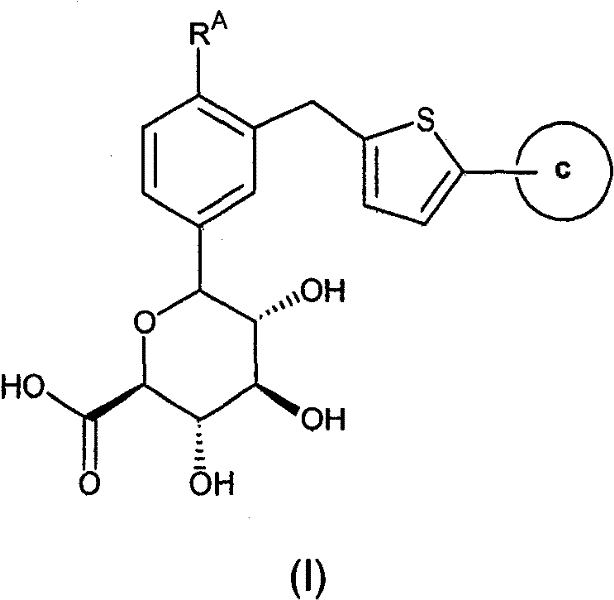
In one aspect, the invention relates to compounds of formula (I):

wherein,
RAis a halogen atom, or a lower alkyl group; and
ring c is a phenyl group substituted with 1 to 3 substituents selected from the group consisting of a halogen atom, a cyano group, a lower alkyl group, a halo-lower alkyl group, a lower alkoxy group, a halo-lower alkoxy group, a methylenedioxy group, an ethyleneoxy group, a mono-or di-lower alkylamino group, a carbamoyl group, and a mono-or di-lower alkylcarbamoyl group; or a heterocyclic group substituted by 1 to 3 substituents selected from the group consisting of a halogen atom, a cyano group, a lower alkyl group, a halo-lower alkyl group, a lower alkoxy group, a halo-lower alkoxy group, a mono-or di-lower alkylamino group, a carbamoyl group and a mono-or di-lower alkylcarbamoyl group;
or a pharmaceutically acceptable salt thereof, or a prodrug thereof.
In another aspect, the invention is directed to pharmaceutical compositions containing one or more compounds of formula (I), pharmaceutically acceptable salts thereof, or prodrugs thereof.
In yet another aspect, the invention is directed to a method of treating or delaying the onset and progression of diabetes, diabetic retinopathy, diabetic neuropathy, diabetic nephropathy, delayed wound healing, insulin resistance, hyperglycemia, hyperinsulinemia, elevated blood levels of fatty acids, elevated blood levels of glycerol, hyperlipidemia, obesity, hypertriglyceridemia, syndrome X, diabetic complications, atherosclerosis, or hypertension, comprising administering to a mammalian species (species) in need thereof a therapeutically effective amount of a compound of formula (I), a pharmaceutically acceptable salt thereof, or a prodrug thereof, as described herein.
Detailed Description
The present invention relates to compounds of the following formula (I), or a pharmaceutically acceptable salt thereof, or a prodrug thereof:

wherein:
RAis a halogen atom, or a lower alkyl group, and
ring c is a phenyl group substituted with 1 to 3 substituents selected from the group consisting of a halogen atom, a cyano group, a lower alkyl group, a halo-lower alkyl group, a lower alkoxy group, a halo-lower alkoxy group, a methylenedioxy group, an ethyleneoxy group, a mono-or di-lower alkylamino group, a carbamoyl group, and a mono-or di-lower alkylcarbamoyl group; or a heterocyclic group substituted by 1 to 3 substituents selected from the group consisting of a halogen atom, a cyano group, a lower alkyl group, a halo-lower alkyl group, a lower alkoxy group, a halo-lower alkoxy group, a mono-or di-lower alkylamino group, a carbamoyl group and a mono-or di-lower alkylcarbamoyl group.
The compounds of formula (I) exhibit inhibitory activity against sodium-dependent glucose transport present in the small intestine and kidney of mammalian species and are therefore useful in the treatment of diabetes or diabetic complications such as diabetic retinopathy, diabetic neuropathy, diabetic nephropathy, obesity and delayed wound healing.
The compounds of formula (I) according to the invention are described in more detail below.
The definitions of the terms used in the description of the present invention are listed below.
The term "halogen atom" or "halo" denotes chlorine, bromine, fluorine and iodine, preferably chlorine and fluorine.
The terms "alkyl" and "alkyl group" mean a straight or branched, monovalent saturated, monovalent hydrocarbon chain having from 1 to 12 carbon atoms. Preferred are straight chain alkyl or branched alkyl groups having 1 to 6 carbon atoms, and more preferred are straight chain alkyl or branched alkyl groups having 1 to 4 carbon atoms. Examples thereof are methyl, ethyl, propyl, isopropyl, butyl, tert-butyl, isobutyl, pentyl, hexyl, isohexyl, heptyl, 4-dimethylpentyl, octyl, 2, 4-trimethylpentyl, nonyl, decyl and the various branched isomers thereof.
The term "alkylene group" or "alkylene" denotes a straight or branched divalent saturated hydrocarbon chain having from 1 to 12 carbon atoms. A linear or branched alkylene group having 1 to 6 carbon atoms is preferable, and a linear or branched alkylene group having 1 to 4 carbon atoms is more preferable. Examples thereof are methylene, ethylene, propylene, trimethylene (trimethylene) and the like.
When the above alkylene groups are attached to two different carbon atoms of the benzene ring, they may form a five-, six-or seven-membered carbocyclic ring together with the carbon atoms to which they are attached, and may be optionally substituted by one or more substituents defined below.
The term "heterocyclyl" or "heterocyclic group" denotes a monovalent radical of a monovalent unsaturated monocyclic heterocyclic ring or an unsaturated fused heterobicyclic ring, as well as a monovalent radical of an unsaturated monocyclic heterocyclic ring or an unsaturated fused heterobicyclic ring.
The term "unsaturated monocyclic heterocyclic ring" means an unsaturated hydrocarbon ring containing 1 to 4 heteroatoms independently selected from nitrogen atom, oxygen atom and sulfur atom, and preferably it is a4 to 7-membered saturated or unsaturated hydrocarbon ring containing 1 to 4 heteroatoms independently selected from nitrogen atom, oxygen atom and sulfur atom. Examples are pyridine, pyrimidine, pyrazine, furan, thiophene, pyrrole, imidazole, pyrazole, oxazole, isoxazole, 4, 5-dihydrooxazole, thiazole, isothiazole, thiadiazole, triazole, tetrazole and the like. Among them, pyridine, pyrimidine, pyrazine, furan, thiophene, pyrrole, imidazole, oxazole and thiazole are preferably used.
The term "unsaturatedThe fused heterocyclic ring of (1) represents a hydrocarbon ring composed of a saturated or unsaturated hydrocarbon ring fused with the above unsaturated monocyclic heterocyclic ring, wherein, if necessary, the saturated hydrocarbon ring and the unsaturated hydrocarbon ring may optionally contain an oxygen atom, a nitrogen atom, a sulfur atom, SO or SO on the ring2. The "unsaturated fused heterocyclic ring" includes, for example, benzothiophene, indole, tetrahydrobenzothiophene, benzofuran, isoquinoline, thienothiophene, thienopyridine, quinoline, indoline, isoindoline, benzothiazole, benzoxazole, indazole, dihydro-isoquinoline and the like. Furthermore, said "heterocycles" may also comprise their possible N-oxides or S-oxides.
The term "alkoxy" denotes a group formed by the combination of an "alkyl" group with an oxygen atom.
Terms such as haloalkyl, halo-lower alkyl, halo-alkoxy, halo-lower alkoxy, halophenyl or haloheterocyclyl denote that alkyl, lower alkyl, alkoxy, lower alkoxy, phenyl or heterocyclyl (hereinafter alkyl etc. are exemplified) are each substituted by one or more halogen atoms. Among them, the alkyl group and the like are preferably substituted by 1 to 7 halogen atoms, and more preferably the alkyl group and the like are substituted by 1 to 5 halogen atoms.
The term "lower" as used in the definitions of formulae herein denotes, unless otherwise defined, a straight or branched carbon chain having from 1 to 6 carbon atoms. More preferably, it represents a straight or branched carbon chain having 1 to 4 carbon atoms.
The term "prodrug" denotes an ester or carbonate ester formed by the reaction of one or more hydroxyl groups of a compound of formula (I) with an acylating agent substituted with an alkyl, alkoxy or aryl group by conventional methods to give an acetate, pivalate, methyl carbonate, benzoate ester, and the like. In addition, prodrugs also include esters or amides, which are likewise formed by reacting one or more of the hydroxyl groups of the compounds of formula (I) with an α -amino acid or β -amino acid, etc., by conventional methods using condensing agents.
Pharmaceutically acceptable salts of the compounds of formula (I) include, for example: salts with alkali metals such as lithium, sodium, potassium, etc.; salts with alkaline earth metals such as calcium, magnesium, etc.; salts with zinc or aluminum; salts with organic bases such as ammonium, choline, diethanolamine, lysine, ethylenediamine, t-butylamine, t-octylamine, tris (hydroxymethyl) aminomethane, N-methylglucamine, triethanolamine and dehydroabietylamine; salts with inorganic acids such as hydrochloric acid, hydrobromic acid, hydroiodic acid, sulfuric acid, nitric acid, phosphoric acid, and the like; or salts with organic acids such as formic acid, acetic acid, propionic acid, oxalic acid, malonic acid, succinic acid, fumaric acid, maleic acid, lactic acid, malic acid, tartaric acid, citric acid, methanesulfonic acid, ethanesulfonic acid, benzenesulfonic acid, etc.; or salts with acidic amino acids such as aspartic acid, glutamic acid, and the like.
The compounds of the present invention also include mixtures of stereoisomers, or each pure or substantially pure isomer. For example, the compounds of the present invention may optionally contain any one or more asymmetric centers on a carbon atom containing any substituent. Thus, the compounds of formula (I) may exist as enantiomers or diastereomers, or mixtures thereof. When the compound of formula (I) of the present invention contains a double bond, the compound of the present invention may exist in a geometrical isomeric form (cis-compound, trans-compound), and when the compound of formula (I) of the present invention contains an unsaturated bond such as carbonyl group, the compound of the present invention may exist in a tautomeric form, and the compound of the present invention also includes these isomers or a mixture thereof. The starting compounds in the form of racemic mixtures, enantiomers or diastereomers may be used in the process for preparing the compounds of the invention. When the compounds of the present invention are obtained in diastereoisomeric or enantiomeric forms, they can be separated by conventional methods such as chromatography or fractional crystallization.
Further, the compound of formula (I) of the present invention includes an intramolecular salt, hydrate, solvate or polymorph thereof.
In a preferred embodiment, ring c is a phenyl group substituted with 1 to 3 substituents selected from the group consisting of a halogen atom, a cyano group, a lower alkyl group, a halo-lower alkyl group, a lower alkoxy group, a halo-lower alkoxy group, and a mono-or di-lower alkylamino group, or a heterocyclic group substituted with a substituent selected from the group consisting of a halogen atom, a cyano group, a lower alkyl group, a halo-lower alkyl group, a lower alkoxy group, a halo-lower alkoxy group. In particular, ring c is a phenyl group substituted with a halogen atom, a cyano group, a lower alkyl group, a halo-lower alkyl group, a lower alkoxy group or a halo-lower alkoxy group, or a heterocyclic group substituted with a halogen atom, a cyano group, a lower alkyl group or a lower alkoxy group. More particularly, ring c is a phenyl group substituted with a halogen atom or a cyano group, or a pyridyl group substituted with a halogen atom.
In another preferred embodiment, the heterocyclyl group is thienyl, pyridyl, pyrimidinyl, pyrazinyl, pyrazolyl, thiazolyl, quinolinyl, tetrazolyl, or oxazolyl.
In another preferred embodiment, RAIs C1-3An alkyl group. More particularly, RAIs methyl.
In another preferred embodiment, RAIs a halogen. More particularly, RAIs chloro.
In another preferred embodiment, ring c is phenyl substituted with a halogen atom. More particularly, the halogen is F.
In another preferred embodiment, ring c is pyridyl substituted with a halogen atom. More particularly, the halogen is fluorine.
In particular, RAIs C1-3Alkyl and ring c is phenyl substituted with halogen atoms. More particularly, RAIs methyl and ring c is phenyl substituted by F.
In another preferred embodiment, RAOne is halogen and ring c is pyridyl substituted with halogen. More particularly, RAIs chloro and ring c is pyridyl substituted by F.
In another preferred embodiment, the compound of the invention is selected from 6- {3- [5- (4-fluoro-phenyl) thiophen-2-ylmethyl ] -4-methyl-phenyl } -3, 4, 5-trihydroxy-tetrahydro-pyran-2-carboxylic acid and 6- { 4-chloro-3- [5- (6-fluoro-pyridin-3-yl) -thiophen-2-ylmethyl ] -phenyl } -3, 4, 5-trihydroxy-tetrahydro-pyran-2-carboxylic acid; or a pharmaceutically acceptable salt thereof, or a prodrug thereof.
Further, the compound having the following structure
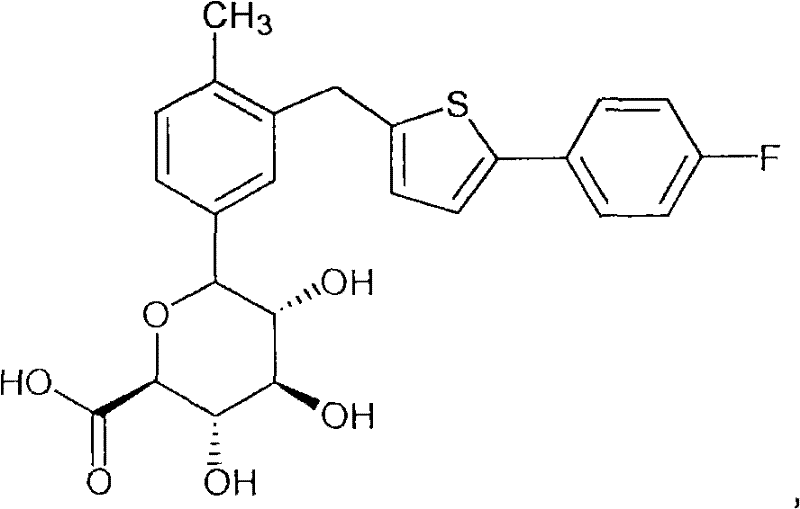
Is a preferred embodiment of the present invention.
Further, the compound having the following structure

Is a preferred embodiment of the present invention.
The compound of formula (I) of the present invention exhibits an inhibitory activity against sodium-dependent glucose transporters, and a blood glucose-lowering effect. Thus, the compounds of the present invention are useful for treating or delaying the onset and progression of diabetes, diabetic retinopathy, diabetic neuropathy, diabetic nephropathy, delayed wound healing, insulin resistance, hyperglycemia, hyperinsulinemia, elevated blood levels of fatty acids, elevated blood levels of glycerol, hyperlipidemia, obesity, hypertriglyceridemia, syndrome X, diabetic complications, atherosclerosis, or hypertension. In particular, the compounds of the present invention are useful for the treatment or prevention of diabetes type 1 and type 2 diabetes, etc.), diabetic complications (such as diabetic retinopathy, diabetic neuropathy, diabetic nephropathy) or obesity, or for the treatment of postprandial hyperglycemia.
The compounds of formula (I), pharmaceutically acceptable salts thereof, or prodrugs thereof of the present invention may be administered orally or parenterally and may be employed in the form of suitable pharmaceutical compositions. Suitable pharmaceutical compositions for oral administration include, for example, solid preparations such as tablets, granules, capsules, powders and the like; or a solution preparation, a suspension preparation or an emulsion preparation, etc. Suitable pharmaceutical compositions for parenteral administration include, for example, suppositories, injections, and intravenous drip preparations prepared using distilled water, physiological saline, aqueous glucose solution for injection; or an inhalant. Typically, the compound is administered in admixture with a pharmaceutically acceptable carrier, excipient or diluent selected with regard to the intended route of administration. For example, in the pharmaceutical compositions of the present invention, the compounds of the present invention may be combined with any suitable binding, lubricating, suspending, coating and/or dissolving agent. The tablets or capsules of the present invention may be taken one or two or more tablets at a time as appropriate. The compounds of the present invention may also be administered in sustained release dosage forms.
The dose of the compound of formula (I) or a pharmaceutically acceptable salt thereof of the present invention may vary depending on the administration route, age, body weight, the kind and severity of the condition of the patient or the disease to be treated, and the dose is usually in the range of about 0.1 to 50 mg/Kg/day, preferably in the range of about 0.1 to 30 mg/Kg/day.
If desired, the compounds of formula I may be used in combination with one or more other antidiabetic agents, one or more agents for treating diabetic complications, and/or one or more agents for treating other diseases. The compounds of the invention and these other agents may be administered in the same dosage form, or in separate oral dosage forms or by injection.
Such other antidiabetic agents include, for example, antidiabetic or antihyperglycemic agents including insulin, insulin secretagogues or insulin sensitizers; or other antidiabetic agents having a mechanism of action different from SGLT inhibition, 1, 2, 3 or 4 of these other antidiabetic agents may be preferably used. Examples include biguanide compounds, sulfonylureas, α -glucosidase inhibitors, PPAR- γ agonists (such as thiazolidinedione compounds), PPAR- α/γ dual agonists, dipeptidyl peptidase IV (DPP4) inhibitors, mitiglinide compounds, and/or nateglinide compounds, as well as insulin, glucagon-like peptide-1 (GLP-1), PTP1B inhibitors, glycogen phosphorylase inhibitors, RXR modulators, and/or glucose 6-phosphatase inhibitors.
Such agents for treating other conditions include, for example, antiobesity agents, antihypertensive agents, antiplatelet agents, antiatherosclerotic agents and/or hypolipidemic agents.
If desired, the SGLT inhibitors of formula (I) may be used in combination with a medicament for the treatment of diabetic complications. Such agents include, for example, PKC inhibitors and/or ACE inhibitors.
The dosage of these drugs may vary depending on the age, body weight and condition of the patient, as well as the administration route, dosage form, etc.
These pharmaceutical compositions can be administered orally, for example, in the form of tablets, capsules, granules or powders to mammals including humans, apes, dogs, etc., or parenterally in the form of injections, intranasal preparations, transdermal patches, etc.
The present invention also relates to methods of treating or delaying the onset and progression of diabetes, diabetic retinopathy, diabetic neuropathy, diabetic nephropathy, delayed wound healing, insulin resistance, hyperglycemia, hyperinsulinemia, increased blood levels of fatty acids, increased blood levels of glycerol, hyperlipidemia, obesity, hypertriglyceridemia, syndrome X, diabetic complications, atherosclerosis, or hypertension comprising administering to a mammalian species in need thereof a therapeutically effective amount of a compound of formula (I), and pharmaceutically acceptable salts, or prodrugs thereof.
The present invention also relates to a method of treating type 1 and type 2 diabetes comprising administering to a mammalian species in need thereof a therapeutically effective amount of a compound of formula (I), or a pharmaceutically acceptable salt or prodrug thereof, alone or in combination with another antidiabetic agent, an agent for treating diabetic complications, an antiobesity agent, an antihypertensive agent, an antiplatelet agent, an antiatherosclerotic agent and/or a hypolipidemic agent.
The compounds of formula (I) of the invention may be prepared from

The preparation of these compounds may in turn be prepared according to US20050233988 to Nomura et al, which is hereby incorporated by reference in its entirety.
Specifically, the compounds of formula (I) wherein R isAAnd ring c as described above:
the compound of formula (I) can be obtained by treating a commercially available compound of formula a1, preferably at ambient temperature, with a catalyst such as N, N-Dimethylformamide (DMF) and oxalyl chloride in dichloromethane to obtain the corresponding acid chloride, which is reacted with a compound of formula a2, preferably under Friedel-Craft conditions, to obtain a compound of formula A3. The compound of formula a3 is treated with a reducing agent such as triethylsilane, preferably at 0-20 ℃, preferably in a solvent such as dichloromethane or acetonitrile or mixtures thereof containing a catalyst such as boron trifluoride etherate. The compound of formula A4 is activated for coupling, preferably at-60 ℃ to-70 ℃, by treatment with n-BuLi in a solvent such as THF, heptane, toluene, methylcyclohexane or mixtures thereof, to which the lactone A5 has previously been added. Followed by reaction with methanesulfonic acid in methanol provides the compound of formula a 7. The compound of formula a7 is preferably treated with a reducing agent such as triethylsilane at from-30 ℃ to room temperature, preferably in a solvent containing a catalyst such as boron trifluoride etherate, trifluoroacetic acid in dichloromethane, acetonitrile or toluene or mixtures thereof. The compound of formula A8 can be purified by column chromatography and crystallization from a solvent such as ethyl acetate, ethanol, methanol or heptane, or mixtures thereof. Treatment of a compound of formula a9 with a catalytic amount of 4-methoxy-TEMPO radical and sodium hypochlorite in the presence of potassium bromide and saturated sodium bicarbonate solution gives a crude mixture of compounds of formula a10 which can be purified by column chromatography to give the title compound.
The starting compounds and reagents for the above-described methods are either commercially available or well known in the art, or can be readily prepared by one of ordinary skill in the art by standard methods known from one or more commercially available or known compounds.
Hereinafter, the present invention will be specifically illustrated by examples, but it should not be construed that the invention is limited thereto.
Example 1
6- {3- [5- (4-fluoro-phenyl) thiophen-2-ylmethyl]-4-methyl-phenyl } -3, 4, 5-trihydroxy-tetrahydro-py-ro
Pyran-2-carboxylic acids

The compounds of formula (a) above are prepared according to the methods and examples disclosed in US20050233988a1 to Nomura et al, the entire contents of which are incorporated herein by reference.
A cooled (0 ℃) mixture of compound (a) (20.0g, 44.8mmol) containing 4-methoxy-TEMPO (200.0mg, 1.06mmol) and potassium bromide (556mg, 4.66mmol) in ethyl acetate (160mL) was added dropwise to a saturated aqueous solution of sodium bicarbonate (100mL) and sodium hypochlorite (28.0mL, 37.6-48.8mmol) so that the temperature did not exceed 10 ℃. 30 minutes after the end of the dropwise addition, a sample was taken, diluted with 1N hydrochloric acid and extracted with ethyl acetate. HPLC analysis (35SGLT) showed a 1: 1 ratio of mixture of compound (a) and compound 1. After stirring for 1 hour at a temperature of 0-15 deg.C, additional sodium hypochlorite (10-13%, 5.00ml, 6.71-8.73mmol) was added dropwise. Stirring was continued for another 1-1.5 hours. HPLC analysis showed the starting material still present. Additional sodium hypochlorite (10-13%, 5.00ml, 6.71-8.73mmol) was added slowly. Samples were taken after 30 minutes. Additional sodium hypochlorite (10-13%, 5.00ml, 6.71-8.73mmol) was added slowly. The ice bath was removed and stirring of the opaque yellow mixture was continued at room temperature for 1.0 hour. The mixture was diluted with 0.5N hydrochloric acid (200ml) and ethyl acetate (100 ml). The appearance of an emulsion; the mixture was left overnight for isolation.
The layers were separated and the aqueous phase was extracted with ethyl acetate (3X 100 ml). The organic layer was dried and concentrated to about 100ml of residual solvent, then 80g of silica gel was added and the mixture was concentrated to dryness. Flash chromatography on a 220g silica gel column with 2% methanol/ethyl acetate afforded 6.49g (31.81% yield) of a yellow solid (Compound 1).
Example 2
Biological examples
The method comprises the following steps:
CHOK1 cells expressing human SGLT2 were seeded at a density of 50,000 cells per well on a 96-well white-well wall plate in an F-12 nutrient mixture (Ham's F-12) containing 10% fetal bovine serum, 400. mu.g/ml Geneticin, 50 units/ml penicillin G sodium (Gibco-BRL) and 50. mu.g/ml streptomycin sulfate. At 37 ℃ with 5% CO2After 2 days of incubation in a humidified atmosphere, the cells were washed 1 time with detection buffer (137mM sodium chloride, 5mM potassium chloride, 1mM calcium chloride, 1mM magnesium chloride, 50mM Hepes, and 20mM Tris, pH 7.4), then 80. mu.l of the buffer containing the test compound was added, and incubated at 37 ℃ for 10 minutes. The test compounds were dissolved in DMSO. The final concentration of DMSO was 0.5%. By adding 20. mu.l of14C]-methyl-alpha-D-glucopyranoside (14C-AMG, 0.08. mu. Ci/well) solution (final concentration 0.5mM) initiated the transfer reaction. After incubation at 37 ℃ for 2 hours, the cells were incubatedUptake of the incubation mixture stopped the uptake, and the cells were then washed 3 times with ice-cold PBS. Next, the cells were solubilized with 0.3N sodium hydroxide, and a scintillant (scintalin) was added, and radioactivity was detected by a liquid scintillation counter. Non-specific AMG uptake was defined as the presence of AMG in the presence of 100 μ M phlorizin, a specific inhibitor of sodium-dependent glucose cotransporter. Specific uptake was normalized to protein concentration as determined by Bradford method. The 50% Inhibitory Concentration (IC) was calculated from the dose-response curve by the least squares method50) The value is obtained.
Compound 1 was tested using the assay described above with the following results:
as a result: human SGLT2 inhibits IC50=1.1μM
While the foregoing specification teaches the principles of the present invention, with examples provided for the purpose of illustration, it will be understood that the practice of the invention encompasses all of the usual variations, adaptations and/or modifications as come within the scope of the following claims and their equivalents.
Claims (13)
Applications Claiming Priority (3)
| Application Number | Priority Date | Filing Date | Title |
|---|---|---|---|
| US86836806P | 2006-12-04 | 2006-12-04 | |
| US60/868,368 | 2006-12-04 | ||
| PCT/US2007/086247 WO2008070609A1 (en) | 2006-12-04 | 2007-12-03 | Thienyl-containing glycopyranosyl derivatives as antidiabetics |
Publications (2)
| Publication Number | Publication Date |
|---|---|
| CN101611032A CN101611032A (en) | 2009-12-23 |
| CN101611032B true CN101611032B (en) | 2012-07-18 |
Family
ID=39166316
Family Applications (1)
| Application Number | Title | Priority Date | Filing Date |
|---|---|---|---|
| CN2007800508939A Active CN101611032B (en) | 2006-12-04 | 2007-12-03 | Thienyl-containing glucopyranosyl derivatives as antidiabetic agents |
Country Status (9)
| Country | Link |
|---|---|
| US (1) | US7666845B2 (en) |
| EP (1) | EP2099791B1 (en) |
| JP (1) | JP5298025B2 (en) |
| CN (1) | CN101611032B (en) |
| AU (1) | AU2007329490B2 (en) |
| CA (1) | CA2671699C (en) |
| ES (1) | ES2397664T3 (en) |
| NZ (1) | NZ577391A (en) |
| WO (1) | WO2008070609A1 (en) |
Families Citing this family (21)
| Publication number | Priority date | Publication date | Assignee | Title |
|---|---|---|---|---|
| CN101801371B (en) * | 2007-09-10 | 2012-11-28 | 詹森药业有限公司 | Process for the preparation of compounds useful as SGLT inhibitors |
| US9056850B2 (en) * | 2008-10-17 | 2015-06-16 | Janssen Pharmaceutica N.V. | Process for the preparation of compounds useful as inhibitors of SGLT |
| US20110009347A1 (en) | 2009-07-08 | 2011-01-13 | Yin Liang | Combination therapy for the treatment of diabetes |
| DK2451797T3 (en) | 2009-07-10 | 2013-06-24 | Janssen Pharmaceutica Nv | Crystallization Process for 1- (b-D-GLUCOPYRANOSYL) -4-METHYL-3- [5- (4-fluorophenyl) -2-thienylmethyl] benzene |
| RS55909B1 (en) | 2009-10-14 | 2017-09-29 | Janssen Pharmaceutica Nv | PROCESS FOR PREPARING UNITS USEFUL AS SGLT2 INHIBITORS |
| WO2011107494A1 (en) | 2010-03-03 | 2011-09-09 | Sanofi | Novel aromatic glycoside derivatives, medicaments containing said compounds, and the use thereof |
| NZ703128A (en) | 2010-05-11 | 2016-04-29 | Janssen Pharmaceutica Nv | Pharmaceutical formulations comprising 1 - (beta-d-glucopyranosyl) - 2 -thienylmethylbenzene derivatives as inhibitors of sglt |
| WO2011157827A1 (en) | 2010-06-18 | 2011-12-22 | Sanofi | Azolopyridin-3-one derivatives as inhibitors of lipases and phospholipases |
| US8530413B2 (en) | 2010-06-21 | 2013-09-10 | Sanofi | Heterocyclically substituted methoxyphenyl derivatives with an oxo group, processes for preparation thereof and use thereof as medicaments |
| TW201215387A (en) | 2010-07-05 | 2012-04-16 | Sanofi Aventis | Spirocyclically substituted 1,3-propane dioxide derivatives, processes for preparation thereof and use thereof as a medicament |
| TW201215388A (en) | 2010-07-05 | 2012-04-16 | Sanofi Sa | (2-aryloxyacetylamino)phenylpropionic acid derivatives, processes for preparation thereof and use thereof as medicaments |
| TW201221505A (en) | 2010-07-05 | 2012-06-01 | Sanofi Sa | Aryloxyalkylene-substituted hydroxyphenylhexynoic acids, process for preparation thereof and use thereof as a medicament |
| EP2697218B1 (en) | 2011-04-13 | 2016-05-25 | Janssen Pharmaceutica NV | Process for the preparation of compounds useful as inhibitors of sglt2 |
| US9035044B2 (en) | 2011-05-09 | 2015-05-19 | Janssen Pharmaceutica Nv | L-proline and citric acid co-crystals of (2S, 3R, 4R, 5S,6R)-2-(3-((5-(4-fluorophenyl)thiopen-2-yl)methyl)4-methylphenyl)-6-(hydroxymethyl)tetrahydro-2H-pyran-3,4,5-triol |
| MX2013013734A (en) * | 2011-05-26 | 2014-02-27 | Tfchem | Family of aryl, heteroaryl, o-aryl and o-heteroaryl carbasugars. |
| WO2013037390A1 (en) | 2011-09-12 | 2013-03-21 | Sanofi | 6-(4-hydroxy-phenyl)-3-styryl-1h-pyrazolo[3,4-b]pyridine-4-carboxylic acid amide derivatives as kinase inhibitors |
| EP2760862B1 (en) | 2011-09-27 | 2015-10-21 | Sanofi | 6-(4-hydroxy-phenyl)-3-alkyl-1h-pyrazolo[3,4-b]pyridine-4-carboxylic acid amide derivatives as kinase inhibitors |
| CN103570671B (en) * | 2012-09-26 | 2016-03-30 | 上海天慈生物谷生物工程有限公司 | A kind of hypoglycemic compound and method for making thereof and application |
| CN103980263B (en) * | 2014-04-17 | 2016-08-03 | 海门瑞一医药科技有限公司 | The synthesis technique of canagliflozin |
| US20170071970A1 (en) | 2015-09-15 | 2017-03-16 | Janssen Pharmaceutica Nv | Co-therapy comprising canagliflozin and phentermine for the treatment of obesity and obesity related disorders |
| US10349968B2 (en) * | 2016-05-02 | 2019-07-16 | Covidien Lp | Devices, systems, and methods for establishing electrical and fluid connections to surgical instruments |
Citations (4)
| Publication number | Priority date | Publication date | Assignee | Title |
|---|---|---|---|---|
| WO2001027128A1 (en) * | 1999-10-12 | 2001-04-19 | Bristol-Myers Squibb Company | C-aryl glucoside sglt2 inhibitors |
| WO2004080990A1 (en) * | 2003-03-14 | 2004-09-23 | Astellas Pharma Inc. | C-glycoside derivatives and salts thereof |
| WO2005012326A1 (en) * | 2003-08-01 | 2005-02-10 | Tanabe Seiyaku Co., Ltd. | Novel compounds having inhibitory activity against sodium-dependant transporter |
| WO2006010557A1 (en) * | 2004-07-27 | 2006-02-02 | Boehringer Ingelheim International Gmbh | D-glucopyranosyl phenyl-substituted cyclene, medicaments containing these compounds, their use, and method for the production thereof |
Family Cites Families (34)
| Publication number | Priority date | Publication date | Assignee | Title |
|---|---|---|---|---|
| US5731292A (en) * | 1992-11-12 | 1998-03-24 | Tanabe Seiyaku Co., Ltd. | Dihydrochalcone derivatives which are hypoglycemic agents |
| CA2102591C (en) * | 1992-11-12 | 2000-12-26 | Kenji Tsujihara | Hypoglycemic agent |
| US5830873A (en) * | 1994-05-11 | 1998-11-03 | Tanabe Seiyaku Co., Ltd. | Propiophenone derivative and a process for preparing the same |
| US6515117B2 (en) | 1999-10-12 | 2003-02-04 | Bristol-Myers Squibb Company | C-aryl glucoside SGLT2 inhibitors and method |
| JP4456768B2 (en) | 2000-02-02 | 2010-04-28 | 壽製薬株式会社 | Drug containing C-glycoside |
| US6627611B2 (en) * | 2000-02-02 | 2003-09-30 | Kotobuki Pharmaceutical Co Ltd | C-glycosides and preparation of thereof as antidiabetic agents |
| EP1270584B1 (en) * | 2000-03-17 | 2005-12-07 | Kissei Pharmaceutical Co., Ltd. | Glucopyranosyloxy benzylbenzene derivatives, medicinal compositions containing the same and intermediates for the preparation of the derivatives |
| US6683056B2 (en) | 2000-03-30 | 2004-01-27 | Bristol-Myers Squibb Company | O-aryl glucoside SGLT2 inhibitors and method |
| US6555519B2 (en) * | 2000-03-30 | 2003-04-29 | Bristol-Myers Squibb Company | O-glucosylated benzamide SGLT2 inhibitors and method |
| KR100701437B1 (en) * | 2000-12-28 | 2007-03-30 | 깃세이 야쿠힌 고교 가부시키가이샤 | Glucopyranosyloxypyrazole derivatives and pharmaceutical uses thereof |
| US7087579B2 (en) * | 2001-02-26 | 2006-08-08 | Kissei Pharmaceutical Co., Ltd. | Glucopyranosyloxypyrazole derivatives and medicinal use thereof |
| ES2350084T3 (en) * | 2001-02-27 | 2011-01-18 | Kissei Pharmaceutical Co., Ltd. | DERIVATIVES OF GLUCOPIRANOSILOXIPIRAZOL AND MEDICAL USE OF THE SAME. |
| US6936590B2 (en) * | 2001-03-13 | 2005-08-30 | Bristol Myers Squibb Company | C-aryl glucoside SGLT2 inhibitors and method |
| DE60209343T2 (en) | 2001-04-11 | 2006-10-26 | Bristol-Myers Squibb Co. | AMINO ACID COMPLEXES OF C-ARYL GLYCOSIDES FOR THE TREATMENT OF DIABETES AND METHODS |
| CA2672001A1 (en) | 2001-04-27 | 2002-11-07 | Ajinomoto Co., Inc. | N-substituted pyrazole-o-glycoside derivatives and therapeutic agent for diabetes containing the same |
| JP4115105B2 (en) | 2001-07-02 | 2008-07-09 | 協和醗酵工業株式会社 | Pyrazole derivative |
| JPWO2003011880A1 (en) | 2001-07-31 | 2004-11-18 | キッセイ薬品工業株式会社 | Glucopyranosyloxybenzylbenzene derivatives, pharmaceutical compositions containing the same, pharmaceutical uses thereof and intermediates for the production thereof |
| WO2003020737A1 (en) | 2001-09-05 | 2003-03-13 | Bristol-Myers Squibb Company | O-pyrazole glucoside sglt2 inhibitors and method of use |
| US6562791B1 (en) * | 2002-03-29 | 2003-05-13 | Council Of Scientific And Industrial Research | Glucopyranoside, process for isolation thereof, pharmaceutical composition containing same and use thereof |
| DE10231370B4 (en) * | 2002-07-11 | 2006-04-06 | Sanofi-Aventis Deutschland Gmbh | Thiophene glycoside derivatives, medicaments containing these compounds and methods of making these medicaments |
| TWI254635B (en) | 2002-08-05 | 2006-05-11 | Yamanouchi Pharma Co Ltd | Azulene derivative and salt thereof |
| BR0310006A (en) | 2002-08-09 | 2005-02-15 | Taisho Pharmaceutical Co Ltd | Aryl 5-thio-beta-d-glycopyranoside derivatives and diabetes therapeutic agents containing them |
| AU2003262262A1 (en) | 2002-08-27 | 2004-03-19 | Kissei Pharmaceutical Co., Ltd. | Pyrazole derivatives, medicinal composition containing the same, and medicinal use thereof |
| DE10258007B4 (en) * | 2002-12-12 | 2006-02-09 | Sanofi-Aventis Deutschland Gmbh | Aromatic fluoroglycoside derivatives, medicaments containing these compounds and methods for the preparation of these medicaments |
| DE10258008B4 (en) | 2002-12-12 | 2006-02-02 | Sanofi-Aventis Deutschland Gmbh | Heterocyclic fluoroglycoside derivatives, medicaments containing these compounds and methods of making these medicaments |
| UA86042C2 (en) * | 2003-08-01 | 2009-03-25 | Янссен Фармацевтика Н.В. | Substituted indazole-o-glucosides |
| AR048377A1 (en) * | 2003-08-01 | 2006-04-26 | Janssen Pharmaceutica Nv | BENZOIMIDAZOL-, BENZOTRIAZOL- AND BENZOIMIDAZOLONA - O- SUBSTITUTED GLUCOSIDS |
| CA2549025A1 (en) * | 2003-08-01 | 2005-02-10 | Janssen Pharmaceutica N.V. | Substituted indole-o-glucosides |
| CA2549015A1 (en) * | 2003-08-01 | 2005-02-10 | Janssen Pharmaceutica N.V. | Substituted fused heterocyclic c-glycosides |
| EA010655B1 (en) * | 2003-08-01 | 2008-10-30 | Янссен Фармацевтика Н.В. | Substituted indazole-o-glucosides |
| US7393836B2 (en) * | 2004-07-06 | 2008-07-01 | Boehringer Ingelheim International Gmbh | D-xylopyranosyl-substituted phenyl derivatives, medicaments containing such compounds, their use and process for their manufacture |
| WO2006018150A1 (en) * | 2004-08-11 | 2006-02-23 | Boehringer Ingelheim International Gmbh | D-xylopyranosyl-phenyl-substituited cyclene, medicaments containing said compounds, use thereof and method for the production thereof |
| JP4496174B2 (en) * | 2005-01-31 | 2010-07-07 | 田辺三菱製薬株式会社 | Pharmaceutical composition |
| TWI418556B (en) * | 2006-07-27 | 2013-12-11 | Mitsubishi Tanabe Pharma Corp | Indole derivatives |
-
2007
- 2007-12-03 US US11/949,236 patent/US7666845B2/en active Active
- 2007-12-03 NZ NZ577391A patent/NZ577391A/en not_active IP Right Cessation
- 2007-12-03 AU AU2007329490A patent/AU2007329490B2/en not_active Ceased
- 2007-12-03 ES ES07854902T patent/ES2397664T3/en active Active
- 2007-12-03 JP JP2009540406A patent/JP5298025B2/en active Active
- 2007-12-03 CN CN2007800508939A patent/CN101611032B/en active Active
- 2007-12-03 EP EP07854902A patent/EP2099791B1/en active Active
- 2007-12-03 WO PCT/US2007/086247 patent/WO2008070609A1/en not_active Ceased
- 2007-12-03 CA CA2671699A patent/CA2671699C/en active Active
Patent Citations (4)
| Publication number | Priority date | Publication date | Assignee | Title |
|---|---|---|---|---|
| WO2001027128A1 (en) * | 1999-10-12 | 2001-04-19 | Bristol-Myers Squibb Company | C-aryl glucoside sglt2 inhibitors |
| WO2004080990A1 (en) * | 2003-03-14 | 2004-09-23 | Astellas Pharma Inc. | C-glycoside derivatives and salts thereof |
| WO2005012326A1 (en) * | 2003-08-01 | 2005-02-10 | Tanabe Seiyaku Co., Ltd. | Novel compounds having inhibitory activity against sodium-dependant transporter |
| WO2006010557A1 (en) * | 2004-07-27 | 2006-02-02 | Boehringer Ingelheim International Gmbh | D-glucopyranosyl phenyl-substituted cyclene, medicaments containing these compounds, their use, and method for the production thereof |
Non-Patent Citations (1)
| Title |
|---|
| OG Todoulou. et al.,.Synthesis and antiviral activity of some new 1H-1,2,4-triazole derivatives.《European Journal of Medicinal Chemistry》.1994,第29卷 * |
Also Published As
| Publication number | Publication date |
|---|---|
| CN101611032A (en) | 2009-12-23 |
| CA2671699C (en) | 2014-07-08 |
| JP2010511724A (en) | 2010-04-15 |
| EP2099791B1 (en) | 2012-11-21 |
| AU2007329490A1 (en) | 2008-06-12 |
| WO2008070609A1 (en) | 2008-06-12 |
| US7666845B2 (en) | 2010-02-23 |
| CA2671699A1 (en) | 2008-06-12 |
| JP5298025B2 (en) | 2013-09-25 |
| US20090029927A1 (en) | 2009-01-29 |
| NZ577391A (en) | 2011-11-25 |
| AU2007329490B2 (en) | 2012-05-17 |
| HK1137990A1 (en) | 2010-08-13 |
| ES2397664T3 (en) | 2013-03-08 |
| EP2099791A1 (en) | 2009-09-16 |
Similar Documents
| Publication | Publication Date | Title |
|---|---|---|
| CN101611032B (en) | Thienyl-containing glucopyranosyl derivatives as antidiabetic agents | |
| EP1654269B1 (en) | Novel compounds | |
| KR101724598B1 (en) | Process for the preparation of compounds useful as inhibitors of sglt | |
| JP4115105B2 (en) | Pyrazole derivative | |
| JPWO2006011502A1 (en) | Novel glucitol derivatives, prodrugs and salts thereof, and antidiabetic agents containing them | |
| BR112012008939B1 (en) | PROCESS FOR PREPARING COMPOUNDS USEFUL AS SGLT2 INHIBITORS | |
| SK287811B6 (en) | Glucopyranosyloxybenzylbenzene derivatives and medicinal compositions containing the same | |
| EP2755722A2 (en) | Novel sglt inhibitors | |
| WO2016074566A1 (en) | Glucoside derivative and pharmaceutical composition thereof | |
| HK1137990B (en) | Thienyl-containing glycopyranosyl derivatives as antidiabetics | |
| US9828366B2 (en) | Bicyclic derivatives and pharmaceutical composition including the same | |
| KR101858881B1 (en) | 4-{4-[(1e)-4-(2,9-diazaspiro[5.5]undec-2-yl)but-1-en-1-yl]-2-methylbenzyl}-5-(propan-2-yl)-1h-pyrazol-3-yl beta-d-glucopyranoside acetate | |
| WO2016070740A1 (en) | A class of new type sglt2 inhibitor compound and a pharmaceutical composition thereof | |
| JP5073948B2 (en) | Pharmaceutical composition | |
| CA2836661A1 (en) | Process for the preparation of compounds useful as inhibitors of sglt-2 |
Legal Events
| Date | Code | Title | Description |
|---|---|---|---|
| C06 | Publication | ||
| PB01 | Publication | ||
| C10 | Entry into substantive examination | ||
| SE01 | Entry into force of request for substantive examination | ||
| REG | Reference to a national code |
Ref country code: HK Ref legal event code: DE Ref document number: 1137990 Country of ref document: HK |
|
| C14 | Grant of patent or utility model | ||
| GR01 | Patent grant | ||
| REG | Reference to a national code |
Ref country code: HK Ref legal event code: GR Ref document number: 1137990 Country of ref document: HK |