CN101605812A - Cd44 antibody - Google Patents
Cd44 antibody Download PDFInfo
- Publication number
- CN101605812A CN101605812A CNA200780050041XA CN200780050041A CN101605812A CN 101605812 A CN101605812 A CN 101605812A CN A200780050041X A CNA200780050041X A CN A200780050041XA CN 200780050041 A CN200780050041 A CN 200780050041A CN 101605812 A CN101605812 A CN 101605812A
- Authority
- CN
- China
- Prior art keywords
- seq
- antibody
- antigen
- antibodies
- human
- Prior art date
- Legal status (The legal status is an assumption and is not a legal conclusion. Google has not performed a legal analysis and makes no representation as to the accuracy of the status listed.)
- Pending
Links
Images


Classifications
-
- C—CHEMISTRY; METALLURGY
- C07—ORGANIC CHEMISTRY
- C07K—PEPTIDES
- C07K16/00—Immunoglobulins [IGs], e.g. monoclonal or polyclonal antibodies
- C07K16/18—Immunoglobulins [IGs], e.g. monoclonal or polyclonal antibodies against material from animals or humans
- C07K16/28—Immunoglobulins [IGs], e.g. monoclonal or polyclonal antibodies against material from animals or humans against receptors, cell surface antigens or cell surface determinants
- C07K16/2884—Immunoglobulins [IGs], e.g. monoclonal or polyclonal antibodies against material from animals or humans against receptors, cell surface antigens or cell surface determinants against CD44
-
- C—CHEMISTRY; METALLURGY
- C07—ORGANIC CHEMISTRY
- C07K—PEPTIDES
- C07K16/00—Immunoglobulins [IGs], e.g. monoclonal or polyclonal antibodies
-
- A—HUMAN NECESSITIES
- A61—MEDICAL OR VETERINARY SCIENCE; HYGIENE
- A61K—PREPARATIONS FOR MEDICAL, DENTAL OR TOILETRY PURPOSES
- A61K39/00—Medicinal preparations containing antigens or antibodies
- A61K39/395—Antibodies; Immunoglobulins; Immune serum, e.g. antilymphocytic serum
-
- A—HUMAN NECESSITIES
- A61—MEDICAL OR VETERINARY SCIENCE; HYGIENE
- A61P—SPECIFIC THERAPEUTIC ACTIVITY OF CHEMICAL COMPOUNDS OR MEDICINAL PREPARATIONS
- A61P1/00—Drugs for disorders of the alimentary tract or the digestive system
- A61P1/04—Drugs for disorders of the alimentary tract or the digestive system for ulcers, gastritis or reflux esophagitis, e.g. antacids, inhibitors of acid secretion, mucosal protectants
-
- A—HUMAN NECESSITIES
- A61—MEDICAL OR VETERINARY SCIENCE; HYGIENE
- A61P—SPECIFIC THERAPEUTIC ACTIVITY OF CHEMICAL COMPOUNDS OR MEDICINAL PREPARATIONS
- A61P11/00—Drugs for disorders of the respiratory system
- A61P11/06—Antiasthmatics
-
- A—HUMAN NECESSITIES
- A61—MEDICAL OR VETERINARY SCIENCE; HYGIENE
- A61P—SPECIFIC THERAPEUTIC ACTIVITY OF CHEMICAL COMPOUNDS OR MEDICINAL PREPARATIONS
- A61P17/00—Drugs for dermatological disorders
- A61P17/06—Antipsoriatics
-
- A—HUMAN NECESSITIES
- A61—MEDICAL OR VETERINARY SCIENCE; HYGIENE
- A61P—SPECIFIC THERAPEUTIC ACTIVITY OF CHEMICAL COMPOUNDS OR MEDICINAL PREPARATIONS
- A61P19/00—Drugs for skeletal disorders
- A61P19/02—Drugs for skeletal disorders for joint disorders, e.g. arthritis, arthrosis
-
- A—HUMAN NECESSITIES
- A61—MEDICAL OR VETERINARY SCIENCE; HYGIENE
- A61P—SPECIFIC THERAPEUTIC ACTIVITY OF CHEMICAL COMPOUNDS OR MEDICINAL PREPARATIONS
- A61P25/00—Drugs for disorders of the nervous system
-
- A—HUMAN NECESSITIES
- A61—MEDICAL OR VETERINARY SCIENCE; HYGIENE
- A61P—SPECIFIC THERAPEUTIC ACTIVITY OF CHEMICAL COMPOUNDS OR MEDICINAL PREPARATIONS
- A61P29/00—Non-central analgesic, antipyretic or antiinflammatory agents, e.g. antirheumatic agents; Non-steroidal antiinflammatory drugs [NSAID]
-
- A—HUMAN NECESSITIES
- A61—MEDICAL OR VETERINARY SCIENCE; HYGIENE
- A61P—SPECIFIC THERAPEUTIC ACTIVITY OF CHEMICAL COMPOUNDS OR MEDICINAL PREPARATIONS
- A61P35/00—Antineoplastic agents
-
- A—HUMAN NECESSITIES
- A61—MEDICAL OR VETERINARY SCIENCE; HYGIENE
- A61P—SPECIFIC THERAPEUTIC ACTIVITY OF CHEMICAL COMPOUNDS OR MEDICINAL PREPARATIONS
- A61P37/00—Drugs for immunological or allergic disorders
-
- A—HUMAN NECESSITIES
- A61—MEDICAL OR VETERINARY SCIENCE; HYGIENE
- A61P—SPECIFIC THERAPEUTIC ACTIVITY OF CHEMICAL COMPOUNDS OR MEDICINAL PREPARATIONS
- A61P37/00—Drugs for immunological or allergic disorders
- A61P37/02—Immunomodulators
-
- A—HUMAN NECESSITIES
- A61—MEDICAL OR VETERINARY SCIENCE; HYGIENE
- A61P—SPECIFIC THERAPEUTIC ACTIVITY OF CHEMICAL COMPOUNDS OR MEDICINAL PREPARATIONS
- A61P37/00—Drugs for immunological or allergic disorders
- A61P37/02—Immunomodulators
- A61P37/06—Immunosuppressants, e.g. drugs for graft rejection
-
- A—HUMAN NECESSITIES
- A61—MEDICAL OR VETERINARY SCIENCE; HYGIENE
- A61P—SPECIFIC THERAPEUTIC ACTIVITY OF CHEMICAL COMPOUNDS OR MEDICINAL PREPARATIONS
- A61P43/00—Drugs for specific purposes, not provided for in groups A61P1/00-A61P41/00
-
- A—HUMAN NECESSITIES
- A61—MEDICAL OR VETERINARY SCIENCE; HYGIENE
- A61P—SPECIFIC THERAPEUTIC ACTIVITY OF CHEMICAL COMPOUNDS OR MEDICINAL PREPARATIONS
- A61P9/00—Drugs for disorders of the cardiovascular system
- A61P9/10—Drugs for disorders of the cardiovascular system for treating ischaemic or atherosclerotic diseases, e.g. antianginal drugs, coronary vasodilators, drugs for myocardial infarction, retinopathy, cerebrovascula insufficiency, renal arteriosclerosis
-
- C—CHEMISTRY; METALLURGY
- C12—BIOCHEMISTRY; BEER; SPIRITS; WINE; VINEGAR; MICROBIOLOGY; ENZYMOLOGY; MUTATION OR GENETIC ENGINEERING
- C12P—FERMENTATION OR ENZYME-USING PROCESSES TO SYNTHESISE A DESIRED CHEMICAL COMPOUND OR COMPOSITION OR TO SEPARATE OPTICAL ISOMERS FROM A RACEMIC MIXTURE
- C12P21/00—Preparation of peptides or proteins
-
- C—CHEMISTRY; METALLURGY
- C07—ORGANIC CHEMISTRY
- C07K—PEPTIDES
- C07K2317/00—Immunoglobulins specific features
- C07K2317/20—Immunoglobulins specific features characterized by taxonomic origin
- C07K2317/21—Immunoglobulins specific features characterized by taxonomic origin from primates, e.g. man
-
- C—CHEMISTRY; METALLURGY
- C07—ORGANIC CHEMISTRY
- C07K—PEPTIDES
- C07K2317/00—Immunoglobulins specific features
- C07K2317/50—Immunoglobulins specific features characterized by immunoglobulin fragments
- C07K2317/56—Immunoglobulins specific features characterized by immunoglobulin fragments variable (Fv) region, i.e. VH and/or VL
-
- C—CHEMISTRY; METALLURGY
- C07—ORGANIC CHEMISTRY
- C07K—PEPTIDES
- C07K2317/00—Immunoglobulins specific features
- C07K2317/50—Immunoglobulins specific features characterized by immunoglobulin fragments
- C07K2317/56—Immunoglobulins specific features characterized by immunoglobulin fragments variable (Fv) region, i.e. VH and/or VL
- C07K2317/565—Complementarity determining region [CDR]
-
- C—CHEMISTRY; METALLURGY
- C07—ORGANIC CHEMISTRY
- C07K—PEPTIDES
- C07K2317/00—Immunoglobulins specific features
- C07K2317/70—Immunoglobulins specific features characterized by effect upon binding to a cell or to an antigen
- C07K2317/76—Antagonist effect on antigen, e.g. neutralization or inhibition of binding
-
- C—CHEMISTRY; METALLURGY
- C07—ORGANIC CHEMISTRY
- C07K—PEPTIDES
- C07K2317/00—Immunoglobulins specific features
- C07K2317/90—Immunoglobulins specific features characterized by (pharmaco)kinetic aspects or by stability of the immunoglobulin
- C07K2317/92—Affinity (KD), association rate (Ka), dissociation rate (Kd) or EC50 value
-
- C—CHEMISTRY; METALLURGY
- C07—ORGANIC CHEMISTRY
- C07K—PEPTIDES
- C07K2319/00—Fusion polypeptide
Landscapes
- Health & Medical Sciences (AREA)
- Chemical & Material Sciences (AREA)
- Organic Chemistry (AREA)
- Life Sciences & Earth Sciences (AREA)
- Medicinal Chemistry (AREA)
- General Health & Medical Sciences (AREA)
- Engineering & Computer Science (AREA)
- Bioinformatics & Cheminformatics (AREA)
- General Chemical & Material Sciences (AREA)
- Pharmacology & Pharmacy (AREA)
- Chemical Kinetics & Catalysis (AREA)
- Animal Behavior & Ethology (AREA)
- Public Health (AREA)
- Veterinary Medicine (AREA)
- Immunology (AREA)
- Nuclear Medicine, Radiotherapy & Molecular Imaging (AREA)
- Molecular Biology (AREA)
- Biochemistry (AREA)
- Genetics & Genomics (AREA)
- Proteomics, Peptides & Aminoacids (AREA)
- Biophysics (AREA)
- Zoology (AREA)
- Pulmonology (AREA)
- Wood Science & Technology (AREA)
- Microbiology (AREA)
- Rheumatology (AREA)
- Vascular Medicine (AREA)
- Biomedical Technology (AREA)
- Dermatology (AREA)
- Orthopedic Medicine & Surgery (AREA)
- Pain & Pain Management (AREA)
- Heart & Thoracic Surgery (AREA)
- Cardiology (AREA)
- Transplantation (AREA)
- Neurosurgery (AREA)
- Biotechnology (AREA)
- Neurology (AREA)
- Physical Education & Sports Medicine (AREA)
- Urology & Nephrology (AREA)
- General Engineering & Computer Science (AREA)
Abstract
本发明涉及结合CD44以及用于抑制CD44的抗体(包括人抗体)和其抗原结合部分。本发明还涉及来源于人CD44抗体的重链和轻链免疫球蛋白和编码此类免疫球蛋白的核酸分子。本发明还涉及制备人CD44抗体的方法、包含此类抗体的组合物以及使用抗体和组合物或药剂进行治疗的方法。The present invention relates to antibodies (including human antibodies) and antigen-binding portions thereof that bind CD44 and are useful for inhibiting CD44. The invention also relates to heavy and light chain immunoglobulins derived from human CD44 antibodies and nucleic acid molecules encoding such immunoglobulins. The invention also relates to methods of making human CD44 antibodies, compositions comprising such antibodies, and methods of treatment using the antibodies and compositions or medicaments.
Description
交叉引用相关专利和专利申请Cross-reference related patents and patent applications
本发明要求2006年12月21日提交的美国临时专利申请系列号60/876109的优先权,其以其全文通过引用合并入本文。This application claims priority to US Provisional Patent Application Serial No. 60/876,109, filed December 21, 2006, which is incorporated herein by reference in its entirety.
发明领域 field of invention
本发明涉及结合人CD44的抗体和其抗原结合部分。本发明还涉及编码此类抗体和抗原结合部分的核酸分子、制备CD44抗体和抗原结合部分的方法、包含此类抗体或其抗原结合部分的组合物以及使用抗体、抗原结合部分和组合物或药剂进行治疗的方法。The present invention relates to antibodies and antigen-binding portions thereof that bind human CD44. The invention also relates to nucleic acid molecules encoding such antibodies and antigen-binding portions, methods of making CD44 antibodies and antigen-binding portions, compositions comprising such antibodies or antigen-binding portions thereof, and the use of antibodies, antigen-binding portions, and compositions or medicaments The method of treatment.
发明背景Background of the invention
由例如躯体损伤(physical injury)、感染或免疫反应引起的炎症、液体的局部累积由炎症细胞例如单核细胞和T细胞至细胞外基质的募集引发。Naor,D.等人,(2003)Arthritis Res Ther,5:105-115。该细胞募集通常导致细胞因子例如TNF-α、IL-6和IL-1β至细胞外基质的进一步渗透和增加(同上)。细胞的此类募集和渗透以及各种其他细胞过程例如生长的调控、粘附、分化、侵入和存活由跨膜糖蛋白细胞粘附分子(粘着受体(adhesion receptor)的超家族)介导。细胞粘着受体家族的成员包括CD44,广泛分布的I类跨膜糖蛋白。CD44在多种细胞行为包括粘着、迁移、活化和存活中起着中心作用。Ponta,H.等人,(2003)Molecular Cell Biology,4:33-45。Inflammation, caused by eg physical injury, infection or immune response, local accumulation of fluid is initiated by the recruitment of inflammatory cells such as monocytes and T cells to the extracellular matrix. Naor, D. et al., (2003) Arthritis Res Ther, 5: 105-115. This cellular recruitment typically results in further infiltration and increase of cytokines such as TNF-α, IL-6 and IL-1β into the extracellular matrix (supra). Such recruitment and infiltration of cells, as well as regulation of various other cellular processes such as growth, adhesion, differentiation, invasion and survival, are mediated by transmembrane glycoprotein cell adhesion molecules, a superfamily of adhesion receptors. Members of the cell adhesion receptor family include CD44, a ubiquitous class I transmembrane glycoprotein. CD44 plays a central role in a variety of cellular behaviors including adhesion, migration, activation and survival. Ponta, H. et al., (2003) Molecular Cell Biology, 4:33-45.
CD44的分子量范围在80至90kDa之间并且通过差异可变剪接(alternative splicing)可产生近800个变体同种型(variantisoform)。Cichy,J.等人,(2003)Journal of Cell Biology,161:5,839-843。目前已知数打同种型。CD44在许多细胞类型(包括白细胞、成纤维细胞、上皮细胞、角质形成细胞和一些内皮细胞)中以标准的CD44形式普遍表达,该标准CD44形式不存在任何变异外显子,是表达最丰富的同种型。The molecular weight of CD44 ranges from 80 to 90 kDa and nearly 800 variant isoforms can be generated by alternative splicing. Cichy, J. et al., (2003) Journal of Cell Biology, 161:5, 839-843. Dozens of isoforms are currently known. CD44 is ubiquitously expressed in many cell types (including leukocytes, fibroblasts, epithelial cells, keratinocytes, and some endothelial cells) in the canonical CD44 form, which lacks any variant exons and is the most abundantly expressed isotype.
CD44与其主要配体透明质烷(hyaluronan)或透明质酸(HA)(亲水的、线性的细胞外多糖)一起在炎症中起着主要作用。Naor D.,(2003)Arthritis Res Ther,5:105-115和Aruffo,A.(1990)Cell 61,1301-1313。例如,在体内研究中,诱导CD44介导的HA结合活性的单克隆抗CD44抗体IRAWB14导致患有蛋白聚糖诱导的关节炎的小鼠的炎性症状加重。Pure,E.等人,(2001)TRENDS in Molecular Medicine,7:213-221。CD44 plays a major role in inflammation together with its major ligand hyaluronan or hyaluronic acid (HA), a hydrophilic, linear extracellular polysaccharide. Naor D., (2003) Arthritis Res Ther, 5: 105-115 and Aruffo, A. (1990) Cell 61, 1301-1313. For example, in in vivo studies, the monoclonal anti-CD44 antibody IRAWB14, which induces CD44-mediated HA-binding activity, caused exacerbated inflammatory symptoms in mice with proteoglycan-induced arthritis. Pure, E. et al., (2001) TRENDS in Molecular Medicine, 7:213-221.
发明概述Summary of the invention
本发明提供了特异性结合CD44和可用作CD44拮抗剂的分离的抗体或其抗原结合部分和包含所述抗体或其抗原结合部分的组合物或药剂。本发明的另一个方面提供了本文中描述的任何抗体或其抗原结合部分,其中所述抗体或抗原结合部分是人抗体。在另外的方面,所述抗体或抗原结合部分是人重组抗体。The present invention provides isolated antibodies, or antigen-binding portions thereof, that specifically bind CD44 and are useful as CD44 antagonists, and compositions or medicaments comprising such antibodies, or antigen-binding portions thereof. Another aspect of the invention provides any antibody or antigen-binding portion thereof described herein, wherein said antibody or antigen-binding portion is a human antibody. In additional aspects, the antibody or antigen binding portion is a human recombinant antibody.
本发明还提供了特异性结合CD44的抗体,其包含:(i)重链和/或轻链,或(ii)其可变结构域,或(iii)其抗原结合部分,或(iv)其互补决定区(CDR)。The present invention also provides an antibody specifically binding to CD44, which comprises: (i) heavy chain and/or light chain, or (ii) variable domain thereof, or (iii) antigen-binding portion thereof, or (iv) its Complementarity Determining Regions (CDRs).
本发明还提供了CD44抗体或其抗原结合部分,其中抗体或其抗原结合部分具有至少一个下面a)至g)中所述的功能特性。The present invention also provides a CD44 antibody or antigen-binding portion thereof, wherein the antibody or antigen-binding portion thereof has at least one of the functional properties described in a) to g) below.
a)如通过表面等离子共振技术测量的,以1000nM或更小的KD结合CD44;a) binds CD44 with a KD of 1000 nM or less as measured by surface plasmon resonance techniques;
b)如通过表面等离子共振技术测量的,具有小于或等于0.01s-1的对于CD44的解离速率(koff);b) have a dissociation rate (k off ) for CD44 of less than or equal to 0.01 s-1 as measured by surface plasmon resonance techniques;
c)如通过FACS或ELISA结合测定法测量的,以小于500nM,75μg/ml的EC50结合CD44;c) binds CD44 with an EC50 of less than 500 nM, 75 μg/ml as measured by FACS or ELISA binding assay;
d)如通过ELISA结合测定法测量的,以小于500nM,75μg/ml的IC50抑制CD44和HA之间的相互作用;d) inhibits the interaction between CD44 and HA with an IC50 of less than 500 nM, 75 μg/ml as measured by an ELISA binding assay;
e)如通过FACS测量的,在体内以小于大约100nM的IC50减少CD44受体在炎症细胞例如CD3+T细胞中的表面表达;e) reducing surface expression of the CD44 receptor in inflammatory cells, such as CD3+ T cells, in vivo with an IC50 of less than about 100 nM as measured by FACS;
f)在体外以小于50nM的IC50减少CD44的表面表达;f) reduces surface expression of CD44 in vitro with an IC50 of less than 50 nM;
g)对于CD44具有超过淋巴管内皮透明质烷受体1蛋白(LYVE-1)至少100倍的选择性。g) has at least 100-fold selectivity for CD44 over lymphatic
在另一个实施方案中,本发明提供了包含核苷酸序列的分离的核酸分子,所述核苷酸序列编码本文中描述的任何抗体或其抗原结合部分。在一个特定的实施方案中,本发明提供了包含本文中描述的SEQ IDNo的任一个中所示的核苷酸序列的分离的核酸分子。本发明还提供了包含本文中描述的任何核酸分子的载体,其中载体任选地包含与核酸分子有效连接的表达控制序列。In another embodiment, the invention provides an isolated nucleic acid molecule comprising a nucleotide sequence encoding any of the antibodies or antigen-binding portions thereof described herein. In a specific embodiment, the invention provides an isolated nucleic acid molecule comprising the nucleotide sequence shown in any one of the SEQ ID Nos described herein. The invention also provides a vector comprising any of the nucleic acid molecules described herein, wherein the vector optionally comprises an expression control sequence operably linked to the nucleic acid molecule.
另一个实施方案提供了包含本文中描述的任何载体或包含本文中描述的任何核酸分子的宿主细胞。本发明还提供了产生本文中描述的任何抗体或抗原结合部分或产生任何所述抗体或所述抗原结合部分的重链或轻链的分离的细胞系。Another embodiment provides a host cell comprising any of the vectors described herein or comprising any of the nucleic acid molecules described herein. The invention also provides isolated cell lines that produce any of the antibodies or antigen-binding portions described herein or that produce the heavy or light chains of any of said antibodies or said antigen-binding portions.
在另一个实施方案中,本发明提供了用于产生CD44抗体或其抗原结合部分的方法,其包括在适当的条件下培养本文中所述的任何宿主细胞或细胞系和回收所述抗体或抗原结合部分。In another embodiment, the invention provides a method for producing a CD44 antibody or antigen-binding portion thereof comprising culturing under suitable conditions any of the host cells or cell lines described herein and recovering said antibody or antigen Combined part.
本发明还提供了包含本文中描述的任何核酸的非人转基因动物或转基因植物,其中非人转基因动物或转基因植物表达所述核酸。The invention also provides a non-human transgenic animal or transgenic plant comprising any of the nucleic acids described herein, wherein the non-human transgenic animal or transgenic plant expresses the nucleic acid.
本发明还提供了用于分离结合CD44的抗体或其抗原结合部分的方法,其包括从本文中描述的非人转基因动物或转基因植物分离抗体的步骤。The present invention also provides a method for isolating an antibody that binds CD44, or an antigen-binding portion thereof, comprising the step of isolating the antibody from the non-human transgenic animal or transgenic plant described herein.
本发明提供了组合物,其包含:(i)所述抗CD44抗体的重链和/或轻链、其可变结构域或其抗原结合部分或其CDR,或编码它们的核酸分子;和(ii)药学上可接受的载体。本发明的组合物还可包含另一种组分,例如治疗剂或诊断剂。The present invention provides a composition comprising: (i) the heavy chain and/or light chain of the anti-CD44 antibody, its variable domain or its antigen-binding portion or its CDR, or a nucleic acid molecule encoding them; and ( ii) A pharmaceutically acceptable carrier. The compositions of the invention may also contain another component, such as a therapeutic or diagnostic agent.
本发明还提供了药物组合物或药剂,其包含本文中描述的任何抗体或其抗原结合部分和任选地以连接的或悬浮的状态存在的药学上可接受的载体。本发明的组合物还可包含另一种组分,例如治疗剂或诊断剂。The present invention also provides a pharmaceutical composition or medicament comprising any antibody or antigen-binding portion thereof described herein and optionally a pharmaceutically acceptable carrier in linked or suspended state. The compositions of the invention may also contain another component, such as a therapeutic or diagnostic agent.
本发明还提供了诊断和治疗方法。The invention also provides diagnostic and therapeutic methods.
本发明还提供了用于在需要其的哺乳动物中治疗炎症细胞浸润或募集的方法,其包括对所述哺乳动物施用本文中描述的任何抗体或其抗原结合部分或任何药物组合物的步骤。The present invention also provides a method for treating inflammatory cell infiltration or recruitment in a mammal in need thereof comprising the step of administering to said mammal any antibody or antigen-binding portion thereof or any pharmaceutical composition described herein.
本发明的另一个方面提供了本文中描述的任何抗体或其抗原结合部分,其中所述抗体或抗原结合部分是人抗体。在另外的方面,所述抗体或抗原结合部分是人重组抗体。Another aspect of the invention provides any antibody or antigen-binding portion thereof described herein, wherein said antibody or antigen-binding portion is a human antibody. In additional aspects, the antibody or antigen binding portion is a human recombinant antibody.
附图概述Figure overview
图1是免疫球蛋白(IgG)的图示。Figure 1 is a schematic representation of immunoglobulin (IgG).
图2是分离的抗CD44单克隆抗体的重链和轻链可变结构域的预测的氨基酸序列与相应轻链和重链基因的种系氨基酸序列的序列比对。克隆和种系序列之间相同的残基由虚线显示,缺失/插入由散列符号(hash mark)显示,列出了突变,CDR用下划线标示。Figure 2 is a sequence alignment of the predicted amino acid sequences of the heavy and light chain variable domains of isolated anti-CD44 monoclonal antibodies with the germline amino acid sequences of the corresponding light and heavy chain genes. Identical residues between clone and germline sequences are shown by dashed lines, deletions/insertions are shown by hash marks, mutations are listed, and CDRs are underlined.
图3是举例说明抗CD44 1A9.A6.B9抗体阻断HA与CD44-Ig融合蛋白的结合的图。Figure 3 is a graph illustrating that an anti-CD44 1A9.A6.B9 antibody blocks the binding of HA to a CD44-Ig fusion protein.
图4A-4C是显示抗CD44抗体与细胞结合(如通过流式细胞分选术(FACS)测定的)的图。Figures 4A-4C are graphs showing binding of anti-CD44 antibodies to cells as determined by flow cytometry (FACS).
图4A是举例说明抗CD44 1A9.A6.B9和14G9.B8.B4抗体与人全血T-细胞的结合(如通过FACS测定的)的图。Figure 4A is a graph illustrating the binding of anti-CD44 1A9.A6.B9 and 14G9.B8.B4 antibodies to human whole blood T-cells (as determined by FACS).
图4B是举例说明抗CD44 1A9.A6.B9和14G9.B8.B4抗体与食蟹猴全血T-细胞的结合(如通过FACS测定的)的图。Figure 4B is a graph illustrating the binding of anti-CD44 1A9.A6.B9 and 14G9.B8.B4 antibodies to cynomolgus monkey whole blood T-cells as determined by FACS.
图4C是举例说明抗CD44抗体与用人和食蟹猴CD44转导的300-19细胞的结合(如通过FACS测定的)的图。Figure 4C is a graph illustrating the binding of anti-CD44 antibodies to 300-19 cells transduced with human and cynomolgus CD44 as determined by FACS.
图5是举例说明使用人和食蟹猴CD44-Ig融合蛋白进行的抗CD441A9.A6.B9抗体的结合研究(如通过ELISA测定法测定的)的图。Figure 5 is a graph illustrating binding studies of anti-CD441A9.A6.B9 antibodies (as determined by ELISA assay) using human and cynomolgus CD44-Ig fusion proteins.
图6显示举例说明抗CD44 1A9.A6.B9和14G9.B8.B4抗体阻止由脂多糖(LPS)和HA刺激的IL-1β从人全血单核细胞释放(如使用ELISA所定量的)的图。Figure 6 shows a graph illustrating that anti-CD44 1A9.A6.B9 and 14G9.B8.B4 antibodies prevent IL-1β release (as quantified using ELISA) from human whole blood monocytes stimulated by lipopolysaccharide (LPS) and HA. picture.
图7是显示抗CD44 1A9.A6.B9和14G9.B8.B4抗体减少CD44受体在CD3+外周T细胞上的表面表达(如通过FACS测量的)的图。Figure 7 is a graph showing that anti-CD44 1A9.A6.B9 and 14G9.B8.B4 antibodies reduce the surface expression of the CD44 receptor on CD3+ peripheral T cells as measured by FACS.
图8A是显示抗CD44抗体1A9.A6.B9减少CD44受体在人外周白细胞(淋巴细胞)上的表面表达的图。Figure 8A is a graph showing that anti-CD44 antibody 1A9.A6.B9 reduces the surface expression of CD44 receptor on human peripheral leukocytes (lymphocytes).
图8B是显示抗CD44抗体1A9.A6.B9减少CD44受体在人外周白细胞(单核细胞)上的表面表达的图。Figure 8B is a graph showing that anti-CD44 antibody 1A9.A6.B9 reduces the surface expression of CD44 receptor on human peripheral leukocytes (monocytes).
图8C是显示抗CD44抗体1A9.A6.B9减少CD44受体在人外周嗜中性粒细胞(PMN)上的表面表达的图。Figure 8C is a graph showing that anti-CD44 antibody 1A9.A6.B9 reduces the surface expression of CD44 receptor on human peripheral neutrophils (PMNs).
图9A和9B显示举例说明对食蟹猴施用的抗CD44 1A9.A6.B6抗体的单剂量体内研究(如使用FACS定量的)的图。Figures 9A and 9B show graphs illustrating single dose in vivo studies (as quantified using FACS) of anti-CD44 1A9.A6.B6 antibodies administered to cynomolgus monkeys.
图10A是举例说明使用人外周T细胞进行的抗CD44 1A9.A6.B9直接与抗CD44抗体MEM 85竞争结合(如使用FACS定量的)的图。Figure 10A is a graph illustrating direct competition of anti-CD44 1A9.A6.B9 binding with anti-CD44 antibody MEM 85 (as quantified using FACS) using human peripheral T cells.
图10B是举例说明使用用实施例1中描述的人CD44转染的300-19细胞进行的抗CD44 1A9.A6.B9直接与抗CD44抗体MEM 85竞争结合(如使用FACS定量的)的图。Figure 10B is a graph illustrating direct competition of anti-CD44 1A9.A6.B9 binding with anti-CD44 antibody MEM 85 (as quantified using FACS) using 300-19 cells transfected with human CD44 as described in Example 1.
图11是举例说明在5℃(11a)、25℃(11b)和40℃(11c)下形成的本聚集物(高分子量类别(HMMS))(如通过SE-HPLC测量的)的图。Figure 11 is a graph illustrating the formation of present aggregates (high molecular weight species (HMMS)) at 5°C (11a), 25°C (11b) and 40°C (11c), as measured by SE-HPLC.
图12是显示在5℃(12a)、25℃(12b)和40℃(12c)下形成的总的酸类别(如通过iCE测量的)的图。Figure 12 is a graph showing the total acid species formed (as measured by iCE) at 5°C (12a), 25°C (12b) and 40°C (12c).
发明详述Detailed description of the invention
定义definition
在整个本说明书和权利要求中,单词“包含”或变化形式例如“包括”或“含有”将理解为意指包括所述整体或整体的群体但不排除任何其他整体或整体的群体。Throughout this specification and claims, the word "comprise" or variations such as "comprises" or "comprises" will be understood to mean the inclusion of stated integers or groups of integers but not the exclusion of any other integers or groups of integers.
除非在本文中另外定义,关于本发明所使用的科学和技术术语将具有本领域技术人员通常理解的意义。此外,除非根据上下文所要求,单数术语可包括复数并且复数术语可包括单数。通常,本文中使用的关于细胞和组织培养、分子生物学、免疫学、微生物学、遗传学以及蛋白质和核酸化学和杂交的术语是本领域中通常使用的术语。Unless otherwise defined herein, scientific and technical terms used in connection with the present invention shall have the meanings commonly understood by those skilled in the art. Also, unless required by context, singular terms may include pluralities and plural terms may include the singular. Generally, terms used herein with respect to cell and tissue culture, molecular biology, immunology, microbiology, genetics, and protein and nucleic acid chemistry and hybridization are terms commonly used in the art.
基本抗体结构单位已知包括四聚体。各四聚体由两个相同的多肽链对组成,各对具有1条“轻”链(大约25kDa)和1条“重”链(大约50-70kDa)。各链的氨基端部分包括大约100至120或更多个氨基酸的主要负责抗原识别的可变区。各链的羧基端部分定义了主要负责效应子作用的恒定区。人轻链分类为κ和λ轻链。重链分类为μ、δ、γ、α或ε,分别将抗体的同种型定义为IgM、IgD、IgG、IgA和IgE。在轻链和重链内,可变区和恒定区通过大约12或更多个氨基酸的“J”区连接,重链还包括大约3或更多个氨基酸的“D”区。通常参见,Fundamental Immunology Ch.7(Paul,W.,ed.,第2版Raven Press,N.Y.(1989))。各重链/轻链对的可变区(VH和VL)分别形成抗体结合部位。因此,完整IgG抗体,例如,具有两个结合部位。除了在双功能或双特异性抗体中,两个结合部位是相同的。Basic antibody structural units are known to include tetramers. Each tetramer is composed of two identical pairs of polypeptide chains, each pair having one "light" chain (approximately 25 kDa) and one "heavy" chain (approximately 50-70 kDa). The amino-terminal portion of each chain includes a variable region of about 100 to 120 or more amino acids primarily responsible for antigen recognition. The carboxy-terminal portion of each chain defines the constant region primarily responsible for effector action. Human light chains are classified as kappa and lambda light chains. Heavy chains are classified as mu, delta, gamma, alpha, or epsilon, and define the antibody's isotype as IgM, IgD, IgG, IgA, and IgE, respectively. Within the light and heavy chains, the variable and constant regions are joined by a "J" region of about 12 or more amino acids, with the heavy chain also including a "D" region of about 3 or more amino acids. See generally, Fundamental Immunology Ch. 7 (Paul, W., ed., 2nd ed. Raven Press, NY (1989)). The variable regions ( VH and VL ) of each heavy chain/light chain pair form the antibody binding site, respectively. Thus, an intact IgG antibody, for example, has two binding sites. Except in bifunctional or bispecific antibodies, the two binding sites are identical.
重链和轻链的可变区展示通过3个高变区(也称为互补决定区或CDR)连接的相对保守的构架区(FR)的相同的一般结构。术语“可变的”是指可变结构域的某些部分在抗体间序列差异极大并且用于各特定抗体对其特定抗原的结合和特异性的事实。然而,可变性不是均匀地分布在整个抗体的可变结构域中的,其集中在由更高度保守的FR分隔的CDR中。来自各对的两条链的CDR通过FR结合在一起,从而使得能够结合特定表位。从N端至C端,轻链和重链都包含结构域FR1、CDR1、FR2、CDR2、FR3、CDR3和FR4。氨基酸按照Kabat Sequences ofProteins of Immunological Interest(National Institutes ofHealth,Bethesda,Md.(1987和1991))或Chothia & Lesk(1987)J.Mol.Biol.196:901-917;Chothia等人(1989)Nature 342:878-883的定义被分配至各结构域。如本文中所使用的,以编号命名的抗体与从相同编号的杂交瘤获得的单克隆抗体相同。例如,单克隆抗体1A9.A6.B9与从杂交瘤1A9.A6.B9或其亚克隆获得的抗体相同。如本文中所使用的,Fd片段是指由VH和CH1结构域组成的抗体片段;Fv片段由抗体的单臂的VL和VH结构域组成;以及dAb片段(Ward等人,(1989)Nature 341:544-546)由VH结构域组成。The variable regions of the heavy and light chains display the same general structure of relatively conserved framework regions (FRs) connected by three hypervariable regions (also called complementarity determining regions or CDRs). The term "variable" refers to the fact that certain portions of the variable domains vary widely in sequence among antibodies and are used for the binding and specificity of each particular antibody for its particular antigen. However, the variability is not evenly distributed throughout the variable domains of antibodies, being concentrated in the CDRs separated by the more highly conserved FRs. The CDRs from the two chains of each pair are joined together by FRs, enabling binding of specific epitopes. From N-terminus to C-terminus, both light and heavy chains comprise domains FR1, CDR1, FR2, CDR2, FR3, CDR3 and FR4. Amino acids according to Kabat Sequences of Proteins of Immunological Interest (National Institutes of Health, Bethesda, Md. (1987 and 1991)) or Chothia & Lesk (1987) J. Mol. Biol. 196:901-917; Chothia et al. (1989) Nature 342 :878-883 definitions are assigned to each domain. As used herein, an antibody designated by a number is identical to a monoclonal antibody obtained from a hybridoma of the same number. For example, monoclonal antibody 1A9.A6.B9 is the same as the antibody obtained from hybridoma 1A9.A6.B9 or a subclone thereof. As used herein, an Fd fragment refers to an antibody fragment consisting of the VH and CH1 domains; an Fv fragment consists of the VL and VH domains of a single arm of an antibody; and a dAb fragment (Ward et al., (1989) Nature 341:544-546) consists of VH domains.
在一些实施方案中,抗体是单链抗体(scFv),其中VL和VH结构域通过使它们成为单条蛋白质链的合成的连接体配对形成单价分子。(Bird等人,(1988)Science 242:423-426和Huston等人,(1988)Proc.Natl.Acad.Sci.USA 85:5879-5883)。在一些实施方案中,抗体是双抗体(diabody),即其中VH和VL结构域在单条多肽链上表达(但使用了连接体)的二价抗体,所述连接体太短以至于不允许相同链上的两个结构域之间配对,从而迫使结构域与另一条链的互补结构域配对,从而产生两个抗原结合部位。(参见例如,Holliger P.等人,(1993)Proc.Natl.Acad.Sci.USA 90:6444-6448,和PoljakR.J.等人,(1994)Structure 2:1121-1123)。在一些实施方案中,可将来自本发明的抗体的一个或多个CDR共价地或非共价地整合入分子以使其成为特异性结合CD44的免疫粘附素(immunoadhesin)。在这样的实施方案中,CDR可作为更大的多肽链的一部分进行整合,可共价地连接至另一条多肽链,或可非共价地整合。In some embodiments, the antibody is a single chain antibody (scFv) in which the VL and VH domains are paired to form a monovalent molecule by a synthetic linker that makes them a single protein chain. (Bird et al. (1988) Science 242:423-426 and Huston et al. (1988) Proc. Natl. Acad. Sci. USA 85:5879-5883). In some embodiments, the antibody is a diabody, i.e., a bivalent antibody in which the VH and VL domains are expressed on a single polypeptide chain (but using a linker) that is too short to Allows pairing between two domains on the same chain, thereby forcing the domains to pair with the complementary domains of another chain, thereby creating two antigen-binding sites. (See eg, Holliger P. et al., (1993) Proc. Natl. Acad. Sci. USA 90:6444-6448, and Poljak R.J. et al., (1994) Structure 2:1121-1123). In some embodiments, one or more CDRs from an antibody of the invention can be covalently or non-covalently incorporated into the molecule such that it becomes an immunoadhesin that specifically binds CD44. In such embodiments, the CDRs may be integrated as part of a larger polypeptide chain, may be covalently linked to another polypeptide chain, or may be non-covalently integrated.
在具有一个或多个结合部位的抗体实施方案中,结合部位彼此之间可以是相同的或可以是不同的。In antibody embodiments having one or more binding sites, the binding sites may be the same or may be different from each other.
本文中使用的术语“类似物”或“多肽类似物”是指包含具有与一些参照氨基酸序列大体上的同一性和具有与参照氨基酸序列大体上相同的功能或活性的区段的多肽。通常,多肽类似物包含相对于参照序列的保守氨基酸置换(或插入或缺失)。类似物长度可以是至少20或25个氨基酸,或长度可以是至少50、60、70、80、90、100、150或200个氨基酸或更长,并且通常可以与全长多肽一样长。本发明的一些实施方案包括来自种系氨基酸序列的具有1、2、3、4、5、6、7、8、9、10、11、12、13、14、15、16或17个置换的多肽片段或多肽类似物抗体。抗体或免疫球蛋白分子的片段或类似物可由本领域技术人员按照本说明书的教导容易地制备。The term "analogue" or "polypeptide analogue" as used herein refers to a polypeptide comprising a segment that has substantially the same identity as some reference amino acid sequence and has substantially the same function or activity as the reference amino acid sequence. Typically, polypeptide analogs contain conservative amino acid substitutions (or insertions or deletions) relative to a reference sequence. An analog can be at least 20 or 25 amino acids in length, or can be at least 50, 60, 70, 80, 90, 100, 150, or 200 amino acids in length or longer, and typically can be as long as a full-length polypeptide. Some embodiments of the invention include 1, 2, 3, 4, 5, 6, 7, 8, 9, 10, 11, 12, 13, 14, 15, 16, or 17 substitutions from a germline amino acid sequence. Polypeptide fragment or polypeptide analog antibody. Fragments or analogs of antibodies or immunoglobulin molecules can be readily prepared by those skilled in the art following the teachings of this specification.
在一个实施方案中,对CD44抗体或其抗原结合部分的氨基酸置换是:(1)减少对蛋白质水解的敏感性,(2)减少对氧化的敏感性,(3)改变形成蛋白质复合物的结合亲和力,或(4)为这样的类似物提供或改变其他物理化学或功能特性,但仍然保持对CD44的特异性结合的氨基酸置换。类似物可包括对正常发生的肽序列的各种置换。例如,可在正常发生的序列中例如在形成分子间接触的结构域外部的多肽的部分中产生单个或多个氨基酸置换,优选保守氨基酸置换。还可在形成分子间接触的结构域中产生可提高多肽的活性的氨基酸置换。保守氨基酸置换不应当显著地改变亲本序列的结构特征,例如,替代氨基酸不应当改变反向平行β-片层(其组成在亲本序列中发生的免疫球蛋白结合结构域)或破坏其他类型的表征亲本序列的二级结构。通常,甘氨酸和脯氨酸不用于反向平行β-片层。本领域公认的多肽二级和三级结构的实例描述于Proteins,Structures and Molecular Principles(Creighton,Ed.,W.H.Freeman and Company,New York(1984));Introduction to Protein Structure(C.Branden和J.Tooze,eds.,Garland Publishing,New York,N.Y.(1991));以及Thornton等人,(1991)Nature 354:105中。In one embodiment, amino acid substitutions to the CD44 antibody or antigen-binding portion thereof are: (1) reduce susceptibility to proteolysis, (2) reduce susceptibility to oxidation, (3) alter binding to form protein complexes Affinity, or (4) amino acid substitutions that provide or alter other physicochemical or functional properties for such analogs, but still maintain specific binding to CD44. Analogs may include various substitutions to the normally occurring peptide sequence. For example, single or multiple amino acid substitutions, preferably conservative amino acid substitutions, may be made in normally occurring sequences, eg, in parts of the polypeptide outside the domains that form intermolecular contacts. Amino acid substitutions that increase the activity of the polypeptide can also be made in domains that form intermolecular contacts. Conservative amino acid substitutions should not significantly alter the structural features of the parental sequence, e.g., the substituting amino acids should not alter the antiparallel β-sheet that makes up the immunoglobulin binding domain that occurs in the parental sequence or disrupt other types of characterization The secondary structure of the parent sequence. Typically, glycine and proline are not used for antiparallel β-sheets. Examples of art-recognized polypeptide secondary and tertiary structures are described in Proteins, Structures and Molecular Principles (Creighton, Ed., W.H. Freeman and Company, New York (1984)); Introduction to Protein Structure (C. Branden and J. Tooze, eds., Garland Publishing, New York, N.Y. (1991)); and Thornton et al., (1991) Nature 354:105.
如本文中所使用的,术语“抗体”与免疫球蛋白含意相同并且如本领域技术人员通常所理解的一样。特别地,术语抗体不受限于产生抗体的任何特定方法。例如,术语抗体包括,重组抗体、单克隆抗体和多克隆抗体等。As used herein, the term "antibody" has the same meaning as immunoglobulin and as commonly understood by those skilled in the art. In particular, the term antibody is not limited to any particular method of producing antibodies. For example, the term antibody includes recombinant antibodies, monoclonal antibodies, polyclonal antibodies, and the like.
术语抗体的“抗原结合部分”(或简称“抗体部分”或“部分”,如本文中所使用的,是指保持特异性结合抗原(例如,CD44)的能力的抗体的一个或多个片段。已显示抗体的抗原结合功能可由全长抗体的片段来进行。包括在术语抗体的“抗原结合部分”内的结合片段的实例包括:(i)Fab片段,由VL、VH、CL和CH1结构域组成的单价片段;(ii)F(ab′)2片段,包含由在铰链区的二硫键连接的两个Fab片段的双价片段;(iii)由VH和CH1结构域组成的Fd片段;(iv)由抗体的单臂的VL和VH结构域组成的Fv片段;(v)dAb片段(Ward等人,(1989)Nature 341:544-546),其由VH结构域组成;和(vi)分离的互补决定区(CDR)。此外,尽管Fv片段的两个结构域VL和VH由分开的基因编码,但可使用重组方法,通过使它们能够被制备为单条蛋白质链的合成的连接体将它们连接起来,在所述单条蛋白质链中,VL和VH区域配对形成单价分子(称为单链Fv(scFv));参见,例如,Bird等人,(1988)Science 242:423-426和Huston等人,(1988)Proc.Natl.Acad.Sci.USA 85:5879-5883)。此类单链抗体也意欲包括在术语抗体的“抗原结合部分”中。还包括单链抗体的其他形式,例如双抗体。双抗体是其中VH和VL结构域在单个多肽链上表达(但使用连接体)的二价、双特异性抗体,所述连接体太短以至于不允许相同链上的两个结构域之间配对,从而迫使结构域与另一条链的互补结构域配对,从而产生两个抗原结合部位(参见例如,Holliger等人,(1993)Proc.Natl.Acad.Sci.USA 90:6444-6448;Poljak等人,(1994)Structure2:1121-1123)。The term "antigen-binding portion" of an antibody (or simply "antibody portion" or "portion"), as used herein, refers to one or more fragments of an antibody that retain the ability to specifically bind an antigen (eg, CD44). It has been shown that the antigen-binding function of an antibody can be performed by fragments of a full-length antibody. Examples of binding fragments encompassed within the term "antigen-binding portion" of an antibody include: (i) Fab fragments, consisting of V L , V H , CL and A monovalent fragment consisting of a CH1 domain; (ii) a F(ab') 2 fragment, a bivalent fragment comprising two Fab fragments linked by a disulfide bond at the hinge region; (iii) a bivalent fragment consisting of VH and CH (iv) Fv fragments consisting of the VL and VH domains of a single arm of an antibody; (v) dAb fragments (Ward et al., (1989) Nature 341:544-546), and (vi) isolated complementarity determining regions (CDRs). Furthermore, although the two domains V L and V H of the Fv fragment are encoded by separate genes, recombination methods can be used by making They can be prepared as a synthetic linker linking a single protein chain in which the VL and VH regions pair to form a monovalent molecule (termed a single-chain Fv (scFv) ) ; see, e.g. , Bird et al., (1988) Science 242:423-426 and Huston et al., (1988) Proc. Natl. Acad. Sci. USA 85:5879-5883). Such single chain antibodies are also intended to be encompassed within the term "antigen-binding portion" of an antibody. Other forms of single chain antibodies, such as diabodies are also included. Diabodies are bivalent, bispecific antibodies in which the VH and VL domains are expressed on a single polypeptide chain (but using a linker) that is too short to allow both domains on the same chain pairing between the two chains, forcing the domains to pair with the complementary domains of the other chain, thereby creating two antigen-binding sites (see, e.g., Holliger et al., (1993) Proc. Natl. Acad. Sci. USA 90:6444-6448 ; Poljak et al. (1994) Structure 2: 1121-1123).
此外,抗体或其抗原结合部分可以是通过抗体或抗体部分与一个或多个其他蛋白质或肽共价或非共价结合形成的更大的免疫粘附素分子的一部分。此类免疫粘附素分子的实例包括使用链霉抗生物素蛋白核心区域制备的四聚体scFv分子(Kipriyanov等人,(1995)HumanAntibodies and Hybridomas 6:93-101)和使用半胱氨酸残基、标志物肽和C端多组氨酸标签制备的双价和生物素化的scFv分子(Kipriyanov等人,(1994)Mol.Immunol.31:1047-1058)。其他实例包括其中将来自抗体的一个或多个CDR共价地或非共价地整合入分子以将其制备成特异性结合目的抗原例如CD44的免疫粘附素。在此类实施方案中,可将CDR作为更大的多肽链的一部分整合,可将其共价连接至另一条多肽链,或可将其非共价整合。可使用常规技术例如完整抗体的木瓜蛋白酶或胃蛋白酶降解从完整抗体分别制备抗体部分例如Fab和F(ab′)2片段。此外,可使用本文中描述的标准重组DNA技术获得抗体、抗体部分和免疫粘附素分子。Furthermore, an antibody or antigen-binding portion thereof may be part of a larger immunoadhesin molecule formed by covalent or non-covalent association of the antibody or antibody portion with one or more other proteins or peptides. Examples of such immunoadhesin molecules include tetrameric scFv molecules prepared using the streptavidin core region (Kipriyanov et al. (1995) Human Antibodies and Hybridomas 6:93-101) and using cysteine residues. Bivalent and biotinylated scFv molecules were prepared with a base, a marker peptide, and a C-terminal polyhistidine tag (Kipriyanov et al., (1994) Mol. Immunol. 31:1047-1058). Other examples include immunoadhesins in which one or more CDRs from an antibody are covalently or non-covalently incorporated into the molecule to prepare it to specifically bind an antigen of interest, such as CD44. In such embodiments, the CDRs can be integrated as part of a larger polypeptide chain, they can be covalently linked to another polypeptide chain, or they can be integrated non-covalently. Antibody portions such as Fab and F(ab') 2 fragments, respectively, can be prepared from intact antibodies using conventional techniques such as papain or pepsin digestion of intact antibodies. In addition, antibodies, antibody portions and immunoadhesin molecules can be obtained using standard recombinant DNA techniques described herein.
除非明确指出,术语“CD44”是指人CD44。CD44是调控细胞-细胞和细胞-基质活性的多结构细胞外基质受体和跨膜糖蛋白的经典家族的成员。人CD44的克隆和序列已有报导,例如Arrofo,A.(1990)Cell,16.(登录号NM_001001391),并且示于SEQ ID NO:1。术语CD44意欲包括重组人CD44和CD44的重组嵌合形式,其可通过标准重组表达方法制备或商购获得(例如,R&D Systems Cat.NO.861-PC-100)。具体地,CD44是由包含20个外显子的单个60kb的基因编码的80-90kDa的糖基化I型跨膜蛋白。20个外显子中的10个(标准外显子1s至10s)在所有CD44+细胞中表达并且编码“标准CD44”或“CD44s”。10个其他的外显子(变异外显子1v至10v)经历可变剪接,并且编码插入在CD44s的细胞外结构域中的肽序列。“CD44的细胞外结构域”包含由3个二硫键稳定的N端球状区域,其通过线性结构与细胞膜分离,其长度为大约247个残基并且示于SEQ ID NO:3。(Gadhoum Z.等人,(2004)Leukemia & Lymphoma 45(8):1501-1510)。该三-二硫键梯子(tri-disulfide bond ladder)包括位于CD44s的细胞外结构域中的展示透明质酸(HA,透明质酸盐、透明质烷)结合结构域“HA结合结构域”的球状区域和包括长度为大约100个残基的“连接分子”(CD44s的细胞外结构域的残基32-123,示于SEQ ID NO:5)。“HA结合结构域”还可表征为包含至少氨基酸残基Lys38、Arg41、Tyr42、Arg78、Tyr79、Asn100、Asn101、Arg150、Arg154和Arg162(Teriete P.等人,(2004)Molecular Cell,13,483-496)。Unless expressly stated, the term "CD44" refers to human CD44. CD44 is a member of the classical family of multistructural extracellular matrix receptors and transmembrane glycoproteins that regulate cell-cell and cell-matrix activity. The cloning and sequence of human CD44 has been reported, eg, Arrofo, A. (1990) Cell, 16. (Accession No. NM_001001391), and is shown in SEQ ID NO:1. The term CD44 is intended to include recombinant human CD44 and recombinant chimeric forms of CD44, which can be produced by standard recombinant expression methods or obtained commercially (eg, R&D Systems Cat. NO. 861-PC-100). Specifically, CD44 is an 80-90 kDa glycosylated type I transmembrane protein encoded by a single 60 kb gene comprising 20 exons. Ten of the 20 exons (standard exons 1s to 10s) are expressed in all CD44+ cells and encode "standard CD44" or "CD44s". Ten other exons (variant exons 1v to 10v) undergo alternative splicing and encode peptide sequences inserted in the extracellular domain of CD44s. The "extracellular domain of CD44" comprises an N-terminal globular region stabilized by 3 disulfide bonds, which is separated from the cell membrane by a linear structure, is approximately 247 residues in length and is shown in SEQ ID NO:3. (Gadhoum Z. et al. (2004) Leukemia & Lymphoma 45(8):1501-1510). The tri-disulfide bond ladder includes a hyaluronic acid (HA, hyaluronate, hyaluronan) binding domain "HA binding domain" located in the extracellular domain of CD44s The globular region and comprise a "linker molecule" approximately 100 residues in length (residues 32-123 of the extracellular domain of CD44s, shown in SEQ ID NO: 5). "HA binding domain" can also be characterized as comprising at least amino acid residues Lys38, Arg41, Tyr42, Arg78, Tyr79, Asn100, Asn101, Arg150, Arg154 and Arg162 (Teriete P. et al., (2004) Molecular Cell, 13, 483 -496).
本文中使用的术语“嵌合抗体”是指包含来自两个或更多个不同抗体(包括来自不同物种的抗体)的区域的抗体。例如,嵌合抗体的一个或多个CDR可来源于人CD44抗体。在一个实例中,来自人抗体的CDR可与来自非人抗体例如小鼠或大鼠抗体的CDR组合。在另一个实例中,所有CDR可以来自人CD44抗体。在另一个实例中,可将来自多于一个人CD44抗体的CDR组合在嵌合抗体中。例如,嵌合抗体可包含来自第一人CD44抗体的轻链的CDR1、来自第二人CD44抗体的轻链的CDR2和来自第三人CD44抗体的轻链的CDR3,以及来自重链的CDR可来源于一个或多个其他CD44抗体。此外,构架区可来源于从其获得一个或多个CDR的CD44抗体中的一个抗体或来源于一个或多个不同的人抗体。此外,术语“嵌合抗体”意欲包括任何上述组合,其中组合包括人和非人抗体。The term "chimeric antibody" as used herein refers to an antibody comprising regions from two or more different antibodies, including antibodies from different species. For example, one or more CDRs of a chimeric antibody can be derived from a human CD44 antibody. In one example, CDRs from a human antibody can be combined with CDRs from a non-human antibody, such as a mouse or rat antibody. In another example, all CDRs can be from a human CD44 antibody. In another example, CDRs from more than one human CD44 antibody can be combined in a chimeric antibody. For example, a chimeric antibody can comprise CDR1 from the light chain of a first human CD44 antibody, CDR2 from the light chain of a second human CD44 antibody, and CDR3 from the light chain of a third human CD44 antibody, and the CDRs from the heavy chain can be Derived from one or more other CD44 antibodies. Furthermore, the framework regions may be derived from one of the CD44 antibodies from which one or more CDRs are derived or from one or more different human antibodies. Furthermore, the term "chimeric antibody" is intended to include any combination of the above, where the combination includes both human and non-human antibodies.
术语“竞争”,如在本文中用于抗体时,是指第一抗体或其抗原结合部分与第二抗体或其抗原结合部分竞争结合,其中在第二抗体存在的情况下,与在第二抗体不存在的情况下第一抗体的结合相比,第一抗体与其关联表位的结合可检测地减小。可存在但不一定存在另一选择的情况,在该情况下第二抗体与其表位的结合在第一抗体存在的情况下也可检测地减少。即,第一抗体可抑制第二抗体与其表位的结合而第二抗体不抑制第一抗体与其各自的表位的结合。然而,当各抗体可检测地抑制另一抗体与其关联表位或配体的结合(无论达到相同的、更大或更小的程度)时,抗体被认为彼此之间“交叉竞争”对它们各自的表位的结合。竞争和交叉竞争抗体都包括在本发明内。无论此类竞争或交叉竞争赖以发生的机制(例如,空间位阻(sterichindrance)、构象变化或与共同表位或其部分的结合)是什么,本领域技术人员基于本文中提供的教导将认识到,此类竞争和/或交叉竞争抗体包括在本文中并且可用于本文中公开的方法。The term "competes", as used herein for an antibody, means that a first antibody, or antigen-binding portion thereof, competes for binding with a second antibody, or antigen-binding portion thereof, wherein in the presence of the second antibody, the Binding of the primary antibody to its cognate epitope is detectably reduced compared to binding of the primary antibody in the absence of the antibody. There may be, but need not be, an alternative situation where binding of the second antibody to its epitope is also detectably reduced in the presence of the first antibody. That is, a first antibody can inhibit the binding of a second antibody to its epitope without the second antibody inhibiting the binding of the first antibody to its respective epitope. However, antibodies are said to "cross-compete" with each other when each antibody detectably inhibits the binding of another antibody to its cognate epitope or ligand, whether to the same, greater or lesser extent combination of epitopes. Both competing and cross-competing antibodies are encompassed by the invention. Whatever the mechanism by which such competition or cross-competition occurs (e.g., sterichindrance, conformational change, or binding to a common epitope or portion thereof), those skilled in the art will recognize that based on the teachings provided herein It is recognized that such competing and/or cross-competing antibodies are included herein and can be used in the methods disclosed herein.
如术语在本文中使用的,“保守氨基酸置换”是其中氨基酸残基被具有拥有相似化学性质(例如,电荷或疏水性)的侧链R基团的另一个氨基酸残基置换的氨基酸置换。通常,保守氨基酸置换将不显著改变蛋白质的功能性质。在其中两个或更多个氨基酸序列彼此之间相异在于保守置换的情况下,可上调百分比序列相似性以校正置换的保守性性质。用于进行该调整的方法对于本领域技术人员来说是熟知的。Pearson,(1994)Methods Mol.Biol.243:307-31。具有拥有相似化学性质的侧链的氨基酸的类型的实例包括1)脂肪族侧链:甘氨酸、丙氨酸、缬氨酸、亮氨酸和异亮氨酸;2)脂肪族-羟基侧链:丝氨酸和苏氨酸;3)包含酰胺的侧链:天冬酰胺和谷氨酰胺;4)芳香族侧链:苯丙氨酸、酪氨酸和色氨酸;5)碱性侧链:赖氨酸、精氨酸和组氨酸;6)酸性侧链:天冬氨酸和谷氨酸;和7)含硫侧链:半胱氨酸和甲硫氨酸。保守氨基酸置换类型可以是例如缬氨酸-亮氨酸-异亮氨酸、苯丙氨酸-酪氨酸、赖氨酸-精氨酸、丙氨酸-缬氨酸、谷氨酸-天冬氨酸以及天冬酰胺-谷氨酰胺。As the term is used herein, a "conservative amino acid substitution" is one in which an amino acid residue is replaced by another amino acid residue having a side chain R group that possesses similar chemical properties (eg, charge or hydrophobicity). Generally, conservative amino acid substitutions will not significantly alter the functional properties of the protein. In cases where two or more amino acid sequences differ from each other in conservative substitutions, the percent sequence similarity can be adjusted upwards to correct for the conservative nature of the substitutions. Methods for making this adjustment are well known to those skilled in the art. Pearson, (1994) Methods Mol. Biol. 243:307-31. Examples of types of amino acids having side chains with similar chemical properties include 1) aliphatic side chains: glycine, alanine, valine, leucine, and isoleucine; 2) aliphatic-hydroxyl side chains: Serine and threonine; 3) amide-containing side chains: asparagine and glutamine; 4) aromatic side chains: phenylalanine, tyrosine, and tryptophan; 5) basic side chains: lysine 6) acidic side chains: aspartic acid and glutamic acid; and 7) sulfur-containing side chains: cysteine and methionine. Conservative amino acid substitution types can be, for example, valine-leucine-isoleucine, phenylalanine-tyrosine, lysine-arginine, alanine-valine, glutamic acid-day aspartic acid and asparagine-glutamine.
保守置换也是在Gonnet等人,(1992)Science 256:1443-45中公开的PAM250对数似然(Log Likelihood)矩阵中具有正值的任何变化。“中等保守性”置换是在PAM250对数似然矩阵中具有非负值的任何变化。A conservative substitution is also any change with a positive value in the PAM250 Log Likelihood matrix disclosed in Gonnet et al., (1992) Science 256: 1443-45. A "moderately conservative" substitution is any change that has a non-negative value in the PAM250 log-likelihood matrix.
“接触”是指以使抗体可影响CD44的生物活性的方式使本发明的抗体或其抗原结合部分与靶CD44或其表位混合在一起。这样的“接触”可在“体外”例如在试管、培养皿等中进行。在试管中,接触可以只牵涉抗体或其抗原结合部分和CD44或其表位或其可牵涉完整的细胞。还可将细胞保持在或培养在细胞培养皿中并且在该环境中使其与抗体或其抗原结合部分接触。在本说明书中,可在可能对更复杂的活生物体内使用抗体之前测定特定抗体或其抗原结合部分影响CD44相关病症的能力,即抗体的IC50。对于生物体外的细胞,存在将CD44与抗体或其抗原结合部分接触的多种方法,所述方法对于本领域技术人员来说是熟知的。"Contacting" refers to admixing an antibody of the invention, or an antigen-binding portion thereof, with target CD44, or an epitope thereof, in such a manner that the antibody can affect the biological activity of CD44. Such "contacting" can be performed "in vitro", eg, in a test tube, petri dish or the like. In a test tube, contacting may involve only the antibody, or antigen-binding portion thereof, and CD44, or an epitope thereof, or it may involve intact cells. Cells can also be maintained or cultured in a cell culture dish and contacted with the antibody or antigen-binding portion thereof in this environment. In this context, the ability of a particular antibody, or antigen-binding portion thereof, to affect a CD44-associated disorder, ie, the antibody's IC50 , can be determined prior to its possible use in more complex living organisms. For cells in vitro, there are various methods of contacting CD44 with antibodies or antigen-binding portions thereof, which are well known to those skilled in the art.
如本文中所使用的,术语“ELISA”是指酶联免疫吸附测定法。该测定法对于本领域技术人员来说是熟知的。该测定法的实例可见于Vaughan,T.J.等人,(1996)Nat.Biotech.14:309-314,以及本发明的实施例5、6、7和11。As used herein, the term "ELISA" refers to enzyme-linked immunosorbent assay. This assay is well known to those skilled in the art. Examples of this assay can be found in Vaughan, T.J. et al., (1996) Nat. Biotech. 14:309-314, and Examples 5, 6, 7 and 11 of the present invention.
术语“表位”包括能够特异性结合免疫球蛋白或T细胞受体或与分子相互作用的任何蛋白质决定子(determinant)。表位决定子通常由分子的化学活性表面簇(chemically active surface grouping)例如氨基酸或碳水化合物或糖的侧链组成并且通常具有特殊的三维结构特征以及特殊的电荷特征。表位可以是“线性的”或“具有构象的”。在线性表位中,蛋白质与相互作用分子(例如抗体)之间的相互作用的所有点沿着蛋白质的一级氨基酸序列线性发生。在构象表位中,相互作用的点跨越蛋白质上彼此分离的氨基酸残基而发生。然而,一旦确定抗原上的期望的表位,可以例如使用本发明中描述的技术产生针对该表位的抗体。在发现过程中,抗体的产生和表征还可阐明关于期望的表位的信息。根据该信息,可能就对相同表位的结合竞争性筛选抗体。实现其的方法是进行交叉竞争研究以发现彼此之间竞争性结合的抗体,即竞争对抗原的结合的抗体。基于它们的交叉竞争的用于“结合”抗体的高通量方法描述于PCT公开号WO 03/48731。The term "epitope" includes any protein determinant capable of specifically binding to an immunoglobulin or T cell receptor or interacting with a molecule. Epitopic determinants usually consist of chemically active surface groupings of molecules such as amino acids or side chains of carbohydrates or sugars and usually have specific three-dimensional structural characteristics as well as specific charge characteristics. Epitopes can be "linear" or "conformational". In a linear epitope, all points of interaction between a protein and an interacting molecule (eg, an antibody) occur linearly along the primary amino acid sequence of the protein. In a conformational epitope, the points of interaction occur across amino acid residues on a protein that are separated from each other. However, once the desired epitope on the antigen has been identified, antibodies can be raised against that epitope, eg, using the techniques described in this invention. During the discovery process, antibody production and characterization can also elucidate information about desired epitopes. Based on this information, it is possible to competitively screen antibodies for binding to the same epitope. One way to do this is to perform cross-competition studies to find antibodies that compete for binding with each other, ie antibodies that compete for binding to the antigen. A high-throughput method for "binding" antibodies based on their cross-competition is described in PCT Publication No. WO 03/48731.
本文中使用的术语“表达控制序列”是指进行与它们连接的编码序列的表达和加工所必需的多核苷酸序列。表达控制序列包括适当的转录起始序列、终止序列、启动子序列和增强子序列;有效的RNA加工信号例如剪接和多腺苷酸化信号;稳定细胞质mRNA的序列;增强翻译效率的序列(即,Kozak共有序列);增强蛋白质稳定性的序列;和当想要时,增加蛋白质分泌的序列。取决于宿主生物,此类控制序列的性质可以不同;在原核细胞中,此类控制序列通常包括启动子、核糖体结合位点和转录终止序列;在真核细胞中,此类控制序列通常包括启动子和转录终止序列。术语“控制序列”意欲包括,在最低程度,其存在对于表达和加工是必需的所有组分,并且还可包括其存在是有利的另外的组分,例如前导序列和融合伴侣序列。The term "expression control sequences" as used herein refers to polynucleotide sequences necessary for the expression and processing of the coding sequences to which they are linked. Expression control sequences include appropriate transcription initiation, termination, promoter, and enhancer sequences; efficient RNA processing signals such as splicing and polyadenylation signals; sequences that stabilize cytoplasmic mRNA; sequences that enhance translation efficiency (i.e., Kozak consensus sequence); sequences that enhance protein stability; and, when desired, sequences that increase protein secretion. The nature of such control sequences can vary depending on the host organism; in prokaryotic cells, such control sequences typically include promoters, ribosomal binding sites, and transcription termination sequences; in eukaryotic cells, such control sequences typically include Promoter and transcription termination sequences. The term "control sequences" is intended to include, at a minimum, all components whose presence is essential for expression and processing, and may also include additional components whose presence is advantageous, such as leader sequences and fusion partner sequences.
如本文中所使用的,术语“种系”是指当抗体基因和基因片段通过生殖细胞从亲本传递至后代时它们的核苷酸序列。该种系序列与成熟B细胞中的编码抗体的核苷酸序列不同,成熟B细胞中的编码抗体的核苷酸序列在B细胞成熟过程中已通过重组和超变(hypermutation)事件发生了改变。本发明的种系抗体命名为g-1A9.A6.B9、g-2D1.A3.D12和g-14G9.B8.B4。As used herein, the term "germline" refers to the nucleotide sequence of antibody genes and gene fragments as they are passed from parent to offspring through germ cells. This germline sequence differs from the antibody-encoding nucleotide sequence in mature B cells, which has been altered by recombination and hypermutation events during B-cell maturation . The germline antibodies of the invention are designated g-1A9.A6.B9, g-2D1.A3.D12 and g-14G9.B8.B4.
如本文中所使用的,术语“人抗体”是指其中可变结构域和恒定结构域的序列是人序列的任何抗体。该术语包括具有来源于人基因的序列的抗体,包括已进行了改变以例如减少可能的免疫原性、增加亲和力、消除可能引起不想要的折叠的半胱氨酸残基等的抗体。该术语还包括在非人细胞中重组产生的此类抗体,其可能赋予在人细胞中不常见的糖基化。可以以多种方法制备这些抗体,如下面所描述的。As used herein, the term "human antibody" refers to any antibody in which the sequences of the variable and constant domains are human sequences. The term includes antibodies having sequences derived from human genes, including antibodies that have been altered, for example, to reduce potential immunogenicity, increase affinity, eliminate cysteine residues that could give rise to undesired folding, and the like. The term also includes such antibodies produced recombinantly in non-human cells, which may confer glycosylation not normally found in human cells. These antibodies can be prepared in a variety of ways, as described below.
如本文中所使用的,术语“人源化抗体”是指非人来源的抗体,其中为非人物种的抗体序列的特征的氨基酸残基用在人抗体的相应位置中发现的残基进行替代。该“人源化”过程据认为减少所得抗体在人中的免疫原性。将认识到,可使用本领域熟知的技术人源化非人来源的抗体。Winter等人,(1993)Immunol.Today 14:43-46。可通过重组DNA技术用相应的人序列置换CH1、CH2、CH3、铰链结构域和/或构架结构域来对目的抗体进行基因工程改造。PCT公开号WO 92/02190和美国专利:5,530,101、5,585,089、5,693,761、5,693,792、5,714,350和5,777,085。术语“人源化抗体”,如本文中所使用的,在其意义内还包括嵌合人抗体和CDR移植抗体(CDR-graftedantibody)。本发明的嵌合人抗体包含非人物种的抗体的VH和VL以及人抗体的CH和CL结构域。本发明的CDR移植抗体通过用除了人以外的动物的抗体的VH和VL的CDR分别替代人抗体的VH和VL的CDR来产生。As used herein, the term "humanized antibody" refers to an antibody of non-human origin in which amino acid residues that are characteristic of antibody sequences from a non-human species are replaced with residues found in corresponding positions in human antibodies . This "humanization" process is believed to reduce the immunogenicity of the resulting antibody in humans. It will be appreciated that antibodies of non-human origin can be humanized using techniques well known in the art. Winter et al. (1993) Immunol. Today 14:43-46. Antibodies of interest can be genetically engineered by replacing CH1, CH2, CH3, hinge domains and/or framework domains with corresponding human sequences by recombinant DNA techniques. PCT Publication No. WO 92/02190 and US Patents: 5,530,101, 5,585,089, 5,693,761, 5,693,792, 5,714,350 and 5,777,085. The term "humanized antibody", as used herein, also includes within its meaning chimeric human antibodies and CDR-grafted antibodies (CDR-grafted antibodies). The chimeric human antibody of the present invention comprises the VH and VL domains of an antibody from a non-human species and the CH and CL domains of a human antibody. The CDR-grafted antibody of the present invention is produced by replacing the VH and VL CDRs of a human antibody with the VH and VL CDRs of an antibody of an animal other than human, respectively.
本文中使用的术语“分离的核酸”是指基因组来源、cDNA来源或合成来源或其组合的多核苷酸,根据其来源,所述“分离的多核苷酸”(1)不与在天然状态中与“分离的多核苷酸”一起发现的所有或部分多核苷酸结合,(2)有效地连接至在天然状态下不与其连接的多核苷酸,或(3)在天然状态下不作为更大的序列的一部分发生。As used herein, the term "isolated nucleic acid" refers to a polynucleotide of genomic, cDNA or synthetic origin, or a combination thereof, which, depending on its source, is not identical to that found in its natural state. All or a portion of a polynucleotide found with an "isolated polynucleotide" is associated with, (2) operably linked to a polynucleotide to which it is not naturally linked, or (3) does not naturally function as a larger part of the sequence occurs.
术语“分离的蛋白质”、“分离的多肽”或“分离的抗体”是蛋白质、多肽或抗体,所述蛋白质、多肽或抗体根据其来源或衍生来源:(1)不与在其天然状态下伴随其的天然结合的组分结合;(2)不含来自相同物种的其他蛋白质;(3)由来自不同物种的细胞表达;或(4)不天然发生。因此,例如化学合成的或在与其所天然来源的细胞不同的细胞系统中合成的多肽将与其天然结合的组分“分离”。还可使用本领域内熟知的蛋白质纯化技术通过分离使蛋白质基本上不含天然结合的组分。The term "isolated protein", "isolated polypeptide" or "isolated antibody" is a protein, polypeptide or antibody which, according to its source or source of derivation: (1) is not associated with (2) free of other proteins from the same species; (3) expressed by cells from a different species; or (4) not naturally occurring. Thus, for example, a polypeptide that is chemically synthesized or synthesized in a cellular system different from the cell from which it is naturally derived will be "isolated" from its naturally associated components. Proteins can also be rendered substantially free of naturally associated components by isolation using protein purification techniques well known in the art.
分离的抗体的实例包括使用CD44亲和纯化的CD44抗体和通过细胞系体外合成的CD44抗体。Examples of isolated antibodies include CD44 antibodies purified using CD44 affinity and CD44 antibodies synthesized in vitro by cell lines.
“体外”是指在人工环境例如但不限于在试管或培养基中进行的方法。"In vitro"refers to a method performed in an artificial environment such as, but not limited to, a test tube or culture medium.
“体内”是指在活生物例如但不限于哺乳动物例如猴子、小鼠、大鼠或兔子中进行的方法。"In vivo" refers to methods performed in living organisms such as, but not limited to, mammals such as monkeys, mice, rats or rabbits.
术语“KD”是指特定抗体-抗原相互作用的结合亲和力平衡常数。当KD≤1mM,优选≤100nM和最优选≤10nM时,抗体被认为特异性结合抗原。KD结合亲和力常数可通过表面等离子共振技术,例如使用实施例5中论述的BIACORETM系统来测量。The term " KD " refers to the binding affinity equilibrium constant for a particular antibody-antigen interaction. An antibody is said to specifically bind an antigen when the KD is < 1 mM, preferably < 100 nM and most preferably < 10 nM. The KD binding affinity constant can be measured by surface plasmon resonance techniques, for example using the BIACORE ™ system discussed in Example 5.
术语“Koff”是指特定抗体-抗原相互作用的解离速率常数。Koff解离速率常数可通过表面等离子共振技术,例如使用实施例5中论述的BIACORETM系统来测量。The term "K off " refers to the dissociation rate constant for a particular antibody-antigen interaction. The Koff dissociation rate constant can be measured by surface plasmon resonance techniques, for example using the BIACORE ™ system discussed in Example 5.
本文中使用的术语“天然发生的核苷酸”包括脱氧核糖核苷酸和核糖核苷酸。本文中使用的术语“经修饰的核苷酸”包括例如具有经修饰的或取代的糖基的核苷酸。术语“寡核苷酸连接”在本文中包括寡核苷酸连接例如,硫代磷酸酯、二硫代磷酸酯、phosphoroselenoate、phosphorodiselenoate、phosphoroanilothioate、phoshoraniladate、磷酰胺酯。LaPlanche等人,(1986)Nucl.AcidsRes.14:9081;Stec等人,(1984)J.Am.Chem.Soc.106:6077;Stein等人,(1988)Nucl.Acids Res.16:3209;Zon等人,(1991)Anti-Cancer Drug Design 6:539;Zon等人,Oligonucleotides andAnalogues:A Practical Approach,pp.87-108(F.Eckstein,Ed.,Oxford University Press,Oxford England(1991));美国专利5,151,510;Uhlmann和Peyman,(1990)Chemical Reviews 90:543。如果想要,寡核苷酸可包含用于检测的标记。As used herein, the term "naturally occurring nucleotides" includes deoxyribonucleotides and ribonucleotides. The term "modified nucleotide" as used herein includes, for example, nucleotides having modified or substituted sugar groups. The term "oligonucleotide linkage" herein includes oligonucleotide linkages such as phosphorothioate, phosphorodithioate, phosphoroselenoate, phosphorodiselenoate, phosphoroanilothioate, phoshoraniladate, phosphoramidate. LaPlanche et al., (1986) Nucl. Acids Res. 14: 9081; Stec et al., (1984) J. Am. Chem. Soc. 106: 6077; Stein et al., (1988) Nucl. Acids Res. 16: 3209; Zon et al., (1991) Anti-Cancer Drug Design 6:539; Zon et al., Oligonucleotides and Analogues: A Practical Approach, pp.87-108 (F. Eckstein, Ed., Oxford University Press, Oxford England (1991)) ; US Patent 5,151,510; Uhlmann and Peyman, (1990) Chemical Reviews 90:543. The oligonucleotides may, if desired, contain labels for detection.
“有效连接的”序列包括与目的基因邻接的表达控制序列和通过反式或在远距离作用来控制目的基因的表达控制序列。"Operably linked"sequences include expression control sequences contiguous to the gene of interest and expression control sequences that control the gene of interest by acting in trans or at a distance.
核酸序列背景中的术语“百分比序列同一性”是指当就最大相应性进行比对时两个序列中的相同的残基。序列同一性比较的长度可以是至少大约9个核苷酸、通常至少大约18个核苷酸、更常见地至少大约24个核苷酸、通常至少大约28个核苷酸、更常见至少大约32个核苷酸和优选至少大约36、48或更多个核苷酸的区段。存在许多本领域内已知的可用于测量核苷酸序列同一性的不同算法。例如,可使用为Wisconsin Package Version 10.0,Genetics Computer Group(GCG),Madison,Wisconsin中的程序的FASTA、Gap或Bestfit比较多核苷酸序列。FASTA(其包括例如程序FASTA2和FASTA3)提供了查询和搜索序列之间的最佳重叠的区域的比对和百分比序列同一性(Pearson,(1990)Methods Enzymol.183:63-98;Pearson,(2000)Methods Mol.Biol.132:185-219;Pearson,(1996)Methods Enzymol.266:227-258;Pearson,(1998)J.Mol.Biol.276:71-84。除非另外指出,否则使用特定程序或算法的缺省参数。例如,核酸序列之间的百分比序列同一性可使用FASTA和其缺省参数(为6的字长和用于评分矩阵的NOPAM因子)或使用GCG Version 6.1中提供的Gap和其缺省参数来测定。The term "percent sequence identity" in the context of nucleic acid sequences refers to residues in two sequences that are the same when aligned for maximum correspondence. The sequence identity comparison can be at least about 9 nucleotides, usually at least about 18 nucleotides, more usually at least about 24 nucleotides, usually at least about 28 nucleotides, more usually at least about 32 nucleotides in length. nucleotides and preferably at least about 36, 48 or more nucleotides. There are many different algorithms known in the art that can be used to measure nucleotide sequence identity. For example, polynucleotide sequences can be compared using FASTA, Gap, or Bestfit, which are programs in the Wisconsin Package Version 10.0, Genetics Computer Group (GCG), Madison, Wisconsin. FASTA (which includes, for example, the programs FASTA2 and FASTA3) provides alignments and percent sequence identities of the regions of best overlap between query and search sequences (Pearson, (1990) Methods Enzymol. 183:63-98; Pearson, ( 2000) Methods Mol.Biol.132:185-219; Pearson, (1996) Methods Enzymol.266:227-258; Pearson, (1998) J.Mol.Biol.276:71-84. Unless otherwise indicated, use The default parameters of a particular program or algorithm. For example, the percent sequence identity between nucleic acid sequences can be provided using FASTA and its default parameters (a word length of 6 and a NOPAM factor for scoring matrix) or using GCG Version 6.1 The Gap and its default parameters are determined.
除非另外指出,核苷酸序列包括其互补序列。因此,具有特定序列的核酸应当理解为包括其互补链和其互补序列。Unless otherwise indicated, a nucleotide sequence includes its complement. Accordingly, a nucleic acid having a specific sequence is understood to include its complementary strand as well as its complementary sequence.
在氨基酸序列的背景中术语“百分比序列同一性”是指当两个序列就最大相应性进行比对时,其中相同的残基。序列同一性比较的长度可以是至少大约5个氨基酸,通常至少大约20个氨基酸、更常见地至少大约30个氨基酸,通常至少大约50个氨基酸,更常见至少大约100个氨基酸和更常见至少大约150、200或更多个氨基酸的区段。存在许多本领域内已知的可用于测量氨基酸序列同一性的不同算法。例如,可使用为Wisconsin Package Version 10.0,Genetics ComputerGroup(GCG),Madison,Wisconsin中的程序的FASTA、Gap或Bestfit比较氨基酸序列。The term "percent sequence identity" in the context of amino acid sequences refers to the residues which are the same in two sequences when aligned for maximum correspondence. The length of the sequence identity comparison can be at least about 5 amino acids, usually at least about 20 amino acids, more usually at least about 30 amino acids, usually at least about 50 amino acids, more usually at least about 100 amino acids and more usually at least about 150 amino acids. , a segment of 200 or more amino acids. There are many different algorithms known in the art that can be used to measure amino acid sequence identity. For example, amino acid sequences can be compared using FASTA, Gap, or Bestfit, which are programs in the Wisconsin Package Version 10.0, Genetics Computer Group (GCG), Madison, Wisconsin.
通常使用序列分析软件测量多肽的序列同一性。蛋白质分析软件使用赋予不同置换、缺失和其他修饰包括保守氨基酸置换的相似性的测量值(measure)匹配序列。例如,GCG包括程序例如“Gap”和“Bestfit”,所述程序可用于(使用由程序指定的缺省参数)测定密切相关的多肽(例如来自不同的生物物种的同源性多肽)之间或野生型蛋白质和其类似物之间的序列同源性或序列同一性。参见,例如,GCG Version 6.1(University of Wisconsin,WI)。还可使用FASTA,利用缺省或推荐的参数比较多肽序列,参见GCG Version 6.1。FASTA(例如,FASTA2和FASTA3)提供了查询和搜索序列之间的最佳重叠区域的比对和百分比序列同一性(Pearson,(1990)Methods Enzymol.183:63-98;Pearson,(2000)Methods Mol.Biol.132:185-219)。当将本发明的序列与包含大量来自不同生物的序列的数据库比较时,另一个优选算法是计算机程序BLAST,特别地blastp或tblastn,使用程序提供的缺省参数。参见,例如,Altschul等人,(1990)J.Mol.Biol.215:403-410;Altschul等人,(1997)Nucleic Acids Res.25:3389-402。Sequence identity of polypeptides is typically measured using sequence analysis software. Protein analysis software matches sequences using measures of similarity that assign different substitutions, deletions, and other modifications, including conservative amino acid substitutions. For example, GCG includes programs such as "Gap" and "Bestfit" that can be used (using default parameters specified by the programs) to determine the relationship between closely related polypeptides (eg, homologous polypeptides from different biological species) or wild-type Sequence homology or sequence identity between type proteins and their analogs. See, eg, GCG Version 6.1 (University of Wisconsin, WI). FASTA can also be used to compare peptide sequences using default or recommended parameters, see GCG Version 6.1. FASTA (e.g., FASTA2 and FASTA3) provide alignments and percent sequence identities of the regions of optimal overlap between query and search sequences (Pearson, (1990) Methods Enzymol. 183:63-98; Pearson, (2000) Methods Mol. Biol. 132:185-219). When comparing sequences of the invention to databases containing a large number of sequences from different organisms, another preferred algorithm is the computer program BLAST, particularly blastp or tblastn, using the default parameters provided by the program. See, eg, Altschul et al., (1990) J. Mol. Biol. 215:403-410; Altschul et al., (1997) Nucleic Acids Res. 25:3389-402.
就同源性进行比较的多肽序列的长度通常为至少大约16个氨基酸残基,通常至少大约20个残基,更常见地至少大约24个残基,通常至少大约28个残基,和优选超过大约35个残基。当搜索包含来自大量不同生物的序列的数据库时,优选比较氨基酸序列。The length of polypeptide sequences compared for homology is usually at least about 16 amino acid residues, usually at least about 20 residues, more usually at least about 24 residues, usually at least about 28 residues, and preferably more than About 35 residues. When searching a database containing sequences from a large number of different organisms, it is preferable to compare amino acid sequences.
本文中提及的术语“多核苷酸”是指长度为至少10个碱基的核苷酸(核糖核苷酸或脱氧核糖核苷酸或任一类型的核苷酸的经修饰的形式)的多聚体形式。该术语包括单链和双链形式。The term "polynucleotide" as referred to herein refers to a collection of nucleotides (ribonucleotides or deoxyribonucleotides or modified forms of either type of nucleotides) at least 10 bases in length. multimeric form. The term includes both single- and double-stranded forms.
术语“多肽”包括天然的或人工的蛋白质、蛋白质序列的蛋白质片段和多肽类似物。多肽可是单体或多聚体。The term "polypeptide" includes natural or artificial proteins, protein fragments of protein sequences and polypeptide analogs. Polypeptides can be monomeric or polymeric.
本文中使用的术语“多肽片段”是指具有氨基端和/或羧基端缺失,但其中剩余的氨基酸序列与天然发生的序列中的相应位点同一的多肽。在一些实施方案中,片段长度是至少5、6、8或10个氨基酸。在其他实施方案中,片段长度是至少14、至少20、至少50或至少70、80、90、100、150或200个氨基酸。The term "polypeptide fragment" as used herein refers to a polypeptide having an amino-terminal and/or carboxy-terminal deletion, but wherein the remaining amino acid sequence is identical to the corresponding position in the naturally occurring sequence. In some embodiments, the fragments are at least 5, 6, 8 or 10 amino acids in length. In other embodiments, the fragments are at least 14, at least 20, at least 50 or at least 70, 80, 90, 100, 150 or 200 amino acids in length.
术语“重组宿主细胞”(或简称“宿主细胞”),如本文中所使用的,是指已向其中导入了重组表达载体的细胞。应当理解,“重组宿主细胞”和“宿主细胞”不仅是指特定的受试者细胞而且还指这样的细胞的后代。因为某些修饰可以由于突变或环境影响而在随后的世代中发生,因此这样的后代实际上可以与亲本细胞不相同,但仍然包括在本文中使用的术语“宿主细胞”的范围内。The term "recombinant host cell" (or simply "host cell"), as used herein, refers to a cell into which a recombinant expression vector has been introduced. It should be understood that "recombinant host cell" and "host cell" refer not only to a particular subject cell but also to the progeny of such cells. Because certain modifications may occur in subsequent generations due to mutations or environmental influences, such progeny may not in fact be identical to the parental cells but still be included within the scope of the term "host cell" as used herein.
当至少大约60至75%的样品展示单一类别的多肽时,蛋白质或多肽是“大体上纯的”、“大体上均一的”或“大体上纯化的”。多肽或蛋白质可以是单体或多聚体。大体上纯的多肽或蛋白质通常可包含蛋白质样品的大约50%、60%、70%、80%或90%w/w,更常见大约95%,和优选可超过99%的纯度。蛋白质纯度或均一性可通过本领域内熟知的许多方法(例如对蛋白质样品进行聚丙烯酰胺凝胶电泳,然后在用本领域内熟知的染料对凝胶染色后显现单个多肽条带)来显示。如本领域技术人员将认识到的,可通过使用HPLC或本领域内熟知的用于纯化的其他方法来提供更高的分辨率。A protein or polypeptide is "substantially pure", "substantially homogeneous" or "substantially purified" when at least about 60 to 75% of the samples display a single class of polypeptide. Polypeptides or proteins can be monomeric or polymeric. A substantially pure polypeptide or protein may typically comprise about 50%, 60%, 70%, 80% or 90% w/w of a protein sample, more usually about 95%, and preferably may exceed 99% purity. Protein purity or homogeneity can be demonstrated by a number of methods well known in the art, such as polyacrylamide gel electrophoresis of a protein sample followed by visualization of individual polypeptide bands after staining the gel with dyes well known in the art. As will be recognized by those skilled in the art, higher resolution can be provided by using HPLC or other methods for purification well known in the art.
术语“大体上的相似性”或“大体上的序列相似性”,当指核酸或其片段时,是指当利用适当的核苷酸插入或缺失与另一个核酸(或其互补链)进行最佳比对时,在至少大约85%,优选至少大约90%和更优选至少大约95%、96%、97%、98%、99%或100%的核苷酸碱基中存在核苷酸序列同一性,如通过序列同一性的任何熟知的算法,例如上述的FASTA、BLAST或Gap所测量的。The term "substantial similarity" or "substantial sequence similarity", when referring to nucleic acids or fragments thereof, refers to the sequence similarity to another nucleic acid (or its complementary strand) when appropriate nucleotide insertions or deletions are used. When optimally aligned, the nucleotide sequence is present in at least about 85%, preferably at least about 90%, and more preferably at least about 95%, 96%, 97%, 98%, 99%, or 100% of the nucleotide bases Identity, as measured by any well known algorithm for sequence identity, eg FASTA, BLAST or Gap as described above.
当用于多肽时,术语“大体上的同一性”或“大体上的相似性”是指两个氨基酸序列,当例如通过程序GAP或BESTFIT,使用程序提供的缺省间隔权重(gap weight)进行最佳比对时,共有至少70%、75%或80%的序列相似性,优选至少90%或95%的序列同一性,和更优选至少97%、98%、99%或100%的序列同一性。在某些实施方案中,不同一的残基位点相异在于保守氨基酸置换。When applied to polypeptides, the term "substantial identity" or "substantial similarity" refers to two amino acid sequences when compared, for example, by the programs GAP or BESTFIT, using the default gap weights provided by the programs (gap weights). When optimally aligned, the sequences share at least 70%, 75% or 80% sequence similarity, preferably at least 90% or 95% sequence identity, and more preferably at least 97%, 98%, 99% or 100% sequence identity. In certain embodiments, residue positions that are not identical differ by conservative amino acid substitutions.
术语“表面等离子共振”,如本文中所使用的,是指允许通过例如使用BIACORETM系统(Pharmacia Biosensor AB,Uppsala,Sweden andPiscataway,N.J.)检测生物传感器基质(biosensor matrix)内的蛋白质浓度的变化来分析实时生物特异性相互作用的光学现象。关于进一步的描述,参见Jonsson U.等人,(1993)Ann.Biol.Clin.51:19-26;Jonsson U.等人,(1991)Biotechniques 11:620-627;Jonsson B.等人,(1995)J.Mol.Recognit.8:125-131;和JohnssonB.等人,(1991)Anal.Biochem.198:268-277。The term "surface plasmon resonance", as used herein, refers to a process that allows the detection of changes in protein concentration within a biosensor matrix (biosensor matrix) by, for example, using the BIACORE ™ system (Pharmacia Biosensor AB, Uppsala, Sweden and Piscataway, NJ). Analyzing optical phenomena of real-time biospecific interactions. For further description, see Jonsson U. et al., (1993) Ann. Biol. Clin. 51:19-26; Jonsson U. et al., (1991) Biotechniques 11:620-627; Jonsson B. et al., ( 1995) J. Mol. Recognit. 8: 125-131; and Johnsson B. et al., (1991) Anal. Biochem. 198: 268-277.
“治疗有效量”是指将在一定程度上减轻正在治疗的病症的一个或多个症状的施用的治疗剂的量。关于类风湿性关节炎的治疗,治疗有效量是指具有至少一个下列效应的量:减少关节的结构性损伤;抑制(即,在一定程度上减慢,优选终止)液体在关节区域的积累;和在一定程度上减轻(或,优选消除)与类风湿性关节炎相关的一个或多个症状。A "therapeutically effective amount" refers to the amount of a therapeutic agent administered that will alleviate to some extent one or more symptoms of the condition being treated. With respect to the treatment of rheumatoid arthritis, a therapeutically effective amount refers to an amount that has at least one of the following effects: reducing structural damage to the joint; inhibiting (i.e., slowing to some extent, preferably stopping) the accumulation of fluid in the joint area; and alleviate to some extent (or, preferably eliminate) one or more symptoms associated with rheumatoid arthritis.
“治疗”、“医治”和“医疗”是指减轻或消除生物病症和/或其伴随的症状的方法。关于多种自身免疫性疾病例如类风湿性关节炎、动脉粥样硬化、肉芽肿病和多发性硬化,这些术语只是指患有自身免疫性疾病的个体的预期寿命将得到增加或指疾病的一个或多个症状将得到减少。"Treatment", "treatment" and "medication" refer to methods of alleviating or eliminating a biological condition and/or its accompanying symptoms. With regard to various autoimmune diseases such as rheumatoid arthritis, atherosclerosis, granulomatous disease, and multiple sclerosis, these terms simply mean that the life expectancy of an individual with an autoimmune disease will be increased or refer to one aspect of the disease. One or more symptoms will be reduced.
如本文中所使用的,术语“利用”,当涉及特定的基因时,是指抗体的特定区域的氨基酸序列在B细胞的成熟过程中最终来源于该基因。例如,短语“利用人VH-3家族基因的重链可变区氨基酸序列”是指其中抗体的VH区域在B细胞的成熟过程中来源于VH-3家族的基因区段的状况。在人B细胞中,存在使用其产生抗体的多于30种不同的功能重链可变基因。因此,特定重链可变基因的利用在对抗原的结合和功能活性的组合特性方面表示抗体-抗原相互作用的优选结合基序。如将认识到的,基因利用分析只提供了抗体结构的有限概况。当人B细胞随机(stocastically)产生V-D-J重链或V-Jκ轻链转录物时,存在许多发生的次发过程,包括但不限于体细胞超突变(somatichypermutation)、n-添加和CDR3延伸。参见,例如,Mendez等人NatureGenetics 15:146-156(1997)。As used herein, the term "utilize", when referring to a specific gene, means that the amino acid sequence of a specific region of an antibody is ultimately derived from that gene during B cell maturation. For example, the phrase "using the heavy chain variable region amino acid sequence of a human VH -3 family gene" refers to a situation in which the VH region of an antibody is derived from a gene segment of the VH -3 family during maturation of a B cell. In human B cells, there are more than 30 different functional heavy chain variable genes that are used to generate antibodies. Thus, utilization of specific heavy chain variable genes represents a preferred binding motif for antibody-antigen interactions in terms of combined properties of binding to antigen and functional activity. As will be appreciated, gene utilization analysis provides only a limited overview of antibody structure. When human B cells stochastically produce VDJ heavy chain or V-J kappa light chain transcripts, there are a number of secondary processes that occur including, but not limited to, somatic hypermutation, n-addition, and CDR3 elongation. See, eg, Mendez et al. Nature Genetics 15:146-156 (1997).
如本文中所使用的,20个常规氨基酸和它们的缩写遵循常规用法。参见Immunology-A Synthesis(第2版,E.S.Golub和D.R.Gren,Eds.,Sinauer Associates,Sunderland,MA(1991))。As used herein, the 20 conventional amino acids and their abbreviations follow conventional usage. See Immunology-A Synthesis (2nd Edition, E.S. Golub and D.R. Gren, Eds., Sinauer Associates, Sunderland, MA (1991)).
术语“载体”,如本文中所使用的,是指能够运送已与其连接的另一个核酸的核酸分子。在一些实施方案中,载体是质粒,即可将另外的DNA片段连接入其中的DNA的环形双链片段。在实施方案中,载体是病毒载体,其中可将另外的DNA片段连接入病毒基因组。在实施方案中,载体(例如,具有细菌复制起始区的细菌载体和附加型哺乳动物载体)能够在向其中导入了它们的宿主细胞内自主复制。在其他实施方案中,载体(例如,非附加型哺乳动物载体)可在导入宿主细胞后被整合入宿主细胞的基因组,从而可随着宿主基因组复制。此外,某些载体能够指导与它们有效连接的基因表达。此类载体在本文中称为“重组表达载体”(或简称,“表达载体”)。The term "vector", as used herein, refers to a nucleic acid molecule capable of transporting another nucleic acid to which it has been linked. In some embodiments, the vector is a plasmid, ie, a circular double-stranded segment of DNA into which additional DNA segments are ligated. In embodiments, the vector is a viral vector, wherein additional DNA segments can be ligated into the viral genome. In embodiments, vectors (eg, bacterial vectors and episomal mammalian vectors having a bacterial origin of replication) are capable of autonomous replication within the host cell into which they have been introduced. In other embodiments, the vector (eg, a non-episomal mammalian vector) can be integrated into the genome of the host cell after introduction into the host cell so that it can replicate along with the host genome. In addition, certain vectors are capable of directing the expression of genes to which they are operably linked. Such vectors are referred to herein as "recombinant expression vectors" (or simply, "expression vectors").
如本文中所使用的,术语“标记”或“标记的”是指另一种分子在抗体中的掺入。在一个实施方案中,标记是可检测的标志物,例如放射性标记的氨基酸的掺入或生物素基部分至多肽的连接,所述生物素基部分可用被标记的抗生物素蛋白(例如,可通过光学或比色法检测的包含荧光标志物或酶促活性的链霉抗生物素蛋白)来检测。在另一个实施方案中,标记或标志物可以是治疗剂,例如药物缀合物或毒素。标记多肽和糖蛋白的各种方法在本领域内是已知的并且可被使用。用于多肽的标记的实例包括但不限下列:放射性同位素或放射性核素、荧光标记(例如,FITC、罗丹明、lanthanide phosphors)、酶促标记、化学发光标记、生物素基、由第二报告子识别的预先确定的多肽表位(例如,亮氨酸拉链对序列、二抗的结合部位、金属结合结构域、表位标签(epitope tag))、磁性试剂例如钆螯合剂、毒素例如百日咳毒素、紫杉醇(taxol)、松胞菌素B、短杆菌肽D、溴化乙锭、依米丁、丝裂霉素、依托泊苷(etoposide)、鬼臼噻吩苷(tenoposide)、长春新碱、长春碱、秋水仙碱、阿霉素、柔红霉素、二羟蒽二酮(dihydroxy anthracin dione)、米托蒽醌(mitoxantrone)、光辉霉素、放线菌素D,1-去氢睾酮、糖皮质激素、普鲁卡因、丁卡因、利多卡因、普萘洛尔和嘌呤霉素和其类似物或同源物。在一些实施方案中,通过不同长度的间隔臂连接标记以减少潜在的空间位阻。As used herein, the term "label" or "labeled" refers to the incorporation of another molecule into an antibody. In one embodiment, the label is a detectable marker, such as the incorporation of a radiolabeled amino acid or the attachment of a biotinyl moiety to the polypeptide that can be labeled with avidin (e.g., Detection is by optical or colorimetric detection of streptavidin containing a fluorescent marker or enzymatic activity). In another embodiment, the label or marker may be a therapeutic agent, such as a drug conjugate or toxin. Various methods of labeling polypeptides and glycoproteins are known in the art and can be used. Examples of labels for polypeptides include, but are not limited to, the following: radioisotopes or radionuclides, fluorescent labels (e.g., FITC, rhodamine, lanthanide phosphors), enzymatic labels, chemiluminescent labels, biotin-based, by a second reporter Pre-determined polypeptide epitopes recognized by subsequences (e.g., leucine zipper pair sequences, binding sites for secondary antibodies, metal binding domains, epitope tags), magnetic reagents such as gadolinium chelators, toxins such as pertussis toxin , taxol, cytochalasin B, gramicidin D, ethidium bromide, emetine, mitomycin, etoposide, tenoposide, vincristine, Vinblastine, colchicine, doxorubicin, daunorubicin, dihydroxy anthracin dione, mitoxantrone, mithromycin, actinomycin D, 1-dehydrotestosterone , glucocorticoids, procaine, tetracaine, lidocaine, propranolol and puromycin and their analogs or congeners. In some embodiments, labels are attached via spacer arms of different lengths to reduce potential steric hindrance.
当在哺乳动物细胞培养物中表达抗体时,作为一个或多个羧肽酶的活性结果,当重组产生抗体时,本发明的抗CD44抗体的重链的C末端赖氨酸可被切割(Lewis D.A.,等人,Anal.Chem,66(5):585-95(1994);Harris R.J.,J.of Chromotography A,705:129-134(1995))。由于已知的或新型的体内(翻译后)修饰或自发的(非酶促的)蛋白质降解(例如甲硫氨酸氧化、二酮哌嗪的形成(diketopiperazineformation)、天冬氨酸异构化和天冬酰胺残基的脱酰胺作用或琥珀酰亚胺的形成),可在重组产生的抗体中发现来自预期结构的许多变型。When the antibody is expressed in mammalian cell culture, the C-terminal lysine of the heavy chain of an anti-CD44 antibody of the invention can be cleaved as a result of the activity of one or more carboxypeptidases when the antibody is produced recombinantly (Lewis D.A., et al., Anal. Chem, 66(5):585-95 (1994); Harris R.J., J. of Chromotography A, 705:129-134 (1995)). Due to known or novel in vivo (post-translational) modifications or spontaneous (non-enzymatic) protein degradation (e.g. methionine oxidation, diketopiperazine formation, aspartate isomerization and deamidation of asparagine residues or formation of succinimide), many variations from the expected structure can be found in recombinantly produced antibodies.
人抗CD44抗体和其表征Human anti-CD44 antibodies and their characterization
本发明提供了结合人CD44的分离的人抗体或其抗原结合部分。本发明的不同方面涉及此类抗体和抗原结合部分,和其药物组合物、以及用于制备此类抗体和抗原结合部分的核酸、重组表达载体和宿主细胞。使用本发明的抗体和抗原结合部分在体外或体内检测人CD44或抑制人CD44的活性的方法也包括在本发明内。根据本发明的优选实施方案的人抗CD44抗体使非人或非人来源的单克隆抗体(Mab)内在的免疫原性和变应性反应减小至最低,从而增加施用的抗体的功效和安全性。完全人抗体的使用在慢性和复发性人疾病例如类风湿性关节炎、青少年类风湿性关节炎、动脉粥样硬化、肉芽肿病、多发性硬化、哮喘、克罗恩病、强直性脊柱炎(Ankylosing Spondylitis)、银屑病关节炎、斑块状银屑病和癌症的治疗中提供了显著的有利方面,所述疾病的治疗可以需要反复的抗体施用。The invention provides isolated human antibodies, or antigen-binding portions thereof, that bind human CD44. Various aspects of the invention relate to such antibodies and antigen-binding portions, and pharmaceutical compositions thereof, as well as nucleic acids, recombinant expression vectors, and host cells for preparing such antibodies and antigen-binding portions. Methods of detecting human CD44 or inhibiting the activity of human CD44 in vitro or in vivo using the antibodies and antigen-binding portions of the present invention are also included in the present invention. Human anti-CD44 antibodies according to preferred embodiments of the present invention minimize immunogenic and allergic responses inherent in monoclonal antibodies (Mabs) of non-human or non-human origin, thereby increasing the efficacy and safety of administered antibodies sex. Use of fully human antibodies in chronic and relapsing human diseases such as rheumatoid arthritis, juvenile rheumatoid arthritis, atherosclerosis, granulomatous disease, multiple sclerosis, asthma, Crohn's disease, ankylosing spondylitis (Ankylosing Spondylitis), psoriatic arthritis, plaque psoriasis and cancer treatment, which may require repeated antibody administration.
来自几个物种包括人的CD44的氨基酸和核苷酸序列是已知的,SEQ ID NO:1和2(参见,例如,登录号NM_001001391)。人CD44或其抗原性部分可按照本领域内熟知的方法制备,或可从商业提供商(例如,从R&D Systems Cat.No.861-PC-100)购买。来自食蟹猴的CD44的氨基酸和核苷酸序列在本领域内是未知的并且公开于本文中,SEQID NO:5、7(氨基酸)、8和153(核酸)。The amino acid and nucleotide sequences of CD44 from several species including human are known, SEQ ID NO: 1 and 2 (see, e.g., Accession No. NM_001001391). Human CD44, or an antigenic portion thereof, can be prepared according to methods well known in the art, or can be purchased from commercial suppliers (eg, from R&D Systems Cat. No. 861-PC-100). The amino acid and nucleotide sequences of CD44 from cynomolgus monkeys are unknown in the art and are disclosed herein as SEQ ID NOs: 5, 7 (amino acids), 8 and 153 (nucleic acids).
在一些实施方案中,人抗CD44抗体通过免疫非人转基因动物例如啮齿目动物来产生,所述动物的基因组包含人免疫球蛋白基因从而使转基因动物产生人抗体。在一些实施方案中,抗CD44抗体和抗原结合部分包括但不限于结合HA结合部位的抗体或抗原结合部分。In some embodiments, human anti-CD44 antibodies are produced by immunizing a non-human transgenic animal, such as a rodent, whose genome comprises human immunoglobulin genes such that the transgenic animal produces human antibodies. In some embodiments, anti-CD44 antibodies and antigen binding moieties include, but are not limited to, antibodies or antigen binding moieties that bind the HA binding site.
在另外的实施方案中,本发明提供了抗体或其抗原结合部分,其中所述抗体或抗原结合部分包含至少一个选自下列的CDR:独立地选自SEQ ID NO:17、53、89和125的任一个或与SEQ ID NO:17、53、89和125的任一个相异至少一个保守氨基酸置换的序列的VHCDR1;独立地选自SEQ ID NO:19、55、91和127的任一个或与SEQ ID NO:19、55、91和127的任一个相异至少一个保守氨基酸置换的序列的VHCDR2;和独立地选自SEQ ID NO:21、57、93和129的任一个或与SEQID NO:21、57、93和129的任一个相异至少一个保守氨基酸置换的序列的VHCDR3。例如,上述VHCDR1、CDR2和CDR3序列可各自独立地与各自引用的SEQ ID NO相异1、2、3、4或5个保守氨基酸置换。In a further embodiment, the invention provides an antibody or antigen binding portion thereof, wherein said antibody or antigen binding portion comprises at least one CDR selected from independently selected from SEQ ID NO: 17, 53, 89 and 125 Any one of or the VH CDR1 of a sequence differing by at least one conservative amino acid substitution from any one of SEQ ID NOs: 17, 53, 89 and 125; independently selected from any of SEQ ID NOs: 19, 55, 91 and 127 one or a VH CDR2 of a sequence differing from any of SEQ ID NOs: 19, 55, 91 and 127 by at least one conservative amino acid substitution; and independently selected from any of SEQ ID NOs: 21, 57, 93 and 129 Or a VH CDR3 of a sequence that differs from any of SEQ ID NOs: 21, 57, 93 and 129 by at least one conservative amino acid substitution. For example, the above VH CDR1, CDR2 and CDR3 sequences may each independently differ from the respective cited SEQ ID NO by 1, 2, 3, 4 or 5 conservative amino acid substitutions.
在另一个实施方案中,本发明提供了抗体或其抗原结合部分,其中所述抗体或抗原结合部分包含至少一个选自下列的CDR:独立地选自SEQ ID NO:23、59、95和131的任一个或与SEQ ID NO:23、59、95和131的任一个相异至少一个保守氨基酸置换的序列的VLCDR1;独立地选自SEQ ID NO:25、61、97和133的任一个或与SEQ ID NO:25、61、97和133的任一个相异至少一个保守氨基酸置换的序列的VLCDR2;和独立地选自SEQ ID NO:27、63、99和137的任一个或与SEQID NO:27、63、99和135的任一个相异至少一个保守氨基酸置换的序列的VLCDR3。例如,上述VLCDR1、CDR2和CDR3序列可各自独立地与各自引用的SEQ ID NO相异1、2、3、4或5个保守氨基酸置换。In another embodiment, the invention provides an antibody or antigen binding portion thereof, wherein said antibody or antigen binding portion comprises at least one CDR selected from independently selected from SEQ ID NO: 23, 59, 95 and 131 Any one of or the V L CDR1 of a sequence differing by at least one conservative amino acid substitution from any one of SEQ ID NOs: 23, 59, 95 and 131; independently selected from any of SEQ ID NOs: 25, 61, 97 and 133 VL CDR2 of one or a sequence differing from any of SEQ ID NOs: 25, 61, 97 and 133 by at least one conservative amino acid substitution; and independently selected from any of SEQ ID NOs: 27, 63, 99 and 137 Or the V L CDR3 of a sequence that differs from any of SEQ ID NOS: 27, 63, 99 and 135 by at least one conservative amino acid substitution. For example, the above VL CDR1, CDR2 and CDR3 sequences may each independently differ from the respective cited SEQ ID NO by 1, 2, 3, 4 or 5 conservative amino acid substitutions.
在本发明的另外的方面,抗体或抗原结合部分包含:SEQ ID NO:17中所示的VHCDR1、SEQ ID NO:19中所示的VHCDR2、SEQ ID NO:21中所示的VHCDR3、SEQ ID NO:23中所示的VLCDR1、SEQ ID NO:25中所示的VLCDR2和SEQ ID NO:27中所示的VLCDR3。In a further aspect of the invention, the antibody or antigen binding portion comprises: the VH CDR1 set forth in SEQ ID NO: 17, the VH CDR2 set forth in SEQ ID NO: 19, the VH CDR2 set forth in SEQ ID NO: 21 VH CDR3, VL CDR1 shown in SEQ ID NO:23, VL CDR2 shown in SEQ ID NO:25, and VL CDR3 shown in SEQ ID NO:27.
在本发明的另外的方面,抗体或抗原结合部分包含:SEQ ID NO:53中所示的VHCDR1、SEQ ID NO:55中所示的VHCDR2、SEQ ID NO:57中所示的VHCDR3、SEQ ID NO:59中所示的VLCDR1、SEQ ID NO:61中所示的VLCDR2和SEQ ID NO:63中所示的VLCDR3。In a further aspect of the invention, the antibody or antigen binding portion comprises: VH CDR1 set forth in SEQ ID NO:53, VH CDR2 set forth in SEQ ID NO:55, VH CDR2 set forth in SEQ ID NO:57 VH CDR3, VL CDR1 shown in SEQ ID NO:59, VL CDR2 shown in SEQ ID NO:61, and VL CDR3 shown in SEQ ID NO:63.
在本发明的另外的方面,抗体或抗原结合部分包含:SEQ ID NO:89中所示的VHCDR1、SEQ ID NO:91中所示的VHCDR2、SEQ ID NO:93中所示的VHCDR3、SEQ ID NO:95中所示的VLCDR1、SEQ ID NO:97中所示的VLCDR2和SEQ ID NO:99中所示的VLCDR3。In a further aspect of the invention, the antibody or antigen binding portion comprises: VH CDR1 set forth in SEQ ID NO:89, VH CDR2 set forth in SEQ ID NO:91, VH CDR2 set forth in SEQ ID NO:93 VH CDR3, VL CDR1 set forth in SEQ ID NO:95, VL CDR2 set forth in SEQ ID NO:97, and VL CDR3 set forth in SEQ ID NO:99.
在本发明的另外的方面,抗体或抗原结合部分包含:SEQ IDNO:125中所示的VHCDR1、SEQ ID NO:127中所示的VHCDR2、SEQ IDNO:129中所示的VHCDR3、SEQ ID NO:131中所示的VLCDR1、SEQ IDNO:133中所示的VLCDR2和SEQ ID NO:135中所示的VLCDR3。In a further aspect of the invention, the antibody or antigen binding portion comprises: the VH CDR1 set forth in SEQ ID NO: 125, the VH CDR2 set forth in SEQ ID NO: 127, the VH set forth in SEQ ID NO: 129 CDR3, VL CDR1 shown in SEQ ID NO:131, VL CDR2 shown in SEQ ID NO:133, and VL CDR3 shown in SEQ ID NO:135.
在另外的实施方案中,上述VH和VLCDR1、CDR2和CDR3序列还可各自独立地与上述特定的SEQ ID NO相异至少一个保守氨基酸置换。例如CDR1、CDR2和CDR3序列可各自独立地与上述各自特定的SEQ IDNO相异1、2、3、4或5个保守氨基酸置换。In another embodiment, the above VH and VL CDR1, CDR2 and CDR3 sequences can also each independently differ from the above specific SEQ ID NO by at least one conservative amino acid substitution. For example, the CDR1, CDR2 and CDR3 sequences may each independently differ from the respective specified SEQ ID NO above by 1, 2, 3, 4 or 5 conservative amino acid substitutions.
本发明还提供了抗体或其抗原结合部分,其中所述抗体或抗原结合部分包含在抗体1A9.A6.B9、2D1.A3.D12、14G9.B8.B4和10C8.2.3的任一个中发现的VH和VLCDR1、VH和VLCDR2和VH和VLCDR3。The invention also provides an antibody or antigen-binding portion thereof, wherein the antibody or antigen-binding portion comprises the antibody found in any one of antibodies 1A9.A6.B9, 2D1.A3.D12, 14G9.B8.B4, and 10C8.2.3 VH and VL CDR1, VH and VL CDR2, and VH and VL CDR3.
在另外的实施方案中,抗体或其抗原结合部分包含VH结构域,所述VH结构域是SEQ ID NO:11、47、83和119中的任一个或与SEQ IDNO:11、47、83和119中的任一个相异在于具有至少一个保守氨基酸置换。例如,VH结构域可与SEQ ID NO:11、47、83和119中的任一个相异1、2、3、4、5、6、7、8、9或10个保守氨基酸置换。在另外的实施方案中,这些保守氨基酸置换的任一个可在CDR1、CDR2和/或CDR3区中发生。In additional embodiments, the antibody, or antigen-binding portion thereof, comprises a VH domain that is any one of SEQ ID NOs: 11, 47, 83, and 119 or in combination with SEQ ID NOs: 11, 47, Either of 83 and 119 differed by having at least one conservative amino acid substitution. For example, the VH domain may differ from any of SEQ ID NOS: 11, 47, 83 and 119 by 1, 2, 3, 4, 5, 6, 7, 8, 9 or 10 conservative amino acid substitutions. In additional embodiments, any of these conservative amino acid substitutions may occur in the CDR1, CDR2 and/or CDR3 regions.
本发明的另外的方面是包含VH结构域的抗体或其抗原结合部分,所述VH结构域在氨基酸序列上与SEQ ID NO:11、47、83和119中的任一个至少90%、优选95%和更优选96%、97%、98%、99%或100%同一。A further aspect of the invention is an antibody , or antigen-binding portion thereof, comprising a VH domain that is at least 90% identical in amino acid sequence to any of SEQ ID NOs: 11, 47, 83, and 119, Preferably 95% and more preferably 96%, 97%, 98%, 99% or 100% identical.
在另外的实施方案中,抗体或其抗原结合部分包含VL结构域,所述VL结构域是SEQ ID NO:15、51、87和123中的任一个或与SEQ IDNO:15、51、87和123的任一个相异在于具有至少一个保守氨基酸置换。例如,VL结构域可与SEQ ID NO:15、51、87和123中的任一个相异1、2、3、4、5、6、7、8、9或10个保守氨基酸置换。在另外的实施方案中,这些保守氨基酸置换的任一个可在CDR1、CDR2和/或CDR3区中发生。In additional embodiments, the antibody, or antigen-binding portion thereof, comprises a VL domain that is any one of SEQ ID NOs: 15, 51 , 87, and 123 or in combination with SEQ ID NOs: 15, 51, Either of 87 and 123 differ by at least one conservative amino acid substitution. For example, the VL domain may differ from any of SEQ ID NOS: 15, 51, 87 and 123 by 1, 2, 3, 4, 5, 6, 7, 8, 9 or 10 conservative amino acid substitutions. In additional embodiments, any of these conservative amino acid substitutions may occur in the CDR1, CDR2 and/or CDR3 regions.
本发明的另外方面是包含VL结构域的抗体或其抗原结合部分,所述VL结构域在氨基酸序列上与SEQ ID NO:15、51、87和123中的任一个至少90%、优选95%和更优选96%、97%、98%、99%或100%同一。A further aspect of the invention is an antibody, or antigen-binding portion thereof, comprising a VL domain that is at least 90% identical in amino acid sequence to any of
在本发明的另一个方面,抗体或其抗原结合部分选自:a)包含SEQID NO:11中所示的VH结构域和SEQ ID NO:15中所示的VL结构域的抗体或其抗原结合部分;b)包含SEQ ID NO:47中所示的VH结构域和SEQ ID NO:51中所示的VL结构域的抗体或其抗原结合部分;c)包含SEQ ID NO:83中所示的VH结构域和SEQ ID NO:87中所示的VL结构域的抗体或其抗原结合部分;和d)包含SEQ ID NO:119中所示的VH结构域和SEQ ID NO:123中所示的VL结构域的抗体或其抗原结合部分。In another aspect of the invention, the antibody or antigen-binding portion thereof is selected from: a) an antibody comprising a VH domain shown in SEQ ID NO: 11 and a VL domain shown in SEQ ID NO: 15, or An antigen binding portion; b) an antibody or an antigen binding portion thereof comprising a VH domain shown in SEQ ID NO:47 and a VL domain shown in SEQ ID NO:51; c) comprising SEQ ID NO:83 An antibody or an antigen-binding portion thereof comprising the VH domain shown in and the VL domain shown in SEQ ID NO:87; and d) comprising the VH domain shown in SEQ ID NO:119 and SEQ ID An antibody to the VL domain shown in NO: 123 or an antigen-binding portion thereof.
在另外的实施方案中,对于上述组a)至d)中的抗体或其抗原结合部分的任一个,VH和/或VL结构域可与其中引用的特定SEQ ID NO相异至少一个保守氨基酸置换。例如,VH和/或VL结构域可与引用的SEQ ID NO相异1、2、3、4、5、6、7、8、9或10个保守氨基酸置换。在另外的实施方案中,这些保守氨基酸置换中的任一个可在CDR1、CDR2和/或CDR3区中发生。In further embodiments, for any of the antibodies or antigen-binding portions thereof in groups a) to d) above, the VH and/or VL domains may differ from the specific SEQ ID NOs cited therein by at least one conserved Amino acid substitutions. For example, the VH and/or VL domain may differ from the referenced SEQ ID NO by 1, 2, 3, 4, 5, 6, 7, 8, 9 or 10 conservative amino acid substitutions. In additional embodiments, any of these conservative amino acid substitutions may occur in the CDR1, CDR2 and/or CDR3 regions.
在另一个方面,本发明是抗体或其抗原结合部分,其选自:a)包含在氨基酸序列上与SEQ ID NO:9至少90%,优选95%和更优选96%、97%、98%、99%或100%同一的重链和在氨基酸序列上与SEQ ID NO:13至少90%,优选95%、96%、97%、98%、99%或100%同一的轻链的抗体或其抗原结合部分;b)包含在氨基酸序列上与SEQ ID NO:45至少90%同一的重链和与SEQ ID NO:49至少95%,优选96%、97%、98%、99%或100%同一的轻链的抗体或其抗原结合部分;c)包含与SEQ ID NO:81至少95%,更优选96%、97%、98%、99%或100%同一的重链和与SEQ IDNO:85 95%,优选96%、97%、98%、99%或100%同一的轻链的抗体或其抗原结合部分;和d)包含与SEQ ID NO:117至少90%同一的重链和与SEQ ID NO:121优选95%,更优选96%、97%、98%、99%或100%同一的轻链的抗体或其抗原结合部分。In another aspect, the invention is an antibody or antigen-binding portion thereof selected from the group consisting of: a) comprising at least 90%, preferably 95%, and more preferably 96%, 97%, 98% of the amino acid sequence of SEQ ID NO: 9 , an antibody with a heavy chain that is 99% or 100% identical and a light chain that is at least 90%, preferably 95%, 96%, 97%, 98%, 99% or 100% identical in amino acid sequence to SEQ ID NO: 13 or An antigen-binding portion thereof; b) comprises a heavy chain at least 90% identical to SEQ ID NO: 45 in amino acid sequence and at least 95%, preferably 96%, 97%, 98%, 99% or 100% identical to SEQ ID NO: 49 An antibody or antigen-binding portion thereof having a light chain that is % identical; c) comprising a heavy chain that is at least 95%, more preferably 96%, 97%, 98%, 99% or 100% identical to SEQ ID NO: 81 and a heavy chain that is identical to SEQ ID NO: 81 : 85 95%, preferably 96%, 97%, 98%, 99% or 100% identical light chain antibody or antigen-binding portion thereof; and d) comprising a heavy chain at least 90% identical to SEQ ID NO: 117 and An antibody or antigen-binding portion thereof of a light chain that is preferably 95%, more preferably 96%, 97%, 98%, 99% or 100% identical to SEQ ID NO: 121.
在另一个实施方案中,本发明是抗体或其抗原结合部分,其选自:a)包含SEQ ID NO:9中所示的重链和SEQ ID NO:13中所示的轻链的抗体或其抗原结合部分;b)包含SEQ ID NO:45中所示的重链和SEQ IDNO:49中所示的轻链的抗体或其抗原结合部分;c)包含SEQ ID NO:81中所示的重链和SEQ ID NO:85中所示的轻链的抗体或其抗原结合部分;和d)包含SEQ ID NO:117中所示的重链和SEQ ID NO:121中所示的轻链的抗体或其抗原结合部分。In another embodiment, the invention is an antibody, or antigen-binding portion thereof, selected from: a) an antibody comprising a heavy chain set forth in SEQ ID NO:9 and a light chain set forth in SEQ ID NO:13 or An antigen-binding portion thereof; b) an antibody or antigen-binding portion thereof comprising a heavy chain shown in SEQ ID NO:45 and a light chain shown in SEQ ID NO:49; c) an antibody or antigen-binding portion thereof comprising a heavy chain shown in SEQ ID NO:81 An antibody or antigen-binding portion thereof comprising a heavy chain and a light chain set forth in SEQ ID NO:85; and d) an antibody comprising a heavy chain set forth in SEQ ID NO:117 and a light chain set forth in SEQ ID NO:121 Antibodies or antigen-binding portions thereof.
在一些实施方案中,本发明的抗CD44抗体的重链C末端赖氨酸被切割(Lewis D.A.,等人,Anal.Chem,66(5):585-95(1994);Harris R.J.,J.of Chromotography,705:129-134(1995))。In some embodiments, the heavy chain C-terminal lysine of an anti-CD44 antibody of the invention is cleaved (Lewis D.A., et al., Anal. Chem, 66(5):585-95 (1994); Harris R.J., J. of Chromotography, 705:129-134 (1995)).
在本发明的不同实施方案中,抗CD44抗体或其抗原结合部分的重链和/或轻链可任选地包含信号序列。In various embodiments of the invention, the heavy chain and/or light chain of an anti-CD44 antibody or antigen-binding portion thereof may optionally comprise a signal sequence.
本发明还提供了CD44抗体或其抗原结合部分,其中所述的抗体或其抗原结合部分或其CDR具有下述A)至G)中的数个功能特性中的至少一个。The present invention also provides a CD44 antibody or antigen-binding portion thereof, wherein said antibody or antigen-binding portion thereof or its CDR has at least one of several functional properties in the following A) to G).
A)例如,在一个实施方案中,抗体或其抗原结合部分以1000nM或更低的KD(如通过表面等离子共振术测量的)结合CD44。在另外的实施方案中抗体或部分以低于500nM或优选低于100nM、低于50nM、低于20nM、低于10nM、低于5nM、低于4nM、低于3nM、低于2nM、低于1nM、低于900pM、低于800pM、低于700pM、低于600pM、低于500pM或低于100pM的KD(如通过表面等离子共振测量的)结合CD44。通常,对KD的值不存在下限。然而,为了实践目的,可假定下限为大约1pM。A) For example, in one embodiment, the antibody or antigen-binding portion thereof binds CD44 with a KD (as measured by surface plasmon resonance) of 1000 nM or less. In further embodiments the antibody or portion is present at less than 500 nM or preferably less than 100 nM, less than 50 nM, less than 20 nM, less than 10 nM, less than 5 nM, less than 4 nM, less than 3 nM, less than 2 nM, less than 1 nM Binding to CD44 with a KD (as measured by surface plasmon resonance) of less than 900 pM, less than 800 pM, less than 700 pM, less than 600 pM, less than 500 pM or less than 100 pM. In general, there is no lower limit on the value of KD . However, for practical purposes a lower limit of about 1 pM may be assumed.
B)在另一个实施方案中,抗体或其抗原结合部分具有低于或等于0.01s-1的对CD44的解离速率(Koff),如通过表面等离子共振测量的。例如,在某些实施方案中,抗体或部分具有低于0.005s-1、低于0.004s-1、低于0.003s-1、低于0.002s-1或低于0.001s-1的对CD44的Koff。通常,对于Koff值不存在下限。然而,为了实践目的,下限可假定为大约1×10⁻⁷s-1。B) In another embodiment, the antibody or antigen-binding portion thereof has an off- rate (Koff) for CD44 of less than or equal to 0.01 s-1 , as measured by surface plasmon resonance. For example, in certain embodiments, the antibody or portion has an anti-CD44 antibody of less than 0.005 s-1 , less than 0.004 s-1 , less than 0.003 s-1 , less than 0.002 s-1 , or less than 0.001 s-1 K off . In general, there is no lower limit for the K off value. However, for practical purposes, the lower limit can be assumed to be about 1×10 −7 s −1 .
C)在另外的实施方案中,抗体或其抗原结合部分以低于500nM,75μg/ml的EC50(如通过FACS或ELISA结合测定法测量的)结合CD44。在另外的实施方案中,抗体或部分以低于100nM、低于50nM、低于20nM、低于10nM、低于1nM、低于500pM或低于100pM的EC50(如通过ELISA测量的)结合CD44。优选,抗体或部分以低于10nM,1.5μg/ml的EC50结合CD44。通常,对于EC50值不存在下限。然而,为了实践目的,下限可假定为大约1pM。C) In additional embodiments, the antibody or antigen binding portion thereof binds CD44 with an EC50 (as measured by FACS or ELISA binding assay) of less than 500 nM, 75 μg/ml. In additional embodiments, the antibody or portion binds CD44 with an EC50 (as measured by ELISA) of less than 100 nM, less than 50 nM, less than 20 nM, less than 10 nM, less than 1 nM, less than 500 pM, or less than 100 pM . Preferably, the antibody or portion binds CD44 with an EC50 of less than 10 nM, 1.5 μg/ml. In general, there is no lower limit for EC50 values. However, for practical purposes, the lower limit can be assumed to be about 1 pM.
D)在另外的实施方案中,抗体或其抗原结合部分以低于500nM,75μg/ml的IC50(如通过ELISA结合测定法测量的)抑制CD44与HA之间的相互作用。在另外的实施方案中,抗体或部分以低于100nM、低于50nM、低于20nM、低于10nM、低于5nM、低于4nM、低于3nM、低于2nM、低于1nM、低于500pM或低于100pM的IC50(如通过ELISA结合测定法测量的)与CD44结合。D) In additional embodiments, the antibody or antigen binding portion thereof inhibits the interaction between CD44 and HA with an IC50 (as measured by an ELISA binding assay) of less than 500 nM, 75 μg/ml. In additional embodiments, the antibody or portion is present at less than 100 nM, less than 50 nM, less than 20 nM, less than 10 nM, less than 5 nM, less than 4 nM, less than 3 nM, less than 2 nM, less than 1 nM, less than 500 pM Binds to CD44 with an IC50 (as measured by an ELISA binding assay) of less than 100 pM.
E)在另一个实施方案中,抗体或其抗原结合部分以低于大约100nM的IC50(如通过FACS测量的)在体内减少在单核细胞上的表面表达。E) In another embodiment, the antibody or antigen binding portion thereof reduces surface expression on monocytes in vivo with an IC50 (as measured by FACS) of less than about 100 nM.
F)在另一个实施方案中,抗体或其抗原结合部分以低于50nM、低于20nM、低于10nM、低于1nM、低于500pM或低于100pM、低于大约20nM、低于大约10nM或低于大约5nM的IC50(如通过FACS测量的)在体外减少CD44受体的表面表达。优选,抗体或抗原结合部分以低于30nM,4.5μg/ml的IC50减少CD44受体的表面表达。然而,为了实践目的,下限可假定为大约1pM。F) In another embodiment, the antibody or antigen binding portion thereof is present at less than 50 nM, less than 20 nM, less than 10 nM, less than 1 nM, less than 500 pM or less than 100 pM, less than about 20 nM, less than about 10 nM or IC50s below about 5 nM (as measured by FACS) reduce surface expression of the CD44 receptor in vitro. Preferably, the antibody or antigen binding portion reduces surface expression of the CD44 receptor with an IC50 of less than 30 nM, 4.5 μg/ml. However, for practical purposes, the lower limit can be assumed to be about 1 pM.
G)在另一个实施方案中,抗CD44抗体或其抗原结合部分对于CD44具有超过淋巴管内皮透明质烷受体1蛋白(LYVE-1)至少100倍的选择性。G) In another embodiment, the anti-CD44 antibody or antigen binding portion thereof is at least 100-fold selective for CD44 over lymphatic endothelial
在一个实施方案中,本发明提供了命名为:1A9.A6.B9、2D1.A3.D12、14G9.B8.B4和10C8.2.3的人抗CD44单克隆抗体(mAb);和产生它们的杂交瘤细胞系。本申请的表1和9-12显示了编码全长重链和轻链的核酸、相应的全长推导的氨基酸序列以及重链和轻链可变区的核苷酸序列及推导的氨基酸序列的序列标识符(SEQ ID NO:)。In one embodiment, the invention provides human anti-CD44 monoclonal antibodies (mAbs) designated: 1A9.A6.B9, 2D1.A3.D12, 14G9.B8.B4, and 10C8.2.3; and hybridizations that produce them tumor cell lines. Tables 1 and 9-12 of the present application show the nucleic acids encoding the full-length heavy and light chains, the corresponding full-length deduced amino acid sequences, and the nucleotide sequences and deduced amino acid sequences of the heavy and light chain variable regions. Sequence identifier (SEQ ID NO:).
在实施方案中,抗体是命名为:1A9.A6.B9、2D1.A 3.D12、14G9.B8.B4和10C8.2.3的IgG。本发明的抗体或其抗原结合部分或抗体结构域的特定氨基酸序列描述于表9、10、11和12以及图2中。In an embodiment, the antibody is an IgG designated: 1A9.A6.B9, 2D1.A3.D12, 14G9.B8.B4, and 10C8.2.3. Specific amino acid sequences of antibodies or antigen-binding portions thereof or antibody domains of the invention are described in Tables 9, 10, 11 and 12 and in FIG. 2 .
在实施方案中,CD44抗体的VL相对于人基因的种系氨基酸序列包含一个或多个氨基酸置换。在一些实施方案中,抗CD44抗体的VL相对于种系氨基酸序列包含1、2、3、4、5、6、7、8、9或10个氨基酸置换。在实施方案中,相对于种系的这些置换中的一个或多个置换存在于轻链的CDR区域。在实施方案中,相对于种系的氨基酸置换在与抗体1A9.A6.B9、2D1.A3.D12、14G 9.B8.B4和10C8.2.3的VL的任一个或多个中相对于种系的置换相同的一个或多个位点上。例如,本发明的抗CD44抗体的VL可包含在抗体1A9.A6.B9的VL中发现的与种系相比较的一个或多个氨基酸置换。在一些实施方案中,氨基酸变化位于一个或多个相同的位点,但包括与参照抗体中的不同的置换。In an embodiment, the VL of the CD44 antibody comprises one or more amino acid substitutions relative to the germline amino acid sequence of a human gene. In some embodiments, the VL of the anti-CD44 antibody comprises 1, 2, 3, 4, 5, 6, 7, 8, 9, or 10 amino acid substitutions relative to the germline amino acid sequence. In an embodiment, one or more of these substitutions relative to the germline are present in the CDR regions of the light chain. In embodiments, amino acid substitutions relative to the germline are relative to the species in any one or more of the VL of antibodies 1A9.A6.B9, 2D1.A3.D12, 14G9.B8.B4, and 10C8.2.3. The same one or more positions are replaced by the line. For example, the VL of an anti-CD44 antibody of the invention may comprise one or more amino acid substitutions found in the VL of antibody 1A9.A6.B9 compared to the germline. In some embodiments, the amino acid changes are at one or more of the same positions, but include different substitutions than in the reference antibody.
在实施方案中,相对于种系的氨基酸变化在一个或多个与抗体1A9.A6.B9、2D1.A3.D12、14G9.B8.B4和10C8.2.3的VL的任一个中的相同的位点上发生,但变化可代表在这些位点上相对于参照抗体的氨基酸的保守氨基酸置换。例如,如果这些抗体中的一个中的特定位点相对于种系发生改变并且为谷氨酸,那么可在该位点置换天冬氨酸。类似地,如果与种系相比的氨基酸置换是丝氨酸,那么可在该位点用苏氨酸保守地置换丝氨酸。保守氨酸置换在前面进行了论述。In an embodiment, the amino acid changes relative to the germline are in one or more of the same as any of the VLs of antibodies 1A9.A6.B9, 2D1.A3.D12, 14G9.B8.B4, and 10C8.2.3 positions, but changes may represent conservative amino acid substitutions at these positions relative to the amino acids of the reference antibody. For example, if a particular site in one of these antibodies is altered relative to the germline and is a glutamic acid, then an aspartic acid can be substituted at that site. Similarly, if the amino acid replacement compared to the germline is a serine, then a threonine can be conservatively substituted for a serine at that position. Conservative amino acid substitutions are discussed above.
在一些实施方案中,人抗CD44抗体的轻链包含抗体1A9.A6.B9(SEQ ID NO:15)、2D1.A3.D12(SEQ ID NO:51)、14G9.B8.B4(SEQ IDNO:87)或10C8.2.3(SEQ ID NO:123)的VL氨基酸序列或具有多达1、2、3、4、5、6、7、8、9或10个保守氨基酸置换和/或总共多达3个非保守氨基酸置换的所述氨基酸序列。在一些实施方案中,轻链包含从前述抗体的任一个的CDR1的起始至CDR3的末端的氨基酸序列。In some embodiments, the light chain of a human anti-CD44 antibody comprises antibody 1A9.A6.B9 (SEQ ID NO: 15), 2D1.A3.D12 (SEQ ID NO: 51 ), 14G9.B8.B4 (SEQ ID NO: 87) or the V L amino acid sequence of 10C8.2.3 (SEQ ID NO: 123) or have up to 1, 2, 3, 4, 5, 6, 7, 8, 9 or 10 conservative amino acid substitutions and/or a total of more Said amino acid sequence with up to 3 non-conservative amino acid substitutions. In some embodiments, the light chain comprises an amino acid sequence from the beginning of CDR1 to the end of CDR3 of any of the foregoing antibodies.
在一些实施方案中,轻链可包含CDR1、CDR2和CDR3区,所述CDR1、CDR2和CDR3区分别独立地选自抗体1A9.A6.B9、2D1.A3.D12、14G9.B8.B4和10C8.2.3的轻链的轻链CDR1、CDR2和CDR3或各自具有少于4个或少于3个保守氨基酸置换和/或总共3个或更少的非保守氨基酸置换的CDR区。在一些实施方案中,抗CD44抗体的轻链包含轻链CDR1、CDR2和CDR3,其各自独立地选自单克隆抗体1A9.A6.B9(SEQID NO:13)、2D1.A3.D12(SEQ ID NO:49)、14G9.B8.B4(SEQ ID NO:85)或10C8.2.3(SEQ ID NO:121)的轻链CDR1、CDR2和CDR3区域。在某些实施方案中,抗CD44抗体的轻链包含抗体(所述抗体包含选自1A9.A6.B9(SEQ ID NO:15)、2D1.A3.D12(SEQ ID NO:51)、14G9.B8.B4(SEQ ID NO:87)或10C8.2.3(SEQ ID NO:123)的抗体的VL区域的氨基酸序列)的轻链CDR1、CDR2和CDR3区域或各自具有少于4个或少于3个保守氨基酸置换和/或总共3个或更少的非保守氨基酸置换的所述CDR区域。In some embodiments, the light chain may comprise CDR1, CDR2 and CDR3 regions independently selected from antibodies 1A9.A6.B9, 2D1.A3.D12, 14G9.B8.B4 and 10C8, respectively . The light chain CDR1 , CDR2 and CDR3 of the light chain of 2.3 or CDR regions each having less than 4 or less than 3 conservative amino acid substitutions and/or a total of 3 or less non-conservative amino acid substitutions. In some embodiments, the light chain of the anti-CD44 antibody comprises light chain CDR1, CDR2, and CDR3, each independently selected from monoclonal antibodies 1A9.A6.B9 (SEQ ID NO: 13), 2D1.A3.D12 (SEQ ID NO: 49), 14G9.B8.B4 (SEQ ID NO: 85) or 10C8.2.3 (SEQ ID NO: 121) light chain CDR1, CDR2 and CDR3 regions. In certain embodiments, the light chain of an anti-CD44 antibody comprises an antibody comprising an antibody selected from the group consisting of 1A9.A6.B9 (SEQ ID NO: 15), 2D1.A3.D12 (SEQ ID NO: 51), 14G9. The amino acid sequence of the VL region of the antibody of B8.B4 (SEQ ID NO: 87) or 10C8.2.3 (SEQ ID NO: 123)) the light chain CDR1, CDR2 and CDR3 regions or each have less than 4 or less than 3 conservative amino acid substitutions and/or a total of 3 or fewer non-conservative amino acid substitutions in said CDR region.
本发明的抗CD44抗体可包含人κ或人λ轻链或从其衍生的氨基酸序列。在一些包含κ轻链的实施方案中,轻链可变结构域(VL)部分由人Vκ1,Vκ2或Vκ3家族基因编码。在某些实施方案中,轻链利用人或猴子氨基酸序列或其组合。An anti-CD44 antibody of the invention may comprise a human kappa or human lambda light chain or an amino acid sequence derived therefrom. In some embodiments comprising a kappa light chain, the light chain variable domain ( VL ) portion is encoded by a human VK1 , VK2 or VK3 family gene. In certain embodiments, the light chain utilizes human or monkey amino acid sequences or a combination thereof.
关于重链,在实施方案中,可变结构域(VH)部分由人基因编码。在一些实施方案中,抗CD44抗体的VH序列相对于种系氨基酸序列包含一个或多个氨基酸置换、缺失或插入(添加)。在一些实施方案中,重链的可变结构域与种系氨基酸序列相比包含1、2、3、4、5、6、7、8、9、10、11、12、13、14、15、16或17个突变。在一些实施方案中,与种系氨基酸序列相比,突变是非保守置换、缺失、插入。在一些实施方案中,突变存在于重链的CDR区。在一些实施方案中,在与抗体1A9.A6.B9、2D1.A3.D12、14G9.B8.B4或10C8.2.3的任一个或多个VH中的突变(与种系相比)相同的一个或多个位点上产生氨基酸变化。在其他实施方案中,氨基酸变化位于一个或多个相同的位点但包括与参照抗体中的不同的突变。With regard to the heavy chain, in an embodiment the variable domain ( VH ) portion is encoded by a human gene. In some embodiments, the VH sequence of an anti-CD44 antibody comprises one or more amino acid substitutions, deletions or insertions (additions) relative to the germline amino acid sequence. In some embodiments, the variable domain of the heavy chain comprises 1, 2, 3, 4, 5, 6, 7, 8, 9, 10, 11, 12, 13, 14, 15 compared to the germline amino acid sequence , 16 or 17 mutations. In some embodiments, the mutations are non-conservative substitutions, deletions, insertions compared to the germline amino acid sequence. In some embodiments, the mutation is in the CDR region of the heavy chain. In some embodiments, the same mutation (as compared to germline) in any one or more of the VH of antibody 1A9.A6.B9, 2D1.A3.D12, 14G9.B8.B4, or 10C8.2.3 Amino acid changes are made at one or more positions. In other embodiments, the amino acid changes are at one or more of the same positions but include different mutations than in the reference antibody.
在一些实施方案中,重链包含抗体1A9.A6.B9(SEQ ID NO:11)、2D1.A3.D12(SEQ ID NO:47)、14G9.B8.B4(SEQ ID NO:83)或10C8.2.3(SEQ ID NO:119)的VH氨基酸序列或具有多至1、2、3、4、6、8或10个保守氨基酸置换和/或总共多至3个非保守氨基酸置换的所述VH氨基酸序列。在一些实施方案中,重链包含从前述抗体中的任一个的CDR1的起始至CDR3的末端的氨基酸序列。In some embodiments, the heavy chain comprises antibody 1A9.A6.B9 (SEQ ID NO: 11), 2D1.A3.D12 (SEQ ID NO: 47), 14G9.B8.B4 (SEQ ID NO: 83), or 10C8 .2.3 (SEQ ID NO: 119) VH amino acid sequence or having up to 1, 2, 3, 4, 6, 8 or 10 conservative amino acid substitutions and/or a total of up to 3 non-conservative amino acid substitutions VH amino acid sequence. In some embodiments, the heavy chain comprises an amino acid sequence from the beginning of CDR1 to the end of CDR3 of any of the foregoing antibodies.
在实施方案中,重链包含抗体1A9.A6.B9、2D1.A3.D12、14G9.B8.B4或10C8.2.3的重链CDR1、CDR2和CDR3区域或各自具有少于8、少于6、少于4或少于3个保守氨基酸置换和/或总共3个或更少的非保守氨基酸置换的所述CDR区域。在一些实施方案中,重链CDR区域独立地选自抗体1A9.A6.B9、2D1.A3.D12、14G9.B8.B4或10C8.2.3的CDR区域。在另一个实施方案中,重链包含独立地选自两个或更多个选自1A9.A6.B9(SEQ ID NO:11)、2D1.A 3.D12(SEQ IDNO:47)、14G9.B8.B4(SEQ ID NO:83)或10C8.2.3(SEQ ID NO:119)的VH区域的CDR区域。In an embodiment, the heavy chain comprises the heavy chain CDR1, CDR2 and CDR3 regions of antibody 1A9.A6.B9, 2D1.A3.D12, 14G9.B8.B4 or 10C8.2.3 or each has less than 8, less than 6, Said CDR regions have fewer than 4 or fewer than 3 conservative amino acid substitutions and/or a total of 3 or fewer non-conservative amino acid substitutions. In some embodiments, the heavy chain CDR regions are independently selected from the CDR regions of antibody 1A9.A6.B9, 2D1.A3.D12, 14G9.B8.B4, or 10C8.2.3. In another embodiment, the heavy chain comprises independently selected from two or more selected from 1A9.A6.B9 (SEQ ID NO: 11), 2D1.A 3.D12 (SEQ ID NO: 47), 14G9. CDR regions of the VH region of B8.B4 (SEQ ID NO: 83) or 10C8.2.3 (SEQ ID NO: 119).
在另一个实施方案中,抗体包含轻链和重链。在另外的实施方案中,轻链CDR和重链CDR来自相同的抗体。In another embodiment, an antibody comprises a light chain and a heavy chain. In additional embodiments, the light chain CDRs and heavy chain CDRs are from the same antibody.
可产生的氨基酸置换的一个类型是将抗体中的一个或多个可具有化学反应性的半胱氨酸改变成另一种残基例如但不限于丙氨酸或丝氨酸。在一个实施方案中,存在非经典半胱氨酸的置换。可在抗体的可变结构域的CDR或构架区中或恒定结构域中产生置换。在一些实施方案中,半胱氨酸是经典的。One type of amino acid substitution that can be made is to change one or more chemically reactive cysteines in the antibody to another residue such as, but not limited to, alanine or serine. In one embodiment, there is a non-canonical cysteine substitution. Substitutions can be made in the CDR or framework regions of the variable domains of antibodies or in the constant domains. In some embodiments, cysteine is classical.
可产生的另一种类型的氨基酸置换是改变抗体中任何潜在的蛋白水解部位。此类部位可发生在抗体的可变结构域的CDR或构架区中或恒定结构域中。半胱氨酸残基的置换和蛋白水解部位的去除可减少抗体产物的任何异质性的风险,从而增加其均一性。另一种类型的氨基酸置换是通过改变一个或两个残基来消除形成潜在的脱酰胺部位的天冬酰胺-甘氨酸对。Another type of amino acid substitution that can be made is to alter any potential proteolytic site in the antibody. Such sites may occur in the CDRs or framework regions of the variable domains or in the constant domains of the antibody. Substitution of cysteine residues and removal of proteolytic sites reduces the risk of any heterogeneity of the antibody product, thereby increasing its homogeneity. Another type of amino acid substitution eliminates the asparagine-glycine pair that forms a potential deamidation site by changing one or two residues.
在本发明的实施方案中,抗CD44抗体的重链和轻链可任选地包含信号序列。In embodiments of the invention, the heavy and light chains of the anti-CD44 antibody may optionally comprise a signal sequence.
在一个方面,本发明提供了4个优选的抑制性人抗CD44单克隆抗体和产生它们的杂交瘤细胞系。表1列出了编码重链和轻链的全长和包含可变结构域的部分的核酸以及相应的或推导的氨基酸序列的序列标识符(SEQ ID NO:)。In one aspect, the present invention provides four preferred inhibitory human anti-CD44 monoclonal antibodies and hybridoma cell lines producing them. Table 1 lists the sequence identifiers (SEQ ID NO: ) of the nucleic acids encoding the full-length and variable domain-containing portions of the heavy and light chains and the corresponding or deduced amino acid sequences.
表1Table 1
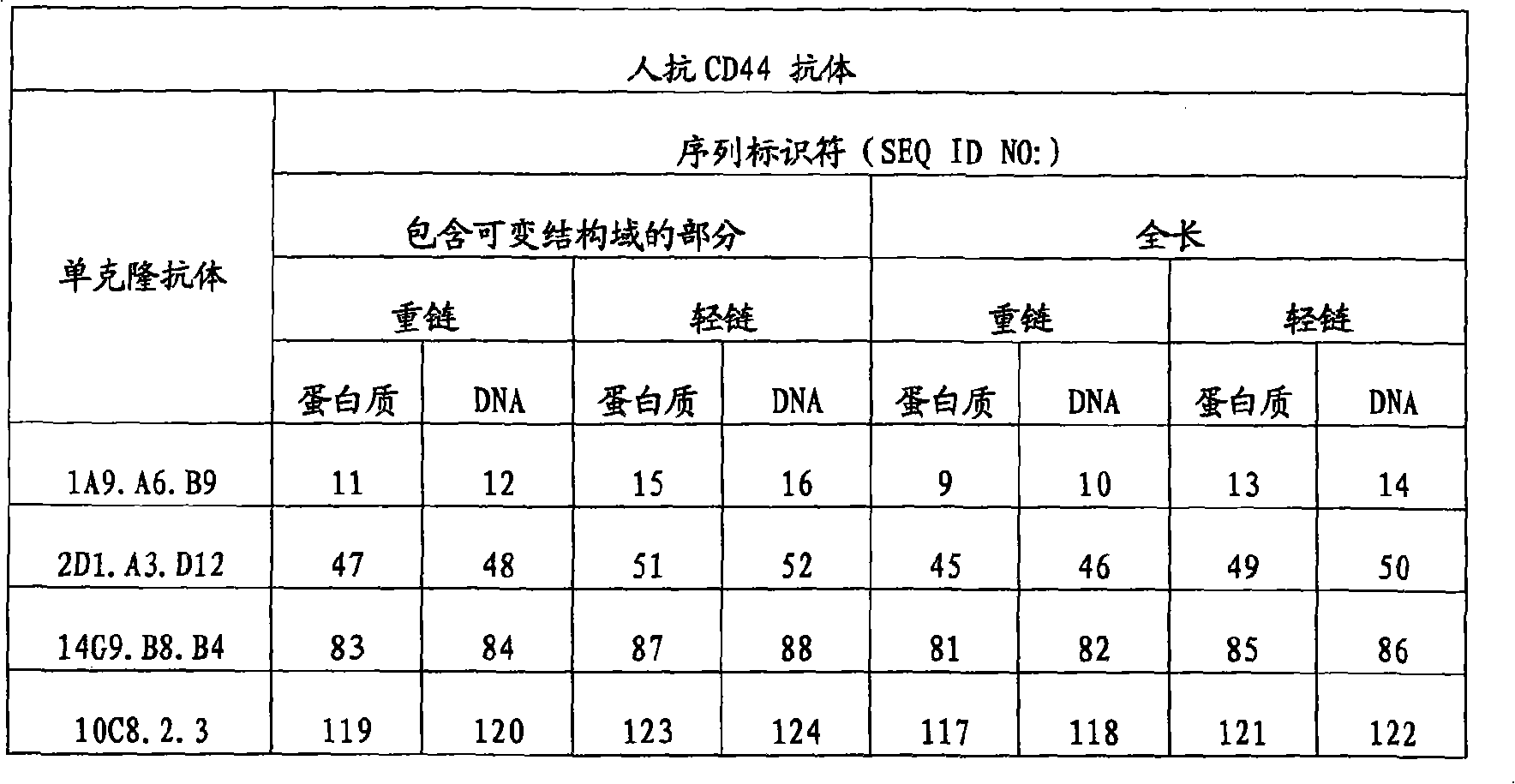
在一些实施方案中,本发明提供了单克隆抗体1A9.A6.B9、2D1.A3.D12、14G9.B8.B4或10C8.2.3的重链和轻链变体。如在本发明的实施例3中更详细论述的,产生许多重链和轻链变异突变以匹配种系CDR区域中的那些。例如在本发明的一个实施方案中,g-1A9.A6.B9、g-2D1.A3.D12、g-14G9.B8.B4和g-10C8.2.3分别是1A9.A6.B9、2D1.A3.D12、14G9.B8.B4和10C8.2.3的种系化形式。通过比较种系化抗体对非种系化抗体的序列,被突变以达到种系化形式的特定氨基酸对于本领域技术人员来说是显而易见的。例如,本发明提供了抗体2D1.A3.D12的重链中的一个氨基酸置换,其中残基28上的苏氨酸被改变成异亮氨酸。第二点突变存在于抗体2D1.A3.D12的轻链中,并且用组氨酸置换残基38上的谷氨酰胺。In some embodiments, the invention provides heavy and light chain variants of monoclonal antibody 1A9.A6.B9, 2D1.A3.D12, 14G9.B8.B4, or 10C8.2.3. As discussed in more detail in Example 3 of the present invention, a number of heavy and light chain variant mutations were generated to match those in the germline CDR regions. For example in one embodiment of the invention g-1A9.A6.B9, g-2D1.A3.D12, g-14G9.B8.B4 and g-10C8.2.3 are 1A9.A6.B9, 2D1.A3 respectively . Germlined forms of D12, 14G9.B8.B4 and 10C8.2.3. The particular amino acids that are mutated to achieve the germlined form will be apparent to those of skill in the art by comparing the sequences of germlined versus non-germlined antibodies. For example, the invention provides an amino acid substitution in the heavy chain of antibody 2D1.A3.D12, wherein threonine at residue 28 is changed to isoleucine. A second point mutation is present in the light chain of antibody 2D1.A3.D12 and replaces the glutamine at residue 38 with histidine.
如将认识到的,基因利用分析只提供了抗体结构的有限概况。当人B细胞随机产生V-D-J重链或V-Jκ轻链转录物时,存在许多发生的次发过程,包括但不限于体细胞超突变、n-添加和CDR3延伸。参见,例如,Mendez等人,(1997)Nature Genetics 15:146-156和美国专利申请2003-0070185。因此,为了进一步检查本发明的抗体结构,从获自克隆的cDNA产生预测的抗体的氨基酸序列。此外,通过蛋白质测序获得N端氨基酸序列。下面的表2举例说明了4个抗CD44杂交瘤来源的抗体的种系基因区段利用和同种型。As will be appreciated, gene utilization analysis provides only a limited overview of antibody structure. When human B cells randomly produce V-D-J heavy chain or V-J kappa light chain transcripts, there are many secondary processes that occur, including but not limited to somatic hypermutation, n-addition, and CDR3 elongation. See, eg, Mendez et al., (1997) Nature Genetics 15: 146-156 and US Patent Application 2003-0070185. Therefore, in order to further examine the structure of the antibody of the present invention, the predicted amino acid sequence of the antibody was generated from the cDNA obtained from the clone. In addition, the N-terminal amino acid sequence was obtained by protein sequencing. Table 2 below illustrates the germline gene segment utilization and isotype of the four anti-CD44 hybridoma-derived antibodies.
表2Table 2
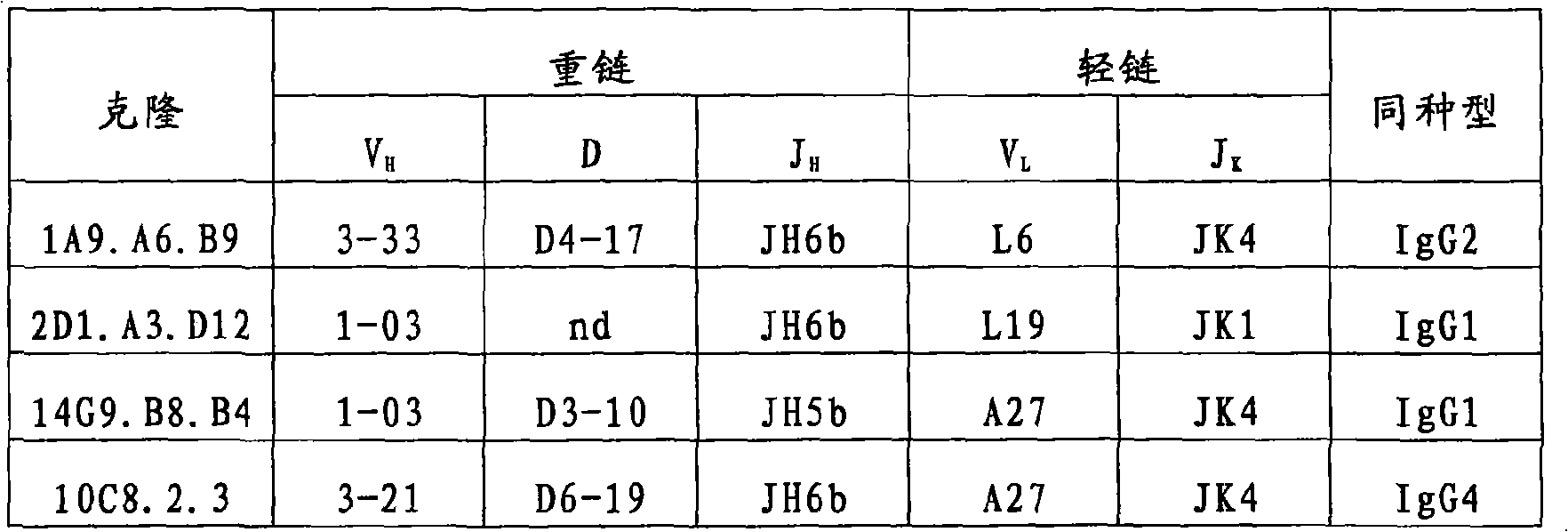
nd=未确定的nd = undetermined
在可选实施方案中,本发明涉及特异性结合人CD44并且具有VH和VL基因利用(选自1)VHD4-17和VLL6;2)VHD3-10和VLA27;和3)VHD6-19和VLA27)的抗体或其抗原结合部分。In alternative embodiments, the invention relates to specific binding to human CD44 and having VH and VL gene utilization (selected from 1) VH D4-17 and VL L6 ; 2) VH D3-10 and VL A27 and 3) antibodies to VH D6-19 and VL A27) or antigen-binding portions thereof.
另一个实施方案提供了任何上述的抗体或抗原结合部分,其为Fab片段、F(ab′)2片段、Fv片段、单链Fv片段、单链VH片段、单链VL片段、人源化抗体、嵌合抗体或双特异性抗体。Another embodiment provides any of the above antibodies or antigen binding portions which are Fab fragments, F(ab') 2 fragments, Fv fragments, single chain Fv fragments, single chain VH fragments, single chain VL fragments, human Antibodies, chimeric antibodies or bispecific antibodies.
在另外的实施方案中,提供了衍生化抗体或抗原结合部分,其包含本文中所述的任何抗体或其部分以及至少一个另外的分子实体。例如,至少一个另外的分子实体可以是另一个抗体(例如,双特异性抗体或双抗体)、检测剂、标记、细胞毒性剂、药物试剂和/或可介导抗体或抗原结合部分与另一个分子(例如链霉抗生物素蛋白核心区域或多组氨酸标签)的结合的蛋白质或肽和/或与抗体或抗原结合部分连接或融合(融合蛋白)的载体蛋白(例如血液蛋白白蛋白或转铁蛋白)。例如,可用于衍生本发明的抗体或抗原结合部分的有用的检测剂包括荧光化合物;尤其是,荧光素、异硫氰酸荧光素、罗丹明、5-二甲胺-1-萘磺酰氯、藻红蛋白、lanthanide phosphors。抗体还可用用于检测的酶例如辣根过氧化物酶、β-半乳糖苷酶、萤光素酶、碱性磷酸酶、葡萄糖氧化酶来标记。在另外的实施方案中,本发明的抗体或其抗原结合部分还可用生物素或用由第二报告子识别的预先确定的多肽表位(例如,亮氨酸拉链对序列、二抗的结合部位、金属结合结构域、表位标签)来标记。在本发明的另外的实施方案中,任何抗体或其抗原结合部分还可用化学基团例如聚乙二醇(PEG)、甲基或乙基或糖基衍生。In additional embodiments, there is provided a derivatized antibody or antigen binding portion comprising any antibody or portion thereof described herein and at least one additional molecular entity. For example, at least one additional molecular entity can be another antibody (e.g., a bispecific antibody or diabody), a detection agent, a label, a cytotoxic agent, a pharmaceutical agent, and/or can mediate the interaction of an antibody or antigen-binding portion with another Conjugated proteins or peptides of molecules (e.g. streptavidin core region or polyhistidine tag) and/or carrier proteins (e.g. blood protein albumin or Transferrin). For example, useful detection agents that can be used to derivatize an antibody or antigen-binding portion of the invention include fluorescent compounds; in particular, fluorescein, fluorescein isothiocyanate, rhodamine, 5-dimethylamine-1-naphthalenesulfonyl chloride, Phycoerythrin, lanthanide phosphors. Antibodies can also be labeled with enzymes for detection such as horseradish peroxidase, β-galactosidase, luciferase, alkaline phosphatase, glucose oxidase. In additional embodiments, the antibodies or antigen-binding portions thereof of the invention can also be used with biotin or with a predetermined polypeptide epitope recognized by a second reporter (e.g., leucine zipper pair sequence, binding site of a secondary antibody). , metal binding domain, epitope tag) to label. In additional embodiments of the invention, any antibody or antigen-binding portion thereof may also be derivatized with chemical groups such as polyethylene glycol (PEG), methyl or ethyl groups, or sugar groups.
在一些实施方案中,将本文中公开的CD44抗体或抗原结合部分连接至固体支持物或颗粒。此类颗粒可用于体内或体外诊断应用。In some embodiments, a CD44 antibody or antigen binding portion disclosed herein is attached to a solid support or particle. Such particles can be used in in vivo or in vitro diagnostic applications.
抗CD44抗体的种类和亚类Types and subclasses of anti-CD44 antibodies
CD44抗体的种类(例如,IgG、IgM、IgE、IgA或IgD)和亚类(例如IgG1、IgG2、IgG3或IgG4)可通过本领域内已知的任何方法来确定。通常,抗体的种类和亚类可使用对于抗体的特定种类和亚类是特异性的抗体来确定。此类抗体可商购获得。种类和亚类可通过ELISA或Western印迹法以及其他技术来确定。可选地,可如下所述确定种类和亚类,即测定抗体的重链和/或轻链的恒定结构域的全部或部分序列,将它们的氨基酸序列与已知的免疫球蛋白的不同种类和亚类的氨基酸序列相比较,然后确定抗体的种类和亚类。本发明的CD44抗体可以是IgG、IgM、IgE、IgA或IgD分子。例如,CD44抗体可以是为IgG1、IgG2、IgG3或IgG4亚类的IgG。The class (eg, IgG, IgM, IgE, IgA, or IgD) and subclass (eg, IgGl, IgG2, IgG3, or IgG4) of the CD44 antibody can be determined by any method known in the art. In general, the class and subclass of an antibody can be determined using antibodies specific for the particular class and subclass of antibody. Such antibodies are commercially available. Species and subclasses can be determined by ELISA or Western blot, among other techniques. Alternatively, classes and subclasses can be determined by determining the sequence of all or part of the constant domains of the heavy and/or light chains of an antibody and comparing their amino acid sequences to those of known different classes of immunoglobulins. Compared with the amino acid sequence of the subclass, the class and subclass of the antibody are then determined. CD44 antibodies of the invention may be IgG, IgM, IgE, IgA or IgD molecules. For example, the CD44 antibody can be IgG of the IgGl, IgG2, IgG3 or IgG4 subclass.
本发明的一个方面提供了用于将CD44抗体的种类或亚类转换成另一种类或亚类的方法。在一些实施方案中,使用本领域内熟知的方法分离不包含编码CL或CH的序列的编码VL或VH的核酸分子。然后将核酸分子与编码来自期望的免疫球蛋白种类或亚类的CL或CH的核酸序列有效连接。这可使用包含CL或CH链的载体或核酸分子来获得,如上所述的。例如,可将原先为IgM的CD44抗体类转换成IgG。此外,类转换可用于将一个IgG亚类转换成另一个亚类,例如从IgG1转换成IgG2。用于产生本发明的抗体(其包含期望的同种型)的另一个方法包括步骤:分离编码CD44抗体的重链的核酸和编码CD44抗体的轻链的核酸,分离编码VH区域的序列,将VH序列连接至编码期望的同种型的重链恒定结构域的序列,在细胞中表达轻链基因和重链构建体,然后收集具有期望的同种型的CD44抗体。One aspect of the invention provides methods for switching a class or subclass of a CD44 antibody to another class or subclass. In some embodiments, nucleic acid molecules encoding VL or VH that do not comprise sequences encoding CL or CH are isolated using methods well known in the art. The nucleic acid molecule is then operably linked to a nucleic acid sequence encoding a CL or CH from the desired immunoglobulin class or subclass. This can be achieved using vectors or nucleic acid molecules comprising CL or CH chains, as described above. For example, a CD44 antibody class that was originally IgM can be switched to IgG. In addition, class switching can be used to switch one IgG subclass to another, for example from IgG1 to IgG2. Another method for producing an antibody of the invention comprising the desired isotype comprises the steps of: isolating nucleic acid encoding the heavy chain of the CD44 antibody and nucleic acid encoding the light chain of the CD44 antibody, isolating the sequence encoding the VH region, The VH sequence is linked to the sequence encoding the heavy chain constant domain of the desired isotype, the light chain gene and heavy chain construct are expressed in cells, and CD44 antibodies of the desired isotype are collected.
物种和分子选择性Species and molecular selectivity
在本发明的另一个方面,抗CD44抗体显示物种和分子选择性。在一些实施方案中,抗CD44抗体结合人和灵长类动物CD44。优选抗CD44抗体结合人和食蟹猴CD44。按照本说明书的教导,可使用本领域内熟知的方法确定抗CD44抗体的物种选择性。例如,可使用Western印迹法、流式细胞术、ELISA和免疫沉淀或RIA确定物种选择性。(参见,例如,实施例5)。In another aspect of the invention, anti-CD44 antibodies exhibit species and molecule selectivity. In some embodiments, the anti-CD44 antibodies bind human and primate CD44. Preferably the anti-CD44 antibodies bind human and cynomolgus CD44. According to the teaching of this specification, the species selectivity of anti-CD44 antibody can be determined using methods well known in the art. For example, species selectivity can be determined using Western blotting, flow cytometry, ELISA and immunoprecipitation or RIA. (See, eg, Example 5).
在另一个实施方案中,抗CD44抗体对于CD44具有超过淋巴管内皮透明质烷受体1蛋白(LYVE-1)至少100倍的选择性。(参见实施例11)。可使用本领域内熟知的方法,按照本说明书的教导确定抗CD44抗体对于CD44的选择性。例如,可使用Western印迹法、流式细胞术、ELISA、免疫沉淀或RIA确定选择性。In another embodiment, the anti-CD44 antibody is at least 100-fold selective for CD44 over lymphatic endothelial
抗CD44抗体对CD44的结合亲和力Binding affinity of anti-CD44 antibodies to CD44
在实施方案中,抗CD44抗体以高亲和力结合哺乳动物CD44优选人CD44。In an embodiment, the anti-CD44 antibody binds mammalian CD44, preferably human CD44, with high affinity.
在实施方案中,抗CD44抗体在HA结合结构域内结合。In an embodiment, the anti-CD44 antibody binds within the HA binding domain.
在另一个实施方案中,抗CD44抗体以高亲和力结合由SEQ IDNO:3(细胞外结构域IgG融合蛋白)或SEQ ID NO:154(猴细胞外IgG融合蛋白)中所示的氨基酸序列组成的多肽,并且优选以高亲和力结合由HA结合结构域的氨基酸序列组成的多肽。In another embodiment, the anti-CD44 antibody binds with high affinity to a protein consisting of the amino acid sequence shown in SEQ ID NO: 3 (extracellular domain IgG fusion protein) or SEQ ID NO: 154 (monkey extracellular IgG fusion protein). Polypeptides, and preferably bind with high affinity to polypeptides consisting of the amino acid sequence of the HA binding domain.
在另一个实施方案中,抗CD44抗体以500nM或更低的KD结合CD44,或更优选结合HA结合结构域。在其他实施方案中,抗体以2×10⁻⁸M,2×10-9M或5×10⁻¹⁰M或更低的KD结合CD44或更优选结合CD44的HA结合结构域。在更优选实施方案中,抗体以2.5×10⁻¹²M或更低的KD在HA结合结构域中结合CD44。在一些实施方案中,抗体以与抗体1A9.A6.B9、2D1.A 3.D12、14G9.B8.B4或10C8.2.3大体上相同的KD结合CD44。In another embodiment, the anti-CD44 antibody binds CD44, or more preferably binds the HA binding domain, with a KD of 500 nM or less. In other embodiments, the antibody binds CD44 or, more preferably, the HA binding domain of CD44 with a KD of 2×10 −8 M, 2×10 −9 M, or 5×10 −10 M or lower. In a more preferred embodiment, the antibody binds CD44 in the HA binding domain with a KD of 2.5 x 10 -12 M or less. In some embodiments, the antibody binds CD44 with substantially the same KD as antibody 1A9.A6.B9, 2D1.A3.D12, 14G9.B8.B4, or 10C8.2.3.
在一些实施方案中,抗CD44抗体具有低解离速率常数(Koff)。在一些实施方案中,抗CD44抗体以1.0×10⁻³s-1或更低的Koff或5.0×10⁻⁴s-1或更低的Koff结合CD44,或更优选结合CD44的HA结合结构域。在其他实施方案中,Koff与本文中描述的抗体包括选自1A9.A6.B9、2D1.A3.D12、14G9.B8.B4和10C8.2.3的抗体大体上相同。在一些实施方案中,抗体以与包含来自选自1A9.A6.B9、2D1.A3.D12、14G9.B8.B4和10C8.2.3的抗体的重链的CDR区或轻链的CDR区的抗体大体上相同的Koff结合CD44。在一些实施方案中,抗体以与抗体(其包含具有在SEQ ID NO:9、45、81或117中发现的VH区的氨基酸序列的重链可变结构域或具有在SEQ ID NO:13、49、85或121中发现的VL区的氨基酸序列的轻链可变结构域)大体上相同的Koff结合CD44或更优选结合CD44的HA结合结构域。在另一个实施方案中,抗体以与抗体(其包含具有在SEQ ID NO:15、49、85或121中发现的VL区的氨基酸序列的轻链可变结构域的CDR区或具有在SEQ ID NO:9、45、81或117中发现的VH区的氨基酸序列的重链可变结构域的CDR区)大体上相同的Koff结合CD44或更优选结合CD44的HA结合结构域。In some embodiments, the anti-CD44 antibody has a low dissociation rate constant (K off ). In some embodiments, the anti-CD44 antibody binds CD44 with a Koff of 1.0×10 −3 s −1 or less or 5.0×10 −4 s −1 or less, or more preferably binds HA to CD44 domain. In other embodiments, the Koff is substantially the same as an antibody described herein, including an antibody selected from 1A9.A6.B9, 2D1.A3.D12, 14G9.B8.B4, and 10C8.2.3. In some embodiments, the antibody is derived from an antibody comprising a CDR region of a heavy chain or a CDR region of a light chain from an antibody selected from 1A9.A6.B9, 2D1.A3.D12, 14G9.B8.B4, and 10C8.2.3. Substantially the same Koff binds CD44. In some embodiments, the antibody is derived from an antibody comprising a heavy chain variable domain having the amino acid sequence of the VH region found in SEQ ID NO: 9, 45, 81 or 117 or having the amino acid sequence of the VH region found in SEQ ID NO: 13 The light chain variable domain of the amino acid sequence of the VL region found in , 49, 85 or 121) substantially identical Koff binds CD44 or more preferably binds the HA binding domain of CD44. In another embodiment, the antibody is combined with the CDR region of the light chain variable domain of an antibody comprising the amino acid sequence of the VL region found in SEQ ID NO: 15, 49, 85 or 121 or having the The amino acid sequence of the VH region found in ID NO: 9, 45, 81 or 117 (the CDR region of the heavy chain variable domain) has substantially the same K off for binding to CD44 or more preferably to the HA binding domain of CD44.
抗CD44抗体对CD44的结合亲和力和解离速率可通过本领域内已知的方法测定。结合亲和力可通过ELISA、RIA、流式细胞术(FACS)、表面等离子共振术例如BIACORETM来测量。离解速率可通过表面等离子共振术来测量。优选,结合亲和力和解离速率通过表面等离子共振术来测量。更优选使用BIACORETM来测量结合亲和力和解离速率。可使用本领域内已知的方法确定抗体是否具有与抗CD44抗体大体上相同的KD。实施例5提供了用于测定抗CD44单克隆抗体的亲和常数的方法。The binding affinity and off-rate of anti-CD44 antibodies to CD44 can be determined by methods known in the art. Binding affinity can be measured by ELISA, RIA, flow cytometry (FACS), surface plasmon resonance, eg BIACORE ™ . Dissociation rates can be measured by surface plasmon resonance. Preferably, binding affinity and off-rate are measured by surface plasmon resonance. More preferably, BIACORE ™ is used to measure binding affinity and dissociation rate. Whether an antibody has substantially the same KD as an anti-CD44 antibody can be determined using methods known in the art. Example 5 provides a method for determining the affinity constant of an anti-CD44 monoclonal antibody.
抗CD44抗体识别的CD44表位的鉴定Identification of CD44 epitopes recognized by anti-CD44 antibodies
本发明提供了人抗CD44单克隆抗体,其结合CD44并且与下列抗体竞争或交叉竞争和/或结合相同的表位:(a)选自1A9.A6.B9、2D1.A3.D12、14G9.B8.B4和10C8.2.3的抗体;(b)包含具有在SEQ IDNO:9、45、81和117中发现的可变结构域的氨基酸序列的重链可变结构域的抗体;(c)包含具有在SEQ ID NO:13、49、85和121中发现的可变结构域的氨基酸序列的轻链可变结构域的抗体;或(d)包含(b)中定义的重链可变结构域和(c)中定义的轻链可变结构域的抗体。如果两个抗体彼此相互竞争对CD44的结合,那么它们被认为交叉竞争。The present invention provides a human anti-CD44 monoclonal antibody that binds to CD44 and competes or cross competes and/or binds to the same epitope with the following antibodies: (a) selected from 1A9.A6.B9, 2D1.A3.D12, 14G9. Antibodies of B8.B4 and 10C8.2.3; (b) antibodies comprising a heavy chain variable domain having the amino acid sequences of the variable domains found in SEQ ID NO: 9, 45, 81 and 117; (c) comprising An antibody having a light chain variable domain of the amino acid sequence of the variable domain found in SEQ ID NO: 13, 49, 85 and 121; or (d) comprising a heavy chain variable domain as defined in (b) and an antibody of the light chain variable domain as defined in (c). Two antibodies were considered to cross-compete if they competed with each other for binding to CD44.
可使用本领域内已知的方法确定抗体是否与抗CD44抗体结合相同的表位或与其交叉竞争结合。在一个实施方案中,使本发明的抗CD44抗体在饱和条件下结合CD44,然后测量受试抗体结合CD44的能力。如果受试抗体能够与抗CD44抗体同时结合CD44,那么受试抗体与抗CD44抗体结合不同的表位。然而,如果受试抗体不能同时结合CD44,那么受试抗体结合相同的表位、交叠的表位或与由人抗CD44抗体结合的表位紧密相邻的表位。可使用ELISA、RIA、BIACORETM或流式细胞术(FACS)进行该实验。Whether an antibody binds to the same epitope as an anti-CD44 antibody or cross-competes for binding with an anti-CD44 antibody can be determined using methods known in the art. In one embodiment, an anti-CD44 antibody of the invention is allowed to bind CD44 under saturating conditions, and the ability of the test antibody to bind CD44 is then measured. A test antibody binds to a different epitope than the anti-CD44 antibody if the test antibody is capable of binding CD44 at the same time as the anti-CD44 antibody. However, if the test antibody is unable to simultaneously bind CD44, then the test antibody binds the same epitope, an overlapping epitope, or an epitope immediately adjacent to an epitope bound by the human anti-CD44 antibody. The experiment can be performed using ELISA, RIA, BIACORE ™ or flow cytometry (FACS).
为了检测抗CD44抗体是否与另一个抗CD44抗体交叉竞争,可以以两个方向(即确定参照抗体是否阻断受试抗体和反之亦然)使用上述竞争法。在一个实施方案中,使用ELISA进行实验。测定KD的方法在下面进一步描述。To test whether an anti-CD44 antibody cross competes with another anti-CD44 antibody, the competition method described above can be used in two directions (ie, to determine whether a reference antibody blocks a test antibody and vice versa). In one embodiment, the experiments are performed using ELISA. Methods for determining KD are described further below.
通过抗CD44抗体进行的CD44活性的抑制Inhibition of CD44 Activity by Anti-CD44 Antibodies
在另一个实施方案中,本发明提供了抑制CD44介导的信号转导的抗CD44抗体。在其他实施方案中,本发明提供了抑制通过CD44进行的淋巴细胞和单核细胞的共刺激信号转导的抗CD44抗体。在另一个实施方案中,本发明提供了阻断细胞因子产生特别地细胞因子例如TNF-α、IL-6和IL-1β产生的抗CD44抗体。在另外的实施方案中,本发明提供了抑制HA与CD44受体的结合的抗CD44抗体。在一个实施方案中,CD44受体是人受体。在另一个实施方案中,抗CD44抗体是人抗体。可通过ELISA、RIA或其他测定法和基于细胞的测定法例如FACS测定法或表达CD44的细胞在配体结合测定中测量IC50。在一个实施方案中,抗体或其抗原结合部分以不高于5μg/ml,优选不高于1μg/ml,更优选不高于0.5μg/ml,更优选不高于0.20μg/ml的IC50(如通过ELISA测定法测量的)抑制HA与CD44之间的配体结合。实施例4提供了用于测定通过单克隆抗体产生的CD44对HA结合的抑制的方法。In another embodiment, the invention provides anti-CD44 antibodies that inhibit CD44-mediated signal transduction. In other embodiments, the invention provides anti-CD44 antibodies that inhibit co-stimulatory signaling of lymphocytes and monocytes through CD44. In another embodiment, the invention provides anti-CD44 antibodies that block cytokine production, particularly cytokine production such as TNF-α, IL-6 and IL-1β. In additional embodiments, the invention provides anti-CD44 antibodies that inhibit the binding of HA to the CD44 receptor. In one embodiment, the CD44 receptor is a human receptor. In another embodiment, the anti-CD44 antibody is a human antibody. IC50 can be measured by ELISA, RIA or other assays and cell-based assays such as FACS assays or CD44 expressing cells in ligand binding assays. In one embodiment, the antibody or antigen-binding portion thereof has an IC50 of not higher than 5 μg/ml, preferably not higher than 1 μg/ml, more preferably not higher than 0.5 μg/ml, more preferably not higher than 0.20 μg/ml Inhibition of ligand binding between HA and CD44 (as measured by ELISA assay). Example 4 provides methods for determining the inhibition of HA binding by CD44 produced by monoclonal antibodies.
在另一个实施方案中,本发明提供了阻止CD44与HA结合的抗CD44抗体。在一个实施方案中,抗CD44抗体抑制HA诱导的:(i)白细胞募集;(ii)细胞-基质相互作用和细胞例如白细胞和内皮细胞之间的直接相互作用;(iii)白细胞功能的调控;(iv)HA的代谢;和/或(v)CD44对基质的装配、组织和重新塑造的作用。可通过测定由脂多糖(LPS)和HA触发的炎性细胞因子从白细胞释放来确定抗CD44抗体是否可在HA存在的情况下阻止、抑制或减少CD44的激活。实施例4、5、6和7中描述了用于检测CD44激活和/或HA与CD44的结合的测定法。在一个实施方案中,使用细胞因子测定法测定CD44激活的水平。在一些实施方案中,使用HA竞争结合测定法测量的IC50不大于5μg/ml,优选不大于1μg/ml,更优选不大于0.5μg/ml,更优选不大于0.20μg/ml。In another embodiment, the invention provides anti-CD44 antibodies that prevent the binding of CD44 to HA. In one embodiment, the anti-CD44 antibody inhibits HA-induced: (i) recruitment of leukocytes; (ii) cell-matrix interactions and direct interactions between cells such as leukocytes and endothelial cells; (iii) regulation of leukocyte function; (iv) metabolism of HA; and/or (v) CD44 effect on matrix assembly, organization and remodeling. Whether anti-CD44 antibodies can prevent, inhibit or reduce CD44 activation in the presence of HA can be determined by measuring the release of inflammatory cytokines from leukocytes triggered by lipopolysaccharide (LPS) and HA. Assays for detecting CD44 activation and/or binding of HA to CD44 are described in Examples 4, 5, 6 and 7. In one embodiment, the level of CD44 activation is determined using a cytokine assay. In some embodiments, the IC50 measured using the HA competition binding assay is no greater than 5 μg/ml, preferably no greater than 1 μg/ml, more preferably no greater than 0.5 μg/ml, more preferably no greater than 0.20 μg/ml.
通过抗CD44抗体产生的表面细胞表达的减少Reduction of surface cell expression by anti-CD44 antibodies
在本发明的另一个方面,在与抗体一起温育后,抗体引起了细胞表面CD44表达的下调。在实施方案中,温育可以进行短时间(例如,4小时)或更长的时间(例如,24小时)。特别地,本发明提供了诱导CD44在循环淋巴细胞,优选CD3+T淋巴细胞上的表达下调的抗CD44抗体。细胞表面CD44表达的下调可使用FACS来测量。在本发明的特定的实施方案中,抗体可以优选引起6%的细胞表面CD44表达的减少,优选10%的减少,或更优选20%的下调,或更优选至少50%的细胞表面CD44表达的减少,如通过FACS测量的。实施例8例举了测量在两个物种:人和食蟹猴中的白细胞和T细胞上的细胞表面CD44表达的下调的一种类型的FACS测定法。In another aspect of the invention, the antibody causes downregulation of CD44 expression on the cell surface following incubation with the antibody. In embodiments, the incubation can be for a short period of time (eg, 4 hours) or for a longer period of time (eg, 24 hours). In particular, the present invention provides anti-CD44 antibodies that induce down-regulation of the expression of CD44 on circulating lymphocytes, preferably CD3+ T lymphocytes. Downregulation of cell surface CD44 expression can be measured using FACS. In particular embodiments of the invention, the antibody may preferably cause a 6% reduction in cell surface CD44 expression, preferably a 10% reduction, or more preferably a 20% downregulation, or more preferably at least a 50% reduction in cell surface CD44 expression. Reduction, as measured by FACS. Example 8 exemplifies one type of FACS assay to measure the downregulation of cell surface CD44 expression on leukocytes and T cells in two species: human and cynomolgus monkey.
产生抗体的方法Methods of producing antibodies
本发明的单克隆抗体可通过多种技术,包括常规单克隆抗体法例如Kohler和Milstein(1975)Nature 256:495的标准体细胞杂交技术产生。虽然原则上体细胞杂交法是优选的,但可使用产生单克隆抗体的其他技术,例如,B淋巴细胞的病毒或致癌性转化。Monoclonal antibodies of the invention can be produced by a variety of techniques, including conventional monoclonal antibody methods such as the standard somatic cell hybridization technique of Kohler and Milstein (1975) Nature 256:495. Although somatic cell hybridization is preferred in principle, other techniques for generating monoclonal antibodies may be used, eg viral or oncogenic transformation of B lymphocytes.
用于制备杂交瘤的优选动物系统是鼠类系统。在小鼠中进行杂交瘤的产生是发展十分成熟的方法。免疫方案和用于分离用于融合的经免疫的脾细胞的技术在本领域内是已知的。融合伴侣(例如,鼠骨髓瘤细胞)和融合方法也是已知的。A preferred animal system for preparing hybridomas is the murine system. Hybridoma production in mice is a well-established method. Immunization protocols and techniques for isolating immunized splenocytes for fusion are known in the art. Fusion partners (eg, murine myeloma cells) and fusion methods are also known.
本发明的嵌合和人源化抗体可基于如上所述制备的鼠单克隆抗体的序列来制备。编码重链和轻链免疫球蛋白的DNA可从目的鼠杂交瘤获得并且可使用标准分子生物学技术对其进行基因工程改造以包含非鼠类(例如,人)免疫球蛋白序列。例如,为了产生嵌合抗体,可使用本领域内已知的方法(美国专利4,816,567)将鼠可变区连接至人恒定区。为了产生人源化抗体,可使用本领域内已知的方法(美国专利5,225,539、5,530,101、5,585,089、5,693,762和6,180,370)将鼠CDR区插入人构架区。Chimeric and humanized antibodies of the invention can be prepared based on the sequences of murine monoclonal antibodies prepared as described above. DNA encoding the heavy and light chain immunoglobulins can be obtained from the murine hybridoma of interest and can be genetically engineered to contain non-murine (eg, human) immunoglobulin sequences using standard molecular biology techniques. For example, to generate chimeric antibodies, murine variable regions can be linked to human constant regions using methods known in the art (US Pat. No. 4,816,567). To generate humanized antibodies, the murine CDR regions can be inserted into human framework regions using methods known in the art (US Pat.
在优选实施方案中,本发明的抗体是人单克隆抗体。这样的抗CD44的人单克隆抗体可使用携带部分人免疫系统而非小鼠系统的转基因或转染色体(transchromosomic)小鼠来产生。此类转基因和转染色体小鼠分别包括本文中称为HuMAb
HuMAb

在另一个实施方案中,本发明的人抗体可使用在转基因和转染色体上携带人免疫球蛋白序列的小鼠,例如携带人重链转基因和人轻链转染色体的小鼠来产生。这样的小鼠(本文中称为KM miceTM)详细地描述于PCT公开号WO 02/43478。In another embodiment, human antibodies of the invention can be produced using mice that carry human immunoglobulin sequences on transgenes and transchromosomes, eg, mice that carry a human heavy chain transgene and a human light chain transchromosome. Such mice (referred to herein as KM mice ™ ) are described in detail in PCT Publication No. WO 02/43478.
此外,表达人免疫球蛋白基因的可选转基因动物系统在本领域内是可获得的并且可用于产生本发明的抗CD44抗体。例如,可使用称为XenomouseTM(Abgenix,Inc.)的可选转基因系统;这样的小鼠描述于例如美国专利:5,939,598、6,075,181、6,114,598、6,150,584和6,162,963中。Furthermore, alternative transgenic animal systems expressing human immunoglobulin genes are available in the art and can be used to raise anti-CD44 antibodies of the invention. For example, an alternative transgenic system known as Xenomouse ™ (Abgenix, Inc.) may be used; such mice are described, for example, in US Pat.
此外,表达人免疫球蛋白基因的可选的转染色体动物系统在本领域内是可获得的并且可用于产生本发明的抗CD44抗体。例如,可使用携带人重链转染色体和人轻链转杂色体的小鼠(称为“TC小鼠“);这样的小鼠描述于Tomizuka等人(2000)Proc.Natl.Acad.Sci.USA 97:722-727。此外,携带人重链和轻链转染色体的牛已在本领域中进行了描述(Kuroiwa等人(2002)Nature Biotechnology20:889-894)并且可用于产生本发明的抗CD44抗体。Furthermore, alternative transchromosomal animal systems expressing human immunoglobulin genes are available in the art and can be used to raise anti-CD44 antibodies of the invention. For example, mice carrying a human heavy chain transchromosome and a human light chain transchromosome (referred to as "TC mice") can be used; such mice are described in Tomizuka et al. (2000) Proc.Natl.Acad.Sci .USA 97:722-727. In addition, cattle carrying human heavy and light chain transchromosomes have been described in the art (Kuroiwa et al. (2002) Nature Biotechnology 20:889-894) and can be used to raise anti-CD44 antibodies of the invention.
本发明的人单克隆抗体还可使用SCID小鼠来制备,在所述SCID小鼠体内已重建了人免疫细胞,这样当免疫时其可产生人抗体反应。这样的小鼠描述于例如美国专利:5,476,996和5,698,767。Human monoclonal antibodies of the invention can also be prepared using SCID mice into which human immune cells have been reconstituted so that they generate a human antibody response when immunized. Such mice are described, for example, in US Patents: 5,476,996 and 5,698,767.
人Ig小鼠的免疫Immunization of human Ig mice
抗体和产生抗体的细胞系的产生Production of antibodies and antibody-producing cell lines
在用CD44抗原免疫动物后,可从动物获得抗体和/或产生抗体的细胞。在一些实施方案中,通过取血和杀死动物来从动物获得包含抗CD44抗体的血清。血清可以以其从动物获得的形式使用,可从血清获得免疫球蛋白级分,或可从血清纯化抗CD44抗体。Following immunization of an animal with the CD44 antigen, antibodies and/or antibody-producing cells can be obtained from the animal. In some embodiments, serum comprising anti-CD44 antibodies is obtained from an animal by bleeding and killing the animal. The serum can be used in the form it is obtained from the animal, the immunoglobulin fraction can be obtained from the serum, or the anti-CD44 antibody can be purified from the serum.
在一些实施方案中,从细胞(从免疫的动物分离的)制备产生抗体的永生化细胞系。在免疫后,杀死动物,然后通过本领域内已知的任何方法永生化淋巴结和/或脾B细胞。永生化细胞的方法包括但不限于用癌基因转染它们、用致癌病毒感染它们和在选择永生化细胞的条件下培养它们,将它们经历致癌或突变化合物,将它们与永生化细胞例如骨髓瘤细胞融合,和使肿瘤抑制基因失活。参见,例如,Harlow和Lane,同上。如果使用与骨髓瘤细胞的融合,骨髓瘤细胞优选不分泌免疫球蛋白多肽(非分泌型细胞系)。使用CD44、其部分或表达CD44的细胞筛选永生化细胞。在一个优选实施方案中,CD44部分包括:(i)CD44的HA结合部位;(ii)包含SEQ ID NO:1和/或SEQ ID NO:2中所示的全长或截短的氨基酸序列;或(iii)其组合。在一个实施方案中,使用酶联免疫测定法(ELISA)或放射免疫测定法进行初步筛选。在PCT公开号WO 00/37504中提供了ELISA筛选法的实例。In some embodiments, antibody-producing immortalized cell lines are prepared from cells (isolated from immunized animals). Following immunization, animals are sacrificed and lymph node and/or splenic B cells are then immortalized by any method known in the art. Methods of immortalizing cells include, but are not limited to, transfecting them with oncogenes, infecting them with oncogenic viruses and culturing them under conditions that select for immortalized cells, subjecting them to oncogenic or mutagenic compounds, combining them with immortalized cells such as myeloma Cell fusion, and inactivation of tumor suppressor genes. See, eg, Harlow and Lane, supra. If fusion with myeloma cells is used, the myeloma cells preferably do not secrete immunoglobulin polypeptides (non-secreting cell lines). Immortalized cells are selected using CD44, a portion thereof, or cells expressing CD44. In a preferred embodiment, the CD44 portion comprises: (i) the HA binding site of CD44; (ii) comprising the full-length or truncated amino acid sequence shown in SEQ ID NO: 1 and/or SEQ ID NO: 2; or (iii) a combination thereof. In one embodiment, primary screening is performed using an enzyme-linked immunoassay (ELISA) or radioimmunoassay. Examples of ELISA screening methods are provided in PCT Publication No. WO 00/37504.
选择、克隆产生抗CD44抗体的细胞例如杂交瘤,并就期望的特征包括强势生长、高抗体产量和期望的抗体特征进一步筛选所述细胞,如下面进一步论述的。杂交瘤可在同系动物(syngeneic animal)中,在缺少免疫系统的动物例如裸小鼠中体内扩增或在细胞培养物中体外扩增。选择、克隆和扩增杂交瘤的方法对于本领域技术人员来说是熟知的。Anti-CD44 antibody producing cells, such as hybridomas, are selected, cloned, and further screened for desirable characteristics, including robust growth, high antibody production, and desired antibody characteristics, as discussed further below. Hybridomas can be expanded in vivo in syngeneic animals, in animals lacking an immune system such as nude mice, or in cell culture in vitro. Methods for selecting, cloning and expanding hybridomas are well known to those skilled in the art.
在一个实施方案中,经免疫的动物是表达人免疫球蛋白基因的非人动物,并且将脾B细胞融合至来自与所述非人动物相同的物种的骨髓瘤细胞系。在更优选实施方案中,经免疫的动物是Kirin TC MouseTM小鼠,骨髓瘤细胞系是非分泌性小鼠骨髓瘤。在更优选实施方案中,骨髓瘤细胞系是Sp2/0-Ag14(美国典型培养物保藏中心(ATCC)CRL-1581),而小鼠杂交瘤细胞系是1376.3.2d1.A3.D12(ATCCNo.PTA-6928)、1376.3.1A9.A6.B9(ATCC No.PTA-6929)或1376.2.14G9.B8.B4(ATCC No.PTA-6927)。参见,例如,实施例1。In one embodiment, the immunized animal is a non-human animal expressing human immunoglobulin genes, and the splenic B cells are fused to a myeloma cell line from the same species as the non-human animal. In a more preferred embodiment, the immunized animal is a Kirin TC Mouse (TM) mouse and the myeloma cell line is a non-secreting mouse myeloma. In a more preferred embodiment, the myeloma cell line is Sp2/0-Ag14 (American Type Culture Collection (ATCC) CRL-1581), and the mouse hybridoma cell line is 1376.3.2d1.A3.D12 (ATCC No. PTA-6928), 1376.3.1A9.A6.B9 (ATCC No. PTA-6929) or 1376.2.14G9.B8.B4 (ATCC No. PTA-6927). See, eg, Example 1.
因此,在一个实施方案中,本发明提供了用于产生产生抗CD44的人单克隆抗体或其抗原结合部分的细胞系的方法,该方法包括:(a)用CD44、CD44的一部分或表达CD44的细胞或组织免疫本文中描述的非人转基因动物;(b)让转基因动物产生对CD44的免疫反应;(c)从转基因动物分离产生抗体的细胞;(d)永生化产生抗体的细胞;(e)建立永生化的产生抗体的细胞的单独的单克隆群体;和(f)筛选永生化的产生抗体的细胞来鉴定抗CD44的抗体。在一个实施方案中,步骤(f)包括筛选永生化的产生抗体的细胞来鉴定抗CD44的HA结合部位的并且任选地不结合CD44的HA结合部位外部的抗体。Accordingly, in one embodiment, the invention provides a method for producing a cell line that produces a human monoclonal antibody against CD44, or an antigen-binding portion thereof, comprising: (a) using CD44, a portion of CD44, or expressing CD44 (b) allowing the transgenic animal to generate an immune response to CD44; (c) isolating the antibody-producing cell from the transgenic animal; (d) immortalizing the antibody-producing cell; ( e) establishing a single monoclonal population of immortalized antibody-producing cells; and (f) screening the immortalized antibody-producing cells to identify antibodies against CD44. In one embodiment, step (f) comprises screening the immortalized antibody-producing cells to identify antibodies that are directed against the HA binding site of CD44 and that optionally do not bind outside the HA binding site of CD44.
筛选永生化的产生抗体的细胞以鉴定抗CD44的HA结合部位的抗体可通过检测由细胞产生的抗体是否结合包含CD44的HA结合部位的氨基酸序列的肽来进行。Screening of immortalized antibody-producing cells to identify antibodies against the HA-binding site of CD44 can be performed by detecting whether antibodies produced by the cells bind to a peptide comprising the amino acid sequence of the HA-binding site of CD44.
在另一个方面,本发明提供了产生人抗CD44抗体的杂交瘤。在一个实施方案中,由杂交瘤产生的人抗CD44抗体是CD44的拮抗剂。在另一个实施方案中,由杂交瘤产生的人抗CD44抗体(i)结合CD44的HA结合部位;(ii)不结合HA结合部位的外部;(iii)不结合IM7结合部位;或(iv)其组合。Mikecz等人,(1999)ArthritisRheumatism 42:659,668,Zheng(1995)J.Cell Biol.130:485-495,Peach等人,(1993)J.Cell Biol.122:257-264和美国专利6,001,356。在一个实施方案中,杂交瘤是上述小鼠杂交瘤。在其他实施方案中,在其他动物中产生杂交瘤。In another aspect, the invention provides hybridomas that produce human anti-CD44 antibodies. In one embodiment, the human anti-CD44 antibody produced by the hybridoma is an antagonist of CD44. In another embodiment, the human anti-CD44 antibody produced by the hybridoma (i) binds the HA binding site of CD44; (ii) does not bind the exterior of the HA binding site; (iii) does not bind the IM7 binding site; or (iv) its combination. Mikecz et al., (1999) Arthritis Rheumatism 42:659,668, Zheng (1995) J. Cell Biol. 130:485-495, Peach et al., (1993) J. Cell Biol. 122:257-264 and U.S. Patent 6,001,356 . In one embodiment, the hybridoma is a mouse hybridoma described above. In other embodiments, hybridomas are produced in other animals.
在本发明的一个实施方案中,分离产生抗体的细胞,并且在宿主细胞例如骨髓瘤细胞中进行表达。在另一个实施方案中,用CD44免疫转基因动物,从经免疫的转基因动物分离原代细胞(例如,脾或外周血细胞),并且鉴定产生对于期望的抗原是特异性的抗体的单个细胞。分离来自各单独细胞的多腺苷酸化的mRNA,然后使用退火至可变区序列的有义引物(例如识别人重链和轻链可变区基因的大多数或所有FR1区的简并引物)和退火至恒定区或铰链区序列的反义引物进行逆转录聚合酶链式反应(RT-PCR)。然后克隆重链和轻链可变结构域的cDNA,并且将所述cDNA在任何适当的宿主细胞例如骨髓瘤细胞中表达为具有各自的免疫球蛋白恒定区例如重链和κ或λ恒定结构域的嵌合抗体。参见Babcook,J.S.等人(1996)Proc.Natl.Acad.Sci.USA 93:7843-48。然后可如本文中所描述的,鉴定和分离抗CD44抗体。In one embodiment of the invention, antibody-producing cells are isolated and expressed in host cells, such as myeloma cells. In another embodiment, a transgenic animal is immunized with CD44, primary cells (eg, spleen or peripheral blood cells) are isolated from the immunized transgenic animal, and individual cells that produce antibodies specific for the desired antigen are identified. Polyadenylated mRNA from each individual cell is isolated, followed by the use of sense primers that anneal to variable region sequences (eg, degenerate primers that recognize most or all of the FR1 region of human heavy and light chain variable region genes) Reverse transcription polymerase chain reaction (RT-PCR) was performed with antisense primers annealing to constant region or hinge region sequences. The cDNAs for the heavy and light chain variable domains are then cloned and expressed in any suitable host cell, such as a myeloma cell, with respective immunoglobulin constant regions, such as heavy chains and kappa or lambda constant domains chimeric antibodies. See Babcook, J.S. et al. (1996) Proc. Natl. Acad. Sci. USA 93:7843-48. Anti-CD44 antibodies can then be identified and isolated as described herein.
产生抗体的重组方法Recombinant Methods for Producing Antibodies
本发明的抗体或抗体结合部分可通过免疫球蛋白轻链和重链基因在宿主细胞中的重组表达来制备。例如,为了重组表达抗体,用一个或多个携带编码抗体的免疫球蛋白轻链和重链的DNA片段的重组表达载体转染宿主细胞,以使轻链和重链在宿主细胞中表达并且,优选分泌入培养宿主细胞的培养基中,可从所述培养基回收抗体。将标准重组DNA方法用于获得抗体重链和轻链基因以将这些基因整合入重组表达载体,并且将所述载体导入宿细胞例如Sambrook,Fritsch andManiatis(eds),Molecular Cloning;A Laboratory Manual,第2版,Cold Spring Harbor,N.Y.,(1989),Ausubel,F.M.等人(eds.)Current Protocols in Molecular Biology,Greene PublishingAssociates,(1989)和美国专利4,816,397中描述的宿主细胞。Antibodies or antibody binding portions of the invention can be prepared by recombinant expression of immunoglobulin light and heavy chain genes in host cells. For example, for recombinant expression of an antibody, a host cell is transfected with one or more recombinant expression vectors carrying DNA fragments encoding the immunoglobulin light and heavy chains of the antibody, such that the light and heavy chains are expressed in the host cell and, Secretion is preferably into the medium in which the host cell is cultured, from which the antibody can be recovered. Standard recombinant DNA methods are used to obtain antibody heavy and light chain genes for integration of these genes into recombinant expression vectors and introduction of the vectors into host cells such as Sambrook, Fritsch and Maniatis (eds), Molecular Cloning; A Laboratory Manual, pp. 2 edition, Cold Spring Harbor, N.Y., (1989), Ausubel, F.M. et al. (eds.) Current Protocols in Molecular Biology, Greene Publishing Associates, (1989) and host cells described in U.S. Patent 4,816,397.
突变和修饰Mutations and Modifications
为了表达本发明的CD44抗体,首先使用上述方法中的任何方法获得编码VH和VL区域的DNA片段。还可使用本领域技术人员已知的标准方法将不同的修饰例如突变、缺失和/或添加导入DNA序列。例如,可使用标准方法例如PCR介导的诱变(其中将突变的核苷酸导入PCR引物中以使PCR产物包含期望的突变)或定点诱变进行诱变。In order to express the CD44 antibody of the present invention, DNA fragments encoding VH and VL regions are first obtained using any of the methods described above. Different modifications such as mutations, deletions and/or additions can also be introduced into the DNA sequence using standard methods known to the person skilled in the art. For example, mutagenesis can be performed using standard methods such as PCR-mediated mutagenesis (where mutated nucleotides are introduced into PCR primers so that the PCR product contains the desired mutation) or site-directed mutagenesis.
例如可产生的置换的一个类型是将抗体中的一个或多个可具有化学反应性的半胱氨酸变成另一种残基例如但不限于丙氨酸或丝氨酸。例如,可存在非经典半胱氨酸的置换。可在抗体的可变结构域的CDR或构架区中或恒定结构域中产生置换。在一些实施方案中,半胱氨酸是经典的。For example, one type of substitution that can be made is to change one or more chemically reactive cysteines in an antibody to another residue such as, but not limited to, alanine or serine. For example, there may be substitutions of non-canonical cysteines. Substitutions can be made in the CDR or framework regions of the variable domains of antibodies or in the constant domains. In some embodiments, cysteine is classical.
还可在例如重链和/或轻链的可变结构域中修饰抗体,从而例如改变抗体的结合特性。例如,可在一个或多个CDR区中产生突变以增加或减少抗体对于CD44的KD,增加或减少Koff,或改变抗体的结合特异性。定点诱变的技术在本领域内是熟知的。参见,例如,Sambrook等人和Ausubel等人,同上。Antibodies can also be modified, eg, in the variable domains of the heavy and/or light chains, eg, to alter the binding properties of the antibody. For example, mutations can be made in one or more CDR regions to increase or decrease the KD of the antibody for CD44, to increase or decrease the Koff , or to alter the binding specificity of the antibody. Techniques for site-directed mutagenesis are well known in the art. See, eg, Sambrook et al. and Ausubel et al., supra.
还可在构架区和恒定结构域中产生突变的修饰来增加CD44抗体的半衰期。参见,例如,PCT公开号WO 00/09560。还可在构架区或恒定结构域中产生突变来改变抗体的免疫原性,提供对另一个分子的共价或非共价结合的部位,或改变这样的特性如补体结合、FcR结合和抗体依赖性细胞介导的细胞毒性(ADCC)。根据本发明,单个抗体可在可变结构域的一个或多个CDR或构架区中或恒定结构域中具有突变。Mutational modifications can also be made in the framework regions and constant domains to increase the half-life of CD44 antibodies. See, e.g., PCT Publication No. WO 00/09560. Mutations can also be made in the framework regions or constant domains to alter the immunogenicity of an antibody, provide a site for covalent or non-covalent binding to another molecule, or alter properties such as complement fixation, FcR binding, and antibody dependence on Sex cell-mediated cytotoxicity (ADCC). According to the invention, individual antibodies may have mutations in one or more CDRs or framework regions of the variable domains or in the constant domains.
在称为“种系化(germlining)”的过程中,可突变VH和VL序列中的某些氨基酸以匹配种系VH和VL序列中天然发现的氨基酸。特别地,可突变VH和VL序列的构架区的氨基酸序列以使之匹配种系序列,从而减少当施用抗体时的免疫原性的风险。人VH和VL基因的种系DNA序列在本领域内是已知的(参见,例如,“Vbase”人种系序列数据库;也参见Kabat,E.A.,等人(1991)Sequences of Proteins ofImmunological Interest,第5版,U.S.Department of Health andHuman Services,NIH Publication No.91-3242;Tomlinson等人(1992)J.Mol.Biol.227:776-798;和Cox等人,(1994)Eur.J.Immunol.24:827-836)。In a process known as "germlining," certain amino acids in the VH and VL sequences can be mutated to match amino acids naturally found in the germline VH and VL sequences. In particular, the amino acid sequences of the framework regions of the VH and VL sequences can be mutated to match the germline sequences, thereby reducing the risk of immunogenicity when the antibody is administered. The germline DNA sequences of human VH and VL genes are known in the art (see, e.g., the "Vbase" database of human germline sequences; see also Kabat, EA, et al. (1991) Sequences of Proteins of Immunological Interest , 5th Edition, USDepartment of Health and Human Services, NIH Publication No. 91-3242; Tomlinson et al. (1992) J. Mol. Biol. 227:776-798; and Cox et al., (1994) Eur. J. Immunol .24:827-836).
可产生的氨基酸置换的另一种类型是除去抗体中潜在的蛋白水解部位。这样的部位可发生在可变结构域的CDR或构架区中或抗体的恒定结构域中。半胱氨酸残基的置换和蛋白水解部分的消除可减少抗体产物的异质性的风险,从而增加其均一性。另一种类型的氨基酸置换是消除形成潜在脱酰胺部位的天冬酰胺-甘氨酸对(通过改变一个或两个残基)。在另一个实例中,可切割本发明的CD44抗体的重链的C末端赖氨酸。在本发明的不同实施方案中,CD44抗体的重链和轻链可任选地包含信号序列。Another type of amino acid substitution that can be made is to remove potentially proteolytic sites in the antibody. Such sites may occur in the CDR or framework regions of variable domains or in the constant domains of antibodies. Substitution of cysteine residues and elimination of proteolytic moieties reduces the risk of heterogeneity of the antibody product, thereby increasing its homogeneity. Another type of amino acid substitution is the elimination of asparagine-glycine pairs that form potential deamidation sites (by changing one or two residues). In another example, the C-terminal lysine of the heavy chain of a CD44 antibody of the invention can be cleaved. In various embodiments of the invention, the heavy and light chains of the CD44 antibody may optionally comprise a signal sequence.
当获得编码本发明的VH和VL区段的DNA片段后,可通过标准重组DNA技术进一步操作这些DNA片段以例如将可变区基因转变成全长抗体链基因、Fab片段基因或scFv基因。在此类操作中,将编码VL或VH的DNA片段与编码另一种蛋白质例如抗体恒定区或易曲的连接体的另一个DNA片段有效连接。术语“有效连接的”,如本说明书中所使用的,意指这样连接两个DNA片段以使由所述两个DNA片段编码的氨基酸序列仍然符合读框。Once DNA fragments encoding the VH and VL segments of the present invention are obtained, these DNA fragments can be further manipulated by standard recombinant DNA techniques, for example, to convert variable region genes into full-length antibody chain genes, Fab fragment genes or scFv genes. In such manipulations, a VL- or VH- encoding DNA fragment is operably linked to another DNA fragment encoding another protein, such as an antibody constant region or a flexible linker. The term "operably linked", as used in this specification, means that two DNA fragments are joined such that the amino acid sequences encoded by the two DNA fragments are still in-frame.
可通过将编码VH的DNA与编码重链恒定区(CH1、CH2和CH3)的另一个DNA分子有效连接来将编码VH区域的分离的DNA转变成全长重链基因。人重链恒定区基因的序列在本领域内是已知的(参见例如,Kabat,E.A.,等人(1991)Sequences of Proteins of ImmunologicalInterest,第5版,U.S.Department of Health and Human Services,NIH Publication No.91-3242),并且包含这些区域的DNA片段可通过标准PCR扩增获得。重链恒定区可以是IgG1、IgG2、IgG3、IgG4、IgA、IgE、IgM或IgD的恒定区,但最优选是IgG1或IgG2的恒定区。IgG1的恒定区序列可以是已知在不同个体间发生的任何不同的等位基因或同种异型例如Gm(1)、Gm(2)、Gm(3)和Gm(17)。这些同种异型代表在IgG1恒定区中天然发生的氨基酸置换。关于Fab片段重链基因,可将编码VH的DNA与只编码重链CH1恒定区的另一个DNA分子有效连接。CH1重链恒定区可来源于任何重链基因。The isolated DNA encoding the VH region can be converted to a full-length heavy chain gene by operably linking the VH- encoding DNA to another DNA molecule encoding heavy chain constant regions (CH1, CH2 and CH3). The sequence of the human heavy chain constant region gene is known in the art (see, e.g., Kabat, EA, et al. (1991) Sequences of Proteins of Immunological Interest, 5th Edition, USDepartment of Health and Human Services, NIH Publication No. 91-3242), and DNA fragments containing these regions can be amplified by standard PCR. The heavy chain constant region may be an IgGl, IgG2, IgG3, IgG4, IgA, IgE, IgM or IgD constant region, but is most preferably an IgGl or IgG2 constant region. The IgG1 constant region sequence may be of any of the different alleles or allotypes known to occur between individuals such as Gm(1), Gm(2), Gm(3) and Gm(17). These allotypes represent naturally occurring amino acid substitutions in the IgG1 constant region. Regarding the Fab fragment heavy chain gene, the VH -encoding DNA can be operably linked to another DNA molecule encoding only the heavy chain CH1 constant region. The CH1 heavy chain constant region can be derived from any heavy chain gene.
可通过将编码VL的DNA与编码轻链恒定区CL的另一个DNA分子有效连接来将编码VL区的分离的DNA转变成全长轻链基因(以及Fab轻链基因)。人轻链恒定区基因的序列在本领域内是已知的(参见例如,Kabat,E.A.,等人(1991)Sequences of Proteins of ImmunologicalInterest,第5版,U.S.Department of Health and Human Services,NIH Publication No.91-3242),并且可通过标准PCR扩增获得包含这些区域的DNA片段。轻链恒定区可以是κ或λ恒定区。κ恒定区可以是已知在不同个体间发生的任何不同的等位基因例如Inv(1)、Inv(2)和Inv(3)。λ恒定区可来源于3个λ基因中的任一个。The isolated DNA encoding the VL region can be converted to a full-length light chain gene (as well as a Fab light chain gene) by operably linking the VL - encoding DNA to another DNA molecule encoding the light chain constant region, CL . The sequences of the human light chain constant region genes are known in the art (see, e.g., Kabat, EA, et al. (1991) Sequences of Proteins of Immunological Interest, 5th Edition, USDepartment of Health and Human Services, NIH Publication No. 91-3242), and DNA fragments containing these regions can be amplified by standard PCR. The light chain constant region can be a kappa or lambda constant region. The kappa constant region can be any of the different alleles known to occur between individuals such as Inv(1), Inv(2) and Inv(3). The lambda constant region can be derived from any of the three lambda genes.
为了产生scFv基因,可将编码VH和VL的DNA片段与编码易曲的连接体例如编码氨基酸序列(Gly4-Ser)3的另一个片段有效连接,以使VH和VL序列可表达为连续单链蛋白质,且VL和VH区通过易曲的连接体连接(参见,例如,Bird等人,(1988)Science 242:423-426;Huston等人,(1988)Proc.Natl.Acad.Sci.USA 85:5879-5883;McCafferty等人,(1990)Nature 348:552-554)。单链抗体可以是单价的,如果只使用单个VH和VL,可以是双价的,如果使用两个VH和VL,或是多价的,如果使用超过两个VH和VL。可产生特异性结合CD44和另一种分子的双特异性或多价抗体。To generate scFv genes, the VH and VL encoding DNA fragments can be operably linked to another fragment encoding a flexible linker, such as encoding the amino acid sequence ( Gly4 -Ser) 3 , so that the VH and VL sequences can be Expressed as a continuous single-chain protein with the VL and VH domains connected by a flexible linker (see, e.g., Bird et al., (1988) Science 242:423-426; Huston et al., (1988) Proc. Natl USA 85:5879-5883; McCafferty et al. (1990) Nature 348:552-554). ScFvs can be monovalent, if only a single VH and VL are used, bivalent, if two VH and VL are used, or multivalent, if more than two VH and VL are used . Bispecific or multivalent antibodies can be produced that specifically bind CD44 and another molecule.
在另一个实施方案中,可制备融合抗体或免疫粘附素,其包含连接至另一个多肽的本发明的CD44抗体的全部或部分。在另一个实施方案中,只将CD44抗体的可变结构域连接至多肽。在另一个实施方案中,将CD44抗体的VH结构域连接至第一多肽,同时将CD44抗体的VL结构域连接至第二多肽,所述第二多肽以使VH和VL结构域可彼此相互作用从而形成抗原结合部位的方式与第一多肽结合。在另一个优选实施方案中,VH结构域通过连接体与VL结构域分离,这样VH和VL结构域可以彼此相互作用。然后将VH-连接体-VL抗体连接至目的多肽。此外,可产生其中两个(或更多个)单链抗体彼此连接的融合抗体。如果想要在单个多肽链上产生二价或多价抗体,或如果想要产生双特异性抗体,这是特别有用的。In another embodiment, a fusion antibody or immunoadhesin comprising all or part of a CD44 antibody of the invention linked to another polypeptide can be prepared. In another embodiment, only the variable domain of the CD44 antibody is linked to the polypeptide. In another embodiment, the VH domain of a CD44 antibody is linked to a first polypeptide while the VL domain of a CD44 antibody is linked to a second polypeptide such that the VH and V The L domains can bind to the first polypeptide by interacting with each other to form an antigen binding site. In another preferred embodiment, the VH domain is separated from the VL domain by a linker so that the VH and VL domains can interact with each other. The VH -linker- VL antibody is then linked to the polypeptide of interest. In addition, fusion antibodies can be produced in which two (or more) single chain antibodies are linked to each other. This is particularly useful if it is desired to generate bivalent or multivalent antibodies on a single polypeptide chain, or if it is desired to generate bispecific antibodies.
在其他实施方案中,可使用编码CD44抗体的核酸分子制备其他经修饰的抗体。例如,可使用标准分子生物学技术,按照本说明书的教导制备“κ体(Kappa body)”(III等人,(1997)Protein Eng.10:949-57)、“微小抗体(minibody)”(Martin等人,(1994)EMBO J.13:5303-9)、“双抗体”(Holliger等人,(1993)Proc.Natl.Acad.Sci.USA 90:6444-6448)或“Janusins”(Traunecker等人,(1991)EMBO J.10:3655-3659和Traunecker等人,(1992)Int.J.Cancer(Suppl.)7:51-52)。In other embodiments, nucleic acid molecules encoding CD44 antibodies can be used to prepare other modified antibodies. For example, "Kappa bodies" (III et al., (1997) Protein Eng. 10:949-57), "minibodies" ( Martin et al., (1994) EMBO J.13:5303-9), "diabodies" (Holliger et al., (1993) Proc.Natl.Acad.Sci.USA 90:6444-6448) or "Janusins" (Traunecker et al., (1991) EMBO J. 10:3655-3659 and Traunecker et al., (1992) Int. J. Cancer (Suppl.) 7:51-52).
双特异性抗体或抗原结合片段可通过多种方法(包括杂交瘤的融合或Fab′片段的连接)来产生。参见,例如,Songsivilai & Lachmann,(1990)Clin.Exp.Immunol.79:315-321,Kostelny等人,(1992)J.Immunol.148:1547-1553。此外,可将双特异性抗体形成为“双抗体”或“Janusins”。在一些实施方案中,双特异性抗体结合CD44的两个不同表位。在一些实施方案中,使用来自本文中提供的人CD44抗体的一个或多个可变结构域或CDR区制备上述经修饰的抗体。Bispecific antibodies or antigen-binding fragments can be produced by a variety of methods including fusion of hybridomas or linking of Fab' fragments. See, eg, Songsivilai & Lachmann, (1990) Clin. Exp. Immunol. 79:315-321, Kostelny et al., (1992) J. Immunol. 148:1547-1553. Furthermore, bispecific antibodies can be formed as "diabodies" or "Janusins". In some embodiments, the bispecific antibody binds two different epitopes of CD44. In some embodiments, the modified antibodies described above are prepared using one or more variable domains or CDR regions from the human CD44 antibodies provided herein.
载体和宿主细胞Vectors and host cells
为了表达本发明的抗体和抗原结合部分,将如本文中所述获得的编码部分或全长轻链和重链的DNA插入表达载体,以使基因与转录和翻译控制序列有效连接。在本说明书中,术语“有效连接的”意指这样将抗体基因连接入载体以使载体内的转录和翻译控制序列发挥它们的期望的调控抗体基因的转录和翻译的功能。选择表达载体和表达控制序列以使之与使用的表达宿主细胞相容。表达载体包括例如质粒、逆转录病毒、腺病毒、腺伴随病毒(AAV)、植物病毒例如花椰菜花叶病毒、烟草花叶病毒、粘粒、YAC、EBV来源的附加体。将抗体基因连接入载体以使载体内的转录和翻译控制序列发挥它们期望的调控抗体基因转录和翻译的功能。选择表达载体和表达控制序列以使之与所使用的表达宿主细胞相容。可将抗体轻链基因和抗体重链基因导入分开的载体。在优选实施方案中,将两个基因插入相同的表达载体。通过标准方法(例如,抗体基因片段和载体上的互补限制性位点的连接,或如果限制性位点不存在,平端连接)将抗体基因插入表达载体。To express the antibodies and antigen-binding portions of the invention, DNA encoding partial or full-length light and heavy chains obtained as described herein is inserted into expression vectors such that the genes are operably linked to transcriptional and translational control sequences. In this specification, the term "operably linked" means that the antibody gene is linked into the vector such that the transcriptional and translational control sequences within the vector perform their desired functions of regulating the transcription and translation of the antibody gene. The expression vector and expression control sequences are selected to be compatible with the expression host cell used. Expression vectors include, for example, plasmids, retroviruses, adenoviruses, adeno-associated viruses (AAV), plant viruses such as cauliflower mosaic virus, tobacco mosaic virus, cosmids, YACs, EBV-derived episomes. The antibody gene is ligated into the vector so that the transcriptional and translational control sequences within the vector perform their desired functions of regulating the transcription and translation of the antibody gene. The expression vector and expression control sequences are selected to be compatible with the expression host cell used. The antibody light chain gene and the antibody heavy chain gene can be introduced into separate vectors. In a preferred embodiment, both genes are inserted into the same expression vector. The antibody gene is inserted into the expression vector by standard methods (eg, ligation of antibody gene fragments to complementary restriction sites on the vector, or blunt-end ligation if no restriction site exists).
便利的载体是这样的载体,该载体编码功能完整的人CH或CL免疫球蛋白序列,具有经基因改造以使任何VH或VL序列可容易地插入和表达的适当的限制性位点,如上所描述的。在这样的载体中,剪接通常在插入的J区中的剪接供体位点(splice donor site)和人C结构域之前的剪接受体位点(splice acceptor site)之间发生,也可在人CH外显子内存在的剪接区域发生。多腺苷酸化和转录终止在编码区下游的天然染色体位置上发生。重组表达载体还可编码促进抗体链从宿主细胞分泌的信号肽。可将抗体链基因克隆入载体以使信号肽符合读框地连接至免疫球蛋白链的氨基端。信号肽可以是免疫球蛋白的信号肽或异源信号肽(即,来自非免疫球蛋白的蛋白质的信号肽)。A convenient vector is one that encodes a functionally complete human CH or CL immunoglobulin sequence, with appropriate restriction sites genetically engineered to allow easy insertion and expression of any VH or VL sequence. point, as described above. In such vectors, splicing usually occurs between a splice donor site in the inserted J region and a splice acceptor site preceding the human C domain, and can also be present in the human CH Splice regions that exist within exons occur. Polyadenylation and transcription termination occur at native chromosomal locations downstream of the coding region. The recombinant expression vector may also encode a signal peptide that facilitates secretion of the antibody chain from the host cell. Antibody chain genes can be cloned into vectors such that the signal peptide is linked in-frame to the amino-terminus of the immunoglobulin chain. The signal peptide may be that of an immunoglobulin or a heterologous signal peptide (ie, a signal peptide from a protein other than an immunoglobulin).
除了抗体链基因外,本发明的重组表达载体携带控制抗体链基因在宿主细胞中的表达的调控序列。本领域技术人员将认识到,表达载体的设计,包括调控序列的选择可取决于这样的因素如要转化的宿主细胞的选择、期望的蛋白质的表达水平等。用于哺乳动物宿主细胞表达的优选调控序列包括在哺乳动物细胞中指导高水平蛋白质表达的病毒元件,例如来源于逆转录病毒LTR、巨细胞病毒(CMV)(例如CMV启动子/增强子)、猿猴病毒40(SV40)(例如SV40启动子/增强子)、腺病毒(例如,腺病毒主要晚期启动子(AdMLP))、多瘤病毒的启动子和/或增强子以及强哺乳动物启动子例如天然免疫球蛋白和肌动蛋白启动子。关于病毒调控元件和其序列的进一步描述,参见,例如,美国专利5,168,062、4,510,245和4,968,615。用于在植物中表达抗体的方法,包括启动子和载体的描述,以及植物的转化在本领域内是已知的。参见,美国专利6,517,529。在细菌细胞或真菌细胞例如酵母细胞中表达多肽的方法在本领域内也是熟知的。In addition to antibody chain genes, the recombinant expression vectors of the present invention carry regulatory sequences that control the expression of antibody chain genes in host cells. Those skilled in the art will recognize that the design of the expression vector, including the choice of regulatory sequences, may depend on such factors as the choice of host cell to be transformed, the level of expression of the desired protein, and the like. Preferred regulatory sequences for expression in mammalian host cells include viral elements that direct high level protein expression in mammalian cells, e.g. derived from retroviral LTR, cytomegalovirus (CMV) (e.g. CMV promoter/enhancer), Simian virus 40 (SV40) (e.g., SV40 promoter/enhancer), adenovirus (e.g., adenovirus major late promoter (AdMLP)), polyoma virus promoters and/or enhancers, and strong mammalian promoters such as Native immunoglobulin and actin promoters. For further descriptions of viral regulatory elements and their sequences, see, eg, US Patents 5,168,062, 4,510,245, and 4,968,615. Methods for expressing antibodies in plants, including the description of promoters and vectors, and transformation of plants are known in the art. See, US Patent 6,517,529. Methods of expressing polypeptides in bacterial or fungal cells, such as yeast cells, are also well known in the art.
除了抗体链基因和调控序列外,本发明的重组表达载体可携带另外的序列,例如调控载体在宿主细胞内复制的序列(例如,复制起始区)和选择标记基因。选择标记基因有助于选择已向其中导入了载体的宿主细胞(参见例如,美国专利4,399,216、4,634,665和5,179,017)。例如,通常,选择标记基因为其中已导入载体的宿主细胞提供对药物例如G418、潮霉素或氨甲蝶呤的抗性。优选选择标记基因包括二氢叶酸还原酶(DHFR)基因(用于dhfr-宿主细胞,使用氨甲蝶呤选择/扩增)、新霉素磷酸转移酶基因(用于G418选择)和谷氨酸合成酶基因。In addition to the antibody chain genes and regulatory sequences, the recombinant expression vectors of the invention can carry additional sequences, such as sequences that regulate replication of the vector in host cells (eg, an origin of replication) and selectable marker genes. Selectable marker genes facilitate selection of host cells into which the vector has been introduced (see, eg, US Patents 4,399,216, 4,634,665, and 5,179,017). For example, typically, a selectable marker gene confers resistance to drugs such as G418, hygromycin, or methotrexate to the host cell into which the vector has been introduced. Preferred selectable marker genes include the dihydrofolate reductase (DHFR) gene (for dhfr-host cells, selection/amplification using methotrexate), neomycin phosphotransferase gene (for G418 selection), and glutamate synthetase gene.
编码CD44抗体的核酸分子和包含此类核酸分子的载体可用于适当的哺乳动物、植物、细菌或酵母宿主细胞的转染。可通过用于将多核苷酸导入宿主细胞的任何已知方法进行转化。用于将异源多核苷酸导入哺乳动物细胞的方法在本领域内是熟知的,包括葡聚糖介导的转染、磷酸钙沉淀法、聚凝胺(polybrene)介导的转染、原生质体融合、电穿孔、多核苷酸在脂质体中的封装以及DNA至细胞核的直接显微注射。此外,可通过病毒载体将核酸分子导入哺乳动物细胞。转化细胞的方法在本领域内是熟知的。参见,例如,美国专利4,399,216、4,912,040、4,740,461和4,959,455。转化植物细胞的方法在本领域内是熟知的,包括例如,农杆菌介导的转化、基因枪转化(biolistictransformation)、直接注射、电穿孔和病毒转化。转化细菌和酵母细胞的方法在本领域内也是熟知的。Nucleic acid molecules encoding CD44 antibodies and vectors comprising such nucleic acid molecules can be used for transfection of appropriate mammalian, plant, bacterial or yeast host cells. Transformation can be performed by any known method for introducing polynucleotides into host cells. Methods for introducing heterologous polynucleotides into mammalian cells are well known in the art and include dextran-mediated transfection, calcium phosphate precipitation, polybrene-mediated transfection, protoplast fusion, electroporation, encapsulation of polynucleotides in liposomes, and direct microinjection of DNA into the nucleus. In addition, nucleic acid molecules can be introduced into mammalian cells by viral vectors. Methods for transforming cells are well known in the art. See, eg, US Patents 4,399,216, 4,912,040, 4,740,461 and 4,959,455. Methods of transforming plant cells are well known in the art and include, for example, Agrobacterium-mediated transformation, biolistic transformation, direct injection, electroporation, and viral transformation. Methods for transforming bacterial and yeast cells are also well known in the art.
可作为用于表达的宿主获得的哺乳动物细胞系在本领域内是熟知的,包括许多可从美国典型培养物保藏中心(ATCC)获得的永生化细胞系。此类细胞系包括例如中国仓鼠卵巢(CHO)细胞、NSO细胞、SP2细胞、HEK-293T细胞、NIH-3T3细胞、HeLa细胞、幼仓鼠肾(BHK)细胞、非洲绿猴肾细胞(COS)、人肝细胞癌细胞(例如,Hep G2)、A549细胞和许多其他细胞系。通过确定具有高表达水平的细胞系来选择特别优选的细胞系。可使用的其他细胞系是昆虫细胞系,例如Sf9或Sf21细胞。当将编码抗体基因的重组表达载体导入哺乳动物宿主细胞时,通过培养宿主细胞进行足以允许抗体在宿主细胞中表达或更优选允许抗体分泌入培养宿主细胞的培养基的一段时间来产生抗体。可使用标准蛋白质纯化方法从培养基回收抗体。植物宿主细胞包括例如烟草、拟南芥、浮萍、玉米、小麦、马铃薯等。细菌宿主细胞包括大肠杆菌(E.coli)和链霉菌属(Streptomyces)物种。酵母宿主细胞包括粟酒裂殖酵母(Schizosaccharomyces pombe)、酿酒酵母(Saccharomycescerevisiae)和毕赤酵母(Pichia pastoris)。Mammalian cell lines available as hosts for expression are well known in the art, including the many immortalized cell lines available from the American Type Culture Collection (ATCC). Such cell lines include, for example, Chinese hamster ovary (CHO) cells, NSO cells, SP2 cells, HEK-293T cells, NIH-3T3 cells, HeLa cells, baby hamster kidney (BHK) cells, Vero cells (COS), Human hepatocellular carcinoma cells (eg, Hep G2), A549 cells, and many other cell lines. Particularly preferred cell lines are selected by identifying cell lines with high expression levels. Other cell lines that can be used are insect cell lines such as Sf9 or Sf21 cells. When a recombinant expression vector encoding an antibody gene is introduced into a mammalian host cell, the antibody is produced by culturing the host cell for a period of time sufficient to permit expression of the antibody in the host cell or, more preferably, secretion of the antibody into the medium in which the host cell is grown. Antibodies can be recovered from the culture medium using standard protein purification methods. Plant host cells include, for example, tobacco, Arabidopsis, duckweed, corn, wheat, potato, and the like. Bacterial host cells include E. coli and Streptomyces species. Yeast host cells include Schizosaccharomyces pombe, Saccharomyces cerevisiae and Pichia pastoris.
此外,可使用许多已知的技术增强本发明的抗体从生产性细胞系表达。例如,谷氨酰胺合成酶(GS系统)和DHFR基因表达系统是用于在某些条件下增强表达的常用方法。高表达性细胞克隆可使用常规技术例如有限稀释克隆法(limited dilution cloning)和微滴(Microdrop)技术来鉴定。在欧洲专利EP 0216846、EP 0256055、EP 0323997和EP 0338841中论述了GS系统。In addition, expression of antibodies of the invention from productive cell lines can be enhanced using a number of known techniques. For example, glutamine synthetase (GS system) and DHFR gene expression systems are common methods used to enhance expression under certain conditions. Highly expressing cell clones can be identified using conventional techniques such as limited dilution cloning and Microdrop techniques. GS systems are discussed in European patents EP 0216846, EP 0256055, EP 0323997 and EP 0338841.
由不同细胞系表达或在转基因动物中表达的抗体将可能具有彼此不同的糖基化。然而,由本文中提供的核酸编码的或包含本文中提供的氨基酸序列的所有抗体是本发明的一部分,无论抗体的糖基化如何。Antibodies expressed by different cell lines or in transgenic animals will likely have glycosylation that differ from each other. However, all antibodies encoded by the nucleic acids provided herein or comprising the amino acid sequences provided herein are part of the invention, regardless of the glycosylation of the antibody.
噬菌体展示文库Phage display library
本发明提供用于产生抗CD44抗体或其抗原结合部分的方法,该方法包括步骤:在噬菌体上合成人抗体的文库,使用CD44或其部分筛选文库,分离结合CD44的噬菌体,然后从噬菌体获得抗体。例如,用于制备用于噬菌体展示技术的抗体文库的一个方法包括步骤:用CD44或其抗原性部分免疫包含人免疫球蛋白基因座的非人动物来产生免疫反应,从被免疫的动物提取产生抗体的细胞;从提取的细胞分离编码本发明的抗体的重链和轻链的RNA,逆转录RNA以产生cDNA,使用引物扩增cDNA,然后将cDNA插入噬菌体展示载体以使抗体在噬菌体上表达。本发明的重组抗CD44抗体可以以这种方式获得。The present invention provides a method for producing an anti-CD44 antibody or an antigen-binding portion thereof, the method comprising the steps of: synthesizing a library of human antibodies on phage, screening the library using CD44 or a portion thereof, isolating a phage that binds CD44, and then obtaining an antibody from the phage . For example, one method for preparing an antibody library for use in phage display technology includes the steps of immunizing a non-human animal comprising human immunoglobulin loci with CD44, or an antigenic portion thereof, to generate an immune response, extracting the resulting antibody from the immunized animal. Antibody cells; RNA encoding the heavy and light chains of the antibody of the present invention is isolated from the extracted cells, the RNA is reverse transcribed to generate cDNA, the cDNA is amplified using primers, and the cDNA is then inserted into a phage display vector to express the antibody on phage . The recombinant anti-CD44 antibody of the present invention can be obtained in this way.
本发明的重组抗CD44人抗体可通过筛选重组组合抗体文库来分离。优选,文库是使用从mRNA(从B细胞分离的)制备的人VL和VHcDNA产生的scFv噬菌体展示文库。用于制备和筛选此类文库的方法在本领域内是已知的。用于产生噬菌体展示文库的试剂盒是可商购获得的(例如,Pharmacia Recombinant Phage Antibody System,商品目录号27-9400-01;和Stratagene SurfZAPTM噬菌体展示试剂盒,商品目录号240612)。还存在可用于产生和筛选抗体展示文库的其他方法和试剂(参见,例如,美国专利5,223,409;PCT公开号WO 92/18619、WO91/17271、WO 92/20791、WO 92/15679、WO 93/01288、WO 92/01047和WO 92/09690;Fuchs等人(1991)Bio/Technology 9:1370-1372;Hay等人,(1992)Hum.Antibod.Hybridomas 3:81-85;Huse等人(1989)Science 246:1275-1281;McCafferty等人,(1990)Nature348:552-554;Griffiths等人,(1993)EMBO J.12:725-734;Hawkins等人,(1992)J.Mol.Biol.226:889-896;Clackson等人,(1991)Nature 352:624-628;Gram等人,(1992)Proc.Natl.Acad.Sci.USA89:3576-3580;Garrad等人,(1991)Bio/Technology 9:1373-1377;Hoogenboom等人,(1991)Nuc.Acid Res.19:4133-4137;和Barbas等人,(1991)Proc.Natl.Acad.Sci.USA 88:7978-7982。The recombinant anti-CD44 human antibodies of the invention can be isolated by screening recombinant combinatorial antibody libraries. Preferably, the library is a scFv phage display library generated using human VL and VH cDNA prepared from mRNA (isolated from B cells). Methods for preparing and screening such libraries are known in the art. Kits for generating phage display libraries are commercially available (eg, Pharmacia Recombinant Phage Antibody System, Cat. No. 27-9400-01; and Stratagene SurfZAP ™ Phage Display Kit, Cat. No. 240612). There are other methods and reagents that can be used to generate and screen antibody display libraries (see, e.g., U.S. Patent 5,223,409; PCT Publication Nos. , WO 92/01047 and WO 92/09690; Fuchs et al. (1991) Bio/Technology 9: 1370-1372; Hay et al., (1992) Hum. Antibod. Hybridomas 3: 81-85; Huse et al. (1989) Science 246:1275-1281; McCafferty et al., (1990) Nature 348:552-554; Griffiths et al., (1993) EMBO J.12:725-734; Hawkins et al., (1992) J.Mol.Biol.226 Clackson et al., (1991) Nature 352:624-628; Gram et al., (1992) Proc.Natl.Acad.Sci.USA89:3576-3580; Garrad et al., (1991) Bio/Technology 9:1373-1377; Hoogenboom et al., (1991) Nuc. Acid Res. 19:4133-4137; and Barbas et al., (1991) Proc.Natl.Acad.Sci.USA 88:7978-7982.
在一个分离和产生具有期望的特征的人抗CD44抗体的实施方案中,首先使用PCT公开号WO 93/06213中描述的表位印迹(epitopeimprinting)法将本文中描述的人抗CD44抗体用于选择具有相似的对CD44的结合活性的人重链和轻链序列。用于该方法的抗体文库优选是如PCT公开号WO 92/01047,McCafferty等人,Nature 348:552-554(1990);和Griffiths等人,EMBO J.12:725-734(1993)中所述制备和筛选的scFv文库。优选使用人CCR2作为抗原筛选scFv抗体文库。In one embodiment of isolating and generating human anti-CD44 antibodies with desired characteristics, the human anti-CD44 antibodies described herein are first used for selection using the epitope imprinting method described in PCT Publication No. WO 93/06213 Human heavy and light chain sequences with similar binding activity to CD44. Antibody libraries for use in this method are preferably as described in PCT Publication No. WO 92/01047, McCafferty et al., Nature 348:552-554 (1990); and Griffiths et al., EMBO J.12:725-734 (1993). scFv library prepared and screened as described above. The scFv antibody library is preferably screened using human CCR2 as antigen.
在选择起始的人VL和VH结构域后,进行“混合和匹配”实验,其中就CD44的结合筛选不同的起始选择的VL和VH区段对以选择优选VL/VH对组合。此外,为了进一步提高抗体的质量,可在类似于体内体细胞突变过程(该过程在天然免疫反应中负责抗体的亲和力成熟)的过程中随机突变(优选在VH和/或VL的CDR3区内)优选VL/VH对的VL和VH区段。该体外亲和力成熟可通过使用分别与VHCDR3或VLCDR3互补的PCR引物扩增VH和VL结构域来实现,所述引物已用4种核苷酸碱基的随机混合物在某些位点进行“spiked”以使所得的PCR产物编码其中VH和/或VLCDR3区域内已导入随机突变的VH和VL区段。可就对CD44的结合再筛选这些随机突变的VH和VL区段。After selection of initial human VL and VH domains, "mix and match" experiments were performed in which different initially selected pairs of VL and VH segments were screened for binding to CD44 to select a preferred VL /V H pair combination. In addition, to further improve the quality of antibodies, random mutations (preferably in the CDR3 regions of the VH and/or VL Inner) is preferably the VL and VH segments of the VL / VH pair . This in vitro affinity maturation can be achieved by amplifying the VH and VL domains using PCR primers complementary to the VH CDR3 or VL CDR3, respectively, which have been prepared with a random mixture of 4 nucleotide bases at certain The sites are "spiked" so that the resulting PCR products encode VH and VL segments into which random mutations have been introduced within the VH and/or VL CDR3 regions. These randomly mutated VH and VL segments can be rescreened for binding to CD44.
在从重组免疫球蛋白展示文库筛选和分离本发明的抗CD44抗体后,可从展示包装(display package)(例如,从噬菌体基因组)回收编码选择的抗体的核酸,然后通过标准重组DNA技术将其亚克隆入其他表达载体。如果想要,可如下面所描述的,进一步操作核酸以产生本发明的其他抗体形式。为了表达通过筛选组合文库分离的重组人抗体,将编码抗体的DNA克隆入重组表达载体,然后将其导入哺乳动物宿主细胞,如上面所描述的。Following screening and isolation of the anti-CD44 antibodies of the invention from recombinant immunoglobulin display libraries, nucleic acids encoding the selected antibodies can be recovered from display packages (e.g., from phage genomes) and then synthesized by standard recombinant DNA techniques. Subcloning into other expression vectors. If desired, the nucleic acid can be further manipulated as described below to generate other antibody formats of the invention. To express recombinant human antibodies isolated by screening combinatorial libraries, antibody-encoding DNA is cloned into recombinant expression vectors, which are then introduced into mammalian host cells, as described above.
去免疫的抗体(deimmunized Antibody)Deimmunized Antibody
在本发明的另一个方面,可使用例如PCT公开号:WO98/52976和WO00/34317中描述的技术使抗体或其抗原结合部分去免疫以减少它们的免疫原性。In another aspect of the invention, antibodies, or antigen-binding portions thereof, can be deimmunized to reduce their immunogenicity using techniques such as those described in PCT Publication Nos: WO98/52976 and WO00/34317.
衍生的和标记的抗体Derivatized and labeled antibodies
可衍生本发明的抗CD44抗体或抗原结合部分或将其连接至另一个分子(例如,另一个肽或蛋白质)。通常,这样衍生抗体或抗原结合部分以使CD44结合不受衍生化或标记的不利影响。因此,本发明的抗体和抗原结合部分意欲包括本文中描述的人CD44抗体的未经改变(intact)的和经修饰的形式。例如,可将本发明的抗体或抗原结合部分功能性地连接(通过化学偶联、基因融合、非共价结合或其他方式)至一个或多个其他分子实体,例如另一种抗体(例如,双特异性抗体或双抗体)、检测剂、标记、细胞毒性剂、药物试剂、可介导抗体或抗原结合部分与另一个分子(例如链霉抗生物素蛋白核心区域或多组氨酸标签)结合的蛋白质或肽和/或载体蛋白(例如,血液蛋白、白蛋白或转铁蛋白)。An anti-CD44 antibody or antigen-binding portion of the invention can be derivatized or linked to another molecule (eg, another peptide or protein). Typically, the antibody or antigen-binding portion is derivatized such that CD44 binding is not adversely affected by derivatization or labeling. Accordingly, antibodies and antigen-binding portions of the invention are intended to include both intact and modified forms of the human CD44 antibodies described herein. For example, an antibody or antigen-binding portion of the invention can be functionally linked (by chemical conjugation, gene fusion, non-covalent association, or otherwise) to one or more other molecular entities, such as another antibody (e.g., bispecific antibodies or diabodies), detection agents, labels, cytotoxic agents, pharmaceutical agents, mediate the interaction of an antibody or antigen-binding portion with another molecule (e.g. streptavidin core region or polyhistidine tag) Conjugated protein or peptide and/or carrier protein (eg, blood protein, albumin or transferrin).
通过交联两个或更多个抗体(相同类型或不同类型的,例如,以产生双特异性抗体)产生一种类型的衍生抗体。适当的交联剂包括为异双功能的、具有由适当的间隔子(例如,间-马来酰亚胺基苯甲酰-N-羟基琥珀酰亚胺酯)分隔的两个不同的反应基团的交联剂或为同双功能的交联剂(例如,辛二酸二琥珀酰亚胺酯)。此类交联剂可从PierceChemical Company,Rockford,IL商购获得。One type of derivative antibody is produced by cross-linking two or more antibodies (of the same type or of different types, eg, to create bispecific antibodies). Suitable crosslinkers include those that are heterobifunctional and have two different reactive groups separated by a suitable spacer (e.g., m-maleimidobenzoyl-N-hydroxysuccinimide ester). A group of cross-linking agents or homobifunctional cross-linking agents (for example, disuccinimidyl suberate). Such crosslinkers are commercially available from Pierce Chemical Company, Rockford, IL.
另一种类型的衍生抗体是经标记的抗体。可用于衍生本发明的抗体或抗原结合部分的有用的检测剂包括荧光化合物,包括例如,荧光素、异硫氰酸荧光素、罗丹明、5-二甲胺-1-萘磺酰氯、藻红蛋白、lanthanide phosphors。还可用用于检测的酶例如辣根过氧化物酶、β-半乳糖苷酶、萤光素酶、碱性磷酸酶、葡糖氧化酶来标记抗体。当用可检测的酶标记抗体时,通过加入另外的试剂(酶将所述试剂用于产生可辨别的反应产物)来检测其。例如,当试剂辣根过氧化物酶存在时,过氧化氢和二氨基联苯胺的加入导致可检测的显色反应产物。还可用生物素标记抗体,然后通过间接测量抗生物素蛋白或链霉抗生物素蛋白的结合来进行检测。还可用被第二报告子识别的预先确定的多肽表位(例如,亮氨酸拉链对序列、二抗的结合部位、金属结合结构域、表位标签)来标记抗体。在一些实施方案中,通过不同长度的间隔臂连接标记以减少潜在的空间位阻。还可使用化学基团例如聚乙二醇(PEG)、甲基或乙基或糖基衍生CD44抗体。这些基团用于改进抗体的生物学特征以例如增加血清半衰期。Another type of derivatized antibody is a labeled antibody. Useful detection agents that can be used to derivatize an antibody or antigen binding portion of the invention include fluorescent compounds including, for example, fluorescein, fluorescein isothiocyanate, rhodamine, 5-dimethylamine-1-naphthalenesulfonyl chloride, phycoerythrin protein, lanthanide phosphors. Antibodies can also be labeled with enzymes for detection such as horseradish peroxidase, β-galactosidase, luciferase, alkaline phosphatase, glucose oxidase. When the antibody is labeled with a detectable enzyme, it is detected by the addition of additional reagents that the enzyme uses to produce a discernible reaction product. For example, the addition of hydrogen peroxide and diaminobenzidine results in a detectable chromogenic reaction product when the reagent horseradish peroxidase is present. Antibodies can also be labeled with biotin and then detected by indirect measurement of avidin or streptavidin binding. Antibodies can also be labeled with a predetermined polypeptide epitope (eg, leucine zipper pair sequence, binding site for secondary antibody, metal binding domain, epitope tag) recognized by a second reporter. In some embodiments, labels are attached via spacer arms of different lengths to reduce potential steric hindrance. CD44 antibodies may also be derivatized with chemical groups such as polyethylene glycol (PEG), methyl or ethyl, or glycosyl groups. These groups are used to modify the biological characteristics of antibodies to, for example, increase serum half-life.
药物组合物和施用Pharmaceutical composition and administration
本发明还提供了用于治疗哺乳动物包括人的异常细胞浸润的药物组合物,其包含有效治疗异常细胞浸润的量的本文中描述的CD44抗体或其抗原结合部分和药学上可接受的载体。优选的组合物为患者提供了治疗益处,所述患者患有多种炎性和自身免疫性疾病例如类风湿性关节炎、青少年类风湿性关节炎、动脉粥样硬化、肉芽肿病、多发性硬化、哮喘、克罗恩病、强直性脊柱炎、银屑病关节炎、斑块状银屑病和癌症中的一种或多种疾病。The present invention also provides a pharmaceutical composition for treating abnormal cell infiltration in mammals, including humans, comprising the CD44 antibody or antigen-binding portion thereof described herein and a pharmaceutically acceptable carrier in an amount effective for treating abnormal cell infiltration. Preferred compositions provide therapeutic benefit to patients suffering from various inflammatory and autoimmune diseases such as rheumatoid arthritis, juvenile rheumatoid arthritis, atherosclerosis, granulomatous disease, multiple One or more of sclerosis, asthma, Crohn's disease, ankylosing spondylitis, psoriatic arthritis, plaque psoriasis, and cancer.
可将本发明的抗体和抗原结合部分掺入适合用于对受试者施用的药物组合物,如例如PCT公开号WO 2006/096488和其中引用的参考文献中所描述的。通常,药物组合物包含本发明的抗体或抗原结合部分和适合保持蛋白质稳定性、溶解性和生物活性的药学上可接受的载体。如本文中所使用的,“药学上可接受的载体”是指生理上相容的任何和所有溶剂、分散介质、包衣、抗菌剂和抗真菌剂、等渗剂和吸收延迟剂等。药学上可接受的载体的一些实例是盐水、磷酸盐缓冲盐水、葡萄糖、甘油、乙醇等以及其组合。在许多情况下,优选在组合物中包含等渗剂,例如糖、多元醇例如甘露醇、山梨醇或氯化钠。药学上可接受的物质的另外的实例是湿润剂或少量辅助物质例如增湿剂或乳化剂、防腐剂、缓冲剂(包括氨基酸)和螯合剂例如EDTA、DTPA、DFM以及其组合,其增加抗体的贮存期限或功效。在一个实施方案中,药物组合物包括IgG,优选IgG1或IgG2,单克隆抗体和药学上可接受的螯合剂。抗体的代表性摩尔浓度在大约0.0006mM(millimolar)至大约1.35mM的范围内,螯合剂的摩尔浓度在大约0.003mM至大约50mM的范围内,并且抗体对螯合剂的摩尔比在大约0.00001至大约2000的范围内。Antibodies and antigen-binding portions of the invention can be incorporated into pharmaceutical compositions suitable for administration to a subject, as described, for example, in PCT Publication No. WO 2006/096488 and references cited therein. Typically, pharmaceutical compositions comprise an antibody or antigen-binding portion of the invention and a pharmaceutically acceptable carrier suitable to maintain protein stability, solubility, and biological activity. As used herein, "pharmaceutically acceptable carrier" means any and all solvents, dispersion media, coatings, antibacterial and antifungal agents, isotonic and absorption delaying agents, and the like that are physiologically compatible. Some examples of pharmaceutically acceptable carriers are saline, phosphate buffered saline, dextrose, glycerol, ethanol, etc., and combinations thereof. In many cases it will be preferable to include isotonic agents, for example sugars, polyalcohols such as mannitol, sorbitol or sodium chloride, in the compositions. Additional examples of pharmaceutically acceptable substances are wetting agents or minor amounts of auxiliary substances such as wetting or emulsifying agents, preservatives, buffers (including amino acids) and chelating agents such as EDTA, DTPA, DFM and combinations thereof, which increase antibody shelf life or efficacy. In one embodiment, the pharmaceutical composition comprises IgG, preferably IgG1 or IgG2, a monoclonal antibody and a pharmaceutically acceptable chelating agent. Representative molar concentrations of the antibody are in the range of about 0.0006 mM (millimolar) to about 1.35 mM, the molar concentration of the chelating agent is in the range of about 0.003 mM to about 50 mM, and the molar ratio of antibody to chelating agent is in the range of about 0.00001 to about 2000 range.
本发明的组合物可以以多种形式存在,例如液体、半固体和固体剂型,例如液体溶液(例如,可注射和可输注的溶液)、分散体或悬浮液、片剂、丸剂、粉剂、脂质体和栓剂。优选的形式取决于期望的施用模式和治疗应用。常见的优选组合物以可注射或可输注的溶液的形式存在,例如与用于人的被动免疫的组合物相似的组合物。优选施用模式是胃肠外(例如,静脉内、皮下、腹膜内、肌内)施用。在优选实施方案中,通过静脉内输注或注射施用抗体。在另一个优选实施方案中,通过肌内或皮下注射来施用抗体。用于注射的制剂可以以单位剂型(例如在安瓿中或在多剂量容器中)提供,所述制剂添加或未添加防腐剂。组合物可采用这样的形式如悬浮液、溶液、或含油或水性媒介物中的乳剂,并且可包含配制试剂(formulatory agent)例如混悬剂、稳定剂和/或分散剂。可选地,活性成份可以以粉剂形式存在以在使用之前用适当的媒介物例如无菌无致热原水构建(constitution)。The compositions of the present invention can be in various forms, such as liquid, semi-solid and solid dosage forms, such as liquid solutions (for example, injectable and infusible solutions), dispersions or suspensions, tablets, pills, powders, Liposomes and suppositories. The preferred form depends on the desired mode of administration and therapeutic application. Commonly preferred compositions are in the form of injectable or infusible solutions, eg compositions similar to those used for passive immunization of humans. The preferred mode of administration is parenteral (eg, intravenous, subcutaneous, intraperitoneal, intramuscular) administration. In preferred embodiments, the antibody is administered by intravenous infusion or injection. In another preferred embodiment, the antibody is administered by intramuscular or subcutaneous injection. Formulations for injection may be presented in unit dosage form, eg, in ampoules or in multidose containers, with or without an added preservative. The compositions may take such forms as suspensions, solutions, or emulsions in oily or aqueous vehicles, and may contain formulatory agents such as suspending, stabilizing and/or dispersing agents. Alternatively, the active ingredient may be in powder form for constitution with a suitable vehicle, eg sterile pyrogen-free water, before use.
治疗性组合物在制造和贮存的条件下通常必须是无菌和稳定的。可将组合物配制为溶液、微乳剂、分散体、脂质体或适合于高药物浓度的其他有序结构。无菌注射液可通过将CD44抗体以需要的量与上面例举的组分之一或组合(当需要时)掺入适当的溶剂中,然后过滤灭菌来制备。通常,分散体通过将活性化合物掺入无菌媒介物(其包含基本分散介质和需要的来自上面例举的组分的其他组分)来制备。在用于制备无菌注射液的无菌粉剂的情况下,优选制备方法是真空干燥和冷冻干燥,所述方法产生活性成分和来自其之前过滤灭菌的溶液的任何另外的期望的组分的粉剂。可以例如通过使用包衣例如卵磷脂,在分散体的情况下通过保持所需的颗粒大小和通过使用表面活性剂来保持溶液的适当流动性。可通过在组合物中包含延迟吸收的试剂例如单硬脂酸盐和明胶来产生可注射组合物的延长吸收。Therapeutic compositions typically must be sterile and stable under the conditions of manufacture and storage. The composition can be formulated as a solution, microemulsion, dispersion, liposome, or other ordered structure suitable to high drug concentration. Sterile injectable solutions can be prepared by incorporating the CD44 antibody in the required amount in an appropriate solvent with one or a combination of the above-exemplified components when necessary, followed by filtered sterilization. Generally, dispersions are prepared by incorporating the active compound into a sterile vehicle which contains a basic dispersion medium and the required other ingredients from those enumerated above. In the case of sterile powders for the preparation of sterile injectable solutions, the preferred methods of preparation are vacuum drying and freeze-drying, which yield the active ingredient plus any additional desired ingredient from a previously filter-sterilized solution thereof. powder. Proper fluidity of the solution can be maintained, for example, by the use of coatings such as lecithin, in the case of dispersions by maintaining the required particle size and by the use of surfactants. Prolonged absorption of the injectable compositions can be brought about by including in the composition an agent which delays absorption, for example, monostearate salts and gelatin.
尽管对于许多治疗性应用,本发明的抗体或抗原结合部分可通过本领域内已知的许多方法施用,但优选施用途径/模式是皮下、肌内或静脉内输注。如本领域技术人员将认识到的,施用途径和/或模式的变化取决于期望的结果。Although for many therapeutic applications an antibody or antigen binding portion of the invention can be administered by a number of methods known in the art, the preferred route/mode of administration is subcutaneous, intramuscular or intravenous infusion. As will be recognized by those skilled in the art, the route and/or mode of administration varies depending on the desired result.
在某些实施方案中,本发明的抗体组合物可用保护抗体免受快速释放的载体来制备,例如控释制剂,包括植入物、透皮贴剂和微囊封装递送系统。可使用生物可降解的生物相容性聚合物例如乙烯-醋酸乙烯酯、聚酐、聚乙醇酸、胶原、多正酯类和聚乳酸。用于制备此类制剂的许多方法对于本领域技术人员来说通常是已知的。参见,例如,Sustained and Controlled Release Drug Delivery Systems J.R.Robinson,ed.,Marcel Dekker,Inc.,New York,1978。In certain embodiments, antibody compositions of the invention are prepared with carriers that will protect the antibody against rapid release, such as a controlled release formulation, including implants, transdermal patches, and microencapsulated delivery systems. Biodegradable biocompatible polymers such as ethylene vinyl acetate, polyanhydrides, polyglycolic acid, collagen, polyorthoesters, and polylactic acid can be used. Many methods for the preparation of such formulations are generally known to those skilled in the art. See, e.g., Sustained and Controlled Release Drug Delivery Systems J.R. Robinson, ed., Marcel Dekker, Inc., New York, 1978.
还可将另外的活性化合物掺入组合物。在某些实施方案中,将本发明的抑制性CD44抗体与一种或多种另外的治疗剂共配制和/或共施用。此类试剂包括但不限于结合其他靶的抗体、抗肿瘤剂、抗血管生成剂(anti-angiogenesis agent)、信号转导抑制剂、抗增殖剂、化学治疗剂或抑制CD44的肽类似物。此类联合治疗可以需要更低剂量的抑制性CD44抗体和共施用的试剂,因此避免了与各种单一疗法相关的可能的毒性或并发症。Additional active compounds can also be incorporated into the compositions. In certain embodiments, an inhibitory CD44 antibody of the invention is co-formulated and/or co-administered with one or more additional therapeutic agents. Such agents include, but are not limited to, antibodies that bind other targets, antineoplastic agents, anti-angiogenesis agents, signal transduction inhibitors, antiproliferative agents, chemotherapeutic agents, or peptide analogs that inhibit CD44. Such combination therapy may require lower doses of inhibitory CD44 antibody and co-administered agents, thus avoiding possible toxicity or complications associated with various monotherapies.
本化合物还可部分或完全地用于协同治疗(co-therapy)(治疗前、治疗后(post-treatment)或同时治疗(concurrent treatment)),加入至其他抗炎剂或DMARDS,包括但不限于环孢素、唑来膦酸、依法珠单抗、阿来西普、依托度酸、氯诺昔康、OM-89、伐地考昔、托珠单抗、阿巴西普、美洛昔康、依那西普、萘普酮、利美索龙、153Sm-EDTMP、prosorba、水杨酸咪唑、奥普瑞白介素、透明质酸、萘普生、吡罗昔康、双醋瑞因、lumericoxib、罗非考昔、他克莫司、醋氯芬酸、阿克他利、替诺昔康、罗格列酮、地夫可特、阿达木单抗、来氟米特、利塞膦酸钠、米索前列醇和双氯芬酸、SK-1306X、英利昔单抗、阿那白滞素、塞来考昔、双氯芬酸、艾托考昔和联苯乙酸、reumacon、戈利木单抗、地舒单抗、奥法木单抗、10rT1抗体、培比洛芬、利考非隆、坦罗莫司、依库珠单抗、艾拉莫德、醋酸甲泼尼龙、布洛芬、曲安奈德、萘丁美酮、丙嗪、盐酸羟考酮、芬太尼、舒林酸、维生素B6、对乙酰氨基酚、阿仑磷酸盐、吲哚美辛、氨基葡糖、奥洛他定、奥美拉唑、硫唑嘌呤、柳氮磺吡啶、羟氯喹、环孢素和泼尼松。其他适当的抗炎药包括由公司代号命名的抗炎药例如480156S、AA861、AD1590、AFP802、AFP860、AI77B、AP504、AU8001、BPPC、BW540C、CHINOIN127、CN100、EB382、EL508、F1044、FK-506、GV3658、ITF182、KCNTEI6090、KME4、LA2851、MR714、MR897、MY309、ON03144、PR823、PV102、PV108、R830、RS2131、SCR152、SH440、SIR133、SPAS510、SQ27239、ST281、SY6001、TA60、TAI-901(4-苯甲酰基-1-茚羧酸)、TVX2706、U60257、UR2301和WY41770、CP-481715、ABN-912、MLN-3897、HuMax-IL-15、RA-1、紫杉醇、Org-37663、Org 39141、AED-9056、AMG-108、芳妥珠单抗、培那西普、普那卡生、阿匹莫德、GW-274150、AT-001、681323(GSK)K-832、R-1503、奥瑞珠单抗、DE-096、Cpn10、THC+CBD(GWPharma)、856553(GSK)、ReN-1869、免疫球蛋白、mm-093、阿美卢班、SCIO-469、ABT-874、LenkoVAX、LY-2127399、TRU-015、KC-706、amoxapinet和双嘧达莫、TAK-715、PG760564、VX-702、泼尼松龙和双嘧达莫、PMX-53、贝利木单抗、普立贝瑞、CF-101、tgAAV-TNFR:Fc、R-788、泼尼松龙和SSRI、CP-690550和PMI-001。The compounds may also be used partially or completely in co-therapy (pre-treatment, post-treatment or concurrent treatment), added to other anti-inflammatory agents or DMARDS, including but not limited to Cyclosporine, zoledronic acid, efalizumab, alecept, etodolac, lornoxicam, OM-89, valdecoxib, tocilizumab, abatacept, meloxicam, etala Cipro, naproxen, rimexolone, 153Sm-EDTMP, prosorba, imidazole salicylate, oppreleukin, hyaluronic acid, naproxen, piroxicam, diacerein, lumericoxib, rofecoxib , Tacrolimus, Aceclofenac, Actarit, Tenoxicam, Rosiglitazone, Deflazacort, Adalimumab, Leflunomide, Risedronate Sodium, Misoprost alcohol and diclofenac, SK-1306X, infliximab, anakinra, celecoxib, diclofenac, etoricoxib and felbinac, reumacon, golimumab, denosumab, ofatum Monoclonal antibody, 10rT1 antibody, pebiprofen, ricoferon, temsirolimus, eculizumab, iguratimod, methylprednisolone acetate, ibuprofen, triamcinolone acetonide, nabumetone, Promethazine, Oxycodone Hydrochloride, Fentanyl, Sulindac, Vitamin B6, Acetaminophen, Alendronate, Indomethacin, Glucosamine, Olopatadine, Omeprazole, Thiazole Purines, sulfasalazine, hydroxychloroquine, cyclosporine, and prednisone. Other suitable anti-inflammatory drugs include those designated by company code names such as 480156S, AA861, AD1590, AFP802, AFP860, AI77B, AP504, AU8001, BPPC, BW540C, CHINOIN127, CN100, EB382, EL508, F1044, FK-506, GV3658, ITF182, KCNTEI6090, KME4, LA2851, MR714, MR897, MY309, ON03144, PR823, PV102, PV108, R830, RS2131, SCR152, SH440, SIR133, SPAS510, SQ27239, ST281, T-SY6001, TA60 Benzoyl-1-indene carboxylic acid), TVX2706, U60257, UR2301 and WY41770, CP-481715, ABN-912, MLN-3897, HuMax-IL-15, RA-1, Paclitaxel, Org-37663, Org 39141, AED-9056, AMG-108, Fantuzumab, Penacept, Prunacargen, Apimod, GW-274150, AT-001, 681323 (GSK) K-832, R-1503, Austrian Lucizumab, DE-096, Cpn10, THC+CBD (GWPharma), 856553 (GSK), ReN-1869, Immunoglobulin, mm-093, Ameluban, SCIO-469, ABT-874, LenkoVAX, LY -2127399, TRU-015, KC-706, amoxapinet and dipyridamole, TAK-715, PG760564, VX-702, prednisolone and dipyridamole, PMX-53, belimumab, primix Berry, CF-101, tgAAV-TNFR:Fc, R-788, prednisolone and SSRI, CP-690550 and PMI-001.
在其他实施方案中,另外的治疗剂包括生物试剂。在另外的实施方案中,一种或多种生物试剂选自肿瘤坏死因子-α(TNF-α)拮抗剂、白细胞介素-1α(IL-1α)拮抗剂、CD28拮抗剂和CD20拮抗剂。在另外的实施方案中,一种或多种生物试剂选自依那西普(ENBRELTM)、阿达木单抗(HUMIRATM)、英利昔单抗(REMICADETM)、阿那白滞素(KINERETTM)、阿巴西普(ORENCIATM)、利妥昔单抗(RITUXANTM)和培舍珠单抗(CIMZIATM))。In other embodiments, additional therapeutic agents include biological agents. In additional embodiments, the one or more biological agents are selected from tumor necrosis factor-α (TNF-α) antagonists, interleukin-1α (IL-1α) antagonists, CD28 antagonists, and CD20 antagonists. In additional embodiments, the one or more biological agents are selected from the group consisting of etanercept (ENBREL ™ ), adalimumab (HUMIRA ™ ), infliximab (REMICADE ™ ), anakinra (KINERET ™ ), abatacept (ORENCIA ™ ), rituximab (RITUXAN ™ ) and peserizumab (CIMZIA ™ )).
可以与式(I)的化合物和它们的盐以及溶剂化物一起用于类风湿性关节炎治疗的其他药物活性剂的实例包括:免疫抑制剂例如呱氨托美丁、咪唑立宾和利美索龙;抗-TNFα试剂例如依那西普、英利昔单抗、双醋瑞因;酪氨酸激酶抑制剂例如来氟米特;激肽释放酶拮抗剂例如subreum;白细胞介素11激动剂例如奥普瑞白介素;干扰素β1激动剂;透明质酸激动剂例如NRD-101(Aventis);白细胞介素1受体拮抗剂例如阿那白滞素;CD8拮抗剂例如盐酸氨普立糖(amiprilosehydrochloride);β淀粉样前体蛋白拮抗剂例如reumacon;基质金属蛋白酶抑制剂例如西马司他和其他病症缓解性抗风湿药(DMARDs)例如氨甲蝶呤,柳氮磺胺吡啶(sulphasalazine)、环孢素A、羟氯喹、金诺芬、金硫葡糖、金硫丁二钠和青霉胺。Examples of other pharmaceutically active agents that can be used in the treatment of rheumatoid arthritis together with the compounds of formula (I) and their salts and solvates include: immunosuppressants such as guamatometine, mizoribine and rimexol Long; anti-TNFα agents such as etanercept, infliximab, diacerein; tyrosine kinase inhibitors such as leflunomide; kallikrein antagonists such as subreum;
本发明的组合物可包含“治疗有效量”或“预防有效量”的本发明的抗体或抗原结合部分。“治疗有效量”是指在给药后和必需的时间内有效地获得期望的治疗结果的量。治疗有效量的抗体或抗原结合部分可根据因素例如疾病状态、年龄、性别和个体的体重以及抗体或抗体部分在个体中引发期望的反应的能力的变化而变化。治疗有效量也是其中抗体或抗原结合部分的治疗有益效应超过其任何毒性或有害效应的量。“预防有效量”是指在给药后和必需的时间内有效获得期望的预防结果的量。通常,因为预防剂量在疾病的早期之前或在早期用于受试者,因此预防有效量可以小于治疗有效量。A composition of the invention may comprise a "therapeutically effective amount" or a "prophylactically effective amount" of an antibody or antigen-binding portion of the invention. "Therapeutically effective amount" refers to the amount effective to obtain the desired therapeutic result after administration and within the necessary time. A therapeutically effective amount of an antibody or antigen-binding portion can vary according to factors such as the disease state, age, sex, and body weight of the individual, as well as the ability of the antibody or antibody portion to elicit a desired response in the individual. A therapeutically effective amount is also one in which any toxic or detrimental effects of the antibody or antigen-binding portion are outweighed by the therapeutically beneficial effects. "Prophylactically effective amount" refers to the amount effective to obtain the desired prophylactic result after administration and within the necessary time. Typically, the prophylactically effective amount may be less than the therapeutically effective amount because the prophylactic dose is administered to the subject before or at an early stage of the disease.
可调整给药方案以提供最适宜的期望的反应(例如,治疗性或预防性反应)。例如,可施用单次推注(single bolus),可在一段时间内施用数个分份剂量或可按治疗状况的紧急程度所需,按比例减少或增加剂量。特别有利地以剂量单位形式配制胃肠外组合物以使施用容易和使剂量一致。本文中使用的剂量单位形式是指适合作为用于要治疗的哺乳动物受试者的单一剂量的物理上分开的单位;各单位包含经计算产生期望的治疗效果的预先确定量的活性化合物和需要的药物载体。本发明的剂量单位形式的规格由下述方面指导并直接取决于下述方面:(a)CD44抗体或其抗原结合部分的独特特征和要获得的特定治疗或预防效果,和(b)配制这样的抗体以用于治疗个体的敏感性的方法所固有的限制。Dosage regimens may be adjusted to provide the optimum desired response (eg, a therapeutic or prophylactic response). For example, a single bolus may be administered, several divided doses may be administered over time or the dose may be proportionally reduced or increased as indicated by the exigencies of the therapeutic situation. It is especially advantageous to formulate parenteral compositions in dosage unit form for ease of administration and uniformity of dosage. Dosage unit form as used herein refers to physically discrete units suited as unitary dosages for the mammalian subjects to be treated; each unit containing a predetermined quantity of active compound calculated to produce the desired therapeutic effect and the required dosage. drug carrier. The specifications for the dosage unit forms of the invention are guided by and are directly dependent on (a) the unique characteristics of the CD44 antibody, or antigen-binding portion thereof, and the particular therapeutic or prophylactic effect to be obtained, and (b) formulating such There are limitations inherent in the methods of using antibodies to treat an individual's susceptibility.
本发明的抗体或抗体部分的治疗或预防有效量的示例性非限定性范围是0.025至50mg/kg、更优选0.1至50mg/kg、更优选0.1至25、0.1至10或0.1至3mg/kg。在一个实施方案中,以制剂的形式如无菌水性溶液施用本发明的抗体或抗体部分,所述水溶液具有范围在大约5.0至大约6.5的pH并且包含大约1mg/ml至大约200mg/ml的抗体、大约1mM至大约100mM的例如组氨酸、醋酸盐或琥珀酸盐缓冲剂、大约0.01mg/ml至大约10mg/ml的聚山梨醇酯80、大约100mM至大约400mM的海藻糖和大约0.01mM至大约1.0mM的EDTA二钠二水合物。本发明的组合物任选地可包含药学上可接受的抗氧化剂和/或螯合剂。适当的抗氧化剂包括但不限于甲硫氨酸、硫代硫酸钠、过氧化氢酶和铂。例如,组合物可以以范围在1mM至大约100mM内,特别地为大约27mM的浓度包含甲硫氨酸。要指出的是,剂量值可随要减轻的病状的类型和严重度变化而变化。要进一步理解,对于任何特定的受试者,应当根据个体需要和施用或指导组合物施用的人员的专业判断来在一定时间内调整特定的给药方案,并且本文中所示的剂量范围只是示例性的并且不意欲限定所请求保护的组合物的范围或实践。An exemplary non-limiting range for a therapeutically or prophylactically effective amount of an antibody or antibody portion of the invention is 0.025 to 50 mg/kg, more preferably 0.1 to 50 mg/kg, more preferably 0.1 to 25, 0.1 to 10 or 0.1 to 3 mg/kg . In one embodiment, an antibody or antibody portion of the invention is administered in a formulation such as a sterile aqueous solution having a pH in the range of about 5.0 to about 6.5 and comprising about 1 mg/ml to about 200 mg/ml of the antibody , about 1 mM to about 100 mM of, for example, histidine, acetate or succinate buffer, about 0.01 mg/ml to about 10 mg/ml of
本发明的另一个方面提供了试剂盒,其包含本发明的CD44抗体或抗原结合部分或含有这样的抗体或抗原结合部分的组合物。除了抗体或组合物外,试剂盒可包含诊断或治疗剂。试剂盒还可包含用于诊断或治疗方法的说明书。在优选实施方案中,试剂盒包含抗体或含有其的组合物和可用于下面描述的方法的诊断剂。在另一个优选实施方案中,试剂盒包含抗体或含有其的组合物和一种或多种可用于下述方法的治疗剂。Another aspect of the invention provides a kit comprising a CD44 antibody or antigen binding portion of the invention or a composition comprising such an antibody or antigen binding portion. In addition to the antibody or composition, the kit may contain diagnostic or therapeutic agents. Kits may also include instructions for use in the diagnostic or therapeutic methods. In a preferred embodiment, the kit comprises an antibody, or a composition containing it, and a diagnostic agent useful in the methods described below. In another preferred embodiment, a kit comprises an antibody or a composition comprising the same and one or more therapeutic agents useful in the methods described below.
诊断方法的应用Application of diagnostic methods
在另一个方面,本发明提供了体内和体外诊断方法。可将抗CD44抗体用于体外或体内检测生物样品中的CD44。在一个实施方案中,本发明提供了用于诊断表达CD44的细胞在有此需要的受试者中的存在或定位的方法,该方法包括步骤:将抗体注射入受试者,通过定位抗体结合的位置确定CD44在受试者中的表达,将受试者中的表达与正常参照受试者的表达或标准相比较,然后诊断细胞的存在或定位。抗CD44抗体还可用作炎症和/或免疫细胞例如单核细胞和T细胞浸润入组织的标志物。In another aspect, the invention provides in vivo and in vitro diagnostic methods. Anti-CD44 antibodies can be used to detect CD44 in biological samples in vitro or in vivo. In one embodiment, the present invention provides a method for diagnosing the presence or localization of CD44-expressing cells in a subject in need thereof, the method comprising the steps of: injecting the antibody into the subject, by localizing the antibody binding The location of CD44 is determined in the subject, the expression in the subject is compared to the expression in a normal reference subject or a standard, and the presence or location of the cell is diagnosed. Anti-CD44 antibodies can also be used as markers of infiltration of inflammatory and/or immune cells such as monocytes and T cells into tissues.
抗CD44抗体可用于常规免疫测定法,包括但不限于ELISA、RIA、流式细胞术、组织的免疫组织化学、Western印迹法或免疫沉淀。本发明的抗CD44抗体可用于检测来自人的CD44。在另一个实施方案中,抗CD44抗体可用于检测来自食蟹猴或猕猴的CD44。Anti-CD44 antibodies can be used in routine immunoassays including, but not limited to, ELISA, RIA, flow cytometry, immunohistochemistry of tissues, Western blotting, or immunoprecipitation. The anti-CD44 antibody of the present invention can be used to detect human-derived CD44. In another embodiment, anti-CD44 antibodies can be used to detect CD44 from cynomolgus or rhesus monkeys.
本发明提供了用于检测生物样品中的CD44的方法,该方法包括将生物样品与本发明的抗CD44抗体接触,并且检测结合的抗体。在一个实施方案中,直接用可检测的标记标记抗CD44抗体。在另一个实施方案中,不标记抗CD44抗体(一抗),但标记可结合抗CD44抗体的二抗或其他分子。如本领域技术人员所熟知的,选择能够特异性结合特定物种和种类的一抗的二抗。例如,如果抗CD44抗体是人IgG,那么二抗可以是抗人IgG。可结合抗体的其他分子包括但不限于蛋白A和蛋白G,这两者可以例如从Pierce Chemical Company商购获得。The invention provides a method for detecting CD44 in a biological sample, the method comprising contacting the biological sample with an anti-CD44 antibody of the invention, and detecting the bound antibody. In one embodiment, the anti-CD44 antibody is directly labeled with a detectable label. In another embodiment, the anti-CD44 antibody (primary antibody) is not labeled, but a secondary antibody or other molecule that binds the anti-CD44 antibody is labeled. As is well known to those skilled in the art, a secondary antibody is selected that is capable of specifically binding the primary antibody of a particular species and species. For example, if the anti-CD44 antibody is human IgG, then the secondary antibody can be anti-human IgG. Other molecules that can bind antibodies include, but are not limited to, protein A and protein G, both of which are commercially available, eg, from Pierce Chemical Company.
在其他实施方案中,可通过竞争免疫测定法,使用用可检测的物质标记的CD44标准和未标记的抗CD44抗体来测定生物样品中的CD44。在该测定中,将生物样品、标记的CD44标准和抗CD44抗体组合,然后测定结合至未标记的抗体的经标记的CD44标准的量。生物样品中CD44的量与结合至抗CD44抗体的经标记的CD44标准的量成反比。In other embodiments, CD44 can be assayed in a biological sample by a competition immunoassay using a CD44 standard labeled with a detectable substance and an unlabeled anti-CD44 antibody. In this assay, a biological sample, a labeled CD44 standard, and an anti-CD44 antibody are combined, and the amount of labeled CD44 standard bound to the unlabeled antibody is determined. The amount of CD44 in the biological sample is inversely proportional to the amount of labeled CD44 standard bound to the anti-CD44 antibody.
可将本申请中公开的免疫测定法用于许多目的。例如,抗CD44抗体可用于检测培养细胞中的CD44。在一个实施方案中,抗CD44抗体用于测定已用不同化合物处理的细胞的表面上的CD44的量。该方法可用于鉴定调节CD44蛋白水平的化合物。根据该方法,用受试化合物处理细胞的一个样品进行一段时间,同时让另一个样品不接受处理。如果要测量总的CD44表达,则裂解细胞,并且使用上述测定法之一测量总的CD44表达。比较处理的细胞对未处理的细胞中的总的CD44表达来测定受试化合物的效应。The immunoassays disclosed in this application can be used for many purposes. For example, anti-CD44 antibodies can be used to detect CD44 in cultured cells. In one embodiment, an anti-CD44 antibody is used to determine the amount of CD44 on the surface of cells that have been treated with different compounds. This method can be used to identify compounds that modulate CD44 protein levels. According to this method, one sample of cells is treated with a test compound for a period of time while the other sample is left untreated. If total CD44 expression is to be measured, cells are lysed and total CD44 expression is measured using one of the assays described above. The effect of test compounds was determined by comparing total CD44 expression in treated versus untreated cells.
用于测量总的CD44表达的优选免疫测定法是流式细胞术或免疫组织化学。如果要测量细胞表面CD44表达,则不裂解细胞,使用上述免疫测定法中的一种方法测量CD44的细胞表面水平。用于测定CD44的细胞表面水平的优选免疫测定法包括步骤:用可检测标记例如生物素或125I标记细胞表面蛋白,用抗CD44抗体免疫沉淀CD44,然后检测标记的CD44。Preferred immunoassays for measuring total CD44 expression are flow cytometry or immunohistochemistry. If cell surface CD44 expression is to be measured, cells are not lysed and cell surface levels of CD44 are measured using one of the immunoassays described above. A preferred immunoassay for determining cell surface levels of CD44 comprises the steps of labeling a cell surface protein with a detectable label such as biotin or125I , immunoprecipitating CD44 with an anti-CD44 antibody, and detecting labeled CD44.
用于确定CD44的定位(例如,细胞表面水平)的另一个优选免疫测定法是通过使用免疫组织化学进行的免疫测定法。检测CD44的细胞表面水平的优选免疫测定法包括用适当的荧光团例如荧光素或藻红蛋白标记的抗CD44抗体的结合,然后使用流式细胞术检测一抗。在另一个实施方案中,不标记抗CD44抗体,但标记可结合抗CD44抗体的二抗或其他分子。方法例如ELISA、RIA、流式细胞术、Western印迹法、免疫组织化学法、膜整合蛋白质(integral membrane protein)的细胞表面标记和免疫沉淀在本领域内是熟知的(参见,例如,Harlow和Lane,同上)。此外,为了检测大量激活或抑制CD44的化合物,可将免疫测定放大以进行高通量筛选。Another preferred immunoassay for determining the localization (eg, cell surface level) of CD44 is by the use of immunohistochemistry. A preferred immunoassay to detect cell surface levels of CD44 involves the binding of an anti-CD44 antibody labeled with an appropriate fluorophore, such as fluorescein or phycoerythrin, followed by detection of the primary antibody using flow cytometry. In another embodiment, the anti-CD44 antibody is not labeled, but a secondary antibody or other molecule that binds the anti-CD44 antibody is labeled. Methods such as ELISA, RIA, flow cytometry, Western blotting, immunohistochemistry, cell surface labeling of integral membrane proteins, and immunoprecipitation are well known in the art (see, e.g., Harlow and Lane , ibid.). In addition, the immunoassay can be scaled up for high-throughput screening in order to detect a large number of compounds that activate or inhibit CD44.
本发明的抗CD44抗体还可用于测定组织或来源于所述组织的细胞中的CD44的水平。在一些实施方案中,组织是患病组织。在一些实施方案,组织是活检组织。在该方法的一些实施方案中,从患者切取组织或其活检组织。然后通过上述方法将组织或活检组织用于免疫测定以确定例如总的CD44表达、CD44的细胞表面水平或CD44的定位。此类方法可用于测定组织是否表达高水平的CD44,这可表明组织是使用抗CD44抗体进行治疗的靶。The anti-CD44 antibodies of the invention can also be used to determine the level of CD44 in tissues or cells derived from said tissues. In some embodiments, the tissue is diseased tissue. In some embodiments, the tissue is a biopsy. In some embodiments of the method, tissue is removed from the patient or a biopsy thereof. The tissue or biopsies are then used in immunoassays to determine, for example, total CD44 expression, cell surface levels of CD44, or localization of CD44 by the methods described above. Such methods can be used to determine whether a tissue expresses high levels of CD44, which can indicate that the tissue is a target for treatment with an anti-CD44 antibody.
本发明的抗体还可用于在体内鉴定表达CD44的组织和器官。在一些实施方案中,抗CD44抗体用于鉴定表达CD44的细胞。使用本发明的人抗CD44抗体的一个有利方面是,与非人来源的抗体或与人源化或嵌合抗体不同,它们可在体内安全地使用而不在施用后引发对抗体的显著免疫反应。Antibodies of the invention can also be used to identify CD44-expressing tissues and organs in vivo. In some embodiments, anti-CD44 antibodies are used to identify cells expressing CD44. One advantage of using the human anti-CD44 antibodies of the invention is that, unlike antibodies of non-human origin or humanized or chimeric antibodies, they can be used safely in vivo without eliciting a significant immune response to the antibody following administration.
所述方法包括步骤:对需要这样的诊断检测的患者施用可检测地标记的抗CD44抗体或含有它们的组合物,然后使患者经历成像分析以确定表达CD44的组织的定位。成像分析在医学领域内是熟知的,其包括但不限于X射线分析、磁共振成像(MRI)或计算机断层摄影术(computed tomography)(CT)。可用适合于体内成像的任何试剂例如可用于X射线分析的造影剂(contrast agent)例如钡、或可用于MRI或CT的磁性造影剂例如钆螯合物标记抗体。其他标记试剂包括但不限于放射性同位素例如99Tc。在另一个实施方案中,不标记抗CD44抗体,通过施用可检测的且可结合抗CD44抗体的第二抗体或其他分子来进行成像。在实施方案中,从患者获得活检组织以确定目的组织是否表达CD44。The method comprises the steps of administering to a patient in need of such a diagnostic test a detectably labeled anti-CD44 antibody or a composition containing them and then subjecting the patient to imaging analysis to determine the localization of CD44 expressing tissue. Imaging analysis is well known in the medical field and includes, but is not limited to, X-ray analysis, magnetic resonance imaging (MRI) or computed tomography (CT). Antibodies can be labeled with any agent suitable for in vivo imaging, eg, a contrast agent such as barium for X-ray analysis, or a magnetic contrast agent such as gadolinium chelate for MRI or CT. Other labeling agents include, but are not limited to, radioisotopes such as99Tc . In another embodiment, the anti-CD44 antibody is not labeled and imaging is performed by administering a secondary antibody or other molecule that is detectable and binds the anti-CD44 antibody. In an embodiment, a biopsy is obtained from a patient to determine whether the tissue of interest expresses CD44.
在实施方案中,可检测地标记的抗CD44包含荧光团。In an embodiment, the detectably labeled anti-CD44 comprises a fluorophore.
在另外的实施方案中,本发明的抗CD44抗体还可用于测定CD44在细胞上的表面细胞表达的减少。在优选实施方案中,细胞是淋巴细胞和单核细胞。In additional embodiments, the anti-CD44 antibodies of the invention can also be used to determine the reduction of surface cell expression of CD44 on cells. In preferred embodiments, the cells are lymphocytes and monocytes.
治疗方法的应用Application of Therapy
在另一个实施方案中,本发明提供了通过对有此需要的患者施用CD44抗体来抑制CD44活性的方法。可治疗性使用本文中描述的任何抗体或其抗原结合部分。在实施方案中,CD44抗体是嵌合或人源化抗体。在优选实施方案中,CD44是人CD44并且患者是人患者。可选地,患者可以是表达与CD44抗体交叉反应的CD44的哺乳动物例如猴子。可对作为人疾病的动物模型的表达CD44的非人哺乳动物施用抗体。此类动物模型可用于评估本发明的抗体的治疗功效。In another embodiment, the invention provides a method of inhibiting CD44 activity by administering a CD44 antibody to a patient in need thereof. Any of the antibodies, or antigen-binding portions thereof, described herein can be used therapeutically. In embodiments, the CD44 antibody is a chimeric or humanized antibody. In preferred embodiments, CD44 is human CD44 and the patient is a human patient. Alternatively, the patient may be a mammal such as a monkey expressing CD44 that cross-reacts with CD44 antibodies. Antibodies can be administered to non-human mammals expressing CD44 as animal models of human disease. Such animal models can be used to assess the therapeutic efficacy of the antibodies of the invention.
在另一个实施方案中,可对不适当地表达高水平CD44的患者施用CD44抗体或其抗体部分。抗体可施用一次,但更优选为了最佳功效施用多次。可从每天3次至每6个月或更长时间1次施用抗体。可按照时间安排例如每天3次、每天2次、每天1次、每2天1次、每3天1次、每周1次、每2周1次、每月1次、每2月1次、每3月1次和每6月1次进行施用。还可通过微泵(minipump)连续施用抗体。抗体可通过粘膜、口腔、鼻内、吸入、静脉内、皮下、肌内、胃肠外或瘤内途径施用。抗体可施用1次,至少2次,或在至少一段时间内施用直至病状得到治疗、减轻或治愈。只要病症存在,通常将继续施用抗体。通常将抗体作为上述药物组合物的部分施用。抗体的剂量通常在0.1至100mg/kg、更优选0.5至50mg/kg、更优选1至20mg/kg和更优选1至10mg/kg的范围内。抗体的血清浓度可通过本领域内已知的任何方法测量。In another embodiment, a CD44 antibody or antibody portion thereof may be administered to a patient who inappropriately expresses high levels of CD44. The antibody can be administered once, but more preferably multiple times for optimal efficacy. Antibodies can be administered from 3 times daily to once every 6 months or more. It can be scheduled according to the schedule, such as 3 times a day, 2 times a day, 1 time a day, 1 time every 2 days, 1 time every 3 days, 1 time a week, 1 time every 2 weeks, 1 time every month, 1 time every 2 months , once every 3 months and once every 6 months. Antibodies can also be administered continuously by minipump. Antibodies can be administered by mucosal, oral, intranasal, inhalation, intravenous, subcutaneous, intramuscular, parenteral or intratumoral routes. The antibody can be administered once, at least twice, or over at least a period of time until the condition is treated, alleviated or cured. Administration of the antibody will generally continue as long as the condition exists. Antibodies are typically administered as part of a pharmaceutical composition as described above. The dose of antibody is usually in the range of 0.1 to 100 mg/kg, more preferably 0.5 to 50 mg/kg, more preferably 1 to 20 mg/kg and more preferably 1 to 10 mg/kg. Serum concentrations of antibodies can be measured by any method known in the art.
本发明还提供了用于治疗哺乳动物包括人中的异常细胞浸润的方法,其包括对所述哺乳动物施用治疗有效量的CD44抗体或其抗原结合部分,如本文中所描述的,这在治疗异常细胞浸润中是有效的。The invention also provides a method for treating abnormal cellular infiltration in a mammal, including a human, comprising administering to said mammal a therapeutically effective amount of a CD44 antibody, or an antigen-binding portion thereof, as described herein, which is useful in the treatment of Effective in abnormal cell infiltration.
基因治疗Gene therapy
可通过基因治疗对有此需要的患者施用编码本发明的抗体和抗体部分的核酸分子。治疗可以是体内或离体的治疗。在优选实施方案中,对患者施用编码重链和轻链的核酸分子。在更优选实施方案中,这样施用核酸分子以使它们稳定地整合入B细胞的染色体,因为这些细胞专门产生抗体。在优选实施方案中,离体转染或感染前体B细胞,然后将其再移植入需要其的患者。在另一个实施方案中,使用已知感染目的细胞类型的病毒在体内感染前体B细胞或其他细胞。用于基因治疗的常用载体包括脂质体、质粒和病毒载体。示例性病毒载体是逆转录病毒、腺病毒和腺伴随病毒。在体内或离体感染后,可通过从被治疗的患者采样和使用本领域内已知的或本文中论述的任何免疫测定法来监测抗体表达的水平。Nucleic acid molecules encoding the antibodies and antibody portions of the invention can be administered to a patient in need thereof by gene therapy. Treatment can be in vivo or ex vivo. In a preferred embodiment, nucleic acid molecules encoding heavy and light chains are administered to a patient. In a more preferred embodiment, the nucleic acid molecules are administered such that they are stably integrated into the chromosomes of B cells, since these cells are specialized in producing antibodies. In a preferred embodiment, precursor B cells are transfected or infected ex vivo and then retransplanted into a patient in need thereof. In another embodiment, precursor B cells or other cells are infected in vivo with a virus known to infect the cell type of interest. Commonly used vectors for gene therapy include liposomes, plasmids, and viral vectors. Exemplary viral vectors are retroviruses, adenoviruses and adeno-associated viruses. Following infection in vivo or ex vivo, the level of antibody expression can be monitored by sampling from the treated patient and using any immunoassay known in the art or discussed herein.
在优选实施方案中,基因治疗方法包括步骤:施用编码CD44抗体的重链或其抗原结合部分的分离的核酸分子以及表达该核酸分子。在另一个实施方案中,基因疗法包括步骤:施用编码CD44抗体的轻链或其抗原结合部分的分离的核酸分子以及表达该核酸分子。在更优选方法中,基因疗法包括步骤:施用编码本发明的CD44抗体的重链或其抗原结合部分的分离的核酸分子和编码本发明的CD44抗体的轻链或其抗原结合部分的分离的核酸分子以及表达所述核酸分子。基因疗法还可包括施用另一种治疗剂例如本申请中论述的与联合治疗相关的任何试剂的步骤。In a preferred embodiment, the gene therapy method comprises the steps of administering an isolated nucleic acid molecule encoding the heavy chain of a CD44 antibody or an antigen-binding portion thereof and expressing the nucleic acid molecule. In another embodiment, the gene therapy comprises the steps of administering an isolated nucleic acid molecule encoding the light chain of a CD44 antibody, or an antigen-binding portion thereof, and expressing the nucleic acid molecule. In a more preferred method, the gene therapy comprises the step of administering an isolated nucleic acid molecule encoding a heavy chain of a CD44 antibody of the invention or an antigen-binding portion thereof and an isolated nucleic acid molecule encoding a light chain of a CD44 antibody of the invention or an antigen-binding portion thereof Molecules and expressing said nucleic acid molecules. Gene therapy may also include the step of administering another therapeutic agent, such as any of the agents discussed in this application in connection with combination therapy.
为了使本发明可以被更好地理解,提供下列实施例。这些实施例仅用于举例说明目的而不解释为以任何方式限定本发明的范围。In order that the present invention may be better understood, the following examples are provided. These examples are for illustrative purposes only and are not to be construed as limiting the scope of the invention in any way.
实施例 Example
在下列实施例和制剂中,“BSA”是指牛血清白蛋白;“EDTA”是指乙二胺四乙酸;“DMSO”是指二甲基亚砜;“MOPS”是指3-(N-吗啉代)丙磺酸;“MES”是指2-(N-吗啉代)乙磺酸;“PBS”是指磷酸盐缓冲盐水;“dPBS”是指杜氏磷酸缓冲盐溶液;“HEMA”是指2-羟基-乙基异丁烯酸盐(酯);“DMEM”是指达尔伯克氏改良伊格尔氏培养基(Dulbecco′s modified eagle′s medium);“FBS”是指胎牛血清;“NEAA”是指非必需氨基酸;“HEPES”是指N-2-羟乙基哌嗪-N′-2-乙磺酸;以及“DMF”是指二甲基甲酰胺。In the following examples and formulations, "BSA" refers to bovine serum albumin; "EDTA" refers to ethylenediaminetetraacetic acid; "DMSO" refers to dimethylsulfoxide; "MOPS" refers to 3-(N- morpholino)propanesulfonic acid; "MES" refers to 2-(N-morpholino)ethanesulfonic acid; "PBS" refers to phosphate-buffered saline; "dPBS" refers to Duchenne's phosphate-buffered saline; "HEMA" refers to 2-hydroxy-ethyl methacrylate; "DMEM" refers to Dulbecco's modified eagle's medium; "FBS" refers to fetal bovine serum "NEAA" means non-essential amino acid; "HEPES" means N-2-hydroxyethylpiperazine-N'-2-ethanesulfonic acid; and "DMF" means dimethylformamide.
实施例1Example 1
产生抗CD44抗体的杂交瘤的产生Generation of hybridomas producing anti-CD44 antibodies
如下制备、选择和测定根据本发明的优选抗体:Preferred antibodies according to the invention are prepared, selected and assayed as follows:
免疫和杂交瘤的产生:Immunization and hybridoma generation:
将纯化的重组人CD44-Ig融合蛋白(SEQ ID NO:1)、经转染表达人CD44的鼠前-B细胞系300-19(Reth,M.G.等人,Nature 312 29:418-42,1984;Alt,F.等人,Cell 27:381-390,1981)和天然表达人CD44的人单核细胞性白血病细胞系THP-1(ATCC Cat.No.TIB-202)用作免疫原。Purified recombinant human CD44-Ig fusion protein (SEQ ID NO: 1), mouse pre-B cell line 300-19 expressing human CD44 through transfection (Reth, M.G. et al., Nature 312 29: 418-42, 1984 Alt, F. et al., Cell 27:381-390, 1981) and the human monocytic leukemia cell line THP-1 (ATCC Cat.No.TIB-202) that naturally expresses human CD44 were used as immunogens.
使用人Ig转基因小鼠品系HCo7和HCo12以及人转杂色体/转基因品系KM(Mederex,Inc.)制备抗人CD44的完全人单克隆抗体。这些品系全都表达与从人分离的抗体无差别的完全人抗体。在这些小鼠品系中,内源小鼠κ轻链基因已如Chen等人(1993)EMBO J.12:811-820中所述纯合地进行了破坏并且内源小鼠重链基因已如PCT公开号WO 01/09187的实施例1中所述纯合地进行了破坏。这些小鼠品系中的每一个品系携带人κ轻链转基因KCo5(如Fishwild等人(1996)Nature Biotechnology 14:845-851中所描述的)。HCo7品系携带HCo7人重链转基因(如美国专利:5,545,806、5,625,825和5,545,807中所描述的)。HCo12品系携带HCo12人重链转基因(如PCT公开号WO 01/09187的实施例2中所描述的)。KM品系携带人微型染色体(mini-chromosome)(如Ishida等人,(2002),Cloning andStem Cells,4:91-102中所描述的)。Fully human monoclonal antibodies against human CD44 were prepared using the human Ig transgenic mouse strains HCo7 and HCo12 and the human transchromosomal/transgenic strain KM (Mederex, Inc.). These lines all express fully human antibodies that are indistinguishable from antibodies isolated from humans. In these mouse strains, the endogenous mouse kappa light chain gene has been homozygously disrupted as described in Chen et al. (1993) EMBO J. 12:811-820 and the endogenous mouse heavy chain gene has been disrupted as described in The disruption was performed homozygously as described in Example 1 of PCT Publication No. WO 01/09187. Each of these mouse strains carries the human kappa light chain transgene KCo5 (as described in Fishwild et al. (1996) Nature Biotechnology 14:845-851). The HCo7 line carries the HCo7 human heavy chain transgene (as described in US Patents: 5,545,806, 5,625,825, and 5,545,807). The HCo12 strain carries the HCo12 human heavy chain transgene (as described in Example 2 of PCT Publication No. WO 01/09187). The KM strain carries a human mini-chromosome (as described in Ishida et al., (2002), Cloning and Stem Cells, 4:91-102).
为了产生抗CD44的完全人单克隆抗体,用THP-1细胞、纯化的重组CD44-Fc或表达人CD44的300-19转染子免疫HCo7、HCo12和KM品系的HuMab小鼠。HuMab小鼠的一般免疫方案描述于Lonberg,N.等人(1994)Nature 368(6474):856-859;Fishwild,D.等人(1996)Nature Biotechnology 14:845-851和PCT公开号WO 98/24884。当第一次输注抗原时,小鼠为6至16周龄。使用纯化的CD44-Fc抗原的重组制剂(5-20μg)、THP-1细胞或经转染的300-19细胞的制剂(1×107个细胞)腹膜内(IP)、皮下(Sc)或通过足垫注射(fp)免疫HuMab小鼠。To generate fully human monoclonal antibodies against CD44, HCo7, HCo12 and KM strains of HuMab mice were immunized with THP-1 cells, purified recombinant CD44-Fc or 300-19 transfectants expressing human CD44. A general immunization protocol for HuMab mice is described in Lonberg, N. et al. (1994) Nature 368(6474):856-859; Fishwild, D. et al. (1996) Nature Biotechnology 14:845-851 and PCT Publication No. WO 98 /24884. Mice were 6 to 16 weeks old when the antigen was first infused. Intraperitoneal (IP) , subcutaneous (Sc), or HuMab mice were immunized by footpad injection (fp).
以1至4周的间隔用Ribi佐剂中的抗原腹膜内和皮下免疫转基因小鼠(达到总共8次免疫)。在通过眶后(retro orbital)取血采集的血液中监测免疫反应。通过FACS筛选血清(如下面所描述的),具有足够滴度的抗CD44人免疫球蛋白的小鼠用于融合。在杀死前3天和2天用抗原静脉内对小鼠进行加强,取出脾和/或淋巴结。通常,对于每一种抗原进行10至20个融合。免疫总共81只HCo7、HCo12和KM小鼠。对于每一种抗原免疫数打小鼠。Transgenic mice were immunized intraperitoneally and subcutaneously with antigen in Ribi's adjuvant at 1 to 4 week intervals (to a total of 8 immunizations). Immune responses were monitored in blood collected by retro orbital bleeding. Sera were screened by FACS (as described below), and mice with sufficient titers of anti-CD44 human immunoglobulin were used for fusions. Mice were boosted intravenously with
产生抗CD44抗体的HuMab小鼠的选择Selection of HuMab mice producing anti-CD44 antibodies
为了选择产生结合CD44的抗体的HuMab小鼠,就对表达全长人CD44的细胞系但不对不表达CD44的对照细胞系的结合,使用流式细胞术(FACS)筛选来自经免疫的小鼠的血清;简而言之,将表达CD44的300-19细胞与以1∶20稀释的来自经免疫的小鼠的血清一起温育。清洗细胞,并且用FITC标记的抗人IgG Ab检测特异性抗体结合。在FACS流式细胞仪(flow cytometry instrument)(Becton Dickinson,San Jose,CA)上进行流式细胞术分析(Flow cytometric analyse)。产生最高滴度的抗CD44抗体的小鼠用于融合。如下所述进行融合,并且通过FACS就抗CD44活性检测杂交瘤上清液。To select for HuMab mice that produce antibodies that bind CD44, antibodies from immunized mice were screened using flow cytometry (FACS) for binding to a cell line expressing full-length human CD44, but not to a control cell line that does not express CD44. Serum; briefly, CD44 expressing 300-19 cells were incubated with serum from immunized mice diluted 1:20. Cells were washed and specific antibody binding was detected with FITC-labeled anti-human IgG Ab. Flow cytometric analysis was performed on a FACS flow cytometry instrument (Becton Dickinson, San Jose, CA). Mice producing the highest titers of anti-CD44 antibodies were used for fusions. Fusions were performed as described below, and hybridoma supernatants were tested for anti-CD44 activity by FACS.
产生抗CD44的人单克隆抗体的杂交瘤的产生:Generation of hybridomas producing human monoclonal antibodies against CD44:
使用标准方案或厂商推荐的方案,使用聚乙二醇(PEG)或电融合(E-fusion,Cyto PulseTM技术,Cyto PulseTM Sciences,Inc.,GlenBurnie,MD)使从HuMab小鼠分离的小鼠脾细胞和/或淋巴结淋巴细胞与小鼠骨髓瘤细胞系SP2/0(ATCC,CRL-1581,Vendor,City,State)融合。简而言之,分别使用50%PEG(Sigma,St.Louis,MO)或E-fusion使来自经免疫的小鼠的脾和/或淋巴结淋巴细胞的单细胞悬浮液与1/3至等数量的Sp2/0非分泌型小鼠骨髓瘤细胞融合。将细胞以大约1×105个脾细胞/孔(PEG)或2×104个脾细胞/孔(E-Fusion)涂板在平底微量滴定板中,在选择培养基(含有10%胎牛血清、10%P388D1(ATCC,CRL-TIB-63)条件化的培养基、3-5%的在DMEM(Mediatech,Herndon,VA,Cat.No.CRL 10013,具有高葡萄糖、L-谷氨酰胺和丙酮酸钠)中的(IGEN)、5mM HEPES、0.055mM 2-巯基乙醇、50mg/ml庆大霉素和1x HAT(Sigma,Cat.No.CRL-P-7185))中温育10至14天。在1-2周后,将细胞培养在其中用HT替换HAT的培养基中。在细胞涂板后大约10至14天,首先就它们是否包含人γ、κ抗体筛选来自单独的小孔的上清液。然后就人抗CD44单克隆IgG抗体通过FACS(如上所述的)筛选对于人γ、κ评分为阳性的上清液。将抗体分泌型杂交瘤转移至24孔板,再次筛选并且,如果确认对于人抗CD44IgG单克隆抗体为阳性,则通过有限稀释将其亚克隆至少两次。然后体外培养稳定的亚克隆以在组织培养基中产生少量抗体用于进一步表征。Pups isolated from HuMab mice were lysed using polyethylene glycol (PEG) or electrofusion (E-fusion, Cyto Pulse ™ Technology, Cyto Pulse ™ Sciences, Inc., Glen Burnie, MD) using standard protocols or those recommended by the manufacturer. Murine splenocytes and/or lymph node lymphocytes were fused with the mouse myeloma cell line SP2/0 (ATCC, CRL-1581, Vendor, City, State). Briefly, single cell suspensions of spleen and/or lymph node lymphocytes from immunized mice were mixed with 1/3 to an equal number of Fusion of Sp2/0 non-secreting mouse myeloma cells. Cells were plated in flat-bottomed microtiter plates at approximately 1×10 5 splenocytes/well (PEG) or 2×10 4 splenocytes/well (E-Fusion) in selective medium (containing 10% fetal calf Serum, 10% P388D1 (ATCC, CRL-TIB-63) conditioned medium, 3-5% in DMEM (Mediatech, Herndon, VA, Cat.No.CRL 10013, with high glucose, L-glutamine and sodium pyruvate) (IGEN), 5mM HEPES, 0.055mM 2-mercaptoethanol, 50mg/ml gentamycin and 1x HAT (Sigma, Cat.No.CRL-P-7185)) for 10 to 14 sky. After 1-2 weeks, cells were cultured in medium in which HAT was replaced with HT. Approximately 10 to 14 days after cell plating, supernatants from individual wells were first screened for whether they contained human gamma, kappa antibodies. Supernatants that scored positive for human gamma, kappa were then screened for human anti-CD44 monoclonal IgG antibody by FACS (as described above). Antibody-secreting hybridomas were transferred to 24-well plates, screened again and, if confirmed positive for human anti-CD44 IgG monoclonal antibodies, subcloned at least twice by limiting dilution. Stable subclones were then cultured in vitro to produce small amounts of antibody in tissue culture medium for further characterization.
2005年8月10日,按照布达佩斯条约和按照37C.F.R.§§1.801-1.809下的保藏条件在美国典型培养物保藏中心(ATCC),10801University Blvd.,Manassas,VA 20110-2209保藏杂交瘤。此外,2006年6月15日,按照相同的条件,将含有相应于mAb 10C8.2.3的cDNA的载体以ATCC保藏号PTA-7658和7659保藏在ATCC。对公众获取该保藏的所有限制将在对本申请的专利授权后不可改变地取消并且如果有活力的样品不能由保藏单位分配,则将替换保藏。The hybridoma was deposited with the American Type Culture Collection (ATCC), 10801 University Blvd., Manassas, VA 20110-2209 on August 10, 2005 under the Budapest Treaty and under the conditions of deposit under 37 C.F.R. §§1.801-1.809. In addition, vectors containing cDNA corresponding to mAb 10C8.2.3 were deposited with ATCC under the same conditions on June 15, 2006 under ATCC accession numbers PTA-7658 and 7659. All restrictions on public access to this deposit will be irrevocably lifted upon grant of patent to this application and if a viable sample cannot be distributed by the depositary, the deposit will be replaced.
杂交瘤已被赋予下列登录号:Hybridomas have been assigned the following accession numbers:
表3table 3
实施例2Example 2
克隆人和食蟹猴CD44 cDNA以产生稳定的细胞系和CD44-Ig融合Cloning of human and cynomolgus CD44 cDNA to generate stable cell lines and CD44-Ig fusions 蛋白protein
人CD44 cDNA的克隆:Cloning of human CD44 cDNA:
使用下列引物从人脾cDNA(Clontech Labs.Inc.,MountainView,CA,Ca t.No.639312)克隆人CD44(SEQ ID NO:1):5′-atggacaagttttggtggcacgcagcctgg-3′(SEQ ID NO:155)和5′-ttacaccccaatcttcatgtccaca-3′(SEQ ID NO:156)。使用下列引物再扩增PCR产物以加入XhoI和XbaI限制性位点:5′-gactcgaggccaccatggacaagttttggtggc-3′(SEQ ID:157)和5′-gatctagatcactattacaccccaatcttcatgtcc-3′(SEQ ID NO:158)。将该第二PCR产物连接入pMIG哺乳动物表达载体并且在两条链中验证CD44的序列。Hawley等人,(1994)Gene Thera.1:136-138。Human CD44 (SEQ ID NO: 1 ) was cloned from human spleen cDNA (Clontech Labs. Inc., Mountain View, CA, Cat. No. 639312) using the following primers: 5'-atggacaagttttggtggcacgcagcctgg-3' (SEQ ID NO: 155) and 5'-ttacaccccaatcttcatgtccaca-3' (SEQ ID NO: 156). The PCR product was reamplified using the following primers to add XhoI and XbaI restriction sites: 5'-gactcgaggccaccatggacaagttttggtggc-3' (SEQ ID: 157) and 5'-gatctagatcactattacaccccaatcttcatgtcc-3' (SEQ ID NO: 158). This second PCR product was ligated into the pMIG mammalian expression vector and the sequence of CD44 was verified in both strands. Hawley et al. (1994) Gene Thera. 1:136-138.
食蟹猴CD44cDNA的克隆:Cloning of cynomolgus monkey CD44 cDNA:
使用下列引物从cyno PBMC cDNA PCR扩增食蟹猴CD44基因:5′-atggacaagttttggtgg-3′(SEQ ID NO:159)和5′-gttacaccccaatcttcatgtcca-3′(SEQ ID NO:160)。将PCR产物连接入PCR2.1TOPO载体(Invitrogen,City,Carlsbad,CA,Cat.No.K4510-20)。对19个克隆测序,并且通过上述所有克隆的共有序列确定cynoCD44序列。显示了两个克隆5-2(SEQ ID NO:153)和5-8(SEQID NO:8)的核酸序列。将经序列验证的食蟹猴CD44(SEQ ID NO:8)亚克隆入哺乳动物表达载体pMIG。Hawley等人,(1994)。The following primers were used to PCR amplify the cynomolgus monkey CD44 gene from cyno PBMC cDNA: 5'-atggacaagttttggtgg-3' (SEQ ID NO: 159) and 5'-gttacaccccaatcttcatgtcca-3' (SEQ ID NO: 160). The PCR product was ligated into PCR2.1 TOPO vector (Invitrogen, City, Carlsbad, CA, Cat. No. K4510-20). Nineteen clones were sequenced and the cynoCD44 sequence was determined by the consensus sequence of all clones above. The nucleic acid sequences of two clones 5-2 (SEQ ID NO: 153) and 5-8 (SEQ ID NO: 8) are shown. The sequence verified cynomolgus monkey CD44 (SEQ ID NO: 8) was subcloned into the mammalian expression vector pMIG. Hawley et al., (1994).
300-19人和食蟹猴CD44300-19过表达细胞系:300-19 human and cynomolgus CD44300-19 overexpressing cell lines:
用FUGENE 6转染试剂(Hoffman-La Roche Inc.,Nutley,NJ,Cat.No.11815091001)将pMIG-人CD44和pMIG-cynoCD44都转染入293T/17细胞(ATCC No.CRL-11263)以产生人CD44和cynoCD44逆转录病毒。然后将两种逆转录病毒都导入300-19细胞以产生人CD44和cyno CD44表达细胞系。Both pMIG-human CD44 and pMIG-cynoCD44 were transfected into 293T/17 cells (ATCC No. CRL-11263) with
人CD44-IgG1融合蛋白的克隆:Cloning of human CD44-IgG1 fusion protein:
将人CD44的细胞外结构域表达为人IgG1融合蛋白(SEQ IDNO:3)。从人白细胞cDNA(Clontech Labs.Inc.)PCR扩增(Klentaq PCR试剂盒,Clontech Labs Inc.,Mountain View,CA,Cat.No.639108)编码CD44的成熟细胞外结构域的cDNA并且将其亚克隆入包含CD5前导序列和人IgG1标签的哺乳动物表达载体-PCDMamp。设计针对CD44标准形式的公布的序列(G.R.Screaton,等人,(1992)PNAS89:12160-12164,)的下列PCR引物The extracellular domain of human CD44 was expressed as a human IgG1 fusion protein (SEQ ID NO: 3). The cDNA encoding the mature extracellular domain of CD44 was PCR amplified (Klentaq PCR Kit, Clontech Labs Inc., Mountain View, CA, Cat. No. 639108) from human leukocyte cDNA (Clontech Labs.Inc.) and subdivided. Cloned into the mammalian expression vector-PCDMamp containing the CD5 leader sequence and human IgG1 tag. The following PCR primers were designed against the published sequence of the standard form of CD44 (G.R. Screaton, et al., (1992) PNAS89:12160-12164,)
(CD44+C:AGTGAGACTAGTCAGATCGATTTGAATATAACCTGCCGCTTTG)(SEQ IDNO:161),(CD44+C: AGTGAGACTAGTCAGATCGATTTGAATATAACCTGCCGCTTTG) (SEQ ID NO: 161),
(CD44-D:ATCACTGAGATCTTCTGGAATTTGGGGTGTCCTTATAG)(SEQ ID NO:162).(CD44-D: ATCACTGAGATCTTCTGGAATTTGGGGTGTCCTTATAG) (SEQ ID NO: 162).
对完整CD44IgG1 cDNA进行测序并且在两条链上进行验证。The complete CD44IgG1 cDNA was sequenced and verified on both strands.
食蟹猴CD44-IgG1蛋白的克隆:Cloning of cynomolgus CD44-IgG1 protein:
食蟹猴CD44的细胞外结构域表达为人IgG1 Fc融合蛋白(SEQ IDNO:5)。从pMIG-cynoCD44载体PCR扩增编码cyno CD44的成熟细胞外结构域的cDNA并且将其克隆入内部(in-house)哺乳动物表达载体pLNp,该载体包含CD5前导序列、人IgG1标签以及XhoI和HpaI限制性位点。设计与人CD44细胞外结构域结合的具有XhoI和EcoRV限制性位点的PCR引物。引物序列如下:5′-atcggcgatccagatcgatttgaatataacc-3′(SEQ ID NO:163),5′-ctgtgcctcgagccattctggaatttggggtgtcc-3′(SEQ ID NO:164)。对完整cyno CD44细胞外IgG1 cDNA进行测序并且在两条链中进行验证。The extracellular domain of cynomolgus CD44 was expressed as a human IgG1 Fc fusion protein (SEQ ID NO: 5). The cDNA encoding the mature extracellular domain of cynoCD44 was PCR amplified from the pMIG-cynoCD44 vector and cloned into the in-house mammalian expression vector pLNp, which contains the CD5 leader sequence, human IgG1 tag, and XhoI and HpaI restriction site. PCR primers with XhoI and EcoRV restriction sites that bind to the extracellular domain of human CD44 were designed. The primer sequences were as follows: 5'-atcggcgatccagatcgatttgaatataacc-3' (SEQ ID NO: 163), 5'-ctgtgcctcgagccattctggaatttggggtgtcc-3' (SEQ ID NO: 164). The complete cyno CD44 extracellular IgG1 cDNA was sequenced and verified in both strands.
所有上述克隆的PCR条件使用platinum Taq聚合酶(Invitrogen,Cat.No.11304-011),然后进行标准PCR方案:于95℃下进行3分钟;25x(于55℃下进行30秒,于78℃下进行1分钟);于72℃下进行7分钟。The PCR conditions of all the above clones use platinum Taq polymerase (Invitrogen, Cat.No.11304-011), and then carry out the standard PCR protocol: 3 minutes at 95°C; 25x (30 seconds at 55°C, 30 seconds at 78°C at 72°C for 1 minute); at 72°C for 7 minutes.
人CD44和cynoCD44的细胞外结构域的表达和纯化:Expression and purification of extracellular domains of human CD44 and cynoCD44:
按照厂商的方案使用Freestyle 293表达系统(Invitrogen,Cat.No K9000-01)表达人CD44IgG1(SEQ ID NO:3)和cynoCD44 IgG1融合蛋白(SEQ ID NO:5)。Human CD44 IgG1 (SEQ ID NO: 3) and cynoCD44 IgG1 fusion protein (SEQ ID NO: 5) were expressed using the Freestyle 293 Expression System (Invitrogen, Cat. No K9000-01) according to the manufacturer's protocol.
在蛋白A琼脂糖珠粒(Pierce,Rockford,IL,Cat.No.15918-014)上纯化融合蛋白。在收获培养基后,加入蛋白酶抑制剂片剂(Hoffman La-Roche Cat.No.1697498,1片/50ml培养基)、Tris缓冲液(pH8.0,终浓度10mM)和叠氮化钠(终浓度0.02%),然后通过0.22微米过滤器过滤。向每100ml培养基中加入1ml 50%蛋白A珠粒浆液。在4℃下旋转培养基/浆液混合物至少2小时。以1000xg离心10分钟导致沉淀琼脂糖。小心地移出上清液,并且将琼脂糖沉淀重悬浮于2-3倍体积的清洗缓冲液(0.1M Tris HCL pH7.5,0.1M NaCl)中,然后应用于柱子。用20倍床体积的清洗缓冲液清洗柱子,然后用5倍床体积的洗脱缓冲液(ImmunoPure IgG Elution Buffer,Pierce,Cat.No.21004)将其洗脱入装有1/2柱体积的1M Tris pH8的试管。按照厂商的方案,使用Amicon浓缩器(10,000截留分子量)(Millipore,Billerica,MA)将缓冲液更换成PBS。Fusion proteins were purified on protein A sepharose beads (Pierce, Rockford, IL, Cat. No. 15918-014). After harvesting the medium, add protease inhibitor tablets (Hoffman La-Roche Cat.No. 1697498, 1 piece/50ml medium), Tris buffer (pH8. Concentration 0.02%), then filtered through a 0.22 micron filter. Add 1 ml of 50% protein A bead slurry per 100 ml of medium. Swirl the medium/slurry mixture for at least 2 h at 4 °C. Centrifugation at 1000 xg for 10 minutes resulted in precipitation of the agarose. Carefully remove the supernatant and resuspend the agarose pellet in 2-3 volumes of wash buffer (0.1M Tris HCL pH7.5, 0.1M NaCl) before applying to the column. Wash the column with 20 times the bed volume of washing buffer, and then use 5 times the bed volume of the elution buffer (ImmunoPure IgG Elution Buffer, Pierce, Cat.No.21004) to elute it into a column filled with 1/2 column volume Tube of 1M Tris pH 8. Buffer was exchanged into PBS using Amicon concentrators (10,000 molecular weight cut off) (Millipore, Billerica, MA) according to the manufacturer's protocol.
实施例3Example 3
根据本发明制备的抗CD44抗体的序列The sequence of the anti-CD44 antibody prepared according to the present invention
为了分析按照本发明产生的抗体的结构,我们从产生抗CD44单克隆抗体的杂交瘤克隆了编码重链和轻链片段的核酸。如下进行克隆和测序:To analyze the structure of antibodies produced according to the present invention, we cloned nucleic acids encoding heavy and light chain fragments from hybridomas producing anti-CD44 monoclonal antibodies. Cloning and sequencing were performed as follows:
使用RNeasy Mini试剂盒(Qiagen,San Diego,CA)硅化(silated)Poly(A)+mRNA,然后使用Advantage RT-for-PCR试剂盒(BD Biosciences,Franklin Lakes,NJ)利用oligo(dT)作为引物从mRNA合成cDNA。分别使用表4、5和6中列出的简并引物扩增克隆1A9.A6.B9、2D1.A3.D12和14G9.B8.B4的oligo(dT)引发的cDNA。使用高保真度聚合酶(High Fidelity Polymerase)(Roche)和PTC-200DNA Engine(MJ Research),利用如下循环:2′@95℃;25x(20″@95℃,30″@52℃,2′@72℃);10′@72℃进行扩增。将PCR扩增子克隆入pCR2.1 TOPO(Invitrogen,Carlsbad,CA Cat.No.K4500-01),然后使用标准方案将其转化入TOP10化学感受态细胞(Invitrogen)。对克隆进行测序验证,使用Grills 16th BDTv3.1/dGTP chemistry(Applied Biosystems Inc)和3730xl DNA分析仪(Applied BiosystemsInc.,Foster,CA)。通过与‘V BASE序列目录(V BASE sequencedirectory)’比对来分析所有序列(Tomlinson,等人,(1992)J.Mol.Biol.,227,776-798;Hum,(1995)Mol.Genet.,3,853-860;EMBOJ.,14,4628-4638。Poly(A)+mRNA was silated using RNeasy Mini kit (Qiagen, San Diego, CA) and then oligo(dT) was used as primer using Advantage RT-for-PCR kit (BD Biosciences, Franklin Lakes, NJ) Synthesis of cDNA from mRNA. The oligo(dT)-primed cDNA of clones 1A9.A6.B9, 2D1.A3.D12, and 14G9.B8.B4 were amplified using the degenerate primers listed in Tables 4, 5, and 6, respectively. Using High Fidelity Polymerase (Roche) and PTC-200DNA Engine (MJ Research), the following cycles were utilized: 2′@95°C; 25x(20″@95°C, 30″@52°C, 2′ @72°C); 10'@72°C for amplification. The PCR amplicon was cloned into pCR2.1 TOPO (Invitrogen, Carlsbad, CA Cat. No. K4500-01), which was then transformed into TOP10 chemically competent cells (Invitrogen) using standard protocols. Clones were verified by sequencing using
表4:用于1A9.A6.B9的简并引物(5′至3′)Table 4: Degenerate primers (5' to 3') for 1A9.A6.B9
表5:用于2D1.A3.D12的简并引物(5′至3′)Table 5: Degenerate primers (5' to 3') for 2D1.A3.D12
表6:用于14G9.B8.B4的简并引物(5′至3′)Table 6: Degenerate primers (5' to 3') for 14G9.B8.B4
基因利用:Gene utilization:
表7显示了由根据本发明的抗体的选择的杂交瘤克隆证明的基因利用。Table 7 shows the gene utilization demonstrated by selected hybridoma clones of antibodies according to the invention.
表7Table 7
nd=未确定的nd = undetermined
序列和突变分析:Sequence and Mutation Analysis:
如本领域技术人员将认识到的,基因利用分析只提供了有限的抗体结构的概况。当KM动物中的B细胞随机产生V-D-J重链和V-Jκ轻链转录物时,存在许多发生的次发过程,包括但不限于体细胞超突变、缺失、N-添加和CD3延伸。参见,例如,Mendez等人,(1997)NatureGenetics 15:146-156和PCT公开号WO 98/24893。因此,为了进一步检查抗体结构,我们从获自克隆的cDNA产生了抗体的预测的氨基酸序列。As will be appreciated by those skilled in the art, gene utilization analysis provides only a limited overview of antibody structure. When B cells in KM animals randomly produce V-D-J heavy chain and V-Jκ light chain transcripts, there are many secondary processes that occur including but not limited to somatic hypermutation, deletions, N-additions, and CD3 elongation. See, e.g., Mendez et al., (1997) Nature Genetics 15:146-156 and PCT Publication No. WO 98/24893. Therefore, to further examine the antibody structure, we generated the predicted amino acid sequence of the antibody from the cDNA obtained from the clone.
图2显示分离的抗CD44单克隆抗体的重链和轻链可变结构域的预测的氨基酸序列与相应的轻链和重链基因的种系氨基酸序列的比对。Figure 2 shows the alignment of the predicted amino acid sequences of the heavy and light chain variable domains of isolated anti-CD44 monoclonal antibodies with the germline amino acid sequences of the corresponding light and heavy chain genes.
表9-12提供了抗体1A9.A6.B9(表9)、2D1.A3.D12(表10)、14G9.B8.B4(表11)和10C8.2.3(表12)的重链和κ轻链的核苷酸序列和预测的氨基酸序列,各抗体的可变区以大写字母显示。Tables 9-12 provide the heavy and kappa light chains of antibodies 1A9.A6.B9 (Table 9), 2D1.A3.D12 (Table 10), 14G9.B8.B4 (Table 11 ) and 10C8.2.3 (Table 12). The nucleotide sequence and predicted amino acid sequence of the chain, variable region of each antibody are shown in capital letters.
我们产生了一个突变的抗体2D1.A3.D12。使抗体2D1.A3.D12中的重链突变以将位点28上的苏氨酸残基改变成异亮氨酸。使抗体2D1.A3.D12的轻链在位点38上发生突变以将谷氨酰胺残基改变成组氨酸。We generated a mutant antibody 2D1.A3.D12. The heavy chain in antibody 2D1.A3.D12 was mutated to change the threonine residue at position 28 to isoleucine. The light chain of antibody 2D1.A3.D12 was mutated at position 38 to change a glutamine residue to a histidine.
按照厂商说明书,使用来自Stratagen的QuickChange SiteDirected Mutagenesis试剂盒利用表8中列出的引物在克隆2D1.A3.D12的VH(I28T)和Vκ(H38Q)区域进行诱变。通过自动化测序确认突变,然后将诱变的插入物亚克隆入表达载体。如下进行抗CD44抗体2D1.A3.D12的诱变:Mutagenesis was performed in the VH (I28T) and VK (H38Q) regions of clone 2D1.A3.D12 using the QuickChange SiteDirected Mutagenesis kit from Stratagen using the primers listed in Table 8 following the manufacturer's instructions. Mutations were confirmed by automated sequencing, and the mutagenized inserts were subcloned into expression vectors. Mutagenesis of the anti-CD44 antibody 2D1.A3.D12 was performed as follows:
表8:用于2D1.A3.D12的诱变引物(5′至3′)Table 8: Mutagenic primers (5' to 3') for 2D1.A3.D12
表9:抗体1A9.A6.B9的DNA和蛋白质序列Table 9: DNA and protein sequences of antibody 1A9.A6.B9
表10:抗体2D1.A3.D12的DNA和蛋白质序列Table 10: DNA and protein sequences of antibody 2D1.A3.D12
表11:抗体14G9.B8.B4的DNA和蛋白质序列Table 11: DNA and protein sequences of antibody 14G9.B8.B4
表12:抗体10C8.2.3的DNA和蛋白质序列Table 12: DNA and protein sequences of antibody 10C8.2.3
如下将抗CD44抗体的可变结构域克隆入表达载体:The variable domains of the anti-CD44 antibodies were cloned into expression vectors as follows:
使用表13、14和15中所列的引物从pCR2.1克隆的cDNA扩增可变结构域。使用Pfx Platinum聚合酶(Invitrogen)和PTC-200DNAEngine(MJ Research),利用如下循环:在94℃下进行2分钟;20x(在94℃下进行30秒,在55℃下进行45秒,在68℃下进行1分钟);在68℃下进行分钟来进行扩增。然后将可变结构域克隆入含有适当的同种型的恒定结构域的表达载体。使用Grills 16th BDTv3.1/dGTPchemistry(Applied Biosystems Inc)和3730xl DNA分析仪(AppliedBiosystems Inc)对这些克隆进行序列验证。The variable domains were amplified from the cDNA of the pCR2.1 clone using the primers listed in Tables 13, 14 and 15. Using Pfx Platinum polymerase (Invitrogen) and PTC-200 DNAEngine (MJ Research), the following cycles were utilized: 94°C for 2 minutes; 20x (94°C for 30 seconds, 55°C for 45 seconds, 68°
表13:用于1A9.A6.B9的可变结构域引物(5′至3′)Table 13: Variable domain primers (5' to 3') for 1A9.A6.B9
表14:用于2D1.A3.D12的可变结构域引物(5′至3′)Table 14: Variable domain primers (5' to 3') for 2D1.A3.D12
表15:用于14G9.B8.B4的可变结构域引物(5′至3′)Table 15: Variable domain primers (5' to 3') for 14G9.B8.B4
实施例4Example 4
人抗CD44抗体阻断透明质酸(HA)与CD44的结合Human Anti-CD44 Antibody Blocks the Binding of Hyaluronic Acid (HA) to CD44
就它们抑制HA(Sigma,Cat.No.H5388)与实施例2中描述的人CD44蛋白(SEQ ID NO:3)之间的相互作用的能力评估人抗CD44抗体。Human anti-CD44 antibodies were evaluated for their ability to inhibit the interaction between HA (Sigma, Cat. No. H5388) and the human CD44 protein (SEQ ID NO: 3) described in Example 2.
在96孔ELISA测定板(Immunolux HB Maxisorp 96孔板,Nunc Cat.No.442404)中进行结合测定。在第1天,向板上的测定孔中加入100μl 2.5mg/ml的在50mM Nabicarb缓冲液,pH9.6中稀释的公鸡冠HA,然后在4℃下温育过夜。大约24小时后,使用300μl含有0.05%Tween-20(Sigma,Cat.No.P1379)的PBS缓冲液清洗HA涂覆的板4次。然后通过向各孔中加入200μl 3%的在PBS中的BSA来封闭板,在37℃下温育2小时。然后用含有0.05%Tween-20的PBS清洗被封闭的板。在分开的96孔聚丙烯板(Falco,Cat.No.351190)中,将抗CD44抗体1A9.A6.B9、2D1.A3.D12、14G9.B8.B4和10C8.2.3以不同的浓度稀释于含有1%BSA的PBS中,并且将其与人CD44-Ig融合蛋白(终浓度0.6μg/ml)在50μl体积中混合。将混合物在室温下温育60分钟,然后转移至HA涂覆的板并且在室温下温育1小时。用含有0.05%Tween-20的PBS清洗板。向各孔加入以1∶500在1%的BSA中稀释的抗人IgG-HRP(Amersham Biosciences,Piscataway,NJ,State,Cat.No.NA933)(以检测结合至HA的CD44-Ig),并且在室温下温育。然后再次清洗板,加入50μl TMB(TMB微孔过氧化物酶底物,KPL,52-00-02),温育大约10分钟。然后用50μl终止液终止反应,在板读出器上测量OD450值。图3举例说明CD44抗体1A9.A6.B9阻断HA和CD44-Ig融合蛋白之间的相互作用的图形描述。表16显示抗CD44抗体的IC50。Binding assays were performed in 96-well ELISA assay plates (Immunolux HB Maxisorp 96-well plates, Nunc Cat. No. 442404). On
表16Table 16
实施例5Example 5
抗CD44单克隆抗体的结合常数的测定Determination of Binding Constants of Anti-CD44 Monoclonal Antibodies
我们进行另一个体外测定来显示本发明的抗体对CD44的结合亲和力。We performed another in vitro assay to show the binding affinity of the antibodies of the invention for CD44.
结合研究显示,平衡结合分析中抗CD44Ab对经转染的细胞上的CD44的结合具有为0.98μg/mL(6.8nM,参见图4A-C,特别地图4C)的结合常数。用PBS清洗使用编码人CD44蛋白的逆转录病毒载体转导的300-19细胞2次。然后将300-19细胞以1×106个细胞/ml的细胞密度重悬浮于FACS缓冲液[PBS,(Sigma,Cat.No.D-8537;0.02%叠氮化物(Sigma,Cat.No.S-2000)、5μg/ml松胞菌素B,(Sigma,Cat.No.C-6762)和2%胎牛血清(Gibco,City,State,Cat.No.16140-071)]。将400μl表达CD44的300-19细胞(2×105/400μl)转移入Nunc-Immuno试管(VWR,Cat No.443990),加入5μl抗-hu IgG FITC(Jackson,Cat.No.109-095-098)和不同浓度的1A9.A6.B9,在室温下在持续摇动的条件下在振荡板(shaker plate)(Thermolyne,rotomix type 48200)上温育试管3小时。3小时后,用FACS缓冲液清洗细胞2次。将细胞重悬浮入250μl 1%的多聚甲醛(Electron Microscopy Science,Ft.Washington,PA,Cat.No.15710)。使用Becton Dickinson FACSCalibur读取试管,然后使用CellQuest Pro(Becton Dickinson)分析数据。(参见图4C)。Binding studies showed that the anti-CD44 Ab bound to CD44 on transfected cells in an equilibrium binding assay with a binding constant of 0.98 μg/mL (6.8 nM, see Figures 4A-C, especially Map 4C). 300-19 cells transduced with a retroviral vector encoding human CD44 protein were washed twice with PBS. 300-19 cells were then resuspended in FACS buffer [PBS, ( Sigma, Cat.No.D-8537; 0.02% azide (Sigma, Cat.No. S-2000), 5 μg/ml cytochalasin B, (Sigma, Cat.No.C-6762) and 2% fetal bovine serum (Gibco, City, State, Cat.No.16140-071)]. 400 μl 300-19 cells expressing CD44 (2×10 5 /400 μl) were transferred into Nunc-Immuno tubes (VWR, Cat No. 443990), and 5 μl of anti-hu IgG FITC (Jackson, Cat. No. 109-095-098) was added and different concentrations of 1A9.A6.B9 were incubated for 3 hours at room temperature on a shaker plate (Thermolyne, rotomix type 48200) with constant shaking. After 3 hours, the cells were washed with
抗CD44抗体也结合在外周CD3+T细胞上表达的人CD44和cynoCD44蛋白。(参见图4A和4B)。具体地,从正常人自愿受试者收集人外周血并且置于具有肝素的vacutainer管(Becton Dickinson,CatNo.366480)中。向Nunc-Immuno管(VWR Cat No.443990)中加入100μl收集的人血。向各管中加入抗CD44Ab以获得0.2μg/ml至20μg/ml的终浓度。之后,向各管中加入10μl抗CD3-PerCP(BDPharmingen,Cat.No.347344)和10μl抗CD14-APC(BD Pharmingen,Cat No.555399)。在冰上温育30分钟,然后以1200rpm离心10分钟,移出上清液。加入100μl FACS清洗缓冲液(PBS-Sigma D8537;0.02%叠氮化物,Sigma Cat.No.S2002和2%胎牛血清,Gibco Cat.No.16140-071)以及加入50μl/孔的以1∶100倍稀释的FITC标记的山羊抗人IgG Fc特异性二抗(Jackson Cat.No.109-095-098)。在黑暗处于4℃下温育25分钟。在25分钟的温育后,加入2ml FACS裂解液(BD Pharmingen,以1∶10稀释于水中),涡旋,然后再于室温下温育10分钟。在10分钟的温育后,以1200rpm离心10分钟,移出上清液,用FACS清洗缓冲液清洗细胞,然后离心并且移出上清液。然后用250ml 1%的多聚甲醛(Electron Microscope Science,FtWashington,PA Cat.No.15710)固定细胞,使用Becton DicksonFACS Calibur读数,使用Cell Quest Pro(Becton Dickinson)进行分析。Anti-CD44 antibodies also bind human CD44 and cynoCD44 proteins expressed on peripheral CD3+ T cells. (See Figures 4A and 4B). Specifically, human peripheral blood was collected from normal human volunteer subjects and placed in a vacutainer tube with heparin (Becton Dickinson, Cat No. 366480). 100 μl of collected human blood was added to Nunc-Immuno tubes (VWR Cat No. 443990). Anti-CD44 Ab was added to each tube to obtain a final concentration of 0.2 μg/ml to 20 μg/ml. After that, 10 µl of anti-CD3-PerCP (BD Pharmingen, Cat. No. 347344) and 10 µl of anti-CD14-APC (BD Pharmingen, Cat No. 555399) were added to each tube. Incubate on ice for 30 minutes, then centrifuge at 1200 rpm for 10 minutes and remove the supernatant. Add 100 μl FACS washing buffer (PBS-Sigma D8537; 0.02% azide, Sigma Cat.No.S2002 and 2% fetal bovine serum, Gibco Cat.No.16140-071) and add 50 μl/well of 1:100 Two times diluted FITC-labeled goat anti-human IgG Fc-specific secondary antibody (Jackson Cat.No.109-095-098). Incubate for 25 min at 4°C in the dark. After 25 minutes of incubation, 2 ml of FACS Lysis Buffer (BD Pharmingen, diluted 1:10 in water) was added, vortexed, and incubated for an additional 10 minutes at room temperature. After a 10 minute incubation, centrifuge at 1200 rpm for 10 minutes, remove the supernatant, wash the cells with FACS wash buffer, then centrifuge and remove the supernatant. Cells were then fixed with 250 ml of 1% paraformaldehyde (Electron Microscope Science, Ft. Washington, PA Cat. No. 15710), read using a Becton Dickson FACS Calibur, and analyzed using a Cell Quest Pro (Becton Dickinson).
ELISA结合研究:ELISA binding studies:
ELISA结合研究显示,1A9.A6.B9结合涂覆在96孔板上的人和cyno CD44-Ig融合蛋白(参见图5)。为了开始测定,向96孔测定板(Immuno Maxisorp板,Nunc.Cat.No.442404)中加入50μl 1μg/ml的在PBS中的CD44-Ig融合蛋白,并且在4℃下温育过夜。第2天,用PBS,0.05%Tween-20清洗板4次。然后用3%的在PBS中的BSA(200μl/孔)在37℃下封闭板,进行2小时,然后再进行清洗。用PBS和1%BSA以不同浓度稀释抗CD44抗体1A9.A6.A9,然后将其加入板并且在室温下温育1小时。清洗板,向各孔中加入50μl以1∶2000在1%的在PBS中的BSA中稀释的抗人κ轻链-HRP抗体(AmershamBioscience,Cat.No.NA 933),并且在室温下再温育1小时。再次清洗板,加入50μg/ml TMB微孔过氧化物酶底物(Cat.No.KPLS2-00-02)),然后温育5至10分钟。使用终止缓冲液终止ELISA反应,通过板读出器测量OD450值。ELISA binding studies showed that 1A9.A6.B9 bound human and cyno CD44-Ig fusion proteins coated on 96-well plates (see Figure 5). To start the assay, 50 μl of 1 μg/ml CD44-Ig fusion protein in PBS was added to a 96-well assay plate (Immuno Maxisorp plate, Nunc. Cat. No. 442404) and incubated overnight at 4°C. On
BIAcore结合研究:BIAcore Combined Studies:
表面等离子共振术用于测量用人CD44-Fc融合蛋白(12μg/ml,10mM醋酸盐,pH4.0)在表面上涂覆的CM5传感器芯片上的分子相互作用。通过直接方法筛选不同浓度(5、3、2、1、0.5和0.25μg/ml)的抗CD44Ab。使用人IgG1和IgG2标准检查非特异性和背景结合。曲线的结合和解离相的初始部分用于计算亲和力和速率常数,表17报告了亲和力和速率常数。Surface plasmon resonance was used to measure molecular interactions on a CM5 sensor chip coated on the surface with human CD44-Fc fusion protein (12 μg/ml, 10 mM acetate, pH 4.0). Different concentrations (5, 3, 2, 1, 0.5 and 0.25 μg/ml) of anti-CD44 Ab were screened by direct method. Non-specific and background binding was checked using human IgG1 and IgG2 standards. The initial parts of the association and dissociation phases of the curves were used to calculate the affinities and rate constants, which are reported in Table 17.
表17Table 17
抗CD44抗体的Biacore结合数据Biacore binding data of anti-CD44 antibody
实施例6Example 6
抗CD44单克隆抗体阻止炎性细胞因子从人外周血单核细胞(PBMC)Anti-CD44 Monoclonal Antibody Blocks Inflammatory Cytokines from Human Peripheral Blood Mononuclear Cells (PBMCs) 产生produce
也就它们阻止由HA(Sigma,Cat.No.H5388)刺激的从纯化的人PBMC释放IL-1β的能力评估抗CD44抗体(参见图6)。从正常人自愿受试者收集人外周血并置于具有肝素(Becton Dickinson,Cat No.366480)的vacutainer管中。按照厂商说明书使用Sigma Accuspin管(Sigma,Cat.No.A7054)分离PBMC。用RPMI 1640(Gibco,Cat.No.11875-093)清洗纯化的细胞2次,然后以5×10⁶重悬浮于RPMI,将其加入至96板测定板(Costar,Cat.No.3596),每孔100μl PBMC。然后在不同浓度的在RPMI中的抗CD44抗体1A9.A6.B9、2D1.A3.D12、14G9.B8.B4和10C8.2.3存在的情况下,用HA(Sigma,Cat.No.H1751)刺激人PBMC。具体地,将100μl HA原液(10μg/ml,于RPMI中)与PBMC和20μl不同浓度的抗CD44抗体1A9.A6.B9、2D1.A3.D12、14G9.B8.B4和10C8.2.3混合。将测定板在37℃下于潮湿的大气(Narco6300CO2培养箱)中温育24小时。然后以1200rpm将板离心10分钟。然后从各孔中移出上清液,按照厂商方案(IL-1βQuantikine ELISA试剂盒,R&D Cat.No.DLB50)通过IL-1βELISA对其进行测量。(参见,表18)。Anti-CD44 antibodies were evaluated also for their ability to prevent IL-1β release from purified human PBMCs stimulated by HA (Sigma, Cat. No. H5388) (see Figure 6). Human peripheral blood was collected from normal human volunteer subjects and placed in vacutainer tubes with heparin (Becton Dickinson, Cat No. 366480). PBMCs were isolated using Sigma Accuspin tubes (Sigma, Cat. No. A7054) according to the manufacturer's instructions. The purified cells were washed twice with RPMI 1640 (Gibco, Cat. No. 11875-093), then resuspended in RPMI at 5×10 6 , added to a 96-plate assay plate (Costar, Cat. No. 3596), 100 μl of PBMC per well. Then stimulated with HA (Sigma, Cat.No.H1751) in the presence of different concentrations of anti-CD44 antibodies 1A9.A6.B9, 2D1.A3.D12, 14G9.B8.B4 and 10C8.2.3 in RPMI Human PBMCs. Specifically, 100 μl of HA stock solution (10 μg/ml in RPMI) was mixed with PBMCs and 20 μl of different concentrations of anti-CD44 antibodies 1A9.A6.B9, 2D1.A3.D12, 14G9.B8.B4 and 10C8.2.3. Assay plates were incubated for 24 hours at 37°C in a humid atmosphere (Narco 6300 CO2 incubator). Plates were then centrifuged at 1200 rpm for 10 minutes. The supernatant was then removed from each well and measured by IL-1β ELISA following the manufacturer's protocol (IL-1β Quantikine ELISA kit, R&D Cat. No. DLB50). (See, Table 18).
表18Table 18
使用由HA刺激的人纯化的PBMC进行的IL-1β释放测定中的抗CD44单克隆AbAnti-CD44 monoclonal Ab in an IL-1β release assay using HA-stimulated human purified PBMC
实施例7Example 7
抗CD44单克隆抗体阻止细胞因子从人外周T细胞产生Anti-CD44 monoclonal antibody blocks cytokine production from human peripheral T cells
抗CD44单克隆抗体阻止从由抗CD3和抗CD28抗体刺激的人外周T细胞产生IL-2和IFN-γ。从正常人自愿受试者收集人外周血并置于具有肝素(Becton Dickinson,Cat No.366480)的vacutainer管中。然后将血液与等体积的于PBS中稀释的抗CD3(UCTH1,R&D,Cat.No.MAB100)和抗CD28抗体(R&D,Cat.No.AF-342-PB)于Falcon聚丙烯管(Falcon Cat.No.2059)中混合。抗CD3和抗CD28抗体的终浓度分别为大约1μg/ml和10ng/ml。在96孔聚苯乙烯板(Costar,Cat.No.3596)中,向各孔中加入10μl不同浓度的抗CD44抗体1A9.A6.B9、2D1.A3.D12和14G9.B8.B4,然后与200μl的与抗CD3和抗CD28抗体预混合的人全血混合,在37℃下温育24小时。移出血清,通过IFN-γ和IL-2ELISA测定法(R&D,分别为Cat.No.DIF50和D2050)对其进行检测。(参见下面的表19)。Anti-CD44 monoclonal antibodies prevent IL-2 and IFN-γ production from human peripheral T cells stimulated by anti-CD3 and anti-CD28 antibodies. Human peripheral blood was collected from normal human volunteer subjects and placed in a vacutainer tube with heparin (Becton Dickinson, Cat No. 366480). The blood was then mixed with an equal volume of anti-CD3 (UCTH1, R&D, Cat.No.MAB100) and anti-CD28 antibodies (R&D, Cat.No.AF-342-PB) diluted in PBS in Falcon polypropylene tubes (Falcon Cat .No.2059) mixed. The final concentrations of anti-CD3 and anti-CD28 antibodies were approximately 1 μg/ml and 10 ng/ml, respectively. In a 96-well polystyrene plate (Costar, Cat.No.3596), 10 μl of different concentrations of anti-CD44 antibodies 1A9.A6.B9, 2D1.A3.D12 and 14G9.B8.B4 were added to each well, and then mixed with 200 μl of human whole blood premixed with anti-CD3 and anti-CD28 antibodies were mixed and incubated at 37°C for 24 hours. Serum was removed and tested by IFN-γ and IL-2 ELISA assays (R&D, Cat. No. DIF50 and D2050, respectively). (See Table 19 below).
表19Table 19
抗CD44Ab阻止IL-2和IFN-γ从由抗CD3和抗CD28抗体活化的人外周血释放Anti-CD44 Ab prevents IL-2 and IFN-γ release from human peripheral blood activated by anti-CD3 and anti-CD28 antibodies
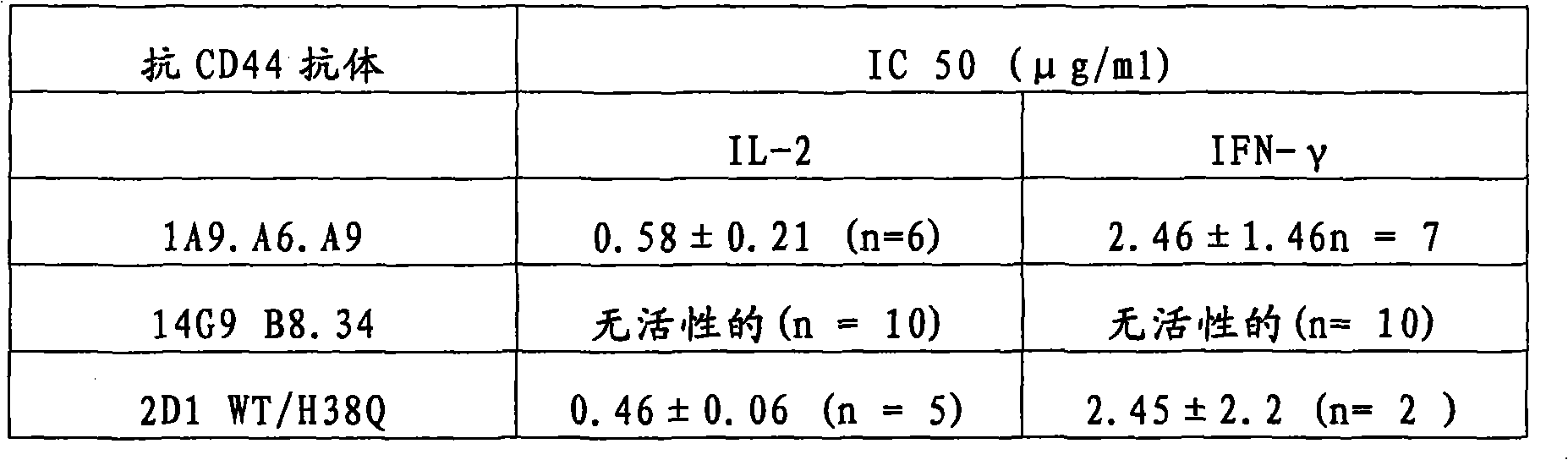
实施例8Example 8
CD44的表面表达的减少Reduction of surface expression of CD44
进行流式细胞术(FACS)分析来检测由抗CD44抗体引起的CD44的表面表达的减少。我们将各抗CD44抗体与人全血在体外条件下一起温育大约12小时,然后检测到人外周白细胞上CD44的表面表达水平减少(参见图7)。向96孔平底聚苯乙烯测定板(Costar,Cat.No.3596)中加入10μl不同浓度的抗CD44抗体1A9.A6.B9、2D1.A3.D12、14G9.B8.B4和10C8.2.3抗体。从正常人自愿受试者收集人外周血并置于具有肝素(Becton Dickinson,Cat No.366480)的vacutainer管中。然后将100μl/孔的人血与抗CD44 Ab混合,在37℃下于潮湿的大气(Narco 6300CO2培养箱)中温育24小时。然后向孔中加入20μl CD44检测抗体G-44-26-PE(BD PharMingen,Franklin Lakes,NJ,Cat.No.555479)、10μl抗CD3-perCP抗体(BD PharMingen,Cat.No.347344)和10μl抗CD14-APC抗体(BD PharMingen,Cat.No.555399),然后在黑暗处在冰上保持30至40分钟。然后从板中移出100μl血液,将其转移至nunc-immuno管(VWR,West Chester,PA,Cat.No.443990)中,加入2ml以1∶10在水中稀释的FACS裂解液(BD Pharmingen Cat.No.349202),涡旋,在室温下放置10分钟。10分钟后,以1200rpm将血液离心10分钟,然后用FACS清洗缓冲液(PBS,0.02%叠氮化物,Sigma,Cat.No.S2002和2%胎牛血清(Gibco,Cat.No.16140-071))清洗细胞。再次以1200rpm离心血液10分钟,然后用FACS清洗缓冲液清洗。然后用250ml 1%多聚甲醛(Electron Microscopy Science,Cat.No.15710)固定细胞,使用FACS calibur读取试管,使用Cellquest软件分析数据。(参见表20和21)。图8显示在10μg/ml 1A9.A6.B9抗体的浓度下(a)淋巴细胞、(b)单核细胞和(c)PMN的FACS结果。1A9.A6.B9抗体结果以灰色显示,基线表达以黑色显示。Flow cytometry (FACS) analysis was performed to detect the reduction in surface expression of CD44 caused by anti-CD44 antibodies. We incubated each anti-CD44 antibody with human whole blood under in vitro conditions for about 12 hours, and then detected a decrease in the surface expression level of CD44 on human peripheral leukocytes (see FIG. 7 ). 10 μl of different concentrations of anti-CD44 antibodies 1A9.A6.B9, 2D1.A3.D12, 14G9.B8.B4 and 10C8.2.3 antibodies were added to a 96-well flat bottom polystyrene assay plate (Costar, Cat. No. 3596). Human peripheral blood was collected from normal human volunteer subjects and placed in vacutainer tubes with heparin (Becton Dickinson, Cat No. 366480). Then 100 μl/well of human blood was mixed with anti-CD44 Ab and incubated at 37° C. in a humid atmosphere (Narco 6300 CO 2 incubator) for 24 hours. Then 20 μl of CD44 detection antibody G-44-26-PE (BD PharMingen, Franklin Lakes, NJ, Cat.No.555479), 10 μl of anti-CD3-perCP antibody (BD PharMingen, Cat.No.347344) and 10 μl of Anti-CD14-APC antibody (BD PharMingen, Cat. No. 555399), then kept on ice for 30 to 40 minutes in the dark. Then 100 μl of blood was removed from the plate, transferred to a nunc-immuno tube (VWR, West Chester, PA, Cat. No. 443990), and 2 ml of FACS lysate (BD Pharmingen Cat. No.349202), vortex, and let stand at room temperature for 10 minutes. After 10 minutes, the blood was centrifuged at 1200rpm for 10 minutes, and then washed with FACS buffer (PBS, 0.02% azide, Sigma, Cat.No.S2002 and 2% fetal bovine serum (Gibco, Cat.No.16140-071 )) Wash the cells. The blood was centrifuged again at 1200 rpm for 10 minutes and then washed with FACS wash buffer. Cells were then fixed with 250 ml of 1% paraformaldehyde (Electron Microscopy Science, Cat. No. 15710), tubes were read using FACS calibur, and data were analyzed using Cellquest software. (See Tables 20 and 21). Figure 8 shows FACS results of (a) lymphocytes, (b) monocytes and (c) PMNs at a concentration of 10 μg/ml 1A9.A6.B9 antibody. 1A9.A6.B9 antibody results are shown in gray and baseline expression in black.
表20Table 20
抗CD44Ab减少人和食蟹猴外周CD3+T细胞上的CD44表面表达Anti-CD44 Abs Reduce CD44 Surface Expression on Peripheral CD3+ T Cells in Humans and Cynomolgus Monkeys
*在20μg/ml下低于40%的抑制*Less than 40% inhibition at 20 μg/ml
表21Table 21
1A9.A6.B9减少人和食蟹猴外周血中的白细胞上的CD44表达(参见图8A-8C)1A9.A6.B9 reduces CD44 expression on leukocytes in human and cynomolgus monkey peripheral blood (see Figures 8A-8C)

N.R.=无反应N.R. = no response
N.T.=未检测到N.T. = not detected
实施例9Example 9
抗CD44抗体1A9.A6.B9的单剂量体内研究诱导食蟹猴的外周A single dose in vivo study of the anti-CD44 antibody 1A9.A6.B9 induces peripheral CD3+T细胞上的CD44表达的剂量依赖性减少Dose-dependent reduction of CD44 expression on CD3+ T cells
通过以1、10和100mg/kg(每剂量组2只雄性和2只雌性动物)对由Charles River Primates,BRF(Bio Research Facility,HouseTexas)提供的食蟹猴施用单一静脉内剂量的1A9.A6.B9(10mg/ml,于25mM醋酸钠、140mM NaCl、0.2mg/ml聚山梨醇酯-80,PH5.5中)来检查由抗CD44抗体诱导的淋巴细胞(参见图9A)和单核细胞(参见图9B)的CD44表面表达的减少。通过股静脉穿刺(femoralvenipuncture)在处理前,给药后2、24、48、168、336和504小时2次从被禁食的猴子收集血液样品(大约2ml),以进行3色(CD3+、CD14+、CD44+)流式细胞术分析。Cynomolgus monkeys provided by Charles River Primates, BRF (Bio Research Facility, House Texas) were administered a single intravenous dose of 1A9.A6 at 1, 10 and 100 mg/kg (2 male and 2 female animals per dose group) .B9 (10 mg/ml in 25 mM sodium acetate, 140 mM NaCl, 0.2 mg/ml polysorbate-80, pH 5.5) to examine lymphocytes (see Figure 9A) and monocytes induced by anti-CD44 antibody (see FIG. 9B ) reduction of CD44 surface expression. Blood samples (approximately 2 ml) were collected from fasted monkeys by femoral venipuncture twice before treatment, 2, 24, 48, 168, 336 and 504 hours after dosing for 3 colors (CD3+, CD14+ , CD44+) flow cytometry analysis.
为了通过FACS测定法检测CD44表达,将100μl外周血与20μl CD14-FITC(Clone M5E2,BD-Pharm Cat.No.67509)、20μlCD3-PerCP(BD-Pharm,Cat.No.13043)和10μl CD44-PE(IM7,BD-Pharm Cat.No.8900)的组合或20μl CD14-FITC(Clone M5E2,BD-Pharm Cat.No.67509)、20μl CD3-PerCP(BD-Pharm,Cat.No.13043)和10μl Rt IgG2b-PE(IM7,BD-Pharm Cat.No.60254)的组合混合。使用涡旋以中低速度将抗体与血液混合,进行1秒。将血液和抗体在4℃下温育20至30分钟,向各管中加入1.5ml 1∶10FACS裂解液(B.D.Pharmingen,San Diego,CA)。将各管在涡旋上以低/中速度混合1至3秒。将管在黑暗处在室温下温育大约12分钟。为了确保完全裂解,检查各管的混浊度,向呈现混浊的管中加入另外500μl FACS裂解液。加入另外2ml BD染色缓冲液(BD PharMingen,SanDiego,CA,Cat.No.55465C);给管重新加盖,通过颠倒管来进行混合。然后将管置于悬篮(swing bucket)并且以250xg在室温下离心6-7分钟。用染色缓冲液清洗细胞沉淀。向细胞中加入100μlcytofix缓冲液(含有4%w/v多聚甲醛的PBS)。将样品在黑暗处于4℃下保持直至它们用于FACSCalibur。向细胞中加入100μl cytofix缓冲液(含有4%w/v多聚甲醛的PBS)。将样品在黑暗处于4℃下贮存在cytofix缓冲液中。在于FACSCalibur上分析细胞之前,向所有管中加入100μl PBS。收集总共20,000个关于门控淋巴细胞的事件。To detect CD44 expression by FACS assay, 100 μl of peripheral blood was mixed with 20 μl of CD14-FITC (Clone M5E2, BD-Pharm Cat. No. 67509), 20 μl of CD3-PerCP (BD-Pharm, Cat. No. 13043) and 10 μl of CD44- A combination of PE (IM7, BD-Pharm Cat.No.8900) or 20 μl CD14-FITC (Clone M5E2, BD-Pharm Cat.No.67509), 20 μl CD3-PerCP (BD-Pharm, Cat.No.13043) and A combination of 10 μl of Rt IgG2b-PE (IM7, BD-Pharm Cat. No. 60254) was mixed. Mix the antibody with the blood using a vortex at medium-low speed for 1 sec. Blood and antibodies were incubated at 4°C for 20 to 30 minutes, and 1.5 ml of 1:10 FACS Lysis Buffer (B.D. Pharmingen, San Diego, CA) was added to each tube. Tubes were mixed on a vortex at low/medium speed for 1 to 3 seconds. Tubes were incubated for approximately 12 minutes at room temperature in the dark. To ensure complete lysis, check the turbidity of each tube and add another 500 μl of FACS Lysis Buffer to the turbid tube. Add another 2 ml of BD staining buffer (BD PharMingen, San Diego, CA, Cat. No. 55465C); recap the tube and mix by inverting the tube. The tubes were then placed in a swing bucket and centrifuged at 250xg for 6-7 minutes at room temperature. Wash the cell pellet with staining buffer. Add 100 [mu]l cytofix buffer (PBS containing 4% w/v paraformaldehyde) to the cells. Samples were kept in the dark at 4°C until they were used in FACSCalibur. Add 100 μl cytofix buffer (PBS containing 4% w/v paraformaldehyde) to the cells. Samples were stored in cytofix buffer in the dark at 4°C. 100 μl PBS was added to all tubes prior to analyzing cells on the FACSCalibur. A total of 20,000 events on gated lymphocytes were collected.
实施例10Example 10
表位分类研究Epitope taxonomy studies
使用BIAcoreTM进行竞争结合分析。Competition binding assays were performed using BIAcore ™ .
BIAcore表位作图实验:BIAcore epitope mapping experiment:
通过在BIAcoreTM上进行竞争测定来进行CD44抗体1A9.A6.B9、2D1.A3.D12和14G9.B8.B4的表位作图(参见表22(关于抗体浓度)和表23表位图)。将使用表面等离子共振术的生物传感器生物特异性相互作用分析仪(BIAcore 2000)用于测量CM5传感器芯片上的分子相互作用。测量由分子与传感器芯片的葡聚糖侧的相互作用引起的两种介质(玻璃和羧甲基化的葡聚糖)之间的折射率的变化,将其报告为厂商的应用注解中所描述的任意反射单位(arbitrary reflectanceunit)(RU)的变化。Epitope mapping of CD44 antibodies 1A9.A6.B9, 2D1.A3.D12 and 14G9.B8.B4 was performed by competition assay on BIAcore ™ (see Table 22 (for antibody concentrations) and Table 23 for epitope mapping) . A Biosensor Biospecific Interaction Analyzer (BIAcore 2000) using surface plasmon resonance was used to measure molecular interactions on the CM5 sensor chip. The change in refractive index between the two media (glass and carboxymethylated dextran) caused by the interaction of the molecule with the dextran side of the sensor chip was measured and reported as described in the manufacturer's application note A change in the arbitrary reflectance unit (RU) of .
通过由0.2M N-乙基-N′-(二甲氨基丙基)碳二亚胺介导的使用0.05M N-羟基琥珀酰亚胺进行的衍生化来活化传感器芯片上的流动小室(flow cell)的羧甲基化葡聚糖表面,进行7分钟。以5μl/分钟的速度将浓度为30μg/ml的在10mM醋酸钠,pH3.5中的CD44-Ig手动注射入流动小室,并且以期望量的RU将其共价固定至流动小室表面。使用1M乙醇胺盐酸盐,pH8.5使未反应的N-羟基琥珀酰亚胺酯失活。在固定后,使用5次5μl 50mM NaOH的再生注射来清除流动小室中任何未反应或结合很弱的材料直至获得稳定的基线。流动小室2测量到大约62RU,流动小室3测量到大约153RU。对于流动小室1,活化的空白表面,在固定过程中注射35μl 10mM醋酸钠缓冲液来代替抗原。流动小室4包含大约200RU的固定的CTLA4-Ig,不相关抗原对照。The flow cell on the sensor chip was activated by derivatization with 0.05M N-hydroxysuccinimide mediated by 0.2M N-ethyl-N'-(dimethylaminopropyl)carbodiimide. cell) on the carboxymethylated dextran surface for 7 minutes. CD44-Ig at a concentration of 30 μg/ml in 10 mM sodium acetate, pH 3.5 was manually injected into the flow cell at a rate of 5 μl/min and covalently immobilized to the flow cell surface at the desired amount of RU. Unreacted N-hydroxysuccinimide ester was inactivated using 1M ethanolamine hydrochloride, pH 8.5. After fixation, five regeneration injections of 5 μl of 50 mM NaOH were used to clear the flow cell of any unreacted or poorly bound material until a stable baseline was obtained. Flow
使用运行/稀释缓冲液(HBS-EP)进行表位作图实验。流动速度为5μl/分钟,仪器温度为20℃。在各抗体对结合后,然后使用5μl 50mMNaOH的注射使流动小室表面再生至基线。将运行缓冲液中的纯化的抗体稀释至30μg/ml,然后以25μl的体积进行注射。Epitope mapping experiments were performed using running/dilution buffer (HBS-EP). The flow rate was 5 μl/min and the instrument temperature was 20°C. Following binding of each antibody pair, the flow cell surface was then regenerated to baseline using an injection of 5 μl of 50 mM NaOH. Purified antibodies were diluted to 30 μg/ml in running buffer and injected in a volume of 25 μl.
用第一抗体饱和流动小室表面,然后立即注射第二抗体。然后将第二抗体的结合评定为与固定的CD44-Ig表面“结合”、“不结合”或“部分结合”。在进行结合评定后,再生表面,重新注射相同的第一抗体,然后再注射抗体组(panel)中的下一个抗体。继续进行该注射方案直至已就它们对CD44-Ig的结合评定了抗体组中的所有抗体。选择另一种抗体作为第一抗体,并且将其他抗体作为与CD44-Ig结合的第二抗体进行评定。特别地,当将抗CD44抗体14G9.B8.B4作为第一抗体检测时,将其与第二抗体一起共注射,因为14G9.B8.B4的解离速率相对于结合更快。The surface of the flow cell is saturated with the primary antibody, followed immediately by the injection of the secondary antibody. Binding of the secondary antibody was then assessed as "bound", "not bound" or "partially bound" to the immobilized CD44-Ig surface. Following binding assessment, the surface was regenerated and the same primary antibody was re-injected, followed by the next antibody in the antibody panel. This injection regimen was continued until all antibodies in the antibody panel had been assessed for their binding to CD44-Ig. Another antibody was chosen as the primary antibody and the other antibody was assessed as the secondary antibody binding to CD44-Ig. In particular, when the anti-CD44 antibody 14G9.B8.B4 was detected as the primary antibody, it was co-injected with the secondary antibody because the off-rate of 14G9.B8.B4 is faster relative to the on-boarding.
在将所有抗体作为针对抗体组中的所有抗体的第一抗体注射(primary injection)进行检测后,制备将相似的结合模式组合入一个表位群(epitope group)的约化矩阵(reduced matrix)。然后可按照约化矩阵绘制拓扑图。可以根据显示不同表位之间的干扰的抗原CD44-Ig的拓扑表面图解释结合矩阵(binding matrix)。这样的图谱只显示功能关系并且不必具有与抗原表面的实际物理结构的任何相应性。After testing all antibodies as a primary antibody injection against all antibodies in the antibody panel, a reduced matrix combining similar binding modes into an epitope group is prepared. The topology map can then be drawn in terms of the reduced matrix. The binding matrix can be interpreted in terms of a topological surface map of the antigen CD44-Ig showing interference between different epitopes. Such a map only shows functional relationships and does not necessarily have any correspondence to the actual physical structure of the antigen surface.
BIAcore竞争结合分析显示,mAb 1A9.A6.B9和14G9.B8.B4识别的表位与抗体515识别的表位交叠。此外,BIAcoreTM研究显示mAb1A9.A6.B9和14G9.B8.B4不与抗体IM7交叠。BIAcore competition binding analysis showed that the epitope recognized by mAbs 1A9.A6.B9 and 14G9.B8.B4 overlaps with that recognized by antibody 515. Furthermore, BIAcore ™ studies showed that mAb1A9.A6.B9 and 14G9.B8.B4 did not overlap with antibody IM7.
表22Table 22
抗体 终浓度 Antibody final concentration
IM7(BD Bioscience,Frankilin Lakes,NJ,Cat.No.553134) 1.0mg/mlIM7 (BD Bioscience, Frankilin Lakes, NJ, Cat.No.553134) 1.0mg/ml
515(BD Bioscience,Cat.No.550990) 1.0mg/ml515 (BD Bioscience, Cat.No.550990) 1.0mg/ml
1A9.A6.B9 1.5mg/ml1A9.A6.B9 1.5mg/ml
14G9.B9.B4 1.0mg/ml14G9.B9.B4 1.0mg/ml
表23Table 23
CD44抗体的竞争表位作图Competing epitope mapping of CD44 antibody
×=观察到竞争× = competition observed
○=未观察到竞争○ = No competition observed
实施例11Example 11
抗CD44抗体的选择性Selectivity of anti-CD44 antibodies
我们测量CD44抗体相对淋巴管内皮透明质烷受体1蛋白(LYVE-1)(R&D,Cat.No.2089-Ly)的结合亲和力并且发现抗CD44抗体对于CD44具有超过LYVE-1多于100倍的选择性(参见表24)。用50ngCD44-Ig融合蛋白或LYVE-1涂覆96孔ELISA板(Immuno Maxisorp板,Nunc Cat.No.442404),在4℃下温育过夜。然后用PBS,0.05%Tween-20清洗板,在室温下用3%的在PBS中的BSA封闭板,进行2小时。将抗CD44抗体或抗LYVE-1抗体(R&D,Cat.No.AF 2089)以不同的浓度稀释在1%的在PBS中的BSA中,然后加入至板中。将ELISA板在室温下温育1.5小时。清洗板,向各孔中加入50μl以1∶2000稀释在1%的在PBS中的BSA中的抗人κ轻链-HRP抗体(Bethyl,Cat.No.A80-115P.6)(对于抗CD44抗体)或抗山羊IgG-HRP(对于抗LYVE-1抗体)(Cappel/ICN,Cat.No.55363),并且在室温下再温育1小时。再次清洗板,加入50μg/ml TMB,温育5至10分钟。使用终止液终止ELISA反应,通过板读出器测量OD450值。We measured the binding affinity of CD44 antibody to lymphatic endothelial
表24抗CD44抗体的选择性Table 24 Selectivity of anti-CD44 antibodies
实施例12Example 12
MEM-85和1A9.A6.B9抗CD44抗体的结合竞争研究Binding Competition Study of MEM-85 and 1A9.A6.B9 Anti-CD44 Antibody
我们进行FACS研究以确定根据本发明的人抗CD44抗体与可商购获得的抗CD44抗体MEM-85(Caltag Laboratories,Burlingame,CA,Cat.No.MHCD4404-4)是结合CD44分子上相同的位置还是不同的位置。We performed FACS studies to confirm that the human anti-CD44 antibody according to the present invention binds to the same position on the CD44 molecule as the commercially available anti-CD44 antibody MEM-85 (Caltag Laboratories, Burlingame, CA, Cat. No. MHCD4404-4) Still a different location.
我们已使用CD3+人外周T细胞或用逆转录病毒载体上的人CD44分子转导的300-19细胞进行了基于FACS的CD44竞争结合测定。从正常人自愿受试者收集人外周血并且置于具有肝素的vacutainer管(Becton Dickinson,Cat No.366480)中。We have performed FACS-based CD44 competition binding assays using CD3+ human peripheral T cells or 300-19 cells transduced with the human CD44 molecule on a retroviral vector. Human peripheral blood was collected from normal human volunteer subjects and placed in vacutainer tubes (Becton Dickinson, Cat No. 366480) with heparin.
人外周T细胞的FACS研究:FACS study of human peripheral T cells:
从正常人自愿受试者收集人外周血并且置于具有肝素的vacutainer管(Becton Dickinson,Cat No.366480)中。向Nunc-Immuno管(VWR Cat.No.443990)中加入100μl收集的人血,之后向各管中加入10μl抗CD44 Ab 1A9.A6.B9以获得0.2μg/ml至20μg/ml的终浓度。将管在冰上温育5分钟。在5分钟的温育后,向各管中加入20μl CD44检测Ab(MEM-85,Cat.No.MHCD4404-4)和抗CD3-PerCP(BD Pharmingen,Cat.No.347344)、10μl抗CD14-APC(BD Pharmingen,Cat.No.555399)和10ml抗CD4-APC(BDPharmingen Cat.No.555349),然后在黑暗处于冰上保持30至40分钟。加入2ml FACS裂解液(BD Pharmingen,Cat.No.349202,以1∶10在水中稀释),涡旋,然后在室温下温育10分钟。用FACS清洗缓冲液(PBS Sigma Cat.No.D8537,0.02%叠氮化物,Sigma Cat.No.S2002和2%胎牛血清,Gibco Cat.No.16140-071)清洗细胞,然后离心并且移出上清液。然后用250μl 1%的多聚甲醛(ElectronMicroscope Science,Ft Washington,PA Cat.No.15710)固定细胞。使用Becton Dickson FACS Calibuf读取试管,使用CellQuest Pro(Becton Dickinson)分析数据。Human peripheral blood was collected from normal human volunteer subjects and placed in vacutainer tubes (Becton Dickinson, Cat No. 366480) with heparin. 100 μl of collected human blood was added to Nunc-Immuno tubes (VWR Cat.No. 443990), after which 10 μl of anti-CD44 Ab 1A9.A6.B9 was added to each tube to obtain a final concentration of 0.2 μg/ml to 20 μg/ml. Tubes were incubated on ice for 5 minutes. After 5 minutes of incubation, 20 μl of CD44 detection Ab (MEM-85, Cat.No.MHCD4404-4) and anti-CD3-PerCP (BD Pharmingen, Cat.No.347344), 10 μl of anti-CD14- APC (BD Pharmingen, Cat. No. 555399) and 10 ml of anti-CD4-APC (BD Pharmingen Cat. No. 555349) were then kept on ice in the dark for 30 to 40 minutes. 2 ml of FACS Lysis Buffer (BD Pharmingen, Cat. No. 349202, diluted 1:10 in water) was added, vortexed, and then incubated at room temperature for 10 minutes. Wash cells with FACS wash buffer (PBS Sigma Cat.No.D8537, 0.02% azide, Sigma Cat.No.S2002 and 2% fetal bovine serum, Gibco Cat.No.16140-071), then centrifuge and remove Serum. Cells were then fixed with 250 μl of 1% paraformaldehyde (Electron Microscope Science, Ft Washington, PA Cat. No. 15710). Tubes were read using a Becton Dickson FACS Calibuf and data were analyzed using CellQuest Pro (Becton Dickinson).
用人CD44分子转导的300-19细胞的FACS研究:FACS study of 300-19 cells transduced with human CD44 molecule:
以106个细胞/ml向Nunc-Immuno管(VWR Cat.No.443990)中加入100ml 300-19细胞。然后将细胞与10μl抗CD44 Ab混合以获得0至10μg/ml的终浓度(参见图10A)并且在冰上温育5分钟。在温育后,向管中加入20μl CD44检测Ab MEM-85(CaltagLaboratories,Burlingame,CA,Cat.No.MHCD4404-4),并在冰上温育细胞30至40分钟。用FACS清洗缓冲液(PBS Sigma D8537,0.02%叠氮化物,Sigma S2002和2%胎牛血清,Gibco Cat No.16140-071)进行清洗。以12000rpm离心10分钟,除去上清液。用250ml 1%多聚甲醛(Electron Microscope Science,Ft Washington,PA Cat.No.15710)固定细胞。使用Becton Dickson FACS Calibur读取试管,使用CellQuest Pro(Becton Dickinson)分析数据。100 ml of 300-19 cells were added to Nunc-Immuno tubes (VWR Cat. No. 443990) at 106 cells/ml. Cells were then mixed with 10 μl of anti-CD44 Ab to obtain a final concentration of 0 to 10 μg/ml (see Figure 10A) and incubated on ice for 5 minutes. After incubation, 20 μl of CD44 detection Ab MEM-85 (Caltag Laboratories, Burlingame, CA, Cat. No. MHCD4404-4) was added to the tube and the cells were incubated on ice for 30 to 40 minutes. Washing was performed with FACS wash buffer (PBS Sigma D8537, 0.02% azide, Sigma S2002 and 2% fetal bovine serum, Gibco Cat No. 16140-071). Centrifuge at 12000 rpm for 10 minutes and remove the supernatant. Cells were fixed with 250 ml of 1% paraformaldehyde (Electron Microscope Science, Ft Washington, PA Cat. No. 15710). Tubes were read using a Becton Dickson FACS Calibur and data were analyzed using CellQuest Pro (Becton Dickinson).
FACS竞争结合分析显示,mAb 1A9.A6.B9识别的表位与MEM-85抗体识别的表位交叠,其已绘制至CD44分子上的LINK结构域。Bajorath,J.等人,(1998)JBC,273:338-343(参见图10A-B)。FACS competition binding analysis revealed that the epitope recognized by mAb 1A9.A6.B9 overlaps with the epitope recognized by the MEM-85 antibody, which had been mapped to the LINK domain on the CD44 molecule. Bajorath, J. et al., (1998) JBC, 273:338-343 (see Figures 10A-B).
实施例13Example 13
按照下面的表25制备1A9.A6.B9的两种冻干的(冷冻干燥的)制剂(HIS lyo & CIT Lyo)。制剂包含20mg/mL 1A9.A6.B9、组氨酸或柠檬酸盐缓冲剂、聚山梨醇酯80、EDTA和海藻糖二水合物。如下面表25(1A9.A6.B9)中显示的,也制备液体制剂(HIS液体)。液体制剂的组成是:10mg/mL 1A9.A6.B9、20mM组氨酸缓冲剂、0.2mg/mL聚山梨醇酯80、0.05mg/mL EDTA、84mg/mL海藻糖二水合物和0.1mg/mL L-甲硫氨酸。Two lyophilized (freeze-dried) formulations of 1A9.A6.B9 (HIS lyo & CIT Lyo) were prepared according to Table 25 below. The formulation contained 20 mg/mL 1A9.A6.B9, histidine or citrate buffer,
表25:1A9.A6.B9液体和lyo制剂的配制组分Table 25: Formulation Components for 1A9.A6.B9 Liquid and lyo Formulations
将上面制备的各制剂保持在2-8℃和加速稳定性条件(25和40℃)下,进行52周(包含柠檬酸盐缓冲剂的冻干的制剂只保持22周)。在第4、8、13、22和52周分析样品。在各时间点上,就颗粒的存在、颜色的变化和清澈度目测分析样品。也进行pH测量。通过SE-HPLC监测聚集体的存在。检测的所有制剂在目测下保持清澈、无色和无颗粒并且不显示pH的任何显著变化。此外,如使用串联的2个柱(GSSW3000XL和GS SW2000XL),使用流动相(其为200mM磷酸盐缓冲液,pH7.0),通过SE-HPLC测量的,对于表25的所有制剂和作为对照进行检测的液体制剂,在经历于2-8℃和25℃下贮存52周以及于40℃下贮存22周(图11a、b和c)后,获得优于97%的mAb单体回收(<3%的聚集体形成)。流速保持在0.7mL/分钟,进行40分钟。Each formulation prepared above was maintained at 2-8°C and accelerated stability conditions (25 and 40°C) for 52 weeks (the lyophilized formulation containing citrate buffer was only maintained for 22 weeks). Samples were analyzed at 4, 8, 13, 22 and 52 weeks. At each time point, the samples were analyzed visually for the presence of particles, color change and clarity. A pH measurement is also performed. The presence of aggregates was monitored by SE-HPLC. All formulations tested remained clear, colorless and particle-free by visual inspection and did not show any significant changes in pH. In addition, as measured by SE-HPLC using 2 columns in series (GSSW3000XL and GS SW2000XL), using a mobile phase (which is 200 mM phosphate buffer, pH 7.0), for all formulations of Table 25 and as a control The tested liquid formulations achieved better than 97% mAb monomer recovery (<3 % aggregate formation). The flow rate was maintained at 0.7 mL/min for 40 min.
通过成像毛细管等电聚焦(imaging capillary iso-electricfocusing)(iCE)分析各制剂来估量在52周的冷藏贮存(2-8℃)后和在加速温度条件(25℃进行52周,以及在40℃进行22周)下1A9.A6.B9电荷变体(酸性的、亲本的和碱性的类别)的形成。在毛细管内进行这些带电荷的类别的分离,使用UV检测器和CCD照相机显现和定量这些类别。在图12a、b和c中举例说明了iCE测定的结果(酸性类别)。结果显示,所有制剂在于2-8℃和25℃下贮存52周后具有相似的酸性类别形成。在40℃下,冻干的制剂报导了比对照更低的酸性类别形成。The formulations were analyzed by imaging capillary iso-electric focusing (iCE) to estimate after 52 weeks of refrigerated storage (2-8°C) and at accelerated temperature conditions (25°C for 52 weeks, and at 40°C). Formation of 1A9.A6.B9 charge variants (acidic, parental and basic classes) at 22 weeks) was performed. Separation of these charged species is performed within a capillary, visualized and quantified using a UV detector and a CCD camera. The results of the iCE assay (acidic category) are illustrated in Figures 12a, b and c. The results showed that all formulations had similar formation of acid species after storage at 2-8°C and 25°C for 52 weeks. At 40°C, the lyophilized formulation reported lower formation of acidic species than the control.
还通过SDS-PAGE分析各制剂来估量在52周的冷藏贮存(2-8℃)后和在加速稳定性条件(25℃下进行52周以及在40℃下进行22周)下mAb的更大和更小尺寸的变体的形成。该方法提供了mAb的纯度(包括在一段时间内截短体(clip)形成和聚集体形成的水平)的良好测量。在表26、27和28中举例说明了SDS-PAGE测定的结果。Formulations were also analyzed by SDS-PAGE to estimate the maximum and maximum concentration of mAbs after 52 weeks of refrigerated storage (2-8°C) and under accelerated stability conditions (52 weeks at 25°C and 22 weeks at 40°C). Formation of variants of smaller size. This method provides a good measure of the purity of the mAb, including the level of clip formation and aggregate formation over a period of time. The results of the SDS-PAGE assays are illustrated in Tables 26, 27 and 28.
还对各制剂进行分析以估量在52周的冷藏贮存(2-8℃)后和在加速稳定性条件(25℃下进行52周以及在40℃下进行22周)下重链上的甲硫氨酸256位点上的甲硫氨酸氧化的形成。用Lys-C消化单克隆抗体产物,监测包含甲硫氨酸的肽片段和其各自的氧化形式。表26、27和28显示甲硫氨酸氧化测定的结果。Each formulation was also analyzed to estimate methyl sulfide on the heavy chain after 52 weeks of refrigerated storage (2-8°C) and under accelerated stability conditions (52 weeks at 25°C and 22 weeks at 40°C). Oxidative formation of methionine at amino acid 256. Monoclonal antibody products were digested with Lys-C, and methionine-containing peptide fragments and their respective oxidized forms were monitored. Tables 26, 27 and 28 show the results of the methionine oxidation assay.
也对各制剂进行分析以估量在52周的冷藏贮存(2-8℃)后和在加速稳定性条件(25℃下进行52周以及在40℃下进行22周)下的相对生物活性。在表26、27和28中举例说明了生物活性测定的结果。Each formulation was also analyzed to assess relative biological activity after 52 weeks of refrigerated storage (2-8°C) and under accelerated stability conditions (52 weeks at 25°C and 22 weeks at 40°C). The results of the bioactivity assays are illustrated in Tables 26, 27 and 28.
表26:在5℃下获得的稳定性数据Table 26: Stability data obtained at 5°C
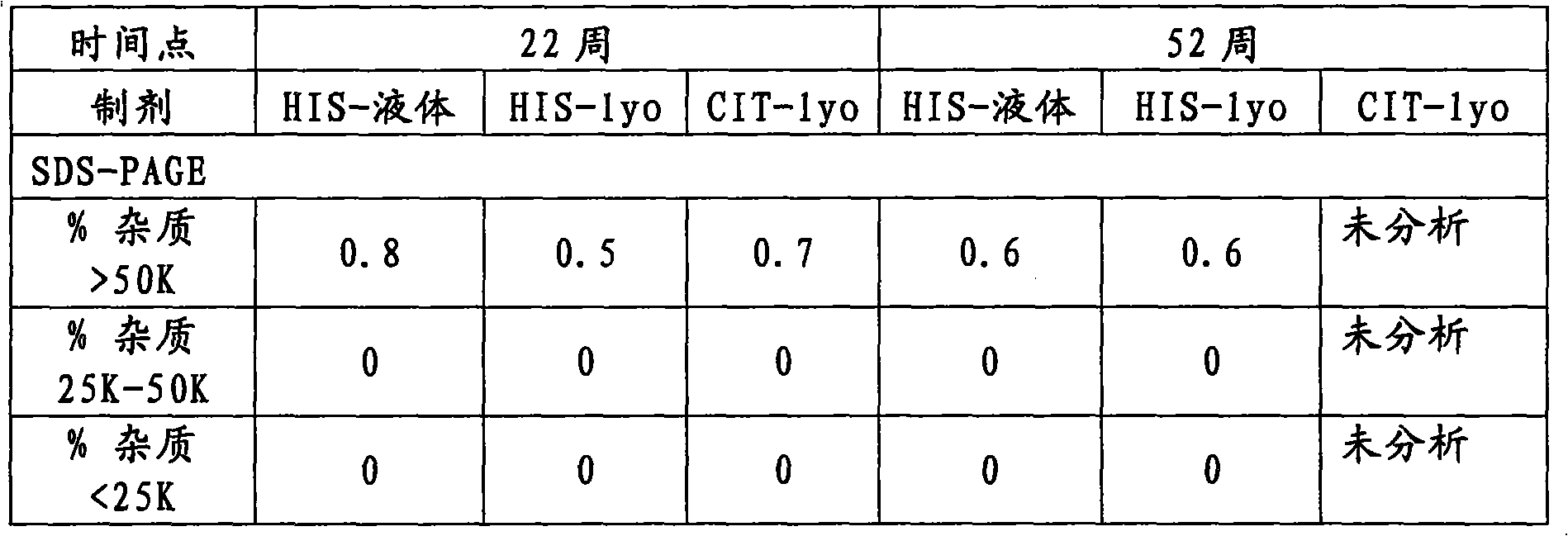

表27:在25℃获得的稳定性数据Table 27: Stability data obtained at 25°C
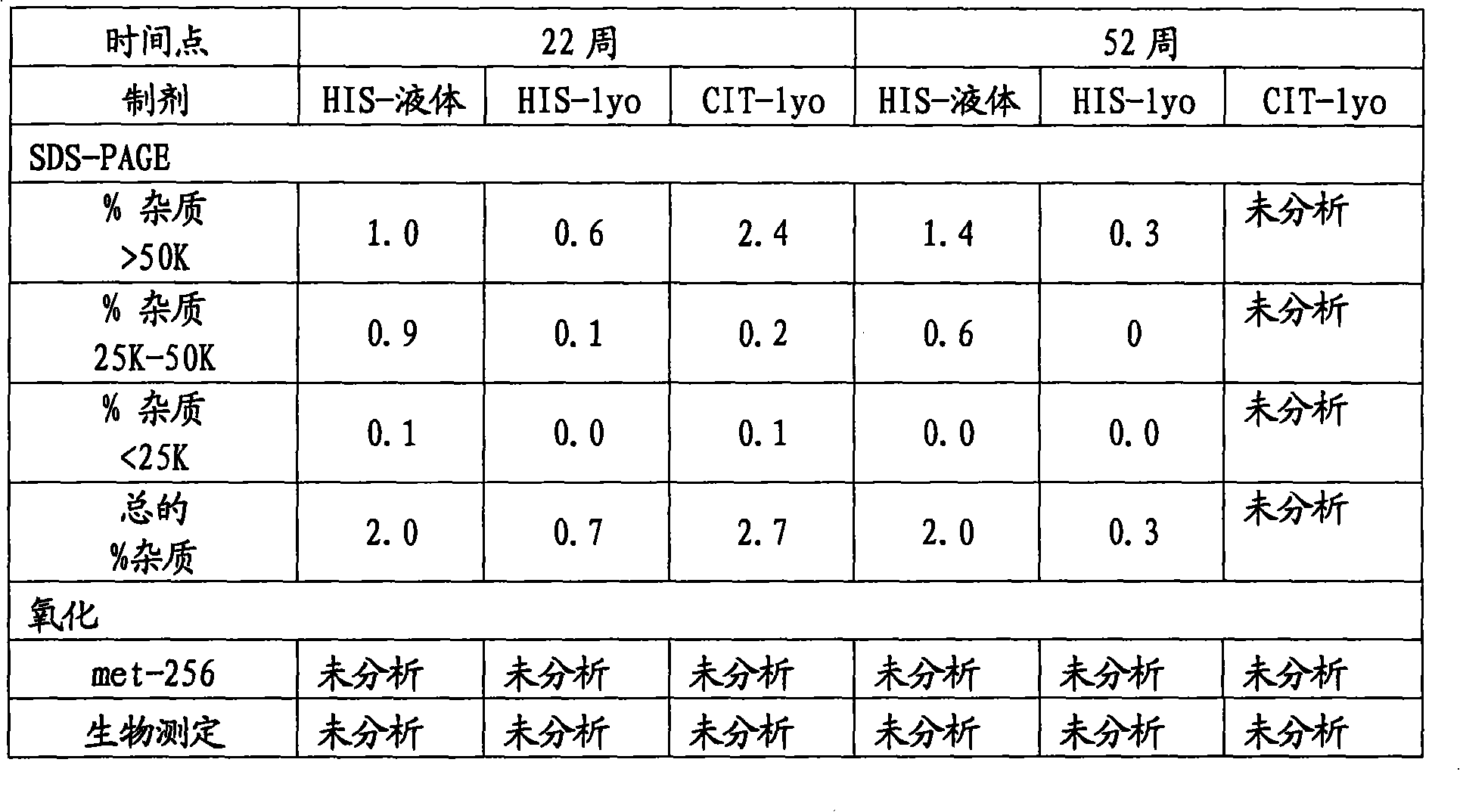
表28:在40℃获得的稳定性数据Table 28: Stability data obtained at 40°C
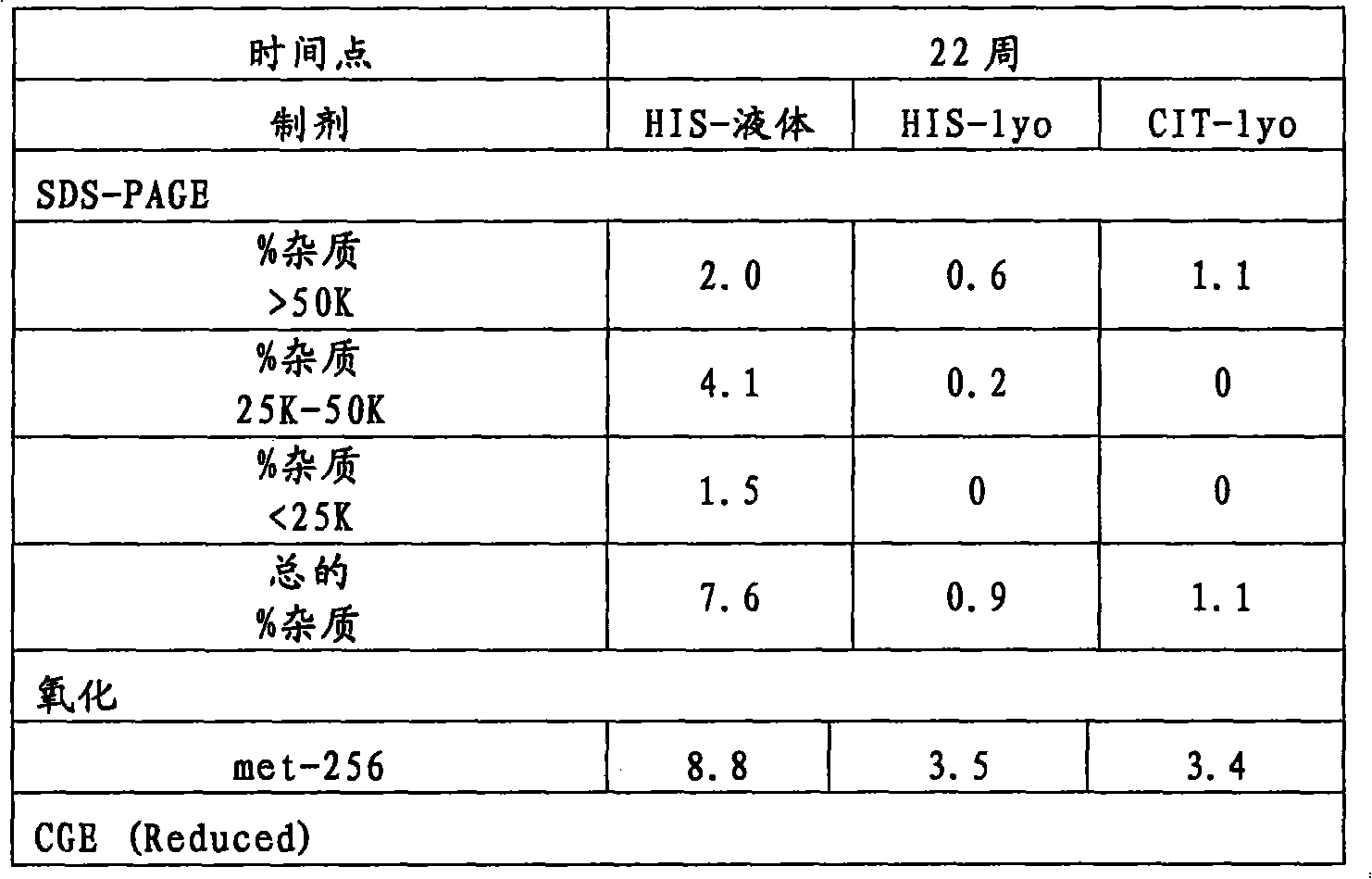

实施例14Example 14
通过BiacoreTM分析测量的1A9.A6.B9对人和食蟹猴CD44的结合亲和力Binding affinity of 1A9.A6.B9 to human and cynomolgus CD44 measured by Biacore ™ analysis
进行另一个BiacoreTM分析以显示1A9.A6.B9抗体对人和食蟹猴CD44的结合亲和力。将人CD44-Ig(55RU,86RU)和cyno CD44-Ig(99RU,116RU)以10ug/ml(于10mM醋酸钠pH3.5中)的浓度固定至CM-5芯片。使浓度变化的1A9.A6.B9,(100ug/ml至0.1ug/ml,以半对数稀释)以5ul/分钟的流速流过芯片。然后用50mM NaOH再生芯片,用HBS-EP(BIAcore 22-0512-44)清洗。在Biacore 2000上进行分析。使用BIAEvaluationTM软件分析数据(n=2)。Another Biacore ™ analysis was performed to show the binding affinity of the 1A9.A6.B9 antibody to human and cynomolgus CD44. Human CD44-Ig (55RU, 86RU) and cyno CD44-Ig (99RU, 116RU) were immobilized to a CM-5 chip at a concentration of 10 ug/ml (in 10 mM sodium acetate pH 3.5). Varying concentrations of 1A9.A6.B9, (100 ug/ml to 0.1 ug/ml, half log dilutions) were passed through the chip at a flow rate of 5 ul/min. The chip was then regenerated with 50 mM NaOH and washed with HBS-EP (BIAcore 22-0512-44). Analysis was performed on
表29.1A9.A6.B9的动力学分析Kinetic Analysis of Table 29.1A9.A6.B9
本说明书中引用的所有参考文献,包括但不限于论文、出版物、专利、专利申请、报告、教科书、报道、手稿、小册子、书、互联网发布(internet positing)、杂志论文、期刊、产品情况清单(productfact sheet)等,以其全文通过引用合并入本说明书中。本文中参考文献的论述只意欲概括它们的作者发出的声明,并不承认任何参考文献构成了现有技术,并且申请者保留质疑引用的文献的准确性和相关性(pertirency)的权利。All references cited in this specification, including but not limited to papers, publications, patents, patent applications, reports, textbooks, reports, manuscripts, pamphlets, books, internet positing, journal articles, periodicals, product cases List (productfact sheet), etc., are incorporated into this specification by reference in their entirety. The discussion of references herein is intended only to summarize the statements made by their authors, no admission is made that any reference constitutes prior art, and the applicants reserve the right to challenge the accuracy and pertirency of the cited documents.
虽然为了清楚地理解,上述发明通过举例说明和实例进行了稍许详细的描述,但在本发明的教导下,对于本领域技术人员很显然的是可对其进行某些改变和变动而不背离所附权利要求的精神或范围。Although the foregoing invention has been described in some detail by way of illustration and example for clarity of understanding, it will be apparent to those skilled in the art that certain changes and modifications may be made thereto without departing from the teachings of the present invention. spirit or scope of the appended claims.
序列表sequence listing
SEQ ID NO:1SEQ ID NO: 1
人CD44氨基酸序列-全长Human CD44 Amino Acid Sequence - Full Length
MDKFWWHAAWGLCLVPLSLAQIDLNITCRFAGVFHVEKNGRYSISRTEAADLCKAFNSTLPTMAQMDKFWWHAAWGLCLVPLSLAQIDLNITCRFAGVFHVEKNGRYSISRTEAADLCKAFNSTLPTMAQ
MEKALSIGFETCRYGFIEGHVVIPRIHPNSICAANNTGVYILTSNTSQYDTYCFNASAPPEEDCTMEKALSIGFETCRYGFIEGHVVIPRIHPNSICAANNTGVYILTSNTSQYDTYCFNASAPPEEDCT
SVTDLPNAFDGPITITIVNRDGTRYVQKGEYRTNPEDIYPSNPTDDDVSSGSSSERSSTSGGYIFSVTDLPNAFDGPITITIVNRDGTRYVQKGEYRTNPEDIYPSNPTDDDVSSGSSSERSSTSGGYIF
YTFSTVHPIPDEDSPWITDSTDRIPATRDQDTFHPSGGSHTTHGSESDGHSHGSQEGGANTTSGPYTFSTVHPIPDEDSPWITDSTDRIPATRDQDTFHPSGGSHTTHGSESDGHSHGSQEGGANTTSGP
IRTPQIPEWLIILASLLALALILAVCIAVNSRRRCGQKKKLVINSGNGAVEDRKPSGLNGEASKSIRTPQIPEWLIILASLLALALILAVCIAVNSRRRCGQKKKLVINSGNGAVEDRKPSGLNGEASKS
QEMVHLVNKESSETPDQFMTADETRNLQNVDMKIGVQEMVHLVNKESSETPDQFMTADETRNLQNVDMKIGV
SEQ ID NO:2SEQ ID NO: 2
人CD44核苷酸序列-全长Human CD44 Nucleotide Sequence - Full Length
ATGGACAAGTTTTGGTGGCACGCAGCCTGGGGACTCTGCCTCGTGCCGCTGAGCCTGGCGCAGATATGGACAAGTTTTGGTGGCACGCAGCCTGGGGACTCTGCCTCGTGCCGCTGAGCCTGGCGCAGAT
CGATTTGAATATAACCTGCCGCTTTGCAGGTGTATTCCACGTGGAGAAAAATGGTCGCTACAGCACGATTTGAATATAACCTGCCGCTTTGCAGGTGTATTCCACGTGGAGAAAAATGGTCGCTACAGCA
TCTCTCGGACGGAGGCCGCTGACCTCTGCAAGGCTTTCAATAGCACCTTGCCCACAATGGCCCAGTCTCTCGGACGGAGGCCGCTGACCTCTGCAAGGCTTTCAATAGCACCTTGCCCACAATGGCCCAG
ATGGAGAAAGCTCTGAGCATCGGATTTGAGACCTGCAGGTATGGGTTCATAGAAGGGCACGTGGTATGGAGAAAGCTCTGAGCATCGGATTTGAGACCTGCAGGTATGGGTTCATAGAAGGGCACGTGGT
GATTCCCCGGATCCACCCCAACTCCATCTGTGCAGCAAACAACACAGGGGTGTACATCCTCACATGATTCCCCGGATCCACCCCAACTCCATCTGTGCAGCAAACAACACAGGGGTGTACATCCTCACAT
CCAACACCTCCCAGTATGACACATATTGCTTCAATGCTTCAGCTCCACCTGAAGAAGATTGTACACCAACACCTCCCAGTATGACACATATTGCTTCAATGCTTCAGCTCCACCTGAAGAAGATTGTACA
TCAGTCACAGACCTGCCCAATGCCTTTGATGGACCAATTACCATAACTATTGTTAACCGTGATGGTCAGTCACAGACCTGCCCAATGCCTTTGATGGACCAATTACCATAACTATTGTTAACCGTGATGG
CACCCGCTATGTCCAGAAAGGAGAATACAGAACGAATCCTGAAGACATCTACCCCAGCAACCCTACACCCGCTATGTCCAGAAAGGAGAATACAGAACGAATCCTGAAGACATCTACCCCAGCAACCCTA
CTGATGATGACGTGAGCAGCGGCTCCTCCAGTGAAAGGAGCAGCACTTCAGGAGGTTACATCTTTCTGATGATGACGTGAGCAGCGGCTCCTCCAGTGAAAGGAGCAGCACTTCAGGAGGTTACATCTTT
TACACCTTTTCTACTGTACACCCCATCCCAGACGAAGACAGTCCCTGGATCACCGACAGCACAGATACACCTTTTCTACTGTACACCCCCATCCCAGACGAAGACAGTCCCTGGATCACCGACAGCACAGA
CAGAATCCCTGCTACCAGAGACCAAGACACATTCCACCCCAGTGGGGGGTCCCATACCACTCATGCAGAATCCCTGCTACCAGAGACCAAGACACATTCCACCCCAGTGGGGGGTCCCATACCACTCATG
GATCTGAATCAGATGGACACTCACATGGGAGTCAAGAAGGTGGAGCAAACACAACCTCTGGTCCTGATCTGAATCAGATGGACACTCACATGGGAGTCAAGAAGGTGGAGCAAACACAACCTCTGGTCCT
ATAAGGACACCCCAAATTCCAGAATGGCTGATCATCTTGGCATCCCTCTTGGCCTTGGCTTTGATATAAGGACACCCCAAATTCCAGAATGGCTGATCATCTTGGCATCCCTTGGCCTTGGCTTTGAT
TCTTGCAGTTTGCATTGCAGTCAACAGTCGAAGAAGGTGTGGGCAGAAGAAAAAGCTAGTGATCATCTTGCAGTTTGCATTGCAGTCAACAGTCGAAGAAGGTGTGGGCAGAAGAAAAAGCTAGTGATCA
ACAGTGGCAATGGAGCTGTGGAGGACAGAAAGCCAAGTGGACTCAACGGAGAGGCCAGCAAGTCTACAGTGGCAATGGAGCTGTGGAGGACAGAAAGCCAAGTGGACTCAACGGAGAGGCCAGCAAGTCT
CAGGAAATGGTGCATTTGGTGAACAAGGAGTCGTCAGAAACTCCAGACCAGTTTATGACAGCTGACAGGAAATGGTGCATTTGGTGAACAAGGAGTCGTCAGAAACTCCAGACCAGTTTATGACAGCTGA
TGAGACAAGGAACCTGCAGAATGTGGACATGAAGATTGGGGTGTAATGAGACAAGGAACCTGCAGAATGTGGACATGAAGATTGGGGTGTAA
SEQ ID NO:3SEQ ID NO: 3
人CD44氨基酸序列-细胞外结构域(IgG1 Fc标签(用作免疫原的成熟蛋白))Human CD44 amino acid sequence - extracellular domain (IgG1 Fc tag (mature protein used as immunogen))
QIDLNITCRFAGVFHVEKNGRYSISRTEAADLCKAFNSTLPTMAQMEKALSIGFETCRYGFIEGHQIDLNITCRFAGVFHVEKNGRYSISRTEAADLCKAFNSTLPTMAQMEKALSIGFETCRYGFIEGH
VVIPRIHPNSICAANNTGVYILTSNTSQYDTYCFNASAPPEEDCTSVTDLPNAFDGPITITIVNRVVIPRIHPNSICAANNTGVYILTSNTSQYDTYCFNASAPPEEDCTSVTDLPNAFDGPITITIVNR
DGTRYVQKGEYRTNPEDIYPSNPTDDDVSSGSSSERSSTSGGYIFYTFSTVHPIPDEDSPWITDSDGTRYVQKGEYRTNPEDIYPSNPTDDDVSSGSSSERSTSGGYIFYTFSTVHPIPDEDSPWITDS
TDRIPATRDQDTFHPSGGSHTTHGSESDGHSHGSQEGGANTTSGPIRTPQIPEDPGGGGGRLVPRTDRIPATRDQDTFHPSGGSHTTHGSESDGHSHGSQEGGANTTSGPIRTPQIPEDPGGGGGRLVPR
GFGTGDPEPKSSDKTHTCPPCPAPEFEGAPSVFLFPPKPKDTLMISRTPEVTCVVVDVSHEDPEVGFGTGDPEPKSSDKTHTCPCPAPEFEGAPSVFLFPPKPKDTLMISRTPEVTCVVVDVSHEDPEV
KFNWYVDGVEVHNAKTKPREEQYNSTYRVVSVLTVLHQDWLNGKEYKCKVSNKALPAPIEKTISKKFNWYVDGVEVHNAKTKPREEQYNSTYRVVSVLTVLHQDWLNGKEYKCKVSNKALPAPIEKTISK
AKGQPREPQVYTLPPSRDELTKNQVSLTCLVKGFYPSDIAVEWESNGQPENNYKTTPPVLDSDGSAKGQPREPQVYTLPPSRDELTKNQVSLTCLVKGFYPSDIAVEWESNGQPENNYKTTPPVLDSDGS
FFLYSKLTVDKSRWQQGNVFSCSVMHEALHNHYTQKSLSLSPGK.FFLYSKLTVDKSRWQQGNVFSCSVMHEALHNHYTQKSLSLSPGK.
SEQ ID NO:4SEQ ID NO: 4
人CD44核苷酸序列-细胞外结构域(IgG1 Fc标签(用作免疫原的成熟蛋白))Human CD44 nucleotide sequence - extracellular domain (IgG1 Fc tag (mature protein used as immunogen))
ATGCCCATGGGGTCTCTGCAACCGCTGGCCACCTTGTACCTGCTGGGGATGCTGGTCGCTTCCTGATGCCCATGGGGTCTCTGCAACCGCTGGCCACCTTGTACCTGCTGGGGATGCTGGTCGCTTCCTG
CCTCGGAACTAGTCAGATCGATTTGAATATAACCTGCCGCTTTGCAGGTGTATTCCACGTGGAGACCTCGGAACTAGTCAGATCGATTTGAATATAACCTGCCGCTTTGCAGGTGTATTCCACGTGGAGA
AAAATGGTCGCTACAGCATCTCTCGGACGGAGGCCGCTGACCTCTGCAAGGCTTTCAATAGCACCAAAATGGTCGCTACAGCATCTCTCGGACGGAGGCCGCTGACCCTCTGCAAGGCTTTCAATAGCACC
TTGCCCACAATGGCCCAGATGGAGAAAGCTCTGAGCATCGGATTTGAGACCTGCAGGTATGGGTTTTGCCCACAATGGCCCAGATGGAGAAAGCTCTGAGCATCGGATTTGAGACCTGCAGGTATGGGTT
CATAGAAGGGCATGTGGTGATTCCCCGGATCCACCCCAACTCCATCTGTGCAGCAAACAACACAGCATAGAAGGGCATGTGGTGATTCCCCGGATCCACCCCAACTCCATCTGTGCAGCAAACAACACAG
GGGTGTACATCCTCACATCCAACACCTCCCAGTATGACACATATTGCTTCAATGCTTCAGCTCCAGGGTGTACATCCTCACATCCAACACCTCCCAGTATGACACATATTGCTTCAATGCTTCAGCTCCA
CCTGAAGAAGATTGTACATCAGTCACAGACCTGCCCAATGCCTTTGATGGACCAATTACCATAACCCTGAAGAAGATTGTACATCAGTCACAGACCTGCCCAATGCCTTTGATGGACCAATTACCATAAC
TATTGTTAACCGTGATGGCACCCGCTATGTCCAGAAAGGAGAATACAGAACGAATCCTGAAGACATATTGTTAACCGTGATGGCACCCGCTATGTCCAGAAAGGAGAATACAGAACGAATCCTGAAGACA
TCTACCCCAGCAACCCTACTGATGATGACGTGAGCAGCGGCTCCTCCAGTGAAAGGAGCAGCACTTCTACCCCAGCAACCCTACTGATGATGACGTGAGCAGCGGCTCTCTCCAGTGAAAGGAGCAGCACT
TCAGGAGGTTACATCTTTTACACCTTTTCTACTGTACACCCCATCCCAGACGAAGACAGTCCCTGTCAGGAGGTTACATTCTTTTACACCTTTTTACTGTACACCCCATCCAGACGAAGACAGTCCCTG
GATCACCGACAGCACAGACAGAATCCCTGCTACCAGAGACCAAGACACATTCCACCCCAGTGGGGGATCACCGACAGCACCAGACAGAATCCCTGCTACCAGAGACCAAGACACATTCCACCCCAGTGGGG
GGTCCCATACCACTCATGGATCTGAATCAGATGGACACTCACATGGGAGTCAAGAAGGTGGAGCAGGTCCCATACCACTCATGGATCTGAATCAGATGGACACTCACATGGGAGTCAAGAAGGTGGAGCA
AACACAACCTCTGGTCCTATAAGGACACCCCAAATTCCAGAAGATCCCGGCGGCGGCGGCGGCCGAACACAACCTCTGGTCCTATAAGGACACCCCAAATTCCAGAAGATCCCGGCGGCGGCGGCGGCCG
CCTGGTTCCTCGTGGCTTCGGTACCGGAGATCCGGAGCCCAAATCTTCTGACAAAACTCACACATCCTGGTTCCTCGTGGCTTCGGTACCGGAGATCCGGAGCCCAAATCTTCTGACAAAACTCACACAT
GCCCACCGTGCCCAGCACCTGAATTCGAGGGTGCACCGTCAGTCTTCCTCTTCCCCCCAAAACCCGCCCACCGTGCCCAGCACCTGAATTCGAGGGTGCACCGTCAGTCTTCCTCTTCCCCCCAAAACCC
AAGGACACCCTCATGATCTCCCGGACTCCTGAGGTCACATGCGTGGTGGTGGACGTAAGCCACGAAAGGACACCCTCATGATCTCCCGGACTCCTGAGGTCACATGCGTGGTGGTGGACGTAAGCCACGA
AGACCCTGAGGTCAAGTTCAACTGGTACGTGGACGGCGTGGAGGTGCATAATGCCAAGACAAAGCAGACCCTGAGGTCAAGTTCAACTGGTACGTGGACGGCGTGGAGGTGCATAATGCCAAGACAAAGC
CGCGGGAGGAGCAGTACAACAGCACGTACCGTGTGGTCAGCGTCCTCACCGTCCTGCACCAGGATCGCGGGAGGAGCAGTACAACCAGCACGTACCGTGTGGTCAGCGTCCTCACCGTCCTGCACCAGGAT
TGGCTGAATGGCAAGGAGTACAAGTGCAAGGTCTCCAACAAAGCCCTCCCAGCCCCCATCGAGAATGGCTGAATGGCAAGGAGTACAAGTGCAAGGTCTCCAACAAAAGCCCTCCCAGCCCCCATCGAGAA
AACCATCTCCAAAGCCAAAGGGCAGCCCCGAGAACCACAGGTGTACACCCTGCCCCCATCCCGGGAACCATCTCCCAAAGCCAAAGGGCAGCCCCGAGAACCACAGGTGTACACCCTGCCCCATCCCGGG
ATGAGCTGACCAAGAACCAGGTCAGCCTGACCTGCCTGGTCAAAGGCTTCTATCCAAGCGACATCATGAGCTGACCAAGAACCAGGTCAGCCTGACCTGCCTGGTCAAAGGCTTCTATCCAAGCGACATC
GCCGTGGAGTGGGAGAGCAATGGGCAGCCGGAGAACAACTACAAGACCACGCCTCCCGTGCTGGAGCCGTGGAGTGGGAGAGCAATGGGCAGCCGGAGAACAACTACAAGACCACGCCTCCCGTGCTGGA
CTCCGACGGCTCCTTCTTCCTTTACAGCAAGCTCACCGTGGACAAGAGCAGGTGGCAGCAGGGGACTCCGACGGCTCCTTCTTCCTTTACAGCAAGCTCACCGTGGACAAGCAGGTGGCAGCAGGGGA
ACGTCTTCTCATGCTCCGTGATGCATGAGGCTCTGCACAACCACTACACGCAGAAGAGCCTCTCCACGTCTTCTCATGCTCCGTGATGCATGAGGCTCTGCACAACCACTACACGCAGAAGAGCCTCTCC
CTGTCTCCGGGTAAATGACTGTCTCCGGGTAAATGA
SEQ ID NO:5SEQ ID NO: 5
食蟹猴CD44氨基酸序列-细胞外结构域Cynomolgus monkey CD44 amino acid sequence-extracellular domain
QIDLNITCRFAGVFHVEKNGRYSISRTEAADLCKAFNSTLPTMAQMEKALSIGFETCRYGFIEGHQIDLNITCRFAGVFHVEKNGRYSISRTEAADLCKAFNSTLPTMAQMEKALSIGFETCRYGFIEGH
VVIPRIHPNSICAANNTGVYILTSNTSQYDTYCFNASAPPEEDCTSVTDLPNAFDGPITITIVNRVVIPRIHPNSICAANNTGVYILTSNTSQYDTYCFNASAPPEEDCTSVTDLPNAFDGPITITIVNR
DGTRYVQKGEYRTNPEDIYPSNPTDDDVSSGSSSERSSTSGGYIFYTFSTVHPIPDEDSPWITDSDGTRYVQKGEYRTNPEDIYPSNPTDDDVSSGSSSERSTSGGYIFYTFSTVHPIPDEDSPWITDS
TDRIPATRDQDTFHPSGGSHTTHGSESDGHSHGSQEGGANTTSGPIRTPQIPETDRIPATRDQDTFHPSGGSHTTHGSESDGHSHGSQEGGANTTSGPIRTPQIPE
SEQ ID NO:6SEQ ID NO: 6
人CD44核苷酸序列-细胞外结构域Nucleotide sequence of human CD44 - extracellular domain
CAGATCGATTTGAATATAACCTGCCGCTTTGCAGGTGTATTCCACGTGGAGAAAAATGGTCGCTACAGATCGATTTGAATATAACCTGCCGCTTTGCAGGTGTATTCCACGTGGAGAAAAATGGTCGCTA
CAGCATCTCTCGGACGGAGGCCGCTGACCTCTGCAAGGCTTTCAATAGCACCTTGCCCACAATGGCAGCATCTCTCGGACGGAGGCCGCTGACCTCTGCAAGGCTTTCAATAGCACCTTGCCCACAATGG
CCCAGATGGAGAAAGCTCTGAGCATCGGATTTGAGACCTGCAGGTATGGGTTCATAGAAGGGCACCCCAGATGGAGAAAGCTCTGAGCATCGGATTTGAGACCTGCAGGTATGGGTTCATAGAAGGGCAC
GTGGTGATTCCCCGGATCCACCCCAACTCCATCTGTGCAGCAAACAACACAGGGGTGTACATCCTGTGGTGATTCCCCGGATCCACCCCAACTCCATCTGTGCAGCAAACAACACAGGGGTGTACATCCT
CACATCCAACACCTCCCAGTATGACACATATTGCTTCAATGCTTCAGCTCCACCTGAAGAAGATTCACATCCAACACCTCCCAGTATGACACATATTGCTTCAATGCTTCAGCTCCACCTGAAGAAGATT
GTACATCAGTCACAGACCTGCCCAATGCCTTTGATGGACCAATTACCATAACTATTGTTAACCGTGTACATCAGTCACAGACCTGCCCAATGCCTTTGATGGACCAATTACCATAACTATTGTTAACCGT
GATGGCACCCGCTATGTCCAGAAAGGAGAATACAGAACGAATCCTGAAGACATCTACCCCAGCAAGATGGCACCCGCTATGTCCAGAAAGGAGAATACAGAACGAATCCTGAAGACATCTACCCCAGCAA
CCCTACTGATGATGACGTGAGCAGCGGCTCCTCCAGTGAAAGGAGCAGCACTTCAGGAGGTTACACCCTACTGATGATGACGTGAGCAGCGGCTCCTCCAGTGAAAGGAGCAGCACTTCAGGAGGTTACA
TCTTTTACACCTTTTCTACTGTACACCCCATCCCAGACGAAGACAGTCCCTGGATCACCGACAGCTCTTTTACACCTTTTCTACTGTACACCCCCATCCCAGACGAAGACAGTCCCTGGATCACCGACAGC
ACAGACAGAATCCCTGCTACCAGAGACCAAGACACATTCCACCCCAGTGGGGGGTCCCATACCACACAGACAGAATCCCTGCTACCAGAGACCAAGACACATTCCACCCCAGTGGGGGGTCCCATACCAC
TCATGGATCTGAATCAGATGGACACTCACATGGGAGTCAAGAAGGTGGAGCAAACACAACCTCTGTCATGGATCTGAATCAGATGGACACTCACATGGGAGTCAAGAAGGTGGAGCAAACACAACCTCTG
GTCCTATAAGGACACCCCAAATTCCAGAAGTCCTATAAGGACACCCCAAATTCCAGAA
SEQ ID NO:7SEQ ID NO: 7
食蟹猴CD44氨基酸序列Cynomolgus monkey CD44 amino acid sequence
MDKFWWHAAWGLCLLQLSLAQIDLNITCRFAGVFHVEKNGRYSISRTEAADLCKAFNSTLPTMAQMDKFWWHAAWGLCLLQLSLAQIDLNITCRFAGVFHVEKNGRYSISRTEAADLCKAFNSTLPTMAQ
MEKALSVGFETCRYGFIEGHVVIPRIQPNSICAANHTGVYILTSNTSQYDTYCFNASAPPKEDCTMEKALSVGFETCRYGFIEGHVVIPRIQPNSICAANHTGVYILTSNTSQYDTYCFNASAPPKEDCT
SVTDLPNAFDGPITITIVNPDGTRYIKKGEYRTNPEDIYPSNPTDDDVSSGSSSERSSTSGGYIFSVTDLPNAFDGPITITIVNPDGTRYIKKGEYRTNPEDIYPSNPTDDDVSSGSSSERSTSGGYIF
HTFSTAHPIPDEDGPWITDSTDRIPATRDQDAFYPSGGSHTTHGSESAGHSHGSQEGGANTTSGPHTFSTAHPIPDEDGPWITDSTDRIPATRDQDAFYPSGGSHTTHGSESAGHSHGSQEGGANTTSGP
VRTPQIPEWLIILASLLALALILAVCIAVNSRRRCGQKKKLVINSGNGAVDDRKPSGLNGEASKSVRTPQIPEWLIILASLLALALILAVCIAVNSRRRCGQKKKLVINSGNGAVDDRKPSGLNGEASKS
QEMVHLVNKEPSETPDQFMTADETRNLQNVDMKIGVQEMVHLVNKEPSETPDQFMTADETRNLQNVDMKIGV
SEQ ID NO:8SEQ ID NO: 8
食蟹猴CD44核苷酸序列(克隆5-8)Cynomolgus monkey CD44 nucleotide sequence (clone 5-8)
ATGGACAAGTTTTGGTGGCACGCAGCCTGGGGACTCTGCCTCTTGCAGCTGAGCCTGGCGCAGATATGGACAAGTTTTGGTGGCACGCAGCCTGGGGACTCTGCCTCTTGCAGCTGAGCCTGGCGCAGAT
CGATTTGAATATAACCTGCCGCTTTGCGGGTGTATTCCACGTGGAGAAAAATGGTCGCTACAGCACGATTTGAATATAACCTGCCGCTTTGCGGGTGTATTCCACGTGGAGAAAAATGGTCGCTACAGCA
TCTCTCGGACGGAGGCTGCTGACCTCTGCAAGGCTTTCAATAGCACCTTGCCCACAATGGCCCAGTCTCTCGGACGGAGGCTGCTGACCTCTGCAAGGCTTTCAATAGCACCTTGCCCACAATGGCCCAG
ATGGAGAAAGCTCTGAGCGTCGGATTTGAGACCTGCAGGTACGGGTTCATAGAAGGGCACGTGGTATGGAGAAAGCTCTGAGCGTCGGATTTGAGACCTGCAGGTACGGGTTCATAGAAGGGCACGTGGT
GATTCCCCGGATTCAGCCCAACTCCATCTGTGCAGCAAACCACACAGGGGTGTACATCCTCACGTGATTCCCCGGATTCAGCCCAACTCCATCTGTGCAGCAAACCACACAGGGGTGTACATCCTCACGT
CCAACACCTCCCAGTATGACACATACTGCTTCAATGCTTCAGCTCCACCTAAAGAAGATTGTACACCAACACCTCCCCAGTATGACACATACTGCTTCAATGCTTCAGCTCCACCTAAAGAAGATTGTACA
TCAGTCACAGACCTGCCCAATGCCTTTGATGGACCAATTACCATAACTATTGTTAACCCCGATGGTCAGTCACAGACCTGCCCAATGCCTTTGATGGACCAATTACCATAACTATTGTTAACCCCGATGG
CACTCGCTATATCAAGAAAGGAGAATACAGAACGAATCCTGAAGACATCTACCCCAGCAACCCTACACTCGCTATATCAAAGAAAGGAGAATACAGAACGAATCCTGAAGACATCTACCCCAGCAACCCTA
CTGACGATGACGTGAGCAGCGGATCCTCCAGTGAAAGGAGCAGCACTTCGGGAGGTTACATCTTTCTGACGATGACGTGAGCAGCGGATCCTCCAGTGAAAGGAGCAGCACTTCGGGAGGTTACATCTTT
CACACCTTTTCTACTGCACACCCCATCCCAGACGAAGACGGTCCCTGGATCACCGACAGCACAGACACACCTTTTCTACTGCACACCCCATCCCAGACGAAGACGGTCCCTGGATCACCGACAGCACAGA
CAGAATCCCTGCTACCAGAGACCAAGATGCATTCTACCCCAGTGGGGGGTCCCATACCACTCATGCAGAATCCCTGCTACCAGAGACCAAGATGCATTCTACCCCAGTGGGGGGTCCCATACCACTCATG
GATCTGAATCAGCTGGACACTCACATGGGAGTCAAGAAGGTGGGGCAAACACAACCTCTGGTCCTGATCTGAATCAGCTGGACACTCACATGGGAGTCAAGAAGGTGGGGCAAACACAACCTCTGGTCCT
GTAAGGACACCCCAAATTCCAGAATGGCTGATCATCTTGGCATCCCTCTTGGCCTTGGCTTTGATGTAAGGACACCCCAAATTCCAGAATGGCTGATCATCTTGGCATCCCTTGGCCTTGGCTTTGAT
TCTTGCAGTTTGCATTGCAGTCAACAGTCGAAGAAGGTGTGGGCAGAAGAAAAAGCTAGTGATCATCTTGCAGTTTGCATTGCAGTCAACAGTCGAAGAAGGTGTGGGCAGAAGAAAAAGCTAGTGATCA
ACAGTGGCAATGGAGCTGTGGATGATAGAAAGCCAAGTGGACTCAATGGAACAGTGGCAATGGAGCTGTGGATGATAGAAAGCCAAGTGGACTCAATGGA
GAGGCCAGCAAGTCTCAGGAAATGGTGCATTTGGTGAACAAGGAGCCATCAGAAACTCCAGACCAGAGGCCAGCAAGTCTCAGGAAATGGTGCATTTGGTGAACAAGGAGCCATCAGAAACTCCAGACCA
GTTTATGACAGCTGATGAGACAAGGAACCTGCAGAACGTGGACATGAAGATTGGGGTGTAAGTTTATGACAGCTGATGAGACAAGGAACCTGCAGAACGTGGACATGAAGATTGGGGTGTAA
SEQ ID NO:9SEQ ID NO: 9
1A9.A6.B9的全长重链序列-氨基酸序列Full-length heavy chain sequence-amino acid sequence of 1A9.A6.B9
QVQLVESGGGVVQPGRSLRLSCAASGFTFSSYGMHWVRQAPGKGLEWVAVIWYDGSNKFYADSVKQVQLVESGGGVVQPGRSLRLSCAASGFTFSSYGMHWVRQAPGKGLEWVAVIWYDGSNKFYADSVK
GRFTISRDNSKNTLYLQMNSLRAEDTAVYYCARRSDYRGYYGMDVWGQGTTVTVSSastkgpsvfGRFTISRDNSKNTLYLQMNSLRAEDTAVYYCARRSDYRGYYGMDVWGQGTTVTVSSastkgpsvf
plapcsrstsestaalgclvkdyfpepvtvswnsgaltsgvhtfpavlqssglyslssvvtvpssplapcsrstsestaalgclvkdyfpepvtvswnsgaltsgvhtfpavlqssglyslssvvtvpss
nfgtqtytcnvdhkpsntkvdktvarkccvecppcpappvagpsvflfppkpkdtlmisrtpevtnfgtqtytcnvdhkpsntkvdktvarkccvecppcpappvagpsvflfppkpkdtlmisrtpevt
cvvvdvshedpevqfnwyvdgvevhnaktkpreeqfnstfrvvsvltvvhqdwlngkeykckvsncvvvdvshedpevqfnwyvdgvevhnaktkpreeqfnstfrvvsvltvvhqdwlngkeykckvsn
kglpapiektisktkgqprepqvytlppsreemtknqvsltclvkgfypsdiavewesngqpennkglpapiektisktkgqprepqvytlppsreemtknqvsltclvkgfypsdiavewesngqpenn
ykttppmldsdgsfflyskltvdksrwqqgnvfscsvmhealhnhytqkslslspgkykttppmldsdgsfflyskltvdksrwqqgnvfscsvmhealhnhytqkslslspgk
SEQ ID NO:10SEQ ID NO: 10
1A9.A6.B9的全长重链序列-核苷酸序列Full-length heavy chain sequence of 1A9.A6.B9 - nucleotide sequence
CAGGTGCAGCTGGTGGAGTCTGGGGGAGGCGTGGTCCAGCCTGGGAGGTCCCTGAGACTCTCCTGCAGGTGCAGCTGGTGGAGTCTGGGGGAGGCGTGGTCCAGCCTGGGAGGTCCCTGAGACTCTCCTG
TGCAGCGTCTGGATTCACCTTCAGTAGCTATGGCATGCACTGGGTCCGCCAGGCTCCAGGCAAGGTGCAGCGTCTGGATTCACCTTCAGTAGCTATGGCATGCACTGGGTCCGCCAGGCTCCAGGCAAGG
GGCTGGAGTGGGTGGCAGTTATATGGTATGATGGAAGTAATAAATTCTATGCAGACTCCGTGAAGGGCTGGAGTGGGTGGCAGTTATATGGTATGATGGAAGTAATAAATTCTATGCAGACTCCGTGAAG
GGCCGATTCACCATCTCCAGAGACAATTCCAAGAACACGCTGTATCTGCAAATGAACAGCCTGAGGGCCGATTCACCATCTCCAGAGACAATTCCAAGAACACGCTGTATCTGCAAATGAACAGCCTGAG
AGCCGAGGACACGGCTGTGTATTACTGTGCGAGGAGAAGTGACTACAGGGGCTACTACGGTATGGAGCCGAGGACACGGCTGTGTATTACTGTGCGAGGAGAAGTGACTACAGGGGCTACTACGGTATGG
ACGTCTGGGGCCAAGGGACCACGGTCACCGTCTCCTCAgcctccaccaagggcccatcggtcttcACGTCTGGGGCCAAGGGACCACGGTCACCGTCTCTCTCAgcctccaccaagggcccatcggtcttc
cccctggcgccctgctccaggagcacctccgagagcacagcggccctgggctgcctggtcaaggacccctggcgccctgctccaggagcacctccgagagcacagcggccctgggctgcctggtcaagga
ctacttccccgaaccggtgacggtgtcgtggaactcaggcgctctgaccagcggcgtgcacacctctacttccccgaaccggtgacggtgtcgtggaactcaggcgctctgaccagcggcgtgcacacct
tcccagctgtcctacagtcctcaggactctactccctcagcagcgtggtgaccgtgccctccagctcccagctgtcctacagtcctcaggactctactccctcagcagcgtggtgaccgtgccctccagc
aacttcggcacccagacctacacctgcaacgtagatcacaagcccagcaacaccaaggtggacaaaacttcggcacccagacctacacctgcaacgtagatcacaagcccagcaacccaaggtggacaa
gacagttgagcgcaaatgttgtgtcgagtgcccaccgtgcccagcaccacctgtggcaggaccgtgacagttgagcgcaaatgttgtgtcgagtgcccaccgtgcccagcaccacctgtggcaggaccgt
cagtcttcctcttccccccaaaacccaaggacaccctcatgatctcccggacccctgaggtcacgcagtcttcctcttccccccaaaacccaaggacaccctcatgatctcccggacccctgaggtcacg
tgcgtggtggtggacgtgagccacgaagaccccgaggtccagttcaactggtacgtggacggcgttgcgtggtggtggacgtgagccacgaagaccccgaggtccagttcaactggtacgtggacggcgt
ggaggtgcataatgccaagacaaagccacgggaggagcagttcaacagcacgttccgtgtggtcaggaggtgcataatgccaagacaaagccacgggaggagcagttcaacagcacgttccgtgtggtca
gcgtcctcaccgttgtgcaccaggactggctgaacggcaaggagtacaagtgcaaggtctccaacgcgtcctcaccgttgtgcaccaggactggctgaacggcaaggagtacaagtgcaaggtctccaac
aaaggcctcccagcccccatcgagaaaaccatctccaaaaccaaagggcagccccgagaaccacaaaaggcctcccagcccccatcgagaaaaccatctccaaaaccaaagggcagccccgagaaccaca
ggtgtacaccctgcccccatcccgggaggagatgaccaagaaccaggtcagcctgacctgcctggggtgtacaccctgcccccatcccgggaggagatgaccaagaaccaggtcagcctgacctgcctgg
tcaaaggcttctaccccagcgacatcgccgtggagtgggagagcaatgggcagccggagaacaactcaaaggcttctaccccagcgacatcgccgtggagtgggagagcaatgggcagccggagaacaac
tacaagaccacacctcccatgctggactccgacggctccttcttcctctacagcaagctcaccgttacaagaccacacctcccatgctggactccgacggctccttcttcctctacagcaagctcaccgt
ggacaagagcaggtggcagcaggggaacgtcttctcatgctccgtgatgcatgaggctctgcacaggacaagagcaggtggcagcagggggaacgtcttctcatgctccgtgatgcatgaggctctgcaca
accactacacgcagaagagcctctccctgtctccgggtaaaaccactacacgcagaagagcctctccctgtctccgggtaaa
SEQ ID NO:11SEQ ID NO: 11
1A9.A6.B9的重链序列的可变结构域-VH-氨基酸序列Variable domain- VH -amino acid sequence of the heavy chain sequence of 1A9.A6.B9
QVQLVESGGGVVQPGRSLRLSCAASGFTFSSYGMHWVRQAPGKGLEWVAVIWYDGSNKFYADSVKQVQLVESGGGVVQPGRSLRLSCAASGFTFSSYGMHWVRQAPGKGLEWVAVIWYDGSNKFYADSVK
GRFTISRDNSKNTLYLQMNSLRAEDTAVYYCARRSDYRGYYGMDVWGQGTTVTVSSGRFTISRDNSKNTLYLQMNSLRAEDTAVYYCARRSDYRGYYGMDVWGQGTTVTVSS
SEQ ID NO:12SEQ ID NO: 12
1A9.A6.B9的重链序列的可变结构域-VH-核苷酸序列Variable Domain- VH -Nucleotide Sequence of Heavy Chain Sequence of 1A9.A6.B9
CAGGTGCAGCTGGTGGAGTCTGGGGGAGGCGTGGTCCAGCCTGGGAGGTCCCTGAGACTCTCCTGCAGGTGCAGCTGGTGGAGTCTGGGGGAGGCGTGGTCCAGCCTGGGAGGTCCCTGAGACTCTCCTG
TGCAGCGTCTGGATTCACCTTCAGTAGCTATGGCATGCACTGGGTCCGCCAGGCTCCAGGCAAGGTGCAGCGTCTGGATTCACCTTCAGTAGCTATGGCATGCACTGGGTCCGCCAGGCTCCAGGCAAGG
GGCTGGAGTGGGTGGCAGTTATATGGTATGATGGAAGTAATAAATTCTATGCAGACTCCGTGAAGGGCTGGAGTGGGTGGCAGTTATATGGTATGATGGAAGTAATAAATTCTATGCAGACTCCGTGAAG
GGCCGATTCACCATCTCCAGAGACAATTCCAAGAACACGCTGTATCTGCAAATGAACAGCCTGAGGGCCGATTCACCATCTCCAGAGACAATTCCAAGAACACGCTGTATCTGCAAATGAACAGCCTGAG
AGCCGAGGACACGGCTGTGTATTACTGTGCGAGGAGAAGTGACTACAGGGGCTACTACGGTATGGAGCCGAGGACACGGCTGTGTATTACTGTGCGAGGAGAAGTGACTACAGGGGCTACTACGGTATGG
ACGTCTGGGGCCAAGGGACCACGGTCACCGTCTCCTCAACGTCTGGGGCCAAGGGACCACGGTCACCGTCTCCTCA
SEQ ID NO:13SEQ ID NO: 13
1A9.A6.B9的全长轻链序列-氨基酸序列Full-length light chain sequence-amino acid sequence of 1A9.A6.B9
EIVLTQSPATLSLSPGERATLSCRASQSVINYLAWYQQKPGQAPRLLIYDASNRASGIPARFSGSEIVLTQSPATLSSLSPGERATLSCRASQSVINYLAWYQQKPGQAPRLLIYDASNRASGIPARFSGS
GSGTDFTLTISSLEPEDFAVYYCQQRRNWPLTFGGGTKVEIKrtvaapsvfifppsdeqlksgtaGSGTDFTLTISSLEPEDFAVYYCQQRRNWPLTFGGGTKVEIKrtvaapsvfifppsdeqlksgta
svvcllnnfypreakvqwkvdnalqsgnsqesvteqdskdstyslsstltlskadyekhkvyacesvvcllnnfypreakvqwkvdnalqsgnsqesvteqdskdstyslsstltlskadyekhkvyace
vthqglsspvtksfnrgecvthqglsspvtksfnrgec
SEQ ID NO:14SEQ ID NO: 14
1A9.A6.B9的全长轻链序列-核苷酸序列Full-length light chain sequence-nucleotide sequence of 1A9.A6.B9
GAAATTGTGTTGACACAGTCTCCAGCCACCCTGTCTTTGTCTCCAGGGGAAAGAGCCACCCTCTCGAAATTGTGTTGACACAGTCTCCAGCCACCCTGTCTTTGTCTCCAGGGGAAAGAGCCACCCTCTC
CTGCAGGGCCAGTCAGAGTGTTATCAACTACTTAGCCTGGTACCAACAGAAACCTGGCCAGGCTCCTGCAGGGCCAGTCAGGTGTTATCAACTACTTAGCCTGGTACCAACAGAAACCTGGCCAGGCTC
CCAGGCTCCTCATCTATGATGCATCCAACAGGGCCTCTGGCATCCCAGCCAGGTTCAGTGGCAGTCCAGGCTCCTCATCTATGATGCATCCAACAGGGCCTCTGGCATCCCAGCCAGGTTCAGTGGCAGT
GGGTCTGGGACAGACTTCACTCTCACCATCAGCAGCCTAGAGCCTGAAGATTTTGCAGTTTATTAGGGTCTGGGACAGACTTCACTCTCACCATCAGCAGCCTAGAGCCTGAAGATTTTGCAGTTTTATTA
CTGTCAGCAGCGTCGCAACTGGCCGCTCACTTTCGGCGGAGGGACCAAGGTGGAGATCAAACgaaCTGTCAGCAGCGTCGCAACTGGCCGCTCACTTTCGGCGGAGGGACCAAGGTGGAGATCAAACgaa
ctgtggctgcaccatctgtcttcatcttcccgccatctgatgagcagttgaaatctggaactgccctgtggctgcaccatctgtcttcatcttcccgccatctgatgagcagttgaaatctggaactgcc
tctgttgtgtgcctgctgaataacttctatcccagagaggccaaagtacagtggaaggtggataatctgttgtgtgcctgctgaataacttctatcccagagaggccaaagtacagtggaaggtggataa
cgccctccaatcgggtaactcccaggagagtgtcacagagcaggacagcaaggacagcacctacacgccctccaatcgggtaactcccaggagagtgtcacagagcaggacagcaaggacagcacctaca
gcctcagcagcaccctgacgctgagcaaagcagactacgagaaacacaaagtctacgcctgcgaagcctcagcagcaccctgacgctgagcaaagcagactacgagaaacacaaagtctacgcctgcgaa
gtcacccatcagggcctgagctcgcccgtcacaaagagcttcaacaggggagagtgtgtcacccatcagggcctgagctcgcccgtcacaaagagcttcaacaggggagagtgt
SEQ ID NO:15SEQ ID NO: 15
1A9.A6.B9的轻链序列的可变结构域-VL-氨基酸序列Variable Domain- VL -Amino Acid Sequence of Light Chain Sequence of 1A9.A6.B9
EIVLTQSPATLSLSPGERATLSCRASQSVINYLAWYQQKPGQAPRLLIYDASNRASGIPARFSGSEIVLTQSPATLSSLSPGERATLSCRASQSVINYLAWYQQKPGQAPRLLIYDASNRASGIPARFSGS
GSGTDFTLTISSLEPEDFAVYYCQQRRNWPLTFGGGTKVEIKGSGTDFTLTISSLEPEDFAVYYCQQRRNWPLTFGGGTKVEIK
SEQ ID NO:16SEQ ID NO: 16
1A9.A6.B9的轻链序列的可变结构域-VL-核苷酸序列Variable Domain- VL -Nucleotide Sequence of Light Chain Sequence of 1A9.A6.B9
GAAATTGTGTTGACACAGTCTCCAGCCACCCTGTCTTTGTCTCCAGGGGAAAGAGCCACCCTCTCGAAATTGTGTTGACACAGTCTCCAGCCACCCTGTCTTTGTCTCCAGGGGAAAGAGCCACCCTCTC
CTGCAGGGCCAGTCAGAGTGTTATCAACTACTTAGCCTGGTACCAACAGAAACCTGGCCAGGCTCCTGCAGGGCCAGTCAGGTGTTATCAACTACTTAGCCTGGTACCAACAGAAACCTGGCCAGGCTC
CCAGGCTCCTCATCTATGATGCATCCAACAGGGCCTCTGGCATCCCAGCCAGGTTCAGTGGCAGTCCAGGCTCCTCATCTATGATGCATCCAACAGGGCCTCTGGCATCCCAGCCAGGTTCAGTGGCAGT
GGGTCTGGGACAGACTTCACTCTCACCATCAGCAGCCTAGAGCCTGAAGATTTTGCAGTTTATTAGGGTCTGGGACAGACTTCACTCTCACCATCAGCAGCCTAGAGCCTGAAGATTTTGCAGTTTTATTA
CTGTCAGCAGCGTCGCAACTGGCCGCTCACTTTCGGCGGAGGGACCAAGGTGGAGATCAAACCTGTCAGCAGCGTCGCAACTGGCCGCTCACTTTCGGCGGAGGGACCAAGGTGGAGATCAAAC
SEQ ID NO:17SEQ ID NO: 17
1A9.A6.B9的重链的第一互补决定区(CDR1 VH)-氨基酸序列The first complementarity determining region (CDR1 V H ) of the heavy chain of 1A9.A6.B9 - amino acid sequence
sygmhsygmh
SEQ ID NO:18SEQ ID NO: 18
1A9.A6.B9的重链的第一互补决定区(CDR1 VH)-核苷酸序列The first complementarity determining region (CDR1 V H ) of the heavy chain of 1A9.A6.B9 - nucleotide sequence
AgctatggcatgcacAgctatggcatgcac
SEQ ID NO:19SEQ ID NO: 19
1A9.A6.B9的重链的第二互补决定区(CDR2 VH)-氨基酸序列The second complementarity determining region (CDR2 V H ) of the heavy chain of 1A9.A6.B9 - amino acid sequence
ViwydgsnkfyadsvkgViwydgsnkfyadsvkg
SEQ ID NO:20SEQ ID NO: 20
1A9.A6.B9的重链的第二互补决定区(CDR2VH)-核苷酸序列The second complementarity determining region (CDR2V H ) of the heavy chain of 1A9.A6.B9 - nucleotide sequence
GttatatggtatgatggaagtaataaattctatgcagactccgtgaagggcGttatatggtatgatggaagtaataaattctatgcagactccgtgaagggc
SEQ ID NO:21SEQ ID NO: 21
1A9.A6.B9的重链的第三互补决定区(CDR3 VH)-氨基酸序列The third complementarity determining region (CDR3 V H ) of the heavy chain of 1A9.A6.B9 - amino acid sequence
rsdyrgyygmdvrsdyrgyygmdv
SEQ ID NO:22SEQ ID NO: 22
1A9.A6.B9的重链的第三互补决定区(CDR3 VH)-核苷酸序列The third complementarity determining region (CDR3 V H ) of the heavy chain of 1A9.A6.B9 - nucleotide sequence
agaagtgactacaggggctactacggtatggacgtcagaagtgactacaggggctactacggtatggacgtc
SEQ ID NO:23SEQ ID NO: 23
1A9.A6.B9的轻链的第一互补决定区(CDR1 VL)-氨基酸序列The first complementarity determining region (CDR1 V L ) of the light chain of 1A9.A6.B9 - amino acid sequence
rasqsvinylarasqsvinyla
SEQ ID NO:24SEQ ID NO: 24
1A9.A6.B9的轻链的第一互补决定区(CDR1 VL)-核苷酸序列The first complementarity determining region (CDR1 V L ) of the light chain of 1A9.A6.B9 - nucleotide sequence
agggccagtcagagtgttatcaactacttagccagggccagtcagagtgttatcaactacttagcc
SEQ ID NO:25SEQ ID NO: 25
1A9.A6.B9的轻链的第二互补决定区(CDR2 VL)-氨基酸序列The second complementarity determining region (CDR2 V L ) of the light chain of 1A9.A6.B9 - amino acid sequence
dasnrasdasnras
SEQ ID NO:26SEQ ID NO: 26
1A9.A6.B9的轻链的第二互补决定区(CDR2 VL)-核苷酸序列The second complementarity determining region (CDR2 V L ) of the light chain of 1A9.A6.B9 - nucleotide sequence
gatgcatccaacagggcctctgatgcatccaacagggcctct
SEQ ID NO:27SEQ ID NO: 27
1A9.A6.B9的轻链的第三互补决定区(CDR3 VL)-氨基酸序列The third complementarity determining region (CDR3 V L ) of the light chain of 1A9.A6.B9 - amino acid sequence
qqrrnwpltqqrrnwplt
SEQ ID NO:28SEQ ID NO: 28
1A9.A6.B9的轻链的第三互补决定区(CDR3 VL)-核苷酸序列The third complementarity determining region (CDR3 V L ) of the light chain of 1A9.A6.B9 - nucleotide sequence
cagcagcgtcgcaactggccgctcactcagcagcgtcgcaactggccgctcact
SEQ ID NO:29SEQ ID NO: 29
1A9.A6.B9的重链的第一构架区(FR1 VH)-氨基酸序列First framework region (FR1 V H ) of the heavy chain of 1A9.A6.B9 - amino acid sequence
qvqlvesgggvvqpgrslrlscaasgftfsqvqlvesgggvvqpgrslrlscaasgftfs
SEQ ID NO:30SEQ ID NO: 30
1A9.A6.B9的重链的第一构架区(FR1 VH)-核苷酸序列First framework region (FR1 V H ) of the heavy chain of 1A9.A6.B9 - nucleotide sequence
caggtgcagctggtggagtctgggggaggcgtggtccagcctgggaggtccctgagactctcctgcaggtgcagctggtggagtctgggggaggcgtggtccagcctgggaggtccctgagactctcctg
tgcagcgtctggattcaccttcagttgcagcgtctggattcaccttcagt
SEQ ID NO:31SEQ ID NO: 31
1A9.A6.B9的轻链的第一构架区(FR1 VL)-氨基酸序列First framework region (FR1 V L ) of the light chain of 1A9.A6.B9 - amino acid sequence
eivltqspatlslspgeratlsceivltqspatlslspgeratlsc
SEQ ID NO:32SEQ ID NO: 32
1A9.A6.B9的轻链的第一构架区(FR1 VL)-核苷酸序列First framework region (FR1 V L ) of the light chain of 1A9.A6.B9 - nucleotide sequence
gaaattgtgttgacacagtctccagccaccctgtctttgtctccaggggaaagagccaccctctcgaaattgtgttgacacagtctccagccaccctgtctttgtctccagggggaaagagccaccctctc
ctgcctgc
SEQ ID NO:33SEQ ID NO: 33
1A9.A6.B9的重链的第二构架区(FR2 VH)-氨基酸序列The second framework region (FR2 V H ) of the heavy chain of 1A9.A6.B9 - amino acid sequence
wvrqapgkglewvawvrqapgkglewva
SEQ ID NO:34SEQ ID NO: 34
1A9.A6.B9的重链的第二构架区(FR2 VH)-核苷酸序列The second framework region (FR2 V H ) of the heavy chain of 1A9.A6.B9 - nucleotide sequence
tgggtccgccaggctccaggcaaggggctggagtgggtggcatgggtccgccaggctccaggcaaggggctggagtgggtggca
SEQ ID NO:35SEQ ID NO: 35
1A9.A6.B9的轻链的第二构架区(FR2 VL)-氨基酸序列The second framework region (FR2 V L ) of the light chain of 1A9.A6.B9 - amino acid sequence
WyqqkpgqaprlliyWyqqkpgqaprlliy
SEQ ID NO:36SEQ ID NO: 36
1A9.A6.B9的轻链的第二构架区(FR2 VL)-核苷酸序列The second framework region (FR2 V L ) of the light chain of 1A9.A6.B9 - nucleotide sequence
tggtaccaacagaaacctggccaggctcccaggctcctcatctattggtaccaacagaaacctggccaggctcccaggctcctcatctat
SEQ ID NO:37SEQ ID NO: 37
1A9.A6.B9的重链的第三构架区(FR3 VH)-氨基酸序列The third framework region (FR3 V H ) of the heavy chain of 1A9.A6.B9 - amino acid sequence
rftisrdnskntlylqmnslraedtavyycarrftisrdnskntlylqmnslraedtavyycar
SEQ ID NO:38SEQ ID NO: 38
1A9.A6.B9的重链的第三构架区(FR3 VH)-核苷酸序列The third framework region (FR3 V H ) of the heavy chain of 1A9.A6.B9 - nucleotide sequence
cgattcaccatctccagagacaattccaagaacacgctgtatctgcaaatgaacagcctgagagccgattcaccatctccagagacaattccaagaacacgctgtatctgcaaatgaacagcctgagagc
cgaggacacggctgtgtattactgtgcgaggcgaggacacggctgtgtattactgtgcgagg
SEQ ID NO:39SEQ ID NO: 39
1A9.A6.B9的轻链的第三构架区(FR3 VL)-氨基酸序列The third framework region (FR3 V L ) of the light chain of 1A9.A6.B9 - amino acid sequence
giparfsgsgsgtdftltisslepedfavyycgiparfsgsgsgtdftltisslepedfavyyc
SEQ ID NO:40SEQ ID NO: 40
1A9.A6.B9的轻链的第三构架区(FR3 VL)-核苷酸序列The third framework region (FR3 V L ) of the light chain of 1A9.A6.B9 - nucleotide sequence
ggcatcccagccaggttcagtggcagtgggtctgggacagacttcactctcaccatcagcagcctggcatcccagccaggtcagtggcagtgggtctgggacagacttcactctcaccatcagcagcct
agagcctgaagattttgcagtttattactgtagagcctgaagattttgcagtttaattactgt
SEQ ID NO:41SEQ ID NO: 41
1A9.A6.B9的重链的第四构架区(FR4 VH)-氨基酸序列The fourth framework region (FR4 V H ) of the heavy chain of 1A9.A6.B9 - amino acid sequence
wgqgttvtvsswgqgttvtvss
SEQ ID NO:42SEQ ID NO: 42
1A9.A6.B9的重链的第四构架区(FR4 VH)-核苷酸序列The fourth framework region (FR4 V H ) of the heavy chain of 1A9.A6.B9 - nucleotide sequence
tggggccaagggaccacggtcaccgtctcctcatggggccaagggaccacggtcaccgtctcctca
SEQ ID NO:43SEQ ID NO: 43
1A9.A6.B9的轻链的第四构架区(FR4 VL)-氨基酸序列The fourth framework region (FR4 V L ) of the light chain of 1A9.A6.B9 - amino acid sequence
fgggtkveikfgggtkveik
SEQ ID NO:44SEQ ID NO: 44
1A9.A6.B9的轻链的第四构架区(FR4 VL)-核苷酸序列The fourth framework region (FR4 V L ) of the light chain of 1A9.A6.B9 - nucleotide sequence
ttcggcggagggaccaaggtggagatcaaattcggcggagggaccaaggtggagatcaaa
SEQ ID NO:45SEQ ID NO: 45
2D1.A3.D12的全长重链序列-氨基酸序列Full-length heavy chain sequence-amino acid sequence of 2D1.A3.D12
QVQLVQSGAEVKKPGASVKVSCKASGYIFTSYAMHWVRQAPGQRLEWMGWINAAIGSTKYSQKFQQVQLVQSGAEVKKPGASVKVSCKASGYIFTSYAMHWVRQAPGQRLEWMGWINAAIGSTKYSQKFQ
GRVTITRDTSASTAYMELSSLRSEDTAVYYCARDGWEDYYYHGMDVWGQGTTVTVSSastkgpsvGRVTITRDTSASTAYMELSSLRSEDTAVYYCARDGWEDYYYHGMDVWGQGTTVTVSSastkgpsv
fplapsskstsggtaalgclvkdyfpepvtvswnsgaltsgvhtfpavlqssglyslssvvtvpsfplapsskstsggtaalgclvkdyfpepvtvswnsgaltsgvhtfpavlqssglyslssvvtvps
sslgtqtyicnvnhkpsntkvdkkvepkscdkthtcppcpapellggpsvflfppkpkdtlmisrsslgtqtyicnvnhkpsntkvdkkvepkscdkthtcppcpapellggpsvflfppkpkdtlmisr
tpevtcvvvdvshedpevkfnwyvdgvevhnaktkpreeqynstyrvvsvltvlhqdwlngkeyktpevtcvvvdvshedpevkfnwyvdgvevhnaktkpreeqynstyrvvsvltvlhqdwlngkeyk
ckvsnkalpapiektiskakgqprepqvytlppsrdeltknqvsltclvkgfypsdiavewesngckvsnkalpapiektiskakgqprepqvytlppsrdeltknqvsltclvkgfypsdiavewesng
qpennykttppvldsdgsfflyskltvdksrwqqgnvfscsvmhealhnhytqkslslspgkqpennykttppvldsdgsfflyskltvdksrwqqgnvfscsvmhealhnhytqkslslspgk
SEQ ID NO:46SEQ ID NO: 46
2D1.A3.D12的全长重链序列-核苷酸序列Full-length heavy chain sequence of 2D1.A3.D12 - nucleotide sequence
CAGGTCCAACTTGTGCAGTCTGGGGCTGAGGTGAAGAAGCCTGGGGCCTCAGTGAAGGTTTCCTGCAGGTCCAACTTGTGCAGTCTGGGGCTGAGGTGAAGAAGCCTGGGGCCTCAGTGAAGGTTTCCTG
CAAGGCTTCTGGATACATCTTCACTAGCTATGCTATGCATTGGGTGCGCCAGGCCCCCGGACAAACAAGGCTTCTGGATACATTCTCACTAGCTATGCTATGCATTGGGTGCGCCAGGCCCCCGGACAAA
GGCTTGAGTGGATGGGGTGGATCAACGCTGCCATTGGTAGCACAAAATATTCACAGAAGTTCCAGGGCTTGAGTGGATGGGGTGGATCAACGCTGCCATTGGTAGCACAAAAATATTCACAGAAGTTCCAG
GGCAGAGTCACCATTACCAGGGACACATCCGCGAGCACAGCCTACATGGAGCTGAGCAGCCTGAGGGCAGAGTCACCATTACCAGGGACACATCCGCGAGCACAGCCTACATGGAGCTGAGCAGCCTGAG
ATCTGAAGACACGGCTGTGTATTACTGTGCGAGAGACGGGTGGGAGGACTACTACTACCACGGTAATCTGAAGACACGGCTGTGTATTACTGTGCGAGAGACGGGTGGGAGGACTACTACTACCACGGTA
TGGACGTCTGGGGCCAAGGGACCACGGTCACCGTCTCCTCAgcctccaccaagggcccatcggtcTGGACGTCTGGGGCCAAGGGACCACGGTCACCGTCTCTCTCAgcctccaccaagggcccatcggtc
ttccccctggcaccctcctccaagagcacctctgggggcacagcggccctgggctgcctggtcaattccccctggcaccctcctccaagagcacctctgggggcacagcggccctgggctgcctggtcaa
ggactacttccccgaaccggtgacggtgtcgtggaactcaggcgccctgaccagcggcgtgcacaggactacttccccgaaccggtgacggtgtcgtggaactcaggcgccctgaccagcggcgtgcaca
ccttcccggctgtcctacagtcctcaggactctactccctcagcagcgtggtgaccgtgccctccccttcccggctgtcctacagtcctcaggactctactccctcagcagcgtggtgaccgtgccctcc
agcagcttgggcacccagacctacatctgcaacgtgaatcacaagcccagcaacaccaaggtggaagcagcttgggcacccagacctacatctgcaacgtgaatcacaagcccagcaaccaccaaggtgga
caagaaagttgagcccaaatcttgtgacaaaactcacacatgcccaccgtgcccagcacctgaaccaagaaagttgagcccaaatcttgtgacaaaactcacacatgcccaccgtgcccagcacctgaac
tcctggggggaccgtcagtcttcctcttccccccaaaacccaaggacaccctcatgatctcccggtcctggggggaccgtcagtcttcctcttccccccaaaacccaaggacaccctcatgatctcccgg
acccctgaggtcacatgcgtggtggtggacgtgagccacgaagaccctgaggtcaagttcaactgacccctgaggtcacatgcgtggtggtggacgtgagccacgaagaccctgaggtcaagttcaactg
gtacgtggacggcgtggaggtgcataatgccaagacaaagccgcgggaggagcagtacaacagcagtacgtggacggcgtggaggtgcataatgccaagacaaagccgcgggaggagcagtacaacagca
cgtaccgtgtggtcagcgtcctcaccgtcctgcaccaggactggctgaatggcaaggagtacaagcgtaccgtgtggtcagcgtcctcaccgtcctgcaccaggactggctgaatggcaaggagtacaag
tgcaaggtctccaacaaagccctcccagcccccatcgagaaaaccatctccaaagccaaagggcatgcaaggtctccaacaaagccctcccagcccccatcgagaaaaccatctccaaagccaaagggca
gccccgagaaccacaggtgtacaccctgcccccatcccgggatgagctgaccaagaaccaggtcagccccgagaaccacaggtgtacacccctgcccccatcccgggatgagctgaccaagaaccaggtca
gcctgacctgcctggtcaaaggcttctatcccagcgacatcgccgtggagtgggagagcaatggggcctgacctgcctggtcaaaggcttctatcccagcgacatcgccgtggagtgggagagcaatggg
cagccggagaacaactacaagaccacgcctcccgtgctggactccgacggctccttcttcctctacagccggagaacaactacaagaccacgcctcccgtgctggactccgacggctccttcttcctcta
cagcaagctcaccgtggacaagagcaggtggcagcaggggaacgtcttctcatgctccgtgatgccagcaagctcaccgtggacaagagcaggtggcagcagggggaacgtcttctcatgctccgtgatgc
atgaggctctgcacaaccactacacgcagaagagcctctccctgtctccgggtaaaatgaggctctgcacaaccactacacgcagaagagcctctccctgtctccgggtaaa
SEQ ID NO:47SEQ ID NO: 47
2D1.A3.D12的重链序列的可变结构域-VH-氨基酸序列Variable domain- VH -amino acid sequence of the heavy chain sequence of 2D1.A3.D12
QVQLVQSGAEVKKPGASVKVSCKASGYIFTSYAMHWVRQAPGQRLEWMGWINAAIGSTKYSQKFQQVQLVQSGAEVKKPGASVKVSCKASGYIFTSYAMHWVRQAPGQRLEWMGWINAAIGSTKYSQKFQ
GRVTITRDTSASTAYMELSSLRSEDTAVYYCARDGWEDYYYHGMDVWGQGTTVTVSSGRVTITRDTSASTAYMELSSLRSEDTAVYYCARDGWEDYYYHGMDVWGQGTTVTVSS
SEQ ID NO:48SEQ ID NO: 48
2D1.A3.D12的重链序列的可变结构域-VH-核苷酸序列Variable Domain- VH -Nucleotide Sequence of Heavy Chain Sequence of 2D1.A3.D12
CAGGTCCAACTTGTGCAGTCTGGGGCTGAGGTGAAGAAGCCTGGGGCCTCAGTGAAGGTTTCCTGCAGGTCCAACTTGTGCAGTCTGGGGCTGAGGTGAAGAAGCCTGGGGCCTCAGTGAAGGTTTCCTG
CAAGGCTTCTGGATACATCTTCACTAGCTATGCTATGCATTGGGTGCGCCAGGCCCCCGGACAAACAAGGCTTCTGGATACATTCTCACTAGCTATGCTATGCATTGGGTGCGCCAGGCCCCCGGACAAA
GGCTTGAGTGGATGGGGTGGATCAACGCTGCCATTGGTAGCACAAAATATTCACAGAAGTTCCAGGGCTTGAGTGGATGGGGTGGATCAACGCTGCCATTGGTAGCACAAAAATATTCACAGAAGTTCCAG
GGCAGAGTCACCATTACCAGGGACACATCCGCGAGCACAGCCTACATGGAGCTGAGCAGCCTGAGGGCAGAGTCACCATTACCAGGGACACATCCGCGAGCACAGCCTACATGGAGCTGAGCAGCCTGAG
ATCTGAAGACACGGCTGTGTATTACTGTGCGAGAGACGGGTGGGAGGACTACTACTACCACGGTAATCTGAAGACACGGCTGTGTATTACTGTGCGAGAGACGGGTGGGAGGACTACTACTACCACGGTA
TGGACGTCTGGGGCCAAGGGACCACGGTCACCGTCTCCTCATGGACGTCTGGGGCCAAGGGACCACGGTCACCGTCTCCTCA
SEQ ID NO:49SEQ ID NO: 49
2D1.A3.D12的全长轻链序列-氨基酸序列Full-length light chain sequence-amino acid sequence of 2D1.A3.D12
DIQMTQSPSSVSASVGDRVTITCRASQGISSWLAWYQHKPGKAPKLLIYAASSLQSGVPSRFSGSDIQMTQSPSSVSASVGDRVTITCRASQGISSWLAWYQHKPGKAPKLLIYAASSLQSGVPSRFSGS
GSGTDFTLTISSLQPEDFATYYCQQANNFPWTFGQGTKVEIKrtvaapsvfifppsdeqlksgtaGSGTDFTLTISSLQPEDFATYYCQQANNFPWTFGQGTKVEIKrtvaapsvfifppsdeqlksgta
svvcllnnfypreakvqwkvdnalqsgnsqesvteqdskdstyslsstltlskadyekhkvyacesvvcllnnfypreakvqwkvdnalqsgnsqesvteqdskdstyslsstltlskadyekhkvyace
vthqglsspvtksfnrgecvthqglsspvtksfnrgec
SEQ ID NO:50SEQ ID NO: 50
2D1.A3.D12的全长轻链序列-核苷酸序列Full-length light chain sequence of 2D1.A3.D12 - nucleotide sequence
GACATCCAGATGACCCAGTCTCCATCTTCCGTGTCTGCATCTGTAGGAGACAGAGTCACCATCACGACATCCAGATGACCCAGTCTCCATCTTCCGTGTCTGCATCTGTAGGAGACAGAGTCACCATCAC
TTGTCGGGCGAGTCAGGGTATTAGTAGCTGGTTAGCCTGGTATCAGCATAAACCAGGGAAAGCCCTTGTCGGGCGAGTCAGGGTATTAGTAGCTGGTTAGCCTGGTATCAGCATAAACCAGGGAAAGCCC
CTAAGCTCCTGATCTATGCTGCATCCAGTTTGCAAAGTGGGGTCCCATCAAGGTTCAGCGGCAGTCTAAGCTCCTGATCTATGCTGCATCCAGTTTGCAAAGTGGGGTCCCATCAAGGTTCAGCGGCAGT
GGATCTGGGACAGATTTCACTCTCACCATCAGCAGCCTGCAGCCTGAAGATTTTGCAACTTACTAGGATCTGGGACAGATTTCACTCTCCACCATCAGCAGCCTGCAGCCTGAAGATTTTGCAACTTACTA
TTGTCAACAGGCTAATAATTTCCCGTGGACGTTCGGCCAAGGGACCAAGGTGGAAATCAAACgaaTTGTCAACAGGCTAATAATTTCCCGTGGACGTTCGGCCAAGGGACCAAGGTGGAAATCAAACgaa
ctgtggctgcaccatctgtcttcatcttcccgccatctgatgagcagttgaaatctggaactgccctgtggctgcaccatctgtcttcatcttcccgccatctgatgagcagttgaaatctggaactgcc
tctgttgtgtgcctgctgaataacttctatcccagagaggccaaagtacagtggaaggtggataatctgttgtgtgcctgctgaataacttctatcccagagaggccaaagtacagtggaaggtggataa
cgccctccaatcgggtaactcccaggagagtgtcacagagcaggacagcaaggacagcacctacacgccctccaatcgggtaactcccaggagagtgtcacagagcaggacagcaaggacagcacctaca
gcctcagcagcaccctgacgctgagcaaagcagactacgagaaacacaaagtctacgcctgcgaagcctcagcagcaccctgacgctgagcaaagcagactacgagaaacacaaagtctacgcctgcgaa
gtcacccatcagggcctgagctcgcccgtcacaaagagcttcaacaggggagagtgtgtcacccatcagggcctgagctcgcccgtcacaaagagcttcaacaggggagagtgt
SEQ ID NO:51SEQ ID NO: 51
2D1.A3.D12的轻链序列的可变结构域-VL-氨基酸序列Variable Domain- VL -Amino Acid Sequence of Light Chain Sequence of 2D1.A3.D12
DIQMTQSPSSVSASVGDRVTITCRASQGISSWLAWYQHKPGKAPKLLIYAASSLQSGVPSRFSGSDIQMTQSPSSVSASVGDRVTITCRASQGISSWLAWYQHKPGKAPKLLIYAASSLQSGVPSRFSGS
GSGTDFTLTISSLQPEDFATYYCQQANNFPWTFGQGTKVEIKGSGTDFTLTISSLQPEDFATYYCQQANNFPWTFGQGTKVEIK
SEQ ID NO:52SEQ ID NO: 52
2D1.A3.D12的轻链序列的可变结构域-VL-核苷酸序列Variable Domain- VL -Nucleotide Sequence of Light Chain Sequence of 2D1.A3.D12
GACATCCAGATGACCCAGTCTCCATCTTCCGTGTCTGCATCTGTAGGAGACAGAGTCACCATCACGACATCCAGATGACCCAGTCTCCATCTTCCGTGTCTGCATCTGTAGGAGACAGAGTCACCATCAC
TTGTCGGGCGAGTCAGGGTATTAGTAGCTGGTTAGCCTGGTATCAGCATAAACCAGGGAAAGCCCTTGTCGGGCGAGTCAGGGTATTAGTAGCTGGTTAGCCTGGTATCAGCATAAACCAGGGAAAGCCC
CTAAGCTCCTGATCTATGCTGCATCCAGTTTGCAAAGTGGGGTCCCATCAAGGTTCAGCGGCAGTCTAAGCTCCTGATCTATGCTGCATCCAGTTTGCAAAGTGGGGTCCCATCAAGGTTCAGCGGCAGT
GGATCTGGGACAGATTTCACTCTCACCATCAGCAGCCTGCAGCCTGAAGATTTTGCAACTTACTAGGATCTGGGACAGATTTCACTCTCCACCATCAGCAGCCTGCAGCCTGAAGATTTTGCAACTTACTA
TTGTCAACAGGCTAATAATTTCCCGTGGACGTTCGGCCAAGGGACCAAGGTGGAAATCAAACTTGTCAACAGGCTAATAATTTCCCGTGGACGTTCGGCCAAGGGACCAAGGTGGAAATCAAAC
SEQ ID NO:53SEQ ID NO: 53
2D1.A3.D12的重链的第一互补决定区(CDR1 VH)-氨基酸序列The first complementarity determining region (CDR1 V H ) of the heavy chain of 2D1.A3.D12 - amino acid sequence
syamhsyamh
SEQ ID NO:54SEQ ID NO: 54
2D1.A3.D12的重链的第一互补决定区(CDR1 VH)-核苷酸序列The first complementarity determining region (CDR1 V H ) of the heavy chain of 2D1.A3.D12 - nucleotide sequence
agctatgctatgcatagctatgctatgcat
SEQ ID NO:55SEQ ID NO: 55
2D1.A3.D12的重链的第二互补决定区(CDR2 VH)-氨基酸序列Second complementarity determining region (CDR2 V H ) of the heavy chain of 2D1.A3.D12 - amino acid sequence
WinaaigstkysqkfqgWinaaigstkysqkfqg
SEQ ID NO:56SEQ ID NO: 56
2D1.A3.D12的重链的第二互补决定区(CDR2 VH)-核苷酸序列Second complementarity determining region (CDR2 V H ) of the heavy chain of 2D1.A3.D12 - nucleotide sequence
tggatcaacgctgccattggtagcacaaaatattcacagaagttccagggctggatcaacgctgccattggtagcacaaaatattcacagaagttccagggc
SEQ ID NO:57SEQ ID NO: 57
2D1.A3.D12的重链的第三互补决定区(CDR3 VH)-氨基酸序列The third complementarity determining region (CDR3 V H ) of the heavy chain of 2D1.A3.D12 - amino acid sequence
dgwedyyyhgmdvdgwedyyyhgmdv
SEQ ID NO:58SEQ ID NO: 58
2D1.A3.D12的重链的第三互补决定区(CDR3 VH)-核苷酸序列The third complementarity determining region (CDR3 V H ) of the heavy chain of 2D1.A3.D12 - nucleotide sequence
gacgggtgggaggactactactaccacggtatggacgtcgacgggtgggaggactactactaccacggtatggacgtc
SEQ ID NO:59SEQ ID NO: 59
2D1.A3.D12的轻链的第一互补决定区(CDR1 VL)-氨基酸序列The first complementarity determining region (CDR1 V L ) of the light chain of 2D1.A3.D12 - amino acid sequence
rasqgisswlarasqgisswla
SEQ ID NO:60SEQ ID NO: 60
2D1.A3.D12的轻链的第一互补决定区(CDR1 VL)-核苷酸序列The first complementarity determining region (CDR1 V L ) of the light chain of 2D1.A3.D12 - nucleotide sequence
cgggcgagtcagggtattagtagctggttagcccgggcgagtcagggtattagtagctggttagcc
SEQ ID NO:61SEQ ID NO: 61
2D1.A3.D12的轻链的第二互补决定区(CDR2 VL)-氨基酸序列Second complementarity determining region (CDR2 V L ) of the light chain of 2D1.A3.D12 - amino acid sequence
aasslqsaasslqs
SEQ ID NO:62SEQ ID NO: 62
2D1.A3.D12的轻链的第二互补决定区(CDR2 VL)-核苷酸序列The second complementarity determining region (CDR2 V L ) of the light chain of 2D1.A3.D12 - nucleotide sequence
gctgcatccagtttgcaaagtgctgcatccagtttgcaaagt
SEQ ID NO:63SEQ ID NO: 63
2D1.A3.D12的轻链的第三互补决定区(CDR3 VL)-氨基酸序列The third complementarity determining region (CDR3 V L ) of the light chain of 2D1.A3.D12 - amino acid sequence
qqannfpwtqqannfpwt
SEQ ID NO:64SEQ ID NO: 64
2D1.A3.D12的轻链的第三互补决定区(CDR3 VL)-核苷酸序列The third complementarity determining region (CDR3 V L ) of the light chain of 2D1.A3.D12 - nucleotide sequence
caacaggctaataatttcccgtggacgcaacaggctaataatttcccgtggacg
SEQ ID NO:65SEQ ID NO: 65
2D1.A3.D12的重链的第一构架区(FR1 VH)-氨基酸序列First framework region (FR1 V H ) of the heavy chain of 2D1.A3.D12 - amino acid sequence
qvqlvqsgaevkkpgasvkvsckasgyiftqvqlvqsgaevkkpgasvkvsckasgyift
SEQ ID NO:66SEQ ID NO: 66
2D1.A3.D12的重链的第一构架区(FR1 VH)-核苷酸序列First framework region (FR1 V H ) of the heavy chain of 2D1.A3.D12 - nucleotide sequence
caggtccaacttgtgcagtctggggctgaggtgaagaagcctggggcctcagtgaaggtttcctgcaggtccaacttgtgcagtctggggctgaggtgaagaagcctggggcctcagtgaaggtttcctg
caaggcttctggatacatcttcactcaaggcttctggatacatcttcact
SEQ ID NO:67SEQ ID NO: 67
2D1.A3.D12的轻链的第一构架区(FR1 VL)-氨基酸序列First framework region (FR1 V L ) of the light chain of 2D1.A3.D12 - amino acid sequence
diqmtqspssvsasvgdrvtitcdiqmtqspssvsasvgdrvtitc
SEQ ID NO:68SEQ ID NO: 68
2D1.A3.D12的轻链的第一构架区(FR1 VL)-核苷酸序列First framework region (FR1 V L ) of the light chain of 2D1.A3.D12 - nucleotide sequence
gacatccagatgacccagtctccatcttccgtgtctgcatctgtaggagacagagtcaccatcacgacatccagatgacccagtctccatcttccgtgtctgcatctgtaggagacagagtcaccatcac
ttgtttgt
SEQ ID NO:69SEQ ID NO: 69
2D1.A3.D12的重链的第二构架区(FR2 VH)-氨基酸序列The second framework region (FR2 V H ) of the heavy chain of 2D1.A3.D12 - amino acid sequence
wvrqapgqrlewmgwvrqapgqrlewmg
SEQ ID NO:70SEQ ID NO: 70
2D1.A3.D12的重链的第二构架区(FR2 VH)-核苷酸序列The second framework region (FR2 V H ) of the heavy chain of 2D1.A3.D12 - nucleotide sequence
tgggtgcgccaggcccccggacaaaggcttgagtggatggggtgggtgcgccaggcccccggacaaaggcttgagtggatgggg
SEQ ID NO:71SEQ ID NO: 71
2D1.A3.D12的轻链的第二构架区(FR2 VL)-氨基酸序列The second framework region (FR2 V L ) of the light chain of 2D1.A3.D12 - amino acid sequence
wyqhkpgkapklliywyqhkpgkapklliy
SEQ ID NO:72SEQ ID NO: 72
2D1.A3.D12的轻链的第二构架区(FR2 VL)-核苷酸序列The second framework region (FR2 V L ) of the light chain of 2D1.A3.D12 - nucleotide sequence
tggtatcagcataaaccagggaaagcccctaagctcctgatctattggtatcagcataaaccagggaaagcccctaagctcctgatctat
SEQ ID NO:73SEQ ID NO: 73
2D1.A3.D12的重链的第三构架区(FR3 VH)-氨基酸序列The third framework region (FR3 V H ) of the heavy chain of 2D1.A3.D12 - amino acid sequence
rvtitrdtsastaymelsslrsedtavyycarrvtitrdtsastaymelsslrsedtavyycar
SEQ ID NO:74SEQ ID NO: 74
2D1.A3.D12的重链的第三构架区(FR3 VH)-核苷酸序列The third framework region (FR3 V H ) of the heavy chain of 2D1.A3.D12 - nucleotide sequence
agagtcaccattaccagggacacatccgcgagcacagcctacatggagctgagcagcctgagatcagagtcaccattaccagggacacatccgcgagcacagcctacatggagctgagcagcctgagatc
tgaagacacggctgtgtattactgtgcgagatgaagacacggctgtgtattactgtgcgaga
SEQ ID NO:75SEQ ID NO: 75
2D1.A3.D12的轻链的第三构架区(FR3 VL)-氨基酸序列The third framework region (FR3 V L ) of the light chain of 2D1.A3.D12 - amino acid sequence
gvpsrfsgsgsgtdftltisslqpedfatyycgvpsrfsgsgsgtdftltisslqpedfatyyc
SEQ ID NO:76SEQ ID NO: 76
2D1.A3.D12的轻链的第三构架区(FR3 VL)-核苷酸序列The third framework region (FR3 V L ) of the light chain of 2D1.A3.D12 - nucleotide sequence
ggggtcccatcaaggttcagcggcagtggatctgggacagatttcactctcaccatcagcagcctggggtcccatcaaggttcagcggcagtggatctgggacagatttcactctcaccatcagcagcct
gcagcctgaagattttgcaacttactattgtgcagcctgaagattttgcaacttactattgt
SEQ ID NO:77SEQ ID NO: 77
2D1.A3.D12的重链的第四构架区(FR4 VH)-氨基酸序列The fourth framework region (FR4 V H ) of the heavy chain of 2D1.A3.D12 - amino acid sequence
wgqgttvtvsswgqgttvtvss
SEQ ID NO:78SEQ ID NO: 78
2D1.A3.D12的重链的第四构架区(FR4 VH)-核苷酸序列The fourth framework region (FR4 V H ) of the heavy chain of 2D1.A3.D12 - nucleotide sequence
tggggccaagggaccacggtcaccgtctcctcatggggccaagggaccacggtcaccgtctcctca
SEQ ID NO:79SEQ ID NO: 79
2D1.A3.D12的轻链的第四构架区(FR4 VL)-氨基酸序列The fourth framework region (FR4 V L ) of the light chain of 2D1.A3.D12 - amino acid sequence
fgqgtkveikfgqgtkveik
SEQ ID NO:80SEQ ID NO: 80
2D1.A3.D12的轻链的第四构架区(FR4 VL)-核苷酸序列The fourth framework region (FR4 V L ) of the light chain of 2D1.A3.D12 - nucleotide sequence
ttcggccaagggaccaaggtggaaatcaaattcggccaagggaccaaggtggaaatcaaa
SEQ ID NO:81SEQ ID NO: 81
14G9.B8.B4的全长重链序列-氨基酸序列Full-length heavy chain sequence-amino acid sequence of 14G9.B8.B4
QVQLVQSGAEVKKPGASVKVSCKASGYTFTNYAMHWVRQAPGQRLEWMGWINTGNGNTKYSQKFQQVQLVQSGAEVKKPGASVKVSCKASGYTFTNYAMHWVRQAPGQRLEWMGWINTGNGNTKYSQKFQ
GRVTITRDTSASTAYMELSSLRSEDTAVYYCARFYSGSGSPWGQGTLVTVSSastkgpsvfplapGRVTITRDTSASTAYMELSSLRSEDTAVYYCARFYSGSGSPWGQGTLVTVSSastkgpsvfplap
sskstsggtaalgclvkdyfpepvtvswnsgaltsgvhtfpavlqssglyslssvvtvpssslgtsskstsggtaalgclvkdyfpepvtvswnsgaltsgvhtfpavlqssglyslssvvtvpssslgt
qtyicnvnhkpsntkvdkkvepkscdkthtcppcpapellggpsvflfppkpkdtlmisrtpevtqtyicnvnhkpsntkvdkkvepkscdkthtcppcpapellggpsvflfppkpkdtlmisrtpevt
cvvvdvshedpevkfnwyvdgvevhnaktkpreeqynstyrvvsvltvlhqdwlngkeykckvsncvvvdvshedpevkfnwyvdgvevhnaktkpreeqynstyrvvsvltvlhqdwlngkeykckvsn
kalpapiektiskakgqprepqvytlppsrdeltknqvsltclvkgfypsdiavewesngqpennkalpapiektiskakgqprepqvytlppsrdeltknqvsltclvkgfypsdiavewesngqpenn
ykttppvldsdgsfflyskltvdksrwqqgnvfscsvmhealhnhytqkslslspgkykttppvldsdgsfflyskltvdksrwqqgnvfscsvmhealhnhytqkslslspgk
SEQ ID NO:82SEQ ID NO: 82
14G9.B8.B4的全长重链序列-核苷酸序列Full-length heavy chain sequence of 14G9.B8.B4 - nucleotide sequence
CAGGTCCAGCTTGTGCAGTCTGGGGCTGAGGTGAAGAAGCCTGGGGCCTCAGTGAAGGTTTCCTGCAGGTCCAGCTTGTGCAGTCTGGGGCTGAGGTGAAGAAGCCTGGGGCCTCAGTGAAGGTTTCCTG
CAAGGCTTCTGGATACACCTTCACTAACTATGCTATGCATTGGGTGCGCCAGGCCCCCGGACAAACAAGGCTTCTGGATACACCTTCACTAACTATGCTATGCATTGGGTGCGCCAGGCCCCCGGACAAA
GGCTTGAGTGGATGGGATGGATCAACACTGGCAATGGTAACACAAAATATTCACAGAAGTTCCAGGGCTTGAGTGGATGGGATGGATCAACACTGGCAATGGTAACACAAAATATTCACAGAAGTTCCAG
GGCAGAGTCACCATTACCAGGGACACATCCGCGAGCACAGCCTACATGGAGCTGAGCAGCCTGAGGGCAGAGTCACCATTACCAGGGACACATCCGCGAGCACAGCCTACATGGAGCTGAGCAGCCTGAG
ATCTGAAGACACGGCTGTGTATTACTGTGCGAGGTTTTACTCTGGTTCGGGGAGTCCCTGGGGCCATCTGAAGACACGGCTGTGTATTACTGTGCGAGGTTTTACTCTGGTTCGGGGAGTCCCTGGGGCC
AGGGAACCCTGGTCACCGTCTCCTCAgcctccaccaagggcccatcggtcttccccctggcacccAGGGAACCCTGGTCACCGTCTCTCTCAgcctccaccaagggcccatcggtcttccccctggcaccc
tcctccaagagcacctctgggggcacagcggccctgggctgcctggtcaaggactacttccccgatcctccaagagcacctctgggggcacagcggccctgggctgcctggtcaaggactacttccccga
accggtgacggtgtcgtggaactcaggcgccctgaccagcggcgtgcacaccttcccggctgtccaccggtgacggtgtcgtggaactcaggcgccctgaccagcggcgtgcacaccttcccggctgtcc
tacagtcctcaggactctactccctcagcagcgtggtgaccgtgccctccagcagcttgggcacctacagtcctcaggactctactccctcagcagcgtggtgaccgtgccctccagcagcttgggcacc
cagacctacatctgcaacgtgaatcacaagcccagcaacaccaaggtggacaagaaagttgagcccagacctacatctgcaacgtgaatcacaagcccagcaacaccaaggtggacaagaaagttgagcc
caaatcttgtgacaaaactcacacatgcccaccgtgcccagcacctgaactcctggggggaccgtcaaatcttgtgacaaaactcacacatgcccaccgtgcccagcacctgaactcctggggggaccgt
cagtcttcctcttccccccaaaacccaaggacaccctcatgatctcccggacccctgaggtcacacagtcttcctcttccccccaaaacccaaggacaccctcatgatctcccggacccctgaggtcaca
tgcgtggtggtggacgtgagccacgaagaccctgaggtcaagttcaactggtacgtggacggcgttgcgtggtggtggacgtgagccacgaagaccctgaggtcaagttcaactggtacgtggacggcgt
ggaggtgcataatgccaagacaaagccgcgggaggagcagtacaacagcacgtaccgtgtggtcaggaggtgcataatgccaagacaaagccgcgggaggagcagtacaacagcacgtaccgtgtggtca
gcgtcctcaccgtcctgcaccaggactggctgaatggcaaggagtacaagtgcaaggtctccaacgcgtcctcaccgtcctgcaccaggactggctgaatggcaaggagtacaagtgcaaggtctccaac
aaagccctcccagcccccatcgagaaaaccatctccaaagccaaagggcagccccgagaaccacaaaagccctcccagcccccatcgagaaaaccatctccaaagccaaagggcagccccgagaaccaca
ggtgtacaccctgcccccatcccgggatgagctgaccaagaaccaggtcagcctgacctgcctggggtgtacaccctgcccccatcccgggatgagctgaccaagaaccaggtcagcctgacctgcctgg
tcaaaggcttctatcccagcgacatcgccgtggagtgggagagcaatgggcagccggagaacaactcaaaggcttctatcccagcgacatcgccgtggagtgggagagcaatgggcagccggagaacaac
tacaagaccacgcctcccgtgctggactccgacggctccttcttcctctacagcaagctcaccgttacaagaccacgcctcccgtgctggactccgacggctccttcttcctctacagcaagctcaccgt
ggacaagagcaggtggcagcaggggaacgtcttctcatgctccgtgatgcatgaggctctgcacaggacaagagcaggtggcagcagggggaacgtcttctcatgctccgtgatgcatgaggctctgcaca
accactacacgcagaagagcctctccctgtctccgggtaaaaccactacacgcagaagagcctctccctgtctccgggtaaa
SEQ ID NO:83SEQ ID NO: 83
14G9.B8.B4的重链序列的可变结构域-VH-氨基酸序列Variable domain- VH -amino acid sequence of the heavy chain sequence of 14G9.B8.B4
QVQLVQSGAEVKKPGASVKVSCKASGYTFTNYAMHWVRQAPGQRLEWMGWINTGNGNTKYSQKFQQVQLVQSGAEVKKPGASVKVSCKASGYTFTNYAMHWVRQAPGQRLEWMGWINTGNGNTKYSQKFQ
GRVTITRDTSASTAYMELSSLRSEDTAVYYCARFYSGSGSPWGQGTLVTVSSGRVTITRDTSASTAYMELSSLRSEDTAVYYCARFYSGSGSPWGQGTLVTVSS
SEQ ID NO:84SEQ ID NO: 84
14G9.B8.B4的重链序列的可变结构域-VH-核苷酸序列Variable Domain- VH -Nucleotide Sequence of Heavy Chain Sequence of 14G9.B8.B4
CAGGTCCAGCTTGTGCAGTCTGGGGCTGAGGTGAAGAAGCCTGGGGCCTCAGTGAAGGTTTCCTGCAGGTCCAGCTTGTGCAGTCTGGGGCTGAGGTGAAGAAGCCTGGGGCCTCAGTGAAGGTTTCCTG
CAAGGCTTCTGGATACACCTTCACTAACTATGCTATGCATTGGGTGCGCCAGGCCCCCGGACAAACAAGGCTTCTGGATACACCTTCACTAACTATGCTATGCATTGGGTGCGCCAGGCCCCCGGACAAA
GGCTTGAGTGGATGGGATGGATCAACACTGGCAATGGTAACACAAAATATTCACAGAAGTTCCAGGGCTTGAGTGGATGGGATGGATCAACACTGGCAATGGTAACACAAAATATTCACAGAAGTTCCAG
GGCAGAGTCACCATTACCAGGGACACATCCGCGAGCACAGCCTACATGGAGCTGAGCAGCCTGAGGGCAGAGTCACCATTACCAGGGACACATCCGCGAGCACAGCCTACATGGAGCTGAGCAGCCTGAG
ATCTGAAGACACGGCTGTGTATTACTGTGCGAGGTTTTACTCTGGTTCGGGGAGTCCCTGGGGCCATCTGAAGACACGGCTGTGTATTACTGTGCGAGGTTTTACTCTGGTTCGGGGAGTCCCTGGGGCC
AGGGAACCCTGGTCACCGTCTCCTCAAGGGAACCCTGGTCACCGTCTCCTCA
SEQ ID NO:85SEQ ID NO: 85
14G9.B8.B4的全长轻链序列-氨基酸序列Full-length light chain sequence-amino acid sequence of 14G9.B8.B4
EIVLTQSPGTLSLSPGERATLSCRASQSVSSSYLAWYQQKPGQAPRLLIYGASSRATGIPDRFSGEIVLTQSPGTLSLPGERATLSCRASQSVSSSYLAWYQQKPGQAPRLLIYGASSRATGIPDRFSG
SGSGTDFTLTISRLEPEDFAVYYCQQYGSSPLTFGGGTKVEIKrtvaapsvfifppsdeqlksgtSGSGTDFLTISRLEPEDFAVYYCQQYGSSPLTFGGGTKVEIKrtvaapsvfifppsdeqlksgt
asvvcllnnfypreakvqwkvdnalqsgnsqesvteqdskdstyslsstltlskadyekhkvyacasvvcllnnfypreakvqwkvdnalqsgnsqesvteqdskdstyslsstltlskadyekhkvyac
evthqglsspvtksfnrgecevthqglsspvtksfnrgec
SEQ ID NO:86SEQ ID NO: 86
14G9.B8.B4的全长轻链序列-核苷酸序列Full-length light chain sequence of 14G9.B8.B4 - nucleotide sequence
GAAATTGTGTTGACGCAGTCTCCAGGCACCCTGTCTTTGTCTCCAGGGGAAAGAGCCACCCTCTCGAAATTGTGTTGACGCAGTCTCCAGGCACCCTGTCTTTGTCTCCAGGGGAAAGAGCCACCCTCTC
CTGCAGGGCCAGTCAGAGTGTTAGCAGCAGCTACTTAGCCTGGTACCAGCAGAAACCTGGCCAGGCTGCAGGGCCAGTCAGAGTGTTAGCAGCAGCTACTTAGCCTGGTACCAGCAGAAACCTGGCCAGG
CTCCCAGGCTCCTCATCTATGGTGCATCCAGCAGGGCCACTGGCATCCCAGACAGGTTCAGTGGCCTCCCAGGCTCCTCATCTATGGTGCATCCAGCAGGGCCACTGGCATCCCAGACAGGTTCAGTGGC
AGTGGGTCTGGGACAGACTTCACTCTCACCATCAGCAGACTGGAGCCTGAAGATTTTGCAGTGTAAGTGGGTCTGGGACAGACTTCACTTCTCACCATCAGCAGACTGGAGCCTGAAGATTTTGCAGTGTA
TTACTGTCAGCAGTATGGTAGCTCACCGCTCACTTTCGGCGGAGGGACCAAGGTGGAGATCAAACTTACTGTCAGCAGTATGGTAGCTCACCGCTCACTTTCGGCGGAGGGACCAAGGTGGAGATCAAAC
gaactgtggctgcaccatctgtcttcatcttcccgccatctgatgagcagttgaaatctggaactgaactgtggctgcaccatctgtcttcatcttcccgccatctgatgagcagttgaaatctggaact
gcctctgttgtgtgcctgctgaataacttctatcccagagaggccaaagtacagtggaaggtggagcctctgttgtgtgcctgctgaataacttctatcccagagaggccaaagtacagtggaaggtgga
taacgccctccaatcgggtaactcccaggagagtgtcacagagcaggacagcaaggacagcaccttaacgccctccaatcgggtaactcccaggagagtgtcacagagcaggacagcaaggacagcacct
acagcctcagcagcaccctgacgctgagcaaagcagactacgagaaacacaaagtctacgcctgcacagcctcagcagcaccctgacgctgagcaaagcagactacgagaaacacaaagtctacgcctgc
gaagtcacccatcagggcctgagctcgcccgtcacaaagagcttcaacaggggagagtgtgaagtcacccatcagggcctgagctcgcccgtcacaaagagcttcaacagggggagagtgt
SEQ ID NO:87SEQ ID NO: 87
14G9.B8.B4的轻链序列的可变结构域-VL-氨基酸序列Variable domain- VL -amino acid sequence of the light chain sequence of 14G9.B8.B4
EIVLTQSPGTLSLSPGERATLSCRASQSVSSSYLAWYQQKPGQAPRLLIYGASSRATGIPDRFSGEIVLTQSPGTLSLPGERATLSCRASQSVSSSYLAWYQQKPGQAPRLLIYGASSRATGIPDRFSG
SGSGTDFTLTISRLEPEDFAVYYCQQYGSSPLTFGGGTKVEIKSGSGTDFLTISRLEPEDFAVYYCQQYGSSPLTFGGGTKVEIK
SEQ ID NO:88SEQ ID NO: 88
14G9.B8.B4的轻链序列的可变结构域-VL-核苷酸序列Variable Domain- VL -Nucleotide Sequence of Light Chain Sequence of 14G9.B8.B4
GAAATTGTGTTGACGCAGTCTCCAGGCACCCTGTCTTTGTCTCCAGGGGAAAGAGCCACCCTCTCGAAATTGTGTTGACGCAGTCTCCAGGCACCCTGTCTTTGTCTCCAGGGGAAAGAGCCACCCTCTC
CTGCAGGGCCAGTCAGAGTGTTAGCAGCAGCTACTTAGCCTGGTACCAGCAGAAACCTGGCCAGGCTGCAGGGCCAGTCAGAGTGTTAGCAGCAGCTACTTAGCCTGGTACCAGCAGAAACCTGGCCAGG
CTCCCAGGCTCCTCATCTATGGTGCATCCAGCAGGGCCACTGGCATCCCAGACAGGTTCAGTGGCCTCCCAGGCTCCTCATCTATGGTGCATCCAGCAGGGCCACTGGCATCCCAGACAGGTTCAGTGGC
AGTGGGTCTGGGACAGACTTCACTCTCACCATCAGCAGACTGGAGCCTGAAGATTTTGCAGTGTAAGTGGGTCTGGGACAGACTTCACTTCTCACCATCAGCAGACTGGAGCCTGAAGATTTTGCAGTGTA
TTACTGTCAGCAGTATGGTAGCTCACCGCTCACTTTCGGCGGAGGGACCAAGGTGGAGATCAAACTTACTGTCAGCAGTATGGTAGCTCACCGCTCACTTTCGGCGGAGGGACCAAGGTGGAGATCAAAC
SEQ ID NO:89SEQ ID NO: 89
14G9.B8.B4的重链的第一互补决定区(CDR1 VH)-氨基酸序列The first complementarity determining region (CDR1 V H ) of the heavy chain of 14G9.B8.B4 - amino acid sequence
nyamhnyamh
SEQ ID NO:90SEQ ID NO: 90
14G9.B8.B4的重链的第一互补决定区(CDR1 VH)-核苷酸序列The first complementarity determining region (CDR1 V H ) of the heavy chain of 14G9.B8.B4 - nucleotide sequence
aactatgctatgcataactatgctatgcat
SEQ ID NO:91SEQ ID NO: 91
14G9.B8.B4的重链的第二互补决定区(CDR2 VH)-氨基酸序列The second complementarity determining region (CDR2 V H ) of the heavy chain of 14G9.B8.B4 - amino acid sequence
wintgngntkysqkfqgwintgngntkysqkfqg
SEQ ID NO:92SEQ ID NO: 92
14G9.B8.B4的重链的第二互补决定区(CDR2 VH)-核苷酸序列The second complementarity determining region (CDR2 V H ) of the heavy chain of 14G9.B8.B4 - nucleotide sequence
tggatcaacactggcaatggtaacacaaaatattcacagaagttccagggctggatcaacactggcaatggtaacacaaaatattcacagaagttccagggc
SEQ ID NO:93SEQ ID NO: 93
14G9.B8.B4的重链的第三互补决定区(CDR3 VH)-氨基酸序列The third complementarity determining region (CDR3 V H ) of the heavy chain of 14G9.B8.B4 - amino acid sequence
fysgsgspfysgsgsp
SEQ ID NO:94SEQ ID NO: 94
14G9.B8.B4的重链的第三互补决定区(CDR3 VH)-核苷酸序列The third complementarity determining region (CDR3 V H ) of the heavy chain of 14G9.B8.B4 - nucleotide sequence
ttttactctggttcggggagtcccttttactctggttcggggagtccc
SEQ ID NO:95SEQ ID NO: 95
14G9.B8.B4的轻链的第一互补决定区(CDR1 VL)-氨基酸序列The first complementarity determining region (CDR1 V L ) of the light chain of 14G9.B8.B4 - amino acid sequence
rasqsvsssylarasqsvsssyla
SEQ ID NO:96SEQ ID NO: 96
14G9.B8.B4的轻链的第一互补决定区(CDR1 VL)-核苷酸序列The first complementarity determining region (CDR1 V L ) of the light chain of 14G9.B8.B4 - nucleotide sequence
agggccagtcagagtgttagcagcagctacttagccagggccagtcagagtgttagcagcagctacttagcc
SEQ ID NO:97SEQ ID NO: 97
14G9.B8.B4的轻链的第二互补决定区(CDR2 VL)-氨基酸序列The second complementarity determining region (CDR2 V L ) of the light chain of 14G9.B8.B4 - amino acid sequence
gassratgassrat
SEQ ID NO:98SEQ ID NO: 98
14G9.B8.B4的轻链的第二互补决定区(CDR2 VL)-核苷酸序列The second complementarity determining region (CDR2 V L ) of the light chain of 14G9.B8.B4 - nucleotide sequence
ggtgcatccagcagggccactggtgcatccagcagggccact
SEQ ID NO:99SEQ ID NO: 99
14G9.B8.B4的轻链的第三互补决定区(CDR3 VL)-氨基酸序列The third complementarity determining region (CDR3 V L ) of the light chain of 14G9.B8.B4 - amino acid sequence
qqygsspltqqygssplt
SEQ ID NO:100SEQ ID NO: 100
14G9.B8.B4的轻链的第三互补决定区(CDR3 VL)-核苷酸序列The third complementarity determining region (CDR3 V L ) of the light chain of 14G9.B8.B4 - nucleotide sequence
cagcagtatggtagctcaccgctcactcagcagtatggtagctcaccgctcact
SEQ ID NO:101SEQ ID NO: 101
14G9.B8.B4的重链的第一构架区(FR1 VH)-氨基酸序列First framework region (FR1 V H ) of the heavy chain of 14G9.B8.B4 - amino acid sequence
qvqlvqsgaevkkpgasvkvsckasgytftqvqlvqsgaevkkpgasvkvsckasgytft
SEQ ID NO:102SEQ ID NO: 102
14G9.B8.B4的重链的第一构架区(FR1 VH)-核苷酸序列First framework region (FR1 V H ) of the heavy chain of 14G9.B8.B4 - nucleotide sequence
caggtccagcttgtgcagtctggggctgaggtgaagaagcctggggcctcagtgaaggtttcctgcaggtccagcttgtgcagtctggggctgaggtgaagaagcctggggcctcagtgaaggtttcctg
caaggcttctggatacaccttcactcaaggcttctggatacaccttcact
SEQ ID NO:103SEQ ID NO: 103
14G9.B8.B4的轻链的第一构架区(FR1 VL)-氨基酸序列First framework region (FR1 V L ) of the light chain of 14G9.B8.B4 - amino acid sequence
eivltqspgtlslspgeratlsceivltqspgtlslspgeratlsc
SEQ ID NO:104SEQ ID NO: 104
14G9.B8.B4的轻链的第一构架区(FR1 VL)-核苷酸序列First framework region (FR1 V L ) of the light chain of 14G9.B8.B4 - nucleotide sequence
gaaattgtgttgacgcagtctccaggcaccctgtctttgtctccaggggaaagagccaccctctcgaaattgtgttgacgcagtctccaggcaccctgtctttgtctccagggggaaagagccaccctctc
ctgcctgc
SEQ ID NO:105SEQ ID NO: 105
14G9.B8.B4的重链的第二构架区(FR2 VH)-氨基酸序列The second framework region (FR2 V H ) of the heavy chain of 14G9.B8.B4 - amino acid sequence
wvrqapgqrlewmgwvrqapgqrlewmg
SEQ ID NO:106SEQ ID NO: 106
14G9.B8.B4的重链的第二构架区(FR2 VH)-核苷酸序列The second framework region (FR2 V H ) of the heavy chain of 14G9.B8.B4 - nucleotide sequence
tgggtgcgccaggcccccggacaaaggcttgagtggatgggatgggtgcgccaggcccccggacaaaggcttgagtggatggga
SEQ ID NO:107SEQ ID NO: 107
14G9.B8.B4的轻链的第二构架区(FR2 VL)-氨基酸序列The second framework region (FR2 V L ) of the light chain of 14G9.B8.B4 - amino acid sequence
wyqqkpgqaprlliywyqqkpgqaprlliy
SEQ ID NO:108SEQ ID NO: 108
14G9.B8.B4的轻链的第二构架区(FR2 VL)-核苷酸序列The second framework region (FR2 V L ) of the light chain of 14G9.B8.B4 - nucleotide sequence
tggtaccagcagaaacctggccaggctcccaggctcctcatctattggtaccagcagaaacctggccaggctcccaggctcctcatctat
SEQ ID NO:109SEQ ID NO: 109
14G9.B8.B4的重链的第三构架区(FR3 VH)-氨基酸序列The third framework region (FR3 V H ) of the heavy chain of 14G9.B8.B4 - amino acid sequence
rvtitrdtsastaymelsslrsedtavyycarrvtitrdtsastaymelsslrsedtavyycar
SEQ ID NO:110SEQ ID NO: 110
14G9.B8.B4的重链的第三构架区(FR3 VH)-核苷酸序列The third framework region (FR3 V H ) of the heavy chain of 14G9.B8.B4 - nucleotide sequence
agagtcaccattaccagggacacatccgcgagcacagcctacatggagctgagcagcctgagatcagagtcaccattaccagggacacatccgcgagcacagcctacatggagctgagcagcctgagatc
tgaagacacggctgtgtattactgtgcgaggtgaagacacggctgtgtattactgtgcgagg
SEQ ID NO:111SEQ ID NO: 111
14G9.B8.B4的轻链的第三构架区(FR3 VL)-氨基酸序列The third framework region (FR3 V L ) of the light chain of 14G9.B8.B4 - amino acid sequence
gipdrfsgsgsgtdftltisrlepedfavyycgipdrfsgsgsgtdftltisrlepedfavyyc
SEQ ID NO:112SEQ ID NO: 112
14G9.B8.B4的轻链的第三构架区(FR3 VL)-核苷酸序列The third framework region (FR3 V L ) of the light chain of 14G9.B8.B4 - nucleotide sequence
ggcatcccagacaggttcagtggcagtgggtctgggacagacttcactctcaccatcagcagactggcatcccagacaggttcagtggcagtgggtctgggacagacttcactctcaccatcagcagact
ggagcctgaagattttgcagtgtattactgtggagcctgaagattttgcagtgtattactgt
SEQ ID NO:113SEQ ID NO: 113
14G9.B8.B4的重链的第四构架区(FR4 VH)-氨基酸序列The fourth framework region (FR4 V H ) of the heavy chain of 14G9.B8.B4 - amino acid sequence
wgqgtlvtvsswgqgtlvtvss
SEQ ID NO:114SEQ ID NO: 114
14G9.B8.B4的重链的第四构架区(FR4 VH)-核苷酸序列The fourth framework region (FR4 V H ) of the heavy chain of 14G9.B8.B4 - nucleotide sequence
tggggccagggaaccctggtcaccgtctcctcatggggccagggaaccctggtcaccgtctcctca
SEQ ID NO:115SEQ ID NO: 115
14G9.B8.B4的轻链的第四构架区(FR4 VL)-氨基酸序列The fourth framework region (FR4 V L ) of the light chain of 14G9.B8.B4 - amino acid sequence
fgggtkveikfgggtkveik
SEQ ID NO:116SEQ ID NO: 116
14G9.B8.B4的轻链的第四构架区(FR4 VL)-核苷酸序列The fourth framework region (FR4 V L ) of the light chain of 14G9.B8.B4 - nucleotide sequence
ttcggcggagggaccaaggtggagatcaaattcggcggagggaccaaggtggagatcaaa
SEQ ID NO:117SEQ ID NO: 117
10C8.2.3的全长重链序列-氨基酸序列Full-length heavy chain sequence of 10C8.2.3 - amino acid sequence
EVQLMESGGGLVKPGGSLRLSCAASGFTFSSYSMNWVRQAPGKGLEWVSSITVRSSYIYYADSVKEVQLMESGGGLVKPGGSLRLSCAASGFTFSSYSMNWVRQAPGKGLEWVSSITVRSSYIYYADSVK
GRFTISRDNAKNSLYLQMNSLRAEDTAVYYCARVLAIAVPGTSYYYYGMDVWGQGTTVTVSSastGRFTISRDNAKNSLYLQMNSLRAEDTAVYYCARVLAIAVPGTSYYYYGMDVWGQGTTVTVSSast
kgpsvfplapcsrstsestaalgclvkdyfpepvtvswnsgaltsgvhtfpavlqssglyslssvkgpsvfplapcsrstsestaalgclvkdyfpepvtvswnsgaltsgvhtfpavlqssglyslssv
vtvpssslgtktytcnvdhkpsntkvdkrveskygppcpscpapeflggpsvflfppkpkdtlmivtvpssslgtktytcnvdhkpsntkvdkrveskygppcpscpapeflggpsvflfppkpkdtlmi
srtpevtcvvvdvsqedpevqfnwyvdgvevhnaktkpreeqfnstyrvvsvltvlhqdwlngkesrtpevtcvvvdvsqedpevqfnwyvdgvevhnaktkpreeqfnstyrvvsvltvlhqdwlngke
ykckvsnkglpssiektiskakgqprepqvytlppsqeemtknqvsltclvkgfypsdiavewesykckvsnkglpssiektiskakgqprepqvytlppsqeemtknqvsltclvkgfypsdiavewes
ngqpennykttppvldsdgsfflysrltvdksrwqegnvfscsvmhealhnhytqkslslslgkngqpennykttppvldsdgsfflysrltvdksrwqegnvfscsvmhealhnhytqkslslslgk
SEQ ID NO:118SEQ ID NO: 118
10C8.2.3的全长重链序列-核苷酸序列Full-length heavy chain sequence of 10C8.2.3 - nucleotide sequence
GAGGTGCAGCTGATGGAGTCTGGGGGAGGCCTGGTCAAGCCTGGGGGGTCCCTGAGACTCTCCTGGAGGTGCAGCTGATGGAGTCTGGGGGAGGCCTGGTCAAGCCTGGGGGGTCCCTGAGACTCTCCTG
TGCAGCCTCTGGATTCACCTTCAGTAGCTATAGCATGAACTGGGTCCGCCAGGCTCCAGGGAAGGTGCAGCCTCTGGATTCACCTTCAGTAGCTATAGCATGAACTGGGTCCGCCAGGCTCCAGGGAAGG
GGCTGGAGTGGGTCTCATCCATTACTGTTAGAAGTAGTTACATATACTACGCAGACTCAGTGAAGGGCTGGAGTGGGTCTCATCCATTACTGTTAGAAGTAGTTACATATACTACGCAGACTCAGTGAAG
GGCCGATTCACCATCTCCAGAGACAACGCCAAGAACTCACTGTATCTGCAAATGAACAGCCTGAGGGCCGATTCACCATTCTCCAGAGACAACGCCAAGAACTCACTGTATCTGCAAATGAACAGCCTGAG
AGCCGAGGACACGGCTGTGTATTACTGTGCGAGAGTCCTCGCTATAGCAGTGCCTGGTACCTCCTAGCCGAGGACACGGCTGTGTATTACTGTGCGAGAGTCCTCGCTATAGCAGTGCCTGGTACCTCCT
ACTACTACTACGGTATGGACGTCTGGGGCCAAGGGACCACGGTCACCGTCTCCTCAgcttccaccACTACTACTACGGTATGGACGTCTGGGGCCAAGGGACCACGGTCACCGTCTCTCTCAgcttccacc
aagggcccatccgtcttccccctggcgccctgctccaggagcacctccgagagcacagccgccctaagggcccatccgtcttccccctggcgccctgctccaggagcacctccgagagcacagccgccct
gggctgcctggtcaaggactacttccccgaaccggtgacggtgtcgtggaactcaggcgccctgagggctgcctggtcaaggactacttccccgaaccggtgacggtgtcgtggaactcaggcgccctga
ccagcggcgtgcacaccttcccggctgtcctacagtcctcaggactctactccctcagcagcgtgccagcggcgtgcacaccttcccggctgtcctacagtcctcaggactctactccctcagcagcgtg
gtgaccgtgccctccagcagcttgggcacgaagacctacacctgcaacgtagatcacaagcccaggtgaccgtgccctccagcagcttgggcacgaagacctacacctgcaacgtagatcacaagcccag
caacaccaaggtggacaagagagttgagtccaaatatggtcccccatgcccatcatgcccagcaccaacaccaaggtggacaagagagttgagtccaaatatggtcccccatgcccatcatgcccagcac
ctgagttcctggggggaccatcagtcttcctgttccccccaaaacccaaggacactctcatgatcctgagttcctggggggaccatcagtcttcctgttccccccaaaacccaaggacactctcatgatc
tcccggacccctgaggtcacgtgcgtggtggtggacgtgagccaggaagaccccgaggtccagtttcccggacccctgaggtcacgtgcgtggtggtggacgtgagccaggaagaccccgaggtccagtt
caactggtacgtggatggcgtggaggtgcataatgccaagacaaagccgcgggaggagcagttcacaactggtacgtggatggcgtggaggtgcataatgccaagacaaagccgcgggaggagcagttca
acagcacgtaccgtgtggtcagcgtcctcaccgtcctgcaccaggactggctgaacggcaaggagacagcacgtaccgtgtggtcagcgtcctcaccgtcctgcaccaggactggctgaacggcaaggag
tacaagtgcaaggtctccaacaaaggcctcccgtcctccatcgagaaaaccatctccaaagccaatacaagtgcaaggtctccaacaaaggcctcccgtcctccatcgagaaaaccatctccaaagccaa
agggcagccccgagagccacaggtgtacaccctgcccccatcccaggaggagatgaccaagaaccagggcagccccgagagccacaggtgtacacccctgcccccatcccaggagggagatgaccaagaacc
aggtcagcctgacctgcctggtcaaaggcttctaccccagcgacatcgccgtggagtgggagagcaggtcagcctgacctgcctggtcaaaggcttctaccccagcgacatcgccgtggagtgggagagc
aatgggcagccggagaacaactacaagaccacgcctcccgtgctggactccgacggctccttcttaatgggcagccggagaacaactacaagaccacgcctcccgtgctggactccgacggctccttctt
cctctacagcaggctaaccgtggacaagagcaggtggcaggaggggaatgtcttctcatgctccgcctctacagcaggctaaccgtggacaagagcaggtggcaggaggggaatgtcttctcatgctccg
tgatgcatgaggctctgcacaaccactacacacagaagagcctctccctgtctctgggtaaatgatgcatgaggctctgcacaaccactacacacagaagagcctctccctgtctctgggtaaa
SEQ ID NO:119SEQ ID NO: 119
10C8.2.3的重链序列的可变结构域-VH-氨基酸序列Variable domain- VH -amino acid sequence of the heavy chain sequence of 10C8.2.3
EVQLMESGGGLVKPGGSLRLSCAASGFTFSSYSMNWVRQAPGKGLEWVSSITVRSSYIYYADSVKEVQLMESGGGLVKPGGSLRLSCAASGFTFSSYSMNWVRQAPGKGLEWVSSITVRSSYIYYADSVK
GRFTISRDNAKNSLYLQMNSLRAEDTAVYYCARVLAIAVPGTSYYYYGMDVWGQGTTVTVSSGRFTISRDNAKNSLYLQMNSLRAEDTAVYYCARVLAIAVPGTSYYYYGMDVWGQGTTVTVSS
SEQ ID NO:120SEQ ID NO: 120
10C8.2.3的重链序列的可变结构域-VH-核苷酸序列Variable Domain- VH -Nucleotide Sequence of Heavy Chain Sequence of 10C8.2.3
GAGGTGCAGCTGATGGAGTCTGGGGGAGGCCTGGTCAAGCCTGGGGGGTCCCTGAGACTCTCCTGGAGGTGCAGCTGATGGAGTCTGGGGGAGGCCTGGTCAAGCCTGGGGGGTCCCTGAGACTCTCCTG
TGCAGCCTCTGGATTCACCTTCAGTAGCTATAGCATGAACTGGGTCCGCCAGGCTCCAGGGAAGGTGCAGCCTCTGGATTCACCTTCAGTAGCTATAGCATGAACTGGGTCCGCCAGGCTCCAGGGAAGG
GGCTGGAGTGGGTCTCATCCATTACTGTTAGAAGTAGTTACATATACTACGCAGACTCAGTGAAGGGCTGGAGTGGGTCTCATCCATTACTGTTAGAAGTAGTTACATATACTACGCAGACTCAGTGAAG
GGCCGATTCACCATCTCCAGAGACAACGCCAAGAACTCACTGTATCTGCAAATGAACAGCCTGAGGGCCGATTCACCATTCTCCAGAGACAACGCCAAGAACTCACTGTATCTGCAAATGAACAGCCTGAG
AGCCGAGGACACGGCTGTGTATTACTGTGCGAGAGTCCTCGCTATAGCAGTGCCTGGTACCTCCTAGCCGAGGACACGGCTGTGTATTACTGTGCGAGAGTCCTCGCTATAGCAGTGCCTGGTACCTCCT
ACTACTACTACGGTATGGACGTCTGGGGCCAAGGGACCACGGTCACCGTCTCCTCAACTACTACTACGGTATGGACGTCTGGGGCCAAGGGACCACGGTCACCGTCTCCTCA
SEQ ID NO:121SEQ ID NO: 121
10C8.2.3的全长轻链序列-氨基酸序列Full-length light chain sequence of 10C8.2.3 - amino acid sequence
EIVLTQSPGTLSLSPGERATLSCRASQSVSSSYLAWYQQKPGQAPRLLIYGASSRATGIPDRFSGEIVLTQSPGTLSLPGERATLSCRASQSVSSSYLAWYQQKPGQAPRLLIYGASSRATGIPDRFSG
SGSGTDFTLTISRLEPEDFAVYYCQQYGSSRLTFGGGTKVEIKrtvaapsvfifppsdeqlksgtSGSGTDFLTISRLEPEDFAVYYCQQYGSSRLTFGGGTKVEIKrtvaapsvfifppsdeqlksgt
asvvcllnnfypreakvqwkvdnalqsgnsqesvteqdskdstyslsstltlskadyekhkvyacasvvcllnnfypreakvqwkvdnalqsgnsqesvteqdskdstyslsstltlskadyekhkvyac
evthqglsspvtksfnrgecevthqglsspvtksfnrgec
SEQ ID NO:122SEQ ID NO: 122
10C8.2.3的全长轻链序列-核苷酸序列Full-length light chain sequence of 10C8.2.3 - nucleotide sequence
GAAATTGTGTTGACGCAGTCTCCAGGCACCCTGTCTTTGTCTCCAGGGGAAAGAGCCACCCTCTCGAAATTGTGTTGACGCAGTCTCCAGGCACCCTGTCTTTGTCTCCAGGGGAAAGAGCCACCCTCTC
CTGCAGGGCCAGTCAGAGTGTTAGCAGCAGCTACTTAGCCTGGTACCAGCAGAAACCTGGCCAGGCTGCAGGGCCAGTCAGAGTGTTAGCAGCAGCTACTTAGCCTGGTACCAGCAGAAACCTGGCCAGG
CTCCCAGGCTCCTCATCTATGGTGCATCCAGCAGGGCCACTGGCATCCCAGACAGGTTCAGTGGCCTCCCAGGCTCCTCATCTATGGTGCATCCAGCAGGGCCACTGGCATCCCAGACAGGTTCAGTGGC
AGTGGGTCTGGGACAGACTTCACTCTCACCATCAGCAGACTGGAGCCTGAAGATTTTGCAGTGTAAGTGGGTCTGGGACAGACTTCACTTCTCACCATCAGCAGACTGGAGCCTGAAGATTTTGCAGTGTA
TTACTGTCAGCAGTATGGTAGCTCACGGCTCACTTTCGGCGGAGGGACCAAGGTGGAGATCAAAcTTACTGTCAGCAGTATGGTAGCTCACGGCTCACTTTCGGCGGAGGGACCAAGGTGGAGATCAAc
gaactgtggctgcaccatctgtcttcatcttcccgccatctgatgagcagttgaaatctggaactgaactgtggctgcaccatctgtcttcatcttcccgccatctgatgagcagttgaaatctggaact
gcctctgttgtgtgcctgctgaataacttctatcccagagaggccaaagtacagtggaaggtggagcctctgttgtgtgcctgctgaataacttctatcccagagaggccaaagtacagtggaaggtgga
taacgccctccaatcgggtaactcccaggagagtgtcacagagcaggacagcaaggacagcaccttaacgccctccaatcgggtaactcccaggagagtgtcacagagcaggacagcaaggacagcacct
acagcctcagcagcaccctgacgctgagcaaagcagactacgagaaacacaaagtctacgcctgcacagcctcagcagcaccctgacgctgagcaaagcagactacgagaaacacaaagtctacgcctgc
gaagtcacccatcagggcctgagctcgcccgtcacaaagagcttcaacaggggagagtgtgaagtcacccatcagggcctgagctcgcccgtcacaaagagcttcaacagggggagagtgt
SEQ ID NO:123SEQ ID NO: 123
10C8.2.3的轻链序列的可变结构域-VL-氨基酸序列Variable domain- VL -amino acid sequence of the light chain sequence of 10C8.2.3
EIVLTQSPGTLSLSPGERATLSCRASQSVSSSYLAWYQQKPGQAPRLLIYGASSRATGIPDRFSGEIVLTQSPGTLSLPGERATLSCRASQSVSSSYLAWYQQKPGQAPRLLIYGASSRATGIPDRFSG
SGSGTDFTLTISRLEPEDFAVYYCQQYGSSRLTFGGGTKVEIKSGSGTDFLTISRLEPEDFAVYYCQQYGSSRLTFGGGTKVEIK
SEQ ID NO:124SEQ ID NO: 124
10C8.2.3的轻链序列的可变结构域-VL-核苷酸序列Variable Domain- VL -Nucleotide Sequence of Light Chain Sequence of 10C8.2.3
GAAATTGTGTTGACGCAGTCTCCAGGCACCCTGTCTTTGTCTCCAGGGGAAAGAGCCACCCTCTCGAAATTGTGTTGACGCAGTCTCCAGGCACCCTGTCTTTGTCTCCAGGGGAAAGAGCCACCCTCTC
CTGCAGGGCCAGTCAGAGTGTTAGCAGCAGCTACTTAGCCTGGTACCAGCAGAAACCTGGCCAGGCTGCAGGGCCAGTCAGAGTGTTAGCAGCAGCTACTTAGCCTGGTACCAGCAGAAACCTGGCCAGG
CTCCCAGGCTCCTCATCTATGGTGCATCCAGCAGGGCCACTGGCATCCCAGACAGGTTCAGTGGCCTCCCAGGCTCCTCATCTATGGTGCATCCAGCAGGGCCACTGGCATCCCAGACAGGTTCAGTGGC
AGTGGGTCTGGGACAGACTTCACTCTCACCATCAGCAGACTGGAGCCTGAAGATTTTGCAGTGTAAGTGGGTCTGGGACAGACTTCACTTCTCACCATCAGCAGACTGGAGCCTGAAGATTTTGCAGTGTA
TTACTGTCAGCAGTATGGTAGCTCACGGCTCACTTTCGGCGGAGGGACCAAGGTGGAGATCAAATTACTGTCAGCAGTATGGTAGCTCACGGCTCACTTTCGGCGGAGGGACCAAGGTGGAGATCAAAA
SEQ ID NO:125SEQ ID NO: 125
10C8.2.3的重链的第一互补决定区(CDR1 VH)-氨基酸序列The first complementarity determining region (CDR1 V H ) of the heavy chain of 10C8.2.3 - amino acid sequence
sysmnsysmn
SEQ ID NO:126SEQ ID NO: 126
10C8.2.3的重链的第一互补决定区(CDR1 VH)-核苷酸序列The first complementarity determining region (CDR1 V H ) of the heavy chain of 10C8.2.3 - nucleotide sequence
agctatagcatgaacagctatagcatgaac
SEQ ID NO:127SEQ ID NO: 127
10C8.2.3的重链的第二互补决定区(CDR2 VH)-氨基酸序列The second complementarity determining region (CDR2 V H ) of the heavy chain of 10C8.2.3 - amino acid sequence
sitvrssyiyyadsvkgsitvrssyiyyadsvkg
SEQ ID NO:128SEQ ID NO: 128
10C8.2.3的重链的第二互补决定区(CDR2 VH)-核苷酸序列The second complementarity determining region (CDR2 V H ) of the heavy chain of 10C8.2.3 - nucleotide sequence
tccattactgttagaagtagttacatatactacgcagactcagtgaagggctccattactgttagaagtagttacatatactacgcagactcagtgaagggc
SEQ ID NO:129SEQ ID NO: 129
10C8.2.3的重链的第三互补决定区(CDR3 VH)-氨基酸序列The third complementarity determining region (CDR3 V H ) of the heavy chain of 10C8.2.3 - amino acid sequence
vlaiavpgtsyyyygmdvvlaiavpgtsyyyygmdv
SEQ ID NO:130SEQ ID NO: 130
10C8.2.3的重链的第三互补决定区(CDR3 VH)-核苷酸序列The third complementarity determining region (CDR3 V H ) of the heavy chain of 10C8.2.3 - nucleotide sequence
gtcctcgctatagcagtgcctggtacctcctactactactacggtatggacgtcgtcctcgctatagcagtgcctggtacctcctactactactacggtatggacgtc
SEQ ID NO:131SEQ ID NO: 131
10C8.2.3的轻链的第一互补决定区(CDR1 VL)-氨基酸序列The first complementarity determining region (CDR1 V L ) of the light chain of 10C8.2.3 - amino acid sequence
rasqsvsssylarasqsvsssyla
SEQ ID NO:132SEQ ID NO: 132
10C8.2.3的轻链的第一互补决定区(CDR1 VL)-核苷酸序列The first complementarity determining region (CDR1 V L ) of the light chain of 10C8.2.3 - nucleotide sequence
agggccagtcagagtgttagcagcagctacttagccagggccagtcagagtgttagcagcagctacttagcc
SEQ ID NO:133SEQ ID NO: 133
10C8.2.3的轻链的第二互补决定区(CDR2 VL)-氨基酸序列The second complementarity determining region (CDR2 V L ) of the light chain of 10C8.2.3 - amino acid sequence
gassratgassrat
SEQ ID NO:134SEQ ID NO: 134
10C8.2.3的轻链的第二互补决定区(CDR2 VL)-核苷酸序列The second complementarity determining region (CDR2 V L ) of the light chain of 10C8.2.3 - nucleotide sequence
ggtgcatccagcagggccactggtgcatccagcagggccact
SEQ ID NO:135SEQ ID NO: 135
10C8.2.3的轻链的第三互补决定区(CDR3 VL)-氨基酸序列The third complementarity determining region (CDR3 V L ) of the light chain of 10C8.2.3 - amino acid sequence
qqygssrltqqygssrlt
SEQ ID NO:136SEQ ID NO: 136
10C8.2.3的轻链的第三互补决定区(CDR3 VL)-核苷酸序列The third complementarity determining region (CDR3 V L ) of the light chain of 10C8.2.3 - nucleotide sequence
cagcagtatggtagctcacggctcactcagcagtatggtagctcacggctcact
SEQ ID NO:137SEQ ID NO: 137
10C8.2.3的重链的第一构架区(FR1 VH)-氨基酸序列First framework region (FR1 V H ) of the heavy chain of 10C8.2.3 - amino acid sequence
evqlmesggglvkpggslrlscaasgftfsevqlmesggglvkpggslrlscaasgftfs
SEQ ID NO:138SEQ ID NO: 138
10C8.2.3的重链的第一构架区(FR1 VH)-核苷酸序列First framework region (FR1 V H ) of the heavy chain of 10C8.2.3 - nucleotide sequence
gaggtgcagctgatggagtctgggggaggcctggtcaagcctggggggtccctgagactctcctggaggtgcagctgatggagtctgggggaggcctggtcaagcctggggggtccctgagactctcctg
tgcagcctctggattcaccttcagttgcagcctctggattcaccttcagt
SEQ ID NO:139SEQ ID NO: 139
10C8.2.3的轻链的第一构架区(FR1 VL)-氨基酸序列First framework region (FR1 V L ) of the light chain of 10C8.2.3 - amino acid sequence
eivltqspgtlslspgeratlsceivltqspgtlslspgeratlsc
SEQ ID NO:140SEQ ID NO: 140
10C8.2.3的轻链的第一构架区(FR1 VL)-核苷酸序列First framework region (FR1 V L ) of the light chain of 10C8.2.3 - nucleotide sequence
gaaattgtgttgacgcagtctccaggcaccctgtctttgtctccaggggaaagagccaccctctcgaaattgtgttgacgcagtctccaggcaccctgtctttgtctccagggggaaagagccaccctctc
ctgcctgc
SEQ ID NO:141SEQ ID NO: 141
10C8.2.3的重链的第二构架区(FR2 VH)-氨基酸序列The second framework region (FR2 V H ) of the heavy chain of 10C8.2.3 - amino acid sequence
wvrqapgkglewvswvrqapgkglewvs
SEQ ID NO:142SEQ ID NO: 142
10C8.2.3的重链的第二构架区(FR2 VH)-核苷酸序列The second framework region (FR2 V H ) of the heavy chain of 10C8.2.3 - nucleotide sequence
tgggtccgccaggctccagggaaggggctggagtgggtctcatgggtccgccaggctccagggaaggggctggagtgggtctca
SEQ ID NO:143SEQ ID NO: 143
10C8.2.3的轻链的第二构架区(FR2 VL)-氨基酸序列The second framework region (FR2 V L ) of the light chain of 10C8.2.3 - amino acid sequence
wyqqkpgqaprlliywyqqkpgqaprlliy
SEQ ID NO:144SEQ ID NO: 144
10C8.2.3的轻链的第二构架区(FR2 VL)-核苷酸序列The second framework region (FR2 V L ) of the light chain of 10C8.2.3 - nucleotide sequence
tggtaccagcagaaacctggccaggctcccaggctcctcatctattggtaccagcagaaacctggccaggctcccaggctcctcatctat
SEQ ID NO:145SEQ ID NO: 145
10C8.2.3的重链的第三构架区(FR3 VH)-氨基酸序列The third framework region (FR3 V H ) of the heavy chain of 10C8.2.3 - amino acid sequence
rftisrdnaknslylqmnslraedtavyycarrftisrdnaknslylqmnslraedtavyycar
SEQ ID NO:146SEQ ID NO: 146
10C8.2.3的重链的第三构架区(FR3 VH)-核苷酸序列The third framework region (FR3 V H ) of the heavy chain of 10C8.2.3 - nucleotide sequence
cgattcaccatctccagagacaacgccaagaactcactgtatctgcaaatgaacagcctgagagccgattcaccatctccagagacaacgccaagaactcactgtatctgcaaatgaacagcctgagagc
cgaggacacggctgtgtattactgtgcgagacgaggacacggctgtgtattactgtgcgaga
SEQ ID NO:147SEQ ID NO: 147
10C8.2.3的轻链的第三构架区(FR3 VL)-氨基酸序列The third framework region (FR3 V L ) of the light chain of 10C8.2.3 - amino acid sequence
gipdrfsgsgsgtdftltisrlepedfavyycgipdrfsgsgsgtdftltisrlepedfavyyc
SEQ ID NO:148SEQ ID NO: 148
10C8.2.3的轻链的第三构架区(FR3 VL)-核苷酸序列The third framework region (FR3 V L ) of the light chain of 10C8.2.3 - nucleotide sequence
ggcatcccagacaggttcagtggcagtgggtctgggacagacttcactctcaccatcagcagactggcatcccagacaggttcagtggcagtgggtctgggacagacttcactctcaccatcagcagact
ggagcctgaagattttgcagtgtattactgtggagcctgaagattttgcagtgtattactgt
SEQ ID NO:149SEQ ID NO: 149
10C8.2.3的重链的第四构架区(FR4 VH)-氨基酸序列The fourth framework region (FR4 V H ) of the heavy chain of 10C8.2.3 - amino acid sequence
wgqgttvtvsswgqgttvtvss
SEQ ID NO:150SEQ ID NO: 150
10C8.2.3的重链的第四构架区(FR4 VH)-核苷酸序列The fourth framework region (FR4 V H ) of the heavy chain of 10C8.2.3 - nucleotide sequence
tggggccaagggaccacggtcaccgtctcctcatggggccaagggaccacggtcaccgtctcctca
SEQ ID NO:151SEQ ID NO: 151
10C8.2.3的轻链的第四构架区(FR4 VL)-氨基酸序列The fourth framework region (FR4 V L ) of the light chain of 10C8.2.3 - amino acid sequence
fgggtkveikfgggtkveik
SEQ ID NO:152SEQ ID NO: 152
10C8.2.3的轻链的第四构架区(FR4 VL)-核苷酸序列The fourth framework region (FR4 V L ) of the light chain of 10C8.2.3 - nucleotide sequence
ttcggcggagggaccaaggtggagatcaaattcggcggagggaccaaggtggagatcaaa
SEQ ID NO:153SEQ ID NO: 153
食蟹猴CD44核苷酸序列(克隆5-2)Cynomolgus monkey CD44 nucleotide sequence (clone 5-2)
ATGGACAAGTTTTGGTGGCACGCAGCCTGGGGACTCTGCCTCTTGCAGCTGAGCCTGGCGCAGATATGGACAAGTTTTGGTGGCACGCAGCCTGGGGACTCTGCCTCTTGCAGCTGAGCCTGGCGCAGAT
CGATTTGAATATAACCTGCCGCTTTGCGGGTGTATTCCACGTGGAGAAAAATGGTCGCTACAGCACGATTTGAATATAACCTGCCGCTTTGCGGGTGTATTCCACGTGGAGAAAAATGGTCGCTACAGCA
TCTCTCGGACGGAGGCTGCTGACCTCTGCAAGGCTTTCAATAGCACCTTGCCCACAATGGCCCAGTCTCTCGGACGGAGGCTGCTGACCTCTGCAAGGCTTTCAATAGCACCTTGCCCACAATGGCCCAG
ATGGAGAAAGCTCTGAGCGTCGGATTTGAGACCTGCAGGTACGGGTTCATAGAAGGGCACGTGGTATGGAGAAAGCTCTGAGCGTCGGATTTGAGACCTGCAGGTACGGGTTCATAGAAGGGCACGTGGT
GATTCCCCGGATTCAGCCCAACTCCATCTGTGCAGCAAACCACACAGGGGTGTACATCCTCACGTGATTCCCCGGATTCAGCCCAACTCCATCTGTGCAGCAAACCACACAGGGGTGTACATCCTCACGT
CCAACACCTCCCAGTATGACACATACTGCTTCAATGCTTCAGCTCCACCTAAAGAAGATTGTACACCAACACCTCCCCAGTATGACACATACTGCTTCAATGCTTCAGCTCCACCTAAAGAAGATTGTACA
TCAGTCACAGACCTGCCCAATGCCTTTGATGGACCAATTACCATAACTATTGTTAACCCCGATGGTCAGTCACAGACCTGCCCAATGCCTTTGATGGACCAATTACCATAACTATTGTTAACCCCGATGG
CACTCGCTATATCAAGAAAGGAGAATACAGAACGAATCCTGAAGACATCTACCCCAGCAACCCTACACTCGCTATATCAAAGAAAGGAGAATACAGAACGAATCCTGAAGACATCTACCCCAGCAACCCTA
CTGATGATGACGTGAGCAGCGGATCCTCCAGTGAAAGGAGCAGCACTTCAGGAGGTTACATCTTTCTGATGATGACGTGAGCAGCGGATCCTCCAGTGAAAGGAGCAGCACTTCAGGAGGTTACATCTTT
CACACCTTTTCTACTGCACACCCCATCCCAGACGAAGACGGTCCCTGGATCACCGACAGCACAGACACACCTTTTCTACTGCACACCCCATCCCAGACGAAGACGGTCCCTGGATCACCGACAGCACAGA
CAGAATCCCTGCTACCAGAGACCAAGATGCATTCTACCCCAGTGGGGGGTCCCATACCACTCATGCAGAATCCCTGCTACCAGAGACCAAGATGCATTCTACCCCAGTGGGGGGTCCCATACCACTCATG
GATCTGAATCAGCTGGACACTCACATGGGAGTCAAGAAGGTGGGGCAAACACAACCTCTGGTCCTGATCTGAATCAGCTGGACACTCACATGGGAGTCAAGAAGGTGGGGCAAACACAACCTCTGGTCCT
GTAAGGACACCCCAAATTCCAGAATGGCTGATCATCTTGGCATCCCTCTTGGCCTTGGCTTTGATGTAAGGACACCCCAAATTCCAGAATGGCTGATCATCTTGGCATCCCTTGGCCTTGGCTTTGAT
TCTTGCAGTTTGCATTGCAGTCAACAGTCGAAGAAGGTGTGGGCAGAAGAAAAAGCTAGTGATCATCTTGCAGTTTGCATTGCAGTCAACAGTCGAAGAAGGTGTGGGCAGAAGAAAAAGCTAGTGATCA
ACAGTGGCAATGGAGCTGTGGATGATAGAAAGCCAAGTGGACTCAATGGAGAGGCCAGCAAGTCTACAGTGGCAATGGAGCTGTGGATGATAGAAAGCCAAGTGGACTCAATGGAGAGGCCAGCAAGTCT
CAGGAAATGGTGCATTTGGTGAACAAGGAGCCATCAGAAACTCCAGACCAGTTTATGACAGCTGACAGGAAATGGTGCATTTGGTGAACAAGGAGCCATCAGAAACTCCAGACCAGTTTATGACAGCTGA
TGAGACAAGGAACCTGCAGAACGTGGACATGAAGATTGGGGTGTAATGAGACAAGGAACCTGCAGAACGTGGACATGAAGATTGGGGTGTAA
SEQ ID NO:154SEQ ID NO: 154
CD5信号CD44ecd-Fc(SEQ ID NO:4的氨基酸序列)CD5 signal CD44ecd-Fc (amino acid sequence of SEQ ID NO: 4)
MPMGSLQPLATLYLLGMLVASCLGTSQIDLNITCRFAGVFHVEKNGRYSISRTEAADLCKAFNSTMPMGSLQPLATLYLLGMLVASCLGTSQIDLNITCRFAGVFHVEKNGRYSISRTEAADLCKAFNST
LPTMAQMEKALSIGFETCRYGFIEGHVVIPRIHPNSICAANNTGVYILTSNTSQYDTYCFNASAPLPTMAQMEKALSIGFETCRYGFIEGHVVIPRIHPNSICAANNTGVYILTSNTSQYDTYCFNASAP
PEEDCTSVTDLPNAFDGPITITIVNRDGTRYVQKGEYRTNPEDIYPSNPTDDDVSSGSSSERSSTPEEDCTSVTDLPNAFDGPITITIVNRDGTRYVQKGEYRTNPEDIYPSNPTDDDVSSGSSSERSST
SGGYIFYTFSTVHPIPDEDSPWITDSTDRIPATRDQDTFHPSGGSHTTHGSESDGHSHGSQEGGASGGYIFYTFSTVHPIPDEDSPWITDSTDRIPATRDQDTFHPSGGSHTTHGSESDGHSHGSQEGGA
NTTSGPIRTPQIPEDPGGGGGRLVPRGFGTGDPEPKSSDKTHTCPPCPAPEFEGAPSVFLFPPKPNTTSGPIRTPQIPEDPGGGGGRLVPRGFGTGDPEPKSSDKTHTCPPPCPAPEFEGAPSVFLFPPKP
KDTLMISRTPEVTCVVVDVSHEDPEVKFNWYVDGVEVHNAKTKPREEQYNSTYRVVSVLTVLHQDKDTLMISRTPEVTCVVVDVSHEDPEVKFNWYVDGVEVHNAKTKPREEQYNSTYRVVSVLTVLHQD
WLNGKEYKCKVSNKALPAPIEKTISKAKGQPREPQVYTLPPSRDELTKNQVSLTCLVKGFYPSDIWLNGKEYKCKVSNKALPAPIEKTISKAKGQPREPQVYTLPPSRDELTKNQVSLTCLVKGFYPSDI
AVEWESNGQPENNYKTTPPVLDSDGSFFLYSKLTVDKSRWQQGNVFSCSVMHEALHNHYTQKSLSAVEWESNGQPENNYKTTPPVLDSDGSFFLYSKLTVDKSRWQQGNVFSCSVMHEALHNHYTQKSLS
LSPGKLSPGK
SEQ ID NO:155SEQ ID NO: 155
实施例2的引物Primers of Example 2
atggacaagttttggtggcacgcagcctggatggacaagttttggtggcacgcagcctgg
SEQ ID NO:156SEQ ID NO: 156
实施例2的引物Primers of Example 2
ttacaccccaatcttcatgtccacattacaccccaatcttcatgtccaca
SEQ ID NO:157SEQ ID NO: 157
实施例2的引物Primers of Example 2
gactcgaggccaccatggacaagttttggtggcgactcgaggccaccaccatggacaagttttggtggc
SEQ ID NO:158SEQ ID NO: 158
实施例2的引物Primers of Example 2
gatctagatcactattacaccccaatcttcatgtccgatctagatcactattacaccccaatcttcatgtcc
SEQ ID NO:159SEQ ID NO: 159
实施例2的引物Primers of Example 2
atggacaagttttggtggatggacaagttttggtgg
SEQ ID NO:160SEQ ID NO: 160
实施例2的引物Primers of Example 2
gttacaccccaatcttcatgtccagttacaccccaatcttcatgtcca
SEQID NO:161SEQ ID NO: 161
实施例2的引物Primers of Example 2
AGTGAGACTAGTCAGATCGATTTGAATATAACCTGCCGCTTTGAGTGAGACTAGTCAGATCGATTTGAATATAACCTGCCGCTTTG
SEQ ID NO:162SEQ ID NO: 162
实施例2的引物Primers of Example 2
ATCACTGAGATCTTCTGGAATTTGGGGTGTCCTTATAGATCACTGAGATCTTCTGGAATTTGGGGTGTCCTTATAG
SEQ ID NO:163SEQ ID NO: 163
实施例2的引物Primers of Example 2
atcggcgatccagatcgatttgaatataaccatcggcgatccagatcgatttgaatataacc
SEQ ID NO:164SEQ ID NO: 164
实施例2的引物Primers of Example 2
ctgtgcctcgagccattctggaatttggggtgtccctgtgcctcgagccattctggaatttggggtgtcc
SEQ ID NO:165SEQ ID NO: 165
实施例3的引物Primers of Example 3
ATTYRGTGATCAGSACTGAACASAGATTYRGTGATCAGSACTGAACASAG
SEQ ID NO:166SEQ ID NO: 166
实施例3的引物Primers of Example 3
TACGTGCCAAGCATCCTCGCTACGTGCCAAGCATCCTCGCGC
SEQ ID NO:167SEQ ID NO: 167
实施例3的引物Primers of Example 3
ATCAATGCCTGKGTCAGAGCYYTGATCAATGCCTGKGTCAGAGCYYTG
SEQ ID NO:168SEQ ID NO: 168
实施例3的引物Primers of Example 3
AGGCTGGAACTGAGGAGCAGGTGAGGCTGGAACTGAGGAGCAGGTG
SEQ ID NO:169SEQ ID NO: 169
实施例3的引物Primers of Example 3
CCCTGAGAGCATCAYMYARMAACCCCCTGAGAGCATCAYMYARMAACC
SEQ ID NO:170SEQ ID NO: 170
实施例3的引物Primers of Example 3
TACGTGCCAAGCATCCTCGCTACGTGCCAAGCATCCTCGCGC
SEQ ID NO:171SEQ ID NO: 171
实施例3的引物Primers of Example 3
GSARTCAGWCYCWVYCAGGACACAGCGSARTCAGWCYCWVYCAGGACACAGC
SEQ ID NO:172SEQ ID NO: 172
实施例3的引物Primers of Example 3
AGGCTGGAACTGAGGAGCAGGTGAGGCTGGAACTGAGGAGCAGGTG
SEQ ID NO:173SEQ ID NO: 173
实施例3的引物Primers of Example 3
CCCTGAGAGCATCAYMYARMAACCCCCTGAGAGCATCAYMYARMAACC
SEQ ID NO:174SEQ ID NO: 174
实施例3的引物Primers of Example 3
TACGTGCCAAGCATCCTCGCTACGTGCCAAGCATCCTCGCGC
SEQ ID NO:175SEQ ID NO: 175
实施例3的引物Primers of Example 3
ATCAATGCCTGKGTCAGAGCYYTGATCAATGCCTGKGTCAGAGCYYTG
SEQ ID NO:176SEQ ID NO: 176
实施例3的引物Primers of Example 3
AGGCTGGAACTGAGGAGCAGGTGAGGCTGGAACTGAGGAGCAGGTG
SEQ ID NO:177SEQ ID NO: 177
实施例3的引物Primers of Example 3
AAGGCTTCTGGATACAcCTTCACTAGCTATGCTAAGGCTTCTGGATACAcCTTCACTAGCTATGCT
SEQ ID NO:178SEQ ID NO: 178
实施例3的引物Primers of Example 3
AGCATAGCTAGTGAAGgTGTATCCAGAAGCCTTAGCATAGCTAGTGAAGgTGTATCCAGAAGCCTT
SEQ ID NO:179SEQ ID NO: 179
实施例3的引物Primers of Example 3
TTAGCCTGGTATCAGCAgAAACCAGGGAAAGCCTTAGCCTGGTATCAGCAgAAACCAGGGAAAGCC
SEQ ID NO:180SEQ ID NO: 180
实施例3的引物Primers of Example 3
GGCTTTCCCTGGTTTcTGCTGATACCAGGCTAAGGCTTTCCCTGGTTTcTGCTGATACCAGGCTAA
SEQ ID NO:181SEQ ID NO: 181
实施例3的引物Primers of Example 3
CAGGTGCAGCTGGTGGAGTCTGGCAGGTGCAGCTGGTGGAGTCTGG
SEQ ID NO:182SEQ ID NO: 182
实施例3的引物Primers of Example 3
TGGAGGCTGAGGAGACGGTGACTGGAGGCTGAGGAGACGGTGAC
SEQ ID NO:183SEQ ID NO: 183
实施例3的引物Primers of Example 3
GAAATTGTGTTGACACAGTCTCCAGGAAATTGTGTTGACACAGTCTCCAG
SEQ ID NO:184SEQ ID NO: 184
实施例3的引物Primers of Example 3
tatattccttaattaagttattctactcacGTTTGATCTCCACCTTGGTCCCTtatattcc ttaattaa gttattctactcacGTTTGATCTCCACCTTGGTCCCT
SEQ ID NO:185SEQ ID NO: 185
实施例3的引物Primers of Example 3
CAGGTCCAGCTTGTGCAGTCTGCAGGTCCAGCTTGTGCAGTCTG
SEQ ID NO:186SEQ ID NO: 186
实施例3的引物Primers of Example 3
TGGAGGCTGAGGAGACGGTGACTGGAGGCTGAGGAGACGGTGAC
SEQ ID NO:187SEQ ID NO: 187
实施例3的引物Primers of Example 3
GACATCCAGATGACCCAGTCTCCGACATCCAGATGACCCAGTCTCC
SEQ ID NO:188SEQ ID NO: 188
实施例3的引物Primers of Example 3
tatattccttaattaagttattctactcacGTTTGATTTCCACCTTGGTCCCTtatattcc ttaattaa gttattctactcacGTTTGATTTCCACCTTGGTCCCT
SEQ ID NO:189SEQ ID NO: 189
实施例3的引物Primers of Example 3
CAGGTCCAGCTTGTGCAGTCTGCAGGTCCAGCTTGTGCAGTCTG
SEQ ID NO:190SEQ ID NO: 190
实施例3的引物Primers of Example 3
TGGAGGCTGAGGAGACGGTGACTGGAGGCTGAGGAGACGGTGAC
SEQ ID NO:191SEQ ID NO: 191
实施例3的引物Primers of Example 3
GAAATTGTGTTGACGCAGTCTCCAGGAAATTGTGTTGACGCAGTCTCCAG
SEQ ID NO:192SEQ ID NO: 192
实施例3的引物Primers of Example 3
TatattccttaattaagttattctactcacGTTTGATCTCCACCTTGGTCCCTTatattcc ttaattaa gttattctactcacGTTTGATCTCCACCTTGGTCCCT
SEQ ID NO:193SEQ ID NO: 193
1A9.A6.B9种系VH1A9.A6.B9 germline VH
QVQLVESGGGVVQPGRSLRLSCAASGFTFSSYGMHWVRQAPGKGLEWVAVIWYDGSNKYYADSVKQVQLVESGGGVVQPGRSLRLSCAASGFTFSSYGMHWVRQAPGKGLEWVAVIWYDGSNKYYADSVK
GRFTISRDNSKNTLYLQMNSLRAEDTAVYYCARYYYYYGMDVWGQGTTVTVSSGRFTISRDNSKNTLYLQMNSLRAEDTAVYYCARYYYYYGMDVWGQGTTVTVSS
SEQ ID NO:194SEQ ID NO: 194
1A9.A6.B9种系VL1A9.A6.B9 germline VL
EIVLTQSPATLSLSPGERATLSCRASQSVSSYLAWYQQKPGQAPRLLIYDASNRASGIPARFSGSEIVLTQSPATLSSLSPGERATLSCRASQSVSSYLAWYQQKPGQAPRLLIYDASNRASGIPARFSGS
GSGTDFTLTISSLEPEDFAVYYCQQRSNWPLTFGGGTKVEIKGSGTDFTLTISSLEPEDFAVYYCQQRSNWPLTFGGGTKVEIK
SEQ ID NO:195SEQ ID NO: 195
2D1.A3.D12VH种系2D1.A3.D12VH strain
QVQLVQSGAEVKKPGASVKVSCKASGYTFTSYAMHWVRQAPGQRLEWMGWINAGNGNTKYSQKFQQVQLVQSGAEVKKPGASVKVSCKASGYTFTSYAMHWVRQAPGQRLEWMGWINAGNGNTKYSQKFQ
GRVTITRDTSASTAYMELSSLRSEDTAVYYCARYYYYYGMDVWGQGTTVTVSSGRVTITRDTSASTAYMELSSLRSEDTAVYYCARYYYYYGMDVWGQGTTVTVSS
SEQ ID NO:196SEQ ID NO: 196
2D1.A3.D12 VL种系2D1.A3.D12 VL strain
DIQMTQSPSSVSASVGDRVTITCRASQGISSWLAWYQQKPGKAPKLLIYAASSLQSGVPSRFSGSDIQMTQSPSSVSASVGDRVTITCRASQGISSWLAWYQQKPGKAPKLLIYAASSLQSGVPSRFSGS
GSGTDFTLTISSLQPEDFATYYCQQANSFPWTFGQGTKVEIKGSGTDFTLTISSLQPEDFATYYCQQANSFPWTFGQGTKVEIK
SEQ ID NO:197SEQ ID NO: 197
14G9.B8.B4VH种系14G9.B8.B4VH strain
QVQLVQSGAEVKKPGASVKVSCKASGYTFTSYAMHWVRQAPGQRLEWMGWINAGNGNTKYSQKFQQVQLVQSGAEVKKPGASVKVSCKASGYTFTSYAMHWVRQAPGQRLEWMGWINAGNGNTKYSQKFQ
GRVTITRDTSASTAYMELSSLRSEDTAVYYCARYYYGSGSPWGQGTLVTVSSGRVTITRDTSASTAYMELSSLRSEDTAVYYCARYYYGSGSPWGQGTLVTVSS
SEQ ID NO:198SEQ ID NO: 198
14G9.B8.B4 VL种系14G9.B8.B4 VL strain
EIVLTQSPGTLSLSPGERATLSCRASQSVSSSYLAWYQQKPGQAPRLLIYGASSRATGIPDRFSGEIVLTQSPGTLSLPGERATLSCRASQSVSSSYLAWYQQKPGQAPRLLIYGASSRATGIPDRFSG
SGSGTDFTLTISRLEPEDFAVYYCQQYGSSPLTFGGGTKVEIKSGSGTDFLTISRLEPEDFAVYYCQQYGSSPLTFGGGTKVEIK
SEQ ID NO:199SEQ ID NO: 199
10C8.2.3VH种系10C8.2.3VH strain
EVQLVESGGGLVKPGGSLRLSCAASGFTFSSYSMNWVRQAPGKGLEWVSSISSSSSYIYYADSVKEVQLVESGGGLVKPGGSLRLSCAASGFTFSSYSMNWVRQAPGKGLEWVSSISSSSSYIYYADSVK
GRFTISRDNAKNSLYLQMNSLRAEDTAVYYCAREGIAVAGTYYYYYGMDVWGQGTTVTVSSGRFTISRDNAKNSLYLQMNSLRAEDTAVYYCAREGIAVAGTYYYYYGMDVWGQGTTVTVSS
SEQ ID NO:200SEQ ID NO: 200
10C8.2.3VL种系10C8.2.3VL strain
EIVLTQSPGTLSLSPGERATLSCRASQSVSSSYLAWYQQKPGQAPRLLIYGASSRATGIPDRFSGEIVLTQSPGTLSLPGERATLSCRASQSVSSSYLAWYQQKPGQAPRLLIYGASSRATGIPDRFSG
SGSGTDFTLTISRLEPEDFAVYYCQQYGSSPLTFGGGTKVEIKSGSGTDFLTISRLEPEDFAVYYCQQYGSSPLTFGGGTKVEIK
Claims (25)
Applications Claiming Priority (2)
| Application Number | Priority Date | Filing Date | Title |
|---|---|---|---|
| US87610906P | 2006-12-21 | 2006-12-21 | |
| US60/876,109 | 2006-12-21 |
Publications (1)
| Publication Number | Publication Date |
|---|---|
| CN101605812A true CN101605812A (en) | 2009-12-16 |
Family
ID=39563077
Family Applications (1)
| Application Number | Title | Priority Date | Filing Date |
|---|---|---|---|
| CNA200780050041XA Pending CN101605812A (en) | 2006-12-21 | 2007-12-20 | Cd44 antibody |
Country Status (16)
| Country | Link |
|---|---|
| US (1) | US20100092484A1 (en) |
| EP (1) | EP2102238A4 (en) |
| JP (1) | JP2010512790A (en) |
| KR (1) | KR20090094848A (en) |
| CN (1) | CN101605812A (en) |
| AR (1) | AR064456A1 (en) |
| AU (1) | AU2007338844A1 (en) |
| BR (1) | BRPI0720477A2 (en) |
| CA (1) | CA2672916A1 (en) |
| CL (1) | CL2007003807A1 (en) |
| MX (1) | MX2009006891A (en) |
| PE (1) | PE20081478A1 (en) |
| RU (1) | RU2009128064A (en) |
| TW (1) | TW200846365A (en) |
| UY (1) | UY30776A1 (en) |
| WO (1) | WO2008079246A2 (en) |
Cited By (4)
| Publication number | Priority date | Publication date | Assignee | Title |
|---|---|---|---|---|
| CN103288958A (en) * | 2013-03-22 | 2013-09-11 | 暨南大学 | A single chain antibody against a cancer stem cell-specific protein CD44 and applications thereof |
| WO2022022720A1 (en) * | 2020-07-31 | 2022-02-03 | 北京市神经外科研究所 | Anti-cd44 single-chain antibody and use thereof in preparing drug for treating tumor |
| CN116554300A (en) * | 2023-04-27 | 2023-08-08 | 湖北医药学院 | A polypeptide capable of interacting with Clostridium difficile toxin TcdB and its application |
| WO2024093147A1 (en) * | 2022-10-31 | 2024-05-10 | 南京元迈细胞生物科技有限公司 | Antibody specifically binding to v5 exon of cd44, and use thereof |
Families Citing this family (93)
| Publication number | Priority date | Publication date | Assignee | Title |
|---|---|---|---|---|
| US8231872B2 (en) * | 2005-04-25 | 2012-07-31 | The Trustees Of Dartmouth College | Regulatory T cell mediator proteins and uses thereof |
| CA2754482A1 (en) * | 2009-03-06 | 2010-09-10 | Angstrom Pharmaceuticals, Inc. | Compositions and methods for modulation of cell migration |
| US8394922B2 (en) | 2009-08-03 | 2013-03-12 | Medarex, Inc. | Antiproliferative compounds, conjugates thereof, methods therefor, and uses thereof |
| US10232039B2 (en) | 2011-04-12 | 2019-03-19 | Duke University | Compositions and methods for the treatment of tissue fibrosis |
| US8852599B2 (en) | 2011-05-26 | 2014-10-07 | Bristol-Myers Squibb Company | Immunoconjugates, compositions for making them, and methods of making and use |
| EP2748197A2 (en) | 2011-08-26 | 2014-07-02 | Merrimack Pharmaceuticals, Inc. | Tandem fc bispecific antibodies |
| EP2788024A1 (en) * | 2011-12-06 | 2014-10-15 | F.Hoffmann-La Roche Ag | Antibody formulation |
| DK2814829T3 (en) | 2012-02-13 | 2017-03-20 | Bristol Myers Squibb Co | RELATIONSHIPS, CONJUGATES THEREOF AND USES AND RELATED PROCEDURES |
| SI2956173T1 (en) | 2013-02-14 | 2017-06-30 | Bristol-Myers Squibb Company | Tubulysin compounds, methods of making and use |
| JP2016510755A (en) | 2013-03-06 | 2016-04-11 | メリマック ファーマシューティカルズ インコーポレーティッド | Anti-C-MET Tandem Fc Bispecific Antibody |
| SG11201601047SA (en) | 2013-08-14 | 2016-03-30 | Univ Rice William M | Derivatives of uncialamycin, methods of synthesis and their use as antitumor agents |
| NL2011406C2 (en) | 2013-09-06 | 2015-03-10 | Bionovion Holding B V | Method for obtaining april-binding peptides, process for producing the peptides, april-binding peptides obtainable with said method/process and use of the april-binding peptides. |
| KR20160097294A (en) | 2013-12-09 | 2016-08-17 | 뉴욕 유니버시티 | Compositions and methods for phagocyte delivery of anti-staphylococcal agents |
| EP3177322A4 (en) | 2014-08-08 | 2018-07-18 | Alector LLC | Anti-trem2 antibodies and methods of use thereof |
| US10077287B2 (en) | 2014-11-10 | 2018-09-18 | Bristol-Myers Squibb Company | Tubulysin analogs and methods of making and use |
| DK3221346T3 (en) | 2014-11-21 | 2020-10-12 | Bristol Myers Squibb Co | ANTIBODIES INCLUDING MODIFIED CONSTANT AREAS OF THE HEAVY CHAIN |
| NL2014108B1 (en) * | 2015-01-09 | 2016-09-30 | Aduro Biotech Holdings Europe B V | Altered april binding antibodies. |
| JP6676058B2 (en) | 2015-01-14 | 2020-04-08 | ブリストル−マイヤーズ スクイブ カンパニーBristol−Myers Squibb Company | Heteroarylene-bridged benzodiazepine dimers, conjugates thereof, and methods of making and using |
| MA53108A (en) | 2015-01-26 | 2021-05-12 | Lubris Llc | USE OF PRG4 AS ANTI-INFLAMMATORY AGENT |
| CA2981851A1 (en) | 2015-04-07 | 2016-10-13 | Alector Llc | Anti-sortilin antibodies and methods of use thereof |
| AU2016276981B2 (en) | 2015-06-12 | 2022-10-06 | Alector Llc | Anti-CD33 antibodies and methods of use thereof |
| HK1252675A1 (en) | 2015-06-12 | 2019-05-31 | Alector Llc | Anti-cd33 antibodies and methods of use thereof |
| JP7525980B2 (en) | 2015-08-28 | 2024-07-31 | アレクトル エルエルシー | Anti-Siglec-7 Antibodies and Methods of Use Thereof |
| CN117069841A (en) | 2015-10-06 | 2023-11-17 | 艾利妥 | anti-TREM 2 antibodies and methods of use thereof |
| CN108431041B (en) | 2015-10-29 | 2022-08-16 | 艾利妥 | anti-SIGLEC-9 antibodies and methods of use thereof |
| EA201891482A1 (en) | 2015-12-21 | 2018-12-28 | Бристол-Маерс Сквибб Компани | MODIFIED ANTIBODIES FOR THE SITE-SPECIFIC CONJUGATION |
| JP7023853B2 (en) | 2016-03-04 | 2022-02-22 | アレクトル エルエルシー | Anti-TREM1 antibody and its usage |
| CN109069665A (en) | 2016-05-10 | 2018-12-21 | 百时美施贵宝公司 | The antibody-drug conjugates of the tubulysin analog of stability with enhancing |
| CN109641911B (en) | 2016-08-19 | 2023-02-21 | 百时美施贵宝公司 | seco-cyclopyrroloindole compounds and antibody-drug conjugates thereof and methods of making and using them |
| US10398783B2 (en) | 2016-10-20 | 2019-09-03 | Bristol-Myers Squibb Company | Antiproliferative compounds and conjugates made therefrom |
| KR20240039236A (en) | 2016-12-09 | 2024-03-26 | 알렉터 엘엘씨 | Anti-sirp-alpha antibodies and methods of use thereof |
| WO2018213316A1 (en) | 2017-05-16 | 2018-11-22 | Alector Llc | Anti-siglec-5 antibodies and methods of use thereof |
| CN110719915A (en) | 2017-05-25 | 2020-01-21 | 百时美施贵宝公司 | Antibodies comprising modified heavy chain constant regions |
| EP3634466A4 (en) | 2017-06-06 | 2021-03-24 | Relinia, Inc. | SINGLE CHAIN TNF RECEPTOR 2-AGONIST FUSION PROTEINS |
| BR112019023789A2 (en) | 2017-08-03 | 2020-07-28 | Alector Llc | anti-cd33 antibodies and methods of using them |
| TWI811229B (en) | 2017-08-03 | 2023-08-11 | 美商阿列克特有限責任公司 | Anti-trem2 antibodies and methods of use thereof |
| US10487084B2 (en) | 2017-08-16 | 2019-11-26 | Bristol-Myers Squibb Company | Toll-like receptor 7 (TLR7) agonists having a heterobiaryl moiety, conjugates thereof, and methods and uses therefor |
| US10457681B2 (en) | 2017-08-16 | 2019-10-29 | Bristol_Myers Squibb Company | Toll-like receptor 7 (TLR7) agonists having a tricyclic moiety, conjugates thereof, and methods and uses therefor |
| US10508115B2 (en) | 2017-08-16 | 2019-12-17 | Bristol-Myers Squibb Company | Toll-like receptor 7 (TLR7) agonists having heteroatom-linked aromatic moieties, conjugates thereof, and methods and uses therefor |
| US10494370B2 (en) | 2017-08-16 | 2019-12-03 | Bristol-Myers Squibb Company | Toll-like receptor 7 (TLR7) agonists having a pyridine or pyrazine moiety, conjugates thereof, and methods and uses therefor |
| US10472361B2 (en) | 2017-08-16 | 2019-11-12 | Bristol-Myers Squibb Company | Toll-like receptor 7 (TLR7) agonists having a benzotriazole moiety, conjugates thereof, and methods and uses therefor |
| EP3732193A1 (en) | 2017-12-29 | 2020-11-04 | Alector LLC | Anti-tmem106b antibodies and methods of use thereof |
| US11472874B2 (en) | 2018-01-31 | 2022-10-18 | Alector Llc | Anti-MS4A4A antibodies and methods of use thereof |
| WO2019209811A1 (en) | 2018-04-24 | 2019-10-31 | Bristol-Myers Squibb Company | Macrocyclic toll-like receptor 7 (tlr7) agonists |
| MX2020011828A (en) | 2018-05-25 | 2021-02-09 | Alector Llc | SIGNAL REGULATORY ALPHA PROTEIN ANTIBODIES (SIRPA) AND METHODS OF USE THEREOF. |
| MX2020012674A (en) | 2018-05-29 | 2021-02-09 | Bristol Myers Squibb Co | Modified self-immolating moieties for use in prodrugs and conjugates and methods of using and making. |
| MX2020013172A (en) | 2018-06-08 | 2021-03-29 | Alector Llc | Anti-siglec-7 antibodies and methods of use thereof. |
| CN112384532B (en) | 2018-06-29 | 2025-01-10 | 艾利妥 | Anti-SIRP-β1 antibodies and methods of use thereof |
| SG11202100096XA (en) | 2018-07-09 | 2021-02-25 | Five Prime Therapeutics Inc | Antibodies binding to ilt4 |
| MX2019012869A (en) | 2018-07-13 | 2020-01-23 | Alector Llc | Anti-sortilin antibodies and methods of use thereof. |
| BR112021001451A2 (en) | 2018-07-27 | 2021-04-27 | Alector Llc | monoclonal anti-siglec-5 antibodies isolated, nucleic acid, vector, host cell, antibody production and prevention methods, pharmaceutical composition and methods to induce or promote survival, to decrease activity, to decrease cell levels, to induce the production of reactive species, to induce the formation of extracellular trap (net) neutrophil, to induce neutrophil activation, to attenuate one or more immunosuppressed neutrophils and to increase phagocytosis activity |
| US11554120B2 (en) | 2018-08-03 | 2023-01-17 | Bristol-Myers Squibb Company | 1H-pyrazolo[4,3-d]pyrimidine compounds as toll-like receptor 7 (TLR7) agonists and methods and uses therefor |
| CN112912144A (en) | 2018-08-31 | 2021-06-04 | 艾利妥 | anti-CD 33 antibodies and methods of use thereof |
| SG11202103907PA (en) * | 2018-10-18 | 2021-05-28 | Merck Sharp & Dohme | Formulations of anti-rsv antibodies and methods of use thereof |
| CN113348177A (en) | 2018-11-28 | 2021-09-03 | 百时美施贵宝公司 | Antibodies comprising modified heavy chain constant regions |
| ES2943474T3 (en) | 2018-11-30 | 2023-06-13 | Bristol Myers Squibb Co | Antibody comprising a carboxy-terminal extension of a glutamine-containing light chain, conjugates thereof, and methods and uses |
| CN113544155A (en) | 2018-12-12 | 2021-10-22 | 百时美施贵宝公司 | Antibodies modified for transglutaminase conjugation, conjugates thereof, and methods and uses |
| KR102259298B1 (en) * | 2019-05-15 | 2021-05-31 | 강원대학교 산학협력단 | An antibody specific for protein in cancer stem cell membrane and a use thereof |
| AU2020291527A1 (en) | 2019-06-11 | 2022-01-20 | Alector Llc | Anti-Sortilin antibodies for use in therapy |
| CR20220078A (en) | 2019-07-31 | 2022-06-24 | Alector Llc | ANTI-MS4A4A ANTIBODIES AND METHODS OF USE THEREOF |
| WO2021055306A1 (en) | 2019-09-16 | 2021-03-25 | Bristol-Myers Squibb Company | Dual capture method for analysis of antibody-drug conjugates |
| KR20220110537A (en) | 2019-12-05 | 2022-08-08 | 알렉터 엘엘씨 | How to Use Anti-TREM2 Antibodies |
| JP2023506014A (en) | 2019-12-12 | 2023-02-14 | アレクトル エルエルシー | Methods of using anti-CD33 antibodies |
| MX2022007231A (en) | 2019-12-13 | 2022-07-12 | Alector Llc | Anti-mertk antibodies and methods of use thereof. |
| US20230159637A1 (en) | 2020-02-24 | 2023-05-25 | Alector Llc | Methods of use of anti-trem2 antibodies |
| CN116075525A (en) | 2020-03-31 | 2023-05-05 | 艾莱克特有限责任公司 | Anti-MERTK antibodies and methods of use thereof |
| MX2022012182A (en) | 2020-04-03 | 2022-12-08 | Alector Llc | METHODS OF USE OF ANTI-TREM2 ANTIBODIES. |
| JP2023526529A (en) | 2020-05-19 | 2023-06-21 | アンスティテュ・クリー | Methods of Diagnosis and Treatment of Cytokine Release Syndrome |
| WO2021237159A1 (en) * | 2020-05-22 | 2021-11-25 | Yale University | Methods and compositions to treat vascular leak |
| CN113214396B (en) * | 2020-07-31 | 2022-04-19 | 北京市神经外科研究所 | Single-chain antibody of anti-TIM 3 and application thereof in preparing medicine for treating tumor |
| KR20230117169A (en) | 2020-12-02 | 2023-08-07 | 알렉터 엘엘씨 | Methods of Using Anti-Sortilin Antibodies |
| CN116981696A (en) | 2021-03-18 | 2023-10-31 | 艾莱克特有限责任公司 | Anti-TMEM106B antibodies and methods of use |
| US20240166738A1 (en) | 2021-03-23 | 2024-05-23 | Alector Llc | Anti-tmem106b antibodies for treating and preventing coronavirus infections |
| CA3220458A1 (en) | 2021-05-18 | 2022-11-24 | Janssen Biotech, Inc. | Compositions comprising a t cell redirection therapeutic and an anti-cd44 therapeutic |
| WO2022266223A1 (en) | 2021-06-16 | 2022-12-22 | Alector Llc | Bispecific anti-mertk and anti-pdl1 antibodies and methods of use thereof |
| EP4355783A1 (en) | 2021-06-16 | 2024-04-24 | Alector LLC | Monovalent anti-mertk antibodies and methods of use thereof |
| WO2023069919A1 (en) | 2021-10-19 | 2023-04-27 | Alector Llc | Anti-cd300lb antibodies and methods of use thereof |
| WO2023081898A1 (en) | 2021-11-08 | 2023-05-11 | Alector Llc | Soluble cd33 as a biomarker for anti-cd33 efficacy |
| WO2023164516A1 (en) | 2022-02-23 | 2023-08-31 | Alector Llc | Methods of use of anti-trem2 antibodies |
| CA3261512A1 (en) | 2022-07-29 | 2024-02-01 | Alector Llc | Anti-gpnmb antibodies and methods of use thereof |
| EP4572772A1 (en) | 2022-08-17 | 2025-06-25 | Capstan Therapeutics, Inc. | Conditioning for in vivo immune cell engineering |
| WO2024086796A1 (en) | 2022-10-20 | 2024-04-25 | Alector Llc | Anti-ms4a4a antibodies with amyloid-beta therapies |
| JP2026503002A (en) | 2023-01-06 | 2026-01-27 | アレクトル エルエルシー | Anti-IL18 binding protein antibodies and methods of use thereof |
| US12311033B2 (en) | 2023-05-31 | 2025-05-27 | Capstan Therapeutics, Inc. | Lipid nanoparticle formulations and compositions |
| WO2025072726A1 (en) | 2023-09-29 | 2025-04-03 | Trex Bio, Inc. | Tnf-alpha variant fusion molecules |
| WO2025076113A1 (en) | 2023-10-05 | 2025-04-10 | Capstan Therapeutics, Inc. | Ionizable cationic lipids with conserved spacing and lipid nanoparticles |
| WO2025076127A1 (en) | 2023-10-05 | 2025-04-10 | Capstan Therapeutics, Inc. | Constrained ionizable cationic lipids and lipid nanoparticles |
| WO2025179294A2 (en) | 2024-02-22 | 2025-08-28 | Capstan Therapeutics, Inc. | Immune engineering amplification |
| US20250282776A1 (en) | 2024-03-05 | 2025-09-11 | Bristol-Myers Squibb Company | Bicyclic TLR7 Agonists and Uses Thereof |
| WO2025188694A1 (en) | 2024-03-05 | 2025-09-12 | Bristol-Myers Squibb Company | Tricyclic tlr7 agonists and uses thereof |
| WO2025217452A1 (en) | 2024-04-11 | 2025-10-16 | Capstan Therapeutics, Inc. | Constrained ionizable cationic lipids and lipid nanoparticles |
| WO2025217454A2 (en) | 2024-04-11 | 2025-10-16 | Capstan Therapeutics, Inc. | Ionizable cationic lipids and lipid nanoparticles |
| WO2025245176A1 (en) | 2024-05-22 | 2025-11-27 | Bristol-Myers Squibb Company | Multispecific antibody constructs |
Family Cites Families (7)
| Publication number | Priority date | Publication date | Assignee | Title |
|---|---|---|---|---|
| AU5543594A (en) * | 1992-10-30 | 1994-05-24 | Duke University | An adhesion molecule |
| US6001356A (en) * | 1995-09-29 | 1999-12-14 | Rush-Presbyterian-St. Luke's Medical Center | Method of inhibiting tissue destruction in autoimmune disease using anti-CD44 antibodies |
| US20050100542A1 (en) * | 1999-10-08 | 2005-05-12 | Young David S. | Cytotoxicity mediation of cells evidencing surface expression of CD44 |
| US20020055488A1 (en) * | 2000-09-21 | 2002-05-09 | Wessels Michael R. | Prevention and treatment of streptococcal and staphylococcal infection |
| US20040126379A1 (en) * | 2002-08-21 | 2004-07-01 | Boehringer Ingelheim International Gmbh | Compositions and methods for treating cancer using cytotoxic CD44 antibody immunoconjugates and chemotherapeutic agents |
| EP1532984A1 (en) * | 2003-11-19 | 2005-05-25 | Institut National De La Sante Et De La Recherche Medicale (Inserm) | Use of anti CD44 antibodies for eradicating stem cells in acute myeloid leukemia |
| US20070280930A1 (en) * | 2004-03-17 | 2007-12-06 | Kasper Mathias Antoon Rouschop | Cd44-Targeting for Reducing/Preventing Ischemia-Reperfusion-Injury |
-
2007
- 2007-12-10 UY UY30776A patent/UY30776A1/en not_active Application Discontinuation
- 2007-12-12 PE PE2007001771A patent/PE20081478A1/en not_active Application Discontinuation
- 2007-12-14 TW TW096148114A patent/TW200846365A/en unknown
- 2007-12-19 AR ARP070105733A patent/AR064456A1/en unknown
- 2007-12-20 EP EP07863135A patent/EP2102238A4/en not_active Withdrawn
- 2007-12-20 JP JP2009542902A patent/JP2010512790A/en active Pending
- 2007-12-20 MX MX2009006891A patent/MX2009006891A/en not_active Application Discontinuation
- 2007-12-20 WO PCT/US2007/025975 patent/WO2008079246A2/en not_active Ceased
- 2007-12-20 CN CNA200780050041XA patent/CN101605812A/en active Pending
- 2007-12-20 AU AU2007338844A patent/AU2007338844A1/en not_active Abandoned
- 2007-12-20 RU RU2009128064/10A patent/RU2009128064A/en not_active Application Discontinuation
- 2007-12-20 CA CA002672916A patent/CA2672916A1/en not_active Abandoned
- 2007-12-20 KR KR1020097015180A patent/KR20090094848A/en not_active Withdrawn
- 2007-12-20 US US12/518,856 patent/US20100092484A1/en not_active Abandoned
- 2007-12-20 BR BRPI0720477-9A2A patent/BRPI0720477A2/en not_active Application Discontinuation
- 2007-12-21 CL CL200703807A patent/CL2007003807A1/en unknown
Cited By (6)
| Publication number | Priority date | Publication date | Assignee | Title |
|---|---|---|---|---|
| CN103288958A (en) * | 2013-03-22 | 2013-09-11 | 暨南大学 | A single chain antibody against a cancer stem cell-specific protein CD44 and applications thereof |
| CN103288958B (en) * | 2013-03-22 | 2015-03-04 | 暨南大学 | A single chain antibody against a cancer stem cell-specific protein CD44 and applications thereof |
| WO2022022720A1 (en) * | 2020-07-31 | 2022-02-03 | 北京市神经外科研究所 | Anti-cd44 single-chain antibody and use thereof in preparing drug for treating tumor |
| WO2024093147A1 (en) * | 2022-10-31 | 2024-05-10 | 南京元迈细胞生物科技有限公司 | Antibody specifically binding to v5 exon of cd44, and use thereof |
| CN116554300A (en) * | 2023-04-27 | 2023-08-08 | 湖北医药学院 | A polypeptide capable of interacting with Clostridium difficile toxin TcdB and its application |
| CN116554300B (en) * | 2023-04-27 | 2023-10-24 | 湖北医药学院 | A polypeptide capable of interacting with Clostridium difficile toxin TcdB and its application |
Also Published As
| Publication number | Publication date |
|---|---|
| EP2102238A2 (en) | 2009-09-23 |
| US20100092484A1 (en) | 2010-04-15 |
| AU2007338844A1 (en) | 2008-07-03 |
| WO2008079246A2 (en) | 2008-07-03 |
| UY30776A1 (en) | 2008-07-03 |
| CA2672916A1 (en) | 2008-07-03 |
| RU2009128064A (en) | 2011-01-27 |
| PE20081478A1 (en) | 2008-12-07 |
| KR20090094848A (en) | 2009-09-08 |
| BRPI0720477A2 (en) | 2014-01-14 |
| MX2009006891A (en) | 2009-08-28 |
| TW200846365A (en) | 2008-12-01 |
| EP2102238A4 (en) | 2010-09-01 |
| WO2008079246A3 (en) | 2009-01-08 |
| CL2007003807A1 (en) | 2008-05-09 |
| AR064456A1 (en) | 2009-04-01 |
| JP2010512790A (en) | 2010-04-30 |
Similar Documents
| Publication | Publication Date | Title |
|---|---|---|
| CN101605812A (en) | Cd44 antibody | |
| JP6637104B2 (en) | Antibodies to MAdCAM | |
| CN111629754B (en) | anti-CD 47 antibodies that do not cause significant hemagglutination | |
| JP6726238B2 (en) | Platelet-free and erythroid-free CD47 antibody and method of using the same | |
| KR101711798B1 (en) | Anti-il-17a/il-17f cross-reactive antibodies and methods of use thereof | |
| JP6273212B2 (en) | CD47 antibody and method of use thereof | |
| KR101811886B1 (en) | Anti-IL-17F Antibodies and Methods of Use Thereof | |
| WO2006089141A2 (en) | Antibodies against cxcr4 and methods of use thereof | |
| KR20070007884A (en) | Antibodies of CD148 Angiogenesis Inhibitory Domain | |
| JP7160491B2 (en) | Antibodies against MAdCAM | |
| HK1135117A (en) | Cd44 antibodies | |
| HK40071904B (en) | Cd47 antibody and the use thereof | |
| HK1099695B (en) | Antibodies to madcam |
Legal Events
| Date | Code | Title | Description |
|---|---|---|---|
| C06 | Publication | ||
| PB01 | Publication | ||
| C10 | Entry into substantive examination | ||
| SE01 | Entry into force of request for substantive examination | ||
| REG | Reference to a national code |
Ref country code: HK Ref legal event code: DE Ref document number: 1135117 Country of ref document: HK |
|
| C02 | Deemed withdrawal of patent application after publication (patent law 2001) | ||
| WD01 | Invention patent application deemed withdrawn after publication |
Application publication date: 20091216 |
|
| REG | Reference to a national code |
Ref country code: HK Ref legal event code: WD Ref document number: 1135117 Country of ref document: HK |