CN116075525A - Anti-MERTK antibodies and methods of use thereof - Google Patents
Anti-MERTK antibodies and methods of use thereof Download PDFInfo
- Publication number
- CN116075525A CN116075525A CN202180030998.8A CN202180030998A CN116075525A CN 116075525 A CN116075525 A CN 116075525A CN 202180030998 A CN202180030998 A CN 202180030998A CN 116075525 A CN116075525 A CN 116075525A
- Authority
- CN
- China
- Prior art keywords
- antibody
- seq
- mertk
- nos
- amino acid
- Prior art date
- Legal status (The legal status is an assumption and is not a legal conclusion. Google has not performed a legal analysis and makes no representation as to the accuracy of the status listed.)
- Pending
Links
Images


Classifications
-
- C—CHEMISTRY; METALLURGY
- C07—ORGANIC CHEMISTRY
- C07K—PEPTIDES
- C07K16/00—Immunoglobulins [IGs], e.g. monoclonal or polyclonal antibodies
- C07K16/18—Immunoglobulins [IGs], e.g. monoclonal or polyclonal antibodies against material from animals or humans
- C07K16/28—Immunoglobulins [IGs], e.g. monoclonal or polyclonal antibodies against material from animals or humans against receptors, cell surface antigens or cell surface determinants
- C07K16/2863—Immunoglobulins [IGs], e.g. monoclonal or polyclonal antibodies against material from animals or humans against receptors, cell surface antigens or cell surface determinants against receptors for growth factors, growth regulators
-
- C—CHEMISTRY; METALLURGY
- C07—ORGANIC CHEMISTRY
- C07K—PEPTIDES
- C07K16/00—Immunoglobulins [IGs], e.g. monoclonal or polyclonal antibodies
- C07K16/18—Immunoglobulins [IGs], e.g. monoclonal or polyclonal antibodies against material from animals or humans
-
- C—CHEMISTRY; METALLURGY
- C07—ORGANIC CHEMISTRY
- C07K—PEPTIDES
- C07K16/00—Immunoglobulins [IGs], e.g. monoclonal or polyclonal antibodies
- C07K16/18—Immunoglobulins [IGs], e.g. monoclonal or polyclonal antibodies against material from animals or humans
- C07K16/22—Immunoglobulins [IGs], e.g. monoclonal or polyclonal antibodies against material from animals or humans against growth factors ; against growth regulators
-
- G—PHYSICS
- G01—MEASURING; TESTING
- G01N—INVESTIGATING OR ANALYSING MATERIALS BY DETERMINING THEIR CHEMICAL OR PHYSICAL PROPERTIES
- G01N33/00—Investigating or analysing materials by specific methods not covered by groups G01N1/00 - G01N31/00
- G01N33/48—Biological material, e.g. blood, urine; Haemocytometers
- G01N33/50—Chemical analysis of biological material, e.g. blood, urine; Testing involving biospecific ligand binding methods; Immunological testing
- G01N33/53—Immunoassay; Biospecific binding assay; Materials therefor
- G01N33/573—Immunoassay; Biospecific binding assay; Materials therefor for enzymes or isoenzymes
-
- C—CHEMISTRY; METALLURGY
- C07—ORGANIC CHEMISTRY
- C07K—PEPTIDES
- C07K2317/00—Immunoglobulins specific features
- C07K2317/30—Immunoglobulins specific features characterized by aspects of specificity or valency
- C07K2317/33—Crossreactivity, e.g. for species or epitope, or lack of said crossreactivity
-
- C—CHEMISTRY; METALLURGY
- C07—ORGANIC CHEMISTRY
- C07K—PEPTIDES
- C07K2317/00—Immunoglobulins specific features
- C07K2317/70—Immunoglobulins specific features characterized by effect upon binding to a cell or to an antigen
-
- C—CHEMISTRY; METALLURGY
- C07—ORGANIC CHEMISTRY
- C07K—PEPTIDES
- C07K2317/00—Immunoglobulins specific features
- C07K2317/70—Immunoglobulins specific features characterized by effect upon binding to a cell or to an antigen
- C07K2317/75—Agonist effect on antigen
-
- C—CHEMISTRY; METALLURGY
- C07—ORGANIC CHEMISTRY
- C07K—PEPTIDES
- C07K2317/00—Immunoglobulins specific features
- C07K2317/70—Immunoglobulins specific features characterized by effect upon binding to a cell or to an antigen
- C07K2317/76—Antagonist effect on antigen, e.g. neutralization or inhibition of binding
-
- C—CHEMISTRY; METALLURGY
- C07—ORGANIC CHEMISTRY
- C07K—PEPTIDES
- C07K2317/00—Immunoglobulins specific features
- C07K2317/90—Immunoglobulins specific features characterized by (pharmaco)kinetic aspects or by stability of the immunoglobulin
- C07K2317/92—Affinity (KD), association rate (Ka), dissociation rate (Kd) or EC50 value
-
- G—PHYSICS
- G01—MEASURING; TESTING
- G01N—INVESTIGATING OR ANALYSING MATERIALS BY DETERMINING THEIR CHEMICAL OR PHYSICAL PROPERTIES
- G01N2333/00—Assays involving biological materials from specific organisms or of a specific nature
- G01N2333/90—Enzymes; Proenzymes
- G01N2333/91—Transferases (2.)
- G01N2333/912—Transferases (2.) transferring phosphorus containing groups, e.g. kinases (2.7)
- G01N2333/91205—Phosphotransferases in general
- G01N2333/9121—Phosphotransferases in general with an alcohol group as acceptor (2.7.1), e.g. general tyrosine, serine or threonine kinases
-
- G—PHYSICS
- G01—MEASURING; TESTING
- G01N—INVESTIGATING OR ANALYSING MATERIALS BY DETERMINING THEIR CHEMICAL OR PHYSICAL PROPERTIES
- G01N2333/00—Assays involving biological materials from specific organisms or of a specific nature
- G01N2333/90—Enzymes; Proenzymes
- G01N2333/91—Transferases (2.)
- G01N2333/912—Transferases (2.) transferring phosphorus containing groups, e.g. kinases (2.7)
- G01N2333/91205—Phosphotransferases in general
- G01N2333/9121—Phosphotransferases in general with an alcohol group as acceptor (2.7.1), e.g. general tyrosine, serine or threonine kinases
- G01N2333/91215—Phosphotransferases in general with an alcohol group as acceptor (2.7.1), e.g. general tyrosine, serine or threonine kinases with a definite EC number (2.7.1.-)
-
- G—PHYSICS
- G01—MEASURING; TESTING
- G01N—INVESTIGATING OR ANALYSING MATERIALS BY DETERMINING THEIR CHEMICAL OR PHYSICAL PROPERTIES
- G01N2800/00—Detection or diagnosis of diseases
- G01N2800/24—Immunology or allergic disorders
-
- G—PHYSICS
- G01—MEASURING; TESTING
- G01N—INVESTIGATING OR ANALYSING MATERIALS BY DETERMINING THEIR CHEMICAL OR PHYSICAL PROPERTIES
- G01N2800/00—Detection or diagnosis of diseases
- G01N2800/70—Mechanisms involved in disease identification
- G01N2800/7014—(Neo)vascularisation - Angiogenesis
Landscapes
- Health & Medical Sciences (AREA)
- Chemical & Material Sciences (AREA)
- Immunology (AREA)
- Life Sciences & Earth Sciences (AREA)
- Molecular Biology (AREA)
- Organic Chemistry (AREA)
- Engineering & Computer Science (AREA)
- General Health & Medical Sciences (AREA)
- Medicinal Chemistry (AREA)
- Biochemistry (AREA)
- Biomedical Technology (AREA)
- Hematology (AREA)
- Urology & Nephrology (AREA)
- Genetics & Genomics (AREA)
- Biophysics (AREA)
- Proteomics, Peptides & Aminoacids (AREA)
- Microbiology (AREA)
- Physics & Mathematics (AREA)
- General Physics & Mathematics (AREA)
- Pathology (AREA)
- Food Science & Technology (AREA)
- Cell Biology (AREA)
- Analytical Chemistry (AREA)
- Biotechnology (AREA)
- Peptides Or Proteins (AREA)
- Medicines Containing Antibodies Or Antigens For Use As Internal Diagnostic Agents (AREA)
- Preparation Of Compounds By Using Micro-Organisms (AREA)
- Micro-Organisms Or Cultivation Processes Thereof (AREA)
Abstract
本公开总体上涉及特异性地结合MerTK多肽例如哺乳动物MerTK或人MerTK的抗体,例如单克隆抗体、抗体片段等,以及此类组合物在预防、降低风险或治疗有需要的个体的疾病或病症中的用途。

The present disclosure relates generally to antibodies, such as monoclonal antibodies, antibody fragments, etc., that specifically bind to a MerTK polypeptide, such as mammalian MerTK or human MerTK, and such compositions are useful in the prevention, risk reduction, or treatment of a disease or condition in an individual in need thereof use in .
Description
Cross Reference to Related Applications
The present application claims priority from U.S. provisional application No. 63/003,070 filed on 31 months 3 in 2020 and U.S. provisional application No. 63/165,592 filed on 24 months 3 in 2021, each of which is incorporated herein by reference in its entirety.
Submission of sequence listing on ASCII text file
The following submitted contents on an ASCII text file are incorporated herein by reference in their entirety: a sequence table in Computer Readable Form (CRF) (file name: 4503_0111002_sl_st25.txt, recording date: 2021, 3 months, 30 days, size: 135,229 bytes).
Technical Field
The present disclosure relates to anti-MerTK antibodies, and uses (e.g., therapeutic uses) of such antibodies.
Background
Mer tyrosine kinase (MerTK) belongs to TAM @ of receptor tyrosine kinaseTyro3、AxlMerTK) family. MerTK is a single pass type 1 transmembrane protein with an extracellular domain having two immunoglobulin (Ig) like motifs and two fibronectin type III (FN) motifs (Graham et al 2014,Nat Rev Cancer,14:769-785; rothlin et al 2015,Annu Rev Immunol,33:355-391).
Several ligands for MerTK have been identified, including protein S (ProS or ProS 1), growth arrest-specific gene 6 (Gas 6), tubby-like protein 1 (TULP-1), and galectin-3. Activation of MerTK via ligand binding transduces signals from the extracellular space, resulting in MerTK tyrosine autophosphorylation (Cummings et al 2013,Clin Cancer Res,19:5275-5280; verma et al 2011,Mol Cancer Ther,10:1763-1773) and subsequent ERK and AKT related signaling.
MerTK has been identified as a susceptibility gene to Multiple Sclerosis (MS), and rare and common mutations result in increased risk of MS or altered disease progression (Ma et al, 2011,PLoS ONE,6:1-6; binder et al, 2016,PLoS Genetics, pages 1-25; shen et al, 2021,Cell Reports,34,108835). MerTK regulates clearance of myelin debris by phagocytosis; efficient myelin debris removal is a key step in tissue repair and remyelination. Inhibition or deletion of MerTK reduces myelination (health et al 2016,J Immunol,196:3375-3384; health et al 2017,Neurol Neuroimmunol Neuroinflamm,4:e402;Tondo et al 2019,Disease Markers,ID2387614:1-13; weinger et al 2009, neurobiology,175:283-293; sharit-Zagardo et al 2018,Pharmacol Ther,188:97-117; shen et al 2021,Cell Reports,34:108835). Furthermore, mutations in MerTK reduce the ability of Retinal Pigment Epithelium (RPE) cells to phagocytose the photoreceptor outer segments, resulting in accumulation of debris, separating photoreceptor cells from RPE cells, leading to their degeneration and subsequent vision loss (Lorach et al, 2018,Nature Scientific Reports,8:11312).
There is a need for novel therapeutic anti-MerTK antibodies that are effective in treating or preventing autoimmune disorders (e.g., multiple sclerosis) and disorders associated with retinal ganglion degeneration. The present disclosure meets this need by providing anti-MerTK antibodies that agonize MerTK activity (including increasing phagocytosis).
All references, including patent applications and publications, cited herein are hereby incorporated by reference in their entirety.
Disclosure of Invention
The present disclosure relates generally to anti-Mer tyrosine kinase (MerTK) antibodies and methods of using such antibodies. The methods provided herein are useful for preventing or treating an autoimmune disorder, such as multiple sclerosis, in an individual. In some aspects, the present disclosure provides a method for treating an autoimmune disorder (e.g., multiple sclerosis) in an individual, the method comprising administering to the individual in need thereof a therapeutically effective amount of an anti-MerTK antibody.
In one aspect, the disclosure relates to an isolated anti-MerTK antibody that binds to a MerTK protein, wherein the antibody comprises a heavy chain variable region and a light chain variable region, wherein the heavy chain variable region comprises: HVR-H1 comprising an amino acid sequence selected from the group consisting of SEQ ID NOs 63, 64, 65, 66, 67, 68, 69, 70, 71, 72, 73, 74, 75, 76, 77, 78, 79, 80, 213, 214 and 224; HVR-H2 comprising an amino acid sequence selected from the group consisting of SEQ ID NOs 81, 82, 83, 84, 85, 86, 87, 88, 89, 90, 91, 92, 93, 94, 95, 96, 97, 98, 99, 100, 101, 102, 103, 104, 105, 106, 107, 108, 109, 215, 216 and 225; and HVR-H3 comprising an amino acid sequence selected from the group consisting of SEQ ID NOs 110, 111, 112, 113, 114, 115, 116, 117, 118, 119, 120, 121, 122, 123, 124, 125, 126, 127, 128, 129, 130, 131, 132, 133, 134, 135, 136, 217, 218 and 226; and the light chain variable region comprises: HVR-L1 comprising an amino acid sequence selected from the group consisting of SEQ ID NOs 137, 138, 139, 140, 141, 142, 143, 144, 145, 146, 147, 148, 149, 150, 151, 152, 153, 154, 155, 156, 157, 158, 159, 160, 161, 162 and 220; HVR-L2 comprising an amino acid sequence selected from the group consisting of SEQ ID NOs 163, 164, 165, 166, 167, 168, 169, 170, 171, 172, 173, 174, 175, 176, 177, 178, 179, 180, 181, 182, 183, 184 and 227; and HVR-L3 comprising an amino acid sequence selected from the group consisting of SEQ ID NO:185, 186, 187, 188, 189, 190, 191, 192, 193, 194, 195, 196, 197, 198, 199, 200, 201, 202, 203, 204, 205, 206, 207, 208, 219, 221, and 228.
In one aspect, the disclosure relates to an isolated anti-MerTK antibody that binds to MerTK protein, wherein the antibody comprises HVR-H1, HVR-H2, HVR-H3, HVR-L1, HVR-L2, and HVR-L3 comprising the amino acid sequences: (i) SEQ ID NOS 63, 81, 110, 137, 163 and 185, respectively; (ii) SEQ ID NOS 64, 82, 111, 138, 164, 186, respectively; (iii) 65, 83, 112, 139, 165, 187; (iv) SEQ ID NOS 66, 84, 113, 138, 164, 188, respectively; (v) SEQ ID NOs 224, 225, 226, 146, 227 and 228, respectively; (vi) SEQ ID NOS 67, 85, 114, 140, 166 and 189, respectively; (vii) SEQ ID NOS 68, 86, 115, 141, 167 and 190, respectively; (viii) SEQ ID NOs 65, 87, 116, 142, 168 and 191, respectively; (ix) SEQ ID NOS 69, 88, 117, 143, 169 and 192, respectively; (x) 70, 89, 118, 144, 163 and 193; (xi) SEQ ID NOS: 71, 90, 119, 145, 170, 194, respectively; (xii) 72, 91, 120, 146, 171, 195, respectively; (xiii) 73, 92, 121, 147, 172, 196 respectively; (xiv) 65, 93, 122, 148, 173, 197, respectively; (xv) SEQ ID NOS 66, 94, 123, 149, 174, 198, respectively; (xvi) SEQ ID NOS 66, 95, 124, 150, 164, 188, respectively; (xvii) SEQ ID NOS 73, 96, 125, 151, 175 and 199, respectively; (xviii) SEQ ID NOS 74, 97, 126, 152, 176 and 200, respectively; (xix) SEQ ID NOs 71, 98, 127, 153, 177 and 201, respectively; (xx) SEQ ID NOS 66, 99, 128, 138, 164 and 188, respectively; (xxi) 75, 100, 129, 154, 178 and 202, respectively; (xxii) SEQ ID NOS: 71, 101, 130, 155, 179 and 201, respectively; (xxiii) SEQ ID NOS 76, 102, 131, 155, 179, 201, respectively; (xxiv) SEQ ID NOs 77, 103, 132, 157, 181 and 204, respectively; (xxv) SEQ ID NOs 78, 104, 133, 158, 182 and 205, respectively; (xxvi) SEQ ID NOs 74, 105, 126, 159, 176 and 200, respectively; (xxvii) SEQ ID NOS 79, 106, 134, 160, 183 and 206, respectively; (xxviii) SEQ ID NOS 74, 107, 126, 161, 176 and 200, respectively; (xxix) SEQ ID NOs 70, 108, 135, 144, 170 and 207, respectively; (xxx) SEQ ID NOs 80, 109, 136, 162, 184 and 208, respectively; (xxxi) 213, 215, 217, 156, 180 and 219, respectively; or (xxxii) SEQ ID NOS 214, 216, 218, 220, 172 and 221, respectively.
In some aspects that may be combined with any of the aspects provided herein, the anti-MerTK antibodies of the disclosure are isolated antibodies that bind to MerTK proteins, wherein the antibodies comprise the HVR-H1, HVR-H2, HVR-H3, HVR-L1, HVR-L2, HVR-L3 sequences of MTK-201, MTK-202, MTK-203, MTK-204, MTK-205, MTK-206, MTK-207, MTK-208, MTK-209, MTK-210, MTK-211, MTK-212, MTK-213, MTK-214, MTK-215, MTK-216, MTK-217, MTK-218, MTK-219, MTK-220, MTK-221, MTK-222, MTK-223, MTK-224, MTK-225, MTK-226, MTK-227, MTK-228, MTK-229, MTK-230, MTK-231, or MTK-232 antibodies. In some aspects, the HVR is a Kabat-defined HVR, a Chothia-defined HVR, or an AbM-defined HVR.
In some aspects that may be combined with any of the aspects provided herein, the anti-MerTK antibodies of the disclosure are isolated antibodies that bind to MerTK proteins, wherein the antibodies comprise a heavy chain variable region, wherein the heavy chain variable region comprises an amino acid sequence selected from the group consisting of SEQ ID NOs 5, 6, 7, 8, 9, 10, 11, 12, 13, 14, 15, 16, 17, 18, 19, 20, 21, 22, 23, 24, 25, 26, 27, 28, 29, 30, 31, 32, 33, 209, 210, and 222.
In some aspects that may be combined with any of the aspects provided herein, the anti-MerTK antibodies of the disclosure are isolated antibodies that bind to MerTK proteins, wherein the antibodies comprise a light chain variable region, wherein the light chain variable region comprises an amino acid sequence selected from the group consisting of SEQ ID NOs 34, 35, 36, 37, 38, 39, 40, 41, 42, 43, 44, 45, 46, 47, 48, 49, 50, 51, 52, 53, 54, 55, 56, 57, 58, 59, 60, 61, 62, 211, 212, and 223.
In some aspects that may be combined with any of the aspects provided herein, an anti-MerTK antibody of the disclosure is an isolated antibody that binds to a MerTK protein, wherein the antibody comprises a heavy chain variable region and a light chain variable region, wherein the heavy chain variable region comprises an amino acid sequence selected from the group consisting of SEQ ID NOs 5, 6, 7, 8, 9, 10, 11, 12, 13, 14, 15, 16, 17, 18, 19, 20, 21, 22, 23, 24, 25, 26, 27, 28, 29, 30, 31, 32, 33, 209, 210, and 222, and the light chain variable region comprises an amino acid sequence selected from the group consisting of SEQ ID NOs 34, 35, 36, 37, 38, 39, 40, 41, 42, 43, 44, 45, 46, 47, 48, 49, 50, 51, 52, 53, 54, 55, 56, 57, 58, 59, 60, 61, 62, 211, 212, 223.
In some aspects that may be combined with any of the aspects provided herein, the anti-MerTK antibodies of the disclosure are isolated antibodies that bind to MerTK proteins, wherein the antibodies comprise a heavy chain variable region and a light chain variable region comprising the amino acid sequences: SEQ ID NOS 5 and 34, respectively; SEQ ID NOS 6 and 35, respectively; SEQ ID NOS 7 and 36, respectively; SEQ ID NOS 8 and 37, respectively; SEQ ID NOS 222 and 223, respectively; SEQ ID NOS 9 and 38, respectively; SEQ ID NOS 10 and 39, respectively; SEQ ID NOS 11 and 40, respectively; SEQ ID NOS 12 and 41, respectively; SEQ ID NOS 13 and 42, respectively; SEQ ID NOS 14 and 43, respectively; SEQ ID NOS 15 and 44, respectively; SEQ ID NOS 16 and 45, respectively; SEQ ID NOS 17 and 46, respectively; SEQ ID NOS 18 and 47, respectively; SEQ ID NOS 19 and 48, respectively; SEQ ID NOS 20 and 49, respectively; SEQ ID NOS.21 and 50, respectively; SEQ ID NOS.22 and 51, respectively; SEQ ID NOS 23 and 52, respectively; SEQ ID NOS 24 and 53, respectively; SEQ ID NOS 25 and 54, respectively; SEQ ID NOS 26 and 55, respectively; SEQ ID NOS 27 and 56, respectively; SEQ ID NOS 28 and 57, respectively; SEQ ID NOS 29 and 58, respectively; SEQ ID NOS 30 and 59, respectively; SEQ ID NOS 31 and 60, respectively; SEQ ID NOS 32 and 61, respectively; SEQ ID NOS 33 and 62, respectively; SEQ ID NOS 209 and 211, respectively; and SEQ ID NOS 210 and 212, respectively.
In one aspect, the disclosure relates to an isolated antibody that binds to MerTK protein, wherein the antibody competitively inhibits binding of one or more of the antibodies for any of the aspects herein that bind to MerTK.
In another aspect, the disclosure relates to an isolated antibody that binds to MerTK protein, wherein the antibody binds to an epitope on MerTK that is substantially identical or overlapping with an antibody of any of the aspects herein. In another aspect, the disclosure relates to an isolated antibody that binds to MerTK protein, wherein the antibody binds to the same epitope on MerTK as the antibody of any of the aspects herein.
In certain aspects that may be combined with any of the aspects herein, the MerTK protein is a mammalian protein or a human protein. In certain aspects that may be combined with any of the aspects herein, the MerTK protein is a wild-type protein. In certain aspects that may be combined with any of the aspects herein, the MerTK protein is a naturally occurring variant. In certain aspects that may be combined with any of the aspects herein, the anti-MerTK antibodies bind to human MerTK and cynomolgus MerTK and/or murine MerTK.
In some aspects that may be combined with any of the aspects herein, the anti-MerTK antibodies of the disclosure do not inhibit or reduce binding of one or more ligands to MerTK. In some aspects that may be combined with any of the aspects herein, the anti-MerTK antibodies of the disclosure do not inhibit or reduce binding of ProS to MerTK. In some aspects that may be combined with any of the aspects herein, the anti-MerTK antibodies of the disclosure do not inhibit or reduce binding of Gas6 to MerTK. In some aspects that may be combined with any of the aspects herein, the anti-MerTK antibodies of the disclosure do not inhibit or reduce binding of Gas6 to MerTK and do not inhibit or reduce binding of ProS to MerTK.
In some aspects, which may be combined with any of the aspects provided herein, the anti-MerTK antibodies of the disclosure increase phagocytosis. In some aspects that may be combined with any of the aspects provided herein, the anti-MerTK antibodies of the disclosure increase clearance of myelin debris by phagocytosis. In some aspects that may be combined with any of the aspects provided herein, the anti-MerTk antibodies of the disclosure increase phagocytosis of the photoreceptor outer segment by retinal pigment epithelial cells.
In some aspects that may be combined with any of the aspects provided herein, the anti-MerTK antibodies of the disclosure do not reduce the cytocidal effect by more than 40%. In some aspects that may be combined with any of the aspects provided herein, the anti-MerTK antibodies of the disclosure do not reduce the cytocidal effect by more than 30%. In some aspects that may be combined with any of the aspects provided herein, the anti-MerTK antibodies of the disclosure do not reduce the cytocidal effect by more than 20%. In some aspects that may be combined with any of the aspects provided herein, the anti-MerTK antibodies of the disclosure do not reduce the cytocidal effect by more than 10%.
In some aspects that may be combined with any of the aspects provided herein, the anti-MerTK antibodies of the disclosure increase phosphorylation of MerTK in the absence of Gas 6. In some aspects that may be combined with any of the aspects provided herein, the anti-MerTK antibodies of the disclosure increase phosphorylation of MerTK in the presence of Gas 6.
In some aspects that may be combined with any of the aspects provided herein, the anti-MerTK antibodies of the disclosure increase phosphorylation of protein kinase B (AKT).
In some aspects, which may be combined with any of the aspects provided herein, the anti-MerTK antibodies of the disclosure increase monocyte chemotactic protein-1 (MCP-1) expression in macrophages. In some aspects that may be combined with any of the aspects provided herein, the anti-MerTK antibodies of the disclosure increase MCP-1 expression in macrophages in the presence of ProS. In some aspects that may be combined with any of the aspects provided herein, the anti-MerTK antibodies of the disclosure increase MCP-1 expression in macrophages in the absence of ProS.
In some aspects that may be combined with any of the aspects provided herein, the anti-MerTK antibodies of the disclosure bind to the N-terminal domain of MerTK, ig-like domain 1, ig-like domain 2, fibronectin type III domain 1, fibronectin type III domain 2, and/or the membrane-proximal domain of MerTK.
In some aspects that may be combined with any of the aspects provided herein, the anti-MerTK antibodies of the disclosure bind to cynomolgus MerTK but not to murine MerTK, to murine MerTK but not to cynomolgus MerTK, or to cynomolgus and murine MerTK. In some aspects that may be combined with any of the aspects provided herein, the anti-MerTK antibodies of the disclosure bind human MerTK with an affinity of less than 440nM, less than 400nM, less than 350nM, less than 300nM, less than 250nM, less than 200nM, less than 150nM, less than 100nM, or less than 50 nM.
In some aspects that may be combined with any of the aspects provided herein, the anti-MerTK antibodies of the disclosure bind Gas6 in the absence of MerTK. In some aspects that may be combined with any of the aspects provided herein, the anti-MerTK antibodies of the disclosure bind to ProS in the absence of MerTK.
In some aspects that may be combined with any of the aspects herein, the anti-MerTK antibodies of the disclosure are monoclonal antibodies. In some aspects that may be combined with any of the aspects herein, the antibody is a human antibody. In some aspects that may be combined with any of the aspects herein, the antibody is a humanized antibody. In some aspects that may be combined with any of the aspects herein, the antibody is a bispecific antibody. In some aspects that may be combined with any of the aspects herein, the antibody is a multivalent antibody. In some aspects that may be combined with any of the aspects herein, the antibody is a chimeric antibody.
In some aspects that may be combined with any of the aspects herein, the anti-MerTK antibodies of the disclosure belong to the IgG class, igM class, or IgA class. In some aspects, the antibodies are of the IgG class and have an IgG1, igG2, or IgG4 isotype. In certain aspects that may be combined with any of the aspects herein, the antibody is a full length antibody. In certain aspects that may be combined with any of the aspects herein, the antibody is an antibody fragment. In certain aspects that may be combined with any of the aspects herein, the antibody is an antibody fragment that binds to an epitope on a human MerTK or mammalian MerTK protein. In certain aspects that may be combined with any of the aspects herein, the antibody fragment is a Fab, fab '-SH, F (ab') 2, fv, or scFv fragment.
In another aspect, the disclosure relates to an isolated nucleic acid comprising a nucleic acid sequence encoding an anti-MerTK antibody of any of the preceding aspects. In some aspects, the disclosure relates to a vector comprising a nucleic acid of any one of the preceding aspects. In some aspects, the disclosure relates to an isolated host cell comprising a nucleic acid of any of the preceding aspects or a vector of any of the preceding aspects. In some aspects, the disclosure relates to an isolated host cell comprising (i) a nucleic acid comprising a nucleic acid sequence encoding a VH of an anti-MerTK antibody of any one of the preceding aspects and (ii) a nucleic acid comprising a nucleic acid sequence encoding a VL of the anti-MerTK antibody.
In another aspect, the disclosure relates to a method of producing an antibody that binds to a human MerTK antibody, the method comprising culturing the host cell of any one of the preceding aspects such that the anti-MerTK antibody is produced. In certain aspects, the method further comprises recovering the anti-MerTK antibody produced by the cell.
In another aspect, the present disclosure relates to a pharmaceutical composition comprising an anti-MerTK antibody of any one of the preceding aspects and a pharmaceutically acceptable carrier.
In one aspect, the present disclosure relates to a method of detecting MerTk in a sample, the method comprising contacting the sample with an anti-MerTk antibody of any of the preceding aspects, optionally wherein the method further comprises detecting binding of the antibody to MerTk in the sample.
It should be understood that one, some, or all of the features of the various aspects described herein may be combined to form other aspects of the disclosure. These and other aspects of the present disclosure will be apparent to those skilled in the art. These and other aspects of the disclosure are further described by the following detailed description.
Drawings
Figure 1 shows data showing MerTK phosphorylation (pMerTK) in human macrophages after addition of an anti-MerTK antibody of the present disclosure.
Fig. 2 shows data showing equilibrium dissociation constants (KD) of the anti-MerTK antibodies of the present disclosure.
Fig. 3A, 3B and 3C show data showing the effect of anti-MerTK antibodies of the present disclosure on MCP-1 expression in macrophages.
Figure 4 shows data showing the effect of an anti-MerTK antibody of the present disclosure on MerTK tyrosine phosphorylation (pMerTK) in the presence or absence of Gas6 protein.
Detailed Description
The present disclosure relates to anti-MerTK antibodies (e.g., monoclonal antibodies); methods of making and using such antibodies; pharmaceutical compositions comprising such antibodies; nucleic acids encoding such antibodies; and host cells comprising nucleic acids encoding such antibodies.
The techniques and procedures described or referenced herein are generally well understood by those skilled in the art and are generally employed using conventional methods, e.g., widely available methods such as Sambrook et al Molecular Cloning: A Laboratory Manual, 3 rd edition (2001) Cold Spring Harbor Laboratory Press, cold Spring Harbor, n.y.; current Protocols in Molecular Biology (F.M. Ausubel et al, (2003); monoclonal Antibodies: A Practical Approach (P.shepherd and C.dean, eds., oxford University Press, 2000).
I. Definition of the definition
The terms "MerTK" or "MerTK polypeptide" or "MerTK protein" are used interchangeably herein to refer to any natural MerTK from any vertebrate source, including mammals such as primates (e.g., humans and cynomolgus monkeys (cynos)) and rodents (e.g., mice and rats), unless otherwise indicated. MerTK is also known as c-MER, proto-oncogene c-MER, receptor tyrosine kinase MerTK, tyrosine protein kinase MER, STK kinase, RP38 and MGC133349. In some aspects, the term encompasses wild-type sequences and naturally occurring variant sequences, such as splice variants or allelic variants. In some aspects, the term encompasses "full-length" untreated MerTK as well as any form of MerTK resulting from intracellular processing. In some aspects, merTK is human MerTK. The term "human MerTK" as used herein refers to a polypeptide having the amino acid sequence of SEQ ID No. 1.
The terms "anti-MerTK antibody", "antibody that binds to MerTK" and "antibody that specifically binds to MerTK" refer to antibodies that are capable of binding MerTK with sufficient affinity such that the antibodies are useful as diagnostic and/or therapeutic agents for targeting MerTK. In one aspect, the anti-MerTK antibody binds to an unrelated, non-MerTK polypeptide to less than about 10% of the binding of the antibody to MerTK, as measured by a Radioimmunoassay (RIA). In certain aspects, the dissociation constant (KD) of an antibody that binds to MerTK is<1μΜ、<100nM、<10nM、<1nM、<0.1nM、<0.01nM or<0.001nM (e.g., 10 -8 M or less, e.g. 10 -8 M to 10 -13 M, e.g. 10 -9 M to 10 -13 M). In certain aspects, the anti-MerTK antibodies bind to epitopes of MerTK that are conserved among mertks of different species.
With respect to binding of an antibody to a target molecule, the term "specifically binds" or "specifically binds" to a particular polypeptide or an epitope on a particular polypeptide target means that the binding is measurably different from the non-specific interaction. For example, specific binding can be measured by determining the binding of a molecule as compared to the binding of a control molecule. For example, specific binding can be determined by competition with a control molecule (e.g., excess unlabeled target) that is similar to the target. In this case, specific binding is indicated if binding of the labeled target to the probe is competitively inhibited by an excess of unlabeled target. As used herein, the term "specifically binds" or "specifically binds to" or "is specific for" a particular polypeptide or an epitope on a particular polypeptide target can, for example, be expressed as a KD of about any 10 for a molecule to the target -4 M or less, 10 -5 M or less, 10 -6 M or less, 10 -7 M or less, 10 -8 M or less, 10 -9 M or less, 10 -10 M or less, 10 -11 M or less, 10 -12 M or less, or KD at 10 -4 M to 10 -6 M or 10 -6 M to 10 -10 M or 10 -7 M to 10 -9 M range. As will be appreciated by those skilled in the art, affinity and KD values are inversely related. High affinity to antigen is measured by low KD values.
The term "immunoglobulin" (Ig) is used interchangeably herein with "antibody". The term "antibody" herein is used in its broadest sense and specifically covers monoclonal antibodies, polyclonal antibodies, multispecific antibodies (e.g., bispecific antibodies) (including those formed from at least two intact antibodies), and antigen-binding antibody fragments so long as they exhibit the desired biological activity.
"Natural antibodies" are typically heterotetrameric glycoproteins of about 150,000 daltons, consisting of two identical light ("L") chains and two identical heavy ("H") chains. Each light chain is linked to the heavy chain by one covalent disulfide bond, while the number of disulfide bonds varies among heavy chains of different immunoglobulin isotypes. Each heavy and light chain also has regularly spaced intrachain disulfide bridges. Each heavy chain has a variable domain at one end (V H ) Followed by a plurality of constant domains. Each light chain has a variable domain at one end (V L ) And has a constant domain at its other end; the constant domain of the light chain is aligned with the first constant domain of the heavy chain and the light chain variable domain is aligned with the variable domain of the heavy chain. It is believed that a particular amino acid residue forms an interface between the light chain variable domain and the heavy chain variable domain.
For the structure and properties of different classes of antibodies, see e.g. Basic and Clinical Immunology, 8 th edition, daniel p. Sites, abba i.terr and Tristram g.Parslow (editions), appleton & Lange, norwalk, CT,1994, page 71 and chapter 6.
Based on the amino acid sequence of its constant domain, light chains from any vertebrate species can be categorized into one of two distinct types, called kappa ("kappa") and lambda ("lambda"). Immunoglobulins may be categorized into different classes or isotypes based on the amino acid sequence of their heavy Chain (CH) constant domain. There are five classes of immunoglobulins: igA, igD, igE, igG and IgM, the heavy chains of which are designated alpha ("α"), delta ("δ"), eprosaurus ("ε"), gamma ("γ") and mu ("μ"), respectively. The gamma and alpha categories are further divided into subclasses (isoforms) based on relatively small differences in CH sequence and function, e.g., humans express the following subclasses: igG1, igG2, igG3, igG4, igA1, and IgA2. The subunit structure and three-dimensional configuration of different classes of immunoglobulins are well known and are generally described, for example, in Abbas et al, cellular and Molecular Immunology, 4 th edition (w.b. samundrs co., 2000).
"variable region" or "variable domain" of an antibody (such as an anti-MerTK antibody of the disclosure) refers to the heavy weight of the antibodyAmino terminal domains of chains or light chains. The variable domains of the heavy and light chains, respectively, may be referred to as "V H "and" V L ". These domains are typically the most variable parts of an antibody (relative to other antibodies of the same class) and contain antigen binding sites.
The term "variable" refers to the fact that the sequence differences of certain segments of the variable domain between antibodies (such as the anti-MerTK antibodies of the present disclosure) are great. The variable domains mediate antigen binding and define the specificity of a particular antibody for its particular antigen. However, variability is not evenly distributed throughout the variable domain span. Instead, it concentrates in three segments called hypervariable regions (HVRs) in both the light chain variable domain and the heavy chain variable domain. The more highly conserved parts of the variable domains are called Framework Regions (FR). The variable domains of the natural heavy and light chains each comprise 4 FR regions that are joined by three HVRs that form loops that join and in some cases form part of the β -sheet structure, principally in the β -sheet configuration. The HVRs in each chain are held in close proximity by the FR regions and together with the HVRs from the other chain promote the formation of the antigen binding site of the antibody (see Kabat et al, sequences of Immunological Interest, 5 th edition National Institute of Health, bethesda, MD (1991)). The constant domains are not directly involved in binding of antibodies to antigens, but exhibit various effector functions, such as antibody involvement in antibody-dependent cellular cytotoxicity.
As used herein, the term "monoclonal antibody" refers to an antibody obtained from a population of substantially homogeneous antibodies (such as the monoclonal anti-MerTK antibodies of the disclosure), i.e., the individual antibodies that make up the population are identical except for possible naturally occurring mutations and/or post-translational modifications (e.g., isomerization, amidation, etc.) that may be present in minor amounts. Monoclonal antibodies are highly specific for a single antigenic site. In contrast to polyclonal antibody preparations, which typically include different antibodies directed against different determinants (epitopes), each monoclonal antibody is directed against a single determinant on the antigen. In addition to its specificity, monoclonal antibodies have the advantage that they are synthesized by hybridoma cultures and are not contaminated with other immunoglobulins. The modifier "monoclonal" indicates the antibody as being characterized by being obtained from a substantially homogeneous population of antibodies, and is not to be construed as requiring production of the antibody by any particular method. For example, monoclonal antibodies for use in accordance with the present disclosure may be prepared by a variety of techniques including, but not limited to, one or more of the following methods: methods of immunizing animals (including, but not limited to, rats, mice, rabbits, guinea pigs, hamsters, and/or chickens) with one or more DNA, virus-like particles, one or more polypeptides, and/or one or more cells, hybridoma methods, B cell cloning methods, recombinant DNA methods, and techniques for producing human or human-like antibodies in animals having a portion or all of a human immunoglobulin locus or gene encoding a human immunoglobulin sequence.
The terms "full length antibody," "whole antibody," or "whole antibody" are used interchangeably to refer to an antibody in its substantially intact form (such as an anti-MerTK antibody of the present disclosure) as opposed to an antibody fragment. In particular, whole antibodies include those having a heavy chain and a light chain (including an Fc region). The constant domain may be a natural sequence constant domain (e.g., a human natural sequence constant domain) or an amino acid sequence variant thereof. In some cases, an intact antibody may have one or more effector functions.
The term "antibody fragment" refers to a molecule other than an intact antibody, which comprises a portion of the intact antibody, which binds to the antigen to which the intact antibody binds. Examples of antibody fragments include Fab, fab ', F (ab') 2 And Fv fragments; diabodies (diabodies); linear antibodies (see U.S. Pat. No. 5641870, example 2; zapata et al, protein Eng.8 (10): 1057-1062 (1995)); single chain antibody molecules and multispecific antibodies formed from antibody fragments.
Papain digestion of antibodies (such as the anti-MerTK antibodies of the present disclosure) produces two identical antigen binding fragments (referred to as "Fab" fragments) and a residual "Fc" fragment, the names of which reflect their ability to crystallize readily. Fab fragments consist of the entire light chain and the variable region domain of the heavy chain (V H ) And a first constant domain of a heavy chain (C H 1) Composition is prepared. Each Fab fragment relates to antigen bindingAre monovalent, i.e., they have a single antigen binding site. Pepsin treatment of antibodies to give single large F (ab') 2 A fragment which corresponds approximately to two disulfide-linked Fab fragments which have different antigen binding activities and which are still capable of cross-linking antigens. Fab' fragments differ from Fab fragments in that at C H 1 having several additional residues at the carboxy terminus, said residues comprising one or more cysteines from the antibody hinge region. Fab 'wherein one or more cysteine residues of the constant domain have a free thiol group is referred to herein as Fab' -SH. F (ab') 2 Antibody fragments were initially produced in the form of pairs of Fab 'fragments with hinge cysteines between the Fab' fragments. Other chemical couplings of antibody fragments are also known.
The Fc fragment comprises the carboxy-terminal portions of two heavy chains held together by disulfide bonds. The effector function of antibodies is determined by sequences in the Fc region, which is also recognized by Fc receptors (fcrs) found on certain cell types.
A "functional fragment" of an antibody (such as an anti-MerTK antibody of the present disclosure) comprises a portion of an intact antibody, which portion typically comprises the antigen binding region or variable region of the intact antibody or the Fc region of the antibody that retains or has modified FcR binding capacity. Examples of antibody fragments include linear antibodies, single chain antibody molecules, and multispecific antibodies formed from antibody fragments.
The term "diabody" refers to a small antibody fragment prepared by: by V H And V is equal to L Short linkers (about 5-10 residues) between the domains construct the sFv fragments (see paragraph above) such that interchain rather than intrachain pairing of the variable domains is achieved, thereby producing bivalent fragments, i.e., fragments having two antigen binding sites. Bispecific diabodies are heterodimers of two "cross" sFv fragments, wherein the V of both diabodies H And V L The domains are present on different polypeptide chains.
As used herein, "chimeric antibody" refers to a polypeptide in which a portion of the heavy and/or light chain is associated with a corresponding sequence in an antibody derived from a particular species or belonging to a particular antibody class or subclassAn antibody (immunoglobulin) that is identical or homologous to a corresponding sequence in an antibody derived from another species or belonging to another antibody class or subclass, such as a chimeric anti-MerTK antibody of the disclosure, and fragments of the antibody, so long as they exhibit the desired biological activity. Chimeric antibodies of interest herein include An antibody, wherein the antigen binding region of the antibody is derived from an antibody produced by immunizing macaque, for example, with an antigen of interest. As used herein, "humanized antibodies" are used as a subset of "chimeric antibodies".
A "humanized" form of a non-human (e.g., murine) antibody, such as the humanized form of an anti-MerTK antibody of the present disclosure, is a chimeric antibody comprising amino acid residues from a non-human HVR and amino acid residues from a human FR. In certain aspects, a humanized antibody will comprise substantially all of at least one and typically two variable domains, in which all or substantially all of the HVRs (e.g., CDRs) correspond to those of a non-human antibody and all or substantially all of the FRs correspond to those of a human antibody. The humanized antibody optionally may comprise at least a portion of an antibody constant region derived from a human antibody. "humanized form" of an antibody (e.g., a non-human antibody) refers to an antibody that has undergone humanization.
A "human antibody" is an antibody having an amino acid sequence that corresponds to the amino acid sequence of an antibody (such as an anti-MerTK antibody described in the present disclosure) that is produced by a human and/or has been prepared using any of the techniques for preparing a human antibody as disclosed herein. This definition of human antibodies specifically excludes humanized antibodies that comprise non-human antigen binding residues. Human antibodies can be produced using a variety of techniques known in the art, including phage display libraries and yeast display libraries. Human antibodies can be prepared by administering an antigen to a transgenic animal (e.g., an immunized xenogeneic mouse) that has been modified to produce such antibodies in response to antigen challenge, but whose endogenous loci are disabled, and can also be produced by human B cell hybridoma technology.
As used herein, the term "hypervariable region," "HVR," or "HV" refers to a region of an antibody variable domain that is hypervariable in sequence and/or forms a structurally defined loop, such as a region of an anti-MerTK antibody of the disclosure. Generally, an antibody comprises six HVRs; three are at V H (H1, H2, H3), and three at V L (L1, L2, L3). In natural antibodies, H3 and L3 show the most diversity of six HVRs, and H3 is believed to play a unique role in conferring good specificity to antibodies. Naturally occurring camelid antibodies consisting of heavy chains are functional and stable only in the absence of light chains.
Many HVR descriptions are in use and are encompassed herein. In some aspects, the HVR may be Kabat Complementarity Determining Regions (CDRs) based on sequence variability, and are most commonly used (Kabat et al, supra). In some aspects, the HVR can be a Chothia CDR. Chothia refers to the position of the structured ring (Chothia and Lesk J.mol.biol.196:901-917 (1987)). In some aspects, the HVR can be an AbM HVR. AbM HVR represents a tradeoff between Kabat CDR and Chothia structural loops and is used by Oxford Molecular AbM antibody modeling software. In some aspects, the HVR may be a "contact" HVR. The "contact" HVR is based on an analysis of the crystal structure of the available complexes. Residues from each of these HVRs are shown below.

The HVR may include an "extended HVR" as follows: in VL 24-36 or 24-34 (L1), 46-56 or 50-56 (L2), and 89-97 or 89-96 (L3), and in VH 26-35 (H1), 50-65 or 49-65 (preferred aspect) (H2), and 93-102, 94-102, or 95-102 (H3). For each of these extended HVR definitions, the variable domain residues are numbered according to Kabat et al (supra).
"framework" or "FR" residues are those variable domain residues other than HVR residues as defined herein.
As used herein, a "recipient human framework" is a V comprising a framework derived from a human immunoglobulin or a human consensus framework L Or V H Framework of the amino acid sequence of the framework. The recipient human framework "derived from" a human immunoglobulin framework or human consensus framework may comprise its identical amino acid sequence, or it may comprise pre-existing amino acid sequence changes. In some aspects, the number of pre-existing amino acid changes is 10 or less, 9 or less, 8 or less, 7 or less, 6 or less, 5 or less, 4 or less, 3 or less, or 2 or less. Where pre-existing amino acid changes are present in VH, preferably these changes occur at only three, two, or one of positions 71H, 73H and 78H; for example, the amino acid residues at those positions may be 71A, 73T and/or 78A. In one aspect, the VL acceptor human framework is sequence-wise to V L The human immunoglobulin framework sequences or the human consensus framework sequences are identical.
"human consensus framework" is representative of the selection of human immunoglobulin V L Or V H The most commonly occurring amino acid residues in the framework sequence. Generally, human immunoglobulin V L Or V H The selection of sequences is from a subset of variable domain sequences. Generally, a subset of sequences is as in Kabat et al, sequences of Proteins of Immunological Interest, 5 th edition Public Health Service, national Institutes of Health, bethesda, MD (1991). Examples include, for V L The subgroup may be subgroup κI, κII, κIII or κIV as in Kabat et al (supra). In addition, for V H The subgroup may be subgroup I, subgroup II, or subgroup III as in Kabat et al (supra).
For example, an "amino acid modification" at a specified position of an anti-MerTK antibody of the disclosure refers to a substitution or deletion of a specified residue, or insertion of at least one amino acid residue adjacent to the specified residue. "adjacent" to a specified residue insertion means insertion within the range of one to two residues thereof. The insertion may be at the N-terminus or C-terminus of the indicated residue. Preferred amino acid modifications herein are substitutions.
"Fv" is the smallest antibody fragment that contains the complete antigen recognition and binding site. This fragment consists of a dimer of one heavy chain variable region domain in close non-covalent association with one light chain variable region domain. Six hypervariable loops (3 loops from each of the H and L chains) are generated from the folding of these two domains, which contribute amino acid residues for antigen binding and confer antigen binding specificity to the antibody. However, even a single variable domain (or half of an Fv comprising only three HVRs specific for an antigen) has the ability to recognize and bind antigen, but with less affinity than the complete binding site.
"Single chain Fv", also abbreviated "sFv" or "scFv", is an antibody fragment comprising VH and VL antibody domains linked into a single polypeptide chain. Preferably, the sFv polypeptide is further comprised in V H And V is equal to L Polypeptide linkers between domains that enable sFv to form the structures required for antigen binding.
Antibody "effector functions" refer to those biological activities attributable to the Fc region of an antibody (either the native sequence Fc region or the amino acid sequence variant Fc region) and vary with the antibody isotype.
The term "Fc region" is used herein to define the C-terminal region of an immunoglobulin heavy chain, including native sequence Fc regions and variant Fc regions. Although the boundaries of the Fc region of an immunoglobulin heavy chain may vary, a human IgG heavy chain Fc region is generally defined as extending from the amino acid residue at position Cys226 or from Pro230 to its carboxy terminus. The C-terminal lysine of the Fc region (residue 447 according to the EU numbering system) may be removed, for example, during antibody production or purification or by recombinant engineering of nucleic acid encoding the heavy chain of the antibody. Thus, the composition of an intact antibody may comprise a population of antibodies that have all of the K447 residues removed, a population of antibodies that have no K447 residues removed, and a population of antibodies that have a mixture of antibodies with and without the K447 residues. Native sequence Fc regions suitable for use in antibodies of the present disclosure include human IgG1, igG2, igG3, and IgG4.
"native sequence Fc region" comprises an amino acid sequence identical to the amino acid sequence of an Fc region found in nature. Natural sequence human Fc regions include natural sequence human IgG1 Fc regions (non-a and a allotypes); a native sequence human IgG2 Fc region; a native sequence human IgG3 Fc region; and the native sequence human IgG4 Fc region, as well as naturally occurring variants thereof.
A "variant Fc region" comprises an amino acid sequence that differs from the amino acid sequence of a native sequence Fc region by at least one amino acid modification (preferably one or more amino acid substitutions). Preferably, the variant Fc-region has at least one amino acid substitution, e.g., about one to about ten amino acid substitutions, and preferably about one to about five amino acid substitutions, in the native sequence Fc-region or in the Fc-region of the parent polypeptide as compared to the native sequence Fc-region or the Fc-region of the parent polypeptide. The variant Fc-region herein will preferably have at least 80% homology with the native sequence Fc-region and/or with the Fc-region of the parent polypeptide, most preferably at least 90% homology therewith, more preferably at least 95% homology therewith.
"Fc receptor" or "FcR" describes a receptor that binds to the Fc region of an antibody. The preferred FcR is a native sequence human FcR. Furthermore, preferred fcrs are those that bind IgG antibodies (gamma receptors) and include fcyri, fcyrii, and fcyriii subclasses, including allelic variants and alternatively spliced forms of these receptors, and fcyrii receptors include fcyriia ("activating receptor") and fcyriib ("inhibitory receptor"), which have similar amino acid sequences, with the major difference being their cytoplasmic domains. The activating receptor fcγriia contains an immunoreceptor tyrosine-based activation motif ("ITAM") in its cytoplasmic domain. The inhibitory receptor fcyriib contains an immunoreceptor tyrosine-based inhibitory motif ("ITIM") in its cytoplasmic domain. The term "FcR" herein encompasses other fcrs, including those to be identified in the future. Fcrs can also extend the serum half-life of antibodies.
As used herein, "percent (%) amino acid sequence identity" and "homology" with respect to a peptide, polypeptide, or antibody sequence refers to the percentage of amino acid residues in a candidate sequence that are identical to amino acid residues in a particular peptide or polypeptide sequence after aligning the sequences and introducing gaps (if necessary) to achieve the maximum percent sequence identity, and without considering any conservative substitutions as part of the sequence identity. Is thatAlignment to determine percent amino acid sequence identity can be accomplished in a variety of ways within the skill of the art, e.g., using publicly available computer software such as BLAST, BLAST-2, ALIGN or MEGALIGN TM (DNASTAR) software. The person skilled in the art can determine appropriate parameters for measuring the alignment, including any algorithm known in the art to be required to achieve maximum alignment over the full length of the compared sequences.
The term "compete" when used in the context of antibodies that compete for the same epitope or overlapping epitopes means competition between antibodies as determined by an assay in which the detected antibody prevents or inhibits (e.g., reduces) specific binding of a reference molecule (e.g., ligand or reference antibody) to a cognate antigen (e.g., merTK or fragment thereof). Many types of competitive binding assays can be used to determine whether an antibody competes with another antibody, for example: solid phase direct or indirect Radioimmunoassay (RIA), solid phase direct or indirect Enzyme Immunoassay (EIA), sandwich competition assay (see, e.g., stahli et al, 1983,Methods in Enzymology 9:242-253); solid phase direct biotin-avidin EIA (see, e.g., kirkland et al, 1986, J.Immunol.137:3614-3619), solid phase direct labeling assay, solid phase direct labeling sandwich assay (see, e.g., harlow and Lane,1988,Antibodies,A Laboratory Manual,Cold Spring Harbor Press); RIA is directly labeled using a 1-125 labeled solid phase (see, e.g., morel et al, 1988, molecular. Immunol. 25:7-15); solid phase direct biotin-avidin EIA (see, e.g., cheung et al, 1990, virology 176:546-552); and direct labelling of RIA (Moldenhauer et al, 1990, scand. J. Immunol. 32:77-82). Typically, such assays involve the use of purified antigen bound to solid surfaces or cells carrying one of unlabeled test antibody and labeled reference antibody. Competitive inhibition is measured by determining the amount of label bound to a solid surface or cell in the presence of a test antibody. Typically, the test antibody is present in excess. Antibodies identified by a competition assay (competing antibodies) include antibodies that bind to the same epitope as the reference antibody and antibodies that bind to neighboring epitopes that are sufficiently close to the epitope to which the reference antibody binds to allow steric hindrance. Typically, when the competing antibody is present in excess, it inhibits (e.g., reduces) specific binding of the reference antibody to the common antigen by at least 20%, 30%, 40%, 50%, 60%, 70%, 80%, 85%, 90%, 95%, 97.5% and/or nearly 100%.
As used herein, "interaction" between a MerTK polypeptide and a second polypeptide encompasses, but is not limited to, protein-protein interactions, physical interactions, chemical interactions, binding, covalent binding, and ionic binding. As used herein, an antibody "inhibits" an interaction between two polypeptides when the antibody disrupts, reduces, or completely eliminates the interaction between the two polypeptides. An antibody of the present disclosure "inhibits" an interaction between two polypeptides when it binds to one of the two polypeptides. In some aspects, the interaction may be inhibited by at least any of 20%, 30%, 40%, 50%, 60%, 70%, 80%, 85%, 90%, 95%, 97.5%, and/or near 100%.
The term "epitope" includes any determinant capable of being bound by an antibody. An epitope is a region of an antigen that is bound by an antibody that targets the antigen, and when the antigen is a polypeptide, an epitope includes specific amino acids that directly contact the antibody. In most cases, the epitope is present on the polypeptide, but in some cases, may be present on other species of molecules such as nucleic acids. Epitope determinants may include chemically active surface groupings of molecules such as amino acids, sugar side chains, phosphoryl or sulfonyl groups, and may have specific three dimensional structural characteristics and/or specific charge characteristics. In general, antibodies specific for a particular target antigen will preferentially recognize epitopes on the target antigen in a complex mixture of polypeptides and/or macromolecules.
An "isolated" antibody (such as an anti-MerTK antibody of the present disclosure) is an antibody that has been identified, isolated from components of its production environment, and/or recovered therefrom (e.g., naturally or recombinantly). Preferably, the isolated antibody is not associated with all other contaminant components from its production environment. Contaminant components from its production environment (such as those derived from recombinant transfected cells) are substances that will generally interfere with the research, diagnostic or therapeutic use of the antibody, and may include enzymes, hormones, and other proteinaceous or nonproteinaceous solutes. In a preferred aspect, the antibody is purified: (1) To greater than 95 wt% antibodies as determined by, for example, the Lowry method, and in some aspects, to greater than 99 wt%; (2) To a degree sufficient to obtain at least 15N-terminal or internal amino acid sequence residues by use of a rotary cup sequencer, or (3) to homogeneity by SDS-PAGE using Coomassie blue (Coomassie blue) or preferably silver staining under non-reducing or reducing conditions. Isolated antibodies include in situ antibodies within recombinant T cells because at least one component of the antibody's natural environment will not be present. However, the isolated polypeptide or antibody will typically be prepared by at least one purification step.
An "isolated" nucleic acid molecule encoding an antibody (such as an anti-MerTK antibody of the present disclosure) is a nucleic acid molecule that is identified and separated from at least one contaminant nucleic acid molecule with which it is normally associated in the environment in which it is produced. Preferably, the isolated nucleic acid molecule is not associated with all components associated with the production environment. An isolated nucleic acid molecule encoding a polypeptide and antibody herein is in a form other than its naturally occurring form or state. Thus, an isolated nucleic acid molecule is distinguished from nucleic acids encoding polypeptides and antibodies herein that naturally occur in cells.
As used herein, the term "vector" is intended to refer to a nucleic acid molecule capable of transporting another nucleic acid to which it is linked. One type of vector is a "plasmid," which refers to circular double stranded DNA into which additional DNA segments may be ligated. Another type of vector is a phage vector. Another class of vectors are viral vectors, wherein other DNA segments may be ligated into the viral genome. Certain vectors are capable of autonomous replication in a host cell into which they are introduced (e.g., bacterial vectors having a bacterial origin of replication and episomal mammalian vectors). Other vectors (e.g., non-episomal mammalian vectors) can be integrated into the genome of a host cell upon introduction into the host cell, and thereby are replicated along with the host genome. In addition, certain vectors are capable of directing the expression of genes to which they are operably linked. Such vectors are referred to herein as "recombinant expression vectors" or simply "expression vectors". In general, expression vectors useful in recombinant DNA technology are typically in the form of plasmids. Since a plasmid is the most commonly used form of vector, the "plasmid" and "vector" are used interchangeably in this specification.
"Polynucleotide" or "nucleic acid" as used interchangeably herein refers to a polymer of nucleotides of any length, and includes DNA and RNA. The nucleotide may be a deoxyribonucleotide, a ribonucleotide, a modified nucleotide or base and/or an analogue thereof or any substrate that can be incorporated into the polymer by a DNA or RNA polymerase or by a synthetic reaction.
"host cells" include individual cells or cell cultures that may or may already be recipients of the vector for incorporating the polynucleotide insert. The host cell includes progeny of a single host cell, and the progeny may not necessarily be identical (in morphology or in genomic DNA complement) to the original parent cell, either due to natural, accidental, or deliberate mutation. Host cells include cells transfected in vivo with the polynucleotides of the present disclosure.
As used herein, a "carrier" includes a pharmaceutically acceptable carrier, excipient, or stabilizer that is non-toxic to the cells or mammals to which it is exposed at the dosages and concentrations employed.
As used herein, the term "preventing" includes providing control of the occurrence or recurrence of a particular disease, disorder, or condition. An individual may be predisposed to, susceptible to, or at risk of developing a particular disease, disorder, or condition, but not yet diagnosed with the disease, disorder, or condition.
As used herein, an individual at "risk" for developing a particular disease, disorder, or condition may or may not have a detectable disease or disease symptom, and may or may not have displayed a detectable disease or disease symptom prior to the methods of treatment described herein. "at risk" means that the individual has one or more risk factors, which are measurable parameters associated with the occurrence of a particular disease, disorder or condition, as known in the art. Individuals with one or more of these risk factors have a higher probability of developing a particular disease, disorder, or condition than individuals without one or more of these risk factors.
As used herein, the term "treatment" refers to a clinical intervention designed to alter the natural course of the individual being treated during a clinical pathology process. Desirable therapeutic effects include reducing the rate of progression of a particular disease, disorder or condition, improving or alleviating a pathological condition, and alleviating or improving prognosis. For example, an individual is successfully "treated" if one or more symptoms associated with a particular disease, disorder, or condition are alleviated or eliminated.
An "effective amount" refers to an amount effective to achieve a desired therapeutic or prophylactic result, at least at a desired dose and for a desired period of time. An effective amount may be provided in one or more administrations. An effective amount is also an amount of any toxic or detrimental effect of the therapeutic benefit over treatment. For prophylactic use, beneficial or desired results include results such as eliminating or reducing the risk of, lessening the severity of, or delaying the onset of a disease, including biochemical, histological and/or behavioral symptoms of the disease, complications thereof, and intermediate pathological phenotypes exhibited during disease progression. For therapeutic use, beneficial or desired results include clinical results such as the following: reducing one or more symptoms caused by the disease, improving the quality of life of the patient, reducing the dosage of other agents required to treat the disease, enhancing the effect of the other agent, such as by targeting delay of progression of the disease and/or prolonging survival. An effective amount of a drug, compound or pharmaceutical composition is an amount sufficient to effect, directly or indirectly, prophylactic or therapeutic treatment. As understood in the clinical context, an effective amount of a drug, compound, or pharmaceutical composition may or may not be achieved in combination with another drug, compound, or pharmaceutical composition. Thus, an "effective amount" may be considered to be in the context of administration of one or more therapeutic agents, and a single agent may be considered to be administered in an effective amount if the desired result can be achieved or achieved in combination with one or more other agents.
"individual" for the purpose of treating, preventing or reducing risk refers to any animal classified as a mammal, including humans, domestic and farm animals, and zoo, sports or pet animals, such as dogs, horses, rabbits, cattle, pigs, hamsters, gerbils, mice, ferrets, rats, cats, and the like. In some aspects, the individual is a human.
As used herein, the term "about" refers to a common range of error for individual values that is readily apparent to one of skill in the art. In some aspects, "about" when used in reference to a value or range of values indicates that a deviation of up to 10% above the value or range and up to 10% below the value or range remains within the intended meaning of the value or range. References herein to "about" a value or parameter include (and describe) aspects directed to the value or parameter itself.
As used herein and in the appended claims, the singular forms "a," "an," and "the" include plural referents unless the context clearly dictates otherwise. For example, reference to "an antibody" is a reference to one to a wide variety of antibodies (such as molar amounts), and includes equivalents thereof known to those skilled in the art, and so forth.
It should be understood that aspects of the disclosure described herein include, consist of, and consist essentially of the "comprising" aspects.
anti-MerTK antibodies
Provided herein are anti-MerTK antibodies. The antibodies provided herein can be used, for example, to diagnose or treat MerTK-related disorders. Provided herein are anti-MerTK antibodies.
In one aspect, the disclosure provides isolated (e.g., monoclonal) antibodies that bind to an epitope within a MerTK protein or polypeptide of the disclosure. MerTK proteins or polypeptides of the present disclosure include, but are not limited to, mammalian MerTK proteins or polypeptides, human MerTK proteins or polypeptides, mouse (murine) MerTK proteins or polypeptides, and cynomolgus monkey (cyno) MerTK proteins or polypeptides. The MerTK proteins and polypeptides of the disclosure include naturally occurring variants of MerTK. In some aspects, the MerTK proteins and polypeptides of the disclosure are membrane-bound. In some aspects, the MerTK proteins and polypeptides of the disclosure are soluble extracellular domains of MerTK.
In some aspects, merTK is expressed in cells. In some aspects, merTK is expressed in phagocytes (including but not limited to macrophages, dendritic cells, or microglia). In some aspects, merTK is expressed in microglia. In some aspects, merTK is expressed in astrocytes, monocytes, natural killer cells, natural killer T cells, endothelial cells, megakaryocytes, and platelets. In some aspects, high levels of MerTK expression are also found in the ovary, prostate, testes, lung, retina and kidney.
Antibody Activity
In some aspects, anti-MerTK antibodies that bind to human MerTK but not to cyno MerTK are provided. In some aspects, anti-MerTK antibodies that bind to human MerTK but not to murine MerTK are provided. In some aspects, anti-MerTK antibodies that bind to human MerTK but not to cyno MerTK and not to murine MerTK are provided. In some aspects, anti-MerTK antibodies that bind to human MerTK and to cyno MerTK are provided. In some aspects, anti-MerTK antibodies that bind to human MerTK and to cyno MerTK but not to murine MerTK are provided. In some aspects, anti-MerTK antibodies that bind to human MerTK and to murine MerTK are provided. In some aspects, anti-MerTK antibodies that bind to human MerTK and to murine MerTK but not to cyno MerTK are provided. In some aspects, anti-MerTK antibodies that bind to human MerTK, to murine MerTK, and to cyno MerTK are provided.
MerTK binding partners
MerTK proteins of the present disclosure interact (e.g., bind) with one or more ligands or binding partners including, but not limited to, protein S (ProS or ProS 1), growth arrest-specific gene 6 (Gas 6), tubby-like protein 1 (TULP-1), and galectin-3. The anti-MerTK antibodies of the present disclosure may affect the interaction of MerTK with one or more of its various ligands and binding partners.
The anti-MerTK antibodies of the present disclosure do not block or inhibit the binding of Gas6 ligands to MerTK and/or the binding of ProS ligands to MerTK. Thus, in some aspects, the anti-MerTK antibodies of the present disclosure do not inhibit or reduce binding between MerTK and one or more MerTK ligands. In some aspects, the anti-MerTK antibodies of the disclosure do not inhibit or reduce binding of ProS to MerTK. In some aspects, the anti-MerTK antibodies of the disclosure do not reduce binding of ProS to MerTK by more than 30%. In some aspects, the anti-MerTK antibodies of the disclosure do not reduce binding of ProS to MerTK by more than 20%. In some aspects, the anti-MerTK antibodies of the disclosure do not reduce binding of ProS to MerTK by more than 10%. In some aspects, the anti-MerTK antibodies of the disclosure do not reduce binding of ProS to MerTK by more than 5%. In some aspects, the anti-MerTK antibodies of the disclosure do not inhibit or reduce binding of Gas6 to MerTK. In some aspects, the anti-MerTK antibodies of the disclosure do not reduce binding of Gas6 to MerTK by more than 30%. In some aspects, the anti-MerTK antibodies of the disclosure do not reduce binding of Gas6 to MerTK by more than 20%. In some aspects, the anti-MerTK antibodies of the disclosure do not reduce binding of Gas6 to MerTK by more than 10%. In some aspects, the anti-MerTK antibodies of the disclosure do not reduce binding of Gas6 to MerTK by more than 5%. In some aspects, the anti-MerTK antibodies of the disclosure do not inhibit or reduce binding of Gas6 to MerTK and do not inhibit or reduce binding of ProS to MerTK. In some aspects, the anti-MerTK antibodies of the disclosure do not reduce ProS binding to MerTK by more than 30% and do not reduce Gas6 binding to MerTK by more than 30%. In some aspects, the anti-MerTK antibodies of the disclosure do not reduce the binding of ProS to MerTK by more than 20% and do not reduce the binding of Gas6 to MerTK by more than 20%. In some aspects, the anti-MerTK antibodies of the disclosure do not reduce ProS binding to MerTK by more than 10% and do not reduce Gas6 binding to MerTK by more than 10%. In some aspects, the anti-MerTK antibodies of the disclosure do not reduce the binding of ProS to MerTK by more than 5% and do not reduce the binding of Gas6 to MerTK by more than 5%. In some aspects, the anti-MerTK antibodies of the disclosure do not inhibit or reduce binding of Gas6 ligands to MerTK and/or do not inhibit or reduce binding of ProS ligands to MerTK in vitro.
Also provided herein are methods of screening for anti-MerTK antibodies that bind MerTK and do not block or reduce interactions between MerTK and one or more MerTK ligands or binding partners.
Cell burial effect
The cytoburied action refers to phagocytic clearance of dying or apoptotic cells. Cytocidal action may be achieved by professional phagocytes (e.g., macrophages, dendritic cells, microglia), non-professional phagocytes (e.g., epithelial cells, fibroblasts, retinal pigment epithelial cells), or specialty phagocytes. (Elliott et al, 2017,J Immunol,198:1387-1394.) the cytoburial effect results in the removal of dead or dying cells before their membrane integrity is compromised and their cellular contents leak into the surrounding tissue, thereby preventing the tissue from being exposed to toxic enzymes, oxidants and other intracellular components.
Apoptotic cells expose a variety of molecules on their cell surface ("eating me" signals) that are recognized by receptors on phagocytes. One such "eat me" signaling molecule is phosphatidylserine (PtdSer), which is generally limited to the inner leaf of the cell membrane. During apoptosis, ptdSer is exposed to the outer leaf of the cell membrane. MerTK ligands ProS and Gas6 contain gamma-carboxylated glutamic acid residues near their N-terminal domains; gamma-carboxylation of the glutamate domain enables binding to phosphatidylserine. Gas6 or ProS binds to PtdSer on apoptotic cells and simultaneously binds MerTK on phagocytes. The binding of this ligand to MerTK activates the cytosolic effect.
The ability of an antibody to block (or not block) the cytocidal action can be determined, for example, using the methods in example 7 herein. For example, the cytocidal assay may include (i) adding apoptotic cells to phagocytes that have been exposed or not exposed to antibodies or to test antibodies and negative control antibodies, and (ii) determining uptake of apoptotic cells by phagocytes. The phagocytes may be professional or non-professional phagocytes as discussed above. In some aspects, the phagocyte is a macrophage. In some aspects, phagocytes (e.g., macrophages) are starved (e.g., about one hour) prior to exposure to antibodies and/or apoptotic cells. In some aspects, phagocytes (e.g., macrophages) are incubated with the antibody for about 5 minutes to about one hour (e.g., about 30 minutes) prior to exposure to apoptotic cells, e.g., at about 37 ℃. The apoptotic cells may be, for example, jurkat cells treated with an apoptosis inducer such as 1. Mu.M staurosporine (SigmaAldrich). Apoptotic cells may be labeled cells (e.g., stained cells). In some aspects, apoptotic cells are exposed to phagocytes (e.g., macrophages) for about one hour. Antibodies that do not block the cytocidal effect do not significantly increase uptake of apoptotic cells in this assay compared to uptake in the absence of antibody or in the presence of negative control antibodies. In some aspects, the anti-MerTK antibody antibodies provided herein do not attenuate the cytocidal effect by more than 50%. In some aspects, the anti-MerTK antibody antibodies provided herein do not attenuate the cytocidal effect by more than 45%. In some aspects, the anti-MerTK antibody antibodies provided herein do not attenuate the cytocidal effect by more than 40%. In some aspects, the anti-MerTK antibody antibodies provided herein do not reduce the cytocidal effect by more than 35%. In some aspects, the anti-MerTK antibody antibodies provided herein do not reduce the cytocidal effect by more than 30%. In some aspects, the anti-MerTK antibody antibodies provided herein do not reduce the cytocidal effect by more than 25%. In some aspects, the anti-MerTK antibody antibodies provided herein do not reduce the cytocidal effect by more than 20%. In some aspects, the anti-MerTK antibody antibodies provided herein do not reduce the cytocidal effect by more than 15%. In some aspects, the anti-MerTK antibody antibodies provided herein do not reduce the cytocidal effect by more than 10%. In some aspects, the anti-MerTK antibody antibodies provided herein do not reduce the cytocidal effect by more than 5%.
Phagocytosis is achieved
Phagocytosis refers to the process by which phagocytes ingest or phagocytose apoptotic cells, particles or cell debris. Phagocytosis is a critical process within the central nervous system required for normal neural circuit development and maintenance of homeostasis. Destruction of myelin in the CNS, as occurs in multiple sclerosis, results in myelin degeneration at the sites of injury and inflammation. The resulting myelin sheath fragments must be cleared from the damaged site by phagocytosis to promote repair. Studies with human macrophages and microglia have shown that MerTK is a phagocytic receptor necessary for myelination, and that expression of MerTK is associated with in vitro myelination, and that MerTK levels are reduced in macrophages of MS patients (health et al 2016,J Immunol,196:3375-3384; health et al 2017,Neurol Neuroimmunol Neuroinflamm,4:e402;Galloway et al 2019,Front Immunol,10:article 790).
The ability of an antibody to increase phagocytosis may be determined using assays known in the art (see, e.g., healy et al, 2016,J Immunol,196:3375-3384). For example, a phagocytosis assay may include (i) adding myelin sheath to cells (e.g., myeloid cells) in the presence and absence of antibodies or in the presence of test antibodies and negative control antibodies, and (ii) determining uptake of myelin sheath by cells. The cells may be seeded cells (e.g., seeded myeloid cells). Cells (e.g., myeloid cells) can be polarized. Myelin can be marked (see, e.g., durafourt et al 2012, glia60:717-727.). For example, myelin can be stained using, for example, a pH-sensitive dye such as pH-rhodamine (Invitrogen). To obtain a stained myelin, the myelin and dye (e.g., pH sensitive dye) may be incubated, for example, for about 1 hour, optionally in PBS. Myelin (e.g., stained myelin) can be added to cells (e.g., myeloid cells) to a final concentration of, for example, about 5 μg/ml to about 20 μg/ml. Thus, in certain aspects, myelin (e.g., stained myelin) is added to cells (e.g., myeloid cells) to a final concentration of about 5 μg/ml or about 20 μg/ml. Antibodies that increase phagocytosis of myelin (i.e., increase clearance of myelin by phagocytosis) increase cellular uptake of myelin in this assay as compared to uptake in the absence of antibody or in the presence of a negative control antibody.
Macrophage chemotactic protein-1
Monocyte chemotactic protein 1 (MCP-1) recruits immune cells to the site of injury. The anti-MerTK antibodies of the present disclosure increase MCP-1 levels in M2c polarized macrophages, indicating that anti-MerTK antibodies effectively activate or increase MerTK activity and thus effectively enhance phagocytosis and cytokinesis.
pAKT
The protein kinase B (AKT) signaling pathway is a signaling pathway that promotes cell survival and growth, which is initiated by phosphorylation of AKT (pAKT). MerTK ligand Gas6 increases pAKT levels in cells. The anti-MerTK antibodies of the disclosure increase pAKT levels in cells in the absence of Gas 6. In some aspects, the anti-MerTK antibodies of the disclosure increase pAKT levels by at least 1-fold, at least 2-fold, at least 3-fold, or at least 4-fold.
pMerTK
The MerTK ligand Gas6 increases the phosphorylation of MerTK (pMerTK). The anti-MerTK antibodies of the present disclosure increase the phosphorylation of MerTK in the absence of Gas6 (pMerTK). Furthermore, the anti-MerTk antibodies of the present disclosure effectively increased pMerTK to higher levels than those observed with Gas6 alone. In some aspects, the anti-MerTK antibodies of the disclosure increase pMerTK levels by at least 1-fold, at least 2-fold, at least 3-fold, or at least 4-fold.
Thus, in some aspects, the anti-MerTK antibodies of the present disclosure increase MerTK activity, including but not limited to increasing phagocytosis by phagocytes, do not reduce cytoburied effects by more than 40%, increase pMerTK levels, increase pAKT levels, and increase MCP-1 expression, or any combination thereof. Without wishing to be bound by theory, the anti-MetTK antibodies of the present disclosure increase the activity of MerTK, allow MerTK to interact with its binding proteins (e.g., gas6, proS) to signal microglia and astrocytes to enhance phagocytosis of degraded myelin, enhance their migration to sites requiring remyelination, and increase the ability of microglial cells to survive and/or proliferate.
Membrane-bound MerTK has been shown to proteolytically cleave, leading to the formation of soluble MerTK (sMerTK), which has been shown to inhibit platelet increase in mice and to inhibit cytocidal effects in vitro. MerTK is cleaved in mouse macrophages at proline 485 by metalloproteases (e.g., ADAM17, ADAM 10). (Thorp et al 2011, J.biol. Chem., 38:33335-33344). Without wishing to be bound by theory, the anti-MerTK antibodies of the present disclosure reduce MerTK cleavage is an effective means of reducing sMerTK formation and thus maintaining or increasing MerTK activity and signaling, resulting in increased phagocytosis and cytokinesis.
A. Exemplary antibodies and certain other antibody aspects
In some aspects, the present disclosure provides an anti-MerTK antibody comprising at least one, two, three, four, five, or six HVRs selected from: (a) HVR-H1 comprising an amino acid sequence selected from the group consisting of SEQ ID NOs 63, 64, 65, 66, 67, 68, 69, 70, 71, 72, 73, 74, 75, 76, 77, 78, 79, 80, 213, 214 and 224; (b) HVR-H2 comprising an amino acid sequence selected from the group consisting of SEQ ID NOs 81, 82, 83, 84, 85, 86, 87, 88, 89, 90, 91, 92, 93, 94, 95, 96, 97, 98, 99, 100, 101, 102, 103, 104, 105, 106, 107, 108, 109, 215, 216 and 225; (c) HVR-H3 comprising an amino acid sequence selected from the group consisting of SEQ ID NOs 110, 111, 112, 113, 114, 115, 116, 117, 118, 119, 120, 121, 122, 123, 124, 125, 126, 127, 128, 129, 130, 131, 132, 133, 134, 135, 136, 217, 218 and 226; (d) HVR-L1 comprising an amino acid sequence selected from the group consisting of SEQ ID NOs 137, 138, 139, 140, 141, 142, 143, 144, 145, 146, 147, 148, 149, 150, 151, 152, 153, 154, 155, 156, 157, 158, 159, 160, 161, 162 and 220; (e) HVR-L2 comprising an amino acid sequence selected from the group consisting of SEQ ID NOs 163, 164, 165, 166, 167, 168, 169, 170, 171, 172, 173, 174, 175, 176, 177, 178, 179, 180, 181, 182, 183, 184 and 227; and (f) HVR-L3 comprising an amino acid sequence selected from the group consisting of SEQ ID NO:185, 186, 187, 188, 189, 190, 191, 192, 193, 194, 195, 196, 197, 198, 199, 200, 201, 202, 203, 204, 205, 206, 207, 208, 219, 221, and 228.
In some aspects, provided herein are anti-MerTK antibodies comprising at least one, at least two, or all three V selected from the group consisting of H HVR sequence: (a) HVR-H1 comprising an amino acid sequence selected from the group consisting of SEQ ID NOs 63, 64, 65, 66, 67, 68, 69, 70, 71, 72, 73, 74, 75, 76, 77, 78, 79, 80, 213, 214 and 224; (b) Comprising a sequence selected from the group consisting of SEQ ID NOS: 81, 82, 83, 84, 85, 86, 87, 88, 89, 90, 91, 92, 93, 94, 95, 96, 97, 98, 99, 100, 101, 102, 103, 104, 105, 106, 107, 108, 109, and,215. 216 and 225, and HVR-H2 of the amino acid sequence of the group consisting of seq id no; and (c) HVR-H3 comprising an amino acid sequence selected from the group consisting of SEQ ID NO:110, 111, 112, 113, 114, 115, 116, 117, 118, 119, 120, 121, 122, 123, 124, 125, 126, 127, 128, 129, 130, 131, 132, 133, 134, 135, 136, 217, 218, and 226.
In some aspects, provided herein are anti-MerTK antibodies comprising at least one, at least two, or all three V selected from the group consisting of L HVR sequence: (a) HVR-L1 comprising an amino acid sequence selected from the group consisting of SEQ ID NOs 137, 138, 139, 140, 141, 142, 143, 144, 145, 146, 147, 148, 149, 150, 151, 152, 153, 154, 155, 156, 157, 158, 159, 160, 161, 162 and 220; (b) HVR-L2 comprising an amino acid sequence selected from the group consisting of SEQ ID NOs 163, 164, 165, 166, 167, 168, 169, 170, 171, 172, 173, 174, 175, 176, 177, 178, 179, 180, 181, 182, 183, 184 and 227; and (c) HVR-L3 comprising an amino acid sequence selected from the group consisting of SEQ ID NO:185, 186, 187, 188, 189, 190, 191, 192, 193, 194, 195, 196, 197, 198, 199, 200, 201, 202, 203, 204, 205, 206, 207, 208, 219, 221, and 228.
In some aspects, the present disclosure provides an anti-MerTK antibody comprising (a) V H A domain comprising at least one, at least two or all three V selected from the group consisting of H HVR: (i) HVR-H1 comprising an amino acid sequence selected from the group consisting of SEQ ID NOs: 63, 64, 65, 66, 67, 68, 69, 70, 71, 72, 73, 74, 75, 76, 77, 78, 79, 80, 213, 214, and 224, (ii) HVR-H1 comprising an amino acid sequence selected from the group consisting of SEQ ID NOs: 81, 82, 83, 84, 85, 86, 87, 88, 89, 90, 91, 92, 93, 94, 95, 96, 97, 98, 99, 100, 101, 102, 103, 104, 105, 106, 107, 108, 109, 215, 216, and 225, and (iii) HVR-H2 comprising an amino acid sequence selected from the group consisting of SEQ ID NOs: 110, 111, 112, 113, 114, 115, 117, 118, 119, 120, 121, 122, 123, 124, 125, 126, 127, 128, 129, 130, 131, 132, 133, 134, 136, 217, 135, and 226HVR-H3 of the column; (b) V L A domain comprising at least one, at least two or all three V selected from the group consisting of L HVR: (i) HVR-L1 comprising an amino acid sequence selected from the group consisting of SEQ ID NOs 137, 138, 139, 140, 141, 142, 143, 144, 145, 146, 147, 148, 149, 150, 151, 152, 153, 154, 155, 156, 157, 158, 159, 160, 161, 162 and 220, (ii) HVR-L3 comprising an amino acid sequence selected from the group consisting of SEQ ID NOs 163, 164, 165, 166, 167, 168, 169, 170, 171, 172, 173, 174, 175, 176, 177, 178, 179, 180, 181, 182, 183, 184 and 227, and (iii) HVR-L2 comprising an amino acid sequence selected from the group consisting of SEQ ID NOs 185, 186, 187, 188, 189, 190, 191, 192, 193, 194, 195, 196, 197, 198, 199, 200, 201, 202, 203, 204, 205, 206, 207, 208, 219, 221 and 228.
In some aspects, provided herein are anti-MerTK antibodies comprising: (a) HVR-H1 comprising amino acid sequence of SEQ ID NO. 63, (b) HVR-H2 comprising amino acid sequence of SEQ ID NO. 81, (c) HVR-H3 comprising amino acid sequence of SEQ ID NO. 110, (d) HVR-L1 comprising amino acid sequence of SEQ ID NO. 137, (e) HVR-L2 comprising amino acid sequence of SEQ ID NO. 163, and (f) HVR-L3 comprising amino acid sequence of SEQ ID NO. 185; (a) HVR-H1 comprising the amino acid sequence of SEQ ID NO. 64, (b) HVR-H2 comprising the amino acid sequence of SEQ ID NO. 82, (c) HVR-H3 comprising the amino acid sequence of SEQ ID NO. 111, (d) HVR-L1 comprising the amino acid sequence of SEQ ID NO. 138, (e) HVR-L2 comprising the amino acid sequence of SEQ ID NO. 164, and (f) HVR-L3 comprising the amino acid sequence of SEQ ID NO. 186; (a) HVR-H1 comprising the amino acid sequence of SEQ ID NO. 65, (b) HVR-H2 comprising the amino acid sequence of SEQ ID NO. 83, (c) HVR-H3 comprising the amino acid sequence of SEQ ID NO. 112, (d) HVR-L1 comprising the amino acid sequence of SEQ ID NO. 139, (e) HVR-L2 comprising the amino acid sequence of SEQ ID NO. 165, and (f) HVR-L3 comprising the amino acid sequence of SEQ ID NO. 187; (a) HVR-H1 comprising the amino acid sequence of SEQ ID NO. 66, (b) HVR-H2 comprising the amino acid sequence of SEQ ID NO. 84, (c) HVR-H3 comprising the amino acid sequence of SEQ ID NO. 113, (d) HVR-L1 comprising the amino acid sequence of SEQ ID NO. 138, (e) HVR-L2 comprising the amino acid sequence of SEQ ID NO. 164, and (f) HVR-L3 comprising the amino acid sequence of SEQ ID NO. 188; (a) HVR-H1 comprising the amino acid sequence of SEQ ID NO. 67, (b) HVR-H2 comprising the amino acid sequence of SEQ ID NO. 85, (c) HVR-H3 comprising the amino acid sequence of SEQ ID NO. 114, (d) HVR-L1 comprising the amino acid sequence of SEQ ID NO. 140, (e) HVR-L2 comprising the amino acid sequence of SEQ ID NO. 166, and (f) HVR-L3 comprising the amino acid sequence of SEQ ID NO. 189; (a) HVR-H1 comprising the amino acid sequence of SEQ ID NO. 68, (b) HVR-H2 comprising the amino acid sequence of SEQ ID NO. 86, (c) HVR-H3 comprising the amino acid sequence of SEQ ID NO. 115, (d) HVR-L1 comprising the amino acid sequence of SEQ ID NO. 141, (e) HVR-L2 comprising the amino acid sequence of SEQ ID NO. 167, and (f) HVR-L3 comprising the amino acid sequence of SEQ ID NO. 190; (a) HVR-H1 comprising the amino acid sequence of SEQ ID NO. 65, (b) HVR-H2 comprising the amino acid sequence of SEQ ID NO. 87, (c) HVR-H3 comprising the amino acid sequence of SEQ ID NO. 116, (d) HVR-L1 comprising the amino acid sequence of SEQ ID NO. 142, (e) HVR-L2 comprising the amino acid sequence of SEQ ID NO. 168, and (f) HVR-L3 comprising the amino acid sequence of SEQ ID NO. 191; (a) HVR-H1 comprising the amino acid sequence of SEQ ID NO. 69, (b) HVR-H2 comprising the amino acid sequence of SEQ ID NO. 88, (c) HVR-H3 comprising the amino acid sequence of SEQ ID NO. 117, (d) HVR-L1 comprising the amino acid sequence of SEQ ID NO. 143, (e) HVR-L2 comprising the amino acid sequence of SEQ ID NO. 169, and (f) HVR-L3 comprising the amino acid sequence of SEQ ID NO. 192; (a) HVR-H1 comprising the amino acid sequence of SEQ ID NO. 70, (b) HVR-H2 comprising the amino acid sequence of SEQ ID NO. 89, (c) HVR-H3 comprising the amino acid sequence of SEQ ID NO. 118, (d) HVR-L1 comprising the amino acid sequence of SEQ ID NO. 144, (e) HVR-L2 comprising the amino acid sequence of SEQ ID NO. 163, and (f) HVR-L3 comprising the amino acid sequence of SEQ ID NO. 193; (a) HVR-H1 comprising the amino acid sequence of SEQ ID NO. 71, (b) HVR-H2 comprising the amino acid sequence of SEQ ID NO. 90, (c) HVR-H3 comprising the amino acid sequence of SEQ ID NO. 119, (d) HVR-L1 comprising the amino acid sequence of SEQ ID NO. 145, (e) HVR-L2 comprising the amino acid sequence of SEQ ID NO. 170, and (f) HVR-L3 comprising the amino acid sequence of SEQ ID NO. 194; (a) HVR-H1 comprising the amino acid sequence of SEQ ID NO. 72, (b) HVR-H2 comprising the amino acid sequence of SEQ ID NO. 91, (c) HVR-H3 comprising the amino acid sequence of SEQ ID NO. 120, (d) HVR-L1 comprising the amino acid sequence of SEQ ID NO. 146, (e) HVR-L2 comprising the amino acid sequence of SEQ ID NO. 171, and (f) HVR-L3 comprising the amino acid sequence of SEQ ID NO. 195; (a) HVR-H1 comprising the amino acid sequence of SEQ ID NO. 73, (b) HVR-H2 comprising the amino acid sequence of SEQ ID NO. 92, (c) HVR-H3 comprising the amino acid sequence of SEQ ID NO. 121, (d) HVR-L1 comprising the amino acid sequence of SEQ ID NO. 147, (e) HVR-L2 comprising the amino acid sequence of SEQ ID NO. 172, and (f) HVR-L3 comprising the amino acid sequence of SEQ ID NO. 196; (a) HVR-H1 comprising the amino acid sequence of SEQ ID NO. 65, (b) HVR-H2 comprising the amino acid sequence of SEQ ID NO. 93, (c) HVR-H3 comprising the amino acid sequence of SEQ ID NO. 122, (d) HVR-L1 comprising the amino acid sequence of SEQ ID NO. 148, (e) HVR-L2 comprising the amino acid sequence of SEQ ID NO. 173, and (f) HVR-L3 comprising the amino acid sequence of SEQ ID NO. 197; (a) HVR-H1 comprising the amino acid sequence of SEQ ID NO. 66, (b) HVR-H2 comprising the amino acid sequence of SEQ ID NO. 94, (c) HVR-H3 comprising the amino acid sequence of SEQ ID NO. 123, (d) HVR-L1 comprising the amino acid sequence of SEQ ID NO. 149, (e) HVR-L2 comprising the amino acid sequence of SEQ ID NO. 174, and (f) HVR-L3 comprising the amino acid sequence of SEQ ID NO. 198; (a) HVR-H1 comprising the amino acid sequence of SEQ ID NO. 66, (b) HVR-H2 comprising the amino acid sequence of SEQ ID NO. 95, (c) HVR-H3 comprising the amino acid sequence of SEQ ID NO. 124, (d) HVR-L1 comprising the amino acid sequence of SEQ ID NO. 150, (e) HVR-L2 comprising the amino acid sequence of SEQ ID NO. 164, and (f) HVR-L3 comprising the amino acid sequence of SEQ ID NO. 188; (a) HVR-H1 comprising the amino acid sequence of SEQ ID NO. 73, (b) HVR-H2 comprising the amino acid sequence of SEQ ID NO. 96, (c) HVR-H3 comprising the amino acid sequence of SEQ ID NO. 125, (d) HVR-L1 comprising the amino acid sequence of SEQ ID NO. 151, (e) HVR-L2 comprising the amino acid sequence of SEQ ID NO. 175, and (f) HVR-L3 comprising the amino acid sequence of SEQ ID NO. 199; (a) HVR-H1 comprising the amino acid sequence of SEQ ID NO. 74, (b) HVR-H2 comprising the amino acid sequence of SEQ ID NO. 97, (c) HVR-H3 comprising the amino acid sequence of SEQ ID NO. 126, (d) HVR-L1 comprising the amino acid sequence of SEQ ID NO. 152, (e) HVR-L2 comprising the amino acid sequence of SEQ ID NO. 176, and (f) HVR-L3 comprising the amino acid sequence of SEQ ID NO. 200; (a) HVR-H1 comprising the amino acid sequence of SEQ ID NO. 71, (b) HVR-H2 comprising the amino acid sequence of SEQ ID NO. 98, (c) HVR-H3 comprising the amino acid sequence of SEQ ID NO. 127, (d) HVR-L1 comprising the amino acid sequence of SEQ ID NO. 153, (e) HVR-L2 comprising the amino acid sequence of SEQ ID NO. 177, and (f) HVR-L3 comprising the amino acid sequence of SEQ ID NO. 201; (a) HVR-H1 comprising the amino acid sequence of SEQ ID NO. 66, (b) HVR-H2 comprising the amino acid sequence of SEQ ID NO. 99, (c) HVR-H3 comprising the amino acid sequence of SEQ ID NO. 128, (d) HVR-L1 comprising the amino acid sequence of SEQ ID NO. 138, (e) HVR-L2 comprising the amino acid sequence of SEQ ID NO. 164, and (f) HVR-L3 comprising the amino acid sequence of SEQ ID NO. 188; (a) HVR-H1 comprising the amino acid sequence of SEQ ID NO. 75, (b) HVR-H2 comprising the amino acid sequence of SEQ ID NO. 100, (c) HVR-H3 comprising the amino acid sequence of SEQ ID NO. 129, (d) HVR-L1 comprising the amino acid sequence of SEQ ID NO. 154, (e) HVR-L2 comprising the amino acid sequence of SEQ ID NO. 178, and (f) HVR-L3 comprising the amino acid sequence of SEQ ID NO. 202; (a) HVR-H1 comprising the amino acid sequence of SEQ ID NO. 71, (b) HVR-H2 comprising the amino acid sequence of SEQ ID NO. 101, (c) HVR-H3 comprising the amino acid sequence of SEQ ID NO. 130, (d) HVR-L1 comprising the amino acid sequence of SEQ ID NO. 155, (e) HVR-L2 comprising the amino acid sequence of SEQ ID NO. 179, and (f) HVR-L3 comprising the amino acid sequence of SEQ ID NO. 201; (a) HVR-H1 comprising the amino acid sequence of SEQ ID NO. 76, (b) HVR-H2 comprising the amino acid sequence of SEQ ID NO. 102, (c) HVR-H3 comprising the amino acid sequence of SEQ ID NO. 131, (d) HVR-L1 comprising the amino acid sequence of SEQ ID NO. 156, (e) HVR-L2 comprising the amino acid sequence of SEQ ID NO. 180, and (f) HVR-L3 comprising the amino acid sequence of SEQ ID NO. 203; (a) HVR-H1 comprising the amino acid sequence of SEQ ID NO. 77, (b) HVR-H2 comprising the amino acid sequence of SEQ ID NO. 103, (c) HVR-H3 comprising the amino acid sequence of SEQ ID NO. 132, (d) HVR-L1 comprising the amino acid sequence of SEQ ID NO. 157, (e) HVR-L2 comprising the amino acid sequence of SEQ ID NO. 181, and (f) HVR-L3 comprising the amino acid sequence of SEQ ID NO. 204; (a) HVR-H1 comprising the amino acid sequence of SEQ ID NO. 78, (b) HVR-H2 comprising the amino acid sequence of SEQ ID NO. 104, (c) HVR-H3 comprising the amino acid sequence of SEQ ID NO. 133, (d) HVR-L1 comprising the amino acid sequence of SEQ ID NO. 158, (e) HVR-L2 comprising the amino acid sequence of SEQ ID NO. 182, and (f) HVR-L3 comprising the amino acid sequence of SEQ ID NO. 205; (a) HVR-H1 comprising the amino acid sequence of SEQ ID NO. 74, (b) HVR-H2 comprising the amino acid sequence of SEQ ID NO. 105, (c) HVR-H3 comprising the amino acid sequence of SEQ ID NO. 126, (d) HVR-L1 comprising the amino acid sequence of SEQ ID NO. 159, (e) HVR-L2 comprising the amino acid sequence of SEQ ID NO. 176, and (f) HVR-L3 comprising the amino acid sequence of SEQ ID NO. 200; (a) HVR-H1 comprising the amino acid sequence of SEQ ID NO. 79, (b) HVR-H2 comprising the amino acid sequence of SEQ ID NO. 106, (c) HVR-H3 comprising the amino acid sequence of SEQ ID NO. 134, (d) HVR-L1 comprising the amino acid sequence of SEQ ID NO. 160, (e) HVR-L2 comprising the amino acid sequence of SEQ ID NO. 183, and (f) HVR-L3 comprising the amino acid sequence of SEQ ID NO. 206; (a) HVR-H1 comprising the amino acid sequence of SEQ ID NO. 74, (b) HVR-H2 comprising the amino acid sequence of SEQ ID NO. 107, (c) HVR-H3 comprising the amino acid sequence of SEQ ID NO. 126, (d) HVR-L1 comprising the amino acid sequence of SEQ ID NO. 161, (e) HVR-L2 comprising the amino acid sequence of SEQ ID NO. 176, and (f) HVR-L3 comprising the amino acid sequence of SEQ ID NO. 200; (a) HVR-H1 comprising the amino acid sequence of SEQ ID NO. 70, (b) HVR-H2 comprising the amino acid sequence of SEQ ID NO. 108, (c) HVR-H3 comprising the amino acid sequence of SEQ ID NO. 135, (d) HVR-L1 comprising the amino acid sequence of SEQ ID NO. 144, (e) HVR-L2 comprising the amino acid sequence of SEQ ID NO. 170, and (f) HVR-L3 comprising the amino acid sequence of SEQ ID NO. 207; (a) HVR-H1 comprising the amino acid sequence of SEQ ID NO. 80, (b) HVR-H2 comprising the amino acid sequence of SEQ ID NO. 109, (c) HVR-H3 comprising the amino acid sequence of SEQ ID NO. 136, (d) HVR-L1 comprising the amino acid sequence of SEQ ID NO. 162, (e) HVR-L2 comprising the amino acid sequence of SEQ ID NO. 184, and (f) HVR-L3 comprising the amino acid sequence of SEQ ID NO. 208; (a) HVR-H1 comprising amino acid sequence of SEQ ID NO. 213, (b) HVR-H2 comprising amino acid sequence of SEQ ID NO. 215, (c) HVR-H3 comprising amino acid sequence of SEQ ID NO. 217, (d) HVR-L1 comprising amino acid sequence of SEQ ID NO. 156, (e) HVR-L2 comprising amino acid sequence of SEQ ID NO. 180, and (f) HVR-L3 comprising amino acid sequence of SEQ ID NO. 219; (a) HVR-H1 comprising the amino acid sequence of SEQ ID NO. 214, (b) HVR-H2 comprising the amino acid sequence of SEQ ID NO. 216, (c) HVR-H3 comprising the amino acid sequence of SEQ ID NO. 218, (d) HVR-L1 comprising the amino acid sequence of SEQ ID NO. 220, (e) HVR-L2 comprising the amino acid sequence of SEQ ID NO. 172, and (f) HVR-L3 comprising the amino acid sequence of SEQ ID NO. 221; (a) HVR-H1 comprising the amino acid sequence of SEQ ID NO. 224, (b) HVR-H2 comprising the amino acid sequence of SEQ ID NO. 225, (c) HVR-H3 comprising the amino acid sequence of SEQ ID NO. 226, (d) HVR-L1 comprising the amino acid sequence of SEQ ID NO. 146, (e) HVR-L2 comprising the amino acid sequence of SEQ ID NO. 227, and (f) HVR-L3 comprising the amino acid sequence of SEQ ID NO. 228.
In another aspect, the anti-MerTK antibody comprises a heavy chain variable domain (V) having at least 90%, 91%, 92%, 93%, 94%, 95%, 96%, 97%, 98%, 99% or 100% sequence identity to an amino acid sequence selected from the group consisting of SEQ ID NOs 5, 6, 7, 8, 9, 10, 11, 12, 13, 14, 15, 16, 17, 18, 19, 20, 21, 22, 23, 24, 25, 26, 27, 28, 29, 30, 31, 32, 33, 209, 210 and 222 H ) Sequence. In certain aspects, V having at least 90%, 91%, 92%, 93%, 94%, 95%, 96%, 97%, 98% or 99% identity to an amino acid sequence selected from the group consisting of SEQ ID NOs 5, 6, 7, 8, 9, 10, 11, 12, 13, 14, 15, 16, 17, 18, 19, 20, 21, 22, 23, 24, 25, 26, 27, 28, 29, 30, 31, 32, 33, 209, 210 and 222 H The sequence contains substitutions (e.g., conservative substitutions), insertions, or deletions relative to the reference sequence, but an anti-MerTK antibody comprising the sequence retains the ability to bind to MerTK. In certain aspects, 1 to 10 total amino acids have been substituted, inserted and/or deleted in SEQ ID NOs 5, 6, 7, 8, 9, 10, 11, 12, 13, 14, 15, 16, 17, 18, 19, 20, 21, 22, 23, 24, 25, 26, 27, 28, 29, 30, 31, 32, 33, 209, 210 or 222. In certain aspects, the nucleic acid sequences of SEQ ID NOs 5, 6, 7, 8, 9, 10, 11, 12, 13, 14, 15, 16, 17, 18, 19, 20, 21, 22, 23, 24, 25, 26, 27, 28, 29, 30, 31. 32, 33, 209, 210 or 222, in total 1 to 5 amino acids have been substituted, inserted and/or deleted. In certain aspects, substitutions, insertions, or deletions occur in regions other than the HVR (i.e., in the FR). Optionally, the anti-MerTK antibody comprises V of SEQ ID NO 5, 6, 7, 8, 9, 10, 11, 12, 13, 14, 15, 16, 17, 18, 19, 20, 21, 22, 23, 24, 25, 26, 27, 28, 29, 30, 31, 32, 33, 209, 210 or 222 H Sequences, including post-translational modifications of the sequences. In a particular aspect, V H Comprising one, two or three HVRs selected from: (a) HVR-H1 comprising an amino acid sequence selected from the group consisting of SEQ ID NOS: 63-80, 213, 214 and 224, (b) HVR-H2 comprising an amino acid sequence selected from the group consisting of SEQ ID NOS: 81-109, 215, 216 and 225, and (c) HVR-H3 comprising an amino acid sequence selected from the group consisting of SEQ ID NOS: 110-136, 217, 218 and 226.
In another aspect, an anti-MerTK antibody is provided wherein the antibody comprises a light chain variable domain (V) having at least 90%, 91%, 92%, 93%, 94%, 95%, 96%, 97%, 98%, 99% or 100% sequence identity to an amino acid sequence selected from the group consisting of SEQ ID NOs 34, 35, 36, 37, 38, 39, 40, 41, 42, 43, 44, 45, 46, 47, 48, 49, 50, 51, 52, 53, 54, 55, 56, 57, 58, 59, 60, 61, 62, 211, 212 and 223 L ). In certain aspects, V having at least 90%, 91%, 92%, 93%, 94%, 95%, 96%, 97%, 98% or 99% identity to an amino acid sequence selected from the group consisting of SEQ ID NOs 34, 35, 36, 37, 38, 39, 40, 41, 42, 43, 44, 45, 46, 47, 48, 49, 50, 51, 52, 53, 54, 55, 56, 57, 58, 59, 60, 61, 62, 211, 212 and 223 L The sequence contains substitutions (e.g., conservative substitutions), insertions, or deletions relative to the reference sequence, but an anti-MerTK antibody comprising the sequence retains the ability to bind to MerTK. In some aspects, 1 to 10 total amino acids have been substituted, inserted and/or deleted in SEQ ID NOs 34, 35, 36, 37, 38, 39, 40, 41, 42, 43, 44, 45, 46, 47, 48, 49, 50, 51, 52, 53, 54, 55, 56, 57, 58, 59, 60, 61, 62, 211, 212 or 223. In some casesIn this respect, a total of 1 to 5 amino acids have been substituted, inserted and/or deleted in SEQ ID NO:34, 35, 36, 37, 38, 39, 40, 41, 42, 43, 44, 45, 46, 47, 48, 49, 50, 51, 52, 53, 54, 55, 56, 57, 58, 59, 60, 61, 62, 211, 212 or 223. In certain aspects, substitutions, insertions, or deletions occur in regions other than the HVR (i.e., in the FR). Optionally, the anti-MerTK antibody comprises V of SEQ ID NO:34, 35, 36, 37, 38, 39, 40, 41, 42, 43, 44, 45, 46, 47, 48, 49, 50, 51, 52, 53, 54, 55, 56, 57, 58, 59, 60, 61, 62, 211, 212 or 223 L Sequences, including post-translational modifications of the sequences. In a particular aspect, V L Comprising one, two or three HVRs selected from: (a) HVR-L comprising amino acid sequence selected from the group consisting of SEQ ID NOS: 137-162 and 220, (b) HVR-L2 comprising amino acid sequence selected from the group consisting of SEQ ID NOS: 163-184 and 227, and (c) HVR-L3 comprising amino acid sequence selected from the group consisting of SEQ ID NOS: 185-208, 219, 221 and 228.
In some aspects, there is provided an anti-MerTK antibody, wherein the antibody comprises V as in any one of the aspects provided above H And V as in any one of the aspects provided above L . In some aspects, provided herein are anti-MerTK antibodies, wherein the antibodies comprise V as in any of the aspects provided above H And V as in any one of the aspects provided above L . In one aspect, the antibodies comprise SEQ ID NOS 5-33, 209, 210 and 222 and V of SEQ ID NOS 34-62, 211, 212 and 223, respectively H And V L Sequences, including post-translational modifications of those sequences.
In some aspects, provided herein are compositions comprising a heavy chain variable domain (V H ) And a light chain variable domain (V L ) Wherein said V H And V L Selected from the group consisting of: v comprising the amino acid sequence of SEQ ID NO. 5 H And V comprising the amino acid sequence of SEQ ID NO 34 L The method comprises the steps of carrying out a first treatment on the surface of the V comprising the amino acid sequence of SEQ ID NO. 6 H And V comprising the amino acid sequence of SEQ ID NO. 35 L The method comprises the steps of carrying out a first treatment on the surface of the Comprising SEQ IV of amino acid sequence of D NO:7 H And V comprising the amino acid sequence of SEQ ID NO. 36 L The method comprises the steps of carrying out a first treatment on the surface of the V comprising the amino acid sequence of SEQ ID NO. 8 H And V comprising the amino acid sequence of SEQ ID NO 37 L The method comprises the steps of carrying out a first treatment on the surface of the V comprising the amino acid sequence of SEQ ID NO 9 H And V comprising the amino acid sequence of SEQ ID NO 38 L The method comprises the steps of carrying out a first treatment on the surface of the V comprising the amino acid sequence of SEQ ID NO 10 H And V comprising the amino acid sequence of SEQ ID NO 39 L The method comprises the steps of carrying out a first treatment on the surface of the V comprising the amino acid sequence of SEQ ID NO. 11 H And V comprising the amino acid sequence of SEQ ID NO. 40 L The method comprises the steps of carrying out a first treatment on the surface of the V comprising the amino acid sequence of SEQ ID NO. 12 H And V comprising the amino acid sequence of SEQ ID NO. 41 L The method comprises the steps of carrying out a first treatment on the surface of the V comprising the amino acid sequence of SEQ ID NO. 13 H And V comprising the amino acid sequence of SEQ ID NO. 42 L The method comprises the steps of carrying out a first treatment on the surface of the V comprising the amino acid sequence of SEQ ID NO. 14 H And V comprising the amino acid sequence of SEQ ID NO. 43 L The method comprises the steps of carrying out a first treatment on the surface of the V comprising the amino acid sequence of SEQ ID NO. 15 H And V comprising the amino acid sequence of SEQ ID NO 44 L The method comprises the steps of carrying out a first treatment on the surface of the V comprising the amino acid sequence of SEQ ID NO. 16 H And V comprising the amino acid sequence of SEQ ID NO. 45 L The method comprises the steps of carrying out a first treatment on the surface of the V comprising the amino acid sequence of SEQ ID NO. 17 H And V comprising the amino acid sequence of SEQ ID NO 46 L The method comprises the steps of carrying out a first treatment on the surface of the V comprising the amino acid sequence of SEQ ID NO. 18 H And V comprising the amino acid sequence of SEQ ID NO. 47 L The method comprises the steps of carrying out a first treatment on the surface of the V comprising the amino acid sequence of SEQ ID NO 19 H And V comprising the amino acid sequence of SEQ ID NO 48 L The method comprises the steps of carrying out a first treatment on the surface of the V comprising the amino acid sequence of SEQ ID NO. 20 H And V comprising the amino acid sequence of SEQ ID NO. 49 L The method comprises the steps of carrying out a first treatment on the surface of the V comprising the amino acid sequence of SEQ ID NO. 21 H And V comprising the amino acid sequence of SEQ ID NO. 50 L The method comprises the steps of carrying out a first treatment on the surface of the V comprising the amino acid sequence of SEQ ID NO. 22 H And V comprising the amino acid sequence of SEQ ID NO. 51 L The method comprises the steps of carrying out a first treatment on the surface of the V comprising the amino acid sequence of SEQ ID NO. 23 H And V comprising the amino acid sequence of SEQ ID NO. 52 L The method comprises the steps of carrying out a first treatment on the surface of the V comprising the amino acid sequence of SEQ ID NO. 24 H And V comprising the amino acid sequence of SEQ ID NO 53 L The method comprises the steps of carrying out a first treatment on the surface of the V comprising the amino acid sequence of SEQ ID NO 25 H And an amino group comprising SEQ ID NO. 54V of acid series L The method comprises the steps of carrying out a first treatment on the surface of the V comprising the amino acid sequence of SEQ ID NO. 26 H And V comprising the amino acid sequence of SEQ ID NO. 55 L The method comprises the steps of carrying out a first treatment on the surface of the V comprising the amino acid sequence of SEQ ID NO 27 H And V comprising the amino acid sequence of SEQ ID NO. 56 L The method comprises the steps of carrying out a first treatment on the surface of the V comprising the amino acid sequence of SEQ ID NO. 28 H And V comprising the amino acid sequence of SEQ ID NO 57 L The method comprises the steps of carrying out a first treatment on the surface of the V comprising the amino acid sequence of SEQ ID NO. 29 H And V comprising the amino acid sequence of SEQ ID NO 58 L The method comprises the steps of carrying out a first treatment on the surface of the V comprising the amino acid sequence of SEQ ID NO. 30 H And V comprising the amino acid sequence of SEQ ID NO 59 L The method comprises the steps of carrying out a first treatment on the surface of the V comprising the amino acid sequence of SEQ ID NO. 31 H And V comprising the amino acid sequence of SEQ ID NO. 60 L The method comprises the steps of carrying out a first treatment on the surface of the V comprising the amino acid sequence of SEQ ID NO. 32 H And V comprising the amino acid sequence of SEQ ID NO. 61 L The method comprises the steps of carrying out a first treatment on the surface of the V comprising the amino acid sequence of SEQ ID NO 33 H And V comprising the amino acid sequence of SEQ ID NO. 62 L The method comprises the steps of carrying out a first treatment on the surface of the V comprising the amino acid sequence of SEQ ID NO 209 H And V comprising the amino acid sequence of SEQ ID NO 211 L The method comprises the steps of carrying out a first treatment on the surface of the V comprising the amino acid sequence of SEQ ID NO. 210 H And V comprising the amino acid sequence of SEQ ID NO. 212 L The method comprises the steps of carrying out a first treatment on the surface of the V comprising the amino acid sequence of SEQ ID NO:222 H And V comprising the amino acid sequence of SEQ ID NO 223 L 。
In some aspects, the anti-MerTK antibodies of the present disclosure competitively inhibit the binding of at least one reference antibody selected from the group consisting of MTK-201, MTK-202, MTK-203, MTK-204, MTK-205, MTK-206, MTK-207, MTK-208, MTK-209, MTK-210, MTK-211, MTK-212, MTK-213, MTK-214, MTK-215, MTK-216, MTK-217, MTK-218, MTK-219, MTK-220, MTK-221, MTK-222, MTK-223, MTK-224, MTK-225, MTK-226, MTK-227, MTK-228, MTK-229, MTK-230, MTK-231, and MTK-232, and any combination thereof, for binding to MerTK.
In some aspects, the anti-MerTK antibodies of the disclosure bind to the same or overlapping epitopes of human MerTK as the at least one reference antibody selected from the group consisting of MTK-201, MTK-202, MTK-203, MTK-204, MTK-205, MTK-206, MTK-207, MTK-208, MTK-209, MTK-210, MTK-211, MTK-212, MTK-213, MTK-214, MTK-215, MTK-216, MTK-217, MTK-218, MTK-219, MTK-220, MTK-221, MTK-222, MTK-223, MTK-224, MTK-225, MTK-226, MTK-227, MTK-228, MTK-229, MTK-230, MTK-231, and MTK-232. A detailed exemplary method for locating epitopes bound by antibodies is provided in Morris (1996), "Epitope Mapping Protocols," Methods in Molecular Biology, volume 66 (Humana Press, totowa, N.J.).
In some aspects, the anti-MerTK antibodies of the disclosure competitively inhibit binding of at least one reference antibody, or to an epitope of human MerTK that is identical to or overlaps with an epitope of MerTK to which at least one reference antibody binds, wherein the reference antibody is a polypeptide comprising a heavy chain variable domain (V H ) And a light chain variable domain (V L ) Wherein said V H And V L Selected from the group consisting of: v comprising the amino acid sequence of SEQ ID NO. 5 H And V comprising the amino acid sequence of SEQ ID NO 34 L The method comprises the steps of carrying out a first treatment on the surface of the V comprising the amino acid sequence of SEQ ID NO. 6 H And V comprising the amino acid sequence of SEQ ID NO. 35 L The method comprises the steps of carrying out a first treatment on the surface of the V comprising the amino acid sequence of SEQ ID NO. 7 H And V comprising the amino acid sequence of SEQ ID NO. 36 L The method comprises the steps of carrying out a first treatment on the surface of the V comprising the amino acid sequence of SEQ ID NO. 8 H And V comprising the amino acid sequence of SEQ ID NO 37 L The method comprises the steps of carrying out a first treatment on the surface of the V comprising the amino acid sequence of SEQ ID NO 9 H And V comprising the amino acid sequence of SEQ ID NO 38 L The method comprises the steps of carrying out a first treatment on the surface of the V comprising the amino acid sequence of SEQ ID NO 10 H And V comprising the amino acid sequence of SEQ ID NO 39 L The method comprises the steps of carrying out a first treatment on the surface of the V comprising the amino acid sequence of SEQ ID NO. 11 H And V comprising the amino acid sequence of SEQ ID NO. 40 L The method comprises the steps of carrying out a first treatment on the surface of the V comprising the amino acid sequence of SEQ ID NO. 12 H And V comprising the amino acid sequence of SEQ ID NO. 41 L The method comprises the steps of carrying out a first treatment on the surface of the V comprising the amino acid sequence of SEQ ID NO. 13 H And V comprising the amino acid sequence of SEQ ID NO. 42 L The method comprises the steps of carrying out a first treatment on the surface of the V comprising the amino acid sequence of SEQ ID NO. 14 H And V comprising the amino acid sequence of SEQ ID NO. 43 L The method comprises the steps of carrying out a first treatment on the surface of the V comprising the amino acid sequence of SEQ ID NO. 15 H And V comprising the amino acid sequence of SEQ ID NO 44 L The method comprises the steps of carrying out a first treatment on the surface of the Comprising SEQ ID NO:16 of the amino acid series V H And V comprising the amino acid sequence of SEQ ID NO. 45 L The method comprises the steps of carrying out a first treatment on the surface of the V comprising the amino acid sequence of SEQ ID NO. 17 H And V comprising the amino acid sequence of SEQ ID NO 46 L The method comprises the steps of carrying out a first treatment on the surface of the V comprising the amino acid sequence of SEQ ID NO. 18 H And V comprising the amino acid sequence of SEQ ID NO. 47 L The method comprises the steps of carrying out a first treatment on the surface of the V comprising the amino acid sequence of SEQ ID NO 19 H And V comprising the amino acid sequence of SEQ ID NO 48 L The method comprises the steps of carrying out a first treatment on the surface of the V comprising the amino acid sequence of SEQ ID NO. 20 H And V comprising the amino acid sequence of SEQ ID NO. 49 L The method comprises the steps of carrying out a first treatment on the surface of the V comprising the amino acid sequence of SEQ ID NO. 21 H And V comprising the amino acid sequence of SEQ ID NO. 50 L The method comprises the steps of carrying out a first treatment on the surface of the V comprising the amino acid sequence of SEQ ID NO. 22 H And V comprising the amino acid sequence of SEQ ID NO. 51 L The method comprises the steps of carrying out a first treatment on the surface of the V comprising the amino acid sequence of SEQ ID NO. 23 H And V comprising the amino acid sequence of SEQ ID NO. 52 L The method comprises the steps of carrying out a first treatment on the surface of the V comprising the amino acid sequence of SEQ ID NO. 24 H And V comprising the amino acid sequence of SEQ ID NO 53 L The method comprises the steps of carrying out a first treatment on the surface of the V comprising the amino acid sequence of SEQ ID NO 25 H And V comprising the amino acid sequence of SEQ ID NO. 54 L The method comprises the steps of carrying out a first treatment on the surface of the V comprising the amino acid sequence of SEQ ID NO. 26 H And V comprising the amino acid sequence of SEQ ID NO. 55 L The method comprises the steps of carrying out a first treatment on the surface of the V comprising the amino acid sequence of SEQ ID NO 27 H And V comprising the amino acid sequence of SEQ ID NO. 56 L The method comprises the steps of carrying out a first treatment on the surface of the V comprising the amino acid sequence of SEQ ID NO. 28 H And V comprising the amino acid sequence of SEQ ID NO 57 L The method comprises the steps of carrying out a first treatment on the surface of the V comprising the amino acid sequence of SEQ ID NO. 29 H And V comprising the amino acid sequence of SEQ ID NO 58 L The method comprises the steps of carrying out a first treatment on the surface of the V comprising the amino acid sequence of SEQ ID NO. 30 H And V comprising the amino acid sequence of SEQ ID NO 59 L The method comprises the steps of carrying out a first treatment on the surface of the V comprising the amino acid sequence of SEQ ID NO. 31 H And V comprising the amino acid sequence of SEQ ID NO. 60 L The method comprises the steps of carrying out a first treatment on the surface of the V comprising the amino acid sequence of SEQ ID NO. 32 H And V comprising the amino acid sequence of SEQ ID NO. 61 L The method comprises the steps of carrying out a first treatment on the surface of the V comprising the amino acid sequence of SEQ ID NO 33 H And V comprising the amino acid sequence of SEQ ID NO. 62 L The method comprises the steps of carrying out a first treatment on the surface of the V comprising the amino acid sequence of SEQ ID NO 209 H And amino group comprising SEQ ID NO 211V of acid series L The method comprises the steps of carrying out a first treatment on the surface of the V comprising the amino acid sequence of SEQ ID NO. 210 H And V comprising the amino acid sequence of SEQ ID NO. 212 L The method comprises the steps of carrying out a first treatment on the surface of the V comprising the amino acid sequence of SEQ ID NO:222 H And V comprising the amino acid sequence of SEQ ID NO 223 L 。
In some aspects, an anti-MerTK antibody according to any of the above aspects is a monoclonal antibody, including a humanized antibody and/or a human antibody. In some aspects, the anti-MerTK antibody is an antibody fragment, e.g., fv, fab, fab ', scFv, diabody, or F (ab') 2 fragment. In some aspects, the anti-MerTK antibody is a substantially full length antibody, e.g., an IgGl antibody, an IgG2a antibody, or other antibody class or isotype as defined herein.
In some aspects, an anti-MerTK antibody according to any of the above aspects may incorporate any of the features described in sections 1-7 below, alone or in combination.
(1) anti-MerTK antibody binding affinity
In some aspects of any one of the antibodies provided herein, the antibody has<1μM、<100nM、<10nM、<1nM、<0.1nM、<0.01nM or<0.001nM (e.g., 10 -8 M, e.g. 10 -8 M to 10 -13 M, e.g. 10 -9 M to 10 -13 Dissociation constant (K) of M) D ). The dissociation constant may be determined by any analytical technique, including any biochemical or biophysical technique, such as ELISA, surface Plasmon Resonance (SPR), biolayer interferometry (see, e.g., octet System, forteBio), isothermal Titration Calorimetry (ITC), differential Scanning Calorimetry (DSC), circular Dichroism (CD), stop-stream analysis, and colorimetric or fluorescent protein fusion analysis. In one aspect, kd is measured by a radiolabeled antigen binding assay (RIA). In some aspects, RIA is performed with the Fab form of the antibody of interest and its antigen, e.g., as described in Chen et al J.mol.biol.293:865-881 (1999). In some aspects, K D Measured using BIACORE surface plasmon resonance assays, for example, assays using BIACORE-2000 or BIACORE-3000 (BIACORE, inc., piscataway, NJ) are performed at 25 ℃ with immobilized antigen CM5 chips at about 10 Reaction Units (RU). In some aspects, K D Unit price of useAntibodies (e.g., fab) or full length antibodies. In some aspects, K D Full length antibodies in monovalent form were used for the assay.
In some aspects, the anti-MerTK antibodies of the disclosure bind to human MerTK, wherein K that binds to human MerTK D From about 1.4nM to about 81nM. In some aspects, the anti-MerTK antibody binds to cyno MerTK, wherein K that binds to cyno MerTK D From about 1.6nM to about 107nM. In some aspects, the anti-MerTK antibodies of the disclosure bind to murine MerTK, wherein K that binds to murine MerTK D From about 30nM to about 186nM.
(2) Antibody fragments
In some aspects of any one of the antibodies provided herein, the antibody is an antibody fragment. Antibody fragments include, but are not limited to, fab '-SH, F (ab') 2 Fv and scFv fragments and other fragments described below. For a review of certain antibody fragments, see Hudson et al Nat. Med.9:129-134 (2003). For reviews of scFv fragments, see for example WO 93/16185; and U.S. patent nos. 5571894 and 5587458. Fab and F (ab') with extended in vivo half-life comprising salvage receptor binding epitope residues 2 See U.S. patent No. 5869046 for a discussion of fragments.
Diabodies are antibody fragments having two antigen binding sites that may be bivalent or bispecific. See, e.g., EP404097; WO 1993/01161; hudson et al Nat. Med.9:129-134 (2003). Tri-chain antibodies (triabody) and tetra-chain antibodies (tetrabody) are also described in Hudson et al, nat. Med.9:129-134 (2003). A single domain antibody is an antibody fragment comprising all or a portion of the heavy chain variable domain or all or a portion of the light chain variable domain of an antibody. In certain aspects, the single domain antibody is a human single domain antibody (see, e.g., U.S. patent No. 6,248,516).
Antibody fragments may be prepared by a variety of techniques including, but not limited to, proteolytic digestion of intact antibodies as described herein, and production by recombinant host cells, such as E.coli (E.coli) or phage.
(3) Chimeric and humanized antibodies
In some aspects of any one of the antibodies provided herein, the antibody is a chimeric antibody. Some chimeric antibodies are described, for example, in U.S. patent No. 4816567. In one example, a chimeric antibody comprises a non-human variable region (e.g., a variable region derived from a mouse, rat, hamster, rabbit, or non-human primate, such as a monkey) and a human constant region. In another example, the chimeric antibody is a "class switch" antibody, wherein the class or subclass has been altered from that of the parent antibody. Chimeric antibodies include antigen-binding fragments thereof.
In some aspects of any one of the antibodies provided herein, the antibody is a humanized antibody. Typically, non-human antibodies are humanized to reduce immunogenicity to humans, while retaining the specificity and affinity of the parent non-human antibody. In certain aspects, the humanized antibodies are substantially non-immunogenic in humans. In certain aspects, the affinity of the humanized antibody for the target is substantially the same as an antibody from another species from which the humanized antibody was produced. See, for example, U.S. patent No. 5530101; 5693761; 5693762; and 5585089. In certain aspects, modified antibody variable domain amino acids are identified that can be made without diminishing the natural affinity of the antigen binding domain while reducing its immunogenicity. See, for example, U.S. patent nos. 5766886 and 5869619. Typically, a humanized antibody comprises one or more variable domains, in which the HVRs (or portions thereof) are derived from a non-human antibody and the FRs (or portions thereof) are derived from a human antibody sequence. The humanized antibody optionally will also comprise at least a portion of a human constant region. In some aspects, some FR residues in a humanized antibody are substituted with corresponding residues from a non-human antibody (e.g., an antibody from which HVR residues are derived), e.g., to restore or increase antibody specificity or affinity.
Humanized antibodies and methods for their preparation are reviewed in, for example, almagro et al, front. Biosci.13:1619-1633 (2008), and are further described in, for example, U.S. Pat. Nos. 5821337, 7527791, 6982321, and 7087409. Human framework regions useful for humanization include, but are not limited to: the framework regions were selected using the "best fit" method (see, e.g., sims et al, J. Immunol.151:2296 (1993)); framework regions of consensus sequences of human antibodies derived from specific subsets of light or heavy chain variable regions (see, e.g., carter et al Proc. Natl. Acad. Sci. USA,89:4285 (1992); and Presta et al J. Immunol.,151:2623 (1993)); human mature (somatically mutated) framework regions or human germline framework regions (see, e.g., almagro and Fransson front. Biosci.13:1619-1633 (2008)); framework regions derived from screening FR libraries (see, e.g., baca et al J.biol. Chem.272:10678-10684 (1997) and Rosok et al J.biol. Chem.271:22611-22618 (1996)).
(4) Human antibodies
In some aspects of any one of the antibodies provided herein, the antibody is a human antibody. Human antibodies can be produced using a variety of techniques known in the art. Human antibodies are generally described in van Dijk et al Curr.Pharmacol.5:368-74 (2001) and Lonberg Curr.Opin.Immunol.20:450-459 (2008).
Human antibodies can be prepared by administering an immunogen to a transgenic animal that has been modified to produce a fully human antibody or a fully antibody with human variable regions in response to antigen challenge. We can engineer a mouse strain lacking mouse antibody production with a large fragment of the human Ig locus, which would be expected to produce human antibodies in the absence of mouse antibodies. Large human Ig fragments can retain large variable gene diversity and appropriate regulation of antibody production and expression. By utilizing mouse mechanisms regarding antibody diversification and selection and lack of immune tolerance to human proteins, the human antibody lineages reproduced in these mouse strains can produce high affinity fully human antibodies against any antigen of interest, including human antigens. Using hybridoma technology, antigen-specific human mabs with the desired specificity can be generated and selected. Some exemplary methods are described in U.S. patent No. 5545807, EP 546073 and EP 546073. See also e.g. description xenomouise TM Technical U.S. patent nos. 6075181 and 6150584; description of the invention U.S. patent No. 5770429 to the art; description of K-M->
 U.S. patent No. 7041870 to the art; and description->
 U.S. patent application publication No. US 2007/0061900 to the technology. Human variable regions from whole antibodies produced by such animals may be further modified, for example, by combining with different human constant regions.
Human antibodies can also be prepared by hybridoma-based methods. Human myeloma and mouse-human heterologous myeloma cell lines for the production of human monoclonal antibodies have been described. (see, e.g., kozbor J.Immunol.133:3001 (1984) and Boerner et al J.Immunol.147:86 (1991)). Human antibodies produced by human B cell hybridoma technology are also described in Li et al Proc. Natl. Acad. Sci. USA, 1:3557-3562 (2006). Other methods include those described, for example, in U.S. patent No. 7189826 (describing the production of monoclonal human IgM antibodies from hybridoma cell lines). Human hybridoma technology (Trioma technology) is also described in Vollmers et al Histology and Histopathology,20 (3): 927-937 (2005) and Vollmers et al Methods and Findings in Experimental and Clinical Pharmacology,27 (3): 185-91 (2005). Human antibodies can also be produced by isolating variable domain sequences selected from Fv clones derived from a human phage display library. Such variable domain sequences can then be combined with the desired human constant domain. Techniques for selecting human antibodies from antibody libraries are described below.
In some aspects of any one of the antibodies provided herein, the antibody is a human antibody isolated by in vitro methods and/or screening of a combinatorial library for antibodies having the desired activity or activities. Suitable examples include, but are not limited to, phage display (CAT, morphosys, dyax, biosite/Medarex, xoma, symphogen, alexion (previously referred to as Proliferon), affimed), ribosome display (CAT), yeast display (Adimab), and the like. In some phage display methods, libraries of VH and VL genes (repertoire) are cloned separately by Polymerase Chain Reaction (PCR) and randomly recombined in phage libraries, which can then be used to screen antigen binding phages, as in Winter et al ann.rev. Immunol.12:433-455 (1994). For example, a variety of methods are known in the art for generating phage display libraries and screening such libraries for antibodies with desired binding properties. See also Sidhu et al J.mol. Biol.338 (2): 299-310,2004; lee et al J.mol.biol.340 (5): 1073-1093,2004; fellouse Proc. Natl. Acad. Sci. USA 101 (34): 12467-12472 (2004); and Lee et al J.Immunol.methods 284 (-2): 1.19-132 (2004). Phages typically display antibody fragments as single chain Fv (scFv) fragments or as Fab fragments. Libraries from an immunogen provide high affinity antibodies to the immunogen without the need to construct hybridomas. Alternatively, an initial repertoire (e.g., from human) can be cloned to provide a single source of antibodies to a variety of non-self antigens as well as self-antigens without any immunization, as described by Griffiths et al, EMBO J.12:725-734 (1993). Finally, an initial library can also be prepared synthetically by cloning unrearranged V gene fragments from stem cells and using PCR primers comprising random sequences encoding highly variable HVR3 regions and effecting in vitro rearrangement, as described in Hoogenboom et al j.mol.biol.,227:381-388,1992. Patent publications describing human antibody phage libraries include, for example: us patent 5750373 and us patent publication 2007/0292936 and 2009/0002360. Antibodies isolated from a human antibody library are considered human antibodies or human antibody fragments herein.
(5) Constant region comprising Fc region
In some aspects of any one of the antibodies provided herein, the antibody comprises Fc. In some aspects, the Fc is a human IgG1, igG2, igG3, and/or IgG4 isotype. In some aspects, the antibody is of the IgG class, igM class, or IgA class.
In certain aspects of any one of the antibodies provided herein, the antibody has an IgG2 isotype. In some aspects, the antibody contains a human IgG2 constant region. In some aspects, the human IgG2 constant region comprises an Fc region. In some aspects, the antibody induces one or more MerTK activities independent of binding to Fc receptors. In some aspects, the antibody binds to an inhibitory Fc receptor. In certain aspects, the inhibitory Fc receptor is inhibitory Fc-gamma receptor IIB (fcγiib).
In certain aspects of any one of the antibodies provided herein, the antibody has an IgG1 isotype. In some aspects, the antibody contains a mouse IgG1 constant region. In some aspects, the antibody contains a human IgG1 constant region. In some aspects, the human IgG1 constant region comprises an Fc region. In some aspects, the antibody binds to an inhibitory Fc receptor. In certain aspects, the inhibitory Fc receptor is inhibitory Fc-gamma receptor IIB (fcγiib).
In certain aspects of any one of the antibodies provided herein, the antibody has an IgG4 isotype. In some aspects, the antibody contains a human IgG4 constant region. In some aspects, the human IgG4 constant region comprises an Fc region. In some aspects, the antibody binds to an inhibitory Fc receptor. In certain aspects, the inhibitory Fc receptor is inhibitory Fc-gamma receptor IIB (fcγiib).
In certain aspects of any one of the antibodies provided herein, the antibody has a hybrid IgG2/4 isotype. In some aspects, antibodies include amino acid sequences comprising amino acids 118 to 260 (numbering according to EU) of human IgG2 and amino acids 261-447 (numbering according to EU) of human IgG4 (WO 1997/11971; WO 2007/106585).
In some aspects, the Fc region increases clustering without activating complement, as compared to a corresponding antibody comprising an Fc region that does not comprise an amino acid substitution. In some aspects, an antibody induces one or more activities of a target to which the antibody specifically binds. In some aspects, the antibody binds to MerTK.
It may also be desirable to modify the anti-MerTK antibodies of the present disclosure to improve effector function and/or to extend the serum half-life of the antibodies. For example, fc receptor binding sites on the constant region can be modified or mutated to remove or reduce binding affinity to certain Fc receptors (such as fcyri, fcyrii, and/or fcyriii) to reduce antibody-dependent cell-mediated cytotoxicity. In some aspects, effector function is attenuated by removing N-glycosylation of the Fc region of the antibody (e.g., in the CH2 domain of IgG). In some aspects, effector function is reduced by modifying regions such as 233-236, 297 and/or 327-331 of human IgG, e.g., WO 99/58372 and Armour et al Molecular Immunology 40:585-593 (2003); reddy et al J.immunology 164:1925-1933 (2000). In other aspects, it may also be desirable to modify the anti-MerTK antibodies of the present disclosure to improve effector function, thereby increasing the found selectivity for fcgliib (CD 32 b) containing ITIM to increase aggregation of MerTK antibodies on neighboring cells without activating humoral responses (including antibody-dependent cell-mediated cytotoxicity and antibody-dependent cell phagocytosis).
For example, to extend the serum half-life of an antibody, a salvage receptor binding epitope can be incorporated into an antibody (particularly an antibody fragment), as described in us patent 5739277. As used herein, the term "salvage receptor binding epitope" refers to an IgG molecule (e.g., igG 1 、IgG 2 、IgG 3 Or IgG 4 ) Is responsible for increasing the in vivo serum half-life of IgG molecules. Other amino acid sequence modifications.
(6) Antibody variants
In some aspects of any one of the antibodies provided herein, amino acid sequence variants of the antibodies are contemplated. For example, it may be desirable to improve the binding affinity and/or other biological properties of antibodies.
(i) Substitution, insertion and deletion variants
In some aspects of any of the antibodies provided herein, antibody variants having one or more amino acid substitutions are provided. Amino acid sequence variants of antibodies can be prepared by introducing appropriate modifications into the nucleotide sequence encoding the antibody or by peptide synthesis. Such modifications include, for example, deletions and/or insertions and/or substitutions of residues within the amino acid sequence of the antibody.
Table a: amino acid substitutions
| Original residue | Exemplary substitution | Preferably substituted |
| Ala(A) | Val;Leu;Ile | Val |
| Arg(R) | Lys;Gln;Asn | Lys |
| Asn(N) | Gln;His;Asp,Lys;Arg | Gln |
| Asp(D) | Glu;Asn | Glu |
| Cys(C) | Ser;Ala | Ser |
| Gln(Q) | Asn;Glu | Asn |
| Glu(E) | Asp;Gln | Asp |
| Gly(G) | Ala | Ala |
| His(H) | Asn;Gln;Lys;Arg | Arg |
| Ile(I) | Leu; val; met; ala; phe; norleucine (N-leucine) | Leu |
| Leu(L) | Norleucine; ile; val; met; ala; phe (Phe) | Ile |
| Lys(K) | Arg;Gln;Asn | Arg |
| Met(M) | Leu;Phe;Ile | Leu |
| Phe(F) | Leu;Val;Ile;Ala;Tyr | Tyr |
| Pro(P) | Ala | Ala |
| Ser(S) | Thr | Thr |
| Thr(T) | Ser | Ser |
| Trp(W) | Tyr;Phe | Tyr |
| Tyr(Y) | Trp;Phe;Thr;Ser | Phe |
| Val(V) | Ile; leu; met; phe; ala; norleucine (N-leucine) | Leu |
Substantial modification of the biological properties of antibodies is achieved by selecting substitutions that have significantly different effects on maintaining: (a) The structure of the polypeptide backbone in the substitution region, e.g., in a folded or helical conformation; (b) the charge or hydrophobicity of the molecule at the target site; or (c) side chain volume. Naturally occurring residues are divided into the following groups based on common side chain characteristics:
(1) Hydrophobic: norleucine, met, ala, val, leu, ile;
(2) Neutral hydrophilic: cys, ser, thr, asn, gln;
(3) Acidic: asp, glu;
(4) Alkaline: his, lys, arg;
(5) Residues that affect chain orientation: gly, pro; and
(6) Aromatic: trp, tyr, phe.
For example, a non-conservative substitution may involve exchanging a member of one of these classes for a member of another class. These substituents may be introduced, for example, into regions of human antibodies that are homologous to non-human antibodies, or into regions of non-homology to the molecule.
According to certain aspects, the hydropathic index of amino acids (hydropathic index) may be considered when making changes to the polypeptides or antibodies described herein. Each amino acid has been assigned a hydropathic index based on its hydrophobicity and charge characteristics. It is: isoleucine (+4.5); valine (+4.2); leucine (+3.8); phenylalanine (+2.8); cysteine/cystine (+2.5); methionine (+1.9); alanine (+1.8); glycine (-0.4); threonine (-0.7); serine (-0.8); tryptophan (-0.9); tyrosine (-1.3); proline (-1.6); histidine (-3.2); glutamic acid (-3.5); glutamine (-3.5); aspartic acid (-3.5); asparagine (-3.5); lysine (-3.9); and arginine (-4.5).
It is understood in the art that the amino acid hydrophilicity index is important in imparting interactive biological functions to proteins. Kyte et al J.mol.biol.,157:105-131 (1982). It is known that certain amino acids may be substituted for other amino acids having similar hydropathic indices or scores and still retain similar biological activity. In making the change based on the hydropathic index, in certain aspects, substitution of amino acids within ±2 of the hydropathic index is included. In certain aspects, those substitutions included within ±1, and in certain aspects, those substitutions included within ±0.5.
It will also be appreciated in the art that substitution of like amino acids can be effectively made based on hydrophilicity, particularly where the biologically functional protein or peptide thus produced is intended for use in immunology, as in the case of the present case. In certain aspects, the maximum local average hydrophilicity of a protein (as determined by the hydrophilicity of its neighboring amino acids) is related to its immunogenicity and antigenicity, i.e., to the biological properties of the protein.
These amino acid residues have been assigned the following hydrophilicity values: arginine (+3.0); lysine (+3.0±1); aspartic acid (+3.0±1); glutamic acid (+3.0±1); serine (+0.3); asparagine (+0.2); glutamine (+0.2); glycine (0); threonine (-0.4); proline (-0.5±1); alanine (-0.5); histidine (-0.5); cysteine (-1.0); methionine (-1.3); valine (-1.5); leucine (-1.8); isoleucine (-1.8); tyrosine (-2.3); phenylalanine (-2.5) and tryptophan (-3.4). In making changes based on similar hydrophilicity values, amino acid substitutions within ±2 are included in certain aspects, those within ±1 are included in certain aspects, and those within ±0.5 are included in certain aspects. We can also identify epitopes from primary amino acid sequences based on hydrophilicity. These regions are also referred to as "epitope core regions".
In certain aspects of the variant VH and VL sequences provided above, each HVR is unchanged.
Amino acid sequence insertions include amino-and/or carboxy-terminal fusions ranging in length from one residue to polypeptides comprising one hundred or more residues, as well as intrasequence insertions of single or multiple amino acid residues. Examples of terminal insertions include antibodies with an N-terminal methionyl residue. Other insertional variants of an antibody molecule include fusions of the N-terminus or C-terminus of the antibody with an enzyme (e.g., with respect to ADEPT) or a polypeptide that increases the serum half-life of the antibody.
Any cysteine residue that is external to the HVR and not involved in maintaining the proper conformation of the antibody may also be generally substituted with serine to improve the oxidative stability of the molecule and prevent abnormal cross-linking. Conversely, one or more cysteine linkages may be added to the antibody to improve its stability (especially where the antibody is an antibody fragment (such as an Fv fragment).
(ii) Glycosylation variants
In some aspects of any one of the antibodies provided herein, the antibody is altered to increase or decrease the degree of antibody glycosylation. The addition or deletion of glycosylation sites to an antibody can be conveniently accomplished by altering the amino acid sequence such that one or more glycosylation sites are created or removed.
Glycosylation of antibodies is typically N-linked or O-linked. N-linked refers to the side chain linkage of the carbohydrate moiety to the asparagine residue. Tripeptide sequences asparagine-X-serine and asparagine-X-threonine (where X is any amino acid except proline) are recognition sequences for the enzymatic attachment of a carbohydrate moiety to an asparagine side chain. Thus, the presence of any of these tripeptide sequences in a polypeptide can create a potential glycosylation site. O-linked glycosylation refers to the attachment of one of the sugars N-acetylgalactosamine, galactose, or xylose to a hydroxy amino acid, most commonly serine or threonine, although 5-hydroxyproline or 5-hydroxylysine may also be used.
The addition of glycosylation sites to antibodies (for N-linked glycosylation sites) is conveniently accomplished by altering the amino acid sequence such that it contains one or more of the tripeptide sequences described above. The alteration (for an O-linked glycosylation site) may also be accomplished by adding or substituting one or more serine or threonine residues to the sequence of the original antibody.
Where the antibody comprises an Fc region, the carbohydrate attached thereto may be altered. Natural antibodies produced by mammalian cells typically comprise branched, double-antennary oligosaccharides, which are typically linked by an N-bond to Asn297 (numbered according to Kabat) of the CH2 domain of the Fc region. Oligosaccharides may include various carbohydrates, such as mannose, N-acetylglucosamine (GlcNAc), galactose and sialic acid, as well as fucose attached to GlcNAc in the "backbone" of the double-antennary oligosaccharide structure. In some aspects, oligosaccharides in antibodies of the present disclosure may be modified to produce antibody variants with certain improved properties.
In one aspect, antibody variants are provided having a carbohydrate structure lacking fucose linked (directly or indirectly) to an Fc region. See, for example, U.S. patent publication nos. 2003/0157108 and 2004/0093621. Examples of publications involving "defucosylated" or "fucose deficient" antibody variants include: US 2003/0157108; US 2003/015614; US 2002/0164328; US 2004/0093621; US 2004/013321; US 2004/010704; US 2004/0110282; US 2004/0109865; okazaki et al J.mol.biol.336:1239-1249 (2004); yamane-Ohnuki et al Biotech.Bioeng.87:614 (2004). Examples of cell lines capable of producing defucosylated antibodies include Led 3CHO cells deficient in protein fucosylation (Ripka et al arch. Biochem. Biophys.249:533-545 (1986); US 2003/0157108), and knockout cell lines such as the α -1, 6-fucosyltransferase gene FUT8 knockout CHO cells (see, e.g., yamane-Ohnuki et al, biotech. Bioeng.87:614 (2004) and Kanda et al biotechnol. Bioeng.94 (4): 680-688 (2006)).
(iii) Modified constant regions
In some aspects of any one of the antibodies provided herein, the antibody Fc is an antibody Fc isotype and/or modified. In some aspects, the antibody Fc isotype and/or modification is capable of binding to an fcγ receptor.
In some aspects of any one of the antibodies provided herein, the modified antibody Fc is an IgG1 modified Fc. In some aspects, the IgG1 modified Fc comprises one or more modifications. For example, in some aspects, an IgG1 modified Fc comprises one or more amino acid substitutions (e.g., relative to a wild-type Fc region of the same isotype). In some aspects, the one or more amino acid substitutions are selected from N297A (Bolt S et al (1993) Eur J Immunol 23:403-411), D265A (Shields et al (2001) R.J. biol.chem.276, 6591-6604), L234A, L A (Hutchins et al (1995) Proc Natl Acad Sci USA,92:11980-11984; alegre et al, (1994) transfer 57:1537-1543.31; xu et al, (2000) Cell immunoli, 200:16-26), G237A (Alegre et al (1994) transfer 57:1537-1543.31; xu et al (2000) Cell immunoli, 200:16-26), C226S, C229 32P, L E (McEa et al, (2007) 11980-11984; alegre et al, (1995) and P331:16-15448E (Y, S), P331S 331:15432E (2008) and (position No. 2008) are in accordance with the convention of either N297A (Bolt S et al (1993) Eur.J. J. biol.2. Chem.276).
In some aspects of any of the IgG1 modified Fc, the Fc comprises an N297A mutation (numbering according to EU). In some aspects of any of the IgG1 modified Fc, the Fc comprises D265A and N297A mutations (according to EU numbering). In some aspects of any of the IgG1 modified Fc, the Fc comprises a D270A mutation (numbering according to EU). In some aspects, the IgG1 modified Fc comprises L234A and L235A mutations (numbering according to EU). In some aspects of any of the IgG1 modified Fc, the Fc comprises L234A and G237A mutations (according to EU numbering). In some aspects of any of the IgG1 modified Fc, the Fc comprises L234A, L235A and G237A mutations (numbering according to EU). In some aspects of any of the IgG1 modified Fc, the Fc comprises one or more (including all) of the P238D, L328E, E233, G237D, H268D, P271G, and a330R mutations (according to EU numbering). In some aspects of any of the IgG1 modified Fc, the Fc comprises one or more of the S267E/L328F mutations (according to EU numbering). In some aspects of any of the IgG1 modified Fc, the Fc comprises P238D, L328E, E233D, G237D, H268D, P271G and a330R mutations (numbering according to EU). In some aspects of any of the IgG1 modified Fc, the Fc comprises P238D, L328E, G237D, H268D, P271G and a330R mutations (numbering according to EU). In some aspects of any of the IgG1 modified Fc, the Fc comprises P238D, S267E, L328E, E233D, G237D, H268D, P271G and a330R mutations (according to EU numbering). In some aspects of any of the IgG1 modified Fc, the Fc comprises P238D, S267E, L328E, G237D, H268D, P271G and a330R mutations (numbering according to EU). In some aspects of any of the IgG1 modified Fc, the Fc comprises C226S, C229S, E233P, L V and L235A mutations (numbering according to EU). In some aspects of any of the IgG1 modified Fc, the Fc comprises L234F, L235E and P331S mutations (numbering according to EU). In some aspects of any of the IgG1 modified Fc, the Fc comprises S267E and L328F mutations (according to EU numbering). In some aspects of any of the IgG1 modified Fc, the Fc comprises N325S and L328F mutations (according to EU numbering). In some aspects of any of the IgG1 modified Fc, the Fc comprises an S267E mutation (numbering according to EU). In some aspects of any of the IgG1 modified fcs, the Fc comprises a constant heavy chain 1 (CH 1) and hinge region substituted for IgG1 with CH1 and a hinge region substituted for IgG2 with a kappa light chain (amino acids 118-230 of IgG2, numbering according to EU).
In some aspects of any of the IgG1 modified Fc, the Fc comprises two or more amino acid substitutions that increase antibody clustering without activating complement as compared to a corresponding antibody having an Fc region that does not comprise the two or more amino acid substitutions. Thus, in some aspects of any of the IgG1 modified Fc, the IgG1 modified Fc is an antibody comprising an Fc region, wherein the antibody has an amino acid substitution at position E430G and one or more amino acid substitutions in the Fc region at residue positions selected from the group consisting of: L234F, L235A, L235E, S267E, K322A, L328F, A330S, P331S, and any combination thereof (according to EU numbering). In some aspects, the IgG1 modified Fc comprises amino acid substitutions (according to EU numbering) at positions E430G, L243A, L235A and P331S. In some aspects, the IgG1 modified Fc comprises amino acid substitutions at positions E430G and P331S (according to EU numbering). In some aspects, the IgG1 modified Fc comprises amino acid substitutions at positions E430G and K322A (according to EU numbering). In some aspects, the IgG1 modified Fc comprises amino acid substitutions (according to EU numbering) at positions E430G, A330S and P331S. In some aspects, the IgG1 modified Fc comprises amino acid substitutions (according to EU numbering) at positions E430G, K322A, A S and P331S. In some aspects, the IgG1 modified Fc comprises amino acid substitutions (according to EU numbering) at positions E430G, K322A and a 330S. In some aspects, the IgG1 modified Fc comprises amino acid substitutions (according to EU numbering) at positions E430G, K322A and P331S.
In some aspects of any of the IgG1 modified Fc, according to EU numbering convention, the IgG1 modified Fc may also be included herein, possibly in combination with one or more of the a330L mutations (Lazar et al Proc Natl Acad Sci USA,103:4005-4010 (2006)), or the L234F, L E and/or P331S mutations (Sazinsky et al Proc Natl Acad Sci USA,105:20167-20172 (2008)) to eliminate complement activation. In some aspects of any of the IgG1 modified Fc, the IgG1 modified Fc may further comprise one or more of a330L, A330S, L234F, L235E and/or P331S (according to EU numbering). In some aspects of any of the IgG1 modified Fc, the IgG1 modified Fc may further comprise one or more mutations to enhance antibody half-life in human serum (e.g., one or more (including all) of the M252Y, S T and T256E mutations (according to EU numbering convention)). In some aspects of any of the IgG1 modified Fc, the IgG1 modified Fc may further comprise one or more of E430G, E430S, E430F, E430T, E345K, E345Q, E345R, E345Y, S Y and/or S440W (according to EU numbering).
Other aspects of the disclosure relate to antibodies having modified constant regions (i.e., fc regions). Antibodies that rely on binding to FcgR receptor to activate the targeted receptor may lose their agonist activity if engineered to eliminate FcgR binding (see, e.g., wilson et al Cancer Cell 19:101-113 (2011); armouret al Immunology 40:585-593 (2003); and White et al Cancer Cell 27:138-148 (2015)). Thus, it is believed that when an anti-MerTK antibody of the present disclosure with the correct epitope specificity has an Fc domain (CH 1 and hinge region) from a human IgG2 isotype or another type of Fc domain or variant thereof that is capable of preferentially binding to the inhibitory fcgnriib receptor, the antibody can activate the target antigen with minimal side effects.
In some aspects of any one of the antibodies provided herein, the modified antibody Fc is an IgG2 modified Fc. In some aspects, the IgG2 modified Fc comprises one or more modifications. For example, in some aspects, an IgG2 modified Fc comprises one or more amino acid substitutions (e.g., relative to a wild-type Fc region of the same isotype). In some aspects of any of the IgG2 modified Fc, the one or more amino acid substitutions are selected from V234A (Alegre et al transformation 57:1537-1543 (1994); xu et al Cell Immunol,200:16-26 (2000)); G237A (Cole et al, transformation, 68:563-571 (1999)); H268Q, V309L, A, S, P, 331S (US 2007/0148167; armour et al Eur J Immunol 29:2613-2624 (1999); armour et al The Haematology Journal 1 (journal 1): 27 (2000); armour et al The Haematology Journal 1 (journal 1): 27 (2000)); C219S and/or C220S (White et al Cancer Cell 27,138-148 (2015)); S267E, L F (Chu et al Mol Immunol 45:3926-3933 (2008)); and M252Y, S254T and/or T256E (according to EU numbering convention). In some aspects of any of the IgG2 modified Fc, the Fc comprises amino acid substitutions (numbering according to EU) at positions V234A and G237A. In some aspects of any of the IgG2 modified Fc, the Fc comprises an amino acid substitution at position C219S or C220S (according to EU numbering). In some aspects of any of the IgG2 modified Fc, the Fc comprises amino acid substitutions at positions a330S and P331S (numbering according to EU). In some aspects of any of the IgG2 modified Fc, the Fc comprises amino acid substitutions at positions S267E and L328F (numbering according to EU).
In some aspects of any of the IgG2 modified Fc, the Fc comprises C127S amino acid substitutions (according to EU numbering convention) (White et al, (2015) Cancer Cell27,138-148; light et al Protein Sci.19:753-762 (2010), and WO 2008/079246). In some aspects of any of the IgG2 modified Fc, the antibody has an IgG2 isotype comprising a kappa light chain constant domain comprising a C214S amino acid substitution (according to EU numbering convention) (White et al Cancer Cell27:138-148 (2015); light et al Protein Sci.19:753-762 (2010); and WO 2008/079246).
In some aspects of any of the IgG2 modified Fc, the Fc comprises a C220S amino acid substitution (according to EU numbering convention). In some aspects of any of the IgG2 modified fcs, the antibody has an IgG2 isotype comprising a kappa light chain constant domain comprising a C214S amino acid substitution (according to EU numbering convention).
In some aspects of any of the IgG2 modified Fc, the Fc comprises a C219S amino acid substitution (according to EU numbering convention). In some aspects of any of the IgG2 modified fcs, the antibody has an IgG2 isotype comprising a kappa light chain constant domain comprising a C214S amino acid substitution (according to EU numbering convention).
In some aspects of any of the IgG2 modified Fc, the Fc comprises IgG2 isotype heavy chain constant domain 1 (CH 1) and hinge region (White et al Cancer Cell 27:138-148 (2015)). In certain aspects of any of the IgG2 modified fcs, the IgG2 isotype CH1 and the hinge region comprise amino acid sequences 118-230 (according to EU numbering). In some aspects of any of the IgG2 modified Fc, the antibody Fc region comprises an S267E amino acid substitution, an L328F amino acid substitution, or both, and/or an N297A or N297Q amino acid substitution (according to EU numbering convention).
In some aspects of any of the IgG2 modified Fc, the Fc further comprises one or more amino acid substitutions (numbering according to EU) at positions E430G, E430S, E F, E430T, E345K, E345R, E345Y, S440Y and S440W. In some aspects of any of the IgG2 modified fcs, the fcs may further comprise one or more mutations to enhance antibody half-life in human serum (e.g., one or more (including all) of the M252Y, S T and T256E mutations (according to EU numbering convention)). In some aspects of any of the IgG2 modified Fc, the Fc may further comprise a330S and P331S.
In some aspects of any of the IgG2 modified Fc, the Fc is an IgG2/4 hybrid Fc. In some aspects, the IgG2/4 hybrid Fc comprises IgG2 aa 118 to 260 and IgG4 aa 261 to 447. In some aspects of any IgG2 modified Fc, the Fc comprises one or more amino acid substitutions (according to EU numbering) at positions H268Q, V309L, A330S and P331S.
In some aspects of any of the IgG1 and/or IgG2 modified Fc, the Fc comprises one or more additional amino acid substitutions selected from a330L, L234F, L E or P331S (numbering according to EU) and any combination thereof.
In certain aspects of any of the IgG1 and/or IgG2 modified Fc, the antibody comprises one or more amino acid substitutions (according to EU numbering) at a residue position selected from the group consisting of C127S, L234A, L234F, L235A, L267E, K322A, L328F, A330S, P331S, E345R, E430G, S Y and any combination thereof. In some aspects of any of the IgG1 and/or IgG2 modified Fc, the Fc comprises amino acid substitutions (according to EU numbering) at positions E430G, L243A, L235A and P331S. In some aspects of any of the IgG1 and/or IgG2 modified Fc, the Fc comprises amino acid substitutions at positions E430G and P331S (numbering according to EU). In some aspects of any of the IgG1 and/or IgG2 modified Fc, the Fc comprises amino acid substitutions at positions E430G and K322A (numbering according to EU). In some aspects of any of the IgG1 and/or IgG2 modified Fc, the Fc comprises amino acid substitutions (according to EU numbering) at positions E430G, A S and P331S. In some aspects of any of the IgG1 and/or IgG2 modified Fc, the Fc comprises amino acid substitutions (according to EU numbering) at positions E430G, K322A, A S and P331S. In some aspects of any of the IgG1 and/or IgG2 modified Fc, the Fc comprises amino acid substitutions (according to EU numbering) at positions E430G, K322A and a 330S. In some aspects of any of the IgG1 and/or IgG2 modified Fc, the Fc comprises amino acid substitutions (according to EU numbering) at positions E430G, K322A and P331S. In some aspects of any of the IgG1 and/or IgG2 modified Fc, the Fc comprises amino acid substitutions at positions S267E and L328F (numbering according to EU). In some aspects of any of the IgG1 and/or IgG2 modified Fc, the Fc comprises an amino acid substitution at position C127S (according to EU numbering). In some aspects of any of the IgG1 and/or IgG2 modified Fc, the Fc comprises amino acid substitutions (according to EU numbering) at positions E345R, E G and S440Y.
In some aspects of any one of the antibodies provided herein, the modified antibody Fc is an IgG4 modified Fc. In some aspects, the IgG4 modified Fc comprises one or more modifications. For example, in some aspects, an IgG4 modified Fc comprises one or more amino acid substitutions (e.g., relative to a wild-type Fc region of the same isotype). In some aspects of any of the IgG4 modified Fc, the one or more amino acid substitutions are selected from L235A, G237A, S229P, L E (Reddy et al J Immunol 164:1925-1933 (2000)), S267E, E318A, L328F, M Y, S254T and/or T256E (according to EU numbering convention). In some aspects of any of the IgG4 modified Fc, the Fc may further comprise L235A, G237A and E318A (according to EU numbering convention). In some aspects of any of the IgG4 modified Fc, the Fc may further comprise S228P and L235E (according to EU numbering convention). In some aspects of any of the IgG4 modified Fc, the IgG4 modified Fc may further comprise S267E and L328F (according to EU numbering convention).
In some aspects of any of the IgG4 modified Fc, the IgG4 modified Fc comprises a polypeptide that can be combined with an S228P mutation (according to EU numbering convention) (Angal et al Mol immunol.30:105-108 (1993)) and/or with one or more mutations described in (Peters et al J Biol chem.287 (29): 24525-33 (2012)) to enhance antibody stabilization.
In some aspects of any of the IgG4 modified Fc, the IgG4 modified Fc may further comprise one or more mutations to enhance antibody half-life in human serum (e.g., one or more (including all) of the M252Y, S T and T256E mutations (according to EU numbering convention)).
In some aspects of any of the IgG4 modified Fc, the Fc comprises L235E (numbering according to EU). In certain aspects of any of the IgG4 modified Fc, the Fc comprises one or more amino acid substitutions (according to EU numbering) at a residue position selected from C127S, F234A, L235A, L235E, S267E, K322A, L328F, E345R, E430G, S440Y, and any combination thereof. In some aspects of any of the IgG4 modified fcs, the Fc comprises amino acid substitutions (according to EU numbering) at positions E430G, L243A, L235A and P331S. In some aspects of any of the IgG4 modified Fc, the Fc comprises amino acid substitutions at positions E430G and P331S (numbering according to EU). In some aspects of any of the IgG4 modified Fc, the Fc comprises amino acid substitutions at positions E430G and K322A (according to EU numbering). In some aspects of any of the IgG4 modified fcs, the Fc comprises an amino acid substitution at position E430 (according to EU numbering). In some aspects of any of the IgG4 modified Fc, the Fc region comprises amino acid substitutions (according to EU numbering) at positions E430G and K322A. In some aspects of any of the IgG4 modified Fc, the Fc comprises amino acid substitutions at positions S267E and L328F (numbering according to EU). In some aspects of any of the IgG4 modified fcs, the Fc comprises an amino acid substitution at position C127S (according to EU numbering). In some aspects of any of the IgG4 modified Fc, the Fc comprises amino acid substitutions (numbering according to EU) at positions E345R, E430G and S440Y.
(7) Other antibody modifications
In some aspects of any of these antibodies, the antibody is a derivative. The term "derivative" refers to a molecule that includes chemical modifications other than insertions, deletions, or substitutions of amino acids (or nucleic acids). In certain aspects, the derivatives comprise covalent modifications, including, but not limited to, chemical bonding to polymers, lipids, or other organic or inorganic moieties. In certain aspects, the chemically modified antigen binding protein may have a longer circulation half-life than the non-chemically modified antigen binding protein. In certain aspects, the chemically modified antigen binding proteins may have improved ability to target a desired cell, tissue, and/or organ. In some aspects, the derivatized antigen binding protein is covalently modified to include one or more water-soluble polymer attachments, including, but not limited to, polyethylene glycol, polyoxyethyleneglycol, or polypropylene glycol. See, for example, U.S. patent nos. 4640835, 4496689, 4301144, 4670417, 4791192, and 4179337. In certain aspects, the derivatized antigen binding protein comprises one or more polymers including, but not limited to, monomethoxy-polyethylene glycol, dextran, cellulose, ethylene glycol/propylene glycol copolymers, carboxymethyl cellulose, polyvinylpyrrolidone, poly-1, 3-dioxolane, poly-1, 3, 6-trioxane, ethylene/maleic anhydride copolymers, polyaminoacids (homopolymers or random copolymers), poly- (N-vinylpyrrolidone) -polyethylene glycol, propylene glycol homopolymers, polypropylene oxide/ethylene oxide copolymers, polyoxyethylated polyols (e.g., glycerol) and polyvinyl alcohol, and mixtures of these polymers.
In certain aspects, the derivatives are covalently modified with polyethylene glycol (PEG) subunits. In certain aspects, one or more water-soluble polymers are bonded at one or more specific positions of the derivative, such as the amino terminus. In certain aspects, one or more water-soluble polymers are randomly attached to one or more side chains of the derivative. In certain aspects, PEG is used to improve the therapeutic ability of antigen binding proteins. In certain aspects, PEG is used to improve the therapeutic ability of the humanized antibodies. Some such methods are discussed, for example, in U.S. patent No. 6133426, which is hereby incorporated by reference for any purpose.
Peptide analogs are commonly used in the pharmaceutical industry as non-peptide drugs with properties similar to those of the template peptide. These types of non-peptide compounds are referred to as "peptidomimetics" or "peptidomimetics". Fauchere, J.Adv.drug Res.,15:29 (1986); and Evans et al J.Med.chem.,30:1229 (1987), which is incorporated herein by reference for any purpose. Such compounds are typically developed by means of computerized molecular modeling. Peptide mimics that are similar in structure to therapeutically useful peptides can be used to produce similar therapeutic or prophylactic effects. In general, peptidomimetics are similar in structure to a paradigm of polypeptides (i.e., polypeptides having biochemical properties or pharmacological activity), such as a human antibody, but have one or more peptide linkages optionally replaced by linkages selected from the group consisting of: -CH 2 NH-、-CH 2 S-、-CH 2 -CH 2 -, -CH ═ CH- (cis and trans), -COCH 2 -、-CH(OH)CH 2 -and-CH 2 SO-. Systematic substitution of one or more amino acids of the consensus sequence with the same type of D-amino acid (e.g., D-lysine in place of L-lysine) can be used in certain aspects to produce a more stable peptide. In addition, comprises a consensus sequence or essentially oneConstrained peptides of resulting consensus sequence variations can be incorporated herein by reference for any purpose by methods known in the art (Rizo and giferasch ann.rev. Biochem.,61:387 (1992); for example, by adding internal cysteine residues capable of forming an intramolecular disulfide bridge that cyclizes the peptide.
Drug conjugation involves coupling a bioactive cytotoxic (anticancer) payload or drug to an antibody that specifically targets a certain tumor marker (e.g., a polypeptide that is ideally found only in or on tumor cells). Antibodies track these proteins in vivo and attach themselves to the surface of cancer cells. Biochemical reactions between antibodies and target proteins (antigens) trigger signals in tumor cells, which then take up or internalize the antibodies as well as cytotoxins. After the ADC is internalized, the cytotoxic drug is released and kills the cancer. Because of this targeting, the drug desirably has lower side effects and gives a broader therapeutic window than other chemotherapeutic agents. Techniques for conjugating antibodies are known in the art (see, e.g., jane de Lartigue OncLive, 7, 5, 2012; ADC Review on antibody-drug conjugates; and Ducry et al Bioconjugate Chemistry (1): 5-13 (2010).
III nucleic acids, vectors and host cells
The anti-MerTK antibodies of the present disclosure can be produced using recombinant methods and compositions, for example, as described in U.S. patent No. 4815567. In some aspects, isolated nucleic acids having a nucleotide sequence encoding any one of the anti-MerTK antibodies of the disclosure are provided. Such nucleic acids may encode constitutive antibody V L Amino acid sequence and/or composition of anti-MerTK antibody V H (e.g., the light chain and/or the heavy chain of an antibody). In some aspects, one or more vectors (e.g., expression vectors) comprising such nucleic acids are provided. In some aspects, host cells comprising such nucleic acids are also provided. In some aspects, the host cell comprises (e.g., has been transduced with) the following vectors: (1) Comprising V encoding a constitutive antibody L Amino acid sequence of (A) and V constituting an antibody H A vector of a nucleic acid of an amino acid sequence of (2), or (2) a packageV comprising antibodies encoding the constituent antibodies L First vector comprising nucleic acid encoding amino acid sequences of (a) and V comprising a nucleic acid encoding a constitutive antibody H A second vector of a nucleic acid of an amino acid sequence of (a). In some aspects, the host cell is a eukaryotic cell, such as a Chinese Hamster Ovary (CHO) cell or lymphocyte (e.g., Y0, NS0, sp20 cell). Host cells of the present disclosure also include, but are not limited to, isolated cells, in vitro cultured cells, and ex vivo cultured cells.
Methods of making the anti-MerTK antibodies of the disclosure are provided. In some aspects, the methods comprise culturing a host cell of the disclosure comprising a nucleic acid encoding an anti-MerTK antibody under conditions suitable for expression of the antibody. In some aspects, the antibody is subsequently recovered from the host cell (or host cell culture medium).
For recombinant production of the anti-MerTK antibodies of the present disclosure, the nucleic acids encoding the anti-MerTK antibodies are isolated and inserted into one or more vectors for further cloning and/or expression in host cells. Such nucleic acids can be readily isolated and sequenced using conventional procedures (e.g., by using oligonucleotide probes that are capable of specifically binding to genes encoding heavy and light chains of an antibody).
Suitable vectors described herein comprising a nucleic acid sequence encoding any of the anti-MerTK antibodies of the disclosure, or cell surface expression fragments or polypeptides thereof (including antibodies), include, but are not limited to, cloning vectors and expression vectors. Suitable cloning vectors may be constructed according to standard techniques or may be selected from a variety of cloning vectors available in the art. Although the cloning vector selected may vary depending on the intended host cell used, available cloning vectors typically have the ability to self-replicate, may possess a single target for a particular restriction endonuclease, and/or may carry genes that can be used to select for markers comprising cloning of the vector. Suitable examples include plasmids and bacterial viruses, such as pUC18, pUC19, bluescript (e.g., pBS SK+) and derivatives thereof, mpl8, mpl9, pBR322, pMB9, colE1, pCR1, RP4, phage DNA and shuttle vectors (such as pSA3 and pAT 28). These and many other cloning vectors are available from commercial suppliers such as BioRad, strategene and Invitrogen.
Suitable host cells for cloning or expressing the antibody-encoding vector include prokaryotic or eukaryotic cells. For example, the anti-MerTK antibodies of the present disclosure may be produced in bacteria, particularly when glycosylation and Fc effector function are not required. For expression of antibody fragments and polypeptides in bacteria (e.g., U.S. Pat. nos. 5648237, 5789199 and 5840523. Following expression, antibodies can be isolated from the soluble portion of bacterial cytoplasm and can be further purified.
In addition to prokaryotes, eukaryotic microbes such as filamentous fungi or yeast are suitable cloning or expression hosts for vectors encoding antibodies, including fungal and yeast strains in which the glycosylation pathway has been "humanized" resulting in the production of antibodies with a partially or fully human glycosylation pattern (e.g., gerngross Nat. Biotech.22:1409-1414 (2004); and Li et al Nat. Biotech.24:210-215 (2006)).
Suitable host cells for expressing glycosylated antibodies may also be derived from multicellular organisms (invertebrates and vertebrates). Examples of invertebrate cells include plant and insect cells. A variety of baculovirus strains have been identified for use in combination with insect cells, particularly for transfection of Spodoptera frugiperda (Spodoptera frugiperda) cells. Plant cell cultures may also be used as hosts (e.g., U.S. Pat. nos. 5959177, 6040498, 6420548, 7125978 and 6417429, describe the use of PLANTIBODIES for the production of antibodies in transgenic plants) TM Techniques. ).
Vertebrate cells can also be used as hosts. For example, mammalian cell lines suitable for growth in suspension may be useful. Other examples of mammalian host cell lines that can be used are the monkey kidney CV1 line transformed by SV40 (COS-7); human embryonic kidney lines (293 or 293 cells, as described, for example, in Graham et al J.Gen. Virol.36:59 (1977); baby hamster kidney cells (BHK); mouse Sertoli cells (TM 4 cells, as described, for example, in Mather, biol. Reprod.23:243-251 (1980); monkey kidney cells (CV 1); african green monkey kidney cells (VERO-76); human cervical cancer cells (HELA); canine kidney cells (MDCK; buffalo rat (BRL 3A)), human lung cells (W138), human liver cells (Hep G2), mouse mammary tumors (MMT 060562), TRI cells as described, for example, in Mather et al Annals N.Y. Acad.Sci.383:44-68 (1982), MRC 5 cells, and FS4 cells other useful mammalian host cell lines include Chinese Hamster Ovary (CHO) cells, including DHFR-CHO cells (Urlaub et al Proc.Natl. Acad.Sci.USA77:4216 (1980)), and myeloma cell lines such as Y0, NS0 and Sp2/0 for reviews of certain mammalian host cell lines suitable for antibody production see, for example, yazaki and Wu, methods in Molecular Biology, volume 248 (B.K.C.Lo, vol., humana Press, totowa, NJ), page 255-255.
IV pharmaceutical composition/formulation
Provided herein are pharmaceutical compositions and/or pharmaceutical formulations comprising an anti-MerTK antibody of the present disclosure and a pharmaceutically acceptable carrier.
In some aspects, the pharmaceutically acceptable carrier is preferably non-toxic to the recipient at the dosage and concentration employed. The pharmaceutical composition and/or pharmaceutical formulation to be used for in vivo administration may be sterile. This is easily achieved by filtration through, for example, a sterile filtration membrane.
The pharmaceutical compositions and/or pharmaceutical formulations provided herein may be used as medicaments, for example, for the treatment of autoimmune disorders.
V. therapeutic and prophylactic use
As disclosed herein, the anti-MerTK antibodies of the present disclosure are useful for preventing, reducing risk, or treating diseases and disorders. In some aspects, the present disclosure provides methods for preventing, reducing the risk of, or treating an autoimmune disorder, such as multiple sclerosis, in an individual comprising administering to the individual a therapeutically effective amount of an anti-MerTK antibody of the present disclosure.
MerTK is associated with multiple sclerosis; SNP polymorphisms in MerTK are associated with susceptibility to multiple sclerosis. Thus, modulation of MerTK activity with the anti-MerTK antibodies of the present disclosure is an effective means of preventing or treating multiple sclerosis.
In certain aspects, provided herein are methods for treating multiple sclerosis in a subject in need thereof, the methods comprising administering to the subject an anti-MerTK antibody of the disclosure, or a pharmaceutical composition comprising an anti-MerTK antibody of the disclosure. In some aspects, a method for treating multiple sclerosis in a subject in need thereof is provided, the method comprising administering to the subject an anti-MerTK antibody of the disclosure, wherein the anti-MerTK antibody increases phagocytosis of myelin. In some aspects, a method for treating multiple sclerosis in a subject in need thereof is provided, the method comprising administering to the subject an anti-MerTK antibody of the disclosure, wherein the anti-MerTK antibody increases phosphorylation of MerTK.
Several types of Multiple Sclerosis (MS) have been described. Relapsing Remitting MS (RRMS), primary Progressive MS (PPMS), secondary Progressive MS (SPMS), and Clinically Isolated Syndrome (CIS). Relapsing-remitting MS is characterized by unpredictable relapses followed by a relatively calm (remitting) phase of months to years with no signs of disease activity. This describes the initial course of approximately 80% of individuals with MS. Recurrent remission subtypes of MS often begin with clinically isolated syndromes, where individual episodes suggest demyelination, but the criteria for MS have not been met. 30% -70% of individuals who have undergone CIS later develop MS.
About 10% -20% of individuals develop primary progressive MS with no relief after initial symptoms. It is characterized by progression of disability from onset with no or only occasional and slight relief and improvement. Secondary progressive MS occurs in approximately 65% of individuals with initial remission MS who eventually develop progressive neurological decline between episodes without any definite remission phase, although occasional relapse and mild remission may occur.
In some aspects, the anti-MerTK antibodies of the disclosure are effective to reduce the number of relapses of RRMS. In some aspects, the anti-MerTK antibodies of the disclosure are effective to reduce the frequency of recurrence of RRMS. In some aspects, the anti-MerTK antibodies of the disclosure are effective in reducing the number and frequency of relapse of RRMS. In some aspects, the anti-MerTK antibodies of the disclosure are effective to prevent or reduce the transition from RRMS to SPMS. In some aspects, the anti-MerTK antibodies of the disclosure are effective to inhibit or reduce disease progression of PPMS.
MerTK mutations are associated with various retinal ganglion degenerative disorders, including retinitis pigmentosa. Typically, such retinal disorders are associated with a decrease in the ability of Retinal Pigment Epithelium (RPE) cells to phagocytose the photoreceptor outer segments, which can lead to accumulation of debris, separation of photoreceptor cells from RPE cells, causing their degeneration and vision loss. Furthermore, mutations in the MerTK gene are associated with early night vision loss, progressive contraction of the visual field and eventually loss of vision before adulthood in children (Lorach et al, 2018,Nature Scientific Reports,8:11312). In some aspects, the anti-MerTK antibodies of the disclosure are effective in treating retinal ganglion degenerative disorders. In some aspects, the anti-MerTK antibodies of the disclosure are effective to increase phagocytosis of the photoreceptor outer segment. In other aspects, the anti-MerTK antibodies of the disclosure are effective in treating retinitis pigmentosa.
In some aspects, the subject or individual is a mammal. Mammals include, but are not limited to, domesticated animals (e.g., cattle, sheep, cats, dogs, and horses), primates (e.g., humans and non-human primates such as monkeys), rabbits, and rodents (e.g., mice and rats). In some aspects, the subject or individual is a human.
The antibodies provided herein (and any additional therapeutic agents) may be administered by any suitable means.
VI diagnostic use
In some aspects of any of these antibodies, any of the anti-MerTK antibodies provided herein can be used to detect the presence of MerTK in a sample or individual. As used herein, the term "detection" encompasses quantitative or qualitative detection. Provided herein are methods of using the antibodies of the present disclosure for diagnostic purposes, such as detecting MerTK in an individual or in a tissue sample derived from an individual. In some aspects, the individual is a human. In some aspects, the tissue sample is a phagocyte (e.g., macrophage, dendritic cell), tumor tissue, cancer cell, and the like.
The detection method may involve quantification of antigen-binding antibodies. Detection of antibodies in biological samples can be by any method known in the art, including immunofluorescence microscopy, immunorefinement Cytochemistry, immunohistochemistry, ELISA, FACS analysis, immunoprecipitation, or micro-positron emission tomography. In certain aspects, antibodies are used, for example 18 F is radiolabeled and subsequently detected using a micro positron emission tomography analysis. Antibody binding can also be quantified in patients by non-invasive techniques such as Positron Emission Tomography (PET), X-ray Computed Tomography (CT), single Photon Emission Computed Tomography (SPECT), computed Tomography (CT), and Computed Axial Tomography (CAT).
VII products
Provided herein are articles of manufacture (e.g., kits) comprising the anti-MerTK antibodies described herein. The article of manufacture may comprise one or more containers comprising an antibody as described herein. The container may be any suitable package including, but not limited to, a vial, bottle, can, flexible package (e.g., sealed Mylar (Mylar) or plastic bag), etc. The container may be a unit dose, a bulk package (e.g., a multi-dose package), or a subunit dose.
In some aspects, the kit may further comprise a second dose. In some aspects, the second agent is a pharmaceutically acceptable buffer or diluent.
In some aspects of any of these articles, these articles further comprise instructions for use according to the methods of the present disclosure. The instructions generally include information regarding the dosage, schedule of administration, and route of administration for the intended treatment. In some aspects, these instructions comprise descriptions of administering an isolated antibody of the disclosure (e.g., an anti-MerTK antibody described herein) according to any of the methods of the disclosure to prevent, reduce risk of, or treat an individual having a disease, disorder, or injury (e.g., cancer).
The present disclosure will be more fully understood by reference to the following examples. However, they should not be construed as limiting the scope of the present disclosure. All references throughout this disclosure are expressly incorporated by reference herein.
Examples
Example 1: production of His-conjugated and murine Fc-conjugated merTK polypeptides
Human, cynomolgus monkey (cyno) and murine MerTK polypeptides containing polyHis or TEVS/thrombin/murine IgG2a-Fc tagged fusion proteins were produced as follows for use in the generation and characterization of anti-MerTK antibodies of the present disclosure. Nucleic acids encoding the extracellular domains (ECDs) of human merTK (SEQ ID NO: 2), cyno merTK (SEQ ID NO: 3) and murine merTK (SEQ ID NO: 4) were each cloned into a mammalian expression vector containing a nucleic acid encoding a heterologous signal peptide or a polyHis Fc tag or a TEVS/thrombin/murine IgG2a Fc tag.
The amino acid sequences of human MerTK, human MerTK extracellular domain, cyno MerTK extracellular domain and murine MerTK extracellular domain are shown below.
Human MerTK amino acid sequence (SEQ ID NO: 1):
MGPAPLPLLLGLFLPALWRRAITEAREEAKPYPLFPGPFPGSLQTDHTPLLSLPHASGYQPALMFSPTQPGRPHTGNVAIPQVTSVESKPLPPLAFKHTVGHIILSEHKGVKFNCSISVPNIYQDTTISWWKDGKELLGAHHAITQFYPDDEVTAIIASFSITSVQRSDNGSYICKMKINNEEIVSDPIYIEVQGLPHFTKQPESMNVTRNTAFNLTCQAVGPPEPVNIFWVQNSSRVNEQPEKSPSVLTVPGLTEMAVFSCEAHNDKGLTVSKGVQINIKAIPSPPTEVSIRNSTAHSILISWVPGFDGYSPFRNCSIQVKEADPLSNGSVMIFNTSALPHLYQIKQLQALANYSIGVSCMNEIGWSAVSPWILASTTEGAPSVAPLNVTVFLNESSDNVDIRWMKPPTKQQDGELVGYRISHVWQSAGISKELLEEVGQNGSRARISVQVHNATCTVRIAAVTRGGVGPFSDPVKIFIPAHGWVDYAPSSTPAPGNADPVLIIFGCFCGFILIGLILYISLAIRKRVQETKFGNAFTEEDSELVVNYIAKKSFCRRAIELTLHSLGVSEELQNKLEDVVIDRNLLILGKILGEGEFGSVMEGNLKQEDGTSLKVAVKTMKLDNSSQREIEEFLSEAACMKDFSHPNVIRLLGVCIEMSSQGIPKPMVILPFMKYGDLHTYLLYSRLETGPKHIPLQTLLKFMVDIALGMEYLSNRNFLHRDLAARNCMLRDDMTVCVADFGLSKKIYSGDYYRQGRIAKMPVKWIAIESLADRVYTSKSDVWAFGVTMWEIATRGMTPYPGVQNHEMYDYLLHGHRLKQPEDCLDELYEIMYSCWRTDPLDRPTFSVLRLQLEKLLESLPDVRNQADVIYVNTQLLESSEGLAQGSTLAPLDLNIDPDSIIASCTPRAAISVVTAEVHDSKPHEGRYILNGGSEEWEDLTSAPSAAVTAEKNSVLPGERLVRNGVSWSHSSMLPLGSSLPDELLFADDSSEGSEVLM
human MerTK ECD amino acid sequence (SEQ ID NO: 2):
MGPAPLPLLLGLFLPALWRRAITEAREEAKPYPLFPGPFPGSLQTDHTPLLSLPHASGYQPALMFSPTQPGRPHTGNVAIPQVTSVESKPLPPLAFKHTVGHIILSEHKGVKFNCSISVPNIYQDTTISWWKDGKELLGAHHAITQFYPDDEVTAIIASFSITSVQRSDNGSYICKMKINNEEIVSDPIYIEVQGLPHFTKQPESMNVTRNTAFNLTCQAVGPPEPVNIFWVQNSSRVNEQPEKSPSVLTVPGLTEMAVFSCEAHNDKGLTVSKGVQINIKAIPSPPTEVSIRNSTAHSILISWVPGFDGYSPFRNCSIQVKEADPLSNGSVMIFNTSALPHLYQIKQLQALANYSIGVSCMNEIGWSAVSPWILASTTEGAPSVAPLNVTVFLNESSDNVDIRWMKPPTKQQDGELVGYRISHVWQSAGISKELLEEVGQNGSRARISVQVHNATCTVRIAAVTRGGVGPFSDPVKIFIPAHGWVDYAPSSTPAPGNADPVLII
cyno merTK ECD amino acid sequence (SEQ ID NO: 3):
MGLAPLPLPLLLGLFLPALWSRAITEAREEAKPYPLFPGPLPGSLQTDHTSLLSLPHTSGYQPALMFSPTQPGRPYTGNVAIPRVTSAGSKLLPPLAFKHTVGHIILSEHKDVKFNCSISVPNIYQDTTISWWKDGKELLGAHHAITQFYPDDEVTAIIASFSITSVQRSDNGSYICKMKINNEEIVSDPIYIEVQGLPHFTKQPESMNVTRNTAFNLTCQAVGPPEPVNIFWVQNSSRVNEQPEKSPSVLTVPGLTEMAVFSCEAHNDKGLTVSKGVQINIKAIPSPPTEVSIHNSTAHSILISWVPGFDGYSPFRNCSVQVKEVDPLSNGSVMIFNTSASPHMYQIKQLQALANYSIGVSCMNEIGWSAVSPWILASTTEGAPSVAPLNVTVFLNESRDNVDIRWMKPLTKRQAGELVGYRISHVWQSAGISKELLEEVGQNNSRAQISVQVHNATCTVRIAAVTKGGVGPFSDPVKIFIPAHGWVDHAPSSTPAPGNADPVLII
murine MerTK ECD amino acid sequence (SEQ ID NO: 4):
MVLAPLLLGLLLLPALWSGGTAEKWEETELDQLFSGPLPGRLPVNHRPFSAPHSSRDQLPPPQTGRSHPAHTAAPQVTSTASKLLPPVAFNHTIGHIVLSEHKNVKFNCSINIPNTYQETAGISWWKDGKELLGAHHSITQFYPDEEGVSIIALFSIASVQRSDNGSYFCKMKVNNREIVSDPIYVEVQGLPYFIKQPESVNVTRNTAFNLTCQAVGPPEPVNIFWVQNSSRVNEKPERSPSVLTVPGLTETAVFSCEAHNDKGLTVSKGVHINIKVIPSPPTEVHILNSTAHSILVSWVPGFDGYSPLQNCSIQVKEADRLSNGSVMVFNTSASPHLYEIQQLQALANYSIAVSCRNEIGWSAVSPWILASTTEGAPSVAPLNITVFLNESNNILDIRWTKPPIKRQDGELVGYRISHVWESAGTYKELSEEVSQNGSWAQIPVQIHNATCTVRIAAITKGGIGPFSEPVNIIIPEHSKVDYAPSSTPAPGNTDSM
human, cyno and murine MerTK nucleic acid fusion constructs were transiently transfected into HEK293 cells. Recombinant fusion polypeptides were purified from the supernatant of cells using a Mabselect resin (GE Healthcare, cat. No. 17519902) according to the manufacturer's instructions. In addition, commercially available DDDDK-tagged human merTK fusion polypeptides (Sino Biological, wayne, pa., catalog No. 10298-HCCH) or human IgG1 Fc-tagged murine merTK fusion polypeptides (R & D systems, minneapolis, mass., catalog No. 591-MR-100) were also used for anti-merTK antibody characterization as described below.
Example 2: production of CHO cell lines overexpressing human and murine merTK
CHO cell lines overexpressing human MerTK and murine MerTK were prepared as follows. Human MerTK Open Reading Frame (ORF) clone lentiviral particles (catalog number RC215289L 4V) and mouse MerTK ORF clone lentiviral particles (catalog number MR225392L 4V) (origin, rockville, MD), both labeled with mGFP, were used to prepare CHO-K1 overexpressing human MerTK and CHO-K1-stable cell lines overexpressing murine MerTK, respectively.
Culturing CHO cells in F12-K medium (ATCC, catalog number ATCC 30-2004) containing 10% FBS (Gibco) until>80% confluence. These cells were then dissociated with trypsin buffer (0.25% EDTA/trypsin, gibco, cat No. 25200056) and seeded at 70% -80% confluency in 6-well plates 24 hours prior to transduction with human or murine MerTK lentiviral constructs. The next day, cells were incubated with lentiviral particles at 4℃for 2 hours and then at 37℃at 5% CO 2 These plates were incubated. Two days later, puromycin (Invivogen, san Diego, calif., catalog number ant-pr-1) was added for selection; selected puromycin resistant cells were frozen in cell recovery freezing medium (Gibco, cat# 12648010) for later use.
FACS analysis of these cell lines, the production of CHO cells overexpressing human MerTK (CHO-hummerTK OE cells) and CHO cells overexpressing mouse MerTK (CHO-mumerTK OE cells) as described above was performed at 1-2X10 5 The individual cells/wells were seeded in 96-well U-shaped bottom plates and incubated on ice for 30 min with either a commercially available mouse anti-human MerTK monoclonal antibody "H1" (BioLegend, clone 590H11G1E3, catalog number 367608,San Diego,CA) or a commercially available rat anti-mouse MerTK monoclonal antibody (ThermoFisher, clone DS5MMER, catalog number 12-5751-82). Cells were washed twice with ice-cold FACS buffer (2% fbs+pbs) and then incubated on ice with APC conjugated goat anti-mouse antibody (Jackson ImmunoResearch, west Grove, PA, catalog No. 115-606-071) or goat anti-rat antibody (Jackson ImmunoResearch, catalog No. 112-606-071) for 30 minutes. At the position of After incubation with the second antibody, the cells were washed with ice-cold FACS buffer and then resuspended in a final volume of 50-200 μl FACS buffer containing 0.25 μl/well propidium iodide (BD, cat. 556463). Analysis was performed using FACS CantoII system (BD Biosciences).
The resulting CHO cell lines expressing human MerTK and murine MerTK were used in subsequent studies to characterize anti-MerTK antibodies as described below.
Example 3: production of anti-MerTK hybridoma antibodies
To obtain antibodies against MerTK, the following experiments were performed to generate anti-MerTK hybridomas. BALB/c mice (Charles River Laboratories, wilmington, MA) or MerTK Knockout (KO) mice (Jackson Laboratories, bar Harbor, ME) were immunized twice weekly by subcutaneous or intraperitoneal injection of purified extracellular domain polypeptides of human, cyno, and mouse MerTK with or without adjuvant (obtained as described in example 1 above). A total of 8 injections were performed over 4 weeks. Three days after the last injection, spleen and lymph nodes were harvested from mice for hybridoma cell line production.
Lymphocytes from spleen and lymph nodes of immunized mice were isolated and then fused via electrofusion (hybrid, BTX, holliston, mass.) with P3X63Ag8.653 (CRL-1580,American Type Culture Collection,Rockville,MD) or SP2/mIL-6 (CRL-2016,American Type Culture Collection,Rockville,MD) mouse myeloma cells and at 37 ℃, 5% CO 2 Incubate overnight in Clonacell-HY Medium C (STEMCELL Technologies, vancouver, BC, canada, catalog number 03803). The next day, the fused cells were centrifuged and resuspended in 10ml of Clonacell-HY Medium C with anti-mouse IgG Fc-FITC (Jackson ImmunoResearch, west Grove, pa.) and then gently mixed with 90ml of methylcellulose-based Clonacell-HY Medium D (STEMCELL Technologies, catalog number 03804) containing HAT components. These cells were inoculated into Nunc Omnitalys (Thermo Fisher Scientific, rochester, N.Y.), and allowed to stand at 37℃with 5% CO 2 The lower growth lasted seven days. Fluorescent colonies were then selected and transferred to a fluorescent colony containing Cl using Clonepix 2 (Molecular Devices, sunnyvale, calif.)onacell-HY medium E (STEMCELL Technologies, catalog number 03805) in 96-well plates. A total of 1,728 IgG-secreting hybridoma clones were selected. After six days of culture, tissue culture supernatants from hybridomas were screened for specificity for binding to human or mouse MerTK by FACS analysis as described below.
Example 4: screening of anti-MerTK antibody hybridoma supernatants by FACS
Hybridoma culture supernatants from 1,728 hybridomas obtained as described above were screened for their ability to bind MerTK on various cell types, including CHO cells stably overexpressing human MerTK (CHO-hummertk OE cells) or CHO cells stably overexpressing mouse MerTK (CHO-muMerTK OE cells) (produced as described above), and CHO parental cells; u937 cells (ATCC CRL-1593.2), SK-MEL-5 cells (ATCC HTB-70), which endogenously express human merTK, J774A.1 cells (ATCC TIB-67), which endogenously express mouse merTK, and A375 cells (ATCC CRL-1619).
To screen hybridoma cell culture supernatants, the binding of anti-MerTK antibodies to these various cell lines was determined using a multiplex FACS experimental design. Briefly, cells were stained with CellTrace cell proliferation dyes CFSE and Violet (ThermoFisher, catalog No. C34554 and catalog No. 34557, respectively) at various concentrations and combinations to create a unique barcode-bearing cell population. 70,000 cells of each barcoded cell type were aliquoted into 96-well U-shaped bottom plates and incubated on ice for 30 min with 50 μl hybridoma cell culture supernatant or 5 μg/ml commercially available purified mouse anti-human merTK monoclonal antibody (BioLegend, cat. No. 367602; acting as positive anti-merTK antibody). After incubation with this first anti-MerTK hybridoma supernatant of various MerTK expressing cell types, the supernatant was removed via centrifugation, the cells were washed twice with 175 μl ice-cold FACS buffer (pbs+1% fbs+2mM EDTA), and then the cells were further incubated with anti-mouse IgG Fc-Allophycocyanin (APC) (Jackson Labs, catalog No. 115-136-071) (1:1000 dilution) on ice for 20 min. After this secondary antibody incubation, the cells were washed twice again with ice-cold FACS buffer and resuspended in a final volume of 30 μl FACS buffer containing 0.25 μl/well of propidium iodide (BD Biosciences, cat. No. 556463). The binding strength on cells was analyzed using FACS Canto system (BD Biosciences), where the sorting gates were drawn to exclude dead (i.e., propidium iodide positive) cells. The APC Mean Fluorescence Intensity (MFI) ratio on each barcode cell population was determined for each MerTK hybridoma supernatant tested.
Based on this specific hybridoma supernatant screening, a total of 308 anti-MerTK hybridoma clones were identified that exhibited a greater than 2-fold difference in binding to cells stably overexpressing or endogenously expressing human or mouse MerTK (as determined by MFI) compared to the binding observed for the parental or negative control cell types. The anti-MerTK antibodies identified using this screen were further characterized as described below.
Example 5: screening of anti-MerTK antibody hybridoma supernatants by recombinant MerTK protein binding assay
Hybridoma culture supernatants from 1,728 hybridomas obtained as described above were screened for their ability to bind polyHis tagged human, cyno, and mouse merTK (prepared as described in example 1 above), as compared to control proteins that bind to unrelated His tags. Briefly, 96-well polystyrene plates were coated overnight at 4℃with human, cyno or mouse poly-His tagged merTK polypeptides in coating buffer (0.05M carbonate buffer, pH 9.6, sigma, cat.No.C 3041). The coated plates were then blocked with ELISA diluent (PBS+0.5% BSA+0.05% Tween 20) for one hour and washed three times with 300 μl PBST (PBS+0.05% Tween20, thermo 28352). These hybridoma cell culture supernatants or two commercially available purified mouse anti-human MerTK monoclonal antibodies (BioLegend catalog No. 367502; r & d catalog No. MAB 8912) were added (50 μl/well) to each well. After 30 min incubation (room temperature, shaking) the plates were washed three times with 300 μl PBST. Anti-mouse IgG Fc-HRP (Jackson Immunoresearch, accession number 115-035-071) secondary antibody was diluted 1:5000 in ELISA diluent, added to each well at 50 μl/well, and incubated for 30 min at room temperature with shaking. After the last set of washes (3X 300. Mu.l in PBST), 50. Mu.l/well TMB substrate (BioFx, catalog number TMBW-1000-01) was added to these wells. The reaction was then quenched after 5-10 minutes with 50. Mu.l/well stop solution (BioFx, cat. Number BSTP-1000-01). Absorbance at 650nm of the quenched reaction wells was measured with a BioTek Synergy microplate reader using GEN 5.04 software. Based on this hybridoma supernatant screening, a total of 326 anti-MerTK hybridoma clones were identified, which exhibited a greater than 10-fold difference in binding to recombinant MerTK compared to background. The anti-MerTK antibodies identified using this screen were further characterized as described below.
Example 6: merTK ligand Gas6 and ligand ProS blocking assay using anti-MerTK hybridoma supernatants
anti-MerTK antibody hybridoma supernatants identified as described above were screened by ELISA to identify anti-MerTK antibodies that did not block binding of human Gas6 ligand to human MerTK and/or did not block binding of human ProS ligand to human MerTK. Briefly, rabbit anti-human IgG antibodies (Jackson ImmunoResearch, catalog No. 309-005-008) were coated at 2 μg/ml on high protein binding plates overnight at 4 ℃. After three washes with 0.05% Tween20 in PBS, 5% BSA in PBS was added for 1 hour. 2. Mu.g/ml of recombinant human MerTK-human Fc chimeric protein (R&D systems, catalog number 391-MR-100) for 1 hour and washing the plates, then 40. Mu.l of anti-MerTK hybridoma supernatant and 40. Mu.l of His tag conjugated recombinant Gas6 (R)&D systems, catalog number 885-GSB-050) or 20 μg/ml His tag conjugated recombinant ProS (R&D systems, catalog number 9489-PS-100). After further incubation for 1 hour, plates were washed and incubated with HRP conjugated anti-6 x His-tag antibody (Abcam, cambridge, MA, cat# ab 1187) for 1 hour. The plates were then washed and HRP substrate TMB was added to develop the plates. By adding 50 μl of 2N H 2 SO 4 The reaction was stopped and OD was measured using a spectrophotometer (BioTek).
A total of 308 anti-MerTK hybridoma supernatant clones were screened to identify anti-MerTK antibodies that did not block binding of human Gas6 ligand to human MerTK and/or did not block binding of human ProS ligand to human MerTK. Nineteen (29) anti-MerTK hybridoma clones blocked binding of both the ProS ligand and Gas6 ligand to recombinant human MerTK protein. One hundred forty-five (145) anti-MerTK hybridoma clones blocked only the binding of the ProS ligand to human MerTK protein and did not block the binding of the Gas6 ligand to recombinant human MerTK protein. The remaining 134 of 308 anti-MerTK hybridoma clones did not block the binding of ProS ligand or Gas6 ligand to recombinant human MerTK protein in this assay. Hybridoma supernatants were further characterized as described below.
Example 7: cytocidal blockage assay using anti-MerTK hybridoma supernatants
anti-MerTK antibody hybridoma supernatants identified above as positive for MerTK binding reactivity were screened as follows to identify anti-MerTK antibodies that do not block the cytocidal effect of human macrophages. Human macrophages differentiate from human monocytes in the presence of human M-CSF for 7 days. Macrophages were harvested (by scraping), resuspended in PBS, and grown at 5x10 4 Individual cells/well were seeded on 96-well plates. Cells were starved for 1 hour, then anti-MerTK hybridoma supernatants were added to each well at 37 ℃ for 30 minutes. Jurkat cells were treated with 1 μm staurosporine (SigmaAldrich) at 37 ℃ for 3 hours (to induce apoptosis) and labeled with pHrodo (ThermoFisher) for 30 minutes at room temperature. After washing with PBS, pHrodo-labeled Jurkat cells were added to each well at a 1:4 ratio (1 macrophage: 4 Jurkat cells) for 1 hour. The plates were washed with PBS and then cells were stained with APC conjugated anti-human CD14 in the dark for 30 minutes. The cells were then washed twice in FACS buffer (pbs+2% FBS) and flow cytometry was performed on BD FACS CantoII. Data was analyzed using FlowJo software.
In these experiments, cytochronically positive macrophages were identified by setting the ph rodo CD14 double positive cells as an analytical gate and then applying this exact gate to all samples. Macrophages cultured with medium alone were used to establish a baseline level of cytocidal action and this level was set to 100% cytocidal activity. The relative level of cytocidal effect was calculated as the percentage of cytocidal effect observed in cells treated with medium alone compared to the cytocidal effect observed in cells treated with anti-MerTK hybridoma supernatant. In these experiments, the following additional anti-MerTK antibodies were used: mouse anti-human MerTK antibody H1 (BioLegend, clone ID:590H11G1E3, mouse IgG 1) and human anti-human MerTK antibody M6 (disclosed in WO 2016/106221).
Tables 1 and 2 below show the results of these burial experiments, shown as percentages of burial (only medium set to 100% burial). In table 1 below, the exemplary hybridoma supernatants tested are indicated on the left and labeled hybridoma supernatant ID numbers; these supernatants were derived from hybridoma clones identified by immunization of wild-type BALB/c mice. In table 2 below, the exemplary hybridoma supernatants tested are indicated on the left and labeled hybridoma supernatant ID numbers; these supernatants were from hybridoma clones identified by immunization of MerTK KO mice. In tables 1 and 2, antibody ID refers to the anti-MerTK antibodies of the disclosure, which were selected for additional characterization and thus given specific anti-MerTK antibody names, as indicated. It should be noted that no significant change in the cytocidal effect was observed in cells treated with isotype control mouse IgG1 antibody compared to the cytocidal effect in macrophages in the absence of antibody (medium-only treatment).
Taken together, these results indicate that certain anti-MerTK antibodies of the present disclosure can be effective in increasing the cellular burial effect of macrophages. Since cytokinesis is an aspect of phagocytic activity, these results indicate that the anti-MerTK antibodies of the present disclosure can be effective in increasing phagocytosis by phagocytes. These results also demonstrate that the anti-MerTK antibodies of the present disclosure do not reduce the cellular burial effect of macrophages by more than 40% compared to the cellular burial effect of macrophages observed in the absence of anti-MerTK antibody treatment (e.g., medium control alone or isotype control antibody addition).
TABLE 1
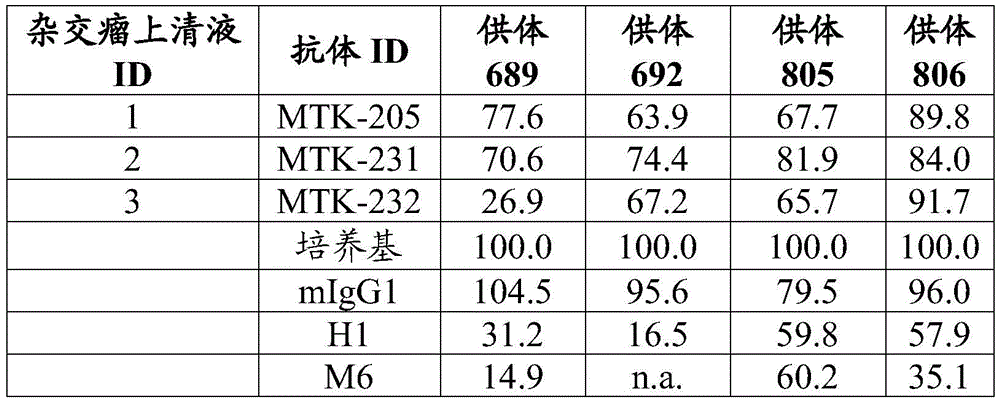
n.a. means that data is not available
TABLE 2

In tables 1 and 2, the percentages of cytocidal effect of human macrophages obtained from different donors are shown, in both tables the medium alone (without antibody added) being set to 100% cytocidal effect. Although the degree of cytocidal blocking (or non-blocking) activity of the hybridoma supernatants of the various anti-MerTK antibodies was different in macrophages obtained from each donor, the tendency of the anti-MerTK antibodies to block (or non-blocking) was consistent in macrophages from different donors. As shown in tables 1 and 2 above, the anti-MerTK hybridoma supernatants of the present disclosure exhibited lower ability to block or reduce the cytocidal effect of human macrophages than the observed ability of anti-MerTK antibody H1 and anti-MerTK antibody M6 (both inhibiting the cytocidal effect). These results indicate that certain anti-MerTK antibodies obtained as described herein are not effective in inhibiting or blocking the cytocidal effect of phagocytes.
Example 8: molecular cloning of anti-MerTK antibodies
Subcloning of anti-MerTK antibodies from the above hybridomas was performed as follows. Harvesting 5X10 5 The hybridoma cells were washed with PBS and then the cell pellet was frozen in dry ice and stored at-20 ℃. Total RNA was extracted by using the RNeasy Mini kit (QIAGEN, catalog number 74104) according to the manufacturer's protocol. cDNA was generated using the SMART RACE 5'/3' kit of Clontech (Takara Bio USA, catalog number 634859) according to the manufacturer's protocol. The variable heavy and light immunoglobulin regions were cloned separately by drop PCR (touchdown PCR) using the 5' UPM primers provided in the RACE kit and reverse primers that recognize the heavy and light constant regions. The resulting PCR product was purified and ligated into pCR2.1-TOPO cloning vector (TOPO TA cloning kit, invitrogen catalog number 450641) and transformed into E.coli (E.coli) cells. Transformed colonies were isolated and Variable Heavy (VH) and Variable Light (VL) nucleic acids of each respective hybridoma cell line were sequenced. After sequencing, primers containing endonuclease restriction sites are used The variable heavy and variable light chain regions were amplified by PCR and then subcloned into the pLEV-123 (LakePharma, san Carlos, calif.) mammalian expression vector encoding human IgG1-Fc and IgG kappa.
The amino acid sequences of the variable heavy and variable light chains of the anti-MerTK antibodies of the disclosure are provided in table 3 below. In Table 3, the CDR sequences (according to Kabat) are underlined.
TABLE 3 Table 3
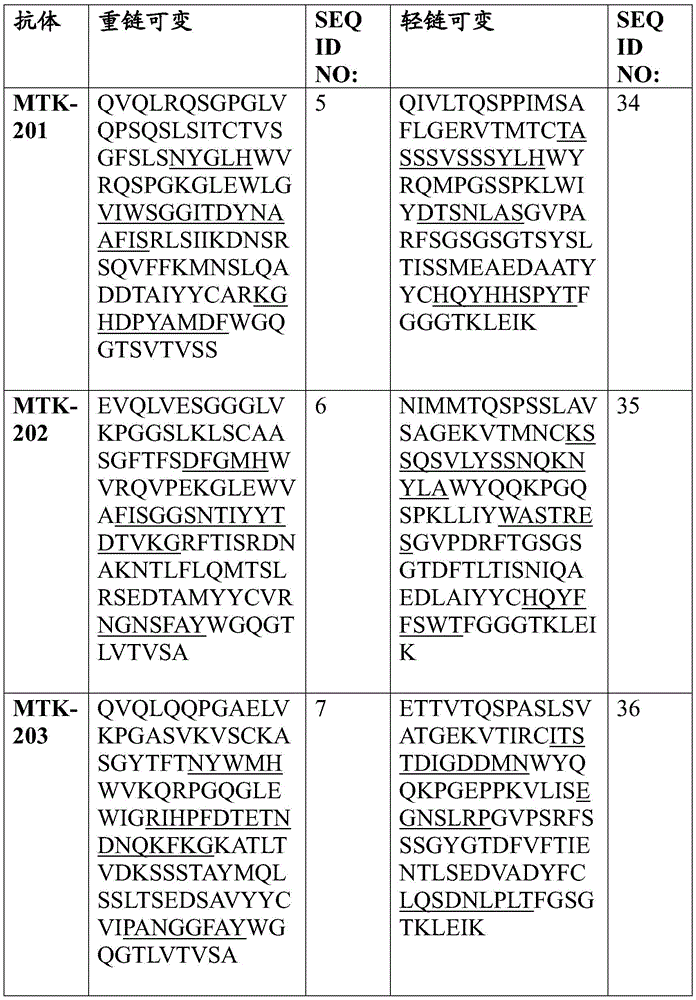
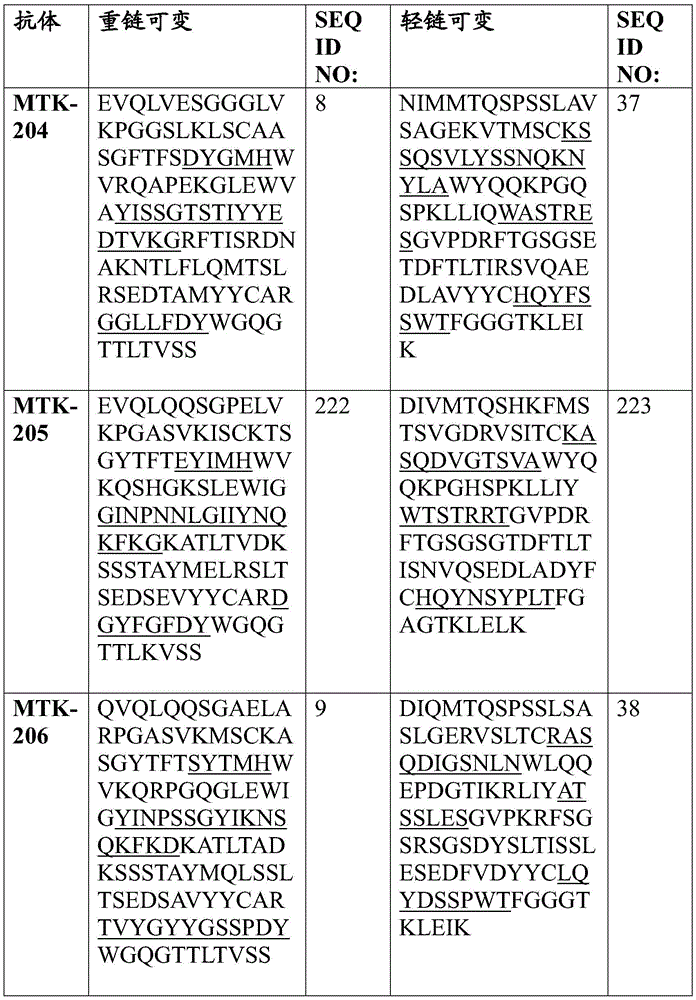
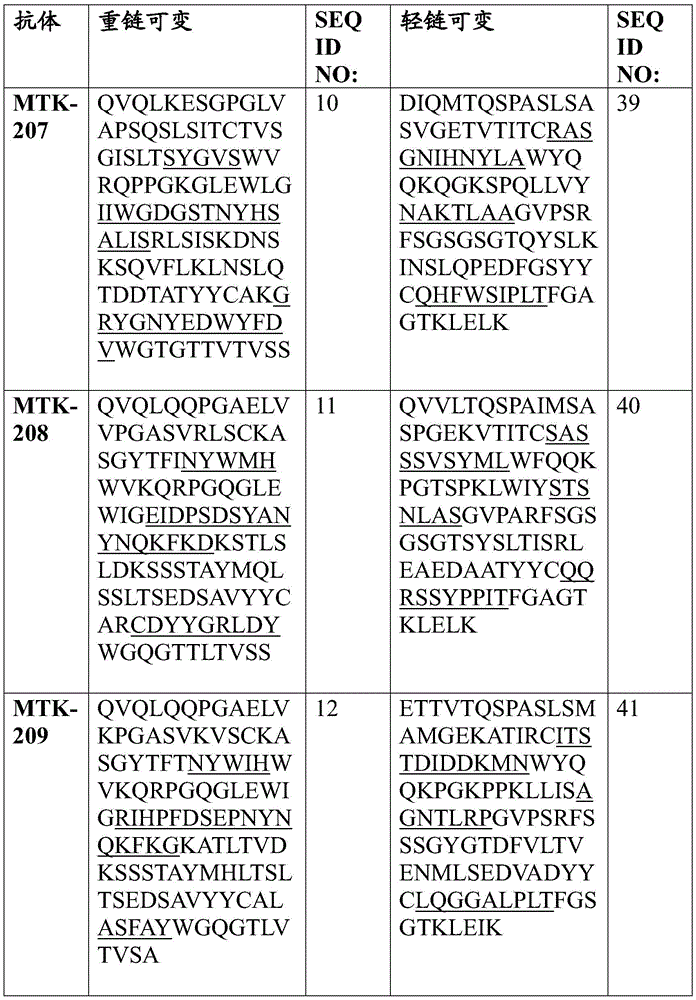


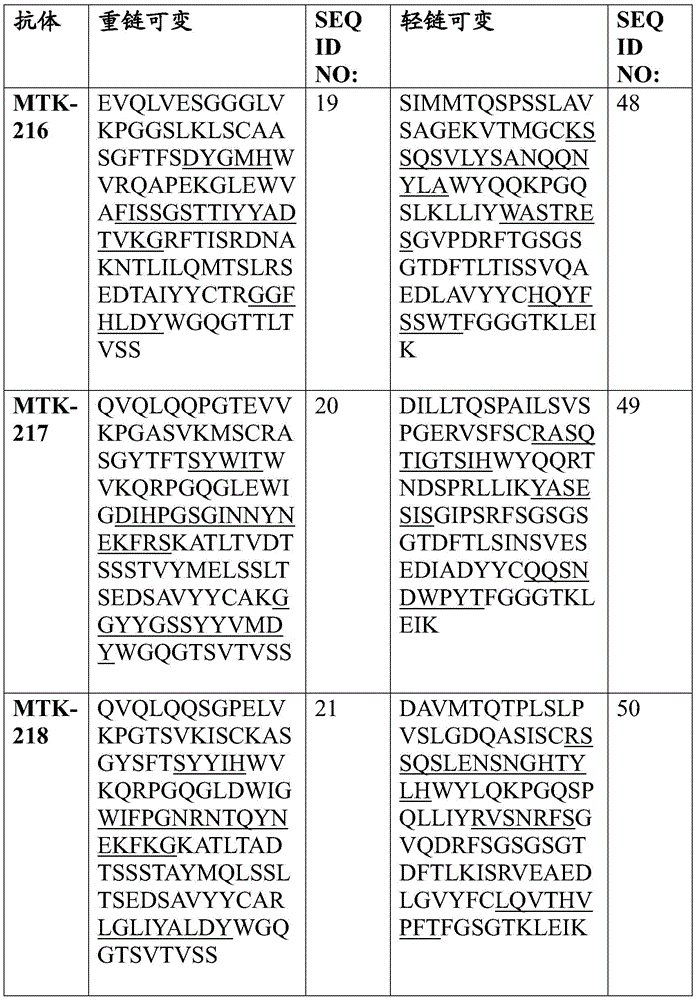

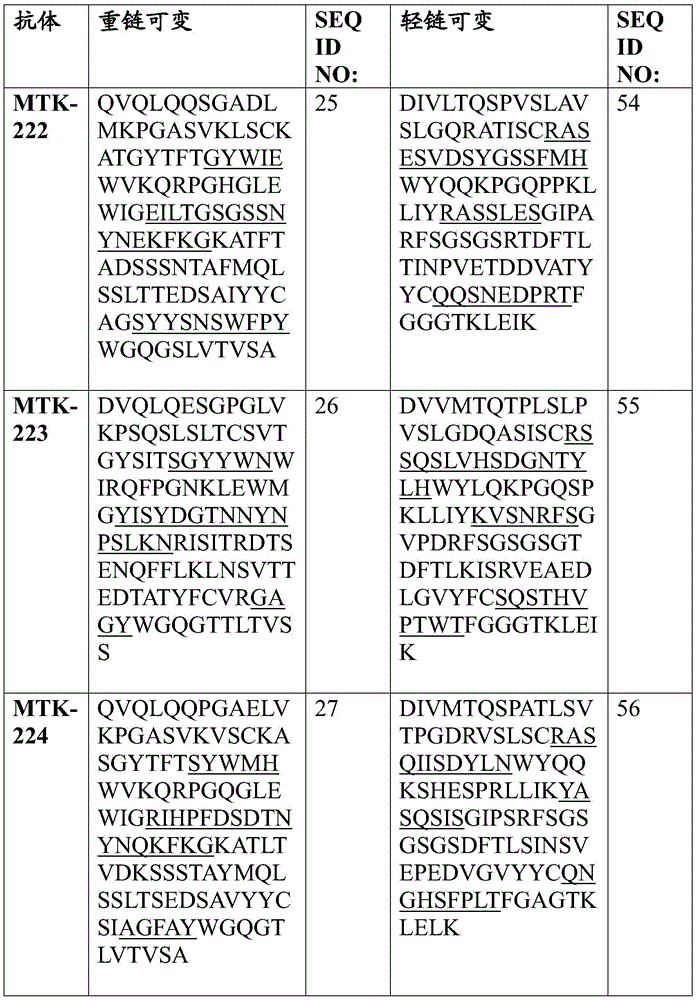
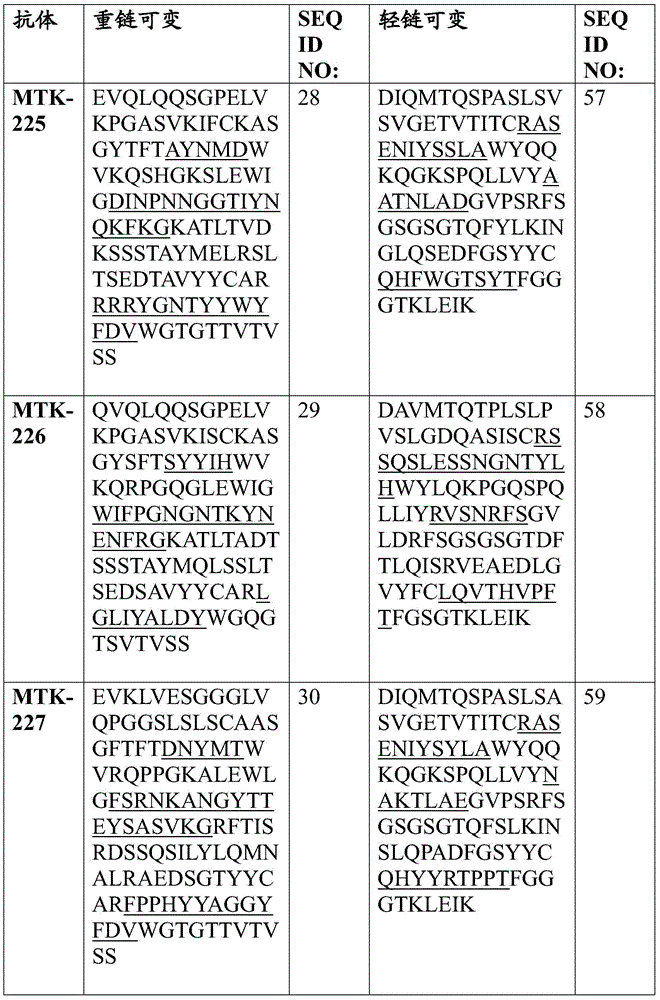
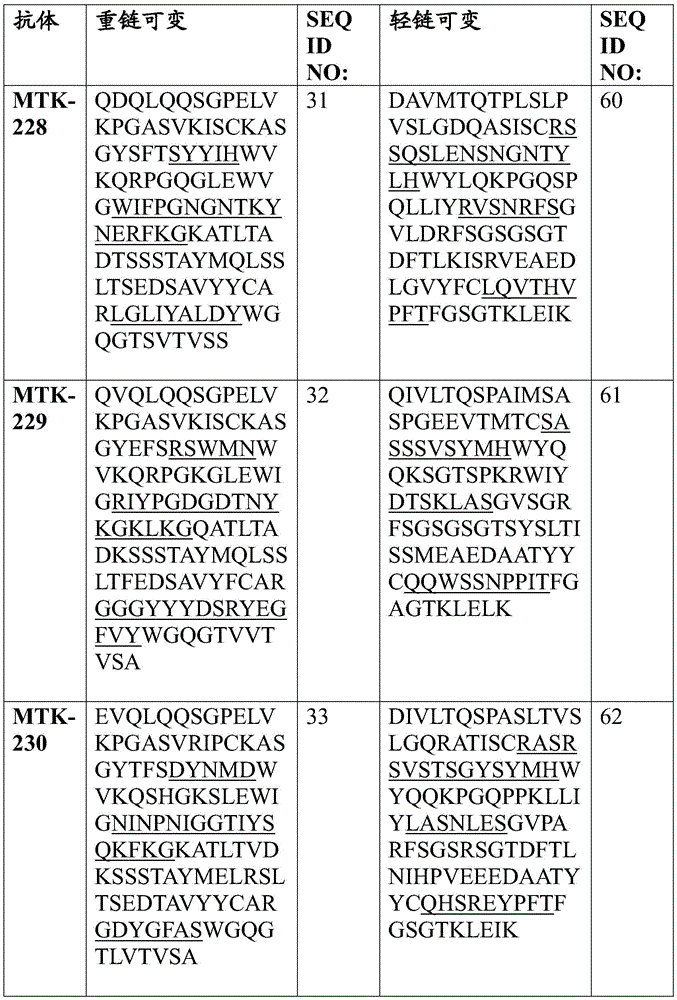
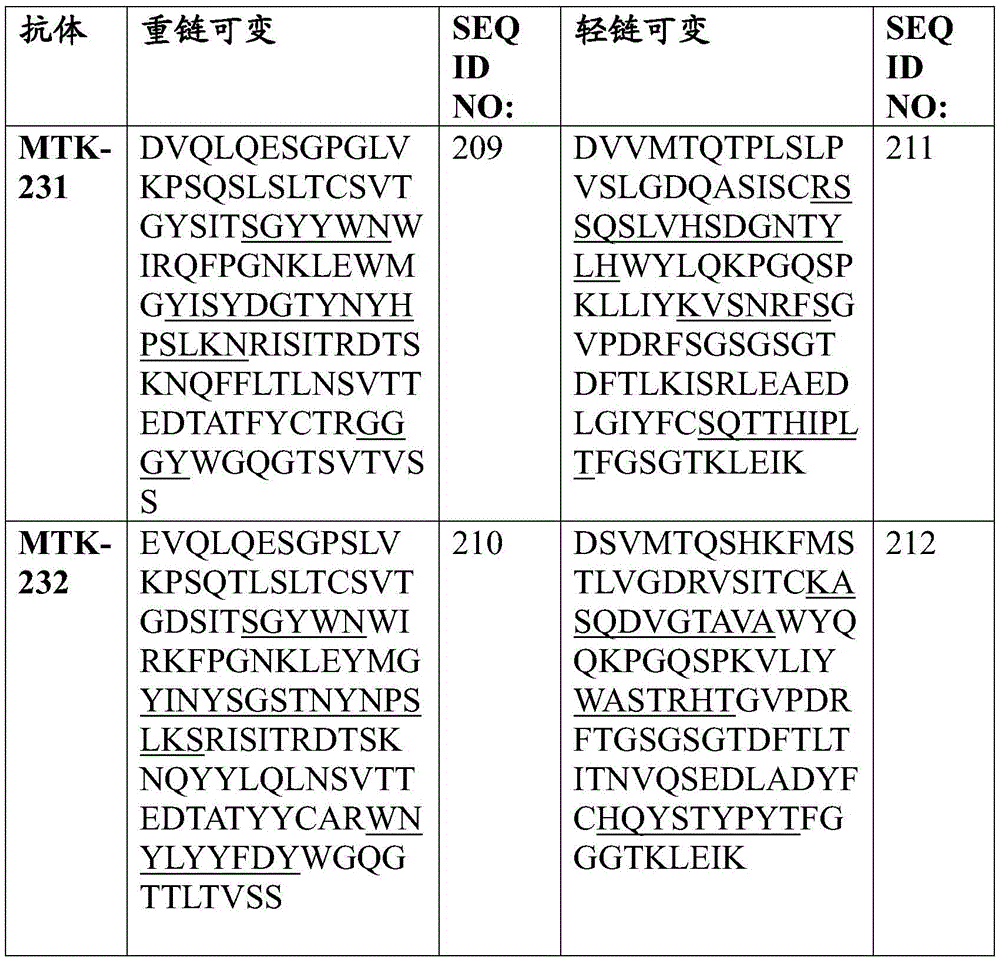
CDR sequences of the anti-MerTK antibodies of the present disclosure (according to Kabat) are provided in table 4 (heavy chain) and table 5 (light chain) below.
TABLE 4 Table 4


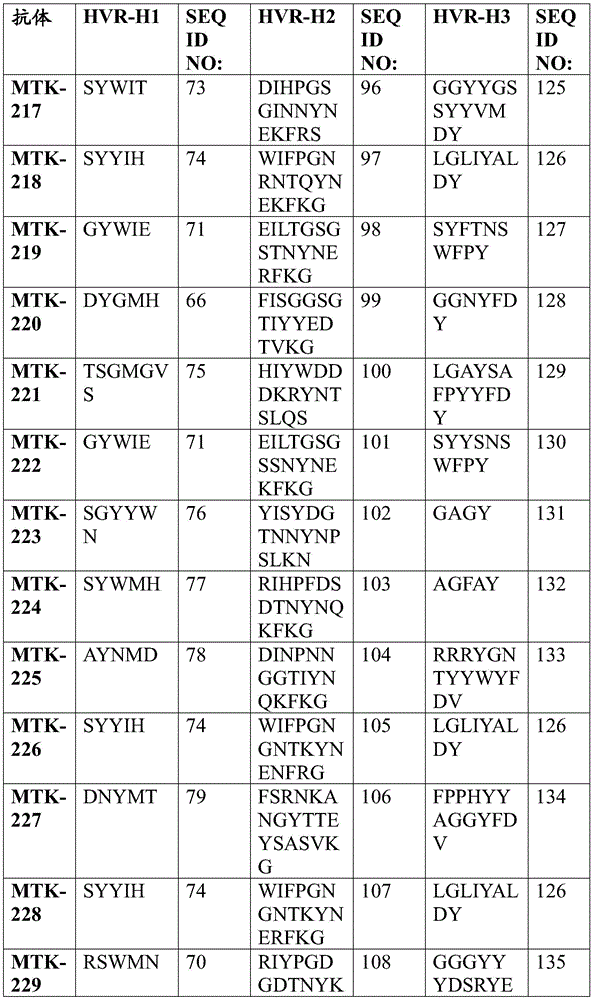
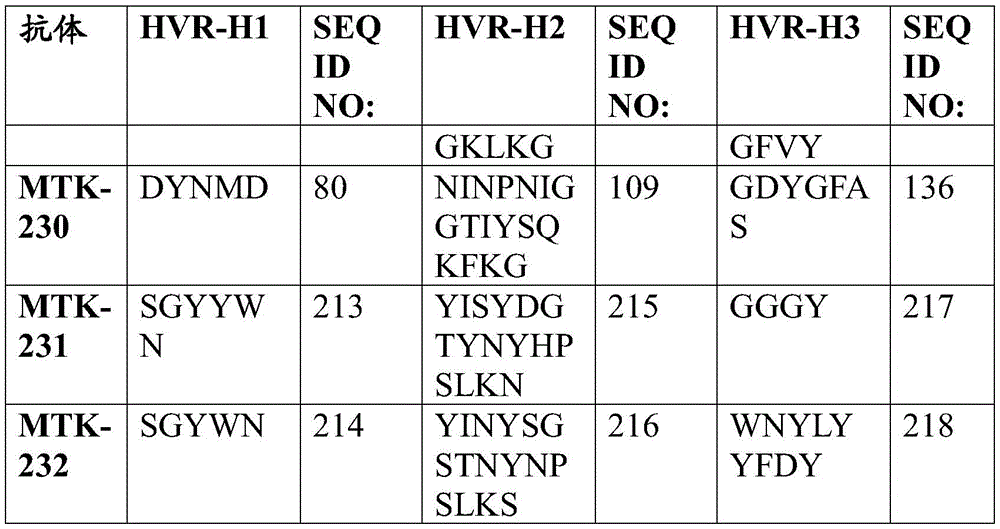
TABLE 5
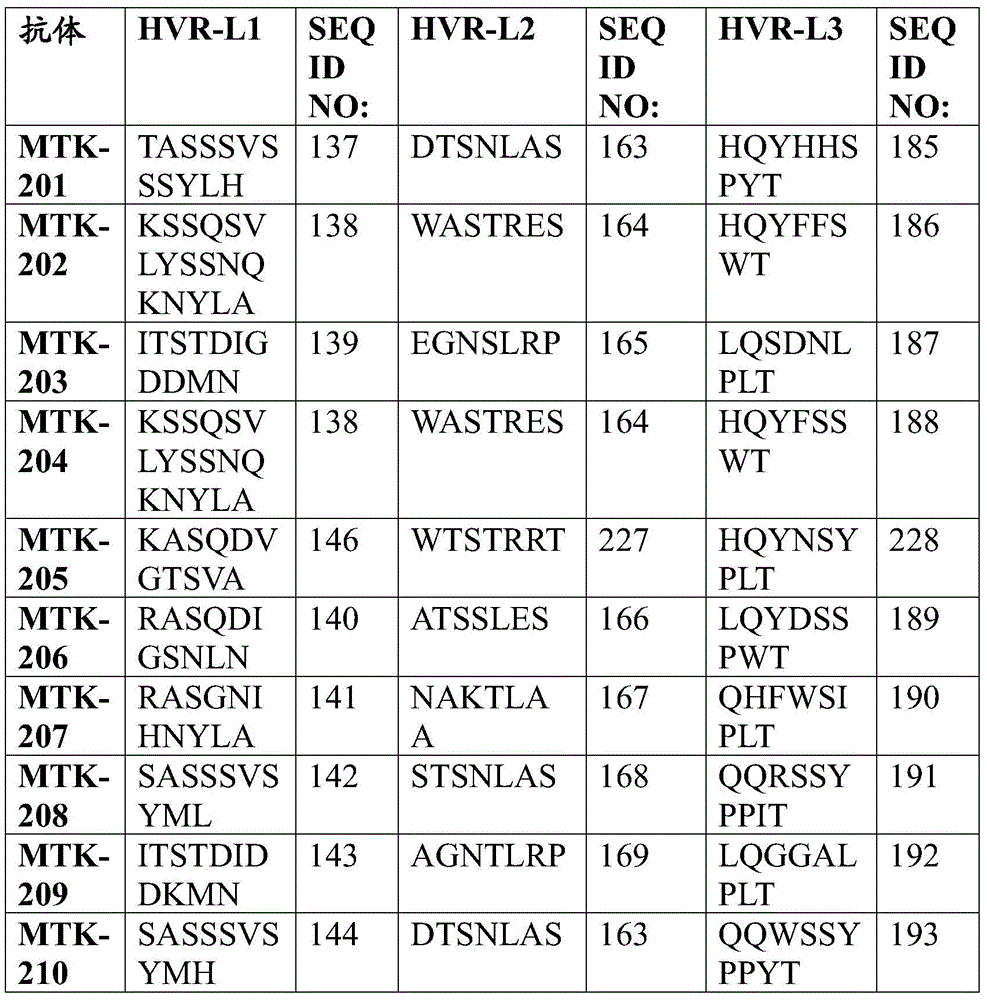


Example 9: production of anti-MerTK antibodies
anti-MerTK hybridoma clones were grown in serum-free hybridoma medium and the anti-MerTK antibodies in the supernatant were purified on a Hamilton STAR platform (Hamilton Company, reno, NV) using a protein a tip (Phynexus Inc, san Jose, CA). anti-MerTK antibodies were also generated by cloning the variable gene region obtained from the hybridoma directly into a recombinant expression plasmid to generate chimeric antibodies containing the human IgG1 Fc domain. Using Tuna293 TM And TunaCHO TM Process (LakePharma, san Carlos, calif.) proprietary HEK293 (Tuna 293) TM ) Or CHO-K1 (TunaCHO) TM ) The cells of origin were inoculated into shake flasks and amplified using serum-free chemistry-defined medium. Expression plasmids were transiently transfected into these cells and culture supernatants were harvested after 7 and 14 days. After clarification by centrifugation and filtration, the anti-MerTK antibodies in the supernatant were purified via protein a chromatography.
Example 10: binding of anti-MerTK antibodies to SK-MEL-5 cells, CHO-muMerTK OE cells and mouse macrophages
To determine whether the recombinant anti-human MerTK antibodies of the present disclosure bind to human MerTK expressed endogenously on SK-MEL-5 cells and CHO cells overexpressing mouse MerTK (CHO-muMerTK OE cells) as compared to a375 and parental CHO cells as negative controls, the following experiments were performed. SK-MEL-5 cells, A375 cells, CHO-mumerTK OE cells and CHO parental cells were seeded at 100,000 cells/well. anti-MerTK antibodies were added to cells at 10 μg/ml. After 60 minutes on ice, cells were washed and then stained with PE conjugated goat anti-human IgG antibody (Southern Biotech catalog No. 2040-09, birmingham, al) in the presence of Fc blocking solution on ice for 30 minutes, and then washed twice with cold FACS buffer (2% FBS in PBS). Mouse anti-human MerTK-PE conjugated antibody (Biolegend, clone 590H11G1E 3) or anti-mouse MerTK-PE conjugated antibody (ThermoFisher, clone DS5 MMER) was used as positive control. Stained cells were collected on a BD FACS Canto II cytometer and Mean Fluorescence Intensity (MFI) was calculated with FlowJo.
To confirm binding of anti-MerTK antibodies to endogenous murine MerTK, bone Marrow Derived Macrophages (BMDM) were isolated from MerTK wild-type (WT) and knock-out (KO) mice (The Jackson Laboratory, catalog No. 011122) using standard protocols. Briefly, cells isolated from bone marrow were seeded in the presence of 50ng/ML M-CSF (R & D Systems, catalog number 416-ML) for 7 days to differentiate into macrophages. Cell staining, FAC and MFI were performed and calculated as described above.
Table 6 below shows the MFI values from FACS analysis of anti-merTK antibodies binding to SK-MEL-5 cells, A375 cells, CHO-mumerTK-OE cells, CHO parent cells and BMDM cells from merTK WT mice (the extent of binding/MFI obtained with BMDM cells from merTK WT mice minus binding/MFI obtained with BMDM cells from merTK KO mice).
TABLE 6

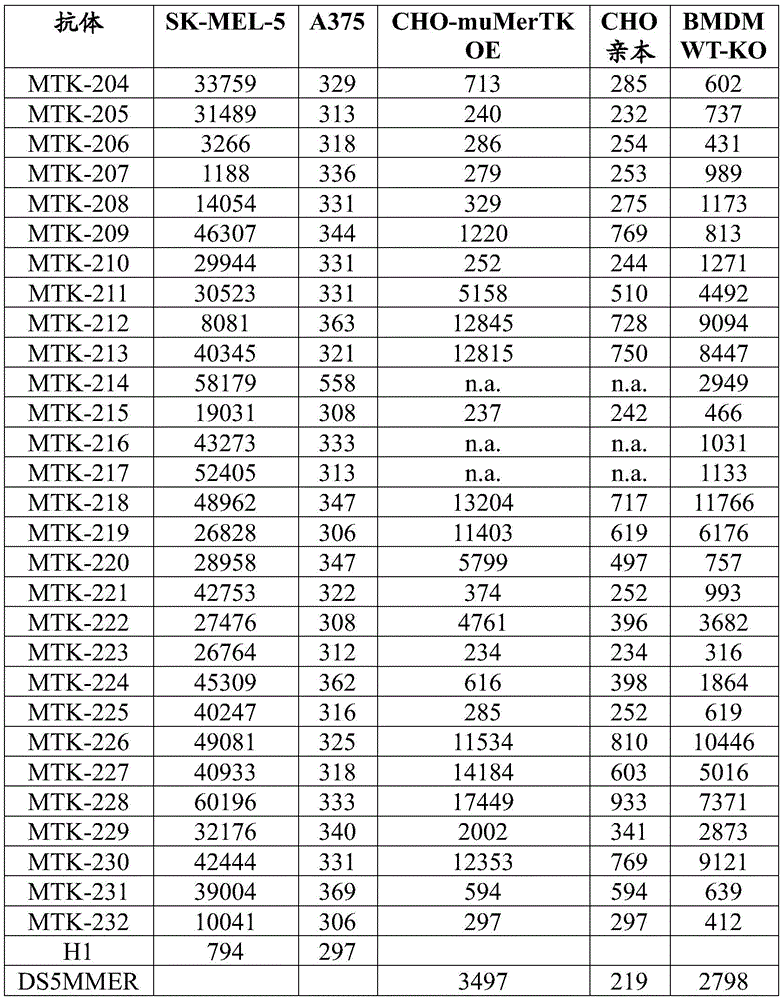
n.a. means that data is not available
Recombinant anti-MerTK antibodies bind to SK-MEL-5 cells, indicating that the anti-MerTK antibodies bind to human MerTK. Twelve recombinant anti-MerTK antibodies showed strong to moderate binding of CHO-muMerTK overexpressing cells to BMDM, indicating that the anti-MerTK antibodies bound to mouse MerTK.
Example 11: anti-MerTK antibodies blocking binding of ligand Gas6 and ligand ProS to MerTK
To determine anti-MerTK antibodies that do not inhibit the ability of Gas6 and/or ProS ligands to bind to human MerTK, ligand blocking assays were performed as described above. The anti-MerTK antibody was titrated to a final concentration of 66.6nM to 4pM and tested against the anti-human MerTK antibody M6 (disclosed in WO 2016/106221) or isotype control antibody.
Table 7 shows the binding of Gas6 and ProS to human merTK at the highest antibody concentration tested in these studies (66.6 nM); the data are presented as the percentage of binding of Gas6 to MerTK and the percentage of binding of ProS to human MerTK compared to the ligand binding extent (set to 100% binding) of isotype control huIgG1 antibody.
The anti-MerTK antibodies of the present disclosure do not inhibit (i.e., do not block) the binding of Gas6 to human MerTK, as shown in table 7 below. Most anti-MerTK antibodies of the present disclosure do not block the binding of ProS ligands to human MerTK. Furthermore, the anti-MerTK antibodies MTK-202, MTK-212, MTK-213, MTK-220, MTK-223 and MTK-230 exhibited moderate inhibition (> 30% inhibition) of ligand binding to MerTK in this assay. As shown, the anti-MerTK antibody M6 very effectively blocked the binding of Gas6 and ProS to human MerTK with a ligand binding blocking degree of more than 90%. As also shown in table 7, certain anti-MerTK antibodies of the present disclosure appear to enhance binding of Gas6 and/or ProS to MerTK.
TABLE 7
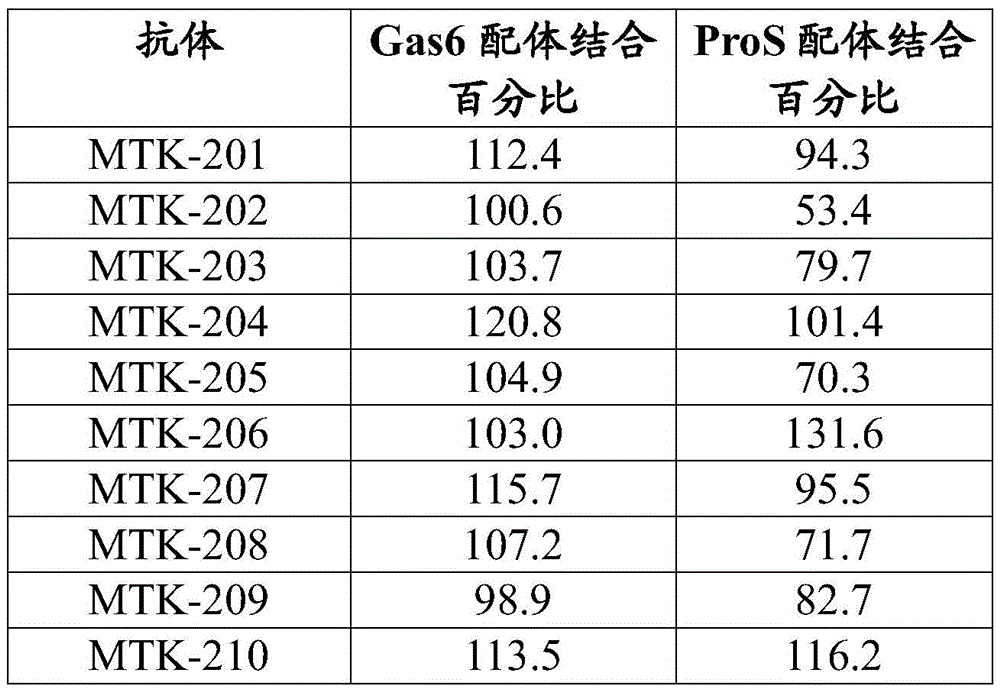
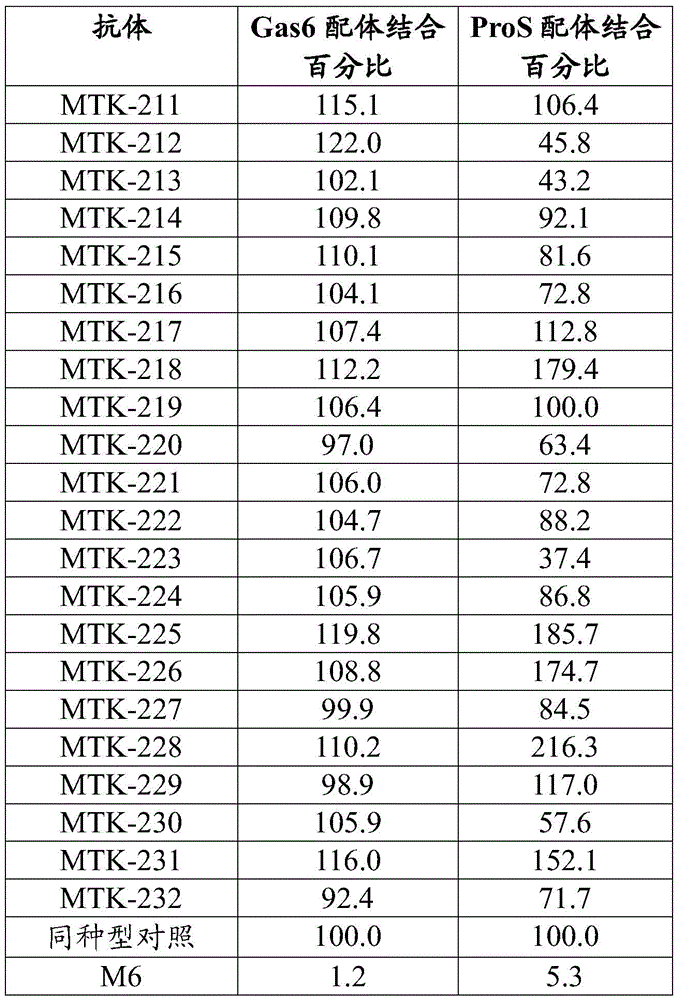
Example 12: direct anti-MerTK antibody binding of Gas6 and ProS ligands
To identify anti-MerTK antibodies that directly bind Gas6 or ProS, a binding assay was performed as follows. Briefly, rabbit anti-human IgG antibodies (Jackson ImmunoResearch, catalog No. 309-005-008) were coated at 2 μg/ml on high protein binding plates overnight at 4 ℃. After three washes with 0.05% Tween20 in PBS, 5% BSA in PBS was added for 1 hour. 2. Mu.g/ml of recombinant human MerTK-human Fc chimeric protein (R&D systems, catalog number 391-MR-100) or anti-MerTK antibodies of the disclosure last 1 hour and the plates were washed, then 1.5 μg/ml His tag conjugated recombinant Gas6 (R &D systems, catalog number 885-GSB-050) or 10 μg/ml His tag conjugated recombinant ProS (R&D systems, catalog number 9489-PS-100). After further incubation for 1 hour, plates were washed and HRP conjugated with anti-6 x His-tag antibody (Abcam, cambridge, MA, cat# ab 1187) oneIncubation was performed for 1 hour. The plates were then washed and HRP substrate TMB was added to develop the plates. By adding 50 μl of 2N H 2 SO 4 The reaction was stopped and OD was measured using a spectrophotometer (BioTek).
The ability of 32 antibodies to bind either or both Gas6 and ProS ligands was tested in the absence of MerTK, only the anti-MerTK antibody MTK-231 was able to bind strongly to both ligands. In addition, the anti-MerTK antibodies MTK-207, MTK-211, MTK-213, MTK-214, MTK-224 and MTK-232 showed little to moderate ProS ligand binding. These results indicate that certain anti-MerTK antibodies of the present disclosure have additional properties to bind MerTK and its ligand or ligands.
Example 13: modulation of MerTK tyrosine phosphorylation
The effect of anti-MerTK antibodies on MerTK tyrosine phosphorylation (p-MerTK) in myeloid cells was examined as follows. To produce monocyte-derived macrophages, human primary monocytes were isolated from heparinized human blood (Blood Centers of the Pacific) using rosetteep human monocyte enriched mix (STEMCELL Technologies) according to the manufacturer's protocol. Monocytes were inoculated into RPMI (Invitrogen) containing 10% fetal bovine serum (Hyclone) and 50ng/mL M-CSF (Biolegend) to induce macrophage differentiation. After 6 days, macrophages were harvested by removal of the medium, incubated with 3mM EDTA for 5 minutes at 37℃and subsequently scraped. Then the macrophages are treated with 0.1x10 6 Wells were seeded on 96-well plates and incubated with 50ng/mL M-CSF (Biolegend), 100nM dexamethasone (Tocres), 50ng/mL human Tgfβ (R)&D Systems) and 20ng/mL IL-10 (Pepro Tech). After two days (about 48 hours), cells were treated with anti-MerTK antibodies by: the medium was removed from the cells and 10 μg/mL of anti-MerTK antibody in PBS was added and the cells were incubated at 37 ℃ for 8 min. Cells were then harvested by removal of the treatment antibody, washed once with ice-cold PBS, and lysed with 150 μl ice-cold 1X lysis buffer (Cell Signaling Technology). The 96-well plates were incubated in lysis buffer at 4 ℃ for 30 minutes on a shaker. The plates were then cleared of cell debris by centrifugation at 4,300Xg for 10 minutes at 4 ℃. The supernatant was collected for phospho-Mer (panTy)r) ELISA (Cell Signaling Technology) and BCA (ThermoFisher Scientific). The lysates were then processed according to the manufacturer's instructions and p-MerTK water was normalized to total protein levels.
As tested in this assay, many anti-MerTK antibodies of the present disclosure were able to induce p-MerTK (see figure 1). The anti-MerTK antibodies showed significantly increased p-MerTK levels (as indicated by the lower dashed line in fig. 1, using the one-way ANOVA Tukey multiple comparison test) compared to the levels observed in isotype control huIgG1 antibody treated cells, equal to or higher than the mean standard error (indicated by the upper dotted line in fig. 1). Isotype control huIgG1 antibody was set to a value of 1. N=4, each N is a celebrity donor.
These results show that the anti-MerTK antibodies of the present disclosure agonize MerTK activity at least in part by inducing or increasing phosphorylation of MerTK.
Example 14: binding kinetics of anti-MerTK antibodies
The binding kinetics of the anti-MerTK IgG1 antibodies of the present disclosure to human, cyno and murine MerTK were assessed using a cartera LSA instrument (cartera, salt Lake City, UT). Briefly, anti-MerTK antibodies were prepared by dilution 50, 250 and 500-fold in 10mM acetate pH 4.25 (cartera), resulting in final concentrations ranging from 1 to 113 μg/ml. HC200M sensor chips (Carterra) were activated using a single channel flow cell with 7 minute injection of a 1:1:1 mixture of 100mM MES pH 5.5, 100mM sulfo-NHS, 400mM EDC (both reconstituted in MES pH 5.5; 100. Mu.l each material was mixed in vials just prior to running the assay). After switching to the multi-channel array flow cell, these antibodies were injected on activated chips in three 96-point arrays, each for 10 minutes. The remaining unbound active groups on the chip were then blocked by injecting 1M ethanolamine pH 8.5 (cartera) for 7 minutes using a single channel flow cell. The resulting sensor chip contained three spots of each antibody, at three different densities. Two independent experiments were performed as follows, resulting in 1 to 6 determinations of N for each antibody. Points that produced less than 25RU analyte binding were excluded from further analysis.
After priming with running buffer (HBS-TE, cartera) with 0.5mg/ml BSA (Sigma), the immobilized anti-MerTK antibodies were tested for their ability to bind to various forms of recombinant MerTK extracellular domains, including human, cynomolgus monkey and mouse orthologs as described above. Estimates of affinity were generated by injecting each analyte over the entire antibody array using a single channel flow cell. MerTK analytes were diluted with running buffer, in a series of six triplicate serial dilutions, human and cynomolgus MerTK started at 1 μm, and mouse MerTK started at 600 nM. The analyte was injected for 5 minutes and then dissociated for 10 minutes. After each analyte injection, the antibodies were regenerated with protein A/G elution buffer (Thermo) with 1M NaCl (Teknova) or 10mM glycine pH 2.5. Three buffer blanks (one species per series) were run between each series. Data were processed and analyzed using NextGenKIT high throughput kinetic analysis software (cartera).
From the fitted association and dissociation rate constants (K-association and K-dissociation, respectively) of each anti-MerTK antibody tested, the equilibrium dissociation constant (K D ). These values were combined, mean and standard deviation calculated, and a chart was made using GraphPad Prism. K (K) D The values are summarized in table 8 below. See also fig. 2.
TABLE 8

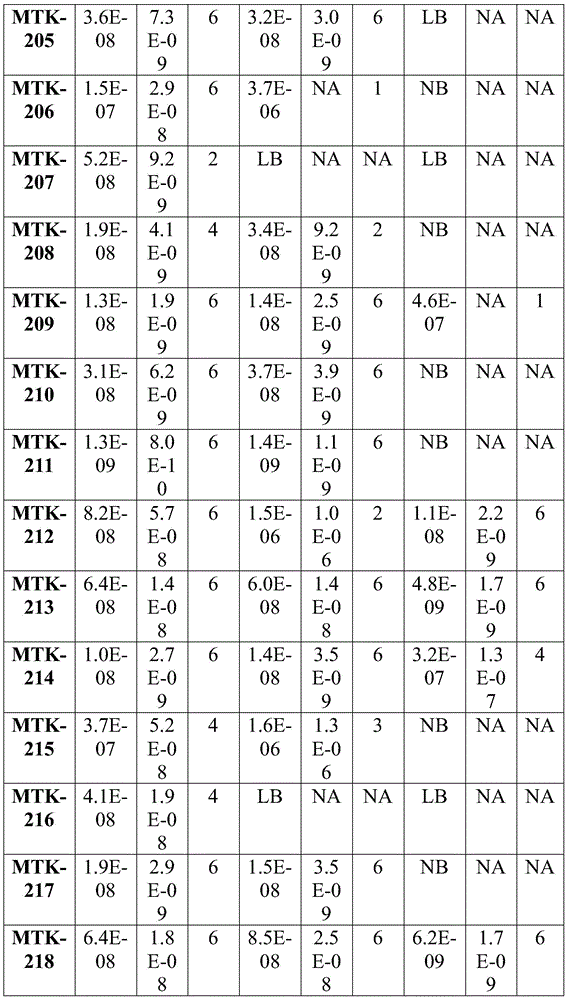
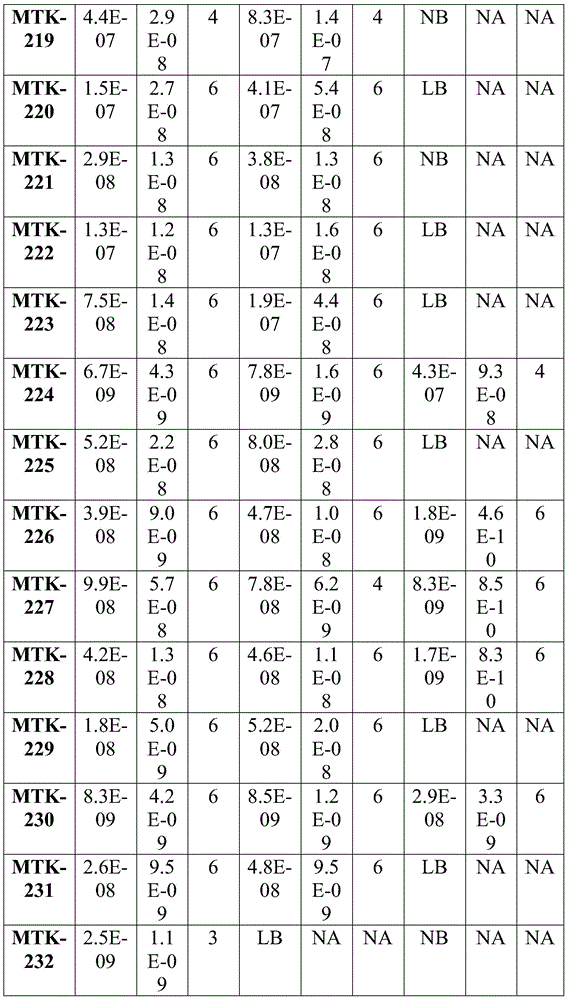
N=number of measurements; NT = no test; NA = inapplicable; LB = low binding (below measurement limit); NB = no binding detected.
These results demonstrate that the anti-MerTK antibodies of the present disclosure exhibit a range of binding affinities to MerTK of about 1nM to 4 μm. Furthermore, these results show that the anti-MerTK antibodies of the present disclosure exhibit a range of species binding specificities within this range of binding affinities, including human specificity, human and cynomolgus monkey cross-reactivity alone, or human, cynomolgus monkey and mouse cross-reactivity. In particular, the affinity of the anti-MerTK antibodies of the present disclosure to bind to human MerTK is in the range of about 1.3nM to 440 nM; the affinity of the anti-MerTK antibodies of the present disclosure to bind to cynomolgus MerTK is in the range of 1.4nM to 3.6 μm; and the anti-MerTK antibodies of the present disclosure bind to murine MerTK with an affinity in the range of 1.7nM to 460 nM.
Example 15: cross-reactivity of anti-MerTK antibodies to human, cyno and mouse MerTK
Species cross-reactivity of the anti-MerTK antibodies of the present disclosure was determined from the above-described binding kinetics analysis data. The results of the species binding cross-reactivity analysis of the anti-MerTK antibodies of the present disclosure are summarized in table 9 below.
TABLE 9

The relative intensities of binding to human MerTK observed for anti-MerTK antibodies compared to binding to cynomolgus monkey and mouse MerTK are summarized in table 10 below. It should be noted that higher KD values indicate lower binding affinities.
Table 10
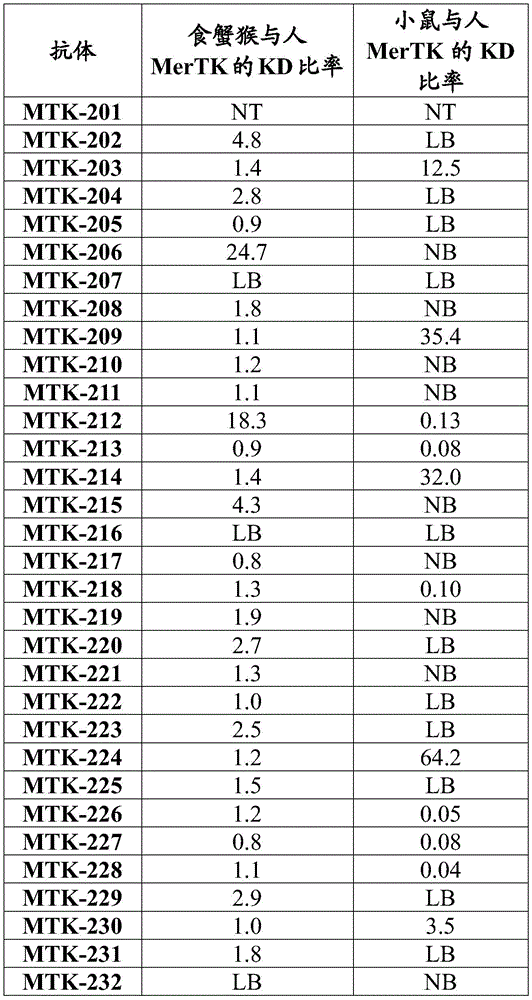
NT = no test; LB = low binding (below measurement limit); NB = no binding detected
The results of these binding experiments showed that the three anti-MerTK antibodies of the present disclosure only exhibited strong preference for binding to human MerTK (and did not show binding to cynomolgus monkey or mouse MerTK in a quantifiable range); these antibodies are the anti-MerTK antibodies MTK-207, MTK-216 and MTK-232.
Most anti-MerTK antibodies of the present disclosure show binding cross-reactivity with both human and cynomolgus MerTK; these antibodies are anti-MerTK antibodies MTK-202, MTK-204, MTK-205, MTK-206, MTK-208, MTK-210, MTK-211, MTK-215, MTK-217, MTK-219, MTK-220, MTK-221, MTK-222, MTK-223, MTK-225, MTK-229, and MTK-231. Of these anti-MerTK antibodies, six antibodies showed a 2-fold weak preference for human MerTK compared to 5-fold for cynomolgus MerTK (anti-MerTK antibodies MTK-202, MTK-204, MTK-215, MTK-220, MTK-223 and MTK-229), and six antibodies showed a 24-fold and 18-fold medium preference for human MerTK compared to cynomolgus MerTK (anti-MerTK MTK-206 and MTK-212, respectively).
Eleven anti-MerTK antibodies of the present disclosure exhibit cross-reactivity to all three species tested (human, cynomolgus monkey and mouse); there are anti-merTK antibodies merTK (MTK-203, MTK-209, MTK-212, MTK-213, MTK-214, MTK-218, MTK-224, MTK-226, MTK-227, MTK-228 and MTK-230). Among the mouse cross-reactive antibodies, one antibody showed 3.5-fold weaker preference for human MerTK over mouse MerTK (anti-MerTK antibody MTK-230), and three antibodies showed 12.5, 35.4, and 64.2-fold medium preference for human versus mouse MerTK binding (anti-MerTK antibodies MTK-203, MTK-209, and MTK-224). Six antibodies showed a moderate preference for human MerTK over mouse MerTK, with a relative binding range of 5 to 30 fold (anti-MerTK antibodies MTK-212, MTK-213, MTK-218, MTK-226, MTK-227 and MTK-228).
Example 16: epitope binning analysis of anti-MerTK antibodies
Epitope binning analysis was performed on the anti-MerTK antibodies of the present disclosure by performing a serial injection assay using a cartera LSA instrument (cartera, salt Lake City, UT). Briefly, the chip used for the kinetic assessment described above was then tested in a binning assay, in which the immobilized antibodies were tested for their ability to form sandwich pairs with the recombinant human MerTK extracellular domain and injected antibodies. In each cycle, 100nM MerTK was injected on the chip for 5 min, followed by 5 min of test antibody (diluted to 30. Mu.g/ml in running buffer), followed by two 30 seconds of 10mM glycine pH2.5 (Carterra) injections for regeneration. Epitope high throughput binning analysis software (cartera) was used to process and analyze the data. Antibodies capable of binding to an antigen captured by an immobilized antibody are referred to as "sandwich" or "paired" antibodies, and these antibodies are assigned to a different epitope bin than that of the immobilized antibody. From the binding results of these experiments a matrix of paired and unpaired antibodies was constructed, which allowed the generation of epitope-cartridge landscape of anti-MerTK antibodies. Some antibodies have overlapping binning patterns, indicating that they can recognize adjacent but not fully overlapping epitopes. Slight heterogeneity within a bin is indicated by the addition of letters a, b, c and d in the bin name. For antibodies that appear to overlap with two epitope bins, bin numbers are underlined to indicate overlapping bins. The epitope bins determined by this assay are summarized in table 11 below.
TABLE 11
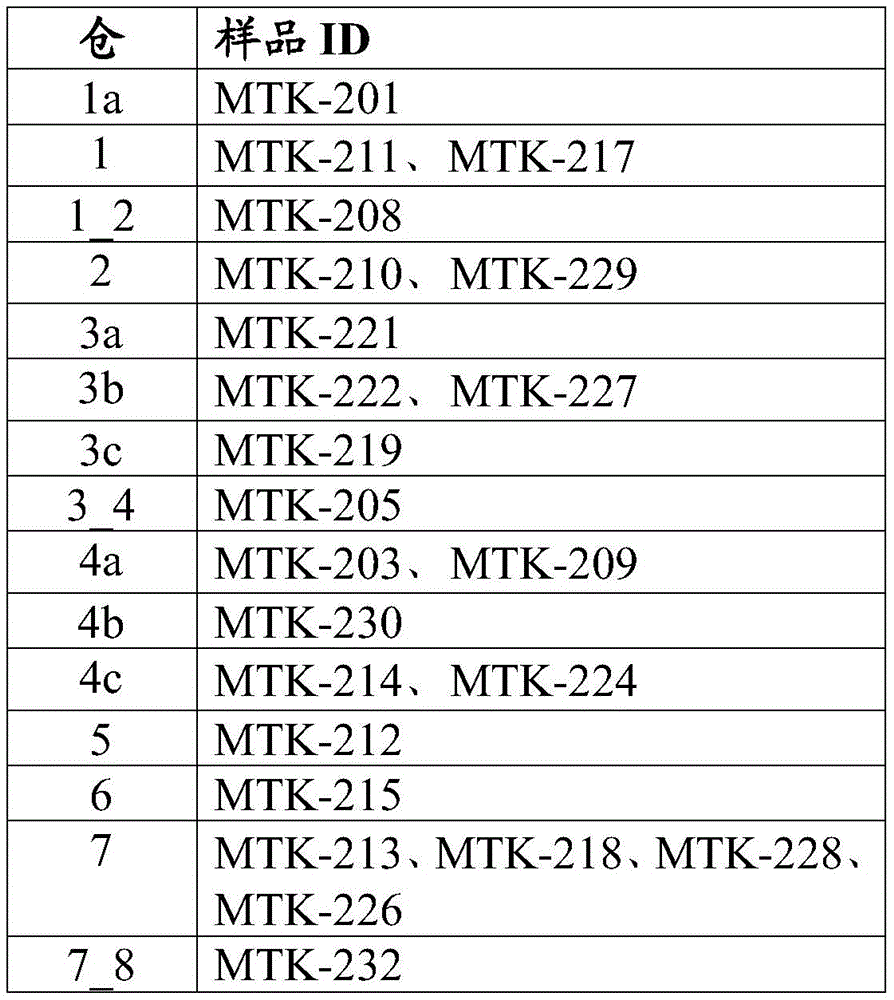
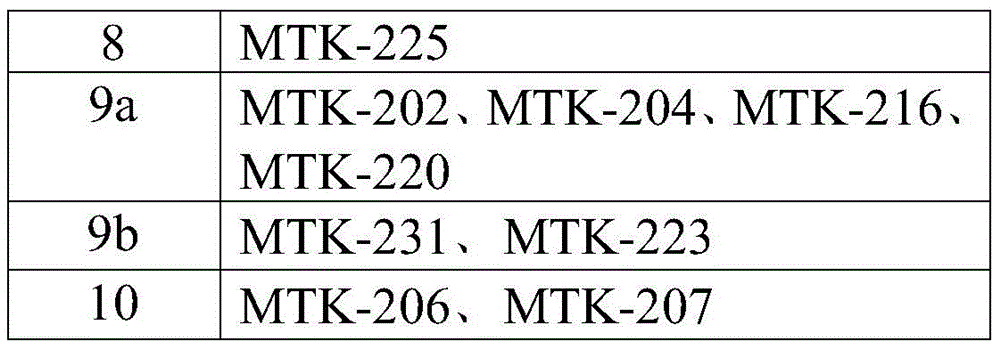
As part of the epitope binning experiments described herein, additional studies were performed to investigate the ability of Gas6 and ProS to bind to MerTK captured by immobilized anti-MerTK antibodies. anti-MerTK antibodies that do not block binding of the two ligands are expected to show sandwich pairing, whereas anti-MerTK antibodies that block Gas6 and/or ProS do not form binding pairs. The results of this analysis are shown in table 12 below.
As assessed by this assay, the twenty-two anti-MerTK antibodies of the present disclosure were paired with Gas6 but not ProS. These results are consistent with the experimental results above, showing that the anti-MerTK antibody is only a ProS blocker; MTK-202, MTK-203, MTK-205, MTK-206, MTK-207, MTK-213, MTK-214, MTK-215, MTK-218, MTK-219, MTK-220, MTK-221, MTK-222, MTK-223, MTK-224, MTK-225, MTK-227, MTK-228, MTK-229, MTK-230, and MTK-232. Four anti-MerTK antibodies were paired with both Gas6 and ProS, which were consistent with non-blocking agents (MTK-208, MTK-212, MTK-216 and MTK-231). Five anti-MerTK antibodies were not paired with either Gas6 and ProS, which was consistent with dual blockers (MTK-209, MTK-210, MTK-211, MTK-217, and MTK-226). It should be noted that the lack of pairing of antibodies with Gas6 or ProS is suggestive, but may not completely predict functional blockade, as this property will also depend on the relative kinetics and concentration of antibody and ligand binding to the native receptor on the cell.
Table 12
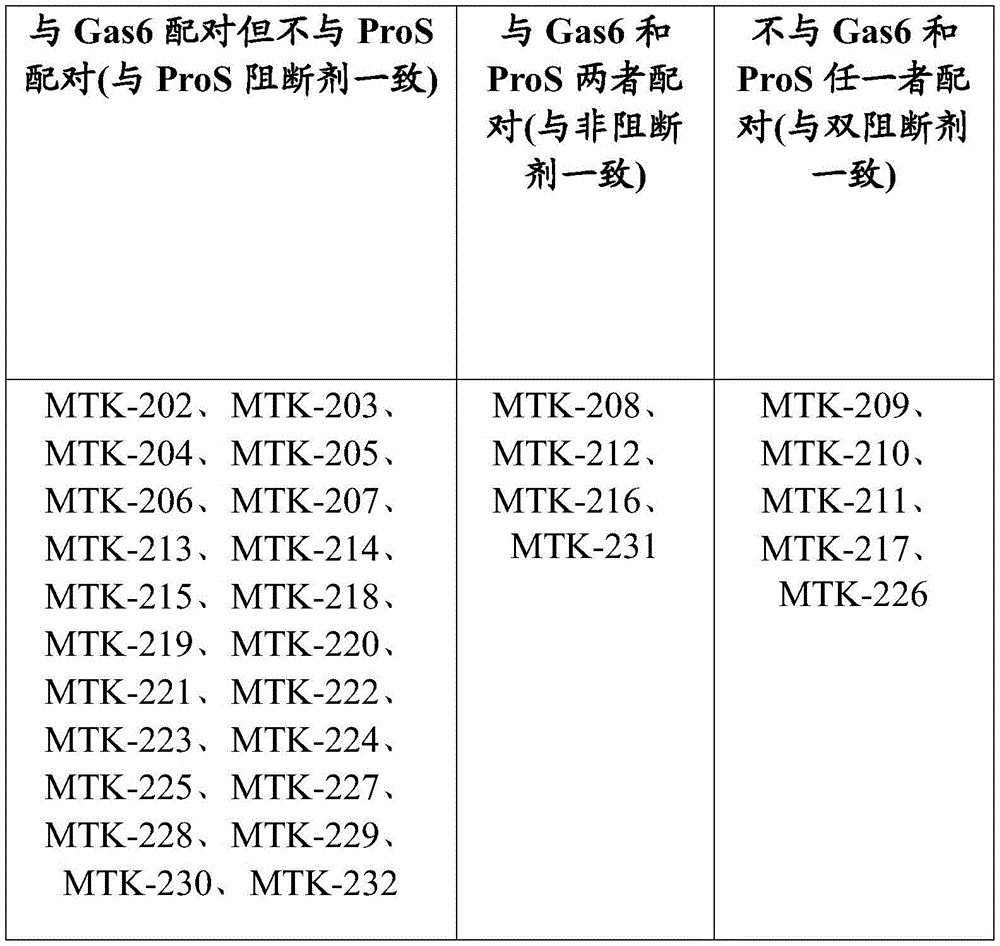
Example 17: effect of anti-merTK antibodies on MCP-1 production
Monocyte chemotactic protein 1 (MCP-1) recruits immune cells to the site of injury. In the demyelinated mouse EAE model, the absence of MCP-1 may protect the mouse from disease progression, since inflammatory immune cells are not recruited to the site of injury due to the absence of MCP-1 and the associated inflammatory response.
The effect of the anti-MerTK antibodies of the present disclosure on chemokine MCP-1 production was determined as follows. Human primary monocytes were isolated from peripheral blood monocytes using a human monocyte isolation kit (STEMCELL Technologies) according to the manufacturer's instructions. Monocytes differentiated for 6 days to macrophages in RPMI1640 (Gibco) supplemented with 2% hepes (Life technologies), 2% Glutamax (Life technologies), 2% penicillin/streptomycin (Life technologies), 2% sodium pyruvate (Life technologies), 2% non-essential amino acids (Life technologies), 10% heat inactivated fetal bovine serum (HyClone), 8% human serum AB (Sigma) and 50ng/ml macrophage colony stimulating factor (M-CSF, R & D Systems). Macrophages were collected by removal of the medium, washed with PBS, followed by incubation in PBS containing 3mM EDTA for 5 minutes at 37 ℃, after which the cells were scraped for removal. Cells were counted and seeded at 50,000 cells/well in 100 μl of medium in 96-well flat bottom dishes. Cells were polarized to the M2c macrophage phenotype in the same basal medium as used for differentiation (but serum and M-CSF were omitted). Basal medium was supplemented with 50ng/ml transforming growth factor beta (TGF-. Beta., peprotech), 20ng/ml interleukin-10 (IL-10, peprotech), 100nM dexamethasone (Tocres) and anti-merTK antibody (10. Mu.g/ml) for two days. In some cases, the cells are incubated in the presence of MerTK ligand ProS (100 nM recombinant human protein S) during polarization.
Apoptotic cells can activate MerTK expressed on M2c macrophages by interaction with endogenous ligands (e.g., gas6, proS) associated with the apoptotic cells. In a parallel study aimed at examining the effect of anti-MerTK antibodies of the present disclosure on increasing MCP-1 levels in M2c cells activated simultaneously via the presence of apoptotic cells, macrophages were polarized to M2c macrophage phenotype in the presence of apoptotic Jurkat cells generated by overnight culture in RPMI1640 (Gibco) supplemented with 10% fetal bovine serum (HyClone), 1% penicillin/streptomycin (Life technologies) and 0.5 μm staurosporine (R & D Systems). After two days, cell supernatants were collected. The concentration of MCP-1 in the supernatant was measured using the U-PLEX human MCP-1 assay (MesoScale Diagnostics).
FIG. 3A shows the MCP-1 levels in the supernatant normalized to those observed in cells treated with hIgG1 isotype control antibody in the absence of merTK ligand ProS. The values in FIG. 3A are plotted on a log2 scale, so the value of doubling the MCP-1 concentration compared to the isotype is 1, while the value of halving the analyte concentration is-1. The recombinant MerTK ligand ProS alone induced an increase in MCP-1 production. As shown in fig. 3A, the anti-MerTK antibodies of the present disclosure induced an increase in MCP-1 production, whereas the addition of MerTK ligand ProS did not further enhance this increase. However, in this set of experiments, the anti-MerTK antibody MTK-231 appears to require a ProS ligand to show increased MCP-1 levels, as measured using this particular assay.
FIG. 3B shows the measured MCP-1 levels in the supernatants from these studies. As shown in fig. 3B, the anti-MerTK antibodies of the present disclosure increased MCP-1 levels in macrophage supernatant in culture.
FIG. 3C shows MCP-1 production normalized and plotted on a log2 scale. As shown in FIG. 3C, the addition of more and more apoptotic Jurkat cells (without ProS) reduced the fold increase in MCP-1 production levels of MCP-1 associated with anti-merTK antibodies MTK-226 and MTK-228.
Taken together, these results show that the anti-MerTK antibodies of the present disclosure increase MCP-1 levels, suggesting that the anti-MerTK antibodies effectively agonize MerTK (i.e., activate or increase the activity of MerTK) and thus effectively enhance phagocytosis and cytokinesis.
Example 18: effect of anti-merTK antibodies on merTK tyrosine phosphorylation in the absence or Presence of Gas6 ligand
The effect of anti-MerTK antibodies on MerTK tyrosine phosphorylation (pMerTK) in myeloid cells in the presence or absence of MerTK ligand Gas6 was examined as follows. To produce monocyte-derived macrophages, human primary monocytes were isolated from heparinized human blood (Blood Centers of the Pacific) using rosetteep human monocyte enriched mix (STEMCELL Technologies) according to the manufacturer's protocol. Monocytes were cultured in RPMI (Invitrogen) containing 10% fetal bovine serum (FBS; hyclone) and 50ng/mL M-CSF (Biolegend) to induce macrophage differentiation. After 6 days, macrophages were harvested by removal of the medium, incubated with 3mM EDTA for 5 minutes at 37℃and subsequently scraped. Then the macrophages are treated with 0.1x10 6 Wells were seeded on 96-well plates and pooled with 50ng/mL M-CSF (Biolegend), 100nM dexamethasone (Tocres), 50ng/mL human TGF beta (R)&D Systems) and 20ng/mL IL-10 (Pepro Tech). After two days (about 48 hours), the cells were serum starved for two hours by removing the cell culture medium and changing to complete growth medium (serum free medium) without 10% FBS.
At the end of the two hour serum starvation period, the cell culture medium was removed and the cells were incubated with various anti-MerTK antibodies in serum-free medium in the presence or absence of 200nm Gas6 protein (R & D Systems). The anti-MerTK antibody was used at a final concentration of 10 μg/mL and the cells were incubated at 37 ℃ for 8 min. Cells were then harvested by removal of the treatment medium, washed once with ice-cold PBS, and lysed with 150 μl ice-cold 1X lysis buffer (Cell Signaling Technology). Each 96-well plate was incubated in lysis buffer at 4 ℃ for 30 minutes on a shaker. The plates were then cleared of cell debris by centrifugation at 4,300Xg for 10 minutes at 4 ℃. The supernatant was collected for phospho-Mer (panTyr) ELISA (Cell Signaling Technology) and BCA (ThermoFisher Scientific). Lysates were then processed according to the manufacturer's instructions, pMerTK levels were determined and normalized to total protein measured by BCA (Thermo Fisher Scientific).
As shown in fig. 4, several anti-MerTK antibodies of the present disclosure were able to induce pMerTK in the presence (black bars) or absence (gray bars) of Gas 6. As expected, gas6 alone was able to increase pMerTK levels to some extent. The anti-MerTK antibodies MTK-201, MTK-202, MTK-203, MTK-206, MTK-209, MTK-210, MTK-211, MTK-212, MTK-213, MTK-215, MTK-217, MTK-221, MTK-222, MTK-224, MTK-226, MTK-227, MTK-229, MTK-230, and MTK-232 were all effective to increase pMerTK levels in macrophages in the absence of Gas6 ligand. For some anti-MerTK antibodies, the addition of Gas6 ligand resulted in a further increase in pMerTK levels, above that observed in the absence of Gas 6. The anti-MerTK antibodies produced about 1-fold to about 4-fold higher levels of pMerTK in macrophages than were observed in cells treated with isotype control antibodies.
Example 19: effect of anti-merTK antibodies on pAKT
AKT (protein kinase B) signaling pathway is a signaling pathway that promotes cell survival and growth. The effect of anti-MerTK antibodies on AKT (pAKT) phosphorylation was examined as follows. SK-MEL-5 cells from exponentially growing cultures were seeded at a density of 50,000 cells/well on 96-well plates and incubated overnight. Cells were serum starved for 4 hours. The anti-MerTK antibodies of the present disclosure were added to cells (66.6 nM final antibody concentration) at 37 ℃ for 15 minutes. The medium was then removed from the cells and the cells were lysed under shaking for 30 minutes. pAKT measurements in cell lysates were determined in a final volume of 20mL using the Cisbio phosphoh-AKT (Ser 473) kit (Cisbio, 64 AKSPEG) according to the manufacturer's instructions for a two-plate assay protocol.
Table 13 below shows the fold increase in pAKT levels in SK-MEL-5 cells incubated with anti-MerTK antibodies of the present disclosure relative to pAKT levels observed in SK-MEL-5 cells incubated with control IgG antibodies. The pAKT levels of cells incubated with 200nM recombinant human Gas6 (R & D Systems) increased by about 8-12 fold over the levels observed in the presence of control IgG antibodies.
TABLE 13
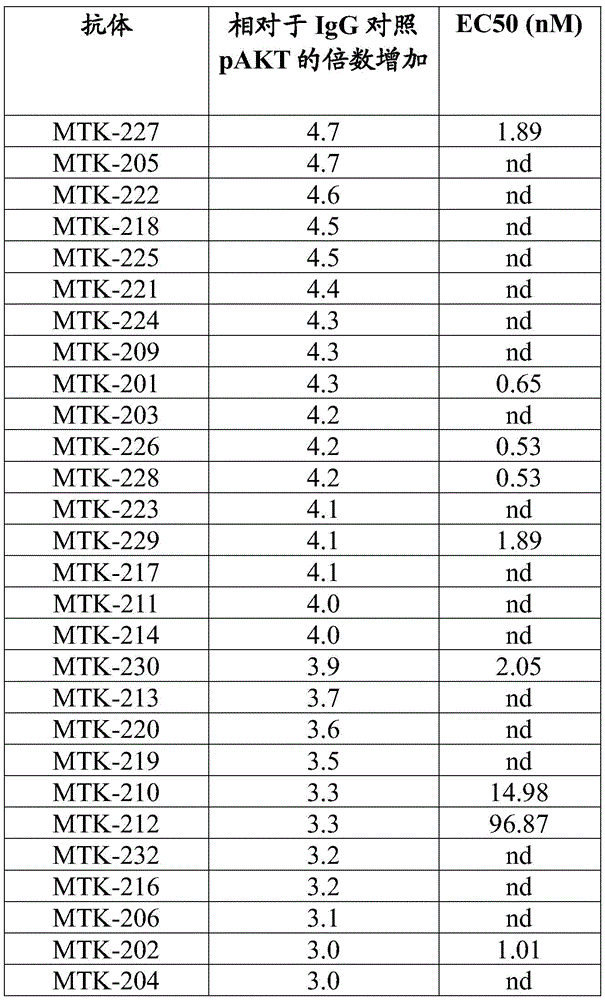
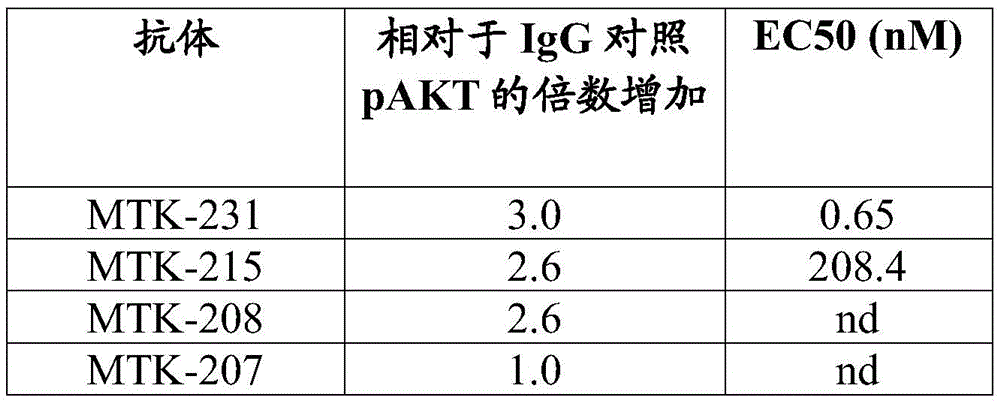
nd=not measured
EC50 values for certain anti-MerTK antibodies of the present disclosure were determined from the pAKT assay described above. EC50 values are shown in table 13 above.
Example 20: domain binding analysis of anti-MerTK antibodies
The following study was performed to analyze the binding sites of various anti-MerTK antibodies of the present disclosure on human MerTK.
MerTK is a member of the TAM family that shares a unique domain structure that contains an N-terminal region (NT), two immunoglobulin-like domains (Ig 1 and Ig 2), two fibronectin type III domains (FN 1 and FN 2), a membrane-proximal region (JM), and an intracellular tyrosine kinase domain. Cleavage in the membrane proximal region results in release of the soluble MerTK extracellular domain (ECD). Human MerTK ECD can be divided into the following domains, the amino acid sequences of which are shown in table 14 below:
TABLE 14
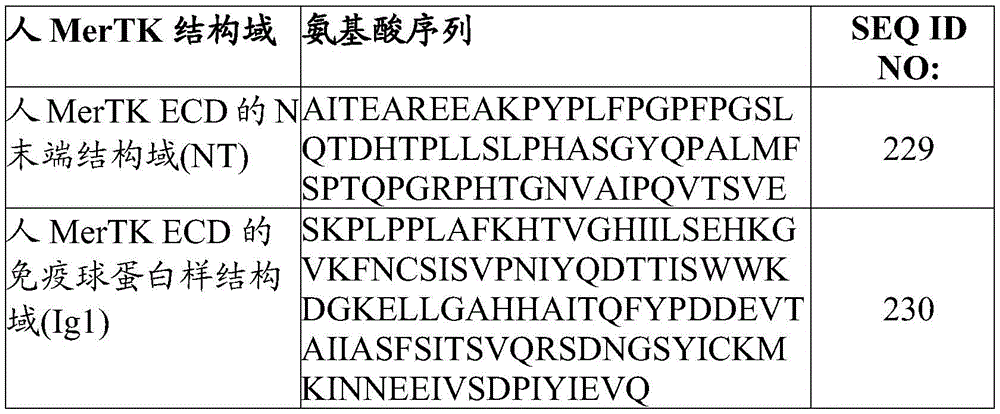

Another member of the TAM family, axl protein, shares a common domain structure with merTK, with the following domains and related amino acid sequences in its ECD: as shown in table 15 below:
TABLE 15
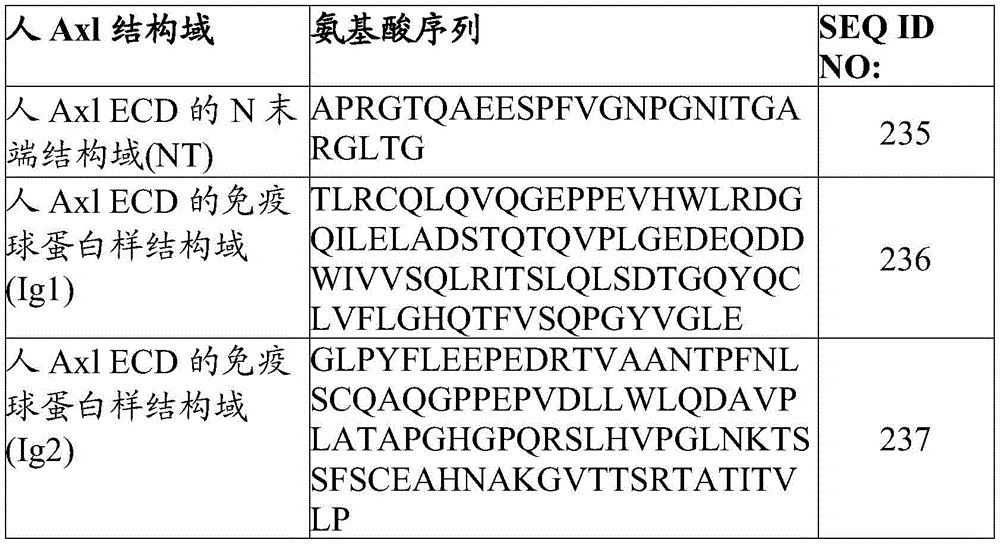
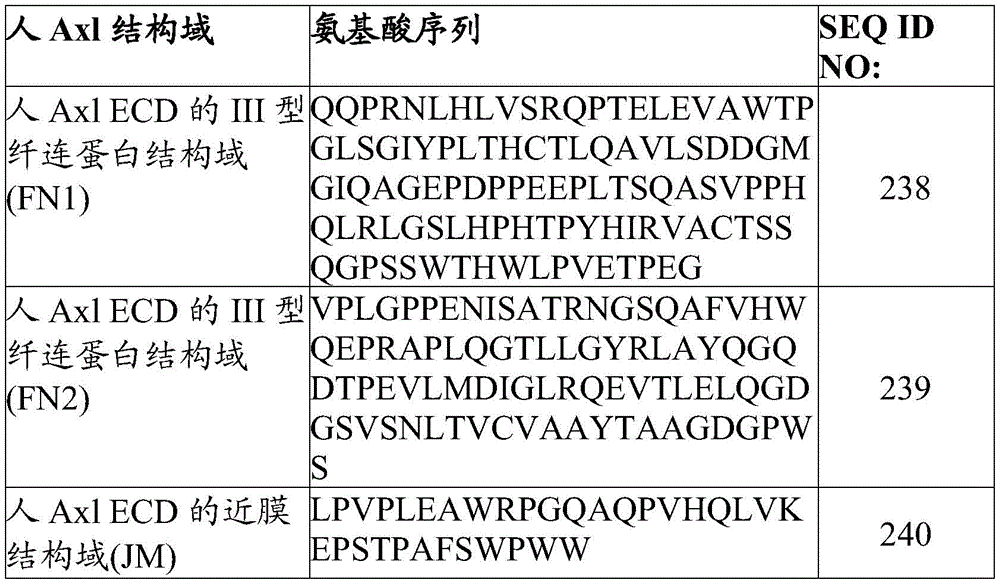
In these experiments, a series of chimeric proteins were expressed recombinantly, with each domain of human MerTK exchanged with the corresponding human Axl domain. The resulting chimeric proteins were recombinantly expressed in Expi293 cells, and then assayed for the ability of the binding of the various anti-MerTK antibodies of the disclosure to bind to Axl/MerTK domain exchanged chimeras. DNA of the chimeric and deletion mutants with the coding domain exchange of the signal sequence MGWSCIILFLVATATGVHS (SEQ ID NO: 241) in the merTK construct and MGWSCIILFLVATATG (SEQ ID NO: 242) in the Axl construct and the linker +His +Avi tag (GGSGHHHHHHGGGLNDIFEAQKIEWHE; SEQ ID NO: 243) was prepared by gene synthesis and cloned into the expression vector pcDNAtopo3.4 (GeneArt, thermoFisher). Expi293 cells were transfected with 20. Mu.g of plasmid and ExpiFectamine according to the recommended procedure (ThermoFisher). Transfected cells were grown in 20mL culture at 37℃and 5% CO2 with shaking for four days. The cells were pelleted by centrifugation and the supernatant was vacuum filtered through a 0.2 μm filter.
Table 16 shows the configuration of the chimeric for the various Axl/merTK domain exchanges generated for use in these studies. In this table, M (MerTK) or a (Axl) indicates that a particular domain from the protein is included (i.e., swapped) in the corresponding chimeric protein construct; NT (N-terminal domain), ig1 (immunoglobulin-like domain 1), ig2 (immunoglobulin-like domain 2), FN1 (fibronectin type III domain 1), FN2 (fibronectin type III domain 2), and JM (membrane-proximal domain).
Table 16

The binding of the anti-MerTK antibodies of the present disclosure to these domain exchanged chimeras or deletion mutants was tested by Surface Plasmon Resonance (SPR) using cartera LSA. Purified anti-MerTK antibodies were immobilized on HC30M chips (cartera) in duplicate by amine coupling according to the manufacturer's instructions (previously described).
Supernatants containing these constructs were diluted 1:1 with running buffer containing 0.5mg/mL BSA (HBS-TE, carterra) and injected onto the immobilized antibodies. After each construct injection, the surface was regenerated with 10mM glycine pH 2.0. The sensorgrams were analyzed using cartera epitop software to identify construct binding patterns. Loss of binding to MerTK constructs with domain deletions or Axl domain exchanges and/or gain of binding to Axl constructs with MerTK domain exchanges were assessed. The data in these studies were used to construct a domain binding map of anti-MerTK antibodies and their binding to the individual domains of human MerTK.
In addition to the anti-MerTK antibodies of the present disclosure, the following anti-MerTK antibodies were also used in these studies: mouse anti-human MerTK antibody H1 (BioLegend, clone ID:590H11G1E3, mouse IgG 1), mouse anti-human MerTK antibody H2 (R & D systems, clone ID:125518, mouse IgG2 b), mouse anti-human MerTK antibody H3 (R & D systems, clone ID 125508, mouse IgG2 b), mouse anti-human MerTK antibody H6 (ebiscence, clone ID: A3KCAT, mouse IgG 1), mouse anti-human MerTK antibody H7 (Sino Biological, clone ID:09, mouse IgG2 b), human anti-human MerTK antibody M6 (disclosed in WO2016/106221, huIgG1 LALAPS), human anti-human MerTK antibody CDX Ab2000 (disclosed in WO 2019/087, huIgG1 LALAPS) and human anti-human MerTK antibody CDX 3000 (disclosed in WO 2020/461, huIgG1 LALAPS).
The results of these binding studies are shown in table 17 below. The domain or domains required for binding are listed first, with the domains identified in brackets affecting binding to a lesser extent, possibly indirectly through conformational effects. Assessing binding to the two half-half chimeras helps establish and/or confirm the primary binding domain of the antibodies tested herein.
TABLE 17
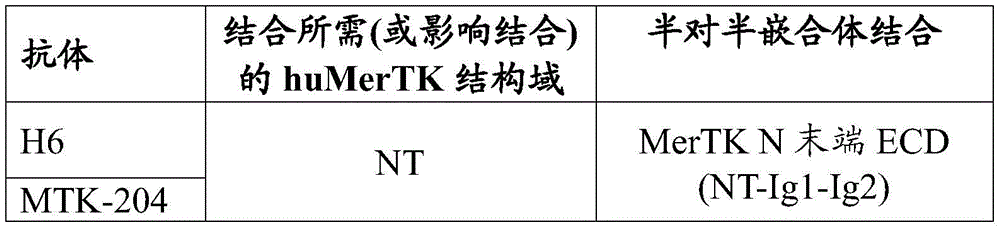
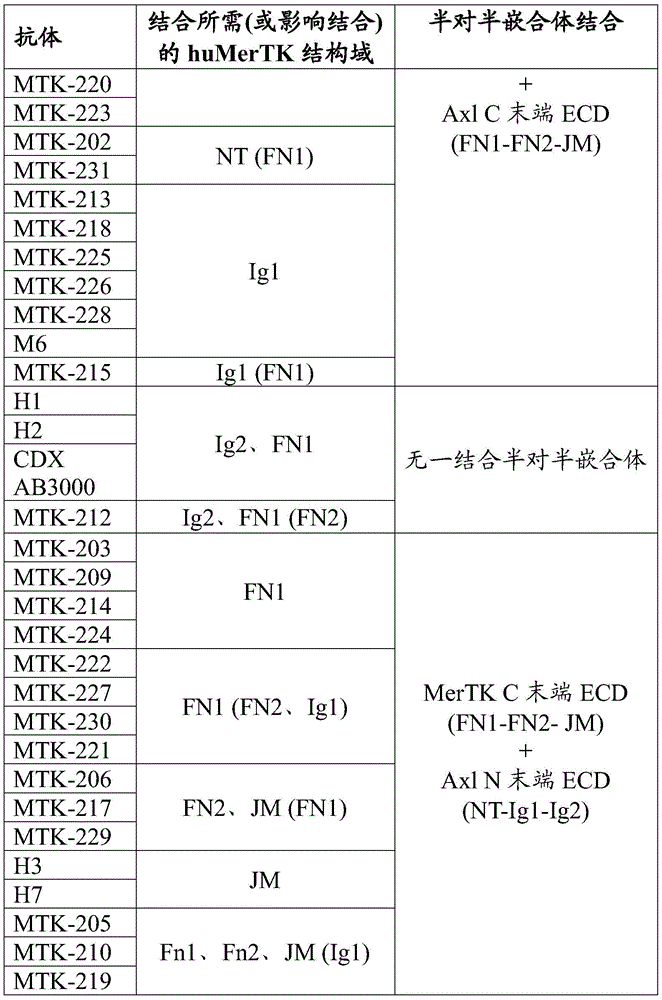
As shown in Table 17, the anti-MerTK antibodies MTK-204, MTK-220, MTK-223 and H6 bound to chimeric protein constructs containing the N-terminal region of human MerTK. This includes MerTK N-terminal half chimeras, but does not include MerTK C-terminal half chimeras. The anti-MerTK antibodies MTK-202 and MTK-231 also bound to constructs containing the MerTK N-terminal region, including MerTK N-terminal half-chimeras, but not MerTK C-terminal half-chimeras, but binding was reduced when the MerTK FN1 domain was exchanged with the Axl FN1 domain.
The anti-MerTK antibodies MTK-213, MTK-218, MTK-225, MTK-226 and M6 were bound to constructs containing MerTK Ig1, including MerTK N-terminal half chimeras, but not MerTK C-terminal half chimeras. The anti-MerTK antibody MTK-215 binds to chimeric protein constructs containing MerTK Ig1, including MerTK N-terminal half-half chimeras, but not MerTK C-terminal half-half chimeras; however, the MerTK FN1 domain decreased binding when exchanged with the Axl FN1 domain.
Antibodies H1, H2 and CDX Ab3000 require the simultaneous presence of MerTK Ig2 and Fn1 domains for binding and do not bind to either half-half chimeras, suggesting that their binding sites may extend to the junction between the two domains. Similarly, the binding of anti-MerTK antibody MTK-212 requires the simultaneous presence of Ig2 and FN1 domains (and it also fails to bind either half-half chimera), but unlike the Ig2/FN1 binding antibodies described above, antibody MTK-212 binding is reduced when the MerTK FN2 domain is exchanged with the Axl FN2 domain.
Antibodies MTK-203, MTK-209, MTK-214 and MTK-224 bound to constructs containing the MerTK FN1 domain, including the MerTK C-terminal half-half chimera, but not the MerTK N-terminal half-half chimera. Antibodies MTK-222, MTK-227 and MTK-230 also bound constructs containing the MTK FN1 domain, including the merTK C-terminal half-half chimera, but not the merTK N-terminal half-half chimera, but decreased binding when either the merTK FN2 or Ig1 domain is absent.
Antibodies MTK-206, MTK-217 and MTK-229 bind to constructs containing the MerTK FN2 and JM domains, including the MerTK C-terminal half-half chimeras, but not the MerTK N-terminal half-half chimeras, and their binding is reduced when the MerTK FN1 domain is absent. Antibodies H3 and H7 bound to constructs containing MerTK JM domains and MerTK C-terminal ECD chimeras. In the absence of any MerTK C-terminal domain (FN 1, FN2 or JM), the binding of antibodies MTK-205, MTK-210 and MTK-219 is reduced and they bind to MerTK C-terminal half chimeras but not to MerTK N-terminal half chimeras. In the absence of MerTK Ig1 domains, their binding is also reduced. None of the anti-MerTK antibodies of the present disclosure bound to the ECD domain of human Axl (data not shown).
When comparing the bin assignments in table 11 above with the domain binding in table 17, the anti-MerTK antibodies in epitope bins 1, 2, 3, 4 and 10 included conjugates with the C-terminal region of MerTK ECD, while the antibodies in epitope bins 6, 7, 8 and 9 included conjugates with the N-terminal region of MerTK ECD. The region of epitope bin 5 where the antibody binds MerTK requires both the N-terminal and C-terminal regions of MerTK ECD, possibly spanning the junction between these two regions.
Sequence listing
<110> Ai Laike Special Limited company (ALECTOR LLC)
<120> anti-MERTK antibodies and methods of use thereof
<130> 4503.011PC02
<150> US 63/003,070
<151> 2020-03-31
<150> US 63/165,592
<151> 2021-03-24
<160> 243
<170> PatentIn version 3.5
<210> 1
<211> 999
<212> PRT
<213> Homo Sapiens (Homo Sapiens)
<400> 1
Met Gly Pro Ala Pro Leu Pro Leu Leu Leu Gly Leu Phe Leu Pro Ala
1 5 10 15
Leu Trp Arg Arg Ala Ile Thr Glu Ala Arg Glu Glu Ala Lys Pro Tyr
20 25 30
Pro Leu Phe Pro Gly Pro Phe Pro Gly Ser Leu Gln Thr Asp His Thr
35 40 45
Pro Leu Leu Ser Leu Pro His Ala Ser Gly Tyr Gln Pro Ala Leu Met
50 55 60
Phe Ser Pro Thr Gln Pro Gly Arg Pro His Thr Gly Asn Val Ala Ile
65 70 75 80
Pro Gln Val Thr Ser Val Glu Ser Lys Pro Leu Pro Pro Leu Ala Phe
85 90 95
Lys His Thr Val Gly His Ile Ile Leu Ser Glu His Lys Gly Val Lys
100 105 110
Phe Asn Cys Ser Ile Ser Val Pro Asn Ile Tyr Gln Asp Thr Thr Ile
115 120 125
Ser Trp Trp Lys Asp Gly Lys Glu Leu Leu Gly Ala His His Ala Ile
130 135 140
Thr Gln Phe Tyr Pro Asp Asp Glu Val Thr Ala Ile Ile Ala Ser Phe
145 150 155 160
Ser Ile Thr Ser Val Gln Arg Ser Asp Asn Gly Ser Tyr Ile Cys Lys
165 170 175
Met Lys Ile Asn Asn Glu Glu Ile Val Ser Asp Pro Ile Tyr Ile Glu
180 185 190
Val Gln Gly Leu Pro His Phe Thr Lys Gln Pro Glu Ser Met Asn Val
195 200 205
Thr Arg Asn Thr Ala Phe Asn Leu Thr Cys Gln Ala Val Gly Pro Pro
210 215 220
Glu Pro Val Asn Ile Phe Trp Val Gln Asn Ser Ser Arg Val Asn Glu
225 230 235 240
Gln Pro Glu Lys Ser Pro Ser Val Leu Thr Val Pro Gly Leu Thr Glu
245 250 255
Met Ala Val Phe Ser Cys Glu Ala His Asn Asp Lys Gly Leu Thr Val
260 265 270
Ser Lys Gly Val Gln Ile Asn Ile Lys Ala Ile Pro Ser Pro Pro Thr
275 280 285
Glu Val Ser Ile Arg Asn Ser Thr Ala His Ser Ile Leu Ile Ser Trp
290 295 300
Val Pro Gly Phe Asp Gly Tyr Ser Pro Phe Arg Asn Cys Ser Ile Gln
305 310 315 320
Val Lys Glu Ala Asp Pro Leu Ser Asn Gly Ser Val Met Ile Phe Asn
325 330 335
Thr Ser Ala Leu Pro His Leu Tyr Gln Ile Lys Gln Leu Gln Ala Leu
340 345 350
Ala Asn Tyr Ser Ile Gly Val Ser Cys Met Asn Glu Ile Gly Trp Ser
355 360 365
Ala Val Ser Pro Trp Ile Leu Ala Ser Thr Thr Glu Gly Ala Pro Ser
370 375 380
Val Ala Pro Leu Asn Val Thr Val Phe Leu Asn Glu Ser Ser Asp Asn
385 390 395 400
Val Asp Ile Arg Trp Met Lys Pro Pro Thr Lys Gln Gln Asp Gly Glu
405 410 415
Leu Val Gly Tyr Arg Ile Ser His Val Trp Gln Ser Ala Gly Ile Ser
420 425 430
Lys Glu Leu Leu Glu Glu Val Gly Gln Asn Gly Ser Arg Ala Arg Ile
435 440 445
Ser Val Gln Val His Asn Ala Thr Cys Thr Val Arg Ile Ala Ala Val
450 455 460
Thr Arg Gly Gly Val Gly Pro Phe Ser Asp Pro Val Lys Ile Phe Ile
465 470 475 480
Pro Ala His Gly Trp Val Asp Tyr Ala Pro Ser Ser Thr Pro Ala Pro
485 490 495
Gly Asn Ala Asp Pro Val Leu Ile Ile Phe Gly Cys Phe Cys Gly Phe
500 505 510
Ile Leu Ile Gly Leu Ile Leu Tyr Ile Ser Leu Ala Ile Arg Lys Arg
515 520 525
Val Gln Glu Thr Lys Phe Gly Asn Ala Phe Thr Glu Glu Asp Ser Glu
530 535 540
Leu Val Val Asn Tyr Ile Ala Lys Lys Ser Phe Cys Arg Arg Ala Ile
545 550 555 560
Glu Leu Thr Leu His Ser Leu Gly Val Ser Glu Glu Leu Gln Asn Lys
565 570 575
Leu Glu Asp Val Val Ile Asp Arg Asn Leu Leu Ile Leu Gly Lys Ile
580 585 590
Leu Gly Glu Gly Glu Phe Gly Ser Val Met Glu Gly Asn Leu Lys Gln
595 600 605
Glu Asp Gly Thr Ser Leu Lys Val Ala Val Lys Thr Met Lys Leu Asp
610 615 620
Asn Ser Ser Gln Arg Glu Ile Glu Glu Phe Leu Ser Glu Ala Ala Cys
625 630 635 640
Met Lys Asp Phe Ser His Pro Asn Val Ile Arg Leu Leu Gly Val Cys
645 650 655
Ile Glu Met Ser Ser Gln Gly Ile Pro Lys Pro Met Val Ile Leu Pro
660 665 670
Phe Met Lys Tyr Gly Asp Leu His Thr Tyr Leu Leu Tyr Ser Arg Leu
675 680 685
Glu Thr Gly Pro Lys His Ile Pro Leu Gln Thr Leu Leu Lys Phe Met
690 695 700
Val Asp Ile Ala Leu Gly Met Glu Tyr Leu Ser Asn Arg Asn Phe Leu
705 710 715 720
His Arg Asp Leu Ala Ala Arg Asn Cys Met Leu Arg Asp Asp Met Thr
725 730 735
Val Cys Val Ala Asp Phe Gly Leu Ser Lys Lys Ile Tyr Ser Gly Asp
740 745 750
Tyr Tyr Arg Gln Gly Arg Ile Ala Lys Met Pro Val Lys Trp Ile Ala
755 760 765
Ile Glu Ser Leu Ala Asp Arg Val Tyr Thr Ser Lys Ser Asp Val Trp
770 775 780
Ala Phe Gly Val Thr Met Trp Glu Ile Ala Thr Arg Gly Met Thr Pro
785 790 795 800
Tyr Pro Gly Val Gln Asn His Glu Met Tyr Asp Tyr Leu Leu His Gly
805 810 815
His Arg Leu Lys Gln Pro Glu Asp Cys Leu Asp Glu Leu Tyr Glu Ile
820 825 830
Met Tyr Ser Cys Trp Arg Thr Asp Pro Leu Asp Arg Pro Thr Phe Ser
835 840 845
Val Leu Arg Leu Gln Leu Glu Lys Leu Leu Glu Ser Leu Pro Asp Val
850 855 860
Arg Asn Gln Ala Asp Val Ile Tyr Val Asn Thr Gln Leu Leu Glu Ser
865 870 875 880
Ser Glu Gly Leu Ala Gln Gly Ser Thr Leu Ala Pro Leu Asp Leu Asn
885 890 895
Ile Asp Pro Asp Ser Ile Ile Ala Ser Cys Thr Pro Arg Ala Ala Ile
900 905 910
Ser Val Val Thr Ala Glu Val His Asp Ser Lys Pro His Glu Gly Arg
915 920 925
Tyr Ile Leu Asn Gly Gly Ser Glu Glu Trp Glu Asp Leu Thr Ser Ala
930 935 940
Pro Ser Ala Ala Val Thr Ala Glu Lys Asn Ser Val Leu Pro Gly Glu
945 950 955 960
Arg Leu Val Arg Asn Gly Val Ser Trp Ser His Ser Ser Met Leu Pro
965 970 975
Leu Gly Ser Ser Leu Pro Asp Glu Leu Leu Phe Ala Asp Asp Ser Ser
980 985 990
Glu Gly Ser Glu Val Leu Met
995
<210> 2
<211> 505
<212> PRT
<213> Artificial sequence (Artificial Sequence)
<220>
<223> human MerTK ECD
<400> 2
Met Gly Pro Ala Pro Leu Pro Leu Leu Leu Gly Leu Phe Leu Pro Ala
1 5 10 15
Leu Trp Arg Arg Ala Ile Thr Glu Ala Arg Glu Glu Ala Lys Pro Tyr
20 25 30
Pro Leu Phe Pro Gly Pro Phe Pro Gly Ser Leu Gln Thr Asp His Thr
35 40 45
Pro Leu Leu Ser Leu Pro His Ala Ser Gly Tyr Gln Pro Ala Leu Met
50 55 60
Phe Ser Pro Thr Gln Pro Gly Arg Pro His Thr Gly Asn Val Ala Ile
65 70 75 80
Pro Gln Val Thr Ser Val Glu Ser Lys Pro Leu Pro Pro Leu Ala Phe
85 90 95
Lys His Thr Val Gly His Ile Ile Leu Ser Glu His Lys Gly Val Lys
100 105 110
Phe Asn Cys Ser Ile Ser Val Pro Asn Ile Tyr Gln Asp Thr Thr Ile
115 120 125
Ser Trp Trp Lys Asp Gly Lys Glu Leu Leu Gly Ala His His Ala Ile
130 135 140
Thr Gln Phe Tyr Pro Asp Asp Glu Val Thr Ala Ile Ile Ala Ser Phe
145 150 155 160
Ser Ile Thr Ser Val Gln Arg Ser Asp Asn Gly Ser Tyr Ile Cys Lys
165 170 175
Met Lys Ile Asn Asn Glu Glu Ile Val Ser Asp Pro Ile Tyr Ile Glu
180 185 190
Val Gln Gly Leu Pro His Phe Thr Lys Gln Pro Glu Ser Met Asn Val
195 200 205
Thr Arg Asn Thr Ala Phe Asn Leu Thr Cys Gln Ala Val Gly Pro Pro
210 215 220
Glu Pro Val Asn Ile Phe Trp Val Gln Asn Ser Ser Arg Val Asn Glu
225 230 235 240
Gln Pro Glu Lys Ser Pro Ser Val Leu Thr Val Pro Gly Leu Thr Glu
245 250 255
Met Ala Val Phe Ser Cys Glu Ala His Asn Asp Lys Gly Leu Thr Val
260 265 270
Ser Lys Gly Val Gln Ile Asn Ile Lys Ala Ile Pro Ser Pro Pro Thr
275 280 285
Glu Val Ser Ile Arg Asn Ser Thr Ala His Ser Ile Leu Ile Ser Trp
290 295 300
Val Pro Gly Phe Asp Gly Tyr Ser Pro Phe Arg Asn Cys Ser Ile Gln
305 310 315 320
Val Lys Glu Ala Asp Pro Leu Ser Asn Gly Ser Val Met Ile Phe Asn
325 330 335
Thr Ser Ala Leu Pro His Leu Tyr Gln Ile Lys Gln Leu Gln Ala Leu
340 345 350
Ala Asn Tyr Ser Ile Gly Val Ser Cys Met Asn Glu Ile Gly Trp Ser
355 360 365
Ala Val Ser Pro Trp Ile Leu Ala Ser Thr Thr Glu Gly Ala Pro Ser
370 375 380
Val Ala Pro Leu Asn Val Thr Val Phe Leu Asn Glu Ser Ser Asp Asn
385 390 395 400
Val Asp Ile Arg Trp Met Lys Pro Pro Thr Lys Gln Gln Asp Gly Glu
405 410 415
Leu Val Gly Tyr Arg Ile Ser His Val Trp Gln Ser Ala Gly Ile Ser
420 425 430
Lys Glu Leu Leu Glu Glu Val Gly Gln Asn Gly Ser Arg Ala Arg Ile
435 440 445
Ser Val Gln Val His Asn Ala Thr Cys Thr Val Arg Ile Ala Ala Val
450 455 460
Thr Arg Gly Gly Val Gly Pro Phe Ser Asp Pro Val Lys Ile Phe Ile
465 470 475 480
Pro Ala His Gly Trp Val Asp Tyr Ala Pro Ser Ser Thr Pro Ala Pro
485 490 495
Gly Asn Ala Asp Pro Val Leu Ile Ile
500 505
<210> 3
<211> 507
<212> PRT
<213> Artificial sequence (Artificial Sequence)
<220>
<223> Cyno MerTK ECD
<400> 3
Met Gly Leu Ala Pro Leu Pro Leu Pro Leu Leu Leu Gly Leu Phe Leu
1 5 10 15
Pro Ala Leu Trp Ser Arg Ala Ile Thr Glu Ala Arg Glu Glu Ala Lys
20 25 30
Pro Tyr Pro Leu Phe Pro Gly Pro Leu Pro Gly Ser Leu Gln Thr Asp
35 40 45
His Thr Ser Leu Leu Ser Leu Pro His Thr Ser Gly Tyr Gln Pro Ala
50 55 60
Leu Met Phe Ser Pro Thr Gln Pro Gly Arg Pro Tyr Thr Gly Asn Val
65 70 75 80
Ala Ile Pro Arg Val Thr Ser Ala Gly Ser Lys Leu Leu Pro Pro Leu
85 90 95
Ala Phe Lys His Thr Val Gly His Ile Ile Leu Ser Glu His Lys Asp
100 105 110
Val Lys Phe Asn Cys Ser Ile Ser Val Pro Asn Ile Tyr Gln Asp Thr
115 120 125
Thr Ile Ser Trp Trp Lys Asp Gly Lys Glu Leu Leu Gly Ala His His
130 135 140
Ala Ile Thr Gln Phe Tyr Pro Asp Asp Glu Val Thr Ala Ile Ile Ala
145 150 155 160
Ser Phe Ser Ile Thr Ser Val Gln Arg Ser Asp Asn Gly Ser Tyr Ile
165 170 175
Cys Lys Met Lys Ile Asn Asn Glu Glu Ile Val Ser Asp Pro Ile Tyr
180 185 190
Ile Glu Val Gln Gly Leu Pro His Phe Thr Lys Gln Pro Glu Ser Met
195 200 205
Asn Val Thr Arg Asn Thr Ala Phe Asn Leu Thr Cys Gln Ala Val Gly
210 215 220
Pro Pro Glu Pro Val Asn Ile Phe Trp Val Gln Asn Ser Ser Arg Val
225 230 235 240
Asn Glu Gln Pro Glu Lys Ser Pro Ser Val Leu Thr Val Pro Gly Leu
245 250 255
Thr Glu Met Ala Val Phe Ser Cys Glu Ala His Asn Asp Lys Gly Leu
260 265 270
Thr Val Ser Lys Gly Val Gln Ile Asn Ile Lys Ala Ile Pro Ser Pro
275 280 285
Pro Thr Glu Val Ser Ile His Asn Ser Thr Ala His Ser Ile Leu Ile
290 295 300
Ser Trp Val Pro Gly Phe Asp Gly Tyr Ser Pro Phe Arg Asn Cys Ser
305 310 315 320
Val Gln Val Lys Glu Val Asp Pro Leu Ser Asn Gly Ser Val Met Ile
325 330 335
Phe Asn Thr Ser Ala Ser Pro His Met Tyr Gln Ile Lys Gln Leu Gln
340 345 350
Ala Leu Ala Asn Tyr Ser Ile Gly Val Ser Cys Met Asn Glu Ile Gly
355 360 365
Trp Ser Ala Val Ser Pro Trp Ile Leu Ala Ser Thr Thr Glu Gly Ala
370 375 380
Pro Ser Val Ala Pro Leu Asn Val Thr Val Phe Leu Asn Glu Ser Arg
385 390 395 400
Asp Asn Val Asp Ile Arg Trp Met Lys Pro Leu Thr Lys Arg Gln Ala
405 410 415
Gly Glu Leu Val Gly Tyr Arg Ile Ser His Val Trp Gln Ser Ala Gly
420 425 430
Ile Ser Lys Glu Leu Leu Glu Glu Val Gly Gln Asn Asn Ser Arg Ala
435 440 445
Gln Ile Ser Val Gln Val His Asn Ala Thr Cys Thr Val Arg Ile Ala
450 455 460
Ala Val Thr Lys Gly Gly Val Gly Pro Phe Ser Asp Pro Val Lys Ile
465 470 475 480
Phe Ile Pro Ala His Gly Trp Val Asp His Ala Pro Ser Ser Thr Pro
485 490 495
Ala Pro Gly Asn Ala Asp Pro Val Leu Ile Ile
500 505
<210> 4
<211> 497
<212> PRT
<213> Artificial sequence (Artificial Sequence)
<220>
<223> murine MerTK ECD
<400> 4
Met Val Leu Ala Pro Leu Leu Leu Gly Leu Leu Leu Leu Pro Ala Leu
1 5 10 15
Trp Ser Gly Gly Thr Ala Glu Lys Trp Glu Glu Thr Glu Leu Asp Gln
20 25 30
Leu Phe Ser Gly Pro Leu Pro Gly Arg Leu Pro Val Asn His Arg Pro
35 40 45
Phe Ser Ala Pro His Ser Ser Arg Asp Gln Leu Pro Pro Pro Gln Thr
50 55 60
Gly Arg Ser His Pro Ala His Thr Ala Ala Pro Gln Val Thr Ser Thr
65 70 75 80
Ala Ser Lys Leu Leu Pro Pro Val Ala Phe Asn His Thr Ile Gly His
85 90 95
Ile Val Leu Ser Glu His Lys Asn Val Lys Phe Asn Cys Ser Ile Asn
100 105 110
Ile Pro Asn Thr Tyr Gln Glu Thr Ala Gly Ile Ser Trp Trp Lys Asp
115 120 125
Gly Lys Glu Leu Leu Gly Ala His His Ser Ile Thr Gln Phe Tyr Pro
130 135 140
Asp Glu Glu Gly Val Ser Ile Ile Ala Leu Phe Ser Ile Ala Ser Val
145 150 155 160
Gln Arg Ser Asp Asn Gly Ser Tyr Phe Cys Lys Met Lys Val Asn Asn
165 170 175
Arg Glu Ile Val Ser Asp Pro Ile Tyr Val Glu Val Gln Gly Leu Pro
180 185 190
Tyr Phe Ile Lys Gln Pro Glu Ser Val Asn Val Thr Arg Asn Thr Ala
195 200 205
Phe Asn Leu Thr Cys Gln Ala Val Gly Pro Pro Glu Pro Val Asn Ile
210 215 220
Phe Trp Val Gln Asn Ser Ser Arg Val Asn Glu Lys Pro Glu Arg Ser
225 230 235 240
Pro Ser Val Leu Thr Val Pro Gly Leu Thr Glu Thr Ala Val Phe Ser
245 250 255
Cys Glu Ala His Asn Asp Lys Gly Leu Thr Val Ser Lys Gly Val His
260 265 270
Ile Asn Ile Lys Val Ile Pro Ser Pro Pro Thr Glu Val His Ile Leu
275 280 285
Asn Ser Thr Ala His Ser Ile Leu Val Ser Trp Val Pro Gly Phe Asp
290 295 300
Gly Tyr Ser Pro Leu Gln Asn Cys Ser Ile Gln Val Lys Glu Ala Asp
305 310 315 320
Arg Leu Ser Asn Gly Ser Val Met Val Phe Asn Thr Ser Ala Ser Pro
325 330 335
His Leu Tyr Glu Ile Gln Gln Leu Gln Ala Leu Ala Asn Tyr Ser Ile
340 345 350
Ala Val Ser Cys Arg Asn Glu Ile Gly Trp Ser Ala Val Ser Pro Trp
355 360 365
Ile Leu Ala Ser Thr Thr Glu Gly Ala Pro Ser Val Ala Pro Leu Asn
370 375 380
Ile Thr Val Phe Leu Asn Glu Ser Asn Asn Ile Leu Asp Ile Arg Trp
385 390 395 400
Thr Lys Pro Pro Ile Lys Arg Gln Asp Gly Glu Leu Val Gly Tyr Arg
405 410 415
Ile Ser His Val Trp Glu Ser Ala Gly Thr Tyr Lys Glu Leu Ser Glu
420 425 430
Glu Val Ser Gln Asn Gly Ser Trp Ala Gln Ile Pro Val Gln Ile His
435 440 445
Asn Ala Thr Cys Thr Val Arg Ile Ala Ala Ile Thr Lys Gly Gly Ile
450 455 460
Gly Pro Phe Ser Glu Pro Val Asn Ile Ile Ile Pro Glu His Ser Lys
465 470 475 480
Val Asp Tyr Ala Pro Ser Ser Thr Pro Ala Pro Gly Asn Thr Asp Ser
485 490 495
Met
<210> 5
<211> 118
<212> PRT
<213> Artificial sequence (Artificial Sequence)
<220>
<223> MTK-201 heavy chain variable
<400> 5
Gln Val Gln Leu Arg Gln Ser Gly Pro Gly Leu Val Gln Pro Ser Gln
1 5 10 15
Ser Leu Ser Ile Thr Cys Thr Val Ser Gly Phe Ser Leu Ser Asn Tyr
20 25 30
Gly Leu His Trp Val Arg Gln Ser Pro Gly Lys Gly Leu Glu Trp Leu
35 40 45
Gly Val Ile Trp Ser Gly Gly Ile Thr Asp Tyr Asn Ala Ala Phe Ile
50 55 60
Ser Arg Leu Ser Ile Ile Lys Asp Asn Ser Arg Ser Gln Val Phe Phe
65 70 75 80
Lys Met Asn Ser Leu Gln Ala Asp Asp Thr Ala Ile Tyr Tyr Cys Ala
85 90 95
Arg Lys Gly His Asp Pro Tyr Ala Met Asp Phe Trp Gly Gln Gly Thr
100 105 110
Ser Val Thr Val Ser Ser
115
<210> 6
<211> 116
<212> PRT
<213> Artificial sequence (Artificial Sequence)
<220>
<223> MTK-202 heavy chain variable
<400> 6
Glu Val Gln Leu Val Glu Ser Gly Gly Gly Leu Val Lys Pro Gly Gly
1 5 10 15
Ser Leu Lys Leu Ser Cys Ala Ala Ser Gly Phe Thr Phe Ser Asp Phe
20 25 30
Gly Met His Trp Val Arg Gln Val Pro Glu Lys Gly Leu Glu Trp Val
35 40 45
Ala Phe Ile Ser Gly Gly Ser Asn Thr Ile Tyr Tyr Thr Asp Thr Val
50 55 60
Lys Gly Arg Phe Thr Ile Ser Arg Asp Asn Ala Lys Asn Thr Leu Phe
65 70 75 80
Leu Gln Met Thr Ser Leu Arg Ser Glu Asp Thr Ala Met Tyr Tyr Cys
85 90 95
Val Arg Asn Gly Asn Ser Phe Ala Tyr Trp Gly Gln Gly Thr Leu Val
100 105 110
Thr Val Ser Ala
115
<210> 7
<211> 117
<212> PRT
<213> Artificial sequence (Artificial Sequence)
<220>
<223> MTK-203 heavy chain variable
<400> 7
Gln Val Gln Leu Gln Gln Pro Gly Ala Glu Leu Val Lys Pro Gly Ala
1 5 10 15
Ser Val Lys Val Ser Cys Lys Ala Ser Gly Tyr Thr Phe Thr Asn Tyr
20 25 30
Trp Met His Trp Val Lys Gln Arg Pro Gly Gln Gly Leu Glu Trp Ile
35 40 45
Gly Arg Ile His Pro Phe Asp Thr Glu Thr Asn Asp Asn Gln Lys Phe
50 55 60
Lys Gly Lys Ala Thr Leu Thr Val Asp Lys Ser Ser Ser Thr Ala Tyr
65 70 75 80
Met Gln Leu Ser Ser Leu Thr Ser Glu Asp Ser Ala Val Tyr Tyr Cys
85 90 95
Val Ile Pro Ala Asn Gly Gly Phe Ala Tyr Trp Gly Gln Gly Thr Leu
100 105 110
Val Thr Val Ser Ala
115
<210> 8
<211> 116
<212> PRT
<213> Artificial sequence (Artificial Sequence)
<220>
<223> MTK-204 heavy chain variable
<400> 8
Glu Val Gln Leu Val Glu Ser Gly Gly Gly Leu Val Lys Pro Gly Gly
1 5 10 15
Ser Leu Lys Leu Ser Cys Ala Ala Ser Gly Phe Thr Phe Ser Asp Tyr
20 25 30
Gly Met His Trp Val Arg Gln Ala Pro Glu Lys Gly Leu Glu Trp Val
35 40 45
Ala Tyr Ile Ser Ser Gly Thr Ser Thr Ile Tyr Tyr Glu Asp Thr Val
50 55 60
Lys Gly Arg Phe Thr Ile Ser Arg Asp Asn Ala Lys Asn Thr Leu Phe
65 70 75 80
Leu Gln Met Thr Ser Leu Arg Ser Glu Asp Thr Ala Met Tyr Tyr Cys
85 90 95
Ala Arg Gly Gly Leu Leu Phe Asp Tyr Trp Gly Gln Gly Thr Thr Leu
100 105 110
Thr Val Ser Ser
115
<210> 9
<211> 121
<212> PRT
<213> Artificial sequence (Artificial Sequence)
<220>
<223> MTK-206 heavy chain variable
<400> 9
Gln Val Gln Leu Gln Gln Ser Gly Ala Glu Leu Ala Arg Pro Gly Ala
1 5 10 15
Ser Val Lys Met Ser Cys Lys Ala Ser Gly Tyr Thr Phe Thr Ser Tyr
20 25 30
Thr Met His Trp Val Lys Gln Arg Pro Gly Gln Gly Leu Glu Trp Ile
35 40 45
Gly Tyr Ile Asn Pro Ser Ser Gly Tyr Ile Lys Asn Ser Gln Lys Phe
50 55 60
Lys Asp Lys Ala Thr Leu Thr Ala Asp Lys Ser Ser Ser Thr Ala Tyr
65 70 75 80
Met Gln Leu Ser Ser Leu Thr Ser Glu Asp Ser Ala Val Tyr Tyr Cys
85 90 95
Ala Arg Thr Val Tyr Gly Tyr Tyr Gly Ser Ser Pro Asp Tyr Trp Gly
100 105 110
Gln Gly Thr Thr Leu Thr Val Ser Ser
115 120
<210> 10
<211> 121
<212> PRT
<213> Artificial sequence (Artificial Sequence)
<220>
<223> MTK-207 heavy chain variable
<400> 10
Gln Val Gln Leu Lys Glu Ser Gly Pro Gly Leu Val Ala Pro Ser Gln
1 5 10 15
Ser Leu Ser Ile Thr Cys Thr Val Ser Gly Ile Ser Leu Thr Ser Tyr
20 25 30
Gly Val Ser Trp Val Arg Gln Pro Pro Gly Lys Gly Leu Glu Trp Leu
35 40 45
Gly Ile Ile Trp Gly Asp Gly Ser Thr Asn Tyr His Ser Ala Leu Ile
50 55 60
Ser Arg Leu Ser Ile Ser Lys Asp Asn Ser Lys Ser Gln Val Phe Leu
65 70 75 80
Lys Leu Asn Ser Leu Gln Thr Asp Asp Thr Ala Thr Tyr Tyr Cys Ala
85 90 95
Lys Gly Arg Tyr Gly Asn Tyr Glu Asp Trp Tyr Phe Asp Val Trp Gly
100 105 110
Thr Gly Thr Thr Val Thr Val Ser Ser
115 120
<210> 11
<211> 118
<212> PRT
<213> Artificial sequence (Artificial Sequence)
<220>
<223> MTK-208 heavy chain variable
<400> 11
Gln Val Gln Leu Gln Gln Pro Gly Ala Glu Leu Val Val Pro Gly Ala
1 5 10 15
Ser Val Arg Leu Ser Cys Lys Ala Ser Gly Tyr Thr Phe Ile Asn Tyr
20 25 30
Trp Met His Trp Val Lys Gln Arg Pro Gly Gln Gly Leu Glu Trp Ile
35 40 45
Gly Glu Ile Asp Pro Ser Asp Ser Tyr Ala Asn Tyr Asn Gln Lys Phe
50 55 60
Lys Asp Lys Ser Thr Leu Ser Leu Asp Lys Ser Ser Ser Thr Ala Tyr
65 70 75 80
Met Gln Leu Ser Ser Leu Thr Ser Glu Asp Ser Ala Val Tyr Tyr Cys
85 90 95
Ala Arg Cys Asp Tyr Tyr Gly Arg Leu Asp Tyr Trp Gly Gln Gly Thr
100 105 110
Thr Leu Thr Val Ser Ser
115
<210> 12
<211> 114
<212> PRT
<213> Artificial sequence (Artificial Sequence)
<220>
<223> MTK-209 heavy chain variable
<400> 12
Gln Val Gln Leu Gln Gln Pro Gly Ala Glu Leu Val Lys Pro Gly Ala
1 5 10 15
Ser Val Lys Val Ser Cys Lys Ala Ser Gly Tyr Thr Phe Thr Asn Tyr
20 25 30
Trp Ile His Trp Val Lys Gln Arg Pro Gly Gln Gly Leu Glu Trp Ile
35 40 45
Gly Arg Ile His Pro Phe Asp Ser Glu Pro Asn Tyr Asn Gln Lys Phe
50 55 60
Lys Gly Lys Ala Thr Leu Thr Val Asp Lys Ser Ser Ser Thr Ala Tyr
65 70 75 80
Met His Leu Thr Ser Leu Thr Ser Glu Asp Ser Ala Val Tyr Tyr Cys
85 90 95
Ala Leu Ala Ser Phe Ala Tyr Trp Gly Gln Gly Thr Leu Val Thr Val
100 105 110
Ser Ala
<210> 13
<211> 123
<212> PRT
<213> Artificial sequence (Artificial Sequence)
<220>
<223> MTK-210 heavy chain variable
<400> 13
Gln Val Gln Leu Gln Gln Ser Gly Pro Glu Leu Val Lys Pro Gly Ala
1 5 10 15
Ser Val Lys Ile Ser Cys Lys Ala Ser Asp Tyr Glu Phe Ser Arg Ser
20 25 30
Trp Met Asn Trp Val Lys Gln Arg Pro Gly Lys Gly Leu Glu Trp Ile
35 40 45
Gly Arg Ile Tyr Pro Gly Asp Gly Asp Thr Asn Tyr Asn Gly Lys Phe
50 55 60
Lys Gly Lys Ala Thr Leu Thr Ala Asp Lys Ser Ser Asn Thr Ala Tyr
65 70 75 80
Met Gln Leu Asn Ser Leu Thr Ser Glu Asp Ser Ala Val Tyr Phe Cys
85 90 95
Ala Arg Lys Gly Gly Tyr Tyr Tyr Ser Ile Ser Asn Tyr Phe Asp Tyr
100 105 110
Trp Gly Gln Gly Thr Thr Leu Thr Val Ser Ser
115 120
<210> 14
<211> 122
<212> PRT
<213> Artificial sequence (Artificial Sequence)
<220>
<223> MTK-211 heavy chain variable
<400> 14
Gln Val Gln Leu Gln Gln Ser Gly Ala Glu Leu Met Lys Pro Gly Ala
1 5 10 15
Ser Val Lys Leu Ser Cys Lys Ala Thr Gly Tyr Thr Phe Thr Gly Tyr
20 25 30
Trp Ile Glu Trp Val Lys Gln Arg Pro Gly His Gly Leu Glu Trp Ile
35 40 45
Gly Glu Ile Leu Pro Gly Ser Gly Gly Ser Asn Tyr Asn Glu Lys Phe
50 55 60
Lys Gly Lys Ala Thr Phe Thr Ala Asp Thr Ser Ser Asn Thr Ala Tyr
65 70 75 80
Ile Gln Leu Ser Ser Leu Thr Thr Glu Asp Ser Ala Ile Tyr Cys Cys
85 90 95
Ala Arg Gly Glu Pro Ser Tyr Phe Ser Asp Ala Gly Phe Ala Tyr Trp
100 105 110
Gly Gln Gly Thr Leu Val Thr Val Ser Ala
115 120
<210> 15
<211> 120
<212> PRT
<213> Artificial sequence (Artificial Sequence)
<220>
<223> MTK-212 heavy chain variable
<400> 15
Gln Val Gln Leu Gln Gln Ser Gly Pro Glu Leu Val Lys Pro Gly Ala
1 5 10 15
Ser Val Lys Ile Ser Cys Lys Ala Ser Gly Tyr Ala Phe Ser Ser Ser
20 25 30
Trp Val Asn Trp Val Lys Gln Arg Pro Gly Lys Gly Leu Glu Trp Ile
35 40 45
Gly Arg Ile Tyr Pro Gly Asp Gly Asp Ser Asn Tyr Asn Gly Asn Phe
50 55 60
Lys Gly Lys Ala Thr Leu Thr Ala Asp Lys Ser Ser Asn Thr Ala Tyr
65 70 75 80
Leu Gln Leu Ser Ser Leu Thr Ser Glu Asp Ser Ala Val Tyr Phe Cys
85 90 95
Ala Arg Lys Ser His Phe Ile Tyr Tyr Thr Leu Asp Tyr Trp Gly Gln
100 105 110
Gly Thr Pro Val Thr Val Ser Ser
115 120
<210> 16
<211> 119
<212> PRT
<213> Artificial sequence (Artificial Sequence)
<220>
<223> MTK-213 heavy chain variable
<400> 16
Gln Val Gln Leu Gln Gln Pro Gly Ala Glu Leu Val Lys Pro Gly Ala
1 5 10 15
Ser Val Lys Met Ser Cys Lys Ala Ser Gly Tyr Thr Phe Thr Ser Tyr
20 25 30
Trp Ile Thr Trp Val Lys Gln Arg Pro Gly Gln Gly His Glu Trp Ile
35 40 45
Gly Glu Ile Tyr Pro Gly Ile Gly Ser Thr Asn Tyr Asn Glu Lys Phe
50 55 60
Lys Ser Lys Ala Thr Leu Thr Val Asp Thr Ser Ser Arg Thr Ala Tyr
65 70 75 80
Met Gln Leu Ser Ser Leu Thr Ser Glu Asp Ser Ala Val Tyr Phe Cys
85 90 95
Ala Arg Gly Ala Tyr Thr Lys Tyr Tyr Phe Asp Tyr Trp Gly Gln Gly
100 105 110
Thr Thr Leu Thr Val Ser Ser
115
<210> 17
<211> 114
<212> PRT
<213> Artificial sequence (Artificial Sequence)
<220>
<223> MTK-214 heavy chain variable
<400> 17
Gln Val Gln Leu Gln Gln Pro Gly Ala Glu Leu Val Lys Pro Gly Ala
1 5 10 15
Ser Val Lys Val Ser Cys Lys Ala Ser Gly Tyr Thr Phe Thr Asn Tyr
20 25 30
Trp Met His Trp Met Lys Gln Arg Pro Gly Gln Gly Leu Glu Trp Ile
35 40 45
Gly Arg Ile His Pro Phe Asp Ser Asp Thr Asn Tyr Asn Glu Lys Phe
50 55 60
Thr Asp Lys Ala Thr Leu Thr Val Asp Lys Ser Ser Ser Thr Ala Tyr
65 70 75 80
Met Gln Leu Ser Ser Leu Thr Ser Glu Asp Ser Ala Val Tyr Tyr Cys
85 90 95
Ala Ile Gly Thr Leu Ile Tyr Trp Gly Gln Gly Thr Thr Leu Thr Ala
100 105 110
Ser Ser
<210> 18
<211> 118
<212> PRT
<213> Artificial sequence (Artificial Sequence)
<220>
<223> MTK-215 heavy chain variable
<400> 18
Glu Val Gln Leu Val Glu Ser Gly Gly Gly Leu Val Lys Pro Gly Gly
1 5 10 15
Ser Leu Lys Leu Ser Cys Ala Ala Ser Gly Phe Ile Phe Ser Asp Tyr
20 25 30
Gly Met His Trp Val Arg Gln Ala Pro Glu Lys Gly Leu Glu Trp Val
35 40 45
Ala Tyr Ile Ser Ser Gly Ser Ser Thr Ile Tyr Tyr Gly Asp Thr Val
50 55 60
Lys Gly Arg Phe Thr Ile Ser Arg Asp Asn Ala Lys Asn Thr Leu Phe
65 70 75 80
Leu Gln Met Thr Ser Leu Arg Ser Glu Asp Thr Ala Met Tyr Tyr Cys
85 90 95
Ala Lys Gly Gly Arg Tyr Gly Ala Met Asp Tyr Trp Gly His Gly Thr
100 105 110
Ser Val Thr Val Ser Ser
115
<210> 19
<211> 116
<212> PRT
<213> Artificial sequence (Artificial Sequence)
<220>
<223> MTK-216 heavy chain variable
<400> 19
Glu Val Gln Leu Val Glu Ser Gly Gly Gly Leu Val Lys Pro Gly Gly
1 5 10 15
Ser Leu Lys Leu Ser Cys Ala Ala Ser Gly Phe Thr Phe Ser Asp Tyr
20 25 30
Gly Met His Trp Val Arg Gln Ala Pro Glu Lys Gly Leu Glu Trp Val
35 40 45
Ala Phe Ile Ser Ser Gly Ser Thr Thr Ile Tyr Tyr Ala Asp Thr Val
50 55 60
Lys Gly Arg Phe Thr Ile Ser Arg Asp Asn Ala Lys Asn Thr Leu Ile
65 70 75 80
Leu Gln Met Thr Ser Leu Arg Ser Glu Asp Thr Ala Ile Tyr Tyr Cys
85 90 95
Thr Arg Gly Gly Phe His Leu Asp Tyr Trp Gly Gln Gly Thr Thr Leu
100 105 110
Thr Val Ser Ser
115
<210> 20
<211> 122
<212> PRT
<213> Artificial sequence (Artificial Sequence)
<220>
<223> MTK-217 heavy chain variable
<400> 20
Gln Val Gln Leu Gln Gln Pro Gly Thr Glu Val Val Lys Pro Gly Ala
1 5 10 15
Ser Val Lys Met Ser Cys Arg Ala Ser Gly Tyr Thr Phe Thr Ser Tyr
20 25 30
Trp Ile Thr Trp Val Lys Gln Arg Pro Gly Gln Gly Leu Glu Trp Ile
35 40 45
Gly Asp Ile His Pro Gly Ser Gly Ile Asn Asn Tyr Asn Glu Lys Phe
50 55 60
Arg Ser Lys Ala Thr Leu Thr Val Asp Thr Ser Ser Ser Thr Val Tyr
65 70 75 80
Met Glu Leu Ser Ser Leu Thr Ser Glu Asp Ser Ala Val Tyr Tyr Cys
85 90 95
Ala Lys Gly Gly Tyr Tyr Gly Ser Ser Tyr Tyr Val Met Asp Tyr Trp
100 105 110
Gly Gln Gly Thr Ser Val Thr Val Ser Ser
115 120
<210> 21
<211> 118
<212> PRT
<213> Artificial sequence (Artificial Sequence)
<220>
<223> MTK-218 heavy chain variable
<400> 21
Gln Val Gln Leu Gln Gln Ser Gly Pro Glu Leu Val Lys Pro Gly Thr
1 5 10 15
Ser Val Lys Ile Ser Cys Lys Ala Ser Gly Tyr Ser Phe Thr Ser Tyr
20 25 30
Tyr Ile His Trp Val Lys Gln Arg Pro Gly Gln Gly Leu Asp Trp Ile
35 40 45
Gly Trp Ile Phe Pro Gly Asn Arg Asn Thr Gln Tyr Asn Glu Lys Phe
50 55 60
Lys Gly Lys Ala Thr Leu Thr Ala Asp Thr Ser Ser Ser Thr Ala Tyr
65 70 75 80
Met Gln Leu Ser Ser Leu Thr Ser Glu Asp Ser Ala Val Tyr Tyr Cys
85 90 95
Ala Arg Leu Gly Leu Ile Tyr Ala Leu Asp Tyr Trp Gly Gln Gly Thr
100 105 110
Ser Val Thr Val Ser Ser
115
<210> 22
<211> 119
<212> PRT
<213> Artificial sequence (Artificial Sequence)
<220>
<223> MTK-219 heavy chain variable
<400> 22
Gln Val Gln Leu Gln Gln Ser Gly Ala Asp Leu Met Lys Pro Gly Ala
1 5 10 15
Ser Val Lys Leu Ser Cys Lys Ala Thr Gly Asn Thr Phe Thr Gly Tyr
20 25 30
Trp Ile Glu Trp Val Lys Gln Arg Pro Gly His Gly Leu Glu Trp Ile
35 40 45
Gly Glu Ile Leu Thr Gly Ser Gly Ser Thr Asn Tyr Asn Glu Arg Phe
50 55 60
Lys Gly Lys Ala Thr Phe Thr Ala Asp Thr Ser Ser Asn Thr Ala Tyr
65 70 75 80
Met Gln Leu Ser Ser Leu Thr Thr Glu Asp Ser Ala Ile Tyr Tyr Cys
85 90 95
Ala Gly Ser Tyr Phe Thr Asn Ser Trp Phe Pro Tyr Trp Gly Gln Gly
100 105 110
Ser Leu Val Thr Val Ser Ala
115
<210> 23
<211> 116
<212> PRT
<213> Artificial sequence (Artificial Sequence)
<220>
<223> MTK-220 heavy chain variable
<400> 23
Glu Val Gln Leu Val Glu Ser Gly Gly Gly Leu Val Lys Pro Gly Gly
1 5 10 15
Ser Leu Lys Leu Ser Cys Ala Ala Ser Gly Phe Thr Phe Ser Asp Tyr
20 25 30
Gly Met His Trp Val Arg Gln Ala Pro Glu Lys Gly Leu Glu Trp Val
35 40 45
Ala Phe Ile Ser Gly Gly Ser Gly Thr Ile Tyr Tyr Glu Asp Thr Val
50 55 60
Lys Gly Arg Phe Thr Ile Ser Arg Asp Asn Ala Lys Asn Thr Leu Phe
65 70 75 80
Leu Gln Met Thr Ser Leu Arg Ser Glu Asp Thr Ala Met Tyr Tyr Cys
85 90 95
Thr Arg Gly Gly Asn Tyr Phe Asp Tyr Trp Gly Gln Gly Thr Thr Leu
100 105 110
Thr Val Ser Ser
115
<210> 24
<211> 123
<212> PRT
<213> Artificial sequence (Artificial Sequence)
<220>
<223> MTK-221 heavy chain variable
<400> 24
Gln Val Thr Leu Lys Glu Ser Gly Pro Gly Met Leu Gln Ser Ser Gln
1 5 10 15
Thr Leu Ser Leu Thr Cys Ser Phe Ser Gly Phe Ser Leu Ser Thr Ser
20 25 30
Gly Met Gly Val Ser Trp Ile Arg Gln Pro Ser Gly Lys Gly Leu Glu
35 40 45
Trp Leu Ala His Ile Tyr Trp Asp Asp Asp Lys Arg Tyr Asn Thr Ser
50 55 60
Leu Gln Ser Arg Leu Thr Ile Ser Lys Asp Thr Ser Arg Asn Gln Val
65 70 75 80
Phe Leu Lys Ile Thr Ser Val Asp Thr Ala Asp Thr Ala Thr Tyr Phe
85 90 95
Cys Gly Arg Leu Gly Ala Tyr Ser Ala Phe Pro Tyr Tyr Phe Asp Tyr
100 105 110
Trp Gly Gln Gly Thr Thr Leu Thr Val Ser Ser
115 120
<210> 25
<211> 119
<212> PRT
<213> Artificial sequence (Artificial Sequence)
<220>
<223> MTK-222 heavy chain variable
<400> 25
Gln Val Gln Leu Gln Gln Ser Gly Ala Asp Leu Met Lys Pro Gly Ala
1 5 10 15
Ser Val Lys Leu Ser Cys Lys Ala Thr Gly Tyr Thr Phe Thr Gly Tyr
20 25 30
Trp Ile Glu Trp Val Lys Gln Arg Pro Gly His Gly Leu Glu Trp Ile
35 40 45
Gly Glu Ile Leu Thr Gly Ser Gly Ser Ser Asn Tyr Asn Glu Lys Phe
50 55 60
Lys Gly Lys Ala Thr Phe Thr Ala Asp Ser Ser Ser Asn Thr Ala Phe
65 70 75 80
Met Gln Leu Ser Ser Leu Thr Thr Glu Asp Ser Ala Ile Tyr Tyr Cys
85 90 95
Ala Gly Ser Tyr Tyr Ser Asn Ser Trp Phe Pro Tyr Trp Gly Gln Gly
100 105 110
Ser Leu Val Thr Val Ser Ala
115
<210> 26
<211> 113
<212> PRT
<213> Artificial sequence (Artificial Sequence)
<220>
<223> MTK-223 heavy chain variable
<400> 26
Asp Val Gln Leu Gln Glu Ser Gly Pro Gly Leu Val Lys Pro Ser Gln
1 5 10 15
Ser Leu Ser Leu Thr Cys Ser Val Thr Gly Tyr Ser Ile Thr Ser Gly
20 25 30
Tyr Tyr Trp Asn Trp Ile Arg Gln Phe Pro Gly Asn Lys Leu Glu Trp
35 40 45
Met Gly Tyr Ile Ser Tyr Asp Gly Thr Asn Asn Tyr Asn Pro Ser Leu
50 55 60
Lys Asn Arg Ile Ser Ile Thr Arg Asp Thr Ser Glu Asn Gln Phe Phe
65 70 75 80
Leu Lys Leu Asn Ser Val Thr Thr Glu Asp Thr Ala Thr Tyr Phe Cys
85 90 95
Val Arg Gly Ala Gly Tyr Trp Gly Gln Gly Thr Thr Leu Thr Val Ser
100 105 110
Ser
<210> 27
<211> 114
<212> PRT
<213> Artificial sequence (Artificial Sequence)
<220>
<223> MTK-224 heavy chain variable
<400> 27
Gln Val Gln Leu Gln Gln Pro Gly Ala Glu Leu Val Lys Pro Gly Ala
1 5 10 15
Ser Val Lys Val Ser Cys Lys Ala Ser Gly Tyr Thr Phe Thr Ser Tyr
20 25 30
Trp Met His Trp Val Lys Gln Arg Pro Gly Gln Gly Leu Glu Trp Ile
35 40 45
Gly Arg Ile His Pro Phe Asp Ser Asp Thr Asn Tyr Asn Gln Lys Phe
50 55 60
Lys Gly Lys Ala Thr Leu Thr Val Asp Lys Ser Ser Ser Thr Ala Tyr
65 70 75 80
Met Gln Leu Ser Ser Leu Thr Ser Glu Asp Ser Ala Val Tyr Tyr Cys
85 90 95
Ser Ile Ala Gly Phe Ala Tyr Trp Gly Gln Gly Thr Leu Val Thr Val
100 105 110
Ser Ala
<210> 28
<211> 123
<212> PRT
<213> Artificial sequence (Artificial Sequence)
<220>
<223> MTK-225 heavy chain variable
<400> 28
Glu Val Gln Leu Gln Gln Ser Gly Pro Glu Leu Val Lys Pro Gly Ala
1 5 10 15
Ser Val Lys Ile Phe Cys Lys Ala Ser Gly Tyr Thr Phe Thr Ala Tyr
20 25 30
Asn Met Asp Trp Val Lys Gln Ser His Gly Lys Ser Leu Glu Trp Ile
35 40 45
Gly Asp Ile Asn Pro Asn Asn Gly Gly Thr Ile Tyr Asn Gln Lys Phe
50 55 60
Lys Gly Lys Ala Thr Leu Thr Val Asp Lys Ser Ser Ser Thr Ala Tyr
65 70 75 80
Met Glu Leu Arg Ser Leu Thr Ser Glu Asp Thr Ala Val Tyr Tyr Cys
85 90 95
Ala Arg Arg Arg Arg Tyr Gly Asn Thr Tyr Tyr Trp Tyr Phe Asp Val
100 105 110
Trp Gly Thr Gly Thr Thr Val Thr Val Ser Ser
115 120
<210> 29
<211> 118
<212> PRT
<213> Artificial sequence (Artificial Sequence)
<220>
<223> MTK-226 heavy chain variable
<400> 29
Gln Val Gln Leu Gln Gln Ser Gly Pro Glu Leu Val Lys Pro Gly Ala
1 5 10 15
Ser Val Lys Ile Ser Cys Lys Ala Ser Gly Tyr Ser Phe Thr Ser Tyr
20 25 30
Tyr Ile His Trp Val Lys Gln Arg Pro Gly Gln Gly Leu Glu Trp Ile
35 40 45
Gly Trp Ile Phe Pro Gly Asn Gly Asn Thr Lys Tyr Asn Glu Asn Phe
50 55 60
Arg Gly Lys Ala Thr Leu Thr Ala Asp Thr Ser Ser Ser Thr Ala Tyr
65 70 75 80
Met Gln Leu Ser Ser Leu Thr Ser Glu Asp Ser Ala Val Tyr Tyr Cys
85 90 95
Ala Arg Leu Gly Leu Ile Tyr Ala Leu Asp Tyr Trp Gly Gln Gly Thr
100 105 110
Ser Val Thr Val Ser Ser
115
<210> 30
<211> 124
<212> PRT
<213> Artificial sequence (Artificial Sequence)
<220>
<223> MTK-227 heavy chain variable
<400> 30
Glu Val Lys Leu Val Glu Ser Gly Gly Gly Leu Val Gln Pro Gly Gly
1 5 10 15
Ser Leu Ser Leu Ser Cys Ala Ala Ser Gly Phe Thr Phe Thr Asp Asn
20 25 30
Tyr Met Thr Trp Val Arg Gln Pro Pro Gly Lys Ala Leu Glu Trp Leu
35 40 45
Gly Phe Ser Arg Asn Lys Ala Asn Gly Tyr Thr Thr Glu Tyr Ser Ala
50 55 60
Ser Val Lys Gly Arg Phe Thr Ile Ser Arg Asp Ser Ser Gln Ser Ile
65 70 75 80
Leu Tyr Leu Gln Met Asn Ala Leu Arg Ala Glu Asp Ser Gly Thr Tyr
85 90 95
Tyr Cys Ala Arg Phe Pro Pro His Tyr Tyr Ala Gly Gly Tyr Phe Asp
100 105 110
Val Trp Gly Thr Gly Thr Thr Val Thr Val Ser Ser
115 120
<210> 31
<211> 118
<212> PRT
<213> Artificial sequence (Artificial Sequence)
<220>
<223> MTK-228 heavy chain variable
<400> 31
Gln Asp Gln Leu Gln Gln Ser Gly Pro Glu Leu Val Lys Pro Gly Ala
1 5 10 15
Ser Val Lys Ile Ser Cys Lys Ala Ser Gly Tyr Ser Phe Thr Ser Tyr
20 25 30
Tyr Ile His Trp Val Lys Gln Arg Pro Gly Gln Gly Leu Glu Trp Val
35 40 45
Gly Trp Ile Phe Pro Gly Asn Gly Asn Thr Lys Tyr Asn Glu Arg Phe
50 55 60
Lys Gly Lys Ala Thr Leu Thr Ala Asp Thr Ser Ser Ser Thr Ala Tyr
65 70 75 80
Met Gln Leu Ser Ser Leu Thr Ser Glu Asp Ser Ala Val Tyr Tyr Cys
85 90 95
Ala Arg Leu Gly Leu Ile Tyr Ala Leu Asp Tyr Trp Gly Gln Gly Thr
100 105 110
Ser Val Thr Val Ser Ser
115
<210> 32
<211> 124
<212> PRT
<213> Artificial sequence (Artificial Sequence)
<220>
<223> MTK-229 heavy chain variable
<400> 32
Gln Val Gln Leu Gln Gln Ser Gly Pro Glu Leu Val Lys Pro Gly Ala
1 5 10 15
Ser Val Lys Ile Ser Cys Lys Ala Ser Gly Tyr Glu Phe Ser Arg Ser
20 25 30
Trp Met Asn Trp Val Lys Gln Arg Pro Gly Lys Gly Leu Glu Trp Ile
35 40 45
Gly Arg Ile Tyr Pro Gly Asp Gly Asp Thr Asn Tyr Lys Gly Lys Leu
50 55 60
Lys Gly Gln Ala Thr Leu Thr Ala Asp Lys Ser Ser Ser Thr Ala Tyr
65 70 75 80
Met Gln Leu Ser Ser Leu Thr Phe Glu Asp Ser Ala Val Tyr Phe Cys
85 90 95
Ala Arg Gly Gly Gly Tyr Tyr Tyr Asp Ser Arg Tyr Glu Gly Phe Val
100 105 110
Tyr Trp Gly Gln Gly Thr Val Val Thr Val Ser Ala
115 120
<210> 33
<211> 116
<212> PRT
<213> Artificial sequence (Artificial Sequence)
<220>
<223> MTK-230 heavy chain variable
<400> 33
Glu Val Gln Leu Gln Gln Ser Gly Pro Glu Leu Val Lys Pro Gly Ala
1 5 10 15
Ser Val Arg Ile Pro Cys Lys Ala Ser Gly Tyr Thr Phe Ser Asp Tyr
20 25 30
Asn Met Asp Trp Val Lys Gln Ser His Gly Lys Ser Leu Glu Trp Ile
35 40 45
Gly Asn Ile Asn Pro Asn Ile Gly Gly Thr Ile Tyr Ser Gln Lys Phe
50 55 60
Lys Gly Lys Ala Thr Leu Thr Val Asp Lys Ser Ser Ser Thr Ala Tyr
65 70 75 80
Met Glu Leu Arg Ser Leu Thr Ser Glu Asp Thr Ala Val Tyr Tyr Cys
85 90 95
Ala Arg Gly Asp Tyr Gly Phe Ala Ser Trp Gly Gln Gly Thr Leu Val
100 105 110
Thr Val Ser Ala
115
<210> 34
<211> 108
<212> PRT
<213> Artificial sequence (Artificial Sequence)
<220>
<223> MTK-201 light chain variable
<400> 34
Gln Ile Val Leu Thr Gln Ser Pro Pro Ile Met Ser Ala Phe Leu Gly
1 5 10 15
Glu Arg Val Thr Met Thr Cys Thr Ala Ser Ser Ser Val Ser Ser Ser
20 25 30
Tyr Leu His Trp Tyr Arg Gln Met Pro Gly Ser Ser Pro Lys Leu Trp
35 40 45
Ile Tyr Asp Thr Ser Asn Leu Ala Ser Gly Val Pro Ala Arg Phe Ser
50 55 60
Gly Ser Gly Ser Gly Thr Ser Tyr Ser Leu Thr Ile Ser Ser Met Glu
65 70 75 80
Ala Glu Asp Ala Ala Thr Tyr Tyr Cys His Gln Tyr His His Ser Pro
85 90 95
Tyr Thr Phe Gly Gly Gly Thr Lys Leu Glu Ile Lys
100 105
<210> 35
<211> 112
<212> PRT
<213> Artificial sequence (Artificial Sequence)
<220>
<223> MTK-202 light chain variable
<400> 35
Asn Ile Met Met Thr Gln Ser Pro Ser Ser Leu Ala Val Ser Ala Gly
1 5 10 15
Glu Lys Val Thr Met Asn Cys Lys Ser Ser Gln Ser Val Leu Tyr Ser
20 25 30
Ser Asn Gln Lys Asn Tyr Leu Ala Trp Tyr Gln Gln Lys Pro Gly Gln
35 40 45
Ser Pro Lys Leu Leu Ile Tyr Trp Ala Ser Thr Arg Glu Ser Gly Val
50 55 60
Pro Asp Arg Phe Thr Gly Ser Gly Ser Gly Thr Asp Phe Thr Leu Thr
65 70 75 80
Ile Ser Asn Ile Gln Ala Glu Asp Leu Ala Ile Tyr Tyr Cys His Gln
85 90 95
Tyr Phe Phe Ser Trp Thr Phe Gly Gly Gly Thr Lys Leu Glu Ile Lys
100 105 110
<210> 36
<211> 107
<212> PRT
<213> Artificial sequence (Artificial Sequence)
<220>
<223> MTK-203 light chain variable
<400> 36
Glu Thr Thr Val Thr Gln Ser Pro Ala Ser Leu Ser Val Ala Thr Gly
1 5 10 15
Glu Lys Val Thr Ile Arg Cys Ile Thr Ser Thr Asp Ile Gly Asp Asp
20 25 30
Met Asn Trp Tyr Gln Gln Lys Pro Gly Glu Pro Pro Lys Val Leu Ile
35 40 45
Ser Glu Gly Asn Ser Leu Arg Pro Gly Val Pro Ser Arg Phe Ser Ser
50 55 60
Ser Gly Tyr Gly Thr Asp Phe Val Phe Thr Ile Glu Asn Thr Leu Ser
65 70 75 80
Glu Asp Val Ala Asp Tyr Phe Cys Leu Gln Ser Asp Asn Leu Pro Leu
85 90 95
Thr Phe Gly Ser Gly Thr Lys Leu Glu Ile Lys
100 105
<210> 37
<211> 112
<212> PRT
<213> Artificial sequence (Artificial Sequence)
<220>
<223> MTK-204 light chain variable
<400> 37
Asn Ile Met Met Thr Gln Ser Pro Ser Ser Leu Ala Val Ser Ala Gly
1 5 10 15
Glu Lys Val Thr Met Ser Cys Lys Ser Ser Gln Ser Val Leu Tyr Ser
20 25 30
Ser Asn Gln Lys Asn Tyr Leu Ala Trp Tyr Gln Gln Lys Pro Gly Gln
35 40 45
Ser Pro Lys Leu Leu Ile Gln Trp Ala Ser Thr Arg Glu Ser Gly Val
50 55 60
Pro Asp Arg Phe Thr Gly Ser Gly Ser Glu Thr Asp Phe Thr Leu Thr
65 70 75 80
Ile Arg Ser Val Gln Ala Glu Asp Leu Ala Val Tyr Tyr Cys His Gln
85 90 95
Tyr Phe Ser Ser Trp Thr Phe Gly Gly Gly Thr Lys Leu Glu Ile Lys
100 105 110
<210> 38
<211> 107
<212> PRT
<213> Artificial sequence (Artificial Sequence)
<220>
<223> MTK-206 light chain variable
<400> 38
Asp Ile Gln Met Thr Gln Ser Pro Ser Ser Leu Ser Ala Ser Leu Gly
1 5 10 15
Glu Arg Val Ser Leu Thr Cys Arg Ala Ser Gln Asp Ile Gly Ser Asn
20 25 30
Leu Asn Trp Leu Gln Gln Glu Pro Asp Gly Thr Ile Lys Arg Leu Ile
35 40 45
Tyr Ala Thr Ser Ser Leu Glu Ser Gly Val Pro Lys Arg Phe Ser Gly
50 55 60
Ser Arg Ser Gly Ser Asp Tyr Ser Leu Thr Ile Ser Ser Leu Glu Ser
65 70 75 80
Glu Asp Phe Val Asp Tyr Tyr Cys Leu Gln Tyr Asp Ser Ser Pro Trp
85 90 95
Thr Phe Gly Gly Gly Thr Lys Leu Glu Ile Lys
100 105
<210> 39
<211> 107
<212> PRT
<213> Artificial sequence (Artificial Sequence)
<220>
<223> MTK-207 light chain variable
<400> 39
Asp Ile Gln Met Thr Gln Ser Pro Ala Ser Leu Ser Ala Ser Val Gly
1 5 10 15
Glu Thr Val Thr Ile Thr Cys Arg Ala Ser Gly Asn Ile His Asn Tyr
20 25 30
Leu Ala Trp Tyr Gln Gln Lys Gln Gly Lys Ser Pro Gln Leu Leu Val
35 40 45
Tyr Asn Ala Lys Thr Leu Ala Ala Gly Val Pro Ser Arg Phe Ser Gly
50 55 60
Ser Gly Ser Gly Thr Gln Tyr Ser Leu Lys Ile Asn Ser Leu Gln Pro
65 70 75 80
Glu Asp Phe Gly Ser Tyr Tyr Cys Gln His Phe Trp Ser Ile Pro Leu
85 90 95
Thr Phe Gly Ala Gly Thr Lys Leu Glu Leu Lys
100 105
<210> 40
<211> 107
<212> PRT
<213> Artificial sequence (Artificial Sequence)
<220>
<223> MTK-208 light chain variable
<400> 40
Gln Val Val Leu Thr Gln Ser Pro Ala Ile Met Ser Ala Ser Pro Gly
1 5 10 15
Glu Lys Val Thr Ile Thr Cys Ser Ala Ser Ser Ser Val Ser Tyr Met
20 25 30
Leu Trp Phe Gln Gln Lys Pro Gly Thr Ser Pro Lys Leu Trp Ile Tyr
35 40 45
Ser Thr Ser Asn Leu Ala Ser Gly Val Pro Ala Arg Phe Ser Gly Ser
50 55 60
Gly Ser Gly Thr Ser Tyr Ser Leu Thr Ile Ser Arg Leu Glu Ala Glu
65 70 75 80
Asp Ala Ala Thr Tyr Tyr Cys Gln Gln Arg Ser Ser Tyr Pro Pro Ile
85 90 95
Thr Phe Gly Ala Gly Thr Lys Leu Glu Leu Lys
100 105
<210> 41
<211> 107
<212> PRT
<213> Artificial sequence (Artificial Sequence)
<220>
<223> MTK-209 light chain variable
<400> 41
Glu Thr Thr Val Thr Gln Ser Pro Ala Ser Leu Ser Met Ala Met Gly
1 5 10 15
Glu Lys Ala Thr Ile Arg Cys Ile Thr Ser Thr Asp Ile Asp Asp Lys
20 25 30
Met Asn Trp Tyr Gln Gln Lys Pro Gly Lys Pro Pro Lys Leu Leu Ile
35 40 45
Ser Ala Gly Asn Thr Leu Arg Pro Gly Val Pro Ser Arg Phe Ser Ser
50 55 60
Ser Gly Tyr Gly Thr Asp Phe Val Leu Thr Val Glu Asn Met Leu Ser
65 70 75 80
Glu Asp Val Ala Asp Tyr Tyr Cys Leu Gln Gly Gly Ala Leu Pro Leu
85 90 95
Thr Phe Gly Ser Gly Thr Lys Leu Glu Ile Lys
100 105
<210> 42
<211> 107
<212> PRT
<213> Artificial sequence (Artificial Sequence)
<220>
<223> MTK-210 light chain variable
<400> 42
Gln Ile Val Leu Thr Gln Ser Pro Ala Ile Met Ser Ala Ser Pro Gly
1 5 10 15
Val Lys Val Thr Met Thr Cys Ser Ala Ser Ser Ser Val Ser Tyr Met
20 25 30
His Trp Tyr Gln Gln Lys Pro Gly Ser Ser Pro Arg Leu Leu Ile Tyr
35 40 45
Asp Thr Ser Asn Leu Ala Ser Gly Val Pro Val Arg Phe Ser Gly Ser
50 55 60
Gly Ser Gly Thr Ser Tyr Ser Leu Thr Ile Ser Arg Met Glu Ala Glu
65 70 75 80
Asp Ala Ala Thr Tyr Tyr Cys Gln Gln Trp Ser Ser Tyr Pro Pro Tyr
85 90 95
Thr Phe Gly Gly Gly Thr Lys Leu Glu Ile Lys
100 105
<210> 43
<211> 106
<212> PRT
<213> Artificial sequence (Artificial Sequence)
<220>
<223> MTK-211 light chain variable
<400> 43
Gln Ile Val Leu Thr Gln Ser Pro Ala Val Met Ser Ala Ser Pro Gly
1 5 10 15
Glu Lys Val Thr Met Thr Cys Ser Ala Ser Ser Ser Ile Thr Tyr Met
20 25 30
His Trp Tyr Gln Gln Lys Pro Gly Thr Ser Pro Lys Arg Trp Ile Tyr
35 40 45
Asp Thr Ser Lys Leu Ala Ser Gly Val Pro Ala Arg Phe Ser Gly Ser
50 55 60
Gly Ser Gly Thr Ser Tyr Phe Leu Thr Ile Ser Ser Met Glu Ala Glu
65 70 75 80
Asp Val Ala Thr Tyr Tyr Cys His Gln Arg Ser Thr Tyr Pro Tyr Thr
85 90 95
Phe Gly Gly Gly Thr Lys Leu Glu Ile Met
100 105
<210> 44
<211> 107
<212> PRT
<213> Artificial sequence (Artificial Sequence)
<220>
<223> MTK-212 light chain variable
<400> 44
Asp Ile Val Met Thr Gln Ser His Lys Phe Lys Ser Thr Ser Val Gly
1 5 10 15
Asp Arg Val Ser Ile Ala Cys Lys Ala Ser Gln Asp Val Gly Thr Ser
20 25 30
Val Ala Trp Tyr Gln Gln Lys Pro Gly Lys Ser Pro Lys Leu Leu Ile
35 40 45
Tyr Trp Ala Ser Ser Arg His Thr Gly Val Pro Asp Arg Phe Thr Gly
50 55 60
Ser Gly Ser Gly Thr Asp Phe Thr Leu Thr Ile Ser Asn Val Gln Ser
65 70 75 80
Glu Asp Leu Thr Asp Tyr Phe Cys Gln Gln Tyr Ser Thr Tyr Pro Tyr
85 90 95
Thr Phe Gly Gly Gly Thr Lys Leu Glu Ile Lys
100 105
<210> 45
<211> 108
<212> PRT
<213> Artificial sequence (Artificial Sequence)
<220>
<223> MTK-213 light chain variable
<400> 45
Asp Ile Val Met Thr Gln Ser His Lys Phe Met Ser Thr Ser Val Gly
1 5 10 15
Asp Arg Val Ser Ile Thr Cys Lys Ala Ser Gln Asp Val Gly Asp Ala
20 25 30
Val Ala Trp Tyr Gln Gln Lys Pro Gly Gln Thr Pro Lys Leu Leu Ile
35 40 45
Tyr Trp Ala Ser Thr Arg His Thr Gly Val Pro Asp Arg Phe Thr Gly
50 55 60
Ser Gly Ser Gly Thr Asp Phe Thr Leu Thr Ile Ser Asn Val Gln Ser
65 70 75 80
Glu Asp Leu Ala Asp Tyr Phe Cys Gln Gln Tyr Ser Ser Tyr Leu Met
85 90 95
Tyr Thr Phe Gly Gly Gly Thr Lys Leu Glu Ile Lys
100 105
<210> 46
<211> 107
<212> PRT
<213> Artificial sequence (Artificial Sequence)
<220>
<223> MTK-214 light chain variable
<400> 46
Asp Ile Leu Leu Thr Gln Ser Pro Ala Thr Leu Ser Val Thr Pro Gly
1 5 10 15
Glu Thr Val Ser Leu Ser Cys Arg Ala Ser Gln Ser Ile Tyr Lys Lys
20 25 30
Leu His Trp Phe Gln Gln Arg Ser His Arg Ser Pro Arg Leu Leu Ile
35 40 45
Lys Phe Ala Ser Asp Ser Ile Ser Gly Ile Pro Ser Arg Phe Thr Gly
50 55 60
Ser Gly Ser Gly Thr Asp Tyr Thr Leu Ser Ile Asn Ser Val Lys Pro
65 70 75 80
Glu Asp Glu Ala Ile Tyr Tyr Cys Leu Gln Gly Tyr Ser Thr Pro Leu
85 90 95
Thr Phe Gly Ala Gly Thr Lys Leu Glu Leu Lys
100 105
<210> 47
<211> 107
<212> PRT
<213> Artificial sequence (Artificial Sequence)
<220>
<223> MTK-215 light chain variable
<400> 47
Asp Ile Val Leu Thr Gln Ser Pro Ala Thr Leu Ser Val Thr Pro Gly
1 5 10 15
Asp Ser Val Ser Leu Ser Cys Arg Ala Ser Gln Ser Ile Ser Asn Asn
20 25 30
Leu His Trp Tyr Gln Gln Lys Ser His Glu Ser Pro Arg Leu Leu Ile
35 40 45
Lys Asn Pro Ser Gln Ser Ile Ser Gly Ile Pro Ser Arg Phe Gly Ala
50 55 60
Arg Gly Ser Gly Thr Asp Phe Thr Leu Ile Ile Asn Ser Val Glu Thr
65 70 75 80
Glu Asp Leu Gly Val Tyr Phe Cys Gln Gln Ser Asn Ser Trp Pro Phe
85 90 95
Thr Phe Gly Ser Gly Thr Lys Leu Glu Ile Lys
100 105
<210> 48
<211> 112
<212> PRT
<213> Artificial sequence (Artificial Sequence)
<220>
<223> MTK-216 light chain variable
<400> 48
Ser Ile Met Met Thr Gln Ser Pro Ser Ser Leu Ala Val Ser Ala Gly
1 5 10 15
Glu Lys Val Thr Met Gly Cys Lys Ser Ser Gln Ser Val Leu Tyr Ser
20 25 30
Ala Asn Gln Gln Asn Tyr Leu Ala Trp Tyr Gln Gln Lys Pro Gly Gln
35 40 45
Ser Leu Lys Leu Leu Ile Tyr Trp Ala Ser Thr Arg Glu Ser Gly Val
50 55 60
Pro Asp Arg Phe Thr Gly Ser Gly Ser Gly Thr Asp Phe Thr Leu Thr
65 70 75 80
Ile Ser Ser Val Gln Ala Glu Asp Leu Ala Val Tyr Tyr Cys His Gln
85 90 95
Tyr Phe Ser Ser Trp Thr Phe Gly Gly Gly Thr Lys Leu Glu Ile Lys
100 105 110
<210> 49
<211> 107
<212> PRT
<213> Artificial sequence (Artificial Sequence)
<220>
<223> MTK-217 light chain variable
<400> 49
Asp Ile Leu Leu Thr Gln Ser Pro Ala Ile Leu Ser Val Ser Pro Gly
1 5 10 15
Glu Arg Val Ser Phe Ser Cys Arg Ala Ser Gln Thr Ile Gly Thr Ser
20 25 30
Ile His Trp Tyr Gln Gln Arg Thr Asn Asp Ser Pro Arg Leu Leu Ile
35 40 45
Lys Tyr Ala Ser Glu Ser Ile Ser Gly Ile Pro Ser Arg Phe Ser Gly
50 55 60
Ser Gly Ser Gly Thr Asp Phe Thr Leu Ser Ile Asn Ser Val Glu Ser
65 70 75 80
Glu Asp Ile Ala Asp Tyr Tyr Cys Gln Gln Ser Asn Asp Trp Pro Tyr
85 90 95
Thr Phe Gly Gly Gly Thr Lys Leu Glu Ile Lys
100 105
<210> 50
<211> 112
<212> PRT
<213> Artificial sequence (Artificial Sequence)
<220>
<223> MTK-218 light chain variable
<400> 50
Asp Ala Val Met Thr Gln Thr Pro Leu Ser Leu Pro Val Ser Leu Gly
1 5 10 15
Asp Gln Ala Ser Ile Ser Cys Arg Ser Ser Gln Ser Leu Glu Asn Ser
20 25 30
Asn Gly His Thr Tyr Leu His Trp Tyr Leu Gln Lys Pro Gly Gln Ser
35 40 45
Pro Gln Leu Leu Ile Tyr Arg Val Ser Asn Arg Phe Ser Gly Val Gln
50 55 60
Asp Arg Phe Ser Gly Ser Gly Ser Gly Thr Asp Phe Thr Leu Lys Ile
65 70 75 80
Ser Arg Val Glu Ala Glu Asp Leu Gly Val Tyr Phe Cys Leu Gln Val
85 90 95
Thr His Val Pro Phe Thr Phe Gly Ser Gly Thr Lys Leu Glu Ile Lys
100 105 110
<210> 51
<211> 111
<212> PRT
<213> Artificial sequence (Artificial Sequence)
<220>
<223> MTK-219 light chain variable
<400> 51
Asp Ile Val Leu Thr Gln Ser Pro Ala Ser Leu Ala Val Ser Leu Gly
1 5 10 15
Gln Arg Ala Thr Ile Ser Cys Arg Ala Ser Glu Ser Val Asp Ser Tyr
20 25 30
Gly Asn Ser Phe Met His Trp Tyr Gln Gln Lys Pro Gly Gln Pro Pro
35 40 45
Lys Leu Leu Ile Tyr Arg Ala Tyr Thr Leu Glu Ser Gly Ile Pro Ala
50 55 60
Arg Phe Ser Gly Ser Gly Ser Arg Thr Asp Phe Thr Leu Thr Ile Asn
65 70 75 80
Pro Val Glu Ala Asp Asp Val Ala Thr Tyr Tyr Cys Gln Gln Ser Asn
85 90 95
Glu Asp Pro Arg Thr Phe Gly Gly Gly Thr Lys Leu Glu Ile Lys
100 105 110
<210> 52
<211> 112
<212> PRT
<213> Artificial sequence (Artificial Sequence)
<220>
<223> MTK-220 light chain variable
<400> 52
Asn Ile Met Leu Thr Gln Ser Pro Ser Ser Leu Ala Val Ser Ala Gly
1 5 10 15
Glu Lys Val Thr Met Thr Cys Lys Ser Ser Gln Ser Val Leu Tyr Ser
20 25 30
Ser Asn Gln Lys Asn Tyr Leu Ala Trp Tyr Gln Gln Lys Pro Gly Gln
35 40 45
Ser Pro Lys Leu Leu Ile Tyr Trp Ala Ser Thr Arg Glu Ser Gly Val
50 55 60
Pro Asp Arg Phe Thr Gly Ser Gly Ser Gly Thr Asp Phe Thr Leu Thr
65 70 75 80
Ile Ser Asn Val Gln Ala Glu Asp Leu Ala Val Tyr Tyr Cys His Gln
85 90 95
Tyr Phe Ser Ser Trp Thr Phe Gly Gly Gly Thr Lys Leu Glu Ile Lys
100 105 110
<210> 53
<211> 106
<212> PRT
<213> Artificial sequence (Artificial Sequence)
<220>
<223> MTK-221 light chain variable
<400> 53
Asp Ile Gln Met Thr Gln Ser Pro Ser Ser Leu Ser Ala Ser Leu Gly
1 5 10 15
Gly Lys Val Thr Ile Thr Cys Lys Ala Ser Gln Asp Ile His Lys His
20 25 30
Ile Ala Trp Tyr Gln His Lys Pro Gly Lys Gly Pro Arg Leu Leu Ile
35 40 45
His Tyr Thr Ser Thr Leu Gln Pro Gly Ile Pro Ser Arg Phe Ser Gly
50 55 60
Ser Gly Ser Gly Arg Asp Tyr Ser Phe Ser Ile Ser Asn Leu Glu Pro
65 70 75 80
Glu Asp Leu Ala Thr Tyr Tyr Cys Leu Gln Tyr Asp Asn Leu Trp Thr
85 90 95
Phe Gly Gly Gly Thr Lys Leu Glu Ile Lys
100 105
<210> 54
<211> 111
<212> PRT
<213> Artificial sequence (Artificial Sequence)
<220>
<223> MTK-222 light chain variable
<400> 54
Asp Ile Val Leu Thr Gln Ser Pro Val Ser Leu Ala Val Ser Leu Gly
1 5 10 15
Gln Arg Ala Thr Ile Ser Cys Arg Ala Ser Glu Ser Val Asp Ser Tyr
20 25 30
Gly Ser Ser Phe Met His Trp Tyr Gln Gln Lys Pro Gly Gln Pro Pro
35 40 45
Lys Leu Leu Ile Tyr Arg Ala Ser Ser Leu Glu Ser Gly Ile Pro Ala
50 55 60
Arg Phe Ser Gly Ser Gly Ser Arg Thr Asp Phe Thr Leu Thr Ile Asn
65 70 75 80
Pro Val Glu Thr Asp Asp Val Ala Thr Tyr Tyr Cys Gln Gln Ser Asn
85 90 95
Glu Asp Pro Arg Thr Phe Gly Gly Gly Thr Lys Leu Glu Ile Lys
100 105 110
<210> 55
<211> 113
<212> PRT
<213> Artificial sequence (Artificial Sequence)
<220>
<223> MTK-223 light chain variable
<400> 55
Asp Val Val Met Thr Gln Thr Pro Leu Ser Leu Pro Val Ser Leu Gly
1 5 10 15
Asp Gln Ala Ser Ile Ser Cys Arg Ser Ser Gln Ser Leu Val His Ser
20 25 30
Asp Gly Asn Thr Tyr Leu His Trp Tyr Leu Gln Lys Pro Gly Gln Ser
35 40 45
Pro Lys Leu Leu Ile Tyr Lys Val Ser Asn Arg Phe Ser Gly Val Pro
50 55 60
Asp Arg Phe Ser Gly Ser Gly Ser Gly Thr Asp Phe Thr Leu Lys Ile
65 70 75 80
Ser Arg Val Glu Ala Glu Asp Leu Gly Val Tyr Phe Cys Ser Gln Ser
85 90 95
Thr His Val Pro Thr Trp Thr Phe Gly Gly Gly Thr Lys Leu Glu Ile
100 105 110
Lys
<210> 56
<211> 107
<212> PRT
<213> Artificial sequence (Artificial Sequence)
<220>
<223> MTK-224 light chain variable
<400> 56
Asp Ile Val Met Thr Gln Ser Pro Ala Thr Leu Ser Val Thr Pro Gly
1 5 10 15
Asp Arg Val Ser Leu Ser Cys Arg Ala Ser Gln Ile Ile Ser Asp Tyr
20 25 30
Leu Asn Trp Tyr Gln Gln Lys Ser His Glu Ser Pro Arg Leu Leu Ile
35 40 45
Lys Tyr Ala Ser Gln Ser Ile Ser Gly Ile Pro Ser Arg Phe Ser Gly
50 55 60
Ser Gly Ser Gly Ser Asp Phe Thr Leu Ser Ile Asn Ser Val Glu Pro
65 70 75 80
Glu Asp Val Gly Val Tyr Tyr Cys Gln Asn Gly His Ser Phe Pro Leu
85 90 95
Thr Phe Gly Ala Gly Thr Lys Leu Glu Leu Lys
100 105
<210> 57
<211> 107
<212> PRT
<213> Artificial sequence (Artificial Sequence)
<220>
<223> MTK-225 light chain variable
<400> 57
Asp Ile Gln Met Thr Gln Ser Pro Ala Ser Leu Ser Val Ser Val Gly
1 5 10 15
Glu Thr Val Thr Ile Thr Cys Arg Ala Ser Glu Asn Ile Tyr Ser Ser
20 25 30
Leu Ala Trp Tyr Gln Gln Lys Gln Gly Lys Ser Pro Gln Leu Leu Val
35 40 45
Tyr Ala Ala Thr Asn Leu Ala Asp Gly Val Pro Ser Arg Phe Ser Gly
50 55 60
Ser Gly Ser Gly Thr Gln Phe Tyr Leu Lys Ile Asn Gly Leu Gln Ser
65 70 75 80
Glu Asp Phe Gly Ser Tyr Tyr Cys Gln His Phe Trp Gly Thr Ser Tyr
85 90 95
Thr Phe Gly Gly Gly Thr Lys Leu Glu Ile Lys
100 105
<210> 58
<211> 112
<212> PRT
<213> Artificial sequence (Artificial Sequence)
<220>
<223> MTK-226 light chain variable
<400> 58
Asp Ala Val Met Thr Gln Thr Pro Leu Ser Leu Pro Val Ser Leu Gly
1 5 10 15
Asp Gln Ala Ser Ile Ser Cys Arg Ser Ser Gln Ser Leu Glu Ser Ser
20 25 30
Asn Gly Asn Thr Tyr Leu His Trp Tyr Leu Gln Lys Pro Gly Gln Ser
35 40 45
Pro Gln Leu Leu Ile Tyr Arg Val Ser Asn Arg Phe Ser Gly Val Leu
50 55 60
Asp Arg Phe Ser Gly Ser Gly Ser Gly Thr Asp Phe Thr Leu Gln Ile
65 70 75 80
Ser Arg Val Glu Ala Glu Asp Leu Gly Val Tyr Phe Cys Leu Gln Val
85 90 95
Thr His Val Pro Phe Thr Phe Gly Ser Gly Thr Lys Leu Glu Ile Lys
100 105 110
<210> 59
<211> 107
<212> PRT
<213> Artificial sequence (Artificial Sequence)
<220>
<223> MTK-227 light chain variable
<400> 59
Asp Ile Gln Met Thr Gln Ser Pro Ala Ser Leu Ser Ala Ser Val Gly
1 5 10 15
Glu Thr Val Thr Ile Thr Cys Arg Ala Ser Glu Asn Ile Tyr Ser Tyr
20 25 30
Leu Ala Trp Tyr Gln Gln Lys Gln Gly Lys Ser Pro Gln Leu Leu Val
35 40 45
Tyr Asn Ala Lys Thr Leu Ala Glu Gly Val Pro Ser Arg Phe Ser Gly
50 55 60
Ser Gly Ser Gly Thr Gln Phe Ser Leu Lys Ile Asn Ser Leu Gln Pro
65 70 75 80
Ala Asp Phe Gly Ser Tyr Tyr Cys Gln His Tyr Tyr Arg Thr Pro Pro
85 90 95
Thr Phe Gly Gly Gly Thr Lys Leu Glu Ile Lys
100 105
<210> 60
<211> 112
<212> PRT
<213> Artificial sequence (Artificial Sequence)
<220>
<223> MTK-228 light chain variable
<400> 60
Asp Ala Val Met Thr Gln Thr Pro Leu Ser Leu Pro Val Ser Leu Gly
1 5 10 15
Asp Gln Ala Ser Ile Ser Cys Arg Ser Ser Gln Ser Leu Glu Asn Ser
20 25 30
Asn Gly Asn Thr Tyr Leu His Trp Tyr Leu Gln Lys Pro Gly Gln Ser
35 40 45
Pro Gln Leu Leu Ile Tyr Arg Val Ser Asn Arg Phe Ser Gly Val Leu
50 55 60
Asp Arg Phe Ser Gly Ser Gly Ser Gly Thr Asp Phe Thr Leu Lys Ile
65 70 75 80
Ser Arg Val Glu Ala Glu Asp Leu Gly Val Tyr Phe Cys Leu Gln Val
85 90 95
Thr His Val Pro Phe Thr Phe Gly Ser Gly Thr Lys Leu Glu Ile Lys
100 105 110
<210> 61
<211> 107
<212> PRT
<213> Artificial sequence (Artificial Sequence)
<220>
<223> MTK-229 light chain variable
<400> 61
Gln Ile Val Leu Thr Gln Ser Pro Ala Ile Met Ser Ala Ser Pro Gly
1 5 10 15
Glu Glu Val Thr Met Thr Cys Ser Ala Ser Ser Ser Val Ser Tyr Met
20 25 30
His Trp Tyr Gln Gln Lys Ser Gly Thr Ser Pro Lys Arg Trp Ile Tyr
35 40 45
Asp Thr Ser Lys Leu Ala Ser Gly Val Ser Gly Arg Phe Ser Gly Ser
50 55 60
Gly Ser Gly Thr Ser Tyr Ser Leu Thr Ile Ser Ser Met Glu Ala Glu
65 70 75 80
Asp Ala Ala Thr Tyr Tyr Cys Gln Gln Trp Ser Ser Asn Pro Pro Ile
85 90 95
Thr Phe Gly Ala Gly Thr Lys Leu Glu Leu Lys
100 105
<210> 62
<211> 111
<212> PRT
<213> Artificial sequence (Artificial Sequence)
<220>
<223> MTK-230 light chain variable
<400> 62
Asp Ile Val Leu Thr Gln Ser Pro Ala Ser Leu Thr Val Ser Leu Gly
1 5 10 15
Gln Arg Ala Thr Ile Ser Cys Arg Ala Ser Arg Ser Val Ser Thr Ser
20 25 30
Gly Tyr Ser Tyr Met His Trp Tyr Gln Gln Lys Pro Gly Gln Pro Pro
35 40 45
Lys Leu Leu Ile Tyr Leu Ala Ser Asn Leu Glu Ser Gly Val Pro Ala
50 55 60
Arg Phe Ser Gly Ser Arg Ser Gly Thr Asp Phe Thr Leu Asn Ile His
65 70 75 80
Pro Val Glu Glu Glu Asp Ala Ala Thr Tyr Tyr Cys Gln His Ser Arg
85 90 95
Glu Tyr Pro Phe Thr Phe Gly Ser Gly Thr Lys Leu Glu Ile Lys
100 105 110
<210> 63
<211> 5
<212> PRT
<213> Artificial sequence (Artificial Sequence)
<220>
<223> HVR-H1 MTK-201
<400> 63
Asn Tyr Gly Leu His
1 5
<210> 64
<211> 5
<212> PRT
<213> Artificial sequence (Artificial Sequence)
<220>
<223> HVR-H1 MTK-202
<400> 64
Asp Phe Gly Met His
1 5
<210> 65
<211> 5
<212> PRT
<213> Artificial sequence (Artificial Sequence)
<220>
<223> HVR-H1:MTK-203、MTK-208、MTK-214
<400> 65
Asn Tyr Trp Met His
1 5
<210> 66
<211> 5
<212> PRT
<213> Artificial sequence (Artificial Sequence)
<220>
<223> HVR-H1:MTK-204、MTK-215、MTK-216、MTK-220
<400> 66
Asp Tyr Gly Met His
1 5
<210> 67
<211> 5
<212> PRT
<213> Artificial sequence (Artificial Sequence)
<220>
<223> HVR-H1 MTK-206
<400> 67
Ser Tyr Thr Met His
1 5
<210> 68
<211> 5
<212> PRT
<213> Artificial sequence (Artificial Sequence)
<220>
<223> HVR-H1 MTK-207
<400> 68
Ser Tyr Gly Val Ser
1 5
<210> 69
<211> 5
<212> PRT
<213> Artificial sequence (Artificial Sequence)
<220>
<223> HVR-H1 MTK-209
<400> 69
Asn Tyr Trp Ile His
1 5
<210> 70
<211> 5
<212> PRT
<213> Artificial sequence (Artificial Sequence)
<220>
<223> HVR-H1:MTK-210、MTK-229
<400> 70
Arg Ser Trp Met Asn
1 5
<210> 71
<211> 5
<212> PRT
<213> Artificial sequence (Artificial Sequence)
<220>
<223> HVR-H1:MTK-211、MTK-219、MTK-222
<400> 71
Gly Tyr Trp Ile Glu
1 5
<210> 72
<211> 5
<212> PRT
<213> Artificial sequence (Artificial Sequence)
<220>
<223> HVR-H1 MTK-212
<400> 72
Ser Ser Trp Val Asn
1 5
<210> 73
<211> 5
<212> PRT
<213> Artificial sequence (Artificial Sequence)
<220>
<223> HVR-H1:MTK-213、MTK-217
<400> 73
Ser Tyr Trp Ile Thr
1 5
<210> 74
<211> 5
<212> PRT
<213> Artificial sequence (Artificial Sequence)
<220>
<223> HVR-H1:MTK-218、MTK-226、MTK-228
<400> 74
Ser Tyr Tyr Ile His
1 5
<210> 75
<211> 7
<212> PRT
<213> Artificial sequence (Artificial Sequence)
<220>
<223> HVR-H1 MTK-221
<400> 75
Thr Ser Gly Met Gly Val Ser
1 5
<210> 76
<211> 6
<212> PRT
<213> Artificial sequence (Artificial Sequence)
<220>
<223> HVR-H1 MTK-223
<400> 76
Ser Gly Tyr Tyr Trp Asn
1 5
<210> 77
<211> 5
<212> PRT
<213> Artificial sequence (Artificial Sequence)
<220>
<223> HVR-H1 MTK-224
<400> 77
Ser Tyr Trp Met His
1 5
<210> 78
<211> 5
<212> PRT
<213> Artificial sequence (Artificial Sequence)
<220>
<223> HVR-H1 MTK-225
<400> 78
Ala Tyr Asn Met Asp
1 5
<210> 79
<211> 5
<212> PRT
<213> Artificial sequence (Artificial Sequence)
<220>
<223> HVR-H1 MTK-227
<400> 79
Asp Asn Tyr Met Thr
1 5
<210> 80
<211> 5
<212> PRT
<213> Artificial sequence (Artificial Sequence)
<220>
<223> HVR-H1 MTK-230
<400> 80
Asp Tyr Asn Met Asp
1 5
<210> 81
<211> 16
<212> PRT
<213> Artificial sequence (Artificial Sequence)
<220>
<223> HVR-H2 MTK-201
<400> 81
Val Ile Trp Ser Gly Gly Ile Thr Asp Tyr Asn Ala Ala Phe Ile Ser
1 5 10 15
<210> 82
<211> 17
<212> PRT
<213> Artificial sequence (Artificial Sequence)
<220>
<223> HVR-H2 MTK-202
<400> 82
Phe Ile Ser Gly Gly Ser Asn Thr Ile Tyr Tyr Thr Asp Thr Val Lys
1 5 10 15
Gly
<210> 83
<211> 17
<212> PRT
<213> Artificial sequence (Artificial Sequence)
<220>
<223> HVR-H2 MTK-203
<400> 83
Arg Ile His Pro Phe Asp Thr Glu Thr Asn Asp Asn Gln Lys Phe Lys
1 5 10 15
Gly
<210> 84
<211> 17
<212> PRT
<213> Artificial sequence (Artificial Sequence)
<220>
<223> HVR-H2 MTK-204
<400> 84
Tyr Ile Ser Ser Gly Thr Ser Thr Ile Tyr Tyr Glu Asp Thr Val Lys
1 5 10 15
Gly
<210> 85
<211> 17
<212> PRT
<213> Artificial sequence (Artificial Sequence)
<220>
<223> HVR-H2 MTK-206
<400> 85
Tyr Ile Asn Pro Ser Ser Gly Tyr Ile Lys Asn Ser Gln Lys Phe Lys
1 5 10 15
Asp
<210> 86
<211> 16
<212> PRT
<213> Artificial sequence (Artificial Sequence)
<220>
<223> HVR-H2 MTK-207
<400> 86
Ile Ile Trp Gly Asp Gly Ser Thr Asn Tyr His Ser Ala Leu Ile Ser
1 5 10 15
<210> 87
<211> 17
<212> PRT
<213> Artificial sequence (Artificial Sequence)
<220>
<223> HVR-H2 MTK-208
<400> 87
Glu Ile Asp Pro Ser Asp Ser Tyr Ala Asn Tyr Asn Gln Lys Phe Lys
1 5 10 15
Asp
<210> 88
<211> 17
<212> PRT
<213> Artificial sequence (Artificial Sequence)
<220>
<223> HVR-H2 MTK-209
<400> 88
Arg Ile His Pro Phe Asp Ser Glu Pro Asn Tyr Asn Gln Lys Phe Lys
1 5 10 15
Gly
<210> 89
<211> 17
<212> PRT
<213> Artificial sequence (Artificial Sequence)
<220>
<223> HVR-H2 MTK-210
<400> 89
Arg Ile Tyr Pro Gly Asp Gly Asp Thr Asn Tyr Asn Gly Lys Phe Lys
1 5 10 15
Gly
<210> 90
<211> 17
<212> PRT
<213> Artificial sequence (Artificial Sequence)
<220>
<223> HVR-H2 MTK-211
<400> 90
Glu Ile Leu Pro Gly Ser Gly Gly Ser Asn Tyr Asn Glu Lys Phe Lys
1 5 10 15
Gly
<210> 91
<211> 17
<212> PRT
<213> Artificial sequence (Artificial Sequence)
<220>
<223> HVR-H2 MTK-212
<400> 91
Arg Ile Tyr Pro Gly Asp Gly Asp Ser Asn Tyr Asn Gly Asn Phe Lys
1 5 10 15
Gly
<210> 92
<211> 17
<212> PRT
<213> Artificial sequence (Artificial Sequence)
<220>
<223> HVR-H2 MTK-213
<400> 92
Glu Ile Tyr Pro Gly Ile Gly Ser Thr Asn Tyr Asn Glu Lys Phe Lys
1 5 10 15
Ser
<210> 93
<211> 17
<212> PRT
<213> Artificial sequence (Artificial Sequence)
<220>
<223> HVR-H2 MTK-214
<400> 93
Arg Ile His Pro Phe Asp Ser Asp Thr Asn Tyr Asn Glu Lys Phe Thr
1 5 10 15
Asp
<210> 94
<211> 17
<212> PRT
<213> Artificial sequence (Artificial Sequence)
<220>
<223> HVR-H2 MTK-215
<400> 94
Tyr Ile Ser Ser Gly Ser Ser Thr Ile Tyr Tyr Gly Asp Thr Val Lys
1 5 10 15
Gly
<210> 95
<211> 17
<212> PRT
<213> Artificial sequence (Artificial Sequence)
<220>
<223> HVR-H2 MTK-216
<400> 95
Phe Ile Ser Ser Gly Ser Thr Thr Ile Tyr Tyr Ala Asp Thr Val Lys
1 5 10 15
Gly
<210> 96
<211> 17
<212> PRT
<213> Artificial sequence (Artificial Sequence)
<220>
<223> HVR-H2 MTK-217
<400> 96
Asp Ile His Pro Gly Ser Gly Ile Asn Asn Tyr Asn Glu Lys Phe Arg
1 5 10 15
Ser
<210> 97
<211> 17
<212> PRT
<213> Artificial sequence (Artificial Sequence)
<220>
<223> HVR-H2 MTK-218
<400> 97
Trp Ile Phe Pro Gly Asn Arg Asn Thr Gln Tyr Asn Glu Lys Phe Lys
1 5 10 15
Gly
<210> 98
<211> 17
<212> PRT
<213> Artificial sequence (Artificial Sequence)
<220>
<223> HVR-H2 MTK-219
<400> 98
Glu Ile Leu Thr Gly Ser Gly Ser Thr Asn Tyr Asn Glu Arg Phe Lys
1 5 10 15
Gly
<210> 99
<211> 17
<212> PRT
<213> Artificial sequence (Artificial Sequence)
<220>
<223> HVR-H2 MTK-220
<400> 99
Phe Ile Ser Gly Gly Ser Gly Thr Ile Tyr Tyr Glu Asp Thr Val Lys
1 5 10 15
Gly
<210> 100
<211> 16
<212> PRT
<213> Artificial sequence (Artificial Sequence)
<220>
<223> HVR-H2 MTK-221
<400> 100
His Ile Tyr Trp Asp Asp Asp Lys Arg Tyr Asn Thr Ser Leu Gln Ser
1 5 10 15
<210> 101
<211> 17
<212> PRT
<213> Artificial sequence (Artificial Sequence)
<220>
<223> HVR-H2 MTK-222
<400> 101
Glu Ile Leu Thr Gly Ser Gly Ser Ser Asn Tyr Asn Glu Lys Phe Lys
1 5 10 15
Gly
<210> 102
<211> 16
<212> PRT
<213> Artificial sequence (Artificial Sequence)
<220>
<223> HVR-H2 MTK-223
<400> 102
Tyr Ile Ser Tyr Asp Gly Thr Asn Asn Tyr Asn Pro Ser Leu Lys Asn
1 5 10 15
<210> 103
<211> 17
<212> PRT
<213> Artificial sequence (Artificial Sequence)
<220>
<223> HVR-H2 MTK-224
<400> 103
Arg Ile His Pro Phe Asp Ser Asp Thr Asn Tyr Asn Gln Lys Phe Lys
1 5 10 15
Gly
<210> 104
<211> 17
<212> PRT
<213> Artificial sequence (Artificial Sequence)
<220>
<223> HVR-H2 MTK-225
<400> 104
Asp Ile Asn Pro Asn Asn Gly Gly Thr Ile Tyr Asn Gln Lys Phe Lys
1 5 10 15
Gly
<210> 105
<211> 17
<212> PRT
<213> Artificial sequence (Artificial Sequence)
<220>
<223> HVR-H2 MTK-226
<400> 105
Trp Ile Phe Pro Gly Asn Gly Asn Thr Lys Tyr Asn Glu Asn Phe Arg
1 5 10 15
Gly
<210> 106
<211> 19
<212> PRT
<213> Artificial sequence (Artificial Sequence)
<220>
<223> HVR-H2 MTK-227
<400> 106
Phe Ser Arg Asn Lys Ala Asn Gly Tyr Thr Thr Glu Tyr Ser Ala Ser
1 5 10 15
Val Lys Gly
<210> 107
<211> 17
<212> PRT
<213> Artificial sequence (Artificial Sequence)
<220>
<223> HVR-H2 MTK-228
<400> 107
Trp Ile Phe Pro Gly Asn Gly Asn Thr Lys Tyr Asn Glu Arg Phe Lys
1 5 10 15
Gly
<210> 108
<211> 17
<212> PRT
<213> Artificial sequence (Artificial Sequence)
<220>
<223> HVR-H2 MTK-229
<400> 108
Arg Ile Tyr Pro Gly Asp Gly Asp Thr Asn Tyr Lys Gly Lys Leu Lys
1 5 10 15
Gly
<210> 109
<211> 17
<212> PRT
<213> Artificial sequence (Artificial Sequence)
<220>
<223> HVR-H2 MTK-230
<400> 109
Asn Ile Asn Pro Asn Ile Gly Gly Thr Ile Tyr Ser Gln Lys Phe Lys
1 5 10 15
Gly
<210> 110
<211> 10
<212> PRT
<213> Artificial sequence (Artificial Sequence)
<220>
<223> HVR-H3 MTK-201
<400> 110
Lys Gly His Asp Pro Tyr Ala Met Asp Phe
1 5 10
<210> 111
<211> 7
<212> PRT
<213> Artificial sequence (Artificial Sequence)
<220>
<223> HVR-H3 MTK-202
<400> 111
Asn Gly Asn Ser Phe Ala Tyr
1 5
<210> 112
<211> 8
<212> PRT
<213> Artificial sequence (Artificial Sequence)
<220>
<223> HVR-H3 MTK-203
<400> 112
Pro Ala Asn Gly Gly Phe Ala Tyr
1 5
<210> 113
<211> 7
<212> PRT
<213> Artificial sequence (Artificial Sequence)
<220>
<223> HVR-H3 MTK-204
<400> 113
Gly Gly Leu Leu Phe Asp Tyr
1 5
<210> 114
<211> 12
<212> PRT
<213> Artificial sequence (Artificial Sequence)
<220>
<223> HVR-H3 MTK-206
<400> 114
Thr Val Tyr Gly Tyr Tyr Gly Ser Ser Pro Asp Tyr
1 5 10
<210> 115
<211> 13
<212> PRT
<213> Artificial sequence (Artificial Sequence)
<220>
<223> HVR-H3 MTK-207
<400> 115
Gly Arg Tyr Gly Asn Tyr Glu Asp Trp Tyr Phe Asp Val
1 5 10
<210> 116
<211> 9
<212> PRT
<213> Artificial sequence (Artificial Sequence)
<220>
<223> HVR-H3 MTK-208
<400> 116
Cys Asp Tyr Tyr Gly Arg Leu Asp Tyr
1 5
<210> 117
<211> 5
<212> PRT
<213> Artificial sequence (Artificial Sequence)
<220>
<223> HVR-H3 MTK-209
<400> 117
Ala Ser Phe Ala Tyr
1 5
<210> 118
<211> 14
<212> PRT
<213> Artificial sequence (Artificial Sequence)
<220>
<223> HVR-H3 MTK-210
<400> 118
Lys Gly Gly Tyr Tyr Tyr Ser Ile Ser Asn Tyr Phe Asp Tyr
1 5 10
<210> 119
<211> 13
<212> PRT
<213> Artificial sequence (Artificial Sequence)
<220>
<223> HVR-H3 MTK-211
<400> 119
Gly Glu Pro Ser Tyr Phe Ser Asp Ala Gly Phe Ala Tyr
1 5 10
<210> 120
<211> 11
<212> PRT
<213> Artificial sequence (Artificial Sequence)
<220>
<223> HVR-H3 MTK-212
<400> 120
Lys Ser His Phe Ile Tyr Tyr Thr Leu Asp Tyr
1 5 10
<210> 121
<211> 10
<212> PRT
<213> Artificial sequence (Artificial Sequence)
<220>
<223> HVR-H3 MTK-213
<400> 121
Gly Ala Tyr Thr Lys Tyr Tyr Phe Asp Tyr
1 5 10
<210> 122
<211> 5
<212> PRT
<213> Artificial sequence (Artificial Sequence)
<220>
<223> HVR-H3 MTK-214
<400> 122
Gly Thr Leu Ile Tyr
1 5
<210> 123
<211> 9
<212> PRT
<213> Artificial sequence (Artificial Sequence)
<220>
<223> HVR-H3 MTK-215
<400> 123
Gly Gly Arg Tyr Gly Ala Met Asp Tyr
1 5
<210> 124
<211> 7
<212> PRT
<213> Artificial sequence (Artificial Sequence)
<220>
<223> HVR-H3 MTK-216
<400> 124
Gly Gly Phe His Leu Asp Tyr
1 5
<210> 125
<211> 13
<212> PRT
<213> Artificial sequence (Artificial Sequence)
<220>
<223> HVR-H3 MTK-217
<400> 125
Gly Gly Tyr Tyr Gly Ser Ser Tyr Tyr Val Met Asp Tyr
1 5 10
<210> 126
<211> 9
<212> PRT
<213> Artificial sequence (Artificial Sequence)
<220>
<223> HVR-H3:MTK-218、MTK-226、MTK-228
<400> 126
Leu Gly Leu Ile Tyr Ala Leu Asp Tyr
1 5
<210> 127
<211> 10
<212> PRT
<213> Artificial sequence (Artificial Sequence)
<220>
<223> HVR-H3 MTK-219
<400> 127
Ser Tyr Phe Thr Asn Ser Trp Phe Pro Tyr
1 5 10
<210> 128
<211> 7
<212> PRT
<213> Artificial sequence (Artificial Sequence)
<220>
<223> HVR-H3 MTK-220
<400> 128
Gly Gly Asn Tyr Phe Asp Tyr
1 5
<210> 129
<211> 13
<212> PRT
<213> Artificial sequence (Artificial Sequence)
<220>
<223> HVR-H3 MTK-221
<400> 129
Leu Gly Ala Tyr Ser Ala Phe Pro Tyr Tyr Phe Asp Tyr
1 5 10
<210> 130
<211> 10
<212> PRT
<213> Artificial sequence (Artificial Sequence)
<220>
<223> HVR-H3 MTK-222
<400> 130
Ser Tyr Tyr Ser Asn Ser Trp Phe Pro Tyr
1 5 10
<210> 131
<211> 4
<212> PRT
<213> Artificial sequence (Artificial Sequence)
<220>
<223> HVR-H3 MTK-223
<400> 131
Gly Ala Gly Tyr
1
<210> 132
<211> 5
<212> PRT
<213> Artificial sequence (Artificial Sequence)
<220>
<223> HVR-H3 MTK-224
<400> 132
Ala Gly Phe Ala Tyr
1 5
<210> 133
<211> 14
<212> PRT
<213> Artificial sequence (Artificial Sequence)
<220>
<223> HVR-H3 MTK-225
<400> 133
Arg Arg Arg Tyr Gly Asn Thr Tyr Tyr Trp Tyr Phe Asp Val
1 5 10
<210> 134
<211> 13
<212> PRT
<213> Artificial sequence (Artificial Sequence)
<220>
<223> HVR-H3 MTK-227
<400> 134
Phe Pro Pro His Tyr Tyr Ala Gly Gly Tyr Phe Asp Val
1 5 10
<210> 135
<211> 15
<212> PRT
<213> Artificial sequence (Artificial Sequence)
<220>
<223> HVR-H3 MTK-229
<400> 135
Gly Gly Gly Tyr Tyr Tyr Asp Ser Arg Tyr Glu Gly Phe Val Tyr
1 5 10 15
<210> 136
<211> 7
<212> PRT
<213> Artificial sequence (Artificial Sequence)
<220>
<223> HVR-H3 MTK-230
<400> 136
Gly Asp Tyr Gly Phe Ala Ser
1 5
<210> 137
<211> 12
<212> PRT
<213> Artificial sequence (Artificial Sequence)
<220>
<223> HVR-L1 MTK-201
<400> 137
Thr Ala Ser Ser Ser Val Ser Ser Ser Tyr Leu His
1 5 10
<210> 138
<211> 17
<212> PRT
<213> Artificial sequence (Artificial Sequence)
<220>
<223> HVR-L1:MTK-202、MTK-204、MTK-220
<400> 138
Lys Ser Ser Gln Ser Val Leu Tyr Ser Ser Asn Gln Lys Asn Tyr Leu
1 5 10 15
Ala
<210> 139
<211> 11
<212> PRT
<213> Artificial sequence (Artificial Sequence)
<220>
<223> HVR-L1 MTK-203
<400> 139
Ile Thr Ser Thr Asp Ile Gly Asp Asp Met Asn
1 5 10
<210> 140
<211> 11
<212> PRT
<213> Artificial sequence (Artificial Sequence)
<220>
<223> HVR-L1 MTK-206
<400> 140
Arg Ala Ser Gln Asp Ile Gly Ser Asn Leu Asn
1 5 10
<210> 141
<211> 11
<212> PRT
<213> Artificial sequence (Artificial Sequence)
<220>
<223> HVR-L1 MTK-207
<400> 141
Arg Ala Ser Gly Asn Ile His Asn Tyr Leu Ala
1 5 10
<210> 142
<211> 10
<212> PRT
<213> Artificial sequence (Artificial Sequence)
<220>
<223> HVR-L1 MTK-208
<400> 142
Ser Ala Ser Ser Ser Val Ser Tyr Met Leu
1 5 10
<210> 143
<211> 11
<212> PRT
<213> Artificial sequence (Artificial Sequence)
<220>
<223> HVR-L1 MTK-209
<400> 143
Ile Thr Ser Thr Asp Ile Asp Asp Lys Met Asn
1 5 10
<210> 144
<211> 10
<212> PRT
<213> Artificial sequence (Artificial Sequence)
<220>
<223> HVR-L1:MTK-210、MTK-229
<400> 144
Ser Ala Ser Ser Ser Val Ser Tyr Met His
1 5 10
<210> 145
<211> 10
<212> PRT
<213> Artificial sequence (Artificial Sequence)
<220>
<223> HVR-L1 MTK-211
<400> 145
Ser Ala Ser Ser Ser Ile Thr Tyr Met His
1 5 10
<210> 146
<211> 11
<212> PRT
<213> Artificial sequence (Artificial Sequence)
<220>
<223> HVR-L1:MTK-205、MTK-212
<400> 146
Lys Ala Ser Gln Asp Val Gly Thr Ser Val Ala
1 5 10
<210> 147
<211> 11
<212> PRT
<213> Artificial sequence (Artificial Sequence)
<220>
<223> HVR-L1 MTK-213
<400> 147
Lys Ala Ser Gln Asp Val Gly Asp Ala Val Ala
1 5 10
<210> 148
<211> 11
<212> PRT
<213> Artificial sequence (Artificial Sequence)
<220>
<223> HVR-L1 MTK-214
<400> 148
Arg Ala Ser Gln Ser Ile Tyr Lys Lys Leu His
1 5 10
<210> 149
<211> 11
<212> PRT
<213> Artificial sequence (Artificial Sequence)
<220>
<223> HVR-L1 MTK-215
<400> 149
Arg Ala Ser Gln Ser Ile Ser Asn Asn Leu His
1 5 10
<210> 150
<211> 17
<212> PRT
<213> Artificial sequence (Artificial Sequence)
<220>
<223> HVR-L1 MTK-216
<400> 150
Lys Ser Ser Gln Ser Val Leu Tyr Ser Ala Asn Gln Gln Asn Tyr Leu
1 5 10 15
Ala
<210> 151
<211> 11
<212> PRT
<213> Artificial sequence (Artificial Sequence)
<220>
<223> HVR-L1 MTK-217
<400> 151
Arg Ala Ser Gln Thr Ile Gly Thr Ser Ile His
1 5 10
<210> 152
<211> 16
<212> PRT
<213> Artificial sequence (Artificial Sequence)
<220>
<223> HVR-L1 MTK-218
<400> 152
Arg Ser Ser Gln Ser Leu Glu Asn Ser Asn Gly His Thr Tyr Leu His
1 5 10 15
<210> 153
<211> 15
<212> PRT
<213> Artificial sequence (Artificial Sequence)
<220>
<223> HVR-L1 MTK-219
<400> 153
Arg Ala Ser Glu Ser Val Asp Ser Tyr Gly Asn Ser Phe Met His
1 5 10 15
<210> 154
<211> 11
<212> PRT
<213> Artificial sequence (Artificial Sequence)
<220>
<223> HVR-L1 MTK-221
<400> 154
Lys Ala Ser Gln Asp Ile His Lys His Ile Ala
1 5 10
<210> 155
<211> 15
<212> PRT
<213> Artificial sequence (Artificial Sequence)
<220>
<223> HVR-L1 MTK-222
<400> 155
Arg Ala Ser Glu Ser Val Asp Ser Tyr Gly Ser Ser Phe Met His
1 5 10 15
<210> 156
<211> 16
<212> PRT
<213> Artificial sequence (Artificial Sequence)
<220>
<223> HVR-L1:MTK-223、MTK-231
<400> 156
Arg Ser Ser Gln Ser Leu Val His Ser Asp Gly Asn Thr Tyr Leu His
1 5 10 15
<210> 157
<211> 11
<212> PRT
<213> Artificial sequence (Artificial Sequence)
<220>
<223> HVR-L1 MTK-224
<400> 157
Arg Ala Ser Gln Ile Ile Ser Asp Tyr Leu Asn
1 5 10
<210> 158
<211> 11
<212> PRT
<213> Artificial sequence (Artificial Sequence)
<220>
<223> HVR-L1 MTK-225
<400> 158
Arg Ala Ser Glu Asn Ile Tyr Ser Ser Leu Ala
1 5 10
<210> 159
<211> 16
<212> PRT
<213> Artificial sequence (Artificial Sequence)
<220>
<223> HVR-L1 MTK-226
<400> 159
Arg Ser Ser Gln Ser Leu Glu Ser Ser Asn Gly Asn Thr Tyr Leu His
1 5 10 15
<210> 160
<211> 11
<212> PRT
<213> Artificial sequence (Artificial Sequence)
<220>
<223> HVR-L1 MTK-227
<400> 160
Arg Ala Ser Glu Asn Ile Tyr Ser Tyr Leu Ala
1 5 10
<210> 161
<211> 16
<212> PRT
<213> Artificial sequence (Artificial Sequence)
<220>
<223> HVR-L1 MTK-228
<400> 161
Arg Ser Ser Gln Ser Leu Glu Asn Ser Asn Gly Asn Thr Tyr Leu His
1 5 10 15
<210> 162
<211> 15
<212> PRT
<213> Artificial sequence (Artificial Sequence)
<220>
<223> HVR-L1 MTK-230
<400> 162
Arg Ala Ser Arg Ser Val Ser Thr Ser Gly Tyr Ser Tyr Met His
1 5 10 15
<210> 163
<211> 7
<212> PRT
<213> Artificial sequence (Artificial Sequence)
<220>
<223> HVR-L2:MTK-201、MTK-210
<400> 163
Asp Thr Ser Asn Leu Ala Ser
1 5
<210> 164
<211> 7
<212> PRT
<213> Artificial sequence (Artificial Sequence)
<220>
<223> HVR-L2:MTK-202、MTK-204、MTK-216、MTK-220
<400> 164
Trp Ala Ser Thr Arg Glu Ser
1 5
<210> 165
<211> 7
<212> PRT
<213> Artificial sequence (Artificial Sequence)
<220>
<223> HVR-L2 MTK-203
<400> 165
Glu Gly Asn Ser Leu Arg Pro
1 5
<210> 166
<211> 7
<212> PRT
<213> Artificial sequence (Artificial Sequence)
<220>
<223> HVR-L2 MTK-206
<400> 166
Ala Thr Ser Ser Leu Glu Ser
1 5
<210> 167
<211> 7
<212> PRT
<213> Artificial sequence (Artificial Sequence)
<220>
<223> HVR-L2 MTK-207
<400> 167
Asn Ala Lys Thr Leu Ala Ala
1 5
<210> 168
<211> 7
<212> PRT
<213> Artificial sequence (Artificial Sequence)
<220>
<223> HVR-L2 MTK-208
<400> 168
Ser Thr Ser Asn Leu Ala Ser
1 5
<210> 169
<211> 7
<212> PRT
<213> Artificial sequence (Artificial Sequence)
<220>
<223> HVR-L2 MTK-209
<400> 169
Ala Gly Asn Thr Leu Arg Pro
1 5
<210> 170
<211> 7
<212> PRT
<213> Artificial sequence (Artificial Sequence)
<220>
<223> HVR-L2:MTK-211、MTK-229
<400> 170
Asp Thr Ser Lys Leu Ala Ser
1 5
<210> 171
<211> 7
<212> PRT
<213> Artificial sequence (Artificial Sequence)
<220>
<223> HVR-L2 MTK-212
<400> 171
Trp Ala Ser Ser Arg His Thr
1 5
<210> 172
<211> 7
<212> PRT
<213> Artificial sequence (Artificial Sequence)
<220>
<223> HVR-L2:MTK-213、MTK-232
<400> 172
Trp Ala Ser Thr Arg His Thr
1 5
<210> 173
<211> 7
<212> PRT
<213> Artificial sequence (Artificial Sequence)
<220>
<223> HVR-L2 MTK-214
<400> 173
Phe Ala Ser Asp Ser Ile Ser
1 5
<210> 174
<211> 7
<212> PRT
<213> Artificial sequence (Artificial Sequence)
<220>
<223> HVR-L2 MTK-215
<400> 174
Asn Pro Ser Gln Ser Ile Ser
1 5
<210> 175
<211> 7
<212> PRT
<213> Artificial sequence (Artificial Sequence)
<220>
<223> HVR-L2 MTK-217
<400> 175
Tyr Ala Ser Glu Ser Ile Ser
1 5
<210> 176
<211> 7
<212> PRT
<213> Artificial sequence (Artificial Sequence)
<220>
<223> HVR-L2:MTK-218、MTK-226、MTK-228
<400> 176
Arg Val Ser Asn Arg Phe Ser
1 5
<210> 177
<211> 7
<212> PRT
<213> Artificial sequence (Artificial Sequence)
<220>
<223> HVR-L2 MTK-219
<400> 177
Arg Ala Tyr Thr Leu Glu Ser
1 5
<210> 178
<211> 7
<212> PRT
<213> Artificial sequence (Artificial Sequence)
<220>
<223> HVR-L2 MTK-221
<400> 178
Tyr Thr Ser Thr Leu Gln Pro
1 5
<210> 179
<211> 7
<212> PRT
<213> Artificial sequence (Artificial Sequence)
<220>
<223> HVR-L2 MTK-222
<400> 179
Arg Ala Ser Ser Leu Glu Ser
1 5
<210> 180
<211> 7
<212> PRT
<213> Artificial sequence (Artificial Sequence)
<220>
<223> HVR-L2:MTK-223、MTK-231
<400> 180
Lys Val Ser Asn Arg Phe Ser
1 5
<210> 181
<211> 7
<212> PRT
<213> Artificial sequence (Artificial Sequence)
<220>
<223> HVR-L2 MTK-224
<400> 181
Tyr Ala Ser Gln Ser Ile Ser
1 5
<210> 182
<211> 7
<212> PRT
<213> Artificial sequence (Artificial Sequence)
<220>
<223> HVR-L2 MTK-225
<400> 182
Ala Ala Thr Asn Leu Ala Asp
1 5
<210> 183
<211> 7
<212> PRT
<213> Artificial sequence (Artificial Sequence)
<220>
<223> HVR-L2 MTK-227
<400> 183
Asn Ala Lys Thr Leu Ala Glu
1 5
<210> 184
<211> 7
<212> PRT
<213> Artificial sequence (Artificial Sequence)
<220>
<223> HVR-L2 MTK-230
<400> 184
Leu Ala Ser Asn Leu Glu Ser
1 5
<210> 185
<211> 9
<212> PRT
<213> Artificial sequence (Artificial Sequence)
<220>
<223> HVR-L3 MTK-201
<400> 185
His Gln Tyr His His Ser Pro Tyr Thr
1 5
<210> 186
<211> 8
<212> PRT
<213> Artificial sequence (Artificial Sequence)
<220>
<223> HVR-L3 MTK-202
<400> 186
His Gln Tyr Phe Phe Ser Trp Thr
1 5
<210> 187
<211> 9
<212> PRT
<213> Artificial sequence (Artificial Sequence)
<220>
<223> HVR-L3 MTK-203
<400> 187
Leu Gln Ser Asp Asn Leu Pro Leu Thr
1 5
<210> 188
<211> 8
<212> PRT
<213> Artificial sequence (Artificial Sequence)
<220>
<223> HVR-L3:MTK-204、MTK-216、MTK-220
<400> 188
His Gln Tyr Phe Ser Ser Trp Thr
1 5
<210> 189
<211> 9
<212> PRT
<213> Artificial sequence (Artificial Sequence)
<220>
<223> HVR-L3 MTK-206
<400> 189
Leu Gln Tyr Asp Ser Ser Pro Trp Thr
1 5
<210> 190
<211> 9
<212> PRT
<213> Artificial sequence (Artificial Sequence)
<220>
<223> HVR-L3 MTK-207
<400> 190
Gln His Phe Trp Ser Ile Pro Leu Thr
1 5
<210> 191
<211> 10
<212> PRT
<213> Artificial sequence (Artificial Sequence)
<220>
<223> HVR-L3 MTK-208
<400> 191
Gln Gln Arg Ser Ser Tyr Pro Pro Ile Thr
1 5 10
<210> 192
<211> 9
<212> PRT
<213> Artificial sequence (Artificial Sequence)
<220>
<223> HVR-L3 MTK-209
<400> 192
Leu Gln Gly Gly Ala Leu Pro Leu Thr
1 5
<210> 193
<211> 10
<212> PRT
<213> Artificial sequence (Artificial Sequence)
<220>
<223> HVR-L3 MTK-210
<400> 193
Gln Gln Trp Ser Ser Tyr Pro Pro Tyr Thr
1 5 10
<210> 194
<211> 9
<212> PRT
<213> Artificial sequence (Artificial Sequence)
<220>
<223> HVR-L3 MTK-211
<400> 194
His Gln Arg Ser Thr Tyr Pro Tyr Thr
1 5
<210> 195
<211> 9
<212> PRT
<213> Artificial sequence (Artificial Sequence)
<220>
<223> HVR-L3 MTK-212
<400> 195
Gln Gln Tyr Ser Thr Tyr Pro Tyr Thr
1 5
<210> 196
<211> 10
<212> PRT
<213> Artificial sequence (Artificial Sequence)
<220>
<223> HVR-L3 MTK-213
<400> 196
Gln Gln Tyr Ser Ser Tyr Leu Met Tyr Thr
1 5 10
<210> 197
<211> 9
<212> PRT
<213> Artificial sequence (Artificial Sequence)
<220>
<223> HVR-L3 MTK-214
<400> 197
Leu Gln Gly Tyr Ser Thr Pro Leu Thr
1 5
<210> 198
<211> 9
<212> PRT
<213> Artificial sequence (Artificial Sequence)
<220>
<223> HVR-L3 MTK-215
<400> 198
Gln Gln Ser Asn Ser Trp Pro Phe Thr
1 5
<210> 199
<211> 9
<212> PRT
<213> Artificial sequence (Artificial Sequence)
<220>
<223> HVR-L3 MTK-217
<400> 199
Gln Gln Ser Asn Asp Trp Pro Tyr Thr
1 5
<210> 200
<211> 9
<212> PRT
<213> Artificial sequence (Artificial Sequence)
<220>
<223> HVR-L3:MTK-218、MTK-226、MTK-228
<400> 200
Leu Gln Val Thr His Val Pro Phe Thr
1 5
<210> 201
<211> 9
<212> PRT
<213> Artificial sequence (Artificial Sequence)
<220>
<223> HVR-L3:MTK-219、MTK-222
<400> 201
Gln Gln Ser Asn Glu Asp Pro Arg Thr
1 5
<210> 202
<211> 8
<212> PRT
<213> Artificial sequence (Artificial Sequence)
<220>
<223> HVR-L3 MTK-221
<400> 202
Leu Gln Tyr Asp Asn Leu Trp Thr
1 5
<210> 203
<211> 10
<212> PRT
<213> Artificial sequence (Artificial Sequence)
<220>
<223> HVR-L3 MTK-223
<400> 203
Ser Gln Ser Thr His Val Pro Thr Trp Thr
1 5 10
<210> 204
<211> 9
<212> PRT
<213> Artificial sequence (Artificial Sequence)
<220>
<223> HVR-L3 MTK-224
<400> 204
Gln Asn Gly His Ser Phe Pro Leu Thr
1 5
<210> 205
<211> 9
<212> PRT
<213> Artificial sequence (Artificial Sequence)
<220>
<223> HVR-L3 MTK-225
<400> 205
Gln His Phe Trp Gly Thr Ser Tyr Thr
1 5
<210> 206
<211> 9
<212> PRT
<213> Artificial sequence (Artificial Sequence)
<220>
<223> HVR-L3 MTK-227
<400> 206
Gln His Tyr Tyr Arg Thr Pro Pro Thr
1 5
<210> 207
<211> 10
<212> PRT
<213> Artificial sequence (Artificial Sequence)
<220>
<223> HVR-L3 MTK-229
<400> 207
Gln Gln Trp Ser Ser Asn Pro Pro Ile Thr
1 5 10
<210> 208
<211> 9
<212> PRT
<213> Artificial sequence (Artificial Sequence)
<220>
<223> HVR-L3 MTK-230
<400> 208
Gln His Ser Arg Glu Tyr Pro Phe Thr
1 5
<210> 209
<211> 113
<212> PRT
<213> Artificial sequence (Artificial Sequence)
<220>
<223> MTK-231 heavy chain variable
<400> 209
Asp Val Gln Leu Gln Glu Ser Gly Pro Gly Leu Val Lys Pro Ser Gln
1 5 10 15
Ser Leu Ser Leu Thr Cys Ser Val Thr Gly Tyr Ser Ile Thr Ser Gly
20 25 30
Tyr Tyr Trp Asn Trp Ile Arg Gln Phe Pro Gly Asn Lys Leu Glu Trp
35 40 45
Met Gly Tyr Ile Ser Tyr Asp Gly Thr Tyr Asn Tyr His Pro Ser Leu
50 55 60
Lys Asn Arg Ile Ser Ile Thr Arg Asp Thr Ser Lys Asn Gln Phe Phe
65 70 75 80
Leu Thr Leu Asn Ser Val Thr Thr Glu Asp Thr Ala Thr Phe Tyr Cys
85 90 95
Thr Arg Gly Gly Gly Tyr Trp Gly Gln Gly Thr Ser Val Thr Val Ser
100 105 110
Ser
<210> 210
<211> 117
<212> PRT
<213> Artificial sequence (Artificial Sequence)
<220>
<223> MTK-232 heavy chain variable
<400> 210
Glu Val Gln Leu Gln Glu Ser Gly Pro Ser Leu Val Lys Pro Ser Gln
1 5 10 15
Thr Leu Ser Leu Thr Cys Ser Val Thr Gly Asp Ser Ile Thr Ser Gly
20 25 30
Tyr Trp Asn Trp Ile Arg Lys Phe Pro Gly Asn Lys Leu Glu Tyr Met
35 40 45
Gly Tyr Ile Asn Tyr Ser Gly Ser Thr Asn Tyr Asn Pro Ser Leu Lys
50 55 60
Ser Arg Ile Ser Ile Thr Arg Asp Thr Ser Lys Asn Gln Tyr Tyr Leu
65 70 75 80
Gln Leu Asn Ser Val Thr Thr Glu Asp Thr Ala Thr Tyr Tyr Cys Ala
85 90 95
Arg Trp Asn Tyr Leu Tyr Tyr Phe Asp Tyr Trp Gly Gln Gly Thr Thr
100 105 110
Leu Thr Val Ser Ser
115
<210> 211
<211> 112
<212> PRT
<213> Artificial sequence (Artificial Sequence)
<220>
<223> MTK-231 light chain variable
<400> 211
Asp Val Val Met Thr Gln Thr Pro Leu Ser Leu Pro Val Ser Leu Gly
1 5 10 15
Asp Gln Ala Ser Ile Ser Cys Arg Ser Ser Gln Ser Leu Val His Ser
20 25 30
Asp Gly Asn Thr Tyr Leu His Trp Tyr Leu Gln Lys Pro Gly Gln Ser
35 40 45
Pro Lys Leu Leu Ile Tyr Lys Val Ser Asn Arg Phe Ser Gly Val Pro
50 55 60
Asp Arg Phe Ser Gly Ser Gly Ser Gly Thr Asp Phe Thr Leu Lys Ile
65 70 75 80
Ser Arg Leu Glu Ala Glu Asp Leu Gly Ile Tyr Phe Cys Ser Gln Thr
85 90 95
Thr His Ile Pro Leu Thr Phe Gly Ser Gly Thr Lys Leu Glu Ile Lys
100 105 110
<210> 212
<211> 107
<212> PRT
<213> Artificial sequence (Artificial Sequence)
<220>
<223> MTK-232 light chain variable
<400> 212
Asp Ser Val Met Thr Gln Ser His Lys Phe Met Ser Thr Leu Val Gly
1 5 10 15
Asp Arg Val Ser Ile Thr Cys Lys Ala Ser Gln Asp Val Gly Thr Ala
20 25 30
Val Ala Trp Tyr Gln Gln Lys Pro Gly Gln Ser Pro Lys Val Leu Ile
35 40 45
Tyr Trp Ala Ser Thr Arg His Thr Gly Val Pro Asp Arg Phe Thr Gly
50 55 60
Ser Gly Ser Gly Thr Asp Phe Thr Leu Thr Ile Thr Asn Val Gln Ser
65 70 75 80
Glu Asp Leu Ala Asp Tyr Phe Cys His Gln Tyr Ser Thr Tyr Pro Tyr
85 90 95
Thr Phe Gly Gly Gly Thr Lys Leu Glu Ile Lys
100 105
<210> 213
<211> 6
<212> PRT
<213> Artificial sequence (Artificial Sequence)
<220>
<223> HVR-H1 MTK-231
<400> 213
Ser Gly Tyr Tyr Trp Asn
1 5
<210> 214
<211> 5
<212> PRT
<213> Artificial sequence (Artificial Sequence)
<220>
<223> HVR-H1 MTK-232
<400> 214
Ser Gly Tyr Trp Asn
1 5
<210> 215
<211> 16
<212> PRT
<213> Artificial sequence (Artificial Sequence)
<220>
<223> HVR-H2 MTK-231
<400> 215
Tyr Ile Ser Tyr Asp Gly Thr Tyr Asn Tyr His Pro Ser Leu Lys Asn
1 5 10 15
<210> 216
<211> 16
<212> PRT
<213> Artificial sequence (Artificial Sequence)
<220>
<223> HVR-H2 MTK-232
<400> 216
Tyr Ile Asn Tyr Ser Gly Ser Thr Asn Tyr Asn Pro Ser Leu Lys Ser
1 5 10 15
<210> 217
<211> 4
<212> PRT
<213> Artificial sequence (Artificial Sequence)
<220>
<223> HVR-H3 MTK-231
<400> 217
Gly Gly Gly Tyr
1
<210> 218
<211> 9
<212> PRT
<213> Artificial sequence (Artificial Sequence)
<220>
<223> HVR-H3 MTK-232
<400> 218
Trp Asn Tyr Leu Tyr Tyr Phe Asp Tyr
1 5
<210> 219
<211> 9
<212> PRT
<213> Artificial sequence (Artificial Sequence)
<220>
<223> HVR-L3 MTK-231
<400> 219
Ser Gln Thr Thr His Ile Pro Leu Thr
1 5
<210> 220
<211> 11
<212> PRT
<213> Artificial sequence (Artificial Sequence)
<220>
<223> HVR-L1 MTK-232
<400> 220
Lys Ala Ser Gln Asp Val Gly Thr Ala Val Ala
1 5 10
<210> 221
<211> 9
<212> PRT
<213> Artificial sequence (Artificial Sequence)
<220>
<223> HVR-L3 MTK-232
<400> 221
His Gln Tyr Ser Thr Tyr Pro Tyr Thr
1 5
<210> 222
<211> 117
<212> PRT
<213> Artificial sequence (Artificial Sequence)
<220>
<223> MTK-205 heavy chain variable
<400> 222
Glu Val Gln Leu Gln Gln Ser Gly Pro Glu Leu Val Lys Pro Gly Ala
1 5 10 15
Ser Val Lys Ile Ser Cys Lys Thr Ser Gly Tyr Thr Phe Thr Glu Tyr
20 25 30
Ile Met His Trp Val Lys Gln Ser His Gly Lys Ser Leu Glu Trp Ile
35 40 45
Gly Gly Ile Asn Pro Asn Asn Leu Gly Ile Ile Tyr Asn Gln Lys Phe
50 55 60
Lys Gly Lys Ala Thr Leu Thr Val Asp Lys Ser Ser Ser Thr Ala Tyr
65 70 75 80
Met Glu Leu Arg Ser Leu Thr Ser Glu Asp Ser Glu Val Tyr Tyr Cys
85 90 95
Ala Arg Asp Gly Tyr Phe Gly Phe Asp Tyr Trp Gly Gln Gly Thr Thr
100 105 110
Leu Lys Val Ser Ser
115
<210> 223
<211> 107
<212> PRT
<213> Artificial sequence (Artificial Sequence)
<220>
<223> MTK-205 light chain variable
<400> 223
Asp Ile Val Met Thr Gln Ser His Lys Phe Met Ser Thr Ser Val Gly
1 5 10 15
Asp Arg Val Ser Ile Thr Cys Lys Ala Ser Gln Asp Val Gly Thr Ser
20 25 30
Val Ala Trp Tyr Gln Gln Lys Pro Gly His Ser Pro Lys Leu Leu Ile
35 40 45
Tyr Trp Thr Ser Thr Arg Arg Thr Gly Val Pro Asp Arg Phe Thr Gly
50 55 60
Ser Gly Ser Gly Thr Asp Phe Thr Leu Thr Ile Ser Asn Val Gln Ser
65 70 75 80
Glu Asp Leu Ala Asp Tyr Phe Cys His Gln Tyr Asn Ser Tyr Pro Leu
85 90 95
Thr Phe Gly Ala Gly Thr Lys Leu Glu Leu Lys
100 105
<210> 224
<211> 5
<212> PRT
<213> Artificial sequence (Artificial Sequence)
<220>
<223> HVR-H1 MTK-205
<400> 224
Glu Tyr Ile Met His
1 5
<210> 225
<211> 17
<212> PRT
<213> Artificial sequence (Artificial Sequence)
<220>
<223> HVR-H2 MTK-205
<400> 225
Gly Ile Asn Pro Asn Asn Leu Gly Ile Ile Tyr Asn Gln Lys Phe Lys
1 5 10 15
Gly
<210> 226
<211> 8
<212> PRT
<213> Artificial sequence (Artificial Sequence)
<220>
<223> HVR-H3 MTK-205
<400> 226
Asp Gly Tyr Phe Gly Phe Asp Tyr
1 5
<210> 227
<211> 7
<212> PRT
<213> Artificial sequence (Artificial Sequence)
<220>
<223> HVR-L2 MTK-205
<400> 227
Trp Thr Ser Thr Arg Arg Thr
1 5
<210> 228
<211> 9
<212> PRT
<213> Artificial sequence (Artificial Sequence)
<220>
<223> HVR-L3 MTK-205
<400> 228
His Gln Tyr Asn Ser Tyr Pro Leu Thr
1 5
<210> 229
<211> 67
<212> PRT
<213> Artificial sequence (Artificial Sequence)
<220>
<223> N-terminal Domain (NT) of human merTK ECD
<400> 229
Ala Ile Thr Glu Ala Arg Glu Glu Ala Lys Pro Tyr Pro Leu Phe Pro
1 5 10 15
Gly Pro Phe Pro Gly Ser Leu Gln Thr Asp His Thr Pro Leu Leu Ser
20 25 30
Leu Pro His Ala Ser Gly Tyr Gln Pro Ala Leu Met Phe Ser Pro Thr
35 40 45
Gln Pro Gly Arg Pro His Thr Gly Asn Val Ala Ile Pro Gln Val Thr
50 55 60
Ser Val Glu
65
<210> 230
<211> 107
<212> PRT
<213> Artificial sequence (Artificial Sequence)
<220>
<223> immunoglobulin-like domain of human MerTK ECD (Ig 1)
<400> 230
Ser Lys Pro Leu Pro Pro Leu Ala Phe Lys His Thr Val Gly His Ile
1 5 10 15
Ile Leu Ser Glu His Lys Gly Val Lys Phe Asn Cys Ser Ile Ser Val
20 25 30
Pro Asn Ile Tyr Gln Asp Thr Thr Ile Ser Trp Trp Lys Asp Gly Lys
35 40 45
Glu Leu Leu Gly Ala His His Ala Ile Thr Gln Phe Tyr Pro Asp Asp
50 55 60
Glu Val Thr Ala Ile Ile Ala Ser Phe Ser Ile Thr Ser Val Gln Arg
65 70 75 80
Ser Asp Asn Gly Ser Tyr Ile Cys Lys Met Lys Ile Asn Asn Glu Glu
85 90 95
Ile Val Ser Asp Pro Ile Tyr Ile Glu Val Gln
100 105
<210> 231
<211> 85
<212> PRT
<213> Artificial sequence (Artificial Sequence)
<220>
<223> immunoglobulin-like domain of human MerTK ECD (Ig 2)
<400> 231
Gly Leu Pro His Phe Thr Lys Gln Pro Glu Ser Met Asn Val Thr Arg
1 5 10 15
Asn Thr Ala Phe Asn Leu Thr Cys Gln Ala Val Gly Pro Pro Glu Pro
20 25 30
Val Asn Ile Phe Trp Val Gln Asn Ser Ser Arg Val Asn Glu Gln Pro
35 40 45
Glu Lys Ser Pro Ser Val Leu Thr Val Pro Gly Leu Thr Glu Met Ala
50 55 60
Val Phe Ser Cys Glu Ala His Asn Asp Lys Gly Leu Thr Val Ser Lys
65 70 75 80
Gly Val Gln Ile Asn
85
<210> 232
<211> 99
<212> PRT
<213> Artificial sequence (Artificial Sequence)
<220>
<223> fibronectin type III domain of human merTK ECD (FN 1)
<400> 232
Ile Lys Ala Ile Pro Ser Pro Pro Thr Glu Val Ser Ile Arg Asn Ser
1 5 10 15
Thr Ala His Ser Ile Leu Ile Ser Trp Val Pro Gly Phe Asp Gly Tyr
20 25 30
Ser Pro Phe Arg Asn Cys Ser Ile Gln Val Lys Glu Ala Asp Pro Leu
35 40 45
Ser Asn Gly Ser Val Met Ile Phe Asn Thr Ser Ala Leu Pro His Leu
50 55 60
Tyr Gln Ile Lys Gln Leu Gln Ala Leu Ala Asn Tyr Ser Ile Gly Val
65 70 75 80
Ser Cys Met Asn Glu Ile Gly Trp Ser Ala Val Ser Pro Trp Ile Leu
85 90 95
Ala Ser Thr
<210> 233
<211> 98
<212> PRT
<213> Artificial sequence (Artificial Sequence)
<220>
<223> fibronectin type III domain of human merTK ECD (FN 2)
<400> 233
Thr Glu Gly Ala Pro Ser Val Ala Pro Leu Asn Val Thr Val Phe Leu
1 5 10 15
Asn Glu Ser Ser Asp Asn Val Asp Ile Arg Trp Met Lys Pro Pro Thr
20 25 30
Lys Gln Gln Asp Gly Glu Leu Val Gly Tyr Arg Ile Ser His Val Trp
35 40 45
Gln Ser Ala Gly Ile Ser Lys Glu Leu Leu Glu Glu Val Gly Gln Asn
50 55 60
Gly Ser Arg Ala Arg Ile Ser Val Gln Val His Asn Ala Thr Cys Thr
65 70 75 80
Val Arg Ile Ala Ala Val Thr Arg Gly Gly Val Gly Pro Phe Ser Asp
85 90 95
Pro Val
<210> 234
<211> 29
<212> PRT
<213> Artificial sequence (Artificial Sequence)
<220>
<223> Membrane-proximal domain region of human merTK ECD (JM)
<400> 234
Lys Ile Phe Ile Pro Ala His Gly Trp Val Asp Tyr Ala Pro Ser Ser
1 5 10 15
Thr Pro Ala Pro Gly Asn Ala Asp Pro Val Leu Ile Ile
20 25
<210> 235
<211> 27
<212> PRT
<213> Artificial sequence (Artificial Sequence)
<220>
<223> N-terminal domain (NT) of human Axl ECD
<400> 235
Ala Pro Arg Gly Thr Gln Ala Glu Glu Ser Pro Phe Val Gly Asn Pro
1 5 10 15
Gly Asn Ile Thr Gly Ala Arg Gly Leu Thr Gly
20 25
<210> 236
<211> 84
<212> PRT
<213> Artificial sequence (Artificial Sequence)
<220>
<223> immunoglobulin-like domain of human Axl ECD (Ig 1)
<400> 236
Thr Leu Arg Cys Gln Leu Gln Val Gln Gly Glu Pro Pro Glu Val His
1 5 10 15
Trp Leu Arg Asp Gly Gln Ile Leu Glu Leu Ala Asp Ser Thr Gln Thr
20 25 30
Gln Val Pro Leu Gly Glu Asp Glu Gln Asp Asp Trp Ile Val Val Ser
35 40 45
Gln Leu Arg Ile Thr Ser Leu Gln Leu Ser Asp Thr Gly Gln Tyr Gln
50 55 60
Cys Leu Val Phe Leu Gly His Gln Thr Phe Val Ser Gln Pro Gly Tyr
65 70 75 80
Val Gly Leu Glu
<210> 237
<211> 89
<212> PRT
<213> Artificial sequence (Artificial Sequence)
<220>
<223> immunoglobulin-like domain of human Axl ECD (Ig 2)
<400> 237
Gly Leu Pro Tyr Phe Leu Glu Glu Pro Glu Asp Arg Thr Val Ala Ala
1 5 10 15
Asn Thr Pro Phe Asn Leu Ser Cys Gln Ala Gln Gly Pro Pro Glu Pro
20 25 30
Val Asp Leu Leu Trp Leu Gln Asp Ala Val Pro Leu Ala Thr Ala Pro
35 40 45
Gly His Gly Pro Gln Arg Ser Leu His Val Pro Gly Leu Asn Lys Thr
50 55 60
Ser Ser Phe Ser Cys Glu Ala His Asn Ala Lys Gly Val Thr Thr Ser
65 70 75 80
Arg Thr Ala Thr Ile Thr Val Leu Pro
85
<210> 238
<211> 106
<212> PRT
<213> Artificial sequence (Artificial Sequence)
<220>
<223> fibronectin type III domain of human Axl ECD (FN 1)
<400> 238
Gln Gln Pro Arg Asn Leu His Leu Val Ser Arg Gln Pro Thr Glu Leu
1 5 10 15
Glu Val Ala Trp Thr Pro Gly Leu Ser Gly Ile Tyr Pro Leu Thr His
20 25 30
Cys Thr Leu Gln Ala Val Leu Ser Asp Asp Gly Met Gly Ile Gln Ala
35 40 45
Gly Glu Pro Asp Pro Pro Glu Glu Pro Leu Thr Ser Gln Ala Ser Val
50 55 60
Pro Pro His Gln Leu Arg Leu Gly Ser Leu His Pro His Thr Pro Tyr
65 70 75 80
His Ile Arg Val Ala Cys Thr Ser Ser Gln Gly Pro Ser Ser Trp Thr
85 90 95
His Trp Leu Pro Val Glu Thr Pro Glu Gly
100 105
<210> 239
<211> 87
<212> PRT
<213> Artificial sequence (Artificial Sequence)
<220>
<223> fibronectin type III domain of human Axl ECD (FN 2)
<400> 239
Val Pro Leu Gly Pro Pro Glu Asn Ile Ser Ala Thr Arg Asn Gly Ser
1 5 10 15
Gln Ala Phe Val His Trp Gln Glu Pro Arg Ala Pro Leu Gln Gly Thr
20 25 30
Leu Leu Gly Tyr Arg Leu Ala Tyr Gln Gly Gln Asp Thr Pro Glu Val
35 40 45
Leu Met Asp Ile Gly Leu Arg Gln Glu Val Thr Leu Glu Leu Gln Gly
50 55 60
Asp Gly Ser Val Ser Asn Leu Thr Val Cys Val Ala Ala Tyr Thr Ala
65 70 75 80
Ala Gly Asp Gly Pro Trp Ser
85
<210> 240
<211> 33
<212> PRT
<213> Artificial sequence (Artificial Sequence)
<220>
<223> human Axl ECD Membrane-proximal Domain (JM)
<400> 240
Leu Pro Val Pro Leu Glu Ala Trp Arg Pro Gly Gln Ala Gln Pro Val
1 5 10 15
His Gln Leu Val Lys Glu Pro Ser Thr Pro Ala Phe Ser Trp Pro Trp
20 25 30
Trp
<210> 241
<211> 19
<212> PRT
<213> Artificial sequence (Artificial Sequence)
<220>
<223> Signal sequence in merTK construct
<400> 241
Met Gly Trp Ser Cys Ile Ile Leu Phe Leu Val Ala Thr Ala Thr Gly
1 5 10 15
Val His Ser
<210> 242
<211> 16
<212> PRT
<213> Artificial sequence (Artificial Sequence)
<220>
<223> Signal sequence in Axl construct
<400> 242
Met Gly Trp Ser Cys Ile Ile Leu Phe Leu Val Ala Thr Ala Thr Gly
1 5 10 15
<210> 243
<211> 27
<212> PRT
<213> Artificial sequence (Artificial Sequence)
<220>
<223> linker+His+Avi tag
<400> 243
Gly Gly Ser Gly His His His His His His Gly Gly Gly Leu Asn Asp
1 5 10 15
Ile Phe Glu Ala Gln Lys Ile Glu Trp His Glu
20 25
Claims (60)
1. An isolated antibody that binds to human Mer tyrosine kinase (MerTK), wherein the antibody does not reduce cellular burial effects by more than 40%.
2. An isolated antibody that binds to human MerTK, wherein the antibody does not reduce binding of ProS to MerTK.
3. An isolated antibody that binds to human MerTK, wherein the antibody does not reduce binding of Gas6 to MerTK.
4. An isolated antibody that binds to human MerTK, wherein the antibody increases phagocytosis of phagocytes.
5. An isolated antibody that binds to human MerTK, wherein the antibody comprises a heavy chain variable region and a light chain variable region, wherein the heavy chain variable region comprises:
a) HVR-H1 comprising an amino acid sequence selected from the group consisting of SEQ ID NOs 213, 63, 64, 65, 66, 67, 68, 69, 70, 71, 72, 73, 74, 75, 76, 77, 78, 79, 80, 214 and 224;
b) HVR-H2 comprising an amino acid sequence selected from the group consisting of SEQ ID NOs 215, 81, 82, 83, 84, 85, 86, 87, 88, 89, 90, 91, 92, 93, 94, 95, 96, 97, 98, 99, 100, 101, 102, 103, 104, 105, 106, 107, 108, 109, 216 and 225; and
c) HVR-H3 comprising an amino acid sequence selected from the group consisting of SEQ ID NOs 217, 110, 111, 112, 113, 114, 115, 116, 117, 118, 119, 120, 121, 122, 123, 124, 125, 126, 127, 128, 129, 130, 131, 132, 133, 134, 135, 136, 218 and 226; and is also provided with
Wherein the light chain variable region comprises:
d) HVR-L1 comprising an amino acid sequence selected from the group consisting of SEQ ID NOs 147, 137, 138, 139, 140, 141, 142, 143, 144, 145, 146, 148, 149, 150, 151, 152, 153, 154, 155, 156, 157, 158, 159, 160, 161, 162 and 220;
e) HVR-L2 comprising an amino acid sequence selected from the group consisting of SEQ ID NOs 172, 163, 164, 165, 166, 167, 168, 169, 170, 171, 173, 174, 175, 176, 177, 178, 179, 180, 181, 182, 183, 184 and 227; and
f) HVR-L3 comprising an amino acid sequence selected from the group consisting of SEQ ID NOs 196, 185, 186, 187, 188, 189, 190, 191, 192, 193, 194, 195, 197, 198, 199, 200, 201, 202, 203, 204, 205, 206, 207, 208, 219, 221 and 228;
optionally wherein the antibody comprises HVR-H1, HVR-H2, HVR-H3, HVR-L1, HVR-L2 and HVR-L3 comprising the amino acid sequences:
(i) 213, 215, 217, 156, 180 and 219, respectively;
(ii) SEQ ID NOS 64, 82, 111, 138, 164, 186, respectively;
(iii) 65, 83, 112, 139, 165, 187;
(iv) SEQ ID NOS 66, 84, 113, 138, 164, 188, respectively;
(v) SEQ ID NOs 224, 225, 226, 146, 227 and 228, respectively;
(vi) SEQ ID NOS 67, 85, 114, 140, 166 and 189, respectively;
(vii) SEQ ID NOS 68, 86, 115, 141, 167 and 190, respectively;
(viii) SEQ ID NOs 65, 87, 116, 142, 168 and 191, respectively;
(ix) SEQ ID NOS 69, 88, 117, 143, 169 and 192, respectively;
(x) 70, 89, 118, 144, 163 and 193;
(xi) SEQ ID NOS: 71, 90, 119, 145, 170, 194, respectively;
(xii) 72, 91, 120, 146, 171, 195, respectively;
(xiii) 73, 92, 121, 147, 172, 196 respectively;
(xiv) 65, 93, 122, 148, 173, 197, respectively;
(xv) SEQ ID NOS 66, 94, 123, 149, 174, 198, respectively;
(xvi) SEQ ID NOS 66, 95, 124, 150, 164, 188, respectively;
(xvii) SEQ ID NOS 73, 96, 125, 151, 175 and 199, respectively;
(xviii) SEQ ID NOS 74, 97, 126, 152, 176 and 200, respectively;
(xix) SEQ ID NOs 71, 98, 127, 153, 177 and 201, respectively;
(xx) SEQ ID NOS 66, 99, 128, 138, 164 and 188, respectively;
(xxi) 75, 100, 129, 154, 178 and 202, respectively;
(xxii) SEQ ID NOS: 71, 101, 130, 155, 179 and 201, respectively;
(xxiii) SEQ ID NOS 76, 102, 131, 155, 179, 201, respectively;
(xxiv) SEQ ID NOs 77, 103, 132, 157, 181 and 204, respectively;
(xxv) SEQ ID NOs 78, 104, 133, 158, 182 and 205, respectively;
(xxvi) SEQ ID NOs 74, 105, 126, 159, 176 and 200, respectively;
(xxvii) SEQ ID NOS 79, 106, 134, 160, 183 and 206, respectively;
(xxviii) SEQ ID NOS 74, 107, 126, 161, 176 and 200, respectively;
(xxix) SEQ ID NOs 70, 108, 135, 144, 170 and 207, respectively;
(xxx) SEQ ID NOs 80, 109, 136, 162, 184 and 208, respectively;
(xxxi) SEQ ID NOS 63, 81, 110, 137, 163 and 185, respectively; or (b)
(xxxii) SEQ ID NOS 214, 216, 218, 220, 172 and 221, respectively.
6. An isolated antibody that binds to human MerTK, wherein the antibody comprises the HVR-H1, HVR-H2, HVR-H3, HVR-L1, HVR-L2 and HVR-L3 sequences of MTK-231, MTK-201, MTK-202, MTK-203, MTK-204, MTK-205, MTK-206, MTK-207, MTK-208, MTK-209, MTK-210, MTK-211, MTK-212, MTK-213, MTK-214, MTK-215, MTK-216, MTK-217, MTK-218, MTK-219, MTK-220, MTK-221, MTK-222, MTK-223, MTK-224, MTK-225, MTK-226, MTK-227, MTK-228, MTK-229, MTK-230 or MTK-232 antibodies.
7. The antibody of claim 6, wherein the HVR is a Kabat-defined HVR, a Chothia-defined HVR, or an AbM-defined HVR.
8. The antibody of any one of claims 1-7, wherein the heavy chain variable region comprises an amino acid sequence selected from the group consisting of SEQ ID NOs 209, 5, 6, 7, 8, 9, 10, 11, 12, 13, 14, 15, 16, 17, 18, 19, 20, 21, 22, 23, 24, 25, 26, 27, 28, 29, 30, 31, 32, 33, 210, and 222, or an amino acid sequence having at least 90% identity to SEQ ID NOs 209, 5, 6, 7, 8, 9, 10, 11, 12, 13, 14, 15, 16, 17, 18, 19, 20, 21, 22, 23, 24, 25, 26, 27, 28, 29, 30, 31, 32, 33, 210, and 222.
9. The antibody of any one of claims 1-8, wherein the light chain variable region comprises an amino acid sequence selected from the group consisting of SEQ ID NOs 211, 34, 35, 36, 37, 38, 39, 40, 41, 42, 43, 44, 45, 46, 47, 48, 49, 50, 51, 52, 53, 54, 55, 56, 57, 58, 59, 60, 61, 62, 212, and 223, or an amino acid sequence having at least 90% identity to SEQ ID NOs 211, 34, 35, 36, 37, 38, 39, 40, 41, 42, 43, 44, 45, 46, 47, 48, 49, 50, 51, 52, 53, 54, 55, 56, 57, 58, 59, 60, 61, 62, 212, and 223.
10. An isolated antibody that binds to human MerTk, wherein the antibody comprises a heavy chain variable region and a light chain variable region, wherein the heavy chain variable region comprises an amino acid sequence selected from the group consisting of SEQ ID NOs 209, 5, 6, 7, 8, 9, 10, 11, 12, 13, 14, 15, 16, 17, 18, 19, 20, 21, 22, 23, 24, 25, 26, 27, 28, 29, 30, 31, 32, 33, 210, and 222.
11. An isolated antibody that binds to human MerTk, wherein the antibody comprises a heavy chain variable region and a light chain variable region, wherein the light chain variable region comprises an amino acid sequence selected from the group consisting of SEQ ID NOs 211, 34, 35, 36, 37, 38, 39, 40, 41, 42, 43, 44, 45, 46, 47, 48, 49, 50, 51, 52, 53, 54, 55, 56, 57, 58, 59, 60, 61, 62, 212, and 223.
12. The antibody of any one of claims 1-11, wherein the antibody comprises a heavy chain variable region and a light chain variable region comprising the amino acid sequences: SEQ ID NOS 209 and 211, respectively; SEQ ID NOS 5 and 34, respectively; SEQ ID NOS 6 and 35, respectively; SEQ ID NOS 7 and 36, respectively; separately, the following are possible; SEQ ID NOS 8 and 37, respectively; SEQ ID NOS 222 and 223, respectively; SEQ ID NOS 9 and 38, respectively; SEQ ID NOS 10 and 39, respectively; SEQ ID NOS 11 and 40, respectively; SEQ ID NOS 12 and 41, respectively; SEQ ID NOS 13 and 42, respectively; SEQ ID NOS 14 and 43, respectively; SEQ ID NOS 15 and 44, respectively; SEQ ID NOS 16 and 45, respectively; SEQ ID NOS 17 and 46, respectively; SEQ ID NOS 18 and 47, respectively; SEQ ID NOS 19 and 48, respectively; SEQ ID NOS 20 and 49, respectively; SEQ ID NOS.21 and 50, respectively; SEQ ID NOS.22 and 51, respectively; SEQ ID NOS 23 and 52, respectively; SEQ ID NOS 24 and 53, respectively; SEQ ID NOS 25 and 54, respectively; SEQ ID NOS 26 and 55, respectively; SEQ ID NOS 27 and 56, respectively; SEQ ID NOS 28 and 57, respectively; SEQ ID NOS 29 and 58, respectively; SEQ ID NOS 30 and 59, respectively; SEQ ID NOS 31 and 60, respectively; SEQ ID NOS 32 and 61, respectively; SEQ ID NOS 33 and 62, respectively; and SEQ ID NOS 210 and 212, respectively.
13. An isolated antibody that binds to human MerTK, wherein the antibody competitively inhibits binding of one or more of the antibodies of any one of claims 1-12 for binding to human MerTK.
14. An isolated antibody that binds to human MerTK, wherein the antibody binds to the same, substantially the same, or overlapping epitope on MerTK as the antibody of any one of claims 1-12 for binding to human MerTK.
15. The antibody of any one of claims 2-14, wherein the antibody does not reduce the cytocidal effect by more than 40%.
16. The antibody of claim 1 or 15, wherein the antibody does not reduce the cytocidal effect by more than 30%.
17. The antibody of claim 1 or 15, wherein the antibody does not reduce the cytocidal effect by more than 20%.
18. The antibody of claim 1 or 15, wherein the antibody does not reduce the cytocidal effect by more than 10%.
19. The antibody of any one of claims 1, 3 and 4-18, wherein the antibody does not block binding of ProS to MerTK, optionally wherein the antibody does not reduce binding of ProS to MerTK by more than 30%, more than 20%, more than 10% or more than 5%.
20. The antibody of any one of claims 1, 2, and 4-19, wherein the antibody does not block binding of Gas6 to MerTK, optionally wherein the antibody does not reduce binding of Gas6 to MerTK by more than 30%, more than 20%, more than 10%, or more than 5%.
21. The antibody of any one of claims 1 and 3-18, wherein the antibody increases phagocytosis by phagocytes.
22. The antibody of claim 4 or 21, wherein the antibody increases phagocytosis of myelin by the phagocytes.
23. The antibody of any one of claims 4, 21, and 22, wherein the phagocytic cell is a macrophage, a dendritic cell, a microglial cell, or a retinal pigment epithelial cell.
24. The antibody of any one of claims 1-23, wherein the antibody does not block binding of ProS to MerTK and does not block binding of Gas6 to MerTK, optionally wherein the antibody does not reduce binding of Gas6 or ProS to MerTK by more than 30%, more than 20%, more than 10% or more than 5%.
25. The antibody of any one of claims 1-24, wherein the antibody increases phosphorylation of MerTK.
26. The antibody of claim 25, wherein the antibody increases phosphorylation of MerTK in the absence of Gas 6.
27. The antibody of claim 25 or 26, wherein the antibody increases phosphorylation of MerTK in the presence of Gas 6.
28. The antibody of any one of claims 1-27, wherein the antibody increases phosphorylation of protein kinase B (AKT).
29. The antibody of any one of claims 1-28, wherein the antibody increases monocyte chemotactic protein-1 (MCP-1) expression in macrophages.
30. The antibody of claim 29, wherein the antibody increases MCP-1 expression in macrophages in the presence of ProS.
31. The antibody of claim 29 or 30, wherein the antibody increases MCP-1 expression in macrophages in the absence of ProS.
32. The antibody of any one of claims 1-31, wherein the antibody binds to the N-terminal domain of MerTK, ig-like domain 1, ig-like domain 2, fibronectin type III domain 1, fibronectin type III domain 2, and/or the membrane-proximal domain of MerTK.
33. The antibody of any one of claims 1-32, wherein the antibody binds to cynomolgus MerTK but not to murine MerTK, to murine MerTK but not to cynomolgus MerTK, or to cynomolgus and murine MerTK.
34. The antibody of any one of claims 1-33, wherein the antibody binds human MerTK with an affinity of less than 440nM, less than 400nM, less than 350nM, less than 300nM, less than 250nM, less than 200nM, less than 150nM, less than 100nM, or less than 50 nM.
35. The antibody of any one of claims 1-34, wherein the antibody binds to Gas6 ligand in the absence of MerTK.
36. The antibody of any one of claims 1-35, wherein the antibody binds to a ProS ligand in the absence of MerTK.
37. The antibody of any one of claims 1-36, wherein the antibody is a murine antibody, a human antibody, a humanized antibody, a bispecific antibody, a monoclonal antibody, a multivalent antibody, a conjugated antibody, or a chimeric antibody.
38. The antibody of any one of claims 1-37, wherein the antibody is of the IgG class, igM class, or IgA class.
39. The antibody of claim 38, wherein the antibody is of the IgG class and has an IgG1, igG2 or IgG4 isotype.
40. The antibody of any one of claims 1-39, wherein the antibody is a full length antibody.
41. The antibody of any one of claims 1-39, wherein the antibody is an antibody fragment.
42. The antibody of claim 41, wherein the fragment is a Fab, fab '-SH, F (ab') 2, fv or scFv fragment.
43. An isolated nucleic acid comprising a nucleic acid sequence encoding the antibody of any one of claims 1-42.
44. A vector comprising the nucleic acid of claim 43.
45. An isolated host cell comprising the nucleic acid of claim 43 or the vector of claim 44.
46. An isolated host cell comprising (i) a nucleic acid comprising a nucleic acid sequence encoding a VH of the antibody of any one of claims 1-42 and (ii) a nucleic acid comprising a nucleic acid sequence encoding a VL of the anti-MerTK antibody.
47. A method of producing an antibody that binds to human MerTK, the method comprising culturing the cell of claim 45 or 46 such that the antibody is produced.
48. The method of claim 47, further comprising recovering the antibody produced by the cell.
49. An antibody produced by the method of claim 47 or 48.
50. A pharmaceutical composition comprising the antibody of any one of claims 1-42 and 49 and a pharmaceutically acceptable carrier.
51. A method of preventing, reducing the risk of, or treating an autoimmune disorder in a subject, the method comprising administering to a subject in need thereof a therapeutically effective amount of the antibody of any one of claims 1-42 and 49 or the pharmaceutical composition of claim 50.
52. The method of claim 51, wherein the autoimmune disorder is multiple sclerosis.
53. A method of preventing, reducing the risk of, or treating a retinal ganglion degenerative disorder or retinitis pigmentosa in a subject, the method comprising administering to a subject in need thereof a therapeutically effective amount of the antibody of any one of claims 1-42 and 49 or the pharmaceutical composition of claim 50.
54. A method of preventing, reducing risk of, or treating vision loss in an individual, the method comprising administering to an individual in need thereof a therapeutically effective amount of the antibody of any one of claims 1-42 and 49 or the pharmaceutical composition of claim 50.
55. A method for detecting MerTk in a sample, the method comprising contacting the sample with the antibody of any one of claims 1-42 and 49.
56. A method of increasing phagocytosis comprising contacting a phagocyte with the antibody of any one of claims 1-42 and 49 or the pharmaceutical composition of claim 50.
57. The method of claim 56, wherein phagocytosis of myelin sheath is increased.
58. The method of claim 56 or 57, wherein phagocytosis of the photoreceptor outer segment is increased.
59. The method of any one of claims 56-58, wherein said contacting is performed in vitro.
60. The method of any one of claims 56-58, wherein the contacting is performed in vivo in an individual in need thereof.
Applications Claiming Priority (5)
| Application Number | Priority Date | Filing Date | Title |
|---|---|---|---|
| US202063003070P | 2020-03-31 | 2020-03-31 | |
| US63/003,070 | 2020-03-31 | ||
| US202163165592P | 2021-03-24 | 2021-03-24 | |
| US63/165,592 | 2021-03-24 | ||
| PCT/US2021/024970 WO2021202590A1 (en) | 2020-03-31 | 2021-03-30 | Anti-mertk antibodies and methods of use thereof |
Publications (1)
| Publication Number | Publication Date |
|---|---|
| CN116075525A true CN116075525A (en) | 2023-05-05 |
Family
ID=75625652
Family Applications (1)
| Application Number | Title | Priority Date | Filing Date |
|---|---|---|---|
| CN202180030998.8A Pending CN116075525A (en) | 2020-03-31 | 2021-03-30 | Anti-MERTK antibodies and methods of use thereof |
Country Status (5)
| Country | Link |
|---|---|
| US (1) | US20240294650A1 (en) |
| EP (1) | EP4126937A1 (en) |
| JP (1) | JP2023519962A (en) |
| CN (1) | CN116075525A (en) |
| WO (1) | WO2021202590A1 (en) |
Families Citing this family (8)
| Publication number | Priority date | Publication date | Assignee | Title |
|---|---|---|---|---|
| AU2019247511B2 (en) | 2018-04-06 | 2025-10-16 | Atyr Pharma, Inc. | Compositions and methods comprising anti-NRP2 antibodies |
| CN113874081A (en) | 2019-02-26 | 2021-12-31 | 茵思博纳公司 | High-affinity anti-MERTK antibody and use thereof |
| CA3156803A1 (en) | 2019-10-03 | 2021-04-08 | Atyr Pharma, Inc. | Compositions and methods comprising anti-nrp2 antibodies |
| MX2022007231A (en) | 2019-12-13 | 2022-07-12 | Alector Llc | Anti-mertk antibodies and methods of use thereof. |
| KR20240004937A (en) | 2021-05-05 | 2024-01-11 | 이매틱스 바이오테크놀로지스 게엠베하 | BMA031 antigen-binding polypeptide |
| WO2022241212A2 (en) * | 2021-05-14 | 2022-11-17 | Inspirna, Inc. | Mertk peptides and uses thereof |
| WO2023076998A1 (en) * | 2021-10-27 | 2023-05-04 | Atyr Pharma, Inc. | COMPOSITIONS AND METHODS COMPRISING ANTI-NRP2a ANTIBODIES |
| TW202530260A (en) * | 2023-09-25 | 2025-08-01 | 日商安斯泰來製藥股份有限公司 | Anti-MerTK agonist antibodies, anti-MerTK bispecific antibodies, and uses thereof |
Family Cites Families (61)
| Publication number | Priority date | Publication date | Assignee | Title |
|---|---|---|---|---|
| US4179337A (en) | 1973-07-20 | 1979-12-18 | Davis Frank F | Non-immunogenic polypeptides |
| JPS6023084B2 (en) | 1979-07-11 | 1985-06-05 | 味の素株式会社 | blood substitute |
| US4640835A (en) | 1981-10-30 | 1987-02-03 | Nippon Chemiphar Company, Ltd. | Plasminogen activator derivatives |
| US4816567A (en) | 1983-04-08 | 1989-03-28 | Genentech, Inc. | Recombinant immunoglobin preparations |
| US4496689A (en) | 1983-12-27 | 1985-01-29 | Miles Laboratories, Inc. | Covalently attached complex of alpha-1-proteinase inhibitor with a water soluble polymer |
| DE3675588D1 (en) | 1985-06-19 | 1990-12-20 | Ajinomoto Kk | HAEMOGLOBIN TIED TO A POLY (ALKENYLENE OXIDE). |
| US6548640B1 (en) | 1986-03-27 | 2003-04-15 | Btg International Limited | Altered antibodies |
| US4791192A (en) | 1986-06-26 | 1988-12-13 | Takeda Chemical Industries, Ltd. | Chemically modified protein with polyethyleneglycol |
| GB8823869D0 (en) | 1988-10-12 | 1988-11-16 | Medical Res Council | Production of antibodies |
| WO1990005144A1 (en) | 1988-11-11 | 1990-05-17 | Medical Research Council | Single domain ligands, receptors comprising said ligands, methods for their production, and use of said ligands and receptors |
| US5530101A (en) | 1988-12-28 | 1996-06-25 | Protein Design Labs, Inc. | Humanized immunoglobulins |
| DE3920358A1 (en) | 1989-06-22 | 1991-01-17 | Behringwerke Ag | BISPECIFIC AND OLIGO-SPECIFIC, MONO- AND OLIGOVALENT ANTI-BODY CONSTRUCTS, THEIR PRODUCTION AND USE |
| US5959177A (en) | 1989-10-27 | 1999-09-28 | The Scripps Research Institute | Transgenic plants expressing assembled secretory antibodies |
| US6075181A (en) | 1990-01-12 | 2000-06-13 | Abgenix, Inc. | Human antibodies derived from immunized xenomice |
| US6150584A (en) | 1990-01-12 | 2000-11-21 | Abgenix, Inc. | Human antibodies derived from immunized xenomice |
| US5770429A (en) | 1990-08-29 | 1998-06-23 | Genpharm International, Inc. | Transgenic non-human animals capable of producing heterologous antibodies |
| JP2938569B2 (en) | 1990-08-29 | 1999-08-23 | ジェンファーム インターナショナル,インコーポレイティド | Method for producing xenogeneic immunoglobulin and transgenic mouse |
| DE69129154T2 (en) | 1990-12-03 | 1998-08-20 | Genentech, Inc., South San Francisco, Calif. | METHOD FOR ENRICHING PROTEIN VARIANTS WITH CHANGED BINDING PROPERTIES |
| US5571894A (en) | 1991-02-05 | 1996-11-05 | Ciba-Geigy Corporation | Recombinant antibodies specific for a growth factor receptor |
| JP4124480B2 (en) | 1991-06-14 | 2008-07-23 | ジェネンテック・インコーポレーテッド | Immunoglobulin variants |
| GB9114948D0 (en) | 1991-07-11 | 1991-08-28 | Pfizer Ltd | Process for preparing sertraline intermediates |
| WO1993006217A1 (en) | 1991-09-19 | 1993-04-01 | Genentech, Inc. | EXPRESSION IN E. COLI OF ANTIBODY FRAGMENTS HAVING AT LEAST A CYSTEINE PRESENT AS A FREE THIOL, USE FOR THE PRODUCTION OF BIFUNCTIONAL F(ab')2 ANTIBODIES |
| FI941572L (en) | 1991-10-07 | 1994-05-27 | Oncologix Inc | Combination and method of use of anti-erbB-2 monoclonal antibodies |
| CA2507749C (en) | 1991-12-13 | 2010-08-24 | Xoma Corporation | Methods and materials for preparation of modified antibody variable domains and therapeutic uses thereof |
| US5869619A (en) | 1991-12-13 | 1999-02-09 | Xoma Corporation | Modified antibody variable domains |
| ATE503496T1 (en) | 1992-02-06 | 2011-04-15 | Novartis Vaccines & Diagnostic | BIOSYNTHETIC BINDING PROTEIN FOR TUMOR MARKERS |
| US5789199A (en) | 1994-11-03 | 1998-08-04 | Genentech, Inc. | Process for bacterial production of polypeptides |
| US5840523A (en) | 1995-03-01 | 1998-11-24 | Genetech, Inc. | Methods and compositions for secretion of heterologous polypeptides |
| US5641870A (en) | 1995-04-20 | 1997-06-24 | Genentech, Inc. | Low pH hydrophobic interaction chromatography for antibody purification |
| US5739277A (en) | 1995-04-14 | 1998-04-14 | Genentech Inc. | Altered polypeptides with increased half-life |
| US5869046A (en) | 1995-04-14 | 1999-02-09 | Genentech, Inc. | Altered polypeptides with increased half-life |
| JP2002514895A (en) | 1995-09-28 | 2002-05-21 | アレクション、ファーマスーティカルズ、インコーポレーテッド | Pig cell interacting protein |
| US6133426A (en) | 1997-02-21 | 2000-10-17 | Genentech, Inc. | Humanized anti-IL-8 monoclonal antibodies |
| US6040498A (en) | 1998-08-11 | 2000-03-21 | North Caroline State University | Genetically engineered duckweed |
| US6610833B1 (en) | 1997-11-24 | 2003-08-26 | The Institute For Human Genetics And Biochemistry | Monoclonal human natural antibodies |
| WO1999029888A1 (en) | 1997-12-05 | 1999-06-17 | The Scripps Research Institute | Humanization of murine antibody |
| GB9809951D0 (en) | 1998-05-08 | 1998-07-08 | Univ Cambridge Tech | Binding molecules |
| US7125978B1 (en) | 1999-10-04 | 2006-10-24 | Medicago Inc. | Promoter for regulating expression of foreign genes |
| KR100797667B1 (en) | 1999-10-04 | 2008-01-23 | 메디카고 인코포레이티드 | How to regulate transcription of foreign genes |
| US6946292B2 (en) | 2000-10-06 | 2005-09-20 | Kyowa Hakko Kogyo Co., Ltd. | Cells producing antibody compositions with increased antibody dependent cytotoxic activity |
| US7064191B2 (en) | 2000-10-06 | 2006-06-20 | Kyowa Hakko Kogyo Co., Ltd. | Process for purifying antibody |
| US6596541B2 (en) | 2000-10-31 | 2003-07-22 | Regeneron Pharmaceuticals, Inc. | Methods of modifying eukaryotic cells |
| EP1916303B1 (en) | 2000-11-30 | 2013-02-27 | Medarex, Inc. | Nucleic acids encoding rearranged human immunoglobulin sequences from transgenic transchromosomal mice |
| HUP0600342A3 (en) | 2001-10-25 | 2011-03-28 | Genentech Inc | Glycoprotein compositions |
| US20040093621A1 (en) | 2001-12-25 | 2004-05-13 | Kyowa Hakko Kogyo Co., Ltd | Antibody composition which specifically binds to CD20 |
| CA2481656A1 (en) | 2002-04-09 | 2003-10-16 | Kyowa Hakko Kogyo Co., Ltd. | Cells in which activity of the protein involved in transportation of gdp-fucose is reduced or lost |
| WO2003084569A1 (en) | 2002-04-09 | 2003-10-16 | Kyowa Hakko Kogyo Co., Ltd. | Drug containing antibody composition |
| CN102911987B (en) | 2002-04-09 | 2015-09-30 | 协和发酵麒麟株式会社 | The adorned cell of genome |
| CA2481837A1 (en) | 2002-04-09 | 2003-10-16 | Kyowa Hakko Kogyo Co., Ltd. | Production process for antibody composition |
| MXPA06011199A (en) | 2004-03-31 | 2007-04-16 | Genentech Inc | Humanized anti-tgf-beta antibodies. |
| US7700099B2 (en) | 2005-02-14 | 2010-04-20 | Merck & Co., Inc. | Non-immunostimulatory antibody and compositions containing the same |
| ES2965283T3 (en) | 2006-03-15 | 2024-05-28 | Alexion Pharma Inc | Treatment of patients with paroxysmal nocturnal hemoglobinuria using a complement inhibitor |
| AR060871A1 (en) | 2006-05-09 | 2008-07-16 | Genentech Inc | UNION OF POLYPEPTIDES WITH OPTIMIZED SUPERCONTIGES |
| UY30776A1 (en) | 2006-12-21 | 2008-07-03 | Medarex Inc | CD44 ANTIBODIES |
| CN100592373C (en) | 2007-05-25 | 2010-02-24 | 群康科技(深圳)有限公司 | Liquid crystal display panel driving device and driving method thereof |
| EP3237450B1 (en) * | 2014-12-22 | 2021-03-03 | The Rockefeller University | Anti-mertk agonistic antibodies and uses thereof |
| WO2019084307A1 (en) | 2017-10-26 | 2019-05-02 | Celldex Therapeutics, Inc. | Anti-mertk antibodies and methods of use thereof |
| CN112839962A (en) * | 2018-10-09 | 2021-05-25 | 百时美施贵宝公司 | Anti-MERTK antibodies for cancer treatment |
| WO2020106461A2 (en) | 2018-11-08 | 2020-05-28 | Celldex Therapeutics, Inc. | Anti-mertk antibodies and methods of use thereof |
| CN113874081A (en) * | 2019-02-26 | 2021-12-31 | 茵思博纳公司 | High-affinity anti-MERTK antibody and use thereof |
| MX2021012692A (en) * | 2019-04-19 | 2021-11-12 | Genentech Inc | Anti-mertk antibodies and their methods of use. |
-
2021
- 2021-03-30 CN CN202180030998.8A patent/CN116075525A/en active Pending
- 2021-03-30 US US17/995,189 patent/US20240294650A1/en active Pending
- 2021-03-30 EP EP21720621.8A patent/EP4126937A1/en active Pending
- 2021-03-30 WO PCT/US2021/024970 patent/WO2021202590A1/en not_active Ceased
- 2021-03-30 JP JP2022559492A patent/JP2023519962A/en not_active Withdrawn
Also Published As
| Publication number | Publication date |
|---|---|
| WO2021202590A1 (en) | 2021-10-07 |
| US20240294650A1 (en) | 2024-09-05 |
| JP2023519962A (en) | 2023-05-15 |
| EP4126937A1 (en) | 2023-02-08 |
Similar Documents
| Publication | Publication Date | Title |
|---|---|---|
| CN116075525A (en) | Anti-MERTK antibodies and methods of use thereof | |
| US11897968B2 (en) | Anti-MerTK antibodies and methods of use thereof | |
| CN114341181B (en) | Anti-MS4A4A antibodies and methods of use thereof | |
| US20240279341A1 (en) | Bispecific anti-mertk and anti-pdl1 antibodies and methods of use thereof | |
| US20250333523A1 (en) | Anti-IL18 Binding Protein Antibodies and Methods of Use Thereof | |
| US20240270866A1 (en) | Anti-SIRP-Alpha Antibodies and Methods of Use Thereof | |
| US20240279358A1 (en) | Monovalent anti-mertk antibodies and methods of use thereof | |
| HK40084838A (en) | Anti-mertk antibodies and methods of use thereof | |
| CN116981696A (en) | Anti-TMEM106B antibodies and methods of use | |
| US20240254227A1 (en) | Anti-CD300LB Antibodies and Methods of Use Thereof | |
| CN117396514A (en) | Monovalent anti-MERTK antibodies and methods of use | |
| HK40075433A (en) | Anti-mertk antibodies and methods of use thereof | |
| CN117157321A (en) | anti-TMEM 106B antibodies for the treatment and prevention of coronavirus infection | |
| HK40101180A (en) | Bispecific anti-mertk and anti-pdl1 antibodies and methods of use thereof | |
| HK40097282A (en) | Monovalent anti-mertk antibodies and methods of use thereof | |
| HK40095975A (en) | Anti-tmem106b antibodies for treating and preventing coronavirus infections |
Legal Events
| Date | Code | Title | Description |
|---|---|---|---|
| PB01 | Publication | ||
| PB01 | Publication | ||
| SE01 | Entry into force of request for substantive examination | ||
| SE01 | Entry into force of request for substantive examination | ||
| REG | Reference to a national code |
Ref country code: HK Ref legal event code: DE Ref document number: 40084838 Country of ref document: HK |