CN101415644A - Process for manufacture of silver-based particles and electrical contact materials - Google Patents
Process for manufacture of silver-based particles and electrical contact materials Download PDFInfo
- Publication number
- CN101415644A CN101415644A CNA2007800124182A CN200780012418A CN101415644A CN 101415644 A CN101415644 A CN 101415644A CN A2007800124182 A CNA2007800124182 A CN A2007800124182A CN 200780012418 A CN200780012418 A CN 200780012418A CN 101415644 A CN101415644 A CN 101415644A
- Authority
- CN
- China
- Prior art keywords
- silver
- particles
- oxide
- range
- species
- Prior art date
- Legal status (The legal status is an assumption and is not a legal conclusion. Google has not performed a legal analysis and makes no representation as to the accuracy of the status listed.)
- Pending
Links
Classifications
-
- C—CHEMISTRY; METALLURGY
- C01—INORGANIC CHEMISTRY
- C01G—COMPOUNDS CONTAINING METALS NOT COVERED BY SUBCLASSES C01D OR C01F
- C01G5/00—Compounds of silver
-
- B—PERFORMING OPERATIONS; TRANSPORTING
- B22—CASTING; POWDER METALLURGY
- B22F—WORKING METALLIC POWDER; MANUFACTURE OF ARTICLES FROM METALLIC POWDER; MAKING METALLIC POWDER; APPARATUS OR DEVICES SPECIALLY ADAPTED FOR METALLIC POWDER
- B22F1/00—Metallic powder; Treatment of metallic powder, e.g. to facilitate working or to improve properties
-
- B—PERFORMING OPERATIONS; TRANSPORTING
- B22—CASTING; POWDER METALLURGY
- B22F—WORKING METALLIC POWDER; MANUFACTURE OF ARTICLES FROM METALLIC POWDER; MAKING METALLIC POWDER; APPARATUS OR DEVICES SPECIALLY ADAPTED FOR METALLIC POWDER
- B22F1/00—Metallic powder; Treatment of metallic powder, e.g. to facilitate working or to improve properties
- B22F1/05—Metallic powder characterised by the size or surface area of the particles
- B22F1/052—Metallic powder characterised by the size or surface area of the particles characterised by a mixture of particles of different sizes or by the particle size distribution
-
- B—PERFORMING OPERATIONS; TRANSPORTING
- B22—CASTING; POWDER METALLURGY
- B22F—WORKING METALLIC POWDER; MANUFACTURE OF ARTICLES FROM METALLIC POWDER; MAKING METALLIC POWDER; APPARATUS OR DEVICES SPECIALLY ADAPTED FOR METALLIC POWDER
- B22F1/00—Metallic powder; Treatment of metallic powder, e.g. to facilitate working or to improve properties
- B22F1/05—Metallic powder characterised by the size or surface area of the particles
- B22F1/054—Nanosized particles
-
- B—PERFORMING OPERATIONS; TRANSPORTING
- B22—CASTING; POWDER METALLURGY
- B22F—WORKING METALLIC POWDER; MANUFACTURE OF ARTICLES FROM METALLIC POWDER; MAKING METALLIC POWDER; APPARATUS OR DEVICES SPECIALLY ADAPTED FOR METALLIC POWDER
- B22F9/00—Making metallic powder or suspensions thereof
- B22F9/16—Making metallic powder or suspensions thereof using chemical processes
- B22F9/18—Making metallic powder or suspensions thereof using chemical processes with reduction of metal compounds
- B22F9/24—Making metallic powder or suspensions thereof using chemical processes with reduction of metal compounds starting from liquid metal compounds, e.g. solutions
-
- B—PERFORMING OPERATIONS; TRANSPORTING
- B82—NANOTECHNOLOGY
- B82B—NANOSTRUCTURES FORMED BY MANIPULATION OF INDIVIDUAL ATOMS, MOLECULES, OR LIMITED COLLECTIONS OF ATOMS OR MOLECULES AS DISCRETE UNITS; MANUFACTURE OR TREATMENT THEREOF
- B82B1/00—Nanostructures formed by manipulation of individual atoms or molecules, or limited collections of atoms or molecules as discrete units
-
- B—PERFORMING OPERATIONS; TRANSPORTING
- B82—NANOTECHNOLOGY
- B82Y—SPECIFIC USES OR APPLICATIONS OF NANOSTRUCTURES; MEASUREMENT OR ANALYSIS OF NANOSTRUCTURES; MANUFACTURE OR TREATMENT OF NANOSTRUCTURES
- B82Y30/00—Nanotechnology for materials or surface science, e.g. nanocomposites
-
- H—ELECTRICITY
- H01—ELECTRIC ELEMENTS
- H01H—ELECTRIC SWITCHES; RELAYS; SELECTORS; EMERGENCY PROTECTIVE DEVICES
- H01H1/00—Contacts
- H01H1/02—Contacts characterised by the material thereof
- H01H1/021—Composite material
-
- H—ELECTRICITY
- H01—ELECTRIC ELEMENTS
- H01H—ELECTRIC SWITCHES; RELAYS; SELECTORS; EMERGENCY PROTECTIVE DEVICES
- H01H11/00—Apparatus or processes specially adapted for the manufacture of electric switches
- H01H11/04—Apparatus or processes specially adapted for the manufacture of electric switches of switch contacts
- H01H11/048—Apparatus or processes specially adapted for the manufacture of electric switches of switch contacts by powder-metallurgical processes
-
- H—ELECTRICITY
- H01—ELECTRIC ELEMENTS
- H01R—ELECTRICALLY-CONDUCTIVE CONNECTIONS; STRUCTURAL ASSOCIATIONS OF A PLURALITY OF MUTUALLY-INSULATED ELECTRICAL CONNECTING ELEMENTS; COUPLING DEVICES; CURRENT COLLECTORS
- H01R13/00—Details of coupling devices of the kinds covered by groups H01R12/70 or H01R24/00 - H01R33/00
- H01R13/02—Contact members
- H01R13/03—Contact members characterised by the material, e.g. plating, or coating materials
-
- C—CHEMISTRY; METALLURGY
- C01—INORGANIC CHEMISTRY
- C01P—INDEXING SCHEME RELATING TO STRUCTURAL AND PHYSICAL ASPECTS OF SOLID INORGANIC COMPOUNDS
- C01P2004/00—Particle morphology
- C01P2004/60—Particles characterised by their size
- C01P2004/64—Nanometer sized, i.e. from 1-100 nanometer
-
- C—CHEMISTRY; METALLURGY
- C01—INORGANIC CHEMISTRY
- C01P—INDEXING SCHEME RELATING TO STRUCTURAL AND PHYSICAL ASPECTS OF SOLID INORGANIC COMPOUNDS
- C01P2006/00—Physical properties of inorganic compounds
- C01P2006/40—Electric properties
-
- H—ELECTRICITY
- H01—ELECTRIC ELEMENTS
- H01H—ELECTRIC SWITCHES; RELAYS; SELECTORS; EMERGENCY PROTECTIVE DEVICES
- H01H1/00—Contacts
- H01H1/02—Contacts characterised by the material thereof
- H01H1/021—Composite material
- H01H1/023—Composite material having a noble metal as the basic material
- H01H1/0233—Composite material having a noble metal as the basic material and containing carbides
-
- H—ELECTRICITY
- H01—ELECTRIC ELEMENTS
- H01H—ELECTRIC SWITCHES; RELAYS; SELECTORS; EMERGENCY PROTECTIVE DEVICES
- H01H1/00—Contacts
- H01H1/02—Contacts characterised by the material thereof
- H01H1/021—Composite material
- H01H1/023—Composite material having a noble metal as the basic material
- H01H1/0237—Composite material having a noble metal as the basic material and containing oxides
-
- H—ELECTRICITY
- H01—ELECTRIC ELEMENTS
- H01H—ELECTRIC SWITCHES; RELAYS; SELECTORS; EMERGENCY PROTECTIVE DEVICES
- H01H1/00—Contacts
- H01H1/02—Contacts characterised by the material thereof
- H01H1/021—Composite material
- H01H1/027—Composite material containing carbon particles or fibres
Landscapes
- Chemical & Material Sciences (AREA)
- Engineering & Computer Science (AREA)
- Nanotechnology (AREA)
- Inorganic Chemistry (AREA)
- Organic Chemistry (AREA)
- Composite Materials (AREA)
- Materials Engineering (AREA)
- Crystallography & Structural Chemistry (AREA)
- General Physics & Mathematics (AREA)
- Condensed Matter Physics & Semiconductors (AREA)
- Physics & Mathematics (AREA)
- Chemical Kinetics & Catalysis (AREA)
- General Chemical & Material Sciences (AREA)
- Manufacturing & Machinery (AREA)
- Powder Metallurgy (AREA)
- Manufacture Of Metal Powder And Suspensions Thereof (AREA)
- Inks, Pencil-Leads, Or Crayons (AREA)
- Contacts (AREA)
- Conductive Materials (AREA)
- Non-Insulated Conductors (AREA)
Abstract
Description
发明背景Background of the invention
本发明是指贵金属基精细颗粒的制造方法,尤其是经由中间氧化银(+1)物质的银基纳米颗粒和电接点材料的制造方法。而且,公开了在导电油墨和抗菌应用中银基颗粒的使用方法。The present invention refers to a method of manufacturing noble metal-based fine particles, especially silver-based nanoparticles and electrical contact materials via an intermediate silver oxide (+1) substance. Furthermore, methods of using silver-based particles in conductive inks and antimicrobial applications are disclosed.
近年来,由于迷人的性质和潜在的应用,一定尺寸和形状金属细颗粒,尤其是纳米颗粒已经引起了极大的兴趣和关注,例如在半导体、消费品、光电学、电子学、催化、运输、能源、药物科学和生物技术。,。金属细颗粒的本质特性主要由它们的尺寸、形状、组分、结晶度和结构所决定。In recent years, fine metal particles of certain sizes and shapes, especially nanoparticles, have attracted great interest and attention due to their fascinating properties and potential applications, such as in semiconductors, consumer products, optoelectronics, electronics, catalysis, transportation, Energy, pharmaceutical science and biotechnology. ,. The essential characteristics of metal fine particles are mainly determined by their size, shape, composition, crystallinity and structure.
为了制备贵金属细颗粒,已经提出了大量的技术,包括乙醇还原、多元醇法、声化学法、金属有机前体分解、蒸发-冷凝法和体相金属的电解。To prepare noble metal fine particles, a large number of techniques have been proposed, including ethanol reduction, polyol method, sonochemical method, decomposition of metal-organic precursors, evaporation-condensation method, and electrolysis of bulk metals.
通常,利用如有机酸、乙醇、多元醇、乙醛、糖等还原剂的还原方法制备银金属颗粒(参见D.V.Goia,E.Matijevic,New.J.Chem.1998,1203~1215页)。Generally, silver metal particles are prepared by reduction methods using reducing agents such as organic acids, ethanol, polyols, acetaldehyde, sugars, etc. (see D.V. Goia, E. Matijevic, New. J. Chem. 1998, pp. 1203-1215).
在这种直接(即一步)方法中,合适的Ag(+1)化合物(其含有+1氧化态的银)在酸性环境中(如pH0到5)被还原为0价氧化态的金属银。In this direct (ie, one-step) method, a suitable Ag(+1) compound (which contains silver in the +1 oxidation state) is reduced to metallic silver in the 0 oxidation state in an acidic environment (eg, pH 0 to 5).
通常使用的化学还原剂是有毒的和/或致癌的化合物(例如肼、硼氢化钠、甲醛)并在批量生产中引起安全和健康的问题。Commonly used chemical reducing agents are toxic and/or carcinogenic compounds (eg hydrazine, sodium borohydride, formaldehyde) and cause safety and health problems in mass production.
在众所周知的多元醇法中,通过在约160℃用乙二醇还原硝酸银制备银纳米颗粒。乙二醇作为还原剂和溶剂。典型地要使用稳定剂,如聚乙烯吡咯烷酮(PVP)(参见Y.Sun和Y.Xia,Science,Vol.298,2176~2179(2002))。In the well-known polyol method, silver nanoparticles are prepared by reducing silver nitrate with ethylene glycol at about 160°C. Ethylene glycol acts as a reducing agent and solvent. Typically a stabilizer such as polyvinylpyrrolidone (PVP) is used (see Y. Sun and Y. Xia, Science, Vol. 298, 2176-2179 (2002)).
该方法的缺点是高能量消耗、昂贵有机乙二醇溶剂的应用和用后废溶剂的再循环。Disadvantages of this method are high energy consumption, use of expensive organic glycol solvents and recycling of spent solvent after use.
最近有描述用甲醛化学还原并在水/乙二醇体系分散制备纳米银胶体(参见H.-H.Lee,K.-S.Chou和K.-C.Huang,Nanotechno10gy,Vol.16,2436~2441(2005))。这些颗粒显示了10~50nm宽的粒度分布,并需要260℃的固化温度以获得足够的导电性。Have described and prepare nano-silver colloid (referring to H.-H.Lee, K.-S.Chou and K.-C.Huang, Nanotechno10gy, Vol.16,2436 with formaldehyde chemical reduction and dispersion in water/ethylene glycol system) ~2441 (2005)). These particles exhibit a particle size distribution 10-50 nm wide and require a curing temperature of 260°C to obtain sufficient conductivity.
除了上述方法之外,经中间体氢氧化银(AgOH)、碳酸银(Ag2CO3)或氧化银(Ag2O)的银颗粒制备也是工艺水平。这些两步法需要加入碱,通常是碱金属氢氧化物如NaOH或KOH,以形成Ag(+1)-氧化物物质。这些中间物质随后通过加入还原剂被还原。In addition to the above methods, the preparation of silver particles via intermediate silver hydroxide (AgOH), silver carbonate (Ag 2 CO 3 ) or silver oxide (Ag 2 O) is also a state of the art. These two-step methods require the addition of a base, usually an alkali metal hydroxide such as NaOH or KOH, to form the Ag(+1)-oxide species. These intermediates are then reduced by adding a reducing agent.
JP 60 077 907公开了银灰的制造,其中硝酸银水溶液用碱金属氢氧化物水溶液中和以形成含有氧化银沉淀的淤浆。通过加入还原剂还原该淤浆以制备银颗粒。JP 60 077 907 discloses the manufacture of silver ash in which an aqueous solution of silver nitrate is neutralized with an aqueous solution of alkali metal hydroxide to form a slurry containing precipitated silver oxide. The slurry is reduced by adding a reducing agent to produce silver particles.
DE 1 185 821讲解了一种经由甲醛沉淀的氧化银还原制造银粉的两步法。DE 1 185 821 describes a two-step process for the production of silver powder by reduction of silver oxide via formaldehyde precipitation.
也能通过热处理还原中间体Ag(+1)-氧化物物质。EP 370 897B1公开了制造银/氧化锡接触材料的两步法,其通过在氧化锡的存在下用强碱沉淀Ag2O。氧化银进一步在200~500℃的温度范围内热还原以形成金属银。The intermediate Ag(+1)-oxide species can also be reduced by heat treatment. EP 370 897B1 discloses a two-step process for the manufacture of silver/tin oxide contact materials by precipitating Ag 2 O with a strong base in the presence of tin oxide. The silver oxide is further thermally reduced in the temperature range of 200-500° C. to form metallic silver.
由于加热反应混合物,用高温引起高能量成本。而且,由于水的沸点,需要的温度不能在水基反应中达到。因此在热处理前,需要另外的分离步骤。结果,按照EP 370 897B1的生产方法是既昂贵又复杂。The use of high temperatures entails high energy costs due to the heating of the reaction mixture. Also, due to the boiling point of water, the required temperature cannot be achieved in water-based reactions. An additional separation step is therefore required prior to heat treatment. As a result, the production method according to EP 370 897 B1 is expensive and complicated.
总之,现在已知的制备银颗粒的方法(一步法或两步法)在环境安全、方法简易、原材料成本和能量成本方面都是不足的。In conclusion, the currently known methods (one-step or two-step) for preparing silver particles are insufficient in terms of environmental safety, process simplicity, raw material cost and energy cost.
本发明的一个目的在于提供一种制造贵金属基颗粒,特别是银基颗粒的新方法。It is an object of the present invention to provide a new method for the manufacture of noble metal-based particles, especially silver-based particles.
本发明的另一个目的在于提供一种制造银基电接触材料的新方法。Another object of the present invention is to provide a new method of manufacturing silver-based electrical contact materials.
这些方法应该是,例如通用的、简单的、易懂的、节能的、成本有效的和环境友好的。These methods should be, for example, general, simple, understandable, energy-efficient, cost-effective and environmentally friendly.
本发明进一步的目的在于提供具有改进的材料特性的银纳米颗粒和银基电接触材料。A further object of the present invention is to provide silver nanoparticles and silver-based electrical contact materials with improved material properties.
本发明的方法和产品符合这些目的。The methods and products of the present invention meet these objectives.
发明概述Summary of the invention
本发明包含用于制造热不稳定的Ag(+1)-氧化物物质的方法,其中在有机分散剂的存在下银盐的水溶液与碱反应。热不稳定的Ag(+1)-氧化物物质可以包含氢氧-(OH)、氧(O)、碳酸氢-(HCO3)或碳酸(CO3)基团及其混合物或组合。本发明还提供一种制造精细银基颗粒,优选制造银纳米颗粒的方法。该方法包含如上所述热不稳定的Ag(+1)-氧化物物质的制备和包含步骤:The present invention comprises a process for the production of thermally labile Ag(+1)-oxide species, wherein an aqueous solution of a silver salt is reacted with a base in the presence of an organic dispersant. The thermally labile Ag(+1)-oxide species may contain oxyhydroxide- (OH), oxygen (O), bicarbonate- (HCO 3 ) or carbonic acid (CO 3 ) groups and mixtures or combinations thereof. The present invention also provides a method for producing fine silver-based particles, preferably silver nanoparticles. The method comprises the steps of preparation and inclusion of thermally labile Ag(+1)-oxide species as described above:
a)在有机分散剂的存在下银盐水溶液与碱反应以形成热不稳定的Ag(+1)-氧化物物质,a) reacting an aqueous silver salt solution with a base in the presence of an organic dispersant to form a thermally unstable Ag(+1)-oxide species,
b)低于100℃,优选在40~95℃的范围内加热所述混合物,由此将热不稳定的Ag(+1)-氧化物物质分解为金属银。b) heating the mixture below 100°C, preferably in the range of 40-95°C, thereby decomposing the thermally unstable Ag(+1)-oxide species into metallic silver.
为了更好的理解本发明,予以参考结合实施例的随后描述。For a better understanding of the present invention, reference is made to the ensuing description in conjunction with examples.
发明的详述:Detailed description of the invention:
在准备本发明优选的实施例中,各种选择可被用于便利本发明的目的。给出这些实施例以帮助理解本发明,而并不意味着,也不应该推断为以任何方式限制本发明。所有选择、修饰和等价步骤都包括在本发明的精神和范围内,其中基于阅读该给出公开的普通技术员对那些步骤可能是显然的。In preparing the preferred embodiments of the invention, various options may be used to facilitate the purposes of the invention. These examples are given to aid in the understanding of the invention and are not meant, nor should it be inferred, to limit the invention in any way. All alternatives, modifications and equivalent steps are included within the spirit and scope of the invention, where those steps may be apparent to one of ordinary skill upon reading the given disclosure.
本发明的第一方面包含用于制造热不稳定的Ag(+1)-氧化物物质的方法,其中在有机分散剂的存在下银盐水溶液与碱反应。热不稳定的Ag(+1)-氧化物物质可以包含氢氧-(OH)、氧(O)、碳酸氢-(HCO3)或碳酸(CO3)基团及其混合物或组合。热不稳定的Ag(+1)-氧化物物质可以在反应后分离或者可以不进一步分离直接用作中间体。A first aspect of the present invention comprises a method for producing a thermally labile Ag(+1)-oxide species, wherein an aqueous silver salt solution is reacted with a base in the presence of an organic dispersant. The thermally labile Ag(+1)-oxide species may contain oxyhydroxide- (OH), oxygen (O), bicarbonate- (HCO 3 ) or carbonic acid (CO 3 ) groups and mixtures or combinations thereof. The thermally labile Ag(+1)-oxide species can be isolated after the reaction or can be used directly as an intermediate without further isolation.
所述热不稳定的Ag(+1)-氧化物物质还可以包含少量另外的选自金、铂、铑、钯及其混合物和合金的贵金属物质。另外的贵金属物质的总量,基于该Ag(+1)-氧化物物质的总重量,在Ag(+1)-氧化物物质中应该不超过20wt%。The thermally labile Ag(+1)-oxide species may also contain small amounts of additional noble metal species selected from gold, platinum, rhodium, palladium and mixtures and alloys thereof. The total amount of additional noble metal species should not exceed 20 wt% in the Ag(+1)-oxide species, based on the total weight of the Ag(+1)-oxide species.
添加的贵金属物质的量基于所述物质的总重量,应该不超过20wt%。The amount of added noble metal species should not exceed 20 wt%, based on the total weight of the species.
热不稳定的Ag(+1)-氧化物物质特有的特点是能在低于100℃的很低的温度下分解为金属银(Ag(0))。A unique feature of thermally unstable Ag(+1)-oxide species is the ability to decompose to metallic silver (Ag(0)) at very low temperatures below 100°C.
在第二方面,本发明包含一种制造精细银基颗粒,优选制造银纳米颗粒的方法。该方法包含如上所述热不稳定的Ag(+1)-氧化物物质的制备和包含步骤:In a second aspect, the invention comprises a method of producing fine silver-based particles, preferably silver nanoparticles. The method comprises the steps of preparation and inclusion of thermally labile Ag(+1)-oxide species as described above:
a)在有机分散剂的存在下银盐水溶液与碱反应以形成热不稳定的Ag(+1)-氧化物物质,a) reacting an aqueous silver salt solution with a base in the presence of an organic dispersant to form a thermally unstable Ag(+1)-oxide species,
b)低于100℃,优选在40~95℃的范围内加热所述混合物,由此热不稳定的Ag(+1)-氧化物物质分解为金属银。b) heating the mixture below 100°C, preferably in the range of 40-95°C, whereby the thermally unstable Ag(+1)-oxide species decomposes to metallic silver.
选择上,该方法可以进一步包含将反应悬浮液冷却至室温、将银基颗粒从悬浮液中分离以及将颗粒干燥的步骤。所述干燥通常在20~150℃的范围内进行,并且干燥时间在1~180分钟的范围内。Optionally, the method may further comprise the steps of cooling the reaction suspension to room temperature, separating the silver-based particles from the suspension, and drying the particles. The drying is usually carried out in the range of 20-150° C., and the drying time is in the range of 1-180 minutes.
当操作本发明的方法时,热不稳定的Ag(+1)-氧化物物质可以通过将碱(例如NaOH水溶液)加入含有机分散剂的银盐溶液中形成,通过将银盐溶液加入含有机分散剂的碱中形成,或银盐溶液和碱同时加入含有机分散剂的水溶液中形成。在所有这些情况中,银颗粒能在水性反应溶液中通过适度的加热步骤形成,而不使用危险的化学还原剂。When operating the method of the present invention, thermally labile Ag(+1)-oxide species can be formed by adding a base (such as aqueous NaOH) to a silver salt solution containing an organic dispersant, by adding a silver salt solution to a solution containing an organic Formed in the alkali of the dispersant, or silver salt solution and alkali are added to the aqueous solution containing the organic dispersant at the same time. In all of these cases, silver particles can be formed in aqueous reaction solutions by mild heating steps without the use of hazardous chemical reducing agents.
在优选的实施例(同时加入)中,可以单独制备银盐水溶液,然后在步骤a)中与碱同时加入含有机分散剂水溶液的反应器中以形成热不稳定的Ag(+1)-氧化物物质。随后,将悬浮液加热到低于100℃的温度,优选在40~95℃的范围内,由此发生Ag(+1)-氧化物物质的分解。In a preferred embodiment (simultaneous addition), an aqueous silver salt solution can be prepared separately and then added simultaneously with the base to the reactor containing an aqueous organic dispersant solution in step a) to form a thermally labile Ag(+1)-oxidized matter of matter. Subsequently, the suspension is heated to a temperature below 100°C, preferably in the range of 40-95°C, whereby decomposition of the Ag(+1)-oxide species occurs.
在第三方面中,本发明包含制造电接触材料的方法。在该实施例中,该方法还包含粉末状化合物的存在。该粉末状化合物可以加入银盐水溶液中。当操作同时方式的方法时,该粉末状化合物还可以加入到反应器中的有机分散剂水溶液中。In a third aspect, the invention comprises a method of making an electrical contact material. In this example, the method also comprises the presence of the compound in powder form. The powdered compound can be added to an aqueous silver salt solution. When operating the process in simultaneous mode, the powdered compound can also be added to the aqueous organic dispersant solution in the reactor.
在该实施例的优选方式中,可以通过在步骤b)后从沉淀的银颗粒分离碱性母液以及将银颗粒再分散于去离子水中执行该方法。在这种情况,可以使用在碱性或酸性环境中不稳定的粉末状化合物。In a preferred mode of this embodiment, the method can be carried out by separating the alkaline mother liquor from the precipitated silver particles after step b) and redispersing the silver particles in deionized water. In this case, powdery compounds that are unstable in alkaline or acidic environments can be used.
粉末状化合物可以包含无机氧化物、金属、金属碳化物、碳基化合物以及混合物和组合。粉末状无机氧化物的实例是SnO2、In2O3、Bi2O3、CuO、MoO3、WO3、ZnO、NbO3、TiO2、SiO2、ZrO2、HfO3、GeO2及其混合物和组合。粉末状金属的实例是非贵金属(基底金属),比如Ni、Co、W、Cu、Zn及其混合物和组合。碳基化合物的实例是碳化物(如WC)、炭黑、石墨、碳纤维、碳纳米管及其混合物和组合。Powdered compounds may comprise inorganic oxides, metals, metal carbides, carbon-based compounds, and mixtures and combinations. Examples of powdery inorganic oxides are SnO 2 , In 2 O 3 , Bi 2 O 3 , CuO, MoO 3 , WO 3 , ZnO, NbO 3 , TiO 2 , SiO 2 , ZrO 2 , HfO 3 , GeO 2 and Mixtures and combinations. Examples of powdered metals are non-noble metals (base metals) such as Ni, Co, W, Cu, Zn and mixtures and combinations thereof. Examples of carbon-based compounds are carbides (such as WC), carbon black, graphite, carbon fibers, carbon nanotubes, and mixtures and combinations thereof.
典型地,基于银基接触材料的总重量,在该方法中存在的粉末状化合物的量是在1~80wt%的范围,优选3~50wt%的范围。Typically, the amount of powdered compound present in the process is in the range of 1 to 80 wt%, preferably in the range of 3 to 50 wt%, based on the total weight of the silver-based contact material.
根据本发明的方法制得的接触材料包含极细的银颗粒,并特别适用于制造电接触,如Ag/Ni、Ag/SnO2和Ag/石墨。The contact materials produced according to the method of the invention contain extremely fine silver particles and are particularly suitable for making electrical contacts, such as Ag/Ni, Ag/ SnO2 and Ag/graphite.
一般,作为具有中间体Ag(+1)-氧化物物质,合成的银基颗粒还可以包含添加少量的贵金属物质,可选自金、铂、铑、钯及其混合物和其合金组。基于所叙颗粒的总重量,在银基颗粒中添加贵金属物质的总量应该不超过20wt%。Generally, as having intermediate Ag(+1)-oxide species, the synthesized silver-based particles may also contain a small amount of noble metal species added, which may be selected from gold, platinum, rhodium, palladium and mixtures and alloys thereof. The total amount of added noble metal species in the silver-based particles should not exceed 20 wt%, based on the total weight of the particles in question.
本发明的方法是基于中间体Ag(+1)-氧化物物质制备银颗粒的两步法。在第一步骤(步骤(a))中通过将碱(如NaOH的水溶液)加入银盐(如AgNO3)水溶液中形成该中间体化合物:The method of the present invention is a two-step process for the preparation of silver particles based on an intermediate Ag(+1)-oxide species. This intermediate compound is formed in a first step (step (a)) by adding a base such as NaOH in water to an aqueous silver salt such as AgNO3 :

在第二步骤(步骤(b))中,通过Ag(+1)-氧化物物质的热分解产生金属银颗粒: T<100℃In the second step (step (b)), metallic silver particles are produced by thermal decomposition of Ag(+1)-oxide species: T<100°C

在本发明的方法中,在Ag(+1)-氧化物物质的形成期间,在反应混合物中有机分散剂的存在是必要的。发现当在Ag(+1)-氧化物物质形成期间存在有机分散剂时,该物质到金属银Ag(0)的热分解已经在很低温度下发生,即在低于100℃的温度。如在先技术所知,由于在该方法的步骤a)中存在有机分散剂,Ag(+1)-氧化物物质变得热不稳定并且在更低的温度下分解。这种作用是令人惊讶的,其原因还未被了解。最后,特别成核和生长过程在颗粒形成中起了作用。另外,中间体含氧Ag(+1)物质的小粒度可能是重要的。In the process of the invention, the presence of an organic dispersant in the reaction mixture is necessary during the formation of the Ag(+1)-oxide species. It was found that when an organic dispersant is present during the formation of the Ag(+1)-oxide species, thermal decomposition of the species to metallic silver Ag(0) occurs already at very low temperatures, ie at temperatures below 100°C. As known in the prior art, due to the presence of the organic dispersant in step a) of the process, the Ag(+1)-oxide species becomes thermally unstable and decomposes at lower temperatures. This effect is surprising, the reason for which is not understood. Finally, special nucleation and growth processes play a role in particle formation. Additionally, the small particle size of the intermediate oxygen-containing Ag(+1) species may be important.
用XRD测量可以监测和证实低温分解反应。得到的银纳米颗粒的XRD的谱图仅显示了金属Ag(0)的反射,其他Ag化合物的附加谱峰消失。Low temperature decomposition reactions can be monitored and confirmed with XRD measurements. The XRD spectrum of the obtained silver nanoparticles only shows the reflection of metal Ag(0), and the additional peaks of other Ag compounds disappear.
当其少量加入反应混合物时,本发明方法中使用的有机分散剂通常是一种降低表面张力的表面活性极性有机化合物。合适的有机分散剂是易水混合的或水溶的化合物,选自阴离子表面活性剂、阳离子表面活性剂、非离子表面活性剂、两性表面活性剂、极性有机溶剂、保护性胶体、稳定剂及其混合物和/或组合组。The organic dispersant used in the process of the invention is generally a surface-active polar organic compound which lowers surface tension when it is added to the reaction mixture in small amounts. Suitable organic dispersants are water-miscible or water-soluble compounds selected from anionic surfactants, cationic surfactants, nonionic surfactants, amphoteric surfactants, polar organic solvents, protective colloids, stabilizers and Mixtures and/or combinations thereof.
合适的阴离子、阳离子、非离子或两性表面活性剂在分子中包含疏水的和亲水的部分。实例是聚乙二醇-400(PEG)、十二烷基磺酸钠(SDS)、三甲基十六烷基溴化铵(CTAB)或双(2-乙基己基)磺基琥珀酸钠盐。Suitable anionic, cationic, nonionic or amphoteric surfactants contain hydrophobic and hydrophilic moieties in the molecule. Examples are polyethylene glycol-400 (PEG), sodium dodecylsulfonate (SDS), trimethylcetylammonium bromide (CTAB), or sodium bis(2-ethylhexyl)sulfosuccinate Salt.
有机酮化合物比如甲乙酮、乙酰丙酮、丙酮、二乙基酮、二丙酮醇及其混合物和组合,优选作为极性有机溶剂。Organic ketone compounds such as methyl ethyl ketone, acetylacetone, acetone, diethyl ketone, diacetone alcohol and mixtures and combinations thereof are preferred as polar organic solvents.
适合的保护性胶体的实例是水溶性聚合物,比如聚氧化乙烯(PEO)和聚乙烯吡咯烷酮(PVP)。Examples of suitable protective colloids are water-soluble polymers such as polyethylene oxide (PEO) and polyvinylpyrrolidone (PVP).
适合的稳定剂是选自碳水化合物、胺黄树胶、葡萄糖、阿拉伯胶、羧甲基纤维素、羟甲基纤维素、明胶及其混合物和组合的多糖。Suitable stabilizers are polysaccharides selected from the group consisting of carbohydrates, tragacanth, dextrose, acacia, carboxymethylcellulose, hydroxymethylcellulose, gelatin and mixtures and combinations thereof.
优选先于加入碱金属氢氧化物溶液,加入有机分散剂到银盐的水溶液。当操作同时并行地加入银盐和碱金属氢氧化物溶液时,加入有机分散剂到在反应器中的水溶液中。当将银盐溶液加入到碱金属氢氧化物碱时,有机分散剂被加入在反应器中的碱金属氢氧化物的溶液中。Preferably, the organic dispersant is added to the aqueous solution of the silver salt prior to the addition of the alkali metal hydroxide solution. When operating while adding the silver salt and alkali metal hydroxide solutions in parallel, the organic dispersant is added to the aqueous solution in the reactor. When adding the silver salt solution to the alkali metal hydroxide base, the organic dispersant is added to the solution of the alkali metal hydroxide in the reactor.
通常,在反应混合物中水/有机分散剂的比例(开始本方法之前)是在100:1~1:6的范围,优选50:1~1:3范围。Typically, the ratio of water/organic dispersant in the reaction mixture (before starting the process) is in the range of 100:1 to 1:6, preferably in the range of 50:1 to 1:3.
银盐应该是易溶于水的,并选自硝酸银、醋酸银、草酸银、柠檬酸银、硫酸银、硫代硫酸银及其混合物和组合组。The silver salt should be readily soluble in water and be selected from the group consisting of silver nitrate, silver acetate, silver oxalate, silver citrate, silver sulfate, silver thiosulfate, and mixtures and combinations thereof.
可以使用碱金属氢氧化物,即氢氧化钠、氢氧化钾、氢氧化锂及其混合物和组合作为碱。适合的碱的实例是10M或2M的NaOH溶液。另外,也可以使用碳酸钠或碳酸钾。Alkali metal hydroxides, ie sodium hydroxide, potassium hydroxide, lithium hydroxide and mixtures and combinations thereof, can be used as bases. Examples of suitable bases are 1OM or 2M NaOH solutions. Alternatively, sodium carbonate or potassium carbonate may be used.
为了中间体Ag(+1)-氧化物物质的热分解,反应混合物加热至低于100℃,优选在40~95℃的温度范围。该加热步骤执行1~180分钟,优选10~120分钟。随后可以冷却该悬浮液至室温。For the thermal decomposition of the intermediate Ag(+1)-oxide species, the reaction mixture is heated to below 100°C, preferably in the temperature range of 40-95°C. This heating step is performed for 1 to 180 minutes, preferably 10 to 120 minutes. The suspension can then be cooled to room temperature.
通过非常少量的中级粒子尺寸(“d50”值)表征由本发明的方法获得的银基粒子。通常,中级粒子尺寸是在1~1,000nm的范围,优选1~750nm范围,并且在银纳米颗粒的情况下,更优选范围是1~50nm.。最优选中级粒子尺寸(d50)的范围是10~30nm,因为这会引起银纳米颗粒在很低的温度(<150℃)下快速而均匀的烧结。The silver-based particles obtained by the method of the invention are characterized by a very small amount of intermediate particle size ("d50" value). Typically, the intermediate particle size is in the range of 1 to 1,000 nm, preferably in the range of 1 to 750 nm, and in the case of silver nanoparticles, a more preferred range of 1 to 50 nm. The most preferred intermediate particle size (d50) is in the range of 10-30 nm, as this leads to rapid and uniform sintering of silver nanoparticles at very low temperatures (<150°C).
由于独特的制造方法,该银基颗粒显示非常窄的粒度分布,特征在于粗大颗粒极低的百分比。对于特别类型的银纳米颗粒和给出的Nnm的中级粒子尺寸(d50),该颗粒的最大粒度(即“d100”值)将不超过3×N nm。该结果能通过下面的关系式给出:Due to the unique manufacturing method, the silver-based particles display a very narrow particle size distribution, characterized by an extremely low percentage of coarse particles. For a particular type of silver nanoparticle and a given median particle size (d50) of N nm, the maximum particle size of the particle (i.e. the "d100" value) will not exceed 3 x N nm. This result can be given by the following relation:
d100(nm)≤3×d50(nm)d100(nm)≤3×d50(nm)
作为实例,对于具有d50=25nm的中级粒子尺寸的银纳米颗粒,最大粒子尺寸是75nm,即所有颗粒都等于/小于75nm(参见实施例2)。这个最大粒度的限制是由于独特的制造方法,其中严格控制热不稳定的银(+1)-氧化物物质的成核和生长过程。该特别窄的粒度分布(即没有粗大颗粒存在)对于各种应用是非常有利的,例如当含该纳米颗粒的油墨分散和印刷时。As an example, for silver nanoparticles with a median particle size of d50 = 25nm, the maximum particle size is 75nm, ie all particles are equal to/less than 75nm (see Example 2). This maximum particle size limitation is due to the unique fabrication method in which the nucleation and growth process of thermally labile silver(+1)-oxide species is strictly controlled. This particularly narrow particle size distribution (ie absence of coarse particles) is very advantageous for various applications, for example when inks containing the nanoparticles are dispersed and printed.
在一些情况中,难以测量d100值。做为选择,根据本发明的银纳米颗粒特别窄的粒度分布能用下面的等式表征:In some cases, it is difficult to measure d100 values. Alternatively, the particularly narrow size distribution of the silver nanoparticles according to the invention can be characterized by the following equation:
[d90(nm)-d10(nm)]/d50(nm)≤1.3[d90(nm)-d10(nm)]/d50(nm)≤1.3
其中d90、d50和d10取自粒度分布并代表粒度,90%、50%和10%的颗粒小于该粒度的值。基于相应颗粒的数量计算得到粒度分布。where d90, d50 and d10 are taken from the particle size distribution and represent the particle size at which 90%, 50% and 10% of the particles are smaller than the value of the particle size. The particle size distribution was calculated based on the number of corresponding particles.
由于它们独特的粒度分布特征(d100≤3×d50和[d90(nm)-d10(nm)]/d50(nm)≤1.3;参见以上)结合在1~50nm范围的少量粒子尺寸,优选10~30nm,该银颗粒的烧结在很低的温度,即低于150℃发生。因而,含有根据本发明生产的颗粒的银油墨在<150℃的很低温度下由此生成具有非常高导电率的银膜(接近Ag体相导电率)。Due to their unique particle size distribution characteristics (d100≤3×d50 and [d90(nm)-d10(nm)]/d50(nm)≤1.3; see above) combined with a small number of particle sizes in the range of 1 to 50 nm, preferably 10 to 30 nm, the sintering of the silver particles takes place at very low temperatures, ie below 150°C. Thus, silver inks containing particles produced according to the present invention thus produce silver films with very high conductivity (close to Ag bulk conductivity) at very low temperatures <150°C.
可以湿的形式或在水基悬浮液中使用该银颗粒制造导电的银油墨或可印刷银幕糊。用本发明的银纳米颗粒制得的导电银油墨或可印刷银幕糊优选是水基而且不含危险或有毒的有机溶剂。因此该油墨组分是环境友好的。基于该配方的总重量,该油墨银含量的范围为5~50wt%的Ag,优选10~30wt%的Ag。为了调节粘度、干燥和润湿行为等,该银油墨可以包含质量范围为5~50wt%的二醇或醇溶剂,比如乙二醇、丙二醇、二乙二醇、松油醇或二甘醇一丁醚等。而且,该油墨可以是基于有机基的和可以主要含有有机溶剂。The silver particles can be used in wet form or in a water-based suspension to make conductive silver inks or printable screen pastes. Conductive silver inks or printable screen pastes made with the silver nanoparticles of the present invention are preferably water-based and free of hazardous or toxic organic solvents. Therefore the ink component is environmentally friendly. Based on the total weight of the formulation, the silver content of the ink is in the range of 5-50 wt% Ag, preferably 10-30 wt% Ag. In order to adjust viscosity, drying and wetting behavior, etc., the silver ink can contain a glycol or alcohol solvent in a mass range of 5 to 50 wt%, such as ethylene glycol, propylene glycol, diethylene glycol, terpineol or diethylene glycol- Butyl ether etc. Furthermore, the ink may be organic-based and may contain mainly organic solvents.
通过本发明的方法获得的银颗粒还可以用于药物和抗菌应用中。由于银颗粒悬浮液不含有任何还原剂或它们的痕量反应物残留,该悬浮液事实上只包含无毒的成分。因而,该银基纳米颗粒可以用于药物和健康护理的应用,比如用于与病毒和细菌相互作用。抗菌的应用还包括,例如家用电器、浴室器具、织物、鞋和衣服的抗菌涂层。The silver particles obtained by the method of the invention can also be used in pharmaceutical and antibacterial applications. Since the silver particle suspension does not contain any reducing agents or their trace reactant residues, the suspension contains virtually only non-toxic components. Thus, the silver-based nanoparticles can be used in pharmaceutical and healthcare applications, such as for interacting with viruses and bacteria. Antimicrobial applications also include, for example, antimicrobial coatings for household appliances, bathroom fixtures, textiles, shoes and clothing.
而且,本发明的方法特别适用于制造电接触材料。根据本发明制得的接触材料可以含有具有各种各样粒度的非常宽范围的不同的粉末状化合物。因此,关于产品的适应性,与常规的粉末混合和化学沉淀方法相比,本发明的方法是非常通用和出众的。包含本发明的银基颗粒的接触材料显示了银的非常高度均匀性和分散一致性,引起出众的功能特性。作为实例,这些接触材料展示了改进的接触焊接性能和非常低的侵蚀速率。与常规的银基产品相比,它们能经受住大量的开关循环。因而,与标准材料相比,这些接触材料表现了显著延长的使用寿命。Furthermore, the method of the invention is particularly suitable for the manufacture of electrical contact materials. Contact materials produced according to the invention can contain a very wide range of different powdered compounds with a wide variety of particle sizes. Therefore, with regard to product adaptability, the method of the present invention is very versatile and superior compared to conventional methods of powder mixing and chemical precipitation. Contact materials comprising the silver-based particles of the invention show a very high degree of homogeneity and dispersion consistency of silver, leading to outstanding functional properties. As an example, these contact materials exhibit improved contact welding properties and very low erosion rates. They withstand a high number of switching cycles compared to conventional silver-based products. Thus, these contact materials exhibit a significantly increased service life compared to standard materials.
分析方法Analytical method
通过高分辨透射电子显微镜(TEM)、扫描电子显微镜(SEM)和UV-VIS分光光度计表征中级和最大粒度(d50和d100值)以及粒度分布。通过300个随机选择颗粒的TEM/SEM取样测定粒度分布。这些方法在本技术领域是众所周知的。Intermediate and maximum particle sizes (d50 and d100 values) and particle size distributions were characterized by high-resolution transmission electron microscopy (TEM), scanning electron microscopy (SEM) and UV-VIS spectrophotometer. Particle size distribution was determined by TEM/SEM sampling of 300 randomly selected particles. These methods are well known in the art.
通过场发射扫描电子显微镜(FE-SEM)测定d10和d90值(并且适当的话,还有d50值)。银纳米颗粒的水悬浮液(10wt%的Ag)被超声分散一小时并使其沉积在测试片上,其中在室温搁置干燥。为了测定粒度分布,用软件LINCE(得自Darmstadt University ofTechnology(达姆施塔特科技大学)材料科学系,非金属无机材料研究所(NAW)的免费软件)在两个不同的放大倍数下手动计数300个原始颗粒。通过测量该颗粒最长的边测定各向异性形状颗粒的尺寸。由于统计的原因,评价由同样方法制备的不同的样品。The d10 and d90 values (and, where appropriate, the d50 value) were determined by field emission scanning electron microscopy (FE-SEM). An aqueous suspension of silver nanoparticles (10 wt% Ag) was dispersed ultrasonically for one hour and allowed to deposit on a test piece, where it was left to dry at room temperature. To determine the particle size distribution, manual counting was performed at two different magnifications with the software LINCE (freeware from the Department of Materials Science, Darmstadt University of Technology, Institute for Non-Metallic Inorganic Materials (NAW)) 300 original pellets. The size of anisotropically shaped particles is determined by measuring the longest side of the particle. For statistical reasons, different samples prepared by the same method were evaluated.
传统的X射线衍射(XRD)用于颗粒表征和组分分析。Conventional X-ray diffraction (XRD) is used for particle characterization and component analysis.
通过标准的分析方法测定产品的银含量。为了Ag的定量分析,使用体积滴定法。The silver content of the product was determined by standard analytical methods. For the quantitative analysis of Ag, a volumetric titration method was used.
接触材料的电测试Electrical testing of contact materials
为了评估根据本发明的银基接触材料的接触焊接性能,使用在P.Braumann,13th VDE-Seminar“Kontaktverhalten und Schalten”,Karlsruhe,1995,171~178页中描述的方法。为了给出开关循环的次数,在所述出版物描述的模型开关中进行该测试。作为一般的特性,降低继电器线圈电流以便由于减小开启力而促使接触焊接。在实施例5中给出详细的测试条件和结果。To evaluate the contact soldering properties of the silver-based contact materials according to the invention, the method described in P. Braumann, 13th VDE-Seminar "Kontaktverhalten und Schalten", Karlsruhe, 1995, pp. 171-178 was used. In order to give the number of switching cycles, the test was carried out in the model switch described in said publication. As a general feature, the relay coil current is reduced to promote contact welding due to the reduced opening force. Detailed test conditions and results are given in Example 5.
为了测量Ag/C接触材料的接触焊接力和特别的接触腐蚀性能,使用M.Poniatowski et al.,7th International Conference on ElectricalContacts,Paris1974,477~483页中描述的模型开关和方法。在实施例6中给出详细的测试条件和结果。In order to measure the contact welding force and especially the contact corrosion behavior of Ag/C contact materials, the model switch and method described in M. Poniatowski et al., 7th International Conference on Electrical Contacts, Paris 1974, pages 477-483 were used. Detailed test conditions and results are given in Example 6.
导电层的电阻率测试Resistivity test of conductive layer
为了评估银导电层的电阻特性,使用与H.-H.Lee,K.-S.Chou andK.-C.Huang,Nanotechno10gy,Vol.16,2436~2441(2005)描述的类似的方法。在载玻片指定的区域上制备银导电膜。通过在指定区域分配预定体积的油墨达到膜的厚度。用SEM测量干燥银膜的断面确定膜的最终厚度。使用4点测量布局测量银膜的电阻率。利用测量的该干燥银膜的电阻值、尺寸和厚度计算银膜的电阻率。To evaluate the resistive properties of the silver conductive layer, a method similar to that described by H.-H. Lee, K.-S. Chou and K.-C. Huang, Nanotechnolgy, Vol. 16, 2436-2441 (2005) was used. Silver conductive films were prepared on designated areas of the glass slide. The thickness of the film is achieved by dispensing a predetermined volume of ink in a designated area. The final thickness of the film was determined by measuring the cross section of the dried silver film with SEM. The resistivity of the silver film was measured using a 4-point measurement layout. The resistivity of the silver film was calculated using the measured resistance value, size and thickness of the dried silver film.
由随后的示例说明本发明。这些仅仅是示例性的,并不应该推断为本发明的限制范围。The invention is illustrated by the examples that follow. These are merely exemplary and should not be construed as limiting the scope of the invention.
实施例Example
实施例1Example 1
Ag(+1)-氧化物物质的制备Preparation of Ag(+1)-oxide species
加入250ml的甲乙酮(MEK)到1.5L的4.4M硝酸银(AgNO3,Umicore,Hanau)水溶液中。反应混合物中水/MEK的比例为6:1。通过在30分钟内加入1L的10M NaOH溶液,获得Ag(+1)-氧化物物质的细粒沉淀。如果必要的话,Ag(+1)-氧化物中间体,可以用吸入漏斗从母液中分离出来,并随后用DI水和乙醇洗涤。为了在随后的步骤中进一步使用,Ag(+1)-氧化物中间体能被储存在水悬浮液中。250 ml of methyl ethyl ketone (MEK) was added to 1.5 L of 4.4 M silver nitrate (AgNO 3 , Umicore, Hanau) aqueous solution. The water/MEK ratio in the reaction mixture was 6:1. A fine precipitate of Ag(+1)-oxide species was obtained by adding 1 L of 10M NaOH solution over 30 minutes. The Ag(+1)-oxide intermediate, if necessary, can be separated from the mother liquor with a suction funnel and subsequently washed with DI water and ethanol. For further use in subsequent steps, the Ag(+1)-oxide intermediate can be stored in aqueous suspension.
银颗粒的制备Preparation of silver particles
使用在实施例1a)中制备的Ag(+1)-氧化物中间体的水悬浮液。将温度升到70℃并搅拌反应混合物45分钟。银颗粒形成时,颜色从亮灰色变为深棕色。银颗粒可以用吸入漏斗从母液中分离出来,并随后用去离子(DI)水洗涤并用乙醇洗涤两次。其后,将颗粒在60℃干燥过夜,并用250μm的筛筛选。The aqueous suspension of the Ag(+1)-oxide intermediate prepared in Example 1a) was used. The temperature was raised to 70°C and the reaction mixture was stirred for 45 minutes. As the silver particles form, the color changes from light gray to dark brown. The silver particles can be separated from the mother liquor with a suction funnel and subsequently washed with deionized (DI) water and washed twice with ethanol. Thereafter, the granules were dried overnight at 60° C. and sieved through a 250 μm sieve.
颗粒的特性:Characteristics of the pellets:
中级Ag粒度(TEM):d50=450nmIntermediate Ag particle size (TEM): d50=450nm
颗粒组成(XRD):只有金属Ag(0)反射Particle composition (XRD): only metallic Ag(0) reflection
实施例2Example 2
银纳米颗粒的制备Preparation of silver nanoparticles
为了制备一批20克纳米尺度的银颗粒,把10g多糖(Frutarom,North Bergen,NJ,USA)溶解在400ml的DI水中至少30分钟并将温度调节到25℃。在该多糖溶液中溶解31.5克的AgNO3(Umicore,Hanau提供)。通过在剧烈搅拌下加入30ml的10M NaOH溶液,获得Ag(+1)-氧化物物质的细粒沉淀。将温度升到60~65℃并搅拌该悬浮液45分钟。To prepare a 20 gram batch of nanoscale silver particles, 10 g of polysaccharide (Frutarom, North Bergen, NJ, USA) was dissolved in 400 ml of DI water for at least 30 minutes and the temperature adjusted to 25°C. 31.5 g of AgNO 3 (supplied by Umicore, Hanau) were dissolved in the polysaccharide solution. A fine precipitate of Ag(+1)-oxide species was obtained by adding 30 ml of 10M NaOH solution under vigorous stirring. The temperature was raised to 60-65°C and the suspension was stirred for 45 minutes.
从母液中分离出合成的银纳米颗粒,并随后用去离子(DI)水和乙醇洗涤。其后,在60℃干燥粉末过夜,并用100目不锈钢筛筛选。The synthesized silver nanoparticles were separated from the mother liquor and subsequently washed with deionized (DI) water and ethanol. Thereafter, the powder was dried at 60°C overnight and sieved through a 100-mesh stainless steel sieve.
颗粒的特性:Characteristics of the pellets:
中级Ag粒度(TEM):d50=25nmIntermediate Ag particle size (TEM): d50=25nm
最大粒度(TEM):d100=75nmMaximum particle size (TEM): d100=75nm
d100≤3×d50≤3×25nm=75nmd100≤3×d50≤3×25nm=75nm
Ag粒度(d10值,FE-SEM):d10=15nmAg particle size (d10 value, FE-SEM): d10=15nm
Ag粒度(d50值,FE-SEM):d50=25nmAg particle size (d50 value, FE-SEM): d50=25nm
Ag粒度(d90值,FE-SEM):d90=40nmAg particle size (d90 value, FE-SEM): d90=40nm
(d90-d10)/d50=25nm/25nm=1(d90-d10)/d50=25nm/25nm=1
中级Ag粒度(UV-VIS):30nm(在色散中)Intermediate Ag particle size (UV-VIS): 30nm (in dispersion)
颗粒组成(XRD):只有金属Ag(0)反射Particle composition (XRD): only metallic Ag(0) reflection
实施例3Example 3
银纳米颗粒的制备(同时加入法)Preparation of silver nanoparticles (simultaneous addition method)
为了制备一批20克纳米尺度的银颗粒,在单独的容器中将31.5克的AgNO3(Umicore,Hanau提供)溶解于100mlDI水中。随后,将5g多糖(参见实施例2)溶解在200ml的DI水并转移到反应器中。然后制备150ml的2M NaOH溶液。To prepare a batch of 20 grams of nanoscale silver particles, 31.5 grams of AgNO3 (Umicore, Hanau) were dissolved in 100 ml of DI water in a separate vessel. Subsequently, 5 g of polysaccharide (see Example 2) was dissolved in 200 ml of DI water and transferred to the reactor. Then 150 ml of 2M NaOH solution was prepared.
在剧烈搅拌下将AgNO3溶液和2M的NaOH溶液同时加入含有多糖水溶液的反应容器开始反应。因而,产生Ag(+1)-氧化物物质。将温度升到60~65℃并搅拌该悬浮液45分钟。从母液中分离出合成的银纳米颗粒,并随后用去离子(DI)水和乙醇洗涤。其后,将颗粒在60℃干燥过夜,并用100目的筛筛选。Under vigorous stirring, the AgNO 3 solution and 2M NaOH solution were simultaneously added to the reaction vessel containing the polysaccharide aqueous solution to start the reaction. Thus, Ag(+1)-oxide species are produced. The temperature was raised to 60-65°C and the suspension was stirred for 45 minutes. The synthesized silver nanoparticles were separated from the mother liquor and subsequently washed with deionized (DI) water and ethanol. Thereafter, the granules were dried overnight at 60°C and sieved through a 100-mesh sieve.
颗粒的特性:Characteristics of the pellets:
中级Ag粒度(TEM):d50=20nmIntermediate Ag particle size (TEM): d50=20nm
最大粒度(TEM):d100=60nmMaximum particle size (TEM): d100=60nm
d100≤3×d50≤3×20nm=60nmd100≤3×d50≤3×20nm=60nm
Ag粒度(d10值,FE-SEM):d10=15nmAg particle size (d10 value, FE-SEM): d10=15nm
Ag粒度(d50值,FE-SEM):d50=20nmAg particle size (d50 value, FE-SEM): d50=20nm
Ag粒度(d90值,FE-SEM):d90=35nmAg particle size (d90 value, FE-SEM): d90=35nm
(d90-d10)/d50=20nm/20nm=1(d90-d10)/d50=20nm/20nm=1
中级Ag粒度(UV-VIS):23nm(在色散中)Intermediate Ag particle size (UV-VIS): 23nm (in dispersion)
颗粒组成(XRD):只有金属Ag(0)反射Particle composition (XRD): only metallic Ag(0) reflection
实施例4Example 4
在氧化锡/氧化钨上制备银颗粒(Ag/SnO2/WO3)Preparation of Silver Particles on Tin Oxide/Tungsten Oxide (Ag/SnO 2 /WO 3 )
为了制备一批750克具有11.9wt.-%氧化锡和0.1wt.-%WO3的Ag/SnO2/WO3复合材料,将74.25克的氧化锡粉末(SnO2,d50=0.7μm,Keeling& Walker,UK提供)通过超声能分散(在5L的烧杯中的1.5LDI水中超声15分钟)。To prepare a batch of 750 g of Ag/SnO 2 /WO 3 composites with 11.9 wt.-% tin oxide and 0.1 wt.-% WO 3 , 74.25 g of tin oxide powder (SnO 2 , d50=0.7 μm, Keeling & Provided by Walker, UK) dispersed by ultrasonic energy (sonication for 15 minutes in 1.5 LDI water in a 5 L beaker).
其后,加入1,062.5克的AgNO3(Umicore,Hanau)到氧化锡分散液中并在800rpm的搅拌下溶解10分钟。将1.5L的MEK溶剂加入反应混合物中。水:酮的比例为1:1。Thereafter, 1,062.5 g of AgNO 3 (Umicore, Hanau) was added to the tin oxide dispersion and dissolved under stirring at 800 rpm for 10 minutes. 1.5 L of MEK solvent was added to the reaction mixture. The water:ketone ratio is 1:1.
然后用30分钟加入1L的氢氧化钠水溶液(NaOH,10M)。将温度升到60~65℃并继续搅拌该混合物60分钟。用吸入漏斗将固体从母液中分离出来,并随后用DI水和乙醇洗涤。Then 1 L of aqueous sodium hydroxide solution (NaOH, 10M) was added over 30 minutes. The temperature was raised to 60-65°C and stirring of the mixture was continued for 60 minutes. The solid was separated from the mother liquor with a suction funnel and then washed with DI water and ethanol.
随后,在5L容器中通过高速混合装置(转速10.0001/min,15分钟)将Ag/SnO2复合材料与0.75克氧化钨粉末(WO3,d50=2μm,Sigma-Aldrich,Switzerland提供)一起再分散于3L的DI水中。用吸入漏斗从分散液体中分离固体,在100℃干燥过夜。合成的产物用100目的不锈钢筛筛选。Subsequently, the Ag/ SnO2 composite was redispersed together with 0.75 g of tungsten oxide powder ( WO3 , d50 = 2 μm, supplied by Sigma-Aldrich, Switzerland) in a 5 L vessel by a high-speed mixing device (10.0001/min, 15 minutes) in 3L of DI water. The solid was separated from the dispersed liquid with a suction funnel and dried overnight at 100°C. The synthesized product was screened with a 100-mesh stainless steel sieve.
粉末的特性:Powder properties:
中级Ag粒度(TEM):d50=465nmIntermediate Ag particle size (TEM): d50=465nm
银含量:87.97wt%Silver content: 87.97wt%
实施例5Example 5
在镍上制备银颗粒(Ag/Ni)Preparation of Silver Particles on Nickel (Ag/Ni)
为了制备一批750克具有10wt%镍的Ag/Ni复合材料,将75克的球形镍粉末(d50=200nm,NanoDynamics,Inc.提供;型号ND200)分散在5L烧杯的1.5LDI水中并通过超声处理5分钟。其后,加入1,062.5克的AgNO3(Umicore,Hanau)到Ni粉末分散液中并在800rpm的搅拌下溶解10分钟。随后,将1.5L的MEK加入到AgNO3/Ni粉末分散爷中。水:酮的比例为1:1。To prepare a batch of 750 g of Ag/Ni composites with 10 wt% nickel, 75 g of spherical nickel powder (d = 200 nm, supplied by NanoDynamics, Inc.; model ND200) was dispersed in 1.5 LDI water in a 5 L beaker and treated by sonication 5 minutes. Thereafter, 1,062.5 g of AgNO 3 (Umicore, Hanau) was added to the Ni powder dispersion and dissolved under stirring at 800 rpm for 10 minutes. Subsequently, 1.5 L of MEK was added to the AgNO 3 /Ni powder dispersion bath. The water:ketone ratio is 1:1.
然后用15分钟加入1L的氢氧化钠水溶液(NaOH,10M)。将温度升到60~65℃并将该继续搅拌分散液60分钟。用吸入漏斗将固体从母液中分离出来,并随后用DI水和乙醇洗涤。粉末在100℃干燥过夜。合成的产物用用100目的不锈钢筛筛选。Then 1 L of aqueous sodium hydroxide solution (NaOH, 10M) was added over 15 minutes. The temperature was raised to 60-65°C and the dispersion was stirred for 60 minutes. The solid was separated from the mother liquor with a suction funnel and then washed with DI water and ethanol. The powder was dried overnight at 100°C. The synthesized product was screened with a 100-mesh stainless steel sieve.
粉末的特性:Powder properties:
中级Ag粒度(TEM):d50=340nmIntermediate Ag particle size (TEM): d50=340nm
银含量:89.87wt%Silver content: 89.87wt%
接触焊接性能的电测试:Electrical testing of contact soldering properties:
为了评估Ag/Ni接触材料的接触焊接性能,通过挤压和拉丝生产直径1.5mm的导线。自该导线,制作铰钉并在标准商用继电器中实施。为了对比,通过惯常的干粉混合、挤压和拉丝生产与Ag/Ni标准材料相同组分的相似铰钉。通过Braumann的方法(参见说明书)评估接触焊接的趋势。在开始“隔断”操作后即刻1秒内没有断路情况下定义接触为“焊接的”。To evaluate the contact soldering performance of Ag/Ni contact materials, wires with a diameter of 1.5 mm were produced by extrusion and wire drawing. From this wire, an anchor is made and implemented in a standard commercial relay. For comparison, similar anchors of the same composition as the Ag/Ni standard material were produced by conventional dry powder mixing, extrusion and wire drawing. The tendency to contact welding was assessed by the method of Braumann (see specification). A contact is defined as "welded" when there is no disconnection within 1 second immediately after starting the "break" operation.
进一步的测试条件如下:室温25℃,测试电压:13.5V,持续电流:10A;峰值电流21A,继电器线圈电流140/110mA(与标准值140mA比较降低电流值从而由于降低开启力而促使接触焊接)。Further test conditions are as follows: room temperature 25°C, test voltage: 13.5V, continuous current: 10A; peak current 21A, relay coil current 140/110mA (compared with the standard value of 140mA to reduce the current value to promote contact welding due to reduced opening force) .
在这些条件下,测试了2种Ag/Ni接触材料类型的5个不同的继电器。首先,用140mA的标准线圈电流运行10,000次开关循环以达到稳定的条件,接着再在110mA的降低的线圈电流下运行10,000次循环以促使接触焊接。记录下在第二次测试运行期间失败(即接触焊接)的数目(参见表1)。Under these conditions, 5 different relays of 2 Ag/Ni contact material types were tested. First, 10,000 switching cycles were run with a standard coil current of 140 mA to achieve stable conditions, followed by another 10,000 cycles at a reduced coil current of 110 mA to induce contact welding. The number of failures (ie contact welds) during the second test run was recorded (see Table 1).
表1:Ag/Ni接触材料的接触焊接性能Table 1: Contact welding properties of Ag/Ni contact materials

如表1所示,相对于参考材料,本发明的Ag/Ni接触材料显示了显著改进的抗接触焊接性能。特别是接触焊接的次数明显减少。这个改进可以通过根据下列关系式的相对失败率N1/N0来描述:As shown in Table 1, the Ag/Ni contact material of the present invention shows significantly improved resistance to contact welding relative to the reference material. In particular, the number of contact welds is significantly reduced. This improvement can be described by the relative failure rate N 1 /N 0 according to the following relationship:
N1/N0≤0.30N 1 /N 0 ≤0.30
其中in
N1=根据本发明的接触材料的焊接次数N 1 = number of welds for the contact material according to the invention
N0=参考接触材料的焊接次数N 0 = number of welds for the reference contact material
实施例6:Embodiment 6:
在石墨上制备银纳米颗粒(Ag/C)Preparation of Silver Nanoparticles on Graphite (Ag/C)
为了制备一批750克具有5wt%的石墨的Ag/C复合材料,将37.5克的石墨粉末(型号KS6,Timcal Duesseldorf,Germany,d50=3.5μm)在混合装置1L容器中的250ml的DI水中混合60分钟。其后,加入1.25L的5.3M AgNO3(Umicore,Hanau)水溶液和250ml的MEK到石墨粉末分散液中。水:酮的比例为6:1。用30分钟加入1.0L的氢氧化钠水溶液(NaOH,10M),获得细粉末。To prepare a batch of 750 g of Ag/C composites with 5 wt% graphite, 37.5 g of graphite powder (type KS6, Timcal Duesseldorf, Germany, d50=3.5 μm) was mixed in 250 ml of DI water in a mixing device 1 L vessel 60 minutes. Thereafter, 1.25 L of a 5.3M AgNO 3 (Umicore, Hanau) aqueous solution and 250 ml of MEK were added to the graphite powder dispersion. The water:ketone ratio is 6:1. 1.0 L of aqueous sodium hydroxide solution (NaOH, 10 M) was added over 30 minutes to obtain a fine powder.
将温度升到65~70℃并继续搅拌该分散液60分钟。分离固体并用DI水和乙醇洗涤。随后,粉末在100℃干燥过夜然后用250μm的不锈钢筛筛选。The temperature was raised to 65-70°C and stirring of the dispersion was continued for 60 minutes. The solid was separated and washed with DI water and ethanol. Subsequently, the powder was dried overnight at 100 °C and sieved through a 250 μm stainless steel sieve.
粉末的特性:Powder properties:
中级Ag粒度(TEM):d50=630nmIntermediate Ag particle size (TEM): d50=630nm
银含量:95.07wt%Silver content: 95.07wt%
接触焊接力的电测试(CWF):Electrical Test of Contact Weld Force (CWF):
为了测定Ag/C接触材料的接触焊接力值,通过挤压和辊压生产型材。由该型材,生产和执行触头进入“接通”“断开”操作的模型开关。为了对比和参考,通过惯常的干粉混合、挤压和型材辊压生产与Ag/C标准材料相同组分的相似触头。Poniatowski等人描述(参见说明书)了“接通”“断开”操作的模型开关。In order to determine the contact welding force values of Ag/C contact materials, profiles were produced by extrusion and rolling. From this profile, a model switch in which the contacts enter the "ON" and "OFF" operations is produced and executed. For comparison and reference, similar contacts of the same composition as the Ag/C standard material were produced by conventional dry powder mixing, extrusion and profile rolling. Poniatowski et al. describe (see specification) a model switch for "on" and "off" operation.
在交流电700A、230V下操作该模型开关的“接通”操作300次。为了在“接通”操作步骤测量接触焊接力,该测试系统装备了测力(以牛顿计,N)装置,其中为了获得在零电流开关的断开而必须应用该装置。记录值是95%,即95%的力值(N)低于给定值。The "ON" operation of the model switch was operated 300 times at AC 700A, 230V. In order to measure the contact welding force during the "make" operation step, the test system is equipped with a force measuring (in Newtons, N) device which must be applied in order to obtain the opening of the switch at zero current. The value recorded is 95%, ie 95% of the force values (N) are below the given value.
表2:Ag/C接触材料的接触焊接力(CWF)Table 2: Contact welding force (CWF) of Ag/C contact materials
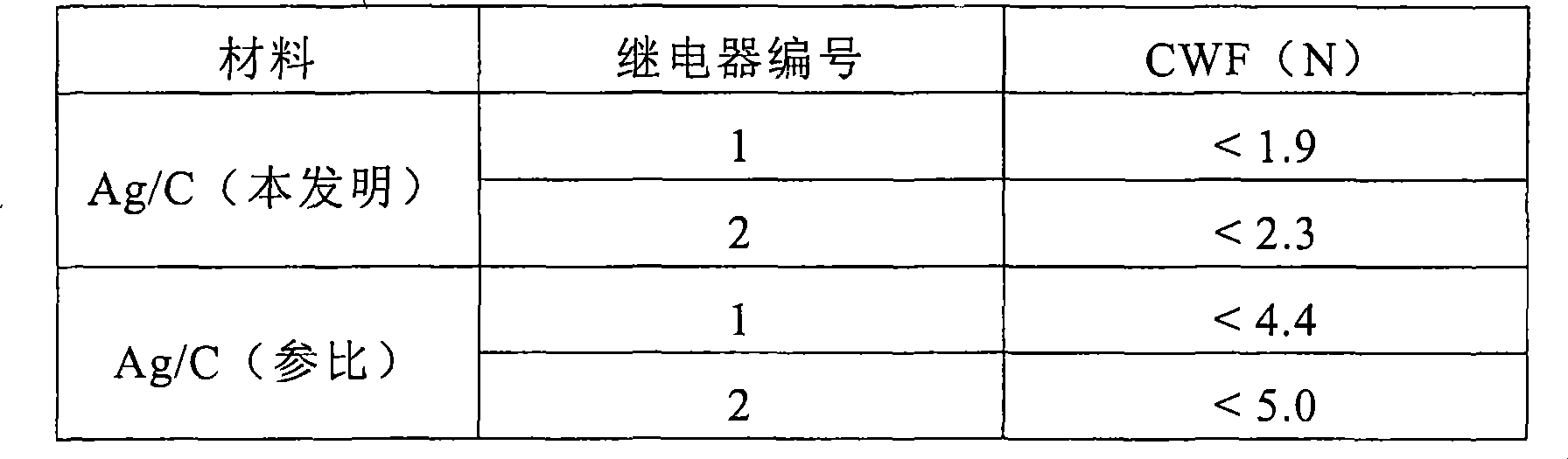
如表2所示,相对于参考Ag/C材料,根据本发明的Ag/C接触材料显示了显著较低的接触焊接力,因而再次表明了改进的接触焊接性能。根据本发明的Ag/C接触材料显示的接触焊接力(95%值)大约是参比材料需要力的一半。As shown in Table 2, the Ag/C contact material according to the invention shows a significantly lower contact welding force relative to the reference Ag/C material, thus again indicating improved contact welding performance. The Ag/C contact material according to the invention shows a contact welding force (95% value) which is approximately half of the force required for the reference material.
特别的接触腐蚀的测定(SCE):Special contact corrosion test (SCE):
为了测定Ag/C接触材料的比接触腐蚀,使用如前所述同样的测试设备。接触材料的比接触腐蚀通过触头重量损失的份额(μg)和电弧能量(Ws)计算:To determine the specific contact corrosion of Ag/C contact materials, the same test equipment as previously described was used. The specific contact corrosion of the contact material is calculated from the share of the contact weight loss (μg) and the arc energy (Ws):
SCE=接触材料的重量损失(μg)/电弧能量(Ws)SCE=weight loss of contact material (μg)/arc energy (Ws)
用“接通”和“断开”操作模型开关测定比接触腐蚀。为了对比和参考,平行测试Ag/C标准材料的触头。结果如表3所示。Specific contact corrosion was determined with "on" and "off" operating model switches. For comparison and reference, contacts of Ag/C standard material were tested in parallel. The results are shown in Table 3.
表3:Ag/C接触材料的比接触腐蚀Table 3: Specific contact corrosion of Ag/C contact materials
如表3所示,与参比Ag/C材料比较,根据本发明制备的Ag/C接触材料显示了显著较低的比接触腐蚀,因而再次表明了改进的接触焊接性能。对于两种开关操作模式(“接通”和“断开”),SCE的值都比参考Ag/C材料低了大约30%。As shown in Table 3, the Ag/C contact materials prepared according to the present invention showed significantly lower specific contact corrosion compared to the reference Ag/C material, thus again indicating improved contact welding performance. For both switching modes of operation ("ON" and "OFF"), the values of SCE are about 30% lower than the reference Ag/C material.
实施例7Example 7
含银纳米颗粒的导电油墨Conductive Ink Containing Silver Nanoparticles
为了制造导电的银油墨,在实施例2中获得的银颗粒以湿的形式加入并分散于合适的有机树脂体系中。因为小的粒度和独特的粒度分布,银颗粒的烧结在非常低的温度下发生。基于实施例2生产的纳米颗粒的银油墨在低于150℃的温度干燥后产生优异的导电率(接近银体相导电率)。In order to produce a conductive silver ink, the silver particles obtained in Example 2 are added in wet form and dispersed in a suitable organic resin system. Because of the small particle size and unique particle size distribution, sintering of silver particles occurs at very low temperatures. Silver inks based on nanoparticles produced in Example 2 yielded excellent electrical conductivity (close to that of silver bulk phase) after drying at temperatures below 150°C.
实施例8Example 8
含银纳米颗粒的水基导电油墨Water-based conductive ink containing silver nanoparticles
类似实施例2制备一批银纳米颗粒。在70℃下处理该Ag(+1)-氧化物中间体的水悬浮液15分钟以形成银颗粒。其d50值(用FE-SEM测量)为13.2nm。A batch of silver nanoparticles was prepared similarly to Example 2. The aqueous suspension of the Ag(+1)-oxide intermediate was treated at 70°C for 15 minutes to form silver particles. Its d50 value (measured with FE-SEM) is 13.2 nm.
用DI水和乙醇洗涤后,湿的粉末通过超声一小时再分散于DI水中以形成具有10wt%Ag固体含量的水分散体。25μl的分散体分布在具有50×5mm指定区域的载玻片上。膜在室温下干燥15分钟。银颗粒的烧结/固化在对流炉中进行,使用四种不同的烧结/固化条件(260℃下3分钟;260℃下15分钟;150℃下1小时;150℃下15分钟)。最终的膜厚通过断面的SEM实验测量。After washing with DI water and ethanol, the wet powder was redispersed in DI water by sonication for one hour to form an aqueous dispersion with 10 wt% Ag solid content. 25 μl of the dispersion were distributed on glass slides with designated areas of 50 x 5 mm. The membrane was dried at room temperature for 15 minutes. Sintering/curing of silver particles was performed in a convection oven using four different sintering/curing conditions (3 minutes at 260°C; 15 minutes at 260°C; 1 hour at 150°C; 15 minutes at 150°C). The final film thickness was measured by cross-sectional SEM experiments.
导电膜的电阻率测试:Resistivity test of conductive film:
使用具有开尔文拍和HP A 3478欧姆表的4点测量布局测量银膜的电阻率,使用。用测得的该干燥银膜的电阻值、尺寸和厚度计算银膜电阻率。The resistivity of the silver film was measured using a 4-point measurement layout with Kelvin beats and an HP A 3478 ohmmeter, using . The resistivity of the silver film was calculated using the measured resistance value, size and thickness of the dried silver film.
结果给出在表4中。如其所示,在低至150℃的温度下烧结后,基于本发明银纳米颗粒的银油墨产生的银膜具有非常好的导电率。通常,获得的电阻率值(μOhm*cm)比体相Ag的电阻率小10倍(约1.5μOhm*cm;参见H.-H.Lee,K.-S.Chou and K.-C.Huang,Nanotechnology,Vol.16,2436~2441(2005))。低温烧结性能是由于根据本发明的银纳米颗粒的粒度范围和粒度分布的独特组合。The results are given in Table 4. As shown therein, silver inks based on silver nanoparticles of the present invention produce silver films with very good electrical conductivity after sintering at temperatures as low as 150°C. Typically, the obtained resistivity values (μOhm * cm) are 10 times smaller than those of bulk Ag (about 1.5 μOhm * cm; see H.-H. Lee, K.-S. Chou and K.-C. Huang , Nanotechnology, Vol.16, 2436-2441 (2005)). The low temperature sintering performance is due to the unique combination of particle size range and particle size distribution of the silver nanoparticles according to the present invention.
表4:银膜的电阻率(水性银油墨,10wt%的Ag)Table 4: Resistivity of silver film (aqueous silver ink, 10wt% Ag)
实施例9Example 9
银纳米颗粒对于抗菌应用的使用Use of Silver Nanoparticles for Antimicrobial Applications
约17.5wt%的实施例2中获得的银纳米颗粒加入无菌微孔水中。通过超声一小时形成初始的纳米颗粒分散体。该分散体接着各自以1:10、1:100和1:1000用无菌微孔水稀释。稀释的分散体超声30分钟。About 17.5wt% of the silver nanoparticles obtained in Example 2 was added to sterile microporous water. An initial nanoparticle dispersion was formed by sonication for one hour. The dispersions were then diluted with sterile millipore water at 1:10, 1:100 and 1:1000, respectively. The diluted dispersion was sonicated for 30 minutes.
革兰阴性大肠埃希氏菌Escherichia coli(DH5α菌株)和革兰阳性表皮葡萄球菌Staphylococcus epidermidis被用于研究在水分散体中银纳米颗粒的抗菌功效。细菌于37℃在Luria-Broth中过夜生长。细菌的悬浮液以1:1000用无菌微孔水稀释。细菌精确的初始浓度通过固体琼脂平板法测定,如下所述。1ml的稀释的细菌悬浮液释放到微滴度塔板的每个井孔。然后加入10μl的纳米颗粒分散体。整个微滴度塔板在室温下轻微摇动。在培育24小时之后测量悬浮液中存活的细胞浓度。从每个井孔取出10μl的悬浮液,适当地用无菌微孔水稀释并用刮勺均匀地分布在Luria-Broth固体琼脂平板上。该琼脂平板在37℃培育24小时。在此期间,每个存活的细菌细胞生长为很好观察到的0.5~2mm直径的细胞菌落。计算这些菌落。在与纳米颗粒分散体接触24小时后还存活的细菌浓度由菌落的数量和细菌悬浮液的稀释指数计算。结果用菌落形成单位每毫升(CFU/ml)表示。Gram-negative Escherichia coli (DH5α strain) and Gram-positive Staphylococcus epidermidis were used to study the antibacterial efficacy of silver nanoparticles in aqueous dispersions. Bacteria were grown overnight in Luria-Broth at 37°C. The bacterial suspension was diluted 1:1000 with sterile Millipore water. The exact initial concentration of bacteria was determined by the solid agar plate method, as described below. 1 ml of the diluted bacterial suspension was dispensed into each well of the microtiter plate. Then 10 μl of the nanoparticle dispersion was added. The entire microtiter plate was shaken gently at room temperature. The concentration of viable cells in suspension was measured after 24 hours of incubation. Take 10 μl of the suspension from each well, dilute appropriately with sterile Millipore water and spread evenly on Luria-Broth solid agar plates with a spatula. The agar plates were incubated at 37°C for 24 hours. During this period, each surviving bacterial cell grew into a well-observed colony of cells 0.5-2 mm in diameter. Count these colonies. The concentration of bacteria surviving 24 hours after contact with the nanoparticle dispersion was calculated from the number of colonies and the dilution index of the bacterial suspension. Results are expressed in colony forming units per milliliter (CFU/ml).
表5:24小时后革兰阴性大肠埃希氏菌Escherichia coli的浓度Table 5: Concentrations of Gram-negative Escherichia coli after 24 hours
表6:24小时后革兰阳性表皮葡萄球菌Staphylococcus epidermidis的浓度Table 6: Concentrations of Gram-positive Staphylococcus epidermidis after 24 hours
观察到本发明的银纳米颗粒,作为水分散体,是非常有效的抗菌剂,至少直至17.5wt%的Ag的初始分散体的1:1000的稀释液。It was observed that the silver nanoparticles of the present invention, as an aqueous dispersion, are very effective antimicrobial agents, at least up to a 1:1000 dilution of the initial dispersion of 17.5 wt% Ag.
在参考其详细的实施例进行描述本发明时,应该理解本发明可以进一步修饰以及本申请覆盖了根据本发明基本原理的本发明所有和任何的变化、使用、适应。所有这些选择、修饰和等价物,在本领域一般技术人员阅读过本公开后可能是显而易见的事情包括在如附随的权利要求书所反映的本发明的精神和范围之内的。While the invention has been described with reference to specific examples thereof, it should be understood that the invention can be further modified and that this application covers all and any variations, uses, adaptations of the invention in accordance with the basic principles of the invention. All such alternatives, modifications and equivalents which may become apparent to those of ordinary skill in the art after reading this disclosure are intended to be included within the spirit and scope of the invention as reflected in the appended claims.
Claims (37)
Applications Claiming Priority (2)
| Application Number | Priority Date | Filing Date | Title |
|---|---|---|---|
| US11/394,826 | 2006-03-31 | ||
| US11/394,826 US7842274B2 (en) | 2006-03-31 | 2006-03-31 | Process for manufacture of silver-based particles and electrical contact materials |
Publications (1)
| Publication Number | Publication Date |
|---|---|
| CN101415644A true CN101415644A (en) | 2009-04-22 |
Family
ID=38523146
Family Applications (1)
| Application Number | Title | Priority Date | Filing Date |
|---|---|---|---|
| CNA2007800124182A Pending CN101415644A (en) | 2006-03-31 | 2007-03-29 | Process for manufacture of silver-based particles and electrical contact materials |
Country Status (7)
| Country | Link |
|---|---|
| US (1) | US7842274B2 (en) |
| EP (1) | EP2004551A2 (en) |
| JP (1) | JP2009531540A (en) |
| KR (1) | KR20080112318A (en) |
| CN (1) | CN101415644A (en) |
| TW (1) | TW200804194A (en) |
| WO (1) | WO2007112926A2 (en) |
Cited By (32)
| Publication number | Priority date | Publication date | Assignee | Title |
|---|---|---|---|---|
| CN102467986A (en) * | 2010-11-04 | 2012-05-23 | 中国探针股份有限公司 | Electric contact material of silver-based cadmium-free composite material capable of resisting arc erosion |
| CN103147072A (en) * | 2013-04-02 | 2013-06-12 | 北京印刷学院 | Low-temperature preparation method for silver conductive image-text layer by decomposition and heat release of silver oxalate |
| CN104475733A (en) * | 2014-12-30 | 2015-04-01 | 桂林电器科学研究院有限公司 | Preparation method of flake-like silver-nickel-tungsten electrical contact material |
| CN104493172A (en) * | 2014-12-30 | 2015-04-08 | 桂林电器科学研究院有限公司 | Preparation method of flakey or rivet-shaped silver, nickel and tungsten electrical contact material |
| CN104505191A (en) * | 2014-12-30 | 2015-04-08 | 桂林电器科学研究院有限公司 | Indium-tin-oxide-containing silver tin oxide electrical contact material preparation method |
| CN104493176A (en) * | 2014-12-30 | 2015-04-08 | 桂林电器科学研究院有限公司 | Method for preparing flaky silver-tungsten electrical contact material |
| CN104493171A (en) * | 2014-12-30 | 2015-04-08 | 桂林电器科学研究院有限公司 | Preparation method of flakey silver and zinc oxide electrical contact material |
| CN104493173A (en) * | 2014-12-30 | 2015-04-08 | 桂林电器科学研究院有限公司 | Preparation method of flakey or rivet-shaped silver and tungsten electrical contact material |
| CN104493177A (en) * | 2014-12-30 | 2015-04-08 | 桂林电器科学研究院有限公司 | Preparation method of flakey silver and tungsten electrical contact material |
| CN104493170A (en) * | 2014-12-30 | 2015-04-08 | 桂林电器科学研究院有限公司 | Preparation method of flakey or rivet-shaped silver and tungsten electrical contact material |
| CN104493178A (en) * | 2014-12-30 | 2015-04-08 | 桂林电器科学研究院有限公司 | Processing method of silver zinc oxide electric contact material containing additive |
| CN104525950A (en) * | 2014-12-30 | 2015-04-22 | 桂林电器科学研究院有限公司 | Method for preparing silver tin oxide electrical contact material |
| CN104525968A (en) * | 2014-12-30 | 2015-04-22 | 桂林电器科学研究院有限公司 | Flaky silver-tungsten electrical contact material preparation method |
| CN104538120A (en) * | 2014-12-30 | 2015-04-22 | 桂林电器科学研究院有限公司 | Processing method of silver tin oxide electrical contact material containing indium tin oxide |
| CN104588654A (en) * | 2014-12-30 | 2015-05-06 | 桂林电器科学研究院有限公司 | Processing method of flaky or rivet type silver nickel tungsten electric contact materials |
| CN105462366A (en) * | 2015-12-28 | 2016-04-06 | 上海产业技术研究院 | Preparation method of low-temperature sintering non-granular silver conductive ink |
| CN105504998A (en) * | 2015-12-28 | 2016-04-20 | 上海产业技术研究院 | Low-temperature-sintered organic metal conductive ink and preparing method thereof |
| CN106205762A (en) * | 2016-06-24 | 2016-12-07 | 四川艾尔法泰克科技有限公司 | Metal-based titanium oxide nanofiber composited contact material and preparation method thereof |
| CN107052351A (en) * | 2011-07-01 | 2017-08-18 | 阿托斯塔特公司 | For the method and apparatus for the nano particle for producing uniform-dimension |
| CN110036450A (en) * | 2016-12-02 | 2019-07-19 | 田中贵金属工业株式会社 | The manufacturing method of conductive bonding material and semiconductor device |
| CN110666185A (en) * | 2019-10-29 | 2020-01-10 | 西安工程大学 | A kind of preparation method of silver silicon dioxide electrical contact material |
| US10774429B2 (en) | 2015-04-13 | 2020-09-15 | Attostat, Inc. | Anti-corrosion nanoparticle compositions |
| CN112170861A (en) * | 2020-09-30 | 2021-01-05 | 桂林金格电工电子材料科技有限公司 | Preparation method of silver tungsten carbide contact material |
| US10953043B2 (en) | 2015-04-01 | 2021-03-23 | Attostat, Inc. | Nanoparticle compositions and methods for treating or preventing tissue infections and diseases |
| US11018376B2 (en) | 2017-11-28 | 2021-05-25 | Attostat, Inc. | Nanoparticle compositions and methods for enhancing lead-acid batteries |
| CN112853147A (en) * | 2020-12-31 | 2021-05-28 | 四川艾尔法泰克科技有限公司 | Silver-based electric contact material and preparation method thereof |
| TWI759635B (en) * | 2018-10-04 | 2022-04-01 | 南韓商大州電子材料股份有限公司 | Silver powder and manufacturing method thereof |
| US11473202B2 (en) | 2015-04-13 | 2022-10-18 | Attostat, Inc. | Anti-corrosion nanoparticle compositions |
| US11646453B2 (en) | 2017-11-28 | 2023-05-09 | Attostat, Inc. | Nanoparticle compositions and methods for enhancing lead-acid batteries |
| CN117733169A (en) * | 2023-12-22 | 2024-03-22 | 苏州星翰新材料科技有限公司 | A kind of spherical nano silver powder and its preparation method and application |
| US12115250B2 (en) | 2019-07-12 | 2024-10-15 | Evoq Nano, Inc. | Use of nanoparticles for treating respiratory infections associated with cystic fibrosis |
| US12456759B2 (en) | 2021-03-30 | 2025-10-28 | Evoq Nano, Inc. | Nanoparticle-enhanced lead-acid electrode paste and improved lead-acid batteries made therefrom |
Families Citing this family (26)
| Publication number | Priority date | Publication date | Assignee | Title |
|---|---|---|---|---|
| WO2007065154A2 (en) * | 2005-12-02 | 2007-06-07 | Nanodynamics Inc. | Method of manufacturing silver platelets |
| TWI334854B (en) * | 2006-07-28 | 2010-12-21 | Method for manufacturing metal nano-particle | |
| MXNL06000107A (en) * | 2006-12-20 | 2008-10-08 | Ind Penoles Sa De Cv | Process for the manufacture of nanometric, monodisperse and stable metallic silver and product obtained therefrom. |
| CN101990475A (en) * | 2008-04-28 | 2011-03-23 | 塔塔化学有限公司 | A process for the preparation of silver nano particles |
| DE102008056264A1 (en) * | 2008-11-06 | 2010-05-27 | Ami Doduco Gmbh | Process for producing a semifinished product and semifinished product for electrical contacts and contact piece |
| EP2204250A1 (en) * | 2008-12-16 | 2010-07-07 | Akzo Nobel Coatings International B.V. | Aqueous dispersions of silver particles |
| EP2204249A1 (en) * | 2008-12-16 | 2010-07-07 | Akzo Nobel Coatings International B.V. | Aqueous dispersions of metallic particles |
| JP5368925B2 (en) * | 2009-09-25 | 2013-12-18 | 三菱製紙株式会社 | Method for producing silver ultrafine particles |
| KR101724064B1 (en) * | 2010-02-18 | 2017-04-10 | 삼성전자주식회사 | Conductive carbon nanotube-metal composite ink |
| KR20110113877A (en) * | 2010-04-12 | 2011-10-19 | 서울대학교산학협력단 | Mass production method of silver nanoparticles with uniform size |
| JP5906027B2 (en) * | 2010-07-30 | 2016-04-20 | トッパン・フォームズ株式会社 | Decorative or mirror surface ink composition, base material, and method for producing a base material provided with a metallic silver layer on the surface |
| KR101609028B1 (en) | 2013-11-29 | 2016-04-05 | 엘에스산전 주식회사 | Electrical contact materials and method for preparing the same |
| CN106852132A (en) * | 2014-06-20 | 2017-06-13 | 罗地亚经营管理公司 | Metal nanoparticle without stabilizer synthesizes and by the purposes of its metal nanoparticle for synthesizing |
| CN104313364B (en) * | 2014-10-10 | 2016-05-25 | 福达合金材料股份有限公司 | A kind of oxidation-method of reducing is alternately prepared the technique of the particle reinforced Ag-based contact material of fine oxide |
| CN104493179A (en) * | 2014-12-30 | 2015-04-08 | 桂林电器科学研究院有限公司 | Preparation method of flakey or rivet-shaped silver and zinc oxide electrical contact material |
| EP3216545B2 (en) | 2016-03-07 | 2022-09-28 | Heraeus Deutschland GmbH & Co. KG | Precious metal based powder and its use in the preparation of components |
| CN106011704B (en) * | 2016-06-24 | 2017-12-15 | 四川艾尔法泰克科技有限公司 | A kind of hexa-atomic alloy contact material of silver-based and preparation method thereof |
| CN105970015B (en) * | 2016-06-26 | 2017-08-25 | 浙江大学 | The preparation method of silver-colored CNT zirconic acid lanthanum composited contact material |
| DE102018104415A1 (en) * | 2018-02-27 | 2019-08-29 | Tdk Electronics Ag | switching device |
| JP7119680B2 (en) * | 2018-07-13 | 2022-08-17 | オムロン株式会社 | closed relay |
| CN110802224A (en) * | 2018-08-06 | 2020-02-18 | 三菱电机株式会社 | Preparation method of silver-nickel-tin oxide composite powder and silver-nickel-tin oxide electrical contact material |
| KR102194953B1 (en) * | 2019-05-23 | 2020-12-24 | (주)네프 | Electrodes for controlling breaker switchgear of electric power equipment |
| US11453058B2 (en) * | 2020-03-27 | 2022-09-27 | Nobel /Noble Elements/ Llc | Preparation of highly stable concentrated dispersions of silver nanoparticles using synergistic dispersing agents |
| CN112812669A (en) * | 2020-12-31 | 2021-05-18 | 重庆文理学院 | Method for preparing flower-like silicon dioxide-based composite photocatalytic antibacterial water-based interior wall paint |
| CN115522093B (en) * | 2022-08-24 | 2023-07-18 | 苏州银孚新材料有限公司 | Composite reinforced silver tungsten carbide graphite electric shock material and preparation method thereof |
| CN117107100B (en) * | 2023-08-28 | 2024-01-30 | 昆明理工大学 | A method for reinforcing silver-based materials with core-shell structure metal oxide |
Family Cites Families (12)
| Publication number | Priority date | Publication date | Assignee | Title |
|---|---|---|---|---|
| US2239519A (en) * | 1938-03-15 | 1941-04-22 | Pittsburgh Piate Glass Company | Reducing solution for silvering operations |
| US2752237A (en) * | 1955-06-13 | 1956-06-26 | Du Pont | Silver powder and method for producing same |
| CH434588A (en) | 1962-11-15 | 1967-04-30 | Tesla Np | Process for the production of silver powder |
| FR2639466B1 (en) | 1988-11-22 | 1991-02-15 | Telemecanique | PROCESS FOR PREPARING AN ELECTRICAL CONTACT MATERIAL AND METHOD FOR MANUFACTURING A CONTACT ELEMENT INCORPORATING SUCH A MATERIAL |
| JPH09286936A (en) * | 1996-04-22 | 1997-11-04 | Sumitomo Metal Mining Co Ltd | Coating liquid for forming transparent conductive film, transparent conductive film using the same, and method for forming the same |
| US6660680B1 (en) * | 1997-02-24 | 2003-12-09 | Superior Micropowders, Llc | Electrocatalyst powders, methods for producing powders and devices fabricated from same |
| US6290749B1 (en) * | 1999-12-08 | 2001-09-18 | Eastman Kodak Company | Preparation of ultra-pure silver metal |
| WO2003056574A1 (en) * | 2001-12-27 | 2003-07-10 | Fujikura Ltd. | Electroconductive composition, electroconductive coating and method for forming electroconductive coating |
| JP4489389B2 (en) * | 2003-07-29 | 2010-06-23 | 三井金属鉱業株式会社 | Method for producing fine silver powder |
| US7226573B2 (en) * | 2003-09-10 | 2007-06-05 | Dowa Mining Co., Ltd. | Fine-grain silver oxide powder |
| US7201888B2 (en) * | 2003-10-07 | 2007-04-10 | Ferro Corporation | Nanosized silver oxide powder |
| US7270694B2 (en) * | 2004-10-05 | 2007-09-18 | Xerox Corporation | Stabilized silver nanoparticles and their use |
-
2006
- 2006-03-31 US US11/394,826 patent/US7842274B2/en active Active
-
2007
- 2007-03-29 KR KR1020087025681A patent/KR20080112318A/en not_active Withdrawn
- 2007-03-29 EP EP07723739A patent/EP2004551A2/en not_active Withdrawn
- 2007-03-29 JP JP2009501953A patent/JP2009531540A/en not_active Withdrawn
- 2007-03-29 WO PCT/EP2007/002795 patent/WO2007112926A2/en not_active Ceased
- 2007-03-29 CN CNA2007800124182A patent/CN101415644A/en active Pending
- 2007-03-30 TW TW096111379A patent/TW200804194A/en unknown
Cited By (38)
| Publication number | Priority date | Publication date | Assignee | Title |
|---|---|---|---|---|
| CN102467986A (en) * | 2010-11-04 | 2012-05-23 | 中国探针股份有限公司 | Electric contact material of silver-based cadmium-free composite material capable of resisting arc erosion |
| US10610934B2 (en) | 2011-07-01 | 2020-04-07 | Attostat, Inc. | Method and apparatus for production of uniformly sized nanoparticles |
| CN107052351B (en) * | 2011-07-01 | 2021-06-15 | 阿托斯塔特公司 | Method and apparatus for producing uniformly sized nanoparticles |
| CN107052351A (en) * | 2011-07-01 | 2017-08-18 | 阿托斯塔特公司 | For the method and apparatus for the nano particle for producing uniform-dimension |
| CN103147072A (en) * | 2013-04-02 | 2013-06-12 | 北京印刷学院 | Low-temperature preparation method for silver conductive image-text layer by decomposition and heat release of silver oxalate |
| CN104493171A (en) * | 2014-12-30 | 2015-04-08 | 桂林电器科学研究院有限公司 | Preparation method of flakey silver and zinc oxide electrical contact material |
| CN104588654A (en) * | 2014-12-30 | 2015-05-06 | 桂林电器科学研究院有限公司 | Processing method of flaky or rivet type silver nickel tungsten electric contact materials |
| CN104493173A (en) * | 2014-12-30 | 2015-04-08 | 桂林电器科学研究院有限公司 | Preparation method of flakey or rivet-shaped silver and tungsten electrical contact material |
| CN104493177A (en) * | 2014-12-30 | 2015-04-08 | 桂林电器科学研究院有限公司 | Preparation method of flakey silver and tungsten electrical contact material |
| CN104493170A (en) * | 2014-12-30 | 2015-04-08 | 桂林电器科学研究院有限公司 | Preparation method of flakey or rivet-shaped silver and tungsten electrical contact material |
| CN104493178A (en) * | 2014-12-30 | 2015-04-08 | 桂林电器科学研究院有限公司 | Processing method of silver zinc oxide electric contact material containing additive |
| CN104525950A (en) * | 2014-12-30 | 2015-04-22 | 桂林电器科学研究院有限公司 | Method for preparing silver tin oxide electrical contact material |
| CN104525968A (en) * | 2014-12-30 | 2015-04-22 | 桂林电器科学研究院有限公司 | Flaky silver-tungsten electrical contact material preparation method |
| CN104538120A (en) * | 2014-12-30 | 2015-04-22 | 桂林电器科学研究院有限公司 | Processing method of silver tin oxide electrical contact material containing indium tin oxide |
| CN104475733A (en) * | 2014-12-30 | 2015-04-01 | 桂林电器科学研究院有限公司 | Preparation method of flake-like silver-nickel-tungsten electrical contact material |
| CN104493172A (en) * | 2014-12-30 | 2015-04-08 | 桂林电器科学研究院有限公司 | Preparation method of flakey or rivet-shaped silver, nickel and tungsten electrical contact material |
| CN104505191A (en) * | 2014-12-30 | 2015-04-08 | 桂林电器科学研究院有限公司 | Indium-tin-oxide-containing silver tin oxide electrical contact material preparation method |
| CN104538120B (en) * | 2014-12-30 | 2016-08-17 | 桂林电器科学研究院有限公司 | A kind of processing method of the siller tin oxide electric contact material containing stannic acid indium |
| CN104493176A (en) * | 2014-12-30 | 2015-04-08 | 桂林电器科学研究院有限公司 | Method for preparing flaky silver-tungsten electrical contact material |
| US10953043B2 (en) | 2015-04-01 | 2021-03-23 | Attostat, Inc. | Nanoparticle compositions and methods for treating or preventing tissue infections and diseases |
| US11473202B2 (en) | 2015-04-13 | 2022-10-18 | Attostat, Inc. | Anti-corrosion nanoparticle compositions |
| US10774429B2 (en) | 2015-04-13 | 2020-09-15 | Attostat, Inc. | Anti-corrosion nanoparticle compositions |
| CN105504998A (en) * | 2015-12-28 | 2016-04-20 | 上海产业技术研究院 | Low-temperature-sintered organic metal conductive ink and preparing method thereof |
| CN105462366A (en) * | 2015-12-28 | 2016-04-06 | 上海产业技术研究院 | Preparation method of low-temperature sintering non-granular silver conductive ink |
| CN106205762A (en) * | 2016-06-24 | 2016-12-07 | 四川艾尔法泰克科技有限公司 | Metal-based titanium oxide nanofiber composited contact material and preparation method thereof |
| CN110036450A (en) * | 2016-12-02 | 2019-07-19 | 田中贵金属工业株式会社 | The manufacturing method of conductive bonding material and semiconductor device |
| CN110036450B (en) * | 2016-12-02 | 2020-12-01 | 田中贵金属工业株式会社 | Conductive bonding material and manufacturing method of semiconductor device |
| US11018376B2 (en) | 2017-11-28 | 2021-05-25 | Attostat, Inc. | Nanoparticle compositions and methods for enhancing lead-acid batteries |
| US12119456B2 (en) | 2017-11-28 | 2024-10-15 | Evoq Nano, Inc. | Nanoparticle compositions and methods for enhancing lead-acid batteries |
| US11646453B2 (en) | 2017-11-28 | 2023-05-09 | Attostat, Inc. | Nanoparticle compositions and methods for enhancing lead-acid batteries |
| TWI759635B (en) * | 2018-10-04 | 2022-04-01 | 南韓商大州電子材料股份有限公司 | Silver powder and manufacturing method thereof |
| US12115250B2 (en) | 2019-07-12 | 2024-10-15 | Evoq Nano, Inc. | Use of nanoparticles for treating respiratory infections associated with cystic fibrosis |
| CN110666185A (en) * | 2019-10-29 | 2020-01-10 | 西安工程大学 | A kind of preparation method of silver silicon dioxide electrical contact material |
| CN112170861A (en) * | 2020-09-30 | 2021-01-05 | 桂林金格电工电子材料科技有限公司 | Preparation method of silver tungsten carbide contact material |
| CN112853147A (en) * | 2020-12-31 | 2021-05-28 | 四川艾尔法泰克科技有限公司 | Silver-based electric contact material and preparation method thereof |
| US12456759B2 (en) | 2021-03-30 | 2025-10-28 | Evoq Nano, Inc. | Nanoparticle-enhanced lead-acid electrode paste and improved lead-acid batteries made therefrom |
| CN117733169A (en) * | 2023-12-22 | 2024-03-22 | 苏州星翰新材料科技有限公司 | A kind of spherical nano silver powder and its preparation method and application |
| CN117733169B (en) * | 2023-12-22 | 2025-05-20 | 苏州星翰新材料科技有限公司 | Spherical nano silver powder and preparation method and application thereof |
Also Published As
| Publication number | Publication date |
|---|---|
| TW200804194A (en) | 2008-01-16 |
| US7842274B2 (en) | 2010-11-30 |
| KR20080112318A (en) | 2008-12-24 |
| EP2004551A2 (en) | 2008-12-24 |
| WO2007112926A3 (en) | 2007-12-21 |
| JP2009531540A (en) | 2009-09-03 |
| US20070234851A1 (en) | 2007-10-11 |
| WO2007112926A2 (en) | 2007-10-11 |
Similar Documents
| Publication | Publication Date | Title |
|---|---|---|
| CN101415644A (en) | Process for manufacture of silver-based particles and electrical contact materials | |
| US20100167051A1 (en) | Process for Manufacture of Silver-Based Particles and Electrical Contact Materials | |
| CN104681312B (en) | Contact material and the method for preparing the contact material | |
| Wu et al. | Preparation of Au/Pt bimetallic nanoparticles in water-in-oil microemulsions | |
| KR101443518B1 (en) | Method for fabricating core-shell particles supported on carrier and core-shell particles supported on carrier fabricated by the method | |
| CN106086495B (en) | Cupric oxide doped siller tin oxide composite and preparation method thereof | |
| US10210965B2 (en) | Method for electrical contact materials including Ag plated CNTs | |
| CN101071687A (en) | Silver-nanotin oxide electric contact material and its preparing process | |
| KR101807919B1 (en) | Carrier-nano particles complex, method for fabricating the same and catalyst comprising the same | |
| KR101851424B1 (en) | Carrier-nano particles complex and method for fabricating the same | |
| JP5080731B2 (en) | Fine silver particle-attached silver-copper composite powder and method for producing the fine silver particle-attached silver-copper composite powder | |
| EP1133447B1 (en) | Water-soluble nanostructured metal-oxide colloids and method for preparing the same | |
| CN101121204A (en) | A kind of preparation method of nano-silver composite sol | |
| US20070196641A1 (en) | Production method of composite particles | |
| JP2009030100A (en) | Ag-Ni-BASED ELECTRICAL CONTACT MATERIAL AND ITS MANUFACTURING METHOD | |
| CN106903325B (en) | Preparation method of silver-tin oxide electric contact material and electric contact material prepared by same | |
| CN104245976A (en) | Contact material | |
| CN1425782A (en) | Metal oxide blended silver-tin dioxide electric contactor material and its preparing method | |
| CN101763956B (en) | Silver-graphite electrical contact material and preparation method thereof | |
| KR100661621B1 (en) | Colloid containing metal nanoparticles and its manufacturing method | |
| JP5945608B2 (en) | Gold nanoparticle dispersion for forming conductive film, method for producing the same, and conductive coating composition containing the dispersion | |
| CN103700532B (en) | A kind of spraying dry prepares the method for siller tin oxide electric contact material | |
| KR20170032261A (en) | METHOD FOR ELECTRICAL CONTACT MATERIALS INCLUDING AG PLATED CNTs |
Legal Events
| Date | Code | Title | Description |
|---|---|---|---|
| C06 | Publication | ||
| PB01 | Publication | ||
| C10 | Entry into substantive examination | ||
| SE01 | Entry into force of request for substantive examination | ||
| C02 | Deemed withdrawal of patent application after publication (patent law 2001) | ||
| WD01 | Invention patent application deemed withdrawn after publication |
Application publication date: 20090422 |