CN101336247A - antiviral nucleoside - Google Patents
antiviral nucleoside Download PDFInfo
- Publication number
- CN101336247A CN101336247A CNA2006800523648A CN200680052364A CN101336247A CN 101336247 A CN101336247 A CN 101336247A CN A2006800523648 A CNA2006800523648 A CN A2006800523648A CN 200680052364 A CN200680052364 A CN 200680052364A CN 101336247 A CN101336247 A CN 101336247A
- Authority
- CN
- China
- Prior art keywords
- compound
- hcv
- acid
- treatment
- virus
- Prior art date
- Legal status (The legal status is an assumption and is not a legal conclusion. Google has not performed a legal analysis and makes no representation as to the accuracy of the status listed.)
- Granted
Links
Classifications
-
- C—CHEMISTRY; METALLURGY
- C07—ORGANIC CHEMISTRY
- C07H—SUGARS; DERIVATIVES THEREOF; NUCLEOSIDES; NUCLEOTIDES; NUCLEIC ACIDS
- C07H19/00—Compounds containing a hetero ring sharing one ring hetero atom with a saccharide radical; Nucleosides; Mononucleotides; Anhydro-derivatives thereof
- C07H19/02—Compounds containing a hetero ring sharing one ring hetero atom with a saccharide radical; Nucleosides; Mononucleotides; Anhydro-derivatives thereof sharing nitrogen
- C07H19/04—Heterocyclic radicals containing only nitrogen atoms as ring hetero atom
- C07H19/12—Triazine radicals
-
- A—HUMAN NECESSITIES
- A61—MEDICAL OR VETERINARY SCIENCE; HYGIENE
- A61K—PREPARATIONS FOR MEDICAL, DENTAL OR TOILETRY PURPOSES
- A61K31/00—Medicinal preparations containing organic active ingredients
- A61K31/70—Carbohydrates; Sugars; Derivatives thereof
- A61K31/7042—Compounds having saccharide radicals and heterocyclic rings
- A61K31/7052—Compounds having saccharide radicals and heterocyclic rings having nitrogen as a ring hetero atom, e.g. nucleosides, nucleotides
- A61K31/706—Compounds having saccharide radicals and heterocyclic rings having nitrogen as a ring hetero atom, e.g. nucleosides, nucleotides containing six-membered rings with nitrogen as a ring hetero atom
- A61K31/7064—Compounds having saccharide radicals and heterocyclic rings having nitrogen as a ring hetero atom, e.g. nucleosides, nucleotides containing six-membered rings with nitrogen as a ring hetero atom containing condensed or non-condensed pyrimidines
- A61K31/7068—Compounds having saccharide radicals and heterocyclic rings having nitrogen as a ring hetero atom, e.g. nucleosides, nucleotides containing six-membered rings with nitrogen as a ring hetero atom containing condensed or non-condensed pyrimidines having oxo groups directly attached to the pyrimidine ring, e.g. cytidine, cytidylic acid
-
- A—HUMAN NECESSITIES
- A61—MEDICAL OR VETERINARY SCIENCE; HYGIENE
- A61P—SPECIFIC THERAPEUTIC ACTIVITY OF CHEMICAL COMPOUNDS OR MEDICINAL PREPARATIONS
- A61P1/00—Drugs for disorders of the alimentary tract or the digestive system
- A61P1/16—Drugs for disorders of the alimentary tract or the digestive system for liver or gallbladder disorders, e.g. hepatoprotective agents, cholagogues, litholytics
-
- A—HUMAN NECESSITIES
- A61—MEDICAL OR VETERINARY SCIENCE; HYGIENE
- A61P—SPECIFIC THERAPEUTIC ACTIVITY OF CHEMICAL COMPOUNDS OR MEDICINAL PREPARATIONS
- A61P31/00—Antiinfectives, i.e. antibiotics, antiseptics, chemotherapeutics
- A61P31/12—Antivirals
-
- A—HUMAN NECESSITIES
- A61—MEDICAL OR VETERINARY SCIENCE; HYGIENE
- A61P—SPECIFIC THERAPEUTIC ACTIVITY OF CHEMICAL COMPOUNDS OR MEDICINAL PREPARATIONS
- A61P31/00—Antiinfectives, i.e. antibiotics, antiseptics, chemotherapeutics
- A61P31/12—Antivirals
- A61P31/14—Antivirals for RNA viruses
-
- A—HUMAN NECESSITIES
- A61—MEDICAL OR VETERINARY SCIENCE; HYGIENE
- A61P—SPECIFIC THERAPEUTIC ACTIVITY OF CHEMICAL COMPOUNDS OR MEDICINAL PREPARATIONS
- A61P31/00—Antiinfectives, i.e. antibiotics, antiseptics, chemotherapeutics
- A61P31/12—Antivirals
- A61P31/14—Antivirals for RNA viruses
- A61P31/16—Antivirals for RNA viruses for influenza or rhinoviruses
-
- C—CHEMISTRY; METALLURGY
- C07—ORGANIC CHEMISTRY
- C07H—SUGARS; DERIVATIVES THEREOF; NUCLEOSIDES; NUCLEOTIDES; NUCLEIC ACIDS
- C07H19/00—Compounds containing a hetero ring sharing one ring hetero atom with a saccharide radical; Nucleosides; Mononucleotides; Anhydro-derivatives thereof
- C07H19/02—Compounds containing a hetero ring sharing one ring hetero atom with a saccharide radical; Nucleosides; Mononucleotides; Anhydro-derivatives thereof sharing nitrogen
- C07H19/04—Heterocyclic radicals containing only nitrogen atoms as ring hetero atom
- C07H19/06—Pyrimidine radicals
-
- Y—GENERAL TAGGING OF NEW TECHNOLOGICAL DEVELOPMENTS; GENERAL TAGGING OF CROSS-SECTIONAL TECHNOLOGIES SPANNING OVER SEVERAL SECTIONS OF THE IPC; TECHNICAL SUBJECTS COVERED BY FORMER USPC CROSS-REFERENCE ART COLLECTIONS [XRACs] AND DIGESTS
- Y02—TECHNOLOGIES OR APPLICATIONS FOR MITIGATION OR ADAPTATION AGAINST CLIMATE CHANGE
- Y02A—TECHNOLOGIES FOR ADAPTATION TO CLIMATE CHANGE
- Y02A50/00—TECHNOLOGIES FOR ADAPTATION TO CLIMATE CHANGE in human health protection, e.g. against extreme weather
- Y02A50/30—Against vector-borne diseases, e.g. mosquito-borne, fly-borne, tick-borne or waterborne diseases whose impact is exacerbated by climate change
Landscapes
- Health & Medical Sciences (AREA)
- Chemical & Material Sciences (AREA)
- Life Sciences & Earth Sciences (AREA)
- Organic Chemistry (AREA)
- General Health & Medical Sciences (AREA)
- Molecular Biology (AREA)
- Virology (AREA)
- Engineering & Computer Science (AREA)
- Biochemistry (AREA)
- Medicinal Chemistry (AREA)
- Pharmacology & Pharmacy (AREA)
- Animal Behavior & Ethology (AREA)
- Public Health (AREA)
- Veterinary Medicine (AREA)
- Genetics & Genomics (AREA)
- Biotechnology (AREA)
- Nuclear Medicine, Radiotherapy & Molecular Imaging (AREA)
- General Chemical & Material Sciences (AREA)
- Chemical Kinetics & Catalysis (AREA)
- Communicable Diseases (AREA)
- Oncology (AREA)
- Bioinformatics & Cheminformatics (AREA)
- Gastroenterology & Hepatology (AREA)
- Pulmonology (AREA)
- Epidemiology (AREA)
- Pharmaceuticals Containing Other Organic And Inorganic Compounds (AREA)
- Medicines That Contain Protein Lipid Enzymes And Other Medicines (AREA)
- Saccharide Compounds (AREA)
Abstract
Description
本发明提供作为丙肝病毒(HCV)RNA依赖性RNA病毒聚合酶抑制剂的前药的酰化核苷。口服给予时,这些化合物不难从胃肠道吸收并在血液中有效还原成母体核苷。这些前药是RNA依赖性RNA病毒复制的抑制剂,它们可用作HCV NS5B聚合酶的抑制剂,用作HCV复制抑制剂并可用于治疗哺乳动物的丙型肝炎感染。The present invention provides acylated nucleosides that are prodrugs of hepatitis C virus (HCV) RNA-dependent RNA viral polymerase inhibitors. When administered orally, these compounds are readily absorbed from the gastrointestinal tract and efficiently reduced to the parent nucleoside in the blood. These prodrugs are inhibitors of RNA-dependent RNA virus replication, they are useful as inhibitors of HCV NS5B polymerase, as inhibitors of HCV replication and are useful in the treatment of hepatitis C infection in mammals.
本发明涉及作为HCV复制抑制剂的核苷前药。具体地说,本发明涉及酰化嘧啶核苷化合物的应用,当口服给予所述核苷时,药物吸收得到改善。The present invention relates to nucleoside prodrugs that are inhibitors of HCV replication. In particular, the present invention relates to the use of acylated pyrimidine nucleoside compounds for improved drug absorption when administered orally.
丙型肝炎病毒是全世界主要的健康问题和慢性肝病的主要病因(Boyer,N等J.Hepatol.200032:98-112)。受HCV感染的患者具有患肝硬化以及随后的肝细胞癌的风险,因此,HCV是肝脏移植的主要适应症。Hepatitis C virus is a major health problem and a major cause of chronic liver disease worldwide (Boyer, N et al. J. Hepatol. 2000 32:98-112). HCV-infected patients are at risk of cirrhosis and subsequent hepatocellular carcinoma and, therefore, HCV is a major indication for liver transplantation.
根据世界卫生组织,全世界有超过2亿个体受感染,其中每年至少3-4百万人受感染。一旦被感染,约20%的人能清除病毒,但其余的人在其余生会携带HCV病毒。10%-20%的慢性感染个体最终会产生破坏肝脏的肝硬化或癌症。该病毒疾病可通过受污染的血液和血制品、受污染的针头经胃肠外传播,或通过性途径传播以及可从受感染的母亲或携带病毒的母亲垂直地传递给她们的后代。现有的HCV感染的治疗方法仅限于单用重组干扰素-α或联用核苷类似物利巴韦林的免疫疗法,因为快速产生耐药性,其临床益处有限。急需能有效抵御慢性HCV感染的改善治疗剂。According to the World Health Organization, more than 200 million individuals are infected worldwide, of which at least 3-4 million are infected each year. Once infected, about 20% of people clear the virus, but the rest carry the HCV virus for the rest of their lives. Between 10% and 20% of chronically infected individuals eventually develop cirrhosis or cancer that destroys the liver. The viral disease can be transmitted parenterally through contaminated blood and blood products, contaminated needles, or sexually and can be transmitted vertically from infected or virus-carrying mothers to their offspring. Existing treatments for HCV infection are limited to immunotherapy with recombinant interferon-α alone or in combination with the nucleoside analogue ribavirin, which has limited clinical benefit because of the rapid development of drug resistance. Improved therapeutic agents that are effective against chronic HCV infection are urgently needed.
HCV已鉴定为黄病毒科(Flaviviridae)的一元,该科包括黄病毒属(flaviviruses)、瘟病毒属(pestiviruses)和包括丙肝病毒的丙型肝炎病毒属(hepaciviruses)(Rice,C.M.,“黄病毒科:病毒及其复制”(Flaviviridae:Theviruses and their replication)刊于《菲尔兹病毒学》(Fields Virology)),Fields,B.N.,Knipe,D.M.和Howley,P.M.编,L-R出版社(Lippincott-RavenPublishers),费城,宾夕法尼州,第30章,931-959,1996)。HCV是含有约9.4kb的正义单链RNA基因组的有包膜病毒。该病毒基因组由5’-非翻译区(UTR)、编码约3011个氨基酸的多蛋白前体的长开放读框(ORF)和短的3’UTR构成。所述5’UTR是HCV基因组中保守性最高的部分,其对于多蛋白翻译的启动和控制至关重要。HCV has been identified as a member of the Flaviviridae family, which includes the genera flaviviruses, pestiviruses, and hepaciviruses including hepatitis C virus (Rice, C.M., "Flaviviruses") Flaviviridae: The viruses and their replication" (Fields Virology), Fields, B.N., Knipe, D.M. and Howley, P.M. eds., L-R Press (Lippincott-Raven Publishers ), Philadelphia, PA, Chapter 30, 931-959, 1996). HCV is an enveloped virus with a positive-sense single-stranded RNA genome of approximately 9.4 kb. The viral genome consists of a 5'-untranslated region (UTR), a long open reading frame (ORF) encoding a polyprotein precursor of about 3011 amino acids, and a short 3'UTR. The 5'UTR is the most conserved part in the HCV genome, which is crucial for the initiation and control of polyprotein translation.
HCV的遗传学分析已鉴定了显示其DNA序列趋异度大于30%的6种主要基因型。各基因型含有一系列更紧密相关的亚型,这些亚型显示的核苷酸序列趋异度为20-25%(Simmonds,P.2004 J.Gen.Virol.85:3173-88)。现已区分了超过30种亚型。在美国,约70%的受感染个体具有1a和1b型感染。1b型是亚洲最流行的亚型。(X.Forns和J.Bukh,Clinics in Liver Disease 19993:693-716;J.Bukh等,Semin.Liv.Dis.199515:41-63)。不幸的是,1型感染对治疗的耐受性高于2型或3型基因型(N.N.Zein,Clin.Microbiol.Rev.,200013:223-235)。Genetic analysis of HCV has identified 6 major genotypes showing greater than 30% divergence in their DNA sequences. Each genotype contains a series of more closely related subtypes that show 20-25% nucleotide sequence divergence (Simmonds, P. 2004 J. Gen. Virol. 85:3173-88). More than 30 subtypes have been distinguished. In the United States, approximately 70% of infected individuals have type 1a and 1b infections. Type 1b is the most prevalent subtype in Asia. (X. Forns and J. Bukh, Clinics in Liver Disease 19993: 693-716; J. Bukh et al., Semin. Liv. Dis. 199515: 41-63). Unfortunately, type 1 infection is more resistant to treatment than type 2 or type 3 genotypes (N.N. Zein, Clin. Microbiol. Rev., 200013:223-235).
瘟病毒和丙型肝炎病毒的ORF的非结构蛋白部分的遗传学组织和多蛋白加工非常相似。这些正链RNA病毒具有编码病毒复制所需的所有病毒蛋白的一种大ORF。这些蛋白质表达为多蛋白,经细胞和病毒编码的蛋白酶的共翻译加工和翻译后加工产生成熟的病毒蛋白。负责病毒基因组RNA复制的病毒蛋白大致位于羧基末端。三分之二的ORF称为非结构(NS)蛋白。按照ORF的非结构蛋白编码区的氨基末端向羧基末端的顺序,瘟病毒和丙型肝炎病毒的成熟非结构(NS)蛋白由p7、NS2、NS3、NS4A、NS4B、NS5A和NS5B构成。The genetic organization and polyprotein processing of the nonstructural protein portions of the ORFs of pestiviruses and HCVs are very similar. These positive-strand RNA viruses have one large ORF encoding all viral proteins required for viral replication. These proteins are expressed as polyproteins that undergo co-translational and post-translational processing by cellular and virally encoded proteases to produce mature viral proteins. The viral proteins responsible for the replication of the viral genomic RNA are located approximately at the carboxyl terminus. Two-thirds of the ORFs are called nonstructural (NS) proteins. The mature nonstructural (NS) proteins of pestiviruses and hepatitis C viruses consist of p7, NS2, NS3, NS4A, NS4B, NS5A, and NS5B, in order from the amino-terminus to the carboxy-terminus of the nonstructural protein coding region of the ORF.
瘟病毒和丙型肝炎病毒的NS蛋白具有相同的特定蛋白质功能的特征性序列结构域。例如,两群病毒的NS3蛋白具有丝氨酸蛋白酶和解旋酶的特征性氨基酸序列基序(Gorbalenya等,Nature 1988333:22;Bazan和FletterickVirology 1989171:637-639;Gorbalenya等Nucleic Acid Res.198917.3889-3897)。类似地,瘟病毒和丙型肝炎病毒的NS5B蛋白具有RNA指导的RNA聚合酶的特征性基序(Koonin,E.V.和Dolja,V.V.Crit.Rev.Biochem.Molec.Biol.199328:375-430)。The NS proteins of pestiviruses and hepatitis C viruses share the same sequence domains that are characteristic of specific protein functions. For example, the NS3 proteins of two groups of viruses have amino acid sequence motifs characteristic of serine proteases and helicases (Gorbalenya et al., Nature 1988333:22; Bazan and Fletterick Virology 1989171:637-639; Gorbalenya et al. Nucleic Acid Res. 198917.3889-3897). Similarly, the NS5B proteins of pestiviruses and hepatitis C viruses have motifs characteristic of RNA-guided RNA polymerases (Koonin, E.V. and Dolja, V.V. Crit. Rev. Biochem. Molec. Biol. 1993 28:375-430).
瘟病毒和丙型肝炎病毒的NS蛋白在病毒生命周期中的实际作用和功能完全类似。在两种情况中,NS3丝氨酸蛋白酶负责ORF中其位置下游的多蛋白前体的所有蛋白水解加工(Wiskerchen和Collett Virology 1991184:341-350;Bartenschlager等J.Virol.199367:3835-3844;Eckart等Biochem.Biophys.Res.Comm.1993192:399-406;Grakoui等J.Virol.199367:2832-2843;Grakoui等Proc.Natl.Acad.Sci.USA 199390:10583-10587;Ilijikata等J.Virol.199367:4665-4675;Tome等J.Virol.199367:4017-4026)。在两种情况中,NS4A蛋白用作NS3丝氨酸蛋白酶的辅因子(Bartenschlager等J.Virol.199468:5045-5055;Failla等J.Virol.199468:3753-3760;Xu等J.Virol.199771:5312-5322)。两种病毒的NS3蛋白还起解旋酶的作用(Kim等Biochem.Biophys.Res.Comm.1995215:160-166;Jin和Peterson Arch.Biochem.Biophys.1995,323:47-53;Warrener和Collett J.Virol.199569:1720-1726)。最后,瘟病毒和丙型肝炎病毒的NS5B蛋白预计具有RNA指导的RNA聚合酶活性(Behrens等EMBO 199615:12-22;Lechmann等J.Virol.199771:8416-8428;Yuan等Biochem.Biophys.Res.Comm.1997232:231-235;Hagedorn,PCT WO 97/12033;Zhong等J.Virol.199872:9365-9369)。The actual roles and functions of the NS proteins of pestiviruses and HCVs in the viral life cycle are completely similar. In both cases, the NS3 serine protease is responsible for all proteolytic processing of polyprotein precursors downstream of its position in the ORF (Wiskerchen and Collett Virology 1991184:341-350; Bartenschlager et al. J. Virol. 199367:3835-3844; Eckart et al. Biochem.Biophys.Res.Comm.1993192:399-406; Grakoui et al. J.Virol.199367:2832-2843; Grakoui et al. Proc.Natl.Acad.Sci.USA 199390:10583-10587; : 4665-4675; Tome et al. J. Virol. 199367: 4017-4026). In both cases, the NS4A protein serves as a cofactor for the NS3 serine protease (Bartenschlager et al. J. Virol. 199468: 5045-5055; Failla et al. J. Virol. 199468: 3753-3760; Xu et al. -5322). The NS3 proteins of both viruses also function as helicases (Kim et al. Biochem. Biophys. Res. Comm. 1995 215:160-166; Jin and Peterson Arch. Biochem. Biophys. J. Virol. 199569:1720-1726). Finally, the NS5B proteins of pestiviruses and hepatitis C viruses are predicted to have RNA-guided RNA polymerase activity (Behrens et al. EMBO 199615: 12-22; Lechmann et al. J. Virol. 199771: 8416-8428; Yuan et al. Comm. 1997232: 231-235; Hagedorn, PCT WO 97/12033; Zhong et al. J. Virol. 199872: 9365-9369).
目前批准的用于治疗HCV感染的疗法数量有限。以下文献总结了新的和现有的治疗HCV和抑制HCV NS5B聚合酶的治疗方案:R.G.Gish,Sem.Liver.Dis.,199919:5;Di Besceglie,A.M.和Bacon,B.R.,Scientific American,1999年10月80-85;G.Lake-Bakaar,“慢性丙肝病毒肝病的当前和将来的疗法”(Current and Future Therapy for Chronic Hepatitis C Virus LiverDisease),Curr.Drug Targ.Infect Dis.20033(3):247-253;P.Hoffmann等,“丙肝病毒感染的实验性疗剂的最新专利”(Recent patents on experimentaltherapy for hepatitis C virus infection)(1999-2002),Exp.Opin.Ther.Patents200313(11):1707-1723;F.F.Poordad等“2000-2002年间丙型肝炎治疗的进展”(Developments in Hepatitis C therapy during 2000-2002),Exp.Opin.Emerging Drugs 20038(1):9-25;M.P.Walker等,“治疗慢性丙型肝炎的有希望候选对象”(Promising Candidates for the treatment of chronic hepatitisC),Exp.Opin.Investig.Drugs 200312(8):1269-1280;S.-L.Tan等,“丙型肝炎治疗:现有状况和新出现的方案”(Hepatitis C Therapeutics:CurrentStatus and Emerging Strategies),Nature Rev.Drug Discov.20021:867-881;R.De Francesco等,“迈向丙肝病毒治疗的新纪元:NS3-4A丝氨酸蛋白酶和NS5B RNA依赖性RNA聚合酶的抑制剂”(Approaching a new era forhepatitis C virus therapy:inhibitors of the NS3-4A serine protease and theNS5B RNA-dependent RNA polymerase),Antiviral Res.200358:1-16;Q.M.Wang等“丙肝病毒编码的蛋白:抗病毒治疗的靶标”(Hepatitis C virusencoded proteins:targets for antiviral therapy),Drugs of the Future 200025(9):933-8-944;J.A.Wu和Z.Hong,“以NS5B-依赖性RNA聚合酶为靶标可用于抗-HCV化疗”(Targeting NS5B-Dependent RNA Polymerase forAnti-HCV Chemotherapy),Cur.Drug Targ.-Inf.Dis.20033:207-219。这些综述引述了正处于各种开发阶段的化合物。涉及相同或不同靶标的两种或三种靶标的组合治疗现已成为标准疗法,从而能避免或减缓病毒的耐药性毒株产生,以上综述披露的化合物可以和本发明化合物一起用于组合治疗,这些综述通过引用全文纳入本文。There are currently a limited number of approved therapies for the treatment of HCV infection. The following literature summarizes new and existing treatment options for HCV and inhibition of HCV NS5B polymerase: R.G. Gish, Sem. Liver. Dis., 199919:5; Di Besceglie, A.M. and Bacon, B.R., Scientific American, 1999 Oct. 80-85; G. Lake-Bakaar, "Current and Future Therapy for Chronic Hepatitis C Virus Liver Disease", Curr.Drug Targ.Infect Dis.20033(3): 247-253; P.Hoffmann et al., "Recent patents on experimental therapy for hepatitis C virus infection" (Recent patents on experimental therapy for hepatitis C virus infection) (1999-2002), Exp.Opin.Ther.Patents200313(11): 1707-1723; F.F.Poordad et al. "Development in Hepatitis C therapy during 2000-2002", Exp.Opin.Emerging Drugs 20038(1): 9-25; M.P.Walker et al. "Promising Candidates for the treatment of chronic hepatitis C", Exp.Opin.Investig.Drugs 200312(8):1269-1280; S.-L.Tan et al., "Hepatitis C Hepatitis C Therapeutics: Current Status and Emerging Strategies" (Hepatitis C Therapeutics: Current Status and Emerging Strategies), Nature Rev. Drug Discov. 20021: 867-881; R. De Francesco et al., "Towards a New Era in Hepatitis C Virus Therapy: Inhibitors of NS3-4A serine protease and NS5B RNA-dependent RNA polymerase" (Approaching a new era for hepatitis C virus therapy: inhibitors of the NS3-4A serine protease and the NS5B RNA-dependent RNA polymerase), Antiviral Res.200358:1 -16; Q.M.Wang et al. "Hepatitis C virus encoded proteins: targets for antiviral therapy", Drugs of the Future 2000 25(9): 933-8-944; J.A.Wu and Z .Hong, "Targeting NS5B-Dependent RNA Polymerase for Anti-HCV Chemotherapy", Cur.Drug Targ.-Inf.Dis.20033:207-219. These reviews cite compounds that are in various stages of development. Combination therapy involving two or three targets involving the same or different targets is now standard therapy to avoid or slow down the emergence of drug-resistant strains of the virus, and the compounds disclosed in the above review can be used in combination therapy with the compounds of the present invention , these reviews are incorporated by reference in their entirety.

1a:R=C(=O)NH2 1a: R=C(=O) NH2
1b:R=C(=NH+)NH2 1b: R=C(=NH + ) NH2
利巴韦林(1a;1-((2R,3R,4S,5R)-3,4-二羟基-5-羟甲基-四氢-呋喃-2-基)-1H-[1,2,4]三唑-3-羧酸酰胺;是一种合成的、不诱导干扰素的广谱抗病毒核苷类似物。利巴韦林具有抵御包括黄病毒属在内的几种DNA和RNA病毒的体外活性(Gary L.Davis,Gastroenterology 2000118:S104-S114)。在单一疗法中,利巴韦林将40%的患者的血清氨基转移酶水平降低至正常水平,但其未降低HCV-RNA的血清水平。利巴韦林还显示显著的毒性,并已知能诱导贫血。利巴韦林是肌苷单磷酸脱氢酶的抑制剂。利巴韦林未获批准用于单一疗法以抵御HCV,但批准该化合物可与干扰素α-2a和干扰素α-2b用于组合疗法。维拉米定(Viramidine)1b是前药,其在肝细胞转化为1a。Ribavirin (1a; 1-((2R,3R,4S,5R)-3,4-dihydroxy-5-hydroxymethyl-tetrahydro-furan-2-yl)-1H-[1,2, 4] Triazole-3-carboxamide; It is a synthetic, broad-spectrum antiviral nucleoside analog that does not induce interferon. Ribavirin has in vitro activity against several DNA and RNA viruses including Flaviviruses (Gary L. Davis, Gastroenterology 2000 118:S104-S114). In monotherapy, ribavirin reduced serum aminotransferase levels to normal levels in 40% of patients, but it did not reduce serum levels of HCV-RNA. Ribavirin also exhibits significant toxicity and is known to induce anemia. Ribavirin is an inhibitor of inosine monophosphate dehydrogenase. Ribavirin is not approved for monotherapy against HCV, but the compound is approved for combination therapy with interferon alfa-2a and interferon alfa-2b. Viramidine 1b is a prodrug that is converted to 1a in hepatocytes.
利用干扰素(IFN)治疗慢性肝炎已近10年。IFN是免疫细胞对病毒感染起反应而产生的糖蛋白。鉴定了两种不同类型的干扰素:1型包括几种干扰素α和一种干扰素β,2型包括干扰素γ。1型干扰素主要由受感染的细胞产生,其保护毗邻的细胞免遭新的感染(de novo infection)。IFN抑制包括HCV在内的许多病毒的病毒复制,当用作丙型肝炎感染的单一疗法时,IFN抑制血清HCV-RNA至检测不到的水平。此外,IFN使血清氨基转移酶水平正常化。不幸的是,IFN的作用是暂时的。停止治疗会导致70%的复发率,只有10-15%(的患者)显示血清丙氨酸转移酶水平正常的持续病毒学反应(L.-B.Davis,同上)。The use of interferon (IFN) to treat chronic hepatitis has been nearly 10 years. IFN is a glycoprotein produced by immune cells in response to viral infection. Two different types of interferons have been identified: type 1 includes several interferon alphas and one type of interferon beta, and type 2 includes interferon gamma. Type 1 interferons are mainly produced by infected cells, which protect neighboring cells from de novo infection. IFN inhibits viral replication of many viruses including HCV, and when used as monotherapy for hepatitis C infection, IFN suppresses serum HCV-RNA to undetectable levels. In addition, IFN normalized serum aminotransferase levels. Unfortunately, the effects of IFN are temporary. Discontinuation of treatment results in a 70% relapse rate, with only 10-15% (of patients) showing a sustained virologic response with normal serum alanine transferase levels (L.-B. Davis, supra).
早期IFN治疗的局限之处在于该蛋白质快速从血液中清除。用聚乙二醇(PEG)化学衍生IFN所得蛋白质的药代动力学特性实质性提高。是干扰素α-2a和40kD支链单甲氧基PEG的偶联物,是干扰素α-2b和12kD单-甲氧基PEG的偶联物。(B.A.Luxon等,Clin.Therap.200224(9):13631383;A.Kozlowski和J.M.Harris,J.Control.Release,200172:217-224)。A limitation of early IFN therapy was the rapid clearance of the protein from the blood. Chemical derivatization of IFN with polyethylene glycol (PEG) resulted in substantially improved pharmacokinetic properties of the protein. It is a conjugate of interferon α-2a and 40kD branched chain monomethoxy PEG, It is a conjugate of interferon alpha-2b and 12kD mono-methoxy PEG. (BALuxon et al., Clin. Therap. 2002 24(9): 13631383; A. Kozlowski and JM Harris, J. Control. Release, 200172: 217-224).
干扰素α-2a和干扰素α-2b目前批准用作HCV治疗的单一疗法。(罗氏公司(Roche))是重组形式的干扰素α-2a。


其它形式的干扰素α以及干扰素β、γ、τ和ω目前处于治疗HCV的临床开发中。例如,正在开发的有英特缪恩公司(InterMune)的



利巴韦林与干扰素-α的HCV组合疗法代表了目前最佳的疗法。联用利巴韦林和PEG-IFN(见下文)在54-56%的患者中导致持续病毒反应。对于2型和3型HCV,SVR达到80%(Walker,同上)。不幸的是,组合疗法也产生了副作用进而造成临床难题。抑郁、流感样症状和皮肤反应与皮下IFN-α有关,溶血性贫血与用利巴韦林持续治疗有关。HCV combination therapy of ribavirin and interferon-α represents the best current therapy. The combination of ribavirin and PEG-IFN (see below) resulted in a sustained viral response in 54-56% of patients. For HCV types 2 and 3, SVR reaches 80% (Walker, supra). Unfortunately, combination therapies also have side effects that create clinical difficulties. Depression, flu-like symptoms, and skin reactions were associated with subcutaneous IFN-α, and hemolytic anemia was associated with continued treatment with ribavirin.
目前处于临床前或临床开发的用于治疗丙型肝炎病毒感染的其它大分子化合物包括:仙林葆雅公司(Schering-Plough)的白介素-10,英特缪罗恩公司(Intemeuron)的IP-SO1,维泰克斯公司(Vertex)的Merimebodib(VX-497),RPI公司(RPI)的爱当医药公司(Idun Pharma.)的IDN-6556,XTL公司(XTL.)的XTL-002,希龙公司(Chiron)的HCV/MFS9,NABI公司(NABI)的


其它大分子方案包括靶向HCV RNA处的核酶。核酶是具有核酸内切酶活性的天然短分子,其催化RNA的序列特异性切割。另一种方案是利用反义寡核苷酸与RNA结合并激活RNA酶H介导的切割。Other macromolecular approaches include targeting ribozymes at HCV RNA. Ribozymes are naturally occurring short molecules with endonuclease activity that catalyze the sequence-specific cleavage of RNA. Another approach is to use antisense oligonucleotides to bind to RNA and activate RNase H-mediated cleavage.
现已鉴定了可用于药物开发作为抗-HCV治疗剂的许多潜在分子靶标,这些靶标包括但不限于:NS2-NS3自我蛋白酶(autoprotease)、N3蛋白酶、N3解旋酶和NS5B聚合酶。RNA-依赖性RNA聚合酶是单链、正义RNA基因组复制所必需的,该酶引起了医药化学家的极大兴趣。A number of potential molecular targets have been identified for drug development as anti-HCV therapeutics including, but not limited to: NS2-NS3 autoprotease, N3 protease, N3 helicase, and NS5B polymerase. RNA-dependent RNA polymerase, which is required for genome replication of single-stranded, positive-sense RNA, is of great interest to medicinal chemists.
NS5B聚合酶的核苷抑制剂能用作造成链终止的非天然底物,或用作与核苷酸竞争和聚合酶结合的竞争性抑制剂。为起到链终止剂的作用,核苷类似物必须被细胞摄取并在体内转化成三磷酸化物以竞争聚合酶核苷酸结合位点。细胞激酶通常介导向三磷酸化物的这种转化,从而对潜在的核苷聚合酶抑制剂提出了额外的结构要求。不幸的是,这将直接评估作为HCV复制抑制剂的核苷局限在能进行原位磷酸化的细胞试验。Nucleoside inhibitors of NS5B polymerase can be used as unnatural substrates that cause chain termination, or as competitive inhibitors that compete with nucleotides for binding to the polymerase. To function as chain terminators, nucleoside analogs must be taken up by cells and converted to triphosphates in vivo to compete for the polymerase nucleotide binding site. Cellular kinases often mediate this conversion to triphosphates, placing additional structural requirements on potential nucleoside polymerase inhibitors. Unfortunately, this limits direct assessment of nucleosides as inhibitors of HCV replication to cellular assays capable of in situ phosphorylation.

B=腺嘌呤、胸苷、尿嘧啶、胞嘧啶、鸟嘌呤和次黄嘌呤B = adenine, thymidine, uracil, cytosine, guanine, and hypoxanthine
在2001年11月29日公布的WO 01 90121中,J.-P.Sommadossi和P.Lacolla披露并举例说明了式2和3所示1′-烷基-和2′-烷基核苷的抗-HCV聚合酶活性。在2001年12月6日公布的WO 01/92282中,J.-P.Sommadossi和P.Lacolla披露并举例说明了用式2和3所示1′-烷基-和2′-烷基核苷治疗黄病毒和瘟病毒。在2003年4月3日公布的WO 03/026675中,G.Gosselin披露了用于治疗黄病毒和瘟病毒的4′-烷基核苷4。In WO 01 90121 published on November 29, 2001, J.-P.Sommadossi and P.Lacolla disclosed and exemplified the formation of 1'-alkyl- and 2'-alkyl nucleosides shown in formulas 2 and 3. Anti-HCV polymerase activity. In WO 01/92282 published on December 6, 2001, J.-P.Sommadossi and P.Lacolla disclosed and exemplified the use of 1'-alkyl- and 2'-alkyl cores shown in formulas 2 and 3 Glycosides in the treatment of flaviviruses and pestiviruses. In WO 03/026675 published on April 3, 2003, G. Gosselin disclosed 4'-alkyl nucleosides 4 for the treatment of flaviviruses and pestiviruses.
在2004年1月8日公布的WO 2004003000中,J.-P.Sommadossi等披露了1′-、2′-、3′-和4′-取代的β-D和β-L核苷的2′-和3′前药。在2004年1月8日公布的WO 2004/002422中,披露了用于治疗黄病毒感染的2′-C-甲基-3′-O-缬氨酸酯核糖呋喃基胞苷(ribofuransyl cytidine)。Idenix报道了相关化合物NM283的临床试验,据信该化合物是胞苷类似物2的缬氨酸酯5(B=胞嘧啶)。在2004年1月8日公布的WO 2004/002999中,J.-P.Sommadossi等披露了用于治疗黄病毒感染(包括HCV感染)的1′、2′、3′或4′支链核苷的一系列2′或3′前药。In WO 2004003000 published on January 8, 2004, J.-P. Sommadossi et al. disclose 2'-, 2'-, 3'- and 4'-substituted β-D and β-L nucleosides. '- and 3' prodrugs. In WO 2004/002422 published on January 8, 2004, 2'-C-methyl-3'-O-valine ester ribofuransyl cytidine (ribofuransyl cytidine) for the treatment of flavivirus infection is disclosed . Idenix reported clinical trials of a related compound, NM283, which is believed to be the valine ester 5 of the cytidine analog 2 (B=cytosine). In WO 2004/002999 published on January 8, 2004, J.-P. Sommadossi et al. disclose 1', 2', 3' or 4' branched core A series of 2' or 3' prodrugs of glycosides.
在2004年6月3日公布的WO 2004/046331中,J.-P.Sommadossi等披露了2′-支链核苷和黄病毒属突变。在2003年4月3日公布的WO 03/026589中,G.Gosselin等披露了利用4′-修饰的核苷治疗丙型肝炎病毒的方法。在2005年2月3日公布的WO 2005009418中,R.Storer等披露了用于治疗黄病毒属(包括HCV)所致疾病的嘌呤核苷类似物。In WO 2004/046331 published June 3, 2004, J.-P. Sommadossi et al. disclose 2'-branched nucleoside and flavivirus mutations. In WO 03/026589 published on April 3, 2003, G. Gosselin et al. disclosed a method for treating hepatitis C virus using 4'-modified nucleosides. In WO 2005009418 published on February 3, 2005, R.Storer et al. disclosed purine nucleoside analogues for treating diseases caused by flaviviruses (including HCV).
其它专利申请披露了某些核苷类似物治疗丙型肝炎病毒感染的应用。在2001年5月10日公布的WO 01/32153中,R.Storer披露了用于治疗病毒疾病的核苷衍生物。在2001年8月23日公布的WO 01/60315中,H.Ismaili披露了用核苷化合物治疗或预防黄病毒感染的方法。在2002年3月7日公布的WO 02/18404中,R.Devos披露了用于治疗HCV病毒的4′-取代核苷酸。在2001年10月25日公布的WO 01/79246中,K.A.Watanabe披露了用于治疗病毒疾病的2′-或3′-羟甲基核苷化合物。在2002年4月25日公布的WO02/32920中,L.Stuyver等披露了用于治疗病毒疾病的核苷化合物。Other patent applications disclose the use of certain nucleoside analogs to treat hepatitis C virus infection. In WO 01/32153 published on May 10, 2001, R. Storer disclosed nucleoside derivatives for the treatment of viral diseases. In WO 01/60315 published on August 23, 2001, H. Ismaili discloses methods of treating or preventing flavivirus infections with nucleoside compounds. In WO 02/18404 published March 7, 2002, R. Devos disclosed 4'-substituted nucleotides for the treatment of HCV virus. In WO 01/79246 published on October 25, 2001, K.A. Watanabe disclosed 2'- or 3'-hydroxymethyl nucleoside compounds for the treatment of viral diseases. In WO02/32920 published on April 25, 2002, L. Stuyver et al. disclosed nucleoside compounds for treating viral diseases.

在2003年12月24日公布的WO 03/105770中,B.Bhat等披露了用于治疗HCV感染的一系列羧酸核苷衍生物。在2003年1月22日公布的WO2004/007512中,B.Bhat等披露了抑制RNA-依赖性RNA病毒聚合酶的核苷化合物。该出版物中披露的核苷主要是2′-甲基-2′-羟基取代的核苷。在2002年7月25日公布的WO 2002/057425中,S.S.Carroll等披露了作为RNA-依赖性病毒聚合酶抑制剂的核苷衍生物以及治疗HCV感染的方法。在2002年7月25日公布的WO 02/057287中,S.S.Carroll等披露了相关的2α-甲基和2β-甲基核糖衍生物,其中碱基是任选取代的7H-吡咯并[2,3-d]嘧啶基团6。同一申请披露了3β-甲基核苷的一个例子。S.S.Carroll等(J.Biol.Chem.2003278(14):11979-11984)披露了用2′-O-甲基胞苷(6a)抑制HCV聚合酶。在2004年1月29日公布的WO 2004/009020中,D.B.Olsen等披露了作为RNA-依赖性RNA病毒聚合酶抑制剂的一系列硫代核苷衍生物。In WO 03/105770 published on December 24, 2003, B. Bhat et al. disclosed a series of carboxylic acid nucleoside derivatives for the treatment of HCV infection. In WO2004/007512 published on January 22, 2003, B. Bhat et al. disclose nucleoside compounds that inhibit RNA-dependent RNA viral polymerase. The nucleosides disclosed in this publication are mainly 2'-methyl-2'-hydroxyl substituted nucleosides. In WO 2002/057425 published on July 25, 2002, S.S.Carroll et al. disclose nucleoside derivatives as RNA-dependent viral polymerase inhibitors and methods for treating HCV infection. In WO 02/057287 published on July 25, 2002, S.S.Carroll et al. disclose related 2α-methyl and 2β-methylribose derivatives in which the base is an optionally substituted 7H-pyrrolo[2, 3-d] The pyrimidine group 6. An example of a 3β-methyl nucleoside is disclosed in the same application. S.S. Carroll et al. (J. Biol. Chem. 2003278(14): 11979-11984) disclose inhibition of HCV polymerase with 2'-O-methylcytidine (6a). In WO 2004/009020 published on January 29, 2004, D.B. Olsen et al. disclose a series of thionucleoside derivatives as inhibitors of RNA-dependent RNA viral polymerases.
恩莫利大学(Emory University)的名为“2’-氟核苷”(2′-Fluoronucleosides)的PCT公布号WO 99/43691披露了某些2’-氟核苷治疗HCV的应用。恩莫利大学的名为“2’-氟核苷”(2′-Fluoronucleosides)的美国专利号6,348,587披露了可用于治疗乙型肝炎、HCV、HIV和细胞增殖异常的2’-氟核苷家族。披露了2’氟取代基的两种构型。PCT Publication No. WO 99/43691 entitled "2'-Fluoronucleosides" from Emory University discloses the use of certain 2'-fluoronucleosides for the treatment of HCV. U.S. Patent No. 6,348,587 entitled "2'-Fluoronucleosides" to the University of Emory discloses a family of 2'-fluoronucleosides useful in the treatment of hepatitis B, HCV, HIV, and abnormal cell proliferation . Two configurations of the 2' fluoro substituent are disclosed.
Eldrup等(“口服期V,丙型肝炎病毒,黄病毒”(Oral Session V,HepatitisC Virus,Flaviviridae);第16届抗病毒研究国际大会(16th InternationalConference on Antiviral Research)(2003年4月27日,萨凡纳,佐治亚州))描述了用于抑制HCV的2’-修饰核苷的结构活性关系。Eldrup et al. ("Oral Session V, Hepatitis C Virus, Flaviviridae"; 16th International Conference on Antiviral Research (April 27, 2003) , Savannah, GA)) describe the structure-activity relationship of 2'-modified nucleosides for the inhibition of HCV.
Bhat等(“口服期V,丙型肝炎病毒,黄病毒”(Oral Session V,HepatitisC Virus,Flaviviridae);第16届抗病毒研究国际大会(2003年4月27日,萨凡纳,佐治亚州);第A75页)描述了可能作为HCV RNA复制抑制剂的核苷类似物的合成与药代动力学特性。作者报道了2’-修饰核苷在细胞复制试验中显示出强大抑制活性。Bhat et al. ("Oral Session V, Hepatitis C Virus, Flaviviridae"; 16th International Congress on Antiviral Research (Savannah, GA, April 27, 2003) ; page A75) describe the synthesis and pharmacokinetic properties of nucleoside analogs that may act as inhibitors of HCV RNA replication. The authors report that 2'-modified nucleosides exhibit potent inhibitory activity in cell replication assays.
Olsen等(“口服期V,丙型肝炎病毒,黄病毒”(Oral Session V,HepatitisC Virus,Flaviviridae);第16届抗病毒研究国际大会(2003年4月27日,萨凡纳,佐治亚州);第A76页)也描述了2’-修饰核苷对HCV RNA复制的作用。Olsen et al. ("Oral Session V, Hepatitis C Virus, Flaviviridae"; 16th International Congress on Antiviral Research (Savannah, GA, April 27, 2003) ; page A76) also describe the effect of 2'-modified nucleosides on HCV RNA replication.
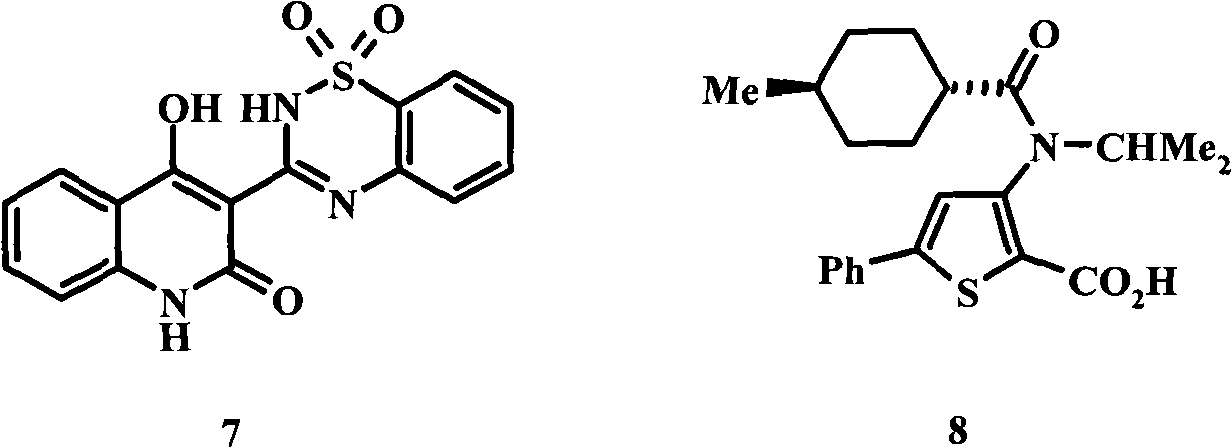
现已证实单用HIV逆转录酶的非核苷别构抑制剂以及与核苷抑制剂和蛋白酶抑制剂联用是有效的治疗剂。几类非核苷HCV NS5B抑制剂已见诸描述,目前正处于各种开发阶段,它们包括:靶标咪唑类,(H.Hashimoto等WO 01/47833,H.Hashimoto等WO 03/000254,P.L.Beaulieu等WO03/020240A2;P.L.Beaulieu等US 6,448,281B1;P.L.Beaulieu等WO03/007945A1);吲哚类,(P.L.Beaulieu等WO 03/0010141A2);苯并噻二嗪类,例如7,(D.Dhanak等WO 01/85172A1;D.Dhanak等WO 03/037262A2;K.J.Duffy等WO03/099801A1;D.Chai等WO 2004052312;D.Chai等WO2004052313;D.Chai等WO02/098424;J.K.Pratt等WO2004/041818A1;J.K.Pratt等WO 2004/087577A1);噻吩类,例如8,(C.K.Chan等WO 02/100851);Non-nucleoside allosteric inhibitors of HIV reverse transcriptase have proven to be effective therapeutic agents alone and in combination with nucleoside inhibitors and protease inhibitors. Several classes of non-nucleoside HCV NS5B inhibitors have been described and are currently in various stages of development, including: target imidazoles, (H. Hashimoto et al. WO 01/47833, H. Hashimoto et al. WO 03/000254, P.L. Beaulieu et al. WO03/020240A2; P.L.Beaulieu et al. US 6,448,281B1; P.L.Beaulieu et al. WO03/007945A1); indoles, (P.L.Beaulieu et al. WO 03/0010141A2); benzothiadiazines, eg 7, (D.Dhanak et al. WO 01 D.Dhanak et al. WO 03/037262A2; K.J.Duffy et al. WO03/099801A1; D.Chai et al. WO 2004052312; D.Chai et al. WO2004052313; D.Chai et al. WO02/098424; WO 2004/087577A1); Thiophenes, such as 8, (C.K.Chan et al. WO 02/100851);
苯并噻吩类(D.C.Young和T.R.Bailey WO 00/18231);β-酮基丙酮酸类(ketopyruvates)(S.Attamura等US 6,492,423 B1,A.Attamura等WO00/06529);嘧啶类(C.Gardelli等WO 02/06246A1);嘧啶二酮类(pyrimidinediones)(T.R.Bailey和D.C.Young WO 00/13708);三嗪类(K.-H.Chung等WO 02/079187A1);绕丹宁衍生物(T.R.Bailey和D.C.Young WO 00/10573,J.C.Jean等WO 01/77091A2);2,4-二氧代吡喃(R.A.Love等EP 256628A2);苯丙氨酸衍生物(M.Wang等J.Biol.Chem.2003278:2489-2495)。Benzothiophenes (D.C.Young and T.R.Bailey WO 00/18231); etc. WO 02/06246A1); pyrimidine diones (pyrimidinediones) (T.R.Bailey and D.C.Young WO 00/13708); triazines (K.-H.Chung et al. WO 02/079187A1); rhodanine derivatives (T.R. Bailey and D.C.Young WO 00/10573, J.C.Jean et al. WO 01/77091A2); 2,4-dioxopyrans (EP 256628A2 such as R.A.Love); Phenylalanine derivatives (M.Wang et al. J.Biol. Chem. 2003278:2489-2495).
NS3蛋白酶已是发现新的抗-HCV治疗剂的主要靶标。在1998年5月28日公布的WO 98/22496中,M.R.Attwood等披露了蛋白酶的机制活性位点抑制剂(mechanism-base active site inhibitor)(M.R.Attwood等,AntiviralChemistry and Chemotherapy 1999 10:259-273;M.R.Attwood等,“制备和使用作为抗病毒剂的氨基酸衍生物”(Preparation and use of amino acidderivatives as anti-viral agents),German Patent Pub.DE 19914474)。在1998年4月30日公布的WO 98/17679中,R.D.Tung等披露了NS3蛋白酶的机制肽抑制剂(mechanism-based peptide inhibitors)。The NS3 protease has been a major target for the discovery of new anti-HCV therapeutics. In WO 98/22496 published on May 28, 1998, M.R.Attwood et al. disclosed a mechanism-based active site inhibitor of protease (M.R.Attwood et al., Antiviral Chemistry and Chemotherapy 1999 10:259-273 M.R.Attwood et al., "Preparation and use of amino acid derivatives as anti-viral agents" (Preparation and use of amino acid derivatives as anti-viral agents), German Patent Pub.DE 19914474). In WO 98/17679 published April 30, 1998, R.D. Tung et al. disclose mechanism-based peptide inhibitors of NS3 protease.
在1998年2月18日公布的WO 99/07734和1999年8月9日公布的WO00/09543中,M Llinas-Brunet等披露了蛋白酶的肽抑制剂。在2000年10月12日公布的WO 00/59929中,Y.S.Tsantrizos等披露了大环三肽作为HCVNS3蛋白酶的强效抑制剂。勃林格殷格翰公司(Boehringer-Ingleheim)的一系列相关专利披露了相关的蛋白酶抑制剂并鉴定了三肽衍生物BILN 2061(M.Llinas-Brunet等Biorg.Med.Chem.Lett.200010(20):2267-70;J.MedChem.200447(26):6584-94;J.Med.Chem.200447(7):1605-1608;Angew.Chem.Int.Ed.Eng.200342(12):1356-60)。In WO 99/07734, published February 18, 1998, and WO 00/09543, published August 9, 1999, M Llinas-Brunet et al. disclose peptide inhibitors of proteases. In WO 00/59929 published on October 12, 2000, Y.S. Tsantrizos et al. disclosed macrocyclic tripeptides as potent inhibitors of HCV NS3 protease. A series of related patents of Boehringer-Ingleheim (Boehringer-Ingleheim) disclosed related protease inhibitors and identified tripeptide derivatives BILN 2061 (M.Llinas-Brunet et al. Biorg.Med.Chem.Lett.200010(20) : 2267-70; J.MedChem.200447(26): 6584-94; J.Med.Chem.200447(7): 1605-1608; Angew.Chem.Int.Ed.Eng.200342(12): 1356- 60).
以下出版物披露了布里斯托-美时施贵宝公司(Bristol-Myers Squibb)鉴定的其它三肽抑制剂:2003年12月4日公布的WO03/099274;2004年4月22日公布的WO2004/032827;2003年7月3日公布的WO03/053349;2005年5月26日公布的WO2005/046712和2005年6月9日公布的WO2005/051410。在2004年8月26日公布的WO 2004/072234和2004年11月4日公布的WO 2004/093798中,安那塔医药公司(Enanta Pharmaceuticals)披露了其它三肽蛋白酶抑制剂。在2005年4月28日公布的WO 2005/037214中,L.M.Blatt等披露了抑制HCV NS3蛋白酶的其它三肽衍生物。在2005年4月7日公布的WO 2005/030796中,S.Venkatraman等披露了HCV NS3丝氨酸蛋白酶的大环抑制剂。在2005年6月30日公布的WO 2005/058821中,F.Velazquez等披露了HCV NS3/NS4a丝氨酸蛋白酶的抑制剂。在2002年6月20日公布的WO 02/48172中,Z.Zhu等披露了二芳基肽作为NS3蛋白酶的抑制剂。在2002年1月31日公布的WO 02/08178和WO 02/08256中,A.Saksena等披露了HCV NS3蛋白酶的肽抑制剂。在2002年1月31日公布的WO 02/08251中,M.Lim-Wilby等披露了NS3蛋白酶的肽抑制剂。在1999年12月21日公布的US 6,004,933中,L.W.Spruce等披露了抑制半胱氨酸蛋白酶(包括HCV内肽酶)的杂环肽衍生物。The following publications disclose other tripeptide inhibitors identified by Bristol-Myers Squibb: WO03/099274 published December 4, 2003; WO2004/032827 published April 22, 2004 ; WO03/053349 published on July 3, 2003; WO2005/046712 published on May 26, 2005 and WO2005/051410 published on June 9, 2005. Other tripeptide protease inhibitors are disclosed by Enanta Pharmaceuticals in WO 2004/072234 published 26 August 2004 and WO 2004/093798 published 4 November 2004. In WO 2005/037214 published on April 28, 2005, L.M. Blatt et al. disclose other tripeptide derivatives that inhibit HCV NS3 protease. In WO 2005/030796 published April 7, 2005, S. Venkatraman et al. disclose macrocyclic inhibitors of the HCV NS3 serine protease. In WO 2005/058821 published on June 30, 2005, F. Velazquez et al. disclose inhibitors of HCV NS3/NS4a serine protease. In WO 02/48172 published on June 20, 2002, Z. Zhu et al. disclose diaryl peptides as inhibitors of NS3 protease. In WO 02/08178 and WO 02/08256 published on January 31, 2002, A. Saksena et al. disclose peptide inhibitors of HCV NS3 protease. In WO 02/08251 published January 31, 2002, M. Lim-Wilby et al. disclose peptide inhibitors of the NS3 protease. In US 6,004,933, published December 21, 1999, L.W. Spruce et al. disclose heterocyclic peptide derivatives that inhibit cysteine proteases, including HCV endopeptidase.
还研究了非底物NS3蛋白酶抑制剂(non-substrate-based NS3proteaseinhibitor),例如2,4,6-三羟基-3-硝基-苯甲酰胺衍生物(Sudo K.等BBRC1997238:643-647;Sudo K.等Antiviral Chemistry and Chemotherapy 19989:186),包括RD3-4082和RD3-4078,其中前者用14碳链取代酰胺,而后者具有对-苯氧基苯基。Non-substrate-based NS3 protease inhibitors have also been studied, such as 2,4,6-trihydroxy-3-nitro-benzamide derivatives (Sudo K. et al. BBRC1997238:643-647; Sudo K. et al. Antiviral Chemistry and Chemotherapy 19989:186), including RD3-4082 and RD3-4078, wherein the former replaces the amide with a 14-carbon chain, while the latter has a p-phenoxyphenyl group.
SCH 68631(一种菲醌)是HCV蛋白酶抑制剂(Chu M.等TetrahedronLett.199637:7229-7232)。在同一作者的另一例子中,从真菌灰黄青霉菌(Penicillium griseofulvum)分离的SCH 351633鉴定为蛋白酶抑制剂(Chu M.等Bioorg.Med.Chem.Lett.19999:1949-1952)。根据大分子水蛭蛋白酶抑制剂c设计选择性抑制剂,可实现抗HCV NS3蛋白酶的纳摩尔效力。从水蛭分离的水蛭蛋白酶抑制剂是几种丝氨酸蛋白酶,例如灰色链霉菌(S.griseus)蛋白酶A和B,α-胰凝乳蛋白酶、类胰凝乳蛋白酶和枯草杆菌蛋白酶的强效抑制剂(Qasim M.A.等Biochemistry 199736:1598-1607)。SCH 68631 (a phenanthrenequinone) is an HCV protease inhibitor (Chu M. et al. Tetrahedron Lett. 199637:7229-7232). In another example by the same authors, SCH 351633 isolated from the fungus Penicillium griseofulvum was identified as a protease inhibitor (Chu M. et al. Bioorg. Med. Chem. Lett. 19999: 1949-1952). Nanomolar potency against HCV NS3 protease can be achieved by designing selective inhibitors based on the macromolecular leech protease inhibitor c. Leech protease inhibitors isolated from leeches are potent inhibitors of several serine proteases such as Streptomyces griseus (S. griseus) proteases A and B, α-chymotrypsin, chymotrypsin and subtilisin ( Qasim M.A. et al. Biochemistry 199736:1598-1607).
噻唑烷衍生物在利用NS3/4A融合蛋白和NS5A/5B底物的反相HPLC试验中显示相关抑制(Sudo K.等AntiviralResearch 199632:9-18),特别是化合物RD-1-6250(具有长烷基链取代的稠合肉桂酰基部分)、RD46205和RD46193。N.Kakiuchi等在FEBS Let.1998421:217-220中和N.Takeshita等Anal.Biochem.1997247:242-246在中鉴定了噻唑烷类和苯甲酰苯胺。Thiazolidine derivatives showed relevant inhibition in reversed-phase HPLC assays utilizing NS3/4A fusion proteins and NS5A/5B substrates (Sudo K. et al. Antiviral Research 199632:9-18), especially compound RD-1-6250 (with long Alkyl chain substituted fused cinnamoyl moieties), RD46205 and RD46193. Thiazolidines and benzanilides were identified by N. Kakiuchi et al. in FEBS Let. 1998421:217-220 and N. Takeshita et al.
在2002年1月31日公布的授予仙林公司的WO 02/08198和2002年6月20日公布的授予布里斯托-美时施贵宝公司的WO 02/48157中披露了咪唑烷酮类作为HCV的NS3丝氨酸蛋白酶抑制剂。在2002年6月20日公布的WO02/48116中,P.Glunz等披露了NS3蛋白酶的嘧啶二酮(pyrimidinone)抑制剂。Imidazolidinones are disclosed as HCV in WO 02/08198 issued on January 31, 2002 to Xianlin Corporation and WO 02/48157 issued on June 20, 2002 to Bristol-Myers Squibb Company NS3 serine protease inhibitor. In WO02/48116 published on June 20, 2002, P. Glunz et al. disclose pyrimidinone inhibitors of NS3 protease.
抗-HCV的其它酶靶标包括HCV IRES位点(内部核糖体进入位点)和HCV解旋酶。伊缪索尔公司(Immusol)、里格药物公司(Rigel Pharmaceuticals)(R803)和阿那达斯公司(Anadys)(ANA 245和ANA 246)已报道了IRES抑制剂。维塔克斯公司(Vertex)披露了HCV解旋酶抑制剂。Other enzymatic targets of anti-HCV include the HCV IRES site (internal ribosome entry site) and HCV helicase. IRES inhibitors have been reported by Immusol, Rigel Pharmaceuticals (R803) and Anadys (ANA 245 and ANA 246). Vertex discloses HCV helicase inhibitors.
抑制耐受性突变株的组合疗法已成为抗病毒化疗的惯用方法。本文披露的核苷抑制剂可与其它核苷HCV聚合酶抑制剂、非核苷HCV聚合酶抑制剂和HCV蛋白酶抑制剂联用。随着其它类别的HCV药物,例如病毒进入抑制剂、解旋酶抑制剂、IRES抑制剂、核酶和反义寡核苷酸的出现和开发,这些药物也是组合疗法的优良候选对象。干扰素衍生物早已成功与利巴韦林联用,干扰素及化学修饰的干扰素可与本文披露的核苷联用。Combination therapy that suppresses resistant mutants has become a common approach in antiviral chemotherapy. The nucleoside inhibitors disclosed herein can be used in combination with other nucleoside HCV polymerase inhibitors, non-nucleoside HCV polymerase inhibitors and HCV protease inhibitors. With the emergence and development of other classes of HCV drugs such as viral entry inhibitors, helicase inhibitors, IRES inhibitors, ribozymes and antisense oligonucleotides, these drugs are also good candidates for combination therapy. Interferon derivatives have been successfully used in combination with ribavirin, and interferon and chemically modified interferon can be used in combination with the nucleosides disclosed herein.
核苷衍生物常是强效的抗病毒(例如,HIV、HCV、单纯疱疹病毒、CMV)和抗癌症的化疗剂。不幸的是,它们的实际应用常受两个因素的限制。首先,不佳的药代动力学特性常限制核苷从肠道吸收以及核苷衍生物的胞内浓度,第二,不是最理想的物理特性限制了促进活性成分递送可用的配制方法。Nucleoside derivatives are often potent antiviral (eg, HIV, HCV, herpes simplex virus, CMV) and anticancer chemotherapeutic agents. Unfortunately, their practical application is often limited by two factors. First, poor pharmacokinetic properties often limit the absorption of nucleosides from the gut and intracellular concentrations of nucleoside derivatives, and second, suboptimal physical properties limit the formulation methods available to facilitate delivery of active ingredients.
阿尔伯特(Albert)引入了术语“前药”来描述缺乏固有生物学活性,但能经代谢转化成活性药物的化合物(A.Albert,《选择毒性》(SelectiveToxicity),C-H出版社(Chapman and Hall),伦敦,1951)。最近多人总结了前药(P.Ettmayer等,J.Med Chem.200447(10):2393-2404;K.Beaumont等,Curr.Drug Metab.20034:461-485;H.Bundgaard,《前药设计:前药设计中各种官能团和化学实体的生物可逆衍生物》(Design of Prodrugs:Bioreversible derivatives for various functional groups and chemical entities inDesign of Prodrugs),H.Bundgaard(编)艾尔赛维科学出版社(ElsevierScience Publishers),阿姆斯特丹,1985;G.M.Pauletti等Adv.Drug Deliv.Rev.199727:235-256;R.J.Jones和N.Bischofberger,AntiviralRes.199527;1-15和C.R.Wagner等,Med.Res.Rev.200020:417-45)。尽管可由特异性的酶(常是水解酶)催化代谢转化,但通过非特异性化学方法也可再生活性化合物。Albert introduced the term "prodrug" to describe a compound that lacks intrinsic biological activity but can be metabolized into an active drug (A. Albert, Selective Toxicity, C-H Press (Chapman and Hall), London, 1951). Many people have recently summarized prodrugs (P.Ettmayer et al., J.Med Chem.200447 (10): 2393-2404; K.Beaumont et al., Curr.Drug Metab.20034: 461-485; H.Bundgaard, "Prodrugs Design: Bioreversible Derivatives of Various Functional Groups and Chemical Entities in Prodrug Design" (Design of Prodrugs: Bioreversible derivatives for various functional groups and chemical entities in Design of Prodrugs), H. Bundgaard (Editor) Elsevier Scientific Press (Elsevier Science Publishers), Amsterdam, 1985; G.M.Pauletti et al. Adv.Drug Deliv.Rev.199727:235-256; R.J.Jones and N.Bischofberger, AntiviralRes.199527;1-15 and C.R.Wagner et al., Med.Res.Rev. 200020:417-45). Although metabolic conversions can be catalyzed by specific enzymes, often hydrolases, active compounds can also be regenerated by non-specific chemical methods.
药学上可接受的前药指在宿主中经代谢,例如水解或氧化,从而形成本发明化合物的化合物。生物转化应避免形成具有毒理学倾向性(toxicological liability)的片段。前药的典型例子包括在活性化合物的功能部分连接有生物学上不稳定的保护基团的化合物。设计前核苷酸(pronucleotide)时采用对糖部分上的羟基进行烷基化、酰化或其它亲脂性修饰。这些前核苷酸可在体内水解或脱烷基而产生活性化合物。A pharmaceutically acceptable prodrug refers to a compound that is metabolized, eg, hydrolyzed or oxidized, in a host to form a compound of the invention. Biotransformation should avoid the formation of fragments with toxicological liability. Typical examples of prodrugs include compounds having biologically labile protecting groups attached to functional moieties of active compounds. Alkylation, acylation or other lipophilic modification of the hydroxyl groups on the sugar moiety is employed in the design of pronucleotides. These pronucleotides can be hydrolyzed or dealkylated in vivo to yield the active compound.
限制口服利用度的因素常是从胃肠道吸收和肠道壁及肝脏的首过排出(first-pass excretion)。优化经胃肠道的跨细胞吸收要求D(7.4)大于0。然而,对分布系数的优化不保证奏效。前药可能不得不避开肠细胞的主动流出运输(active efflux transporter)。肠细胞中的胞内代谢会导致代谢物通过流出泵(efflux pump)而被动运输或主动运输回肠道腔。前药在到达靶细胞或受体之前还必须耐受血液中有害的生物转化作用。Factors limiting oral availability are often absorption from the gastrointestinal tract and first-pass excretion from the intestinal wall and liver. Optimal transcellular absorption through the gastrointestinal tract requires D (7.4) to be greater than zero. However, optimization of the distribution coefficients is not guaranteed to work. Prodrugs may have to circumvent the active efflux transporter of enterocytes. Intracellular metabolism in enterocytes results in passive or active transport of metabolites back into the intestinal lumen via efflux pumps. Prodrugs must also resist deleterious biotransformation in the blood before reaching target cells or receptors.
虽然有时可根据分子中存在的化学官能团合理设计假定前药,但化学修饰活性化合物产生全新的分子实体,该实体可能显示母体化合物中不存在的有害的物理、化学和生物学特性。如果多条途径产生了多种代谢物,则鉴定代谢物的调控要求是一难题。因此,鉴定前药仍旧是不确定而困难的实践。此外,评估潜在前药的药代动力学特性困难且昂贵。动物模型的药代动力学结果可能难以外推至人类。While putative prodrugs can sometimes be rationally designed based on the chemical functional groups present in the molecule, chemical modification of an active compound produces an entirely new molecular entity that may display deleterious physical, chemical, and biological properties that are not present in the parent compound. If multiple pathways produce multiple metabolites, identifying the regulatory requirements of the metabolites can be challenging. Therefore, identification of prodrugs remains an uncertain and difficult practice. Furthermore, assessing the pharmacokinetic properties of potential prodrugs is difficult and expensive. Pharmacokinetic results from animal models may be difficult to extrapolate to humans.
本发明的目的是提供治疗感染了丙型肝炎病毒的宿主的新化合物、方法和组合物。It is an object of the present invention to provide novel compounds, methods and compositions for treating a host infected with hepatitis C virus.
本发明涉及4-氨基-1-((2R,3R,4R,5R)-3-氟-4-羟基-5-羟甲基-3-甲基-四氢-呋喃-2-基)-1H-嘧啶-2-酮(也称为(2R)2′-脱氧-2-甲基-2-氟-胞苷)的新颖的二酰基衍生物。本发明化合物具有式I所示的结构。The present invention relates to 4-amino-1-((2R,3R,4R,5R)-3-fluoro-4-hydroxy-5-hydroxymethyl-3-methyl-tetrahydro-furan-2-yl)-1H - Novel diacyl derivatives of pyrimidin-2-ones (also known as (2R) 2'-deoxy-2-methyl-2-fluoro-cytidine). The compound of the present invention has the structure shown in formula I.

式中:In the formula:
R1选自:C2-5非支链或支链烷基、C2-5非支链或支链烯基、C2-5非支链或支链炔基、C2-5低级卤代烷基、C3-6环烷基和C2-4烷氧基;和R 1 is selected from: C 2-5 unbranched or branched chain alkyl, C 2-5 unbranched or branched alkenyl, C 2-5 unbranched or branched alkynyl, C 2-5 lower haloalkane radical, C 3-6 cycloalkyl and C 2-4 alkoxy; and
和它们的水合物、溶剂化物和酸加成盐。and their hydrates, solvates and acid addition salts.
本发明化合物可用于治疗HCV介导的疾病。The compounds of the invention are useful in the treatment of HCV-mediated diseases.
本发明还包括用本发明化合物和含有所述化合物的药物组合物治疗HCV的方法。The invention also includes methods of treating HCV using the compounds of the invention and pharmaceutical compositions containing said compounds.
本发明的一个实施方式提供式I所示的化合物,式中R1如上所述。One embodiment of the present invention provides a compound represented by formula I, wherein R 1 is as described above.
本发明的另一实施方式提供式I所示的化合物,式中R1是乙基、正丙基、异丙基、正丁基或异丁基。Another embodiment of the present invention provides a compound represented by formula I, wherein R 1 is ethyl, n-propyl, isopropyl, n-butyl or isobutyl.
本发明还有另一实施方式提供式I所示的化合物,式中R1是乙基或异丙基。Still another embodiment of the present invention provides a compound represented by formula I, wherein R 1 is ethyl or isopropyl.
本发明还有另一实施方式提供式I所示的化合物,式中R1是异丙基,所述化合物是盐酸盐或硫酸盐。Yet another embodiment of the present invention provides a compound represented by formula I, wherein R 1 is isopropyl, and the compound is hydrochloride or sulfate.
本发明还有另一实施方式提供式I所示的化合物,式中R1是异丙基,所述化合物是盐酸盐。Yet another embodiment of the present invention provides a compound represented by formula I, wherein R 1 is isopropyl, and the compound is hydrochloride.
本发明还有另一实施方式提供式I所示的化合物,式中R1是乙氧基、正丙氧基或异丙氧基。Still another embodiment of the present invention provides a compound represented by formula I, wherein R 1 is ethoxy, n-propoxy or isopropoxy.
本发明还有进一步的实施方式提供用于治疗,特别是用于治疗HCV病毒所介导疾病的式I所示化合物。Yet another embodiment of the present invention provides the compound represented by formula I for use in therapy, especially in the treatment of diseases mediated by HCV virus.
本发明还有另一实施方式提供式I所示化合物在制备用于治疗HCV病毒所介导疾病的药物中的应用。Still another embodiment of the present invention provides the use of the compound represented by formula I in the preparation of medicines for treating diseases mediated by HCV virus.
特别可利用式I所示化合物制备以治疗有效剂量给予有此需要的患者的药物,优选每天0.1-10g的剂量,更优选每天0.5-7g的剂量或者甚至更优选每天1.0g-6.0g的剂量。In particular, the compound represented by formula I can be used to prepare a drug for a patient in need thereof in a therapeutically effective dose, preferably a dose of 0.1-10 g per day, more preferably a dose of 0.5-7 g per day or even more preferably a dose of 1.0 g-6.0 g per day .
还可利用式I所示化合物制备还包含治疗有效量的至少一种免疫系统调节剂和/或抑制HCV复制的至少一种抗病毒剂的药物,所述免疫系统调节剂是例如干扰素、化学衍生的干扰素、白介素、肿瘤坏死因子或集落刺激因子,所述抗病毒剂是例如HCV蛋白酶抑制剂、另一种核苷HCV聚合酶抑制剂、非核苷HCV聚合酶抑制剂、HCV解旋酶抑制剂、HCV引发酶抑制剂或HCV融合抑制剂。Also can utilize the compound shown in formula I to prepare the medicine that also comprises at least one immune system regulator and/or suppresses the at least one antiviral agent of HCV replication of therapeutically effective amount, and described immune system regulator is for example interferon, chemical Derived interferon, interleukin, tumor necrosis factor or colony stimulating factor, the antiviral agent is for example an HCV protease inhibitor, another nucleoside HCV polymerase inhibitor, a non-nucleoside HCV polymerase inhibitor, an HCV helicase inhibitors, HCV primase inhibitors, or HCV fusion inhibitors.
本发明还有另一实施方式提供治疗HCV病毒所介导疾病的方法,所述方法包括给予有此需要的患者治疗有效剂量的上式I所示化合物。Yet another embodiment of the present invention provides a method for treating diseases mediated by HCV virus, said method comprising administering a therapeutically effective dose of the compound represented by formula I above to a patient in need thereof.
本发明还有另一实施方式提供了治疗HCV病毒所介导疾病的方法,所述方法包括给予有此需要的患者每天0.1-10g剂量的上式I所示化合物。Yet another embodiment of the present invention provides a method for treating diseases mediated by HCV virus, said method comprising administering the compound represented by the above formula I at a dose of 0.1-10 g per day to a patient in need thereof.
在本发明还有另一实施方式中,所述剂量在每天0.5-7g之间,在进一步的实施方式中,所述剂量在每天1.0-6.0g之间。In yet another embodiment of the present invention, the dosage is between 0.5-7 g per day, and in a further embodiment, the dosage is between 1.0-6.0 g per day.
本发明另一实施方式提供治疗HCV病毒所介导疾病的方法,所述方法包括共同给予有此需要的患者治疗有效剂量的上式I所示化合物和治疗有效量的至少一种免疫系统调节剂和/或抑制HCV复制的至少一种抗病毒剂。Another embodiment of the present invention provides a method for treating diseases mediated by HCV virus, the method comprising co-administering a therapeutically effective dose of the compound represented by the above formula I and a therapeutically effective dose of at least one immune system regulator to a patient in need thereof and/or at least one antiviral agent that inhibits HCV replication.
本发明另一实施方式提供治疗HCV所介导疾病的方法,所述方法包括共同给予有此需要的患者治疗有效剂量的上式I所示化合物和治疗有效量的至少一种免疫系统调节剂,所述免疫系统调节剂是干扰素、白介素、肿瘤坏死因子或集落刺激因子。Another embodiment of the present invention provides a method for treating diseases mediated by HCV, the method comprising co-administering a therapeutically effective dose of the compound represented by the above formula I and a therapeutically effective dose of at least one immune system modulator to a patient in need thereof, The immune system modulator is interferon, interleukin, tumor necrosis factor or colony stimulating factor.
本发明另一实施方式提供治疗HCV所介导疾病的方法,所述方法包括共同给予有此需要的患者治疗有效剂量的上式I所示化合物和治疗有效量的至少一种免疫系统调节剂,所述免疫系统调节剂是干扰素或化学衍生的干扰素。Another embodiment of the present invention provides a method for treating diseases mediated by HCV, the method comprising co-administering a therapeutically effective dose of the compound represented by the above formula I and a therapeutically effective dose of at least one immune system modulator to a patient in need thereof, The immune system modulator is an interferon or a chemically derived interferon.
本发明另一实施方式提供治疗HCV病毒所介导疾病的方法,所述方法包括共同给予有此需要的患者治疗有效剂量的上式I所示化合物和治疗有效量的至少一种其它抗病毒化合物。Another embodiment of the present invention provides a method for treating diseases mediated by HCV virus, said method comprising co-administering a therapeutically effective dose of the compound represented by the above formula I and a therapeutically effective dose of at least one other antiviral compound to a patient in need thereof .
本发明另一实施方式提供治疗HCV病毒所介导疾病的方法,所述方法包括共同给予有此需要的患者治疗有效剂量的上式I所示化合物和治疗有效量的至少一种其它抗病毒化合物,所述化合物是HCV蛋白酶抑制剂、另一种核苷HCV聚合酶抑制剂、非核苷HCV聚合酶抑制剂、HCV解旋酶抑制剂、HCV引发酶抑制剂或HCV融合抑制剂。Another embodiment of the present invention provides a method for treating diseases mediated by HCV virus, said method comprising co-administering a therapeutically effective dose of the compound represented by the above formula I and a therapeutically effective dose of at least one other antiviral compound to a patient in need thereof , the compound is an HCV protease inhibitor, another nucleoside HCV polymerase inhibitor, a non-nucleoside HCV polymerase inhibitor, an HCV helicase inhibitor, an HCV elicitase inhibitor, or an HCV fusion inhibitor.
本发明另一实施方式提供包含上式I所示化合物并混合了至少一种药学上可接受的载体、稀释剂或赋形剂的药物组合物。Another embodiment of the present invention provides a pharmaceutical composition comprising the compound represented by the above formula I mixed with at least one pharmaceutically acceptable carrier, diluent or excipient.
本发明另一实施方式提供了制备上式I所示化合物的方法,所述方法包括权利要求15所列举并在实施例中举例说明的步骤(i)-(v)。该方法包括在有DMAP和足够的碱存在从而能将溶液的pH维持在至少约7.5的条件下,在均匀或双相的碱性水性有机介质中用本文所述酰化剂处理I。本方法能进行酰化而不伴有杂环碱(heterocyclic base)的反应。Another embodiment of the present invention provides a method for preparing the compound represented by the above formula I, the method comprising the steps (i)-(v) listed in claim 15 and illustrated in the examples. The method comprises treating I with an acylating agent described herein in a homogeneous or biphasic basic aqueous organic medium in the presence of DMAP and sufficient base to maintain the pH of the solution at least about 7.5. This method can carry out acylation without reaction of heterocyclic base (heterocyclic base).
本文所用的短语“一(a)”或“一个(an)”实体指一个或多个该实体;例如一个化合物指一个或多个化合物或至少一个化合物。因此,术语“一”(或“一个”)、“一个或多个”和“至少一个”在本文可互换使用。As used herein, the phrase "a" or "an" entity refers to one or more of that entity; for example a compound refers to one or more compounds or at least one compound. Accordingly, the terms "a" (or "an"), "one or more" and "at least one" are used interchangeably herein.
本文所用的术语“任选”或“任选地”表示接下来描述的事物或情况可以存在但不一定存在,该描述包括所述事物或情况存在或不存在的例子。例如,“任选的键”表示该键可以存在或不存在,并且该描述包括单键、双键或三键。As used herein, the term "optional" or "optionally" means that the next described thing or circumstance can but does not need to be present, and that the description includes instances where said thing or circumstance does or does not exist. For example, "an optional bond" means that the bond may or may not be present, and that the description includes single, double, or triple bonds.
本文所用的术语“独立地”表明某变量适用于任一种情况而不用考虑同一化合物中是否存在具有相同或不同定义的变量。因此,如果某化合物中R出现两次并且R定义为“独立地是碳或氮”,则两个R均可以是碳,两个R均可以是氮,或者一个R是碳而另一个是氮。As used herein, the term "independently" indicates that a variable is applicable in any one instance regardless of whether there is a variable with the same or a different definition in the same compound. Thus, if R occurs twice in a compound and R is defined as "independently carbon or nitrogen", both R may be carbon, both R may be nitrogen, or one R may be carbon and the other nitrogen .
本文所用的术语“烯基”表示具有一个或两个烯烃双键[优选一个烯烃双键]的2-10个碳原子的未取代烃链基团。本文所用的“C2-10烯基”指由2-10个碳构成的烯基。例子是乙烯基、1-丙烯基、2-丙烯基(烯丙基)或2-丁烯基(巴豆基)。The term "alkenyl" as used herein denotes an unsubstituted hydrocarbon chain group of 2 to 10 carbon atoms having one or two olefinic double bonds [preferably one olefinic double bond]. As used herein, "C 2-10 alkenyl" refers to an alkenyl group consisting of 2-10 carbons. Examples are vinyl, 1-propenyl, 2-propenyl (allyl) or 2-butenyl (crotyl).
本文所用的术语“烷基”表示含有1-10个碳原子、非支链或支链的、饱和的、单价烃残基。术语“低级烷基”表示含1-6个碳原子的直链或支链烃残基。本文所用的“C1-10烷基”指由1-10个碳原子构成的烷基。烷基的例子包括但不限于:低级烷基,包括甲基、乙基、丙基、异丙基、正丁基、异丁基、叔丁基或戊基、异戊基、新戊基、己基、庚基和辛基。术语(芳)烷基或(杂芳基)烷基表明烷基分别被芳基或杂芳基任选取代的烷基。The term "alkyl" as used herein denotes an unbranched or branched, saturated, monovalent hydrocarbon residue containing 1 to 10 carbon atoms. The term "lower alkyl" denotes straight or branched chain hydrocarbon residues containing 1 to 6 carbon atoms. The "C 1-10 alkyl" used herein refers to an alkyl group composed of 1-10 carbon atoms. Examples of alkyl include, but are not limited to: lower alkyl, including methyl, ethyl, propyl, isopropyl, n-butyl, isobutyl, tert-butyl or pentyl, isopentyl, neopentyl, Hexyl, Heptyl and Octyl. The term (ar)alkyl or (heteroaryl)alkyl denotes an alkyl group optionally substituted by aryl or heteroaryl, respectively.
本文所用的术语“炔基”表示具有2-10个碳原子,优选2-5个碳原子并具有一个三键的非支链或支链烃链基团。本文所用的“C2-10炔基”指2-10个碳原子构成的炔基。例子是乙炔基、1-丙炔基、2-丙炔基、1-丁炔基、2-丁炔基和3-丁炔基。The term "alkynyl" as used herein denotes an unbranched or branched hydrocarbon chain group having 2 to 10 carbon atoms, preferably 2 to 5 carbon atoms, and having one triple bond. As used herein, "C 2-10 alkynyl" refers to an alkynyl group composed of 2-10 carbon atoms. Examples are ethynyl, 1-propynyl, 2-propynyl, 1-butynyl, 2-butynyl and 3-butynyl.
本文所用的术语“环烷基”表示含3-8个碳原子的饱和碳环,即环丙基、环丁基、环戊基、环己基、环庚基或环辛基。本文所用的“C3-7环烷基”指碳环由3-7个碳构成的环烷基。The term "cycloalkyl" as used herein denotes a saturated carbocyclic ring containing 3 to 8 carbon atoms, ie cyclopropyl, cyclobutyl, cyclopentyl, cyclohexyl, cycloheptyl or cyclooctyl. As used herein, "C 3-7 cycloalkyl" refers to a cycloalkyl group whose carbocyclic ring consists of 3-7 carbons.
本文所用的术语“卤代烷基”表示上述非支链或支链烷基,其中1、2、3或更多个氢原子被卤素取代。本文所用的“C1-3卤代烷基”指1-3个碳和1-8个卤素取代基构成的卤代烷基。例子是1-氟甲基、1-氯甲基、1-溴甲基、1-碘甲基、三氟甲基、三氯甲基、三溴甲基、三碘甲基、1-氟乙基、1-氯乙基、1-溴乙基、1-碘乙基、2-氟乙基、2-氯乙基、2-溴乙基、2-碘乙基、2,2-二氯乙基、3-溴丙基或2,2,2-三氟乙基。The term "haloalkyl" as used herein denotes an unbranched or branched chain alkyl group as described above, wherein 1, 2, 3 or more hydrogen atoms are replaced by halogen. As used herein, "C 1-3 haloalkyl" refers to a haloalkyl group composed of 1-3 carbons and 1-8 halogen substituents. Examples are 1-fluoromethyl, 1-chloromethyl, 1-bromomethyl, 1-iodomethyl, trifluoromethyl, trichloromethyl, tribromomethyl, triiodomethyl, 1-fluoroethyl Base, 1-chloroethyl, 1-bromoethyl, 1-iodoethyl, 2-fluoroethyl, 2-chloroethyl, 2-bromoethyl, 2-iodoethyl, 2,2-dichloro ethyl, 3-bromopropyl or 2,2,2-trifluoroethyl.
本文所用的术语“烷氧基”表示-O-烷基,其中烷基如上所述。例子是甲氧基、乙氧基、正丙氧基、异丙氧基、正丁氧基、异丁氧基、叔丁氧基。本文所用的“低级烷氧基”表示含上述“低级烷基”的烷氧基。“C1-10烷氧基”指-O-烷基,其中烷基是C1-10。The term "alkoxy" as used herein means -O-alkyl, wherein alkyl is as defined above. Examples are methoxy, ethoxy, n-propoxy, isopropoxy, n-butoxy, isobutoxy, tert-butoxy. "Lower alkoxy" as used herein means an alkoxy group containing the above-mentioned "lower alkyl". "C 1-10 alkoxy" refers to -O-alkyl, wherein alkyl is C 1-10 .
本文所用的术语“二-酰基”衍生物指本文所述的衍生核苷化合物,其中3′-和5′-羟基来自酯-OC(=O)R1和OC(=O)R2,其中R1和R2如权利要求1所述。The term "di-acyl" derivatives as used herein refers to derivative nucleoside compounds as described herein, wherein the 3'- and 5'-hydroxyl groups are derived from the esters -OC(=O)R 1 and OC(=O)R 2 , wherein R 1 and R 2 are as described in claim 1.
本文所用的术语“酰化剂”指酐、酰基卤(acid halide)、氯羰基烷氧基化物(chlorocarbonylalkoxide)(例如,氯甲酸乙酯)或N-保护α氨基酸的活化衍生物。本文所用的术语“酐”指具有通用结构R1C(O)-O-C(O)R1的化合物,其中R1如权利要求1所述。本文所用的术语“酰基卤”指具有通用结构R1C(O)X的化合物,其中X是卤素。术语“酰基咪唑”指具有通用结构R1C(O)X的化合物,其中X是N-咪唑基。本文所用的术语化合物的“活化衍生物”指原始化合物的瞬时反应活性形式,该形式使得该化合物在所需化学反应中有活性,所述原始化合物在该化学反应中只具有中等反应活性或无反应活性。通过形成自由能含量高于原始化合物的衍生物或分子内的化学基团(chemical grouping)来实现活化,从而使得活化形式更易与其它试剂反应。就本发明而言,活化羧基至关重要,活化羧基的相应活化剂或基团(grouping)详述于下文。本发明特别感兴趣的是羧酸酐和羧酸氯化物(carboxylic acid chloride)。As used herein, the term "acylating agent" refers to an anhydride, an acid halide, a chlorocarbonylalkoxide (eg, ethyl chloroformate), or an activated derivative of an N-protected alpha amino acid. The term "anhydride" as used herein refers to compounds having the general structure R 1 C(O)-OC(O)R 1 , wherein R 1 is as described in claim 1 . As used herein, the term "acyl halide" refers to a compound having the general structure R1C (O)X, wherein X is a halogen. The term "acyl imidazole" refers to compounds having the general structure R1C (O)X, where X is N-imidazolyl. The term "activated derivative" of a compound as used herein refers to a transiently reactive form of the original compound which renders the compound active in a desired chemical reaction in which the original compound is only moderately reactive or inactive. reactivity. Activation is achieved by the formation of derivatives with a higher free energy content than the original compound, or chemical grouping within the molecule, thereby making the activated form more reactive with other reagents. For the purposes of the present invention, activation of the carboxyl group is essential, and the corresponding activators or groupings for activation of the carboxyl group are detailed below. Of particular interest to the present invention are carboxylic acid anhydrides and carboxylic acid chlorides.
本文所用的术语“异质水性溶剂混合物”指水和有机共溶剂的混合物,从而产生了两相或异质的混合物。可利用水溶性有限的共溶剂获得该异质水性溶剂混合物,或者可调节水性组分的离子强度来限制共溶剂在水相中的溶解性。As used herein, the term "heterogeneous aqueous solvent mixture" refers to a mixture of water and an organic co-solvent resulting in a biphasic or heterogeneous mixture. This heterogeneous aqueous solvent mixture can be achieved with a co-solvent of limited water solubility, or the ionic strength of the aqueous component can be adjusted to limit the solubility of the co-solvent in the aqueous phase.
术语“碱金属氢氧化物”指式MOH所示的化合物,其中M是锂、钠、钾或铯。“碱金属碳酸氢盐”指基团MHCO3,其中M是钠或钾,“碱金属碳酸盐”指基团M2CO3,其中M是钠或钾。本领域技术人员应知道可用其它碱将pH维持在所需范围,其它碱属于本发明的范围。The term "alkali metal hydroxide" refers to compounds of the formula MOH, where M is lithium, sodium, potassium or cesium. "Alkali metal bicarbonate" refers to the group MHCO3 , where M is sodium or potassium, and "alkali metal carbonate" refers to the group M2CO3 , where M is sodium or potassium . Those skilled in the art will know that other bases can be used to maintain the pH in the desired range and are within the scope of the present invention.
本申请所用的缩写包括:乙酰基(Ac)、乙酸(HOAc)、1-N-羟基苯并三唑(HOBt)、大气压(Atm)、高压液相层析(HPLC)、甲基(Me)、叔丁氧基羰基(Boc)、乙腈(MeCN)、焦碳酸二叔丁酯(di-tert-butyl pyrocarbonate)或boc酐(BOC2O)、1-(3-二甲基氨基丙基)-3-乙基碳二亚胺盐酸盐(EDCI)、苄基(Bn)、丁基(Bu)、甲醇(MeOH)、苄氧基羰基(cbz或Z)、熔点(mp)、羰基二咪唑(CDI)、MeSO2-(甲磺酰基或Ms)、1,4-二氮杂双环[2.2.2]辛烷(DABCO)、质谱(ms)、甲基叔丁基醚(MTBE)、1,5-二氮杂双环[4.3.0]壬-5-烯(DBN)、1,8-二氮杂双环[5.4.0]十一碳-7-烯(DBU)、N-甲基吗啉(NMM)、N-甲基吡咯烷酮(NMP)、1,2-二氯乙烷(DCE)、N,N′-二环己基碳二亚胺(DCC)、重铬酸吡啶鎓(pyridinium dichromate)(PDC)、二氯甲烷(DCM)、丙基(Pr)、每平方英寸磅数(psi)、二异丙基乙胺(DIPEA、Hunig碱)、吡啶(pyr)、室温rt或RT、N,N-二甲基乙酰胺(DMA)、叔丁基二甲基甲硅烷基或t-BuMe2Si、(TBDMS)、4-N,N-二甲基氨基吡啶(DMAP)、三乙胺(Et3N或TEA)、N,N-二甲基甲酰胺(DMF)、二甲基亚砜(DMSO)、三氟乙酸(TFA)、薄层层析(TLC)、乙酸乙酯(EtOAc)、四氢呋喃(THF)、乙醚(Et2O)、三甲基甲硅烷基或Me3Si(TMS)、乙基(Et)、对甲苯磺酸单水合物(TsOH或pTsOH)、4-Me-C6H4SO2-或甲苯磺酰基(Ts)、异丙基(i-Pr)、N-氨基甲酸乙酯-N-羧基酐(UNCA)、乙醇(EtOH)。当与烷基部分联用时,包括词头正(n)、异(i-)、仲(sec-)、叔(tert-)和新在内的常规命名具有它们惯常的含意。(J.Rigaudy和D.P.Klesney,《有机化学命名》(Nomenclaturein Organic Chemistry),IUPAC 1979派盖蒙出版社(Pergamon Press),牛津)。Abbreviations used in this application include: acetyl (Ac), acetic acid (HOAc), 1-N-hydroxybenzotriazole (HOBt), atmospheric pressure (Atm), high pressure liquid chromatography (HPLC), methyl (Me) , tert-butoxycarbonyl (Boc), acetonitrile (MeCN), di-tert-butyl pyrocarbonate (di-tert-butyl pyrocarbonate) or boc anhydride (BOC 2 O), 1-(3-dimethylaminopropyl) -3-Ethylcarbodiimide hydrochloride (EDCI), benzyl (Bn), butyl (Bu), methanol (MeOH), benzyloxycarbonyl (cbz or Z), melting point (mp), carbonyl di Imidazole (CDI), MeSO 2 -(methylsulfonyl or Ms), 1,4-diazabicyclo[2.2.2]octane (DABCO), mass spectrum (ms), methyl tert-butyl ether (MTBE), 1,5-diazabicyclo[4.3.0]non-5-ene (DBN), 1,8-diazabicyclo[5.4.0]undec-7-ene (DBU), N-methyl Morpholine (NMM), N-methylpyrrolidone (NMP), 1,2-dichloroethane (DCE), N,N'-dicyclohexylcarbodiimide (DCC), pyridinium dichromate (pyridinium dichromate) (PDC), dichloromethane (DCM), propyl (Pr), pounds per square inch (psi), diisopropylethylamine (DIPEA, Hunig's base), pyridine (pyr), room temperature rt or RT , N, N-dimethylacetamide (DMA), tert-butyldimethylsilyl or t-BuMe 2 Si, (TBDMS), 4-N, N-dimethylaminopyridine (DMAP), three Ethylamine ( Et3N or TEA), N,N-dimethylformamide (DMF), dimethylsulfoxide (DMSO), trifluoroacetic acid (TFA), thin-layer chromatography (TLC), ethyl acetate (EtOAc), tetrahydrofuran (THF), diethyl ether (Et 2 O), trimethylsilyl or Me 3 Si (TMS), ethyl (Et), p-toluenesulfonic acid monohydrate (TsOH or pTsOH), 4 -Me- C6H4SO2- or tosyl (Ts), isopropyl (i-Pr), N-urethane-N-carboxy anhydride (UNCA), ethanol (EtOH). Conventional nomenclature including the prefixes normal (n), iso (i-), secondary (sec-), tertiary (tert-) and neo have their customary meanings when used in connection with an alkyl moiety. (J. Rigaudy and DP Klesney, Nomenclature in Organic Chemistry, IUPAC 1979 Pergamon Press, Oxford).
表I提供了本发明所包括并且属于本发明范围的代表性化合物的例子。提供以下这些实施例和制备方法是为使本领域技术人员更清晰地理解并实施本发明。不应将它们视作对本发明范围的限制,而只是说明性和代表性的。Table I provides examples of representative compounds encompassed by the invention and falling within the scope of the invention. The following examples and preparation methods are provided to enable those skilled in the art to understand and implement the present invention more clearly. They should not be considered as limitations on the scope of the invention, but as illustrative and representative only.
本申请所用的命名通常根据AUTONOMTM 4.0版,其是用于获得IUPAC系统命名的贝尔斯登研究院(Beilstein Institute)计算机化系统。如果所述结构和给予该结构的名称有出入,以所述结构为准。此外,如果某结构或某结构的某部分的立体化学(构型)未以,例如粗线或虚线标出,该结构或该结构的一部分应解释为包括其所有的立体异构体。这些环系统的编号系统如下所示:Nomenclature used in this application is generally according to AUTONOM (TM) Version 4.0, the Beilstein Institute computerized system used to derive IUPAC systematic nomenclature. In the event of a discrepancy between the stated structure and the name given to the structure, the stated structure controls. In addition, if the stereochemistry (configuration) of a structure or a part of a structure is not marked with, for example, a bold line or a dashed line, the structure or a part of the structure should be construed as including all stereoisomers thereof. The numbering system for these ring systems is as follows:

化合物和制备compound and preparation
(2R)-2′-脱氧-2′-氟-2′-C-甲基胞苷的HCV聚合酶抑制活性现已披露(J.L.Clark等J.Med.Chem.200548(17):5504-8;J.Clark美国公布号2005/0009737,两份出版物均通过引用全文纳入本文)。在临床实践中,在尽可能降低病毒突变和选择耐受性毒株可能性的条件下,优选首先给予高剂量的I-6以快速抑制HCV聚合酶从而能降低病毒水平。利用母体核苷难以达到足够高的水平。前药提供了改善化合物的药代动力学和物理特性从而优化生物利用度的方案。美国专利公开号2005/0009737提出了利用2′-脱氧-2′-氟-2′-甲基核苷的核苷前药的通用方案。虽然设想前药候选对象好似简单,但鉴定具有适当物理化学和药代动力学特性、体内转化和安全特性的化合物是复杂的多学科任务,需要大量实验。鉴定口服递送的前药的困难包括给药后能快速而有效地释放活性部分的同时维持足够的水溶性、亲脂性和化学稳定性。此外,必须尽可能降低前药的明显非酯酶代谢和转运介导的清除(K.Beaumont等Curr.DrugMetab.20034(6):461-485)。细胞色素P450酶的抑制或诱导也可产生不适当的药物-药物相互作用,而这些相互作用是不希望发生的。出乎意料地发现表1所示I-6的低级烷基二酯(alkyl diester)显著改善了I-6的生物利用度。The HCV polymerase inhibitory activity of (2R)-2'-deoxy-2'-fluoro-2'-C-methylcytidine has been disclosed (JLClark et al. J. Med. Chem. 2005 48(17): 5504-8; J. Clark US Publication No. 2005/0009737, both publications are incorporated herein by reference in their entirety). In clinical practice, under the conditions of reducing the possibility of virus mutation and selection of resistant strains as much as possible, it is preferable to give high doses of I-6 first to rapidly inhibit HCV polymerase so as to reduce the virus level. Difficult to achieve sufficiently high levels using the parent nucleoside. Prodrugs offer a solution to modify the pharmacokinetic and physical properties of a compound to optimize bioavailability. US Patent Publication No. 2005/0009737 proposes a general protocol for nucleoside prodrugs utilizing 2'-deoxy-2'-fluoro-2'-methyl nucleosides. While it may seem simple to envision prodrug candidates, identifying compounds with appropriate physicochemical and pharmacokinetic properties, in vivo transformation, and safety profiles is a complex multidisciplinary task that requires extensive experimentation. Difficulties in identifying prodrugs for oral delivery include rapid and efficient release of the active moiety while maintaining sufficient water solubility, lipophilicity, and chemical stability after administration. Furthermore, the apparent non-esterase metabolism and transport-mediated clearance of the prodrug must be minimized (K. Beaumont et al. Curr. Drug Metab. 20034(6):461-485). Inhibition or induction of cytochrome P 450 enzymes can also produce inappropriate drug-drug interactions, which are undesirable. It was unexpectedly found that the lower alkyl diesters of 1-6 shown in Table 1 significantly improved the bioavailability of 1-6.
为尽可能降低可能造成物种间假象的物种间变异性和遗传学多态性,用大鼠和猴评估了可能前药的药代动力学特性。就酶促转化酯键的水解而言,前药的特异性亲和力可能取决于催化该转化的酯酶和/或肽酶的具体结构。大鼠酯酶活性常显示明显高于人的(J.A.Fix等Pharm.Res.19907(4):384-387;W.Li等Antimicrob.Agents Chemother 199842(3):647-653)。另一可能的重要参数是利用脱氨基酶将胞苷碱基生物转化成尿苷。虽然胞苷三磷酸和尿苷三磷酸是聚合酶抑制剂,但与胞苷相比尿苷的体内磷酸化不足。因此认为提高尿苷水平是有害的。HCV复制子中尿苷衍生物显示缺乏效力已有报道(J.Clark等J.Med.Chem,同上)。To minimize inter-species variability and genetic polymorphisms that could introduce inter-species artifacts, the pharmacokinetic properties of potential prodrugs were evaluated in rats and monkeys. In the case of an enzymatic conversion into hydrolysis of an ester bond, the specific affinity of the prodrug may depend on the specific structure of the esterase and/or peptidase catalyzing the conversion. The esterase activity of rats is often significantly higher than that of humans (J.A.Fix et al. Pharm.Res.19907(4):384-387; W.Li et al. Antimicrob.Agents Chemother 199842(3):647-653). Another potentially important parameter is the bioconversion of the cytidine base to uridine using deaminases. Although cytidine triphosphate and uridine triphosphate are polymerase inhibitors, in vivo phosphorylation of uridine is insufficient compared to cytidine. Elevated uridine levels are therefore considered detrimental. Uridine derivatives showing a lack of potency in the HCV replicon have been reported (J. Clark et al. J. Med. Chem, supra).


1.Cmax是血液中I-7的峰值浓度。1. Cmax is the peak concentration of I-7 in blood.
2.AUC(胞苷)是胞苷核苷的曲线下面积AUC(尿苷)是尿苷核苷的曲线下面积2. AUC (cytidine) is the area under the curve of cytidine nucleoside AUC (uridine) is the area under the curve of uridine nucleoside
3.复制子的EC90是5.40±2.6μM(J.Clark等J.Med.Chem.,同上)3. The EC 90 of the replicon is 5.40±2.6 μM (J.Clark et al. J.Med.Chem., supra)
出乎意料的是,现已发现I-6的C2-5烷基二酯显示优良的前药特性。在大鼠和猴的血液中均观察到显著更高水平的氟化核苷。此外,以二酯给予核苷时,两种动物中氟化碱基的胞苷与尿苷之比均较高。Unexpectedly, it has now been found that C2-5 alkyl diesters of 1-6 exhibit excellent prodrug properties. Significantly higher levels of fluorinated nucleosides were observed in the blood of both rats and monkeys. In addition, the ratio of cytidine to uridine for fluorinated bases was higher in both animals when nucleosides were given as diesters.
此外,二酯能形成两种不同的单酯和非酯化的核苷。如果所有这些物质均以显著浓度存在于血液中,则在这种情况下进行药代动力学分析是很复杂的。血液中存在多种代谢物给确定前药是否安全增加了额外的负担。出乎意料的是,两种酯的水解均非常容易,除母体核苷外,血液中观察到的唯一明显的代谢物是3’-单酯,其快速转化为I-6。In addition, diesters can form two different monoesters and non-esterified nucleosides. Pharmacokinetic analysis is complicated in situations where all these substances are present in significant concentrations in the blood. The presence of multiple metabolites in the blood adds an additional burden to determining whether a prodrug is safe. Unexpectedly, hydrolysis of both esters was very facile, and besides the parent nucleoside, the only significant metabolite observed in blood was the 3′-monoester, which was rapidly converted to I-6.
为进一步评估在人类对象中可能的性能,评估假定前药经Caco-2细胞的运输。Caco-2细胞通常用于评估分子可能的吸收/渗透性(G.Gaviraghi等刊于《药物研究中的药代动力学优化》(Pharmacokinetic optimization in drugresearch)中的“生物学、药代动力学和计算方案”(Biological,Pharmacokineticand Computational Strategies).B.Testa等编,Wiley Interscience VCH,Zurich2001第3-14页)。发现Caco-2的渗透性对于I-6的C2-5烷基二酯来说是可以接受的。To further assess possible performance in human subjects, the transport of putative prodrugs by Caco-2 cells was evaluated. Caco-2 cells are commonly used to assess possible uptake/permeability of molecules (G. Gaviraghi et al. in "Pharmacokinetic optimization in drugresearch" Computational Strategies" (Biological, Pharmacokinetic and Computational Strategies). Eds. B. Testa et al., Wiley Interscience VCH, Zurich 2001 pp. 3-14). The permeability of Caco-2 was found to be acceptable for C2-5 alkyl diesters of 1-6.
除了体内生物转化有效,口服给予的前药还必须显示合适的理化特性,从而能配制成药物并确保从肠道吸收入发生所需生物转化的隔室。特别有关的是在胃液和肠液中的溶解度、分配系数和稳定性。表2显示了这些参数值。In addition to being effective in vivo biotransformation, orally administered prodrugs must display suitable physicochemical properties to enable formulation as a drug and ensure absorption from the intestinal tract into the compartment where the desired biotransformation occurs. Of particular interest are solubility, partition coefficient and stability in gastric and intestinal juices. Table 2 shows these parameter values.
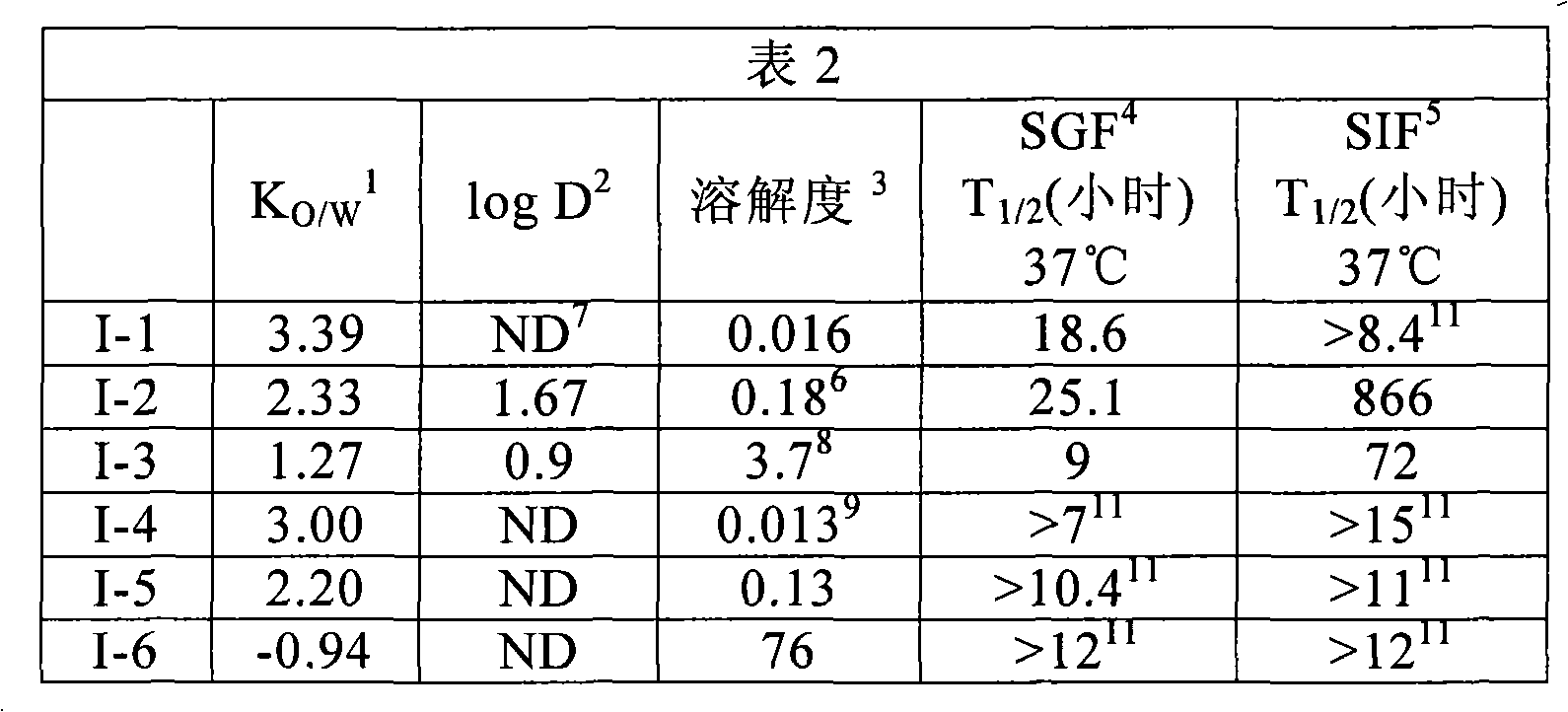
1.计算的辛醇/水分配系数1. Calculation of Octanol/Water Partition Coefficient
2.实验测定pH 7.4时的分布系数2. Experimental determination of the distribution coefficient at pH 7.4
3.水性介质、水或缓冲液pH 6.5中的溶解度(mg/mL)3. Solubility in aqueous media, water or buffer pH 6.5 (mg/mL)
4.模拟胃液中的稳定性(SGF;pH 1.2)4. Stability in simulated gastric juice (SGF; pH 1.2)
5.模拟肠液中的稳定性(SIF;pH 7.4)5. Stability in simulated intestinal fluid (SIF; pH 7.4)
6.SGF中的溶解度是13.3mg/mL6. The solubility in SGF is 13.3mg/mL
7.未测定7. Not determined
8.介质是SIF,SGF中的溶解度是13.6mg/mL8. The medium is SIF, and the solubility in SGF is 13.6mg/mL
9.介质是SIF,SGF中的溶解度是0.16mg/mL9. The medium is SIF, the solubility in SGF is 0.16mg/mL
10.在水和pH 6缓冲液中检测10. Detection in water and pH 6 buffer
11.观察到随时间的降解不明显11. Insignificant degradation over time was observed
12.pH 5.5时测定12. Measured at pH 5.5
油-水分配系数PO/W(clogP是计算的PO/W)是口服给予的药物的重要特性。药物必须有足够的水溶性从而能溶解在制剂和胃肠(GI)液中进而与胃和肠的内皮细胞接触,并应具有足够的脂溶性从而能穿过这些细胞的脂双层膜,最终进入血液。就口服生物利用度而言,某化合物的log P的最佳范围介于1和3之间,本发明化合物正显示此范围。The oil-water partition coefficient PO /W (clogP is the calculated PO /W ) is an important property of orally administered pharmaceuticals. Drugs must be sufficiently water-soluble to dissolve in formulations and gastrointestinal (GI) fluids to come into contact with the endothelial cells of the stomach and intestines, and should be sufficiently lipid-soluble to cross the lipid bilayer membranes of these cells, eventually into the blood. In terms of oral bioavailability, the optimal range of log P for a compound is between 1 and 3, and the compounds of the present invention are showing this range.
本文所用的表述PO/W指辛醇/水分配系数。本文所用的表述clogP指计算的PO/W。药学和医学化学家不难利用计算PO/W的计算机程序。术语“分布系数”指实验测定的辛醇和缓冲水溶液之间的分配系数。分配系数和分布系数大体上相似,但后者是水溶液的pH的函数,而PO/W不依赖于pH。The expression PO /W as used herein refers to the octanol/water partition coefficient. The expression clogP as used herein refers to the calculated P O/W . Computer programs that calculate P O/W are readily available to pharmaceutical and medicinal chemists. The term "distribution coefficient" refers to the experimentally determined partition coefficient between octanol and an aqueous buffer solution. Partition coefficient and distribution coefficient are generally similar, but the latter is a function of the pH of the aqueous solution, whereas PO/W is not pH dependent.
对于最佳的制剂,口服给予的前药在水中的溶解度应至少大于约0.1mg/mL,在模拟胃液和模拟肠液中的半衰期应分别是1-2小时和2-4小时,从而有足够的时间通过胃并在肠中被吸收。For an optimal formulation, the orally administered prodrug should have a solubility in water of at least greater than about 0.1 mg/mL, and a half-life in simulated gastric and intestinal fluids of 1-2 hours and 2-4 hours, respectively, to allow adequate Time passes through the stomach and is absorbed in the intestines.
在水性有机溶剂中通过酰化I-6可方便地一步制备本发明化合物。所述溶剂可以是均质水溶液或两相溶液。加入碱性物质以中和酰化产生的酸,从而将水性有机溶剂的pH维持在7.5以上。所述碱性物质可以是碱或碱金属氢氧化物或叔胺。反应在有本领域已知是酰化催化剂的DMAP存在下进行。本发明方法的优点之一是可获得所需产物而不会酰化杂环碱基。无需保护基团,也即无需保护/脱保护步骤。以下随附的实施例描述了该方法。The compounds of the invention are conveniently prepared in one step by acylation of 1-6 in an aqueous organic solvent. The solvent can be a homogeneous aqueous solution or a biphasic solution. A basic substance is added to neutralize the acid produced by the acylation, thereby maintaining the pH of the aqueous organic solvent above 7.5. The basic substance may be an alkali or alkali metal hydroxide or a tertiary amine. The reaction is carried out in the presence of DMAP known in the art to be an acylation catalyst. One of the advantages of the method of the present invention is that the desired product can be obtained without acylation of the heterocyclic base. No protecting groups are required, ie no protection/deprotection steps are required. The accompanying examples below describe this method.
剂量和给药Dosage and Administration
可将本发明化合物配制成各种口服给药剂型和载体。口服给药可以是片剂、包衣片剂、硬和软明胶胶囊、溶液、乳液、糖浆或悬液等形式。当采用栓剂给药等其它给药途径给予时,本发明化合物也是有效的。最方便的给药方式一般是采用方便的每日给药方案的口服给药,该方案可根据疾病的严重程度及患者对抗病毒药物的反应而作出调整。The compounds of the present invention can be formulated into various dosage forms and carriers for oral administration. Oral administration may be in the form of tablets, coated tablets, hard and soft gelatin capsules, solutions, emulsions, syrups or suspensions. The compounds of the present invention are also effective when administered by other routes of administration such as suppository administration. The most convenient mode of administration is generally oral administration using a convenient daily dosing regimen that can be adjusted according to the severity of the disease and the patient's response to antiviral drugs.
可将本发明的一种或多种化合物以及它们药学上有用的盐与一种或多种常规赋形剂、载体或稀释剂一起配制成药物组合物和单位剂量的形式。所述药物组合物和单位剂型可以包含惯用比例的常规成分,可以含或不含其它活性化合物,单位剂型可包含与要使用的所需每日剂量范围相当的任何合适有效量的活性成分。对于口服使用,所述药物组合物可以是固体,例如片剂或填充的胶囊,半固体、粉末、缓释制剂,或液体,例如悬液、乳液或填充胶囊的形式;或者对于直肠或阴道给药,可以是栓剂形式。典型的制品可含有约5%到约95%的一种或多种活性化合物(w/w)。术语“制品”或“剂型”应包括活性化合物的固体和液体制剂,本领域技术应知道根据所需剂量和药代动力学参数,活性成分可存在不同的制品。One or more compounds of the present invention and their pharmaceutically useful salts can be formulated together with one or more conventional excipients, carriers or diluents in the form of pharmaceutical compositions and unit doses. The pharmaceutical compositions and unit dosage forms may contain the ingredients in conventional proportions, with or without other active compounds, and the unit dosage forms may contain any suitable effective amount of the active ingredients commensurate with the desired daily dosage range to be used. For oral use, the pharmaceutical composition may be in the form of solids, such as tablets or filled capsules, semi-solids, powders, sustained release formulations, or liquids, such as suspensions, emulsions, or filled capsules; or for rectal or vaginal administration. The medicament may be in the form of a suppository. A typical preparation will contain from about 5% to about 95% active compound(s) (w/w). The term "preparation" or "dosage form" shall include both solid and liquid formulations of the active compound, and those skilled in the art will appreciate that the active ingredient may exist in different preparations depending on the desired dosage and pharmacokinetic parameters.
本文所用的术语“赋形剂”指用于制备药物组合物的化合物,该化合物通常安全、无毒并且既无生物学活性又无害,包括适合于兽医学应用以及人类应用的赋形剂。可单独给予本发明的化合物,但通常与根据所需给药途径和标准药学实践而选择的一种或多种合适的药学赋形剂、稀释剂或载体混合给予。The term "excipient" as used herein refers to a compound used in the preparation of a pharmaceutical composition which is generally safe, non-toxic and neither biologically active nor harmful, including excipients suitable for veterinary applications as well as human applications. The compounds of the invention can be administered alone, but will generally be administered in admixture with one or more suitable pharmaceutical excipients, diluents or carriers selected with regard to the desired route of administration and standard pharmaceutical practice.
对于活性成分的体内治疗活性,其“药学上可接受的盐”形式还可从最初赋予该活性成分非盐形式所不具备的理想药代动力学特性,甚至有利地影响该活性成分与体内治疗活性有关的药效学特性。本文所用的短语化合物的“药学上可接受的盐”是药学上可接受的并且具有母体化合物的所需药学活性的化合物。这种盐包括:(1)用以下无机酸或有机酸形成的酸加成盐,所述有机酸例如有:盐酸、氢溴酸、硫酸、硝酸、磷酸等;所述有机酸例如有:乙醇酸、丙酮酸、乳酸、丙二酸、苹果酸、马来酸、延胡索酸、酒石酸、柠檬酸、3-(4-羟基苯甲酰基)苯甲酸、肉桂酸、扁桃酸、甲磺酸、乙磺酸、1,2-乙烷-二磺酸、2-羟基乙磺酸、苯磺酸、4-氯苯磺酸、2-萘磺酸、4-甲苯磺酸、樟脑磺酸、月桂基硫酸、葡糖酸、谷氨酸、水杨酸、粘康酸,等等。应该知道述及药学上可接受的盐均包括同一酸加成盐的本文所述溶剂加成形式(溶剂化物)或晶体形式(多晶型)。Regarding the in vivo therapeutic activity of the active ingredient, its "pharmaceutically acceptable salt" form can also initially impart desirable pharmacokinetic properties to the active ingredient that the non-salt form does not have, and even favorably affect the active ingredient's in vivo therapeutic activity. Pharmacodynamic properties related to activity. As used herein, the phrase "pharmaceutically acceptable salt" of a compound is a compound that is pharmaceutically acceptable and possesses the desired pharmaceutical activity of the parent compound. Such salts include: (1) acid addition salts formed with the following inorganic acids or organic acids, such as hydrochloric acid, hydrobromic acid, sulfuric acid, nitric acid, phosphoric acid, etc.; such organic acids include ethanol Acid, pyruvic acid, lactic acid, malonic acid, malic acid, maleic acid, fumaric acid, tartaric acid, citric acid, 3-(4-hydroxybenzoyl)benzoic acid, cinnamic acid, mandelic acid, methanesulfonic acid, ethanesulfonic acid Acid, 1,2-ethane-disulfonic acid, 2-hydroxyethanesulfonic acid, benzenesulfonic acid, 4-chlorobenzenesulfonic acid, 2-naphthalenesulfonic acid, 4-toluenesulfonic acid, camphorsulfonic acid, lauryl sulfate , Gluconic acid, Glutamic acid, Salicylic acid, Muconic acid, etc. It is to be understood that references to pharmaceutically acceptable salts include solvent addition forms (solvates) or crystal forms (polymorphs) described herein of the same acid addition salt.
固体形式的制品包括粉末、片剂、丸剂、胶囊、栓剂和可分散粒剂。固体载体可以是还可用作稀释剂、调味剂、增溶剂、润滑剂、悬浮剂、粘合剂、防腐剂、片剂崩解剂或封装材料等的一种或多种物质。在粉末中,载体通常是精细分级的固体,其是含精细分级的活性组分的混合物。在片剂中,活性组分通常与适当比例的具有所需结合能力的载体混合,并包装成所需形状和大小。合适的载体包括但不限于:碳酸镁、硬脂酸镁、滑石粉、糖、乳糖、果胶、葡萄糖、淀粉、明胶、黄蓍胶、甲基纤维素、羧甲基纤维素钠、低融点蜡、可可油,等等。除了活性组分,固体形式的制品还含有着色剂、调味品、稳定剂、缓冲剂、人工和天然甜味剂、分散剂、稠化剂、加溶剂,等等。Solid form preparations include powders, tablets, pills, capsules, suppositories, and dispersible granules. A solid carrier can be one or more substances which may also act as diluents, flavoring agents, solubilizers, lubricants, suspending agents, binders, preservatives, tablet disintegrating agents or encapsulating materials and the like. In powders, the carrier usually is a finely divided solid which is a mixture containing the finely divided active component. In tablets, the active ingredient usually is mixed with the carrier having the necessary binding capacity in suitable proportions and packaged in the shape and size desired. Suitable carriers include, but are not limited to, magnesium carbonate, magnesium stearate, talc, sugar, lactose, pectin, glucose, starch, gelatin, tragacanth, methylcellulose, sodium carboxymethylcellulose, low melting point Wax, cocoa butter, etc. Solid form preparations can contain, in addition to the active ingredient, colorants, flavors, stabilizers, buffers, artificial and natural sweeteners, dispersants, thickeners, solubilizers, and the like.
液体制剂也适合于口服给药,液体制剂包括乳液、糖浆、酏剂和水性悬液。这些制剂包括在使用前不久转换成液体形式制品的固体形式制品。乳液可制成溶液,例如丙二醇水溶液或可含有乳化剂,例如卵磷脂、失水山梨糖醇酐单油酸酯或阿拉伯胶。可将精细分级的活性组分分散在含粘性物质,例如天然或合成的胶、树脂、甲基纤维素、羧甲基纤维素钠和其它熟知悬浮剂的水中来制备水性悬液。Liquid formulations are also suitable for oral administration and include emulsions, syrups, elixirs and aqueous suspensions. These preparations include solid form preparations which are to be converted, shortly before use, to liquid form preparations. Emulsions may be presented in solutions, for example, in water in propylene glycol or may contain emulsifying agents, for example, lecithin, sorbitan monooleate, or acacia. Aqueous suspensions can be prepared by dispersing the finely divided active component in water with viscous material, such as natural or synthetic gums, resins, methylcellulose, sodium carboxymethylcellulose, and other well known suspending agents.
可将本发明化合物配制成作为栓剂给药。首先融化低融点蜡,例如可可油或脂肪酸甘油酯的混合物,随后通过,例如搅拌使活性组分均匀分散。然后将融化的均匀混合物倒入具有一定大小的适宜模子中,冷却并固化。The compounds of the invention may be formulated for administration as suppositories. A low melting wax, such as cocoa butter or a mixture of fatty acid glycerides is first melted and the active ingredient is then dispersed homogeneously, for example by stirring. The molten homogeneous mixture is then poured into suitable sized molds, allowed to cool and solidify.
可将本发明化合物配制成用于阴道给药。本领域已知除活性组分以外还含有例如载体的阴道栓剂、棉塞、乳膏、凝胶、糊剂、泡沫剂或喷剂是合适的。The compounds of the invention may be formulated for vaginal administration. Pessaries, tampons, creams, gels, pastes, foams or sprays containing, in addition to the active ingredient, for example a carrier, are known in the art to be suitable.
宾夕法尼州伊斯顿市马克出版公司(Mack Publishing Company)的《雷明顿:药物科学与实践》(Remington:The Science and Practice of Pharmacy),1995,(E.W.Martin编,第19版)描述了含药物载体、稀释剂和赋形剂的合适制剂。熟练的制剂科学家可在本说明书的指导内改进所述制剂以提供用于特定给药途径的许多制剂,而不会使得本发明组合物不稳定或损害其治疗活性。Remington: The Science and Practice of Pharmacy, Mack Publishing Company, Easton, PA, 1995, (ed. E.W. Martin, 19th ed.) Suitable formulations containing pharmaceutical carriers, diluents and excipients are described. The skilled formulation scientist can modify the formulations within the guidance of this specification to provide numerous formulations for a particular route of administration without destabilizing the compositions of the invention or compromising their therapeutic activity.
例如,通过本领域普通技术人员熟知的微小改进(例如,盐制剂)不难修饰本发明化合物,从而使得它们在水或其它载体中的溶解性更强。本领域普通技术人员还熟知改进具体化合物的给药途径和剂量方案,从而能为患者的最大益处而调控本发明化合物的药代动力学特性。For example, compounds of the invention are readily modified to render them more soluble in water or other vehicles by minor modifications (eg, salt formulation) well known to those of ordinary skill in the art. It is also well within the skill of the art to modify the route of administration and dosage regimen for a particular compound so that the pharmacokinetic properties of the compounds of the invention can be modulated for the greatest benefit to the patient.
本文所用的术语“治疗有效量”表示降低个体疾病症状所需的用量。在各种具体情况中,可按个体需要调整剂量。该剂量的变化范围广,这取决于许多因素,例如待治疗疾病的严重程度,患者的年龄和总体健康状况,治疗患者的其它药物,给药途径和形式以及参与医师的偏好和经验。对于口服给药,单一疗法和/或组合疗法中介于每日约0.1至约10g之间的每日剂量应是适宜的。优选的每日剂量介于每日约0.5至约7.5g之间,更优选介于每日1.5至约6.0g之间。一般以大的起始“加载剂量”开始治疗,从而能快速降低或消除病毒,然后将剂量降低至足以防止感染复发的水平。对于给定的疾病和患者,普通技术人员在治疗本文所述疾病时无需过多实验,只依靠个人知识、经验和本申请的内容即能确定治疗有效量的本发明化合物。As used herein, the term "therapeutically effective amount" means an amount required to reduce the symptoms of a disease in an individual. In each particular case, the dosage may be adjusted to individual needs. This dosage can vary widely, depending on many factors, such as the severity of the disease being treated, the age and general health of the patient, other medications the patient is treating, the route and form of administration and the preference and experience of the participating physician. For oral administration, a daily dosage of between about 0.1 to about 10 g per day in monotherapy and/or combination therapy should be suitable. A preferred daily dosage is between about 0.5 to about 7.5 g per day, more preferably between 1.5 to about 6.0 g per day. Treatment is generally initiated with a large initial "loading dose" to rapidly reduce or eliminate the virus, and the dose is then reduced to a level sufficient to prevent relapse of infection. A therapeutically effective amount of a compound of the present invention can be determined by one of ordinary skill in treating a disease described herein without undue experimentation and relying solely on personal knowledge, experience and the teachings of this application for a given disease and patient.
通过肝功能检验可确定疗效,所述检验包括但不限于:蛋白质水平,例如血清蛋白质(如白蛋白、凝血因子、碱性磷酸酶、氨基转移酶(如丙氨酸转氨酶、天冬氨酸转氨酸)、5’-核苷、γ-谷氨酰胺酰基转肽酶,等等)、胆红素的合成、胆固醇的合成和胆汁酸的合成;肝代谢功能,包括但不限于:碳水化合物代谢、氨基酸和氨代谢。或者,可通过检测HCV-RNA来监测疗效。可利用这些检验的结果优化剂量。Efficacy can be determined by liver function tests, including but not limited to: protein levels, such as serum proteins (eg, albumin, coagulation factors, alkaline phosphatase, aminotransferases (eg, alanine aminotransferase, aspartate transaminase) amino acid), 5'-nucleoside, γ-glutaminyl transpeptidase, etc.), bilirubin synthesis, cholesterol synthesis, and bile acid synthesis; liver metabolic functions, including but not limited to: carbohydrate Metabolism, amino acid and ammonia metabolism. Alternatively, efficacy can be monitored by detecting HCV-RNA. The results of these assays can be used to optimize dosage.
在本发明的实施方式中,可联合给予活性化合物或盐与另一种抗病毒剂,例如利巴韦林,另一种核苷HCV聚合酶抑制剂、HCV非核苷聚合酶抑制剂、HCV蛋白酶抑制剂、HCV解旋酶抑制剂或HCV融合抑制剂。当联合给予活性化合物或其衍生物或盐和另一种抗病毒剂时,活性可能会升高超过母体化合物。当治疗是组合疗法时,这种给药可以与所述核苷衍生物的给药同时或顺次进行。因此,本文所用的“同时给药”包括在同一时间或在不同时间给予这些药物。可利用含有两种或更多种活性成分的单一制剂或通过基本上同时给予含有一种活性药物的两种或更多种剂型来同时给予两种或更多种药物。In an embodiment of the invention, the active compound or salt may be administered in combination with another antiviral agent, such as ribavirin, another nucleoside HCV polymerase inhibitor, HCV non-nucleoside polymerase inhibitor, HCV protease inhibitors, HCV helicase inhibitors, or HCV fusion inhibitors. When the active compound or its derivative or salt is co-administered with another antiviral agent, the activity may be increased over that of the parent compound. When the treatment is a combination therapy, this administration may be simultaneous or sequential to that of the nucleoside derivatives. Therefore, "simultaneous administration" as used herein includes administration of these drugs at the same time or at different times. Two or more agents can be administered simultaneously using a single formulation containing two or more active ingredients or by administering two or more dosage forms containing an active agent substantially simultaneously.
应该理解本文述及治疗应延伸至对已有疾病的预防以及治疗。此外,本文所用的术语HCV感染的“治疗”还包括治疗或预防HCV感染有关或介导的疾病或病症,或其临床症状。It should be understood that references to treatment herein extend to the prevention as well as treatment of pre-existing conditions. In addition, the term "treatment" of HCV infection as used herein also includes treatment or prevention of diseases or disorders associated or mediated by HCV infection, or clinical symptoms thereof.
实施例1Example 1
丙酸(2R,3R,4R,5R)-5-(4-氨基-2-氧代-2H-嘧啶-1-基)-4-氟-4-甲基-3-丙酰氧基-四氢-呋喃-2-基甲基酯(I-3)Propionic acid (2R, 3R, 4R, 5R)-5-(4-amino-2-oxo-2H-pyrimidin-1-yl)-4-fluoro-4-methyl-3-propionyloxy-tetra Hydrogen-furan-2-ylmethyl ester (I-3)

向I-6(30g,0.116mol)、DMAP(1.4g,11.57mmol)的THF(300mL)和水(150mL)的悬液中加入TEA(35.1g,0.347mol)获得清澈的溶液(pH约11)。将反应混合物冷至5-10℃,向搅拌中的该双相反应体系中滴加丙酸酐(30.1g,0.231mol)。监测pH,通过同步加入KOH溶液将pH维持在约11-12。通过HPLC分析监测反应的进展,加入丙酰氯后有约52%二酯、30%单酯和15%起始物质。在上述条件下再滴加丙酸酐(45.2g,0.347mol)。不搅拌反应混合物,使其静置过夜。对有机相进行HPLC表明约96%二酯和约2%单酯。分离各相,用THF(100mL)萃取水相两次。用盐水洗涤合并的有机相。过滤有机相,蒸发,将残留物溶解于水中(约500mL),然后用IPA(约100mL)稀释。将得到的混合物缓慢冷却至室温并搅拌。滤出得到的沉淀物,用水和庚烷洗涤,约60℃真空干燥约60小时获得3.45g(80.3%)I-3,HPLC检测其纯度为98.75%。To a suspension of 1-6 (30 g, 0.116 mol), DMAP (1.4 g, 11.57 mmol) in THF (300 mL) and water (150 mL) was added TEA (35.1 g, 0.347 mol) to obtain a clear solution (pH about 11 ). The reaction mixture was cooled to 5-10°C, and propionic anhydride (30.1 g, 0.231 mol) was added dropwise to the stirring biphasic reaction system. The pH was monitored and maintained at about 11-12 by simultaneous addition of KOH solution. The progress of the reaction was monitored by HPLC analysis, after addition of propionyl chloride there was approximately 52% diester, 30% monoester and 15% starting material. Propionic anhydride (45.2 g, 0.347 mol) was added dropwise under the above conditions. The reaction mixture was allowed to stand overnight without stirring. HPLC on the organic phase showed about 96% diester and about 2% monoester. The phases were separated and the aqueous phase was extracted twice with THF (100 mL). The combined organic phases were washed with brine. The organic phase was filtered, evaporated, and the residue was dissolved in water (ca. 500 mL) and diluted with IPA (ca. 100 mL). The resulting mixture was cooled slowly to room temperature and stirred. The obtained precipitate was filtered off, washed with water and heptane, and dried under vacuum at about 60° C. for about 60 hours to obtain 3.45 g (80.3%) of I-3, whose purity was 98.75% by HPLC.
实施例2Example 2
异丁酸(2R,3R,4R,5R)-5-(4-氨基-2-氧代-2H-嘧啶-1-基)-4-氟-3-异丁酰氧基-4-甲基-四氢-呋喃-2-基甲酯(I-2)Isobutyric acid (2R, 3R, 4R, 5R)-5-(4-amino-2-oxo-2H-pyrimidin-1-yl)-4-fluoro-3-isobutyryloxy-4-methyl -Tetrahydro-furan-2-ylmethyl ester (I-2)

向I-6(970g,3.74mol)和DMAP(50g,0.412mol)的THF(10L)的冰冷悬液中加入TEA(2.3kg,16.5mol)和水(7L),从而产生清澈的溶液。将异丁酰基氯(3当量)缓慢加入搅拌中的混合物,同时维持温度约0℃。然后再依次加入1.2当量和0.7当量的异丁酰氯直至HPLC表明反应基本完成(总共约1.95kg)。用浓盐酸酸化反应混合物至pH约6.4,用EtOAc(2×10L)洗涤有机相。用水(1×15L)洗涤合并的萃取物。过滤有机相并真空浓缩。将残留物溶解于IPA(约20kg)中,加入庚烷(14.2kg)。将溶液加热至约74-75℃产生清澈的溶液,然后蒸馏除去约5L。使得到的溶液缓慢冷却至室温。在约42-43℃形成沉淀物。继续缓慢冷却至5℃,然后搅拌过夜。过滤得到的溶液,用IPA/庚烷(1∶8)混合物(13.4kg)洗涤滤液,约60-70℃真空干燥获得1.295kg(86.65%)I-2,经HPLC分析其纯度为99.45%。To an ice-cold suspension of 1-6 (970 g, 3.74 mol) and DMAP (50 g, 0.412 mol) in THF (10 L) was added TEA (2.3 kg, 16.5 mol) and water (7 L), resulting in a clear solution. Isobutyryl chloride (3 eq.) was slowly added to the stirring mixture while maintaining the temperature at about 0°C. An additional 1.2 equivalents and 0.7 equivalents of isobutyryl chloride were then added sequentially until HPLC indicated that the reaction was substantially complete (approximately 1.95 kg in total). The reaction mixture was acidified with concentrated HCl to pH ~6.4, and the organic phase was washed with EtOAc (2 x 10 L). The combined extracts were washed with water (1 x 15 L). The organic phase was filtered and concentrated in vacuo. The residue was dissolved in IPA (about 20 kg) and heptane (14.2 kg) was added. The solution was heated to about 74-75°C to produce a clear solution, then about 5 L was distilled off. The resulting solution was allowed to cool slowly to room temperature. A precipitate formed at about 42-43°C. Continue to cool slowly to 5°C, then stir overnight. The resulting solution was filtered, the filtrate was washed with an IPA/heptane (1:8) mixture (13.4 kg), and dried under vacuum at about 60-70° C. to obtain 1.295 kg (86.65%) of I-2, which was 99.45% pure by HPLC analysis.
实施例3Example 3
碳酸(2R,3R,4R,5R)-5-(4-氨基-2-氧代-2H-嘧啶-1-基)-4-氟-2-异丁氧基羰基氧基甲基-4-甲基-四氢-呋喃-3-基酯异丁酯(I-4)Carbonic acid (2R, 3R, 4R, 5R)-5-(4-amino-2-oxo-2H-pyrimidin-1-yl)-4-fluoro-2-isobutoxycarbonyloxymethyl-4- Methyl-tetrahydro-furan-3-yl ester isobutyl ester (I-4)

用盐水(7mL)稀释I-6(700mg)、DMAP(33mg)的THF(7mL)悬液。加入稀NaOH直至pH约11。用冰浴冷却反应混合物,向搅拌中的双相反应混合物中滴加氯甲酸异丁酯(1.11g),视需要加入NaOH将pH维持在约11。HPLC分析表明大多数碳酸氢酯污染有约15%单碳酸酯。再向冰冷却的溶液中滴加1当量氯甲酸异丁酯。HPLC表明几乎完全转化。得到的混合物在室温下静置过夜。加入EtOAc(约50mL),用浓盐酸将水相的pH调节至约7.5。分离各相,用水(3×)洗涤有机相,蒸发至干得到无色固体(约1.22g)。将固体溶解于热丙酮中得到清澈的溶液,将该溶液缓慢冷却至室温产生一定量固体。用IPA(约20mL)稀释该固体产生浆液,过滤该浆液然后依次用IPA和庚烷洗涤,再经干燥得到0.85g(68.5%)I-4,经HPLC分析其纯度为97.5%。A THF (7 mL) suspension of 1-6 (700 mg), DMAP (33 mg) was diluted with brine (7 mL). Dilute NaOH was added until pH ~11. The reaction mixture was cooled with an ice bath, isobutyl chloroformate (1.11 g) was added dropwise to the stirred biphasic reaction mixture, and the pH was maintained at about 11 by addition of NaOH as needed. HPLC analysis indicated most bicarbonate contamination with about 15% monocarbonate. Then, 1 equivalent of isobutyl chloroformate was added dropwise to the ice-cooled solution. HPLC indicated almost complete conversion. The resulting mixture was left at room temperature overnight. EtOAc (about 50 mL) was added and the pH of the aqueous phase was adjusted to about 7.5 with concentrated hydrochloric acid. The phases were separated and the organic phase was washed with water (3x) and evaporated to dryness to give a colorless solid (ca. 1.22g). The solid was dissolved in hot acetone to give a clear solution which was slowly cooled to room temperature to yield some solid. The solid was diluted with IPA (ca. 20 mL) to produce a slurry which was filtered and washed sequentially with IPA and heptane, and dried to give 0.85 g (68.5%) of I-4, which was 97.5% pure by HPLC analysis.
实施例4Example 4
碳酸(2R,3R,4R,5R)-5-(4-氨基-2-氧代-2H-嘧啶-1-基)-4-氟-4-甲基-2-丙氧基羰基氧基甲基-四氢-呋喃-3-基酯丙酯;盐酸盐(I-5)Carbonic acid (2R, 3R, 4R, 5R)-5-(4-amino-2-oxo-2H-pyrimidin-1-yl)-4-fluoro-4-methyl-2-propoxycarbonyloxymethyl Propyl-tetrahydro-furan-3-yl ester; hydrochloride (I-5)
向I-6(700mg,2.70mmol)、DMAP(33mg,0.27mmol)的THF(7mL)和稀释盐水(7mL)的悬液中加入稀KOH将pH调节至约11。将反应体系冷却至约5℃,向搅拌中的双相反应混合物中滴加氯甲酸正丙酯(1.0g)。HPLC分析表明形成了所需产物连同约20%单碳酸酯。向该冷溶液中再加入两份氯甲酸丙酯(2×1当量)直至HPLC分析表明反应完成。用EtOAc(30mL)稀释反应混合物,用浓盐酸将水相的pH调节至约6.5。分离各相,用水(3×)洗涤有机相,蒸发至干获得无色固体(约1.1g)。用4N HCl(约1mL)酸化热IPA溶液并蒸发至干。将得到的固体再溶解于热EtOH(约115mL)中,室温下搅拌过夜。过滤形成的固体,用MeOH/庚烷(1∶1)洗涤残留物。约60℃真空干燥剩余的固体获得0.325g(25.8%)I-5,HPLC试验表明其纯度为97.5%。To a suspension of 1-6 (700 mg, 2.70 mmol), DMAP (33 mg, 0.27 mmol) in THF (7 mL) and diluted brine (7 mL) was added to adjust the pH to about 11 by adding dilute KOH. The reaction system was cooled to about 5°C, and n-propyl chloroformate (1.0 g) was added dropwise to the stirred biphasic reaction mixture. HPLC analysis indicated formation of the desired product along with about 20% monocarbonate. To this cold solution was added two more portions of propyl chloroformate (2 x 1 equiv) until HPLC analysis indicated the reaction was complete. The reaction mixture was diluted with EtOAc (30 mL), and the pH of the aqueous phase was adjusted to about 6.5 with concentrated hydrochloric acid. The phases were separated and the organic phase was washed with water (3x) and evaporated to dryness to give a colorless solid (ca. 1.1 g). The hot IPA solution was acidified with 4N HCl (about 1 mL) and evaporated to dryness. The resulting solid was redissolved in hot EtOH (ca. 115 mL) and stirred overnight at room temperature. The solid formed was filtered and the residue was washed with MeOH/heptane (1:1). Vacuum drying of the remaining solid at about 60°C afforded 0.325 g (25.8%) of I-5, which was 97.5% pure by HPLC.
实施例5Example 5
测定大鼠中的药代动力学参数Determination of pharmacokinetic parameters in rats
利用称重为200-250g的完整雄性IGS Wistar Han RatsCrl:WI(GLx/BRL/Han)IGS BR(Hanover-Wistar)大鼠。实验化合物的每种剂量水平使用三个大鼠的组(groups of three rats)。实验期间允许大鼠正常进食和饮水。将测试物质配制成含Captex355EP、Capmul MCM、EtOH和丙二醇(30∶20∶20∶30)的水性悬液,剂量等于10mg/kg I-6,采用管饲法口服给予这些悬液。在0.25、0.5、1、3、5和8小时,利用颈静脉插管收集处理大鼠的血液样品(0.3mL),在24小时通过心脏穿刺收集血液样品。向样品中加入草酸钾/NaF,在取样期间将样品保存于冰上。尽快用冷冻离心机在-4℃离心各样品,将血浆样品保存于-80℃冰箱内待分析。将等份血浆(0.05mL)与0.1mL乙腈混合。加入内标(0.05mL,水配制)和0.02mL空白溶剂。将0.05-mL未处理大鼠的血浆等份试样与0.1mL乙腈、0.02mL甲醇∶水(1∶1)配制的标准溶液等份试样和0.05mL水配制的内标等份试样混合来制备一组校验标准品。使各血浆样品和校验标准品彻底旋振,然后以3000rpm离心5分钟以沉淀蛋白质。将离心上清液(各100μl)转移至含200μl水性流动相的96-孔板中进行LC/MS/MS分析。Intact male IGS Wistar Han RatsCrl:WI(GLx/BRL/Han)IGS BR(Hanover-Wistar) rats weighing 200-250 g were utilized. Groups of three rats are used for each dose level of the test compound. Rats were allowed to eat and drink normally during the experiment. The test substances were formulated as aqueous suspensions containing Captex 355EP, Capmul MCM, EtOH and propylene glycol (30:20:20:30) at a dose equal to 10 mg/kg I-6, and these suspensions were administered orally by gavage. Blood samples (0.3 mL) were collected from treated rats using a jugular vein cannula at 0.25, 0.5, 1, 3, 5, and 8 hours, and blood samples were collected by cardiac puncture at 24 hours. Potassium oxalate/NaF was added to the samples, which were kept on ice during sampling. Each sample was centrifuged at -4°C in a refrigerated centrifuge as soon as possible, and the plasma samples were stored in a -80°C freezer until analysis. Aliquots of plasma (0.05 mL) were mixed with 0.1 mL of acetonitrile. Add internal standard (0.05mL, prepared in water) and 0.02mL blank solvent. Mix 0.05-mL aliquots of plasma from untreated rats with aliquots of standard solution in 0.1 mL of acetonitrile, 0.02 mL of methanol:water (1:1), and aliquots of internal standard in 0.05 mL of water to prepare a set of calibration standards. Each plasma sample and checkout standard was vortexed thoroughly, then centrifuged at 3000 rpm for 5 minutes to pellet proteins. Centrifugation supernatants (100 μl each) were transferred to 96-well plates containing 200 μl of aqueous mobile phase for LC/MS/MS analysis.
样品分析:Sample analysis:
联用高效液相层析与串联质谱仪(HPLC/MS/MS)分析前药。利用Thermo Aquasil C184.6×50mm柱(5μM)进行分离。离子化过程采用电喷雾离子化(ESI)。流动相A含有水配制的5mM乙酸铵与0.1%甲酸,流动相B含有MeOH与0.1%甲酸。采用以下梯度以1mL/分钟的流速进行洗脱:The prodrugs were analyzed by high performance liquid chromatography coupled with tandem mass spectrometry (HPLC/MS/MS). Separation was performed using a Thermo Aquasil C18 4.6×50 mm column (5 μM). The ionization process uses electrospray ionization (ESI). Mobile phase A contained 5 mM ammonium acetate and 0.1% formic acid in water, and mobile phase B contained MeOH and 0.1% formic acid. Elution was performed at a flow rate of 1 mL/min using the following gradient:
实施例6Example 6
测定猴中的药代动力学参数Determination of pharmacokinetic parameters in monkeys
利用重8-10kg的雄性弥猴(Cynomolgus)。实验期间允许弥猴正常进食和饮水。记录给药时弥猴的体重和不良反应。将测试物质配制成含羟丙基纤维素(2910,50cps)、USP、聚山梨醇酯80、NF、苄醇、NF(5.0、4.0和9.0mg/mL)和无菌水(用量足以达到1.0mL)的水性悬液,剂量等于10mg/kg I-6,采用管饲法口服给予0.5mL/kg。在0、0.083、0.25、0.5、1、3、5、8和24小时收集血液样品(0.5-1.0mL)。如大鼠实验所述处理和分析样品。在给药前和0-8小时取得各弥猴的5mL尿液样品。将尿液样品保存在-80℃,通过LC/MS/MS分析。用含NaF和草酸钾的空白弥猴血浆制备标准曲线。Male Macaque monkeys (Cynomolgus) weighing 8-10 kg were used. Macaques were allowed to eat and drink normally during the experiment. Record the body weight and adverse reactions of the macaques during the administration. The test substance was formulated to contain hydroxypropylcellulose (2910, 50cps), USP, polysorbate 80, NF, benzyl alcohol, NF (5.0, 4.0 and 9.0 mg/mL) and sterile water (enough to achieve 1.0 mL), the dose is equal to 10mg/kg I-6, and 0.5mL/kg is given orally by gavage. Blood samples (0.5-1.0 mL) were collected at 0, 0.083, 0.25, 0.5, 1, 3, 5, 8 and 24 hours. Samples were processed and analyzed as described for rat experiments. A 5 mL urine sample was taken from each macaque prior to dosing and 0-8 hours. Urine samples were stored at -80°C and analyzed by LC/MS/MS. A standard curve was prepared with blank macaque plasma containing NaF and potassium oxalate.
实施例7Example 7
Caco方案Caco scheme
材料:Material:
氯化钙二水合物、碳酸氢钠和K-H缓冲剂(Krebs-Henseleit buffer)粉末购自密苏里州圣路易斯市的西格玛公司(Sigma,St.Louis,MO)。Caco-2细胞(约100代)购自罗氏巴塞尔公司(Roche Basel)。DMEM/高培养基、4-(2-羟乙基)-1-哌嗪乙磺酸(HEPES)和牛血清购自堪萨斯州列涅萨市JRH生物科学公司(JRH Bioscience,Lenexa,KS)。MEM非必需氨基酸、L-谷氨酰胺、青霉素和链霉素购自纽约州格兰德岛市吉比科实验室生命技术公司(GIBCO Labs,Life Tech.LLC,Grand Island,NY)。斯耐普威尔细胞培养插片(Snapwell cell culture insert)(6.5mm直径,1.12cm2,0.4μm孔径)购自马萨诸塞州剑桥市的科斯达公司(Costar,Cambridge,MA)。Calcium chloride dihydrate, sodium bicarbonate and KH buffer (Krebs-Henseleit buffer) powders were purchased from Sigma, St. Louis, MO. Caco-2 cells (approximately 100 passages) were purchased from Roche Basel. DMEM/high medium, 4-(2-hydroxyethyl)-1-piperazineethanesulfonic acid (HEPES) and bovine serum were purchased from JRH Bioscience, Lenexa, KS. MEM non-essential amino acids, L-glutamine, penicillin and streptomycin were purchased from GIBCO Labs, Life Tech. LLC, Grand Island, NY. Snapwell cell culture inserts (6.5 mm diameter, 1.12 cm 2 , 0.4 μm pore size) were purchased from Costar, Cambridge, MA.
细胞培养:Cell culture:
将细胞培养在75-cm2烧瓶中,维持于37℃,5%CO2和95%空气气氛中。培养基为添加了5%牛血清、25mM HEPES、1%MEM非必需氨基酸、1%L-谷氨酰胺、100U/mL青霉素和100μg/mL链霉素的DMEM/高培养基。培养物以1-3的分流比(split ratio)每周传代。对于渗透性研究,将传代数110-120的Caco-2细胞以400,000个细胞/cm2的密度接种于斯耐普威尔插片中的特兰斯威尔聚碳酸酯滤膜上(Transwell polycarbonate filter),培养7天后使用。Cells were cultured in 75- cm2 flasks maintained at 37 °C in an atmosphere of 5% CO2 and 95% air. The medium was DMEM/high medium supplemented with 5% bovine serum, 25 mM HEPES, 1% MEM non-essential amino acids, 1% L-glutamine, 100 U/mL penicillin and 100 μg/mL streptomycin. Cultures were passaged weekly with a split ratio of 1-3. For permeability studies, Caco-2 cells at passage number 110-120 were seeded at a density of 400,000 cells/ cm2 on Transwell polycarbonate filters in Snapwell inserts. filter), used after 7 days of culture.
K-H缓冲液:K-H buffer:
按照包装中的使用说明书制备含有10mM葡萄糖和2.5mMCaCl2,pH调节至6.5和7.4的K-H碳酸氢盐缓冲剂。用米立波尔(Millipore)水将粉末状的盐定量溶解在约90%所需体积中。先加入氯化钙二水合物和碳酸氢钠,再用1N HCl或1N NaOH调节pH。加入额外的米立波尔水将该溶液补充至最终体积。利用0.22微米孔径的膜对该溶液过滤除菌,将其保存在冰箱中(约20℃)待用。KH bicarbonate buffer containing 10 mM glucose and 2.5 mM CaCl 2 , pH adjusted to 6.5 and 7.4 was prepared according to the instruction in the package. The powdered salt was quantitatively dissolved with Millipore water to about 90% of the required volume. Add calcium chloride dihydrate and sodium bicarbonate first, then adjust the pH with 1N HCl or 1N NaOH. Additional Miripore water was added to bring the solution up to final volume. The solution was sterilized by filtration through a membrane with a pore size of 0.22 μm, and stored in a refrigerator (about 20° C.) until use.
细胞制品:Cell products:
分化的细胞购自细胞培养核心研究室公司(Cell Culture Core Facility),将其于37℃5%CO2和95%空气气氛中平衡。37℃,在平衡的K-H pH 7.4缓冲液中清洗含caco-2单层的斯耐普威尔插片。Differentiated cells were purchased from Cell Culture Core Facility and equilibrated at 37°C in an atmosphere of 5% CO 2 and 95% air. Snapwell inserts containing caco-2 monolayers were washed in equilibrated KH pH 7.4 buffer at 37°C.
方法:method:
将细胞插片用作扩散室。顶室(apical chamber)和基底外侧室(basolateralchamber)中K-H缓冲液的pH分别是6.5和7.4,顶侧中底物的初始浓度是100μM。37℃,5%CO2和95%空气气氛中将细胞与测试化合物在顶室中预培育约30分钟。将pH 6.5K-H缓冲液中的100μM化合物与细胞插片转移入基底外侧室中含预平衡缓冲液的新平板后,开始实验。收集0分钟时供给侧的样品及30分钟时供给侧和接受侧的样品进行分析。Cell inserts were used as diffusion chambers. The pH of KH buffer in the apical and basolateral chambers was 6.5 and 7.4, respectively, and the initial concentration of substrate in the apical chamber was 100 μΜ. Cells were pre-incubated with test compounds in an apical chamber at 37° C. in an atmosphere of 5% CO 2 and 95% air for approximately 30 minutes. Experiments were started after transferring 100 [mu]M compound in pH 6.5 KH buffer with cell inserts to a new plate containing pre-equilibrated buffer in the basolateral chamber. Samples from the supply side at 0 minutes and samples from the supply and receiver sides at 30 minutes were collected for analysis.
实验后对照(Post-Experiment Control):Post-Experiment Control:
利用荧光黄(Lucifer Yellow)评估扩散系统的性能。测试化合物的最后一次取样后,向顶室中加入荧光黄得到初始浓度100μM。培育60分钟后,从基底室中取出250μL并检验。The performance of the diffusion system was evaluated using Lucifer Yellow. After the last sampling of the test compound, Luciferin was added to the top chamber to give an initial concentration of 100 [mu]M. After 60 minutes of incubation, 250 μL was removed from the basal chamber and examined.
计算渗透性系数(Papp):Calculate the permeability coefficient (P app ):
利用下式计算Papp:Calculate P app using the following formula:

其中V是接受溶液的体积(cm3),A是斯耐普威尔插片的表面积(cm2),Co是初始浓度(nM),dC/dt是接受室中浓度随时间的变化率,即接受室中浓度对时间的斜率(nM/分钟)。由于取出试样或将供给插片转移至新平板的原因,根据实验校正各取样时间点的浓度。where V is the volume of the receptor solution (cm 3 ), A is the surface area of the Snapwell insert (cm 2 ), C o is the initial concentration (nM), and dC/dt is the rate of change of concentration in the receptor chamber with time , that is, the slope of concentration versus time in the receptor compartment (nM/min). Concentrations at each sampling time point were experimentally corrected due to sample removal or transfer of supply inserts to new plates.
实施例8Example 8
如实施例8所述制备经几种途径给药的所述化合物的药物组合物。Pharmaceutical compositions of the compounds administered by several routes were prepared as described in Example 8.
口服给药的湿颗粒制剂的组成(A):Composition (A) of wet granule formulation for oral administration:
混合诸成分,造粒并分散入硬明胶胶囊,该胶囊含有约500mg活性化合物。The ingredients are mixed, granulated and dispersed into hard gelatin capsules containing about 500 mg of active compound.
口服给药的组合物(B):Composition (B) for oral administration:
利用溶剂,例如水混合诸成分并造粒。然后干燥该制剂并用合适的压片机制成含有约500mg活性化合物的片剂。The ingredients are mixed and granulated using a solvent such as water. The preparation is then dried and formed into tablets containing about 500 mg of active compound using a suitable tablet machine.
口服给药的组合物(C):Composition (C) for oral administration:
混合诸成分以形成口服给药的悬液。The ingredients are mixed to form a suspension for oral administration.
栓剂(D):Suppository (D):
将诸组分一起融化,用蒸气浴(steam bath)混合并倾倒入模子,总重量为2.5g。The ingredients were melted together, mixed with a steam bath and poured into molds, total weight 2.5g.
上文或以下权利要求中披露的各种特征可以适当地表示成它们特定的形式或实施所述功能的方式,或获得所述结果的方法,可以单独利用这些特征或利用这些特征的任何组合来实施本发明的不同形式。The various features disclosed above or in the following claims may be suitably expressed in their particular form or manner of carrying out the stated function, or the method of obtaining the stated result, which may be used alone or in any combination of these features. Different forms of implementing the invention.
出于清晰和理解的目的,借助说明和实施例描述了以上发明的一些细节。本领域技术人员明显知道可在随附的权利要求的范围内作出变化和改进。因此,应将以上描述理解成说明性而非限制性的。所以本发明的范围不应由以上描述决定,而应由以下随附的权利要求连同这些权利要求的等效方式的全部范围决定。For purposes of clarity and understanding, some details of the foregoing invention have been described by way of illustration and example. It will be apparent to a person skilled in the art that changes and modifications can be made within the scope of the appended claims. Accordingly, the foregoing description should be considered as illustrative rather than restrictive. The scope of the invention, therefore, should be determined not by the above description, but by the following appended claims, along with the full scope of equivalents to which such claims are entitled.
如同各篇专利、专利申请或出版物单独表示的程度一样,本申请引用的所有专利、专利申请和出版物出于所有目的通过引用全文纳入本文。All patents, patent applications, and publications cited in this application are hereby incorporated by reference in their entirety for all purposes to the same extent as if each individual patent, patent application, or publication were individually indicated.
Claims (17)


Applications Claiming Priority (3)
| Application Number | Priority Date | Filing Date | Title |
|---|---|---|---|
| US74931905P | 2005-12-09 | 2005-12-09 | |
| US60/749,319 | 2005-12-09 | ||
| PCT/EP2006/069060 WO2007065829A1 (en) | 2005-12-09 | 2006-11-29 | Antiviral nucleosides |
Publications (2)
| Publication Number | Publication Date |
|---|---|
| CN101336247A true CN101336247A (en) | 2008-12-31 |
| CN101336247B CN101336247B (en) | 2013-01-23 |
Family
ID=37608355
Family Applications (1)
| Application Number | Title | Priority Date | Filing Date |
|---|---|---|---|
| CN2006800523648A Expired - Fee Related CN101336247B (en) | 2005-12-09 | 2006-11-29 | Antiviral nucleosides |
Country Status (25)
| Country | Link |
|---|---|
| US (1) | US7754699B2 (en) |
| EP (1) | EP1957510A1 (en) |
| JP (2) | JP4979710B2 (en) |
| KR (1) | KR101238461B1 (en) |
| CN (1) | CN101336247B (en) |
| AR (1) | AR056850A1 (en) |
| AU (1) | AU2006324098C1 (en) |
| BR (1) | BRPI0619563A2 (en) |
| CA (1) | CA2632626C (en) |
| CR (1) | CR10136A (en) |
| EC (1) | ECSP088518A (en) |
| GT (1) | GT200800095A (en) |
| HN (1) | HN2006041184A (en) |
| IL (1) | IL192002A0 (en) |
| MA (1) | MA30057B1 (en) |
| MY (1) | MY150667A (en) |
| NO (1) | NO20082934L (en) |
| NZ (1) | NZ568909A (en) |
| PE (1) | PE20071131A1 (en) |
| RU (1) | RU2422454C2 (en) |
| TW (1) | TWI394759B (en) |
| UA (1) | UA91255C2 (en) |
| UY (1) | UY30004A1 (en) |
| WO (1) | WO2007065829A1 (en) |
| ZA (1) | ZA200804958B (en) |
Cited By (2)
| Publication number | Priority date | Publication date | Assignee | Title |
|---|---|---|---|---|
| CN102775458A (en) * | 2011-05-09 | 2012-11-14 | 中国人民解放军军事医学科学院毒物药物研究所 | Preparation and application of beta-D-(2'R)-2'-deoxy-2'-fluoro-2'-C-methylcytidine derivatives |
| CN104379591A (en) * | 2012-05-29 | 2015-02-25 | 弗·哈夫曼-拉罗切有限公司 | Process for the preparation of 2-deoxy-2-fluoro-2-methyl-d-ribofuranosyl nucleoside compounds |
Families Citing this family (73)
| Publication number | Priority date | Publication date | Assignee | Title |
|---|---|---|---|---|
| MY164523A (en) | 2000-05-23 | 2017-12-29 | Univ Degli Studi Cagliari | Methods and compositions for treating hepatitis c virus |
| MXPA02011691A (en) | 2000-05-26 | 2004-05-17 | Idenix Cayman Ltd | Methods and compositions for treating flaviviruses and pestiviruses. |
| PL377342A1 (en) | 2002-11-15 | 2006-01-23 | Idenix (Cayman) Limited | 2'-branched nucleosides and flaviviridae mutation |
| PL2604620T5 (en) | 2003-05-30 | 2024-10-14 | Gilead Pharmasset Llc | Modified fluorinated nucleoside analogues |
| JP2009526850A (en) * | 2006-02-14 | 2009-07-23 | メルク エンド カムパニー インコーポレーテッド | Nucleoside aryl phosphoramidates for treating RNA-dependent RNA viral infections |
| US7964580B2 (en) | 2007-03-30 | 2011-06-21 | Pharmasset, Inc. | Nucleoside phosphoramidate prodrugs |
| US8173621B2 (en) | 2008-06-11 | 2012-05-08 | Gilead Pharmasset Llc | Nucleoside cyclicphosphates |
| WO2010069809A1 (en) * | 2008-12-18 | 2010-06-24 | F. Hoffmann-La Roche Ag | Biomarkers for hcv treatment response |
| EA201100851A1 (en) | 2008-12-23 | 2012-04-30 | Фармассет, Инк. | NUCLEOSIDE ANALOGUES |
| EA019341B1 (en) | 2008-12-23 | 2014-02-28 | Джилид Фармассет, Ллс. | Nucleoside phosphoramidates |
| US8716263B2 (en) * | 2008-12-23 | 2014-05-06 | Gilead Pharmasset Llc | Synthesis of purine nucleosides |
| US20100227801A1 (en) * | 2009-01-07 | 2010-09-09 | Scynexis, Inc. | Pharmaceutical compositions |
| UA100937C2 (en) | 2009-01-21 | 2013-02-11 | Ф. Хоффманн-Ля Рош Аг | Pharmaceutical composition comprising prodrugs of hcv polymerase inhibitor |
| AR075584A1 (en) | 2009-02-27 | 2011-04-20 | Intermune Inc | THERAPEUTIC COMPOSITIONS THAT INCLUDE beta-D-2'-DESOXI-2'-FLUORO-2'-C-METHYLYCTIDINE AND A CARDIEX ISOINDOL ACID DERIVATIVE AND ITS USES. COMPOUND. |
| TWI576352B (en) | 2009-05-20 | 2017-04-01 | 基利法瑪席特有限責任公司 | Nucleoside phosphoramidates |
| US8618076B2 (en) | 2009-05-20 | 2013-12-31 | Gilead Pharmasset Llc | Nucleoside phosphoramidates |
| CN102596979B (en) | 2009-09-21 | 2014-12-10 | 吉里德科学公司 | Processes and intermediates for the preparation of 1'-substituted carba-nucleoside analogs |
| MX2012011171A (en) | 2010-03-31 | 2013-02-01 | Gilead Pharmasset Llc | Nucleoside phosphoramidates. |
| UY33312A (en) | 2010-03-31 | 2011-10-31 | Pharmasset Inc | PURINE NUCLEOSIDE PHOSPHORAMIDATE |
| US8563530B2 (en) | 2010-03-31 | 2013-10-22 | Gilead Pharmassel LLC | Purine nucleoside phosphoramidate |
| BR112013001553B1 (en) | 2010-07-22 | 2021-01-12 | Gilead Sciences, Inc. | antiviral compounds for the treatment of paramyxoviridae infections and pharmaceutical compositions comprising them |
| BR112013005872A2 (en) | 2010-09-22 | 2019-09-24 | Alios Biopharma Inc | compounds, pharmaceutical composition and their uses |
| TW201300106A (en) | 2010-11-09 | 2013-01-01 | Hoffmann La Roche | Pharmaceutical compositions for treating HCV infections |
| JP6069215B2 (en) | 2010-11-30 | 2017-02-01 | ギリアド ファーマセット エルエルシー | Compound |
| CN103842369A (en) | 2011-03-31 | 2014-06-04 | 埃迪尼克斯医药公司 | Compounds and pharmaceutical compositions for the treatment of viral infections |
| US9403863B2 (en) | 2011-09-12 | 2016-08-02 | Idenix Pharmaceuticals Llc | Substituted carbonyloxymethylphosphoramidate compounds and pharmaceutical compositions for the treatment of viral infections |
| SG11201400664WA (en) | 2011-09-16 | 2014-04-28 | Gilead Pharmassett Llc | Methods for treating hcv |
| US8507460B2 (en) | 2011-10-14 | 2013-08-13 | Idenix Pharmaceuticals, Inc. | Substituted 3′,5′-cyclic phosphates of purine nucleotide compounds and pharmaceutical compositions for the treatment of viral infections |
| SE1450019A1 (en) | 2011-10-21 | 2014-01-10 | Abbvie Inc | Methods for treating HCV comprising at least two direct-acting antiviral agents, ribavirin but not interferon |
| US8492386B2 (en) | 2011-10-21 | 2013-07-23 | Abbvie Inc. | Methods for treating HCV |
| CA2811250C (en) | 2011-10-21 | 2015-08-11 | Abbvie Inc. | Methods for treating hcv |
| US8466159B2 (en) | 2011-10-21 | 2013-06-18 | Abbvie Inc. | Methods for treating HCV |
| US8889159B2 (en) | 2011-11-29 | 2014-11-18 | Gilead Pharmasset Llc | Compositions and methods for treating hepatitis C virus |
| CA2860234A1 (en) | 2011-12-22 | 2013-06-27 | Alios Biopharma, Inc. | Substituted phosphorothioate nucleotide analogs |
| US8916538B2 (en) | 2012-03-21 | 2014-12-23 | Vertex Pharmaceuticals Incorporated | Solid forms of a thiophosphoramidate nucleotide prodrug |
| HK1203356A1 (en) | 2012-03-22 | 2015-10-30 | 艾丽奥斯生物制药有限公司 | Pharmaceutical combinations comprising a thionucleotide analog |
| CN104470939B (en) | 2012-05-22 | 2017-04-26 | 埃迪尼克斯医药有限责任公司 | D-amino acid compounds for liver disease |
| WO2013177188A1 (en) | 2012-05-22 | 2013-11-28 | Idenix Pharmaceuticals, Inc. | 3',5'-cyclic phosphoramidate prodrugs for hcv infection |
| US9296778B2 (en) | 2012-05-22 | 2016-03-29 | Idenix Pharmaceuticals, Inc. | 3′,5′-cyclic phosphate prodrugs for HCV infection |
| CA2871547C (en) | 2012-05-25 | 2021-05-25 | Janssen R&D Ireland | Uracyl spirooxetane nucleosides |
| US9192621B2 (en) | 2012-09-27 | 2015-11-24 | Idenix Pharmaceuticals Llc | Esters and malonates of SATE prodrugs |
| EA030189B8 (en) | 2012-10-08 | 2018-10-31 | Иденикс Фармасьютикалз Ллс | 2'-chloro nucleoside analogs for hcv infection |
| EP2909222B1 (en) | 2012-10-22 | 2021-05-26 | Idenix Pharmaceuticals LLC | 2',4'-bridged nucleosides for hcv infection |
| WO2014099941A1 (en) | 2012-12-19 | 2014-06-26 | Idenix Pharmaceuticals, Inc. | 4'-fluoro nucleosides for the treatment of hcv |
| AR094466A1 (en) | 2013-01-14 | 2015-08-05 | Hoffmann La Roche | PROCESS FOR OBTAINING A FLUORLACTONE DERIVATIVE |
| US20140212491A1 (en) | 2013-01-31 | 2014-07-31 | Gilead Pharmasset Llc | Combination formulation of two antiviral compounds |
| US9339541B2 (en) | 2013-03-04 | 2016-05-17 | Merck Sharp & Dohme Corp. | Thiophosphate nucleosides for the treatment of HCV |
| WO2014137926A1 (en) | 2013-03-04 | 2014-09-12 | Idenix Pharmaceuticals, Inc. | 3'-deoxy nucleosides for the treatment of hcv |
| US20140271547A1 (en) | 2013-03-13 | 2014-09-18 | Idenix Pharmaceuticals, Inc. | Amino acid phosphoramidate pronucleotides of 2'-cyano, azido and amino nucleosides for the treatment of hcv |
| EP2981542B1 (en) | 2013-04-01 | 2021-09-15 | Idenix Pharmaceuticals LLC | 2',4'-fluoro nucleosides for the treatment of hcv |
| EP3004130B1 (en) | 2013-06-05 | 2019-08-07 | Idenix Pharmaceuticals LLC. | 1',4'-thio nucleosides for the treatment of hcv |
| EP3027636B1 (en) | 2013-08-01 | 2022-01-05 | Idenix Pharmaceuticals LLC | D-amino acid phosphoramidate pronucleotides of halogeno pyrimidine compounds for liver disease |
| EP3038601B1 (en) | 2013-08-27 | 2020-04-08 | Gilead Pharmasset LLC | Combination formulation of two antiviral compounds |
| WO2015134561A1 (en) | 2014-03-05 | 2015-09-11 | Idenix Pharmaceuticals, Inc. | Pharmaceutical compositions comprising a 5,5-fused heteroarylene flaviviridae inhibitor and their use for treating or preventing flaviviridae infection |
| WO2015134560A1 (en) | 2014-03-05 | 2015-09-11 | Idenix Pharmaceuticals, Inc. | Solid forms of a flaviviridae virus inhibitor compound and salts thereof |
| EP3131914B1 (en) | 2014-04-16 | 2023-05-10 | Idenix Pharmaceuticals LLC | 3'-substituted methyl or alkynyl nucleosides for the treatment of hcv |
| TWI698444B (en) | 2014-10-29 | 2020-07-11 | 美商基利科學股份有限公司 | Methods for the preparation of ribosides |
| TWI678373B (en) * | 2014-10-31 | 2019-12-01 | 日商富士軟片股份有限公司 | Thionucleoside derivative or its salt and pharmaceutical composition |
| ES2918585T3 (en) | 2015-09-16 | 2022-07-19 | Gilead Sciences Inc | Methods for treating Arenaviridae virus infections |
| WO2017184670A2 (en) | 2016-04-22 | 2017-10-26 | Gilead Sciences, Inc. | Methods for treating zika virus infections |
| EP3448392A4 (en) | 2016-04-28 | 2020-01-15 | Emory University | ALCYNE-CONTAINING NUCLEOTIDES AND NUCLEOSIDES THERAPEUTIC COMPOSITIONS AND USES THEREOF |
| AU2017271990B2 (en) | 2016-05-27 | 2019-12-19 | Gilead Sciences, Inc. | Methods for treating Hepatitis B virus infections using NS5A, NS5B or NS3 inhibitors |
| CN110869028B (en) | 2017-03-14 | 2023-01-20 | 吉利德科学公司 | Method of treating feline coronavirus infection |
| AU2018262501B2 (en) | 2017-05-01 | 2020-12-10 | Gilead Sciences, Inc. | Crystalline forms of (S) 2 ethylbutyl 2 (((S) (((2R,3S,4R,5R) 5 (4 aminopyrrolo[2,1-f] [1,2,4]triazin-7-yl)-5-cyano-3,4-dihydroxytetrahydrofuran-2 yl)methoxy)(phenoxy) phosphoryl)amino)propanoate |
| CA3077489A1 (en) | 2017-07-11 | 2019-01-17 | Gilead Sciences, Inc. | Compositions comprising an rna polymerase inhibitor and cyclodextrin for treating viral infections |
| JP2023512656A (en) | 2020-01-27 | 2023-03-28 | ギリアード サイエンシーズ, インコーポレイテッド | Methods for treating SARS CoV-2 infection |
| AU2021234308C1 (en) | 2020-03-12 | 2024-02-22 | Gilead Sciences, Inc. | Methods of preparing 1'-cyano nucleosides |
| JP7482250B2 (en) | 2020-04-06 | 2024-05-13 | ギリアード サイエンシーズ, インコーポレイテッド | Inhalation formulations of 1'-cyano substituted carbanucleoside analogs |
| PL4157272T3 (en) | 2020-05-29 | 2025-10-20 | Gilead Sciences, Inc. | Remdesivir for the treatment of viral infections |
| TWI819321B (en) | 2020-06-24 | 2023-10-21 | 美商基利科學股份有限公司 | 1'-cyano nucleoside analogs and uses thereof |
| WO2022047065A2 (en) | 2020-08-27 | 2022-03-03 | Gilead Sciences, Inc. | Compounds and methods for treatment of viral infections |
| TWI867455B (en) | 2022-03-02 | 2024-12-21 | 美商基利科學股份有限公司 | Compounds and methods for treatment of viral infections |
| US12357577B1 (en) | 2024-02-02 | 2025-07-15 | Gilead Sciences, Inc. | Pharmaceutical formulations and uses thereof |
Family Cites Families (16)
| Publication number | Priority date | Publication date | Assignee | Title |
|---|---|---|---|---|
| SU1521738A1 (en) * | 1987-12-18 | 1989-11-15 | Институт биоорганической химии АН БССР | Methyl-2-benzoyl-3-fluorine-3-desoxy-d-ribofuranozides as intermediate products in synthesis of biologically active 3ъ-fluorine-3ъ-desoxyribonucleosides |
| BR9908270A (en) | 1998-02-25 | 2004-06-29 | Univ Emory | 2-Fluoro-nucleosides, pharmaceutical compositions and their uses |
| CN1193026C (en) | 1999-07-30 | 2005-03-16 | 艾博特股份有限两合公司 | Z-pyrazoline-5-ones |
| MY164523A (en) | 2000-05-23 | 2017-12-29 | Univ Degli Studi Cagliari | Methods and compositions for treating hepatitis c virus |
| MXPA02011691A (en) | 2000-05-26 | 2004-05-17 | Idenix Cayman Ltd | Methods and compositions for treating flaviviruses and pestiviruses. |
| US7105499B2 (en) | 2001-01-22 | 2006-09-12 | Merck & Co., Inc. | Nucleoside derivatives as inhibitors of RNA-dependent RNA viral polymerase |
| RS50236B (en) | 2001-01-22 | 2009-07-15 | Merck & Co.Inc., | NUCLEOSIDE DERIVATIVES AS INVESTORS OF RNA-DEPENDENT RNA VIRAL POLYMERASES |
| JP2005504087A (en) | 2001-09-28 | 2005-02-10 | イデニクス(ケイマン)リミテツド | Methods and compositions for the treatment of hepatitis C virus using 4 'modified nucleosides |
| US7608600B2 (en) | 2002-06-28 | 2009-10-27 | Idenix Pharmaceuticals, Inc. | Modified 2′ and 3′-nucleoside prodrugs for treating Flaviviridae infections |
| JP2005533824A (en) | 2002-06-28 | 2005-11-10 | イデニクス(ケイマン)リミテツド | 2'-C-methyl-3'-OL-valine ester ribofuranosyl cytidine for the treatment of Flaviviridae infections |
| MY140819A (en) | 2002-06-28 | 2010-01-29 | Idenix Caymans Ltd | Modified 2' and 3'-nucleoside prodrugs for treating flaviviridae |
| PL377342A1 (en) | 2002-11-15 | 2006-01-23 | Idenix (Cayman) Limited | 2'-branched nucleosides and flaviviridae mutation |
| TWI332507B (en) | 2002-11-19 | 2010-11-01 | Hoffmann La Roche | Antiviral nucleoside derivatives |
| PL2604620T5 (en) | 2003-05-30 | 2024-10-14 | Gilead Pharmasset Llc | Modified fluorinated nucleoside analogues |
| US20050075309A1 (en) | 2003-07-25 | 2005-04-07 | Richard Storer | Purine nucleoside analogues for treating Flaviviridae including hepatitis C |
| AU2004269026B2 (en) | 2003-08-27 | 2010-02-25 | Biota Scientific Management Pty Ltd | Novel tricyclic nucleosides or nucleotides as therapeutic agents |
-
2006
- 2006-11-29 JP JP2008543782A patent/JP4979710B2/en active Active
- 2006-11-29 BR BRPI0619563-6A patent/BRPI0619563A2/en not_active IP Right Cessation
- 2006-11-29 KR KR1020087016625A patent/KR101238461B1/en not_active Expired - Fee Related
- 2006-11-29 RU RU2008127750/04A patent/RU2422454C2/en not_active IP Right Cessation
- 2006-11-29 EP EP06819838A patent/EP1957510A1/en not_active Withdrawn
- 2006-11-29 MY MYPI20081984 patent/MY150667A/en unknown
- 2006-11-29 AU AU2006324098A patent/AU2006324098C1/en active Active
- 2006-11-29 WO PCT/EP2006/069060 patent/WO2007065829A1/en not_active Ceased
- 2006-11-29 CA CA2632626A patent/CA2632626C/en active Active
- 2006-11-29 NZ NZ568909A patent/NZ568909A/en unknown
- 2006-11-29 CN CN2006800523648A patent/CN101336247B/en not_active Expired - Fee Related
- 2006-11-29 UA UAA200808961A patent/UA91255C2/en unknown
- 2006-12-07 TW TW095145711A patent/TWI394759B/en not_active IP Right Cessation
- 2006-12-08 US US11/635,898 patent/US7754699B2/en active Active
- 2006-12-11 PE PE2006001586A patent/PE20071131A1/en not_active Application Discontinuation
- 2006-12-11 AR ARP060105441A patent/AR056850A1/en not_active Application Discontinuation
- 2006-12-11 UY UY30004A patent/UY30004A1/en not_active Application Discontinuation
- 2006-12-11 HN HN2006041184A patent/HN2006041184A/en unknown
-
2008
- 2008-06-05 IL IL192002A patent/IL192002A0/en unknown
- 2008-06-06 ZA ZA200804958A patent/ZA200804958B/en unknown
- 2008-06-09 EC EC2008008518A patent/ECSP088518A/en unknown
- 2008-06-09 GT GT200800095A patent/GT200800095A/en unknown
- 2008-06-17 MA MA31040A patent/MA30057B1/en unknown
- 2008-06-30 NO NO20082934A patent/NO20082934L/en not_active Application Discontinuation
- 2008-07-09 CR CR10136A patent/CR10136A/en unknown
-
2011
- 2011-12-08 JP JP2011269418A patent/JP2012097098A/en active Pending
Cited By (3)
| Publication number | Priority date | Publication date | Assignee | Title |
|---|---|---|---|---|
| CN102775458A (en) * | 2011-05-09 | 2012-11-14 | 中国人民解放军军事医学科学院毒物药物研究所 | Preparation and application of beta-D-(2'R)-2'-deoxy-2'-fluoro-2'-C-methylcytidine derivatives |
| CN102775458B (en) * | 2011-05-09 | 2015-11-25 | 中国人民解放军军事医学科学院毒物药物研究所 | The preparation of β-D-(2 ' R)-2 '-deoxidation-2 '-fluoro-2'CmeC derivative and purposes |
| CN104379591A (en) * | 2012-05-29 | 2015-02-25 | 弗·哈夫曼-拉罗切有限公司 | Process for the preparation of 2-deoxy-2-fluoro-2-methyl-d-ribofuranosyl nucleoside compounds |
Also Published As
Similar Documents
| Publication | Publication Date | Title |
|---|---|---|
| CN101336247B (en) | Antiviral nucleosides | |
| US7645745B2 (en) | Antiviral nucleosides | |
| JP2009518354A5 (en) | ||
| CN101573370B (en) | HCV nucleoside inhibitors | |
| US8236779B2 (en) | Antiviral nucleosides | |
| KR101682494B1 (en) | Nucleoside cyclicphosphates | |
| MX2008007379A (en) | Antiviral nucleosides | |
| HK1154247B (en) | Hcv nucleoside inhibitor | |
| HK1138599A (en) | Hcv nucleoside inhibitor | |
| HK1176938B (en) | 4' - azido - nucleosides as anti - hcv compunds |
Legal Events
| Date | Code | Title | Description |
|---|---|---|---|
| C06 | Publication | ||
| PB01 | Publication | ||
| C10 | Entry into substantive examination | ||
| SE01 | Entry into force of request for substantive examination | ||
| C53 | Correction of patent of invention or patent application | ||
| CB02 | Change of applicant information |
Address after: Basel Applicant after: Hoffmann La Roche Applicant after: Pharmasset Inc. Address before: Basel Applicant before: Hoffmann La Roche Applicant before: Pharmasset Ltd. |
|
| C14 | Grant of patent or utility model | ||
| GR01 | Patent grant | ||
| CF01 | Termination of patent right due to non-payment of annual fee | ||
| CF01 | Termination of patent right due to non-payment of annual fee |
Granted publication date: 20130123 Termination date: 20161129 |