CN101111306B - Molecular assembly capable of phase transfer through dehydration condensation reaction and its phase transfer method - Google Patents
Molecular assembly capable of phase transfer through dehydration condensation reaction and its phase transfer method Download PDFInfo
- Publication number
- CN101111306B CN101111306B CN2005800474454A CN200580047445A CN101111306B CN 101111306 B CN101111306 B CN 101111306B CN 2005800474454 A CN2005800474454 A CN 2005800474454A CN 200580047445 A CN200580047445 A CN 200580047445A CN 101111306 B CN101111306 B CN 101111306B
- Authority
- CN
- China
- Prior art keywords
- bimolecular
- carbon number
- formula
- membrane
- vesicles
- Prior art date
- Legal status (The legal status is an assumption and is not a legal conclusion. Google has not performed a legal analysis and makes no representation as to the accuracy of the status listed.)
- Expired - Fee Related
Links
Images


Classifications
-
- A—HUMAN NECESSITIES
- A61—MEDICAL OR VETERINARY SCIENCE; HYGIENE
- A61K—PREPARATIONS FOR MEDICAL, DENTAL OR TOILETRY PURPOSES
- A61K9/00—Medicinal preparations characterised by special physical form
- A61K9/10—Dispersions; Emulsions
- A61K9/127—Synthetic bilayered vehicles, e.g. liposomes or liposomes with cholesterol as the only non-phosphatidyl surfactant
- A61K9/1277—Preparation processes; Proliposomes
-
- A—HUMAN NECESSITIES
- A61—MEDICAL OR VETERINARY SCIENCE; HYGIENE
- A61K—PREPARATIONS FOR MEDICAL, DENTAL OR TOILETRY PURPOSES
- A61K9/00—Medicinal preparations characterised by special physical form
- A61K9/10—Dispersions; Emulsions
- A61K9/127—Synthetic bilayered vehicles, e.g. liposomes or liposomes with cholesterol as the only non-phosphatidyl surfactant
-
- B—PERFORMING OPERATIONS; TRANSPORTING
- B01—PHYSICAL OR CHEMICAL PROCESSES OR APPARATUS IN GENERAL
- B01J—CHEMICAL OR PHYSICAL PROCESSES, e.g. CATALYSIS OR COLLOID CHEMISTRY; THEIR RELEVANT APPARATUS
- B01J13/00—Colloid chemistry, e.g. the production of colloidal materials or their solutions, not otherwise provided for; Making microcapsules or microballoons
- B01J13/02—Making microcapsules or microballoons
-
- B—PERFORMING OPERATIONS; TRANSPORTING
- B01—PHYSICAL OR CHEMICAL PROCESSES OR APPARATUS IN GENERAL
- B01J—CHEMICAL OR PHYSICAL PROCESSES, e.g. CATALYSIS OR COLLOID CHEMISTRY; THEIR RELEVANT APPARATUS
- B01J13/00—Colloid chemistry, e.g. the production of colloidal materials or their solutions, not otherwise provided for; Making microcapsules or microballoons
- B01J13/02—Making microcapsules or microballoons
- B01J13/06—Making microcapsules or microballoons by phase separation
- B01J13/12—Making microcapsules or microballoons by phase separation removing solvent from the wall-forming material solution
-
- Y—GENERAL TAGGING OF NEW TECHNOLOGICAL DEVELOPMENTS; GENERAL TAGGING OF CROSS-SECTIONAL TECHNOLOGIES SPANNING OVER SEVERAL SECTIONS OF THE IPC; TECHNICAL SUBJECTS COVERED BY FORMER USPC CROSS-REFERENCE ART COLLECTIONS [XRACs] AND DIGESTS
- Y10—TECHNICAL SUBJECTS COVERED BY FORMER USPC
- Y10T—TECHNICAL SUBJECTS COVERED BY FORMER US CLASSIFICATION
- Y10T428/00—Stock material or miscellaneous articles
- Y10T428/13—Hollow or container type article [e.g., tube, vase, etc.]
- Y10T428/1352—Polymer or resin containing [i.e., natural or synthetic]
-
- Y—GENERAL TAGGING OF NEW TECHNOLOGICAL DEVELOPMENTS; GENERAL TAGGING OF CROSS-SECTIONAL TECHNOLOGIES SPANNING OVER SEVERAL SECTIONS OF THE IPC; TECHNICAL SUBJECTS COVERED BY FORMER USPC CROSS-REFERENCE ART COLLECTIONS [XRACs] AND DIGESTS
- Y10—TECHNICAL SUBJECTS COVERED BY FORMER USPC
- Y10T—TECHNICAL SUBJECTS COVERED BY FORMER US CLASSIFICATION
- Y10T428/00—Stock material or miscellaneous articles
- Y10T428/29—Coated or structually defined flake, particle, cell, strand, strand portion, rod, filament, macroscopic fiber or mass thereof
- Y10T428/2982—Particulate matter [e.g., sphere, flake, etc.]
- Y10T428/2984—Microcapsule with fluid core [includes liposome]
-
- Y—GENERAL TAGGING OF NEW TECHNOLOGICAL DEVELOPMENTS; GENERAL TAGGING OF CROSS-SECTIONAL TECHNOLOGIES SPANNING OVER SEVERAL SECTIONS OF THE IPC; TECHNICAL SUBJECTS COVERED BY FORMER USPC CROSS-REFERENCE ART COLLECTIONS [XRACs] AND DIGESTS
- Y10—TECHNICAL SUBJECTS COVERED BY FORMER USPC
- Y10T—TECHNICAL SUBJECTS COVERED BY FORMER US CLASSIFICATION
- Y10T428/00—Stock material or miscellaneous articles
- Y10T428/31504—Composite [nonstructural laminate]
- Y10T428/31725—Of polyamide
- Y10T428/31761—Next to aldehyde or ketone condensation product
Landscapes
- Chemical & Material Sciences (AREA)
- Health & Medical Sciences (AREA)
- Organic Chemistry (AREA)
- Dispersion Chemistry (AREA)
- Chemical Kinetics & Catalysis (AREA)
- Pharmacology & Pharmacy (AREA)
- Life Sciences & Earth Sciences (AREA)
- Animal Behavior & Ethology (AREA)
- General Health & Medical Sciences (AREA)
- Public Health (AREA)
- Veterinary Medicine (AREA)
- Epidemiology (AREA)
- Medicinal Chemistry (AREA)
- Manufacturing Of Micro-Capsules (AREA)
- Medicinal Preparation (AREA)
- Organic Low-Molecular-Weight Compounds And Preparation Thereof (AREA)
Abstract
Description
技术领域technical field
本发明涉及通过水界面的脱水缩合反应可以发生相转移的分子集合体及其相转移方法。更详细地说,本发明涉及诱发脂质体等水界面分子集合体的融合或分裂的方法。The invention relates to a molecular assembly capable of phase transfer through dehydration condensation reaction at the water interface and a phase transfer method thereof. More specifically, the present invention relates to methods of inducing fusion or disintegration of aqueous interface molecular assemblies such as liposomes.
背景技术Background technique
为了引起分子集合状态的变化,通常来说要改变表面活性剂的浓度或温度。在胶束等平衡体系中,如果添加不同种类的表面活性剂,则快速地发生状态变化。In order to cause a change in the molecular assembly state, generally speaking, the concentration of the surfactant or the temperature is changed. In an equilibrium system such as a micelle, when a different type of surfactant is added, a state change occurs rapidly.
另一方面,在以脂质体为代表的双分子膜小泡之类的分散体系中,由于构成它们的脂质处于比较稳定的状态,因此其移动非常缓慢。为了诱发这些集合体的融合或分裂,通常来说要引起界面的物理状态变化。此时,对所使用的脂质或反应条件等的依赖性很高,多有限制。On the other hand, in dispersed systems such as bimolecular membrane vesicles typified by liposomes, since the lipids constituting them are in a relatively stable state, their movement is very slow. In order to induce fusion or disintegration of these aggregates, a change in the physical state of the interface is generally induced. In this case, the dependence on the lipid used, reaction conditions, etc. is high, and there are many limitations.
例如,由磷脂酰丝氨酸等构成的脂质体由于Ca2+的添加而诱发膜融合等的相转移(Duzgunes等、Biochemistry,1987年,26卷,8435-8442页)。认为其原因在于,由于Ca2+而发生了电荷的中和、脂质间的交联、脱水缩合等,膜变得不稳定。但是,该方法并不能适用于仅由中性磷脂质构成的脂质体。另外,报告指出,通过在含有磷脂酰丝氨酸的脂质体中添加高浓度的聚乙二醇,会发生膜融合(Lentz等、Biochemistry,1992年,31卷,2643-2653页和Yang等、BiophysicalJournal,1997年,73卷,277-282页)。这是由于膜的自由水消失、膜变得不稳定所导致的。进而,还提出了利用病毒的膜融合法(Blumenthal等、Chemistry and Physics of Lipids,2002年,116卷,39-55页)。该方法中,在膜的外侧上必需病毒的受体。还报告了介由电脉冲的物理刺激的膜融合诱发法(Sugar等、Biophysical Chemistry,1987年,26卷,321页)或者利用在接触的脂质体上照射UV光的膜融合法(Kulin等、Langmuir,2003年,19卷,8206-8210页)。还有通过添加蛋白质或肽,引起由于pH依赖性的质子化所导致的高级结构的变化,从而诱发膜融合的方法(Kim等、Biochemistry,1986年,25卷,7867-7874页)。For example, liposomes composed of phosphatidylserine and the like induce phase transition such as membrane fusion by addition of Ca 2+ (Duzgunes et al., Biochemistry, 1987, vol. 26, pp. 8435-8442). The reason for this is considered to be that the membrane becomes unstable due to the occurrence of charge neutralization, crosslinking between lipids, dehydration condensation, etc. by Ca 2+ . However, this method cannot be applied to liposomes composed only of neutral phospholipids. In addition, it has been reported that by adding high concentrations of polyethylene glycol to liposomes containing phosphatidylserine, membrane fusion occurs (Lentz et al., Biochemistry, 1992, Vol. 31, pp. 2643-2653 and Yang et al., Biophysical Journal , 1997, Vol. 73, pp. 277-282). This is because the free water of the membrane disappears and the membrane becomes unstable. Furthermore, a membrane fusion method using viruses has also been proposed (Blumenthal et al., Chemistry and Physics of Lipids, 2002, vol. 116, pp. 39-55). In this method, receptors for the virus are required on the outside of the membrane. Induction of membrane fusion by physical stimulation of electrical pulses has also been reported (Sugar et al., Biophysical Chemistry, 1987, Vol. 26, p. 321) or by irradiation of UV light on contacted liposomes (Kulin et al. , Langmuir, 2003, Vol. 19, pp. 8206-8210). There is also a method of inducing membrane fusion by adding a protein or peptide to cause a change in the higher order structure due to pH-dependent protonation (Kim et al., Biochemistry, 1986, vol. 25, pp. 7867-7874).
这些各种融合方法均是以形成分子集合体的脂质的物理状态变化为基础,在融合前阶段必须产生凝集。即,当单独分散时,分子集合体的脂质处于完全未活化的状态。These various fusion methods are based on changes in the physical state of lipids forming molecular aggregates, and aggregation must occur in the pre-fusion stage. That is, when individually dispersed, the lipids of the molecular assembly are in a completely unactivated state.
另一方面,有关于以化学反应为基础的相转移,例如融合和分裂的报告(Takakura等、Chemistry Letters,2002年,404-405页和Toyota等、Chemistry Letters,2004年,33卷,1442-1443页)。具体地说,通过小泡的双分子膜中的脱水缩合所导致的亚胺形成及其水解反应,小泡的形态发生变化,由此发生膜融合和分裂。例如,如果在由具有疏水性反应性基团(醛基)的双亲性脂质形成的小泡的分散液中加入具有亲水性反应性基团(氨基)的双亲性脂质的胶束分散液,则由于双分子膜中的反应性基团之间的可逆性脱水缩合反应,产生亚胺,小泡变大(Takakura等、前述)。另外,对应于这些具有各反应性基团的脂质和脱水缩合的双亲性脂质的存在比,可以观察到小泡的可逆形态变化(Toyota等、前述)。但是,这些方法中,不能控制小泡的双分子膜状态。On the other hand, there are reports of phase transitions based on chemical reactions such as fusion and splitting (Takakura et al., Chemistry Letters, 2002, pp. 404-405 and Toyota et al., Chemistry Letters, 2004, Vol. 33, 1442- 1443 pages). Specifically, the morphology of the vesicle is changed by imine formation and its hydrolysis reaction caused by dehydration condensation in the bimolecular membrane of the vesicle, whereby membrane fusion and fragmentation occur. For example, if the micellar dispersion of amphiphilic lipids with hydrophilic reactive groups (amino groups) is added to the dispersion of vesicles formed by amphiphilic lipids with hydrophobic reactive groups (aldehyde groups), Liquid, then due to the reversible dehydration condensation reaction between the reactive groups in the bimolecular membrane, imines are generated, and the vesicles become larger (Takakura et al., mentioned above). In addition, reversible morphological changes of vesicles were observed in accordance with the abundance ratios of lipids having each of these reactive groups and dehydration-condensed amphipathic lipids (Toyota et al., above). However, in these methods, the bilayer state of the vesicles cannot be controlled.
还有通过使用了酶的生物学手法改变脂质结构,从而引起融合的方法。具体地说,通过使用磷脂酶C水解磷脂酰胆碱或磷脂酰乙醇胺(Nieva,J.-L.等、Biochemistry,1989年,28卷,7364-7367页),或者使用鞘磷脂酶水解鞘磷脂(大木和夫、生物物理、2004年,44卷,161-165页),将构成小泡的双分子膜的磷脂质的磷酸基除去,分别生成二酰基甘油或神经酰胺的方法。分子的形状均由倒锥形向极性头部的分子面积小的圆柱型变化(临界填充参数变化)、曲率改变,发生融合。There is also a method in which the lipid structure is changed by a biological method using an enzyme to cause fusion. Specifically, by hydrolyzing phosphatidylcholine or phosphatidylethanolamine using phospholipase C (Nieva, J.-L. et al., Biochemistry, 1989, volume 28, pages 7364-7367), or using sphingomyelinase to hydrolyze sphingomyelin (Oki Kazuo, Biophysics, 2004, Vol. 44, pp. 161-165), a method of removing a phosphate group from a phospholipid constituting a bimolecular membrane of a vesicle to generate diacylglycerol or ceramide, respectively. The shape of the molecule changes from an inverted cone to a cylindrical shape with a small molecular area at the polar head (critical filling parameter change), curvature changes, and fusion occurs.
作为生物学研究,报道了当引起膜的融合或分裂时,将单链的磷脂质酰化向双链磷脂质转变的酶的活性提高(Schmidt,A.等、Nature,1999年,401卷,133-141页)。即,提示在神经末稍的突触上再次形成突触小泡时,必需溶血磷脂酸(LPA)酰基转移酶。该酶将酰基转移至键合有磷酸的单酰基甘油(单链的磷脂质)的LPA上,向双链磷脂质转变。由于是在发生膜变化时进行该反应,因此说明这种酶的化学反应所导致的膜曲率变化是很重要的。As a biological study, it has been reported that the activity of an enzyme that converts single-chain phospholipid acylation to double-chain phospholipids increases when fusion or splitting of the membrane is caused (Schmidt, A., etc., Nature, 1999, Vol. 401, pp. 133-141). That is, it was suggested that lysophosphatidic acid (LPA) acyltransferase is required for the re-formation of synaptic vesicles at synapses at nerve terminals. This enzyme transfers an acyl group to LPA of phosphate-bonded monoacylglycerol (single-chain phospholipid), and converts it to double-chain phospholipid. Since this reaction occurs when membrane changes occur, it is important to account for changes in membrane curvature caused by this enzymatic chemical reaction.
发明内容Contents of the invention
本发明的目的在于提供通过形成分子集合体的脂质的化学变化,能够使其物理性质或形态改变、调节膜融合等相转移的时机等的方法。An object of the present invention is to provide a method capable of changing the physical properties or morphology of lipids forming molecular aggregates, adjusting the timing of phase transition such as membrane fusion, and the like through chemical changes.
本发明的诱发双分子膜小泡相转移的方法的基础在于:在含有具有胺或羧酸盐的极性头部的表面活性剂的分子集合体(脂质体)中,化学地进行它们的脱水缩合反应,从而改变脂质的临界填充参数,结果脂质体的双分子膜的曲率发生改变,发生由此产生的扭曲。The method of the present invention for inducing phase transfer of bimolecular membrane vesicles is based on chemically carrying out their phase transfer in molecular assemblies (liposomes) containing surfactants with polar heads of amine or carboxylate. The dehydration condensation reaction changes the critical filling parameters of the lipid, and as a result, the curvature of the bimolecular membrane of the liposome changes, and the resulting distortion occurs.
本发明提供双分子膜小泡,该双分子膜小泡含有以下物质作为膜的构成成分:The present invention provides bimolecular membrane vesicles, the bimolecular membrane vesicles contain the following substances as membrane constituents:
(a)碳原子数6~20的脂肪酸盐;(a) Fatty acid salts with 6 to 20 carbon atoms;
(b)具有碳原子数6~20的脂肪链的醇或胺化合物;(b) Alcohol or amine compounds having aliphatic chains with 6 to 20 carbon atoms;
(c)可以形成双分子膜的人工合成脂质或磷脂质。(c) Synthetic lipids or phospholipids that can form bimolecular membranes.
在某实施方式中,上述(b)醇或胺化合物为下式I所示的二元醇。In a certain embodiment, the above (b) alcohol or amine compound is a diol represented by the following formula I.
R1-NH-CH2-CH(OH)-CH2OH (I)R 1 -NH-CH 2 -CH(OH)-CH 2 OH (I)
(式中,R1为碳原子数6~20的烷基、碳原子数6~20的烯基、或者碳原子数6~20的炔基)。(In the formula, R 1 is an alkyl group having 6 to 20 carbon atoms, an alkenyl group having 6 to 20 carbon atoms, or an alkynyl group having 6 to 20 carbon atoms).
更优选的实施方式中,上述双分子膜小泡还含有(d)下述式II所示的叔胺作为上述膜的构成成分。In a more preferable embodiment, the bimolecular membrane vesicle further contains (d) a tertiary amine represented by the following formula II as a constituent of the membrane.
(式中,R2、R3和R4中的1个或2个为甲基,剩余的R2、R3和R4各自独立,为-CH2COOCnH2n+1、-CnH2n+1或-C6H4-p-CnH2n+1,其中n为6~20的整数,-CnH2n+1为直链状)。(In the formula, one or two of R 2 , R 3 and R 4 are methyl groups, and the remaining R 2 , R 3 and R 4 are independently -CH 2 COOC n H 2n+1 , -C n H 2n+1 or -C 6 H 4 -pC n H 2n+1 , wherein n is an integer from 6 to 20, and -C n H 2n+1 is a straight chain).
在1个实施方式中,上述(a)脂肪酸盐和上述(b)醇或胺化合物的摩尔比为1∶1。In one embodiment, the molar ratio of the (a) fatty acid salt to the (b) alcohol or amine compound is 1:1.
另一个实施方式中,上述(a)脂肪酸盐和(b)醇或胺化合物以及上述(c)能够形成双分子膜的人工合成脂质或磷脂质的摩尔比为1∶1∶1。In another embodiment, the molar ratio of (a) fatty acid salt, (b) alcohol or amine compound, and (c) synthetic lipid or phospholipid capable of forming a bimolecular membrane is 1:1:1.
某个实施方式中,上述(c)能够形成双分子膜的人工合成脂质或磷脂质为磷脂质。In a certain embodiment, the synthetic lipid or phospholipid capable of forming a bimolecular membrane in (c) above is a phospholipid.
本发明还提供诱发双分子膜小泡的相转移的方法,该方法包括调制双分子膜小泡的工序,即该双分子膜小泡含有(a)碳原子数6~20的脂肪酸盐,(b)具有碳原子数6~20的脂肪链的醇或胺化合物和(c)可以形成双分子膜的人工合成脂质或磷脂质作为膜的构成成分的工序;以及在该双分子膜小泡中添加脱水缩合剂或脱水缩合剂前体的工序。The present invention also provides a method for inducing phase transfer of bimolecular membrane vesicles, the method comprising the step of modulating bimolecular membrane vesicles, that is, the bimolecular membrane vesicles contain (a) a fatty acid salt with 6 to 20 carbon atoms, (b) a process in which an alcohol or amine compound having an aliphatic chain having 6 to 20 carbon atoms and (c) an artificially synthesized lipid or phospholipid capable of forming a bimolecular membrane is used as a constituent of the membrane; The process of adding a dehydrating condensing agent or a dehydrating condensing agent precursor to the bubble.
在一个实施方式中,上述(b)醇或胺化合物为下式I所示的二元醇,上述脱水缩合剂前体为下式III所示的氰尿酸衍生物。In one embodiment, the above (b) alcohol or amine compound is a dihydric alcohol represented by the following formula I, and the above-mentioned dehydration condensation agent precursor is a cyanuric acid derivative represented by the following formula III.
R1-NH-CH2-CH(OH)-CH2OH (I)R 1 -NH-CH 2 -CH(OH)-CH 2 OH (I)
(式中,R1为碳原子数6~20的烷基、碳原子数6~20的烯基、或者碳原子数6~20的炔基)。(In the formula, R 1 is an alkyl group having 6 to 20 carbon atoms, an alkenyl group having 6 to 20 carbon atoms, or an alkynyl group having 6 to 20 carbon atoms).
更优选的实施方式中,上述双分子膜小泡还含有(d)下述式II所示的叔胺作为上述膜的构成成分。In a more preferable embodiment, the bimolecular membrane vesicle further contains (d) a tertiary amine represented by the following formula II as a constituent of the membrane.
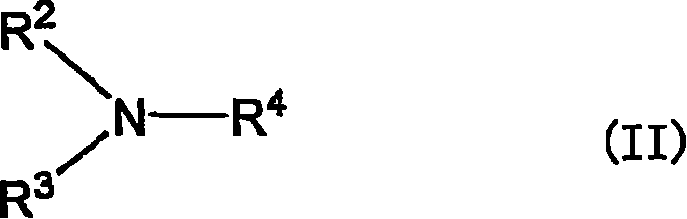
(式中,R2、R3和R4中的1个或2个为甲基,剩余的R2、R3和R4各自独立,为-CH2COOCnH2n+1、-CnH2n+1或-C6H4-p-CnH2n+1,其中n为6~20的整数,-CnH2n+1为直链状)。(In the formula, one or two of R 2 , R 3 and R 4 are methyl groups, and the remaining R 2 , R 3 and R 4 are independently -CH 2 COOC n H 2n+1 , -C n H 2n+1 or -C 6 H 4 -pC n H 2n+1 , wherein n is an integer from 6 to 20, and -C n H 2n+1 is a straight chain).
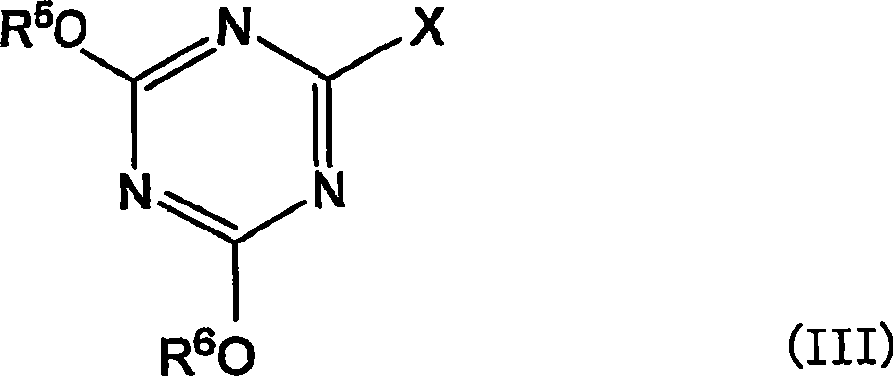
(式中,R5和R6各自独立,为甲基、乙基、碳原子数2~5的羟烷基、-(CH2CH2O)mR7(这里,m为1~120的整数,R7为氢原子、甲基、乙基或丙基)、-(CH2CH2NR8)mH(这里,m为1~120的整数,R8为碳原子数2~5的烷基、N,N-二烷基氨基乙基、或者-CH2CH2N+(CH3)3)、-CH2CH2SO3 -、-CH2CH2N+(CH3)3、或碳原子数6~20的烷基,但R5和R6不同时为碳原子数6~20的烷基,X为卤原子)。(In the formula, R 5 and R 6 are independently methyl, ethyl, hydroxyalkyl with 2 to 5 carbon atoms, -(CH 2 CH 2 O) m R 7 (where m is 1 to 120 Integer, R 7 is a hydrogen atom, methyl, ethyl or propyl), -(CH 2 CH 2 NR 8 ) m H (here, m is an integer of 1 to 120, R 8 is a carbon number of 2 to 5 Alkyl, N,N-dialkylaminoethyl, or -CH 2 CH 2 N + (CH 3 ) 3 ), -CH 2 CH 2 SO 3 - , -CH 2 CH 2 N + (CH 3 ) 3 , or an alkyl group with 6 to 20 carbon atoms, but R 5 and R 6 are not simultaneously an alkyl group with 6 to 20 carbon atoms, and X is a halogen atom).
某个实施方式中,上述式III中的R5和R6的至少一者为甲基或乙基。In a certain embodiment, at least one of R 5 and R 6 in the above formula III is methyl or ethyl.
在1个实施方式中,上述式II中的n为12~16。In one embodiment, n in the above formula II is 12-16.
通过本发明的方法,可以利用脱水缩合反应使形成含有双分子膜小泡的分子集合体的脂质发生化学变化,改变其物理性质或形态,调节膜融合等相转移的时机。即,可以在双分子膜小泡中诱发分子集合体的相转移(融合或分裂)。因此,能够提供活化状态或准稳定状态的小泡。另外,本发明的双分子膜小泡由于诱发这种相转移而能够优选使用。By the method of the present invention, the lipid forming the molecular assembly containing bimolecular membrane vesicles can be chemically changed by dehydration condensation reaction, changing its physical properties or shape, and adjusting the timing of phase transition such as membrane fusion. That is, phase transition (fusion or fragmentation) of molecular assemblies can be induced in bimolecular membrane vesicles. Thus, vesicles in an activated state or a quasi-stable state can be provided. In addition, the bimolecular membrane vesicles of the present invention can be preferably used because of inducing such a phase transition.
附图说明Description of drawings
图1为用于说明本发明原理的模式图。Fig. 1 is a schematic diagram for explaining the principle of the present invention.
图2为从NBD-PE向Rh-PE的荧光能量转移的荧光谱图。Fig. 2 is a fluorescence spectrum diagram of fluorescence energy transfer from NBD-PE to Rh-PE.
图3为显示在MLV中产生的假神经酰胺收率的经时变化的曲线图。Fig. 3 is a graph showing changes over time in the yield of pseudoceramide produced in MLV.
图4为显示SUV的膜结合所导致的F值经时变化的曲线图。Fig. 4 is a graph showing time-dependent changes in F value due to membrane binding of SUV.
图5为显示利用荧光稀释法的SUV膜融合所导致的F值经时变化的曲线图。Fig. 5 is a graph showing the time-dependent change in F value by the fusion of SUV membranes by the fluorescence dilution method.
图6为添加CDMT之前的SUV的电子显微镜照片。Fig. 6 is an electron micrograph of SUV before adding CDMT.
图7为添加CDMT之后的SUV(GUV)的电子显微镜照片。Fig. 7 is an electron micrograph of SUV (GUV) after addition of CDMT.
图8为仅添加甲醇后的SUV电子显微镜照片。Fig. 8 is an electron micrograph of SUV after adding only methanol.
图9表示加入CDMT后SUV分散液的F值的经时变化。Fig. 9 shows the time-dependent change in the F value of the SUV dispersion after adding CDMT.
具体实施方式Detailed ways
本发明中,通过脱水缩合剂使导入到小泡双分子膜中的适当双亲性物质发生脱水缩合反应,可以改变双分子膜的状态。In the present invention, the state of the bimolecular membrane can be changed by dehydrating and condensing the appropriate amphiphilic substance introduced into the vesicle bimolecular membrane by the dehydration condensation agent.
根据图1说明本发明的原理。在一般的表面活性剂中,如图中的倒三角形所示,具有电荷的胺或羧酸盐是极性头部很大的倒锥型表面活性剂。它们脱水缩合而得的神经酰胺由于在该反应前后,双亲性物质的酰基链(或烷基链)的数量和极性头部的电荷或官能团的种类发生变化,例如电荷消失导致极性头部变小,因此成为图中长方形所示的圆柱或锥型的脂质。因而,如果在含有这些胺和羧酸盐的分子集合体(脂质体等)中进行这些化合物的脱水缩合反应,则由于临界填充参数的增加和膜间排斥力的降低,发生膜曲率的变化等,为了缓和上述现象,膜最终发生融合。具体地说,可以举出由鞘氨醇合成神经酰胺。但是,由于难以大量获得鞘氨醇,因此优选使用如图所示的二元醇作为类似化合物,利用其缩合合成假神经酰胺,从而确认上述原理。The principle of the present invention is explained with reference to FIG. 1 . In general surfactants, as shown by the inverted triangle in the figure, the charged amine or carboxylate is an inverted cone surfactant with a large polar head. The ceramides obtained by their dehydration condensation are due to changes in the number of acyl chains (or alkyl chains) of the amphiphilic substance and the charge or functional group type of the polar head before and after the reaction, for example, the disappearance of the charge leads to a change in the polar head becomes smaller, so it becomes a cylindrical or cone-shaped lipid as shown in the figure. Therefore, if the dehydration condensation reaction of these compounds is carried out in a molecular assembly (liposome, etc.) containing these amines and carboxylates, a change in membrane curvature occurs due to an increase in the critical filling parameter and a decrease in the repulsive force between the membranes etc., in order to alleviate the above phenomenon, the membrane eventually fuses. Specifically, synthesis of ceramide from sphingosine is mentioned. However, since it is difficult to obtain sphingosine in large quantities, it is preferable to use diols as shown in the figure as analogous compounds, and to synthesize pseudoceramides by condensation, thereby confirming the above principle.
本发明的方法对于通过脱水缩合能够形成神经酰胺类似物质的基质可以广泛地应用。作为这种基质,可以举出双亲性的多种脂肪酸盐或者伯和仲胺类。特别是,为了维持作为产物的假神经酰胺的双亲性,优选至少在羧酸或胺或者醇化合物的任一个的极性头部周围具有与进行脱水缩合反应的羧基或氨基或者羟基不同的亲水性官能团。作为该亲水性官能团,优选羟基或糖等中性基团,还可以是作为普通表面活性剂极性头部的季铵离子、磷酸离子、磺酸离子、硫酸离子等离子。The method of the present invention can be widely applied to substrates capable of forming ceramide-like substances through dehydration condensation. As such substrates, there may be mentioned amphiphilic various fatty acid salts or primary and secondary amines. In particular, in order to maintain the amphiphilicity of the pseudoceramide as a product, it is preferable to have a hydrophilicity different from that of the carboxyl group, amino group or hydroxyl group undergoing dehydration condensation reaction at least around the polar head of any one of the carboxylic acid or amine or alcohol compound. Sexual functional groups. The hydrophilic functional group is preferably a neutral group such as a hydroxyl group or sugar, and may also be a quaternary ammonium ion, a phosphate ion, a sulfonate ion, a sulfate ion, etc. as a polar head of a common surfactant.
以下更加详细地说明本发明。The present invention is described in more detail below.
本发明如上所述提供能够产生相转移的双分子膜小泡以及其相转移方法。本发明中,“相转移”并非限定于双分子膜小泡的膜的相转移。例如,还包括双分子膜小泡膜融合或膜分裂、由双分子膜小泡向平面双分子膜或胶束的转变、由胶束向双分子膜小泡的转变等各种分子集合相的形态变化。As described above, the present invention provides a bimolecular membrane vesicle capable of phase transfer and a method for phase transfer thereof. In the present invention, "phase transition" is not limited to the phase transition of the membrane of bimolecular membrane vesicles. For example, it also includes the fusion or splitting of bimolecular membrane vesicles, the transition from bimolecular membrane vesicles to planar bimolecular membranes or micelles, and the transition from micelles to bimolecular membrane vesicles. Morphological change.
本发明的双分子膜小泡含有以下物质作为膜的构成成分:The bimolecular membrane vesicles of the present invention contain the following substances as membrane constituents:
(a)碳原子数6~20的脂肪酸盐;(a) Fatty acid salts with 6 to 20 carbon atoms;
(b)具有碳原子数6~20的脂肪链的醇或胺化合物;(b) Alcohol or amine compounds having aliphatic chains with 6 to 20 carbon atoms;
(c)可以形成双分子膜的人工合成脂质或磷脂质。(c) Synthetic lipids or phospholipids that can form bimolecular membranes.
上述(a)碳原子数6~20的脂肪酸盐只要是具有聚集在水界面的能力的双亲性脂肪酸盐则没有特别限定。作为这种脂肪酸盐,优选为具有长链烷基之类脂溶性基团的脂肪酸盐,更优选为碳原子数约为10~20的直链、支链或环状的脂肪酸盐。具体地说,可以举出羊蜡酸(癸酸)、十一烷酸、月桂酸(十二烷酸)、肉豆蔻酸、棕榈酸、棕榈油酸、硬脂酸、油酸、反油酸、岩芹酸、亚油酸、α-亚油酸、γ-亚油酸、二十烷酸、二十碳三烯酸、花生四烯酸等的盐。作为这些盐,通常可以举出钠盐、钾盐等。根据需要,还可以在这些化合物的羧基的周围或附近具有上述那样的亲水性官能团。The (a) fatty acid salt having 6 to 20 carbon atoms is not particularly limited as long as it is an amphipathic fatty acid salt capable of accumulating at a water interface. Such a fatty acid salt is preferably a fatty acid salt having a fat-soluble group such as a long-chain alkyl group, and more preferably a linear, branched or cyclic fatty acid salt having about 10 to 20 carbon atoms. Specifically, capric acid (capric acid), undecanoic acid, lauric acid (dodecanoic acid), myristic acid, palmitic acid, palmitoleic acid, stearic acid, oleic acid, elaidic acid , salts of petroselinic acid, linoleic acid, α-linoleic acid, γ-linoleic acid, eicosanoic acid, eicosatrienoic acid, arachidonic acid, etc. As these salts, sodium salts, potassium salts, etc. are usually mentioned. If necessary, these compounds may have a hydrophilic functional group as described above around or in the vicinity of the carboxyl group.
上述(b)具有碳原子数6~20的脂肪链的醇或胺化合物只要是具有能够与上述(a)脂肪酸盐的羧基发生脱水缩合的基团(例如羟基或氨基)、且具有聚集在水界面的能力的双亲性化合物,则没有特别限定。优选具有长链烷基之类的脂溶性基团,更加优选在能够脱水缩合的基团的周围或附近具有上述那样的亲水性官能团。需要说明的是,上述(a)脂肪酸盐在除了进行脱水缩合反应的羧基以外没有更多的亲水性官能团时,该(b)化合物更优选在极性头部周围进一步具有亲水性官能团。The above-mentioned (b) alcohol or amine compound having an aliphatic chain having 6 to 20 carbon atoms, as long as it has a group (such as a hydroxyl group or an amino group) capable of dehydration condensation with the carboxyl group of the above-mentioned (a) fatty acid salt, and has The amphiphilic compound with water interface capability is not particularly limited. It is preferable to have a fat-soluble group such as a long-chain alkyl group, and it is more preferable to have a hydrophilic functional group as described above around or near a group capable of dehydration condensation. It should be noted that when the above-mentioned (a) fatty acid salt does not have more hydrophilic functional groups other than the carboxyl group undergoing dehydration condensation reaction, it is more preferable that the (b) compound further has a hydrophilic functional group around the polar head .
作为这种化合物的优选例子,可以举出下式I所示的二元醇。在该二元醇中,胺部分是能够脱水缩合的基团,醇部分相当于亲水性官能团。Preferable examples of such compounds include diols represented by the following formula I. In this diol, the amine moiety is a group capable of dehydration condensation, and the alcohol moiety corresponds to a hydrophilic functional group.
R1-NH-CH2-CH(OH)-CH2OH (I)R 1 -NH-CH 2 -CH(OH)-CH 2 OH (I)
(式中,R1为碳原子数6~20的烷基、碳原子数6~20的烯基、或者碳原子数6~20的炔基)。(In the formula, R 1 is an alkyl group having 6 to 20 carbon atoms, an alkenyl group having 6 to 20 carbon atoms, or an alkynyl group having 6 to 20 carbon atoms).
在上述式I所示的(b)二元醇中,当R1为碳原子数6~20的烷基时,该烷基可以是直链状、支链状或环状。优选碳原子数约为10~20的直链状。作为这种烷基,可以举出正癸基、正十二烷基(月桂基)、正十六烷基、正十八烷基等。当R1为碳原子数6~20的烯基时,该烯基可以是直链状、支链状或环状。优选碳原子数约为10~20的直链状。作为这种烯基,可以举出1-癸烯、1-十二烯、9-十六烯、9-十八烯等。当R1为碳原子数6~20的炔基时,该炔基可以是直链状、支链状或环状。优选碳原子数约为10~20的直链状。作为这种炔基,可以举出1-癸炔、1-十二炔、9-十六炔、9-十八炔等。In the (b) diol represented by the above formula I, when R 1 is an alkyl group having 6 to 20 carbon atoms, the alkyl group may be linear, branched or cyclic. A straight chain having about 10 to 20 carbon atoms is preferable. Examples of such an alkyl group include n-decyl, n-dodecyl (lauryl), n-hexadecyl, n-octadecyl and the like. When R 1 is an alkenyl group having 6 to 20 carbon atoms, the alkenyl group may be linear, branched or cyclic. A straight chain having about 10 to 20 carbon atoms is preferable. Examples of such alkenyl groups include 1-decene, 1-dodecene, 9-hexadecene, 9-octadecene and the like. When R 1 is an alkynyl group having 6 to 20 carbon atoms, the alkynyl group may be linear, branched or cyclic. A straight chain having about 10 to 20 carbon atoms is preferable. Examples of such an alkynyl group include 1-decyne, 1-dodedecyne, 9-hexadecanyne, 9-octadecyne, and the like.
上述(c)能够形成双分子膜的人工合成脂质或磷脂质只要是能够形成双分子膜的化合物,则没有特别限定。The synthetic lipid or phospholipid capable of forming a bimolecular membrane in (c) is not particularly limited as long as it is a compound capable of forming a bimolecular membrane.
作为人工合成脂质,可以举出长链二烷基化合物、单烷基表面活性剂、三链型表面活性剂等。例如在《脂质体》、野岛庄七等编、南江堂、1988年、302-309页中有所示例。通常来说,优选在同一分子内具有C12~C15的2根长链状烷基和亲水性官能团(阳离子性、阴离子性、非离子性等)的化合物,代表地可以举出C12~C15的二烷基铵盐。Examples of synthetic lipids include long-chain dialkyl compounds, monoalkyl surfactants, triple-chain surfactants, and the like. For example, there are examples in "Liposome", Nojima Shoshichi et al., Nan Jiangdo, 1988, pages 302-309. Generally, a compound having two long-chain alkyl groups of C12 to C15 and a hydrophilic functional group (cationic, anionic, nonionic, etc.) in the same molecule is preferable, and representative examples include C12 to C15 Dialkyl ammonium salts.
磷脂质没有特别限定,可以是甘油脂质或鞘磷脂质的任一种。作为这种磷脂质,可以举出磷脂酰胆碱(卵磷脂)、磷脂酰乙醇胺、磷脂酰丝氨酸、磷脂酰肌醇、磷脂酰甘油、鞘磷脂等。优选磷脂酰胆碱。Phospholipids are not particularly limited, and may be any of glycerolipids and sphingomyelin. Examples of such phospholipids include phosphatidylcholine (lecithin), phosphatidylethanolamine, phosphatidylserine, phosphatidylinositol, phosphatidylglycerol, sphingomyelin and the like. Phosphatidylcholine is preferred.
本发明的双分子膜小泡根据需要还含有(d)下式II所示的叔胺作为膜的构成成分。The bimolecular membrane vesicle of the present invention further contains (d) a tertiary amine represented by the following formula II as a membrane constituent, if necessary.
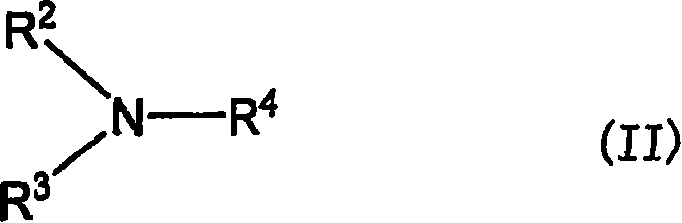
(式中,R2、R3和R4中的1个或2个为甲基,剩余的R2、R3和R4各自独立,为-CH2COOCnH2n+1、-CnH2n+1或-C6H4-p-CnH2n+1,其中n为6~20的整数,-CnH2n+1为直链状)。(In the formula, one or two of R 2 , R 3 and R 4 are methyl groups, and the remaining R 2 , R 3 and R 4 are independently -CH 2 COOC n H 2n+1 , -C n H 2n+1 or -C 6 H 4 -pC n H 2n+1 , wherein n is an integer from 6 to 20, and -C n H 2n+1 is a straight chain).
在可以作为上述式II所示(d)叔胺的R2、R3和R4的-CH2COOCnH2n+1、-CnH2n+1或-C6H4-p-CnH2n+1中,n为6~20的整数,-CnH2n+1为直链状。作为它们的取代基,例如可以举出正辛氧基羰基亚甲基、正癸氧基羰基亚甲基、正十二烷氧基羰基亚甲基、正十六烷氧基羰基亚甲基;正己基、正庚基、正辛基、正壬基、正癸基、正十一烷基、正十二烷基、正十三烷基、正十四烷基、正十五烷基、正十六烷基、正十七烷基、正十八烷基、正十九烷基、正二十烷基;对-(正己基)亚苯基、对-(正辛基)亚苯基、对-(正癸基)亚苯基、对-(正十二烷基)亚苯基、对-(正十四烷基)亚苯基、对-(正十六烷基)亚苯基、对-(正十八烷基)亚苯基等。如果考虑向本发明的双分子膜小泡的导入容易性,优选上述式II的R2、R3和R4中的n为8~18,更优选为12~16。In -CH 2 COOC n H 2n+1 , -C n H 2n+1 or -C 6 H 4 -pC n H that can be R 2 , R 3 and R 4 of the (d) tertiary amine shown in the above formula II In 2n+1 , n is an integer of 6 to 20, and -C n H 2n+1 is linear. Examples of these substituents include n-octyloxycarbonylmethylene, n-decyloxycarbonylmethylene, n-dodecyloxycarbonylmethylene, and n-hexadecyloxycarbonylmethylene; n-hexyl, n-heptyl, n-octyl, n-nonyl, n-decyl, n-undecyl, n-dodecyl, n-tridecyl, n-tetradecyl, n-pentadecyl, n- Hexadecyl, n-heptadecyl, n-octadecyl, n-nonadecyl, n-eicosyl; p-(n-hexyl)phenylene, p-(n-octyl)phenylene, p-(n-decyl)phenylene, p-(n-dodecyl)phenylene, p-(n-tetradecyl)phenylene, p-(n-hexadecyl)phenylene, p-(n-octadecyl)phenylene, etc. Considering the ease of introduction into the bimolecular membrane vesicles of the present invention, n in R 2 , R 3 and R 4 of the above formula II is preferably 8-18, more preferably 12-16.
对于上述式II的R2、R3和R4,如果考虑本发明方法的脱水缩合反应性,则R2、R3和R4中的1个或2个为甲基,剩余的R2、R3和R4为具有碳原子数6~20的直链烷基的基团。更优选R2、R3和R4中的2个为甲基。当R2、R3和R4全部为具有碳原子数6~20的直链烷基的基团时,反应效率不好,因此不优选。For R 2 , R 3 and R 4 of the above formula II, if considering the dehydration condensation reactivity of the method of the present invention, one or two of R 2 , R 3 and R 4 are methyl groups, and the remaining R 2 , R 3 and R 4 are groups having a linear alkyl group having 6 to 20 carbon atoms. More preferably, 2 of R 2 , R 3 and R 4 are methyl groups. When all of R 2 , R 3 and R 4 are a group having a straight-chain alkyl group having 6 to 20 carbon atoms, the reaction efficiency is poor, which is not preferable.
含有上述式II所示的叔胺作为双分子膜小泡的膜构成成分时,优选使用作为脱水缩合剂前体的、以下详述的、式III所示的氰尿酸衍生物。When the tertiary amine represented by the above formula II is contained as a membrane constituent of the bimolecular membrane vesicle, it is preferable to use a cyanuric acid derivative represented by the formula III described in detail below as a precursor of the dehydration condensation agent.
本发明的双分子膜小泡中的上述(a)~(d)的比例只要是能够形成小泡,则没有特别限定。作为脱水缩合反应基质的(a)脂肪酸盐和(b)醇或胺化合物优选为约1∶1的摩尔比。更优选(a)脂肪酸盐与(b)醇或胺化合物与(c)人工合成脂质或磷脂质的摩尔比为约1∶1∶1。(d)叔胺通常相对于1摩尔(a)脂肪酸盐以0.01~1.0摩尔、优选0.1~0.5摩尔的比例含有。The ratio of the above-mentioned (a) to (d) in the bimolecular membrane vesicles of the present invention is not particularly limited as long as the vesicles can be formed. (a) fatty acid salt and (b) alcohol or amine compound as the dehydration condensation reaction substrate are preferably in a molar ratio of about 1:1. More preferably, the molar ratio of (a) fatty acid salt to (b) alcohol or amine compound to (c) synthetic lipid or phospholipid is about 1:1:1. The (d) tertiary amine is usually contained in a ratio of 0.01 to 1.0 mol, preferably 0.1 to 0.5 mol, based on 1 mol of (a) fatty acid salt.
上述(a)~(d)可以分别单独使用,还可以混合2种以上使用。Said (a)-(d) may be used individually, respectively, and may mix and
本发明的双分子膜小泡还可以根据需要含有具有其他界面聚集性的化合物或者虽然没有界面聚集性但可以含有在双分子膜中的化合物。例如,如下所述,可以举出用于观察膜融合的荧光物质等。The bimolecular membrane vesicles of the present invention may contain other compounds having interfacial aggregation properties or compounds that are not interfacial aggregation properties but may be contained in the bimolecular membrane as needed. For example, as described below, fluorescent substances and the like for observing membrane fusion can be mentioned.
本发明的双分子膜小泡可以是多层小泡(MLV:通常0.2~5μm大小)或者单层膜小泡(SUV:100nm以下;LUV和REV:100~1000nm;GUV:1000nm以上)的任何一种。它们可以通过本领域技术人员使用的普通方法制造。例如,MLV可以如下制造:将上述(a)~(d)分别溶解在适当的有机溶剂(例如甲醇、氯仿等)中,在容器中混合,蒸馏除去有机溶剂。接着,使形成在内壁上的薄膜干燥后,加入适当的水溶液(例如磷酸缓冲液、Tris-HCl缓冲液、碳酸缓冲液等),通过约30秒钟左右的超声波照射使其膨润。进而,利用涡流混合机等进行搅拌振荡,剥去薄膜,从而可以以混悬液的状态获得MLV。SUV例如可以通过进一步以高功率强力地照射超声波(例如冰冻下约20分钟)而作为SUV的分散液获得(超声波处理法)。或者还可以通过在相转移温度以上的温度下利用微注射器注入溶解在乙醇中的脂质的乙醇注入法、或者通过将MLV放入在弗氏压碎器中进行挤出的弗氏压碎法等来调制SUV。LUV可以通过醚注入法、表面活性剂法、Ca2+融合法、冷冻-溶解法等本领域技术人员通常使用的方法调制。REV可以通过反相蒸发法获得。GUV例如可以通过使甲基葡萄糖甙和脂质的乙醇溶液相对于多量的缓冲液进行透析而获得。The bimolecular membrane vesicles of the present invention may be any of multilayer vesicles (MLV: usually 0.2-5 μm in size) or single-layer membrane vesicles (SUV: below 100 nm; LUV and REV: 100-1000 nm; GUV: above 1000 nm). A sort of. They can be produced by ordinary methods used by those skilled in the art. For example, MLV can be produced by dissolving the above (a) to (d) in appropriate organic solvents (such as methanol, chloroform, etc.), mixing them in a container, and distilling off the organic solvents. Next, after drying the thin film formed on the inner wall, add an appropriate aqueous solution (such as phosphate buffer, Tris-HCl buffer, carbonic acid buffer, etc.), and swell it by ultrasonic irradiation for about 30 seconds. Furthermore, the MLV can be obtained in the state of a suspension by stirring and shaking with a vortex mixer or the like to peel off the thin film. SUV can be obtained, for example, as a dispersion liquid of SUV by further irradiating with high-power ultrasonic waves (for example, about 20 minutes under freezing) (sonication method). Alternatively, ethanol injection, in which lipids dissolved in ethanol are injected using a microsyringe at a temperature above the phase transition temperature, or French crushing, in which MLV is extruded in a French press Wait to tune the SUV. LUV can be prepared by methods commonly used by those skilled in the art, such as ether injection method, surfactant method, Ca 2+ fusion method, freeze-thaw method, and the like. REV can be obtained by reverse phase evaporation. GUV can be obtained, for example, by dialyzing an ethanol solution of methylglucoside and lipid against a large amount of buffer.
诱发本发明的双分子膜小泡相转移(例如膜融合)的方法包括以下工序:The method for inducing bimolecular membrane vesicle phase transfer (for example, membrane fusion) of the present invention comprises the following steps:
调制上述双分子膜小泡的工序;以及在该双分子膜小泡中添加脱水缩合剂或脱水缩合剂前体的工序。A step of preparing the bimolecular membrane vesicles; and a step of adding a dehydration condensing agent or a dehydration condensing agent precursor to the bimolecular membrane vesicles.
作为在上述方法中使用的脱水缩合剂,可以举出水溶性的脱水缩合剂或界面聚集性的脱水缩合剂或脱水缩合剂前体。Examples of the dehydrating condensing agent used in the above method include water-soluble dehydrating condensing agents, interfacial aggregation dehydrating condensing agents, and dehydrating condensing agent precursors.
作为水溶性的脱水缩合剂,例如可以举出下述式IV所示的季铵盐(参照WO00/53544和Kunishima等、Tetrahedron,2001年,57卷,1551-1558页)。具体地说,可以举出4-(4,6-二甲氧基-1,3,5-三嗪-2-基)-4-甲基吗啉盐酸盐(DMT-MM)。Examples of water-soluble dehydrating condensation agents include quaternary ammonium salts represented by the following formula IV (see WO00/53544 and Kunishima et al., Tetrahedron, 2001, Vol. 57, pp. 1551-1558). Specifically, 4-(4,6-dimethoxy-1,3,5-triazin-2-yl)-4-methylmorpholine hydrochloride (DMT-MM) is mentioned.
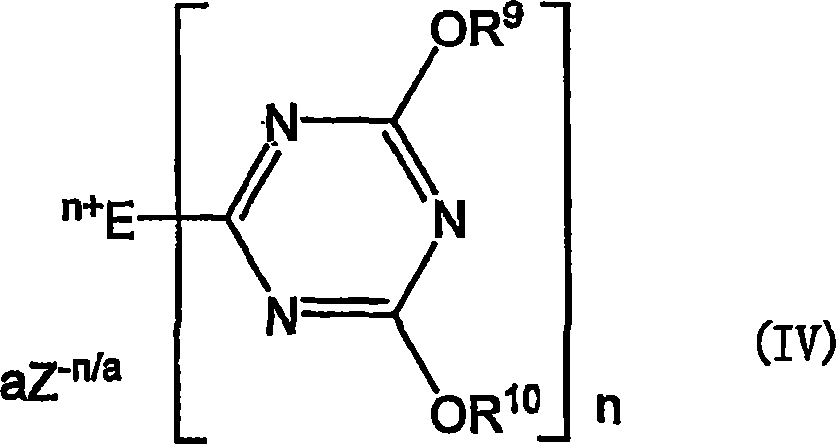
(这里,E为具有1个或2个叔胺基的1价或2价有机基团;n在E具有1个叔胺基时为1、在E具有2个叔胺基时为2;R6和R10各自独立,表示碳原子数1~4的烷基、或者碳原子数6~8的芳基;a为1或2、在n为1时为1;Z-(n/a)表示(n/a)价的抗衡阴离子)。(Here, E is a monovalent or divalent organic group with 1 or 2 tertiary amino groups; n is 1 when E has 1 tertiary amino group, and is 2 when E has 2 tertiary amino groups; R 6 and R 10 each independently represent an alkyl group with 1 to 4 carbon atoms, or an aryl group with 6 to 8 carbon atoms; a is 1 or 2, and 1 when n is 1; Z -(n/a) Indicates the (n/a) valency of the counter anion).
作为表面聚集性的脱水缩合剂,可以举出下式V所示的1,3,5-三嗪型化合物。Examples of the surface-aggregating dehydrating condensation agent include 1,3,5-triazine compounds represented by the following formula V.
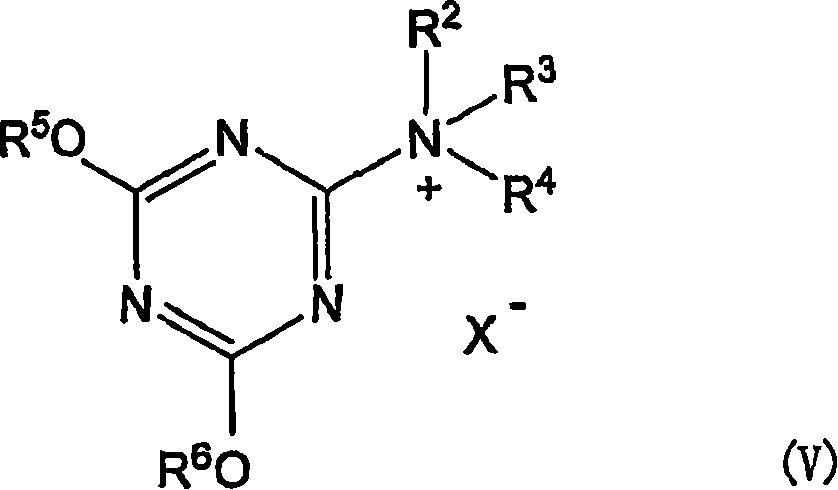
(式中,R5和R6各自独立,为甲基、乙基、碳原子数2~5的羟烷基、-(CH2CH2O)mR7(其中,m为1~120的整数,R7为氢原子、甲基、乙基或丙基)、-(CH2CH2NR8)mH(其中,m为1~120的整数,R8为碳原子数2~5的烷基、N,N-二烷基氨基乙基或-CH2CH2N+(CH3)3)、-CH2CH2SO3 -、-CH2CH2N+(CH3)3或碳原子数为6~20的烷基,R5和R6不同时为碳原子数6~20的烷基;R2、R3和R4中的1个或2个为甲基,剩余的R2、R3和R4各自独立,为-CH2COO-CnH2n+1、-CnH2n+1或-C6H4-p-CnH2n+1,其中n为6~20的整数,-CnH2n+1为直链状;X-为卤化物离子)。该式V所示的化合物通过在适当的溶剂中混合下式III所示的氰尿酸衍生物和下式II所示的叔胺而获得。(wherein, R 5 and R 6 are each independently methyl, ethyl, hydroxyalkyl with 2 to 5 carbon atoms, -(CH 2 CH 2 O) m R 7 (where m is 1 to 120 Integer, R 7 is a hydrogen atom, methyl, ethyl or propyl), -(CH 2 CH 2 NR 8 ) m H (wherein, m is an integer of 1 to 120, R 8 is a carbon number of 2 to 5 Alkyl, N,N-dialkylaminoethyl or -CH 2 CH 2 N + (CH 3 ) 3 ), -CH 2 CH 2 SO 3 - , -CH 2 CH 2 N + (CH 3 ) 3 or An alkyl group with 6 to 20 carbon atoms, R 5 and R 6 are not simultaneously an alkyl group with 6 to 20 carbon atoms; one or two of R 2 , R 3 and R 4 are methyl groups, and the rest R 2 , R 3 and R 4 are independently -CH 2 COO-C n H 2n+1 , -C n H 2n+1 or -C 6 H 4 -pC n H 2n+1 , wherein n is 6~ Integer of 20, -C n H 2n+1 is a straight chain; X- is a halide ion). The compound represented by the formula V is obtained by mixing a cyanuric acid derivative represented by the following formula III and a tertiary amine represented by the following formula II in an appropriate solvent.
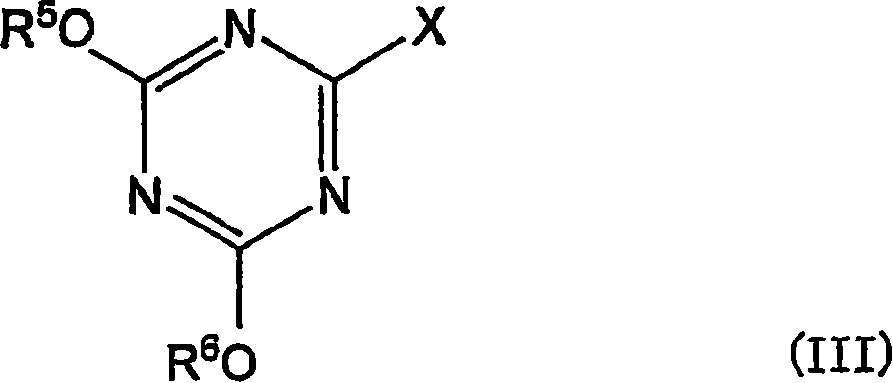
(式中,R5和R6各自独立,为甲基、乙基、碳原子数2~5的羟烷基、-(CH2CH2O)mR7(这里,m为1~120的整数,R7为氢原子、甲基、乙基或丙基)、-(CH2CH2NR8)mH(这里,m为1~120的整数,R8为碳原子数2~5的烷基、N,N-二烷基氨基乙基、或者-CH2CH2N+(CH3)3)、-CH2CH2SO3 -、-CH2CH2N+(CH3)3、或碳原子数6~20的烷基,但R5和R6不同时为碳原子数6~20的烷基,X为卤原子)。(In the formula, R 5 and R 6 are independently methyl, ethyl, hydroxyalkyl with 2 to 5 carbon atoms, -(CH 2 CH 2 O) m R 7 (where m is 1 to 120 Integer, R 7 is a hydrogen atom, methyl, ethyl or propyl), -(CH 2 CH 2 NR 8 ) m H (here, m is an integer of 1 to 120, R 8 is a carbon number of 2 to 5 Alkyl, N,N-dialkylaminoethyl, or -CH 2 CH 2 N + (CH 3 ) 3 ), -CH 2 CH 2 SO 3 - , -CH 2 CH 2 N + (CH 3 ) 3 , or an alkyl group with 6 to 20 carbon atoms, but R 5 and R 6 are not simultaneously an alkyl group with 6 to 20 carbon atoms, and X is a halogen atom).
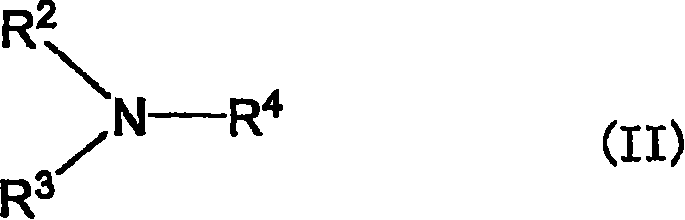
(式中,R2、R3和R4的定义如上)。特别优选在混合待使其脱水缩合的至少2种化合物的同时,还混合这些氰尿酸衍生物和叔胺。(In the formula, R 2 , R 3 and R 4 are as defined above). It is particularly preferable to mix these cyanuric acid derivatives and tertiary amines together with at least two compounds to be dehydrated and condensed.
作为脱水缩合剂,可以直接使用上式V所示的1,3,5-三嗪型化合物,但该化合物如上所述优选在调制小泡的同时添加,因此难以调节融合或相转移。因此,优选在预先以含有(d)叔胺化合物作为膜的构成成分的方式调制得到的小泡中添加作为脱水缩合剂前体的氰尿酸衍生物(化合物III)。此时,通过在调制脂质体制后添加氰尿酸衍生物(化合物III),可以在体系内(脂质体界面)产生脱水缩合剂(化合物V),引起界面的脱水缩合反应。因此,由于适当地进行了目标的融合或相转移,因此更为优选。As the dehydrating condensation agent, a 1,3,5-triazine compound represented by the above formula V can be used as it is, but it is preferably added while preparing vesicles as described above, so it is difficult to adjust fusion or phase transition. Therefore, it is preferable to add a cyanuric acid derivative (compound III) as a precursor of the dehydration condensation agent to the vesicles prepared in advance so as to contain the (d) tertiary amine compound as a membrane constituent. At this time, by adding a cyanuric acid derivative (compound III) after preparation of liposomes, a dehydration condensation agent (compound V) can be generated in the system (liposome interface), and a dehydration condensation reaction at the interface can be induced. Therefore, it is more preferable since fusion or phase shift of the target is properly performed.
在上式III中,当R5和R6为碳原子数2~5的羟烷基时,该羟烷基可以是直链状、支链状或环状,羟基的位置和数量没有特别限定。优选为直链状,且为末端羟基。作为碳原子数2~5的羟烷基,例如可以举出2-羟乙基、3-羟丙基、4-羟丁基、5-羟戊基。In the above formula III, when R5 and R6 are hydroxyalkyl groups with 2 to 5 carbon atoms, the hydroxyalkyl groups can be linear, branched or cyclic, and the position and number of hydroxyl groups are not particularly limited. . It is preferably linear and has a terminal hydroxyl group. Examples of the hydroxyalkyl group having 2 to 5 carbon atoms include 2-hydroxyethyl group, 3-hydroxypropyl group, 4-hydroxybutyl group and 5-hydroxypentyl group.
在上式III中,当R5和R6为-(CH2CH2O)mR7时,m为1~120的整数、优选为1~50的整数。R7为氢原子、甲基、乙基或丙基。此时,R5和R6的部分平均分子量优选约为45~5000(相当于m为1~120)、更优选约为45~2000(相当于m为1~50)。In the above formula III, when R 5 and R 6 are -(CH 2 CH 2 O) m R 7 , m is an integer of 1-120, preferably an integer of 1-50. R 7 is a hydrogen atom, a methyl group, an ethyl group or a propyl group. In this case, the partial average molecular weight of R 5 and R 6 is preferably about 45 to 5000 (corresponding to m being 1 to 120), more preferably about 45 to 2000 (corresponding to m being 1 to 50).
在上式III中,当R5和R6为-(CH2CH2NR8)mH时,m为1~120的整数、优选为1~50的整数。R8为乙基或N,N-二烷基氨基乙基,该烷基的碳原子数为2~5。此时,R5和R6的部分平均分子量优选约为45~5000(相当于m为1~120)、更优选约为45~2000(相当于m为1~50)。In the above formula III, when R 5 and R 6 are -(CH 2 CH 2 NR 8 ) m H, m is an integer of 1-120, preferably an integer of 1-50. R 8 is ethyl or N,N-dialkylaminoethyl, and the number of carbon atoms in the alkyl group is 2-5. In this case, the partial average molecular weight of R 5 and R 6 is preferably about 45 to 5000 (corresponding to m being 1 to 120), more preferably about 45 to 2000 (corresponding to m being 1 to 50).
在上式III中,当R5和R6为碳原子数6~20的烷基时,该烷基可以是直链状、支链状或环状,优选为直链状。作为R5和R6的碳原子数6~20的烷基,可以举出正己基、正戊基、正辛基、正壬基、正癸基、正十二烷基、正十六烷基等。In the above formula III, when R 5 and R 6 are alkyl groups having 6 to 20 carbon atoms, the alkyl groups may be linear, branched or cyclic, preferably linear. Examples of C6-20 alkyl groups for R5 and R6 include n-hexyl, n-pentyl, n-octyl, n-nonyl, n-decyl, n-dodecyl, n-hexadecyl wait.
对于上式III的R5和R6,如果考虑该氰尿酸衍生物在水界面上的停留容易性,优选R5O-和R6O-部分具有亲水性。随着上述R2、R3和R4的组合的不同而不同,优选R5和R6的至少一者为甲基或乙基,更优选两者均为甲基。当R5和R6同时为碳原子数6~20的烷基时,该氰尿酸衍生物的疏水性变强,难以聚集在水界面上,因此不优选。Regarding R 5 and R 6 of the above formula III, it is preferable that the R 5 O- and R 6 O- moieties are hydrophilic in consideration of the easiness of residence of the cyanuric acid derivative on the water interface. Depending on the combination of the aforementioned R 2 , R 3 and R 4 , at least one of R 5 and R 6 is preferably methyl or ethyl, more preferably both are methyl. When both R 5 and R 6 are alkyl groups having 6 to 20 carbon atoms, the cyanuric acid derivative becomes more hydrophobic and hardly gathers on the water interface, which is not preferable.
作为这种氰尿酸衍生物,例如可以举出2-氯-4,6-二甲氧基-1,3,5-三嗪(CDMT)。Examples of such cyanuric acid derivatives include 2-chloro-4,6-dimethoxy-1,3,5-triazine (CDMT).
如上所述,为了使脱水缩合反应发生,从在双分子膜小泡的界面上的聚集性良好、且在界面上能够产生脱水缩合剂的方面出发,对于含有(d)叔胺作为双分子膜小泡的膜构成成分的小泡,特别优选使用作为脱水缩合剂前体的氰尿酸衍生物(化合物III)。As described above, in order to cause the dehydration condensation reaction to occur, the aggregation on the interface of the bimolecular membrane vesicles is good, and the dehydration condensation agent can be generated on the interface, for the bimolecular membrane containing (d) tertiary amine As for the vesicles which are the membrane constituents of the vesicles, it is particularly preferable to use a cyanuric acid derivative (compound III) which is a precursor of a dehydration condensation agent.
在该工序中,上述脱水缩合剂或脱水缩合剂前体相对于(a)脂肪酸盐或(b)醇或胺化合物使用1~100当量、优选使用25~50当量。进行该工序的温度根据目的适当决定,通常在室温下进行。该工序所需要的时间随着小泡的膜构成成分、脱水缩合剂或脱水缩合剂前体的量、该工序的实施温度等各种因素而改变,或者可以通过这些因素调节。In this step, the above dehydrating condensing agent or dehydrating condensing agent precursor is used in an amount of 1 to 100 equivalents, preferably 25 to 50 equivalents, based on (a) fatty acid salt or (b) alcohol or amine compound. The temperature at which this step is performed is appropriately determined depending on the purpose, and it is usually performed at room temperature. The time required for this step varies with, or can be adjusted by, various factors such as the membrane constituents of the vesicles, the amount of the dehydrating condensing agent or the dehydrating condensing agent precursor, and the temperature at which this step is performed.
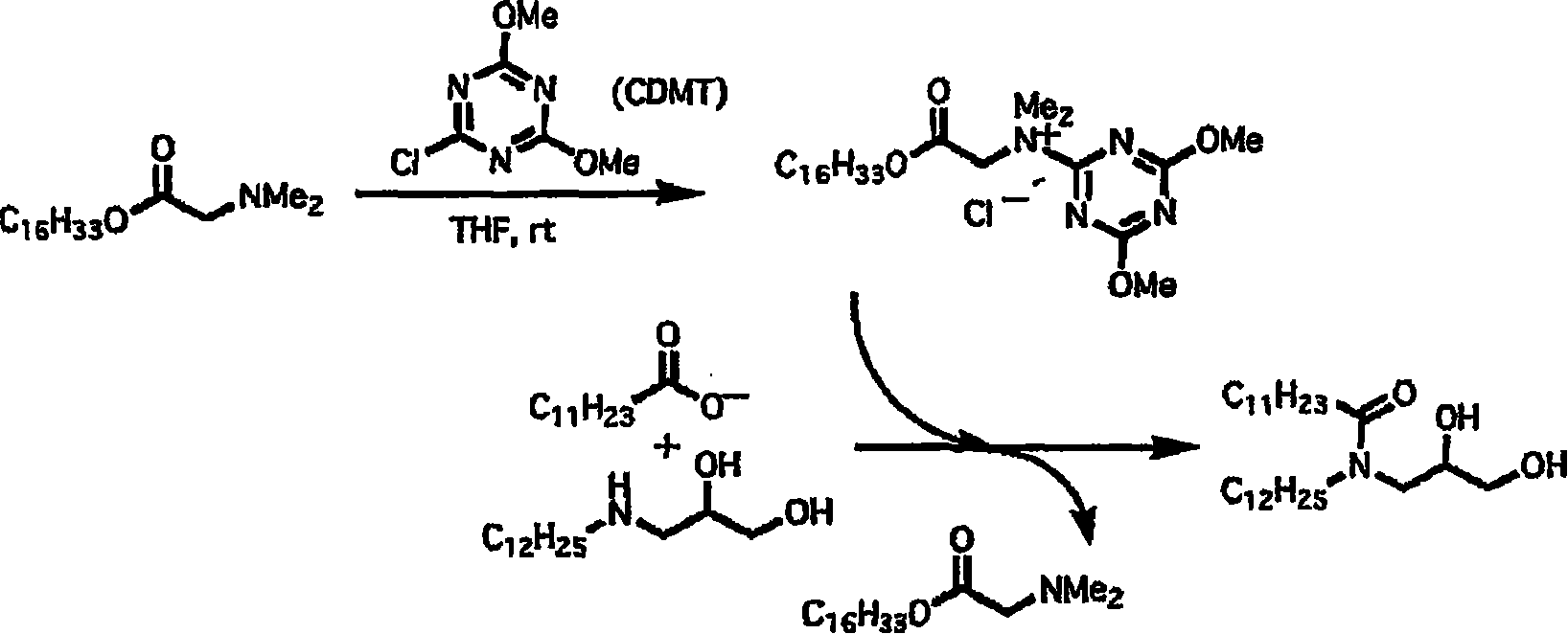
在该工序中,当使用氰尿酸衍生物时,如以下路线所示,首先通过添加上式III的氰尿酸衍生物,形成存在于双分子膜小泡的(d)叔胺和脱水缩合剂。接着,膜中的(a)羧酸与(b)胺化合物(二元醇)发生脱水缩合,形成假神经酰胺。因此,如上所述,由于膜的临界填充参数增加和膜间的排斥力降低,发生膜曲率的变化等,产生膜融合等的相转移(参照图1)。In this step, when a cyanuric acid derivative is used, as shown in the following scheme, first, by adding the cyanuric acid derivative of the above formula III, (d) tertiary amine and dehydration condensation agent present in the bimolecular membrane vesicles are formed. Next, (a) carboxylic acid and (b) amine compound (diol) in the film dehydrate and condense to form pseudoceramide. Therefore, as described above, as the critical filling parameter of the membrane increases and the repulsive force between the membranes decreases, a change in the curvature of the membrane occurs, and a phase transition such as membrane fusion occurs (see FIG. 1 ).
作为用于评价和观察膜融合等相转移的方法,可以举出利用电子显微镜进行的观察、所产生的假神经酰胺的定量(例如利用质谱等)、荧光变化的测定等。当为荧光变化的测定时,将由于存在于附近而发生荧光能量转移的化合物作为双分子膜的构成成分导入。作为这种化合物,例如可以举出1,2-二肉豆蔻基-sn-甘油-3-磷酸乙醇胺-N-(7-硝基-2-1,3-苯并噁二唑-4-基)(NBD-PE)和1,2-二肉豆蔻基-sn-甘油-3-磷酸乙醇胺-N-(磺酰基丽丝胺罗丹明B)(Rh-PE)的组合。前者为能量供体,后者为能量受体。如图2所示,如果NBD-PE和Rh-PE相邻存在,则发生荧光能量转移。荧光变化的评价可以使用通过下式获得的荧光变化F。例如,当NBD-PE和Rh-PE分别含有在不同的小泡中时,如果发生它们的融合,则F值增大。相反,含有NBD-PE和Rh-PE两者的小泡与不含它们的小泡融合时,NBD-PE和Rh-PE的距离增加,因此F值减少。Methods for evaluating and observing phase transition such as membrane fusion include observation with an electron microscope, quantification of produced pseudoceramide (for example, by mass spectrometry), measurement of changes in fluorescence, and the like. When measuring the change in fluorescence, a compound that undergoes fluorescence energy transfer due to its presence in the vicinity is introduced as a constituent of the bimolecular membrane. Such compounds include, for example, 1,2-dimyristyl-sn-glycero-3-phosphoethanolamine-N-(7-nitro-2-1,3-benzoxadiazol-4-yl ) (NBD-PE) in combination with 1,2-dimyristyl-sn-glycero-3-phosphoethanolamine-N-(sulfonylissamine rhodamine B) (Rh-PE). The former is the energy donor and the latter is the energy acceptor. As shown in Figure 2, if NBD-PE and Rh-PE exist adjacent to each other, fluorescence energy transfer occurs. The evaluation of the fluorescence change can use the fluorescence change F obtained by the following formula. For example, when NBD-PE and Rh-PE are respectively contained in different vesicles, if their fusion occurs, the F value increases. In contrast, when vesicles containing both NBD-PE and Rh-PE fuse with vesicles not containing them, the distance between NBD-PE and Rh-PE increases and thus the F value decreases.
a0=反应开始时的NBD-PE的荧光强度a 0 = fluorescence intensity of NBD-PE at the beginning of the reaction
at=任意时间下的NBD-PE的荧光强度a t = fluorescence intensity of NBD-PE at any time
b0=反应开始时的Rh-PE的荧光强度b 0 = Fluorescence intensity of Rh-PE at the beginning of the reaction
bt=任意时间下的Rh-PE的荧光强度b t = fluorescence intensity of Rh-PE at any time
利用本发明方法的膜融合等相转移不仅可以在由本发明提供的含有脂肪酸盐和胺作为膜构成成分、且通过脱水缩合能够被活化的不稳定双分子膜小泡之间产生,还可以在这种不稳定双分子膜小泡和未被活化的稳定的双分子膜小泡之间产生。而且,通过不稳定的双分子膜小泡与稳定的双分子膜小泡的量比、脱水缩合剂或脱水缩合剂前体的量等各种因素可以调节相转移。Phase transfer such as membrane fusion using the method of the present invention can not only occur between unstable bimolecular membrane vesicles that contain fatty acid salts and amines as membrane constituents provided by the present invention and can be activated by dehydration condensation, but also between This unstable bimolecular membrane vesicle is generated between an unactivated stable bimolecular membrane vesicle. Furthermore, the phase transfer can be regulated by various factors such as the amount ratio of unstable bimolecular membrane vesicles to stable bimolecular membrane vesicles, the amount of dehydrating condensing agent or dehydrating condensing agent precursor, and the like.
通过本发明的方法,当诱发双分子膜小泡之间的膜融合时,其内容物可以不随膜的融合而漏出(泄漏)地被融合。By the method of the present invention, when membrane fusion between bimolecular membrane vesicles is induced, its contents can be fused without leaking out (leaking) along with membrane fusion.
这样,通过本发明的方法,例如能够诱发细胞和由本发明提供的双分子膜小泡之间的膜融合,还可以进行调节使得在适当的时机将小泡的内容物送入到细胞内。Thus, by the method of the present invention, for example, membrane fusion between cells and the bimolecular membrane vesicles provided by the present invention can be induced, and the contents of the vesicles can be regulated to be delivered into cells at an appropriate timing.
实施例Example
[制造例1:二元醇的合成][Manufacturing Example 1: Synthesis of Dihydric Alcohol]
作为构成脂质体、且用于在脂质体中进行脱水缩合反应的基质,如以下线路1所示,使缩水甘油的环氧化物与长链伯胺反应,合成具有2个羟基作为极性基团的胺的假鞘氨醇。As a matrix that constitutes liposomes and is used for dehydration condensation reactions in liposomes, as shown in the following
线路1
[1-1]3-辛基氨基-1,2-丙二醇(二元醇1A)的合成[1-1] Synthesis of 3-octylamino-1,2-propanediol (diol 1A)
在反应容器中加入正辛胺(3.0g、0.023mol),加热至85℃。在氮气气流下用10分钟的时间加入缩水甘油(1.56g、0.021mol),搅拌1小时后,使反应溶液真空干燥。将所得残渣上柱色谱,利用氯仿∶甲醇=1∶1(添加1%三甲胺)展开后,利用甲醇(添加1%三甲胺)洗脱后分别收集,获得二元醇1A(1.03g、收率24%)。无色结晶,熔点:59.5~61.5℃。n-Octylamine (3.0 g, 0.023 mol) was added to the reaction vessel, and heated to 85°C. Glycidol (1.56 g, 0.021 mol) was added over 10 minutes under a nitrogen stream, and after stirring for 1 hour, the reaction solution was vacuum-dried. The resulting residue was subjected to column chromatography, developed with chloroform:methanol=1:1 (with the addition of 1% trimethylamine), eluted with methanol (with the addition of 1% trimethylamine) and collected separately to obtain diol 1A (1.03 g, harvested rate 24%). Colorless crystal, melting point: 59.5~61.5℃.
1H NMR(CDCl3)δ0.87(t,J=6.9Hz,3H),1.21-1.35(m,10H),1.42-1.51(m,2H),2.54-2.73(m,3H),2.79-2.85(m,1H),3.58-3.65(m,1H),3.70-3.77(m,2H);IR(KBr)3320,3271,2919,2853cm-1。 1 H NMR (CDCl 3 ) δ0.87 (t, J=6.9Hz, 3H), 1.21-1.35 (m, 10H), 1.42-1.51 (m, 2H), 2.54-2.73 (m, 3H), 2.79- 2.85 (m, 1H), 3.58-3.65 (m, 1H), 3.70-3.77 (m, 2H); IR (KBr) 3320, 3271, 2919, 2853 cm -1 .
二元醇1A相对于以下实施例中使用的缓冲液(5mM NaH2PO4,0.15MNaCl,pH7.5)的溶解度约为10mM。The solubility of diol 1A relative to the buffer (5 mM NaH 2 PO 4 , 0.15 M NaCl, pH 7.5) used in the following examples is about 10 mM.
[1-2]3-十二烷基氨基-1,2-丙二醇(二元醇1B)的合成。[1-2] Synthesis of 3-dodecylamino-1,2-propanediol (diol 1B).
利用与上述[1-1]的二元醇1A的合成相同的方法合成(收率33%)。It was synthesized by the same method as that of diol 1A in [1-1] above (yield: 33%).
无色结晶:熔点:78~79℃。Colorless crystals: Melting point: 78-79°C.
1H NMR(CDCl3)δ0.88(t,J=6.9Hz,3H),1.23-1.33(m,18H),1.42-1.51(m,2H),2.54-2.73(m,3H),2.79-2.86(m,1H),3.59-3.65(m,1H),3.70-3.77(m,2H);IR(KBr)3323,3272,2916,2847cm-1;元素分析:C15H33NO2:计算值:H,12.82;C,69.45.实测值:H,12.83;C,69.42。ESI-MS m/z 260[(M+1)+,C15H33O2N]。 1 H NMR (CDCl 3 ) δ0.88 (t, J=6.9Hz, 3H), 1.23-1.33 (m, 18H), 1.42-1.51 (m, 2H), 2.54-2.73 (m, 3H), 2.79- 2.86(m, 1H), 3.59-3.65(m, 1H), 3.70-3.77(m, 2H); IR(KBr) 3323, 3272, 2916, 2847cm -1 ; Elemental Analysis: C 15 H 33 NO 2 : Calculated Values: H, 12.82; C, 69.45. Found: H, 12.83; C, 69.42. ESI-MS m/z 260 [(M+1) + , C 15 H 33 O 2 N].
二元醇1B相对于以下实施例中使用的缓冲液(5mM NaH2PO4,0.15M NaCl,pH7.5)的溶解度约为0.2mM。The solubility of diol 1B is about 0.2 mM relative to the buffer (5 mM NaH 2 PO 4 , 0.15 M NaCl, pH 7.5) used in the following examples.
[1-3]3-十六烷基氨基-1,2-丙二醇(二元醇1C)的合成。[1-3] Synthesis of 3-hexadecylamino-1,2-propanediol (diol 1C).
利用与上述[1-1]的二元醇1A的合成相同的方法合成(收率34%)。It was synthesized by the same method as the synthesis of diol 1A in [1-1] above (yield 34%).
无色结晶:熔点:86~89.5Colorless crystal: Melting point: 86~89.5
1H NMR(CDCl3)δ0.87(t,J=6.9Hz,3H),1.23-1.33(m,26H),1.42-1.52(m,2H),2.54-2.73(m,3H),2.80-2.87(m,1H),3.59-3.66(m,1H),3.70-3.77(m,2H);IR(KBr)3345,3272,2918,2851cm-1;元素分析:C19H41NO2:计算值:H,13.10;C,72.32.实测值:H,13.34;C,72.30。ESI-MS m/z 316[(M+1)+,C19H41O2N]。 1 H NMR (CDCl 3 ) δ0.87 (t, J=6.9Hz, 3H), 1.23-1.33 (m, 26H), 1.42-1.52 (m, 2H), 2.54-2.73 (m, 3H), 2.80- 2.87(m, 1H), 3.59-3.66(m, 1H), 3.70-3.77(m, 2H); IR(KBr) 3345, 3272, 2918, 2851cm -1 ; Elemental Analysis: C 19 H 41 NO 2 : Calculated Values: H, 13.10; C, 72.32. Found: H, 13.34; C, 72.30. ESI-MS m/z 316 [(M+1) + , C 19 H 41 O 2 N].
[制造例2:假神经酰胺的合成][Production Example 2: Synthesis of Pseudoceramide]
由于考虑到在脂质体中由于脱水缩合反应产生的产物为假神经酰胺(线路2),因此作为用于确认其的标准品,根据Kunishima等报道的、前面记载的方法合成了假神经酰胺。Considering that the product produced by the dehydration condensation reaction in liposomes is pseudoceramide (line 2), pseudoceramide was synthesized as a standard for confirming it according to the method described above reported by Kunishima et al.
线路2
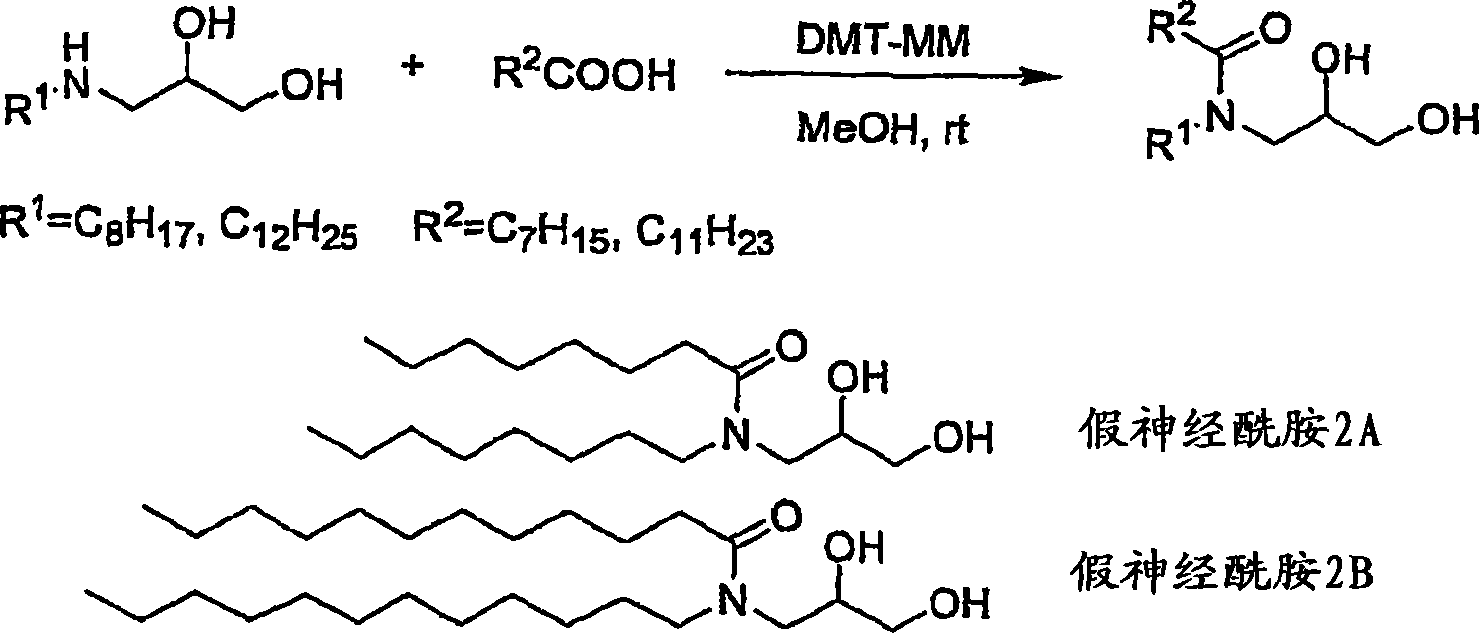
[2-1]3-(N-月桂酰基十二烷基氨基)-1,2-丙二醇(假神经酰胺2B)的合成[2-1] Synthesis of 3-(N-lauroyldodecylamino)-1,2-propanediol (pseudoceramide 2B)
在反应容器中加入月桂酸钠(0.25g、1.13mmol),加入甲醇(6mL)。然后将通过上述[1-2]获得的二元醇1B(0.29g、1.13mmol)溶解在甲醇(4mL)中加入。进而将DMT-MM(0.34g、1.24mmol)溶解在甲醇(2mL)中加入后,在室温下搅拌5小时。利用泵将甲醇减压蒸馏除去后,使用醋酸乙酯和蒸馏水提取残渣。利用饱和碳酸钠洗涤2次回收的醋酸乙酯层、用蒸馏水洗涤1次、1M HCl洗涤2次、蒸馏水洗涤1次、饱和食盐水洗涤1次后,利用无水硫酸镁使其干燥,在减压下除去溶剂。将所得残渣供于柱色谱,利用己烷∶醋酸乙酯=1∶1展开后,利用己烷∶醋酸乙酯=4∶6洗脱后分别收集,获得假神经酰胺2B(0.33g、收率65%)。Sodium laurate (0.25 g, 1.13 mmol) was added to the reaction vessel, and methanol (6 mL) was added. Then, diol 1B (0.29 g, 1.13 mmol) obtained by the above [1-2] was dissolved in methanol (4 mL) and added. Furthermore, DMT-MM (0.34 g, 1.24 mmol) was dissolved in methanol (2 mL) and added, followed by stirring at room temperature for 5 hours. After methanol was distilled off under reduced pressure with a pump, the residue was extracted with ethyl acetate and distilled water. The recovered ethyl acetate layer was washed twice with saturated sodium carbonate, once with distilled water, twice with 1M HCl, once with distilled water, and once with saturated brine, and then dried with anhydrous magnesium sulfate. The solvent was removed under pressure. The resulting residue was subjected to column chromatography, developed with hexane: ethyl acetate = 1: 1, and collected separately after elution with hexane: ethyl acetate = 4: 6 to obtain pseudoceramide 2B (0.33 g, yield 65%).
无色结晶:熔点:35~36.5℃。Colorless crystals: Melting point: 35-36.5°C.
1H NMR(CDCl3)δ0.88(t,J=6.9Hz,3H),1.23-1.35(m,34H),1.56-1.66(m,4H),2.33(t,J=7.6Hz,2H),3.17-3.36(m,2H),3.38-3.59(m,4H),3.70-3.80(1H);IR(KBr)3354,2919,2851,1613cm-1;元素分析:C27H55NO3:计算值:H,12.55;C,73.41.实测值:H,12.71;C,73.16。ESI-MS m/z 442[(M+1)+,C27H55O3N]。 1 H NMR (CDCl 3 ) δ0.88(t, J=6.9Hz, 3H), 1.23-1.35(m, 34H), 1.56-1.66(m, 4H), 2.33(t, J=7.6Hz, 2H) , 3.17-3.36(m, 2H), 3.38-3.59(m, 4H), 3.70-3.80(1H); IR(KBr) 3354, 2919, 2851, 1613cm -1 ; Elemental analysis: C 27 H 55 NO 3 : Calculated: H, 12.55; C, 73.41. Found: H, 12.71; C, 73.16. ESI -MS m/z 442 [(M+1) + , C27H55O3N ] .
[2-2]3-(N-辛酰基辛基氨基)-1,2-丙二醇(假神经酰胺2A)的合成[2-2] Synthesis of 3-(N-octanoyloctylamino)-1,2-propanediol (pseudoceramide 2A)
利用与上述[2-1]的假神经酰胺2B的合成相同的方法合成(收率52%)。It was synthesized by the same method as that of pseudoceramide 2B in [2-1] above (52% yield).
无色油状。1H NMR(CDCl3)δ0.88(t,J=7.0Hz,3H),0.89(t,J=6.9Hz,3H),1.22-1.37(m,18H),1.52-1.70(m,4H),2.33(t,J=7.6Hz,2H),3.18-3.36(m,2H),3.39-3.59(m,4H),3.71-3.79(m,1H);IR(neat)3378,2926,2855,1620cm-1;元素分析:C19H39O3N:计算值:H,11.93;C,69.25.实测值:H,12.14;C,69.49。ESI-MS m/z 330[(M+1)+,′C19H39O3N]。Colorless oil. 1 H NMR (CDCl 3 ) δ0.88(t, J=7.0Hz, 3H), 0.89(t, J=6.9Hz, 3H), 1.22-1.37(m, 18H), 1.52-1.70(m, 4H) , 2.33(t, J=7.6Hz, 2H), 3.18-3.36(m, 2H), 3.39-3.59(m, 4H), 3.71-3.79(m, 1H); IR(neat) 3378, 2926, 2855, 1620 cm -1 ; Elemental analysis: C 19 H 39 O 3 N: Calculated: H, 11.93; C, 69.25. Found: H, 12.14; C, 69.49. ESI-MS m/z 330 [( M +1) + , ' C19H39O3N ].
[制造例3:界面聚集性叔胺的合成][Manufacturing Example 3: Synthesis of Interface Aggregating Tertiary Amine]
线路3

[3-1]N,N-二甲基氨基-醋酸-1-十二烷基酯(C12-叔胺)的合成[3-1] Synthesis of N, N-dimethylamino-acetic acid-1-dodecyl ester (C12-tertiary amine)
在氮气氛围下向N,N-二甲基甘氨酸盐酸盐(2.23g、0.016mol)的干躁N,N-二甲基甲酰胺(DMF:100mL)溶液中添加1-十二烷醇(2.98g、0.016mol)、三乙胺(1.62g、0.016mol)和4-(N,N-二甲基氨基)吡啶(DMAP:0.195g、0.0016mol),冷却至0℃。接着,在0℃下加入二环己基碳二亚胺(DCC:3.63g、0.0176mol)的干燥DMF溶液(60ml)。使反应液恢复至室温,搅拌约1天后,利用泵将DMF减压蒸馏除去。使用醚和饱和碳酸氢钠水溶液溶解残渣,回收醚层,利用水洗涤1次、饱和食盐水洗涤1次,利用无水硫酸镁干燥后,在减压下除去溶剂。将所得残渣供于柱色谱(己烷∶醋酸乙酯∶三乙胺=50∶50∶1),获得N,N二甲基氨基-醋酸-1-十二烷基酯(C12-叔胺),(收率48%、2.10g)。无色液体。1H NMR(CDCl3)δ0.88(t,J=6.9Hz,3H),1.23-1.31(m,18H),1.59-1.68(m,J=7.0Hz,2H),2.35(s,6H),3.15(s,2H),4.12(t,J=6.8Hz,2H)。ESI-MS m/z 272[(M+1)+,C16H33O2N]。IR(KBr)2923,1749cm-1。To a solution of N,N-dimethylglycine hydrochloride (2.23 g, 0.016 mol) in dry N,N-dimethylformamide (DMF: 100 mL) was added 1-dodecanol ( 2.98g, 0.016mol), triethylamine (1.62g, 0.016mol) and 4-(N,N-dimethylamino)pyridine (DMAP: 0.195g, 0.0016mol), cooled to 0°C. Next, a dry DMF solution (60 ml) of dicyclohexylcarbodiimide (DCC: 3.63 g, 0.0176 mol) was added at 0°C. After returning the reaction solution to room temperature and stirring for about 1 day, DMF was distilled off under reduced pressure using a pump. The residue was dissolved in ether and saturated aqueous sodium bicarbonate solution, and the ether layer was recovered, washed once with water and once with saturated brine, dried over anhydrous magnesium sulfate, and the solvent was removed under reduced pressure. The resulting residue was subjected to column chromatography (hexane:ethyl acetate:triethylamine=50:50:1) to obtain N,N dimethylamino-acetic acid-1-dodecyl ester (C12-tertiary amine) , (yield 48%, 2.10 g). colorless liquid. 1 H NMR (CDCl 3 ) δ0.88(t, J=6.9Hz, 3H), 1.23-1.31(m, 18H), 1.59-1.68(m, J=7.0Hz, 2H), 2.35(s, 6H) , 3.15(s, 2H), 4.12(t, J=6.8Hz, 2H). ESI-MS m/z 272 [(M+1) + , C 16 H 33 O 2 N]. IR (KBr) 2923, 1749 cm -1 .
[3-2]N,N-二甲基氨基-醋酸-1-辛酯(C8-叔胺)的合成[3-2] Synthesis of N, N-dimethylamino-acetic acid-1-octyl ester (C8-tertiary amine)
除了使用1-辛醇代替1-十二烷醇之外,与上述[3-1]同样地操作,以59%的收率获得N,N-二甲基氨基-醋酸-1-辛酯(C8-叔胺)。无色液体。1H NMR(CDCl3)δ0.88(t,J=6.9Hz,3H),1.24-1.33(m,10H),1.57-1.66(m,J=7.2Hz,2H),2.35(s,6H),3.16(s,2H),4.12(t,J=6.8Hz,2H)。ESI-MS m/z 216[(M+1)+,C12H25O2N]。IR(KBr)2928,1753cm-1。Except that 1-octanol was used instead of 1-dodecanol, N,N-dimethylamino-acetic acid-1-octyl was obtained in a yield of 59% in the same manner as [3-1] above ( C8-tertiary amine). colorless liquid. 1 H NMR (CDCl 3 ) δ0.88(t, J=6.9Hz, 3H), 1.24-1.33(m, 10H), 1.57-1.66(m, J=7.2Hz, 2H), 2.35(s, 6H) , 3.16(s, 2H), 4.12(t, J=6.8Hz, 2H). ESI-MS m/z 216 [(M+1) + , C 12 H 25 O 2 N]. IR (KBr) 2928, 1753 cm -1 .
[3-3]N,N-二甲基氨基-醋酸-1-十六烷基酯(C16-叔胺)的合成[3-3] Synthesis of N, N-dimethylamino-acetic acid-1-hexadecyl ester (C16-tertiary amine)
除了使用十六烷醇代替1-十二烷醇之外,与上述[3-1]同样地操作,以44%的收率获得N,N-二甲基氨基-醋酸-1-十六烷基酯(C16-叔胺)。N,N-Dimethylamino-acetic acid-1-hexadecane was obtained in a yield of 44% in the same manner as [3-1] above, except that cetyl alcohol was used instead of 1-dodecanol base esters (C16-tertiary amines).
无色液体。1H NMR(CDCl3)δ0.87(t,J=6.7Hz,3H),1.23-1.30(m,26H),1.59-1.68(m,J=6.8Hz,2H),2.35(s,6H),3.16(s,2H),4.12(t,J=6.8Hz,2H)。ESI-MS m/z 328[(M+1)+,C20H41O2N]。IR(KBr)2923,1742cm-1。colorless liquid. 1 H NMR (CDCl 3 ) δ0.87(t, J=6.7Hz, 3H), 1.23-1.30(m, 26H), 1.59-1.68(m, J=6.8Hz, 2H), 2.35(s, 6H) , 3.16(s, 2H), 4.12(t, J=6.8Hz, 2H). ESI -MS m/z 328 [(M+1) + , C20H41O2N ] . IR (KBr) 2923, 1742 cm -1 .
[实施例1:调制含有叔胺的多层小泡(MLV)][Example 1: Preparation of tertiary amine-containing multilamellar vesicles (MLV)]
根据文献(“化学与生物实验在线27脂质体的调制和实验法”,奥直人编、广川书店、第5章、43页)所述的方法,利用以下所述的方法调制MLV。According to the method described in the literature ("Chemical and Biological Experiment Online 27 Liposome Preparation and Experimental Method", edited by Oku Naoto, Hirokawa Shoten,
将月桂酸钠(甲醇中45.0mM、8.7μL)、通过上述[2-1]合成的二元醇1B(氯仿中38.5mM、10.1μL)、通过上述制造例3合成的3种叔胺中的任何一个(氯仿中3.05mM、25.6μL)、L-α-磷脂酰胆碱(氯仿中12.9mM、28.5μL)和作为荧光剂的NBD-PE(Avanti Polor Lipids生产)(氯仿中1.23mM、15.9μL)加入到20mL茄型瓶中。使用旋转蒸发仪将溶剂蒸馏除去,通过氮气恢复至常压后,使用真空泵在室温下将形成在内壁上的薄膜减压干燥0.5小时。再次利用氮气恢复至常压,加入6mL磷酸缓冲液(5mM NaH2PO4/Na2HPO4,0.15M NaCl,pH 7.5),利用浴槽型超声波产生装置照射30秒钟超声波后,利用涡流混合机(使用AS ONE TUBE MIXER MODEL TMF)振荡20分钟(室温,强度80%),剥离薄膜。将含有薄膜的分散液转移至10mL样品瓶中,利用涡流混合机振荡约半天(室温、强度30%),获得含有叔胺的含NBD-PE的MLV分散液。Sodium laurate (45.0 mM in methanol, 8.7 µL), diol 1B (38.5 mM in chloroform, 10.1 µL) synthesized by the above [2-1], and three kinds of tertiary amines synthesized in the above Production Example 3 Any one (3.05 mM in chloroform, 25.6 μL), L-α-phosphatidylcholine (12.9 mM in chloroform, 28.5 μL) and NBD-PE (manufactured by Avanti Polor Lipids) as a fluorescent agent (1.23 mM in chloroform, 15.9 μL) into a 20mL eggplant-shaped bottle. The solvent was distilled off using a rotary evaporator, and after returning to normal pressure with nitrogen, the thin film formed on the inner wall was dried under reduced pressure at room temperature for 0.5 hours using a vacuum pump. Return to normal pressure with nitrogen again, add 6mL of phosphate buffer solution (5mM NaH 2 PO 4 /Na 2 HPO 4 , 0.15M NaCl, pH 7.5), irradiate ultrasonic waves with a bath-type ultrasonic generator for 30 seconds, and then use a vortex mixer to (using AS ONE TUBE MIXER MODEL TMF) shake for 20 minutes (room temperature,
除了使用Rh-PE(Avanti Polar Lipids生产)(氯仿中4.19mM、4.7μL)代替NBD-PE作为荧光剂之外,与上述同样操作,获得含有叔胺的含Re-PE的MLV分散液。Except for using Rh-PE (manufactured by Avanti Polar Lipids) (4.19mM in chloroform, 4.7μL) instead of NBD-PE as the fluorescent agent, the same operation as above was performed to obtain a Re-PE-containing MLV dispersion containing a tertiary amine.
[实施例2:多层小泡(MLV)调制-2][Example 2: Multilamellar Vesicle (MLV) Modulation-2]
在上述实施例1的MLV调制中,除了在20mL茄型瓶中不加入叔胺之外,与上述实施例1同样地操作,获得不含叔胺的各种MLV分散液。In the preparation of MLV in the above-mentioned Example 1, except that no tertiary amine was added to the 20 mL eggplant-type bottle, it was carried out in the same manner as in the above-mentioned Example 1 to obtain various MLV dispersions not containing a tertiary amine.
[实施例3:使用多层小泡(MLV)的膜融合实验][Example 3: Membrane fusion experiment using multilamellar vesicles (MLV)]
在室温下混合通过上述实施例1获得的含有叔胺(C8或C16)的MLV分散液各1mL。在其中加入2-氯-4,6-二甲氧基-1,3,5-三嗪(CDMT)(150mM或300mM)的甲醇溶液(21.7μL),在室温下放置。进而,调制在通过上述实施例2获得的MLV分散液中添加有作为水溶性脱水缩合剂的4-(4,6-二甲氧基-1,3,5-三嗪-2-基)-4-甲基吗啉盐酸盐(DMT-MM)(225mM或300mM)的甲醇溶液(21.7μL)的物质。作为对照实验,调制添加有21.7μL甲醇的溶液来代替CDMT溶液。1 mL each of the MLV dispersions containing tertiary amines (C8 or C16) obtained in Example 1 above were mixed at room temperature. A methanol solution (21.7 µL) of 2-chloro-4,6-dimethoxy-1,3,5-triazine (CDMT) (150 mM or 300 mM) was added thereto, and left to stand at room temperature. Furthermore, 4-(4,6-dimethoxy-1,3,5-triazin-2-yl)- 4-methylmorpholine hydrochloride (DMT-MM) (225 mM or 300 mM) in methanol solution (21.7 μL) of substance. As a control experiment, a solution to which 21.7 μL of methanol was added was prepared instead of the CDMT solution.
利用荧光光度计测定调制好的各混合液的经时荧光变化。激发波长为470nm。作为荧光变化的标准如上所述,使用F值。如果发生膜融合,则F值增大(参照图2)。结果示于表1中。Fluorescence changes over time of each prepared mixed solution were measured with a fluorescence photometer. The excitation wavelength is 470nm. As a criterion for the change in fluorescence, the F value was used as described above. When membrane fusion occurs, the F value increases (see FIG. 2 ). The results are shown in Table 1.
表1Table 1

*:相对于月桂酸钠的量 * : Relative to the amount of sodium laurate
如表1所示,当使用CDMT时,随着时间延长F值均变大,发生膜融合。另一方面,当使用DMT-MM时,膜融合发生得非常慢。另外,当不加入缩合剂时,未观察到荧光变化。As shown in Table 1, when CDMT was used, the F value increased with time, and membrane fusion occurred. On the other hand, membrane fusion occurs very slowly when DMT-MM is used. In addition, no change in fluorescence was observed when no condensing agent was added.
[实施例4:假神经酰胺2B的定量][Example 4: Quantification of pseudoceramide 2B]
为了研究MLV融合中假神经酰胺的反应收率和荧光变化的相关性,对在MLV中产生的假神经酰胺进行定量。To investigate the correlation between the reaction yield and fluorescence change of pseudoceramides in MLV fusions, the pseudoceramides produced in MLVs were quantified.
在2mL通过上述实施例1获得的含有叔胺(C8或C16)的MLV分散液中加入CDMT(甲醇中150mM或300mM,21.7μL),在室温下放置。对于通过上述实施例2获得的不含叔胺的MLV分散液,也加入21.7μL的CDMT溶液,同样地放置。进而,还调制在通过上述实施例2获得的MLV分散液中添加有DMT-MM(甲醇中300mM,21.7μL)的溶液。作为对照实验,加入21.7μL甲醇代替CDMT溶液,同样地放置。在任意时间(2、5、12和36小时)下采集各MLV分散液的一部分(500μL),加入醋酸铵(蒸馏水中390mM、8.3μL)和N-甲基吗啉(NMM)(根据CDMT添加量为0μL、3.6μL或7.2μL),利用涡流混合机(室温、强度30%)振荡10分钟。接着,加入500μL的醋酸乙酯,利用涡流混合机(室温、强度50%)振荡10分钟进行提取,回收有机层。将所得有机层50μL、内标(假神经酰胺2A)溶液(醋酸乙酯中32.5μM、50μL)、醋酸铵水溶液(10mM)/乙腈混合液(1∶10(v/v))500μL和氯化钠水溶液(10mM、3.6μL)混合,通过ESI-MS测定进行定量。内标和检测物质的定量峰均为加钠峰(M+23),分别使用m/z352和464。结果示于图3和表2中。CDMT (150 mM or 300 mM in methanol, 21.7 μL) was added to 2 mL of the MLV dispersion containing a tertiary amine (C8 or C16) obtained in Example 1 above, and allowed to stand at room temperature. 21.7 μL of the CDMT solution was also added to the MLV dispersion obtained in Example 2 above without tertiary amine, and left in the same manner. Furthermore, a solution in which DMT-MM (300 mM in methanol, 21.7 μL) was added to the MLV dispersion obtained in Example 2 above was also prepared. As a control experiment, add 21.7 μL of methanol instead of CDMT solution, and place it in the same way. At any time (2, 5, 12, and 36 hours), a portion (500 μL) of each MLV dispersion was collected and ammonium acetate (390 mM, 8.3 μL in distilled water) and N-methylmorpholine (NMM) (added according to CDMT The volume is 0 μL, 3.6 μL or 7.2 μL), and shaken for 10 minutes with a vortex mixer (room temperature,
表2Table 2
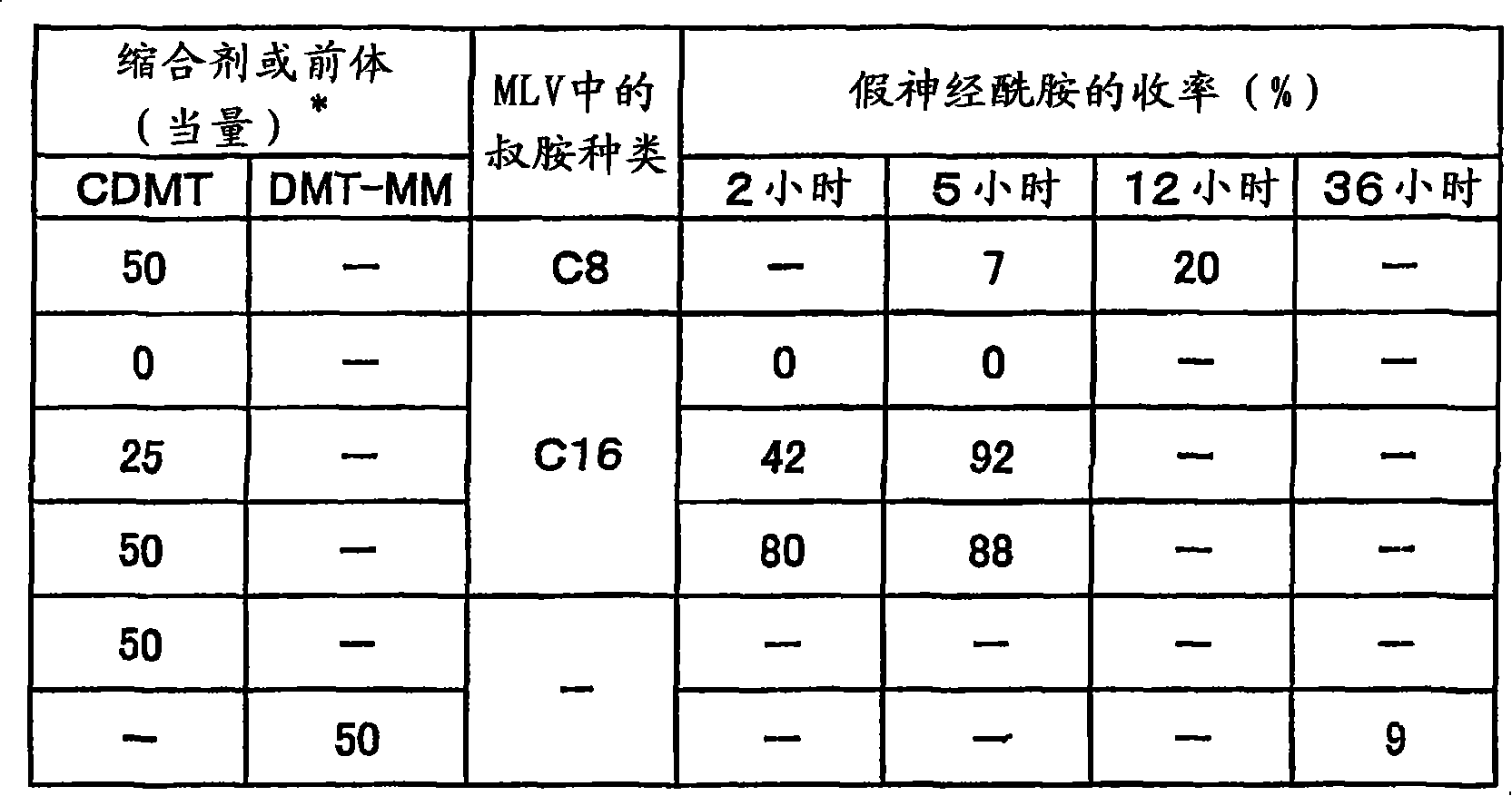
*:相对于月桂酸钠的量 * : Relative to the amount of sodium laurate
当在含有叔胺的MLV分散液中添加CDMT时,以对应叔胺脂肪链长度的收率获得假神经酰胺。另外,未添加CDMT时,确认没有假神经酰胺的生成。另一方面,在DMT-MM中,假神经酰胺非常缓慢地生成。该结果与上述实施例3的结果一致,因此显示假神经酰胺的生成量和融合的相关性。需要说明的是,当在不含叔胺的MLV分散液中添加CDMT时,没有观察到假神经酰胺的生成。When CDMT was added to MLV dispersions containing tertiary amines, pseudoceramides were obtained in yields corresponding to the aliphatic chain lengths of the tertiary amines. In addition, when CDMT was not added, no pseudoceramide was confirmed to be produced. In DMT-MM, on the other hand, pseudoceramides were generated very slowly. This result is consistent with the result of Example 3 above, thus showing the correlation between the production amount of pseudoceramide and fusion. It should be noted that when CDMT was added to the MLV dispersion containing no tertiary amine, the formation of pseudoceramide was not observed.
[实施例5:伴随着MLV融合的粒径变化][Example 5: Particle Size Change Accompanied by MLV Fusion]
使用下表3所记载的化合物,根据上述实施例1记载的操作调制MLV分散液。Using the compounds listed in Table 3 below, MLV dispersions were prepared according to the procedure described in Example 1 above.
表3table 3
使用15mL磷酸缓冲液(5mM NaH2PO4/0.15M NaCl pH8.5)调制Prepared with 15mL phosphate buffer (5mM NaH 2 PO 4 /0.15M NaCl pH8.5)
采集调制好的MLV分散液各2mL,加入50当量(21.7μL)CDMT(甲醇中300mM)。作为对照,添加21.7μL甲醇。调制各2个检体,通过动态光散射法(DLS)测定12小时后的粒径。结果示于表4中。Collect 2 mL each of the prepared MLV dispersion, and add 50 equivalents (21.7 μL) of CDMT (300 mM in methanol). As a control, 21.7 μL of methanol was added. Two samples each were prepared, and the particle diameter after 12 hours was measured by the dynamic light scattering method (DLS). The results are shown in Table 4.
表4Table 4
*1:Z平均=平均流体力学直径 * 1: Z average = average hydrodynamic diameter
加入CDMT时,经过12小时后粒径增大,但不加入CDMT时,即便经过12小时也未见大小有何变化。这说明当加入CDMT时诱发膜融合。When CDMT was added, the particle size increased after 12 hours, but when no CDMT was added, no size change was observed even after 12 hours. This indicates that membrane fusion is induced when CDMT is added.
[实施例6:单层小泡(SUV)的调制][Example 6: Preparation of Unilamellar Vesicles (SUV)]
根据文献(“化学和生物实验在线27脂质体的调制和实验法”,奥直人编、广川书店、第2章、27页)所述的方法,利用以下所述的方法调制SUV。According to the method described in the literature ("Chemical and Biological Experiment Online 27 Liposome Preparation and Experimental Method", edited by Oku Naoto, Hirokawa Shoten,
将月桂酸钠(甲醇中45.0mM、5.8μL)、二元醇1B(氯仿中38.5mM、6.8μL)、C16-叔胺(氯仿中3.05mM、17.0μL)、非还原型卵黄卵磷脂(氯仿中13.0mM、19.0μL)和荧光剂(为NBD-PE时:氯仿中1.23mM、10.6μL;为Rh-PE时:氯仿中4.19mM、3.1μL)加入到20mL茄型瓶中,使用旋转蒸发仪将溶剂减压蒸馏除去。使用真空泵将形成在内壁上的薄膜减压干燥(室温下、0.5小时)。加入4mL磷酸缓冲液(5mMNaH2PO4/Na2HPO4,0.15M NaCl,pH 8.5),利用浴槽型超声波装置照射30秒钟超声波。之后,利用涡流混合机以强度100%搅拌振荡10分钟。接着,转移至20mL试验管中,利用探针型超声波产生装置(TOMY ULTRASONIC DISRUPTOR MODEL UR-200P)以25W超声波处理(冰冻下)20分钟(反复照射1分钟和放置30秒钟,总照射时间为20分钟),获得SUV分散液。Sodium laurate (45.0 mM in methanol, 5.8 μL), diol 1B (38.5 mM in chloroform, 6.8 μL), C16-tertiary amine (3.05 mM in chloroform, 17.0 μL), non-reduced yolk lecithin (chloroform 13.0mM in chloroform, 19.0μL) and fluorescent agent (for NBD-PE: 1.23mM in chloroform, 10.6μL; for Rh-PE: 4.19mM in chloroform, 3.1μL) into a 20mL eggplant-shaped bottle, and use rotary evaporation The solvent was distilled off under reduced pressure. The thin film formed on the inner wall was dried under reduced pressure using a vacuum pump (at room temperature, 0.5 hour). 4 mL of phosphate buffer solution (5 mM NaH 2 PO 4 /Na 2 HPO 4 , 0.15 M NaCl, pH 8.5) was added, and ultrasonic waves were irradiated for 30 seconds using a bath-type ultrasonic device. Afterwards, shake with a vortex mixer at an intensity of 100% for 10 minutes. Then, transfer to 20mL test tube, utilize probe type ultrasonic generator (TOMY ULTRASONIC DISRUPTOR MODEL UR-200P) with 25W ultrasonic treatment (under freezing) 20 minutes (repeated
[实施例7:使用了SUV的膜融合实验][Example 7: Membrane fusion experiment using SUV]
使用在上述实施例6中获得的NBD-PE和含有Rh-PE的SUV分散液,与上述实施例3的MLV的膜融合实验同样地测定经时荧光变化。通过荧光峰计算F值,对SUV的融合进行评价。结果示于图4中。如曲线图可知,仅加入CDMT时,可以获得启示膜融合的结果。Using the NBD-PE obtained in Example 6 above and the Rh-PE-containing SUV dispersion, the change in fluorescence over time was measured in the same manner as in the membrane fusion experiment of MLV in Example 3 above. The fusion of the SUV was evaluated by calculating the F value from the fluorescence peak. The results are shown in FIG. 4 . As can be seen from the graph, when only CDMT was added, a result suggesting membrane fusion was obtained.
[实施例8:利用荧光稀释法的SUV膜融合的评价][Example 8: Evaluation of SUV membrane fusion by fluorescence dilution method]
根据上述实施例6记载的SUV调制方法,通过表5所示的组成调制含有荧光剂的SUV分散液和不含荧光剂的SUV分散液。According to the SUV preparation method described in Example 6 above, SUV dispersion liquids containing a fluorescent agent and SUV dispersion liquids not containing a fluorescent agent were prepared with the compositions shown in Table 5.
表5table 5

*:磷酸缓冲液使用5mM Na2HPO4/0.15M NaCl,pH 8.5 * : Phosphate buffer uses 5mM Na 2 HPO 4 /0.15M NaCl, pH 8.5
在室温下混合0.2mL调制好的含有荧光剂的SUV分散液和1.8mL不含荧光剂的SUV分散液。调制各三个检体。在其中的各2个检体中分别加入10.8μL(25当量)或21.7μL(50当量)的CDMT(甲醇中300mM),在室温下放置。剩余1个加入21.7μL甲醇作为对照实验,同样地放置,每隔一定时间测定荧光。结果示于图5中。Mix 0.2 mL of prepared SUV dispersion containing fluorescent agent and 1.8 mL of SUV dispersion without fluorescent agent at room temperature. Prepare three specimens each. 10.8 μL (25 equivalents) or 21.7 μL (50 equivalents) of CDMT (300 mM in methanol) were added to each of the two samples, and left to stand at room temperature. Add 21.7 μL of methanol to the remaining one as a control experiment, place it in the same way, and measure the fluorescence at regular intervals. The results are shown in FIG. 5 .
当为该实施例8的荧光稀释法时,与实施例7的混合法不同,F值随着融合的发展而变小。如图5所示,仅加入CDMT时可见荧光减弱,强烈启示诱发膜融合。需要说明的是,在图5所示的曲线图中,在初期状态下加有CDMT的曲线与对照曲线之间可见到差别。但是,这说明添加CDMT2小时后可见很大的荧光变化,在反应开始前的荧光中没有差别。In the case of the fluorescence dilution method of this Example 8, unlike the mixing method of Example 7, the F value becomes smaller as fusion progresses. As shown in Figure 5, a decrease in fluorescence was visible when only CDMT was added, strongly suggesting the induction of membrane fusion. In addition, in the graph shown in FIG. 5, the difference was seen between the curve to which CDMT was added in the initial state, and the control curve. However, this shows that a large change in fluorescence was seen 2 hours after the addition of CDMT, and there was no difference in the fluorescence before the start of the reaction.
[实施例9:伴随着SUV融合的粒径变化][Example 9: Particle Size Change Accompanied by SUV Fusion]
使用月桂酸钠和油酸钠这2种作为脂肪酸盐进行实验。Experiments were performed using two types of sodium laurate and sodium oleate as fatty acid salts.
根据上述实施例6记载的SUV调制方法,以表6所示的组成调制SUV分散液。According to the SUV preparation method described in the above-mentioned Example 6, the SUV dispersion liquid was prepared with the composition shown in Table 6.
表6Table 6

*:磷酸缓冲液使用5mM Na2HPO4/0.15M NaCl,pH 8.5,来进行调制。 * : Phosphate buffer was prepared using 5mM Na 2 HPO 4 /0.15M NaCl, pH 8.5.
利用0.45μm孔滤膜过滤调制好的SUV分散液,分为各2mL的各2个检体,其中一个加入21.7μL(50当量)CDMT(甲醇中300mM),另一个加入21.7μL甲醇作为对照实验,在室温下放置。利用DLS测定3小时后的粒径。结果示于表7中。Filter the prepared SUV dispersion with a 0.45 μm pore filter membrane, divide it into 2 samples of 2 mL each, add 21.7 μL (50 equivalents) CDMT (300 mM in methanol) to one of them, and add 21.7 μL methanol to the other as a control experiment , placed at room temperature. The particle size after 3 hours was measured by DLS. The results are shown in Table 7.
表7Table 7
*1:Z平均=平均流体力学直径 * 1: Z average = average hydrodynamic diameter
在3小时左右粒径均显著增大。由粒径的变化,启示在月桂酸中有十多个SUV融合,在油酸中有30~40个左右SUV融合。The particle size increased significantly in about 3 hours. From the change of particle size, it is revealed that there are more than ten SUV fusions in lauric acid, and about 30-40 SUV fusions in oleic acid.
[实施例10:利用透射型电子显微镜观察SUV][Example 10: Observation of SUV with a transmission electron microscope]
根据上述实施例6记载的SUV调制法,以表8所示的组成调制SUV分散液。According to the SUV preparation method described in Example 6 above, SUV dispersion liquids were prepared with the compositions shown in Table 8.
表8Table 8
在5mL磷酸缓冲液(5mM Na2HPO4/0.15M NaCl,pH 8.5)中调制Prepare in 5mL phosphate buffer (5mM Na 2 HPO 4 /0.15M NaCl, pH 8.5)
取出200μL调制好的SUV分散液,加入4.3μL的CDMT(甲醇中300mM),在室温下放置。作为对照实验加入4.3μL甲醇代替CDMT,在室温下放置。将数滴放置后的SUV分散液滴加在载玻片上,利用液氮冷冻,通过本领域技术人员通常进行的冷冻割断法,调制电子显微镜试样(复制品)(使用JEOL JFD-9010)。利用TEM(JEOLJEM-1010)观察所得试样(加速电压100kv)。电子显微镜照片示于图6~8中,照片中的箭头表示SUV。Take out 200 μL of the prepared SUV dispersion, add 4.3 μL of CDMT (300 mM in methanol), and place it at room temperature. As a control experiment, add 4.3 μL of methanol instead of CDMT, and place it at room temperature. A few drops of the left SUV dispersion were dropped on a glass slide, frozen with liquid nitrogen, and an electron microscope sample (replica) was prepared by the freeze-cut method usually performed by those skilled in the art (JEOL JFD-9010 was used). The obtained sample was observed by TEM (JEOLJEM-1010) (accelerating
当加入CDMT时,粒径在添加CMDT前为数十~约100nm(图6),添加CDMT后达到1μM以上,而且粒子数显著减少(图7)。这是由于相互接近的数千个SUV之间发生融合,形成巨大的GUV。另一方面,当仅加入甲醇时,即便经过1天以上,在粒径和分布中也未见变化(图8)。When CDMT is added, the particle size is tens to about 100nm before adding CMDT (Figure 6), and after adding CDMT, it reaches more than 1μM, and the number of particles is significantly reduced (Figure 7). This is due to the fusion of thousands of SUVs approaching each other to form a giant GUV. On the other hand, when only methanol was added, no change was seen in the particle size and distribution even after 1 day or more ( FIG. 8 ).
[实施例11:活化SUV和惰性SUV的融合实验][Example 11: Fusion experiment of activated SUV and inert SUV]
对于作为膜构成成分含有脂肪酸盐和胺、通过脱水缩合而活化的SUV(以下称为活化SUV)和通常的SUV(以下称为惰性SUV),通过上述实施例6记载的SUV调制方法,以下表9所示组成分别调制含有荧光剂的SUV分散记和不含荧光剂的SUV分散液。For SUVs (hereinafter referred to as activated SUVs) and normal SUVs (hereinafter referred to as inert SUVs) which contain fatty acid salts and amines as film constituents and are activated by dehydration condensation, by the SUV preparation method described in the above-mentioned Example 6, the following The compositions shown in Table 9 were prepared for SUV dispersions containing fluorescent agents and SUV dispersions not containing fluorescent agents.
表9Table 9

*:磷酸缓冲液使用5mM Na2HPO4/0.15M NaCl,pH 8.5 * : Phosphate buffer uses 5mM Na 2 HPO 4 /0.15M NaCl, pH 8.5
根据上述实施例8记载的荧光稀释法,在室温下混合0.2mL调制好的含有荧光剂的SUV分散液和1.8mL不含荧光剂的SUV分散液。在此,SUV的组合有以下4种类:含有荧光剂的活化SUV和不含荧光剂的活化SUV的组合(第1轮)、含有荧光剂的惰性SUV和不含荧光剂的活化SUV的组合(第2轮)、含有荧光剂的活化SUV和不含荧光剂的惰性SUV的组合(第3轮)、含有荧光剂的惰性SUV和不含荧光剂的惰性SUV的组合。接着,加入15.2μL(4.55μmol:第1轮的总脂肪酸盐的35当量)CDMT(甲醇中300mM),在室温下放置,通过荧光光度计测定F值的经时变化。结果示于图9中。According to the fluorescence dilution method described in the above-mentioned Example 8, 0.2 mL of the prepared SUV dispersion containing the fluorescent agent and 1.8 mL of the SUV dispersion without the fluorescent agent were mixed at room temperature. Here, the combination of SUV has the following four types: the combination of activated SUV with fluorescent agent and activated SUV without fluorescent agent (first round), the combination of inert SUV with fluorescent agent and activated SUV without fluorescent agent ( Round 2), combination of activated SUV with fluorescer and inert SUV without fluorescer (round 3), combination of inert SUV with fluorescer and inert SUV without fluorescer. Next, 15.2 μL (4.55 μmol: 35 equivalents of the total fatty acid salts in the first round) of CDMT (300 mM in methanol) was added, left to stand at room temperature, and the time-dependent change in F value was measured with a fluorophotometer. The results are shown in FIG. 9 .
由图9可知,一方面即便是惰性SUV,F值也显著地变化(第2轮和3)。对于相同的SUV之间的融合来说,理论上没发生荧光变化,因此该F值的减少表明发生活化SUV和惰性SUV的融合。当活化SUV少时(第3轮),F值的变化量小,这是由于通过一次融合SUV的不稳定性被消除、不会进一步融合,荧光剂未被充分地稀释。另一方面,当SUV的90%为活化SUV时(第2轮),融合多阶段地发生,荧光剂被充分地稀释,因此F值的变化很大。It can be seen from Fig. 9 that, on the one hand, even for an inert SUV, the F value changes significantly (
[实施例12:伴随融合的SUV内水相的泄漏研究][Example 12: Leakage study of aqueous phase in SUV with fusion]
当将膜融合用在DDS或基因导入中时,脂质体内容物必须被很好地导入到靶细胞的内部。融合如果伴随着膜的部分崩解时,则大量的内容物会泄露到外部,不能达到该目的,其应用性有限,因此,进行融合时的内容物的泄漏实验。When membrane fusion is used in DDS or gene delivery, the contents of the liposome must be well introduced into the interior of the target cell. If the fusion is accompanied by partial disintegration of the membrane, a large amount of the content will leak to the outside, and this purpose cannot be achieved, and its applicability is limited. Therefore, a leakage test of the content during fusion was performed.
以下所示的钙黄绿素(Calcein)这种荧光色素在高浓度下会自己消光,不会发出荧光,但在低浓度下会发出荧光。Calcein, a fluorescent pigment shown below, will extinguish itself at high concentrations and will not fluoresce, but will fluoresce at low concentrations.

因此,在本实施例中,利用该性质,进行在内部(内水相)中预先放入有高浓度钙黄绿素的脂质体的融合实验。伴随着融合,如果内容物泄露,则在外水相中呈现出稀释的钙黄绿素的荧光,但如果不发生泄露,则荧光没有变化。Therefore, in this example, utilizing this property, a fusion experiment was performed in which liposomes containing a high concentration of calcein were placed in advance in the interior (inner aqueous phase). Concomitant with fusion, there is fluorescence of diluted calcein in the external aqueous phase if leakage of the contents occurs, but no change in fluorescence if leakage does not occur.
SUV的调制根据实施例6所记载的方法进行。在磷酸缓冲液(5mMNaH2PO4/Na2HPO4,0.15M NaCl,pH 8)中放入钙黄绿素(75mM),通过超声波处理制作SUV。通过凝胶过滤(Sephadex G-50、在流动相中同样使用磷酸缓冲液)分离SUV,除去存在于外水相中的钙黄绿素,获得SUV分散液。The preparation of SUV was carried out according to the method described in Example 6. Calcein (75 mM) was added to a phosphate buffer (5 mM NaH 2 PO 4 /Na 2 HPO 4 , 0.15 M NaCl, pH 8), and an SUV was produced by sonication. The SUV was separated by gel filtration (Sephadex G-50, also using a phosphate buffer as the mobile phase), and calcein present in the external aqueous phase was removed to obtain an SUV dispersion.
在所得SUV分散液中添加CDMT(50当量)后,在室温下放置,经过一定时间后测定荧光(520nm)(Fs)、之后立即添加Triton X-100(10%、200μL)破坏SUV后,再次测定荧光(FT)。没有膜融合的对照实验同样使用SUV、不添加CDMT、每隔一定时间测定荧光,最后添加Triton-X100破坏脂质体,测定荧光。根据下式计算泄露率。After adding CDMT (50 equivalents) to the obtained SUV dispersion, let it stand at room temperature, measure the fluorescence (520nm) (Fs) after a certain period of time, immediately add Triton X-100 (10%, 200μL) to destroy the SUV, and then again Fluorescence (F T ) was measured. In the control experiment without membrane fusion, SUV was also used without adding CDMT, and the fluorescence was measured at regular intervals. Finally, Triton-X100 was added to destroy the liposomes, and the fluorescence was measured. The leak rate was calculated according to the following formula.

F0:0小时的荧光强度F 0 : fluorescence intensity at 0 hours
FS:各时间的荧光强度F S : Fluorescence intensity at each time
FT:添加Triton-X100后的荧光强度F T : Fluorescence intensity after adding Triton-X100
所得结果示于下表10中。The results obtained are shown in Table 10 below.
表10Table 10
如表10所示可知,当添加CDMT发生膜融合时,直至融合基本完成的3小时可见泄露率有若干的增加(相对于对照实验的2%,融合时为8%),但荧光强度(FS)在刚测定后与添加TritonX-100时的荧光(FT)相比非常小,内容物基本没有泄露。As shown in Table 10, it can be seen that when CDMT is added and membrane fusion occurs, the visible leakage rate has some increase (compared to 2% in the control experiment, 8% at the time of fusion) until the fusion is basically completed 3 hours, but the fluorescence intensity (F S ) Immediately after the measurement, the fluorescence (FT) when TritonX-100 was added was very small, and the contents hardly leaked.
产业实用性Industrial applicability
通过本发明的方法,能够化学地改变利用脱水缩合反应形成分子集合体的脂质,改变其物理性质或形态,调整膜融合等相转移的时机等。即,能够诱发在双分子膜小泡中分子集合体的相转移,可以诱发脂质体等水界面的分子集合体的融合或分裂。另外,本发明的双分子膜小泡可以提供活化状态或准稳定状态的小泡。进而,在脂质体等的膜融合时,其内容物也可能融合。因此,本发明的方法和双分子膜小泡在利用脱水缩合反应的有机合成化学或界面化学的领域、或者利用脂质体等小泡的领域等的研究中有用。另外,作为用于研究关于细胞或细胞内小器官的形成、分解、分裂或融合等生物的形态变化的模型体系,对于阐明伴随着内吞作用或胞吐作用的生物学机制、或者基因治疗或药物传递系统等的治疗医学的开发也有用。By the method of the present invention, it is possible to chemically change lipids that form molecular aggregates through dehydration condensation reactions, change their physical properties and forms, and adjust the timing of phase transition such as membrane fusion. That is, phase transition of molecular assemblies in bimolecular membrane vesicles can be induced, and fusion or disintegration of molecular assemblies at water interfaces such as liposomes can be induced. In addition, the bimolecular membrane vesicles of the present invention can provide vesicles in an activated state or a quasi-stable state. Furthermore, when membranes such as liposomes fuse, their contents may also fuse. Therefore, the method and bimolecular membrane vesicles of the present invention are useful for research in the fields of organic synthetic chemistry or interfacial chemistry using dehydration condensation reactions, or in the field of using vesicles such as liposomes. In addition, as a model system for studying biological morphological changes such as the formation, decomposition, division, or fusion of cells or small intracellular organs, it is useful for elucidating biological mechanisms accompanied by endocytosis or exocytosis, or for gene therapy or It is also useful for the development of therapeutic medicine such as a drug delivery system.
Claims (12)
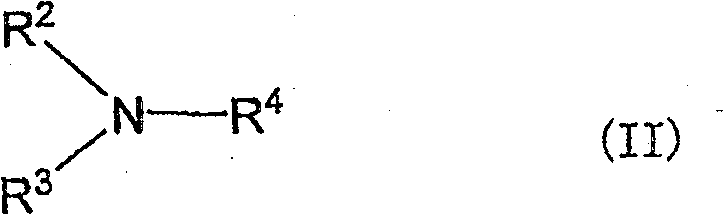
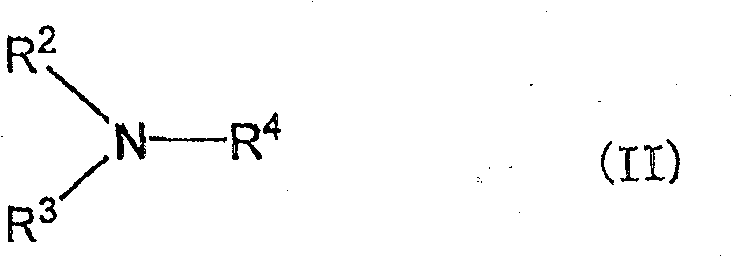
Applications Claiming Priority (3)
| Application Number | Priority Date | Filing Date | Title |
|---|---|---|---|
| JP021241/2005 | 2005-01-28 | ||
| JP2005021241 | 2005-01-28 | ||
| PCT/JP2005/023196 WO2006080157A1 (en) | 2005-01-28 | 2005-12-12 | Molecular aggregate capable of undergoing phase transition by dehydrating condensation and method of phase transition thereof |
Publications (2)
| Publication Number | Publication Date |
|---|---|
| CN101111306A CN101111306A (en) | 2008-01-23 |
| CN101111306B true CN101111306B (en) | 2010-09-29 |
Family
ID=36740191
Family Applications (1)
| Application Number | Title | Priority Date | Filing Date |
|---|---|---|---|
| CN2005800474454A Expired - Fee Related CN101111306B (en) | 2005-01-28 | 2005-12-12 | Molecular assembly capable of phase transfer through dehydration condensation reaction and its phase transfer method |
Country Status (6)
| Country | Link |
|---|---|
| US (2) | US8449979B2 (en) |
| EP (2) | EP1852177B1 (en) |
| JP (1) | JP4787818B2 (en) |
| CN (1) | CN101111306B (en) |
| CA (1) | CA2595003C (en) |
| WO (1) | WO2006080157A1 (en) |
Families Citing this family (5)
| Publication number | Priority date | Publication date | Assignee | Title |
|---|---|---|---|---|
| CN101111306B (en) * | 2005-01-28 | 2010-09-29 | 独立行政法人科学技术振兴机构 | Molecular assembly capable of phase transfer through dehydration condensation reaction and its phase transfer method |
| JP5219144B2 (en) * | 2007-12-28 | 2013-06-26 | 公益財団法人新産業創造研究機構 | Novel affinity labeling method and screening method using the labeling method |
| US8821903B2 (en) | 2009-07-15 | 2014-09-02 | Kao Corporation | Method for producing a vesicle composition |
| JP5669058B2 (en) * | 2010-05-10 | 2015-02-12 | 独立行政法人科学技術振興機構 | Method for producing liposome |
| CN105832670A (en) * | 2015-12-28 | 2016-08-10 | 四川大学 | Technology for preparing double-loaded or multi-loaded liposome through liposome fusion induction |
Citations (1)
| Publication number | Priority date | Publication date | Assignee | Title |
|---|---|---|---|---|
| JPH07242680A (en) | 1994-03-04 | 1995-09-19 | Nippon Oil & Fats Co Ltd | Reactive endoplasmic reticulum, forming agent and functional substance-immobilized endoplasmic reticulum |
Family Cites Families (21)
| Publication number | Priority date | Publication date | Assignee | Title |
|---|---|---|---|---|
| US4789633A (en) * | 1984-04-19 | 1988-12-06 | University Of Tennessee Research Corporation | Fused liposome and acid induced method for liposome fusion |
| US4911928A (en) * | 1987-03-13 | 1990-03-27 | Micro-Pak, Inc. | Paucilamellar lipid vesicles |
| US5229104A (en) * | 1991-04-29 | 1993-07-20 | Richardson-Vicks Inc. | Artificial tanning compositions containing positively charged paucilamellar vesicles |
| US6387373B1 (en) * | 1993-01-15 | 2002-05-14 | Novavax, Inc. | Vaccines containing paucilsmellar lipid vesicles as immunological adjuvants |
| WO1994016061A1 (en) * | 1993-01-15 | 1994-07-21 | Micro Vesicular Systems, Inc. | Method of inhibiting viral reproduction |
| US5468398A (en) * | 1993-05-20 | 1995-11-21 | Colgate-Palmolive Company | Liquid fabric softening composition |
| BR9506885A (en) * | 1994-02-24 | 1997-08-19 | Micro Pak Inc | Vaccines containing paucilamellar lipid vesicles as immunological adjuvants |
| EP0758883B1 (en) * | 1994-04-12 | 2003-03-19 | The Liposome Company, Inc. | Fusogenic liposomes and methods of making and using same |
| US5874105A (en) * | 1996-01-31 | 1999-02-23 | Collaborative Laboratories, Inc. | Lipid vesicles formed with alkylammonium fatty acid salts |
| US5756014A (en) * | 1997-04-11 | 1998-05-26 | Igen, Inc. | Heat resistant lipid vesicles |
| CA2331850C (en) | 1999-03-08 | 2008-11-18 | Tokuyama Corporation | Method of preparing carboxylic acid derivatives and condensing agent comprising a quaternary ammonium salt |
| JP2001089360A (en) * | 1999-09-16 | 2001-04-03 | Shionogi & Co Ltd | Agent for lowering t-lymphocyte proliferative response |
| FR2803202B1 (en) * | 2000-01-03 | 2004-04-16 | Capsulis | PHARMACEUTICAL COMPOSITIONS FOR ORAL DELIVERY |
| EP1138310A1 (en) * | 2000-03-28 | 2001-10-04 | Primacare S.A. | Proliposomes |
| US20020094367A1 (en) * | 2000-09-08 | 2002-07-18 | Novozymes A/S | Dough composition |
| AU2001283817A1 (en) * | 2000-09-08 | 2002-03-22 | Novozymes A/S | A dough composition comprising a lipid-encapsulated enzyme |
| KR100439068B1 (en) | 2001-09-07 | 2004-07-05 | 주식회사 코리아나화장품 | Stablized cosmetic material containing triple layered retonol |
| JP2005521645A (en) * | 2001-12-04 | 2005-07-21 | ベン グリオン ユニバーシティ オブ ザ ネジェブ リサーチ アンド ディベラップメント オーソリティ | Amphiphilic compounds and vesicles / liposomes for organ-specific drug targeting |
| FR2842734A1 (en) * | 2002-07-24 | 2004-01-30 | Ethypharm Sa | METHOD FOR DECREASING THE VARIABILITY OF THE BIOAVAILABILITY OF AN ORAL MEDICINAL PRODUCT AND ORAL PHARMACEUTICAL COMPOSITIONS |
| JP4669665B2 (en) | 2004-04-12 | 2011-04-13 | 正彦 阿部 | Polycation-modified liposome having no cytotoxicity and method for producing the same |
| CN101111306B (en) * | 2005-01-28 | 2010-09-29 | 独立行政法人科学技术振兴机构 | Molecular assembly capable of phase transfer through dehydration condensation reaction and its phase transfer method |
-
2005
- 2005-12-12 CN CN2005800474454A patent/CN101111306B/en not_active Expired - Fee Related
- 2005-12-12 JP JP2007500435A patent/JP4787818B2/en not_active Expired - Fee Related
- 2005-12-12 WO PCT/JP2005/023196 patent/WO2006080157A1/en not_active Ceased
- 2005-12-12 EP EP20050816563 patent/EP1852177B1/en not_active Expired - Lifetime
- 2005-12-12 US US11/814,901 patent/US8449979B2/en not_active Expired - Fee Related
- 2005-12-12 CA CA 2595003 patent/CA2595003C/en not_active Expired - Fee Related
- 2005-12-12 EP EP20130181632 patent/EP2669002A1/en not_active Withdrawn
-
2013
- 2013-04-25 US US13/870,002 patent/US10098841B2/en not_active Expired - Fee Related
Patent Citations (1)
| Publication number | Priority date | Publication date | Assignee | Title |
|---|---|---|---|---|
| JPH07242680A (en) | 1994-03-04 | 1995-09-19 | Nippon Oil & Fats Co Ltd | Reactive endoplasmic reticulum, forming agent and functional substance-immobilized endoplasmic reticulum |
Also Published As
| Publication number | Publication date |
|---|---|
| US8449979B2 (en) | 2013-05-28 |
| WO2006080157A1 (en) | 2006-08-03 |
| EP1852177B1 (en) | 2014-02-26 |
| EP1852177A4 (en) | 2011-05-18 |
| US20130251788A1 (en) | 2013-09-26 |
| US20090023003A1 (en) | 2009-01-22 |
| EP1852177A1 (en) | 2007-11-07 |
| CN101111306A (en) | 2008-01-23 |
| JP4787818B2 (en) | 2011-10-05 |
| US10098841B2 (en) | 2018-10-16 |
| EP2669002A1 (en) | 2013-12-04 |
| CA2595003A1 (en) | 2006-08-03 |
| JPWO2006080157A1 (en) | 2008-06-19 |
| CA2595003C (en) | 2011-03-15 |
Similar Documents
| Publication | Publication Date | Title |
|---|---|---|
| Mozafari | Nanoliposomes: preparation and analysis | |
| Niculescu-Duvaz et al. | Structure-activity relationship in cationic lipid mediated gene transfection | |
| Ulrich | Biophysical aspects of using liposomes as delivery vehicles | |
| Moreau et al. | Supramolecular assemblies of nucleoside phosphocholine amphiphiles | |
| Pradhan et al. | Liposome: method of preparation, advantages, evaluation and its application | |
| EP1638919A1 (en) | Sphingolipids polyalkylamines conjugates | |
| JP2004525898A (en) | Amphoteric liposomes and uses thereof | |
| Dwivedi et al. | Review on preparation and characterization of liposomes with application | |
| US10098841B2 (en) | Method of inducing a phase transition of a bilayer membrane vesicle | |
| Zhao et al. | Synthesis and evaluation of mono-and multi-hydroxyl low toxicity pH-sensitive cationic lipids for drug delivery | |
| Janich et al. | Composites of malonic acid diamides and phospholipids–Structural parameters for optimal transfection efficiency in A549 cells | |
| Fenske et al. | Cationic poly (ethyleneglycol) lipids incorporated into pre-formed vesicles enhance binding and uptake to BHK cells | |
| ES2640060T3 (en) | Process to produce a coated fine particle | |
| Mach et al. | Study of the correlation between the structure of selected triester of phosphatidylcholine and their impact on physicochemical properties of model mammalian membranes | |
| Mulla et al. | Liposome as a drug carrier | |
| Sanarova et al. | Liposome drug delivery | |
| Denieva et al. | Mixed cationic liposomes based on L-amino acids as efficient delivery systems of therapeutic molecules into cells | |
| Gopal et al. | Synthesis and transfection efficiency of cationic oligopeptide lipids: role of linker | |
| JP6826014B2 (en) | Compositions and kits containing biodegradable compounds, lipid particles, lipid particles | |
| Sabín et al. | Characterization of phospholipid+ semifluorinated alkane vesicle system | |
| Gol et al. | Nanocochleates: A novel approach for drug delivery | |
| Verma | Liposomes: a targeted drug delivery system-a review | |
| Mori et al. | Stabilization and regulated fusion of liposomes containing a cationic lipid using amphipathic polyethyleneglycol derivatives | |
| CA3262328A1 (en) | Neutral lipid and lipid nanoparticle | |
| Capone et al. | pH‐Sensitive Vesicles Containing a Lipidic β‐Amino Acid with Two Hydrophobic Chains |
Legal Events
| Date | Code | Title | Description |
|---|---|---|---|
| C06 | Publication | ||
| PB01 | Publication | ||
| C10 | Entry into substantive examination | ||
| SE01 | Entry into force of request for substantive examination | ||
| C14 | Grant of patent or utility model | ||
| GR01 | Patent grant | ||
| CF01 | Termination of patent right due to non-payment of annual fee |
Granted publication date: 20100929 Termination date: 20151212 |
|
| EXPY | Termination of patent right or utility model |