CN101076608B - Reagents and methods for improving reproducibility and reducing mispriming in PCR amplification - Google Patents
Reagents and methods for improving reproducibility and reducing mispriming in PCR amplification Download PDFInfo
- Publication number
- CN101076608B CN101076608B CN2005800426234A CN200580042623A CN101076608B CN 101076608 B CN101076608 B CN 101076608B CN 2005800426234 A CN2005800426234 A CN 2005800426234A CN 200580042623 A CN200580042623 A CN 200580042623A CN 101076608 B CN101076608 B CN 101076608B
- Authority
- CN
- China
- Prior art keywords
- reagent
- amplification
- stem
- pcr
- primer
- Prior art date
- Legal status (The legal status is an assumption and is not a legal conclusion. Google has not performed a legal analysis and makes no representation as to the accuracy of the status listed.)
- Expired - Lifetime
Links
Images




Classifications
-
- C—CHEMISTRY; METALLURGY
- C12—BIOCHEMISTRY; BEER; SPIRITS; WINE; VINEGAR; MICROBIOLOGY; ENZYMOLOGY; MUTATION OR GENETIC ENGINEERING
- C12Q—MEASURING OR TESTING PROCESSES INVOLVING ENZYMES, NUCLEIC ACIDS OR MICROORGANISMS; COMPOSITIONS OR TEST PAPERS THEREFOR; PROCESSES OF PREPARING SUCH COMPOSITIONS; CONDITION-RESPONSIVE CONTROL IN MICROBIOLOGICAL OR ENZYMOLOGICAL PROCESSES
- C12Q1/00—Measuring or testing processes involving enzymes, nucleic acids or microorganisms; Compositions therefor; Processes of preparing such compositions
- C12Q1/68—Measuring or testing processes involving enzymes, nucleic acids or microorganisms; Compositions therefor; Processes of preparing such compositions involving nucleic acids
- C12Q1/6844—Nucleic acid amplification reactions
- C12Q1/6848—Nucleic acid amplification reactions characterised by the means for preventing contamination or increasing the specificity or sensitivity of an amplification reaction
-
- C—CHEMISTRY; METALLURGY
- C12—BIOCHEMISTRY; BEER; SPIRITS; WINE; VINEGAR; MICROBIOLOGY; ENZYMOLOGY; MUTATION OR GENETIC ENGINEERING
- C12Q—MEASURING OR TESTING PROCESSES INVOLVING ENZYMES, NUCLEIC ACIDS OR MICROORGANISMS; COMPOSITIONS OR TEST PAPERS THEREFOR; PROCESSES OF PREPARING SUCH COMPOSITIONS; CONDITION-RESPONSIVE CONTROL IN MICROBIOLOGICAL OR ENZYMOLOGICAL PROCESSES
- C12Q1/00—Measuring or testing processes involving enzymes, nucleic acids or microorganisms; Compositions therefor; Processes of preparing such compositions
- C12Q1/68—Measuring or testing processes involving enzymes, nucleic acids or microorganisms; Compositions therefor; Processes of preparing such compositions involving nucleic acids
- C12Q1/6844—Nucleic acid amplification reactions
- C12Q1/686—Polymerase chain reaction [PCR]
-
- C—CHEMISTRY; METALLURGY
- C12—BIOCHEMISTRY; BEER; SPIRITS; WINE; VINEGAR; MICROBIOLOGY; ENZYMOLOGY; MUTATION OR GENETIC ENGINEERING
- C12Q—MEASURING OR TESTING PROCESSES INVOLVING ENZYMES, NUCLEIC ACIDS OR MICROORGANISMS; COMPOSITIONS OR TEST PAPERS THEREFOR; PROCESSES OF PREPARING SUCH COMPOSITIONS; CONDITION-RESPONSIVE CONTROL IN MICROBIOLOGICAL OR ENZYMOLOGICAL PROCESSES
- C12Q2525/00—Reactions involving modified oligonucleotides, nucleic acids, or nucleotides
- C12Q2525/10—Modifications characterised by
- C12Q2525/186—Modifications characterised by incorporating a non-extendable or blocking moiety
-
- C—CHEMISTRY; METALLURGY
- C12—BIOCHEMISTRY; BEER; SPIRITS; WINE; VINEGAR; MICROBIOLOGY; ENZYMOLOGY; MUTATION OR GENETIC ENGINEERING
- C12Q—MEASURING OR TESTING PROCESSES INVOLVING ENZYMES, NUCLEIC ACIDS OR MICROORGANISMS; COMPOSITIONS OR TEST PAPERS THEREFOR; PROCESSES OF PREPARING SUCH COMPOSITIONS; CONDITION-RESPONSIVE CONTROL IN MICROBIOLOGICAL OR ENZYMOLOGICAL PROCESSES
- C12Q2525/00—Reactions involving modified oligonucleotides, nucleic acids, or nucleotides
- C12Q2525/30—Oligonucleotides characterised by their secondary structure
- C12Q2525/301—Hairpin oligonucleotides
-
- C—CHEMISTRY; METALLURGY
- C12—BIOCHEMISTRY; BEER; SPIRITS; WINE; VINEGAR; MICROBIOLOGY; ENZYMOLOGY; MUTATION OR GENETIC ENGINEERING
- C12Q—MEASURING OR TESTING PROCESSES INVOLVING ENZYMES, NUCLEIC ACIDS OR MICROORGANISMS; COMPOSITIONS OR TEST PAPERS THEREFOR; PROCESSES OF PREPARING SUCH COMPOSITIONS; CONDITION-RESPONSIVE CONTROL IN MICROBIOLOGICAL OR ENZYMOLOGICAL PROCESSES
- C12Q2527/00—Reactions demanding special reaction conditions
- C12Q2527/107—Temperature of melting, i.e. Tm
-
- C—CHEMISTRY; METALLURGY
- C12—BIOCHEMISTRY; BEER; SPIRITS; WINE; VINEGAR; MICROBIOLOGY; ENZYMOLOGY; MUTATION OR GENETIC ENGINEERING
- C12Q—MEASURING OR TESTING PROCESSES INVOLVING ENZYMES, NUCLEIC ACIDS OR MICROORGANISMS; COMPOSITIONS OR TEST PAPERS THEREFOR; PROCESSES OF PREPARING SUCH COMPOSITIONS; CONDITION-RESPONSIVE CONTROL IN MICROBIOLOGICAL OR ENZYMOLOGICAL PROCESSES
- C12Q2527/00—Reactions demanding special reaction conditions
- C12Q2527/125—Specific component of sample, medium or buffer
-
- C—CHEMISTRY; METALLURGY
- C12—BIOCHEMISTRY; BEER; SPIRITS; WINE; VINEGAR; MICROBIOLOGY; ENZYMOLOGY; MUTATION OR GENETIC ENGINEERING
- C12Q—MEASURING OR TESTING PROCESSES INVOLVING ENZYMES, NUCLEIC ACIDS OR MICROORGANISMS; COMPOSITIONS OR TEST PAPERS THEREFOR; PROCESSES OF PREPARING SUCH COMPOSITIONS; CONDITION-RESPONSIVE CONTROL IN MICROBIOLOGICAL OR ENZYMOLOGICAL PROCESSES
- C12Q2527/00—Reactions demanding special reaction conditions
- C12Q2527/137—Concentration of a component of medium
-
- C—CHEMISTRY; METALLURGY
- C12—BIOCHEMISTRY; BEER; SPIRITS; WINE; VINEGAR; MICROBIOLOGY; ENZYMOLOGY; MUTATION OR GENETIC ENGINEERING
- C12Q—MEASURING OR TESTING PROCESSES INVOLVING ENZYMES, NUCLEIC ACIDS OR MICROORGANISMS; COMPOSITIONS OR TEST PAPERS THEREFOR; PROCESSES OF PREPARING SUCH COMPOSITIONS; CONDITION-RESPONSIVE CONTROL IN MICROBIOLOGICAL OR ENZYMOLOGICAL PROCESSES
- C12Q2531/00—Reactions of nucleic acids characterised by
- C12Q2531/10—Reactions of nucleic acids characterised by the purpose being amplify/increase the copy number of target nucleic acid
- C12Q2531/107—Probe or oligonucleotide ligation
Landscapes
- Chemical & Material Sciences (AREA)
- Organic Chemistry (AREA)
- Life Sciences & Earth Sciences (AREA)
- Chemical Kinetics & Catalysis (AREA)
- Zoology (AREA)
- Wood Science & Technology (AREA)
- Proteomics, Peptides & Aminoacids (AREA)
- Health & Medical Sciences (AREA)
- Engineering & Computer Science (AREA)
- Biophysics (AREA)
- Immunology (AREA)
- Microbiology (AREA)
- Molecular Biology (AREA)
- Biotechnology (AREA)
- Analytical Chemistry (AREA)
- Physics & Mathematics (AREA)
- Biochemistry (AREA)
- Bioinformatics & Cheminformatics (AREA)
- General Engineering & Computer Science (AREA)
- General Health & Medical Sciences (AREA)
- Genetics & Genomics (AREA)
- Measuring Or Testing Involving Enzymes Or Micro-Organisms (AREA)
Abstract
Description
技术领域 technical field
本发明涉及利用聚合酶链反应(PCR)的核酸扩增反应和分析,包括实时以及终点均相分析。The present invention relates to nucleic acid amplification reactions and analysis using the polymerase chain reaction (PCR), including real-time as well as end-point homogeneous analysis.
背景技术 Background technique
利用聚合酶链反应(PCR)的核酸扩增以及包括PCR扩增的分析众所周知。参见美国专利第4,683,202号、第4,683,195号和第4,965,188号,以及通常参见PCRPROTOCOLS,a guide to Methods and Applications,Innis等人编辑,Academic Press(SanDiego,CA(USA)1990)。人们也熟知均相PCR分析,其不需要进行洗涤来除去未结合的检测剂或探针,因此在实施时无需打开扩增反应器。均相PCR分析既包括在扩增反应结束时检测扩增产物的终点分析,也包括在反应进行时的某些或全部热循环期间检测扩增产物的实时分析。参见美国专利第5,994,056号、第5,487,972号、第5,925,517号及第6,150,097号。Nucleic acid amplification using the polymerase chain reaction (PCR) and assays involving PCR amplification are well known. See U.S. Patent Nos. 4,683,202, 4,683,195, and 4,965,188, and generally in PCRPROTOCOLS, a guide to Methods and Applications, edited by Innis et al., Academic Press (San Diego, CA (USA) 1990). Homogeneous PCR assays are also well known, which do not require washing to remove unbound detectors or probes and are therefore performed without opening the amplification reactor. Homogeneous PCR analysis includes both endpoint analysis, which detects amplification products at the end of the amplification reaction, and real-time analysis, which detects amplification products during some or all of the thermal cycles while the reaction is in progress. See US Patent Nos. 5,994,056, 5,487,972, 5,925,517 and 6,150,097.
PCR扩增反应通常设计成具有对称性,即通过利用“匹配”的正向引物和反向引物(即它们具有尽可能接近的解链温度并且它们以等摩尔浓度添加到反应中)来制备双链扩增子。仅限于用于在PCR反应中直接制备单链DNA的技术是“不对称PCR”。Gyllensten和Erlich,“Generation of Single-Stranded DNA by the Polymerase ChainReaction and Its Application to Direct Sequencing of the HLA-DQA Locus.”Proc.Natl.Acad.Sci.(USA)85:7652-7656(1988);及美国专利第5,066,584号。不对称PCR与对称PCR的不同之处在于引物中的一种以有限量添加,通常为另一引物浓度的1%至20%。PCR amplification reactions are usually designed to have symmetry, that is, by using "matched" forward and reverse primers (i.e., they have melting temperatures as close as possible and they are added to the reaction in equimolar concentrations) to prepare double primers. chain amplicon. A technique limited to the direct preparation of single-stranded DNA in a PCR reaction is "asymmetric PCR". Gyllensten and Erlich, "Generation of Single-Stranded DNA by the Polymerase ChainReaction and Its Application to Direct Sequencing of the HLA-DQA Locus." Proc. Natl. Acad. Sci. (USA) 85: 7652-7656 (1988); and US Patent No. 5,066,584. Asymmetric PCR differs from symmetric PCR in that one of the primers is added in a limited amount, usually 1% to 20% of the concentration of the other primer.
新近,已开发出一种不对称PCR扩增方法,称为“指数后线性(Linear-After-The-Exponential)”PCR或简称为“LATE-PCR”。参见Sanchez等人(2004)PNAS101:1933-1938,Pierce等人(2005)PNAS102:8609-8614,及公开的国际专利申请案WO03/054233(2003年7月3日),其全部内容以引用方式并入本文中。LATE-PCR计及扩增开始时PCR引物的实际解链温度,称为Tm[0]。Tm[0]可根据经验确定(当使用非天然核苷酸时必须如此),或可使用盐浓度调节根据“最近邻”方法(Santa Lucia,J.(1998)PNAS(USA)95:1460-1465;以及Allawi,H.T.和Santa Lucia,J.(1997)Biochem.36:10581-10594)计算。在我们的研究中利用0.07M的单价盐浓度。More recently, an asymmetric PCR amplification method called "Linear-After-The-Exponential" PCR or simply "LATE-PCR" has been developed. See Sanchez et al. (2004) PNAS 101:1933-1938, Pierce et al. (2005) PNAS 102:8609-8614, and published International Patent Application WO03/054233 (July 3, 2003), the entire contents of which are incorporated by reference incorporated into this article. LATE-PCR takes into account the actual melting temperature of the PCR primers at the start of amplification, called T m[0] . Tm [0] can be determined empirically (as necessary when using unnatural nucleotides), or can be adjusted using salt concentration according to the "nearest neighbor" method (Santa Lucia, J. (1998) PNAS (USA) 95:1460 -1465; and calculated by Allawi, HT and Santa Lucia, J. (1997) Biochem. 36:10581-10594). A monovalent salt concentration of 0.07M was utilized in our study.
PCR扩增的不利特点是重复试样之间的发散,而在LATE-PCR中情况有所改观。在所述扩增的指数阶段后,实时监测的重复扩增发散并于不同水平处达到稳定。发散表明重复试样不具有相同的反应动力学并降低准确性。此问题在PCR分析中常见,但在终点分析以及依赖线性阶段期间的信号斜率的分析中更为常见。An unfavorable feature of PCR amplification is divergence between replicates, which is somewhat improved in LATE-PCR. After the exponential phase of the expansion, the real-time monitored repeat expansion diverged and plateaued at different levels. Divergence indicates that replicates do not have the same reaction kinetics and reduces accuracy. This problem is common in PCR assays, but is more common in endpoint assays and assays that depend on the slope of the signal during the linear phase.
PCR扩增的另一突出问题是引物错导,我们认为引物错导表现为至少三种类型:1型,扩增开始前在反应混合物制备期间发生的引物错导;2型,在循环温度包括任何显著低于引物解链温度的温度情况下在扩期期间发生的引物错导;和3型,在已产生高浓度扩增子后继续进行的PCR扩增的后期发生的引物错导。已使用数种方法来解决所述第一种类型的引物错导。一种方法是用化学方式修饰聚合酶,以便其在加热到诸如95℃的高温之前无活性。参见美国专利第5,677,152号及第5,773,258号。另一种方法是使抗体与聚合酶结合来抑制所述聚合酶,直至反应加热到诸如95℃的高温而不可逆地使所述抗体变性。参见美国专利第5,338,671号。再一方法是将适配子纳入反应混合物中。参见Doug和Jayasena(1996),J.Mol.Biol.264:268-278以及美国专利第6,020,130号。适配子是长度约30个核苷酸的单链寡核苷酸,其与聚合酶结合并抑制聚合酶在低温下延伸3′凹端的能力。适配子在RCR循环的典型最高温度即95℃下不发生不可逆的变性。Kainz等人(2000)Biotechniques28:278-282报导,将一定量的长度为16个至21个核苷酸的双链DNA片段添加到PCR反应混合物中在低于典型PCR延伸温度下抑制聚合酶并抑制非特异性产物的合成。DNA片段在PCR循环期间未不可逆地发生变性。Eppendorf-5Prime公司出售一种专有配体,据称所述配体可以温度依赖方式与Taq聚合酶结合并且在低于约50℃的温度下抑制所述聚合酶与双链DNA的结合。尽管进行了这么多的尝试,PCR扩增仍然存在引物错导的问题。Another prominent problem in PCR amplification is mispriming, which we believe manifests itself in at least three types:
PCR扩增期间引物错导的另一表现形式称为引物-二聚体形成和扩增。根据此现象,一种引物与另一引物或与其自身杂交,然后经受3′端延伸,产生小的双链扩增子,所述小的双链扩增子然后可进一步扩增或可多聚化并进一步扩增。引物-二聚体形成可在不存在靶的情况下发生。Another manifestation of mispriming during PCR amplification is known as primer-dimer formation and amplification. According to this phenomenon, one primer hybridizes to another primer or to itself and then undergoes 3′ end extension, producing a small double-stranded amplicon that can then be further amplified or can be multimerized and further amplified. Primer-dimer formation can occur in the absence of target.
通过实时检测方法已能对PCR扩增实施定量分析,因为超出反应阈值循环或CT的当荧光信号变得明显时的PCR循环可指示起始靶浓度。终点分析至多为半定量性,这部分是因为当反应退出指数扩增时重复试样间出现发散。双链扩增子的电泳分析是半定量性的,且可利用荧光标记引物。利用荧光标记探针(等位基因识别探针或耐错配探针)的终点分析也至多是半定量的。通过降低发散以及产生单链产物,LATE-PCR在终点分析中提供显著的改进,但是重复试样间的发散通常不能完全消除,导致准确性比期望的要低的定量性多重检测。Quantitative analysis of PCR amplification has been enabled by real-time detection methods, since PCR cycles beyond the reaction threshold cycle or CT when the fluorescent signal becomes apparent can indicate the starting target concentration. End-point analysis was at best semi-quantitative, in part because of divergence between replicates when the reaction exited exponential amplification. Electrophoretic analysis of double-stranded amplicons is semi-quantitative and can utilize fluorescently labeled primers. End-point analysis using fluorescently labeled probes (allele discrimination probes or mismatch tolerance probes) is also at best semi-quantitative. LATE-PCR offers significant improvements in endpoint analysis by reducing scatter and generating single-stranded products, but scatter between replicates is often not completely eliminated, resulting in quantitative multiplexing that is less accurate than desired.
本发明一方面涉及一类试剂添加剂,其用来在PCR扩增反应中提高产物特异性并消除引物错导效应。这些添加剂在所有类型的PCR中均胜于现有的“热启动”方法,且可在反应的早期阶段以及在具有许多循环(通常60个循环以及更多)的LATE-PCR反应期间用来防止不期望产物(包括引物-二聚体和引物错导扩增子)的积聚。One aspect of the present invention relates to a class of reagent additives used to improve product specificity and eliminate mispriming effects in PCR amplification reactions. These additives outperform existing "hot-start" methods in all types of PCR, and can be used to prevent in the early stages of the reaction and during LATE-PCR reactions with many cycles (typically 60 cycles and more). Accumulation of unwanted products including primer-dimers and misprimed amplicons.
本发明的另一方面涉及PCR扩增和分析方法,对称PCR或不对称PCR二者,包括但不限于LATE-PCR,以及涉及包括这样的试剂添加剂的试剂盒、部分试剂盒和寡核苷酸组。Another aspect of the invention relates to methods of PCR amplification and analysis, both symmetric PCR or asymmetric PCR, including but not limited to LATE-PCR, and to kits, parts of kits and oligonucleotides comprising such reagent additives Group.
发明内容 Contents of the invention
本发明的试剂是能够在至少某些PCR扩增中防止引物错导的一或多种表现形式的添加剂。“防止表现形式”意指在反应结束时通过本文所述技术(即荧光DNA染料、凝胶电泳、DNA测序和熔点分析)检测不到引物错导的一种产物或多种产物。本发明的试剂可在扩增开始前以相对低的浓度纳入PCR扩增混合物中,所述浓度小于1微摩尔(μM)即1000nM,优选地不超过650纳摩尔(nM),更优选地不超过300nM,最优选地为50nM至250nM,甚至当利用同时具有聚合活性和5′-至-3′核酸外切酶活性的聚合酶时。本发明试剂为经修饰的单链寡核苷酸。可用来构筑本发明试剂的寡核苷酸是广义上的寡核苷酸。其可为DNA、RNA或混合的DNA-RNA。它们可含有经修饰的核苷酸、非天然核苷酸(例如,2′O-甲基核糖核苷酸)、非天然核苷酸间键、非核苷酸连接子、PNA、LNA和添加的化学部分,例如Glenn Research描述的加帽核苷酸。Reagents of the invention are additives capable of preventing one or more manifestations of mispriming in at least some PCR amplifications. "Prevented expression" means that a product or products of mispriming are not detectable at the end of the reaction by the techniques described herein (ie, fluorescent DNA dyes, gel electrophoresis, DNA sequencing, and melting point analysis). The reagents of the present invention may be incorporated into the PCR amplification mixture at relatively low concentrations of less than 1 micromolar (μM), i.e. 1000 nM, preferably no more than 650 nanomolar (nM), more preferably no more than More than 300 nM, most preferably 50 nM to 250 nM, even when using a polymerase having both polymerization activity and 5'-to-3' exonuclease activity. Reagents of the invention are modified single-stranded oligonucleotides. The oligonucleotides that can be used to construct the reagents of the present invention are oligonucleotides in a broad sense. It can be DNA, RNA or mixed DNA-RNA. They may contain modified nucleotides, non-natural nucleotides (e.g., 2'O-methylribonucleotides), non-natural internucleotide linkages, non-nucleotide linkers, PNAs, LNAs, and added Chemical moieties such as capped nucleotides as described by Glenn Research.
本发明试剂为单链寡核苷酸,其在PCR扩增反应混合物中形成茎-环结构,通常称为“发夹”结构,但其也可由其中环不是由核苷酸组成的茎环结构组成。在此一结构中,分子的中央部分仍是单链(未杂交)(环)而端部彼此杂交形成茎。茎可是平端的或一条链可超出另一条链的末端。茎可包含连续的双链区,或其可包括内部错配,导致突起。由寡核苷酸的末端形成的茎的端部可经稳定以便结合程度比DNA-DNA杂合体牢固。我们将本发明试剂的茎参照其解链温度或Tm来表征。解链温度是50%的茎互补序列未杂交(开放构造)而50%互补序列与自身杂交或部分杂交(闭合构造)时以摄氏度表示的温度。在本申请案中,茎的“计算Tm”指使用M-fold程序:Zucker,M.(2003).“Mfold Web Server for Nucleic Acid Folding and Hybridization Prediction.”Nucl.Acids Res.31:3406-3415在假定钠浓度为70毫摩尔(mM)及镁浓度为3mM下获得的相应未经稳定完全DNA寡核苷酸茎部分的计算解链温度。在具有添加的猝灭基因对(优选地非荧光猝灭基因,例如吸收光但以热形式散发所吸收能量的Dabcyl和Black Hole Quencher)的优选实施例情况中,Tm为无猝灭基因的DNA发夹的计算Tm。在于其末端具有加帽核苷酸的实施例情况中,Tm为含有等效的加帽核苷酸的DNA发夹的计算Tm。在于茎端处纳有2′-O-甲基核糖核苷酸的情况下,Tm为含有2′-O-甲基核糖核苷酸的脱氧核糖核苷酸类似物的所有DNA发夹的计算Tm。我们利用此方法的实际原因是难以获得稳定发夹的实际熔点,认识到所述稳定修饰将导致实际熔点比计算的Tm高数度。本发明试剂具有不超过94℃且优选地在50℃与85℃之间的计算茎Tm。对于某些实施例而言,优选为计算茎Tm比扩增反应的引物退火温度高(通常为55℃至72℃,即在72℃与85℃之间),但在另外一些实施例中,优选比引物退火温度低的计算茎Tm,即在50℃与71℃之间。在PCR循环期间,在用于解链的温度即95℃下,茎的互补序列打开,变成单链。此外,本发明试剂的茎在低至足以形成闭合的自杂交构造的温度下具有超过6个核苷酸的长度。目前,我们的优选实施例形成9个至12个碱基对长的茎,优选地9个至11个碱基对,当闭合时,更优选地9个至12个、最优选地9个至11个无内部错配的连续互补碱基对,最优选地9个至12个碱基对长且完全互补的平端茎。所述试剂的3′端在扩增反应中不能被NDA聚合酶延伸,所以所述反应不是PCR引物。举例而言,通过添加磷酸或某一封阻化学部分封阻任一突出3′端来防止延伸。Reagents of the invention are single-stranded oligonucleotides that form a stem-loop structure in a PCR amplification reaction mixture, commonly referred to as a "hairpin" structure, but which can also consist of a stem-loop structure in which the loop is not composed of nucleotides composition. In this structure, the central part of the molecule remains single-stranded (unhybridized) (loop) and the ends hybridize to each other to form a stem. The stems may be blunt-ended or one strand may extend beyond the end of the other. The stem may comprise a continuous double-stranded region, or it may include internal mismatches, resulting in overhangs. The ends of the stems formed by the ends of the oligonucleotides may be stabilized to bind more strongly than DNA-DNA hybrids. We characterize the stem of a reagent of the invention by reference to its melting temperature, or Tm . The melting temperature is the temperature in degrees Celsius at which 50% of the complementary sequence of the stem is not hybridized (open configuration) and 50% of the complementary sequence is hybridized or partially hybridized to itself (closed configuration). In this application, "calculating Tm " of stem refers to using the M-fold program: Zucker, M. (2003). "Mfold Web Server for Nucleic Acid Folding and Hybridization Prediction." Nucl. Acids Res. 31: 3406- 3415 Calculated melting temperature of the stem portion of the corresponding unstabilized complete DNA oligonucleotide obtained assuming a sodium concentration of 70 millimolar (mM) and a magnesium concentration of 3 mM. In the case of preferred embodiments with added quencher pairs (preferably non-fluorescent quenchers such as Dabcyl and Black Hole Quencher which absorb light but dissipate the absorbed energy as heat), the T is that of the quencher-free Calculated Tm of DNA hairpins. In the case of the example where its end has a capping nucleotide, the Tm is the calculated Tm of the DNA hairpin containing the equivalent capping nucleotide. In the case where a 2'-O-methylribonucleotide is accommodated at the stem end, the Tm is that of all DNA hairpins containing deoxyribonucleotide analogs of 2'-O-methylribonucleotides Calculate T m . The practical reason we utilized this approach was the difficulty in obtaining the actual melting point of the stabilizing hairpin, recognizing that such stabilizing modifications would result in an actual melting point several degrees above the calculated Tm . Agents of the invention have a calculated stem Tm of not more than 94°C and preferably between 50°C and 85°C. For some embodiments it is preferred that the calculated stem Tm be higher than the primer annealing temperature of the amplification reaction (typically 55°C to 72°C, i.e. between 72°C and 85°C), but in other embodiments , preferably a calculated stem Tm lower than the primer annealing temperature, ie between 50°C and 71°C. During PCR cycling, at the temperature used for melting, ie 95°C, the complementary sequence of the stem opens and becomes single stranded. In addition, the stems of reagents of the invention have a length of more than 6 nucleotides at temperatures low enough to form closed self-hybridizing conformations. Our presently preferred embodiments form stems 9 to 12 base pairs long, preferably 9 to 11 base pairs, more preferably 9 to 12, most preferably 9 to 11 base pairs when closed. 11 contiguous complementary base pairs with no internal mismatches, most preferably 9 to 12 base pairs long and fully complementary blunt-ended stems. The 3' end of the reagent cannot be extended by NDA polymerase in the amplification reaction, so the reaction is not a PCR primer. For example, extension is prevented by adding phosphoric acid or some blocking chemical moiety to block either overhanging 3' end.
环的长度可显著变化。如果环是由核苷酸及核苷酸间键组成,则其长度为至少3个核苷酸。另外,如果其长度正好为3个核苷酸,则其含有胸苷残基。目前我们的优选核苷酸环的长度在3个至22个核苷酸之间。环也可是非核苷酸化学连接子,例如亚烷基链。对于碳链连接子,优选3个至6个碳原子的长度,最优选长度为3个碳原子。在亚烷基碳链中,碳链每一成员的余留两价电子也参加到共价键中。这样的键可连接到氢原子,连接到短链烷基或亚烷基,连接到用于将所述试剂连接到固体表面的取代基。包含化学连接子的非寡核苷酸环并不限于烃链,且可包括杂(非碳或氢)原子。优选地,化学连接子呈电中性,以便不与所述聚合酶结合。由于所述试剂的活性取决于茎的闭合构造,所以优选的是对于具有含5个以上核苷酸的环的试剂而言,环的成分不与所述反应中的或由所述反应产生的任何另外的一个或多个序列大范围地互补。本发明试剂不是任何扩增反应产物的杂交探针,并且不显示产物积聚。The length of the loops can vary significantly. If the loop is composed of nucleotides and internucleotide linkages, it is at least 3 nucleotides in length. Additionally, it contains thymidine residues if it is exactly 3 nucleotides in length. Our present preferred nucleotide loops are between 3 and 22 nucleotides in length. A loop may also be a non-nucleotide chemical linker, such as an alkylene chain. For carbon chain linkers, a length of 3 to 6 carbon atoms is preferred, with a length of 3 carbon atoms being most preferred. In the alkylene carbon chain, the remaining two valent electrons of each member of the carbon chain also participate in the covalent bond. Such linkages may be to hydrogen atoms, to short chain alkyl or alkylene groups, to substituents for attaching the reagent to a solid surface. Non-oligonucleotide loops comprising chemical linkers are not limited to hydrocarbon chains, and may include hetero (other than carbon or hydrogen) atoms. Preferably, the chemical linker is electrically neutral so as not to bind the polymerase. Since the activity of the reagent depends on the closed configuration of the stem, it is preferred that for reagents with a loop containing more than 5 nucleotides, the components of the loop do not interact with the reaction in or resulting from the reaction. Any additional sequence or sequences are largely complementary. The reagents of the invention are not hybridization probes for the product of any amplification reaction and do not exhibit product accumulation.
如所示,本发明试剂包括远离环的茎端的稳定,以便所述茎端比DNA-DNA杂合体的端部的结合程度要牢固。在我们的目前最优选实施例中,所述茎是平端的,并且所述茎的末端与天然DNA-DNA杂合体相比以抑制部分链分离的方式经修饰。下文举例说明将稳定活性化学部分添加到所述茎末端的效应,所述稳定活性化学部分为借助市售连接子共价结合到所述茎的3′和5′核苷酸的一对Dabcyl部分以及一对市售BlackHoleTM猝灭基因(由Biosearch Technologies,Novato,CA,U.S.A.出售的专有猝灭基因)。也举例说明在茎的末端处利用强结合非天然核苷酸2′O-甲基核糖核苷酸的效应。优选稳定部分不具有荧光性,以便所述试剂不将背景荧光施予扩增及扩增分析。以低于1μM的浓度添加的本发明试剂的不稳定寡核苷酸DNA发夹如果未如所述经修饰来稳定结合氢的茎端(并且在许多情况下并不这样做),则其不一定实质降低引物错导。因此,在本发明试剂中稳定至关重要。As shown, the reagents of the invention include stabilization of the stem end away from the loop so that the stem end binds more strongly than the end of the DNA-DNA hybrid. In our presently most preferred embodiment, the stem is blunt-ended and the ends of the stem are modified in a manner that inhibits partial strand separation compared to native DNA-DNA hybrids. The following illustrates the effect of adding a stabilizing active chemical moiety, a pair of Dabcyl moieties covalently attached to the 3' and 5' nucleotides of the stem via a commercially available linker, to the end of the stem and a pair of commercially available BlackHole™ quencher genes (proprietary quencher genes sold by Biosearch Technologies, Novato, CA, U.S.A.). The effect of utilizing a strong binding unnatural nucleotide 2'O-methylribonucleotide at the end of the stem is also exemplified. Preferably, the stabilizing moiety is non-fluorescent so that the reagent does not contribute background fluorescence to the amplification and amplification assay. The destabilizing oligonucleotide DNA hairpins of reagents of the invention added at concentrations below 1 μM are not modified as described to stabilize the hydrogen-binding stem ends (and in many cases do not do so), they do not Must substantially reduce mispriming. Therefore, stability is of paramount importance in the reagents of the present invention.
本发明发夹试剂可阐述为含有两个互补核苷酸寡聚物的分子,所述两个寡聚物合在一起,以便其可形成具有6个以上碱基对的茎,所述茎的开放端通过一种方式或另一方式加以化学修饰,这样来抑制所述茎在其开放端处解旋或“绽裂”的趋势。尽管透彻理解分子作用机制有待通过在存在和不存在本发明试剂情况下的酶动力学进一步分析,以及通过电子显微术、核磁共振及X射线结晶术对这些试剂与聚合酶的相互作用进行结构分析,但预计根据本文及科学文献中所列信息可部分理解作用机制。文献教示,Taq聚合酶像其他DNA聚合酶一样是由合成结构域与5′核酸外切结构域构成。Stoffel片段中不存在5′核酸外切结构域。文献进一步教示,所述合成结构域通过首先与双链DNA结合并沿其滑动来实施DNA聚合。所述合成结构域具有已被比作“张开的手”的形状,在dNTP的存在下,其在与双链DNA接触时在多肽水平上发生形状改变。结果,“手”的“手指”环绕所述双链DNA分子“闭合”。双链分子内的错配序列使得所述聚合酶支持某些核苷酸并使用所述合成结构域的3′编辑功能取代正确的碱基。当酶读取模板链并延伸互补引物的3′端时发生新DNA链的合成。如果酶遇到早已结合到模板链的寡核苷酸的5′尾,则所述聚合酶可侵入结合寡核苷酸的区域1个至2个核苷酸,并借助所述酶的5′核酸外切酶结构域裂解所述的5′尾。The hairpin reagents of the invention can be described as molecules comprising two complementary nucleotide oligomers brought together so that they can form a stem having more than 6 base pairs, the The open end is chemically modified in one way or another so as to inhibit the tendency of the stem to untwist or "crack" at its open end. Although a thorough understanding of the molecular mechanism of action awaits further analysis through enzyme kinetics in the presence and absence of the reagents of the invention, as well as structural elucidation of the interactions of these reagents with polymerases by electron microscopy, NMR and X-ray crystallography analysis, but it is expected that the mechanism of action is partially understood based on the information presented here and in the scientific literature. The literature teaches that Taq polymerase, like other DNA polymerases, is composed of a synthesis domain and a 5' exonucleic acid domain. The 5' exonucleic acid domain is absent in the Stoffel fragment. The literature further teaches that the synthetic domain performs DNA polymerization by first binding to double-stranded DNA and sliding along it. The synthetic domain has a shape that has been likened to an "open hand", which changes shape at the polypeptide level upon contact with double-stranded DNA in the presence of dNTPs. As a result, the "fingers" of the "hand" "close" around the double-stranded DNA molecule. Mismatched sequences within the double-stranded molecule allow the polymerase to support certain nucleotides and replace the correct bases using the 3' editing function of the synthetic domain. Synthesis of a new DNA strand occurs when the enzyme reads the template strand and extends the 3' end of the complementary primer. If the enzyme encounters the 5' tail of an oligonucleotide already bound to the template strand, the polymerase can invade the bound oligonucleotide region by 1 to 2 nucleotides and The exonuclease domain cleaves the 5' tail.
依据这一信息可假定本发明试剂的双链茎至少部分通过与呈开放构造的聚合酶的合成结构域结合并使其闭合来起作用。从而抑制合成酶的合成活性。因此,虽然不欲受限于任何理论,但可断定第一作用模式是作为聚合酶合成活性的温度依赖性抑制剂。下文所列证据表明,至少某些形式的所述试剂在其双链区(例如茎)的解链温度下不会被酶释放,而是在更高温度(尤其包括典型PCR延伸温度)下仍保持结合状态。然而,在PCR循环的变性(或解链)步骤期间,本发明试剂会自DNA聚合酶释放。在PCR循环的变性步骤(也称为解链步骤)期间,通常高于90℃,本发明发夹试剂的茎分解开来,并且只有且当温度降低足以使所述双链区重新形成的温度时它们才再次与聚合酶结合。因此,可选择设计本发明试剂,其在所述第一变性之前才呈双链,即在扩增前当添加至PCR反应混合物中时(通常在室温下)呈双链,但之后被维持在其茎的Tm以上。对于此一实施例,所有扩增循环的引物退火温度和任一LATE-PCR低温检测温度均优选地比计算的茎Tm高至少5℃。或者,可选择设计本发明试剂,使之在扩增后期又变成双链。此可通过利用比所有或某些扩增循环中所用引物退火温度高的茎Tm(如所述计算)来达成。或者,在LATE-PCR扩增中,此可通过利用低于引物退火温度但高于低温度检测温度的茎Tm达成。前一设计类型通常不会抑制聚合,此由CT中的延迟表明,而利用低于茎Tm的引物退火温度通常会使1个至3个扩增循环的CT略有延迟。Based on this information it can be postulated that the double-stranded stem of the reagent of the invention functions at least in part by binding to and closing the synthetic domain of the polymerase in its open configuration. Thereby inhibiting the synthetic activity of synthetase. Thus, while not wishing to be bound by any theory, it can be concluded that the first mode of action is as a temperature-dependent inhibitor of the synthetic activity of the polymerase. The evidence presented below indicates that at least some forms of the reagents are not released by the enzyme at the melting temperature of their double-stranded region (e.g. the stem), but remain intact at higher temperatures including, inter alia, typical PCR extension temperatures. Stay bonded. However, the reagents of the invention are released from the DNA polymerase during the denaturing (or melting) step of the PCR cycle. During the denaturing step (also known as the melting step) of the PCR cycle, typically above 90°C, the stems of the hairpin reagents of the invention disintegrate and only and when the temperature is lowered sufficiently to reform the double-stranded region They recombine with the polymerase only when the temperature rises. Therefore, one can choose to design the reagents of the invention so that they are only double-stranded before said first denaturation, i.e. double-stranded when added to the PCR reaction mixture (usually at room temperature) before amplification, but then maintained at The T m of its stem is above. For this example, the primer annealing temperature for all amplification cycles and any LATE-PCR low temperature detection temperature are preferably at least 5°C higher than the calculated stem Tm . Alternatively, reagents of the invention may optionally be designed to become double-stranded again later in the amplification. This can be achieved by utilizing a stem Tm (calculated as described) higher than the annealing temperature of the primers used in all or some amplification cycles. Alternatively, in LATE-PCR amplification this can be achieved by utilizing a stem Tm below the primer annealing temperature but above the low temperature detection temperature. The former design type generally does not inhibit polymerization, as indicated by a delay in CT , whereas the use of primer annealing temperatures below the stem Tm usually results in a slight delay in CT from 1 to 3 amplification cycles.
因此,虽然不欲受限于任何理论,但可断定本发明试剂的第二作用模式是作为聚合酶的5′核酸外切活性的温度依赖性抑制剂。下文显示本发明试剂在高达至少55℃温度下抑制所述聚合酶酶的5′-至-3′核酸外切酶活性,但不会不适当地抑制所述酶通过聚合其3′端来延伸DNA链的能力(如在PCR扩增中延伸PCR引物)。Thus, while not wishing to be bound by any theory, it can be concluded that the second mode of action of the reagents of the invention is as a temperature-dependent inhibitor of the 5' exonuclease activity of the polymerase. It is shown below that the reagents of the invention inhibit the 5'-to-3' exonuclease activity of the polymerase enzyme up to a temperature of at least 55°C, but do not unduly inhibit the enzyme from extending by polymerizing its 3' end Ability of DNA strands (eg, to extend PCR primers in PCR amplification).
另外,虽然不欲受任何理论限制,但可断定本发明试剂的第三作用模式是作为温度依赖性配体与聚合酶结合,使所述聚合酶的多肽改变形状。当配体自酶释放后,所述酶在变回其先前形状前在一段时间内保持所述经改变的形状。而与部分错配的引物模板杂合体相比,呈经改变形状的酶优先与完全互补的引物模板杂合体结合。Additionally, while not wishing to be bound by any theory, it is concluded that a third mode of action of the reagents of the invention is as a temperature-dependent ligand that binds to a polymerase, causing the polypeptide of the polymerase to change shape. When the ligand is released from the enzyme, the enzyme retains the altered shape for a period of time before changing back to its previous shape. Whereas, the enzyme in the altered shape binds preferentially to fully complementary primer-template hybrids compared to partially mismatched primer-template hybrids.
基于此模型,但预见本发明试剂茎的改变聚合酶合成结构域的能力不同于本发明试剂抑制聚合酶的合成功能(上述第一模式)或聚合酶的5′核酸外切酶功能(上述第二模式)的能力。所述第一作用模式和所述第二作用模式实际上均依赖于聚合酶释放所结合试剂的速率。快速释放的本发明试剂优先通过所述第三模式起作用,即使是在高浓度下也不显著抑制聚合酶的合成活性。相比,自聚合酶缓慢释放的本发明试剂在高浓度下很有可能具有抑制性。举例而言,由茎和3个亚甲基(-CH2)基团的碳连接子环组成的化合物12-C3DD或由茎和6个亚甲基(-CH2)基团的碳连接子环组成的化合物12-C3C3DD在3000nM的浓度下均仅部分抑制PCR扩增。相反,在实例1的分析中,具有由核苷酸组成的环的本发明试剂通常在<1000nM的浓度下且有时在小于<500nM的浓度下完全抑制PCR扩增。Based on this model, the ability of the reagents of the invention to alter the synthetic domain of the polymerase stems from the inhibition of the synthetic function of the polymerase (first mode above) or the 5' exonuclease function of the polymerase (
熟悉蛋白-核酸相互作用的人员将了解,本发明试剂的作用可通过模式1至3中的一种以上实现,这些作用模式并不相互排斥,而是相互关联。如下文所述,我们已设计出定量测试(实例14),其可用来测定连接两个构成茎的寡核苷酸的特定分子结构使整个化合物起酶抑制剂作用(经由所述第一模式或所述第二模式)或主要起酶特异性增强剂作用(经由所述第三作用模式)的程度。Those familiar with protein-nucleic acid interactions will appreciate that agents of the invention may act through more than one of
基于上述模型可进一步预计,一或多个聚合酶分子可结合至相等数量的本发明试剂分子,其又可共价连接到更大的部分,例如珠粒、颗粒或由固定材料构成的材料。所述固体从而可视为“装载”有聚合酶。本发明试剂与固体的连接键可是暂时的或可由多种业内熟知的方法裂解。连接键的裂解可将试剂或试剂-聚合酶复合体释放入溶液中(随后试剂可自聚合酶释放)。It can further be predicted based on the above model that one or more polymerase molecules can be bound to an equal number of reagent molecules of the invention, which in turn can be covalently linked to a larger moiety, such as a bead, particle or material consisting of an immobilization material. The solid can thus be considered "loaded" with polymerase. The linkage of the reagents of the invention to the solid can be transient or cleavable by a variety of methods well known in the art. Cleavage of the linkage may release the reagent or reagent-polymerase complex into solution (the reagent may then be released from the polymerase).
本发明试剂的设计在所属领域的技术内。可了解,茎的解链温度可通过改变其G-C含量来进行相当大的调整。举例而言,下文所述两个优选实施例的茎均具有9个核苷酸的长度,但具有相差25℃的计算Tm(81℃与56℃)。通常使用上述M-fold计算机软件程序结合一或多个可能的环序列来计算茎Tm。尚未另外发现环序列对于本发明引物错导试剂有影响。在我们的设计中,利用形成完全平端的茎(即,无内部错配并且无突出端的茎)的序列。然后可通过简单的试验来评价产生内部错配(末端错配具有去稳定性并且不可接受,如实例1所述)或一个或至多两个超出双链区的核苷酸的短延伸的效应。The design of reagents of the invention is within the skill of the art. It can be appreciated that the melting temperature of a stem can be adjusted considerably by varying its GC content. For example, the stems of the two preferred embodiments described below both have a length of 9 nucleotides, but have calculated Tm 's that differ by 25°C (81°C vs. 56°C). Stem Tm is typically calculated using the M-fold computer software program described above in conjunction with one or more possible loop sequences. The loop sequence has not otherwise been found to have an effect on the mispriming reagents of the present invention. In our design, sequences forming completely blunt-ended stems (ie, stems with no internal mismatches and no overhangs) were utilized. The effect of creating internal mismatches (terminal mismatches are destabilizing and unacceptable, as described in Example 1) or short extensions of one or at most two nucleotides beyond the double-stranded region can then be assessed by simple experiments.
本发明试剂的构筑在所属领域的技术内。举例而言,可在寡核苷酸合成仪上制备寡核苷酸序列。稳定部分可使用习知方法纳入。举例而言,Dabcyl可方便地通过以dabcyl化管柱(Glen Research)起始并以Dabcyl修饰的核苷酸结束添加。非天然核苷酸可用作合成的第一个、倒数第二个和最后一个核苷酸。The construction of the reagents of the invention is within the skill of the art. For example, oligonucleotide sequences can be prepared on an oligonucleotide synthesizer. The stabilization portion can be incorporated using known methods. For example, Dabcyl is conveniently added by starting with a dabcyl-modified column (Glen Research) and ending with the Dabcyl-modified nucleotide. Unnatural nucleotides can be used as the first, penultimate and last nucleotides of the synthesis.
在设计并构筑候选试剂后,其茎的解链温度在某些情况下可通过添加荧光DNA结合染料并在激发所述染料的同时实施解链分析根据经验估算(认识到染料本身对Tm有影响)。并且,有关本发明试剂稳定茎的实际解链温度的实际有用信息在许多情况下可通过利用不同的退火温度实施实时PCR扩增以推论方式来获得。需要时,可对茎长度或G-C含量进行调整,以达成期望的Tm。然后通过测定候选试剂在例如下文实例1中所述严格PCR扩增中的性能来评价所述候选试剂对引物错导的各种表现形式和扩增效率的影响。如果当将候选试剂以某一低于1000nM、优选地不超过650nM的浓度纳入实例1的反应混合物中时可获得纯净的扩增子,则可判断所述候选试剂为本发明试剂(参见图1)。使用实例1的分析法来评价候选分析法,不同之处为使用预期的靶及预期的引物。然而,本发明的扩增和分析(扩增加检测)并不限于实例1的条件或程序。虽然本发明试剂当相比1.25单位/25μl反应混合物的聚合酶浓度以低于1000nM的浓度添加时必定抑制引物错导的至少一种表现形式(实例1),但所述试剂可以任何相对于聚合酶浓度有效的浓度使用,即任何其可防止引物错导但并不实质防止扩增的浓度(或相对浓度)。在评价中利用预期的引物将显示未曾预期的结果,例如不能阻断所述试剂的3′端或忽略的互补性。After designing and constructing a candidate reagent, the melting temperature of its stem can in some cases be estimated empirically by adding a fluorescent DNA-binding dye and performing a melting assay while exciting the dye (recognizing that the dye itself contributes to the Tm Influence). Also, actually useful information about the actual melting temperatures of the stable stems of the reagents of the invention can in many cases be obtained inferentially by performing real-time PCR amplification with different annealing temperatures. Stem length or GC content can be adjusted as needed to achieve the desired Tm . The effect of candidate reagents on various manifestations of mispriming and amplification efficiency is then evaluated by assaying their performance in stringent PCR amplification, eg, as described in Example 1 below. A candidate reagent can be judged to be a reagent of the invention if a pure amplicon can be obtained when the candidate reagent is incorporated into the reaction mixture of Example 1 at a concentration below 1000 nM, preferably not more than 650 nM (see Figure 1 ). Candidate assays were evaluated using the assay of Example 1, except that the intended target and intended primers were used. However, the amplification and analysis (amplification plus detection) of the present invention are not limited to the conditions or procedures of Example 1. Although the reagents of the invention must inhibit at least one manifestation of mispriming when added at concentrations below 1000 nM compared to the polymerase concentration of 1.25 units/25 μl of the reaction mixture (Example 1), the reagents can be used in any Enzyme concentration An effective concentration is used, ie, any concentration (or relative concentration) that prevents mispriming but does not substantially prevent amplification. Utilization of the intended primers in the evaluation will reveal unexpected results, such as failure to block the 3' end of the reagent or neglected complementarity.
本发明包括PCR扩增反应及包括PCR扩增反应的分析,包括其中扩增反应混合物包括具有聚合活性及5′-3′核酸外切酶活性的热稳定DNA聚合酶(例如Taq DNA聚合酶)且其中至少一本发明试剂纳入扩增反应混合物中的反应。许多本发明试剂抑制聚合酶的活性并在热循环之前或期间以在上述范围内的相对于聚合酶浓度的浓度添加,即对于含有1.25单位DNA聚合酶/25μl反应体积的反应而言不超过1000nM,较佳不超过650nM。某些本发明试剂虽然在低于1000nM之浓度下且优选地在低于650nM的浓度下有效,但对于此一聚合酶浓度其可在更低程度上抑制聚合酶活性且可以高达1500nM或甚至3000nM的浓度添加。在含有一种以上本发明试剂的分析中,各试剂可具有拥有其特有的Tm的茎且可以其特有的浓度添加,以便不同的试剂在扩增过程中步骤的不同部分起作用。如果本发明试剂在热循环期间添加,则添加其时不应将反应混合物吸入工作区中。这样的扩增反应包括对称PCR扩增、不对称PCR扩增及LATE-PCR扩增,如果涉及RNA靶,则任一所述扩增可进一步包括反向转录。PCR扩增可用于制备用于任何目的(例如作为双脱氧测序的起始材料)的扩增产物。在分析中PCR扩增可与扩增产物的检测相结合,所述分析尤其包括采用经标记引物、经标记探针或荧光DNA结合染料(例如SYBR Green或溴化乙锭)的均相分析。所述分析可为其中在多个扩增循环期间进行检测读取的实时分析,或可为其中在扩增结束后实施检测的终点分析。其可是定性的或定量的,包括但不限于定量终点分析。所述分析可经设计来扩增单独的双链或单链产物,或不具有或具有相关单链产物的一种以上的双链产物。The present invention includes PCR amplification reactions and assays including PCR amplification reactions, including wherein the amplification reaction mixture includes a thermostable DNA polymerase (such as Taq DNA polymerase) having polymerization activity and 5'-3' exonuclease activity And wherein at least one reagent of the present invention is incorporated into the amplification reaction mixture. Many of the reagents of the invention inhibit the activity of polymerases and are added before or during thermocycling at concentrations relative to the polymerase concentration within the above range, i.e. not exceeding 1000 nM for a reaction containing 1.25 units of DNA polymerase per 25 μl reaction volume , preferably no more than 650nM. Certain reagents of the invention, although effective at concentrations below 1000 nM, and preferably below 650 nM, inhibit polymerase activity to a lesser extent and may be as high as 1500 nM or even 3000 nM for this concentration of polymerase concentration added. In assays containing more than one reagent of the invention, each reagent may have a stem with its own Tm and may be added at its own concentration so that different reagents act on different parts of the steps in the amplification process. If the reagents of the invention are added during thermal cycling, they should be added without drawing the reaction mixture into the workspace. Such amplification reactions include symmetric PCR amplification, asymmetric PCR amplification, and LATE-PCR amplification, any of which may further include reverse transcription if an RNA target is involved. PCR amplification can be used to prepare amplification products for any purpose (eg, as starting material for dideoxy sequencing). PCR amplification can be combined with detection of the amplification products in assays including, inter alia, homogeneous assays employing labeled primers, labeled probes, or fluorescent DNA-binding dyes such as SYBR Green or ethidium bromide. The analysis may be a real-time analysis in which detection readouts are performed during multiple amplification cycles, or may be an endpoint analysis in which detection is performed after amplification is complete. It can be qualitative or quantitative, including but not limited to quantitative endpoint analysis. The assay can be designed to amplify single double-stranded or single-stranded products, or more than one double-stranded product with no or associated single-stranded products.
本申请案中所用“LATE-PCR”意指采用聚合酶链反应(PCR)过程的不对称DNA扩增,其利用一种相对于另一种引物(“限量引物”)至少过量5倍的寡核苷酸引物(“过量引物”),限量引物本身以至多200nM的低浓度使用,以便在大致足够的PCR循环中被消耗来产生可以荧光方式检测到的双链扩增子,其中在扩增开始时限量引物的浓度调节解链温度Tm[0]比扩增开始时过量引物的浓度调节解链温度Tm[0] x高或比Tm[0] x低的程度不超过5℃,较佳高3℃至10℃,且其中热循环在限量引物耗尽后持续多个循环,以产生单链产物,即过量引物的延伸产物。LATE-PCR分析可包括低温检测步骤,其中温度在至少某些线性扩增循环期间降至低于引物退火温度。优选地,此一步骤在延伸后在解链前发生。"LATE-PCR" as used in this application means asymmetric DNA amplification using a polymerase chain reaction (PCR) process that utilizes at least a 5-fold excess of one oligonucleotide relative to another primer ("limiting primer"). Nucleotide primers ("excess primers"), the limiting primers themselves, are used at low concentrations of up to 200 nM so as to be consumed in roughly sufficient PCR cycles to generate fluorescently detectable double-stranded amplicons in which The concentration of limited primers at the beginning adjusts the melting temperature Tm [0] to be no more than 5°C higher or lower than Tm [ 0] x by the concentration of excess primers at the beginning of amplification. , preferably 3°C to 10°C higher, and wherein the thermal cycling is continued for multiple cycles after exhaustion of the limited primers to generate single-stranded products, ie extension products of excess primers. LATE-PCR assays may include a low temperature detection step in which the temperature drops below the primer annealing temperature during at least some of the linear amplification cycles. Preferably, this step occurs after extension but before melting.
本发明也包括完整的PCR试剂盒、部分试剂盒和寡核苷酸组。完整PCR扩增试剂盒包括至少所有的用于实施PCR扩增或分析的试剂,包括至少一对PCR引物、dNTP、反应缓冲液、热稳定DNA聚合酶(优选地具有5′-至-3′核酸外切酶活性的聚合酶)及至少一本发明试剂。均相PCR分析的完整试剂盒进一步包括任何另外的所需检测试剂,例如荧光DNA染料或荧光标记探针。优选地,任一类型的完整试剂盒均包括用于制备试样的试剂且在某些实施例中可包括反向转录酶。本发明的部分试剂盒略去完整试剂盒的至少某些成分,但至少包括热稳定DNA聚合酶(并且必要时,反向转录酶)和至少一本发明试剂。举例而言,商业上习知的“主混合物(master mix)”或“基本试剂盒(basic kit)”通常略去PCR引物和探针。优选部分试剂盒包括除试样制备以外的扩增或分析所需的所有试剂。本发明寡核苷酸组包括至少一对PCR引物和至少一本发明试剂。其可进一步包括寡核苷酸探针或测序引物。The invention also includes complete PCR kits, partial kits and oligonucleotide sets. A complete PCR amplification kit includes at least all reagents for performing PCR amplification or analysis, including at least one pair of PCR primers, dNTPs, reaction buffer, thermostable DNA polymerase (preferably with 5'-to-3' polymerase with exonuclease activity) and at least one reagent of the present invention. A complete kit for homogeneous PCR analysis further includes any additional desired detection reagents, such as fluorescent DNA dyes or fluorescently labeled probes. Preferably, a complete kit of either type includes reagents for preparing the sample and in certain embodiments may include reverse transcriptase. A partial kit of the invention omits at least some components of a complete kit, but includes at least a thermostable DNA polymerase (and, if necessary, a reverse transcriptase) and at least one reagent of the invention. For example, PCR primers and probes are generally omitted from commercially known "master mixes" or "basic kits". Preferably, the partial kit includes all reagents required for amplification or analysis other than sample preparation. The oligonucleotide set of the present invention includes at least one pair of PCR primers and at least one reagent of the present invention. It may further include oligonucleotide probes or sequencing primers.
本发明一或多个实施例的细节在附图和下文的实施方式中列出。自实施方式和附图以及自权利要求书可看出本发明的其他特征、目的和优点。The details of one or more embodiments of the invention are set forth in the accompanying drawings and the description below. Other features, objects, and advantages of the invention will be apparent from the description and drawings, and from the claims.
附图说明 Description of drawings
图1显示来自经设计用于测试本发明所述试剂抑制活性的引物错导错误定性严格PCR分析的试样的凝胶电泳分析。Figure 1 shows the gel electrophoresis analysis of samples from a misprimed misqualitative stringent PCR assay designed to test the inhibitory activity of the agents of the invention.
图2显示,本发明试剂使得能够进行基于PCR的实时和终点分析。Figure 2 shows that the reagents of the invention enable PCR-based real-time and endpoint analysis.
图3显示自单链DNA产物获得的DNA序列层析谱,所述单链DNA产物使用本文所述试剂在不存在引物错导错误的情况下在70个LATE-PCR扩增循环后产生。Figure 3 shows a DNA sequence chromatogram obtained from a single-stranded DNA product generated after 70 cycles of LATE-PCR amplification using the reagents described herein in the absence of mispriming errors.
图4显示化学物9-3DD对五重LATE-PCR扩增的影响。Figure 4 shows the effect of chemical 9-3DD on the amplification of quintuplex LATE-PCR.
图5证明,当本发明试剂结合Taq聚合酶后,其直到PCR循环温度达到变性步骤才自所述聚合酶释放。Figure 5 demonstrates that when a reagent of the invention binds to Taq polymerase, it is not released from the polymerase until the PCR cycle temperature reaches the denaturing step.
图6显示对于在25℃下本发明试剂对DNA聚合酶活性的影响的直接比较。Figure 6 shows a direct comparison of the effect of reagents of the invention on DNA polymerase activity at 25°C.
图7图解说明用于评价本发明试剂在不存在聚合酶活性的情况下对聚合酶的核酸外切酶活性的影响的分析。Figure 7 illustrates an assay used to evaluate the effect of reagents of the invention on the exonuclease activity of a polymerase in the absence of polymerase activity.
图8图解说明本发明试剂在对称PCR分析中防止引物错配的能力。Figure 8 illustrates the ability of reagents of the invention to prevent primer mismatches in symmetric PCR assays.
图9图解说明用于定量核酸外切酶抑制的分析。Figure 9 illustrates the assay used to quantify exonuclease inhibition.
图10显示本发明试剂在LATE-PCR扩增中对于引物-二聚体和引物寡聚物的形成的剂量依赖性效应。Figure 10 shows the dose-dependent effect of the reagents of the invention on the formation of primer-dimers and primer oligomers in LATE-PCR amplification.
图11显示低浓度试剂9-22DD对两个靶序列和两对引物的双重LATE-PCR扩增的影响。Figure 11 shows the effect of low concentration reagent 9-22DD on the double LATE-PCR amplification of two target sequences and two pairs of primers.
图12显示改变试剂9-3DD的茎组成对两个靶序列和两对引物的双重LATE-PCR扩增的影响。Figure 12 shows the effect of varying the stem composition of reagent 9-3DD on duplex LATE-PCR amplification of two target sequences and two pairs of primers.
图13显示改变试剂9-3b DD的浓度对两个靶序列和两对引物的双重LATE-PCR扩增的影响。Figure 13 shows the effect of changing the concentration of reagent 9-3b DD on the double LATE-PCR amplification of two target sequences and two pairs of primers.
图14显示增加试剂9-3DD的浓度在CT值方面对LATE-PCR扩增效率的影响。Figure 14 shows the effect of increasing the concentration of reagent 9-3DD on the amplification efficiency of LATE-PCR in terms of CT value.
图15显示增加试剂9-3DD的浓度在荧光信号斜率和最终荧光方面对LATE-PCR扩增效率的影响。Figure 15 shows the effect of increasing the concentration of reagent 9-3DD on the amplification efficiency of LATE-PCR in terms of fluorescence signal slope and final fluorescence.
图16显示在有和无本发明化合物混合物的情况下实施的多重反应的产物。Figure 16 shows the products of multiple reactions performed with and without mixtures of compounds of the invention.
图17显示对于化合物12-3DD作用的测试结果。Figure 17 shows the test results for the effect of compound 12-3DD.
图18显示对于化合物12-C3DD作用的测试结果。Figure 18 shows the test results for the effect of compound 12-C3DD.
各附图中的类似标记表示类似元件。Like numbers in the various drawings indicate like elements.
具体实施方式 Detailed ways
如上所述,我们已确认我们所认为的引物错导错误的三种不同类型和原因。为评价所有三种类型的引物错配,我们已开发出以下实例1的严格分析。扩增以已剪切DNA开始,其促进引物错导。物理处理,例如将DNA吸入吸液管往往会剪切DNA。此外,因为仅1型引物错导可通过“热启动”试剂和方法防止,所以我们已在分析中纳入许多温度循环(至少60个)。另外,我们已在某些LATE-PCR分析中纳入所使用的低温检测步骤。此外,我们也将引物-二聚体的形成和其进一步的寡聚合和扩增视为另一类型的引物错导。引物-二聚体形成和扩增可在存在和不存在所添加的模板DNA的两种情况下发生,并且我们已开发出分析这些现象的方法。As mentioned above, we have identified three different types and causes of what we believe to be mispriming errors. To evaluate all three types of primer mismatches, we have developed the rigorous assay of Example 1 below. Amplification begins with sheared DNA, which promotes mispriming. Physical handling, such as drawing DNA into a pipette, tends to shear the DNA. Furthermore, we have included many temperature cycles (at least 60) in the analysis since
然而热启动酶仅在扩增开始前有效,这是因为在加热到高温(例如95℃)时其会发生不可逆的改变,本发明的引物错导试剂不会不可逆地出现变性并且如果纳入低温步骤则可在反应的后期具有正向或负向效应,或同时具有两种效应。Whereas hot-start enzymes are only effective until amplification begins because they are irreversibly altered when heated to high temperatures (e.g. 95°C), the mispriming reagents of the present invention are not irreversibly denatured and if a low temperature step is included It can then have a positive or negative effect, or both, at a later stage of the reaction.
可设计对扩增具有不同影响的具有高于或低于特定循环温度的解链温度Tm的茎。在设计茎时,优选地是考虑到解链是在一定温度范围内发生的动态现象,其中Tm指分子中有50%呈双链形式且50%呈单链形式时的温度。我们认为,某些闭合的茎与聚合酶的结合使使保持未与聚合酶结合的分子间的平衡向有利于更多茎闭合的方向移动。如果希望大部分茎在特定循环温度(例如引物退火温度)下闭合,则我们通常以具有通常比所述温度高至少5℃的计算Tm的未经修饰寡核苷酸茎开始,认识到稳定茎修饰将使实际Tm升高数度。相反,如果希望大数茎在特定循环温度下打开,则我们通常以具有比所述特定循环温度低至少5℃(优选地至少低约10℃)的计算Tm的未经修饰寡核苷酸茎开始,同样认识到稳定茎修饰将很可能使实际Tm升高数度。Stems with a melting temperature, Tm , above or below a particular cycling temperature can be designed to have different effects on amplification. When designing the stem, it is preferable to take into account that melting is a dynamic phenomenon that occurs over a range of temperatures, where Tm is the temperature at which 50% of the molecule is in double-stranded form and 50% is in single-stranded form. We propose that the binding of some closed stems to polymerase shifts the balance among molecules that remain unbound to polymerase in favor of more stem closures. If it is desired that the majority of the stem closes at a particular cycling temperature (e.g., primer annealing temperature), we typically start with an unmodified oligonucleotide stem with a calculated Tm typically at least 5°C above said temperature, recognizing that stable Stem modifications will raise the actual Tm by several degrees. Conversely, if it is desired that a large number of stems open at a particular cycle temperature, we typically start with an unmodified oligonucleotide having a calculated Tm at least 5°C lower, preferably at least about 10°C lower, than the specified cycle temperature. stem start, it is also recognized that stabilizing the stem modification will likely raise the actual Tm by several degrees.
利用具有不同引物退火温度的特定本发明试剂对扩增效率可具有不同的效应,如在下文实例5中所展示。下文论述的我们的目前计算实施例之一(化合物9-22DD)具有81℃的计算Tm。在每个典型PCR热循环期间当温度自解链温度(例如95℃)降低至引物退火温度(例如55℃)时其将闭合。具有此一茎的试剂将在每个扩增循环期间均具有效应。我们的另一目前优选实施例(化合物9-3DD)具有56℃的计算Tm。当在室温下制备PCR扩增混合物时,此试剂具有闭合的茎并结合至聚合酶。在扩增开始时当温度上升时其仍保持结合状态。结合聚合酶的9-3DD分子在初始高温步骤期间变成未结合状态并打开,并且除非温度低至足以使未结合分子的茎闭合,否则其不再与聚合酶结合。这样,通过使最低循环温度保持在65℃,所述茎不会重新形成。在这些条件下,本实施例将在所述扩增中起热启动剂作用,来防止在扩增开始前发生的引物错导。然而,如果包括低温检测步骤,例如在LATE-PCR循环中延伸后在40℃下培养,以允许低温分子信标或其他经标记探针与在线性扩增阶段期间积聚的单链杂交,则具有56℃计算茎解链温度的茎将闭合,允许所述试剂再次与聚合酶结合,直至达到解链高温。Utilizing specific reagents of the invention with different primer annealing temperatures can have different effects on amplification efficiency, as demonstrated in Example 5 below. One of our presently calculated examples (compound 9-22DD), discussed below, has a calculated Tm of 81 °C. It will close during each typical PCR thermal cycle as the temperature decreases from the melting temperature (eg 95°C) to the primer annealing temperature (eg 55°C). Reagents with such a stem will have an effect during each cycle of amplification. Our other presently preferred Example (Compound 9-3DD) has a calculated Tm of 56°C. This reagent has a closed stem and binds to the polymerase when the PCR amplification mixture is prepared at room temperature. It remains bound as the temperature rises at the beginning of amplification. The polymerase-bound 9-3DD molecules become unbound and open during the initial high temperature step, and are no longer bound to the polymerase unless the temperature is low enough to close the stem of the unbound molecule. In this way, by keeping the minimum cycle temperature at 65°C, the stems will not reform. Under these conditions, this example will act as a hot-starter in the amplification, preventing mispriming before amplification begins. However, if a low-temperature detection step is included, such as incubation at 40°C after extension in a LATE-PCR cycle, to allow low-temperature molecular beacons or other labeled probes to hybridize to the single strands that accumulate during the linear amplification phase, there are 56°C The stem for the calculated stem melting temperature will close, allowing the reagent to bind to the polymerase again until the high melting temperature is reached.
下文实例1阐述我们用来评价本发明试剂性能的严格LATE-PCR分析。图1显示不仅“普通”Taq DNA聚合酶即具有5′-至-3′核酸外切酶活性但不具有热启动修饰的热稳定DNA聚合酶(泳道b和泳道c)出现引物错导错误,而且热启动Taq聚合酶(泳道d和泳道e)也出现引物错导错误。图1进一步显示消除因引物错导错误形成的非特异性产物,以及仅存在期望的特异性产物,其通过以300nM的浓度添加试剂9-22DD获得,不仅添加到使用热启动聚合酶的扩增(泳道h和泳道i),而且也添加到使用普通Taq DNA聚合酶的扩增(泳道f和泳道g)。利用实例1中所述分析法评价化合物9-22DD和9-3DD在抑制引物错导上的功效。发现二者均可抑制1型引物错导。通过利用所有循环温度均为60℃和以上的RCR扩增方案,9-3DD的茎的低计算Tm(56℃)允许其仅用作有效的热启动剂。通过保持高于所述茎的熔点,当扩增进行时所述茎不再重新形成。当这样使用时,化合物9-3DD对聚合效率不具有抑制效应。下文实例5在这点上具有指导性。其比较利用试剂9-3DD以及65℃和55℃的退火温度的扩增。当利用65℃时,未发现对聚合效率有影响,这通过CT表现出来。然而,当利用55℃时,CT延迟。这证明,如果温度降低至足以使茎闭合并使聚合酶被接合,则接合在温度升高时仍继续以进行引物延伸,即使引物延伸温度高于茎Tm。另一方面,9-22DD茎的高Tm(81℃)允许茎在每一PCR循环的引物退火步骤期间重新形成发夹。其不仅防止1型引物错导表现形式,而且也防止2型引物错导、3型引物错导和引物-二聚体形成。然而,其确实在一定程度上影响聚合效率,当其以100nM浓度使用时,使用SYBR Green I或靶特异性分子信标探针的实时监测PCR扩增的阈值循环(CT)出现1.5的循环延迟,此证明了所述影响的存在。Example 1 below illustrates the rigorous LATE-PCR assay we used to evaluate the performance of the reagents of the invention. Figure 1 shows that not only "normal" Taq DNA polymerase, a thermostable DNA polymerase with 5'-to-3' exonuclease activity but no hot-start modification (lanes b and c), suffers from mispriming errors, Moreover, the hot-start Taq polymerase (lanes d and e) also had mispriming errors. Figure 1 further shows the elimination of non-specific products formed due to mispriming errors, and the presence of only desired specific products, which were obtained by adding reagent 9-22DD at a concentration of 300 nM, not only added to amplification using a hot-start polymerase ( Lanes h and i), but also added to amplification using common Taq DNA polymerase (lanes f and g). The assay described in Example 1 was used to evaluate the efficacy of compounds 9-22DD and 9-3DD in inhibiting mispriming. Both were found to inhibit
实例1中的表I报导将所述严格分析应用到一系列添加剂中,并进一步报导当使用普通Taq DNA聚合酶而非热启动形式时达成预防引物错导表现(即避免可检测水平的因引物错导错误而形成的非特异性产物,以及仅存在期望的特异性扩增产物,例如在图1的泳道f和g中所示产物)所需的最小浓度。在表I中,化合物用我们的命名系统标识。未经修饰的发夹分子由茎环长度标识。举例而言,化合物6-22具有6个核苷酸长的茎和22个核苷酸长的环。由于环标识符以数字开始或仅为一个数字(“22”或“3b”),所以所述环为核苷酸。进一步对非核苷酸环加以规定。化合物12-C3C3具有12个核苷酸长的茎和为6-碳链(即由6个亚甲基(CH2)基团组成的链)的环。对基本发夹的一端或两端进行各种修饰。这些通过后缀来命名,其中3D为添加至3′端核苷酸的Dabcyl(5′-二甲氧基三苯甲氧基-5-[(N-4′-羧基-4-(二甲基胺基)-偶氮苯)-胺基己基-3-丙烯酰亚胺基]-2′-脱氧尿苷-3′-[(2-氰基)-(N,N-二异丙基)]-亚磷酰胺),5D为添加至5′端核苷酸的Dabcyl,DD为添加到两个末端核苷酸的Dabcyl,BHQBHQ为添加到两个末端核苷酸的Black Hole Quencher,FF为添加到两个末端核苷酸的萤光团(在此例中为FAM),AA为添加到两个末端核苷酸的腺苷(A),TT为添加到两个末端核苷酸的胸苷(T)。Table I in Example 1 reports that the stringent analysis was applied to a series of additives, and further reports that the performance of preventing mispriming (i.e., avoiding detectable levels of primers) was achieved when using common Taq DNA polymerase instead of the hot start form. non-specific products due to misdirection, and the minimum concentration required for the presence of only desired specific amplification products, such as those shown in lanes f and g of Figure 1). In Table I, compounds are identified using our nomenclature system. Unmodified hairpin molecules are identified by stem-loop length. For example, compound 6-22 has a 6 nucleotide long stem and a 22 nucleotide long loop. Since the loop identifier begins with a number or is only one number ("22" or "3b"), the loop is a nucleotide. Further provisions are made for non-nucleotide loops. Compound 12-C3C3 has a stem 12 nucleotides long and a loop that is a 6-carbon chain (ie, a chain consisting of 6 methylene (CH2) groups). Make various modifications to one or both ends of the basic bobby pin. These are named by the suffix where 3D is Dabcyl(5'-dimethoxytrityloxy-5-[(N-4'-carboxy-4-(dimethyl Amino)-azobenzene)-aminohexyl-3-acrylimido]-2'-deoxyuridine-3'-[(2-cyano)-(N,N-diisopropyl) ]-phosphoramidite), 5D is Dabcyl added to the 5′ terminal nucleotide, DD is Dabcyl added to the two terminal nucleotides, BHQBHQ is the Black Hole Quencher added to the two terminal nucleotides, FF is A fluorophore (in this case FAM) added to the two terminal nucleotides, AA is adenosine (A) added to the two terminal nucleotides, TT is a thymus added to the two terminal nucleotides Glycosides (T).
除添加外,也可对基本茎进行数种修饰。后缀2′OM4表示四个末端核苷酸(最后两个位于各茎寡核苷酸或臂上)自脱氧核糖核苷酸变成2′-O-甲基核苷酸。为改变茎的解链温度,我们改变G-C含量。其中茎序列而非茎长度改变的化合物由在末端修饰后缀前的小写字母标识符表示,例如9-3b DD或9-3i DD。表I中各化合物的核苷酸序列(显示也使用碳链环)列于表II中。表I在数个方面上具有指导性。举例而言,其表明,在所述分析中,未经修饰的DNA发夹寡核苷酸或者无效或者仅在高浓度(1000nM或更高)下有效。寡聚物9-22(茎为9个核苷酸长,环为22个核苷酸长)仅在3000nM的浓度下有效,所述浓度为报导的双链DNA抑制引物错导的量。寡聚物6-22(茎为6个核苷酸长,环为22个核苷酸长)和9-5(茎为9个核苷酸长,环为5个核苷酸长)甚至在3000nM的浓度下也无效。然而,当通过向茎的两端添加Dabcyl部分对9-22寡聚物加以修饰来产生化合物9-22DD这一本发明优选试剂时,仅需要50nM的浓度便可防止引物错导的表现。当以类似方式修饰9-3寡聚物时,仅需要100nM的浓度。In addition to additions, several modifications can also be made to the basic stem. The suffix 2'OM 4 indicates that the four terminal nucleotides (the last two on each stem oligonucleotide or arm) were changed from deoxyribonucleotides to 2'-O-methyl nucleotides. To vary the melting temperature of the stem, we varied the GC content. Compounds in which the stem sequence, but not stem length, is altered are indicated by a lower case identifier preceding the terminal modification suffix, eg 9-3b DD or 9-3i DD. The nucleotide sequence of each compound in Table I (showing that carbon chain rings are also used) is listed in Table II. Table I is instructive in several respects. For example, it shows that unmodified DNA hairpin oligonucleotides are either ineffective or only effective at high concentrations (1000 nM or higher) in the assay. Oligomer 9-22 (stem 9 nucleotides long,
表I显示茎长度的影响。虽然茎为9个和12个核苷酸的数种寡聚物当用一对相互作用的Dabcyl猝灭基因修饰时在低浓度下消除引物错导,但寡聚物6-22对修饰并不如此响应:合成物6-22DD并非本发明的试剂,其仅在高(3000nM)浓度下有效。在大多数情况下本发明试剂的茎的长度长于6个核苷酸并且短于14个碱基对。短于14个碱基对的长度目前为优选。Table I shows the effect of stem length. While several oligos with stems of 9 and 12 nucleotides eliminated mispriming at low concentrations when modified with a pair of interacting Dabcyl quenchers, oligo 6-22 pair modifications did not. Response: Synthetic 6-22DD is not an agent of the invention, it is only effective at high (3000 nM) concentrations. In most cases the stems of the reagents of the invention are longer than 6 nucleotides and shorter than 14 base pairs. Lengths shorter than 14 base pairs are presently preferred.
表I也显示增大茎末端结合强度的其他修饰的功效。向寡聚物9-5的茎添加一对相互作用的Black HoleTM猝灭基因产生试剂9-5BHQBHQ,仅需要100nM的9-5BHQBHQ便可消除因引物错导错误形成的非特异性产物,而仅存在期望的特异性扩增产物。用两个2′-O-甲基核糖核苷酸在寡聚物9-5的各端取代产生试剂9-52′OM4,对于9-52′OM4而言仅需要50nM的浓度。Table I also shows the efficacy of other modifications that increase the binding strength of the stalk end. Adding a pair of interacting Black Hole ™ quencher gene generating reagents 9-5BHQBHQ to the stem of oligomer 9-5, only 100nM of 9-5BHQBHQ was needed to eliminate the non-specific products formed by mispriming errors, and only The desired specific amplification product is present. Substitution of two 2'-O-methyl ribonucleotides at each end of oligomer 9-5 yielded reagent 9-5 2'OM 4 requiring only a concentration of 50 nM for 9-5 2'OM 4 .
表I显示,寡核苷酸环的长度可大幅度改变。环长度为3个核苷酸(试剂9-3DD)、5个核苷酸(试剂9-5DD)和22个核苷酸(试剂9-22DD)均产生在100nM或更低浓度下防止引物错导的本发明试剂。同时,表I显示需要一定程度的试探性调整来达成最优化。如果用一对2′-O-甲基核糖核苷酸取代寡聚物9-5的稳定修饰形式中的Dabcyl猝灭基因(比较试剂9-52′OM与试剂9-5DD),则功效水平不改变:仅需要50nM的浓度。然而,对经修饰的寡聚物9-3加以相同的改变(比较试剂9-32′OM4与试剂9-3DD),则虽然功效水平仍较佳,但却有所下降:需要300nM的浓度而非50nM的浓度。相同的数据表明,通过将试剂9-32′OM4的环长度增加两个核苷酸来产生试剂9-52′OM4可提高功效:仅需要50nM的浓度而非300nM的浓度。可借助于严格分析例如实例1中所述分析来以常规方式对候选试剂加以评价和调整。Table I shows that the length of the oligonucleotide loops can vary widely. Loop lengths of 3 nucleotides (Reagent 9-3DD), 5 nucleotides (Reagent 9-5DD), and 22 nucleotides (Reagent 9-22DD) all produced 100 nM or lower concentrations to prevent mispriming Guided reagents of the present invention. At the same time, Table I shows that a certain degree of heuristic adjustment is required to achieve the optimization. If the Dabcyl quencher gene in the stable modified form of oligomer 9-5 is replaced with a pair of 2'-O-methyl ribonucleotides (compare reagent 9-5 2'OM with reagent 9-5DD), the level of efficacy No change: only a concentration of 50 nM is required. However, applying the same changes to the modified oligomer 9-3 (compare Reagent 9-3 2' OM 4 with Reagent 9-3DD), the level of potency was still better, but decreased: a concentration of 300 nM was required rather than a concentration of 50 nM. The same data showed that generating reagent 9-5 2' OM 4 by increasing the loop length of reagent 9-3 2' OM 4 by two nucleotides increased efficacy: only a concentration of 50 nM was required instead of 300 nM. Candidate agents can be evaluated and adjusted in a conventional manner by means of rigorous assays such as those described in Example 1.
表I也显示,由被非核苷酸桥键(环)以相反极性结合在一起的两个互补寡核苷酸构成的化合物在自由寡核苷酸的3′和5′端根据本发明(在所测试实施例中为被Dabcyl部分)加以修饰时也具有活性。表I显示非核苷酸桥键的大小并不十分重要。表I中所述桥键是由3个至6个碳原子的线性链构成的化学连接子,但所属领域的技术人员可构建非核苷酸桥键(环)的许多其他变化形式。表I中的数据表明,当寡核苷酸茎相同时,3个碳原子的链的桥键要优于6个碳原子的链的桥键(在更低浓度下具有活性),并且虽然未加以严格测试,但我们猜测此差异反映所述桥键的相对灵活性和因此而产生的其升高或降低茎解链温度的效应或能力。我们优选利用化学中性连接子(不带电荷)。Table I also shows that compounds consisting of two complementary oligonucleotides held together with opposite polarities by non-nucleotide bridges (loops) at the 3' and 5' ends of the free oligonucleotide according to the invention ( Also active when modified by the Dabcyl moiety in the tested examples. Table I shows that the size of the non-nucleotide bridges is not very important. The bridges described in Table I are chemical linkers composed of linear chains of 3 to 6 carbon atoms, but many other variations of non-nucleotide bridges (loops) can be constructed by those skilled in the art. The data in Table I show that when the oligonucleotide stems are the same, bridges of chains of 3 carbon atoms are better than bridges of chains of 6 carbon atoms (active at lower concentrations), and although not This has not been rigorously tested, but we suspect that this difference reflects the relative flexibility of the bridge and thus its effect or ability to raise or lower the melting temperature of the stem. We prefer to utilize chemically neutral linkers (uncharged).
本发明试剂和方法的不同应用列示于下文实例2至4中。实例2阐述在LATE-PCR分析中利用试剂9-22DD,所述LATE-PCR分析为实时分析,但被证明也适合于终点分析。实例2的分析利用是我们同时提出申请的美国临时专利申请案第60/619,654号的标的物的检测技术,申请案第60/619,654号名称为“用于核酸扩增的引物、探针和方法(Primers,Probes and Methods for Nucleic Acid Amplification)”,其全部内容以引用方式并入本文中。所述检测技术包括:同时添加在与双链DNA结合时发荧光的荧光DNA染料(例如SYBR Gold)和荧光团标记的杂交探针,所述探针与在限量引物耗尽后LATE-PCR扩增中产生的单链扩增子互补,其中所述荧光团被来自所述染料的发射激发;激发所述染料;检测来自所述染料和所述荧光团的发射;以及计算荧光信号与染料信号的比率。因此,实例2显示本发明试剂与荧光探针和荧光染料相容,以及当与任一种或二者一起使用时可有效地防止引物错导。Various applications of the reagents and methods of the invention are set forth in Examples 2 to 4 below. Example 2 illustrates the use of reagent 9-22DD in a LATE-PCR assay which was a real-time assay but proved suitable for endpoint assays as well. The analysis of Example 2 utilizes the detection technology of the subject matter of U.S. Provisional Patent Application No. 60/619,654, which we filed at the same time, entitled "Primers, Probes and Methods for Nucleic Acid Amplification" (Primers, Probes and Methods for Nucleic Acid Amplification)", the entire contents of which are incorporated herein by reference. The detection technique involves the simultaneous addition of a fluorescent DNA dye that fluoresces when bound to double-stranded DNA (e.g., SYBR Gold) and a fluorophore-labeled hybridization probe that is compatible with LATE-PCR amplification after exhaustion of limited primers. amplifying the complementation of the single-stranded amplicon produced, wherein the fluorophore is excited by the emission from the dye; exciting the dye; detecting the emission from the dye and the fluorophore; and calculating the fluorescence signal and the dye signal The ratio. Thus, Example 2 demonstrates that reagents of the invention are compatible with fluorescent probes and fluorescent dyes, and are effective in preventing mispriming when used with either or both.
实例4阐述利用两对、三对、四对且甚至五对引物的数个多重LATE-PCR扩增,并且显示当将试剂9-3DD添加到反应混合物中时所有情况中正确扩增子的扩增。尽管对于实例4而言,通过凝胶电泳来分析扩增产物,但所述多重方法也适用于采用另外的检测手段(例如预期扩增子的荧光杂交探针)的多重分析,包括定性和定量分析,例如实时分析。对于实时LATE-PCR分析,我们优选利用在引物延伸步骤后的低温检测步骤和低温探针,举例而言如实例3中所述。Example 4 illustrates several multiplex LATE-PCR amplifications using two, three, four and even five pairs of primers and shows amplification of the correct amplicon in all cases when reagent 9-3DD is added to the reaction mixture. increase. Although for Example 4, the amplification products were analyzed by gel electrophoresis, the multiplex method is also applicable to multiplex analysis using additional means of detection (such as fluorescent hybridization probes of the expected amplicons), including qualitative and quantitative Analytics, such as real-time analytics. For real-time LATE-PCR analysis, we preferably utilize a low-temperature detection step and low-temperature probes after the primer extension step, as described in Example 3 for example.
实例13说明,也可利用使用含有一种以上的本发明试剂的扩增反应混合物的扩增反应。例如,扩增反应混合物可同时含有具有高解链温度的本发明化合物和另一具有低解链温度的本发明化合物,每一化合物均以其自身的最优化浓度添加。计算Tm为81℃的化合物9-22DD的茎在反应开始时和在每一热循环期间温度降低后不久呈闭合构造,而计算Tm为58℃的化合物12-3DD仅在相对低的温度下闭合。因此,当反应混合物是在室温下制备时其可起“热启动”作用来防止引物错导,但在退火温度为60℃或更高的随后的RCR扩增热循环期间不闭合并结合至聚合酶。试剂混合物尤其用于构建多重反应,其中将在覆盖多种退火温度的多对引物加以组合来扩增多种扩增子。实例13中所用试剂混合物优于任何单独的试剂。Example 13 illustrates that amplification reactions using amplification reaction mixtures containing more than one reagent of the invention can also be utilized. For example, an amplification reaction mixture may contain both a compound of the invention with a high melting temperature and another compound of the invention with a lower melting temperature, each added at its own optimal concentration. The stem of compound 9-22DD with a calculated Tm of 81 °C assumes a closed configuration at the beginning of the reaction and shortly after the temperature is lowered during each thermal cycle, while the stem of compound 12-3DD with a calculated Tm of 58 °C is only at a relatively low temperature Close down. Thus, when the reaction mixture is prepared at room temperature it acts as a "hot start" to prevent misdirection of the primers, but does not close and bind to the aggregate during subsequent RCR amplification thermal cycles with annealing temperatures of 60°C or higher. enzyme. Reagent mixes are especially useful in constructing multiplex reactions in which multiple pairs of primers covering multiple annealing temperatures are combined to amplify multiple amplicons. The mixture of reagents used in Example 13 outperformed any of the reagents alone.
实例3阐述利用试剂9-3DD来制备扩增单链产物的LATE-PCR扩增,所述扩增单链产物具有足够的量并且基本不含由引物错导产生的非特异性产物,适合用作测序的起始材料。扩增持续70个循环,以确保获得充足的起始材料。我们已发现,某些扩增子比另外的一些扩增子更容易出现2型和3型引物错导错误。在更可能出现此引物错导的扩增中,我们希望本发明试剂的茎在循环温度自解链步骤降至引物退火步骤时闭合。此可通过调节茎Tm、退火温度或同时调节两者来确保。在相关研究中,我们已发现,产物稀释是供测序使用的简单纯化方法,如我们同时提出申请的上述美国临时专利申请案中所揭示。Example 3 illustrates the use of reagent 9-3DD to prepare the LATE-PCR amplification of the amplified single-stranded product, which has a sufficient amount and substantially does not contain non-specific products generated by misleading primers, and is suitable for use as Starting material for sequencing. Amplification was continued for 70 cycles to ensure sufficient starting material was obtained. We have found that certain amplicons are more prone to
我们已研究本发明试剂实施例与未经修饰DNA发夹形成寡聚物彼此间的功能和功效对比。我们设计DNA聚合分析来测定在测试试剂存在下Taq DNA聚合酶延伸标记引物的程度。所述分析利用标记有荧光团的引物,所述荧光团由来自荧光染料的发射激发,如我们的同时提出申请的上述美国临时专利申请案中所揭示。分析混合物包含0.5μM浓度的合成寡核苷酸DNA模板、1.5μM浓度的与所述模板的3′端互补并在其5′端标记有Cy5的DNA引物、PCR缓冲液、MgCl2、Taq DNA聚合酶、1:40,000稀释度的SYBR Green荧光DNA染料和测试试剂。通过添加dNTP达成反应的受控启动。所述反应为恒温反应:其在指定的温度下持续指定的一段时间。为评价测试化合物对DNA聚合酶的5′-3′核酸外切酶活性的影响,向反应混合物中添加“封阻剂”,即与所述模板的5′端互补的寡核苷酸,其3′端被磷酸阻断并且其5′端标记有ROX。当评价测试化合物对DNA聚合酶的聚合活性的效应时,不使用封阻剂。为便于通过解链曲线分析来分析反应产物,模板、引物和封阻剂经设计,以便下述杂合体可容易地通过其解链温度来辨别:引物-模板、封阻剂-模板、全长延伸产物-模板和部分延伸产物(取决于封阻剂)-模板。实时分析通过定期激发所述染料并定期监测来自所述染料和来自所述两种荧光团(均由来自所述染料的发射间接激发)的荧光发射获得。SYBRGreen I荧光增加指示聚合。ROX荧光降低指示封阻剂的降解。终点分析通过下列步骤获得:通过添加12mM EDTA来终止反应,将SYBR Green I稀释度调节至1:14,200,并将测试化合物浓度调节至800nM;然后实施标准解链曲线分析,同时激发染料并监测来自两种荧光团中每一种的荧光。We have studied the function and efficacy of embodiments of reagents of the present invention and unmodified DNA hairpin forming oligomers compared to each other. We designed the DNA polymerization assay to determine the extent to which Taq DNA polymerase extends labeled primers in the presence of test reagents. The assay utilizes primers labeled with a fluorophore excited by emission from a fluorochrome as disclosed in our co-pending aforementioned US Provisional Patent Application. The assay mixture contains a synthetic oligonucleotide DNA template at a concentration of 0.5 μM, a DNA primer complementary to the 3′ end of the template and labeled with Cy5 at its 5′ end, PCR buffer, MgCl 2 , Taq DNA at a concentration of 1.5 μM Polymerase, SYBR Green fluorescent DNA dye at 1:40,000 dilution, and test reagents. Controlled initiation of the reaction is achieved by the addition of dNTPs. The reaction is an isothermal reaction: it is at a specified temperature for a specified period of time. To evaluate the effect of a test compound on the 5'-3' exonuclease activity of a DNA polymerase, a "blocker", an oligonucleotide complementary to the 5' end of the template, is added to the reaction mixture, which The 3' end is blocked by phosphate and its 5' end is labeled with ROX. When evaluating the effect of the test compound on the polymerization activity of the DNA polymerase, no blocking agent was used. To facilitate analysis of reaction products by melting curve analysis, templates, primers, and blockers are designed so that the following hybrids can be easily distinguished by their melting temperatures: primer-template, blocker-template, full-length Extension product-template and partial extension product (depending on blocker)-template. Real-time analysis is obtained by periodically exciting the dye and periodically monitoring the fluorescence emission from the dye and from the two fluorophores (both excited indirectly by the emission from the dye). Increased SYBRGreen I fluorescence indicates aggregation. A decrease in ROX fluorescence indicates degradation of the blocking agent. Endpoint analysis was obtained by stopping the reaction by adding 12 mM EDTA, adjusting the SYBR Green I dilution to 1:14,200, and adjusting the test compound concentration to 800 nM; then performing standard melting curve analysis while exciting the dye and monitoring Fluorescence of each of the two fluorophores.
在55℃下培养60分钟来评价化合物9-22、9-22DD和9-3DD。我们也包括无测试化合物的对照。来自在存在封阻剂但无测试化合物下培养的对照的结果表明,TaqDNA聚合酶使引物延伸穿过封阻剂区,尽管在这些条件下并不完全,但根据Cy5荧光却产生具有几乎唯一的解链峰的产物。因此,所述酶展示出聚合活性和5′-3′核酸外切酶活性。以300nM浓度或1000nM浓度存在的化合物9-22DD的结果显示产生部分延伸产物以及以剂量依赖方式对残余封阻剂量的影响。因此,化合物9-22DD在55℃下抑制聚合酶的5′-3′核酸外切酶活性。尤其在1000nM浓度下,全长产物的产生有所降低,表明在所述高浓度下化合物9-22DD开始抑制聚合。Compounds 9-22, 9-22DD and 9-3DD were evaluated by incubation at 55°C for 60 minutes. We also included controls with no test compound. Results from controls incubated in the presence of the blocker but without the test compound show that TaqDNA polymerase extends the primer across the blocker region, albeit incompletely under these conditions, producing an almost unique The product of the melting peak. Thus, the enzyme exhibits polymerization activity and 5'-3' exonuclease activity. The results for compound 9-22DD present at a concentration of 300 nM or 1000 nM showed generation of partial extension products and an effect on residual blocking dose in a dose-dependent manner. Thus, compound 9-22DD inhibits the 5'-3' exonuclease activity of the polymerase at 55°C. Especially at a concentration of 1000 nM, the production of the full-length product was reduced, indicating that compound 9-22DD started to inhibit polymerization at this high concentration.
我们用来研究本发明试剂性质的另一分析法在下文实例6中阐述。所述分析检测测试试剂在25℃下抑制由Taq DNA聚合酶导致的延伸的能力。实例7中报导的结果表明,虽然未经修饰的发夹寡核苷酸9-22和9-3相对于对照而言无功效,但试剂9-22DD和9-3DD却可以剂量依赖方式抑制引物延伸。因此,即便在低至足以允许本发明试剂以低浓度抑制聚合活性的温度下,本发明试剂的未经修饰类似物在相同浓度下也不具有所述性质。Another assay which we used to study the properties of the reagents of the invention is illustrated in Example 6 below. The assay measures the ability of the test reagent to inhibit extension by Taq DNA polymerase at 25°C. The results reported in Example 7 showed that while the unmodified hairpin oligonucleotides 9-22 and 9-3 had no efficacy relative to the control, reagents 9-22DD and 9-3DD inhibited the primers in a dose-dependent manner. extend. Thus, even at temperatures low enough to allow the reagents of the invention to inhibit polymerization activity at low concentrations, unmodified analogs of the reagents of the invention do not possess such properties at the same concentrations.
我们已利用两种分析法来研究本发明试剂对DNA聚合酶的5′-至-3′核酸外切酶活性的抑制效应。一种分析法阐述于下文实例7中。所述分析法测量热循环期间对5′-至-3′核酸外切酶活性的抑制。图7显示,试剂9-22DD在介于50nM与300nM间的低浓度下以剂量依赖方式抑制核酸外切酶活性。We have used two assays to study the inhibitory effect of the reagents of the invention on the 5'-to-3' exonuclease activity of DNA polymerase. One assay is described in Example 7 below. The assay measures inhibition of 5'-to-3' exonuclease activity during thermal cycling. Figure 7 shows that reagent 9-22DD inhibits exonuclease activity in a dose-dependent manner at low concentrations between 50 nM and 300 nM.
第二分析法阐述于下文实例9中。其定量地测量在25℃下对5′-至-3′核酸外切酶活性的抑制。图9显示试剂9-22DD在自50nM至1000nM的浓度下的剂量依赖抑制作用。The second assay is described in Example 9 below. It quantitatively measures the inhibition of 5'-to-3' exonuclease activity at 25°C. Figure 9 shows the dose-dependent inhibition of reagent 9-22DD at concentrations ranging from 50 nM to 1000 nM.
而在下文实例6中阐述的另一分析法测量试剂对由Taq DNA聚合酶的Stoffel片段实施的引物延伸的抑制作用。如同完整Taq聚合酶的情况,对延伸的抑制要求在寡核苷酸茎上存在经修饰端并且其不显著地受茎间环长度的影响。然而,不同于完整Taq聚合酶的是,Stoffel片段受化合物6-22DD的抑制,化合物6-22DD是其茎上仅有6个核苷酸的试剂。我们可得出结论,Stoffel片段与试剂相互作用的方式不同于完整的聚合酶。Yet another assay, described in Example 6 below, measures the inhibitory effect of reagents on primer extension by the Stoffel fragment of Taq DNA polymerase. As in the case of intact Taq polymerase, inhibition of extension requires the presence of modified ends on the oligonucleotide stem and is not significantly affected by the length of the inter-stem loop. However, unlike the complete Taq polymerase, the Stoffel fragment is inhibited by compound 6-22DD, a reagent with only 6 nucleotides in its stem. We can conclude that the Stoffel fragment interacts with the reagents differently than the intact polymerase.
本发明试剂可用于防止对称PCR分析的引物错导,如下文实例8中所展示。所述分析法测量囊性纤维化病基因中序列的扩增,其使用一对等摩尔的具有极类似Tm值的引物。Reagents of the invention can be used to prevent mispriming of symmetric PCR assays, as demonstrated in Example 8 below. The assay measures the amplification of sequences in the cystic fibrosis disease gene using an equimolar pair of primers with very similar Tm values.
目前使用的PCR扩增和分析通常包括在室温下制备扩增反应混合物,因此需要将本发明试剂纳入起始混合物中以抑制1型引物错导。然而,情况可能并不是这样。某些自动化方法,例如微流体方法,允许将聚合酶在高温下添加到反应混合物中以进行热启动,从而绕过1型引物错导。对于这样的方法,本发明试剂可在扩增开始后添加。Currently used PCR amplification and analysis usually involves preparation of the amplification reaction mixture at room temperature, so it is necessary to include the reagents of the present invention in the starting mixture to suppress
引物-二聚体形成是可在完全反应(即含有所有扩增所需成分加起始靶序列的反应)中以及在不含有靶序列的反应中发生的引物错导表现形式。引物-二聚体通常是短的双链DNA序列,其由反应中一或多种引物的引物错导形成,引物杂交至或者相同单链引物的另一拷贝或者反应中存在的某一另外的引物并沿其延伸。在存在靶序列的情况下,当形成引物-二聚体时观察到除预期扩增子积聚外,引物-二聚体也出现积聚。在不存在靶序列的情况下,在形成引物-二聚体时,观察到引物-二聚体的积聚但无特异性扩增子的积聚。引物-二聚体也可形成序列比基本引物-二聚体长的寡聚物,因为它们含有所述两种引物中的一种或两种的另外的连接拷贝。寡聚合的过程目前未并十分清楚,但却可容易地通过对反应产物的凝胶电泳或熔点分析来测定。引物-二聚体的形成导致在给定数量的热循环期间产生的预期扩增子的量减少,因为所述两种引物中的一种或两种在引物-二聚体的产生和积聚中被消耗。因此最好是消除引物-二聚体,因为这样既可提高特异性又可提高正确产物的产率。实例10中阐明引物-二聚体的这些特征,以及通过添加本发明所述试剂来消除引物-二聚体。Primer-dimer formation is a manifestation of mispriming that can occur in complete reactions (ie, reactions that contain all components required for amplification plus the initial target sequence) as well as in reactions that do not contain the target sequence. A primer-dimer is usually a short double-stranded DNA sequence formed by mispriming of one or more primers in a reaction that hybridizes to either another copy of the same single-stranded primer or to some other copy present in the reaction. Primer and extend along it. In addition to the expected amplicon accumulation, accumulation of the primer-dimer was observed when the primer-dimer was formed in the presence of the target sequence. In the absence of target sequence, upon primer-dimer formation, accumulation of primer-dimers but no accumulation of specific amplicons was observed. Primer-dimers can also form oligomers with longer sequences than the base primer-dimer because they contain additional ligated copies of one or both of the two primers. The process of oligomerization is not well understood, but can be readily determined by gel electrophoresis or melting point analysis of the reaction products. The formation of primer-dimers leads to a reduction in the amount of expected amplicons produced during a given number of thermal cycles, because one or both of the two primers are involved in the generation and accumulation of primer-dimers It is consumed. It is therefore preferable to eliminate primer-dimers as this increases both specificity and yield of correct product. These characteristics of primer-dimers and their elimination by addition of reagents described in the present invention are illustrated in Example 10.
下列可导致引物-二聚体形成的几率增大:一种引物的3′端与同一引物或不同引物所固有的序列间的序列同源性,以及许多其他因素,例如,提高引物浓度,增加镁浓度,增加引物长度,降低热循环的退火温度,以及增加反应中纳入的引物的总数量。另外,业内习知,在使用非热启动聚合酶的反应中,引物-二聚体形成的可能性要远远高于使用热启动聚合酶的反应。这是因为当混合反应组分时,引物-二聚体杂交和延伸可在相对低的温度下发生。热启动酶降低但不完全消除引物-二聚体的产生和积聚。实例11中阐明引物-二聚体的这些特征,以及通过添加本发明所述试剂来消除引物-二聚体。The following can lead to an increased chance of primer-dimer formation: sequence homology between the 3' end of one primer and the sequence inherent in the same primer or different primers, as well as many other factors, for example, increasing the primer concentration, increasing Magnesium concentration, increasing primer length, decreasing annealing temperature for thermal cycling, and increasing the total number of primers incorporated in the reaction. In addition, it is known in the industry that primer-dimer formation is much more likely in reactions using non-hot-start polymerases than in reactions using hot-start polymerases. This is because primer-dimer hybridization and extension can occur at relatively low temperatures when the reaction components are mixed. Hot-start enzymes reduce but do not completely eliminate primer-dimer production and accumulation. These characteristics of primer-dimers, and their elimination by addition of reagents described in the present invention, are illustrated in Example 11.
引物-二聚体的形成也可对反应的动力学具有细微的影响,并且可观察到通过添加本发明试剂可消除引物-二聚体并在动力学上加以优化。实例12阐述由两对引物组成并产生两种单链产物的LATE-PCR扩增。这些产物之一的动力学积聚通过杂交至荧光探针来检测,并在图13和图14中显示。数据表明,动力学的线性受试剂茎的精确组成(因为其影响解链温度)和试剂浓度的影响。此外,试剂的最优和次优使用可改变LATE-PCR中的线性扩增率并从而可改变反应结束时信号的大小,同时不影响反应的CT值。图15和图16阐明,当以150nM和300nM使用化合物9-3DD时,通过多种模板起始浓度下的CT值可判断扩增效率相同,但在存在300nM9-3DD时自100和1000模板起始数量产生的信号大小比使用150nM9-3DD获得的信号要高,这可能是因为未形成引物-二聚体。The formation of primer-dimers can also have a subtle effect on the kinetics of the reaction, and it was observed that primer-dimers could be eliminated and kinetically optimized by adding reagents of the invention. Example 12 illustrates LATE-PCR amplification consisting of two pairs of primers and producing two single-stranded products. The kinetic accumulation of one of these products was detected by hybridization to a fluorescent probe and is shown in FIGS. 13 and 14 . The data indicate that the linearity of the kinetics is affected by the precise composition of the reagent stem (as it affects the melting temperature) and the concentration of the reagent. Furthermore, optimal and suboptimal use of reagents can alter the rate of linear amplification in LATE-PCR and thus the magnitude of the signal at the end of the reaction without affecting the CT value of the reaction. Figures 15 and 16 illustrate that when compound 9-3DD was used at 150 nM and 300 nM, the amplification efficiencies were judged to be the same by the C T values at various template starting concentrations, but in the presence of 300 nM 9-3DD, from 100 and 1000 templates The starting amount produced a higher signal size than that obtained with 150 nM 9-3DD, probably because primer-dimers were not formed.
实例example
实例1用于评价引物错导错误的严格分析 Example 1 Rigorous analysis for evaluating mispriming errors
为评价PCR扩增反应中的1型、2型和3型引物错导,我们利用剪切基因组DNA实施LATE-PCR扩增,并通过熔点分析和凝胶电泳来研究产物。我们已使用的特定扩增如下:To evaluate
A.底物:剪切基因组DNA的10个至10,000个基因组当量。购买所述DNA并通过多次冷冻和融化基因组DNA或通过熟习剪切DNA技术的人员习知的任何其他类似方法来加以处理。A. Substrate: 10 to 10,000 genome equivalents of sheared genomic DNA. The DNA is purchased and processed by multiple freezing and thawing of genomic DNA or by any other similar method known to those skilled in the art of shearing DNA.
B.PCR扩增混合物基(参见Sanchez等人(1994)PNAS101:1933-1938):B. PCR amplification mixture base (see Sanchez et al. (1994) PNAS 101: 1933-1938):
底物:剪切基因组DNA的2000个基因组Substrate: 2000 genomes of sheared genomic DNA
1X PCR缓冲液1X PCR buffer
Mg+2:3毫摩尔(mM)Mg +2 : 3 millimoles (mM)
dNTP:各为250微摩尔(μM)浓度的四种dNTPdNTPs: Four dNTPs at 250 micromolar (μM) concentrations each
过量引物:序列5′CTTTGATGACGCTTCTGTATCTA3′(SEQ ID NO:13),1000纳摩尔(nM)Excess primer: sequence 5'CTTTGATGACGCTTCTGTATCTA3' (SEQ ID NO: 13), 1000 nanomolar (nM)
限量引物:序列5′CCTGGATTATGCCTGGCACCAT3′(SEQ ID NO:14),50nMLimited primer: sequence 5'CCTGGATTATGCCTGGCACCAT3' (SEQ ID NO: 14), 50nM
DNA聚合酶:1.25单位/25微升(μl)反应混合物。DNA polymerase: 1.25 units/25 microliter (μl) reaction mixture.
C.扩增方案:C. Amplification protocol:
低温培养:室温下35分钟。Low temperature incubation: 35 minutes at room temperature.
PCR扩增方案:95℃下高温浸泡15分钟;10个在95℃下10秒、55℃下30秒和70℃下30秒的循环;随后为70个在95下℃下10秒、50℃下30秒和70℃下30秒的循环。PCR amplification protocol: high temperature soak at 95°C for 15 minutes; 10 cycles of 95°C for 10 seconds, 55°C for 30 seconds, and 70°C for 30 seconds; followed by 70 cycles of 95°C for 10 seconds, 50°C Cycle for 30 sec and 70 °C for 30 sec.
通过利用两种热稳定DNA聚合酶Promega Taq和Invitrogen Taq而不使用任何热启动方法来确定引物错导的基线情况。利用两种不同的市售热启动DNA聚合酶QiagenHot Star Taq和Platinum Taq(Invitrogen)实施另外的扩增。最后,在添加300nM的目前优选本发明试剂实施例的情况下实施另外的扩增。本实例中使用的一个实施例是我们称为合成物9-22DD的试剂(在我们的命名法中,“9”是茎长度,“22”是环长度,而“DD”表示稳定化修饰,在此例中为一对Dabcyl猝灭基因)。化合物9-22DD具有81℃的计算Tm。其具有表II中所示的通过添加5′端和3′端Dabcyl部分修饰的序列。The baseline situation of mispriming was determined by using two thermostable DNA polymerases, Promega Taq and Invitrogen Taq, without using any hot start method. Additional amplification was performed using two different commercially available hot-start DNA polymerases, Qiagen Hot Star Taq and Platinum Taq (Invitrogen). Finally, an additional amplification was performed with the addition of 300 nM of a presently preferred embodiment of the reagent of the invention. An example used in this example is a reagent we call Synthesis 9-22DD (in our nomenclature, "9" is the stem length, "22" is the loop length, and "DD" denotes a stabilizing modification, In this case a pair of Dabcyl quencher genes). Compound 9-22DD has a calculated Tm of 81 °C. It has the sequence shown in Table II modified by addition of 5' and 3' Dabcyl moieties.
利用溴化乙锭染色的各种扩增的凝胶电泳结果示于图1中,其在未标记边缘柱中包括尺寸标记物(100个碱基对差异)。以一式两份实施分析,所以各LATE-PCR扩增的产物均有两个泳道。泳道a,其中略去DNA的基线情况;泳道b,其中DNA聚合酶为Promega Taq的基线情况;泳道c,其中DNA聚合酶为Invitrogen Taq的基线情况;泳道d,用热启动酶Qiagen Hot Star Taq取代;泳道e,用热启动酶Platinum Taq取代;泳道f,在添加化合物9-22DD的情况下利用Promega Taq聚合酶扩增;泳道g,利用Invitrogen Taq聚合酶和化合物9-22DD扩增;泳道h,利用Qiagen Hot Star Taq DNA聚合酶和化合物9-22DD扩增;泳道i,利用Platinum Taq聚合酶和化合物9-22DD扩增。The results of gel electrophoresis of the various amplifications stained with ethidium bromide are shown in Figure 1, including size markers (100 base pair difference) in unlabeled edge columns. Analysis was performed in duplicate, so there were two lanes for each LATE-PCR amplified product. Lane a, where DNA is omitted from the baseline; lane b, where the DNA polymerase is the baseline of Promega Taq; lane c, where the DNA polymerase is the baseline of Invitrogen Taq; lane d, where the hot start enzyme Qiagen Hot Star Taq is used Substitution; lane e, substitution with hot start enzyme Platinum Taq; lane f, amplification with Promega Taq polymerase in the presence of compound 9-22DD; lane g, amplification with Invitrogen Taq polymerase and compound 9-22DD; lane h, amplification using Qiagen Hot Star Taq DNA polymerase and compound 9-22DD; lane i, amplification using Platinum Taq polymerase and compound 9-22DD.
由图1可看出,同时具有聚合活性和5′-3′核酸外切酶活性的普通Taq DNA聚合酶(泳道b和泳道c)产生多种产物尺寸,这些产物中几乎没有一种为由所述引物对定义的期望扩增子,所述期望扩增子是泳道f至i中的产物。转变成经修饰的“热启动”聚合酶(泳道d至e)有助于但仍未能消除因引物错导错误形成的非特异性产物。然而,当化合物9-22DD以300nM的浓度存在时,在所述酶为普通Taq DNA聚合酶(泳道f至g)和所述酶为热启动Taq DNA聚合酶(泳道h至i)两种情况下均获得期望的扩增子,并且没有因引物错导错误形成的非特异性产物。As can be seen from Figure 1, common Taq DNA polymerase (lanes b and c) with both polymerization activity and 5′-3′ exonuclease activity produces a variety of product sizes, almost none of which are due to The primer pair defines the desired amplicon that is the product in lanes f to i. Switching to a modified "hot start" polymerase (lanes d to e) helped but still failed to eliminate non-specific product formation due to mispriming errors. However, when compound 9-22DD was present at a concentration of 300 nM, in both cases where the enzyme was normal Taq DNA polymerase (lanes f to g) and the enzyme was hot-start Taq DNA polymerase (lanes h to i) The desired amplicons were obtained in both cases, and there were no non-specific products due to misleading primers.
使用本实例的严格分析,我们已比较多种未经修饰和经修饰DNA发夹分子,彼等不具有末端稳定,具有末端去稳定(通过将相同的核苷酸添加到各臂的末端获得),具有本发明的末端稳定,和具有不稳定末端添加。为使比较具有定量性,我们使用所述分析法对每一展示出引物错导抑制活性的化合物进行剂量响应测试,旨在确定消除因引物错导错误形成的非特异性产物和仅存在期望的特异性产物(如图1中所示使用普通Taq DNA聚合酶获得)需要的最低浓度。结果示于表I中,其包括各测试试剂的计算茎Tm。表I中报导的各化合物的序列在表II中列出。Using the rigorous analysis of this example, we have compared a variety of unmodified and modified DNA hairpin molecules that have no end stabilization and have end destabilization (obtained by adding the same nucleotides to the ends of each arm) , with terminal stabilization of the present invention, and with unstable terminal addition. To make the comparison quantitative, we performed a dose-response test of each compound exhibiting mispriming inhibitory activity using the assay, aiming to determine the elimination of non-specific products due to mispriming and the presence of only the desired specificity. The minimum concentration required for a neutral product (obtained using common Taq DNA polymerase as shown in Figure 1). The results are shown in Table I, which includes the calculated stem Tm for each reagent tested. The sequences of the compounds reported in Table I are listed in Table II.
表ITable I
表IITable II
表I比较数种具有和不具有修饰的DNA发夹,并标识数种为本发明试剂(在小于1000nM浓度下无引物错导产物的纯净扩增子)或为本发明优选试剂(在不超过650nM的浓度下无引物错导产物的纯净扩增子)的端部经稳定发夹分子。未经修饰的发夹用两个数字标识,第一个数字为茎长度,第二个为环长度。表I中出现的本发明化合物具有数种稳定修饰:借助于市售连接子共价结合到端部核苷酸的5′Dabcyl猝灭基因和3′Dabcyl猝灭基因(由后缀“DD”表示)、以类似方式结合的3′Black HoleTM猝灭基因和5′Black HoleTM猝灭基因(由后缀“BHQBHQ”表示)、以及取代茎末端的脱氧核糖核苷酸的两个3′2′-O-甲基核糖核苷酸和两个5′2′-O-甲基核糖核苷酸(由“2′OM4”表示)。对茎末端的去稳定修饰包括在分子的3′和5′端取代一对A或T。添加一对FAM荧光团(被认为彼此间不以茎稳定方式相互作用)具有去稳定性,添加单个5′Dabcyl也具有去稳定性。然而,添加单个3′Dabcyl略微稳定9-22发夹,这通过所需浓度下降表现出来。发夹9-22仅在高(3000nM)浓度下抑制引物错导,而9-22DD在低浓度(50nM)下抑制引物错导。Table 1 compares several DNA hairpins with and without modification, and identifies several as reagents of the present invention (pure amplicons without primer misleading products at a concentration less than 1000 nM) or as preferred reagents of the present invention (within no more than Pure amplicon free of misprimed products at a concentration of 650 nM) end-stabilized hairpin molecules. Unmodified bobby pins are identified by two numbers, the first being the length of the stem and the second being the length of the loop. The compounds of the invention presented in Table I have several stabilizing modifications: 5' Dabcyl quencher and 3' Dabcyl quencher (indicated by the suffix "DD") covalently attached to terminal nucleotides by means of commercially available linkers ), the 3' Black Hole TM quencher gene and the 5' Black Hole TM quencher gene (indicated by the suffix "BHQBHQ") combined in a similar manner, and the two 3'2' deoxyribonucleotides that replace the end of the stem -O-methyl ribonucleotides and two 5'2'-O-methyl ribonucleotides (indicated by "2'OM 4 "). Destabilizing modifications to the ends of the stem include substitution of a pair of A or T at the 3' and 5' ends of the molecule. The addition of a pair of FAM fluorophores (which are not thought to interact with each other in a stalk-stabilizing manner) is destabilizing, as is the addition of a single 5'Dabcyl. However, the addition of a single 3'Dabcyl slightly stabilized the 9-22 hairpin, as manifested by a decrease in the required concentration. Hairpin 9-22 inhibited mispriming only at high (3000 nM) concentrations, whereas 9-22DD inhibited mispriming at low concentrations (50 nM).
我们的另一目前优选发夹化合物9-3仅在高(1000nM)浓度下抑制引物错导,而9-3DD和9-32′OM4在低得多的浓度(100nM至300nM)下抑制引物错导。而另一实施例9-5DD、9-5BHQBHQ和9-52′OM4在低浓度(50nM至100nM)下也抑制引物错导。寡核苷酸9-5具有与寡核苷酸9-22相同的茎,但具有更短的环,其核苷酸为A和T。寡核苷酸9-5的计算茎Tm为93℃,比寡核苷酸9-22的计算茎Tm约高12℃,这是由于环的影响。Our other currently preferred hairpin compound 9-3 inhibits mispriming only at high (1000 nM) concentrations, whereas 9-3DD and 9-32'OM 4 inhibit primers at much lower concentrations (100 nM to 300 nM) Misguided. Yet another example 9-5DD, 9-5BHQBHQ and 9-52'OM 4 also inhibited mispriming at low concentrations (50 nM to 100 nM). Oligonucleotide 9-5 has the same stem as oligonucleotide 9-22, but has a shorter loop with A and T nucleotides. The calculated stem Tm for oligonucleotide 9-5 was 93°C, about 12°C higher than the calculated stem Tm for oligonucleotide 9-22 due to the effect of the loop.
对于甚至更长的茎,获得类似的结果。化合物12-3不抑制引物错导,但化合物12-3DD在仅50nM的浓度下便有效。Similar results were obtained for even longer stems. Compound 12-3 did not inhibit mispriming, but compound 12-3DD was effective at a concentration of only 5OnM.
表I显示经稳定茎可经修饰以改变计算茎解链温度(Tm)。举例而言,Tm为56℃的化合物9-3DD在100nM的浓度下有效。通过改变茎的G-C含量,我们产生化合物9-3bDD(Tm62℃)和9-3iDD(Tm68℃)。二者均在100nM的浓度下有效。化合物12-3DD的Tm为58℃,其在50nM的浓度下有效。具有改变的茎的化合物即化合物12-3bDD(Tm63℃)和化合物12-3cDD(Tm68℃)在100nM的浓度下有效,这仍然很好。Table I shows that the stabilized stems can be modified to alter the calculated stem melting temperature ( Tm ). For example, compound 9-3DD with a Tm of 56°C is effective at a concentration of 100 nM. By varying the GC content of the stem, we generated compounds 9-3bDD ( Tm 62°C) and 9-3iDD ( Tm 68°C). Both are effective at a concentration of 100 nM. Compound 12-3DD has a Tm of 58°C and is effective at a concentration of 5OnM. Compounds with altered stems, Compound 12-3bDD ( Tm 63°C) and Compound 12-3cDD ( Tm 68°C), were effective at a concentration of 100 nM, which is still good.
实例2LATE-PCR终点分析 Example 2 LATE-PCR endpoint analysis
重复试样间反应动力学的随机变化导致来自杂交探针的信号发散并阻碍终点分析。LATE-PCR显著降低所述问题。利用本发明试剂可进一步提高利用终点检测的能力。图2给出在扩增一扩增子中获得的结果,所述扩增子包含导致泰-萨克斯病(TaySachs disease)的己糖胺酶A的G269等位基因。反应混合物含有0.6μM杂交探针和或者1000个基因组纯合野生型DNA靶(+/+)或者杂合DNA靶(G269/+)。如下扩增每一类型的重复试样:lx PCR缓冲液,3mM MgCl2,250μM各dNTP,25nM的序列为5′CGAGGTCATTGAATACGCACGGCTCC3′(SEQ ID NO:15)的限量引物,1000nM的序列为5′TAACAAGCAGAGTCCCTCTGGT3′(SEQ ID NO:16)的过量引物,1.25单位的Platinum(热启动)Taq聚合酶,0.6μM的序列为5′Cy5-GGGACCAGGTAAGAA-磷酸3′(SEQ ID NO:17)的Cy5标记的杂交探针和1:40,000稀释度的SYBR Gold I,存在或不存在100nM的实施例9-22DD,在25μl反应中。PCR循环参数为95℃下3分钟;25个95℃下10秒、65℃下20秒和72℃下20秒的循环;和30个95℃下10秒、65℃下20秒、72℃下20秒、55℃下20秒和45℃下20秒的循环,在72℃下收获SYBR Gold的荧光,在55℃和45℃下收获Cy5的荧光。为校正反应动力学中试管间的变化,用55℃下Cy5信号与72℃下SYBR Gold信号的比率使杂交信号标准化。此标准化的一个结果是遮蔽掉任何CT延迟。Random variations in reaction kinetics between replicates cause signal divergence from hybridization probes and hinder endpoint analysis. LATE-PCR significantly reduces this problem. Utilizing the reagent of the present invention can further improve the ability to utilize endpoint detection. Figure 2 presents the results obtained in the amplification of an amplicon comprising the G269 allele of hexosaminidase A which causes Tay-Sachs disease. The reaction mixture contained 0.6 [mu]M hybridization probe and either 1000 genomes of homozygous wild-type DNA targets (+/+) or hybrid DNA targets (G269/+). Replicate samples of each type were amplified as follows: 1x PCR buffer, 3 mM MgCl 2 , 250 μM of each dNTP, 25 nM of a limited primer with the sequence 5'CGAGGTCATTGAATACGCACGGCTCC3' (SEQ ID NO: 15), 1000 nM with the sequence 5'TAACAAGCAGAGTCCCCTGGT3 ' (SEQ ID NO: 16) excess primer, 1.25 units of Platinum (hot start) Taq polymerase, 0.6 μM Cy5-labeled hybridization of the sequence 5'Cy5-GGGACCAGGTAAGAA-phosphate 3' (SEQ ID NO: 17) Probe and 1:40,000 dilution of SYBR Gold I in the presence or absence of 100 nM Example 9-22DD in 25 μl reactions. The PCR cycle parameters were 3 minutes at 95°C; 25 cycles of 10 seconds at 95°C, 20 seconds at 65°C, and 20 seconds at 72°C; and 30 cycles of 10 seconds at 95°C, 20 seconds at 65°C, and 20 seconds at 72°C. Cycles of 20 s, 20 s at 55°C and 20 s at 45°C were used to harvest the fluorescence of SYBR Gold at 72°C and the fluorescence of Cy5 at 55°C and 45°C. To correct for tube-to-tube variation in reaction kinetics, hybridization signals were normalized by the ratio of the Cy5 signal at 55°C to the SYBR Gold signal at 72°C. One consequence of this normalization is that any CT delay is masked out.
图2中,由圆21标识的线和由圆22标识的线显示在不添加本发明试剂但具有热启动聚合酶的情况下多份重复试样的结果。纯合重复试样(圆21)和杂合重复试样(圆22)可通过其线性图的斜率来辨别。约40个循环后由杂交探针信号下降(“钩状效应”)看出的这些试样中的重复试样间发散和引物错导错误阻碍对这些试样进行终点鉴别。图2中,由圆23至24标识的线显示添加本发明试剂即100nM9-22DD的结果。在这些条件下,不发生引物错导,在分析过程中保持线性动力学,发散降低,避免钩状效应并且可在50个循环下对纯合和杂合试样进行终点鉴别。In Figure 2, the line marked by
实例3制备用于双脱氧测序的DNA试样 Example 3 Preparation of DNA samples for dideoxy sequencing
LATE-PCR为不对称扩增方法,当扩增反应以60个和以上热循环实施时其有可能产生大量的适合DNA测序的单链DNA。然而,如此大数目的扩增循环有可能导致出现引物错导产物,据认为包括形成2型和3型引物错导错误,所述引物错导错误通过可检测非特异性产物的积聚来表现,所述非特异性产物最终变成反应中的主要物质。本发明试剂使得当使用70个和以上的LATE-PCR扩增循环时能够合成大量的适合DNA测序的单链DNA而不出现非特异性产物。适合于通过毛细管凝胶电泳的双脱氧测序的试样如下制备:首先制备25μl的含有下列物质的LATE-PCR反应混合物:1XPCR缓冲液,3mM MgCl2,1000nM的具有序列5′GCCAGGGGTTCCACTACGTAGA3′(SEQIDNO:18)的过量引物,25nM的具有序列5′CCGCCCTTCTCTCTGCCCCCTGGT3′(SEQ ID NO:19)的限量引物,1.25单位的Platinum Taq聚合酶,600nM试剂9-3DD和250μM的各dNTP。化合物9-3DD是将Dabcyl猝灭基因添加到寡核苷酸9-3的各末端核苷酸。实施扩增:95℃下3分钟;10个95℃下10秒、65℃下20秒和72℃下20秒的循环;以及60个95℃下10秒、65℃下20秒、72℃下20秒和45℃下20秒的循环。用1:40,000稀释度的SYBR Green或2.4μM具有序列5′FAM-CGTGCGCTCTGGTAAGGGTTTGCACG-Dabcyl3′(SEQ IDNO:20)的低Tm分子信标实施平行反应,来分别监测双链和单链DNA合成。每一试样均含有6ng(约1000个基因组)的人类DNA。另外,在不添加化合物9-3DD的情况下分析对照。LATE-PCR is an asymmetric amplification method that has the potential to generate large amounts of single-stranded DNA suitable for DNA sequencing when the amplification reaction is performed with 60 and more thermal cycles. However, such a large number of amplification cycles has the potential to lead to the appearance of mispriming products, which are thought to include the formation of
扩增反应的结果为,具有热启动Taq DNA聚合酶但无化合物9-3DD的对照表现出显著的引物错导,表现为在扩增的后期在限量引物已耗尽后SYBR Green信号第二次升高。由于产物为这样的混合物,所以无法测定对照的序列。另一方面,添加有化合物9-3DD的扩增结果表明,在整个70个循环中仅存在期望的特异性产物,SYBRGreen信号无延迟升高。自限量引物浓度和设定的50%的线性扩增效率可计算出,所述反应产生250fmoles/μl的纯净产物。将所述产物递送至布兰代斯大学(BrandeisUniversity)双脱氧测序设备来进行测序。As a result of the amplification reaction, the control with hot-start Taq DNA polymerase but no compound 9-3DD exhibited significant mispriming, manifested by a second SYBR Green signal late in the amplification after the limiting primer had been exhausted. raised. Since the product was such a mixture, the sequence of the control could not be determined. On the other hand, the amplification results with the addition of compound 9-3DD showed that only the desired specific product was present throughout the 70 cycles, with no delayed increase in the SYBRGreen signal. From limiting primer concentrations and a set linear amplification efficiency of 50%, the reaction yielded 250 fmoles/μl of pure product, as calculated. The products were delivered to the Brandeis University dideoxy sequencing facility for sequencing.
测序反应使用标准方案实施,如利用Beckman CEQ2000DNA测序仪的毛细管电泳。测序反应使用1/5等份的扩增产物即仅使用50fmoles的产物实施。机器产生的序列示于图3中,其沿图表的上部即由其得出所述序列的清楚而明确的产物峰显示序列,而在底部显示极低水平的背景信号。我们通过将机器产生的序列与自GenBank登记号NT010235获得的扩增子的已知序列进行比较来确认前者的正确性。Sequencing reactions were performed using standard protocols, such as capillary electrophoresis using a Beckman CEQ2000 DNA sequencer. The sequencing reaction was performed using a 1/5 aliquot of the amplification product, ie using only 50 fmoles of the product. The machine-generated sequence is shown in Figure 3, which shows the sequence along the upper part of the graph, ie the clear and well-defined product peak from which the sequence was derived, and a very low level of background signal at the bottom. We confirmed the correctness of the former by comparing the machine-generated sequence with the known sequence of the amplicon obtained from GenBank accession number NT010235.
实例4多重PCR扩增 Example 4 multiplex PCR amplification
在其中同时扩增多种产物的多重反应中,对引物错导的抑制特别重要。数个引物对和扩增产物的存在增加这些反应物质两两和更多者之间出现引物错导相互作用的可能性。在存在或不存在化合物9-3DD的情况下实施由更多数量的扩增子组成的多重反应。对于下文所示引物的不同组合,在不存在或存在300nM试剂9-3DD的情况下建立LATE-PCR反应,体积为25μl,并且由下列组成:试样,1X PCR缓冲液,3mM MgCl2,100μM各dNTP,1000nM过量引物,50nM限量引物,和1.25单位的非热启动PromegaTaq聚合酶。使用以下热循环分布来扩增试样:95℃下3分钟;10个95℃下10秒、65℃下30秒和70℃下30秒的循环;以及40个95℃下10秒、50℃下30秒、70℃下30秒的循环。在反应结束时,在9.5xTBE中的3.5%琼脂糖凝胶中通过凝胶电泳来分析试样。如下测试预期的扩增子和引物对Inhibition of mispriming is particularly important in multiplex reactions in which multiple products are amplified simultaneously. The presence of several primer pairs and amplification products increases the likelihood of mispriming interactions between two and more of these reactive species. Multiplex reactions consisting of higher numbers of amplicons were performed in the presence or absence of compound 9-3DD. For the different combinations of primers indicated below, LATE-PCR reactions were set up in the absence or presence of 300 nM reagent 9-3DD in a volume of 25 μl and consisted of: sample, 1X PCR buffer, 3 mM MgCl 2 , 100 μM Each dNTP, 1000 nM excess primer, 50 nM limiting primer, and 1.25 units of non-hot start PromegaTaq polymerase. Samples were amplified using the following thermocycling profile: 3 minutes at 95°C; 10 cycles of 10 seconds at 95°C, 30 seconds at 65°C, and 30 seconds at 70°C; and 40 cycles of 10 seconds at 95°C, 50°C A cycle of 30 seconds at 70°C and 30 seconds at 70°C. At the end of the reaction, samples were analyzed by gel electrophoresis in a 3.5% agarose gel in 9.5xTBE. Test for expected amplicons and primer pairs as follows
反应A:与泰-萨克斯病有关的Hex-A基因的两个区域TSD1278+TSD1421。Reaction A: two regions TSD1278+TSD1421 of the Hex-A gene associated with Tay-Sachs disease.
TSD1278过量引物:5′GCCAGGGGTTCCACTACGTAGA3′(SEQ ID NO:21)TSD1278 excess primer: 5'GCCAGGGGTTCCACTACGTAGA3' (SEQ ID NO: 21)
TSD1278限量引物:5′CCGCCCTTCTCTCTGCCCCCTGGT3′(SEQ ID NO:22)TSD1278 limited primer: 5′CCGCCCTTCTCTCTGCCCCCTGGT3′ (SEQ ID NO: 22)
TSD1421过量引物:5′CCGGGTCTCTAAGGGAGAACTCCT3′(SEQ ID NO:23)TSD1421 excess primer: 5'CCGGGTCTCTAAGGGAGAACTCCT3' (SEQ ID NO: 23)
TSD1421限量引物:5′CCGGCCGACAACACAAACCTGGTCC3′(SEQ IDNO:24)TSD1421 limited primer: 5′CCGGCCGACAACACAAACCTGGTCC3′(SEQ IDNO:24)
反应B:TSD1278扩增子,TSD1421扩增子,和CFTR基因的一区域即CF外显子10扩增子。Reaction B: TSD1278 amplicon, TSD1421 amplicon, and a region of the CFTR gene, the
此反应含有与反应A处相同的引物对加This reaction contains the same primer pairs as in reaction A plus
CF外显子10过量引物:5′GCTTTGATGACGCTTCTGTATCTA3′(SEQ ID NO:25)
CF外显子10限量引物:5′CAGTTTTCCTGGATTATGCCTGGCACCAT3′(SEQID NO:26)
反应C:TSD1278扩增子,TSD1421扩增子,CF外显子10扩增子和CFTR基因的另一区域即CF外显子11扩增子。Reaction C: TSD1278 amplicon, TSD1421 amplicon,
此反应含有与反应B处相同的引物对加This reaction contains the same primer pairs as in reaction B plus
CF外显子11过量引物:5′TCGAAGTTTGCAGAGAAAGACAAT3′(SEQ ID NO:27)
CF外显子11限量引物:5′TGACGTTTACAGCGAATGCTTGCTAGACCAAT(SEQ ID NO:28)
反应D:TSD1278扩增子,TSD1421扩增子,CF外显子10扩增子,CF外显子11扩增子和人类β球蛋白基因的一区域。Reaction D: TSD1278 amplicon, TSD1421 amplicon,
此反应含有与反应C处相同的引物对加This reaction contains the same primer pairs as in Reaction C plus
β球蛋白过量引物:5′TGGGTTTCTGATACGCACTGACTCTCTC3′(SEQ ID NO:29)Beta globulin excess primer: 5'TGGGTTTCTGATACGCACTGACTCTCTC3' (SEQ ID NO: 29)
β球蛋白限量引物:5′GGCCATCACTAAAGGCACCGAGCACT3′(SEQ ID NO:30)β globulin limited primer: 5′GGCCATCACTAAAGGCACCGAGCACT3′ (SEQ ID NO: 30)
用溴化乙锭对电泳凝胶进行染色,以检测在LATE-PCR反应的指数阶段期间产生的双链产物。图4显示来自多重反应A至D的产物凝胶的相关部分。箭头指向特异性双链扩增产物,未用数字标记的带对应于具有第二结构的特异性单链DNA产物,而星号标识非特异性产物。凝胶对A至D分别对应于反应A至D。每一标记有“+”的凝胶均是来自包括化合物9-3DD的扩增的产物。每一标记有“-”的凝胶均是来自不包括化合物9-3DD的扩增的产物。Electrophoresis gels were stained with ethidium bromide to detect double-stranded products generated during the exponential phase of the LATE-PCR reactions. Figure 4 shows relevant portions of the product gels from multiplex reactions A to D. Arrows point to specific double-stranded amplification products, unnumbered bands correspond to specific single-stranded DNA products with secondary structures, and asterisks identify non-specific products. Gel pairs A to D correspond to reactions A to D, respectively. Each gel marked with a "+" is the product from an amplification including compound 9-3DD. Each gel marked with a "-" is the product from an amplification that did not include compound 9-3DD.
凝胶对A显示,在不存在9-3DD化合物时,区域TSD1278(箭头41)不扩增,但区域TSD1421(箭头42)以及在凝胶中作为污点出现的大量非特异性产物(主要或全部为双链)扩增。添加9-3DD化合物降低非特异性产物的背景,并能够更纯净地扩增TSD1278(箭头41)和TSD1421(箭头42),表明可预防数种引物错导表现形式。Gel pair A shows that in the absence of the 9-3DD compound, region TSD1278 (arrow 41) is not amplified, but region TSD1421 (arrow 42) and a large amount of nonspecific product that appears as a blot in the gel (mainly or entirely double-stranded) amplification. Addition of 9-3DD compound reduced the background of non-specific products and enabled cleaner amplification of TSD1278 (arrow 41 ) and TSD1421 (arrow 42 ), suggesting protection against several manifestations of mispriming.
凝胶对B显示,在不存在9-3DD化合物时,区域TSD1278、TSD1421和CF外显子10(箭头42)以及在凝胶中作为污点出现的大量非特异性产物扩增。添加9-3DD化合物消除背景非特异性产物,并获得所有三种预期的扩增子。Gel pair B shows amplification of regions TSD1278, TSD1421 and CF exon 10 (arrow 42) and a large amount of non-specific product that appears as a blot in the gel in the absence of 9-3DD compound. Addition of 9-3DD compound eliminated background nonspecific product and obtained all three expected amplicons.
凝胶对C显示,在不存在9-3DD化合物时,区域TSD1278、TSD1421、CF外显子10和CF外显子11(箭头44)以及由星号表示的非特异性产物扩增。添加9-3DD化合物消除非特异性产物的合成,并获得所有四种预期的扩增子。Gel pair C shows the amplification of regions TSD1278, TSD1421,
凝胶对D显示,在不存在9-3DD化合物时,β球蛋白基因的所选区域(箭头45)不扩增,但TSD1278、TSD1421、CF外显子10和CF外显子11以及由星号表示的非特异产物扩增。添加9-3DD化合物消除非特异性产物的合成,并能够扩增所有五种预期的扩增子。Gel pair D shows that in the absence of the 9-3DD compound, the selected region of the β-globin gene (arrow 45) is not amplified, but TSD1278, TSD1421,
我们已证明,当仅一种靶存在于任何给定测试试样中时(当筛选感染病原体时情况可能如此),本发明化合物在多重扩增和检测反应中的用途。在这种情况下,存在多对引物(我们利用多对用于LATE-PCR扩增的过量引物和限量引物),但仅一对引物将对具体试样具有活性。如由SYBR绿荧光和扩增后电泳分析所指示,实际上情况也这样,表明当存在少数几种而非全部底物时本发明化合物可有效地抑制多重反应中的引物错导。We have demonstrated the use of compounds of the invention in multiplex amplification and detection reactions when only one target is present in any given test sample (as may be the case when screening for infectious pathogens). In this case, there are multiple pairs of primers (we used multiple pairs of excess and limit primers for LATE-PCR amplification), but only one pair of primers will be active for a particular sample. This was indeed the case, as indicated by SYBR green fluorescence and post-amplification electrophoretic analysis, showing that the compounds of the invention are effective in inhibiting mispriming in multiplex reactions when few but not all substrates are present.
实例5茎T m 和退火温度间的关系 The relationship between example 5 stem T m and annealing temperature
使用包含靶的相同扩增混合物来比较两种不同的LATE-PCR扩增方案。每一扩增均在存在600nM化合物9-3DD和无化合物9-3DD两种情况下实施。如先前所示,化合物9-3DD的Tm(即未经修饰寡核苷酸9-3的计算解链温度)为56℃。使用热启动Platinum Taq DNA聚合酶。两种扩增的不同之处主要在于使用的引物退火温度,或65℃(高于茎Tm)或55℃(低于茎Tm)。扩增循环参数为:Two different LATE-PCR amplification protocols were compared using the same amplification mixture containing the target. Each amplification was performed both in the presence of 600 nM compound 9-3DD and without compound 9-3DD. As previously shown, compound 9-3DD has a Tm (ie, the calculated melting temperature of unmodified oligonucleotide 9-3) of 56°C. Use Hot Start Platinum Taq DNA Polymerase. The two amplifications differ primarily in the primer annealing temperature used, either 65°C (above the stem Tm ) or 55°C (below the stem Tm ) . The amplification cycle parameters were:
分布图A:95℃下3分钟;10个95℃下10秒、65℃下20秒、72℃下20秒的循环;60个95℃下15秒、55℃下20秒、72℃下20秒、50℃下20秒的循环。Profile A: 3 minutes at 95°C; 10 cycles of 10 seconds at 95°C, 20 seconds at 65°C, 20 seconds at 72°C; 60 cycles of 15 seconds at 95°C, 20 seconds at 55°C, 20 seconds at 72°C seconds, 20 seconds cycle at 50°C.
分布图B:与分布图A相同,但是不同的是最后60个循环为95℃下10秒,65℃下20秒,72℃下20秒,45℃下20秒。Profile B: Same as Profile A, but with the difference that the last 60 cycles were 10 seconds at 95°C, 20 seconds at 65°C, 20 seconds at 72°C, and 20 seconds at 45°C.
使用SYBR Green I荧光染料实时监测扩增反应,以监测双链产物的合成,在LATE-PCR反应中所述合成在限量引物耗尽后达到稳定,除非引物错导导致扩增的后一部分发生变化。在低温检测步骤期间进行读取。Real-time monitoring of the amplification reaction using SYBR Green I fluorescent dye to monitor the synthesis of double-stranded products, which in LATE-PCR reactions is stable after depletion of limited primers, unless mispriming causes changes in the latter part of the amplification . Reads are made during the low temperature detection step.
结果示于图5中。组A显示当在10个延伸循环后利用55℃的退火温度时在化合物9-3DD纳入(圆52)和未纳入(圆51)两种情况下分布图A的重复试样的荧光读数。组B显示当在10个延伸循环后利用65℃的退火温度时在化合物9-3DD纳入(圆54)和未纳入(圆53)两种情况下分布图B的重复试样的荧光读数。The results are shown in FIG. 5 . Panel A shows the fluorescence readings of replicates of profile A with both compound 9-3DD inclusion (circle 52) and no inclusion (circle 51 ) when using an annealing temperature of 55°C after 10 extension cycles. Panel B shows fluorescence readings for replicates of Profile B with both compound 9-3DD inclusion (circle 54) and no inclusion (circle 53) when using an annealing temperature of 65°C after 10 extension cycles.
图5显示,当使用比本发明试剂的茎Tm低的引物退火温度时(组A),观察到阈值循环CT有数个循环的延迟。然而,当在整个指数PCR阶段将引物退火温度维持为显著高于茎Tm时(组B),即使有也仅观察到极小的CT延迟。要注意的是,对于在此扩增中利用的具体扩增子,当使用热启动Taq时在有或无化合物9-3DD时均未观察到2型/3型引物错导,表明这些引物错导错误出现的不可预测性。此实例证明,当反应温度降至55℃时试剂9-3DD的茎闭合,并且在反应的更高温度延伸步骤期间所述试剂仍与聚合酶结合。Figure 5 shows that when primer annealing temperatures lower than the stem Tm of the reagents of the invention were used (panel A), a delay of several cycles in the threshold cycle CT was observed. However, when the primer annealing temperature was maintained significantly above the stem Tm throughout the exponential PCR phase (Panel B), only minimal, if any, C T delay was observed. Of note, for the specific amplicon utilized in this amplification,
实例6于25℃下对DNA聚合酶活性的影响 Influence of Example 6 on DNA Polymerase Activity at 25°C
于25℃下进行一系列引物延伸实验,以评价本发明试剂和其未经修饰的寡核苷酸类似物的效应。每一反应混合物均包括模板、引物和Taq DNA聚合酶。在每种情况下反应均进行2小时。引物用Cy5进行荧光标记。将SYBR Green荧光染料添加到反应混合物中。在延伸反应后,绘制解链曲线,其中激发染料并读取由来自染料的FRET转移产生的荧光团发射,如我们同时提出申请的名称为“用于核酸扩增的引物、探针和方法”的美国临时专利申请案中所揭示。结果示于图6中。A series of primer extension experiments were performed at 25°C to evaluate the effect of the reagents of the invention and their unmodified oligonucleotide analogs. Each reaction mix includes template, primers, and Taq DNA polymerase. The reaction was carried out for 2 hours in each case. Primers were fluorescently labeled with Cy5. Add SYBR Green fluorescent dye to the reaction mixture. Following the extension reaction, a melting curve is plotted where the dye is excited and the fluorophore emission resulting from FRET transfer from the dye is read as described in our concurrent application entitled "Primers, Probes and Methods for Nucleic Acid Amplification" disclosed in the U.S. Provisional Patent Application of . The results are shown in FIG. 6 .
图6,组A,包括解链曲线61,其在延伸通过自反应混合物中略去dNTP被排除时获得。曲线61因此为引物-靶杂合体的解链曲线,显示58℃的Tm。组A也包括数种对照,其含有单独的dNTP或同时含有未经修饰的寡核苷酸9-3(300nM,1000nM)或9-22(50nM,100nM,300nM)。对照由圆62标识的曲线在所有情况下均显示延伸,即在58℃下的引物解链峰消失。图6组B显示在反应混合物中纳入试剂9-22DD的剂量依赖效应:曲线63,50nM;曲线64,100nM;曲线65,300nM。58℃下的峰越大,则在恒温测试条件下预防由聚合导致的延伸的效应越大。图6组C显示在反应混合物中纳入试剂9-3DD的剂量依赖效应:曲线66,300nM;曲线67,1000nM。同样,在58℃下的峰越大,则在所述测试条件下预防由聚合导致的延伸的效应越大。Figure 6, panel A, includes
我们也研究对Stoffel片段(Lawyer等人(1993)PCR Methods and Applications 2:275-287)这种缺乏5′-3′核酸外切酶活性的DNA聚合酶的影响。我们将表I中列出的各种化合物与仅含有模板、荧光标记引物、Stoffel片段和dNTP的负性对照加以比较。在此系列中,在40℃下实施延伸,并且每20秒读取一次SYBR Green读数并持续30分钟以上。用肉眼比较曲线,这较为可靠,因为不是获得的曲线几乎正好与对照重合,便是获得的曲线与对照明显不同。测试化合物以50nM、100nM和300nM的浓度添加。未经修饰的发夹6-22、9-3、9-5和9-22在任何浓度下均不抑制由Stoffel片段导致的延长。化合物6-22DD在三种浓度下均抑制延长,化合物9-3DD、9-5DD和9-22DD也如此。下列化合物在50M或100nM浓度下不抑制延长但在300nM浓度下却抑制延长:9-22-5D、9-22-3D、9-52′OM4、9-5BHBHQ和9-32′OM4。We also investigated the effect on the Stoffel fragment (Lawyer et al. (1993) PCR Methods and Applications 2:275-287), a DNA polymerase lacking 5'-3' exonuclease activity. We compared various compounds listed in Table I to a negative control containing only template, fluorescently labeled primer, Stoffel fragment, and dNTPs. In this series, extensions were performed at 40°C and SYBR Green readings were taken every 20 seconds for more than 30 minutes. Comparing the curves with the naked eye is more reliable because either the curve obtained almost exactly coincides with the control or the curve obtained is significantly different from the control. Test compounds were added at concentrations of 50 nM, 100 nM and 300 nM. Unmodified hairpins 6-22, 9-3, 9-5 and 9-22 did not inhibit elongation by the Stoffel fragment at any concentration. Compound 6-22DD inhibited elongation at all three concentrations, as did compounds 9-3DD, 9-5DD and 9-22DD. The following compounds did not inhibit elongation at concentrations of 50M or 100 nM but did at 300 nM: 9-22-5D, 9-22-3D, 9-52'OM4 , 9-5BHBHQ and 9-32'OM4 .
实例7在不存在聚合酶活性下对Tag核酸外切酶活性的影响 Example 7 Influence on Tag exonuclease activity in the absence of polymerase activity
我们已发现一种证明在不存在DNA合成下对5′-至-3′核酸外切酶活性的抑制的分析法。所述分析法使用一特异性双链DNA分子作为底物,其中一条链在5′端用FAM荧光团标记,另一条链在3′端用Dabcyl猝灭基因标记。所述荧光团紧挨所述猝灭基因,并且当激发所述荧光团时不发出荧光。加热和冷却时的链变性和退火使得FAM标记链裂解并释放荧光团。我们认为,循环以某种方式产生Taq聚合酶5′-至-3′核酸外切酶活性的底物。因此荧光增加提供测量Taq聚合酶5′-至-3′核酸外切酶活性的量度。We have found an assay that demonstrates inhibition of 5'-to-3' exonuclease activity in the absence of DNA synthesis. The assay uses as a substrate a specific double-stranded DNA molecule, one strand labeled at the 5' end with the FAM fluorophore and the other strand labeled with the Dabcyl quencher at the 3' end. The fluorophore is in close proximity to the quencher gene and does not fluoresce when the fluorophore is excited. Strand denaturation and annealing upon heating and cooling cleaves the FAM-labeled strand and releases the fluorophore. We think that cycling somehow creates a substrate for the 5'-to-3' exonuclease activity of Taq polymerase. The increase in fluorescence thus provides a measure of the 5'-to-3' exonuclease activity of Taq polymerase.
所述25μl反应混合物含有在1X PCR缓冲液中的300nM双链DNA模板、3mMMgCl2、1.25单位(U)Taq聚合酶,以及存在或不存在适宜浓度的9-22DD化合物。所述反应除双链DNA外不含有任何dNTP,也不含有任何其他的核酸靶。双链DNA模板的互补链的序列为5′FAM-AGTGTGATGATGGTGAGG-磷酸3′(SEQ ID NO:31)和5′-ACTTTCAACTCTGTCT3′-Dabcyl(SEQ ID NO:32)。将试样在95℃下变性3分钟,然后使之经受95℃下10秒、67℃下30秒、72℃下30秒和45℃下20秒的循环。荧光在每个循环期间在45℃下获得。The 25 μl reaction mixture contained 300 nM double-stranded DNA template in 1X PCR buffer, 3 mM MgCl 2 , 1.25 units (U) Taq polymerase, and the appropriate concentration of 9-22DD compound in the presence or absence. The reaction did not contain any dNTPs other than double stranded DNA, nor any other nucleic acid targets. The sequences of the complementary strands of the double-stranded DNA template were 5'FAM-AGTGTGATGATGGTGAGG-phosphate 3' (SEQ ID NO: 31) and 5'-ACTTTCAACTCTGTCT3'-Dabcyl (SEQ ID NO: 32). The samples were denatured at 95°C for 3 minutes and then subjected to a cycle of 10 seconds at 95°C, 30 seconds at 67°C, 30 seconds at 72°C and 20 seconds at 45°C. Fluorescence was acquired at 45°C during each cycle.
通过对数种试样实施所述分析获得的荧光读数报导于图7中,其中对读数进行标准化以在相同的背景荧光下开始。曲线76为对照,显示不存在Taq聚合酶时的荧光。Taq聚合酶纳入其余的试样中。曲线71显示当不添加试剂9-22DD时的荧光增加结果。荧光在30个循环中稳定上升。曲线72至75显示当试剂9-22DD分别以50nM、100nM、200nM和300nM纳入时的荧光增加。向上述反应中添加9-22DD化合物以剂量依赖方式降低观察到的荧光增加。Fluorescence readings obtained by performing the assay on several samples are reported in Figure 7, where the readings were normalized to start at the same background fluorescence.
实例8对称PCR扩增 Example 8 Symmetrical PCR Amplification
我们利用剪切基因组DNA和一对等摩尔浓度的具有类似Tm的引物实施实时PCR扩增。我们在不添加和添加400nM试剂9-3DD的情况下实施重复分析。经由用SYBRGreen染料以及通过凝胶电泳和溴化乙锭染色在总DNA积聚的动力学方面评价试剂的效应。We performed real-time PCR amplification using sheared genomic DNA and a pair of equimolar concentrations of primers with similar Tm . We performed duplicate analyzes without and with the addition of 400 nM reagent 9-3DD. The effect of the reagents was evaluated on the kinetics of total DNA accumulation via staining with SYBR Green dye and by gel electrophoresis and ethidium bromide.
预期扩增靶为以单碱基转换形式出现在内含子19中的CFTF基因的等位基因(GenBank登记号AC000061)。所述25μl反应混合物含有120皮克(pg)的剪切人类基因组DNA底物、1x PCR缓冲液、5mM MgCl2、250μM各dNTP、1:40,000稀释度的SYBR Green、1000nM的正向引物:序列5′TAATTACAAGAGTCTTCCAT3′(SEQID NO:33),Tm56.6℃,和1000nM的反向引物:序列5′CATGAATAGAACATTTCCTT3′(SEQ ID NO:34),Tm56.3℃,和1.25单位的非热启动Invitrogen Taq聚合酶,不存在或存在400nM的试剂9-3DD。使用以下热循环分布扩增试样:95℃下3分钟,60个95℃下10秒、55℃下30秒和72℃下30秒的循环,并在72℃下监测SYBR Green荧光,最后为30秒1℃增量的54℃至96℃温度梯度。在反应终了时,在存在于0.5x Tris、硼酸、EDTA溶液(TBB)中的3.0%琼脂糖凝胶中通过凝胶电泳来分析自每组反应中随机选择的数份试样。The expected amplified target was an allele of the CFTF gene (GenBank Accession No. AC000061 ) occurring in
图8列出所获得的结果。图8组A中的扩增曲线显示60个循环的SYBR Green I荧光,其中由圆81标识的曲线为不含有试剂9-3DD的重复试样,而由圆82标识的曲线为具有400nM9-3DD的重复试样。源于两组试样的荧光信号的动力学表明,在不存在试样9-3DD时总双链DNA的积聚速度略快于在存在所述试样时的速度,但在两组反应中60个循环积聚的双链DNA总量实际上相同。Figure 8 lists the results obtained. The amplification curves in Figure 8 panel A show SYBR Green I fluorescence for 60 cycles, where the curve identified by circle 81 is a replicate sample without reagent 9-3DD, while the curve identified by circle 82 is a replicate with 400 nM 9-3DD of repeated samples. The kinetics of the fluorescent signal from the two sets of samples showed that total dsDNA accumulated slightly faster in the absence of sample 9-3DD than in the presence of said sample, but in the two sets of
图8的组B显示用溴化乙锭染色的电泳凝胶。在左侧,泳道a为尺寸标记物(50个碱基对差异),泳道b至i为无试剂9-3DD的试样。在右侧,泳道j至q为具有400nM9-3DD的试样,泳道r为尺寸标记物。结果显示,不含有本发明试剂的反应产生正确的产物以及许多具有更高分子量的非特异性产物,而含有试样9-3DD的反应仅产生正确的产物。此外,通过凝胶中正确产物带的相对强度判定,含有试剂9-3DD的反应产生的正确产物约为不含有试样9-3DD的反应的两倍。Panel B of Figure 8 shows an electrophoresis gel stained with ethidium bromide. On the left, lane a is the size marker (50 base pair difference), lanes b to i are samples without reagent 9-3DD. On the right, lanes j to q are samples with 400 nM 9-3DD, lane r is a size marker. The results showed that the reaction without the reagent of the invention produced the correct product as well as many non-specific products with higher molecular weights, whereas the reaction containing sample 9-3DD produced only the correct product. Furthermore, reactions containing reagent 9-3DD produced about twice as much correct product as judged by the relative intensities of the correct product bands in the gel as reactions not containing sample 9-3DD.
动力学分析和电泳分析合起来揭示,产生非特异性产物的反应81产生荧光信号的速度要比仅产生正确产物的反应82快。SYBR Green染料插入双链DNA中时不涉及序列特异性。因此,与反应81中更直的动力学相比,反应82的弯曲动力学可用于判断对称反应是否仅积聚正确的产物。Kinetic and electrophoretic analyzes combined revealed that reactions 81 that produced non-specific products produced fluorescent signals faster than reactions 82 that produced only the correct product. SYBR Green dye intercalates into double-stranded DNA without sequence specificity. Thus, the curved kinetics of reaction 82 compared to the straighter kinetics of reaction 81 can be used to judge whether a symmetric reaction accumulates only the correct product.
实例9核酸外切酶抑制的定量 Quantification of Example 9 Exonuclease Inhibition
本实例阐述用于测量本发明试样对Taq DNA聚合酶的5′-3′核酸外切酶活性抑制效应的严格分析。此分析使用类似于由M.W.Kaiser,N.Lyamicheva,W.Ma,C.Miller,B.Neri,L.Fors,和V.I.Lyamicheva在J.Bio.Chem.,274,21387-21394页(1999)中阐述的引物-模板系统,不同之处为模板在5′端标记有Cy5,并且所述分析在存在SYBR GreenI下进行,SYBR Green I为当与双链DNA结合时发出荧光的DNA染料。此分析所用模板由退火至具有核苷酸序列5′-ACGAGCGTCTTTC-3′(SEQ ID NO:36)引物的寡核苷酸序列5′-Cy5-AAAACGCTGTCTCGCTGAAAGCGAGACAGCGAAAGACGCTCGT-3′(SEQID NO:35)构成。较长的寡核苷酸形成具有两个长度不同的单链尾的发夹结构。所述模板的较短5′尾含有Cy5荧光团并由4个腺苷残基组成,模板较长的3′尾用作引物寡核苷酸的靶,这样所述引物位于5′模板尾正前方,其中1个碱基对重叠。向此模板-引物复合体中添加SYBR Green I,结果SYBR Green I结合到所述复合体的双链DNA区。当用480nm激光激发SYBR Green I时,来自所结合DNA染料的荧光能量完全被Cy5吸收,所述吸收被认为是经由荧光共振能量转移发生,在最大SYBR Green发射波长(最大发射波长:521nm)处未检测到荧光。Taq聚合酶的5′-3′核酸外切酶活性使5′尾水解,结果使Cy5部分自模板-引物复合体除去,恢复可检测到的SYBR GreenI荧光。在Taq DNA聚合酶存在下SYBR Green I荧光恢复的动力学提供5′-3′核酸外切酶活性的定量量度。本发明试剂抑制Taq聚合酶的5′-3′核酸外切酶活性并减缓SYBRGreen I荧光的增加。This example illustrates a rigorous assay for measuring the inhibitory effect of samples of the invention on the 5'-3' exonuclease activity of Taq DNA polymerase. This analysis uses a method similar to that described by M.W.Kaiser, N.Lyamicheva, W.Ma, C.Miller, B.Neri, L.Fors, and V.I.Lyamicheva in J.Bio.Chem., 274, pp. 21387-21394 (1999) The primer-template system is described except that the template is labeled with Cy5 at the 5' end and the assay is performed in the presence of SYBR Green I, a DNA dye that fluoresces when bound to double-stranded DNA. The template used for this analysis consisted of the oligonucleotide sequence 5'-Cy5-AAAACGCTGTCTCGCTGAAAGCGAGACAGCGAAAGACGCTCGT-3' (SEQ ID NO: 35) annealed to a primer having the nucleotide sequence 5'-ACGAGCGTCTTTC-3' (SEQ ID NO: 36). Longer oligonucleotides form a hairpin structure with two single-stranded tails of different lengths. The shorter 5' tail of the template contains the Cy5 fluorophore and consists of 4 adenosine residues, and the longer 3' tail of the template is used as the target for the primer oligonucleotide so that the primers are positioned directly on the 5' template tail. Ahead, where 1 base pair overlaps. Addition of SYBR Green I to this template-primer complex results in binding of SYBR Green I to the double-stranded DNA region of the complex. When SYBR Green I is excited with a 480 nm laser, the fluorescent energy from the bound DNA dye is completely absorbed by Cy5, which is thought to occur via fluorescence resonance energy transfer, at the maximum SYBR Green emission wavelength (maximum emission wavelength: 521 nm) Fluorescence was not detected. The 5'-3' exonuclease activity of Taq polymerase hydrolyzes the 5' tail, resulting in removal of the Cy5 moiety from the template-primer complex, restoring detectable SYBR GreenI fluorescence. The kinetics of SYBR Green I fluorescence recovery in the presence of Taq DNA polymerase provides a quantitative measure of 5′-3′ exonuclease activity. The reagent of the present invention inhibits the 5'-3' exonuclease activity of Taq polymerase and slows down the increase of SYBRGreen I fluorescence.
所述分析由下列组成:在1X PCR缓冲液中混合的0.5μM上述模板和1.5μM的上述引物,3mM MgCl2,1:40000稀释的市售SYBR Green I原液(Molecular Probes,Eugene,OR),1.25U Taq聚合酶(Invitrogen,Calrsbad,CA),不存在或存在50nM、100nM、300nM或1000nM的9-22DD化合物,体积为25微升(μl)。反应混合物中未添加dNTP,因为所述分析不依赖于DNA聚合酶活性。在25℃下建立无模板和引物的反应混合物,以促进9-22DD化合物与Taq DNA聚合酶间的反应。然后将试样置于冰上,补充模板和引物,并保持在冰上直至反应开始。负性对照缺乏Taq DNA聚合酶。反应通过在ABI Prism Sequence Detector7700中在25℃下培养试样60分钟启动,并每30秒收集一次SYBR Green I通道中的荧光。对于每一控制和试剂9-22DD的每一浓度,将三次不同试验加以平均。The assay consisted of the following: 0.5 μM of the above template and 1.5 μM of the above primers mixed in 1X PCR buffer, 3 mM MgCl 2 , 1:40000 dilution of a commercially available SYBR Green I stock solution (Molecular Probes, Eugene, OR), 1.25 U Taq polymerase (Invitrogen, Calrsbad, CA) in the absence or presence of 50 nM, 100 nM, 300 nM or 1000 nM of 9-22DD compound in a volume of 25 microliters ([mu]l). No dNTPs were added to the reaction mixture because the assay is not dependent on DNA polymerase activity. Set up a template- and primer-free reaction mixture at 25°C to facilitate the reaction between the 9-22DD compound and Taq DNA polymerase. Samples were then placed on ice, supplemented with template and primers, and kept on ice until the reaction was initiated. Negative controls lack Taq DNA polymerase. Reactions were initiated by incubating samples in an ABI Prism Sequence Detector 7700 at 25°C for 60 minutes and collecting fluorescence in the SYBR Green I channel every 30 seconds. Three different experiments were averaged for each control and each concentration of reagent 9-22DD.
图9列出分析结果。检测到的SYBR Green I荧光提供关于5′-3′核酸外切酶活性程度的量度。“无Taq”对照不显示SYBR荧光信号,这与SYBR Green I荧光被Cy5完全吸收和完全不存在5′-3′核酸外切酶活性(线96)一致。添加Taq聚合酶恢复SYBRGreen I荧光并为在所述分析条件下5′-3′核酸外切酶活性的最大水平提供基线(线91)。向反应混合物中添加9-22DD化合物以剂量依赖方式减缓SYBR-Green I荧光的恢复,这是因为9-22DD对Taq聚合酶的5′-3′核酸外切酶活性具有抑制作用(线92,50nM;线93,100nM;线94,300nM;线95,1000nM)。下表III根据在25℃下培养60分钟后达成的相对SYBR Green I荧光水平定量不同浓度的9-22DD化合物对5′-3′核酸外切酶活性的抑制百分比。Figure 9 lists the analysis results. The detected SYBR Green I fluorescence provides a measure of the extent of 5'-3' exonuclease activity. The "No Taq" control showed no SYBR fluorescence signal, consistent with complete uptake of SYBR Green I fluorescence by Cy5 and complete absence of 5'-3' exonuclease activity (line 96). Addition of Taq polymerase restores SYBRGreen I fluorescence and provides a baseline for the maximal level of 5'-3' exonuclease activity under the assay conditions (line 91). Addition of 9-22DD compound to the reaction mixture slowed the recovery of SYBR-Green I fluorescence in a dose-dependent manner due to the inhibitory effect of 9-22DD on the 5′-3′ exonuclease activity of Taq polymerase (
表IIITable III
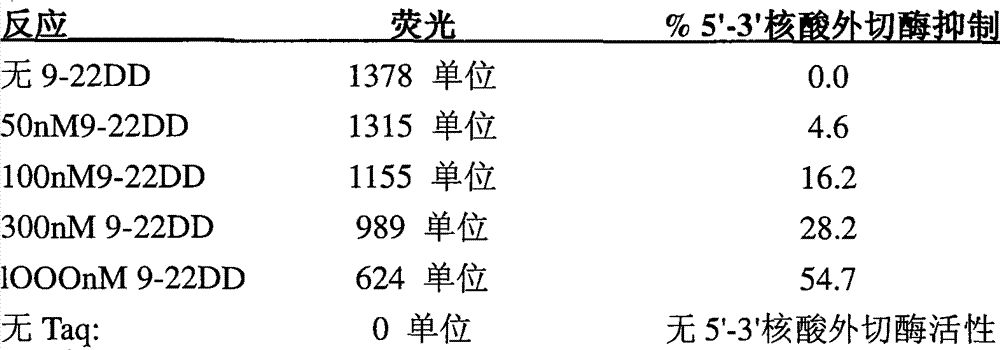
实例10在存在和不存在靶DNA时阻止引物-二聚体形成和寡聚合 Example 10 prevents primer-dimer formation and oligomerization in the presence and absence of target DNA
以25μl的终体积在存在或不存在100个基因组人类胎盘DNA(Sigma,St Louis,MO)下建立一系列LATE-PCR扩增反应。在此实验中,LATE-PCR扩增反应由下列组成:1X PCR缓冲液(Invitrogen,Carlsbad,CA),3mM MgCl2,0.25mM dNTP,1000nM过量引物,50nM限量引物,0.25μM FAM标记的探针链,0.3μM Dabcyl标记的反向互补链,1.25单位的Platinum Taq DNA聚合酶(Invitrogen,Carlsbad,CA)。所述引物和探针的序列如下:A series of LATE-PCR amplification reactions were set up in the presence or absence of 100 genomes of human placental DNA (Sigma, St Louis, MO) in a final volume of 25 μl. In this experiment, the LATE-PCR amplification reaction consisted of the following: 1X PCR buffer (Invitrogen, Carlsbad, CA), 3 mM MgCl 2 , 0.25 mM dNTPs, 1000 nM excess primer, 50 nM limiting primer, 0.25 μM FAM-labeled probe Strand, 0.3 μM Dabcyl-labeled reverse complementary strand, 1.25 units of Platinum Taq DNA polymerase (Invitrogen, Carlsbad, CA). The sequences of the primers and probes are as follows:
过量引物:5′GTTTCTTTGCTGCCGTGTTC3′(SEQ ID NO:37)Excess primer: 5'GTTTCTTTGCTGCCGTGTTC3' (SEQ ID NO: 37)
限量引物:5′CCCCAGAGACCCCAGTTGCTAACCAGAC3′(SEQ ID NO:38)Limited primer: 5′CCCCAGAGACCCCAGTTGCTAACCAGAC3′ (SEQ ID NO: 38)
FAM标记的探针链:5′[TET]AGACAGAGTTGAAAGTCAGG[Phos]3′(SEQ IDNO:39)FAM-labeled probe strand: 5'[TET]AGACAGAGTTGAAAGTCAGG[Phos]3'(SEQ IDNO:39)
Dabcyl标记的反向互补链:5′ACTTTCAACTCTGTCT[Dabcyl]3′(SEQ ID NO:40)Dabcyl-labeled reverse complementary strand: 5' ACTTTCAACTCTGTCT[Dabcyl] 3' (SEQ ID NO: 40)
这些引物和探针扩增并检测涵盖人类p53基因的外显子5和6的488个碱基对(bp)扩增子。These primers and probes amplify and detect a 488 base pair (bp)
扩增在ABI Prism7700Sequence Detector(Applied Biosystems,CA)中以由下列组成的热分布实施:1个在95℃下3分钟的循环;25个在95℃下10秒、64℃下30秒、75℃下30秒的循环;和35个在95℃下10秒、64℃下30秒、75℃下30秒、45℃下20秒的循环,在45℃步骤期间在TET通道中检测荧光。Amplifications were performed in an ABI Prism 7700 Sequence Detector (Applied Biosystems, CA) with a heat profile consisting of: 1 cycle of 3 minutes at 95°C; 25 cycles of 10 seconds at 95°C, 30 seconds at 64°C, 75°C and 35 cycles of 10 seconds at 95°C, 30 seconds at 64°C, 30 seconds at 75°C, 20 seconds at 45°C, fluorescence was detected in the TET channel during the 45°C step.
所得扩增产物在存在于0.5X TBE缓冲液中的3%琼脂糖凝胶中通过凝胶电泳分析2小时,并用溴化乙锭染色。结果示于图10中。泳道3、5、7、9、11中的试样在无基因组DNA的情况下制备。泳道2、4、6、8、10中的试样在有基因组DNA的情况下制备。泳道1含有呈100个碱基对梯的电泳尺寸标记物。如下将试剂9-22DD添加到起始反应中:泳道2和3,0nM;泳道4和5,50nM;泳道6和7,100nM;泳道8和9,200nM;泳道10和11,300nM。The resulting amplification products were analyzed by gel electrophoresis on a 3% agarose gel in 0.5X TBE buffer for 2 hours and stained with ethidium bromide. The results are shown in FIG. 10 . Samples in
毗邻凝胶的右侧,我们已标记正确产物的尺寸以及我们推断为引物-二聚体和引物寡聚物的尺寸。图10中所示结果表明,在用基因组DNA启动的反应中,增加试剂9-22DD的浓度以剂量依赖方式起作用来预防包括引物-二聚体和引物寡聚物在内的非特异性产物的表现,从而增加正确产物的特异性和产率。增加试剂9-22DD的浓度也防止在不含有基因组DNA的反应中引物二聚体和引物寡聚物的表现。Adjacent to the right side of the gel, we have marked the size of the correct product as well as what we deduce to be primer-dimers and primer-oligos. The results shown in Figure 10 indicate that increasing the concentration of reagent 9-22DD acts in a dose-dependent manner to prevent the formation of non-specific products including primer-dimers and primer oligomers in reactions initiated with genomic DNA. performance, thereby increasing the specificity and yield of the correct product. Increasing the concentration of reagent 9-22DD also prevented the expression of primer dimers and primer oligomers in reactions that did not contain genomic DNA.
实例11在双重反应中预防引物-二聚体形成 Example 11 prevents primer-dimer formation in a double reaction
以25μl的终体积在存在或不存在100个基因组人类胎盘DNA(Sigma,St Louis,MO)下建立一系列LATE-PCR扩增反应。在此实验中,LATE-PCR扩增反应由1X PCR缓冲液(Invitrogen,Carlsbad,CA)、3mM MgCl2、0.20mM dNTP组成。在每份试样中Taq聚合酶以1.25单位使用。第一扩增靶序列(产物1)为囊性纤维化病基因外显子11的一部分并用100nM的限量引物:5′GACGTTTACAGCGAATGCTTGCTAGACCAAT3′(SEQ ID NO:41)和2,000nM的过量引物:5′TCCAAGTTTGCAGAGAAAGACAAT3′(SEQ ID NO:42)扩增。第二扩增靶序列(产物2)为囊性纤维化病基因外显子10的一部分并用50nM的限量引物:5′CAGTTTTCCTGGATTATGCCTGGCACCAT3′(SEQ ID NO:43)和1000nM的过量引物:5′GCTTTGATGACGCTTCTGTATCTA3′(SEQ ID NO:44)扩增。A series of LATE-PCR amplification reactions were set up in the presence or absence of 100 genomes of human placental DNA (Sigma, St Louis, MO) in a final volume of 25 μl. In this experiment, the LATE-PCR amplification reaction consisted of 1X PCR buffer (Invitrogen, Carlsbad, CA), 3 mM MgCl2, 0.20 mM dNTPs. Taq polymerase was used at 1.25 units per sample. The first amplified target sequence (product 1) was part of
扩增在ABI Prism7700Sequence Detector(Applied Biosystems,CA)中在95℃下实施2分钟,随后为25个95℃下10秒、56℃下15秒、70℃下20秒的循环,随后为50个95℃下10秒、56℃下15秒、70℃下20秒和45℃下30秒的循环,获得荧光。Amplification was performed in an ABI Prism7700 Sequence Detector (Applied Biosystems, CA) at 95°C for 2 minutes, followed by 25 cycles of 95°C for 10 seconds, 56°C for 15 seconds, 70°C for 20 seconds, followed by 50 cycles of 95°C. Fluorescence was obtained with a cycle of 10 s at 56°C, 15 s at 56°C, 20 s at 70°C and 30 s at 45°C.
所得扩增产物在存在于0.5X TBE缓冲液中的3%琼脂糖凝胶中通过凝胶电泳分析2小时,并用溴化乙锭染色。结果示于图11中。在泳道1至6中分析的反应利用非热启动Taq聚合酶,而在泳道7至12中分析的反应利用Taq聚合酶加热启动抗体。试剂9-22DD以100nM添加至泳道反应4至6和10至12中以加以分析。The resulting amplification products were analyzed by gel electrophoresis on a 3% agarose gel in 0.5X TBE buffer for 2 hours and stained with ethidium bromide. The results are shown in Figure 11. Reactions analyzed in
毗邻凝胶的右侧,我们已添加我们对于扩增产物身份的注释,所述扩增产物包括产物1和产物2的单链扩增子(ssDNA)和双链扩增子(ds DNA)以及我们推断为引物-二聚体的更短产物。其他非特异性产物用星号标记。用非热启动聚合酶扩增而无本发明试剂(泳道1至3)产生引物-二聚体和其他非特异性产物。用热启动聚合酶扩增而无本发明试剂(泳道7至9)基本上略为纯净,但仍显示引物错导表现形式。向热启动扩增中添加本发明试剂(泳道10至12)仅产生期望的产物。将本发明试剂添加到非热启动扩增(泳道4至6)中消除引物-二聚体并且在三份重复试样中有两份(泳道4和6)也消除所有其他非特异性产物,仅一份重复试样(泳道5)表现非特异性产物。图11中所示结果表明,低浓度(100nM)的试剂9-22DD在使用非热启动Taq聚合酶或热启动Taq聚合酶时均足以防止引物-二聚体的形成,并且进一步显示,即使在使个靶和两对引物的扩增中与非热启动Taq聚合酶一起使用时,低浓度试剂9-22DD也几乎足以防止所有的引物错导表现形式。Adjacent to the right side of the gel, we have added our annotations for the identity of the amplification products, including single-stranded amplicons (ssDNA) and double-stranded amplicons (dsDNA) for
实例12通过防止引物-二聚体形成来优化双重实时PCR和实时PCR的动力学 Example 12 Optimize the kinetics of dual real-time PCR and real-time PCR by preventing primer-dimer formation
我们设计双重实时LATE-PCR分析来同时扩增鼠科动物Oct4和Xist基因的外显子内的序列(GenBank登记号分别为NM_013633和L04961)。每一反应均以50μl的终体积实施并含有下列试剂:1X PCR缓冲液(Invitrogen,Carlsbad,CA),其由2mMTris-HCl,pH8.4,和50mM KCl组成,3mM MgCl2,0.4mM各dNTP,50nM具有序列5′TGGCTGGACACCTGGCTTCAGACT3′(SEQ ID NO:45)的Oct4限量引物,2μM具有序列5′CAACTTGGGGGACTAGGC3′(SEQ ID NO:46)的Oct4过量引物,100nM具有序列5′GGTCGTACAGGAAAAGATGGCGGCTCAA3′(SEQ ID NO:47)的Xist限量引物,2μM具有序列5′TGAAAGAAACCACTAGAGGGCA3′(SEQ ID NO:48)的Xist过量引物,1μM具有序列5′TET-CCC CCT GGG ATG GCA TAG TAT GGA AGGCGG-Dabcyl3′(SEQ ID NO:49)的低TmOct4分子信标和2单位的抗体复合的
小鼠基因组DNA(Sigma,St Louis,MO)也添加到各分析中,提供PCR扩增模板。添加到各试管中基因组的数量基于6pg/基因组尺寸计算(参见Vendrely和Vendrely(1949)Experientia5:327-329)。Mouse genomic DNA (Sigma, St Louis, MO) was also added to each assay, providing a template for PCR amplification. The amount of genome added to each tube was calculated based on 6 pg/genome size (see Vendrely and Vendrely (1949) Experientia 5:327-329).
扩增在ABI Prism7700Sequence Detector(Applied Biosystems,CA)中用由下列构成的热分布实施:1个在95℃下5分钟的循环;15个在95℃下10秒、63℃下20秒和72℃下30秒的循环;和40个在95℃下15秒、55℃下25秒、72℃下35秒和45℃下30秒的循环,其中,在45℃下在TET通道中获取荧光。Amplifications were performed in an ABI Prism 7700 Sequence Detector (Applied Biosystems, CA) with a heat profile consisting of: 1 cycle of 5 minutes at 95°C; 15 cycles of 10 seconds at 95°C, 20 seconds at 63°C, and 72°C and 40 cycles of 15 seconds at 95°C, 25 seconds at 55°C, 35 seconds at 72°C and 30 seconds at 45°C, where fluorescence was acquired in the TET channel at 45°C.
在PCR结束时,扩增产物在存在于0.5X TBE缓冲液中的3%琼脂糖凝胶中通过凝胶电泳分析2小时,并用溴化乙锭染色。对于所述两种共扩增基因,均可见具有预期尺寸的双链和单链产物,表明为有效的双重LATE-PCR。At the end of PCR, amplification products were analyzed by gel electrophoresis in 3% agarose gel in 0.5X TBE buffer for 2 hours and stained with ethidium bromide. For both co-amplified genes, double-stranded and single-stranded products of the expected size were seen, indicating efficient duplex LATE-PCR.
图12阐明改变试剂9-3DD的茎成分对上述双重LATE-PCR动力学的影响,上述双重LATE-PCR含有两组用于扩增Oct4和Xist基因内的两种非同源序列的引物。所述图显示由通过与TET-Oct4分子信标杂交积聚Oct4扩增子产生的荧光信号。结果表明,在300nM9-3DD(具有三角形的线)或相同浓度的其经修饰形式9-3bDD(无三角形的粗线)的存在下在各所分析基因组浓度下(10个基因组,圆122;100个基因组,圆123;1000个基因组,圆124),CT值极为相似。相反,实时荧光信号的动力学受所述试剂茎的成分的影响。化合物9-3bDD与9-3DD相比具有Tm更高的茎,因此,我们认为,最优地防止引物-二聚体形成,这又在所有所测试基因组浓度下产生极直和平行的信号。相反,在存在不太严格的化合物9-3DD时,某些荧光信号具有更陡的斜率,但另外一些在反应早期便达到稳定,表明引物二聚体形成的随意性。在不同模板浓度和存在化合物9-3DD下产生的信号比在存在化合物9-3bDD(具有经修饰的茎)下获得的信号的平行性要低。线性扩增产生完全平行的信号(具有恒定斜率)理想上较为合意并且对于终点型分析而言尤其适宜。Figure 12 illustrates the effect of varying the stem composition of reagent 9-3DD on the kinetics of the above duplex LATE-PCR containing two sets of primers used to amplify two non-homologous sequences within the Oct4 and Xist genes. The graph shows the fluorescent signal resulting from the accumulation of Oct4 amplicons by hybridization to the TET-Oct4 molecular beacon. The results show that in the presence of 300 nM 9-3DD (line with triangles) or the same concentration of its modified form 9-3bDD (thick line without triangles) at each concentration of genomes analyzed (10 genomes,
含有9-3DD试样的琼脂糖分析揭示可能为引物二聚体的尤其在较高模板数下明显的带,在较低模板数下的极小的带与引物一致。这样的带在分析含9-3bDD的试样时未出现。Agarose analysis of the 9-3DD-containing sample revealed a band prominent especially at higher template numbers likely to be a primer dimer, and a very small band at lower template numbers consistent with the primers. Such a band did not appear when analyzing samples containing 9-3bDD.
图13阐明改变试剂9-3bDD的浓度对本实例中所述并且也用于图12中的双重LATE-PCR的影响。在此例中,将试剂9-3bDD的浓度自300nM(无三角形的粗线)降低至200nM(具有三角形的线)再次影响线性扩增的斜率,这是因为形成引物二聚体,如通过琼脂糖凝胶分析所确认。结果,某些含有低起始模板数(10个基因组,圆132)的试样在最后一次循环(“终点”)时具有比含有更高起始模板数(100个基因组,圆133,和1000个基因组,圆134)高的荧光。FIG. 13 illustrates the effect of varying the concentration of reagent 9-3bDD on the duplex LATE-PCR described in this example and also used in FIG. 12 . In this example, decreasing the concentration of reagent 9-3bDD from 300 nM (thick line without triangles) to 200 nM (line with triangles) again affects the slope of linear amplification due to the formation of primer-dimers as seen by agar Confirmed by sugar gel analysis. As a result, some samples containing low starting template numbers (10 genomes, circle 132) had higher starting template numbers (100 genomes,
也在使用一对引物扩增一个模板的LATE-PCR中测试本专利申请案中所述试剂对PCR效率的浓度效应。扩增的模板为与图12和图13中阐述的双重扩增中所用相同的鼠科动物Oct4序列,引物和分子信标序列也与所述反应中的相同。The concentration effect of the reagents described in this patent application on PCR efficiency was also tested in LATE-PCR using a pair of primers to amplify one template. The amplified template was the same murine Oct4 sequence as used in the double amplification illustrated in Figures 12 and 13, and the primers and molecular beacon sequences were also the same as in the reaction.
每一反应均以100μl的终体积实施并含有下列试剂:1X PCR缓冲液(Invitrogen,Carlsbad,CA),其由20mM Tris-HCl,pH8.4,和50mM KCl组成,3mM MgCl2,0.25mM各dNTP,50nM Oct4限量引物,2μM Oct4过量引物,1μM低TmTET-Oct4分子信标和2单位的抗体复合的
小鼠基因组DNA也添加到各分析中并提供PCR扩增模板,如此实例中所述双重LATE-PCR中所规定。扩增同样在ABI Prism 7700 Sequence Detector中用与所述双重反应中所详述热分布相同的热分布实施。在PCR结束时,扩增产物在存在于0.5X TBE缓冲液中的3%琼脂糖凝胶中通过凝胶电泳分析2小时,并用溴化乙锭染色。所述双链和单链产物在凝胶上均可见并具有预期的尺寸,表明有效的LATE-PCR扩增。Mouse genomic DNA was also added to each assay and provided a template for PCR amplification, as specified in the duplex LATE-PCR described in this example. Amplification was also performed in the ABI Prism 7700 Sequence Detector with the same thermal profile as detailed in the duplex reaction. At the end of PCR, amplification products were analyzed by gel electrophoresis in 3% agarose gel in 0.5X TBE buffer for 2 hours and stained with ethidium bromide. Both double-stranded and single-stranded products were visible on the gel and had the expected size, indicating efficient LATE-PCR amplification.
也测试增加化合物9-3DD的浓度对Oct4模板扩增效率的影响。CT值自使用每一测试的9-3DD浓度:150nM、300nM、450nM实施的含有5个基因组(对于所测试的每一9-3DD浓度,两个重复试样的平均值)、20个基因组(对于所测试的每一9-3DD浓度,两个重复试样的平均值)、100个基因组和1000个基因组的实时PCR分析获得。每一浓度下各CT点系列的线性回归示于图14中,其中三角形为450nM浓度,空白正方形为300nM,填充正方形为150nM。自此图立即可看出,450nM9-3DD将荧光信号的出现大大延迟于阈值以上,也改变PCR扩增的剂量依赖性(参见在10个基因拷贝和40个基因拷贝处的点,其远离回归线)。另一方面,使用150nM或300nM9-3DD获得的CT值极为相似,表明模板拷贝数与荧光信号的第一次出现之间有线性关系。The effect of increasing the concentration of compound 9-3DD on the amplification efficiency of Oct4 template was also tested. C T values from 5 genomes (average of two replicates for each 9-3DD concentration tested), 20 genomes performed using each tested 9-3DD concentration: 150 nM, 300 nM, 450 nM (Average of two replicates for each 9-3DD concentration tested), 100 genome and 1000 genome real-time PCR analyzes obtained. The linear regression for each series of CT points at each concentration is shown in Figure 14, with triangles at 450 nM concentration, open squares at 300 nM, and filled squares at 150 nM. Immediately from this figure it can be seen that 450nM 9-3DD greatly delays the onset of the fluorescent signal above threshold and also alters the dose dependence of PCR amplification (see points at 10 gene copies and 40 gene copies which are far from the regression line ). On the other hand, the C T values obtained with 150 nM or 300 nM 9-3DD were very similar, indicating a linear relationship between the template copy number and the first appearance of the fluorescent signal.
然而,对荧光实时图案的分析突出两种条件(浓度)间的差异,如图15中所示。由100个基因组(圆151)或1000个基因组(圆152)产生的曲线的斜率在使用300nM9-3DD时(无三角形的粗线)比在使用150nM9-3DD(具有三角形的线)时要陡,表明更为严格的条件即300nM消除引物二聚体,从而提高扩增效率。However, analysis of the fluorescence real-time patterns highlighted differences between the two conditions (concentrations), as shown in FIG. 15 . The slope of the curve generated by 100 genomes (circle 151) or 1000 genomes (circle 152) is steeper when using 300 nM 9-3DD (thick line without triangles) than when using 150 nM 9-3DD (line with triangles), It shows that the more stringent condition, namely 300nM, eliminates the primer dimer, thereby improving the amplification efficiency.
实例13多种本发明试剂的用途 The purposes of multiple reagents of the present invention of example 13
制备LATE-PCR反应混合物来逐个扩增五种不同的人类基因DNA起始材料的靶序列并在多重反应中一起扩增所有五种序列。各靶序列需要其自己的限量和过量引物对。靶序列为(1)191个碱基对的Globin等位基因,(2)312个碱基对的Tay Sachs G269等位基因,(3)452个碱基对的Tay Sachs1278和1421等位基因,(4)线粒体超变区1的549个碱基对区段,和(5)包含p53基因外显子7和8的611个碱基对区段。所述25μl反应混合物含有1x PCR缓冲液(Invitrogen)、0.4mM dNTP、3mM Mg++、0.24xSYBR Green和1.5单位的Taq DNA聚合酶(Invitrogen)。限量引物以50nM的浓度添加,超量引物以1000nM的浓度添加。将所有5对引物均添加到多重反应中。热循环为45个在95℃下10秒、64℃下20秒和72℃下1分钟的循环。A LATE-PCR reaction mixture was prepared to individually amplify target sequences from five different human genetic DNA starting materials and to amplify all five sequences together in a multiplex reaction. Each target sequence requires its own limited and excess primer pairs. The target sequences were (1) the Globin allele of 191 base pairs, (2) the Tay Sachs G269 allele of 312 base pairs, (3) the Tay Sachs 1278 and 1421 alleles of 452 base pairs, (4) a 549 base pair segment of mitochondrial
具有单个引物对和单个靶的反应混合物和具有所有五对引物和所有五种靶的反应混合物均在存在25nM化合物9-2DD和100nM化合物12-3DD的组合的情况下扩增。也在不添加任一本发明试剂的情况下扩增所述五重反应混合物。通过凝胶电泳检验反应产物。各扩增的凝胶电泳结果显示于图16中,其包括在泳道r中的尺寸标记物(100个碱基对差异)。中央泳道g至k分别为靶序列(1)至(5)的单独扩增的产物。泳道1至q为包括化合物9-22DD和化合物12-3DD的混合物的六份重复试样五重扩增的产物。泳道a-f为不包括本发明试剂的六份重复试样五重扩增的产物。图16显示,与不添加任何化合物的多重反应相比,本发明混合物增强扩增(更多和更纯净的期望扩增子),表明试剂混合物可用于本发明试剂盒、扩增和分析中。Reaction mixtures with a single primer pair and a single target and reaction mixtures with all five primer pairs and all five targets were amplified in the presence of the combination of 25 nM Compound 9-2DD and 100 nM Compound 12-3DD. The quintuplex reaction mixture was also amplified without the addition of any of the reagents of the invention. Reaction products were examined by gel electrophoresis. The gel electrophoresis results for each amplification are shown in Figure 16, which includes the size marker (100 base pair difference) in lane r. Central lanes g to k are the products of individual amplification of target sequences (1) to (5), respectively.
实例14作用测试模式 Example 14 function test mode
我们已设计一种测试法来定量地研究本发明试剂的引物错导降低(提高特异性)和聚合酶抑制效应,我们认为其将第一作用模式和第三作用模式区别开来。所述测试为PCR扩增分析,其基本上类似于实例1中所述分析,下列除外:所述扩增反应混合物含有一半(1000个基因组)的剪切基因组DNA,热循环的最后部分自70个循环降低至40个循环。扩增在添加变化量的本发明试剂下实施,添加量通常为25nM、50nM、100nM、300nM、1500nM和3000nM。所述测试包括两个分析:第一,特异性分析,扩增产物的解链曲线;和,第二,抑制性分析,合成的双链产物的实时荧光曲线。We have devised an assay to quantitatively study the mispriming reduction (increased specificity) and polymerase inhibition effects of the reagents of the invention, which we believe differentiate the primary mode of action from the tertiary mode of action. The test was a PCR amplification assay, which was essentially similar to the assay described in Example 1, with the following exceptions: the amplification reaction mixture contained half (1000 genomes) of sheared genomic DNA, and the last part of the thermocycling was from 70 cycles down to 40 cycles. Amplification is carried out with the addition of varying amounts of the reagents of the invention, typically 25 nM, 50 nM, 100 nM, 300 nM, 1500 nM and 3000 nM. The assay included two assays: first, a specificity assay, the melting curve of the amplified product; and, second, an inhibition assay, a real-time fluorescence curve of the synthesized double-stranded product.
图17至18分别给出两种本发明试剂化合物12-3DD和化合物12-C3DD的一部分分析结果。在各图1中,栏I给出数种选择的试剂浓度的解链曲线,如所显示。在各图中,栏II给出相同浓度的实时荧光曲线,如所显示。参照图17,栏I解链曲线显示,化合物12-3DD在100nM和以上的浓度下(最低浓度100nM略高于实例1中所述反应中的最低浓度)达成高特异性(避免引物错导)。参照图17,栏II实时荧光曲线显示,当化合物12-3DD的浓度在100nM以上增加时聚合酶抑制程度逐渐增加,直到反应在高于1000nm的浓度下基本停止。抑制反应反映在产生的总双链产物(包括期望的特异性产物和引物错导的非特异性产物)的较低量上,表现为稳定的荧光水平和CT值中的延迟(100nM为19.6,300nM为21.1,1500nM和3000nM下不存在即至少40)。参照图18,栏I解链曲线显示,化合物12-3DD在300nM和以上的浓度下(最低浓度300nM略高于实例1中所述反应中的最低浓度)达成高特异性。参照图18,栏II实时荧光曲线显示,聚合酶抑制随着化合物12-C3DD的浓度在300nM以上增加而逐渐增大(CT值为100nM下18.8,300nM下18.8,1500nM下21.1,而3000nM下为24.5),但反应甚至在3000nM的浓度下也不停止。Figures 17 to 18 respectively show a part of the analysis results of the two reagents of the present invention, compound 12-3DD and compound 12-C3DD. In each Figure 1, column I gives the melting curves for several selected reagent concentrations, as indicated. In each figure, column II gives the real-time fluorescence curves for the same concentrations, as indicated. Referring to Figure 17, column I melting curves show that compound 12-3DD achieves high specificity (to avoid mispriming) at concentrations of 100 nM and above (the lowest concentration of 100 nM is slightly higher than the lowest concentration in the reaction described in Example 1) . Referring to Figure 17, column II real-time fluorescence curves show that when the concentration of compound 12-3DD increases above 100nM, the degree of polymerase inhibition gradually increases until the reaction is substantially stopped at a concentration above 1000nM. Inhibitory responses were reflected in lower amounts of total double-stranded product generated (including the desired specific product and misprimed non-specific products), manifested by stable fluorescence levels and delays in C T values (19.6 for 100 nM, 21.1 at 300 nM, absent at 1500 nM and 3000 nM ie at least 40). Referring to Fig. 18, column I melting curves show that compound 12-3DD achieves high specificity at concentrations of 300 nM and above (the lowest concentration of 300 nM is slightly higher than the lowest concentration in the reaction described in Example 1). Referring to Fig. 18, column II real-time fluorescence curve shows that polymerase inhibition gradually increases with the concentration of compound 12-C3DD increasing above 300nM ( CT value is 18.8 at 100nM, 18.8 at 300nM, 21.1 at 1500nM, and 21.1 at 3000nM 24.5), but the reaction did not stop even at a concentration of 3000 nM.
比较图18和图18,可看出,化合物12-C3DD总性能比化合物12-3DD总性能的浓度依赖性要小。因此,对于此特定扩增反应,当化合物12-C3DD浓度自300nM变至1500nM时产物的CT延迟和稳定的荧光增加与当化合物12-3DD浓度自100nM变至300nM时产生的结果大致相同。Comparing Figure 18 and Figure 18, it can be seen that the concentration dependence of the total performance of compound 12-C3DD is smaller than that of compound 12-3DD. Thus, for this particular amplification reaction, varying the concentration of compound 12-C3DD from 300 nM to 1500 nM yielded approximately the same CT delay and steady fluorescence increase in the product as varying the concentration of compound 12-3DD from 100 nM to 300 nM.
已阐述许多本发明实施例。然而,应理解,在不背离本发明精神和范围的情况下可作出各种修改。因此,其他实施例在随附申请专利范围的范围内。A number of embodiments of the invention have been described. However, it should be understood that various modifications may be made without departing from the spirit and scope of the invention. Accordingly, other embodiments are within the scope of the appended claims.
Claims (24)
Applications Claiming Priority (3)
| Application Number | Priority Date | Filing Date | Title |
|---|---|---|---|
| US61967004P | 2004-10-18 | 2004-10-18 | |
| US60/619,670 | 2004-10-18 | ||
| PCT/US2005/037668 WO2006044995A1 (en) | 2004-10-18 | 2005-10-17 | Reagents and methods for improving reproducibility and reducing mispriming in pcr amplification |
Publications (2)
| Publication Number | Publication Date |
|---|---|
| CN101076608A CN101076608A (en) | 2007-11-21 |
| CN101076608B true CN101076608B (en) | 2013-04-17 |
Family
ID=36203307
Family Applications (1)
| Application Number | Title | Priority Date | Filing Date |
|---|---|---|---|
| CN2005800426234A Expired - Lifetime CN101076608B (en) | 2004-10-18 | 2005-10-17 | Reagents and methods for improving reproducibility and reducing mispriming in PCR amplification |
Country Status (14)
| Country | Link |
|---|---|
| US (2) | US7517977B2 (en) |
| EP (1) | EP1802774B1 (en) |
| JP (2) | JP5165376B2 (en) |
| KR (1) | KR20070090158A (en) |
| CN (1) | CN101076608B (en) |
| AT (1) | ATE541055T1 (en) |
| AU (1) | AU2005295299B2 (en) |
| BR (1) | BRPI0516619B1 (en) |
| CA (1) | CA2584576C (en) |
| ES (1) | ES2380775T3 (en) |
| NO (1) | NO341716B1 (en) |
| NZ (1) | NZ554701A (en) |
| RU (1) | RU2495046C2 (en) |
| WO (1) | WO2006044995A1 (en) |
Families Citing this family (24)
| Publication number | Priority date | Publication date | Assignee | Title |
|---|---|---|---|---|
| CN101076608B (en) * | 2004-10-18 | 2013-04-17 | 布兰迪斯大学 | Reagents and methods for improving reproducibility and reducing mispriming in PCR amplification |
| US20070212704A1 (en) * | 2005-10-03 | 2007-09-13 | Applera Corporation | Compositions, methods, and kits for amplifying nucleic acids |
| US7833716B2 (en) | 2006-06-06 | 2010-11-16 | Gen-Probe Incorporated | Tagged oligonucleotides and their use in nucleic acid amplification methods |
| US7972786B2 (en) * | 2006-07-07 | 2011-07-05 | Brandeis University | Detection and analysis of influenza virus |
| CN102421918B (en) * | 2009-03-12 | 2016-01-20 | 布兰代斯大学 | For reagent and the method for PCR |
| US9644233B2 (en) | 2009-03-26 | 2017-05-09 | Xiamen Amoy Diagnostics Co., Ltd. | Loop-shaped primer used in nucleic acid amplification and the use thereof |
| US8815514B2 (en) * | 2009-07-02 | 2014-08-26 | Co-Diagnostics, Inc. | Detection primers for nucleic acid extension or amplification reactions |
| EP2491144B1 (en) | 2009-10-21 | 2015-09-30 | Brandeis University | Methods for analyzing single-stranded nucleic acid sequences |
| US9169514B2 (en) * | 2010-12-03 | 2015-10-27 | Brandeis University | Detecting nucleic acid variations within populations of genomes |
| JP6490576B2 (en) * | 2012-04-12 | 2019-03-27 | ニユー・イングランド・バイオレイブス・インコーポレイテツド | Synthetic nucleic acids for polymerization reactions |
| HK1217517A1 (en) | 2013-01-23 | 2017-01-13 | Brandeis University | Reagents for improving pcr accuracy |
| EP3024946A1 (en) * | 2013-07-24 | 2016-06-01 | Brandeis University | Dna methylation analysis |
| US20160222434A1 (en) * | 2013-09-13 | 2016-08-04 | Brandeis University | Modified Polymerase Compositions, Methods and Kits |
| EP4512908A3 (en) * | 2014-05-19 | 2025-03-26 | William Marsh Rice University | Allele-specific amplification using a composition of overlapping non-allele-specific primer and allele-specific blocker oligonucleotides |
| US10196678B2 (en) | 2014-10-06 | 2019-02-05 | ALVEO Technologies Inc. | System and method for detection of nucleic acids |
| CA2971200A1 (en) | 2014-12-19 | 2016-06-23 | Brandeis University | Mispriming prevention reagents |
| US10557134B2 (en) | 2015-02-24 | 2020-02-11 | Trustees Of Boston University | Protection of barcodes during DNA amplification using molecular hairpins |
| JP6962596B2 (en) * | 2016-05-18 | 2021-11-05 | インテグレーテッド ナノ−テクノロジーズ,インコーポレイティド | PCR product detection method |
| CN109996888A (en) | 2016-09-23 | 2019-07-09 | 阿尔韦奥科技公司 | For testing and analyzing the method and composition of object |
| CN113454236A (en) * | 2018-12-20 | 2021-09-28 | 阿尔韦奥科技公司 | Methods and compositions for reducing non-specific amplification in isothermal amplification reactions |
| WO2020132008A1 (en) | 2018-12-20 | 2020-06-25 | Alveo Technologies, Inc. | Handheld impedance-based diagnostic test system for detecting analytes |
| KR102275038B1 (en) * | 2019-12-11 | 2021-07-08 | (주) 제노텍 | A PCR method for increasing the discrimination of allele and a PCR kit for increasing the discrimination of allele |
| US20230227833A1 (en) * | 2020-06-22 | 2023-07-20 | Nuhigh Biotechnologies Co., Ltd. | Nucleic acid ligand and use thereof |
| US12472492B2 (en) | 2020-08-14 | 2025-11-18 | Alveo Technologies, Inc. | Systems and methods of sample depositing and testing |
Citations (4)
| Publication number | Priority date | Publication date | Assignee | Title |
|---|---|---|---|---|
| US5866336A (en) * | 1996-07-16 | 1999-02-02 | Oncor, Inc. | Nucleic acid amplification oligonucleotides with molecular energy transfer labels and methods based thereon |
| WO2001002559A1 (en) * | 1999-07-02 | 2001-01-11 | Invitrogen Corporation | Compositions and methods for enhanced sensitivity and specificity of nucleic acid synthesis |
| US6183967B1 (en) * | 1995-06-07 | 2001-02-06 | Nexstar Pharmaceuticals | Nucleic acid ligand inhibitors to DNA polymerases |
| US6787308B2 (en) * | 1998-07-30 | 2004-09-07 | Solexa Ltd. | Arrayed biomolecules and their use in sequencing |
Family Cites Families (20)
| Publication number | Priority date | Publication date | Assignee | Title |
|---|---|---|---|---|
| US4965188A (en) * | 1986-08-22 | 1990-10-23 | Cetus Corporation | Process for amplifying, detecting, and/or cloning nucleic acid sequences using a thermostable enzyme |
| US4683195A (en) * | 1986-01-30 | 1987-07-28 | Cetus Corporation | Process for amplifying, detecting, and/or-cloning nucleic acid sequences |
| US4683202A (en) * | 1985-03-28 | 1987-07-28 | Cetus Corporation | Process for amplifying nucleic acid sequences |
| US5066584A (en) * | 1988-09-23 | 1991-11-19 | Cetus Corporation | Methods for generating single stranded dna by the polymerase chain reaction |
| US5874557A (en) * | 1990-06-11 | 1999-02-23 | Nexstar Pharmaceuticals, Inc. | Nucleic acid ligand inhibitors to DNA polymerases |
| US5693502A (en) * | 1990-06-11 | 1997-12-02 | Nexstar Pharmaceuticals, Inc. | Nucleic acid ligand inhibitors to DNA polymerases |
| US5210015A (en) * | 1990-08-06 | 1993-05-11 | Hoffman-La Roche Inc. | Homogeneous assay system using the nuclease activity of a nucleic acid polymerase |
| US5994056A (en) * | 1991-05-02 | 1999-11-30 | Roche Molecular Systems, Inc. | Homogeneous methods for nucleic acid amplification and detection |
| US5338671A (en) * | 1992-10-07 | 1994-08-16 | Eastman Kodak Company | DNA amplification with thermostable DNA polymerase and polymerase inhibiting antibody |
| US5811300A (en) * | 1992-12-07 | 1998-09-22 | Ribozyme Pharmaceuticals, Inc. | TNF-α ribozymes |
| US5925517A (en) * | 1993-11-12 | 1999-07-20 | The Public Health Research Institute Of The City Of New York, Inc. | Detectably labeled dual conformation oligonucleotide probes, assays and kits |
| ES2321243T3 (en) * | 1995-06-07 | 2009-06-03 | Gilead Sciences, Inc. | NUCLEIC ACID LIGANDS THAT BIND DNA POLYMERASES AND INHIBIT THEM. |
| US5773258A (en) * | 1995-08-25 | 1998-06-30 | Roche Molecular Systems, Inc. | Nucleic acid amplification using a reversibly inactivated thermostable enzyme |
| AU713667B2 (en) * | 1996-04-12 | 1999-12-09 | Phri Properties, Inc. | Detection probes, kits and assays |
| US6117635A (en) * | 1996-07-16 | 2000-09-12 | Intergen Company | Nucleic acid amplification oligonucleotides with molecular energy transfer labels and methods based thereon |
| CA2433330A1 (en) * | 2000-12-27 | 2002-07-25 | Invitrogen Corporation | Primers and methods for the detection and discrimination of nucleic acids |
| US7198897B2 (en) | 2001-12-19 | 2007-04-03 | Brandeis University | Late-PCR |
| WO2004090153A2 (en) * | 2003-04-01 | 2004-10-21 | Eragen Biosciences,Inc. | Polymerase inhibitor and method of using same |
| CN101076608B (en) * | 2004-10-18 | 2013-04-17 | 布兰迪斯大学 | Reagents and methods for improving reproducibility and reducing mispriming in PCR amplification |
| US20070212704A1 (en) * | 2005-10-03 | 2007-09-13 | Applera Corporation | Compositions, methods, and kits for amplifying nucleic acids |
-
2005
- 2005-10-17 CN CN2005800426234A patent/CN101076608B/en not_active Expired - Lifetime
- 2005-10-17 AT AT05813115T patent/ATE541055T1/en active
- 2005-10-17 EP EP05813115A patent/EP1802774B1/en not_active Expired - Lifetime
- 2005-10-17 RU RU2007118546/10A patent/RU2495046C2/en not_active IP Right Cessation
- 2005-10-17 KR KR1020077011243A patent/KR20070090158A/en not_active Ceased
- 2005-10-17 AU AU2005295299A patent/AU2005295299B2/en not_active Ceased
- 2005-10-17 NZ NZ554701A patent/NZ554701A/en not_active IP Right Cessation
- 2005-10-17 ES ES05813115T patent/ES2380775T3/en not_active Expired - Lifetime
- 2005-10-17 JP JP2007537035A patent/JP5165376B2/en not_active Expired - Fee Related
- 2005-10-17 US US11/252,506 patent/US7517977B2/en active Active
- 2005-10-17 CA CA2584576A patent/CA2584576C/en not_active Expired - Fee Related
- 2005-10-17 WO PCT/US2005/037668 patent/WO2006044995A1/en not_active Ceased
- 2005-10-17 BR BRPI0516619A patent/BRPI0516619B1/en not_active IP Right Cessation
-
2007
- 2007-05-15 NO NO20072507A patent/NO341716B1/en not_active IP Right Cessation
-
2009
- 2009-03-20 US US12/382,670 patent/US20090226973A1/en not_active Abandoned
-
2012
- 2012-10-24 JP JP2012234683A patent/JP2013063070A/en active Pending
Patent Citations (4)
| Publication number | Priority date | Publication date | Assignee | Title |
|---|---|---|---|---|
| US6183967B1 (en) * | 1995-06-07 | 2001-02-06 | Nexstar Pharmaceuticals | Nucleic acid ligand inhibitors to DNA polymerases |
| US5866336A (en) * | 1996-07-16 | 1999-02-02 | Oncor, Inc. | Nucleic acid amplification oligonucleotides with molecular energy transfer labels and methods based thereon |
| US6787308B2 (en) * | 1998-07-30 | 2004-09-07 | Solexa Ltd. | Arrayed biomolecules and their use in sequencing |
| WO2001002559A1 (en) * | 1999-07-02 | 2001-01-11 | Invitrogen Corporation | Compositions and methods for enhanced sensitivity and specificity of nucleic acid synthesis |
Also Published As
| Publication number | Publication date |
|---|---|
| EP1802774A4 (en) | 2008-10-01 |
| CA2584576A1 (en) | 2006-04-27 |
| CA2584576C (en) | 2015-12-08 |
| CN101076608A (en) | 2007-11-21 |
| BRPI0516619B1 (en) | 2016-02-10 |
| ATE541055T1 (en) | 2012-01-15 |
| EP1802774A1 (en) | 2007-07-04 |
| EP1802774B1 (en) | 2012-01-11 |
| ES2380775T3 (en) | 2012-05-18 |
| US20090226973A1 (en) | 2009-09-10 |
| RU2007118546A (en) | 2008-11-27 |
| NO20072507L (en) | 2007-07-06 |
| US20060177842A1 (en) | 2006-08-10 |
| AU2005295299B2 (en) | 2010-10-21 |
| JP2013063070A (en) | 2013-04-11 |
| JP5165376B2 (en) | 2013-03-21 |
| BRPI0516619A (en) | 2008-09-16 |
| KR20070090158A (en) | 2007-09-05 |
| WO2006044995A1 (en) | 2006-04-27 |
| RU2495046C2 (en) | 2013-10-10 |
| AU2005295299A1 (en) | 2006-04-27 |
| NZ554701A (en) | 2010-03-26 |
| US7517977B2 (en) | 2009-04-14 |
| NO341716B1 (en) | 2018-01-08 |
| JP2008516613A (en) | 2008-05-22 |
Similar Documents
| Publication | Publication Date | Title |
|---|---|---|
| CN101076608B (en) | Reagents and methods for improving reproducibility and reducing mispriming in PCR amplification | |
| CN102421918B (en) | For reagent and the method for PCR | |
| EP1275715B1 (en) | Method for amplifyingand detecting a nucleic acid by using double-stranded nucleic acid as template | |
| JP6301881B2 (en) | Isothermal nucleic acid amplification | |
| JP3843215B2 (en) | Primers, amplification methods and kits with high specificity | |
| CN103459612A (en) | Methods and kits for detecting nucleic acid mutants in wild-type populations | |
| EP3417072B1 (en) | Method of eliminating background amplification of nucleic acid targets | |
| AU2005230833A1 (en) | Quantitative amplification with a labeled probe and 3' to 5' exonuclease activity | |
| KR102270892B1 (en) | Cooperative primers, probes, and applications thereof | |
| US20180094309A1 (en) | Nucleic acid retro-activated primers | |
| JP2013507910A (en) | Methods and compositions for amplifying target sequences from nucleic acid samples | |
| CN101495657B (en) | Nucleic Acid Amplification Using Reversibly Modified Oligonucleotides | |
| JP2017537648A (en) | Mispriming prevention reagent | |
| CN115702250A (en) | Nucleic Acid Amplification with Exponential Base -3 and Above Using Cyclic Probes | |
| CN102639719B (en) | With the primer of chemically modified compared to DNA preferential amplification mRNA | |
| JP3974441B2 (en) | Nucleic acid synthesis method | |
| JP2021514637A (en) | How to Amplify Nucleic Acids with Improved Specificity | |
| JP2004194619A (en) | Enzymatic reaction method using competitive nucleic acid | |
| JP2024059627A (en) | Reagents, mixtures, kits and methods for amplifying nucleic acids | |
| IL203074A (en) | Chimeric primers for improved nucleic acid amplification reactions |
Legal Events
| Date | Code | Title | Description |
|---|---|---|---|
| C06 | Publication | ||
| PB01 | Publication | ||
| C10 | Entry into substantive examination | ||
| SE01 | Entry into force of request for substantive examination | ||
| C14 | Grant of patent or utility model | ||
| GR01 | Patent grant | ||
| CX01 | Expiry of patent term | ||
| CX01 | Expiry of patent term |
Granted publication date: 20130417 |