CN113454236A - Methods and compositions for reducing non-specific amplification in isothermal amplification reactions - Google Patents
Methods and compositions for reducing non-specific amplification in isothermal amplification reactions Download PDFInfo
- Publication number
- CN113454236A CN113454236A CN201980092722.5A CN201980092722A CN113454236A CN 113454236 A CN113454236 A CN 113454236A CN 201980092722 A CN201980092722 A CN 201980092722A CN 113454236 A CN113454236 A CN 113454236A
- Authority
- CN
- China
- Prior art keywords
- seq
- nucleic acid
- nucleotide sequence
- oligonucleotide
- lamp
- Prior art date
- Legal status (The legal status is an assumption and is not a legal conclusion. Google has not performed a legal analysis and makes no representation as to the accuracy of the status listed.)
- Pending
Links
Images


Classifications
-
- C—CHEMISTRY; METALLURGY
- C12—BIOCHEMISTRY; BEER; SPIRITS; WINE; VINEGAR; MICROBIOLOGY; ENZYMOLOGY; MUTATION OR GENETIC ENGINEERING
- C12N—MICROORGANISMS OR ENZYMES; COMPOSITIONS THEREOF; PROPAGATING, PRESERVING, OR MAINTAINING MICROORGANISMS; MUTATION OR GENETIC ENGINEERING; CULTURE MEDIA
- C12N9/00—Enzymes; Proenzymes; Compositions thereof; Processes for preparing, activating, inhibiting, separating or purifying enzymes
- C12N9/10—Transferases (2.)
- C12N9/12—Transferases (2.) transferring phosphorus containing groups, e.g. kinases (2.7)
- C12N9/1241—Nucleotidyltransferases (2.7.7)
- C12N9/1252—DNA-directed DNA polymerase (2.7.7.7), i.e. DNA replicase
-
- C—CHEMISTRY; METALLURGY
- C12—BIOCHEMISTRY; BEER; SPIRITS; WINE; VINEGAR; MICROBIOLOGY; ENZYMOLOGY; MUTATION OR GENETIC ENGINEERING
- C12Q—MEASURING OR TESTING PROCESSES INVOLVING ENZYMES, NUCLEIC ACIDS OR MICROORGANISMS; COMPOSITIONS OR TEST PAPERS THEREFOR; PROCESSES OF PREPARING SUCH COMPOSITIONS; CONDITION-RESPONSIVE CONTROL IN MICROBIOLOGICAL OR ENZYMOLOGICAL PROCESSES
- C12Q1/00—Measuring or testing processes involving enzymes, nucleic acids or microorganisms; Compositions therefor; Processes of preparing such compositions
- C12Q1/68—Measuring or testing processes involving enzymes, nucleic acids or microorganisms; Compositions therefor; Processes of preparing such compositions involving nucleic acids
- C12Q1/6844—Nucleic acid amplification reactions
-
- C—CHEMISTRY; METALLURGY
- C12—BIOCHEMISTRY; BEER; SPIRITS; WINE; VINEGAR; MICROBIOLOGY; ENZYMOLOGY; MUTATION OR GENETIC ENGINEERING
- C12Q—MEASURING OR TESTING PROCESSES INVOLVING ENZYMES, NUCLEIC ACIDS OR MICROORGANISMS; COMPOSITIONS OR TEST PAPERS THEREFOR; PROCESSES OF PREPARING SUCH COMPOSITIONS; CONDITION-RESPONSIVE CONTROL IN MICROBIOLOGICAL OR ENZYMOLOGICAL PROCESSES
- C12Q1/00—Measuring or testing processes involving enzymes, nucleic acids or microorganisms; Compositions therefor; Processes of preparing such compositions
- C12Q1/68—Measuring or testing processes involving enzymes, nucleic acids or microorganisms; Compositions therefor; Processes of preparing such compositions involving nucleic acids
- C12Q1/6844—Nucleic acid amplification reactions
- C12Q1/6848—Nucleic acid amplification reactions characterised by the means for preventing contamination or increasing the specificity or sensitivity of an amplification reaction
-
- C—CHEMISTRY; METALLURGY
- C12—BIOCHEMISTRY; BEER; SPIRITS; WINE; VINEGAR; MICROBIOLOGY; ENZYMOLOGY; MUTATION OR GENETIC ENGINEERING
- C12Q—MEASURING OR TESTING PROCESSES INVOLVING ENZYMES, NUCLEIC ACIDS OR MICROORGANISMS; COMPOSITIONS OR TEST PAPERS THEREFOR; PROCESSES OF PREPARING SUCH COMPOSITIONS; CONDITION-RESPONSIVE CONTROL IN MICROBIOLOGICAL OR ENZYMOLOGICAL PROCESSES
- C12Q1/00—Measuring or testing processes involving enzymes, nucleic acids or microorganisms; Compositions therefor; Processes of preparing such compositions
- C12Q1/68—Measuring or testing processes involving enzymes, nucleic acids or microorganisms; Compositions therefor; Processes of preparing such compositions involving nucleic acids
- C12Q1/6876—Nucleic acid products used in the analysis of nucleic acids, e.g. primers or probes
-
- C—CHEMISTRY; METALLURGY
- C12—BIOCHEMISTRY; BEER; SPIRITS; WINE; VINEGAR; MICROBIOLOGY; ENZYMOLOGY; MUTATION OR GENETIC ENGINEERING
- C12Y—ENZYMES
- C12Y207/00—Transferases transferring phosphorus-containing groups (2.7)
- C12Y207/07—Nucleotidyltransferases (2.7.7)
- C12Y207/07007—DNA-directed DNA polymerase (2.7.7.7), i.e. DNA replicase
Landscapes
- Chemical & Material Sciences (AREA)
- Life Sciences & Earth Sciences (AREA)
- Health & Medical Sciences (AREA)
- Organic Chemistry (AREA)
- Zoology (AREA)
- Wood Science & Technology (AREA)
- Engineering & Computer Science (AREA)
- Molecular Biology (AREA)
- Proteomics, Peptides & Aminoacids (AREA)
- Genetics & Genomics (AREA)
- Bioinformatics & Cheminformatics (AREA)
- Biochemistry (AREA)
- General Engineering & Computer Science (AREA)
- General Health & Medical Sciences (AREA)
- Biotechnology (AREA)
- Microbiology (AREA)
- Analytical Chemistry (AREA)
- Chemical Kinetics & Catalysis (AREA)
- Immunology (AREA)
- Biophysics (AREA)
- Physics & Mathematics (AREA)
- Medicinal Chemistry (AREA)
- Biomedical Technology (AREA)
- Measuring Or Testing Involving Enzymes Or Micro-Organisms (AREA)
- Saccharide Compounds (AREA)
- Apparatus Associated With Microorganisms And Enzymes (AREA)
- Enzymes And Modification Thereof (AREA)
Abstract
实施方式涉及用于减少等温扩增反应中的非特异性扩增的方法、系统和组合物。一些实施方式涉及用特定寡核苷酸减少环介导等温扩增(LAMP)反应中的非特异性扩增。

Embodiments relate to methods, systems and compositions for reducing non-specific amplification in isothermal amplification reactions. Some embodiments relate to reducing non-specific amplification in loop-mediated isothermal amplification (LAMP) reactions with specific oligonucleotides.
Description
RELATED APPLICATIONS
This application claims priority from U.S. provisional application 62/782,610 entitled "METHODS AND COMPOSITIONS TO REDUCE non-aqueous AMPLIFICATION REACTIONS" filed on 20.12.2018, which is expressly incorporated by reference IN its entirety.
Reference to sequence listing
This application is filed with a sequence listing in electronic format. The sequence listing is provided as a file named ALVEO016 wosequaliting, created 12, 7, 2019, and is about 31Kb in size. The information in the sequence listing in electronic format is incorporated by reference herein in its entirety.
Technical Field
Embodiments relate to methods, systems, and compositions for reducing non-specific amplification or improving isothermal amplification reactions. Some embodiments relate to the use of specific oligonucleotides to reduce non-specific amplification in a loop-mediated isothermal amplification (LAMP) reaction.
Background
Since its development in 1983, the Polymerase Chain Reaction (PCR) has played a central role in nucleic acid amplification. However, PCR assays require expensive thermal cyclers to amplify DNA fragments in multiple temperature-dependent steps.
Loop-mediated isothermal amplification (LAMP) assay is another nucleic acid amplification technique. In contrast to PCR, the LAMP assay can amplify targeted sequences at a constant temperature. Therefore, the LAMP assay does not require a large and expensive thermal cycler. The LAMP assay uses a single DNA polymerase with strong strand displacement activity and a set of 4-6 specifically designed primers to facilitate rapid isothermal amplification of DNA or RNA nucleic acid targets (typically at 60-70 ℃). Positive results can be visually identified by turbidity or addition of fluorescent DNA binding dyes. However, LAMP assays are often prone to false positive results. See, e.g., Senarath, K.D., et al, Journal of Tuberculosis Research, 2014, 2, 168-; nagai k, et al, sci. rep.6, 39090, doi: 10.1038/srep 390902016; and Suleman E, et al, J Vet Diagn invest, 2016, 9 months, 28 (5): 536-42. Therefore, a more robust LAMP assay is needed.
Disclosure of Invention
Some embodiments of the methods and compositions provided herein include an aqueous solution comprising: a set of loop-mediated isothermal amplification (LAMP) primers sufficient to perform an LAMP reaction of a target nucleic acid; a polymerase; and a first inhibitor oligonucleotide comprising a hairpin, wherein: the first suppressor oligonucleotide does not specifically hybridize to the target nucleic acid and has activity to reduce the level of non-specific amplification products of the LAMP reaction as compared to the level of non-specific amplification products of the LAMP reaction conducted in the absence of the first suppressor oligonucleotide.
In some embodiments, the 3' end of the first inhibitor oligonucleotide comprises a blocking moiety that inhibits polymerase extension of the first inhibitor oligonucleotide. In some embodiments, the blocking moiety is selected from the group consisting of phosphate, C3 spacer, amine, biotin, or inverted base. In some embodiments, the 3' end of the first inhibitor oligonucleotide is phosphorylated.
In some embodiments, the first inhibitor oligonucleotide lacks nucleotides comprising uracil or inosine.
In some embodiments, the hairpin has a T of less than about 65 ℃m. In some embodiments, the hairpin has a T of less than about 55 ℃m。
In some embodiments, the 3 'terminal nucleotide of the first inhibitor oligonucleotide is single-stranded and the nucleotides of the first inhibitor oligonucleotide that are contiguous with the 3' terminal nucleotide are double-stranded.
In some embodiments, the hairpin comprises a loop that contains or consists of three consecutive single-stranded nucleotides.
In some embodiments, the first inhibitor oligonucleotide comprises, consists of, or consists essentially of: and a sequence selected from SEQ ID NO: 01-SEQ ID NO: 15 having at least 90% sequence identity to the nucleotide sequence of any one of seq id nos; capable of hybridizing to a polypeptide having an amino acid sequence selected from SEQ ID NOs: 01-SEQ ID NO: 15 or is configured to hybridize to a complement of a nucleic acid having a nucleotide sequence selected from any one of SEQ ID NOs: 01-SEQ ID NO: 15 to a complement of a nucleic acid of the nucleotide sequence of any one of seq id no; or has a sequence selected from SEQ ID NO: 01-SEQ ID NO: 15, or a nucleic acid comprising the nucleotide sequence of any one of claims 15.
In some embodiments, the first inhibitor oligonucleotide comprises, consists of, or consists essentially of: and SEQ ID NO: 09, has at least 90% sequence identity to the nucleotide sequence of seq id no; capable of hybridizing to a polypeptide having the sequence of SEQ ID NO: 09 or is configured to hybridize to a complement of a nucleic acid having the nucleotide sequence of SEQ ID NO: 09, or a nucleic acid that hybridizes to the complement of the nucleic acid of the nucleotide sequence of 09; or has the sequence of SEQ ID NO: 09, or a nucleic acid comprising the nucleotide sequence of seq id no.
In some embodiments, the first inhibitor oligonucleotide comprises, consists of, or consists essentially of: and SEQ ID NO:01 has at least 90% sequence identity; capable of hybridizing to a polypeptide having the sequence of SEQ ID NO:01 or is configured to hybridize to a complement of a nucleic acid having the nucleotide sequence of SEQ ID NO:01, a nucleic acid that hybridizes to the complement of the nucleic acid of the nucleotide sequence of seq id no; or has the sequence of SEQ ID NO:01, or a nucleic acid of the nucleotide sequence of seq id no.
In some embodiments, the first inhibitor oligonucleotide comprises, consists of, or consists essentially of: and SEQ ID NO:02 having at least 90% sequence identity to the nucleotide sequence of seq id no; capable of hybridizing to a polypeptide having the sequence of SEQ ID NO:02 or is configured to hybridize to a complement of a nucleic acid having the nucleotide sequence of SEQ ID NO:02 of the nucleotide sequence of seq id no; or has the sequence of SEQ ID NO:02, or a nucleic acid of the nucleotide sequence of seq id no.
In some embodiments, the LAMP reagent mixture further comprises a second inhibitor oligonucleotide. In some embodiments, the 3' end of the second inhibitor oligonucleotide comprises a blocking moiety that inhibits polymerase extension of the second inhibitor oligonucleotide. In some embodiments, the 3' end of the second inhibitor oligonucleotide is phosphorylated.
In some embodiments, the 3 'terminal nucleotide of the second inhibitor oligonucleotide is single-stranded and the nucleotides of the second inhibitor oligonucleotide contiguous with the 3' terminal nucleotide are double-stranded.
In some embodiments, the ratio between the first inhibitor oligonucleotide and the second inhibitor oligonucleotide in the aqueous solution ranges between 1:10 and 1: 1. In some embodiments, the ratio is about 1:5 or 1: 5.
In some embodiments, the second inhibitor oligonucleotide comprises, consists of, or consists essentially of: and a sequence selected from SEQ ID NO: 01-SEQ ID NO: 15 having at least 90% sequence identity to the nucleotide sequence of any one of seq id nos; capable of hybridizing to a polypeptide having an amino acid sequence selected from SEQ ID NOs: 01-SEQ ID NO: 15 or is configured to hybridize to a complement of a nucleic acid having a nucleotide sequence selected from any one of SEQ ID NOs: 01-SEQ ID NO: 15 to a complement of a nucleic acid of the nucleotide sequence of any one of seq id no; or has a sequence selected from SEQ ID NO: 01-SEQ ID NO: 15, or a nucleic acid comprising the nucleotide sequence of any one of claims 15.
In some embodiments, the second inhibitor oligonucleotide comprises, consists of, or consists essentially of: and SEQ ID NO: 09, has at least 90% sequence identity to the nucleotide sequence of seq id no; capable of hybridizing to a polypeptide having the sequence of SEQ ID NO: 09 or is configured to hybridize to a complement of a nucleic acid having the nucleotide sequence of SEQ ID NO: 09, or a nucleic acid that hybridizes to the complement of the nucleic acid of the nucleotide sequence of 09; or has the sequence of SEQ ID NO: 09, or a nucleic acid comprising the nucleotide sequence of seq id no.
Some embodiments further comprise a crowding agent (crowding agent). In some embodiments, the crowding reagent is selected from polyethylene glycol (PEG), dextran, polyvinyl alcohol, polyvinylpyrrolidone, or Ficoll. In some embodiments, the crowding reagent is selected from PEG-35K, PEG-8K or Ficoll-400K. In some embodiments, the crowding reagent comprises PEG-35K.
In some embodiments, the polymerase contains strand displacement activity. In some embodiments, the polymerase is selected from Bst large fragment, Bca (exo-), Vent (exo-), Deep Vent (exo-), phi29 phage, MS-2phage, Taq, Z-Taq, KOD, Klenow fragment, Bst2.0, Bst 3.0, Bst derivative, Bsu polymerase, Gsp polymerase, Sau polymerase, or any combination thereof. In some embodiments, the polymerase includes a Bst large fragment.
In some embodiments, the concentration of the first inhibitor oligonucleotide ranges from 0.1 μ M to 20 μ M or from about 0.1 μ M to about 20 μ M.
Some embodiments also include a plurality of different LAMP primer sets, each sufficient to perform a LAMP reaction of a different target nucleic acid. In some embodiments, the primer of the LAMP primer set comprises a sequence selected from SEQ ID NO: 19-SEQ ID NO: 162. In some embodiments, the set of LAMP primers comprises a FIP primer and a BIP primer, each primer having a sequence selected from SEQ ID NO: 19-SEQ ID NO: 162. In some embodiments, the set of LAMP primers comprises a F3 primer, a B3 primer, a FIP primer, a BIP primer, a LF primer, and a LB primer, each primer having a sequence selected from SEQ ID NOs: 19-SEQ ID NO: 162.
In some embodiments, the target nucleic acid is a nucleic acid from a virus or organism selected from the group consisting of: dengue fever virus; influenza a strain H3N 1; influenza a strain H3N 2; haemophilus influenzae; hepatitis a virus; hepatitis B virus; hepatitis c virus; human immunodeficiency virus-1; plasmodium spp; bacteriophage MS 2; parvovirus B19; respiratory syncytial virus; salmonella typhimurium, strain LT 2; mycobacterium tuberculosis; or Zika virus.
In some embodiments, the first inhibitor oligonucleotide has an activity that increases the critical time (Ct) value of false positive amplification in a LAMP reaction compared to the Ct value of false positive amplification in a LAMP reaction conducted in the absence of the first inhibitor oligonucleotide. In some embodiments, the increase is at least 2-fold. In some embodiments, the increase is at least 3-fold. In some embodiments, the increase is at least 10 minutes. In some embodiments, the increase is at least 15 minutes.
Some embodiments of the methods and compositions provided herein include a method of reducing non-specific amplification in a loop-mediated isothermal amplification (LAMP) reaction with a target nucleic acid, the method comprising: providing a LAMP reagent mixture comprising an aqueous solution of any of the foregoing aqueous solutions; and performing a LAMP reaction with the LAMP reagent mixture in the presence of the target nucleic acid, wherein the level of non-specific amplification products of the LAMP reaction is reduced compared to the level of non-specific amplification products of the LAMP reaction performed in the absence of the first inhibitor oligonucleotide.
In some embodiments, the Ct value for false positive amplification in the LAMP reaction is increased compared to the critical time (Ct) value for false positive amplification in a LAMP reaction conducted in the absence of the first inhibitor oligonucleotide. In some embodiments, the increase in Ct value is at least 2-fold. In some embodiments, the increase in Ct value is at least 3-fold. In some embodiments, the increase in Ct value is at least 10 minutes. In some embodiments, the increase in Ct value is at least 15 minutes.
In some embodiments, the amplification product of the LAMP reaction is detected by a change in a signal selected from the group consisting of an optical signal, a pH signal, and an electrical signal. In some embodiments, the amplification products of the LAMP reaction are detected by a change in electrical signal.
Some embodiments of the methods and compositions provided herein include an isolated suppressor oligonucleotide comprising a hairpin, wherein the suppressor oligonucleotide has activity to reduce the level of non-specific amplification products of a LAMP reaction as compared to the level of non-specific amplification products of a LAMP reaction conducted in the absence of the suppressor oligonucleotide.
In some embodiments, the 3' end of the inhibitor oligonucleotide comprises a blocking moiety that inhibits polymerase extension of the first inhibitor oligonucleotide. In some embodiments, the blocking moiety is selected from the group consisting of phosphate, C3 spacer, amine, biotin, or an inverted base. In some embodiments, the 3' end of the inhibitor oligonucleotide is phosphorylated.
In some embodiments, the first inhibitor oligonucleotide lacks nucleotides comprising uracil or inosine.
In some embodiments, the hairpin has a T of less than about 65 ℃m. In some embodiments, the hairpin has a T of less than about 55 ℃m。
In some embodiments, the 3 'terminal nucleotide of the inhibitor oligonucleotide is single-stranded and the nucleotides of the inhibitor oligonucleotide contiguous with the 3' terminal nucleotide are double-stranded. In some embodiments, the hairpin comprises a loop comprising or consisting of three consecutive single-stranded nucleotides.
In some embodiments, the inhibitor oligonucleotide comprises, consists of, or consists essentially of: and a sequence selected from SEQ ID NO: 01-SEQ ID NO: 15 having at least 90% sequence identity to the nucleotide sequence of any one of seq id nos; capable of hybridizing to a polypeptide having an amino acid sequence selected from SEQ ID NOs: 01-SEQ ID NO: 15 or is configured to hybridize to a complement of a nucleic acid having a nucleotide sequence selected from any one of SEQ ID NOs: 01-SEQ ID NO: 15 to a complement of a nucleic acid of the nucleotide sequence of any one of seq id no; or has a sequence selected from SEQ ID NO: 01-SEQ ID NO: 15, or a nucleic acid comprising the nucleotide sequence of any one of claims 15.
In some embodiments, the inhibitor oligonucleotide comprises, consists of, or consists essentially of: and SEQ ID NO: 09, has at least 90% sequence identity to the nucleotide sequence of seq id no; capable of hybridizing to a polypeptide having the sequence of SEQ ID NO: 09 or is configured to hybridize to a complement of a nucleic acid having the nucleotide sequence of SEQ ID NO: 09, or a nucleic acid that hybridizes to the complement of the nucleic acid of the nucleotide sequence of 09; or has the sequence of SEQ ID NO: 09, or a nucleic acid comprising the nucleotide sequence of seq id no.
In some embodiments, the inhibitor oligonucleotide comprises, consists of, or consists essentially of: and SEQ ID NO:01 has at least 90% sequence identity; capable of hybridizing to a polypeptide having the sequence of SEQ ID NO:01 or is configured to hybridize to a complement of a nucleic acid having the nucleotide sequence of SEQ ID NO:01, a nucleic acid that hybridizes to the complement of the nucleic acid of the nucleotide sequence of seq id no; or has the sequence of SEQ ID NO:01, or a nucleic acid of the nucleotide sequence of seq id no.
In some embodiments, the inhibitor oligonucleotide comprises, consists of, or consists essentially of: and SEQ ID NO:02 having at least 90% sequence identity to the nucleotide sequence of seq id no; capable of hybridizing to a polypeptide having the sequence of SEQ ID NO:02 or is configured to hybridize to a complement of a nucleic acid having the nucleotide sequence of SEQ ID NO:02 of the nucleotide sequence of seq id no; or has the sequence of SEQ ID NO:02, or a nucleic acid of the nucleotide sequence of seq id no.
Some embodiments of the methods and compositions provided herein include kits comprising: a first inhibitor oligonucleotide comprising an inhibitor oligonucleotide of any one of the foregoing inhibitor oligonucleotides; and an agent selected from the group consisting of: a polymerase containing strand displacement activity or a LAMP primer set sufficient for performing a loop-mediated isothermal amplification (LAMP) reaction of the target nucleic acid.
Some embodiments further comprise a second inhibitor oligonucleotide. In some embodiments, the 3' end of the second inhibitor oligonucleotide comprises a blocking moiety that inhibits polymerase extension of the second inhibitor oligonucleotide. In some embodiments, the 3' end of the second inhibitor oligonucleotide is phosphorylated. In some embodiments, the 3 'terminal nucleotide of the second inhibitor oligonucleotide is single-stranded and the nucleotides of the second inhibitor oligonucleotide contiguous with the 3' terminal nucleotide are double-stranded.
In some embodiments, the ratio between the first inhibitor oligonucleotide and the second inhibitor oligonucleotide in the aqueous solution ranges between 1:10 and 1: 1. In some embodiments, the ratio is about 1:5 or 1: 5.
In some embodiments, the second inhibitor oligonucleotide comprises, consists of, or consists essentially of: and a sequence selected from SEQ ID NO: 01-SEQ ID NO: 15 having at least 90% sequence identity to the nucleotide sequence of any one of seq id nos; capable of hybridizing to a polypeptide having an amino acid sequence selected from SEQ ID NOs: 01-SEQ ID NO: 15 or is configured to hybridize to a complement of a nucleic acid having a nucleotide sequence selected from any one of SEQ ID NOs: 01-SEQ ID NO: 15 to a complement of a nucleic acid of the nucleotide sequence of any one of seq id no; or has a sequence selected from SEQ ID NO: 01-SEQ ID NO: 15, or a nucleic acid comprising the nucleotide sequence of any one of claims 15.
In some embodiments, the second inhibitor oligonucleotide comprises, consists of, or consists essentially of: and SEQ ID NO: 09, has at least 90% sequence identity to the nucleotide sequence of seq id no; capable of hybridizing to a polypeptide having the sequence of SEQ ID NO: 09 or is configured to hybridize to a complement of a nucleic acid having the nucleotide sequence of SEQ ID NO: 09, or a nucleic acid that hybridizes to the complement of the nucleic acid of the nucleotide sequence of 09; or has the sequence of SEQ ID NO: 09, or a nucleic acid comprising the nucleotide sequence of seq id no.
Some embodiments also include a plurality of different LAMP primer sets, each sufficient to perform a LAMP reaction of a different target nucleic acid. In some embodiments, the set of LAMP primers comprises at least 4 different primers. In some embodiments, the set of LAMP primers comprises at least 6 different primers. In some embodiments, the primers of the LAMP primer set comprise SEQ ID NO: 19-SEQ ID NO: 162. In some embodiments, the LAMP primer set comprises a FIP primer and a BIP primer, each primer having the sequence of SEQ ID NO: 19-SEQ ID NO: 162. In some embodiments, the LAMP primer set comprises a F3 primer, a B3 primer, a FIP primer, a BIP primer, a LF primer, and a LB primer, each primer having the sequence of SEQ ID NO: 19-SEQ ID NO: 162.
In some embodiments, the target nucleic acid is a nucleic acid from a virus or organism selected from the group consisting of: dengue fever virus; influenza a strain H3N 1; influenza a strain H3N 2; haemophilus influenzae; hepatitis a virus; hepatitis B virus; hepatitis c virus; human immunodeficiency virus-1; plasmodium spp; bacteriophage MS 2; parvovirus B19; respiratory syncytial virus; salmonella typhimurium, strain LT 2; mycobacterium tuberculosis; or Zika virus.
In some embodiments, the polymerase is selected from Bst large fragment, Bca (exo-), Vent (exo-), Deep Vent (exo-), phi29 phage, MS-2phage, Taq, Z-Taq, KOD, Klenow fragment, Bst2.0 (NEB), Bst 3.0(NEB), Bst derivative, Bsu polymerase, Gsp polymerase, Sau polymerase, or any combination thereof. In some embodiments, the polymerase includes a Bst large fragment.
In some embodiments, the reagent mixture comprises a crowding reagent. In some embodiments, the crowding reagent is selected from polyethylene glycol (PEG), dextran, polyvinyl alcohol, polyvinylpyrrolidone, or Ficoll. In some embodiments, the crowding reagent is selected from PEG-35K, PEG-8K or Ficoll-400K. In some embodiments, the crowding reagent comprises PEG-35K.
Some embodiments of the methods and compositions provided herein include a system for detecting a target nucleic acid in a loop-mediated isothermal amplification (LAMP) reaction, the system comprising: a container comprising an aqueous solution of any of the foregoing aqueous solutions, and a detector configured to detect an amplification product in the container. Some embodiments further comprise a target nucleic acid. In some embodiments, the detector is configured to detect a change in an electrical or optical signal. In some embodiments, the detector is configured to detect a change in the electrical signal.
Drawings
FIG. 1A depicts the predicted secondary structure of HAVFIP1 oligonucleotide (SEQ ID NO: 01).
FIG. 1B depicts the predicted secondary structure of the extended HAVFIP1 oligonucleotide (SEQ ID NO: 08).
Fig. 2 depicts predicted secondary structures of various oligonucleotides including SEQ ID NOs: 01. SEQ ID NO: 01. SEQ ID NO: 94. SEQ ID NO: 15. SEQ ID NO: 11. SEQ ID NO: 17. SEQ ID NO: 13. SEQ ID NO: 16. SEQ ID NO: 107. SEQ ID NO: 03. SEQ ID NO: 04. SEQ ID NO: 05 and SEQ ID NO: 10.
fig. 3 is a graph summarizing critical time (Ct) values for different target concentrations for reactions containing different crowding reagents.
Detailed Description
Embodiments relate to methods, systems, and compositions for reducing non-specific amplification or improving isothermal amplification reactions. Some embodiments relate to the use of specific oligonucleotides to reduce non-specific amplification or improve loop-mediated isothermal amplification (LAMP) reactions. In some embodiments, a particular suppressor oligonucleotide has activity in reducing non-specific amplification in the LAMP reaction. For example, in certain LAMP reactions, the presence of an inhibitor oligonucleotide can suppress amplification of non-target nucleic acids. In some such embodiments, amplification of non-target nucleic acids in a LAMP reaction in the presence of a suppressor oligonucleotide is detected at a significantly higher critical time (Ct) value than detection of amplification of non-target nucleic acids in a reaction conducted in the absence of the suppressor oligonucleotide. In some embodiments, the presence of the inhibitor oligonucleotide inhibits amplification of the non-target nucleic acid. Some embodiments provided herein include embodiments disclosed in: international application publication No. WO 2016/057422; U.S.2016/0097740, U.S.2016/0097741, U.S.2016/0097739, U.S.2016/0097742, U.S. 2016/0130639; and international application publication No. WO 2018/057647 claiming priority from U.S. application No. 62/398959, U.S. application No. 62/399047, U.S. application No. 62/398925, U.S. application No. 62/398913, U.S. application No. 62/398955, or U.S. application No. 62/398965, each of which is incorporated by reference in its entirety. Some embodiments provided herein include embodiments disclosed in: U.S.62/783117 entitled "ISOTHERMAL AMPLIFICATION WITH ELECTRICAL DETECTION" filed on 20/12/2018; U.S.62/783104 entitled "HANDHELD IMPEDANCE-BASED DIAGNOSTIC TEST SYSTEM FOR DETECTING ANALYTES" filed on 20/12/2018; or U.S.62/783051 entitled "METHODS AND COMPOSITIONS FOR DETECTION OF AMPLIFICATION PRODUCTS" filed on 20.12.2018, the entire contents OF each OF which are incorporated by reference in their entirety.
Definition of
As used herein, the terms "nucleic acid" and/or "oligonucleotide" and/or grammatical equivalents thereof can refer to at least two nucleotide monomers linked together. Nucleic acids may typically comprise phosphodiester linkages; however, in some embodiments, Nucleic acid analogs may have other types of backbones, including, for example, phosphoramides (Beaucage et al, Tetrahedron, 49: 1925(1993), Letsinger, J.org.chem., 35: 3800(1970), Sprinzl et al, Eur.J.Biochem., 81:579(1977), Letsinger et al, Nucl.acids Res., 14:3487(1986), Sawai et al, chem.Lee., 805(1984), Letsinger et al, J.am.chem.Soc., 110:4470(1988), and Pauwels et al, Chemica Scripta, 26:141(1986), phosphorothioate (Mag et al, Nucleic Acids (Res, 19: 1437; and U.S. Pat. Nos. 35 5,644,048, Britisn.J.S. Pat. No. 31, et al, see, U.S. peptide, Legend et al, (1986), nucleotide Acids, and peptide linker, see, Legend et al, (1981, USA, J.S. 11, 1986), and U.S. A.S. A. (Prevotex., Prevotes.11, 1989, and S. A.A.A.A.A.A.A.A.A.A.A.A.A.A.A.A.A.A.A.11, 1986, and S. and D.A.A.A.A.A.A.A.A.A.A.A.A.A.A.A.A.A.A.A.A.A.A.A.A.A.A.A.A.A.A.A.A.A.A.A. joining, and S. joining, U.S. joining, A.S. joining, U.S. Pat. joining, U.S. Pat. No. joining, U.S. Pat. No. joining, No. 1, No. 1, No. 1, No. 3, No. 1, No. joining, No. 3, No. 1, No. joining, No. 3, No. 1, No. 3, No. A. 3, No. A. 3, No. A, No. 3, No., nature, 380:207 (1996)).
Other analog nucleic acids include analog nucleic acids having: positive backbones (Denpcy et al, proc.Natl.Acad.Sci.USA, 92:6097 (1995)); non-ionic frameworks (U.S. Pat. Nos. 5,386,023, 5,637,684, 5,602,240, 5,216,141 and 4,469,863; Kiedrowshi et al, Angew. chem. Intl.Ed. English, 30:423 (1991); Letsinger et al, J.Am. chem. Soc., 110:4470 (1988); Letsinger et al, Nucleotides & Nucleotides, 13:1597 (1994); Chapters 2and 3, ASC Symposium Series 580, "Carbohydrate modification in Antisense Research", Ed. Y.S.Sanghui and P.Daok Cook et al, Bioorganic & chemical, Lett., 4: 395; Jeffefs et al, Biomolecular J.34: 36, Lexan., 1996; Lexan., 11: 37, 1994); and, non-ribose (U.S. Pat. No. 5,235,033; U.S. Pat. No. 5,034,506; and Chapters 6and 7, ASC Symposium Series 580, "Carbohydrate modifiers in Antisense Research", ed. Y. S. Sanghui and P.Dan Co.). Nucleic acids may also comprise one or more carbocyclic sugars (see Jenkins et al, chem.Soc.Rev., (1995) pp.169176).
The ribose-phosphate backbone can be modified to facilitate the addition of additional moieties (e.g., labels), or to increase the stability of such molecules under certain conditions. In addition, mixtures of naturally occurring nucleic acids and analogs can be prepared. Alternatively, mixtures of different nucleic acid analogs can be prepared, as well as mixtures of naturally occurring nucleic acids and analogs. The nucleic acid may be single-stranded or double-stranded (as specified), or comprise a partially double-stranded sequence or single-stranded sequence. The nucleic acid can be DNA (e.g., genomic or cDNA), RNA, or hybrids from a single cell, multiple cells, or from multiple species, such as a metagenomic sample (e.g., from an environmental sample). Nucleic acids may comprise any combination of deoxyribonucleotides and ribonucleotides, as well as bases (including uracil, adenine, thymine, cytosine, guanine, inosine, xanthine, hypoxanthine, isocytosine, isoguanine) or base analogs (e.g., nitropyrroles (including 3-nitropyrroles) or nitroindoles (including 5-nitroindoles), and the like).
In some embodiments, the nucleic acid may comprise at least one promiscuous base. The promiscuous base can base pair with more than one different type of base. In some embodiments, the confounding base can base pair with at least two different types of bases and no more than three different types of bases. Examples of promiscuous bases include inosine that can pair with adenine, thymine, or cytosine. Other examples include hypoxanthine, 5-nitroindole, acyl 5-nitroindole (acrylic 5-nitroindole), 4-nitropyrazole, 4-nitroimidazole or 3-nitropyrrole (Loakes et al, Nucleic Acid Res., 22:4039 (1994)), Van Aeschot et al, Nucleic Acid Res., 23:4363(1995), Nichols et al, Nature, 369:492(1994), Bergstrom et al, Nucleic Acid Res., 25:1935(1997), Loakes et al, Nucleic Acid Res., 23:2361(1995), Loakes et al, J.mol.biol., 426: 1997, and Fotin et al, Nucleic Acid Res., 26:1515 (1998). Hybrid bases capable of base pairing with at least three, four or more types of bases may also be used.
As used herein, the term "Nucleotide analog" and/or grammatical equivalents thereof can refer to synthetic Analogs having a modified Nucleotide base moiety, a modified pentose moiety, and/or a modified phosphate moiety, and, in the case of Polynucleotides, also having modified internucleotide linkages, as generally described elsewhere (e.g., Scheit, Nucleotide Analogs, John Wiley, New York, 1980; Englisch, Angew. chem. int. Ed. Engl.30:613-29, 1991; Agarwal, Protocols for polynucleotide Analogs, Humana Press, 1994 and S.Verma and F.Eckstein, Ann.Rev. chem.67:99-134, 1998). Typically, modified phosphate moieties include phosphate analogs in which the phosphorus atom is in the +5 oxidation state and one or more oxygen atoms are replaced with a non-oxygen moiety (e.g., sulfur). Exemplary phosphate analogs include, but are not limited to, phosphorothioate, phosphorodithioate, phosphoroselenoate (phosphoroselenoate), phosphorodiselenoate, phosphoroanilothioate, phosphoroanilidate, phosphoroamidate, or borophosphate, including related counter ions, such as H+、NH4+、Na+If such counter ions are present. Exemplary modified nucleotide base moieties include, but are not limited to, 5-methylcytosine (5 mC); c-5-propynyl analogs (including but not limited to C-5 propynyl-C or C-5 propynyl-U); 2, 6-diaminopurine (also known as 2-aminoadenine or 2-amino-dA); hypoxanthine, pseudouridine, 2-thiopyrimidine, isocytosine (isoC), 5-methylisoC, or isoguanine (isoG, see, e.g., U.S. Pat. No. 5,432,272). Exemplary modified pentose moieties include, but are not limited to, Locked Nucleic Acid (LNA) analogsSuch Locked Nucleic Acid (LNA) analogs include, but are not limited to, Bz-A-LNA, 5-Me-Bz-C-LNA, dmf-G-LNA or T-LNA (see, e.g., The Glen Report, 16(2):5, 2003; Koshkin et al, Tetrahedron 54:3607-30, 1998); or 2 '-or 3' -modifications, wherein the 2 '-or 3' -position is hydrogen, hydroxy, alkoxy (e.g., methoxy, ethoxy, allyloxy, isopropoxy, butoxy, isobutoxy, or phenoxy), azido, amino, alkylamino, fluoro, chloro, or bromo. Modified internucleotide linkages include phosphate analogs, analogs with achiral or uncharged intersubunit linkages (e.g., Sterchak, E.P. et al, Organic chem., 52:4202, 1987), or uncharged morpholino-based polymers with achiral intersubunit linkages (see, e.g., U.S. Pat. No. 5,034,506). Some internucleotide linking analogs include morpholino (morpholino), acetal or polyamide linked heterocycles. In one class of nucleotide analogs, including pseudo-complementary Peptide Nucleic Acids ("PNAs"), known as Peptide Nucleic Acids, conventional sugar and internucleotide linkages have been replaced by 2-aminoethylglycine amide backbone polymers (see, e.g., Nielsen et al, Science, 254: 1497-1500, 1991; Egholm et al, J.Am.Chem.Soc., 114: 1895-18971992; Demidov et al, Proc.Natl.Acad.Sci.99: 5953-58, 2002; Peptide Nucleic Acids: Protocols and Applications, Nielsen, Horizon Bioscience, 2004). Certain embodiments include aspects disclosed in U.S. patent No. 9,109,226, which is incorporated by reference in its entirety.
Certain inhibitor oligonucleotides
Some embodiments of the methods and compositions provided herein include oligonucleotides having activity to reduce or inhibit non-specific amplification in an isothermal amplification reaction, such as a loop-mediated isothermal amplification (LAMP) reaction. The oligonucleotide may comprise DNA or RNA, or nucleotide analogs. In some embodiments, the oligonucleotide can have a nucleic acid sequence predicted to comprise, consist of, or consist essentially of an intramolecular hairpin structure. As used herein, "hairpin" may refer to a single-stranded oligonucleotide when complementary bases in a first portion of the oligonucleotide are complementary to a second portion of the same oligonucleotideSecondary structure formed by the single stranded oligonucleotide when the bases in the partitions hybridize to form a stem structure with intramolecular base pairing between complementary bases. In some embodiments, intramolecular base pairing may not occur along the oligonucleotide, forming a loop structure adjacent to the stem structure. In some embodiments, the loop can include at least 1, 2, 3, 4,5, or more contiguous nucleotides. In some embodiments, the oligonucleotide may include a portion that is not predicted to form part of a hairpin or loop structure. For example, some oligonucleotides can include 5 'ends or 3' ends extending at least 1, 5, 10, 20, 25 consecutive nucleotides from the hairpin structure, or any number within a range between any two of the aforementioned numbers of consecutive nucleotides. In some embodiments, the predicted hairpin structure can have a predicted melting temperature (T.sub.temperature) greater than or less than 40 ℃, 45 ℃,50 ℃, 51 ℃, 52 ℃, 53 ℃, 54 ℃, 55 ℃, 56 ℃, 57 ℃, 58 ℃, 59 ℃,60 ℃,61 ℃, 62 ℃,63 ℃,64 ℃, 65 ℃, 66 ℃, 67 ℃,68 ℃, 69 ℃, 70 ℃, 75 ℃m) Or T in a range between any two of the above temperaturesm. In some such embodiments, the predicted hairpin structure comprises or consists of a double strand/stem region and a loop. In some such embodiments, the double-stranded region may comprise a bubble of mismatched nucleotides (bubble), wherein the nucleotides are not paired. In some embodiments, the bubble may comprise at least or no more than 0, 1, 2, 3, 4,5, 6, 7, 8, 9, or 10 mismatched nucleotides on one of the two strands of the double-stranded region. In some embodiments, the double-stranded region may comprise at least or no more than 0, 1, 2, 3, or 4 bubbles. In some embodiments, an oligonucleotide having reduced and/or inhibited non-specific amplification activity in an isothermal amplification reaction does not specifically hybridize to a target nucleic acid in an amplification reaction (e.g., a LAMP reaction).
In some embodiments, an oligonucleotide (e.g., an inhibitor oligonucleotide) having non-specific amplification activity that reduces or inhibits in an isothermal amplification reaction can comprise, consist of, or consist essentially of a nucleic acid sequence having sequence identity to a particular nucleic acid sequence. In some embodiments, an inhibitor oligonucleotide may comprise, consist of, or consist essentially of: and a sequence selected from SEQ ID NO: 01-SEQ ID NO: 15, or a nucleic acid sequence having at least 80%, 85%, 90%, 95%, 96%, 97%, 98%, 99%, 100%, or any percentage of sequence identity within any two of the aforementioned percentages. In some embodiments, an inhibitor oligonucleotide may comprise, consist of, or consist essentially of: and a sequence selected from SEQ ID NO: 01-SEQ ID NO: 10, or a nucleic acid sequence having at least 80%, 85%, 90%, 95%, 96%, 97%, 98%, 99%, 100%, or any percentage of sequence identity within any two of the aforementioned percentages. In some embodiments, an inhibitor oligonucleotide may comprise, consist of, or consist essentially of: and SEQ ID NO: 09, or a nucleic acid sequence having at least 80%, 85%, 90%, 95%, 96%, 97%, 98%, 99%, 100%, or any percentage of sequence identity within any two of the above percentages ranges. In some embodiments, an inhibitor oligonucleotide may comprise, consist of, or consist essentially of: and SEQ ID NO:01 has a sequence identity of at least 80%, 85%, 90%, 95%, 96%, 97%, 98%, 99%, 100%, or any percentage within any two of the above percentages. In some embodiments, an inhibitor oligonucleotide may comprise, consist of, or consist essentially of: and SEQ ID NO:02 has at least 80%, 85%, 90%, 95%, 96%, 97%, 98%, 99%, 100%, or any percentage of sequence identity within any two of the above percentages.
In some embodiments, an oligonucleotide (e.g., an inhibitor oligonucleotide) having non-specific amplification activity that reduces or inhibits in an isothermal amplification reaction can comprise, consist of, or consist essentially of a nucleic acid sequence that is capable of hybridizing to the complement of a particular nucleic acid sequence. For example, a nucleic acid can have a sequence that is capable of hybridizing to another nucleic acid under predetermined conditions. Hybridization includes the process by which two polynucleotides having sufficiently complementary sequences are capable of forming a double strand with stable and specific hydrogen bonds under appropriate conditions. A probe polynucleotide which is "hybridizable" to the target polynucleotide is capable of hybridizing to the target polynucleotide under hybridization conditions, which can be determined in each case in a known manner. Hybridization is more specific when performed at higher stringency. Stringency is defined specifically in terms of the base composition of the probe/target duplex, as well as by the degree of mismatch between the two nucleic acids. Stringency can also be a function of reaction parameters, such as the concentration and type of ionic species present in the hybridization solution, the nature and concentration of denaturants, or the hybridization temperature. The stringency of the conditions necessary to carry out the hybridization reaction depends mainly on the probe/target used. Generally, the temperature of the hybridization reaction in saline at a concentration of about 0.08-1M is between about 20 ℃ and 65 ℃, in particular between 35 ℃ and 65 ℃, depending on the length of the nucleic acid used.
In some embodiments, an inhibitor oligonucleotide may comprise, consist of, or consist essentially of: capable of hybridizing to a polypeptide having an amino acid sequence selected from SEQ ID NOs: 01-SEQ ID NO: 15 to a complement of a nucleic acid of the sequence of any one of claims 15. In some embodiments, an inhibitor oligonucleotide may comprise, consist of, or consist essentially of: capable of hybridizing to a polypeptide having an amino acid sequence selected from SEQ ID NOs: 01-SEQ ID NO: 10 to a nucleic acid sequence which hybridises to the complement of a nucleic acid of the sequence of any one of claims 10. In some embodiments, an inhibitor oligonucleotide may comprise, consist of, or consist essentially of: capable of hybridizing to a polypeptide having the sequence of SEQ ID NO: 09, or a complement of a nucleic acid of the sequence of seq id No. 09. In some embodiments, an inhibitor oligonucleotide may comprise, consist of, or consist essentially of: capable of hybridizing to a polypeptide having the sequence of SEQ ID NO:01, and a nucleic acid sequence that hybridizes to the complement of the nucleic acid of sequence No. 01. In some embodiments, an inhibitor oligonucleotide may comprise, consist of, or consist essentially of: capable of hybridizing to a polypeptide having the sequence of SEQ ID NO:02, and a nucleic acid sequence that hybridizes to the complement of the nucleic acid of sequence 02.
In some embodiments, an inhibitor oligonucleotide may comprise, consist of, or consist essentially of: selected from the group consisting of SEQ ID NO: 01-SEQ ID NO: 15, or a variant thereof. In some embodiments, an inhibitor oligonucleotide may comprise, consist of, or consist essentially of: selected from the group consisting of SEQ ID NO: 01-SEQ ID NO: 10. In some embodiments, an inhibitor oligonucleotide may comprise, consist of, or consist essentially of: SEQ ID NO: 09. In some embodiments, an inhibitor oligonucleotide may comprise, consist of, or consist essentially of: SEQ ID NO: 01. In some embodiments, an inhibitor oligonucleotide may comprise, consist of, or consist essentially of: SEQ ID NO:02 nucleotide sequence.
In some embodiments, the oligonucleotide lacks nucleotides comprising uracil or inosine.
In some embodiments, the inhibitor oligonucleotide may comprise a blocking moiety. For example, the inhibitor oligonucleotide may comprise a blocking moiety that prevents extension of the oligonucleotide. As used herein, a "blocking moiety," when used in reference to a nucleotide analog, refers to a moiety of the nucleotide analog that inhibits or prevents the nucleotide analog from forming a covalent linkage with a second nucleotide analog. For example, in the case of a nucleotide analog having a pentose moiety, the blocking moiety may prevent the formation of a phosphodiester bond between the 3 'oxygen of the nucleotide analog and the 5' phosphate of the second nucleotide analog. The blocking moiety may be part of a nucleotide analogue present in the nucleic acid polymer as a monomeric unit, or the blocking moiety may be part of a free nucleotide analogue (e.g., a nucleotide triphosphate). The blocking moiety that is part of a nucleotide analog can be reversible such that the blocking moiety can be removed or modified to enable the nucleotide analog to form a covalent linkage with a second nucleotide analog. Particularly useful reversible blocking moieties are phosphates, alkyl azides, acetals, esters or ethers, and the like. In some embodiments, a blocking moiety (e.g., a reversible blocking moiety) can be attached to the 3 'position or the 2' position of the pentose moiety of a nucleotide analog. In some embodiments, the blocking moiety can be easily removed from the inhibitor oligonucleotide. In some embodiments, the inhibitor oligonucleotide may be phosphorylated, for example at the 3' end of the oligonucleotide. Examples of blocking moieties are disclosed in u.s.20180312917, which is incorporated herein by reference in its entirety.
Certain compositions
Some embodiments of the methods and compositions provided herein include aqueous solutions. In some embodiments, the aqueous solution may comprise a first inhibitor oligonucleotide, e.g., a hairpin-containing inhibitor oligonucleotide as provided herein. In some embodiments, the first inhibitor oligonucleotide does not specifically hybridize to the target nucleic acid. In some embodiments, the first inhibitor oligonucleotide has an activity of reducing the level of non-specific amplification products of the LAMP reaction as compared to the level of non-specific amplification products of the LAMP reaction conducted in the absence of the first inhibitor oligonucleotide. In some embodiments, the aqueous solution further comprises a set of LAMP primers sufficient to perform a LAMP reaction of the target nucleic acid. In some embodiments, the aqueous solution further comprises a polymerase, such as a polymerase suitable for a LAMP reaction.
In some embodiments, the 3' end of the first inhibitor oligonucleotide comprises a blocking moiety that inhibits polymerase extension of the first inhibitor oligonucleotide. Examples of blocking moieties are provided herein, including phosphate, C3 spacer, amine, biotin, or inverted base. In some embodiments, the 3' end of the first inhibitor oligonucleotide is phosphorylated.
In some embodiments, the first inhibitor oligonucleotide lacks nucleotides comprising uracil or inosine.
In some casesIn embodiments, the hairpin structure may have a predicted melting temperature (T.sub.temperature) greater than or less than 40 ℃, 45 ℃,50 ℃, 51 ℃, 52 ℃, 53 ℃, 54 ℃, 55 ℃, 56 ℃, 57 ℃, 58 ℃, 59 ℃,60 ℃,61 ℃, 62 ℃,63 ℃,64 ℃, 65 ℃, 66 ℃, 67 ℃,68 ℃, 69 ℃, 70 ℃, or 75 ℃. (T.sub.m) Or T in a range between any two of the above temperaturesm. In some embodiments, the hairpin has a T of less than about 65 ℃m. In some embodiments, the hairpin has a T of less than about 55 ℃m. In some embodiments, the hairpin has a T in the range of about 50 ℃ to about 60 ℃m. In some embodiments, the hairpin has a T in the range of 50 ℃ to 60 ℃m。
In some embodiments, the 3 'terminal nucleotide of the first inhibitor oligonucleotide is single-stranded and the nucleotides of the first inhibitor oligonucleotide contiguous with the 3' terminal nucleotide are double-stranded.
In some embodiments, the hairpin of the first inhibitor oligonucleotide comprises a loop comprising or consisting of 2, 3, 4,5, 6, 7, 8, 9,10, 11, 12, 13, 14, 15, 16, 17, 18, 19, 20, 25, 30, 35, 40, 45, or 50 consecutive single-stranded nucleotides. In some embodiments, the hairpin comprises a loop comprising or consisting of 3 consecutive single-stranded nucleotides.
In some embodiments, the first inhibitor oligonucleotide comprises, consists of, or consists essentially of: and a sequence selected from SEQ ID NO: 01-SEQ ID NO: 15 having at least 90% sequence identity to the nucleotide sequence of any one of seq id nos; capable of hybridizing to a polypeptide having an amino acid sequence selected from SEQ ID NOs: 01-SEQ ID NO: 15 or is configured to hybridize to a complement of a nucleic acid having a nucleotide sequence selected from any one of SEQ ID NOs: 01-SEQ ID NO: 15 to a complement of a nucleic acid of the nucleotide sequence of any one of seq id no; or has a sequence selected from SEQ ID NO: 01-SEQ ID NO: 15, or a nucleic acid comprising the nucleotide sequence of any one of claims 15. In some embodiments, the first inhibitor oligonucleotide comprises, consists of, or consists essentially of: and SEQ ID NO: 09, has at least 90% sequence identity to the nucleotide sequence of seq id no; capable of hybridizing to a polypeptide having the sequence of SEQ ID NO: 09 or is configured to hybridize to a complement of a nucleic acid having the nucleotide sequence of SEQ ID NO: 09, or a nucleic acid that hybridizes to the complement of the nucleic acid of the nucleotide sequence of 09; or has the sequence of SEQ ID NO: 09, or a nucleic acid comprising the nucleotide sequence of seq id no. In some embodiments, the first inhibitor oligonucleotide comprises, consists of, or consists essentially of: and SEQ ID NO:01 has at least 90% sequence identity; capable of hybridizing to a polypeptide having the sequence of SEQ ID NO:01 or is configured to hybridize to a complement of a nucleic acid having the nucleotide sequence of SEQ ID NO:01, a nucleic acid that hybridizes to the complement of the nucleic acid of the nucleotide sequence of seq id no; or has the sequence of SEQ ID NO:01, or a nucleic acid of the nucleotide sequence of seq id no. In some embodiments, the first inhibitor oligonucleotide comprises, consists of, or consists essentially of: and SEQ ID NO:02 having at least 90% sequence identity to the nucleotide sequence of seq id no; capable of hybridizing to a polypeptide having the sequence of SEQ ID NO:02 or is configured to hybridize to a complement of a nucleic acid having the nucleotide sequence of SEQ ID NO:02 of the nucleotide sequence of seq id no; or has the sequence of SEQ ID NO:02, or a nucleic acid of the nucleotide sequence of seq id no.
In some embodiments, the LAMP reagent mixture further comprises a second inhibitor oligonucleotide.
In some embodiments, the 3' end of the second inhibitor oligonucleotide comprises a blocking moiety that inhibits polymerase extension of the second inhibitor oligonucleotide.
In some embodiments, the 3' end of the second inhibitor oligonucleotide is phosphorylated.
In some embodiments, the 3 'terminal nucleotide of the second inhibitor oligonucleotide is single-stranded and the nucleotides of the second inhibitor oligonucleotide contiguous with the 3' terminal nucleotide are double-stranded.
In some embodiments, the ratio between the first inhibitor oligonucleotide and the second inhibitor oligonucleotide in the aqueous solution ranges between 1:10 and 1: 1. In some embodiments, the ratio is 1:5 or about 1:5 or 1: 5.
In some embodiments, the second inhibitor oligonucleotide comprises, consists of, or consists essentially of: and a sequence selected from SEQ ID NO: 01-SEQ ID NO: 15 having at least 90% sequence identity to the nucleotide sequence of any one of seq id nos; capable of hybridizing to a polypeptide having an amino acid sequence selected from SEQ ID NOs: 01-SEQ ID NO: 15 or is configured to hybridize to a complement of a nucleic acid having a nucleotide sequence selected from any one of SEQ ID NOs: 01-SEQ ID NO: 15 to a complement of a nucleic acid of the nucleotide sequence of any one of seq id no; or has a sequence selected from SEQ ID NO: 01-SEQ ID NO: 15, or a nucleic acid comprising the nucleotide sequence of any one of claims 15. In some embodiments, the second inhibitor oligonucleotide comprises, consists of, or consists essentially of: and SEQ ID NO: 09, has at least 90% sequence identity to the nucleotide sequence of seq id no; capable of hybridizing to a polypeptide having the sequence of SEQ ID NO: 09 or is configured to hybridize to a complement of a nucleic acid having the nucleotide sequence of SEQ ID NO: 09, or a nucleic acid that hybridizes to the complement of the nucleic acid of the nucleotide sequence of 09; or has the sequence of SEQ ID NO: 09, or a nucleic acid comprising the nucleotide sequence of seq id no. In some embodiments, the second inhibitor oligonucleotide comprises, consists of, or consists essentially of: and SEQ ID NO:01 has at least 90% sequence identity; capable of hybridizing to a polypeptide having the sequence of SEQ ID NO:01 or is configured to hybridize to a complement of a nucleic acid having the nucleotide sequence of SEQ ID NO:01, a nucleic acid that hybridizes to the complement of the nucleic acid of the nucleotide sequence of seq id no; or has the sequence of SEQ ID NO:01, or a nucleic acid of the nucleotide sequence of seq id no. In some embodiments, the second inhibitor oligonucleotide comprises, consists of, or consists essentially of: and SEQ ID NO:02 having at least 90% sequence identity to the nucleotide sequence of seq id no; capable of hybridizing to a polypeptide having the sequence of SEQ ID NO:02 or is configured to hybridize to a complement of a nucleic acid having the nucleotide sequence of SEQ ID NO:02 of the nucleotide sequence of seq id no; or has the sequence of SEQ ID NO:02, or a nucleic acid of the nucleotide sequence of seq id no.
Some embodiments further comprise an aqueous solution comprising a crowding reagent. In some embodiments, the crowding reagent is selected from polyethylene glycol (PEG), dextran, polyvinyl alcohol, polyvinylpyrrolidone, or Ficoll. In some embodiments, the crowding reagent is selected from PEG-35K, PEG-8K or Ficoll-400K. In some embodiments, the crowding reagent comprises PEG-35K.
In some embodiments, the polymerase is suitable for LAMP reactions. In some embodiments, the polymerase contains strand displacement activity. In some embodiments, the polymerase is selected from Bst large fragment, Bca (exo-), Vent (exo), Deep Vent (exo-), phi29 phage, MS-2phage, Taq, Z-Taq, KOD, Klenow fragment, Bst2.0, Bst 3.0, Bst derivative, Bsu polymerase, Gsp polymerase, or Sau polymerase, or any combination thereof. In some embodiments, the polymerase includes a Bst large fragment.
In some embodiments, the concentration of the first inhibitor oligonucleotide ranges from 0.1 μ Μ to 20 μ Μ or about 0.1 μ Μ to about 20 μ Μ. In some embodiments, the concentration of the second inhibitor oligonucleotide ranges from 0.1 μ Μ to 20 μ Μ or about 0.1 μ Μ to about 20 μ Μ.
Some embodiments also include an aqueous solution containing a plurality of different LAMP primer sets, each sufficient to perform a LAMP reaction of a different target nucleic acid. In some embodiments, the primer of the LAMP primer set comprises a sequence selected from SEQ ID NO: 19-SEQ ID NO: 162. In some embodiments, the LAMP primer set comprises a F3 primer, a B3 primer, a FIP primer, a BIP primer, a LF primer, and a LB primer, each primer having a sequence selected from SEQ ID NOs: 19-SEQ ID NO: 162.
In some embodiments, the target nucleic acid is a nucleic acid from a virus or organism selected from the group consisting of: dengue fever virus; influenza a strain H3N 1; influenza a strain H3N 2; haemophilus influenzae; hepatitis a virus; hepatitis B virus; hepatitis c virus; human immunodeficiency virus-1; plasmodium spp; bacteriophage MS 2; parvovirus B19; respiratory syncytial virus; salmonella typhimurium, strain LT 2; mycobacterium tuberculosis; or Zika virus.
In some embodiments, the first inhibitor oligonucleotide has an activity that increases the critical time (Ct) value of false positive amplification in a LAMP reaction compared to the Ct value of false positive amplification in a LAMP reaction conducted in the absence of the first inhibitor oligonucleotide. In some embodiments, the increase is at least 2-fold, 3-fold, 4-fold, 5-fold, 6-fold, 7-fold, 8-fold, 9-fold, or 10-fold. In some embodiments, the increase is at least 2-fold. In some embodiments, the increase is at least 3-fold. In some embodiments, the increase is at least 1 minute, 2 minutes, 3 minutes, 4 minutes, 5 minutes, 6 minutes, 7 minutes, 8 minutes, 9 minutes, 10 minutes, 11 minutes, 12 minutes, 13 minutes, 14 minutes, 15 minutes, 16 minutes, 17 minutes, 18 minutes, 19 minutes, or 20 minutes.
Certain methods for reducing non-specific amplification
Some embodiments of the methods and compositions provided herein include methods of reducing non-specific amplification in an isothermal amplification reaction (e.g., a LAMP reaction). In some embodiments, the LAMP reaction specifically amplifies a target nucleic acid. In some embodiments, the level of non-specific amplification in a LAMP reaction performed in the presence of a suppressor oligonucleotide provided herein is reduced compared to the level of non-specific amplification in a LAMP reaction performed in the absence of the suppressor oligonucleotide. In some embodiments, non-specific amplification can be detected as a false positive in the amplification reaction.
Some embodiments of methods of reducing non-specific amplification in a LAMP reaction may include providing a LAMP reagent mixture. In some embodiments, the LAMP reagent mixture may comprise reagents sufficient to amplify the target nucleic acid. Examples of such reagents include a LAMP primer set (e.g., F3 primer, B3 primer, FIP primer, BIP primer, LF primer, and LB primer) and a polymerase (e.g., a polymerase containing strand displacement activity) sufficient to perform a LAMP reaction of a target nucleic acid. In some embodiments, the polymerase is selected from Bst large fragment, Bca (exo-), Vent (exo-), Deep Vent (exo-), phi29 phage, MS-2phage, Taq, Z-Taq, KOD, or Klenow fragment, or any combination thereof. In some embodiments, the polymerase may be selected from Bst2.0 (NEB), Bst 3.0(NEB), Bst derivatives, Bsu polymerase, Gsp polymerase, or Sau polymerase. In some embodiments, the polymerase includes a Bst large fragment.
In some embodiments, the reagent mixture may comprise a crowding reagent. Examples of crowding agents include polyethylene glycol (PEG) (e.g., PEG1450, PEG3000, PEG8000(PEG-8K), PEG10000, PEG14000, PEG15000, PEG20000, PEG250000, PEG30000, PEG35000(PEG-35K), PEG-40000(PEG-400K)), dextran, polyvinyl alcohol, polyvinyl pyrrolidone, or Ficoll. In some embodiments, the crowding reagent is selected from PEG-35K, PEG-8K or Ficoll-400K. In some embodiments, the crowding reagent comprises PEG-35K. In some embodiments, the crowding reagent is present in the reaction at a concentration between 1% and 12% of the reaction weight or reaction volume (e.g., between any two concentration values selected from 1.0%, 1.5%, 2.0%, 2.5%, 3.0%, 3.5%, 4.0%, 4.5%, 5.0%, 5.5%, 6.0%, 6.5%, 7.0%, 7.5%, 8.0%, 8.5%, 9.0%, 9.5%, 10.0%, 10.5%, 11.0%, 11.5%, 12.0%, 12.5%, 13%, 13.5%, 14%, 14.5%, 15%, or 20%).
In some embodiments, the LAMP reaction is performed in the presence of an inhibitor oligonucleotide. In some embodiments, the inhibitor oligonucleotide may comprise, consist of, or consist essentially of: and a sequence selected from SEQ ID NO: 01-SEQ ID NO: 15 has at least 80%, 85%, 90%, 95%, 96%, 97%, 98%, 99%, 100%, or any percentage of sequence identity within any two of the above-described percentages. In some embodiments, the inhibitor oligonucleotide may comprise, consist of, or consist essentially of: and a sequence selected from SEQ ID NO: 01-SEQ ID NO: 10 has at least 80%, 85%, 90%, 95%, 96%, 97%, 98%, 99%, 100%, or any percentage of sequence identity within any two of the above-described ranges of percentages. In some embodiments, the inhibitor oligonucleotide may comprise, consist of, or consist essentially of: and SEQ ID NO: 09, or a nucleic acid sequence having at least 80%, 85%, 90%, 95%, 96%, 97%, 98%, 99%, 100%, or any percentage of sequence identity within any two of the above-described ranges of percentages. In some embodiments, the inhibitor oligonucleotide may comprise, consist of, or consist essentially of: and SEQ ID NO:01 has a sequence identity of at least 80%, 85%, 90%, 95%, 96%, 97%, 98%, 99%, 100%, or any percentage within the range of any two of the aforementioned percentages. In some embodiments, the inhibitor oligonucleotide may comprise, consist of, or consist essentially of: capable of hybridizing to a polypeptide having an amino acid sequence selected from SEQ ID NOs: 01-SEQ ID NO: 15 to a complement of a nucleic acid of the sequence of any one of claims 15. In some embodiments, the inhibitor oligonucleotide may comprise, consist of, or consist essentially of: capable of hybridizing to a polypeptide having an amino acid sequence selected from SEQ ID NOs: 01-SEQ ID NO: 10 or is configured to hybridize to a complement of a nucleic acid having a sequence selected from any one of SEQ ID NOs: 01-SEQ ID NO: 10 to a nucleic acid sequence which hybridises to the complement of a nucleic acid of the sequence of any one of claims 10. In some embodiments, the inhibitor oligonucleotide may comprise, consist of, or consist essentially of: capable of hybridizing to a polypeptide having the sequence of SEQ ID NO: 09 or is configured to hybridize to a complement of a nucleic acid having the sequence of SEQ ID NO: 09, or a complement of a nucleic acid of the sequence of seq id No. 09. In some embodiments, the inhibitor oligonucleotide may comprise, consist of, or consist essentially of: capable of hybridizing to a polypeptide having the sequence of SEQ ID NO:01 or is configured to hybridize to a complement of a nucleic acid having the sequence of SEQ ID NO:01, and a nucleic acid sequence that hybridizes to the complement of the nucleic acid of sequence No. 01. In some embodiments, the inhibitor oligonucleotide may comprise a nucleotide sequence selected from SEQ ID NOs: 01-SEQ ID NO: 15 consisting of a nucleic acid sequence selected from the group consisting of SEQ ID NOs: 01-SEQ ID NO: 15, or consists essentially of a nucleic acid sequence selected from any one of SEQ ID NOs: 01-SEQ ID NO: 15, or a nucleic acid sequence of any one of seq id No. 15. In some embodiments, the inhibitor oligonucleotide may comprise a nucleotide sequence selected from SEQ ID NOs: 01-SEQ ID NO: 10 consisting of a nucleic acid sequence selected from the group consisting of SEQ ID NO: 01-SEQ ID NO: 10, or consists essentially of a nucleic acid sequence selected from any one of SEQ ID NOs: 01-SEQ ID NO: 10, or a nucleic acid sequence of any one of seq id nos. In some embodiments, the inhibitor oligonucleotide may comprise SEQ ID NO: 09, consisting of the nucleotide sequence of SEQ ID NO: 09, or consists essentially of the nucleotide sequence of SEQ ID NO: 09, or a nucleotide sequence of seq id no. In some embodiments, the inhibitor oligonucleotide may comprise SEQ ID NO:01, consisting of the nucleotide sequence of SEQ ID NO:01, or consists essentially of the nucleotide sequence of SEQ ID NO:01, or a nucleotide sequence of seq id no. In some embodiments, the inhibitor oligonucleotide may comprise a blocking moiety to prevent extension. In some embodiments, the inhibitor oligonucleotide may be phosphorylated, for example, at the 3' end of the oligonucleotide.
In some embodiments, the concentration of the suppressor oligonucleotide in the LAMP reaction may range from about 0.01. mu.M to 100. mu.M, or from about 0.1. mu.M to about 20. mu.M, or from 0.01. mu.M to 100. mu.M, or from 0.1. mu.M to about 20. mu.M. In some embodiments, the concentration of the inhibitor oligonucleotide in the LAMP reaction may be 1. mu.M, 2. mu.M, 3. mu.M, 4. mu.M, 5. mu.M, 6. mu.M, 7. mu.M, 8. mu.M, 9. mu.M, 10. mu.M, 11. mu.M, 12. mu.M, 13. mu.M, 14. mu.M, 15. mu.M, 16. mu.M, 17. mu.M, 18. mu.M, 19. mu.M, or 20. mu.M, or within a range defined by any two of the foregoing concentrations.
In some embodiments, the LAMP reaction may be performed in the presence of a combination of at least two inhibitor oligonucleotides. In some embodiments, the at least two inhibitor oligonucleotides each comprise, consist of, or consist essentially of: and a sequence selected from SEQ ID NO: 01-SEQ ID NO: 15, or a nucleic acid having at least 80%, 85%, 90%, 95%, 96%, 97%, 98%, 99%, 100%, or any percentage of sequence identity within any two of the above-described percentages. In some embodiments, the at least two inhibitor oligonucleotides each comprise, consist of, or consist essentially of: capable of hybridizing to a polypeptide having an amino acid sequence selected from SEQ ID NOs: 01-SEQ ID NO: 15 or is configured to hybridize to a complement of a nucleic acid having a sequence selected from any one of SEQ ID NOs: 01-SEQ ID NO: 15 to a complement of a nucleic acid of the sequence of any one of claims 15. In some embodiments, the at least two inhibitor oligonucleotides comprise a nucleotide sequence having SEQ ID NO:01 and an inhibitor oligonucleotide having the nucleotide sequence of SEQ ID NO:02, or an inhibitor oligonucleotide of the nucleotide sequence of seq id no. In some embodiments, one or more of the at least two inhibitor oligonucleotides is phosphorylated.
In some embodiments, the concentration ratio of the at least two inhibitor oligonucleotides in the LAMP reaction (e.g., in the LAMP reagent mixture) may range between 1:10 and 1:1, between 1:8 and 1:2, or between 1: 6and 1: 4. In some embodiments, the concentration ratio of the at least two inhibitor oligonucleotides in the LAMP reaction (e.g., in the LAMP reagent mixture) may be 1: 5.
In some embodiments, the LAMP reagent mixture may comprise a single LAMP primer set sufficient to amplify a single target nucleic acid. In some embodiments, the LAMP reagent mixture may comprise multiple LAMP primer sets, each sufficient to amplify a single different target nucleic acid. In some embodiments, the primers of the LAMP primer set can comprise, consist of, or consist essentially of: and a sequence selected from SEQ ID NO: 19-SEQ ID NO: 156, or any combination thereof, having at least 80%, 85%, 90%, 95%, 96%, 97%, 98%, 99%, 100%, or any percentage of sequence identity within a range defined by any two of the aforementioned percentages.
In some embodiments, the target nucleic acid may include any nucleic acid sequence of interest to be amplified in a LAMP reaction. Examples of target nucleic acids include nucleic acid sequences from viruses or organisms such as: dengue fever virus; influenza a strain H3N 1; influenza a strain H3N 2; haemophilus influenzae; hepatitis a virus; hepatitis B virus; hepatitis c virus; human immunodeficiency virus-1; plasmodium spp; bacteriophage MS 2; parvovirus B19; respiratory syncytial virus; salmonella typhimurium, strain LT 2; mycobacterium tuberculosis; or Zika virus.
In some embodiments, the LAMP reaction (e.g., LAMP reagent mixture) may comprise any desired concentration of each component and/or reagent sufficient to achieve the desired result. Such individual components may be optimized individually or separately for this purpose. For multiplex reactions, the total primer concentration can also be optimized as required for individual assays. For multiple assays or reactions, the reagent concentration may be maintained for a single assay, or may be varied to suit a particular application. In some embodiments, the concentration of reagents may be used in a standard LAMP reaction as described herein, where each set of primers or probes represents 1/n of the total, where n is the number of targets, and each primer set is evaluated in a particular assay.
In some embodiments, the LAMP reaction can be performed in any reaction volume, for example, the reaction volume can be at least 0.25 μ L, 0.5 μ L, 1 μ L, 2 μ L, 3 μ L, 4 μ L, 5 μ L, 10 μ L, 15 μ L, 20 μ L, 25 μ L, 30 μ L, 35 μ L, 40 μ L, 45 μ L, 50 μ L, 60 μ L, 70 μ L, 80 μ L, 90 μ L, 100 μ L, 125 μ L, 150 μ L, 175 μ L, 200 μ L, 250 μ L, 300 μ L, 350 μ L, 400 μ L, 450 μ L, 500 μ L, or 1mL, or any volume in a range defined by any two of the aforementioned volumes.
In some embodiments, multiple LAMP reactions can be performed in the presence and absence of a target nucleic acid. For example, in multiple LAMP reactions, the negative control may not contain a target nucleic acid. In some such embodiments, the activity of the inhibitor oligonucleotide can be readily observed, e.g., the false positive amplification in the LAMP reaction in the absence of the target nucleic acid and in the presence of the inhibitor oligonucleotide is reduced as compared to the false positive amplification in the LAMP reaction in the absence of the target nucleic acid and the inhibitor oligonucleotide. In some embodiments, the reducing comprises increasing the critical time (Ct) value for false positive amplification in the LAMP reaction in the absence of the target nucleic acid and the inhibitor oligonucleotide compared to the Ct value for false positive amplification in the LAMP reaction in the absence of the target nucleic acid and the inhibitor oligonucleotide. In some embodiments, the increase in Ct value is at least 2-fold. In some embodiments, the increase in Ct value is at least 3-fold. In some embodiments, the increase is at least 1 minute, 2 minutes, 3 minutes, 4 minutes, 5 minutes, 6 minutes, 7 minutes, 8 minutes, 9 minutes, 10 minutes, 11 minutes, 12 minutes, 13 minutes, 14 minutes, 15 minutes, 16 minutes, 17 minutes, 18 minutes, 19 minutes, or 20 minutes.
In some embodiments, the amplification product of the LAMP reaction is detected by a change in a signal selected from the group consisting of an optical signal, a pH signal, and an electrical signal. In some embodiments, the amplification products of the LAMP reaction are detected by a change in electrical signal. Exemplary systems, methods and devices that can be used to readily detect LAMP amplification products (e.g., via electrical signals) are disclosed in U.S. Pat. No. 9,506,908, U.S. Pat. No. 2017/0114398, U.S. Pat. No. 2016/0097742, International patent publication No. WO/2016/057422, and U.S. Pat. No. WO/2018/057647, each of which is expressly incorporated by reference in its entirety.
In some embodiments, data analysis (e.g., Ct values) can be performed using any suitable statistical method to reflect the time taken to reach a positive signal threshold. These values can be used to plot a calibration curve as a function of target copy number input load for each individual target in the reference sample. Mean and variance of the rates of concurrency can be assessed using student t-test for significance and to determine the amount of effect as well as p-value and standard deviation in each experiment, in two and three replicates (intra-trial) and between independent experiments (inter-trial).
Some systems
Some embodiments of the methods and compositions provided herein include systems for detecting a target nucleic acid in a LAMP reaction. Some such systems can comprise a container containing an aqueous solution provided herein comprising a LAMP reagent mixture. The container may comprise a vessel configured to hold a LAMP reagent mixture. Examples of containers include wells, channels, flow channels, conduits, plates or tubes. The container may be in contact with a heating source configured to heat the LAMP reagent to a temperature sufficient to perform the LAMP reaction. The LAMP reagent mixture may comprise a LAMP primer set sufficient to perform a LAMP reaction of a target nucleic acid as provided herein, a polymerase as provided herein, and an inhibitor oligonucleotide as provided herein. In some embodiments, the reagent mixture may comprise a crowding reagent. Examples of crowding reagents include polyethylene glycol (PEG), dextran, polyvinyl alcohol, polyvinylpyrrolidone, or Ficoll.
In some embodiments, the system can include a detector configured to detect an amplification product in the container. In some embodiments, the detector is configured to detect a change in an electrical, pH, or optical signal. In some embodiments, the detector is configured to detect a change in the electrical signal. Exemplary systems, methods and devices that can be used to readily detect LAMP amplification products (e.g., via electrical signals) are disclosed in U.S. Pat. No. 9,506,908, U.S. Pat. No. 2017/0114398, U.S. Pat. No. 2016/0097742, International patent publication No. WO/2016/057422, and International patent publication No. WO/2018/057647, each of which is expressly incorporated by reference in its entirety.
Certain kits
Some embodiments of the methods and compositions provided herein include kits. In some embodiments, a kit can comprise an inhibitor oligonucleotide provided herein, and at least one reagent for performing a LAMP reaction (e.g., a polymerase containing strand displacement activity), and a LAMP primer set sufficient for performing a loop-mediated isothermal amplification (LAMP) reaction of a target nucleic acid. In some embodiments, a kit can comprise an aqueous solution provided herein.
In some embodiments, the kit can further comprise at least a second inhibitor oligonucleotide. In some embodiments, the at least second inhibitor oligonucleotide may comprise, consist of, or consist essentially of: and a sequence selected from SEQ ID NO: 01-SEQ ID NO: 15, or a nucleic acid having at least 80%, 85%, 90%, 95%, 96%, 97%, 98%, 99%, 100%, or any two of the above percentages defining a range of sequence identity. In some embodiments, the at least second inhibitor oligonucleotide may comprise, consist of, or consist essentially of: capable of hybridizing to a polypeptide having an amino acid sequence selected from SEQ ID NOs: 01-SEQ ID NO: 15 to a complement of a nucleic acid of the sequence of any one of claims 15.
In some embodiments, one inhibitor oligonucleotide has the amino acid sequence of SEQ ID NO:01, and one inhibitor oligonucleotide has the nucleotide sequence of SEQ ID NO:02 nucleotide sequence. In some embodiments, the LAMP reagent mixture has the sequence of SEQ ID NO:02 and an oligonucleotide having the nucleic acid sequence of SEQ ID NO:01 in the range of 1:10 to 1: 1. In some embodiments, the ratio is 1: 5.
In some embodiments, the kit can further include a plurality of different LAMP primer sets, each sufficient to perform a LAMP reaction of a different target nucleic acid. In some embodiments, the LAMP primer set comprises at least 4 different primers. In some embodiments, the LAMP primer set comprises at least 6 different primers. In some embodiments, the primer of the LAMP primer set comprises a sequence selected from SEQ ID NO: 19-SEQ ID NO: 156.
In some embodiments, the polymerase is selected from Bst large fragment, Bca (exo-), Vent (exo-), Deep Vent (exo-), phi29 phage, MS-2phage, Taq, Z-Taq, KOD, Klenow fragment, Bst2.0 (NEB), Bst 3.0(NEB), Gsp polymerase, Bst derivative, Bsu polymerase, or Sau polymerase, or any combination thereof.
In some embodiments, the reagent mixture comprises a crowding reagent. In some embodiments, the crowding reagent may include one or more of polyethylene glycol (PEG), dextran, polyvinyl alcohol, polyvinylpyrrolidone, or Ficoll.
Examples
Example 1 Activity of phosphorylated and extended HAVFIP1 variants
The oligonucleotide HAVFIP1 was found to inhibit non-specific amplification in the LAMP reaction. Phosphorylated or extended variants of HAVFIP1 were tested for their activity to inhibit non-specific amplification in LAMP using the HCV LAMP primer set in the presence of HCV targets. Thermodynamic modeling of HAVFIP1 oligonucleotide predicts that this oligonucleotide forms a hairpin near its 3' end with a long pseudo-double stranded region (FIG. 1A). The pseudo-double stranded region may be extended by 16 bases to produce the structure shown in FIG. 1B. The variants tested contained extensions of the pseudo-duplex region. Variants of HAVFIP1 include HAVFIP1 oligonucleotides having a phosphorylated 3 'end, and HAVFIP1 oligonucleotides having a phosphorylated 4-nucleotide, 8-nucleotide, 12-nucleotide or 16-nucleotide 3' extension. The variants are listed in table 1.
TABLE 1
| Oligonucleotides | SEQ ID NO: |
| HAVFIP1 | SEQ ID NO:01 |
| HAVFIP1 Phos3′ | SEQ ID NO:01 |
| HAVFIP1_4b | SEQ ID NO:02 |
| HAVFIP1_8b | SEQ ID NO:06 |
| HAVFIP1_12b | SEQ ID NO:07 |
| HAVFIP1_16b | SEQ ID NO:08 |
Reactions were prepared in a WarmStart LAMP Master Mix (New England Biolabs, Ipshich, Mass.). It contained 20mM Tris-HCl (pH 8.8 at 25 ℃), 8mM magnesium sulfate, 50mM potassium chloride, 10mM ammonium sulfate, 0.1% Tween-20, 8U WarmStart Bst2.0 DNA polymerase, 7.5U WarmStart RTx reverse transcriptase, and 5.6mM total dNTPs (1.4 mM each). Other components included 0.5U Antarctic thermolabile UDG (NEB), 0.7mM dUTP (Millipore Sigma), 1 × Eva Green intercalating dye (Biotium, Fremont, Calif.), and primer set "HCV Pr 5" (consisting of 40 μmol per FIP/BIP, 10 μmol per LF/LB, and 3/B35 μmol per F). Positive samples contained an equimolar mixture of synthetic DNA sequences derived from HCV genotypes 1, 2and 3 ("HCV Synth"; 3.33X 10 of each sequence5Copy/reaction). Negative samples "no template control" (NTC) contained no template. Positive and negative samples were tested using 0, 2, 5 or 10. mu.M of each HAVFIP1 variant in Table 1. The total reaction volume in each case was 25. mu.L. The LAMP reaction was run on an Applied Biosystems QuantStaudio 3(QS3) thermocycler at 65 ℃ for 120 minutes. Fluorescence was measured every minute to assess the progress of the reaction. The target nucleic acids, including the LAMP primer sets, are listed in tables 14-19. The results are summarized in table 2. The "Neat" conditions do not comprise HAVFIP1 variants, whereas "FIP" in each table refers to the HAVFIP1 variant tested. "# of Amps" refers to the number of copies amplified by the test conditions. NTCs were tested in 6 replicates each, with 3 replicates running for each condition and template.
TABLE 2

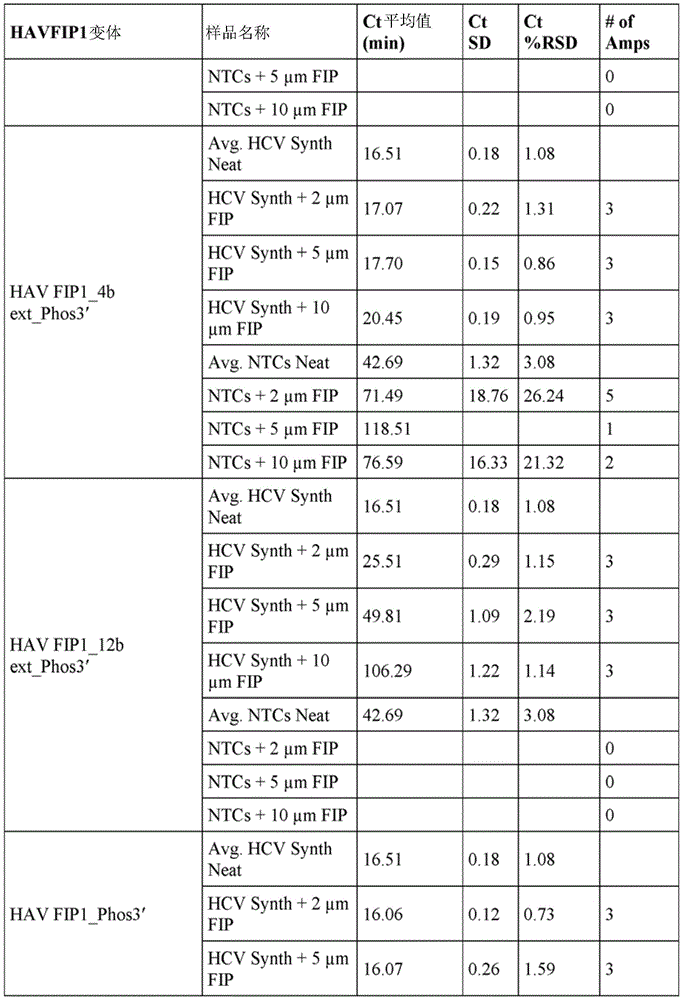

Unmodified HAVFIP1 slowed positive amplification linearly, and the 10. mu.M HAVFIP1 reaction took approximately 4 times longer to amplify the no-FIP sample. The NTC slowed significantly at 2. mu.M HAVFIP1 and disappeared completely at 5. mu.M HAVFIP1 and above. Phosphorylated HAVFIP1 did not slow down true positive, but did inhibit false positive amplification. For the HAVFIP1_4b oligonucleotide, a slight slowing of positivity was observed at 2. mu.M and 5. mu.M, whereas the addition of 10. mu.M HAVFIP1_4b corresponds approximately to the addition of 2. mu.M HAVFIP1 in terms of positive amplification time. In all cases the negative amplification slowed down. No false positive amplification was observed for the HAVFIP1_8b oligonucleotide, whereas positive amplification was inhibited at more than 5. mu.M HAVFIP1_8 b. With respect to HAVFIP1_12b oligonucleotide, the degree of positive slowing was much greater compared to unmodified HAVFIP1 and NTC was completely inhibited at all concentrations tested. For the HAVFIP1_16b oligonucleotide, the amplification result was very similar to that of unmodified HAVFIP 1. The length of the hairpin affects the activity of the HAVFIP1 variant. Notably, phosphorylated HAVFIP1 did not slow down true positivity, but did inhibit false positive amplification. Thus, derivatives of HAVFIP1 and HAVFIP1 suppressed non-specific amplification in the LAMP reaction.
Example 2 Activity of short extension variants of HAVFIP1
The activity of various short-extended variants of HAVFIP1 was tested in a LAMP assay with HCV template and HCV LAMP primer sets. The LAMP primer sets are listed in tables 14 to 19. Short extension variants of HAVFIP1 include HAVFIP1 oligonucleotide with a phosphorylated 3 'end, HAVFIP1 oligonucleotide with a phosphorylated 1-nucleotide, 2-nucleotide, 3-nucleotide 3' extension, HAVFIP1 hairpin (hairpin) variant, HAVFIP1 early complement (early complement) variant, and HAVFIP1 hairpin mirror (hairpin mirror) variant. The variants are listed in table 3.
TABLE 3
| Oligomer | Hair clip Tm(℃) | SEQ ID NO |
| HAVFIP1 Phos3′ | SEQ ID NO:01 | |
| HAVFIP1_1b ext_Phos3′ | 60.7 | SEQ ID NO:03 |
| HAVFIP1_2b ext_Phos3′ | 62.4 | SEQ ID NO:04 |
| HAVFIP1_3b ext_Phos3′ | 63.5 | SEQ ID NO:05 |
| HAVFIP1_hairpin | 53.7 | SEQ ID NO:09 |
| HAVFIP1_early complement | 48.1 | SEQ ID NO:10 |
| HAVFIP1_hairpin mirror | 47.6 | SEQ ID NO:18 |
The reaction conditions are as follows: 20mM Tris-HCl (pH 8.8 at 25 ℃), 8mM magnesium sulfate, 50mM potassium chloride, 10mM ammonium sulfate, 0.1% Tween-20, 8U WarmStart Bst2.0 DNA polymerase, 7.5U WarmStart RTx reverse transcriptase, 5.6mM total dNTPs (1.4 mM each), 0.5U Antarctic thermolabile UDG, 0.7mM dUTP, 1 × Eva Green intercalating dye and primer set "HCV Pr 5" (consisting of 40 μmol per FIP/BIP, 10 μmol per LF/LB, and 35 μmol per F3/B). Positive samples contained the "HCV Synth" mixture, whereas NTC did not contain template. Each variant of HAVFIP1 in Table 3 was present at a concentration of 10. mu.M. The total reaction volume was 25. mu.L. The reactions with template were tested in triplicate, and NTC was tested in 6 replicates. The LAMP reaction was run on an Applied Biosystems QuantStaudio 3(QS3) thermocycler at 65 ℃ for 120 minutes. The LAMP reaction was run at 65 ℃ for 120 minutes, and fluorescence was measured every minute. The results are summarized in table 4.
TABLE 4


Each tested variant of HAVFIP1, except HAVFIP1_ hairpin mirror, had activity to reduce false positive amplification. HAVFIP1_ Phos3' completely suppressed false positive amplification while only slightly slowing true positive. As bases are added, the base-by-base extension of HAVFIP1 increasingly slows true positives. The HAVFIP1_3b ext _ Phos3' variant allowed for three false positive amplifications, although the average Ct was about 95 min. The HAVFIP1_ hairpin variant, which contained only the hairpin-forming sequence, slowed the LAMP response only more than the HAVFIP1_ Phos3' variant. The HAVFIP1_ Hairpin variant slowed down the negatives to a statistically significant extent compared to that of the Neat negatives (46.1. + -. 11.8min vs. 77.0. + -. 21.2min for Neat and Hairpin, respectively; two-tailed t-test, p. 0.014). This indicates that the hairpin segment is sufficiently active to suppress false positive amplification. The HAVFIP1_ early complete variant retained the hairpin sequence and flipped all the preceding bases to their complements, slowing the amplification of true positives by nearly 3-fold (17.1min vs.50.0min) and also completely eliminated false positive amplification. On the other hand, original HAVFIP1 slowed the LAMP reaction by about 25% with HCV Pr 5. HAVFIP1_ hairpin mirror (whose base is complementary to HAVFIP1_ hairpin, although not reverse complementary) increased false positive amplification. HAVFIP1_ hairpin mirror slowed down the true positives slightly while accelerating the false positive amplification (33.4 + -4.4 min vs.46.1 + -11.8 min for hairpin mirror and Neat, respectively; two-tailed p 0.048). Thus, the hairpin region alone has the activity of suppressing false positive amplification. The addition of HAVFIP1 stems increased the suppression of false positive amplification and flipping the stems to their complement made the sequence more inhibitory for LAMP.
Example 3 Effect of HAVFIP1 concentration
The LAMP reaction was performed with various concentrations of phosphorylated HAVFIP1(SEQ ID NO: 01). The reaction contained HCV targets, HCV LAMP primer sets and various concentrations of phosphorylated HAVFIP 1. Reactions were prepared using LAMP WARMSTART Master Mix (New England Biolabs, Ipswich, Mass.) containing a blend of Bst2.0 WARMSTART DNA polymerase and WARMSTART RTx reverse transcriptase in optimized LAMP buffer. The LAMP primer sets are listed in tables 14 to 19. All reactions were performed in triplicate. The positive samples ("SC P HCV 2" and "DLS HCV 6") were human plasma infected with HCV, with 1.25. mu.L added to each reaction. LAMP reactions were run on a QS3 thermocycler at 65 ℃ for 120 min on QS 3. Fluorescence was measured every minute to assess the progress of the reaction. Table 5 lists the reaction components and summarizes the results.
TABLE 5
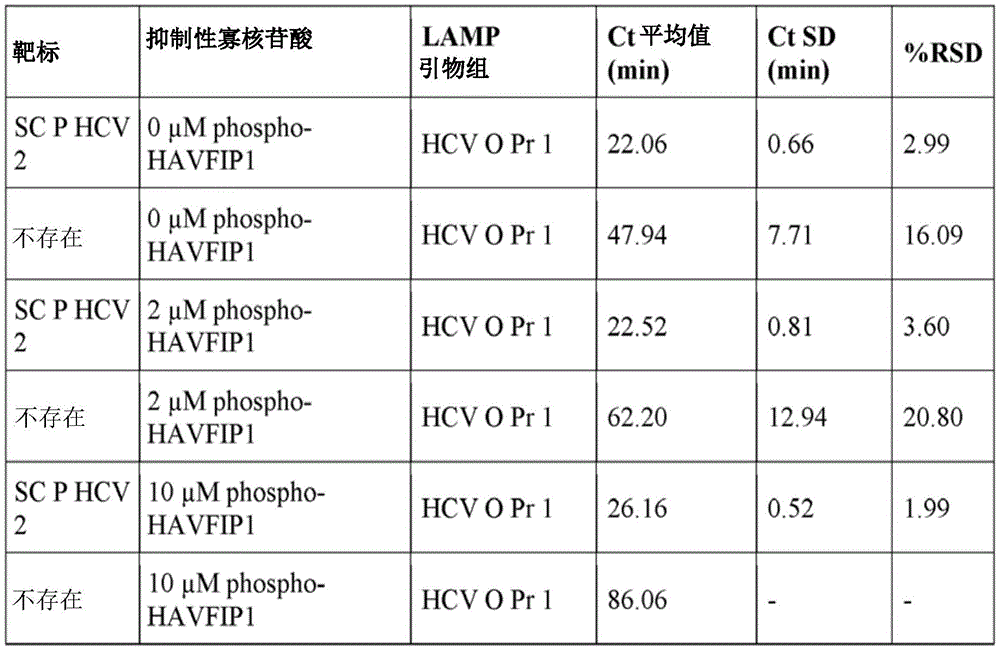
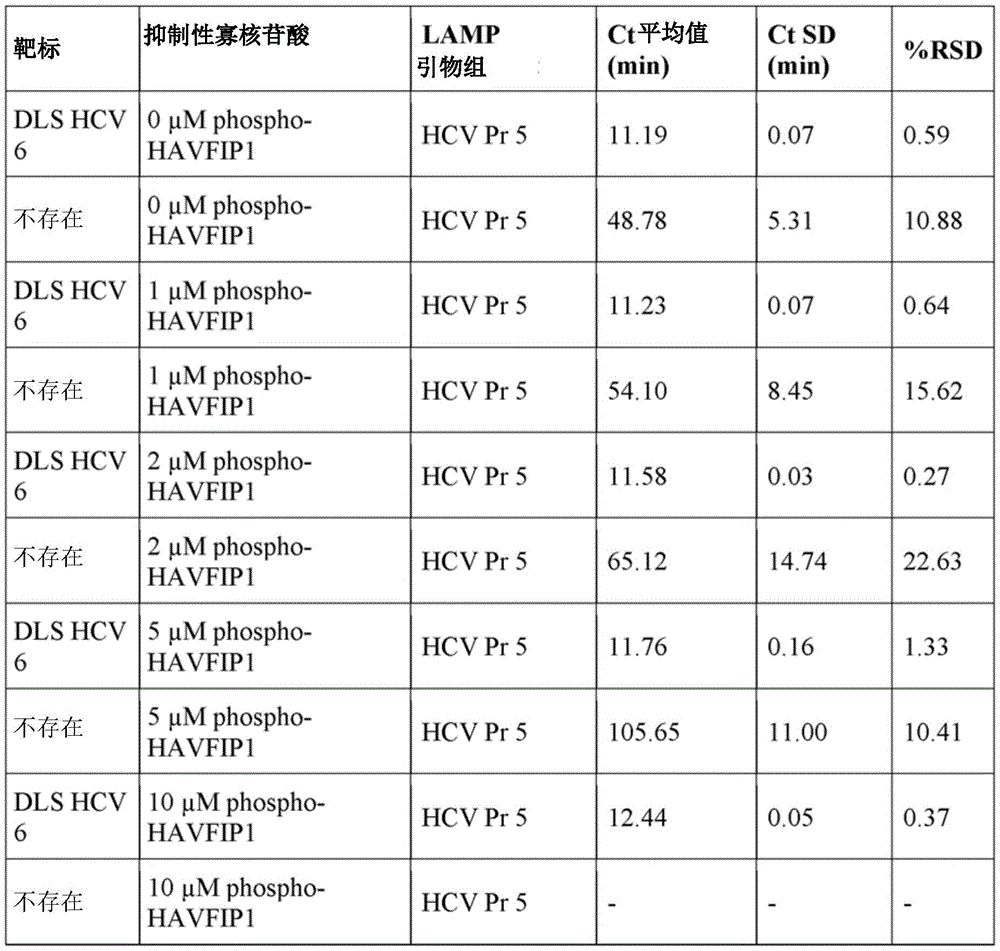
High concentrations of 10 μ M phospho-HAV FIP did not affect amplification of HCV clinical samples, but did completely inhibit amplification of the No Template Control (NTC) reaction in which the target was not present. NTC Ct values increased with increasing concentration of phospho-HAV FIP. The presence of phospho-HAVFFIP 1 had no substantial effect on the HCV LAMP reaction in the presence of the target. However, in the NTC reaction, the presence of phospho-HAVFHIP 1 in the HCV LAMP reaction increased the Ct value, and the Ct value increased with the increase in the concentration of phospho-HAVFIP 1. Thus, phosphorylated HAVFIP1 inhibited non-specific amplification in the LAMP reaction in a concentration-dependent manner.
Example 4 Activity of alternative inhibitory oligomers in LAMP
The activity of various oligonucleotides to inhibit non-specific amplification in the LAMP reaction was tested. The reaction contained LAMP HCV primer (HCV Pr5) and various test oligonucleotides, and no target nucleic acid. Reactions were prepared with LAMP WARMSTART Master Mix (New England Biolabs, Ipswich, Mass.) containing a blend of Bst2.0 WARMSTART DNA polymerase and WARMSTART RTx reverse transcriptase in optimized LAMP buffer. The test oligonucleotides were tested at 2. mu.M. The LAMP primer sets are listed in tables 14 to 19. The reaction was performed in six replicates. The Neat sample contained no test oligonucleotide. The LAMP reaction was run on a QS3 thermocycler at 65 ℃ for 120 minutes. Fluorescence was measured every minute to assess the progress of the reaction. Table 6 lists the test oligonucleotides. Table 7 summarizes the results.
TABLE 6
| Oligonucleotides | Tm(℃) | SEQ ID NO |
| HAVFIP1 | 53.7 | SEQ ID NO:01 |
| HAVBIP1 | 60.6 | SEQ ID NO:97 |
| Dev3 BIP | 52.7 | SEQ ID NO:15 |
| Dev3 BIP_4b ext | 64.8 | SEQ ID NO:11 |
| Dev3 BIP_17b full ext | 92 | SEQ ID NO:12 |
| HAVFIP1_2b cut | 47.1 | SEQ ID NO:17 |
| HAVFIP1_4b cut | 43.1 | SEQ ID NO:13 |
| RSV Pr1 FIP | 50.6 | SEQ ID NO:85 |
| RSV Pr2 FIP | 53.2 | SEQ ID NO:14 |
| TB Pr2 BIP | 50.5 | SEQ ID NO:16 |
| TB Pr3 BIP | 53.2 | SEQ ID NO:111 |
TABLE 7

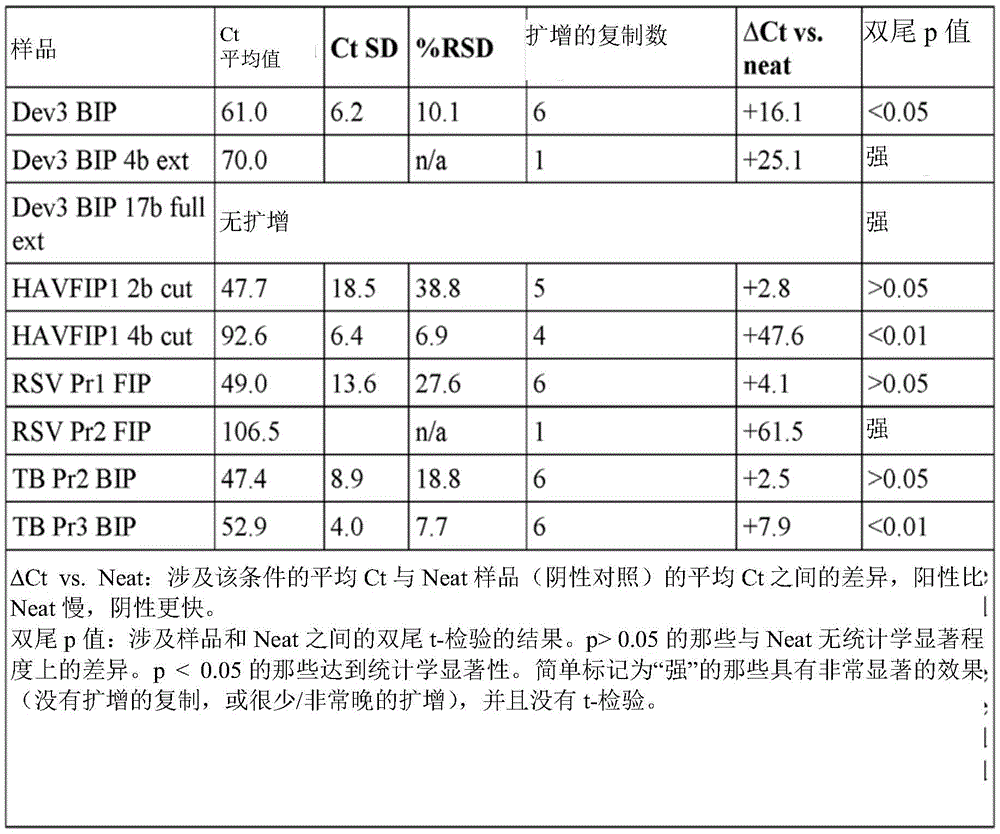
The predicted secondary structures of certain oligonucleotides are shown in figure 2. Similar to HAVFIP1, the following oligos had strong activity against false positives in the no template control of the LAMP amplification reaction: dev3 BIP _4b ext, Dev3 BIP _17b full ext and RSV Pr2 FIP. The following oligos had some activity in the no template control of the LAMP amplification reaction to suppress false positives compared to the negative control (Neat), but the non-specific amplification of false positives was not eliminated or greatly slowed down: dev3 BIP, HAVFIP1_4b cut and TB Pr3 BIP. The following oligos had no substantial activity to suppress false positives in the no template control of the LAMP amplification reaction and were comparable to the negative control (Neat): HAV BIP1, HAVFIP1_2b cut and TB Pr2 BIP.
Example 5 Activity of variant HAVFIP1 Using specific LAMP primer set
The activity of a mixture of HAVFIP1 variants comprising HAVFIP1 oligonucleotide with a phosphorylated 3 'end (SEQ ID NO:01) and HAVFIP1 oligonucleotide with a phosphorylated 4-nucleotide 3' extension (SEQ ID NO:02) was tested in LAMP experiments using various LAMP primer sets. The LAMP primer group comprises: dengue Pr1, Dengue Pr2, HCV Pr4, HCV Pr6, Zika Pr1 and Zika Pr 3. The LAMP primer sets are listed in tables 14 to 19. Each LAMP primer set confirmed NTC amplification early in the LAMP reaction process (30-40 min). The WarmStart LAMP Master Mix was used to prepare 8 replicates of all samples. The LAMP reaction was run on a QS3 thermocycler at 65 ℃ for 120 minutes. Fluorescence was measured every minute to assess the progress of the reaction. A HAVFIP1 variant mixture ("FLASH") was made, which included 10 μ M HAVFIP1_4b ext _ Phos3 'and 50 μ M HAVFIP1_ Phos3', and added to the reaction to give final concentrations of 2 μ M and 10 μ M, respectively. Neither reaction contains a template. The results are summarized in table 8.
TABLE 8

The HAVFIP1 variant mixture had significant effect on all reactions containing LAMP primer sets. All eight replicates of HCV Pr4 Neat were amplified with an average Ct of 55min, but amplification with the HAVFIP1 variant mixture was zero. The HAVFIP1 variant cocktail also prevented amplification of any replication of Zika Pr3 and HCV Pr 6. The HAVFIP1 variant mixtures had reduced effect on LAMP reactions with the Zika Pr1 LAMP primer set (mean Ct of Neat 48min, mean Ct of 78min with HAVFIP1 variant mixture) and with the Dengue Pr2 LAMP primer set (mean Ct of Neat 37min, mean Ct of 84min with HAVFIP1 variant mixture).
Example 6 amplification of targets Using specific LAMP primer sets
This example illustrates LAMP amplification of a target with a mixture of 15 LAMP primer sets containing a LAMP primer set for the target. Each mixture contained HAVFIP 1. Targets include Synt RSV, Synt Zika, Vircell Dengue, Synt HAV, Synt HBV, Synt HCV mix, Synt HIV mix, Synt Parvo, ATCC FluA, ATCC Sal, Syth TB _3, Synt H inf, Synt Dev2, MS2, Synt Malaria. 15 LAMP primer sets were mixed together, including RSV primer _ new LB, Zika _2 primer, Dengue _1 primer, HAV primer, HBV primer, HCV pr5, HIV primer 1, Parvo primer, Sal _2 primer, TB _3 primer, H inf primer, Dev2 primer, MS2 primer, Malaria primer 180123, FluAH3N1_5 primer. See, e.g., Kim DW et al, J Clin Microbiol (2011)49: 3621-; and, Chander Y et al, Front Microbiol (2014)5:395, each of which is incorporated by reference in its entirety. The LAMP primer sets are listed in tables 14 to 19. HAVFIP1(SEQ ID NO:01) was present in the experiment at a concentration of 1.6. mu.M in the HAV primer mix.
Reactions were prepared by adding 3 μ L of 15-primer mix per reaction to the premix (master mix). Using the WarmStart Master Mix, 4 replicates of each individual target were prepared in each tube. In other words, each tube has a different target. 8 NTC reactions were also performed. Each synthesis reaction has a value of 106Individual target copies. The ATCC Sal reaction contained 4.8X 10⁵Each copy, ATCC FluA (H3N2) sample contained 4.24X 10⁷Individual target copies. The LAMP reaction was run on a QS3 thermocycler at 65 ℃ for 120 minutes. Fluorescence was measured every minute to assess the progress of the reaction. Table 9 summarizes the results.
TABLE 9
| Sample (I) | Ct mean value | Ct SD | %RSD |
| Svnt RSV | 28.88 | 0.17 | 0.58 |
| Svnt Zika | 19.00 | 0.06 | 0.31 |
| Vircell Dengue | - | - | - |
| Synt HAV | 44.00 | 0.24 | 0.55 |
| Synt HBV | 27.32 | 0.28 | 1.04 |
| Synt HCV | 29.28 | 0.36 | 1.22 |
| Synt HIV | 30.71 | 0.05 | 0.16 |
| Synt Parvo | 39.89 | 0.55 | 1.37 |
| ATCC Sal | 44.83 | 0.28 | 0.62 |
| Svnt TB | 30.52 | 0.05 | 0.15 |
| Synt H Inf | 57.38 | 0.18 | 0.32 |
| Synt Dev2 | 30.01 | 0.52 | 1.74 |
| MS2 | 17.38 | 0.19 | 1.08 |
| Svnt Malaria | 41.10 | 0.09 | 0.23 |
| ATCC FluA | 65.85 | 0.39 | 0.59 |
| NTC with all primers | - | - | - |
All positive reactions were amplified with 15-primer mixtures except Vircell Dengue. Neither NTC reaction amplified. This indicates that if HAVFIP1 is included in the reaction, it is possible to perform highly multiplexed and specific LAMP.
Example 7 use of PEG to enhance LAMP
LAMP was tested with and without additional Bst2.0 and 5% polyethylene glycol-35 k (PEG) to improve sensitivity and total time to result. In previous experiments, replication with 5% PEG was amplified earlier than replication without PEG. The reactions were based on the WarmStart LAMP Master Mix and all contained the RSV a _ B4 primer. The test conditions were: LAMP Mix with 5% PEG and an additional 3(+3 μ Ι _ bst2.0; LAMP Mix with 5% PEG and + 0. mu.L Bst 2.0; LAMP Mix with 0% PEG and + 3. mu.L Bst 2.0; and LAMP Mix with 0% PEG and +0 μ L Bst2.0 (LAMP control). The LAMP primer sets are listed in tables 14 to 19. RSV AB Megamer as template to give 10 per reaction6、104、102Included are copies of 1 and 0(NTC) (C/rxn). The LAMP reaction was run on a QS3 thermocycler at 65 ℃ for 120 minutes. Fluorescence was measured every minute to assess the progress of the reaction. The results are summarized in table 10.
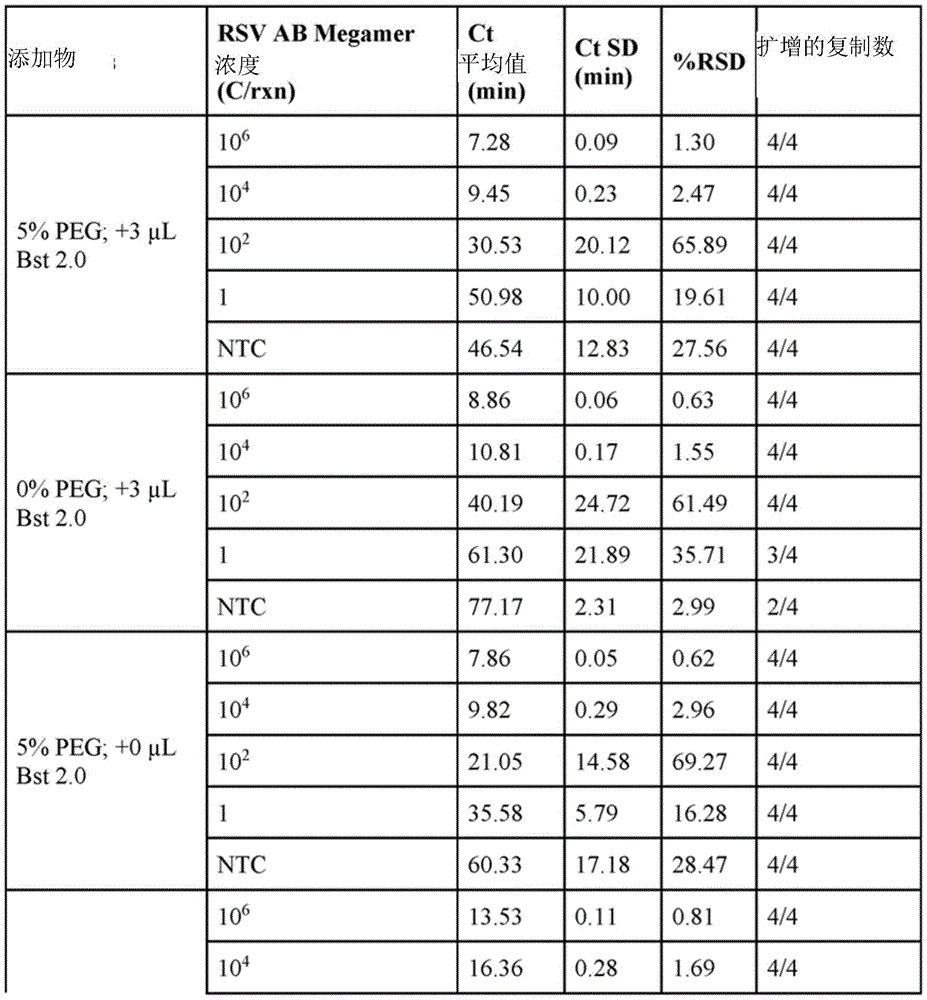
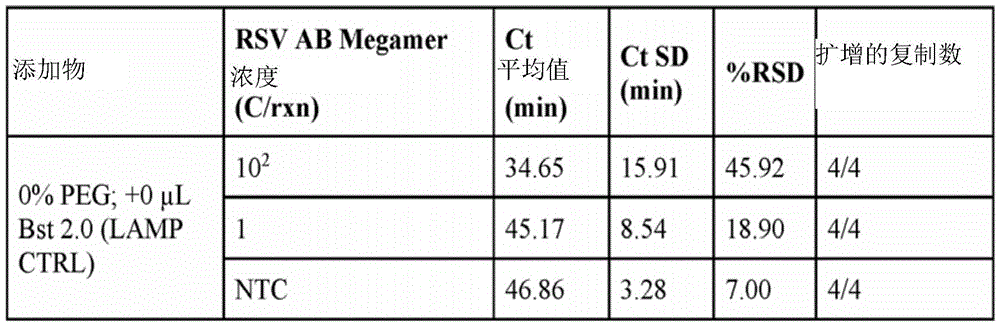
All values were evaluated using the Grubb test to determine if an outlier (outlier) was present. For the case of the presence of outliers, the labeling was performed with (#), and the mean Ct value and standard deviation were recalculated without outliers. Addition of 3 μ L of Bst2.0 reduced Ct but did not improve detection of lower copy number. Replication with 5% PEG and +3 μ Ι _ Bst2.0 overall had the earliest Ct, but was only slightly faster than replication with only 5% PEG.
Example 8 enhancement of LAMP Using different crowding reagents
The dynamic range of RSV AB Megamer was tested with various crowding reagents to determine if lower copy numbers could be detected. The following conditions were tested: 5% PEG-35K, 5% PEG-8K, 5% Ficoll-400K. Each condition was serially diluted 10-fold (from 10) with RSV AB Megamer6To 0 copies/reaction) were tested. Each condition was tested for 3 replicates. The LAMP primer sets are listed in tables 14 to 19. The LAMP reaction was run on a QS3 thermocycler at 65 ℃ for 120 minutes. Fluorescence was measured every minute to assess the progress of the reaction. The results are summarized in table 11.
TABLE 11

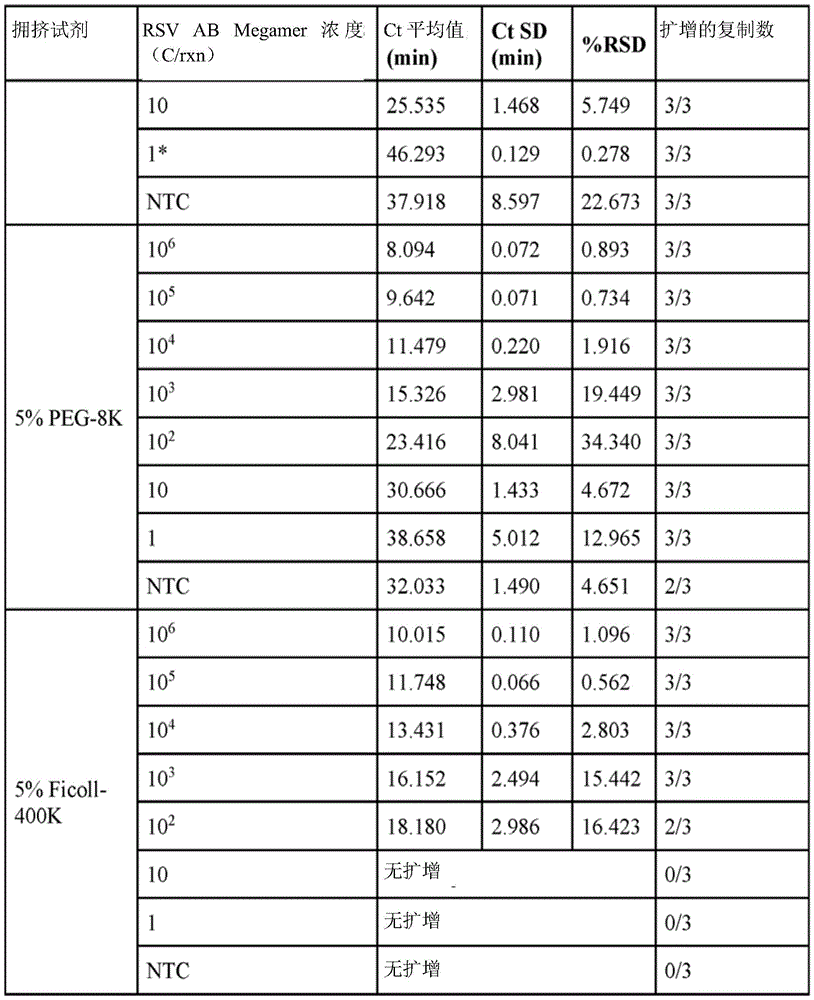
All values were evaluated using the Grubb test to determine if outliers were present. For the case of outliers, the markers were marked with (#) and the mean Ct and standard deviation were recalculated without outliers. Figure 3 is a graph summarizing Ct values for different target concentrations in reactions containing different crowding reagents. Although the three lowest concentrations overlapped NTC in terms of amplification, 5% PEG-8K overall had the earliest Ct. Although 5% Ficoll-400K did not have any NTC, 10 or 1 copies per reaction were not detected.
Example 9 LAMP with inhibitory oligonucleotides and crowded reagents
The effect of a mixture of inhibitory oligonucleotides (Phospho-FIP/Phospho-FIP4) and PEG-35K on various targets was evaluated in the presence and absence of Universal Transport Medium (UTM) in the samples. The mixture of inhibitory oligonucleotides is a mixture of HAVFIP1 variants comprising: HAVFIP1 oligonucleotide (Phospho-FIP; SEQ ID NO:01) with a phosphorylated 3 'end, and HAVFIP1 oligonucleotide variant (Phospho-FIP4, SEQ ID NO:02) with a phosphorylated 4-nucleotide 3' extension. The target includes: synthetic (Synt) HIV 1C, Synt HCV 1, RSV AB Megapmer, FluA _ M2_180815_ 2. The LAMP primer group comprises: HIV 1 primer, HCV 10 primer, RSV A _ B4 primer, FluA _180817_ H3N2_ 2/3. Exemplary LAMP primer sets are listed in tables 14-19.
The following conditions were tested: synt HCV 1, with variant HAVFIP 1; synt HCV 1, without HAVFIP1 variant; FluA _ M2_180815_2, with variant HAVFIP1, no UTM; FluA _ M2_180815_2, no HAVFIP1 variant, no UTM; FluA _ M2_180815_2, variant HAVFIP1 and UTM; FluA _ M2_180815_2, without HAVFIP1 variant, with UTM; RSV AB Megamer, with HAVFIP1 variant, without UTM; RSV AB Megamer, no HAVFIP1 variant, no UTM; RSV AB Megamer, with HAVFIP1 variant and UTM; RSV AB Megamer, without HAVFIP1 variant, with UTM; synt HIV 1C, with variant HAVFIP 1; and, Synt HIV 1C, HAVFIP 1-free variant. 10 for each condition using the WarmStart LAMP Master Mix4The target of each copy/reaction and NTC were tested. 3 replicates were tested for each condition. HAVFIP1 variant concentrations: 10 μ M Phospho-FIP; 1 μ M Phospho-FIP 4. The LAMP reaction was run on a QS3 thermocycler at 65 ℃ for 120 minutes. Fluorescence was measured every minute to assess the progress of the reaction. The results are summarized in table 12A.
TABLE 12A
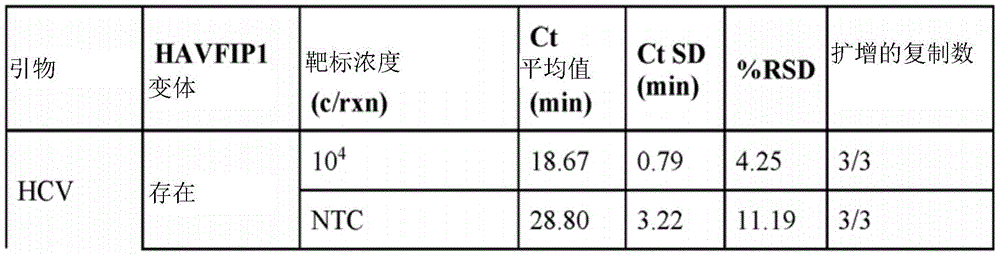
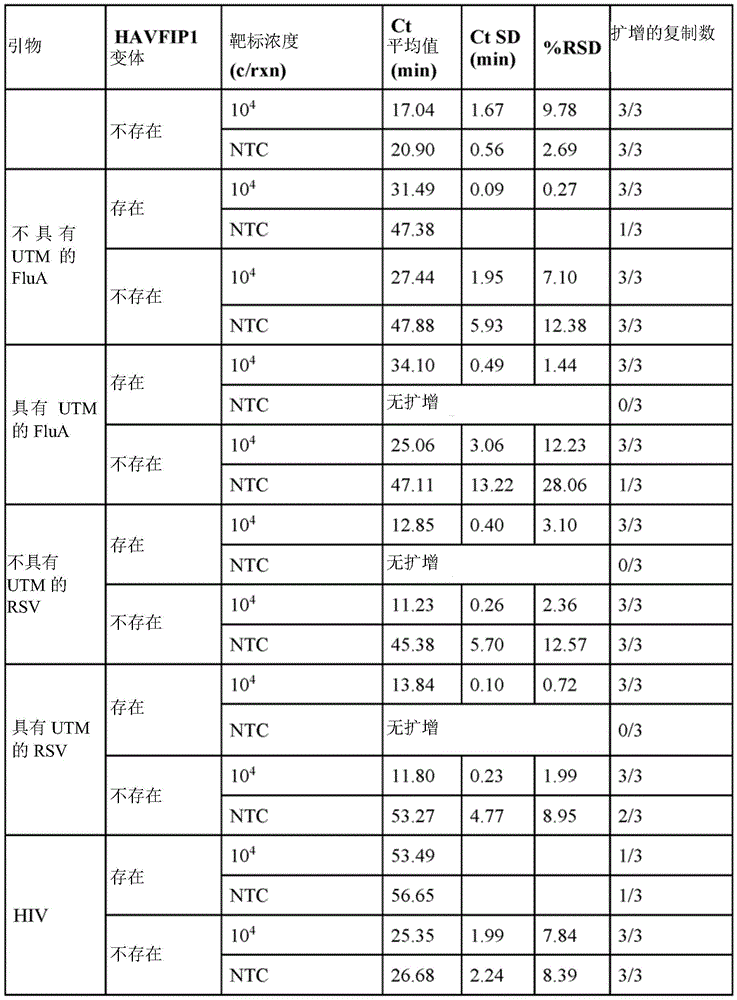
When used in conjunction with PEG-35K, a mixture of inhibitory oligonucleotides (Phospho-FIP/Phospho-FIP4) was effective in suppressing NTC.
Certain sequences
The following table lists the various sequences. Table 13 lists various oligonucleotides tested for activity in inhibiting non-specific amplification during the LAMP amplification reaction. Tables 14-19 list LAMP primer sets for detection of nucleic acids from the specific pathogens listed, including F3, B3, FIP, BIP, LF, and LB for each set. Specifically, table 14 lists the F3 primers for each group; table 15 lists the B3 primers used for each set; table 16 lists the FIP primers used for each group; table 17 lists BIP primers for each group; table 18 lists LF primers for each group; and, table 19 lists LB primers for each group.
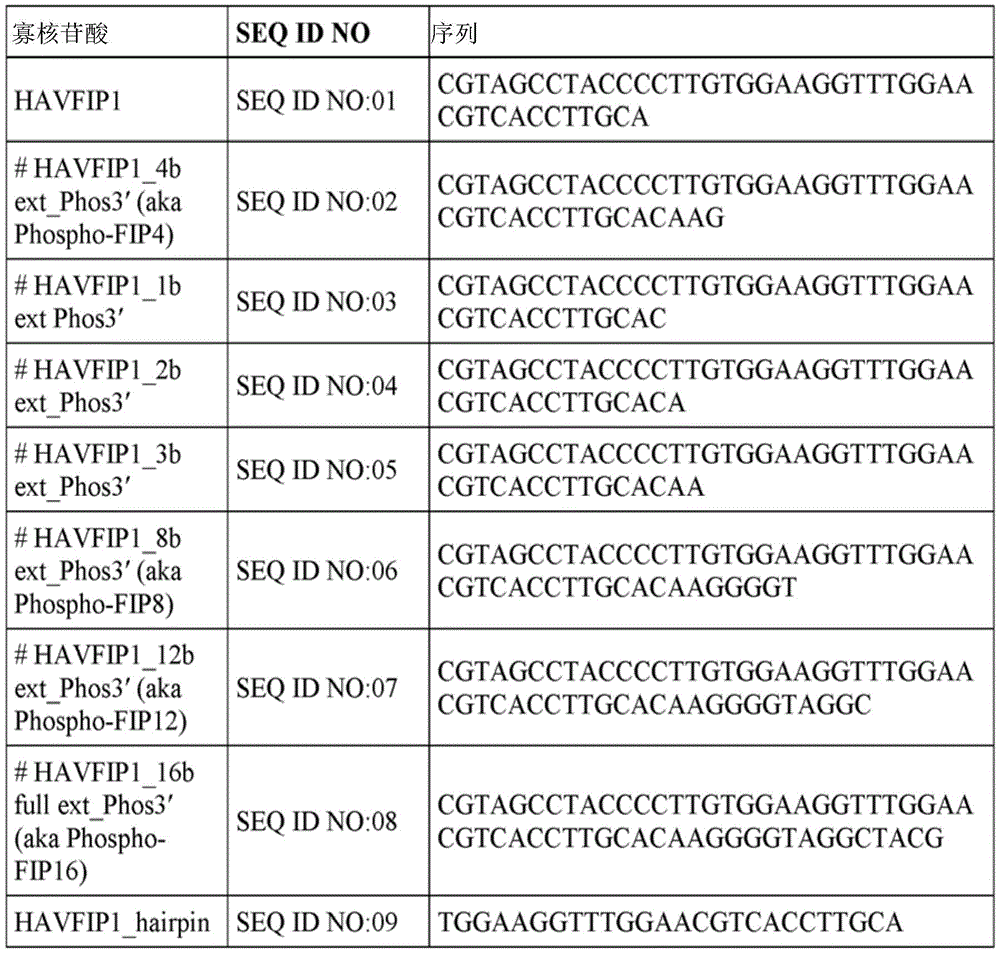
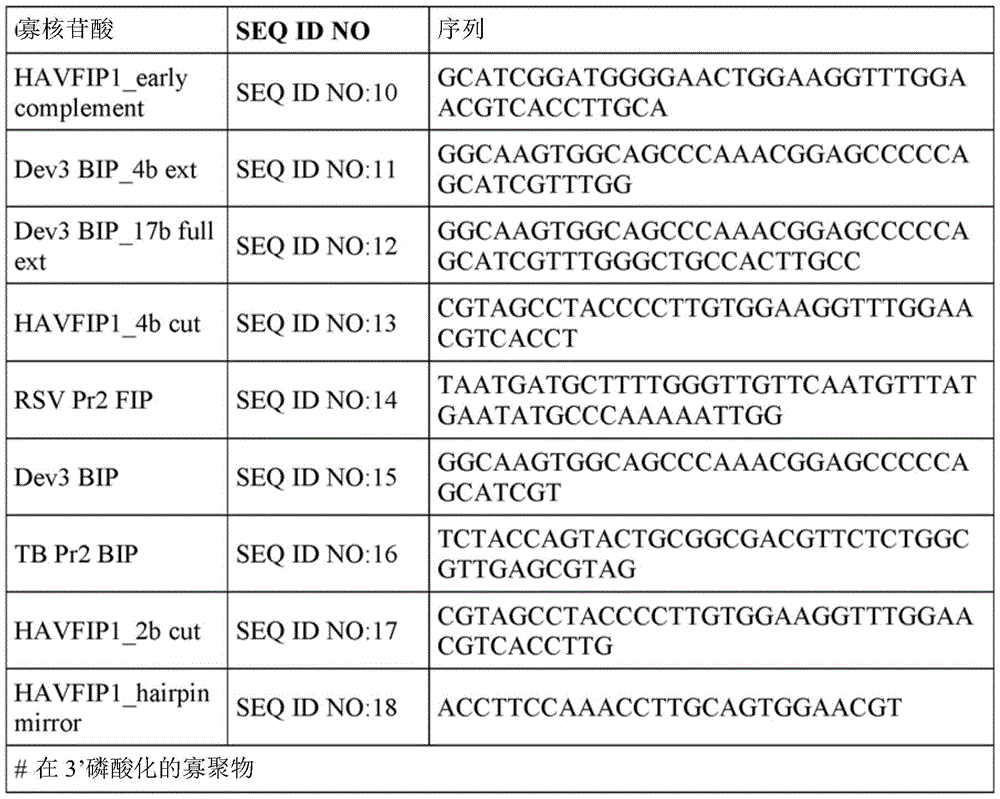
TABLE 14
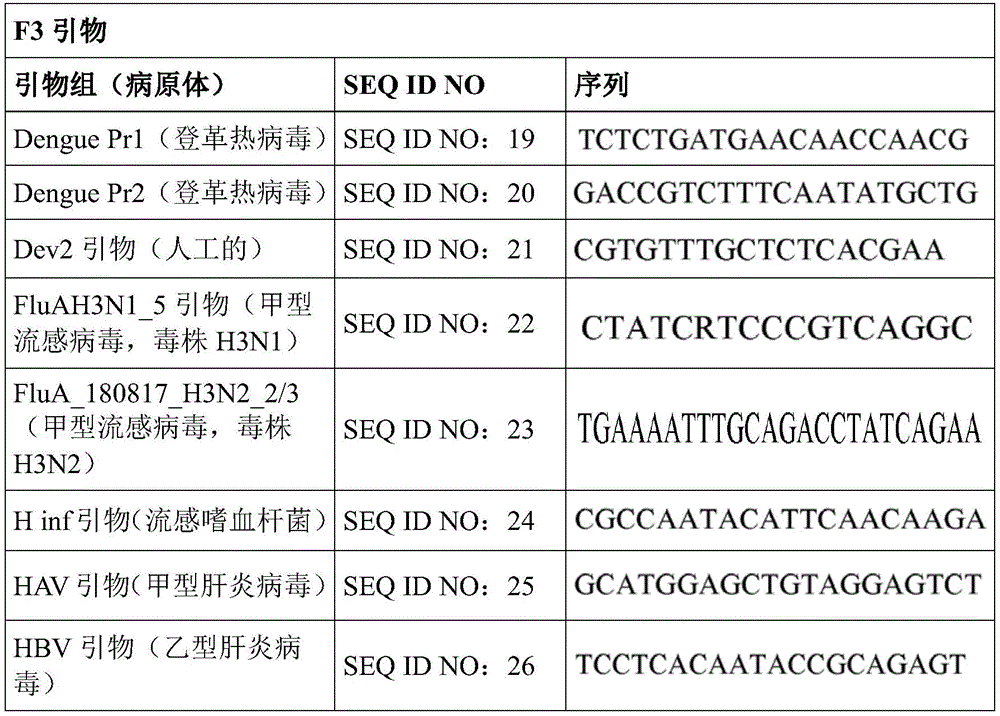
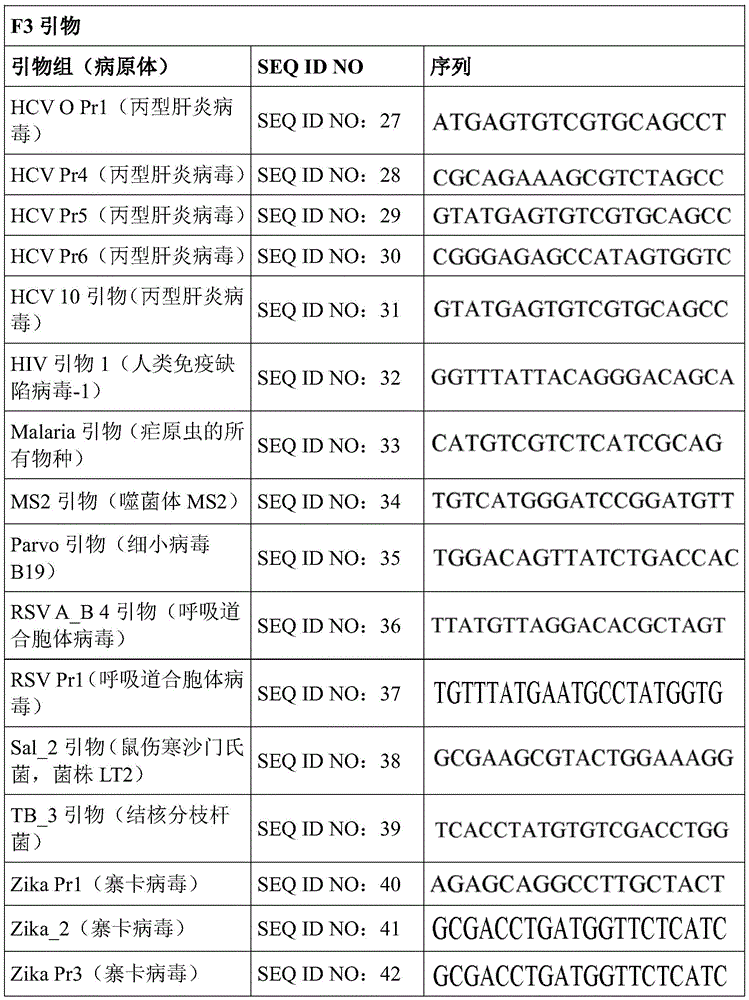

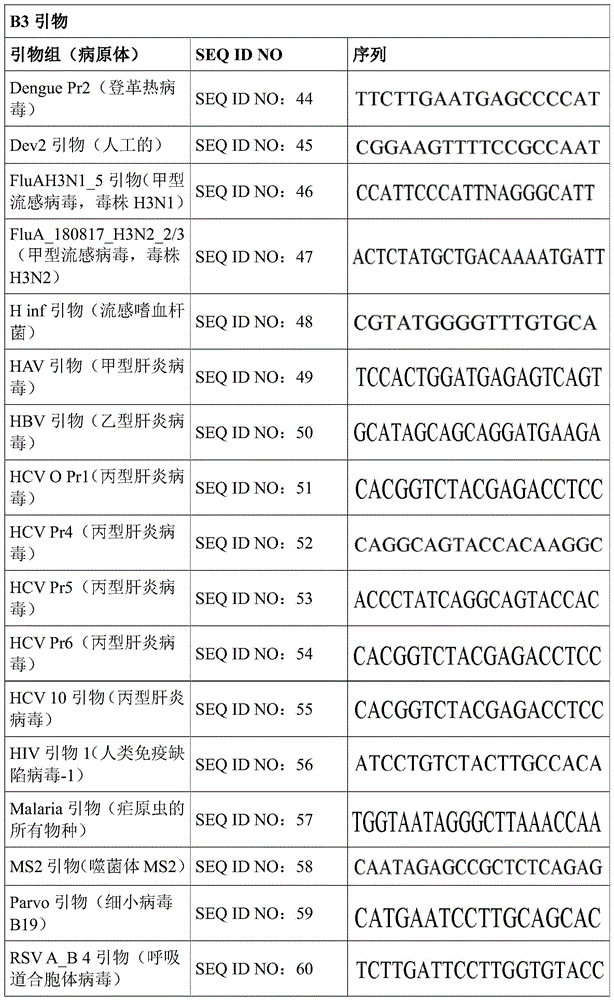
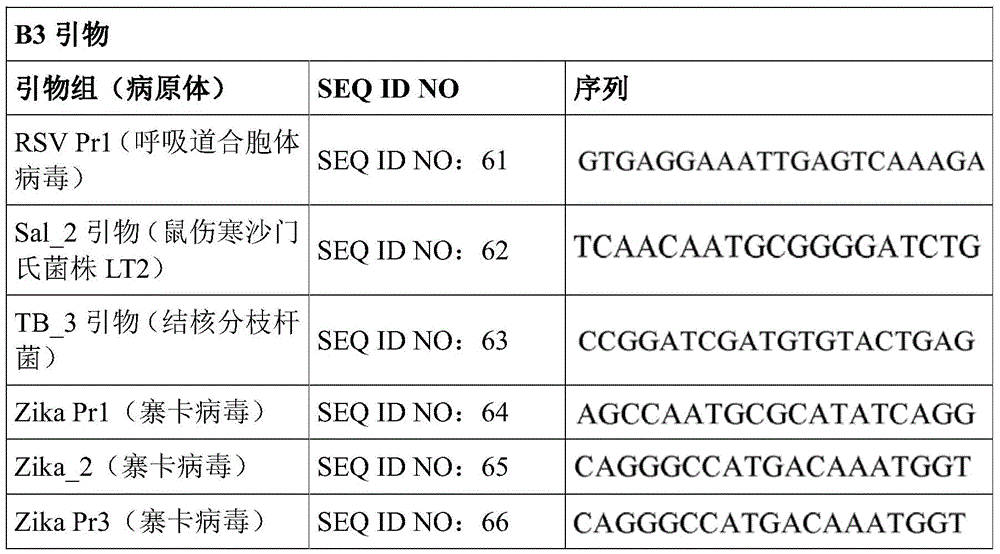
TABLE 16
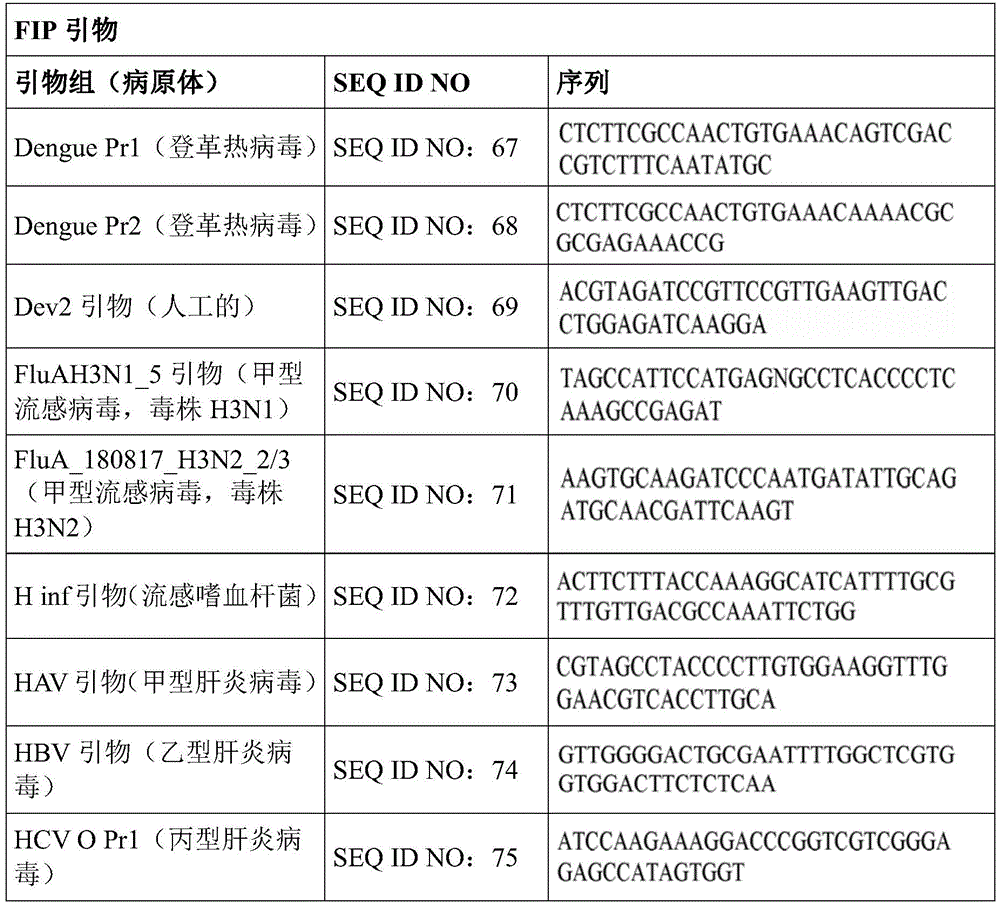

TABLE 17

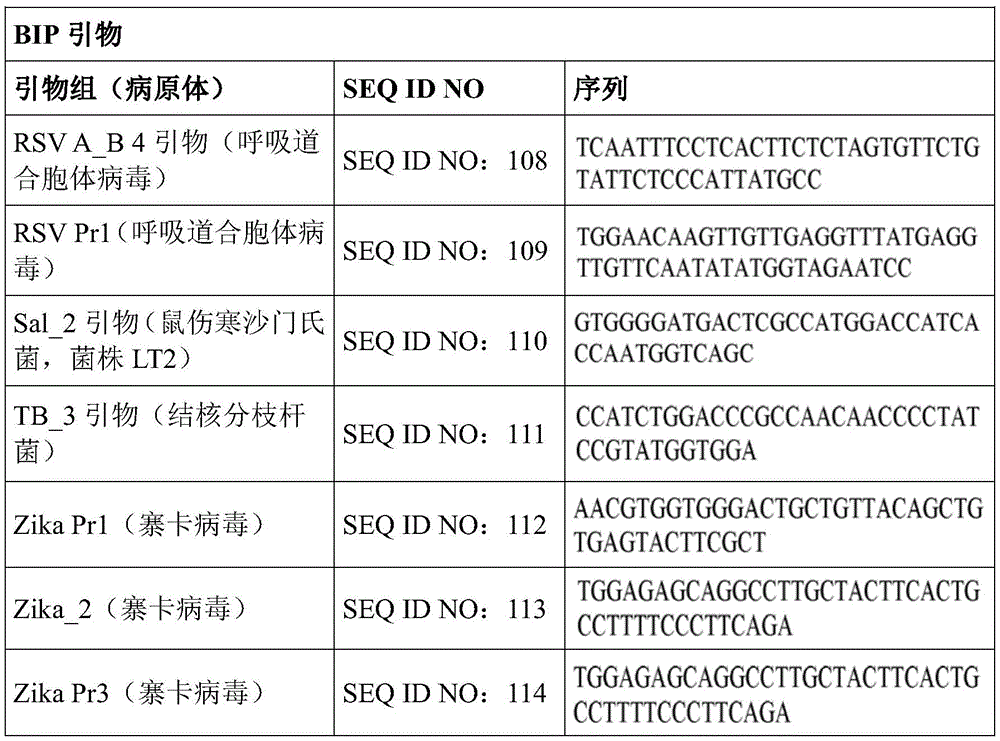
Watch 18

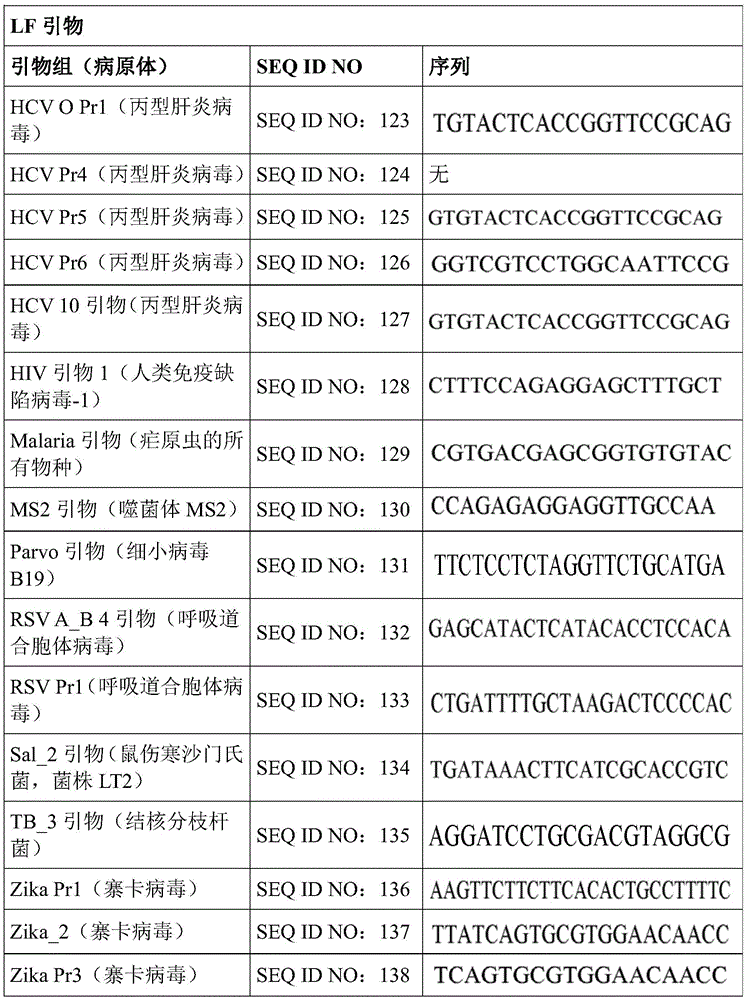
Watch 19


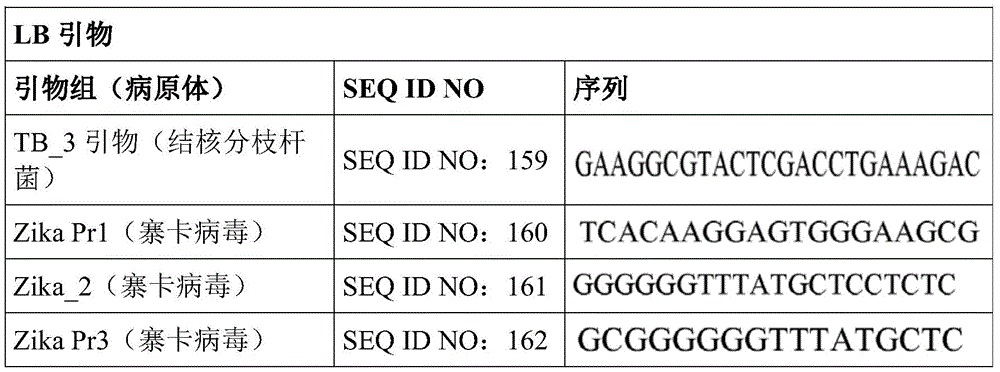
As used herein, the term "comprising" is synonymous with "including," "containing," or "characterized by," which is inclusive or open-ended and does not exclude additional, unrecited elements or method steps.
The above description discloses some methods and materials of the present invention. The present invention is susceptible to modifications in method and materials, as well as variations in manufacturing methods and apparatus. Such modifications will become apparent to those skilled in the art from a consideration of this disclosure or practice of the invention disclosed herein. Therefore, it is not intended that the invention be limited to the specific embodiments disclosed herein, but that the invention will include all modifications and alterations falling within the true scope and spirit of the invention.
All references cited herein (including but not limited to published and unpublished applications, patents, and references) are hereby incorporated by reference in their entirety and thus made a part of this specification. If publications and patents or patent applications incorporated by reference contradict the disclosure contained in the specification, the specification is intended to supersede and/or take precedence over any such contradictory material.
Sequence listing
<110> Joseph Carl Gaiteri
Rixun Fang
Brenna Hearn Lord
Yuh-Min Chiang
Ronald Phillip Chiarello
<120> methods and compositions for reducing non-specific amplification in isothermal amplification reactions
<130> ALVEO.016WO
<150> 62/782610
<151> 2018-12-20
<160> 162
<170> FastSEQ for Windows Version 4.0
<210> 1
<211> 42
<212> DNA
<213> Artificial sequence
<220>
<223> HAVFIP1
<400> 1
cgtagcctac cccttgtgga aggtttggaa cgtcaccttg ca 42
<210> 2
<211> 46
<212> DNA
<213> Artificial sequence
<220>
<223> # HAVFFIP 1_4b ext _ Phos3' (also known as Phospho-FIP4)
<400> 2
cgtagcctac cccttgtgga aggtttggaa cgtcaccttg cacaag 46
<210> 3
<211> 43
<212> DNA
<213> Artificial sequence
<220>
<223> # HAVFIP1_1b ext Phos3'
<400> 3
cgtagcctac cccttgtgga aggtttggaa cgtcaccttg cac 43
<210> 4
<211> 44
<212> DNA
<213> Artificial sequence
<220>
<223> # HAVFIP1_2b ext_Phos3'
<400> 4
cgtagcctac cccttgtgga aggtttggaa cgtcaccttg caca 44
<210> 5
<211> 45
<212> DNA
<213> Artificial sequence
<220>
<223> # HAVFIP1_3b ext_Phos3'
<400> 5
cgtagcctac cccttgtgga aggtttggaa cgtcaccttg cacaa 45
<210> 6
<211> 50
<212> DNA
<213> Artificial sequence
<220>
<223> # HAVFFIP 1_8b ext _ Phos3' (also known as Phospho-FIP8)
<400> 6
cgtagcctac cccttgtgga aggtttggaa cgtcaccttg cacaaggggt 50
<210> 7
<211> 54
<212> DNA
<213> Artificial sequence
<220>
<223> # HAVFFIP 1_12b ext _ Phos3' (also known as Phospho-FIP12)
<400> 7
cgtagcctac cccttgtgga aggtttggaa cgtcaccttg cacaaggggt aggc 54
<210> 8
<211> 58
<212> DNA
<213> Artificial sequence
<220>
<223> # HAVFFIP 1_16b full ext _ Phos3' (also known as Phospho-FIP16)
<400> 8
cgtagcctac cccttgtgga aggtttggaa cgtcaccttg cacaaggggt aggctacg 58
<210> 9
<211> 26
<212> DNA
<213> Artificial sequence
<220>
<223> HAVFIP1_hairpin
<400> 9
tggaaggttt ggaacgtcac cttgca 26
<210> 10
<211> 42
<212> DNA
<213> Artificial sequence
<220>
<223> HAVFIP1_early complement
<400> 10
gcatcggatg gggaactgga aggtttggaa cgtcaccttg ca 42
<210> 11
<211> 40
<212> DNA
<213> Artificial sequence
<220>
<223> Dev3 BIP_4b ext
<400> 11
ggcaagtggc agcccaaacg gagcccccag catcgtttgg 40
<210> 12
<211> 53
<212> DNA
<213> Artificial sequence
<220>
<223> Dev3 BIP_17b full ext
<400> 12
ggcaagtggc agcccaaacg gagcccccag catcgtttgg gctgccactt gcc 53
<210> 13
<211> 38
<212> DNA
<213> Artificial sequence
<220>
<223> HAVFIP1_4b cut
<400> 13
cgtagcctac cccttgtgga aggtttggaa cgtcacct 38
<210> 14
<211> 50
<212> DNA
<213> Artificial sequence
<220>
<223> RSV Pr2 FIP
<400> 14
taatgatgct tttgggttgt tcaatgttta tgaatatgcc caaaaattgg 50
<210> 15
<211> 36
<212> DNA
<213> Artificial sequence
<220>
<223> Dev3 BIP
<400> 15
ggcaagtggc agcccaaacg gagcccccag catcgt 36
<210> 16
<211> 41
<212> DNA
<213> Artificial sequence
<220>
<223> TB Pr2 BIP
<400> 16
tctaccagta ctgcggcgac gttctctggc gttgagcgta g 41
<210> 17
<211> 40
<212> DNA
<213> Artificial sequence
<220>
<223> HAVFIP1_2b cut
<400> 17
cgtagcctac cccttgtgga aggtttggaa cgtcaccttg 40
<210> 18
<211> 26
<212> DNA
<213> Artificial sequence
<220>
<223> HAVFIP1_hairpin mirror
<400> 18
accttccaaa ccttgcagtg gaacgt 26
<210> 19
<211> 20
<212> DNA
<213> Artificial sequence
<220>
<223> Dengue Pr1 (Dengue virus)
<400> 19
<210> 20
<211> 20
<212> DNA
<213> Artificial sequence
<220>
<223> Dengue Pr2 (Dengue virus)
<400> 20
<210> 21
<211> 18
<212> DNA
<213> Artificial sequence
<220>
<223> Dev2 primer (Artificial)
<400> 21
cgtgtttgct ctcacgaa 18
<210> 22
<211> 17
<212> DNA
<213> Artificial sequence
<220>
<223> FluAH3N1_5 primer (influenza A virus, strain)
H3N1)
<400> 22
ctatcrtccc gtcaggc 17
<210> 23
<211> 24
<212> DNA
<213> Artificial sequence
<220>
<223> FluA _180817_ H3N2_2/3 (influenza A virus, strain)
H3N2)
<400> 23
tgaaaatttg cagacctatc agaa 24
<210> 24
<211> 20
<212> DNA
<213> Artificial sequence
<220>
<223> H inf primer (Haemophilus influenzae)
<400> 24
<210> 25
<211> 20
<212> DNA
<213> Artificial sequence
<220>
<223> HAV primer (hepatitis A Virus)
<400> 25
<210> 26
<211> 20
<212> DNA
<213> Artificial sequence
<220>
<223> HBV primer (hepatitis B virus)
<400> 26
<210> 27
<211> 18
<212> DNA
<213> Artificial sequence
<220>
<223> HCV O Pr1 (hepatitis C virus)
<400> 27
atgagtgtcg tgcagcct 18
<210> 28
<211> 18
<212> DNA
<213> Artificial sequence
<220>
<223> HCV Pr4 (hepatitis C virus)
<400> 28
cgcagaaagc gtctagcc 18
<210> 29
<211> 19
<212> DNA
<213> Artificial sequence
<220>
<223> HCV Pr5 (hepatitis C virus)
<400> 29
gtatgagtgt cgtgcagcc 19
<210> 30
<211> 19
<212> DNA
<213> Artificial sequence
<220>
<223> HCV Pr6 (hepatitis C virus)
<400> 30
cgggagagcc atagtggtc 19
<210> 31
<211> 19
<212> DNA
<213> Artificial sequence
<220>
<223> HCV 10 primer (hepatitis C virus)
<400> 31
gtatgagtgt cgtgcagcc 19
<210> 32
<211> 20
<212> DNA
<213> Artificial sequence
<220>
<223> HIV primer 1 (human immunodeficiency virus-1)
<400> 32
<210> 33
<211> 18
<212> DNA
<213> Artificial sequence
<220>
<223> Malaria primers (all species of Plasmodium)
<400> 33
catgtcgtct catcgcag 18
<210> 34
<211> 20
<212> DNA
<213> Artificial sequence
<220>
<223> MS2 primer (phage MS2)
<400> 34
<210> 35
<211> 19
<212> DNA
<213> Artificial sequence
<220>
<223> Parvo primer (parvovirus B19)
<400> 35
tggacagtta tctgaccac 19
<210> 36
<211> 20
<212> DNA
<213> Artificial sequence
<220>
<223> RSV A _ B4 primer (respiratory syncytial virus)
<400> 36
<210> 37
<211> 21
<212> DNA
<213> Artificial sequence
<220>
<223> RSV Pr1 (respiratory syncytial virus)
<400> 37
tgtttatgaa tgcctatggt g 21
<210> 38
<211> 19
<212> DNA
<213> Artificial sequence
<220>
<223> Sal _2 primer (Salmonella typhimurium, Strain LT2)
<400> 38
gcgaagcgta ctggaaagg 19
<210> 39
<211> 20
<212> DNA
<213> Artificial sequence
<220>
<223> TB _3 primer (Mycobacterium tuberculosis)
<400> 39
<210> 40
<211> 18
<212> DNA
<213> Artificial sequence
<220>
<223> Zika Pr1 (Zika virus)
<400> 40
agagcaggcc ttgctact 18
<210> 41
<211> 20
<212> DNA
<213> Artificial sequence
<220>
<223> Zika _2 (Zika virus)
<400> 41
gcgacctgat ggttctcatc 20
<210> 42
<211> 20
<212> DNA
<213> Artificial sequence
<220>
<223> Zika Pr3 (Zika virus)
<400> 42
gcgacctgat ggttctcatc 20
<210> 43
<211> 19
<212> DNA
<213> Artificial sequence
<220>
<223> Dengue Pr1 (Dengue virus)
<400> 43
cttcttgaat gagccccat 19
<210> 44
<211> 18
<212> DNA
<213> Artificial sequence
<220>
<223> Dengue Pr2 (Dengue virus)
<400> 44
ttcttgaatg agccccat 18
<210> 45
<211> 18
<212> DNA
<213> Artificial sequence
<220>
<223> Dev2 primer (Artificial)
<400> 45
cggaagtttt ccgccaat 18
<210> 46
<211> 20
<212> DNA
<213> Artificial sequence
<220>
<223> FluAH3N1_5 primer (influenza A virus, strain)
H3N1)
<220>
<221> misc_feature
<222> (0)...(0)
<223> N is an arbitrary nucleotide
<400> 46
<210> 47
<211> 22
<212> DNA
<213> Artificial sequence
<220>
<223> FluA _180817_ H3N2_2/3 (influenza A virus, strain)
H3N2)
<400> 47
actctatgct gacaaaatga tt 22
<210> 48
<211> 17
<212> DNA
<213> Artificial sequence
<220>
<223> H inf primer (Haemophilus influenzae)
<400> 48
cgtatggggt ttgtgca 17
<210> 49
<211> 20
<212> DNA
<213> Artificial sequence
<220>
<223> HAV primer (hepatitis A Virus)
<400> 49
<210> 50
<211> 20
<212> DNA
<213> Artificial sequence
<220>
<223> HBV primer (hepatitis B virus)
<400> 50
<210> 51
<211> 19
<212> DNA
<213> Artificial sequence
<220>
<223> HCV O Pr1 (hepatitis C virus)
<400> 51
cacggtctac gagacctcc 19
<210> 52
<211> 18
<212> DNA
<213> Artificial sequence
<220>
<223> HCV Pr4 (hepatitis C virus)
<400> 52
caggcagtac cacaaggc 18
<210> 53
<211> 20
<212> DNA
<213> Artificial sequence
<220>
<223> HCV Pr5 (hepatitis C virus)
<400> 53
<210> 54
<211> 19
<212> DNA
<213> Artificial sequence
<220>
<223> HCV Pr6 (hepatitis C virus)
<400> 54
cacggtctac gagacctcc 19
<210> 55
<211> 19
<212> DNA
<213> Artificial sequence
<220>
<223> HCV 10 primer (hepatitis C virus)
<400> 55
cacggtctac gagacctcc 19
<210> 56
<211> 19
<212> DNA
<213> Artificial sequence
<220>
<223> HIV primer 1 (human immunodeficiency virus-1)
<400> 56
atcctgtcta cttgccaca 19
<210> 57
<211> 21
<212> DNA
<213> Artificial sequence
<220>
<223> Malaria primers (all species of Plasmodium)
<400> 57
tggtaatagg gcttaaacca a 21
<210> 58
<211> 20
<212> DNA
<213> Artificial sequence
<220>
<223> MS2 primer (phage MS2)
<400> 58
<210> 59
<211> 18
<212> DNA
<213> Artificial sequence
<220>
<223> Parvo primer (parvovirus B19)
<400> 59
catgaatcct tgcagcac 18
<210> 60
<211> 20
<212> DNA
<213> Artificial sequence
<220>
<223> RSV A _ B4 primer (respiratory syncytial virus)
<400> 60
<210> 61
<211> 21
<212> DNA
<213> Artificial sequence
<220>
<223> RSV Pr1 (respiratory syncytial virus)
<400> 61
gtgaggaaat tgagtcaaag a 21
<210> 62
<211> 19
<212> DNA
<213> Artificial sequence
<220>
<223> Sal _2 primer (Salmonella typhimurium, Strain LT2)
<400> 62
tcaacaatgc ggggatctg 19
<210> 63
<211> 20
<212> DNA
<213> Artificial sequence
<220>
<223> TB _3 primer (Mycobacterium tuberculosis)
<400> 63
<210> 64
<211> 19
<212> DNA
<213> Artificial sequence
<220>
<223> Zika Pr1 (Zika virus)
<400> 64
agccaatgcg catatcagg 19
<210> 65
<211> 19
<212> DNA
<213> Artificial sequence
<220>
<223> Zika _2 (Zika virus)
<400> 65
cagggccatg acaaatggt 19
<210> 66
<211> 19
<212> DNA
<213> Artificial sequence
<220>
<223> Zika Pr3 (Zika virus)
<400> 66
cagggccatg acaaatggt 19
<210> 67
<211> 42
<212> DNA
<213> Artificial sequence
<220>
<223> Dengue Pr1 (Dengue virus)
<400> 67
ctcttcgcca actgtgaaac agtcgaccgt ctttcaatat gc 42
<210> 68
<211> 38
<212> DNA
<213> Artificial sequence
<220>
<223> Dengue Pr2 (Dengue virus)
<400> 68
ctcttcgcca actgtgaaac aaaacgcgcg agaaaccg 38
<210> 69
<211> 41
<212> DNA
<213> Artificial sequence
<220>
<223> Dev2 primer (Artificial)
<400> 69
acgtagatcc gttccgttga agttgacctg gagatcaagg a 41
<210> 70
<211> 39
<212> DNA
<213> Artificial sequence
<220>
<223> FluAH3N1_5 primer (influenza A virus, strain)
H3N1)
<220>
<221> misc_feature
<222> (0)...(0)
<223> N is an arbitrary nucleotide
<400> 70
tagccattcc atgagngcct cacccctcaa agccgagat 39
<210> 71
<211> 43
<212> DNA
<213> Artificial sequence
<220>
<223> FluA _180817_ H3N2_2/3 (influenza A virus, strain)
H3N2)
<400> 71
aagtgcaaga tcccaatgat attgcagatg caacgattca agt 43
<210> 72
<211> 49
<212> DNA
<213> Artificial sequence
<220>
<223> H inf primer (Haemophilus influenzae)
<400> 72
acttctttac caaaggcatc attttgcgtt tgttgacgcc aaattctgg 49
<210> 73
<211> 42
<212> DNA
<213> Artificial sequence
<220>
<223> HAV primer (hepatitis A Virus)
<400> 73
cgtagcctac cccttgtgga aggtttggaa cgtcaccttg ca 42
<210> 74
<211> 42
<212> DNA
<213> Artificial sequence
<220>
<223> HBV primer (hepatitis B virus)
<400> 74
gttggggact gcgaattttg gctcgtggtg gacttctctc aa 42
<210> 75
<211> 40
<212> DNA
<213> Artificial sequence
<220>
<223> HCV O Pr1 (hepatitis C virus)
<400> 75
atccaagaaa ggacccggtc gtcgggagag ccatagtggt 40
<210> 76
<211> 39
<212> DNA
<213> Artificial sequence
<220>
<223> HCV Pr4 (hepatitis C virus)
<400> 76
ggttccgcag accactatgg catgagtgtc gtgcagcct 39
<210> 77
<211> 39
<212> DNA
<213> Artificial sequence
<220>
<223> HCV Pr5 (hepatitis C virus)
<400> 77
caagaaagga cccggtcgtc ccgggagagc catagtggt 39
<210> 78
<211> 40
<212> DNA
<213> Artificial sequence
<220>
<223> HCV Pr6 (hepatitis C virus)
<400> 78
gcccaaatct ccaggcattg agcggaaccg gtgagtacac 40
<210> 79
<211> 39
<212> DNA
<213> Artificial sequence
<220>
<223> HCV 10 primer (hepatitis C virus)
<400> 79
caagaaagga cccggtcgtc ccgggagagc catagtggt 39
<210> 80
<211> 44
<212> DNA
<213> Artificial sequence
<220>
<223> HIV primer 1 (human immunodeficiency virus-1)
<400> 80
tcttgtatta ctactgcccc ttcaaatcca ctttggaaag gacc 44
<210> 81
<211> 41
<212> DNA
<213> Artificial sequence
<220>
<223> Malaria primers (all species of Plasmodium)
<400> 81
gcctggagtt ctatacccag tatagcgtgt attgttgcct t 41
<210> 82
<211> 41
<212> DNA
<213> Artificial sequence
<220>
<223> MS2 primer (phage MS2)
<400> 82
gcccaaacaa cgacgatcgg taaaaccagc atccgtagcc t 41
<210> 83
<211> 43
<212> DNA
<213> Artificial sequence
<220>
<223> Parvo primer (parvovirus B19)
<400> 83
aggcttgtgt aagtcttcac tagatcccca tgccttatca tcc 43
<210> 84
<211> 47
<212> DNA
<213> Artificial sequence
<220>
<223> RSV A _ B4 primer (respiratory syncytial virus)
<400> 84
atatggtaga atcctgcttc tccactacaa gcagaaatgg aacaagt 47
<210> 85
<211> 44
<212> DNA
<213> Artificial sequence
<220>
<223> RSV Pr1 (respiratory syncytial virus)
<400> 85
gcacactagc atgtcctaac ataatcaggg caagtgatgt tacg 44
<210> 86
<211> 42
<212> DNA
<213> Artificial sequence
<220>
<223> Sal _2 primer (Salmonella typhimurium, Strain LT2)
<400> 86
atgatgccgg caatagcgtc acaaagccag ctttacggtt cc 42
<210> 87
<211> 39
<212> DNA
<213> Artificial sequence
<220>
<223> TB _3 primer (Mycobacterium tuberculosis)
<400> 87
tggaggtggc catcgtggaa cctacgtggc ctttgtcac 39
<210> 88
<211> 41
<212> DNA
<213> Artificial sequence
<220>
<223> Zika Pr1 (Zika virus)
<400> 88
gttagtccca gggccatgac aaggggggtt tatgctcctc t 41
<210> 89
<211> 40
<212> DNA
<213> Artificial sequence
<220>
<223> Zika _2 (Zika virus)
<400> 89
agccaggatt gccaaggtga tggttggcaa tacgagcgat 40
<210> 90
<211> 41
<212> DNA
<213> Artificial sequence
<220>
<223> Zika Pr3 (Zika virus)
<400> 90
gccaggattg ccaaggtgat gttttgcttt ggcctggttg g 41
<210> 91
<211> 40
<212> DNA
<213> Artificial sequence
<220>
<223> Dengue Pr1 (Dengue virus)
<400> 91
ggacccatga aattggtgat ggagccaaaa ttcctgctgt 40
<210> 92
<211> 40
<212> DNA
<213> Artificial sequence
<220>
<223> Dengue Pr2 (Dengue virus)
<400> 92
ggacccatga aattggtgat ggagccaaaa ttcctgctgt 40
<210> 93
<211> 41
<212> DNA
<213> Artificial sequence
<220>
<223> Dev2 primer (Artificial)
<400> 93
cagcctgcat aatgaaaacg gagacaacag acagaaccca a 41
<210> 94
<211> 40
<212> DNA
<213> Artificial sequence
<220>
<223> FluAH3N1_5 primer (influenza A virus, strain)
H3N1)
<400> 94
agaccaatcy tgtcacctct gacgtctacg ctgcagtcct 40
<210> 95
<211> 38
<212> DNA
<213> Artificial sequence
<220>
<223> FluA _180817_ H3N2_2/3 (influenza A virus, strain)
H3N2)
<400> 95
gaaggagtac ctgagtctat gtcgtcagca tccacagc 38
<210> 96
<211> 47
<212> DNA
<213> Artificial sequence
<220>
<223> H inf primer (Haemophilus influenzae)
<400> 96
ctgatgatat gggtacatct gttcgcgaag aatgagaagt tttgtgg 47
<210> 97
<211> 40
<212> DNA
<213> Artificial sequence
<220>
<223> HAV primer (hepatitis A Virus)
<400> 97
tgccttggat agggtaacag cgctccggcg ttgaatggtt 40
<210> 98
<211> 42
<212> DNA
<213> Artificial sequence
<220>
<223> HBV primer (hepatitis B virus)
<400> 98
tcaccaacct cctgtcctcc aaataaaacg ccgcagacac at 42
<210> 99
<211> 39
<212> DNA
<213> Artificial sequence
<220>
<223> HCV O Pr1 (hepatitis C virus)
<400> 99
cgcgagactg ctagccgagt agcaagcacc ctatcaggc 39
<210> 100
<211> 40
<212> DNA
<213> Artificial sequence
<220>
<223> HCV Pr4 (hepatitis C virus)
<400> 100
ttggatcaac ccgctcaatg ccacccaaca ctactcggct 40
<210> 101
<211> 38
<212> DNA
<213> Artificial sequence
<220>
<223> HCV Pr5 (hepatitis C virus)
<400> 101
aacccgctca atgcctggag gcgacccaac actactcg 38
<210> 102
<211> 39
<212> DNA
<213> Artificial sequence
<220>
<223> HCV Pr6 (hepatitis C virus)
<400> 102
tagccgagta gtgttgggtc gcactcgcaa gcaccctat 39
<210> 103
<211> 39
<212> DNA
<213> Artificial sequence
<220>
<223> HCV 10 primer (hepatitis C virus)
<400> 103
cgcgagactg ctagccgagt agcaagcacc ctatcaggc 39
<210> 104
<211> 43
<212> DNA
<213> Artificial sequence
<220>
<223> HIV primer 1 (human immunodeficiency virus-1)
<400> 104
agtgacataa aagtagtgcc aagaaatcat cacctgccat ctg 43
<210> 105
<211> 45
<212> DNA
<213> Artificial sequence
<220>
<223> Malaria primers (all species of Plasmodium)
<400> 105
acagccggaa aggtaatttt acgaacattt tttagtccca tgcta 45
<210> 106
<211> 40
<212> DNA
<213> Artificial sequence
<220>
<223> MS2 primer (phage MS2)
<400> 106
gcacgttctc caacggtgct ggttgcttgt tcagcgaact 40
<210> 107
<211> 40
<212> DNA
<213> Artificial sequence
<220>
<223> Parvo primer (parvovirus B19)
<400> 107
gttagcgtac aactacccgg tatgtcaaca gcactttgcg 40
<210> 108
<211> 45
<212> DNA
<213> Artificial sequence
<220>
<223> RSV A _ B4 primer (respiratory syncytial virus)
<400> 108
tcaatttcct cacttctcta gtgttctgta ttctcccatt atgcc 45
<210> 109
<211> 50
<212> DNA
<213> Artificial sequence
<220>
<223> RSV Pr1 (respiratory syncytial virus)
<400> 109
tggaacaagt tgttgaggtt tatgaggttg ttcaatatat ggtagaatcc 50
<210> 110
<211> 39
<212> DNA
<213> Artificial sequence
<220>
<223> Sal _2 primer (Salmonella typhimurium, Strain LT2)
<400> 110
gtggggatga ctcgccatgg accatcacca atggtcagc 39
<210> 111
<211> 39
<212> DNA
<213> Artificial sequence
<220>
<223> TB _3 primer (Mycobacterium tuberculosis)
<400> 111
ccatctggac ccgccaacaa cccctatccg tatggtgga 39
<210> 112
<211> 40
<212> DNA
<213> Artificial sequence
<220>
<223> Zika Pr1 (Zika virus)
<400> 112
aacgtggtgg gactgctgtt acagctgtga gtacttcgct 40
<210> 113
<211> 42
<212> DNA
<213> Artificial sequence
<220>
<223> Zika _2 (Zika virus)
<400> 113
tggagagcag gccttgctac ttcactgcct tttcccttca ga 42
<210> 114
<211> 42
<212> DNA
<213> Artificial sequence
<220>
<223> Zika Pr3 (Zika virus)
<400> 114
tggagagcag gccttgctac ttcactgcct tttcccttca ga 42
<210> 115
<211> 18
<212> DNA
<213> Artificial sequence
<220>
<223> Dengue Pr1 (Dengue virus)
<400> 115
gcggtttctc gcgcgttt 18
<210> 116
<400> 116
000
<210> 117
<211> 19
<212> DNA
<213> Artificial sequence
<220>
<223> Dev2 primer (Artificial)
<400> 117
cgctgtccag ttcgacaag 19
<210> 118
<211> 24
<212> DNA
<213> Artificial sequence
<220>
<223> FluAH3N1_5 primer (influenza A virus, strain)
H3N1)
<400> 118
tgcaaataca yyttccagtc tctg 24
<210> 119
<211> 20
<212> DNA
<213> Artificial sequence
<220>
<223> FluA _180817_ H3N2_2/3 (influenza A virus, strain)
H3N2)
<400> 119
gcggcaacaa caagcgggtc 20
<210> 120
<211> 22
<212> DNA
<213> Artificial sequence
<220>
<223> H inf primer (Haemophilus influenzae)
<400> 120
gcagacgacc aaaggtatct tg 22
<210> 121
<211> 23
<212> DNA
<213> Artificial sequence
<220>
<223> HAV primer (hepatitis A Virus)
<400> 121
caaagagatt catgaaagcc aag 23
<210> 122
<211> 17
<212> DNA
<213> Artificial sequence
<220>
<223> HBV primer (hepatitis B virus)
<400> 122
cacgggtgat cccccta 17
<210> 123
<211> 20
<212> DNA
<213> Artificial sequence
<220>
<223> HCV O Pr1 (hepatitis C virus)
<400> 123
<210> 124
<400> 124
000
<210> 125
<211> 21
<212> DNA
<213> Artificial sequence
<220>
<223> HCV Pr5 (hepatitis C virus)
<400> 125
gtgtactcac cggttccgca g 21
<210> 126
<211> 19
<212> DNA
<213> Artificial sequence
<220>
<223> HCV Pr6 (hepatitis C virus)
<400> 126
ggtcgtcctg gcaattccg 19
<210> 127
<211> 21
<212> DNA
<213> Artificial sequence
<220>
<223> HCV 10 primer (hepatitis C virus)
<400> 127
gtgtactcac cggttccgca g 21
<210> 128
<211> 20
<212> DNA
<213> Artificial sequence
<220>
<223> HIV primer 1 (human immunodeficiency virus-1)
<400> 128
<210> 129
<211> 19
<212> DNA
<213> Artificial sequence
<220>
<223> Malaria primers (all species of Plasmodium)
<400> 129
cgtgacgagc ggtgtgtac 19
<210> 130
<211> 19
<212> DNA
<213> Artificial sequence
<220>
<223> MS2 primer (phage MS2)
<400> 130
ccagagagga ggttgccaa 19
<210> 131
<211> 22
<212> DNA
<213> Artificial sequence
<220>
<223> Parvo primer (parvovirus B19)
<400> 131
ttctcctcta ggttctgcat ga 22
<210> 132
<211> 23
<212> DNA
<213> Artificial sequence
<220>
<223> RSV A _ B4 primer (respiratory syncytial virus)
<400> 132
gagcatactc atacacctcc aca 23
<210> 133
<211> 23
<212> DNA
<213> Artificial sequence
<220>
<223> RSV Pr1 (respiratory syncytial virus)
<400> 133
ctgattttgc taagactccc cac 23
<210> 134
<211> 22
<212> DNA
<213> Artificial sequence
<220>
<223> Sal _2 primer (Salmonella typhimurium, Strain LT2)
<400> 134
tgataaactt catcgcaccg tc 22
<210> 135
<211> 20
<212> DNA
<213> Artificial sequence
<220>
<223> TB _3 primer (Mycobacterium tuberculosis)
<400> 135
<210> 136
<211> 25
<212> DNA
<213> Artificial sequence
<220>
<223> Zika Pr1 (Zika virus)
<400> 136
aagttcttct tcacactgcc ttttc 25
<210> 137
<211> 21
<212> DNA
<213> Artificial sequence
<220>
<223> Zika _2 (Zika virus)
<400> 137
ttatcagtgc gtggaacaac c 21
<210> 138
<211> 18
<212> DNA
<213> Artificial sequence
<220>
<223> Zika Pr3 (Zika virus)
<400> 138
tcagtgcgtg gaacaacc 18
<210> 139
<211> 25
<212> DNA
<213> Artificial sequence
<220>
<223> Dengue Pr1 (Dengue virus)
<400> 139
cctaagattt ctagccatac ctcca 25
<210> 140
<211> 25
<212> DNA
<213> Artificial sequence
<220>
<223> Dengue Pr2 (Dengue virus)
<400> 140
cctaagattt ctagccatac ctcca 25
<210> 141
<211> 19
<212> DNA
<213> Artificial sequence
<220>
<223> Dev2 primer (Artificial)
<400> 141
ttgccgacga cgaaagcga 19
<210> 142
<211> 22
<212> DNA
<213> Artificial sequence
<220>
<223> FluAH3N1_5 primer (influenza A virus, strain)
H3N1)
<400> 142
ggatttgtgt tcacgctcac cg 22
<210> 143
<211> 21
<212> DNA
<213> Artificial sequence
<220>
<223> FluA _180817_ H3N2_2/3 (influenza A virus, strain)
H3N2)
<400> 143
agggaagaat atcgaaagga a 21
<210> 144
<400> 144
000
<210> 145
<211> 25
<212> DNA
<213> Artificial sequence
<220>
<223> HAV primer (hepatitis A Virus)
<400> 145
cggatattgg tgagttgtta agaca 25
<210> 146
<211> 20
<212> DNA
<213> Artificial sequence
<220>
<223> HBV primer (hepatitis B virus)
<400> 146
<210> 147
<211> 17
<212> DNA
<213> Artificial sequence
<220>
<223> HCV O Pr1 (hepatitis C virus)
<400> 147
ttgggtcgcg aaaggcc 17
<210> 148
<211> 17
<212> DNA
<213> Artificial sequence
<220>
<223> HCV Pr4 (hepatitis C virus)
<400> 148
tggagatttg ggcgtgc 17
<210> 149
<211> 19
<212> DNA
<213> Artificial sequence
<220>
<223> HCV Pr5 (hepatitis C virus)
<400> 149
tgcccccgca agactgcta 19
<210> 150
<211> 20
<212> DNA
<213> Artificial sequence
<220>
<223> HCV Pr6 (hepatitis C virus)
<400> 150
<210> 151
<211> 17
<212> DNA
<213> Artificial sequence
<220>
<223> HCV 10 primer (hepatitis C virus)
<400> 151
ttgggtcgcg aaaggcc 17
<210> 152
<211> 25
<212> DNA
<213> Artificial sequence
<220>
<223> HIV primer 1 (human immunodeficiency virus-1)
<400> 152
gcaaagatca ttagggatta tggaa 25
<210> 153
<211> 26
<212> DNA
<213> Artificial sequence
<220>
<223> Malaria primers (all species of Plasmodium)
<400> 153
cccttaacgt aaagatcatt tatgaa 26
<210> 154
<211> 19
<212> DNA
<213> Artificial sequence
<220>
<223> MS2 primer (phage MS2)
<400> 154
tgcaggatgc agcgcctta 19
<210> 155
<211> 20
<212> DNA
<213> Artificial sequence
<220>
<223> Parvo primer (parvovirus B19)
<400> 155
<210> 156
<211> 20
<212> DNA
<213> Artificial sequence
<220>
<223> RSV A _ B4 primer (respiratory syncytial virus)
<400> 156
<210> 157
<211> 22
<212> DNA
<213> Artificial sequence
<220>
<223> RSV Pr1 (respiratory syncytial virus)
<400> 157
ccaaaaattg ggtggtgaag ca 22
<210> 158
<211> 21
<212> DNA
<213> Artificial sequence
<220>
<223> Sal _2 primer (Salmonella typhimurium, Strain LT2)
<400> 158
tatggatttg tcctccgccc t 21
<210> 159
<211> 24
<212> DNA
<213> Artificial sequence
<220>
<223> TB _3 primer (Mycobacterium tuberculosis)
<400> 159
gaaggcgtac tcgacctgaa agac 24
<210> 160
<211> 19
<212> DNA
<213> Artificial sequence
<220>
<223> Zika Pr1 (Zika virus)
<400> 160
tcacaaggag tgggaagcg 19
<210> 161
<211> 20
<212> DNA
<213> Artificial sequence
<220>
<223> Zika _2 (Zika virus)
<400> 161
ggggggttta tgctcctctc 20
<210> 162
<211> 17
<212> DNA
<213> Artificial sequence
<220>
<223> Zika Pr3 (Zika virus)
<400> 162
gcggggggtt tatgctc 17
Claims (85)
Applications Claiming Priority (3)
| Application Number | Priority Date | Filing Date | Title |
|---|---|---|---|
| US201862782610P | 2018-12-20 | 2018-12-20 | |
| US62/782,610 | 2018-12-20 | ||
| PCT/US2019/067134 WO2020132042A1 (en) | 2018-12-20 | 2019-12-18 | Methods and compositions to reduce nonspecific amplification in isothermal amplification reactions |
Publications (1)
| Publication Number | Publication Date |
|---|---|
| CN113454236A true CN113454236A (en) | 2021-09-28 |
Family
ID=71101681
Family Applications (1)
| Application Number | Title | Priority Date | Filing Date |
|---|---|---|---|
| CN201980092722.5A Pending CN113454236A (en) | 2018-12-20 | 2019-12-18 | Methods and compositions for reducing non-specific amplification in isothermal amplification reactions |
Country Status (8)
| Country | Link |
|---|---|
| US (1) | US20220056511A1 (en) |
| EP (1) | EP3899023A4 (en) |
| JP (1) | JP2022515192A (en) |
| CN (1) | CN113454236A (en) |
| AU (1) | AU2019403220A1 (en) |
| CA (1) | CA3123839A1 (en) |
| MX (1) | MX2021007311A (en) |
| WO (1) | WO2020132042A1 (en) |
Families Citing this family (8)
| Publication number | Priority date | Publication date | Assignee | Title |
|---|---|---|---|---|
| US10196678B2 (en) | 2014-10-06 | 2019-02-05 | ALVEO Technologies Inc. | System and method for detection of nucleic acids |
| CN109996888A (en) | 2016-09-23 | 2019-07-09 | 阿尔韦奥科技公司 | For testing and analyzing the method and composition of object |
| WO2020132008A1 (en) | 2018-12-20 | 2020-06-25 | Alveo Technologies, Inc. | Handheld impedance-based diagnostic test system for detecting analytes |
| US20220042117A1 (en) * | 2020-08-06 | 2022-02-10 | Roche Molecular Systems, Inc. | COMPOSITIONS AND METHODS FOR THE SIMULTANEOUS DETECTION OF INFLUENZA A, INFLUENZA B, AND SEVERE ACUTE RESPIRATORY SYNDROME CORONAVIRUS 2 (SARS-CoV-2) |
| US12472492B2 (en) | 2020-08-14 | 2025-11-18 | Alveo Technologies, Inc. | Systems and methods of sample depositing and testing |
| EP4584393A1 (en) * | 2022-09-07 | 2025-07-16 | Becton, Dickinson and Company | Modified molecular beacons for improved detection specificity |
| WO2024191684A1 (en) * | 2023-03-10 | 2024-09-19 | The United States Of America, As Represented By The Secretary, Department Of Health And Human Services | Detection of hepatitis c virus ribonucleic acid from whole blood using reverse transcription loop-mediated isothermal amplification |
| WO2026006021A2 (en) | 2024-06-25 | 2026-01-02 | Alveo Technologies, Inc. | Systems and methods of sample depositing and testing |
Citations (4)
| Publication number | Priority date | Publication date | Assignee | Title |
|---|---|---|---|---|
| US20060177842A1 (en) * | 2004-10-18 | 2006-08-10 | Wangh Lawrence J | Reagents and methods for improving reproducibility and reducing mispriming in PCR amplification |
| CN101321877A (en) * | 2005-10-03 | 2008-12-10 | 阿普里拉股份有限公司 | Compositions, methods and kits for amplifying nucleic acids |
| WO2015058008A2 (en) * | 2013-10-18 | 2015-04-23 | California Institute Of Technology | Enhanced nucleic acid identification and detection |
| WO2016100335A1 (en) * | 2014-12-19 | 2016-06-23 | Brandeis University | Mispriming prevention reagents |
Family Cites Families (4)
| Publication number | Priority date | Publication date | Assignee | Title |
|---|---|---|---|---|
| US8097414B2 (en) * | 2005-11-25 | 2012-01-17 | K. K. Dnaform | Method for detecting and amplifying nucleic acid |
| WO2007074894A1 (en) * | 2005-12-28 | 2007-07-05 | School Corporation, Azabu Veterinary Medicine Educational Institution | Specific and sensitive method for amplifying target sequence |
| US9169514B2 (en) * | 2010-12-03 | 2015-10-27 | Brandeis University | Detecting nucleic acid variations within populations of genomes |
| EP2682480B1 (en) * | 2011-03-04 | 2017-05-03 | Kaneka Corporation | Nucleic acid detection method, and device and kit for use in same |
-
2019
- 2019-12-18 CN CN201980092722.5A patent/CN113454236A/en active Pending
- 2019-12-18 JP JP2021536015A patent/JP2022515192A/en active Pending
- 2019-12-18 WO PCT/US2019/067134 patent/WO2020132042A1/en not_active Ceased
- 2019-12-18 AU AU2019403220A patent/AU2019403220A1/en not_active Abandoned
- 2019-12-18 EP EP19899953.4A patent/EP3899023A4/en not_active Withdrawn
- 2019-12-18 MX MX2021007311A patent/MX2021007311A/en unknown
- 2019-12-18 US US17/416,105 patent/US20220056511A1/en not_active Abandoned
- 2019-12-18 CA CA3123839A patent/CA3123839A1/en active Pending
Patent Citations (5)
| Publication number | Priority date | Publication date | Assignee | Title |
|---|---|---|---|---|
| US20060177842A1 (en) * | 2004-10-18 | 2006-08-10 | Wangh Lawrence J | Reagents and methods for improving reproducibility and reducing mispriming in PCR amplification |
| CN101076608A (en) * | 2004-10-18 | 2007-11-21 | 布兰迪斯大学 | Reagents and methods for improving reproducibility and reducing mispriming in pcr amplification |
| CN101321877A (en) * | 2005-10-03 | 2008-12-10 | 阿普里拉股份有限公司 | Compositions, methods and kits for amplifying nucleic acids |
| WO2015058008A2 (en) * | 2013-10-18 | 2015-04-23 | California Institute Of Technology | Enhanced nucleic acid identification and detection |
| WO2016100335A1 (en) * | 2014-12-19 | 2016-06-23 | Brandeis University | Mispriming prevention reagents |
Non-Patent Citations (1)
| Title |
|---|
| GHAITH: "Development of a reverse transcription loop-mediated isothermal amplification assay for rapid detection of foot-and-mouth disease virus", MASTER OF SCIENCE THESIS, pages 8 * |
Also Published As
| Publication number | Publication date |
|---|---|
| CA3123839A1 (en) | 2020-06-25 |
| EP3899023A1 (en) | 2021-10-27 |
| AU2019403220A1 (en) | 2021-07-15 |
| US20220056511A1 (en) | 2022-02-24 |
| EP3899023A4 (en) | 2022-10-12 |
| WO2020132042A1 (en) | 2020-06-25 |
| MX2021007311A (en) | 2021-09-21 |
| JP2022515192A (en) | 2022-02-17 |
Similar Documents
| Publication | Publication Date | Title |
|---|---|---|
| CN113454236A (en) | Methods and compositions for reducing non-specific amplification in isothermal amplification reactions | |
| JP6966681B2 (en) | Amplification with primers with limited nucleotide composition | |
| ES2532632T3 (en) | Direct amplification method from raw nucleic acid samples | |
| AU2015246059B2 (en) | Compositions and methods for quantifying a nucleic acid sequence in a sample | |
| Kubota et al. | FRET-based assimilating probe for sequence-specific real-time monitoring of loop-mediated isothermal amplification (LAMP) | |
| EP2274441B1 (en) | Composition and method for sequencing nucleic acid | |
| CN104862385A (en) | Isothermal nucleic acid amplification | |
| US10253352B2 (en) | Methods for determining sequence profiles | |
| CN109642251B (en) | Improvements in or relating to nucleic acid amplification processes | |
| CN103502475A (en) | Methods for sequencing, amplifying and detecting nucleic acids comprising internally labeled primers | |
| US20130344492A1 (en) | Methods, compositions, and kits for amplifying and sequencing polynucleotides | |
| HK40061245A (en) | Methods and compositions to reduce nonspecific amplification in isothermal amplification reactions | |
| WO2023035110A1 (en) | Method for analyzing sequence of target polynucleotide | |
| RU2698134C2 (en) | Method for amplification of nucleic acids using phosphoryl-guanidine oligonucleotides | |
| WO2025049920A1 (en) | Methods and compositions for sample processing | |
| EP4053293A1 (en) | Protected isothermal nucleic acid amplification (pina) methods for point-of-need diagnosis of emerging infectious diseases | |
| US20110282043A1 (en) | Methods and compositions comprising nucleic acid polymerization enhancers |
Legal Events
| Date | Code | Title | Description |
|---|---|---|---|
| PB01 | Publication | ||
| PB01 | Publication | ||
| SE01 | Entry into force of request for substantive examination | ||
| SE01 | Entry into force of request for substantive examination | ||
| REG | Reference to a national code |
Ref country code: HK Ref legal event code: DE Ref document number: 40061245 Country of ref document: HK |
|
| WD01 | Invention patent application deemed withdrawn after publication | ||
| WD01 | Invention patent application deemed withdrawn after publication |
Application publication date: 20210928 |