CN101010890B - Computation method of spatial filter matrices for steering transmit diversity in a MIMO communication system - Google Patents
Computation method of spatial filter matrices for steering transmit diversity in a MIMO communication system Download PDFInfo
- Publication number
- CN101010890B CN101010890B CN2005800289398A CN200580028939A CN101010890B CN 101010890 B CN101010890 B CN 101010890B CN 2005800289398 A CN2005800289398 A CN 2005800289398A CN 200580028939 A CN200580028939 A CN 200580028939A CN 101010890 B CN101010890 B CN 101010890B
- Authority
- CN
- China
- Prior art keywords
- spatial filter
- matrix
- filter matrix
- mrow
- munder
- Prior art date
- Legal status (The legal status is an assumption and is not a legal conclusion. Google has not performed a legal analysis and makes no representation as to the accuracy of the status listed.)
- Expired - Lifetime
Links
Images


Classifications
-
- H—ELECTRICITY
- H04—ELECTRIC COMMUNICATION TECHNIQUE
- H04B—TRANSMISSION
- H04B7/00—Radio transmission systems, i.e. using radiation field
- H04B7/02—Diversity systems; Multi-antenna system, i.e. transmission or reception using multiple antennas
- H04B7/04—Diversity systems; Multi-antenna system, i.e. transmission or reception using multiple antennas using two or more spaced independent antennas
- H04B7/0413—MIMO systems
- H04B7/0417—Feedback systems
-
- H—ELECTRICITY
- H04—ELECTRIC COMMUNICATION TECHNIQUE
- H04B—TRANSMISSION
- H04B7/00—Radio transmission systems, i.e. using radiation field
- H04B7/02—Diversity systems; Multi-antenna system, i.e. transmission or reception using multiple antennas
- H04B7/04—Diversity systems; Multi-antenna system, i.e. transmission or reception using multiple antennas using two or more spaced independent antennas
- H04B7/06—Diversity systems; Multi-antenna system, i.e. transmission or reception using multiple antennas using two or more spaced independent antennas at the transmitting station
-
- H—ELECTRICITY
- H04—ELECTRIC COMMUNICATION TECHNIQUE
- H04B—TRANSMISSION
- H04B7/00—Radio transmission systems, i.e. using radiation field
- H04B7/02—Diversity systems; Multi-antenna system, i.e. transmission or reception using multiple antennas
- H04B7/04—Diversity systems; Multi-antenna system, i.e. transmission or reception using multiple antennas using two or more spaced independent antennas
- H04B7/06—Diversity systems; Multi-antenna system, i.e. transmission or reception using multiple antennas using two or more spaced independent antennas at the transmitting station
- H04B7/0613—Diversity systems; Multi-antenna system, i.e. transmission or reception using multiple antennas using two or more spaced independent antennas at the transmitting station using simultaneous transmission
- H04B7/0615—Diversity systems; Multi-antenna system, i.e. transmission or reception using multiple antennas using two or more spaced independent antennas at the transmitting station using simultaneous transmission of weighted versions of same signal
- H04B7/0619—Diversity systems; Multi-antenna system, i.e. transmission or reception using multiple antennas using two or more spaced independent antennas at the transmitting station using simultaneous transmission of weighted versions of same signal using feedback from receiving side
- H04B7/0621—Feedback content
- H04B7/0626—Channel coefficients, e.g. channel state information [CSI]
-
- H—ELECTRICITY
- H04—ELECTRIC COMMUNICATION TECHNIQUE
- H04B—TRANSMISSION
- H04B7/00—Radio transmission systems, i.e. using radiation field
- H04B7/02—Diversity systems; Multi-antenna system, i.e. transmission or reception using multiple antennas
- H04B7/04—Diversity systems; Multi-antenna system, i.e. transmission or reception using multiple antennas using two or more spaced independent antennas
- H04B7/08—Diversity systems; Multi-antenna system, i.e. transmission or reception using multiple antennas using two or more spaced independent antennas at the receiving station
- H04B7/0837—Diversity systems; Multi-antenna system, i.e. transmission or reception using multiple antennas using two or more spaced independent antennas at the receiving station using pre-detection combining
- H04B7/0842—Weighted combining
- H04B7/0848—Joint weighting
- H04B7/0854—Joint weighting using error minimizing algorithms, e.g. minimum mean squared error [MMSE], "cross-correlation" or matrix inversion
-
- H—ELECTRICITY
- H04—ELECTRIC COMMUNICATION TECHNIQUE
- H04W—WIRELESS COMMUNICATION NETWORKS
- H04W16/00—Network planning, e.g. coverage or traffic planning tools; Network deployment, e.g. resource partitioning or cells structures
- H04W16/24—Cell structures
- H04W16/28—Cell structures using beam steering
-
- H—ELECTRICITY
- H04—ELECTRIC COMMUNICATION TECHNIQUE
- H04B—TRANSMISSION
- H04B7/00—Radio transmission systems, i.e. using radiation field
- H04B7/02—Diversity systems; Multi-antenna system, i.e. transmission or reception using multiple antennas
- H04B7/04—Diversity systems; Multi-antenna system, i.e. transmission or reception using multiple antennas using two or more spaced independent antennas
- H04B7/06—Diversity systems; Multi-antenna system, i.e. transmission or reception using multiple antennas using two or more spaced independent antennas at the transmitting station
- H04B7/0697—Diversity systems; Multi-antenna system, i.e. transmission or reception using multiple antennas using two or more spaced independent antennas at the transmitting station using spatial multiplexing
Landscapes
- Engineering & Computer Science (AREA)
- Computer Networks & Wireless Communication (AREA)
- Signal Processing (AREA)
- Physics & Mathematics (AREA)
- Mathematical Physics (AREA)
- Radio Transmission System (AREA)
- Mobile Radio Communication Systems (AREA)
Abstract
Techniques for efficiently computing spatial filter matrices are described. The channel response matrices for a MIMO channel may be highly correlated if the channel is relatively static over a range of transmission spans. In this case, an initial spatial filter matrix may be derived based on one channel response matrix, and a spatial filter matrix for each transmission span may be computed based on the initial spatial filter matrix and a steering matrix used for that transmission span. The channel response matrices may be partially correlated if the MIMO channel is not static but does not change abruptly. In this case, a spatial filter matrix may be derived for one transmission span l and used to derive an initial spatial filter matrix for another transmission span m. A spatial filter matrix for transmission span m may be computed based on the initial spatial filter matrix, e.g., using an iterative procedure.
Description
Technical Field
The present disclosure relates generally to communication, and more specifically to spatial processing for data transmission in a multiple-input multiple-output communication system.
Technical Field
MIMO systems employ multiple (N) at the transmitting entityT) Transmitting antennas and employing multiple (N) at a receiving entityR) And receiving the antenna for data transmission. Can be substituted by NTA transmitting antenna and NRMIMO channel formed by multiple receiving antennas is decomposed into NSA spatial channel of which NS≤min{NT,NR}. This NSThe spatial channels may be used to transmit data in parallel to improve throughput and/or redundantly to improve reliability.
Each spatial channel may be subject to various harsh channel conditions such as fading, multipath, and interference effects. N is a radical ofSThe spatial channels may also experience different channel conditions and may achieve different signal-to-noise-and-interference ratios (SNRs). The SNR of each spatial channel determines its transmission capacity, which is typically quantified by a particular data rate at which reliable transmission occurs over that spatial channel. For time-varying wireless channels, the channel conditions change over time, and the SNR of each spatial channel also changes over time.
To improve performance, MIMO systems may utilize some form of feedback, such that a receiving entity estimates spatial channels and provides feedback information indicative of the channel conditions or transmission capacity of each spatial channel. The transmitting entity may then adjust the data transmission on each spatial channel based on the feedback information. However, feedback information may not be available for various reasons. For example, the system may not support feedback transmissions from the receiving entity, or the wireless channel may change faster than the receiving entity can estimate the wireless channel and/or send back feedback information. In any case, if the transmitting entity does not know the channel conditions, it needs to transmit data at a low rate so that the receiving entity can reliably decode the data transmission even in the worst channel conditions. The performance of the system will be limited by the expected worst channel conditions, which is highly undesirable.
To improve performance (e.g., when feedback information is not available), the transmitting entity may perform spatial processing such that the data transmission does not observe the worst channel conditions for an extended period of time, as described below. The higher data rate can then be used for data transmission. However, this spatial processing introduces additional complexity to the transmitting and receiving entities.
Therefore, there is a need in the art for techniques to efficiently perform spatial processing to improve performance in MIMO systems.
Disclosure of Invention
Techniques for efficiently computing a spatial filter matrix for spatial processing by a receiving entity are described below. The transmitting entity may transmit data via the MIMO channel using full channel state information ("full CSI") or "partial CSI" transmission, as described below. The transmitting entity may also utilize pilot transmit diversity (STD) to improve performance. With STD, the transmitting entity performs spatial processing using different steering matrices so that the data transmission observes all valid channels and does not block on a "bad" channel realization for an extended period of time. The receiving entity performs complementary receiver spatial processing for full-CSI or partial-CSI transmission and for pilot transmit diversity. The spatial filter matrix for receiver spatial processing can be efficiently computed if the MIMO channel is relatively static or does not change abruptly.
The channel response matrices for a MIMO channel are highly correlated over a series of transmission spans (e.g., a series of symbol periods or frequency subbands) if the MIMO channel is relatively static. In this case, an initial spatial filter matrix may be derived based on the channel response matrix and the selected receiver processing technique, as described below. A spatial filter matrix for each transmission span in the static range may then be calculated based on the initial spatial filter matrix and the steering matrix for that transmission span.
If the MIMO channel is not static but does not change abruptly, the channel response matrices for different transmission spans are partially correlated. In this case, a spatial filter matrix may be derived for a given transmission span lM x(l) The matrix can be used to deriveAn initial spatial filter matrix for another transmission span m. Then, a spatial filter matrix for the transmission span m is calculated based on the initial spatial filter matrix, e.g. using an iterative procedureM x(m) of the reaction mixture. The same process may be repeated over a series of related transmission spans so that each newly derived spatial filter matrix may be used to compute another spatial filter matrix for another transmission span.
The steering matrix may be defined so that the computation of the spatial filter matrix may be simplified. Various aspects and embodiments of the invention are described in further detail below.
Drawings
Fig. 1 shows a transmitting entity and a receiving entity in a MIMO system;
FIG. 2 shows a model for data transmission using steered transmit diversity;
FIGS. 3A and 3B illustrate data transmission in a single carrier MIMO system and a multi-carrier MIMO system, respectively;
FIGS. 4 and 5 illustrate the process of computing spatial filter matrices for fully-correlated and partially-correlated channel response matrices, respectively;
FIG. 6 is a block diagram illustrating an access point and a user terminal; and
fig. 7 is a block diagram illustrating a processor for computing a spatial filter matrix.
Detailed Description
The word "exemplary" is used herein to mean "serving as an example, instance, or illustration. Any embodiment described herein as "exemplary" is not necessarily to be construed as preferred or advantageous over other embodiments.
Fig. 1 shows a simple block diagram of a transmitting entity 110 and a receiving entity 150 in a MIMO system 100. In transmitting entity 110, a Transmit (TX) spatial processor 120 applies vectors to data symbolss(m) to generate transmit symbols (in terms of m)x(m) represents). As used herein, a "data symbol" is a modulation symbol for data, a "pilot symbol" is a modulation symbol for pilot information (i.e., data known a priori by both the transmitting entity and the receiving entity), a "transmit symbol" is a symbol transmitted from a transmit antenna, a "receive symbol" is a symbol obtained from a receive antenna, and a modulation symbol is a complex value for a point in a signal constellation for a certain modulation scheme (e.g., M-PSK, M-QAM, etc.). Based on a steering matrixV(m) and possibly other matrices. A transmitter unit (TMTR)122 further conditions the transmitted symbols to generate NTModulation symbols from NTThe transmit antennas 124 transmit and via a MIMO channel.
In the receiving entity 150, the transmitted modulated signal consists of NR A receiving antenna 152 receives, and N isREach received signal is conditioned by a receiver unit (RCVR)154 to obtain received symbols (using vectors)r(m) represents). The spatial filter matrix is then used (by) a Receive (RX) spatial processor 160M x(m) performs receiver spatial processing (or spatial matched filtering) on the received symbols to obtain "detected" data symbols (in vectors) Representation). The detected data symbols are estimates of the data symbols sent by transmitting
 entity 110. Spatial processing at the transmitting and receiving entities is described below.
The spatial filter matrix computation techniques described herein may be used for single carrier MIMO systems as well as multi-carrier MIMO systems. The multiple carriers may be obtained using Orthogonal Frequency Division Multiplexing (OFDM), Discrete Multitone (DMT), other multi-carrier modulation techniques, or other architectures. OFDM effectively partitions the overall system bandwidth into multiple (N)F) Orthogonal subbands, also called tones, subcarriers, frequenciesA segment and a frequency channel. With OFDM, each subband is associated with a respective subcarrier that may be modulated with data.
In MIMO system 100, N at transmitting entity 110TN at one transmit antenna and receiving entity 150RThe MIMO channel formed by the receiving antennas can use NR×NTChannel response matrixH(m), which can be expressed as:

Wherein the term hi,j(m) denotes the coupling or complex channel gain between the transmit antenna j and the receive antenna i for a transmission span m, i 1.. NR,j=1...NT. The transmission span may cover the time and/or frequency dimensions. For example, for a single carrier MIMO system, a transmission span may correspond to one symbol period, which is a time interval in which one data symbol is transmitted. For a multi-carrier MIMO system, a transmission span may correspond to one subband in one symbol period. A transmission span may also cover multiple symbol periods and/or multiple subbands. For simplicity, it is assumed that the MIMO channel is full rank, with NS=NT≤NR。
MIMO systems may support data transmission in one or more operating modes (e.g., "calibration" and "non-calibration" modes). The calibration mode may employ full CSI transmission such that data is transmitted on orthogonal spatial channels (or "eigenmodes") of the MIMO channel. The non-calibration mode may employ partial CSI transmission such that data is transmitted on spatial channels of the MIMO channel, e.g., from a single transmit antenna.
MIMO systems may also employ Steered Transmit Diversity (STD) to improve performance. With STD, the transmitting entity performs spatial processing using the steering matrix so that the data transmission observes all valid channels and does not block on a single bad channel realization for an extended period of time. Thus, performance is not limited by the worst channel conditions.
1.Calibration mode-full CSI transmission
For full CSI transmission, can be pairedH(m) performing eigenvalue decomposition on the correlation matrix to obtainHN of (m)SThe eigenmodes are as follows:
R(m)=H H(m)·H(m)=E(m)·Λ(m)·E H(m), formula (2)
Wherein,R(m) isH(m) one NT×NTA correlation matrix;
E(m) is a number NT×NTUnitary matrix of which each column isR(m) eigenvectors;
Λ(m) isR(m) an eigenvalue ofT×NTA diagonal matrix; and
"H" represents a conjugate transpose.
Unitary matrixUPassing propertyU H·U=IIs characterized in thatIIs an identity matrix. The columns of the unitary matrix are orthogonal to each other and each column has a unit power. Matrix arrayE(m) can be spatially processed by the transmitting entity, therebyHN of (m)SData is transmitted on one eigenmode. Eigenmodes can be considered as orthogonal spatial channels obtained by decomposition.ΛThe diagonal term of (m) isRThe eigenvalues of (m) represent NSPower gain of the eigenmodes. Singular value decomposition may also be performed to obtain a matrix of left and right eigenvectors that may be used for full CSI transmission.
The transmitting entity performs spatial processing on the full CSI transmission using steered transmit diversity, as follows:
x f(m)=E(m)·V(m)·s(m), formula (3)
Wherein,s(m) is a number NTX 1 vector having at most N to be transmitted in transmission span mSA data symbol;
V(m) is N for transmission span mT×NTA steering matrix;
E(m) is a matrix of eigenvectors for transmission span m; and
x f(m) is a number NTX 1 vector with the data to be transmitted from N in the span mTN transmitted by one transmitting antennaTA transmit symbol.
As shown in the formula (3),seach data symbol in (m) is composed ofVThe corresponding column of (m) is effectively spatially expanded. If N is presentS<NTThen use NS×NSMatrix arrayV(m) pairssN in (m)SThe data symbols are spatially spread to obtain NSAn "extension" symbol. Each spread symbol including NSA portion of each of the data symbols. N to be spatially extendedSA spread symbol is sent toHN of (m)SOn the eigenmode. Each steering matrixV(m) is a unitary matrix and may be generated as follows.
The receiving entity obtains the information from NRThe received symbols for each receive antenna may be represented as:
r f(m)=H(m)·x f(m)+n(m)=H(m)·E(m)·V(m)·s(m)+n(m), formula (4)
=H f_eff(m)·s(m)+n(m)
Wherein,r f(m) is a number NRX 1 vector havingWith transmission spans m via NRN obtained by one receiving antennaRA received symbol;
n(m) is a noise vector for transmission span m;
H f_eff(m) is a vector of datas(m) use of steered transmit diversity for full CSI transmission
Observed NR×NTAn "effective" MIMO channel response matrix, which is:
H f_eff(m)=H(m)·E(m)·V(m) of the reaction mixture. Formula (5)
For simplicity, assume that the noise is Additive White Gaussian Noise (AWGN) with a zero mean vector and a covariance matrix Wherein sigma2Is the variance of the noise andIis an identity matrix.
The receiving entity can recover using various receiver processing techniquessData symbols in (m). Techniques suitable for full CSI transmission include full CSI techniques and Minimum Mean Square Error (MMSE) techniques.
For full-CSI techniques, the receiving entity may derive a spatial filter matrixM fcsi(m), as follows:
M fcsi(m)=V H(m)·Λ -1(m)·E H(m)·H H(m) of the reaction mixture. Formula (6)
The receiving entity can useM fcsi(m) performing receiver spatial processing as follows:
formula (7)
Wherein,is provided with NSN of detected data symbolsTA x 1 vector; and
n f(m) is post-detection noise after receiver spatial processing;
for MMSE techniques, the receiving entity may derive a spatial filter matrixM f_mmse(m), as follows:
Spatial filter matrixM f_mmse(m) estimating and summing symbols from the spatial filtersMean square between data symbols in (m)The error is minimized.
The receiving entity may perform MMSE spatial processing as follows:
Wherein,D f_mmse(m) is composed ofM f_mmse(m)·H f_eff(m) a diagonal matrix of diagonal elements, or,D f_mmse(m)=diag[M f_mmse(m)·H f_eff(m)](ii) a Andn f_mmse(m) is MMSE filtered noise.
From spatial filtersM f_mmseThe symbol estimate of (m) is a non-normalized estimate of the data symbols. And scaling matrixD f_mmse(m) the multiplication provides a normalized estimate of the data symbols.
Full CSI transmission attempts atH(m) data is transmitted on the eigenmodes. However, full CSI data transmission may not be fully orthogonal due to, for example, imperfectionsH(m), errors in eigenvalue decomposition, limited arithmetic accuracy, etc. The MMSE technique can account for (or "clean up") any loss of orthogonality in the full CSI data transmission.
Table 1 summarizes the spatial processing for full CSI transmission using steered transmit diversity at the transmitting and receiving entities.
TABLE 1

2.Non-aligned mode-partial CSI transmission
For partial CSI transmission using pilot transmit diversity, the transmitting entity performs spatial processing as follows:
x p(m)=V(m)·s(m), formula (10)
Wherein,x p(m) is the transmit data vector for transmission span m. As shown in the formula (10),seach data symbol in (m) is composed ofVThe corresponding column of (m) is spatially expanded. Then, from NTA transmitting antenna for transmitting andV(m) N produced by multiplicationTAnd a spreading symbol.
The receiving entity obtains the received symbols, which can be expressed as:
r p(m)=H(m)·x p(m)+n(m)=H(m)·V(m)·s(m)+n(m), formula (11)
=H p_eff(m)·s(m)+n(m),
Wherein,r p(m) is a vector of received symbols for transmission span m; and
H p_eff(m) is composed ofs(m) Using a Pilot Transmit diversity PairN observed for partial CSI transmissionR×NTAn effective MIMO channel response matrix, which is:
H p_eff(m)=H(m)·V(m) of the reaction mixture. Formula (12)
The receiving entity can recover using various receiver processing techniquessData symbols in (m). Techniques suitable for partial CSI transmission include Channel Correlation Matrix Inversion (CCMI) techniques (which are also commonly referred to as zero forcing techniques), MMSE techniques, and Successive Interference Cancellation (SIC) techniques.
For CCMI techniques, the receiving entity may derive a spatial filter matrixM ccmi(m), as follows:
The receiving entity may perform CCMI spatial processing as follows:
Wherein,n ccmi(m) is CCMI filter noise. Due to the fact thatR p_effWith the structure of (m), the CCMI technique may amplify noise.
For MMSE techniques, the receiving entity may derive a spatial filter matrixM p_mmse(m), as follows:
Equation (15) for partial CSI transmission has the same form as equation (8) for full CSI transmission. However, it is used in formula (15) for partial CSI transmissionH p_eff(m) (instead ofH f_eff(m))。
The receiving entity may perform MMSE spatial processing as follows:
Wherein,D p_mmse(m)=diag[M p_mmse(m)·H p_eff(m)]andn p_mmse(m) is the MMSE filtering noise for partial CSI transmission.
For SCI techniques, the transmitting entity recovers in successive stagess(m) ofA data symbol. For clarity, the following description assumess(m) elements andr peach element of (m) corresponds to a data symbol stream. Receiving entity is in NSTreated in one continuous stager pN in (m)RA stream of received symbols, thereby recoveringsN in (m)SA stream of data symbols. Generally, SIC processing results in one packet being recovered for one flow, then another packet being recovered for another flow, and so on. For simplicity, the following description assumes NS=NT。
In each stage l, wherein l 1SFor which the receiving entity is paired with NRAn input symbol stream rp l(m) performing receiver spatial processing. The input symbol stream for the first stage (l ═ 1) is a received symbol stream, or <math><mrow><msubsup><munder><mi>r</mi><mo>‾</mo></munder><mi>p</mi><mn>1</mn></msubsup><mrow><mo>(</mo><mi>m</mi><mo>)</mo></mrow><mo>=</mo><msub><munder><mi>r</mi><mo>‾</mo></munder><mi>p</mi></msub><mrow><mo>(</mo><mi>m</mi><mo>)</mo></mrow><mo>.</mo></mrow></math> For each subsequent stage (l ═ 2.. N)S) Is a modified symbol stream of a previous stage. The receiver spatial processing for stage l is based on a spatial filter matrix Mx l(m) that may be based on a reduced effective channel response matrixH p_eff l(m) and further derived from CCMI, MMSE, or other techniques.H p_eff l(m) including and N not yet recovered in phase lS-l + 1 data symbol streams correspondH p_effN in (m)SL +1 columns. The receiving entity obtains a stream of detected data symbols for phase l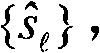 And further processes (e.g., demodulates, deinterleaves, and decodes) the stream to obtain a corresponding decoded data stream
The receiving entity then estimates the data symbol stream slCause interference that is not yet recovered by other data symbol streams. To estimate the interference, the receiving entity processes (e.g., re-encodes, interleaves, and symbol maps) the decoded data stream in the same manner as was performed for that stream by the transmitting entity And obtain a stream of "remodulated" symbols
 Which is the stream of just recovered data symbols slAnd (4) estimating. The receiving entity then uses the steering matrixV(m) spatially processing the re-modulated symbol stream and further correlating the result with a channel response matrixH(m) to obtain a composed stream slCaused by NRAn interference componenti l(m) of the reaction mixture. The receiving entity then derives N for the current phase l fromRA stream of input symbolsr p l(m) subtracting NRAn interference componenti l(m) to obtain N for the next stageRA stream of input symbolsr p l+1(m) or
 <math><mrow><msubsup><munder><mi>r</mi><mo>‾</mo></munder><mi>p</mi><mrow><mi>l</mi><mo>+</mo><mn>1</mn></mrow></msubsup><mrow><mo>(</mo><mi>m</mi><mo>)</mo></mrow><mo>=</mo><msubsup><munder><mi>r</mi><mo>‾</mo></munder><mi>p</mi><mi>l</mi></msubsup><mrow><mo>(</mo><mi>m</mi><mo>)</mo></mrow><mo>-</mo><msup><munder><mi>r</mi><mo>‾</mo></munder><mi>l</mi></msup><mrow><mo>(</mo><mi>m</mi><mo>)</mo></mrow><mo>.</mo></mrow></math> Input symbol streamr p l+1(m) indicates if the data symbol stream s is not transmittedlAnd the receiving entity will receive the stream, assuming interference cancellation is performed efficiently. Then, the receiving entity pair NRA stream of input symbolsr p l+1(m) repeating the same process to recover another data stream. However, the effective channel response matrix for the subsequent phase l +1H p_eff l+1(m) is subtracted from the data symbol stream s recovered in stage llA corresponding column.
For the SIC technique, the SNR of each data symbol stream depends on: (1) the receiver processing technique used for each stage (e.g., CCMI or MMSE), (2) the particular stage in which the data symbol stream is recovered, and (3) the amount of interference, since the data symbol stream is recovered in a later stage. Generally, the SNR gradually improves the data symbol stream recovered in the later stage because the interference of the data symbol stream recovered in the previous stage is cancelled. This can then use the higher rate for the data symbol stream recovered in a later stage.
Table 2 summarizes the spatial processing for partial CSI transmission using steered transmit diversity at the transmitting and receiving entities. For simplicity, the SIC technique is not shown in table 2.
TABLE 2
Fig. 2 shows a model for data transmission using steered transmit diversity. The transmitting entity 110 performs spatial processing (or spatial spreading) for pilot transmit diversity (block 220) and spatial processing for full CSI or partial CSI transmission (block 230). The receiving entity 150 performs receiver spatial processing for full CSI or partial CSI transmission (block 260) and receiver spatial processing (or spatial despreading) for pilot transmit diversity (block 270). As shown in fig. 2, the transmitting entity performs spatial spreading for steered transmit diversity before spatial processing (if any) for full-CSI and partial-CSI transmissions. The receiving entity may perform complementary receiver spatial processing for full-CSI or partial-CSI transmission prior to spatial despreading for pilot transmit diversity.
3.Spatial filter matrix computation
Using pilot transmit diversity, different pilot matricesV(m) may be used for different transmission spans to randomize the effective MIMO channel observed by the data transmission. This may then improve performance because data transmission does not observe "poor" MIMO channel realizations for an extended period of time. The transmission span may correspond to a symbol period for a single carrier MIMO system or a subband for a multicarrier MIMO system.
Fig. 3A illustrates partial CSI transmission using steered transmit diversity for a single carrier MIMO system. For this system, the transmission span index m may be equal to the symbol period index n (or m ═ n). A vector of data symbols may be applied in each symbol period ns(n) transmitting and using the steering matrix selected for the symbol periodV(n) pairss(n) performing spatial expansion. Each data symbol vectors(n) observation ofH p_eff(n)=H(n)·V(n) effective MIMO channel response and use of spatial filter matrixM x(n) recoverys(n)。
Fig. 3B illustrates partial CSI transmission using steered transmit diversity in a multi-carrier MIMO system. For this system, the transmission span index m may be equal to the sub-band index k (or m-k). For each symbol period, a vector of data symbols may be transmitted in each subband ks(k) And using steering matrices selected for that subbandV(k) Will be provided withs(k) And performing space expansion. Each data symbol vectors(k) Observe thatH p_eff(k)=H(k)·V(k) And using a spatial filter matrixM x(k) Will be provided withs(k) And (6) recovering. Vector quantitys(k) Sum matrixV(k)、 H(k) AndM x(k) also a function of the symbol period n, but is not shown for simplicity.
As shown in fig. 3A and 3B, if different steering matrices are used for different transmission spans, the spatial filter matrix used by the receiving entityIs a function of the transmission span index m. Even if the channel response matrixHIt is also true that (m) is fixed or constant over a series of transmission spans. In a multi-carrier MIMO system, for example, for a flat fading MIMO channel with a flat frequency response,H(k) may be fixed across the subband groups. As another example, in a single carrier MIMO system, for a MIMO channel without time fading,H(n) may be fixed for a given time interval. The time interval may correspond to all or a portion of the duration for transmitting a block of data symbols that is encoded and decoded in blocks.
The correlation typically exists between channel response matrices for adjacent transmission spans, e.g. betweenH(m) andH(m +/-1). The correlation may be used to simplify the computation of the spatial filter matrix at the receiving entity. The following is a description of the calculation for both cases-full correlation and partial correlation.
A. All correlation
With full correlation, the channel response matrix for a MIMO channel is fixed within a series of correlated transmission span indices, e.g., M1. Therefore, the temperature of the molten metal is controlled,H(1)=H(2)=...=H(M)=H。
for full-CSI techniques, a spatial filter matrix using a fully-correlated channel response matrix may be usedM fcsi(m) is represented by:
M fcsi(m)=V H(m)·Λ -1(m)·E H(m)·H H. Formula (17)
The spatial filter matrix may then be appliedM fcsi(m) is calculated as:
M fcsi(m)=V H(m)·M fcsi_basem, wherein M is 1.. M,formula (18)
Wherein,M fcsi_base=Λ -1·E H·H His a basic spatial filter matrix, i.e., a spatial filter matrix for full CSI techniques without using pilot transmit diversity. Basic spatial filter matrixM fcsi_baseIs not a function of the transmission span m because of the channel response matrixHIs stationary. Equation (18) represents the spatial filter matrix for each transmission span mM fcsi(m) the filter matrix can be formed by combining a basic spatial filter matrixM fcsi_basePre-multiplying the steering matrix for the transmission spanV H(m) to obtain.
Alternatively, the spatial filter matrix may be usedM fcsi(m) is calculated as:
M fcsi(m)=W 1(m)·M fcsi(1) m, where M is 2.. M, formula (19)
Wherein,M fcsi(1)=V H(1)·Λ -1·E H·H HandW 1(m)=V H(m)·V(1). Formula (19)
Representing a spatial filter matrix for each transmission span mM fcsi(m) the spatial filter matrix can be used for transmission span 1M ccmi(1) Pre-multiplying by a matrixW 1(m) to obtain. Matrix arrayW 1(M) are unitary matrices, where M2V(m) andV(1) to be acquired. Can be combined with matrixW 1(m) are pre-calculated and stored in memory.
For MMSE techniques for full CSI transmission, a spatial filter matrix using a fully correlated channel response matrix may be usedM f_mmse(m) is represented by:
Equation (20) is the usage propertyA·B)-1=B -1·A -1AndV·V H=Iand (4) deriving. The term in parentheses in the second equation in equation (20) can be expressed as:
[V H·E H·H H·H·E·V+σ2·I]=[V H(E H·H H·H·E+σ2·V·I·V H)·V],
=[V H(E H·H H·H·E+σ2·I)·V],
wherein "(m)" is omitted for clarity. The inverse of the term in the second equation above can then be expressed as:
[V H(E H·H H·H·E+σ2·I)·V]-1=[V H(E H·H H·H·E+σ2·I)-1·V]whereinV H=V -1。
the spatial filter matrix can be formedM f_mmse(m) is calculated as:
M f_mmse(m)=V H(m)·M f_mmse_basem, where M1.. M, formula (21)
Wherein,M f_mmse_base=[E H·H H·H·E+σ2·I]-1 E H·H H. Similar to the full-CSI technique, the spatial filter matrix for the transmission span mM f_mmse(m) the filter matrix can be formed by combining a basic spatial filter matrixM f_mmse_base(m) pre-multiplying by steering matrixV H(m) to obtain. The spatial filter matrix can also be combinedM f_mmse(m) is calculated as:
M f_mmse(m)=W 1(m)·M f_mmse(1) m, where M2.. M, formula (22)
Wherein,M f_mmse(1)=V H(1)·[E H·H H·H·E+σ2·I]-1·E H·H H。
for CCMI techniques, a spatial filter matrix using a fully correlated channel response matrix may be usedM ccmi(m) is represented by:
Wherein, the [ alpha ], [ beta ]V H(m)]-1=V(m) becauseV(m) is a unitary matrix.
Thus, a spatial filter matrix can be formedM ccmi(m) is calculated as:
M ccmi(m)=V H(m)·M ccmi_basem, where M1.. M, formula (24)
Wherein,M ccmi_base=R -1·H H. The spatial filter matrix can also be combinedM ccmi(m) is calculated as:
M ccmi(m)=W 1(m)·M ccmi(1) m, where M is 2.. M, formula (25)
Wherein,M ccmi(1)=V H(1)·R -1·H H。
for MMSE techniques for partial CSI transmission, a spatial filter matrix using a fully correlated channel response matrix may be usedM p_mmse(m) is represented by:
Equation (26) may be derived in a similar manner as equation (20) above.
The spatial filter matrix can be formedM p_mmse(m) is calculated as:
M p_mmse(m)=V H(m)·M p_mmse_basem, where M1.. M, formula (27)
Wherein,M p_mmse_base=[H H·H+σ2·I]-1·H H. The spatial filter matrix can also be combinedM p_mmse(m) is calculated as:
M p_mmse(m)=W 1(m)·M p_mmse(1) m, where M2.. M, formula (28)
Wherein,M p_mmse(1)=V H(1)·[H H·H+σ2·I]-1·H H。
table 3 summarizes the calculations of spatial filter matrices for full-CSI and partial-CSI transmissions using fully correlated channel response matrices in transmission span M1.
TABLE 3 spatial Filter matrix Using full correlation

In general, the spatial filter matrix for the transmission span m can be calculated asM x(m)=V H(m)·M x_baseWhere the subscript "x" denotes the receiver processing technology and may be "fcsi", "f _ mmse", "ccmi", or "p _ mmse". The basic spatial filter matrix can also be computed if no pilot transmit diversity is usedM x_base。
Fig. 4 shows a flow diagram of the calculation by processor 400 of a spatial filter matrix using a fully correlated channel response matrix in transmission span M1. First, an initial spatial filter matrix is calculatedM x_init(block 412). The initial spatial filter matrix may be a basic spatial filter matrixM x_baseIt is derived based on: (1) channel response matrixH(ii) a And (2) the receiver processing technique selected for use (e.g., full CSI, MMSE for full CSI, CCMI, or MMSE for partial CSI). Of course, the initial spatial filter matrix may also be a spatial filter matrix for a transmission span m-1M x(1) Which may be based onHAndV(1) and (6) exporting.
Then, ifM x_init=M x_baseThe transmission span index m is set to 1 (as shown in fig. 4), or, if so, ifM x_init=M x(1) It is set to 2 (block 414). Then, based on the initial spatial filter matrixM x_initAnd a steering matrix for the transmission span mV(m) calculating a spatial filter matrix for a transmission span mM x(m) (block 416). In particular, can be based onM x_baseAndV(m) orM x(1) AndW 1(m) calculatingM x(m) as described above. A determination is then made as to whether M < M (block 420). If the answer is "yes," then the metric m is increased (block 422) and the process returns to block 416 to calculate space for another transmission spanA filter matrix. Otherwise, if M is M in block 420, the spatial filter matrix isM x(1) ToM x(m) for receiving symbol vectors, respectivelyr x(1) Tor xReceiver spatial processing of (M) (block 424). Although not shown in FIG. 4 for simplicity, once the spatial filter matrix is generatedM x(m) and obtaining a vector of received symbolsr x(m), then each spatial filter matrix can be used for receiver spatial processing.
For full CSI transmission, the spatial processing at the transmitting entity may also be simplified to:x f(m)=E·V(m)·s(m) of the reaction mixture. May be based on steering matrices for each transmission span mV(m) and matrixECalculating a matrix for the transmission spanE·V(m),EIs not a function of the transmission span for the fully correlated case.
B. Partial correlation
With partial correlation, the channel response matrix for the MIMO channel is not fully correlated over a series of correlated transmission span indices. In this case, the spatial filter matrix calculated for the transmission span l may be used to help calculate a spatial filter matrix for another transmission span m.
In one embodiment, the steering matrix for transmission span l is removed by cullingV(l) From a spatial filter matrix calculated for the transmission span lM x(l) To obtain a basic spatial filter matrix for a transmission span lM x_base(l) The following are:
M x_base(l)=V(l)·M x(l) In that respect Formula (29)
Then, the basic spatial filter matrixM x_base(l) For deriving a basic spatial filter matrix for a transmission span m (e.g. m ═ l ± 1)M x_base(m) of the reaction mixture. For example, repeated pairs may be used M x_base(l) Performing an iterative process or operation of a set of calculations to calculateM x_base(m) to obtainM x_base(m) final scheme. Iterative processes (e.g., adaptive MMSE operations, gradient operations, lattice operations, etc.) for computing an MMSE scheme are known in the art and are not described herein. Spatial filter matrix that can be used for transmission span mM x(m) is calculated as:
M x(m)=V H(m)·M x_base(m) of the reaction mixture. Formula (30)
Therefore, the processing order of this embodiment can be given as: <math><mrow><msub><munder><mi>M</mi><mo>‾</mo></munder><mi>x</mi></msub><mrow><mo>(</mo><mi>l</mi><mo>)</mo></mrow><mo>→</mo><msub><munder><mi>M</mi><mo>‾</mo></munder><mrow><mi>x</mi><mo>_</mo><mi>base</mi></mrow></msub><mrow><mo>(</mo><mi>l</mi><mo>)</mo></mrow><mo>⇒</mo><msub><munder><mi>M</mi><mo>‾</mo></munder><mrow><mi>x</mi><mo>_</mo><mi>base</mi></mrow></msub><mrow><mo>(</mo><mi>m</mi><mo>)</mo></mrow><mo>→</mo><msub><munder><mi>M</mi><mo>‾</mo></munder><mi>x</mi></msub><mrow><mo>(</mo><mi>m</mi><mo>)</mo></mrow><mo>,</mo></mrow></math> wherein "→" means direct calculation, and " "denotes possible iterative calculations. Basic spatial filter matrixM x_base(l) AndM x_base(m) excluding steering matrices and spatial filter matricesM x(l) AndM x(m) steering matrices for transmission spans l and m, respectivelyV(l) AndV(m)。
in another embodiment, initial guessing is used The iterative process of performing a set of calculations is repeated to calculate a spatial filter matrix for a transmission span mM x(m) of the reaction mixture. Can be derived from a spatial filter matrix derived for the transmission span lM x(l) To derive an initial guess, as follows:
Wherein,W 1(m)=V H(m)·V(l) In that respect The processing order for this embodiment can be given as: <math><mrow><msub><munder><mi>M</mi><mo>‾</mo></munder><mi>x</mi></msub><mrow><mo>(</mo><mi>l</mi><mo>)</mo></mrow><mo>→</mo><msub><munderover><mi>M</mi><mo>‾</mo><mo>~</mo></munderover><mi>x</mi></msub><mrow><mo>(</mo><mi>m</mi><mo>)</mo></mrow><mo>⇒</mo><msub><munder><mi>M</mi><mo>‾</mo></munder><mi>x</mi></msub><mrow><mo>(</mo><mi>m</mi><mo>)</mo></mrow><mo>.</mo></mrow></math> spatial filter matrix AndM x(m) each comprise steering matrices for a transmission span mV(m)。
For the above embodiments, theM x_base(l) Andconsidered to be used to derive a spatial filter matrix for a new transmission span mM x(m) an initial spatial filter matrix. In general,M x(l) AndM xthe amount of correlation between (m) depends onM x_base(l) AndM x_base(m) amount of correlation between, which depends on the transmission spans l and mH(l) AndH(m) relative amount between (m). Higher correlation may result in faster convergence to useM x(l) The final scheme of (1).
Fig. 5 shows a flow diagram of a process 500 for spatial filter matrix calculation using a spatial filter matrix of a partial correlation channel response matrix for a transmission span M1. The metrics for the current and next transmission spans are initialized to l-1 and m-2 (block 512). Calculating a spatial filter matrix for a transmission span l based on selected receiver processing techniquesM x(l) (block 514). Then, based on the spatial filter matrixM x(l) And a suitable steering matrixV(l) AndV(m) to compute an initial spatial filter matrix for the transmission span mM x_initE.g., as shown in equations (29) or (31) (block 516). Then, for example, using an iterative process, based on the initial spatial filter matrixM x_initTo calculate a spatial filter matrix for a transmission span mM x(m) (block 518).
A determination is then made as to whether M < M (block 520). If the answer is "yes," the indicators l and m are updated, e.g., to l ═ m and m ═ m +1 (block 522). The process then returns to block 516 to calculate a spatial filter matrix for another transmission span. Otherwise, if all spatial filter matrices have been calculated, as determined in block 520, the spatial filter matrices are calculatedM x(1) ToM x(M) for receiving symbol vectors, respectivelyr x(1) Tor xReceiver spatial processing of (M) (block 524).
For simplicity, fig. 5 shows the computation of M spatial filter matrices for M consecutive transmission spans M-1.. M. The transmission spans need not be contiguous. Typically, the derived spatial filter matrix for one transmission span l is used to obtain an initial guess of the spatial filter matrix for another transmission span m, where l and m may be any index values.
4.Steering matrix
A set of steering matrices (or transmit matrices) may be generated and used for steering transmit diversity. These steering matrices can be represented asVEither alone orV(i) L, where L is any integer value greater than 1. Each steering matrixV(i) Should be unitary. This condition ensures the utilization ofV(i) N of simultaneous emissionTThe data symbols have the same power and are being utilizedV(i) After spatial spreading, are orthogonal to each other.
The set of L steering matrices may be generated in various ways. For example, L steering matrices may be generated based on a unitary base matrix and a set of scalars. The basic matrix may be used as one of the L steering matrices. The other L-1 steering matrices may be generated by multiplying the rows of the base matrix by different combinations of scalars. Each scalar may be any real or complex value. The scalars are selected to have unity magnitude so that the steering matrix generated using these scalars is unitary.
The base matrix may be a Walsh matrix. A 2 x 2 Walsh matrixW 2×2And a larger size Walsh matrixW 2N×2NCan be expressed as follows:
The dimensions of the Walsh matrix are powers of 2 (e.g., 2, 4, 8, etc.).
The base matrix may also be a fourier matrix. For NxN Fourier matrixD N×N,D N×NRow n and column m of element dm,nCan be expressed as:
A fourier matrix of arbitrary square dimensions (e.g., 2, 3, 4, 5, etc.) may be formed. Other matrices may also be used as the base matrix.
For an N fundamental matrix, the fundamental matrix can beEach of rows 2 through N is independently multiplied by one of K different possible scalars. K from K scalars for N-1 linesN-1In different substitution forms, to obtain KN-1A different steering matrix. For example, each of rows 2 through N is independently multiplied by a scalar + 1, -1, + j, or-j. For N-4 and K-4, with four different scalars, 64 different steering matrices can be generated from the 4 × 4 basis matrix. In general, each row of the base matrix may be multiplied by having ejθAny scalar of the form where θ can be any phase value. For each element of an N x N basic matrix multiplied by a scalar quantity Further scaling to obtain an nxn steering matrix per column per unit power.
Steering matrices derived based on Walsh matrices (i.e., 4 x 4 fourier matrices) have certain desirable properties. If the rows of the Walsh matrix are multiplied by scalars ± 1 and ± j, each element of the resulting steering matrix is +1, -1, + j, or-j. In this case, one element of the spatial filter matrix (i.e., the "weight") can be multiplied by one element of the steering matrix by only a bit operation. The computation for deriving the spatial filter matrix for the full correlation case can be greatly simplified if the elements of the L steering matrices belong to the set consisting of { +1, -1, + j, -j }.
5.MIMO system
Fig. 6 shows a block diagram of an access point 610 and a user terminal 650 in a MIMO system 600. Access point 610 is equipped with NapAn antenna for data transmission and reception, and a user terminal equipped with NutAn antenna, wherein Nap> 1 and Nut>1。
On the downlink, at access point 610, a TX data processor 620 receives and processes (encodes, interleaves, and symbol maps) traffic/packet data and control/overhead data and provides data symbols. TX spatial processor 630 utilizes steering matricesV(m) and possibly forEigenvector matrix of the row linkE(m) spatially processing the data symbols, e.g., as shown in tables 1 and 2. TX spatial processor 630 also multiplexes using pilot symbols, as appropriate, and combines NapOne transmit symbol stream is provided to NapAnd transmitter units 632a through 632 ap. Each transmitter unit 632 receives and processes a respective transmit symbol stream and provides a respective downlink modulated signal. From NapN from transmitter units 632a through 632ap are transmitted by antennas 634a through 634ap, respectivelyapA downlink modulated signal.
At user terminal 650, NutThe transmitted downlink modulated signals are received by antennas 652a through 652ut, which each provide a received signal to a respective receiver unit 654. Receiver units 654 complementarily process the processing performed by receiver units 632 and provide received symbols. RX spatial processor 660 for data from all NutThe received symbols for each receiver unit 654a through 654ut are receiver spatially processed, e.g., as shown in tables 1 and 2, and provide detected data symbols. An RX data processor 670 processes (e.g., symbol demaps, deinterleaves, and decodes) the detected data symbols and provides decoded data for the downlink.
The processing for the uplink may be the same as or different from the processing for the downlink. Traffic and control data are processed (e.g., encoded, interleaved, and symbol mapped) by a TX data processor 688 and by a TX spatial processor 690 using a steering matrixV(m) and possibly eigenvector matrices for the uplinkE(m) spatially processed and multiplexed with pilot symbols to generate NutA stream of transmit symbols. N is a radical ofutA transmitter unit 654 a-654 ut for the NutShaping the transmitted symbol streams to generate NutAn uplink modulation signal via NutThe antennas 652a through 652ut transmit.
At the access point 610, the uplink modulated signal consists of NapA plurality of antennas 634a to 634ap for receiving and transmitting by NapA receiver unit632a through 632ap, to obtain received symbols for the uplink. An RX spatial processor 644 performs receiver spatial processing on the received symbols and provides detected data symbols, which are further processed by an RX data processor 646 to obtain decoded data for the uplink.
Fig. 7 illustrates an embodiment of a processor 678 that performs channel estimation and spatial filter matrix computation for user terminal 650. Channel estimator 712 obtains received pilot symbols and derives a channel response matrix for each transmission span in which the received pilot symbols are available. Filter 714 may time-domain filter the channel response matrices for the current and previous transmission spans to obtain a higher quality channel response matrixH(m) of the reaction mixture. Unit 716 then calculates an initial spatial filter matrixM x_init。
For full correlationH(m), initial spatial filter matrixM x_initCan be as follows: (1) based onH(m) and the basic spatial filter matrix calculated by the selected receiver processing techniqueM x_base(ii) a Or (2) based onH(1)、V(1) Spatial filter matrix for transmission span 1 calculated with selected receiver processing techniqueM x(1). For partial correlationH(m), initial spatial filter matrixM x_initMay be an initial guessM x_base(l) Or based on a calculated spatial filter matrix for another transmission span/M x(l) Obtained by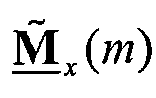 .
. Unit 718 is based on an initial spatial filter matrixM x_initAnd for transmission span mOf the steering matrixV(m) calculating a spatial filter matrix for the transmission spanM x(m) of the reaction mixture. For partial correlationH(m), unit 718 may be based on the initial spatial filter matrix pairM x(m) performing a calculation of an iterative process which isM x(m) initial guess.
The spatial filter matrix computation techniques described herein may be implemented in various ways. For example, these techniques may be implemented in hardware, software, or a combination of hardware and software. For a hardware implementation, the processing units used for spatial filter matrix computation may be implemented within one or more Application Specific Integrated Circuits (ASICs), Digital Signal Processors (DSPs), Digital Signal Processing Devices (DSPDs), Programmable Logic Devices (PLDs), Field Programmable Gate Arrays (FPGAs), processors, controllers, micro-controllers, microprocessors, other electronic units designed to perform the functions described herein, or a combination thereof.
For a software implementation, the spatial filter matrix computation may be implemented with modules (e.g., procedures, functions, etc.). These software codes may be stored in memory units (e.g., memory units 642 and 682 in fig. 6) and executed by processors (e.g., controllers 640 and 680 in fig. 6). The memory unit may be implemented within the processor or external to the processor, in which case it can be communicatively coupled to the processor via various means as is known in the art.
Headings are included herein for reference, which are intended to locate specific sections. These headings are not intended to limit the scope of the concepts described therein under, which concepts may be applied to other sections throughout the specification.
The previous description of the disclosed embodiments is provided to enable any person skilled in the art to make or use the present invention. Various modifications to these embodiments will be readily apparent to those skilled in the art, and the generic principles defined herein may be applied to other embodiments without departing from the spirit or scope of the invention. Thus, the present invention is not intended to be limited to the embodiments shown herein but is to be accorded the widest scope consistent with the principles and novel features disclosed herein.
Claims (34)
Applications Claiming Priority (3)
| Application Number | Priority Date | Filing Date | Title |
|---|---|---|---|
| US10/882,491 | 2004-06-30 | ||
| US10/882,491 US7110463B2 (en) | 2004-06-30 | 2004-06-30 | Efficient computation of spatial filter matrices for steering transmit diversity in a MIMO communication system |
| PCT/US2005/022840 WO2006004706A1 (en) | 2004-06-30 | 2005-06-27 | Efficient computation of spatial filter matrices for steering transmit diversity in a mimo communication system |
Publications (2)
| Publication Number | Publication Date |
|---|---|
| CN101010890A CN101010890A (en) | 2007-08-01 |
| CN101010890B true CN101010890B (en) | 2011-06-08 |
Family
ID=34979956
Family Applications (1)
| Application Number | Title | Priority Date | Filing Date |
|---|---|---|---|
| CN2005800289398A Expired - Lifetime CN101010890B (en) | 2004-06-30 | 2005-06-27 | Computation method of spatial filter matrices for steering transmit diversity in a MIMO communication system |
Country Status (15)
| Country | Link |
|---|---|
| US (2) | US7110463B2 (en) |
| EP (1) | EP1766807B1 (en) |
| JP (3) | JP4833969B2 (en) |
| KR (1) | KR100887199B1 (en) |
| CN (1) | CN101010890B (en) |
| AU (2) | AU2005260035C1 (en) |
| BR (1) | BRPI0512808B1 (en) |
| CA (2) | CA2727876C (en) |
| ES (1) | ES2427934T3 (en) |
| IL (1) | IL180340A0 (en) |
| MX (1) | MX2007000268A (en) |
| MY (1) | MY139975A (en) |
| RU (1) | RU2363101C2 (en) |
| TW (2) | TWI355820B (en) |
| WO (1) | WO2006004706A1 (en) |
Families Citing this family (58)
| Publication number | Priority date | Publication date | Assignee | Title |
|---|---|---|---|---|
| US8194770B2 (en) | 2002-08-27 | 2012-06-05 | Qualcomm Incorporated | Coded MIMO systems with selective channel inversion applied per eigenmode |
| US7151809B2 (en) * | 2002-10-25 | 2006-12-19 | Qualcomm, Incorporated | Channel estimation and spatial processing for TDD MIMO systems |
| US7002900B2 (en) | 2002-10-25 | 2006-02-21 | Qualcomm Incorporated | Transmit diversity processing for a multi-antenna communication system |
| US8169944B2 (en) | 2002-10-25 | 2012-05-01 | Qualcomm Incorporated | Random access for wireless multiple-access communication systems |
| US7986742B2 (en) | 2002-10-25 | 2011-07-26 | Qualcomm Incorporated | Pilots for MIMO communication system |
| US7324429B2 (en) | 2002-10-25 | 2008-01-29 | Qualcomm, Incorporated | Multi-mode terminal in a wireless MIMO system |
| US8218609B2 (en) | 2002-10-25 | 2012-07-10 | Qualcomm Incorporated | Closed-loop rate control for a multi-channel communication system |
| US8208364B2 (en) | 2002-10-25 | 2012-06-26 | Qualcomm Incorporated | MIMO system with multiple spatial multiplexing modes |
| US8170513B2 (en) | 2002-10-25 | 2012-05-01 | Qualcomm Incorporated | Data detection and demodulation for wireless communication systems |
| US8134976B2 (en) | 2002-10-25 | 2012-03-13 | Qualcomm Incorporated | Channel calibration for a time division duplexed communication system |
| US20040081131A1 (en) | 2002-10-25 | 2004-04-29 | Walton Jay Rod | OFDM communication system with multiple OFDM symbol sizes |
| US8320301B2 (en) | 2002-10-25 | 2012-11-27 | Qualcomm Incorporated | MIMO WLAN system |
| US8570988B2 (en) | 2002-10-25 | 2013-10-29 | Qualcomm Incorporated | Channel calibration for a time division duplexed communication system |
| US9473269B2 (en) | 2003-12-01 | 2016-10-18 | Qualcomm Incorporated | Method and apparatus for providing an efficient control channel structure in a wireless communication system |
| US8204149B2 (en) * | 2003-12-17 | 2012-06-19 | Qualcomm Incorporated | Spatial spreading in a multi-antenna communication system |
| US7336746B2 (en) * | 2004-12-09 | 2008-02-26 | Qualcomm Incorporated | Data transmission with spatial spreading in a MIMO communication system |
| US8169889B2 (en) * | 2004-02-18 | 2012-05-01 | Qualcomm Incorporated | Transmit diversity and spatial spreading for an OFDM-based multi-antenna communication system |
| US20050180312A1 (en) * | 2004-02-18 | 2005-08-18 | Walton J. R. | Transmit diversity and spatial spreading for an OFDM-based multi-antenna communication system |
| US8285226B2 (en) * | 2004-05-07 | 2012-10-09 | Qualcomm Incorporated | Steering diversity for an OFDM-based multi-antenna communication system |
| US8923785B2 (en) | 2004-05-07 | 2014-12-30 | Qualcomm Incorporated | Continuous beamforming for a MIMO-OFDM system |
| US7110463B2 (en) * | 2004-06-30 | 2006-09-19 | Qualcomm, Incorporated | Efficient computation of spatial filter matrices for steering transmit diversity in a MIMO communication system |
| US7978649B2 (en) | 2004-07-15 | 2011-07-12 | Qualcomm, Incorporated | Unified MIMO transmission and reception |
| US7978778B2 (en) | 2004-09-03 | 2011-07-12 | Qualcomm, Incorporated | Receiver structures for spatial spreading with space-time or space-frequency transmit diversity |
| US7466749B2 (en) | 2005-05-12 | 2008-12-16 | Qualcomm Incorporated | Rate selection with margin sharing |
| US8358714B2 (en) | 2005-06-16 | 2013-01-22 | Qualcomm Incorporated | Coding and modulation for multiple data streams in a communication system |
| EP1784032A1 (en) * | 2005-11-04 | 2007-05-09 | Alcatel Lucent | Method for performing user allocation in SDMA systems, and corresponding base station |
| US7813421B2 (en) | 2006-01-17 | 2010-10-12 | Marvell World Trade Ltd. | Order recursive computation for a MIMO equalizer |
| KR100922936B1 (en) | 2006-02-07 | 2009-10-22 | 삼성전자주식회사 | Method and system for transmitting and receiving data in communication system |
| US8543070B2 (en) | 2006-04-24 | 2013-09-24 | Qualcomm Incorporated | Reduced complexity beam-steered MIMO OFDM system |
| US8290089B2 (en) | 2006-05-22 | 2012-10-16 | Qualcomm Incorporated | Derivation and feedback of transmit steering matrix |
| RU2411650C2 (en) * | 2006-08-07 | 2011-02-10 | Интердиджитал Текнолоджи Корпорейшн | Method, device and system for realisation of multi-user virtual multiple input/multiple output |
| US8374650B2 (en) * | 2006-09-27 | 2013-02-12 | Apple, Inc. | Methods for optimal collaborative MIMO-SDMA |
| US8073486B2 (en) | 2006-09-27 | 2011-12-06 | Apple Inc. | Methods for opportunistic multi-user beamforming in collaborative MIMO-SDMA |
| US8626104B2 (en) * | 2006-09-28 | 2014-01-07 | Apple Inc. | Generalized codebook design method for limited feedback systems |
| US7702029B2 (en) | 2006-10-02 | 2010-04-20 | Freescale Semiconductor, Inc. | MIMO precoding enabling spatial multiplexing, power allocation and adaptive modulation and coding |
| US8073069B2 (en) * | 2007-01-05 | 2011-12-06 | Apple Inc. | Multi-user MIMO-SDMA for finite rate feedback systems |
| US7961807B2 (en) | 2007-03-16 | 2011-06-14 | Freescale Semiconductor, Inc. | Reference signaling scheme using compressed feedforward codebooks for multi-user, multiple input, multiple output (MU-MIMO) systems |
| US7809074B2 (en) * | 2007-03-16 | 2010-10-05 | Freescale Semiconductor, Inc. | Generalized reference signaling scheme for multi-user, multiple input, multiple output (MU-MIMO) using arbitrarily precoded reference signals |
| US8020075B2 (en) | 2007-03-16 | 2011-09-13 | Apple Inc. | Channel quality index feedback reduction for broadband systems |
| US8547986B2 (en) | 2007-04-30 | 2013-10-01 | Apple Inc. | System and method for resource block-specific control signaling |
| US7978623B1 (en) | 2008-03-22 | 2011-07-12 | Freescale Semiconductor, Inc. | Channel rank updates in multiple-input multiple-output communication systems |
| EP2272178A1 (en) * | 2008-04-25 | 2011-01-12 | Broadcom Corporation | Method and system for predicting channel quality index values for maximum likelihood detection |
| US8737501B2 (en) | 2008-06-13 | 2014-05-27 | Silvus Technologies, Inc. | Interference mitigation for devices with multiple receivers |
| JP4725628B2 (en) * | 2008-10-10 | 2011-07-13 | ソニー株式会社 | Reception device, reception method, program, and wireless communication system |
| US8488724B2 (en) * | 2009-05-14 | 2013-07-16 | Silvus Technologies, Inc. | Wideband interference mitigation for devices with multiple receivers |
| US8311484B2 (en) * | 2009-09-15 | 2012-11-13 | Broadcom Corporation | Method and system for interference suppression using information from non-listened base stations |
| US8798550B2 (en) * | 2012-05-11 | 2014-08-05 | Telefonaktiebolaget L M Ericsson (Publ) | Methods and arrangements for CSI reporting |
| US11190947B2 (en) | 2014-04-16 | 2021-11-30 | Rearden, Llc | Systems and methods for concurrent spectrum usage within actively used spectrum |
| US10164698B2 (en) | 2013-03-12 | 2018-12-25 | Rearden, Llc | Systems and methods for exploiting inter-cell multiplexing gain in wireless cellular systems via distributed input distributed output technology |
| US10547358B2 (en) | 2013-03-15 | 2020-01-28 | Rearden, Llc | Systems and methods for radio frequency calibration exploiting channel reciprocity in distributed input distributed output wireless communications |
| US11290162B2 (en) | 2014-04-16 | 2022-03-29 | Rearden, Llc | Systems and methods for mitigating interference within actively used spectrum |
| US9237513B2 (en) * | 2014-06-13 | 2016-01-12 | Hong Kong Applied Science And Technology Research Institute Co., Ltd. | Method for performing a cell search in multiple antenna wireless systems |
| US12017942B2 (en) | 2015-05-13 | 2024-06-25 | Unger Marketing International, Llc | Water conditioning systems |
| WO2017083842A1 (en) | 2015-11-12 | 2017-05-18 | Unger Marketing International, Llc | Water conditioning systems |
| EP3229428B1 (en) | 2016-04-06 | 2021-03-10 | Institut Mines-Télécom | Methods and devices for sequential sphere decoding |
| US10727911B2 (en) * | 2018-08-20 | 2020-07-28 | Nokia Solutions And Networks Oy | Beamforming in MIMO radio networks |
| WO2021144217A1 (en) | 2020-01-14 | 2021-07-22 | Sony Group Corporation | Improved internal data transfer in a multiple-antenna communication system |
| USD1028169S1 (en) | 2020-10-29 | 2024-05-21 | Unger Marketing International, Llc | Water conditioning system |
Citations (2)
| Publication number | Priority date | Publication date | Assignee | Title |
|---|---|---|---|---|
| CN2613104Y (en) * | 2001-11-29 | 2004-04-21 | 交互数字技术公司 | Multi-input multi-output user facility |
| WO2004038985A2 (en) * | 2002-10-25 | 2004-05-06 | Qualcomm Incorporated | Multi-mode terminal in a wireless mimo system with spatial multiplexing |
Family Cites Families (128)
| Publication number | Priority date | Publication date | Assignee | Title |
|---|---|---|---|---|
| IL100213A (en) | 1990-12-07 | 1995-03-30 | Qualcomm Inc | CDMA microcellular telephone system and distributed antenna system therefor |
| DE4101629C3 (en) | 1991-01-21 | 2003-06-26 | Fuba Automotive Gmbh | Antenna diversity system with at least two antennas for the mobile reception of meter and decimeter waves |
| IT1259032B (en) * | 1992-05-25 | 1996-03-11 | Alcatel Italia | METHOD FOR PROCESSING AND OPTIMIZING THE ANALOGUE FUNCTION IN A DIGITAL RADIO TRANSMISSION SYSTEM IN DIFFERENT SPACE AND / OR ANGLE |
| US5668837A (en) * | 1993-10-14 | 1997-09-16 | Ericsson Inc. | Dual-mode radio receiver for receiving narrowband and wideband signals |
| WO1995022214A1 (en) * | 1994-02-10 | 1995-08-17 | Ntt Mobile Communications Network Inc. | Adaptive spread spectrum receiver |
| US5680419A (en) * | 1994-08-02 | 1997-10-21 | Ericsson Inc. | Method of and apparatus for interference rejection combining in multi-antenna digital cellular communications systems |
| US5604921A (en) | 1995-07-07 | 1997-02-18 | Nokia Mobile Phones Ltd. | Radiotelephone user interface for broadcast short message service |
| US6134215A (en) | 1996-04-02 | 2000-10-17 | Qualcomm Incorpoated | Using orthogonal waveforms to enable multiple transmitters to share a single CDM channel |
| AU4238697A (en) * | 1996-08-29 | 1998-03-19 | Cisco Technology, Inc. | Spatio-temporal processing for communication |
| US6408016B1 (en) * | 1997-02-24 | 2002-06-18 | At&T Wireless Services, Inc. | Adaptive weight update method and system for a discrete multitone spread spectrum communications system |
| US6584144B2 (en) * | 1997-02-24 | 2003-06-24 | At&T Wireless Services, Inc. | Vertical adaptive antenna array for a discrete multitone spread spectrum communications system |
| US6058105A (en) | 1997-09-26 | 2000-05-02 | Lucent Technologies Inc. | Multiple antenna communication system and method thereof |
| US6314147B1 (en) * | 1997-11-04 | 2001-11-06 | The Board Of Trustees Of The Leland Stanford Junior University | Two-stage CCI/ISI reduction with space-time processing in TDMA cellular networks |
| US6185440B1 (en) | 1997-12-10 | 2001-02-06 | Arraycomm, Inc. | Method for sequentially transmitting a downlink signal from a communication station that has an antenna array to achieve an omnidirectional radiation |
| US6618454B1 (en) * | 1998-02-06 | 2003-09-09 | At&T Corp. | Diversity coded OFDM for high data-rate communication |
| US6317466B1 (en) * | 1998-04-15 | 2001-11-13 | Lucent Technologies Inc. | Wireless communications system having a space-time architecture employing multi-element antennas at both the transmitter and receiver |
| US6198775B1 (en) * | 1998-04-28 | 2001-03-06 | Ericsson Inc. | Transmit diversity method, systems, and terminals using scramble coding |
| US6175743B1 (en) * | 1998-05-01 | 2001-01-16 | Ericsson Inc. | System and method for delivery of short message service messages to a restricted group of subscribers |
| CN1342354A (en) | 1998-09-04 | 2002-03-27 | 美国电报电话公司 | Combined channel coding and space-block coding in multi-antenna arrangement |
| AU6257399A (en) * | 1998-09-18 | 2000-04-10 | Hesham El Gamal | Method and constructions for space-time codes for psk constellations for spatialdiversity in multiple-element antenna systems |
| US6363121B1 (en) | 1998-12-07 | 2002-03-26 | Lucent Technologies Inc. | Wireless transmission method for antenna arrays using unitary space-time signals |
| GB9828216D0 (en) * | 1998-12-21 | 1999-02-17 | Northern Telecom Ltd | A downlink beamforming approach for frequency division duplex cellular systems |
| EP1073214B1 (en) | 1999-02-16 | 2008-12-17 | Mitsubishi Denki Kabushiki Kaisha | Radio communication system, transmitter and receiver |
| US6218985B1 (en) * | 1999-04-15 | 2001-04-17 | The United States Of America As Represented By The Secretary Of The Navy | Array synthesis method |
| MXPA02003903A (en) * | 1999-10-19 | 2002-09-30 | Interdigital Tech Corp | Receiver for multiuser detection of cdma signals. |
| US6788661B1 (en) * | 1999-11-12 | 2004-09-07 | Nikia Networks Oy | Adaptive beam-time coding method and apparatus |
| US6351499B1 (en) | 1999-12-15 | 2002-02-26 | Iospan Wireless, Inc. | Method and wireless systems using multiple antennas and adaptive control for maximizing a communication parameter |
| US6298035B1 (en) * | 1999-12-21 | 2001-10-02 | Nokia Networks Oy | Estimation of two propagation channels in OFDM |
| US6804307B1 (en) | 2000-01-27 | 2004-10-12 | Telefonaktiebolaget Lm Ericsson (Publ) | Method and apparatus for efficient transmit diversity using complex space-time block codes |
| US6816555B2 (en) * | 2000-02-18 | 2004-11-09 | Sony Corporation | Signal component demultiplexing apparatus, filter apparatus, receiving apparatus, communication apparatus, and communication method |
| US6473467B1 (en) | 2000-03-22 | 2002-10-29 | Qualcomm Incorporated | Method and apparatus for measuring reporting channel state information in a high efficiency, high performance communications system |
| US6542556B1 (en) * | 2000-03-31 | 2003-04-01 | Nokia Mobile Phones Ltd. | Space-time code for multiple antenna transmission |
| US6486828B1 (en) * | 2000-07-26 | 2002-11-26 | Western Multiplex | Adaptive array antenna nulling |
| US7065156B1 (en) * | 2000-08-31 | 2006-06-20 | Nokia Mobile Phones Ltd. | Hopped delay diversity for multiple antenna transmission |
| US6985434B2 (en) | 2000-09-01 | 2006-01-10 | Nortel Networks Limited | Adaptive time diversity and spatial diversity for OFDM |
| US6842487B1 (en) * | 2000-09-22 | 2005-01-11 | Telefonaktiebolaget Lm Ericsson (Publ) | Cyclic delay diversity for mitigating intersymbol interference in OFDM systems |
| US6956897B1 (en) * | 2000-09-27 | 2005-10-18 | Northwestern University | Reduced rank adaptive filter |
| US7110378B2 (en) * | 2000-10-03 | 2006-09-19 | Wisconsin Alumni Research Foundation | Channel aware optimal space-time signaling for wireless communication over wideband multipath channels |
| EP1195937A1 (en) * | 2000-10-03 | 2002-04-10 | Telefonaktiebolaget Lm Ericsson | Space-time coding with orthogonal transformations |
| EP1398645A1 (en) * | 2000-12-12 | 2004-03-17 | Matsushita Electric Industrial Co., Ltd. | Radio-wave arrival-direction estimating apparatus and directional variable transceiver |
| JP3576099B2 (en) | 2000-12-22 | 2004-10-13 | 株式会社東芝 | Receiver using smart antenna, receiving method using smart antenna, and beam forming circuit |
| US7050510B2 (en) | 2000-12-29 | 2006-05-23 | Lucent Technologies Inc. | Open-loop diversity technique for systems employing four transmitter antennas |
| US6801790B2 (en) * | 2001-01-17 | 2004-10-05 | Lucent Technologies Inc. | Structure for multiple antenna configurations |
| GB0102316D0 (en) * | 2001-01-30 | 2001-03-14 | Koninkl Philips Electronics Nv | Radio communication system |
| EP1241824A1 (en) | 2001-03-14 | 2002-09-18 | TELEFONAKTIEBOLAGET LM ERICSSON (publ) | Multiplexing method in a multicarrier transmit diversity system |
| US6496535B2 (en) * | 2001-03-23 | 2002-12-17 | Navini Networks, Inc. | Method and system for effective channel estimation in a telecommunication system |
| GB0108381D0 (en) * | 2001-04-04 | 2001-05-23 | Koninl Philips Electronics Nv | Radio communication system |
| US6982946B2 (en) * | 2001-04-05 | 2006-01-03 | Telefonaktiebolaget Lm Ericsson (Publ) | Partly orthogonal multiple code trees |
| US7173981B1 (en) | 2001-04-27 | 2007-02-06 | The Directv Group, Inc. | Dual layer signal processing in a layered modulation digital signal system |
| RU2208911C2 (en) * | 2001-05-14 | 2003-07-20 | Гармонов Александр Васильевич | Method of diversified signal transmission and device for its realization |
| KR100870557B1 (en) * | 2001-05-25 | 2008-11-27 | 리전츠 어브 더 유니버시티 오브 미네소타 | Apparatus and method for space-time coded transmission in wireless communication network |
| US6711124B2 (en) * | 2001-05-25 | 2004-03-23 | Ericsson Inc. | Time interval based channel estimation with transmit diversity |
| US6999472B2 (en) * | 2001-05-30 | 2006-02-14 | Nokia Mobile Phones Limited | Apparatus, and associated method, for space-time encoding, and decoding, data at a selected code rate |
| US20020193146A1 (en) * | 2001-06-06 | 2002-12-19 | Mark Wallace | Method and apparatus for antenna diversity in a wireless communication system |
| FR2827439B1 (en) * | 2001-07-13 | 2003-10-24 | Leroy Somer Moteurs | DISCOID MACHINE |
| US6441786B1 (en) * | 2001-07-20 | 2002-08-27 | Motorola, Inc. | Adaptive antenna array and method for control thereof |
| US7359466B2 (en) * | 2001-08-24 | 2008-04-15 | Lucent Technologies Inc. | Signal detection by a receiver in a multiple antenna time-dispersive system |
| US7149254B2 (en) * | 2001-09-06 | 2006-12-12 | Intel Corporation | Transmit signal preprocessing based on transmit antennae correlations for multiple antennae systems |
| US7248559B2 (en) | 2001-10-17 | 2007-07-24 | Nortel Networks Limited | Scattered pilot pattern and channel estimation method for MIMO-OFDM systems |
| US7327798B2 (en) | 2001-10-19 | 2008-02-05 | Lg Electronics Inc. | Method and apparatus for transmitting/receiving signals in multiple-input multiple-output communication system provided with plurality of antenna elements |
| KR200260860Y1 (en) | 2001-10-25 | 2002-01-17 | 김지환 | Collapsible charger for portable phone |
| US7095987B2 (en) * | 2001-11-15 | 2006-08-22 | Texas Instruments Incorporated | Method and apparatus for received uplinked-signal based adaptive downlink diversity within a communication system |
| US6760388B2 (en) * | 2001-12-07 | 2004-07-06 | Qualcomm Incorporated | Time-domain transmit and receive processing with channel eigen-mode decomposition for MIMO systems |
| JP3992489B2 (en) * | 2001-12-12 | 2007-10-17 | 株式会社エヌ・ティ・ティ・ドコモ | Wireless communication method and apparatus |
| US20030112745A1 (en) * | 2001-12-17 | 2003-06-19 | Xiangyang Zhuang | Method and system of operating a coded OFDM communication system |
| JP2003198645A (en) | 2001-12-27 | 2003-07-11 | Sharp Corp | Transmission device and communication system using the same |
| EP1775873A3 (en) * | 2002-01-04 | 2012-12-26 | Nokia Corporation | Reception of signals in a high rate transmission diversity system |
| US7020110B2 (en) * | 2002-01-08 | 2006-03-28 | Qualcomm Incorporated | Resource allocation for MIMO-OFDM communication systems |
| US6862271B2 (en) * | 2002-02-26 | 2005-03-01 | Qualcomm Incorporated | Multiple-input, multiple-output (MIMO) systems with multiple transmission modes |
| US6636568B2 (en) * | 2002-03-01 | 2003-10-21 | Qualcomm | Data transmission with non-uniform distribution of data rates for a multiple-input multiple-output (MIMO) system |
| US6741587B2 (en) | 2002-04-02 | 2004-05-25 | Nokia Corporation | Inter-frequency measurements with MIMO terminals |
| US6711528B2 (en) * | 2002-04-22 | 2004-03-23 | Harris Corporation | Blind source separation utilizing a spatial fourth order cumulant matrix pencil |
| EP1359684A1 (en) | 2002-04-30 | 2003-11-05 | Motorola Energy Systems Inc. | Wireless transmission using an adaptive transmit antenna array |
| KR100511292B1 (en) * | 2002-04-30 | 2005-08-31 | 엘지전자 주식회사 | Update method for beamforming weight vector of rake receiver and receiving apparatus using beamforming weight vector |
| US6847306B2 (en) * | 2002-05-17 | 2005-01-25 | Keyvan T. Diba | Emergency traffic signal attachment |
| GB0212165D0 (en) * | 2002-05-27 | 2002-07-03 | Nokia Corp | A wireless system |
| FI20021013A0 (en) | 2002-05-29 | 2002-05-29 | Nokia Corp | Procedure for data communication and data transmission systems |
| KR100548311B1 (en) * | 2002-06-07 | 2006-02-02 | 엘지전자 주식회사 | Transmission Diversity Device and Method in Mobile Communication System |
| US7613248B2 (en) * | 2002-06-24 | 2009-11-03 | Qualcomm Incorporated | Signal processing with channel eigenmode decomposition and channel inversion for MIMO systems |
| US7095709B2 (en) * | 2002-06-24 | 2006-08-22 | Qualcomm, Incorporated | Diversity transmission modes for MIMO OFDM communication systems |
| JP3677492B2 (en) | 2002-07-31 | 2005-08-03 | 松下電器産業株式会社 | Multicarrier transmission apparatus and multicarrier transmission method |
| US7394754B2 (en) * | 2002-08-01 | 2008-07-01 | Mediatek Inc. | System and method for transmitting data in a multiple-branch transmitter-diversity orthogonal frequency-division multiplexing (OFDM) system |
| JP4098027B2 (en) | 2002-08-01 | 2008-06-11 | 松下電器産業株式会社 | Wireless base station equipment |
| US6940917B2 (en) | 2002-08-27 | 2005-09-06 | Qualcomm, Incorporated | Beam-steering and beam-forming for wideband MIMO/MISO systems |
| US7529177B2 (en) | 2002-08-28 | 2009-05-05 | Agere Systems Inc. | Dithering scheme using multiple antennas for OFDM systems |
| DE60223367T2 (en) | 2002-09-05 | 2008-02-14 | Mitsubishi Electric Information Technology Centre Europe B.V. | A method for transmitting from a base station of an MC-CDMA telecommunication system to a plurality of users |
| US7031669B2 (en) * | 2002-09-10 | 2006-04-18 | Cognio, Inc. | Techniques for correcting for phase and amplitude offsets in a MIMO radio device |
| US6873606B2 (en) * | 2002-10-16 | 2005-03-29 | Qualcomm, Incorporated | Rate adaptive transmission scheme for MIMO systems |
| US20040081263A1 (en) * | 2002-10-24 | 2004-04-29 | Lee King F. | Method and apparatus for receiving diversity transmissions |
| US8208364B2 (en) | 2002-10-25 | 2012-06-26 | Qualcomm Incorporated | MIMO system with multiple spatial multiplexing modes |
| US8320301B2 (en) | 2002-10-25 | 2012-11-27 | Qualcomm Incorporated | MIMO WLAN system |
| US7151809B2 (en) * | 2002-10-25 | 2006-12-19 | Qualcomm, Incorporated | Channel estimation and spatial processing for TDD MIMO systems |
| US8134976B2 (en) * | 2002-10-25 | 2012-03-13 | Qualcomm Incorporated | Channel calibration for a time division duplexed communication system |
| US7317750B2 (en) * | 2002-10-31 | 2008-01-08 | Lot 41 Acquisition Foundation, Llc | Orthogonal superposition coding for direct-sequence communications |
| AU2003287484A1 (en) * | 2002-11-04 | 2004-06-07 | Vivato, Inc. | Complementary beamforming methods and apparatuses |
| US7057555B2 (en) * | 2002-11-27 | 2006-06-06 | Cisco Technology, Inc. | Wireless LAN with distributed access points for space management |
| US7200631B2 (en) * | 2003-01-10 | 2007-04-03 | Lucent Technologies Inc. | Method and apparatus for determining an inverse square root of a given positive-definite hermitian matrix |
| US7130580B2 (en) | 2003-03-20 | 2006-10-31 | Lucent Technologies Inc. | Method of compensating for correlation between multiple antennas |
| US7099678B2 (en) | 2003-04-10 | 2006-08-29 | Ipr Licensing, Inc. | System and method for transmit weight computation for vector beamforming radio communication |
| US7385617B2 (en) * | 2003-05-07 | 2008-06-10 | Illinois Institute Of Technology | Methods for multi-user broadband wireless channel estimation |
| US7079870B2 (en) * | 2003-06-09 | 2006-07-18 | Ipr Licensing, Inc. | Compensation techniques for group delay effects in transmit beamforming radio communication |
| GB0317147D0 (en) * | 2003-07-22 | 2003-08-27 | Dalton Stephen | "GAM"- Gravity-air-motion |
| KR100584321B1 (en) * | 2003-08-02 | 2006-05-26 | 삼성전자주식회사 | TMD type transmitter and receiver including a Cartesian feedback loop circuit |
| US7065144B2 (en) * | 2003-08-27 | 2006-06-20 | Qualcomm Incorporated | Frequency-independent spatial processing for wideband MISO and MIMO systems |
| US7356073B2 (en) * | 2003-09-10 | 2008-04-08 | Nokia Corporation | Method and apparatus providing an advanced MIMO receiver that includes a signal-plus-residual-interference (SPRI) detector |
| EP1665703B1 (en) | 2003-09-15 | 2008-01-16 | NTT DoCoMo, Inc. | Multicarrier system with transmit diversity |
| JP4300368B2 (en) | 2003-09-30 | 2009-07-22 | 株式会社エヌ・ティ・ティ・ドコモ | Apparatus and method for generating transmission signal from multi-user signal and extracting user signal |
| US7302009B2 (en) * | 2003-12-17 | 2007-11-27 | Qualcomm Incorporated | Broadcast transmission with spatial spreading in a multi-antenna communication system |
| US8204149B2 (en) * | 2003-12-17 | 2012-06-19 | Qualcomm Incorporated | Spatial spreading in a multi-antenna communication system |
| US7778425B2 (en) * | 2003-12-24 | 2010-08-17 | Nokia Corporation | Method for generating noise references for generalized sidelobe canceling |
| US7336746B2 (en) * | 2004-12-09 | 2008-02-26 | Qualcomm Incorporated | Data transmission with spatial spreading in a MIMO communication system |
| US7194042B2 (en) * | 2004-01-13 | 2007-03-20 | Qualcomm Incorporated | Data transmission with spatial spreading in a mimo communication system |
| US8169889B2 (en) * | 2004-02-18 | 2012-05-01 | Qualcomm Incorporated | Transmit diversity and spatial spreading for an OFDM-based multi-antenna communication system |
| US20050180312A1 (en) * | 2004-02-18 | 2005-08-18 | Walton J. R. | Transmit diversity and spatial spreading for an OFDM-based multi-antenna communication system |
| EP1716680B1 (en) | 2004-02-19 | 2008-08-27 | NTT DoCoMo INC. | Channel estimator and method for estimating a channel transfer function and apparatus and method for providing pilot sequences |
| DE602004014984D1 (en) | 2004-02-19 | 2008-08-21 | Ntt Docomo Inc | DEVICE AND METHOD FOR ESTIMATING AN EFFECTIVE CHANNEL AND DEVICE AND METHOD FOR PROVIDING PILOT SEQUENCES |
| US7447268B2 (en) | 2004-03-31 | 2008-11-04 | Intel Corporation | OFDM system with per subcarrier phase rotation |
| US7583747B1 (en) * | 2004-03-31 | 2009-09-01 | University Of Alberta | Method of systematic construction of space-time constellations, system and method of transmitting space-time constellations |
| US20050238111A1 (en) * | 2004-04-09 | 2005-10-27 | Wallace Mark S | Spatial processing with steering matrices for pseudo-random transmit steering in a multi-antenna communication system |
| US7564814B2 (en) * | 2004-05-07 | 2009-07-21 | Qualcomm, Incorporated | Transmission mode and rate selection for a wireless communication system |
| US8285226B2 (en) * | 2004-05-07 | 2012-10-09 | Qualcomm Incorporated | Steering diversity for an OFDM-based multi-antenna communication system |
| US8923785B2 (en) * | 2004-05-07 | 2014-12-30 | Qualcomm Incorporated | Continuous beamforming for a MIMO-OFDM system |
| US8619907B2 (en) * | 2004-06-10 | 2013-12-31 | Agere Systems, LLC | Method and apparatus for preamble training in a multiple antenna communication system |
| US7110463B2 (en) * | 2004-06-30 | 2006-09-19 | Qualcomm, Incorporated | Efficient computation of spatial filter matrices for steering transmit diversity in a MIMO communication system |
| US7978649B2 (en) * | 2004-07-15 | 2011-07-12 | Qualcomm, Incorporated | Unified MIMO transmission and reception |
| US7894548B2 (en) * | 2004-09-03 | 2011-02-22 | Qualcomm Incorporated | Spatial spreading with space-time and space-frequency transmit diversity schemes for a wireless communication system |
| US7978778B2 (en) * | 2004-09-03 | 2011-07-12 | Qualcomm, Incorporated | Receiver structures for spatial spreading with space-time or space-frequency transmit diversity |
| US7974359B2 (en) * | 2004-12-22 | 2011-07-05 | Qualcomm Incorporated | Methods and apparatus for mitigating multi-antenna correlation effect in communication systems |
-
2004
- 2004-06-30 US US10/882,491 patent/US7110463B2/en not_active Expired - Lifetime
-
2005
- 2005-06-27 RU RU2007103348/09A patent/RU2363101C2/en active
- 2005-06-27 KR KR1020077002436A patent/KR100887199B1/en not_active Expired - Fee Related
- 2005-06-27 MX MX2007000268A patent/MX2007000268A/en active IP Right Grant
- 2005-06-27 WO PCT/US2005/022840 patent/WO2006004706A1/en not_active Ceased
- 2005-06-27 EP EP05766540.8A patent/EP1766807B1/en not_active Expired - Lifetime
- 2005-06-27 ES ES05766540T patent/ES2427934T3/en not_active Expired - Lifetime
- 2005-06-27 CA CA2727876A patent/CA2727876C/en not_active Expired - Lifetime
- 2005-06-27 AU AU2005260035A patent/AU2005260035C1/en not_active Ceased
- 2005-06-27 BR BRPI0512808A patent/BRPI0512808B1/en active IP Right Grant
- 2005-06-27 CA CA2572591A patent/CA2572591C/en not_active Expired - Lifetime
- 2005-06-27 CN CN2005800289398A patent/CN101010890B/en not_active Expired - Lifetime
- 2005-06-27 JP JP2007519348A patent/JP4833969B2/en not_active Expired - Lifetime
- 2005-06-29 MY MYPI20052973A patent/MY139975A/en unknown
- 2005-06-30 TW TW094122216A patent/TWI355820B/en not_active IP Right Cessation
- 2005-06-30 TW TW100141347A patent/TWI451710B/en not_active IP Right Cessation
-
2006
- 2006-09-12 US US11/520,095 patent/US7991065B2/en not_active Expired - Lifetime
- 2006-12-26 IL IL180340A patent/IL180340A0/en unknown
-
2009
- 2009-07-09 AU AU2009202779A patent/AU2009202779A1/en not_active Abandoned
-
2011
- 2011-04-15 JP JP2011091000A patent/JP5770005B2/en not_active Expired - Lifetime
-
2015
- 2015-04-13 JP JP2015081822A patent/JP6219334B2/en not_active Expired - Lifetime
Patent Citations (2)
| Publication number | Priority date | Publication date | Assignee | Title |
|---|---|---|---|---|
| CN2613104Y (en) * | 2001-11-29 | 2004-04-21 | 交互数字技术公司 | Multi-input multi-output user facility |
| WO2004038985A2 (en) * | 2002-10-25 | 2004-05-06 | Qualcomm Incorporated | Multi-mode terminal in a wireless mimo system with spatial multiplexing |
Also Published As
Similar Documents
| Publication | Publication Date | Title |
|---|---|---|
| CN101010890B (en) | Computation method of spatial filter matrices for steering transmit diversity in a MIMO communication system | |
| CN1998160B (en) | Iterative eigenvector computation for a MIMO communication system | |
| KR101236330B1 (en) | Frequency-independent spatial processing for wideband miso and mimo systems | |
| US8160183B2 (en) | Receiver spatial processing for eigenmode transmission in a MIMO system | |
| WO2007127744A1 (en) | Reduced complexity beam-steered mimo ofdm system | |
| TW200404422A (en) | Signal processing with channel eigenmode decomposition and channel inversion for MIMO systems | |
| HK1105489A (en) | Efficient computation of spatial filter matrices for steering transmit diversity in a mimo communication system | |
| HK1104699A (en) | Iterative eigenvector computation for a mimo communication system | |
| CN104883213A (en) | Method and device for receiving data flow of dimension-expanded MIMO system |
Legal Events
| Date | Code | Title | Description |
|---|---|---|---|
| C06 | Publication | ||
| PB01 | Publication | ||
| C10 | Entry into substantive examination | ||
| SE01 | Entry into force of request for substantive examination | ||
| REG | Reference to a national code |
Ref country code: HK Ref legal event code: DE Ref document number: 1105489 Country of ref document: HK |
|
| C14 | Grant of patent or utility model | ||
| GR01 | Patent grant | ||
| REG | Reference to a national code |
Ref country code: HK Ref legal event code: WD Ref document number: 1105489 Country of ref document: HK |
|
| CX01 | Expiry of patent term | ||
| CX01 | Expiry of patent term |
Granted publication date: 20110608 |