CN1342354A - Combined channel coding and space-block coding in multi-antenna arrangement - Google Patents
Combined channel coding and space-block coding in multi-antenna arrangement Download PDFInfo
- Publication number
- CN1342354A CN1342354A CN99810338A CN99810338A CN1342354A CN 1342354 A CN1342354 A CN 1342354A CN 99810338 A CN99810338 A CN 99810338A CN 99810338 A CN99810338 A CN 99810338A CN 1342354 A CN1342354 A CN 1342354A
- Authority
- CN
- China
- Prior art keywords
- space
- channel
- code
- time
- encoder
- Prior art date
- Legal status (The legal status is an assumption and is not a legal conclusion. Google has not performed a legal analysis and makes no representation as to the accuracy of the status listed.)
- Pending
Links
Images


Classifications
-
- H—ELECTRICITY
- H03—ELECTRONIC CIRCUITRY
- H03M—CODING; DECODING; CODE CONVERSION IN GENERAL
- H03M13/00—Coding, decoding or code conversion, for error detection or error correction; Coding theory basic assumptions; Coding bounds; Error probability evaluation methods; Channel models; Simulation or testing of codes
-
- H—ELECTRICITY
- H04—ELECTRIC COMMUNICATION TECHNIQUE
- H04L—TRANSMISSION OF DIGITAL INFORMATION, e.g. TELEGRAPHIC COMMUNICATION
- H04L1/00—Arrangements for detecting or preventing errors in the information received
- H04L1/02—Arrangements for detecting or preventing errors in the information received by diversity reception
- H04L1/06—Arrangements for detecting or preventing errors in the information received by diversity reception using space diversity
- H04L1/0618—Space-time coding
- H04L1/0631—Receiver arrangements
-
- H—ELECTRICITY
- H04—ELECTRIC COMMUNICATION TECHNIQUE
- H04L—TRANSMISSION OF DIGITAL INFORMATION, e.g. TELEGRAPHIC COMMUNICATION
- H04L1/00—Arrangements for detecting or preventing errors in the information received
- H04L1/004—Arrangements for detecting or preventing errors in the information received by using forward error control
- H04L1/0056—Systems characterized by the type of code used
- H04L1/0064—Concatenated codes
- H04L1/0065—Serial concatenated codes
-
- H—ELECTRICITY
- H04—ELECTRIC COMMUNICATION TECHNIQUE
- H04L—TRANSMISSION OF DIGITAL INFORMATION, e.g. TELEGRAPHIC COMMUNICATION
- H04L1/00—Arrangements for detecting or preventing errors in the information received
- H04L1/02—Arrangements for detecting or preventing errors in the information received by diversity reception
- H04L1/06—Arrangements for detecting or preventing errors in the information received by diversity reception using space diversity
- H04L1/0618—Space-time coding
- H04L1/0625—Transmitter arrangements
-
- H—ELECTRICITY
- H04—ELECTRIC COMMUNICATION TECHNIQUE
- H04L—TRANSMISSION OF DIGITAL INFORMATION, e.g. TELEGRAPHIC COMMUNICATION
- H04L1/00—Arrangements for detecting or preventing errors in the information received
- H04L1/004—Arrangements for detecting or preventing errors in the information received by using forward error control
- H04L1/0056—Systems characterized by the type of code used
- H04L1/007—Unequal error protection
Landscapes
- Engineering & Computer Science (AREA)
- Computer Networks & Wireless Communication (AREA)
- Signal Processing (AREA)
- Physics & Mathematics (AREA)
- Probability & Statistics with Applications (AREA)
- Theoretical Computer Science (AREA)
- Radio Transmission System (AREA)
- Mobile Radio Communication Systems (AREA)
- Variable-Direction Aerials And Aerial Arrays (AREA)
- Detection And Prevention Of Errors In Transmission (AREA)
- Cable Transmission Systems, Equalization Of Radio And Reduction Of Echo (AREA)
- Noise Elimination (AREA)
- Transmitters (AREA)
Abstract
Description
本发明涉及无线通信,尤其是涉及在出现衰落、共信道干扰以及其它降质影响时的有效无线通信技术。The present invention relates to wireless communications, and more particularly to techniques for efficient wireless communications in the presence of fading, co-channel interference, and other degrading effects.
无线信道的物理限制给可靠的通信带来了重要的技术挑战。带宽限制、传播损耗、时间偏差、噪声、干扰以及多路径衰落,使无线信道成为不易通过数据流的狭窄“管道”。此外,其它挑战来自功率限制、大小、以及应用于便携式无线装置内的设备的速度。The physical limitations of wireless channels pose important technical challenges for reliable communication. Bandwidth limitations, propagation loss, timing skew, noise, interference, and multipath fading make wireless channels a narrow "pipe" through which data streams cannot easily pass. In addition, other challenges arise from power constraints, size, and speed of devices used within portable wireless devices.
同时在基站和远端站使用多个发射天线可增加无线信道容量,而且信息理论能测量这个增加的容量。利用这个容量的标准方案为接收机的线性处理,这在例如,J.Winters,J.Salz and R.D.Gitlin,in“Theimpact of antenna diversity an the capacity of wireless communicationsystems”IEEE Trans.Communications,Vol.42.No.2/3/4,pp.1740-1751,Feb/March/April 1994中描述。Wittneben在“Base station modulationdiversity for digital SIMULCAST”,proc.IEEE’VTC,pp.505-511,May1993,以及Seshadri and Winters在“Two signaling schemes forimproving the error performance of frequency-division-duplex(FDD)transmission systems using transmitter antenna diversity,”International Journal of Wireless Information Networks,Vol.1,No.1,1994中研究了发射分集。Wittneben和Seshadri等人的论文从信号处理观点探讨了发射分集。Using multiple transmit antennas at both the base station and the remote station can increase the wireless channel capacity, and information theory can measure this increased capacity. A standard solution to exploit this capacity is the linear processing of receivers, which is described, for example, in J. Winters, J. Salz and R.D. Gitlin, in "The impact of antenna diversity an the capacity of wireless communication systems" IEEE Trans. Communications, Vol. 42. No. 2/3/4, pp. 1740-1751, described in Feb/March/April 1994. Wittneben in "Base station modulation diversity for digital SIMULCAST", proc.IEEE'VTC, pp.505-511, May1993, and Seshadri and Winters in "Two signaling schemes for improving the error performance of frequency-division-duplex (FDD) transmission systems Transmitter antenna diversity," International Journal of Wireless Information Networks, Vol.1, No.1, 1994 studies transmit diversity. The paper by Wittneben and Seshadri et al. explores transmit diversity from a signal processing point of view.
空-时(space-time)码将接收机的信号处理与适合于多个发射天线的编码技术相组合。参见,例如,V.Tarokh,N.Seshadri,and A.R.Calderbank在“Space-Time Codes For High Data Rate WirelessCommunication:Performance Analysis and Code Construction,”IEEE Trans.Info.Theory,Vol.44,No.2,pp.744-765,March 1998。空-时方案比前面提到的现有技术大为有效。设计用于2-4个发射天线的特定空-时码在缓慢改变的衰落环境下(如室内发射)表现良好,而且具有2-3dB的理论中断容量。例如,J.Foschini,Jr.And M.J.Gans,“Onlimits of wireless communication in a fading environment,when usingmultiple antennas,”Wireless Personal Communication,Vol.6,No.3,pp.311-335,March 1998中描述了中断容量。在Tarokh等人的论文中描述的代码的带宽效率约为现有系统的3-4倍。它对性能改进的最重要作用是分集,这可理解为提供了发射到接收机的信号的多个拷贝,其中某些拷贝不易衰减。在Tarokh等人的论文中提供了空-时码为考虑星座尺寸、数据率、分集增益和格子结构复杂度之间的最优折衷。Space-time codes combine signal processing at the receiver with coding techniques suitable for multiple transmit antennas. See, e.g., V. Tarokh, N. Seshadri, and A.R. Calderbank in "Space-Time Codes For High Data Rate Wireless Communication: Performance Analysis and Code Construction," IEEE Trans. Info. Theory, Vol. 44, No. 2, pp .744-765, March 1998. The space-time scheme is much more efficient than the aforementioned prior art. Specific space-time codes designed for 2-4 transmit antennas perform well in slowly changing fading environments such as indoor transmissions, and have a theoretical outage capacity of 2-3dB. For example, J.Foschini, Jr.And M.J.Gans, "Onlimits of wireless communication in a fading environment, when using multiple antennas," Wireless Personal Communication, Vol.6, No.3, pp.311-335, March 1998 describes interrupt capacity. The code described in the Tarokh et al. paper is about 3-4 times more bandwidth efficient than existing systems. Its most important contribution to performance improvement is diversity, which can be understood as providing multiple copies of the signal transmitted to the receiver, some of which are less susceptible to attenuation. In the paper by Tarokh et al., space-time codes are provided as an optimal trade-off considering constellation size, data rate, diversity gain and trellis complexity.
当发射天线的数量固定时,解码复杂度(例如,根据解码器中的格子状态数测量)随发射速率呈指数增加。通过设计具有多级结构的空-时码,以及采纳Tarokh等人描述的多级解码,可在某种程度上减小解码复杂度。对于数量适中的发射天线(3-6)来说,这种方法在减小解码复杂度的同时能提供更高的数据率。然而,简化解码要付出代价。多级解码只是次优方法,部分是因为误差系数被放大,而且这种性能代价意味着需要另一种替代的技术解决方案来实现高数据率。When the number of transmit antennas is fixed, the decoding complexity (measured, eg, in terms of the number of trellis states in the decoder) increases exponentially with the transmit rate. The decoding complexity can be reduced to some extent by designing a space-time code with a multi-level structure and adopting the multi-level decoding described by Tarokh et al. For a moderate number of transmit antennas (3-6), this approach provides higher data rates while reducing decoding complexity. However, simplified decoding comes at a price. Multi-level decoding is only sub-optimal, partly because the error coefficients are amplified, and this performance penalty means that an alternative technical solution is required to achieve high data rates.
为在窄带无线信道中实现高数据率,发射机和接收机都需要许多天线。考虑应用n个发射和m个接收天线的无线通信系统,其中每个发射和接收天线之间的子信道为准静态瑞利、平坦且互不相关。如果n固定,那么容量随m呈对数增加。另一方面,如果m固定,那么凭直觉,容量必须到达增加更多发射天线将没有太大差别的一种状态。实际上,这可从前面提到的Foschini和Gans的论文中所示的中断容量的数学表达式中看到。因此,结果是,在一个接收天线的情况下,使用的发射天线多于4个时中断容量几乎不增加。类似的证据表明,如果有两个接收天线,使用6个发射天线就能提供所能得到的几乎所有的容量增值。To achieve high data rates in narrowband wireless channels, many antennas are required for both the transmitter and receiver. Consider a wireless communication system with n transmit and m receive antennas, where the sub-channels between each transmit and receive antenna are quasi-static Rayleigh, flat and uncorrelated. If n is fixed, then the capacity increases logarithmically with m. On the other hand, if m is fixed, then intuitively the capacity must reach a state where adding more transmit antennas will not make much difference. Indeed, this can be seen from the mathematical expression for the outage capacity shown in the aforementioned paper by Foschini and Gans. Therefore, it turns out that in the case of one receive antenna, the outage capacity hardly increases when more than 4 transmit antennas are used. Similar evidence shows that using six transmit antennas provides almost all the capacity gain that can be obtained if there are two receive antennas.
如果n增加,而且m≥n,那么信息理论表明,系统容量至少以n的函数线性增加。因此,同时增加接收机和发射机的天线数量以获得更高容量就很有意义。在发射机和接收机中同时应用多个天线可得到一个多输入多输出系统,在该系统中,自由度的数量由发射和接收天线的数值给定。If n increases and m ≥ n, then information theory shows that the capacity of the system increases at least linearly as a function of n. Therefore, it makes sense to increase the number of antennas at both the receiver and the transmitter for higher capacity. Simultaneous application of multiple antennas in the transmitter and receiver results in a MIMO system in which the number of degrees of freedom is given by the values of the transmitting and receiving antennas.
Foschini在“Layered space-time architecture for wirelesscommunication in a fading environment when using multi-elementantennas,”Bell Labs Technical Journal,Vol.1,No.2,Autumn 1996中考虑了这种系统。他提出了一种多层结构,该结构在原理上能实现容量的紧(tight)下限。如果使用n个发射和n个接收天线,那么在接收机中来自发射天线1的发射信号被视为预期信号,而从其它发射天线发射的信号被视为干扰。接着利用n个接收天线进行线性处理来抑制干扰信号,这就提供分集增益为1。一旦从天线1发射的信号被正确检测到,那么从天线2发射的信号被视为预期信号,而从发射天线3,4,...,n发射的信号被视为干扰。由于从天线1发射的信号已被检测,因此它的影响被从接收机天线1~n接收的信号中减去。此后,检测从天线2发射的信号继续线性处理,用于抑制来自天线3~n的干扰信号。这种情况下提供分集增益为2。继续重复这个过程直到所有发射信号被检测。很显然,这种结构中分集最差为1。对于这种系统,需要组合有力的编码技术的长数据帧来实现中断容量的下限。Foschini considered such a system in "Layered space-time architecture for wireless communication in a fading environment when using multi-element antennas," Bell Labs Technical Journal, Vol.1, No.2, Autumn 1996. He proposed a multilayer structure that in principle enables a tight lower bound on capacity. If n transmit and n receive antennas are used, then the transmit signal from transmit antenna 1 is considered the desired signal in the receiver, while the signals transmitted from the other transmit antennas are considered interference. Then utilize n receive antennas to perform linear processing to suppress the interfering signal, which provides a diversity gain of 1. Once the signal transmitted from antenna 1 is correctly detected, the signal transmitted from antenna 2 is considered as intended signal, while the signals transmitted from transmitting antennas 3, 4, . . . , n are considered as interference. Since the signal transmitted from antenna 1 has been detected, its effect is subtracted from the signal received by receiver antennas 1-n. Thereafter, detection of signals transmitted from antenna 2 continues linear processing for suppressing interference signals from antennas 3-n. This case provides a diversity gain of 2. Continue to repeat this process until all transmitted signals are detected. Obviously, the worst diversity in this structure is 1. For such systems, long data frames combined with powerful encoding techniques are required to achieve a lower bound on interrupt capacity.
在1998年7月14日申请的美国专利申请No.09/114838要求1997年7月16日申请的美国临时专利申请60/052689的优先权,其公开了这样一种装置,它通过应用组合阵列信号处理与信道编码的观点实现性能的增强。具体地,发射机的天线被细分为小的分组,而且使用独立的空-时码从每个天线组发射信息。在接收机中,利用线性阵列处理技术来解码一个独立的空-时码,该技术通过将其它天线组发射的信号视为干扰,来抑制这些干扰信号。该解码信号对其它接收信号的影响接着从这些接收信号中被清除。最终结果是提供了一种简单的接收机结构,它能在具有给定分集增益的未编码系统的基础上提供分集和编码增益。接收机的阵列处理与多发射天线编码技术的结合能实现无线信道上的可靠和高速率通信。Foschini结构上的分组干扰抑制方法的一个优点是,接收天线数可少于发射天线数。U.S. Patent Application No. 09/114838, filed July 14, 1998, claims priority to U.S. Provisional Patent Application 60/052,689, filed July 16, 1997, which discloses a device that utilizes a combination array Signal processing and channel coding perspectives enable performance enhancements. Specifically, the transmitter's antennas are subdivided into small groups, and information is transmitted from each antenna group using an independent space-time code. In the receiver, an independent space-time code is decoded using a linear array processing technique that suppresses interfering signals emitted by other antenna groups by treating them as interfering signals. The influence of the decoded signal on other received signals is then removed from these received signals. The net result is to provide a simple receiver architecture which provides diversity and coding gain over an uncoded system with a given diversity gain. The combination of array processing at the receiver and multi-transmit antenna coding techniques enables reliable and high-speed communication over wireless channels. An advantage of the packet interference suppression method on the Foschini structure is that the number of receive antennas can be less than the number of transmit antennas.
1999年9月4日申请的美国专利申请No.09/149,163要求1997年7月17日申请的美国临时专利申请60/052689的优先权,其公开了一种装置,其中K个同步的终端设备通过N个天线发送信号到具有M≥K个天线的基站。通过同时应用干扰对消(IC)和最大似然(ML)解码来得到改进。更具体地,空-时分块编码应用于每个发射机使用N个发射天线的情况,而且信号在具有M个接收天线的接收机接收。通过利用空-时分块码结构,当解码一个由给定移动设备发射的信号时,K-1个干扰的发射设备在接收机的作用被对消,而不管发射天线数量N有多大。并且该申请还公开了这样一种装置,在该装置中,第一终端设备的信号首先被解码,而当解码其余K-1个终端设备的信号时,由此产生的解码信号用于抵消它们对基站天线接收的信号的影响。该过程在其余K-1个终端设备间重复进行。U.S. Patent Application No. 09/149,163, filed September 4, 1999, claims priority to U.S. Provisional Patent Application 60/052,689, filed July 17, 1997, which discloses an apparatus in which K synchronized terminal devices Signals are sent through N antennas to a base station with M≥K antennas. Improvements are obtained by applying both interference cancellation (IC) and maximum likelihood (ML) decoding. More specifically, space-time block coding is applied when each transmitter uses N transmit antennas, and the signal is received at a receiver with M receive antennas. By utilizing the space-time divisional code structure, when decoding a signal transmitted by a given mobile device, the contributions of K-1 interfering transmitting devices at the receiver are canceled regardless of the number N of transmitting antennas. And the application also discloses an arrangement in which the signal of the first terminal device is decoded first, and when the signals of the remaining K-1 terminal devices are decoded, the resulting decoded signal is used to cancel their The effect on the signal received by the base station antenna. This process is repeated among the remaining K-1 terminal devices.
通过组合信道编码与’163申请中公开的空-时码原理,可实现性能的增强。更具体地,由于K个同步的终端设备通过N个天线发送信号到具有M≥K个接收天线的基站,通过应用内码为空-时码,而外码为常规信道纠错码的级联编码方案,可实现系统容量增加且性能增强。也就是说,信息符号首先利用常规信道码编码。接着利用空-时分块码编码该信道码,且通过N个天线发射。在接收机,内空-时分块码用于抑制来自其它共信道终端的干扰,且对传输符号进行软判决。接下来信道解码对传输符号进行硬判决。Performance enhancements can be achieved by combining channel coding with the space-time code principles disclosed in the '163 application. More specifically, since K synchronized terminal devices transmit signals to a base station with M≥K receiving antennas through N antennas, by applying the inner code is a space-time code, and the outer code is a concatenation of conventional channel error correction codes An encoding scheme that enables increased system capacity and enhanced performance. That is, the information symbols are first encoded with a conventional channel code. The channel code is then encoded with a space-time divisional code and transmitted through N antennas. At the receiver, the internal space-time divisional code is used to suppress interference from other co-channel terminals and to make soft decisions on the transmitted symbols. Next, channel decoding makes hard decisions on the transmitted symbols.
通过将输入数据率有效地分成多个信道可实现数据率的提高,而且每个信道通过其自己的终端传输。从另一种方式来看,来自一个发送终端的信息符号被分为L个并行的信息流。利用码率为Rl的信道码编码流l,接着利用具有N个发射天线的空-时分块编码器再次编码。码率的选择最好如下所示:The increase in data rate is achieved by efficiently splitting the input data rate into multiple channels, with each channel being transmitted through its own terminal. Viewed another way, information symbols from a sending terminal are divided into L parallel information streams. Stream 1 is encoded with a channel code of rate Rl and then re-encoded with a space-time block encoder with N transmit antennas. The choice of code rate is best as follows:
R1>R2>…>RL。R 1 >R 2 >... >R L .
图1示意性地描绘了这样一种装置,它包括具有4个天线的基站30,具有2个天线的终端设备10以及具有2个天线的终端设备20;以及Fig. 1 schematically depicts such an apparatus, which includes a base station 30 with 4 antennas, a terminal device 10 with 2 antennas and a terminal device 20 with 2 antennas; and
图2示意一个终端设备将输入信号分成两个信息流,并且每个流通过一个独立的双天线配置传输。Figure 2 illustrates that an end device splits an incoming signal into two information streams, and each stream is transmitted through an independent dual-antenna configuration.
图1示意的设备10应用空-时分块编码器13,其后跟随常规星座映射器和脉冲整形电路16。电路16的输出被馈入两个发射天线11和12。输入到空-时分块编码器的符号被分成多个分组,每组由两个符号构成,而且在给定符号周期,每组中的两个符号{c1,c2}同时从两个天线发射。从天线11发射的信号为c1,而从天线12发射的信号为c2。在下一符号周期,信号-c2 *从天线11发射,而信号c1 *从天线12发射。The device 10 illustrated in FIG. 1 employs a space-
在接收机20,信号由天线21和22接收且施加到检测器25。信道估计器23和24分别以常规方式作用于天线21和24的输入信号,以对信道参数进行估计。这些估计施加到检测器25。在此公开的数学计算算法中,假定来自两个发射天线中每一个的信道在连续两个符号周期都保持不变。即,At receiver 20 the signal is received by
hi(nT)=hi((n+1)T),i=1,2 (1)h i (nT) = h i ((n+1)T), i = 1, 2 (1)
为确定信道特性,发射机执行一个校准对话时间,在该对话期间内发射导频信号或单音。正是这些信号在校准对话期间被接收,并且为熟知的信道估计器电路23和24所用。To determine channel characteristics, the transmitter performs a calibration session during which pilot signals or tones are transmitted. It is these signals that are received during the calibration session and used by the well known
最大似然检测maximum likelihood detection
天线21接收的信号可表示为:The signal received by
r1=h1c1+h2c2+η1 (2)
在此r1和r2为在连续两个符号周期内接收的信号,h1表示发射天线11和接收天线21之间的衰落信道,h2表示发射天线12和接收天线21之间的信道,而η1和η2为噪声术语,假定为零平均且功率谱密度为每维N0/2的复合高斯随机变量。定义向量r=[r1r2 *]T,c=[c1c2]T,和η=[η1η2 *]T,公式(2)和(3)可用矩阵形式改写为:Here r1 and r2 are signals received in two consecutive symbol periods, h1 represents the fading channel between transmit antenna 11 and receive
r=H·c+η (4)r=H c+η (4)
在此信道矩阵H定义为:
向量η为零平均和协方差N0·I的复合高斯随机向量。定义C为所有可能符号对c={c1,c2}的集合,并假定所有符号对都等概率,因此显然优化的最大似然(ML)解码器可从C中选择能最小化表达式
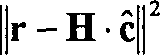

从S.Alamouti 1997年9月提交给IEEE JASC的“Space BlockCoding:A simple Transmitter Diversity Scheme for wirelessCommunications,”中可看出,上面的空-时分块码的分集顺序等同于两分支最大比接收组合(MRRC)的分集顺序。Alamouti还指出,由于矩阵H的正交性,这个解码规则被分解为用于c1和c2的两个独立的解码规则。解码符号

公式(6)的最大似然(ML)规则可通过使信道矩阵H为正交来简化;即,H*H=(|h1|2+|h2|2)I。这就得到一个经修改的接收向量,
当接收机20使用M个接收机天线时,在天线m的接收向量为:When receiver 20 uses M receiver antennas, the reception vector at antenna m is:
rm=Hm·c+ηm, (10)r m =H m c+η m , (10)
在此信道矩阵Hm定义为:
在这种情况下,最优ML解码规则为
而解码符号

因此在有M个接收天线的情况下,通过预先将接收信号乘以Hm *可简化解码规则。Therefore, in the case of M receiving antennas, the decoding rule can be simplified by multiplying the received signal by H m * in advance.
如上所述,图1示出了两个终端设备10和30,当两个终端设备同时和同频道同步发送信号时,所需着重指出的问题是基站接收机的检测性能。As mentioned above, FIG. 1 shows two terminal equipments 10 and 30. When the two terminal equipments transmit signals simultaneously and in the same channel, the problem to be emphasized is the detection performance of the base station receiver.
在下面的标识中,g11表示发射天线31和接收天线21之间的衰落信道,g12表示天线31和天线22之间的信道,g21表示天线32和天线21之间的信道,而g22表示天线32和天线22之间的信道。同样{c1,c2}和{s1,s2}分别表示从终端设备10和30发射的两个符号。In the following notation, g 11 represents the fading channel between the transmitting
在接收机20,连续两个符号周期内在接收天线21接收的信号r11和r12为:At the receiver 20, the signals r11 and r12 received at the receiving
r11=h11c1+h21c2+g11s1+g21s2+η11 (14)r 11 =h 11 c 1 +h 21 c 2 +g 11 s 1 +g 21 s 2 +η 11 (14)
r12=-h11c2 *+h21c1 *-g11s2 *+g21s1 *+η12 (15)r 12 =-h 11 c 2 * +h 21 c 1 * -g 11 s 2 * +g 21 s 1 * +η 12 (15)
定义r1=[r11r12 *]T,c=[c1c2]T,s=[s1s2]T和η1=[η11η12 *]T,公式(14)和(15)可用矩阵形式改写为:Define r 1 =[r 11 r 12 * ] T , c = [c 1 c 2 ] T , s = [s 1 s 2 ] T and η 1 =[η 11 η 12 * ] T , formulas (14) and (15) can be rewritten in matrix form as:
r1=H1·c+G1·s+η1 (16)r 1 =H 1 ·c+G 1 ·s+η 1 (16)
在此发射机设备10和30与接收天线21之间的信道矩阵H1和G1由下式给定。
向量η1=[η11η12 *]T为零平均和协方差N0·I的复合高斯随机向量。类似地,连续两个符号周期内在接收天线22接收的信号r21和r22为:Vector η 1 =[η 11 η 12 * ] T is a compound Gaussian random vector with zero mean and covariance N 0 ·I. Similarly, the signals r 21 and r 22 received at the receiving
r21=h12c1+h22c2+g12s1+g22s2+η21 (14)r 21 =h 12 c 1 +h 22 c 2 +g 12 s 1 +g 22 s 2 +η 21 (14)
r22=-h12c2 *+h22c1 *-g12s2 *+g22s1 *+η22 (15)r 22 =-h 12 c 2 * +h 22 c 1 * -g 12 s 2 * +g 22 s 1 * +η 22 (15)
以类似方式定义r2=[r21r22 *]T和η2=[η21η22 *]T,则公式(16)和(17)可改写为:Define r 2 =[r 21 r 22 * ] T and η 2 =[η 21 η 22 * ] T in a similar manner, then formulas (16) and (17) can be rewritten as:
r2=H2·c+G2·s+η2, (18)r 2 =H 2 ·c+G 2 ·s+η 2 , (18)
在此信道矩阵H2和G2由下式给出:
可组合公式(14)和(18)得到矩阵形式:
最小均方误差干扰对消(MMSEIC)Minimum Mean Square Error Interference Cancellation (MMSEIC)
当通过最小化均方误差准则来寻求检测和解码信号{c1,c2}时,目标是实现接收信号的线性组合以便检测信号{c1,c2}的均方误差最小。一般来说,这可通过最小化一个误差成本函数来表示,如函数:
在此r=[r1r2r3r4]T=[r11r12r21r22]T。Here r=[r 1 r 2 r 3 r 4 ]T=[r 11 r 12 r 21 r 22 ] T .
可能会注意到当α和β都为0时,肯定能达到最小值,但这种情况当然不是所希望的。因此,将β1设为1或将β2设为1。It may be noted that when both α and β are 0, the minimum is definitely reached, but this is of course not the desired situation. Therefore, set β1 to 1 or set β2 to 1.
当β1设为1时,从公式(40)可得到下面的最小化准则:
在此,
在此0=[0 0 0 0]T。Here 0=[0 0 0 0] T .
我们只需选择


取

在此
由此可见,
这就得到
从矩阵H的结构,我们可轻易地验证h1和h2正交。利用这个事实以及矩阵M的结构,可发现From the structure of matrix H, we can easily verify that h 1 and h 2 are orthogonal. Using this fact and the structure of the matrix M, it can be found that
β2=0 (29)β 2 =0 (29)
α1=M-1h1。 (30)α 1 =M −1 h 1 . (30)
因此,由公式(29)和(30)给出的MMSE IC技术解决方案将最小化c1中的均方误差,而与c2无关。考虑当β2设为1时的替代的成本函数,类似的分析可推出结论:Therefore, the MMSE IC technology solution given by equations (29) and (30) will minimize the mean square error in c1 independent of c2 . Considering an alternative cost function when β2 is set to 1, a similar analysis leads to the conclusion:
β1=0 (31)β 1 =0 (31)
α2=M-1h2 (32)α 2 =M −1 h 2 (32)
在这种情况下,由公式(31)和(32)给出的MMSE IC技术解决方案将最小化c2中的均方误差,而与c1无关。因此,根据公式(29)-(32),显然对来自终端设备10的信号的MMSE干扰对消将分别包含c1和c2两个不同权集α1和α2。解码来自终端30的信号的权也可通过类似方式得到。因此,可利用下述解码器25中的一个子程序MMSE.DECODE解码来自终端设备10和30的信号:In this case, the MMSE IC technical solution given by equations (31) and (32) will minimize the mean square error in c2 independent of c1 . Therefore, according to the formulas (29)-(32), it is obvious that the MMSE interference cancellation for the signal from the terminal device 10 will include two different weight sets α 1 and α 2 of c 1 and c 2 respectively. The weight to decode the signal from terminal 30 can also be obtained in a similar manner. Thus, the signals from the terminal equipment 10 and 30 can be decoded using a subroutine MMSE.DECODE in the
(c,Δc)=MMSE.DECODE(r1,r1,H1,H2,G1,G2,Γ)(c, Δc )=MMSE.DECODE(r 1 ,r 1 ,H 1 ,H 2 ,G 1 ,G 2 ,Γ)
{
}}
利用这个子程序,可如下所述估计
和

通过应用一种两级干扰对消方案可实现其它改进。在这个两级方案中,接收机利用上面公布的MMSE.DECODE子程序解码来自两种终端的信号。假定来自终端设备10的符号


{
F(s)=‖x1-G1·s‖2+‖x2-G2·s‖2
F(c)=‖y1-H1·c‖2+‖y1-H2·c‖2
If(Δc,0+Δs,0)<(Δc,1+Δs,1)
Else
}}
通过上面公开的理论背景,我们意识到通过将空-时分块编码应用到干扰对消和ML解码中可使性能增强,同时也可使用另一种编码方案来克服由信道引起的质量降低,如衰落。因此,图1中的每个发射机都包括一个信道编码器(分别为14和34),该信道编码器插入到输入信号和发射机的空-时分块编码器之间。信道编码器14和24可应用任何常规信道纠错码(例如格码或卷积码)。With the theoretical background disclosed above, we realize that performance enhancements can be achieved by applying space-time block coding to interference cancellation and ML decoding, while also using another coding scheme to overcome channel-induced quality degradation, such as decline. Thus, each transmitter in Figure 1 includes a channel coder (14 and 34 respectively) inserted between the input signal and the space-time block coder of the transmitter.
在接收机20中,内空-时分块码在单元26被解码,并且利用上面公开的MMSE方案,用来抑制来自各个共信道终端的干扰。单元26形成对应某一终端i的两个干扰对消向量ail和ail,而单元27形成两个判决变量:
然而这些判决将用作传输的信息符号的软判决,并馈入信道解码器28,解码器28为常规解码器,且对应信道编码器14和34中执行的编码类型。因此,在图1描绘的装置中,内编码器的结构用于干扰抑制,以便多个共信道终端在提供分集的同时能同时工作。内码空-时解码器的输出形成外编码器解码器的输入,它在纠正信道误差时判定传输信息。These decisions will however be used as soft decisions for the transmitted information symbols and fed to the
图2提供了一种用于增加无线系统的数据率或流量的装置。在图2中,要传输的信息在单元40被分接为两个信息流。其中一个流施加到信道编码器41,而另一个流施加到信道编码器51。信道编码器41的输出施加到空-时分块编码器42,接着施加到映射器和脉冲整形器53以及天线44和45。一般来说,来自一个发射终端的信息符号被分成L个并行的信息流。流l接着利用码率Rl的信道码编码,再接着利用有N个发射天线的空-时分块编码器编码。这两者的编码率可相同,但码率如果选择为R1>r2>…>RL,则更为方便。在这种情况下,与在流u(u>l)中传输的符号相比,流l中传输的符号将具有更好的抗信道误差能力。基站接收机假定装有至少L个接收天线。基站接收机将每个信息流视为一个不同用户,并利用上面公开的递归干扰对消技术,或前面提到的’163申请中公开的技术。由于第一个流的最小码率为R1,因此它具有最佳抗信道误差能力,而且很有可能没有误差。接收机接着利用流l的解码符号消除第一个流对总接收信号的影响,同时解码其余L-l个流。在解码其余L-l个流时,解码器首先解码来自第二个流的信号,因为在所有剩余的L-l个流中它具有最佳抗信道误差能力(因为在所有剩余的流中,它的速率R2最低)。接着接收机利用第二个流的解码符号来消除它对接收信号的影响。这个过程重复直到所有信息流被解码。Figure 2 provides an apparatus for increasing the data rate or throughput of a wireless system. In FIG. 2, the information to be transmitted is split at
由此可见,在这种情况下,系统流量可由下式给出:
FERl为流l的帧差错率。FER l is the frame error rate of stream l.
Claims (14)
Applications Claiming Priority (4)
| Application Number | Priority Date | Filing Date | Title |
|---|---|---|---|
| US9921298P | 1998-09-04 | 1998-09-04 | |
| US60/099,212 | 1998-09-04 | ||
| US09/300,494 US7215718B1 (en) | 1999-04-28 | 1999-04-28 | Combined channel coding and space-time block coding in a multi-antenna arrangement |
| US09/300,494 | 1999-04-28 |
Publications (1)
| Publication Number | Publication Date |
|---|---|
| CN1342354A true CN1342354A (en) | 2002-03-27 |
Family
ID=26795775
Family Applications (1)
| Application Number | Title | Priority Date | Filing Date |
|---|---|---|---|
| CN99810338A Pending CN1342354A (en) | 1998-09-04 | 1999-08-23 | Combined channel coding and space-block coding in multi-antenna arrangement |
Country Status (8)
| Country | Link |
|---|---|
| US (4) | US7463705B2 (en) |
| EP (1) | EP1110344A1 (en) |
| JP (1) | JP3633872B2 (en) |
| KR (1) | KR100778647B1 (en) |
| CN (1) | CN1342354A (en) |
| BR (1) | BR9913277A (en) |
| CA (1) | CA2341747C (en) |
| WO (1) | WO2000014921A1 (en) |
Cited By (5)
| Publication number | Priority date | Publication date | Assignee | Title |
|---|---|---|---|---|
| WO2003103207A1 (en) * | 2002-05-31 | 2003-12-11 | Linkair Communications,Inc. | A radio transmission method utilizing mimo |
| CN1300952C (en) * | 2003-03-25 | 2007-02-14 | 三星电子株式会社 | Wireless communicatoon device of using multiple transceiver antenna system and method thereof |
| CN100459480C (en) * | 2002-04-11 | 2009-02-04 | 艾利森电话股份有限公司 | Diagonally layered multi-antenna transmission for frequency-selective channels |
| CN101427507B (en) * | 2005-01-14 | 2012-01-11 | 加利福尼亚大学董事会 | Method and apparatus for use of space time trellis codes based on channel phase feedback |
| CN104022853B (en) * | 2002-09-20 | 2017-08-15 | 苹果公司 | Wireless Telecom Equipment and its repeating transmission amending method |
Families Citing this family (69)
| Publication number | Priority date | Publication date | Assignee | Title |
|---|---|---|---|---|
| US6693982B1 (en) * | 1997-10-06 | 2004-02-17 | At&T Corp. | Minimum mean squared error approach to interference cancellation and maximum likelihood decoding of space-time block codes |
| US6226318B1 (en) * | 1998-03-31 | 2001-05-01 | Zenith Electronics Corporation | Detection of code vectors in single frequency, multiple transmitter networks |
| US7068729B2 (en) | 2001-12-21 | 2006-06-27 | Digital Fountain, Inc. | Multi-stage code generator and decoder for communication systems |
| US6307487B1 (en) | 1998-09-23 | 2001-10-23 | Digital Fountain, Inc. | Information additive code generator and decoder for communication systems |
| US7243285B2 (en) | 1998-09-23 | 2007-07-10 | Digital Fountain, Inc. | Systems and methods for broadcasting information additive codes |
| US6643338B1 (en) | 1998-10-07 | 2003-11-04 | Texas Instruments Incorporated | Space time block coded transmit antenna diversity for WCDMA |
| CN1124713C (en) * | 1999-09-30 | 2003-10-15 | 华为技术有限公司 | Coding method of indicating whether or not there is some empty time block in public control channel in synchronous channels |
| US7272192B2 (en) | 2000-04-14 | 2007-09-18 | Board Of Trustees Of The Leland Stanford Junior University | Time-reversal block transmit diversity system for channels with intersymbol interference and method |
| US7050510B2 (en) | 2000-12-29 | 2006-05-23 | Lucent Technologies Inc. | Open-loop diversity technique for systems employing four transmitter antennas |
| US6731668B2 (en) | 2001-01-05 | 2004-05-04 | Qualcomm Incorporated | Method and system for increased bandwidth efficiency in multiple input—multiple output channels |
| FR2821514B1 (en) | 2001-02-28 | 2003-06-13 | Jacques Lewiner | LOCAL RADIO COMMUNICATION SYSTEM |
| BR0208208A (en) * | 2001-03-28 | 2006-12-12 | Nokia Corp | A method and apparatus for encoding phase jump and special time signals for transmission by a plurality of antennas |
| EP1444794B1 (en) * | 2001-09-12 | 2016-02-03 | Intel Deutschland GmbH | Cdma wireless systems |
| US6693973B2 (en) * | 2001-10-17 | 2004-02-17 | Nokia Corporation | Apparatus, and associated method, for forming a systematic, recursive, space-time code |
| US6954655B2 (en) * | 2001-11-16 | 2005-10-11 | Lucent Technologies Inc. | Encoding system for multi-antenna transmitter and decoding system for multi-antenna receiver |
| CN1555604A (en) * | 2002-04-04 | 2004-12-15 | 连宇通信有限公司 | Space-time block coding method based on superset division principle |
| EP1359683B1 (en) | 2002-04-30 | 2006-08-30 | Motorola, Inc. | Wireless communication using multi-transmit multi-receive antenna arrays |
| US9240810B2 (en) | 2002-06-11 | 2016-01-19 | Digital Fountain, Inc. | Systems and processes for decoding chain reaction codes through inactivation |
| KR100498326B1 (en) | 2002-06-18 | 2005-07-01 | 엘지전자 주식회사 | Adaptive modulation coding apparatus and method for mobile communication device |
| US7095709B2 (en) * | 2002-06-24 | 2006-08-22 | Qualcomm, Incorporated | Diversity transmission modes for MIMO OFDM communication systems |
| DE10239063A1 (en) * | 2002-08-26 | 2004-03-25 | Siemens Ag | Data symbol transmission method for communications system with simultaneous transmission of at least 2 data symbols via antenna element selected in dependence on data symbol coding |
| EP2355360B1 (en) | 2002-10-05 | 2020-08-05 | QUALCOMM Incorporated | Systematic encoding and decoding of chain reaction codes |
| EP1665539B1 (en) | 2003-10-06 | 2013-04-10 | Digital Fountain, Inc. | Soft-Decision Decoding of Multi-Stage Chain Reaction Codes |
| US7302009B2 (en) | 2003-12-17 | 2007-11-27 | Qualcomm Incorporated | Broadcast transmission with spatial spreading in a multi-antenna communication system |
| US8204149B2 (en) | 2003-12-17 | 2012-06-19 | Qualcomm Incorporated | Spatial spreading in a multi-antenna communication system |
| GB2409384B (en) * | 2003-12-18 | 2005-11-30 | Toshiba Res Europ Ltd | Maximum likelihood sequence estimation equaliser |
| US7336746B2 (en) | 2004-12-09 | 2008-02-26 | Qualcomm Incorporated | Data transmission with spatial spreading in a MIMO communication system |
| US8169889B2 (en) | 2004-02-18 | 2012-05-01 | Qualcomm Incorporated | Transmit diversity and spatial spreading for an OFDM-based multi-antenna communication system |
| US8923785B2 (en) | 2004-05-07 | 2014-12-30 | Qualcomm Incorporated | Continuous beamforming for a MIMO-OFDM system |
| US8285226B2 (en) | 2004-05-07 | 2012-10-09 | Qualcomm Incorporated | Steering diversity for an OFDM-based multi-antenna communication system |
| US7418651B2 (en) | 2004-05-07 | 2008-08-26 | Digital Fountain, Inc. | File download and streaming system |
| US7110463B2 (en) | 2004-06-30 | 2006-09-19 | Qualcomm, Incorporated | Efficient computation of spatial filter matrices for steering transmit diversity in a MIMO communication system |
| US7978649B2 (en) | 2004-07-15 | 2011-07-12 | Qualcomm, Incorporated | Unified MIMO transmission and reception |
| US7978778B2 (en) * | 2004-09-03 | 2011-07-12 | Qualcomm, Incorporated | Receiver structures for spatial spreading with space-time or space-frequency transmit diversity |
| US7894548B2 (en) | 2004-09-03 | 2011-02-22 | Qualcomm Incorporated | Spatial spreading with space-time and space-frequency transmit diversity schemes for a wireless communication system |
| US8559541B2 (en) | 2005-12-06 | 2013-10-15 | Lg Electronics Inc. | Method of transmitting signals for multiple antenna system |
| JP5550834B2 (en) | 2006-02-13 | 2014-07-16 | デジタル ファウンテン, インコーポレイテッド | Streaming and buffering using variable FEC overhead and protection period |
| US9270414B2 (en) | 2006-02-21 | 2016-02-23 | Digital Fountain, Inc. | Multiple-field based code generator and decoder for communications systems |
| US8543070B2 (en) | 2006-04-24 | 2013-09-24 | Qualcomm Incorporated | Reduced complexity beam-steered MIMO OFDM system |
| WO2007134196A2 (en) | 2006-05-10 | 2007-11-22 | Digital Fountain, Inc. | Code generator and decoder using hybrid codes |
| US8290089B2 (en) | 2006-05-22 | 2012-10-16 | Qualcomm Incorporated | Derivation and feedback of transmit steering matrix |
| US9380096B2 (en) | 2006-06-09 | 2016-06-28 | Qualcomm Incorporated | Enhanced block-request streaming system for handling low-latency streaming |
| US9386064B2 (en) | 2006-06-09 | 2016-07-05 | Qualcomm Incorporated | Enhanced block-request streaming using URL templates and construction rules |
| US9178535B2 (en) | 2006-06-09 | 2015-11-03 | Digital Fountain, Inc. | Dynamic stream interleaving and sub-stream based delivery |
| US9209934B2 (en) | 2006-06-09 | 2015-12-08 | Qualcomm Incorporated | Enhanced block-request streaming using cooperative parallel HTTP and forward error correction |
| US9419749B2 (en) | 2009-08-19 | 2016-08-16 | Qualcomm Incorporated | Methods and apparatus employing FEC codes with permanent inactivation of symbols for encoding and decoding processes |
| US9432433B2 (en) | 2006-06-09 | 2016-08-30 | Qualcomm Incorporated | Enhanced block-request streaming system using signaling or block creation |
| KR100822818B1 (en) | 2006-09-28 | 2008-04-18 | 삼성전자주식회사 | Block Time-domain Equalizer for Time-Inverted Space-time Block Coding Systems |
| KR100747595B1 (en) * | 2006-11-27 | 2007-08-08 | 한국전자통신연구원 | Soft decision symbol detection apparatus and method thereof of communication system having a plurality of transmit and receive antennas |
| US7983366B2 (en) | 2006-12-05 | 2011-07-19 | Intel Corporation | Transmission signaling techniques to enhance receiver interference mitigation performance |
| KR101129260B1 (en) | 2007-09-12 | 2012-03-27 | 디지털 파운튼, 인크. | Generating and communicating source identification information to enable reliable communications |
| US9281847B2 (en) | 2009-02-27 | 2016-03-08 | Qualcomm Incorporated | Mobile reception of digital video broadcasting—terrestrial services |
| US9288010B2 (en) | 2009-08-19 | 2016-03-15 | Qualcomm Incorporated | Universal file delivery methods for providing unequal error protection and bundled file delivery services |
| US9917874B2 (en) | 2009-09-22 | 2018-03-13 | Qualcomm Incorporated | Enhanced block-request streaming using block partitioning or request controls for improved client-side handling |
| US20110280311A1 (en) | 2010-05-13 | 2011-11-17 | Qualcomm Incorporated | One-stream coding for asymmetric stereo video |
| US8284862B2 (en) * | 2010-06-30 | 2012-10-09 | Mitsubishi Electric Research Laboratories, Inc. | Method for encoding data symbols with implicitly embedded pilot symbols in resource blocks for wireless networks |
| US8428008B2 (en) * | 2010-06-30 | 2013-04-23 | Mitsubishi Electric Research Laboratories, Inc. | Implicit channel sounding for closed-loop transmission in MIMO-OFDM wireless networks |
| US9596447B2 (en) | 2010-07-21 | 2017-03-14 | Qualcomm Incorporated | Providing frame packing type information for video coding |
| US9319448B2 (en) | 2010-08-10 | 2016-04-19 | Qualcomm Incorporated | Trick modes for network streaming of coded multimedia data |
| JP5727587B2 (en) | 2010-09-07 | 2015-06-03 | 昆 杰 庄 | Dual polarized microstrip antenna |
| US9270299B2 (en) | 2011-02-11 | 2016-02-23 | Qualcomm Incorporated | Encoding and decoding using elastic codes with flexible source block mapping |
| US8958375B2 (en) | 2011-02-11 | 2015-02-17 | Qualcomm Incorporated | Framing for an improved radio link protocol including FEC |
| US9253233B2 (en) | 2011-08-31 | 2016-02-02 | Qualcomm Incorporated | Switch signaling methods providing improved switching between representations for adaptive HTTP streaming |
| US9843844B2 (en) | 2011-10-05 | 2017-12-12 | Qualcomm Incorporated | Network streaming of media data |
| US9294226B2 (en) | 2012-03-26 | 2016-03-22 | Qualcomm Incorporated | Universal object delivery and template-based file delivery |
| WO2014073654A1 (en) * | 2012-11-12 | 2014-05-15 | 日本放送協会 | Transmission system and reception device |
| US9231749B2 (en) * | 2014-04-25 | 2016-01-05 | Collision Communications, Inc. | Methods, systems, and computer program products for determining a radio network temporary identifier and coding rate for an intercell signal in a long term evolution communications network |
| US9735987B2 (en) | 2014-04-25 | 2017-08-15 | Collision Communications, Inc. | Methods, systems, and computer program products for determining a demodulation reference sequence for an intercell interfering signal received from a mobile device in a long term evolution communication system |
| KR20230093423A (en) * | 2020-11-05 | 2023-06-27 | 엘지전자 주식회사 | Artificial intelligence systems and techniques for generating channel-adaptive linear block codes in real time |
Family Cites Families (16)
| Publication number | Priority date | Publication date | Assignee | Title |
|---|---|---|---|---|
| US5014276A (en) * | 1989-02-06 | 1991-05-07 | Scientific Atlanta, Inc. | Convolutional encoder and sequential decoder with parallel architecture and block coding properties |
| US5544328A (en) * | 1991-10-31 | 1996-08-06 | At&T Bell Laboratories | Coded modulation with unequal error protection |
| US5668737A (en) * | 1995-03-22 | 1997-09-16 | Pixel Magic, Inc. | High-speed data processor and coding method |
| US6009130A (en) * | 1995-12-28 | 1999-12-28 | Motorola, Inc. | Multiple access digital transmitter and receiver |
| US5931968A (en) | 1996-02-09 | 1999-08-03 | Overland Data, Inc. | Digital data recording channel |
| US5699365A (en) * | 1996-03-27 | 1997-12-16 | Motorola, Inc. | Apparatus and method for adaptive forward error correction in data communications |
| CA2252664C (en) * | 1996-04-26 | 2002-04-02 | At&T Corp. | Method and apparatus for data transmission using multiple transmit antennas |
| AU4238697A (en) * | 1996-08-29 | 1998-03-19 | Cisco Technology, Inc. | Spatio-temporal processing for communication |
| WO1999004519A2 (en) | 1997-07-16 | 1999-01-28 | At & T Corp. | Combined array processing and space-time coding |
| US6173005B1 (en) | 1997-09-04 | 2001-01-09 | Motorola, Inc. | Apparatus and method for transmitting signals in a communication system |
| US6185258B1 (en) * | 1997-09-16 | 2001-02-06 | At&T Wireless Services Inc. | Transmitter diversity technique for wireless communications |
| CA2276207C (en) * | 1997-10-31 | 2003-02-18 | At&T Wireless Services, Inc. | Low complexity maximum likelihood detection of concatenated space codes for wireless applications |
| US6088408A (en) | 1998-11-06 | 2000-07-11 | At & T Corp. | Decoding for generalized orthogonal designs for space-time codes for wireless communication |
| US6188736B1 (en) * | 1997-12-23 | 2001-02-13 | At&T Wireless Svcs. Inc. | Near-optimal low-complexity decoding of space-time codes for fixed wireless applications |
| US6198775B1 (en) | 1998-04-28 | 2001-03-06 | Ericsson Inc. | Transmit diversity method, systems, and terminals using scramble coding |
| US6128330A (en) | 1998-11-24 | 2000-10-03 | Linex Technology, Inc. | Efficient shadow reduction antenna system for spread spectrum |
-
1999
- 1999-08-23 CN CN99810338A patent/CN1342354A/en active Pending
- 1999-08-23 JP JP2000569545A patent/JP3633872B2/en not_active Expired - Lifetime
- 1999-08-23 BR BR9913277-0A patent/BR9913277A/en not_active IP Right Cessation
- 1999-08-23 EP EP99942400A patent/EP1110344A1/en not_active Withdrawn
- 1999-08-23 CA CA002341747A patent/CA2341747C/en not_active Expired - Lifetime
- 1999-08-23 KR KR1020017002839A patent/KR100778647B1/en not_active Expired - Lifetime
- 1999-08-23 WO PCT/US1999/019117 patent/WO2000014921A1/en not_active Ceased
-
2007
- 2007-03-27 US US11/728,793 patent/US7463705B2/en not_active Expired - Fee Related
-
2008
- 2008-12-09 US US12/316,067 patent/US7643589B2/en not_active Expired - Fee Related
-
2009
- 2009-11-11 US US12/616,628 patent/US8139695B2/en not_active Expired - Fee Related
-
2012
- 2012-02-02 US US13/365,079 patent/US8422587B2/en not_active Expired - Fee Related
Cited By (5)
| Publication number | Priority date | Publication date | Assignee | Title |
|---|---|---|---|---|
| CN100459480C (en) * | 2002-04-11 | 2009-02-04 | 艾利森电话股份有限公司 | Diagonally layered multi-antenna transmission for frequency-selective channels |
| WO2003103207A1 (en) * | 2002-05-31 | 2003-12-11 | Linkair Communications,Inc. | A radio transmission method utilizing mimo |
| CN104022853B (en) * | 2002-09-20 | 2017-08-15 | 苹果公司 | Wireless Telecom Equipment and its repeating transmission amending method |
| CN1300952C (en) * | 2003-03-25 | 2007-02-14 | 三星电子株式会社 | Wireless communicatoon device of using multiple transceiver antenna system and method thereof |
| CN101427507B (en) * | 2005-01-14 | 2012-01-11 | 加利福尼亚大学董事会 | Method and apparatus for use of space time trellis codes based on channel phase feedback |
Also Published As
| Publication number | Publication date |
|---|---|
| US20120134436A1 (en) | 2012-05-31 |
| CA2341747C (en) | 2007-05-22 |
| JP2002524972A (en) | 2002-08-06 |
| US20070177697A1 (en) | 2007-08-02 |
| BR9913277A (en) | 2001-09-25 |
| WO2000014921A1 (en) | 2000-03-16 |
| CA2341747A1 (en) | 2000-03-16 |
| KR20010079740A (en) | 2001-08-22 |
| KR100778647B1 (en) | 2007-11-22 |
| JP3633872B2 (en) | 2005-03-30 |
| US7463705B2 (en) | 2008-12-09 |
| US20090092209A1 (en) | 2009-04-09 |
| US8139695B2 (en) | 2012-03-20 |
| EP1110344A1 (en) | 2001-06-27 |
| US7643589B2 (en) | 2010-01-05 |
| US8422587B2 (en) | 2013-04-16 |
| US20100056092A1 (en) | 2010-03-04 |
Similar Documents
| Publication | Publication Date | Title |
|---|---|---|
| CN1342354A (en) | Combined channel coding and space-block coding in multi-antenna arrangement | |
| Gong et al. | Space-frequency-time coded OFDM for broadband wireless communications | |
| CN104202132B (en) | Wireless Telecom Equipment and its operating method | |
| US7573805B2 (en) | Data transmission and reception method and apparatus | |
| JP4334943B2 (en) | Simple maximum likelihood detection of concatenated spatial codes for wireless devices | |
| US6934320B2 (en) | Orthogonalized spatial multiplexing for wireless communication | |
| US20060093062A1 (en) | Apparatus and method for transmitting and receiving data using space-time block coding | |
| US20030012315A1 (en) | System and method for multistage error correction coding wirelessly transmitted information in a multiple antennae communication system | |
| WO1999004519A2 (en) | Combined array processing and space-time coding | |
| CN101006658B (en) | Apparatus and method for space-time-frequency block coding to improve performance | |
| CN1860699A (en) | Method for the multi-antennae emission of a signal by unitary space-time codes, receiving method, and corresponding signal | |
| CN1518264A (en) | Transmitter and receiver in a wireless communication system using four transmit antennas | |
| US7215718B1 (en) | Combined channel coding and space-time block coding in a multi-antenna arrangement | |
| KR20060043799A (en) | Transceiver and method for implementing the spatiotemporal block encoding apparatus and method for performance improvement | |
| JP4377435B2 (en) | Apparatus and method for space-time block coding with maximum diversity and maximum transmission rate using two transmission antennas | |
| CN1703864A (en) | Simplified implementation of optimal decoding for COFDM transmitter deversity system | |
| Kamruzzaman | Performance of turbo coded wireless link for SISO-OFDM, SIMO-OFDM, MISO-OFDM and MIMO-OFDM system | |
| Zheng et al. | Performance evaluation of indoor wireless systems using BLAST testbed | |
| Salemdeeb et al. | Adaptive Switching Hybrid Blast-STBC MIMO System | |
| Hermánek et al. | Design of the wireless communication system of a rescue robot | |
| Roopa et al. | Performance Improvement Of MIMO System Using OSTBC Scheme and ML Detection Technique Under Rayleigh Channel | |
| Gorokhov | Layered MIMO transceivers with enhanced capacities: a new coding strategy | |
| Sellathurai | Multirate diagonal-space-time-interleaved coded modulation for non-ergodic block fading channels | |
| Michalke et al. | Simple broadband MIMO-OFDM transmission | |
| Choe et al. | Reverse-ordered iterative decoding scheme for combining of spatial diversity and multiplexing |
Legal Events
| Date | Code | Title | Description |
|---|---|---|---|
| C10 | Entry into substantive examination | ||
| SE01 | Entry into force of request for substantive examination | ||
| C06 | Publication | ||
| PB01 | Publication | ||
| C02 | Deemed withdrawal of patent application after publication (patent law 2001) | ||
| WD01 | Invention patent application deemed withdrawn after publication |