CN100409094C - Electrochromic materials with improved lifetime - Google Patents
Electrochromic materials with improved lifetime Download PDFInfo
- Publication number
- CN100409094C CN100409094C CNB2004800314022A CN200480031402A CN100409094C CN 100409094 C CN100409094 C CN 100409094C CN B2004800314022 A CNB2004800314022 A CN B2004800314022A CN 200480031402 A CN200480031402 A CN 200480031402A CN 100409094 C CN100409094 C CN 100409094C
- Authority
- CN
- China
- Prior art keywords
- group
- alkyl group
- formula
- independently
- electrochromic material
- Prior art date
- Legal status (The legal status is an assumption and is not a legal conclusion. Google has not performed a legal analysis and makes no representation as to the accuracy of the status listed.)
- Expired - Fee Related
Links
Images


Classifications
-
- C—CHEMISTRY; METALLURGY
- C09—DYES; PAINTS; POLISHES; NATURAL RESINS; ADHESIVES; COMPOSITIONS NOT OTHERWISE PROVIDED FOR; APPLICATIONS OF MATERIALS NOT OTHERWISE PROVIDED FOR
- C09K—MATERIALS FOR MISCELLANEOUS APPLICATIONS, NOT PROVIDED FOR ELSEWHERE
- C09K9/00—Tenebrescent materials, i.e. materials for which the range of wavelengths for energy absorption is changed as a result of excitation by some form of energy
- C09K9/02—Organic tenebrescent materials
-
- G—PHYSICS
- G02—OPTICS
- G02F—OPTICAL DEVICES OR ARRANGEMENTS FOR THE CONTROL OF LIGHT BY MODIFICATION OF THE OPTICAL PROPERTIES OF THE MEDIA OF THE ELEMENTS INVOLVED THEREIN; NON-LINEAR OPTICS; FREQUENCY-CHANGING OF LIGHT; OPTICAL LOGIC ELEMENTS; OPTICAL ANALOGUE/DIGITAL CONVERTERS
- G02F1/00—Devices or arrangements for the control of the intensity, colour, phase, polarisation or direction of light arriving from an independent light source, e.g. switching, gating or modulating; Non-linear optics
- G02F1/01—Devices or arrangements for the control of the intensity, colour, phase, polarisation or direction of light arriving from an independent light source, e.g. switching, gating or modulating; Non-linear optics for the control of the intensity, phase, polarisation or colour
- G02F1/15—Devices or arrangements for the control of the intensity, colour, phase, polarisation or direction of light arriving from an independent light source, e.g. switching, gating or modulating; Non-linear optics for the control of the intensity, phase, polarisation or colour based on an electrochromic effect
- G02F1/1503—Devices or arrangements for the control of the intensity, colour, phase, polarisation or direction of light arriving from an independent light source, e.g. switching, gating or modulating; Non-linear optics for the control of the intensity, phase, polarisation or colour based on an electrochromic effect caused by oxidation-reduction reactions in organic liquid solutions, e.g. viologen solutions
-
- C—CHEMISTRY; METALLURGY
- C09—DYES; PAINTS; POLISHES; NATURAL RESINS; ADHESIVES; COMPOSITIONS NOT OTHERWISE PROVIDED FOR; APPLICATIONS OF MATERIALS NOT OTHERWISE PROVIDED FOR
- C09K—MATERIALS FOR MISCELLANEOUS APPLICATIONS, NOT PROVIDED FOR ELSEWHERE
- C09K2211/00—Chemical nature of organic luminescent or tenebrescent compounds
- C09K2211/10—Non-macromolecular compounds
- C09K2211/1003—Carbocyclic compounds
- C09K2211/1011—Condensed systems
-
- C—CHEMISTRY; METALLURGY
- C09—DYES; PAINTS; POLISHES; NATURAL RESINS; ADHESIVES; COMPOSITIONS NOT OTHERWISE PROVIDED FOR; APPLICATIONS OF MATERIALS NOT OTHERWISE PROVIDED FOR
- C09K—MATERIALS FOR MISCELLANEOUS APPLICATIONS, NOT PROVIDED FOR ELSEWHERE
- C09K2211/00—Chemical nature of organic luminescent or tenebrescent compounds
- C09K2211/10—Non-macromolecular compounds
- C09K2211/1018—Heterocyclic compounds
- C09K2211/1022—Heterocyclic compounds bridged by heteroatoms, e.g. N, P, Si or B
-
- C—CHEMISTRY; METALLURGY
- C09—DYES; PAINTS; POLISHES; NATURAL RESINS; ADHESIVES; COMPOSITIONS NOT OTHERWISE PROVIDED FOR; APPLICATIONS OF MATERIALS NOT OTHERWISE PROVIDED FOR
- C09K—MATERIALS FOR MISCELLANEOUS APPLICATIONS, NOT PROVIDED FOR ELSEWHERE
- C09K2211/00—Chemical nature of organic luminescent or tenebrescent compounds
- C09K2211/10—Non-macromolecular compounds
- C09K2211/1018—Heterocyclic compounds
- C09K2211/1025—Heterocyclic compounds characterised by ligands
- C09K2211/1029—Heterocyclic compounds characterised by ligands containing one nitrogen atom as the heteroatom
-
- C—CHEMISTRY; METALLURGY
- C09—DYES; PAINTS; POLISHES; NATURAL RESINS; ADHESIVES; COMPOSITIONS NOT OTHERWISE PROVIDED FOR; APPLICATIONS OF MATERIALS NOT OTHERWISE PROVIDED FOR
- C09K—MATERIALS FOR MISCELLANEOUS APPLICATIONS, NOT PROVIDED FOR ELSEWHERE
- C09K2211/00—Chemical nature of organic luminescent or tenebrescent compounds
- C09K2211/10—Non-macromolecular compounds
- C09K2211/1018—Heterocyclic compounds
- C09K2211/1025—Heterocyclic compounds characterised by ligands
- C09K2211/1029—Heterocyclic compounds characterised by ligands containing one nitrogen atom as the heteroatom
- C09K2211/1033—Heterocyclic compounds characterised by ligands containing one nitrogen atom as the heteroatom with oxygen
-
- C—CHEMISTRY; METALLURGY
- C09—DYES; PAINTS; POLISHES; NATURAL RESINS; ADHESIVES; COMPOSITIONS NOT OTHERWISE PROVIDED FOR; APPLICATIONS OF MATERIALS NOT OTHERWISE PROVIDED FOR
- C09K—MATERIALS FOR MISCELLANEOUS APPLICATIONS, NOT PROVIDED FOR ELSEWHERE
- C09K2211/00—Chemical nature of organic luminescent or tenebrescent compounds
- C09K2211/10—Non-macromolecular compounds
- C09K2211/1018—Heterocyclic compounds
- C09K2211/1025—Heterocyclic compounds characterised by ligands
- C09K2211/1029—Heterocyclic compounds characterised by ligands containing one nitrogen atom as the heteroatom
- C09K2211/1037—Heterocyclic compounds characterised by ligands containing one nitrogen atom as the heteroatom with sulfur
-
- C—CHEMISTRY; METALLURGY
- C09—DYES; PAINTS; POLISHES; NATURAL RESINS; ADHESIVES; COMPOSITIONS NOT OTHERWISE PROVIDED FOR; APPLICATIONS OF MATERIALS NOT OTHERWISE PROVIDED FOR
- C09K—MATERIALS FOR MISCELLANEOUS APPLICATIONS, NOT PROVIDED FOR ELSEWHERE
- C09K2211/00—Chemical nature of organic luminescent or tenebrescent compounds
- C09K2211/10—Non-macromolecular compounds
- C09K2211/1018—Heterocyclic compounds
- C09K2211/1025—Heterocyclic compounds characterised by ligands
- C09K2211/1029—Heterocyclic compounds characterised by ligands containing one nitrogen atom as the heteroatom
- C09K2211/104—Heterocyclic compounds characterised by ligands containing one nitrogen atom as the heteroatom with other heteroatoms
-
- C—CHEMISTRY; METALLURGY
- C09—DYES; PAINTS; POLISHES; NATURAL RESINS; ADHESIVES; COMPOSITIONS NOT OTHERWISE PROVIDED FOR; APPLICATIONS OF MATERIALS NOT OTHERWISE PROVIDED FOR
- C09K—MATERIALS FOR MISCELLANEOUS APPLICATIONS, NOT PROVIDED FOR ELSEWHERE
- C09K2211/00—Chemical nature of organic luminescent or tenebrescent compounds
- C09K2211/10—Non-macromolecular compounds
- C09K2211/1018—Heterocyclic compounds
- C09K2211/1025—Heterocyclic compounds characterised by ligands
- C09K2211/1044—Heterocyclic compounds characterised by ligands containing two nitrogen atoms as heteroatoms
-
- C—CHEMISTRY; METALLURGY
- C09—DYES; PAINTS; POLISHES; NATURAL RESINS; ADHESIVES; COMPOSITIONS NOT OTHERWISE PROVIDED FOR; APPLICATIONS OF MATERIALS NOT OTHERWISE PROVIDED FOR
- C09K—MATERIALS FOR MISCELLANEOUS APPLICATIONS, NOT PROVIDED FOR ELSEWHERE
- C09K2211/00—Chemical nature of organic luminescent or tenebrescent compounds
- C09K2211/10—Non-macromolecular compounds
- C09K2211/1018—Heterocyclic compounds
- C09K2211/1025—Heterocyclic compounds characterised by ligands
- C09K2211/1059—Heterocyclic compounds characterised by ligands containing three nitrogen atoms as heteroatoms
-
- C—CHEMISTRY; METALLURGY
- C09—DYES; PAINTS; POLISHES; NATURAL RESINS; ADHESIVES; COMPOSITIONS NOT OTHERWISE PROVIDED FOR; APPLICATIONS OF MATERIALS NOT OTHERWISE PROVIDED FOR
- C09K—MATERIALS FOR MISCELLANEOUS APPLICATIONS, NOT PROVIDED FOR ELSEWHERE
- C09K2211/00—Chemical nature of organic luminescent or tenebrescent compounds
- C09K2211/18—Metal complexes
- C09K2211/187—Metal complexes of the iron group metals, i.e. Fe, Co or Ni
Landscapes
- Chemical & Material Sciences (AREA)
- Physics & Mathematics (AREA)
- Nonlinear Science (AREA)
- Engineering & Computer Science (AREA)
- Materials Engineering (AREA)
- Organic Chemistry (AREA)
- Chemical Kinetics & Catalysis (AREA)
- General Physics & Mathematics (AREA)
- Optics & Photonics (AREA)
- Electrochromic Elements, Electrophoresis, Or Variable Reflection Or Absorption Elements (AREA)
- Pyridine Compounds (AREA)
- Compositions Of Macromolecular Compounds (AREA)
Abstract
Disclosed are a viologen derivative as an electrochromic material having improved stability and life, a metal oxide electrode including the viologen derivative, and an electrochromic device using the viologen derivative as an electrochromic material. The viologen derivative comprises a compound capable of increasing E1(first oxidation-reduction reaction potential) and E2(second redox reaction potential) between the potential difference deltae. As Δ E increases, the mole fraction of viologen molecules in the second reduced state decreases. Thus, the mole fraction of viologen molecules present in an irreversibly reduced state at an applied potential can be reduced, thereby increasing the lifetime of electrochromic materials and electrochromic devices.
Description
Technical field
The present invention relates to comprise the metal oxide electrode of this derivant, and use the electrochromic device of this viologen derivative as electrochromic material as having the stability of improvement and purpurine (viologen) derivant of the electrochromic material in life-span.
Background technology
Usually, so-called " electrochromism " is the phenomenon that the electromotive force of the electric field that applies of a kind of basis causes change color.Electrochromic utilization has realized the preparation electrooptical device, for example electrochromic device, imformation memory device and solar cell.Typical electrochromic material comprises for example tungstic acid (WO
3), nickel oxide (NiO) and titania (TiO
2) inorganic, metal oxide, and organic electrochromic material, it comprises the quinone derivative of dipyridine (purpurine) derivant, for example anthraquinone and the azine derivatives of for example phenothiazine.
Although electrochromism is known in 1961, because its shortcoming, for example be difficult to realize that multicolour, the colour developing/speed of fading are slow, be difficult to finish fully and fade, and because stability of its difference shortcoming that electrochromic material is easy to damage in the circulation that repeats to develop the color/fade, the practical application of electrochromic device and commercial large-scale production are restricted.
United States Patent (USP) the 5th, 441, No. 827 (Graetzel etc.) disclose a kind of device with electric activating material, high-level efficiency and fast-response speed of high electrode surface area, high concentration, for example photoelectric cell, photochromic device or electrochromic device, the device for preparing by the electroactive organic material that applies on the surface of the nano-pore metal oxide film electrode that is obtained by the sintered metal oxide nano particle as individual layer.This device has solved the problem that electrochromic device of the prior art faced basically.
PCT is international disclose WO No. 98/35267 (Fitzmaurice etc.) disclose can at room temperature repeat to develop the color/fade and circulate 10,000 time or more electrochromic device, this device is the example more specifically of above-mentioned metal-oxide film class electrochromic device.But for the commercialization electrochromic device and the application of expanding electrochromic device, the life-span of electrochromic device should be increased to 100,000 or more times circulation.
Summary of the invention
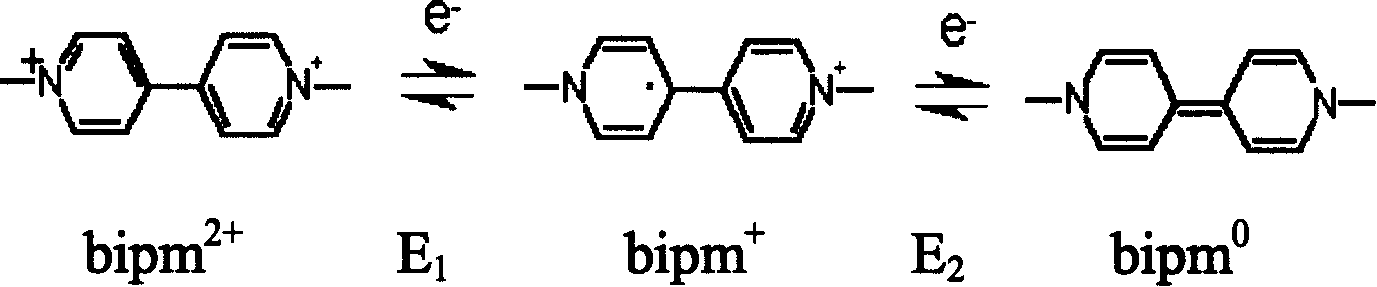
The purpurine compound for comprise 4,4 '-compound of dipyridine, and have three oxidation state, that is, bipm
2+, bipm
+And bipm
0, as shown below:

Particularly,
 Redox reaction at oxidation-reduction potential E
1Take place down and be reversible.Though
Redox reaction at oxidation-reduction potential E
2Following generation, but it usually is irreversible.Bipm
0Be chemically unstable thereby tend to the reaction of molecular oxygen or other solvent molecule to change molecule into different chemical structures, therefore lose its function as electrochromic material.The redox reaction of dipyridine ion occurs in E in turn
1And E
2But half wave potential E
1And E
2Only, oxidation rate equals the magnitude of voltage of rate of reduction when reaching the mobile equilibrium attitude for becoming.In addition, redox reaction does not occur over just half wave potential, and recurs at other any electromotive force, and each bipm
2+, bipm
+And bipm
0Occur with different mole fractions.ANALOGY OF BOLTZMANN DISTRIBUTION is followed in distribution according to the chemical species of electromotive force.Thereby the inventor attempts by increasing E
1And E
2Thereby between electric potential difference Δ E be reduced in the bipm of half wave potential
0Mole fraction.We think at half wave potential E
1Bipm
0The reduction of the mole fraction of species may cause the raising in electrochromic device life-span, because bipm
0State be chemically unstable and have a strong irreversible oxidation reduction reaction tendency.
Redox reaction at oxidation-reduction potential E
1Take place down and be reversible.Though
Redox reaction at oxidation-reduction potential E
2Following generation, but it usually is irreversible.Bipm
0Be chemically unstable thereby tend to the reaction of molecular oxygen or other solvent molecule to change molecule into different chemical structures, therefore lose its function as electrochromic material.The redox reaction of dipyridine ion occurs in E in turn
1And E
2But half wave potential E
1And E
2Only, oxidation rate equals the magnitude of voltage of rate of reduction when reaching the mobile equilibrium attitude for becoming.In addition, redox reaction does not occur over just half wave potential, and recurs at other any electromotive force, and each bipm
2+, bipm
+And bipm
0Occur with different mole fractions.ANALOGY OF BOLTZMANN DISTRIBUTION is followed in distribution according to the chemical species of electromotive force.Thereby the inventor attempts by increasing E
1And E
2Thereby between electric potential difference Δ E be reduced in the bipm of half wave potential
0Mole fraction.We think at half wave potential E
1Bipm
0The reduction of the mole fraction of species may cause the raising in electrochromic device life-span, because bipm
0State be chemically unstable and have a strong irreversible oxidation reduction reaction tendency.
Under these situations, we introduce various adjusting groups to improve Δ E in viologen derivative.As a result, we find based on the electrochromic material of this viologen derivative and show higher optical density (OD) and have the electrochromic device in the life-span of improvement.
According to a technical scheme of the present invention, provide comprise have be connected in 4,4 '-electrochromic material of the purpurine compound of the adjusting group of dipyridine, wherein 4,4 '-dipyridine has three kinds of oxidation state, that is, and bipm
2+, bipm
+And bipm
0, represent by figure below, regulate group and can improve E
1And E
2Between electric potential difference Δ E:

Each E wherein
1And E
2The expression redox-potential.
According to another technical scheme of the present invention, provide comprise have be connected in 4,4 '-kation of the positively charged of dipyridine regulates the electrochromic material of the purpurine compound of group.
According to a technical scheme more of the present invention, provide to comprise to have and be connected in 4,4 '-oxidation-reduction pair of dipyridine regulates the electrochromic material of the purpurine compound of group, and oxidation-reduction pair is regulated group can form oxidation-reduction pair electrically with the dipyridine ring.
According to a technical scheme more of the present invention, metal oxide electrode that applies with above-mentioned electrochromic material and the electrochromic device that comprises this electrochromic material are provided.
According to a technical scheme more of the present invention, the invention provides compound by following general formula 1 expression:
[general formula 1]
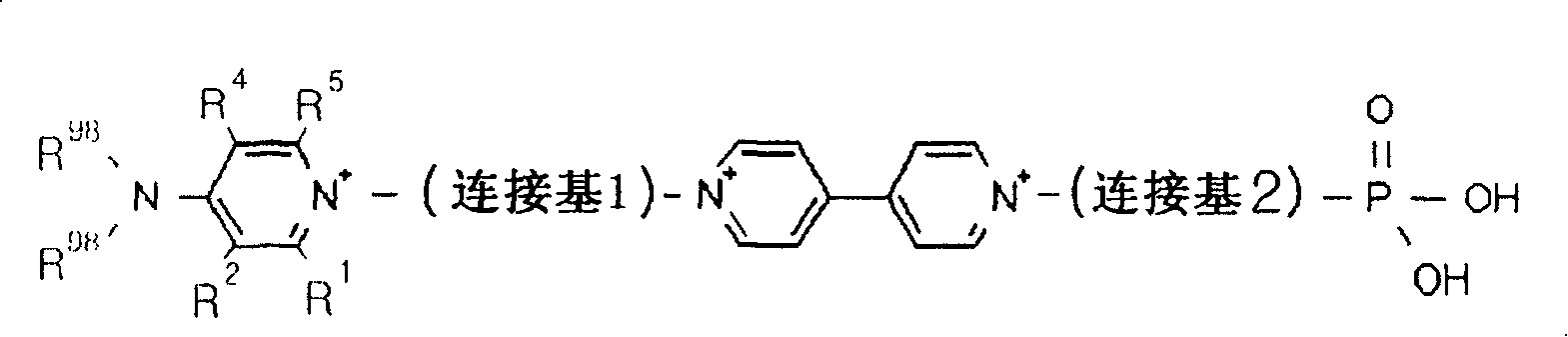
Wherein, each R
1, R
2, R
3, R
4And R
5Represent H, C1~C6 alkyl, OH, OR independently or side by side
97, CN, NO
2, COOH, CO
2R
97, CONH
2, CONR
98 2Or NR
98 2(preferred, each R
1, R
2, R
3, R
4And R
5Expression H); Each R
97And R
98Represent C1~C6 alkyl group, be preferably C1~C2 alkyl group; If desired, connect base 1 and be connected basic 2 and can exist individually or simultaneously.
Typical example by the compound of general formula 1 expression comprises the compound of being represented by following general formula 1-1:
[general formula 1-1]
Wherein, each R
1, R
2, R
3, R
4And R
5Represent H, C1~C6 alkyl, OH, OR independently or side by side
97, CN, NO
2, COOH, CO
2R
97, CONH
2, CONR
98 2Or NR
98 2(preferred, each R
1, R
2, R
3, R
4And R
5Expression H); And each R
97And R
98Represent C1~C6 alkyl group, be preferably C1~C2 alkyl group.
Hereinafter will describe the present invention in detail.
The purpurine compound has wherein two structures that pyridine ring is connected with each other as shown below:
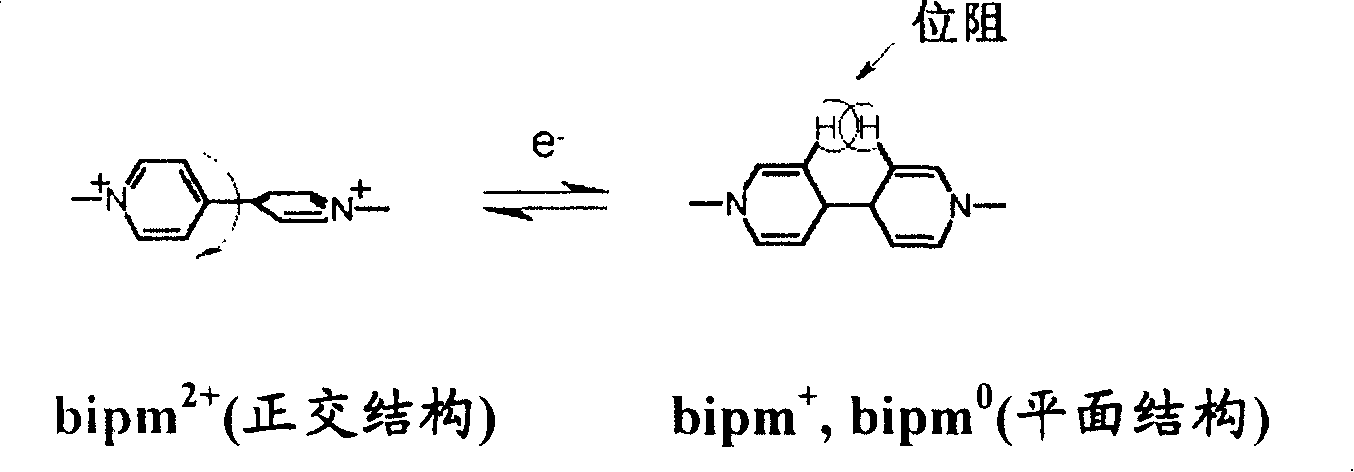
When the purpurine compound with bipm
2+When attitude occurs, two pyridine rings orthogonal and its between do not have resonant structure.Therefore, bipm
2+Attitude is very stable, colourless and transparent state.But, work as bipm
2+Accept an electronics and be reduced to bipm
+During attitude, two pyridine rings rotation and appear at and because the resonance that takes place between two pyridine rings, electric charge is shifted, thereby produces dark color on same the plane in.At bipm
0In the attitude, two pyridine rings form completely planar structure and 3,3 '-produce steric hindrance between the hydrogen atom, thereby make the molecule instability.In this state, for example other molecule of solvent molecule may cause the addition elimination reaction on the carbon atom of ring.Therefore, thereby the purpurine compound can change fully dissimilar molecules into or can open loop take place in the presence of heat or light and is decomposed into diverse molecule, and this transformation is irreversible.The compound that obtains no longer has the electrochromism activity.In addition, when the purpurine molecule has planar structure, because Pai-Pai that (aromatic series-aromatic series stratification may take place π-π) interact.Therefore, adjacent purpurine molecule is assembled therein.Each bipm with planar structure
+And bipm
0Attitude was exactly high-energy state originally.The gathering of high-energy state molecule may cause the self-quenching phenomenon and comprise the subsidiary reaction of polyreaction, and the inreversible transformation of electrochromic material subsequently causes the shortening in electrochromic device life-span.
Because this destruction and irreversible change major part occur in bipm in viologen derivative
0In the attitude, must make bipm at driving voltage
0Shared mole fraction minimizes, to obtain having more long-life electrochromism viologen derivative.
In order to reach this purpose, according to technical essential of the present invention, provide a kind of and have the dipyridine ion of regulating group at its end, this adjusting group is suitable for stablizing bipm
+Attitude and prevent bipm
+Change bipm into
0This adjusting group can increase E
1(take place to bipm
+The electrochemical potential that changes) and E
2(take place to bipm
0The electrochemical potential that changes) the electric potential difference Δ E between.
Regulate group and preferably Δ E is improved 0.04V or more.
The relative mole fraction of various chemical species is followed ANALOGY OF BOLTZMANN DISTRIBUTION, and wherein the quantity of each chemical species is directly proportional with the electric current that is used for redox reaction.More specifically, the electric current that is used for the redox reaction of each electromotive force (is seen by following formula decision, Allen J.Bard and Larry R.Faulkner, " Electrochemical Methods:Fundamentals andApplications ", John Wiley ﹠amp; Sons, 1980, Chap.6):
I=nFAC
0 *(πD
oσ)
1/2γ(σt)
Wherein,
I is at the given maximum current that redox reaction causes under the electromotive force that applies;
N is for losing according to redox reaction or the number of the electronics that obtains;
F is a Faraday constant;
C
0Concentration for oxidation in the solution/reduction species;
D
0For coefficient of diffusion and
X (σ t) is shifted the current function that produces by reversible electric charge.
Particularly, (π)
1/2X (σ t) for and apply the function of the electric potential difference exponent function relation between electromotive force and the half wave potential.More specifically, as long as apply electromotive force from E
1/2(half wave potential) value changes 20mV, function (π)
1/2X (σ t) reduces with about 1/2 ratio.In other words, as long as Δ E increases 20mV (0.02V), apply the bipm of voltage
0Mole fraction reduce with 1/2 ratio.Thereby, when Δ E changes 40mV or more for a long time, bipm
0Mole fraction be reduced to initial value 1/4 or littler, therefore can observe the remarkable increase in electrochromic device life-span.
According to the present invention, the adjusting group that can increase Δ E comprises: (1) cationic functional groups; (2) can form the functional group of the additional oxidation-reduction pair of redox coupling with the dipyridine ring electrically.
The energy level decision of the electromotive force of redox reaction by each oxidation state under given electric field takes place.
Kation is regulated group and is increased in whole intramolecular positive charge density and changes electric density at the dipyridine ring of each oxidation state, thereby has changed the energy level of each oxidation state.Because the variation at the energy level of each oxidation state is accompanied by the variation of reduction potential, thereby can control Δ E.In addition, owing to, can reduce the gathering of adjacent purpurine molecule by the cationic properties of kation adjusting group increase in the repulsive force effect that has between the molecule of identical charges.And then the cationic properties of this increase can suppress the self-quenching phenomenon and comprise the subsidiary reaction of polyreaction.As a result, it can increase the life-span of viologen derivative.
Simultaneously, when regulating group for can form the additional redox coupling functional group of oxidation-reduction pair electrically with the dipyridine ring time, the variation of regulating the redox state of group can influence the CHARGE DISTRIBUTION of whole molecule and change the redox-potential of dipyridine ring.Thereby it can increase the life-span of electrochromism viologen derivative.
This adjusting group can need not any connection base and directly be connected with viologen derivative, perhaps can combine with viologen derivative by connecting base (connecting base 1).
In addition, when it was coated on the metal oxide electrode that is used for electrochromic device, can further comprise according to viologen derivative of the present invention can be in conjunction with the conjugated group of metal oxide electrode with its function of abundant demonstration.With with regulate the identical mode of group, this conjugated group can need not any connection base and directly link to each other with viologen derivative, perhaps can link to each other with viologen derivative by connecting base (connecting basic 2).
Thereby, according to a preferred embodiment of the present invention, providing viologen derivative as electrochromic material, viologen derivative is [adjusting group]-[connecting base 1]-[dipyridine (bipm)]-[connecting base 2]-[conjugated group], is shown below:

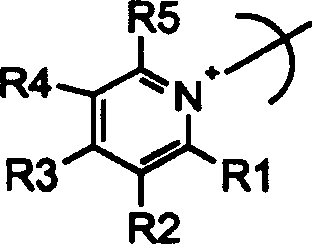
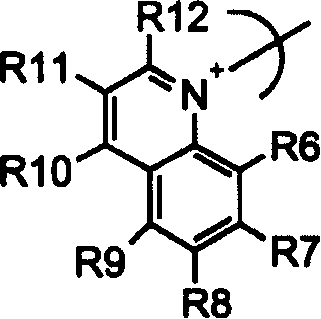
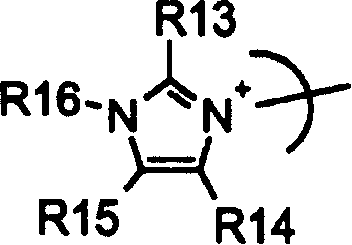
The kation that can use is in the present invention regulated group and is comprised: by the substituted pyridine derivative of following formula 2 expressions, by the quinoline of the replacement of following formula 3 expressions, by the imdazole derivatives of the replacement of following formula 4 expressions with by the tetra-allkylammonium derivant of following formula 5 expressions.
[general formula 2]
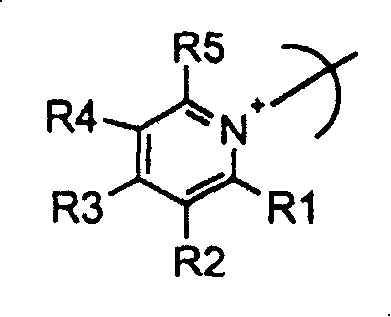
Each R wherein
1, R
2, R
3, R
4And R
5Represent H, C1~C6 alkyl group, OH, OR independently or side by side
97, CN, NO
2, COOH, CO
2R
97, CONH
2, CONR
98 2Or NR
98 2(preferred, each R
1, R
2, R
4And R
5Expression H, and R
3Expression N (CH
3)
2Or OR
97); With each R
97And R
98Represent C1~C6 alkyl group, be preferably C1~C2 alkyl group.
[general formula 3]
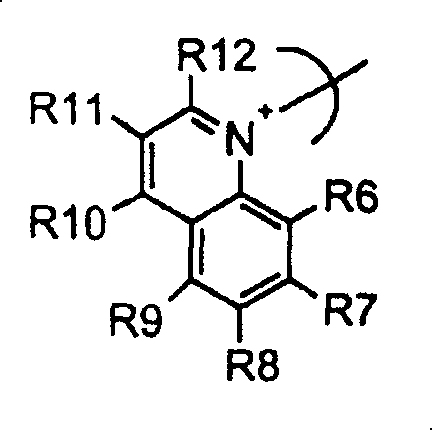
Each R wherein
6, R
7, R
8, R
9, R
10, R
11And R
12Represent H, C1~C6 alkyl group, OH, OR independently or side by side
97, CN, NO
2, COOH, CO
2R
97, CONH
2, CONR
98 2Or NR
98 2(preferred each R
6, R
7, R
9, R
10, R
11And R
12Expression H, and R
8Expression N (CH
3)
2Or OR
97); With each R
97And R
98Represent C1~C6 alkyl group, be preferably C1~C2 alkyl group.
[general formula 4]
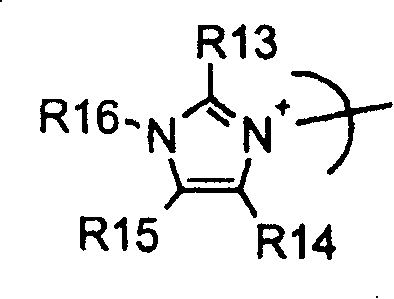
Each R wherein
13, R
14, R
15And R
16Represent H or C1~C6 alkyl group (preferably, each R independently or side by side
13, R
15And R
16Expression H, and R
14Expression C1~C6 alkyl group).
[general formula 5]

Each R wherein
17, R
18And R
19Represent H or C1~C12 alkyl group independently or side by side, be preferably C1~C4 alkyl group.
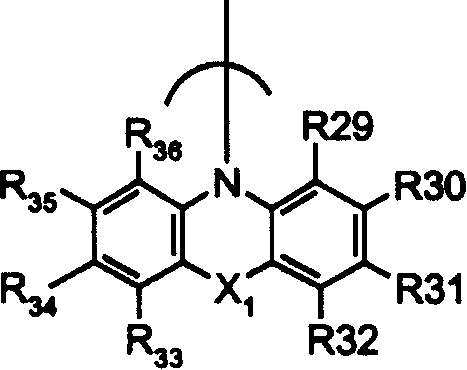
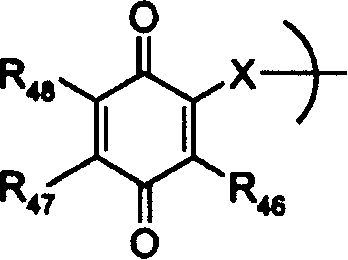
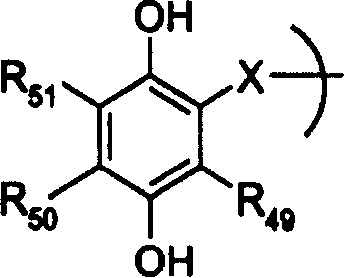
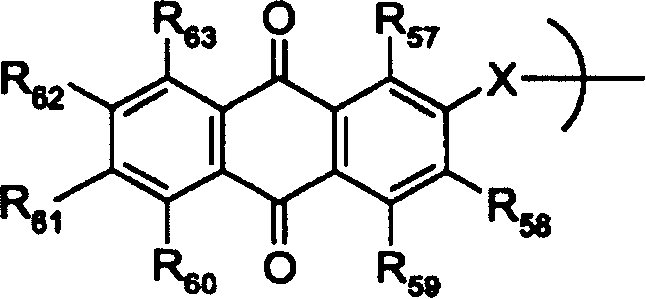
Can be used for oxidation-reduction pair functional group of the present invention comprises: by the ferrocene derivatives of following formula 6 expressions; Azine derivatives by following formula 7 and 8 expressions comprises phenothiazine, phenoxazine and azophenlyene; Quinone derivative by following formula 9~13 expressions comprises benzoquinones, quinhydrones, naphthoquinones, anthraquinone and acenaphthene quinone (general formula 13); And polycyclc aromatic compound, comprise by the pyrene of following formula 14 expressions, by the perylene of following formula 15 expressions and the dawn plug of representing by following formula 16 (dancyl).
[general formula 6]
The ferrocene that replaces is regulated group
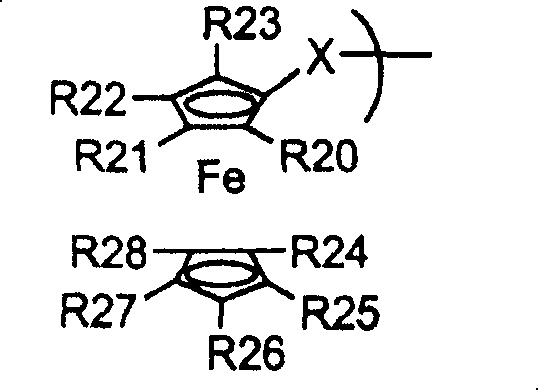
Each R wherein
20~R
28Represent H or C1~C6 alkyl group (preferably, all R independently or side by side
20~R
28Represent H or methyl simultaneously); X represents CH
2, O, S, NH, NR
98Or CO
2And R
98Represent C1~C6 alkyl group, be preferably C1~C2 alkyl group.
[general formula 7]
The azine that replaces is regulated group
Wherein X represents S, O or Se; Each R
29~R
36Represent H, C1~C6 alkyl group, OH, OR independently or side by side
97, CN, NO
2, COOH, CO
2R
97, CONH
2, CONR
98 2Or NR
98 2(preferred, each R
29, R
30, R
32, R
33, R
35And R
36Expression H, and each R
31And R
34Expression Br, NR
98 2Or OR
97); With each R
97And R
98Represent C1~C6 alkyl group, be preferably C1~C2 alkyl group.
[general formula 8]
The azine that replaces is regulated group

Each R wherein
37~R
45Represent H, C1~C6 alkyl group, OH, OR independently or side by side
97, CN, NO
2, COOH, CO
2R
97, CONH
2, CONR
98 2Or NR
98 2(preferred, each R
37, R
40, R
41And R
44Expression H, each R
38, R
39, R
42And R
43Expression Br, NR
98 2Or OR
97, and R
45Expression C1~C6 alkyl group); With each R
97And R
98Represent C1~C6 alkyl group, be preferably C1~C2 alkyl group.
[general formula 9~12]
The quinone that replaces is regulated group
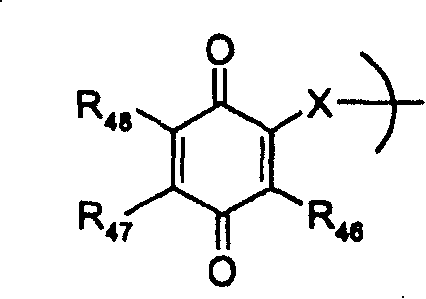
General formula 10
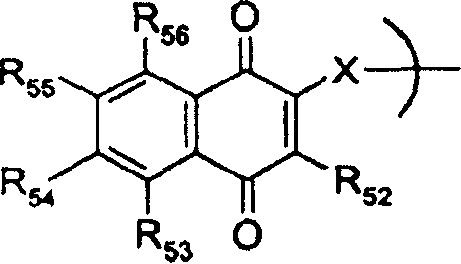
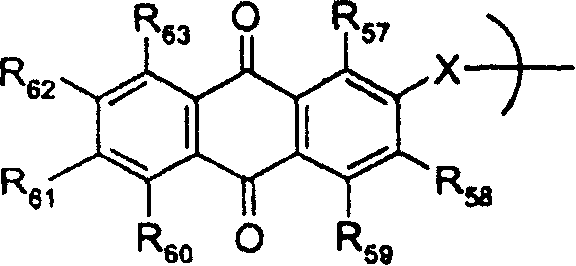
Each R wherein
46~R
63Represent H, C1~C6 alkyl group, OH, OR independently or side by side
97, CN, NO
2, COOH, CO
2R
97, CONH
2, CONR
98 2Or NR
98 2(preferred, all R
46~R
63Represent H simultaneously); X represents CH
2, O, S, NH, NR
98Or CO
2(in the situation of anthraquinone, wherein the position of X can be a position and the b position of anthracene); With each R
97And R
98Represent C1~C6 alkyl group, be preferably C1~C2 alkyl group.
[general formula 13]
The acenaphthene quinone that replaces is regulated group
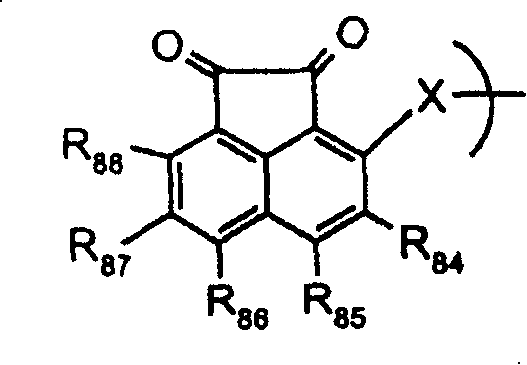
Wherein X represents CH
2, O, S, NH, NR
98Or CO
2Each R
84~R
88Represent H, C1~C6 alkyl group, OH, OR independently or side by side
97, CN, NO
2, COOH, CO
2R
97, CONH
2, CONR
98 2Or NR
98 2(preferred, all R
84~R
88Represent H simultaneously); With each R
97And R
98Represent C1~C6 alkyl group, be preferably C1~C2 alkyl group.
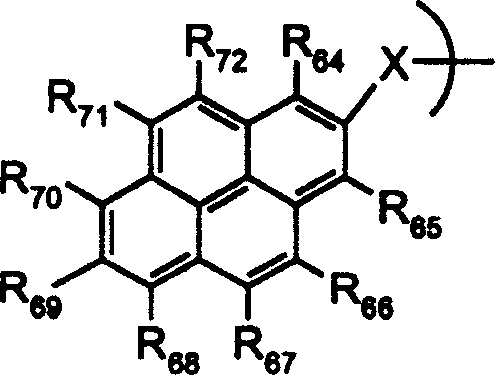
[general formula 14]
The pyrene that replaces is regulated group
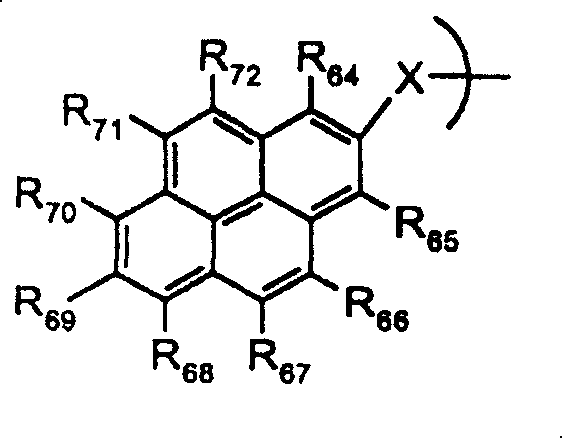
Wherein X represents CH
2, O, S, NH, NR
98Or CO
2Each R
64~R
72Represent H, C1~C6 alkyl group, OH, OR independently or side by side
97, CN, NO
2, COOH, CO
2R
97, CONH
2, CONR
98 2Or NR
98 2(preferred, all R
64~R
72Represent H simultaneously); With each R
97And R
98Represent C1~C6 alkyl group, be preferably C1~C2 alkyl group.
[general formula 15]
The perylene that replaces is regulated group

Wherein X represents CH
2, O, S, NH, NR
98Or CO
2Each R
73~R
83Represent H, C1~C6 alkyl group, OH, OR independently or side by side
97, CN, NO
2, COOH, CO
2R
97, CONH
2, CONR
98 2Or NR
98 2(preferred, all R
73~R
83Represent H simultaneously); With each R
97And R
98Represent C1~C6 alkyl group, be preferably C1~C2 alkyl group.
[general formula 16]
The dawn plug (dancyl) that replaces is regulated group

Each R wherein
89~R
94Represent H, C1~C6 alkyl group, OH, OR independently or side by side
97, CN, NO
2, COOH, CO
2R
97, CONH
2, CONR
98 2Or NR
98 2(preferably all R
89~R
94Represent H simultaneously); Each R
95And R
96Represent H or C1~C6 alkyl group independently or side by side, be preferably C1~the C2 alkyl group; And each R
97And R
98Represent C1~C6 alkyl group, be preferably C1~C2 alkyl group.
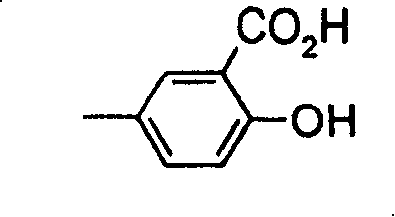
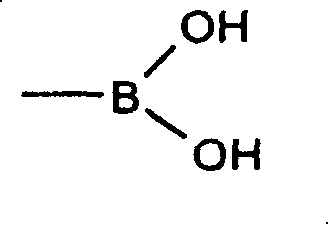
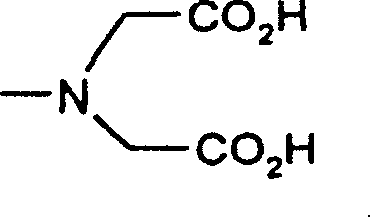
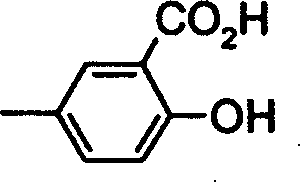
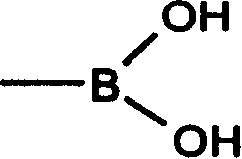
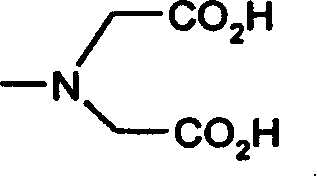
Can be used for conjugated group of the present invention comprises: by the phosphoric acid of following formula 17 expression, by the salicylic acid of following formula 18 expressions, by the boric acid of following formula 19 expressions, by the iminodiacetic acid of following formula 20 expressions with by the o-dihydroxy aryl (catechol) of following formula 21 expressions:
[Chemical formula 1 7]
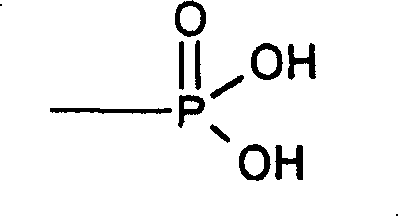
[Chemical formula 1 8]
[Chemical formula 1 9]
[Chemical formula 2 0]
[Chemical formula 2 1]
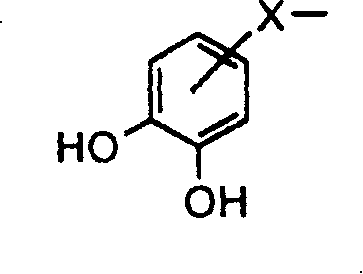
Wherein X can be O, NH, NR
98, S or CO, and NR
98Expression C1~C6 alkyl group is preferably C1~C2 alkyl group.
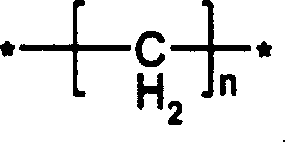
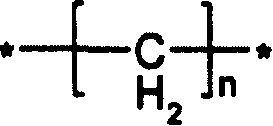
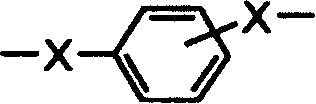
As mentioned above, adjusting group or conjugated group need not any connection base and directly are connected with the dipyridine ring, or connect the dipyridine ring by connecting base.When use connecting base, connecting base (connect base 1, connect base 2) can be for by the C1~C4 alkyl chain of following formula 22 expressions, by the dimethylbenzene (CH of following formula 23 expressions
2-Ar-CH
2-), by 1,3 of following formula 24 expression, 5-three azine (C
3N
3), or by the substituted aromatic ring of following formula 25 expression.When connecting base and connect base for aromatic series, tie point can the neighbour,, contraposition.
[Chemical formula 2 2]
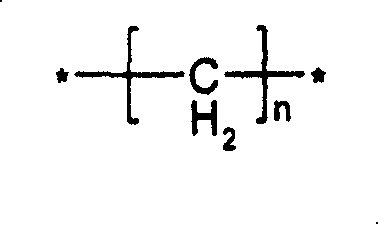
Wherein n is the integer between 1~4.
[Chemical formula 2 3]
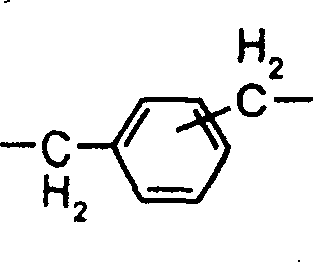
[Chemical formula 2 4]
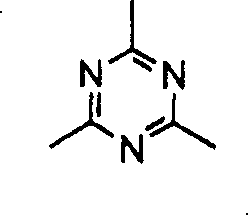
[general formula 25]

Wherein X can be O, NH, NR
98, S or CO, and NR
98Expression C1~C6 alkyl group is preferably C1~C2 alkyl group.
Counterion according to viologen derivative of the present invention can comprise Cl
-, Br
-, BF
4 -, PF
6 -, ClO
4 -(CF
3SO
2)
2N
-
Usually, can be prepared as follows according to electrochromic material of the present invention: 4,4 '-unit of conjugated group reaction to obtain forming of dipyridine and monovalent by the dipyridine that has conjugated group at the one end, that is, and dipyridine-(connecting basic)-conjugated group unit.Conjugated group can be with protections such as ester or ketal protected groups.In order to finish connection,, can use the various reactions that comprise nucleophilic substitution, esterification, addition elimination reaction and metal catalysed reaction according to the kind that connects base.When using addition elimination reaction or metal catalysed reaction, can need not any connection base and realize connecting.Next, regulating group need not any connection base and directly or by using connects base and be connected on the pyridine ring that is retained in resulting dipyridine-(connecting base)-conjugated group unit, to form the molecule of regulating group-dipyridine-conjugated group.Then, if desired, remove protection to conjugated group with activated molecule.By doing like this, the electrochromic material with adjusting group that can obtain combining with electrode.
Electrochromic device according to the present invention comprises: place first electrode, second electrode and electrolyte on the transparent or semitransparent substrate, wherein one of first electrode, second electrode and electrolyte comprise according to electrochromic material of the present invention.
Except the employed method of electrochromic material according to the present invention (seeing United States Patent (USP) the 5th, 441, No. 98/35267, No. 827 and PCT international publication WO), the conventional method preparation that electrode and electrochromic device can be known altogether by those skilled in the art.
Hereinafter, with the preferred embodiment of describing according to the preparation method of electrochromic material of the present invention.
Be prepared as follows and be used for nano-pore metal oxide electrode of the present invention: the nanocrystal metal oxide particle with 2~200nm mean grain size is dispersed in organic solvent to form paste with organic bond.Operable metal oxide comprises: be selected from and comprise titanium, zirconium, hafnium, chromium, molybdenum, tungsten, vanadium, niobium, tantalum, silver, zinc, strontium, iron (Fe
2+And Fe
3+), the metal oxide of the group of nickel and perovskite thereof.Preferably, metal oxide is TiO
2,, WO
3, MoO
3, ZnO, SnO
2, the tin oxide of doped indium or the zinc paste of doped indium.Organic bond has at thousands of molecular weight between millions of.The object lesson of organic bond comprises alkylcellulose, glucosan, PMMA (poly-(methyl methacrylate)) and polyglycol.Operable organic solvent comprises methyl alcohol, ethanol, isopropyl alcohol, dimethyl glycol dimethyl ether, propylene glycol propyl ether, propylene glycol methyl ether acetate and terpilenol.The painting method of screen printing (screen printing), serigraphy (stencil printing), spin coating or scraper is coated in paste on the surface of conductive electrode by for example using.Conductive electrode can be for being coated in ITO or the FTO membrane electrode on the glass surface, or the metal electrode of gold, silver, aluminium, copper, chromium, chromium/silver alloy or silver/palldium alloy for example.Then, to burn organic bond and therefore to form nano-pore, metal oxide nanoparticles is connected to each other and forms the porous metal oxide electrode assembly of [metal oxide nanoparticles-organic bond/conductive electrode] that obtains simultaneously at high temperature sintering.Then, by using self-assembling method, electrochromic material according to the present invention is applied in the system of [the nano-pore metal oxide electrode/conductive electrode] that obtain, thereby is provided for the working electrode of electrochromic device.
Operable counter electrode comprises the nano-pore metal oxide electrode that obtains as mentioned above, be coated in ITO on the glass surface or FTO membrane electrode or the metal electrode of gold, silver, aluminium, copper, chromium, chromium/silver alloy or silver/palldium alloy for example.The white reflecting plate can at random be inserted between working electrode and the counter electrode.The white reflecting plate can have size and makes at the titania between the 200nm to 600nm or nano SiO 2 particle and the electrode that applies at 200 ℃ or higher sintering temperature subsequently by applying on the surface of counter electrode.
According to electrochromic device of the present invention can by with bonding agent with the counter electrode of above-mentioned preparation and working electrode is stacked, insert electrode and air locking prepares.Operable electrolyte comprises the liquid electrolyte that contains the lithium salts that is dissolved in the solvent or tetraalkylammonium salt, ionic liquid, gelation lithium salts electrolyte, gelation ionic liquid and composition thereof.
Description of drawings
The chart that the redox-potential of the viologen derivative that Fig. 1 is obtained by embodiment 1 and comparative example 1 and 2 for expression changes.
Fig. 2 has comprised the synoptic diagram of the Structures of Electrochromic Devices of the metal oxide electrode that is coated with the viologen derivative that embodiment 1 obtains for expression.
Embodiment
The preferred embodiments of the present invention will be by in detail as a reference.Be appreciated that the following examples only be used for the explanation and the present invention be not limited to this.
Embodiment 1: trichlorine 2-((α ' (4 " '-N, the N-lutidines)-4 " α-)-4,4 '-dipyridine)-ethyl phosphate (PV-DMAP)
<PV-DMAP's is synthetic 〉
[reaction scheme 1]
A:THF,4℃,2hr
B:CH
3CN refluxes 24hr
C:6N HCl refluxes 24hr
Bromination l-(4 '-bromomethyl-phenyl)-4-dimethylamino-pyridine (I):
Under 4 ℃, the THF solution that contains the 30ml of the 4-dimethylaminopyridine that has wherein dissolved 1g is joined among the THF of the 100ml that contains the two bromo-p-dimethylbenzene that wherein dissolved 4.32g gradually, and potpourri reacts 2 hours to form precipitation.After the filtration, be deposited in dry compound (I) under the vacuum to obtain 3.23g.
1H-NMR(DMSO-d
6;ppm):8.43(2H),7.48(2H),7.39(2H),7.06(2H),5.42(2H),4.70(2H),3.18(6H);MS(LC):m/z=305(M
+)
Tribromide N-(phosphono-2-ethyl)-4 " dimethylamino-pyridine-4,4 '-dipyridine (II):
4.60g as the compound (I) of above-mentioned preparation is dissolved in the CH of 100ml with 4.00g bromination N-(diethyl phosphonyl-2-ethyl)-4,4 '-dipyridine
3Among the CN, and reaction mixture reacted 24 hours under refluxing.After the filtration, be deposited in dry compound (II) under the vacuum to obtain 6.81g.
1H-NMR(D
2O;ppm):9.22(2H),9.19(2H),8.64(2H),8.60(2H),8.09(2H,d),7.60(2H,d),7.48(2H),6.93(2H),6.00(2H),5.42(2H),5.07(2H),4.17(4H),3.23(6H),2.86(2H),1.29(6H)。
Tri-chlorination N-(phosphono-2-ethyl)-4 " dimethylamino-pyridine-4,4 '-dipyridine (III):
6.81g the compound (II) as above-mentioned preparation is dissolved among the 6N HCl of 50ml, and reacts 24 hours under refluxing.Behind the evaporating solvent, use H
2O, MeOH and THF carry out the compound (III) of recrystallization to obtain 5.98g.
1H-NMR(D
2O;ppm):9.23(4H),8.63(4H),8.12(2H),7.65(2H),7.53(2H),6.03(2H),5.45(2H),5.01(2H),3.26(6H),2.57(2H)MS(LC):m/z=489(M
+)。
[experimental example]
The measurement of the redox-potential of<viologen derivative 〉
Measure the redox-potential of compound (III) in the solution by cyclic voltammetry.Be specially, by use glassy carbon electrode as working electrode, Pt electrode as counter electrode and Ag/AgCl as contrast electrode, in 0.5M KCl solution, measure circulating current-voltage curve.As shown in following table 1 and Fig. 1, can find that phase one of reducing is at-0.520V (E
1, reversible) and the subordinate phase of reduction at-0.975V (E
2, irreversible).
<comprise the preparation of electrochromic device of the metal oxide electrode that has applied viologen derivative and the mensuration in life-span 〉
Ti (O-iPr)
4Form TiO through hydrolysis
2The colloidal sol of nano particle disperses.The initial nano particle that forms has the average-size of 7nm.At 200 ℃, nano particle is handled 12 hours to increase average-size to 12nm through autoclave.Under reduced pressure solvent distillation is to reach the concentration of 160g/l.Then based on TiO
2Weight, the Carbowax 20000 of 40wt% (polyethylene oxide with 20,000 mean molecular weight) is added into solution, thereby forms and to have full-bodied white TiO 2 sol slurries.By the screen printing method is coated in slurries on the ito transparent electrode and sintering applies under 450 ℃ high temperature electrode with provide as working electrode based on TiO with nano-pore
2Transparency electrode.As counter electrode, form tin oxide (the Sb-doping SnO of antimony dopant in the same way
2) electrode.By screen printing method rutile TiO
2Nano particle further apply counter electrode surface and subsequently sintering to form reflecting plate.
Be dipped in the aqueous solution of compound (III) of the 10mM of 50ml 30 minutes as the above-mentioned transparent working electrode that obtains, use 50ml ethanol washed twice subsequently.Working electrode at room temperature dry 4 hours, it is bonding then working electrode to be carried out heat curing, thereby is combined as a whole with counter electrode.The LiClO that contains 10mM
4Gamma-butyrolacton solution be used as electrolyte and inject, and make the device sealing that obtains with ultraviolet curing.The electrochromic device that obtains (Fig. 2) 1.0V send dark blue purple and even the circulation that developing the color/fading for 500,000 times after do not show and weaken.
The comparative example 1: dichloro 2-(4-phenyl-4,4 '-dipyridine) ethyl phosphate (VI) is (PVB)
[reaction scheme 2]
A: diethyl-(2-bromoethyl) phosphonic acids
B:BzBr, CH
3CN refluxes 6 hours
C:6N HCl refluxes 24 hours
3.12g 4,4 '-dipyridine mixes with diethyl-2-bromoethyl phosphate of 5.10g, and potpourri at room temperature reacted 12 hours.To the cold Anaesthetie Ether that wherein adds 300ml, stirred again subsequently 1 hour and filtering-depositing.With the Anaesthetie Ether washing precipitation three times of 50ml and under vacuum dry compound (IV) to obtain 6.21g.
CH to the 400ml that is dissolved with 6.21g compound (IV)
3The benzyl bromide a-bromotoluene that adds 3.70g among the CN.Next, potpourri is stirred 6 hours under 80 ℃ of backflows.Reaction mixture is cooled to room temperature and pours in the cold Anaesthetie Ether of 300ml, stirs subsequently 1 hour and filtering-depositing again.CH with 50ml
3CN washing precipitation three times and under vacuum dry compound (V) to obtain 7.44g
1H-NMR(DMSO-d
6;ppm):9.58(2H),9.45(2H),8.83(4H),7.65(2H),7.46(3H),5.99(2H),4.91(2H),4.02(4H),2.76(2H),1.21(6H)
7.44g compound (V) be dissolved among the 6N HCl of 150ml and reaction 24 hours under refluxing.Behind the evaporating solvent, use H
2O, MeOH and THF carry out the compound (VI) of recrystallization to obtain 5.27g.
1H-NMR(DMSO-d
6;ppm):9.59(2H),9.43(2H),8.84(2H),8.80(2H),7.65(2H),7.46(3H),5.98(2H),4.89(2H),2.63(2H)
As table 1 and shown in Figure 1, under the identical condition of embodiment 1, compound (VI) is at-0.586V (E
1, reversible) and show first reduction and at-0.879V (E
2, irreversible) and show that second reduces.Except using compound (VI) to replace having prepared electrochromic device with embodiment 1 identical method the compound (III).The electrochromic device that obtains shows strong bluish violet and is weakening showing 10,000 circulation backs of developing the color/fade at 1.0V.
The comparative example 2: dichloro-4,4,4 '-dipyridine-two (diethyl phosphoric acid) salt (VIII) is (PVP)
[reaction scheme 3]
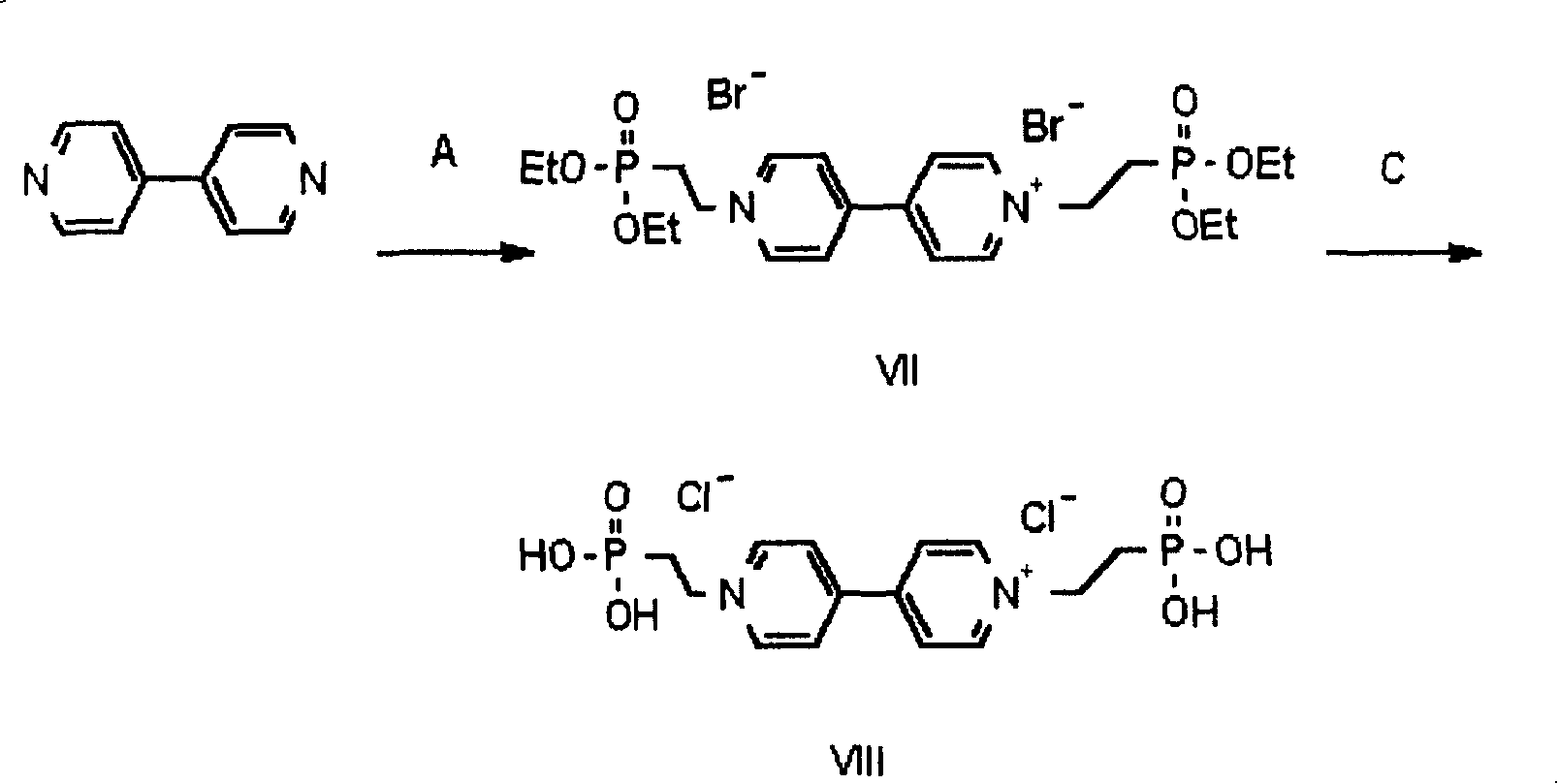
The diethyl of A:2 equivalent-(2-bromoethyl) phosphonic acids
C:6N HCl refluxes 24hr
3.12g 4,4 '-dipyridine and 10.1g diethyl-(2-bromoethyl) phosphonate ester mixes, and potpourri at room temperature reacted 12 hours.To the cold diethyl ether that wherein adds 500ml, stirred again subsequently 1 hour and filtering-depositing.Precipitation is washed three times and dry compound (VII) to obtain 11.6g under vacuum with the diethyl ether of 50ml.Compound (VII) as the above-mentioned 11.6g that obtains is dissolved among the 6N HCl of 100ml, opens under refluxing and reacts 24 hours.Behind the evaporating solvent, use H
2O, MeOH and THF carry out the compound (VIII) of recrystallization to obtain 6.85g.
As table 1 and shown in Figure 1, when using the Ag/AgCl contrast electrode, compound (VIII) is at-0.630V (E
1, reversible) and performance first reduction and at-0.955V (E
2, irreversible) and performance second reduction.Except using compound (VIII) to replace preparing electrochromic device in embodiment 1 identical mode the compound (III).The electrochromic device that obtains is sent out mazarine and is shown in the circulation back of developing the color/fade for 10,000 times at 1.3V and weakens.
[table 1]
| Viologen derivative | V 2+→V 1+(E 1) | V 1+→V 0(E 2) | Electric potential difference (Δ E) | |
| |
PV-DMAP | -0.520 | -0.975 | 0.455 |
| The comparative example 1 | PVB | -0.586 | -0.879 | 0.293 |
| The comparative example 2 | PVP | -0.630 | -0.955 | 0.325 |
Industrial applicability
By as can be seen aforementioned, viologen derivative according to the present invention provides the suitable adjusting group that can increase Δ E at an one end.Under the low driving voltage of 1.0V, viologen derivative can increase by 3~10 times of life-spans of electrochromic device.In addition, with respect to the electrochromic material of routine, electrochromic material according to the present invention shows the optical density of raising.
Although described the present invention, be appreciated that the present invention is not restricted to disclosed embodiment and accompanying drawing in conjunction with now being considered to the most practical and preferred embodiment.On the contrary, it can contain the essence of claims and the various modifications and variations of scope.
Claims (16)










Applications Claiming Priority (2)
| Application Number | Priority Date | Filing Date | Title |
|---|---|---|---|
| KR20030094546 | 2003-12-22 | ||
| KR1020030094546 | 2003-12-22 |
Publications (2)
| Publication Number | Publication Date |
|---|---|
| CN1871546A CN1871546A (en) | 2006-11-29 |
| CN100409094C true CN100409094C (en) | 2008-08-06 |
Family
ID=36791161
Family Applications (1)
| Application Number | Title | Priority Date | Filing Date |
|---|---|---|---|
| CNB2004800314022A Expired - Fee Related CN100409094C (en) | 2003-12-22 | 2004-12-22 | Electrochromic materials with improved lifetime |
Country Status (8)
| Country | Link |
|---|---|
| US (2) | US7521005B2 (en) |
| EP (1) | EP1697790B1 (en) |
| JP (1) | JP4364906B2 (en) |
| KR (1) | KR100615145B1 (en) |
| CN (1) | CN100409094C (en) |
| AT (1) | ATE522843T1 (en) |
| TW (1) | TWI302568B (en) |
| WO (1) | WO2005062110A1 (en) |
Families Citing this family (40)
| Publication number | Priority date | Publication date | Assignee | Title |
|---|---|---|---|---|
| CN100371416C (en) * | 2005-12-30 | 2008-02-27 | 中国科学院上海硅酸盐研究所 | An inorganic-organic composite solution type electrochromic material, device and preparation method |
| US20090320894A1 (en) * | 2006-02-17 | 2009-12-31 | Fabio Angiuli | Method for preparing nanocrystalline transparent films of tungsten oxide |
| US7829162B2 (en) | 2006-08-29 | 2010-11-09 | international imagining materials, inc | Thermal transfer ribbon |
| KR100865629B1 (en) | 2007-06-05 | 2008-10-27 | 삼성전자주식회사 | Electrochromic device with improved display characteristics and manufacturing method thereof |
| JP5656208B2 (en) * | 2007-09-28 | 2015-01-21 | 国立大学法人 千葉大学 | Medium and display device |
| KR101458207B1 (en) | 2007-11-20 | 2014-11-12 | 삼성전자주식회사 | Electrochromic Materials and Electrochromic Device Using The Same |
| US8179587B2 (en) * | 2008-01-04 | 2012-05-15 | 3M Innovative Properties Company | Electrochromic device |
| FR2929278A1 (en) * | 2008-04-01 | 2009-10-02 | Centre Nat Rech Scient | POROUS CRYSTALLINE HYBRID SOLID FOR THE ADSORPTION AND RELEASE OF GASES OF BIOLOGICAL INTEREST. |
| KR101475526B1 (en) * | 2008-09-02 | 2014-12-23 | 삼성전자주식회사 | Electrochromic material and electrochromic device using the same |
| PT104635A (en) * | 2009-06-16 | 2010-12-16 | Univ Nova De Lisboa | ELECTROCROMIC DEVICE AND METHOD FOR PRODUCING IT |
| KR101597764B1 (en) | 2009-07-02 | 2016-02-25 | 삼성전자 주식회사 | Electrochromic material and electrochromic device including the same |
| KR101735570B1 (en) * | 2010-03-26 | 2017-05-15 | 삼성전자주식회사 | Electrochromic material and electrochromic device including the same |
| CN102234505B (en) * | 2010-04-29 | 2014-01-01 | 比亚迪股份有限公司 | A kind of electrochromic material and preparation method thereof, and anti-glare automobile rearview mirror |
| CN102311729B (en) * | 2010-06-29 | 2014-04-02 | 比亚迪股份有限公司 | Electrochromic material, preparation method thereof, glare-proof rearview mirror for automobiles |
| US8610991B2 (en) | 2010-07-14 | 2013-12-17 | Samsung Electronics Co., Ltd. | Electrochromic material and electrochromic device including the same |
| MY160373A (en) * | 2010-07-21 | 2017-03-15 | Semiconductor Components Ind Llc | Bonding structure and method |
| US9780059B2 (en) * | 2010-07-21 | 2017-10-03 | Semiconductor Components Industries, Llc | Bonding structure and method |
| TW201219949A (en) * | 2010-11-12 | 2012-05-16 | J Touch Corp | presenting three-dimensional image no matter the display device is rotated as horizontal or vertical |
| KR101843549B1 (en) | 2011-01-07 | 2018-03-30 | 삼성전자주식회사 | Electrochromic device |
| US9778532B2 (en) | 2011-03-16 | 2017-10-03 | View, Inc. | Controlling transitions in optically switchable devices |
| US9412290B2 (en) | 2013-06-28 | 2016-08-09 | View, Inc. | Controlling transitions in optically switchable devices |
| US9030725B2 (en) | 2012-04-17 | 2015-05-12 | View, Inc. | Driving thin film switchable optical devices |
| US10935865B2 (en) | 2011-03-16 | 2021-03-02 | View, Inc. | Driving thin film switchable optical devices |
| US11630367B2 (en) | 2011-03-16 | 2023-04-18 | View, Inc. | Driving thin film switchable optical devices |
| US9454055B2 (en) | 2011-03-16 | 2016-09-27 | View, Inc. | Multipurpose controller for multistate windows |
| KR101953180B1 (en) * | 2011-08-26 | 2019-02-28 | 더 리젠츠 오브 더 유니버시티 오브 캘리포니아 | Nanostructured transparent conducting oxide electrochromic device |
| US10503039B2 (en) | 2013-06-28 | 2019-12-10 | View, Inc. | Controlling transitions in optically switchable devices |
| US9540249B2 (en) * | 2012-09-05 | 2017-01-10 | The University Of Hong Kong | Solution-processed transition metal oxides |
| CN103059831A (en) * | 2012-11-14 | 2013-04-24 | 仝泽彬 | Electrochromic material and electrochromic device |
| CN103965864B (en) * | 2012-11-21 | 2015-12-09 | 中国科学技术大学 | Viologen compound electrochromic material and electrochromic device thereof |
| US12061404B2 (en) | 2013-06-28 | 2024-08-13 | View, Inc. | Controlling transitions in optically switchable devices |
| US9885935B2 (en) | 2013-06-28 | 2018-02-06 | View, Inc. | Controlling transitions in optically switchable devices |
| US12353111B2 (en) | 2013-06-28 | 2025-07-08 | View Operating Corporation | Controlling transitions in optically switchable devices |
| WO2017104466A1 (en) * | 2015-12-15 | 2017-06-22 | 株式会社リコー | Electrochromic apparatus |
| WO2017189307A2 (en) | 2016-04-29 | 2017-11-02 | View, Inc. | Calibration of electrical parameters in optically switchable windows |
| KR102038495B1 (en) * | 2017-02-27 | 2019-10-30 | 서울시립대학교 산학협력단 | Electrochromic Compound, Electrochromic Device, and, Method of Driving Electrochromic Device |
| JP7199868B2 (en) * | 2017-10-10 | 2023-01-06 | キヤノン株式会社 | Electrochromic device, optical filter, lens unit, imaging device, and window material |
| FR3088487B1 (en) * | 2018-11-09 | 2020-11-20 | Commissariat Energie Atomique | USE OF A BATTERY WITH POLYVIOLOGENE ACTIVE MATERIAL |
| CN110308602B (en) * | 2019-05-30 | 2022-06-07 | Oppo广东移动通信有限公司 | Electronic equipment, shell assembly, electrochromic device and electrochromic medium material thereof |
| JP7750000B2 (en) * | 2021-09-21 | 2025-10-07 | 株式会社デンソー | Carbon dioxide capture system |
Citations (4)
| Publication number | Priority date | Publication date | Assignee | Title |
|---|---|---|---|---|
| US5668663A (en) * | 1994-05-05 | 1997-09-16 | Donnelly Corporation | Electrochromic mirrors and devices |
| US5985184A (en) * | 1991-09-06 | 1999-11-16 | Donnelly Corporation | Electrochemichromic solutions, processes for preparing and using the same, and device manufactured with the same |
| US20030039020A1 (en) * | 2000-02-24 | 2003-02-27 | Lomprey Jeffrey R. | Substituted metallocenes and electrochromic media and devices comprising the same |
| US6639709B2 (en) * | 2001-03-19 | 2003-10-28 | Dow Global Technologies Inc. | Matrix addressable electrochromic display device |
Family Cites Families (20)
| Publication number | Priority date | Publication date | Assignee | Title |
|---|---|---|---|---|
| JPS58136685A (en) | 1982-02-08 | 1983-08-13 | Pilot Pen Co Ltd:The | Electrochromic display material preparation thereof and electrochromic display device |
| JPS5944380A (en) * | 1982-09-08 | 1984-03-12 | Hitachi Ltd | Viologen derivatives and their production method |
| JPH0723361B2 (en) * | 1989-10-18 | 1995-03-15 | ダイソー株式会社 | Novel viologen derivative and its use |
| JPH0795170B2 (en) | 1990-08-21 | 1995-10-11 | ダイソー株式会社 | Polyviologen modified electrode and its application |
| US5336448A (en) * | 1991-06-25 | 1994-08-09 | Gentex Corporation | Electrochromic devices with bipyridinium salt solutions |
| JPH05170738A (en) | 1991-12-25 | 1993-07-09 | Sony Corp | Biologen compound |
| CH686206A5 (en) * | 1992-03-26 | 1996-01-31 | Asulab Sa | Cellule photoelectrochimique regeneratrice transparent. |
| DE19605451A1 (en) * | 1996-02-15 | 1997-08-21 | Bayer Ag | Electrochromic system |
| DE69830566T2 (en) * | 1997-02-06 | 2006-05-11 | University College Dublin | ELECTROCHROMIC SYSTEM |
| JPH11142891A (en) * | 1997-11-05 | 1999-05-28 | Nippon Oil Co Ltd | Electrochromic mirror |
| JP2000131722A (en) * | 1998-10-22 | 2000-05-12 | Nippon Mitsubishi Oil Corp | Electrochromic device |
| JP2001181293A (en) | 1999-12-28 | 2001-07-03 | Nippon Mitsubishi Oil Corp | Ferrocene-viologen derivative |
| EP1154311A4 (en) | 1999-02-18 | 2007-03-28 | Nippon Mitsubishi Oil Corp | ELECTROCHROMIC ELEMENT |
| EP1500969A1 (en) * | 1999-10-11 | 2005-01-26 | University College Dublin | Compound and its use in electrochromic devices |
| DE19956228A1 (en) | 1999-11-23 | 2001-05-31 | Bayer Ag | Electrochromic device with improved switching behavior |
| JP2001209078A (en) | 2000-01-26 | 2001-08-03 | Nippon Mitsubishi Oil Corp | Electrochromic device |
| DE10023765A1 (en) * | 2000-05-15 | 2001-11-22 | Bayer Ag | Electrochromic device, useful as a window, separating screen, protective screen, glazing, roof glazing, light filter, mirror or display device contains a bridged bipyridinium salt compound |
| DE10023744A1 (en) | 2000-05-15 | 2001-12-13 | Bayer Ag | Electrochromic display device with high edge sharpness |
| US7064212B2 (en) * | 2002-06-20 | 2006-06-20 | The Regents Of The University Of California | Electrochromic salts, solutions, and devices |
| EP1443091A1 (en) | 2003-01-31 | 2004-08-04 | Ntera Limited | Electrochromic compounds |
-
2004
- 2004-12-22 TW TW093140094A patent/TWI302568B/en not_active IP Right Cessation
- 2004-12-22 JP JP2006546823A patent/JP4364906B2/en not_active Expired - Fee Related
- 2004-12-22 EP EP04808523A patent/EP1697790B1/en not_active Expired - Lifetime
- 2004-12-22 WO PCT/KR2004/003392 patent/WO2005062110A1/en not_active Ceased
- 2004-12-22 CN CNB2004800314022A patent/CN100409094C/en not_active Expired - Fee Related
- 2004-12-22 AT AT04808523T patent/ATE522843T1/en not_active IP Right Cessation
- 2004-12-22 KR KR1020040110405A patent/KR100615145B1/en not_active Expired - Fee Related
-
2005
- 2005-04-18 US US11/015,282 patent/US7521005B2/en not_active Expired - Lifetime
-
2008
- 2008-08-04 US US12/222,180 patent/US20090137807A1/en not_active Abandoned
Patent Citations (4)
| Publication number | Priority date | Publication date | Assignee | Title |
|---|---|---|---|---|
| US5985184A (en) * | 1991-09-06 | 1999-11-16 | Donnelly Corporation | Electrochemichromic solutions, processes for preparing and using the same, and device manufactured with the same |
| US5668663A (en) * | 1994-05-05 | 1997-09-16 | Donnelly Corporation | Electrochromic mirrors and devices |
| US20030039020A1 (en) * | 2000-02-24 | 2003-02-27 | Lomprey Jeffrey R. | Substituted metallocenes and electrochromic media and devices comprising the same |
| US6639709B2 (en) * | 2001-03-19 | 2003-10-28 | Dow Global Technologies Inc. | Matrix addressable electrochromic display device |
Non-Patent Citations (1)
| Title |
|---|
| Molecular Suppression of the PimerizationofViologens(.4,4'-Bipyridinium Derivatives) AttachedtoNanocrystallineTitaniumDioxide Thin-Film Electrodes. Michael Felderhoff, Susanne Heinen, NgongoMolisho,SimonaWebersinn, and Lorenz Walder.Helvetica Chimica Acta,Vol.83 No.1. 2000 * |
Also Published As
| Publication number | Publication date |
|---|---|
| TWI302568B (en) | 2008-11-01 |
| KR20050063736A (en) | 2005-06-28 |
| WO2005062110A1 (en) | 2005-07-07 |
| JP4364906B2 (en) | 2009-11-18 |
| TW200535220A (en) | 2005-11-01 |
| KR100615145B1 (en) | 2006-08-22 |
| JP2007519776A (en) | 2007-07-19 |
| US7521005B2 (en) | 2009-04-21 |
| EP1697790B1 (en) | 2011-08-31 |
| US20090137807A1 (en) | 2009-05-28 |
| EP1697790A1 (en) | 2006-09-06 |
| US20050179012A1 (en) | 2005-08-18 |
| ATE522843T1 (en) | 2011-09-15 |
| CN1871546A (en) | 2006-11-29 |
| EP1697790A4 (en) | 2009-07-22 |
Similar Documents
| Publication | Publication Date | Title |
|---|---|---|
| CN100409094C (en) | Electrochromic materials with improved lifetime | |
| Madasamy et al. | Viologen-based electrochromic materials and devices | |
| Cinnsealach et al. | Coloured electrochromic windows based on nanostructured TiO2 films modified by adsorbed redox chromophores | |
| Lu et al. | Achieving low-energy driven viologens-based electrochromic devices utilizing polymeric ionic liquids | |
| US7270880B2 (en) | Electrochromic particles | |
| CN112534344B (en) | Electrochromic device of metal complex system | |
| KR101593688B1 (en) | Electrochromic material and electrochromic device using the same | |
| JP4370733B2 (en) | Electrochromic element | |
| Lu et al. | Durable electrochromic devices driven at 0.8 V by complementary chromic combination of metallo-supramolecular polymer and prussian blue analogues for smart windows with low-energy consumption | |
| US20140009812A1 (en) | Display device and color electronic paper using the same | |
| Kim et al. | Electrofluorochromic device based on a redox-active europium (III) complex | |
| Ojha et al. | Variable-tint electrochromic supercapacitor with a benzyl hexenyl viologen-prussian blue architecture and ultralong cycling life | |
| US20080060698A1 (en) | Electrolyte Composition And Photoelectric Conversion Element Utilizing The Same | |
| KR20090051911A (en) | Electrochromic material and electrochromic device using same | |
| JP2015052733A (en) | Electrochromic material, electrochromic composition, and electrochromic display element | |
| JP2008179725A (en) | Dye compound, method for producing dye compound, and electrochromic apparatus using the same | |
| WO2012036010A1 (en) | Additive for electrolytic composition, electrolytic composition using this additive, and dye-sensitized solar cell | |
| KR20120080454A (en) | Electrochromic device | |
| JP2003161963A (en) | Electrochromic element | |
| JP5024592B2 (en) | Electrochromic device | |
| JP2006324111A (en) | Flexible dye-sensitized solar cell | |
| KR102850819B1 (en) | Electrochromic device and its manufacturing method | |
| JP4946222B2 (en) | Electrochromic device | |
| Ho et al. | Electrochromic devices based on metal hexacyanometallate/viologen pairings | |
| JP2008089705A (en) | Electrochromic device |
Legal Events
| Date | Code | Title | Description |
|---|---|---|---|
| C06 | Publication | ||
| PB01 | Publication | ||
| C10 | Entry into substantive examination | ||
| SE01 | Entry into force of request for substantive examination | ||
| C14 | Grant of patent or utility model | ||
| GR01 | Patent grant | ||
| C17 | Cessation of patent right | ||
| CF01 | Termination of patent right due to non-payment of annual fee |
Granted publication date: 20080806 Termination date: 20100122 |