BR122020018717B1 - Modified Nucleotide Linker - Google Patents
Modified Nucleotide Linker Download PDFInfo
- Publication number
- BR122020018717B1 BR122020018717B1 BR122020018717-4A BR122020018717A BR122020018717B1 BR 122020018717 B1 BR122020018717 B1 BR 122020018717B1 BR 122020018717 A BR122020018717 A BR 122020018717A BR 122020018717 B1 BR122020018717 B1 BR 122020018717B1
- Authority
- BR
- Brazil
- Prior art keywords
- nucleotide
- optionally substituted
- group
- linker
- alkyl
- Prior art date
Links
- 125000003729 nucleotide group Chemical group 0.000 claims abstract description 104
- 239000002773 nucleotide Substances 0.000 claims abstract description 103
- 125000005647 linker group Chemical group 0.000 claims description 74
- 125000004169 (C1-C6) alkyl group Chemical group 0.000 claims description 42
- 239000002777 nucleoside Substances 0.000 claims description 41
- 150000003833 nucleoside derivatives Chemical group 0.000 claims description 38
- 239000003446 ligand Substances 0.000 claims description 16
- 125000002496 methyl group Chemical group [H]C([H])([H])* 0.000 claims description 16
- 125000000325 methylidene group Chemical group [H]C([H])=* 0.000 claims 1
- 238000012163 sequencing technique Methods 0.000 abstract description 52
- 238000000034 method Methods 0.000 abstract description 33
- 238000010348 incorporation Methods 0.000 abstract description 29
- 230000015572 biosynthetic process Effects 0.000 abstract description 13
- 238000003786 synthesis reaction Methods 0.000 abstract description 10
- 229910052739 hydrogen Inorganic materials 0.000 description 38
- 239000001257 hydrogen Substances 0.000 description 37
- 125000002947 alkylene group Chemical group 0.000 description 34
- 125000003118 aryl group Chemical group 0.000 description 27
- 125000004432 carbon atom Chemical group C* 0.000 description 24
- 125000000217 alkyl group Chemical group 0.000 description 22
- 150000007523 nucleic acids Chemical class 0.000 description 21
- 108020004707 nucleic acids Proteins 0.000 description 20
- 102000039446 nucleic acids Human genes 0.000 description 20
- 239000000975 dye Substances 0.000 description 19
- -1 modified nucleotide phosphoramidites Chemical class 0.000 description 19
- 125000004435 hydrogen atom Chemical group [H]* 0.000 description 18
- 125000001475 halogen functional group Chemical group 0.000 description 15
- 125000004474 heteroalkylene group Chemical group 0.000 description 15
- LNTHITQWFMADLM-UHFFFAOYSA-N gallic acid Chemical compound OC(=O)C1=CC(O)=C(O)C(O)=C1 LNTHITQWFMADLM-UHFFFAOYSA-N 0.000 description 14
- 125000001424 substituent group Chemical group 0.000 description 14
- 150000002431 hydrogen Chemical group 0.000 description 13
- 125000001997 phenyl group Chemical group [H]C1=C([H])C([H])=C(*)C([H])=C1[H] 0.000 description 13
- 108020004414 DNA Proteins 0.000 description 12
- 238000006243 chemical reaction Methods 0.000 description 12
- 125000004404 heteroalkyl group Chemical group 0.000 description 12
- 125000001072 heteroaryl group Chemical group 0.000 description 12
- 125000004191 (C1-C6) alkoxy group Chemical group 0.000 description 11
- 125000000171 (C1-C6) haloalkyl group Chemical group 0.000 description 11
- 230000001681 protective effect Effects 0.000 description 11
- WEVYAHXRMPXWCK-UHFFFAOYSA-N Acetonitrile Chemical compound CC#N WEVYAHXRMPXWCK-UHFFFAOYSA-N 0.000 description 10
- 125000003710 aryl alkyl group Chemical group 0.000 description 10
- 125000004429 atom Chemical group 0.000 description 10
- 238000001514 detection method Methods 0.000 description 10
- 125000004737 (C1-C6) haloalkoxy group Chemical group 0.000 description 9
- 125000001313 C5-C10 heteroaryl group Chemical group 0.000 description 9
- 229910052799 carbon Inorganic materials 0.000 description 9
- 150000002148 esters Chemical class 0.000 description 9
- HWCKGOZZJDHMNC-UHFFFAOYSA-M tetraethylammonium bromide Chemical compound [Br-].CC[N+](CC)(CC)CC HWCKGOZZJDHMNC-UHFFFAOYSA-M 0.000 description 9
- CIWBSHSKHKDKBQ-JLAZNSOCSA-N Ascorbic acid Chemical compound OC[C@H](O)[C@H]1OC(=O)C(O)=C1O CIWBSHSKHKDKBQ-JLAZNSOCSA-N 0.000 description 8
- OKTJSMMVPCPJKN-UHFFFAOYSA-N Carbon Chemical compound [C] OKTJSMMVPCPJKN-UHFFFAOYSA-N 0.000 description 8
- NINIDFKCEFEMDL-UHFFFAOYSA-N Sulfur Chemical compound [S] NINIDFKCEFEMDL-UHFFFAOYSA-N 0.000 description 8
- QVGXLLKOCUKJST-UHFFFAOYSA-N atomic oxygen Chemical compound [O] QVGXLLKOCUKJST-UHFFFAOYSA-N 0.000 description 8
- 125000004122 cyclic group Chemical group 0.000 description 8
- 125000000623 heterocyclic group Chemical group 0.000 description 8
- 125000001570 methylene group Chemical group [H]C([H])([*:1])[*:2] 0.000 description 8
- 229910052760 oxygen Inorganic materials 0.000 description 8
- 239000001301 oxygen Substances 0.000 description 8
- 239000000758 substrate Substances 0.000 description 8
- 229910052717 sulfur Inorganic materials 0.000 description 8
- 239000011593 sulfur Substances 0.000 description 8
- 125000000041 C6-C10 aryl group Chemical group 0.000 description 7
- UFHFLCQGNIYNRP-UHFFFAOYSA-N Hydrogen Chemical compound [H][H] UFHFLCQGNIYNRP-UHFFFAOYSA-N 0.000 description 7
- 125000004452 carbocyclyl group Chemical group 0.000 description 7
- 125000004093 cyano group Chemical group *C#N 0.000 description 7
- 230000000694 effects Effects 0.000 description 7
- 239000011541 reaction mixture Substances 0.000 description 7
- IJGRMHOSHXDMSA-UHFFFAOYSA-N Atomic nitrogen Chemical compound N#N IJGRMHOSHXDMSA-UHFFFAOYSA-N 0.000 description 6
- 125000000882 C2-C6 alkenyl group Chemical group 0.000 description 6
- 230000005778 DNA damage Effects 0.000 description 6
- 231100000277 DNA damage Toxicity 0.000 description 6
- 125000000852 azido group Chemical group *N=[N+]=[N-] 0.000 description 6
- 239000000872 buffer Substances 0.000 description 6
- 125000000753 cycloalkyl group Chemical group 0.000 description 6
- 229940074391 gallic acid Drugs 0.000 description 6
- 235000004515 gallic acid Nutrition 0.000 description 6
- 125000005842 heteroatom Chemical group 0.000 description 6
- 125000000449 nitro group Chemical group [O-][N+](*)=O 0.000 description 6
- 229910052757 nitrogen Inorganic materials 0.000 description 6
- 108091033319 polynucleotide Proteins 0.000 description 6
- 239000002157 polynucleotide Substances 0.000 description 6
- 102000040430 polynucleotide Human genes 0.000 description 6
- 230000008569 process Effects 0.000 description 6
- 125000003601 C2-C6 alkynyl group Chemical group 0.000 description 5
- KDCGOANMDULRCW-UHFFFAOYSA-N Purine Natural products N1=CNC2=NC=NC2=C1 KDCGOANMDULRCW-UHFFFAOYSA-N 0.000 description 5
- 125000003368 amide group Chemical group 0.000 description 5
- 239000003153 chemical reaction reagent Substances 0.000 description 5
- 150000001875 compounds Chemical class 0.000 description 5
- 150000002430 hydrocarbons Chemical group 0.000 description 5
- 239000012535 impurity Substances 0.000 description 5
- 238000003780 insertion Methods 0.000 description 5
- 230000037431 insertion Effects 0.000 description 5
- 230000000670 limiting effect Effects 0.000 description 5
- 239000000203 mixture Substances 0.000 description 5
- 125000000951 phenoxy group Chemical group [H]C1=C([H])C([H])=C(O*)C([H])=C1[H] 0.000 description 5
- 125000002924 primary amino group Chemical group [H]N([H])* 0.000 description 5
- 238000012175 pyrosequencing Methods 0.000 description 5
- 108091032973 (ribonucleotides)n+m Proteins 0.000 description 4
- XAQHXGSHRMHVMU-UHFFFAOYSA-N [S].[S] Chemical compound [S].[S] XAQHXGSHRMHVMU-UHFFFAOYSA-N 0.000 description 4
- OIRDTQYFTABQOQ-KQYNXXCUSA-N adenosine Chemical compound C1=NC=2C(N)=NC=NC=2N1[C@@H]1O[C@H](CO)[C@@H](O)[C@H]1O OIRDTQYFTABQOQ-KQYNXXCUSA-N 0.000 description 4
- 238000005516 engineering process Methods 0.000 description 4
- 125000001495 ethyl group Chemical group [H]C([H])([H])C([H])([H])* 0.000 description 4
- 238000002866 fluorescence resonance energy transfer Methods 0.000 description 4
- 239000007850 fluorescent dye Substances 0.000 description 4
- 125000000524 functional group Chemical group 0.000 description 4
- 238000004128 high performance liquid chromatography Methods 0.000 description 4
- 238000009396 hybridization Methods 0.000 description 4
- 230000006872 improvement Effects 0.000 description 4
- 239000003068 molecular probe Substances 0.000 description 4
- 239000000047 product Substances 0.000 description 4
- 150000003254 radicals Chemical class 0.000 description 4
- 239000007787 solid Substances 0.000 description 4
- 239000000126 substance Substances 0.000 description 4
- ASJSAQIRZKANQN-CRCLSJGQSA-N 2-deoxy-D-ribose Chemical group OC[C@@H](O)[C@@H](O)CC=O ASJSAQIRZKANQN-CRCLSJGQSA-N 0.000 description 3
- ZKHQWZAMYRWXGA-KQYNXXCUSA-J ATP(4-) Chemical compound C1=NC=2C(N)=NC=NC=2N1[C@@H]1O[C@H](COP([O-])(=O)OP([O-])(=O)OP([O-])([O-])=O)[C@@H](O)[C@H]1O ZKHQWZAMYRWXGA-KQYNXXCUSA-J 0.000 description 3
- ZKHQWZAMYRWXGA-UHFFFAOYSA-N Adenosine triphosphate Natural products C1=NC=2C(N)=NC=NC=2N1C1OC(COP(O)(=O)OP(O)(=O)OP(O)(O)=O)C(O)C1O ZKHQWZAMYRWXGA-UHFFFAOYSA-N 0.000 description 3
- KCXVZYZYPLLWCC-UHFFFAOYSA-N EDTA Chemical compound OC(=O)CN(CC(O)=O)CCN(CC(O)=O)CC(O)=O KCXVZYZYPLLWCC-UHFFFAOYSA-N 0.000 description 3
- OKKJLVBELUTLKV-UHFFFAOYSA-N Methanol Chemical compound OC OKKJLVBELUTLKV-UHFFFAOYSA-N 0.000 description 3
- JGFZNNIVVJXRND-UHFFFAOYSA-N N,N-Diisopropylethylamine (DIPEA) Chemical compound CCN(C(C)C)C(C)C JGFZNNIVVJXRND-UHFFFAOYSA-N 0.000 description 3
- 108091034117 Oligonucleotide Proteins 0.000 description 3
- CZPWVGJYEJSRLH-UHFFFAOYSA-N Pyrimidine Chemical compound C1=CN=CN=C1 CZPWVGJYEJSRLH-UHFFFAOYSA-N 0.000 description 3
- QAOWNCQODCNURD-UHFFFAOYSA-N Sulfuric acid Chemical compound OS(O)(=O)=O QAOWNCQODCNURD-UHFFFAOYSA-N 0.000 description 3
- ZMANZCXQSJIPKH-UHFFFAOYSA-N Triethylamine Chemical compound CCN(CC)CC ZMANZCXQSJIPKH-UHFFFAOYSA-N 0.000 description 3
- GLEVLJDDWXEYCO-UHFFFAOYSA-N Trolox Chemical compound O1C(C)(C(O)=O)CCC2=C1C(C)=C(C)C(O)=C2C GLEVLJDDWXEYCO-UHFFFAOYSA-N 0.000 description 3
- 125000003545 alkoxy group Chemical group 0.000 description 3
- 238000004458 analytical method Methods 0.000 description 3
- 235000010323 ascorbic acid Nutrition 0.000 description 3
- 239000011668 ascorbic acid Substances 0.000 description 3
- 239000011230 binding agent Substances 0.000 description 3
- 239000011203 carbon fibre reinforced carbon Substances 0.000 description 3
- 230000000295 complement effect Effects 0.000 description 3
- 230000003993 interaction Effects 0.000 description 3
- 125000001449 isopropyl group Chemical group [H]C([H])([H])C([H])(*)C([H])([H])[H] 0.000 description 3
- 239000007788 liquid Substances 0.000 description 3
- 238000012986 modification Methods 0.000 description 3
- 230000004048 modification Effects 0.000 description 3
- 125000003835 nucleoside group Chemical group 0.000 description 3
- 125000004430 oxygen atom Chemical group O* 0.000 description 3
- 125000006503 p-nitrobenzyl group Chemical group [H]C1=C([H])C(=C([H])C([H])=C1[N+]([O-])=O)C([H])([H])* 0.000 description 3
- 125000002467 phosphate group Chemical group [H]OP(=O)(O[H])O[*] 0.000 description 3
- 229920000642 polymer Polymers 0.000 description 3
- 230000002441 reversible effect Effects 0.000 description 3
- 229920006395 saturated elastomer Polymers 0.000 description 3
- DGVVWUTYPXICAM-UHFFFAOYSA-N β‐Mercaptoethanol Chemical compound OCCS DGVVWUTYPXICAM-UHFFFAOYSA-N 0.000 description 3
- YBJHBAHKTGYVGT-ZKWXMUAHSA-N (+)-Biotin Chemical compound N1C(=O)N[C@@H]2[C@H](CCCCC(=O)O)SC[C@@H]21 YBJHBAHKTGYVGT-ZKWXMUAHSA-N 0.000 description 2
- 125000004178 (C1-C4) alkyl group Chemical group 0.000 description 2
- 125000003161 (C1-C6) alkylene group Chemical group 0.000 description 2
- 125000006272 (C3-C7) cycloalkyl group Chemical group 0.000 description 2
- HZAXFHJVJLSVMW-UHFFFAOYSA-N 2-Aminoethan-1-ol Chemical compound NCCO HZAXFHJVJLSVMW-UHFFFAOYSA-N 0.000 description 2
- FUMPSJKFHVLVAY-UHFFFAOYSA-N 2-methyl-2-[2-[(2-methylpropan-2-yl)oxycarbonylamino]ethyldisulfanyl]propanoic acid Chemical compound CC(C)(C)OC(=O)NCCSSC(C)(C)C(O)=O FUMPSJKFHVLVAY-UHFFFAOYSA-N 0.000 description 2
- UMCMPZBLKLEWAF-BCTGSCMUSA-N 3-[(3-cholamidopropyl)dimethylammonio]propane-1-sulfonate Chemical compound C([C@H]1C[C@H]2O)[C@H](O)CC[C@]1(C)[C@@H]1[C@@H]2[C@@H]2CC[C@H]([C@@H](CCC(=O)NCCC[N+](C)(C)CCCS([O-])(=O)=O)C)[C@@]2(C)[C@@H](O)C1 UMCMPZBLKLEWAF-BCTGSCMUSA-N 0.000 description 2
- VHYFNPMBLIVWCW-UHFFFAOYSA-N 4-Dimethylaminopyridine Chemical compound CN(C)C1=CC=NC=C1 VHYFNPMBLIVWCW-UHFFFAOYSA-N 0.000 description 2
- ZAMOUSCENKQFHK-UHFFFAOYSA-N Chlorine atom Chemical compound [Cl] ZAMOUSCENKQFHK-UHFFFAOYSA-N 0.000 description 2
- 102000016928 DNA-directed DNA polymerase Human genes 0.000 description 2
- 108010014303 DNA-directed DNA polymerase Proteins 0.000 description 2
- RTZKZFJDLAIYFH-UHFFFAOYSA-N Diethyl ether Chemical compound CCOCC RTZKZFJDLAIYFH-UHFFFAOYSA-N 0.000 description 2
- 102000004190 Enzymes Human genes 0.000 description 2
- 108090000790 Enzymes Proteins 0.000 description 2
- PXGOKWXKJXAPGV-UHFFFAOYSA-N Fluorine Chemical compound FF PXGOKWXKJXAPGV-UHFFFAOYSA-N 0.000 description 2
- JUJWROOIHBZHMG-UHFFFAOYSA-N Pyridine Chemical compound C1=CC=NC=C1 JUJWROOIHBZHMG-UHFFFAOYSA-N 0.000 description 2
- PYMYPHUHKUWMLA-LMVFSUKVSA-N Ribose Natural products OC[C@@H](O)[C@@H](O)[C@@H](O)C=O PYMYPHUHKUWMLA-LMVFSUKVSA-N 0.000 description 2
- FAPWRFPIFSIZLT-UHFFFAOYSA-M Sodium chloride Chemical compound [Na+].[Cl-] FAPWRFPIFSIZLT-UHFFFAOYSA-M 0.000 description 2
- IQFYYKKMVGJFEH-XLPZGREQSA-N Thymidine Chemical compound O=C1NC(=O)C(C)=CN1[C@@H]1O[C@H](CO)[C@@H](O)C1 IQFYYKKMVGJFEH-XLPZGREQSA-N 0.000 description 2
- ISAKRJDGNUQOIC-UHFFFAOYSA-N Uracil Chemical compound O=C1C=CNC(=O)N1 ISAKRJDGNUQOIC-UHFFFAOYSA-N 0.000 description 2
- JLCPHMBAVCMARE-UHFFFAOYSA-N [3-[[3-[[3-[[3-[[3-[[3-[[3-[[3-[[3-[[3-[[3-[[5-(2-amino-6-oxo-1H-purin-9-yl)-3-[[3-[[3-[[3-[[3-[[3-[[5-(2-amino-6-oxo-1H-purin-9-yl)-3-[[5-(2-amino-6-oxo-1H-purin-9-yl)-3-hydroxyoxolan-2-yl]methoxy-hydroxyphosphoryl]oxyoxolan-2-yl]methoxy-hydroxyphosphoryl]oxy-5-(5-methyl-2,4-dioxopyrimidin-1-yl)oxolan-2-yl]methoxy-hydroxyphosphoryl]oxy-5-(6-aminopurin-9-yl)oxolan-2-yl]methoxy-hydroxyphosphoryl]oxy-5-(6-aminopurin-9-yl)oxolan-2-yl]methoxy-hydroxyphosphoryl]oxy-5-(6-aminopurin-9-yl)oxolan-2-yl]methoxy-hydroxyphosphoryl]oxy-5-(6-aminopurin-9-yl)oxolan-2-yl]methoxy-hydroxyphosphoryl]oxyoxolan-2-yl]methoxy-hydroxyphosphoryl]oxy-5-(5-methyl-2,4-dioxopyrimidin-1-yl)oxolan-2-yl]methoxy-hydroxyphosphoryl]oxy-5-(4-amino-2-oxopyrimidin-1-yl)oxolan-2-yl]methoxy-hydroxyphosphoryl]oxy-5-(5-methyl-2,4-dioxopyrimidin-1-yl)oxolan-2-yl]methoxy-hydroxyphosphoryl]oxy-5-(5-methyl-2,4-dioxopyrimidin-1-yl)oxolan-2-yl]methoxy-hydroxyphosphoryl]oxy-5-(6-aminopurin-9-yl)oxolan-2-yl]methoxy-hydroxyphosphoryl]oxy-5-(6-aminopurin-9-yl)oxolan-2-yl]methoxy-hydroxyphosphoryl]oxy-5-(4-amino-2-oxopyrimidin-1-yl)oxolan-2-yl]methoxy-hydroxyphosphoryl]oxy-5-(4-amino-2-oxopyrimidin-1-yl)oxolan-2-yl]methoxy-hydroxyphosphoryl]oxy-5-(4-amino-2-oxopyrimidin-1-yl)oxolan-2-yl]methoxy-hydroxyphosphoryl]oxy-5-(6-aminopurin-9-yl)oxolan-2-yl]methoxy-hydroxyphosphoryl]oxy-5-(4-amino-2-oxopyrimidin-1-yl)oxolan-2-yl]methyl [5-(6-aminopurin-9-yl)-2-(hydroxymethyl)oxolan-3-yl] hydrogen phosphate Polymers Cc1cn(C2CC(OP(O)(=O)OCC3OC(CC3OP(O)(=O)OCC3OC(CC3O)n3cnc4c3nc(N)[nH]c4=O)n3cnc4c3nc(N)[nH]c4=O)C(COP(O)(=O)OC3CC(OC3COP(O)(=O)OC3CC(OC3COP(O)(=O)OC3CC(OC3COP(O)(=O)OC3CC(OC3COP(O)(=O)OC3CC(OC3COP(O)(=O)OC3CC(OC3COP(O)(=O)OC3CC(OC3COP(O)(=O)OC3CC(OC3COP(O)(=O)OC3CC(OC3COP(O)(=O)OC3CC(OC3COP(O)(=O)OC3CC(OC3COP(O)(=O)OC3CC(OC3COP(O)(=O)OC3CC(OC3COP(O)(=O)OC3CC(OC3COP(O)(=O)OC3CC(OC3COP(O)(=O)OC3CC(OC3COP(O)(=O)OC3CC(OC3CO)n3cnc4c(N)ncnc34)n3ccc(N)nc3=O)n3cnc4c(N)ncnc34)n3ccc(N)nc3=O)n3ccc(N)nc3=O)n3ccc(N)nc3=O)n3cnc4c(N)ncnc34)n3cnc4c(N)ncnc34)n3cc(C)c(=O)[nH]c3=O)n3cc(C)c(=O)[nH]c3=O)n3ccc(N)nc3=O)n3cc(C)c(=O)[nH]c3=O)n3cnc4c3nc(N)[nH]c4=O)n3cnc4c(N)ncnc34)n3cnc4c(N)ncnc34)n3cnc4c(N)ncnc34)n3cnc4c(N)ncnc34)O2)c(=O)[nH]c1=O JLCPHMBAVCMARE-UHFFFAOYSA-N 0.000 description 2
- GJEAMHAFPYZYDE-UHFFFAOYSA-N [C].[S] Chemical compound [C].[S] GJEAMHAFPYZYDE-UHFFFAOYSA-N 0.000 description 2
- DZBUGLKDJFMEHC-UHFFFAOYSA-N acridine Chemical compound C1=CC=CC2=CC3=CC=CC=C3N=C21 DZBUGLKDJFMEHC-UHFFFAOYSA-N 0.000 description 2
- 125000003342 alkenyl group Chemical group 0.000 description 2
- 125000000304 alkynyl group Chemical group 0.000 description 2
- HMFHBZSHGGEWLO-UHFFFAOYSA-N alpha-D-Furanose-Ribose Natural products OCC1OC(O)C(O)C1O HMFHBZSHGGEWLO-UHFFFAOYSA-N 0.000 description 2
- 150000001408 amides Chemical class 0.000 description 2
- 238000003491 array Methods 0.000 description 2
- 229940072107 ascorbate Drugs 0.000 description 2
- 239000011324 bead Substances 0.000 description 2
- 230000008901 benefit Effects 0.000 description 2
- 125000000484 butyl group Chemical group [H]C([*])([H])C([H])([H])C([H])([H])C([H])([H])[H] 0.000 description 2
- 125000003178 carboxy group Chemical group [H]OC(*)=O 0.000 description 2
- 239000000460 chlorine Substances 0.000 description 2
- 229910052801 chlorine Inorganic materials 0.000 description 2
- 239000011248 coating agent Substances 0.000 description 2
- 238000000576 coating method Methods 0.000 description 2
- 125000001995 cyclobutyl group Chemical group [H]C1([H])C([H])([H])C([H])(*)C1([H])[H] 0.000 description 2
- 125000000113 cyclohexyl group Chemical group [H]C1([H])C([H])([H])C([H])([H])C([H])(*)C([H])([H])C1([H])[H] 0.000 description 2
- 125000001511 cyclopentyl group Chemical group [H]C1([H])C([H])([H])C([H])([H])C([H])(*)C1([H])[H] 0.000 description 2
- 125000001559 cyclopropyl group Chemical group [H]C1([H])C([H])([H])C1([H])* 0.000 description 2
- OPTASPLRGRRNAP-UHFFFAOYSA-N cytosine Chemical compound NC=1C=CNC(=O)N=1 OPTASPLRGRRNAP-UHFFFAOYSA-N 0.000 description 2
- 230000006378 damage Effects 0.000 description 2
- 238000011161 development Methods 0.000 description 2
- 125000000118 dimethyl group Chemical group [H]C([H])([H])* 0.000 description 2
- 235000011180 diphosphates Nutrition 0.000 description 2
- 239000012530 fluid Substances 0.000 description 2
- 229910052731 fluorine Inorganic materials 0.000 description 2
- 239000011737 fluorine Substances 0.000 description 2
- UYTPUPDQBNUYGX-UHFFFAOYSA-N guanine Chemical compound O=C1NC(N)=NC2=C1N=CN2 UYTPUPDQBNUYGX-UHFFFAOYSA-N 0.000 description 2
- 125000004438 haloalkoxy group Chemical group 0.000 description 2
- 229910052736 halogen Inorganic materials 0.000 description 2
- 150000002367 halogens Chemical class 0.000 description 2
- 125000004446 heteroarylalkyl group Chemical group 0.000 description 2
- 125000004356 hydroxy functional group Chemical group O* 0.000 description 2
- 125000000959 isobutyl group Chemical group [H]C([H])([H])C([H])(C([H])([H])[H])C([H])([H])* 0.000 description 2
- 239000003550 marker Substances 0.000 description 2
- 125000004043 oxo group Chemical group O=* 0.000 description 2
- 230000036961 partial effect Effects 0.000 description 2
- 150000002972 pentoses Chemical class 0.000 description 2
- 230000008832 photodamage Effects 0.000 description 2
- 125000001436 propyl group Chemical group [H]C([*])([H])C([H])([H])C([H])([H])[H] 0.000 description 2
- 125000006239 protecting group Chemical group 0.000 description 2
- 239000003223 protective agent Substances 0.000 description 2
- BBEAQIROQSPTKN-UHFFFAOYSA-N pyrene Chemical compound C1=CC=C2C=CC3=CC=CC4=CC=C1C2=C43 BBEAQIROQSPTKN-UHFFFAOYSA-N 0.000 description 2
- 238000010791 quenching Methods 0.000 description 2
- 230000000171 quenching effect Effects 0.000 description 2
- 230000005855 radiation Effects 0.000 description 2
- 230000002829 reductive effect Effects 0.000 description 2
- 125000000548 ribosyl group Chemical group C1([C@H](O)[C@H](O)[C@H](O1)CO)* 0.000 description 2
- 238000006467 substitution reaction Methods 0.000 description 2
- 125000000472 sulfonyl group Chemical group *S(*)(=O)=O 0.000 description 2
- 125000004213 tert-butoxy group Chemical group [H]C([H])([H])C(O*)(C([H])([H])[H])C([H])([H])[H] 0.000 description 2
- 125000000999 tert-butyl group Chemical group [H]C([H])([H])C(*)(C([H])([H])[H])C([H])([H])[H] 0.000 description 2
- 125000003396 thiol group Chemical group [H]S* 0.000 description 2
- RWQNBRDOKXIBIV-UHFFFAOYSA-N thymine Chemical compound CC1=CNC(=O)NC1=O RWQNBRDOKXIBIV-UHFFFAOYSA-N 0.000 description 2
- 125000006727 (C1-C6) alkenyl group Chemical group 0.000 description 1
- 125000006700 (C1-C6) alkylthio group Chemical group 0.000 description 1
- 125000006728 (C1-C6) alkynyl group Chemical group 0.000 description 1
- 125000006716 (C1-C6) heteroalkyl group Chemical group 0.000 description 1
- DXBHBZVCASKNBY-UHFFFAOYSA-N 1,2-Benz(a)anthracene Chemical compound C1=CC=C2C3=CC4=CC=CC=C4C=C3C=CC2=C1 DXBHBZVCASKNBY-UHFFFAOYSA-N 0.000 description 1
- VXNZUUAINFGPBY-UHFFFAOYSA-N 1-Butene Chemical group CCC=C VXNZUUAINFGPBY-UHFFFAOYSA-N 0.000 description 1
- ZGEGCLOFRBLKSE-UHFFFAOYSA-N 1-Heptene Chemical group CCCCCC=C ZGEGCLOFRBLKSE-UHFFFAOYSA-N 0.000 description 1
- 125000004812 1-ethylethylene group Chemical group [H]C([H])([H])C([H])([H])C([H])([*:1])C([H])([H])[*:2] 0.000 description 1
- 238000001644 13C nuclear magnetic resonance spectroscopy Methods 0.000 description 1
- 238000004293 19F NMR spectroscopy Methods 0.000 description 1
- 238000005160 1H NMR spectroscopy Methods 0.000 description 1
- YKBGVTZYEHREMT-KVQBGUIXSA-N 2'-deoxyguanosine Chemical compound C1=NC=2C(=O)NC(N)=NC=2N1[C@H]1C[C@H](O)[C@@H](CO)O1 YKBGVTZYEHREMT-KVQBGUIXSA-N 0.000 description 1
- CKTSBUTUHBMZGZ-SHYZEUOFSA-N 2'‐deoxycytidine Chemical compound O=C1N=C(N)C=CN1[C@@H]1O[C@H](CO)[C@@H](O)C1 CKTSBUTUHBMZGZ-SHYZEUOFSA-N 0.000 description 1
- UFBJCMHMOXMLKC-UHFFFAOYSA-N 2,4-dinitrophenol Chemical compound OC1=CC=C([N+]([O-])=O)C=C1[N+]([O-])=O UFBJCMHMOXMLKC-UHFFFAOYSA-N 0.000 description 1
- BFSVOASYOCHEOV-UHFFFAOYSA-N 2-diethylaminoethanol Chemical compound CCN(CC)CCO BFSVOASYOCHEOV-UHFFFAOYSA-N 0.000 description 1
- 125000000094 2-phenylethyl group Chemical group [H]C1=C([H])C([H])=C(C([H])=C1[H])C([H])([H])C([H])([H])* 0.000 description 1
- GOLORTLGFDVFDW-UHFFFAOYSA-N 3-(1h-benzimidazol-2-yl)-7-(diethylamino)chromen-2-one Chemical compound C1=CC=C2NC(C3=CC4=CC=C(C=C4OC3=O)N(CC)CC)=NC2=C1 GOLORTLGFDVFDW-UHFFFAOYSA-N 0.000 description 1
- PHIYHIOQVWTXII-UHFFFAOYSA-N 3-amino-1-phenylpropan-1-ol Chemical compound NCCC(O)C1=CC=CC=C1 PHIYHIOQVWTXII-UHFFFAOYSA-N 0.000 description 1
- 125000006201 3-phenylpropyl group Chemical group [H]C1=C([H])C([H])=C(C([H])=C1[H])C([H])([H])C([H])([H])C([H])([H])* 0.000 description 1
- 229960000549 4-dimethylaminophenol Drugs 0.000 description 1
- HBAQYPYDRFILMT-UHFFFAOYSA-N 8-[3-(1-cyclopropylpyrazol-4-yl)-1H-pyrazolo[4,3-d]pyrimidin-5-yl]-3-methyl-3,8-diazabicyclo[3.2.1]octan-2-one Chemical class C1(CC1)N1N=CC(=C1)C1=NNC2=C1N=C(N=C2)N1C2C(N(CC1CC2)C)=O HBAQYPYDRFILMT-UHFFFAOYSA-N 0.000 description 1
- 229930024421 Adenine Natural products 0.000 description 1
- GFFGJBXGBJISGV-UHFFFAOYSA-N Adenine Chemical compound NC1=NC=NC2=C1N=CN2 GFFGJBXGBJISGV-UHFFFAOYSA-N 0.000 description 1
- 241000937413 Axia Species 0.000 description 1
- WKBOTKDWSSQWDR-UHFFFAOYSA-N Bromine atom Chemical compound [Br] WKBOTKDWSSQWDR-UHFFFAOYSA-N 0.000 description 1
- 239000002126 C01EB10 - Adenosine Substances 0.000 description 1
- 108020004635 Complementary DNA Proteins 0.000 description 1
- ZZZCUOFIHGPKAK-UHFFFAOYSA-N D-erythro-ascorbic acid Natural products OCC1OC(=O)C(O)=C1O ZZZCUOFIHGPKAK-UHFFFAOYSA-N 0.000 description 1
- HMFHBZSHGGEWLO-SOOFDHNKSA-N D-ribofuranose Chemical compound OC[C@H]1OC(O)[C@H](O)[C@@H]1O HMFHBZSHGGEWLO-SOOFDHNKSA-N 0.000 description 1
- 238000001712 DNA sequencing Methods 0.000 description 1
- CKTSBUTUHBMZGZ-UHFFFAOYSA-N Deoxycytidine Natural products O=C1N=C(N)C=CN1C1OC(CO)C(O)C1 CKTSBUTUHBMZGZ-UHFFFAOYSA-N 0.000 description 1
- BWGNESOTFCXPMA-UHFFFAOYSA-N Dihydrogen disulfide Chemical compound SS BWGNESOTFCXPMA-UHFFFAOYSA-N 0.000 description 1
- VGGSQFUCUMXWEO-UHFFFAOYSA-N Ethene Chemical compound C=C VGGSQFUCUMXWEO-UHFFFAOYSA-N 0.000 description 1
- 239000005977 Ethylene Substances 0.000 description 1
- PIICEJLVQHRZGT-UHFFFAOYSA-N Ethylenediamine Chemical compound NCCN PIICEJLVQHRZGT-UHFFFAOYSA-N 0.000 description 1
- NYHBQMYGNKIUIF-UUOKFMHZSA-N Guanosine Chemical compound C1=NC=2C(=O)NC(N)=NC=2N1[C@@H]1O[C@H](CO)[C@@H](O)[C@H]1O NYHBQMYGNKIUIF-UUOKFMHZSA-N 0.000 description 1
- 150000000996 L-ascorbic acids Chemical class 0.000 description 1
- WHXSMMKQMYFTQS-UHFFFAOYSA-N Lithium Chemical compound [Li] WHXSMMKQMYFTQS-UHFFFAOYSA-N 0.000 description 1
- 108060001084 Luciferase Proteins 0.000 description 1
- 239000005089 Luciferase Substances 0.000 description 1
- KDXKERNSBIXSRK-UHFFFAOYSA-N Lysine Natural products NCCCCC(N)C(O)=O KDXKERNSBIXSRK-UHFFFAOYSA-N 0.000 description 1
- 239000004472 Lysine Substances 0.000 description 1
- DTERQYGMUDWYAZ-ZETCQYMHSA-N N(6)-acetyl-L-lysine Chemical compound CC(=O)NCCCC[C@H]([NH3+])C([O-])=O DTERQYGMUDWYAZ-ZETCQYMHSA-N 0.000 description 1
- 108091028043 Nucleic acid sequence Proteins 0.000 description 1
- 229910019142 PO4 Inorganic materials 0.000 description 1
- OAICVXFJPJFONN-UHFFFAOYSA-N Phosphorus Chemical compound [P] OAICVXFJPJFONN-UHFFFAOYSA-N 0.000 description 1
- 125000005631 S-sulfonamido group Chemical group 0.000 description 1
- 229910006069 SO3H Inorganic materials 0.000 description 1
- 229920005654 Sephadex Polymers 0.000 description 1
- 239000012507 Sephadex™ Substances 0.000 description 1
- 229920002472 Starch Polymers 0.000 description 1
- 108010090804 Streptavidin Proteins 0.000 description 1
- 102000004523 Sulfate Adenylyltransferase Human genes 0.000 description 1
- 108010022348 Sulfate adenylyltransferase Proteins 0.000 description 1
- ZMZDMBWJUHKJPS-UHFFFAOYSA-M Thiocyanate anion Chemical compound [S-]C#N ZMZDMBWJUHKJPS-UHFFFAOYSA-M 0.000 description 1
- RYYWUUFWQRZTIU-UHFFFAOYSA-N Thiophosphoric acid Chemical class OP(O)(S)=O RYYWUUFWQRZTIU-UHFFFAOYSA-N 0.000 description 1
- 229930003268 Vitamin C Natural products 0.000 description 1
- OBOXTJCIIVUZEN-UHFFFAOYSA-N [C].[O] Chemical compound [C].[O] OBOXTJCIIVUZEN-UHFFFAOYSA-N 0.000 description 1
- 238000010521 absorption reaction Methods 0.000 description 1
- 239000002253 acid Substances 0.000 description 1
- 150000007513 acids Chemical class 0.000 description 1
- 125000002252 acyl group Chemical group 0.000 description 1
- 229960000643 adenine Drugs 0.000 description 1
- 229960005305 adenosine Drugs 0.000 description 1
- 150000003838 adenosines Chemical class 0.000 description 1
- 125000004450 alkenylene group Chemical group 0.000 description 1
- 125000004103 aminoalkyl group Chemical group 0.000 description 1
- 239000003963 antioxidant agent Substances 0.000 description 1
- 235000006708 antioxidants Nutrition 0.000 description 1
- 238000013459 approach Methods 0.000 description 1
- 125000005110 aryl thio group Chemical group 0.000 description 1
- 125000004104 aryloxy group Chemical group 0.000 description 1
- 229960005070 ascorbic acid Drugs 0.000 description 1
- 238000003556 assay Methods 0.000 description 1
- 125000003828 azulenyl group Chemical group 0.000 description 1
- 125000003785 benzimidazolyl group Chemical group N1=C(NC2=C1C=CC=C2)* 0.000 description 1
- 125000001164 benzothiazolyl group Chemical group S1C(=NC2=C1C=CC=C2)* 0.000 description 1
- 125000004196 benzothienyl group Chemical group S1C(=CC2=C1C=CC=C2)* 0.000 description 1
- 125000004541 benzoxazolyl group Chemical group O1C(=NC2=C1C=CC=C2)* 0.000 description 1
- 125000001797 benzyl group Chemical group [H]C1=C([H])C([H])=C(C([H])=C1[H])C([H])([H])* 0.000 description 1
- 229960002685 biotin Drugs 0.000 description 1
- 235000020958 biotin Nutrition 0.000 description 1
- 239000011616 biotin Substances 0.000 description 1
- PFYXSUNOLOJMDX-UHFFFAOYSA-N bis(2,5-dioxopyrrolidin-1-yl) carbonate Chemical compound O=C1CCC(=O)N1OC(=O)ON1C(=O)CCC1=O PFYXSUNOLOJMDX-UHFFFAOYSA-N 0.000 description 1
- GDTBXPJZTBHREO-UHFFFAOYSA-N bromine Substances BrBr GDTBXPJZTBHREO-UHFFFAOYSA-N 0.000 description 1
- 229910052794 bromium Inorganic materials 0.000 description 1
- VNJDGPAEVCGZNX-UHFFFAOYSA-N butan-2,2-diyl Chemical group [CH2-]C[C+]=C VNJDGPAEVCGZNX-UHFFFAOYSA-N 0.000 description 1
- 239000006227 byproduct Substances 0.000 description 1
- 150000001721 carbon Chemical group 0.000 description 1
- 125000002915 carbonyl group Chemical group [*:2]C([*:1])=O 0.000 description 1
- 239000003054 catalyst Substances 0.000 description 1
- 239000003795 chemical substances by application Substances 0.000 description 1
- 238000004587 chromatography analysis Methods 0.000 description 1
- 239000002299 complementary DNA Substances 0.000 description 1
- 238000001816 cooling Methods 0.000 description 1
- 230000001186 cumulative effect Effects 0.000 description 1
- XLJMAIOERFSOGZ-UHFFFAOYSA-M cyanate Chemical compound [O-]C#N XLJMAIOERFSOGZ-UHFFFAOYSA-M 0.000 description 1
- 125000000582 cycloheptyl group Chemical group [H]C1([H])C([H])([H])C([H])([H])C([H])([H])C([H])(*)C([H])([H])C1([H])[H] 0.000 description 1
- 125000000640 cyclooctyl group Chemical group [H]C1([H])C([H])([H])C([H])([H])C([H])([H])C([H])(*)C([H])([H])C([H])([H])C1([H])[H] 0.000 description 1
- 238000004163 cytometry Methods 0.000 description 1
- 229940104302 cytosine Drugs 0.000 description 1
- 125000001295 dansyl group Chemical group [H]C1=C([H])C(N(C([H])([H])[H])C([H])([H])[H])=C2C([H])=C([H])C([H])=C(C2=C1[H])S(*)(=O)=O 0.000 description 1
- 239000000412 dendrimer Substances 0.000 description 1
- 229920000736 dendritic polymer Polymers 0.000 description 1
- 239000005549 deoxyribonucleoside Substances 0.000 description 1
- 230000001419 dependent effect Effects 0.000 description 1
- 239000005546 dideoxynucleotide Substances 0.000 description 1
- 239000001177 diphosphate Substances 0.000 description 1
- XPPKVPWEQAFLFU-UHFFFAOYSA-J diphosphate(4-) Chemical compound [O-]P([O-])(=O)OP([O-])([O-])=O XPPKVPWEQAFLFU-UHFFFAOYSA-J 0.000 description 1
- XPPKVPWEQAFLFU-UHFFFAOYSA-N diphosphoric acid Chemical compound OP(O)(=O)OP(O)(O)=O XPPKVPWEQAFLFU-UHFFFAOYSA-N 0.000 description 1
- 230000009881 electrostatic interaction Effects 0.000 description 1
- 125000001033 ether group Chemical group 0.000 description 1
- 238000001704 evaporation Methods 0.000 description 1
- 230000008020 evaporation Effects 0.000 description 1
- 230000005284 excitation Effects 0.000 description 1
- 239000012467 final product Substances 0.000 description 1
- GVEPBJHOBDJJJI-UHFFFAOYSA-N fluoranthrene Natural products C1=CC(C2=CC=CC=C22)=C3C2=CC=CC3=C1 GVEPBJHOBDJJJI-UHFFFAOYSA-N 0.000 description 1
- GNBHRKFJIUUOQI-UHFFFAOYSA-N fluorescein Chemical compound O1C(=O)C2=CC=CC=C2C21C1=CC=C(O)C=C1OC1=CC(O)=CC=C21 GNBHRKFJIUUOQI-UHFFFAOYSA-N 0.000 description 1
- 238000001506 fluorescence spectroscopy Methods 0.000 description 1
- 125000002541 furyl group Chemical group 0.000 description 1
- 230000004927 fusion Effects 0.000 description 1
- 239000011521 glass Substances 0.000 description 1
- PCHJSUWPFVWCPO-UHFFFAOYSA-N gold Chemical compound [Au] PCHJSUWPFVWCPO-UHFFFAOYSA-N 0.000 description 1
- 239000010931 gold Substances 0.000 description 1
- 229910052737 gold Inorganic materials 0.000 description 1
- 125000004475 heteroaralkyl group Chemical group 0.000 description 1
- 125000004051 hexyl group Chemical group [H]C([H])([H])C([H])([H])C([H])([H])C([H])([H])C([H])([H])C([H])([H])* 0.000 description 1
- ZMZDMBWJUHKJPS-UHFFFAOYSA-N hydrogen thiocyanate Natural products SC#N ZMZDMBWJUHKJPS-UHFFFAOYSA-N 0.000 description 1
- 125000002887 hydroxy group Chemical group [H]O* 0.000 description 1
- 125000002883 imidazolyl group Chemical group 0.000 description 1
- 125000001041 indolyl group Chemical group 0.000 description 1
- 239000003112 inhibitor Substances 0.000 description 1
- PNDPGZBMCMUPRI-UHFFFAOYSA-N iodine Chemical compound II PNDPGZBMCMUPRI-UHFFFAOYSA-N 0.000 description 1
- 150000002500 ions Chemical class 0.000 description 1
- 239000012948 isocyanate Substances 0.000 description 1
- 150000002513 isocyanates Chemical class 0.000 description 1
- 125000000904 isoindolyl group Chemical group C=1(NC=C2C=CC=CC12)* 0.000 description 1
- 125000003253 isopropoxy group Chemical group [H]C([H])([H])C([H])(O*)C([H])([H])[H] 0.000 description 1
- 125000001786 isothiazolyl group Chemical group 0.000 description 1
- 150000002540 isothiocyanates Chemical class 0.000 description 1
- 125000000842 isoxazolyl group Chemical group 0.000 description 1
- 229910052744 lithium Inorganic materials 0.000 description 1
- 238000000504 luminescence detection Methods 0.000 description 1
- 238000004519 manufacturing process Methods 0.000 description 1
- 239000000463 material Substances 0.000 description 1
- 239000011159 matrix material Substances 0.000 description 1
- 108020004999 messenger RNA Proteins 0.000 description 1
- 239000011859 microparticle Substances 0.000 description 1
- 239000004005 microsphere Substances 0.000 description 1
- 238000012544 monitoring process Methods 0.000 description 1
- 125000002950 monocyclic group Chemical group 0.000 description 1
- 239000000178 monomer Substances 0.000 description 1
- 125000004108 n-butyl group Chemical group [H]C([H])([H])C([H])([H])C([H])([H])C([H])([H])* 0.000 description 1
- 239000002105 nanoparticle Substances 0.000 description 1
- 125000001624 naphthyl group Chemical group 0.000 description 1
- 125000001326 naphthylalkyl group Chemical group 0.000 description 1
- 230000007935 neutral effect Effects 0.000 description 1
- 125000004433 nitrogen atom Chemical group N* 0.000 description 1
- 229940127073 nucleoside analogue Drugs 0.000 description 1
- 230000003287 optical effect Effects 0.000 description 1
- 125000002971 oxazolyl group Chemical group 0.000 description 1
- 125000001147 pentyl group Chemical group C(CCCC)* 0.000 description 1
- 230000000737 periodic effect Effects 0.000 description 1
- 150000007965 phenolic acids Chemical class 0.000 description 1
- 239000010452 phosphate Substances 0.000 description 1
- 229910052698 phosphorus Inorganic materials 0.000 description 1
- 239000011574 phosphorus Substances 0.000 description 1
- 125000004592 phthalazinyl group Chemical group C1(=NN=CC2=CC=CC=C12)* 0.000 description 1
- 125000003367 polycyclic group Chemical group 0.000 description 1
- 150000008442 polyphenolic compounds Chemical class 0.000 description 1
- 235000013824 polyphenols Nutrition 0.000 description 1
- 239000008057 potassium phosphate buffer Substances 0.000 description 1
- 238000002360 preparation method Methods 0.000 description 1
- OSFBJERFMQCEQY-UHFFFAOYSA-N propylidene Chemical compound [CH]CC OSFBJERFMQCEQY-UHFFFAOYSA-N 0.000 description 1
- 238000000746 purification Methods 0.000 description 1
- IGFXRKMLLMBKSA-UHFFFAOYSA-N purine Chemical compound N1=C[N]C2=NC=NC2=C1 IGFXRKMLLMBKSA-UHFFFAOYSA-N 0.000 description 1
- 125000003373 pyrazinyl group Chemical group 0.000 description 1
- 125000003226 pyrazolyl group Chemical group 0.000 description 1
- 125000002098 pyridazinyl group Chemical group 0.000 description 1
- UMJSCPRVCHMLSP-UHFFFAOYSA-N pyridine Natural products COC1=CC=CN=C1 UMJSCPRVCHMLSP-UHFFFAOYSA-N 0.000 description 1
- 125000004076 pyridyl group Chemical group 0.000 description 1
- 125000000714 pyrimidinyl group Chemical group 0.000 description 1
- 125000000168 pyrrolyl group Chemical group 0.000 description 1
- 239000002096 quantum dot Substances 0.000 description 1
- 125000002943 quinolinyl group Chemical group N1=C(C=CC2=CC=CC=C12)* 0.000 description 1
- PYWVYCXTNDRMGF-UHFFFAOYSA-N rhodamine B Chemical compound [Cl-].C=12C=CC(=[N+](CC)CC)C=C2OC2=CC(N(CC)CC)=CC=C2C=1C1=CC=CC=C1C(O)=O PYWVYCXTNDRMGF-UHFFFAOYSA-N 0.000 description 1
- 239000002342 ribonucleoside Substances 0.000 description 1
- 229920002477 rna polymer Polymers 0.000 description 1
- 150000003839 salts Chemical class 0.000 description 1
- 239000000523 sample Substances 0.000 description 1
- 125000002914 sec-butyl group Chemical group [H]C([H])([H])C([H])([H])C([H])(*)C([H])([H])[H] 0.000 description 1
- 238000000926 separation method Methods 0.000 description 1
- 235000010378 sodium ascorbate Nutrition 0.000 description 1
- PPASLZSBLFJQEF-RKJRWTFHSA-M sodium ascorbate Substances [Na+].OC[C@@H](O)[C@H]1OC(=O)C(O)=C1[O-] PPASLZSBLFJQEF-RKJRWTFHSA-M 0.000 description 1
- 229960005055 sodium ascorbate Drugs 0.000 description 1
- 239000011780 sodium chloride Substances 0.000 description 1
- PPASLZSBLFJQEF-RXSVEWSESA-M sodium-L-ascorbate Chemical compound [Na+].OC[C@H](O)[C@H]1OC(=O)C(O)=C1[O-] PPASLZSBLFJQEF-RXSVEWSESA-M 0.000 description 1
- 239000002904 solvent Substances 0.000 description 1
- 238000004611 spectroscopical analysis Methods 0.000 description 1
- 235000019698 starch Nutrition 0.000 description 1
- 239000008107 starch Substances 0.000 description 1
- 238000003860 storage Methods 0.000 description 1
- 125000000475 sulfinyl group Chemical group [*:2]S([*:1])=O 0.000 description 1
- RLNWRDKVJSXXPP-UHFFFAOYSA-N tert-butyl 2-[(2-bromoanilino)methyl]piperidine-1-carboxylate Chemical compound CC(C)(C)OC(=O)N1CCCCC1CNC1=CC=CC=C1Br RLNWRDKVJSXXPP-UHFFFAOYSA-N 0.000 description 1
- 125000005931 tert-butyloxycarbonyl group Chemical group [H]C([H])([H])C(OC(*)=O)(C([H])([H])[H])C([H])([H])[H] 0.000 description 1
- 238000012360 testing method Methods 0.000 description 1
- CBXCPBUEXACCNR-UHFFFAOYSA-N tetraethylammonium Chemical compound CC[N+](CC)(CC)CC CBXCPBUEXACCNR-UHFFFAOYSA-N 0.000 description 1
- MPLHNVLQVRSVEE-UHFFFAOYSA-N texas red Chemical compound [O-]S(=O)(=O)C1=CC(S(Cl)(=O)=O)=CC=C1C(C1=CC=2CCCN3CCCC(C=23)=C1O1)=C2C1=C(CCC1)C3=[N+]1CCCC3=C2 MPLHNVLQVRSVEE-UHFFFAOYSA-N 0.000 description 1
- 125000001113 thiadiazolyl group Chemical group 0.000 description 1
- 125000000335 thiazolyl group Chemical group 0.000 description 1
- 125000001544 thienyl group Chemical group 0.000 description 1
- 229940113082 thymine Drugs 0.000 description 1
- 125000004306 triazinyl group Chemical group 0.000 description 1
- 125000001425 triazolyl group Chemical group 0.000 description 1
- 125000000876 trifluoromethoxy group Chemical group FC(F)(F)O* 0.000 description 1
- 229940035893 uracil Drugs 0.000 description 1
- 235000019154 vitamin C Nutrition 0.000 description 1
- 239000011718 vitamin C Substances 0.000 description 1
- 150000003712 vitamin E derivatives Chemical class 0.000 description 1
- 238000005406 washing Methods 0.000 description 1
Images


Classifications
-
- C—CHEMISTRY; METALLURGY
- C07—ORGANIC CHEMISTRY
- C07H—SUGARS; DERIVATIVES THEREOF; NUCLEOSIDES; NUCLEOTIDES; NUCLEIC ACIDS
- C07H19/00—Compounds containing a hetero ring sharing one ring hetero atom with a saccharide radical; Nucleosides; Mononucleotides; Anhydro-derivatives thereof
- C07H19/02—Compounds containing a hetero ring sharing one ring hetero atom with a saccharide radical; Nucleosides; Mononucleotides; Anhydro-derivatives thereof sharing nitrogen
- C07H19/04—Heterocyclic radicals containing only nitrogen atoms as ring hetero atom
- C07H19/14—Pyrrolo-pyrimidine radicals
-
- C—CHEMISTRY; METALLURGY
- C07—ORGANIC CHEMISTRY
- C07H—SUGARS; DERIVATIVES THEREOF; NUCLEOSIDES; NUCLEOTIDES; NUCLEIC ACIDS
- C07H1/00—Processes for the preparation of sugar derivatives
-
- C—CHEMISTRY; METALLURGY
- C12—BIOCHEMISTRY; BEER; SPIRITS; WINE; VINEGAR; MICROBIOLOGY; ENZYMOLOGY; MUTATION OR GENETIC ENGINEERING
- C12Q—MEASURING OR TESTING PROCESSES INVOLVING ENZYMES, NUCLEIC ACIDS OR MICROORGANISMS; COMPOSITIONS OR TEST PAPERS THEREFOR; PROCESSES OF PREPARING SUCH COMPOSITIONS; CONDITION-RESPONSIVE CONTROL IN MICROBIOLOGICAL OR ENZYMOLOGICAL PROCESSES
- C12Q1/00—Measuring or testing processes involving enzymes, nucleic acids or microorganisms; Compositions therefor; Processes of preparing such compositions
- C12Q1/68—Measuring or testing processes involving enzymes, nucleic acids or microorganisms; Compositions therefor; Processes of preparing such compositions involving nucleic acids
- C12Q1/6869—Methods for sequencing
-
- G—PHYSICS
- G01—MEASURING; TESTING
- G01N—INVESTIGATING OR ANALYSING MATERIALS BY DETERMINING THEIR CHEMICAL OR PHYSICAL PROPERTIES
- G01N21/00—Investigating or analysing materials by the use of optical means, i.e. using sub-millimetre waves, infrared, visible or ultraviolet light
- G01N21/62—Systems in which the material investigated is excited whereby it emits light or causes a change in wavelength of the incident light
- G01N21/63—Systems in which the material investigated is excited whereby it emits light or causes a change in wavelength of the incident light optically excited
- G01N21/64—Fluorescence; Phosphorescence
Landscapes
- Chemical & Material Sciences (AREA)
- Organic Chemistry (AREA)
- Life Sciences & Earth Sciences (AREA)
- Health & Medical Sciences (AREA)
- Engineering & Computer Science (AREA)
- Biochemistry (AREA)
- General Health & Medical Sciences (AREA)
- Proteomics, Peptides & Aminoacids (AREA)
- Biotechnology (AREA)
- Genetics & Genomics (AREA)
- Molecular Biology (AREA)
- Zoology (AREA)
- Wood Science & Technology (AREA)
- Immunology (AREA)
- Analytical Chemistry (AREA)
- Physics & Mathematics (AREA)
- Biophysics (AREA)
- Microbiology (AREA)
- Bioinformatics & Cheminformatics (AREA)
- General Engineering & Computer Science (AREA)
- Nuclear Medicine, Radiotherapy & Molecular Imaging (AREA)
- General Physics & Mathematics (AREA)
- Pathology (AREA)
- Measuring Or Testing Involving Enzymes Or Micro-Organisms (AREA)
- Saccharide Compounds (AREA)
- Preparation Of Compounds By Using Micro-Organisms (AREA)
- Investigating Or Analysing Biological Materials (AREA)
Abstract
LIGANTE DE NUCLEOTÍDEO MODIFICADOAlgumas concretizações do presente pedido de patente referem-se a novos ligantes de nucleotídeos modificados para aumentar a eficiência da incorporação de nucleotídeos em aplicações de Sequenciamento e Síntese. Os métodos de preparação destes ligantes de nucleotídeos modificados são também fornecidos aqui.MODIFIED NUCLEOTIDE LINKER Some embodiments of the present patent application pertain to novel nucleotide linkers modified to increase the efficiency of nucleotide incorporation in Sequencing and Synthesis applications. Methods of preparing these modified nucleotide linkers are also provided herein.
Description
[001] Algumas concretizações do presente pedido de patente referem-se a novos ligantes de nucleosídeos ou nucleotídeos para aumentar a incorporação de nucleotídeos no sequenciamento de DNA e outras aplicações de diagnóstico, por exemplo, sequenciamento por síntese.[001] Some embodiments of the present patent application relate to novel nucleoside or nucleotide linkers to enhance nucleotide incorporation in DNA sequencing and other diagnostic applications, for example sequencing by synthesis.
[002] Os avanços no estudo das moléculas foram conduzidos, em parte, pela melhoria das tecnologias utilizadas para caracterizar as moléculas ou as suas reações biológicas. Em particular, o estudo dos ácidos nucleicos DNA e RNA tem se beneficiado do desenvolvimento de tecnologias utilizadas para a análise de seqUências e o estudo de eventos de hibridização.[002] Advances in the study of molecules have been driven, in part, by the improvement of technologies used to characterize molecules or their biological reactions. In particular, the study of DNA and RNA nucleic acids has benefited from the development of technologies used for the analysis of sequences and the study of hybridization events.
[003] Um exemplo das tecnologias que melhoraram o estudo de ácidos nucleicos é o desenvolvimento de matrizes fabricadas de ácidos nucleicos imobilizados. Estas matrizes têm tipicamente uma matriz de alta densidade de polinucleotídeos imobilizados num material de suporte sólido. Ver, por exemplo, Fodor et al., Trends Biotech. 12:19 - 26, 1994, que descreve modos de reunir diferentes ácidos nucleicos utilizando uma superfície de vidro sensibilizada quimicamente protegida por uma máscara, mas exposta em áreas definidas para permitir a ligação de fosforamiditos de nucleotídeos adequadamente modificados. As matrizes fabricadas podem também ser fabricadas pela técnica de "localizar" polinucleotídeos conhecidos num suporte sólido em posições predeterminadas (por exemplo, Stimpson et al., Proc. Nat. Acad. Sci. 92: 6379 - 6383, 1995).[003] An example of technologies that have improved the study of nucleic acids is the development of fabricated arrays of immobilized nucleic acids. These arrays typically have a high density array of polynucleotides immobilized on a solid support material. See, for example, Fodor et al., Trends Biotech. 12:19-26, 1994, which describes ways of assembling different nucleic acids using a chemically sensitized glass surface protected by a mask, but exposed in defined areas to allow attachment of appropriately modified nucleotide phosphoramidites. Fabricated templates can also be fabricated by the technique of "locating" known polynucleotides on a solid support at predetermined positions (e.g., Stimpson et al., Proc. Nat. Acad. Sci. 92: 6379-6383, 1995).
[004] Um modo de determinar a sequência nucleotídica de um ácido nucleico ligado a uma matriz é chamado de "sequenciamento por síntese" ou "SBS". Esta técnica para determinar a sequência nucleotídica de DNA requer, idealmente, a incorporação controlada (isto é, uma de cada vez) do nucleotídeo complementar correto oposto ao ácido nucleico a ser sequenciado. Isto permite o sequenciamento exato por adição de nucleotídeos em múltiplos ciclos, à medida que cada resíduo de nucleotídeo é sequenciado um de cada vez, evitando, assim, a incorporação de uma série descontrolada de nucleotídeos. Cada nucleotídeo incorporado é lido utilizando um marcador apropriado ligado a ele antes da remoção da porção marcador e da subsequente sequência seguinte de sequenciamento.[004] One way of determining the nucleotide sequence of a nucleic acid bound to a template is called "synthesis sequencing" or "SBS". This technique for determining the nucleotide sequence of DNA ideally requires controlled incorporation (i.e., one at a time) of the correct complementary nucleotide opposite the nucleic acid to be sequenced. This allows for exact sequencing by adding nucleotides in multiple cycles, as each nucleotide residue is sequenced one at a time, thus avoiding incorporation of an uncontrolled series of nucleotides. Each incorporated nucleotide is read using an appropriate tag attached to it prior to removal of the tag portion and the subsequent subsequent sequencing sequence.
[005] Consequentemente, no contexto de reações de sequenciamento de ácido nucleico seria desejável ser capaz de aumentar a taxa de incorporação de nucleotídeos durante o sequenciamento por síntese, de modo que a eficiência do método de sequenciamento possa ser melhorada.[005] Consequently, in the context of nucleic acid sequencing reactions it would be desirable to be able to increase the rate of nucleotide incorporation during sequencing by synthesis, so that the efficiency of the sequencing method can be improved.
[006] Algumas concretizações aqui reveladas referem-se a um nucleosídeo ou nucleotídeo ligado covalentemente a um fluoróforo através de um ligante, em que o referido ligante compreende uma estrutura de fórmula (I) ou (II), ou uma combinação de ambos.


[007] Em algumas concretizações, o nucleotídeo ou nucleotídeo marcado com fluoróforo compreende uma estrutura de fórmula (I) não tem a estrutura
[0008] Algumas concretizações aqui descritas referem-se a um nucleosídeo ou nucleotídeo ligado covalentemente a um fluoroforo através de um ligante, em que o referido ligantecompreende uma estrutura de fórmula (III):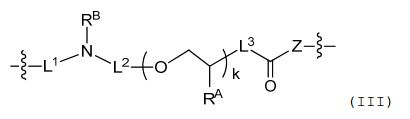
[0009] Algumas concretizações aqui descritas referem-se a kits que compreendem um nucleosídeo ou nucleotídeo marcado compreendendo um ligante entre o fluoróforo e o nucleosídeo ou nucleotídeo, em que o ligante compreende uma estrutura de qualquer das fórmulas (I), (II) ou (III), ou combinações Do mesmo.[0009] Some embodiments described herein pertain to kits comprising a labeled nucleoside or nucleotide comprising a linker between the fluorophore and the nucleoside or nucleotide, wherein the linker comprises a structure of any of formulas (I), (II) or (III), or combinations thereof.
[0010] Algumas concretizações aqui descritas referem-se a reagentes para modificar um nucleosídeo ou um nucleotídeo que compreende um fluoróforo e um ligante, em que o ligante compreende uma estrutura de qualquer uma das fórmulas (I), (II) ou (III), ou suas combinações.[0010] Some embodiments described herein pertain to reagents for modifying a nucleoside or a nucleotide comprising a fluorophore and a linker, wherein the linker comprises a structure of any one of formulas (I), (II) or (III) , or their combinations.
[0011] Algumas concretizações aqui reveladas referem-se a métodos para detectar um nucleosídeo que foi incorporado num polinucleotídeo, compreendendo: (a) incorporar um nucleosídeo ou nucleotídeo marcado compreendendo um ligante num polinucleotídeo; e (b) detectar um sinal fluorescente a partir do referido nucleosídeo ou nucleotídeo marcado que foi incorporado na etapa (a), em que o ligante compreende uma estrutura de qualquer um de fórmula (I), (II) ou (III), ou suas combinações. Em algumas concretizações, o método compreende ainda: proporcionar uma cadeia de ácido nucleico padrão e uma cadeia de ácido nucleico parcialmente hibridizada, em que a etapa (a) incorpora na cadeia hibridizada pelo menos um nucleosídeo ou nucleotídeo que é complementar a um nucleosídeo ou nucleotídeo no correspondente Em que a etapa (b) identifica a base do nucleosídeo ou nucleotídeo incorporado, indicando desse modo a identidade do nucleosídeo ou nucleotídeo complementar da cadeia molde.[0011] Some embodiments disclosed herein pertain to methods for detecting a nucleoside that has been incorporated into a polynucleotide, comprising: (a) incorporating a labeled nucleoside or nucleotide comprising a linker into a polynucleotide; and (b) detecting a fluorescent signal from said labeled nucleoside or nucleotide that has been incorporated in step (a), wherein the linker comprises a structure of any one of formula (I), (II) or (III), or their combinations. In some embodiments, the method further comprises: providing a standard nucleic acid strand and a partially hybridized nucleic acid strand, wherein step (a) incorporates into the hybridized strand at least one nucleoside or nucleotide that is complementary to a nucleoside or nucleotide in the corresponding wherein step (b) identifies the base of the incorporated nucleoside or nucleotide, thereby indicating the identity of the nucleoside or nucleotide complementary to the template.
[0012] Algumas concretizações aqui reveladas referem-se a métodos de sequenciamento de uma molécula de ácido nucleico molde, compreendendo: a incorporação de um ou mais nucleotídeos marcados numa cadeia de ácido nucleico complementar ao ácido nucleico molde; Determinar a identidade da base presente num ou mais nucleotídeos marcados incorporados de modo a determinar a sequência da molécula de ácido nucleico molde; em que a identidade da base presente num ou mais nucleotídeos marcados é determinada pela detecção de um sinal fluorescente produzido pelos referidos nucleotídeos marcados; E em que pelo menos um nucleiê^ido marcado incorporado compreendendo um ligante como descrito acima, em que o ligante compreende uma estrutura de qualquer um de fórmula (I), (II) ou (III), ou suas combinações. Em algumas concretizações, a identidade da base presente num ou mais nucleotídeos é determinada após cada etapa de incorporação de nucleotídeos.[0012] Some embodiments disclosed herein pertain to methods of sequencing a template nucleic acid molecule, comprising: incorporating one or more labeled nucleotides into a nucleic acid strand complementary to the template nucleic acid; Determining the identity of the base present in one or more labeled nucleotides incorporated in order to determine the sequence of the template nucleic acid molecule; wherein the identity of the base present in one or more labeled nucleotides is determined by detecting a fluorescent signal produced by said labeled nucleotides; And wherein at least one labeled nucleotide is incorporated comprising a linker as described above, wherein the linker comprises a structure of any one of formula (I), (II) or (III), or combinations thereof. In some embodiments, the identity of the base present in one or more nucleotides is determined after each nucleotide incorporation step.
[0013] A FIG. 1A ilustra um grupo estrutural de ligação parcial de um nucleotídeo marcado padrão.[0013] FIG. 1A illustrates a partial linker structural group of a standard labeled nucleotide.
[0014] A FIG. 1B ilustra o nucleotídeo marcado da FIG. 1A com dois ligantes possíveis 125 e 130 para serem inseridos no grupo de ligação padrão da FIG. 1A.[0014] FIG. 1B illustrates the labeled nucleotide of FIG. 1A with two
[0015] A FIG. 2 monstra um gráfico da taxa de incorporação de nucleotídeos utilizando o nucleotídeo marcado da FIG. 1A e os nucleotídeos marcados modificados da FIG. 1B.[0015] FIG. 2 shows a graph of the rate of nucleotide incorporation using the labeled nucleotide of FIG. 1A and the modified labeled nucleotides of FIG. 1B.
[0016] As FIGs. 3A-3E ilustram as fórmulas estruturais de ligantes adicionais a serem inseridos no grupo de ligação padrão da FIG. 1A.[0016] FIGs. 3A-3E illustrate structural formulas of additional linkers to be inserted into the standard linking group of FIG. 1A.
[0017] A FIG. 4 mostra uma tabela de dados de uma corrida de sequenciamento de dois corantes utilizada para avaliar o efeito do inserto 125 da FIG. 1B e o inserto 315 da FIG. 3B sobre a qualidade da sequenciamento.[0017] FIG. 4 shows a table of data from a two-dye sequencing run used to evaluate the effect of the
[0018] As FIGs. 5A e 5B mostram um gráfico da taxa de erro para a leitura 1 e um gráfico da taxa de erro para a leitura 2 da corrida de sequenciamento da FIG. 4 utilizando ligantes inserto 125 e 315.[0018] FIGs. 5A and 5B show an error rate graph for read 1 and an error rate graph for
[0019] A FIG. 6 mostra uma tabela de dados de uma corrida de sequenciamento utilizada para avaliar o efeito do inserto 125 da FIG. 1B e o inserto 310 da FIG. 3A na qualidade de sequenciamento.[0019] FIG. 6 shows a table of data from a sequencing run used to evaluate the effect of
[0020] As FIGs. 7A e 7B mostram um gráfico da taxa de erro para a leitura 1 e um gráfico da taxa de erro para a leitura 2 da sequência de sequenciamento da FIG. 6 utilizando o inserto de ligação 125.[0020] FIGs. 7A and 7B show an error rate graph for read 1 and an error rate graph for
[0021] A FIG. 8A ilustra um exemplo de uma estrutura de ligação LN3 padrão.[0021] FIG. 8A illustrates an example of a standard LN3 link structure.
[0022] As FIGs. 8B, 8C e 8D mostram três exemplos de estruturas modificadas do ligante LN3 da FIG. 8A.[0022] FIGs. 8B, 8C and 8D show three examples of modified structures of the LN3 linker of FIG. 8A.
[0023] A FIG. 8E ilustra a inserção de uma unidade de proteção no ligante. A FIG. 8D.[0023] FIG. 8E illustrates the insertion of a protection unit into the binder. FIG. 8D.
[0024] A FIG 9A é um cromatograma que mostra o aparecimento de uma impureza num ffA com ligante SS. A FIG 9B é uma tabela comparando a estabilidade de ffAs com ligante SS e ligante AEDI. A FIG 9C é um cromatograma que mostra uma comparação do ligante SS e do ligante AEDI ffAs em IMX 60° durante 22 horas, mostrando novamente uma impureza com o ligante SS.[0024] FIG 9A is a chromatogram showing the appearance of an impurity in an SS-ligand ffA. FIG 9B is a table comparing the stability of ffAs with SS ligand and AEDI ligand. FIG 9C is a chromatogram showing a comparison of SS linker and AEDI ffAs linker at 60° IMX for 22 hours, again showing an impurity with SS linker.
[0025] As FIGS 10A, 10B e 10C mostram o aumentoinesperado da velocidade de incorporação de nucleotídeos em solução com alterações de ligante. A FIG. 10A é um gráfico que mostra a taxa de incorporação a 1 uM com a FIG. 10B mostrando os resultados tabulados. A FIG. 10C mostra esquematicamente os ligantes AEDI e SS com NR550S0.[0025] FIGS 10A, 10B and 10C show the unexpected increase in the rate of incorporation of nucleotides into solution with linker changes. FIG. 10A is a graph showing the incorporation rate at 1 µM with FIG. 10B showing the tabulated results. FIG. 10C schematically shows AEDI and SS ligands with NR550S0.
[0026] A FIG. 11A mostra gráficos de dispersão para combinações V10 com diferentes A-550S0 (mesma concentração). A FIG. 11B mostra ligantes Kcat FFA em solução.[0026] FIG. 11A shows scatter plots for V10 combinations with different A-550S0 (same concentration). FIG. 11B shows Kcat FFA ligands in solution.
[0027] As FIGS 12A e 12B mostram as métricas de sequenciamento em ciclos M111, Human550, 2x151. DESCRIÇÃO DETALHADA DAS CONCRETIZAÇÕES PREFERIDAS[0027] FIGS 12A and 12B show sequencing metrics in M111, Human550, 2x151 cycles. DETAILED DESCRIPTION OF THE PREFERRED EMBODIMENTS
[0027] Algumas concretizações aqui descritas referem-se a um nucleosídeo ou nucleotídeo ligado covalentemente a um fluoróforo através de um ligante, em que o ligante compreende uma estrutura de fórmula (I) ou (II) abaixo ou uma combinação de ambas, em que as definições das variáveis São definidos acima.
[0028] Em algumas concretizações da estrutura de fórmula (I), R1 é hidrogênio. Em algumas outras concretizações, R1 é alquilo C1-6 opcionalmente substituído. Em algumas destas concretizações, R1 é metil.[0028] In some embodiments of the structure of formula (I), R1 is hydrogen. In some other embodiments, R1 is optionally substituted C1-6 alkyl. In some of these embodiments, R1 is methyl.
[0029] Em quaisquer concretizações de R1, tal como aqui descrito da fórmula (I), R2 é hidrogênio. Em algumas outras concretizações, R2 é alquilo C1-6 opcionalmente substituído. Em algumas destas concretizações, R2 é metila. Numa concretização, tanto R1 como R2 são metil. Em outra concretização, tanto R1 como R2 são hidrogênio.[0029] In any embodiments of R1, as described herein of formula (I), R2 is hydrogen. In some other embodiments,
[0030] Em algumas concretizações da estrutura de fórmula (I), m é 0. Em algumas outras concretizações, m é 1.[0030] In some embodiments of the structure of formula (I), m is 0. In some other embodiments, m is 1.
[0031] Em algumas concretizações da estrutura de fórmula (I), n é 1.[0031] In some embodiments of the structure of formula (I), n is 1.
[0032] Em algumas concretizações da estrutura de fórmula (I), a estrutura de fórmula (I) também pode ser representada pela fórmula (Ia) ou (Ib):
[0033] Em algumas concretizações aqui descritas, afórmula (Ia) é referida como "AEDI" e a fórmula (Ib) é referida como "SS".[0033] In some embodiments described herein, formula (Ia) is referred to as "AEDI" and formula (Ib) is referred to as "SS".
[0034] Em algumas concretizações da estrutura de fórmula (II), R3 é hidrogênio. Em algumas outras concretizações, R3 é alquil C1-6 opcionalmente substituído. Em algumas destas concretizações, R3 é metil. Em algumas concretizações, R3 é - NR5-C(=O)R6. Em algumas destas concretizações, R5 é hidrogênio. Em algumas destas concretizações, R6 é alquilo C1-6 opcionalmente substituído, por exemplo, metil. Em algumas concretizações, R3 é -NR7-C(=O)OR8. Em algumas destas concretizações, R7 é hidrogênio. Em algumas destas concretizações, R8 é alquil C1-6 opcionalmente substituído, por exemplo, t-butil.[0034] In some embodiments of the structure of formula (II), R3 is hydrogen. In some other embodiments, R3 is optionally substituted C1-6 alkyl. In some of these embodiments, R3 is methyl. In some embodiments, R3 is -NR5-C(=O)R6. In some of these embodiments, R5 is hydrogen. In some of these embodiments, R6 is optionally substituted C1-6 alkyl, for example, methyl. In some embodiments, R3 is -NR7-C(=O)OR8. In some of these embodiments, R7 is hydrogen. In some of these embodiments, R8 is optionally substituted C1-6 alkyl, for example, t-butyl.
[0035] Em quaisquer concretizações de R3 como aqui descrito da fórmula (II), R4 é hidrogênio. Em algumas outras concretizações, R4 é alquil C1-6 opcionalmente substituído.[0035] In any embodiments of R3 as described herein of formula (II), R4 is hydrogen. In some other embodiments, R4 is optionally substituted C1-6 alkyl.
[0036] Em algumas destas concretizações, R4 é metilo. Numa concretização, tanto R3 como R4 são metil. Em outra concretização, tanto R3 como R4 são hidrogênio. Numa concretização, R3 é -NH(C=O)CH3 e R4 é hidrogênio. Em outra concretização, R3 é -NH(C=O)OtBu(Boc) e R4 é hidrogênio.[0036] In some of these embodiments, R4 is methyl. In one embodiment, both R3 and R4 are methyl. In another embodiment, both R3 and R4 are hydrogen. In one embodiment, R3 is -NH(C=O)CH3 and R4 is hydrogen. In another embodiment, R3 is -NH(C=O)OtBu(Boc) and R4 is hydrogen.
[0037] Em algumas concretizações da estrutura de fórmula (II), X é metileno, que pode ser opcionalmente substituído. Em outra concretização, X é oxigênio (O). Ainda em outra concretização, X é enxofre (S).[0037] In some embodiments of the structure of formula (II), X is methylene, which may be optionally substituted. In another embodiment, X is oxygen (O). In yet another embodiment, X is sulfur (S).
[0038] Em algumas concretizações da estrutura de fórmula (II), p é 1. Em algumas outras concretizações, p é 2.[0038] In some embodiments of the structure of formula (II), p is 1. In some other embodiments, p is 2.
[0039] Em algumas concretizações da estrutura de fórmula (II), a estrutura de fórmula (II) também pode ser representada pela fórmula (IIa), (IIb), (IIc), (IId), (IIe) ou (IIf):

[0040] Em algumas concretizações aqui descritas, a fórmula (IIa) é referida como "ACA", a fórmula (IIb) é referida como "AcLys", a fórmula (IIc) é referida como "BocLys", a fórmula (IId) é referida como "DMeO", a fórmula (IIe) é referida como "dMeS" e a fórmula (IIf) é referida como "DMP".[0040] In some embodiments described herein, formula (IIa) is referred to as "ACA", formula (IIb) is referred to as "AcLys", formula (IIc) is referred to as "BocLys", formula (IId) is referred to as "DMeO", formula (IIe) is referred to as "dMeS", and formula (IIf) is referred to as "DMP".
[0041] Em quaisquer concretizações, o nucleosídeo ou nucleotídeo marcado com fluoróforo através de um ligante compreendendo uma estrutura de fórmula (I) ou (II) como aqui descrita, o nucleosídeo ou nucleotídeo pode ser ligado ao lado esquerdo do ligante, quer diretamente, ou através de uma porção de ligação adicional.[0041] In any embodiments, the fluorophore-labeled nucleoside or nucleotide via a linker comprising a structure of formula (I) or (II) as described herein, the nucleoside or nucleotide may be linked to the left side of the linker, either directly, or through an additional binding portion.
[0042] Algumas concretizações aqui descritas referem-se a um nucleosídeo ou nucleotídeo ligado covalentemente a um fluoróforo, através de um ligante, compreendendo o referido ligante uma estrutura de fórmula (III), e em que as definições das variáveis são definidas acima.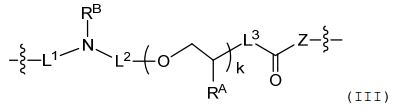
[0043] Em algumas concretizações da estrutura de fórmula (III), L1 está ausente. Em algumas outras concretizações, L1 é um ligante descrito acima compreendendo a estrutura de fórmula (I) ou (II), em particular a fórmula (Ia), (Ib), (II), (IIa), (IIb), (IIc) , (IId), (IIe) ou (IIf). Nalgumas outras concretizações, L1 pode ser uma metade protetora compreendendo molécula que protege contra danos no DNA. Em algumas destas concretizações, a unidade de protecção compreende Trolox, ácido gálico, p-nitro-benzilo (pNB) ou ascorbato, ou combinações destes.[0043] In some embodiments of the structure of formula (III), L1 is absent. In some other embodiments, L1 is a linker described above comprising the structure of formula (I) or (II), in particular formula (Ia), (Ib), (II), (IIa), (IIb), (IIc) ), (IId), (IIe) or (IIf). In some other embodiments, L1 may be a protective moiety comprising molecule that protects against DNA damage. In some of these embodiments, the protecting moiety comprises Trolox, gallic acid, p-nitro-benzyl (pNB) or ascorbate, or combinations thereof.
[0044] Em algumas concretizações da estrutura de fórmula (III), L2 é alquileno C1-20 opcionalmente substituído. Em algumas concretizações adicionais, L2 é alquileno C4-10 opcionalmente substituído. Em algumas destas concretizações, L2 é heptileno. Em algumas outras concretizações, L2 é heteroalquileno C1-20 opcionalmente substituído. Em algumas destas concretizações, o heteroalquileno C1-20 opcionalmente substituído compreende um ou mais átomos de azoto. Em algumas destas concretizações, pelo menos um dos átomos de carbono do heteroalquileno C1-20 está substituído com oxo (= O). Em algumas concretizações adicionais, L2 é heteroalquileno C3-6 opcionalmente substituído. Em algumas concretizações, L2 é interrompido por um grupo aromático substituído, tal como um grupo arilo C6-10 substituído, ou grupos heteroarilo substituído com 5 a 10 membros compreendendo um a três heteroátomos. Em algumas destas concretizações, L2 é interrompido por um grupo fenilo substituído. Nalgumas destas concretizações, o grupo fenilo é substituído com um ou mais substituintes (até quatro) seleccionados de entre nitro, ciano, halo, hidroxi, C1-6 alquilo, C1-6 alcoxi, C1-6 haloalquilo, C1-6 haloalcoxi ou Sulfonil. Em algumas outras concretizações, o grupo fenil está substituído com um a quatro substituintes seleccionados de nitro, ciano, halo ou hidróxido de sulfonilo (i.e., -S (= O) 2OH).[0044] In some embodiments of the structure of formula (III), L2 is optionally substituted C1-20 alkylene. In some additional embodiments, L2 is optionally substituted C4-10 alkylene. In some of these embodiments, L2 is heptylene. In some other embodiments, L2 is optionally substituted C1-20 heteroalkylene. In some of these embodiments, the optionally substituted C1-20 heteroalkylene comprises one or more nitrogen atoms. In some of these embodiments, at least one of the carbon atoms of the C1-20 heteroalkylene is substituted with oxo (=O). In some additional embodiments, L2 is optionally substituted C3-6 heteroalkylene. In some embodiments, L2 is interrupted by a substituted aromatic group, such as a substituted C6-10 aryl group, or 5- to 10-membered substituted heteroaryl groups comprising one to three heteroatoms. In some of these embodiments, L2 is interrupted by a substituted phenyl group. In some of these embodiments, the phenyl group is substituted with one or more substituents (up to four) selected from nitro, cyano, halo, hydroxy, C1-6 alkyl, C1-6 alkoxy, C1-6 haloalkyl, C1-6 haloalkoxy or Sulfonyl . In some other embodiments, the phenyl group is substituted with one to four substituents selected from nitro, cyano, halo, or sulfonyl hydroxide (i.e., -S(=O)2OH).
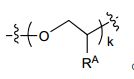
[0045] Em algumas concretizações da estrutura de fórmula(III), RA em
[0046] Em algumas concretizações da estrutura de fórmula (III), L3 é alquileno C1-20 opcionalmente substituído. Em algumas concretizações adicionais, L3 é alquileno C1-6 opcionalmente substituído. Em algumas destas concretizações, L3 é etileno. Em algumas outras concretizações, L3 é heteroalquileno C1-20 opcionalmente substituído. Em algumas destas concretizações, o heteroalquileno C1-20 opcionalmente substituído compreende um ou mais átomos de oxigénio. Nalgumas destas concretizações, L1 é óxido de alquileno C1-6 opcionalmente substituído, por exemplo, óxido de C1-3 alquileno.[0046] In some embodiments of the structure of formula (III), L3 is optionally substituted C1-20 alkylene. In some additional embodiments, L3 is optionally substituted C1-6 alkylene. In some of these embodiments, L3 is ethylene. In some other embodiments, L3 is optionally substituted C1-20 heteroalkylene. In some of these embodiments, the optionally substituted C1-20 heteroalkylene comprises one or more oxygen atoms. In some of these embodiments, L1 is optionally substituted C1-6 alkylene oxide, for example, C1-3 alkylene oxide.
[0047] Em algumas concretizações da estrutura de fórmula (III), RB é hidrogênio. Em algumas concretizações, RC é hidrogênio. Em algumas concretizações adicionais, tanto RB como RC são hidrogênio.[0047] In some embodiments of the structure of formula (III), RB is hydrogen. In some embodiments, RC is hydrogen. In some additional embodiments, both RB and RC are hydrogen.
[0048] Em algumas concretizações da estrutura de fórmula (III), a estrutura de fórmula (III) também pode ser representada pela fórmula (IIIa), (Illb) ou (IIIc):
[0049] Em quaisquer concretizações do nucleosídeo ou nucleotídeo marcado com fluoróforo através de um ligante compreendendo uma estrutura de fórmula (III) como aqui descrita, o fluoróforo pode ser ligado ao lado esquerdo do ligante, quer directamente, quer através de porção de ligação adicional.Em quaisquer concretizações aqui descritas com respeito a um ligante que compreende uma estrutura de fórmula (I), (II) ou (III), quando o termo "opcionalmente substituído" é usado para definir uma variável, tal variável pode ser não substituída.[0049] In any embodiments of the fluorophore-labeled nucleoside or nucleotide via a linker comprising a structure of formula (III) as described herein, the fluorophore may be attached to the left side of the linker, either directly or through an additional linker moiety. In any embodiments described herein with respect to a linker comprising a structure of formula (I), (II) or (III), when the term "optionally substituted" is used to define a variable, such variable may be unsubstituted.
[0050] Salvo definição em contrário, todos os termos técnicos e científicos aqui utilizados têm o mesmo significado que é comumente entendido por um especialista na técnica. O uso do termo "incluindo", bem como outras formas, tais como "incluir", "inclui" e "incluído", não é limitativo. O uso do termo "tendo", bem como outras formas, como "ter", "tem" e "teve", não é limitativo. Tal como utilizado nesta especificação, quer numa frase de transição quer no corpo da reivindicação, os termos "compreende (m)" e "compreendendo" devem ser interpretados como tendo um significado aberto. Isto é, os termos acima devem ser interpretados como sinónimo com as frases "ter pelo menos" ou "incluir pelo menos". Por exemplo, quando usado no contexto de um processo, o termo "compreendendo" significa que o processo inclui pelo menos Os passos descritos, mas pode incluir passos adicionais. Quando utilizado no contexto de um composto, composição ou dispositivo, o termo "compreendendo" significa que o composto, composição ou dispositivo inclui pelo menos as características ou componentes citados, mas também pode incluir características ou componentes adicionais.[0050] Unless defined otherwise, all technical and scientific terms used herein have the same meaning as is commonly understood by one of ordinary skill in the art. The use of the term "including" as well as other forms such as "include", "includes" and "included" is not limiting. The use of the term "having", as well as other forms such as "having", "has" and "had", is not limiting. As used in this specification, either in a transitional phrase or in the body of the claim, the terms "comprises (m)" and "comprising" are to be interpreted as having an open meaning. That is, the above terms should be interpreted as synonymous with the phrases "have at least" or "include at least". For example, when used in the context of a process, the term "comprising" means that the process includes at least the described steps, but may include additional steps. When used in the context of a compound, composition or device, the term "comprising" means that the compound, composition or device includes at least the recited features or components, but may also include additional features or components.
[0051] Os cabeçalhos de seção utilizados aqui são apenas para fins organizacionais e não devem ser interpretados como limitando a matéria descrita.Tal como aqui utilizado, abreviaturas orgânicas comuns sãodefinidas como se segue:Ac acetilaAc2O Anidrido acéticoAq. AquosoBn BenzilBz BenzoilBOC ou Boc terc-butoxicarboniloBu n-butilcat. Catalisador° C Temperatura em graus CentígradosCHAPS 3 - [(3-Colamidopropil)dimetilamônio] -1-propanossulfonato DATP Desoxiadenosina trifosfatoDCTP Deoxicitidina trifosfatoDGTP Deoxiguanosina trifosfatoDTTP Trifosfato de desoxitimidinaDdNTP (s) Dideoxinucleotídeo (s)DCM Cloreto de metilenoDMA DimetilacetamidaDMAP 4-DimetilaminopiridinaDMF N, N'-dimetilformamidaDMSO DimetilsulfóxidoDSC carbonato de N, N'-dissuccinimidiloEDTA Etilenodiamina tetra-acéticoEt EtEtOAc Acetato de etilaFfN Nucleotídeo totalmente funcionalFfA Nucleotídeo de adenosina completamentefuncionalizado G Gram (s)GPC Cromatografia de troca em gel H ou h Hora (s)Base de Hunig N,N-DiisopropiletilaminaIPr IsopropilKPi tampão fosfato de potássio 10 mM a pH 7,0IPA Álcool isopropílicoLCMSmassa Cromatografia líquida-espectrometria deLDA Diisopropilamida de lítioM ou min Minuto (s)MeCN AcetonitrilML MillilitRO (s)PEG PolietilenoglicolPG Grupo de proteçãoPh FenIlPNB p-nitro-benzilaPpt PrecipitadoRt Temperatura ambienteSBS Sequenciamento por Síntese-S (O) 2OH Hidróxido de sulfonilaTEA TrietilaminaTEAB Brometo de tetraetilamônioTFA Ácido trifluoroacéticoTert 1 TertárioTHF TetrahidrofuranoTLC Cromatografia em camada finaTSTU tetrafluoroborato de O-(N-succinimidil)-N,N,N',N'-tetrametilurônioμL Microlitro (s) .[0051] Section headings used herein are for organizational purposes only and should not be construed as limiting the matter described. As used herein, common organic abbreviations are defined as follows: Ac acetylAc2O Acetic anhydrideAq. AqueousBn BenzylBz BenzoylBOC or Boc tert-butoxycarbonylBu n-butylcat. Catalyst° C Temperature in degrees CentigradeCHAPS 3 - [(3-Cholamidopropyl)dimethylammonium] -1-propanesulfonate DATP Deoxyadenosine triphosphateDCTP Deoxycytidine triphosphateDGTP Deoxyguanosine triphosphateDTTP Deoxythymidine triphosphateDdNTP(s) Dideoxynucleotide(s)DCM Methylene chlorideDMA DimethylacetamideDMAP 4-DimethylaminopyridineDMF N, N' -dimethylformamideDMSO DimethylsulfoxideDSC N,N'-disuccinimidyl carbonate EDTA Ethylenediamine tetraacetic acidEt EtEtOAc Ethyl acetateFfN Fully functional nucleotideFfA Fully functionalized adenosine nucleotide G Gram(s)GPC H or h gel exchange chromatography Hour(s)Hunig's base N,N -
[0052] Tal como aqui utilizado, o termo “matriz” refere- se a uma população de diferente sondas de moleculares que estão ligadas a um ou mais substratos, de tal modo que as diferentes sondas moleculares podem ser diferenciadas uma da outra, de acordo com a localização relativa. Uma matriz pode incluir diferentes sondas de moleculares que estão localizadas numa posição endereçável diferente num substrato. Alternativamente ou adicionalmente, uma matriz pode incluir substratos separados cada um com uma molécula de sonda diferente, em que as diferentes sondas moleculares podem ser identificadas, de acordo com as localizações dos substratos numa superfície à qual os substratos estão ligados ou de acordo com as localizações dos substratos em Um líquido. As matrizes exemplificativas nas quais os substratos separados estão localizados numa superfície incluem, sem limitação, as que incluem as pérolas nos poços, como descrito, por exemplo, na Patente U.S. N ° 6 355 431 B1, US 2002/0102578 e na Publicação PCT N ° WO 00/63437. Exemplos de formatos que podem ser utilizados na invenção para distinguir as pérolas numa disposição de líquido, por exemplo, utilizando um dispositivo microfluídico, tal como um separador de células activado por fluorescência (FACS), são descritos, por exemplo, na Pat. U.S. No. 6,524,793. Outros exemplos de arranjos que podem ser utilizados na invenção incluem, sem limitação, os descritos nas patentes norte-americanas 5,429,807; 5,436,327; 5,561,071; 5,583,211; 5,658,734; 5,837,858; 5,874,219; 5,919,523; 6,136,269; 6,287,768; 6,287,776; 6,288,220; 6,297,006; 6,291,193; 6,346,413; 6,416,949; 6,482,591; 6,514,751 e 6,610,482; and WO 93/17126; WO 95/11995; WO 95/35505; EP 742 287; e EP 799 897.[0052] As used herein, the term "array" refers to a population of different molecular probes that are bound to one or more substrates such that the different molecular probes can be differentiated from one another in accordance with with relative location. An array can include different molecular probes that are located at a different addressable position on a substrate. Alternatively or additionally, an array may include separate substrates each with a different probe molecule, wherein the different molecular probes may be identified, according to the locations of the substrates on a surface to which the substrates are attached or according to the locations of substrates in a liquid. Exemplary matrices in which the separate substrates are located on a surface include, without limitation, those that include the beads in the wells, as described, for example, in U.S. Patent. No. 6,355,431 B1, US 2002/0102578 and PCT Publication No. WO 00/63437. Examples of formats that can be used in the invention to distinguish beads in a liquid array, for example using a microfluidic device such as a fluorescence activated cell sorter (FACS), are described, for example, in U.S. Pat. U.S. At the. 6,524,793. Other examples of arrangements that can be used in the invention include, without limitation, those described in US patents 5,429,807; 5,436,327; 5,561,071; 5,583,211; 5,658,734; 5,837,858; 5,874,219; 5,919,523; 6,136,269; 6,287,768; 6,287,776; 6,288,220; 6,297,006; 6,291,193; 6,346,413; 6,416,949; 6,482,591; 6,514,751 and 6,610,482; and WO 93/17126; WO 95/11995; WO 95/35505; EP 742 287; and EP 799 897.
[0053] Tal como aqui utilizado, o termo "ligado covalentemente" ou "ligado covalentemente" refere-se à formação de uma ligação química que é caracterizada pela partilha de pares de electrões entre átomos. Por exemplo, um revestimento de polímero ligado covalentemente refere-se a um revestimento de polímero que forma ligações químicas com uma superfície funcionalizada de um substrato, em comparação com a ligação à superfície através de outros meios, por exemplo, adesão ou interacção electrostática. Será apreciado que os polímeros que estão ligados covalentemente a uma superfície também podem ser ligados através de meios para além da ligação covalente.[0053] As used herein, the term "covalently bonded" or "covalently bonded" refers to the formation of a chemical bond that is characterized by the sharing of electron pairs between atoms. For example, a covalently bonded polymer coating refers to a polymer coating that forms chemical bonds with a functionalized surface of a substrate, as compared to bonding to the surface through other means, for example, adhesion or electrostatic interaction. It will be appreciated that polymers that are covalently bonded to a surface may also be bonded through means other than covalent bonding.
[0054] Tal como aqui utilizado, "Ca para Cb" ou "Ca-b" em que "a" e "b" são números inteiros referem-se ao número de átomos de carbono no grupo especificado. Ou seja, o grupo pode conter de "a" a "b", inclusive, átomos de carbono. Assim, por exemplo, um grupo "alquilo C1 a C4" ou "alquilo C1-4" refere-se a todos os grupos alquilo com 1 a 4 átomos de carbono, isto é, CH3-, CH3CH2-, CH3CH2CH2-, (CH3) 2CH-, CH3CH2CH2CH2-, CH3CH2CH (CH3) - e (CH3) 3C-.[0054] As used herein, "Ca to Cb" or "Ca-b" where "a" and "b" are integers refer to the number of carbon atoms in the specified group. That is, the group can contain from "a" to "b", inclusive, carbon atoms. Thus, for example, a "C1 to C4 alkyl" or "C1-4 alkyl" group refers to all alkyl groups having 1 to 4 carbon atoms, i.e. CH3-, CH3CH2-, CH3CH2CH2-, (CH3 ) 2CH-, CH3CH2CH2CH2-, CH3CH2CH(CH3)- and (CH3)3C-.
[0055] O termo "halogênio" ou "halo", tal como aqui utilizado, significa qualquer um dos átomos radio-estáveis da coluna 7 da Tabela Periódica dos Elementos, por exemplo, flúor, cloro, bromo ou iodo, com flúor Sendo preferido o cloro.[0055] The term "halogen" or "halo", as used herein, means any of the radiostable atoms in column 7 of the Periodic Table of the Elements, for example, fluorine, chlorine, bromine or iodine, with fluorine being preferred the chlorine.
[0056] Tal como aqui utilizado, "alquil" refere-se a uma cadeia de hidrocarboneto linear ou ramificada que está totalmente saturada (isto é, não contém ligações duplas ou triplas). O grupo alquilo pode ter 1 a 20 átomos de carbono (sempre que aparece aqui, uma gama numérica tal como "1 a 20" refere-se a cada número inteiro na gama dada, p.e., "1 a 20 átomos de carbono" significa que o grupo alquilo pode Consistem em 1 átomo de carbono, 2 átomos de carbono, 3 átomos de carbono, etc., até 20 átomos de carbono inclusive, embora a presente definição também cubra a ocorrência do termo "alquilo" onde não é designada uma gama numérica). O grupo alquilo pode também ser um alquilo de tamanho médio possuindo 1 a 9 átomos de carbono. O grupo alquilo pode também ser um alquilo inferior possuindo 1 a 4 átomos de carbono. O grupo alquilo pode ser designado como "alquil C1-4" ou designações semelhantes. Apenas a título de exemplo, "alquilo C1-4" indica que há um a quatro átomos de carbono na cadeia alquilo, isto é, a cadeia alquilo é seleccionada do grupo que consiste em metilo, etilo, propilo, isopropilo, n- Butilo, iso-butilo, sec-butilo e t-butilo. Os grupos alquilo típicos incluem, mas não estão de modo algum limitados a, metilo, etilo, propilo, isopropilo, butilo, isobutilo, butilo terciário, pentilo, hexilo e semelhantes. O grupo alquilo pode estar substituído ou não substituído.[0056] As used herein, "alkyl" refers to a straight or branched hydrocarbon chain that is fully saturated (i.e., contains no double or triple bonds). The alkyl group may have 1 to 20 carbon atoms (wherever it appears herein, a numerical range such as "1 to 20" refers to each integer in the given range, eg, "1 to 20 carbon atoms" means that the alkyl group may consist of 1 carbon atom, 2 carbon atoms, 3 carbon atoms, etc., up to and including 20 carbon atoms, although the present definition also covers the occurrence of the term "alkyl" where a range is not designated numeric). The alkyl group may also be a medium-sized alkyl having 1 to 9 carbon atoms. The alkyl group may also be a lower alkyl having 1 to 4 carbon atoms. The alkyl group may be designated as "C 1-4 alkyl" or similar designations. By way of example only, "C1-4 alkyl" indicates that there are one to four carbon atoms in the alkyl chain, i.e., the alkyl chain is selected from the group consisting of methyl, ethyl, propyl, isopropyl, n-Butyl, iso-butyl, sec-butyl and t-butyl. Typical alkyl groups include, but are in no way limited to, methyl, ethyl, propyl, isopropyl, butyl, isobutyl, tertiary butyl, pentyl, hexyl, and the like. The alkyl group may be substituted or unsubstituted.
[0057] Tal como aqui utilizado, "alcoxi" refere-se à fórmula -OR em que R é um alquilo como definido acima, tal como "alcoxi C1-9", incluindo mas não limitado a metoxi, etoxi, n-propoxi, 1- Metiletoxi (isopropoxi), n-butoxi, iso- butoxi, sec-butoxi e terc-butoxi e semelhantes.[0057] As used herein, "alkoxy" refers to the formula -OR where R is an alkyl as defined above, such as "C1-9 alkoxy", including but not limited to methoxy, ethoxy, n-propoxy, 1- Methylethoxy (isopropoxy), n-butoxy, iso-butoxy, sec-butoxy and tert-butoxy and the like.
[0058] Tal como aqui utilizado, "heteroalquil" refere- se a uma cadeia hidrocarboneto linear ou ramificada contendo um ou mais heteroátomos, isto é, um elemento diferente de carbono, incluindo, mas não limitado a, azoto, oxigénio e enxofre, no esqueleto da cadeia. O grupo heteroalquilo pode ter 1 a 20 átomos de carbono, embora a presente definição também cubra a ocorrência do termo "heteroalquilo" em que não é designada uma gama numérica. O grupo heteroalquilo pode também ser um heteroalquilo de tamanho médio possuindo 1 a 9 átomos de carbono. O grupo heteroalquilo pode também ser um heteroalquilo inferior possuindo 1 a 4 átomos de carbono. O grupo heteroalquilo pode ser designado como "heteroalquilo C1-4" ou designações semelhantes. O grupo heteroalquilo pode conter um ou mais heteroátomos. Apenas a título de exemplo, "heteroalquilo C1-4" indica que há um a quatro átomos de carbono na cadeia heteroalquilo e adicionalmente um ou mais heteroátomos no esqueleto da cadeia.[0058] As used herein, "heteroalkyl" refers to a straight or branched hydrocarbon chain containing one or more heteroatoms, i.e., an element other than carbon, including, but not limited to, nitrogen, oxygen and sulfur, in the chain skeleton. The heteroalkyl group may have 1 to 20 carbon atoms, although the present definition also covers the occurrence of the term "heteroalkyl" where a numerical range is not designated. The heteroalkyl group may also be a medium-sized heteroalkyl having 1 to 9 carbon atoms. The heteroalkyl group may also be a lower heteroalkyl having 1 to 4 carbon atoms. The heteroalkyl group may be designated as "C 1-4 heteroalkyl" or similar designations. The heteroalkyl group may contain one or more heteroatoms. By way of example only, "C 1-4 heteroalkyl" indicates that there are one to four carbon atoms in the heteroalkyl chain and additionally one or more heteroatoms in the backbone of the chain.
[0059] Tal como aqui utilizado, "alquileno" significa um grupo químico de radicais ramificados ou de cadeia linear completamente saturados contendo apenas carbono e hidrogénio que está ligado ao resto da molécula através de dois pontos de ligação (isto é, um alcanodiil). O grupo alquileno pode ter 1 a 20 átomos de carbono, embora a presente definição também cubra a ocorrência do termo alquileno em que não é designada uma gama numérica. O grupo alquileno também pode ser um alquileno de tamanho médio com 1 a 9 átomos de carbono. O grupo alquileno também pode ser um alquileno inferior possuindo 1 a 4 átomos de carbono. O grupo alquileno pode ser designado como "alquileno C1-4" ou designações semelhantes. A título de exemplo apenas, "alquileno C1-4" indica que há um a quatro átomos de carbono na cadeia alquileno, isto é, a cadeia alquileno é seleccionada do grupo que consiste em metileno, etileno, etan-1,1-diilo, Propileno, propan-1, 1- diilo, propano-2,2-diilo, 1-metil-etileno, butileno, butan- 1,1-diilo, butan-2,2-diilo, 2-metil-propan- 1-diilo, 1- metil-propileno, 2-metil-propileno, 1,1-dimetil-etileno, 1, 2-dimetil-etileno e 1-etil-etileno. Tal como aqui utilizado, quando um alquileno é interrompido por um grupo aromático, refere-se à inserção de um grupo aromático entre uma ligação carbono-carbono da cadeia alquileno através de dois pontos de ligação ou a ligação de um grupo aromático a um terminal do Alquileno através de um ponto de ligação. Por exemplo, quando um n-butileno é interrompido por um grupo fenilo,estruturas exemplificativas incluem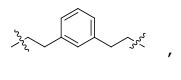
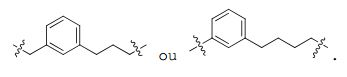
[0060] Tal como aqui utilizado, o termo "heteroalquileno" refere-se a uma cadeia alquileno em que um ou mais átomos esqueléticos do alquileno são seleccionados de um átomo diferente de carbono, por exemplo, oxigénio, azoto, enxofre, fósforo ou suas combinações. A cadeia heteroalquileno pode ter um comprimento de 2 a 20.000. Exemplos de heteroalquilenos incluem, mas não estão limitados a -OCH2, -OCH(CH3)-, -OC(CH3)2-, -OCH2CH2-, -CH(CH3)O-, - CH2OCH2-, -CH2OCH2CH2-, -SCH2-, -SCH(CH3)-, -SC(CH3)2-, - SCH2CH2-, -CH2SCH2CH2-, -NHCH2-, -NHCH(CH3)-, -NHC(CH3)2-, - NHCH2CH2-, - -CH2NHCH2-, -CH2NHCH2CH2- e semelhantes. Tal como aqui utilizado, quando um heteroalquileno é interrompido por um grupo aromático, refere-se à inserção de um grupo aromático entre uma ligação carbono-carbono ou ligação carbono- heteroátomo da cadeia heteroalquileno através de dois pontos de ligação ou a ligação de um grupo aromático A um terminal da cadeia heteroalquileno através de um ponto de ligação. Por exemplo, quando um óxido de n-propileno é interrompido por um grupo fenilo, estruturas exemplificativas incluem
[0061] Tal como aqui utilizado, "alquenil" refere-se a um grupo alquilo que contém na cadeia hidrocarboneto linear ou ramificada uma ou mais ligações duplas. Um grupo alquenil pode estar não substituído ou substituído. Tal como aqui utilizado, "alcinilo" refere-se a um grupo alquilo que contém na cadeia hidrocarboneto linear ou ramificada uma ou mais ligações triplas. Um grupo alcinilo pode ser não substituído ou substituído.[0061] As used herein, "alkenyl" refers to an alkyl group that contains in the straight or branched hydrocarbon chain one or more double bonds. An alkenyl group may be unsubstituted or substituted. As used herein, "alkynyl" refers to an alkyl group that contains in the straight or branched hydrocarbon chain one or more triple bonds. An alkynyl group may be unsubstituted or substituted.
[0062] Tal como aqui utilizado, "cicloalquilo" refere- se a um sistema de anel de hidrocarboneto mono- ou multi- cíclico completamente saturado (sem dupla ou tripla ligação). Quando compostos por dois ou mais anéis, os anéis podem ser unidos em conjunto por fusão. Os grupos cicloalquilo podem conter 3 a 10 átomos no anel (s). Em algumas formas de realização, os grupos cicloalquilo podem conter 3 a 8 átomos no anel (s). Um grupo cicloalquilo pode estar não substituído ou substituído. Os grupos cicloalquilo típicos incluem, mas não estão de modo algum limitados a, ciclopropilo, ciclobutilo, ciclopentilo, ciclo-hexilo, ciclo-heptilo e ciclooctilo.[0062] As used herein, "cycloalkyl" refers to a fully saturated (no double or triple bond) mono- or multicyclic hydrocarbon ring system. When composed of two or more rings, the rings can be joined together by fusion. Cycloalkyl groups may contain 3 to 10 atoms in the ring(s). In some embodiments, cycloalkyl groups may contain 3 to 8 atoms in the ring(s). A cycloalkyl group may be unsubstituted or substituted. Typical cycloalkyl groups include, but are in no way limited to, cyclopropyl, cyclobutyl, cyclopentyl, cyclohexyl, cycloheptyl and cyclooctyl.
[0063] O termo "aromático" refere-se a um sistema de anel ou anel que tem um sistema de electrões pi conjugado e inclui grupos aromáticos carbocíclicos aromáticos (por exemplo, fenilo) e heterocíclicos (por exemplo, piridina). O termo inclui grupos policíclicos monocíclicos ou de anel fundido (isto é, anéis que partilham pares de átomos adjacentes) desde que o sistema de anel inteiro seja aromático.[0063] The term "aromatic" refers to a ring or ring system that has a conjugated pi electron system and includes both aromatic (eg, phenyl) and heterocyclic (eg, pyridine) carbocyclic aromatic groups. The term includes monocyclic or fused-ring polycyclic groups (i.e., rings that share pairs of adjacent atoms) as long as the entire ring system is aromatic.
[0064] Tal como aqui utilizado, "aril" refere-se a um anel aromático ou sistema de anel (isto é, dois ou mais anéis fundidos que compartilham dois átomos de carbono adjacentes) contendo apenas carbono na estrutura do anel. Quando o arilo é um sistema de anel, cada anel no sistema é aromático. O grupo arilo pode ter 6 a 18 átomos de carbono, embora a presente definição também cubra a ocorrência do termo "arilo" onde não é designada uma gama numérica. Em algumas concretizações, o grupo arilo tem 6 a 10 átomos de carbono. O grupo arilo pode ser designado como "arilo C6-10", "arilo C6 ou C10" ou designações semelhantes. Exemplos de grupos arilo incluem, mas não estão limitados a, fenil, naftilo, azulenilo e antraquenil.[0064] As used herein, "aryl" refers to an aromatic ring or ring system (i.e., two or more fused rings that share two adjacent carbon atoms) containing only carbon in the ring structure. When the aryl is a ring system, each ring in the system is aromatic. The aryl group can have 6 to 18 carbon atoms, although the present definition also covers the occurrence of the term "aryl" where a numerical range is not designated. In some embodiments, the aryl group has 6 to 10 carbon atoms. The aryl group may be designated as "C6-10 aryl", "C6 or C10 aryl" or similar designations. Examples of aryl groups include, but are not limited to, phenyl, naphthyl, azulenyl and anthrakenyl.
[0065] Um "aralquil" ou "arilalquilo" é um grupo arilo ligado, como um substituinte, através de um grupo alquileno, tal como "aralquilo C7-14" e semelhantes, incluindo mas não limitado a benzilo, 2-feniletilo, 3 -fenilpropilo e naftilalquilo. Em alguns casos, o grupo alquileno é um grupo alquileno inferior (isto é, um grupo alquileno C1-4).[0065] An "aralkyl" or "arylalkyl" is an aryl group bonded, as a substituent, through an alkylene group, such as "C7-14 aralkyl" and the like, including but not limited to benzyl, 2-phenylethyl, 3 -phenylpropyl and naphthylalkyl. In some cases, the alkylene group is a lower alkylene group (i.e., a C1-4 alkylene group).
[0066] Tal como aqui utilizado, "heteroarilo" refere-se a um anel aromático ou sistema de anel (isto é, dois ou mais anéis fundidos que partilham dois átomos adjacentes) que contêm um ou mais heteroátomos, isto é, um elemento diferente de carbono , Incluindo mas não limitado a, azoto, oxigénio e enxofre, no esqueleto do anel. Quando o heteroarilo é um sistema de anel, cada anel no sistema é aromático. O grupo heteroarilo pode ter 5-18 membros do anel (isto é, o número de átomos que compõem o esqueleto do anel, incluindo átomos de carbono e heteroátomos), embora a presente definição também cubra a ocorrência do termo "heteroarilo" onde não é designada uma gama numérica. Em algumas concretizações, o grupo heteroarilo tem 5 a 10 membros de anel ou 5 a 7 membros de anel. O grupo heteroarilo pode ser designado como "heteroarilo com 5-7 membros", "heteroarilo com 5-10 membros" ou designações semelhantes. Exemplos de anéis heteroarilo incluem, mas não estão limitados a, furilo, tienilo, ftalazinilo, pirrolilo, oxazolilo, tiazolilo, imidazolilo, pirazolilo, isoxazolilo, isotiazolilo, triazolilo, tiadiazolilo, piridinilo, piridazinilo, pirimidinilo, pirazinilo, triazinilo, quinolinilo, Benzimidazolilo, benzoxazolilo, benzotiazolilo, indolilo, isoindolilo e benzotienilo.[0066] As used herein, "heteroaryl" refers to an aromatic ring or ring system (i.e., two or more fused rings that share two adjacent atoms) that contain one or more heteroatoms, i.e., a different element. of carbon, including but not limited to nitrogen, oxygen and sulfur, in the ring skeleton. When the heteroaryl is a ring system, each ring in the system is aromatic. The heteroaryl group can have 5-18 ring members (i.e., the number of atoms that make up the ring skeleton, including carbon atoms and heteroatoms), although the present definition also covers the occurrence of the term "heteroaryl" where it is not designated a numerical range. In some embodiments, the heteroaryl group has 5 to 10 ring members or 5 to 7 ring members. The heteroaryl group may be designated as "5-7 membered heteroaryl", "5-10 membered heteroaryl" or similar designations. Examples of heteroaryl rings include, but are not limited to, furyl, thienyl, phthalazinyl, pyrrolyl, oxazolyl, thiazolyl, imidazolyl, pyrazolyl, isoxazolyl, isothiazolyl, triazolyl, thiadiazolyl, pyridinyl, pyridazinyl, pyrimidinyl, pyrazinyl, triazinyl, quinolinyl, Benzimidazolyl, benzoxazolyl, benzothiazolyl, indolyl, isoindolyl and benzothienyl.
[0067] Um "heteroaralquilo" ou "heteroarilalquilo" é um grupo heteroarilo ligado, como um substituinte, através de um grupo alquileno. Exemplos incluem, mas não estão limitados a 2-tienilmetilo, 3-tienilmetilo, furilmetilo, tieniletilo, pirrolilalquilo, piridilalquilo, isoxazolilalquilo e imidazolilalquilo. Em alguns casos, o grupo alquileno é um grupo alquileno inferior (isto é, um grupo alquileno C1-4). Tal como aqui utilizado, "cicloalquilo" significa um anel ou sistema de anel carbociclilo totalmente saturado. Exemplos incluem ciclopropilo, ciclobutilo, ciclopentilo e ciclo- hexilo.[0067] A "heteroaralkyl" or "heteroarylalkyl" is a heteroaryl group bonded, as a substituent, through an alkylene group. Examples include, but are not limited to, 2-thienylmethyl, 3-thienylmethyl, furylmethyl, thienylethyl, pyrrolylalkyl, pyridylalkyl, isoxazolylalkyl and imidazolylalkyl. In some cases, the alkylene group is a lower alkylene group (i.e., a C1-4 alkylene group). As used herein, "cycloalkyl" means a fully saturated carbocyclyl ring or ring system. Examples include cyclopropyl, cyclobutyl, cyclopentyl and cyclohexyl.
[0068] Um grupo "O-carboxi" refere-se a um grupo "-OC(= O)R", em que R é selecionado de hidrogénio, alquiloC1-6, alquenil C2-6, alquinil C2-6, carbocicliloC3-7, Arilo C6-10, heteroarilo com 5-10 membros e heterociclilo com 5-10 membros, como aqui definido.[0068] An "O-carboxy" group refers to a group "-OC(=O)R", wherein R is selected from hydrogen, C1-6alkyl, C2-6alkenyl, C2-6alkynyl, C3-carbocyclyl 7, C6-10 aryl, 5-10 membered heteroaryl and 5-10 membered heterocyclyl as defined herein.
[0069] Um grupo "C-carboxi" refere-se a um grupo "C(= O)OR" em que R é seleccionado de hidrogénio, , C1-6 alquil, C2-6 alquenil, C2-6 alquinil, C3-7 carbociclil,, C6 -10 aril, heteroarilo de 5-10 membros e heterociclilo de 5-10 membros, como aqui definido. Um exemplo não limitativo inclui carboxilo (i.e., -C (= O) OH).[0069] A "C-carboxy" group refers to a group "C(=O)OR" wherein R is selected from hydrogen, C1-6 alkyl, C2-6 alkenyl, C2-6 alkynyl, C3- 7 carbocyclyl, C6-10 aryl, 5-10 membered heteroaryl and 5-10 membered heterocyclyl, as defined herein. A non-limiting example includes carboxyl (i.e., -C(=O)OH).
[0070] Um grupo "ciano" refere-se a um grupo "CN".[0070] A "cyano" group refers to a "CN" group.
[0071] Um grupo "azido" refere-se a um grupo "-N3".[0071] An "azido" group refers to a "-N3" group.
[0072] Um grupo "O-carbamil" refere-se a um grupo "OC (= O)NRARB", em que RA e RB são cada um independentemente seleccionados a partir de hidrogênio, C1-6 alquil, C2-6 alquenil, C2-6 alquinil, C3-7 carbociclil, C6-10 aryl, heteroarilo de 5-10 membros e heterociclil de 5-10 membros, como definido aqui.[0072] An "O-carbamyl" group refers to an "OC(=O)NRARB" group, wherein RA and RB are each independently selected from hydrogen, C1-6 alkyl, C2-6 alkenyl, C2-6 alkynyl, C3-7 carbocyclyl, C6-10 aryl, 5-10 membered heteroaryl and 5-10 membered heterocyclyl, as defined herein.
[0073] Um grupo "C-amido" refere-se a um grupo "C (= O) NRARB" em que RA e RB são cada um, independentemente, selecionados a partir de hidrogênio, alquil C1-6, alquenil C2-6, alquinil C2-6, carbocicliloC3-7, Aril C6-10, heteroarilo com 5-10 membros e heterociclilo com 5-10 membros, como aqui definido.[0073] A "C-amido" group refers to a "C(=O)NRARB" group wherein RA and RB are each independently selected from hydrogen, C1-6 alkyl, C2-6 alkenyl , C2-6 alkynyl, C3-7 carbocyclyl, C6-10 Aryl, 5-10 membered heteroaryl and 5-10 membered heterocyclyl as defined herein.
[0074] Um grupo "N amido" refere-se a um grupo "-N (RA) C (= O) RB" em que RA e RB são cada um independentemente seleccionados de hidrogénio, alquil C1-6, alquenil C2-6, carbociclilo C3-7, arilo C6-10, heteroarilo com 5-10 membros e heterociclilo com 5-10 membros, tal como aqui definido. Um grupo "amino" refere-se a um grupo "-NRARB" em que RA e RB são cada um independentemente seleccionados a partir de hidrogénio, alquiloC1-6, alceniloC2-6, alciniloC2-6, carbocicliloC3-7, 10 arilo, heteroarilo de 5-10 membros e heterociclilo de 5-10 membros, como aqui definido. Um exemplo não limitativo inclui amino livre (i.e., -NH2).[0074] An "N amido" group refers to a group "-N(RA)C(=O)RB" wherein RA and RB are each independently selected from hydrogen, C1-6 alkyl, C2-6 alkenyl , C3-7 carbocyclyl, C6-10 aryl, 5-10 membered heteroaryl and 5-10 membered heterocyclyl as defined herein. An "amino" group refers to a group "-NRARB" wherein RA and RB are each independently selected from hydrogen, C1-6alkyl, C2-6alkenyl, C2-6alkynyl, C3-7 carbocyclyl, aryl, heteroaryl 5-10 membered and 5-10 membered heterocyclyl as defined herein. A non-limiting example includes free amino (i.e., -NH 2 ).
[0075] Tal como aqui utilizado, o termo "Trolox" refere- se a ácido 6-hidroxi-2,5,7,8-tetrametilcroman-2-carboxílico.[0075] As used herein, the term "Trolox" refers to 6-hydroxy-2,5,7,8-tetramethylchroman-2-carboxylic acid.
[0076] Tal como aqui utilizado, o termo "ascorbato" refere-se ao sal de ácido ascórbico.[0076] As used herein, the term "ascorbate" refers to the salt of ascorbic acid.
[0077] Tal como aqui utilizado, o termo "ácido gálico" refere-se a ácido 3,4,5-tri-hidroxibenzóico.[0077] As used herein, the term "gallic acid" refers to 3,4,5-trihydroxybenzoic acid.
[0078] Tal como aqui utilizado, um grupo substituído é derivado do grupo pai não substituído em que houve uma troca de um ou mais átomos de hidrogénio para outro átomo ou grupo. Salvo indicação em contrário, quando se considera que um grupo é "substituído", significa que o grupo está substituído com um ou mais substituintes seleccionados independentemente entre alquilo C1-C6, alcenilo C1-C6, alcinilo C1-C6, heteroalquilo C1-C6 , Carbociclilo C3-C7 (opcionalmentesubstituídocom halo, alquilo C1-C6, alcoxilo C1-C6, haloalquilo C1-C6 e haloalcoxi C1-C6), C3-C7- carbociclil- alquilo C1-C6 (opcionalmente substituídocom halo, Alquilo C1C6, alcoxilo C1-C6, haloalquilo C1-C6 e haloalcoxi C1-C6), heterociclilo com 5-10 membros (opcionalmente substituídocom halo, alquilo C1-C6, alcoxilo C1-C6, haloalquilo C1- C6), arilo (opcionalmente substituído com halo, alquilo C1-C6, alcoxilo C1-C6, haloalquilo C1-C6 e haloalcoxi C1-C6) ,Alquilo C1-C6, alcoxilo C1-C6, haloalquilo C1-C6 e haloalcoxi C1-C6), arilalquilo C1-C6 (opcionalmente substituído com halo, C1-C6alquilo, C1-C6alcoxi, C1-C6haloalquilo, C1-C6 haloalcoxi), 5-10 membros Heteroarilo (opcionalmente substituído com halo, alquilo C1-C6, alcoxilo C1-C6, haloalquilo C1-C6 e haloalcoxi C1-C6), heteroarilalquilo (C1C6) 5-10 membros (opcionalmente substituídocom halo, alquilo C1-C6, Alcoxi C1-C6, haloalquilo C1-C6 e haloalcoxi C1-C6), halo, ciano, hidroxilo, alcoxi C1-C6, alcoxi C1-C6 alquilo (isto é, éter), ariloxi, sulfidrilo (mercapto ), Haloalquilo (C1-C6) (por exemplo, -CF3), haloalcoxi (C1-C6) (eg, -OCF3), alquiltio C1-C6, ariltio, amino, aminoalquilo C1-C6, nitro,O N-carbamilo, O-tiocarbamilo, N-tiocarbamilo, C-amido, N- amido, S-sulfonamido, N-sulfonamido, C-carboxilo, O- carboxilo, acilo, cianato, isocianato, tiocianato, isotiocianato, sulfinilo , Sulfonilo e oxo (= O). Sempre que um grupo é descrito como "opcionalmente substituído" esse grupo pode ser substituído com os substituintes acima.[0078] As used herein, a substituted group is derived from the unsubstituted parent group in which one or more hydrogen atoms have been exchanged for another atom or group. Unless otherwise indicated, when a group is considered to be "substituted", it means that the group is substituted with one or more substituents independently selected from C1-C6 alkyl, C1-C6 alkenyl, C1-C6 alkynyl, C1-C6 heteroalkyl, C3-C7 carbocyclyl (optionally substituted with halo, C1-C6 alkyl, C1-C6 alkoxy, C1-C6 haloalkyl and C1-C6 haloalkoxy), C3-C7-carbocyclyl-C1-C6 alkyl (optionally substituted with halo, C1C6 Alkyl, C1-C1 alkoxy) C6, C1-C6 haloalkyl and C1-C6 haloalkoxy), 5-10 membered heterocyclyl (optionally substituted with halo, C1-C6 alkyl, C1-C6 alkoxy, C1-C6 haloalkyl), aryl (optionally substituted with halo, C1-C6 alkyl C6, C1-C6 alkoxy, C1-C6 haloalkyl and C1-C6 haloalkoxy), C1-C6 alkyl, C1-C6 alkoxy, C1-C6 haloalkyl and C1-C6 haloalkoxy), C1-C6 arylalkyl (optionally substituted with halo, C1 -C6alkyl, C1-C6alkoxy, C1-C6haloalkyl, C1-C6 haloalkoxy), 5-10 membered Heteroaryl (optionally substituted with halo, C1-C6 alkyl, C1-C6 alkoxy, C1-C6 haloalkyl and C1-C6 haloalkoxy), 5-10 membered (C1C6) heteroarylalkyl (optionally substituted with halo, C1-C6 alkyl, C1-C6 alkoxy, C1-C6 haloalkyl and haloalkoxy C1-C6), halo, cyano, hydroxyl, C1-C6 alkoxy, C1-C6 alkoxy alkyl (i.e. ether), aryloxy, sulfhydryl (mercapto), halo(C1-C6) alkyl (e.g. -CF3), haloalkoxy (C1-C6) (eg, -OCF3), C1-C6 alkylthio, arylthio, amino, C1-C6 aminoalkyl, nitro,O-N-carbamyl, O-thiocarbamyl, N-thiocarbamyl, C-amido, N-amido, S -sulfonamido, N-sulfonamido, C-carboxyl, O-carboxyl, acyl, cyanate, isocyanate, thiocyanate, isothiocyanate, sulfinyl, Sulfonyl and oxo (=O). Whenever a group is described as "optionally substituted" that group may be substituted with the above substituents.
[0079] Deve ser entendido que certas convenções de nomenclatura de radicais podem incluir um mono-radical ou um di-radical, dependendo do contexto. Por exemplo, quando um substituinte requer dois pontos de ligação ao resto da molécula, entende-se que o substituinte é um di-radical. Por exemplo, um substituinte identificado como alquilo que requer dois pontos de ligação inclui di-radicais tais como -CH2-, - CH2CH2-, -CH2CH (CH3) CH2- e semelhantes. De forma semelhante, um grupo identificado como amino que requer dois pontos de ligação inclui radicais di tais como -NH-, -N (CH3) - e semelhantes. Outras convenções de denominação radical indicam claramente que o radical é um di-radical tal como "alquileno" ou "alcenileno".[0079] It should be understood that certain radical naming conventions may include a mono-radical or a di-radical, depending on the context. For example, when a substituent requires two points of attachment to the rest of the molecule, the substituent is understood to be a diradical. For example, a substituent identified as alkyl requiring two points of attachment includes diradicals such as -CH2-, -CH2CH2-, -CH2CH(CH3)CH2- and the like. Similarly, a group identified as amino that requires two points of attachment includes di radicals such as -NH-, -N(CH3 )- and the like. Other radical naming conventions clearly indicate that the radical is a diradical such as "alkylene" or "alkenylene".
[0080] Sempre que um substituinte é representado como um di-radical (isto é, tem dois pontos de ligação ao resto da molécula), deve entender-se que o substituinte pode ser ligado em qualquer configuração direccional, a não ser que seja indicado o contrário. Assim, por exemplo, umsubstituinte representado como -AE- ou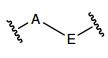
[0081] Quando os compostos aqui revelados têm pelo menos um estereocentro, podem existir como enantiómeros e diastereómeros individuais ou como misturas de tais isômeros, incluindo racematos. A separação dos isômeros individuais ou a síntese seletiva dos isômeros individuais é conseguida pela aplicação de vários métodos que são bem conhecidos dos profissionais da técnica. Salvo indicação em contrário, todos estes isômeros e suas misturas estão incluídos no âmbito dos compostos aqui revelados.[0081] When the compounds disclosed herein have at least one stereocenter, they may exist as individual enantiomers and diastereomers or as mixtures of such isomers, including racemates. The separation of the individual isomers or the selective synthesis of the individual isomers is accomplished by the application of various methods that are well known to those skilled in the art. Unless otherwise indicated, all such isomers and mixtures thereof are included within the scope of the compounds disclosed herein.
[0082] Tal como aqui utilizado, um "nucleotídeo" inclui uma base heterocíclica contendo azoto, um açúcar e um ou mais grupos fosfato. São unidades monoméricas de uma sequência de ácido nucleico. No RNA, o açúcar é uma ribose e no DNA uma desoxirribose, isto é, um açúcar que não possui um grupo hidroxilo que está presente na ribose. A base heterocíclica contendo azoto pode ser purina ou pirimidina base. As bases de purina incluem adenina (A) e guanina (G), e seus derivados modificados ou análogos. As bases de pirimidina incluem citosina (C), timina (T) e uracilo (U), e seus derivados modificados ou análogos. O átomo C-1 de desoxirribose está ligado a N-1 de uma pirimidina ou N-9 de uma purina.[0082] As used herein, a "nucleotide" includes a nitrogen-containing heterocyclic base, a sugar and one or more phosphate groups. They are monomeric units of a nucleic acid sequence. In RNA, the sugar is a ribose and in DNA it is deoxyribose, that is, a sugar that does not have a hydroxyl group that is present on ribose. The nitrogen-containing heterocyclic base may be purine or pyrimidine base. Purine bases include adenine (A) and guanine (G), and their modified derivatives or analogs. Pyrimidine bases include cytosine (C), thymine (T), and uracil (U), and modified derivatives or analogs thereof. The C-1 atom of deoxyribose is bonded to N-1 of a pyrimidine or N-9 of a purine.
[0083] Tal como aqui utilizado, um "nucleosídeo" é estruturalmente semelhante a um nucleotídeo, mas está faltando as porções fosfato. Um exemplo de um análogo nucleosídico seria aquele em que o marcador está ligado à base e não há nenhum grupo fosfato ligado à molécula de açúcar. O termo "nucleosídeo" é aqui utilizado no seu sentido corrente, tal como é entendido pelos especialistas na matéria. Exemplos incluem, mas não estão limitados a, um ribonucleosídeo compreendendo uma porção ribose e um desoxirribonucleosídeo compreendendo uma porção desoxirribose. Uma porção de pentose modificada é uma porção de pentose na qual um átomo de oxigénio foi substituído por um carbono e / ou um carbono foi substituído por um enxofre ou um átomo de oxigénio. Um "nucleosídeo" é um monómero que pode ter uma base substituída e / ou uma unidade de açúcar. Adicionalmente, um nucleosídeo pode ser incorporado em polímeros e oligómeros de DNA e / ou RNA maiores.[0083] As used herein, a "nucleoside" is structurally similar to a nucleotide, but is missing the phosphate moieties. An example of a nucleoside analogue would be one where the tag is attached to the base and there is no phosphate group attached to the sugar molecule. The term "nucleoside" is used herein in its current sense, as understood by those skilled in the art. Examples include, but are not limited to, a ribonucleoside comprising a ribose moiety and a deoxyribonucleoside comprising a deoxyribose moiety. A modified pentose moiety is a pentose moiety in which an oxygen atom has been replaced by a carbon and/or a carbon has been replaced by a sulfur or an oxygen atom. A "nucleoside" is a monomer that may have a substituted base and/or a sugar unit. Additionally, a nucleoside can be incorporated into larger DNA and/or RNA polymers and oligomers.
[0084] Tal como aqui utilizado, o termo "polinucleotídeo" refere-se a ácidos nucleicos em geral, incluindo DNA (por exemplo DNAc de DNA genómico), RNA (por exemplo RNAm), oligonucleotídeos sintéticos e análogos de ácido nucleico sintéticos. Os polinucleotídeos podem incluir bases naturais ou não naturais, ou suas combinações e ligações estruturais naturais ou não naturais, e. Fosforotioatos, PNA ou 2'-O-metil-RNA, ou suas combinações.[0084] As used herein, the term "polynucleotide" refers to nucleic acids in general, including DNA (e.g. cDNA from genomic DNA), RNA (e.g. mRNA), synthetic oligonucleotides, and synthetic nucleic acid analogs. Polynucleotides may include natural or unnatural bases, or combinations and natural or unnatural structural linkages thereof, e.g. Phosphorothioates, PNA or 2'-O-methyl-RNA, or combinations thereof.
[0085] Tal como aqui utilizado, o termo "faseamento" refere-se a fenômenos em SBS que são causados por remoção incompleta dos terminadores 3 'e fluoróforos e falha na conclusão da incorporação de uma porção de cadeias de DNA dentro de clusters por polimerases a um dado Ciclo de sequenciamento. A pré-fase é causada pela incorporação de nucleotídeos sem extremidades 3' eficazes e o evento de incorporação vai um ciclo à frente. A fase e o pré-fase fazem com que as intensidades extraídas para um ciclo específico consistam no sinal do ciclo actual, bem como no ruído dos ciclos anteriores e seguintes. À medida que o número de ciclos aumenta, a fração de sequências por aglomerado afetado pelo phasing aumenta, dificultando a identificação da base correta. A pré-fase pode ser causada pela presença de uma quantidade traço de nucleotídeos 3'-OH desprotegidos ou não bloqueados durante a sequenciamento por síntese (SBS). Os nucleotídeos 3 '-OH não protegidos podem ser gerados durante os processos de fabrico ou possivelmente durante os processos de armazenagem e manuseamento de reagentes. Consequentemente, as modificações de análogos de nucleotídeos ou os grupos de ligação que resultam num tempo de ciclo de SBS mais rápido, valores de fase mais baixos e pré-fase e comprimento de leitura de sequenciamento mais longo proporcionam maiores vantagens em aplicações de SBS.[0085] As used herein, the term "phasing" refers to phenomena in SBS that are caused by incomplete removal of 3' terminators and fluorophores and failure to complete incorporation of a portion of DNA strands within clusters by polymerases. to a given sequencing cycle. Prephase is caused by the incorporation of nucleotides without effective 3' ends and the incorporation event goes one cycle ahead. Phase and prephase make the intensities extracted for a specific cycle consist of the current cycle's signal as well as the noise from previous and following cycles. As the number of cycles increases, the fraction of sequences per cluster affected by phasing increases, making it difficult to identify the correct base. Prephase can be caused by the presence of a trace amount of unprotected or unblocked 3'-OH nucleotides during sequencing by synthesis (SBS). Unprotected 3'-OH nucleotides can be generated during manufacturing processes or possibly during reagent storage and handling processes. Consequently, modifications of nucleotide analogs or linkages that result in faster SBS cycle time, lower in-phase values, and longer pre-phase and sequencing read lengths provide major advantages in SBS applications.
[0086] Tal como aqui utilizado, o termo "grupo protetor" inclui, mas não se limita a, moléculas que podem proteger contra danos no DNA (por exemplo, danos por foto ou outros danos químicos). Alguns exemplos específicos incluem antioxidantes, tais como vitamina C, derivados de vitamina E, ácido fenólico, polifenóis, e seus derivados e análogos. Deve ser entendido que em certos contextos onde o termo "grupo protector" é definido, refere-se à porção resultante da reacção entre um ou mais grupos funcionais da unidade protetora com o grupo funcional correspondente do ligante tal como aqui descrito. Por exemplo, quando a porção protetora é "ácido gálico", pode referir-se às amidas e ésteres do ácido gálico em vez do ácido gálico propriamente dito com o grupo carboxilo livre.Marcadores detectáveis[0086] As used herein, the term "protecting group" includes, but is not limited to, molecules that can protect against DNA damage (e.g., photo damage or other chemical damage). Some specific examples include antioxidants such as vitamin C, vitamin E derivatives, phenolic acid, polyphenols, and derivatives and analogues thereof. It should be understood that in certain contexts where the term "protecting group" is defined, it refers to the portion resulting from the reaction between one or more functional groups of the protective moiety with the corresponding functional group of the linker as described herein. For example, when the protective moiety is "gallic acid", it may refer to the amides and esters of gallic acid rather than the gallic acid itself with the free carboxyl group. Detectable Markers
[0087] Algumas concretizações aqui descritas referem-se à utilização de marcadores detectáveis convencionais. A detecção pode ser realizada por qualquer método adequado, incluindo espectroscopia de fluorescência ou por outros meios ópticos. O marcador preferido é um fluoróforo, que, após absorção de energia, emite radiação a um comprimento de onda definido. São conhecidos muitos marcadores fluorescentes adequados. Por exemplo, Welch et ai. (Chem. Eur. J. 5 (3): 951-960, 1999) descreve fracções fluorescentes funcionalizadas em dansilo que podem ser utilizadas na presente invenção. Zhu et al. (Citometria 28: 206-211, 1997) descreve o uso dos marcadores fluorescentes Cy3 e Cy5, que também podem ser utilizados na presente invenção. As etiquetas adequadas para utilização são também descritas em Prober et al. (Science 238: 336-341, 1987); Connell et ai. (BioTechniques 5 (4): 342-384, 1987), Ansorge et al. (Nucl. Acids Res. 15 (11): 4593-4602, 1987) e Smith et ai. (Nature 321: 674, 1986). Outros marcadores fluorescentes comercialmente disponíveis incluem, mas não estão limitados a, fluoresceína, rodamina (incluindo TMR, texas red e Rox), alexa, bodipy, acridina, cumarina, pireno, benzantraceno e as cianinas. Podem também ser utilizados vários marcadores na presente aplicação, por exemplo, cassetes bi-fluoróforo FRET (Tet. 46: 8867-8871, 2000). Podem também utilizar-se sistemas dendriméricos multi-fluor (J. Am. Chem. Soc. 123: 8101-8108, 2001). Embora os marcadores fluorescentes sejam preferidos, outras formas de marcadores detectáveis serão evidentes como úteis para os especialistas na técnica. Por exemplo, as micropartículas, incluindo os pontos quânticos (Empodocles et al., Nature 399: 126-130, 1999), nanopartículas de ouro (Reichert et al., Anal. Chem. 72: 6025-6029, 2000) e microesferas (Lacoste et al., Proc. Nat. Acad. Sci USA 97 (17): 9461- 9466, 2000) podem ser todos utilizados. Os rótulos de múltiplos componentes também podem ser utilizados na presente aplicação. Um marcador de múltiplos componentes é aquele que é dependente da interacção com um composto adicional para detecção. O marcador multi-componente mais utilizado na biologia é o sistema biotina- estreptavidina. A biotina é utilizada como o marcador ligado à base nucleotídica. A estreptavidina é então adicionada separadamente para permitir a detecção. Outros sistemas multi-componente estão disponíveis. Por exemplo, dinitrofenol tem um anticorpo fluorescente comercialmente disponível que pode ser utilizado para detecção. A menos que indicado de outro modo, a referência a nucleotídeos também se destina a ser aplicável a nucleosídeos. O presente pedido de patente será também descrito com referência ao DNA, embora a descrição seja também aplicável a RNA, PNA e outros ácidos nucleicos, a menos que[0087] Some embodiments described herein pertain to the use of conventional detectable labels. Detection may be performed by any suitable method, including fluorescence spectroscopy or by other optical means. The preferred label is a fluorophore, which, upon absorption of energy, emits radiation at a defined wavelength. Many suitable fluorescent labels are known. For example, Welch et al. (Chem. Eur. J. 5(3): 951-960, 1999) describes dansyl functionalized fluorescent moieties that can be used in the present invention. Zhu et al. (Cytometry 28: 206-211, 1997) describes the use of the Cy3 and Cy5 fluorescent labels, which can also be used in the present invention. Labels suitable for use are also described in Prober et al. (Science 238: 336-341, 1987); Connell et al. (BioTechniques 5 (4): 342-384, 1987), Ansorge et al. (Nucl. Acids Res. 15 (11): 4593-4602, 1987) and Smith et al. (Nature 321: 674, 1986). Other commercially available fluorescent labels include, but are not limited to, fluorescein, rhodamine (including TMR, texas red and Rox), alexa, bodipy, acridine, coumarin, pyrene, benzanthracene and the cyanines. Various labels can also be used in the present application, for example bi-fluorophore FRET cassettes (Tet. 46: 8867-8871, 2000). Multi-fluor dendrimer systems can also be used (J. Am. Chem. Soc. 123: 8101-8108, 2001). While fluorescent labels are preferred, other forms of detectable labels will be apparent to those of skill in the art. For example, microparticles, including quantum dots (Empodocles et al., Nature 399: 126-130, 1999), gold nanoparticles (Reichert et al., Anal. Chem. 72: 6025-6029, 2000) and microspheres ( Lacoste et al., Proc. Nat. Acad. Sci USA 97 (17): 9461-9466, 2000) can all be used. Multi-component labels can also be used in the present application. A multicomponent marker is one that is dependent on interaction with an additional compound for detection. The most used multi-component marker in biology is the biotin-streptavidin system. Biotin is used as the tag attached to the nucleotide base. Streptavidin is then added separately to allow detection. Other multi-component systems are available. For example, dinitrophenol has a commercially available fluorescent antibody that can be used for detection. Unless otherwise indicated, the reference to nucleotides is also intended to apply to nucleosides. The present patent application will also be described with reference to DNA, although the description is also applicable to RNA, PNA and other nucleic acids, unless
[0088] Os nucleosídeos ou nucleotídeos aqui descritos podem ser utilizados em conjunto com uma variedade de técnicas de sequenciamento. Em algumas concretizações, o processo para determinar a sequência nucleotídica de um ácido nucleico alvo pode ser um processo automatizado.[0088] The nucleosides or nucleotides described herein can be used in conjunction with a variety of sequencing techniques. In some embodiments, the process for determining the nucleotide sequence of a target nucleic acid can be an automated process.
[0089] Os análogos de nucleotídeos aqui apresentados podem ser utilizados num procedimento de sequenciamento, tal como uma técnica de sequenciamento por síntese (SBS). Resumidamente, a SBS pode ser iniciada por contacto dos ácidos nucleicos alvo com um ou mais nucleotídeos marcados, DNA polimerase, etc. As características em que um iniciador é estendido utilizando o ácido nucleico alvo como molde incorporarão um nucleotídeo marcado que pode ser detectado. Opcionalmente, os nucleotídeos marcados podem incluir adicionalmente uma propriedade de terminação reversível que termina a extensão do iniciador mais uma vez que um nucleotídeo tenha sido adicionado a um iniciador. Por exemplo, um análogo de nucleotídeos com uma porção terminadora reversível pode ser adicionado a um iniciador de tal modo que a extensão subsequente não pode ocorrer até que um agente de desbloqueio seja libertado para remover a porção. Assim, para concretizações que utilizam terminação reversível, um reagente de desbloqueamento pode ser fornecido à célula de fluxo (antes ou depois da detecção ocorrer). As lavagens podem ser realizadas entre os vários passos de fornecimento. O ciclo pode então ser repetido n vezes para prolongar o iniciador por n nucleotídeos, detectando assim uma sequência de comprimento n. Exemplos de procedimentos SBS, sistemas fluídicos e plataformas de detecção que podem ser prontamente adaptados para utilização com uma matriz produzida pelos métodos da presente divulgação são descritos, por exemplo, em Bentley et al., Nature 456: 53-59 (2008), WO 04/018497; WO 91/06678; WO 07/123744; US Pat. Nos. 7,057,026; 7,329,492; 7,211,414; 7,315,019 or 7,405,281, and US Pat. App. Pub. No. 2008/0108082 A1, cada um dos quais é aqui incorporado por referência.[0089] The nucleotide analogs presented herein can be used in a sequencing procedure, such as a sequencing by synthesis (SBS) technique. Briefly, SBS can be initiated by contacting the target nucleic acids with one or more labeled nucleotides, DNA polymerase, etc. Features in which a primer is extended using the target nucleic acid as a template will incorporate a detectable labeled nucleotide. Optionally, the labeled nucleotides may additionally include a reversible termination property that terminates primer extension once a nucleotide has been added to a primer. For example, a nucleotide analog with a reversible terminator moiety can be added to a primer such that subsequent extension cannot occur until a deblocking agent is released to remove the moiety. Thus, for embodiments using reversible termination, a deblocking reagent can be supplied to the flow cell (before or after detection occurs). Washings can be performed between the various delivery steps. The cycle can then be repeated n times to extend the primer by n nucleotides, thus detecting a sequence of length n. Examples of SBS procedures, fluidic systems, and detection platforms that can be readily adapted for use with a matrix produced by the methods of the present disclosure are described, for example, in Bentley et al., Nature 456: 53-59 (2008), WO 04/018497; WO 91/06678; WO 07/123744; US Pat. US. 7,057,026; 7,329,492; 7,211,414; 7,315,019 or 7,405,281, and US Pat. App. Pub. At the. 2008/0108082 A1, each of which is incorporated herein by reference.
[0090] Outros procedimentos de sequenciamento que utilizam reações cíclicas, tais como pirosequenciamento podem ser utilizados. O pirosequenamento detecta a liberação de pirofosfato inorgânico (PPi) à medida que são incorporados nucleotídeos particulares numa cadeia de ácido nucleico nascente (Ronaghi, et ai., Analytical Biochemistry 242 (1), 84-9 (1996), Ronaghi, Genome Res.), 3-11 (2001), Ronaghi et al., Science 281 (5375), 363 (1998), US 6,210,891, 6,258,568 e 6,274,320, cada um dos quais aqui incorporado como referência). Na pirosequenciamento, o PPi libertado pode ser detectado por conversão em trifosfato de adenosina (ATP) por ATP sulfurilase, e o ATP resultante pode ser detectado através de fótons produzidos por luciferase. Assim, a reação de sequenciamento pode ser monitorizada através de um sistema de detecção de luminescência. As fontes de radiação de excitação utilizadas para sistemas de detecção baseados em fluorescência não são necessárias para os procedimentos de pirosequenciamento. Sistemas de fluidos úteis, detectores e procedimentos que podem ser utilizados para a aplicação de pirosequenciamento a matrizes da presente divulgação estão descritos, por exemplo, no pedido de patente Ser. PCT / US11 / 57111, pedido de patente. Bar. 2005/0191698 A1, Pat. US 7,595,883 e Pat. 7,244,559, cada um dos quais é aqui incorporado por referência.[0090] Other sequencing procedures that use cyclic reactions, such as pyrosequencing can be used. Pyrosequencing detects the release of inorganic pyrophosphate (PPi) as particular nucleotides are incorporated into a nascent nucleic acid strand (Ronaghi, et al., Analytical Biochemistry 242 (1), 84-9 (1996), Ronaghi, Genome Res. ), 3-11 (2001), Ronaghi et al., Science 281 (5375), 363 (1998), US 6,210,891, 6,258,568 and 6,274,320, each of which is incorporated herein by reference). In pyrosequencing, released PPi can be detected by conversion to adenosine triphosphate (ATP) by ATP sulfurylase, and the resulting ATP can be detected via photons produced by luciferase. Thus, the sequencing reaction can be monitored using a luminescence detection system. The excitation radiation sources used for fluorescence-based detection systems are not required for pyrosequencing procedures. Useful fluid systems, detectors, and procedures that can be used for applying pyrosequencing to matrices of the present disclosure are described, for example, in patent application Ser. PCT / US11 / 57111, patent application. Pub. 2005/0191698 A1, Pat. US 7,595,883 and U.S. Pat. 7,244,559, each of which is incorporated herein by reference.
[0091] As reações de sequenciamento por ligação são também úteis incluindo, por exemplo, as descritas em Shendure et al. Science 309: 1728 - 1732 (2005); A Pat. 5 599 675; E Pat. 5 750 341, cada um dos quais é aqui incorporado por referência. Algumas concretizações podem incluir procedimentos de sequenciamento por hibridação como descrito, por exemplo, em Bains et al., Journal of Theoretical Biology 135 (3), 303-7 (1988); Drmanac et al., Nature Biotechnology 16, 54-58 (1998); Fodor et ai., Science 251 (4995), 767 - 773 (1995); E WO 1989/10977, cada um dos quais é aqui incorporado por referência. Nos procedimentos de sequenciamento por ligação e sequenciamento por hibridação, os ácidos nucleicos que estão presentes em poços contendo gel (ou outras características côncavas) são sujeitos a ciclos repetidos de entrega e detecção de oligonucleotídeos. Os sistemas fluidos para os métodos de SBS, tal como aqui apresentados, ou nas referências aqui citadas, podem ser prontamente adaptados para distribuição de reagentes para procedimentos de sequenciamento por ligação ou sequenciamento por hibridização. Tipicamente, os oligonucleotídeos são marcados fluorescentemente e podem ser detectados utilizando detectores de fluorescência semelhantes aos descritos em relação aos procedimentos de SBS aqui descritos ou nas referências aqui citadas.[0091] Linkage sequencing reactions are also useful including, for example, those described in Shendure et al. Science 309: 1728 - 1732 (2005 ); The Pat. 5,599,675; and Pat. 5,750,341, each of which is incorporated herein by reference. Some embodiments may include hybridization sequencing procedures as described, for example, in Bains et al., Journal of Theoretical Biology 135 (3), 303-7 (1988); Drmanac et al., Nature Biotechnology 16, 54-58 (1998); Fodor et al., Science 251 (4995), 767-773 (1995); and WO 1989/10977, each of which is incorporated herein by reference. In ligation sequencing and hybridization sequencing procedures, nucleic acids that are present in gel-containing wells (or other concave features) are subjected to repeated cycles of oligonucleotide delivery and detection. Fluid systems for SBS methods, as presented herein, or in the references cited herein, can be readily adapted for delivery of reagents for ligation sequencing or hybridization sequencing procedures. Typically, oligonucleotides are fluorescently labeled and can be detected using fluorescence detectors similar to those described in connection with the SBS procedures described herein or in the references cited herein.
[0092] Algumas concretizações podem utilizar métodos que envolvem a monitoração em tempo real da atividade da DNA polimerase. Por exemplo, as incorporações de nucleotídeos podem ser detectadas através de interacções de transferência de energia de ressonância de fluorescência (FRET) entre uma polimerase portadora de fluoróforo e nucleotídeos marcados com y-fosfato, ou com guias de onda zeromódicas. Técnicas e reagentes para a sequenciamento baseada em FRET são descritos, por exemplo, em Levene et al. Science 299, 682686 (2003); Lundquist et ai. Optar. Lett. 33, 1026-1028 (2008); Korlach et ai. Proc. Natl. Acad. Sei. USA 105, 1176- 1181 (2008), cujas descrições são aqui incorporadas por referência.[0092] Some embodiments may utilize methods that involve real-time monitoring of DNA polymerase activity. For example, nucleotide incorporations can be detected through fluorescence resonance energy transfer (FRET) interactions between a fluorophore-bearing polymerase and γ-phosphate labeled nucleotides, or with zeromodic waveguides. Techniques and reagents for FRET-based sequencing are described, for example, in Levene et al. Science 299, 682686 (2003 ); Lundquist et al. Choose. Lett. 33, 1026-1028 (2008); Korlach et al. process natl. academy Know. USA 105, 1176-1181 (2008 ), the disclosures of which are incorporated herein by reference.
[0093] Algumas concretizações SBS incluem a detecção de um protão libertado após a incorporação de um nucleotídeo num produto de extensão. Por exemplo, a sequenciamento com base na detecção de prótons liberados pode utilizar um detector elétrico e técnicas associadas que estão comercialmente disponíveis a partir de Ion Torrent (Guilford, CT, uma subsidiária Life Technologies) ou métodos e sistemas de sequenciamento descritos na Pat. Aplicativo. Bar. Nos. 2009/0026082 A1; 2009/0127589 A1; 2010/0137143 A1; Ou 2010/0282617 A1, cada um dos quais é aqui incorporado por referência.Ligantes modificados exemplificativos[0093] Some SBS embodiments include detection of a proton released after incorporation of a nucleotide into an extension product. For example, sequencing based on the detection of released protons can utilize an electrical detector and associated techniques that are commercially available from Ion Torrent (Guilford, CT, a Life Technologies subsidiary) or sequencing methods and systems described in U.S. Pat. Application. Pub. US. 2009/0026082 A1; 2009/0127589 A1; 2010/0137143 A1; Or 2010/0282617 A1, each of which is incorporated herein by reference. Exemplary Modified Linkers
[0094] Concretizações adicionais são reveladas com mais detalhes nos seguintes exemplos, os quais não são de modo algum destinados a limitar o escopo das reivindicações.[0094] Additional embodiments are revealed in more detail in the following examples, which are in no way intended to limit the scope of the claims.
[0095] A FIG. 1A ilustra uma fórmula estrutural parcial de um nucleotídeo 100 marcado. O nucleotídeo 100 identificado inclui um nucleotídeo de adenosina (ffA) 110 completamente funcionalizado, uma porção de ligação padrão 115 e um corante fluorescente 120. A porção de ligação padrão 115 pode ser uma porção de ligação tipicamente utilizada na síntese de nucleotídeos marcados para sequenciamento por sintese (SBS). Num exemplo, o corante fluorescente 120 é NR550S0. Neste exemplo, o nucleotídeo 100 marcado pode ser descrito como "ffA-NR550S0". Em outro exemplo, o corante fluorescente 120 é SO7181 e o nucleotídeo 100 marcado pode ser descrito como "ffA-SO7181".[0095] FIG. 1A illustrates a partial structural formula of a 100-labeled nucleotide. The identified
[0096] A FIG. 1B ilustra o nucleotídeo 100 marcado da FIG. 1A com duas modificações estruturais possíveis para a porção de ligação padrão 115. Num exemplo, a porção ligadora padrão 115 inclui um inserto AEDI 125 entre a porção carbonilo (isto é, -C (= O) - e a porção amino (isto é, -NH-) Da porção amido. Neste exemplo, o nucleotídeo marcado modificado pode ser descrito como "ffA-AEDI-NR550S0". Noutro exemplo, a porção de ligador padrão 115 inclui um inserto SS 130 e o nucleotídeo marcado modificado pode ser designado "ffA-SS- NR550S0".[0096] FIG. 1B illustrates the 100-labeled nucleotide of FIG. 1A with two possible structural modifications to the
[0097] A FIG. 2 mostra um gráfico da taxa de incorporação de nucleotídeos usando o nucleotídeo 100 da FIG. 1A e os nucleotídeos 100 marcados modificados da FIG. 1B. O ensaio foi realizado a 55 ° C, em etanolamina 40 mM (pH 9,8), MgCl 9 mM, NaCl 40 mM, EDTA 1 mM, CHAPS 0,2% com iniciador 20nM: DNA molde e 30 μg / ml de Polimerase 812 (MiSeq Kit V2) Nucleotídeo 1 mM. A enzima é ligada a DNA e depois rapidamente misturada com nucleotídeo numa máquina de fluxo de arrefecimento durante um curto período de tempo (até 10s) antes da extinção com EDTA a 500 mM. Vários pontos de tempo são tomados para cada nucleotídeo. As amostras geradas são então analisadas num gel desnaturante e a percentagem de DNA que está a ser convertido em DNA + 1 é determinada e traçada em função do tempo para determinar a constante de velocidade de primeira ordem para cada nucleotídeo. Os dados estão resumidos na Tabela 1 abaixo. Os dados mostram que a taxa de incorporação para um nucleotídeo marcado compreendendo o inserto SS 130 (ffa-SS-NR550S0) era cerca de 2 vezes mais rápida em comparação com a taxa de incorporação de um nucleotídeo marcado compreendendo um ligante padrão 115 (ffa- NR550S0). A taxa de incorporação para um nucleotídeo marcado compreendendo um inserto AEDI 125 (ffa-AEDI-NR550S0) foi cerca de 4 vezes mais rápida em comparação com a taxa de incorporação de ffa-NR550S0. Os dados também mostram que a taxa de incorporação de um nucleotídeo marcado compreendendo o ligante padrão 115 e o corante fluorescente SO7181 (ffA- SO7181) era cerca de 4 vezes mais rápida comparada com a taxa de incorporação de ffa-NR550S0.
[0098] As FIGs. 3A-3F ilustram as fórmulas estruturais de inserções adicionais 310, 315, 320, 325, 330 e 335 para a porção de ligação padrão 115 da FIG. 1A. Numa inserção ACA 310, as substituições dimetilo são removidas e a ligação enxofre-enxofre (SS) é substituída por ligação carbono- carbono em comparação com o inserto 125. A ligação enxofre- enxofre não é necessária para SBS (por exemplo 2-corante ou 4 (SBS).[0098] FIGs. 3A-3F illustrate the structural formulas of
[0099] Numa inserção AcLys 315, utiliza-se lisina acetil protegida para substituir o inserção 125.[0099] In an
[00100] Numa inserção 320 de BocLys, utiliza-se lisina protegida com terc-butoxicarbonilo para substituir o inserção 125.[00100] In a 320 BocLys insert, tert-butoxycarbonyl protected lysine is used to replace the 125 insert.
[00101] Numa inserção 325 de dMeO, a ligação enxofre- enxofre (S-S) é substituída por ligação oxigénio-carbono (O- CH2) em comparação com o inserção 125.[00101] In a 325 dMeO insert, the sulfur-sulfur (S-S) bond is replaced by an oxygen-carbon (O-CH2) bond compared to the 125 insert.
[00102] Numa inserção dMeS 330, a ligação enxofre- enxofre (S-S) é substituída por ligação enxofre-carbono (S- CH2) em comparação com o inserção 125.[00102] In a 330 dMeS insert, the sulfur-sulfur (S-S) bond is replaced by a sulfur-carbon (S-CH2) bond compared to the 125 insert.
[00103] Numa inserção DMP 335, a ligação enxofre-enxofre (S-S) é substituída por ligação enxofre-carbono (CH2) em comparação com o inserção 125.[00103] In a
[00104] Em vários exemplos aqui descritos, verificou-se que as inserções incluindo um padrão de substituição dimetilo (por exemplo, inserção AEDI 125, inserção dMeO 325 e inserção dMeS 330) tinham uma taxa aumentada de incorporação de nucleotídeos durante SBS.[00104] In several examples described herein, inserts including a dimethyl substitution pattern (e.g. AEDI
[00105] Em vários exemplos aqui descritos, o comprimento das cadeias de carbono nas inserções pode também ser variado.[00105] In various examples described herein, the length of the carbon chains in the inserts can also be varied.
[00106] A FIG. 4 mostra uma tabela de dados de uma corrida de sequenciamento de dois corantes utilizada para avaliar o efeito do inserção AEDI 125 da FIG. 1B e inserção AcLys 315 da FIG. 3B sobre a qualidade da sequenciamento. O sequenciamento foi executado em uma plataforma híbrida Miseq com modelo 550bp humano e 2 vezes 150 ciclos. O novo conjunto de corantes, V10 / ciano-peg4 A-AEDI550S0, V10 / ciano-peg4 A-AcLys550S0 e V10 / ciano A-AcLys 550S0 foram comparados com o conjunto de corante comercial standard V4 e um conjunto de corante melhorado da plataforma Nova V5 .75. Para cada uma das amostras V10 / ciano-peg4 A-AEDI550S0, V10 / ciano-peg4 A-AcLys550S0 e V10 / ciano A-AcLys 550S0, o valor de faseamento (Ph R1) foi inferior aos valores de faseamento das amostras sem o AEDI ou Inserções AcLys. Por conseguinte, os nucleotídeos marcados compreendendo inserções adicionais 125 e 315 demonstraram melhorias na qualidade de sequenciamento.[00106] FIG. 4 shows a table of data from a two-dye sequencing run used to evaluate the effect of the
[00107] A FIG. 5A e 5B mostram um gráfico das taxas de erro para a leitura 1 e um gráfico das taxas de erro para a leitura 2 da sequência de sequenciamento da FIG. 4 respectivamente. Para a leitura 1, as taxas de erro de V10 / ciano-peg4 A-AEDI550S0 e V10 / ciano-peg4 A-AcLys550S0 eram inferiores ao mesmo conjunto de corante V10 / Cian-peg4 sem o inserção. Para a leitura 2, é ainda mais pronunciada quando se utiliza a inserção AcLys 315, onde a taxa de erro final foi reduzida em 30% em comparação com o conjunto de corantes sem inserção. Deste modo, as inserções 125 e 315 provaram melhorar significativamente a qualidade da sequenciamento.[00107] FIG. 5A and 5B show a graph of error rates for
[00108] A FIG. 6 mostra uma tabela de dados de uma corrida de sequenciamento utilizada para avaliar o efeito do inserção AEDI 125 e da inserção ACA 310 sobre a qualidade de sequenciamento. A sequenciamento foi executada em uma plataforma híbrida Miseq com modelo 550bp humano e 2 vezes 150 ciclos. O novo conjunto de corantes, V10 / ciano-peg4 A- AEDI550S0, V10 / ciano-peg4 A-ACALys550S0, foi comparado com o conjunto de corante comercial standard V4 e um conjunto de corante melhorado da plataforma Nova V5.75. Mais uma vez, cada uma das amostras de V10 / ciano-peg4 A-AEDI550S0 e V10 / ciano-peg4 A-ACA550S0 tem um menor valor de fase (Ph R1) em comparação com amostras sem os inserçãos AEDI ou ACA e assim demonstrou uma melhoria na qualidade do sequenciamento.[00108] FIG. 6 shows a table of data from a sequencing run used to assess the effect of the
[00109] A FIG. 7A e 7B mostram um gráfico das taxas de erro para a leitura 1 e um gráfico das taxas de erro para a leitura 2 da corrida de sequenciamento da FIG. 6 respectivamente. As taxas de erro para a leitura 1 para o conjunto que compreende a nova inserção AEDI (V10 / ciano- peg4 A-AEDI550S0), era inferior ao mesmo conjunto de corante sem o inserção, V10 / Cyan-peg4. A inserção ACA (V10 / Cyan- peg4 ACA550S0) deu um gráfico da taxa de erro semelhante em ambos os lidos para o padrão V10 / Cyan-peg4. A AEDI mostrou novamente para melhorar a qualidade do seqüenciamento. Esses dados mostraram também a estrutura da própria inserção está influenciando na melhora da qualidade de sequenciamento.[00109] FIG. 7A and 7B show a graph of error rates for
[00110] A FIG. 8A mostra a fórmula estrutural de um ligador LN3 padrão 800. O ligante LN3 800 inclui uma primeira porção funcional amido 810 substituída, uma segunda porção funcional PEG 815 substituída por azido e uma terceira porção funcional éster 820 que pode ser desejada numa estrutura ligante para Ligando uma molécula de corante 825 a um nucleótido 830. A primeira porção funcional 810 pode, por exemplo, ser utilizada para ligar a molécula de corante 825 ao ligador 800 de LN3. A segunda porção funcional 815 pode, por exemplo, ser um grupo funcional clivável que pode ser utilizado para Clivam a molécula de corante 825 a partir do ligador LN3 800. A terceira porção funcional 820 pode, por exemplo, ser utilizada para ligar o nucleótido 830 ao ligador 800 de LN3. 8B ilustra alguma modificação ao ligador LN3 padrão onde a porção fenoxi 850 é substituída com um a quatro substituintes seleccionados de -NO2, -CN, halo ou -SO3H. Além disso, a porção éster 820 é substituída por uma porção amido 855.[00110] FIG. 8A shows the structural formula of a
[00111] A Figura 9A é um gráfico que mostra o aparecimento de uma impureza num ffA com ligante SS. Com ffA- SS-NR550S0 após purificação por HPLC: a impureza apareceu durante a noite numa condição ligeiramente básica (pH 8-9). R.t. Durante a noite em TEAB / CH3CN 0,1 M. A Figura 9B compara a estabilidade de ffAs com ligante SS e ligante AEDI, com o ligante AEDI mostrando estabilidade significativamente melhorada em comparação com ligantes SS. Utilizou-se ffA-LN3- NR550S0 como referência interna. O produto secundário dissulfureto: (NR550S0-S-) 2. A Figura 9C mostra uma comparação do ligante SS e do ligante AEDI ffAs em IMX 60° durante 22 horas, mostrando novamente uma impureza com o ligante SS. O controlo interno é ffA-LN3-NR550S0. Di-P: difosfato.[00111] Figure 9A is a graph showing the appearance of an impurity in an ffA with SS ligand. With ffA-SS-NR550S0 after HPLC purification: the impurity appeared overnight in a slightly basic condition (pH 8-9). R.t. Overnight in 0.1 M TEAB / CH3CN. Figure 9B compares the stability of ffAs with SS ligand and AEDI ligand, with AEDI ligand showing significantly improved stability compared to SS ligands. ffA-LN3-NR550S0 was used as an internal reference. The disulfide by-product: (NR550S0-S-) 2. Figure 9C shows a comparison of the SS linker and the AEDI linker ffAs in
[00112] As Figuras 10A, 10B e 10C mostram o aumento inesperado da velocidade de incorporação de nucleotídeos em solução com alterações do ligante. A Fig. 10A mostra a velocidade de incorporação a 1 uM. Os resultados mostram que o corante e o ligante tinham um efeito significativo na cinética de incorporação com a tabela 10B mostrando claramente o benefício do ligante AEDI na cinética de incorporação. A Figura 10C ilustra esquematicamente os ligantes AEDI e SS com NR550S0.[00112] Figures 10A, 10B and 10C show the unexpected increase in the rate of incorporation of nucleotides in solution with changes in the linker. Fig. 10A shows the rate of incorporation at 1 µM. The results show that the dye and the linker had a significant effect on the kinetics of incorporation with Table 10B clearly showing the benefit of the AEDI linker on the kinetics of incorporation. Figure 10C schematically illustrates AEDI and SS linkers with NR550S0.
[00113] A Figura 11A mostra gráficos de dispersão para combinações V10 com diferentes A-550S0 (mesma concentração). As parcelas de dispersão são para a telha 1 ciclo 2. A Figura 11B mostra Kcat FFA Ligantes em solução. Pode-se ver que na superfície em termos de taxa de incorporação o ligante AEDI é mais rápido do que nenhum ligante: a nuvem A (no gráfico de dispersão) ligeiramente movendo-se em direcção ao centro. Ligador AcLys é mais lento que AEDI e nenhum linker: 'A'- nuvem movendo-se em direção ao eixo x. BocLys linker parece semelhante a nenhum linker e não muito longe do linker AEDI. Em solução, pode ver-se que o ligante ACA era mais lento, enquanto AEDI e ACLys têm Kcat semelhante, seguido por BocLys.[00113] Figure 11A shows scatter plots for V10 combinations with different A-550S0 (same concentration). Scatter plots are for
[00114] As Figuras 12A e 12B mostram métricas de sequenciamento em ciclos M111, Human550, 2x151. Use ffNs em combinação com diferentes A-550S0 (mesma concentração). Pode ver-se que tanto o AEDI como o ligante BocLys proporcionaram resultados de sequenciamento semelhantes. Embora a solução Kcat de AEDI e AcLys sejam semelhantes, o resultado de sequenciamento de AEDI é ligeiramente melhor.[00114] Figures 12A and 12B show sequencing metrics in M111, Human550, 2x151 cycles. Use ffNs in combination with different A-550S0 (same concentration). It can be seen that both the AEDI and the BocLys linker provided similar sequencing results. Although the Kcat solution of AEDI and AcLys are similar, the AEDI sequencing result is slightly better.
[00115] O ligante LN3 800 inclui uma porção fenoxi opcional 835 que pode ser removida do ligante LN3 800 como mostrado na FIG. 8C. O ligante LN3 800 inclui também uma porção amida opcional 840 e uma porção éter opcional 845, podendo ambos ser removidos do ligante LN3 800 como mostrado na FIG. 8D. O objectivo de remover certos grupos funcionais como a porção amido 810, a fracção fenoxi 835 é testar se eles têm interacções negativas com a enzima durante a incorporação de nucleotídeos, o que pode reduzir a eficiência de incorporação.[00115] The
[00116] A FIG. 8E ilustra a inserção ou adição de uma parte protetora 860 no ligante. A porção protetora 860 é inserida entre a porção funcional 810 (ou pode estar ligada à porção fenoxi 835 ou 850 na Figura 8A-8C) e a molécula 825 de corante. A parte protetora 860 pode, por exemplo, ser uma molécula que proteja contra danos no ADN. Danos no DNA incluindo danos por foto ou outros danos químicos são um dos efeitos cumulativos (isto é, ciclo por ciclo) de SBS. Substancialmente reduzindo ou eliminando danos no DNA pode fornecer SBS mais eficiente e leituras de seqüenciamento mais longas. Em algumas concretizações, a parte protetora 860 pode ser seleccionada a partir de um inibidor de estado de tripleto tal como Trolox, ácido gálico, 2-mercaptoetanol (BME), etc. Em algumas outras concretizações, a unidade protetora 860 pode ser seleccionada a partir de um reagente de extinção ou protector tal como 4 -nitrobenzílico ou um sal de ácido ascórbico, tal como ascorbato de sódio. Em algumas outras formas de realização, um agente de protecção pode ser fisicamente misturado no tampão em vez de formar ligação covalente com o nucleósido ou nucleótido marcado. No entanto, esta abordagem pode requerer uma concentração mais elevada do agente de protecção e pode ser menos eficiente. Como alternativa, a porção protetora ligada covalentemente aos nucleósidos ou nucleotídeos pode proporcionar uma melhor protecção contra danos ao ADN. Em algumas formas de realização adicionais da FIG. 8C, 8D e 8E, a porção éster 820 também pode ser substituída com a porção amido 855 e a porção fenoxi 835 ser adicionalmente substituída.[00116] FIG. 8E illustrates the insertion or addition of a
[00117] Em qualquer dos exemplos demonstrados na FIG. 8A-8E, inserção AEDI 125 e inserção SS 130 da FIG. 1B e inserções 300 das FIGs. 3A-3F pode, por exemplo, ser inserido entre a primeira porção funcional 810 e a molécula de corante 825 do ligante 800.[00117] In any of the examples shown in FIG. 8A-8E,
[00118] Concretizações adicionais são reveladas com mais detalhes nos seguintes exemplos, os quais não são de modo algum destinados a limitar o escopo das reivindicações. Procedimento Geral de Reação para Preparação de ffA-LN3-AEDI-NR550S0:
[00119] Num balão de fundo redondo de 50 ml, dissolveuse Boc-AEDI-OH (1 g, 3,4 mmol) em DCM (15 mL) e adicionou-seTFA (1,3 mL, 17 mL) à ta. A mistura reaccional foi agitadadurante 2 horas. A TLC (DCM: MeOH = 9: 1) indicou o consumocompleto de Boc-AEDI-OH. A mistura reaccional foi evaporadaaté à secura. Foi então adicionado TEAB (2 M, ~ 15 ml) aoresíduo e o pH foi monitorizado até ficar neutro. A misturafoi então dissolvida em H2O / CH3CN (1: 1, ~ 15 ml) e evaporadaaté à secura. Repetiu-se o procedimento durante 3 vezes pararemover o excesso de sal de TEAB. Tratou-se o resíduo sólidobranco com CH3CN (20 ml) e agitou-se durante 0,5 hora.Filtrou-se a solução e lavou-se o sólido com CH3CN, obtevese sal de AEDI-OH-TFA puro (530 mg, 80%). 1H NMR (400 MHz,D2O, δ(ppm)): 3.32 (t, J=6.5 Hz, 2H, NH2-CH2); 2.97 (t, J=6.5Hz, 2H, S-CH2); 1.53 (s, 6H, 2x CH3). 13C NMR (400 MHz, D2O,δ(ppm)): 178.21 (s, CO); 127.91, 117.71 (2s, TFA); 51.87 (s,C-(CH3)2); 37.76 (t, CH2-NH2); 34.23 (t, S-CH2); 23.84 (q, 2xCH3). 19F NMR (400 MHz, D2O, δ(ppm)): -75.64.[00119] In a 50 ml round bottom flask, Boc-AEDI-OH (1 g, 3.4 mmol) was dissolved in DCM (15 ml) and TFA (1.3 ml, 17 ml) was added at rt. The reaction mixture was stirred for 2 hours. TLC (DCM: MeOH = 9: 1) indicated complete consumption of Boc-AEDI-OH. The reaction mixture was evaporated to dryness. TEAB (2M, ~15 ml) was then added to the residue and the pH monitored until neutral. The mixture was then dissolved in H2O / CH3CN (1:1, ~15 ml) and evaporated to dryness. The procedure was repeated 3 times to remove excess TEAB salt. The white solid residue was treated with CH3CN (20 ml) and stirred for 0.5 hour. The solution was filtered and the solid was washed with CH3CN, giving pure AEDI-OH-TFA salt (530 mg, 80 %). 1H NMR (400 MHz, D 2 O, δ(ppm)): 3.32 (t, J=6.5 Hz, 2H, NH 2 -CH 2 ); 2.97 (t, J=6.5Hz, 2H, S-CH 2 ); 1.53 (s, 6H, 2x CH3). 13C NMR (400 MHz, D2O,δ(ppm)): 178.21 (s, CO); 127.91, 117.71 (2s, TFA); 51.87 (s,C-(CH3)2); 37.76 (t, CH2-NH2); 34.23 (t, S-CH2 ); 23.84 (q, 2xCH3 ). 19F NMR (400 MHz, D2O, δ(ppm)): -75.64.
[00120] Num balão de fundo redondo de 50 ml, o corante NR550S0 (114 mg, 176 umol) foi dissolvido em DMF (anidro, 20 mL) e evaporado para secar. Repetiu-se o procedimento durante 3 vezes. DMA anidra (10 mL) e base de Hunig (92 μl, 528 μmol, 3 equivalentes) foi então pipetada para o balão de fundo redondo. Adicionou-se TSTU (69 mg, 228 umol, 1,3 equivalentes) numa porção. A mistura reaccional foi mantida à ta. Após 30 min, a análise de TLC (CH3CN: H2O = 85: 15) indicou que a reacção estava completa. Adicionou-se AEDI-OH (68 mg, 352 μmol, 2 equivalentes) em TEAB 0,1 M à mistura reaccional e agitou-se à temperatura ambiente durante 3 h. A TLC (CH3CN: H2O = 8: 2) mostrou o consumo completo do éster ativado e apareceu uma mancha vermelha abaixo do éster activado. Entretanto, a HPLC analítica indicou também o consumo completo do éster activado e a formação do produto. A reacção foi desactivada com tampão TEAB (0,1 M, 10 ml) e o solvente volátil foi removido por evaporação sob pressão reduzida (HV) e purificado em coluna Axia para obter NR550S0- AEDI-OH. Rendimento: 60%.[00120] In a 50 ml round bottom flask, dye NR550S0 (114 mg, 176 µmol) was dissolved in DMF (anhydrous, 20 ml) and evaporated to dryness. The procedure was repeated for 3 times. Anhydrous DMA (10 mL) and Hunig's base (92 μl, 528 μmol, 3 equivalents) was then pipetted into the round bottom flask. TSTU (69 mg, 228 µmol, 1.3 equivalents) was added in one portion. The reaction mixture was kept at rt. After 30 min, TLC analysis (CH3CN: H2O = 85:15) indicated the reaction was complete. AEDI-OH (68 mg, 352 µmol, 2 equivalents) in 0.1 M TEAB was added to the reaction mixture and stirred at room temperature for 3 h. TLC (CH3CN: H2O = 8:2) showed complete consumption of the activated ester and a red spot appeared below the activated ester. Meanwhile, analytical HPLC also indicated complete consumption of the activated ester and product formation. The reaction was quenched with TEAB buffer (0.1 M, 10 ml) and the volatile solvent was removed by evaporation under reduced pressure (HV) and purified on Axia column to obtain NR550SO-AEDI-OH. Yield: 60%.
[00121] Num balão de fundo redondo de 25 ml, dissolveuse NR550S0-AEDI-OH (10 umol) em DMF (anidro, 5 mL) e evaporou- se para secar. Repetiu-se o procedimento durante 3 vezes. Adicionou-se então DMA anidro (5 mL) e DMAP (1,8 mL, 15 μmol, 1,5 equivalentes) ao balão de fundo redondo. Adicionou-se DSC (5,2 mg, 20 μmol, 2 equivalentes) em uma porção. A mistura reacional foi mantida à temperatura ambiente. Após 30 min, a análise de TLC (CH3CN: H2O = 8:2) indicou que a reacção estava completa. A base de Hunig (3,5 ul, 20 umol) foi adicionada à mistura reaccional. Depois adicionou-se à mistura reaccional uma solução de pppA-LN3 (20 μmol em 0,5 ml de H2O, 2 equivalentes) e Et3N (5 μl) e agitou-se à temperatura ambiente durante a noite. A TLC (CH3CN: H2O = 8: 2) mostrou o consumo completo do éster activado e apareceu uma mancha vermelha na linha de base. Entretanto, a HPLC analítica indicou também o consumo completo do éster activado e a formação do produto final. A reacção foi desactivada com tampão TEAB (0,1 M, 10 ml) e carregada numa coluna DEAE Sephadex (25 g de coluna Biotage). A coluna foi eluída com gradiente como mostrado na Tabela 2 abaixo.A: tampão TEAB 0,1 M (CH3CN a 10%)B: tampão TEAB 1 M (CH3CN a 10%).Gradiente: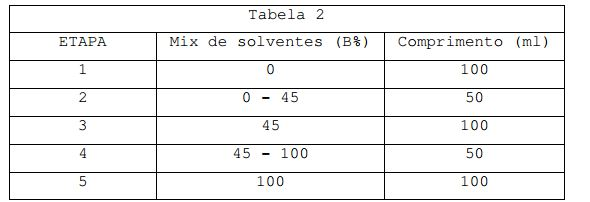
[00122] O produto desejado foi eluído para fora de 45%para 100% de tampão TEAB 1 M. A fracção que contém o produto foi combinada, evaporada e purificada por HPLC (coluna YLC, 8 mL / min). Rendimento: 53%.[00122] The desired product was eluted out of 45% into 100% 1M TEAB buffer. The fraction containing the product was combined, evaporated and purified by HPLC (YLC column, 8 mL/min). Yield: 53%.
[00123] Em resumo, a presente invenção pode referir-se a um nucleósido ou nucleótido ligado covalentemente a umfluoróforo através de um ligante, em que o referido ligante compreende uma estrutura de fórmula (I) ou (II), ou uma combinação de ambos.


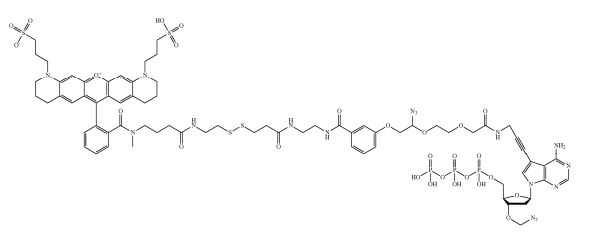
[00124] Em alguns casos, o nucleosídeo ou nucleotídeo referido acima, da estrutura de fórmula (I) também é representada pela fórmula (Ia) ou (Ib):0 (Ia), H (Ib).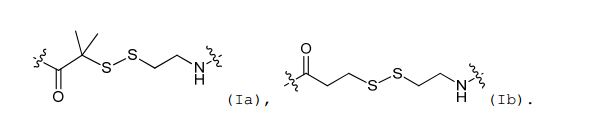
[00125] Além disso, a estrutura de fórmula (II) também pode ser representada pela fórmula (IIa), (IIb), (IIc),
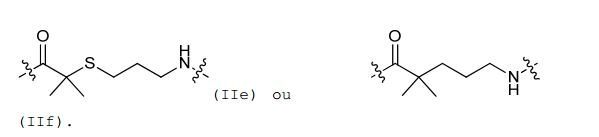
[00126] Mais particularmente, a presente invenção pode referir-se a um nucleosídeo ou nucleotídeo ligado covalentemente a um fluoróforo, através de um ligante, em que o referido ligante compreende uma estrutura de fórmula (I) ou (II), ou uma combinação de ambos:
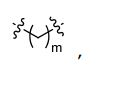
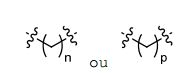
[00127] É preferido que a estrutura de fórmula (I) tambémseja representada pela fórmula (Ia):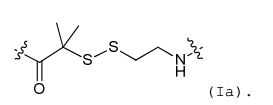
[00128] Além disso, a estrutura de fórmula (II) tambémé representada pela fórmula (IIb), (IIc), (IId), (IIe) ou(IIf):
Claims (10)
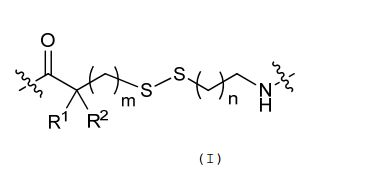


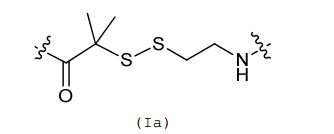
Applications Claiming Priority (4)
| Application Number | Priority Date | Filing Date | Title |
|---|---|---|---|
| GBGB1414098.2A GB201414098D0 (en) | 2014-08-08 | 2014-08-08 | Modified nucleotide linkers |
| GB1414098.2 | 2014-08-08 | ||
| BR112017002251-6A BR112017002251B1 (en) | 2014-08-08 | 2015-08-06 | Modified Nucleotide Linker |
| PCT/GB2015/052282 WO2016020691A1 (en) | 2014-08-08 | 2015-08-06 | Modified nucleotide linkers |
Publications (1)
| Publication Number | Publication Date |
|---|---|
| BR122020018717B1 true BR122020018717B1 (en) | 2022-01-25 |
Family
ID=51629525
Family Applications (2)
| Application Number | Title | Priority Date | Filing Date |
|---|---|---|---|
| BR122020018717-4A BR122020018717B1 (en) | 2014-08-08 | 2015-08-06 | Modified Nucleotide Linker |
| BR112017002251-6A BR112017002251B1 (en) | 2014-08-08 | 2015-08-06 | Modified Nucleotide Linker |
Family Applications After (1)
| Application Number | Title | Priority Date | Filing Date |
|---|---|---|---|
| BR112017002251-6A BR112017002251B1 (en) | 2014-08-08 | 2015-08-06 | Modified Nucleotide Linker |
Country Status (19)
| Country | Link |
|---|---|
| US (3) | US10190157B2 (en) |
| EP (2) | EP3564252B1 (en) |
| JP (3) | JP6563482B2 (en) |
| KR (2) | KR102491869B1 (en) |
| CN (2) | CN111704643A (en) |
| AU (2) | AU2015298469B2 (en) |
| BR (2) | BR122020018717B1 (en) |
| CA (1) | CA2957382C (en) |
| DK (2) | DK3564252T3 (en) |
| ES (2) | ES2875557T3 (en) |
| GB (1) | GB201414098D0 (en) |
| IL (1) | IL250498B (en) |
| MX (2) | MX377448B (en) |
| MY (1) | MY195167A (en) |
| NZ (1) | NZ728810A (en) |
| RU (1) | RU2699993C2 (en) |
| SG (3) | SG10202000850XA (en) |
| WO (1) | WO2016020691A1 (en) |
| ZA (1) | ZA201700838B (en) |
Families Citing this family (51)
| Publication number | Priority date | Publication date | Assignee | Title |
|---|---|---|---|---|
| GB201414098D0 (en) * | 2014-08-08 | 2014-09-24 | Illumina Cambridge Ltd | Modified nucleotide linkers |
| EP3091026B1 (en) * | 2015-05-08 | 2019-02-20 | Centrillion Technology Holdings Corporation | Disulfide-linked reversible terminators |
| US11085076B2 (en) | 2015-09-28 | 2021-08-10 | The Trustees Of Columbia University In The City Of New York | Synthesis of novel disulfide linker based nucleotides as reversible terminators for DNA sequencing by synthesis |
| CN109661232B (en) | 2016-05-23 | 2023-03-03 | 纽约哥伦比亚大学董事会 | Nucleotide derivatives and methods of use thereof |
| MX2019006616A (en) * | 2016-12-22 | 2019-10-24 | Illumina Inc | ARRANGEMENT INCLUDING SEQUENCING PRIMER AND NON-SEQUENCING ENTITY. |
| WO2018165207A1 (en) | 2017-03-06 | 2018-09-13 | Singular Genomic Systems, Inc. | Nucleic acid sequencing-by-synthesis (sbs) methods that combine sbs cycle steps |
| US12018325B2 (en) | 2017-03-28 | 2024-06-25 | The Trustees Of Columbia University In The City Of New York | 3′-O-modified nucleotide analogues with different cleavable linkers for attaching fluorescent labels to the base for DNA sequencing by synthesis |
| WO2019071474A1 (en) * | 2017-10-11 | 2019-04-18 | 深圳华大智造科技有限公司 | Modified nucleoside or nucleotide |
| WO2019164977A1 (en) | 2018-02-21 | 2019-08-29 | Singular Genomics Systems, Inc. | Fluorinated nucleotides and uses thereof |
| US12188086B2 (en) | 2018-03-15 | 2025-01-07 | The Trustees Of Columbia University In The City Of New York | Nucleotide analogues and use thereof for nucleic acid sequencing and analysis preliminary class |
| US12145960B2 (en) | 2018-10-25 | 2024-11-19 | Singular Genomics Systems, Inc. | Nucleotide analogues |
| EP3894598B1 (en) * | 2018-12-14 | 2024-01-03 | Illumina Cambridge Limited | Decreasing phasing with unlabeled nucleotides during sequencing |
| US11293061B2 (en) | 2018-12-26 | 2022-04-05 | Illumina Cambridge Limited | Sequencing methods using nucleotides with 3′ AOM blocking group |
| US11970735B2 (en) | 2019-01-08 | 2024-04-30 | Singular Genomics Systems, Inc. | Nucleotide cleavable linkers and uses thereof |
| WO2020178231A1 (en) | 2019-03-01 | 2020-09-10 | Illumina, Inc. | Multiplexed fluorescent detection of analytes |
| NL2023327B1 (en) | 2019-03-01 | 2020-09-17 | Illumina Inc | Multiplexed fluorescent detection of analytes |
| CN112654614A (en) * | 2019-03-01 | 2021-04-13 | 伊卢米纳剑桥有限公司 | Tertiary amine substituted coumarin compounds and their use as fluorescent markers |
| MX2020013384A (en) | 2019-03-01 | 2021-04-28 | Illumina Cambridge Ltd | EXOCYCLIC AMINE-SUBSTITUTED COMARIN COMPOUNDS AND THEIR USES AS FLUORESCENT LABELS. |
| US11421271B2 (en) | 2019-03-28 | 2022-08-23 | Illumina Cambridge Limited | Methods and compositions for nucleic acid sequencing using photoswitchable labels |
| JP2023510454A (en) | 2019-11-27 | 2023-03-14 | イルミナ ケンブリッジ リミテッド | Pigments and compositions containing cyclooctatetraene |
| JP7287299B2 (en) | 2020-01-31 | 2023-06-06 | トヨタ自動車株式会社 | Vehicle and vehicle control interface |
| MX2022016492A (en) | 2020-06-22 | 2023-03-06 | Illumina Cambridge Ltd | Nucleosides and nucleotides with 3' acetal blocking group. |
| US11981964B2 (en) | 2020-07-28 | 2024-05-14 | Illumina Cambridge Limited | Substituted coumarin dyes and uses as fluorescent labels |
| US20220195516A1 (en) | 2020-12-17 | 2022-06-23 | Illumina Cambridge Limited | Methods, systems and compositions for nucleic acid sequencing |
| US20220195517A1 (en) | 2020-12-17 | 2022-06-23 | Illumina Cambridge Limited | Long stokes shift chromenoquinoline dyes and uses in sequencing applications |
| US20220195196A1 (en) | 2020-12-17 | 2022-06-23 | Illumina Cambridge Limited | Alkylpyridinium coumarin dyes and uses in sequencing applications |
| US20220195518A1 (en) | 2020-12-22 | 2022-06-23 | Illumina Cambridge Limited | Methods and compositions for nucleic acid sequencing |
| CA3215598A1 (en) | 2021-05-05 | 2022-11-10 | Michael Callingham | Fluorescent dyes containing bis-boron fused heterocycles and uses in sequencing |
| CA3216735A1 (en) | 2021-05-20 | 2022-11-24 | Patrizia IAVICOLI | Compositions and methods for sequencing by synthesis |
| MX2023012658A (en) * | 2021-05-26 | 2024-02-02 | Illumina Inc | Purifying and polymerizing 3'-blocked nucleotides. |
| CA3223115A1 (en) | 2022-03-28 | 2023-10-05 | Xiaolin Wu | Labeled avidin and methods for sequencing |
| AU2023246772A1 (en) | 2022-03-29 | 2024-01-18 | Illumina Inc. | Chromenoquinoline dyes and uses in sequencing |
| CA3223128A1 (en) | 2022-03-31 | 2023-10-05 | Illumina, Inc. | Compositions and methods for improving sequencing signals |
| US20230332197A1 (en) | 2022-03-31 | 2023-10-19 | Illumina Singapore Pte. Ltd. | Nucleosides and nucleotides with 3' vinyl blocking group |
| CA3251383A1 (en) | 2022-05-31 | 2023-12-07 | Illumina, Inc | Compositions and methods for nucleic acid sequencing |
| EP4547675A1 (en) | 2022-06-28 | 2025-05-07 | Illumina, Inc. | Fluorescent dyes containing fused tetracyclic bis-boron heterocycle and uses in sequencing |
| CA3246518A1 (en) | 2022-09-30 | 2024-04-04 | Illumina, Inc. | Compositions and methods for reducing photo damage during sequencing |
| US20240229131A1 (en) | 2022-12-22 | 2024-07-11 | Illumina, Inc. | Transition-metal catalyst compositions and methods for sequencing by synthesis |
| CN119095982A (en) | 2022-12-22 | 2024-12-06 | 伊路米纳有限公司 | Palladium catalyst compositions and methods for sequencing by synthesis |
| CA3246559A1 (en) | 2022-12-27 | 2024-07-04 | Illumina, Inc. | Methods of sequencing using 3´ allyl blocked nucleotides |
| WO2024206407A2 (en) | 2023-03-29 | 2024-10-03 | Illumina, Inc. | Naphthalimide dyes and uses in nucleic acid sequencing |
| WO2024206394A1 (en) | 2023-03-30 | 2024-10-03 | Illumina, Inc. | Compositions and methods for nucleic acid sequencing |
| WO2025049700A1 (en) | 2023-08-31 | 2025-03-06 | Illumina, Inc. | Compositions and methods for nucleic acid sequencing |
| US20250137048A1 (en) | 2023-10-26 | 2025-05-01 | Illumina, Inc. | 4,5-substituted naphthalimide dyes and uses in nucleic acid sequencing |
| US20250163505A1 (en) | 2023-11-17 | 2025-05-22 | Illumina, Inc. | Conjugated polymers or polymer dots as fluorescent labels |
| WO2025136890A1 (en) | 2023-12-18 | 2025-06-26 | Illumina, Inc. | Hydrogel nanoparticles as labeling scaffold in sequencing |
| WO2025144716A1 (en) | 2023-12-28 | 2025-07-03 | Illumina, Inc. | Nucleotides with enzymatically cleavable 3'-o-glycoside blocking groups for sequencing |
| US20250215494A1 (en) | 2023-12-29 | 2025-07-03 | Illumina, Inc. | Tricyclic polymethine dyes for nucleic acid sequencing |
| WO2025184226A1 (en) | 2024-02-28 | 2025-09-04 | Illumina, Inc. | Nucleotides with terminal phosphate capping |
| WO2025188906A1 (en) | 2024-03-08 | 2025-09-12 | Illumina, Inc. | Modified adenosine nucleotides |
| WO2025221895A1 (en) | 2024-04-19 | 2025-10-23 | Illumina, Inc. | Water soluble polymer scaffolds for dye labeling |
Family Cites Families (89)
| Publication number | Priority date | Publication date | Assignee | Title |
|---|---|---|---|---|
| GB8810400D0 (en) | 1988-05-03 | 1988-06-08 | Southern E | Analysing polynucleotide sequences |
| GB8822228D0 (en) | 1988-09-21 | 1988-10-26 | Southern E M | Support-bound oligonucleotides |
| US6346413B1 (en) | 1989-06-07 | 2002-02-12 | Affymetrix, Inc. | Polymer arrays |
| US5800992A (en) | 1989-06-07 | 1998-09-01 | Fodor; Stephen P.A. | Method of detecting nucleic acids |
| DE3924454A1 (en) | 1989-07-24 | 1991-02-07 | Cornelis P Prof Dr Hollenberg | THE APPLICATION OF DNA AND DNA TECHNOLOGY FOR THE CONSTRUCTION OF NETWORKS FOR USE IN CHIP CONSTRUCTION AND CHIP PRODUCTION (DNA CHIPS) |
| CA2044616A1 (en) | 1989-10-26 | 1991-04-27 | Roger Y. Tsien | Dna sequencing |
| AU669489B2 (en) | 1991-09-18 | 1996-06-13 | Affymax Technologies N.V. | Method of synthesizing diverse collections of oligomers |
| EP0916396B1 (en) | 1991-11-22 | 2005-04-13 | Affymetrix, Inc. (a Delaware Corporation) | Combinatorial strategies for polymer synthesis |
| ATE278807T1 (en) | 1992-02-19 | 2004-10-15 | New York Health Res Inst | NEW ARRANGEMENTS OF OLIGONUCLEOTIDES AND THEIR USE FOR SORTING, ISOLATION, SEQUENCING AND MANIPULATION OF NUCLEIC ACIDS |
| US5583211A (en) | 1992-10-29 | 1996-12-10 | Beckman Instruments, Inc. | Surface activated organic polymers useful for location - specific attachment of nucleic acids, peptides, proteins and oligosaccharides |
| WO1995011995A1 (en) | 1993-10-26 | 1995-05-04 | Affymax Technologies N.V. | Arrays of nucleic acid probes on biological chips |
| US5472672A (en) | 1993-10-22 | 1995-12-05 | The Board Of Trustees Of The Leland Stanford Junior University | Apparatus and method for polymer synthesis using arrays |
| US6156501A (en) | 1993-10-26 | 2000-12-05 | Affymetrix, Inc. | Arrays of modified nucleic acid probes and methods of use |
| US5429807A (en) | 1993-10-28 | 1995-07-04 | Beckman Instruments, Inc. | Method and apparatus for creating biopolymer arrays on a solid support surface |
| US5552278A (en) | 1994-04-04 | 1996-09-03 | Spectragen, Inc. | DNA sequencing by stepwise ligation and cleavage |
| US5807522A (en) | 1994-06-17 | 1998-09-15 | The Board Of Trustees Of The Leland Stanford Junior University | Methods for fabricating microarrays of biological samples |
| US5556752A (en) | 1994-10-24 | 1996-09-17 | Affymetrix, Inc. | Surface-bound, unimolecular, double-stranded DNA |
| US5750341A (en) | 1995-04-17 | 1998-05-12 | Lynx Therapeutics, Inc. | DNA sequencing by parallel oligonucleotide extensions |
| US5624711A (en) | 1995-04-27 | 1997-04-29 | Affymax Technologies, N.V. | Derivatization of solid supports and methods for oligomer synthesis |
| US5545531A (en) | 1995-06-07 | 1996-08-13 | Affymax Technologies N.V. | Methods for making a device for concurrently processing multiple biological chip assays |
| WO1997014028A2 (en) | 1995-10-11 | 1997-04-17 | Luminex Corporation | Multiplexed analysis of clinical specimens apparatus and method |
| US5658734A (en) | 1995-10-17 | 1997-08-19 | International Business Machines Corporation | Process for synthesizing chemical compounds |
| US6458530B1 (en) | 1996-04-04 | 2002-10-01 | Affymetrix Inc. | Selecting tag nucleic acids |
| GB9620209D0 (en) | 1996-09-27 | 1996-11-13 | Cemu Bioteknik Ab | Method of sequencing DNA |
| GB9626815D0 (en) | 1996-12-23 | 1997-02-12 | Cemu Bioteknik Ab | Method of sequencing DNA |
| US6297006B1 (en) | 1997-01-16 | 2001-10-02 | Hyseq, Inc. | Methods for sequencing repetitive sequences and for determining the order of sequence subfragments |
| US6087102A (en) | 1998-01-07 | 2000-07-11 | Clontech Laboratories, Inc. | Polymeric arrays and methods for their use in binding assays |
| US6287776B1 (en) | 1998-02-02 | 2001-09-11 | Signature Bioscience, Inc. | Method for detecting and classifying nucleic acid hybridization |
| JP3944996B2 (en) | 1998-03-05 | 2007-07-18 | 株式会社日立製作所 | DNA probe array |
| US6031078A (en) | 1998-06-16 | 2000-02-29 | Millennium Pharmaceuticals, Inc. | MTbx protein and nucleic acid molecules and uses therefor |
| US6277628B1 (en) | 1998-10-02 | 2001-08-21 | Incyte Genomics, Inc. | Linear microarrays |
| AU772281B2 (en) * | 1998-12-14 | 2004-04-22 | Li-Cor Inc. | A system and methods for nucleic acid sequencing of single molecules by polymerase synthesis |
| US6379698B1 (en) * | 1999-04-06 | 2002-04-30 | Isis Pharmaceuticals, Inc. | Fusogenic lipids and vesicles |
| EP1923471B1 (en) | 1999-04-20 | 2012-12-19 | Illumina, Inc. | Detection of nucleic acid reactions on bead arrays |
| US6355431B1 (en) | 1999-04-20 | 2002-03-12 | Illumina, Inc. | Detection of nucleic acid amplification reactions using bead arrays |
| US20050244870A1 (en) | 1999-04-20 | 2005-11-03 | Illumina, Inc. | Nucleic acid sequencing using microsphere arrays |
| US7244559B2 (en) | 1999-09-16 | 2007-07-17 | 454 Life Sciences Corporation | Method of sequencing a nucleic acid |
| US6274320B1 (en) | 1999-09-16 | 2001-08-14 | Curagen Corporation | Method of sequencing a nucleic acid |
| US6770441B2 (en) | 2000-02-10 | 2004-08-03 | Illumina, Inc. | Array compositions and methods of making same |
| US6936702B2 (en) | 2000-06-07 | 2005-08-30 | Li-Cor, Inc. | Charge-switch nucleotides |
| CA2412567A1 (en) | 2000-06-07 | 2001-12-13 | Li-Cor, Inc. | Charge-switch nucleotides |
| DE60131194T2 (en) | 2000-07-07 | 2008-08-07 | Visigen Biotechnologies, Inc., Bellaire | SEQUENCE PROVISION IN REAL TIME |
| WO2002044425A2 (en) | 2000-12-01 | 2002-06-06 | Visigen Biotechnologies, Inc. | Enzymatic nucleic acid synthesis: compositions and methods for altering monomer incorporation fidelity |
| AU2002258997A1 (en) * | 2001-04-24 | 2002-11-05 | Li-Cor, Inc. | Polymerases with charge-switch activity and methods of generating such polymerases |
| DE10120797B4 (en) | 2001-04-27 | 2005-12-22 | Genovoxx Gmbh | Method for analyzing nucleic acid chains |
| DE10120798B4 (en) * | 2001-04-27 | 2005-12-29 | Genovoxx Gmbh | Method for determining gene expression |
| US7057026B2 (en) | 2001-12-04 | 2006-06-06 | Solexa Limited | Labelled nucleotides |
| EP1560838B1 (en) | 2002-08-23 | 2009-05-13 | Illumina Cambridge Limited | Labelled nucleotides |
| EP2607369B1 (en) * | 2002-08-23 | 2015-09-23 | Illumina Cambridge Limited | Modified nucleotides for polynucleotide sequencing |
| US7414116B2 (en) * | 2002-08-23 | 2008-08-19 | Illumina Cambridge Limited | Labelled nucleotides |
| US7595883B1 (en) | 2002-09-16 | 2009-09-29 | The Board Of Trustees Of The Leland Stanford Junior University | Biological analysis arrangement and approach therefor |
| EP1616034A4 (en) * | 2003-04-01 | 2008-12-03 | Activx Biosciences Inc | Acyl- phosphate and phosphonate probes and methods of their synthesis and use in proteomic analysis |
| EP1725572B1 (en) * | 2003-11-05 | 2017-05-31 | AGCT GmbH | Macromolecular nucleotide compounds and methods for using the same |
| US20070117104A1 (en) | 2005-11-22 | 2007-05-24 | Buzby Philip R | Nucleotide analogs |
| JP2008513782A (en) | 2004-09-17 | 2008-05-01 | パシフィック バイオサイエンシーズ オブ カリフォルニア, インコーポレイテッド | Apparatus and method for molecular analysis |
| US9035035B2 (en) * | 2004-11-05 | 2015-05-19 | Genovoxx Gmbh | Macromolecular nucleotide compounds and methods for using the same |
| US8212020B2 (en) | 2005-03-11 | 2012-07-03 | Steven Albert Benner | Reagents for reversibly terminating primer extension |
| GB0517097D0 (en) | 2005-08-19 | 2005-09-28 | Solexa Ltd | Modified nucleosides and nucleotides and uses thereof |
| US7405281B2 (en) | 2005-09-29 | 2008-07-29 | Pacific Biosciences Of California, Inc. | Fluorescent nucleotide analogs and uses therefor |
| EP3722409A1 (en) | 2006-03-31 | 2020-10-14 | Illumina, Inc. | Systems and devices for sequence by synthesis analysis |
| EP2021415B1 (en) | 2006-05-18 | 2017-03-15 | Illumina Cambridge Limited | Dye compounds and the use of their labelled conjugates |
| CA2662981A1 (en) | 2006-09-15 | 2008-03-20 | Enzon Pharmaceuticals, Inc. | Targeted polymeric prodrugs containing multifunctional linkers |
| US8110559B2 (en) | 2006-09-15 | 2012-02-07 | Enzon Pharmaceuticals, Inc. | Hindered ester-based biodegradable linkers for oligonucleotide delivery |
| CA2662978A1 (en) * | 2006-09-15 | 2008-03-20 | Enzon Pharmaceuticals, Inc. | Hindered ester-based biodegradable linkers for oligonucleotide delivery |
| CA2662962A1 (en) | 2006-09-15 | 2008-03-20 | Enzon Pharmaceuticals, Inc. | Polyalkylene oxides having hindered ester-based biodegradable linkers |
| AU2007296190A1 (en) * | 2006-09-15 | 2008-03-20 | Enzon Pharmaceuticals, Inc. | Lysine-based polymeric linkers |
| US8399188B2 (en) * | 2006-09-28 | 2013-03-19 | Illumina, Inc. | Compositions and methods for nucleotide sequencing |
| US8343746B2 (en) | 2006-10-23 | 2013-01-01 | Pacific Biosciences Of California, Inc. | Polymerase enzymes and reagents for enhanced nucleic acid sequencing |
| RU2009121089A (en) | 2006-12-05 | 2011-01-20 | Лазержен, Инкорпорэйтед (Сша) (Us) | PHOTOGRAPHABLE TAGGED NUCLEOTIDES AND NUCLEOSIDES AND TAGGED NUCLEOTIDES AND NUCLEOSIDES, AND WAYS OF THEIR USE IN DNA SEQUENCING |
| EP3285067B1 (en) | 2006-12-14 | 2022-06-22 | Life Technologies Corporation | Apparatus for measuring analytes using fet arrays |
| US8349167B2 (en) | 2006-12-14 | 2013-01-08 | Life Technologies Corporation | Methods and apparatus for detecting molecular interactions using FET arrays |
| US8262900B2 (en) | 2006-12-14 | 2012-09-11 | Life Technologies Corporation | Methods and apparatus for measuring analytes using large scale FET arrays |
| US9163053B2 (en) * | 2007-05-18 | 2015-10-20 | Fluidigm Corporation | Nucleotide analogs |
| US7678894B2 (en) * | 2007-05-18 | 2010-03-16 | Helicos Biosciences Corporation | Nucleotide analogs |
| EP2725107B1 (en) | 2007-10-19 | 2018-08-29 | The Trustees of Columbia University in the City of New York | DNA sequencing with non-fluorescent nucleotide reversible terminators and cleavable label modified ddNTPs and nucleic acid comprising inosine with reversible terminators |
| EP2940029B1 (en) * | 2007-10-19 | 2023-11-29 | The Trustees of Columbia University in the City of New York | Design and synthesis of cleavable fluorescent nucleotides as reversible terminators for dna sequencing by synthesis |
| US20100137143A1 (en) | 2008-10-22 | 2010-06-03 | Ion Torrent Systems Incorporated | Methods and apparatus for measuring analytes |
| US9206216B2 (en) * | 2010-04-21 | 2015-12-08 | Pierce Biotechnology, Inc. | Modified nucleotides methods and kits |
| US9120820B2 (en) * | 2011-05-18 | 2015-09-01 | Cayman Chemical Company, Incorporated | Fluorescent molecular probes for use in assays that measure test compound competitive binding with SAM-utilizing proteins |
| CA3104322C (en) * | 2011-09-23 | 2023-06-13 | Illumina, Inc. | Methods and compositions for nucleic acid sequencing |
| HK1198810A1 (en) * | 2011-11-17 | 2015-06-12 | Indiana University Research And Technology Corporation | Glucagon superfamily peptides exhibiting glucocorticoid receptor activity |
| EP2797634A4 (en) * | 2011-12-29 | 2015-08-05 | Moderna Therapeutics Inc | MODIFIED mRNA ENCODING POLYPEPTIDES PENETRATING IN CELLS |
| CN103087131B (en) * | 2013-01-15 | 2015-07-08 | 上海交通大学 | Reversible terminal, synthesis and use in DNA synthesis sequencing thereof |
| DK2964612T3 (en) | 2013-03-08 | 2017-04-03 | Illumina Cambridge Ltd | POLYMETHIN COMPOUNDS AND USE THEREOF AS FLUORESCING LABELS |
| ES2620427T3 (en) | 2013-03-08 | 2017-06-28 | Illumina Cambridge Limited | Rhodamine compounds and their use as fluorescent markers |
| CN103484106B (en) | 2013-09-05 | 2015-08-19 | 上海交通大学 | Four look fluorescent mark Reversible terminal and the purposes in DNA sequencing thereof |
| CN103866010B (en) | 2014-02-28 | 2016-04-20 | 郭诚 | A kind of method of gene sequencing |
| GB201408077D0 (en) | 2014-05-07 | 2014-06-18 | Illumina Cambridge Ltd | Polymethine compounds and their use as fluorescent labels |
| GB201414098D0 (en) * | 2014-08-08 | 2014-09-24 | Illumina Cambridge Ltd | Modified nucleotide linkers |
-
2014
- 2014-08-08 GB GBGB1414098.2A patent/GB201414098D0/en not_active Ceased
-
2015
- 2015-08-06 RU RU2017103539A patent/RU2699993C2/en active
- 2015-08-06 BR BR122020018717-4A patent/BR122020018717B1/en active IP Right Grant
- 2015-08-06 BR BR112017002251-6A patent/BR112017002251B1/en active IP Right Grant
- 2015-08-06 SG SG10202000850XA patent/SG10202000850XA/en unknown
- 2015-08-06 JP JP2017506886A patent/JP6563482B2/en active Active
- 2015-08-06 CN CN202010305079.4A patent/CN111704643A/en active Pending
- 2015-08-06 EP EP19178987.4A patent/EP3564252B1/en active Active
- 2015-08-06 ES ES19178987T patent/ES2875557T3/en active Active
- 2015-08-06 DK DK19178987.4T patent/DK3564252T3/en active
- 2015-08-06 MX MX2017001694A patent/MX377448B/en active IP Right Grant
- 2015-08-06 DK DK15750100.8T patent/DK3177634T3/en active
- 2015-08-06 NZ NZ728810A patent/NZ728810A/en unknown
- 2015-08-06 ES ES15750100T patent/ES2773438T3/en active Active
- 2015-08-06 MY MYPI2020004681A patent/MY195167A/en unknown
- 2015-08-06 AU AU2015298469A patent/AU2015298469B2/en active Active
- 2015-08-06 WO PCT/GB2015/052282 patent/WO2016020691A1/en not_active Ceased
- 2015-08-06 CN CN201580048113.1A patent/CN106604926B/en active Active
- 2015-08-06 CA CA2957382A patent/CA2957382C/en active Active
- 2015-08-06 KR KR1020217024527A patent/KR102491869B1/en active Active
- 2015-08-06 SG SG10201900948PA patent/SG10201900948PA/en unknown
- 2015-08-06 EP EP15750100.8A patent/EP3177634B1/en active Active
- 2015-08-06 MX MX2020009401A patent/MX385213B/en unknown
- 2015-08-06 SG SG11201700880RA patent/SG11201700880RA/en unknown
- 2015-08-06 KR KR1020177006407A patent/KR102287718B1/en active Active
- 2015-08-07 US US14/821,251 patent/US10190157B2/en active Active
-
2017
- 2017-02-02 ZA ZA2017/00838A patent/ZA201700838B/en unknown
- 2017-02-07 IL IL250498A patent/IL250498B/en active IP Right Grant
-
2018
- 2018-12-11 AU AU2018278843A patent/AU2018278843B2/en active Active
-
2019
- 2019-01-25 US US16/258,401 patent/US11230734B2/en active Active
- 2019-07-24 JP JP2019136261A patent/JP2020015722A/en active Pending
-
2021
- 2021-09-13 JP JP2021148730A patent/JP7726707B2/en active Active
- 2021-12-27 US US17/562,510 patent/US11773438B2/en active Active
Also Published As
Similar Documents
| Publication | Publication Date | Title |
|---|---|---|
| BR122020018717B1 (en) | Modified Nucleotide Linker | |
| BR112020026668A2 (en) | NUCLEOSIDES OR NUCLEOTIDES, OLIGONUCLEOTIDE, METHOD OF PREPARING A POLYNUCLEOTIDE, METHOD OF DETERMINING THE SEQUENCE OF A POLYNUCLEOTIDE AND KIT | |
| WO2023232829A1 (en) | Compositions and methods for nucleic acid sequencing | |
| BR112020026528B1 (en) | COUMARIN COMPOUND REPLACED WITH EXOCYCLIC AMINE, NUCLEOTIDE OR OLIGONUCLEOTIDE, KIT, SEQUENCING METHOD AND METHOD TO SYNTHESIS THE SAID COMPOUND | |
| IL297992B2 (en) | Nucleotides and nucleosides with a 3' masking group | |
| JP2023510454A (en) | Pigments and compositions containing cyclooctatetraene | |
| HK40009716A (en) | Modified nucleotide linkers | |
| HK40009716B (en) | Modified nucleotide linkers | |
| HK1233269B (en) | Modified nucleotide linkers | |
| HK1233269A1 (en) | Modified nucleotide linkers | |
| WO2025144711A1 (en) | Tricyclic polymethine dyes for nucleic acid sequencing | |
| BR112019027604B1 (en) | SECONDARY AMINE SUBSTITUTED COUMARIN COMPOUNDS AND USES THEREOF AS FLUORESCENT MARKERS |
Legal Events
| Date | Code | Title | Description |
|---|---|---|---|
| B350 | Update of information on the portal [chapter 15.35 patent gazette] | ||
| B09A | Decision: intention to grant [chapter 9.1 patent gazette] | ||
| B16A | Patent or certificate of addition of invention granted [chapter 16.1 patent gazette] |
Free format text: PRAZO DE VALIDADE: 20 (VINTE) ANOS CONTADOS A PARTIR DE 06/08/2015, OBSERVADAS AS CONDICOES LEGAIS. |