JP2023510454A - Pigments and compositions containing cyclooctatetraene - Google Patents
Pigments and compositions containing cyclooctatetraene Download PDFInfo
- Publication number
- JP2023510454A JP2023510454A JP2022526477A JP2022526477A JP2023510454A JP 2023510454 A JP2023510454 A JP 2023510454A JP 2022526477 A JP2022526477 A JP 2022526477A JP 2022526477 A JP2022526477 A JP 2022526477A JP 2023510454 A JP2023510454 A JP 2023510454A
- Authority
- JP
- Japan
- Prior art keywords
- optionally substituted
- nucleotides
- fluorescent compound
- composition
- fluorescent
- Prior art date
- Legal status (The legal status is an assumption and is not a legal conclusion. Google has not performed a legal analysis and makes no representation as to the accuracy of the status listed.)
- Pending
Links
Images


Classifications
-
- C—CHEMISTRY; METALLURGY
- C07—ORGANIC CHEMISTRY
- C07H—SUGARS; DERIVATIVES THEREOF; NUCLEOSIDES; NUCLEOTIDES; NUCLEIC ACIDS
- C07H19/00—Compounds containing a hetero ring sharing one ring hetero atom with a saccharide radical; Nucleosides; Mononucleotides; Anhydro-derivatives thereof
- C07H19/02—Compounds containing a hetero ring sharing one ring hetero atom with a saccharide radical; Nucleosides; Mononucleotides; Anhydro-derivatives thereof sharing nitrogen
- C07H19/04—Heterocyclic radicals containing only nitrogen atoms as ring hetero atom
- C07H19/06—Pyrimidine radicals
-
- C—CHEMISTRY; METALLURGY
- C07—ORGANIC CHEMISTRY
- C07H—SUGARS; DERIVATIVES THEREOF; NUCLEOSIDES; NUCLEOTIDES; NUCLEIC ACIDS
- C07H19/00—Compounds containing a hetero ring sharing one ring hetero atom with a saccharide radical; Nucleosides; Mononucleotides; Anhydro-derivatives thereof
- C07H19/02—Compounds containing a hetero ring sharing one ring hetero atom with a saccharide radical; Nucleosides; Mononucleotides; Anhydro-derivatives thereof sharing nitrogen
- C07H19/04—Heterocyclic radicals containing only nitrogen atoms as ring hetero atom
- C07H19/16—Purine radicals
-
- C—CHEMISTRY; METALLURGY
- C07—ORGANIC CHEMISTRY
- C07H—SUGARS; DERIVATIVES THEREOF; NUCLEOSIDES; NUCLEOTIDES; NUCLEIC ACIDS
- C07H21/00—Compounds containing two or more mononucleotide units having separate phosphate or polyphosphate groups linked by saccharide radicals of nucleoside groups, e.g. nucleic acids
- C07H21/04—Compounds containing two or more mononucleotide units having separate phosphate or polyphosphate groups linked by saccharide radicals of nucleoside groups, e.g. nucleic acids with deoxyribosyl as saccharide radical
-
- C—CHEMISTRY; METALLURGY
- C09—DYES; PAINTS; POLISHES; NATURAL RESINS; ADHESIVES; COMPOSITIONS NOT OTHERWISE PROVIDED FOR; APPLICATIONS OF MATERIALS NOT OTHERWISE PROVIDED FOR
- C09B—ORGANIC DYES OR CLOSELY-RELATED COMPOUNDS FOR PRODUCING DYES, e.g. PIGMENTS; MORDANTS; LAKES
- C09B57/00—Other synthetic dyes of known constitution
- C09B57/02—Coumarine dyes
-
- C—CHEMISTRY; METALLURGY
- C12—BIOCHEMISTRY; BEER; SPIRITS; WINE; VINEGAR; MICROBIOLOGY; ENZYMOLOGY; MUTATION OR GENETIC ENGINEERING
- C12Q—MEASURING OR TESTING PROCESSES INVOLVING ENZYMES, NUCLEIC ACIDS OR MICROORGANISMS; COMPOSITIONS OR TEST PAPERS THEREFOR; PROCESSES OF PREPARING SUCH COMPOSITIONS; CONDITION-RESPONSIVE CONTROL IN MICROBIOLOGICAL OR ENZYMOLOGICAL PROCESSES
- C12Q1/00—Measuring or testing processes involving enzymes, nucleic acids or microorganisms; Compositions therefor; Processes of preparing such compositions
- C12Q1/68—Measuring or testing processes involving enzymes, nucleic acids or microorganisms; Compositions therefor; Processes of preparing such compositions involving nucleic acids
- C12Q1/6869—Methods for sequencing
-
- C—CHEMISTRY; METALLURGY
- C12—BIOCHEMISTRY; BEER; SPIRITS; WINE; VINEGAR; MICROBIOLOGY; ENZYMOLOGY; MUTATION OR GENETIC ENGINEERING
- C12Q—MEASURING OR TESTING PROCESSES INVOLVING ENZYMES, NUCLEIC ACIDS OR MICROORGANISMS; COMPOSITIONS OR TEST PAPERS THEREFOR; PROCESSES OF PREPARING SUCH COMPOSITIONS; CONDITION-RESPONSIVE CONTROL IN MICROBIOLOGICAL OR ENZYMOLOGICAL PROCESSES
- C12Q2527/00—Reactions demanding special reaction conditions
- C12Q2527/125—Specific component of sample, medium or buffer
-
- C—CHEMISTRY; METALLURGY
- C12—BIOCHEMISTRY; BEER; SPIRITS; WINE; VINEGAR; MICROBIOLOGY; ENZYMOLOGY; MUTATION OR GENETIC ENGINEERING
- C12Q—MEASURING OR TESTING PROCESSES INVOLVING ENZYMES, NUCLEIC ACIDS OR MICROORGANISMS; COMPOSITIONS OR TEST PAPERS THEREFOR; PROCESSES OF PREPARING SUCH COMPOSITIONS; CONDITION-RESPONSIVE CONTROL IN MICROBIOLOGICAL OR ENZYMOLOGICAL PROCESSES
- C12Q2535/00—Reactions characterised by the assay type for determining the identity of a nucleotide base or a sequence of oligonucleotides
- C12Q2535/113—Cycle sequencing
-
- C—CHEMISTRY; METALLURGY
- C12—BIOCHEMISTRY; BEER; SPIRITS; WINE; VINEGAR; MICROBIOLOGY; ENZYMOLOGY; MUTATION OR GENETIC ENGINEERING
- C12Q—MEASURING OR TESTING PROCESSES INVOLVING ENZYMES, NUCLEIC ACIDS OR MICROORGANISMS; COMPOSITIONS OR TEST PAPERS THEREFOR; PROCESSES OF PREPARING SUCH COMPOSITIONS; CONDITION-RESPONSIVE CONTROL IN MICROBIOLOGICAL OR ENZYMOLOGICAL PROCESSES
- C12Q2563/00—Nucleic acid detection characterized by the use of physical, structural and functional properties
- C12Q2563/107—Nucleic acid detection characterized by the use of physical, structural and functional properties fluorescence
Landscapes
- Chemical & Material Sciences (AREA)
- Organic Chemistry (AREA)
- Life Sciences & Earth Sciences (AREA)
- Health & Medical Sciences (AREA)
- Molecular Biology (AREA)
- Biochemistry (AREA)
- Engineering & Computer Science (AREA)
- Genetics & Genomics (AREA)
- General Health & Medical Sciences (AREA)
- Biotechnology (AREA)
- Proteomics, Peptides & Aminoacids (AREA)
- Zoology (AREA)
- Wood Science & Technology (AREA)
- Immunology (AREA)
- Biophysics (AREA)
- Microbiology (AREA)
- Analytical Chemistry (AREA)
- Physics & Mathematics (AREA)
- Bioinformatics & Cheminformatics (AREA)
- General Engineering & Computer Science (AREA)
- Measuring Or Testing Involving Enzymes Or Micro-Organisms (AREA)
- Heterocyclic Carbon Compounds Containing A Hetero Ring Having Oxygen Or Sulfur (AREA)
- Nitrogen Condensed Heterocyclic Rings (AREA)
- Pyrane Compounds (AREA)
- Saccharide Compounds (AREA)
- Cosmetics (AREA)
- Compositions Of Macromolecular Compounds (AREA)
- Plural Heterocyclic Compounds (AREA)
Abstract
本開示の実施形態は、シクロオクタテトラエン(COT)を含有する色素及び蛍光標識としてのそれらの使用に関する。蛍光化合物は、式(I)のシクロオクタテトラエン部分を光保護する。シクロオクタテトラエン(COT)を含有する組成物も提供される。色素及び組成物は、核酸配列決定などの様々な生物学的用途で使用され得る。【化1】JPEG2023510454000103.jpg21128Embodiments of the present disclosure relate to dyes containing cyclooctatetraene (COT) and their use as fluorescent labels. The fluorescent compound photoprotects the cyclooctatetraene moiety of formula (I). Compositions containing cyclooctatetraene (COT) are also provided. The dyes and compositions can be used in various biological applications such as nucleic acid sequencing. [Formula 1] JPEG2023510454000103.jpg21128
Description
(優先権出願の参照による援用)
本出願は、2019年11月27日に出願された米国特許仮出願第62/941,583号の優先権の利益を主張し、それは、参照によりその全体が本明細書に組み込まれる。
(Incorporation by reference of priority application)
This application claims the priority benefit of US Provisional Patent Application No. 62/941,583, filed November 27, 2019, which is hereby incorporated by reference in its entirety.
(発明の分野)
本開示は、シクロオクタテトラエンを含有する蛍光化合物及び組成物、又はそれらの任意に置換された誘導体に関する。特に、蛍光化合物及び組成物は、核酸配列決定用途などの様々な生物学的用途で使用され得る。
(Field of Invention)
The present disclosure relates to fluorescent compounds and compositions containing cyclooctatetraene, or optionally substituted derivatives thereof. In particular, fluorescent compounds and compositions can be used in various biological applications, such as nucleic acid sequencing applications.
蛍光標識を利用する核酸の非放射性検出は、分子生物学における重要な技術である。組換えDNA技術で用いられる多くの手順は、以前、例えば、32Pで放射性標識されたヌクレオチド又はポリヌクレオチドの使用に依存した。放射性化合物は、核酸及び他の目的の分子の高感度な検出を可能にする。しかしながら、放射性同位体の使用には、それらの費用、制限された貯蔵寿命、及びより重要なことに、安全性の考慮事項などの重大な制限がある。放射性標識の必要性を排除すると、安全性が向上すると同時に、環境への影響及び例えば、試薬廃棄に関連するコストが低減する。非放射性蛍光検出に適した方法としては、非限定的な例として、自動化されたDNA配列決定、ハイブリダイゼーション方法、ポリメラーゼ鎖反応生成物のリアルタイム検出、及び免疫アッセイが挙げられる。 Non-radioactive detection of nucleic acids using fluorescent labels is an important technique in molecular biology. Many procedures used in recombinant DNA technology have previously relied on the use of, for example, 32 P radiolabeled nucleotides or polynucleotides. Radioactive compounds allow sensitive detection of nucleic acids and other molecules of interest. However, the use of radioisotopes has significant limitations such as their cost, limited shelf life and, more importantly, safety considerations. Eliminating the need for radiolabeling improves safety while reducing environmental impact and costs associated with, for example, reagent disposal. Suitable methods for non-radioactive fluorescent detection include, by way of non-limiting example, automated DNA sequencing, hybridization methods, real-time detection of polymerase chain reaction products, and immunoassays.
多くの用途について、複数の空間的に重複する分析物の独立した検出を達成するために、複数のスペクトル的に区別可能な蛍光標識を用いることが望ましい。そのような多重方法では、反応容器の数を低減して、実験プロトコルを簡素化し、適用特異的試薬キットの生成を容易にすることができる。例えば、多色の自動化されたDNA配列決定システムでは、多重蛍光検出は、単一の電気泳動レーンにおける複数のヌクレオチド塩基の分析を可能にし、それによって、単色の方法と比較してスループットを増加させ、レーン間電気泳動移動度の変動に関連する不確実性を低減する。 For many applications, it is desirable to employ multiple spectrally distinguishable fluorescent labels to achieve independent detection of multiple spatially overlapping analytes. Such multiplex methods can reduce the number of reaction vessels, simplify experimental protocols, and facilitate the generation of application-specific reagent kits. For example, in multicolor automated DNA sequencing systems, multiplex fluorescence detection allows analysis of multiple nucleotide bases in a single electrophoresis lane, thereby increasing throughput compared to single-color methods. , reducing the uncertainty associated with lane-to-lane electrophoretic mobility variability.
しかしながら、多重蛍光検出は、問題となり得、適切な蛍光標識の選択を制約し得るいくつかの重要な要因がある。第1に、所与の用途において、好適に分解された吸収及び発光スペクトルで色素化合物を見つけることは困難であり得る。加えて、いくつかの蛍光色素が一緒に使用される場合、色素の吸収バンドが通常広く分離されているため、同時励起によって区別可能なスペクトル領域で蛍光シグナルを生成することは複雑であり得、そのため2つの色素に対してでも同等の蛍光励起効率を達成することは、困難であり得る。分子生物学方法にとって特に重要な別の考慮事項は、蛍光色素が、例えば、DNA合成溶媒及び試薬、緩衝液、ポリメラーゼ酵素、並びにリガーゼ酵素などの試薬化学物質と適合性でなければならない程度である。更に、多くの励起方法は、レーザーのような高電力光源を使用するため、蛍光色素は、複数の励起に耐えるのに十分な光安定性でなければならない。 However, multiplexed fluorescence detection can be problematic and there are several important factors that can constrain the selection of suitable fluorescent labels. First, it can be difficult to find dye compounds with well-resolved absorption and emission spectra for a given application. In addition, when several fluorochromes are used together, it can be complicated to generate fluorescence signals in distinguishable spectral regions by simultaneous excitation because the absorption bands of the dyes are usually widely separated, Therefore, it can be difficult to achieve comparable fluorescence excitation efficiency even for two dyes. Another consideration that is particularly important for molecular biology methods is the extent to which the fluorescent dye must be compatible with reagent chemicals such as DNA synthesis solvents and reagents, buffers, polymerase enzymes, and ligase enzymes. . Furthermore, many excitation methods use high power light sources, such as lasers, so the fluorochrome must be photostable enough to withstand multiple excitations.
核酸塩基の高精度蛍光同定については、光への集中的な曝露下で蛍光標識ヌクレオチドをスキャンすることが、典型的には関与する。しかしながら、広範囲のレーザー照射は、溶液中/フローセルの表面上で蛍光色素の漂白及び/若しくはヌクレオチド試料を損傷させるか、又は蛍光色素が共役しているものをそのようにする場合がある。そのような光への曝露はまた、DNA試料の損傷を引き起こし得る。したがって、特に多重蛍光DNA配列決定において、蛍光色素を光漂白から、ヌクレオチドを光誘起損傷から保護することが必要とされる。光漂白及び光損傷の種類及び程度は、例えば、化合物化学構造、並びにレドックス電位、特定の生体標識の励起スペクトル、特定の光源照射の強度、及び特定の測定における曝露時間のようないくつかの物理化学的特性に応じて異なり得る。より低い波長光源は、より高いエネルギー光子を送達しているため、短い(400~500nm)波長発光(例えば、450~460nm)を有する青色LED/レーザーは、色素の光漂白を引き起こし、光DNA損傷に関連する可能性が高い。 High-precision fluorescent identification of nucleobases typically involves scanning fluorescently labeled nucleotides under intense exposure to light. However, extensive laser irradiation may bleach the fluorochromes in solution/on the surface of the flow cell and/or damage the nucleotide sample or those to which the fluorochromes are conjugated. Exposure to such light can also cause damage to DNA samples. Therefore, especially in multiplex fluorescent DNA sequencing, it is necessary to protect the fluorescent dyes from photobleaching and the nucleotides from photoinduced damage. The type and degree of photobleaching and photodamage depend, for example, on the chemical structure of the compound and on several physical properties such as the redox potential, the excitation spectrum of a particular biolabel, the intensity of a particular light source irradiation, and the exposure time in a particular measurement. It can vary depending on the chemical properties. Blue LEDs/lasers with short (400-500 nm) wavelength emission (e.g., 450-460 nm) cause photobleaching of dyes and photo-DNA damage because lower wavelength light sources are delivering higher energy photons. likely to be related to
合成による配列決定などのアレイの状況で蛍光検出工程を実行することにより、蛍光シグナル強度損失が引き起こされ得る。このシグナル損失の根底にある可能な機構は、多数であり、固体支持体からの個々の核酸単位の切断を含み得る。蛍光検出における照射中に核酸損傷が生じ得るいくつかの化学経路も存在する。例えば、紫外線(ultraviolet、UV)放射線への曝露は、チミン又はシトシンの直接光化学物質[2+2]光シクロ付加反応によるDNA損傷を引き起こして、TT、TC、及びCCなどのシクロブタン含有縮合ピリミジン二量体を提供することができることが示されている。そのような直接光シクロ付加反応は、約100nm~約315nmに延在するUV B及びUV C領域で起こり得る。約315nm~約500nmにわたる可視領域の一部分を通るUV A領域では、間接的な機構の複雑な混合によっても、他の成分の光感作によるDNA損傷が引き起こされ得る。そのような間接的な機構は、異なる光誘発反応種、例えば、一重項酸素、スーパーオキシドアニオン、及びヒドロキシルラジカルなどの反応性酸素種(Reactive Oxygen Species、ROS)との相互作用を介して酸化DNA修飾をもたらし得る。最後に、酸素分子との、励起状態の色素分子の相互作用によって、割と多くのROSが生成されることも知られている。観察された様々な反応による直接的又は間接的な核酸損傷の任意の組み合わせは、アレイの状況で観察された蛍光シグナル強度損失の根本的な原因であり得る。 Performing the fluorescence detection step in an array context, such as sequencing-by-synthesis, can cause fluorescence signal intensity loss. The possible mechanisms underlying this signal loss are numerous and may include cleavage of individual nucleic acid units from the solid support. There are also several chemical pathways by which nucleic acid damage can occur during irradiation in fluorescence detection. For example, exposure to ultraviolet (UV) radiation causes DNA damage by direct photochemical [2+2] photocycloaddition of thymine or cytosine, resulting in cyclobutane-containing condensed pyrimidine dimers such as TT, TC, and CC. It has been shown that it is possible to provide Such direct photocycloaddition reactions can occur in the UV B and UV C regions extending from about 100 nm to about 315 nm. In the UV A region, through a portion of the visible region extending from about 315 nm to about 500 nm, a complex mix of indirect mechanisms can also cause DNA damage by photosensitizing other components. Such an indirect mechanism is through interactions with different light-induced reactive species, e.g., reactive oxygen species (ROS) such as singlet oxygen, superoxide anions, and hydroxyl radicals. can lead to modifications. Finally, it is also known that relatively large amounts of ROS are generated by the interaction of excited state dye molecules with molecular oxygen. Any combination of direct or indirect nucleic acid damage by the various reactions observed could be the underlying cause of the fluorescence signal intensity loss observed in the array context.
酸化防止剤、ラジカル捕捉剤、トリプレット除去剤、及びトリプレット状態クエンチャー(Triplet State Quencher、TSQ)のような異なる他の化合物は、酸素の存在下でさえも高放射度下でフルオロフォアの光漂白を軽減する可能性があるため、注目を集めた(例えば、米国特許出願公開第2010/0181535(A1)号を参照)。最も集中的に、そのような添加剤及びそれらのコンジュゲートは、「緑色」及び「赤色」シアニン色素について調査された(例えば、米国特許出願公開第2015/0011731(A1)号を参照)。しかしながら、高性能蛍光生体標識のライブラリが、光誘発性DNA損傷が最も顕著である、より低い励起波長(例えば、400~500nm)の領域に更に拡張される必要性が依然として存在する。加えて、50、75、100、200、及び500個のヌクレオチド以上の配列を含む、長いヌクレオチド配列の配列決定を容易にするために、合成による配列決定での用途のために蛍光シグナル強度損失を更に低減する必要がある。本明細書に記載されるのは、核酸配列決定に好適な、シクロオクタテトラエン(cyclooctatetraene、COT)又はその任意に置換された誘導体及び誘導体を含有する蛍光化合物及び組成物である。 Different other compounds, such as antioxidants, radical scavengers, triplet scavengers, and Triplet State Quenchers (TSQs), are capable of photobleaching fluorophores under high radiation even in the presence of oxygen. (see, eg, US Patent Application Publication No. 2010/0181535 A1). Most intensively, such additives and their conjugates have been investigated for "green" and "red" cyanine dyes (see, eg, US Patent Application Publication No. 2015/0011731A1). However, there remains a need to further extend the library of high-performance fluorescent biolabels into the region of lower excitation wavelengths (eg, 400-500 nm) where light-induced DNA damage is most pronounced. In addition, to facilitate sequencing of long nucleotide sequences, including sequences of 50, 75, 100, 200, and 500 nucleotides or more, fluorescence signal intensity loss is reduced for applications in sequencing-by-synthesis. need to be reduced further. Described herein are fluorescent compounds and compositions containing cyclooctatetraene (COT) or optionally substituted derivatives and derivatives thereof suitable for nucleic acid sequencing.
本明細書に記載されるのは、共有結合したシクロオクタテトラエン又はその誘導体を含有する蛍光化合物、並びにシクロオクタテトラエン又はその誘導体を含有する組成物、生物学的用途における調製及び使用の方法である。特に、核酸配列決定用途で使用される場合、そのような蛍光化合物及び組成物は、開始されたか、又は蛍光標識化合物のDNA及び/若しくはヌクレオチドの光損傷及び光漂白に関連する光誘発性蛍光シグナル損失に対して保護又は軽減することができる。 Described herein are fluorescent compounds containing covalently bound cyclooctatetraene or derivatives thereof, as well as compositions containing cyclooctatetraene or derivatives thereof, methods of preparation and use in biological applications. is. In particular, when used in nucleic acid sequencing applications, such fluorescent compounds and compositions produce light-induced fluorescent signals associated with photodamage and photobleaching of DNA and/or nucleotides initiated or fluorescently labeled compounds. It can protect against or mitigate against loss.
本開示のいくつかの態様は、共有結合した部分を含む蛍光化合物に関し、その部分は、光吸収分子の励起状態の集団/占有率を変化させることができ、光保護基として機能し得る。ある特定の実施形態では、光保護部分は、式(I)の構造を有する任意に置換されたシクロオクタテトラエン部分を含み得、

R1及びR2の各々は、各々独立して、H、ヒドロキシル、ハロゲン、アジド、チオール、ニトロ、シアノ、任意に置換されたアミノ、カルボキシル、-C(O)OR5、-C(O)NR6R7、任意に置換されたアルキル、任意に置換されたアルコキシ、任意に置換されたハロアルキル、任意に置換されたハロアルコキシ、任意に置換されたアルケニル、任意に置換されたアルキニル、任意に置換されたアリール、任意に置換されたアラルキル、任意に置換されたカルボシクリル、任意に置換されたヘテロアリール、及び任意に置換されたヘテロシクリルからなる群から選択され、
X及びYは、各々独立して、結合、-O-、-S-、-NR3-、-C(=O)-、-C(=O)-O-、-C(=O)-NR4-、-S(O)2-、-NR3-C(=O)-NR4、-NR3-C(=S)-NR4-、任意に置換されたC1~6アルキレン、及び任意に置換されたヘテロアルキレンからなる群から選択され、
Zは、存在しないか、任意に置換されたC2~6アルケニレン、又は任意に置換されたC2~6アルキニレンであり、
R3及びR4の各々は、独立して、H、任意に置換されたC1~6アルキル、又は任意に置換されたC6~10アリールであり、
R5は、任意に置換されたC1~6アルキル、任意に置換されたC6~10アリール、任意に置換されたC7~14アラルキル、任意に置換されたC3~7カルボシクリル、任意に置換された5~10員ヘテロアリール、又は任意に置換された3~10員ヘテロシクリルであり、
R6及びR7の各々は、独立して、H、任意に置換されたC1~6アルキル、任意に置換されたC6~10アリール、任意に置換されたC7~14アラルキル、任意に置換されたC3~7カルボシクリル、任意に置換された5~10員ヘテロアリール、又は任意に置換された3~10員ヘテロシクリルであり、

each of R 1 and R 2 is each independently H, hydroxyl, halogen, azide, thiol, nitro, cyano, optionally substituted amino, carboxyl, —C(O)OR 5 , —C(O) NR6R7 , optionally substituted alkyl, optionally substituted alkoxy, optionally substituted haloalkyl, optionally substituted haloalkoxy, optionally substituted alkenyl , optionally substituted alkynyl, optionally selected from the group consisting of substituted aryl, optionally substituted aralkyl, optionally substituted carbocyclyl, optionally substituted heteroaryl, and optionally substituted heterocyclyl;
X and Y are each independently a bond, -O-, -S-, -NR 3 -, -C(=O)-, -C(=O)-O-, -C(=O)- NR 4 -, -S(O)2-, -NR 3 -C(=O)-NR 4 , -NR 3 -C(=S)-NR 4 -, optionally substituted C 1-6 alkylene, and optionally substituted heteroalkylene,
Z is absent, optionally substituted C 2-6 alkenylene, or optionally substituted C 2-6 alkynylene;
each of R 3 and R 4 is independently H, optionally substituted C 1-6 alkyl, or optionally substituted C 6-10 aryl;
R 5 is optionally substituted C 1-6 alkyl, optionally substituted C 6-10 aryl, optionally substituted C 7-14 aralkyl, optionally substituted C 3-7 carbocyclyl, optionally substituted 5-10 membered heteroaryl or optionally substituted 3-10 membered heterocyclyl;
Each of R 6 and R 7 is independently H, optionally substituted C 1-6 alkyl, optionally substituted C 6-10 aryl, optionally substituted C 7-14 aralkyl, optionally substituted C 3-7 carbocyclyl, optionally substituted 5-10 membered heteroaryl, or optionally substituted 3-10 membered heterocyclyl;
いくつかの実施形態では、シクロオクタテトラエン部分は、式(Ia)、(Ib)、(Ic)、又は(Id)の構造:


本開示のいくつかの態様は、本明細書に記載の式(I)、(Ia)、(Ib)、(Ic)、又は(Id)の構造を含むCOT部分を有する蛍光化合物で標識されたヌクレオチド又はヌクレオシドに関する。 Some aspects of the present disclosure are labeled with a fluorescent compound having a COT moiety comprising the structure of Formula (I), (Ia), (Ib), (Ic), or (Id) described herein It relates to nucleotides or nucleosides.
本開示のいくつかの態様は、蛍光色素を光漂白から保護する方法に関し、これは、本明細書に記載の式(I)、(Ia)、(Ib)、(Ic)、又は(Id)の構造を含むCOT部分に蛍光色素を共有結合させることを含む。本開示のいくつかの更なる態様は、ヌクレオシド又はヌクレオチドを光誘起劣化から保護する方法に関し、これは、本明細書に記載の式(I)、(Ia)、(Ib)、(Ic)、又は(Id)の構造のCOT部分を含む蛍光化合物にヌクレオシド又はヌクレオチドを共有結合させることを含む。 Some aspects of the present disclosure relate to methods of protecting fluorescent dyes from photobleaching, which comprise formulas (I), (Ia), (Ib), (Ic), or (Id) described herein. covalently attaching a fluorescent dye to a COT moiety comprising the structure Some further aspects of the present disclosure relate to methods of protecting nucleosides or nucleotides from light-induced degradation, comprising formulas (I), (Ia), (Ib), (Ic), or covalently linking a nucleoside or nucleotide to a fluorescent compound containing the COT portion of the structure of (Id).
本開示のいくつかの追加の態様は、核酸配列決定反応中の核酸の光誘起劣化を低減又は防止する方法であって、それは、
(a)鋳型ポリヌクレオチド鎖の少なくとも一部に相補的なコピーポリヌクレオチド鎖にヌクレオチドを組み込むことであって、ヌクレオチドが、3’ブロッキング基を含み、本明細書に記載の式(I)、(Ia)、(Ib)、(Ic)、又は(Id)の構造を含む蛍光化合物で標識されている、組み込むことと、
(b)第1の緩衝組成物の存在下で、コピー鎖に組み込まれたヌクレオチドが何であるかを検出することと、
(c)コピーポリヌクレオチド鎖に組み込まれたヌクレオチドから標識及び3’ブロッキング基を化学的に除去することと、
(d)化学的に除去された標識及び3’ブロッキング基を、洗浄溶液でコピー鎖から洗浄することと、を含む。
Some additional aspects of the present disclosure are methods of reducing or preventing light-induced degradation of nucleic acids during nucleic acid sequencing reactions, comprising:
(a) incorporating nucleotides into a copy polynucleotide strand that is complementary to at least a portion of a template polynucleotide strand, wherein the nucleotides comprise a 3′ blocking group and have the formula (I), ( Incorporating labeled with a fluorescent compound comprising the structure Ia), (Ib), (Ic), or (Id);
(b) detecting what the nucleotide incorporated into the copy strand is in the presence of the first buffer composition;
(c) chemically removing the label and the 3' blocking group from the nucleotides incorporated into the copy polynucleotide strand;
(d) washing the chemically removed label and 3' blocking group from the copy strand with a wash solution.
本開示のいくつかの追加の態様は、配列決定装置とともに使用するためのキットであって、それは、複数の組成物を収容する複数のチャンバを含み、各チャンバは、単一の組成物を収容し、複数の組成物は、鋳型ポリヌクレオチド鎖の少なくとも一部に相補的なコピーポリヌクレオチド鎖にヌクレオチドを組み込むための試薬であって、ヌクレオチドが、3’ブロッキング基を含み、本明細書に記載の式(I)、(Ia)、(Ib)、(Ic)、又は(Id)の構造を含む蛍光化合物で標識されている、試薬と、少なくとも1つの酸化防止剤を含む緩衝組成物と、コピー鎖に組み込まれた、ブロックされた標識ヌクレオチドから標識及びブロッキング部分を化学的に除去するための試薬と、洗浄溶液と、を含む。 Some additional aspects of the present disclosure are kits for use with a sequencing device comprising multiple chambers containing multiple compositions, each chamber containing a single composition. and the plurality of compositions are reagents for incorporating nucleotides into a copy polynucleotide strand complementary to at least a portion of a template polynucleotide strand, the nucleotides comprising a 3' blocking group, as described herein. a buffer composition comprising a reagent labeled with a fluorescent compound comprising the structure of formula (I), (Ia), (Ib), (Ic), or (Id) of and at least one antioxidant; Reagents for chemically removing labels and blocking moieties from blocked labeled nucleotides incorporated into copy strands, and wash solutions.
本開示のいくつかの態様は、蛍光色素の光漂白を防止又は低減するための組成物に関し、それは、シクロオクタテトラエン又はその任意に置換された誘導体と、タキシフォリン、ケルセチン、アリルチオ尿素、ジメチルチオ尿素、シリビニン、及びトロロックス、並びにそれらの任意に置換された誘導体及び組み合わせからなる群から選択される1つ以上の酸化防止剤と、を含む。いくつかの更なる実施形態では、組成物は、シクロオクタテトラエン及びケルセチン、並びにそれらの任意に置換された誘導体及び組み合わせを含む。 Some aspects of the present disclosure relate to compositions for preventing or reducing photobleaching of fluorescent dyes comprising cyclooctatetraene or optionally substituted derivatives thereof and taxifolin, quercetin, allylthiourea, dimethylthiourea , silibinin, and trolox, and one or more antioxidants selected from the group consisting of optionally substituted derivatives and combinations thereof. In some further embodiments, the compositions comprise cyclooctatetraene and quercetin, and optionally substituted derivatives and combinations thereof.
本開示のいくつかの態様は、蛍光色素を光漂白から保護する方法に関し、それは、蛍光色素を本明細書に記載のシクロオクタテトラエンを含有する組成物と接触させることを含む。いくつかの更なる態様は、標識ヌクレオシド又はヌクレオチドを光誘起劣化から保護する方法に関し、標識ヌクレオシド又はヌクレオチドを本明細書に記載の組成物と接触させることを含む。 Some aspects of the present disclosure relate to a method of protecting a fluorescent dye from photobleaching comprising contacting the fluorescent dye with a composition containing cyclooctatetraene described herein. Some further aspects relate to methods of protecting labeled nucleosides or nucleotides from light-induced degradation, comprising contacting the labeled nucleosides or nucleotides with a composition described herein.
本開示のいくつかの態様は、核酸配列決定反応中の核酸の光誘起劣化を低減又は防止する方法に関し、それは、
(a)鋳型ポリヌクレオチド鎖の少なくとも一部に相補的なコピーポリヌクレオチド鎖にヌクレオチドを組み込むことであって、ヌクレオチドが、標識及び3’ブロッキング基を含む、組み込むことと、
(b)第1の緩衝組成物の存在下で、コピー鎖に組み込まれたヌクレオチドが何であるかを検出することと、
(c)コピーポリヌクレオチド鎖に組み込まれたヌクレオチドから標識及び3’ブロッキング基を化学的に除去することと、
(d)化学的に除去された標識及び3’ブロッキング基を洗浄溶液でコピー鎖から洗浄することと、を含み、
第1の緩衝組成物は、シクロオクタテトラエン又はその任意に置換された誘導体と、タキシフォリン、ケルセチン、アリルチオ尿素、ジメチルチオ尿素、シリビニン、及びトロロックス、並びにそれらの置換された誘導体及び組み合わせからなる群から選択される1つ以上の酸化防止剤と、を含む。
Some aspects of the present disclosure relate to methods of reducing or preventing light-induced degradation of nucleic acids during nucleic acid sequencing reactions, comprising:
(a) incorporating nucleotides into a copy polynucleotide strand complementary to at least a portion of a template polynucleotide strand, the nucleotides comprising a label and a 3' blocking group;
(b) detecting what the nucleotide incorporated into the copy strand is in the presence of the first buffer composition;
(c) chemically removing the label and the 3' blocking group from the nucleotides incorporated into the copy polynucleotide strand;
(d) washing the chemically removed label and 3′ blocking group from the copy strand with a wash solution;
A first buffer composition is the group consisting of cyclooctatetraene or an optionally substituted derivative thereof and taxifolin, quercetin, allylthiourea, dimethylthiourea, silibinin, and trolox, and substituted derivatives and combinations thereof and one or more antioxidants selected from
本開示のいくつかの追加の態様は、配列決定装置とともに使用するためのキットに関し、それは、複数の組成物を収容する複数のチャンバを含み、各チャンバは、単一の組成物を収容し、複数の組成物は、鋳型ポリヌクレオチド鎖の少なくとも一部に相補的なコピーポリヌクレオチド鎖に、3’ブロックされた標識ヌクレオチドを組み込むための試薬と、本明細書に記載のシクロオクタテトラエンを含有する組成物を含む緩衝組成物と、コピー鎖に組み込まれた、ブロックされた標識ヌクレオチドから標識及びブロッキング部分を化学的に除去するための試薬と、洗浄溶液と、を含む。 Some additional aspects of the present disclosure relate to a kit for use with a sequencing device comprising multiple chambers containing multiple compositions, each chamber containing a single composition, A plurality of compositions containing reagents for incorporating 3'-blocked labeled nucleotides into a copy polynucleotide strand complementary to at least a portion of a template polynucleotide strand and a cyclooctatetraene as described herein. reagents for chemically removing labels and blocking moieties from blocked labeled nucleotides incorporated into copy strands; and wash solutions.
本開示は、色素化合物、及び生体分子のための蛍光標識としてのそれらの用途に関する。特に、本明細書に開示されるのは、光保護小有機分子に共有結合した蛍光化合物である。そのような小有機分子を含有する組成物も包囲される。蛍光化合物とのこれらの小有機分子のコンジュゲートは、光誘起劣化に対してより高い安定性を有する。例えば、そのような小有機分子は、トリプレット状態除去剤であり得、例えば、1,3,5-7-シクロオクタテトラエンのような化合物、又はそれらの任意に置換された誘導体は、蛍光化合物の励起状態の集団/占有率を変化させることができる。本明細書に記載の蛍光化合物及び組成物は、核酸配列決定用途に使用され得る。 The present disclosure relates to dye compounds and their use as fluorescent labels for biomolecules. In particular, disclosed herein are fluorescent compounds covalently attached to photoprotective small organic molecules. Compositions containing such small organic molecules are also included. Conjugates of these small organic molecules with fluorescent compounds have higher stability to light-induced degradation. For example, such small organic molecules can be triplet state scavenging agents, for example compounds such as 1,3,5-7-cyclooctatetraene, or optionally substituted derivatives thereof, are fluorescent compounds. can change the population/occupancy of the excited states of The fluorescent compounds and compositions described herein can be used for nucleic acid sequencing applications.
本明細書に記載の実施形態は、共有結合した光保護部分を含む蛍光化合物に関する。光保護部分は、任意に置換されたシクロオクタテトラエン(COT)部分を含み得る。COT部分は、本明細書に記載の式(I)、(Ia)、(Ib)、(Ic)、又は(Id)の構造を含み得る。これらの蛍光化合物は、核酸配列決定用途のための標識として、例えば、合成による配列決定中のヌクレオチド標識として使用され得る。 Embodiments described herein relate to fluorescent compounds that include covalently attached photoprotective moieties. Photoprotective moieties can include optionally substituted cyclooctatetraene (COT) moieties. COT moieties can include structures of Formula (I), (Ia), (Ib), (Ic), or (Id) as described herein. These fluorescent compounds can be used as labels for nucleic acid sequencing applications, eg as nucleotide labels during sequencing by synthesis.
本明細書に記載の更なる実施形態は、標識ヌクレオチドが光源、特に青色LED又はレーザーからの照射に曝露される、配列決定実行の検出又はスキャン工程中に使用するための組成物に関する。組成物は、シクロオクタテトラエン及び1つ以上の酸化防止剤を含む。例えば、1つ以上の酸化防止剤は、タキシフォリン、ケルセチン、アリルチオ尿素、ジメチルチオ尿素、シリビニン、シクロオクタテトラエン、及びトロロックス、並びにそれらの任意に置換された誘導体及び組み合わせを含む群から選択され得る。組成物は、アスコルビン酸又はその塩、例えば、アスコルビン酸ナトリウムを更に含み得る。 Further embodiments described herein relate to compositions for use during the detection or scanning step of sequencing runs in which labeled nucleotides are exposed to radiation from a light source, particularly a blue LED or laser. The composition comprises cyclooctatetraene and one or more antioxidants. For example, the one or more antioxidants may be selected from the group comprising taxifolin, quercetin, allylthiourea, dimethylthiourea, silibinin, cyclooctatetraene, and trolox, and optionally substituted derivatives and combinations thereof. . The composition may further comprise ascorbic acid or a salt thereof, such as sodium ascorbate.
以下に詳細に記載されるように、本明細書に記載のCOT含有蛍光化合物及び組成物は、光源照射、特に約400nm~約500nm(例えば、約450nm~約460nm)の波長を有する青色光に曝露されると、色素光安定性を強化し得る。これらの化合物及び組成物はまた、配列決定実行中のDNA損傷を低減又は防止する。
定義
As described in detail below, the COT-containing fluorescent compounds and compositions described herein are sensitive to light source irradiation, particularly blue light having a wavelength of about 400 nm to about 500 nm (eg, about 450 nm to about 460 nm). Upon exposure, dye photostability can be enhanced. These compounds and compositions also reduce or prevent DNA damage during sequencing runs.
definition
本明細書で使用されるセクションの見出しは、構成目的のみのためであり、記載される主題を限定するものとして解釈されるべきではない。 The section headings used herein are for organizational purposes only and are not to be construed as limiting the subject matter described.
別途定義されない限り、本明細書で使用される全ての技術用語及び科学用語は、当該技術分野の当業者によって一般的に理解されるものと同じ意味を有する。用語「含む(including)」、並びに他の形態、例えば、「含む(include)」、「含む(includes)」、及び「含まれる(included)」の使用は、限定的ではない。更に、用語「有する(having)」、並びに他の形態、例えば、「有する(have)」、「有する(has)」、及び「有した(had)」の使用は、限定的ではない。本明細書で使用されるとき、移行句又は請求項の本文において、用語「含む(comprise)」及び「含む(comprising)」は、オープンエンドの意味を有するものとして解釈されるべきである。すなわち、上記の用語は、語句「少なくとも有する」又は「少なくとも含む」と同義であると解釈されるべきである。例えば、プロセスの文脈において使用される場合、用語「含む(comprising)」は、プロセスが少なくとも列挙された工程を含むが、追加の工程を含み得ることを意味する。化合物、組成物、又はデバイスの文脈で使用される場合、用語「含む(comprising)」は、化合物、組成物、又はデバイスが少なくとも列挙された特徴又は構成要素を含むが、追加の特徴又は構成要素も含み得ることを意味する。 Unless defined otherwise, all technical and scientific terms used herein have the same meaning as commonly understood by one of ordinary skill in the art. The use of the term "including", as well as other forms such as "include," "includes," and "included," is not limiting. Furthermore, the use of the term "having," as well as other forms, such as "have," "has," and "had," is not limiting. As used herein, in transitional phrases or in the body of a claim, the terms "comprise" and "comprising" are to be interpreted as having an open-ended meaning. That is, the above terms are to be interpreted synonymously with the phrases "having at least" or "including at least". For example, the term "comprising" when used in the context of a process means that the process includes at least the recited steps, but may include additional steps. When used in the context of a compound, composition, or device, the term "comprising" means that the compound, composition, or device includes at least the recited features or components, but may include additional features or components. It means that it can also include
本明細書で使用するとき、用語「共有結合した(「covalently attached」又は「covalently bonded」)」は、原子間の電子対の共有によって特徴付けられる化学結合の形成を指す。例えば、共有結合したポリマーコーティングとは、他の手段、例えば、接着又は静電相互作用による表面への付着と比較して、基材の官能化表面と化学結合を形成するポリマーコーティングを指す。表面に共有結合したポリマーは、共有結合に加えて、手段によって結合され得ることが理解されるであろう。 As used herein, the term "covalently attached" or "covalently bonded" refers to the formation of chemical bonds characterized by the sharing of electron pairs between atoms. For example, a covalently bonded polymer coating refers to a polymer coating that forms a chemical bond with the functionalized surface of the substrate as compared to attachment to the surface by other means such as adhesion or electrostatic interactions. It will be appreciated that polymers covalently attached to a surface may be attached by means in addition to covalent bonding.
本明細書で使用するとき、用語「ハロゲン」又は「ハロ」は、元素周期表の7族の、例えばフッ素、塩素、臭素、又はヨウ素のいずれか1つを意味し、フッ素及び塩素が好ましい。
As used herein, the term "halogen" or "halo" means any one of
本明細書で使用される場合、「a」及び「b」が整数である、「Ca~Cb」又は「Ca~b」は、アルキル、アルケニル、若しくはアルキニル基の炭素原子の数、又はシクロアルキル若しくはアリール基の環原子の数を指す。すなわち、アルキル、アルケニル、アルキニル、シクロアルキルの環、及びアリールの環は、「a」~「b」、両端の炭素原子を含有し得る。例えば、「C1~4アルキル」基は、1~4個の炭素を有する全てのアルキル基、すなわち、CH3-、CH3CH2-、CH3CH2CH2-、(CH3)2CH-、CH3CH2CH2CH2-、CH3CH2CH(CH3)-、及び(CH3)3C-を指し、C3~C4シクロアルキル基は、3~4個の炭素原子を有する全てのシクロアルキル基、すなわち、シクロプロピル及びシクロブチルを指す。同様に、「4~6員ヘテロシクリル」基は、4~6個の全環原子を有する全てのヘテロシクリル基、例えば、アゼチジン、オキセタン、オキサゾリン、ピロリジン、ピペリジン、ピペラジン、モルホリンなどを指す。「a」及び「b」がアルキル、アルケニル、アルキニル、シクロアルキル、又はアリール基に関して指定されていない場合、これらの定義に記載される最も広い範囲が想定されるべきである。本明細書で使用される場合、用語「C1~6」は、C1、C2、C3、C4、C5、及びC6、並びに2つの数字のうちのいずれかによって定義される範囲を含む。例えば、C1~6アルキルは、C1、C2、C3、C4、C5、及びC6アルキル、C2~C6アルキル、C1~C3アルキルなどを含む。同様に、C2~C6アルケニルは、C2、C3、C4、C5、及びC6アルケニル、C2~C5アルケニル、C3~C4アルケニルなどが含まれ、C2~C6アルキニルは、C2、C3、C4、C5、及びC6アルキニル、C2~C5アルキニル、C3~C4アルキニルなどを含む。C3~C8シクロアルキルは各々、3、4、5、6、7、及び8個の炭素原子を含有する炭化水素環、又はC3~C7シクロアルキル又はC5~C6シクロアルキルなどの2つの数字のうちのいずれかによって定義される範囲を含む。
As used herein, “C a -C b ” or “C a- b ”, where “a” and “b” are integers, refers to the number of carbon atoms in an alkyl, alkenyl, or alkynyl group; or refers to the number of ring atoms in a cycloalkyl or aryl group. Thus, alkyl, alkenyl, alkynyl, cycloalkyl, and aryl rings can contain carbon atoms from "a" to "b" at both ends. For example, a “C 1-4 alkyl” group refers to all
本明細書に使用されるとき、「アルキル」は、完全に飽和している(すなわち、二重結合又は三重結合を含有しない)直鎖又は分岐鎖炭化水素鎖を指す。アルキル基は、1~20個の炭素原子を有してもよい(本明細書に示されるときはいつでも、「1~20」などの数値範囲は、所与の範囲内の各整数を指す。例えば、「1~20個の炭素原子」は、アルキル基が、1個の炭素原子、2個の炭素原子、3個の炭素原子など、最大で20個の炭素原子からなり得るが、本定義はまた、用語「アルキル」(数値範囲が指定されていない)の発生もカバーすることを意味する。アルキル基はまた、1~9個の炭素原子を有する中規模のアルキルであってもよい。アルキル基は、1~6個の炭素原子を有する低級アルキルであってもよい。アルキル基は、「C1~4アルキル」又は同様の表記として指定されてもよい。一例にすぎないが、「C1~6アルキル」は、アルキル鎖中に1~6個の炭素原子が存在することを示し、すなわち、アルキル鎖は、メチル、エチル、プロピル、イソプロピル、n-ブチル、イソ-ブチル、sec-ブチル、及びt-ブチルからなる群から選択される。典型的なアルキル基としては、メチル、エチル、プロピル、イソプロピル、ブチル、イソブチル、三級ブチル、ペンチル、ヘキシルなどが挙げられるが、これらに限定されない。 As used herein, "alkyl" refers to a straight or branched hydrocarbon chain that is fully saturated (ie, contains no double or triple bonds). Alkyl groups may have from 1 to 20 carbon atoms (wherever indicated herein, a numerical range such as "1-20" refers to each integer within the given range. For example, "1 to 20 carbon atoms" means that the alkyl group can consist of up to 20 carbon atoms, such as 1 carbon atom, 2 carbon atoms, 3 carbon atoms, etc., but this definition is also meant to cover occurrences of the term “alkyl” (no numerical range is specified.) Alkyl groups can also be mid-scale alkyls having 1 to 9 carbon atoms. Alkyl groups may be lower alkyls having 1 to 6 carbon atoms.Alkyl groups may be designated as "C 1-4 alkyl" or similar notation.By way of example only, ""C 1-6 alkyl" indicates that there are 1 to 6 carbon atoms in the alkyl chain, ie the alkyl chain can be methyl, ethyl, propyl, isopropyl, n-butyl, iso-butyl, sec- butyl, and t-butyl Typical alkyl groups include, but are not limited to, methyl, ethyl, propyl, isopropyl, butyl, isobutyl, tertiary butyl, pentyl, hexyl, and the like. not.
本明細書で使用される場合、「アルコキシ」は、「C1~9アルコキシ」などの、Rが上に定義されるアルキルである、式-ORを指し、これには、メトキシ、エトキシ、n-プロポキシ、1-メチルエトキシ(イソプロポキシ)、n-ブトキシ、イソブトキシ、sec-ブトキシ、及びtert-ブトキシなどが含まれるが、これらに限定されない。 As used herein, “alkoxy” refers to the formula —OR where R is alkyl as defined above, such as “C 1-9 alkoxy”, including methoxy, ethoxy, n -propoxy, 1-methylethoxy (isopropoxy), n-butoxy, isobutoxy, sec-butoxy, tert-butoxy and the like.
本明細書に使用されるとき、「アルケニル」は、1つ以上の二重結合を含有する直鎖又は分岐鎖炭化水素鎖を指す。アルケニル基は、2~20個の炭素原子を有し得るが、本定義はまた、数値範囲が指定されていない用語「アルケニル」の発生もカバーする。アルケニル基はまた、2~9個の炭素原子を有する中規模のアルケニルであってもよい。アルケニル基は、2~6個の炭素原子を有する低級アルケニルであってもよい。アルケニル基は、「C2~6アルケニル」又は類似の表記で指定されてもよい。一例にすぎないが、「C2~6アルケニル」とは、アルケニル鎖中に2~6個の炭素原子が存在することを示し、すなわち、アルケニル鎖は、エテニル、プロペン-1-イル、プロペン-2-イル、プロペン-3-イル、ブテン-1-イル、ブテン-2-イル、ブテン-3-イル、ブテン-4-イル、1-メチル-プロペン-1-イル、2-メチル-プロペン-1-イル、1-エチル-エテン-1-イル、2-メチル-プロペン-3-イル、ブタ-1,3-ジエニル、ブタ-1,2-ジエニル、及びブタ-1,2-ジエン-4-イルからなる群から選択される。典型的なアルケニル基としては、エテニル、プロペニル、ブテニル、ペンテニル、及びヘキセニルなどが挙げられるが、これらに限定されない。 As used herein, "alkenyl" refers to straight or branched hydrocarbon chains containing one or more double bonds. An alkenyl group can have from 2 to 20 carbon atoms, but this definition also covers occurrences of the term "alkenyl" where no numerical range is specified. The alkenyl group can also be a medium alkenyl having 2 to 9 carbon atoms. Alkenyl groups may be lower alkenyls having 2 to 6 carbon atoms. Alkenyl groups may be designated as “C 2-6 alkenyl” or similar notation. By way of example only, “C 2-6 alkenyl” indicates there are 2-6 carbon atoms in the alkenyl chain, ie, the alkenyl chain can be ethenyl, propen-1-yl, propene- 2-yl, propen-3-yl, buten-1-yl, buten-2-yl, buten-3-yl, buten-4-yl, 1-methyl-propen-1-yl, 2-methyl-propene- 1-yl, 1-ethyl-ethen-1-yl, 2-methyl-propen-3-yl, but-1,3-dienyl, but-1,2-dienyl, and but-1,2-diene-4 - is selected from the group consisting of: Typical alkenyl groups include, but are not limited to, ethenyl, propenyl, butenyl, pentenyl, hexenyl, and the like.
本明細書で使用するとき、「アルキニル」は、1つ以上の三重結合を含有する直鎖又は分枝鎖炭化水素鎖を指す。アルキニル基は、2~20個の炭素原子を有し得るが、本定義はまた、数値範囲が指定されていない用語「アルキニル」の発生もカバーする。アルキニル基はまた、2~9個の炭素原子を有する中規模のアルキニルであってもよい。アルキニル基は、2~6個の炭素原子を有する低級アルキニルであってもよい。アルキニル基は、「C2~6アルキニル」又は類似の表記で指定されてもよい。一例にすぎないが、「C2~6アルキニル」は、アルキニル鎖中に2~6個の炭素原子が存在することを示し、すなわち、そのアルキニル鎖は、エチニル、プロピン-1-イル、プロピン-2-イル、ブチン-1-イル、ブチン-3-イル、ブチン-4-イル、及び2-ブチニルからなる群から選択される。典型的なアルキニル基としては、エチニル、プロピニル、ブチニル、ペンチニル、及びヘキシニルなどが挙げられるが、これらに限定されない。 As used herein, "alkynyl" refers to straight or branched hydrocarbon chains containing one or more triple bonds. An alkynyl group can have from 2 to 20 carbon atoms, but this definition also covers occurrences of the term "alkynyl" where no numerical range is specified. The alkynyl group can also be a medium alkynyl having 2 to 9 carbon atoms. Alkynyl groups may be lower alkynyl groups having 2 to 6 carbon atoms. Alkynyl groups may be designated as “C 2-6 alkynyl” or similar notation. By way of example only, “C 2-6 alkynyl” indicates there are 2-6 carbon atoms in the alkynyl chain, ie, the alkynyl chain can be ethynyl, propyn-1-yl, propyn- 2-yl, butyn-1-yl, butyn-3-yl, butyn-4-yl, and 2-butynyl. Typical alkynyl groups include, but are not limited to, ethynyl, propynyl, butynyl, pentynyl, hexynyl, and the like.
本明細書で使用するとき、「ヘテロアルキル」は、1個以上のヘテロ原子を含有する直鎖又は分枝鎖炭化水素鎖を指し、ヘテロ原子としては、鎖主鎖中に炭素以外の原子を含み、その原子としては窒素、酸素、及び硫黄が挙げられるが、それらに限定されない。ヘテロアルキル基は、1~20個の炭素原子を有してもよいが、本定義はまた、数値範囲が指定されていない用語「ヘテロアルキル」の発生もカバーする。ヘテロアルキル基はまた、1~9個の炭素原子を有する中規模のヘテロアルキルであってもよい。ヘテロアルキル基は、1~6個の炭素原子を有する低級ヘテロアルキルであってもよい。ヘテロアルキル基は、「C1~6ヘテロアルキル」又は類似の表記で指定されてもよい。ヘテロアルキル基は、1個以上のヘテロ原子を含有してもよい。一例にすぎないが、「C4~6ヘテロアルキル」は、ヘテロアルキル鎖中に4~6個の炭素原子が存在し、更に鎖主鎖に1個以上のヘテロ原子が存在することを示す。 As used herein, "heteroalkyl" refers to a straight or branched hydrocarbon chain containing one or more heteroatoms, where heteroatoms include atoms other than carbon in the backbone of the chain. including, but not limited to, nitrogen, oxygen, and sulfur. Heteroalkyl groups can have from 1 to 20 carbon atoms, but this definition also covers occurrences of the term "heteroalkyl" where no numerical range is specified. The heteroalkyl group can also be a medium heteroalkyl having 1 to 9 carbon atoms. A heteroalkyl group may be a lower heteroalkyl having 1 to 6 carbon atoms. Heteroalkyl groups may be designated as “C 1-6 heteroalkyl” or similar notation. A heteroalkyl group may contain one or more heteroatoms. By way of example only, “C 4-6 heteroalkyl” indicates there are 4-6 carbon atoms in the heteroalkyl chain and one or more heteroatoms in the backbone of the chain.
本明細書で使用するとき、「アリール」は、環骨格中に炭素のみを含有する芳香環又は環系(すなわち、2個の隣接する炭素原子を共有する2つ以上の縮合環)を指す。アリールが環系である場合、系内の全ての環は芳香環である。アリール基は6~18個の炭素原子を有し得るが、本定義はまた、数値範囲が指定されていない用語「アリール」の発生もカバーする。いくつかの実施形態では、アリール基は、6~10個の炭素原子を有する。アリール基は、「C6~10アリール」、「C6若しくはC10アリール」、又は類似の表記で指定されてもよい。アリール基の例としては、フェニル、ナフチル、アズレニル、及びアントラセニルが挙げられるが、これらに限定されない。 As used herein, "aryl" refers to an aromatic ring or ring system containing only carbon in the ring backbone (i.e., two or more fused rings sharing two adjacent carbon atoms). When an aryl is a ring system, all rings in the system are aromatic. An aryl group can have from 6 to 18 carbon atoms, but this definition also covers occurrences of the term "aryl" where no numerical range is specified. In some embodiments, aryl groups have 6-10 carbon atoms. Aryl groups may be designated as “C 6-10 aryl”, “C 6 or C 10 aryl”, or similar designations. Examples of aryl groups include, but are not limited to, phenyl, naphthyl, azulenyl, and anthracenyl.
本明細書で使用される場合、「アラルキル」又は「アリールアルキル」は、「C7~14アラルキル」などの、アルキレン基を介して置換基として接続されたアリール基であり、これには、ベンジル、2-フェニルエチル、3-フェニルプロピル、及びナフチルアルキルが含まれるが、これらに限定されない。いくつかの場合において、アルキレン基は、より低級アルキレン基(すなわち、C1~6アルキレン基)である。 As used herein, an “aralkyl” or “arylalkyl” is an aryl group attached as a substituent through an alkylene group such as “C 7-14 aralkyl”, which includes benzyl , 2-phenylethyl, 3-phenylpropyl, and naphthylalkyl. In some cases, the alkylene group is a lower alkylene group (ie, a C 1-6 alkylene group).
本明細書で使用される場合、「ヘテロアリール」は、環骨格中に窒素、酸素、及び硫黄を含むがこれらに限定されない、1個以上のヘテロ原子、すなわち炭素以外の元素を含有する芳香環又は環系(すなわち、2個の隣接する原子を共有する2つ以上の縮合環)を指す。ヘテロアリールが環系である場合、系内の全ての環は芳香環である。ヘテロアリール基は、5~18個の環員(すなわち、炭素原子及びヘテロ原子を含む、環骨格を構成する原子の数)を有し得るが、本定義はまた、数値範囲が指定されていない用語「ヘテロアリール」の発生もカバーする。いくつかの実施形態では、ヘテロアリール基は、5~10個の環員又は5~7つの環員を有する。ヘテロアリール基は、「5~7員ヘテロアリール」、「5~10員ヘテロアリール」、又は類似の表記で指定され得る。ヘテロアリール環の例としては、フリル、チエニル、フタラジニル、ピロリル、オキサゾリル、チアゾリル、イミダゾリル、ピラゾリル、イソオキサゾリル、イソチアゾリル、トリアゾリル、チアジアゾリル、ピリジニル、ピリダジニル、ピリミジニル、ピラジニル、トリアジニル、キノリニル、イソキノリニル、ベンゾイミダゾリル、ベンゾオキサゾリル、ベンゾチアゾリル、インドリル、イソインドリル、及びベンゾチエニルが挙げられるが、これらに限定されない。 As used herein, "heteroaryl" is an aromatic ring containing one or more heteroatoms, i.e., elements other than carbon, including but not limited to nitrogen, oxygen, and sulfur in the ring backbone. or refers to a ring system (ie, two or more fused rings that share two adjacent atoms). When heteroaryl is a ring system, all rings in the system are aromatic. A heteroaryl group can have from 5 to 18 ring members (i.e., the number of atoms making up the ring backbone, including carbon atoms and heteroatoms), but this definition also does not specify a numerical range. Occurrences of the term "heteroaryl" are also covered. In some embodiments, the heteroaryl group has 5-10 ring members or 5-7 ring members. Heteroaryl groups may be designated as "5- to 7-membered heteroaryl," "5- to 10-membered heteroaryl," or similar designations. Examples of heteroaryl rings include furyl, thienyl, phthalazinyl, pyrrolyl, oxazolyl, thiazolyl, imidazolyl, pyrazolyl, isoxazolyl, isothiazolyl, triazolyl, thiadiazolyl, pyridinyl, pyridazinyl, pyrimidinyl, pyrazinyl, triazinyl, quinolinyl, isoquinolinyl, benzimidazolyl, benzoxa Non-limiting examples include zolyl, benzothiazolyl, indolyl, isoindolyl, and benzothienyl.
本明細書で使用される場合、「ヘテロアラルキル」又は「ヘテロアリールアルキル」は、アルキレン基を介して置換基として接続されたヘテロアリール基である。例としては、2-チエニルメチル、3-チエニルメチル、フリルメチル、チエニルエチル、ピロリルアルキル、ピリジルアルキル、イソオキサゾリリルアルキル、及びイミダゾリルアルキルが挙げられるが、これらに限定されない。いくつかの場合において、アルキレン基は、より低級アルキレン基(すなわち、C1~6アルキレン基)である。 As used herein, a "heteroaralkyl" or "heteroarylalkyl" is a heteroaryl group substituted through an alkylene group. Examples include, but are not limited to, 2-thienylmethyl, 3-thienylmethyl, furylmethyl, thienylethyl, pyrrolylalkyl, pyridylalkyl, isoxazolylalkyl, and imidazolylalkyl. In some cases, the alkylene group is a lower alkylene group (ie, a C 1-6 alkylene group).
本明細書で使用するとき、「カルボシクリル」は、環系骨格中に炭素原子のみを含有する非芳香族環又は環系を意味する。カルボシクリルが環系である場合、2つ以上の環が、縮合、架橋、又はスピロ結合方式で一体に結合され得る。カルボシクリルは、環系中の少なくとも1つの環が芳香族ではないことを条件として、任意の飽和度を有してもよい。したがって、カルボシクリルとしては、シクロアルキル、シクロアルケニル、及びシクロアルキニルが挙げられる。カルボシクリル基は、3~20個の炭素原子を有し得るが、本定義はまた、数値範囲が指定されていない用語「カルボシクリル」の発生もカバーする。カルボシクリル基はまた、3~10個の炭素原子を有する中規模のカルボシクリルであってもよい。カルボシクリル基はまた、3~6個の炭素原子を有するカルボシクリルであってもよい。カルボシクリル基は、「C3~6カルボシクリル」又は同様の表記で指定されてもよい。カルボシクリル環の例としては、シクロプロピル、シクロブチル、シクロペンチル、シクロヘキシル、シクロヘキセニル、2,3-ジヒドロ-インデン、ビシクル[2.2.2]オクタニル、アダマンチル、及びスピロ[4.4]ノナニルが挙げられるが、これらに限定されない。 As used herein, "carbocyclyl" means a non-aromatic ring or ring system containing only carbon atoms in the ring system backbone. When carbocyclyl is a ring system, two or more rings may be joined together in a fused, bridged, or spiro-linked manner. A carbocyclyl may have any degree of saturation provided that at least one ring in the ring system is not aromatic. Carbocyclyl thus includes cycloalkyl, cycloalkenyl, and cycloalkynyl. Carbocyclyl groups can have from 3 to 20 carbon atoms, but this definition also covers occurrences of the term "carbocyclyl" where no numerical range is specified. A carbocyclyl group can also be a midsize carbocyclyl having 3 to 10 carbon atoms. A carbocyclyl group can also be a carbocyclyl having 3 to 6 carbon atoms. Carbocyclyl groups may be designated as “C 3-6 carbocyclyl” or similar designations. Examples of carbocyclyl rings include cyclopropyl, cyclobutyl, cyclopentyl, cyclohexyl, cyclohexenyl, 2,3-dihydro-indene, bicycle[2.2.2]octanyl, adamantyl, and spiro[4.4]nonanyl. but not limited to these.
本明細書で使用するとき、「シクロアルキル」は、完全飽和カルボシクリル環又は環系を意味する。例としては、シクロプロピル、シクロブチル、シクロペンチル、及びシクロヘキシルが挙げられる。 As used herein, "cycloalkyl" means a fully saturated carbocyclyl ring or ring system. Examples include cyclopropyl, cyclobutyl, cyclopentyl, and cyclohexyl.
本明細書で使用するとき、「ヘテロシクリル」は、環骨格中に少なくとも1個のヘテロ原子を含有する非芳香族環又は環系を意味する。ヘテロシクリルどうしは、縮合、架橋、又はスピロ結合式に、一体に接合されてもよい。ヘテロシクリルは、環系中の少なくとも1つの環が芳香族ではないことを条件として、任意の飽和度を有してもよい。ヘテロ原子は、環系中の非芳香環又は芳香環のいずれかに存在してよい。ヘテロシクリル基は、3~20個の環員(すなわち、炭素原子及びヘテロ原子を含む、環骨格を構成する原子の数)を有し得るが、本定義はまた、数値範囲が指定されていない用語「ヘテロシクリル」の発生もカバーする。ヘテロシクリル基はまた、3~10個の環員を有する中規模のヘテロシクリルであってもよい。ヘテロシクリル基は、3~6つの環員を有するヘテロシクリルであってもよい。ヘテロシクリル基は、「3~6員ヘテロシクリル」又は類似の表記で指定されてもよい。好ましい6員単環式ヘテロシクリルでは、ヘテロ原子は、O、N又はSのうちの1つから3つまで選択される。好ましい5員の単環式ヘテロシクリルでは、ヘテロ原子は、O、N、又はSから選択される1個又は2個のヘテロ原子から選択される。ヘテロシクリル環の例としては、アゼピニル、アクリジニル、カルバゾリル、シノリニル、ジオキソラニル、イミダゾリニル、イミダゾリジニル、モルホリニル、オキシラニル、オキセパニル、チアパニル、ピペリジニル、ピペラジニル、ジオキサピペラジニル、ピロリジニル、ピロリドニル、ピロリジオニル、4-ピペリドニル、ピラゾリニル、ピラゾリジニル、1,3-ジオキシニル、1,3-ジオキサニル、1,4-ジオキシニル、1,4-ジオキサニル、1,3-オキサチニル、1,4-オキサチニル、1,4-オキサチアニル、2H-1,2-オキサジニル、トリオキサニル、ヘキサヒドロ-1,3,5-トリアジニル、1,3-ジオキソリル、1,3-ジオキソラニル、1,3-ジチオリル、1,3-ジチオラニル、イソオキサゾリニル、イソオキサゾリジニル、オキサゾリニル、オキサゾリジニル、オキサゾリジノニル、チアゾリニル、チアゾリジニル、1,3-オキサチオラニル、インドリニル、イソインドリニル、テトラヒドロフラニル、テトラヒドロピラニル、テトラヒドロチオフェニル、テトラヒドロチオピラニル、テトラヒドロ-1,4-チアジニル、チアモルフォリニル、ジヒドロベンゾフラニル、ベンズイミダゾリジニル、及びテトラヒドロキノリンが挙げられるが、それらに限定されない。 As used herein, "heterocyclyl" means a non-aromatic ring or ring system containing at least one heteroatom in the ring backbone. Heterocyclyls may be joined together in a fused, bridged, or spiro-linked fashion. A heterocyclyl may have any degree of saturation, provided that at least one ring in the ring system is not aromatic. Heteroatoms may be present on either non-aromatic or aromatic rings in the ring system. A heterocyclyl group can have from 3 to 20 ring members (i.e., the number of atoms making up the ring backbone, including carbon atoms and heteroatoms), but this definition also applies to terms that do not specify a numerical range. It also covers the occurrence of "heterocyclyl". The heterocyclyl group can also be a medium size heterocyclyl having 3-10 ring members. A heterocyclyl group may be a heterocyclyl having 3 to 6 ring members. Heterocyclyl groups may be designated as “3-6 membered heterocyclyl” or similar designations. In preferred 6-membered monocyclic heterocyclyls, 1 to 3 heteroatoms are selected from O, N or S. In preferred 5-membered monocyclic heterocyclyls, heteroatoms are selected from 1 or 2 heteroatoms selected from O, N, or S. Examples of heterocyclyl rings include azepinyl, acridinyl, carbazolyl, cinolinyl, dioxolanyl, imidazolinyl, imidazolidinyl, morpholinyl, oxiranyl, oxepanyl, thiapanyl, piperidinyl, piperazinyl, dioxapiperazinyl, pyrrolidinyl, pyrrolidonyl, pyrrolidinyl, 4-piperidonyl, pyrazolinyl. , pyrazolidinyl, 1,3-dioxinyl, 1,3-dioxanyl, 1,4-dioxynyl, 1,4-dioxanyl, 1,3-oxathinyl, 1,4-oxathinyl, 1,4-oxathinyl, 2H-1,2 -oxazinyl, trioxanyl, hexahydro-1,3,5-triazinyl, 1,3-dioxolyl, 1,3-dioxolanyl, 1,3-dithiolyl, 1,3-dithiolanyl, isoxazolinyl, isoxazolidinyl, oxazolinyl, oxazolidinyl, oxazolidinonyl, thiazolinyl, thiazolidinyl, 1,3-oxathiolanyl, indolinyl, isoindolinyl, tetrahydrofuranyl, tetrahydropyranyl, tetrahydrothiophenyl, tetrahydrothiopyranyl, tetrahydro-1,4-thiazinyl, thiamorpholi Non-limiting examples include nyl, dihydrobenzofuranyl, benzimidazolidinyl, and tetrahydroquinoline.
本明細書で使用される場合、「シアノ」基は、「-CN」基を指す。 As used herein, a "cyano" group refers to a "-CN" group.
本明細書で使用される場合、「カルボキシル」基は、「-C(=O)OH」基を指す。 As used herein, a "carboxyl" group refers to a "-C(=O)OH" group.
本明細書で使用される場合、「アジド」基は、「-N3」基を指す。 As used herein, an “azido” group refers to a “—N 3 ” group.
本明細書で使用される場合、「チオール」基は、「-SR」基を指し、Rは、水素、本明細書で定義するようなC1~6アルキル、C2~6アルケニル、C2~6アルキニル、C3~7カルボシクリル、C6~10アリール、C7~14アラルキル、5~10員ヘテロアリール、又は3~10員ヘテロシクリルである。 As used herein, a “thiol” group refers to a “—SR” group, where R is hydrogen, C 1-6 alkyl as defined herein, C 2-6 alkenyl, C 2 ~6 alkynyl, C3-7 carbocyclyl, C6-10 aryl, C7-14 aralkyl, 5-10 membered heteroaryl, or 3-10 membered heterocyclyl.
本明細書で使用される場合、「アミノ」基は、-NH2を指す。「任意に置換されたアミノ」は、-NH2を指し、一方又は両方の水素は、本明細書で定義するようなC1~6アルキル、C2~6アルケニル、C2~6アルキニル、C3~7カルボシクリル、C6~10アリール、C7~14アラルキル、5~10員ヘテロアリール、又は3~10員ヘテロシクリルで置き換えられる。 As used herein, an "amino" group refers to -NH2 . “Optionally substituted amino” refers to —NH 2 where one or both hydrogens are C 1-6 alkyl, C 2-6 alkenyl, C 2-6 alkynyl, C 3-7 carbocyclyl, C 6-10 aryl, C 7-14 aralkyl, 5-10 membered heteroaryl, or 3-10 membered heterocyclyl.
本明細書で使用される場合、「アミノアルキル」基は、アルキレン基を介して接続されたアミノ基を指す。 As used herein, an "aminoalkyl" group refers to an amino group attached through an alkylene group.
本明細書で使用される場合、「O-カルボキシ」基は、「-OC(=O)R」基を指し、式中、Rは、水素、本明細書で定義するようなC1~6アルキル、C2~6アルケニル、C2~6アルキニル、C3~7カルボシクリル、C6~10アリール、5~10員ヘテロアリール、及び3~10員ヘテロシクリルから選択される。 As used herein, an "O-carboxy" group refers to an "-OC(=O)R" group, where R is hydrogen, C 1-6 as defined herein selected from alkyl, C 2-6 alkenyl, C 2-6 alkynyl, C 3-7 carbocyclyl, C 6-10 aryl, 5-10 membered heteroaryl, and 3-10 membered heterocyclyl.
本明細書で使用される場合、「C-カルボキシ」基は、「-C(=O)OR」基を指し、式中、Rは、水素、本明細書で定義するようなC1~6アルキル、C2~6アルケニル、C2~6アルキニル、C3~7カルボシクリル、C6~10アリール、5~10員ヘテロアリール、及び3~10員ヘテロシクリルからなる群から選択される。非限定的な例としては、カルボキシル(すなわち、-C(=O)OH)が挙げられる。 As used herein, a "C-carboxy" group refers to a "-C(=O)OR" group, where R is hydrogen, C 1-6 as defined herein selected from the group consisting of alkyl, C 2-6 alkenyl, C 2-6 alkynyl, C 3-7 carbocyclyl, C 6-10 aryl, 5-10 membered heteroaryl, and 3-10 membered heterocyclyl. A non-limiting example includes carboxyl (ie, -C(=O)OH).
本明細書で使用される場合、「スルホニル」基は、「-SO2R」基を指し、式中、Rは、水素、本明細書で定義するようなC1~6アルキル、C2~6アルケニル、C2~6アルキニル、C3~7カルボシクリル、C6~10アリール、5~10員ヘテロアリール、及び3~10員ヘテロシクリルから選択される。 As used herein, a “sulfonyl” group refers to a “—SO 2 R” group, where R is hydrogen, C 1-6 alkyl as defined herein, C 2- 6 alkenyl, C 2-6 alkynyl, C 3-7 carbocyclyl, C 6-10 aryl, 5-10 membered heteroaryl, and 3-10 membered heterocyclyl.
本明細書で使用される場合、「スルフィノ」基は、「-S(=O)OH」基を指す。 As used herein, a "sulfino" group refers to a "-S(=O)OH" group.
「スルフィノ」基は、「-S(=O)2OH」又は「-SO3H」基を指す。 A "sulfino" group refers to a "-S(=O) 2 OH" or "-SO 3 H" group.
「スルホネート」基は、「-SO3 -」基を指す。 A “sulfonate” group refers to a “—SO 3 − ” group.
本明細書で使用される場合、「S-スルホンアミド」基は、「-SO2NRARB」基を指し、RA及びRBは、各々独立して、水素、本明細書で定義するような、C1~6アルキル、C2~6アルケニル、C2~6アルキニル、C3~7カルボシクリル、C6~10アリール、5~10員ヘテロアリール、及び3~10員ヘテロシクリルから選択される。 As used herein, an “S-sulfonamido” group refers to a “—SO 2 NR A R B ” group, where R A and R B are each independently hydrogen, as defined herein C 1-6 alkyl, C 2-6 alkenyl, C 2-6 alkynyl, C 3-7 carbocyclyl, C 6-10 aryl, 5-10 membered heteroaryl, and 3-10 membered heterocyclyl, such that be.
本明細書で使用される場合、「N-スルホンアミド」基は、「-N(RA)SO2RB」基を指し、式中、RA及びRBは、各々独立して、水素、本明細書に定義されるような、C1~6アルキル、C2~6アルケニル、C2~6アルキニル、C3~7カルボシクリル、C6~10アリール、5~10員ヘテロアリール、及び3~10員ヘテロシクリルから選択される。 As used herein, an “N-sulfonamido” group refers to a “—N(R A )SO 2 R B ” group, where R A and R B are each independently hydrogen , C 1-6 alkyl, C 2-6 alkenyl, C 2-6 alkynyl, C 3-7 carbocyclyl, C 6-10 aryl, 5-10 membered heteroaryl, and 3 as defined herein is selected from -10 membered heterocyclyl;
本明細書で使用される場合、「C-アミド」基は、「-C(=O)NRARB」基を指し、式中、RA及びRBは、各々独立して、水素、本明細書に定義されるような、C1~6アルキル、C2~6アルケニル、C2~6アルキニル、C3~7カルボシクリル、C6~10アリール、5~10員ヘテロアリール、及び3~10員ヘテロシクリルから選択される。 As used herein, a “C-amido” group refers to a “—C(=O)NR A R B ” group, wherein R A and R B are each independently hydrogen, C 1-6 alkyl, C 2-6 alkenyl, C 2-6 alkynyl, C 3-7 carbocyclyl, C 6-10 aryl, 5-10 membered heteroaryl, and 3- to selected from 10-membered heterocyclyl;
本明細書で使用される場合、「N-アミド」基は、「-N(RA)C(=O)RB」基を指し、式中、RA及びRBは、各々独立して、水素、本明細書に定義されるような、C1~6アルキル、C2~6アルケニル、C2~6アルキニル、C3~7カルボシクリル、C6~10アリール、5~10員ヘテロアリール、及び3~10員ヘテロシクリルから選択される。 As used herein, an "N-amido" group refers to a "-N(R A )C(=O)R B " group, wherein R A and R B are each independently , hydrogen, C 1-6 alkyl, C 2-6 alkenyl, C 2-6 alkynyl, C 3-7 carbocyclyl, C 6-10 aryl, 5-10 membered heteroaryl, as defined herein, and 3-10 membered heterocyclyl.
「O-カルバミル」基は、「-OC(=O)NRARB」基を指し、式中、RA及びRBは、各々独立して、水素、本明細書に定義されるような、C1~6アルキル、C2~6アルケニル、C2~6アルキニル、C3~7カルボシクリル、C6~10アリール、5~10員ヘテロアリール、及び3~10員ヘテロシクリルから選択される。 An "O-carbamyl" group refers to a "-OC(=O)NR A R B " group, where R A and R B are each independently hydrogen, as defined herein , C 1-6 alkyl, C 2-6 alkenyl, C 2-6 alkynyl, C 3-7 carbocyclyl, C 6-10 aryl, 5-10 membered heteroaryl, and 3-10 membered heterocyclyl.
「N-カルバミル」基は、「-N(RA)OC(=O)RB」基を指し、式中、RA及びRBは、各々独立して、水素、本明細書に定義されるような、C1~6アルキル、C2~6アルケニル、C2~6アルキニル、C3~7カルボシクリル、C6~10アリール、5~10員ヘテロアリール、及び5~10員ヘテロシクリルから選択される。 An "N-carbamyl" group refers to a "-N(R A )OC(=O)R B " group, where R A and R B are each independently hydrogen, as defined herein. C 1-6 alkyl, C 2-6 alkenyl, C 2-6 alkynyl, C 3-7 carbocyclyl, C 6-10 aryl, 5-10 membered heteroaryl, and 5-10 membered heterocyclyl, such as be.
本明細書で使用するとき、置換基は、1個以上の水素原子が別の原子又は基に対して交換されている非置換親基から誘導される。別途記載のない限り、基が「置換されている」と見なされる場合、その基は、以下から独立して選択される1つ以上の置換基で置換されることを意味する:
C1~C6アルキル、C1~C6アルケニル、C1~C6アルキニル、C1~C6ヘテロアルキル、C3~C7カルボシクリル(ハロ、C1~C6アルキル、C1~C6アルコキシ、C1~C6ハロアルキル、及びC1~C6ハロアルコキシで任意に置換されている)、C3~C7-カルボシクリル-C1~C6-アルキル(ハロ、C1~C6アルキル、C1~C6アルコキシ、C1~C6ハロアルキル、及びC1~C6ハロアルコキシで任意に置換されている)、3~10員ヘテロシクリル(ハロ、C1~C6アルキル、C1~C6アルコキシ、C1~C6ハロアルキル、及びC1~C6ハロアルコキシで任意に置換されている)、3~10員ヘテロシクリル-C1~C6-アルキル(ハロ、C1~C6アルキル、C1~C6アルコキシ、C1~C6ハロアルキル、及びC1~C6ハロアルコキシで任意に置換されている)、アリール(ハロ、C1~C6アルキル、C1~C6アルコキシ、C1~C6ハロアルキル、及びC1~C6ハロアルコキシで任意に置換されている)、アリール(C1~C6)アルキル(ハロ、C1~C6アルキル、C1~C6アルコキシ、C1~C6ハロアルキル、及びC1~C6ハロアルコキシで任意に置換されている)、5~10員ヘテロアリール(ハロ、C1~C6アルキル、C1~C6アルコキシ、C1~C6ハロアルキル、及びC1~C6ハロアルコキシで任意に置換されている)、5~10員ヘテロアリール(C1~C6)アルキル(ハロ、C1~C6アルキル、C1~C6アルコキシ、C1~C6ハロアルキル、及びC1~C6ハロアルコキシで任意に置換されている)、ハロ、シアノ、ヒドロキシ、C1~C6アルコキシ、C1~C6アルコキシ(C1~C6)アルキル(すなわち、エーテル)、アリールオキシ、スルフヒドリル(メルカプト)、ハロ(C1~C6)アルキル(例えば-CF3)、ハロ(C1~C6)アルコキシ(例えば、-OCF3)、C1~C6アルキルチオ、アリールチオ、アミノ、アミノ(C1~C6)アルキル、ニトロ、O-カルバミル、N-カルバミル、O-チオカルバミル、N-チオカルバミル、C-アミド、N-アミド、S-スルホンアミド、N-スルホンアミド、C-カルボキシ、O-カルボキシ、アシル、シアナト、イソシアナト、チオシアナト、イソチオシアナト、スルフィニル、スルホニル、スルホ、スルフィノ、スルホネート、及びオキソ(=O)。ある基が「任意に置換されている」と記載されている場合には、その基が置換される場合には、上記置換基で置換され得る。
As used herein, substituted groups are derived from an unsubstituted parent group in which one or more hydrogen atoms have been replaced for another atom or group. Unless otherwise stated, when a group is considered "substituted," it means that the group is substituted with one or more substituents independently selected from:
C 1 -C 6 alkyl, C 1 -C 6 alkenyl, C 1 -C 6 alkynyl, C 1 -C 6 heteroalkyl, C 3 -C 7 carbocyclyl (halo, C 1 -C 6 alkyl, C 1 -C 6 optionally substituted with alkoxy, C 1 -C 6 haloalkyl, and C 1 -C 6 haloalkoxy), C 3 -C 7 -carbocyclyl-C 1 -C 6 -alkyl(halo, C 1 -C 6 alkyl , C 1 -C 6 alkoxy, C 1 -C 6 haloalkyl, and C 1 -C 6 haloalkoxy), 3-10 membered heterocyclyl (halo, C 1 -C 6 alkyl, C 1 - optionally substituted with C 6 alkoxy, C 1 -C 6 haloalkyl, and C 1 -C 6 haloalkoxy), 3-10 membered heterocyclyl-C 1 -C 6 -alkyl(halo, C 1 -C 6 alkyl , C 1 -C 6 alkoxy, C 1 -C 6 haloalkyl, and C 1 -C 6 haloalkoxy optionally substituted), aryl (halo, C 1 -C 6 alkyl, C 1 -C 6 alkoxy, optionally substituted with C 1 -C 6 haloalkyl, and C 1 -C 6 haloalkoxy), aryl(C 1 -C 6 )alkyl (halo, C 1 -C 6 alkyl, C 1 -C 6 alkoxy, optionally substituted with C 1 -C 6 haloalkyl, and C 1 -C 6 haloalkoxy), 5-10 membered heteroaryl (halo, C 1 -C 6 alkyl, C 1 -C 6 alkoxy, C 1 - optionally substituted with C 6 haloalkyl, and C 1 -C 6 haloalkoxy), 5-10 membered heteroaryl (C 1 -C 6 )alkyl (halo, C 1 -C 6 alkyl, C 1 -C 6 alkoxy, C 1 -C 6 haloalkyl, and optionally substituted with C 1 -C 6 haloalkoxy), halo, cyano, hydroxy, C 1 -C 6 alkoxy, C 1 -C 6 alkoxy (C 1 -C 6 6 ) alkyl (ie ether), aryloxy, sulfhydryl (mercapto), halo(C 1 -C 6 )alkyl (eg —CF 3 ), halo(C 1 -C 6 )alkoxy (eg —OCF 3 ), C 1 -C 6 alkylthio, arylthio, amino, amino (C 1 -C 6 ) alkyl, nitro, O-carbamyl, N-carbamyl, O-thiocarbamyl, N-thiocarbamyl, C-amido, N-amido, S-sulfonamido, N-sulfonamido, C-carboxy, O-carboxy, acyl, cyanato, isocyanato, thiocyanato, isothiocyanato, sulfinyl, sulfonyl, sulfo, sulfino, sulfonate, and oxo (=O). Where a group is said to be "optionally substituted," if the group is substituted, it may be substituted with the substituents described above.
いくつかの実施形態では、置換アルキル、アルケニル、アルキニル、アリール、ヘテロアリール、ヘテロシクリル、又はカルボシクリル基は、ハロ、-CN、-SO3 -、-SO3H、-SRA、-ORA、-NRBRC、オキソ、-CONRBRC、-SO2NRBRC、-COOH、及び-COORBからなる群から選択される1つ以上の置換基で置換され、式中、RA、RB、及びRCは、各々独立して、H、アルキル、置換アルキル、アルケニル、置換アルケニル、アルキニル、置換アルキニル、アリール、又は置換アリールである。 In some embodiments, the substituted alkyl, alkenyl, alkynyl, aryl, heteroaryl, heterocyclyl, or carbocyclyl group is halo, —CN, —SO 3 — , —SO 3 H, —SR A , —OR A , — substituted with one or more substituents selected from the group consisting of NR B R C , oxo, —CONR B R C , —SO 2 NR B R C , —COOH, and —COOR B , wherein R A , R B , and R C are each independently H, alkyl, substituted alkyl, alkenyl, substituted alkenyl, alkynyl, substituted alkynyl, aryl, or substituted aryl.
ある特定のラジカル命名法は、文脈に応じてモノラジカル又はジラジカルのいずれかを含むことができることを理解されたい。例えば、置換基が分子の残りの部分への2つの結合点を必要とする場合、置換基はジラジカルであることが理解される。例えば、2つの付着点を必要とするアルキルとして特定される置換基としては、-CH2-、-CH2CH2-、-CH2CH(CH3)CH2-などのジ-ラジカルが挙げられる。他のラジカル命名法は、ラジカルが「アルキレン」又は「アルケニレン」などのジラジカルであることを明確に示す。 It is to be understood that certain radical nomenclature can include either monoradicals or diradicals depending on the context. For example, if a substituent requires two points of attachment to the rest of the molecule, it is understood that the substituent is a diradical. For example, substituents identified as alkyl requiring two points of attachment include di-radicals such as —CH 2 —, —CH 2 CH 2 —, —CH 2 CH(CH 3 )CH 2 —. be done. Other radical nomenclature clearly indicates that the radical is a diradical such as "alkylene" or "alkenylene".
置換基がジラジカルとして示される場合(すなわち、分子の残りの部分への2つの結合点を有する)は、特に指示がない限り、置換基が任意の方向性構成で結合することができることを理解されたい。したがって、例えば、-AE-又は


本明細書で使用される場合、「シクロオクタテトラエン」(COT)は、構造

本明細書に使用されるとき、「ヌクレオチド」は、窒素含有複素環式塩基、糖、及び1つ以上のリン酸基を含む。それらは、核酸配列のモノマー単位である。RNA中では、糖は、リボースであり、DNA中では、デオキシリボース、すなわち、リボース中に存在するヒドロキシル基を欠く糖である。窒素含有複素環式塩基は、プリン塩基であってもピリミジン塩基であり得る。プリン塩基としては、デアザプリンなどの、アデニン(A)及びグアニン(G)、並びにそれらの修飾された誘導体又は類似体が挙げられる。ピリミジン塩基としては、シトシン(C)、チミン(T)、及びウラシル(U)、並びにそれらの修飾された誘導体又は類似体が挙げられる。デオキシリボースのC-1原子は、ピリミジンのN-1又はプリンのN-9に結合される。 As used herein, "nucleotide" includes a nitrogen-containing heterocyclic base, a sugar, and one or more phosphate groups. They are the monomeric units of nucleic acid sequences. In RNA the sugar is ribose and in DNA it is deoxyribose, a sugar that lacks the hydroxyl group present in ribose. Nitrogen-containing heterocyclic bases can be purine bases or pyrimidine bases. Purine bases include adenine (A) and guanine (G), and modified derivatives or analogs thereof, such as deazapurines. Pyrimidine bases include cytosine (C), thymine (T), and uracil (U), and modified derivatives or analogs thereof. The C-1 atom of deoxyribose is attached to N-1 of pyrimidines or N-9 of purines.
本明細書で使用される場合、「ヌクレオシド」は、ヌクレオチドと構造的に類似しているが、リン酸部分を欠いている。ヌクレオシド類似体の例は、標識が塩基に連結され、糖分子に結合したリン酸基が存在しないものである。用語「ヌクレオシド」は、当業者によって理解される通常の意味で、本明細書で使用される。例としては、リボース部分を含むリボヌクレオシド、及びデオキシリボース部分を含むデオキシリボヌクレオシドが挙げられるが、これらに限定されない。修飾されたペントース部分は、酸素原子が炭素で置き換えられている、かつ/又は炭素が硫黄又は酸素原子で置き換えられている、ペントース部分である。「ヌクレオシド」は、置換塩基及び/又は糖部分を有し得るモノマーである。更に、ヌクレオシドは、より大きなDNA及び/又はRNAポリマー及びオリゴマーに組み込まれ得る。 As used herein, a "nucleoside" is structurally similar to a nucleotide, but lacks the phosphate moiety. Examples of nucleoside analogues are those in which the label is attached to the base and there is no phosphate group attached to the sugar molecule. The term "nucleoside" is used herein in the ordinary sense understood by those skilled in the art. Examples include, but are not limited to, ribonucleosides containing a ribose moiety and deoxyribonucleosides containing a deoxyribose moiety. A modified pentose moiety is a pentose moiety in which an oxygen atom has been replaced with a carbon and/or a carbon has been replaced with a sulfur or oxygen atom. A "nucleoside" is a monomer that may have substituted bases and/or sugar moieties. Additionally, nucleosides can be incorporated into larger DNA and/or RNA polymers and oligomers.
用語「プリン塩基」は、当業者によって理解される通常の意味で、本明細書で使用され、その互変異性体を含む。同様に、用語「ピリミジン塩基」は、当業者によって理解される通常の意味で、本明細書で使用され、その互変異性体を含む。任意に置換されたプリン塩基の非限定的なリストとしては、プリン、デアザプリン、7-デアザプリン、アデニン、7-デアザアデニン、グアニン、7-デアザグアニン、ヒポキサンチン、キサンチン、アロキサンチン、7-アルキルグアニン(例えば、7-メチルグアニン)、テオブロミン、カフェイン、尿酸、及びイソグアニンが挙げられる。ピリミジン塩基の例としては、シトシン、チミン、ウラシル、5,6-ジヒドロウラシル、及び5-アルキルシトシン(例えば、5-メチルシトシン)が挙げられるが、これらに限定されない。 The term "purine base" is used herein in its ordinary sense as understood by those of ordinary skill in the art, and includes tautomers thereof. Similarly, the term "pyrimidine base" is used herein in its ordinary sense as understood by those skilled in the art and includes tautomers thereof. A non-limiting list of optionally substituted purine bases include purines, deazapurines, 7-deazapurines, adenine, 7-deazaadenine, guanine, 7-deazaguanine, hypoxanthine, xanthine, alloxanthine, 7-alkylguanines such as , 7-methylguanine), theobromine, caffeine, uric acid, and isoguanine. Examples of pyrimidine bases include, but are not limited to, cytosine, thymine, uracil, 5,6-dihydrouracil, and 5-alkylcytosine (eg, 5-methylcytosine).
本明細書で使用される場合、オリゴヌクレオチド又はポリヌクレオチドが、本明細書に記載のヌクレオシド又はヌクレオチドを「含む」として記載される場合、それは、本明細書に記載のヌクレオシド又はヌクレオチドは、オリゴヌクレオチド又はポリヌクレオチドと共有結合を形成することを意味する。同様に、ヌクレオシド又はヌクレオチドが、オリゴヌクレオチド又はポリヌクレオチドに「組み込まれた」など、オリゴヌクレオチド又はポリヌクレオチドの一部として記載される場合、それは、本明細書に記載のヌクレオシド又はヌクレオチドは、オリゴヌクレオチド又はポリヌクレオチドと共有結合を形成することを意味する。いくつかのそのような実施形態では、共有結合は、オリゴヌクレオチド又はポリヌクレオチドの3’ヒドロキシ基と、本明細書に記載のヌクレオチドの5’リン酸基との間で、オリゴヌクレオチド又はポリヌクレオチドの3’炭素原子とヌクレオチドの5’炭素原子との間のホスホジエステル結合として形成される。 As used herein, when an oligonucleotide or polynucleotide is described as "comprising" a nucleoside or nucleotide as described herein, it means that the nucleoside or nucleotide as described herein is an oligonucleotide Or it means forming a covalent bond with a polynucleotide. Similarly, when a nucleoside or nucleotide is described as part of an oligonucleotide or polynucleotide, such as being "incorporated into" an oligonucleotide or polynucleotide, it means that the nucleoside or nucleotide described herein is Or it means forming a covalent bond with a polynucleotide. In some such embodiments, a covalent bond is between the 3' hydroxy group of an oligonucleotide or polynucleotide and the 5' phosphate group of a nucleotide described herein. Formed as a phosphodiester bond between the 3' carbon atom and the 5' carbon atom of the nucleotide.
本明細書で使用される場合、「誘導体」又は「類似体」は、修飾された塩基部分及び/又は修飾された糖部分を有する合成ヌクレオチド又はヌクレオシド誘導体を意味する。そのような誘導体及び類似体は、例えば、Scheit,Nucleotide Analogs(John Wiley&Son,1980)及びUhlman et al.,Chemical Reviews 90:543-584,1990に考察されている。ヌクレオチド類似体はまた、ホスホロチオエート、ホスホロジチオエート、アルキル-ホスホネート、ホスホラニリデート(phosphoranilidate)、及びホスホラミデート連結を含む修飾されたホスホジエステルリンケージを含むことができる。本明細書で使用される「誘導体」、「類似体」、及び「修飾された」は、互換的に使用され得、本明細書で定義される用語「ヌクレオチド」及び「ヌクレオシド」に包含される。 As used herein, "derivative" or "analog" means synthetic nucleotide or nucleoside derivatives having modified base moieties and/or modified sugar moieties. Such derivatives and analogues are described, for example, in Scheit, Nucleotide Analogs (John Wiley & Son, 1980) and Uhlman et al. , Chemical Reviews 90:543-584,1990. Nucleotide analogs can also contain modified phosphodiester linkages, including phosphorothioate, phosphorodithioate, alkyl-phosphonate, phosphoraniridate, and phosphoramidate linkages. As used herein, "derivative", "analog" and "modified" can be used interchangeably and are encompassed by the terms "nucleotide" and "nucleoside" as defined herein. .
本明細書で使用される場合、用語「リン酸塩」は、当業者によって理解される通常の意味で使用され、そのプロトン化形態

本明細書で使用される用語「保護基」及び「保護基」は、分子中の既存の基が望ましくない化学反応を受けるのを防ぐために、分子に添加される任意の原子又は原子基を指す。時には、「保護基」及び「ブロッキング基」は、互換的に使用され得る。 As used herein, the terms "protecting group" and "protecting group" refer to any atom or group of atoms added to a molecule to prevent existing groups in the molecule from undergoing undesired chemical reactions. . Sometimes "protecting group" and "blocking group" can be used interchangeably.
本明細書で使用される場合、接頭辞「光(photo)」又は「光(photo-)」は、光又は電磁放射に関して意味する。この用語は、スペクトルの無線、マイクロ波、赤外線、可視、紫外線、X線、又はガンマ線部分として一般的に知られている範囲のうちの1つ以上を含むがこれらに限定されない、電磁スペクトルの全部又は一部を包含することができる。スペクトルの一部は、本明細書に記載の金属など、表面の金属領域によってブロックされるものであり得る。あるいは、又は更に、スペクトルの一部は、ガラス、プラスチック、シリカ、又は本明細書に記載される他の材料で作製された領域など、表面の間質領域を通過するものであり得る。特定の実施形態では、金属を通過することができる放射線を使用することができる。あるいは、又は更に、ガラス、プラスチック、シリカ、又は本明細書に記載される他の材料によって覆われる放射線を使用することができる。 As used herein, the prefixes "photo" or "photo-" refer to light or electromagnetic radiation. The term refers to all of the electromagnetic spectrum, including, but not limited to, one or more of the ranges commonly known as the radio, microwave, infrared, visible, ultraviolet, X-ray, or gamma-ray portions of the spectrum. or part thereof. A portion of the spectrum may be blocked by metallic regions of the surface, such as the metals described herein. Alternatively, or additionally, a portion of the spectrum may pass through interstitial regions of the surface, such as regions made of glass, plastic, silica, or other materials described herein. In certain embodiments, radiation that can penetrate metal can be used. Alternatively, or in addition, radiation covered by glass, plastic, silica, or other materials described herein can be used.
本明細書で使用される場合、用語「位相」は、3’ブロッキング基及び蛍光標識の不完全な除去、及び所与の配列決定サイクルにおけるポリメラーゼによるクラスタ内のDNA鎖の一部の組み込みを完了不良によって引き起こされる、SBSにおける現象を指す。予備位相は、効果的な3’ブロッキング基なしでヌクレオチドを組み込むことによって引き起こされ、取り込みイベントは、終了不良により1サイクル前に進む。位相及び予備位相は、特定のサイクルに対する測定されたシグナル強度が、現在のサイクルからのシグナル、並びに前及び次のサイクルからのノイズからなるようする。サイクル数が増加するにつれて、位相及び予備位相によって影響を受けた1つのクラスタ当たりの配列の割合は増加し、正しい塩基の識別を妨げる。予備位相は、合成による配列決定(SBS)中の微量のブロックされていない3’-OHヌクレオチドの存在によって引き起こされ得る。ブロックされていない3’-OHヌクレオチドは、製造プロセス中、又は場合によっては、貯蔵及び試薬処理プロセス中に生成され得る。 As used herein, the term "phase" refers to the complete removal of the 3' blocking group and the incomplete removal of the fluorescent label and the incorporation of some of the DNA strands into clusters by the polymerase in a given sequencing cycle. Refers to a phenomenon in SBS caused by a defect. The preliminary phase is caused by incorporating a nucleotide without an effective 3' blocking group, and the incorporation event advances one cycle due to poor termination. Phase and preliminary phase cause the measured signal intensity for a particular cycle to consist of the signal from the current cycle and the noise from the previous and next cycles. As the number of cycles increases, the proportion of sequences per cluster affected by phase and preliminary phase increases, preventing correct base identification. The preliminary phase can be caused by the presence of trace amounts of unblocked 3'-OH nucleotides during sequencing-by-synthesis (SBS). Unblocked 3'-OH nucleotides may be generated during the manufacturing process or, in some cases, during storage and reagent handling processes.
本明細書で使用される場合、用語「検出溶液」は、光照射を用いて、鋳型DNAに相補的であるポリヌクレオチド鎖のコピーに、蛍光色素で標識された組み込まれたヌクレオチド又はヌクレオチドを特定する、配列決定の検出工程中に使用される水性ベースの溶液を指す。検出溶液は、典型的には、検出工程中に形成される酸素ラジカル又は他のラジカルへの捕捉剤又はクエンチャーとして作用することができる1つ以上の酸化防止剤、又は試薬(フェノール化合物など)を含有する。検出溶液は、核酸のアレイが照明に曝されると、光誘起劣化を低減する。いくつかの実施形態では、検出溶液は、本明細書に記載のCOTを含有する組成物を含む。 As used herein, the term "detection solution" uses light irradiation to identify incorporated nucleotides or nucleotides labeled with a fluorescent dye in copies of the polynucleotide strand that is complementary to the template DNA. refers to the aqueous-based solution used during the detection step of sequencing. The detection solution typically contains one or more antioxidants or reagents (such as phenolic compounds) that can act as scavengers or quenchers to oxygen radicals or other radicals formed during the detection process. contains The detection solution reduces light-induced degradation when an array of nucleic acids is exposed to illumination. In some embodiments, the detection solution comprises a composition containing COT as described herein.
本明細書で使用される場合、用語「緩衝液」は、単独で使用されるとき、検出溶液として使用されない緩衝液を指す。緩衝液は、ポリメラーゼ反応、ハイブリダイゼーション、洗浄、又は検出溶液の使用前又は使用後に実施される任意の他の操作で使用されるものを含む。 As used herein, the term "buffer" when used alone refers to a buffer that is not used as a detection solution. Buffers include those used in polymerase reactions, hybridizations, washes, or any other manipulations performed prior to or after use of the detection solution.
本明細書で使用される場合、用語「フェノール化合物」及び「ポリフェノール化合物」は、ベンゼン又は他の芳香族若しくは複素環上に1つ又は複数のヒドロキシル基(すなわち、フェノール基)を有する芳香族化合物を指す。ベンゼン又は他の芳香族/複素環式環は、他の置換基及び/又は縮合環で任意に置換され得る。例示的なポリフェノール化合物には、トロロックス、没食子酸、及びその低級アルキルエステル、それらのモノメチルエーテル、並びにそれらの低級アルキルエステル及びそのモノメチルエーテルとの組み合わせ、ピロガロール、並びにt-ブチルヒドロキノン(TBHQ)、2,4,5-トリヒドロキシブチロフェノン(THBP)などのヒドロキノンが含まれるが、これらに限定されない。 As used herein, the terms "phenolic compound" and "polyphenolic compound" refer to aromatic compounds having one or more hydroxyl groups (i.e., phenolic groups) on benzene or other aromatic or heterocyclic rings. point to Benzene or other aromatic/heterocyclic rings may be optionally substituted with other substituents and/or fused rings. Exemplary polyphenolic compounds include Trolox, gallic acid and its lower alkyl esters, their monomethyl ethers and their combinations with lower alkyl esters and their monomethyl ethers, pyrogallol, and t-butylhydroquinone (TBHQ), Including, but not limited to, hydroquinones such as 2,4,5-trihydroxybutyrophenone (THBP).
本明細書で使用される場合、用語「光誘起劣化」は、光照明への曝露による核酸のアレイにおける1つ以上の核酸又はポリヌクレオチド鎖に対する光誘起損傷を意味する。そのような劣化は、アレイが結合している支持体からの個々の核酸の完全な、又は部分的な除去を含む。例えば、光誘起劣化は、個々の核酸内のヌクレオチドのいずれかにおけるホスホジエステル骨格の切断を含み得る。そのような劣化はまた、ハイブリダイゼーション又は蛍光機能の損失を引き起こす、核酸塩基又は蛍光タグの除去又は反応を含み得る。光誘起劣化はまた、ヌクレオチドの光で誘起された架橋を含み得る。光誘起劣化の結果は、例えば、合成による配列決定、ライゲーションよる配列決定、及びマイクロアレイスキャンを行うときに観察され得るように、繰り返し検出工程を介してサイクルするときのアレイ核酸の1つ以上の領域又はサブアレイにおける蛍光検出感度の減少として現れ得る。用語「阻害する」と併せて使用される場合、これは、例えば、観察された蛍光発光の強度によって定量化され得るように、損傷の程度における完全又は部分的なブロックを指す。光誘起損傷は、例えば、蛍光シグナル強度減衰の関数対核酸のアレイに対して実行される繰り返し照射(検出)工程の数として提示され得る。このプロセスは、シグナル強度減衰と呼ばれることがある。光損傷の別の評価は、配列決定エラー率の関数対核酸のアレイに対して実行される繰り返し照射(検出)工程の数として推定することができる。 As used herein, the term "light-induced degradation" means light-induced damage to one or more nucleic acid or polynucleotide strands in an array of nucleic acids due to exposure to light illumination. Such degradation includes complete or partial removal of individual nucleic acids from the support to which the array is attached. For example, light-induced degradation can involve cleavage of the phosphodiester backbone at any of the nucleotides within individual nucleic acids. Such degradation can also include removal or reaction of nucleobases or fluorescent tags that cause loss of hybridization or fluorescence functionality. Light-induced degradation can also include light-induced cross-linking of nucleotides. The result of light-induced degradation of one or more regions of an array nucleic acid when cycling through repeated detection steps, as can be observed, for example, when performing sequencing-by-synthesis, sequencing-by-ligation, and microarray scanning. Or it can manifest as a decrease in fluorescence detection sensitivity in the subarray. When used in conjunction with the term "inhibit," this refers to a complete or partial block in the extent of damage, as can be quantified, for example, by the intensity of fluorescence emission observed. Light-induced damage can be expressed, for example, as a function of fluorescence signal intensity decay versus the number of repeated illumination (detection) steps performed on an array of nucleic acids. This process is sometimes called signal strength decay. Another measure of photodamage can be estimated as a function of sequencing error rate versus the number of repeated irradiation (detection) steps performed on an array of nucleic acids.
本明細書で使用される場合、用語「シアニン色素」は、発色団系が、電子受容体及び電子供与体の2つの末端基を接続する共役二重結合を含む、ポリメチン基に属する色素のファミリーを指す。シアニン色素には、(1)一般構造の閉鎖鎖シアニン:



共有結合したCOT部分を有する蛍光化合物
As used herein, the term "cyanine dyes" refers to a family of dyes belonging to the polymethine group in which the chromophore system contains a conjugated double bond connecting the two terminal groups of the electron acceptor and electron donor. point to Cyanine dyes include (1) closed-chain cyanines of the general structure:
Fluorescent compounds with covalently attached COT moieties
本明細書に記載のいくつかの実施形態は、式(I)の構造を含むシクロオクタテトラエン部分を有する蛍光化合物に関し、

R1及びR2の各々は、各々独立して、H、ヒドロキシル、ハロゲン、アジド、チオール、ニトロ、シアノ、任意に置換されたアミノ、カルボキシル、-C(O)OR5、-C(O)NR6R7、任意に置換されたアルキル、任意に置換されたアルコキシ、任意に置換されたハロアルキル、任意に置換されたハロアルコキシ、任意に置換されたアルケニル、任意に置換されたアルキニル、任意に置換されたアリール、任意に置換されたアラルキル、任意に置換されたカルボシクリル、任意に置換されたヘテロアリール、及び任意に置換されたヘテロシクリルからなる群から選択され、
X及びYは、各々独立して、結合、-O-、-S-、-NR3-、-C(=O)-、-C(=O)-O-、-C(=O)-NR4-、-S(O)2-、-NR3-C(=O)-NR4、-NR3-C(=S)-NR4-、任意に置換されたC1~6アルキレン、及び任意に置換されたヘテロアルキレンからなる群から選択され、少なくとも1個の炭素原子が、O、S、又はNで置き換えられており、
Zは、存在しないか、任意に置換されたC2~6アルケニレン、又は任意に置換されたC2~6アルキニレンであり、
R3及びR4の各々は、独立して、H、任意に置換されたC1~6アルキル、又は任意に置換されたC6~10アリールであり、
R5は、任意に置換されたC1~6アルキル、任意に置換されたC6~10アリール、任意に置換されたC7~14アラルキル、任意に置換されたC3~7カルボシクリル、任意に置換された5~10員ヘテロアリール、又は任意に置換された3~10員ヘテロシクリルであり、
R6及びR7の各々は、独立して、H、任意に置換されたC1~6アルキル、任意に置換されたC6~10アリール、任意に置換されたC7~14アラルキル、任意に置換されたC3~7カルボシクリル、任意に置換された5~10員ヘテロアリール、又は任意に置換された3~10員ヘテロシクリルであり、

mは、0~10の整数である。いくつかの実施形態では、

each of R 1 and R 2 is each independently H, hydroxyl, halogen, azide, thiol, nitro, cyano, optionally substituted amino, carboxyl, —C(O)OR 5 , —C(O) NR6R7 , optionally substituted alkyl, optionally substituted alkoxy, optionally substituted haloalkyl, optionally substituted haloalkoxy, optionally substituted alkenyl , optionally substituted alkynyl, optionally selected from the group consisting of substituted aryl, optionally substituted aralkyl, optionally substituted carbocyclyl, optionally substituted heteroaryl, and optionally substituted heterocyclyl;
X and Y are each independently a bond, -O-, -S-, -NR 3 -, -C(=O)-, -C(=O)-O-, -C(=O)- NR 4 -, -S(O) 2 -, -NR 3 -C(=O)-NR 4 , -NR 3 -C(=S)-NR 4 -, optionally substituted C 1-6 alkylene, and optionally substituted heteroalkylene, wherein at least one carbon atom is replaced with O, S, or N;
Z is absent, optionally substituted C 2-6 alkenylene, or optionally substituted C 2-6 alkynylene;
each of R 3 and R 4 is independently H, optionally substituted C 1-6 alkyl, or optionally substituted C 6-10 aryl;
R 5 is optionally substituted C 1-6 alkyl, optionally substituted C 6-10 aryl, optionally substituted C 7-14 aralkyl, optionally substituted C 3-7 carbocyclyl, optionally substituted 5-10 membered heteroaryl or optionally substituted 3-10 membered heterocyclyl;
Each of R 6 and R 7 is independently H, optionally substituted C 1-6 alkyl, optionally substituted C 6-10 aryl, optionally substituted C 7-14 aralkyl, optionally substituted C 3-7 carbocyclyl, optionally substituted 5-10 membered heteroaryl, or optionally substituted 3-10 membered heterocyclyl;
m is an integer from 0 to 10; In some embodiments,
本明細書に記載の蛍光化合物のいくつかの実施形態では、Zは、存在せず、シクロオクタテトラエン部分は、式(I’)の構造:


本明細書に記載の蛍光化合物のいくつかの実施形態では、Xは、-C(=O)-又は-C(=O)NR4-である。いくつかのそのような実施形態では、R4は、Hである。いくつかの他の実施形態では、R4は、C1~6アルキル(例えば、メチル、エチル、n-プロピル、イソプロピル、n-ブチル、又はtert-ブチル)である。いくつかの他の実施形態では、R4は、置換C1~6アルキル、例えば、メチル、エチル、n-プロピル、n-ブチル、イソプロピル、イソブチル、n-ペンチル、イソペンチル、n-ヘキシル、又はイソヘキシルであり、各々独立して、アミノ、カルボキシル、-C(O)OR5又は-C(O)NR6R7などの1つ以上の基で置換されている。一例では、R4は、カルボキシルで置換されたn-プロピルである。いくつかの実施形態では、Yは、-C(=O)O-、-NR3-、又は-S(O)2-である。いくつかの更なる実施形態では、Yは、-NR3-であり、R3は、Hである。他の実施形態では、Yは、-NR3-であり、R3は、置換C1~6アルキル、例えば、メチル、エチル、n-プロピル、n-ブチル、イソプロピル、イソブチル、n-ペンチル、イソペンチル、n-ヘキシル、又はイソヘキシルであり、各々独立して、アミノ、カルボキシル、-SO3H、-SO3 -、-O-SO3 --C(O)OR5、又は-C(O)NR6R7で置換されている。いくつかの更なる実施形態では、R5は、C1~6アルキル(例えば、エチル、n-プロピル、n-ブチル、イソプロピル、イソブチル、n-ペンチル、イソペンチル、n-ヘキシル、又はイソヘキシルであり、各々独立して、アミノ、カルボキシル、-SO3H、-SO3 -、又は-O-SO3 -で置換され得る)である。いくつかの他の実施形態では、R5は、C6~10アリール(フェニルなど、ハロ、アルキル、アルコキシ、ハロアルキル、ハロアルコキシ、ヒドロキシル、シアノ、アミノ、カルボキシル、-SO3H、SO3 -、又は-O-SO3 -で任意に置換されている)である。いくつかの更なる実施形態では、R6は、Hである。いくつかの更なる実施形態では、R6及びR7の両方が、Hである。いくつかの更なる実施形態では、R6は、任意に置換されたC1~6アルキル(例えば、エチル、n-プロピル、n-ブチル、イソプロピル、イソブチル、n-ペンチル、イソペンチル、n-ヘキシル、又はイソヘキシルであり、各々独立して、アミノ、カルボキシル、-SO3H、-SO3 -、又は-O-SO3 -で置換され得る)である。いくつかの更なる実施形態では、R6は、Hであり、R7は、任意に置換されたC1~6アルキルであるか、又はR6及びR7の両方が、独立して、任意に置換されたC1~6アルキル(例えば、エチル、n-プロピル、n-ブチル、イソプロピル、イソブチル、n-ペンチル、イソペンチル、n-ヘキシル、又はイソヘキシルであり、各々独立して、アミノ、カルボキシル、-SO3H、-SO3 -、又は-O-SO3 -で置換され得る)である。いくつかの実施形態では、X及びYは、両方とも結合であり得、例えば、Xが結合である場合、Yは、結合ではない。 In some embodiments of the fluorescent compounds described herein, X is -C(=O)- or -C(=O)NR 4 -. In some such embodiments, R4 is H. In some other embodiments, R 4 is C 1-6 alkyl (eg, methyl, ethyl, n-propyl, isopropyl, n-butyl, or tert-butyl). In some other embodiments, R 4 is substituted C 1-6 alkyl, such as methyl, ethyl, n-propyl, n-butyl, isopropyl, isobutyl, n-pentyl, isopentyl, n-hexyl, or isohexyl each independently substituted with one or more groups such as amino, carboxyl, —C(O)OR 5 or —C(O)NR 6 R 7 . In one example, R 4 is n-propyl substituted with carboxyl. In some embodiments, Y is -C(=O)O-, -NR 3 -, or -S(O) 2 -. In some further embodiments, Y is -NR 3 - and R 3 is H. In other embodiments, Y is -NR 3 - and R 3 is substituted C 1-6 alkyl, for example methyl, ethyl, n-propyl, n-butyl, isopropyl, isobutyl, n-pentyl, isopentyl , n-hexyl, or isohexyl, each independently amino, carboxyl, —SO 3 H, —SO 3 — , —O—SO 3 — —C(O)OR 5 , or —C(O)NR 6 R 7 substituted. In some further embodiments, R 5 is C 1-6 alkyl (eg, ethyl, n-propyl, n-butyl, isopropyl, isobutyl, n-pentyl, isopentyl, n-hexyl, or isohexyl; each independently can be substituted with amino, carboxyl, —SO 3 H, —SO 3 — , or —O—SO 3 — . In some other embodiments, R 5 is C 6-10 aryl (such as phenyl, halo, alkyl, alkoxy, haloalkyl, haloalkoxy, hydroxyl, cyano, amino, carboxyl, —SO 3 H, SO 3 − , or optionally substituted with —O—SO 3 — ). In some further embodiments, R6 is H. In some further embodiments, both R6 and R7 are H. In some further embodiments, R 6 is optionally substituted C 1-6 alkyl (eg, ethyl, n-propyl, n-butyl, isopropyl, isobutyl, n-pentyl, isopentyl, n-hexyl, or isohexyl, each of which may be independently substituted with amino, carboxyl, —SO 3 H, —SO 3 — , or —O—SO 3 — . In some further embodiments, R 6 is H and R 7 is optionally substituted C 1-6 alkyl, or both R 6 and R 7 are independently optionally C 1-6 alkyl substituted with (for example, ethyl, n-propyl, n-butyl, isopropyl, isobutyl, n-pentyl, isopentyl, n-hexyl, or isohexyl, each independently amino, carboxyl, —SO 3 H, —SO 3 — , or —O—SO 3 — ). In some embodiments, both X and Y can be a bond, eg, when X is a bond, Y is not a bond.
X、Y、及びZの組み合わせの他の非限定的な例は、以下の表1に例示される。 Other non-limiting examples of combinations of X, Y, and Z are illustrated in Table 1 below.
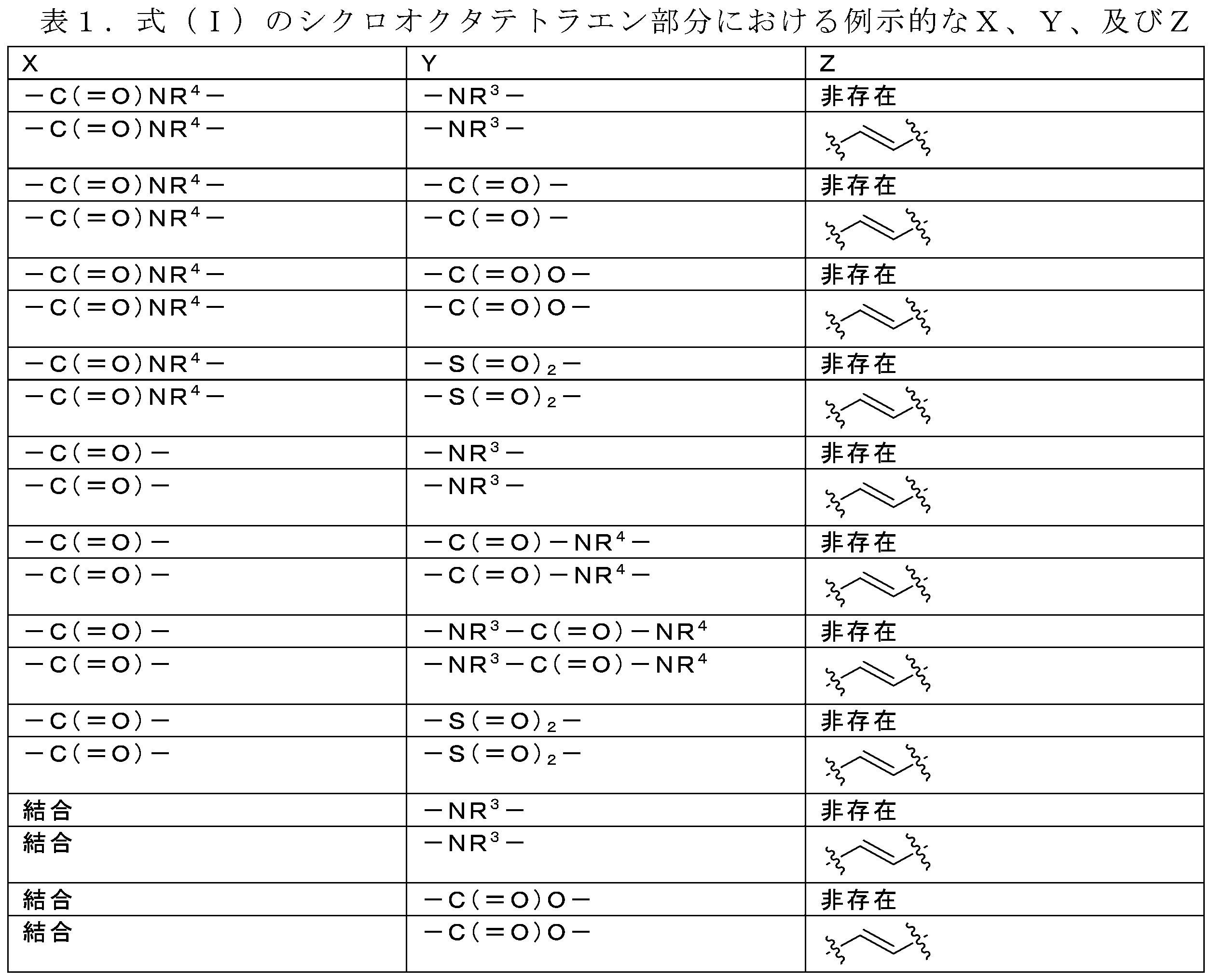
いくつかの実施形態では、シクロオクタテトラエン部分は、式(Ia)の構造:




式(I)、(Ia)、(Ib)、(Ic)、又は(Id)のCOT部分を含む蛍光化合物のいくつかの実施形態では、R1及びR2のうちの少なくとも1つは、水素である。いくつかの更なる実施形態では、R1及びR2の両方が、水素である。いくつかの他の実施形態では、R1は、Hであり、R2は、任意に置換されたアミノ又はカルボキシルである。いくつかの実施形態では、mは、1、2、3、4、5、又は6であり、R1及びR2の各々は、独立して、水素、任意に置換されたアミノ、若しくはカルボキシル、又はそれらの組み合わせである。いくつかの更なる実施形態では、mが2、3、4、5、又は6である場合、1つのR1は、アミノ又はカルボキシルであり、残りのR1及びR2は、水素である。いくつかの実施形態では、







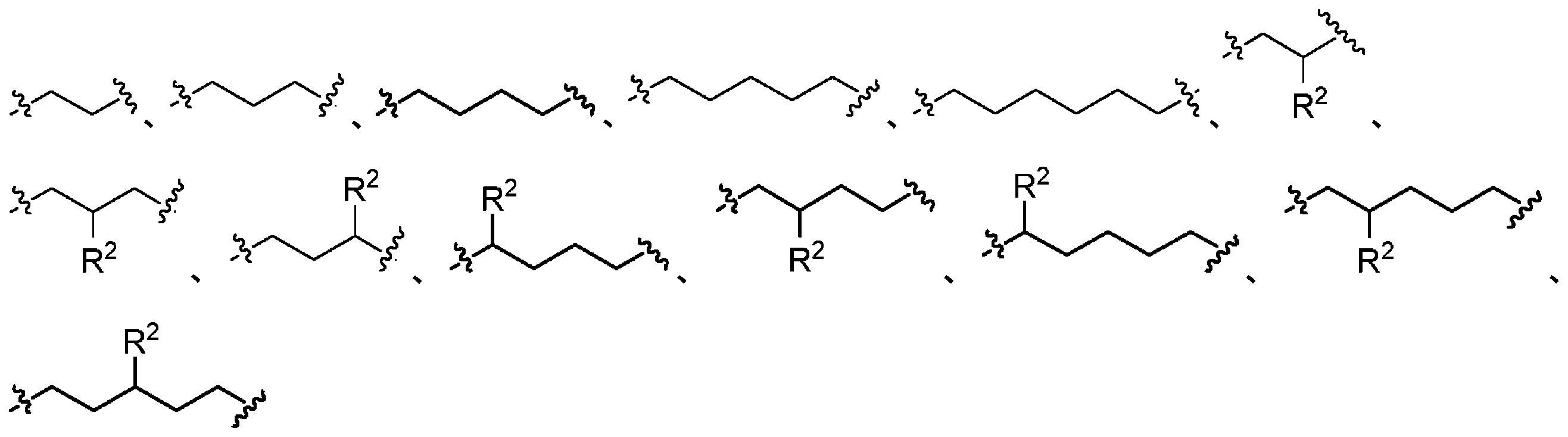
いくつかの更なる実施形態では、本明細書に記載の蛍光化合物は、以下の構造のシクロオクタテトラエン部分を含む。

本明細書に開示されるアルキル又は置換アルキルは、C1-12アルキル、又はより好ましくはC1~6アルキルである。いくつかの実施形態では、本明細書に開示されるアルコキシは、C1-12アルコキシ、又はより好ましくはC1~6アルコキシである。いくつかの実施形態では、本明細書に開示されるアルケニル基及びアルキニル基は、C2~6アルケニル及びC2~6アルキニルである。いくつかの実施形態では、本明細書に開示されるハロアルキル及びハロアルコキシ基は、C1-12ハロアルキル及びC1-12ハロアルコキシ、より好ましくはC1~6ハロアルキル及びC1~6ハロアルコキシである。いくつかの実施形態では、本明細書に開示される任意に置換されたアリールは、任意に置換されたC6~10アリール、例えば、フェニルである。いくつかの実施形態では、本明細書に開示される任意に置換されたアラルキルは、任意に置換されたC7~14アラルキル、例えば、ベンジルである。いくつかの実施形態では、本明細書に開示される任意に置換されたヘテロアリールは、任意に置換された5~10員ヘテロアリールであり、より好ましくは、任意に置換された5~6員ヘテロアリールである。いくつかの実施形態では、本明細書に開示される任意に置換されたカルボシクリルは、任意に置換された3~7員カルボシクリル、特に3~7員シクロアルキルである。いくつかの実施形態では、本明細書に開示される任意に置換されたヘテロシクリルは、任意に置換された3~7員ヘテロシクリル、より好ましくは5~6員ヘテロシクリルである。 Alkyl or substituted alkyl disclosed herein are C 1-12 alkyl, or more preferably C 1-6 alkyl. In some embodiments, alkoxy disclosed herein is C 1-12 alkoxy, or more preferably C 1-6 alkoxy. In some embodiments, alkenyl and alkynyl groups disclosed herein are C 2-6 alkenyl and C 2-6 alkynyl. In some embodiments, the haloalkyl and haloalkoxy groups disclosed herein are C 1-12 haloalkyl and C 1-12 haloalkoxy, more preferably C 1-6 haloalkyl and C 1-6 haloalkoxy. be. In some embodiments, an optionally substituted aryl disclosed herein is an optionally substituted C 6-10 aryl, eg, phenyl. In some embodiments, an optionally substituted aralkyl disclosed herein is an optionally substituted C 7-14 aralkyl, eg, benzyl. In some embodiments, an optionally substituted heteroaryl disclosed herein is an optionally substituted 5-10 membered heteroaryl, more preferably an optionally substituted 5-6 membered It is heteroaryl. In some embodiments, an optionally substituted carbocyclyl disclosed herein is an optionally substituted 3-7 membered carbocyclyl, particularly a 3-7 membered cycloalkyl. In some embodiments, an optionally substituted heterocyclyl disclosed herein is an optionally substituted 3- to 7-membered heterocyclyl, more preferably a 5- to 6-membered heterocyclyl.
いくつかの実施形態では、共有結合したCOT部分を含有する蛍光化合物は、約350nm~約500nmの発光波長を有する光源によって励起され得る。いくつかの更なる実施形態では、蛍光化合物は、約420nm~約480nm、又は約450nm~約460nmの発光波長を有する光源によって励起され得る。 In some embodiments, fluorescent compounds containing covalently attached COT moieties can be excited by light sources having emission wavelengths from about 350 nm to about 500 nm. In some further embodiments, fluorescent compounds can be excited by a light source having an emission wavelength of about 420 nm to about 480 nm, or about 450 nm to about 460 nm.
本明細書に記載のCOT部分を含む蛍光化合物のいくつかの実施形態では、蛍光化合物は、シアニン色素ではなく、例えば、蛍光化合物は、Cy2、Cy3、Cy5、若しくはCy7色素、又はそれらの誘導体、又はそれらの任意に置換された類似体ではない。更なる実施形態では、蛍光化合物は、Cy5又はその誘導体及び任意に置換された類似体ではない。
COTを含有する緩衝組成物
In some embodiments of fluorescent compounds comprising COT moieties described herein, the fluorescent compound is not a cyanine dye, e.g., the fluorescent compound is a Cy2, Cy3, Cy5, or Cy7 dye, or a derivative thereof; or any optionally substituted analogues thereof. In a further embodiment, the fluorescent compound is not Cy5 or its derivatives and optionally substituted analogues.
Buffer composition containing COT
本開示のいくつかの実施形態は、蛍光標識の光漂白を防止又は低減し、かつ/又はDNA損傷を防止、低減、若しくは軽減するための組成物に関し、それは、シクロオクタテトラエン若しくはその任意に置換された誘導体と、タキシフォリン、ケルセチン、アリルチオ尿素、ジメチルチオ尿素、シリビニン、没食子酸誘導体、トロロックス、並びにそれらの任意に置換された誘導体及び組み合わせからなる群から選択される1つ以上の酸化防止剤と、を含む。いくつかの更なる実施形態では、組成物は、シクロオクタテトラエン及びケルセチン、並びにそれらの任意に置換された誘導体及び組み合わせを含む。いくつかの実施形態では、蛍光色素は、約350nm~約500nmの発光波長を有する光源によって励起され得る。いくつかの実施形態では、蛍光色素は、約420nm~約480nm、又は約450nm~約460nmの波長を有する光源によって励起され得る。いくつかの実施形態では、蛍光色素は、本明細書に記載のCOT部分結合化合物である。 Some embodiments of the present disclosure relate to compositions for preventing or reducing photobleaching of fluorescent labels and/or preventing, reducing, or reducing DNA damage, which comprise cyclooctatetraene or, optionally, substituted derivatives and one or more antioxidants selected from the group consisting of taxifolin, quercetin, allylthiourea, dimethylthiourea, silibinin, gallic acid derivatives, trolox, and optionally substituted derivatives and combinations thereof and including. In some further embodiments, the compositions comprise cyclooctatetraene and quercetin, and optionally substituted derivatives and combinations thereof. In some embodiments, a fluorochrome can be excited by a light source having an emission wavelength from about 350 nm to about 500 nm. In some embodiments, a fluorochrome can be excited by a light source having a wavelength of about 420 nm to about 480 nm, or about 450 nm to about 460 nm. In some embodiments, the fluorochrome is a COT moiety binding compound described herein.
いくつかの実施形態では、組成物は、水溶液、例えば、水性緩衝液中にある。いくつかのそのような実施形態では、組成物は、検出溶液中にある。いくつかの更なる実施形態では、水溶液中のシクロオクタテトラエン又は任意に置換された誘導体は、約0.1mM、0.2mM、0.5mM、1.0mM、2.0mM、5.0mM、10mM、15mM、20mM、25mM、30mM、35mM、40mM、45mM、50mM、55mM、60mM、65mM、70mM、75mM、80mM、85mM、90mM、95mM、若しくは100mM、又は前述の値のうちのいずれか2つによって定義される範囲の濃度である。いくつかの更なる実施形態では、シクロオクタテトラエン又は任意に置換された誘導体は、約0.1mM~約100mM、又は約1mM~約50mM、約2mM~約25mM、約5mM~約15mM、又は約10mMの濃度である。いくつかの実施形態では、水溶液中のケルセチン又は任意に置換された誘導体は、約0.01mM、0.02mM、0.05mM、0.1mM、0.2mM、0.3mM、0.4mM、0.5mM、0.6mM、0.7mM、0.8mM、0.9mM、1.0mM、2.0mM、5.0mM、若しくは10mM、又は前述の値のうちのいずれか2つによって定義される範囲の濃度である。いくつかの更なる実施形態では、ケルセチン又は任意に置換された誘導体は、約0.01mM~約10mM、約0.02mM~約5mM、約0.05mM~約2mM、約0.1mM~約1mM、約0.2mM~約0.5mM、又は約0.25mMの濃度である。 In some embodiments, the composition is in an aqueous solution, eg, an aqueous buffer. In some such embodiments, the composition is in a detection solution. In some further embodiments, the cyclooctatetraene or optionally substituted derivative in aqueous solution is about 0.1 mM, 0.2 mM, 0.5 mM, 1.0 mM, 2.0 mM, 5.0 mM, 10 mM, 15 mM, 20 mM, 25 mM, 30 mM, 35 mM, 40 mM, 45 mM, 50 mM, 55 mM, 60 mM, 65 mM, 70 mM, 75 mM, 80 mM, 85 mM, 90 mM, 95 mM, or 100 mM, or any two of the foregoing values is the concentration in the range defined by In some further embodiments, the cyclooctatetraene or optionally substituted derivative is from about 0.1 mM to about 100 mM, or from about 1 mM to about 50 mM, from about 2 mM to about 25 mM, from about 5 mM to about 15 mM, or A concentration of about 10 mM. In some embodiments, the quercetin or optionally substituted derivative in aqueous solution is about 0.01 mM, 0.02 mM, 0.05 mM, 0.1 mM, 0.2 mM, 0.3 mM, 0.4 mM, 0 .5 mM, 0.6 mM, 0.7 mM, 0.8 mM, 0.9 mM, 1.0 mM, 2.0 mM, 5.0 mM, or 10 mM, or a range defined by any two of the foregoing values. is the concentration of In some further embodiments, quercetin or an optionally substituted derivative is about 0.01 mM to about 10 mM, about 0.02 mM to about 5 mM, about 0.05 mM to about 2 mM, about 0.1 mM to about 1 mM , about 0.2 mM to about 0.5 mM, or about 0.25 mM.
いくつかの実施形態では、組成物は、追加の酸化防止剤、例えば、アスコルビン酸若しくはその塩(例えば、アスコルビン酸ナトリウム)、又は1つ以上のポリフェノール化合物を更に含む。組成物は、1つ以上の蛍光色素を更に含み得る。 In some embodiments, the composition further comprises an additional antioxidant, such as ascorbic acid or a salt thereof (eg, sodium ascorbate), or one or more polyphenolic compounds. The composition may further comprise one or more fluorescent dyes.
本開示のいくつかの実施形態は、蛍光色素を光漂白から保護する方法に関し、それは、蛍光色素を、本明細書に記載のシクロオクタテトラエンを含有する組成物と接触させることを含む。追加の実施形態は、標識ヌクレオシド又はヌクレオチドを光誘起劣化から保護する方法に関し、それは、標識ヌクレオシド又はヌクレオチドを、本明細書に記載の組成物と接触させることを含む。いくつかの実施形態では、標識ヌクレオチドは、ポリヌクレオチド鎖に組み込まれる。いくつかの実施形態では、標識ヌクレオチドと、本明細書に記載のCOT含有組成物との接触は、配列決定実行の検出工程中にある。
蛍光化合物
Some embodiments of the present disclosure relate to a method of protecting a fluorescent dye from photobleaching comprising contacting the fluorescent dye with a composition containing cyclooctatetraene as described herein. Additional embodiments relate to methods of protecting labeled nucleosides or nucleotides from light-induced degradation comprising contacting the labeled nucleosides or nucleotides with a composition described herein. In some embodiments, labeled nucleotides are incorporated into polynucleotide chains. In some embodiments, contacting a labeled nucleotide with a COT-containing composition described herein is during the detection step of a sequencing run.
fluorescent compound
本明細書に記載の光保護COT部分は、配列決定実行中の色素の光漂白及び/又は蛍光シグナル減衰を防止若しくは低減する目的で、配列決定分析、例えば、合成による配列決定の技術に好適な様々な蛍光色素に共有結合することができる。更に、本明細書に記載のCOTを含有する組成物を含む検出溶液は、蛍光化合物で標識されたヌクレオチドが鋳型ポリヌクレオチド鎖の少なくとも一部に相補的なポリヌクレオチド鎖に組み込まれた後、核酸配列決定用途の検出工程中のDNA損傷を予防又は低減するのにも好適であり得る。 The photoprotective COT moieties described herein are suitable for sequencing analysis, e.g., sequencing-by-synthesis techniques, to prevent or reduce dye photobleaching and/or fluorescence signal decay during sequencing It can be covalently attached to various fluorescent dyes. Further, a detection solution comprising a composition containing COT as described herein can detect a nucleic acid after the fluorescent compound-labeled nucleotide is incorporated into a polynucleotide strand complementary to at least a portion of a template polynucleotide strand. It may also be suitable for preventing or reducing DNA damage during the detection step of sequencing applications.
いくつかの実施形態では、ヌクレオチド標識に使用される蛍光化合物は、「青色色素」と呼ばれ、それらが400nm~500nm、より具体的には450nm~460nmの短波長光源(LED又はレーザー)によって励起され得ることを意味する。これらの化合物は、米国特許出願公開第2018/0094140号及び同第2018/0201981号、並びに米国特許出願第62/812837号及び同第62/812732号に記載されており、各々、その全体は参照により組み込まれる。
式(A)の蛍光化合物
In some embodiments, fluorescent compounds used for nucleotide labeling are referred to as "blue dyes" and they are excited by short wavelength light sources (LEDs or lasers) between 400 nm and 500 nm, more specifically between 450 nm and 460 nm. means that it can be These compounds are described in U.S. Patent Application Publication Nos. 2018/0094140 and 2018/0201981, and U.S. Patent Application Serial Nos. 62/812837 and 62/812732, each of which is incorporated by reference in its entirety. incorporated by
Fluorescent compound of formula (A)
いくつかの実施形態では、蛍光化合物は、式(A)又はその塩若しくはメソメリー形態によって表され、
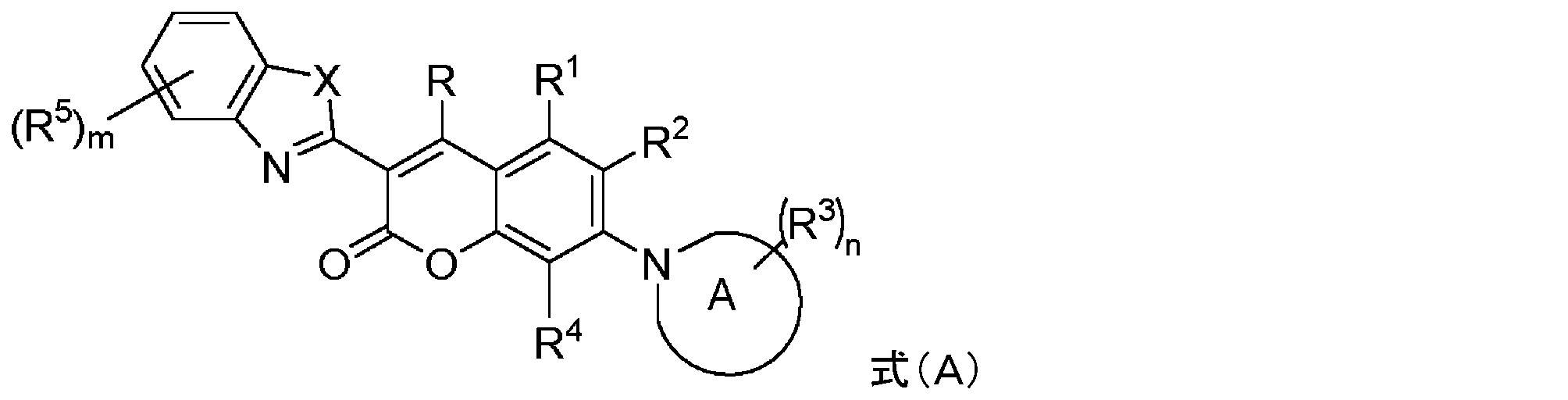
式中、
Xは、O、S、Se、又はNRnであり、式中、Rnは、H、C1~6アルキル、又はであり、C6~10アリールであり、
環Aは、3~10員ヘテロシクリルであり、
R、R1、R2、及びR4は、各々独立して、H、ハロ、-CN、-CO2H、アミノ、-OH、C-アミド、N-アミド、-NO2、-SO3H、-SO2NRaRb、任意に置換されたアルキル、任意に置換されたアルケニル、任意に置換されたアルキニル、任意に置換されたアルコキシ、任意に置換されたアミノアルキル、任意に置換されたカルボシクリル、任意に置換されたヘテロシクリル、任意に置換されたアリール、又は任意に置換されたヘテロアリールであり、
各R3は、独立して、ハロ、-CN、-CO2H、-(CH2)p-CO2Rc、-(CH2)q-C(O)NRdRe、アミノ、-OH、C-アミド、N-アミド、-NO2、-SO3H、-SO2NRaRb、任意に置換されたC1~6アルキル、任意に置換されたC2~6アルケニル、任意に置換されたC2~6アルキニル、任意に置換されたカルボシクリル、任意に置換されたヘテロシクリル、任意に置換されたアリール、若しくは任意に置換されたヘテロアリールであるか、又は2つのR3が、オキソ(=O)を形成し、
式中、p及びqは、各々1、2、3、又は4であり、
各R5は、独立して、ハロ、-CN、-CO2Rf、アミノ、-OH、C-アミド、N-アミド、-NO2、-SO3H、-SO2NRaRb、任意に置換されたアルキル、任意に置換されたアルケニル、任意に置換されたアルキニル、任意に置換されたアルコキシ、任意に置換されたアミノアルキル、任意に置換されたカルボシクリル、任意に置換されたヘテロシクリル、任意に置換されたアリール、又は任意に置換されたヘテロアリールであり、
各Ra及びRbは、独立して、H又は任意に置換されたC1~6アルキルであり、
各Rc、Rd、Re、及びRfは、独立して、H、任意に置換された置換C1~6アルキル、任意に置換されたカルボシクリル、任意に置換されたヘテロシクリル、任意に置換されたアリール、又は任意に置換されたヘテロアリールであり、
mは、0、1、2、3、又は4であり、
nは、0、1、2、3、4、又は5である。
式(B)の蛍光化合物
In some embodiments, the fluorescent compound is represented by Formula (A) or a salt or mesomeric form thereof,
During the ceremony,
X is O, S, Se, or NR n , wherein R n is H, C 1-6 alkyl, or C 6-10 aryl;
Ring A is 3-10 membered heterocyclyl,
R, R 1 , R 2 , and R 4 are each independently H, halo, —CN, —CO 2 H, amino, —OH, C-amido, N-amido, —NO 2 , —SO 3 H, —SO 2 NR a R b , optionally substituted alkyl, optionally substituted alkenyl, optionally substituted alkynyl, optionally substituted alkoxy, optionally substituted aminoalkyl, optionally substituted optionally substituted carbocyclyl, optionally substituted heterocyclyl, optionally substituted aryl, or optionally substituted heteroaryl;
Each R 3 is independently halo, —CN, —CO 2 H, —(CH 2 ) p —CO 2 R c , —(CH 2 ) q —C(O)NR d R e , amino, — OH, C-amido, N-amido, —NO 2 , —SO 3 H, —SO 2 NR a R b , optionally substituted C 1-6 alkyl, optionally substituted C 2-6 alkenyl, optionally is C 2-6 alkynyl, optionally substituted carbocyclyl, optionally substituted heterocyclyl, optionally substituted aryl, or optionally substituted heteroaryl substituted with , or two R 3 are forming oxo (=O),
wherein p and q are each 1, 2, 3, or 4;
each R 5 is independently halo, —CN, —CO 2 R f , amino, —OH, C-amido, N-amido, —NO 2 , —SO 3 H, —SO 2 NR a R b , optionally substituted alkyl, optionally substituted alkenyl, optionally substituted alkynyl, optionally substituted alkoxy, optionally substituted aminoalkyl, optionally substituted carbocyclyl, optionally substituted heterocyclyl, optionally substituted aryl or optionally substituted heteroaryl,
each R a and R b is independently H or optionally substituted C 1-6 alkyl;
Each R c , R d , R e , and R f is independently H, optionally substituted substituted C 1-6 alkyl, optionally substituted carbocyclyl, optionally substituted heterocyclyl, optionally substituted aryl, or optionally substituted heteroaryl,
m is 0, 1, 2, 3, or 4;
n is 0, 1, 2, 3, 4, or 5;
Fluorescent compound of formula (B)
いくつかの実施形態では、蛍光化合物は、式(B)又はその塩若しくはメソメリー形態によって表され、
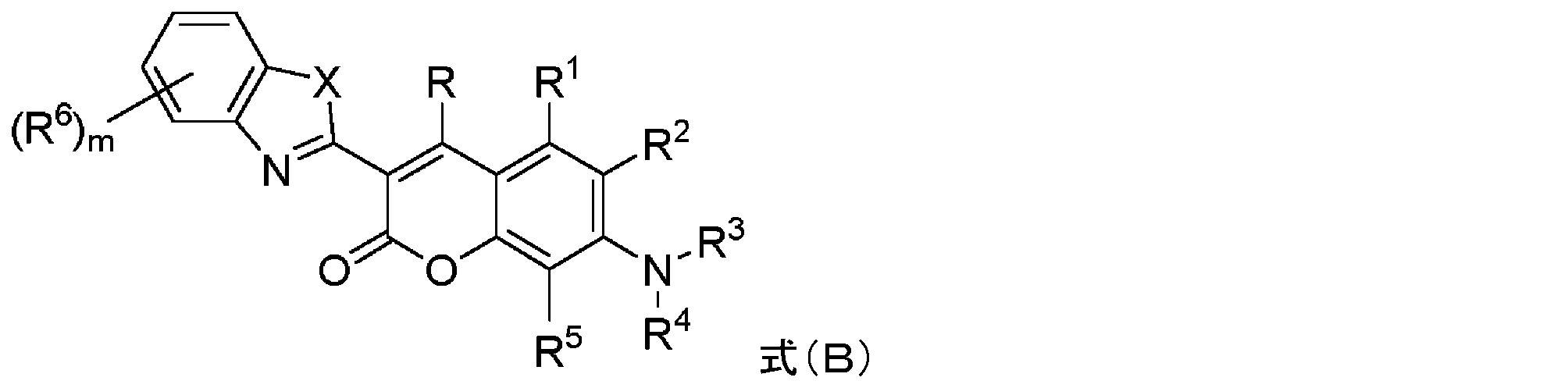
式中、
Xは、O、S、Se、又はNRnであり、式中、Rnは、H、C1~6アルキル、又はC6~10アリールであり、
R1、R2、及びR5の各々は、独立して、H、ハロ、-CN、-CO2H、アミノ、-OH、C-アミド、N-アミド、-NO2、-SO3H、-SO2NRaRb、任意に置換されたアルキル、任意に置換されたアルケニル、任意に置換されたアルキニル、任意に置換されたアルコキシ、任意に置換されたアミノアルキル、任意に置換されたカルボシクリル、任意に置換されたヘテロシクリル、任意に置換されたアリール、又は任意に置換されたヘテロアリールであり、
Rは、H、ハロ、-CN、-CO2H、アミノ、-OH、C-アミド、N-アミド、-NO2、-SO3H、-SO2NRaRb、任意に置換されたアルキル、任意に置換されたアルケニル、任意に置換されたアルキニル、任意に置換されたアルコキシ、任意に置換されたアミノアルキル、任意に置換されたカルボシクリル、任意に置換されたヘテロシクリル、又は任意に置換されたヘテロアリールである。
各R3及びR4は、独立して、C1~6アルキル、-(CH2)p-CO2Rc、-(CH2)q-C(O)NRdRe、-(CH2)n-SO3H、-(CH2)t-SO2NRaRbであり、式中、各p、q、n、及びtは、独立して、1、2、3、4、5、又は6であり、
各R6は、独立して、ハロ、-CN、-CO2Rf、アミノ、-OH、C-アミド、N-アミド、-NO2、-SO3H、-SO2NRaRb、任意に置換されたアルキル、任意に置換されたアルケニル、任意に置換されたアルキニル、任意に置換されたアルコキシ、任意に置換されたアミノアルキル、任意に置換されたカルボシクリル、任意に置換されたヘテロシクリル、任意に置換されたアリール、又は任意に置換されたヘテロアリールであり、
各Ra及びRbは、独立して、H又は任意に置換されたC1~6アルキルであり、
各Rc、Rd、Re、及びRfは、独立して、H、任意に置換されたC1~6アルキル、任意に置換されたカルボシクリル、任意に置換されたヘテロシクリル、任意に置換されたアリール、又は任意に置換されたヘテロアリールであり、
mは、0、1、2、3、又は4である。
式(C)の蛍光化合物
In some embodiments, the fluorescent compound is represented by Formula (B) or a salt or mesomeric form thereof,
During the ceremony,
X is O, S, Se, or NR n , wherein R n is H, C 1-6 alkyl, or C 6-10 aryl;
Each of R 1 , R 2 , and R 5 is independently H, halo, —CN, —CO 2 H, amino, —OH, C-amido, N-amido, —NO 2 , —SO 3 H , —SO 2 NR a R b , optionally substituted alkyl, optionally substituted alkenyl, optionally substituted alkynyl, optionally substituted alkoxy, optionally substituted aminoalkyl, optionally substituted carbocyclyl, optionally substituted heterocyclyl, optionally substituted aryl, or optionally substituted heteroaryl;
R is H, halo, —CN, —CO 2 H, amino, —OH, C-amido, N-amido, —NO 2 , —SO 3 H, —SO 2 NR a R b , optionally substituted alkyl, optionally substituted alkenyl, optionally substituted alkynyl, optionally substituted alkoxy, optionally substituted aminoalkyl, optionally substituted carbocyclyl, optionally substituted heterocyclyl, or optionally substituted is heteroaryl.
Each R 3 and R 4 is independently C 1-6 alkyl, —(CH 2 ) p —CO 2 R c , —(CH 2 ) q —C(O)NR d R e , —(CH 2 ) n —SO 3 H, —(CH 2 ) t —SO 2 NR a R b , wherein each p, q, n, and t is independently 1, 2, 3, 4, 5 , or 6,
each R 6 is independently halo, —CN, —CO 2 R f , amino, —OH, C-amido, N-amido, —NO 2 , —SO 3 H, —SO 2 NR a R b , optionally substituted alkyl, optionally substituted alkenyl, optionally substituted alkynyl, optionally substituted alkoxy, optionally substituted aminoalkyl, optionally substituted carbocyclyl, optionally substituted heterocyclyl, optionally substituted aryl or optionally substituted heteroaryl,
each R a and R b is independently H or optionally substituted C 1-6 alkyl;
Each R c , R d , R e , and R f is independently H, optionally substituted C 1-6 alkyl, optionally substituted carbocyclyl, optionally substituted heterocyclyl, optionally substituted aryl, or optionally substituted heteroaryl;
m is 0, 1, 2, 3, or 4;
Fluorescent compound of formula (C)
いくつかの実施形態では、蛍光化合物は、式(C)又はその塩若しくはメソメリー形態によって表され、
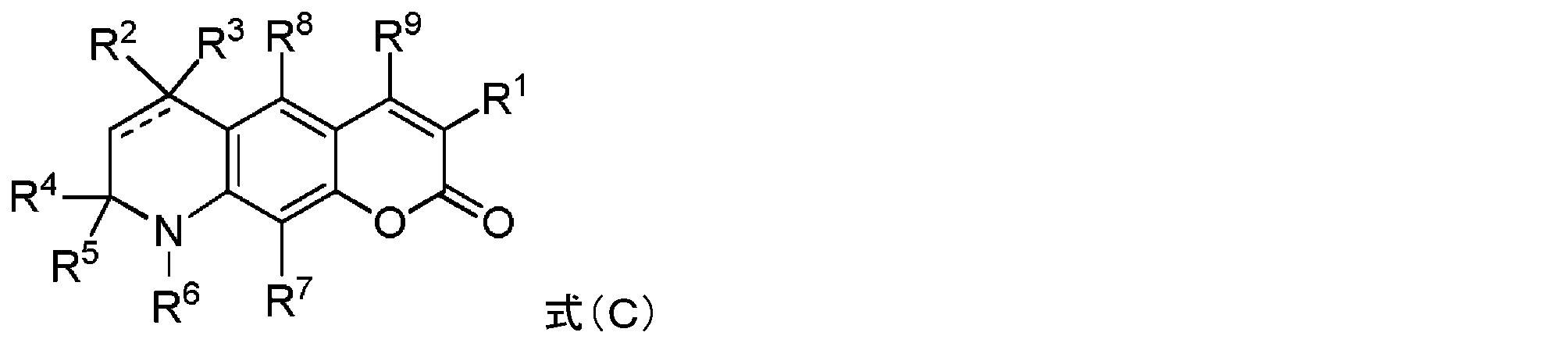

各R2、R3、R4、R5、及びR9は、独立して、H、アルキル、置換アルキル、アルコキシ、アルケニル、アルキニル、ハロアルキル、ハロアルコキシ、アルコキシアルキル、アミノ、アミノアルキル、ハロ、シアノ、ヒドロキシ、ヒドロキシアルキル、ヘテロアルキル、C-カルボキシ、O-カルボキシ、C-アミド、N-アミド、ニトロ、スルホニル、スルホ、スルフィノ、スルホネート、S-スルホンアミド、N-スルホンアミド、任意に置換されたカルボシクリル、任意に置換されたアリール、任意に置換されたヘテロアリール、及び任意に置換されたヘテロシクリルからなる群から選択され、
各R6、R10a、R10b、及びR10cは、独立して、H、アルキル、置換アルキル、アルケニル、アルキニル、アミノアルキル、ハロアルキル、ヘテロアルキル、アルコキシアルキル、スルホニルヒドロキシド、任意に置換されたアリール、任意に置換されたヘテロアリール、任意に置換されたカルボシクリル、及び任意に置換されたヘテロシクリルからなる群から選択され、
各R7及びR8は、独立して、H、アルキル、置換アルキル、アルコキシ、アルケニル、アルキニル、ハロアルキル、ハロアルコキシ、アルコキシアルキル、アミノ、アミノアルキル、ハロ、シアノ、ヒドロキシ、ヒドロキシアルキル、ヘテロアルキル、C-カルボキシ、O-カルボキシ、C-アミド、N-アミド、ニトロ、スルホニル、スルホ、スルフィノ、スルホネート、S-スルホンアミド、N-スルホンアミド、任意に置換されたカルボシクリル、任意に置換されたアリール、任意に置換されたヘテロアリール、及び任意に置換されたヘテロシクリルからなる群から選択され、
代替として、R6及びR7は、それらが結合している原子と一緒に、任意に置換された5~10員ヘテロアリール又は任意に置換された5~10員ヘテロシクリルからなる群から選択される環又は環系を形成し、
Xは、O、S、NR11、及びSeからなる群から選択され、
R11は、H、アルキル、置換アルキル、アルケニル、アルキニル、アミノアルキル、カルボキシアルキル、スルホナトアルキル、ハロアルキル、ヘテロアルキル、アルコキシアルキル、スルホ、任意に置換されたアリール、任意に置換されたヘテロアリール、任意に置換されたカルボシクリル、及び任意に置換されたヘテロシクリルからなる群から選択され、
実線及び破線によって表される結合


式(D)の蛍光化合物
In some embodiments, the fluorescent compound is represented by Formula (C) or a salt or mesomeric form thereof,
Each R2 , R3 , R4 , R5 , and R9 is independently H, alkyl, substituted alkyl, alkoxy, alkenyl, alkynyl, haloalkyl, haloalkoxy, alkoxyalkyl, amino, aminoalkyl, halo, cyano, hydroxy, hydroxyalkyl, heteroalkyl, C-carboxy, O-carboxy, C-amido, N-amido, nitro, sulfonyl, sulfo, sulfino, sulfonate, S-sulfonamide, N-sulfonamide, optionally substituted optionally substituted aryl, optionally substituted heteroaryl, and optionally substituted heterocyclyl;
Each R 6 , R 10a , R 10b and R 10c is independently H, alkyl, substituted alkyl, alkenyl, alkynyl, aminoalkyl, haloalkyl, heteroalkyl, alkoxyalkyl, sulfonylhydroxide, optionally substituted selected from the group consisting of aryl, optionally substituted heteroaryl, optionally substituted carbocyclyl, and optionally substituted heterocyclyl;
Each R7 and R8 is independently H, alkyl, substituted alkyl, alkoxy, alkenyl, alkynyl, haloalkyl, haloalkoxy, alkoxyalkyl, amino, aminoalkyl, halo, cyano, hydroxy, hydroxyalkyl, heteroalkyl, C-carboxy, O-carboxy, C-amido, N-amido, nitro, sulfonyl, sulfo, sulfino, sulfonate, S-sulfonamide, N-sulfonamide, optionally substituted carbocyclyl, optionally substituted aryl, selected from the group consisting of optionally substituted heteroaryl and optionally substituted heterocyclyl;
Alternatively, R 6 and R 7 together with the atom to which they are attached are selected from the group consisting of optionally substituted 5-10 membered heteroaryl or optionally substituted 5-10 membered heterocyclyl forming a ring or ring system;
X is selected from the group consisting of O, S, NR 11 and Se;
R 11 is H, alkyl, substituted alkyl, alkenyl, alkynyl, aminoalkyl, carboxyalkyl, sulfonatoalkyl, haloalkyl, heteroalkyl, alkoxyalkyl, sulfo, optionally substituted aryl, optionally substituted heteroaryl, selected from the group consisting of optionally substituted carbocyclyl and optionally substituted heterocyclyl;
Bonds represented by solid and dashed lines
Fluorescent compound of formula (D)
いくつかの実施形態では、蛍光化合物は、式(D)又はその塩若しくはメソメリー形態によって表され

代替として、R1及びR1’は、それらが結合している原子と一緒に、任意に置換されたカルボシクリル、任意に置換されたアリール、任意に置換されたヘテロアリール、及び任意に置換されたヘテロシクリルからなる群から選択される環又は環系を形成し、
各R3及びR4は、独立して、H、アルキル、置換アルキル、アルケニル、アルキニル、アミノアルキル、ハロアルキル、ヘテロアルキル、アルコキシアルキル、スルホニルヒドロキシド、任意に置換されたアリール、任意に置換されたヘテロアリール、任意に置換されたカルボシクリル、及び任意に置換されたヘテロシクリルからなる群から選択され、
代替として、R1及びR3は、それらが結合している原子と一緒に、任意に置換された5~10員ヘテロアリール又は任意に置換された5~10員ヘテロシクリルからなる群から選択される環又は環系を形成し、
代替として、R2及びR4は、それらが結合している原子と一緒に、任意に置換された5~10員ヘテロアリール及び任意に置換された5~10員ヘテロシクリルからなる群から選択される環又は環系を形成し、
R5及びR6は、独立して、アルキル、置換アルキル、アルコキシ、アルケニル、アルキニル、ハロアルキル、アロアルコキシ、アルコキシアルキル、アミノ、アミノアルキル、アミノスルホニル、ハロ、シアノ、ヒドロキシ、ヒドロキシアルキル、ヘテロアルキル、C-カルボキシ、O-カルボキシ、C-アミド、N-アミド、ニトロ、スルホニル、スルホ、スルフィノ、スルホネート、スルホニルハライド、S-スルホンアミド、N-スルホンアミド、任意に置換されたカルボシクリル、任意に置換されたアリール、任意に置換されたヘテロアリール、及び任意に置換されたヘテロシクリルからなる群から選択され、
Rは、-OR7又は-NR8R9から選択され、
R7は、H、アルキル、置換アルキル、任意に置換されたアリール、任意に置換されたヘテロアリール、任意に置換されたカルボシクリル、及び任意に置換されたヘテロシクリルからなる群から選択され、
各R8及びR9は、独立して、H、アルキル、置換アルキル、アルケニル、アルキニル、アミノアルキル、カルボキシアルキル、スルホナトアルキル、ハロアルキル、ヘテロアルキル、アルコキシアルキル、スルホ、任意に置換されたアリール、任意に置換されたヘテロアリール、任意に置換されたカルボシクリル、及び任意に置換されたヘテロシクリルからなる群から選択され、
Xは、O、S、NR10、及びSeからなる群から選択され、
R10は、H、アルキル、置換アルキル、任意に置換されたアリール、任意に置換されたヘテロアリール、任意に置換されたカルボシクリル、及び任意に置換されたヘテロシクリルからなる群から選択され、
mは、0~4から選択される整数であり、
nは、0~4から選択される整数である。
In some embodiments, the fluorescent compound is represented by Formula (D) or a salt or mesomeric form thereof
Alternatively, R 1 and R 1′ together with the atom to which they are attached are optionally substituted carbocyclyl, optionally substituted aryl, optionally substituted heteroaryl, and optionally substituted forming a ring or ring system selected from the group consisting of heterocyclyl;
Each R3 and R4 is independently H, alkyl, substituted alkyl, alkenyl, alkynyl, aminoalkyl, haloalkyl, heteroalkyl, alkoxyalkyl, sulfonylhydroxide, optionally substituted aryl, optionally substituted selected from the group consisting of heteroaryl, optionally substituted carbocyclyl, and optionally substituted heterocyclyl;
Alternatively, R 1 and R 3 together with the atom to which they are attached are selected from the group consisting of optionally substituted 5-10 membered heteroaryl or optionally substituted 5-10 membered heterocyclyl forming a ring or ring system;
Alternatively, R 2 and R 4 together with the atom to which they are attached are selected from the group consisting of optionally substituted 5-10 membered heteroaryl and optionally substituted 5-10 membered heterocyclyl forming a ring or ring system;
R 5 and R 6 are independently alkyl, substituted alkyl, alkoxy, alkenyl, alkynyl, haloalkyl, alloalkoxy, alkoxyalkyl, amino, aminoalkyl, aminosulfonyl, halo, cyano, hydroxy, hydroxyalkyl, heteroalkyl, C-carboxy, O-carboxy, C-amido, N-amido, nitro, sulfonyl, sulfo, sulfino, sulfonate, sulfonyl halide, S-sulfonamide, N-sulfonamide, optionally substituted carbocyclyl, optionally substituted aryl, optionally substituted heteroaryl, and optionally substituted heterocyclyl;
R is selected from -OR 7 or -NR 8 R 9 ;
R7 is selected from the group consisting of H, alkyl, substituted alkyl, optionally substituted aryl, optionally substituted heteroaryl, optionally substituted carbocyclyl, and optionally substituted heterocyclyl;
each R 8 and R 9 is independently H, alkyl, substituted alkyl, alkenyl, alkynyl, aminoalkyl, carboxyalkyl, sulfonatoalkyl, haloalkyl, heteroalkyl, alkoxyalkyl, sulfo, optionally substituted aryl; selected from the group consisting of optionally substituted heteroaryl, optionally substituted carbocyclyl, and optionally substituted heterocyclyl;
X is selected from the group consisting of O, S, NR 10 and Se;
R 10 is selected from the group consisting of H, alkyl, substituted alkyl, optionally substituted aryl, optionally substituted heteroaryl, optionally substituted carbocyclyl, and optionally substituted heterocyclyl;
m is an integer selected from 0 to 4,
n is an integer selected from 0-4.
いくつかの特定の実施形態では、非限定的な、例示的な青色色素化合物は、以下:

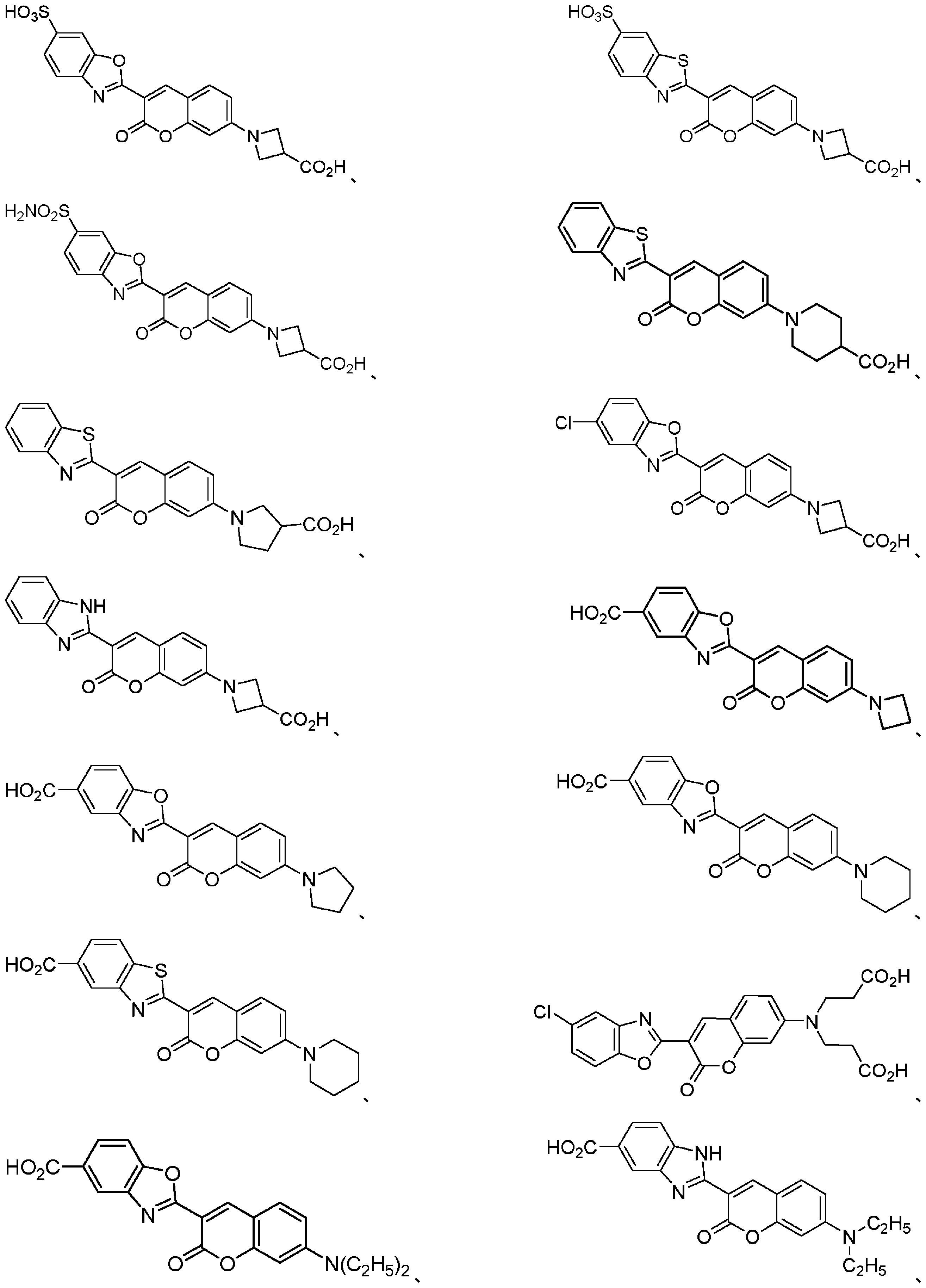


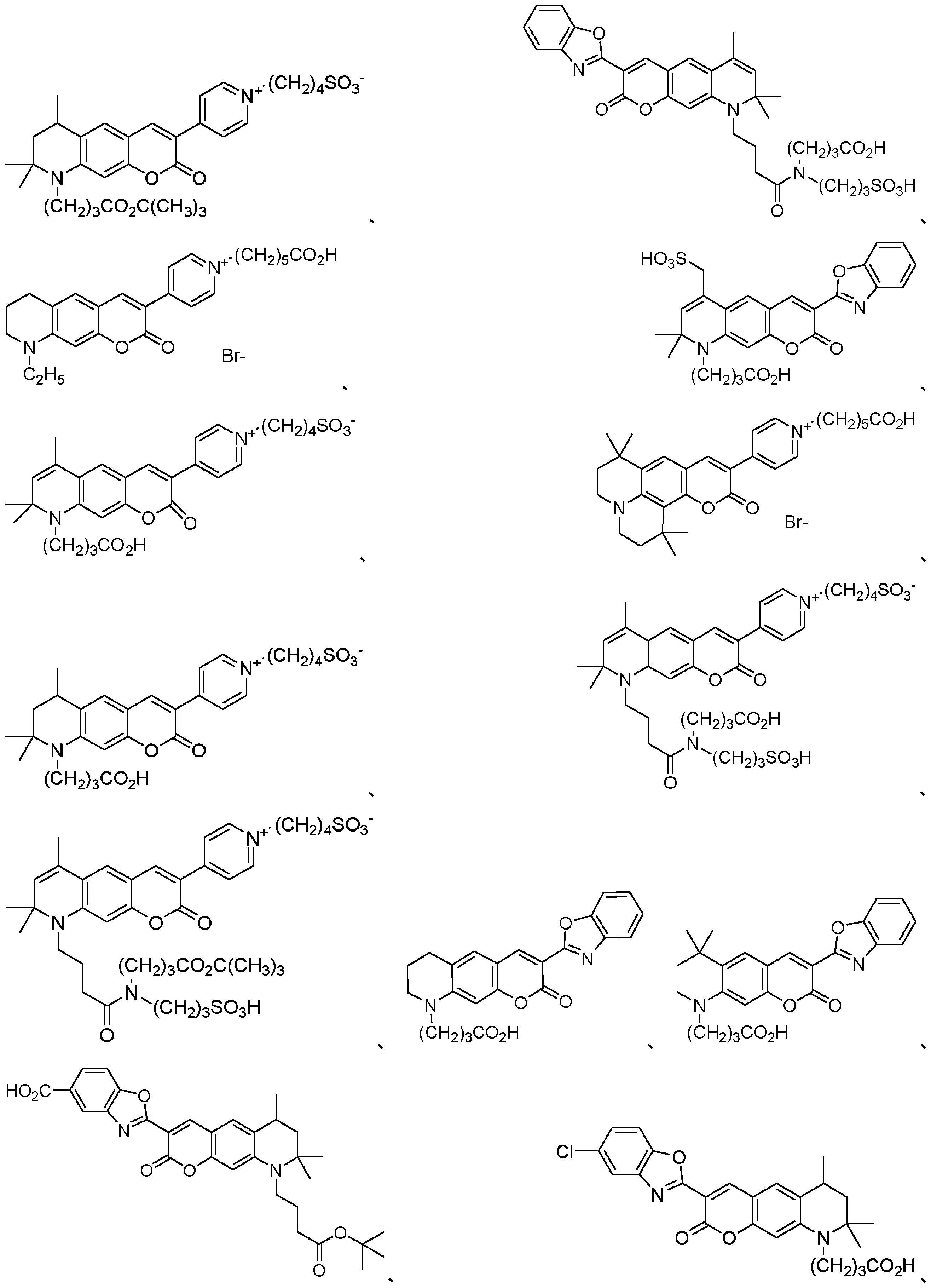
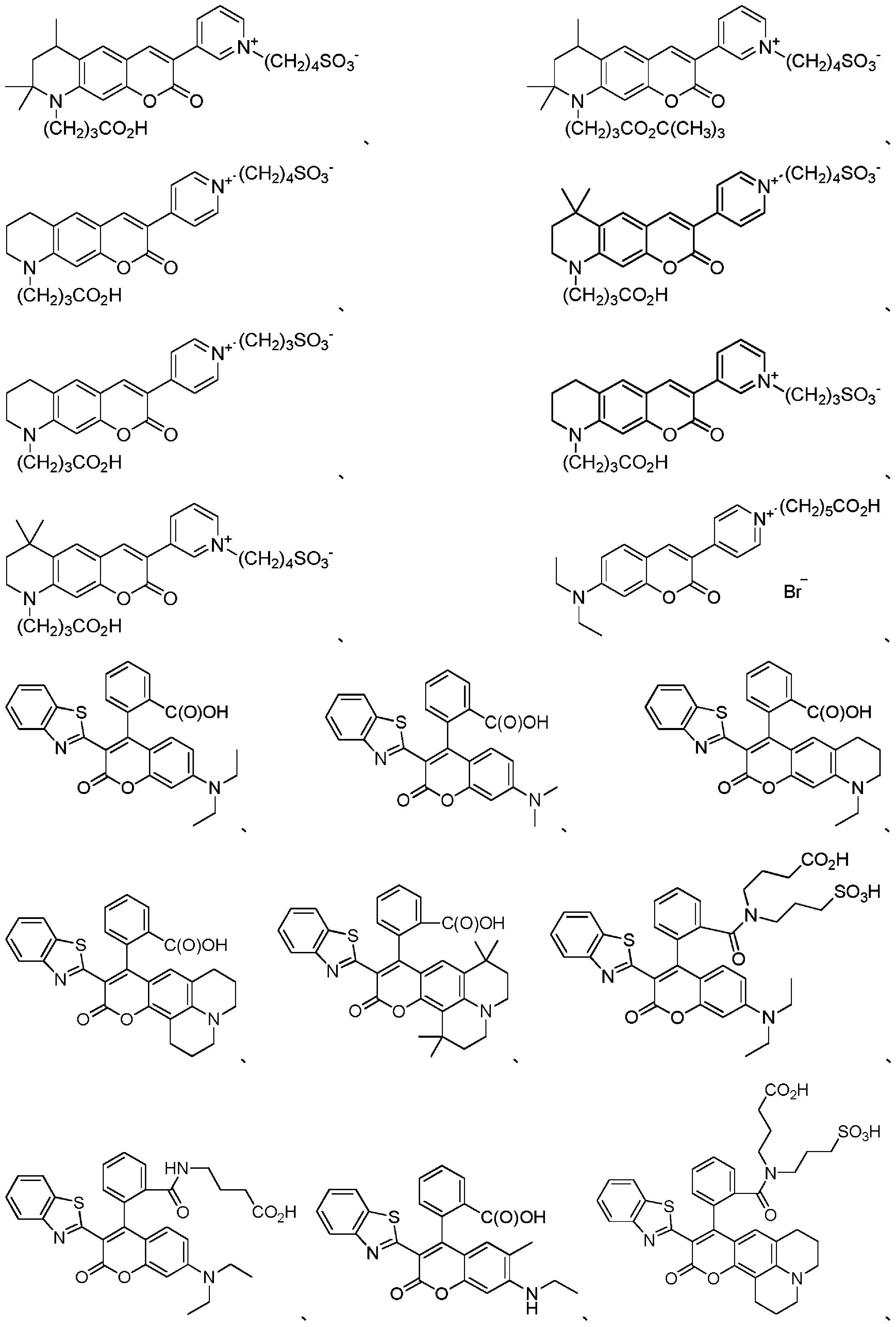

COT結合色素の合成
本開示のいくつかの態様は、蛍光色素を光漂白から保護する方法に関し、これは、本明細書に記載の式(I)、(Ia)、(Ib)、(Ic)、又は(Id)の構造を含むCOT部分に蛍光色素を共有結合させることを含む。本開示のいくつかの更なる態様は、ヌクレオシド又はヌクレオチドを光誘起劣化から保護する方法に関し、それは、ヌクレオシド又はヌクレオチドを、本明細書に記載の式(I)、(Ia)、(Ib)、(Ic)、又は(Id)の構造のCOT部分を含む蛍光化合物に共有結合させることを含む。
Synthesis of COT Binding Dyes Some aspects of the present disclosure relate to methods of protecting fluorescent dyes from photobleaching, which are represented by formulas (I), (Ia), (Ib), (Ic) described herein. , or covalently attaching a fluorochrome to the COT moiety containing the (Id) structure. Some further aspects of the present disclosure relate to methods of protecting nucleosides or nucleotides from light-induced degradation, comprising treating the nucleosides or nucleotides according to formulas (I), (Ia), (Ib), as described herein; Covalent attachment to a fluorescent compound containing the COT portion of the structure (Ic) or (Id).
本明細書に記載の蛍光色素は、様々な方法を介してCOT部分に共有連結し得る。例えば、COT部分は、アミノ反応性官能基を含有する置換COT化合物を、例えば、蛍光化合物のカルボキシル基(-CO2H)、スルホ(-SO3H)、又はスルホネート基(-SO3
-)と反応させることによって蛍光化合物に導入され得る。


他の例では、COT部分は、COT部分含有化合物のカルボキシル、スルホ、又はスルホネート基を色素のアミノ基と反応させることによって蛍光化合物に導入され得る。
標識ヌクレオチド
In another example, a COT moiety can be introduced into a fluorescent compound by reacting a carboxyl, sulfo, or sulfonate group of a COT moiety-containing compound with an amino group of a dye.
labeled nucleotide
本明細書に記載のCOT部分結合蛍光化合物は、基材部分への結合に好適である。基材部分は、本明細書に記載の蛍光色素がコンジュゲート及び接合され得る、実質上任意の分子又は物質であり得、非限定的な例として、ヌクレオシド、ヌクレオチド、ポリヌクレオチド、炭水化物、配位子、粒子、固体表面、有機及び無機ポリマー、並びにそれらの組み合わせ又は集合体、例えば、染色体、核、生細胞などが含まれ得る。色素は、疎水性誘引、イオン誘引、及び共有結合を含む様々な手段によって、任意のリンカーによって固定することができる。特に、色素は、共有結合によって基材にコンジュゲートされる。より具体的には、共有結合は、リンカー基によるものである。場合によっては、このような標識ヌクレオチドは、「修飾ヌクレオチド」とも称される。 The COT moiety-attached fluorescent compounds described herein are suitable for attachment to substrate moieties. Substrate moieties can be virtually any molecule or substance to which the fluorochromes described herein can be conjugated and conjugated, non-limiting examples include nucleosides, nucleotides, polynucleotides, carbohydrates, coordination They can include particles, particles, solid surfaces, organic and inorganic polymers, and combinations or assemblies thereof, such as chromosomes, nuclei, living cells, and the like. Dyes can be immobilized by any linker by a variety of means, including hydrophobic attraction, ion attraction, and covalent bonding. In particular, the dye is covalently conjugated to the substrate. More specifically, covalent attachment is through a linker group. Sometimes such labeled nucleotides are also referred to as "modified nucleotides."
本明細書に記載されるCOT部分結合蛍光色素の特定の有用な用途は、生体分子、例えば、ヌクレオチド又はオリゴヌクレオチドを標識することである。本出願のいくつかの実施形態は、本明細書に記載される蛍光化合物で標識されたヌクレオチド又はオリゴヌクレオチドを対象とする。 A particular useful application of the COT moiety-binding fluorescent dyes described herein is to label biomolecules, such as nucleotides or oligonucleotides. Some embodiments of the present application are directed to nucleotides or oligonucleotides labeled with fluorescent compounds described herein.
適切なスペクトル特性(ストークスシフト、吸収及び蛍光強度、吸収及び蛍光最大値の位置、並びに吸収及び蛍光バンドの形状など)を有する蛍光色素分子は、核酸配列決定の速度及び精度を改善することができる。場合によっては、ストークスシフトは、生物学的用途における蛍光の検出における重要な態様であり得る。例えば、励起及び発光波長が大幅に重複するため、放出光の検出は、吸収及び蛍光最大値が互いに非常に近いフルオロフォア(すなわち、小さいストークスシフト)を使用するとき、励起光と区別することが困難であり得る。対照的に、大きなストークスシフトを有するフルオロフォアは、励起波長と発光波長との間の分離がより大きいため、区別することが容易である。ストークスシフトは、1つのフルオロフォアの発光波長が重複し、したがって同じ試料中の別のフルオロフォアを励起し得るため、多重蛍光用途において特に重要である。加えて、蛍光シグナル強度は、測定が、水性の生物学的緩衝液中かつ/又は高温で行われる場合、ほとんどの色素の蛍光は、そのような条件下では著しく低いため、特に重要である。更に、色素が結合している塩基の性質もまた、蛍光最大値、蛍光強度、及び他のスペクトル色素特性に影響を及ぼす。蛍光色素と核酸塩基との間の配列特異的相互作用は、蛍光色素の特定の設計によって調整することができる。蛍光色素の構造を最適化することにより、それらの蛍光特性が調整され、また、ヌクレオチドの組み込み効率が改善し、配列決定エラーのレベルが低減し、核酸配列決定における試薬の使用量、その結果、そのコストが減少し得る。 Fluorophores with appropriate spectral properties (such as Stokes shift, absorption and fluorescence intensity, location of absorption and fluorescence maxima, and shapes of absorption and fluorescence bands) can improve the speed and accuracy of nucleic acid sequencing. . In some cases, the Stokes shift can be an important aspect in the detection of fluorescence in biological applications. For example, detection of emission light can be distinguished from excitation light when using fluorophores whose absorption and fluorescence maxima are very close to each other (i.e., small Stokes shift), because the excitation and emission wavelengths overlap significantly. can be difficult. In contrast, fluorophores with large Stokes shifts are easier to distinguish due to the greater separation between excitation and emission wavelengths. The Stokes shift is particularly important in multiplex fluorescence applications because the emission wavelengths of one fluorophore overlap and can therefore excite another fluorophore in the same sample. In addition, fluorescence signal intensity is of particular importance when measurements are performed in aqueous biological buffers and/or at elevated temperatures, as the fluorescence of most dyes is significantly lower under such conditions. In addition, the nature of the base to which the dye is attached also affects fluorescence maxima, fluorescence intensity, and other spectral dye properties. Sequence-specific interactions between fluorochromes and nucleobases can be tailored by the specific design of the fluorochrome. Optimizing the structure of fluorochromes tunes their fluorescence properties and also improves the efficiency of nucleotide incorporation, reduces the level of sequencing errors, and reduces reagent usage in nucleic acid sequencing, resulting in: Its cost can be reduced.
いくつかの実施形態では、本明細書に記載の色素化合物は、ヌクレオチド塩基を介してオリゴヌクレオチド又はヌクレオチドに共有結合することができる。例えば、標識ヌクレオチド又はオリゴヌクレオチドは、ピリミジン塩基のC5位置に取り付けられた標識、又は7デアザプリン塩基のC7位置にリンカー部分を介して取り付けられた標識を有してもよい。標識ヌクレオチド又はオリゴヌクレオチドはまた、ヌクレオチドのリボース糖又はデオキシリボース糖に共有結合した3’-OHブロッキング基を有してもよい。 In some embodiments, a dye compound described herein can be covalently attached to an oligonucleotide or nucleotide through a nucleotide base. For example, a labeled nucleotide or oligonucleotide may have a label attached to the C5 position of a pyrimidine base or a label attached to the C7 position of a 7-deazapurine base via a linker moiety. A labeled nucleotide or oligonucleotide may also have a 3'-OH blocking group covalently attached to the ribose or deoxyribose sugar of the nucleotide.
いくつかの実施形態では、本明細書に記載される共有結合したCOT部分は、色素の蛍光特性(ストークスシフト、蛍光強度、蛍光最大値の位置、及び蛍光バンドの形状など)を変化させないか、又は実質的に変化させない。
3’-OHブロッキング基
In some embodiments, the covalently attached COT moieties described herein do not alter the fluorescence properties of the dye (such as Stokes shift, fluorescence intensity, position of fluorescence maxima, and shape of fluorescence bands); or substantially unchanged.
3'-OH blocking group
標識ヌクレオチド又はオリゴヌクレオチドはまた、ヌクレオチドのリボース糖又はデオキシリボース糖に共有結合したブロッキング基を有してもよい。ブロッキング基は、リボース糖又はデオキシリボース糖上の任意の位置に付着されてもよい。特定の実施形態では、ブロッキング基は、ヌクレオチドのリボース糖又はデオキシリボース糖の3’-OH位置にある。様々な3’-OHブロッキング基は、国際公開第2004/018497号、同第2014/139596号、及び米国特許出願公開第2020/0216891号に記載されており、これらは、参照により本明細書に組み込まれる。例えば、ブロッキング基は、アジドメチル(-CH2N3)若しくは置換アジドメチル(例えば、-CH(CHF2)N3又はCH(CH2F)N3)、又はリボース若しくはデオキシリボース糖の3’酸素原子に接続しているアリルであり得る。いくつかの実施形態では、3’ブロッキング基は、アジドメチルであり、リボース又はデオキシリボースの3’炭素を用いて3’-OCH2N3を形成する。 A labeled nucleotide or oligonucleotide may also have a blocking group covalently attached to the ribose or deoxyribose sugar of the nucleotide. The blocking group may be attached at any position on the ribose or deoxyribose sugar. In certain embodiments, the blocking group is at the 3'-OH position of the ribose or deoxyribose sugar of the nucleotide. Various 3′-OH blocking groups are described in WO 2004/018497, WO 2014/139596, and US Patent Application Publication No. 2020/0216891, which are incorporated herein by reference. incorporated. For example, the blocking group may be azidomethyl (--CH 2 N 3 ) or substituted azidomethyl (eg --CH(CHF 2 )N 3 or CH(CH 2 F)N 3 ), or the 3′ oxygen atom of a ribose or deoxyribose sugar. can be an allele connected to In some embodiments, the 3' blocking group is azidomethyl and uses the 3' carbon of ribose or deoxyribose to form 3' - OCH2N3 .
いくつかの他の実施形態では、3’ブロッキング基及び3’酸素原子は、リボース又はデオキシリボースの3’炭素に共有結合した構造

式中、各R1a及びR1bは、独立して、H、C1~C6アルキル、C1~C6ハロアルキル、C1~C6アルコキシ、C1~C6ハロアルコキシ、シアノ、ハロゲン、任意に置換されたフェニル、又は任意に置換されたアラルキルであり、
各R2a及びR2bは、独立して、H、C1~C6アルキル、C1~C6ハロアルキル、シアノ、又はハロゲンであり、
代替として、R1a及びR2aは、それらが結合している原子と一緒に、任意に置換された5~8員ヘテロシクリル基を形成し、
RFは、H、任意に置換されたC2~C6アルケニル、任意に置換されたC3~C7シクロアルケニル、任意に置換されたC2~C6アルキニル、又は任意に置換された(C1~C6アルキレン)Si(R3a)3であり、
各R3aは、独立して、H、C1~C6アルキル、又は任意に置換されたC6~C10アリールであり、
In some other embodiments, the 3' blocking group and the 3' oxygen atom are covalently bonded to the 3' carbon of ribose or deoxyribose.
wherein each R 1a and R 1b is independently H, C 1 -C 6 alkyl, C 1 -C 6 haloalkyl, C 1 -C 6 alkoxy, C 1 -C 6 haloalkoxy, cyano, halogen, optionally substituted phenyl, or optionally substituted aralkyl,
each R 2a and R 2b is independently H, C 1 -C 6 alkyl, C 1 -C 6 haloalkyl, cyano, or halogen;
Alternatively, R 1a and R 2a together with the atom to which they are attached form an optionally substituted 5- to 8-membered heterocyclyl group,
R F is H, optionally substituted C 2 -C 6 alkenyl, optionally substituted C 3 -C 7 cycloalkenyl, optionally substituted C 2 -C 6 alkynyl, or optionally substituted ( C 1 -C 6 alkylene)Si(R 3a ) 3 ,
each R 3a is independently H, C 1 -C 6 alkyl, or optionally substituted C 6 -C 10 aryl;
追加の3’-OHブロッキング基は、米国特許出願公開第2020/0216891(A1)号に開始され、これは、その全体が参照により組み込まれる。アセタールブロッキング基

3’-OHブロッキング基の脱保護
Additional 3'-OH blocking groups are initiated in US Patent Application Publication No. 2020/0216891 A1, which is incorporated by reference in its entirety. acetal blocking group
Deprotection of 3'-OH blocking group
いくつかの実施形態では、アジドメチル3’ヒドロキシル保護基は、水溶性ホスフィン試薬を使用することによって除去又は脱保護され得る。非限定的な例としては、トリス(ヒドロキシメチル)ホスフィン(THMP)、トリス(ヒドロキシエチル)ホスフィン(THEP)、又はトリス(ヒドロキシルプロピル)ホスフィン(THP又はTHPP)が挙げられる。本明細書に記載の3’-アセタールブロッキング基は、様々な化学条件下で除去又は切断され得る。ビニル又はアルケニル部分を含有するアセタールブロッキング基

パラジウム切断試薬
In some embodiments, the azidomethyl 3' hydroxyl protecting group can be removed or deprotected by using a water-soluble phosphine reagent. Non-limiting examples include tris(hydroxymethyl)phosphine (THMP), tris(hydroxyethyl)phosphine (THEP), or tris(hydroxypropyl)phosphine (THP or THPP). The 3'-acetal blocking groups described herein can be removed or cleaved under various chemical conditions. Acetal blocking groups containing vinyl or alkenyl moieties
Palladium cleavage reagent
いくつかの実施形態では、本明細書に記載の3’ヒドロキシルブロッキング基は、パラジウム触媒によって切断され得る。いくつかのそのような実施形態では、Pd触媒は、水溶性である。いくつかのそのような実施形態では、は、Pd(0)錯体である(例えば、トリス(3,3’,3’’-ホスフィニジントリス(ベンゼンスルホナト)パラジウム(0))塩ノナナトリウム(nonasodium)九水和物)である。場合によっては、Pd(0)は、アルケン、アルコール、アミン、ホスフィン、又は金属水素化物などの試薬によるPd(II)錯体の還元からその場で生成され得る。好適なパラジウム源としては、Na2PdCl4、Pd(CH3CN)2Cl2,(PdCl(C3H5))2、[Pd(C3H5)(THP)]Cl、[Pd(C3H5)(THP)2]Cl、Pd(OAc)2、Pd(Ph3)4、Pd(dba)2、Pd(Acac)2、PdCl2(COD)、及びPd(TFA)2が挙げられる。そのような一実施形態では、Pd(0)錯体は、Na2PdCl4からその場で生成される。別の実施形態では、パラジウム源は、アリルパラジウム(II)クロリド二量体[(PdCl(C3H5))2]である。いくつかの実施形態では、Pd(0)錯体は、Pd(II)錯体をホスフィンと混合することによって水溶液中で生成される。好適なホスフィンとしては、トリス(ヒドロキシプロピル)ホスフィン(THP)、トリス(ヒドロキシメチル)ホスフィン(THMP)、1,3,5-トリアザ-7-ホスファアダマンタン(PTA)、ビス(p-スルホナトフェニル)フェニルホスフィン二水和物カリウム塩、トリス(カルボキシエチル)ホスフィン(TCEP)、及びトリフェニルホスフィン-3,3’,3’’-トリスルホン酸三ナトリウム塩などの水溶性ホスフィンが挙げられる。 In some embodiments, the 3' hydroxyl blocking groups described herein can be cleaved by a palladium catalyst. In some such embodiments, the Pd catalyst is water soluble. In some such embodiments, is a Pd(0) complex (eg, tris(3,3′,3″-phosphinidine tris(benzenesulfonato)palladium(0)) salt nonasodium (nonasodium nonahydrate). In some cases, Pd(0) can be generated in situ from reduction of Pd(II) complexes with reagents such as alkenes, alcohols, amines, phosphines, or metal hydrides. Suitable palladium sources include Na2PdCl4 , Pd ( CH3CN ) 2Cl2 , (PdCl( C3H5 )) 2 , [Pd( C3H5 )(THP)] Cl , [ Pd ( C3H5 )( THP ) 2 ]Cl, Pd(OAc) 2 , Pd( Ph3 ) 4 , Pd(dba) 2 , Pd(Acac) 2 , PdCl2 (COD), and Pd(TFA) 2 mentioned. In one such embodiment, the Pd(0) complex is generated in situ from Na2PdCl4 . In another embodiment, the palladium source is allylpalladium(II) chloride dimer [(PdCl( C3H5 )) 2 ]. In some embodiments, Pd(0) complexes are produced in aqueous solution by mixing Pd(II) complexes with phosphines. Suitable phosphines include tris(hydroxypropyl)phosphine (THP), tris(hydroxymethyl)phosphine (THMP), 1,3,5-triaza-7-phosphaadamantane (PTA), bis(p-sulfonatophenyl ) water-soluble phosphines such as phenylphosphine dihydrate potassium salt, tris(carboxyethyl)phosphine (TCEP), and triphenylphosphine-3,3′,3″-trisulfonic acid trisodium salt.
いくつかの実施形態では、Pd(0)は、Pd(II)錯体[(PdCl(C3H5))2]をTHPとその場で混合することによって調製される。Pd(II)錯体とTHPとのモル比は、約1:2、1:3、1:4、1:5、1:6、1:7、1:8、1:9、又は1:10であり得る。いくつかの更なる実施形態では、アスコルビン酸又はその塩(例えば、アスコルビン酸ナトリウム)などの1つ以上の還元剤を添加してもよい。いくつかの実施形態では、切断混合物は、一級アミン、二級アミン、三級アミン、炭酸塩、リン酸塩、若しくはホウ酸塩、又はそれらの組み合わせなどの追加の緩衝試薬を含有し得る。いくつかの更なる実施形態では、緩衝剤試薬は、エタノールアミン(EA)、トリス(ヒドロキシメチル)アミノメタン(トリス)、グリシン、炭酸ナトリウム、リン酸ナトリウム、ホウ酸ナトリウム、2-ジメチルエタノールアミン(DMEA)、2-ジエチルエタノールアミン(DEEA)、N,N,N’,N’-テトラメチルエチレンジアミン(TEMED)、若しくはN,N,N’,N’-テトラエチルエチレンジアミン(TEEDA)、又はそれらの組み合わせを含む。一実施形態では、緩衝剤試薬は、DEEAである。別の実施形態では、緩衝剤試薬は、炭酸塩、リン酸塩、若しくはホウ酸塩、又はそれらの組み合わせなどの1つ以上の無機塩を含有する。一実施形態では、無機塩は、ナトリウム塩である。
リンカー
In some embodiments, Pd(0) is prepared in situ by mixing a Pd(II) complex [(PdCl( C3H5 )) 2 ] with THP. The molar ratio of Pd(II) complex to THP is about 1:2, 1:3, 1:4, 1:5, 1:6, 1:7, 1:8, 1:9, or 1:10 can be In some further embodiments, one or more reducing agents such as ascorbic acid or salts thereof (eg, sodium ascorbate) may be added. In some embodiments, the cleavage mixture may contain additional buffering reagents such as primary amines, secondary amines, tertiary amines, carbonates, phosphates, or borates, or combinations thereof. In some further embodiments, the buffer reagent is ethanolamine (EA), tris(hydroxymethyl)aminomethane (Tris), glycine, sodium carbonate, sodium phosphate, sodium borate, 2-dimethylethanolamine ( DMEA), 2-diethylethanolamine (DEEA), N,N,N',N'-tetramethylethylenediamine (TEMED), or N,N,N',N'-tetraethylethylenediamine (TEEDA), or combinations thereof including. In one embodiment, the buffer reagent is DEEA. In another embodiment, the buffer reagent contains one or more inorganic salts such as carbonates, phosphates, or borates, or combinations thereof. In one embodiment the inorganic salt is a sodium salt.
Linker
本明細書に開示される色素化合物は、基材又は別の分子へ化合物が共有結合するための置換位置の1つに、反応性リンカー基を含んでもよい。反応性リンカー基は、結合(例えば、共有結合又は非共有結合)、特に共有結合を形成することができる部分である。特定の実施形態では、リンカーは、開裂可能なリンカーであってもよい。用語「開裂可能なリンカー」の使用は、リンカー全体を除去する必要があることを意味するものではない。開裂部位は、リンカーの一部が、開裂後に色素及び/又は基材部分に付着したままであることを確実にするリンカー上の位置に配置され得る。開裂可能なリンカーは、非限定的な例として、求電子的に開裂可能なリンカー、求核的に開裂可能なリンカー、光開裂可能リンカー、還元条件下で開裂可能なリンカー(例えば、ジスルフィド又はアジド含有リンカー)、酸化的条件で開裂可能なリンカー、安全装置リンカーの使用によって開裂可能なリンカー、除去機構によって開裂可能であるリンカーであり得る。色素化合物を基材部分に付着させるために開裂可能なリンカーを使用することにより、必要に応じて、検出後に標識を除去することができ、下流の工程においていかなる干渉シグナルも回避することができる。 The dye compounds disclosed herein may contain a reactive linker group at one of the substituted positions for covalent attachment of the compound to a substrate or another molecule. A reactive linker group is a moiety capable of forming a bond (eg, covalent or non-covalent), particularly a covalent bond. In certain embodiments, a linker may be a cleavable linker. Use of the term "cleavable linker" does not imply that the entire linker must be removed. The cleavage site can be placed at a position on the linker that ensures that a portion of the linker remains attached to the dye and/or substrate moiety after cleavage. Cleavable linkers include, as non-limiting examples, electrophilically cleavable linkers, nucleophilically cleavable linkers, photocleavable linkers, linkers cleavable under reducing conditions (e.g. disulfide or azide linker), cleavable under oxidative conditions, linker cleavable by use of a safety linker, linker cleavable by a removal mechanism. By using a cleavable linker to attach the dye compound to the substrate moiety, the label can be removed after detection if desired, avoiding any interfering signals in downstream processes.
有用なリンカー基は、PCT国際公開第2004/018493号(参照により本明細書に組み込まれる)に見ることができ、その例としては、水溶性ホスフィン、又は遷移金属から形成された水溶性遷移金属触媒及び少なくとも部分的に水溶性の配位子を使用して開裂され得るリンカーが挙げられる。水溶液中で、後者は、少なくとも部分的に水溶性の遷移金属錯体を形成する。このような開裂可能なリンカーは、ヌクレオチドの塩基を、本明細書に記載される色素などの標識に接続するために使用することができる。 Useful linker groups can be found in PCT Publication No. WO 2004/018493 (incorporated herein by reference) and include water soluble phosphines or water soluble transition metals formed from transition metals. Linkers that are cleavable using catalysts and at least partially water-soluble ligands are included. In aqueous solution, the latter form at least partially water-soluble transition metal complexes. Such cleavable linkers can be used to connect the nucleotide bases to labels such as the dyes described herein.
特定のリンカーとしては、下の式の部分を含むものなど、PCT国際公開第2004/018493号(参照により本明細書に組み込まれる)に開示されるものが挙げられ、
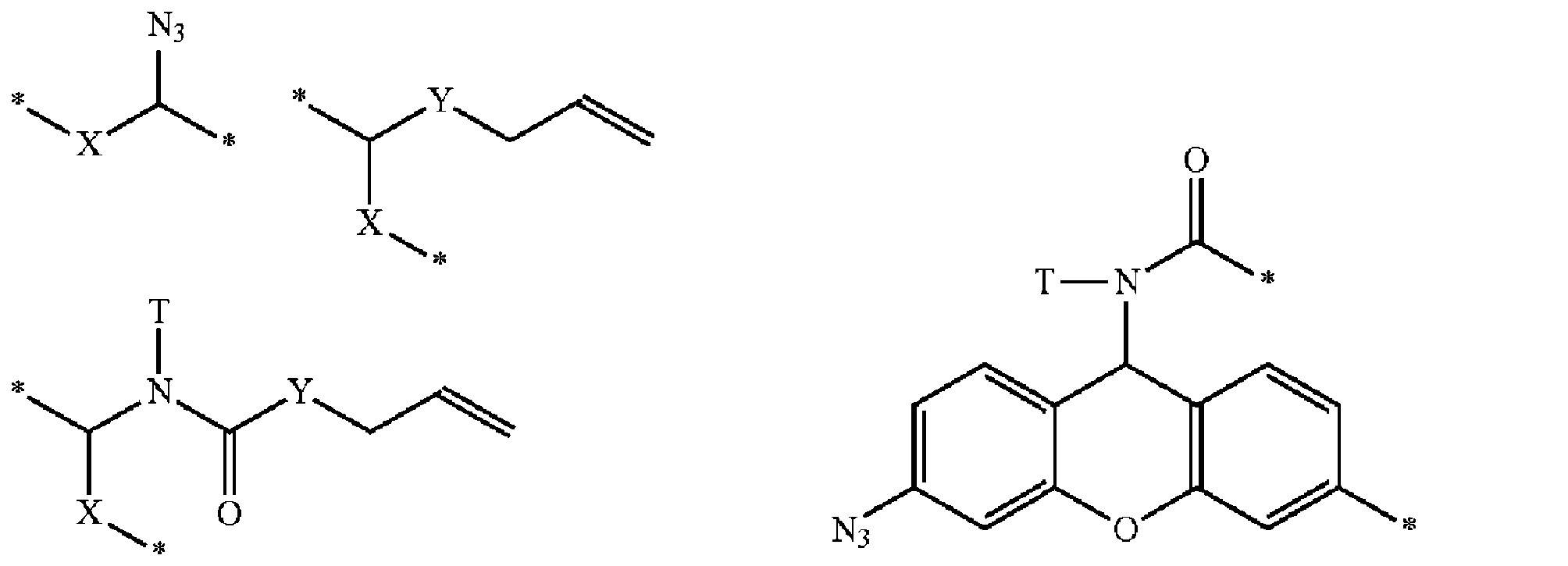
リンカーの追加の例としては、以下の式の部分を含むものなど、米国特許出願公開第2016/0040225号(参照により本明細書に組み込まれる)に開示されるものが挙げられる
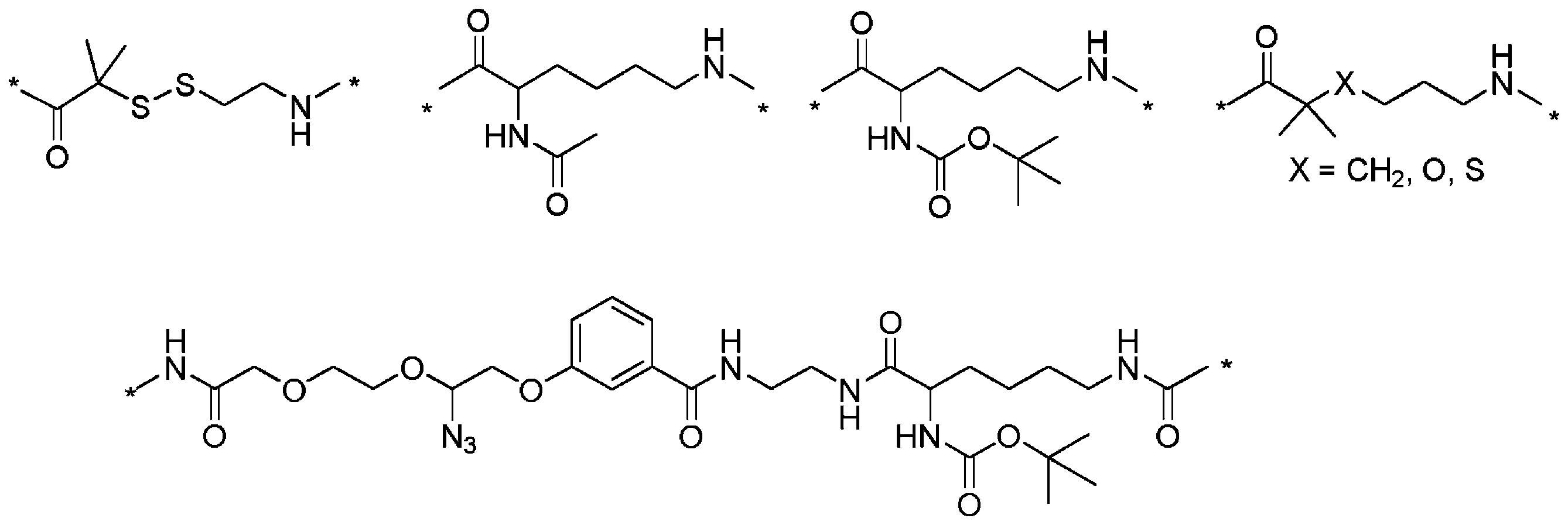
リンカーの追加の例としては、以下の式の部分を含むものなど、米国特許出願公開第2019/0017111号及び同第2020/0216891号(参照により本明細書に組み込まれる)に開示されるものが挙げられ、
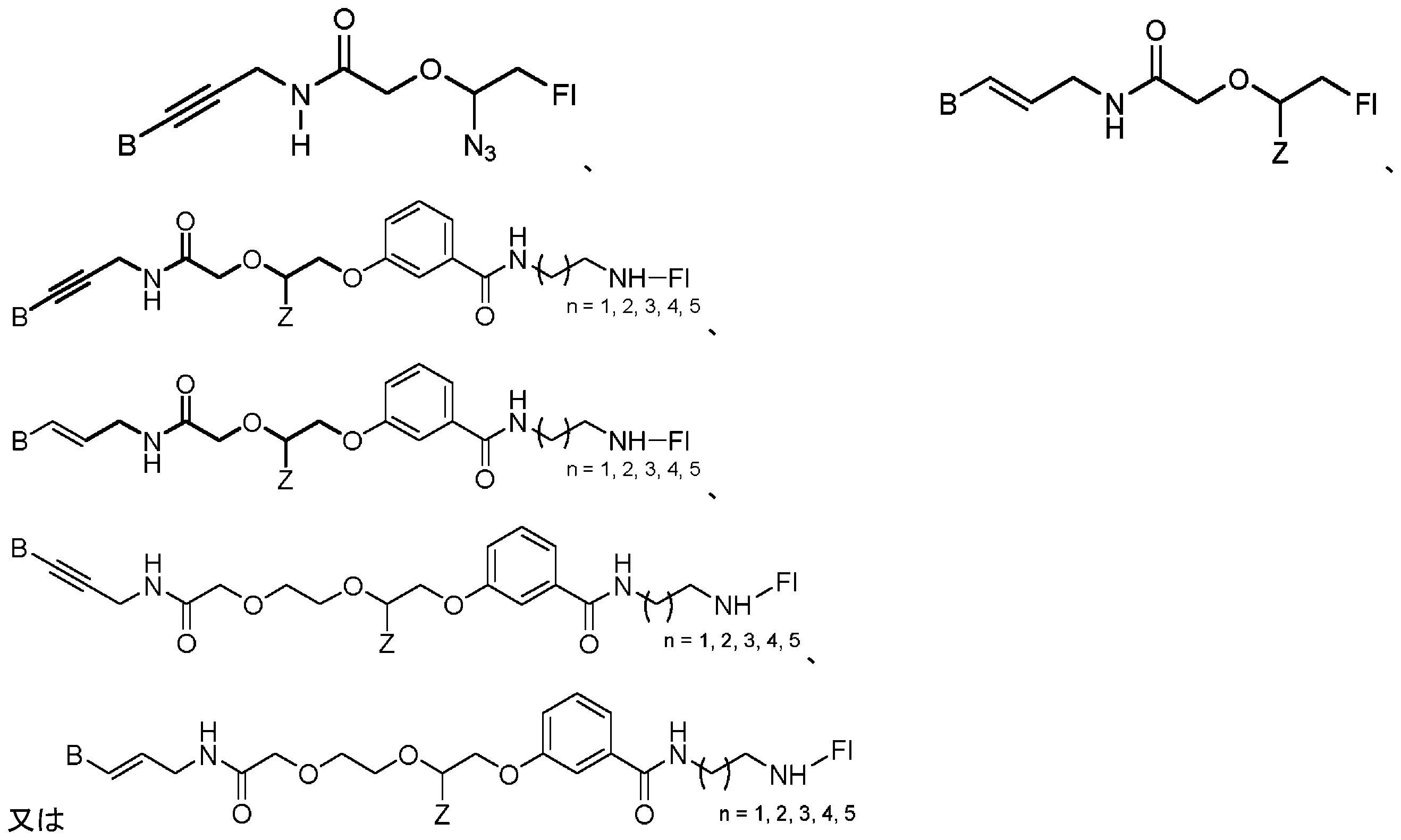

特定の実施形態では、蛍光色素(フルオロフォア)と核塩基、例えば、置換グアニン塩基との間のリンカーの長さは、例えば、ポリエチレングリコールスペーサー基を導入することによって変更することができ、それにより、当該技術分野において既知の他の連結を介してグアニン塩基に結合した同じフルオロフォアと比較して、蛍光強度を増加させることができる。例示的なリンカー及びそれらの特性は、PCT国際公開第2007/020457号(参照により本明細書に組み込まれる)に記載されている。リンカーのこのような設計、特にそれらの長さが増加したことは、DNAなどのポリヌクレオチドに組み込まれたとき、グアノシンヌクレオチドのグアニン塩基に結合したフルオロフォアの輝度の改善を可能にすることができる。したがって、色素が、グアニン含有ヌクレオチドに結合した蛍光色素標識の検出を必要とする任意の解析方法における使用のためである場合、リンカーが、国際公開第2007/020457号に記載される、式-((CH2)2O)n-(式中、nは、2~50の整数である)のスペーサー基を含む場合、有利である。 In certain embodiments, the length of the linker between the fluorophore and the nucleobase, e.g., a substituted guanine base, can be altered, e.g., by introducing a polyethylene glycol spacer group, thereby , can increase fluorescence intensity compared to the same fluorophore attached to a guanine base via other linkages known in the art. Exemplary linkers and their properties are described in PCT Publication No. WO 2007/020457 (incorporated herein by reference). Such designs of linkers, particularly their increased length, can allow for improved brightness of fluorophores attached to the guanine bases of guanosine nucleotides when incorporated into polynucleotides such as DNA. . Thus, if the dye is for use in any analytical method requiring the detection of a fluorochrome label attached to a guanine-containing nucleotide, the linker may be of the formula -( It is advantageous if it contains a spacer group of (CH 2 ) 2 O) n —, where n is an integer from 2 to 50.
ヌクレオシド及びヌクレオチドは、糖又は核塩基上の部位で標識されてもよい。当該技術分野において既知のように、「ヌクレオチド」は、窒素塩基、糖、及び1つ以上のリン酸基からなる。RNA中では、糖はリボースであるが、DNA中では、糖はデオキシリボース、すなわち、リボース中に存在するヒドロキシル基を欠く糖である。窒素塩基は、プリン又はピリミジンの誘導体である。プリンはアデニン(A)及びグアニン(G)であり、ピリミジンはシトシン(C)及びチミン(T)であるか、又はRNAの文脈では、ウラシル(U)である。デオキシリボースのC-1原子は、ピリミジンのN-1又はプリンのN-9に結合される。ヌクレオチドもまたヌクレオシドのリン酸エステルであり、糖のC-3又はC-5に結合したヒドロキシル基にエステル化が生じる。ヌクレオシドは、通常、一リン酸、二リン酸、又は三リン酸である。 Nucleosides and nucleotides may be labeled at sites on the sugar or nucleobase. As known in the art, a "nucleotide" consists of a nitrogenous base, a sugar and one or more phosphate groups. In RNA the sugar is ribose, whereas in DNA the sugar is deoxyribose, ie the sugar that lacks the hydroxyl group present in ribose. Nitrogen bases are derivatives of purines or pyrimidines. Purines are adenine (A) and guanine (G), pyrimidines are cytosine (C) and thymine (T), or in the context of RNA, uracil (U). The C-1 atom of deoxyribose is attached to N-1 of pyrimidines or N-9 of purines. Nucleotides are also phosphate esters of nucleosides, with esterification occurring at the hydroxyl group attached to C-3 or C-5 of the sugar. Nucleosides are usually monophosphates, diphosphates, or triphosphates.
「ヌクレオシド」は、ヌクレオチドと構造的に類似しているが、リン酸部分を欠いている。ヌクレオチド類似体の例は、標識が塩基に連結され、糖分子に結合したリン酸基が存在しないものである。 A "nucleoside" is structurally similar to a nucleotide, but lacks the phosphate moiety. An example of a nucleotide analogue is one in which the label is attached to the base and there is no phosphate group attached to the sugar molecule.
塩基は通常、プリン又はピリミジンと呼ばれるが、当業者は、ヌクレオチド又はヌクレオシドの能力を変化させてワトソン・クリック塩基対合を起こすことのない誘導体及び類似体が利用可能であることを理解するであろう。「誘導体」又は「類似体」は、コア構造が親化合物のそれと同じであるか、又は酷似しているが、例えば、誘導体ヌクレオチド又はヌクレオシドが他の分子と連結されるのを可能にする、異なるか、又は追加の側基などの化学的又は物理的修飾を有する化合物又は分子を意味する。例えば、塩基は、デアザプリンであってもよい。特定の実施形態では、誘導体は、ワトソン・クリック対合を受けることができるべきである。「誘導体」及び「類似体」はまた、例えば、修飾塩基部分及び/又は修飾糖部分を有する合成ヌクレオチド又はヌクレオシド誘導体を含む。そのような誘導体及び類似体は、例えば、Scheit,Nucleotide analogs(John Wiley&Son,1980)及びUhlman,Chemical Reviews90:543-584,1990に考察されている。ヌクレオチド類似体はまた、ホスホロチオエート、ホスホロジチオエート、アルキル-ホスホン酸塩、ホスホラニリデート(phosphoranilidate)、ホスホラミデート連結などを含む修飾ホスホジエステルリンケージを含み得る。 Bases are commonly referred to as purines or pyrimidines, but those skilled in the art will appreciate that derivatives and analogues are available that do not alter the ability of the nucleotide or nucleoside to undergo Watson-Crick base pairing. deaf. A "derivative" or "analogue" is one whose core structure is the same as or closely resembles that of the parent compound, but which differs, e.g., allowing the derivative nucleotides or nucleosides to be linked to other molecules. or a compound or molecule that has chemical or physical modifications such as additional side groups. For example, the base can be a deazapurine. In certain embodiments, the derivative should be capable of undergoing Watson-Crick pairing. "Derivatives" and "analogs" also include, for example, synthetic nucleotide or nucleoside derivatives with modified base moieties and/or modified sugar moieties. Such derivatives and analogs are discussed, for example, in Scheit, Nucleotide analogs (John Wiley & Son, 1980) and Uhlman, Chemical Reviews 90:543-584, 1990. Nucleotide analogs may also contain modified phosphodiester linkages, including phosphorothioate, phosphorodithioate, alkyl-phosphonate, phosphoranilidate, phosphoramidate linkages, and the like.
蛍光色素は、ワトソン・クリック塩基対合が依然として実行することができる条件で、リンカーを介して、ヌクレオチド塩基上の任意の位置に結合され得る。特定の核塩基標識部位としては、ピリミジン塩基のC5位置、又は7-デアザプリン塩基のC7位置が挙げられる。上記のように、リンカー基を使用して、ヌクレオシド又はヌクレオチドに色素を共有結合させることができる。 A fluorescent dye can be attached via a linker to any position on the nucleotide base, provided that Watson-Crick base pairing can still be performed. Particular nucleobase labeling sites include the C5 position of pyrimidine bases or the C7 position of 7-deazapurine bases. As noted above, linker groups can be used to covalently attach dyes to nucleosides or nucleotides.
特定の実施形態では、標識ヌクレオシド又はヌクレオチドは、酵素的に組み込み可能であり、酵素的に伸長可能であり得る。したがって、リンカー部分は、ヌクレオチドを化合物に接続するのに十分な長さのものであり得、その結果、化合物は、核酸複製酵素のヌクレオチドの全体的な結合及び認知と、顕著には干渉しない。したがって、リンカーはスペーサー単位も含み得る。スペーサーは、例えば、開裂部位又は標識からヌクレオチド塩基を遠ざける。 In certain embodiments, a labeled nucleoside or nucleotide can be enzymatically incorporable and enzymatically extendable. Thus, the linker portion can be of sufficient length to connect the nucleotides to the compound so that the compound does not significantly interfere with the overall binding and recognition of nucleotides by nucleolytic enzymes. A linker may therefore also comprise a Spacer unit. A spacer, for example, separates a nucleotide base from a cleavage site or label.
本明細書に記載のCOT部分結合蛍光色素で標識されたヌクレオシド又はヌクレオチドは、以下の式を有し得、

式中、色素は、式(I)、(Ia)、(Ib)、(Ic)、又は(Id)の構造を含む共有結合したCOT部分を含有する色素化合物であり、Bは、例えば、ウラシル、チミン、シトシン、アデニン、7-デアザアデニン、グアニン、7-デアザグアニンなどの核酸塩基であり、Lは、存在しても存在しなくてもよい任意的なリンカー基である。R’は、Hであり得、-OR’は、一リン酸、二リン酸、三リン酸、チオリン酸、リン酸エステル類似体、反応性リン含有基に結合した-O-、又はブロッキング基によって保護された-O-であり、R’’は、H、ホスホラミダイト、又は3’-OHブロッキング基であり得、R’’’は、H又はOHであり、式中、R’’は、ホスホラミダイトであり、R’は、自動合成条件下で後続するモノマーカップリングを可能にする、酸開裂可能なヒドロキシル保護基である。いくつかの更なる実施形態では、Bは、


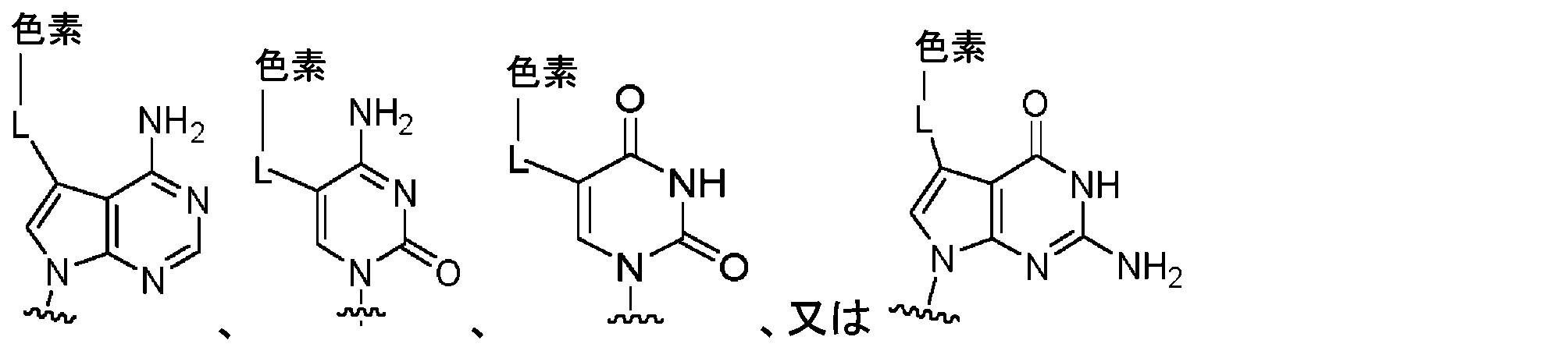
wherein dye is a dye compound containing a covalently attached COT moiety comprising the structure of formula (I), (Ia), (Ib), (Ic), or (Id), and B is, for example, uracil , thymine, cytosine, adenine, 7-deazaadenine, guanine, 7-deazaguanine, etc. L is an optional linker group that may or may not be present. R' can be H and -OR' is a monophosphate, diphosphate, triphosphate, thiophosphate, phosphate ester analogue, -O- attached to a reactive phosphorus-containing group, or a blocking group. R″ can be H, phosphoramidite, or a 3′-OH blocking group, and R″ is H or OH, where R″ is Phosphoramidite, R' is an acid-cleavable hydroxyl protecting group that allows subsequent monomer coupling under automated synthesis conditions. In some further embodiments, B is
場合によっては、ブロッキング基は、色素化合物とは別個、かつ独立しており、すなわち、それに結合していない。あるいは、色素は、3’-OHブロッキング基の全て又は一部を含んでもよい。したがって、R’’は、色素化合物を含んでも含まなくてもよい3’-OHブロッキング基であり得る。追加の代替的な実施形態では、ペントース糖の3’炭素上にブロッキング基は存在せず、塩基に結合した色素(又は色素及びリンカー構造物)は、例えば、3’の場所以外の点から更なるヌクレオチドの組み込みに対するブロックとして作用するのに十分なサイズ又は構造であり得る。したがって、ブロックは、立体障害に起因し得るか、又はサイズ、電荷、及び構造の組み合わせによるものであり得る。 In some cases, the blocking group is separate and independent from the dye compound, ie, not attached to it. Alternatively, the dye may contain all or part of the 3'-OH blocking group. Thus, R'' can be a 3'-OH blocking group that may or may not contain a dye compound. In additional alternative embodiments, there is no blocking group on the 3' carbon of the pentose sugar, and the dye (or dye and linker structure) attached to the base may be further modified from a point other than the 3' position, for example. may be of sufficient size or structure to act as a block against the incorporation of multiple nucleotides. Thus, blocking can be due to steric hindrance or due to a combination of size, charge, and structure.
ブロッキング基の使用により、例えば、標識ヌクレオチドが組み込まれるときに伸長を停止することなどによって、重合を制御することができる。例えば、非限定的な例として、化学的条件を変更することによって、又は化学ブロックを除去することによって、ブロッキング効果が可逆的である場合、ある特定の点で伸長を停止してから、継続することができる。3’-OHブロッキング基の非限定的な例には、国際公開第2004/018497号及び同第2014/139596号、並びに米国特許公開第2020/0216891号が含まれ、これらは、参照により本明細書に組み込まれる。例えば、ブロッキング基は、アジドメチル(-CH2N3)、又は置換アジドメチル(例えば、-CH(CHF2)N3又はCH(CH2F)N3)、又はアリル、又は

(AOM)であってもよい。
Polymerization can be controlled through the use of blocking groups, such as by stopping extension when a labeled nucleotide is incorporated. For example, if the blocking effect is reversible, by changing chemical conditions or by removing chemical blocks, elongation is stopped at a certain point and then continued be able to. Non-limiting examples of 3'-OH blocking groups include WO 2004/018497 and WO 2014/139596, and US Patent Publication No. 2020/0216891, which are incorporated herein by reference. incorporated into the book. For example, the blocking group may be azidomethyl (--CH 2 N 3 ), or substituted azidomethyl (eg --CH(CHF 2 )N 3 or CH(CH 2 F)N 3 ), or allyl, or
(AOM).
特定の実施形態では、リンカー及びブロッキング基は、両方とも存在し、両方とも実質的に同様の条件下で切断可能である別個の部分である。したがって、脱保護及び脱ブロッキングプロセスは、色素化合物及びブロッキング基の両方を除去するために単一の処理のみが必要となるため、より効率的であり得る。 In certain embodiments, the linker and blocking group are both present and both are separate moieties that are cleavable under substantially similar conditions. The deprotection and deblocking process can therefore be more efficient as only a single treatment is required to remove both the dye compound and the blocking group.
本開示はまた、本明細書に記載の色素化合物を組み込んだポリヌクレオチドを包含することを対象とする。このようなポリヌクレオチドは、ホスホジエステル連結で接合されたデオキシリボヌクレオチド又はリボヌクレオチドからそれぞれなるDNA又はRNAであってもよい。ポリヌクレオチドは、自然由来のヌクレオチド、本明細書に記載の標識ヌクレオチド以外の非自然由来(又は修飾)ヌクレオチド、又はこれらの任意の組み合わせを含み得るが、但し、COT部分含有蛍光色素で標識された少なくとも1つのヌクレオチドが存在していることを条件とする。ポリヌクレオチドは、非自然由来の骨格連結及び/又は非ヌクレオチド化学修飾も含み得る。少なくとも1つの標識ヌクレオチドを含むリボヌクレオチド及びデオキシリボヌクレオチドの混合物からなるキメラ構造も想到される。 The present disclosure is also intended to encompass polynucleotides incorporating the dye compounds described herein. Such polynucleotides may be DNA or RNA, respectively, consisting of deoxyribonucleotides or ribonucleotides joined by phosphodiester linkages. Polynucleotides can contain naturally occurring nucleotides, non-naturally occurring (or modified) nucleotides other than the labeled nucleotides described herein, or any combination thereof, provided that they are labeled with a COT moiety-containing fluorescent dye. Provided that at least one nucleotide is present. Polynucleotides may also contain non-naturally occurring backbone linkages and/or non-nucleotide chemical modifications. Chimeric structures consisting of mixtures of ribonucleotides and deoxyribonucleotides containing at least one labeled nucleotide are also contemplated.
本明細書に記載される非限定的な例示的な標識ヌクレオチドは、以下の構造を含む。構造の各々に示される「色素」は、本明細書に記載される共有結合したCOT部分含有蛍光化合物、又は式(A)、(B)、(C)、若しくは(D)のものなどのCOT部分を含まない蛍光化合物のいずれかを指し得、
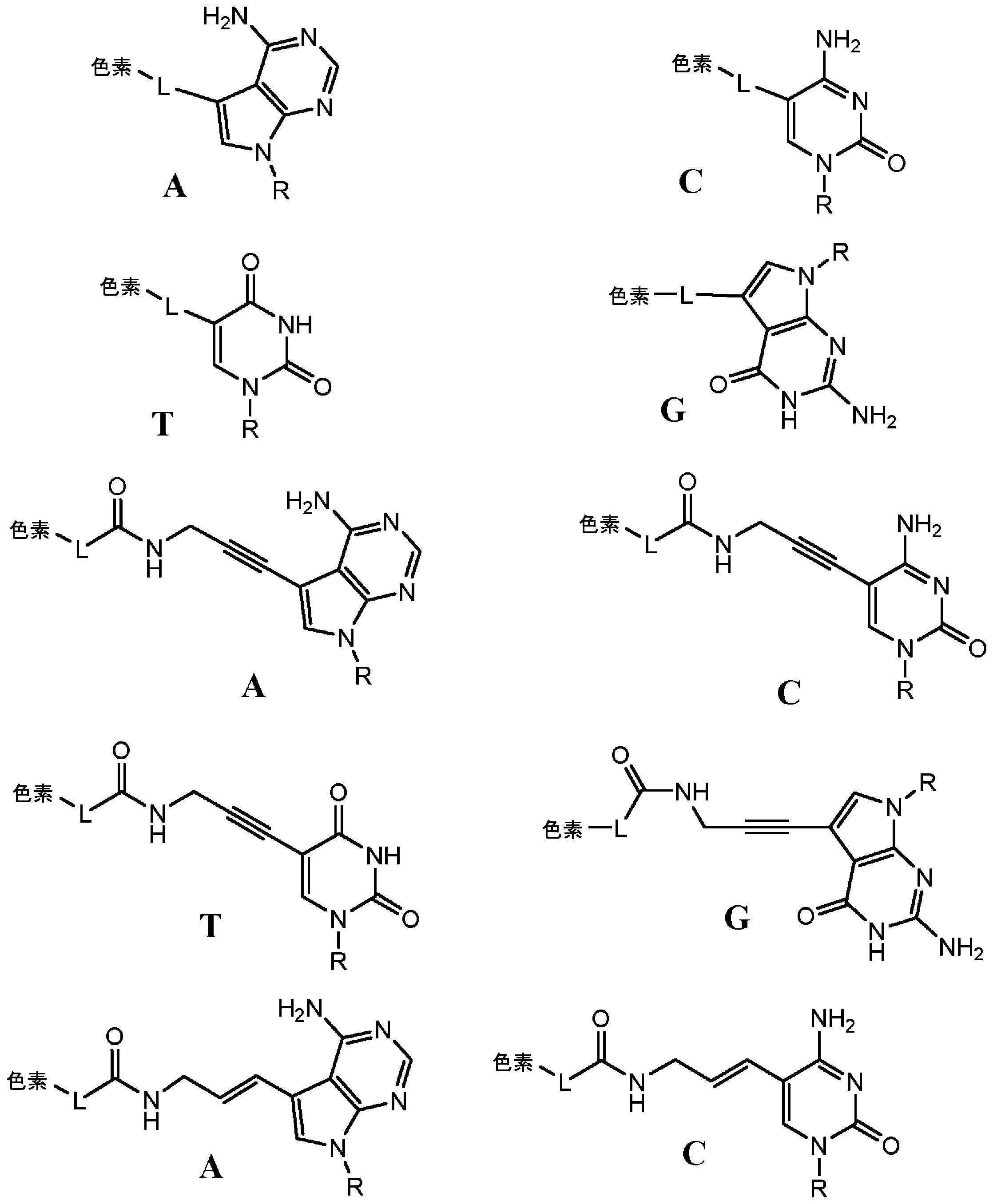
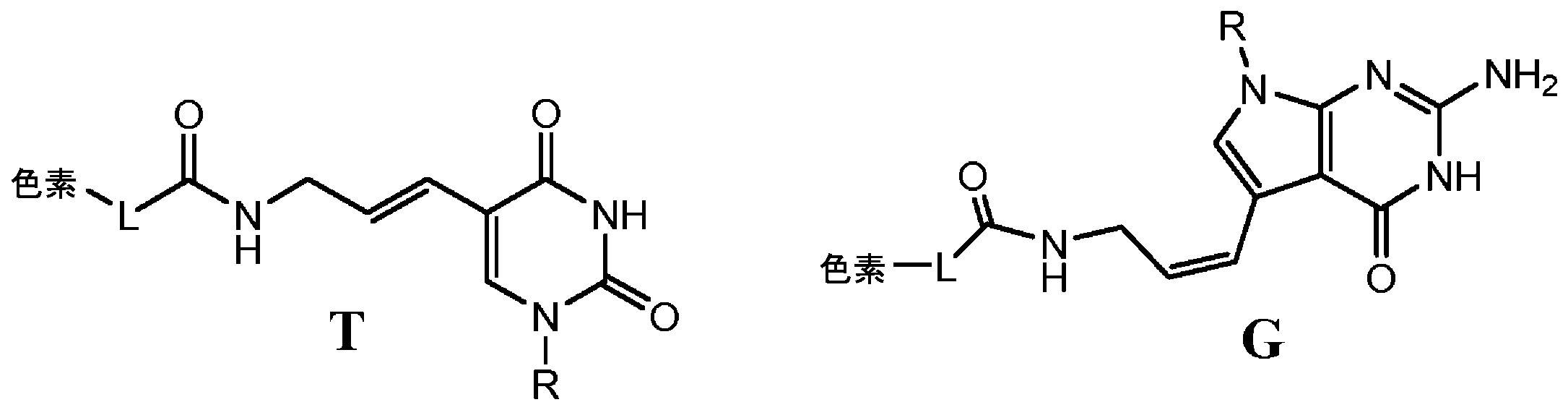


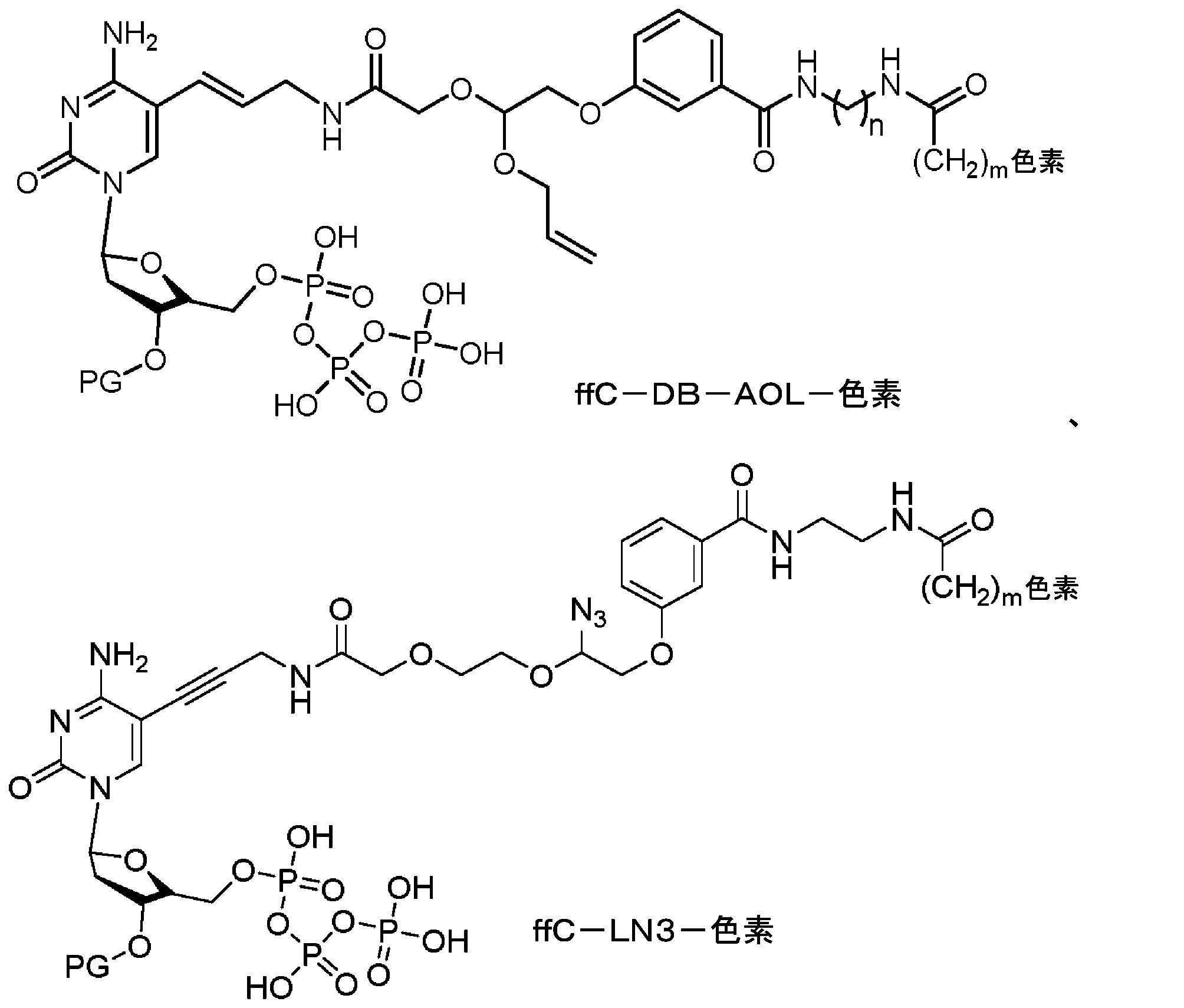

本明細書に記載の標識ヌクレオチドの任意の実施形態では、ヌクレオチドは、ヌクレオチド三リン酸である。 In any embodiment of the labeled nucleotides described herein, the nucleotide is a nucleotide triphosphate.
本開示の追加の態様は、本明細書に記載の標識ヌクレオチドを含むオリゴヌクレオチドに関する。いくつかの実施形態では、オリゴヌクレオチドは、標的ポリヌクレオチドの少なくとも一部にハイブリダイズされる。いくつかの実施形態では、標的ポリヌクレオチドは、固体支持体上に固定化される。いくつかの更なる実施形態では、固体支持体は、複数の固定化標的ポリヌクレオチドのアレイを含む。
キット
Additional aspects of the disclosure relate to oligonucleotides comprising labeled nucleotides as described herein. In some embodiments, the oligonucleotide hybridizes to at least a portion of the target polynucleotide. In some embodiments, target polynucleotides are immobilized on a solid support. In some further embodiments, the solid support comprises an array of multiple immobilized target polynucleotides.
kit
本明細書に開示されるいくつかの実施形態は、本明細書に記載のCOT修飾蛍光色素で標識されたヌクレオシド及び/又はヌクレオチドを含むキットである。そのようなキットは、概して、色素で標識された少なくとも1つのヌクレオチド又はヌクレオシドを、少なくとも1つの更なる成分とともに含む。更なる成分は、更に標識されたか、又は標識されていないヌクレオチド又はヌクレオシドであり得る。例えば、色素で標識されたヌクレオチドは、標識されていないか、若しくは天然のヌクレオチドと組み合わせて、かつ/又は蛍光標識されたヌクレオチドか、あるいはこれらの任意の組み合わせとともに供給され得る。ヌクレオチドの組み合わせは、別個の個々の成分としてか、又はヌクレオチド混合物として提供され得る。いくつかの実施形態では、キットは、少なくとも1つのヌクレオチドが、本明細書に記載のCOT部分結合蛍光化合物で標識されたヌクレオチドである、1つ以上のヌクレオチドを含む。キットは、2つ以上の標識ヌクレオチドを含んでもよい。ヌクレオチドは、2つ以上の蛍光標識で標識されてもよい。標識のうちの2つ以上は、レーザーであってもよい単一の励起源を用いて励起されてもよい。 Some embodiments disclosed herein are kits comprising nucleosides and/or nucleotides labeled with COT-modified fluorochromes described herein. Such kits generally include at least one nucleotide or nucleoside labeled with a dye, along with at least one additional component. Further components may be further labeled or unlabeled nucleotides or nucleosides. For example, dye-labeled nucleotides can be supplied unlabeled or in combination with natural nucleotides and/or with fluorescently labeled nucleotides, or any combination thereof. Combinations of nucleotides can be provided as separate individual components or as mixtures of nucleotides. In some embodiments, the kit comprises one or more nucleotides, wherein at least one nucleotide is a nucleotide labeled with a COT moiety-binding fluorescent compound described herein. A kit may contain more than one labeled nucleotide. Nucleotides may be labeled with more than one fluorescent label. Two or more of the labels may be excited using a single excitation source, which may be a laser.
キットは、4つの標識ヌクレオチド(例えば、A、C、T、G)を含有し得、4つのヌクレオチドの1つ目は、本明細書に開示されるCOT修飾蛍光化合物で標識され、2つ目、3つ目、及び4つ目のヌクレオチドは各々、異なる蛍光化合物で標識されてもよく(各々がCOT修飾されていてもよい)、各蛍光化合物は、特有の蛍光最大値を有し、蛍光化合物の各々は、他の3つの化合物とは区別可能である。キットは、蛍光化合物のうちの2つ以上が、吸収最大値であるが、異なるストークスシフトを有するようなものであってもよい。 The kit may contain four labeled nucleotides (e.g., A, C, T, G), one of the four nucleotides labeled with a COT-modified fluorescent compound disclosed herein, the second , the third, and the fourth nucleotide may each be labeled with a different fluorescent compound (each may be COT-modified), each fluorescent compound having a unique fluorescence maximum, and the fluorescence Each of the compounds is distinguishable from the other three compounds. The kit may be such that two or more of the fluorescent compounds have absorption maxima but different Stokes shifts.
本明細書に記載のCOT修飾蛍光化合物、COT修飾蛍光化合物で標識されたヌクレオチド、又はキットは、配列決定、発現分析、ハイブリダイゼーション分析、遺伝子分析、RNA分析、又はタンパク質結合アッセイに使用され得る。使用は、自動配列決定機器上にあり得る。配列決定器具は、異なる波長で動作する2つのレーザーを含んでもよい。 The COT-modified fluorescent compounds, COT-modified fluorescent compound-labeled nucleotides, or kits described herein can be used for sequencing, expression analysis, hybridization analysis, genetic analysis, RNA analysis, or protein binding assays. Use can be on an automated sequencing instrument. A sequencing instrument may include two lasers operating at different wavelengths.
キットが、色素化合物で標識された、複数の、特に2つ、より具体的には4つのヌクレオチドを含む場合、異なるヌクレオチドは、異なる色素化合物で標識されてもよいか、又は色素化合物を含まない、暗色であってもよい。異なるヌクレオチドが異なる色素化合物で標識される場合、それは、該色素化合物がスペクトル的に区別可能な蛍光色素であるという、キットの特徴である。本明細書で使用される場合、用語「スペクトル的に区別可能な蛍光色素」は、2つ以上の色素が1つの試料に存在するとき、蛍光検出装置(例えば、市販の毛管ベースのDNA配列決定プラットフォーム)によって区別され得る波長で、蛍光エネルギーを放射する蛍光色素を指す。蛍光色素化合物で標識された2つのヌクレオチドがキット形態で供給される場合、スペクトル的に区別可能な蛍光色素は、いくつかの実施形態では、例えば、同じレーザーなど、同じ波長で励起され得る。蛍光色素化合物で標識された4つのヌクレオチドがキット形態で供給される場合、いくつかの実施形態では、スペクトル的に区別可能な蛍光色素のうちの2つが、1つの波長で励起され得、他の2つのスペクトル的に区別可能な色素が、両方とも別の波長で励起され得る。特定の励起波長は、約460nmである。 If the kit comprises a plurality, in particular two, more particularly four nucleotides labeled with a dye compound, the different nucleotides may be labeled with different dye compounds or contain no dye compound. , may be dark. If different nucleotides are labeled with different dye compounds, it is a feature of the kit that the dye compounds are spectrally distinguishable fluorescent dyes. As used herein, the term "spectrally distinguishable fluorescent dye" refers to fluorescence detection devices (e.g., commercially available capillary-based DNA sequencing) when two or more dyes are present in a sample. Refers to a fluorochrome that emits fluorescent energy at a wavelength that can be distinguished by the platform). When two nucleotides labeled with a fluorochrome compound are supplied in kit form, the spectrally distinguishable fluorochromes can in some embodiments be excited at the same wavelength, e.g., the same laser. When four nucleotides labeled with fluorochrome compounds are supplied in kit form, in some embodiments two of the spectrally distinguishable fluorochromes can be excited at one wavelength and the other Two spectrally distinct dyes can both be excited at different wavelengths. A specific excitation wavelength is about 460 nm.
いくつかの実施形態では、少なくとも1つのヌクレオチドは、異なる波長を有する2つのレーザーで励起可能である色素で標識され得る。 In some embodiments, at least one nucleotide can be labeled with a dye that is excitable with two lasers having different wavelengths.
一実施形態では、キットは、本明細書に記載のCOT修飾色素で標識されたヌクレオチドと、第2の色素で標識された第2のヌクレオチドとを含み、それらの色素は、少なくとも10nm、特に20nm~50nmの吸収最大値の差を有する。より具体的には、2つの色素化合物は、15~40nm又は20~40nmのストークスシフトを有する。本明細書で使用される場合、用語「ストークスシフト」は、ピーク吸収波長とピーク発光波長との間の距離である。 In one embodiment, the kit comprises a nucleotide labeled with a COT-modified dye as described herein and a second nucleotide labeled with a second dye, wherein the dyes are at least 10 nm, especially 20 nm. It has a difference in absorption maxima of ~50 nm. More specifically, the two dye compounds have a Stokes shift of 15-40 nm or 20-40 nm. As used herein, the term "Stokes shift" is the distance between the peak absorption wavelength and the peak emission wavelength.
更なる実施形態では、該キットは、蛍光色素で標識された2つの他のヌクレオチドを更に含み、該色素は、約440nm~約560nmの発光を有する光源によって励起され得る。 In a further embodiment, the kit further comprises two other nucleotides labeled with fluorescent dyes, which can be excited by a light source having an emission between about 440 nm and about 560 nm.
代替的な実施形態では、キットは、同じ塩基が2つの異なる化合物で標識されるヌクレオチドを含有してもよい。第1のヌクレオチドは、本明細書に記載のCOT修飾色素で標識され得る。第2のヌクレオチドは、スペクトル的に異なる化合物、例えば、600nm超で吸収する「赤色」色素で標識されてもよい。第3のヌクレオチドは、本明細書に記載のCOT修飾化合物と、スペクトル的に区別可能な化合物との混合物として標識されてもよく、第4のヌクレオチドは「暗色」で、標識を含有しなくてもよい。したがって、簡便に言えば、ヌクレオチド1~4は、「緑色」、「赤色」、「赤色/緑色」、及び暗色と標識され得る。器具類を更に単純化するために、4つのヌクレオチドは、単一の光源で励起される2つの色素で標識され得、したがって、ヌクレオチド1~4の標識は、「緑色1」、「緑色2」、「緑色1/緑色2」、及び暗色となり得る。 In alternative embodiments, the kit may contain nucleotides where the same base is labeled with two different compounds. The first nucleotide can be labeled with a COT modifying dye as described herein. The second nucleotide may be labeled with a spectrally distinct compound, eg, a "red" dye that absorbs above 600 nm. The third nucleotide may be labeled as a mixture of a COT-modified compound described herein and a spectrally distinguishable compound, and the fourth nucleotide must be "dark" and contain no label. good too. Thus, in brief, nucleotides 1-4 can be labeled "green", "red", "red/green" and dark. To further simplify the instrumentation, four nucleotides can be labeled with two dyes excited by a single light source, thus labeling nucleotides 1-4 as "green 1", "green 2". , “green 1/green 2”, and dark.
他の実施形態では、キットは、ヌクレオチドのポリヌクレオチドへの組み込みを触媒することができるポリメラーゼ酵素を含んでもよい。このようなキットに含まれる他の構成成分としては、緩衝剤などが挙げられる。本明細書に記載のCOT部分結合蛍光色素で標識されたヌクレオチド、及び異なるヌクレオチドの混合物を含む他の任意のヌクレオチド成分は、使用前に希釈される濃縮形態でキットに提供されてもよい。そのような実施形態では、好適な希釈緩衝液も含まれ得る。 In other embodiments, the kit may include a polymerase enzyme capable of catalyzing the incorporation of nucleotides into polynucleotides. Other components included in such kits include buffers and the like. Nucleotides labeled with the COT moiety-binding fluorescent dyes described herein, and any other nucleotide components, including mixtures of different nucleotides, may be provided in the kit in concentrated form to be diluted prior to use. Suitable dilution buffers may also be included in such embodiments.
本開示のいくつかの追加の実施形態は、複数の組成物を収容する複数のチャンバを含む配列決定装置とともに使用するためのキットに関し、各チャンバは、単一の組成物を収容し、複数の組成物は、鋳型ポリヌクレオチド鎖の少なくとも一部に相補的なコピーポリヌクレオチド鎖にヌクレオチドを組み込むための試薬であって、ヌクレオチドが、3’ブロッキング基を含み、本明細書に記載される式(I)、(Ia)、(Ib)、(Ic)、又は(Id)の構造を含むCOT修飾蛍光化合物で標識されている、試薬と、少なくとも1つの酸化防止剤を含む緩衝組成物と、コピー鎖に組み込まれた、ブロックされ、標識されたヌクレオチドから標識及びブロッキング部分を化学的に除去するための試薬と、洗浄溶液と、を含む。いくつかの実施形態では、蛍光化合物は、青色色素である。いくつかの更なる実施形態では、蛍光化合物は、式(A)、(B)、(C)、及び(D)として例示される。いくつかの実施形態では、緩衝液は、COT、ケルセチン、アスコルビン酸、若しくはアスコルビン酸ナトリウム、没食子酸誘導体、又はそれらの組み合わせを含み得る。いくつかの更なる実施形態では、緩衝組成物はまた、捕捉剤、例えば、ジスルフィド若しくはアジド部分、リポ酸、又は3,3’-ジチオジプロピオン酸(DDPA)を有する化合物を含み得る。いくつかの実施形態では、ヌクレオチドをポリヌクレオチド鎖に組み込むための試薬は、ポリメラーゼを含む。いくつかの実施形態では、組み込まれたヌクレオチドの標識及びブロッキング部分を化学的に除去するための試薬は、トリアルキルホスフィンなどのホスフィンを含む。トリアルキルホスフィンの非限定的な例としては、トリス(3-ヒドロキシプロピル)ホスフィン(THP)、トリス-(2-カルボキシエチル)ホスフィン(TCEP)、トリス(ヒドロキシメチル)ホスフィン(THMP)、又はトリス(2-ヒドロキシエチル)ホスフィン(THEP)が挙げられる。いくつかの実施形態では、3’ブロッキング基は、アジド基(例えば、アジドメチル)を含有する。いくつかの実施形態では、洗浄溶液はまた、ROS又はラジカル捕捉剤を含み得る。 Some additional embodiments of the present disclosure relate to kits for use with sequencing devices that include multiple chambers containing multiple compositions, each chamber containing a single composition and multiple compositions. The composition is a reagent for incorporating nucleotides into a copy polynucleotide strand complementary to at least a portion of a template polynucleotide strand, wherein the nucleotide comprises a 3' blocking group and has the formula ( a reagent labeled with a COT-modified fluorescent compound comprising the structure of I), (Ia), (Ib), (Ic), or (Id); a buffer composition comprising at least one antioxidant; Reagents for chemically removing labels and blocking moieties from blocked labeled nucleotides incorporated into strands, and wash solutions. In some embodiments, the fluorescent compound is a blue dye. In some further embodiments, fluorescent compounds are exemplified by formulas (A), (B), (C), and (D). In some embodiments, the buffer may comprise COT, quercetin, ascorbic acid or sodium ascorbate, gallic acid derivatives, or combinations thereof. In some further embodiments, the buffer composition can also include a scavenger, such as a compound with a disulfide or azide moiety, lipoic acid, or 3,3'-dithiodipropionic acid (DDPA). In some embodiments, reagents for incorporating nucleotides into polynucleotide chains comprise polymerases. In some embodiments, reagents for chemically removing the incorporated nucleotide labeling and blocking moieties include phosphines, such as trialkylphosphines. Non-limiting examples of trialkylphosphines include tris(3-hydroxypropyl)phosphine (THP), tris-(2-carboxyethyl)phosphine (TCEP), tris(hydroxymethyl)phosphine (THMP), or tris( 2-Hydroxyethyl)phosphine (THEP). In some embodiments, the 3' blocking group contains an azide group (eg, azidomethyl). In some embodiments, the cleaning solution may also contain ROS or radical scavengers.
本開示のいくつかの追加の実施形態は、複数の組成物を収容する複数のチャンバを含む配列決定装置とともに使用するためのキットに関し、各チャンバは単一の組成物を収容し、複数の組成物は、鋳型ポリヌクレオチド鎖の少なくとも一部に相補的なコピーポリヌクレオチド鎖に、3’ブロックされた標識ヌクレオチドを組み込むための試薬と、本明細書に記載のシクロオクタテトラエンを含有する組成物を含む緩衝組成物と、コピー鎖に組み込まれた、ブロックされた標識ヌクレオチドから標識及びブロッキング部分を化学的に除去するための試薬と、洗浄溶液と、を含む。いくつかの実施形態では、緩衝組成物はまた、ケルセチン、アスコルビン酸、若しくはアスコルビン酸ナトリウム、没食子酸誘導体、又はそれらの組み合わせを含み得る。いくつかの更なる実施形態では、緩衝組成物はまた、ROS又はラジカル捕捉剤、例えば、ジスルフィド若しくはアジド部分、リポ酸、又は3,3’-ジチオジプロピオン酸(DDPA)を有する化合物を含み得る。いくつかの実施形態では、ヌクレオチドをポリヌクレオチド鎖に組み込むための試薬は、ポリメラーゼを含む。いくつかの実施形態では、組み込まれたヌクレオチドの標識及びブロッキング部分を化学的に除去するための試薬は、トリアルキルホスフィンなどのホスフィンを含む。トリアルキルホスフィンの非限定的な例としては、トリス(3-ヒドロキシプロピル)ホスフィン(THP)、トリス-(2-カルボキシエチル)ホスフィン(TCEP)、トリス(ヒドロキシメチル)ホスフィン(THMP)、又はトリス(2-ヒドロキシエチル)ホスフィン(THEP)が挙げられる。いくつかの実施形態では、3’ブロッキング基は、アジド基(例えば、アジドメチル)を含有する。いくつかの実施形態では、洗浄溶液はまた、捕捉剤を含み得る。
配列決定の方法
Some additional embodiments of the present disclosure relate to kits for use with sequencing devices comprising multiple chambers containing multiple compositions, each chamber containing a single composition and a plurality of compositions. A composition comprising a reagent for incorporating a 3'-blocked labeled nucleotide into a copy polynucleotide strand complementary to at least a portion of a template polynucleotide strand and a cyclooctatetraene as described herein. and reagents for chemically removing labels and blocking moieties from blocked labeled nucleotides incorporated into copy strands, and a wash solution. In some embodiments, buffer compositions may also include quercetin, ascorbic acid or sodium ascorbate, gallic acid derivatives, or combinations thereof. In some further embodiments, the buffer composition may also include ROS or radical scavengers, such as compounds with disulfide or azide moieties, lipoic acid, or 3,3'-dithiodipropionic acid (DDPA). . In some embodiments, reagents for incorporating nucleotides into polynucleotide chains comprise polymerases. In some embodiments, reagents for chemically removing the incorporated nucleotide labeling and blocking moieties include phosphines, such as trialkylphosphines. Non-limiting examples of trialkylphosphines include tris(3-hydroxypropyl)phosphine (THP), tris-(2-carboxyethyl)phosphine (TCEP), tris(hydroxymethyl)phosphine (THMP), or tris( 2-Hydroxyethyl)phosphine (THEP). In some embodiments, the 3' blocking group contains an azide group (eg, azidomethyl). In some embodiments, the wash solution may also contain a capture agent.
Sequencing method
本明細書に記載のCOT部分結合蛍光色素を含むヌクレオチド(又はヌクレオシド)は、ヌクレオチド又はヌクレオシドに結合した蛍光標識の検出を必要とする任意の解析方法で使用することができるが、ヌクレオチド又はヌクレオシドをそれ自体で、又はより大きい分子構造若しくはコンジュゲートに組み込まれるか若しくはそれに関連づけられている状態であるかは問題ではない。本出願のいくつかの実施形態は、(i)本明細書に記載される少なくとも1つの標識ヌクレオチドをポリヌクレオチドに組み込むことと、(ii)該ヌクレオチドに結合したCOT部分結合蛍光色素からの蛍光シグナルを検出することによって、ポリヌクレオチドに組み込まれた標識ヌクレオチドを検出することと、を含む、配列決定の方法を対象とする。 Nucleotides (or nucleosides) containing COT moiety-linked fluorescent dyes described herein can be used in any analytical method requiring detection of fluorescent labels attached to nucleotides or nucleosides, although It does not matter whether as such or in a state of being incorporated into or associated with a larger molecular structure or conjugate. Some embodiments of the present application provide (i) incorporation into a polynucleotide of at least one labeled nucleotide described herein; and detecting labeled nucleotides incorporated into a polynucleotide by detecting a.
いくつかの実施形態では、合成工程で、少なくとも1つの標識ヌクレオチドが、ポリメラーゼ酵素の作用によってポリヌクレオチドに組み込まれる。しかしながら、標識ヌクレオチドをポリヌクレオチドに組み込む他の方法、例えば、化学的オリゴヌクレオチド合成、又は標識オリゴヌクレオチドの標識されていないオリゴヌクレオチドへのリゲーションは、排除されない。したがって、ヌクレオチドをポリヌクレオチドに「組み込む」という用語は、化学的方法並びに酵素法によるポリヌクレオチド合成を包含する。 In some embodiments, at least one labeled nucleotide is incorporated into a polynucleotide during the synthesis process by the action of a polymerase enzyme. However, other methods of incorporating labeled nucleotides into polynucleotides are not excluded, such as chemical oligonucleotide synthesis, or ligation of labeled oligonucleotides to unlabeled oligonucleotides. Thus, the term "incorporating" nucleotides into a polynucleotide encompasses polynucleotide synthesis by chemical as well as enzymatic methods.
本開示のいくつかの特定の実施形態は、核酸配列決定反応中の核酸の光誘起劣化を低減又は防止する方法に関し、それは、
(a)鋳型ポリヌクレオチド鎖の少なくとも一部に相補的なコピーポリヌクレオチド鎖にヌクレオチドを組み込むことであって、ヌクレオチドが、標識及び3’ブロッキング基を含む、組み込むことと、
(b)第1の緩衝組成物の存在下で、コピー鎖に組み込まれたヌクレオチドが何であるかを検出することと、
(c)コピーポリヌクレオチド鎖に組み込まれたヌクレオチドから標識及び3’ブロッキング基を化学的に除去することと、
(d)化学的に除去された標識及び3’ブロッキング基を洗浄溶液でコピー鎖から洗浄することと、を含み、第1の緩衝組成物は、シクロオクタテトラエン又はその任意に置換された誘導体と、タキシフォリン、ケルセチン、アリルチオ尿素、ジメチルチオ尿素、シリビニン、及びトロロックス、並びにそれらの任意に置換された誘導体及び組み合わせからなる群から選択される1つ以上の酸化防止剤と、を含む。
Certain embodiments of the present disclosure relate to methods of reducing or preventing light-induced degradation of nucleic acids during nucleic acid sequencing reactions, comprising:
(a) incorporating nucleotides into a copy polynucleotide strand complementary to at least a portion of a template polynucleotide strand, the nucleotides comprising a label and a 3' blocking group;
(b) detecting what the nucleotide incorporated into the copy strand is in the presence of the first buffer composition;
(c) chemically removing the label and the 3' blocking group from the nucleotides incorporated into the copy polynucleotide strand;
(d) washing the chemically removed label and 3′ blocking group from the copy strand with a wash solution, wherein the first buffer composition comprises cyclooctatetraene or an optionally substituted derivative thereof and one or more antioxidants selected from the group consisting of taxifolin, quercetin, allylthiourea, dimethylthiourea, silibinin, and trolox, and optionally substituted derivatives and combinations thereof.
本明細書に記載の方法のいくつかの実施形態では、緩衝組成物はまた、ケルセチン、アスコルビン酸、若しくはアスコルビン酸ナトリウム、没食子酸、又はその誘導体、又はそれらの組み合わせを含み得る。いくつかの更なる実施形態では、緩衝組成物は、シクロオクタテトラエン及びケルセチンの両方、又はそれらの任意に置換された誘導体を含む。いくつかの更なる実施形態では、シクロオクタテトラエン又は任意に置換された誘導体は、約0.1mM~約100mM、又は約1mM~約50mM、約2mM~約25mM、約5mM~約15mM、又は約10mMの濃度である。いくつかの更なる実施形態では、ケルセチン又は任意に置換された誘導体は、約0.01mM~約10mM、約0.02mM~約5mM、約0.05mM~約2mM、約0.1mM~約1mM、約0.2mM~約0.5mM、又は約0.25mMの濃度である。 In some embodiments of the methods described herein, the buffer composition can also include quercetin, ascorbic acid or sodium ascorbate, gallic acid, or derivatives thereof, or combinations thereof. In some further embodiments, the buffer composition comprises both cyclooctatetraene and quercetin, or optionally substituted derivatives thereof. In some further embodiments, the cyclooctatetraene or optionally substituted derivative is from about 0.1 mM to about 100 mM, or from about 1 mM to about 50 mM, from about 2 mM to about 25 mM, from about 5 mM to about 15 mM, or A concentration of about 10 mM. In some further embodiments, quercetin or an optionally substituted derivative is about 0.01 mM to about 10 mM, about 0.02 mM to about 5 mM, about 0.05 mM to about 2 mM, about 0.1 mM to about 1 mM , about 0.2 mM to about 0.5 mM, or about 0.25 mM.
本明細書で提供されるいくつかの追加の実施形態は、核酸配列決定反応中の核酸の光誘起劣化を低減又は防止する方法であって、それは、
(a)鋳型ポリヌクレオチド鎖の少なくとも一部に相補的なコピーポリヌクレオチド鎖にヌクレオチドを組み込むことであって、ヌクレオチドが、3’ブロッキング基を含み、本明細書に記載される式(I)、(Ia)、(Ib)、(Ic)、又は(Id)の構造を含むCOT修飾蛍光化合物で標識されている、組み込むことと、
(b)第1の緩衝組成物の存在下で、コピー鎖に組み込まれたヌクレオチドが何であるかを検出することと、
(c)コピーポリヌクレオチド鎖に組み込まれたヌクレオチドから標識及び3’ブロッキング基を化学的に除去することと、
(d)化学的に除去された標識及び3’ブロッキング基を、洗浄溶液でコピー鎖から洗浄することと、を含む。
Some additional embodiments provided herein are methods of reducing or preventing light-induced degradation of nucleic acids during nucleic acid sequencing reactions, comprising:
(a) incorporating nucleotides into a copy polynucleotide strand that is complementary to at least a portion of a template polynucleotide strand, wherein the nucleotide comprises a 3′ blocking group and has the formula (I) described herein; incorporating, labeled with a COT-modified fluorescent compound comprising the structure (Ia), (Ib), (Ic), or (Id);
(b) detecting what the nucleotide incorporated into the copy strand is in the presence of the first buffer composition;
(c) chemically removing the label and the 3' blocking group from the nucleotides incorporated into the copy polynucleotide strand;
(d) washing the chemically removed label and 3' blocking group from the copy strand with a wash solution.
本明細書に記載の配列決定方法のいくつかの実施形態では、蛍光化合物は青色色素である。いくつかの更なる実施形態では、蛍光化合物は、式(A)、(B)、(C)、及び(D)として例示される。いくつかの実施形態では、緩衝液は、アスコルビン酸、若しくはアスコルビン酸ナトリウム、又はそれらの組み合わせを含み得る。いくつかの更なる実施形態では、緩衝組成物はまた、捕捉剤、例えば、ジスルフィド若しくはアジド部分、リポ酸、又は3,3’-ジチオジプロピオン酸(DDPA)を有する化合物を含み得る。いくつかの実施形態では、ヌクレオチドをポリヌクレオチド鎖に組み込むための試薬は、ポリメラーゼを含む。いくつかの実施形態では、3’ブロッキング基は、アジド基(例えば、アジドメチル)を含有する。いくつかの実施形態では、洗浄溶液はまた、捕捉剤を含み得る。いくつかの更なる実施形態では、洗浄溶液は、第1の緩衝液を含む。いくつかの実施形態では、鋳型ポリヌクレオチド鎖の一部分の配列が決定されるまで、工程(a)~(d)を繰り返す。いくつかのそのような実施形態では、工程(a)~(d)は、少なくとも50回、少なくとも75回、少なくとも100回、少なくとも125回、又は少なくとも150回繰り返される。いくつかの実施形態では、工程(b)は、第1の緩衝組成物の存在下で、光源を用いて、ヌクレオチドと組み込まれたコピーポリヌクレオチド鎖を照射することによって、1つ以上の蛍光測定を実行することを含む。いくつかのそのような実施形態では、光源は、約400nm~約500nmの波長を有する。いくつかの実施形態では、コピーポリヌクレオチド鎖に組み込まれたヌクレオチドから標識及び3’ブロッキング基を除去することは、コピー鎖をトリアルキルホスフィンなどのホスフィンと接触させることを含む。トリアルキルホスフィンの非限定的な例としては、トリス(3-ヒドロキシプロピル)ホスフィン(THP)、トリス-(2-カルボキシエチル)ホスフィン(TCEP)、トリス(ヒドロキシメチル)ホスフィン(THMP)、又はトリス(2-ヒドロキシエチル)ホスフィン(THEP)が挙げられる。本明細書に記載の方法の任意の実施形態では、標識ヌクレオチドは、ヌクレオチド三リン酸である。本明細書に記載の方法の任意の実施形態では、鋳型ポリヌクレオチド鎖は、フローセルなどの固体支持体に結合される。 In some embodiments of the sequencing methods described herein, the fluorescent compound is a blue dye. In some further embodiments, fluorescent compounds are exemplified by formulas (A), (B), (C), and (D). In some embodiments, the buffer may contain ascorbic acid or sodium ascorbate, or combinations thereof. In some further embodiments, the buffer composition can also include a scavenger, such as a compound with a disulfide or azide moiety, lipoic acid, or 3,3'-dithiodipropionic acid (DDPA). In some embodiments, reagents for incorporating nucleotides into polynucleotide chains comprise polymerases. In some embodiments, the 3' blocking group contains an azide group (eg, azidomethyl). In some embodiments, the wash solution may also contain a capture agent. In some further embodiments, the wash solution includes a first buffer. In some embodiments, steps (a)-(d) are repeated until a portion of the template polynucleotide strand is sequenced. In some such embodiments, steps (a)-(d) are repeated at least 50 times, at least 75 times, at least 100 times, at least 125 times, or at least 150 times. In some embodiments, step (b) performs one or more fluorescence measurements by illuminating the nucleotide and incorporated copy polynucleotide strand with a light source in the presence of the first buffer composition. including running In some such embodiments, the light source has a wavelength of about 400nm to about 500nm. In some embodiments, removing the label and 3' blocking group from the nucleotides incorporated into the copy polynucleotide strand comprises contacting the copy strand with a phosphine such as a trialkylphosphine. Non-limiting examples of trialkylphosphines include tris(3-hydroxypropyl)phosphine (THP), tris-(2-carboxyethyl)phosphine (TCEP), tris(hydroxymethyl)phosphine (THMP), or tris( 2-Hydroxyethyl)phosphine (THEP). In any embodiment of the methods described herein, the labeled nucleotide is a nucleotide triphosphate. In any of the embodiments of the methods described herein, the template polynucleotide strand is attached to a solid support such as a flow cell.
本明細書に記載の方法のいくつかの実施形態では、配列決定実行におけるヌクレオチド標識として本明細書に記載されるCOT修飾蛍光化合物の使用は、COT修飾を含まない同じ蛍光化合物と比較して、光照射によって引き起こされる光漂白又はDNA損傷を、少なくとも5%、10%、15%、20%、25%、30%、35%、40%、45%、50%、55%、60%、65%、70%、75%、又は80%低減し得る。いくつかのそのような実施形態では、光漂白又はDNA損傷は、10分、20分、又は30分の光照射後、又は1、10、25、50、75、100、125、又は150回の配列決定実行後の残存蛍光強度のパーセントによって測定される。いくつかのそのような実施形態では、光漂白は、450nm~460nmの波長を有する青色光によって引き起こされる。いくつかのそのような実施形態では、蛍光強度は、本明細書に記載される検出溶液中で測定される。他の実施形態では、蛍光強度は、フローセルなどの固体支持体表面上で測定される。 In some embodiments of the methods described herein, use of a COT-modified fluorescent compound described herein as a nucleotide label in a sequencing run compared to the same fluorescent compound without the COT modification: At least 5%, 10%, 15%, 20%, 25%, 30%, 35%, 40%, 45%, 50%, 55%, 60%, 65%, photobleaching or DNA damage caused by photoirradiation %, 70%, 75%, or 80%. In some such embodiments, photobleaching or DNA damage is performed after 10 minutes, 20 minutes, or 30 minutes of light irradiation, or 1, 10, 25, 50, 75, 100, 125, or 150 times. Measured by the percent remaining fluorescence intensity after a sequencing run. In some such embodiments, photobleaching is induced by blue light having a wavelength of 450nm-460nm. In some such embodiments, fluorescence intensity is measured in detection solutions described herein. In other embodiments, fluorescence intensity is measured on a solid support surface, such as a flow cell.
本明細書に記載の方法のいくつかの実施形態では、配列決定中に検出溶液中の、本明細書に記載のCOT及びケルセチンを含有する緩衝組成物の使用は、COT及びケルセチンを含まない検出溶液と比較して、光照射によって引き起こされる光漂白又はDNA損傷を、少なくとも5%、10%、15%、20%、25%、30%、35%、40%、45%、50%、55%、60%、65%、70%、75%、又は80%、低減し得る。いくつかのそのような実施形態では、光漂白又はDNA損傷は、10分、20分、又は30分の光照射後、又は1、10、25、50、75、100、125、又は150回の配列決定実行後の残存蛍光強度のパーセントによって測定される。いくつかのそのような実施形態では、光漂白は、450nm~460nmの波長を有する青色光によって引き起こされる。いくつかのそのような実施形態では、蛍光強度は、本明細書に記載される検出溶液中で測定される。他の実施形態では、蛍光強度は、フローセルなどの固体支持体表面上で測定される。 In some embodiments of the methods described herein, the use of a buffer composition containing COT and quercetin as described herein in the detection solution during sequencing results in COT and quercetin-free detection. reduce photobleaching or DNA damage caused by light irradiation by at least 5%, 10%, 15%, 20%, 25%, 30%, 35%, 40%, 45%, 50%, 55% compared to solution %, 60%, 65%, 70%, 75%, or 80%. In some such embodiments, photobleaching or DNA damage is performed after 10 minutes, 20 minutes, or 30 minutes of light irradiation, or 1, 10, 25, 50, 75, 100, 125, or 150 times. Measured by the percent remaining fluorescence intensity after a sequencing run. In some such embodiments, photobleaching is induced by blue light having a wavelength of 450nm-460nm. In some such embodiments, fluorescence intensity is measured in detection solutions described herein. In other embodiments, fluorescence intensity is measured on a solid support surface, such as a flow cell.
本方法の全ての実施形態では、検出工程は、標識ヌクレオチドが組み込まれるポリヌクレオチド鎖が鋳型鎖にアニーリングされている間、又は2つの鎖が分離される変性工程の後に実施されてもよい。合成工程と検出工程との間に、例えば化学的又は酵素的反応工程又は精製工程といった更なる工程が含まれてもよい。具体的には、標識ヌクレオチドを組み込む標的鎖は、単離されても精製されてもよく、その後、更に処理されるか、又はその後の解析に使用されてもよい。例として、合成工程において本明細書に記載されるCOT修飾ヌクレオチドで標識された標的ポリヌクレオチドは、その後、標識プローブ又はプライマーとして使用され得る。他の実施形態では、合成工程(a)の生成物は、更なる反応工程に供されてもよく、所望であれば、これらの後続工程の生成物は、精製又は単離される。 In all embodiments of the method, the detection step may be performed while the polynucleotide strand into which the labeled nucleotide is incorporated is annealed to the template strand, or after a denaturation step in which the two strands are separated. Further steps may be included between the synthesis and detection steps, for example chemical or enzymatic reaction steps or purification steps. Specifically, target strands that incorporate labeled nucleotides may be isolated or purified and then further processed or used for subsequent analysis. By way of example, a target polynucleotide labeled with the COT modified nucleotides described herein during the synthesis process can then be used as a labeled probe or primer. In other embodiments, the products of synthetic step (a) may be subjected to further reaction steps and, if desired, the products of these subsequent steps purified or isolated.
合成工程に好適な条件は、標準的な分子生物学的技術に精通しているものにはよく知られている。一実施形態では、合成工程は、好適なポリメラーゼ酵素の存在下で鋳型鎖に相補的な伸長標的鎖を形成するための、本開示による標識ヌクレオチドを含む、ヌクレオチド前駆体を使用する標準的なプライマー伸長反応と類似し得る。他の実施形態では、合成工程は、それ自体が、標的及び鋳型のポリヌクレオチド鎖をコピーすることに由来するアニーリングされた相補鎖からなる、標識された二本鎖増幅産物を生成する、増幅反応の一部をなしてもよい。他の例示的な「合成」工程には、ニック翻訳、鎖置換重合、ランダムプライムされたDNA標識などが含まれる。合成工程で使用されるポリメラーゼ酵素は、本開示による標識ヌクレオチドの組み込みを触媒することができなければならない。そうでなければ、ポリメラーゼの正確な性質は、特に限定されないが、合成反応の条件に依存し得る。例として、熱サイクルを使用して合成反応が実行される場合、熱安定性ポリメラーゼが必要であるが、これは標準的なプライマー伸長反応に不可欠ではない場合がある。本開示による標識ヌクレオチドを組み込むことができる好適な熱安定性ポリメラーゼには、国際公開第2005/024010号又は同第2006/120433号に記載されるものが含まれる。37℃などの低温で実施される合成反応では、ポリメラーゼ酵素は、必ずしも熱安定性ポリメラーゼである必要はなく、したがって、ポリメラーゼの選択は、反応温度、pH、鎖置換活性などのいくつかの要因に依存する。 Suitable conditions for synthetic steps are well known to those familiar with standard molecular biology techniques. In one embodiment, the synthesis step comprises standard primers using nucleotide precursors, including labeled nucleotides according to the present disclosure, to form an extended target strand complementary to the template strand in the presence of a suitable polymerase enzyme. It can be analogous to an extension reaction. In other embodiments, the synthesis step itself produces a labeled double-stranded amplification product consisting of annealed complementary strands derived from copying the target and template polynucleotide strands. may form part of Other exemplary "synthetic" steps include nick translation, strand displacement polymerization, random primed DNA labeling, and the like. Polymerase enzymes used in the synthetic process must be able to catalyze the incorporation of labeled nucleotides according to the present disclosure. Otherwise, the exact nature of the polymerase may depend, without limitation, on the conditions of the synthesis reaction. As an example, if the synthesis reaction is performed using thermocycling, a thermostable polymerase is required, which may not be essential for standard primer extension reactions. Suitable thermostable polymerases that can incorporate labeled nucleotides according to the present disclosure include those described in WO2005/024010 or WO2006/120433. For synthesis reactions carried out at low temperatures such as 37° C., the polymerase enzyme need not necessarily be a thermostable polymerase, thus the choice of polymerase will depend on several factors such as reaction temperature, pH, strand displacement activity. Dependent.
特定の非限定的な実施形態では、本出願によるより長いストークスシフトを有するCOT部分結合蛍光色素で標識されたヌクレオチド又はヌクレオシドは、核酸配列決定、再配列決定、全ゲノム配列決定、一塩基多型スコアリング、ポリヌクレオチドに組み込まれた場合の標識ヌクレオチド若しくはヌクレオシドの検出を含む任意の他の用途、又は本出願による蛍光色素を含むヌクレオチドで標識されたポリヌクレオチドの使用を必要とする任意の他の用途に使用され得る。 In certain non-limiting embodiments, nucleotides or nucleosides labeled with COT moiety-binding fluorochromes with longer Stokes shifts according to the present application can be used in nucleic acid sequencing, resequencing, whole genome sequencing, single nucleotide polymorphism Any other application involving scoring, detection of labeled nucleotides or nucleosides when incorporated into a polynucleotide, or any other application requiring the use of polynucleotides labeled with nucleotides containing fluorescent dyes according to the present application. can be used for any purpose.
特定の実施形態では、本出願は、ポリヌクレオチドの「合成による配列決定」反応における、本明細書に記載のCOT修飾色素化合物を含むヌクレオチドの使用を提供する。合成による配列決定は、一般に、配列決定される鋳型核酸に相補的な伸長ポリヌクレオチド鎖を形成するために、ポリメラーゼ又はリガーゼを使用して、成長しつつあるポリヌクレオチド鎖に対し、5’~3’方向に1つ以上のヌクレオチド又はオリゴヌクレオチドを逐次的に付加することを含む。付加されたヌクレオチドのうちの1つ以上に存在する塩基が何であるかは、検出又は「撮像」工程で決定される。添加された塩基が何であるかは、各ヌクレオチド組み込み工程後に決定され得る。次いで、鋳型の配列は、従来式のワトソン・クリック塩基対合ルールを使用して推測され得る。単一の塩基が何であるかを決定するために、本開示による色素で標識された修飾ヌクレオチドを使用することは、例えば、単一ヌクレオチド多型性のスコアリングにおいて有用であり得、そのような単一塩基伸長反応は、本開示の範囲内である。 In certain embodiments, the application provides for the use of nucleotides comprising the COT-modified dye compounds described herein in polynucleotide “sequencing-by-synthesis” reactions. Sequencing by synthesis generally uses a polymerase or ligase to form an extended polynucleotide strand complementary to the template nucleic acid to be sequenced from the 5′ to 3′ lengths of a growing polynucleotide strand. Including the sequential addition of one or more nucleotides or oligonucleotides in the ' direction. What bases are present in one or more of the added nucleotides is determined in a detection or "imaging" step. What the added base is can be determined after each nucleotide incorporation step. The sequence of the template can then be inferred using conventional Watson-Crick base pairing rules. Using dye-labeled modified nucleotides according to the present disclosure to determine what a single base is can be useful, for example, in scoring single nucleotide polymorphisms, such Single base extension reactions are within the scope of this disclosure.
一実施形態では、鋳型ポリヌクレオチドの配列は、組み込まれたヌクレオチドに結合した蛍光標識の検出を通して配列決定される鋳型ポリヌクレオチドに相補的な新生鎖への、1つ以上のヌクレオチドの組み込みを検出することによって決定される。鋳型ポリヌクレオチドの配列決定は、好適なプライマーでプライミング(又は、ヘアピンの一部としてプライマーを含有するヘアピン構造体として調製される)され、新生鎖は、ポリマー触媒反応において、プライマーの3’末端にヌクレオチドを付加することにより、段階的に伸長される。 In one embodiment, the sequence of the template polynucleotide detects incorporation of one or more nucleotides into the nascent strand complementary to the template polynucleotide that is sequenced through detection of a fluorescent label attached to the incorporated nucleotide. determined by Sequencing of a template polynucleotide is primed with a suitable primer (or prepared as a hairpin structure containing the primer as part of the hairpin), and the nascent strand is attached to the 3' end of the primer in a polymer-catalyzed reaction. It is extended stepwise by adding nucleotides.
特定の実施形態では、異なるヌクレオチド三リン酸(A、T、G、及びC)の各々は、固有のフルオロフォアで標識されてもよく、また、制御不可能な重合を防止するために、3’位置にブロッキング基を含む。あるいは、4つのヌクレオチドのうちの1つは、標識されていなくてもよい(暗色)。ポリメラーゼ酵素は、鋳型ポリヌクレオチドに相補的な新生鎖にヌクレオチドを組み込むが、ブロッキング基は、ヌクレオチドの更なる組み込みを防止する。いかなる組み込まれていないヌクレオチドも除去され、各組み込まれたヌクレオチドからの蛍光シグナルは、レーザー励起及び好適な発光フィルタを使用する電荷結合素子などの好適な手段によって、光学的に「読み取」られる。次いで、3’-ブロッキング基及び蛍光色素化合物は、特に、同じ化学的又は酵素的方法によって除去(脱保護)して、更なるヌクレオチドの組み込みに新生鎖を曝露させる。典型的には、組み込まれたヌクレオチドが何であるかは、各組み込み工程後に決定されるが、これは厳密に必須というわけではない。同様に、米国特許出願第5,302,509号は、固体支持体上に固定化されたポリヌクレオチドを配列決定する方法を開示している。その方法は、DNAポリメラーゼの存在下での、蛍光標識され、3’ブロックされたヌクレオチドA、G、C、及びTの固定化されたポリヌクレオチドに相補的な成長鎖への組み込みに依存する。ポリメラーゼは、標的ポリヌクレオチドに相補的な塩基を組み込むが、3’-ブロッキング基による更なる付加から防止される。次いで、組み込まれたヌクレオチドの標識を決定し、その後、更なる重合を可能にするために、化学的開裂によってブロッキング基が除去され得る。合成による配列決定反応において配列決定される核酸鋳型は、配列決定が所望される任意のポリヌクレオチドであってもよい。配列決定反応のための核酸鋳型は、典型的には、配列決定反応における更なるヌクレオチドの付加のためのプライマー又は開始点として機能する、遊離3’ヒドロキシル基を有する二本鎖領域を含む。配列決定される鋳型の領域は、この遊離3’ヒドロキシル基を相補鎖上にオーバーハングする。配列決定される鋳型のオーバーハング領域は、一本鎖であってもよいが、配列決定される鋳型鎖に相補的な鎖上に「切れ目が存在」して、配列決定反応を開始するための遊離3’OH基を提供する限りにおいて、二本鎖であることも可能である。そのような実施形態では、配列決定は、鎖置換によって進行し得る。ある特定の実施形態では、遊離3’ヒドロキシル基を有するプライマーが、配列決定される鋳型の一本鎖領域にハイブリダイズする、別個の成分(例えば、短いオリゴヌクレオチド)として添加されてもよい。あるいは、配列決定されるプライマー及び鋳型鎖はそれぞれ、例えばヘアピンループ構造などの分子内二重鎖を形成することができる部分的に自己相補的な核酸鎖の一部を形成してもよい。ヘアピンポリヌクレオチド及びそれらが固体支持体に結合され得る方法は、PCT国際公開第2001/057248号及び同第2005/047301号に開示される。ヌクレオチドは、遊離3’ヒドロキシル基に連続的に付加され、5’から3’の方向にポリヌクレオチド鎖を合成することができる。添加された塩基の性質は、特に各ヌクレオチド添加後に判定されてよいが、必ずしもそうでなくてもよい。その判定によって、核酸鋳型についての配列情報が提供される。この文脈における核酸鎖(又はポリヌクレオチド)へのヌクレオチドの「組み込み」という用語は、ヌクレオチドの5’リン酸基とのリン酸ジエステル連結の形成を介して、核酸鎖の遊離3’ヒドロキシル基へのヌクレオチドの接合を指す。 In certain embodiments, each of the different nucleotide triphosphates (A, T, G, and C) may be labeled with a unique fluorophore, and to prevent uncontrolled polymerization, 3 The ' position contains a blocking group. Alternatively, one of the four nucleotides may be unlabeled (dark). While the polymerase enzyme incorporates nucleotides into the nascent strand complementary to the template polynucleotide, the blocking group prevents further incorporation of nucleotides. Any unincorporated nucleotides are removed and the fluorescent signal from each incorporated nucleotide is optically "read" by suitable means such as charge-coupled devices using laser excitation and suitable emission filters. The 3'-blocking group and fluorochrome compound are then removed (deprotected), inter alia, by the same chemical or enzymatic method to expose the nascent strand to further nucleotide incorporation. Typically the identity of the incorporated nucleotide is determined after each incorporation step, although this is not strictly necessary. Similarly, US Patent Application No. 5,302,509 discloses a method of sequencing polynucleotides immobilized on a solid support. The method relies on the incorporation of fluorescently labeled, 3' blocked nucleotides A, G, C, and T into a growing strand complementary to an immobilized polynucleotide in the presence of a DNA polymerase. The polymerase incorporates complementary bases into the target polynucleotide, but is prevented from further addition by the 3'-blocking group. The blocking group can then be removed by chemical cleavage to determine the label of the incorporated nucleotide and then allow further polymerization. The nucleic acid template to be sequenced in a sequencing-by-synthesis reaction can be any polynucleotide for which sequencing is desired. A nucleic acid template for a sequencing reaction typically contains a double-stranded region with a free 3' hydroxyl group that serves as a primer or starting point for the addition of further nucleotides in the sequencing reaction. The region of the template to be sequenced overhangs this free 3' hydroxyl group onto the complementary strand. The overhanging region of the template to be sequenced may be single stranded, but may be "nicked" on the strand complementary to the template strand to be sequenced to initiate the sequencing reaction. It can also be double-stranded as long as it provides a free 3'OH group. In such embodiments, sequencing may proceed by strand displacement. In certain embodiments, primers with free 3' hydroxyl groups may be added as separate components (e.g., short oligonucleotides) that hybridize to single-stranded regions of the template to be sequenced. Alternatively, the primer and template strands to be sequenced may each form part of a partially self-complementary nucleic acid strand capable of forming an intramolecular duplex, eg, a hairpin loop structure. Hairpin polynucleotides and methods by which they can be attached to solid supports are disclosed in PCT Publication Nos. WO2001/057248 and WO2005/047301. Nucleotides can be added sequentially to free 3' hydroxyl groups to synthesize a polynucleotide chain in the 5' to 3' direction. The nature of the added base may, but need not necessarily, be determined after each nucleotide addition. The determination provides sequence information about the nucleic acid template. The term "incorporation" of a nucleotide into a nucleic acid strand (or polynucleotide) in this context refers to incorporation into the free 3' hydroxyl group of the nucleic acid strand via formation of a phosphodiester linkage with the 5' phosphate group of the nucleotide. Refers to the junction of nucleotides.
配列決定される核酸鋳型は、DNA若しくはRNA、又は更にはデオキシヌクレオチド及びリボヌクレオチドからなるハイブリッド分子であってもよい。核酸鋳型は、配列決定反応における鋳型のコピーを防止しない限り、天然由来のヌクレオチド及び/又は非天然由来のヌクレオチドと、天然由来又は非天然由来の骨格連結を含んでよい。 A nucleic acid template to be sequenced can be DNA or RNA, or even a hybrid molecule composed of deoxynucleotides and ribonucleotides. Nucleic acid templates may contain naturally occurring and/or non-naturally occurring nucleotides and backbone linkages, either naturally occurring or non-naturally occurring, so long as they do not prevent copying of the template in sequencing reactions.
ある特定の実施形態では、配列決定される核酸鋳型は、当該技術分野において既知の任意の好適な連結方法、例えば、共有結合を介して、固体支持体に結合され得る。ある特定の実施形態では、鋳型ポリヌクレオチドは、固体支持体(例えば、シリカベースの支持体)に直接結合されてもよい。しかしながら、他の実施形態では、固体支持体の表面は、鋳型ポリヌクレオチドの直接的共有結合、又は鋳型ポリヌクレオチドの、それ自体は固体支持体に非共有結合され得る、ヒドロゲル又は多電解質層を通しての不動化のいずれかを可能にするように、何らかの方法で修飾されてもよい。 In certain embodiments, a nucleic acid template to be sequenced can be attached to a solid support via any suitable linkage method known in the art, eg, covalent bonding. In certain embodiments, template polynucleotides may be directly attached to a solid support (eg, a silica-based support). However, in other embodiments, the surface of the solid support is subjected to direct covalent attachment of the template polynucleotide, or through a hydrogel or polyelectrolyte layer, which itself can be non-covalently attached to the solid support. It may be modified in some way to allow for either immobilization.
ポリヌクレオチドがシリカ系支持体に直接結合しているアレイは、例えば、PCT国際公開第2000/006770号に開示されているものであり、ポリヌクレオチドは、ガラス上のペンダントエポキシド基と、ポリヌクレオチド上の内部アミノ基との間の反応によって、ガラス支持体上に固定化される。加えて、PCT国際公開第2005/047301号は、例えば、SMAの調製に使用するための、硫黄系求核剤の固体支持体との反応によって、固体支持体に結合したポリヌクレオチドのアレイを開示する。固体担持鋳型ポリヌクレオチドのなお更なる例は、鋳型ポリヌクレオチドがシリカ系又は他の固体支持体に担持されたヒドロゲルに結合している場所である。シリカ系支持体は、典型的には、PCT国際公開第00/31148号、同第01/01143号、同第02/12566号、同第03/014392号、同第00/53812号、及び米国特許出願第6,465,178号に記載されているように、ヒドロゲル及びヒドロゲルアレイを支持するために使用される。 Arrays in which polynucleotides are directly attached to a silica-based support are disclosed, for example, in PCT Publication No. WO 2000/006770, wherein the polynucleotides have pendant epoxide groups on the glass and is immobilized on the glass support by reaction between the internal amino groups of . In addition, PCT WO2005/047301 discloses an array of polynucleotides bound to a solid support, e.g., by reacting a sulfur-based nucleophile with the solid support, for use in preparing SMAs. do. A still further example of a solid-supported template polynucleotide is where the template polynucleotide is attached to a hydrogel supported on a silica-based or other solid support. Silica-based supports are typically described in PCT Publication Nos. WO 00/31148, WO 01/01143, WO 02/12566, WO 03/014392, WO 00/53812, and US It is used to support hydrogels and hydrogel arrays, as described in Patent Application No. 6,465,178.
鋳型ポリヌクレオチドが固定化され得る具体的な表面としては、ポリアクリルアミドヒドロゲルが挙げられる。ポリアクリルアミドヒドロゲルは、先行技術で説明されており、そのうちのいくつかは、上で考察されている。本出願で使用され得る特定のヒドロゲルには、国際公開第2005/065814号及び米国特許出願公開第2014/0079923号に記載されるものが含まれる。一実施形態では、ヒドロゲルは、PAZAM(ポリ(N-(5-アジドアセトアミジルペンチル)アクリルアミド-co-アクリルアミド))である。 Particular surfaces to which template polynucleotides can be immobilized include polyacrylamide hydrogels. Polyacrylamide hydrogels have been described in the prior art, some of which are discussed above. Certain hydrogels that may be used in the present application include those described in WO2005/065814 and US2014/0079923. In one embodiment, the hydrogel is PAZAM (poly(N-(5-azidoacetamidylpentyl)acrylamide-co-acrylamide)).
DNA鋳型分子は、配列決定の目的でビーズ又は微粒子に結合することができ、例えば、米国特許出願第6,172,218号に記載されるとおりである。各ビーズが異なるDNA配列を含有するビーズライブラリの調製の更なる例は、Margulies et al.,Nature 437,376-380(2005)、Shendure et al.,Science.309(5741):1728-1732(2005)に見ることができる。本明細書に記載されるヌクレオチドを使用するそのようなビーズのアレイの配列決定は、本出願の範囲内である。 DNA template molecules can be attached to beads or microparticles for sequencing purposes, eg, as described in US Patent Application No. 6,172,218. Further examples of preparation of bead libraries in which each bead contains a different DNA sequence are described in Margulies et al. , Nature 437, 376-380 (2005), Shendure et al. , Science. 309(5741):1728-1732 (2005). Sequencing of arrays of such beads using the nucleotides described herein is within the scope of this application.
配列決定される鋳型は、固体支持体上に「アレイ」の一部を形成してもよく、この場合、アレイは、任意の便利な形態をとることができる。したがって、本開示の方法は、単一分子アレイ、クラスタ化アレイ、及びビーズアレイを含む全ての種類の「高密度」アレイに適用可能である。本出願の色素化合物で標識されたヌクレオチドは、固体支持体上の核酸分子の固定化によって形成された本質的に任意の種類のアレイ、より具体的には、任意の種類の高密度アレイ上の鋳型を配列決定するために使用され得る。しかしながら、本明細書に記載のCOT部分結合蛍光色素で標識されたヌクレオチドは、クラスタ化アレイの配列決定の状況において特に有利である。 The templates to be sequenced may form part of an "array" on the solid support, where the array can take any convenient form. Thus, the methods of the present disclosure are applicable to all types of "high density" arrays, including single molecule arrays, clustered arrays, and bead arrays. Nucleotides labeled with the dye compounds of the present application can be used on essentially any type of array formed by immobilization of nucleic acid molecules on a solid support, and more particularly any type of high-density array. It can be used to sequence the template. However, nucleotides labeled with the COT moiety-binding fluorochromes described herein are particularly advantageous in the context of clustered array sequencing.
マルチポリヌクレオチド又はクラスタ化アレイでは、アレイ上の別個の領域は、複数のポリヌクレオチド鋳型分子を含む。「クラスタ化アレイ」という用語は、アレイ上の別個の領域又は部位が、光学手段によって個別に再溶解可能ではない複数のポリヌクレオチド分子を含むアレイを指す。アレイがどのように形成されるかに応じて、アレイ上の各部位は、1つの個々のポリヌクレオチド分子の複数のコピー、又は更には少数の異なるポリヌクレオチド分子の複数のコピー(例えば、2つの相補的核酸鎖の複数のコピー)を含んでもよい。核酸分子のマルチポリヌクレオチド又はクラスタ化アレイは、当該技術分野において一般的に知られている技術を使用して生成され得る。例として、国際公開第98/44151号及び国際公開第00/18957号は両方とも、核酸の増幅方法を記載しており、鋳型及び増幅産物の両方は、固定化された核酸分子のクラスタ又は「コロニー」からなるアレイを形成するために、固体支持体上に固定化されたままである。これらの方法に従って調製された、クラスタ化アレイ上に存在する核酸分子は、本明細書に記載のCOT部分結合蛍光色素で標識された修飾ヌクレオチドを使用する配列決定のために好適な鋳型である。 In multi-polynucleotide or clustered arrays, separate regions on the array contain multiple polynucleotide template molecules. The term "clustered array" refers to an array comprising a plurality of polynucleotide molecules in which discrete regions or sites on the array are not individually resolvable by optical means. Depending on how the array is formed, each site on the array may contain multiple copies of one individual polynucleotide molecule, or even multiple copies of a few different polynucleotide molecules (e.g., two multiple copies of complementary nucleic acid strands). Multi-polynucleotide or clustered arrays of nucleic acid molecules can be generated using techniques commonly known in the art. By way of example, WO 98/44151 and WO 00/18957 both describe nucleic acid amplification methods wherein both the template and the amplification product are clusters or " remain immobilized on the solid support to form an array consisting of"colonies". Nucleic acid molecules present on clustered arrays prepared according to these methods are suitable templates for sequencing using modified nucleotides labeled with COT moiety-binding fluorescent dyes described herein.
本出願の色素化合物で標識されたヌクレオチドは、単一分子アレイ上の鋳型の配列決定にも有用である。本明細書で使用される用語「単一分子アレイ」又は「SMA」は、固体支持体の上に分布(又は配列)されたポリヌクレオチド分子の集団を指し、任意の個々のポリヌクレオチドの、集団の全ての他のポリヌクレオチドからの間隔は、ポリヌクレオチドの個々の分解をもたらすことが可能となるようにするものである。したがって、固体支持体の表面上に固定化された標的核酸分子は、光学的手段によって分解することができる。これは、使用される特定の撮像デバイスの再分解可能領域内で、各々が1つのポリヌクレオチドを表す1つ以上の別個のシグナルがなければならないことを意味する。 Nucleotides labeled with the dye compounds of the present application are also useful for sequencing templates on single molecule arrays. As used herein, the term "single molecule array" or "SMA" refers to a population of polynucleotide molecules distributed (or arranged) on a solid support, wherein any individual polynucleotide, The spacing of from all other polynucleotides is such that it is possible to effect individual degradation of the polynucleotide. Thus, target nucleic acid molecules immobilized on the surface of a solid support can be degraded by optical means. This means that there must be one or more distinct signals, each representing one polynucleotide, within the resolvable region of the particular imaging device used.
これは、アレイ上の隣接するポリヌクレオチド分子間の間隔が、少なくとも100nm、より具体的には少なくとも250nm、更により具体的には少なくとも300nm、更により具体的には少なくとも350nmである場合、達成され得る。したがって、各分子は、個別に分解可能であり、単一分子蛍光点として検出可能であり、該単一分子蛍光点からの蛍光はまた、単一工程の光漂白を呈する。 This is achieved when the spacing between adjacent polynucleotide molecules on the array is at least 100 nm, more specifically at least 250 nm, even more specifically at least 300 nm, even more specifically at least 350 nm. obtain. Thus, each molecule is individually resolvable and detectable as a single-molecule fluorescent spot, and fluorescence from the single-molecule fluorescent spot also exhibits a single-step photobleaching.
用語「個々に分解された」及び「個々の解像度」は、本明細書では、可視化されたときに、アレイ上の1つの分子をその隣接する分子と区別することが可能であることを指定するために使用される。アレイ上の個々の分子間の分離は、個々の分子を分解するために使用される特定の技術によって、部分的に決定される。単一分子アレイの一般的な特徴は、PCT国際公開第2000/006770号及び同第2001/057248号を参照することによって理解されるであろう。本開示の標識ヌクレオチドの1つの用途は、合成による配列決定反応にあるが、そのような標識ヌクレオチドの有用性は、そのような方法に限定されない。実際に、このヌクレオチドは、ポリヌクレオチドに組み込まれたヌクレオチドに結合した蛍光標識の検出を必要とする任意の配列決定方法において有利に使用され得る。 The terms "individually resolved" and "individual resolution", as used herein, specify that it is possible to distinguish one molecule on an array from its neighboring molecules when visualized. used for Separation between individual molecules on the array is determined in part by the particular technique used to resolve individual molecules. General features of single molecule arrays may be understood by reference to PCT Publication Nos. WO2000/006770 and WO2001/057248. One use of labeled nucleotides of the present disclosure is in sequencing-by-synthesis reactions, although the utility of such labeled nucleotides is not limited to such methods. In fact, this nucleotide can be used advantageously in any sequencing method that requires detection of fluorescent labels attached to nucleotides incorporated into polynucleotides.
具体的には、本開示の標識ヌクレオチドは、自動蛍光配列決定プロトコル、特に、サンガー及び共同研究者のチェーンターミネーション配列決定法に基づく、蛍光色素ターミネーターサイクル配列決定に使用することができる。このような方法は、一般に、酵素及びサイクル配列決定を使用して、プライマー伸長配列決定反応において蛍光標識されたジデオキシヌクレオチドを組み込む。いわゆるサンガー配列決定法、及び関連するプロトコル(サンガー型)は、標識ジデオキシヌクレオチドによるランダム化された鎖終端を利用する。 Specifically, the labeled nucleotides of the present disclosure can be used in automated fluorescent sequencing protocols, particularly fluorescent dye terminator cycle sequencing based on the chain termination sequencing method of Sanger and co-workers. Such methods generally incorporate fluorescently labeled dideoxynucleotides in primer extension sequencing reactions using enzymes and cycle sequencing. The so-called Sanger sequencing method and related protocols (Sanger type) utilize randomized chain termination with labeled dideoxynucleotides.
したがって、本開示はまた、3’位置及び2’位置の両方においてヒドロキシル基を欠いているジデオキシヌクレオチドである、標識ヌクレオチドも包含し、そのような修飾デオキシヌクレオチドは、サンガー型配列決定法などでの使用に好適である。
実施例
Thus, the present disclosure also encompasses labeled nucleotides, which are dideoxynucleotides that lack hydroxyl groups at both the 3' and 2' positions, such modified deoxynucleotides being used in Sanger-type sequencing and the like. suitable for use.
Example
追加的実施形態が、以下の実施例において更に詳細に開示されるが、これらの実施例は、特許請求の範囲を限定することを意図したものではない。
実施例1
Additional embodiments are disclosed in greater detail in the following examples, which are not intended to limit the scope of the claims.
Example 1
この例では、標識され、完全に官能化された4つのヌクレオチド(ffC-sPA-色素1、ffA-色素2、ffA-色素3、及びffA-色素4)の光漂白率を、ユニバーサルスキャン混合物(「USM」)のみを含有する対照検出溶液に対する対照検出溶液に加えて、10mMのシクロオクタテトラエン及び0.25mMのケルセチン(「COT混合物」)を含有する検出溶液中で試験した。30分の青色LED光照射後、標識ヌクレオチドの各々について、残存した蛍光強度のパーセンテージを測定し、結果を図1に示す。結果は、標識ヌクレオチドの各々について、色素の光漂白速度がCOT混合物中で著しく減少したことを示す。

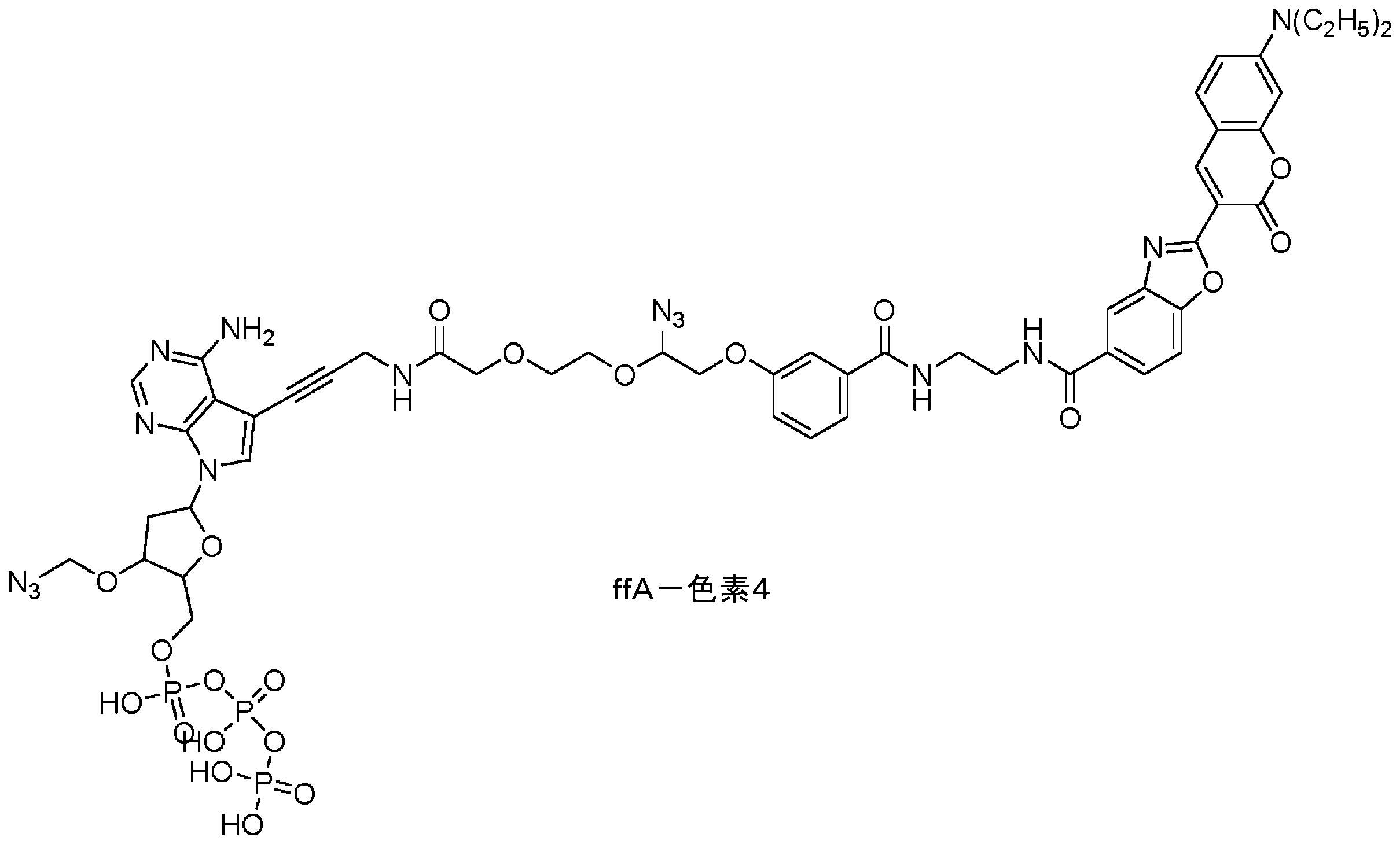
別の実験では、色素4で標識されたffAの光漂白速度を、標識ヌクレオチドがフローセルの表面上のクラスタに組み込まれた後に測定した。図2は、標準検出溶液(対照)及びCOT混合物をそれぞれ使用した場合の、10回、20回、及び50回の照射後に測定された残存した蛍光強度のパーセンテージを示す。結果は、対照検出溶液へのシクロオクタテトラエン及びケルセチンの添加が、色素漂白の低減速度に正の影響を及ぼしたことを示した。 In another experiment, the photobleaching rate of dye 4-labeled ffA was measured after the labeled nucleotides were incorporated into clusters on the surface of the flow cell. FIG. 2 shows the percentage of remaining fluorescence intensity measured after 10, 20 and 50 irradiations using the standard detection solution (control) and the COT mixture, respectively. The results showed that the addition of cyclooctatetraene and quercetin to the control detection solution had a positive effect on the rate of reduction of dye bleaching.
DNAクラスタに対して光照射を使用するIllumina配列決定プラットフォームMiSeq(登録商標)に対する更なる実験もまた、COT及びケルセチンの添加が、配列決定実行の検出工程中の光曝露によって引き起こされるDNA損傷を防止することができることを示した。配列決定マトリックスは、標準スキャン混合物(USM)を使用した場合、位相値が光曝露により増加した(図3A)が、「COT混合物」を使用した場合、位相値の増加はなかった(図3B)ことを示した。
実施例2
Further experiments on the Illumina sequencing platform MiSeq®, which uses light irradiation on DNA clusters, also showed that the addition of COT and quercetin prevents DNA damage caused by light exposure during the detection step of the sequencing run. showed that it can be done. The sequencing matrix showed that phase values increased with light exposure when using the standard scan mixture (USM) (Fig. 3A), but there was no increase in phase values when using the "COT mixture" (Fig. 3B). showed that
Example 2
この例では、1,3,5,7-シクロオクトテトラエニルカルボン酸の様々な新しいアミノ官能化N-置換アミドを、カルボキシル基活性化を介してCOT-COOHから調製した。例示的な化合物を以下に示す。
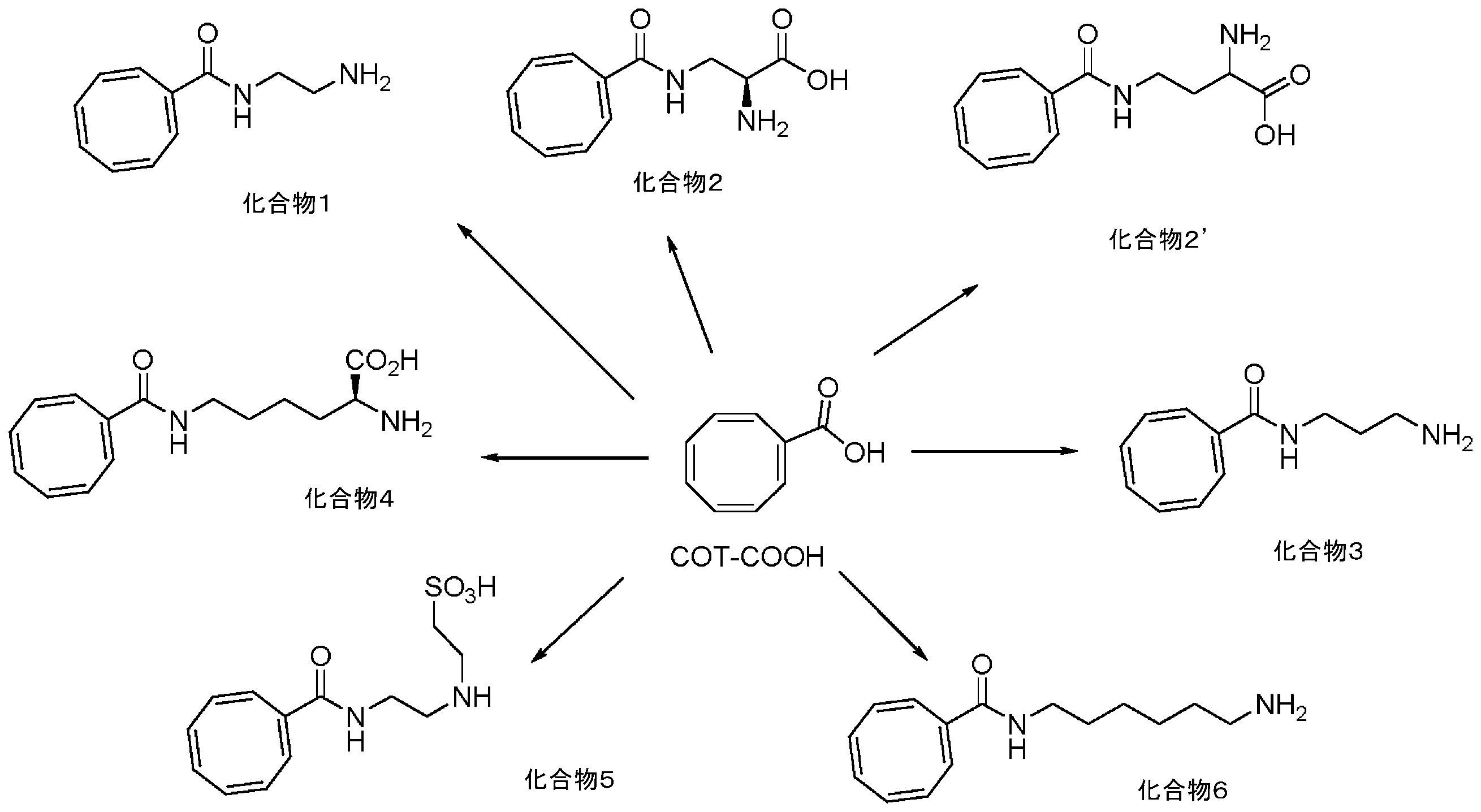
COT化合物の合成
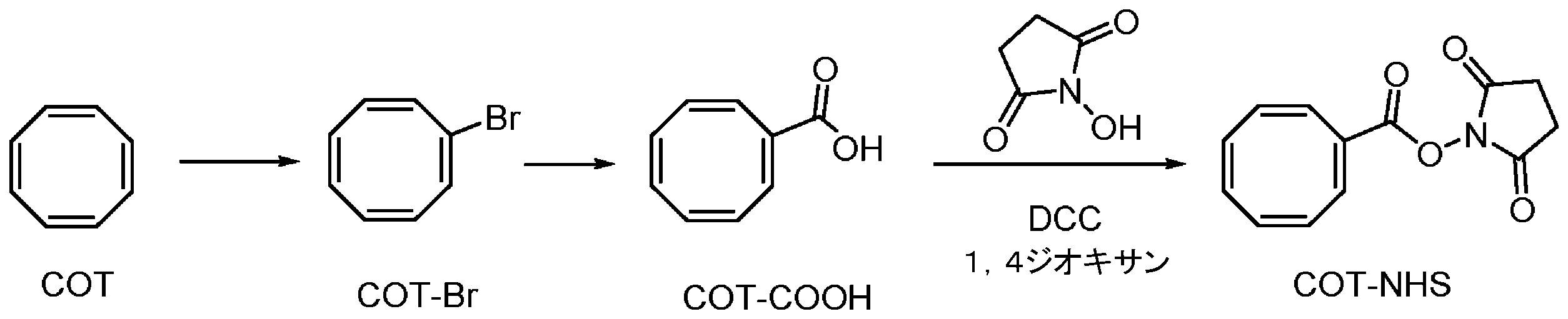
Synthesis of COT compounds
カルボキシシクロオクタ-1,3,5,7-テトラエン(COT-COOH)を、J.Am.Chem.Soc.1952,74,pp168-172及びpp173-175に記載される一般的手順に従って、COTから2つの工程で調製した。COT-COOH(10mmol、1.48g)、及びN-ヒドロキシ-スクシンイミド(NHS、10mmol、1.15g)をジオキサンに溶解した。黄色の溶液を、氷浴を使用して0℃に冷却した後、N,N’-ジシクロヘキシルカルボジイミド(DCC、10mmol、2.06g)を固体として添加した。反応混合物を0℃で15分間撹拌した。次いで、氷浴を取り出し、反応混合物を撹拌しながら室温(RT)に温めた。TLCによって示されるように、反応は、1時間後に完了した。COT-NHSエステルがLC-MSによって確認され、更に精製することなく、COT化合物1~6の合成に使用した。

一般手順:COT-NHSエステル(245mg、1.0mmol)をDMF(6mL)に溶解し、適切なアミン(1.25mmol)、水(6mL)、及びトリエチルアミン(0.41mL、3mmol)を含有するフラスコに0℃で添加した。反応混合物を室温まで温め、4時間撹拌した。飽和水性NH4Cl溶液を添加し、生成物をCH2Cl2(DCM)(2×10mL)で反応混合物から抽出した。水相を1MのHCl水溶液で更に酸性化し、追加の2×10mLのDCMで再度抽出した。合わせた有機相をブラインで洗浄し、Na2SO4で乾燥させた。溶液を濾過し、真空中で濃縮した。粗残渣をカラムクロマトグラフィーによって精製した。
化合物1:N-(2-アミノエチル)シクロオクタ-1,3,5,7-テトラエン-1-カルボキサミド
General Procedure: Dissolve COT-NHS ester (245 mg, 1.0 mmol) in DMF (6 mL) in a flask containing the appropriate amine (1.25 mmol), water (6 mL), and triethylamine (0.41 mL, 3 mmol). at 0°C. The reaction mixture was warmed to room temperature and stirred for 4 hours. A saturated aqueous NH 4 Cl solution was added and the product was extracted from the reaction mixture with CH 2 Cl 2 (DCM) (2×10 mL). The aqueous phase was further acidified with 1M aqueous HCl and re-extracted with an additional 2×10 mL of DCM. The combined organic phase was washed with brine and dried over Na2SO4 . The solution was filtered and concentrated in vacuo. The crude residue was purified by column chromatography.
Compound 1: N-(2-aminoethyl)cycloocta-1,3,5,7-tetraene-1-carboxamide
DCM中の1,2-エチレンジアミン(10当量)の溶液を、撹拌棒、窒素ガスライン、及び滴下漏斗を備えた丸底フラスコ内で0℃に冷却した。上記のように調製したCOT-NHSの溶液を滴下漏斗に移し、10分かけてエチレンジアミン溶液に添加した。滴下漏斗をより多くのDCMですすぎ、溶液をフラスコに添加した。反応混合物を室温まで温め、室温で3時間撹拌した。反応は、TLC及びLCMSによって完了したものとして確認された。溶媒の大部分を留去し、残渣をフラッシュクロマトグラフィーによって精製した。収率:76%。純度、構造、及び組成をLCMS、及びNMRによって確認した。
化合物2(BOC保護):2-[(tert-ブトキシカルボニル)アミノ]-3-(シクロオクタ-1,3,5,7-テトラエン-1-イル-カルボキサミド)プロパン酸

Compound 2 (BOC protected): 2-[(tert-butoxycarbonyl)amino]-3-(cycloocta-1,3,5,7-tetraen-1-yl-carboxamido)propanoic acid
Boc-L-2,3-ジアミノプロピオン酸(12.5mmol、2.55g)を、Et3N(30mmol、4.2mL)で処理した脱イオン水(35mL)に溶解した。溶液を0℃に冷却した。COT-NHS(10mmol)をDMF(35ml)中の溶液として滴下し、温度を0℃に維持した。室温に加熱し、90分間撹拌した。LCMSは、所望の生成物への転化を確認し、全ての出発材料が消費された。反応を塩化アンモニウム水溶液で希釈し、DCMで抽出することによって発展させた。水層を1MのHClで酸性化し、更なる量のDCMで再度抽出した。合わせたDCM画分を無水硫酸マグネシウムで乾燥させ、溶媒を蒸発させ、残渣をフラッシュクロマトグラフィーによって精製した。収率64%。
化合物2:2-アミノ-3-(シクロオクタ-1,3,5,7-テトラエン-1-イル-カルボキサミド)プロパン酸
Boc-L-2,3-diaminopropionic acid (12.5 mmol, 2.55 g) was dissolved in deionized water (35 mL) treated with Et 3 N (30 mmol, 4.2 mL). The solution was cooled to 0°C. COT-NHS (10mmol) was added dropwise as a solution in DMF (35ml) keeping the temperature at 0°C. Heated to room temperature and stirred for 90 minutes. LCMS confirmed conversion to the desired product and all starting material was consumed. The reaction was worked up by diluting with aqueous ammonium chloride and extracting with DCM. The aqueous layer was acidified with 1M HCl and re-extracted with a further amount of DCM. The combined DCM fractions were dried over anhydrous magnesium sulphate, the solvent was evaporated and the residue purified by flash chromatography.
Compound 2: 2-amino-3-(cycloocta-1,3,5,7-tetraen-1-yl-carboxamido)propanoic acid
DCM(5mL)中の化合物2(BOC保護)(250mg、0.75mmol)をTFA(1mL)で処理し、混合物を室温で17時間撹拌した。次いで、溶液を真空で濃縮し、Et2Oを添加し、白色の沈殿物を形成した。溶媒をデカントし、沈殿物を更にEt2Oで洗浄した。得られた沈殿物を真空下で乾燥させて、化合物2のトリフルオロ酢酸塩(TFA塩)をオフホワイトの固体(257mg、収率98%)として得た。1H NMR(400MHz、D2O)δ6.82(s、1H)、6.14(dd、J=11.4、3.1Hz、1H)、6.03-5.86(m、5H)、4.17-4.08(m、1H)、3.89-3.66(m、2H)。13C NMR(101MHz、D2O)δ170.50、169.93、139.68、136.24、135.22、133.79、132.13、131.66、130.16、127.82、53.83、39.57。19F NMR(376MHz、オキシド重水素)δ-75.64。
化合物2’(BOC保護):2-[(tert-ブトキシカルボニル)アミノ]-4-(シクロオクタ-1,3,5,7-テトラエン-1-イル-カルボキサミド)ブタン酸

Compound 2′ (BOC protected): 2-[(tert-butoxycarbonyl)amino]-4-(cycloocta-1,3,5,7-tetraen-1-yl-carboxamido)butanoic acid
この中間体は、Boc-L-2,4-ジアミノブタン酸から始まる、化合物2(BOC保護)の合成に記載る手順に従って調製した。
化合物2’:2-アミノ-4-(シクロオクタ-1,3,5,7-テトラエン-1-イル-カルボキサミド)ブタン酸
This intermediate was prepared following the procedure described in the synthesis of compound 2 (BOC protected) starting from Boc-L-2,4-diaminobutanoic acid.
Compound 2′: 2-amino-4-(cycloocta-1,3,5,7-tetraen-1-yl-carboxamido)butanoic acid
化合物2’を、化合物2’(BOC保護)から始まる、化合物2の合成に記載される手順に従って調製した。それをHPLCによって精製した。純度、構造、及び組成をLCMS、及びNMRによって確認した。
化合物3:N-(3-アミノプロピル)シクロオクタ-1,3,5,7-テトラエン-1-イル-カルボキサミド
Compound 2' was prepared following the procedure described in the synthesis of compound 2, starting from compound 2' (BOC protected). It was purified by HPLC. Purity, structure and composition were confirmed by LCMS and NMR.
Compound 3: N-(3-aminopropyl)cycloocta-1,3,5,7-tetraen-1-yl-carboxamide
COT-NHSエステル(1.0mmol)及び1,3-ジアミノプロパン(0.84mL、10mmol)を室温で4時間撹拌した。粗残渣をカラムクロマトグラフィーによって精製して、化合物3をオレンジ色の油として得た(197mg、97%)。1H NMR(400MHz、クロロホルム-d)δ6.89-6.79(m、1H)、6.53(s、1H)、6.07-5.63(m、6H)、3.41-3.26(m、2H)、2.74(t、J=6.3Hz、2H)、1.68-1.48(m、2H)。13C NMR(101MHz、CDCl3)δ165.86、137.99、136.41、135.30、132.66、132.37、131.40、130.87、128.80、40.22、38.48、32.00。
化合物4(BOC保護):N2-(tert-ブトキシカルボニル)-N6-(シクロオクタ-1,3,5,7-テトラエン-1-イル-カルボニル)-L-リジン

Compound 4 (BOC protected): N 2 -(tert-butoxycarbonyl)-N 6 -(cycloocta-1,3,5,7-tetraen-1-yl-carbonyl)-L-lysine
COT-NHSエステル(2.57mmol)及びL-BOC-リジン(3.21mmol)を室温で2時間撹拌した。反応混合物を上記のように発展させ、粗残渣をカラムクロマトグラフィーによって精製して、化合物4(BOCを保護)を淡黄色の固体として得た(561mg、収率=58%)。
化合物4:N6-(シクロオクタ-1,3,5,7-テトラエン-1-イル-カルボニル)-L-リジン
COT-NHS ester (2.57 mmol) and L-BOC-lysine (3.21 mmol) were stirred at room temperature for 2 hours. The reaction mixture was worked up as above and the crude residue was purified by column chromatography to give compound 4 (BOC protected) as a pale yellow solid (561 mg, yield=58%).
Compound 4: N 6 -(Cycloocta-1,3,5,7-tetraen-1-yl-carbonyl)-L-lysine
前の工程からの化合物4(BOC保護)を、化合物2の合成に記載される手順に従ってDCM中のTFAで処理して、化合物4をオフホワイトの固体(109mg、66%)として得た。1H NMR(400MHz、D2O)δ6.63(s、1H)、6.11-5.70(m、6H)、3、91(t、J=6.2Hz、1H)、3.14(t、J=6.9Hz、2H)、1.99-1.68(m、2H)、1.53-1.21(m、4H)。13C NMR(101MHz、D2O)δ172.34、168.63、138.43、136.00(2C)、133.56、132.12、131.67、130.31、128.07、52.93、39.15、29.45、27.98、21.63。19F NMR(376MHz、D2Oj)δ-75.64。
化合物5:2-(2-シクロオクタ-1,3,5,7-テトラエン-1-イル-カルボキサミド)エチル)アミノ)エタン-1-スルホン酸
Compound 4 (BOC protected) from the previous step was treated with TFA in DCM following the procedure described in the synthesis of compound 2 to give
Compound 5: 2-(2-cycloocta-1,3,5,7-tetraen-1-yl-carboxamido)ethyl)amino)ethane-1-sulfonic acid
化合物5を、DMF7mL中のCOT-NHSエステル(1mmol)、2-[(2-アミノエチル)アミノ]エタンスルホネートナトリウム(238mg、1.25mmol)、Et3N(0.07mL、0.5mmol)から、化合物1の合成に記載される手順に従って調製した。反応混合物を室温で4時間撹拌し、粗残渣をカラムクロマトグラフィーによって精製した。化合物5を赤みがかったガム(169mg)として得た。収率57%。1H NMR(400MHz、オキシド重水素)δ6.75(s、1H)、6.05(s、1H)、5.95-5.74(m、5H)、3.51(t、J=5.4Hz、2H)、3.39(t、J=6.8Hz、2H)、3.24-3.15(m、4H)。13C NMR(101MHz、CDCl3)δ176.76、167.38、138.95、135.89、135.30、133.27、131.94、130.50、128.65、47.75、46.65、44.13、36.60。
化合物6:N-(6-アミノヘキシル)シクロオクタ-1,3,5,7-テトラエン-1-イル-カルボキサミド
Compound 6: N-(6-aminohexyl)cycloocta-1,3,5,7-tetraen-1-yl-carboxamide
化合物6を化合物1の合成に記載された手順に従って調製した。COT-NHSエステル(1mmol)及びヘキサメチレンジアミン(1.46g、12.5mmol)をDMF(7mL)中で、室温で4時間撹拌した。溶媒を留去し、粗残渣をカラムクロマトグラフィーによって精製して、化合物6をオレンジ色の油(195mg)として得た。収率79%。1H NMR(400MHz、クロロホルム-d)δ6.97-6.89(s、1H)、6.19-5.67(m、6H)、3.31(br s、1H)、2.79(t、J=7.0Hz、2H)、1.63-1.47(m、4H)、1.46-1.30(m、4H)。13C NMR(101MHz、CDCl3)δ165.73、138.11、136.34、135.66、132.69、132.47、131.30、130.81、128.60、41.94、39.80、33.21、29.50、26.72、26.46.
化合物7:2-アミノ-3-[3-(シクロオクタ-1,3,5,7-テトラエン-1-イル)アクリルアミド]プロパン酸

Compound 7: 2-amino-3-[3-(cycloocta-1,3,5,7-tetraen-1-yl)acrylamido]propanoic acid
THF(15mL)中のホルミルシクロオクタテトラエン(212mg、1.60mmol)の溶液を0℃に冷却し、水素化ナトリウム(96mg、2.41mmol)で処理した。混合物を0℃で45分間撹拌し、THF(5mL)中の2-(ジエトキシホスホリル)アセテート(0.57mL、2.89mmol)を添加した。反応混合物を室温で2時間撹拌し、次いで過剰の飽和塩化アンモニウム水溶液でクエンチした。生成物を酢酸エチルで抽出し、合わせた有機物抽出物をブラインで洗浄し、無水硫酸ナトリウムで乾燥させ、真空で濃縮した。粗残渣をカラムによって精製して、オレンジ色の油として3-(シクロオクタ-1,3,5,7-テトラエン-1-イル)アクリレートを得た。収率:374mg(95%)。 A solution of formylcyclooctatetraene (212 mg, 1.60 mmol) in THF (15 mL) was cooled to 0° C. and treated with sodium hydride (96 mg, 2.41 mmol). The mixture was stirred at 0° C. for 45 minutes and 2-(diethoxyphosphoryl)acetate (0.57 mL, 2.89 mmol) in THF (5 mL) was added. The reaction mixture was stirred at room temperature for 2 hours and then quenched with excess saturated aqueous ammonium chloride. The product was extracted with ethyl acetate and the combined organic extracts were washed with brine, dried over anhydrous sodium sulfate and concentrated in vacuo. The crude residue was purified by column to give 3-(cyclooct-1,3,5,7-tetraen-1-yl)acrylate as an orange oil. Yield: 374 mg (95%).
エタノール(8mL)中の3-シクロオクタ-1,3,5,7-テトラエン-1-イル)アクリレート(383mg、16mmol)の溶液を2MのLiOH(水溶液)(8mL、1.6mmol)で処理し、室温で18時間撹拌した。混合物を2MのHCl(水溶液)で酸性化し、生成物を酢酸エチルで抽出した。合わせた有機物を無水硫酸ナトリウムで乾燥させ、真空で濃縮し、3-シクロオクタ-1,3,5,7-テトラエン-1-イル)アクリル酸を褐色の固体として得た。収率:234mg(72%)。LC-MS(-):173(M-1)。 A solution of 3-cyclooct-1,3,5,7-tetraen-1-yl)acrylate (383 mg, 16 mmol) in ethanol (8 mL) was treated with 2M LiOH (aq) (8 mL, 1.6 mmol) Stir at room temperature for 18 hours. The mixture was acidified with 2M HCl (aq) and the product was extracted with ethyl acetate. The combined organics were dried over anhydrous sodium sulfate and concentrated in vacuo to give 3-cycloocta-1,3,5,7-tetraen-1-yl)acrylic acid as a brown solid. Yield: 234 mg (72%). LC-MS (-): 173 (M-1).
DMF(4mL)中の3-(シクロオクタ-1,3,5,7-テトラエン-1-イル)アクリル酸(100mg、0.49mmol)をPyBOP(283mg、0.54mmol)及びDIPEA(1mL)で処理し、室温で10分間撹拌した。次いで、L 3-アミノ-2-[(tert-ブトキシカルボニル)アミノ]プロパン酸(120mg、0.59mmol)を添加し、混合物を室温で18時間撹拌した。次いで、反応混合物を1Mの塩酸で酸性化し、更に水で希釈した。生成物を酢酸エチルで抽出し、合わせた有機物をブラインで洗浄し、無水硫酸ナトリウムで乾燥させ、真空内で濃縮した。粗残渣をカラムクロマトグラフィーによって精製した。真空中で濃縮した後、残渣をDCMに再溶解し、TFA(1mL)で処理した。反応混合物を室温で5時間撹拌し、次いで真空中で濃縮した。残渣をジエチルエーテルで粉砕し、得られた固体を真空下で乾燥させて、化合物7のトリフルオロ酢酸塩を褐色の固体として得た。収率132mg(72%)。1H NMR(400MHz、D2O):δ7.14(d、J=15.6Hz、1H)、6.18(d、J=3.9Hz、1H)、6.06-5.73(m、7H)、4.12(dd、J=6.0、4.1Hz、1H)、3.83(dd、J=15.0、4.1Hz、1H)、3.68(dd、J=15.0、6.0Hz、1H)。13C NMR(101MHz、CDCl3):δ170.34、169.92、143.61、140.09、139.22、134.02、133.05、131.89、131.69、131.22、129.19、118.93、53.69、39.24.LC-MS(-):261(M-1)。
化合物8:4-[N-(2-アミノエチル)シクロオクタ-1,3,5,7-テトラエン-1-カルボキサミド]ブタン酸

Compound 8: 4-[N-(2-aminoethyl)cycloocta-1,3,5,7-tetraene-1-carboxamido]butanoic acid
DMF(10mL)中のカルボキシシクロオクタ-1,3,5,7-テトラエン(COT-CO2H、674mg、4.56mmol)をPyBOP(2.6g、5.0mmol)及びDIPEA(2mL)で処理した。混合物を室温で10分間撹拌し、次いで4-メトキシベンジル4-((2-((tert-ブトキシカルボニル)アミノ)エチル)アミノ)ブタン酸塩(2.17g、5.92mmol)を添加した。反応混合物を室温で18時間撹拌し、次いで真空中で濃縮した。残渣を酢酸エチルで希釈し、水及びブラインで洗浄した。有機物を無水硫酸ナトリウムで乾燥させ、次いで真空中で濃縮した。粗残渣をカラムクロマトグラフィーによって精製して、4-メトキシベンジル4-{N-[2-[(tert-ブトキシカルボニル)アミノ]エチル]シクロオクタ-1,3,5,7-テトラエン-1-カルボキサミド)-ブタノエートをオレンジ色の油として得た。
収率:1.58g(70%)。LC-MS(-):495(M-1)。
Carboxycycloocta-1,3,5,7-tetraene (COT-CO 2 H, 674 mg, 4.56 mmol) in DMF (10 mL) was treated with PyBOP (2.6 g, 5.0 mmol) and DIPEA (2 mL) bottom. The mixture was stirred at room temperature for 10 minutes, then 4-methoxybenzyl 4-((2-((tert-butoxycarbonyl)amino)ethyl)amino)butanoate (2.17 g, 5.92 mmol) was added. The reaction mixture was stirred at room temperature for 18 hours and then concentrated in vacuo. The residue was diluted with ethyl acetate and washed with water and brine. Organics were dried over anhydrous sodium sulfate and then concentrated in vacuo. The crude residue is purified by column chromatography to give 4-methoxybenzyl 4-{N-[2-[(tert-butoxycarbonyl)amino]ethyl]cycloocta-1,3,5,7-tetraene-1-carboxamide) - Butanoate was obtained as an orange oil.
Yield: 1.58 g (70%). LC-MS (-): 495 (M-1).
DCM(20mL)中の4-メトキシベンジル4-{N-[2-[(tert-ブトキシカルボニル)アミノ]エチル]シクロオクタ-1,3,5,7-テトラエン-1-カルボキサミド)-ブタノエート(1.58g、3.18mmol)を、TFA(3mL)で処理し、室温で16時間撹拌した。反応混合物を真空内で濃縮し、残渣をジエチルエーテルで粉砕した。溶媒をデカントし、残渣をジエチルエーテルで洗浄し、次いで真空下で乾燥させて、化合物8のトリフルオロ酢酸塩を茶色のガムとして得た。1H NMR(400MHz、D2O)δ6.13-5.77(m、7fH)、3.62(t、J=6.4Hz、4H)、3.16(d、J=6.3Hz、2H)、2.36(t、J=7.2Hz、2H)、1.95-1.83(m、2H)。LC-MS(+):277(M+1)。
色素-COT化合物の合成
4-Methoxybenzyl 4-{N-[2-[(tert-butoxycarbonyl)amino]ethyl]cycloocta-1,3,5,7-tetraene-1-carboxamido)-butanoate (1. 58 g, 3.18 mmol) was treated with TFA (3 mL) and stirred at room temperature for 16 hours. The reaction mixture was concentrated in vacuo and the residue triturated with diethyl ether. The solvent was decanted and the residue was washed with diethyl ether then dried under vacuum to give the trifluoroacetate salt of compound 8 as a brown gum. 1 H NMR (400 MHz, D 2 O) δ 6.13-5.77 (m, 7 fH), 3.62 (t, J = 6.4 Hz, 4H), 3.16 (d, J = 6.3 Hz, 2H), 2.36 (t, J=7.2 Hz, 2H), 1.95-1.83 (m, 2H). LC-MS (+): 277 (M+1).
Synthesis of dye-COT compounds
加えて、本明細書に記載のCOT化合物を、例えば、蛍光化合物の活性化カルボキシル基をCOT化合物のアミノ基と反応させることによって、蛍光化合物、例えば、青色光領域(「青色色素」)に発光波長を有するものに共有結合させた。
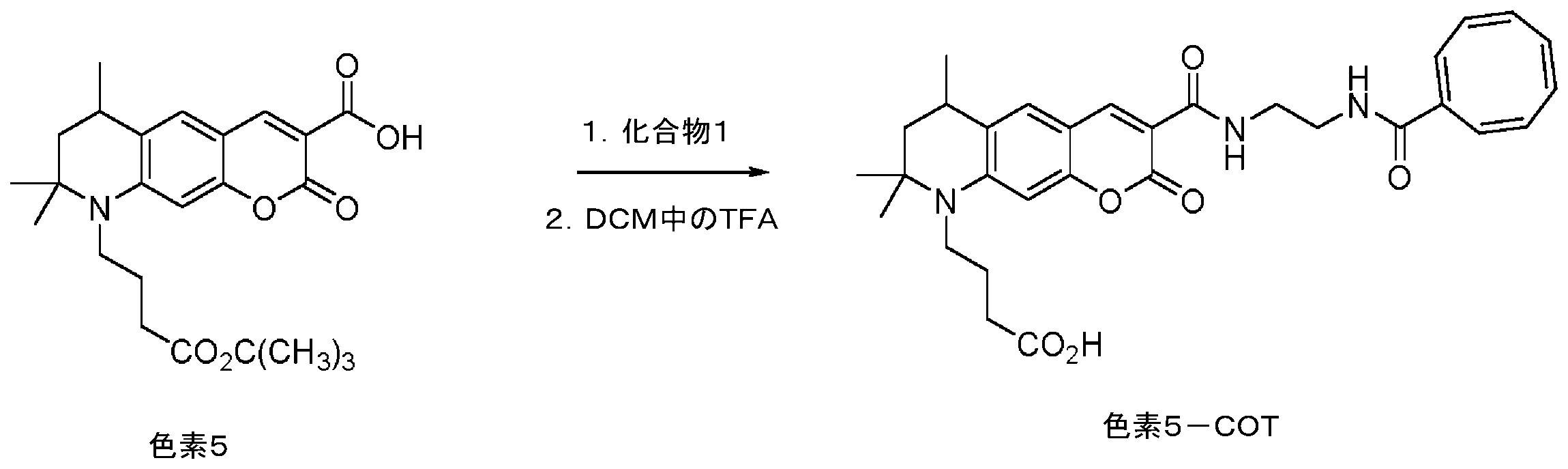
色素5(75μmol)をDMF(3×3mL)と共蒸発させ、次いで高真空下で一晩乾燥させた。撹拌棒及びPyBOP(75μmol)を、乾燥色素5とともにフラスコに入れた。窒素下で、DMF(1.5mL)を添加し、次いで、活性化反応のためにDIPEA(30ul)を添加した。15分の撹拌後に、HPLC及びTLCによって反応の進行を確認した。カルボキシル置換色素5の活性化が完了したとき、化合物1をDMF中の溶液(100mg/ml、60μmol)として添加し、反応混合物を室温で4時間撹拌した。TLC及びHPLCを使用して、反応の完了を確認し、次いで溶媒を真空で蒸留した。残渣をDCM(10ml)に溶解し、窒素ガス下で0℃に冷却した。トリフルオロ酢酸(4mL)を添加し、次いで氷浴を除去し、反応混合物を室温まで加温させながら撹拌した。TLCに従って約4時間後に反応が完了した。TFA及び溶媒を真空中で除去した。50%TEAB(0.5M)/MeCN(20mL)を添加し、濾過した後、精製のために分取HPLCに注入した(Axiaカラム、24~44%のMeCN)。収率:25%。吸収(409nm)及び蛍光(464nm)の最大値を1:1の混合物H2O-MeCN(1%トリエチルアミンを含有する)で測定した。
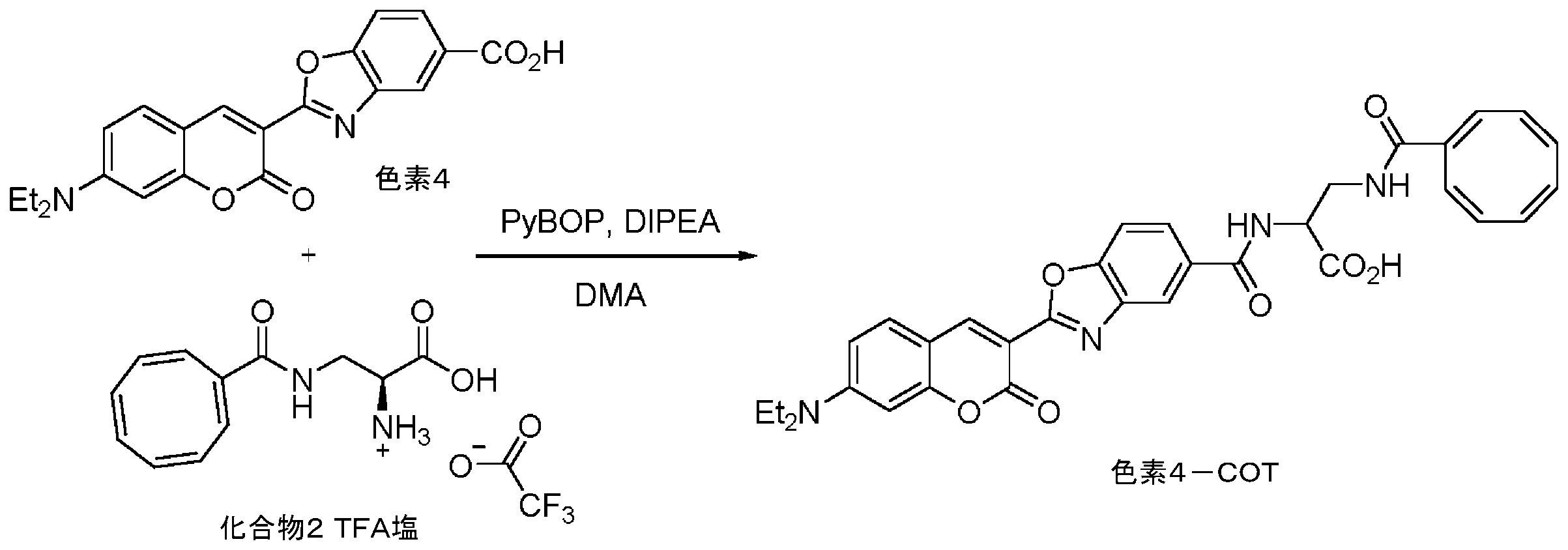
色素5-COTの合成に記載された同様の手順に従って、DMA(0.8mL)中の色素4(15mg、40μmol)をPyBOP(23mg、44μmol)及びDIPEA(0.2mL)、続いて化合物2(48μmol)で処理した。反応混合物を分取HPLC(40~70%、MeCN:0.1MのTEAB)によって精製して、色素4-COTを得た。収率:61%。吸収スペクトル(最大446nm)をエタノール中で測定した。
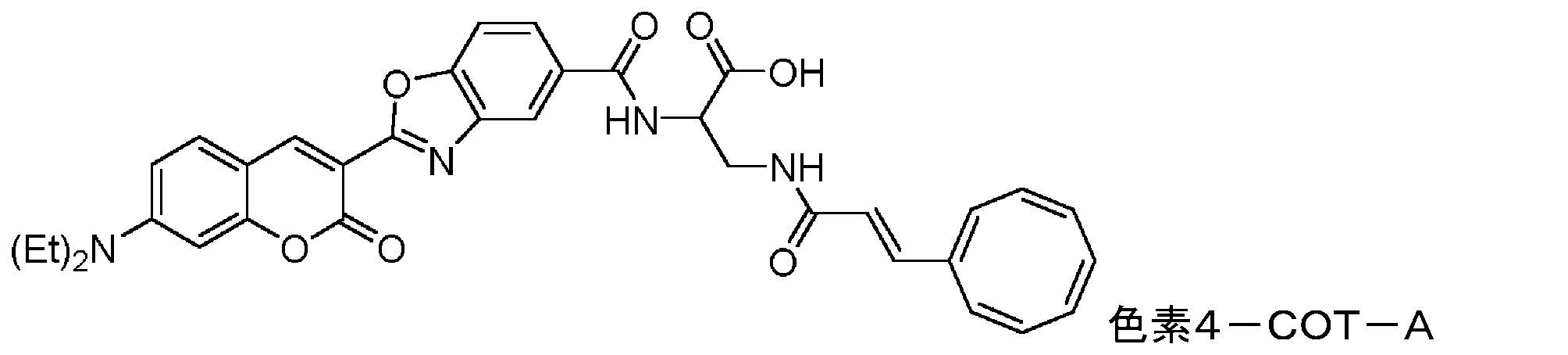
無水ジメチルアセトアミド(DMA、0.8mL)中の2-(7-(ジエチルアミノ)-2-オキソ-2H-クロメン-3-イル)ベンゾオキサゾール-5-カルボン酸(色素4、11mg、30μmol)をPyBOP(17mg、33μmol)及びDIPEA(0.2mL)で処理した。反応混合物を室温で10分間撹拌し、次いで2-アミノ-3-[3-(シクロオクタ-1,3,5,7-テトラエン-1-イル)アクリルアミド]プロパン酸(化合物7、15mg、36μmol)を添加した。混合物を室温で更に18時間撹拌し、次いで0.1MのTEABでクエンチした。残渣を逆相分取HPLCによって精製して、色素4-COT-Aを得た。収率:32%。LC-MS(-):619(M-1)。
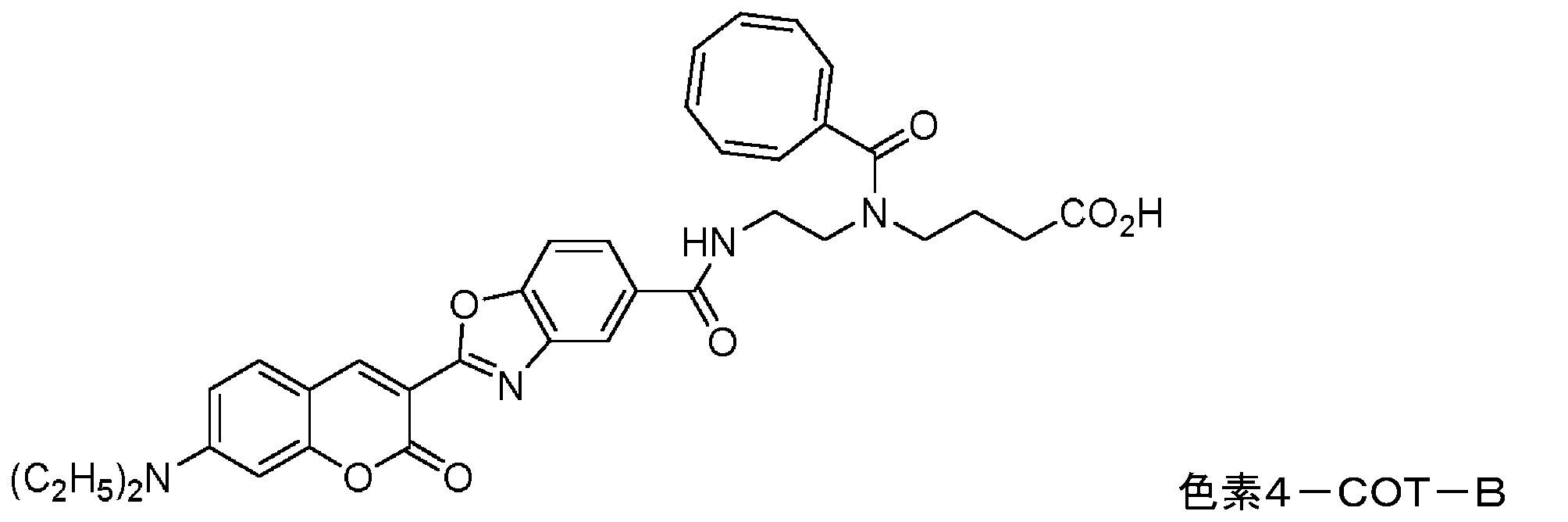
DMF(2mL)中の2-(7-(ジエチルアミノ)-2-オキソ-2H-クロメン-3-イル)ベンゾオキサゾール-5-カルボン酸(色素4、7.6mg、20μmol)をTNTU(11mg、30μmol)及びDIPEA(35μL、200μmol)で処理した。混合物を室温で30分間撹拌し、次いでDMF中の4-[N-(2-アミノエチル)シクロオクタ-1,3,5,7-テトラエン-1-カルボキサミド]ブタン酸トリフルオロ酢酸塩(化合物8、24μmol)を添加した。反応混合物を室温で18時間撹拌し、次いで0.1MのTEAB(水溶液)でクエンチした。残渣を分取HPLCによって精製して、色素4-COT-Bを得た。収率:64%。LC-MS(-):637(M-1)。
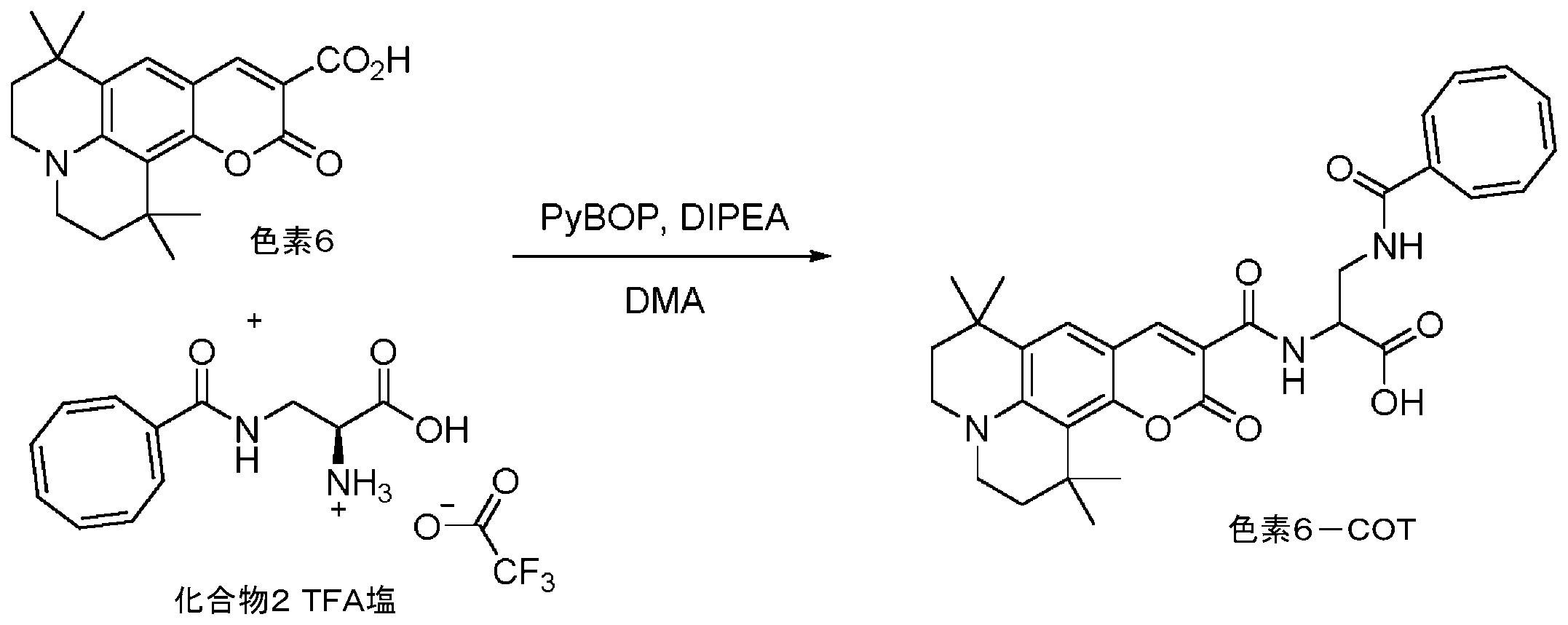
DMF(0.4mL)中の色素6(8.5mg、25μmol)を、上記のようにカルボキシル基活性化のためにPyBOP(14mg、28μmol)及びDIPEA(0.2mL)、続いて化合物2(10.4mg、30μmol)で処理し、反応混合物を室温で18時間撹拌した。粗残渣を逆相分取HPLC(40~60%のMeCN/0.1MのTEAB)によって精製して、色素6 COTを得た。収率:65%。吸収スペクトル(最大値448nm)を水中で測定した。
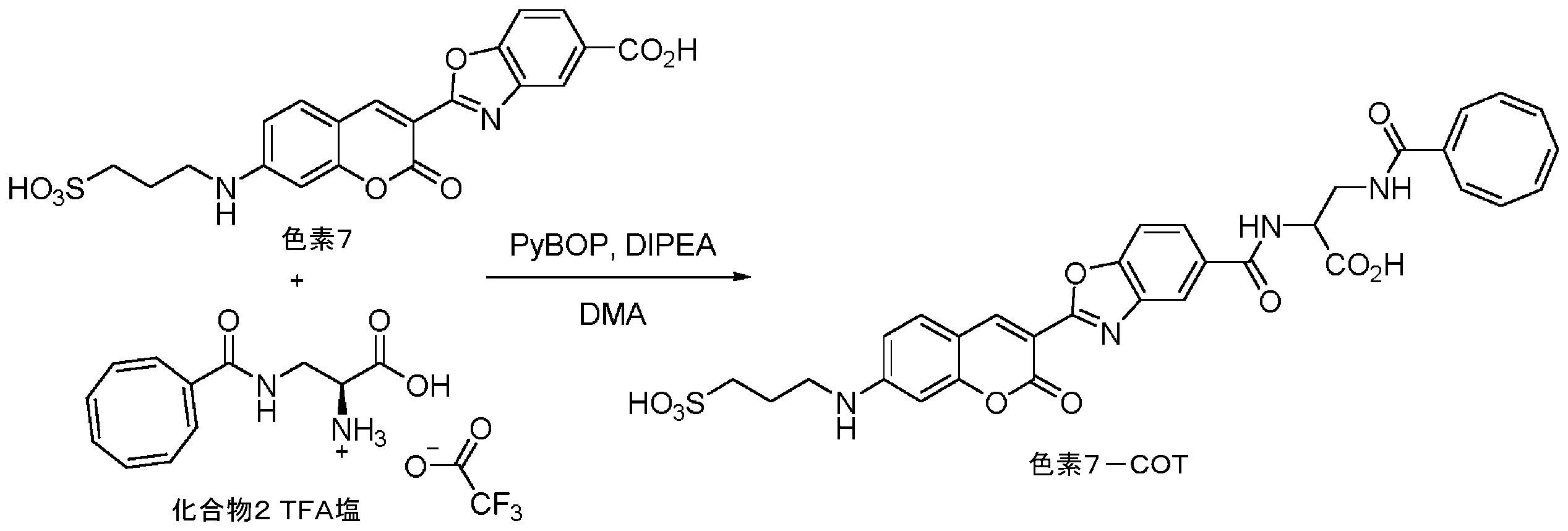
DMA(0.4mL)中の色素7(20μmol)をPyBOP(11.5mg、22μmol)及びDIPEA(0.1mL)、続いて化合物2(24μmol)で処理し、反応混合物を室温で18時間撹拌した。粗残渣を逆相分取HPLC(20~40%のMeCN/0.1MのTEAB)によって精製して、色素7 COTを得た。収率:57%。吸収スペクトル(最大値437nm)を水中で測定した。
ffN-色素-COT化合物の合成
Dye 7 (20 μmol) in DMA (0.4 mL) was treated with PyBOP (11.5 mg, 22 μmol) and DIPEA (0.1 mL) followed by compound 2 (24 μmol) and the reaction mixture was stirred at room temperature for 18 hours. . The crude residue was purified by reverse-phase preparative HPLC (20-40% MeCN/0.1 M TEAB) to give
Synthesis of ffN-dye-COT compounds
最後に、完全に官能化されたヌクレオチド(ffN)を、本明細書に記載のCOT含有色素で標識した。合成スキーム及び手順を以下に説明する。

一般的な手順:色素-COT化合物(1.0当量)をDIPEA-DMF(1:2)混合物に溶解し、次いで、活性化剤、例えば、PyBOP(1.1当量)を添加し、反応混合物を室温で10分間撹拌した。ffN-リンカー(1.2当量)を添加し、反応混合物を室温で18時間撹拌した。この反応混合物を0.1MのTEAB溶液でクエンチし、生成物を単離し、逆相分取HPLCにより精製した。
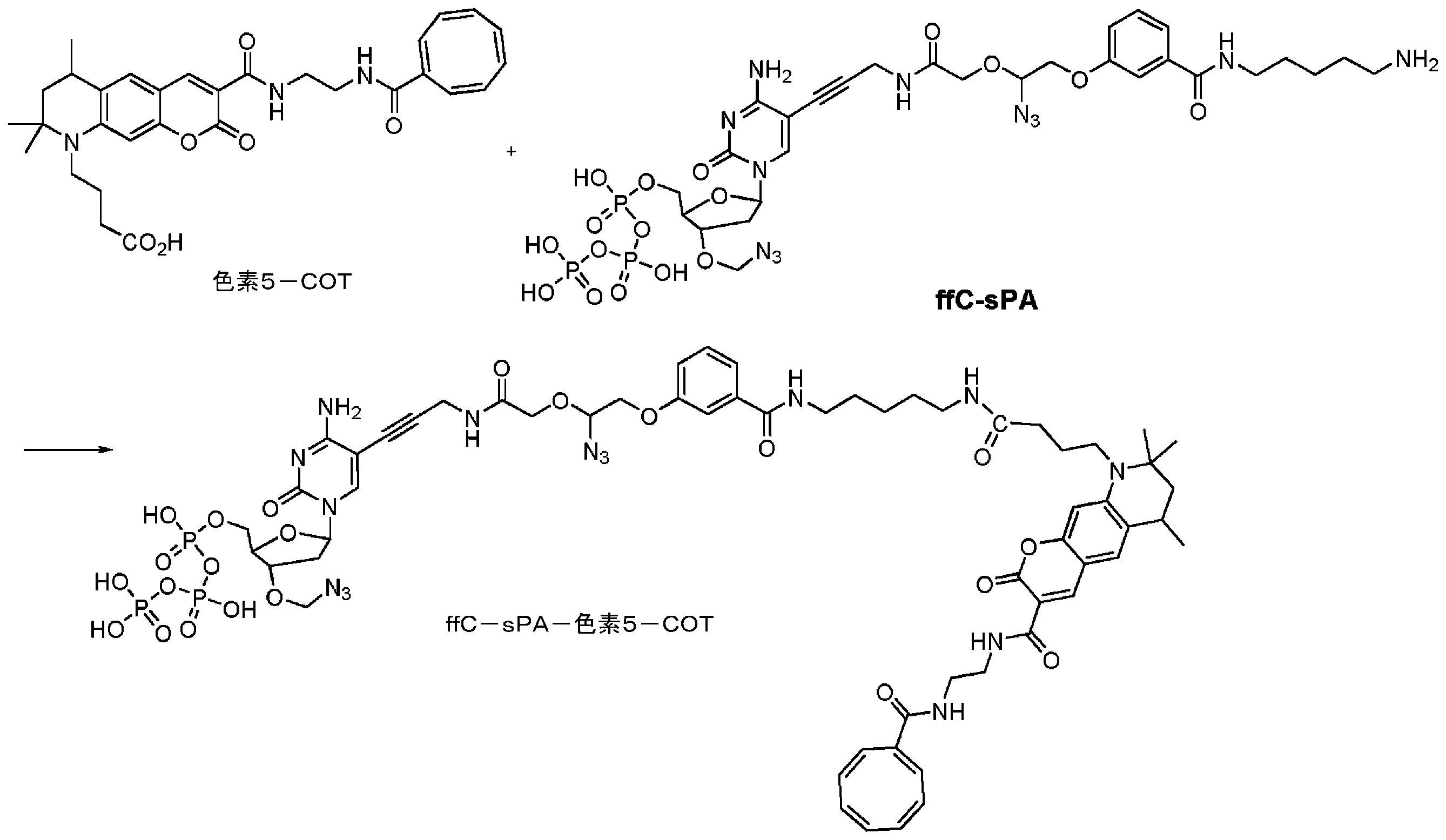
色素5-COTを、DMFと3回共蒸発させることによって乾燥させた。乾燥色素5-COT(10μmol)をDMA(0.5mL)に溶解した。O-(N-サクシニイミドイル)-1,1,3,3-テトラメチルウロニウムテトラフルオロホウ酸塩(TSTU、15μmol)及びN,N-ジイソプロピルエチルアミン(DIPEA、30μmol)を添加した。反応混合物を室温で、窒素下15分間撹拌した。活性化反応の進行を、HPLC及びTLCによって確認した。 Dye 5-COT was dried by co-evaporating with DMF three times. Dry dye 5-COT (10 μmol) was dissolved in DMA (0.5 mL). O-(N-succinimidoyl)-1,1,3,3-tetramethyluronium tetrafluoroborate (TSTU, 15 μmol) and N,N-diisopropylethylamine (DIPEA, 30 μmol) were added. The reaction mixture was stirred at room temperature under nitrogen for 15 minutes. The progress of the activation reaction was confirmed by HPLC and TLC.
三リン酸-デオキシC-sPA(dCTP-sPA)(12μmol、H2O中の20mMの溶液)を真空中で乾燥させた後、H2O(0.1ml)に再溶解した。活性化色素5-COTをdCTP-sPAを含有するフラスコに移した。反応進行をHPLC及びTLCによって監視した。反応が完了したら、0.1MのTEAB(約2mL)を反応フラスコに添加した。粗反応混合物を、Sephadexカラムを使用して精製した。画分を合わせ、真空中で乾燥させ、分取HPLCによって更に精製した。全ての関連する画分を合わせ、真空中で乾燥させ、10mMのTRIS pH8緩衝液に再溶解して、0.1mMのffC-sPA-色素5-COTの溶液を作製した。分析HPLCによって純度を確認し、LCMSによって質量を確認した。収率48%。吸収(最大値443nm)及び蛍光スペクトル(最大値484nm)を、ユニバーサルスキャン混合物(USM)で測定した。
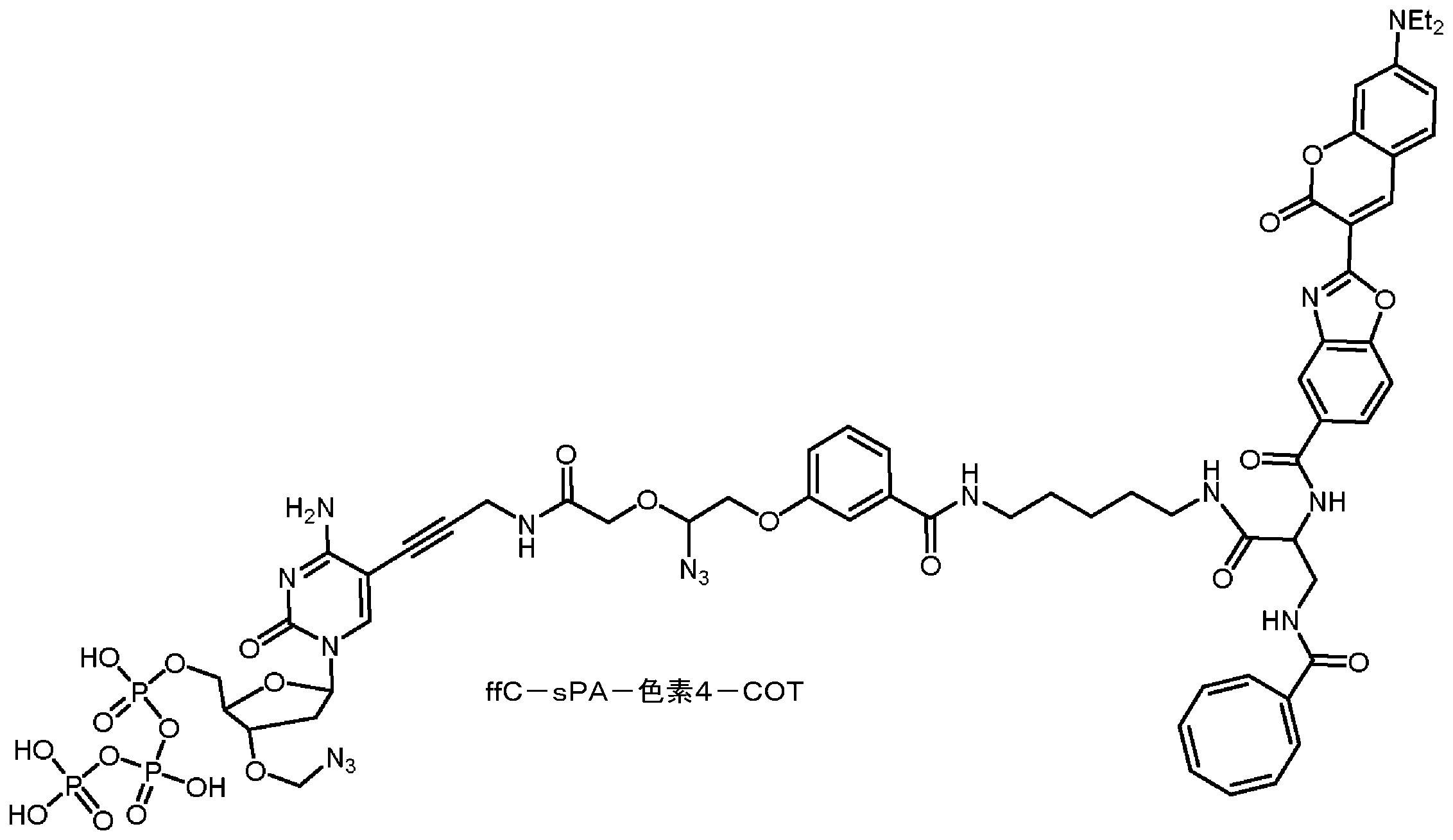
上記の同様の手順に従って、DMA(1mL)中の色素4-COT(24μmol)をTSTU(7.8mg、26μmol)及びDIPEA(36μL、200μmol)、0.1MのTEAB(100μL)中のdCTP-sPA(20μmol)、及びEt3N(10 μL)処理し、室温で8時間撹拌した。粗残渣を逆相分取HPLC(YMCカラム、10mL/分、38~58%のMeCN/0.1MのTEAB)を使用して精製して、ffC-sPA-色素4-COTを得た。収率:57%。吸収(最大値460nm)及び蛍光スペクトル(最大値505nm)をUSM中で測定した。 Following the same procedure as above, the dye 4-COT (24 μmol) in DMA (1 mL) was combined with TSTU (7.8 mg, 26 μmol) and DIPEA (36 μL, 200 μmol), dCTP-sPA in 0.1 M TEAB (100 μL). (20 μmol) and Et 3 N (10 μL) and stirred at room temperature for 8 hours. The crude residue was purified using reverse-phase preparative HPLC (YMC column, 10 mL/min, 38-58% MeCN/0.1 M TEAB) to give ffC-sPA-dye 4-COT. Yield: 57%. Absorption (maximum 460 nm) and fluorescence spectra (maximum 505 nm) were measured in USM.
ffC-sPA-色素4-COT-A及びffA-sPA-色素4-COT-Bもまた、本明細書に記載の同様の手順に従って調製した。ffC-sPA-色素4-COT-A:吸収最大値455nm(USM中)、蛍光最大値503nm(USM中、励起450nm)。ffA-sPA-色素4-COT-B:吸収最大値455nm(USM中)、蛍光最大値502nm(USM中、励起450nm)。


上記の同様の手順に従って、DMA(0.5mL)中のDye-6-COT(16μmol)をTSTU(5.3mg、17.6μmol)及びDIPEA(17μL、100μmol)、続いて、0.1MのTEAB(50μL)中のdCTP-sPA(10μmol)、及びEt3N(10 μL)で処理し、室温で4時間撹拌した。粗残渣を逆相分取HPLC(YMCカラム、10mL/分、45~65%のMeCN/0.1MのTEAB)を使用して精製して、ffC-sPA-色素6-COTを得た。収率40%。吸収(最大値455nm)及び蛍光スペクトル(最大値493nm)をUSMで測定した。
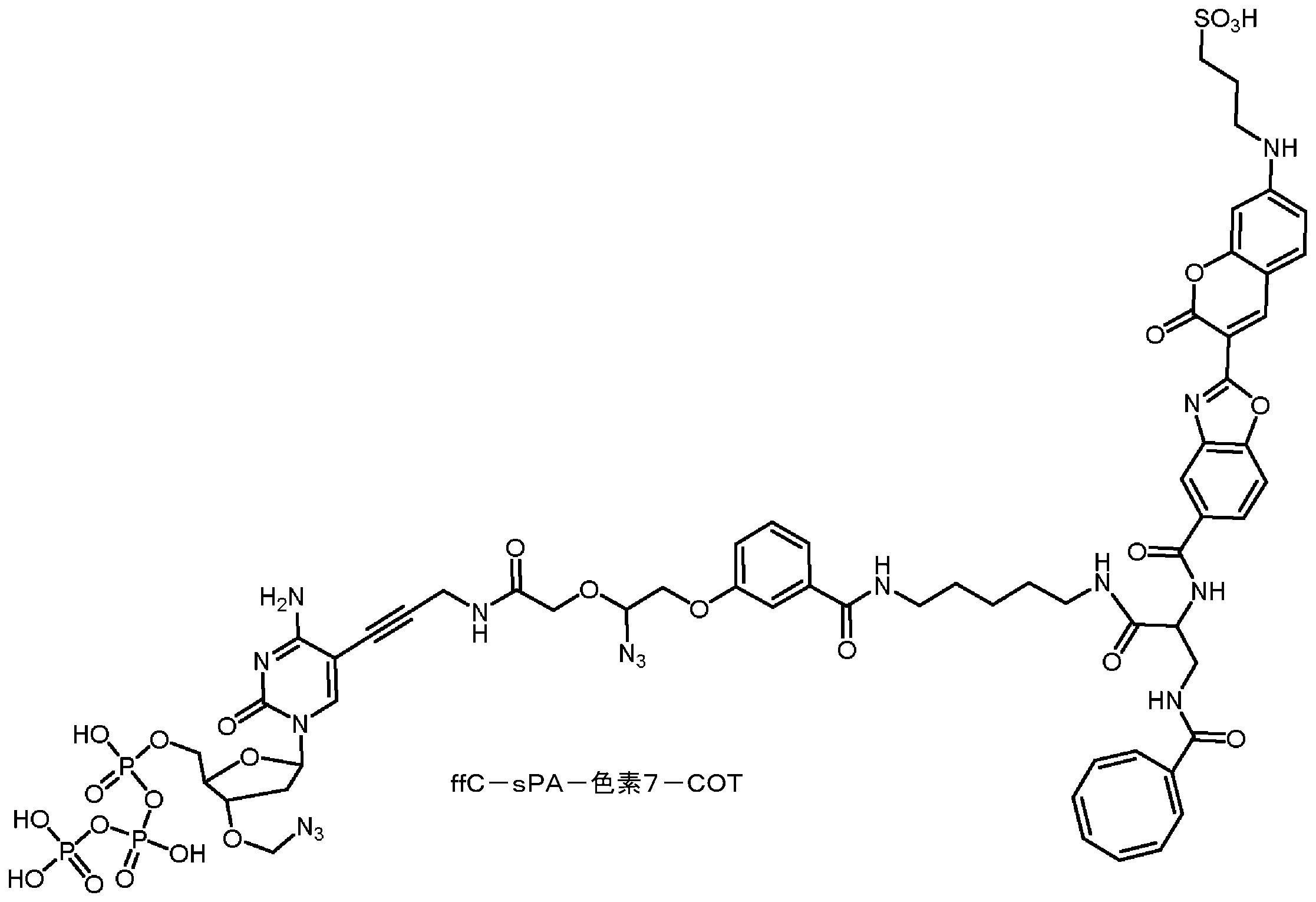
DMA(0.5mL)中のDye-7-COT(11.3μmol)をTSTU(3.8mg、12.4μmol)及びDIPEA(17μL、100μmol)、続いて0.1MのTEAB(50μL)中のdCTP-sPA(11.3μmol)、及びEt3N(10 μL)で処理し、室温で4時間撹拌した。粗残渣を、逆相分取HPLCを使用して精製して、ffC-sPA-色素7-COTを得た。収率:40%。吸収(最大値448nm)及び蛍光スペクトル(最大値488nm)をUSM中で測定した。 Dye-7-COT (11.3 μmol) in DMA (0.5 mL) was treated with TSTU (3.8 mg, 12.4 μmol) and DIPEA (17 μL, 100 μmol) followed by dCTP in 0.1 M TEAB (50 μL). - treated with sPA (11.3 μmol) and Et 3 N (10 μL) and stirred at room temperature for 4 hours. The crude residue was purified using reverse-phase preparative HPLC to give ffC-sPA-dye 7-COT. Yield: 40%. Absorption (maximum 448 nm) and fluorescence spectra (maximum 488 nm) were measured in USM.
ffC-sPA-色素5の光漂白速度及びCOT部分(ffC-sPA-色素5-COT)を含有するその対応する色素を、対照検出溶液(USM)に対する10mMのシクロオクタテトラエン及び0.25mMのケルセチン(「COT混合物」)を含有する検出溶液で試験した。正規化蛍光強度(1μmol、450nmでの励起、PMT600V)、及び30分の青色LED光照射後の残存した蛍光強度のパーセンテージを測定し、結果を、図4A及び図4Bにそれぞれ示す。図4Aは、青色蛍光強度が、共有結合したCOT部分によって60%クエンチされたことを示す。しかしながら、溶液中で青色LED光を照射しながらの光安定性の実質的な改善は、30分の照射後、ffC-sPA-色素5では、10%の蛍光シグナルのみが残り、ffC-sPA-色素5-COTでは、63%のシグナルが残った(図4B)。
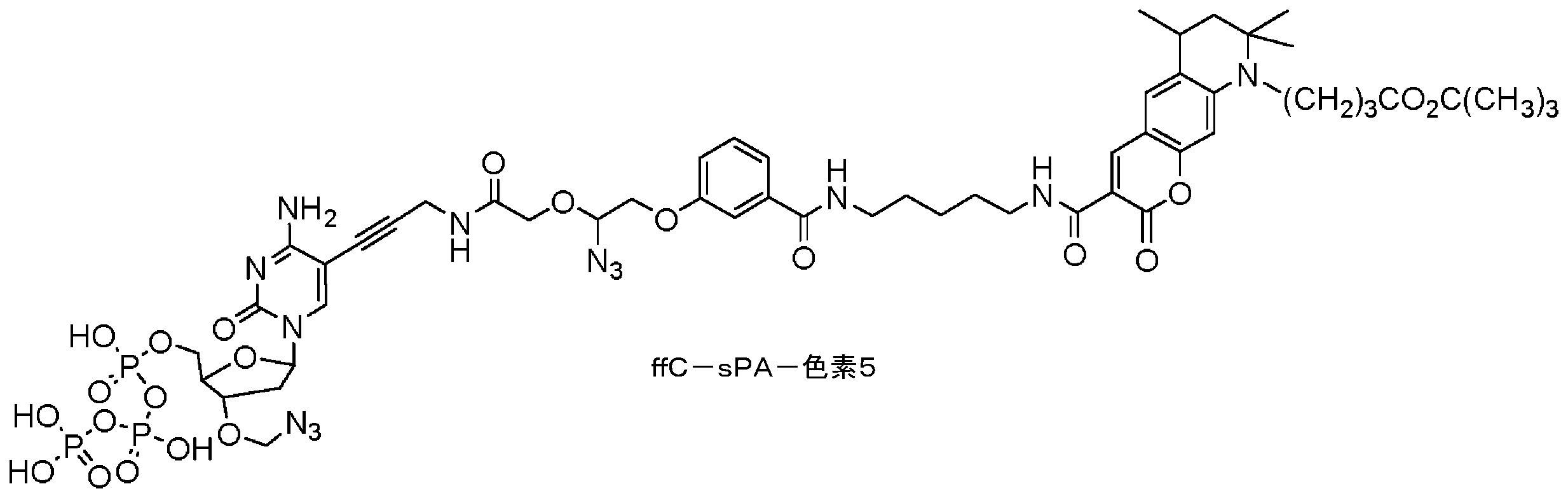
MiSeq(登録商標)プラットフォーム上での配列決定もまた、4つの異なる強度(1、2倍、5倍、又は10倍)で青色/緑色の光曝露を150サイクル実行した後、ffC-sPA-色素5(図5A)と比較して、ffC-sPA-色素5-COTによりシグナル減衰率の実質的な改善を示した(図5B)。結果は、COT部分が光照射によって引き起こされるDNA損傷を低減又は予防したことを実証する。 Sequencing on the MiSeq® platform was also performed after 150 cycles of blue/green light exposure at four different intensities (1x, 2x, 5x, or 10x) followed by ffC-sPA-dye Compared to 5 (FIG. 5A), ffC-sPA-dye 5-COT showed substantial improvement in signal attenuation (FIG. 5B). The results demonstrate that the COT moiety reduced or prevented DNA damage caused by light irradiation.
上記のように、追加のCOT修飾青色色素である色素4-COT、色素6-COT、及び色素7-COTを化合物2から調製した。各COT修飾色素について、完全に官能化されたヌクレオチド(ffN)への接続点は、色素のカルボキシル基(-COOH)を介している。図6Aは、COTを含有していない同等物と比較して、標準検出溶液(USM)中のffC-sPA-色素6-COT、ffC-sPA-色素7-COT、及びffC-sPA-色素4-COT(色素濃度1 μmol、450nmでの励起、PMT600V)の正規化蛍光強度を示す。図6Aは、色素の蛍光に対するCOT部分の効果及びクエンチング効果の色素構造依存性を示す。図6Bは、30分の青色LED光照射後の残存した蛍光強度のパーセンテージとして、試験した3つ全ての青色色素で観察されたCOT部分の光保護効果を示す。

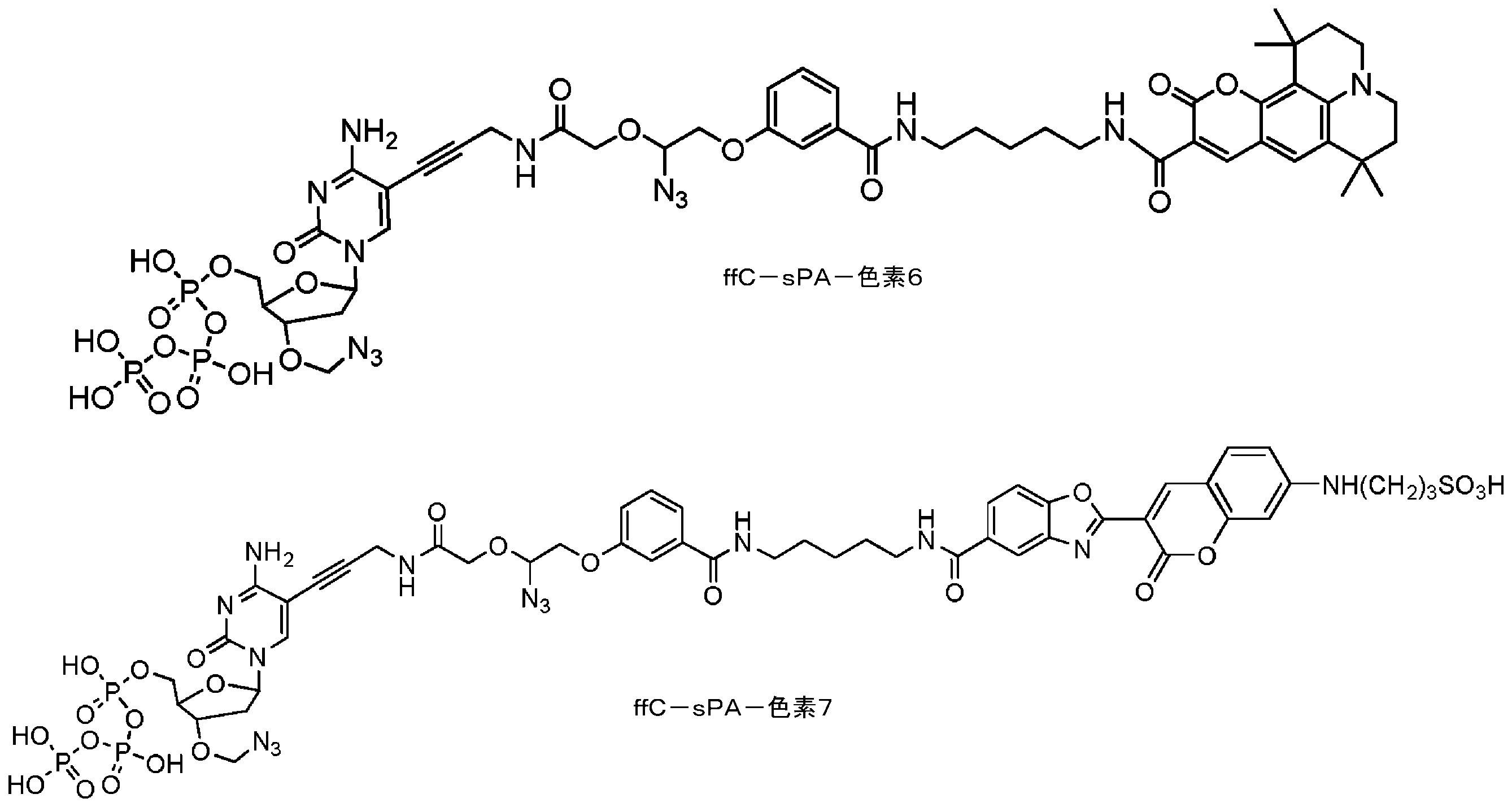
更に、青色光照射を使用して、MiSeq(登録商標)プラットフォームで同様のクエンチング及び色素光安定性が観察された。図7では、散布プロットにおけるx軸での黒いクラウド(右下象限)は、標識Cヌクレオチドの蛍光シグナルの強度を示した。色素光漂白は、強度の変化を1倍及び10倍の強度の青色光曝露下で比較することによって測定し、結果を以下の表に要約する。

図8に示されるように、シグナル減衰率(1回目のサイクルと比較した150回目の配列決定でのシグナル強度の%)はまた、COT修飾色素(ffC-sPA-色素4-COT及びffc-sPA-色素7-COT)において改善されており、これは、配列決定中の青色LED/レーザーによって誘発されるDNA損傷に対するCOT部分の光保護効果を示した。 As shown in FIG. 8, the signal decay rate (% of signal intensity at 150th sequencing compared to 1st cycle) was also affected by the COT-modified dyes (ffC-sPA-dye 4-COT and ffc-sPA -dye 7-COT), which indicated a photoprotective effect of the COT moiety against DNA damage induced by the blue LED/laser during sequencing.
結論として、COT部分の青色色素への共有結合は、光漂白及びDNA損傷の両方に対する保護効果を実証した。 In conclusion, covalent attachment of the COT moiety to the blue dye demonstrated a protective effect against both photobleaching and DNA damage.
Claims (60)

式中、
R1及びR2の各々が、各々独立して、H、ヒドロキシル、ハロゲン、アジド、チオール、ニトロ、シアノ、任意に置換されたアミノ、カルボキシル、-C(O)OR5、-C(O)NR6R7、任意に置換されたC1~6アルキル、任意に置換されたC1~6アルコキシ、任意に置換されたC1~6ハロアルキル、任意に置換されたC1~6ハロアルコキシ、任意に置換されたC2~6アルケニル、任意に置換されたC2~6アルキニル、任意に置換されたC6~10アリール、任意に置換されたC7~14アラルキル、任意に置換されたC3~7カルボシクリル、任意に置換された5~10員ヘテロアリール、及び任意に置換された3~10員ヘテロシクリルからなる群から選択され、
X及びYが、各々独立して、結合、-O-、-S-、-NR3-、-C(=O)-、-C(=O)-O-、-C(=O)-NR4-、-S(O)2-、-NR3-C(=O)-NR4、-NR3-C(=S)-NR4-、任意に置換されたC1~6アルキレン、及び任意に置換されたヘテロアルキレンからなる群から選択され、少なくとも1個の炭素原子が、O、S、又はNで置き換えられており、
Zが、存在しないか、任意に置換されたC2~6アルケニレン、又は任意に置換されたC2~6アルキニレンであり、
R3及びR4の各々が、独立して、H、任意に置換されたC1~6アルキル、又は任意に置換されたC6~10アリールであり、
R5が、任意に置換されたC1~6アルキル、任意に置換されたC6~10アリール、任意に置換されたC7~14アラルキル、任意に置換されたC3~7カルボシクリル、任意に置換された5~10員ヘテロアリール、又は任意に置換された3~10員ヘテロシクリルであり、
R6及びR7の各々が、独立して、H、任意に置換されたC1~6アルキル、任意に置換されたC6~10アリール、任意に置換されたC7~14アラルキル、任意に置換されたC3~7カルボシクリル、任意に置換された5~10員ヘテロアリール、又は任意に置換された3~10員ヘテロシクリルであり、

において、R1及びR2が結合している前記炭素原子が、O、S、又はNで任意に置き換えられるが、但し、前記炭素原子がO又はSで置き換えられる場合、R1及びR2は、両方とも存在せず、前記炭素原子がNで置き換えられる場合、R2は、存在しないことを条件とし、
mが、0~10の整数であるが、
但し、蛍光化合物は、シアニン色素ではないことを条件とする、蛍光化合物。 A fluorescent compound comprising a photoprotective cyclooctatetraene moiety, wherein the photoprotective cyclooctatetraene moiety comprises the structure of formula (I),
During the ceremony,
each of R 1 and R 2 is each independently H, hydroxyl, halogen, azide, thiol, nitro, cyano, optionally substituted amino, carboxyl, —C(O)OR 5 , —C(O) NR 6 R 7 , optionally substituted C 1-6 alkyl, optionally substituted C 1-6 alkoxy, optionally substituted C 1-6 haloalkyl, optionally substituted C 1-6 haloalkoxy, optionally substituted C 2-6 alkenyl, optionally substituted C 2-6 alkynyl, optionally substituted C 6-10 aryl, optionally substituted C 7-14 aralkyl, optionally substituted C selected from the group consisting of 3-7 carbocyclyl, optionally substituted 5-10 membered heteroaryl, and optionally substituted 3-10 membered heterocyclyl;
X and Y are each independently a bond, -O-, -S-, -NR 3 -, -C(=O)-, -C(=O)-O-, -C(=O)- NR 4 -, -S(O) 2 -, -NR 3 -C(=O)-NR 4 , -NR 3 -C(=S)-NR 4 -, optionally substituted C 1-6 alkylene, and optionally substituted heteroalkylene, wherein at least one carbon atom is replaced with O, S, or N;
Z is absent, optionally substituted C 2-6 alkenylene, or optionally substituted C 2-6 alkynylene;
each of R 3 and R 4 is independently H, optionally substituted C 1-6 alkyl, or optionally substituted C 6-10 aryl;
R 5 is optionally substituted C 1-6 alkyl, optionally substituted C 6-10 aryl, optionally substituted C 7-14 aralkyl, optionally substituted C 3-7 carbocyclyl, optionally substituted 5-10 membered heteroaryl or optionally substituted 3-10 membered heterocyclyl;
each of R 6 and R 7 is independently H, optionally substituted C 1-6 alkyl, optionally substituted C 6-10 aryl, optionally substituted C 7-14 aralkyl, optionally substituted C 3-7 carbocyclyl, optionally substituted 5-10 membered heteroaryl, or optionally substituted 3-10 membered heterocyclyl;
wherein the carbon atom to which R 1 and R 2 are attached is optionally replaced with O, S, or N, provided that when the carbon atom is replaced with O or S, R 1 and R 2 are , with the proviso that if both are absent and said carbon atom is replaced by N, R2 is absent;
m is an integer from 0 to 10,
However, a fluorescent compound provided that the fluorescent compound is not a cyanine dye.



において、R1及びR2が結合している少なくとも1個の炭素原子が、O、S、又はNで置き換えられる、請求項1~12のいずれか一項に記載の蛍光化合物。
Fluorescent compound according to any one of claims 1 to 12, wherein at least one carbon atom to which R 1 and R 2 are attached is replaced by O, S or N.

において水素であり、残りの

において、R1が、Hであり、かつR2が、アミノ、カルボキシル、-C(O)OR5、又は-C(O)NR6R7である、請求項1~11のいずれか一項に記載の蛍光化合物。 m is 2, 3, 4, 5, or 6, and each of R 1 and R 2 is
is hydrogen in the remaining
wherein R 1 is H and R 2 is amino, carboxyl, —C(O)OR 5 or —C(O)NR 6 R 7 Fluorescent compound according to.

(a)鋳型ポリヌクレオチド鎖の少なくとも一部に相補的なコピーポリヌクレオチド鎖にヌクレオチドを組み込むことであって、前記ヌクレオチドが、標識及び3’ブロッキング基を含む、組み込むことと、
(b)第1の緩衝組成物の存在下で、前記コピー鎖に組み込まれた前記ヌクレオチドが何であるかを検出することと、
(c)前記コピーポリヌクレオチド鎖に組み込まれた前記ヌクレオチドから前記標識及び前記3’ブロッキング基を化学的に除去することと、
(d)前記化学的に除去された標識及び前記3’ブロッキング基を洗浄溶液で前記コピー鎖から洗浄することと、
前記第1の緩衝組成物が、シクロオクタテトラエン又はその任意に置換された誘導体と、タキシフォリン、ケルセチン、アリルチオ尿素、ジメチルチオ尿素、シリビニン、及びトロロックス、並びにそれらの任意に置換された誘導体及び組み合わせからなる群から選択される1つ以上の酸化防止剤と、を含む、方法。 A method of reducing or preventing light-induced degradation of nucleic acids during a nucleic acid sequencing reaction, comprising:
(a) incorporating nucleotides into a copy polynucleotide strand complementary to at least a portion of a template polynucleotide strand, said nucleotides comprising a label and a 3' blocking group;
(b) detecting what said nucleotide is incorporated into said copy strand in the presence of a first buffer composition;
(c) chemically removing the label and the 3' blocking group from the nucleotides incorporated into the copy polynucleotide strand;
(d) washing the chemically removed label and the 3′ blocking group from the copy strand with a wash solution;
The first buffer composition comprises cyclooctatetraene or optionally substituted derivatives thereof, taxifolin, quercetin, allylthiourea, dimethylthiourea, silibinin, and trolox, and optionally substituted derivatives and combinations thereof. and one or more antioxidants selected from the group consisting of:
(a)鋳型ポリヌクレオチド鎖の少なくとも一部に相補的なコピーポリヌクレオチド鎖にヌクレオチドを組み込むことであって、前記ヌクレオチドが、3’ブロッキング基を含み、請求項1~24のいずれか一項に記載の蛍光化合物で標識されている、組み込むことと、
(b)第1の緩衝組成物の存在下で、前記コピー鎖に組み込まれた前記ヌクレオチドが何であるかを検出することと、
(c)前記コピーポリヌクレオチド鎖に組み込まれた前記ヌクレオチドから前記標識及び前記3’ブロッキング基を化学的に除去することと、
(d)前記化学的に除去された標識及び前記3’ブロッキング基を、洗浄溶液で前記コピー鎖から洗浄することと、を含む、方法。 A method of reducing or preventing light-induced degradation of nucleic acids during a nucleic acid sequencing reaction, comprising:
(a) incorporating nucleotides into a copy polynucleotide strand that is complementary to at least a portion of a template polynucleotide strand, said nucleotides comprising a 3' blocking group; incorporating, labeled with a fluorescent compound as described;
(b) detecting what said nucleotide is incorporated into said copy strand in the presence of a first buffer composition;
(c) chemically removing the label and the 3' blocking group from the nucleotides incorporated into the copy polynucleotide strand;
(d) washing the chemically removed label and the 3' blocking group from the copy strand with a wash solution.
鋳型ポリヌクレオチド鎖の少なくとも一部に相補的なコピーポリヌクレオチド鎖に、3’ブロックされた標識ヌクレオチドを組み込むための試薬と、
請求項26~36のいずれか一項に記載の組成物を含む緩衝組成物と、
前記コピー鎖に組み込まれた、前記ブロックされた標識ヌクレオチドから標識及びブロッキング部分を化学的に除去するための試薬と、
洗浄溶液と、を含む、キット。 A kit for use with a sequencing device comprising a plurality of chambers containing a plurality of compositions, each chamber containing a single composition, said plurality of compositions comprising:
a reagent for incorporating a 3'-blocked labeled nucleotide into a copy polynucleotide strand complementary to at least a portion of a template polynucleotide strand;
a buffer composition comprising the composition of any one of claims 26-36;
a reagent for chemically removing labels and blocking moieties from the blocked labeled nucleotides incorporated into the copy strand;
A kit, comprising: a wash solution;
鋳型ポリヌクレオチド鎖の少なくとも一部に相補的なコピーポリヌクレオチド鎖にヌクレオチドを組み込むための試薬であって、前記ヌクレオチドが、3’ブロッキング基を含み、請求項1~24のいずれか一項に記載の蛍光化合物で標識されている、試薬と、
少なくとも1つの酸化防止剤を含む緩衝組成物と、
前記コピー鎖に組み込まれた、前記ブロックされた標識ヌクレオチドから標識及びブロッキング部分を化学的に除去するための試薬と、
洗浄溶液と、を含む、キット。 A kit for use with a sequencing device comprising a plurality of chambers containing a plurality of compositions, each chamber containing a single composition, said plurality of compositions comprising:
25. A reagent for incorporating nucleotides into a copy polynucleotide strand complementary to at least a portion of a template polynucleotide strand, said nucleotides comprising a 3' blocking group, according to any one of claims 1-24. a reagent labeled with a fluorescent compound of
a buffer composition comprising at least one antioxidant;
a reagent for chemically removing labels and blocking moieties from the blocked labeled nucleotides incorporated into the copy strand;
A kit, comprising: a wash solution;
Applications Claiming Priority (3)
| Application Number | Priority Date | Filing Date | Title |
|---|---|---|---|
| US201962941583P | 2019-11-27 | 2019-11-27 | |
| US62/941,583 | 2019-11-27 | ||
| PCT/EP2020/081570 WO2021104845A1 (en) | 2019-11-27 | 2020-11-10 | Cyclooctatetraene containing dyes and compositions |
Publications (1)
| Publication Number | Publication Date |
|---|---|
| JP2023510454A true JP2023510454A (en) | 2023-03-14 |
Family
ID=73344043
Family Applications (1)
| Application Number | Title | Priority Date | Filing Date |
|---|---|---|---|
| JP2022526477A Pending JP2023510454A (en) | 2019-11-27 | 2020-11-10 | Pigments and compositions containing cyclooctatetraene |
Country Status (13)
| Country | Link |
|---|---|
| US (3) | US11597969B2 (en) |
| EP (1) | EP4065646A1 (en) |
| JP (1) | JP2023510454A (en) |
| KR (1) | KR20220107231A (en) |
| CN (1) | CN114829369A (en) |
| AU (1) | AU2020389779A1 (en) |
| BR (1) | BR112022010248A2 (en) |
| CA (1) | CA3157457A1 (en) |
| IL (1) | IL292961B2 (en) |
| MX (1) | MX2022005327A (en) |
| MY (1) | MY208607A (en) |
| WO (1) | WO2021104845A1 (en) |
| ZA (1) | ZA202205000B (en) |
Families Citing this family (8)
| Publication number | Priority date | Publication date | Assignee | Title |
|---|---|---|---|---|
| JP2023510454A (en) | 2019-11-27 | 2023-03-14 | イルミナ ケンブリッジ リミテッド | Pigments and compositions containing cyclooctatetraene |
| US20220195518A1 (en) | 2020-12-22 | 2022-06-23 | Illumina Cambridge Limited | Methods and compositions for nucleic acid sequencing |
| CA3223128A1 (en) * | 2022-03-31 | 2023-10-05 | Illumina, Inc. | Compositions and methods for improving sequencing signals |
| EP4547675A1 (en) | 2022-06-28 | 2025-05-07 | Illumina, Inc. | Fluorescent dyes containing fused tetracyclic bis-boron heterocycle and uses in sequencing |
| CA3246518A1 (en) * | 2022-09-30 | 2024-04-04 | Illumina, Inc. | Compositions and methods for reducing photo damage during sequencing |
| WO2024206407A2 (en) | 2023-03-29 | 2024-10-03 | Illumina, Inc. | Naphthalimide dyes and uses in nucleic acid sequencing |
| US20250137048A1 (en) | 2023-10-26 | 2025-05-01 | Illumina, Inc. | 4,5-substituted naphthalimide dyes and uses in nucleic acid sequencing |
| US20250215494A1 (en) | 2023-12-29 | 2025-07-03 | Illumina, Inc. | Tricyclic polymethine dyes for nucleic acid sequencing |
Citations (1)
| Publication number | Priority date | Publication date | Assignee | Title |
|---|---|---|---|---|
| WO2013109859A1 (en) * | 2012-01-20 | 2013-07-25 | Cornell University | Dye compositions, methods of preparation, conjugates thereof, and methods of use |
Family Cites Families (79)
| Publication number | Priority date | Publication date | Assignee | Title |
|---|---|---|---|---|
| GB8822228D0 (en) | 1988-09-21 | 1988-10-26 | Southern E M | Support-bound oligonucleotides |
| US5800992A (en) | 1989-06-07 | 1998-09-01 | Fodor; Stephen P.A. | Method of detecting nucleic acids |
| US6346413B1 (en) | 1989-06-07 | 2002-02-12 | Affymetrix, Inc. | Polymer arrays |
| DE3924454A1 (en) | 1989-07-24 | 1991-02-07 | Cornelis P Prof Dr Hollenberg | THE APPLICATION OF DNA AND DNA TECHNOLOGY FOR THE CONSTRUCTION OF NETWORKS FOR USE IN CHIP CONSTRUCTION AND CHIP PRODUCTION (DNA CHIPS) |
| US5302509A (en) | 1989-08-14 | 1994-04-12 | Beckman Instruments, Inc. | Method for sequencing polynucleotides |
| AU669489B2 (en) | 1991-09-18 | 1996-06-13 | Affymax Technologies N.V. | Method of synthesizing diverse collections of oligomers |
| EP0916396B1 (en) | 1991-11-22 | 2005-04-13 | Affymetrix, Inc. (a Delaware Corporation) | Combinatorial strategies for polymer synthesis |
| ATE278807T1 (en) | 1992-02-19 | 2004-10-15 | New York Health Res Inst | NEW ARRANGEMENTS OF OLIGONUCLEOTIDES AND THEIR USE FOR SORTING, ISOLATION, SEQUENCING AND MANIPULATION OF NUCLEIC ACIDS |
| US5583211A (en) | 1992-10-29 | 1996-12-10 | Beckman Instruments, Inc. | Surface activated organic polymers useful for location - specific attachment of nucleic acids, peptides, proteins and oligosaccharides |
| WO1995011995A1 (en) | 1993-10-26 | 1995-05-04 | Affymax Technologies N.V. | Arrays of nucleic acid probes on biological chips |
| US5472672A (en) | 1993-10-22 | 1995-12-05 | The Board Of Trustees Of The Leland Stanford Junior University | Apparatus and method for polymer synthesis using arrays |
| US6156501A (en) | 1993-10-26 | 2000-12-05 | Affymetrix, Inc. | Arrays of modified nucleic acid probes and methods of use |
| US5429807A (en) | 1993-10-28 | 1995-07-04 | Beckman Instruments, Inc. | Method and apparatus for creating biopolymer arrays on a solid support surface |
| US5807522A (en) | 1994-06-17 | 1998-09-15 | The Board Of Trustees Of The Leland Stanford Junior University | Methods for fabricating microarrays of biological samples |
| US5846719A (en) | 1994-10-13 | 1998-12-08 | Lynx Therapeutics, Inc. | Oligonucleotide tags for sorting and identification |
| US5556752A (en) | 1994-10-24 | 1996-09-17 | Affymetrix, Inc. | Surface-bound, unimolecular, double-stranded DNA |
| US5624711A (en) | 1995-04-27 | 1997-04-29 | Affymax Technologies, N.V. | Derivatization of solid supports and methods for oligomer synthesis |
| US5545531A (en) | 1995-06-07 | 1996-08-13 | Affymax Technologies N.V. | Methods for making a device for concurrently processing multiple biological chip assays |
| WO1997014028A2 (en) | 1995-10-11 | 1997-04-17 | Luminex Corporation | Multiplexed analysis of clinical specimens apparatus and method |
| US5658734A (en) | 1995-10-17 | 1997-08-19 | International Business Machines Corporation | Process for synthesizing chemical compounds |
| US6458530B1 (en) | 1996-04-04 | 2002-10-01 | Affymetrix Inc. | Selecting tag nucleic acids |
| US6297006B1 (en) | 1997-01-16 | 2001-10-02 | Hyseq, Inc. | Methods for sequencing repetitive sequences and for determining the order of sequence subfragments |
| EP3034626A1 (en) | 1997-04-01 | 2016-06-22 | Illumina Cambridge Limited | Method of nucleic acid sequencing |
| US6465178B2 (en) | 1997-09-30 | 2002-10-15 | Surmodics, Inc. | Target molecule attachment to surfaces |
| US6485944B1 (en) | 1997-10-10 | 2002-11-26 | President And Fellows Of Harvard College | Replica amplification of nucleic acid arrays |
| US6087102A (en) | 1998-01-07 | 2000-07-11 | Clontech Laboratories, Inc. | Polymeric arrays and methods for their use in binding assays |
| US6287776B1 (en) | 1998-02-02 | 2001-09-11 | Signature Bioscience, Inc. | Method for detecting and classifying nucleic acid hybridization |
| JP3944996B2 (en) | 1998-03-05 | 2007-07-18 | 株式会社日立製作所 | DNA probe array |
| US6031078A (en) | 1998-06-16 | 2000-02-29 | Millennium Pharmaceuticals, Inc. | MTbx protein and nucleic acid molecules and uses therefor |
| GB0002310D0 (en) | 2000-02-01 | 2000-03-22 | Solexa Ltd | Polynucleotide sequencing |
| DE69928265T3 (en) | 1998-07-30 | 2013-11-28 | Illumina Cambridge Ltd. | MATRICES OF BIOMOLECULES AND THEIR USE IN SEQUENCING |
| AR021833A1 (en) | 1998-09-30 | 2002-08-07 | Applied Research Systems | METHODS OF AMPLIFICATION AND SEQUENCING OF NUCLEIC ACID |
| US6277628B1 (en) | 1998-10-02 | 2001-08-21 | Incyte Genomics, Inc. | Linear microarrays |
| US6391937B1 (en) | 1998-11-25 | 2002-05-21 | Motorola, Inc. | Polyacrylamide hydrogels and hydrogel arrays made from polyacrylamide reactive prepolymers |
| EP1923471B1 (en) | 1999-04-20 | 2012-12-19 | Illumina, Inc. | Detection of nucleic acid reactions on bead arrays |
| US6355431B1 (en) | 1999-04-20 | 2002-03-12 | Illumina, Inc. | Detection of nucleic acid amplification reactions using bead arrays |
| US6664061B2 (en) | 1999-06-25 | 2003-12-16 | Amersham Biosciences Ab | Use and evaluation of a [2+2] photoaddition in immobilization of oligonucleotides on a three-dimensional hydrogel matrix |
| US6372813B1 (en) | 1999-06-25 | 2002-04-16 | Motorola | Methods and compositions for attachment of biomolecules to solid supports, hydrogels, and hydrogel arrays |
| US6770441B2 (en) | 2000-02-10 | 2004-08-03 | Illumina, Inc. | Array compositions and methods of making same |
| EP1307414A2 (en) | 2000-08-09 | 2003-05-07 | Amersham Biosciences AB | The use and evaluation of a 2+2] photocycloaddition in immobilization of oligonucleotides on a three-dimensional hydrogel matrix |
| EP1560838B1 (en) | 2002-08-23 | 2009-05-13 | Illumina Cambridge Limited | Labelled nucleotides |
| EP2607369B1 (en) | 2002-08-23 | 2015-09-23 | Illumina Cambridge Limited | Modified nucleotides for polynucleotide sequencing |
| GB0321306D0 (en) | 2003-09-11 | 2003-10-15 | Solexa Ltd | Modified polymerases for improved incorporation of nucleotide analogues |
| GB0326073D0 (en) | 2003-11-07 | 2003-12-10 | Solexa Ltd | Improvements in or relating to polynucleotide arrays |
| JP2007525571A (en) | 2004-01-07 | 2007-09-06 | ソレクサ リミテッド | Modified molecular array |
| GB0427236D0 (en) | 2004-12-13 | 2005-01-12 | Solexa Ltd | Improved method of nucleotide detection |
| JP4990886B2 (en) | 2005-05-10 | 2012-08-01 | ソレックサ リミテッド | Improved polymerase |
| GB0517097D0 (en) | 2005-08-19 | 2005-09-28 | Solexa Ltd | Modified nucleosides and nucleotides and uses thereof |
| US7998717B2 (en) | 2005-12-02 | 2011-08-16 | Pacific Biosciences Of California, Inc. | Mitigation of photodamage in analytical reactions |
| DE102007030403A1 (en) | 2007-06-29 | 2009-01-08 | Universität Bielefeld | Method for improving the photostability of fluorescent dyes |
| WO2010059880A2 (en) | 2008-11-19 | 2010-05-27 | Pacific Biosciences Of California, Inc. | Photo-induced damage mitigating agents and preparation and methods of use thereof |
| US8834847B2 (en) | 2010-08-12 | 2014-09-16 | Pacific Biosciences Of California, Inc. | Photodamage mitigation compounds and systems |
| US9115353B2 (en) | 2011-01-31 | 2015-08-25 | Illumina, Inc. | Method for nucleotide detection |
| US9012022B2 (en) | 2012-06-08 | 2015-04-21 | Illumina, Inc. | Polymer coatings |
| US9637782B2 (en) | 2012-09-28 | 2017-05-02 | Pacific Biosciences Of California, Inc. | Charged triplet-state quenchers for mitigation of photo-induced damage |
| WO2014139596A1 (en) | 2013-03-15 | 2014-09-18 | Illumina Cambridge Limited | Modified nucleosides or nucleotides |
| GB201414098D0 (en) | 2014-08-08 | 2014-09-24 | Illumina Cambridge Ltd | Modified nucleotide linkers |
| US10385214B2 (en) | 2016-09-30 | 2019-08-20 | Illumina Cambridge Limited | Fluorescent dyes and their uses as biomarkers |
| EP4257596A3 (en) | 2016-12-22 | 2023-12-06 | Illumina Cambridge Limited | Coumarin compounds and their uses as fluorescent labels |
| GB2561865A (en) | 2017-04-25 | 2018-10-31 | Univ Of The West Of Scotland | Apparatus and methods for depositing durable optical coatings |
| GB201711219D0 (en) | 2017-07-12 | 2017-08-23 | Illumina Cambridge Ltd | Short pendant arm linkers for nucleotides in sequencing applications |
| GB201716931D0 (en) | 2017-10-16 | 2017-11-29 | Illumina Cambridge Ltd | New fluorescent compounds and their use as biomarkers |
| US11427867B2 (en) * | 2017-11-29 | 2022-08-30 | Xgenomes Corp. | Sequencing by emergence |
| IL299237B2 (en) | 2018-10-31 | 2024-12-01 | Illumina Inc | Polymerases, preparations and methods of use |
| KR20210098844A (en) | 2018-12-05 | 2021-08-11 | 일루미나, 인코포레이티드 | Polymerases, compositions, and methods of use |
| EP3894598B1 (en) | 2018-12-14 | 2024-01-03 | Illumina Cambridge Limited | Decreasing phasing with unlabeled nucleotides during sequencing |
| ES3032918T3 (en) | 2018-12-17 | 2025-07-28 | Illumina Cambridge Ltd | Method of polynucleotide sequencing |
| US11293061B2 (en) | 2018-12-26 | 2022-04-05 | Illumina Cambridge Limited | Sequencing methods using nucleotides with 3′ AOM blocking group |
| CN112654614A (en) | 2019-03-01 | 2021-04-13 | 伊卢米纳剑桥有限公司 | Tertiary amine substituted coumarin compounds and their use as fluorescent markers |
| MX2020013384A (en) | 2019-03-01 | 2021-04-28 | Illumina Cambridge Ltd | EXOCYCLIC AMINE-SUBSTITUTED COMARIN COMPOUNDS AND THEIR USES AS FLUORESCENT LABELS. |
| JP2023510454A (en) | 2019-11-27 | 2023-03-14 | イルミナ ケンブリッジ リミテッド | Pigments and compositions containing cyclooctatetraene |
| CN111454193B (en) | 2020-06-02 | 2022-04-22 | 南京浦海景珊生物技术有限公司 | A kind of cyanogen derivative compound and its preparation method and use |
| US11981964B2 (en) | 2020-07-28 | 2024-05-14 | Illumina Cambridge Limited | Substituted coumarin dyes and uses as fluorescent labels |
| US20220195517A1 (en) | 2020-12-17 | 2022-06-23 | Illumina Cambridge Limited | Long stokes shift chromenoquinoline dyes and uses in sequencing applications |
| US20220195196A1 (en) | 2020-12-17 | 2022-06-23 | Illumina Cambridge Limited | Alkylpyridinium coumarin dyes and uses in sequencing applications |
| CA3215598A1 (en) | 2021-05-05 | 2022-11-10 | Michael Callingham | Fluorescent dyes containing bis-boron fused heterocycles and uses in sequencing |
| AU2023246772A1 (en) | 2022-03-29 | 2024-01-18 | Illumina Inc. | Chromenoquinoline dyes and uses in sequencing |
| CA3223128A1 (en) | 2022-03-31 | 2023-10-05 | Illumina, Inc. | Compositions and methods for improving sequencing signals |
| EP4547675A1 (en) | 2022-06-28 | 2025-05-07 | Illumina, Inc. | Fluorescent dyes containing fused tetracyclic bis-boron heterocycle and uses in sequencing |
-
2020
- 2020-11-10 JP JP2022526477A patent/JP2023510454A/en active Pending
- 2020-11-10 CA CA3157457A patent/CA3157457A1/en active Pending
- 2020-11-10 MX MX2022005327A patent/MX2022005327A/en unknown
- 2020-11-10 KR KR1020227021303A patent/KR20220107231A/en active Pending
- 2020-11-10 EP EP20804506.2A patent/EP4065646A1/en active Pending
- 2020-11-10 BR BR112022010248A patent/BR112022010248A2/en unknown
- 2020-11-10 MY MYPI2022002539A patent/MY208607A/en unknown
- 2020-11-10 CN CN202080082558.2A patent/CN114829369A/en active Pending
- 2020-11-10 IL IL292961A patent/IL292961B2/en unknown
- 2020-11-10 WO PCT/EP2020/081570 patent/WO2021104845A1/en not_active Ceased
- 2020-11-10 AU AU2020389779A patent/AU2020389779A1/en active Pending
- 2020-11-24 US US17/103,169 patent/US11597969B2/en active Active
-
2022
- 2022-05-06 ZA ZA2022/05000A patent/ZA202205000B/en unknown
-
2023
- 2023-02-14 US US18/168,856 patent/US12031178B2/en active Active
- 2023-05-02 US US18/310,727 patent/US12195796B2/en active Active
Patent Citations (1)
| Publication number | Priority date | Publication date | Assignee | Title |
|---|---|---|---|---|
| WO2013109859A1 (en) * | 2012-01-20 | 2013-07-25 | Cornell University | Dye compositions, methods of preparation, conjugates thereof, and methods of use |
Also Published As
| Publication number | Publication date |
|---|---|
| US20210155983A1 (en) | 2021-05-27 |
| ZA202205000B (en) | 2023-11-29 |
| IL292961B1 (en) | 2023-09-01 |
| US11597969B2 (en) | 2023-03-07 |
| WO2021104845A1 (en) | 2021-06-03 |
| EP4065646A1 (en) | 2022-10-05 |
| US20230265503A1 (en) | 2023-08-24 |
| CN114829369A (en) | 2022-07-29 |
| MY208607A (en) | 2025-05-20 |
| AU2020389779A1 (en) | 2022-05-26 |
| US12195796B2 (en) | 2025-01-14 |
| KR20220107231A (en) | 2022-08-02 |
| IL292961A (en) | 2022-07-01 |
| BR112022010248A2 (en) | 2022-09-06 |
| US20230265502A1 (en) | 2023-08-24 |
| MX2022005327A (en) | 2022-08-04 |
| CA3157457A1 (en) | 2021-06-03 |
| IL292961B2 (en) | 2024-01-01 |
| US12031178B2 (en) | 2024-07-09 |
Similar Documents
| Publication | Publication Date | Title |
|---|---|---|
| KR102884006B1 (en) | Fluorescent dyes containing bis-boron fused heterocycles and their use in sequencing | |
| KR102776582B1 (en) | Substituted Coumarin Dyes and Their Use as Fluorescent Labels | |
| JP2023510454A (en) | Pigments and compositions containing cyclooctatetraene | |
| JP7307686B2 (en) | Secondary Amine-Substituted Coumarin Compounds and Their Use as Fluorescent Labels | |
| KR20230121556A (en) | Long Stokes shift chromanoquinoline dyes and their use in sequencing applications | |
| AU2023281871A1 (en) | Compositions and methods for nucleic acid sequencing | |
| EP4547675A1 (en) | Fluorescent dyes containing fused tetracyclic bis-boron heterocycle and uses in sequencing | |
| CN119213083A (en) | Compositions and methods for reducing photodamage during sequencing | |
| WO2025144711A1 (en) | Tricyclic polymethine dyes for nucleic acid sequencing | |
| WO2024206407A2 (en) | Naphthalimide dyes and uses in nucleic acid sequencing | |
| WO2025221895A1 (en) | Water soluble polymer scaffolds for dye labeling |
Legal Events
| Date | Code | Title | Description |
|---|---|---|---|
| A529 | Written submission of copy of amendment under article 34 pct |
Free format text: JAPANESE INTERMEDIATE CODE: A529 Effective date: 20220622 |
|
| A621 | Written request for application examination |
Free format text: JAPANESE INTERMEDIATE CODE: A621 Effective date: 20231108 |
|
| A131 | Notification of reasons for refusal |
Free format text: JAPANESE INTERMEDIATE CODE: A131 Effective date: 20240618 |
|
| A977 | Report on retrieval |
Free format text: JAPANESE INTERMEDIATE CODE: A971007 Effective date: 20240620 |
|
| A521 | Request for written amendment filed |
Free format text: JAPANESE INTERMEDIATE CODE: A523 Effective date: 20240913 |
|
| A131 | Notification of reasons for refusal |
Free format text: JAPANESE INTERMEDIATE CODE: A131 Effective date: 20241119 |
|
| A521 | Request for written amendment filed |
Free format text: JAPANESE INTERMEDIATE CODE: A523 Effective date: 20250217 |
|
| A02 | Decision of refusal |
Free format text: JAPANESE INTERMEDIATE CODE: A02 Effective date: 20250507 |
|
| A521 | Request for written amendment filed |
Free format text: JAPANESE INTERMEDIATE CODE: A523 Effective date: 20250905 |