AU2016286898A1 - Method for selectively manufacturing antibody-drug conjugate - Google Patents
Method for selectively manufacturing antibody-drug conjugate Download PDFInfo
- Publication number
- AU2016286898A1 AU2016286898A1 AU2016286898A AU2016286898A AU2016286898A1 AU 2016286898 A1 AU2016286898 A1 AU 2016286898A1 AU 2016286898 A AU2016286898 A AU 2016286898A AU 2016286898 A AU2016286898 A AU 2016286898A AU 2016286898 A1 AU2016286898 A1 AU 2016286898A1
- Authority
- AU
- Australia
- Prior art keywords
- ser
- val
- thr
- leu
- lys
- Prior art date
- Legal status (The legal status is an assumption and is not a legal conclusion. Google has not performed a legal analysis and makes no representation as to the accuracy of the status listed.)
- Granted
Links
Classifications
-
- A—HUMAN NECESSITIES
- A61—MEDICAL OR VETERINARY SCIENCE; HYGIENE
- A61K—PREPARATIONS FOR MEDICAL, DENTAL OR TOILETRY PURPOSES
- A61K31/00—Medicinal preparations containing organic active ingredients
- A61K31/33—Heterocyclic compounds
- A61K31/395—Heterocyclic compounds having nitrogen as a ring hetero atom, e.g. guanethidine or rifamycins
- A61K31/40—Heterocyclic compounds having nitrogen as a ring hetero atom, e.g. guanethidine or rifamycins having five-membered rings with one nitrogen as the only ring hetero atom, e.g. sulpiride, succinimide, tolmetin, buflomedil
- A61K31/407—Heterocyclic compounds having nitrogen as a ring hetero atom, e.g. guanethidine or rifamycins having five-membered rings with one nitrogen as the only ring hetero atom, e.g. sulpiride, succinimide, tolmetin, buflomedil condensed with other heterocyclic ring systems, e.g. ketorolac, physostigmine
-
- A—HUMAN NECESSITIES
- A61—MEDICAL OR VETERINARY SCIENCE; HYGIENE
- A61K—PREPARATIONS FOR MEDICAL, DENTAL OR TOILETRY PURPOSES
- A61K47/00—Medicinal preparations characterised by the non-active ingredients used, e.g. carriers or inert additives; Targeting or modifying agents chemically bound to the active ingredient
- A61K47/50—Medicinal preparations characterised by the non-active ingredients used, e.g. carriers or inert additives; Targeting or modifying agents chemically bound to the active ingredient the non-active ingredient being chemically bound to the active ingredient, e.g. polymer-drug conjugates
- A61K47/51—Medicinal preparations characterised by the non-active ingredients used, e.g. carriers or inert additives; Targeting or modifying agents chemically bound to the active ingredient the non-active ingredient being chemically bound to the active ingredient, e.g. polymer-drug conjugates the non-active ingredient being a modifying agent
- A61K47/68—Medicinal preparations characterised by the non-active ingredients used, e.g. carriers or inert additives; Targeting or modifying agents chemically bound to the active ingredient the non-active ingredient being chemically bound to the active ingredient, e.g. polymer-drug conjugates the non-active ingredient being a modifying agent the modifying agent being an antibody, an immunoglobulin or a fragment thereof, e.g. an Fc-fragment
- A61K47/6801—Drug-antibody or immunoglobulin conjugates defined by the pharmacologically or therapeutically active agent
-
- A—HUMAN NECESSITIES
- A61—MEDICAL OR VETERINARY SCIENCE; HYGIENE
- A61K—PREPARATIONS FOR MEDICAL, DENTAL OR TOILETRY PURPOSES
- A61K47/00—Medicinal preparations characterised by the non-active ingredients used, e.g. carriers or inert additives; Targeting or modifying agents chemically bound to the active ingredient
- A61K47/50—Medicinal preparations characterised by the non-active ingredients used, e.g. carriers or inert additives; Targeting or modifying agents chemically bound to the active ingredient the non-active ingredient being chemically bound to the active ingredient, e.g. polymer-drug conjugates
- A61K47/51—Medicinal preparations characterised by the non-active ingredients used, e.g. carriers or inert additives; Targeting or modifying agents chemically bound to the active ingredient the non-active ingredient being chemically bound to the active ingredient, e.g. polymer-drug conjugates the non-active ingredient being a modifying agent
- A61K47/62—Medicinal preparations characterised by the non-active ingredients used, e.g. carriers or inert additives; Targeting or modifying agents chemically bound to the active ingredient the non-active ingredient being chemically bound to the active ingredient, e.g. polymer-drug conjugates the non-active ingredient being a modifying agent the modifying agent being a protein, peptide or polyamino acid
- A61K47/65—Peptidic linkers, binders or spacers, e.g. peptidic enzyme-labile linkers
-
- A—HUMAN NECESSITIES
- A61—MEDICAL OR VETERINARY SCIENCE; HYGIENE
- A61K—PREPARATIONS FOR MEDICAL, DENTAL OR TOILETRY PURPOSES
- A61K31/00—Medicinal preparations containing organic active ingredients
- A61K31/33—Heterocyclic compounds
- A61K31/395—Heterocyclic compounds having nitrogen as a ring hetero atom, e.g. guanethidine or rifamycins
- A61K31/40—Heterocyclic compounds having nitrogen as a ring hetero atom, e.g. guanethidine or rifamycins having five-membered rings with one nitrogen as the only ring hetero atom, e.g. sulpiride, succinimide, tolmetin, buflomedil
-
- A—HUMAN NECESSITIES
- A61—MEDICAL OR VETERINARY SCIENCE; HYGIENE
- A61K—PREPARATIONS FOR MEDICAL, DENTAL OR TOILETRY PURPOSES
- A61K31/00—Medicinal preparations containing organic active ingredients
- A61K31/33—Heterocyclic compounds
- A61K31/395—Heterocyclic compounds having nitrogen as a ring hetero atom, e.g. guanethidine or rifamycins
- A61K31/435—Heterocyclic compounds having nitrogen as a ring hetero atom, e.g. guanethidine or rifamycins having six-membered rings with one nitrogen as the only ring hetero atom
- A61K31/47—Quinolines; Isoquinolines
- A61K31/4738—Quinolines; Isoquinolines ortho- or peri-condensed with heterocyclic ring systems
- A61K31/4745—Quinolines; Isoquinolines ortho- or peri-condensed with heterocyclic ring systems condensed with ring systems having nitrogen as a ring hetero atom, e.g. phenantrolines
-
- A—HUMAN NECESSITIES
- A61—MEDICAL OR VETERINARY SCIENCE; HYGIENE
- A61K—PREPARATIONS FOR MEDICAL, DENTAL OR TOILETRY PURPOSES
- A61K39/00—Medicinal preparations containing antigens or antibodies
- A61K39/395—Antibodies; Immunoglobulins; Immune serum, e.g. antilymphocytic serum
-
- A—HUMAN NECESSITIES
- A61—MEDICAL OR VETERINARY SCIENCE; HYGIENE
- A61K—PREPARATIONS FOR MEDICAL, DENTAL OR TOILETRY PURPOSES
- A61K45/00—Medicinal preparations containing active ingredients not provided for in groups A61K31/00 - A61K41/00
-
- A—HUMAN NECESSITIES
- A61—MEDICAL OR VETERINARY SCIENCE; HYGIENE
- A61K—PREPARATIONS FOR MEDICAL, DENTAL OR TOILETRY PURPOSES
- A61K47/00—Medicinal preparations characterised by the non-active ingredients used, e.g. carriers or inert additives; Targeting or modifying agents chemically bound to the active ingredient
- A61K47/50—Medicinal preparations characterised by the non-active ingredients used, e.g. carriers or inert additives; Targeting or modifying agents chemically bound to the active ingredient the non-active ingredient being chemically bound to the active ingredient, e.g. polymer-drug conjugates
- A61K47/51—Medicinal preparations characterised by the non-active ingredients used, e.g. carriers or inert additives; Targeting or modifying agents chemically bound to the active ingredient the non-active ingredient being chemically bound to the active ingredient, e.g. polymer-drug conjugates the non-active ingredient being a modifying agent
- A61K47/68—Medicinal preparations characterised by the non-active ingredients used, e.g. carriers or inert additives; Targeting or modifying agents chemically bound to the active ingredient the non-active ingredient being chemically bound to the active ingredient, e.g. polymer-drug conjugates the non-active ingredient being a modifying agent the modifying agent being an antibody, an immunoglobulin or a fragment thereof, e.g. an Fc-fragment
- A61K47/6801—Drug-antibody or immunoglobulin conjugates defined by the pharmacologically or therapeutically active agent
- A61K47/6803—Drugs conjugated to an antibody or immunoglobulin, e.g. cisplatin-antibody conjugates
- A61K47/68037—Drugs conjugated to an antibody or immunoglobulin, e.g. cisplatin-antibody conjugates the drug being a camptothecin [CPT] or derivatives
-
- A—HUMAN NECESSITIES
- A61—MEDICAL OR VETERINARY SCIENCE; HYGIENE
- A61K—PREPARATIONS FOR MEDICAL, DENTAL OR TOILETRY PURPOSES
- A61K47/00—Medicinal preparations characterised by the non-active ingredients used, e.g. carriers or inert additives; Targeting or modifying agents chemically bound to the active ingredient
- A61K47/50—Medicinal preparations characterised by the non-active ingredients used, e.g. carriers or inert additives; Targeting or modifying agents chemically bound to the active ingredient the non-active ingredient being chemically bound to the active ingredient, e.g. polymer-drug conjugates
- A61K47/51—Medicinal preparations characterised by the non-active ingredients used, e.g. carriers or inert additives; Targeting or modifying agents chemically bound to the active ingredient the non-active ingredient being chemically bound to the active ingredient, e.g. polymer-drug conjugates the non-active ingredient being a modifying agent
- A61K47/68—Medicinal preparations characterised by the non-active ingredients used, e.g. carriers or inert additives; Targeting or modifying agents chemically bound to the active ingredient the non-active ingredient being chemically bound to the active ingredient, e.g. polymer-drug conjugates the non-active ingredient being a modifying agent the modifying agent being an antibody, an immunoglobulin or a fragment thereof, e.g. an Fc-fragment
- A61K47/6835—Medicinal preparations characterised by the non-active ingredients used, e.g. carriers or inert additives; Targeting or modifying agents chemically bound to the active ingredient the non-active ingredient being chemically bound to the active ingredient, e.g. polymer-drug conjugates the non-active ingredient being a modifying agent the modifying agent being an antibody, an immunoglobulin or a fragment thereof, e.g. an Fc-fragment the modifying agent being an antibody or an immunoglobulin bearing at least one antigen-binding site
- A61K47/6849—Medicinal preparations characterised by the non-active ingredients used, e.g. carriers or inert additives; Targeting or modifying agents chemically bound to the active ingredient the non-active ingredient being chemically bound to the active ingredient, e.g. polymer-drug conjugates the non-active ingredient being a modifying agent the modifying agent being an antibody, an immunoglobulin or a fragment thereof, e.g. an Fc-fragment the modifying agent being an antibody or an immunoglobulin bearing at least one antigen-binding site the antibody targeting a receptor, a cell surface antigen or a cell surface determinant
-
- A—HUMAN NECESSITIES
- A61—MEDICAL OR VETERINARY SCIENCE; HYGIENE
- A61K—PREPARATIONS FOR MEDICAL, DENTAL OR TOILETRY PURPOSES
- A61K47/00—Medicinal preparations characterised by the non-active ingredients used, e.g. carriers or inert additives; Targeting or modifying agents chemically bound to the active ingredient
- A61K47/50—Medicinal preparations characterised by the non-active ingredients used, e.g. carriers or inert additives; Targeting or modifying agents chemically bound to the active ingredient the non-active ingredient being chemically bound to the active ingredient, e.g. polymer-drug conjugates
- A61K47/51—Medicinal preparations characterised by the non-active ingredients used, e.g. carriers or inert additives; Targeting or modifying agents chemically bound to the active ingredient the non-active ingredient being chemically bound to the active ingredient, e.g. polymer-drug conjugates the non-active ingredient being a modifying agent
- A61K47/68—Medicinal preparations characterised by the non-active ingredients used, e.g. carriers or inert additives; Targeting or modifying agents chemically bound to the active ingredient the non-active ingredient being chemically bound to the active ingredient, e.g. polymer-drug conjugates the non-active ingredient being a modifying agent the modifying agent being an antibody, an immunoglobulin or a fragment thereof, e.g. an Fc-fragment
- A61K47/6835—Medicinal preparations characterised by the non-active ingredients used, e.g. carriers or inert additives; Targeting or modifying agents chemically bound to the active ingredient the non-active ingredient being chemically bound to the active ingredient, e.g. polymer-drug conjugates the non-active ingredient being a modifying agent the modifying agent being an antibody, an immunoglobulin or a fragment thereof, e.g. an Fc-fragment the modifying agent being an antibody or an immunoglobulin bearing at least one antigen-binding site
- A61K47/6851—Medicinal preparations characterised by the non-active ingredients used, e.g. carriers or inert additives; Targeting or modifying agents chemically bound to the active ingredient the non-active ingredient being chemically bound to the active ingredient, e.g. polymer-drug conjugates the non-active ingredient being a modifying agent the modifying agent being an antibody, an immunoglobulin or a fragment thereof, e.g. an Fc-fragment the modifying agent being an antibody or an immunoglobulin bearing at least one antigen-binding site the antibody targeting a determinant of a tumour cell
-
- A—HUMAN NECESSITIES
- A61—MEDICAL OR VETERINARY SCIENCE; HYGIENE
- A61P—SPECIFIC THERAPEUTIC ACTIVITY OF CHEMICAL COMPOUNDS OR MEDICINAL PREPARATIONS
- A61P35/00—Antineoplastic agents
-
- C—CHEMISTRY; METALLURGY
- C07—ORGANIC CHEMISTRY
- C07K—PEPTIDES
- C07K16/00—Immunoglobulins [IGs], e.g. monoclonal or polyclonal antibodies
-
- A—HUMAN NECESSITIES
- A61—MEDICAL OR VETERINARY SCIENCE; HYGIENE
- A61K—PREPARATIONS FOR MEDICAL, DENTAL OR TOILETRY PURPOSES
- A61K39/00—Medicinal preparations containing antigens or antibodies
- A61K2039/505—Medicinal preparations containing antigens or antibodies comprising antibodies
-
- A—HUMAN NECESSITIES
- A61—MEDICAL OR VETERINARY SCIENCE; HYGIENE
- A61K—PREPARATIONS FOR MEDICAL, DENTAL OR TOILETRY PURPOSES
- A61K39/00—Medicinal preparations containing antigens or antibodies
- A61K39/395—Antibodies; Immunoglobulins; Immune serum, e.g. antilymphocytic serum
- A61K39/39533—Antibodies; Immunoglobulins; Immune serum, e.g. antilymphocytic serum against materials from animals
- A61K39/3955—Antibodies; Immunoglobulins; Immune serum, e.g. antilymphocytic serum against materials from animals against proteinaceous materials, e.g. enzymes, hormones, lymphokines
-
- C—CHEMISTRY; METALLURGY
- C07—ORGANIC CHEMISTRY
- C07K—PEPTIDES
- C07K16/00—Immunoglobulins [IGs], e.g. monoclonal or polyclonal antibodies
- C07K16/18—Immunoglobulins [IGs], e.g. monoclonal or polyclonal antibodies against material from animals or humans
- C07K16/28—Immunoglobulins [IGs], e.g. monoclonal or polyclonal antibodies against material from animals or humans against receptors, cell surface antigens or cell surface determinants
-
- C—CHEMISTRY; METALLURGY
- C07—ORGANIC CHEMISTRY
- C07K—PEPTIDES
- C07K16/00—Immunoglobulins [IGs], e.g. monoclonal or polyclonal antibodies
- C07K16/18—Immunoglobulins [IGs], e.g. monoclonal or polyclonal antibodies against material from animals or humans
- C07K16/28—Immunoglobulins [IGs], e.g. monoclonal or polyclonal antibodies against material from animals or humans against receptors, cell surface antigens or cell surface determinants
- C07K16/2896—Immunoglobulins [IGs], e.g. monoclonal or polyclonal antibodies against material from animals or humans against receptors, cell surface antigens or cell surface determinants against molecules with a "CD"-designation, not provided for elsewhere
-
- C—CHEMISTRY; METALLURGY
- C07—ORGANIC CHEMISTRY
- C07K—PEPTIDES
- C07K16/00—Immunoglobulins [IGs], e.g. monoclonal or polyclonal antibodies
- C07K16/18—Immunoglobulins [IGs], e.g. monoclonal or polyclonal antibodies against material from animals or humans
- C07K16/32—Immunoglobulins [IGs], e.g. monoclonal or polyclonal antibodies against material from animals or humans against translation products of oncogenes
Landscapes
- Health & Medical Sciences (AREA)
- Chemical & Material Sciences (AREA)
- Life Sciences & Earth Sciences (AREA)
- Medicinal Chemistry (AREA)
- General Health & Medical Sciences (AREA)
- Veterinary Medicine (AREA)
- Public Health (AREA)
- Animal Behavior & Ethology (AREA)
- Pharmacology & Pharmacy (AREA)
- Engineering & Computer Science (AREA)
- Bioinformatics & Cheminformatics (AREA)
- Epidemiology (AREA)
- Immunology (AREA)
- Organic Chemistry (AREA)
- Proteomics, Peptides & Aminoacids (AREA)
- Biophysics (AREA)
- Molecular Biology (AREA)
- Genetics & Genomics (AREA)
- Biochemistry (AREA)
- Microbiology (AREA)
- Mycology (AREA)
- Chemical Kinetics & Catalysis (AREA)
- General Chemical & Material Sciences (AREA)
- Nuclear Medicine, Radiotherapy & Molecular Imaging (AREA)
- Cell Biology (AREA)
- Oncology (AREA)
- Endocrinology (AREA)
- Peptides Or Proteins (AREA)
- Medicines Containing Antibodies Or Antigens For Use As Internal Diagnostic Agents (AREA)
- Medicinal Preparation (AREA)
- Pharmaceuticals Containing Other Organic And Inorganic Compounds (AREA)
Abstract
A method for manufacturing an antibody-drug conjugate composition comprising (i) a step for reacting an antibody with a reducing agent in a buffer solution to reduce the interchain disulfides, and (ii) a step for reacting a drug-linker intermediate with the antibody having a thiol group obtained in step (i), the manufacturing method being characterized in that: the reaction temperature in step (i) is -10°C to 10°C; the average number of coupled drugs in the manufactured antibody-drug conjugate composition is 3.5 to 4.5; and the proportion of antibody-drug conjugates in which four drug-linkers are coupled to a heavy-light interchain thiol is 50% or higher. An antibody-drug conjugate composition in which the average number of coupled drugs is 3.5 to 4.5, and the proportion of antibody-drug conjugates in which four drug-linkers are coupled to a heavy-light interchain thiol is 50% or higher.
Description
Description
Title of Invention: Method for selectively manufacturing antibody-drug conjugate
Technical Field [0001]
The present invention relates to a method for producing an antibody-drug conjugate composition, in which the number of bound drugs and the binding sites are controlled, and an antibody-drug conjugate composition, in which the number of bound drugs and the binding sites are controlled.
Background Art [0002]
It can be anticipated that an antibody-drug conjugate (hereinafter also referred to as ADC) formed by binding a drug having cytotoxicity to an antibody that binds to an antigen capable of being expressed on the surface of a cancer cell, and by internalizing in the cell will be able to selectively deliver the drug to the cancer cell, so that it causes the drug to accumulate in the cancer cell and kill the cancer cell (see Non-Patent
Literatures 1 to 3) . As such an antibody-drug conjugate, an antibody-drug conjugate formed by binding exatecan
7533399-1-AFAIRBAI that is a camptothecin derivative to an anti-B7-H3 antibody, or the like, is known (Patent Literature 1).
[0003]
An antibody has four interchain disulfides. These interchain disulfides are approached by solvents more easily than other disulfides, and are easily reduced. Hence, such an interchain disulfide can be used as a binding site to a drug (or a drug linker) in an antibodydrug conjugate. Such an interchain disulfide in an antibody is reduced, and a drug is then allowed to bind to thus generated thiol groups, so as to produce an antibody-drug conjugate in which 2 to 8 drugs bind to a single antibody molecule. Moreover, there is known a method for selectively producing an antibody-drug conjugate having four drug linkers bound to heavy-heavy interchain thiols, wherein the method comprises first completely reducing interchain disulfides in an antibody, re-oxidizing some of the generated interchain thiols to return them to disulfides, and then allowing drugs to bind to the remaining interchain thiols (Patent Literature 2). However, a method for selectively producing an antibody-drug conjugate having four drug linkers bound to heavy-light interchain thiols, is not yet known.
Citation List
Patent Literature
7533399-1-AFAIRBAI [0004]
Patent Literature 1: International Publication No.
WO2014/057687
Patent Literature 2: International Publication No.
W02005/084390
Non-Patent Literature [0005]
Non-Patent Literature 1: Ducry, L., et al. , Bioconjugate
Chem. (2010) 21, 5-13.
Non-Patent Literature 2: Alley, S. C., et al., Current Opinion in Chemical Biology (2010) 14, 529-537. Non-Patent Literature 3: Damle N. K., Expert Opin. Biol.
Ther. (2004) 4, 1445-1452.
Summary of Invention
Technical Problem [0006]
An antibody-drug conjugate, in which 8 drugs are bound to a single antibody molecule, is excellent in terms of antitumor effects, but may cause problems in terms of safety, such as side effects and toxicity, in some cases. Hence, in order to reduce side effects or toxicity, while maintaining therapeutic efficacy, there are cases where an antibody-drug conjugate, in which the average number of bound drugs is less than 8, is used. Such an antibody-drug conjugate, in which the average
7533399-1-AFAIRBAI number of bound drugs is less than 8, can be obtained, for example, by reacting drugs with an antibody, with controlling the amount of drugs per antibody molecule.
The reaction products are antibody-drug conjugate compositions, in which the numbers of bound drugs are 2,
4, 6 and 8. Accordingly, there is the possible case where, even if antibody-drug conjugate compositions have the same average number of bound drugs as each other, their therapeutic efficacy and toxicity are different from each other, if they each have a different distribution of the number of bound drugs. That is to say, when the content of antibody-drug conjugates in which the number of bound drugs is 0 and 8 is high in an antibody-drug conjugate composition in which the average number of bound drugs is 4, its therapeutic efficacy may be reduced and strong toxicity may be expressed, when compared with the case where the content of antibody-drug conjugates in which the number of bound drugs is 4 is high. In addition, there is also the possible case where even if the antibody-drug conjugates have the same number of bound drugs as each other, their therapeutic efficacy and toxicity are different from each other due to a difference in the binding sites of the drugs. Therefore, it has been desired to develop a method for producing an antibody-drug conjugate composition in which the number of bound drugs and the binding sites are controlled in the production of the antibody-drug conjugate composition
7533399-1-AFAIRBAI
Solution to Problem [0007]
As a result of intensive studies directed towards achieving the aforementioned object, the present inventors have found a method for producing an antibodydrug conjugate composition in which the number of bound drugs and the binding sites are controlled, with more simple operations. That is, the inventors have found that an antibody-drug conjugate composition, wherein the content of antibody-drug conjugates in which the average number of bound drugs is 3.5 to 4.5, and four drug linkers are bound to heavy-light interchain thiols, is 50% or more, can be produced by reducing an antibody using a reducing agent in a buffer at a temperature of 10°C to 10°C, and then reacting drug linker intermediates with the obtained antibody having thiol groups. Moreover the present inventors have also found that the antibodydrug conjugate composition of the present invention has more excellent safety than antibody-drug conjugate compositions produced by the conventional production method (i.e., an antibody-drug conjugate composition, wherein the content of antibody-drug conjugates in which the average number of bound drugs is 3.5 to 4.5, and four drug linkers are bound to heavy-light interchain thiols, is 35% or less), thereby completing the present invention [0008]
7533399-1-AFAIRBAI
Specifically, the invention of the present application relates to the following (1) to (77):
(1)
A method for producing an antibody-drug conjugate composition, comprising:
(i) a step of reacting an antibody with a reducing agent in a buffer to reduce interchain disulfides; and (ii) a step of reacting drug linker intermediates with the antibody having thiol groups obtained in the step (i), wherein the reaction temperature in the step (i) is -10°C to 10°C, and the average number of bound drugs in the produced antibody-drug conjugate composition is 3.5 to 4.5, and the content of antibody-drug conjugates in which four drug linkers are bound to heavy-light interchain thiols, in the produced antibody-drug conjugate composition is
50% or more.
(2)
The production method according to the above (1), wherein the average number of bound drugs in the produced antibody-drug conjugate composition is 4.0 to 4.1.
(3)
The production method according to the above (1) or (2), wherein the content of antibody-drug conjugates in which four drug linkers are bound to heavy-light
7533399-1-AFAIRBAI interchain thiols, in the produced antibody-drug conjugate composition is in the range of 50% to 90%.
(4)
The production method according to the above (3), wherein the content of antibody-drug conjugates in which four drug linkers are bound to heavy-light interchain thiols, in the produced antibody-drug conjugate composition is in the range of 50% to 80%.
(5)
The production method according to the above (4), wherein the content of antibody-drug conjugates in which four drug linkers are bound to heavy-light interchain thiols, in the produced antibody-drug conjugate composition is in the range of 50% to 70%.
(6)
The production method according to the above (5), wherein the content of antibody-drug conjugates in which four drug linkers are bound to heavy-light interchain thiols, in the produced antibody-drug conjugate composition is in the range of 50% to 60%.
(7)
The production method according to any one of the above (1) to (6), wherein the content of antibody-drug conjugates in which four drug linkers are bound to heavy heavy interchain thiols, in the produced antibody-drug conjugate composition is 5% or less.
(8)
7533399-1-AFAIRBAI
- 8 The production method according to the above (7), wherein the content of antibody-drug conjugates in which four drug linkers are bound to heavy-heavy interchain thiols, in the produced antibody-drug conjugate composition is 1% or less.
(9)
The production method according to any one of the above (1) to (8), wherein the content of antibody-drug conjugates in which two drug linkers are bound to heavyheavy interchain thiols and two drug linkers are bound to heavy-light interchain thiols, in the produced antibodydrug conjugate composition is 5% or less.
(10)
The production method according to any one of the above (1) to (8), wherein the content of antibody-drug conjugates in which two drug linkers are bound to heavyheavy interchain thiols and two drug linkers are bound to heavy-light interchain thiols, in the produced antibodydrug conjugate composition is 1% or less.
(11)
The production method according to any one of the above (1) to (10), wherein the reaction temperature in the step (i) is -5°C to 5°C.
(12)
The production method according to the above (11), wherein the reaction temperature in the step (i) is -3°C to 3°C.
7533399-1-AFAIRBAI (13)
The production method according to the above (12), wherein the reaction temperature in the step (i) is 0°C to 2°C.
(14)
The production method according to the above (13), wherein the reaction temperature in the step (i) is 0°C to 1°C.
(15)
The production method according to any one of the above (1) to (14), wherein the reaction temperature in the step (ii) is 0°C to 2°C.
(16)
The production method according to any one of the above (1) to (15), wherein the reducing agent is used in an amount of 2 to 3 molar equivalents per molecule of the antibody.
(17)
The production method according to any one of the above (1) to (16), wherein the reducing agent is tris (2carboxyethyl) phosphine or a salt thereof.
(18)
The production method according to the above (17), wherein the salt of tris(2-carboxyethyl)phosphine is tris (2-carboxyethyl)phosphine hydrochloride.
(19)
7533399-1-AFAIRBAI
The production method according to any one of the above (1) to (18), wherein the buffer is a histidine buffer .
(20)
The production method according to any one of the above (1) to (19), wherein the buffer comprises a chelating agent.
(21)
The production method according to the above (20), wherein the chelating agent is ethylenediaminetetraacetic acid.
(22)
The production method according to any one of the above (1) to (21), wherein the antibody is an anti-TROP2 antibody, an anti-CD98 antibody, an anti-B7-H3 antibody, or an anti-HER2 antibody.
(23)
The production method according to the above (22), wherein the antibody is an anti-TROP2 antibody.
(24)
The production method according to the above (22), wherein the antibody is an anti-CD98 antibody.
(25)
The production method according to the above (22), wherein the antibody is an anti-B7-H3 antibody.
(26)
7533399-1-AFAIRBAI
The production method according to the above (22), wherein the antibody is an anti-HER2 antibody.
(27)
The production method according to any one of the above (1) to (26), wherein the drug linker intermediate has an N-substituted maleimidyl group.
(28)
The production method according to the above (27), wherein the drug linker intermediate is [0009]

[0011]
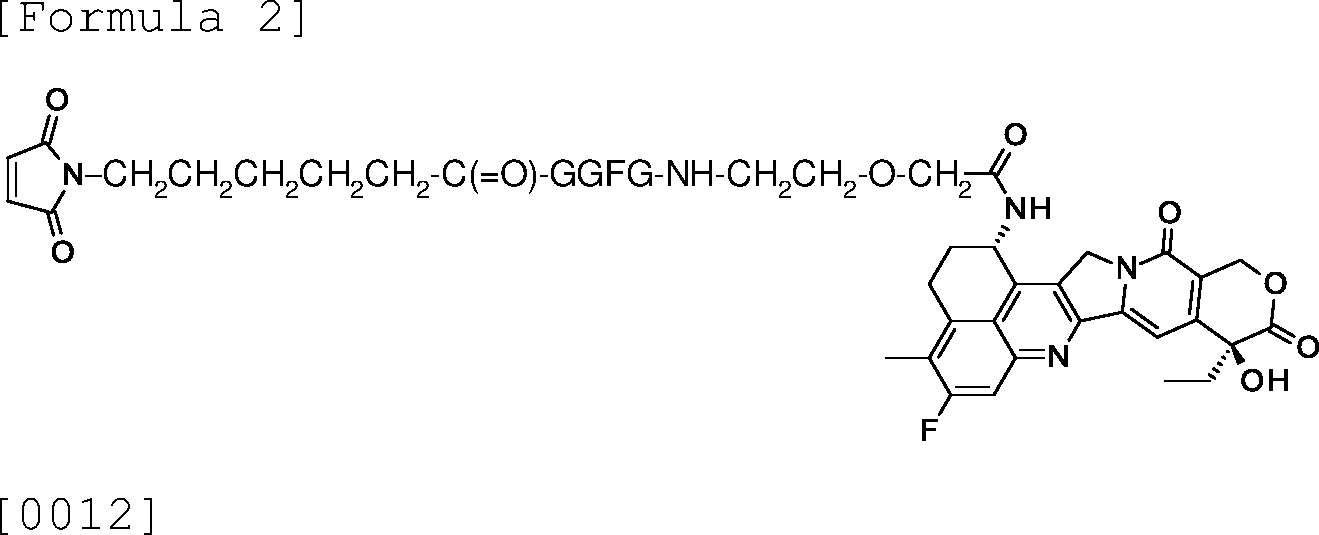
, or [0013]
7533399-1-AFAIRBAI

[0014] wherein -GGFG- represents a tetrapeptide residue consisting of glycine-glycine-phenylalanine-glycine.
(29)
The production method according to the above (28), wherein the drug linker intermediate is [0015]

wherein -GGFG- represents a tetrapeptide residue consisting of glycine-glycine-phenylalanine-glycine.
(30)
An antibody-drug conjugate composition produced by the production method according to any one of the above (1) to (29) .
(31)
7533399-1-AFAIRBAI
An antibody-drug conjugate composition, wherein the average number of bound drugs is 3.5 to 4.5, and the content of antibody-drug conjugates in which four drug linkers are bound to heavy-light interchain thiols is 50% or more.
(32)
The antibody-drug conjugate composition according to the above (31), wherein the average number of bound drugs is 4.0 to 4.1.
(33)
The antibody-drug conjugate composition according to the above (31) or (32), wherein the content of antibodydrug conjugates in which four drug linkers are bound to heavy-light interchain thiols, is in the range of 50% to
90%.
(34)
The antibody-drug conjugate composition according to the above (33), wherein the content of antibody-drug conjugates in which four drug linkers are bound to heavylight interchain thiols, is in the range of 50% to 80%.
(35)
The antibody-drug conjugate composition according to the above (34), wherein the content of antibody-drug conjugates in which four drug linkers are bound to heavylight interchain thiols, is in the range of 50% to 70%.
(36)
7533399-1-AFAIRBAI
The antibody-drug conjugate composition according to the above (35), wherein the content of antibody-drug conjugates in which four drug linkers are bound to heavylight interchain thiols, is in the range of 50% to 60%.
(37)
The antibody-drug conjugate composition according to any one of the above (31) to (36), wherein the content of antibody-drug conjugates in which four drug linkers are bound to heavy-heavy interchain thiols, is 5% or less.
(38)
The antibody-drug conjugate composition according to the above (37), wherein the content of antibody-drug conjugates in which four drug linkers are bound to heavyheavy interchain thiols, is 1% or less.
(39)
The antibody-drug conjugate composition according to any one of the above (31) to (38), wherein the content of antibody-drug conjugates in which two drug linkers are bound to heavy-heavy interchain thiols and two drug linkers are bound to heavy-light interchain thiols, is 5% or less.
(40)
The antibody-drug conjugate composition according to the above (39), wherein the content of antibody-drug conjugates in which two drug linkers are bound to heavyheavy interchain thiols and two drug linkers are bound to heavy-light interchain thiols, is 1% or less.
7533399-1-AFAIRBAI (41)
The antibody-drug conjugate composition according to any one of the above (31) to (40), wherein the antibody is an anti-TROP2 antibody, an anti-CD98 antibody, an anti-B7-H3 antibody, or an anti-HER2 antibody.
(42)
The antibody-drug conjugate composition according to the above (41), wherein the antibody is an anti-TROP2 antibody.
(43)
The antibody-drug conjugate composition according to the above (41), wherein the antibody is an anti-CD98 antibody.
(44)
The antibody-drug conjugate composition according to the above (41), wherein the antibody is an anti-B7-H3 antibody.
(45)
The antibody-drug conjugate composition according to the above (41), wherein the antibody is an anti-HER2 antibody.
(46)
The antibody-drug conjugate composition according to any one of the above (31) to (45), wherein the drug linker is [0017]
7533399-1-AFAIRBAI

[0019]

, or [0021]

[0022] wherein A represents a binding site to the antibody, and -GGFG- represents a tetrapeptide residue consisting of glycine-glycine-phenylalanine-glycine .
(47)
The antibody-drug conjugate composition according to the above (46), wherein
7533399-1-AFAIRBAI the drug linker is [0023]

wherein A represents a binding site to the antibody, and -GGFG- represents a tetrapeptide residue consisting of glycine-glycine-phenylalanine-glycine .
(48)
A pharmaceutical composition comprising the antibody-drug conjugate composition according to any one of the above (30) to (47).
(49)
The pharmaceutical composition according to the above (48) for use in the treatment of tumor and/or cancer .
(50)
The pharmaceutical composition according to the above (49) for use in the treatment of lung cancer, kidney cancer, urothelial cancer, colon cancer, prostate cancer, glioblastoma multiforme, ovarian cancer, pancreatic cancer, breast cancer, melanoma, liver cancer, bladder cancer, stomach cancer, cervical cancer, uterine cancer, head and neck cancer, esophageal cancer, bile
7533399-1-AFAIRBAI duct cancer, thyroid cancer, lymphoma, acute myelocytic leukemia, acute lymphocytic leukemia, chronic myelogenous leukemia, and/or multiple myeloma.
(51)
A method for treating tumor and/or cancer, comprising administration of the antibody-drug conjugate composition according to any one of the above (30) to (47) .
(52)
The treatment method according to the above (51), which is a method for treating lung cancer, kidney cancer, urothelial cancer, colon cancer, prostate cancer, glioblastoma multiforme, ovarian cancer, pancreatic cancer, breast cancer, melanoma, liver cancer, bladder cancer, stomach cancer, cervical cancer, uterine cancer, head and neck cancer, esophageal cancer, bile duct cancer, thyroid cancer, lymphoma, acute myelocytic leukemia, acute lymphocytic leukemia, chronic myelogenous leukemia, and/or multiple myeloma.
(53)
A method for producing an antibody having thiol groups, comprising the step of reacting an antibody with a reducing agent in a buffer to reduce interchain disulfides, wherein the reaction temperature is -10°C to 10°C, and the produced antibody having thiol groups is used to produce an antibody-drug conjugate composition, wherein
7533399-1-AFAIRBAI the average number of bound drugs is 3.5 to 4.5, and the content of antibody-drug conjugates in which four drug linkers are bound to heavy-light interchain thiols is 50% or more.
(54)
The production method according to the above (53), wherein the produced antibody having thiol groups is used to produce an antibody-drug conjugate composition, wherein the average number of bound drugs is 4.0 to 4.1.
(55)
The production method according to the above (53) or (54), wherein the produced antibody having thiol groups is used to produce an antibody-drug conjugate composition, wherein the content of antibody-drug conjugates in which four drug linkers are bound to heavy-light interchain thiols, is in the range of 50% to 90%.
(56)
The production method according to the above (55), wherein the produced antibody having thiol groups is used to produce an antibody-drug conjugate composition, wherein the content of antibody-drug conjugates in which four drug linkers are bound to heavy-light interchain thiols, is in the range of 50% to 80%.
(57)
The production method according to the above (56), wherein the produced antibody having thiol groups is used to produce an antibody-drug conjugate composition,
7533399-1-AFAIRBAI wherein the content of antibody-drug conjugates in which four drug linkers are bound heavy-light interchain thiols, is in the range of 50% to 70%.
(58)
The production method according to the above (57), wherein the produced antibody having thiol groups is used to produce an antibody-drug conjugate composition, wherein the content of antibody-drug conjugates in which four drug linkers are bound to heavy-light interchain thiols, is in the range of 50% to 60%.
(59)
The production method according to any one of the above (53) to (58), wherein the produced antibody having thiol groups is used to produce an antibody-drug conjugate composition, wherein the content of antibodydrug conjugates in which four drug linkers are bound to heavy-heavy interchain thiols, is in the range of 5% or less .
(60)
The production method according to the above (59), wherein the produced antibody having thiol groups is used to produce an antibody-drug conjugate composition, wherein the content of antibody-drug conjugates in which four drug linkers are bound to heavy-heavy interchain thiols, is in the range of 1% or less.
(61)
7533399-1-AFAIRBAI
The production method according to any one of the above (53) to (60), wherein the produced antibody having thiol groups is used to produce an antibody-drug conjugate composition, wherein the content of antibodydrug conjugates in which two drug linkers are bound to heavy-heavy interchain thiols and two drug linkers are bound to heavy-light interchain thiols, is 5% or less.
(62)
The production method according to the above (61), wherein the produced antibody having thiol groups is used to produce an antibody-drug conjugate composition, wherein the content of antibody-drug conjugates in which two drug linkers are bound to heavy-heavy interchain thiols and two drug linkers are bound to heavy-light interchain thiols, is 1% or less.
(63)
The production method according to any one of the above (53) to (62), wherein the reaction temperature is 5°C to 5°C.
(64)
The production method according to the above (63), wherein the reaction temperature is -3°C to 3°C.
(65)
The production method according to the above (64), wherein the reaction temperature is 0°C to 2°C.
(66)
7533399-1-AFAIRBAI
The production method according to the above (65), wherein the reaction temperature is 0°C to 1°C.
(67)
The production method according to any one of the above (53) to (66), wherein the reducing agent is used in an amount of 2 to 3 molar equivalents per molecule of the antibody.
(68)
The production method according to any one of the above (53) to (67), wherein the reducing agent is tris(2carboxyethyl) phosphine or a salt thereof.
(69)
The production method according to the above (68), wherein the salt of tris (2-carboxyethyl)phosphine is tris (2-carboxyethyl)phosphine hydrochloride.
(70)
The production method according to any one of the above (53) to (69), wherein the buffer is a histidine buffer .
(71)
The production method according to any one of the above (53) to (70), wherein the buffer comprises a chelating agent.
(72)
The production method according to the above (71), wherein the chelating agent is ethylenediaminetetraacetic acid.
7533399-1-AFAIRBAI (73)
The production method according to any one of the above (53) to (72), wherein the antibody is an anti-TROP2 antibody, an anti-CD98 antibody, an anti-B7-H3 antibody, or an anti-HER2 antibody.
(74)
The production method according to the above (73), wherein the antibody is an anti-TROP2 antibody.
(75)
The production method according to the above (73), wherein the antibody is an anti-CD98 antibody.
(76)
The production method according to the above (73), wherein the antibody is an anti-B7-H3 antibody.
(77)
The production method according to the above (73), wherein the antibody is an anti-HER2 antibody.
[0025]
Advantageous Effects of Invention [0026]
According to the present invention, there are provided a method for producing an antibody-drug conjugate composition in which the number of bound drugs and the binding sites are controlled, and an antibodydrug conjugate composition in which the number of bound drugs and the binding sites are controlled. The
7533399-1-AFAIRBAI antibody-drug conjugate composition of the present invention is excellent in terms of safety, and is useful as a medicament for the treatment of tumor and/or cancer.
In addition, since an antibody-drug conjugate composition in which the number of bound drugs and the binding sites are controlled to be constant can be obtained, it is also excellent in terms of quality control and thus, is preferable .
Brief Description of Drawings [0027] [Figure 1] Figure 1 is a view showing the nucleotide sequence and amino acid sequence of a humanized antiTROP2 antibody heavy chain (hTINAl-Hl).
[Figure 2] Figure 2 is a view showing the nucleotide sequence and amino acid sequence of a humanized antiTROP2 antibody light chain (hTINAl-Ll).
[Figure 3] Figure 3 is a view showing the nucleotide sequence and amino acid sequence of a humanized anti-CD98 antibody heavy chain (h23M-Hl).
[Figure 4] Figure 4 is a view showing the nucleotide sequence and amino acid sequence of a humanized anti-CD98 antibody light chain (h23M-Ll).
[Figure 5] Figure 5 is a graph showing the peak area ratio (%) of each chain in a humanized anti-TROP2 antibody (hTINAl-HILl) ADC composition produced by the conventional method.
7533399-1-AFAIRBAI [Figure 6] Figure 6 is a graph showing the distribution (%) of each number of bound drugs in a humanized antiTROP2 antibody (hTINAl-HILl) ADC composition produced by the conventional method.
[Figure 7] Figure 7 is a graph showing the peak area ratio (%) of each chain in a humanized anti-TROP2 antibody (hTINAl-HILl) ADC composition produced by the method of the present invention.
[Figure 8] Figure 8 is a graph showing the distribution (%) of each number of bound drugs in a humanized antiTROP2 antibody (hTINAl-HILl) ADC composition produced by the method of the present invention.
[Figure 9] Figure 9 is a graph showing the peak area ratio (%) of each chain in a humanized anti-CD98 antibody (hM23-HlLl) ADC composition produced by the conventional method.
[Figure 10] Figure 10 is a graph showing the distribution (%) of each number of bound drugs in a humanized antiCD98 antibody (hM23-HlLl) ADC composition produced by the conventional method.
[Figure 11] Figure 11 is a graph showing the peak area ratio (%) of each chain in a humanized anti-CD98 antibody (hM23-HlLl) ADC composition produced by the method of the present invention.
[Figure 12] Figure 12 is a graph showing the distribution (%) of each number of bound drugs in a humanized anti7533399-1 -AFAIRBAI
CD98 antibody (hM23-HlLl) ADC composition produced by the method of the present invention.
[Figure 13] Figure 13 is a view showing the amino acid sequence of a humanized anti-B7-H3 antibody heavy chain (M30-H1).
[Figure 14] Figure 14 is a view showing the amino acid sequence of a humanized anti-B7-H3 antibody light chain (M30-L4).
[Figure 15] Figure 15 is a graph showing the peak area ratio (%) of each chain in a humanized anti-B7-H3 antibody (M30-H1-L4) ADC composition produced by the conventional method.
[Figure 16] Figure 16 is a graph showing the distribution (%) of each number of bound drugs in a humanized anti-B7H3 antibody (M30-H1-L4) ADC composition produced by the conventional method.
[Figure 17] Figure 17 is a graph showing the peak area ratio (%) of each chain in a humanized anti-B7-H3 antibody (M30-H1-L4) ADC composition produced by the method of the present invention.
[Figure 18] Figure 18 is a graph showing the distribution (%) of each number of bound drugs in a humanized anti-B7H3 antibody (M30-H1-L4) ADC composition produced by the method of the present invention.
[Figure 19] Figure 19 is a view showing the amino acid sequence of a humanized anti-HER2 antibody heavy chain.
7533399-1-AFAIRBAI [Figure 20] Figure 20 is a view showing the amino acid sequence of a humanized anti-HER2 antibody light chain. [Figure 21] Figure 21 is a graph showing the peak area ratio (%) of each chain in a humanized anti-HER2 antibody ADC composition produced by the conventional method. [Figure 22] Figure 22 is a graph showing the distribution (%) of each number of bound drugs in a humanized antiHER2 antibody ADC composition produced by the conventional method.
[Figure 23] Figure 23 is a graph showing the peak area ratio (%) of each chain in a humanized anti-HER2 antibody ADC composition produced by the method of the present invention .
[Figure 24] Figure 24 is a graph showing the distribution (%) of each number of bound drugs in a humanized antiHER2 antibody ADC composition produced by the method of the present invention.
[Figure 25] Figure 25 is a graph showing the tumor growth inhibitory effect of a humanized anti-TROP2 antibody ADC composition produced by the conventional method, and the tumor growth inhibitory effect of a humanized anti-TROP2 antibody ADC composition produced by the method of the present invention.
Description of Embodiments [0028]
7533399-1-AFAIRBAI
In the present description, the term cancer is used to have the same meaning as that of the term tumor [0029]
In the present description, the term gene is used to include, not only DNA but also its mRNA and cDNA, and the cRNA thereof.
[0030]
In the present description, the term polynucleotide is used to have the same meaning as that of a nucleic acid, and it includes DNA, RNA, a probe, an oligonucleotide, and a primer.
[0031]
In the present description, the term polypeptide is used to have the same meaning as that of the term protein.
[0032]
In the present description, the term cell includes cells in an individual animal, and cultured cells.
[0033]
In the present description, the term interchain disulfide is used to mean a disulfide located between two heavy chains in an antibody (a heavy-heavy interchain disulfide), or a disulfide located between a heavy chain and a light chain in an antibody (a heavy-light interchain disulfide).
[0034]
7533399-1-AFAIRBAI
In the present description, the term interchain thiol is used to mean a thiol group obtained by reducing an interchain disulfide of an antibody.
[0035]
In the present description, the term heavy-heavy interchain thiol is used to mean a thiol group obtained by reducing a heavy-heavy interchain disulfide of an antibody.
[0036]
In the present description, the term heavy-light interchain thiol is used to mean a thiol group obtained by reducing a heavy-light interchain disulfide of an antibody.
[0037]
In the present description, the term tumorassociated antigen (TAA) is used to mean an antigen which is expressed in both normal cells and tumor cells, but the expression thereof is relatively restricted to tumor cells.
[0038]
In the present description, the term tumor-specific antigen (TSA) is used to mean an antigen that is specific to tumor cells.
[0039]
In the present description, the term TROP2 is used to have the same meaning as that of a TROP2 protein.
[0040]
7533399-1-AFAIRBAI
In the present description, the term CD98 is used to have the same meaning as that of a CD98 protein.
Since CD98 consists of a heavy chain and a light chain, the terms CD98 heavy chain and CD98 light chain are used to have the same meanings as those of a CD98 heavy chain protein and a CD98 light chain protein, respectively. Moreover, in the present description, the term CD98 is used in a manner interconvertible with any one of CD98 heavy chain and CD98 light chain, or CD98 heavy chain or CD98 light chain, unless otherwise specified.
[0041]
In the present description, the term anti-TROP2 antibody is used to mean an antibody capable of binding to TROP2.
[0042]
In the present description, the term anti-CD98 antibody is used to mean an antibody capable of binding to CD98.
[0043]
In the present description, the term anti-B7-H3 antibody is used to mean an antibody capable of binding to B7-H3.
[0044]
In the present description, the term anti-HER2 antibody is used to mean an antibody capable of binding to HER2.
7533399-1-AFAIRBAI [0045]
In the present description, the term cytotoxic is used to mean that a pathologic change is given to cells by any given way. It does not only mean a direct external injury, but also means all types of structural or functional damages given to cells, such as DNA cleavage, formation of a base dimer, chromosomal cleavage, damage to a cell mitotic apparatus, and a reduction in the activities of various types of enzymes.
[0046]
In the present description, the term cytotoxicity is used to mean an action to cause the above described cytotoxic phenomenon.
[0047]
In the present description, the term antibodydependent cellular cytotoxicity is used to means an antibody dependent cellular cytotoxic (ADCC) activity, and this activity means the activity of NK cells to give a damage to target cells such as tumor cells, mediated by an antibody.
[0048]
In the present description, the term complementdependent cytotoxicity is used to mean a complement dependent cytotoxic (CDC) activity, and this activity means the activity of a complement to give a damage to target cells such as tumor cells, mediated by an antibody.
[0049]
7533399-1-AFAIRBAI
In the present description, the term epitope is used to mean the partial peptide or partial threedimensional structure of an antigen that binds to a specific antibody. Such an epitope, which is a partial peptide of an antigen, can be determined by methods well known to a person skilled in the art, such as an immunoassay, for example, by the following method. First, various partial structures of an antigen are produced.
For production of such partial structures, a known oligopeptide synthesis technique can be applied. For example, a series of peptides, in which an antigen has been successively cut at an appropriate length from the C-terminus or N-terminus thereof, are produced by genetic recombination techniques well known to a person skilled in the art, and thereafter, the reactivity of an antibody with such polypeptides is studied, and recognition sites are roughly determined. Thereafter, further shorter peptides are synthesized, and the reactivity thereof with the aforementioned peptides is then studied, so as to determine an epitope. Moreover, an epitope, which is a partial three-dimensional structure of an antigen that binds to a specific antibody, can be determined by specifying the amino acid residues of an antigen adjacent to the above described antibody by X-ray structural analysis .
[0050]
7533399-1-AFAIRBAI
In the present description, the phrase antibody binding to the same epitope is used to mean a different antibody binding to a common epitope. If a second antibody binds to a partial peptide or a partial threedimensional structure, to which a first antibody binds, it can be determined that the first antibody and the second antibody bind to the same epitope. In addition, by confirming that a second antibody competes with the binding of a first antibody to an antigen (i.e., a second antibody prevents a first antibody from binding to an antigen), it can be determined that the first antibody and the second antibody bind to the same epitope, although the specific sequence or structure of the epitope has not been determined. Furthermore, when a first antibody and a second antibody bind to the same epitope and further, the first antibody has special effects such as antitumor activity, the second antibody can be expected to have the same activity as that of the first antibody.
[0051]
In the present description, the term CDR is used to mean a complementarity determining region (CDR). It is known that the heavy chain and light chain of an antibody molecule each have three CDRs. Such CDR is also referred to as a hypervariable domain, and is present in the variable region of the heavy chain and light chain of an antibody, in which the mutation of a primary structure
7533399-1-AFAIRBAI is particularly high. The CDR is separated into three sites on the primary structure of a polypeptide chain in each of the heavy chain and light chain. In the present description, with regard to the CDR of an antibody, the CDRs of a heavy chain are referred to as CDRH1, CDRH2 and CDRH3, respectively, from the N-terminal side of the amino acid sequence of the heavy chain, whereas the CDRs of a light chain are referred to as CDRL1, CDRL2 and CDRL3, respectively, from the N-terminal side of the amino acid sequence of the light chain. These sites are located close to one another on the three-dimensional structure, and determine the specificity of the antibody to an antigen, to which the antibody binds.
[0052]
In the present description, the term several is used to mean a number from 2 to 10. The number is preferably 2 to 9, more preferably 2 to 8, even more preferably 2 to 7, further preferably 2 to 6, still further preferably 2 to 5, still further preferably 2 to 4, much further preferably 2 or 3, and much further preferably 2.
[0053]
In the present description, the term antibody-drug conjugate composition is used to mean a composition comprising, at any given ratio, an antibody-drug conjugate bound by two drug linkers, an antibody-drug conjugate bound by four drug linkers, an antibody-drug
7533399-1-AFAIRBAI conjugate bound by six drug linkers, an antibody-drug conjugate bound by eight drug linkers, and an antibody not bound by any drug linker. In the present description, the antibody-drug conjugate composition is also referred to as an ADC composition.
[0054]
In the present description, the average number of bound drugs is also referred to as a drug-to-antibody ratio (DAR), and the average number of bound drugs means the average number of drugs that bind to a single antibody molecule in an antibody-drug conjugate composition .
[0055]
In the present description, the term content is used to mean the content (molar % based on an antibody) of antibody-drug conjugates having a specific number of bound drugs and specific binding sites in an antibodydrug conjugate composition.
[0056]
In the present description, the term identity is used to have the same meaning as that of the term homology.
[0057]
1. Antibody
The antibody used in the present invention can be generated with respect to an antigen of interest, for example, with respect to a tumor-specific antigen (TAA)
7533399-1-AFAIRBAI or a tumor-associated antigen (TSA). Such an antibody has the property of being able to recognize tumor cells, the property of being able to bind to such tumor cells, and the property of being able to be incorporated into such tumor cells and then internalizing therein.
[0058]
The type of such an antigen of interest is not particularly limited, as long as it is a tumor cellassociated antigen. Examples of the antigen of interest include B7-H3, CD3, CD30, CD33, CD37, CD56, CD98, DR5,
EGFR, EPHA2, FGFR2, FGFR4, FOLR1 (Folate Receptor 1),
HER2, HER3, TROP2, and VEGF.
[0059]
The antibody used in the present invention can be obtained by the method described, for example, in W02009/091048, W02011/027808, or WO2012/133572. Specifically, a non-human animal is immunized with an antigen of interest, and lymph fluids, lymphoid tissues, blood cell samples or bone marrow-derived cells are then collected from the immunized animal. Thereafter, the plasma cells and/or plasmablasts of the non-human animal, which specifically bind to the antigen of interest, are selected. From the obtained plasma cells and/or plasmablasts, an antibody gene reacting against the antigen of interest is collected, and the nucleotide sequence of the antibody gene is then identified. Thereafter, the above described antibody or an antibody
7533399-1-AFAIRBAI fragment thereof can be obtained based on the identified nucleotide sequence of the gene. The thus obtained antibodies are examined in terms of their binding activity to the antigen of interest, so that an antibody that is applicable to human diseases can be selected.
[0060]
Alternatively, according to known methods (e.g., Kohler and Milstein, Nature (1975) 256, pp. 495-497; Kennet, R. ed., Monoclonal Antibodies, pp. 365-367,
Plenum Press, N.Y. (1980)), antibody-producing cells that produce an antibody reacting against the antigen of interest are fused with myeloma cells to establish hybridomas, so as to obtain a monoclonal antibody. Specific examples of such methods are described in W02009/048072 (published on April 16, 2009) and W02010/117011 (published on October 14, 2010).
[0061]
The antibody used in the present invention includes genetically recombinant antibodies, which are artificially modified for the purpose of reducing heterologous antigenicity against humans, for example, a chimeric antibody, a humanized antibody, and a human antibody. These antibodies can be produced according to known methods .
[0062]
The chimeric antibody is, for example, an antibody whose variable region and constant region are
7533399-1-AFAIRBAI heterologous to each other, such as a chimeric antibody formed by conjugating the variable region of a mouse- or rat-derived antibody to a constant region derived from a human (see Proc. Natl. Acad. Sci. U.S.A., 81, 6851-6855, (1984)).
[0063]
Examples of the humanized antibody include an antibody formed by incorporating only CDR into a humanderived antibody (see Nature (1986) 321, pp. 522-525), and an antibody formed by transplanting the amino acid residues in some frameworks, as well as CDR, into a human antibody according to a CDR grafting method (International Publication No. W090/07861).
[0064]
Preferred examples of the antibody of the present invention include an anti-TROP2 antibody, an anti-CD98 antibody, an anti-B7-H3 antibody, and an anti-HER2 antibody.
[0065]
An actual example of the humanized anti-TROP2 antibody can be any given combination of: a heavy chain comprising a heavy chain variable region consisting of any one of (1) an amino acid sequence consisting of amino acid residues at positions 20 to 140 of SEQ ID NO: 2, (2) an amino acid sequence having homology of at least 95% with respect to the amino acid sequence in the above (1), and (3) an amino acid sequence comprising a deletion,
7533399-1-AFAIRBAI substitution or addition of one or several amino acids in the amino acid sequence in the above (1); and a light chain comprising a light chain variable region consisting of any one of (4) an amino acid sequence consisting of amino acid residues at positions 21 to 129 of SEQ ID NO:
4, (5) an amino acid sequence having homology of at least
95% with respect to the amino acid sequence in the above (4), and (6) an amino acid sequence comprising a deletion, substitution or addition of one or several amino acids in the amino acid sequence in the above (4).
[0066]
An example of the above described antibody comprising a preferred combination of the heavy chain and the light chain can be an antibody (hTINAl-HILl), which consists of a heavy chain consisting of an amino acid sequence consisting of amino acid residues at positions 20 to 470 of SEQ ID NO: 2, and a light chain consisting of an amino acid sequence consisting of amino acid residues at positions 21 to 234 of SEQ ID NO: 4.
[0067]
The humanized anti-TROP2 antibody is not limited to a specific humanized antibody, as long as it retains CDRH1 consisting of the amino acid sequence shown in SEQ ID NO: 5 (TAGMQ), CDRH2 consisting of the amino acid sequence shown in SEQ ID NO: 6 (WINTHSGVPKYAEDFKG), CDRH3 consisting of the amino acid sequence shown in SEQ ID NO:
(SGFGSSYWYFDV), CDRL1 consisting of the amino acid
7533399-1-AFAIRBAI sequence shown in SEQ ID NO: 8 (KASQDVSTAVA), CDRL2 consisting of the amino acid sequence shown in SEQ ID NO: 9 (SASYRYT), and CDRL3 consisting of the amino acid sequence shown in SEQ ID NO: 10 (QQHYITPLT), which are shown in the sequence listing.
[0068]
An example of the humanized anti-CD98 antibody can be any given combination of: a heavy chain comprising a heavy chain variable region consisting of any one of (1) an amino acid sequence consisting of amino acid residues at positions 20 to 135 of SEQ ID NO: 12, (2) an amino acid sequence having identity of at least 95% with respect to the amino acid sequence in the above (1), and (3) an amino acid sequence comprising a deletion, substitution or addition of one or several amino acids in the amino acid sequence in the above (1); and a light chain comprising a light chain variable region consisting of any one of (4) an amino acid sequence consisting of amino acid residues at positions 21 to 135 of SEQ ID NO: 14, (5) an amino acid sequence having identity of at least 95% with respect to the amino acid sequence in the above (4), and (6) an amino acid sequence comprising a deletion, substitution or addition of one or several amino acids in the amino acid sequence in the above (4).
[0069]
An example of the above described antibody comprising a preferred combination of the heavy chain and
7533399-1-AFAIRBAI the light chain can be an antibody (hM23-HlLl), which consists of a heavy chain consisting of an amino acid sequence consisting of amino acid residues at positions 20 to 465 of SEQ ID NO: 12, and a light chain consisting of an amino acid sequence consisting of amino acid residues at positions 21 to 240 of SEQ ID NO: 14.
[0070]
The humanized anti-CD98 antibody is not limited to a specific humanized antibody, as long as it retains CDRH1 consisting of the amino acid sequence shown in SEQ ID NO: 15 (NYLIE), CDRH2 consisting of the amino acid sequence shown in SEQ ID NO: 16 (VINPGSGVTNYNEKFKG), CDRH3 consisting of the amino acid sequence shown in SEQ ID NO:
(AEAWFAY), CDRL1 consisting of the amino acid sequence shown in SEQ ID NO: 18 (KSSQSLLYSSNQKNYLA), CDRL2 consisting of the amino acid sequence shown in SEQ ID NO:
(WASTRES), and CDRL3 consisting of the amino acid sequence shown in SEQ ID NO: 20 (QRYYGYPWT), which are shown in the sequence listing.
[0071]
An example of the humanized anti-B7-H3 antibody can be any given combination of: a heavy chain comprising a heavy chain variable region consisting of any one of (1) an amino acid sequence consisting of amino acid residues at positions 20 to 141 of SEQ ID NO: 25, (2) an amino acid sequence having identity of at least 95% with respect to the amino acid sequence in the above (1), and
7533399-1-AFAIRBAI (3) an amino acid sequence comprising a deletion, substitution or addition of one or several amino acids in the amino acid sequence in the above (1); and a light chain comprising a light chain variable region consisting of any one of (4) an amino acid sequence consisting of amino acid residues at positions 21 to 128 of SEQ ID NO: 26, (5) an amino acid sequence having identity of at least 95% with respect to the amino acid sequence in the above (4), and (6) an amino acid sequence comprising a deletion, substitution or addition of one or several amino acids in the amino acid sequence in the above (4).
[0072]
An example of the above described antibody comprising a preferred combination of the heavy chain and the light chain can be an antibody (M30-H1-L4), which consists of a heavy chain consisting of an amino acid sequence consisting of amino acid residues at positions 20 to 471 of SEQ ID NO: 25, and a light chain consisting of an amino acid sequence consisting of amino acid residues at positions 21 to 233 of SEQ ID NO: 26.
[0073]
The humanized anti-B7-H3 antibody is not limited to a specific humanized antibody, as long as it retains CDRH1 consisting of the amino acid sequence shown in SEQ ID NO: 27 (NYVMH), CDRH2 consisting of the amino acid sequence shown in SEQ ID NO: 28 (YINPYNDDVKYNEKFKG),
CDRH3 consisting of the amino acid sequence shown in SEQ
7533399-1-AFAIRBAI
ID NO: 29 (WGYYGSPLYYFDY), CDRL1 consisting of the amino acid sequence shown in SEQ ID NO: 30 (RASSRLIYMH), CDRL2 consisting of the amino acid sequence shown in SEQ ID NO: 31 (ATSNLAS), and CDRL3 consisting of the amino acid sequence shown in SEQ ID NO: 32 (QQWNSNPPT), which are shown in the sequence listing.
[0074]
An example of the humanized anti-HER2 antibody can be an antibody, which consists of a heavy chain consisting of an amino acid sequence consisting of amino acid residues at positions 1 to 449 of SEQ ID NO: 33, and a light chain consisting of an amino acid sequence consisting of amino acid residues at positions 1 to 214 of SEQ ID NO: 34 (trastuzumab; U. S. Patent No. 5821337) .
[0075]
Moreover, a CDR-modified humanized antibody, in which 1 to 3 amino acid residues in each CDR are substituted with other amino acid residues, is also included in the antibody used in the present invention, as long as the CDR-modified humanized antibody has binding activity to tumor cells.
[0076]
The antibody used in the present invention further includes a human antibody. Such a human antibody can be obtained by a method of using a human antibody-producing mouse having a human chromosomal fragment comprising the heavy chain and light chain genes of a human antibody
7533399-1-AFAIRBAI (see Tomizuka, K. et. al., Nature Genetics (1997) 16, pp. 133-143; Kuroiwa, Y. et. al., Nucl. Acids Res. (1998) 26, pp. 3447-3448; Yoshida, H. et. al., Animal Cell
Technology: Basic and Applied Aspects vol. 10, pp. 69-73 (Kitagawa, Y., Matsuda, T. and Iijima, S. eds.), Kluwer Academic Publishers, 1999.; Tomizuka, K. et. al. , Proc. Natl. Acad. Sci. USA (2000) 97, pp. 722-727; etc.).
[0077]
Furthermore, there are known methods of obtaining a human antibody that is derived from a phage display selected from a human antibody library (see Wormstone, I. M. et. al, Investigative Ophthalmology & Visual Science. (2002) 43(7), pp. 2301-2308; Carmen, S. et. al.,
Briefings in Functional Genomics and Proteomics (2002), 1(2), pp. 189-203; Siriwardena, D. et. al., Ophthalmology (2002) 109(3), pp. 427-431; etc.).
[0078]
For instance, a phage display method comprising allowing the variable region of a human antibody to express as a single-chain antibody (scFv) on the surface of a phage, and then selecting a phage binding to an antigen, can be used (Nature Biotechnology (2005), 23, (9), pp. 1105-1116). By analyzing the gene of a phage selected based on its binding activity to an antigen, a DNA sequence encoding the variable region of a human antibody binding to an antigen can be determined. If the DNA sequence of scFv binding to an antigen were
7533399-1-AFAIRBAI elucidated, it would become possible to obtain a human antibody by producing an expression vector having the DNA sequence, and then introducing the expression vector into a suitable host (W092/01047, WO92/20791, WO93/06213, WO93/11236, WO93/19172, WO95/01438, WO95/15388, Annu. Rev Immunol (1994) 12, pp. 433-455, Nature Biotechnology (2005) 23(9), pp. 1105-1116).
[0079]
The binding activity of the above described antibody to an antigen of interest is evaluated, so that a preferred antibody can be selected. The dissociation constant between an antibody and an antigen can be measured by using Biacore T200 (GE Healthcare Bioscience) which involves Surface Plasmon Resonance (SPR) as a detection principle. For instance, an antibody, which is adjusted to have a suitable concentration with respect to an antigen that is solid-phased as a ligand, is allowed to react with an analyte, and its association and dissociation are then measured, so as to obtain an association rate constant kal, a dissociation rate constant kdl, and a dissociation constant (KD; KD = kdl/kal). The binding activity to an antigen of interest can be evaluated, not only with the use of Biacore T200, but also by using an apparatus involving Surface Plasmon Resonance (SPR) as a detection principle, KinExA (Sapidyne Instruments) involving Kinetic Exclusion Assay as a detection principle, BLItz System (Pall) involving
7533399-1-AFAIRBAI
Bio-Layer Interferometry as a detection principle, an ELISA (Enzyme-Linked ImmunoSorbent Assay) method, or the like .
[0080]
The activity of internalizing in cells can be confirmed by applying (1) an assay of visualizing an antibody incorporated into cells under a fluorescence microscope, using a secondary antibody (fluorescent label) binding to a therapeutic antibody (Cell Death and Differentiation (2008) 15, 751-761), (2) an assay of measuring the amount of fluorescence incorporated into cells, using a secondary antibody (fluorescent label) binding to a therapeutic antibody (Molecular Biology of the Cell Vol. 15, 5268-5282, December 2004), or (3) a
Mab-ZAP assay, in which immunotoxin that binds to a therapeutic antibody is used, and when the immunotoxin is incorporated into cells, toxin is released and cell growth is suppressed (BioTechniques 28: 162-165, January 2000) . As such an immunotoxin, a recombinant conjugated protein consisting of a catalytic region of diphtheria toxin and a protein G can also be used.
[0081]
An example of another indicator used for a comparison of the properties of antibodies can be the stability of antibody. Differential scanning calorimetry (DSC) is a method capable of promptly and precisely measuring a thermal denaturation midpoint (Tm) serving as
7533399-1-AFAIRBAI a good indicator for the relative structural stability of a protein. By using DSC to measure such Tm values and then comparing the obtained values, a difference in thermal stability can be compared. It is known that the preservation stability of an antibody shows a certain degree of correlation with the thermal stability of an antibody (Lori Burton, et. al., Pharmaceutical Development and Technology (2007) 12, pp. 265-273), and using thermal stability as an indicator, a preferred antibody can be selected. Examples of other indicators for selection of an antibody include a high yield in suitable host cells, and low cohesiveness in an aqueous solution. For example, since an antibody with the highest yield does not always exhibit the highest thermal stability, a comprehensive decision is made based on the aforementioned indicators, and an antibody, which is most suitably administered to humans, needs to be selected.
[0082]
Moreover, by regulating sugar chain modification binding to an antibody, antibody-dependent cytotoxicity can be enhanced. As techniques of regulating the sugar chain modification of an antibody, those described in WO99/54342, W02000/61739, WO2002/31140, etc. are known, but the techniques are not limited thereto.
[0083]
When an antibody gene has been isolated and thereafter, the gene introduced into a suitable host to
7533399-1-AFAIRBAI produce an antibody, a suitable combination of a host and an expression vector can be used. A specific example of the antibody gene can be a combination of a gene encoding the heavy chain sequence of the antibody described in the present description and a gene encoding the light chain sequence of the antibody described therein. For transformation of host cells, a heavy chain sequence gene and a light chain sequence gene can be inserted into a single expression vector, or these genes can also be inserted each into different expression vectors. When eukaryotic cells are used as hosts, animal cells, plant cells, eukaryotic microorganisms can be used. Examples of the animal cells include mammalian cells such as COS cells which are monkey cells (Gluzman, Y., Cell (1981) 23, pp. 175-182, ATCC CRL-1650), mouse fibroblasts NIH3T3 (ATCC No. CRL-1658), and a dihydrofolate reductasedeficient cell line of Chinese hamster ovary cells (CHO cells, ATCC CCL-61) (Urlaub, G. and Chasin, L. A. Proc. Natl. Acad. Sci. U.S.A. (1980) 77, pp. 4126-4220). On the other hand, when prokaryotic cells are used as hosts,
Escherichia coli or Bacillus subtilis can be used, for example. An antibody gene of interest is introduced into these cells for transformation, and the transformed cells are then cultured in vitro to obtain an antibody. In the aforementioned culture method, there is the case where the yield is different depending on the sequence of an antibody, and thus, it is possible to select an antibody,
7533399-1-AFAIRBAI which is easily produced as a medicament, from antibodies having equivalent binding activity, using the yield as an indicator .
[0084]
Isotypes of the antibody used in the present invention are not limited, and examples of the isotype of the present antibody include IgG (IgGl, IgG2, IgG3, and IgG4), IgM, IgA (IgAl and IgA2), IgD, and IgE. Among others, IgG or IgM is preferable, and IgGl, IgG2 or IgG3 is more preferable.
[0085]
Examples of the general function of an antibody include antigen-binding activity, activity of neutralizing the activity of an antigen, activity of enhancing the activity of an antigen, antibody-dependent cytotoxicity, complement-dependent cytotoxicity, complement-dependent cellular cytotoxicity, and internalization activity.
[0086]
Further, the antibody used in the present invention may be a multispecific antibody having specificity to at least two types of different antigens. In general, such a molecule binds to two types of antigen (i.e., a bispecific antibody). However, the multispecific antibody in the present invention includes an antibody having specificity to more antigens (e.g., 3 types of antigens).
7533399-1-AFAIRBAI [0087]
The antibody used in the present invention may be an antibody having identity (or homology) of 80% to 99% to the heavy chain and/or light chain of the above described antibody. By combining sequences having high homology to the above described heavy chain amino acid sequence and light chain amino acid sequence, an antibody having antigen-binding activity and internalization activity that are equivalent to those of each of the above described antibodies can be selected. Such homology is homology of generally 80% or more, preferably 90% or more, more preferably 95% or more, and most preferably 99% or more. In addition, by combining amino acid sequences comprising a substitution, deletion and/or addition of one to several amino acid residues with respect to the amino acid sequences of a heavy chain and/or a light chain, an antibody having various types of actions that are equivalent to those of each of the above described antibodies can be selected. The number of amino acid residues to be substituted, deleted and/or added is generally 10 or less amino acid residues, preferably 9 or less amino acid residues, more preferably 8 or less amino acid residues, more preferably 7 or less amino acid residues, even more preferably 6 or less amino acid residues, further preferably 5 or less amino acid residues, still further preferably 4 or less amino acid residues, still further preferably 3 or less amino acid
7533399-1-AFAIRBAI residues, still further preferably 2 or less amino acid residues, and most preferably 1 amino acid residue.
[0088]
It is known that the lysine residue at the carboxyl terminus of the heavy chain of an antibody produced in cultured mammalian cells is deleted (Journal of
Chromatography A, 705: 129-134 (1995)), and also, it is known that the two amino acid residues at the heavy chain carboxyl terminus, glycine and lysine, are deleted, and that the proline residue positioned at the carboxyl terminus is newly amidated (Analytical Biochemistry, 360: 75-83 (2007)). However, deletion and modification of these heavy chain sequences do not have an influence on the antigen-binding activity and effector function (activation of a complement, antibody-dependent cytotoxicity, etc.) of an antibody. Accordingly, the present invention also includes an antibody that has undergone the aforementioned modification, and specific examples of such an antibody include a deletion mutant comprising a deletion of 1 or 2 amino acids at the heavy chain carboxyl terminus, and an a deletion mutant formed by amidating the aforementioned deletion mutant (e.g., a heavy chain in which the proline residue at the carboxyl terminal site is amidated). However, deletion mutants regarding a deletion at the carboxyl terminus of the heavy chain of the antibody according to the present invention are not limited to the above described deletion
7533399-1-AFAIRBAI mutants, as long as they retain antigen-binding activity and effector function. Two heavy chains constituting the antibody according to the present invention may be any one type of heavy chain selected from the group consisting of a full length antibody and the above described deletion mutants, or a combination of any two types selected from the aforementioned group. The amount ratio of individual deletion mutants can be influenced by the types of cultured mammalian cells that produce the antibody according to the present invention, and culture conditions. The main ingredient of the antibody according to the present invention can be the case where one amino acid residue is deleted at each of the carboxyl termini of the two heavy chains.
[0089]
Homology between two types of amino acid sequences can be determined by using the default parameter of Blast algorithm version 2.2.2 (Altschul, Stephen F., Thomas L. Madden, Alejandro A. Schaffer, Jinghui Zhang, Zheng Zhang, Webb Miller, and David J.Lipman (1997), Gapped BLAST and PSI-BLAST: a new generation of protein database search programs, Nucleic Acids Res. 25: 3389-3402). The Blast algorithm is also available by accessing www.ncbi.nlm.nih.gov/blast on the internet. It is to be noted that, using the above described Blast algorithm, two types of percentage values, namely, Identity (or Identities) and Positivity (or Positivities), can be
7533399-1-AFAIRBAI calculated. The former is a value obtained when amino acid residues are identical between two types of amino acid sequences, the homology of which is to be obtained. The latter is a numerical value, for which amino acid residues having a similar chemical structure are also considered. In the present description, the value of identity when amino acid residues are identical to each other is defined as the value of homology.
[0090]
The obtained antibody can be purified until it becomes homogenous. For separation and purification of the antibody, ordinary separation and purification methods, which are applied to proteins, may be used. An antibody can be separated and purified by appropriately selecting methods, for example, from column chromatography, filtration, ultrafiltration, salting-out, dialysis, preparative polyacrylamide gel electrophoresis and isoelectric focusing, and then combining the selected methods (Strategies for Protein Purification and Characterization: A Laboratory Course Manual, Daniel R. Marshak et. al., eds., Cold Spring Harbor Laboratory Press (1996); Antibodies: A Laboratory Manual. Ed Harlow and David Lane, Cold Spring Harbor Laboratory (1988)), but the separation and purification methods are not limited thereto.
[0091]
7533399-1-AFAIRBAI
Examples of the chromatography include affinity chromatography, ion exchange chromatography, hydrophobic chromatography, gel filtration chromatography, reverse phase chromatography, and adsorption chromatography.
[0092]
These chromatographic methods can be carried out by using liquid chromatography such as HPLC or FPLC.
[0093]
Examples of a column used in affinity chromatography include a protein A column and a protein G column.
[0094]
2. Drug
The drug used in the present invention is not particularly limited, as long as it is a compound having antitumor effects and also having a substituent or a partial structure capable of binding to a linker structure. Regarding such a drug, a part of or the entire linker is cleaved in a tumor cell, and an antitumor compound portion is released, so that antitumor effects are exhibited. If the linker is cleaved at a binding portion to the drug, an antitumor compound is released while having its original structure, so that the original antitumor effects are exhibited. The drug is allowed to bind to the antibody via a linker portion having a specific structure. In the present description, a drug linker including this drug and this linker portion is also referred to a drug.
7533399-1-AFAIRBAI [0095]
Examples of the antitumor compound include calicheamicin, doxorubicin, daunorubicin, mitomycin C, bleomycin, cyclocytidine, vincristine, vinblastine, methotrexate, cisplatin or a derivative thereof, auristatin or a derivative thereof, maytansine or a derivative thereof, taxol or a derivative thereof, and camptothecin or a derivative thereof. Among these compounds, exatecan or monomethyl auristatin E are preferable .
[0096]
Exatecan ((IS,9S)-l-amino-9-ethyl-5-fluoro-2,3dihydro-9-hydroxy-4-methyl-lH,12H-benzo[de]pyrano[3' , 4 6,7]indolizino[1,2-b]quinoline-10,13(9H,15H)-dione) , which is a camptothecin derivative, is a compound represented by the following formula.
[0097] [Formula 9]

[0098]
Monomethyl auristatin E ((2R,3R)-N-[(IR,2S)-1methyl-2-hydroxy-2-phenylethyl]-2-methyl-3-[ (2S)-1[(3R,4S,5S)-3-methoxy-4-[(N-methyl-L-Val-L-Val7533399-1-AFAIRBAI )(methyl)amino]-5-methylheptanoyl]-2-pyrrolidinyl]-3methoxypropanamide) is a compound represented by the following formula.
[0099] [Formula 10]

[0100]
3. Linker
The drug used in the present invention can be bound to an antibody via a linker. The linker used in the present invention preferably has an N-substituted maleimidyl group. Examples of the linker include a cleavable linker and a non-cleavable linker. An example of the cleavable linker is a peptide linker cleaved by intracellular protease such as lysosomal protease or endosomal protease.
[0101]
The linker used in the present invention preferably has a structure induced from any one of the following formulae :
[0102] [Formula 11] o
[f^N-CH2CH2CH2CH2CH2-C(=O)-GGFG-NH-CH2-O-CH2-COOH
O
7533399-1-AFAIRBAI [0103] [0104] [Formula 12] ^N-CH2CH2CH2CH2CH2-C(=O)-GGFG-NH-CH2CH2-O-CH2-COOH o
[0105] , and [0106] [Formula 13]
N-CH2CH2-C(=O)-NH-CH2CH2-O-CH2CH2-O-CH2CH2-C(=O)-GGFG-NH-CH2CH2CH2-COOH [0107] , and preferably has a structure induced from the following formula:
[0108] [Formula 14] | N-CH2CH2CH2CH2CH2-C(=O)-GGFG-NH-CH2-O-CH2-COOH [0109] [0110]
The term GGFG means a tetrapeptide residue consisting of glycine-glycine-phenylalanine-glycine
7533399-1-AFAIRBAI [0111]
The linker used in the present invention can be prepared, for example, according to the method described in Example 58 of WO2014/057687.
[0112]
4. Drug linker intermediate
The drug linker intermediate used in the present invention can be produced by reacting the carboxyl group of the above described linker compound with the amino group of an antitumor compound, using a condensing agent etc .
[0113]
The drug linker intermediate used in the method of the present invention is not particularly limited, as long as it is a compound subjectable to a reaction with an interchain thiol of an antibody. The present drug linker intermediate is preferably a compound having an N substituted maleimidyl group, and it is more preferably, [0114]

r [0116]
7533399-1-AFAIRBAI

, or [0118]

[0119] , and it is further preferably, [0120]

[0122]
The drug linker intermediate used in the present invention can be prepared, for example, according to the
7533399-1-AFAIRBAI methods described in Example 58, Example 43 and Example of WO2014/057687.
[0123]
If the present drug linker intermediate is a drug linker intermediate having an N-substituted maleimidyl group, it is allowed to react with an interchain thiol generated by reduction of an interchain disulfide of an antibody, so that the antibody can be allowed to bind to the drug via the linker. Accordingly, the drug linker intermediate is preferably a compound having an Nsubstituted maleimidyl group. However, the drug linker intermediate used herein is not limited to such a compound, and all types of drug linker intermediates can be applied to the production method of the present invention, as long as they have a functional group for promoting the reaction with an interchain thiol of an antibody.
5. Antibody-drug conjugate
Regarding an antibody-drug conjugate, the number of drugs binding to a single antibody molecule is an important factor that has an influence on efficacy and safety. Since an antibody has four interchain disulfides and such a disulfide is constituted with two thiol groups, the number of drug binding to a single antibody molecule is 2, 4, 6, or 8.
[0124]
7533399-1-AFAIRBAI
Examples of an antibody-drug conjugate in which two drugs bind to a single antibody molecule (hereinafter also referred to as D2) include an antibody-drug conjugate in which two drug linkers are bound to heavylight interchain thiols (hereinafter also referred to as D2-1), and an antibody-drug conjugate in which two drug linkers are bound to heavy-heavy interchain thiols (hereinafter also referred to as D2-2).
[0125]

[0126]
Examples of an antibody-drug conjugate in which four drugs bind to a single antibody molecule (hereinafter also referred to as D4) include an antibody-drug conjugate in which four drug linkers are bound to heavylight interchain thiols (hereinafter also referred to as D4-1), an antibody-drug conjugate in which four drug linkers are bound to heavy-heavy interchain thiols (hereinafter also referred to as D4-2), and an antibody-drug conjugate in which two drug linkers are bound to heavy-light interchain thiols and two drug linkers are bound to heavy-heavy interchain thiols (hereinafter also referred to as D4-3).
7533399-1-AFAIRBAI [0127] [Formula 20]

D4-1 D4-2 D4-3 [0128]
Examples of an antibody-drug conjugate in which six drugs bind to a single antibody molecule (hereinafter also referred to as D6) include an antibody-drug conjugate in which four drug linkers are bound to heavylight interchain thiols and two drug linkers are bound to heavy-heavy interchain thiols (hereinafter also referred to as D6-1), and an antibody-drug conjugate in which two drug linkers are bound to heavy-light interchain thiols and four drug linkers are bound to heavy-heavy interchain thiols (hereinafter also referred to as D62) .
[0129] [Formula 21]

D6-1 D6-2 [0130]
An example of an antibody-drug conjugate in which eight drug linkers are bound to a single antibody
7533399-1-AFAIRBAI molecule (hereinafter also referred to as D8) is an antibody-drug conjugate in which four drug linkers are bound to heavy-light interchain thiols and four drug linkers are bound to heavy-heavy interchain thiols. [0131] [Formula 22]
D8 [0132]
The interchain thiol of an antibody forms a thioether, for example, with the 3-position of the Nsubstituted maleimidyl group of a drug linker intermediate, and binds thereto. That is, the binding portion of an antibody with a drug linker is represented, for example, by the following formula:
[0133] [Formula 23]

[0134] wherein Antibody-S- is derived from the antibody. [0135]
7533399-1-AFAIRBAI
The drug linker is preferably, [0136]
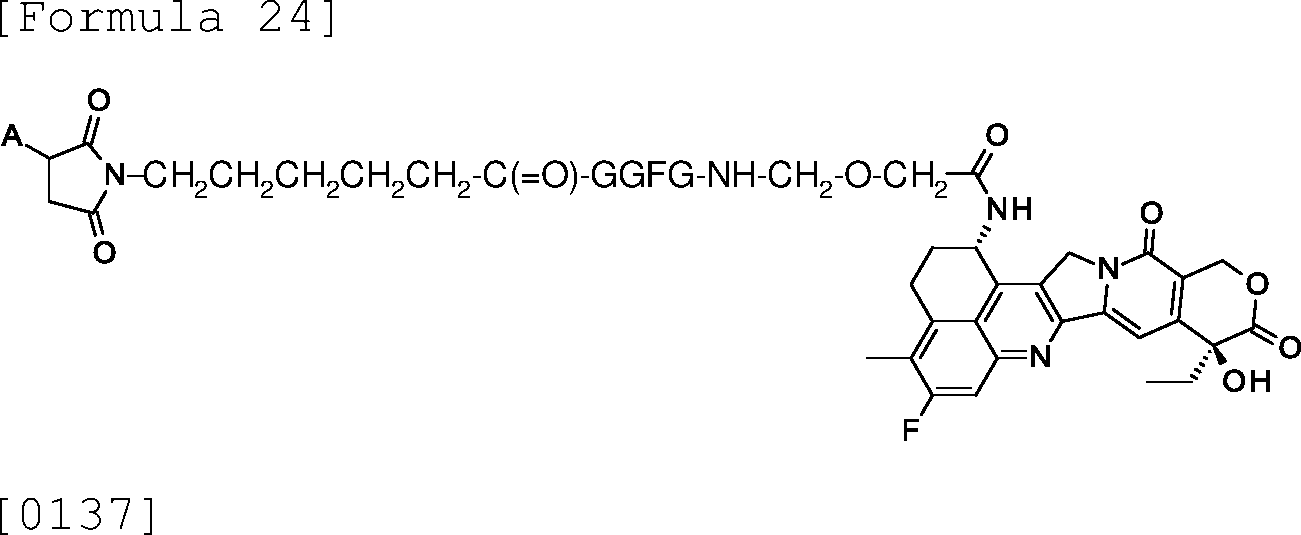
[0138]
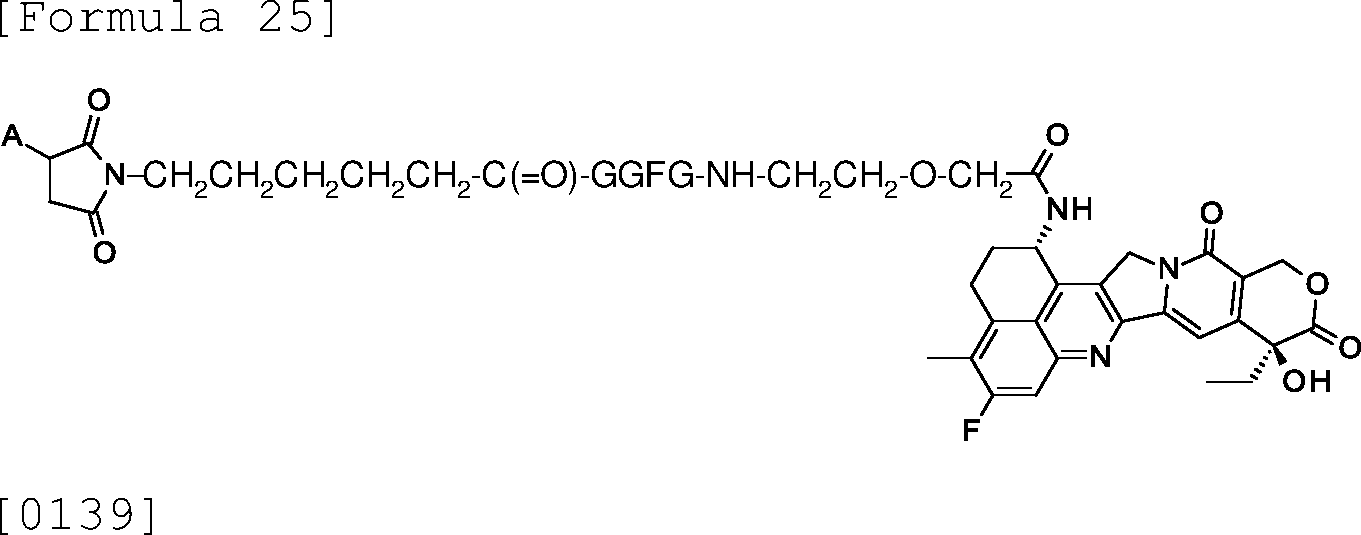
, or [0140]

[0141] wherein A represents the binding site to the antibody, and it is more preferably, [0142]
7533399-1-AFAIRBAI

wherein A represents the binding site to the antibody.
[0144]
An antibody-drug conjugate is produced, while determining reaction conditions such as the amounts of raw materials and/or reagents used in the reaction, so that the number of bound drugs can be controlled. Differing from the chemical reaction of a low molecular weight compound, the antibody-drug conjugate is generally obtained in the form of a mixture to which different numbers of drugs bind. The number of drugs binding to a single antibody molecule is specified and indicated as a mean value, namely, the average number of bound drugs.
[0145]
The production method of the present invention is a method for producing an antibody-drug conjugate composition in which the number of bound drugs and the binding sites are controlled, and the present production method consists of a first step of selectively reducing heavy-light interchain disulfide(s) of an antibody to convert them to thiol groups, and a second step of reacting drug linker intermediates with the antibody
7533399-1-AFAIRBAI having thiol groups, so as to produce an antibody-drug conjugate composition in which the number of bound drugs and the binding sites are controlled. Hereafter, each step will be described in detail.
[0146] (First step) Reduction of antibody
An antibody having thiol groups can be produced by reacting an antibody with a reducing agent in a buffer at a temperature of -10°C to 10°C.
[0147]
The reaction temperature is preferably -5°C to 5°C, more preferably -3°C to 3°C, even more preferably 0°C to 2°C, and further preferably 0°C to 1°C.
[0148]
The amount of the reducing agent is 1 to 4 molar equivalents, and preferably 2 to 3 molar equivalents, based on the amount of a single antibody molecule.
As such a reducing agent, for example, tris (2carboxyethyl) phosphine or a salt thereof, dithiothreitol, or 2-mercaptoethanol can be used. The reducing agent is preferably tris(2-carboxyethyl)phosphine or a salt thereof, and more preferably tris (2carboxyethyl) phosphine hydrochloride .
[0149]
As a buffer, a histidine buffer, a phosphate buffer, a borate buffer, an acetate buffer, a HEPES (4- (2hydroxyethyl)-1-piperazineethanesulfonic acid) buffer or
7533399-1-AFAIRBAI the like can be used, and among others, a histidine buffer is preferable.
[0150]
The buffer preferably comprises a chelating agent. Examples of the chelating agent that can be used herein include ethylenediaminetetraacetic acid (hereinafter also referred to as EDTA) and diethylenetriaminepentaacetic acid. Among others, ethylenediaminetetraacetic acid is preferable. Such a buffer may be used in a concentration of 1 to 20 mM.
[0151]
The reaction time is preferably 1 to 15 hours, more preferably 3 to 10 hours, and even more preferably 5 to 7 hours .
[0152]
The pH applied for the reaction is pH 5 to 9, preferably pH 6 to 8, and more preferably pH 6.8 to 7.2.
[0153] (Second step) Conjugation of antibody to drug linker intermediate
Drug linker intermediates are allowed to react with the antibody having thiol groups obtained in the first step to produce an antibody-drug conjugate composition. The drug linker intermediates are used in an amount of 2 to 10 molar equivalents, and preferably 4 to 6 molar equivalents, based on the amount of a single antibody molecule .
7533399-1-AFAIRBAI [0154]
Specifically, a solution in which the drug linker intermediate has been dissolved is added to a buffer comprising the antibody having thiol groups obtained in the first step, so that they may be allowed to react with each other.
[0155]
Examples of the solvent in which the drug linker intermediate is dissolved, which can be used herein, include organic solvents such as a 50% acetone aqueous solution, a 80% ethanol aqueous solution, a 80% methanol aqueous solution, a 80% isopropanol aqueous solution, a 80% dimethyl sulfoxide aqueous solution, dimethyl sulfoxide (DMSO), dimethylformamide (DMF), dimethylacetamide (DMA), and N-methyl-2-pyrrolidone (NMP) Among these solvents, a 50% acetone aqueous solution or an 80% dimethyl sulfoxide aqueous solution is preferable.
[0156]
The organic solvent solution, in which the drug linker intermediate has been dissolved, is added in an amount of 1% to 20% v/v to a buffer comprising the antibody having thiol groups, so that they may be allowed to react with each other.
[0157]
The reaction temperature is preferably -10°C to 10°C, more preferably -5°C to 5°C, and even more preferably 0°C to 2°C.
7533399-1-AFAIRBAI [0158]
The reaction time is preferably 0.5 to 2 hours.
[0159]
The conjugation reaction can be terminated by deactivating the reactivity of unreacted drug linker intermediates with a thiol group-containing reagent.
[0160]
As such a thiol group-containing reagent, for example, cysteine or N-acetyl-L-cysteine can be used.
More specifically, the conjugation reaction can be terminated by adding N-acetyl-L-cysteine in an amount of 1 to 2 molar equivalents to the used drug linker intermediate, and then reacting them at room temperature for 10 to 30 minutes.
[0161]
After completion of the conjugation reaction, purification can be carried out using a commercially available ultrafiltration membrane or the like. While an acetate buffer, a histidine buffer, a phosphate buffer or the like is added to the reaction product, a low molecular weight portion can be removed by using the ultrafiltration membrane. As such an ultrafiltration membrane, an appropriate ultrafiltration membrane may be used. An ultrafiltration membrane having a molecular weight of 1 kDa to 100 kDa may be used, and an ultrafiltration membrane having a molecular weight of 30 kDa is preferable.
7533399-1-AFAIRBAI [0162]
6. Identification of antibody-drug conjugate composition
The produced antibody-drug conjugate composition is subjected to concentration, buffer exchange, purification, and the measurement of an antibody concentration and the average number of bound drugs, according to the following operations, so that the antibody-drug conjugate composition can be identified.
[0163] (1) Concentration of antibody or antibody-drug conjugate agueous solution
An antibody or an antibody-drug conjugate solution is placed in a vessel of Amicon Ultra (50,000 MWCO, Millipore Corporation), and is then subjected to a centrifugal operation (centrifuged at 2000 G to 3800 G for 5 to 20 minutes), using a centrifuge (Allegra X-15R, Beckman Coulter, Inc.), so that the antibody or the antibody-drug conjugate solution can be concentrated.
[0164] (2) Measurement of antibody concentration
Using a UV measurement apparatus (Nanodrop 1000, Thermo Fisher Scientific Inc.), the concentration of the antibody can be measured according to the method provided by the manufacturer. During the measurement, 280 nm absorption coefficients (1.3 mLmg”1cm”1 to 1.8 mLmg”1cm”1) , which are different depending on individual antibodies, are used.
7533399-1-AFAIRBAI [0165] (3) Exchange of buffer for antibody
A NAP-25 column (Cat. No. 17-0852-02, GE Healthcare
Japan Corporation), in which a Sephadex G-25 carrier is used, is equilibrated with a phosphate buffer containing sodium chloride (137 mM) and ethylenediaminetetraacetic acid (5 mM) (10 mM, pH 6.0; hereinafter also referred to as PBS6.0/EDTA) according to the method provided by the manufacturer. Thereafter, 2.5 mL of an antibody aqueous solution is applied to a single NAP-25 column, and a fraction (3.5 mL) eluted with 3.5 mL of PBS6.0/EDTA is then fractionated. This fraction is concentrated by the same method as that described in the above (1), and the concentration of the antibody is then measured by the same method as that described in the above (2).
Thereafter, the concentration of the antibody can be adjusted using PBS6.0/EDTA.
[0166] (4) Purification of antibody-drug conjugate composition A NAP-25 column is equilibrated with an acetate buffer containing sorbitol (5%) (10 mM, pH 5.5;
hereinafter also referred to as ABS). To this NAP-25 column, an antibody-drug conjugate reaction aqueous solution (2.5 mL) is applied, and it is then eluted with a buffer in an amount determined by the manufacturer, so as to fractionate an antibody fraction. This fraction is applied again to the NAP-25 column, and then, a gel
7533399-1-AFAIRBAI filtration purification operation involving elution with a buffer is repeated two or three times in total, so as to obtain an antibody-drug conjugate composition, from which unbound drug linker intermediates or low molecular weight compounds (tris(2-carboxyethyl)phosphine hydrochloride, N-acetyl-L-cysteine and dimethyl sulfoxide) have been removed.
[0167] (5) Separation method of using hydrophobic column chromatography for antibody-drug conjugate composition (5-1) HPLC measurement method
An HPLC analysis was carried out under the following measurement conditions.
[0168]
HPLC system: Shimadzu Science HPLC System Detector: Ultraviolet absorption spectrometer (measurement wavelength: 280 nm)
Column: TSKgel Butyl-NPR (4.6 x 100 mm, 2.5 μιη;
TOSOH CORPORATION)
Column temperature: 30°C
Mobile phase A: 25 mM Phosphate buffer (pH 7.0) agueous solution comprising 1.5 M ammonium sulfate
Mobile phase B: Mixed solution comprising 75% of 25 mM phosphate buffer (pH 7.0) and 25% of isopropyl alcohol
Gradient program: 20% - 60% (0 min - 20 min), 20% 80% (20 min - 20.1 min), 80% - 80% (20.1 min - 23 min),
7533399-1-AFAIRBAI
80% - 20% (23 min - 23.1 min), 20% - 20% (23.1 min - 40 min)
Injected sample amount: 2 gL [0169] (5-2) Data analysis
Regarding the present data, since antibody-drug conjugates are eluted in the order of increasing the number of bound drugs based on a difference in the salt concentration because of the characteristics of the column, the distribution in the number of bonds can be assumed by measuring individual area values. The peaks are DO (an antibody not bound by any drug linker), D2, D4-1, D4-2, D6 and D8 in the order of elution, and thus the distribution condition can be grasped.
[0170]
The content of antibody-drug conjugates, in which the number of bound drugs is 4, in the antibody-drug conjugate composition produced by the production method of the present invention is 50% or more.
[0171]
The content of D4-1 in the antibody-drug conjugate composition produced by the production method of the present invention is 50% or more, or in the range of 50 to 90%, 50% to 80%, 50% to 70%, or 50% to 60%.
[0172]
The content of D4-2 in the antibody-drug conjugate composition produced by the production method of the
7533399-1-AFAIRBAI present invention is preferably 5% or less, and more preferably 1% or less.
[0173]
The content of D4-3 in the antibody-drug conjugate composition produced by the production method of the present invention is preferably 5% or less, and more preferably 1% or less.
[0174] (6) Measurement of antibody concentration and the average number of bound drugs in antibody-drug conjugate composition (UV method)
The concentration of bound drugs in the antibodydrug conjugate composition can be calculated by measuring the UV absorbance of an antibody-drug conjugate aqueous solution at two wavelengths, 280 nm and 370 nm, and then carrying out the following calculation.
[0175]
Since the total absorbance at a certain wavelength is equal to a sum of the absorbances of all absorbing chemical species in the system [additivity of absorbance], if it is assumed that the molar absorption coefficients of an antibody and a drug are not changed before and after conjugation of the antibody to the drug, the antibody concentration and the drug concentration in the antibody-drug conjugate composition are represented by the following relational expressions.
7533399-1-AFAIRBAI
Α28ο — Ad,28o + Αα,28ο — £d,28oCd + £a,28oCa Expression (1)
A370 = Ad,37o + Aa,37o = £d,37oCd + Sa,37oCa Expression (2)
In the above expressions, A2so represents the absorbance of an antibody-drug conjugate aqueous solution at 280 nm, A370 represents the absorbance of an antibodydrug conjugate aqueous solution at 370 nm, Aa,28o represents the absorbance of an antibody at 280 nm, Aa,37o represents the absorbance of an antibody at 370 nm, ADi2so represents the absorbance of a conjugate precursor at 280 nm, ADi37o represents the absorbance of a conjugate precursor at 370 nm, εΑ,280 represents the molar absorption coefficient of an antibody at 280 nm, εΑ,37ο represents the molar absorption coefficient of an antibody at 370 nm, sD, 280 represents the molar absorption coefficient of a conjugate precursor at 280 nm, εΟί370 represents the molar absorption coefficient of a conjugate precursor at 370 nm, CA represents the antibody concentration in an antibodydrug conjugate composition, and CD represents the drug concentration in an antibody-drug conjugate composition.
[0176]
Herein, for the values represented by εΑ,28ο, εΑ,37ο, ε0,28ο and ε0,37ο, previously prepared values (estimated calculation values, or measured values obtained by the UV measurement of a compound) are used. For example, the value εΑ, 280 can be assumed from the amino acid sequence of
7533399-1-AFAIRBAI the antibody according to a known calculation method (Protein Science, 1995, vol. 4, 2411-2423). The value εΑ,37ο is generally zero. The values ε0,28ο and ε0,37ο can be obtained by measuring the absorbance of a solution, in which the used conjugate precursor is dissolved in a certain concentration, according to the Lambert-Beer law (absorbance = molar concentration x molar absorption coefficient x cell light path length). The values A280 and A370 of the antibody-drug conjugate aqueous solution are measured, and the obtained values are then substituted into the formulae (1) and (2) to solve the simultaneous equations, thereby obtaining CA and CD. Moreover, CD is divided by CA to obtain the average number of bound drugs per antibody.
[0177] (7) Measurement of the average number of bound drugs per single antibody molecule in antibody-drug conjugate composition (RPC method)
The average number of bound drugs per single antibody molecule in an antibody-drug conjugate composition can also be obtained by the below-mentioned high performance liquid chromatography (HPLC) analysis using a reversed phase chromatography (RPC) method, instead of the aforementioned UV method.
[0178] (7-1) Preparation of sample used for HPLC analysis (reduction of antibody-drug conjugate)
7533399-1-AFAIRBAI
ΊΊ
An antibody-drug conjugate solution (approximately 1 mg/mL, 60 pL) is mixed with a dithiothreitol (DTT) aqueous solution (100 mM, 15 pL) . The mixture is incubated at 37°C for 30 minutes, so as to obtain a sample, in which interchain disulfides of the antibodydrug conjugate have been cleaved, and thereafter, the obtained sample is used in an HPLC analysis.
[0179] (7-2) HPLC analysis
An HPLC analysis is carried out under the following measurement conditions.
[0180]
HPLC system: Agilent 1290 HPLC system (Agilent Technologies)
Detector: Ultraviolet absorption spectrometer (measurement wavelength: 280 nm)
Column: PLRP-S (2.1 x 50 mm, 8 pm, 1000 A; Agilent Technologies, P/N PL1912-1802)
Column temperature: 80°C
Mobile phase A: 0.04% Trifluoroacetic acid (TFA) aqueous solution
Mobile phase B: Acetonitrile solution containing
0.04% TFA
Gradient program: 29% - 36% (0 min - 12.5 min), 36%
- 42% (12.5 min - 15 min), 42% - 29% (15 min - 15.1 min),
29% - 29% (15.1 min - 25 min)
Injected sample amount: 15 pL
7533399-1-AFAIRBAI [0181] (7-3) Data analysis (7-3-1) When compared with the light chain (Lo) and heavy chain (Ho) of an antibody to which any drug is not bound, in the case of a light chain to which a drug is bound (a light chain to which one drug is bound: Li) and heavy chains to which a drug(s) is (are) bound (a heavy chain to which one drug is bound: Hi, a heavy chain to which two drugs are bound: H2, and a heavy chain to which three drugs are bound: H3) , hydrophobicity is increased in proportion to the number of bound drugs, and the retention time is prolonged. Thus, elution takes place in the order of Lo, Li, Ho, Hi, H2, and H3. As a result of making a comparison in terms of the retention time between Lo and Ho, the detection peak can be assigned to any one of Lo, Li, Ho, Hi, H2, and H3.
[0182] [Formula 28] \
Lo Li
Ί 5 > ‘‘i
Ho Hi H2 H2 H3 [0183]
7533399-1-AFAIRBAI (7-3-2) Since a drug linker absorbs UV, peak area values are corrected according to the following expressions, using the molar absorption coefficients of a light chain, a heavy chain, and a drug linker, depending on the number of bound drug linkers.
[0184] [Expression 1]
Light chain peak area correction value (L;) = Peak area
Molar absorption coefficient of light chain
Molar absorption coefficient of light chain + the number of bound drugs x molar absorption coefficient of drug linker [0185] [Expression 2]
Heavy chain peak area correction value (H,) = Peak area
Molar absorption coefficient of heavy chain
Molar absorption coefficient of heavy chain + the number of bound drugs x molar absorption coefficient of drug linker [0186]
Herein, with regard to the molar absorption coefficients (280 nm) of the light chain and heavy chain of each antibody, values assumed from the amino acid sequences of the light chain and heavy chain of each antibody according to a known calculation method (Protein Science, 1995, vol. 4, 2411-2423) can be used. Moreover, with regard to the molar absorption coefficient (280 nm) of a drug linker, the actually measured molar absorption coefficient (280 nm) of a compound prepared by reacting each drug linker intermediate with mercaptoethanol or N7533399-1-AFAIRBAI acetyl cysteine and then converting an N-substituted maleimidyl group to a succinimide thioether can be used.
[0187] (7-3-3) The peak area ratio (%) of each chain to a total of peak area correction values is calculated according to the following expression.
[0188] [Expression 3]
Ati
Light chain peak area ratio — ---— x 100
Alo + Ali
Ahi
Heavy chain peak area ratio — -------— x 100
Aho + Ahi + Ahz + Ah3
Peak area correction value of each of ALi, AH± : Li, Hi [0189]
If Li and Hi have been preferentially generated, it can be assumed that the heavy-light interchain disulfides have been selectively reduced. On the other hand, if Lo and H2 have been preferentially generated, it can be assumed that the heavy-heavy interchain disulfides have been selectively reduced.
[0190] (7-3-4) The average number of bound drugs in an antibodydrug conjugate composition is calculated according to the following expression.
[0191]
The average number of bound drugs = (Lo peak area ratio x 0 + Li peak area ratio x 1 + Ho peak area ratio x
7533399-1-AFAIRBAI
Ο + Ηχ peak area ratio x 1 + H2 peak area ratio x 2 + H3 peak area ratio x 3) / 100 x 2 [0192]
The average number of bound drugs in the antibodydrug conjugate composition produced by the production method of the present invention is preferably 3.5 to 4.5, and more preferably 4.0 to 4.1.
[0193]
7. Medicament comprising antibody-drug conjugate composition
After the antibody-drug conjugate composition obtained by the present invention has been transferred into tumor cells, the linker portion thereof is cleaved, and the drug is released in the tumor cells.
[0194]
In the case of an antibody-drug conjugate represented by the following formula:
[0195] [Formula 29]
Antibody''
N-CH2CH2CH2CH2CH2-C(=O)-GGFG-NH-CH2-O-CH^
NH [0196]
7533399-1-AFAIRBAI a compound represented by the following formula:
[0197] [Formula 30]

[0198] is released. Since this compound has an unstable aminal structure, it is further hydrolyzed, so that a compound represented by the following formula:
[0199] [Formula 31]

[0200] can be generated.
[0201]
In the case of an antibody-drug conjugate represented by the following formula:
[0202]
7533399-1-AFAIRBAI [Formula 32]

[0203] a compound represented by the following formula:
[0204] [Formula 33]

[0205] is released.
[0206]
In the case of an antibody-drug conjugate represented by the following formula:
[0207]
7533399-1-AFAIRBAI

a compound represented by the following formula:
[0209] [Formula 35]

[0210] is released.
[0211]
Since the antibody-drug conjugate composition obtained by the present invention exhibits cytotoxicity on cancer cells, it can be used as an active ingredient of a pharmaceutical composition for treating and/or preventing cancer.
[0212]
That is to say, the antibody-drug conjugate composition obtained by the present invention can be selected and used as an agent for chemotherapy that is a
7533399-1-AFAIRBAI principal treatment method in cancer therapy, and as a result of the use thereof, the growth of cancer cells can be retarded, the proliferation thereof can be suppressed, and further, cancer cells can be destroyed. By doing so, the release from symptoms caused by cancer or the improvement of QOL can be achieved for cancer patients, and the life of the cancer patients can be kept, so that therapeutic effects can be achieved. Even in the case where the destroying of cancer cells cannot be achieved, higher QOL of cancer patients can be achieved by the suppression or control of the growth of the cancer cells, so that the survival of the patients can be achieved for a longer period of time.
[0213]
The antibody-drug conjugate composition obtained by the present invention can be used, not only in the form of a drug alone in such drug therapy, but also in the form of an agent that is combined with other therapies in adjuvant therapy. The present antibody-drug conjugate composition can be combined with surgical operation, radiation therapy, hormone therapy, etc. Moreover, the present antibody-drug conjugate composition can also be used as an agent used for drug therapy in neoadjuvant therapy.
[0214]
In addition to the aforementioned therapeutic use, the antibody-drug conjugate composition obtained by the
7533399-1-AFAIRBAI present invention can be expected to have the effect of suppressing the growth of very small metastatic cancer cells and further destroying such metastatic cancer cells For instance, the present antibody-drug conjugate composition can be expected to have the effect of suppressing and destroying cancer cells in a body fluid in a metastatic process, or the effect of suppressing and destroying very small cancer cells, which are immediately after having adhered to any tissues. Therefore, the present antibody-drug conjugate composition can be expected to have the effect of suppressing and preventing cancer metastasis, particularly after the removal of cancer by surgical operation.
[0215]
The antibody-drug conjugate composition obtained by the present invention is not only administered to a patient by systemic therapy, but it can also be expected that the antibody-drug conjugate composition will be topically administered to cancer tissues and will exhibit therapeutic effects thereon.
[0216]
Examples of the type of cancer include lung cancer, kidney cancer, urothelial cancer, colon cancer, prostate cancer, glioblastoma multiforme, ovarian cancer, pancreatic cancer, breast cancer, melanoma, liver cancer, bladder cancer, stomach cancer, cervical cancer, uterine cancer, head and neck cancer, esophageal cancer, bile
7533399-1-AFAIRBAI duct cancer, thyroid cancer, lymphoma, acute myelocytic leukemia, acute lymphocytic leukemia, chronic myelogenous leukemia, and multiple myeloma, but are not limited thereto .
[0217]
The antibody-drug conjugate composition obtained by the present invention can be used as an active ingredient of a pharmaceutical composition for treating autoimmune disease, or a pharmaceutical composition for suppressing a rejection reaction against transplantation.
[0218]
When a pharmaceutical composition comprising the antibody-drug conjugate composition obtained by the present invention is administered to a mammal (e.g., a human, a horse, a bovine, a swine, etc., and preferably, a human), it can be administered systemically or topically, and preferably by parenteral administration.
[0219]
Examples of the administration route for parenteral administration include intradermal, intramuscular, intraperitoneal, intravenous and subcutaneous routes, but are not limited thereto. Examples of the administration method include injection and bolus injection, and the administration method is preferably injection.
[0220]
The pharmaceutical composition of the present invention can be prepared by selecting a suitable form
7533399-1-AFAIRBAI
- 88 depending on the administration method, and then applying a commonly used method of preparing various types of preparations. For instance, the antibody-drug conjugate composition obtained by the present invention is mixed with a solvent such as a sterilized liquid (including water and oil (oil derived from petroleum, animals, vegetables, or synthetic oil (e.g., peanut oil, soybean oil, mineral oil, sesame oil, etc.)), a saline, a dextrose aqueous solution, or a glycerol aqueous solution, and additives such as a moisturizer, an emulsifier, or a pH buffer, which are described in Remington's Pharmaceutical Sciences written by E. W. Martin, and the like, so as to prepare the pharmaceutical composition of the present invention.
[0221]
The pharmaceutical composition of the present invention may comprise a solubilizer, a local anesthetic (e.g., lignocaine) for relieving pain at an injection site, etc. The pharmaceutical composition of the present invention may be supplied in an aspect in which an active ingredient, a solvent and the like are each placed in different vessels. Moreover, when the pharmaceutical composition of the present invention is administered by injection, it may be administered, for example, in the form of an injection bottle containing an active ingredient and a sterilized-drug-grade water or saline. When the pharmaceutical composition of the present
7533399-1-AFAIRBAI
- 89 invention is administered by injection, the active ingredient may be mixed with sterilized water for injection or saline, before the administration thereof.
[0222]
The pharmaceutical composition of the present invention may comprise an antibody-drug conjugate composition and at least one cancer therapeutic agent other than the aforementioned antibody-drug conjugate composition. The antibody-drug conjugate composition obtained by the present invention can also be administered together with other cancer therapeutic agents, and the present antibody-drug conjugate composition can thereby enhance anticancer effects.
Other anticancer agents used for such a purpose may be administered to an individual subject, simultaneously, separately, or continuously with the present antibodydrug conjugate composition. Otherwise, such other anticancer agents may also be administered at administration intervals that are different from those of the present antibody-drug conjugate composition.
Examples of such a cancer therapeutic agent include carboplatin, cisplatin, gemcitabine, irinotecan (CPT-11), paclitaxel, pemetrexed, sorafenib, vinblastin, the agents described in International Publication No. W02003/038043, and further, LH-RH analogs (leuprorelin, goserelin, etc.), estramustine-phosphate, estrogen antagonists (tamoxifen, raloxifene, etc.), and aromatase inhibitors (anastrozole,
7533399-1-AFAIRBAI letrozole, exemestane, etc.). However, the type of the cancer therapeutic agent is not limited, as long as it is an agent having antitumor activity.
[0223]
The pharmaceutical composition of the present invention may also be provided in the form of a freezedried preparation or a liguid preparation. When the present pharmaceutical composition is provided as a freeze-dried preparation, it may be a preparation comprising suitable preparation additives that are used in the concerned technical field. Also, when the present pharmaceutical composition is provided as a liguid preparation, it may be a preparation comprising suitable preparation additives that are used in the concerned technical field.
[0224]
The composition of the pharmaceutical composition of the present invention and the concentration of an active ingredient thereof are changed depending on an administration method. In the case of the antibody-drug conjugate composition comprised in the pharmaceutical composition of the present invention, as the affinity of the antibody-drug conjugate for the antigen is increased, namely, as the affinity is increased in terms of the dissociation constant (Kd value) of the antibody-drug conjugate to the antigen (i.e., as the Kd value is decreased), the antibody-drug conjugate composition is
7533399-1-AFAIRBAI able to exhibit medicinal effects, although it is administered in a small amount. Accordingly, for determination of the applied dose of the antibody-drug conjugate composition, the dose can be determined based on the condition of the affinity of the antibody-drug conjugate for the antigen. When the antibody-drug conjugate composition produced by the production method of the present invention is administered to a human, the present antibody-drug conjugate composition may be administered, for example, at a dose of approximately 0.001 to 100 mg/kg to the human, once, or divided over several administrations, at intervals of once per 1 to 180 days.
[0225]
The present invention will be specifically described in the following Examples. However, these examples are not intended to limit the scope of the present invention. In addition, the following Examples are not restrictively interpreted in any sense. Moreover, the reagents, solvents and starting materials described in the present description can be easily acquired from commercially available supply sources, unless otherwise specified.
Examples [0226] (Example 1) Construction of humanized anti-TROP2 antibody expression vector and production of antibody
7533399-1-AFAIRBAI (i) Construction of humanized anti-TR0P2 antibody heavy chain (hTINAl-Hl) expression vector
A DNA fragment comprising a DNA sequence encoding the variable region of a humanized anti-TROP2 antibody heavy chain (hTINAl-Hl) that is represented by nucleotide numbers 36 to 437 in the nucleotide sequence of a humanized anti-TR0P2 antibody heavy chain (hTINAl-Hl) shown in SEQ ID NO: 2 in the sequence listing was synthesized (Artificial Gene Synthesis Service, GENEART). Using the synthesized DNA fragment as a template, a DNA fragment comprising a DNA sequence encoding the variable region of a humanized anti-TROP2 antibody heavy chain (hTINAl-Hl) was amplified with KOD-Plus- (TOYOBO) and the following primer set. Thereafter, an expression vector for chimeric and humanized antibody IgGl-type heavy chains, pCMA-Gl, was cleaved with the restriction enzyme BlpI, and the DNA fragment was then inserted into the cleaved site, using In-Fusion HD PCR cloning kit (CLONTECH), so as to construct a humanized anti-TROP2 antibody heavy chain (hTINAl-Hl) expression vector. The obtained expression vector was named pCMA-Gl/hTINAl-Hl.
Primer set:
5'-agctcccagatgggtgctgagc-3' (SEQ ID NO: 21: primer EGInf-F)
5'-gggcccttggtggaggctgagc-3' (SEQ ID NO: 22: primer EG1Inf-R) [0227]
7533399-1-AFAIRBAI (ii) Construction of humanized anti-TR0P2 antibody light chain (hTINAl-Ll) expression vector
A DNA fragment comprising a DNA sequence encoding the variable region of a humanized anti-TROP2 antibody light chain (hTINAl-Ll) that is represented by nucleotide numbers 38 to 402 in the nucleotide sequence of a humanized anti-TROP2 antibody light chain (hTINAl-Ll) shown in SEQ ID NO: 4 in the sequence listing was synthesized (Artificial Gene Synthesis Service, GENEART). Using the synthesized DNA fragment as a template, a DNA fragment comprising a DNA sequence encoding the variable region of a humanized anti-TROP2 antibody light chain (hTINAl-Ll) was amplified with KOD-Plus- (TOYOBO) and the following primer set. Thereafter, an expression vector for chimeric and humanized antibody light chains, pCMA-LK, was cleaved with the restriction enzyme BsiWI, and the DNA fragment was then inserted into the cleaved site, using In-Fusion HD PCR cloning kit (CLONTECH), so as to construct a humanized anti-TROP2 antibody light chain (hTINAl-Ll) expression vector. The obtained expression vector was named pCMA-LK/hTINAl-Ll.
Primer set:
5'-ctgtggatctccggcgcgtacggc-3' (SEQ ID NO: 23: primer CMLKF)
5'-ggagggggcggccaccgtacg-3' (SEQ ID NO: 24: primer KCLInf-R) [0228]
7533399-1-AFAIRBAI (iii) Production of humanized anti-TR0P2 antibody (hTINAl-HILl)
Freestyle 293F cells (Invitrogen) were subcultured and cultured according to the instruction manual. Specifically, 1.2 x 10⁹ Freestyle 293F cells (Invitrogen), which were in the logarithmic growth phase, were inoculated in a 3 L Fernbach Erlenmeyer Flask (CORNING), and were then diluted with a FreeStyle293 expression medium (Invitrogen) to adjust to 1.0 x 10⁶ cells/mL. Thereafter, the cells were subjected to shaking culture at 37°C in an 8% CO2 incubator at 90 rpm for 1 hour. Thereafter, Polyethyleneimine (Polyscience #24765; 3.6 mg) was dissolved in Opti-Pro SFM (Invitrogen; 20 mL), and thereafter, a light chain expression vector (0.8 mg) and a heavy chain expression vector (0.4 mg), which had been prepared using PureLink HiPure Plasmid kit (Invitrogen), were added to Opti-Pro SFM (Invitrogen; 20 mL) . The expression vector/Opti-Pro SFM mixed solution (20 mL) was added to the Polyethyleneimine/Opti-Pro SFM mixed solution (20 mL), and thereafter, the obtained mixture was gently stirred and was then left for 5 minutes. Thereafter, the Freestyle 293F cells were added to the reaction mixture. The thus obtained mixture was subjected to shaking culture at 37°C in an 8% CO2 incubator for 7 days at 90 rpm, and the obtained culture supernatant was then filtrated with Disposable Capsule Filter (ADVANTEC #CCS-O45-E1H).
7533399-1-AFAIRBAI [0229]
The humanized anti-TROP2 antibody obtained by the combination of pCMA-Gl/hTINAl-Hl with pCMA-LK/hTINAl-Ll was named hTINAl-HILl.
[0230] (iv) Purification of humanized anti-TROP2 antibody (hTINAl-HILl)
An antibody was purified from the culture supernatant obtained in the above (iii) by a two-step process, namely, by rProtein A affinity chromatography (4°C - 6°C) and ceramic hydroxyapatite (room temperature) After the purification by rProtein A affinity chromatography and after the purification using ceramic hydroxyapatite, a buffer substitution step was carried out at 4°C to 6°C. First, the culture supernatant was applied to MabSelect SuRe (HiTrap column, manufactured by GE Healthcare Bioscience), which had been equilibrated with PBS. After the entire culture supernatant had been placed in the column, the column was washed with PBS in an amount of two times or more of the volume of the column. Subsequently, elution was carried out using a 2 M arginine hydrochloride solution (pH 4.0), so as to collect a fraction comprising the antibody. The fraction was substituted with PBS according to dialysis (Slide-ALyzer Dialysis Cassette, Thermo Scientific), and thereafter, an antibody solution, which had been five times diluted with a buffer consisting of 5 mM sodium
7533399-1-AFAIRBAI phosphate and 50 mM MES (pH 7.0), was applied to a ceramic hydroxyapatite column (Bio-Scale CHTType-I Hydroxyapatite Column, JAPAN Bio-Rad Laboratories K. K.), which had been equilibrated with a buffer consisting of 5 mM NaPi, 50 mM MES and 30 mM NaCl (pH 7.0) . Subsequently, linear concentration gradient elution was carried out using sodium chloride, and a fraction comprising the antibody was collected. The fraction was substituted with HBSor (25 mM histidine/5% sorbitol, pH 6.0) according to dialysis (Slide-A-Lyzer Dialysis Cassette, Thermo Scientific). Finally, the resultant was concentrated using Centrifugal UF Filter Device VIVASPIN20 (cut-off molecular weight: UF10K, Sartorius,
4°C), and the IgG concentration was adjusted to 20 mg/mL or more, so as to prepare a purified sample.
[0231] (v) Buffer exchange for humanized anti-TROP2 antibody (hTINAl-HILl) and adjustment of concentration
A NAP-25 column (Cat. No. 17-0852-02, GE Healthcare
Japan Corporation), in which a Sephadex G-25 carrier was used, was equilibrated with a phosphate buffer containing sodium chloride (137 mM) and ethylenediaminetetraacetic acid (5 mM) (10 mM, pH 6.0; hereinafter also referred to as PBS6.0/EDTA) according to the method provided by the manufacturer. 2.5 mL of an antibody aqueous solution comprising the humanized anti-TROP2 antibody (hTINAlH1L1) produced in the above (iv) was applied to a single
7533399-1-AFAIRBAI
NAP-25 column described above, and a fraction (3.5 mL) eluted with 3.5 mL of PBS6.0/EDTA was collected. This fraction was placed in a vessel of Amicon Ultra (50,000 MWCO, Millipore Corporation), and was then subjected to a centrifugation operation (centrifuged at 2000 G to 3800 G for 5 to 20 minutes) using a centrifuge (Allegra X-15R, Beckman Coulter, Inc.), so as to concentrate the antibody solution. Using a UV measurement apparatus (Nanodrop 1000, Thermo Fisher Scientific Inc.), the concentration of the antibody was measured according to the method provided by the manufacturer. For the measurement, the concentration of the antibody was measured using a 280 nm absorption coefficient (1.54 mLmg”1cm”1) , and thereafter, using PBS6.0/EDTA, the antibody concentration was adjusted to 21.8 mg/mL.
(Example 2) Production of drug linker intermediate N-[6-(2,5-Dioxo-2,5-dihydro-lH-pyrrol-lyl)hexanoyl]glycylglycyl-L-phenylalanyl-N-[ (2-{ [ (IS,9S) 9-ethyl-5-fluoro-9-hydroxy-4-methyl-10,13-dioxo2,3,9,10,13,15-hexahydro-lH,12Hbenzo[de]pyrano[3',4':6,7]indolizino[l,2-b]guinolin-lyl]amino}-2-oxoethoxy)methyl]glycinamide, which is represented by the following formula, was synthesized by the method described in Example 58 of WO2014/057687.
[0232]
7533399-1-AFAIRBAI [Formula 36]

(Example 3) Production of humanized anti-TROP2 antibody ADC composition (Example 3-1) Production of humanized anti-TROP2 antibody (hTINAl-HILl) ADC composition according to conventional method (i) Reduction of antibody
A humanized anti-TROP2 antibody (hTINAl-HILl) (15 mL: corresponding to 327 mg, concentration: 21.8 mg/mL;
mM histidine buffer) was placed in a glass reaction vessel, and further, a 25 mM histidine buffer (18 mL, pH 5.0) was added thereto. To the present reaction solution, a 0.5 M EDTA aqueous solution (0.027 mL; 6 equivalents based on the antibody) was added, and thereafter, a 0.1 g/mL polysorbate 20 aqueous solution (0.033 mL; 0.01% based on the antibody) was added thereto. Thereafter, a 0.3 M disodium hydrogen phosphate aqueous solution was added to the reaction mixture, so that the mixture was adjusted to pH 7.12. Under stirring at 24°C, a 1.00 mg/mL tris(2-carboxyethyl)phosphine hydrochloride aqueous solution (1.58 mL; 2.45 equivalents per single antibody molecule) was added to the reaction mixture, and the
7533399-1-AFAIRBAI obtained mixture was then heated for 3 hours to result in an internal temperature of 35°C to 36°C, so that interchain disulfides of the antibody were reduced.
[0234] (ii) Conjugation of antibody to drug linker intermediate
The solution obtained in the above (i) was cooled, and a 6.67 mg/mL 50% acetone agueous solution (1.71 mL;
5.2 eguivalents per single antibody molecule) of the compound obtained in Example 2 was then added to the reaction solution at an internal temperature of 16°C to 17°C under stirring over 60 minutes. The obtained mixture was stirred at the same temperature as described above for 20 minutes, so that the drug linker intermediate was allowed to bind to the antibody. Subseguently, a 50 mM N-acetylcysteine agueous solution (0.135 mL; 3 eguivalents per single antibody molecule) was added to the reaction mixture, and the thus obtained mixture was further stirred at the same temperature as described above for 20 minutes. The reaction of the drug linker intermediate was terminated, and the pH of the reaction mixture was then adjusted to pH 5.0 using a 10% acetic acid agueous solution.
[0235] (iii) Purification
Employing Pellicon XL (Millipore Japan, 50 cm2) , the solution obtained in the above (ii) was circulated, while a 10 mM histidine buffer (pH 5.0) was added thereto using
7533399-1-AFAIRBAI
100 a roller pump, and a washing operation was carried out until the amount of water discharged became 500 mL, so that low molecular weight substances were removed. Thereafter, the remaining solution was concentrated to obtain 17.6 mL of a solution containing a humanized antiTROP2 antibody (hTINAl-HILl) ADC composition.
[0236] (iv) Evaluation of properties [Common operation A] Measurement of the average number of bound drugs per single antibody molecule in antibody-drug conjugate composition
The average number of bound drugs per single antibody molecule in an antibody-drug conjugate composition was obtained by a high performance liguid chromatography (HPLC) analysis of using the following method.
[0237]
1. Preparation of sample used in HPLC analysis (reduction of antibody-drug conjugate)
An antibody-drug conjugate solution (approximately 1 mg/mL, 60 qL) was mixed with a dithiothreitol (DTT) agueous solution (100 mM, 15 qL) . The mixture was incubated at 37°C for 30 minutes to prepare a sample in which the disulfides between the heavy chain and the light chain and between the heavy chain and the heavy chain of the antibody-drug conjugate were cleaved. The obtained sample was used in an HPLC analysis.
7533399-1-AFAIRBAI
101 [0238]
2. HPLC analysis
An HPLC analysis was carried out under the following measurement conditions.
[0239]
HPLC system: Shimadzu Science HPLC System
Detector: Ultraviolet absorption spectrometer (measurement wavelength: 280 nm)
Column: PLRP-S (2.1 x 50 mm, 8 μιη, 1000 A; Agilent Technologies)
Column temperature: 80°C
Mobile phase A: 0.05% Trifluoroacetic acid (TFA) aqueous solution
Mobile phase B: Acetonitrile solution containing
0.04% TFA
Gradient program: 29% - 36% (0 min - 12.5 min), 36%
- 42% (12.5-15 min), 42% - 29% (15 min - 15.1 min), 29% 29% (15.1 min - 25 min)
Injected sample amount: 15 qL [0240]
4. Data analysis
When compared with the light chain (Lo) and heavy chain (Ho) of an antibody to which a drug did not bind, in the case of a light chain to which a drug bound (a light chain to which one drug bound: Lx) and heavy chains to which a drug(s) bound (a heavy chain to which one drug bound: H2, a heavy chain to which two drugs bound: H2,
7533399-1-AFAIRBAI
102 and a heavy chain to which three drugs bound: H3) , hydrophobicity was increased in proportion to the number of bound drugs, and the retention time was prolonged.
Thus, elution took place in the order of Lo, Lx, Ho, Ηχ,
H2, and H3. As a result of making a comparison in terms of the retention time between Lo and Ho, the detection peak was assigned to any one of Lo, Lx, Ho, Ηχ, H2, and H3.
[0241]
Since a drug linker absorbed UV, peak area values were corrected according to the following expressions, using the molar absorption coefficients of a light chain, a heavy chain, and a drug linker, depending on the number of bound drug linkers.
[0242] [Expression 4]
Light chain peak area correction value (L0 = Peak area
Molar absorption coefficient of light chain
Molar absorption coefficient of light chain + the number of bound drugs x molar absorption coefficient of drug linker [0243] [Expression 5]
Heavy chain peak area correction value (Hj) = Peak area
Molar absorption coefficient of heavy chain
Molar absorption coefficient of heavy chain + the number of bound drugs x molar absorption coefficient of druglinkei [0244]
Herein, with regard to the molar absorption coefficients (280 nm) of the light chain and heavy chain of each antibody, values assumed from the amino acid
7533399-1-AFAIRBAI
103 sequences of the light chain and heavy chain of each antibody according to a known calculation method (Protein Science, 1995, vol. 4, 2411-2423) were used. In the case of the humanized anti-TROP2 antibody (hTINAl-HILl), based on its amino acid sequence, the number 27640 was used as an estimated value for the molar absorption coefficient of the light chain, and the number 83810 was used as an estimated value for the molar absorption coefficient of the heavy chain. Moreover, with regard to the molar absorption coefficient (280 nm) of a drug linker, the actually measured molar absorption coefficient (280 nm) of a compound prepared by reacting each drug linker intermediate with mercaptoethanol or N-acetyl cysteine and then converting an N-substituted maleimidyl group to a succinimide thioether was used.
[0245]
The peak area ratio (%) of each chain to a total of peak area correction values was calculated according to the following expression.
[0246] [Expression 6]
ALi
Light chain peak area ratio = --— x 100
ALo + AL1
Ahj
Heavy chain peak area ratio — -------— x 100
AH0 + AHi + AH2 + AH3
Peak area correction value of each of ALi, AH± : Li, Η± [0247]
7533399-1-AFAIRBAI
104
The average number of bound drugs per single antibody molecule in an antibody-drug conjugate composition was calculated according to the following expression .
[0248]
The average number of bound drugs = (Lo peak area ratio x 0 + Li peak area ratio x 1 + Ho peak area ratio x 0 + Hi peak area ratio x 1 + H2 peak area ratio x 2 + H3 peak area ratio x 3) / 100 x 2
The concentration of the antibody was found to be 16.49 mg/mL, the yield of the antibody was found to be 290 mg (86%), and the average number of bound drugs (n) per single antibody molecule, which was measured by the common operation A, was found to be 4.4. The HPLC chromatograph representing the peak area ratio (%) of each chain is shown in Figure 5.
[0249] [Common operation B] Separation method involving hydrophobic column chromatography for antibody-drug conjugate composition
1. HPLC measurement method
An HPLC analysis was carried out under the following measurement conditions.
[0250]
HPLC system: Shimadzu Science HPLC System
Detector: Ultraviolet absorption spectrometer (measurement wavelength: 280 nm)
7533399-1-AFAIRBAI
105
Column: TSKgel Butyl-NPR (4.6 x 100 mm, 2.5 μιη;
TOSOH CORPORATION)
Column temperature: 30°C
Mobile phase A: 25 mM Phosphate buffer (pH 7.0) agueous solution comprising 1.5 M ammonium sulfate
Mobile phase B: Mixed solution comprising 75% of 25 mM phosphate buffer (pH 7.0) and 25% of isopropyl alcohol
Gradient program: 20% - 60% (0 min - 20 min), 20% 80% (20 min - 20.1 min), 80% - 80% (20.1 min - 23 min),
80% - 20% (23 min - 23.1 min), 20% - 20% (23.1 min - 40 min)
Injected sample amount: 2 μΒ [0251]
2. Data analysis
Regarding the present data, since antibody-drug conjugates were eluted in the order of increasing the number of bound drugs based on a difference in the salt concentration because of the characteristics of the column, a distribution in the number of bonds was assumed by measuring individual area values. The peaks were DO (an antibody not bound by any drug linker), D2, D4-1, D42, D6 and D8 in the order of elution, and the distribution conditions were the following: DO: 4.8%, D2:
16.8%, D4-1: 24.6%, D4-2: 13.1%, D6: 24.8%, and D8: 12.6% (Figure 6).
[0252]
7533399-1-AFAIRBAI
106 (Example 3-2) Production of humanized anti-TROP2 antibody (hTINAl-HILl) ADC composition according to the method of the present invention (i) Reduction of antibody
A humanized anti-TROP2 antibody (hTINAl-HILl) (22.9 mL: corresponding to 500 mg, concentration: 21.8 mg/mL;
mM histidine buffer) was placed in a glass reaction vessel, and further, a 25 mM histidine buffer (22 mL, pH 5.0) was added thereto. To the present reaction solution, a 0.5 M EDTA aqueous solution (0.0344 mL; 5 equivalents based on the antibody) was added, and thereafter, a 0.1 g/mL polysorbate 20 aqueous solution (0.050 mL; 0.01% based on the antibody) was added thereto. Thereafter, a 0.3 M disodium hydrogen phosphate aqueous solution was added to the reaction mixture, so that the mixture was adjusted to pH 7.12, and then, the mixture was cooled. Under stirring, a 1.00 mg/mL tris (2carboxyethyl) phosphine hydrochloride aqueous solution (2.54 mL; 2.58 equivalents per single antibody molecule) was added to the reaction mixture at an internal temperature of 0°C to 1°C, and the obtained mixture was then stirred for 6 hours at an internal temperature of 0°C to 1°C, so that interchain disulfides of the antibody were reduced.
[0253] (ii) Conjugation of antibody to drug linker intermediate
7533399-1-AFAIRBAI
107
A 6.03 mg/mL 50% acetone aqueous solution (2.99 mL; 5.1 equivalents per single antibody molecule) of the compound obtained in Example 2 was added to the solution obtained in the above (i) at an internal temperature of
0°C to 2°C under stirring over 10 minutes. The obtained mixture was stirred at the same temperature as described above for 40 minutes, so that the drug linker intermediate was allowed to bind to the antibody.
Subsequently, a 50 mM N-acetylcysteine aqueous solution (0.206 mL; 3 equivalents per single antibody molecule) was added to the reaction mixture, and the thus obtained mixture was further stirred at the same temperature as described above for 10 minutes. The reaction of the drug linker intermediate was terminated, and the pH of the reaction mixture was then adjusted to pH 5.0 using a 10% acetic acid aqueous solution.
[0254] (iii) Purification
Employing Pellicon XL (Millipore Japan, 50 cm2) , the solution obtained in the above (ii) was circulated, while a 10 mM histidine buffer (pH 5.0) was added thereto using a roller pump, and a washing operation was carried out until the amount of water discharged became 700 mL, so that low molecular weight substances were removed. Thereafter, the remaining solution was concentrated to obtain 23.6 mL of a solution containing a humanized antiTROP2 antibody (hTINAl-HILl) ADC composition.
7533399-1-AFAIRBAI
108 [0255] (iv) Evaluation of properties
The average number of bound drugs was measured in the same manner as the common operation A described in Example 3-1, (iv) . In the case of the humanized antiTROP2 antibody (hTINAl-HILl), based on its amino acid seguence, the number 27640 was used as an estimated value for the molar absorption coefficient of the light chain, and the number 83810 was used as an estimated value for the molar absorption coefficient of the heavy chain.
[0256]
The concentration of the antibody was found to be 19.63 mg/mL, the yield of the antibody was found to be 463 mg (92%), and the average number of bound drugs (n) per single antibody molecule, which was measured by the common operation A, was found to be 4.1. The HPLC chromatograph representing the peak area ratio (%) of each chain is shown in Figure 7.
[0257]
The area value of the number of bound drugs was measured in the same manner as the common operation B described in Example 3-1, (iv) . The distribution condition of the number of bound drugs was as follows:
DO: 1.9%, D2: 19.5%, D4-1: 53.3%, D6: 18.5%, and D8: 5.5% (Figure 8).
[0258] (v) Results
7533399-1-AFAIRBAI
109
The average number of bound drugs in the humanized anti-TROP2 antibody ADC composition produced by the conventional method (Example 3-1) was 4.4, and the content of D4-1 therein was 24.6%. On the other hand, the average number of bound drugs in the humanized antiTROP2 antibody ADC composition produced by the method of the present invention (Example 3-2) was 4.1, and the content of D4-1 therein was 53.3%.
[0259] (Example 4) Construction of humanized anti-CD98 antibody expression vector and production of antibody (i) Construction of humanized anti-CD98 antibody heavy chain (hM23-Hl) expression vector
A DNA fragment (nucleotide numbers 36 to 422) comprising a DNA sequence encoding the variable region of a humanized anti-CD98 antibody heavy chain (hM23-Hl) that is represented by nucleotide numbers 58 to 405 in the nucleotide sequence of a humanized anti-CD98 antibody heavy chain (hM23-Hl) shown in SEQ ID NO: 11 was synthesized (Artificial Gene Synthesis Service, GENEART). Using the synthesized DNA fragment as a template, a DNA fragment comprising a DNA sequence encoding the variable region of hM23-Hl was amplified with KOD-Plus- (TOYOBO) and the following primer set. Thereafter, an expression vector for chimeric and humanized antibody IgGl-type heavy chains, pCMA-Gl, cleaved with the restriction enzyme BlpI, and the DNA fragment was then inserted into
7533399-1-AFAIRBAI
110 the cleaved site, using In-Fusion HD PCR cloning kit (CLONTECH), so as to construct a humanized anti-CD98 antibody heavy chain (hM23-Hl) expression vector. The obtained expression vector was named pCMA-Gl/hM23-Hl.
Primer set:
5'-AGCTCCCAGATGGGTGCTGAGC-3' (SEQ ID NO: 21: primer EGInf-F)
5'-GGGCCCTTGGTGGAGGCTGAGC-3' (SEQ ID NO: 22: primer EG1Inf-R) [0260] (ii) Construction of humanized anti-CD98 antibody light chain (hM23-Ll) expression vector
A DNA fragment (nucleotide numbers 38 to 420) comprising a DNA sequence encoding the variable region of a humanized anti-CD98 antibody light chain (hM23-Ll) that is represented by nucleotide numbers 61 to 405 in the nucleotide sequence of a humanized anti-CD98 antibody light chain (hM23-Ll) shown in SEQ ID NO: 13 was synthesized (Artificial Gene Synthesis Service, GENEART). Using the synthesized DNA fragment as a template, a DNA fragment comprising a DNA sequence encoding the variable region of a humanized anti-CD98 antibody light chain (hM23-Ll) was amplified with KOD-Plus- (TOYOBO) and the following primer set. Thereafter, an expression vector for chimeric and humanized antibody light chains, pCMA-LK, was cleaved with the restriction enzyme BsiWI, and the DNA fragment was then inserted into the cleaved site,
7533399-1-AFAIRBAI
Ill using In-Fusion HD PCR cloning kit (CLONTECH), so as to construct a humanized anti-CD98 antibody light chain (hM23-Ll) expression vector. The obtained expression vector was named pCMA-LK/hM23-Ll.
Primer set:
5'-CTGTGGATCTCCGGCGCGTACGGC-3' (SEQ ID NO: 23: primer CM
LKF)
5'-GGAGGGGGCGGCCACCGTACG-3' (SEQ ID NO: 24: primer KCLInf-R) [0261] (iii) Production of humanized anti-CD98 antibody (hM23H1L1)
A humanized anti-CD98 antibody was produced by the same method as that applied in Example 1, (iii) . A humanized anti-CD98 antibody obtained by the combination of pCMA-Gl/hM23-Hl with pCMA-LK/hM23-Ll was named hM23H1L1.
[0262] (iv) Purification of humanized anti-CD98 antibody (hM23H1L1)
An antibody was purified from the culture supernatant obtained in the above (iii) by the same method as that applied in Example 1, (iv).
[0263] (v) Buffer exchange for humanized anti-CD98 antibody (hM23-H!Ll) and adjustment of concentration
7533399-1-AFAIRBAI
112
The humanized anti-CD98 antibody (hM23-HlLl) purified in the above (iv) was subjected to the exchange of the buffer and the adjustment of the concentration thereof by the same method as that applied in Example 1, (v) . During the operation, the concentration of the antibody was measured using a 280 nm absorption coefficient (1.65 mLmg”1cm”1) , and thereafter, the antibody concentration was adjusted to 40 mg/mL using PBS6.0/EDTA.
[0264] (Example 5) Production of humanized anti-CD98 antibody ADC composition (Example 5-1) Production of humanized anti-CD98 antibody (hM23-HlLl) ADC composition according to conventional method (i) Reduction of antibody
A humanized anti-CD98 antibody (hM23-HlLl) (12 mL: corresponding to 480 mg, concentration: 40 mg/mL; 25 mM histidine buffer) was placed in a glass reaction vessel, and further, a 25 mM histidine buffer (36 mL, pH 5.0) was added thereto. To the present reaction solution, a 0.5 M EDTA aqueous solution (CALBIOCHEM; 0.0394 mL; 6 equivalents based on the antibody) was added, and thereafter, a 0.1 g/mL polysorbate 20 (NOF CORPORATION) aqueous solution (0.048 mL; 0.01% based on the antibody) was added thereto. Thereafter, a 0.3 M disodium hydrogen phosphate aqueous solution was added to the reaction
7533399-1-AFAIRBAI
113 mixture, so that the mixture was adjusted to pH 7.10. Under stirring at 21°C, a 1.00 mg/mL tris (2carboxyethyl) phosphine hydrochloride (Nacalai Tesgue, Inc.) agueous solution (2.17 mL; 2.31 eguivalents per single antibody molecule) was added to the reaction mixture, and the obtained mixture was then heated for 3 hours to result in an internal temperature of 35°C to 36°C, so that interchain disulfides of the antibody were reduced.
[0265] (ii) Conjugation of antibody to drug linker intermediate The solution obtained in the above (i) was cooled, and a 6.20 mg/mL 50% acetone agueous solution (2.74 mL;
5.2 eguivalents per single antibody molecule) of the compound obtained in Example 2 was then added to the reaction solution at an internal temperature of 17°C to 18°C under stirring over 7 minutes. The obtained mixture was stirred at the same temperature as described above for 40 minutes, so that the drug linker intermediate was allowed to bind to the antibody. Subseguently, a 50 mM N-acetylcysteine (Kishida Chemical Co., Ltd.) agueous solution (0.197 mL; 3 eguivalents per single antibody molecule) was added to the reaction mixture, and the thus obtained mixture was further stirred at the same temperature as described above for 30 minutes. The reaction of the drug linker intermediate was terminated,
7533399-1-AFAIRBAI
114 and the pH of the reaction mixture was then adjusted to pH 5.0 using a 10% acetic acid aqueous solution.
[0266] (iii) Purification
Employing Pellicon XL (Millipore Japan, 50 cm2) , the solution obtained in the above (ii) was circulated, while a 10 mM histidine buffer (pH 5.0) was added thereto using a roller pump, and a washing operation was carried out until the amount of water discharged became 600 mL, so that low molecular weight substances were removed. Thereafter, the remaining solution was concentrated to obtain 21.6 mL of a solution containing a humanized antiCD98 antibody (hM23-HlLl) ADC composition.
[0267] (iv) Evaluation of properties
The average number of bound drugs was measured in the same manner as the common operation A described in Example 3-1, (iv) . In the case of the humanized antiCD98 antibody (hM23-HlLl), based on its amino acid sequence, the number 41370 was used as an estimated value for the molar absorption coefficient of the light chain, and the number 77810 was used as an estimated value for the molar absorption coefficient of the heavy chain.
[0268]
The concentration of the antibody was found to be
20.8 mg/mL, the yield of the antibody was found to be 449 mg (91%), and the average number of bound drugs (n) per
7533399-1-AFAIRBAI
115 single antibody molecule, which was measured by the common operation A, was found to be 4.0. The HPLC chromatograph representing the peak area ratio (%) of each chain is shown in Figure 9.
[0269]
The area value of the number of bound drugs was measured in the same manner as the common operation B described in Example 3-1, (iv). The distribution condition of the number of bound drugs was as follows:
DO: 4.2%, D2: 24.2%, D4-1: 27.8%, D4-2: 13.3%, D6: 20.8%, and D8: 7.6% (Figure 10).
[0270] (Example 5-2) Production of humanized anti-CD98 antibody (hM23-HlLl) ADC composition according to the method of the present invention (i) Reduction of antibody
A humanized anti-CD98 antibody (hM23-HlLl) (12.5 mL: corresponding to 500 mg, concentration: 40 mg/mL; 25 mM histidine buffer) was placed in a glass reaction vessel, and further, a 25 mM histidine buffer (27.5 mL, pH 5.0) was added thereto. To the present reaction solution, a 0.5 M EDTA agueous solution (CALBIOCHEM; 0.041 mL; 6 eguivalents based on the antibody) was added, and thereafter, a 0.1 g/mL polysorbate 20 (NOF CORPORATION) agueous solution (0.050 mL; 0.01% based on the antibody) was added thereto. Thereafter, a 0.3 M disodium hydrogen phosphate agueous solution was added to the reaction
7533399-1-AFAIRBAI
116 mixture, so that the mixture was adjusted to pH 7.10.
The reaction solution was cooled, and under stirring at an internal temperature of 0°C to 1°C, a 1.00 mg/mL tris(2-carboxyethyl)phosphine hydrochloride (Nacalai Tesque, Inc.) aqueous solution (2.75 mL; 2.80 equivalents per single antibody molecule) was added to the reaction mixture, and the obtained mixture was then stirred for 6 hours to result in an internal temperature of 0°C to 1°C, so that interchain disulfides of the antibody were reduced.
[0271] (ii) Conjugation of antibody to drug linker intermediate A 6.08 mg/mL 50% acetone aqueous solution (3.14 mL;
5.4 equivalents per single antibody molecule) of the compound obtained in Example 2 was added to the solution obtained in the above (i) at an internal temperature of
0.7°C to 1.2°C under stirring over 10 minutes. The obtained mixture was stirred at the same temperature as described above for 50 minutes, so that the drug linker intermediate was allowed to bind to the antibody. Subsequently, a 50 mM N-acetylcysteine (Kishida Chemical Co., Ltd.) aqueous solution (0.205 mL; 3 equivalents per single antibody molecule) was added to the reaction mixture, and the thus obtained mixture was further stirred at the same temperature as described above for 30 minutes. The reaction of the drug linker intermediate was terminated, and the pH of the reaction mixture was
7533399-1-AFAIRBAI
117 then adjusted to pH 5.0 using a 10% acetic acid agueous solution .
[0272] (iii) Purification
Employing Pellicon XL (Millipore Japan, 50 cm2) , the solution obtained in the above (ii) was circulated, while a 10 mM histidine buffer (pH 5.0) was added thereto using a roller pump, and a washing operation was carried out until the amount of water discharged became 600 mL, so that low molecular weight substances were removed. Thereafter, the remaining solution was concentrated to obtain 23.6 mL of a solution containing a humanized antiCD98 antibody (hM23-HlLl) ADC composition.
[0273] (iv) Evaluation of properties
The average number of bound drugs was measured in the same manner as the common operation A described in Example 3-1, (iv) . In the case of the humanized antiCD98 antibody (hM23-HlLl), based on its amino acid seguence, the number 41370 was used as an estimated value for the molar absorption coefficient of the light chain, and the number 77810 was used as an estimated value for the molar absorption coefficient of the heavy chain.
[0274]
The concentration of the antibody was found to be 19.91 mg/mL, the yield of the antibody was found to be 470 mg (94%), and the average number of bound drugs (n)
7533399-1-AFAIRBAI
118 per single antibody molecule, which was measured by the common operation A, was found to be 4.1. The HPLC chromatograph representing the peak area ratio (%) of each chain is shown in Figure 11.
[0275]
The area value of the number of bound drugs was measured in the same manner as the common operation B described in Example 3-1, (iv) . The distribution condition of the number of bound drugs was as follows:
DO: 2.2%, D2: 18.1%, D4-1: 51.0%, D6: 20.6%, and D8: 7.6% (Figure 12).
[0276] (v) Results
The average number of bound drugs in the humanized anti-CD98 antibody ADC composition produced by the conventional method (Example 5-1) was 4.0, and the content of D4-1 therein was 27.8%. On the other hand, the average number of bound drugs in the humanized antiCD98 antibody ADC composition produced by the method of the present invention (Example 5-2) was 4.1, and the content of D4-1 therein was 51.0%.
(Example 6) Production of humanized anti-B7-H3 antibody ADC composition (Example 6-1) Production of humanized anti-B7-H3 antibody (M30-H1-L4) ADC composition according to conventional method (i) Reduction of antibody
7533399-1-AFAIRBAI
119
A humanized anti-B7-H3 antibody (M30-H1-L4) (produced according to the method described in Reference Example 1 of W02014/057687, 12.4 mL: corresponding to 250 mg, concentration: 20.1 mg/mL; 25 mM citrate buffer) was placed in a glass reaction vessel, and a 25 mM histidine buffer (18 mL, pH 7.5) was further added thereto. To the present reaction solution, a 0.5 M EDTA aqueous solution (CALBIOCHEM; 0.018 mL; 5 equivalents based on the antibody) was added, and thereafter, a 0.1 g/mL polysorbate 80 (NOF CORPORATION) aqueous solution (0.013 mL; 0.01% based on the antibody) was added thereto. Thereafter, a 0.3 M disodium hydrogen phosphate aqueous solution was added to the reaction mixture, so that the mixture was adjusted to pH 7.02. Under stirring at 35°C, a 1.00 mg/mL tris(2-carboxyethyl)phosphine hydrochloride (Nacalai Tesque, Inc.) aqueous solution (1.05 mL; 2.15 equivalents per single antibody molecule) was added to the reaction mixture, and the obtained mixture was then heated for 2 hours to result in an internal temperature of 35°C to 36°C, so that interchain disulfides of the antibody were reduced.
[0277] (ii) Conjugation of antibody to drug linker intermediate
The solution obtained in the above (i) was cooled, and a 6.22 mg/mL 50% acetone aqueous solution (1.36 mL;
4.8 equivalents per single antibody molecule) of the compound obtained in Example 2 was then added to the
7533399-1-AFAIRBAI
120 reaction solution at an internal temperature of 15°C to 16°C under stirring over 4 minutes. The obtained mixture was stirred at the same temperature as described above for 20 minutes, so that the drug linker intermediate was allowed to bind to the antibody. Subseguently, a 50 mM N-acetylcysteine (Kishida Chemical Co., Ltd.) agueous solution (0.102 mL; 3 eguivalents per single antibody molecule) was added to the reaction mixture, and the thus obtained mixture was further stirred at the same temperature as described above for 20 minutes. The reaction of the drug linker intermediate was terminated, and the pH of the reaction mixture was then adjusted to pH 5.0 using a 10% acetic acid agueous solution.
[0278] (iii) Purification
Employing Pellicon XL (Millipore Japan, 50 cm2) , the solution obtained in the above (ii) was circulated, while a 10 mM histidine buffer (pH 5.0) was added thereto using a roller pump, and a washing operation was carried out until the amount of water discharged became 300 mL, so that low molecular weight substances were removed. Thereafter, the remaining solution was concentrated to obtain 13.1 mL of a solution containing a humanized antiB7-H3 antibody (M30-H1-L4) ADC composition.
[0279] (iv) Evaluation of properties
7533399-1-AFAIRBAI
121
The average number of bound drugs was measured in the same manner as the common operation A described in Example 3-1, (iv) . In the case of the humanized anti-B7H3 antibody (M30-H1-L4), based on its amino acid sequence, the number 30160 was used as an estimated value for the molar absorption coefficient of the light chain, and the number 87250 was used as an estimated value for the molar absorption coefficient of the heavy chain.
[0280]
The concentration of the antibody was found to be
18.4 mg/mL, the yield of the antibody was found to be 241 mg (94%), and the average number of bound drugs (n) per single antibody molecule, which was measured by the common operation A, was found to be 3.8. The HPLC chromatograph representing the peak area ratio (%) of each chain is shown in Figure 15.
[0281]
The area value of the number of bound drugs was measured in the same manner as the common operation B described in Example 3-1, (iv) . The distribution condition of the number of bound drugs was as follows:
DO: 6.5%, D2: 30.5%, D4-1: 27.9%, D4-2: 12.3%, D6: 17.7%, and D8: 4.9% (Figure 16).
[0282] (Example 6-2) Production of humanized anti-B7-H3 antibody (M30-H1-L4) ADC composition according to the method of the present invention
7533399-1-AFAIRBAI
122 (i) Reduction of antibody
A humanized anti-B7-H3 antibody (M30-H1-L4) (produced according to the method described in Reference Example 1 of W02014/057687, 27.1 mL: corresponding to 500 mg, concentration: 18.5 mg/mL; 10 mM histidine buffer) was placed in a glass reaction vessel, and further, a 10 mM histidine aqueous solution (25 mL) was added thereto. To the present reaction solution, sucrose (MERCK; 1.25 g) and a 0.5 M EDTA aqueous solution (CALBIOCHEM; 0.041 mL;
equivalents based on the antibody) were added, and thereafter, a 0.1 g/mL polysorbate 80 (NOF CORPORATION) aqueous solution (0.050 mL; 0.01% based on the antibody) was added thereto. Thereafter, a 0.3 M disodium hydrogen phosphate aqueous solution was added to the reaction mixture, so that the mixture was adjusted to pH 7.08.
The reaction solution was cooled, and under stirring at an internal temperature of 0°C to 1°C, a 1.00 mg/mL tris(2-carboxyethyl)phosphine hydrochloride (Nacalai Tesque, Inc.) aqueous solution (2.08 mL; 2.13 equivalents per single antibody molecule) was added to the reaction mixture, and the obtained mixture was then stirred for
5.5 hours to result in an internal temperature of 0°C to 1°C, so that interchain disulfides of the antibody were reduced.
[0283] (ii) Conjugation of antibody to drug linker intermediate
7533399-1-AFAIRBAI
123
A 6.04 mg/mL 50% acetone aqueous solution (2.82 mL;
4.8 equivalents per single antibody molecule) of the compound obtained in Example 2 was added to the solution obtained in the above (i) at an internal temperature of
0°C to 1°C under stirring over 20 minutes. The obtained mixture was stirred at the same temperature as described above for 20 minutes, so that the drug linker intermediate was allowed to bind to the antibody.
Subsequently, a 50 mM N-acetylcysteine (Kishida Chemical Co., Ltd.) aqueous solution (0.205 mL; 3 equivalents per single antibody molecule) was added to the reaction mixture, and the thus obtained mixture was further stirred at the same temperature as described above for 20 minutes. The reaction of the drug linker intermediate was terminated, and the pH of the reaction mixture was then adjusted to pH 5.0 using a 10% acetic acid aqueous solution .
[0284] (iii) Purification
Employing Pellicon XL (Millipore Japan, 50 cm2) , the solution obtained in the above (ii) was circulated, while a 10 mM histidine buffer (pH 5.0) was added thereto using a roller pump, and a washing operation was carried out until the amount of water discharged became 800 mL, so that low molecular weight substances were removed. Thereafter, the remaining solution was concentrated to
7533399-1-AFAIRBAI
124 obtain 23.6 mL of a solution containing a humanized antiB7-H3 antibody (M30-H1-L4) ADC composition.
[0285] (iv) Evaluation of properties
The average number of bound drugs was measured in the same manner as the common operation A described in Example 3-1, (iv) . In the case of the humanized anti-B7H3 antibody (M30-H1-L4), based on its amino acid sequence, the number 30160 was used as an estimated value for the molar absorption coefficient of the light chain, and the number 87250 was used as an estimated value for the molar absorption coefficient of the heavy chain.
[0286]
The concentration of the antibody was found to be
19.4 mg/mL, the yield of the antibody was found to be 455 mg (89%), and the average number of bound drugs (n) per single antibody molecule, which was measured by the common operation A, was found to be 4.1. The HPLC chromatograph representing the peak area ratio (%) of each chain is shown in Figure 17.
[0287]
The area value of the number of bound drugs was measured in the same manner as the common operation B described in Example 3-1, (iv) . The distribution condition of the number of bound drugs was as follows:
DO: 2.7%, D2: 22.3%, D4-1: 58.4%, D6: 14.1%, and D8: 2.4% (Figure 18).
7533399-1-AFAIRBAI
125 [0288] (v) Results
The average number of bound drugs in the humanized anti-B7-H3 antibody ADC composition produced by the conventional method (Example 6-1) was 3.8, and the content of D4-1 therein was 27.9%. On the other hand, the average number of bound drugs in the humanized antiB7-H3 antibody ADC composition produced by the method of the present invention (Example 6-2) was 4.1, and the content of D4-1 therein was 58.4%.
[0289] (Example 7) Production of humanized anti-HER2 antibody ADC composition [0290] (Example 7-1) Production of humanized anti-HER2 antibody ADC composition according to conventional method (i) Reduction of antibody
A humanized anti-HER2 antibody (trastuzumab; U.S. Patent No. 5821337) (22.3 mL: corresponding to 500 mg, concentration: 22.4 mg/mL; 25 mM histidine buffer) was placed in a glass reaction vessel, and a 25 mM histidine buffer (27 mL, pH 5.0) was further added thereto. To the present reaction solution, a 0.5 M EDTA aqueous solution (0.034 mL; 5 equivalents based on the antibody) was added, and thereafter, a 0.1 g/mL polysorbate 20 aqueous solution (0.050 mL; 0.01% based on the antibody) was added thereto. Thereafter, a 0.3 M disodium hydrogen
7533399-1-AFAIRBAI
126 phosphate aqueous solution was added to the reaction mixture, so that the mixture was adjusted to pH 7.12. Under stirring at 22°C, a 1.00 mg/mL tris (2carboxyethyl) phosphine hydrochloride aqueous solution (2.12 mL; 2.15 equivalents per single antibody molecule) was added to the reaction mixture, and the obtained mixture was then stirred for 3 hours to result in an internal temperature of 22°C to 25°C, so that interchain disulfides of the antibody were reduced.
[0291] (ii) Conjugation of antibody to drug linker intermediate The solution obtained in the above (i) was cooled, and a 6.15 mg/mL 50% acetone aqueous solution (2.77 mL;
4.8 equivalents per single antibody molecule) of the compound obtained in Example 2 was then added to the reaction solution at an internal temperature of 11°C to 13°C under stirring over 20 minutes. The obtained mixture was stirred at the same temperature as described above for 20 minutes, so that the drug linker intermediate was allowed to bind to the antibody. Subsequently, a 50 mM N-acetylcysteine aqueous solution (0.206 mL; 3 equivalents per single antibody molecule) was added to the reaction mixture, and the thus obtained mixture was further stirred at the same temperature as described above for 20 minutes. The reaction of the drug linker intermediate was terminated, and the pH of the
7533399-1-AFAIRBAI
127 reaction mixture was then adjusted to pH 5.0 using a 10% acetic acid agueous solution.
[0292] (iii) Purification
Employing Pellicon XL (Millipore Japan, 50 cm2) , the solution obtained in the above (ii) was circulated, while a 10 mM histidine buffer (pH 5.0) was added thereto using a roller pump, and a washing operation was carried out until the amount of water discharged became 600 mL, so that low molecular weight substances were removed. Thereafter, the remaining solution was concentrated to obtain 22.7 mL of a solution containing a humanized antiHER2 antibody ADC composition.
[0293] (iv) Evaluation of properties
The average number of bound drugs was measured in the same manner as the common operation A described in Example 3-1, (iv) . In the case of the humanized antiHER2 antibody (trastuzumab), based on its amino acid sequence, the number 26150 was used as an estimated value for the molar absorption coefficient of the light chain, and the number 81290 was used as an estimated value for the molar absorption coefficient of the heavy chain.
[0294]
The concentration of the antibody was found to be 20.39 mg/mL, the yield of the antibody was found to be 462 mg (90%), and the average number of bound drugs (n)
7533399-1-AFAIRBAI
128 per single antibody molecule, which was measured by the common operation A, was found to be 3.9. The HPLC chromatograph representing the peak area ratio (%) of each chain is shown in Figure 21.
[0295]
The area value of the number of bound drugs was measured in the same manner as the common operation B
| described | in | Example | 3-1 | r | (iv) . | The distribution |
| condition | of | the number | of | bound | drugs was as follows: | |
| DO: 3.6%, | D2 | : 26.1%, | D4- | 1: | 34.1% | , D4-2: 13.6%, D6: 17.6%, |
| and D8: 5. | 0% | (Figure | 22) | • |
(Example 7-2) Production of humanized anti-HER2 antibody ADC composition according to the method of the present invention [0296] (i) Reduction of antibody
A humanized anti-HER2 antibody (trastuzumab; U.S.
Patent No. 5821337) (22.3 mL: corresponding to 500 mg, concentration: 22.4 mg/mL; 25 mM histidine buffer) was placed in a glass reaction vessel, and a 25 mM histidine buffer (25 mL, pH 5.0) was further added thereto. To the present reaction solution, a 0.5 M EDTA agueous solution (0.034 mL; 5 eguivalents based on the antibody) was added, and thereafter, a 0.1 g/mL polysorbate 20 agueous solution (0.050 mL; 0.01% based on the antibody) was added thereto. Thereafter, a 0.3 M disodium hydrogen phosphate agueous solution was added to the reaction
7533399-1-AFAIRBAI
129 mixture, so that the mixture was adjusted to pH 7.13, and then the mixture was cooled. Under stirring, a 1.00 mg/mL tris(2-carboxyethyl)phosphine hydrochloride agueous solution (2.37 mL; 2.40 eguivalents per single antibody molecule) was added to the reaction mixture at an internal temperature of 0°C to 1°C, and the obtained mixture was then stirred at an internal temperature of
0°C to 1°C for 6 hours, so that interchain disulfides of the antibody were reduced.
[0297] (ii) Conjugation of antibody to drug linker intermediate A 6.14 mg/mL 50% acetone agueous solution (2.84 mL;
4.9 eguivalents per single antibody molecule) of the compound obtained in Example 2 was added to the solution obtained in the above (i) at an internal temperature of 0°C to 2°C under stirring over 10 minutes. The obtained mixture was stirred at the same temperature as described above for 40 minutes, so that the drug linker intermediate was allowed to bind to the antibody.
Subseguently, a 50 mM N-acetylcysteine agueous solution (0.206 mL; 3 eguivalents per single antibody molecule) was added to the reaction mixture, and the thus obtained mixture was further stirred at the same temperature as described above for 50 minutes. The reaction of the drug linker intermediate was terminated, and the pH of the reaction mixture was then adjusted to pH 5.0 using a 10% acetic acid agueous solution.
7533399-1-AFAIRBAI
130 [0298] (iii) Purification
Employing Pellicon XL (Millipore Japan, 50 cm2) , the solution obtained in the above (ii) was circulated, while a 10 mM histidine buffer (pH 5.0) was added thereto using a roller pump, and a washing operation was carried out until the amount of water discharged became 600 mL, so that low molecular weight substances were removed. Thereafter, the remaining solution was concentrated to obtain 21.7 mL of a solution containing a humanized antiHER2 antibody ADC composition.
[0299] (iv) Evaluation of properties
The average number of bound drugs was measured in the same manner as the common operation A described in Example 3-1, (iv) . In the case of the humanized antiHER2 antibody (trastuzumab), based on its amino acid seguence, the number 26150 was used as an estimated value for the molar absorption coefficient of the light chain, and the number 81290 was used as an estimated value for the molar absorption coefficient of the heavy chain.
[0300]
The concentration of the antibody was found to be
21.2 mg/mL, the yield of the antibody was found to be 459 mg (89%), and the average number of bound drugs (n) per single antibody molecule, which was measured by the common operation A, was found to be 4.0. The HPLC
7533399-1-AFAIRBAI
131 chromatograph representing the peak area ratio (%) of each chain is shown in Figure 23.
[0301]
The area value of the number of bound drugs was measured in the same manner as the common operation B described in Example 3-1, (iv) . The distribution condition of the number of bound drugs was as follows:
DO: 2.8%, D2: 23.8%, D4-1: 55.2%, D6: 15.0%, and D8: 3.3% (Figure 24).
[0302] (v) Results
The average number of bound drugs in the humanized anti-HER2 antibody ADC composition produced by the conventional method (Example 7-1) was 3.9, and the content of D4-1 therein was 34.1%. On the other hand, the average number of bound drugs in the humanized antiHER2 antibody ADC composition produced by the method of the present invention (Example 7-2) was 4.0, and the content of D4-1 therein was 55.2%.
[0303] (Test Example 1) Therapeutic efficacy of antibody-drug conjugate composition [0304]
Mice: 5- to 6-week-old female BALB/c-nu/nu mice (Charles River Laboratories International, Inc.) were acclimatized under SPF conditions for 4 to 7 days, before the use for experiments. The mice were fed with a
7533399-1-AFAIRBAI
132 sterilized solid feed (FR-2, Funabashi Farms Co., Ltd) and sterilized tap water (prepared by adding a 5-15 ppm sodium hypochlorite solution to tap water).
[0305]
Measurement and calculation expression: The major axis and minor axis of a tumor were measured two or more times a week, using electronic digital calipers (CD-15C, Mitutoyo Corp.), and the volume (mm3) of the tumor was then calculated. The applied calculation expression is as follows.
[0306]
Tumor volume (mm3) = 1/2 x major axis (mm) x [minor axis (mm)]2 [0307]
A human pancreatic adenocarcinoma cell line CFPAC-1 (4 x 10⁶ cells), which had been purchased from ATCC, was suspended in a normal saline. Thereafter, the obtained solution was subcutaneously implanted into the female BALB/c-nu/nu mice (Day 0), and the mice were then randomly divided into groups on Day 11. After completion of the grouping, the humanized anti-TROP2 antibody ADC composition produced according to the conventional method (Example 3-1) and the humanized anti-TROP2 antibody ADC composition produced according to the method of the present invention (Example 3-2) were each administered to the mice, via caudal vein, at a dose of 0.3 mg/kg, 1 mg/kg, or 3 mg/kg. The antibody-drug conjugate
7533399-1-AFAIRBAI
133 compositions were all diluted with Acetate-Buffered Saline (pH 5.5) (Nacalai Tesque, Inc.), and thereafter, the obtained solution was then administered in a liquid amount of 10 mL/kg to each mouse. The therapeutic efficacy was determined, using the minimum dose capable of regression of the tumor volume (regression dose) as an indicator. The regression dose of the humanized antiTROP2 antibody ADC composition produced by the conventional method was 1 mg/kg, whereas the regression dose of the humanized anti-TROP2 antibody ADC composition produced by the method of the present invention was also 1 mg/kg (Figure 19). Thus, it was demonstrated that the antibody-drug conjugate composition produced by the production method of the present invention has therapeutic efficacy equivalent to that of the antibodydrug conjugate composition produced by the conventional production method.
[0308] (Test Example 2) Safety of antibody-drug conjugate composition [0309]
The humanized anti-TROP2 antibody ADC composition produced according to the conventional method (Example 31) and the humanized anti-TROP2 antibody ADC composition produced according to the method of the present invention (Example 3-2) were each administered to cynomolgus monkeys of cross-species at intervals of once per three
7533399-1-AFAIRBAI
134 weeks, a total of three times. The monkeys were observed until the day following the final administration, and the maximum dose that did not provide severe toxicity (HNSTD) was analyzed. As a result, the HNSTD of the humanized anti-TROP2 antibody ADC composition produced by the conventional method was 10 mg/kg, whereas the HNSTD of the humanized anti-TROP2 antibody ADC composition produced by the method of the present invention was 30 mg/kg. Hence, it was demonstrated that the antibody-drug conjugate composition produced by the production method of the present invention has safety that is more excellent than that of the antibody-drug conjugate composition produced by the conventional production method.
[0310] (Consideration 1)
From the results of Examples 3, 4, 6 and 7, the average number of bound drugs in the antibody-drug conjugate composition produced by the conventional production method, and the average number of bound drugs in the antibody-drug conjugate composition produced by the production method of the present invention, were both found to be 3.5 to 4.5. On the other hand, the content of antibody-drug conjugates in which four drug linkers are bound to heavy-light interchain thiols, in the antibody-drug conjugate composition produced by the conventional production method was 35% or less, whereas
7533399-1-AFAIRBAI
135 the same content as described above in the antibody-drug conjugate composition produced by the production method of the present invention was 50% or more. As such, it was demonstrated that an antibody-drug conjugate composition wherein the average number of bound drugs is 3.5 to 4.5, and the content of antibody-drug conjugates in which four drug linkers are bound to heavy-light interchain thiols is 50% or more, can be selectively produced by using the production method of the present invention .
[0311] (Consideration 2)
From the results of Test Example 2, it was demonstrated that the antibody-drug conjugate composition produced by the production method of the present invention has safety that is more excellent than that of the antibody-drug conjugate composition produced by the conventional production method.
From the aforementioned results, it was demonstrated that the antibody-drug conjugate composition of the present invention (an antibody-drug conjugate composition wherein the average number of bound drugs is 3.5 to 4.5, and the content of antibody-drug conjugates in which four drug linkers are bound to heavy-light interchain thiols is 50% or more) has safety that is more excellent than that of the antibody-drug conjugate composition produced by the conventional production method (an antibody-drug
7533399-1-AFAIRBAI
136 conjugate composition wherein the average number of bound drugs is 3.5 to 4.5, and the content of antibody-drug conjugates in which four drug linkers are bound to heavylight interchain thiols is 35% or less).
Seguence Listing Free Text [0312]
SEQ ID NO: 1: The nucleotide seguence of humanized antiTROP2 antibody heavy chain (hTINAl-Hl)
SEQ ID NO: 2: The amino acid seguence of humanized antiTROP2 antibody heavy chain (hTINAl-Hl)
SEQ ID NO: 3: The nucleotide seguence of humanized antiTROP2 antibody light chain (hTINAl-Ll)
SEQ ID NO: 4: The amino acid seguence of humanized antiTROP2 antibody light chain (hTINAl-Ll)
SEQ ID NO: 5: The amino acid seguence of anti-TROP2 antibody (TINA1) CDRH1
SEQ ID NO: 6: The amino acid seguence of anti-TROP2 antibody (TINA1) CDRH2
SEQ ID NO: 7: The amino acid seguence of anti-TROP2 antibody (TINA1) CDRH3
SEQ ID NO
The amino acid seguence of anti-TROP2 antibody (TINA1) CDRL1
SEQ ID NO
The amino acid seguence of anti-TROP2 antibody (TINA1) CDRL2
SEQ ID NO: 10: The amino acid seguence of anti-TROP2 antibody (TINA1) CDRL3
7533399-1-AFAIRBAI
137
| SEQ ID NO: 11: | The nucleotide | sequence | of | humanized | anti- |
| CD98 antibody | heavy chain (hM23-Hl) | ||||
| SEQ ID NO: 12: | The amino acid | sequence | of | humanized | anti- |
| CD98 antibody | heavy chain (hM23-Hl) | ||||
| SEQ ID NO: 13: | The nucleotide | sequence | of | humanized | anti- |
| CD98 antibody | light chain (hM23-Ll) | ||||
| SEQ ID NO: 14: | The amino acid | sequence | of | humanized | anti- |
| CD98 antibody | light chain (hM23-Ll) | ||||
| SEQ ID NO: 15: | The amino acid | sequence | of | anti-CD98 | |
| antibody (M23) | CDRH1 | ||||
| SEQ ID NO: 16: | The amino acid | sequence | of | anti-CD98 | |
| antibody (M23) | CDRH2 | ||||
| SEQ ID NO: 17: | The amino acid | sequence | of | anti-CD98 | |
| antibody (M23) | CDRH3 | ||||
| SEQ ID NO: 18: | The amino acid | sequence | of | anti-CD98 | |
| antibody (M23) | CDRL1 | ||||
| SEQ ID NO: 19: | The amino acid | sequence | of | anti-CD98 | |
| antibody (M23) | CDRL2 | ||||
| SEQ ID NO: 20: | The amino acid | sequence | of | anti-CD98 | |
| antibody (M23) | CDRL3 | ||||
| SEQ ID NO: 21: | The nucleotide | sequence | of | primer EG- | Inf-F |
| SEQ ID NO: 22: p | The nucleotide | sequence | of | primer EG1 | -Inf- |
| Γ\ SEQ ID NO: 23: | The nucleotide | sequence | of | primer CM- | LKF |
| SEQ ID NO: 24: | The nucleotide | sequence | of | primer KCL | -Inf- |
R
7533399-1-AFAIRBAI
138
| SEQ ID NO: 25: | The amino | acid | sequence | of | humanized | anti- |
| B7-H3 antibody | heavy chain (M30-H1) | |||||
| SEQ ID NO: 26: | The amino | acid | sequence | of | humanized | anti- |
| B7-H3 antibody | light chain (M30-L4) | |||||
| SEQ ID NO: 27: | The amino | acid | sequence | of | anti-B7-H3 | |
| antibody (M30) | CDRH1 | |||||
| SEQ ID NO: 28: | The amino | acid | sequence | of | anti-B7-H3 | |
| antibody (M30) | CDRH2 | |||||
| SEQ ID NO: 29: | The amino | acid | sequence | of | anti-B7-H3 | |
| antibody (M30) | CDRH3 | |||||
| SEQ ID NO: 30: | The amino | acid | sequence | of | anti-B7-H3 | |
| antibody (M30) | CDRL1 | |||||
| SEQ ID NO: 31: | The amino | acid | sequence | of | anti-B7-H3 | |
| antibody (M30) | CDRL2 | |||||
| SEQ ID NO: 32: | The amino | acid | sequence | of | anti-B7-H3 | |
| antibody (M30) | CDRL3 | |||||
| SEQ ID NO: 33: | The amino | acid | sequence | of | humanized | anti- |
| HER2 antibody | heavy chain | |||||
| SEQ ID NO: 34: | The amino | acid | sequence | of | humanized | anti- |
| HER2 antibody | light chain |
7533399-1-AFAIRBAI
139
Claims (4)
- Claims [Claim 1]A method for producing an antibody-drug conjugate composition, comprising:(i) a step of reacting an antibody with a reducing agent in a buffer to reduce interchain disulfides; and (ii) a step of reacting drug linker intermediates with the antibody having thiol groups obtained in the step (i), wherein the reaction temperature in the step (i) is -10°C to 10°C, and the average number of bound drugs in the produced antibody-drug conjugate composition is 3.5 to 4.5, and the content of the antibody-drug conjugates in which four drug linkers are bound to heavy-light interchain thiols, in the produced antibody-drug conjugate composition is50% or more.
- [Claim 2]The production method according to claim 1, wherein the average number of bound drugs in the produced antibody-drug conjugate composition is 4.0 to 4.1.
- [Claim 3]The production method according to claim 1 or 2, wherein the reaction temperature in the step (i) is -5°C to 5°C.
- [Claim 4]7533399-1-AFAIRBAI140The production method according to claim 3, wherein the reaction temperature in the step (i) is -3°C to 3°C. [Claim 5]The production method according to claim 4, wherein the reaction temperature in the step (i) is 0°C to 2°C. [Claim 6]The production method according to claim 5, wherein the reaction temperature in the step (i) is 0°C to 1°C. [Claim 7]The production method according to any one of claims 1 to 6, wherein the reducing agent is used in an amount of 2 to 3 molar equivalents per molecule of the antibody.[Claim 8]The production method according to any one of claims 1 to 7, wherein the reducing agent is tris (2carboxyethyl) phosphine or a salt thereof.[Claim 9]The production method according to claim 8, wherein the salt of tris(2-carboxyethyl)phosphine is tris(2carboxyethyl) phosphine hydrochloride .[Claim 10]The production method according to any one of claims 1 to 9, wherein the buffer is a histidine buffer.[Claim 11]The production method according to any one of claims 1 to 10, wherein the buffer comprises a chelating agent.[Claim 12]7533399-1-AFAIRBAI141The production method according to claim 11, wherein the chelating agent is ethylenediaminetetraacetic acid.[Claim 13]The production method according to any one of claims 1 to 12, wherein the antibody is an anti-TR0P2 antibody, an anti-CD98 antibody, an anti-B7-H3 antibody, or an anti-HER2 antibody.[Claim 14]The production method according to any one of claims 1 to 13, wherein the drug linker intermediate has an Nsubstituted maleimidyl group.[Claim 15]The production method according to claim 14, wherein the drug linker intermediate is , or7533399-1-AFAIRBAI142 [Formula 3] wherein -GGFG- represents a tetrapeptide residue consisting of glycine-glycine-phenylalanine-glycine.[Claim 16]An antibody-drug conjugate composition produced by the production method according to any one of claims 1 to15.[Claim 17]An antibody-drug conjugate composition, wherein the content of antibody-drug conjugates in which the average number of bound drugs is 3.5 to 4.5, and four drug linkers are bound to heavy-light interchain thiols, is50% or more.[Claim 18]The antibody-drug conjugate composition according to claim 17, wherein the average number of bound drugs is4.0 to 4.1.[Claim 19]The antibody-drug conjugate composition according to claim 17 or 18, wherein the antibody is an anti-TROP2 antibody, an anti-CD98 antibody, an anti-B7-H3 antibody, or an anti-HER2 antibody.[Claim 20]7533399-1-AFAIRBAI143The antibody-drug conjugate composition according to any one of claims 17 to 19, wherein the drug linker is [Formula 6] owherein A represents a binding site to the antibody, and -GGFG- represents a tetrapeptide residue consisting of glycine-glycine-phenylalanine-glycine .[Claim 21]A pharmaceutical composition comprising the antibody-drug conjugate composition according to any one of claims 16 to 20.[Claim 22]7533399-1-AFAIRBAI144The pharmaceutical composition according to claim 21 for use in the treatment of tumor and/or cancer.[Claim 23]The pharmaceutical composition according to claim 22 for use in the treatment of lung cancer, kidney cancer, urothelial cancer, colon cancer, prostate cancer, glioblastoma multiforme, ovarian cancer, pancreatic cancer, breast cancer, melanoma, liver cancer, bladder cancer, stomach cancer, cervical cancer, uterine cancer, head and neck cancer, esophageal cancer, bile duct cancer, thyroid cancer, lymphoma, acute myelocytic leukemia, acute lymphocytic leukemia, chronic myelogenous leukemia, and/or multiple myeloma.[Claim 24]A method for treating tumor and/or cancer, comprising administration of the antibody-drug conjugate composition according to any one of claims 16 to 20.[Claim 25]The treatment method according to claim 24, which is a method for treating lung cancer, kidney cancer, urothelial cancer, colon cancer, prostate cancer, glioblastoma multiforme, ovarian cancer, pancreatic cancer, breast cancer, melanoma, liver cancer, bladder cancer, stomach cancer, cervical cancer, uterine cancer, head and neck cancer, esophageal cancer, bile duct cancer, thyroid cancer, lymphoma, acute myelocytic leukemia,7533399-1-AFAIRBAI145 acute lymphocytic leukemia, chronic myelogenous leukemia, and/or multiple myeloma.7533399-1-AFAIRBAI1/15 [Figure 1]SEQ ID NO: 1: Nucleotide sequence of humanized anti-TROP2 antibody heavy chain (hTINA1-H1) atgaaacacctgtggttcttcctcctgctggtggcagctcccagatgggtgctgagccaggtgca gctggtgcagtctggcgccgaagtgaagaaaccaggcgccagcgtgaaggtgtcctgcaaggcca gcggctacacctttaccaccgccggcatgcagtgggtgcgccaggctcctggacagggcctggaa tggatgggctggatcaacacccacagcggcgtgcccaaatacgccgaggacttcaagggcagagt gaccatcagcgccgacaccagcacctccacagcctacctgcagctgagcagcctgaagtccgagg acaccgccgtgtactactgcgccagaagcggcttcggcagcagctactggtacttcgacgtgtgg ggccagggcaccctcgtgaccgtcagctcagcctccaccaagggcccaagcgtcttccccctggc accctcctccaagagcacctctggcggcacagccgccctgggctgcctggtcaaggactacttcc ccgaacccgtgaccgtgagctggaactcaggcgccctgaccagcggcgtgcacaccttccccgct gtcctgcagtcctcaggactctactccctcagcagcgtggtgaccgtgccctccagcagcttggg cacccagacctacatctgcaacgtgaatcacaagcccagcaacaccaaggtggacaagagagttg agcccaaatcttgtgacaaaactcacacatgcccaccctgcccagcacctgaactcctgggggga ccctcagtcttcctcttccccccaaaacccaaggacaccctcatgatctcccggacccctgaggt cacatgcgtggtggtggacgtgagccacgaagaccctgaggtcaagttcaactggtacgtggacg gcgtggaggtgcataatgccaagacaaagccccgggaggagcagtacaacagcacgtaccgggtg gtcagcgtcctcaccgtcctgcaccaggactggctgaatggcaaggagtacaagtgcaaggtctc caacaaagccctcccagcccccatcgagaaaaccatctccaaagccaaaggccagccccgggaac cacaggtgtacaccctgcccccatcccgggaggagatgaccaagaaccaggtcagcctgacctgc ctggtcaaaggcttctatcccagcgacatcgccgtggagtgggagagcaatggccagcccgagaa caactacaagaccacccctcccgtgctggactccgacggctccttcttcctctacagcaagctca ccgtggacaagagcaggtggcagcagggcaacgtcttctcatgctccgtgatgcatgaggctctg cacaaccactacacccagaagagcctctccctgtctcccggcaaaSignal sequence (1-57), variable region (58-420), constant region (421-1410)SEQ ID NO: 2: Amino acid sequence of humanized anti-TROP2 antibody heavy chain (hTINA1-H1)MKHLWFFLLLVAAPRWVLSQVQLVQSGAEVKKPGASVKVSCKASGYTFTTAGMQWVRQAPGQGLEWMGWINTHSGVPKYAEDFKGRVTISADTSTSTAYLQLSSLKSEDTAVYYCARSGFGSSYWYFDVWGQGTLVTVSSASTKGPSVFPLAPSSKSTSGGTAALGCLVKDYFPEPVTVSWNSGALTSGVHTFPAVLQSSGLYSLSSVVTVPSSSLGTQTYICNVNHKPSNTKVDKRVEPKSCDKTHTCPPCPAPELLGGPSVFLFPPKPKDTLMISRTPEVTCVVVDVSHEDPEVKFNWYVDGVEVHNAKTKPREEQYNSTYRVVSVLTVLHQDWLNGKEYKCKVSNKALPAPIEKTISKAKGQPREPQVYTLPPSREEMTKNQVSLTCLVKGFYPSDIAVEWESNGQPENNYKTTPPVLDSDGSFFLYSKLTVDKSRWQQGNVFSCSVMHEALHNHYTQKSLSLSPGKSignal sequence (1-19), variable region (20-140), constant region (141-470)7533399-1-AFAIRBAI2/15 [Figure 2]SEQ ID NO: 3: Nucleotide sequence of humanized anti-TROP2 antibody light chain (hTINA1-L1) atggtgctgcagacccaggtgttcatctccctgctgctgtggatctccggcgcgtacggcgacat ccagatgacccagagccctagcagcctgagcgccagcgtgggcgacagagtgaccatcacatgca aggccagccaggacgtgtccacagccgtggcctggtatcagcagaagcctggcaaggcccccaag ctgctgatctacagcgccagctaccggtacaccggcgtgcccagcagattttctggcagcggctc cggcaccgacttcaccctgacaatcagcagcctgcagcccgaggacttcgccgtgtactactgcc agcagcactacatcacccccctgacctttggccagggcaccaagctggaaatcaagcgtacggtg gccgccccctccgtgttcatcttccccccctccgacgagcagctgaagtccggcaccgcctccgt ggtgtgcctgctgaataacttctaccccagagaggccaaggtgcagtggaaggtggacaacgccc tgcagtccgggaactcccaggagagcgtgaccgagcaggacagcaaggacagcacctacagcctg agcagcaccctgaccctgagcaaagccgactacgagaagcacaaggtgtacgcctgcgaggtgac ccaccagggcctgagctcccccgtcaccaagagcttcaacaggggggagtgtSignal sequence (1-60), variable region (61-387), constant region (388-702)SEQ ID NO: 4: Amino acid sequence of humanized anti-TROP2 antibody light chain (hTINA1-L1)MVLQTQVFISLLLWISGAYGDIQMTQSPSSLSASVGDRVTITCKASQDVSTAVAWYQQKPGKAPKLLIYSASYRYTGVPSRFSGSGSGTDFTLTISSLQPEDFAVYYCQQHYITPLTFGQGTKLEIKRTVAAPSVFIFPPSDEQLKSGTASVVCLLNNFYPREAKVQWKVDNALQSGNSQESVTEQDSKDSTYSLSSTLTLSKADYEKHKVYACEVTHQGLSSPVTKSFNRGECSignal sequence (1-20), variable region (21-129), constant region (130-234)7533399-1-AFAIRBAI3/15 [Figure 3]SEQ ID NO: 11: Nucleotide sequence of humanized anti-CD98 antibody heavy chain (hM23-H1) atgaaacacctgtggttcttcctcctgctggtggcagctcccagatgggtgctgagccaggtgca gctggtgcagtctggcgccgaagtgaagaaaccaggcgccagcgtgaaggtgtcctgcaaggcca gcggctacgccttcagcaactacctgatcgagtgggtgcgccaggcccctggacagggactggaa tggatgggcgtgatcaaccctggcagcggcgtgaccaactacaacgagaagttcaagggcagagt gaccatcaccgccgacaccagcacctccaccgcctacatggaactgagcagcctgcggagcgagg acaccgccgtgtactattgtgccagagccgaggcttggtttgcctactggggccagggaaccctc gtgaccgtcagctcagcctccaccaagggcccaagcgtcttccccctggcaccctcctccaagag cacctctggcggcacagccgccctgggctgcctggtcaaggactacttccccgaacccgtgaccg tgagctggaactcaggcgccctgaccagcggcgtgcacaccttccccgctgtcctgcagtcctca ggactctactccctcagcagcgtggtgaccgtgccctccagcagcttgggcacccagacctacat ctgcaacgtgaatcacaagcccagcaacaccaaggtggacaagagagttgagcccaaatcttgtg acaaaactcacacatgcccaccctgcccagcacctgaactcctggggggaccctcagtcttcctc ttccccccaaaacccaaggacaccctcatgatctcccggacccctgaggtcacatgcgtggtggt ggacgtgagccacgaagaccctgaggtcaagttcaactggtacgtggacggcgtggaggtgcata atgccaagacaaagccccgggaggagcagtacaacagcacgtaccgggtggtcagcgtcctcacc gtcctgcaccaggactggctgaatggcaaggagtacaagtgcaaggtctccaacaaagccctccc agcccccatcgagaaaaccatctccaaagccaaaggccagccccgggaaccacaggtgtacaccc tgcccccatcccgggaggagatgaccaagaaccaggtcagcctgacctgcctggtcaaaggcttc tatcccagcgacatcgccgtggagtgggagagcaatggccagcccgagaacaactacaagaccac ccctcccgtgctggactccgacggctccttcttcctctacagcaagctcaccgtggacaagagca ggtggcagcagggcaacgtcttctcatgctccgtgatgcatgaggctctgcacaaccactacacc cagaagagcctctccctgtctcccggcaaaSignal sequence (1-57), variable region (58-405), constant region (406-1395)SEQ ID NO: 12: Amino acid sequence of humanized anti-CD98 antibody heavy chain (hM23-H1)MKHLWFFLLLVAAPRWVLSQVQLVQSGAEVKKPGASVKVSCKASGYAFSNYLIEWVRQAPGQGLEWMGVINPGSGVTNYNEKFKGRVTITADTSTSTAYMELSSLRSEDTAVYYCARAEAWFAYWGQGTLVTVSSASTKGPSVFPLAPSSKSTSGGTAALGCLVKDYFPEPVTVSWNSGALTSGVHTFPAVLQSSGLYSLSSVVTVPSSSLGTQTYICNVNHKPSNTKVDKRVEPKSCDKTHTCPPCPAPELLGGPSVFLFPPKPKDTLMISRTPEVTCVVVDVSHEDPEVKFNWYVDGVEVHNAKTKPREEQYNSTYRVVSVLTVLHQDWLNGKEYKCKVSNKALPAPIEKTISKAKGQPREPQVYTLPPSREEMTKNQVSLTCLVKGFYPSDIAVEWESNGQPENNYKTTPPVLDSDGSFFLYSKLTVDKSRWQQGNVFSCSVMHEALHNHYTQKSLSLSPGKSignal sequence (1-19), variable region (20-135), constant region (136-465)7533399-1-AFAIRBAI4/15 [Figure 4]SEQ ID NO: 13: Nucleotide sequence of humanized anti-CD98 antibody light chain (hM23-L1) atggtgctgcagacccaggtgttcatctccctgctgctgtggatctccggcgcgtacggcgacat cgtgatgacccagagccctgacagcctggccgtgtctctgggagagagagccaccatcaactgca agagcagccagagcctgctgtactccagcaaccagaagaactacctggcctggtatcagcagaag cccggccagcctcccaagctgctgatctactgggccagcaccagagaaagcggcgtgcccgatag attcagcggcagcggaagcggcaccgacttcaccctgacaatcagctccctgcaggccgaggacg tggccgtgtactactgccagcggtactacggctacccctggacctttggccagggcaccaaggtg gaaatcaagcgtacggtggccgccccctccgtgttcatcttccccccctccgacgagcagctgaa gtccggcaccgcctccgtggtgtgcctgctgaataacttctaccccagagaggccaaggtgcagt ggaaggtggacaacgccctgcagtccgggaactcccaggagagcgtgaccgagcaggacagcaag gacagcacctacagcctgagcagcaccctgaccctgagcaaagccgactacgagaagcacaaggt gtacgcctgcgaggtgacccaccagggcctgagctcccccgtcaccaagagcttcaacagggggg agtgtSignal sequence (1-60), variable region (61-405), constant region (406-720)SEQ ID NO: 14: Amino acid sequence of humanized anti-CD98 antibody light chain (hM23-L1)MVLQTQVFISLLLWISGAYGDIVMTQSPDSLAVSLGERATINCKSSQSLLYSSNQKNYLAWYQQKPGQPPKLLIYWASTRESGVPDRFSGSGSGTDFTLTISSLQAEDVAVYYCQRYYGYPWTFGQGTKVEIKRTVAAPSVFIFPPSDEQLKSGTASVVCLLNNFYPREAKVQWKVDNALQSGNSQESVTEQDSKDSTYSLSSTLTLSKADYEKHKVYACEVTHQGLSSPVTKSFNRGECSignal sequence (1-20), variable region (21-135), constant region (136-240)7533399-1-AFAIRBAI5/15 [Figure 5] [Figure 6]7533399-1-AFAIRBAI6/15 [Figure 7] [Figure 8]7533399-1-AFAIRBAI7/15 [Figure 9] [Figure 10]7533399-1-AFAIRBAI8/15 [Figure 11] [Figure 12]7533399-1-AFAIRBAI9/15 [Figure 13]SEQ ID NO: 25: Amino acid sequence of humanized anti-B7H3 antibody heavy chain (M30-H1)MKHLWFFLLLVAAPRWVLSQVQLVQSGAEVKKPGSSVKVSCKASGYTFTNYVMHWVRQAPGQGLEWMGYINPYNDDVKYNEKFKGRVTITADESTSTAYMELSSLRSEDTAVYYCARWGYYGSPLYYFDYWGQGTLVTVSSASTKGPSVFPLAPSSKSTSGGTAALGCLVKDYFPEPVTVSWNSGALTSGVHTFPAVLQSSGLYSLSSVVTVPSSSLGTQTYICNVNHKPSNTKVDKRVEPKSCDKTHTCPPCPAPELLGGPSVFLFPPKPKDTLMISRTPEVTCVVVDVSHEDPEVKFNWYVDGVEVHNAKTKPREEQYNSTYRVVSVLTVLHQDWLNGKEYKCKVSNKALPAPIEKTISKAKGQPREPQVYTLPPSREEMTKNQVSLTCLVKGFYPSDIAVEWESNGQPENNYKTTPPVLDSDGSFFLYSKLTVDKSRWQQGNVFSCSVMHEALHNHYTQKSLSLSPGKSignal sequence (1-19), variable region (20-141), constant region (142-471) [Figure 14]SEQ ID NO: 26: Amino acid sequence of humanized anti-B7H3 antibody light chain (M30-L4)MVLQTQVFISLLLWISGAYGEIVLTQSPATLSLSPGERATLSCRASSRLIYMHWYQQKPGQAPRPLIYATSNLASGIPARFSGSGSGTDFTLTISSLEPEDFAVYYCQQWNSNPPTFGQGTKVEIKRTVAAPSVFIFPPSDEQLKSGTASVVCLLNNFYPREAKVQWKVDNALQSGNSQESVTEQDSKDSTYSLSSTLTLSKADYEKHKVYACEVTHQGLSSPVTKSFNRGECSignal sequence (1-20), variable region (21-128), constant region (129-233)7533399-1-AFAIRBAI10/15 [Figure 15] [Figure 16]7533399-1-AFAIRBAI11/15 [Figure 17] [Figure 18]7533399-1-AFAIRBAI12/15 [Figure 19]SEQ ID NO: 33: Amino acid sequence of humanized anti-HER2 antibody heavy chainEVQLVESGGGLVQPGGSLRLSCAASGFNIKDTYIHWVRQAPGKGLEWVARIYPTNGYTRYADSVKGRFTISADTSKNTAYLQMNSLRAEDTAVYYCSRWGGDGFYAMDYWGQGTLVTVSSASTKGPSVFPLAPSSKSTSGGTAALGCLVKDYFPEPVTVSWNSGALTSGVHTFPAVLQSSGLYSLSSVVTVPSSSLGTQTYICNVNHKPSNTKVDKKVEPKSCDKTHTCPPCPAPELLGGPSVFLFPPKPKDTLMISRTPEVTCVVVDVSHEDPEVKFNWYVDGVEVHNAKTKPREEQYNSTYRVVSVLTVLHQDWLNGKEYKCKVSNKALPAPIEKTISKAKGQPREPQVYTLPPSREEMTKNQVSLTCLVKGFYPSDIAVEWESNGQPENNYKTTPPVLDSDGSFFLYSKLTVDKSRWQQGNVFSCSVMHEALHNHYTQKSLSLSPGK [Figure 20]SEQ ID NO: 34: Amino acid sequence of humanized anti-HER2 antibody light chainDIQMTQSPSSLSASVGDRVTITCRASQDVNTAVAWYQQKPGKAPKLLIYSASFLYSGVPSRFSGSRSGTDFTLTISSLQPEDFATYYCQQHYTTPPTFGQGTKVEIKRTVAAPSVFIFPPSDEQLKSGTASVVCLLNNFYPREAKVQWKVDNALQSGNSQESVTEQDSKDSTYSLSSTLTLSKADYEKHKVYACEVTHQGLSSPVTKSFNRGEC7533399-1-AFAIRBAI13/15 [Figure 21] [Figure 22]7533399-1-AFAIRBAI14/15 [Figure 23] [Figure 24]7533399-1-AFAIRBAI15/15 [Figure 25] (ΛUJ l_3mg/kg l_lmg/kg l_0.3mg/kg2_3mg/kg2_lmg/kg2_0.3mg/kg7533399-1-AFAIRBAISEQUENCE LISTING <110> Daiichi Sankyo Company, Limited <120> SELECTIVE MANUFACTURING METHOD OF ANTIBODY-DRUG CONJUGATE <130> FP1618 <150> JP2015-129692 <151> 2015-06-29 <160> 34 <170> PatentIn version 3.5 <210> 1 <211> 1410 <212> DNA <213> Artificial Sequence <220><223> hTINA1-H1 <220><221> CDS <222> (1)..(1410) <400> 1 atg aaa cac ctg tgg ttc ttc ctc ctg ctg gtg gca gct ccc aga tgg 48 Met Lys His Leu Trp Phe Phe Leu Leu Leu Val Ala Ala Pro Arg Trp 1 5 10 15 gtg ctg agc cag gtg cag ctg gtg cag tct ggc gcc gaa gtg aag aaa 96 Val Leu Ser Gln Val Gln Leu Val Gln Ser Gly Ala Glu Val Lys Lys20 25 30 cca ggc gcc agc gtg aag gtg tcc tgc aag gcc agc ggc tac acc ttt 144Pro Gly Ala Ser Val Lys Val Ser Cys Lys Ala Ser Gly Tyr Thr Phe35 40 45 acc acc gcc ggc atg cag tgg gtg cgc cag gct cct gga cag ggc ctg 192 Thr Thr Ala Gly Met Gln Trp Val Arg Gln Ala Pro Gly Gln Gly Leu50 55 60 gaa tgg atg ggc tgg atc aac acc cac agc ggc gtg ccc aaa tac gcc 240Glu Trp Met Gly Trp Ile Asn Thr His Ser Gly Val Pro Lys Tyr Ala 65 70 75 80 gag gac ttc aag ggc aga gtg acc atc agc gcc gac acc agc acc tcc 288 Glu Asp Phe Lys Gly Arg Val Thr Ile Ser Ala Asp Thr Ser Thr Ser85 90 95 aca gcc tac ctg cag ctg agc agc ctg aag tcc gag gac acc gcc gtg 336 Thr Ala Tyr Leu Gln Leu Ser Ser Leu Lys Ser Glu Asp Thr Ala Val100 105 110 tac tac tgc gcc aga agc ggc ttc ggc agc agc tac tgg tac ttc gac 384 Tyr Tyr Cys Ala Arg Ser Gly Phe Gly Ser Ser Tyr Trp Tyr Phe Asp115 120 125 gtg tgg ggc cag ggc acc ctc gtg acc gtc agc tca gcc tcc acc aag 432 Val Trp Gly Gln Gly Thr Leu Val Thr Val Ser Ser Ala Ser Thr Lys130 135 140 ggc cca agc gtc ttc ccc ctg gca ccc tcc tcc aag agc acc tct ggc 480 Gly Pro Ser Val Phe Pro Leu Ala Pro Ser Ser Lys Ser Thr Ser Gly 145 150 155 160 ggc aca gcc gcc ctg ggc tgc ctg gtc aag gac tac ttc ccc gaa ccc 528 Gly Thr Ala Ala Leu Gly Cys Leu Val Lys Asp Tyr Phe Pro Glu Pro165 170 175 gtg acc gtg agc tgg aac tca ggc gcc ctg acc agc ggc gtg cac acc 576Val Thr Val Ser Trp Asn Ser Gly Ala Leu Thr Ser Gly Val His Thr180 185 190 ttc ccc gct gtc ctg cag tcc tca gga ctc tac tcc ctc agc agc gtg 624 Phe Pro Ala Val Leu Gln Ser Ser Gly Leu Tyr Ser Leu Ser Ser Val195 200 205 gtg acc gtg ccc tcc agc agc ttg ggc acc cag acc tac atc tgc aac 672 Val Thr Val Pro Ser Ser Ser Leu Gly Thr Gln Thr Tyr Ile Cys Asn210 215 220 gtg aat cac aag ccc agc aac acc aag gtg gac aag aga gtt gag ccc 720Val Asn His Lys Pro Ser Asn Thr Lys Val Asp Lys Arg Val Glu Pro 225 230 235 240 aaa tct tgt gac aaa act cac aca tgc cca ccc tgc cca gca cct gaa 768Lys Ser Cys Asp Lys Thr His Thr Cys Pro Pro Cys Pro Ala Pro Glu 245 250 255 ctc ctg ggg gga ccc tca gtc ttc ctc ttc ccc cca aaa ccc aag gac 816 Leu Leu Gly Gly Pro Ser Val Phe Leu Phe Pro Pro Lys Pro Lys Asp260 265 270 acc ctc atg atc tcc cgg acc cct gag gtc aca tgc gtg gtg gtg gac 864 Thr Leu Met Ile Ser Arg Thr Pro Glu Val Thr Cys Val Val Val Asp275 280 285 gtg agc cac gaa gac cct gag gtc aag ttc aac tgg tac gtg gac ggc 912 Val Ser His Glu Asp Pro Glu Val Lys Phe Asn Trp Tyr Val Asp Gly290 295 300 gtg gag gtg cat aat gcc aag aca aag ccc cgg gag gag cag tac aac 960Val Glu Val His Asn Ala Lys Thr Lys Pro Arg Glu Glu Gln Tyr Asn 305 310 315 320 agc acg tac cgg gtg gtc agc gtc ctc acc gtc ctg cac cag gac tgg 1008 Ser Thr Tyr Arg Val Val Ser Val Leu Thr Val Leu His Gln Asp Trp325 330 335 ctg aat ggc aag gag tac aag tgc aag gtc tcc aac aaa gcc ctc cca 1056 Leu Asn Gly Lys Glu Tyr Lys Cys Lys Val Ser Asn Lys Ala Leu Pro340 345 350 gcc ccc atc gag aaa acc atc tcc aaa gcc aaa ggc cag ccc cgg gaa 1104 Ala Pro Ile Glu Lys Thr Ile Ser Lys Ala Lys Gly Gln Pro Arg Glu355 360 365 cca cag gtg tac acc ctg ccc cca tcc cgg gag gag atg acc aag aac 1152 Pro Gln Val Tyr Thr Leu Pro Pro Ser Arg Glu Glu Met Thr Lys Asn370 375 380 cag gtc agc ctg acc tgc ctg gtc aaa ggc ttc tat ccc agc gac atc 1200 Gln Val Ser Leu Thr Cys Leu Val Lys Gly Phe Tyr Pro Ser Asp Ile 385 390 395 400 gcc gtg gag tgg gag agc aat ggc cag ccc gag aac aac tac aag acc 1248Ala Val Glu Trp Glu Ser Asn Gly Gln Pro Glu Asn Asn Tyr Lys Thr405 410 415 acc cct ccc gtg ctg gac tcc gac ggc tcc ttc ttc ctc tac agc aag 1296 Thr Pro Pro Val Leu Asp Ser Asp Gly Ser Phe Phe Leu Tyr Ser Lys420425430 ctc acc gtg gac aag agc agg tgg cag cag ggc aac gtc ttc tca tgc 1344 Leu Thr Val Asp Lys Ser Arg Trp Gln Gln Gly Asn Val Phe Ser Cys435 440 445 tcc gtg atg cat gag gct ctg cac aac cac tac acc cag aag agc ctc 1392 Ser Val Met His Glu Ala Leu His Asn His Tyr Thr Gln Lys Ser Leu450 455 460 tcc ctg tct ccc ggc aaa 1410Ser Leu Ser Pro Gly Lys465 470 <210> 2 <211> 470 <212> PRT <213> Artificial Sequence <220><223> Synthetic Construct <400> 2Met Lys His Leu Trp Phe Phe Leu Leu Leu Val Ala Ala Pro Arg Trp 1 5 10 15Val Leu Ser Gln Val Gln Leu Val Gln Ser Gly Ala Glu Val Lys Lys 20 25 30Pro Gly Ala Ser Val Lys Val Ser Cys Lys Ala Ser Gly Tyr Thr Phe 35 40 45Thr Thr Ala Gly Met Gln Trp Val Arg Gln Ala Pro Gly Gln Gly Leu 50 55 60Glu Trp Met Gly Trp Ile Asn Thr His Ser Gly Val Pro Lys Tyr Ala 65 70 75 80Glu Asp Phe Lys Gly Arg Val Thr Ile Ser Ala Asp Thr Ser Thr Ser 85 90 95Thr Ala Tyr Leu Gln Leu Ser Ser Leu Lys Ser Glu Asp Thr Ala Val 100 105 110Tyr Tyr Cys Ala Arg Ser Gly Phe Gly Ser Ser Tyr Trp Tyr Phe Asp 115 120 125Val Trp Gly Gln Gly Thr Leu Val Thr Val Ser Ser Ala Ser Thr Lys 130 135 140Gly Pro Ser Val Phe Pro Leu Ala Pro Ser Ser Lys Ser Thr Ser Gly 145 150 155 160Gly Thr Ala Ala Leu Gly Cys Leu Val Lys Asp Tyr Phe Pro Glu Pro 165 170 175Val Thr Val Ser Trp Asn Ser Gly Ala Leu Thr Ser Gly Val His Thr 180 185 190Phe Pro Ala Val Leu Gln Ser Ser Gly Leu Tyr Ser Leu Ser Ser Val 195 200 205Val Thr Val Pro Ser Ser Ser Leu Gly Thr Gln Thr Tyr Ile Cys Asn 210 215 220Val Asn His Lys Pro Ser Asn Thr Lys Val Asp Lys Arg Val Glu Pro 225 230 235 240Lys Ser Cys Asp Lys Thr His Thr Cys Pro Pro Cys Pro Ala Pro Glu 245 250 255Leu Leu Gly Gly Pro Ser Val Phe Leu Phe Pro Pro Lys Pro Lys Asp260265270Thr Leu Met Ile Ser Arg Thr Pro Glu Val Thr Cys Val Val Val Asp 275 280 285Val Ser His Glu Asp Pro Glu Val Lys Phe Asn Trp Tyr Val Asp Gly 290 295 300Val Glu Val His Asn Ala Lys Thr Lys Pro Arg Glu Glu Gln Tyr Asn 305 310 315 320Ser Thr Tyr Arg Val Val Ser Val Leu Thr Val Leu His Gln Asp Trp 325 330 335Leu Asn Gly Lys Glu Tyr Lys Cys Lys Val Ser Asn Lys Ala Leu Pro 340 345 350Ala Pro Ile Glu Lys Thr Ile Ser Lys Ala Lys Gly Gln Pro Arg Glu 355 360 365Pro Gln Val Tyr Thr Leu Pro Pro Ser Arg Glu Glu Met Thr Lys Asn 370 375 380Gln Val Ser Leu Thr Cys Leu Val Lys Gly Phe Tyr Pro Ser Asp Ile 385 390 395 400Ala Val Glu Trp Glu Ser Asn Gly Gln Pro Glu Asn Asn Tyr Lys Thr 405 410 415Thr Pro Pro Val Leu Asp Ser Asp Gly Ser Phe Phe Leu Tyr Ser Lys 420 425 430Leu Thr Val Asp Lys Ser Arg Trp Gln Gln Gly Asn Val Phe Ser Cys 435 440 445Ser Val Met His Glu Ala Leu His Asn His Tyr Thr Gln Lys Ser Leu 450 455 460Ser Leu Ser Pro Gly Lys 465 470 <210> 3 <211> 702 <212> DNA <213> Artificial Sequence <220><223> hTINA1-L1 <220><221> CDS <222> (1)..(702) <400> 3 atg gtg ctg cag acc cag gtg ttc atc tcc ctg ctg ctg tgg atc tcc 48 Met Val Leu Gln Thr Gln Val Phe Ile Ser Leu Leu Leu Trp Ile Ser 1 5 10 15 ggc gcg tac ggc gac atc cag atg acc cag agc cct agc agc ctg agc 96 Gly Ala Tyr Gly Asp Ile Gln Met Thr Gln Ser Pro Ser Ser Leu Ser20 25 30 gcc agc gtg ggc gac aga gtg acc atc aca tgc aag gcc agc cag gac 144 Ala Ser Val Gly Asp Arg Val Thr Ile Thr Cys Lys Ala Ser Gln Asp35 40 45 gtg tcc aca gcc gtg gcc tgg tat cag cag aag cct ggc aag gcc ccc 192Val Ser Thr Ala Val Ala Trp Tyr Gln Gln Lys Pro Gly Lys Ala Pro50 55 60 aag ctg ctg atc tac agc gcc agc tac cgg tac acc ggc gtg ccc agc 240Lys Leu Leu Ile Tyr Ser Ala Ser Tyr Arg Tyr Thr Gly Val Pro Ser 65 70 75 80 aga ttt tct ggc agc ggc tcc ggc acc gac ttc acc ctg aca atc agc 288Arg Phe Ser Gly Ser Gly Ser Gly Thr Asp Phe Thr Leu Thr Ile Ser 85 90 95 agc ctg cag ccc gag gac ttc gcc gtg tac tac tgc cag cag cac tac 336 Ser Leu Gln Pro Glu Asp Phe Ala Val Tyr Tyr Cys Gln Gln His Tyr100 105 110 atc acc ccc ctg acc ttt ggc cag ggc acc aag ctg gaa atc aag cgt 384 Ile Thr Pro Leu Thr Phe Gly Gln Gly Thr Lys Leu Glu Ile Lys Arg115 120 125 acg gtg gcc gcc ccc tcc gtg ttc atc ttc ccc ccc tcc gac gag cag 432 Thr Val Ala Ala Pro Ser Val Phe Ile Phe Pro Pro Ser Asp Glu Gln130 135 140 ctg aag tcc ggc acc gcc tcc gtg gtg tgc ctg ctg aat aac ttc tac 480 Leu Lys Ser Gly Thr Ala Ser Val Val Cys Leu Leu Asn Asn Phe Tyr 145 150 155 160 ccc aga gag gcc aag gtg cag tgg aag gtg gac aac gcc ctg cag tcc 528Pro Arg Glu Ala Lys Val Gln Trp Lys Val Asp Asn Ala Leu Gln Ser165 170 175 ggg aac tcc cag gag agc gtg acc gag cag gac agc aag gac agc acc 576Gly Asn Ser Gln Glu Ser Val Thr Glu Gln Asp Ser Lys Asp Ser Thr180 185 190 tac agc ctg agc agc acc ctg acc ctg agc aaa gcc gac tac gag aag 624 Tyr Ser Leu Ser Ser Thr Leu Thr Leu Ser Lys Ala Asp Tyr Glu Lys195 200 205 cac aag gtg tac gcc tgc gag gtg acc cac cag ggc ctg agc tcc ccc 672His Lys Val Tyr Ala Cys Glu Val Thr His Gln Gly Leu Ser Ser Pro210 215 220 gtc acc aag agc ttc aac agg ggg gag tgt 702Val Thr Lys Ser Phe Asn Arg Gly Glu Cys 225 230 <210> 4 <211> 234 <212> PRT <213> Artificial Sequence <220><223> Synthetic Construct <400> 4Met Val Leu Gln Thr Gln Val Phe Ile Ser Leu Leu Leu Trp Ile Ser 1 5 10 15Gly Ala Tyr Gly Asp Ile Gln Met Thr Gln Ser Pro Ser Ser Leu Ser 20 25 30Ala Ser Val Gly Asp Arg Val Thr Ile Thr Cys Lys Ala Ser Gln Asp 35 40 45Val Ser Thr Ala Val Ala Trp Tyr Gln Gln Lys Pro Gly Lys Ala Pro 50 55 60Lys Leu Leu Ile Tyr Ser Ala Ser Tyr Arg Tyr Thr Gly Val Pro Ser 65 70 75 80Arg Phe Ser Gly Ser Gly Ser Gly Thr Asp Phe Thr Leu Thr Ile Ser 85 90 95Ser Leu Gln Pro Glu Asp Phe Ala Val Tyr Tyr Cys Gln Gln His Tyr 100 105 110Ile Thr Pro Leu Thr Phe Gly Gln Gly Thr Lys Leu Glu Ile Lys Arg 115 120 125Thr Val Ala Ala Pro Ser Val Phe Ile Phe Pro Pro Ser Asp Glu Gln 130 135 140Leu Lys Ser Gly Thr Ala Ser Val Val Cys Leu Leu Asn Asn Phe Tyr 145 150 155 160Pro Arg Glu Ala Lys Val Gln Trp Lys Val Asp Asn Ala Leu Gln Ser 165 170 175Gly Asn Ser Gln Glu Ser Val Thr Glu Gln Asp Ser Lys Asp Ser Thr 180 185 190Tyr Ser Leu Ser Ser Thr Leu Thr Leu Ser Lys Ala Asp Tyr Glu Lys 195 200 205His Lys Val Tyr Ala Cys Glu Val Thr His Gln Gly Leu Ser Ser Pro 210 215 220Val Thr Lys Ser Phe Asn Arg Gly Glu Cys 225 230 <210> 5 <211> 5 <212> PRT <213> Mus musculus <400> 5Thr Ala Gly Met Gln 1 5 <210> 6 <211> 17 <212> PRT <213> Mus musculus <400> 6Trp Ile Asn Thr His Ser Gly Val Pro Lys Tyr Ala Glu Asp Phe Lys 1 5 10 15Gly <210> Ί <211> 12 <212> PRT <213> Mus musculus <400> ΊSer Gly Phe Gly Ser Ser Tyr Trp Tyr Phe Asp Val 1 5 10 <210> 8 <211> 11 <212> PRT <213> Mus musculus <400> 8Lys Ala Ser Gln Asp Val Ser Thr Ala Val Ala 1 5 10 <210> 9 <211> Ί <212> PRT <213> Mus musculus <400> 9Ser Ala Ser Tyr Arg Tyr Thr 1 5 <210> 10 <211> 9 <212> PRT <213> Mus musculus <400> 10Gln Gln His Tyr Ile Thr Pro Leu Thr 1 5 <210> 11 <211> 1395 <212> DNA <213> Artificial Sequence <220><223> hM23-H1 <220><221> CDS <222> (1)..(1395) <400> 11 atg aaa cac ctg tgg ttc ttc ctc ctg ctg gtg gca gct ccc aga tgg 48 Met Lys His Leu Trp Phe Phe Leu Leu Leu Val Ala Ala Pro Arg Trp 1 5 10 15 gtg ctg agc cag gtg cag ctg gtg cag tct ggc gcc gaa gtg aag aaa 96 Val Leu Ser Gln Val Gln Leu Val Gln Ser Gly Ala Glu Val Lys Lys20 25 30 cca ggc gcc agc gtg aag gtg tcc tgc aag gcc agc ggc tac gcc ttc 144Pro Gly Ala Ser Val Lys Val Ser Cys Lys Ala Ser Gly Tyr Ala Phe35 40 45 agc aac tac ctg atc gag tgg gtg cgc cag gcc cct gga cag gga ctg 192Ser Asn Tyr Leu Ile Glu Trp Val Arg Gln Ala Pro Gly Gln Gly Leu50 55 60 gaa tgg atg ggc gtg atc aac cct ggc agc ggc gtg acc aac tac aac 240 Glu Trp Met Gly Val Ile Asn Pro Gly Ser Gly Val Thr Asn Tyr Asn 65 70 75 80 gag aag ttc aag ggc aga gtg acc atc acc gcc gac acc agc acc tcc 288Glu Lys Phe Lys Gly Arg Val Thr Ile Thr Ala Asp Thr Ser Thr Ser85 90 95 acc gcc tac atg gaa ctg agc agc ctg cgg agc gag gac acc gcc gtg 336 Thr Ala Tyr Met Glu Leu Ser Ser Leu Arg Ser Glu Asp Thr Ala Val100 105 110 tac tat tgt gcc aga gcc gag gct tgg ttt gcc tac tgg ggc cag gga 384 Tyr Tyr Cys Ala Arg Ala Glu Ala Trp Phe Ala Tyr Trp Gly Gln Gly115 120 125 acc ctc gtg acc gtc agc tca gcc tcc acc aag ggc cca agc gtc ttc 432 Thr Leu Val Thr Val Ser Ser Ala Ser Thr Lys Gly Pro Ser Val Phe130 135 140 ccc ctg gca ccc tcc tcc aag agc acc tct ggc ggc aca gcc gcc ctg 480 Pro Leu Ala Pro Ser Ser Lys Ser Thr Ser Gly Gly Thr Ala Ala Leu 145 150 155 160 ggc tgc ctg gtc aag gac tac ttc ccc gaa ccc gtg acc gtg agc tgg 528 Gly Cys Leu Val Lys Asp Tyr Phe Pro Glu Pro Val Thr Val Ser Trp165 170 175 aac tca ggc gcc ctg acc agc ggc gtg cac acc ttc ccc gct gtc ctg 576 Asn Ser Gly Ala Leu Thr Ser Gly Val His Thr Phe Pro Ala Val Leu180 185 190 cag tcc tca gga ctc tac tcc ctc agc agc gtg gtg acc gtg ccc tcc 624 Gln Ser Ser Gly Leu Tyr Ser Leu Ser Ser Val Val Thr Val Pro Ser195 200 205 agc agc ttg ggc acc cag acc tac atc tgc aac gtg aat cac aag ccc 672Ser Ser Leu Gly Thr Gln Thr Tyr Ile Cys Asn Val Asn His Lys Pro210 215 220 agc aac acc aag gtg gac aag aga gtt gag ccc aaa tct tgt gac aaa 720Ser Asn Thr Lys Val Asp Lys Arg Val Glu Pro Lys Ser Cys Asp Lys 225 230 235 240 act cac aca tgc cca ccc tgc cca gca cct gaa ctc ctg ggg gga ccc 768 Thr His Thr Cys Pro Pro Cys Pro Ala Pro Glu Leu Leu Gly Gly Pro245 250 255 tca gtc ttc ctc ttc ccc cca aaa ccc aag gac acc ctc atg atc tcc 816 Ser Val Phe Leu Phe Pro Pro Lys Pro Lys Asp Thr Leu Met Ile Ser260 265 270 cgg acc cct gag gtc aca tgc gtg gtg gtg gac gtg agc cac gaa gac 864 Arg Thr Pro Glu Val Thr Cys Val Val Val Asp Val Ser His Glu Asp275 280 285 cct gag gtc aag ttc aac tgg tac gtg gac ggc gtg gag gtg cat aat 912 Pro Glu Val Lys Phe Asn Trp Tyr Val Asp Gly Val Glu Val His Asn290 295 300 gcc aag aca aag ccc cgg gag gag cag tac aac agc acg tac cgg gtg 960Ala Lys Thr Lys Pro Arg Glu Glu Gln Tyr Asn Ser Thr Tyr Arg Val 305 310 315 320 gtc agc gtc ctc acc gtc ctg cac cag gac tgg ctg aat ggc aag gag 1008 Val Ser Val Leu Thr Val Leu His Gln Asp Trp Leu Asn Gly Lys Glu325 330 335 tac aag tgc aag gtc tcc aac aaa gcc ctc cca gcc ccc atc gag aaa 1056Tyr Lys Cys Lys Val Ser Asn Lys Ala Leu Pro Ala Pro Ile Glu Lys340 345 350 acc atc tcc aaa gcc aaa ggc cag ccc cgg gaa cca cag gtg tac acc 1104 Thr Ile Ser Lys Ala Lys Gly Gln Pro Arg Glu Pro Gln Val Tyr Thr355 360 365 ctg ccc cca tcc cgg gag gag atg acc aag aac cag gtc agc ctg acc 1152 Leu Pro Pro Ser Arg Glu Glu Met Thr Lys Asn Gln Val Ser Leu Thr370 375 380 tgc ctg gtc aaa ggc ttc tat ccc agc gac atc gcc gtg gag tgg gag 1200 Cys Leu Val Lys Gly Phe Tyr Pro Ser Asp Ile Ala Val Glu Trp Glu 385 390 395 400 agc aat ggc cag ccc gag aac aac tac aag acc acc cct ccc gtg ctg 1248 Ser Asn Gly Gln Pro Glu Asn Asn Tyr Lys Thr Thr Pro Pro Val Leu405 410 415 gac tcc gac ggc tcc ttc ttc ctc tac agc aag ctc acc gtg gac aag 1296 Asp Ser Asp Gly Ser Phe Phe Leu Tyr Ser Lys Leu Thr Val Asp Lys420 425 430 agc agg tgg cag cag ggc aac gtc ttc tca tgc tcc gtg atg cat gag 1344 Ser Arg Trp Gln Gln Gly Asn Val Phe Ser Cys Ser Val Met His Glu435 440 445 gct ctg cac aac cac tac acc cag aag agc ctc tcc ctg tct ccc ggc 1392 Ala Leu His Asn His Tyr Thr Gln Lys Ser Leu Ser Leu Ser Pro Gly450 455 460 aaa 1395Lys465 <210> 12 <211> 465 <212> PRT <213> Artificial Sequence <220><223> Synthetic Construct <400> 12Met Lys His Leu Trp Phe Phe Leu Leu Leu Val Ala Ala Pro Arg Trp 1 5 10 15Val Leu Ser Gln Val Gln Leu Val Gln Ser Gly Ala Glu Val Lys Lys 20 25 30Pro Gly Ala Ser Val Lys Val Ser Cys Lys Ala Ser Gly Tyr Ala Phe 35 40 45Ser Asn Tyr Leu Ile Glu Trp Val Arg Gln Ala Pro Gly Gln Gly Leu 50 55 60Glu Trp Met Gly Val Ile Asn Pro Gly Ser Gly Val Thr Asn Tyr Asn 65 70 75 80Glu Lys Phe Lys Gly Arg Val Thr Ile Thr Ala Asp Thr Ser Thr Ser 85 90 95Thr Ala Tyr Met Glu Leu Ser Ser Leu Arg Ser Glu Asp Thr Ala Val 100 105 110Tyr Tyr Cys Ala Arg Ala Glu Ala Trp Phe Ala Tyr Trp Gly Gln Gly 115 120 125Thr Leu Val Thr Val Ser Ser Ala Ser Thr Lys Gly Pro Ser Val Phe 130 135 140Pro Leu Ala Pro Ser Ser Lys Ser Thr Ser Gly Gly Thr Ala Ala Leu 145 150 155 160Gly Cys Leu Val Lys Asp Tyr Phe Pro Glu Pro Val Thr Val Ser Trp 165 170 175Asn Ser Gly Ala Leu Thr Ser Gly Val His Thr Phe Pro Ala Val Leu 180 185 190Gln Ser Ser Gly Leu Tyr Ser Leu Ser Ser Val Val Thr Val Pro Ser 195 200 205Ser Ser Leu Gly Thr Gln Thr Tyr Ile Cys Asn Val Asn His Lys Pro 210 215 220Ser Asn Thr Lys Val Asp Lys Arg Val Glu Pro Lys Ser Cys Asp Lys 225 230 235 240Thr His Thr Cys Pro Pro Cys Pro Ala Pro Glu Leu Leu Gly Gly Pro 245 250 255Ser Val Phe Leu Phe Pro Pro Lys Pro Lys Asp Thr Leu Met Ile Ser 260 265 270Arg Thr Pro Glu Val Thr Cys Val Val Val Asp Val Ser His Glu Asp 275 280 285Pro Glu Val Lys Phe Asn Trp Tyr Val Asp Gly Val Glu Val His Asn 290 295 300Ala Lys Thr Lys Pro Arg Glu Glu Gln Tyr Asn Ser Thr Tyr Arg Val 305 310 315 320Val Ser Val Leu Thr Val Leu His Gln Asp Trp Leu Asn Gly Lys Glu 325 330 335Tyr Lys Cys Lys Val Ser Asn Lys Ala Leu Pro Ala Pro Ile Glu Lys 340 345 350Thr Ile Ser Lys Ala Lys Gly Gln Pro Arg Glu Pro Gln Val Tyr Thr 355 360 365Leu Pro Pro Ser Arg Glu Glu Met Thr Lys Asn Gln Val Ser Leu Thr 370 375 380Cys Leu Val Lys Gly Phe Tyr Pro Ser Asp Ile Ala Val Glu Trp Glu 385 390 395 400Ser Asn Gly Gln Pro Glu Asn Asn Tyr Lys Thr Thr Pro Pro Val Leu 405 410 415Asp Ser Asp Gly Ser Phe Phe Leu Tyr Ser Lys Leu Thr Val Asp Lys 420 425 430Ser Arg Trp Gln Gln Gly Asn Val Phe Ser Cys Ser Val Met His Glu 435 440 445Ala Leu His Asn His Tyr Thr Gln Lys Ser Leu Ser Leu Ser Pro Gly 450 455 460Lys465 <210> 13 <211> 720 <212> DNA <213> Artificial Sequence <220><223> hM23-L1 <220><221> CDS <222> (1)..(720) <400> 13 atg gtg ctg cag acc cag gtg ttc atc tcc ctg ctg ctg tgg atc tcc 48 Met Val Leu Gln Thr Gln Val Phe Ile Ser Leu Leu Leu Trp Ile Ser 1 5 10 15 ggc gcg tac ggc gac atc gtg atg acc cag agc cct gac agc ctg gcc 96 Gly Ala Tyr Gly Asp Ile Val Met Thr Gln Ser Pro Asp Ser Leu Ala20 25 30 gtg tct ctg gga gag aga gcc acc atc aac tgc aag agc agc cag agc 144Val Ser Leu Gly Glu Arg Ala Thr Ile Asn Cys Lys Ser Ser Gln Ser35 40 45 ctg ctg tac tcc agc aac cag aag aac tac ctg gcc tgg tat cag cag 192 Leu Leu Tyr Ser Ser Asn Gln Lys Asn Tyr Leu Ala Trp Tyr Gln Gln50 55 60 aag ccc ggc cag cct ccc aag ctg ctg atc tac tgg gcc agc acc aga 240 Lys Pro Gly Gln Pro Pro Lys Leu Leu Ile Tyr Trp Ala Ser Thr Arg 65 70 75 80 gaa agc ggc gtg ccc gat aga ttc agc ggc agc gga agc ggc acc gac 288 Glu Ser Gly Val Pro Asp Arg Phe Ser Gly Ser Gly Ser Gly Thr Asp85 90 95 ttc acc ctg aca atc agc tcc ctg cag gcc gag gac gtg gcc gtg tac 336 Phe Thr Leu Thr Ile Ser Ser Leu Gln Ala Glu Asp Val Ala Val Tyr100 105 110 tac tgc cag cgg tac tac ggc tac ccc tgg acc ttt ggc cag ggc acc 384 Tyr Cys Gln Arg Tyr Tyr Gly Tyr Pro Trp Thr Phe Gly Gln Gly Thr115 120 125 aag gtg gaa atc aag cgt acg gtg gcc gcc ccc tcc gtg ttc atc ttc 432 Lys Val Glu Ile Lys Arg Thr Val Ala Ala Pro Ser Val Phe Ile Phe130 135 140 ccc ccc tcc gac gag cag ctg aag tcc ggc acc gcc tcc gtg gtg tgc Pro Pro Ser Asp Glu Gln Leu Lys Ser Gly Thr Ala Ser Val Val Cys 145 150 155 160 ctg ctg aat aac ttc tac ccc aga gag gcc aag gtg cag tgg aag gtg Leu Leu Asn Asn Phe Tyr Pro Arg Glu Ala Lys Val Gln Trp Lys Val165 170 175 gac aac gcc ctg cag tcc ggg aac tcc cag gag agc gtg acc gag cag Asp Asn Ala Leu Gln Ser Gly Asn Ser Gln Glu Ser Val Thr Glu Gln180 185 190 gac agc aag gac agc acc tac agc ctg agc agc acc ctg acc ctg agc Asp Ser Lys Asp Ser Thr Tyr Ser Leu Ser Ser Thr Leu Thr Leu Ser195 200 205 aaa gcc gac tac gag aag cac aag gtg tac gcc tgc gag gtg acc cac Lys Ala Asp Tyr Glu Lys His Lys Val Tyr Ala Cys Glu Val Thr His210 215 220 cag ggc ctg agc tcc ccc gtc acc aag agc ttc aac agg ggg gag tgt Gln Gly Leu Ser Ser Pro Val Thr Lys Ser Phe Asn Arg Gly Glu Cys 225 230 235 240480528576624672720 <210> 14 <211> 240 <212> PRT <213> Artificial Sequence <220><223> Synthetic Construct <400> 14Met Val Leu Gln Thr Gln Val Phe Ile Ser Leu Leu Leu Trp Ile Ser 1 5 10 15Gly Ala Tyr Gly Asp Ile Val Met Thr Gln Ser Pro Asp Ser Leu Ala 20 25 30Val Ser Leu Gly Glu Arg Ala Thr Ile Asn Cys Lys Ser Ser Gln Ser 35 40 45Leu Leu Tyr Ser Ser Asn Gln Lys Asn Tyr Leu Ala Trp Tyr Gln Gln 50 55 60Lys Pro Gly Gln Pro Pro Lys Leu Leu Ile Tyr Trp Ala Ser Thr Arg 65 70 75 80Glu Ser Gly Val Pro Asp Arg Phe Ser Gly Ser Gly Ser Gly Thr Asp 85 90 95Phe Thr Leu Thr Ile Ser Ser Leu Gln Ala Glu Asp Val Ala Val Tyr 100 105 110Tyr Cys Gln Arg Tyr Tyr Gly Tyr Pro Trp Thr Phe Gly Gln Gly Thr 115 120 125Lys Val Glu Ile Lys Arg Thr Val Ala Ala Pro Ser Val Phe Ile Phe 130 135 140Pro Pro Ser Asp Glu Gln Leu Lys Ser Gly Thr Ala Ser Val Val Cys 145 150 155 160Leu Leu Asn Asn Phe Tyr Pro Arg Glu Ala Lys Val Gln Trp Lys Val 165 170 175Asp Asn Ala Leu Gln Ser Gly Asn Ser Gln Glu Ser Val Thr Glu Gln 180 185 190Asp Ser Lys Asp Ser Thr Tyr Ser Leu Ser Ser Thr Leu Thr Leu Ser 195 200 205Lys Ala Asp Tyr Glu Lys His Lys Val Tyr Ala Cys Glu Val Thr His 210 215 220Gln Gly Leu Ser Ser Pro Val Thr Lys Ser Phe Asn Arg Gly Glu Cys 225 230 235 240 <210> 15 <211> 5 <212> PRT <213> Mus musculus <400> 15Asn Tyr Leu Ile Glu 1 5 <210> 16 <211> 17 <212> PRT <213> Mus musculus <400> 16Val Ile Asn Pro Gly Ser Gly Val Thr Asn Tyr Asn Glu Lys Phe Lys 1 5 10 15Gly <210> 17 <211> 7 <212> PRT <213> Mus musculus <400> 17Ala Glu Ala Trp Phe Ala Tyr 1 5 <210> 18 <211> 17 <212> PRT <213> Mus musculus <400> 18Lys Ser Ser Gln Ser Leu Leu Tyr Ser Ser Asn Gln Lys Asn Tyr Leu 1 5 10 15Ala <210> 19 <211> 7 <212> PRT <213> Mus musculus <400> 19Trp Ala Ser Thr Arg Glu Ser 1 5 <210> 20 <211> 9 <212> PRT <213> Mus musculus <400> 20Gln Arg Tyr Tyr Gly Tyr Pro Trp Thr 1 5 <210> 21 <211> 22 <212> DNA <213> Artificial Sequence <220><223> primer EG-Inf-F <400> 21 agctcccaga tgggtgctga gc <210> 22 <211> 22 <212> DNA <213> Artificial Sequence <220><223> primer EG1-Inf-R <400> 22 gggcccttgg tggaggctga gc 22 <210> 23 <211> 24 <212> DNA <213> Artificial Sequence <220><223> primer CM-LKF <400> 23 ctgtggatct ccggcgcgta cggc 24 <210> 24 <211> 21 <212> DNA <213> Artificial Sequence <220><223> primer KCL-Inf-R <400> 24 ggagggggcg gccaccgtac g 21 <210> 25 <211> 471 <212> PRT <213> Artificial Sequence <220><223> M30-H1 <400> 25Met Lys His Leu Trp Phe Phe Leu Leu Leu Val Ala Ala Pro Arg Trp 1 5 10 15Val Leu Ser Gln Val Gln Leu Val Gln Ser Gly Ala Glu Val Lys Lys 20 25 30Pro Gly Ser Ser Val Lys Val Ser Cys Lys Ala Ser Gly Tyr Thr Phe 35 40 45Thr Asn Tyr Val Met His Trp Val Arg Gln Ala Pro Gly Gln Gly Leu 50 55 60Glu Trp Met Gly Tyr Ile Asn Pro Tyr Asn Asp Asp Val Lys Tyr Asn 65 70 75 80Glu Lys Phe Lys Gly Arg Val Thr Ile Thr Ala Asp Glu Ser Thr Ser 85 90 95Thr Ala Tyr Met Glu Leu Ser Ser Leu Arg Ser Glu Asp Thr Ala Val 100 105 110Tyr Tyr Cys Ala Arg Trp Gly Tyr Tyr Gly Ser Pro Leu Tyr Tyr Phe 115 120 125Asp Tyr Trp Gly Gln Gly Thr Leu Val Thr Val Ser Ser Ala Ser Thr 130 135 140Lys Gly Pro Ser Val Phe Pro Leu Ala Pro Ser Ser Lys Ser Thr Ser 145 150 155 160Gly Gly Thr Ala Ala Leu Gly Cys Leu Val Lys Asp Tyr Phe Pro Glu 165 170 175Pro Val Thr Val Ser Trp Asn Ser Gly Ala Leu Thr Ser Gly Val His 180 185 190Thr Phe Pro Ala Val Leu Gln Ser Ser Gly Leu Tyr Ser Leu Ser Ser 195 200 205Val Val Thr Val Pro Ser Ser Ser Leu Gly Thr Gln Thr Tyr Ile Cys 210 215 220Asn Val Asn His Lys Pro Ser Asn Thr Lys Val Asp Lys Arg Val Glu 225 230 235 240Pro Lys Ser Cys Asp Lys Thr His Thr Cys Pro Pro Cys Pro Ala Pro 245 250 255Glu Leu Leu Gly Gly Pro Ser Val Phe Leu Phe Pro Pro Lys Pro Lys 260 265 270Asp Thr Leu Met Ile Ser Arg Thr Pro Glu Val Thr Cys Val Val Val 275 280 285Asp Val Ser His Glu Asp Pro Glu Val Lys Phe Asn Trp Tyr Val Asp 290 295 300Gly Val Glu Val His Asn Ala Lys Thr Lys Pro Arg Glu Glu Gln Tyr 305 310 315 320Asn Ser Thr Tyr Arg Val Val Ser Val Leu Thr Val Leu His Gln Asp 325 330 335Trp Leu Asn Gly Lys Glu Tyr Lys Cys Lys Val Ser Asn Lys Ala Leu 340 345 350Pro Ala Pro Ile Glu Lys Thr Ile Ser Lys Ala Lys Gly Gln Pro Arg 355 360 365Glu Pro Gln Val Tyr Thr Leu Pro Pro Ser Arg Glu Glu Met Thr Lys 370 375 380Asn Gln Val Ser Leu Thr Cys Leu Val Lys Gly Phe Tyr Pro Ser Asp 385 390 395 400Ile Ala Val Glu Trp Glu Ser Asn Gly Gln Pro Glu Asn Asn Tyr Lys 405 410 415Thr Thr Pro Pro Val Leu Asp Ser Asp Gly Ser Phe Phe Leu Tyr Ser 420 425 430Lys Leu Thr Val Asp Lys Ser Arg Trp Gln Gln Gly Asn Val Phe Ser 435 440 445Cys Ser Val Met His Glu Ala Leu His Asn His Tyr Thr Gln Lys Ser 450 455 460Leu Ser Leu Ser Pro Gly Lys 465 470 <210> 26 <211> 233 <212> PRT <213> Artificial Sequence <220><223> M30-L4 <400> 26Met Val Leu Gln Thr Gln Val Phe Ile Ser Leu Leu Leu Trp Ile Ser 1 5 10 15Gly Ala Tyr Gly Glu Ile Val Leu Thr Gln Ser Pro Ala Thr Leu Ser 20 25 30Leu Ser Pro Gly Glu Arg Ala Thr Leu Ser Cys Arg Ala Ser Ser Arg 35 40 45Leu Ile Tyr Met His Trp Tyr Gln Gln Lys Pro Gly Gln Ala Pro Arg 50 55 60Pro Leu Ile Tyr Ala Thr Ser Asn Leu Ala Ser Gly Ile Pro Ala Arg 65 70 75 80Phe Ser Gly Ser Gly Ser Gly Thr Asp Phe Thr Leu Thr Ile Ser Ser 85 90 95Leu Glu Pro Glu Asp Phe Ala Val Tyr Tyr Cys Gln Gln Trp Asn Ser 100 105 110Asn Pro Pro Thr Phe Gly Gln Gly Thr Lys Val Glu Ile Lys Arg Thr 115 120 125Val Ala Ala Pro Ser Val Phe Ile Phe Pro Pro Ser Asp Glu Gln Leu 130 135 140Lys Ser Gly Thr Ala Ser Val Val Cys Leu Leu Asn Asn Phe Tyr Pro 145 150 155 160Arg Glu Ala Lys Val Gln Trp Lys Val Asp Asn Ala Leu Gln Ser Gly 165 170 175Asn Ser Gln Glu Ser Val Thr Glu Gln Asp Ser Lys Asp Ser Thr Tyr 180 185 190Ser Leu Ser Ser Thr Leu Thr Leu Ser Lys Ala Asp Tyr Glu Lys His 195 200 205Lys Val Tyr Ala Cys Glu Val Thr His Gln Gly Leu Ser Ser Pro Val 210 215 220Thr Lys Ser Phe Asn Arg Gly Glu Cys 225 230 <210> 27 <211> 5 <212> PRT <213> Mus musculus <400> 27Asn Tyr Val Met His 1 5 <210> 28 <211> 17 <212> PRT <213> Mus musculus <400> 28Tyr Ile Asn Pro Tyr Asn Asp Asp Val Lys Tyr Asn Glu Lys Phe Lys 1 5 10 15Gly <210> 29 <211> 13 <212> PRT <213> Mus musculus <400> 29Trp Gly Tyr Tyr Gly Ser Pro Leu Tyr Tyr Phe Asp Tyr 1 5 10 <210> 30 <211> 10 <212> PRT <213> Mus musculus <400> 30Arg Ala Ser Ser Arg Leu Ile Tyr Met His 1 5 10 <210> 31 <211> 7 <212> PRT <213> Mus musculus <400> 31Ala Thr Ser Asn Leu Ala Ser 1 5 <210> 32 <211> 9 <212> PRT <213> Mus musculus <400> 32Gln Gln Trp Asn Ser Asn Pro Pro Thr 1 5 <210> 33 <211> 450 <212> PRT <213> Artificial Sequence <220><223> Heavy chain of Trastuzumab <400> 33Glu Val Gln Leu Val Glu Ser Gly Gly Gly Leu Val Gln Pro Gly Gly 1 5 10 15Ser Leu Arg Leu Ser Cys Ala Ala Ser Gly Phe Asn Ile Lys Asp Thr 20 25 30Tyr Ile His Trp Val Arg Gln Ala Pro Gly Lys Gly Leu Glu Trp Val 35 40 45Ala Arg Ile Tyr Pro Thr Asn Gly Tyr Thr Arg Tyr Ala Asp Ser Val 50 55 60Lys Gly Arg Phe Thr Ile Ser Ala Asp Thr Ser Lys Asn Thr Ala Tyr 65 70 75 80Leu Gln Met Asn Ser Leu Arg Ala Glu Asp Thr Ala Val Tyr Tyr Cys 85 90 95Ser Arg Trp Gly Gly Asp Gly Phe Tyr Ala Met Asp Tyr Trp Gly Gln 100 105 110Gly Thr Leu Val Thr Val Ser Ser Ala Ser Thr Lys Gly Pro Ser Val 115 120 125Phe Pro Leu Ala Pro Ser Ser Lys Ser Thr Ser Gly Gly Thr Ala Ala 130 135 140Leu Gly Cys Leu Val Lys Asp Tyr Phe Pro Glu Pro Val Thr Val Ser 145 150 155 160Trp Asn Ser Gly Ala Leu Thr Ser Gly Val His Thr Phe Pro Ala Val 165 170 175Leu Gln Ser Ser Gly Leu Tyr Ser Leu Ser Ser Val Val Thr Val Pro 180 185 190Ser Ser Ser Leu Gly Thr Gln Thr Tyr Ile Cys Asn Val Asn His Lys 195 200 205Pro Ser Asn Thr Lys Val Asp Lys Lys Val Glu Pro Lys Ser Cys Asp 210 215 220Lys Thr His Thr Cys Pro Pro Cys Pro Ala Pro Glu Leu Leu Gly Gly 225 230 235 240Pro Ser Val Phe Leu Phe Pro Pro Lys Pro Lys Asp Thr Leu Met Ile 245 250 255Ser Arg Thr Pro Glu Val Thr Cys Val Val Val Asp Val Ser His Glu 260 265 270Asp Pro Glu Val Lys Phe Asn Trp Tyr Val Asp Gly Val Glu Val His 275 280 285Asn Ala Lys Thr Lys Pro Arg Glu Glu Gln Tyr Asn Ser Thr Tyr Arg 290 295 300Val Val Ser Val Leu Thr Val Leu His Gln Asp Trp Leu Asn Gly Lys 305 310 315 320Glu Tyr Lys Cys Lys Val Ser Asn Lys Ala Leu Pro Ala Pro Ile Glu 325 330 335Lys Thr Ile Ser Lys Ala Lys Gly Gln Pro Arg Glu Pro Gln Val Tyr 340 345 350Thr Leu Pro Pro Ser Arg Glu Glu Met Thr Lys Asn Gln Val Ser Leu 355 360 365Thr Cys Leu Val Lys Gly Phe Tyr Pro Ser Asp Ile Ala Val Glu Trp 370 375 380Glu Ser Asn Gly Gln Pro Glu Asn Asn Tyr Lys Thr Thr Pro Pro Val 385 390 395 400Leu Asp Ser Asp Gly Ser Phe Phe Leu Tyr Ser Lys Leu Thr Val Asp 405 410 415Lys Ser Arg Trp Gln Gln Gly Asn Val Phe Ser Cys Ser Val Met His 420 425 430Glu Ala Leu His Asn His Tyr Thr Gln Lys Ser Leu Ser Leu Ser Pro 435 440 445Gly Lys 450 <210> 34 <211> 214 <212> PRT <213> Artificial Sequence <220><223> Light chain of Trastuzumab <400> 34Asp Ile Gln Met Thr Gln Ser Pro Ser Ser Leu Ser Ala Ser Val Gly 1 5 10 15Asp Arg Val Thr Ile Thr Cys Arg Ala Ser Gln Asp Val Asn Thr Ala 20 25 30Val Ala Trp Tyr Gln Gln Lys Pro Gly Lys Ala Pro Lys Leu Leu Ile 35 40 45Tyr Ser Ala Ser Phe Leu Tyr Ser Gly Val Pro Ser Arg Phe Ser Gly 50 55 60Ser Arg Ser Gly Thr Asp Phe Thr Leu Thr Ile Ser Ser Leu Gln Pro 65 70 75 80Glu Asp Phe Ala Thr Tyr Tyr Cys Gln Gln His Tyr Thr Thr Pro Pro 85 90 95Thr Phe Gly Gln Gly Thr Lys Val Glu Ile Lys Arg Thr Val Ala Ala 100 105 110Pro Ser Val Phe Ile Phe Pro Pro Ser Asp Glu Gln Leu Lys Ser Gly 115 120 125Thr Ala Ser Val Val Cys Leu Leu Asn Asn Phe Tyr Pro Arg Glu Ala 130 135 140Lys Val Gln Trp Lys Val Asp Asn Ala Leu Gln Ser Gly Asn Ser Gln 145 150 155 160Glu Ser Val Thr Glu Gln Asp Ser Lys Asp Ser Thr Tyr Ser Leu Ser 165 170 175Ser Thr Leu Thr Leu Ser Lys Ala Asp Tyr Glu Lys His Lys Val Tyr 180 185 190Ala Cys Glu Val Thr His Gln Gly Leu Ser Ser Pro Val Thr Lys Ser 195 200 205Phe Asn Arg Gly Glu Cys 210
Applications Claiming Priority (3)
| Application Number | Priority Date | Filing Date | Title |
|---|---|---|---|
| JP2015-129692 | 2015-06-29 | ||
| JP2015129692 | 2015-06-29 | ||
| PCT/JP2016/069068 WO2017002776A1 (en) | 2015-06-29 | 2016-06-28 | Method for selectively manufacturing antibody-drug conjugate |
Publications (2)
| Publication Number | Publication Date |
|---|---|
| AU2016286898A1 true AU2016286898A1 (en) | 2018-01-04 |
| AU2016286898B2 AU2016286898B2 (en) | 2022-12-08 |
Family
ID=57608730
Family Applications (1)
| Application Number | Title | Priority Date | Filing Date |
|---|---|---|---|
| AU2016286898A Active AU2016286898B2 (en) | 2015-06-29 | 2016-06-28 | Method for selectively manufacturing antibody-drug conjugate |
Country Status (12)
| Country | Link |
|---|---|
| US (2) | US11173213B2 (en) |
| EP (2) | EP3315512B1 (en) |
| JP (2) | JP6787890B2 (en) |
| KR (1) | KR20180021723A (en) |
| CN (2) | CN116059395A (en) |
| AU (1) | AU2016286898B2 (en) |
| CA (1) | CA2990572C (en) |
| ES (1) | ES2938186T3 (en) |
| HU (1) | HUE061408T2 (en) |
| IL (2) | IL290959B2 (en) |
| TW (2) | TWI827921B (en) |
| WO (1) | WO2017002776A1 (en) |
Families Citing this family (83)
| Publication number | Priority date | Publication date | Assignee | Title |
|---|---|---|---|---|
| CN109963591B (en) * | 2017-08-04 | 2023-04-04 | 江苏恒瑞医药股份有限公司 | B7H3 antibody-drug conjugate and medical application thereof |
| AU2018320470B2 (en) * | 2017-08-23 | 2025-04-24 | Daiichi Sankyo Company, Limited | Antibody-drug conjugate preparation and lyophilization for same |
| AU2018327171B2 (en) * | 2017-08-31 | 2023-03-09 | Daiichi Sankyo Company, Limited | Improved method for producing antibody-drug conjugate |
| CN120501882A (en) * | 2018-05-28 | 2025-08-19 | 第一三共株式会社 | Treatment of HER2 mutated cancers by administration of anti-HER 2 antibody-drug conjugates |
| SG11202100653YA (en) * | 2018-07-25 | 2021-02-25 | Daiichi Sankyo Co Ltd | Effective method for manufacturing antibody-drug conjugate |
| US12358999B2 (en) | 2018-07-27 | 2025-07-15 | Daiichi Sankyo Company, Limited | Protein recognizing drug moiety of antibody-drug conjugate |
| JP7458981B2 (en) | 2018-08-06 | 2024-04-01 | 第一三共株式会社 | Combination of antibody-drug conjugate and tubulin inhibitor |
| JP7481255B2 (en) | 2018-08-23 | 2024-05-10 | 第一三共株式会社 | Antibody-drug conjugate sensitivity markers |
| SMT202500141T1 (en) | 2018-09-06 | 2025-05-12 | Daiichi Sankyo Co Ltd | Antibody-drug conjugates of cyclic dinucleotide derivatives |
| EA202191641A1 (en) | 2018-12-11 | 2021-09-13 | Дайити Санкио Компани, Лимитед | ANTIBODY-DRUG CONJUGATE COMBINATION WITH PARP INHIBITOR |
| KR20210107069A (en) | 2018-12-21 | 2021-08-31 | 다이이찌 산쿄 가부시키가이샤 | Combination of antibody-drug conjugates and kinase inhibitors |
| JP7232925B2 (en) * | 2019-02-15 | 2023-03-03 | ウーシー バイオロジクス アイルランド リミテッド | Process for preparing antibody drug conjugates with improved homogeneity |
| US12109273B2 (en) | 2019-02-15 | 2024-10-08 | Wuxi Xdc Singapore Private Limited | Process for preparing antibody-drug conjugates with improved homogeneity |
| WO2020196474A1 (en) * | 2019-03-25 | 2020-10-01 | 第一三共株式会社 | Antibody-pyrrolobenzodiazepine derivative conjugate |
| KR102679892B1 (en) | 2019-03-29 | 2024-07-02 | 메디뮨 리미티드 | Compounds and conjugates thereof |
| JP7705809B2 (en) * | 2019-05-29 | 2025-07-10 | 第一三共株式会社 | Dosage of antibody drug conjugate |
| BR112022004913A2 (en) * | 2019-09-18 | 2022-06-07 | Baili Bio Chengdu Pharmaceutical Co Ltd | Camptothecin derivative and conjugate thereof |
| CN115103691B (en) * | 2020-03-25 | 2025-01-24 | 苏州盛迪亚生物医药有限公司 | A pharmaceutical composition containing an antibody-drug conjugate and its use |
| WO2021260583A1 (en) | 2020-06-24 | 2021-12-30 | Astrazeneca Uk Limited | Combination of antibody-drug conjugate and dna-pk inhibitor |
| EP4171651A1 (en) | 2020-06-24 | 2023-05-03 | AstraZeneca UK Limited | Combination of antibody-drug conjugate and atm inhibitor |
| JP7793556B2 (en) | 2020-06-24 | 2026-01-05 | アストラゼネカ ユーケー リミテッド | Combination of antibody-drug conjugate with ATR inhibitor |
| US20230233540A1 (en) | 2020-06-24 | 2023-07-27 | Astrazeneca Uk Limited | Combination of antibody-drug conjugate and cdk9 inhibitor |
| WO2021260582A1 (en) | 2020-06-24 | 2021-12-30 | Astrazeneca Uk Limited | Combination of antibody-drug conjugate and aurora b inhibitor |
| AU2021307257A1 (en) | 2020-07-17 | 2023-03-09 | Daiichi Sankyo Company, Limited | Method for producing antibody-drug conjugate |
| BR112023006337A2 (en) | 2020-10-09 | 2023-05-09 | Astrazeneca Uk Ltd | PHARMACEUTICAL PRODUCT, USE OF AN ANTI-HER2-DRUG ANTIBODY CONJUGATE OR A SELECTIVE PARP1 INHIBITOR, AND, METHOD OF TREATMENT OF CANCER |
| IL302812A (en) | 2020-11-11 | 2023-07-01 | Daiichi Sankyo Co Ltd | Combinations of an antibody-drug conjugate with anti-sirp alpha antibody |
| WO2022099762A1 (en) * | 2020-11-12 | 2022-05-19 | 博瑞生物医药(苏州)股份有限公司 | Antibody conjugate intermediate and preparation method therefor |
| WO2022102695A1 (en) | 2020-11-12 | 2022-05-19 | 第一三共株式会社 | Treatment for mesothelioma through administration of anti-b7-h3 antibody-drug conjugate |
| WO2022228494A1 (en) | 2021-04-29 | 2022-11-03 | 上海汇连生物医药有限公司 | Preparation method for and application of antibody conjugated drug |
| CA3222752A1 (en) | 2021-06-11 | 2022-12-15 | Gilead Sciences, Inc. | Combination mcl-1 inhibitors with anti-body drug conjugates |
| JP2024520801A (en) | 2021-06-11 | 2024-05-24 | ギリアード サイエンシーズ, インコーポレイテッド | Combination of MCL-1 inhibitor and anticancer drug |
| CN117642413A (en) | 2021-08-31 | 2024-03-01 | 富士胶片株式会社 | Compounds and labeled biological substances using the compounds |
| JPWO2023032995A1 (en) | 2021-08-31 | 2023-03-09 | ||
| EP4397673A4 (en) | 2021-08-31 | 2025-02-19 | FUJIFILM Corporation | COMPOUND AND MARKED BIOMATERIAL WITH IT |
| KR20240099178A9 (en) * | 2021-10-18 | 2025-12-10 | 다이이찌 산쿄 가부시키가이샤 | anti-CD37 antibody-drug conjugate |
| US20230183216A1 (en) | 2021-10-28 | 2023-06-15 | Gilead Sciences, Inc. | Pyridizin-3(2h)-one derivatives |
| CR20240173A (en) | 2021-10-29 | 2024-06-20 | Gilead Sciences Inc | CD73 COMPOUNDS |
| AU2021362997A1 (en) * | 2021-11-03 | 2024-05-16 | Hangzhou Dac Biotech Co., Ltd. | Specific conjugation of an antibody |
| TW202329936A (en) | 2021-11-18 | 2023-08-01 | 英商阿斯特捷利康英國股份有限公司 | Combination of antibody-drug conjugate and parp1 selective inhibitor |
| JP2024546851A (en) | 2021-12-22 | 2024-12-26 | ギリアード サイエンシーズ, インコーポレイテッド | IKAROS ZINC FINGER FAMILY DEGRADANT AND USES THEREOF |
| CN118488948A (en) | 2021-12-22 | 2024-08-13 | 吉利德科学公司 | IKAROS zinc finger family degraders and their uses |
| WO2023126822A1 (en) | 2021-12-28 | 2023-07-06 | Astrazeneca Uk Limited | Combination of antibody-drug conjugate and rasg12c inhibitor |
| TW202339805A (en) | 2021-12-28 | 2023-10-16 | 英商阿斯特捷利康英國股份有限公司 | Combination of antibody-drug conjugate and atr inhibitor |
| TW202340168A (en) | 2022-01-28 | 2023-10-16 | 美商基利科學股份有限公司 | Parp7 inhibitors |
| CN114702593B (en) * | 2022-03-11 | 2023-12-08 | 苏州思萃免疫技术研究所有限公司 | anti-FOLR 1/VEGF (human immunodeficiency virus) fully human bispecific antibody as well as screening method and application thereof |
| KR20240165390A (en) | 2022-03-16 | 2024-11-22 | 아스트라제네카 유케이 리미티드 | Scoring Methodology for Anti-TROP2 Antibody-Drug Conjugate Therapy |
| JP2025509610A (en) | 2022-03-17 | 2025-04-11 | ギリアード サイエンシーズ, インコーポレイテッド | IKAROS ZINC FINGER FAMILY DEGRADANT AND USES THEREOF |
| AU2023254836A1 (en) | 2022-04-13 | 2024-11-07 | Arcus Biosciences, Inc. | Combination therapy for treating tumor antigen expressing cancers |
| JP2025513258A (en) | 2022-04-21 | 2025-04-24 | ギリアード サイエンシーズ, インコーポレイテッド | KRA G12D modulating compounds |
| US20250276079A1 (en) | 2022-04-27 | 2025-09-04 | Daiichi Sankyo Company, Limited | COMBINATION OF ANTIBODY-DRUG CONJUGATE WITH EZH1 and/or EZH2 INHIBITOR |
| CN119403829A (en) | 2022-05-11 | 2025-02-07 | 第一三共株式会社 | Combination of tumor antigen-specific antibodies and CD47 inhibitors |
| IL317958A (en) | 2022-07-01 | 2025-02-01 | Gilead Sciences Inc | Cd73 compounds |
| WO2024018489A1 (en) * | 2022-07-22 | 2024-01-25 | Dr. Reddy’S Laboratories Limited | Method for selective reduction of disulfide bonds in an immunoglobulin |
| KR20250040960A (en) | 2022-07-28 | 2025-03-25 | 아스트라제네카 유케이 리미티드 | Combinations of antibody-drug conjugates and bispecific checkpoint inhibitors |
| CN119487044A (en) * | 2022-08-22 | 2025-02-18 | 苏州佰睿壹生物技术有限公司 | A novel thiol reducing agent and its preparation method and use |
| EP4577552A1 (en) * | 2022-08-22 | 2025-07-02 | Suzhou Bioreinno Biotechnology Limited Company | A novel thiol reductant, method and use thereof |
| WO2024097812A1 (en) | 2022-11-04 | 2024-05-10 | Gilead Sciences, Inc. | Therapy for treating bladder cancer |
| KR20250112249A (en) * | 2022-11-22 | 2025-07-23 | 키메드 바이오사이언시스 (청두) 컴퍼니 리미티드 | Fused ring compounds, conjugates thereof and uses thereof |
| EP4626480A1 (en) | 2022-11-30 | 2025-10-08 | Daiichi Sankyo Company, Limited | Combination of antibody-drug conjugates and dnmt inhibitors |
| KR20250122479A (en) | 2022-12-22 | 2025-08-13 | 길리애드 사이언시즈, 인코포레이티드 | PRMT5 inhibitors and uses thereof |
| WO2024143263A1 (en) | 2022-12-26 | 2024-07-04 | 富士フイルム株式会社 | Fluorescence intensity enhancing agent, method for enhancing fluorescence intensity of fluorescently labeled target biological material, and fluorescence detection kit |
| JPWO2024154763A1 (en) | 2023-01-17 | 2024-07-25 | ||
| JPWO2024181454A1 (en) | 2023-02-27 | 2024-09-06 | ||
| WO2024181455A1 (en) | 2023-02-27 | 2024-09-06 | 富士フイルム株式会社 | Compound, and labeled biomaterial using same |
| TW202506190A (en) | 2023-04-05 | 2025-02-16 | 日商第一三共股份有限公司 | Method for treating drug-low-sensitive cancer by administration of anti-muc1 antibody-drug conjugate |
| TW202446421A (en) | 2023-04-10 | 2024-12-01 | 日商第一三共股份有限公司 | Combination of anti-b7-h3 antibody-drug conjugate and atr inhibitor or atm inhibitor |
| CN120882725A (en) | 2023-04-11 | 2025-10-31 | 吉利德科学公司 | KRAS-regulated compounds |
| CN121079300A (en) | 2023-04-21 | 2025-12-05 | 吉利德科学公司 | PRMT5 inhibitors and their uses |
| CN119546347A (en) * | 2023-06-29 | 2025-02-28 | 石药集团巨石生物制药有限公司 | Antibody-drug conjugates and their uses |
| WO2025006720A1 (en) | 2023-06-30 | 2025-01-02 | Gilead Sciences, Inc. | Kras modulating compounds |
| WO2025024663A1 (en) | 2023-07-26 | 2025-01-30 | Gilead Sciences, Inc. | Parp7 inhibitors |
| WO2025024811A1 (en) | 2023-07-26 | 2025-01-30 | Gilead Sciences, Inc. | Parp7 inhibitors |
| US20250109147A1 (en) | 2023-09-08 | 2025-04-03 | Gilead Sciences, Inc. | Kras g12d modulating compounds |
| US20250101042A1 (en) | 2023-09-08 | 2025-03-27 | Gilead Sciences, Inc. | Kras g12d modulating compounds |
| WO2025088496A1 (en) | 2023-10-24 | 2025-05-01 | Astrazeneca Uk Limited | Combination of antibody-drug conjugate and anti-pd-1/tim-3 bispecific binding protein |
| WO2025096589A1 (en) | 2023-11-03 | 2025-05-08 | Gilead Sciences, Inc. | Prmt5 inhibitors and uses thereof |
| TW202535479A (en) | 2023-12-05 | 2025-09-16 | 英商阿斯特捷利康英國股份有限公司 | Combination of antibody-drug conjugate and blood brain barrier-penetrant parp1 selective inhibitor |
| WO2025131063A1 (en) * | 2023-12-22 | 2025-06-26 | Fortvita Biologics Inc. | Antibody drug conjugates targeting b7-h3 and trop2 and the use thereof |
| WO2025137640A1 (en) | 2023-12-22 | 2025-06-26 | Gilead Sciences, Inc. | Azaspiro wrn inhibitors |
| WO2025238587A1 (en) | 2024-05-16 | 2025-11-20 | Daiichi Sankyo Company, Limited | Combination of anti-b7-h3 antibody-drug conjugate and androgen receptor signaling inhibitor |
| US20250376484A1 (en) | 2024-05-21 | 2025-12-11 | Gilead Sciences, Inc. | Prmt5 inhibitors and uses thereof |
| WO2026009133A1 (en) | 2024-07-01 | 2026-01-08 | Daiichi Sankyo Company, Limited | Anti-b7-h3 antibody |
| WO2026021587A1 (en) * | 2024-07-26 | 2026-01-29 | 上海药明合联生物技术有限公司 | Method for preparing antibody-drug conjugate having high homogeneity |
Family Cites Families (108)
| Publication number | Priority date | Publication date | Assignee | Title |
|---|---|---|---|---|
| WO1989006692A1 (en) | 1988-01-12 | 1989-07-27 | Genentech, Inc. | Method of treating tumor cells by inhibiting growth factor receptor function |
| IL162181A (en) | 1988-12-28 | 2006-04-10 | Pdl Biopharma Inc | A method of producing humanized immunoglubulin, and polynucleotides encoding the same |
| US5183884A (en) | 1989-12-01 | 1993-02-02 | United States Of America | Dna segment encoding a gene for a receptor related to the epidermal growth factor receptor |
| ATE185601T1 (en) | 1990-07-10 | 1999-10-15 | Cambridge Antibody Tech | METHOD FOR PRODUCING SPECIFIC BONDING PAIRS |
| GB9015198D0 (en) | 1990-07-10 | 1990-08-29 | Brien Caroline J O | Binding substance |
| JP3008226B2 (en) | 1991-01-16 | 2000-02-14 | 第一製薬株式会社 | Hexacyclic compounds |
| US5637770A (en) | 1991-01-16 | 1997-06-10 | Daiichi Pharmaceutical Co., Ltd. | Hexa-cyclic compound |
| JP4124480B2 (en) | 1991-06-14 | 2008-07-23 | ジェネンテック・インコーポレーテッド | Immunoglobulin variants |
| WO1993006213A1 (en) | 1991-09-23 | 1993-04-01 | Medical Research Council | Production of chimeric antibodies - a combinatorial approach |
| DE69233782D1 (en) | 1991-12-02 | 2010-05-20 | Medical Res Council | Preparation of Autoantibodies on Phage Surfaces Starting from Antibody Segment Libraries |
| JP3507073B2 (en) | 1992-03-24 | 2004-03-15 | ケンブリッジ アンティボディー テクノロジー リミティド | Methods for producing members of a specific binding pair |
| JP3359955B2 (en) | 1992-07-16 | 2002-12-24 | 第一製薬株式会社 | Antitumor agent |
| US6214345B1 (en) | 1993-05-14 | 2001-04-10 | Bristol-Myers Squibb Co. | Lysosomal enzyme-cleavable antitumor drug conjugates |
| GB9313509D0 (en) | 1993-06-30 | 1993-08-11 | Medical Res Council | Chemisynthetic libraries |
| CA2177367A1 (en) | 1993-12-03 | 1995-06-08 | Andrew David Griffiths | Recombinant binding proteins and peptides |
| JPH08337584A (en) | 1995-04-10 | 1996-12-24 | Dai Ichi Seiyaku Co Ltd | Fused hexacyclic amino compound, pharmaceutical containing the same, and process for producing the same |
| US6504029B1 (en) | 1995-04-10 | 2003-01-07 | Daiichi Pharmaceutical Co., Ltd. | Condensed-hexacyclic compounds and a process therefor |
| SG50747A1 (en) | 1995-08-02 | 1998-07-20 | Tanabe Seiyaku Co | Comptothecin derivatives |
| CA2192725C (en) | 1995-12-28 | 2004-04-20 | Kenji Tsujihara | Camptothecin derivatives |
| JPH1095802A (en) | 1995-12-28 | 1998-04-14 | Tanabe Seiyaku Co Ltd | Camptothecin derivatives |
| US5968511A (en) | 1996-03-27 | 1999-10-19 | Genentech, Inc. | ErbB3 antibodies |
| TW409058B (en) | 1996-06-06 | 2000-10-21 | Daiichi Seiyaku Co | Method for preparation of a drug complex |
| TW527183B (en) | 1996-06-06 | 2003-04-11 | Daiichi Seiyaku Co | Drug complex |
| JPH1192405A (en) | 1997-09-19 | 1999-04-06 | Dai Ichi Seiyaku Co Ltd | Medicinal complex |
| JPH11171280A (en) | 1997-12-10 | 1999-06-29 | Japan Radio Co Ltd | Disk / media storage box |
| PT1071700E (en) | 1998-04-20 | 2010-04-23 | Glycart Biotechnology Ag | Glycosylation engineering of antibodies for improving antibody-dependent cellular cytotoxicity |
| KR100581443B1 (en) | 1998-05-22 | 2006-05-23 | 다이이찌 세이야꾸 가부시기가이샤 | Drug complex |
| CA2348931A1 (en) | 1998-10-30 | 2000-05-11 | Daiichi Pharmaceutical Co., Ltd. | Dds compound and method for measurement thereof |
| ES2601882T5 (en) | 1999-04-09 | 2021-06-07 | Kyowa Kirin Co Ltd | Procedure to monitor the activity of an immunofunctional molecule |
| PT2283866E (en) | 1999-06-25 | 2015-07-20 | Genentech Inc | Methods of treatment using anti-erbb antibody-maytansinoid conjugates |
| JP2002060351A (en) | 2000-03-22 | 2002-02-26 | Dai Ichi Seiyaku Co Ltd | Dds compound comprising drug having hydroxy group |
| KR20030031502A (en) | 2000-06-29 | 2003-04-21 | 다이이찌 세이야꾸 가부시기가이샤 | DDS Compound and Process for the Preparation Thereof |
| KR20030023697A (en) | 2000-07-13 | 2003-03-19 | 다이이찌 세이야꾸 가부시기가이샤 | Pharmaceutical compositions containing DDS compounds |
| HU231090B1 (en) | 2000-10-06 | 2020-07-28 | Kyowa Kirin Co., Ltd. | Cells producing antibody compositions |
| EP1283053A1 (en) | 2001-08-09 | 2003-02-12 | Max-Planck-Gesellschaft zur Förderung der Wissenschaften e.V. | Inhibitors of HER3 activity |
| TWI313609B (en) | 2001-08-21 | 2009-08-21 | Mitsubishi Tanabe Pharma Corp | Pharmaceutical composition for inhibiting the metastasis or preventing the recurrence of malignant tumor |
| MXPA04004184A (en) | 2001-11-01 | 2005-01-25 | Uab Research Foundation | Combinations of antibodies selective for a tumor necrosis factor-related apoptosis-inducing ligand receptor and other therapeutic agents. |
| US20050123536A1 (en) | 2001-11-20 | 2005-06-09 | Che-Leung Law | Treatment of immunological disorders using anti-dc30 antibodies |
| US8877901B2 (en) | 2002-12-13 | 2014-11-04 | Immunomedics, Inc. | Camptothecin-binding moiety conjugates |
| US7585491B2 (en) | 2002-12-13 | 2009-09-08 | Immunomedics, Inc. | Immunoconjugates with an intracellularly-cleavable linkage |
| WO2003074566A2 (en) | 2002-03-01 | 2003-09-12 | Immunomedics, Inc. | Rs7 antibodies |
| US9745380B2 (en) | 2002-03-01 | 2017-08-29 | Immunomedics, Inc. | RS7 antibodies |
| US20050276812A1 (en) | 2004-06-01 | 2005-12-15 | Genentech, Inc. | Antibody-drug conjugates and methods |
| US20040202666A1 (en) | 2003-01-24 | 2004-10-14 | Immunomedics, Inc. | Anti-cancer anthracycline drug-antibody conjugates |
| MXPA06009701A (en) | 2004-02-26 | 2007-03-26 | Inotek Pharmaceuticals Corp | Isoquinoline derivatives and methods of use thereof. |
| ES2533695T3 (en) | 2004-03-02 | 2015-04-14 | Seattle Genetics, Inc. | Partially charged antibodies and methods for conjugation |
| CA2564076C (en) | 2004-05-19 | 2014-02-18 | Medarex, Inc. | Chemical linkers and conjugates thereof |
| KR20180091967A (en) | 2004-07-22 | 2018-08-16 | 제넨테크, 인크. | Her2 antibody composition |
| US8802820B2 (en) | 2004-11-12 | 2014-08-12 | Xencor, Inc. | Fc variants with altered binding to FcRn |
| AU2005316844A1 (en) | 2004-11-29 | 2006-06-22 | Seattle Genetics, Inc. | Engineered antibodies and immunoconjugates |
| UA94899C2 (en) | 2005-01-21 | 2011-06-25 | Дженентек, Инк. | Fixed dosing of her antibodies |
| DE102005009084A1 (en) | 2005-02-28 | 2006-08-31 | Ktb Tumorforschungsgesellschaft Mbh | New anthracyclin-peptide derivatives, useful for treating cancer, especially of the prostate, are cleaved, in the tumor, by prostate-specific antigen to release active antitumor agent and are transported by serum albumen |
| DE102005009099A1 (en) | 2005-02-28 | 2006-08-31 | Ktb Tumorforschungsgesellschaft Mbh | New camptothecin-peptide derivatives, useful for treating cancer |
| US7833979B2 (en) | 2005-04-22 | 2010-11-16 | Amgen Inc. | Toxin peptide therapeutic agents |
| AR056857A1 (en) | 2005-12-30 | 2007-10-24 | U3 Pharma Ag | DIRECTED ANTIBODIES TO HER-3 (RECEIVER OF THE HUMAN EPIDERMAL GROWTH FACTOR-3) AND ITS USES |
| US20080131428A1 (en) | 2006-02-24 | 2008-06-05 | Arius Research, Inc. | Cytotoxicity mediation of cells evidencing surface expression of TROP-2 |
| RS54163B1 (en) | 2006-05-30 | 2015-12-31 | Genentech Inc. | ANTI-CD22 ANTIBODIES, THEIR IMMUNCONJUGATES AND THEIR USE |
| UA95958C2 (en) | 2006-05-30 | 2011-09-26 | Дженентек, Инк. | Antibody that binds to cd22, immunoconjugates and uses therefor |
| ITMI20061473A1 (en) | 2006-07-26 | 2008-01-27 | Indena Spa | DERIVATIVES OF CAMPTOTECIN WITH ANTITUMORAL ACTIVITY |
| JP2010513524A (en) | 2006-12-21 | 2010-04-30 | シェーリング コーポレイション | Pyrrolo [3,2-A] pyridine derivatives for inhibiting KSP kinesin activity |
| DK2716301T3 (en) | 2007-02-16 | 2017-07-31 | Merrimack Pharmaceuticals Inc | ANTIBODIES AGAINST ERBB3 AND APPLICATIONS THEREOF |
| US20100143245A1 (en) | 2007-03-22 | 2010-06-10 | Sloan-Kettering Institute For Cancer Research | Uses of monoclonal antibody 8h9 |
| KR101577935B1 (en) | 2007-10-11 | 2015-12-16 | 다이이찌 산쿄 가부시키가이샤 | ANTIBODY TARGETING OSTEOCLAST-RELATED PROTEIN Siglec-15 |
| EP2246425B1 (en) | 2008-01-18 | 2013-07-10 | National University Corporation University Of Toyama | REACTION DEVICE, REACTION METHOD AND METHOD OF SYNTHESIZING cDNA |
| DK2247620T3 (en) * | 2008-01-31 | 2016-08-22 | Genentech Inc | ANTI-CD79b ANTIBODIES AND IMMUNOCONJUGATES AND METHODS OF USE |
| CN104524590B (en) | 2008-04-30 | 2019-06-21 | 伊缪诺金公司 | The purposes of crosslinking agent and they |
| ES2544971T3 (en) | 2008-05-13 | 2015-09-07 | Genentech, Inc. | Analysis of drug and antibody conjugates by mass spectrometry with affinity capture based on spheres |
| JP5677972B2 (en) | 2008-11-18 | 2015-02-25 | メリマック ファーマシューティカルズ インコーポレーティッド | Human serum albumin linker and its conjugates |
| LT3903829T (en) | 2009-02-13 | 2023-06-12 | Immunomedics, Inc. | Immunoconjugates with an intracellularly-cleavable linkage |
| NZ605450A (en) | 2009-04-09 | 2014-07-25 | Daiichi Sankyo Co Ltd | Anti-siglec-15 antibody |
| US20120171201A1 (en) | 2009-07-22 | 2012-07-05 | Enzon Pharmaceuticals, Inc. | Methods of treating her2 positive cancer with her2 receptor antagonist in combination with multi-arm polymeric conjugates of 7-ethyl-10-hydroxycamptothecin |
| JP5829520B2 (en) | 2009-08-20 | 2015-12-09 | 国立大学法人 千葉大学 | Colchicine derivatives |
| JP5779502B2 (en) | 2009-09-04 | 2015-09-16 | 国立大学法人富山大学 | Specific production method of a ligated DNA fragment containing a target gene-derived sequence |
| EP2480230A4 (en) | 2009-09-24 | 2015-06-10 | Seattle Genetics Inc | LIGAND-DRUG CONJUGATES DR5 |
| CN105999263B (en) | 2009-11-13 | 2021-06-29 | 第一三共欧洲有限公司 | Materials and methods for treating or preventing human epidermal growth factor receptor-3 (HER-3) related diseases |
| WO2011068845A1 (en) | 2009-12-02 | 2011-06-09 | Immunomedics, Inc. | Combining radioimmunotherapy and antibody-drug conjugates for improved cancer therapy |
| US9725500B2 (en) * | 2010-03-02 | 2017-08-08 | Seattle Genetics, Inc. | Methods for screening antibodies |
| SG10201604336VA (en) * | 2010-03-04 | 2016-07-28 | Macrogenics Inc | Antibodies Reactive With B7-H3, Immunologically Active Fragments Thereof And Uses Thereof |
| ES2661228T3 (en) | 2010-05-13 | 2018-03-28 | Indiana University Research And Technology Corporation | Glucagon superfamily peptides that show nuclear hormone receptor activity |
| EA031043B1 (en) | 2010-05-17 | 2018-11-30 | Ливтех, Инк. | ANTIBODY AGAINST TROP-2 PERSON HAS ANTI-TUMOR ACTIVITY IN VIVO |
| EP2571525A4 (en) | 2010-05-18 | 2016-04-27 | Cerulean Pharma Inc | Compositions and methods for treatment of autoimmune and other diseases |
| JPWO2011155579A1 (en) | 2010-06-10 | 2013-08-15 | 北海道公立大学法人 札幌医科大学 | Anti-Trop-2 antibody |
| CA2802782C (en) * | 2010-06-15 | 2018-03-13 | Genmab A/S | Human antibody drug conjugates against tissue factor |
| CA2804185C (en) | 2010-07-12 | 2017-03-21 | Covx Technologies Ireland Limited | Multifunctional antibody conjugates |
| WO2012019024A2 (en) | 2010-08-04 | 2012-02-09 | Immunogen, Inc. | Her3-binding molecules and immunoconjugates thereof |
| CA2815154A1 (en) | 2010-08-06 | 2012-02-09 | U3 Pharma Gmbh | Use of her3 binding agents in prostate treatment |
| EP3903812A1 (en) * | 2010-09-29 | 2021-11-03 | Agensys, Inc. | Antibody drug conjugates (adc) that bind to 191p4d12 proteins |
| JP6014596B2 (en) | 2010-11-09 | 2016-10-25 | メディミューン,エルエルシー | Antibody scaffold for homogeneous conjugation |
| CN103313990B (en) | 2010-11-17 | 2016-07-20 | 基因泰克公司 | Alanyl maytansinol antibody coupling matter |
| EP2703485B1 (en) | 2011-03-30 | 2018-12-26 | National University Corporation University Of Toyama | Method for selecting plasma cells and plasmablasts, and method for producing target antigen-specific antibody |
| RS57279B1 (en) | 2011-04-25 | 2018-08-31 | Daiichi Sankyo Co Ltd | Anti-b7-h3 antibody |
| CN104053672A (en) | 2011-11-11 | 2014-09-17 | 瑞纳神经科学公司 | Antibodies specific for Trop-2 and their uses |
| US9427464B2 (en) | 2011-11-22 | 2016-08-30 | Chiome Bioscience Inc. | Anti-human TROP-2 antibody having an antitumor activity in vivo |
| KR20140114826A (en) | 2011-12-14 | 2014-09-29 | 시애틀 지네틱스, 인크. | Fgfr antibody drug conjugates (adcs) and the use thereof |
| CA2859755C (en) * | 2011-12-23 | 2021-04-20 | Pfizer Inc. | Engineered antibody constant regions for site-specific conjugation and methods and uses therefor |
| US20130280282A1 (en) | 2012-04-24 | 2013-10-24 | Daiichi Sankyo Co., Ltd. | Dr5 ligand drug conjugates |
| WO2013188740A1 (en) | 2012-06-14 | 2013-12-19 | Ambrx, Inc. | Anti-psma antibodies conjugated to nuclear receptor ligand polypeptides |
| ES2604012T3 (en) | 2012-07-04 | 2017-03-02 | F. Hoffmann-La Roche Ag | Covalently bound antigen-antibody conjugates |
| KR102853456B1 (en) | 2012-10-11 | 2025-09-01 | 다이이찌 산쿄 가부시키가이샤 | Method for producing a glycinamide compound |
| WO2014061277A1 (en) | 2012-10-19 | 2014-04-24 | 第一三共株式会社 | Antibody-drug conjugate produced by binding through linker having hydrophilic structure |
| TWI716339B (en) | 2012-12-21 | 2021-01-21 | 荷蘭商台醫(有限合夥)公司 | Hydrophilic self-immolative linkers and conjugates thereof |
| US9814784B2 (en) | 2013-01-03 | 2017-11-14 | Celltrion, Inc. | Antibody-linker-drug conjugate, preparation method therefor, and anticancer drug composition containing same |
| KR102444529B1 (en) | 2013-12-25 | 2022-09-19 | 다이이찌 산쿄 가부시키가이샤 | Anti-TROP2 Antibody-Drug Conjugate |
| ES2895254T3 (en) | 2014-01-31 | 2022-02-18 | Daiichi Sankyo Co Ltd | Anti-HER2 drug-antibody conjugate |
| KR20220025946A (en) * | 2014-03-21 | 2022-03-03 | 애브비 인코포레이티드 | Anti-egfr antibodies and antibody drug conjugates |
| JP2017114763A (en) | 2014-03-26 | 2017-06-29 | 第一三共株式会社 | Anti-CD98 antibody-drug conjugate |
| US11185594B2 (en) | 2014-04-10 | 2021-11-30 | Daiichi Sankyo Company, Limited | (Anti-HER2 antibody)-drug conjugate |
| AU2015245122B2 (en) | 2014-04-10 | 2019-10-24 | Daiichi Sankyo Company, Limited | Anti-HER3 antibody-drug conjugate |
-
2016
- 2016-06-28 HU HUE16817884A patent/HUE061408T2/en unknown
- 2016-06-28 CN CN202211271195.4A patent/CN116059395A/en active Pending
- 2016-06-28 WO PCT/JP2016/069068 patent/WO2017002776A1/en not_active Ceased
- 2016-06-28 EP EP16817884.6A patent/EP3315512B1/en active Active
- 2016-06-28 IL IL290959A patent/IL290959B2/en unknown
- 2016-06-28 EP EP22200747.8A patent/EP4180455A1/en active Pending
- 2016-06-28 KR KR1020177037311A patent/KR20180021723A/en active Pending
- 2016-06-28 CA CA2990572A patent/CA2990572C/en active Active
- 2016-06-28 US US15/579,512 patent/US11173213B2/en active Active
- 2016-06-28 ES ES16817884T patent/ES2938186T3/en active Active
- 2016-06-28 AU AU2016286898A patent/AU2016286898B2/en active Active
- 2016-06-28 CN CN201680038178.2A patent/CN107922477B/en active Active
- 2016-06-28 JP JP2017526351A patent/JP6787890B2/en active Active
- 2016-06-29 TW TW110110513A patent/TWI827921B/en active
- 2016-06-29 TW TW105120426A patent/TWI725037B/en active
-
2017
- 2017-12-25 IL IL256558A patent/IL256558B/en unknown
-
2020
- 2020-10-29 JP JP2020181007A patent/JP7118117B2/en active Active
-
2021
- 2021-08-26 US US17/458,225 patent/US20210386865A1/en active Pending
Also Published As
| Publication number | Publication date |
|---|---|
| IL290959A (en) | 2022-04-01 |
| US20210386865A1 (en) | 2021-12-16 |
| TW201705982A (en) | 2017-02-16 |
| TWI827921B (en) | 2024-01-01 |
| US20180147292A1 (en) | 2018-05-31 |
| IL290959B2 (en) | 2023-04-01 |
| CA2990572C (en) | 2022-07-26 |
| IL256558B (en) | 2022-04-01 |
| CN107922477A (en) | 2018-04-17 |
| US11173213B2 (en) | 2021-11-16 |
| BR112017027690A2 (en) | 2018-10-09 |
| AU2016286898B2 (en) | 2022-12-08 |
| CN107922477B (en) | 2022-11-01 |
| EP3315512B1 (en) | 2022-11-23 |
| TW202130368A (en) | 2021-08-16 |
| KR20180021723A (en) | 2018-03-05 |
| ES2938186T3 (en) | 2023-04-05 |
| EP3315512A4 (en) | 2019-02-13 |
| HUE061408T2 (en) | 2023-06-28 |
| JPWO2017002776A1 (en) | 2018-05-31 |
| WO2017002776A1 (en) | 2017-01-05 |
| IL290959B (en) | 2022-12-01 |
| JP6787890B2 (en) | 2020-11-18 |
| CN116059395A (en) | 2023-05-05 |
| EP3315512A1 (en) | 2018-05-02 |
| EP4180455A1 (en) | 2023-05-17 |
| IL256558A (en) | 2018-02-28 |
| JP7118117B2 (en) | 2022-08-15 |
| HK1247211A1 (en) | 2018-09-21 |
| TWI725037B (en) | 2021-04-21 |
| CA2990572A1 (en) | 2017-01-05 |
| JP2021020956A (en) | 2021-02-18 |
Similar Documents
| Publication | Publication Date | Title |
|---|---|---|
| US20210386865A1 (en) | Method for selectively manufacturing antibody-drug conjugate | |
| US10829554B2 (en) | Binding molecules specific for ASCT2 and uses thereof | |
| TW201900683A (en) | anti-CDH6 antibody and anti-CDH6 antibody-drug conjugate | |
| US20240360226A1 (en) | Antibody molecules and conjugates | |
| KR20190083654A (en) | Binding molecules specific for ASCT2 and uses thereof | |
| WO2015098099A1 (en) | Anti-trop2 antibody-drug conjugate | |
| KR20230158641A (en) | Therapy for drug-resistant cancer by administration of anti-her2 antibody/drug conjugate | |
| KR20160113099A (en) | Anti-HER2 antibody-drug conjugate | |
| HK40086745A (en) | Method for selectively manufacturing antibody-drug conjugate | |
| HK1247211B (en) | Method for selectively manufacturing antibody-drug conjugate | |
| BR112017027690B1 (en) | METHOD FOR PRODUCING AN ANTIBODIAL CONJUGATE COMPOSITION |
Legal Events
| Date | Code | Title | Description |
|---|---|---|---|
| FGA | Letters patent sealed or granted (standard patent) |