WO2025126019A1 - Rna molecules - Google Patents
Rna molecules Download PDFInfo
- Publication number
- WO2025126019A1 WO2025126019A1 PCT/IB2024/062402 IB2024062402W WO2025126019A1 WO 2025126019 A1 WO2025126019 A1 WO 2025126019A1 IB 2024062402 W IB2024062402 W IB 2024062402W WO 2025126019 A1 WO2025126019 A1 WO 2025126019A1
- Authority
- WO
- WIPO (PCT)
- Prior art keywords
- aspects
- rna
- sequence
- utr
- methyl
- Prior art date
- Legal status (The legal status is an assumption and is not a legal conclusion. Google has not performed a legal analysis and makes no representation as to the accuracy of the status listed.)
- Pending
Links
Classifications
-
- A—HUMAN NECESSITIES
- A61—MEDICAL OR VETERINARY SCIENCE; HYGIENE
- A61K—PREPARATIONS FOR MEDICAL, DENTAL OR TOILETRY PURPOSES
- A61K39/00—Medicinal preparations containing antigens or antibodies
- A61K39/02—Bacterial antigens
- A61K39/095—Neisseria
-
- A—HUMAN NECESSITIES
- A61—MEDICAL OR VETERINARY SCIENCE; HYGIENE
- A61P—SPECIFIC THERAPEUTIC ACTIVITY OF CHEMICAL COMPOUNDS OR MEDICINAL PREPARATIONS
- A61P31/00—Antiinfectives, i.e. antibiotics, antiseptics, chemotherapeutics
- A61P31/04—Antibacterial agents
-
- C—CHEMISTRY; METALLURGY
- C07—ORGANIC CHEMISTRY
- C07K—PEPTIDES
- C07K14/00—Peptides having more than 20 amino acids; Gastrins; Somatostatins; Melanotropins; Derivatives thereof
- C07K14/195—Peptides having more than 20 amino acids; Gastrins; Somatostatins; Melanotropins; Derivatives thereof from bacteria
- C07K14/22—Peptides having more than 20 amino acids; Gastrins; Somatostatins; Melanotropins; Derivatives thereof from bacteria from Neisseriaceae (F)
-
- A—HUMAN NECESSITIES
- A61—MEDICAL OR VETERINARY SCIENCE; HYGIENE
- A61K—PREPARATIONS FOR MEDICAL, DENTAL OR TOILETRY PURPOSES
- A61K39/00—Medicinal preparations containing antigens or antibodies
- A61K2039/51—Medicinal preparations containing antigens or antibodies comprising whole cells, viruses or DNA/RNA
- A61K2039/53—DNA (RNA) vaccination
-
- A—HUMAN NECESSITIES
- A61—MEDICAL OR VETERINARY SCIENCE; HYGIENE
- A61K—PREPARATIONS FOR MEDICAL, DENTAL OR TOILETRY PURPOSES
- A61K39/00—Medicinal preparations containing antigens or antibodies
- A61K2039/555—Medicinal preparations containing antigens or antibodies characterised by a specific combination antigen/adjuvant
- A61K2039/55511—Organic adjuvants
- A61K2039/55555—Liposomes; Vesicles, e.g. nanoparticles; Spheres, e.g. nanospheres; Polymers
-
- A—HUMAN NECESSITIES
- A61—MEDICAL OR VETERINARY SCIENCE; HYGIENE
- A61K—PREPARATIONS FOR MEDICAL, DENTAL OR TOILETRY PURPOSES
- A61K39/00—Medicinal preparations containing antigens or antibodies
- A61K2039/60—Medicinal preparations containing antigens or antibodies characteristics by the carrier linked to the antigen
- A61K2039/6031—Proteins
- A61K2039/6075—Viral proteins
-
- A—HUMAN NECESSITIES
- A61—MEDICAL OR VETERINARY SCIENCE; HYGIENE
- A61K—PREPARATIONS FOR MEDICAL, DENTAL OR TOILETRY PURPOSES
- A61K39/00—Medicinal preparations containing antigens or antibodies
- A61K2039/62—Medicinal preparations containing antigens or antibodies characterised by the link between antigen and carrier
- A61K2039/627—Medicinal preparations containing antigens or antibodies characterised by the link between antigen and carrier characterised by the linker
-
- C—CHEMISTRY; METALLURGY
- C12—BIOCHEMISTRY; BEER; SPIRITS; WINE; VINEGAR; MICROBIOLOGY; ENZYMOLOGY; MUTATION OR GENETIC ENGINEERING
- C12N—MICROORGANISMS OR ENZYMES; COMPOSITIONS THEREOF; PROPAGATING, PRESERVING, OR MAINTAINING MICROORGANISMS; MUTATION OR GENETIC ENGINEERING; CULTURE MEDIA
- C12N2310/00—Structure or type of the nucleic acid
- C12N2310/30—Chemical structure
- C12N2310/33—Chemical structure of the base
- C12N2310/335—Modified T or U
Definitions
- Neisseria meningitidis is a leading cause of bacterial meningitis and septicemia which often progresses rapidly and is therefore difficult to treat (Stephens, D.S., FEMS Microbiol Rev, 2007. 31 (1 ): p. 3 to 14). The highest rates of invasive disease are in children under one year of age, then in children 1 to 4 years of age followed by a secondary peak in adolescent and young adults 15 to 25 years of age (Stephens, D.S., FEMS Microbiol Rev, 2007. 31 (1 ): p. 3-14; Gabutti, G., A. Stefanati, and P. Kuhdari, J Prev Med Hyg, 2015. 56(3): p. E1 16-20). N.
- meningitidis is classified into twelve serogroups based on capsular polysaccharide structures.
- Six of these serogroups (A, B, C, W, Y and X) are most commonly associated with clinical disease (McNeil, L.K., et al., Microbiology and Molecular Biology Reviews, 2013. 77(2): p. 234-252; Rosenstein, N.E., et al., New England Journal of Medicine, 2001. 344(18): p. 1378- 1388).
- Disease caused by serogroups A, C, Y and W can be prevented with capsular polysaccharide-based quadrivalent conjugate vaccines.
- capsular polysaccharide-based vaccines based on serogroup B have failed because of poor immunogenicity possibly due to its structural homology to a human neural antigen (Finne, J., M. Leinonen, and P.H. Makela, Lancet, 1983. 2(8346): p. 355-7; Bruge, J., et al., Vaccine, 2004. 22(9-10): p. 1087-96; Holst, J., et al., Vaccine, 2009. 27 Suppl 2: p. B3-12).
- fHbp human factor H binding protein
- fHbp is an ideal target because it is expressed by >97% of MnB strains and can stimulate a strong antibody response capable of killing serogroup B strains (Fletcher, L.D., et al., Infect Immun, 2004. 72(4): p. 2088-100).
- fHbp can be categorized into two immunologically distinct subfamilies, A and B.
- fHbp is utilized by meningococci to evade complement-mediated bactericidal activity by binding to human complement factor H (hCFH), a negative regulator of the alternative complement pathway (Schneider, M.C., et aL, J Immunol, 2006.
- fHbp specifically binds to hCFH and not CFH from mice or most primates (Granoff, D.M., J.A. Welsch, and S. Ram, Infect Immun, 2009. 77(2): p. 764-9) making the development of rodent models challenging.
- fHbp elicits protective antibody responses in mice, rabbits, rhesus macaques, and humans which is determined by complement-mediated bactericidal activity (Masignani, V., et al., J Exp Med, 2003. 197(6): p. 789-99; Jiang, H.Q., et al., Vaccine, 2010. 28(37): p.
- RNA molecules e.g., an immunogenic RNA polynucleotide encoding an amino acid sequence, e.g., an immunogenic antigen, comprising a Neisseria meningitidis protein, an immunogenic variant thereof, or an immunogenic fragment of the Neisseria meningitidis protein or the immunogenic variant thereof, e.g., an antigenic peptide or protein such as fHbp as disclosed herein.
- the immunogenic antigen comprises an epitope of a Neisseria meningitidis protein for inducing an immune response against Neisseria meningitidis in the subject.
- RNA polynucleotide encoding an immunogenic antigen is administered to provide (following expression of the polynucleotide by appropriate target cells) antigen for induction, e.g., stimulation, priming, and/or expansion, of an immune response, e.g., antibodies and/or immune effector cells.
- an immune response e.g., antibodies and/or immune effector cells.
- the immune response to be induced according to the present disclosure is a B cell-mediated immune response, e.g., an antibody-mediated immune response. Additionally or alternatively, the immune response to be induced according to the present disclosure may be a T cell-mediated immune response.
- the immune response is an anti- Neisseria meningitidis immune response.
- RNA molecules comprising RNA (as the active principle) that may be translated into a protein in a recipient’s cells.
- the RNA molecules may contain one or more structural elements optimized for maximal efficacy of the RNA with respect to stability and translational efficiency (e.g., 5' cap, 5' UTR, 3' UTR, poly-A-tail).
- the RNA molecules contain all of these elements. It is contemplated that in some aspects, 1 , 2, 3, or more of the foregoing structural elements can be excluded from the RNA molecules.
- each uridine of the RNA molecule disclosed herein is replaced by N1 - methylpseudouridine (UJ) (e.g., modified RNA; modRNA).
- UJ N1 - methylpseudouridine
- the RNA molecules described herein may be formulated with, encapsulated in, or complexed with lipids and/or proteins to generate RNA particles (e.g., lipid nanoparticles (LNPs)) for administration.
- the RNA molecules described herein are formulated with, encapsulated in, or complexed with lipids to generate RNA-lipid nanoparticles (e.g., RNA-LNPs) for administration.
- the RNA molecules described herein are formulated with, encapsulated in, or complexed with proteins for administration. In one aspect, the RNA molecules described herein are formulated with, encapsulated in, complexed with lipids and proteins for administration. If a combination of different RNA molecules is used, the RNA molecules may be formulated together or formulated separately with lipids and/or proteins to generate RNA particles for administration.
- RNA molecules and RNA-LNPs that include at least one open reading frame (ORF) encoding a Neisseria meningitidis antigen.
- the Neisseria meningitidis antigen is a Neisseria meningitidis polypeptide.
- the Neisseria meningitidis polypeptide is from serogroup B.
- the Neisseria meningitidis serogroup B polypeptide is factor H binding protein (fHbp).
- the serogroup B fHbp is from the A and/or B subfamily strains.
- the fHbp is A05.
- the fHbp is B01.
- the Neisseria meningitidis polypeptide is full-length, truncated, or a fragment or variant thereof. In some aspects, the Neisseria meningitidis polypeptide comprises at least one mutation.
- the fHbp encoded by the ORF is fused to a secretion signal. In some aspects the secretion signal is located at the N-terminal end of the fHbp. In some aspects, the fHbp encoded by the ORF is fused to an anchor protein, or fragment thereof.
- the anchor protein is influenza neuraminidase, or a fragment thereof. In some aspects, such anchor protein is fused at the N-terminal end of the fHbp.
- RNA molecules that encode Neisseria meningitidis polypeptides that localize in the cellular membrane, localize in the Golgi and/or are anchored in the membrane and are secreted.
- RNA molecules and RNA-LNPs that include at least one ORF encoding a Neisseria meningitidis polypeptide of Table 1 .
- the Neisseria meningitidis polypeptide has at least, at most, exactly, or between (inclusive or exclusive) any two of 90%, 91 %, 92%, 93%, 94%, 95, 96%, 97%, 98%, or 99% or higher identity to any of the amino acid sequences of Table 1 , for example, any of SEQ ID NOs: 3, 5, 7, and 9.
- Neisseria meningitidis polypeptide consists of any of the amino acid sequences of Table 1 , for example, any of SEQ ID NOs: 3, 5, 7, and 9.
- RNA molecules and RNA-LNPs comprising at least one ORF comprising an RNA nucleic acid sequence of Table 1 .
- the RNA molecule comprises a nucleic acid sequence that has at least, at most, exactly, or between (inclusive or exclusive) any two of 90%, 91 %, 92%, 93%, 94%, 95, 96%, 97%, 98%, or 99% or higher identity to any of the nucleic acid sequences of Table 1 , for example, any of SEQ ID NOs: 4, 6, 8, and 10.
- each uridine of any of SEQ ID NOs: 4, 6, 8, and 10 is replaced by N1 - methylpseudouridine (4») (e.g., modified RNA; modRNA).
- RNA molecules and RNA-LNPs that include a 5' untranslated region (5' UTR) and/or a 3' untranslated region (3' UTR).
- the RNA molecule includes a 5' untranslated region (5' UTR).
- the 5' UTR comprises a sequence comprising SEQ ID NO: 1.
- the 5' UTR comprises a sequence having at least, at most, exactly, or between (inclusive or exclusive) any two of 90%, 91 %, 92%, 93%, 94%, 95, 96%, 97%, 98%, or 99% or higher identity to SEQ ID NO: 1 .
- the 5' UTR consists of SEQ ID NO: 1 .
- the RNA molecules and RNA-LNPs include a 3' untranslated region (3' UTR).
- the 3' UTR comprises a sequence comprising SEQ ID NO: 2.
- the 3' UTR comprises a sequence having at least, at most, exactly, or between (inclusive or exclusive) any two of 90%, 91 %, 92%, 93%, 94%, 95, 96%, 97%, 98%, or 99% or higher identity to SEQ ID NO: 2.
- the 3' UTR consists of SEQ ID NO: 2.
- the present disclosure further provides for RNA molecules and RNA-LNPs that include a 5' cap moiety.
- the 5' cap moiety is (3'OMe) - m2 7 ’ 3 ' °Gppp (mi 2 ' °)ApG.
- the present disclosure further provides for RNA molecules and RNA- LNPs that include a 3' poly-A tail.
- the RNA molecule includes a 5' UTR and 3' UTR. In some aspects, the RNA molecule includes a 5' cap, 5' UTR, and 3' UTR. In some aspects, the RNA molecule includes a 5' cap, 5' UTR, 3' UTR, and poly-A tail. In some aspects, the RNA molecule includes a 5' UTR, 3' UTR, and poly-A tail. In some aspects, 1 , 2, 3, or more of the foregoing elements can be excluded from the RNA molecule. In some aspects, each uridine of any of the 5' UTR, 3' UTR, and poly-A tail is replaced by N1 - methylpseudouridine (4») (e.g., modified RNA; modRNA).
- N1 - methylpseudouridine 4»
- RNA molecules that include at least one open reading frame that was generated from codon-optimized DNA.
- the open reading frame comprises a G/C content of at least, at most, exactly, or between (inclusive or exclusive) any two of 50%, 51 %, 52%, 53%, 54%, 55%, 56%, 57%, 58%, 59%, 60%, 61 %, 62%, 63%, 64%, 65%, 66%, 67%, 68%, 69%, 70%, 71 %, 72%, 73%, 74%, or 75%, e.g., at least 55%, at least 60%, at least 65%, at least 70%, at least 75%, is or is about 50% to 75%, or is or is or about 55% to 70%.
- the G/C content is or is about 58%, is or is about 66%, or is or is about 62%.
- the present disclosure further provides RNA molecules comprising stabilized RNA.
- the present disclosure further provides for RNA molecules that include RNA having at least one modified nucleotide (e.g., modified RNA; modRNA).
- the modified nucleotide is pseudouridine, N1 -methylpseudouridine, N1 - ethylpseudouridine, 2-thiouridine, 4'-thiouridine, 5-methylcytosine, 5-methyluridine, 2- thio-1 -methyl-1 -deaza-pseudouridine, 2-thio-1 -methyl-pseudouridine, 2-thio-5-aza- uridine, 2-thio-dihydropseudouridine, 2-thio-dihydrouridine, 2-thio-pseudouridine, 4- methoxy-2-thio-pseudouridine, 4-methoxy-pseudouridine, 4-thio- 1 -methyl- pseudouridine, 4-thio-ps
- the modified nucleotide is N1 -methylpseudouridine (4»). In some aspects, 1 , 2, 3, 4, 5, or more of the foregoing modified nucleotides can be excluded from the RNA molecule.
- the present disclosure further provides for RNA molecules that are messenger- RNA (mRNA) or self-replicating RNA. In some aspects, the RNA is a mRNA.
- the present disclosure further provides for immunogenic compositions including the RNA molecules described herein.
- the RNA molecules may be formulated in, encapsulated in, complex with, bound to or adsorbed on a lipid nanoparticle (LNP) (e.g., Neisseria meningitidis RNA-LNPs) in such immunogenic compositions.
- LNP lipid nanoparticle
- the lipid nanoparticle includes at least one of a cationic lipid, a polymer conjugated lipid (e.g., a PEGylated lipid), and at least one structural lipid (e.g., a neutral lipid and a steroid or steroid analog).
- 1 , 2, 3, or more of the foregoing lipids can be excluded from the lipid nanoparticle.
- the lipid nanoparticle includes a cationic lipid.
- the cationic lipid is (4-hydroxybutyl)azanediyl)bis(hexane-6,1 -diyl)bis(2- hexyldecanoate) (ALC-0315).
- the lipid nanoparticle includes a polymer conjugated lipid.
- the lipid nanoparticle includes a PEGylated lipid, also referred to as a PEG-lipid.
- the PEGylated lipid is PEG-modified phosphatidylethanolamine, PEG-modified phosphatidic acid, PEG-modified ceramides (e.g., PEG-CerC14 or PEG-CerC20), PEG-modified dialkylamines, PEG- modified diacylglycerols, PEG-modified dialkylglycerols, 2-[(polyethylene glycol)- 2000]-N,N-ditetradecylacetamide, glycol-lipids including PEG-c-DOMG, PEG-c-DMA, PEG-s-DMG, N-[(methoxy polyethylene glycol)2000)carbamoyl]-1 ,2- dimyristyloxlpropyl-3-amine (P
- the PEGylated lipid is 2-[(polyethylene glycol)- 2000]-N,N-ditetradecylacetamide (ALC-0159).
- the lipid nanoparticle includes at least one structural lipid, such as a neutral lipid.
- the neutral lipid is 1 ,2-distearoyl-sn-glycero-3- phosphocholine (DSPC), distearoylphosphatidylcholine (DSPC), dioleoylphosphatidylcholine (DOPC), dipalmitoylphosphatidylcholine (DPPC), dioleoylphosphatidylglycerol (DOPG), dipalmitoylphosphatidylglycerol (DPPG), dioleoyl-phosphatidylethanolamine (DOPE), palmitoyloleoylphosphatidylcholine (POPC), palmitoyl-oleoyl-phosphatidylethanolamine (POPE), dioleoylphosphatidylethanolamine 4-(N-maleimidomethyl)-cyclohexane-1 -carboxylate (DOPE-mal
- the neutral lipid is 1 ,2-distearoyl-sn-glycero-3-phosphocholine (DSPC).
- the lipid nanoparticle includes a second structural lipid, such as a steroid or steroid analog.
- the steroid or steroid analog is cholesterol.
- the lipid nanoparticle has a mean diameter of about 1 to about 500 nm, e.g., at least, at most, exactly, or between (inclusive or exclusive) any two of 1 nm, 10 nm, 20 nm, 30 nm, 40 nm, 50 nm, 60 nm, 70 nm, 80 nm, 90 nm, 100 nm, 1 10 nm, 120 nm, 130 nm, 140 nm, 150 nm, 160 nm, 170 nm, 180 nm, 190 nm, 200 nm, 210 nm, 220 nm, 230 nm, 240 nm, 250 nm, 260 nm, 270 nm, 280 nm, 290 nm,
- the RNA-LNP immunogenic composition is a liquid RNA-LNP composition comprising an RNA molecule/polynucleotide encoding a Neisseria meningitidis polypeptide as disclosed herein at a concentration of at least, at most, exactly, or between (inclusive or exclusive) any two of 0.01 , 0.15, 0.30, 0.45, 0.60, 0.75, or 0.90 mg/mL, preferably of or of about 0.01 to 0.09 mg/mL, encapsulated in LNPs with a lipid composition comprising a cationic lipid at a concentration of or of about 0.8 to 0.95 mg/mL (e.g., at least, at most, exactly, or between (inclusive or exclusive) any two of 0.80, 0.81 , 0.82, 0.83, 0.84, 0.85, 0.86, 0.87, 0.88, 0.89, 0.90, 0.91 , 0.92, 0.93, 0.94, or 0.95 mg/mL), a PEGylated
- the liquid composition further comprises a buffer composition comprising a first buffer at a concentration of or of about 0.1 to 0.3 mg/mL (e.g., at least, at most, exactly, or between (inclusive or exclusive) any two of 0.10, 0.1 1 , 0.12, 0.13, 0.14, 0.15, 0.16, 0.17, 0.18, 0.19, 0.20, 0.21 , 0.22, 0.23, 0.24, 0.25, 0.26, 0.27, 0.28, 0.29, or 0.30 mg/mL), a second buffer at a concentration of or of about 1.25 to 1.4 mg/mL (e.g., at least, at most, exactly, or between (inclusive or exclusive) any two of 1 .25, 1 .26, 1 .27, 1 .28, 1 .29, 1 .30, 1 .31 , 1 .32, 1 .33, 1 .34, 1 .35, 1 .36, 1 .37, 1 .38, 1 .39, or
- 1 , 2, 3, 4, 5, or more of the foregoing elements can be excluded from the liquid RNA-LNP composition. In some aspects, 1 , 2, 3, 4, 5, or more of the foregoing element concentrations can be excluded from the liquid RNA- LNP composition.
- the liquid RNA-LNP immunogenic composition comprises an RNA molecule/polynucleotide encoding a Neisseria meningitidis polypeptide as disclosed herein at a concentration of at least, at most, exactly, or between (inclusive or exclusive) any two of 0.01 , 0.15, 0.30, 0.45, 0.60, 0.75, or 0.90 mg/mL, preferably of or of about 0.01 to 0.09 mg/mL, encapsulated in LNPs with a lipid composition comprising ((4-hydroxybutyl)azanediyl)bis(hexane-6,1 -diyl)bis(2-hexyldecanoate) (ALC-0315) at a concentration of or of about 0.8 to 0.95 mg/mL (e.g., at least, at most, exactly, or between (inclusive or exclusive) any two of 0.80, 0.81 , 0.82, 0.83, 0.84, 0.85, 0.86, 0.87, 0.88
- the liquid composition further comprises a Tris buffer composition comprising tromethamine at a concentration of or of about 0.1 to 0.3 mg/mL (e.g., at least, at most, exactly, or between (inclusive or exclusive) any two of 0.10, 0.11 , 0.12, 0.13, 0.14, 0.15, 0.16, 0.17, 0.18, 0.19, 0.20, 0.21 , 0.22, 0.23, 0.24, 0.25, 0.26, 0.27, 0.28, 0.29, or 0.30 mg/mL) and Tris hydrochloride (HCI) at a concentration of or of about 1 .25 to 1 .4 mg/mL (e.g., at least, at most, exactly, or between (inclusive or exclusive) any two of 1 .25, 1 .26, 1 .27, 1 .28, 1 .29, 1 .30, 1 .31 , 1 .32, 1 .33, 1 .34, 1 .35, 1 .36, 1 .
- RNA-LNP composition 1. 2. 3, 4, 5, or more of the foregoing elements can be excluded from the liquid RNA- LNP composition. In some aspects, 1 , 2, 3, 4, 5, or more of the foregoing element concentrations can be excluded from the liquid RNA-LNP composition.
- the liquid RNA-LNP immunogenic composition comprises an RNA molecule/polynucleotide encoding a Neisseria meningitidis polypeptide as disclosed herein at a concentration of at least, at most, exactly, or between (inclusive or exclusive) any two of 0.01 , 0.15, 0.30, 0.45, 0.60, 0.75, or 0.90 mg/mL, preferably of or of about 0.01 to 0.09 mg/mL, encapsulated in a LNP, and further comprising of or of about 5 to 15 mM Tris buffer(e.g., at least, at most, exactly, or between (inclusive or exclusive) any two of 5, 6, 7, 8, 9, 10, 1 1 , 12, 13, 14, or 15 mM) and of or of about 200 to 400 mM sucrose (e.g., at least, at most, exactly, or between (inclusive or exclusive) any two of 200, 210, 220, 230, 240, 250, 260, 270, 280, 290,
- RNA-LNP composition 7.3, 7.4, 7.5, 7.6, 7.7, 7.8, 7.9, or 8.0.
- 1 , 2, 3, or more of the foregoing elements can be excluded from the liquid RNA-LNP composition.
- 1 , 2, 3, 4, 5, or more of the foregoing element concentrations can be excluded from the liquid RNA-LNP composition.
- the RNA-LNP immunogenic composition is a lyophilized (reconstituted) RNA-LNP composition comprising an RNA molecule/polynucleotide encoding a Neisseria meningitidis polypeptide as disclosed herein at a concentration of at least, at most, exactly, or between (inclusive or exclusive) any two of 0.01 , 0.15, 0.30, 0.45, 0.60, 0.75, or 0.90 mg/mL, preferably of or of about 0.01 to 0.09 mg/mL, encapsulated in LNPs with a lipid composition comprising a cationic lipid at a concentration of or of about 0.8 to 0.95 mg/mL (e.g., at least, at most, exactly, or between (inclusive or exclusive) any two of 0.80, 0.81 , 0.82, 0.83, 0.84, 0.85, 0.86, 0.87, 0.88, 0.89, 0.90, 0.91 , 0.92, 0.93, 0.94, or 0.95 mg/mL),
- a second buffer at a concentration of or of about 0.5 and 0.65 mg/mL (e.g., at least, at most, exactly, or between (inclusive or exclusive) any two of 0.50, 0.51 ,
- a stabilizing agent at a concentration of or of about 35 to 50 mg/mL (e.g., at least, at most, exactly, or between (inclusive or exclusive) any two of 35, 36, 37, 38, 39, 40, 41 , 42, 43, 44, 45, 46, 47, 48, 49, or 50 mg/mL), and a salt diluent at a concentration of or of about 5 to 15 mg/mL (e.g., at least, at most, exactly, or between (inclusive or exclusive) any two of 5, 6, 7, 8, 9, 10, 1 1 , 12, 13, 14, or 15 mg/mL) for reconstitution.
- the lyophilized compositions are reconstituted in or in about 0.6 to 0.75 mL of the salt diluent (e.g., at least, at most, exactly, or between (inclusive or exclusive) any two of 0.60, 0.61 , 0.62, 0.63, 0.64, 0.65, 0.66, 0.67, 0.68, 0.69, 0.70, 0.71 , 0.72, 0.73, 0.74, or 0.75 mL).
- Concentrations in the lyophilized RNA- LNP composition are determined post-reconstitution.
- 1 , 2, 3, 4, 5, or more of the foregoing elements can be excluded from the lyophilized RNA-LNP composition.
- 1 , 2, 3, 4, 5, or more of the foregoing element concentrations can be excluded from the lyophilized RNA-LNP composition.
- a lyophilized (reconstituted) RNA-LNP composition comprises an RNA polynucleotide encoding a Neisseria meningitidis polypeptide as disclosed herein at a concentration of at least, at most, exactly, or between (inclusive or exclusive) any two of 0.01 , 0.15, 0.30, 0.45, 0.60, 0.75, or 0.90 mg/mL, preferably of or of about 0.01 to 0.09 mg/mL, encapsulated in LNPs with a lipid composition of ALC-0315 at a concentration of or of about 0.8 to 0.95 mg/mL (e.g., at least, at most, exactly, or between (inclusive or exclusive) any two of 0.80, 0.81 , 0.82, 0.83, 0.84, 0.85, 0.86, 0.87, 0.88, 0.89, 0.90, 0.91 , 0.92, 0.93, 0.94, or 0.95 mg/mL), ALC-0159 at a concentration of or of about 0.05 to 0.15 mg
- the lyophilized compositions are reconstituted in or in about 0.6 to 0.75 mL of sodium chloride (e.g., at least, at most, exactly, or between (inclusive or exclusive) any two of 0.60, 0.61 , 0.62, 0.63, 0.64, 0.65, 0.66, 0.67, 0.68, 0.69, 0.70, 0.71 , 0.72, 0.73, 0.74, or 0.75 mL).
- Concentrations in the lyophilized RNA-LNP composition are determined postreconstitution.
- 1 , 2, 3, 4, 5, or more of the foregoing elements can be excluded from the lyophilized RNA-LNP composition.
- 1 , 2, 3, 4, 5, or more of the foregoing element concentrations can be excluded from the lyophilized RNA-LNP composition.
- RNA molecules, RNA-LNPs and immunogenic compositions that may be administered to a subject at a dose per administration of at least, at most, exactly, or between (inclusive or exclusive) any two of 1 pg, 15 pg, 30 pg, 45 pg, 60 pg, 75 pg, 90 pg, 100 pg or higher of Neisseria meningitidis RNA encapsulated in LNP.
- 1 , 2, 3, 4, 5, or more of the foregoing concentrations of Neisseria meningitidis RNA encapsulated in LNP can be excluded.
- RNA molecules, RNA-LNPs and immunogenic compositions that may be administered in a single dose.
- the present disclosure further provides for RNA molecules, RNA-LNPs and immunogenic compositions that may be administered twice (e.g., Day 0 and on or about Day 7, Day 0 and on or about Day 14, Day 0 and on or about Day 21 , Day 0 and on or about Day 28, Day 0 and on or about Day 60, Day 0 and on or about Day 90, Day 0 and on or about Day 120, Day 0 and on or about Day 150, Day 0 and on or about Day 180, Day 0 and on or about 1 month later, Day 0 and on or about 2 months later, Day 0 and on or about 3 months later, Day 0 and on or about 6 months later, Day 0 and on or about 9 months later, Day 0 and on or about 12 months later, Day 0 and on or about 18 months later, Day 0 and on or about 2 years later, Day 0 and on or about 5 years later, or Day 0 and on on
- the present disclosure further provides for RNA molecules, RNA-LNPs and immunogenic compositions that may be administered twice at Day 0 and on or about 2 months later.
- the present disclosure further provides for RNA molecules, RNA-LNPs and immunogenic compositions that may be administered twice at Day 0 and on or about 6 months later.
- the present disclosure further provides for RNA molecules, RNA-LNPs and immunogenic compositions that may be administered three, four, five, six, seven, eight, nine, ten, eleven, twelve, thirteen, fourteen, or more times.
- periodic boosters at intervals of 1 - 5 years may be desirable to maintain protective levels of the antibodies.
- the present disclosure further provides for administration of at least one booster dose.
- the present disclosure provides for a method of inducing an immune response against Neisseria meningitidis in a subject, including administering to the subject an effective amount of an RNA molecule, RNA-LNP and/or immunogenic composition described herein.
- the present disclosure further provides for the use of an RNA molecule, RNA-LNP and/or immunogenic composition described herein in the manufacture of a medicament for use in inducing an immune response against Neisseria meningitidis in a subject.
- the present disclosure provides for a method of preventing, treating, and/or ameliorating an infection, disease, or condition in a subject, including administering to a subject an effective amount of an RNA molecule, RNA-LNP and/or immunogenic composition described herein.
- the present disclosure further provides for the use of an RNA molecule, RNA-LNP and/or immunogenic composition described herein in the manufacture of a medicament for use in preventing, treating, and/or ameliorating an infection, disease, or condition in a subject.
- the infection, disease, or condition is associated with Neisseria meningitidis.
- the infection, disease, or condition is meningococcal disease.
- the infection, disease, or condition is bacterial meningitis.
- the present disclosure provides for a method of preventing, treating, and/or ameliorating an infection, disease, or condition in a subject, including administering to a subject an effective amount of an RNA molecule and/or RNA-LNP that includes at least one open reading frame encoding a Neisseria meningitidis polypeptide or immunogenic composition described herein.
- the subject is at least, at most, exactly, or between (inclusive or exclusive) any two of 1 , 2, 3, 4, 5, 6, 7, 8, 9, 10, 1 1 , or 12 months of age, or 1 , 5, 10, 15, 20, 25, 30, 35, 40, 45, 50, 55, 60, 65, 70, 75, 80, or more years of age.
- the subject is, is at least, is at most, or is about less than 1 year of age, 1 year of age or older, 5 years of age or older, 10 years of age or older, 20 years of age or older, 30 years of age or older, 40 years of age or older, 50 years of age or older, 60 years of age or older, 70 years of age or older, or older.
- the subject is or is about 50 years of age or older.
- 1 , 2, 3, 4, 5, or more of the foregoing age groups are not administered the RNA molecules and/or RNA-LNPs.
- the subject is immunocompetent. In some aspects, the subject is immunocompromised.
- the present disclosure provides for a method or use described herein, wherein the RNA molecule, RNA-LNP and/or immunogenic composition is administered as a vaccine.
- the present disclosure provides a method or use described herein, wherein the RNA molecule, RNA-LNP and/or immunogenic composition is administered by intradermal, intramuscular, or intranasal injection.
- any method in the context of a therapeutic, diagnostic, or physiologic purpose or effect may also be described in “use” claim language such as “use of” any compound, composition, or agent discussed herein for achieving or implementing a described therapeutic, diagnostic, or physiologic purpose or effect.
- Use of the one or more compositions may be employed based on any of the methods described herein.
- FIG. 1 shows the design of mRNA constructs encoding secreted Neisseria meningitidis fHbp.
- FIG. 2 shows the expression of secreted fHbp-B01 -N47S and fHbp-A05-N46S from modRNA transcripts.
- A Quantification of secreted fHbp-B01 -N47S and fHbp- A05-N46S in Expi293 culture supernatant over a 12-point titration using Octet biolayer interferometry.
- B Anti-fHbp Western blot with detection by mAb MN86-994-1 1 -1 on transfected Expi293 cell culture supernatants (top) and cellular fractions (bottom).
- FIG. 3 shows the structure of Type II Signal Anchor Protein Neuraminidase.
- Neuraminidase is a type II signal anchor membrane protein that exists as a tetramer with a catalytic domain in the head region, a stalk region and transmembrane domain with a short cytoplasmic tail. The N-terminus of each monomer is located in the cytoplasm, with the C-terminus forming the globular head (McAuley, J.L., et al., Front Microbiol, 2019. 10: p. 39).
- FIG. 4 shows the design of mRNA constructs encoding membrane-anchored fHbp antigens in the BMD576 backbone.
- mRNA constructs were designed to encode fHbp-A05-N46S and fHbp-B01 -N47S antigens with an NA N-terminal membrane targeting sequence.
- the cytoplasmic tail (CT) red
- transmembrane domain (TMD) yellow
- 7 amino acids of the of WSN/33 neuraminidase stalk region (SR) green
- GOI N-terminus of fHbp
- FIG. 5 shows the proportion of Expi293 Cells Expressing fHbp-A05-N46S and fHbp-B01 -N47S on the cell surface.
- Expi293 cells were transfected with modRNA transcripts from BMD576 constructs encoding fHbp-A05-N46S and fHbp-B01 -N47S with the WSN/33 neuraminidase anchor. Protein expression on the cell surface was evaluated by flow cytometry 24 hours after transfection using mAb MN86-994-11 -1 and Human A05/B01 antisera for detection.
- FIG. 6 shows the immunogenicity of fHBP modRNA in CD-1 mice. Serum collected from CD-1 mice following immunization at post-dose 2 (study week 6; 2- weeks post second immunization) or post-dose 3 (study week 10; 2-weeks post-third immunization) were evaluated in the SBA against a heterologous MenB fHbp subfamily A strain (A56, left panel) or a subfamily B strain (B44, right panel).
- FIG. 7 shows the immunogenicity of fHBP modRNA in Swiss Webster mice. Serum collected from Swiss Webster mice following immunization at post-dose 2 (study week 6; 2-weeks post second immunization) or post-dose 3 (study week 10; 2- weeks post-third immunization) were evaluated in the SBA against a heterologous MenB fHbp subfamily A strain (A56, left panel) or a subfamily B strain (B44, right panel).
- RNA molecule e.g., RNA polynucleotide
- ORF open reading frame
- the Neisseria meningitidis antigen is a fHbp polypeptide.
- the Neisseria meningitidis polypeptide is a fHbp polypeptide from serogroup B.
- the fHbp polypeptide from serogroup B is from the subfamily A strain.
- the fHbp polypeptide from serogroup B is from the subfamily B strain.
- the Neisseria meningitidis polypeptide comprises an amino acid sequence of Table 1.
- the RNA molecules comprise an ORF comprising an RNA nucleic acid sequence of Table 1 .
- the RNA molecule comprises at least one of a 5' cap, 5' UTR, 3' UTR and poly-A tail.
- the present disclosure provides for an RNA molecule comprising modified nucleotides (e.g., modified RNA; modRNA).
- the present disclosure provides for an immunogenic composition comprising any one of the RNA molecules encoding a Neisseria meningitidis polypeptide described herein complexed with, encapsulated in, and/or formulated with one or more lipids, and forming lipid nanoparticles (RNA-LNPs).
- the present disclosure further provides for an immunogenic composition comprising any one of the RNA molecules comprising at least one RNA nucleic acid described herein complexed with, encapsulated in, and/or formulated with one or more lipids, and forming RNA-LNPs.
- the present disclosure further provides for a method of preventing, treating and/or ameliorating an infection, disease and/or condition (e.g., meningococcal disease) in a subject via administering to a subject an effective amount of an RNA molecule, RNA- LNP and/or an immunogenic composition described herein.
- an infection, disease and/or condition e.g., meningococcal disease
- the present disclosure further provides for the use of the RNA molecule, RNA-LNP and/or an immunogenic compositions described herein as a vaccine.
- the terms “about” and “approximately” and “substantially” are used according to their plain and ordinary meaning in the area of cell and molecular biology to indicate a deviation of ⁇ 10% of the value(s) to which it is attached. Therefore, in any disclosed aspect, the terms may be substituted with “within [a percentage] of” what is specified. In one non-limiting aspect, the percentage includes 0.1 , 0.5, 1 , 5, and 10 percent.
- A, B, and/or C includes: A alone, B alone, C alone, a combination of A and B, a combination of A and C, a combination of B and C, or a combination of A, B, and C.
- A, B, and/or C includes: A alone, B alone, C alone, a combination of A and B, a combination of A and C, a combination of B and C, or a combination of A, B, and C.
- “and/or” operates as an inclusive or.
- essentially all is defined as “at least 95%”; if essentially all members of a group have a certain property, then at least 95% of members of the group have that property. In some aspects, essentially all means equal to any one of, at least any one of, or between (inclusive or exclusive) any two of 95, 96, 97, 98, 99, or 100% of members of the group have that property.
- compositions and methods for their use may “comprise,” “consist essentially of,” or “consist of” any of the ingredients or steps disclosed throughout the specification.
- the words “comprising” (and any form of comprising, such as “comprise” and “comprises”), “having” (and any form of having, such as “have” and “has”), “including” (and any form of including, such as “includes” and “include”) or “containing” (and any form of containing, such as “contains” and “contain”) are inclusive or open-ended and will be understood to imply the inclusion of a stated step or element or group of steps or elements but not the exclusion of any other step or element or group of steps or elements.
- compositions and methods of the present disclosure that “comprise,” “have,” “include” or “contain” one or more elements possesses those one or more elements, but are not limited to possessing only those one or more elements.
- an element of a composition or method of the present disclosure that “comprises,” “has,” “includes” or “contains” one or more features possesses those one or more features, but is not limited to possessing only those one or more features.
- compositions and methods “consisting essentially of” any of the ingredients or steps disclosed limits the scope of the claim to the specified materials or steps which do not materially affect the basic and novel characteristic of the claimed disclosure.
- the words “consisting of” (and any form of consisting of, such as “consist of” and “consists of”) means including, and limited to, whatever follows the phrase “consisting of.” Thus, the phrase “consisting of” indicates that the listed elements are required or mandatory, and that no other elements may be present.
- inhibitors includes any measurable decrease (e.g., at least, at most, exactly, or between (inclusive or exclusive) any two of a 1 %, 5%, 10%, 15%, 20%, 25%, 30%, 35%, 40%, 45%, 50%, 55%, 60%, 65%, 70%, 75%, 80%, 85%, 90%, 95%, or 99% decrease) or complete (e.g., 100%) inhibition to achieve a desired result.
- the terms “improve,” “promote,” or “increase” or any variation of these terms includes any measurable increase (e.g., at least, at most, exactly, or between (inclusive or exclusive) any two of a 1 %, 5%, 10%, 15%, 20%, 25%, 30%, 35%, 40%, 45%, 50%, 55%, 60%, 65%, 70%, 75%, 80%, 85%, 90%, 95%, or 99% increase) to achieve a desired result or production of a protein or molecule.
- the terms “reference,” “standard,” or “control” describe a value relative to which a comparison is performed. For example, an agent, subject, population, sample, or value of interest is compared with a reference, standard, or control agent, subject, population, sample, or value of interest.
- a reference, standard, or control may be tested and/or determined substantially simultaneously and/or with the testing or determination of interest for an agent, subject, population, sample, or value of interest and/or may be determined or characterized under comparable conditions or circumstances to the agent, subject, population, sample, or value of interest under assessment.
- isolated may refer to a nucleic acid and/or polypeptide that is substantially free of cellular material, bacterial material, viral material, and/or culture medium (when produced by recombinant DNA techniques) of their source of origin, and/or chemical precursors and/or other chemicals (when chemically synthesized).
- an isolated compound refers to one that may be administered to a subject as an isolated compound; in other words, the compound may not simply be considered “isolated” if it is adhered to a column or embedded in an agarose gel.
- an “isolated nucleic acid fragment” or “isolated peptide” is a nucleic acid or protein fragment that is not naturally occurring as a fragment and/or is not typically in the functional state and/or is altered or removed from the natural state through human intervention.
- a DNA naturally present in a living animal is not “isolated,” but a synthetic DNA, or a DNA partially or completely separated from the coexisting materials of its natural state, is “isolated.”
- An isolated nucleic acid may exist in substantially purified form, or may exist in a non-native environment such as, for example, a cell into which the nucleic acid has been delivered.
- nucleic acid is a molecule comprising nucleic acid components and refers to DNA or RNA molecules. It may be used interchangeably with the term “polynucleotide.”
- a nucleic acid molecule is a polymer comprising or consisting of nucleotide monomers, which are covalently linked to each other by phosphodiester-bonds of a sugar/phosphate-backbone.
- Nucleic acids may also encompass modified nucleic acid molecules, such as base-modified, sugar-modified, backbone-modified, etc. DNA or RNA molecules.
- Nucleic acids may exist in a variety of forms such as: isolated segments and recombinant vectors of incorporated sequences and/or recombinant polynucleotides encoding polypeptides, e.g., antigens or one or both chains of an antibody, or a fragment, derivative, mutein, or variant thereof; polynucleotides sufficient for use as hybridization probes, PCR primers or sequencing primers for identifying, analyzing, mutating or amplifying a polynucleotide encoding a polypeptide; anti-sense nucleic acids for inhibiting expression of a polynucleotide; mRNA; saRNA; and complementary sequences of the foregoing described herein.
- Nucleic acids may encode an epitope to which antibodies may bind.
- epitope refers to a moiety that is specifically recognized by an immunoglobulin (e.g., antibody or receptor) binding component.
- an epitope is comprised of a plurality of chemical atoms and/or groups on an antigen.
- such chemical atoms and/or groups are surface-exposed when the antigen adopts a relevant three-dimensional conformation.
- such chemical atoms and/or groups are physically near to each other in space when the antigen adopts such a conformation.
- at least some such chemical atoms and/or groups are physically separated from one another when the antigen adopts an alternative conformation (e.g., is linearized).
- Nucleic acids may be single-stranded or double-stranded and may comprise RNA and/or DNA nucleotides and artificial variants thereof (e.g., peptide nucleic acids).
- a nucleic acid sequence may encode a polypeptide sequence with additional heterologous coding sequences, for example, to allow for purification of the polypeptide, transport, secretion, post-translational modification, and/or for therapeutic benefits such as targeting and/or efficacy.
- a tag or other heterologous polypeptide may be added to the modified polypeptide-encoding sequence, wherein “heterologous” refers to a polypeptide that is not the same as the modified polypeptide.
- polynucleotide refers to a nucleic acid molecule that may be recombinant and/or has been isolated from total genomic nucleic acid. Included within the term “polynucleotide” are oligonucleotides (e.g., nucleic acids 100 residues or less in length) and recombinant vectors, including, for example, plasmids, cosmids, phage, viruses, and the like. Polynucleotides include, in certain aspects, regulatory sequences, isolated substantially away from their naturally occurring genes or protein encoding sequences.
- Polynucleotides may be single-stranded (coding or antisense) or double-stranded, and may be RNA, DNA (genomic, cDNA, or synthetic), analogs thereof, or a combination thereof. Additional coding or non-coding sequences may, but need not, be present within a polynucleotide.
- polynucleotide variants having substantial identity to the sequences disclosed herein, such as those comprising at least, at most, exactly, or between (inclusive or exclusive) any two of 70%, 75%, 80%, 85%, 90%, 95%, 96%, 97%, 98%, or 99% or higher sequence identity, compared to a polynucleotide sequence provided herein using the methods described herein (e.g., BLAST analysis using standard parameters).
- the isolated polynucleotide will comprise a nucleotide sequence encoding a polypeptide that has at least 90% identity to an amino acid sequence described herein, over the entire length of the sequence; or a nucleotide sequence complementary to said isolated polynucleotide. In some aspects, the isolated polynucleotide will comprise a nucleotide sequence encoding a polypeptide that has at least 95% identity to an amino acid sequence described herein, over the entire length of the sequence; or a nucleotide sequence complementary to said isolated polynucleotide.
- the isolated polynucleotide will comprise a nucleotide sequence encoding a polypeptide that has at least 99% identity to an amino acid sequence described herein, over the entire length of the sequence; or a nucleotide sequence complementary to said isolated polynucleotide.
- nucleic acid segments regardless of the length of the coding sequence itself, may be combined with other nucleic acid sequences, such as promoters, polyadenylation signals, additional restriction enzyme sites, multiple cloning sites, other coding segments, and the like, such that their overall length may vary considerably.
- the nucleic acids may be any length.
- nucleotides may be, for example, at least, at most, exactly, or between (inclusive or exclusive) any two of 5, 10, 15, 20, 25, 30, 35, 40, 45, 50, 75, 100, 125, 175, 200, 250, 300, 350, 400, 450, 500, 750, 1000, 1500, 3000, 5000, 6000, 7000, 8000, 9000, 10000, 1 1000, 12000, 13000, 14000, 15000 or more nucleotides in length, and/or may comprise one or more additional sequences, for example, regulatory sequences, and/or be a part of a larger nucleic acid, for example, a vector.
- nucleic acid fragment of almost any length may be employed, with the total length being limited by the ease of preparation and use in the intended recombinant nucleic acid protocol.
- 1 , 2, 3, or more of the foregoing nucleic acid sequences can be excluded from the nucleic acid segments of the disclosure.
- the term “gene” refers to a nucleic acid that encodes a protein, polypeptide, or peptide (including any sequences required for proper transcription, post-translational modification, and/or localization). As will be understood by those in the art, this term encompasses genomic sequences, expression cassettes, cDNA sequences, and smaller engineered nucleic acid segments that express, or may be adapted to express, proteins, polypeptides, domains, peptides, fusion proteins, and mutants. A nucleic acid encoding all or part of a polypeptide may contain a contiguous nucleic acid sequence encoding all or a portion of such a polypeptide. It also is contemplated that a particular polypeptide may be encoded by nucleic acids containing variations having slightly different nucleic acid sequences but, nonetheless, encode the same or a substantially similar polypeptide.
- a gene product may be a transcript.
- a gene product may be a polypeptide.
- expression of a nucleic acid sequence involves one or more of the following: (1 ) production of an RNA template from a DNA sequence (e.g., by transcription); (2) processing of an RNA transcript (e.g., by splicing, editing, etc.) (3) translation of an RNA into a polypeptide or protein; and/or (4) post-translational modification of a polypeptide or protein.
- 1 , 2, 3, or more of the foregoing steps can be excluded from expression of nucleic acid sequences of the disclosure.
- engineered refers to the aspect of having been manipulated by the hand of man.
- a polynucleotide is considered to be “engineered” when two or more sequences that are not linked together in that order in nature are manipulated by the hand of man to be directly linked to one another in the engineered polynucleotide and/or when a particular residue in a polynucleotide is non- naturally occurring and/or is caused through action of the hand of man to be linked with an entity or moiety with which it is not linked in nature.
- DNA sequence The specific order of the monomers, e.g., the order of the bases linked to the sugar/phosphate-backbone, is called the DNA sequence.
- DNA may be single stranded or double stranded. In the double stranded form, the nucleotides of the first strand typically hybridize with the nucleotides of the second strand, e.g., by A/T-base-pairing and G/C-base-pairing.
- DNA may contain all, or a majority of, deoxyribonucleotide residues.
- deoxyribonucleotide means a nucleotide lacking a hydroxyl group at the 2' position of a [3-D-ribofuranosyl group.
- DNA may or may not encompass double stranded DNA, antisense DNA, single stranded DNA, isolated DNA, synthetic DNA, DNA that is recombinantly produced, and modified DNA.
- RNA means a nucleic acid molecule comprising nucleotides such as adenosine-monophosphate, uridine-monophosphate, guanosinemonophosphate and cytidine-monophosphate monomers which are connected to each other along a so-called backbone.
- the backbone is formed by phosphodiester bonds between the sugar, e.g., ribose, of a first and a phosphate moiety of a second, adjacent monomer.
- RNA may be obtainable by transcription of a DNA-sequence, e.g., inside a cell. In eukaryotic cells, transcription is typically performed inside the nucleus and/or the mitochondria.
- RNA messenger-RNA
- Processing of the premature RNA comprises various posttranscriptional modifications such as splicing, 5' capping, polyadenylation, and/or export from the nucleus and/or the mitochondria.
- Mature messenger RNA is processed and provides the nucleotide sequence that may be translated into an amino acid sequence of a peptide or protein.
- a mature mRNA may comprise a 5' cap, a 5' UTR, an open reading frame, a 3' UTR and a poly-A tail sequence.
- 1 , 2, 3, or more of the foregoing elements can be excluded from the mature mRNA of the disclosure.
- RNA may contain all, or a majority of, ribonucleotide residues.
- ribonucleotide means a nucleotide with a hydroxyl group at the 2' position of a [3-D-ribofuranosyl group.
- RNA may be messenger RNA (mRNA) that relates to an RNA transcript which encodes a peptide or protein.
- mRNA generally contains a 5' untranslated region (5' UTR), a polypeptide coding region, and a 3' untranslated region (3' UTR).
- RNA may or may not encompass double stranded RNA, antisense RNA, single stranded RNA, isolated RNA, synthetic RNA, RNA that is recombinantly produced, and modified RNA (modRNA).
- nucleic acid sequences set forth in the instant application may recite “T”s in a representative DNA sequence but where the sequence represents RNA (e.g., mRNA), the “T”s would be substituted for “U”s.
- any of the DNAs disclosed and identified by a particular sequence identification number herein also disclose the corresponding RNA (e.g., mRNA) sequence complementary to the DNA, where each “T” of the DNA sequence is substituted with “U” (e.g., chemically modified or not chemically modified).
- An “isolated RNA” is defined as an RNA molecule that may be recombinant and/or has been isolated from total genomic nucleic acid.
- An isolated RNA molecule and/or protein may exist in substantially purified form, or may exist in a non-native environment such as, for example, a host cell.
- modified RNA refers to an RNA molecule having at least one addition, deletion, substitution, and/or alteration of one or more nucleotides as compared to naturally occurring RNA. Such alterations may refer to the addition of non-nucleotide material to internal RNA nucleotides, and/or to the 5' and/or 3' end(s) of RNA.
- such modRNA contains at least one modified nucleotide, such as an alteration to the base of the nucleotide.
- a modified nucleotide may replace one or more uridine and/or cytidine nucleotides.
- these replacements may occur for every instance of uridine and/or cytidine in the RNA sequence, or may occur for only select uridine and/or cytidine nucleotides.
- Such alterations to the standard nucleotides in RNA may include non-standard nucleotides, such as chemically synthesized nucleotides and/or deoxynucleotides.
- at least one uridine nucleotide may be replaced with N1 -methylpseudouridine in an RNA sequence.
- Other such altered nucleotides are known to those of skill in the art.
- Such altered RNA molecules are considered analogs of naturally-occurring RNA.
- the RNA is produced by in vitro transcription using a DNA template, where DNA refers to a nucleic acid that contains deoxyribonucleotides.
- the RNA may be replicon RNA (replicon), in particular self-replicating RNA, or selfamplifying RNA (saRNA).
- polypeptide refers to a polymer of amino acid monomers, e.g., a molecule comprising at least two amino acid residues.
- Polypeptides may include gene products, naturally occurring polypeptides, synthetic polypeptides, homologs, orthologs, paralogs, fragments and other equivalents, variants, and analogs of the foregoing. In some aspects, 1 , 2, 3, 4, 5, or more of the foregoing polypeptides can be excluded from the polypeptides of the disclosure.
- Polypeptides may be a single molecule or may be a multi-molecular complex such as a dimer, trimer or tetramer.
- a protein comprises one or more peptides or polypeptides, and may be folded into a 3-dimensional form, which may be required for the protein to exert its biological function.
- wild type or ”WT or “native” refer to the endogenous version of a molecule that occurs naturally in an organism.
- wild type versions of a protein or polypeptide are employed, however, in other aspects of the disclosure, a modified protein or polypeptide is employed to generate an immune response.
- the terms described above may be used interchangeably.
- a “modified protein” or “modified polypeptide” or a “variant” refers to a protein or polypeptide whose chemical structure, particularly its amino acid sequence, is altered with respect to the wild type protein or polypeptide.
- a modified/variant protein or polypeptide has at least one modified activity and/or function (recognizing that proteins or polypeptides may have multiple activities and/or functions). It is specifically contemplated that a modified/variant protein or polypeptide may be altered with respect to one activity and/or function yet retain a wild type activity and/or function in other respects, such as immunogenicity.
- a protein is specifically mentioned herein, it is in general a reference to a native (wild type) or recombinant (modified) protein.
- the protein may be isolated directly from the organism of which it is native, produced by recombinant DNA/exogenous expression methods, produced by solid-phase peptide synthesis (SPPS) (e.g., an automated method wherein molecules are immobilized on a solid support and synthesized step by step in a reactant solution), liquid phase peptide synthesis (e.g., sequential addition of monomer building blocks in a liquid phase), a combination of solid and liquid phase peptide synthesis, and/or other in vitro methods.
- SPPS solid-phase peptide synthesis
- Assembling nucleic acids by a ligase may also be used to promote intermolecular ligation of the 5' and 3' ends of polynucleotide chains through the formation of a phosphodiester bond, and the ligation product produced thereby can, e.g., encode a recombinant protein and/or be used to introduce a protein-encoding nucleic acid into an expression vector.
- recombinant may be used in conjunction with a polypeptide or the name of a specific polypeptide, and this generally refers to a polypeptide produced from a nucleic acid molecule that has been manipulated in vitro and/or that is a replication product of such a molecule.
- fragment with reference to an amino acid sequence (peptide or protein), relates to a part of an amino acid sequence, e.g., a sequence which represents the amino acid sequence shortened at the N-terminus and/or C-terminus.
- a fragment shortened at the C-terminus (N-terminal fragment) is obtainable, e.g., by translation of a truncated open reading frame that lacks the 3'-end of the open reading frame.
- a fragment shortened at the N-terminus is obtainable, e.g., by translation of a truncated open reading frame that lacks the 5'-end of the open reading frame, as long as the truncated open reading frame comprises a start codon that serves to initiate translation.
- a fragment of an amino acid sequence comprises, e.g., at least 50 %, at least 60 %, at least 70 %, at least 80%, at least 90%, or at least 99% of the amino acid residues from an amino acid sequence.
- a fragment of a polypeptide, DNA nucleic acid or RNA nucleic acid sequence refers to a sequence having sequence identity of at least, at most, exactly, or between (inclusive or exclusive) any two of 5%, 10%, 20%, 30%, 40%, 50%, 60%, 70%, 80%, 85%, 86%, 87%, 88%, 89%, 90%, 91 %, 92%, 93%, 94%, 95%, 96%, 97%, 98%, or 99% with a polypeptide, DNA nucleic acid or RNA nucleic acid sequence, from which it is derived.
- a fragment of a polypeptide, DNA nucleic acid or RNA nucleic acid sequence refers to a sequence having sequence identity of at least 70% with a polypeptide, DNA nucleic acid or RNA nucleic acid sequence, from which it is derived. In one aspect, a fragment of a polypeptide, DNA nucleic acid or RNA nucleic acid sequence refers to a sequence having sequence identity of at least 80% with a polypeptide, DNA nucleic acid or RNA nucleic acid sequence, from which it is derived.
- a fragment of a polypeptide, DNA nucleic acid or RNA nucleic acid sequence refers to a sequence having sequence identity of at least 85% with a polypeptide, DNA nucleic acid or RNA nucleic acid sequence, from which it is derived. In one aspect, a fragment of a polypeptide, DNA nucleic acid or RNA nucleic acid sequence refers to a sequence having sequence identity of at least 90% with a polypeptide, DNA nucleic acid or RNA nucleic acid sequence, from which it is derived.
- a fragment of a polypeptide, DNA nucleic acid or RNA nucleic acid sequence refers to a sequence having sequence identity of at least 95% with a polypeptide, DNA nucleic acid or RNA nucleic acid sequence, from which it is derived. In one aspect, a fragment of a polypeptide, DNA nucleic acid or RNA nucleic acid sequence refers to a sequence having sequence identity of at least 97% with a polypeptide, DNA nucleic acid or RNA nucleic acid sequence, from which it is derived.
- any biological or chemical reference molecule has certain characteristic structural elements.
- a variant by definition, is a distinct molecule that shares one or more such characteristic structural elements but differs in at least one aspect from the reference molecule.
- a variant polypeptide or nucleic acid may differ from a reference polypeptide or nucleic acid as a result of one or more differences in amino acid or nucleotide sequence and/or one or more differences in chemical moieties (e.g., carbohydrates, lipids, phosphate groups) that are covalent components of the polypeptide or nucleic acid (e.g., that are attached to the polypeptide or nucleic acid backbone).
- chemical moieties e.g., carbohydrates, lipids, phosphate groups
- Variant antigens/polypeptides encoded by nucleic acids of the disclosure may contain amino acid changes that confer any of a number of desirable properties, e.g., that enhance their immunogenicity, enhance their expression, and/or improve their stability and/or PK/PD properties in a subject.
- Variant antigens/polypeptides can be made using routine mutagenesis techniques and assayed as appropriate to determine whether they possess the desired property. Assays to determine expression levels and immunogenicity are well known in the art.
- PK/PD properties of a protein variant can be measured using art recognized techniques, e.g., by determining expression of antigens in a vaccinated subject over time and/or by looking at the durability of the induced immune response.
- the stability of protein(s) encoded by a variant nucleic acid may be measured by assaying thermal stability and/or stability upon urea denaturation and/or may be measured using in silico prediction. Methods for such experiments and in silico determinations are known in the art.
- a variant polypeptide or nucleic acid shows an overall sequence identity with a reference polypeptide or nucleic acid that is at least, at most, exactly, or between (inclusive or exclusive) any two of 85%, 86%, 87%, 88%, 89%, 90%, 91 %, 92%, 93%, 94%, 95%, 96%, 97%, or 99%.
- a variant polypeptide or nucleic acid does not share at least one characteristic sequence element with a reference polypeptide or nucleic acid.
- a reference polypeptide or nucleic acid has one or more biological activities.
- a variant polypeptide or nucleic acid shares one or more of the biological activities of the reference polypeptide or nucleic acid.
- a variant polypeptide or nucleic acid lacks one or more of the biological activities of the reference polypeptide or nucleic acid. In some aspects, a variant polypeptide or nucleic acid shows a reduced level of one or more biological activities as compared to the reference polypeptide or nucleic acid.
- RNA may be used as a therapeutic modality to treat and/or prevent a number of conditions in mammals, including humans.
- Methods described herein comprise administration of the RNA described herein to a mammal, such as a human.
- RNA include an antigen-coding RNA vaccine to induce robust neutralizing antibodies and accompanying/concomitant T cell response to achieve protective immunization.
- minimal vaccine doses are administered to induce robust neutralizing antibodies and accompanying/concomitant T cell response to achieve protective immunization.
- the RNA administered is in vitro transcribed RNA.
- Prevent or “prevention,” as used herein when used in connection with the occurrence of a disease, disorder, and/or condition, refers to reducing the risk of developing the disease, disorder and/or condition and/or to delaying onset of one or more characteristics or symptoms of the disease, disorder or condition. Prevention may be considered complete when onset of a disease, disorder, or condition has been delayed for a predefined period of time.
- An individual who is “susceptible to” a disease, disorder, and/or condition is one who has a higher risk of developing the disease, disorder, and/or condition than does a member of the general public.
- an individual who is susceptible to a disease, disorder and/or condition may not have been diagnosed with the disease, disorder, and/or condition.
- an individual who is susceptible to a disease, disorder, and/or condition may exhibit symptoms of the disease, disorder, and/or condition.
- an individual who is susceptible to a disease, disorder, and/or condition may not exhibit symptoms of the disease, disorder, and/or condition.
- an individual who is susceptible to a disease, disorder, and/or condition will develop the disease, disorder, and/or condition.
- an individual who is susceptible to a disease, disorder, and/or condition will not develop the disease, disorder, and/or condition.
- the term “vaccination” refers to the administration of an immunogenic composition intended to generate an immune response, for example to a disease-associated (e.g., disease-causing) agent (e.g., a bacterium such as Neisseria meningitidis).
- a disease-associated agent e.g., a bacterium such as Neisseria meningitidis.
- vaccination may be administered before, during, and/or after exposure to a disease-associated agent, and in certain aspects, before, during, and/or shortly after exposure to the agent.
- vaccination includes multiple administrations, appropriately spaced in time, of a vaccine composition.
- vaccination generates an immune response to an infectious agent.
- vaccination generates an immune response to a bacterium, such as Neisseria meningitidis.
- An immune response refers to a humoral response, a cellular response, or both a humoral and cellular response in an organism.
- An immune response may be measured by assays that include, but are not limited to, assays measuring the presence and/or amount of antibodies that specifically recognize a protein and/or cell surface protein, assays measuring T cell activation and/or proliferation, and/or assays that measure modulation in terms of activity and/or expression of one or more cytokines.
- the term “combination therapy” refers to those situations in which a subject is simultaneously exposed to two or more therapeutic regimens (e.g., two or more therapeutic agents).
- the two or more regimens may be administered simultaneously; in some aspects, such regimens may be administered sequentially (e.g., all “doses” of a first regimen are administered prior to administration of any doses of a second regimen); in some aspects, such agents are administered in overlapping dosing regimens.
- “administration” of combination therapy may involve administration of one or more agent(s) or modality(ies) to a subject receiving the other agent(s) or modality(ies) in the combination.
- combination therapy does not require that individual agents be administered together in a single composition (or even necessarily at the same time), although in some aspects, two or more agents, or active moieties thereof, may be administered together in a combination composition, or even in a combination compound (e.g., as part of a single chemical complex or covalent entity).
- a dosing regimen may be used to refer to a set of unit doses (typically more than one) that are administered individually to a subject, typically separated by periods of time.
- a given therapeutic agent has a recommended dosing regimen, which may involve one or more doses.
- a dosing regimen comprises a plurality of doses, each of which is separated in time from other doses.
- individual doses are separated from one another by a time period of the same length; in some aspects, a dosing regimen comprises a plurality of doses and at least two different time periods separating individual doses.
- all doses within a dosing regimen are of the same unit dose amount.
- a dosing regimen comprises a first dose in a first dose amount, followed by one or more additional doses in a second dose amount different from the first dose amount.
- a dosing regimen comprises a first dose in a first dose amount, followed by one or more additional doses in a second dose amount same as the first dose amount.
- a dosing regimen is correlated with a desired or beneficial outcome when administered across a relevant population (e.g., is a therapeutic dosing regimen). In some aspects, 1 , 2, 3, 4, 5, or more of the foregoing regimens can be excluded.
- Meningococcal disease is a disease caused by infection from the Neisseria meningitidis bacteria. Meningococcal disease can case meningitis, which is an infection of the brain and spinal cord, and it can also result blood infections.
- RNA molecules e.g., RNA polynucleotides
- the present disclosure provides for RNA molecules (e.g., RNA polynucleotides) comprising at least one open reading frame encoding a Neisseria meningitidis polypeptide.
- the present disclosure further provides for an immunogenic composition
- an immunogenic composition comprising at least one RNA molecule encoding a Neisseria meningitidis polypeptide complexed with, encapsulated in, and/or formulated with one or more lipids, and forming lipid nanoparticles (LNPs).
- Neisseria meningitidis is a Gram-negative encapsulated bacterium that can cause sepsis, meningitis, and death.
- N meningitidis can be classified into at least 12 serogroups (including serogroups A, B, C, 29E, H, I, K, L, W-135, X, Y and Z) based on chemically and antigenically distinctive polysaccharide capsules. Strains from five of the serogroups (A, B, C, Y, and W135) are responsible for the majority of disease.
- Meningococcal meningitis is a devastating disease that can kill children and young adults within hours despite the availability of antibiotics.
- Cross-protective vaccines or compositions effective against diverse MnB isolates are needed as is determining real-world vaccine coverage against a panel of diverse or heterologous meningococcal strains (e.g., representing different geographical regions).
- the RNA molecules disclosed herein comprise an open reading frame encoding a Neisseria meningitidis antigen.
- the Neisseria meningitidis antigen is a Neisseria meningitidis polypeptide.
- the Neisseria meningitidis polypeptide is a fHbp, or a fragment or a variant thereof.
- the fHbp is from serogroup B.
- the fHbp from serogroup B is from the subfamily A strain.
- the fHbp from serogroup B is from the subfamily B strain.
- the fHbp polypeptide is fused to at least one other polypeptide, such as a secretion signal, or an anchor protein, such as influenza neuraminidase (NA).
- a secretion signal such as a secretion signal
- an anchor protein such as influenza neuraminidase (NA).
- the Neisseria meningitidis polypeptide is designed to avoid ER/golgi retention of polypeptides, leading to increased surface expression of the antigen.
- the variant polypeptides are truncated to remove the ER retention portion (e.g., the anchor domain) and/or the cytoplasmic tail portion of the polypeptide.
- the Neisseria meningitidis polypeptides are mutated (e.g., mutations in one or more phosphorylated acidic motif(s)) to reduce Neisseria meningitidis polypeptide localization to the ER/golgi/TGN.
- the Neisseria meningitidis polypeptide comprises an additional sequence to aid secretion of the polypeptide.
- the Neisseria meningitidis polypeptide is modified to reduce or eliminate glycosylation sites, such as mutating certain amino acids that are predicted to be glycosylated when expressed in mammals. For example, in one aspect an asparagine residue within the fHbp predicted to be glycosylated during mammalian expressed is mutated to a serine residue.
- the Neisseria meningitidis polypeptide is a full-length polypeptide. In some aspects, the Neisseria meningitidis polypeptide is a truncated polypeptide. In some aspects, the Neisseria meningitidis polypeptide is a variant of a Neisseria meningitidis polypeptide. In some aspects, the Neisseria meningitidis polypeptide is a fragment of a Neisseria meningitidis polypeptide.
- the RNA molecule encodes a N meningitidis polypeptide of Table 1 (see Example 8). In some aspects, the RNA molecule encodes a fHbp polypeptide comprising an amino acid sequence of any of SEQ ID NOs: 3, 5, 7, and 9, or fragment or variant thereof.
- the RNA molecule may encode one polypeptide of interest or more, such as an antigen or more than one antigen, e.g., two, three, four, five, six, seven, eight, nine, ten or more polypeptides.
- one RNA molecule may also encode more than one polypeptide of interest, such as an antigen, e.g., a bicistronic, or tricistronic RNA molecule that encodes different or identical antigens.
- Bicistronic or multicistronic RNAs may include more than one polypeptide of interest with intervening sequences between the polypeptides of interest comprising an internal ribosome entry site (IRES) sequence(s) that allow for internal translation initiation between the polypeptides of interest, and/or with an intervening sequence encoding a self-cleaving peptide, such as a 2A peptide.
- IRES sequences and 2A peptides may be used, in some aspects, to enhance expression of multiple proteins from the same vector.
- IRES sequences and 2A peptides may be used, in some aspects, to enhance expression of multiple proteins from the same vector.
- IRES sequences and 2A peptides may be used, in some aspects, to enhance expression of multiple proteins from the same vector.
- IRES sequences are known and available in the art and may be used, including, e.g., the encephalomyocarditis virus IRES.
- the sequence of the RNA molecule may be modified if desired, for example to increase the efficacy of expression and/or replication of the RNA, to provide additional stability and/or resistance to degradation, and/or to reduce immunogenicity, relative to an unmodified RNA molecule.
- the RNA sequence may be modified with respect to its codon usage, for example, to increase translation efficacy and half-life of the RNA.
- one or more of the foregoing reasons for modification of the RNA molecule can be excluded.
- the RNA molecule of the present disclosure comprises an open reading frame having at least one codon modified sequence.
- a codon modified sequence relates to coding sequences that differ in at least one codon (triplets of nucleotides coding for one amino acid) compared to the corresponding wild type coding sequence.
- a codon modified sequence may show improved resistance to degradation, improved stability, and/or improved translatability.
- G/C content of a coding region (e.g., of a gene of interest sequence; open reading frame (ORF)) of an RNA is increased compared to the G/C content of the corresponding coding sequence of a wild type RNA encoding the gene of interest, wherein in some aspects, the amino acid sequence encoded by the RNA is not modified compared to the amino acid sequence encoded by the wild type RNA.
- This modification of the RNA sequence is based on the fact that the sequence of any RNA region to be translated is important for efficient translation of that mRNA. Sequences having an increased G (guanosine)/C (cytidine) content are more stable than sequences having an increased A (adenosine)/U (uridine) content.
- the most favorable codons for the stability may be determined (so-called alternative codon usage).
- G/C content of a coding region of an RNA described herein is increased by at least, at most, exactly, or between (inclusive or exclusive) any two of 10%, 20%, 30%, 40%, 50%, 55%, or even more compared to the G/C content of a coding region of a wild type RNA.
- the coding region of the N. meningitidis RNA described herein comprises a G/C content of at least 50%, at least 55%, at least 60%, at least 65%, at least 70%, at least 75%, or at least 80%. In some aspects, the coding region of the N. meningitidis RNA described herein comprises a G/C content of or of about 50% to 75%, 55% to 70%, 50% to 60%, 60% to 70%, 70% to 80%, 50% to 55%, 55% to 60%, 60% to 65%, 65% to 70%, 70% to 75%, or 75% to 80%. In some aspects, the coding region of the N.
- meningitidis RNA described herein comprises a G/C content of or of about 50%, 51 %, 52%, 53%, 54%, 55%, 56%, 57%, 58%, 59%, 60%, 61 %, 62%, 63%, 64%, 65%, 66%, 67%, 68%, 69%, 70%, 71 %, 72%, 73%, 74%, or 75%.
- the coding region of the N. meningitidis RNA described herein comprises a G/C content of or of about 58%, 66% or 62%.
- the RNA molecule includes from or from about 20 to 100,000 nucleotides (e.g., from 30 to 50, from 30 to 100, from 30 to 250, from 30 to 500, from 30 to 1 ,000, from 30 to 1 ,500, from 30 to 3,000, from 30 to 5,000, from 30 to 7,000, from 30 to 10,000, from 30 to 25,000, from 30 to 50,000, from 30 to 70,000, from 100 to 250, from 100 to 500, from 100 to 1 ,000, from 100 to 1 ,500, from 100 to 3,000, from 100 to 5,000, from 100 to 7,000, from 100 to 10,000, from 100 to 25,000, from 100 to 50,000, from 100 to 70,000, from 100 to 100,000, from 500 to 1 ,000, from 500 to 1 ,500, from 500 to 2,000, from 500 to 3,000, from 500 to 5,000, from 500 to 7,000, from 500 to 10,000, from 500 to 25,000, from 500 to 50,000, from 500 to 70,000, from 500 to 100,000, from 1 ,000 to 1 ,500, from 500
- the RNA molecule includes at least 100 nucleotides.
- the RNA has a length between 100 and 15,000 nucleotides; between 7,000 and 16,000 nucleotides; between 8,000 and 15,000 nucleotides; between 9,000 and 12,500 nucleotides; between 1 1 ,000 and 15,000 nucleotides; between 13,000 and 16,000 nucleotides; or between 7,000 and 25,000 nucleotides.
- the RNA molecule has at least, at most, exactly, between (inclusive or exclusive) any two of, or about 20, 40, 60, 80, 100, 120, 140, 160, 180, 200, 220, 240, 260, 280, 300, 320, 340, 360, 380, 400, 420, 440, 460, 480, 500, 520, 540, 560, 580, 600, 620, 640, 660, 680, 700, 720, 740, 760, 780, 800, 820, 840, 860, 880, 900, 920, 940, 960, 980, 1000, 1000, 1050, 1 100, 1150, 1200, 1250, 1300, 1350, 1400, 1450, 1500, 1550, 1600, 1650, 1700, 1750, 1800, 1850, 1900,
- RNA molecules of the present disclosure may be prepared by any method know in the art, including chemical synthesis and in vitro methods, such as RNA in vitro transcription. In some of the aspects, the RNA of the present disclosure is prepared using in vitro transcription.
- the RNA molecule of the present disclosure is purified, e.g., such as by filtration that may occur via, e.g., ultrafiltration, diafiltration, or, e.g., tangential flow ultrafiltration/diafiltration.
- the RNA molecule of the present disclosure is lyophilized to be temperature stable.
- an RNA is or comprises messenger RNA (mRNA) that relates to an RNA transcript that encodes a polypeptide.
- mRNA messenger RNA
- an RNA disclosed herein comprises: a 5' cap comprising a 5' cap disclosed herein; a 5' untranslated region comprising a cap proximal sequence (5' UTR); a sequence encoding a protein (e.g., a polypeptide); a 3' untranslated region (3' UTR); and/or a polyadenylate (poly-A) sequence.
- an RNA disclosed herein comprises the following components in the 5' to 3' orientation: a 5' cap comprising a 5' cap disclosed herein; a 5' untranslated region comprising a cap proximal sequence (5' UTR), a sequence encoding a protein (e.g., a polypeptide); a 3' untranslated region (3' UTR); and a poly-A sequence.
- a 5' cap comprising a 5' cap disclosed herein
- a 5' untranslated region comprising a cap proximal sequence
- a sequence encoding a protein e.g., a polypeptide
- 3' untranslated region 3' UTR
- 1 , 2, 3, 4, 5, or more of the foregoing dosing regimens can be excluded.
- an RNA disclosed herein further comprises a signal peptide.
- signal peptides and amino acid and nucleic acid sequences encoding such peptides can be found in, e.g., WO 2018/170270, the disclosure of which is incorporated by reference herein in its entirety.
- an RNA disclosed herein encodes an antigenic fusion protein.
- the encoded antigen or antigens may include two or more proteins (e.g., protein and/or protein fragment) joined together.
- the protein to which a protein antigen is fused does not promote a strong immune response to itself, but rather to an antigen.
- Antigenic fusion proteins retain the functional property from each original protein.
- an RNA disclosed herein encodes fusion proteins that comprise an antigen linked to a scaffold moiety.
- the RNA further encodes a linker located between at least one or each domain of the fusion protein.
- the antigens disclosed herein are fused to a secretion signal.
- the antigens disclosed herein are fused to an anchor protein, or fragment thereof.
- the anchor protein is influenza neuraminidase, or a fragment thereof.
- the secretion signal is fused at the C-terminal end of the antigen protein.
- the secretion signal is fused at the N-terminal end of the antigen protein.
- the anchor protein, or fragment thereof is fused at the C-terminal end of the antigen protein.
- the anchor protein, or fragment thereof is fused at the N-terminal end of the antigen protein.
- the RNA molecules are not chemically modified and comprise the standard ribonucleotides consisting of adenosine, guanosine, cytosine and uridine.
- nucleotides and nucleosides of the present disclosure comprise standard nucleoside residues such as those present in transcribed RNA (e.g., A, G, C, and/or U).
- nucleotides and nucleosides of the present disclosure comprise standard deoxyribonucleosides such as those present in DNA (e.g., dA, dG, dC, and/or dT).
- the RNA molecules may comprise modified nucleobases that may be incorporated into modified nucleosides and nucleotides.
- the RNA molecule may include one or more modified nucleotides.
- modified nucleic acids refer to modification with respect to adenosine (A), guanosine (G), uridine (U), thymidine (T) and/or cytidine (C) ribonucleosides and/or deoxyribonucleosides in at least one of their position, pattern, percent and/or population.
- modified nucleotides and nucleosides can be naturally-occurring modified nucleotides and nucleosides and/or non-naturally occurring modified nucleotides and nucleosides.
- modifications can include those at the sugar, backbone, and/or nucleobase portion of the nucleotide and/or nucleoside as are recognized in the art.
- Non-limiting examples of such naturally occurring modified nucleotides and nucleotides can be found, inter alia, in the widely recognized MODOMICS database.
- Non-limiting examples of such non-naturally occurring modified nucleotides and nucleosides can be found, inter alia, in published US application Nos. PCT/US2012/058519; PCT/US2013/075177; PCT/US2014/058897; PCT/US2014/058891 ; PCT/US2014/070413;
- RNA molecules of the disclosure can comprise standard nucleotides and nucleosides, naturally-occurring nucleotides and nucleosides, non-naturally- occurring nucleotides and nucleosides, or any combination thereof.
- RNA molecules in some aspects, comprise various (more than one) different types of standard and/or modified nucleotides and nucleosides.
- a particular region of a nucleic acid contains one, two or more (optionally different) types of standard and/or modified nucleotides and nucleosides.
- RNA molecules include, without limitation, those described herein, and include, but are expressly not limited to, those modifications that comprise chemical modifications.
- RNA molecules may comprise modifications that are naturally- occurring or non-naturally-occurring, or the RNA molecule may comprise a combination of naturally-occurring and non-naturally-occurring modifications.
- RNA molecules may comprise non-natural modified nucleotides introduced during synthesis and/or post-synthesis of the RNA molecules to achieve desired functions and/or properties.
- the modification may be introduced with chemical synthesis or with a polymerase enzyme at the terminal of a chain or anywhere else in the chain. Any of the regions of a polynucleotide may be chemically modified.
- RNA molecules may include any useful modification, for example, of a sugar, a nucleobase, and/or an internucleoside linkage (e.g., to a linking phosphate, to a phosphodiester linkage and/or to the phosphodiester backbone).
- an internucleoside linkage e.g., to a linking phosphate, to a phosphodiester linkage and/or to the phosphodiester backbone.
- nucleic acid e.g., RNA nucleic acids, such as mRNA nucleic acids.
- a “nucleoside” refers to a compound containing a sugar molecule (e.g., a pentose or ribose) or a derivative thereof in combination with an organic base (e.g., a purine or pyrimidine) or a derivative thereof (also referred to herein as “nucleobase”).
- nucleotide refers to a nucleoside, including a phosphate group.
- Modified nucleotides may by synthesized by any useful method, such as, for example, chemically, enzymatically, and/or recombinantly, to include one or more modified and/or non-natural nucleosides.
- Nucleic acids can comprise a region or regions of linked nucleosides. Such regions may have variable backbone linkages. The linkages can be standard phosphodiester linkages, in which case the nucleic acids would comprise regions of nucleotides.
- a modified nucleobase is a modified guanine.
- exemplary nucleobases and nucleosides having a modified guanine include inosine (I), 1 -methylinosine (mi l), wyosine (imG), methylwyosine (mimG), 4-demethyl-wyosine (imG-14), isowyosine (imG2), wybutosine (yW), peroxywybutosine (o2yW), hydroxywybutosine (OhyW), undermodified hydroxywybutosine (OhyW*), 7-deaza-guanosine, queuosine (Q), epoxyqueuosine (oQ), galactosyl-queuosine (galQ), mannosyl-queuosine (manQ), 7-cyano-7-deaza-guanosine (preQo), 7-aminomethyl-7-deaza-guanosine
- RNA molecules are uniformly modified (e.g., fully modified, modified throughout the entire sequence) for a particular modification.
- the RNA molecules may be partially or fully (e.g., uniformly) modified along the entire length of the molecule.
- one or more or all or a given type of nucleotide e.g., purine and/or pyrimidine, or any one or more or all of A, G, U, C
- nucleotides X in a polynucleotide of the present disclosure are modified nucleotides, wherein X may be any one of nucleotides A, G, U, C, and/or any one of the combinations A+G, A+U, A+C, G+U, G+C, U+C, A+G+U, A+G+C, G+U+C and/or A+G+C.
- a polynucleotide can be uniformly modified with pseudouridine, meaning that all uridine residues in the RNA sequence are replaced with pseudouridine.
- the RNA molecule may include phosphoramidate, phosphorothioate, and/or methylphosphonate linkages.
- the RNA molecules may include one or more structural and/or chemical modifications and/or alterations which impart useful properties to the polynucleotide including, in some aspects, reduced degradation in the cell or organism and/or lack of a substantial induction of the innate immune response of a cell into which the RNA molecule is introduced.
- a “structural” feature or modification is one in which two or more linked nucleotides are inserted, deleted, duplicated, inverted and/or randomized in an RNA molecule without significant chemical modification to the nucleotides themselves. Because chemical bonds will necessarily be broken and reformed to affect a structural modification, structural modifications are of a chemical nature and hence are chemical modifications. However, structural modifications will result in a different sequence of nucleotides.
- the polynucleotide “ATCG” may be chemically modified to “AT-5meC-G”.
- the same polynucleotide may be structurally modified from “ATCG” to “ATCCCG”.
- the dinucleotide “CO” has been inserted, resulting in a structural modification to the polynucleotide.
- a modified RNA molecule, introduced to a cell or organism exhibits reduced degradation in the cell or organism, respectively, relative to an unmodified nucleic acid comprising standard nucleotides and nucleosides.
- a modified RNA molecule, introduced into a cell or organism may exhibit reduced immunogenicity in the cell or organism, respectively (e.g., a reduced innate response) relative to an unmodified nucleic acid comprising standard nucleotides and nucleosides.
- the RNA molecule may include one or more modified nucleotides in addition to any 5' cap structure.
- the RNA molecule does not include modified nucleotides, e.g., does not include modified nucleobases, and all of the nucleotides in the RNA molecule are conventional standard ribonucleotides A, U, G and C, with the exception of an optional 5' cap that may include, for example, 7-methylguanosine, which is further described below.
- the RNA may include a 5' cap comprising a 7’-methylguanosine, and the first 1 , 2, or 3 5' ribonucleotides may be methylated at the 2’ position of the ribose.
- the RNA molecule described herein includes a 5' cap which generally “caps” the 5' end of the RNA and stabilizes the RNA molecule.
- the 5' cap moiety is a natural 5' cap.
- a “natural 5' cap” is defined as a cap that includes 7-methylguanosine connected to the 5' end of an mRNA molecule through a 5' to 5' triphosphate linkage.
- a guanosine nucleoside included in a 5' cap may be modified, for example, by methylation at one or more positions (e.g., at the 7-position) on a base (guanine), and/or by methylation at one or more positions of a ribose.
- a guanosine nucleoside included in a 5' cap comprises a 3'0 methylation at a ribose (3'0MeG). In some aspects, a guanosine nucleoside included in a 5' cap comprises methylation at the 7-position of guanine (m7G). In some aspects, a guanosine nucleoside included in a 5' cap comprises methylation at the 7-position of guanine and a 3'0 methylation at a ribose (m7(3'OMeG)).
- the 5' cap may be incorporated during RNA synthesis (e.g., co- transcriptional capping) or may be enzymatically engineered after RNA transcription (e.g., post-transcriptional capping).
- co-transcriptional capping with a cap disclosed herein improves the capping efficiency of an RNA compared to co- transcriptional capping with an appropriate reference 5' cap.
- improving capping efficiency may increase the translation efficiency and/or translation rate of an RNA and/or increase expression of an encoded polypeptide.
- capping is performed after purification, e.g., tangential flow filtration, of the RNA molecule.
- an RNA described herein comprises a 5' cap or a 5' cap analog, e.g., a Cap 0, a Cap 1 or a Cap 2.
- a provided RNA does not have uncapped 5'-triphosphates.
- the 5' end of the RNA is capped with a modified ribonucleotide.
- the 5' cap moiety is a 5' cap analog.
- an RNA may be capped with a 5' cap analog.
- Cap structures include, but are not limited to, 7 mG(5')ppp(5')NipN2p (Cap 0), 7 rnG(5')ppp(5')Ni m pNp (Cap 1 ), and 7 rnG(5')ppp(5')Ni m pN2 m p (Cap 2).
- 1 , 2, 3, 4, 5, or more of the foregoing cap structures can be excluded from the RNA molecules disclosed herein.
- an RNA described herein comprises a Cap 0.
- Cap 0 is a N7-methyl guanosine
- a Cap 0 structure comprises a guanosine nucleoside methylated at the 7-position of guanine (m7G).
- a Cap 0 structure is connected to an RNA via a 5' to 5'-triphosphate linkage and is also referred to herein as m7G, m7Gppp, and/or m7G(5')ppp(5').
- -A 5' cap may be methylated with the structure 7 mG(5')ppp(5')NipN2p (Cap 0) or a derivative thereof, wherein N is the terminal 5' nucleotide of the nucleic acid carrying the 5' cap, typically the 5'-end of an mRNA.
- An exemplary enzymatic reaction for capping may include use of Vaccinia Virus Capping Enzyme (VCE) that includes mRNA triphosphatase, guanylyl-transferase and guanine-7-methytransferase, which catalyzes the construction of N7-monomethylated Cap 0 structures.
- VCE Vaccinia Virus Capping Enzyme
- Cap 0 structures play an important role in maintaining the stability and translational efficacy of the RNA molecule. In the cell, the Cap 0 structure is essential for efficient translation of the mRNA that carries the cap.
- an RNA described herein comprises a Cap 1 , e.g., as described herein.
- the 5' cap of the RNA molecule may be further modified on the 2'0 position by a 2'-O-methyltransferase, which results in the generation of a Cap 1 structure (m7Gppp [m2'-O] N), which may further increase translation efficacy.
- a Cap 1 structure comprises a guanosine nucleoside methylated at the 7- position of guanine (m7G) and a 2'0 methylated first nucleotide in an RNA (2'OMeNi).
- a Cap 1 structure is connected to an RNA via a 5'- to 5'-triphosphate linkage and is also referred to herein as rn7GpppN m , wherein N m denotes any nucleotide with a 2'0 methylation, 7 rnG(5')ppp(5')Ni m pNp, m7Gppp(2'OMeN-i), and/or m7G(5')ppp(5')(2'OMeNi).
- Ni is chosen from A, C, G, or U. In some aspects, Ni is A. In some aspects, Ni is C. In some aspects, Ni is G. In some aspects, Ni is U.
- a Cap 1 structure comprises a guanosine nucleoside methylated at the 7-position of guanine (m7G) and one or more additional modifications, e.g., methylation on a ribose, and a 2'0 methylated first nucleotide in an RNA.
- a Cap 1 structure comprises a guanosine nucleoside methylated at the 7-position of guanine, a 3'0 methylation at a ribose (m7(3'OMeG)), and a 2'0 methylated first nucleotide in an RNA (2'0MeNi).
- a cap proximal sequence comprises N1 and N2 of a Cap structure, and a sequence comprising A3U4G5.
- N1 and N2 are each independently chosen from: A, C, G, or U.
- N1 is A and N2 is G.
- 1 , 2, 3, 4, 5, or more of the foregoing cap proximal sequences can be excluded from the 5' UTR of the RNA molecules disclosed herein.
- the 5' UTR is functionally linked to the ORF, e.g., associated with the ORF such that it may exert a function, e.g., increasing, enhancing, stabilizing, and/or prolonging protein production from an RNA molecule and/or increasing protein expression and/or total protein production from an RNA molecule, compared to a reference RNA molecule comprising a reference 5' UTR or an RNA molecule lacking a 5' UTR.
- 1 , 2, 3, 4, 5, or more of the foregoing 5' UTR functions can be excluded.
- Exemplary 5' UTRs include 5' UTRs derived from Xenopus or human alpha globin or beta globin, human cytochrome b-245 a, hydroxysteroid (17b) dehydrogenase, Tobacco etch virus, the CMV immediate-early 1 (IE1 ) gene, TEV, HSP705', c-Jun, or a homolog, fragment, or variant of any of the foregoing.
- IE1 immediate-early 1
- the 5' UTR is a fragment, homolog or variant of a 5' UTR of a TOP gene lacking the 5' TOP motif (the oligopyrimidine tract), the 5' UTR derived from ribosomal protein Large 32 (L32) gene, the 5' UTR derived from the 5' UTR of an hydroxysteroid (17p) dehydrogenase 4 gene (HSD17B4), or the 5' UTR derived from the 5' UTR of ATP5A1.
- 5' UTRs are derived from SEQ ID NOs: 1 -1363, SEQ ID NO: 1395, SEQ ID NO: 1421 and SEQ ID NO: 1422 of the patent application WQ201 3/143700, the disclosure of which is incorporated herein by reference in its entirety, or a sequence having at least, at most, exactly, or between (inclusive or exclusive) any two of 99%, 98%, 97%, 96%, 95%, 90%, 85%, or 80% identity with any of the foregoing sequences.
- the sequence GGGAUCCUACC (SEQ ID NO: 12) may also be used.
- 1 , 2, 3, 4, 5, or more of the foregoing 5' UTR sequences may be excluded from the RNA molecules disclosed herein.
- an RNA disclosed herein comprises a hAg 5' UTR having 99%, 98%, 97%, 96%, 95%, 90%, 85%, or 80% identity to a human alpha globin 5' UTR provided in SEQ ID NO: 14. In some aspects, an RNA disclosed herein comprises a hAg 5' UTR provided in SEQ ID NO: 14.
- Natural or wild type 3' UTRs comprise stretches of adenosines and uridines. These AU rich signatures are particularly prevalent in genes with high rates of turnover. Based on their sequence features and functional properties, the AU rich elements (AREs) can be separated into three classes: Class I AREs contain several dispersed copies of an AUUUA motif within U-rich regions. Class II AREs possess two or more overlapping UUAUUUA(U/A)(U/A) nonamers. Class III ARES do not contain an AUUUA motif. Most proteins binding to AREs are known to destabilize the molecule.
- cells can be transfected with different ARE-engineering molecules and by using an ELISA kit to the relevant protein and assaying protein produced at 6 hour, 12 hour, 24 hour, 48 hour, and 7 days post-transfection.
- a 3' UTR may have one or more AU-rich sequences removed. Alternatively the AU-rich sequences may remain in the 3' UTR.
- a 3' UTR may also comprise elements, which are not encoded in the template, from which an RNA is transcribed, but which are added after transcription during maturation, e.g., a poly-A tail.
- a 3' UTR of the mRNA is not translated into an amino acid sequence.
- an RNA disclosed herein comprises a 3' UTR comprising an F element and/or an I element.
- a 3' UTR and/or a proximal sequence thereto comprises a restriction site.
- a restriction site is a BamHI site.
- a restriction site is a Xhol site.
- a 3' UTR is a heterologous UTR, e.g., is a UTR found in nature associated with a different ORF.
- a 3' UTR is a synthetic UTR, e.g., does not occur in nature.
- the 3' UTR is functionally linked to the ORF, e.g., associated with the ORF such that it may exert a function, e.g., increasing, enhancing, stabilizing, and/or prolonging protein production from an RNA molecule and/or increasing protein expression and/or total protein production from an RNA molecule, compared to a reference RNA molecule comprising a reference 3' UTR or an RNA molecule lacking a 3' UTR.
- 1 , 2, 3, 4, 5, or more of the foregoing 3' UTR functions may be excluded.
- Exemplary 3' UTRs include 3' UTRs derived from an albumin gene, an a-globin gene, a [3-globin gene, a ribosomal protein gene, a tyrosine hydroxylase gene, a lipoxygenase gene, and a collagen alpha gene, such as a collagen alpha 1 (1 ) gene, or from a homolog, fragment, or variant of a 3' UTR of a gene comprising an albumin gene, an a-globin gene, a [3- globin gene, a ribosomal protein gene, a tyrosine hydroxylase gene, a lipoxygenase gene, and/or a collagen alpha gene, such as a collagen alpha 1 (1 ) gene according to SEQ ID NOs: 1369-1390 of the patent application WO2013/143700, the disclosure of which is incorporated herein by reference in its entirety, or a sequence having at least, at most, exactly, or between (inclusive or exclusive) any two of
- the 3' UTR comprises a sequence of a transcript including NM-000661.4, NM_001024921 .2, NM_000967.3, NM_001033853.1 , NMJD00968.3, NM_000969.3, NM_001024662.1 , NM_000970.3, NM_000971 .3, NMJD00972.2, NM_000975.3, NM_001 199802.1 , NM_000976.3, NM_ 000977.3, NM_033251 .2, NMJ 01243130.1 , NM_001243131 , NM_000978.3, NM_000979.3, NM_001270490.1 , NMJD00980.3, NM_000981.3, NM_000982.3, NM_000983.3, NM_000984.5, NM_000985.4, NM_001035006.2, NM_001 199340.1 , NM_001 199341 .1 , NMJD01
- the 3' UTR comprises a sequence from the 3' UTR region of a gene encoding a ribosomal protein, e.g., ribosomal protein L9 (RPL9), ribosomal protein L3 (RPL3), ribosomal protein L4 (RPL4), ribosomal protein L5 (RPL5), ribosomal protein L6 (RPL6), ribosomal protein L7 (RPL7), ribosomal protein L7a (RPL7A), ribosomal protein L1 1 (RPL1 1 ), ribosomal protein L12 (RPL12), ribosomal protein L13 (RPL13), ribosomal protein L23 (RPL23), ribosomal protein L18 (RPL18), ribosomal protein L18a (RPL18A), ribosomal protein L19 (RPL19), ribosomal protein L21 (RPL21 ), ribosomal protein L22 (RPL9 (
- 5' UTRs that are heterologous and/or synthetic may be used with any desired 3' UTR sequence, and vice versa.
- a heterologous 5' UTR may be used with a synthetic and/or heterologous 3' UTR.
- an RNA disclosed herein comprises a 3' UTR having at least, at most, exactly, or between (inclusive or exclusive) any two of 99%, 98%, 97%, 96%, 95%, 90%, 85%, or 80% identity to a 3' UTR provided in SEQ ID NO: 15. In some aspects, an RNA disclosed herein comprises a 3' UTR provided in SEQ ID NO: 15.
- an RNA disclosed herein comprises a 3' UTR having at least, at most, exactly, or between (inclusive or exclusive) any two of 99%, 98%, 97%, 96%, 95%, 90%, 85%, or 80% identity to a 3' UTR provided in any one of the SEQ ID NOs: 3 to 8 as disclosed in WO 2016/091391 A1 , which is incorporated by reference.
- 1 , 2, 3, 4, 5, or more of the foregoing 3' UTR sequences may be excluded from the RNA molecules disclosed herein.
- the 5' and 3' UTRs may be operably linked to an open reading frame (ORF), which may be a sequence of codons that is capable of being translated into a polypeptide of interest.
- An open reading frame may be a sequence of several DNA or RNA nucleotide triplets, which may be translated into a peptide or protein.
- An ORF may begin with a start codon, e.g., a combination of three subsequent nucleotides coding usually for the amino acid methionine (ATG or AUG), at its 5' end and a subsequent region, which usually exhibits a length that is a multiple of 3 nucleotides.
- An open reading frame may terminate with at least one stop codon, including but not limited to TAA, TAG, TGA or UAA, UAG or UGA, or any combination thereof.
- an open reading frame may terminate with one, two, three, four or more stop codons, including but not limited to TAATAA, TAATAG, TAATGA, TAGTGA, TAGTAA, TAGTAG, TGATGA), TGATAG, TGATAA or UAAUAA, UAAUAG, UAAUGA, UAGUGA, UAGUAA, UAGUAG, UGAUGA, UGAUAG, UGAUAA, or any combination thereof.
- an open reading frame may be isolated or it may be incorporated in a longer nucleic acid sequence, e.g., in a vector or an mRNA.
- An open reading frame may also be termed “(protein) coding region” or “coding sequence”.
- the RNA molecule may include one (monocistronic), two (bicistronic) or more (multicistronic) open reading frames.
- the ORF encodes a non-structural viral gene.
- the ORF further includes one or more subgenomic promoters.
- the RNA molecule includes a subgenomic promoter operably linked to the ORF.
- a first RNA molecule does not include an ORF encoding any polypeptide of interest, whereas a second RNA molecule includes an ORF encoding a polypeptide of interest.
- the first RNA molecule does not include a subgenomic promoter.
- an RNA molecule comprising at least one open reading frame encoding a N. meningitidis polypeptide.
- an RNA molecule comprises at least one open reading frame encoding a fHbp polypeptide.
- RNA molecules described herein may include a gene of interest.
- the gene of interest encodes a polypeptide of interest.
- polypeptides of interest include, e.g., biologies, antibodies, vaccines, therapeutic polypeptides or peptides, cell penetrating peptides, secreted polypeptides, plasma membrane polypeptides, cytoplasmic or cytoskeletal polypeptides, intracellular membrane bound polypeptides, nuclear polypeptides, polypeptides associated with human disease, targeting moieties, those polypeptides encoded by the human genome for which no therapeutic indication has been identified but which nonetheless have utility in areas of research and discovery, or combinations thereof.
- 1 , 2, 3, 4, 5, or more of the foregoing polypeptides of interest may be excluded.
- sequence for a particular gene of interest is readily identified by one of skill in the art using public and private databases, e.g., GENBANK®.
- the RNA molecules include a coding region for a gene of interest.
- a gene of interest is or comprises an antigenic polypeptide or an immunogenic variant or an immunogenic fragment thereof.
- an antigenic polypeptide comprises one epitope from an antigen.
- an antigenic polypeptide comprises a plurality of distinct epitopes from an antigen.
- an antigenic polypeptide comprising a plurality of distinct epitopes from an antigen is polyepitopic.
- an antigenic polypeptide comprises: an antigenic polypeptide from an allergen, a viral antigenic polypeptide, a bacterial antigenic polypeptide, a fungal antigenic polypeptide, a parasitic antigenic polypeptide, an antigenic polypeptide from an infectious agent, an antigenic polypeptide from a pathogen, a tumor antigenic polypeptide, or a self-antigenic polypeptide.
- 1 , 2, 3, 4, 5, or more of the foregoing antigenic polypeptides may be excluded.
- an antigen may refer to a substance, which is capable of being recognized by the immune system, e.g., by the adaptive immune system, and which is capable of eliciting an antigen-specific immune response, e.g., by formation of antibodies and/or antigen-specific T cells as part of an adaptive immune response.
- An antigen may be or may comprise a peptide or protein, which may be presented by the MHC to T cells.
- An antigen may be the product of translation of a provided nucleic acid molecule, e.g., an RNA molecule comprising at least one coding sequence as described herein.
- fragments, variants and derivatives of an antigen such as a peptide or a protein, comprising at least one epitope are understood as antigens.
- an RNA encoding a gene of interest is expressed in cells of a subject treated to provide a gene of interest, e.g., an antigen.
- the RNA is transiently expressed in cells of the subject.
- expression of a gene of interest, e.g., an antigen is at the cell surface.
- a gene of interest, e.g., an antigen is expressed and presented in the context of MHC.
- expression of a gene of interest, e.g., an antigen is into the extracellular space, e.g., the antigen is secreted.
- the RNA molecules include a coding region for a gene of interest, e.g., an antigen. In some aspects, the RNA molecules include a coding region for a gene of interest, e.g., an antigen, that is derived from a pathogen associated with an infectious disease. In some aspects, the RNA molecules include a coding region for a gene of interest, e.g., an antigen, that is derived from N. meningitidis.
- the RNA molecule encodes a fHbp comprising the sequence of any one of SEQ ID NOs: 3, 5, 7, and 9, or a fragment or variant thereof.
- RNA molecules disclosed herein comprise a poly-adenylate (poly-A) sequence, e.g., as described herein.
- a poly-A sequence is situated downstream of a 3' UTR, e.g., adjacent to a 3' UTR.
- a “poly-A tail” or “poly-A sequence” refers to a stretch of consecutive adenine residues, e.g., of up to or up to about 400 adenosine nucleotides, e.g., from or from about 20 to about 400, preferably from or from about 50 to about 400, more preferably from or from about 50 to about 300, even more preferably from or from about 50 to about 250, most preferably from or from about 60 to about 250 adenosine nucleotides, which may be attached to the 3' end of the RNA molecule.
- Poly-A sequences are known to those of skill in the art and may follow the 3' UTR in the RNA molecules described herein.
- the poly-A tail may increase the stability, half-life, and/or translational efficiency of the RNA molecule.
- 3'-end processing is a nuclear co-transcriptional process that promotes transport of mRNAs from the nucleus to the cytoplasm and affects the stability and the translation of mRNAs. Formation of this 3' end occurs in a two-step reaction directed by the cleavage/polyadenylation machinery and depends on the presence of two sequence elements in mRNA precursors (pre-m RNAs); a hexanucleotide polyadenylation signal and a downstream G/U-rich sequence. In a first step, pre-m RNAs are cleaved between these two elements to a free 3' hydroxyl. In a second step, the newly formed 3' end is extended by polyadenylation or addition of a poly-A sequence.
- Polyadenylation refers to the addition of a poly-A sequence to an RNA molecule, e.g., to a premature mRNA. Polyadenylation may be induced by a so-called polyadenylation signal. This signal may be located within a stretch of nucleotides close to or at the 3'-end of an RNA molecule to be polyadenylated. A polyadenylation signal may also be comprised by the 3' UTR of the artificial nucleic acid molecule.
- a polyadenylation signal typically comprises a hexamer consisting of adenine and uracil/thymine nucleotides, preferably the hexamer sequence AAUAAA, though other sequences, preferably hexamer sequences, are also conceivable.
- Polyadenylation typically occurs during processing of a pre-mRNA (also called premature-mRNA).
- RNA maturation comprises the step of polyadenylation.
- Poly-A tailing of in vitro transcribed mRNA can be achieved using various approaches including, but not limited to, cloning of a poly-T tract into the DNA template or by post-transcriptional addition using poly-A polymerase.
- the term may relate to polyadenylation of RNA as a cellular process or to polyadenylation carried out by enzymatic reaction in vitro with a suitable enzyme, such as E. coll poly-A polymerase, or by chemical synthesis.
- Such a random sequence may be at least, at most, exactly, or between (inclusive or exclusive) any two of 5, 6, 7, 8, 9, 10, 11 , 12, 13, 14, 15, 16, 17, 18, 19, 20, 21 , 22, 23, 24, 25, 26, 27, 28, 29, 30, 31 , 32, 33, 34, 35, 36, 37, 38, 39, 40, 41 , 42, 43, 44, 45, 46, 47, 48, 49, or 50 nucleotides in length.
- the poly-A sequence is flanked on the 3' side by a poly-C sequence and/or a histone stem-loop sequence.
- the poly-A sequence can be flanked on the 5' side by a 3' UTR element derived from, e.g., a human albumin or globin gene.
- the poly-A sequence is separated from the polyadenylation signal by a nucleotide sequence comprising or consisting of at least, at most, exactly, or between (inclusive or exclusive) any two of 1 , 2, 3, 4, 5, 6, 7, 8, 9, 10, 15, 20, 25, 30, 35, 40, 45, 50, 55, 60, 65, 70, 75, 80, 85, 90, 95, 100, 105, 110, 1 15, 120, 125, 130, 135, 140, 145, or 150 nucleotides, wherein the nucleotide sequence does preferably not comprise more than 10, 9, 8, 7, 6, 5, 4, 3, or 2 consecutive adenine nucleotides.
- N A or U
- AA(U/T)AAA or A(U/T)(U/T)AAA may be recognized by most animal and bacterial cellsystems, for example, by the polyadenylation-factors, such as cleavage/polyadenylation specificity factor (CPSF) cooperating with CstF, PAP, PAB2, CFI and/or CFII.
- CPSF cleavage/polyadenylation specificity factor
- the polyadenylation signal (e.g., the consensus sequence NNUANA) is located less than or less than about 50 nucleotides, e.g., at least, at most, exactly, or between (inclusive or exclusive) any two of 1 , 5, 10, 15, 20, 25, 30, 35, 40, 45, or 50 nucleotides, downstream of the 3'-end of the 3' UTR element as defined herein such that transcription of an RNA molecule will result in a premature- RNA containing the polyadenylation signal downstream of its 3' UTR and subsequent attachment of a poly-A sequence to the premature-RNA.
- a resulting RNA may comprise a 3' UTR, which comprises at least one poly-A sequence, and wherein the 3' UTR is followed by an additional poly-A sequence.
- the poly-A sequence may be of any length.
- the poly-A tail may be 5 to 300 nucleotides in length.
- the RNA molecule includes a poly-A tail that comprises, consists essentially of, or consists of a sequence of or of about 25 to about 400 adenosine nucleotides, a sequence of or of about 50 to about 400 adenosine nucleotides, a sequence of or of about 50 to about 300 adenosine nucleotides, a sequence of or of about 50 to about 250 adenosine nucleotides, a sequence of or of about 60 to about 250 adenosine nucleotides, or a sequence of or of about 40 to about 100 adenosine nucleotides.
- the poly-A tail comprises, consists essentially of, or consists of at least, at most, exactly, or between (inclusive or exclusive) any two of 5, 10, 15, 20, 25, 30, 35, 40, 45, 50, 55, 60, 65, 70, 75, 80, 85, 90, 91 , 92, 93, 94, 95, 96, 97, 98, 99, 100, 105, 110, 1 15, 120, 125, 130, 135, 140, 145, 150, 155, 160, 165, 170, 175, 180, 185, 190, 195, 200, 205, 210, 215,
- consists essentially of means that most nucleotides in the poly-A sequence, typically at least 75%, at least 80%, at least 85%, at least 90%, at least 95%, at least 96%, at least 97%, at least 98%, or at least 99% by number of nucleotides in the poly-A sequence are adenosine nucleotides, but permits remaining nucleotides to be nucleotides other than adenosine nucleotides, such as uridine, guanosine, and/or cytosine.
- “consists of” means that all nucleotides in the poly-A sequence, i.e., 100% by number of nucleotides in the poly-A sequence, are adenosine nucleotides.
- the RNA molecule includes or includes about 80 consecutive adenosine residues.
- Poly-A tails may play key regulatory roles in enhancing translation efficiency and regulating the efficiency of mRNA quality control and degradation. Short sequences or hyperpolyadenylation may signal for RNA degradation.
- a poly-A tail may be located within an RNA molecule or other nucleic acid molecule, such as, e.g., in a vector, for example, in a vector serving as template for the generation of an RNA, e.g., an mRNA, e.g., by transcription of the vector.
- the RNA molecule may not include a poly-A tail.
- a DNA encoding a poly-A tail disclosed herein comprises a sequence having at least, at most, exactly, or between (inclusive or exclusive) any two of 99%, 98%, 97%, 96%, 95%, 90%, 85%, or 80% identity to SEQ ID NO: 16.
- the DNA encoding the poly-A tail comprises a sequence of SEQ ID NO: 16.
- an RNA disclosed herein comprises a poly-A tail comprising a sequence having at least, at most, exactly, or between (inclusive or exclusive) any two of 99%, 98%, 97%, 96%, 95%, 90%, 85%, or 80% identity to any of SEQ ID NOs: 17 to 20.
- the poly-A tail comprises a sequence of any of SEQ ID NOs: 17 to 20 +/- 2 adenosine (A) nucleotides. In one aspect, the poly-A tail comprises a sequence of any of SEQ ID NOs: 17 to 20 +/- 1 adenosine (A) nucleotides. In one aspect, the poly- A tail comprises a sequence of any of SEQ ID NOs: 17 to 20.
- the poly-A tail comprises a sequence of any of SEQ ID NOs: 21 and 22.
- 1 , 2, 3, 4, 5, or more of the foregoing poly-A sequences may be excluded from the RNA molecules disclosed herein.
- the RNA molecules additionally include a chain terminating nucleoside.
- a chain terminating nucleoside may include those nucleosides deoxygenated at the 2’ and/or 3' positions of their sugar group.
- Such species may include 3' deoxyadenosine (cordycepin), 3' deoxyuridine, 3' deoxycytosine, 3' deoxyguanosine, 3' deoxythymine, and 2', 3' dideoxynucleosides, such as 2', 3' dideoxyadenosine, 2', 3' dideoxyuridine, 2', 3' dideoxycytosine, 2', 3' dideoxyguanosine, and 2', 3' dideoxythymine.
- 1 , 2, 3, 4, 5, or more of the foregoing chain terminating nucleosides may be excluded from the RNA molecules disclosed herein.
- incorporation of a chain terminating nucleotide into an mRNA, for example at the 3'-terminus, may result in stabilization of the mRNA, as described, for example, in International Patent Publication No. WO 2013/103659.
- a stem loop may include 4, 5, 6,
- a stem loop may be located in any region of an mRNA.
- a stem loop may be located in, before, or after an untranslated region (a 5' UTR or a 3' UTR), a coding region, or a poly-A sequence or tail.
- a stem loop may affect one or more function(s) of an mRNA, such as initiation of translation, translation efficiency, and/or transcriptional termination.
- histone stem-loop sequences may be histone stem-loop sequences disclosed in WO 2012/019780, the disclosure of which is incorporated herein by reference in its entirety.
- Other non-limiting examples of histone stem loop structures and nucleic acid sequences encoding such structures can be found in, e.g., WO 2016/091391 , the disclosure of which is incorporated by reference herein in its entirety.
- the combination of a poly-A sequence or polyadenylation signal and at least one histone stem-loop acts synergistically to increase the protein expression beyond the level observed with either of the individual elements.
- the synergistic effect of the combination of poly-A and at least one histone stem-loop does not depend on the order of the elements and/or the length of the poly-A sequence.
- the RNA does not comprise a histone downstream element (HDE).
- HDE histone downstream element
- An HDE includes a purine-rich polynucleotide stretch of approximately 15 to 20 nucleotides 3' of naturally occurring stem-loops, representing the binding site for the U7 snRNA, which is involved in processing of histone pre-mRNA into mature histone mRNA.
- the histone stem-loop is generally derived from histone genes, and includes an intramolecular base pairing of two neighbored partially or entirely reverse complementary sequences separated by a spacer, consisting of a short sequence, which forms the loop of the structure.
- the unpaired loop region is typically unable to base pair with either of the stem loop elements.
- Stability of the stem-loop structure generally depends on the length, number of mismatches or bulges, and/or base composition of the paired region.
- wobble base pairing non- Watson-Crick base pairing
- the at least one histone stemloop sequence comprises a length of 15 to 45 nucleotides.
- the RNA molecules include (e.g., within the 3' UTR) a poly(C) sequence.
- the poly-C sequences has at least, at most, exactly, or between (inclusive or exclusive) any two of 10, 20, 30, 40, 50, 60, 70, 80, 90, 100, 1 10, 120, 130, 140, 150, 160, 170, 180, 190, or 200 cytidines.
- the poly-C sequences has or has about 30 cytidines.
- the RNA molecules include an internal ribosome entry site (IRES) sequence or IRES-motif.
- IRES sequence separates ORFs, e.g., if the RNA encodes two or more peptides or proteins. An IRES-sequence may therefore be useful if the RNA molecule is a bi- or multicistronic nucleic acid molecule.
- the RNA does not comprise an intron. In some aspects, the RNA may instead or additionally include a microRNA binding site.
- RNA molecules including a combination of the elements disclosed herein can include, without limitation, in 5'-to-3'-direction, the following:
- the RNA molecule may be an saRNA.
- Self-amplifying RNA refers to RNA with the ability to replicate itself.
- Self-amplifying RNA molecules may be produced by using replication elements derived from, e.g., alphaviruses, and substituting the structural viral polypeptides with a nucleotide sequence encoding a polypeptide of interest.
- a self-amplifying RNA molecule is typically a positive-strand molecule that may be directly translated after delivery to a cell, and this translation provides an RNA-dependent RNA polymerase that then produces both antisense and sense transcripts from the delivered RNA. The delivered RNA leads to the production of multiple daughter RNA molecules.
- RNA molecules may be translated themselves to provide in situ expression of an encoded gene of interest, e.g., a viral antigen, and/or may be transcribed to provide further transcripts with the same sense as the delivered RNA that are translated to provide in situ expression of the antigen.
- an encoded gene of interest e.g., a viral antigen
- the overall result of this sequence of transcriptions is an amplification in the number of the introduced saRNA molecules, and consequently, the encoded gene of interest, e.g., a viral antigen, becomes a major polypeptide product of the cells.
- the self-amplifying RNA includes at least one or more genes including any one of viral replicases, viral proteases, viral helicases and other nonstructural viral proteins, or combination thereof. In some aspects, 1 , 2, 3, or more of the foregoing genes may be excluded from the self-amplifying RNA molecules disclosed herein. In some aspects, the self-amplifying RNA may also include 5'- and 3'-end tractive replication sequences, and optionally a heterologous sequence that encodes a desired amino acid sequence (e.g., an antigen of interest). A subgenomic promoter that directs expression of the heterologous sequence may be included in the self-amplifying RNA. Optionally, the heterologous sequence (e.g., an antigen of interest) may be fused in frame to other coding regions in the self-amplifying RNA and/or may be under the control of an internal ribosome entry site (IRES).
- IRS internal ribosome entry site
- a self-amplifying RNA molecule described herein encodes (i) an RNA-dependent RNA polymerase that may transcribe RNA from the self-amplifying RNA molecule and (ii) a polypeptide of interest, e.g., a bacterial antigen.
- the polymerase may be an alphavirus replicase, e.g., including any one of alphavirus proteins nsP1 , nsP2, nsP3, nsP4, or any combination thereof.
- 1 , 2, 3, or more of the foregoing alphavirus proteins may be excluded from the RNA molecules disclosed herein.
- the self-amplifying RNA molecule may have two open reading frames.
- the first (5') open reading frame may encode a replicase; the second (3') open reading frame may encode a polypeptide comprising an antigen of interest.
- the RNA may have additional (e.g., downstream) open reading frames, e.g., to encode further antigens or to encode accessory polypeptides.
- the saRNA molecule further includes (1 ) an alphavirus 5' replication recognition sequence, and (2) an alphavirus 3' replication recognition sequence.
- the 5' sequence of the self-amplifying RNA molecule is selected to ensure compatibility with the encoded replicase.
- the self-amplifying RNA molecule may encode a single polypeptide antigen or, optionally, two or more polypeptide antigens linked together in a way that each of the sequences retains its identity (e.g., linked in series) when expressed as an amino acid sequence.
- the polypeptides generated from the selfamplifying RNA may then be produced as a fusion polypeptide or engineered in such a manner to result in separate polypeptide or peptide sequences.
- the self-amplifying RNA described herein may encode one or more polypeptide antigens that include a range of epitopes.
- the selfamplifying RNA described herein may encode epitopes capable of eliciting either a helper T cell response or a cytotoxic T cell response or both.
- the RNA disclosed herein is produced by in vitro transcription or chemical synthesis.
- transcription relates to a process, wherein the genetic code in a DNA sequence is transcribed into RNA. Subsequently, the RNA may be translated into peptide or protein.
- transcription comprises “in vitro transcription” or “IVT,” which refers to the process whereby transcription occurs in vitro in a non-cellular system to produce a synthetic RNA product for use in various applications, including, e.g., production of protein or polypeptides.
- IVT in vitro transcription
- the methodology for in vitro transcription of mRNA is well known in the art. (see, e.g., Losick, R. 1972. In vitro transcription, Ann Rev Biochem, 41 409-46; Kamakaka, R. T. and Kraus, W. L. 2001 . In vitro Transcription, Current Protocols in Cell Biology, 2:1 1 .6:1 1 .6.1 -1 1 .6.17; Beckert, B. And Masquida, B. 2010.
- Cloning vectors may be applied for the generation of transcripts. These cloning vectors are generally designated as transcription vectors and are according to the present invention encompassed by the term “vector.” According to specific aspects, the RNA used is in vitro transcribed RNA (IVT-RNA) and may be obtained by in vitro transcription of an appropriate DNA template.
- IVT-RNA in vitro transcribed RNA
- Template DNA can be prepared for in vitro transcription from a number of sources with appropriate techniques which are well known in the art including, but not limited to, plasmid DNA and polymerase chain reaction amplification (see Linpinsel, J.L and Conn, G.L., General protocols for preparation of plasmid DNA template, and Bowman, J.C., Azizi, B., Lenz, T.K., Ray, P., and Williams, L.D. in RNA in vitro transcription and RNA purification by denaturing PAGE in Recombinant and in vitro RNA syntheses, Methods 941 Conn G.L. (ed), New York, N.Y. Humana Press, 2012, each incorporated herein by reference).
- plasmid DNA and polymerase chain reaction amplification see Linpinsel, J.L and Conn, G.L., General protocols for preparation of plasmid DNA template, and Bowman, J.C., Azizi, B., Lenz, T.K., Ray, P.
- the promoter for controlling transcription may be any promoter for any RNA polymerase.
- RNA polymerases are the T7, T3, and SP6 RNA polymerases.
- the in vitro transcription according to the invention is controlled by a T7 or SP6 promoter.
- a DNA template for in vitro transcription may be obtained by cloning of a nucleic acid, in particular cDNA, and introducing it into an appropriate vector for in vitro transcription.
- the cDNA may be obtained by reverse transcription of RNA.
- Synthetic IVT RNA products may be translated in vitro or introduced directly into cells, where they may be translated.
- expression or “translation” relates to the process in the ribosomes of a cell by which a strand of mRNA directs the assembly of a sequence of amino acids to make a peptide or protein.
- Such synthetic RNA products include but are not limited to, e.g., mRNA molecules, saRNA molecules, antisense RNA molecules, shRNA molecules, long non-coding RNA molecules, ribozymes, aptamers, guide RNA molecules (e.g., for CRISPR), ribosomal RNA molecules, small nuclear RNA molecules, small nucleolar RNA molecules, and the like.
- An IVT reaction typically utilizes a DNA template (e.g., a linear DNA template) as described and/or utilized herein, ribonucleotides (e.g., non-modified ribonucleotide triphosphates or modified ribonucleotide triphosphates), and an appropriate RNA polymerase.
- a DNA template e.g., a linear DNA template
- ribonucleotides e.g., non-modified ribonucleotide triphosphates or modified ribonucleotide triphosphates
- an mRNA is produced by in vitro transcription using a DNA template where DNA refers to a nucleic acid that contains deoxyribonucleotides.
- an RNA disclosed herein is in vitro transcribed RNA (IVT-RNA) and may be obtained by in vitro transcription of an appropriate DNA template.
- the promoter for controlling transcription may be any promoter for any RNA polymerase.
- a DNA template for in vitro transcription may be obtained by cloning of a nucleic acid, in particular cDNA, and introducing it into an appropriate vector for in vitro transcription.
- the cDNA may be obtained by reverse transcription of RNA.
- starting material for IVT may include linearized DNA template, nucleotides, Rnase inhibitor, pyrophosphatase, and/or a polymerase (e.g., a T7 RNA polymerase).
- the nucleotides may be manufactured in house, may be obtained from a supplier, or may be synthesized.
- the nucleotides may be, but are not limited to, those described herein including natural and unnatural (modified) nucleotides.
- RNA polymerases or variants may be used, including, but not limited to, a phage RNA polymerase, e.g., a T7 RNA polymerase, a T3 RNA polymerase, a SP6 RNA polymerase, and/or mutant polymerases such as, but not limited to, polymerases able to incorporate modified nucleic acids and/or modified nucleotides, including chemically modified nucleic acids and/or nucleotides.
- a phage RNA polymerase e.g., a T7 RNA polymerase, a T3 RNA polymerase, a SP6 RNA polymerase, and/or mutant polymerases such as, but not limited to, polymerases able to incorporate modified nucleic acids and/or modified nucleotides, including chemically modified nucleic acids and/or nucleotides.
- 1 , 2, 3, 4, 5, or more of the foregoing RNA polymerases may be excluded from.
- the IVT process is conducted in a bioreactor.
- the bioreactor may comprise a mixer.
- nucleotides may be added into the bioreactor throughout the IVT process.
- one or more post-IVT agents are added into the IVT mixture comprising RNA in the bioreactor after the IVT process.
- exemplary post-IVT agents may include DNAse I configured to digest the linearized DNA template and/or proteinase K configured to digest DNAse I and T7 RNA polymerase.
- the post-IVT agents are incubated with the mixture in the bioreactor after IVT.
- the bioreactor may contain at least, at most, exactly, or between (inclusive or exclusive) any two of 60, 70, 80, 90, 100, 1 10, 120, 130, 140, 150 ,160, 170, 180, 190, 200, 210, 220, 230, 240, 250, 260, 270, 280, 290, 300, 310, 320, 330, 340, 350, 360, 370, 380, 390, 400, 410, 420, 430, 440, 450, 460, 470, 480, 490, and 500 or more liters IVT mixture.
- the IVT mixture may have an RNA concentration that is or is not at least, at most, exactly, or between (inclusive or exclusive) any two of 3.3, 3.4, 3.5, 3.6, 3.7, 3.8, 3.9, 4.0, 4.1 , 4.2, 4.3, 4.4, 4.5, 4.6, 4.7, 4.8, 4.9, 5.0, 5.1 , 5.2, 5.3, 5.4, 5.5, 5.6, 5.7, 5.8, 5.9, 6.0, 7.0, 8.0, 9.0, 10, 1 1 , 12, 13, 14, 15, 16, 17, 18, 19, 20, 30, 40, 50, 60, 70, 80, 90, and 100 mg/mL or more RNA.
- the IVT mixture may include residual spermidine, residual DNA, residual proteins, peptides, HEPES, EDTA, ammonium sulfate, cations (e.g., Mg 2+ , Na + , Ca 2+ ), RNA fragments, residual nucleotides, free phosphates, or any combinations thereof. In some aspects, 1 , 2, 3, 4, 5, or more of the foregoing can be excluded from the IVT mixture.
- Isolation and/or purification of the nucleic acids described herein may include, but is not limited to, phenol/chloroform extraction and/or precipitation with either alcohol (ethanol, isopropanol) in the presence of monovalent cations or lithium chloride for nucleic acid clean-up, quality assurance and quality control.
- alcohol ethanol, isopropanol
- purification procedures include AGENCOURT® beads (Beckman Coulter Genomics, Danvers, MA), poly-T beads, LNATM oligo-T capture probes (EXIQON® Inc, Vedbaek, Denmark), HPLC based purification methods such as, but not limited to, strong anion exchange HPLC, weak anion exchange HPLC, reverse phase HPLC (RP-HPLC), and hydrophobic interaction HPLC (HIC-HPLC), size exclusion chromatography, and silica-based affinity chromatography and polyacrylamide gel electrophoresis.
- HPLC based purification methods such as, but not limited to, strong anion exchange HPLC, weak anion exchange HPLC, reverse phase HPLC (RP-HPLC), and hydrophobic interaction HPLC (HIC-HPLC), size exclusion chromatography, and silica-based affinity chromatography and polyacrylamide gel electrophoresis.
- Purification can be performed using a variety of commercially available kits including, but not limited to SV Total Isolation System (Promega) and In vitro Transcription Cleanup and Concentration Kit (Norgen Biotek). In some aspects, 1 , 2, 3, 4, 5, or more of the foregoing purification may be excluded.
- purified when used in relation to a nucleic acid such as a “purified nucleic acid” refers to one that is separated from at least one contaminant.
- a “contaminant” is any substance that makes another unfit, impure or inferior.
- a purified nucleic acid e.g., DNA and RNA
- a purified nucleic acid is present in a form or setting different from that in which it is found in nature, or a form or setting different from that which existed prior to subjecting it to a treatment and/or purification method.
- the LNPs comprise 25-55 mol% structural lipid(s) (e.g., a steroid).
- the LNPs may comprise 25-50 mol%, 25-45 mol%, 25-40 mol%, 25-35 mol%, 25-30 mol%, 30-55 mol%, 30-50 mol%, 30-45 mol%, 30-40 mol%, 30-35 mol%, 35-55 mol%, 35-50 mol%, 35-45 mol%, 35-40 mol%, 40-55 mol%, 40-50 mol%, 40-45 mol%, 45-55 mol%, 45-50 mol%, or 50-55 mol% structural lipid(s) (e.g., a steroid).
- a composition such as a pharmaceutical composition comprises more than one individual LNP formulation.
- Respective pharmaceutical compositions are referred to as mixed LNP formulations.
- Mixed LNP formulations according to the invention are obtainable by forming, separately, individual LNP formulations, as described above, followed by a step of mixing of the individual LNP formulations. By the step of mixing, a formulation comprising a mixed population of nucleic acid-containing LNPs is obtainable. Individual LNP populations may be together in one container, comprising a mixed population of individual LNP formulations.
- a “polymeric material,” as used herein, is given its ordinary meaning, e.g., a molecular structure comprising one or more repeat units (monomers), connected by covalent bonds. In some aspects, such repeat units may all be identical; alternatively, in some cases, there may be more than one type of repeat unit present within the polymeric material.
- a polymeric material is biologically derived, e.g., a biopolymer such as a protein.
- additional moieties may also be present in the polymeric material, for example targeting moieties such as those described herein.
- a polymeric material for use in accordance with the present disclosure is biocompatible.
- Biocompatible materials are those that typically do not result in significant cell death at moderate concentrations.
- a biocompatible material is biodegradable, e.g., is able to degrade, chemically and/or biologically, within a physiological environment, such as within the body.
- a polymeric material may be or comprise protamine or polyalkylene imine, in particular protamine.
- protamine is often used to refer to any of various strongly basic proteins of relatively low molecular weight that are rich in arginine and are found associated especially with DNA in place of somatic histones in the sperm cells of various animals (e.g., fish).
- protamine is often used to refer to proteins found in fish sperm that are strongly basic, are soluble in water, are not coagulated by heat, and yield chiefly arginine upon hydrolysis. In purified form, they are used in a long-acting formulation of insulin and to neutralize the anticoagulant effects of heparin.
- protamine refers to a protamine amino acid sequence obtained or derived from natural or biological sources, including fragments thereof and/or multimeric forms of said amino acid sequence or fragment thereof, as well as (synthesized) polypeptides that are artificial and designed for specific purposes and cannot be isolated from native or biological sources.
- Cationic materials contemplated for use herein include those which are able to electrostatically bind nucleic acid.
- cationic polymeric materials contemplated for use herein include any cationic polymeric materials with which nucleic acid may be associated, e.g., by forming complexes with the nucleic acid and/or forming vesicles in which the nucleic acid is enclosed or encapsulated.
- particles described herein may comprise polymers other than cationic polymers, e.g., non-cationic polymeric materials and/or anionic polymeric materials. Collectively, anionic and neutral polymeric materials are referred to herein as non-cationic polymeric materials.
- lipid refers to a group of organic compounds that are characterized by being insoluble in water but soluble in many organic solvents. Generally, lipids may be divided into eight categories: fatty acids and their derivatives (including tri-, di-, monoglycerides, and phospholipids), glycerolipids, glycerophospholipids, sphingolipids, saccharolipids, polyketides, sterol lipids as well as sterol-containing metabolites such as cholesterol, and prenol lipids.
- fatty acids include, but are not limited to, fatty esters and fatty amides.
- glycerolipids include, but are not limited to, glycosylglycerols and glycerophospholipids (e.g., phosphatidylcholine, phosphatidylethanolamine, phosphatidylserine).
- sphingolipids include, but are not limited to, ceramides phosphosphingolipids (e.g., sphingomyelins, phosphocholine), and glycosphingolipids (e.g., cerebrosides, gangliosides).
- sterol lipids include, but are not limited to, cholesterol and its derivatives and tocopherol and its derivatives. In some aspects, 1 , 2, 3, 4, 5, or more of the lipids may be excluded from the LNPs of the present disclosure.
- Cationic or cationically ionizable lipids or lipid-like materials refer to a lipid or lipid-like material capable of being positively charged and able to electrostatically bind nucleic acid.
- a “cationic lipid” or “cationic lipid-like material” refers to a lipid or lipid-like material having a net positive charge.
- Cationic lipids or lipid-like materials bind negatively charged nucleic acid by electrostatic interaction.
- cationic lipids possess a lipophilic moiety, such as a sterol, an acyl chain, a diacyl, or more acyl chains, and the head group of the lipid typically carries the positive charge.
- Exemplary cationic lipids include one or more amine group(s) which bear the positive charge.
- Cationic lipids may encapsulate negatively charged RNA.
- a cationic lipid may comprise from or from about 10 mol % to about 100 mol %, about 20 mol % to about 100 mol %, about 30 mol % to about 100 mol %, about 40 mol % to about 100 mol %, or about 50 mol % to about 100 mol % of the total lipid present in the particle.
- DORIE 2,3-dioleoyloxy-N-[2(spermine carboxamide)ethyl]-N,N-dimethyl-1 - propanamium trifluoroacetate
- DOSPA 1,2-dilinoleyloxy-N,N-dimethylaminopropane
- DLenDMA 1,2-dilinolenyloxy-N,N-dimethylaminopropane
- DOGS dioctadecylamidoglycyl spermine
- CLinDMA 2-[5'- (cholest-5-en-3-beta-oxy)-3'-oxapentoxy)-3-dimethyl-l-(cis,cis-9',12'- o
- the cationic lipid is N-(2-aminoethyl)-2-aminoethyl-N-(2-aminoethyl)-2-aminoethyl-N-(2-aminoethyl)-2-aminoethyl-N-(2-aminoethyl)-2-aminoethyl-N-(2-aminoethyl)-2-aminoethyl-N-(2-aminoethyl)-2-aminoethyl-N-(2-aminoethyl)-2-aminoethyl-N-(2-aminoethyl)-2-aminoethyl-N-(2-aminoethyl)-2-aminoethyl-N-(2-aminoethyl)-2-aminoethyl-N-(2-aminoethyl)-2-aminoethyl-N
- R 8 and R 9 are each independently a straight or branched, saturated or unsaturated alkyl chain containing from 10 to 30 carbon atoms, wherein the alkyl chain is optionally interrupted by one or more ester bonds; and w has a mean value ranging from 30 to 60. In some aspects, R 8 and R 9 are each independently straight, saturated alkyl chains containing from 12 to 16 carbon atoms. In some aspects, w has a mean value ranging from 43 to 53. In other aspects, the average w is or is about 45. In other different embodiments, the average w is or is about 49.
- the lipid nanoparticles comprise a polymer conjugated lipid.
- the lipid nanoparticle comprises 2-[(polyethylene glycol)-2000]-N,N- ditetradecylacetamide (ALC-0159), having the formula:
- the PEG-lipid is or is not present in the LNP in an amount from or from about 1 to about 10 mole percent (mol %) (e.g., at least, at most, exactly, or between (inclusive or exclusive) of 1 , 2, 3, 4, 5, 6, 7, 8, 9, or 10 mol %), relative to the total lipid content of the nanoparticle.
- the ratio of PEG in the lipid nanoparticle formulations may be increased or decreased and/or the carbon chain length of the PEG lipid may be modified to alter the pharmacokinetics and/or biodistribution of the lipid nanoparticle formulations.
- Representative neutral lipids include phosphatidylcholines, phosphatidylethanolamines, phosphatidylglycerols, phosphatidic acids, phosphatidylserines, ceramides, sphingomyelins, dihydro-sphingomyelins, cephalins, and cerebrosides.
- Exemplary phospholipids include, for example, phosphatidylcholines, e.g., diacylphosphatidylcholines, such as distearoylphosphatidylcholine (DSPC), dioleoylphosphatidylcholine (DOPC), dimyristoylphosphatidylcholine (DMPC), dipentadecanoylphosphatidylcholine, dilauroylphosphatidylcholine, dipalmitoylphosphatidylcholine (DPPC), dioleoylphosphatidylglycerol (DOPG), dipalmitoylphosphatidylglycerol (DPPG), diarachidoylphosphatidylcholine (DAPC), dibehenoylphosphatidylcholine (DBPC), ditricosanoylphosphatidylcholine (DTPC), dilignoceroylphatidylcholine (DLPC), palmitoyloleoy
- the neutral lipid is 1 ,2-distearoyl-sn-glycero-3-phosphocholine (DSPC), having the formula:
- the LNPs comprise a neutral lipid
- the neutral lipid comprises one or more of DSPC, DPPC, DMPC, DOPC, POPC, DOPE, and/or SM.
- 1 , 2, 3, 4, 5, or more of the foregoing neutral lipids may be excluded from the LNPs of the present disclosure.
- the steroid or steroid analogue is cholesterol, fecosterol, sitosterol, ergosterol, campesterol, stigmasterol, brassicasterol, tomatidine, ursolic acid, alpha- tocopherol, and mixtures thereof.
- 1 , 2, 3, 4, 5, or more of the foregoing steroid or steroid analogues may be excluded from the LNPs of the present disclosure.
- the steroid or steroid analogue is cholesterol.
- cholesterol derivatives include, but are not limited to, cholestanol, cholestanone, cholestenone, coprostanol, cholesteryl-2'-hydroxyethyl ether, cholesteryl-4'-hydroxybutyl ether, tocopherol and derivatives thereof, and mixtures thereof.
- 1 , 2, 3, 4, 5, or more of the foregoing cholesterol derivatives may be excluded from the LNPs of the present disclosure.
- the cholesterol has the formula:
- the amount of the at least one cationic lipid compared to the amount of the at least one additional lipid may affect important nucleic acid particle characteristics, such as charge, particle size, stability, tissue selectivity, and bioactivity of the nucleic acid. Accordingly, in some aspects, the molar ratio of the cationic lipid to the neutral lipid ranges from or from about 2:1 to about 8:1 , or from or from about 10:0 to about 1 :9, about 4:1 to about 1 :2, or about 3:1 to about 1 :1 .
- the non-cationic lipid may comprise from or from about 0 mol % to about 90 mol %, from or from about 0 mol % to about 80 mol %, from or from about 0 mol % to about 70 mol %, from or from about 0 mol % to about 60 mol %, or from or from about 0 mol % to about 50 mol %, of the total lipid present in the particle.
- neutral lipid e.g., one or more phospholipids and/or cholesterol
- the non-cationic lipid e.g., neutral lipid (e.g., one or more phospholipids and/or cholesterol)
- RNA molecule described herein may be analyzed and characterized using various methods. Analysis may be performed before and/or after capping. Alternatively, analysis may be performed before and/or after poly-A capture-based affinity purification. In another aspect, analysis may be performed before and/or after additional purification steps, e.g., anion exchange chromatography and the like.
- RNA template quality may be determined using a Bioanalyzer chip-based electrophoresis system. In other aspects, RNA template purity is analyzed using analytical reverse phase HPLC. Capping efficiency may be analyzed using, e.g., total nuclease digestion followed by MS/MS quantitation of the dinucleotide cap species vs. uncapped GTP species.
- In vitro efficacy may be analyzed by, e.g., transfecting an RNA molecule into a human cell line.
- Protein expression of the polypeptide of interest may be quantified using methods such as ELISA and/or flow cytometry.
- Immunogenicity may be analyzed by, e.g., transfecting RNA molecules into cell lines that indicate innate immune stimulation, e.g., PBMCs.
- Cytokine induction may be analyzed using, e.g., methods such as ELISA to quantify a cytokine, e.g., Interferon- a.
- Biodistribution may be analyzed by, e.g., bioluminescence measurements. In some aspects, 1 , 2, 3, 4, 5, or more of the foregoing analytic methods may be excluded.
- an RNA polynucleotide disclosed herein is characterized in that, when assessed in an organism administered a composition or medical preparation comprising an RNA polynucleotide, elevated expression of a gene of interest (e.g., an antigen); increased duration of expression (e.g., prolonged expression) of a gene of interest (e.g., an antigen); elevated expression and increased duration of expression (e.g., prolonged expression) of a gene of interest (e.g., an antigen); decreased interaction with IFIT 1 of an RNA polynucleotide; and/or increased translation of an RNA polynucleotide; is observed relative to an appropriate reference.
- 1 , 2, 3, 4, 5, or more of the foregoing characteristics may not be observed after administration of a composition or medical preparation comprising an RNA molecule of the present disclosure.
- a reference comprises an organism administered an otherwise similar RNA polynucleotide without a m7(3'OMeG)(5')ppp(5')(2'OMeAi)pG2 cap. In some aspects, a reference comprises an organism administered an otherwise similar RNA polynucleotide without a cap proximal sequence disclosed herein. In some aspects, a reference comprises an organism administered an otherwise similar RNA polynucleotide with a self-hybridizing sequence.
- elevated expression is determined at least 24 hours, at least 48 hours, at least 72 hours, at least 96 hours, or at least 120 hours after administration of a composition or medical preparation comprising an RNA polynucleotide. In some aspects, elevated expression is determined at least 24 hours after administration of a composition or medical preparation comprising an RNA polynucleotide. In some aspects, elevated expression is determined at least 48 hours after administration of a composition or medical preparation comprising an RNA polynucleotide. In some aspects, elevated expression is determined at least 72 hours after administration of a composition or medical preparation comprising an RNA polynucleotide.
- elevated expression is determined at least 96 hours after administration of a composition or medical preparation comprising an RNA polynucleotide. In some aspects, elevated expression is determined at least 120 hours after administration of a composition or medical preparation comprising an RNA polynucleotide.
- expression of a gene of interest is elevated or elevated about 2-fold to about 50-fold.
- expression of a gene of interest is elevated or elevated about 2-fold to about 45-fold, about 2-fold to about 40-fold, about 2-fold to about 30-fold, about 2-fold to about 25-fold, about 2-fold to about 20-fold, about 2-fold to about 15-fold, about 2-fold to about 10- fold, about 2-fold to about 8-fold, about 2-fold to about 5-fold, about 5-fold to about 50- fold, about 10-fold to about 50-fold, about 15-fold to about 50-fold, about 20-fold to about 50-fold, about 25-fold to about 50-fold, about 30-fold to about 50-fold, about 40- fold to about 50-fold, or about 45-fold to about 50-fold.
- expression of a gene of interest is or is not elevated at least, at most, exactly, or between (inclusive or exclusive) of 2-fold, 3-fold, 4-fold, 5-fold, 6-fold, 7-fold, 8-fold, 9- fold, 10-fold, 11 -fold, 12-fold, 13-fold, 14-fold, 15-fold, 16-fold, 17-fold, 18-fold, 19-fold, 20-fold, 21 -fold, 22-fold, 23-fold, 24-fold, 25-fold, 26-fold, 27-fold, 28-fold, 29-fold, 30- fold, 31 -fold, 32-fold, 33-fold, 34-fold, 35-fold, 36-fold, 37-fold, 38-fold, 39-fold, 40-fold, 41 -fold, 42-fold, 43-fold, 44-fold, 45-fold, 46-fold, 47-fold, 48-fold, 49-fold, or 50-fold, or any range or value derivable therein.
- elevated expression (e.g., increased duration of expression) of a gene of interest persists for at least, at most, exactly, or between (inclusive or exclusive) of 24 hours, 48 hours, 72 hours, 96 hours, or 120 hours after administration of a composition or a medical preparation comprising an RNA polynucleotide.
- elevated expression of a gene of interest persists for at least 24 hours after administration.
- elevated expression of a gene of interest persists for at least 48 hours after administration.
- elevated expression of a gene of interest (e.g., an antigen) persists for at least 72 hours after administration.
- elevated expression of a gene of interest persists for at least 96 hours after administration. In some aspects, elevated expression of a gene of interest (e.g., an antigen) persists for at least 120 hours after administration of a composition or medical preparation comprising an RNA polynucleotide.
- the disclosure concerns evoking or inducing an immune response in a subject against a N. meningitidis protein, e.g., a wild type or variant fHbp.
- the immune response may protect against and/or treat a subject exposed to, having, suspected of having, and/or at risk of developing an infection or related disease, particularly those related to N. meningitidis.
- the immunogenic compositions of the disclosure are to prevent N. meningitidis infections by inoculation or vaccination of a subject.
- the immunogenic compositions immunize the subject against N. meningitidis up to 1 year (e.g., for a single N. meningitidis season).
- the immunogenic compositions immunize the subject against N. meningitidis for up to 2 years.
- the immunogenic compositions immunize the subject against N. meningitidis for more than 2 years.
- the immunogenic compositions immunize the subject against N. meningitidis for more than 3 years.
- the immunogenic compositions immunize the subject against N. meningitidisfor more than 4 years.
- the immunogenic compositions immunize the subject against N. meningitidis for 5-10 years, or longer.
- the present disclosure includes the implementation of serological assays to evaluate whether and to what extent an immune response is induced or evoked by compositions of the disclosure.
- immunoassays There are many types of immunoassays that may be implemented. Immunoassays encompassed by the present disclosure include, but are not limited to, those described in U.S. Patent 4,367,1 10 (double monoclonal antibody sandwich assay) and U.S. Patent 4,452,901 (western blot). Other assays include immunoprecipitation of labeled ligands and immunocytochemistry, both in vitro and in vivo.
- Immunoassays generally are binding assays.
- the immunoassays are the various types of enzyme linked immunosorbent assays (ELISAs) and radioimmunoassays (RIA) known in the art. Immunohistochemical detection using tissue sections is also particularly useful.
- ELISAs enzyme linked immunosorbent assays
- RIA radioimmunoassays
- Immunohistochemical detection using tissue sections is also particularly useful.
- antibodies or antigens are immobilized on a selected surface, such as a well in a polystyrene microtiter plate, dipstick, or column support. Then, a test composition suspected of containing the desired antigen or antibody, such as a clinical sample, is added to the wells. After binding and washing to remove non-specifically bound immune complexes, the bound antigen or antibody may be detected.
- Detection is generally achieved by the addition of another antibody, specific for the desired antigen or antibody, that is linked to a detectable label. This type of ELISA is known as a “sandwich ELISA.” Detection also may be achieved by the addition of a second antibody specific for the desired antigen, followed by the addition of a third antibody that has binding affinity for the second antibody, with the third antibody being linked to a detectable label.
- Competition ELISAs are also possible implementations in which test samples compete for binding with known amounts of labeled antigens or antibodies.
- the amount of reactive species in the unknown sample is determined by mixing the sample with the known labeled species before or during incubation with coated wells. The presence of reactive species in the sample acts to reduce the amount of labeled species available for binding to the well and thus reduces the ultimate signal.
- ELISAs have certain features in common, such as coating, incubating, or binding, washing to remove non-specifically bound species, and detecting the bound immune complexes.
- Antigen or antibodies may also be linked to a solid support, such as in the form of plate, beads, dipstick, membrane, or column matrix, and the sample to be analyzed is applied to the immobilized antigen or antibody.
- a solid support such as in the form of plate, beads, dipstick, membrane, or column matrix
- the sample to be analyzed is applied to the immobilized antigen or antibody.
- a plate with either antigen or antibody one will generally incubate the wells of the plate with a solution of the antigen or antibody, either overnight or for a specified period. The wells of the plate will then be washed to remove incompletely-adsorbed material. Any remaining available surfaces of the wells are then “coated” with a nonspecific protein that is antigenically neutral with regard to the test antisera. These include bovine serum albumin (BSA), casein, and solutions of milk powder.
- BSA bovine serum albumin
- casein casein
- solutions of milk powder The coating allows for blocking of nonspecific adsorption sites on
- N. meningitidis polypeptides, proteins, and/or peptides in a variety of ways, including the detection of the presence of N. meningitidis to diagnose an infection.
- a method of detecting the presence of infection involves the steps of obtaining a sample suspected of being infected by one or more N. meningitidis strains, such as a sample taken from an individual, for example, from one’s blood, saliva, tissues, bone, muscle, cartilage, and/or skin.
- diagnostic assays utilizing the polypeptides, proteins, and/or peptides of the present disclosure may be carried out to detect the presence of N. meningitidis, and such assay techniques for determining such presence in a sample are well known to those skilled in the art and include methods such as radioimmunoassay, western blot analysis and ELISA assays.
- a method of diagnosing an infection wherein a sample suspected of being infected with, previously infected with, or infected with, N. meningitidis has added to it the polypeptide, protein, or peptide, in accordance with the present disclosure, and N. meningitidis is indicated by antibody binding to the polypeptides, proteins, and/or peptides, or polypeptides, proteins, and/or peptides binding to the antibodies in the sample.
- Also contemplated is a method of testing a sample suspected of being infected with, previously infected with, or infected with, N. meningitidis has added to it the polypeptide, protein, or peptide, in accordance with the present disclosure, and N. meningitidis is indicated by antibody binding to the polypeptides, proteins, and/or peptides, or polypeptides, proteins, and/or peptides binding to the antibodies in the sample.
- RNA molecules encoding N. meningitidis polypeptides, proteins, and/or peptides in accordance with the disclosure may be used for to treat, prevent, and/or reduce the severity of illness from infection due to N. meningitidis infection (e.g., active or passive immunization) and/or for use as research tools.
- N. meningitidis infection e.g., active or passive immunization
- any of the above-described polypeptides, proteins, and/or peptides may be labeled directly with a detectable label for identification and quantification of N. meningitidis.
- Labels for use in immunoassays are generally known to those skilled in the art and include enzymes, radioisotopes, and fluorescent, luminescent and chromogenic substances, including colored particles such as colloidal gold or latex beads.
- Suitable immunoassays include enzyme-linked immunosorbent assays (ELISA).
- RNA molecules encoding N. meningitidis polypeptides, RNA-LNPs and compositions thereof confer protective immunity to a subject.
- Protective immunity refers to a body’s ability to mount a specific immune response that protects the subject from developing a particular disease or condition that involves the agent against which there is an immune response.
- An immunogenically effective amount is capable of conferring protective immunity to the subject.
- the RNA molecules encoding N. meningitidis polypeptides, RNA-LNPs and compositions thereof of the present disclosure may be used to induce a balanced immune response against N. meningitidis comprising both cellular and humoral immunity, without many of the risks associated with attenuated bacterial vaccination.
- a “humoral” immune response refers to an immune response mediated by antibody molecules, including, e.g., secretory (IgA) or IgG molecules, while a “cellular” immune response is one mediated by T- lymphocytes (e.g., CD4+ helper and/or CD8+ T cells (e.g., CTLs) and/or other white blood cells.
- T- lymphocytes e.g., CD4+ helper and/or CD8+ T cells (e.g., CTLs) and/or other white blood cells.
- immune response refers to the development of a humoral (antibody mediated), cellular (mediated by antigen-specific T cells or their secretion products) or both humoral and cellular response directed against an antigen. Such a response may be an active response or a passive response.
- a cellular immune response is elicited by the presentation of polypeptide epitopes in association with Class I or Class II MHC molecules, to activate antigen-specific CD4 (+) T helper cells and/or CD8 (+) cytotoxic T cells.
- the response may also involve activation of monocytes, macrophages, NK cells, basophils, dendritic cells, astrocytes, microglia cells, eosinophils and/or other components of innate immunity.
- 1 , 2, 3, 4, 5, or more of the foregoing cell types may be excluded from an immune response.
- active immunity refers to any immunity conferred upon a subject from the production of antibodies in response to the presence of an of an antigen, e.g., a N. meningitidis polypeptide encoded by an RNA molecule of the present disclosure.
- passive immunity includes, but is not limited to, administration of activated immune effectors including cellular mediators and/or protein mediators (e.g., monoclonal and/or polyclonal antibodies) of an immune response.
- a monoclonal or polyclonal antibody composition may be used in passive immunization to treat, prevent, and/or reduce the severity of illness caused by infection by organisms that carry the antigen recognized by the antibody.
- An antibody composition may include antibodies that bind to a variety of antigens that may in turn be associated with various organisms.
- the antibody component may be a polyclonal antiserum.
- the antibody or antibodies are affinity purified from an animal or second subject that has been challenged with an antigen(s).
- an antibody mixture may be used, which is a mixture of monoclonal and/or polyclonal antibodies to antigens present in the same, related, or different microbes or organisms, such as bacteria, including but not limited to N. meningitidis.
- Passive immunity may be imparted to a patient or subject by administering to the patient immunoglobulins (Ig) and/or other immune factors obtained from a donor or other non-patient source having a known immunoreactivity.
- an immunogenic composition of the present disclosure may be administered to a subject who then acts as a source or donor for globulin, produced in response to challenge with the immunogenic composition (“hyperimmune globulin”), that contains antibodies directed against a N. meningitidis or other organism.
- hyperimmune globulin that contains antibodies directed against a N. meningitidis or other organism.
- a subject thus treated would donate plasma from which hyperimmune globulin would then be obtained, via conventional plasma-fractionation methodology, and administered to another subject in order to impart resistance against and/or to treat N. meningitidis infection.
- epitopes and “antigenic determinant” are used interchangeably to refer to a site on an antigen to which B and/or T cells respond or recognize.
- B-cell epitopes may be formed both from contiguous amino acids or noncontiguous amino acids juxtaposed by tertiary folding of a protein. Epitopes formed from contiguous amino acids are typically retained on exposure to denaturing solvents whereas epitopes formed by tertiary folding are typically lost on treatment with denaturing solvents.
- An epitope typically includes at least 3, and more usually, at least 5 or 8-10 amino acids in a unique spatial conformation.
- Methods of determining spatial conformation of epitopes include, for example, x-ray crystallography and 2-dimensional nuclear magnetic resonance. See, e.g., Epitope Mapping Protocols (1996).
- Antibodies that recognize the same epitope may be identified in a simple immunoassay showing the ability of one antibody to block the binding of another antibody to a target antigen.
- T cells recognize continuous epitopes of or of about nine amino acids for CD8 cells or of or of about 13-15 amino acids for CD4 cells.
- T cells that recognize the epitope may be identified by in vitro assays that measure antigen-dependent proliferation, as determined by 3 H-thymidine incorporation by primed T cells in response to an epitope (Burke et al., 1994), by antigen-dependent killing (cytotoxic T lymphocyte assay, Tigges et al., 1996) and/or by cytokine secretion.
- the presence of a cell-mediated immunological response may be determined by proliferation assays (CD4 (+) T cells) and/or CTL (cytotoxic T lymphocyte) assays.
- proliferation assays CD4 (+) T cells
- CTL cytotoxic T lymphocyte
- the relative contributions of humoral and cellular responses to the protective and/or therapeutic effect of an immunogenic composition may be distinguished by separately isolating IgG and T cells from an immunized syngeneic animal and measuring protective and/or therapeutic effect in a second subject.
- antibody or “immunoglobulin” are used interchangeably and refer to any of several classes of structurally related proteins that function as part of the immune response of an animal or recipient, which proteins include IgG, IgD, IgE, IgA, IgM and related proteins. Under normal physiological conditions antibodies are found in plasma and other body fluids and in the membrane of certain cells and are produced by lymphocytes of the type denoted B cells or their functional equivalent.
- immunological agent or “immunogen” or “antigen” are used interchangeably to describe a molecule capable of inducing an immunological response against itself on administration to a recipient, either alone, in conjunction with an adjuvant, and/or presented on a display vehicle.
- RNA molecules and/or RNA-LNPs disclosed herein may be administered in a pharmaceutical composition or a medicament and may be administered in the form of any suitable pharmaceutical composition.
- a pharmaceutical composition is for therapeutic and/or prophylactic treatment.
- the disclosure relates to a composition for administration to a host.
- the host is a human. In other aspects, the host is a non-human.
- Formulations of the compositions described herein may be prepared by any method known or hereafter developed in the art of pharmacology.
- preparatory methods include the step of bringing an active ingredient (e.g., RNA molecules and/or RNA-LNPs) into association with an excipient and/or one or more other accessory ingredients, and then, if necessary and/or desirable, dividing, shaping and/or packaging the product into a desired single- or multi-dose unit.
- an active ingredient e.g., RNA molecules and/or RNA-LNPs
- a pharmaceutical composition or formulation in accordance with the present disclosure can be prepared, packaged, and/or sold in bulk, as a single unit dose, and/or as a plurality of single unit doses.
- Relative amounts of the active ingredient, the pharmaceutically acceptable excipient, and/or any additional ingredients in a composition in accordance with the disclosure will vary, depending upon the identity, size, and/or condition of the subject treated and further depending upon the route by which the composition is to be administered.
- the composition may comprise between 0.1 % and 100%, e.g., between 0.5 and 50%, between 1 -30%, between 5-80%, at least 80% (w/w), or at least, at most, exactly, or between (inclusive or exclusive) any two of 0.1 %, 0.15%, 0.2%, 0.25%, 0.3%, 0.35%, 0.4%, 0.45%, 0.5%, 0.55%, 0.6%, 0.65%, 0.7%, 0.75%, 0.8%, 0.85%, 0.9%, 0.95%, 1 %, 5%, 10%, 15%, 20%, 25%, 30%, 35%, 40%, 45%, 50%, 55%, 60%, 65%, 70%, 75%, 80%, 85%, 90%, 95%, or 100% (w/w) active ingredient.
- 0.1 % and 100% e.g., between 0.5 and 50%, between 1 -30%, between 5-80%, at least 80% (w/w), or at least, at most, exactly, or between (inclusive or exclusive) any two of 0.1 %, 0.15%,
- RNA molecules and/or RNA-LNPs disclosed herein may be administered in a pharmaceutical composition which may be formulated into preparations in solid, semi-solid, liquid, lyophilized, frozen, and/or gaseous forms.
- an RNA molecule and/or RNA-LNPs disclosed herein may be administered in a pharmaceutical composition which may comprise a pharmaceutically acceptable carrier and may optionally comprise one or more adjuvants, stabilizers, salts, buffers, preservatives, and optionally other therapeutic agents.
- a pharmaceutical composition disclosed herein comprises one or more pharmaceutically acceptable carriers, diluents and/or excipients.
- pharmaceutical compositions do not include an adjuvant (e.g., they are adjuvant free).
- excipient refers to a substance which may be present in a pharmaceutical composition of the present disclosure but is not an active ingredient.
- excipients include without limitation, carriers, diluents (e.g., solvents, dispersion media, and/or other liquid vehicles, dispersion or suspension aids), granulating and/or dispersing agents, surface active agents, isotonic agents, thickening and/or emulsifying agents, preservatives, binders, lubricants and/or oil, coloring, sweetening and/or flavoring agents, stabilizers, antioxidants, antimicrobial and/or antifungal agents, osmolality adjusting agents, pH adjusting agents, buffers, chelants, cryoprotectants, and/or bulking agents.
- 1 , 2, 3, 4, 5, or more of the foregoing excipients may be excluded from the pharmaceutical compositions disclosed herein.
- carrier refers to a component which may be natural, synthetic, organic, or inorganic, in which the active component is combined in order to facilitate, enhance and/or enable administration of the pharmaceutical composition.
- a carrier as used herein may be one or more compatible solid or liquid fillers, diluents or encapsulating substances, which are suitable for administration to subject. Suitable carriers include, without limitation, sterile water, Ringer’s solution, Ringer’s lactate solution, sterile sodium chloride solution, isotonic saline, polyalkylene glycols, hydrogenated naphthalenes and, in particular, biocompatible lactide polymers, lactide/glycolide copolymers or polyoxyethylene/polyoxy-propylene copolymers.
- the pharmaceutical composition of the present disclosure includes sodium chloride.
- 1 , 2, 3, 4, 5, or more of the foregoing carriers may be excluded from the pharmaceutical compositions disclosed herein.
- diluent relates a diluting and/or thinning agent.
- the term “diluent” includes any one or more of fluid, liquid or solid suspension and/or mixing media.
- suitable diluents for use in a pharmaceutical compositions of the present disclosure include, without limitation, ethanol, glycerol, saline, water, calcium or sodium carbonate, calcium phosphate, calcium hydrogen phosphate, sodium phosphate, lactose, sucrose, cellulose, microcrystalline cellulose, kaolin, mannitol, sorbitol, etc., and/or combinations thereof.
- 1 , 2, 3, 4, 5, or more of the foregoing diluents may be excluded from the pharmaceutical compositions disclosed herein.
- suitable granulating and/or dispersing agents include, without limitation, starches, pregelatinized starches, or microcrystalline starch, alginic acid, guar gum, agar, poly(vinyl-pyrrolidone), (providone), cross-linked polyvinylpyrrolidone) (crospovidone), cellulose, methylcellulose, carboxymethyl cellulose, cross-linked sodium carboxymethyl cellulose (croscarmellose), magnesium aluminum silicate (VEEGUM®), sodium lauryl sulfate, etc., and/or combinations thereof.
- 1 , 2, 3, 4, 5, or more of the foregoing granulating and/or dispersing agents may be excluded from the pharmaceutical compositions disclosed herein.
- Suitable surface active agents for use in a pharmaceutical compositions of the present disclosure include, without limitation, natural emulsifiers (e.g., acacia, agar, alginic acid, sodium alginate, tragacanth, chondrux, cholesterol, xanthan, pectin, gelatin, egg yolk, casein, wool fat, cholesterol, wax, and lecithin), sorbitan fatty acid esters (e.g., polyoxyethylene sorbitan monooleate [TWEEN®80], sorbitan monopalmitate [SPAN®40], glyceryl monooleate, polyoxyethylene esters, polyethylene glycol fatty acid esters (e.g., CREMOPHOR®), polyoxyethylene ethers (e.g., polyoxyethylene lauryl ether [BRIJ®30]), PLUORINC®F 68, POLOXAMER®188, etc. and/or combinations thereof.
- natural emulsifiers e.g.,
- Suitable preservatives for use in a pharmaceutical compositions of the present disclosure include, without limitation, benzalkonium chloride, chlorobutanol, paraben, thimerosal, vitamin A, vitamin C, vitamin E, beta-carotene, citric acid, ascorbic acid, butylated hydroxyanisole, ethylenediamine, sodium lauryl sulfate (SLS), sodium lauryl ether sulfate (SLES), etc., and combinations thereof.
- 1 , 2, 3, 4, 5, or more of the foregoing preservatives may be excluded from the pharmaceutical compositions disclosed herein.
- Suitable antimicrobial and/or antifungal agents for use in a pharmaceutical compositions of the present disclosure include, without limitation, benzalkonium chloride, benzethonium chloride, methyl paraben, ethyl paraben, propyl paraben, butyl paraben, benzoic acid, hydroxybenzoic acid, potassium or sodium benzoate, potassium or sodium sorbate, sodium propionate, sorbic acid, etc., and combinations thereof.
- 1 , 2, 3, 4, 5, or more of the foregoing antimicrobial and/or antifungal agents may be excluded from the pharmaceutical compositions disclosed herein.
- Suitable binders for use in a pharmaceutical compositions of the present disclosure include, without limitation, starch, gelatin, sugars (e.g., sucrose, glucose, dextrose, dextrin, molasses, lactose, lactitol, mannitol), amino acids (e.g., glycine), natural and synthetic gums (e.g., acacia, sodium alginate), ethylcellulose, hydroxyethylcellulose, hydroxypropyl methylcellulose, etc., and combinations thereof.
- 1 , 2, 3, 4, 5, or more of the foregoing binders may be excluded from the pharmaceutical compositions disclosed herein.
- Suitable lubricants and/or oil for use in a pharmaceutical compositions of the present disclosure include, without limitation, magnesium stearate, calcium stearate, stearic acid, silica, talc, malt, hydrogenated vegetable oils, polyethylene glycol, sodium benzoate, sodium or magnesium lauryl sulfate, etc., and combinations thereof. In some aspects, 1 , 2, 3, 4, 5, or more of the foregoing lubricants and/or oils may be excluded from the pharmaceutical compositions disclosed herein.
- antioxidants for use in a pharmaceutical compositions of the present disclosure include, without limitation, alpha tocopherol, ascorbic acid, ascorbyl palmitate, benzyl alcohol, butylated hydroxyanisole, m-cresol, methionine, butylated hydroxytoluene, monothioglycerol, sodium or potassium metabisulfite, propionic acid, propyl gallate, sodium ascorbate, etc., and combinations thereof.
- 1 , 2, 3, 4, 5, or more of the foregoing antioxidants may be excluded from the pharmaceutical compositions disclosed herein.
- Suitable osmolality adjusting agents, pH adjusting agents, and buffers for use in a pharmaceutical compositions of the present disclosure include, without limitation, sodium phosphate, sodium citrate, sodium succinate, histidine (or histidine-HCI), sodium malate, sodium carbonate, etc., and/or combinations thereof. In some aspects, 1 , 2, 3, 4, 5, or more of the foregoing osmolality adjusting agents may be excluded from the pharmaceutical compositions disclosed herein.
- Suitable chelating agents for use in a pharmaceutical compositions of the present disclosure include, without limitation, ethylenediaminetetraacetic acid (EDTA), citric acid monohydrate, disodium edetate, fumaric acid, malic acid, phosphoric acid, sodium edetate, tartaric acid, trisodium edetate, etc., and combinations thereof. In some aspects, 1 , 2, 3, 4, 5, or more of the foregoing chelating agents may be excluded from the pharmaceutical compositions disclosed herein.
- EDTA ethylenediaminetetraacetic acid
- compositions can be formulated using one or more excipients (e.g., one or more carriers and/or diluents) to, e.g.
- (1 ) increase stability; (2) increase cell transfection; (3) permit the sustained and/or delayed release (e.g., from a depot formulation); (4) alter the biodistribution (e.g., target to specific tissues and/or cell types); (5) increase the translation of encoded protein in vivo; and/or (6) alter the release profile of encoded protein (antigen) in vivo.
- 1 , 2, 3, 4, 5, or more of the foregoing excipient purposes may be excluded.
- Pharmaceutically acceptable excipients e.g., carriers and/or diluents
- for therapeutic use are well known in the pharmaceutical art, and are described, for example, in Remington’s Pharmaceutical Sciences, Mack Publishing Co. (A. R Gennaro edit. 1985).
- compositions may be selected with regard to the intended route of administration and standard pharmaceutical practice.
- a pharmaceutical composition comprises an RNA molecule (e.g., polynucleotide) disclosed herein formulated with a lipid-based delivery system.
- the composition includes a lipid-based delivery system (e.g., LNPs) (e.g., a lipid-based vaccine), which delivers a nucleic acid molecule to the interior of a cell, where it may then replicate, inhibit protein expression of interest, and/or express the encoded polypeptide of interest.
- the delivery system may have adjuvant effects which enhance the immunogenicity of an encoded antigen.
- the composition comprises at least one RNA molecule encoding a N.
- compositions comprising one or more lipids associated with a nucleic acid or a polypeptide/peptide (e.g., N. meningitidis RNA-LNPs).
- the immunogenic composition including a lipid-based delivery system may further include one or more salts and/or one or more pharmaceutically acceptable surfactants, preservatives, carriers, diluents, and/or excipients, in some cases.
- the immunogenic composition including a lipid-based delivery system further includes a pharmaceutically acceptable vehicle.
- each of a buffer, stabilizing agent, and optionally a salt may be included in the immunogenic composition including a lipid-based delivery system.
- any one or more of a buffer, stabilizing agent, salt, surfactant, preservative, and excipient may be excluded from the immunogenic composition including a lipid-based delivery system.
- the immunogenic composition including a lipid-based delivery system further comprises a stabilizing agent.
- the stabilizing agent comprises sucrose, mannose, sorbitol, raffinose, trehalose, mannitol, inositol, sodium chloride, arginine, lactose, hydroxyethyl starch, dextran, polyvinylpyrolidone, glycine, or a combination thereof.
- 1 , 2, 3, 4, 5, or more of the foregoing stabilizing agents may be excluded from the immunogenic compositions disclosed herein.
- the stabilizing agent is a disaccharide, or sugar.
- the stabilizing agent is sucrose.
- the stabilizing agent is trehalose. In a further aspect, the stabilizing agent is a combination of sucrose and trehalose. In some aspects, the total concentration of the stabilizing agent(s) in the composition is or is about 5% to about 10% w/v. For example, the total concentration of the stabilizing agent may or may not be equal to at least, at most, exactly, or between (inclusive or exclusive) of 1 %, 2%, 3%, 4%, 5%, 6%, 7%, 8%, 9%, 10%, 1 1 %, 12%, 13%, 14%, 15%, 16%, 17%, 18%, 19%, or 20% w/v or any range or value derivable therein.
- the stabilizing agent concentration includes, but is not limited to, a concentration of or of about 10 mg/mL to about 400 mg/mL, about 100 mg/mL to about 200 mg/mL, about 100 mg/mL to about 150 mg/mL, about 100 mg/mL to about 140 mg/mL, about 100 mg/mL to about 130 mg/mL, about 100 mg/mL to about 120 mg/mL, about 100 mg/mL to about 1 10 mg/mL, or about 100 mg/mL to about 105 mg/mL.
- the concentration of the stabilizing agent is or is not equal to at least, at most, exactly, or between (inclusive or exclusive) of 10 mg/mL, 20 mg/mL, 50 mg/mL, 100 mg/mL, 101 mg/mL, 102 mg/mL, 103 mg/mL, 104 mg/mL, 105 mg/mL, 106 mg/mL, 107 mg/mL, 108 mg/mL, 109 mg/mL, 110 mg/mL, 150 mg/mL, 200 mg/mL, 300 mg/mL, 400 mg/mL, or more.
- the mass amount of the stabilizing agent and the mass amount of the RNA are in a specific ratio. In one aspect, the ratio of the mass amount of the stabilizing agent and the RNA is no greater than 5000. In another aspect, the ratio of the mass amount of the stabilizing agent and the RNA is no greater than 2000. In another aspect, the ratio of the mass amount of the stabilizing agent and the RNA is no greater than 1000. In another aspect, the ratio of the mass amount of the stabilizing agent and the RNA is no greater than 500. In another aspect, the ratio of the mass amount of the stabilizing agent and the RNA is no greater than 100. In another aspect, the ratio of the mass amount of the stabilizing agent and the pharmaceutical substance is no greater than 50.
- the ratio of the mass amount of the stabilizing agent and the RNA is no greater than 10. In another aspect, the ratio of the mass amount of the stabilizing agent and the RNA is no greater than 1 . In another aspect, the ratio of the mass amount of the stabilizing agent and the RNA is no greater than 0.5. In another aspect, the ratio of the mass amount of the stabilizing agent and the RNA is no greater than 0.1 . In another aspect, the stabilizing agent and RNA comprise a mass ratio of or of about 200 - 2000 of the stabilizing agent : 1 of the RNA.
- the immunogenic composition including a lipid-based delivery system further comprises a buffer.
- buffering agents include, but are not limited to, citrate buffer solutions, acetate buffer solutions, phosphate buffer solutions, ammonium chloride, calcium carbonate, calcium chloride, calcium citrate, calcium glubionate, calcium gluceptate, calcium gluconate, d-gluconic acid, calcium glycerophosphate, calcium lactate, calcium lactobionate, propanoic acid, calcium levulinate, pentanoic acid, dibasic calcium phosphate, phosphoric acid, tribasic calcium phosphate, calcium hydroxide phosphate, potassium acetate, potassium chloride, potassium gluconate, potassium mixtures, dibasic potassium phosphate, monobasic potassium phosphate, potassium phosphate mixtures, sodium acetate, sodium bicarbonate, sodium chloride, sodium citrate, sodium lactate, dibasic sodium phosphate, monobasic sodium phosphate, sodium phosphate mixtures, trome
- the buffer is a HEPES buffer, a Tris buffer, and/or a PBS buffer.
- the buffer is Tris buffer.
- the buffer is a HEPES buffer.
- the buffer is a PBS buffer.
- the buffer concentration may or may not be equal to at least, at most, exactly, or between (inclusive or exclusive) of 1 mM, 2 mM, 3 mM, 4 mM, 5 mM, 6 mM, 7 mM, 8 mM, 9 mM, 10 mM, 1 1 mM, 12 mM, 13 mM, 14 mM, 15 mM, 16 mM, 17 mM, 18 mM, 19 mM, or 20 mM, or any range or value derivable therein.
- the buffer may be at a neutral pH, pH 6.5 to 8.5, pH 7.0 to pH 8.0, or pH 7.2 to pH 7.6.
- the buffer may or may not be at least, at most, exactly, or between (inclusive or exclusive) of pH 6.5, 6.6, 6.7, 6.8, 6.9, 7, 7.1 , 7.2, 7.3, 7.4, 7.5, 7.6, 7.7, 7.8, 7.9, 8, 8.1 , 8.2, 8.3, 8.4, or 8.5, or any range or value derivable therein.
- the buffer is at pH 7.4.
- the immunogenic composition including a lipid-based delivery system may further comprise a salt.
- salts include but not limited to sodium salts and/or potassium salts.
- the salt is a sodium salt.
- the sodium salt is sodium chloride.
- the salt is a potassium salt.
- the potassium salt comprises potassium chloride.
- any one or more of the foregoing salts may be excluded from the immunogenic compositions disclosed herein.
- the concentration of the salts in the composition may be or be about 70 mM to about 140 mM.
- the salt concentration may or may not be equal to at least, at most, exactly, or between (inclusive or exclusive) of 50 mM, 60 mM, 70 mM, 80 mM, 90 mM, 100 mM, 120 mM, 130 mM, 140 mM, 150 mM, 160 mM, 170 mM, 180 mM, 190 mM, or 200 mM.
- the salt concentration includes, but is not limited to, a concentration of or of about 1 mg/mL to about 100 mg/mL, about 1 mg/mL to about 50 mg/mL, about 1 mg/mL to about 40 mg/mL, about 1 mg/mL to about 30 mg/mL, about 1 mg/mL to about 20 mg/mL, about 1 mg/mL to about 10 mg/mL, or about 1 mg/mL to about 15 mg/mL.
- the concentration of the salt is or is not equal to at least, at most, exactly, or between (inclusive or exclusive) of 1 mg/mL, 2 mg/mL, 3 mg/mL, 4 mg/mL, 5 mg/mL, 6 mg/mL, 7 mg/mL, 8 mg/mL, 9 mg/mL, 10 mg/mL, 1 1 mg/mL, 12 mg/mL, 13 mg/mL, 14 mg/mL, 15 mg/mL, 16 mg/mL, 17 mg/mL, 18 mg/mL, 19 mg/mL, 20 mg/mL, or more.
- the salt may be at a neutral pH, pH 6.5 to 8.5, pH 7.0 to pH 8.0, or pH 7.2 to pH 7.6.
- “pharmaceutically acceptable carrier” includes any and all aqueous solvents (e.g., water, alcoholic/aqueous solutions, saline solutions, parenteral vehicles, such as sodium chloride, Ringer’s dextrose, etc.), non-aqueous solvents (e.g., propylene glycol, polyethylene glycol, vegetable oil, and injectable organic esters, such as ethyl oleate), dispersion media, coatings, surfactants, antioxidants, preservatives (e.g., antibacterial and/or antifungal agents, anti-oxidants, chelating agents, and inert gases), isotonic agents, absorption delaying agents, salts, drugs, drug stabilizers, gels, binders, excipients, disintegration agents, lubricants, sweetening agents, flavoring agents, dyes, fluid and nutrient replenishers, such like materials and combinations thereof, as would be known to one of ordinary skill in the art.
- aqueous solvents e
- Diluents include but are not limited to ethanol, glycerol, water, sugars such as lactose, sucrose, mannitol, and sorbitol, and starches derived from wheat, corn rice, and potato; and celluloses such as microcrystalline cellulose.
- the amount of diluent in the composition may range from or from about 10% to about 90% by weight of the total composition, e.g., from or from about 25% to about 75%, about 30% to about 60% by weight, or about 12% to about 60%.
- Preservatives for use in the compositions disclosed herein include but are not limited to benzalkonium chloride, chlorobutanol, paraben and thimerosal. In some aspects, 1 , 2, 3, 4, 5, or more of the foregoing excipients may be excluded from the immunogenic compositions disclosed herein.
- a pharmaceutical composition comprises a N. meningitidis RNA molecule encoding a N. meningitidis polypeptide as disclosed herein that is complexed with, encapsulated in, and/or formulated with one or more lipids to form N. meningitidis RNA-LNPs.
- RNA-LNP composition is a liquid.
- the N. meningitidis RNA-LNP composition is frozen.
- the N. meningitidis RNA-LNP composition is lyophilized.
- a N. meningitidis RNA-LNP composition comprises a N. meningitidis RNA polynucleotide molecule encoding a N. meningitidis polypeptide as disclosed herein, encapsulated in LNPs with a lipid composition of a cationic lipid, a PEGylated lipid (e.g., PEG-lipid), and one or more structural lipids (e.g., a neutral lipid).
- any one or more of the foregoing lipids may be excluded from the LNPs of the pharmaceutical compositions disclosed herein.
- the N. meningitidis RNA-LNP composition further comprises one or more buffers and stabilizing agents, and optionally, salt diluents.
- the N. meningitidis RNA-LNP composition comprises a cationic lipid, a PEGylated lipid, one or more structural lipids, one or more buffers, a stabilizing agent, and optionally, a salt diluent.
- 1 , 2, 3, or more of the foregoing elements are excluded from the N. meningitidis RNA-LNP composition.
- a N. meningitidis RNA-LNP composition comprises one or more buffers.
- the one or more buffers may comprise any one or more buffering agents disclosed herein.
- the composition comprises a Tris buffer comprising at least a first buffer and a second buffer.
- the first buffer is tromethamine.
- the second buffer is Tris hydrochloride (HCI).
- the first buffer and second buffer of the Tris buffer are or are not included in the composition at a concentration of at least, at most, between (inclusive or exclusive) of, or exactly 0.01 , 0.02, 0.03, 0.04, 0.05, 0.06, 0.07, 0.08, 0.09, 0.1 , 0.1 1 , 0.12, 0.13, 0.14, 0.15, 0.16, 0.17, 0.18, 0.19, 0.2, 0.21 , 0.22, 0.23, 0.24, 0.25, 0.26, 0.27, 0.28, 0.29, 0.3, 0.31 , 0.32, 0.33, 0.34, 0.35, 0.36, 0.37, 0.38, 0.39, 0.4, 0.41 , 0.42, 0.43, 0.44, 0.45, 0.46, 0.47, 0.48, 0.49, 0.5, 0.51 , 0.52, 0.53, 0.54, 0.55, 0.56, 0.57, 0.58, 0.59, 0.6, 0.61 , 0.
- the N. meningitidis RNA-LNP composition is a liquid composition comprising a T ris buffer.
- the T ris buffer comprises a first buffer.
- the first buffer is tromethamine.
- the first buffer e.g., tromethamine
- the first buffer is included in the liquid composition at a concentration of at least 0.1 , at least .05, at least 0.1 , at least 0.15, at least 0.2, at least 0.25, at least 0.3, at least 0.35, at least 0.4, at least 0.45, at least 0.5, at least 0.55, at least 0.6, at least 0.65, at least 0.7, at least 0.75, at least 0.8, at least 0.85, at least 0.9, at least 0.95, or at least 1 mg/mL.
- the first buffer e.g., tromethamine
- the first buffer is included in the liquid composition at a concentration of between 0.05 and 0.15, between 0.15 and 0.25, between 0.25 and 0.35, between 0.35 and 0.45, between 0.45 and 0.55, between 0.55 and 0.65, between 0.65 and 0.75, between 0.75 and 0.85, or between 0.85 and 0.95.
- the first buffer e.g., tromethamine
- the first buffer is included in the liquid composition at a concentration of between 0.05 and 0.1 , between 0.1 and 0.15, between 0.15 and 0.2, between 0.2 and 0.25, between 0.25 and 0.3, between 0.3 and 0.35, between 0.35 and 0.4, between 0.4 and 0.45, between 0.45 and 0.5, between 0.5 and 0.55, between 0.55 and 0.6, between 0.6 and 0.65, between 0.65 and 0.7, between 0.7 and 0.75, between 0.75 and 0.8, between 0.8 and 0.85, between 0.85 and 0.9, between 0.9 and 0.95, or between 0.95 and 1 mg/mL.
- the first buffer e.g., tromethamine
- the first buffer is included in the liquid composition at a concentration of or of about 0.1 to 0.3 mg/mL. In specific aspects, the first buffer (e.g., tromethamine) is included in the liquid composition at a concentration of or of about 0.15 to 0.25 mg/mL.
- the first buffer (e.g., tromethamine) is or is not included in the liquid composition at a concentration of or of at least, at most, exactly, between (inclusive or exclusive) any two of, or about 0.1 , 0.1 1 , 0.12, 0.13, 0.14, 0.15, 0.16, 0.17, 0.18, 0.19, 0.20, 0.21 , 0.22, 0.23, 0.24, 0.25, 0.26, 0.27, 0.28, 0.29, or 0.3 mg/mL.
- the first buffer (e.g., tromethamine) is included in the liquid composition at a concentration of or of about 0.20 mg/mL.
- the N. meningitidis RNA-LNP composition is a liquid composition comprising a Tris buffer comprising a second buffer.
- the second buffer comprises Tris HCI.
- the second buffer (e.g., Tris HCI) is or is not included in the liquid composition at a concentration of at least, at most, between (inclusive or exclusive) of, or exactly 0.5, 0.55, 1 , 1 .01 , 1 .02, 1 .03, 1 .04, 1 .05, 1.06, 1.07, 1.08, 1.09, 1.1 , 1.1 1 , 1.12, 1.13, 1.14, 1.15, 1.16, 1.17, 1.18, 1.19, 1.2, 1.21 , 1.22, 1.23, 1.24, 1.25, 1.26, 1.27, 1.28, 1.29, 1.3, 1.31 , 1.32, 1.33, 1.34, 1.35, 1.36, 1.37, 1.38, 1.39, 1.4, 1.41 , 1.42, 1.43,
- the second buffer (e.g., Tris HCI) is included in the liquid composition at a concentration of at least 0.5, at least 0.55, at least 0.6, at least 0.65, at least 0.7, at least 0.75, at least 0.8, at least 0.85, at least 0.9, at least 0.95, at least 1 , at least 1 .05, at least 1 .10, at least 1 .15, at least 1 .20, at least 1 .25, at least 1 .30, at least 1 .35, at least 1 .40, at least 1 .45, or at least 1 .50 mg/mL.
- Tris HCI Tris HCI
- the second buffer (e.g., Tris HCI) is included in the liquid composition at a concentration of between 0.5 and 0.6, between 0.6 and 0.7, between 0.7 and 0.8, between 0.8 and 0.9, between 0.9 and 1 , between 1 and 1.10, between 1.10 and 1.20, between 1.20 and 1 .30, between 1 .30 and 1 .40, or between 1 .40 and 1 .50 mg/mL.
- Tris HCI Tris HCI
- the second buffer e.g., Tris HCI
- the second buffer is included in the liquid composition at a concentration of or of about 1 .25 to 1 .40 mg/mL.
- the second buffer e.g., Tris HCI
- the second buffer is included in the liquid composition at a concentration of or of about 1 .30 to 1 .40 mg/mL.
- the second buffer (e.g., Tris HCI) is or is not included in the liquid composition at a concentration of or of at least, at most, exactly, between (inclusive or exclusive) any two of, or about 1 .25, 1.26, 1.27, 1.28, 1.29, 1.30, 1.31 , 1.32, 1.33, 1.34, or 1.35, 1.36, 1.37, 1.38, 1.39, or 1.40 mg/mL.
- the second buffer e.g., Tris HCI
- the N. meningitidis RNA-LNP composition is a lyophilized composition comprising a T ris buffer.
- the T ris buffer comprises a first buffer.
- the first buffer is tromethamine.
- the first buffer (e.g., tromethamine) is or is not included in the lyophilized composition at a concentration, after reconstitution, of at least, at most, between (inclusive or exclusive) of, or exactly 0.01 , 0.02, 0.03, 0.04, 0.05, 0.06, 0.07, 0.08, 0.09, 0.1 , 0.1 1 , 0.12, 0.13, 0.14, 0.15, 0.16, 0.17, 0.18, 0.19, 0.2, 0.21 , 0.22, 0.23, 0.24, 0.25, 0.26, 0.27, 0.28, 0.29, 0.3, 0.31 , 0.32, 0.33, 0.34, 0.35, 0.36, 0.37, 0.38, 0.39, 0.4, 0.41 , 0.42, 0.43, 0.44, 0.45, 0.46, 0.47, 0.48, 0.49, or 0.5 mg/mL.
- the first buffer e.g., tromethamine
- the first buffer is included in the lyophilized composition at a concentration, after reconstitution, of at least 0.01 , of at least 0.05, of at least 0.1 , of at least 0.15, of at least 0.2, of at least 0.25, of at least 0.3, of at least 0.35, of at least 0.4, of at least 0.45, or of at least 0.5 mg/mL.
- the first buffer e.g., tromethamine (Tris base)
- Tris base tromethamine
- the first buffer is included in the lyophilized composition at a concentration, after reconstitution, of between 0.01 and 0.05, between 0.05 and 0.1 , between 0.1 and 0.15, between 0.15 and 0.2, between 0.2 and 0.25 mg/mL, between 0.25 and 0.3 mg/mL, between 0.3 and 0.35 mg/mL, between 0.35 and 0.4 mg/mL, between 0.4 and 0.45 mg/mL, or between 0.45 and 0.5 mg/mL.
- Tris base Tris base
- the first buffer e.g., tromethamine
- the first buffer is included in the lyophilized composition at a concentration, after reconstitution, of or of about 0.01 and 0.15 mg/mL.
- the first buffer e.g., tromethamine
- the first buffer is included in the lyophilized composition at a concentration, after reconstitution, of or of about 0.01 and 0.10 mg/mL.
- the first buffer e.g., tromethamine
- the first buffer (e.g., tromethamine) is or is not included in the lyophilized composition at a concentration, after reconstitution, of or of at least, at most, exactly, between (inclusive or exclusive) any two of, or about 0.01 , 0.02, 0.03, 0.04, 0.05, 0.06, 0.07, 0.08, 0.09, 0.1 , 0.1 1 , 0.12, 0.13, 0.14, or 0.15 mg/mL.
- the first buffer (e.g., tromethamine) is included in the lyophilized composition at a concentration, after reconstitution, of or of about 0.09 mg/mL.
- lyophilized compositions are reconstituted in a suitable carrier and/or diluent.
- the carrier and/or diluent may comprise any one or more carriers and/or diluents disclosed herein.
- the carrier and/or diluent comprises a salt diluent, such as sodium chloride (NaCI) (e.g., saline, e.g., physiological or normal saline).
- NaCI sodium chloride
- the sodium chloride may comprise 0.9% sodium chloride for injection.
- the lyophilized compositions are or are not reconstituted in at least, at most, between (inclusive or exclusive) of, or exactly 0.1 , 0.2, 0.3, 0.4, 0.5, 0.6, 0.7, 0.8, 0.9, 0.10, 0.1 1 , 0.12, 0.13, 0.14, 0.15, 0.16, 0.17, 0.18, 0.19, 0.20, 0.21 , 0.22, 0.23, 0.24, 0.25, 0.26, 0.27, 0.28, 0.29, 0.30, 0.31 , 0.32, 0.33,
- the lyophilized compositions are reconstituted in at least 0.1 , at least 0.2, at least 0.3, at least 0.4, at least 0.5, at least 0.6, at least 0.7, at least 0.8, at least 0.9, or at least 1 mL of sodium chloride.
- the lyophilized compositions are reconstituted in or in about 0.6 to 0.75 mL of sodium chloride/saline. In specific aspects, the lyophilized compositions are reconstituted in or in about 0.65 to 0.75 mL of sodium chloride/saline. In specific aspects, the lyophilized compositions are or are not reconstituted in or in at least, at most, exactly, between (inclusive or exclusive) any two of, or about 0.6, 0.61 , 0.62, 0.63, 0.64, 0.65, 0.66, 0.67, 0.68, 0.69, 0.7, 0.71 , 0.72, 0.73, 0,74, or 0.75 mL of sodium chloride/saline.
- the salt diluent e.g., NaCI
- the salt diluent is or is not included in the lyophilized composition at a concentration, after reconstitution, of at least, at most, between (inclusive or exclusive) of, or exactly 0.5, 1 , 1.5, 2, 2.5, 3, 3.5, 4, 4.5, 5, 5.5, 6, 6.5, 7, 7.5, 8, 8.5, 9, 9.5, 10, 10.5, 1 1 , 1 1.5, 12, 12.5, 13, 13.5, 14, 14.5, 15, 15.5,
- the salt diluent e.g., NaCI
- the salt diluent is or is not included in the lyophilized composition at a concentration, after reconstitution, of in at least, at most, between (inclusive or exclusive) of, or exactly 1 , 1.5, 2, 2.5, 3, 3.5, 4, 4.5, 5, 5.5, 6, 6.5, 7, 7.5, 8, 8.5, 9, 9.5, 10, 10.5, 1 1 , 1 1.5, 12, 12.5, 13, 13.5, 14, 14.5, 15, 15.5, 16, 16.5, 17, 17.5, 18, 18.5, 19, 19.5, or 20 mg/mL.
- the salt diluent e.g., NaCI
- the salt diluent is included in the lyophilized composition at a concentration, after reconstitution, of at least 1 , at least 2, at least 3, at least 4, at least 5, at least 6, at least 7, at least 8, at least 9, at least 10, at least 1 1 , at least 12, at least 13, at least 14, at least 15, or at least 20 mg/mL.
- the salt diluent e.g., NaCI
- the salt diluent is included in the lyophilized composition at a concentration, after reconstitution, of between or between about 5 and 15 mg/mL.
- the salt diluent e.g., NaCI
- the salt diluent is or is not included in the lyophilized composition at a concentration, after reconstitution, of or of at least, at most, exactly, between (inclusive or exclusive) any two of, or about 5, 6, 7, 8, 9, 10, 1 1 , 12, 13, 14, or 15 mg/mL.
- the salt diluent is included in the lyophilized composition at a concentration, after reconstitution, of or of about 9 mg/mL.
- the pH of the N. meningitidis RNA-LNP composition may or may not be at least, at most, exactly, or between (inclusive or exclusive) of pH 6.5, 6.6, 6.7, 6.8, 6.9, 7.0, 7.1 , 7.2, 7.3, 7.4, 7.5, 7.6, 7.7, 7.8, 7.9, 8.0, 8.1 , 8.2, 8.3, 8.4, or 8.5, or any range or value derivable therein.
- the N. meningitidis RNA-LNP composition is at a pH of at least 6.5, at least 7.0, at least 7.5, at least 8.0, or at least 8.5.
- meningitidis RNA-LNP composition is at a pH between 6.0 and 7.5, between 6.5 and 7.5, between 7.0 and 8.0, between and 7.5 and 8.5. In specific aspects, the N. meningitidis RNA-LNP composition is between 7.0 and 8.0. In specific aspects, the N. meningitidis RNA-LNP composition is or is not at least, at most, exactly, between (inclusive or exclusive) any two of, or about pH 7.0, 7.1 , 7.2, 7.3, 7.4, 7.5, 7.6, 7.7, 7.8, 7.9, or 8.0. In specific aspects, the N. meningitidis RNA-LNP composition is at or at about pH 7.4. In some aspects, sodium hydroxide buffer may be used for a buffer pH adjustment.
- a N. meningitidis RNA-LNP composition comprises a N. meningitidis RNA polynucleotide encoding a N. meningitidis polypeptide as disclosed herein, encapsulated in LNPs with a lipid composition of an cationic lipid at a concentration of or of about 0.8 to 0.95 mg/mL, a PEGylated lipid at a concentration of or of about 0.05 to 0.15 mg/mL, a first structural lipid at a concentration of or of about 0.1 to 0.25 mg/mL, and a second structural lipid at a concentration of or of about 0.3 to 0.45 mg/mL.
- one or more of the foregoing elements may be excluded from the N. meningitidis RNA-LNP composition.
- a N. meningitidis RNA-LNP composition comprises a N. meningitidis RNA polynucleotide encoding a N. meningitidis polypeptide as disclosed herein, encapsulated in LNPs with a lipid composition of ALC-0315 at a concentration of or of about 0.8 to 0.95 mg/mL, ALC-0159 at a concentration of or of about 0.05 to 0.15 mg/mL, DSPC at a concentration of or of about 0.1 to 0.25 mg/mL, and cholesterol at a concentration of about 0.3 to 0.45 mg/mL.
- one or more of the foregoing elements may be excluded from the N. meningitidis RNA-LNP composition.
- the N. meningitidis RNA-LNP composition is a liquid N. meningitidis RNA-LNP composition
- the liquid N. meningitidis RNA-LNP composition further comprises a buffer composition comprising a first buffer at a concentration of or of about 0.15 to 0.3 mg/mL, a second buffer at a concentration of or of about 1 .25 to 1 .4 mg/mL, and a stabilizing agent at a concentration of or of about 95 to 110 mg/mL.
- the N. meningitidis RNA-LNP composition is a liquid N. meningitidis RNA-LNP composition, and the liquid N.
- meningitidis RNA-LNP composition further comprises a Tris buffer composition comprising tromethamine at a concentration of or of about 0.1 to 0.3 mg/mL, Tris HCI at a concentration of or of about 1.25 to 1.4 mg/mL, and sucrose at a concentration of or of about 95 to 1 10 mg/mL.
- Tris buffer composition comprising tromethamine at a concentration of or of about 0.1 to 0.3 mg/mL, Tris HCI at a concentration of or of about 1.25 to 1.4 mg/mL, and sucrose at a concentration of or of about 95 to 1 10 mg/mL.
- sucrose at a concentration of or of about 95 to 1 10 mg/mL.
- one or more of the foregoing elements may be excluded from the N. meningitidis RNA-LNP composition.
- the N. meningitidis RNA-LNP composition is a lyophilized N. meningitidis RNA-LNP composition, and the lyophilized N. meningitidis RNA-LNP composition further comprises (after reconstitution) a first buffer at a concentration of or of about 0.01 and 0.15 mg/mL, a second buffer at a concentration of or of about 0.5 and 0.65 mg/mL, a stabilizing agent at a concentration of or of about 35 to 50 mg/mL, and a salt diluent at a concentration of between or between about 5 and 15 mg/mL.
- one or more of the foregoing elements may be excluded from the N. meningitidis RNA-LNP composition.
- the N. meningitidis RNA-LNP composition is a lyophilized N. meningitidis RNA-LNP composition, and the lyophilized N. meningitidis RNA-LNP composition further comprises (after reconstitution) a Tris buffer composition comprising tromethamine at a concentration of or of about 0.01 and 0.15 mg/mL, Tris HCI at a concentration of or of about 0.5 and 0.65 mg/mL, sucrose at a concentration of or of about 35 to 50 mg/mL, and sodium chloride (NaCI) at a concentration of or of about 5 to 15 mg/mL.
- a Tris buffer composition comprising tromethamine at a concentration of or of about 0.01 and 0.15 mg/mL, Tris HCI at a concentration of or of about 0.5 and 0.65 mg/mL, sucrose at a concentration of or of about 35 to 50 mg/mL, and sodium chloride (NaCI) at a concentration of or of about 5 to 15 mg
- a pharmaceutical composition described herein is an immunogenic composition for inducing an immune response.
- an immunogenic composition is a vaccine.
- the compositions described herein include at least one isolated nucleic acid or polypeptide molecule as described herein.
- the immunogenic compositions comprise nucleic acids, and the immunogenic compositions are nucleic acid vaccines.
- the immunogenic compositions comprise RNA (e.g., mRNA, saRNA), and vaccines are RNA vaccines.
- the immunogenic compositions comprise DNA, and vaccines are DNA vaccines.
- the immunogenic compositions comprise a polypeptide, and vaccines are polypeptide vaccines.
- Conditions and/or diseases that may be treated with the nucleic acid and/or peptide or polypeptide compositions include, but are not limited to, those caused and/or impacted by infection, cancer, rare diseases, and other diseases or conditions caused by overproduction, underproduction, and/or improper production of protein or nucleic acids.
- the composition is substantially free of one or more impurities or contaminants and, for instance, includes nucleic acid or polypeptide molecules that are equal to at least, at most, exactly, or between (inclusive or exclusive) of 90%, 91 %, 92%, 93%, 94%, 95%, 96%, 97%, 98%, or 99% pure; at least 98% pure, or at least 99% pure.
- the present disclosure includes methods for preventing, treating and/or ameliorating an infection, disease or condition in a subject, including administering to a subject an effective amount of an RNA molecule that includes at least one open reading frame encoding a polypeptide or composition described herein.
- the disclosure contemplates vaccines for use in both active and passive immunization aspects.
- Immunogenic compositions proposed to be suitable for use as a vaccine, may be prepared from RNA molecules encoding polypeptide(s), such as fHbp.
- immunogenic compositions are lyophilized for more ready formulation into a desired vehicle.
- vaccines that contain nucleic acid and/or peptide or polypeptide as active ingredients is generally well understood in the art, as exemplified by U.S. Patents 4,608,251 ; 4,601 ,903; 4,599,231 ; 4,599,230; 4,596,792; and 4,578,770, all of which are incorporated herein by reference.
- such vaccines are prepared as injectables either as liquid solutions or suspensions; solid forms suitable for solution in or suspension in liquid prior to injection may also be prepared.
- the preparation may also be emulsified.
- the active immunogenic ingredient is often mixed with excipients that are pharmaceutically acceptable and compatible with the active ingredient.
- Suitable excipients are, for example, water, saline, dextrose, glycerol, ethanol, or the like and combinations thereof.
- the vaccine may contain amounts of auxiliary substances such as wetting or emulsifying agents, pH buffering agents, or adjuvants that enhance the effectiveness of the vaccines.
- vaccines are formulated with a combination of substances, as described in U.S. Patents 6,793,923 and 6,733,754, which are incorporated herein by reference. In some aspects, one or more of the foregoing elements may be excluded from a vaccine.
- Vaccines may be conventionally administered parenterally, by injection, for example, either subcutaneously or intramuscularly. Additional formulations which are suitable for other modes of administration include suppositories and, in some cases, oral formulations.
- suppositories traditional binders and carriers may include, for example, polyalkylene glycols or triglycerides; such suppositories may be formed from mixtures containing the active ingredient in the range of or of about 0.5% to about 10%. In some aspects, suppositories may be formed from mixtures containing the active ingredient in the range of or of about 1% to about 2%.
- Oral formulations include such normally employed excipients as, for example, pharmaceutical grades of mannitol, lactose, starch, magnesium stearate, sodium saccharine, cellulose, magnesium carbonate and the like. In some aspects, 1 , 2, 3, 4, 5, or more of the foregoing excipients may be excluded from an oral formulation. These compositions take the form of solutions, suspensions, tablets, pills, capsules, sustained release formulations or powders and contain or contain about 10% to about 95% of active ingredient.
- vaccines are administered in a manner compatible with the dosage formulation, and in such amount as will be therapeutically effective and immunogenic.
- the quantity to be administered depends on the subject to be treated, including the capacity of the individual’s immune system to synthesize antibodies and the degree of protection desired.
- Precise amounts of active ingredient required to be administered depend on the judgment of the practitioner. However, suitable dosage ranges are of the order of several hundred micrograms of active ingredient per vaccination. Suitable regimes for initial administration and booster shots are also variable, but are typified by an initial administration followed by subsequent inoculations and/or other administrations.
- Any of the conventional methods for administration of a vaccine are applicable. These are believed to include oral application within a solid physiologically acceptable base or in a physiologically acceptable dispersion, parenterally, by injection and the like.
- the dosage of the vaccine will depend on the route of administration and will vary according to the size and health of the subject.
- the vaccine it will be desirable to have one administration of the vaccine. In some aspects, it will be desirable to have multiple administrations of the vaccine, e.g., 2, 3, 4, 5, 6, or more administrations.
- the vaccinations may be at 1 , 2, 3, 4, 5, 6, 7, 8, to 5, 6, 7, 8, 9 ,10, 1 1 , or 12 week intervals, including all ranges there between. In some aspects, vaccinations may be at 1 , 2, 3, 4, 5, 6, 7, 8, 9, 10, 11 , or 12 month intervals, including all ranges there between.
- Periodic boosters at intervals of 1 to 5 years may be desirable to maintain protective levels of the antibodies. i. CARRIERS
- a pharmaceutically acceptable carrier may include the liquid or non-liquid basis of a composition.
- the carrier may be water, such as pyrogen-free water, isotonic saline or buffered (aqueous) solutions, e.g., phosphate, citrate buffered solutions.
- Water and/or a buffer such as an aqueous buffer, may be used, containing a sodium salt, a calcium salt, and and/or a potassium salt.
- the sodium, calcium and/or potassium salts may occur in the form of their halogenides, e.g., chlorides, iodides, or bromides, in the form of their hydroxides, carbonates, hydrogen carbonates, or sulfates, etc.
- sodium salts include, but are not limited to, NaCI, Nal, NaBr, Na2CO3, NaHCOa, NaaSC , NaaHPC , Na2HPO4-2H2O
- potassium salts include, but are not limited to, KCI, KI, KBr, K2CO3, KHCO3, K2SO4, KH2PO4
- calcium salts include, but are not limited to, CaCh, Cah, CaBr2, CaCOa, CaSC , Ca(OH)2.
- Examples of further carriers may include sugars, such as, for example, lactose, glucose, trehalose and sucrose; starches, such as, for example, com starch or potato starch; dextrose; cellulose and its derivatives, such as, for example, sodium carboxymethylcellulose, ethylcellulose, cellulose acetate; powdered tragacanth; malt; gelatin; tallow; solid glidants, such as, for example, stearic acid, magnesium stearate; calcium sulfate; vegetable oils, such as, for example, groundnut oil, cottonseed oil, sesame oil, olive oil, corn oil and oil from theobroma; polyols, such as, for example, polypropylene glycol, glycerol, sorbitol, mannitol and polyethylene glycol; alginic acid.
- sugars such as, for example, lactose, glucose, trehalose and sucrose
- starches such as, for example,
- further carriers may include colloidal silicon oxide, magnesium stearate, cellulose, and sodium lauryl sulfate. Additional suitable pharmaceutical carriers and diluents, as well as pharmaceutical necessities for their use, are described in Remington’s Pharmaceutical Sciences. In some aspects, 1 , 2, 3, 4, 5, or more of the foregoing carriers may be excluded. ii. ADJUVANTS
- Suitable adjuvants include all acceptable immunostimulatory compounds, such as cytokines, toxins, or synthetic compositions. A number of adjuvants may be used to enhance an antibody response. Adjuvants include, but are not limited to, oil-in-water emulsions, water-in-oil emulsions, mineral salts, polynucleotides, and natural substances.
- Specific adjuvants that may be used include Freund’s adjuvant, oil such as MONTANIDE® ISA51 , IL1 , IL2, IL3, IL4, IL5, IL6, IL7, IL8, IL9, IL10, IL12, alphainterferon, PTNGg, GM-CSF, GMCSP, BCG, LT-a, aluminum salts, such as aluminum hydroxide or other aluminum compound, MDP compounds, such as thur-MDP and nor-MDP, CGP (MTP-PE), lipid A, monophosphoryl lipid A (MPL), lipopeptides (e.g., Pam3Cys), or RIBI, which contains three components extracted from bacteria (MPL, trehalose dimycolate (TDM), and cell wall skeleton (CWS)) in a 2% squalene/Tween 80 emulsion. MHC antigens may even be used.
- MDP compounds such as thur-MDP and nor
- Various methods of achieving adjuvant affect for the vaccine includes use of agents such as aluminum hydroxide or phosphate (alum), commonly used as or as about 0.05 to about 0.1 % (e.g., at least, at most, exactly, or between (inclusive or exclusive) of 0.05%, 0.055%, 0.06%, 0.065%, 0.07%, 0.075%, 0.08%, 0.085%, 0.09%, 0.095%, or 0.1 %) solution in phosphate buffered saline, admixture with synthetic polymers of sugars (CARBOPOL®) used as an or as an about 0.25% solution, and/or aggregation of the protein in the vaccine by heat treatment with temperatures ranging between or between about 70 °C to about 101 °C for a 30-second to 2-minute period, respectively.
- agents such as aluminum hydroxide or phosphate (alum), commonly used as or as about 0.05 to about 0.1 % (e.g., at least, at most, exactly, or between (inclusive or exclusive
- Fab pepsin-treated antibodies to albumin
- mixture with bacterial cells e.g., C. parvurri
- endotoxins or lipopolysaccharide components of Gram-negative bacteria emulsion in physiologically acceptable oil vehicles (e.g., mannide mono-oleate (Aracel A)); or emulsion with a 20% solution of a perfluorocarbon (FLUOSOL-DA®) used as a block substitute
- FLUOSOL-DA® perfluorocarbon
- 1 , 2, 3, 4, 5, or more of the foregoing adjuvants may be excluded.
- BRM biologic response modifiers
- BRMs have been shown to upregulate T cell immunity and/or downregulate suppressor cell activity.
- BRMs include, but are not limited to, Cimetidine (CIM; 1200 mg/d) (Smith/Kline, PA); or low- dose Cyclophosphamide (CYP; 300 mg/m 2 ) (Johnson/ Mead, NJ) and cytokines such as y-interferon, IL-2, or IL-12 or genes encoding proteins involved in immune helper functions, such as B-7.
- compositions and related methods of the present disclosure may also be used in combination with the administration of one or more other therapeutic and/or prophylactic agents.
- these include, but are not limited to, the administration of traditional therapies, e.g., anti-bacterial agents.
- the administration of one or more therapies to treat one or more symptoms of N. meningitidis infection including, but not limited to, steroids including corticosteroids, anti-inflammatories including acetaminophen or ibuprofen, pain-relief agents, creams or lotions to relieve itching, cool compresses, or various combinations thereof.
- 1 , 2, 3, 4, 5, or more of the foregoing therapeutic agents may be excluded.
- Such combination therapy includes administration of a single pharmaceutical dosage formulation of a composition of the invention and one or more additional active agents, as well as administration of the composition of the invention and each active agent in its own separate pharmaceutical dosage formulation.
- a composition of the invention and the other active agent can be administered to the patient together in a single dosage composition such as an injection or tablet or capsule, or each agent administered in separate oral dosage formulations.
- the compounds of the invention and one or more additional active agents can be administered at essentially the same time, e.g., concurrently, or at separately staggered times, e.g., sequentially; combination therapy is understood to include all these regimens.
- a vaccine and/or therapy is used in conjunction with anti-bacterial treatment.
- the vaccine and/or therapy may precede or follow treatment with another agent by intervals ranging from minutes to weeks.
- the other agents and/or vaccines are administered separately, one would generally ensure that a significant period of time did not expire between the time of each delivery, such that the agent and immunogenic composition would still be able to exert an advantageously combined effect on the subject.
- a pharmaceutical composition described herein may be administered intravenously, intraarterially, subcutaneously, intraderN1 -mally, intranasally, or intramuscularly.
- the N. meningitidis RNA molecules and/or RNA- LNP compositions are administered intramuscularly.
- the N. meningitidis RNA molecules and/or RNA-LNP compositions are administered intradermally.
- the N. meningitidis RNA molecules and/or RNA-LNP compositions are administered intranasally.
- the pharmaceutical composition is formulated for local administration and/or systemic administration.
- Systemic administration may include enteral administration, which involves absorption through the gastrointestinal tract, or parenteral administration.
- parenteral administration refers to the administration in any manner other than through the gastrointestinal tract, such as by intravenous injection.
- the pharmaceutical composition is formulated for intramuscular, intradermal, or intranasal administration.
- the pharmaceutical composition is formulated for systemic administration, e.g., for intravenous administration. In some aspects, 1 , 2, 3, or more of the foregoing administration routes may be excluded.
- a pharmaceutical composition within the scope of this disclosure may be in the form of a solid or liquid and may be frozen or lyophilized.
- the carrier(s) are particulate, so that the compositions are, for example, in tablet or powder form.
- the carrier(s) may be liquid, with the compositions being, for example, an oral syrup, injectable liquid, or an aerosol, which is useful in, for example, inhalatory administration.
- the pharmaceutical composition when intended for oral administration, is in either solid or liquid form, where semi-solid, semiliquid, suspension, and gel forms are included within the forms considered herein as either solid or liquid.
- the pharmaceutical composition may be formulated into a powder, granule, compressed tablet, pill, capsule, chewing gum, wafer or the like form.
- a solid composition will typically contain one or more inert diluents or edible carriers.
- binders such as carboxymethylcellulose, ethyl cellulose, microcrystalline cellulose, gum tragacanth, or gelatin
- excipients such as starch, lactose, or dextrins
- disintegrating agents such as alginic acid, sodium alginate, PRIMOJEL®, corn starch and the like
- lubricants such as magnesium stearate or STEROTEX®
- glidants such as colloidal silicon dioxide
- sweetening agents such as sucrose or saccharin
- a flavoring agent such as peppermint, methyl salicylate, or orange flavoring
- a coloring agent such as peppermint, methyl salicylate, or orange flavoring
- the pharmaceutical composition when in the form of a capsule, for example, a gelatin capsule, it may contain, in addition to materials of the above type, a liquid carrier such as polyethylene glycol or oil. In some aspects, 1 , 2, 3, or more of the foregoing elements may be excluded from a solid composition.
- parenteral preparation may be enclosed in ampoules, disposable syringes, or multiple dose vials made of glass or plastic.
- physiological saline is the adjuvant.
- an injectable pharmaceutical composition is sterile.
- a liquid pharmaceutical composition intended for either parenteral or oral administration should contain an amount of a compound such that a suitable dosage will be obtained.
- compositions within the scope of the disclosure are administered in a therapeutically and/or prophylactically effective amount, which will vary depending upon a variety of factors including the activity of the specific therapeutic and/or prophylactic agent employed; the metabolic stability and length of action of the therapeutic and/or prophylactic agent; the individual parameters of the patient, including the age, body weight, general health, gender, and diet of the patient; the mode, time, and/or duration of administration; the rate of excretion; the drug combination; the severity of the particular disorder or condition; and the subject undergoing therapy.
- 1 , 2, 3, 4, 5, or more of the factors may be excluded from determining a therapeutically and/or prophylactically effective amount. Accordingly, the doses administered of the compositions described herein may depend on various of such parameters.
- compositions e.g., N. meningitidis RNA-LNP compositions
- compositions e.g., N.
- meningitidis RNA- LNP compositions may or may not be administered at dosage levels sufficient to deliver at least, at most, exactly, or between (inclusive or exclusive) any two of 0.0001 , 0.0002, 0.0003, 0.0004, 0.0005, 0.0006, 0.0007, 0.0008, 0.0009, 0.001 , 0.002, 0.003, 0.004, 0.005, 0.006, 0.007, 0.008, 0.009, 0.01 , 0.02, 0.03, 0.04, 0.05, 0.06, 0.07, 0.08, 0.09, 0.1 , 0.2, 0.3, 0.4, 0.5, 0.6, 0.7, 0.8, 0.9, 1 , 2, 3, 4, 5, 6, 7, 8, 9, 10, 1 1 , 12, 13, 14,
- compositions e.g., pharmaceutical compositions comprising N. meningitidis RNA molecules and/or N. meningitidis RNA-LNPs
- methods, kits and reagents for prevention and/or treatment of N. meningitidis in humans and other mammals are provided herein.
- N. meningitidis RNA compositions may be used as therapeutic and/or prophylactic agents. They may be used in medicine to prevent and/or treat infectious disease.
- the N. meningitidis RNA compositions are used to provide prophylactic protection from N. meningitidis of any serotype, genotype, strain, or isolate. It is envisioned that there may be situations where persons are at risk for infection with more than one strain of N. meningitidis.
- N. meningitidis RNA compositions e.g., N.
- N. meningitidis RNA-LNP compositions are particularly amenable to combination vaccination approaches due to a number of factors including, but not limited to, speed of manufacture, ability to rapidly tailor vaccines to accommodate perceived geographical threat, and the like.
- the N. meningitidis RNA compositions e.g., N. meningitidis RNA- LNP compositions
- the N. meningitidis RNA compositions utilize the human body to produce the antigenic protein
- the N. meningitidis RNA compositions e.g., N. meningitidis RNA-LNP compositions
- a combination N. meningitidis RNA composition can be administered that includes RNA encoding at least one antigenic polypeptide protein (or antigenic portion thereof) of a first N. meningitidis and further includes RNA encoding at least one antigenic polypeptide protein (or antigenic portion thereof) of a second N. meningitidis.
- the N. meningitidis RNA compositions of the disclosure may be used to prime immune effector cells, for example, to activate peripheral blood mononuclear cells (PBMCs) ex vivo, which are then infused (re-infused) into a subject.
- PBMCs peripheral blood mononuclear cells
- RNA-LNPs after administration of a N. meningitidis RNA molecule described herein, e.g., formulated as RNA-LNPs, at least a portion of the RNA is delivered to a target cell. In some aspects, at least a portion of the RNA is delivered to the cytosol of the target cell. In some aspects, the RNA is translated by the target cell to produce the polypeptide or protein it encodes. In some aspects, the target cell is a spleen cell. In some aspects, the target cell is an antigen presenting cell such as a professional antigen presenting cell in the spleen. In some aspects, the target cell is a dendritic cell and/or macrophage.
- RNA molecules such as RNA-LNPs described herein may be used for delivering RNA to such target cell. Accordingly, the present disclosure also relates to a method for delivering RNA to a target cell in a subject comprising the administration of the RNA-particles described herein to the subject.
- the RNA is delivered to the cytosol of the target cell. In some aspects, the RNA is translated by the target cell to produce the polypeptide or protein encoded by the RNA.
- Encoding refers to the inherent property of specific sequences of nucleotides in a polynucleotide, such as a gene, a cDNA, or an mRNA, to serve as templates for synthesis of other polymers and macromolecules in biological processes having either a defined sequence of nucleotides (e.g., rRNA, tRNA and mRNA) or a defined sequence of amino acids and the biological properties resulting therefrom.
- a gene encodes a protein if transcription and translation of mRNA corresponding to that gene produces the protein in a cell or other biological system.
- Both the coding strand, the nucleotide sequence of which is identical to the mRNA sequence and is usually provided in sequence listings, and the non-coding strand, used as the template for transcription of a gene or cDNA, may be referred to as encoding the protein or other product of that gene or cDNA.
- nucleic acid compositions described herein are characterized by (e.g., when administered to a subject) sustained expression of an encoded polypeptide.
- compositions are characterized in that, when administered to a human, they achieve detectable polypeptide expression in a biological sample (e.g., serum) from such human and, in some aspects, such expression persists for a period of time that is at least 36 hours or longer, including, e.g., at least 48 hours, at least 60 hours, at least 72 hours, at least 96 hours, at least 120 hours, at least 148 hours, or longer.
- nucleic acid compositions described herein are characterized by (e.g., when administered to a subject) an induced and/or boosted immune response as a function of antigen production in the cell.
- Increased antigen production may be demonstrated by, e.g., increased cell transfection (the percentage of cells transfected with the RNA vaccine), increased protein translation from the polynucleotide, decreased nucleic acid degradation (as demonstrated, for example, by increased duration of protein translation from a modified polynucleotide), and/or altered antigen specific immune response of the host cell.
- the disclosure relates to a method of treating and/or preventing and/or reducing the severity of a N. meningitidis infection and/or illness caused by N. meningitidis.
- the method includes administering to the subject an effective amount of an RNA molecule, RNA-LNP and/or composition as described herein.
- the disclosure relates to a method of treating and/or preventing and/or reducing the severity of an infectious disease in a subject by, for example, inducing an immune response to an infectious disease in the subject.
- the method includes administering a priming composition that includes an effective amount of an RNA molecule, RNA-LNP and/or composition described herein, and administering a booster composition including an effective amount of an RNA molecule, RNA-LNP and/or composition.
- the composition elicits an immune response including an antibody response.
- the composition elicits an immune response including a T cell response and/or a B cell response.
- an immune response comprises a T cell response and a B cell response.
- the composition elicits a neutralizing immune response.
- a neutralizing immune response is an immune response that is a neutralizing antibody response and/or an effective neutralizing T cell response.
- a neutralizing antibody response produces a level of antibodies that meet or exceed a seroprotection threshold.
- the composition elicits an effective T cell response.
- An effective T cell response is a response which produces a baseline level of infectious disease-activated and/or infectious diseasespecific T cells including CD8+ and CD4+ T helper type 1 cells.
- the effective T cells comprises a high proportion of CD8+ T cells and/or CD4+ T cells, relative to a baseline level (in a naive subject). In some embodiments these T cells are differentiated towards an early- differentiated memory phenotype with co-expression of CD27 and CD28.
- an effective amount of a N. meningitidis RNA-LNP composition comprising at least one N. meningitidis RNA molecule having an open reading frame encoding at least one N. meningitidis antigenic polypeptide results in a 2-fold to 200-fold (e.g., at least, at most, exactly, or between (inclusive or exclusive) any two of a 2-, 3-, 4-, 5-, 6-, 7-, 8-, 9-, 10-, 20-, 30-, 40-, 50-, 60-, 70-, 80-, 90-, 100-, 1 10-, 120-, 130-, 140-, 150-, 160-, 170-, 180-, 190-, or 200-fold) increase in serum neutralizing antibodies against N.
- N. meningitidis relative to a traditional composition against N. meningitidis (e.g., the standard of care dose of a recombinant or purified N. meningitidis protein vaccine, a live attenuated or inactivated N. meningitidis vaccine, or a N. meningitidis VLP vaccine).
- a traditional composition against N. meningitidis e.g., the standard of care dose of a recombinant or purified N. meningitidis protein vaccine, a live attenuated or inactivated N. meningitidis vaccine, or a N. meningitidis VLP vaccine.
- the methods disclosed herein may involve administering to the subject a N. meningitidis RNA-LNP composition comprising at least one N. meningitidis RNA molecule having an open reading frame encoding at least one N. meningitidis antigenic polypeptide, thereby inducing in the subject an immune response specific to N. meningitidis antigenic polypeptide, wherein the immune response in the subject is equivalent to an immune response in a subject administered with a traditional composition against the N.
- meningitid that is or is not at least, at most, in between (inclusive or exclusive) any two of, or exactly 2, 4, 6, 8, 10, 12, 14, 16, 18, 20, 22, 24, 26, 28, 30, 32, 34, 36, 38, 40, 42, 44, 46, 48, 50, 52, 54, 56, 58, 60, 62, 64, 66, 68, 70, 72, 74, 76, 78, 80, 82, 84, 86, 88, 90, 92, 94, 96, 98, or 100 times the dosage level relative to the RNA composition.
- methods of the disclosure relate to prognosing, diagnosing, testing, monitoring, and/or treating a subject suspected of having had an infectious disease (e.g., N. meningitidis), having an infectious disease (e.g., N. meningitidis), at risk of having an infectious disease (e.g., N. meningitidis), and/or having symptoms of an infectious disease (e.g., N. meningitidis).
- the subject may have one or more symptoms of an infectious disease (e.g., N. meningitidis).
- the subject may be tested for one or more antigenic polypeptides or proteins (or antigenic portions thereof) from an infectious disease (e.g., N.
- the subject having had an infectious disease (e.g., N. meningitidis), having an infectious disease (e.g., N. meningitidis), at risk of having an infectious disease (e.g., N. meningitidis), and/or having symptoms of an infectious disease (e.g., N.
- meningitidis is prognosed, diagnosed, monitored, and/or treated with or for the infectious disease (e.g., N. meningitidis) based on measurement, assaying, or detection in a sample (e.g., blood, saliva, tissues, bone, muscle, cartilage, and/or skin) from the subject one or more antigenic polypeptides or proteins (or antigenic portions thereof) from an infectious disease (e.g., N. meningitidis) by one or more diagnostic tests (e.g., PCR testing to detect N.
- the infectious disease e.g., N. meningitidis
- a sample e.g., blood, saliva, tissues, bone, muscle, cartilage, and/or skin
- diagnostic tests e.g., PCR testing to detect N.
- the present disclosure further provides a kit comprising the RNA molecule, RNA-LNP, and/or composition.
- the RNA molecule, RNA-LNP and/or composition described herein is administered to a subject that is or is less than about 1 years old, or is or is about 1 years old to about 10 years old, or is or is about 10 years old to about 20 years old, or is or is about 20 years old to about 50 years old, or is or is about 60 years old to about 70 years old, or older.
- the subject is or is not at least, at most, exactly, or between (inclusive or exclusive) any two of less than 1 year of age, greater than 1 year of age, greater than 5 years of age, greater than 10 years of age, greater than 20 years of age, greater than 30 years of age, greater than 40 years of age, greater than 50 years of age, greater than 60 years of age, greater than 70 years of age, or older. In some aspects, the subject is greater than 50 years of age.
- the subject is or is not at least, at most, exactly, between (inclusive or exclusive) any two of, or about 1 year of age or older, 5 years of age or older, 10 years of age or older, 20 years of age or older, 30 years of age or older, 40 years of age or older, 50 years of age or older, 60 years of age or older, 70 years of age or older, or older. In some aspects, the subject may be or be about 50 years of age or older.
- the subject is at least, at most, exactly, or between any two of 1 year of age or older, 5 years of age or older, 10 years of age or older, 20 years of age or older, 30 years of age or older, 40 years of age or older, 50 years of age or older, 60 years of age or older, 70 years of age or older, or older. In some aspects the subject may be 50 years of age or older.
- Synthetic genes of interest encoding fHbp-A05 and fHbp-B01 were codon optimized using the Genewiz codon optimization tool (Codon Optimization (genewiz.com)) and ordered as synthetic FragmentGENEs from Genewiz for human host expression. Fragments were directionally cloned into Pmel linearized BMD576 (see Example 8) using homologous regions via Gibson assembly.
- the Gibson enzyme mix used in the cloning reaction removes the Pmel digested DNA termini, fusing the start and stop codons of the synthetic gene respectively, to the Kozak sequence of the 5’IITR and first nucleotide of the 3’ UTR sequence.
- BMD576 includes a T7 promoter for in vitro transcription (IVT), and a 3’ 80 nt polyA adenylation site with a terminal, unique, BspQ1 restriction enzyme site for linearization of the DNA plasmid as IVT template.
- DNA plasmids were linearized with BspQI prior to in vitro transcription.
- the linearized templates were purified by treatment with Proteinase K (200 pg/mL)/SDS (0.5%) at 50°C for 30 minutes and phenol/chloroform extraction (equivalent volume of 25:24:1 premixed IAA reagent) followed by ethanol precipitation. 5 pg of BspQI linearized plasmid DNA was used as template in each 100 pL in vitro transcription reaction.
- RNA was transcribed by T7 RNA polymerase (New England Biolabs), and the CleanCap® AG kit (TriLink) was used to simultaneously cap the newly transcribed modRNA molecules with m7G(5'’)ppp(5'’)(2'’OMeA)pG.
- TriLink the CleanCap® AG kit
- each reaction was treated with 0.3 U/pL DNasel for 30 minutes at 37°C, and modRNA containing N1 -methylpseudo UTP was precipitated by the addition of 2.5M LiCI solution and incubation for 30 minutes at -20°C.
- RNA samples were collected by spinning LiCI incubated tubes at 15,000 rpm for 20 minutes at 4°C, washed twice with 70% ethanol and resuspended in nuclease free water. Size and integrity of the transcribed RNAs were confirmed using an Advanced Analytical Fragment Analyzer and RNA markers (Agilent). Between 330-650 pg of purified modRNA was generated in each reaction.
- RNA 25 pL volumes of 4-fold serial dilutions of RNA (from 30 ng/well) were combined with lipofectamine (MessengerMax, Invitrogen) for 5 minutes at room temperature in a 96-well deep-well (2.2 mL) plate (Fisher Scientific). Expi293 suspension cells (ThermoFisher) were diluted in 0.45 mL of Opti-MEM growth media to a final concentration of 1 x10 6 /well with shaking for 24 hours at 37°C, 8% CO2 and 80% humidity overnight.
- RNA 25 pL volumes of 4-fold serial dilutions of RNA (from 300 ng/well) were combined with lipofectamine (MessengerMax, Invitrogen) for 5 minutes at room temperature in a 96-well deep-well (2.2 mL) plate.
- Expi293 suspension cells (ThermoFisher) were diluted in 0.45 mL of Opti-MEM growth media to a final concentration of 1 x10 6 /well with shaking for 24 hours at 37°C, 8% CO2, and 80% humidity overnight.
- fHbp secreted into culture media supernatants was quantified by Octet biolayer interferometry 24 hour after the transfection of Expi293 cells with modRNA.
- Antihuman FcProG biosensors were used to first bind the monoclonal mouse mAb MN86- 994-1 1 -1 followed by binding reactions with clarified transfection supernatants.
- the biosensors were first hydrated with conditioned Expi293 media (200 pL/well) for 10 minutes at room temperature, followed by capture with saturating concentration of mAb (final 1 pg/mL, 200 pL/well) for 10 minutes at room temperature on an orbital shaker.
- fHbp concentrations were determined by interpolating values from a parallel titration of purified recombinant fHbp protein standard (MnB Bulk DS Subfamily B batch G09710B306) starting at 20 pg/ml with 2-fold dilutions using linear regression analysis.
- samples of normalized cell pellets and supernatants were analyzed by SDS-PAGE followed by Western blot with detection by primary antibody mAB MN86-994-1 1 -1 (mouse) and secondary anti-mouse AP conjugate.
- mRNA constructs were designed using the BMD576 backbone encoding secreted and anchored versions of both fHbp proteins.
- Nonnative glycosylation that occurs on proteins produced in mammalian cells was predicted using the NetNGIyc N-glycoslyation prediction server, https:/ services.healthtech.dtu.dk/services/NetNGIyc-1 .0/ (Gupta, R. and S. Brunak, Pac Symp Biocomput, 2002: p. 310-22).
- Asparagine 46 in fHbp-A05 and asparagine 47 in fHbp-B01 were predicted to be glycosylated during mammalian expression. These positions were mutated to serine in the expression constructs. The N-terminal cysteine present in both native sequences was removed to avoid potential mispairing disulfide bond formation.
- fHbp is posttranslationally lipidated at the N-terminus, which mediates its association with the bacterial cell membrane (da Silva, R.A.G., et al., Br J Pharmacol, 2017. 174(14): p. 2247-2260). This type of lipidation does not occur in mammalian cells, thus in order to anchor fHbp to the mammalian cell surface, an alternative strategy of anchoring the protein via the N-terminus is required.
- One option initially considered was to use a glycosylphosphatidylinositol (GPI) anchor.
- GPI glycosylphosphatidylinositol
- GPI anchors are attached to the C-terminus of proteins, they could not be applied to fHbp as it would be presented in the opposite orientation than in nature.
- Various anchoring approaches were considered, such as lipidation and type I or II single pass transmembrane domains (Spiess, M., FEBS Lett, 1995. 369(1 ): p. 76-9). Lipidation primarily localizes proteins to the intracellular side of the plasma membrane, so it was not an option.
- a type I transmembrane domain fusion protein would orient the fusion partner protein with the C-terminus facing into the cytoplasm; however a type II transmembrane domain or signal anchor would confer the appropriate orientation to fHbp with the C-terminus facing the extracellular milieu.
- a type II signal anchor is a highly hydrophobic sequence that directs proteins to the plasma membrane. Notably, unlike a signal peptide, the type II signal anchor is not cleaved (Lemire, I., etal., Biochemical Journal, 1997. 322(1 ): p. 335-342). The C- terminus and functional domains of proteins with a type II signal anchor are located on the extracellular side of the cell membrane and are anchored to the cell via a transmembrane helix. The N-termini remain on the cytoplasmic side of the membrane.
- NA Influenza neuraminidase
- a viral protein that cleaves sialic acid residues on viral proteins that are added during protein production in the host cell ER, which is an essential process for virion release and budding (Gong, J., W. Xu, and J. Zhang, Curr Med Chem, 2007. 14(1 ): p. 1 13-22; McAuley, J.L., et al., Front Microbiol, 2019. 10: p. 39).
- NA is a type II signal anchor protein which exists as a tetramer of four identical monomers, each composed of four distinct structural domains (the catalytic head, stalk, transmembrane region and the cytoplasmic tail) ( Figure 3).
- Tetramerization is mediated primarily by residues in the N-terminal transmembrane domain, though cysteine residues in the stalk region may also be important for subunit interactions, by assisting with tetramer stabilization via promotion of intermolecular disulfide bond formation between monomers (Gong, J., W. Xu, and J. Zhang, Curr Med Chem, 2007. 14(1 ): p. 113-22; McAuley, J.L., et al., Front Microbiol, 2019. 10: p. 39).
- the HINI The HINI
- WSN/33 NA sequence was selected for evaluation in the initial fHbp mammalian expression experiments.
- EXAMPLE 7 Cloning and Expression of Membrane-Anchored fHbp-A05 and fHbp-B01 from modRNA Transcripts
- Table 1 below provides the amino acid and RNA sequences of several fHbp constructs.
- Endotoxin levels for all DP modRNA LNPs measured with the LAL test cartridge system were 1 EU/mL (Endosafe). Testing by PCR for adventitious agents was done by Charles River Research Animal Diagnostic Services with their standard infectious disease panel. All samples were negative. (Signals 00803405-0002, 0003) Encapsulation efficiency was determined by RiboGreen assay, LNP size and polydispersity index (PDI) by dynamic light scattering (DLS) (Malvern).
- mice 1 and 2 were terminally bled at week 6 and cages 3 and 4 will be terminally bled at week 10.
- the serum bactericidal assay quantifies functional N. meningitidis antibody titers as the reciprocal of the highest test serum dilution resulting in at least a 50 percent reduction in the bacteria.
- Performing the hSBA requires 3 days: one day for initiating the culture of target bacteria, a second day to perform the assay and a third day to enumerate surviving target bacteria and determine assay results.
- bacteria stock is streaked on agar plates for overnight growth of isolated bacterial colonies.
- bacterial colonies are resuspended in liquid medium for mixing with human serum samples and a source of complement, which is a group of proteins that aid in the destruction of bacteria.
- the mixture is then incubated to allow the antibodies in the serum to bind to the bacteria and activate the complement system, leading to bacterial lysis. At the end of the incubation, a portion of this mixture is transferred to filter plates for growth of remaining viable bacterium. Colonies generated by surviving bacteria are enumerated on the third day to determine the effectiveness of the antibodies. This is calculated by quantifying if there was at least a 50 percent reduction in the number of viable bacteria, when compared to the number of viable bacteria in control wells containing all assay components except test serum.
- RNA molecule comprising at least one open reading frame encoding a Nesiseria meningitidis polypeptide.
- RNA molecule of paragraph 1 wherein the Neisseria meningitidis polypeptide is a full-length, truncated, fragment, or variant thereof.
- RNA molecule of paragraph 1 wherein the Neisseria meningitidis polypeptide comprises at least one mutation.
- RNA molecule of paragraph 3 wherein the at least one mutation occurs at a predicted glycosylation site.
- RNA molecule of paragraph 4 wherein the predicted glycosylation site is an asparagine residue in the corresponding polypeptide sequence.
- RNA molecule of paragraph 1 wherein the polypeptide is human factor H binding protein (fHbp).
- RNA molecule of paragraph 4 wherein the fHbp polypeptide is from serogroup B.
- RNA molecule of paragraph 5 wherein the fHbp polypeptide is from the subfamily A strain.
- RNA molecule of paragraph 6 wherein the polypeptide is fHbp-A05.
- RNA molecule of paragraph 5 wherein the fHbp polypeptide is from the subfamily B strain.
- RNA molecule of paragraph 8 wherein the polypeptide is fHbp-B01 .
- RNA molecule of paragraph 4 wherein the open reading frame further encodes an N-terminal secretion signal polypeptide.
- RNA molecule of paragraph 10 wherein the N-terminal secretion signal is fused in-frame at the N-terminal position of the fHbp.
- RNA molecule of paragraph 11 wherein the secretion signal is a murine IgK secretion signal.
- RNA molecule of paragraph 11 further comprising a linker sequence between the N-terminal secretion signal and the fHbp.
- the open reading frame further encodes an influenza neuraminidase (NA) structural domain polypeptide, or fragment thereof.
- NA influenza neuraminidase
- RNA molecule of paragraph 14 wherein the NA structural domain, or fragment thereof, is fused in-frame at the N-terminal position of the fHbp.
- RNA molecule of paragraph 15 further comprising a linker sequence between the NA structural domain, or fragment thereof, and the fHbp.
- RNA molecule of paragraph 14 wherein the NA structural domain, or fragment thereof, comprises the cytoplasmic tail, the transmembrane domain, and the first 7 amino acids of the stalk region.
- RNA molecule of any one of paragraphs 1 to 20, wherein the open reading frame comprises a nucleic acid sequence of Table 1 , including but not limited to any of SEQ ID NOs: 4, 6, 8, and 10.
- RNA molecule of any one of paragraphs 1 to 20, wherein the open reading frame comprises a nucleic acid sequence having at least 90%, 95, 96%, 97%, 98% or 99% identity to the sequence of any of SEQ ID NOs: 4, 6, 8, and 10.
- RNA molecule of paragraph 1 comprising in the 5’ to 3’ direction: a. an open reading frame encoding an influenza neuraminidase (NA) structural domain polypeptide, or fragment thereof; and b. an open reading frame encoding a fHbp polypeptide.
- NA neuraminidase
- fHbp fHbp polypeptide
- RNA molecule of paragraph 1 comprising in the 5’ to 3’ direction: a. an open reading frame encoding an N-terminal secretion signal polypeptide; and b. an open reading frame encoding a fHbp polypeptide.
- RNA molecule of paragraph 29 further comprising a linker sequence located between the open reading frame encoding the N-terminal secretion signal polypeptide and the open reading frame encoding the fHbp polypeptide.
- RNA molecule of any one of paragraphs 1 to 31 further comprising a 5' untranslated region (5' UTR).
- RNA molecule of paragraph 32, wherein the 5' UTR comprises a sequence of SEQ ID NO: 1 .
- RNA molecule any one of paragraphs 1 to 31 , further comprising a 3' untranslated region (3' UTR).
- composition of paragraph 34, wherein the 3' UTR comprises a sequence of SEQ ID NO: 2.
- RNA molecule of any one of paragraphs 1 to 35 wherein the RNA molecule comprises a 5' cap moiety.
- RNA molecule of paragraph 36 wherein the RNA molecule comprises a 5' cap moiety comprising (3'OMe) - m2 7 ’ 3 '°Gppp (mi 2 ’ °)ApG.
- RNA molecule of any one of paragraphs 1 to 37 further comprising a 3' poly-A tail.
- RNA molecule of any one of paragraphs 1 to 31 wherein the RNA molecule comprises a 5' UTR and 3' UTR.
- RNA molecule of any one of paragraphs 1 to 31 wherein the RNA molecule comprises a 5' cap, 5' UTR, and 3' UTR.
- RNA molecule of any one of paragraphs 1 to 31 wherein the RNA molecule comprises a 5' cap, 5' UTR, 3' UTR, and poly-A tail.
- the RNA molecule of any of paragraphs 1 to 31 comprising a 5' UTR comprising the sequence of SEQ ID NO: 1 , an open reading frame comprising the sequence of any of SEQ ID NOs: 3, 5, 7, and 9 and a 3' UTR comprising the sequence of SEQ ID NO: 2.
- RNA molecule of any one of paragraphs 1 to 43, wherein the open reading frame comprises a G/C content of at least 55%, at least 60%, at least 65%, at least 70%, or at least 75%, of or of about 50% to 75% or 55% to 70%, or of or of about 58%, 66%, or 62%.
- RNA molecule of any of paragraphs 1 to 45 wherein the RNA molecule comprises stabilized RNA.
- RNA molecule of paragraph 47 wherein the modified nucleotide is pseudouridine, N1 -methylpseudouridine, N1 -ethylpseudouridine, 2-thiouridine, 4'- thiouridine, 5-methylcytosine, 5-methyluridine, 2-thio-1 -methyl-1 -deazapseudouridine, 2-thio-1 -methyl-pseudouridine, 2-thio-5-aza-uridine, 2-thio- dihydropseudouridine, 2-thio-dihydrouridine, 2-thio-pseudouridine, 4-methoxy-2-thio- pseudouridine, 4-methoxy-pseudouridine, 4-thio-1 -methyl-pseudouridine, 4-thio- pseudouridine, 5-aza-uridine, dihydropseudouridine, 5-methoxyuridine or 2'-O-methyl uridine.
- the modified nucleotide is pseudouridine, N1
- RNA molecule of paragraph 47 or 48, wherein the modified nucleotide is N1 -methylpseudouridine (4»).
- RNA molecule of any one of paragraphs 1 to 50 wherein the RNA is mRNA or self-replicating RNA.
- RNA molecule of paragraph 51 wherein the RNA is a mRNA.
- 53 A composition comprising the RNA molecule of any one of paragraphs 1 to 52, wherein the RNA molecule is formulated in a lipid nanoparticle (LNP).
- LNP lipid nanoparticle
- composition of paragraph 53 wherein the lipid nanoparticle comprises at least one of a cationic lipid, a PEGylated lipid, and at least a first and second structural lipid.
- composition of paragraph 53 or 54, wherein the lipid nanoparticle comprises a cationic lipid comprises a cationic lipid.
- composition of paragraph 55, wherein the cationic lipid is (4- hydroxybutyl)azanediyl)bis(hexane-6,1 -diyl)bis(2-hexyldecanoate) (ALC-0315).
- PEGylated lipid is PEG-modified phosphatidylethanolamine, PEG-modified phosphatidic acid, PEG-modified ceramides (e.g., PEG-CerC14 or PEG-CerC20), PEG-modified dialkylamines, PEG-modified diacylglycerols, PEG-modified dialkylglycerols, 2- [(polyethylene glycol)-2000]-N,N-ditetradecylacetamide, glycol-lipids including PEG- c-DOMG, PEG-c-DMA, PEG-s-DMG, N-[(methoxy polyethylene glycol)2000)carbamoyl]-1 ,2-dimyristyloxlpropyl-3-amine (PEG-c-DMA), and PEG- 2000-DMG, PEGylated diacylglycerol (PEG-DAG) such
- composition of any one of paragraphs 56 to 58, wherein the PEGylated lipid is 2-[(polyethylene glycol)-2000]-N,N-ditetradecylacetamide (ALC-0159).
- composition of paragraph 60, wherein the neutral lipid is 1 ,2-distearoyl- sn-glycero-3-phosphocholine (DSPC), distearoylphosphatidylcholine (DSPC), dioleoylphosphatidylcholine (DOPC), dipalmitoylphosphatidylcholine (DPPC), dioleoylphosphatidylglycerol (DOPG), dipalmitoylphosphatidylglycerol (DPPG), dioleoyl-phosphatidylethanolamine (DOPE), palmitoyloleoylphosphatidylcholine (POPC), palmitoyl-oleoyl-phosphatidylethanolamine (POPE), dioleoylphosphatidylethanolamine 4-(N-maleimidomethyl)-cyclohexane-1 -carboxylate (DOPE-mal), dipalmitoylphosphatidylethanolamine (DPPE),
- composition of paragraph 60 or 61 , wherein the neutral lipid is 1 ,2- distearoyl-sn-glycero-3-phosphocholine (DSPC).
- composition of any one of paragraphs 53 to 65 comprising an RNA molecule at a concentration of or of about 0.01 to 0.09 mg/mL formulated in a lipid nanoparticle (LNP) comprising a cationic lipid at a concentration of or of about 0.8 to 0.95 mg/mL, a PEGylated lipid at a concentration of or of about 0.05 to 0.15 mg/mL, a neutral lipid at a concentration of or of about 0.1 to 0.25 mg/mL and a steroid or steroid analog at a concentration of or of about 0.3 to 0.45 mg/mL.
- LNP lipid nanoparticle
- composition of any one of paragraphs 53 to 66 comprising an RNA molecule at a concentration of or of about 0.01 to 0.09 mg/mL formulated in a lipid nanoparticle (LNP) comprising (4-hydroxybutyl)azanediyl)bis(hexane-6,1 -diyl)bis(2- hexyldecanoate) (ALC-0315) at a concentration of or of about 0.8 to 0.95 mg/mL, 2- [(polyethylene glycol)-2000]-N,N-ditetradecylacetamide (ALC-0159) at a concentration of or of about 0.05 to 0.15 mg/mL, 1 ,2-distearoyl-sn-glycero-3- phosphocholine (DSPC) at a concentration of or of about 0.1 to 0.25 mg/mL and cholesterol at a concentration of or of about 0.3 to 0.45 mg/mL.
- LNP lipid nanoparticle
- ALC-0315 lipid nanoparticle
- composition of any one of paragraphs 53 to 67 comprising an RNA molecule at a concentration of or of about 0.06 mg/mL formulated in a lipid nanoparticle (LNP). 69.
- composition of any one of paragraphs 53 to 69 further comprising at least a buffer and a stabilizing agent, and optionally, a salt diluent.
- Tris buffer comprises tromethamine and Tris hydrochloride (HCI).
- composition of paragraph 72, wherein the tromethamine is at a concentration of or of about 0.1 to 0.3 mg/mL or of or of about 0.01 to 0.15 mg/mL.
- composition of paragraph 72 or 73, wherein and the Tris HCI is at a concentration of or of about 1 .25 to 1 .40 mg/mL or of or of about 0.5 to 0.65 mg/mL.
- composition of paragraph 75 comprising an RNA molecule at a concentration of or of about 0.01 to 0.09 mg/mL formulated in a lipid nanoparticle (LNP) comprising a cationic lipid at a concentration of or of about 0.8 to 0.95 mg/mL, a PEGylated lipid at a concentration of or of about 0.05 to 0.15 mg/mL, a neutral lipid at a concentration of or of about 0.1 to 0.25 mg/mL and a steroid or steroid analog at a concentration of or of about 0.3 to 0.45 mg/mL, and further comprising a Tris buffer comprising tromethamine at a concentration of or of about 0.1 to 0.3 mg/mL and Tris hydrochloride (HCI) at a concentration of or of about 1 .25 to 1 .40 mg/mL, and sucrose at a concentration of or of about 95 to 110 mg/mL, wherein the composition is a liquid composition.
- LNP lipid nanoparticle
- composition of paragraph 75 comprising an RNA molecule at a concentration of or of about 0.01 to 0.09 mg/mL formulated in a lipid nanoparticle (LNP) comprising a cationic lipid at a concentration of or of about 0.8 to 0.95 mg/mL, a PEGylated lipid at a concentration of or of about 0.05 to 0.15 mg/mL, a neutral lipid at a concentration of or of about 0.1 to 0.25 mg/mL and a steroid or steroid analog at a concentration of or of about 0.3 to 0.45 mg/mL, and further comprising a Tris buffer comprising tromethamine at a concentration of or of about 0.01 to 0.15 mg/mL and Tris hydrochloride (HCI) at a concentration of or of about 0.5 to 0.65 mg/mL, sucrose at a concentration of or of about 35 to 50 mg/mL.
- LNP lipid nanoparticle
- HAI Tris hydrochloride
- composition of paragraph 77 further comprising or comprising about 5 to 15 mM Tris buffer, 200 to 400 mM sucrose at a pH of or of about 7.0 to 8.0, and optionally, 0.9% sodium chloride diluent to reconstitute.
- a method of inducing an immune response against Neisseria meningitidis in a subject comprising administering to the subject an effective amount of the RNA molecule and/or composition of any one of paragraphs 1 to 80.
- a method of preventing, treating and/or ameliorating an infection, disease or condition in a subject comprising administering to a subject an effective amount of the RNA molecule and/or composition of any one of paragraphs 1 to 80.
- RNA molecule and/or composition of any one of paragraphs 1 to 80 in the manufacture of a medicament for use in inducing an immune response against Neisseria meningitids in a subject.
- RNA molecule or composition of any one of paragraphs 1 to 80 in the manufacture of a medicament for use in preventing, treating, and/or ameliorating an infection, disease, or condition in a subject.
- RNA molecule and/or composition is administered by intradermal or intramuscular injection.
Landscapes
- Health & Medical Sciences (AREA)
- Chemical & Material Sciences (AREA)
- Life Sciences & Earth Sciences (AREA)
- General Health & Medical Sciences (AREA)
- Organic Chemistry (AREA)
- Medicinal Chemistry (AREA)
- Animal Behavior & Ethology (AREA)
- Pharmacology & Pharmacy (AREA)
- Veterinary Medicine (AREA)
- Public Health (AREA)
- Communicable Diseases (AREA)
- Molecular Biology (AREA)
- Genetics & Genomics (AREA)
- Oncology (AREA)
- Chemical Kinetics & Catalysis (AREA)
- General Chemical & Material Sciences (AREA)
- Nuclear Medicine, Radiotherapy & Molecular Imaging (AREA)
- Proteomics, Peptides & Aminoacids (AREA)
- Gastroenterology & Hepatology (AREA)
- Biochemistry (AREA)
- Biophysics (AREA)
- Immunology (AREA)
- Microbiology (AREA)
- Mycology (AREA)
- Epidemiology (AREA)
- Medicines Containing Antibodies Or Antigens For Use As Internal Diagnostic Agents (AREA)
- Pharmaceuticals Containing Other Organic And Inorganic Compounds (AREA)
Abstract
The present disclosure relates to RNA molecules encoding a Neisseria meningitidis polypeptide. The present disclosure further relates to compositions comprising the RNA molecules formulated in a lipid nanoparticle (RNA-LNP). The present disclosure further relates to the use of the RNA molecules, RNA-LNPs and compositions for the treatment and/or prevention of meningococcal disease.
Description
RNA MOLECULES
BACKGROUND
Neisseria meningitidis is a leading cause of bacterial meningitis and septicemia which often progresses rapidly and is therefore difficult to treat (Stephens, D.S., FEMS Microbiol Rev, 2007. 31 (1 ): p. 3 to 14). The highest rates of invasive disease are in children under one year of age, then in children 1 to 4 years of age followed by a secondary peak in adolescent and young adults 15 to 25 years of age (Stephens, D.S., FEMS Microbiol Rev, 2007. 31 (1 ): p. 3-14; Gabutti, G., A. Stefanati, and P. Kuhdari, J Prev Med Hyg, 2015. 56(3): p. E1 16-20). N. meningitidis is classified into twelve serogroups based on capsular polysaccharide structures. Six of these serogroups (A, B, C, W, Y and X) are most commonly associated with clinical disease (McNeil, L.K., et al., Microbiology and Molecular Biology Reviews, 2013. 77(2): p. 234-252; Rosenstein, N.E., et al., New England Journal of Medicine, 2001. 344(18): p. 1378- 1388). Disease caused by serogroups A, C, Y and W can be prevented with capsular polysaccharide-based quadrivalent conjugate vaccines. Efforts to develop capsular polysaccharide-based vaccines based on serogroup B (MnB) have failed because of poor immunogenicity possibly due to its structural homology to a human neural antigen (Finne, J., M. Leinonen, and P.H. Makela, Lancet, 1983. 2(8346): p. 355-7; Bruge, J., et al., Vaccine, 2004. 22(9-10): p. 1087-96; Holst, J., et al., Vaccine, 2009. 27 Suppl 2: p. B3-12). Instead of focusing on capsular polysaccharides, vaccine development for MnB began to concentrate on bacterial surface proteins such as human factor H binding protein (fHbp) (Fletcher, L.D., et al., Infect Immun, 2004. 72(4): p. 2088-100; McNeil, L.K., et al., Vaccine, 2009. 27(25-26): p. 3417-21 ). fHbp is a conserved surface-exposed bacterial lipoprotein that is the basis of the Pfizer recombinant protein-based serogroup B vaccine Trumenba® (MenB-FHbp) (McNeil, L.K., et al., mBio, 2018. 9(2)), as well as Bexsero® which is manufactured by GlaxoSmithKline. fHbp is an ideal target because it is expressed by >97% of MnB strains and can stimulate a strong antibody response capable of killing serogroup B strains (Fletcher, L.D., et al., Infect Immun, 2004. 72(4): p. 2088-100). fHbp can be categorized into two immunologically distinct subfamilies, A and B. fHbp is utilized by meningococci to evade complement-mediated bactericidal activity by binding to human complement factor H (hCFH), a negative regulator of the alternative complement pathway
(Schneider, M.C., et aL, J Immunol, 2006. 176(12): p. 7566-75). fHbp specifically binds to hCFH and not CFH from mice or most primates (Granoff, D.M., J.A. Welsch, and S. Ram, Infect Immun, 2009. 77(2): p. 764-9) making the development of rodent models challenging. fHbp elicits protective antibody responses in mice, rabbits, rhesus macaques, and humans which is determined by complement-mediated bactericidal activity (Masignani, V., et al., J Exp Med, 2003. 197(6): p. 789-99; Jiang, H.Q., et al., Vaccine, 2010. 28(37): p. 6086-93; Koeberling, O., et al., Vaccine, 2011. 29(29-30): p. 4728-34; Marshall, H.S., et aL, Pediatr Infect Dis J, 2012. 31 (10): p. 1061 -8; Marshall, H.S., et al., Vaccine, 2013. 31 (12): p. 1569-75). Accordingly, there is a need for vaccines to treat and/or prevent disease caused by Neisseria meningitidis, especially for younger age groups.
SUMMARY
The present disclosure provides immunogenic compositions and methods for treating a subject comprising the administration of RNA molecules, e.g., an immunogenic RNA polynucleotide encoding an amino acid sequence, e.g., an immunogenic antigen, comprising a Neisseria meningitidis protein, an immunogenic variant thereof, or an immunogenic fragment of the Neisseria meningitidis protein or the immunogenic variant thereof, e.g., an antigenic peptide or protein such as fHbp as disclosed herein. Thus, the immunogenic antigen comprises an epitope of a Neisseria meningitidis protein for inducing an immune response against Neisseria meningitidis in the subject. RNA polynucleotide encoding an immunogenic antigen is administered to provide (following expression of the polynucleotide by appropriate target cells) antigen for induction, e.g., stimulation, priming, and/or expansion, of an immune response, e.g., antibodies and/or immune effector cells. In one aspect, the immune response to be induced according to the present disclosure is a B cell-mediated immune response, e.g., an antibody-mediated immune response. Additionally or alternatively, the immune response to be induced according to the present disclosure may be a T cell-mediated immune response. In one aspect, the immune response is an anti- Neisseria meningitidis immune response.
The immunogenic compositions described herein comprise RNA molecules comprising RNA (as the active principle) that may be translated into a protein in a recipient’s cells. In addition to wild type or codon-optimized sequences encoding the
antigen sequence, the RNA molecules may contain one or more structural elements optimized for maximal efficacy of the RNA with respect to stability and translational efficiency (e.g., 5' cap, 5' UTR, 3' UTR, poly-A-tail). In one aspect, the RNA molecules contain all of these elements. It is contemplated that in some aspects, 1 , 2, 3, or more of the foregoing structural elements can be excluded from the RNA molecules. In some aspects, each uridine of the RNA molecule disclosed herein is replaced by N1 - methylpseudouridine (UJ) (e.g., modified RNA; modRNA). The RNA molecules described herein may be formulated with, encapsulated in, or complexed with lipids and/or proteins to generate RNA particles (e.g., lipid nanoparticles (LNPs)) for administration. In one aspect, the RNA molecules described herein are formulated with, encapsulated in, or complexed with lipids to generate RNA-lipid nanoparticles (e.g., RNA-LNPs) for administration. In one aspect, the RNA molecules described herein are formulated with, encapsulated in, or complexed with proteins for administration. In one aspect, the RNA molecules described herein are formulated with, encapsulated in, complexed with lipids and proteins for administration. If a combination of different RNA molecules is used, the RNA molecules may be formulated together or formulated separately with lipids and/or proteins to generate RNA particles for administration.
The present disclosure provides for RNA molecules and RNA-LNPs that include at least one open reading frame (ORF) encoding a Neisseria meningitidis antigen. In some aspects, the Neisseria meningitidis antigen is a Neisseria meningitidis polypeptide. In some aspects, the Neisseria meningitidis polypeptide is from serogroup B. In some aspects, the Neisseria meningitidis serogroup B polypeptide is factor H binding protein (fHbp). In further aspects, the serogroup B fHbp is from the A and/or B subfamily strains. In some aspects, the fHbp is A05. In some aspects, the fHbp is B01. In some aspects, the Neisseria meningitidis polypeptide is full-length, truncated, or a fragment or variant thereof. In some aspects, the Neisseria meningitidis polypeptide comprises at least one mutation. In further aspects, the fHbp encoded by the ORF is fused to a secretion signal. In some aspects the secretion signal is located at the N-terminal end of the fHbp. In some aspects, the fHbp encoded by the ORF is fused to an anchor protein, or fragment thereof. For example, in one aspect the anchor protein is influenza neuraminidase, or a fragment thereof. In some aspects, such anchor protein is fused at the N-terminal end of the fHbp. In some aspects, there is a
linker sequence between the secretion signal and the fHbp. In some aspects there is a linker sequence between the anchor protein, or fragment thereof, and the fHbp. The present disclosure further provides for RNA molecules that encode Neisseria meningitidis polypeptides that localize in the cellular membrane, localize in the Golgi and/or are anchored in the membrane and are secreted.
The present disclosure provides for RNA molecules and RNA-LNPs that include at least one ORF encoding a Neisseria meningitidis polypeptide of Table 1 . In some aspects, the Neisseria meningitidis polypeptide has at least, at most, exactly, or between (inclusive or exclusive) any two of 90%, 91 %, 92%, 93%, 94%, 95, 96%, 97%, 98%, or 99% or higher identity to any of the amino acid sequences of Table 1 , for example, any of SEQ ID NOs: 3, 5, 7, and 9. In some aspects, Neisseria meningitidis polypeptide consists of any of the amino acid sequences of Table 1 , for example, any of SEQ ID NOs: 3, 5, 7, and 9.
The present disclosure further provides for RNA molecules and RNA-LNPs comprising at least one ORF comprising an RNA nucleic acid sequence of Table 1 . In some aspects, the RNA molecule comprises a nucleic acid sequence that has at least, at most, exactly, or between (inclusive or exclusive) any two of 90%, 91 %, 92%, 93%, 94%, 95, 96%, 97%, 98%, or 99% or higher identity to any of the nucleic acid sequences of Table 1 , for example, any of SEQ ID NOs: 4, 6, 8, and 10. In some aspects, each uridine of any of SEQ ID NOs: 4, 6, 8, and 10 is replaced by N1 - methylpseudouridine (4») (e.g., modified RNA; modRNA).
The present disclosure further provides for RNA molecules and RNA-LNPs that include a 5' untranslated region (5' UTR) and/or a 3' untranslated region (3' UTR). In some aspects, the RNA molecule includes a 5' untranslated region (5' UTR). In some aspects, the 5' UTR comprises a sequence comprising SEQ ID NO: 1. In some aspects, the 5' UTR comprises a sequence having at least, at most, exactly, or between (inclusive or exclusive) any two of 90%, 91 %, 92%, 93%, 94%, 95, 96%, 97%, 98%, or 99% or higher identity to SEQ ID NO: 1 . In some aspects, the 5' UTR consists of SEQ ID NO: 1 .
In some aspects, the RNA molecules and RNA-LNPs include a 3' untranslated region (3' UTR). In some aspects, the 3' UTR comprises a sequence comprising SEQ ID NO: 2. In some aspects, the 3' UTR comprises a sequence having at least, at most, exactly, or between (inclusive or exclusive) any two of 90%, 91 %, 92%, 93%, 94%,
95, 96%, 97%, 98%, or 99% or higher identity to SEQ ID NO: 2. In some aspects, the 3' UTR consists of SEQ ID NO: 2.
The present disclosure further provides for RNA molecules and RNA-LNPs that include a 5' cap moiety. In some aspects, the 5' cap moiety is (3'OMe) - m27’3' °Gppp (mi2' °)ApG. The present disclosure further provides for RNA molecules and RNA- LNPs that include a 3' poly-A tail.
In some aspects, the RNA molecule includes a 5' UTR and 3' UTR. In some aspects, the RNA molecule includes a 5' cap, 5' UTR, and 3' UTR. In some aspects, the RNA molecule includes a 5' cap, 5' UTR, 3' UTR, and poly-A tail. In some aspects, the RNA molecule includes a 5' UTR, 3' UTR, and poly-A tail. In some aspects, 1 , 2, 3, or more of the foregoing elements can be excluded from the RNA molecule. In some aspects, each uridine of any of the 5' UTR, 3' UTR, and poly-A tail is replaced by N1 - methylpseudouridine (4») (e.g., modified RNA; modRNA).
The present disclosure further provides for RNA molecules that include at least one open reading frame that was generated from codon-optimized DNA. In some aspects, the open reading frame comprises a G/C content of at least, at most, exactly, or between (inclusive or exclusive) any two of 50%, 51 %, 52%, 53%, 54%, 55%, 56%, 57%, 58%, 59%, 60%, 61 %, 62%, 63%, 64%, 65%, 66%, 67%, 68%, 69%, 70%, 71 %, 72%, 73%, 74%, or 75%, e.g., at least 55%, at least 60%, at least 65%, at least 70%, at least 75%, is or is about 50% to 75%, or is or is or about 55% to 70%. In some aspects, the G/C content is or is about 58%, is or is about 66%, or is or is about 62%.
The present disclosure further provides RNA molecules comprising stabilized RNA. The present disclosure further provides for RNA molecules that include RNA having at least one modified nucleotide (e.g., modified RNA; modRNA). In some aspects, the modified nucleotide is pseudouridine, N1 -methylpseudouridine, N1 - ethylpseudouridine, 2-thiouridine, 4'-thiouridine, 5-methylcytosine, 5-methyluridine, 2- thio-1 -methyl-1 -deaza-pseudouridine, 2-thio-1 -methyl-pseudouridine, 2-thio-5-aza- uridine, 2-thio-dihydropseudouridine, 2-thio-dihydrouridine, 2-thio-pseudouridine, 4- methoxy-2-thio-pseudouridine, 4-methoxy-pseudouridine, 4-thio- 1 -methyl- pseudouridine, 4-thio-pseudouridine, 5-aza-uridine, dihydropseudouridine, 5- methoxyuridine, or 2'-O-methyl uridine. In some aspects, the modified nucleotide is N1 -methylpseudouridine (4»). In some aspects, 1 , 2, 3, 4, 5, or more of the foregoing modified nucleotides can be excluded from the RNA molecule.
The present disclosure further provides for RNA molecules that are messenger- RNA (mRNA) or self-replicating RNA. In some aspects, the RNA is a mRNA.
The present disclosure further provides for immunogenic compositions including the RNA molecules described herein. The RNA molecules may be formulated in, encapsulated in, complex with, bound to or adsorbed on a lipid nanoparticle (LNP) (e.g., Neisseria meningitidis RNA-LNPs) in such immunogenic compositions. In some aspects, the lipid nanoparticle includes at least one of a cationic lipid, a polymer conjugated lipid (e.g., a PEGylated lipid), and at least one structural lipid (e.g., a neutral lipid and a steroid or steroid analog). In some aspects, 1 , 2, 3, or more of the foregoing lipids can be excluded from the lipid nanoparticle.
In some aspects, the lipid nanoparticle includes a cationic lipid. In some aspects, the cationic lipid is (4-hydroxybutyl)azanediyl)bis(hexane-6,1 -diyl)bis(2- hexyldecanoate) (ALC-0315).
In some aspects, the lipid nanoparticle includes a polymer conjugated lipid. In some aspects, the lipid nanoparticle includes a PEGylated lipid, also referred to as a PEG-lipid. In some aspects, the PEGylated lipid is PEG-modified phosphatidylethanolamine, PEG-modified phosphatidic acid, PEG-modified ceramides (e.g., PEG-CerC14 or PEG-CerC20), PEG-modified dialkylamines, PEG- modified diacylglycerols, PEG-modified dialkylglycerols, 2-[(polyethylene glycol)- 2000]-N,N-ditetradecylacetamide, glycol-lipids including PEG-c-DOMG, PEG-c-DMA, PEG-s-DMG, N-[(methoxy polyethylene glycol)2000)carbamoyl]-1 ,2- dimyristyloxlpropyl-3-amine (PEG-c-DMA), and PEG-2000-DMG, PEGylated diacylglycerol (PEG-DAG) such as 1 -(monomethoxy-polyethyleneglycol)-2,3- dimyristoylglycerol (PEG-DMG), a PEGylated phosphatidylethanolamine (PEG-PE), a PEG succinate diacylglycerol (PEG-S-DAG) such as 4-O-(2’,3'- di(tetradecanoyloxy)propyl-1 -0-((o-methoxy(polyethoxy)ethyl)butanedioate (PEG-S- DMG), a PEGylated ceramide (PEG-cer), or a PEG dialkoxypropylcarbamate such as co-methoxy(polyethoxy)ethyl-N-(2,3di(tetradecanoxy)propyl)carbamate or 2,3- di(tetradecanoxy)propyl-N-(u>-methoxy(polyethoxy)ethyl)carbamate. In some aspects, 1 , 2, 3, 4, 5, or more of the foregoing PEGylated lipids can be excluded from the RNA molecule. In some aspects, the PEGylated lipid is 2-[(polyethylene glycol)- 2000]-N,N-ditetradecylacetamide (ALC-0159).
In some aspects, the lipid nanoparticle includes at least one structural lipid, such as a neutral lipid. In some aspects, the neutral lipid is 1 ,2-distearoyl-sn-glycero-3-
phosphocholine (DSPC), distearoylphosphatidylcholine (DSPC), dioleoylphosphatidylcholine (DOPC), dipalmitoylphosphatidylcholine (DPPC), dioleoylphosphatidylglycerol (DOPG), dipalmitoylphosphatidylglycerol (DPPG), dioleoyl-phosphatidylethanolamine (DOPE), palmitoyloleoylphosphatidylcholine (POPC), palmitoyl-oleoyl-phosphatidylethanolamine (POPE), dioleoylphosphatidylethanolamine 4-(N-maleimidomethyl)-cyclohexane-1 -carboxylate (DOPE-mal), dipalmitoylphosphatidylethanolamine (DPPE), dimyristoylphosphoethanolamine (DMPE), distearoylphosphatidylethanolamine (DSPE), 16-O-monomethyl PE, 16-O-dimethyl PE, 18-1 -trans PE, 1 -stearoyl-2- oleoylphosphatidyethanolamine (SOPE), and/or 1 ,2-dielaidoyl-sn-glycero-3- phosphoethanolamine (transDOPE). In some aspects, 1 , 2, 3, 4, 5, or more of the foregoing structural lipids can be excluded from the RNA molecule. In some aspects, the neutral lipid is 1 ,2-distearoyl-sn-glycero-3-phosphocholine (DSPC).
In some aspects, the lipid nanoparticle includes a second structural lipid, such as a steroid or steroid analog. In some aspects, the steroid or steroid analog is cholesterol.
In some aspects, the lipid nanoparticle has a mean diameter of about 1 to about 500 nm, e.g., at least, at most, exactly, or between (inclusive or exclusive) any two of 1 nm, 10 nm, 20 nm, 30 nm, 40 nm, 50 nm, 60 nm, 70 nm, 80 nm, 90 nm, 100 nm, 1 10 nm, 120 nm, 130 nm, 140 nm, 150 nm, 160 nm, 170 nm, 180 nm, 190 nm, 200 nm, 210 nm, 220 nm, 230 nm, 240 nm, 250 nm, 260 nm, 270 nm, 280 nm, 290 nm,
300 nm, 310 nm, 320 nm, 330 nm, 340 nm, 350 nm, 360 nm, 370 nm, 380 nm, 390 nm, 400 nm, 410 nm, 420 nm, 430 nm, 440 nm, 450 nm, 460 nm, 470 nm, 480 nm,
490 nm, or 500 nm.
In some aspects, the RNA-LNP immunogenic composition is a liquid RNA-LNP composition comprising an RNA molecule/polynucleotide encoding a Neisseria meningitidis polypeptide as disclosed herein at a concentration of at least, at most, exactly, or between (inclusive or exclusive) any two of 0.01 , 0.15, 0.30, 0.45, 0.60, 0.75, or 0.90 mg/mL, preferably of or of about 0.01 to 0.09 mg/mL, encapsulated in LNPs with a lipid composition comprising a cationic lipid at a concentration of or of about 0.8 to 0.95 mg/mL (e.g., at least, at most, exactly, or between (inclusive or exclusive) any two of 0.80, 0.81 , 0.82, 0.83, 0.84, 0.85, 0.86, 0.87, 0.88, 0.89, 0.90, 0.91 , 0.92, 0.93, 0.94, or 0.95 mg/mL), a PEGylated lipid at a concentration of or of about 0.05 to 0.15 mg/mL (e.g., at least, at most, exactly, or between (inclusive or
exclusive) any two of 0.05, 0.06, 0.07, 0.08, 0.09, 0.10, 0.1 1 , 0.12, 0.13, 0.14, or 0.15 mg/mL), a first structural lipid at a concentration of or of about 0.1 to 0.25 mg/mL (e.g., at least, at most, exactly, or between (inclusive or exclusive) any two of 0.10, 0.11 , 0.12, 0.13, 0.14, 0.15, 0.16, 0.17, 0.18, 0.19, 0.20, 0.21 , 0.22, 0.23, 0.24, or 0.25 mg/mL), and a second structural lipid at a concentration of or of about 0.3 to 0.45 mg/mL (e.g., at least, at most, exactly, or between (inclusive or exclusive) any two of 0.30, 0.31 , 0.32, 0.33, 0.34, 0.35, 0.36, 0.37, 0.38, 0.39, 0.40, 0.41 , 0.42, 0.43, 0.44, or 0.45 mg/mL). In some aspects, the liquid composition further comprises a buffer composition comprising a first buffer at a concentration of or of about 0.1 to 0.3 mg/mL (e.g., at least, at most, exactly, or between (inclusive or exclusive) any two of 0.10, 0.1 1 , 0.12, 0.13, 0.14, 0.15, 0.16, 0.17, 0.18, 0.19, 0.20, 0.21 , 0.22, 0.23, 0.24, 0.25, 0.26, 0.27, 0.28, 0.29, or 0.30 mg/mL), a second buffer at a concentration of or of about 1.25 to 1.4 mg/mL (e.g., at least, at most, exactly, or between (inclusive or exclusive) any two of 1 .25, 1 .26, 1 .27, 1 .28, 1 .29, 1 .30, 1 .31 , 1 .32, 1 .33, 1 .34, 1 .35, 1 .36, 1 .37, 1 .38, 1 .39, or 1 .40 mg/mL), and a stabilizing agent at a concentration of or of about 95 to 1 10 mg/mL (e.g., at least, at most, exactly, or between (inclusive or exclusive) any two of 95, 96, 97, 98, 99, 100, 101 , 102, 103, 104, 105, 106, 107, 108, 109, or 1 10 mg/mL). In some aspects, 1 , 2, 3, 4, 5, or more of the foregoing elements can be excluded from the liquid RNA-LNP composition. In some aspects, 1 , 2, 3, 4, 5, or more of the foregoing element concentrations can be excluded from the liquid RNA- LNP composition.
In specific aspects, the liquid RNA-LNP immunogenic composition comprises an RNA molecule/polynucleotide encoding a Neisseria meningitidis polypeptide as disclosed herein at a concentration of at least, at most, exactly, or between (inclusive or exclusive) any two of 0.01 , 0.15, 0.30, 0.45, 0.60, 0.75, or 0.90 mg/mL, preferably of or of about 0.01 to 0.09 mg/mL, encapsulated in LNPs with a lipid composition comprising ((4-hydroxybutyl)azanediyl)bis(hexane-6,1 -diyl)bis(2-hexyldecanoate) (ALC-0315) at a concentration of or of about 0.8 to 0.95 mg/mL (e.g., at least, at most, exactly, or between (inclusive or exclusive) any two of 0.80, 0.81 , 0.82, 0.83, 0.84, 0.85, 0.86, 0.87, 0.88, 0.89, 0.90, 0.91 , 0.92, 0.93, 0.94, or 0.95 mg/mL), 2- [(polyethylene glycol)-2000]-N,N-ditetradecylacetamide (ALC-0159) at a concentration of or of about 0.05 to 0.15 mg/mL (e.g., at least, at most, exactly, or between (inclusive or exclusive) any two of 0.05, 0.06, 0.07, 0.08, 0.09, 0.10, 0.11 , 0.12, 0.13, 0.14, or 0.15 mg/mL), 1 ,2-distearoyl-s/?-glycero-3-phosphocholine (DSPC)
at a concentration of or of about 0.1 to 0.25 mg/mL (e.g., at least, at most, exactly, or between (inclusive or exclusive) any two of 0.10, 0.1 1 , 0.12, 0.13, 0.14, 0.15, 0.16, 0.17, 0.18, 0.19, 0.20, 0.21 , 0.22, 0.23, 0.24, or 0.25 mg/mL), and cholesterol at a concentration of or of about 0.3 to 0.45 mg/mL (e.g., at least, at most, exactly, or between (inclusive or exclusive) any two of 0.30, 0.31 , 0.32, 0.33, 0.34, 0.35, 0.36, 0.37, 0.38, 0.39, 0.40, 0.41 , 0.42, 0.43, 0.44, or 0.45 mg/mL). In some aspects, the liquid composition further comprises a Tris buffer composition comprising tromethamine at a concentration of or of about 0.1 to 0.3 mg/mL (e.g., at least, at most, exactly, or between (inclusive or exclusive) any two of 0.10, 0.11 , 0.12, 0.13, 0.14, 0.15, 0.16, 0.17, 0.18, 0.19, 0.20, 0.21 , 0.22, 0.23, 0.24, 0.25, 0.26, 0.27, 0.28, 0.29, or 0.30 mg/mL) and Tris hydrochloride (HCI) at a concentration of or of about 1 .25 to 1 .4 mg/mL (e.g., at least, at most, exactly, or between (inclusive or exclusive) any two of 1 .25, 1 .26, 1 .27, 1 .28, 1 .29, 1 .30, 1 .31 , 1 .32, 1 .33, 1 .34, 1 .35, 1 .36, 1 .37, 1 .38, 1 .39, or 1 .40 mg/mL), and sucrose at a concentration of or of about 95 to 1 10 mg/mL (e.g., at least, at most, exactly, or between (inclusive or exclusive) any two of 95, 96, 97, 98, 99, 100, 101 , 102, 103, 104, 105, 106, 107, 108, 109, or 1 10 mg/mL). In some aspects,
1. 2. 3, 4, 5, or more of the foregoing elements can be excluded from the liquid RNA- LNP composition. In some aspects, 1 , 2, 3, 4, 5, or more of the foregoing element concentrations can be excluded from the liquid RNA-LNP composition.
In some aspects, the liquid RNA-LNP immunogenic composition comprises an RNA molecule/polynucleotide encoding a Neisseria meningitidis polypeptide as disclosed herein at a concentration of at least, at most, exactly, or between (inclusive or exclusive) any two of 0.01 , 0.15, 0.30, 0.45, 0.60, 0.75, or 0.90 mg/mL, preferably of or of about 0.01 to 0.09 mg/mL, encapsulated in a LNP, and further comprising of or of about 5 to 15 mM Tris buffer(e.g., at least, at most, exactly, or between (inclusive or exclusive) any two of 5, 6, 7, 8, 9, 10, 1 1 , 12, 13, 14, or 15 mM) and of or of about 200 to 400 mM sucrose (e.g., at least, at most, exactly, or between (inclusive or exclusive) any two of 200, 210, 220, 230, 240, 250, 260, 270, 280, 290, 300, 310, 320, 330, 340, 350, 360, 370, 380, 390, or 400 mM) at a pH of or of about 7.0 to 8.0 (e.g., at least, at most, exactly, or between (inclusive or exclusive) any two of 7.0, 7.1 , 7.2,
7.3, 7.4, 7.5, 7.6, 7.7, 7.8, 7.9, or 8.0). In some aspects, 1 , 2, 3, or more of the foregoing elements can be excluded from the liquid RNA-LNP composition. In some aspects, 1 , 2, 3, 4, 5, or more of the foregoing element concentrations can be excluded from the liquid RNA-LNP composition.
In some aspects, the RNA-LNP immunogenic composition is a lyophilized (reconstituted) RNA-LNP composition comprising an RNA molecule/polynucleotide encoding a Neisseria meningitidis polypeptide as disclosed herein at a concentration of at least, at most, exactly, or between (inclusive or exclusive) any two of 0.01 , 0.15, 0.30, 0.45, 0.60, 0.75, or 0.90 mg/mL, preferably of or of about 0.01 to 0.09 mg/mL, encapsulated in LNPs with a lipid composition comprising a cationic lipid at a concentration of or of about 0.8 to 0.95 mg/mL (e.g., at least, at most, exactly, or between (inclusive or exclusive) any two of 0.80, 0.81 , 0.82, 0.83, 0.84, 0.85, 0.86, 0.87, 0.88, 0.89, 0.90, 0.91 , 0.92, 0.93, 0.94, or 0.95 mg/mL), a PEGylated lipid at a concentration of or of about 0.05 to 0.15 mg/mL (e.g., at least, at most, exactly, or between (inclusive or exclusive) any two of 0.05, 0.06, 0.07, 0.08, 0.09, 0.10, 0.11 , 0.12, 0.13, 0.14, or 0.15 mg/mL), a first structural lipid at a concentration of or of about 0.1 to 0.25 mg/mL (e.g., at least, at most, exactly, or between (inclusive or exclusive) any two of 0.10, 0.1 1 , 0.12, 0.13, 0.14, 0.15, 0.16, 0.17, 0.18, 0.19, 0.20, 0.21 , 0.22, 0.23, 0.24, or 0.25 mg/mL), and a second structural lipid at a concentration of or of about 0.3 to 0.45 mg/mL (e.g., at least, at most, exactly, or between (inclusive or exclusive) any two of 0.30, 0.31 , 0.32, 0.33, 0.34, 0.35, 0.36, 0.37, 0.38, 0.39, 0.40, 0.41 , 0.42, 0.43, 0.44, or 0.45 mg/mL). In some aspects, the lyophilized composition further comprises a first buffer at a concentration of or of about 0.01 and 0.15 mg/mL (e.g., at least, at most, exactly, or between (inclusive or exclusive) any two of 0.01 ,
0.02, 0.03, 0.04, 0.05, 0.06, 0.07, 0.08, 0.09, 0.10, 0.1 1 , 0.12, 0.13, 0.14, or 0.15 mg/mL), a second buffer at a concentration of or of about 0.5 and 0.65 mg/mL (e.g., at least, at most, exactly, or between (inclusive or exclusive) any two of 0.50, 0.51 ,
0.52, 0.53, 0.54, 0.55, 0.56, 0.57, 0.58, 0.59, 0.60, 0.61 , 0.62, 0.63, 0.64, or 0.65 mg/mL), a stabilizing agent at a concentration of or of about 35 to 50 mg/mL (e.g., at least, at most, exactly, or between (inclusive or exclusive) any two of 35, 36, 37, 38, 39, 40, 41 , 42, 43, 44, 45, 46, 47, 48, 49, or 50 mg/mL), and a salt diluent at a concentration of or of about 5 to 15 mg/mL (e.g., at least, at most, exactly, or between (inclusive or exclusive) any two of 5, 6, 7, 8, 9, 10, 1 1 , 12, 13, 14, or 15 mg/mL) for reconstitution. In specific aspects, the lyophilized compositions are reconstituted in or in about 0.6 to 0.75 mL of the salt diluent (e.g., at least, at most, exactly, or between (inclusive or exclusive) any two of 0.60, 0.61 , 0.62, 0.63, 0.64, 0.65, 0.66, 0.67, 0.68, 0.69, 0.70, 0.71 , 0.72, 0.73, 0.74, or 0.75 mL). Concentrations in the lyophilized RNA- LNP composition are determined post-reconstitution. In some aspects, 1 , 2, 3, 4, 5, or
more of the foregoing elements can be excluded from the lyophilized RNA-LNP composition. In some aspects, 1 , 2, 3, 4, 5, or more of the foregoing element concentrations can be excluded from the lyophilized RNA-LNP composition.
In specific aspects, a lyophilized (reconstituted) RNA-LNP composition comprises an RNA polynucleotide encoding a Neisseria meningitidis polypeptide as disclosed herein at a concentration of at least, at most, exactly, or between (inclusive or exclusive) any two of 0.01 , 0.15, 0.30, 0.45, 0.60, 0.75, or 0.90 mg/mL, preferably of or of about 0.01 to 0.09 mg/mL, encapsulated in LNPs with a lipid composition of ALC-0315 at a concentration of or of about 0.8 to 0.95 mg/mL (e.g., at least, at most, exactly, or between (inclusive or exclusive) any two of 0.80, 0.81 , 0.82, 0.83, 0.84, 0.85, 0.86, 0.87, 0.88, 0.89, 0.90, 0.91 , 0.92, 0.93, 0.94, or 0.95 mg/mL), ALC-0159 at a concentration of or of about 0.05 to 0.15 mg/mL (e.g., at least, at most, exactly, or between (inclusive or exclusive) any two of 0.05, 0.06, 0.07, 0.08, 0.09, 0.10, 0.11 , 0.12, 0.13, 0.14, or 0.15 mg/mL), DSPC at a concentration of or of about 0.1 to 0.25 mg/mL (e.g., at least, at most, exactly, or between (inclusive or exclusive) any two of 0.10, 0.1 1 , 0.12, 0.13, 0.14, 0.15, 0.16, 0.17, 0.18, 0.19, 0.20, 0.21 , 0.22, 0.23, 0.24, or 0.25 mg/mL), and cholesterol at a concentration of or of about 0.3 to 0.45 mg/mL (e.g., at least, at most, exactly, or between (inclusive or exclusive) any two of 0.30, 0.31 , 0.32, 0.33, 0.34, 0.35, 0.36, 0.37, 0.38, 0.39, 0.40, 0.41 , 0.42, 0.43, 0.44, or 0.45 mg/mL), and further comprises a Tris buffer composition comprising tromethamine at a concentration of or of about 0.01 to 0.15 mg/mL (e.g., at least, at most, exactly, or between (inclusive or exclusive) any two of 0.01 , 0.02, 0.03, 0.04, 0.05, 0.06, 0.07, 0.08, 0.09, 0.10, 0.1 1 , 0.12, 0.13, 0.14, or 0.15 mg/mL) and Tris HCI at a concentration of or of about 0.5 to 0.65 mg/mL (e.g., at least, at most, exactly, or between (inclusive or exclusive) any two of 0.50, 0.51 , 0.52, 0.53, 0.54, 0.55, 0.56, 0.57, 0.58, 0.59, 0.60, 0.61 , 0.62, 0.63, 0.64, or 0.65 mg/mL), sucrose at a concentration of or of about 35 to 50 mg/mL (e.g., at least, at most, exactly, or between (inclusive or exclusive) any two of 35, 36, 37, 38, 39, 40, 41 , 42, 43, 44, 45, 46, 47, 48, 49, or 50 mg/mL), and sodium chloride (NaCI) diluent at a concentration of or of about 5 to 15 mg/mL (e.g., at least, at most, exactly, or between (inclusive or exclusive) any two of 5, 6, 7, 8, 9, 10, 11 , 12, 13, 14, or 15 mg/mL) for reconstitution. In specific aspects, the lyophilized compositions are reconstituted in or in about 0.6 to 0.75 mL of sodium chloride (e.g., at least, at most, exactly, or between (inclusive or exclusive) any two of 0.60, 0.61 , 0.62, 0.63, 0.64, 0.65, 0.66, 0.67, 0.68, 0.69, 0.70, 0.71 , 0.72, 0.73, 0.74, or 0.75 mL).
Concentrations in the lyophilized RNA-LNP composition are determined postreconstitution. In some aspects, 1 , 2, 3, 4, 5, or more of the foregoing elements can be excluded from the lyophilized RNA-LNP composition. In some aspects, 1 , 2, 3, 4, 5, or more of the foregoing element concentrations can be excluded from the lyophilized RNA-LNP composition.
The present disclosure provides for RNA molecules, RNA-LNPs and immunogenic compositions that may be administered to a subject at a dose per administration of at least, at most, exactly, or between (inclusive or exclusive) any two of 1 pg, 15 pg, 30 pg, 45 pg, 60 pg, 75 pg, 90 pg, 100 pg or higher of Neisseria meningitidis RNA encapsulated in LNP. In some aspects, 1 , 2, 3, 4, 5, or more of the foregoing concentrations of Neisseria meningitidis RNA encapsulated in LNP can be excluded.
The present disclosure provides for RNA molecules, RNA-LNPs and immunogenic compositions that may be administered in a single dose. The present disclosure further provides for RNA molecules, RNA-LNPs and immunogenic compositions that may be administered twice (e.g., Day 0 and on or about Day 7, Day 0 and on or about Day 14, Day 0 and on or about Day 21 , Day 0 and on or about Day 28, Day 0 and on or about Day 60, Day 0 and on or about Day 90, Day 0 and on or about Day 120, Day 0 and on or about Day 150, Day 0 and on or about Day 180, Day 0 and on or about 1 month later, Day 0 and on or about 2 months later, Day 0 and on or about 3 months later, Day 0 and on or about 6 months later, Day 0 and on or about 9 months later, Day 0 and on or about 12 months later, Day 0 and on or about 18 months later, Day 0 and on or about 2 years later, Day 0 and on or about 5 years later, or Day 0 and on or about 10 years later). The present disclosure further provides for RNA molecules, RNA-LNPs and immunogenic compositions that may be administered twice at Day 0 and on or about 2 months later. The present disclosure further provides for RNA molecules, RNA-LNPs and immunogenic compositions that may be administered twice at Day 0 and on or about 6 months later. The present disclosure further provides for RNA molecules, RNA-LNPs and immunogenic compositions that may be administered three, four, five, six, seven, eight, nine, ten, eleven, twelve, thirteen, fourteen, or more times. In some aspects, periodic boosters at intervals of 1 - 5 years may be desirable to maintain protective levels of the antibodies. The present disclosure further provides for administration of at least one booster dose. In some aspects, 1 , 2, 3, 4, 5, or more of the foregoing dosing regimens can be excluded.
The present disclosure provides for a method of inducing an immune response against Neisseria meningitidis in a subject, including administering to the subject an effective amount of an RNA molecule, RNA-LNP and/or immunogenic composition described herein. The present disclosure further provides for the use of an RNA molecule, RNA-LNP and/or immunogenic composition described herein in the manufacture of a medicament for use in inducing an immune response against Neisseria meningitidis in a subject.
The present disclosure provides for a method of preventing, treating, and/or ameliorating an infection, disease, or condition in a subject, including administering to a subject an effective amount of an RNA molecule, RNA-LNP and/or immunogenic composition described herein. The present disclosure further provides for the use of an RNA molecule, RNA-LNP and/or immunogenic composition described herein in the manufacture of a medicament for use in preventing, treating, and/or ameliorating an infection, disease, or condition in a subject. In some aspects, the infection, disease, or condition is associated with Neisseria meningitidis. In some aspects, the infection, disease, or condition is meningococcal disease. In some aspects, the infection, disease, or condition is bacterial meningitis.
The present disclosure provides for a method of preventing, treating, and/or ameliorating an infection, disease, or condition in a subject, including administering to a subject an effective amount of an RNA molecule and/or RNA-LNP that includes at least one open reading frame encoding a Neisseria meningitidis polypeptide or immunogenic composition described herein.
In some aspects, the subject is at least, at most, exactly, or between (inclusive or exclusive) any two of 1 , 2, 3, 4, 5, 6, 7, 8, 9, 10, 1 1 , or 12 months of age, or 1 , 5, 10, 15, 20, 25, 30, 35, 40, 45, 50, 55, 60, 65, 70, 75, 80, or more years of age. In some aspects, the subject is, is at least, is at most, or is about less than 1 year of age, 1 year of age or older, 5 years of age or older, 10 years of age or older, 20 years of age or older, 30 years of age or older, 40 years of age or older, 50 years of age or older, 60 years of age or older, 70 years of age or older, or older. In some aspects, the subject the subject is or is about 50 years of age or older. In some aspects, 1 , 2, 3, 4, 5, or more of the foregoing age groups are not administered the RNA molecules and/or RNA-LNPs.
In some aspects, the subject is immunocompetent. In some aspects, the subject is immunocompromised.
The present disclosure provides for a method or use described herein, wherein the RNA molecule, RNA-LNP and/or immunogenic composition is administered as a vaccine. The present disclosure provides a method or use described herein, wherein the RNA molecule, RNA-LNP and/or immunogenic composition is administered by intradermal, intramuscular, or intranasal injection.
It is contemplated that any aspect discussed in this specification may be implemented with respect to any method or composition of the disclosure, and vice versa. Furthermore, compositions of the disclosure may be used to achieve methods of the disclosure.
Any method in the context of a therapeutic, diagnostic, or physiologic purpose or effect may also be described in “use” claim language such as “use of” any compound, composition, or agent discussed herein for achieving or implementing a described therapeutic, diagnostic, or physiologic purpose or effect. Use of the one or more compositions may be employed based on any of the methods described herein.
Other objects, features and advantages of the present disclosure will become apparent from the following detailed description. It should be understood, however, that the detailed description and the specific examples, while indicating specific aspects of the disclosure, are given by way of illustration only, since various changes and modifications within the spirit and scope of the disclosure will become apparent to those skilled in the art from this detailed description.
BRIEF DESCRIPTION OF THE DRAWINGS
FIG. 1 shows the design of mRNA constructs encoding secreted Neisseria meningitidis fHbp. A. mRNA constructs were designed to encode fHbp antigens with an N-terminal secretion singal in the BMD576 backbone. B. Alignment of the fHbp- A05 and fHbp-B01 genes. The circled residues indicate the positions of the mutations introduced to prevent non-native glycosylation.
FIG. 2 shows the expression of secreted fHbp-B01 -N47S and fHbp-A05-N46S from modRNA transcripts. A. Quantification of secreted fHbp-B01 -N47S and fHbp- A05-N46S in Expi293 culture supernatant over a 12-point titration using Octet biolayer interferometry. B. Anti-fHbp Western blot with detection by mAb MN86-994-1 1 -1 on transfected Expi293 cell culture supernatants (top) and cellular fractions (bottom). Note: Expi293 cells were transfected with modRNA transcripts encoding secreted fHbp-B01 -N47S and fHbp-A05-N46S.
FIG. 3 shows the structure of Type II Signal Anchor Protein Neuraminidase. Neuraminidase is a type II signal anchor membrane protein that exists as a tetramer with a catalytic domain in the head region, a stalk region and transmembrane domain with a short cytoplasmic tail. The N-terminus of each monomer is located in the cytoplasm, with the C-terminus forming the globular head (McAuley, J.L., et al., Front Microbiol, 2019. 10: p. 39).
FIG. 4 shows the design of mRNA constructs encoding membrane-anchored fHbp antigens in the BMD576 backbone. mRNA constructs were designed to encode fHbp-A05-N46S and fHbp-B01 -N47S antigens with an NA N-terminal membrane targeting sequence. The cytoplasmic tail (CT) (red), transmembrane domain (TMD) (yellow) and 7 amino acids of the of WSN/33 neuraminidase stalk region (SR) (green) were fused to the N-terminus of fHbp (GOI) (grey).
FIG. 5 shows the proportion of Expi293 Cells Expressing fHbp-A05-N46S and fHbp-B01 -N47S on the cell surface. Expi293 cells were transfected with modRNA transcripts from BMD576 constructs encoding fHbp-A05-N46S and fHbp-B01 -N47S with the WSN/33 neuraminidase anchor. Protein expression on the cell surface was evaluated by flow cytometry 24 hours after transfection using mAb MN86-994-11 -1 and Human A05/B01 antisera for detection.
FIG. 6 shows the immunogenicity of fHBP modRNA in CD-1 mice. Serum collected from CD-1 mice following immunization at post-dose 2 (study week 6; 2- weeks post second immunization) or post-dose 3 (study week 10; 2-weeks post-third immunization) were evaluated in the SBA against a heterologous MenB fHbp subfamily A strain (A56, left panel) or a subfamily B strain (B44, right panel). A two- way ANOVA with a Dunnett’s post-test was calculated to evaluate statistical differences as compared to the 8 pg Trumenba® fHbp control group; *, p>0.05; **, p>0.01 ; ***, p>0.001 ; ****, p>0.0001 .
FIG. 7 shows the immunogenicity of fHBP modRNA in Swiss Webster mice. Serum collected from Swiss Webster mice following immunization at post-dose 2 (study week 6; 2-weeks post second immunization) or post-dose 3 (study week 10; 2- weeks post-third immunization) were evaluated in the SBA against a heterologous MenB fHbp subfamily A strain (A56, left panel) or a subfamily B strain (B44, right panel). A two-way ANOVA with a Dunnett’s post-test was calculated to evaluate
statistical differences as compared to the 8 pg Trumenba® fHbp control group; p>0.05; **, p>0.01 ; ***, p>0.001 ; ****, p>0.0001 .
DETAILED DESCRIPTION
The present disclosure provides for an RNA molecule (e.g., RNA polynucleotide) comprising at least one open reading frame (ORF) encoding a Neisseria meningitidis antigen. In some aspects, the Neisseria meningitidis antigen is a fHbp polypeptide. In some aspects, the Neisseria meningitidis polypeptide is a fHbp polypeptide from serogroup B. In some aspects, the fHbp polypeptide from serogroup B is from the subfamily A strain. In some aspects, the fHbp polypeptide from serogroup B is from the subfamily B strain. In some aspects, the Neisseria meningitidis polypeptide comprises an amino acid sequence of Table 1. In some aspects, the RNA molecules comprise an ORF comprising an RNA nucleic acid sequence of Table 1 . In some aspects the RNA molecule comprises at least one of a 5' cap, 5' UTR, 3' UTR and poly-A tail. The present disclosure provides for an RNA molecule comprising modified nucleotides (e.g., modified RNA; modRNA).
The present disclosure provides for an immunogenic composition comprising any one of the RNA molecules encoding a Neisseria meningitidis polypeptide described herein complexed with, encapsulated in, and/or formulated with one or more lipids, and forming lipid nanoparticles (RNA-LNPs). The present disclosure further provides for an immunogenic composition comprising any one of the RNA molecules comprising at least one RNA nucleic acid described herein complexed with, encapsulated in, and/or formulated with one or more lipids, and forming RNA-LNPs. The present disclosure further provides for a method of preventing, treating and/or ameliorating an infection, disease and/or condition (e.g., meningococcal disease) in a subject via administering to a subject an effective amount of an RNA molecule, RNA- LNP and/or an immunogenic composition described herein. The present disclosure further provides for the use of the RNA molecule, RNA-LNP and/or an immunogenic compositions described herein as a vaccine.
I. EXAMPLES OF DEFINITIONS
Throughout this application, the terms “about” and “approximately” and “substantially” are used according to their plain and ordinary meaning in the area of
cell and molecular biology to indicate a deviation of ±10% of the value(s) to which it is attached. Therefore, in any disclosed aspect, the terms may be substituted with “within [a percentage] of” what is specified. In one non-limiting aspect, the percentage includes 0.1 , 0.5, 1 , 5, and 10 percent.
Recitation of ranges of values herein is merely intended to serve as a shorthand method of referring individually to each separate value falling within the range. Unless otherwise indicated herein, each individual value is incorporated into the specification as if it was individually recited herein.
The use of the word “a” or “an” when used in conjunction with the terms “comprising,” “including,” “having,” or “containing,” or variations of these terms, may mean “one,” but it is also consistent with the meaning of “one or more,” “at least one,” and “one or more than one.”
The phrase “and/or” means “and” or “or.” To illustrate, A, B, and/or C includes: A alone, B alone, C alone, a combination of A and B, a combination of A and C, a combination of B and C, or a combination of A, B, and C. In other words, “and/or” operates as an inclusive or.
The phrase “essentially all” is defined as “at least 95%”; if essentially all members of a group have a certain property, then at least 95% of members of the group have that property. In some aspects, essentially all means equal to any one of, at least any one of, or between (inclusive or exclusive) any two of 95, 96, 97, 98, 99, or 100% of members of the group have that property.
The compositions and methods for their use may “comprise,” “consist essentially of,” or “consist of” any of the ingredients or steps disclosed throughout the specification. Throughout this specification, unless the context requires otherwise, the words “comprising” (and any form of comprising, such as “comprise” and “comprises”), “having” (and any form of having, such as “have” and “has”), “including” (and any form of including, such as “includes” and “include”) or “containing” (and any form of containing, such as “contains” and “contain”) are inclusive or open-ended and will be understood to imply the inclusion of a stated step or element or group of steps or elements but not the exclusion of any other step or element or group of steps or elements. As a result, the compositions and methods of the present disclosure that “comprise,” “have,” “include” or “contain” one or more elements possesses those one or more elements, but are not limited to possessing only those one or more elements. Likewise, an element of a composition or method of the present disclosure that
“comprises,” “has,” “includes” or “contains” one or more features possesses those one or more features, but is not limited to possessing only those one or more features.
It is contemplated that aspects described herein in the context of the term “comprising” may also be implemented in the context of the term “consisting of” or “consisting essentially of.” Compositions and methods “consisting essentially of” any of the ingredients or steps disclosed limits the scope of the claim to the specified materials or steps which do not materially affect the basic and novel characteristic of the claimed disclosure. The words “consisting of” (and any form of consisting of, such as “consist of” and “consists of”) means including, and limited to, whatever follows the phrase “consisting of.” Thus, the phrase “consisting of” indicates that the listed elements are required or mandatory, and that no other elements may be present.
Reference throughout this specification to “one aspect,” “an aspect,” “a particular aspect,” “a related aspect,” “a certain aspect,” “an additional aspect,” or “a further aspect” or combinations thereof means that a particular feature, structure or characteristic described in connection with the aspect is included in at least one aspect of the present disclosure. Thus, the appearances of the foregoing phrases in various places throughout this specification are not necessarily all referring to the same aspect. Furthermore, the particular features, structures, or characteristics may be combined in any suitable manner in one or more aspects.
The terms “inhibiting,” “decreasing,” or “reducing” or any variation of these terms, includes any measurable decrease (e.g., at least, at most, exactly, or between (inclusive or exclusive) any two of a 1 %, 5%, 10%, 15%, 20%, 25%, 30%, 35%, 40%, 45%, 50%, 55%, 60%, 65%, 70%, 75%, 80%, 85%, 90%, 95%, or 99% decrease) or complete (e.g., 100%) inhibition to achieve a desired result. The terms “improve,” “promote,” or “increase” or any variation of these terms includes any measurable increase (e.g., at least, at most, exactly, or between (inclusive or exclusive) any two of a 1 %, 5%, 10%, 15%, 20%, 25%, 30%, 35%, 40%, 45%, 50%, 55%, 60%, 65%, 70%, 75%, 80%, 85%, 90%, 95%, or 99% increase) to achieve a desired result or production of a protein or molecule.
As used herein, the terms “reference,” “standard,” or “control” describe a value relative to which a comparison is performed. For example, an agent, subject, population, sample, or value of interest is compared with a reference, standard, or control agent, subject, population, sample, or value of interest. A reference, standard, or control may be tested and/or determined substantially simultaneously and/or with
the testing or determination of interest for an agent, subject, population, sample, or value of interest and/or may be determined or characterized under comparable conditions or circumstances to the agent, subject, population, sample, or value of interest under assessment.
The term “isolated” may refer to a nucleic acid and/or polypeptide that is substantially free of cellular material, bacterial material, viral material, and/or culture medium (when produced by recombinant DNA techniques) of their source of origin, and/or chemical precursors and/or other chemicals (when chemically synthesized). Moreover, an isolated compound refers to one that may be administered to a subject as an isolated compound; in other words, the compound may not simply be considered “isolated” if it is adhered to a column or embedded in an agarose gel. Moreover, an “isolated nucleic acid fragment” or “isolated peptide” is a nucleic acid or protein fragment that is not naturally occurring as a fragment and/or is not typically in the functional state and/or is altered or removed from the natural state through human intervention. For example, a DNA naturally present in a living animal is not “isolated,” but a synthetic DNA, or a DNA partially or completely separated from the coexisting materials of its natural state, is “isolated.” An isolated nucleic acid may exist in substantially purified form, or may exist in a non-native environment such as, for example, a cell into which the nucleic acid has been delivered.
A “nucleic acid,” as used herein, is a molecule comprising nucleic acid components and refers to DNA or RNA molecules. It may be used interchangeably with the term “polynucleotide.” A nucleic acid molecule is a polymer comprising or consisting of nucleotide monomers, which are covalently linked to each other by phosphodiester-bonds of a sugar/phosphate-backbone. Nucleic acids may also encompass modified nucleic acid molecules, such as base-modified, sugar-modified, backbone-modified, etc. DNA or RNA molecules. Nucleic acids may exist in a variety of forms such as: isolated segments and recombinant vectors of incorporated sequences and/or recombinant polynucleotides encoding polypeptides, e.g., antigens or one or both chains of an antibody, or a fragment, derivative, mutein, or variant thereof; polynucleotides sufficient for use as hybridization probes, PCR primers or sequencing primers for identifying, analyzing, mutating or amplifying a polynucleotide encoding a polypeptide; anti-sense nucleic acids for inhibiting expression of a polynucleotide; mRNA; saRNA; and complementary sequences of the foregoing described herein. Nucleic acids may encode an epitope to which antibodies may bind.
The term “epitope” refers to a moiety that is specifically recognized by an immunoglobulin (e.g., antibody or receptor) binding component. In some aspects, an epitope is comprised of a plurality of chemical atoms and/or groups on an antigen. In some aspects, such chemical atoms and/or groups are surface-exposed when the antigen adopts a relevant three-dimensional conformation. In some aspects, such chemical atoms and/or groups are physically near to each other in space when the antigen adopts such a conformation. In some aspects, at least some such chemical atoms and/or groups are physically separated from one another when the antigen adopts an alternative conformation (e.g., is linearized).
Nucleic acids may be single-stranded or double-stranded and may comprise RNA and/or DNA nucleotides and artificial variants thereof (e.g., peptide nucleic acids). In some cases, a nucleic acid sequence may encode a polypeptide sequence with additional heterologous coding sequences, for example, to allow for purification of the polypeptide, transport, secretion, post-translational modification, and/or for therapeutic benefits such as targeting and/or efficacy. A tag or other heterologous polypeptide may be added to the modified polypeptide-encoding sequence, wherein “heterologous” refers to a polypeptide that is not the same as the modified polypeptide.
The term “polynucleotide” refers to a nucleic acid molecule that may be recombinant and/or has been isolated from total genomic nucleic acid. Included within the term “polynucleotide” are oligonucleotides (e.g., nucleic acids 100 residues or less in length) and recombinant vectors, including, for example, plasmids, cosmids, phage, viruses, and the like. Polynucleotides include, in certain aspects, regulatory sequences, isolated substantially away from their naturally occurring genes or protein encoding sequences. Polynucleotides may be single-stranded (coding or antisense) or double-stranded, and may be RNA, DNA (genomic, cDNA, or synthetic), analogs thereof, or a combination thereof. Additional coding or non-coding sequences may, but need not, be present within a polynucleotide.
In certain aspects, there are polynucleotide variants having substantial identity to the sequences disclosed herein, such as those comprising at least, at most, exactly, or between (inclusive or exclusive) any two of 70%, 75%, 80%, 85%, 90%, 95%, 96%, 97%, 98%, or 99% or higher sequence identity, compared to a polynucleotide sequence provided herein using the methods described herein (e.g., BLAST analysis using standard parameters). In certain aspects, the isolated polynucleotide will comprise a nucleotide sequence encoding a polypeptide that has at least 90% identity
to an amino acid sequence described herein, over the entire length of the sequence; or a nucleotide sequence complementary to said isolated polynucleotide. In some aspects, the isolated polynucleotide will comprise a nucleotide sequence encoding a polypeptide that has at least 95% identity to an amino acid sequence described herein, over the entire length of the sequence; or a nucleotide sequence complementary to said isolated polynucleotide. In some aspects, the isolated polynucleotide will comprise a nucleotide sequence encoding a polypeptide that has at least 99% identity to an amino acid sequence described herein, over the entire length of the sequence; or a nucleotide sequence complementary to said isolated polynucleotide.
The nucleic acid segments, regardless of the length of the coding sequence itself, may be combined with other nucleic acid sequences, such as promoters, polyadenylation signals, additional restriction enzyme sites, multiple cloning sites, other coding segments, and the like, such that their overall length may vary considerably. The nucleic acids may be any length. They may be, for example, at least, at most, exactly, or between (inclusive or exclusive) any two of 5, 10, 15, 20, 25, 30, 35, 40, 45, 50, 75, 100, 125, 175, 200, 250, 300, 350, 400, 450, 500, 750, 1000, 1500, 3000, 5000, 6000, 7000, 8000, 9000, 10000, 1 1000, 12000, 13000, 14000, 15000 or more nucleotides in length, and/or may comprise one or more additional sequences, for example, regulatory sequences, and/or be a part of a larger nucleic acid, for example, a vector. It is therefore contemplated that a nucleic acid fragment of almost any length may be employed, with the total length being limited by the ease of preparation and use in the intended recombinant nucleic acid protocol. In some aspects, 1 , 2, 3, or more of the foregoing nucleic acid sequences can be excluded from the nucleic acid segments of the disclosure.
As used herein, the term “gene” refers to a nucleic acid that encodes a protein, polypeptide, or peptide (including any sequences required for proper transcription, post-translational modification, and/or localization). As will be understood by those in the art, this term encompasses genomic sequences, expression cassettes, cDNA sequences, and smaller engineered nucleic acid segments that express, or may be adapted to express, proteins, polypeptides, domains, peptides, fusion proteins, and mutants. A nucleic acid encoding all or part of a polypeptide may contain a contiguous nucleic acid sequence encoding all or a portion of such a polypeptide. It also is contemplated that a particular polypeptide may be encoded by nucleic acids
containing variations having slightly different nucleic acid sequences but, nonetheless, encode the same or a substantially similar polypeptide.
As used herein, the term “expression” of a nucleic acid sequence refers to the generation of any gene product from the nucleic acid sequence. In some aspects, a gene product may be a transcript. In some aspects, a gene product may be a polypeptide. In some aspects, expression of a nucleic acid sequence involves one or more of the following: (1 ) production of an RNA template from a DNA sequence (e.g., by transcription); (2) processing of an RNA transcript (e.g., by splicing, editing, etc.) (3) translation of an RNA into a polypeptide or protein; and/or (4) post-translational modification of a polypeptide or protein. In some aspects, 1 , 2, 3, or more of the foregoing steps can be excluded from expression of nucleic acid sequences of the disclosure.
In general, the term “engineered” refers to the aspect of having been manipulated by the hand of man. For example, a polynucleotide is considered to be “engineered” when two or more sequences that are not linked together in that order in nature are manipulated by the hand of man to be directly linked to one another in the engineered polynucleotide and/or when a particular residue in a polynucleotide is non- naturally occurring and/or is caused through action of the hand of man to be linked with an entity or moiety with which it is not linked in nature.
The term “DNA,” as used herein, means a nucleic acid molecule comprising nucleotides such as deoxy-adenosine-monophosphate, deoxy-thymidine- monophosphate, deoxy-guanosine-monophosphate and deoxy-cytidine- monophosphate monomers which are composed of a sugar moiety (deoxyribose), a base moiety and a phosphate moiety, and polymerize by a characteristic backbone structure. The backbone structure is, typically, formed by phosphodiester bonds between the sugar moiety of the nucleotide, e.g., deoxyribose, of a first and a phosphate moiety of a second, adjacent monomer. The specific order of the monomers, e.g., the order of the bases linked to the sugar/phosphate-backbone, is called the DNA sequence. DNA may be single stranded or double stranded. In the double stranded form, the nucleotides of the first strand typically hybridize with the nucleotides of the second strand, e.g., by A/T-base-pairing and G/C-base-pairing. DNA may contain all, or a majority of, deoxyribonucleotide residues. As used herein, the term “deoxyribonucleotide” means a nucleotide lacking a hydroxyl group at the 2' position of a [3-D-ribofuranosyl group. Without any limitation, DNA may or may not
encompass double stranded DNA, antisense DNA, single stranded DNA, isolated DNA, synthetic DNA, DNA that is recombinantly produced, and modified DNA.
The term “RNA,” as used herein, means a nucleic acid molecule comprising nucleotides such as adenosine-monophosphate, uridine-monophosphate, guanosinemonophosphate and cytidine-monophosphate monomers which are connected to each other along a so-called backbone. The backbone is formed by phosphodiester bonds between the sugar, e.g., ribose, of a first and a phosphate moiety of a second, adjacent monomer. RNA may be obtainable by transcription of a DNA-sequence, e.g., inside a cell. In eukaryotic cells, transcription is typically performed inside the nucleus and/or the mitochondria. In vivo, transcription of DNA may result in premature RNA which is processed into messenger-RNA (mRNA). Processing of the premature RNA, e.g., in eukaryotic organisms, comprises various posttranscriptional modifications such as splicing, 5' capping, polyadenylation, and/or export from the nucleus and/or the mitochondria. Mature messenger RNA is processed and provides the nucleotide sequence that may be translated into an amino acid sequence of a peptide or protein. A mature mRNA may comprise a 5' cap, a 5' UTR, an open reading frame, a 3' UTR and a poly-A tail sequence. In some aspects, 1 , 2, 3, or more of the foregoing elements can be excluded from the mature mRNA of the disclosure. RNA may contain all, or a majority of, ribonucleotide residues. As used herein, the term “ribonucleotide” means a nucleotide with a hydroxyl group at the 2' position of a [3-D-ribofuranosyl group. In one aspect, RNA may be messenger RNA (mRNA) that relates to an RNA transcript which encodes a peptide or protein. As known to those of skill in the art, mRNA generally contains a 5' untranslated region (5' UTR), a polypeptide coding region, and a 3' untranslated region (3' UTR). Without any limitation, RNA may or may not encompass double stranded RNA, antisense RNA, single stranded RNA, isolated RNA, synthetic RNA, RNA that is recombinantly produced, and modified RNA (modRNA).
The skilled artisan will appreciate that, except where otherwise noted, nucleic acid sequences set forth in the instant application may recite “T”s in a representative DNA sequence but where the sequence represents RNA (e.g., mRNA), the “T”s would be substituted for “U”s. Thus, any of the DNAs disclosed and identified by a particular sequence identification number herein also disclose the corresponding RNA (e.g., mRNA) sequence complementary to the DNA, where each “T” of the DNA sequence is substituted with “U” (e.g., chemically modified or not chemically modified).
An “isolated RNA” is defined as an RNA molecule that may be recombinant and/or has been isolated from total genomic nucleic acid. An isolated RNA molecule and/or protein may exist in substantially purified form, or may exist in a non-native environment such as, for example, a host cell.
A “modified RNA” or “modRNA” refers to an RNA molecule having at least one addition, deletion, substitution, and/or alteration of one or more nucleotides as compared to naturally occurring RNA. Such alterations may refer to the addition of non-nucleotide material to internal RNA nucleotides, and/or to the 5' and/or 3' end(s) of RNA. In one aspect, such modRNA contains at least one modified nucleotide, such as an alteration to the base of the nucleotide. For example, a modified nucleotide may replace one or more uridine and/or cytidine nucleotides. For example, these replacements may occur for every instance of uridine and/or cytidine in the RNA sequence, or may occur for only select uridine and/or cytidine nucleotides. Such alterations to the standard nucleotides in RNA may include non-standard nucleotides, such as chemically synthesized nucleotides and/or deoxynucleotides. For example, at least one uridine nucleotide may be replaced with N1 -methylpseudouridine in an RNA sequence. Other such altered nucleotides are known to those of skill in the art. Such altered RNA molecules are considered analogs of naturally-occurring RNA. In some aspects, the RNA is produced by in vitro transcription using a DNA template, where DNA refers to a nucleic acid that contains deoxyribonucleotides. In some aspects, the RNA may be replicon RNA (replicon), in particular self-replicating RNA, or selfamplifying RNA (saRNA).
The terms “protein,” “polypeptide,” or “peptide” are used herein as synonyms and refer to a polymer of amino acid monomers, e.g., a molecule comprising at least two amino acid residues. Polypeptides may include gene products, naturally occurring polypeptides, synthetic polypeptides, homologs, orthologs, paralogs, fragments and other equivalents, variants, and analogs of the foregoing. In some aspects, 1 , 2, 3, 4, 5, or more of the foregoing polypeptides can be excluded from the polypeptides of the disclosure. Polypeptides may be a single molecule or may be a multi-molecular complex such as a dimer, trimer or tetramer. A protein comprises one or more peptides or polypeptides, and may be folded into a 3-dimensional form, which may be required for the protein to exert its biological function.
As used herein, the terms “wild type” or ”WT” or “native” refer to the endogenous version of a molecule that occurs naturally in an organism. In some aspects, wild type
versions of a protein or polypeptide are employed, however, in other aspects of the disclosure, a modified protein or polypeptide is employed to generate an immune response. The terms described above may be used interchangeably.
A “modified protein” or “modified polypeptide” or a “variant” refers to a protein or polypeptide whose chemical structure, particularly its amino acid sequence, is altered with respect to the wild type protein or polypeptide. In some aspects, a modified/variant protein or polypeptide has at least one modified activity and/or function (recognizing that proteins or polypeptides may have multiple activities and/or functions). It is specifically contemplated that a modified/variant protein or polypeptide may be altered with respect to one activity and/or function yet retain a wild type activity and/or function in other respects, such as immunogenicity. Where a protein is specifically mentioned herein, it is in general a reference to a native (wild type) or recombinant (modified) protein. The protein may be isolated directly from the organism of which it is native, produced by recombinant DNA/exogenous expression methods, produced by solid-phase peptide synthesis (SPPS) (e.g., an automated method wherein molecules are immobilized on a solid support and synthesized step by step in a reactant solution), liquid phase peptide synthesis (e.g., sequential addition of monomer building blocks in a liquid phase), a combination of solid and liquid phase peptide synthesis, and/or other in vitro methods. Assembling nucleic acids by a ligase may also be used to promote intermolecular ligation of the 5' and 3' ends of polynucleotide chains through the formation of a phosphodiester bond, and the ligation product produced thereby can, e.g., encode a recombinant protein and/or be used to introduce a protein-encoding nucleic acid into an expression vector. In particular aspects, there are isolated nucleic acid segments and recombinant vectors incorporating nucleic acid sequences that encode a polypeptide (e.g., an antigen or fragment thereof). The term “recombinant” may be used in conjunction with a polypeptide or the name of a specific polypeptide, and this generally refers to a polypeptide produced from a nucleic acid molecule that has been manipulated in vitro and/or that is a replication product of such a molecule.
The term “fragment,” with reference to an amino acid sequence (peptide or protein), relates to a part of an amino acid sequence, e.g., a sequence which represents the amino acid sequence shortened at the N-terminus and/or C-terminus. A fragment shortened at the C-terminus (N-terminal fragment) is obtainable, e.g., by translation of a truncated open reading frame that lacks the 3'-end of the open reading
frame. A fragment shortened at the N-terminus (C-terminal fragment) is obtainable, e.g., by translation of a truncated open reading frame that lacks the 5'-end of the open reading frame, as long as the truncated open reading frame comprises a start codon that serves to initiate translation. A fragment of an amino acid sequence comprises, e.g., at least 50 %, at least 60 %, at least 70 %, at least 80%, at least 90%, or at least 99% of the amino acid residues from an amino acid sequence. In the present disclosure, a fragment of a polypeptide, DNA nucleic acid or RNA nucleic acid sequence refers to a sequence having sequence identity of at least, at most, exactly, or between (inclusive or exclusive) any two of 5%, 10%, 20%, 30%, 40%, 50%, 60%, 70%, 80%, 85%, 86%, 87%, 88%, 89%, 90%, 91 %, 92%, 93%, 94%, 95%, 96%, 97%, 98%, or 99% with a polypeptide, DNA nucleic acid or RNA nucleic acid sequence, from which it is derived.
In one aspect, a fragment of a polypeptide, DNA nucleic acid or RNA nucleic acid sequence refers to a sequence having sequence identity of at least 70% with a polypeptide, DNA nucleic acid or RNA nucleic acid sequence, from which it is derived. In one aspect, a fragment of a polypeptide, DNA nucleic acid or RNA nucleic acid sequence refers to a sequence having sequence identity of at least 80% with a polypeptide, DNA nucleic acid or RNA nucleic acid sequence, from which it is derived. In one aspect, a fragment of a polypeptide, DNA nucleic acid or RNA nucleic acid sequence refers to a sequence having sequence identity of at least 85% with a polypeptide, DNA nucleic acid or RNA nucleic acid sequence, from which it is derived. In one aspect, a fragment of a polypeptide, DNA nucleic acid or RNA nucleic acid sequence refers to a sequence having sequence identity of at least 90% with a polypeptide, DNA nucleic acid or RNA nucleic acid sequence, from which it is derived. In one aspect, a fragment of a polypeptide, DNA nucleic acid or RNA nucleic acid sequence refers to a sequence having sequence identity of at least 95% with a polypeptide, DNA nucleic acid or RNA nucleic acid sequence, from which it is derived. In one aspect, a fragment of a polypeptide, DNA nucleic acid or RNA nucleic acid sequence refers to a sequence having sequence identity of at least 97% with a polypeptide, DNA nucleic acid or RNA nucleic acid sequence, from which it is derived. In one aspect, a fragment of a polypeptide, DNA nucleic acid or RNA nucleic acid sequence refers to a sequence having sequence identity of at least 99% with a polypeptide, DNA nucleic acid or RNA nucleic acid sequence, from which it is derived.
As used herein in the context of molecules, e.g., nucleic acids, proteins, or small molecules, the term “variant” refers to a molecule that shows significant structural identity with a reference molecule but differs structurally from the reference molecule, e.g., in the presence or absence or in the level of one or more chemical moieties as compared to the reference entity. In some aspects, a variant also differs functionally from its reference molecule. In general, whether a particular molecule is properly considered to be a “variant” of a reference molecule is based on its degree of structural identity with the reference molecule. As will be appreciated by those skilled in the art, any biological or chemical reference molecule has certain characteristic structural elements. A variant, by definition, is a distinct molecule that shares one or more such characteristic structural elements but differs in at least one aspect from the reference molecule. In some aspects, a variant polypeptide or nucleic acid may differ from a reference polypeptide or nucleic acid as a result of one or more differences in amino acid or nucleotide sequence and/or one or more differences in chemical moieties (e.g., carbohydrates, lipids, phosphate groups) that are covalent components of the polypeptide or nucleic acid (e.g., that are attached to the polypeptide or nucleic acid backbone).
Variant antigens/polypeptides encoded by nucleic acids of the disclosure may contain amino acid changes that confer any of a number of desirable properties, e.g., that enhance their immunogenicity, enhance their expression, and/or improve their stability and/or PK/PD properties in a subject. Variant antigens/polypeptides can be made using routine mutagenesis techniques and assayed as appropriate to determine whether they possess the desired property. Assays to determine expression levels and immunogenicity are well known in the art. Similarly, PK/PD properties of a protein variant can be measured using art recognized techniques, e.g., by determining expression of antigens in a vaccinated subject over time and/or by looking at the durability of the induced immune response. The stability of protein(s) encoded by a variant nucleic acid may be measured by assaying thermal stability and/or stability upon urea denaturation and/or may be measured using in silico prediction. Methods for such experiments and in silico determinations are known in the art.
In some aspects, a variant polypeptide or nucleic acid shows an overall sequence identity with a reference polypeptide or nucleic acid that is at least, at most, exactly, or between (inclusive or exclusive) any two of 85%, 86%, 87%, 88%, 89%, 90%, 91 %, 92%, 93%, 94%, 95%, 96%, 97%, or 99%. In some aspects, a variant
polypeptide or nucleic acid does not share at least one characteristic sequence element with a reference polypeptide or nucleic acid. In some aspects, a reference polypeptide or nucleic acid has one or more biological activities. In some aspects, a variant polypeptide or nucleic acid shares one or more of the biological activities of the reference polypeptide or nucleic acid. In some aspects, a variant polypeptide or nucleic acid lacks one or more of the biological activities of the reference polypeptide or nucleic acid. In some aspects, a variant polypeptide or nucleic acid shows a reduced level of one or more biological activities as compared to the reference polypeptide or nucleic acid.
A fragment or variant of an amino acid sequence (peptide or protein) may be a “functional fragment” or “functional variant.” The term “functional fragment” or “functional variant” of an amino acid sequence relates to any fragment or variant exhibiting one or more functional properties identical or similar to those of the amino acid sequence from which it is derived, e.g., it is functionally equivalent. With respect to antigens or antigenic sequences, one particular function is one or more immunogenic activities displayed by the amino acid sequence from which the fragment or variant is derived. The term “functional fragment” or “functional variant,” as used herein, in particular refers to a variant molecule or sequence that comprises an amino acid sequence that is altered by one or more amino acids compared to the amino acid sequence of the parent molecule or sequence and that is still capable of fulfilling one or more of the functions of the parent molecule or sequence, e.g., inducing an immune response. In one aspect, the modifications in the amino acid sequence of the parent molecule or sequence do not significantly affect and/or alter the characteristics of the molecule or sequence.
An amino acid sequence (peptide, protein, or polypeptide) “derived from” a designated amino acid sequence (peptide, protein, or polypeptide) refers to the origin of the first amino acid sequence. Preferably, the amino acid sequence which is derived from a particular amino acid sequence has an amino acid sequence that is identical, essentially identical, or homologous to that particular sequence or a fragment thereof. Amino acid sequences derived from a particular amino acid sequence may be variants of that particular sequence or a fragment thereof. For example, it will be understood by one of ordinary skill in the art that the antigens suitable for use herein may be altered such that they vary in sequence from the naturally occurring or native
sequences from which they were derived, while retaining the desirable activity of the native sequences.
Changes may be introduced by mutation into a nucleic acid, thereby leading to changes in the amino acid sequence of a polypeptide (e.g., an antigen or antibody or antibody derivative) that it encodes. Mutations may be introduced using any technique known in the art. In one aspect, one or more particular amino acid residues are changed using, for example, a site-directed mutagenesis protocol. In another aspect, one or more randomly selected residues are changed using, for example, a random mutagenesis protocol. In some aspects, however it is made, a mutant polypeptide may be expressed and screened for a desired property.
Mutations may be introduced into a nucleic acid without significantly altering the biological activity of a polypeptide that it encodes. For example, one may make nucleotide substitutions leading to amino acid substitutions at non-essential amino acid residues. Alternatively, one or more mutations may be introduced into a nucleic acid that selectively changes the biological activity of a polypeptide that it encodes. For example, the mutation may quantitatively and/or qualitatively change the biological activity. Examples of quantitative changes include increasing, reducing or eliminating the activity. Examples of qualitative changes include altering the antigen specificity of an antibody.
“Sequence similarity” indicates the percentage of amino acids that either are identical or that represent conservative amino acid substitutions. “Sequence identity” between two amino acid sequences indicates the percentage of amino acids that are identical between the sequences. The terms “% identical,” “% identity,” or similar terms are intended to refer, in particular, to the percentage of nucleotides or amino acids which are identical in an optimal alignment between the sequences to be compared. Said percentage is purely statistical, and the differences between the two sequences may be but are not necessarily randomly distributed over the entire length of the sequences to be compared. Comparisons of two sequences are usually carried out by comparing the sequences, after optimal alignment, with respect to a segment or “window of comparison,” in order to identify local regions of corresponding sequences. The optimal alignment for a comparison may be carried out manually and/or with the aid of the local homology algorithm by Smith and Waterman, 1981 , Ads. App. Math. 2, 482, with the aid of the local homology algorithm by Neddleman and Wunsch, 1970, J. Mol. Biol. 48, 443, with the aid of the similarity search algorithm by Pearson and
Lipman, 1988, Proc. Natl Acad. Sci. USA 88, 2444, and/or with the aid of computer programs using said algorithms (FOGSAA, GAP, BESTFIT, FASTA, BLAST P, BLAST N, and TFASTA in Wisconsin Genetics Software Package, Genetics Computer Group). In some aspects, percent identity of two sequences is determined using the BLASTN or BLASTP algorithm, as available on the United States National Center for Biotechnology Information (NCBI) website.
Percentage identity is obtained by determining the number of identical positions at which the sequences to be compared correspond, dividing this number by the number of positions compared (e.g., the number of positions in the reference sequence), and multiplying this result by 100.
In some aspects, the degree of similarity or identity is given for a region that is at least, at most, exactly, between (inclusive or exclusive) any two of, or about 50%, 60%, 70%, 80%, 90%, or 100% of the entire length of the reference sequence. For example, if the reference nucleic acid sequence consists of 200 nucleotides, the degree of identity is given for at least, at most, exactly, between (inclusive or exclusive) any two of, or about 100, 120, 140, 160, 180, or 200 nucleotides, in some aspects, continuous nucleotides. In some aspects, the degree of similarity or identity is given for the entire length of the reference sequence.
Homologous amino acid sequences may exhibit at least, at most, exactly, or between (inclusive or exclusive) any two of 40%, 50%, 60%, 70%, 80%, 90%, 95%, 98%, or 99% identity of the amino acid residues. In one aspect, homologous amino acid sequences exhibit at least 95% identity of the amino acid residues. In one aspect, homologous amino acid sequences exhibit at least 98% identity of the amino acid residues. In one aspect, homologous amino acid sequences exhibit at least 99% identity of the amino acid residues.
In the present disclosure, a vector refers to a nucleic acid molecule, such as an artificial nucleic acid molecule. A vector may be used to incorporate a nucleic acid sequence, such as a nucleic acid sequence comprising an open reading frame. Vectors include, but are not limited to, storage vectors, expression vectors, cloning vectors, and transfer vectors. In some aspects, 1 , 2, 3, or more of the foregoing vectors can be excluded. A vector may be an RNA vector or a DNA vector. In some aspects the vector is a DNA molecule. In some aspects, the vector is a plasmid vector. In some aspects, the vector is a viral vector. Typically, an expression vector will contain a desired coding sequence and appropriate other sequences necessary for the
expression of the operably linked coding sequence in a particular host organism (e.g., bacteria, yeast, plant, insect, or mammal) or in in vitro expression systems. Cloning vectors are generally used to engineer and amplify a certain desired fragment (typically a DNA fragment), and may lack functional sequences needed for expression of the desired fragment(s).
As contemplated herein, without any limitations, RNA may be used as a therapeutic modality to treat and/or prevent a number of conditions in mammals, including humans. Methods described herein comprise administration of the RNA described herein to a mammal, such as a human. For example, in one aspect such methods of use for RNA include an antigen-coding RNA vaccine to induce robust neutralizing antibodies and accompanying/concomitant T cell response to achieve protective immunization. In some aspects, minimal vaccine doses are administered to induce robust neutralizing antibodies and accompanying/concomitant T cell response to achieve protective immunization. In one aspect, the RNA administered is in vitro transcribed RNA. For example, such RNA may be used to encode at least one antigen intended to generate an immune response in a mammal. Pathogenic antigens are peptide or protein antigens derived from a pathogen associated with infectious disease. In specific aspects, the pathogenic antigens are peptide or protein antigens derived from Neisseria meningitidis. Conditions and/or diseases that may be treated with RNA disclosed herein include, but are not limited to, those caused and/or impacted by bacterial infection. Such bacteria include, but are not limited to, Neisseria meningitidis.
“Treating” or “treatment,” as used herein when used in connection with the occurrence of a disease, disorder, and/or condition, refers to the treatment of the disease or condition of interest in a mammal, preferably a human, having the disease or condition of interest, and includes: (i) preventing the disease or condition from occurring in a mammal, in particular, when such mammal is predisposed to the condition but has not yet been diagnosed as having it; (ii) inhibiting the disease or condition, e.g., arresting its development; (iii) relieving the disease or condition, e.g., causing regression of the disease or condition; and/or (iv) relieving the symptoms resulting from the disease or condition, e.g., relieving pain without addressing the underlying disease or condition. In some aspects, 1 , 2, 3, or more of the foregoing forms of treatment can be excluded. As used herein, the terms “disease” and “condition” may be used interchangeably or may be different in that the particular
malady or condition may not have a known causative agent (so that etiology has not yet been worked out) and it is therefore not yet recognized as a disease but only as an undesirable condition or syndrome, wherein a more or less specific set of symptoms have been identified by clinicians.
“Prevent” or “prevention,” as used herein when used in connection with the occurrence of a disease, disorder, and/or condition, refers to reducing the risk of developing the disease, disorder and/or condition and/or to delaying onset of one or more characteristics or symptoms of the disease, disorder or condition. Prevention may be considered complete when onset of a disease, disorder, or condition has been delayed for a predefined period of time.
As will be understood from context, “risk” of a disease, disorder, and/or condition refers to a likelihood that a particular individual will develop the disease, disorder, and/or condition. In some aspects, risk is expressed as a percentage. In some aspects, risk is at least, at most, exactly, or between (inclusive or exclusive) any two of from 0, 1 , 2, 3, 4, 5, 6, 7, 8, 9, 10, 20, 30, 40, 50, 60, 70, 80, 90 up to 100%. In some aspects risk is expressed as a risk relative to a risk associated with a reference sample or group of reference samples. In some aspects, a reference sample or group of reference samples have a known risk of a disease, disorder, condition and/or event. In some aspects a reference sample or group of reference samples are from individuals comparable to a particular individual. In some aspects, risk may reflect one or more genetic attributes, e.g., which may predispose an individual toward development (or not) of a particular disease, disorder and/or condition. In some aspects, risk may reflect one or more epigenetic events or attributes and/or one or more lifestyle or environmental events or attributes.
An individual who is “susceptible to” a disease, disorder, and/or condition is one who has a higher risk of developing the disease, disorder, and/or condition than does a member of the general public. In some aspects, an individual who is susceptible to a disease, disorder and/or condition may not have been diagnosed with the disease, disorder, and/or condition. In some aspects, an individual who is susceptible to a disease, disorder, and/or condition may exhibit symptoms of the disease, disorder, and/or condition. In some aspects, an individual who is susceptible to a disease, disorder, and/or condition may not exhibit symptoms of the disease, disorder, and/or condition. In some aspects, an individual who is susceptible to a disease, disorder, and/or condition will develop the disease, disorder, and/or condition. In some aspects,
an individual who is susceptible to a disease, disorder, and/or condition will not develop the disease, disorder, and/or condition.
As used herein, the term “pharmaceutical composition” refers to an active agent, formulated together with one or more pharmaceutically acceptable carriers approved by the United States Food and Drug Administration as being acceptable for use in humans or domestic animals. Pharmaceutical compositions may be immunogenic compositions. In some aspects, active agent is present in a unit dose amount appropriate for administration in a therapeutic regimen that shows a statistically significant probability of achieving a predetermined therapeutic effect when administered to a relevant population. In some aspects, pharmaceutical compositions may be specially formulated for parenteral administration, for example, by subcutaneous, intramuscular, intravenous and/or epidural injection as, for example, a sterile solution or suspension, or sustained-release formulation.
As used herein, the term “vaccination” refers to the administration of an immunogenic composition intended to generate an immune response, for example to a disease-associated (e.g., disease-causing) agent (e.g., a bacterium such as Neisseria meningitidis). In some aspects, vaccination may be administered before, during, and/or after exposure to a disease-associated agent, and in certain aspects, before, during, and/or shortly after exposure to the agent. In some aspects, vaccination includes multiple administrations, appropriately spaced in time, of a vaccine composition. In some aspects, vaccination generates an immune response to an infectious agent. In some aspects, vaccination generates an immune response to a bacterium, such as Neisseria meningitidis.
An immune response refers to a humoral response, a cellular response, or both a humoral and cellular response in an organism. An immune response may be measured by assays that include, but are not limited to, assays measuring the presence and/or amount of antibodies that specifically recognize a protein and/or cell surface protein, assays measuring T cell activation and/or proliferation, and/or assays that measure modulation in terms of activity and/or expression of one or more cytokines.
As used herein, the term “combination therapy” refers to those situations in which a subject is simultaneously exposed to two or more therapeutic regimens (e.g., two or more therapeutic agents). In some aspects, the two or more regimens may be administered simultaneously; in some aspects, such regimens may be administered
sequentially (e.g., all “doses” of a first regimen are administered prior to administration of any doses of a second regimen); in some aspects, such agents are administered in overlapping dosing regimens. In some aspects, “administration” of combination therapy may involve administration of one or more agent(s) or modality(ies) to a subject receiving the other agent(s) or modality(ies) in the combination. For clarity, combination therapy does not require that individual agents be administered together in a single composition (or even necessarily at the same time), although in some aspects, two or more agents, or active moieties thereof, may be administered together in a combination composition, or even in a combination compound (e.g., as part of a single chemical complex or covalent entity).
Those skilled in the art will appreciate that the term “dosing regimen” may be used to refer to a set of unit doses (typically more than one) that are administered individually to a subject, typically separated by periods of time. In some aspects, a given therapeutic agent has a recommended dosing regimen, which may involve one or more doses. In some aspects, a dosing regimen comprises a plurality of doses, each of which is separated in time from other doses. In some aspects, individual doses are separated from one another by a time period of the same length; in some aspects, a dosing regimen comprises a plurality of doses and at least two different time periods separating individual doses. In some aspects, all doses within a dosing regimen are of the same unit dose amount. In some aspects, different doses within a dosing regimen are of different amounts. In some aspects, a dosing regimen comprises a first dose in a first dose amount, followed by one or more additional doses in a second dose amount different from the first dose amount. In some aspects, a dosing regimen comprises a first dose in a first dose amount, followed by one or more additional doses in a second dose amount same as the first dose amount. In some aspects, a dosing regimen is correlated with a desired or beneficial outcome when administered across a relevant population (e.g., is a therapeutic dosing regimen). In some aspects, 1 , 2, 3, 4, 5, or more of the foregoing regimens can be excluded.
II. Neisseria meningitidis
Meningococcal disease (as disclosed herein) is a disease caused by infection from the Neisseria meningitidis bacteria. Meningococcal disease can case meningitis, which is an infection of the brain and spinal cord, and it can also result blood infections. The present disclosure provides for RNA molecules (e.g., RNA polynucleotides)
comprising at least one open reading frame encoding a Neisseria meningitidis polypeptide. The present disclosure further provides for an immunogenic composition comprising at least one RNA molecule encoding a Neisseria meningitidis polypeptide complexed with, encapsulated in, and/or formulated with one or more lipids, and forming lipid nanoparticles (LNPs).
Neisseria meningitidis is a Gram-negative encapsulated bacterium that can cause sepsis, meningitis, and death. N meningitidis can be classified into at least 12 serogroups (including serogroups A, B, C, 29E, H, I, K, L, W-135, X, Y and Z) based on chemically and antigenically distinctive polysaccharide capsules. Strains from five of the serogroups (A, B, C, Y, and W135) are responsible for the majority of disease.
Meningococcal meningitis is a devastating disease that can kill children and young adults within hours despite the availability of antibiotics. There is a need for improved immunogenic compositions against meningococcal serogroups A, B, C, Y, and W135 and/or X. Cross-protective vaccines or compositions effective against diverse MnB isolates are needed as is determining real-world vaccine coverage against a panel of diverse or heterologous meningococcal strains (e.g., representing different geographical regions).
In some aspects, the RNA molecules disclosed herein comprise an open reading frame encoding a Neisseria meningitidis antigen. In some aspects, the Neisseria meningitidis antigen is a Neisseria meningitidis polypeptide. In some aspects, the Neisseria meningitidis polypeptide is a fHbp, or a fragment or a variant thereof. In some aspects the fHbp is from serogroup B. In some aspects the fHbp from serogroup B is from the subfamily A strain. In some aspects the fHbp from serogroup B is from the subfamily B strain. In some aspects, the fHbp polypeptide is fused to at least one other polypeptide, such as a secretion signal, or an anchor protein, such as influenza neuraminidase (NA). In some aspects, there is a linker sequence between the fHbp and the secretion signal and/or the anchor protein.
In some aspects, the Neisseria meningitidis polypeptide is designed to avoid ER/golgi retention of polypeptides, leading to increased surface expression of the antigen. In some embodiments, the variant polypeptides are truncated to remove the ER retention portion (e.g., the anchor domain) and/or the cytoplasmic tail portion of the polypeptide. In some embodiments, the Neisseria meningitidis polypeptides are mutated (e.g., mutations in one or more phosphorylated acidic motif(s)) to reduce Neisseria meningitidis polypeptide localization to the ER/golgi/TGN. Such
modifications inhibit ER trapping and, as such, expedite trafficking to the cell membrane. In some aspects, the Neisseria meningitidis polypeptide comprises an additional sequence to aid secretion of the polypeptide. In some aspects the Neisseria meningitidis polypeptide is modified to reduce or eliminate glycosylation sites, such as mutating certain amino acids that are predicted to be glycosylated when expressed in mammals. For example, in one aspect an asparagine residue within the fHbp predicted to be glycosylated during mammalian expressed is mutated to a serine residue.
In some aspects, the Neisseria meningitidis polypeptide is a full-length polypeptide. In some aspects, the Neisseria meningitidis polypeptide is a truncated polypeptide. In some aspects, the Neisseria meningitidis polypeptide is a variant of a Neisseria meningitidis polypeptide. In some aspects, the Neisseria meningitidis polypeptide is a fragment of a Neisseria meningitidis polypeptide.
In some aspects, the RNA molecule encodes a N meningitidis polypeptide of Table 1 (see Example 8). In some aspects, the RNA molecule encodes a fHbp polypeptide comprising an amino acid sequence of any of SEQ ID NOs: 3, 5, 7, and 9, or fragment or variant thereof. In some aspects, a fHbp polypeptide may have at least, at most, exactly, or between (inclusive or exclusive) any two of 70%, 71 %, 72%, 73%, 74%, 75%, 76%, 77%, 78%, 79%, 80%, 81 %, 82%, 83%, 84%, 85%, 86%, 87%, 88%, 89%, 90%, 91 %, 92%, 93%, 94%, 95%, 96%, 97%, 98%, or 99% identity to any of the amino acid sequences of Table 1 , for example, any of SEQ ID NOs: 3, 5, 7, and 9. In some aspects, fHbp polypeptide consists of any of the amino acid sequences of Table 1 , for example, any of SEQ ID NOs: 3, 5, 7, and 9.
In some aspects, the RNA molecule comprises an ORF comprising an RNA nucleic acid sequence (RNA polynucleotide) of Table 1 (see Example 8). In some aspects, the RNA molecule comprises an ORF comprising a nucleic acid sequence of any of SEQ ID NOs: 4, 6, 8, and 10, or a fragment or variant thereof. In some aspects, the RNA molecule comprises an ORF comprising a nucleic acid sequence that may have at least, at most, exactly, or between (inclusive or exclusive) any two of 70%, 71 %, 72%, 73%, 74%, 75%, 76%, 77%, 78%, 79%, 80%, 81 %, 82%, 83%, 84%, 85%, 86%, 87%, 88%, 89%, 90%, 91 %, 92%, 93%, 94%, 95%, 96%, 97%, 98%, or 99% identity to any of the RNA nucleic acid sequences of Table 1 , for example, any of SEQ ID NOs: 4, 6, 8, and 10. In some aspects, the RNA molecule comprises an ORF
comprising a nucleic acid sequence that consists of any of the RNA nucleic acid sequences of Table 1 , for example, any of SEQ ID NOs: 4, 6, 8, and 10.
In some aspects, the RNA molecule comprises stabilized RNA. In some aspects, the RNA molecule comprises a nucleic acid sequence having at least one uridine replaced by N1 -methylpseudouridine. In some aspects, the RNA molecule comprises a sequence having all uridines replaced by N1 -methylpseudouridine (designated as “ >"). In some aspects, the RNA molecule comprises an ORF comprising a nucleic acid sequence of any of SEQ ID NOs:4, 6, 8, and 10, wherein all uridines have been replaced by N1 -methylpseudouridine (designated as “ >").
In some aspects, the RNA molecule comprises an open reading frame encoding a N. meningitidis polypeptide amino acid sequence that may be at least, at most, exactly, or between (inclusive or exclusive) any two of 70%, 80%, 85%, 86%, 87%, 88%, 89%, 90%, 91 %, 92%, 93%, 94%, 95%, 96%, 97%, 98%, or 99% identical to any of the fHbp polypeptide sequences of SEQ ID NOs: 3, 5, 7, and 9 (Table 1 ) or other fHbp polypeptides described herein. In some aspects, the RNA molecule comprises an open reading frame encoding a fHbp polypeptide amino acid sequence that consists of any of the fHbp polypeptide sequences of SEQ ID NOs: 3, 5, 7, and 9 (Table 1 ) or other fHbp polypeptide described herein.
III. RNA MOLECULE
In some aspects, the RNA molecule described herein is a coding RNA molecule. Coding RNA includes a functional RNA molecule that may be translated into a peptide or polypeptide. In some aspects, the coding RNA molecule includes at least one open reading frame (ORF) coding for at least one peptide or polypeptide. An open reading frame comprises a sequence of codons that is translatable into a peptide or protein. The coding RNA molecule may include one (monocistronic), two (bicistronic) or more (multicistronic) ORFs, which may be a sequence of codons that is translatable into a polypeptide or protein of interest.
The coding RNA molecule may be a messenger RNA (mRNA) molecule, viral RNA molecule, and/or self-amplifying RNA molecule (saRNA, also referred to as a replicon). In some aspects, the RNA molecule is an mRNA. Preferably, the RNA molecule of the present disclosure is an mRNA. In some aspects, the RNA molecule is a saRNA. In some aspects, the saRNA molecule may be a coding RNA molecule.
In some aspects, the RNA molecule described herein is a non-coding RNA molecule. A non-coding RNA (ncRNA) molecule includes a functional RNA molecule that is not translated into a peptide or polypeptide. Non-coding RNA molecules may include highly abundant and functionally important RNA molecules. In some aspects, the non-coding RNA is a functional mRNA molecule that is not translated into a peptide or polypeptide. The non-coding RNA may include modified nucleotides as described herein. Preferably, the RNA molecule is an mRNA.
The RNA molecule may encode one polypeptide of interest or more, such as an antigen or more than one antigen, e.g., two, three, four, five, six, seven, eight, nine, ten or more polypeptides. Alternatively, or in addition, one RNA molecule may also encode more than one polypeptide of interest, such as an antigen, e.g., a bicistronic, or tricistronic RNA molecule that encodes different or identical antigens. Bicistronic or multicistronic RNAs may include more than one polypeptide of interest with intervening sequences between the polypeptides of interest comprising an internal ribosome entry site (IRES) sequence(s) that allow for internal translation initiation between the polypeptides of interest, and/or with an intervening sequence encoding a self-cleaving peptide, such as a 2A peptide. IRES sequences and 2A peptides may be used, in some aspects, to enhance expression of multiple proteins from the same vector. A variety of IRES sequences are known and available in the art and may be used, including, e.g., the encephalomyocarditis virus IRES.
The sequence of the RNA molecule may be codon optimized or deoptimized for expression in a desired host, such as a human cell. In some aspects, a gene of interest (e.g., an antigen) described herein is encoded by a coding sequence which is codon-optimized and/or the guanosine/cytidine (G/C) content of which is increased compared to wild type coding sequence. In some aspects, one or more sequence regions of the coding sequence are codon-optimized and/or increased in the G/C content compared to the corresponding sequence regions of the wild type coding sequence. In some aspects, codon-optimization and/or increasing the G/C content does not change the sequence of the encoded amino acid sequence.
As used herein, the term “codon-optimized” refers to modification of codons in the coding region of a nucleic acid molecule to accommodate the codon bias a host organism without a corresponding modification to the amino acid sequence encoded by the nucleic acid molecule. Codon optimization, in some aspects, may be used to match codon frequencies in target and host organisms to ensure proper folding; bias
GC content to increase mRNA stability and/or reduce secondary structures; minimize tandem repeat codons and/or base runs that may impair gene construction or expression; customize transcriptional and translational control regions; insert and/or remove protein trafficking sequences; remove/add post translation modification sites in encoded protein (e.g., glycosylation sites); add, remove and/or shuffle protein domains; insert and/or delete restriction sites; modify ribosome binding sites and mRNA degradation sites; adjust translational rates to allow the various domains of the protein to fold properly; and/or reduce or eliminate problem secondary structures within the polynucleotide. In some aspects, 1 , 2, 3, 4, 5, or more of the foregoing uses of codon optimization can be excluded. Within the context of the present disclosure, in some aspects, coding regions are codon-optimized for optimal expression in a subject to be treated using an RNA polynucleotide described herein.
Codon-optimization is based on the finding that the translation efficiency may be determined by a different frequency in the occurrence of transfer RNAs (tRNAs) in cells. Thus, if so-called “rare codons” are present in the coding region of the inventive artificial nucleic acid molecule as defined herein, to an increased extent, the translation of the corresponding modified nucleic acid sequence is less efficient than in the case, where codons coding for relatively “frequent” tRNAs are present. Thus, the open reading frame of the RNA molecule is modified compared to the corresponding wild type coding region such that at least one codon of the wild type sequence, which is recognized by a tRNA, and which is relatively rare in the cell, is exchanged for a codon, which is recognized by a tRNA, and which is comparably frequent in the cell and carries the same amino acid as the relatively rare tRNA. By this modification, the open reading frame of the RNA molecule is modified such that codons for which frequently occurring tRNAs are available may replace codons that correspond to rare tRNAs. Which tRNAs occur relatively frequently in the cell and which, in contrast, occur relatively rarely, is known to a person skilled in the art (see, e.g., Akashi, Curr. Opin. Genet. Dev. 2001 , 1 1 (6): 660-666), and codon optimization tools, algorithms and services are known in the art, and non-limiting examples include services from GeneArt (Life Technologies), DNA2.0 (Menlo Park CA) and/or proprietary methods. In some embodiments, the open reading frame (ORF) sequence is optimized using optimization algorithms.
The sequence of the RNA molecule may be modified if desired, for example to increase the efficacy of expression and/or replication of the RNA, to provide additional
stability and/or resistance to degradation, and/or to reduce immunogenicity, relative to an unmodified RNA molecule. For example, the RNA sequence may be modified with respect to its codon usage, for example, to increase translation efficacy and half-life of the RNA. In some aspects, one or more of the foregoing reasons for modification of the RNA molecule can be excluded.
In some aspects, the RNA molecule of the present disclosure comprises an open reading frame having at least one codon modified sequence. A codon modified sequence relates to coding sequences that differ in at least one codon (triplets of nucleotides coding for one amino acid) compared to the corresponding wild type coding sequence. A codon modified sequence may show improved resistance to degradation, improved stability, and/or improved translatability.
In some aspects, G/C content of a coding region (e.g., of a gene of interest sequence; open reading frame (ORF)) of an RNA is increased compared to the G/C content of the corresponding coding sequence of a wild type RNA encoding the gene of interest, wherein in some aspects, the amino acid sequence encoded by the RNA is not modified compared to the amino acid sequence encoded by the wild type RNA. This modification of the RNA sequence is based on the fact that the sequence of any RNA region to be translated is important for efficient translation of that mRNA. Sequences having an increased G (guanosine)/C (cytidine) content are more stable than sequences having an increased A (adenosine)/U (uridine) content. In respect to the fact that several codons code for one and the same amino acid (so-called degeneration of the genetic code), the most favorable codons for the stability may be determined (so-called alternative codon usage).
Depending on the amino acid to be encoded by the RNA, there are various possibilities for modification of the RNA sequence, compared to its wild type sequence. In particular, codons which contain A and/or U nucleosides may be modified by substituting these codons by other codons, which code for the same amino acids but contain no A and/or U or contain a lower content of A and/or U nucleosides. Thus, in some aspects, G/C content of a coding region of an RNA described herein is increased by at least, at most, exactly, or between (inclusive or exclusive) any two of 10%, 20%, 30%, 40%, 50%, 55%, or even more compared to the G/C content of a coding region of a wild type RNA. In some aspects, the coding region of the N. meningitidis RNA described herein comprises a G/C content of at least 50%, at least 55%, at least 60%, at least 65%, at least 70%, at least 75%, or at least 80%. In some aspects, the coding
region of the N. meningitidis RNA described herein comprises a G/C content of or of about 50% to 75%, 55% to 70%, 50% to 60%, 60% to 70%, 70% to 80%, 50% to 55%, 55% to 60%, 60% to 65%, 65% to 70%, 70% to 75%, or 75% to 80%. In some aspects, the coding region of the N. meningitidis RNA described herein comprises a G/C content of or of about 50%, 51 %, 52%, 53%, 54%, 55%, 56%, 57%, 58%, 59%, 60%, 61 %, 62%, 63%, 64%, 65%, 66%, 67%, 68%, 69%, 70%, 71 %, 72%, 73%, 74%, or 75%. In some aspects, the coding region of the N. meningitidis RNA described herein comprises a G/C content of or of about 58%, 66% or 62%.
In some aspects, the RNA molecule includes from or from about 20 to 100,000 nucleotides (e.g., from 30 to 50, from 30 to 100, from 30 to 250, from 30 to 500, from 30 to 1 ,000, from 30 to 1 ,500, from 30 to 3,000, from 30 to 5,000, from 30 to 7,000, from 30 to 10,000, from 30 to 25,000, from 30 to 50,000, from 30 to 70,000, from 100 to 250, from 100 to 500, from 100 to 1 ,000, from 100 to 1 ,500, from 100 to 3,000, from 100 to 5,000, from 100 to 7,000, from 100 to 10,000, from 100 to 25,000, from 100 to 50,000, from 100 to 70,000, from 100 to 100,000, from 500 to 1 ,000, from 500 to 1 ,500, from 500 to 2,000, from 500 to 3,000, from 500 to 5,000, from 500 to 7,000, from 500 to 10,000, from 500 to 25,000, from 500 to 50,000, from 500 to 70,000, from 500 to 100,000, from 1 ,000 to 1 ,500, from 1 ,000 to 2,000, from 1 ,000 to 3,000, from 1 ,000 to 5,000, from 1 ,000 to 7,000, from 1 ,000 to 10,000, from 1 ,000 to 25,000, from 1 ,000 to 50,000, from 1 ,000 to 70,000, from 1 ,000 to 100,000, from 1 ,500 to 3,000, from 1 ,500 to 5,000, from 1 ,500 to 7,000, from 1 ,500 to 10,000, from 1 ,500 to 25,000, from 1 ,500 to 50,000, from 1 ,500 to 70,000, from 1 ,500 to 100,000, from 2,000 to 3,000, from 2,000 to 5,000, from 2,000 to 7,000, from 2,000 to 10,000, from 2,000 to 25,000, from 2,000 to 50,000, from 2,000 to 70,000, and from 2,000 to 100,000 nucleotides).
In some aspects, the RNA molecule includes at least 100 nucleotides. For example, in some aspects, the RNA has a length between 100 and 15,000 nucleotides; between 7,000 and 16,000 nucleotides; between 8,000 and 15,000 nucleotides; between 9,000 and 12,500 nucleotides; between 1 1 ,000 and 15,000 nucleotides; between 13,000 and 16,000 nucleotides; or between 7,000 and 25,000 nucleotides. In some aspects, the RNA molecule has at least, at most, exactly, between (inclusive or exclusive) any two of, or about 20, 40, 60, 80, 100, 120, 140, 160, 180, 200, 220, 240, 260, 280, 300, 320, 340, 360, 380, 400, 420, 440, 460, 480, 500, 520, 540, 560, 580, 600, 620, 640, 660, 680, 700, 720, 740, 760, 780, 800, 820, 840, 860, 880, 900, 920, 940, 960, 980, 1000, 1000, 1050, 1 100, 1150, 1200, 1250,
1300, 1350, 1400, 1450, 1500, 1550, 1600, 1650, 1700, 1750, 1800, 1850, 1900,
1950, 2000, 2050, 2100, 2150, 2200, 2250, 2300, 2350, 2400, 2450, 2500, 2550,
2600, 2650, 2700, 2750, 2800, 2850, 2900, 2950, 3000, 3050, 3100, 3150, 3200,
3250, 3300, 3350, 3400, 3450, 3500, 3550, 3600, 3650, 3700, 3750, 3800, 3850,
3900, 3950, 4000, 4050, 4100, 4150, 4200, 4250, 4300, 4350, 4400, 4450, 4500,
4550, 4600, 4650, 4700, 4750, 4800, 4850, 4900, 4950, 5000, 5050, 5100, 5150,
5200, 5250, 5300, 5350, 5400, 5450, 5500, 5550, 5600, 5650, 5700, 5750, 5800,
5850, 5900, 5950, 6000, 6050, 6100, 6150, 6200, 6250, 6300, 6350, 6400, 6450,
6500, 6550, 6600, 6650, 6700, 6750, 6800, 6850, 6900, 6950, 7000, 7050, 7100,
7150, 7200, 7250, 7300, 7350, 7400, 7450, 7500, 7550, 7600, 7650, 7700, 7750,
7800, 7850, 7900, 7950, 8000, 8050, 8100, 8150, 8200, 8250, 8300, 8350, 8400,
8450, 8500, 8550, 8600, 8650, 8700, 8750, 8800, 8850, 8900, 8950, 9000, 9050,
9100, 9150, 9200, 9250, 9300, 9350, 9400, 9450, 9500, 9550, 9600, 9650, 9700,
9750, 9800, 9850, 9900, 9950, 10000, 10050, 10100, 10150, 10200, 10250, 10300, 10350, 10400, 10450, 10500, 10550, 10600, 10650, 10700, 10750, 10800, 10850,
10900, 10950, 11000, 11050, 11100, 11150, 11200, 11250, 11300, 11350, 11400,
11450, 11500, 11550, 11600, 11650, 11700, 11750, 11800, 11850, 11900, 11950,
12000, 12050, 12100, 12150, 12200, 12250, 12300, 12350, 12400, 12450, 12500,
12550, 12600, 12650, 12700, 12750, 12800, 12850, 12900, 12950, 13000, 13050,
13100, 13150, 13200, 13250, 13300, 13350, 13400, 13450, 13500, 13550, 13600,
13650, 13700, 13750, 13800, 13850, 13900, 13950, 14000, 14050, 14100, 14150,
14200, 14250, 14300, 14350, 14400, 14450, 14500, 14550, 14600, 14650, 14700,
14750, 14800, 14850, 14900, 14950, 15000, 16000, 18000, 20000, 22000, 24000,
26000, 28000, 30000, 32000, 34000, 36000, 38000, 40000, 42000, 44000, 46000,
48000, 50000, 52000, 54000, 56000, 58000, 60000, 62000, 64000, 66000, 68000,
70000, 72000, 74000, 76000, 78000, 80000, 82000, 84000, 86000, 88000, 90000,
92000, 94000, 96000, 98000, or 100000 nucleotides.
The RNA molecules of the present disclosure may be prepared by any method know in the art, including chemical synthesis and in vitro methods, such as RNA in vitro transcription. In some of the aspects, the RNA of the present disclosure is prepared using in vitro transcription.
In some aspects, the RNA molecule of the present disclosure is purified, e.g., such as by filtration that may occur via, e.g., ultrafiltration, diafiltration, or, e.g., tangential flow ultrafiltration/diafiltration.
In some aspects, the RNA molecule of the present disclosure is lyophilized to be temperature stable.
In some aspects of the present disclosure, an RNA is or comprises messenger RNA (mRNA) that relates to an RNA transcript that encodes a polypeptide. In some aspects, an RNA disclosed herein comprises: a 5' cap comprising a 5' cap disclosed herein; a 5' untranslated region comprising a cap proximal sequence (5' UTR); a sequence encoding a protein (e.g., a polypeptide); a 3' untranslated region (3' UTR); and/or a polyadenylate (poly-A) sequence. In some aspects, an RNA disclosed herein comprises the following components in the 5' to 3' orientation: a 5' cap comprising a 5' cap disclosed herein; a 5' untranslated region comprising a cap proximal sequence (5' UTR), a sequence encoding a protein (e.g., a polypeptide); a 3' untranslated region (3' UTR); and a poly-A sequence. In some aspects, 1 , 2, 3, 4, 5, or more of the foregoing dosing regimens can be excluded.
In some aspects, an RNA disclosed herein further comprises a signal peptide. Non-limiting examples of signal peptides and amino acid and nucleic acid sequences encoding such peptides can be found in, e.g., WO 2018/170270, the disclosure of which is incorporated by reference herein in its entirety.
In some aspects, an RNA disclosed herein encodes an antigenic fusion protein. Thus, the encoded antigen or antigens may include two or more proteins (e.g., protein and/or protein fragment) joined together. Alternatively, the protein to which a protein antigen is fused does not promote a strong immune response to itself, but rather to an antigen. Antigenic fusion proteins, in some aspects, retain the functional property from each original protein. In some aspects, an RNA disclosed herein encodes fusion proteins that comprise an antigen linked to a scaffold moiety. In some aspects, the RNA further encodes a linker located between at least one or each domain of the fusion protein. Non-limiting examples of such scaffold moieties and linkers can be found in, e.g., WO 2022/067010, the disclosure of which is incorporated by reference herein in its entirety. In some aspects, the antigens disclosed herein are fused to a secretion signal. In some aspects, the antigens disclosed herein are fused to an anchor protein, or fragment thereof. In some aspects, the anchor protein is influenza neuraminidase, or a fragment thereof. In some aspects, the secretion signal is fused at the C-terminal end of the antigen protein. In some aspects, the secretion signal is fused at the N-terminal end of the antigen protein. In some aspects, the anchor protein, or fragment thereof, is fused at the C-terminal end of the antigen protein. In
some aspects, the anchor protein, or fragment thereof, is fused at the N-terminal end of the antigen protein.
A. MODIFIED NUCLEOBASES
In some aspects of the present disclosure, the RNA molecules are not chemically modified and comprise the standard ribonucleotides consisting of adenosine, guanosine, cytosine and uridine. In some aspects, nucleotides and nucleosides of the present disclosure comprise standard nucleoside residues such as those present in transcribed RNA (e.g., A, G, C, and/or U). In some aspects, nucleotides and nucleosides of the present disclosure comprise standard deoxyribonucleosides such as those present in DNA (e.g., dA, dG, dC, and/or dT).
In other aspects of the present disclosure, the RNA molecules may comprise modified nucleobases that may be incorporated into modified nucleosides and nucleotides. In some aspects, the RNA molecule may include one or more modified nucleotides. The terms "modification" and "modified", in regard to nucleic acids, refer to modification with respect to adenosine (A), guanosine (G), uridine (U), thymidine (T) and/or cytidine (C) ribonucleosides and/or deoxyribonucleosides in at least one of their position, pattern, percent and/or population. Such modified nucleotides and nucleosides can be naturally-occurring modified nucleotides and nucleosides and/or non-naturally occurring modified nucleotides and nucleosides. Such modifications can include those at the sugar, backbone, and/or nucleobase portion of the nucleotide and/or nucleoside as are recognized in the art. Non-limiting examples of such naturally occurring modified nucleotides and nucleotides can be found, inter alia, in the widely recognized MODOMICS database. Non-limiting examples of such non-naturally occurring modified nucleotides and nucleosides can be found, inter alia, in published US application Nos. PCT/US2012/058519; PCT/US2013/075177; PCT/US2014/058897; PCT/US2014/058891 ; PCT/US2014/070413;
PCT/US2015/36773; PCT/US2015/36759; and PCT/US2015/36771 ; or published international application No. PCT/IB2017/051367, all of which are incorporated by reference herein.
Hence, RNA molecules of the disclosure can comprise standard nucleotides and nucleosides, naturally-occurring nucleotides and nucleosides, non-naturally- occurring nucleotides and nucleosides, or any combination thereof. RNA molecules, in some aspects, comprise various (more than one) different types of standard and/or modified nucleotides and nucleosides. In some aspects, a particular region of a nucleic
acid contains one, two or more (optionally different) types of standard and/or modified nucleotides and nucleosides.
Modifications of RNA molecules include, without limitation, those described herein, and include, but are expressly not limited to, those modifications that comprise chemical modifications. RNA molecules may comprise modifications that are naturally- occurring or non-naturally-occurring, or the RNA molecule may comprise a combination of naturally-occurring and non-naturally-occurring modifications. RNA molecules may comprise non-natural modified nucleotides introduced during synthesis and/or post-synthesis of the RNA molecules to achieve desired functions and/or properties. The modification may be introduced with chemical synthesis or with a polymerase enzyme at the terminal of a chain or anywhere else in the chain. Any of the regions of a polynucleotide may be chemically modified. RNA molecules may include any useful modification, for example, of a sugar, a nucleobase, and/or an internucleoside linkage (e.g., to a linking phosphate, to a phosphodiester linkage and/or to the phosphodiester backbone).
The present disclosure provides for modified nucleosides and nucleotides of a nucleic acid (e.g., RNA nucleic acids, such as mRNA nucleic acids). A “nucleoside” refers to a compound containing a sugar molecule (e.g., a pentose or ribose) or a derivative thereof in combination with an organic base (e.g., a purine or pyrimidine) or a derivative thereof (also referred to herein as “nucleobase”). A “nucleotide” refers to a nucleoside, including a phosphate group. Modified nucleotides may by synthesized by any useful method, such as, for example, chemically, enzymatically, and/or recombinantly, to include one or more modified and/or non-natural nucleosides. Nucleic acids can comprise a region or regions of linked nucleosides. Such regions may have variable backbone linkages. The linkages can be standard phosphodiester linkages, in which case the nucleic acids would comprise regions of nucleotides.
Modified nucleotide base pairing encompasses not only the standard adenosine-thymine, adenosine-uracil, and/or guanosine-cytosine base pairs, but also base pairs formed between nucleotides and/or modified nucleotides comprising nonstandard and/or modified bases, wherein the arrangement of hydrogen bond donors and hydrogen bond acceptors permits hydrogen bonding between a non-standard base and a standard base and/or between two complementary non-standard base structures, such as, for example, in those polynucleotides having at least one chemical modification. One example of such non-standard base pairing is the base pairing
between the modified nucleotide inosine and adenine, cytosine or uracil. Any combination of base/sugar and/or linker may be incorporated into RNA molecules of the present disclosure.
In some aspects, the RNA molecule may include a modified nucleotide. Nonlimiting examples of modified nucleotides that may be included in the RNA molecule include pseudouridine, N1 -methylpseudouridine, 5-methyluridine, 3-methyl-uridine, 5- methoxy-uridine, 5-aza-uridine, 6-aza-uridine, 2-thio-5-aza-uridine, 2-thio-uridine, 4- thio-uridine, 4-thio-pseudouridine, 2-thio-pseudouridine, 5-hydroxy-uridine, 5- aminoallyl-uridine, 5-halo-uridine (e.g., 5-iodo-uridine or 5-bromo-uridine), uridine 5- oxyacetic acid, uridine 5-oxyacetic acid methyl ester, 5-carboxymethyl-uridine, 1 - carboxymethyl-pseudouridine, 5-carboxy hydroxymethyl-uridine, 5-carboxy hydroxy methyl-uridine methyl ester, 5-methoxycarbonylmethyl-uridine, 5- methoxycarbonylmethyl-2-thio-uridine, 5-aminomethyl-2-thio-uridine, 5- methylaminomethyl-uridine, 1 -ethyl-pseudouridine, 5-methylaminomethyl-2-thio- uridine, 5-methylaminomethyl-2-seleno-uridine, 5-carbamoylmethyl-uridine, 5- carboxymethylaminomethyl-uridine, 5-carboxymethylaminomethyl-2-thio-uridine, 5- propynyl-uridine, 1 -propynyl-pseudouridine, 5-taurinomethyl-uridine, 1 -taurinomethyl- pseudouridine, 5-taurinomethyl-2-thio-uridine, 1 -taurinomethyl-4-thio-pseudouridine, 5-methyl-2-thio-uridine, 1 -methyl-4-thio-pseudouridine, 4-th io- 1 -methyl- pseudouridine, 3-methyl-1 -pseudouridine, 2-thio-1 -methyl-pseudouridine, 1 -methyl-1 - deaza-pseudouridine, 2-thio- 1 -methyl-1 -deaza-pseudouridine, dihydrouridine, dihydropseudouridine, 5,6-dihydrouridine, 5-methyl-dihydrouridine, 2-thio- dihydrouridine, 2-thio-dihydropseudouridine, 2-methoxy-uridine, 2-methoxy-4-thio- uridine, 4-methoxy-pseudouridine, 4-methoxy-2-thio-pseudouridine, N1 -methyl- pseudouridine, 3-(3-amino-3-carboxypropyl)uridine, 1 -methyl-3-(3-amino-3- carboxypropyl)pseudouridine, 5-(isopentenylaminomethyl)uridine, 5-
(isopentenylaminomethyl)-2-thio-uridine, a-thio-uridine, 2'-O-methyl-uridine, 5,2'-O- dimethyl-uridine, 2'-0-methyl-pseudouridine, 2-thio-2'-0-methyl-uridine, 5- methoxycarbonylmethyl-2'-0-methyl-uridine, 5-carbamoylmethyl-2'-0-methyl-uridine, 5-carboxymethylaminomethyl-2'-0-methyl-uridine, 3,2'-O-dimethyl-uridine, 5- (isopentenylaminomethyl)-2'-0-methyl-uridine, 1 -thio-uridine, deoxythymidine, 2'-F- ara-uridine, 2'-F-uridine, 2'-OH-ara-uridine, 5-(2-carbomethoxyvinyl) uridine, 5-[3-(1 - E-propenylamino)uridine, any other modified uridine known in the art, or combinations
thereof. In some aspects, 1 , 2, 3, 4, 5, or more of the foregoing modified nucleotides can be excluded from the RNA molecules disclosed herein.
Modifications that may be present in the RNA molecules further include, but are not limited to, e.g., the following: ms2io6A (2-methylthio-(N6-(cis- hydroxyisopentenyl)adenosine); ms2m6A (2-methylthio-N6-methyladenosine); ms2t6A 2-methylthio-N6-threonylcarbamoyladenosine; g6A (N6- glycinylcarbamoyladenosine); i6A (N6-isopentenyladenosine); m6A (N6- methyladenosine); t6A (N6-threonylcarbamoyladenosine); m'Am (1 ,2'-0- dimethyladenosine); m1 A (1 -methyladenosine); 2'-0-methyladenosine; Ar(p) (2'-O- ribosyladenosine (phosphate)); 2-m ethyl adenosine; 2-methylthio-N6 isopentenyladenosine; ms2hn6A (2-methylthio-N6- hydroxynorvalylcarbamoyladenosine); 2-O-methyladenosine; Am (2-1 -0- methyladenosine); 2'-0-ribosyladenosine (phosphate); Isopentenyladenosine; io6A N6-(cis-hydroxyisopentenyl)adenosine; m6Am (N6,2'-0-dimethyladenosine); m62Am (N6,N6,2'-0-trimethyladenosine); m62A (N6,N6-dimethyladenosine); ac6A (N6- acetyladenosine); hn6A (N6-hydroxynorvalylcarbamoyladenosine); m6t6A (N6- methyl-N6-threonylcarbamoyladenosine); m2A (2-methyladenosine); ms2i6A (2- methylthio-N6-isopentenyladenosine); 7-deaza-adenosine; N1 -methyl-adenosine; N6,N6 (dimethyl)adenine; N6-cis-hydroxy-isopentenyl-adenosine; a-thio-adenosine; 2 (amino)adenine; 2 (aminopropyl)adenine; 2 (methylthio) N6 (isopentenyl)adenine; 2- (alkyl)adenine; 2-(aminoalkyl)adenine; 2-(aminopropyl)adenine; 2-(halo)adenine; 2- (halo)adenine; 2-(propyl)adenine; 2'-amino-2'-deoxy-ATP; 2'-azido-2'-deoxy-ATP; 2'- deoxy-2'-a-aminoadenosine TP; 2'-deoxy-2'-a-azidoadenosine TP; 6 (alkyl)adenine; 6 (methyl)adenine; 6-(alkyl)adenine; 6-(methyl)adenine; 7 (deaza)adenine; 8 (alkenyl)adenine; 8 (alkynyl)adenine; 8 (amino)adenine; 8 (thioalkyl)adenine; 8- (alkenyl)adenine; 8-(alkyl)adenine; 8-(alkynyl)adenine; 8-(amino)adenine; 8- (halo)adenine; 8-(hydroxyl)adenine; 8-(thioalkyl)adenine; 8-(thiol)adenine; 8-azido- adenosine; 8-oxo-adenine; aza adenine; deaza adenine; N6 (methyl)adenine; N6- (isopentyl)adenine; 7-deaza-8-aza-adenosine; 7-methyladenine; 1 -deazaadenosine TP; 2'fluoro-N6-Bz-deoxyadenosine TP; 2'-OMe-2-amino-ATP; 2'0-methyl-N6-Bz- deoxyadenosine TP; 2'-a-ethynyladenosine TP; 2-aminoadenine; 2-aminoadenosine TP; 2-amino-ATP; 2'-a-trifluoromethyladenosine TP; 2-azidoadenosine TP; 2'-b- Ethynyladenosine TP; 2-bromoadenosine TP; 2'-b-trifluoromethyladenosine TP; 2- chloroadenosine TP; 2'-deoxy-2',2'-difluoroadenosine TP; 2'-deoxy-2'-a-
mercaptoadenosine TP; 2'-deoxy-2'-a-thiomethoxyadenosine TP; 2'-deoxy-2'-b- aminoadenosine TP; 2'-deoxy-2'-b-azidoadenosine TP; 2'-deoxy-2'-b- bromoadenosine TP; 2'-deoxy-2'-b-chloroadenosine TP; 2'-deoxy-2'-b- fluoroadenosine TP; 2'-deoxy-2'-b-iodoadenosine TP; 2'-deoxy-2'-b- mercaptoadenosine TP; 2'-deoxy-2'-b-thiomethoxyadenosine TP; 2-fluoroadenosine TP; 2-iodoadenosine TP; 2-mercaptoadenosine TP; 2-methoxy-adenine; 2-methylthio- adenine; 2-Trifluoromethyladenosine TP; 3-deaza-3-bromoadenosine TP; 3-deaza-3- chloroadenosine TP; 3-deaza-3-fluoroadenosine TP; 3-deaza-3-iodoadenosine TP; 3- deazaadenosine TP; 4'-Azidoadenosine TP; 4'-Carbocyclic adenosine TP; 4'- Ethynyladenosine TP; 5'-Homo-adenosine TP; 8-Aza-ATP; 8-bromo-adenosine TP; 8- Trifluoromethyladenosine TP; 9-deazaadenosine TP; 2-aminopurine; substituted 7- deazapurine; 7-deaza-7-substituted purine; 7-deaza-8-substituted purine; 7-deaza- 2,6-diaminopurine; 7-deaza-8-aza-2,6-diaminopurine; 7-deaza-8-aza-2-aminopurine; 2,4-diaminopurine; 2,6-diaminopurine; 7-deaza-8-aza-adenine; 7-deaza-2- aminopurine; 8-azapurine; s2C (2-thiocytidine) ; m3C (3 -methylcytidine); f5C (5- formylcytidine); hm5C (5-hydroxymethylcytidine); m5C (5-methylcytidine); ac4C (N4- acetylcytidine); Cm (2'-O-methylcytidine); m5Cm (5,2'-O-dimethylcytidine); f5Cm (5- formyl-2'-0-methylcytidine); k2C (Lysidine); m4Cm (N4,2'-O-dimethylcytidine); ac4Cm (N4-acetyl-2'-O-methylcytidine); m4C (N4-methylcytidine); N4,N4-dimethyl-2'-OMe- Cytidine TP; 4-methylcytidine; 5-aza-cytidine; Pseudo-iso-cytidine; pyrrolo-cytidine; a- thio-cytidine; 2-(thio)cytosine; 2'-amino-2'-deoxy-CTP; 2'-azido-2'-deoxy-CTP; 2'- deoxy-2'-a-aminocytidine TP; 2'-deoxy-2'-a-azidocytidine TP; 3 (deaza) 5 (aza)cytosine; 3 (methyl)cytosine; 3-(alkyl)cytosine; 3 -(deaza) 5 (aza)cytosine; 3- (methyl)cytidine; 4,2'-O-dimethylcytidine; 5 (halo)cytosine; 5 (methyl)cytosine; 5 (propynyl)cytosine; 5 (trifluoromethyl)cytosine; 5-chlorocytosine; 5-fluorocytosine; 5- bromocytosine; 5-hydroxycytosine; 5-methylcytosine; 5-(alkyl)cytosine; 5- (alkenyl)cytosine; 5-(alkynyl)cytosine; 5-(halo)cytosine; 5-(propynyl)cytosine; 5- (trifluoromethyl)cytosine; 5-bromo-cytidine; 5-iodo-cytidine; 5-propynyl cytosine; 6- (azo)cytosine; 6-aza-cytidine; aza cytosine; deaza cytosine; N4 (acetyl)cytosine; 1 - methyl-1 -deaza-pseudoisocytidine; 1 -methyl-pseudoisocytidine; 2-methoxy-5-methyl- cytidine; 2-methoxy-cytidine; 2-thio-5-methyl-cytidine; 4-methoxy-1 -methyl- pseudoisocytidine; 4-methoxy-pseudoisocytidine; 4-th io- 1 -methyl-1 -deaza- pseudoisocytidine; 4-thio-1 -methyl-pseudoisocytidine; 4-thio-pseudoisocytidine; 5- aza-zebularine; 5-methyl-zebularine; pyrrolo-pseudoisocytidine; Zebularine; (E)-5-(2-
Bromo-vinyl)cytidine TP; 2,2'-anhydro-cytidine TP hydrochloride; 2'fluor-N4-Bz- cytidine TP; 2'fluoro-N4-Acetyl-cytidine TP; 2'-O-methyl-N4-Acetyl-cytidine TP; 2'0- methyl-N4-Bz-cytidine TP; 2'-a-ethynylcytidine TP; 2'-a-trifluoromethylcytidine TP; 2'- b-Ethynylcytidine TP; 2'-b-Trifluoromethylcytidine TP; 2'-deoxy-2',2'-difluorocytidine TP; 2'-deoxy-2'-a-mercaptocytidine TP; 2'-deoxy-2'-a-thiomethoxycytidine TP; 2'- deoxy-2'-b-aminocytidine TP; 2'-deoxy-2'-b-azidocytidine TP; 2'-deoxy-2'-b- bromocytidine TP; 2'-deoxy-2'-b-chlorocytidine TP; 2'-deoxy-2'-b-fluorocytidine TP; 2'- deoxy-2'-b-iodocytidine TP; 2'-deoxy-2'-b-mercaptocytidine TP; 2'-deoxy-2'-b- thiomethoxycytidine TP; 2'-O-methyl-5-(1 -propynyl)cytidine TP; 3'-ethynylcytidine TP; 4'-azidocytidine TP; 4'-carbocyclic cytidine TP; 4'-ethynyl cytidine TP; 5-(1 - propynyl)ara-cytidine TP; 5-(2-chloro-phenyl)-2-thiocytidine TP; 5-(4-Amino-phenyl)- 2-thiocytidine TP; 5-Aminoallyl-CTP; 5-cyanocytidine TP; 5-ethynylara-cytidine TP; 5- Ethynylcytidine TP; 5'-Homo-cytidine TP; 5-methoxycytidine TP; 5-Trifluoromethyl- Cytidine TP; N4-Amino-cytidine TP; N4-Benzoyl-cytidine TP; Pseudoisocytidine; mimG (methylguanosine); m7G (7-methylguanosine); m2Gm (N2,2'-O- dimethylguanosine); m2G (N2-methylguanosine); imG (Wyosine); m1 Gm (1 ,2'-0- dimethylguanosine); m1 G (1 -methylguanosine); 2'-O-methylguanosine; 2'-0- ribosylguanosine (phosphate); Gm (2'-O-methylguanosine); Gr(p) (2'-0-ribosyl guanosine (phosphate)); preQi (7-aminomethyl-7-deazaguanosine); preQo (7-cyano-
7-deazaguanosine); G* (Archaeosine); methylwyosine; m2'7G (N2,7- dimethylguanosine); m22Gm (N2,N2,2'-O-trimethylguanosine); m2'2'7G (N2,N2,7- trimethylguanosine); m22G (N2,N2-dimethylguanosine); N2,7,2'-O- trimethylguanosine; 6-thio-guanosine; 7-deaza-guanosine; 8-oxo-guanosine; N1 - methyl-guanosine; a-thio-guanosine; 2 (propyl)guanine; 2-(alkyl)guanine; 2'-amino-2'- deoxy-GTP; 2'-azido-2'-deoxy-GTP; 2'-deoxy-2'-a-aminoguanosine TP; 2'-deoxy-2'-a- azidoguanosine TP; N2-dimethylguanine; 6-(methyl)guanine; 6-(alkyl)guanine; 6- (methyl)guanine; 6-methyl-guanosine; 6-thioguanine; 7 (alkyl)guanine; 7-deaza-7- substituted guanine; 7-deaza-7-(C2-c6)alkynylguanine; 7-deaza-8-substituted guanine; 7 (methyl)guanine; 7-(alkyl)guanine; 7-(deaza)guanine; 7-(methyl)guanine;
8-azaguanine; 8-hydroxyguanine; 8-oxoguanine; 8 (alkyl)guanine; 8 (alkynyl)guanine; 8 (halo)guanine; 8 (thioalkyl)guanine; 8-(alkenyl)guanine; 8-(alkyl)guanine; 8- (alkynyl)guanine; 8-(amino)guanine; 8-(halo)guanine; 8-(hydroxyl)guanine; 8- (thioalkyl)guanine; 8-(thiol)guanine; aza guanine; deaza guanine; N (methyl)guanine; N-(methyl)guanine; 1 -methyl-6-thio-guanosine; 6-methoxy-guanosine; 6-thio-7-
deaza-8-aza-guanosine; 6-thio-7-deaza-guanosine; 6-thio-7-methyl-guanosine; 7- deaza-8-aza-guanosine; 7-methyl-8-oxo-guanosine; N2,N2-dimethyl-6-thio- guanosine; N2-methyl-6-thio-guanosine; 1 -me-GTP; 2'fluoro-N2-isobutyl-guanosine TP; 2'0-methyl-N2-isobutyl-guanosine TP; 2'-a-ethynylguanosine TP; 2'-a- trifluoromethylguanosine TP; 2'-b-ethynylguanosine TP; 2'-b-trifluoromethylguanosine TP; 2'-deoxy-2',2'-difluoroguanosine TP; 2'-deoxy-2'-a-mercaptoguanosine TP; 2'- deoxy-2'-a-thiomethoxyguanosine TP; 2'-deoxy-2'-b-aminoguanosine TP; 2'-deoxy-2'- b-azidoguanosine TP; 2'-deoxy-2'-b-bromoguanosine TP; 2'-deoxy-2'-b- chloroguanosine TP; 2'-deoxy-2'-b-fluoroguanosine TP; 2'-deoxy-2'-b-iodoguanosine TP; 2'-deoxy-2'-b-mercaptoguanosine TP; 2'-deoxy-2'-b-thiomethoxyguanosine TP; 4'-Azidoguanosine TP; 4'-Carbocyclic guanosine TP; 4'-Ethynylguanosine TP; 5'- Homo-guanosine TP; 8-bromo-guanosine TP; 9-deazaguanosine TP; N2-isobutyl- guanosine TP; mil (1 -methylinosine); I (Inosine); m'lm (1 ,2'-O-dimethylinosine); 2'-O- methylinosine; 7-methylinosine; Tm (2'-0-methylinosine); oQ (Epoxyqueuosine); galQ (galactosyl-queuosine); manQ (mannosylqueuosine); Q (Queuosine); allyamino- thymidine; aza thymidine; deaza thymidine; deoxy-thymidine; Um (2'-O- methyluridine); s2U (2-thiouridine); m3U (3-methyluridine); cm5U (5- carboxymethyluridine); ho5U (5-hydroxyuridine); m5U (5-methyluridine); tm5s2U (5- taurinomethyl-2-thiouridine); 5-taurinomethyluridine; D (dihydrouridine); pseudouridine; acp3U (3-(3-amino-3-carboxypropyl)uridine); 1 -methyl-3-(3-amino-5- carboxypropyl)pseudouridine; 1 -methylpseudouridine; 1 -ethyl-pseudouridine; 2'-O- methyluridine; 2'-O-methylpseudouridine; 2'-O-methyluridine; s2Um (2-thio-2'-0- methyluridine); 3-(3-amino-3-carboxypropyl)uridine; m3Um (3,2'-O-dimethyluridine); 3-methyl-pseudo-Uridine TP; s4U (4-thiouridine); chm5U (5- (carboxyhydroxymethyl)uridine); mchm5U (5-(carboxyhydroxymethyl)uridine methyl ester); m5Um (5,2'-O-dimethyluridine); 5,6-dihydro-uridine; nm5s2U (5-aminomethyl- 2-thiouridine); ncm5Um (5-carbamoylmethyl-2'-0-methyluridine); ncm5U (5- carbamoylmethyluridine); 5-carboxyhydroxymethyluridine; 5- carboxyhydroxymethyluridine methyl ester; cnmm5Um (5- carboxymethylaminomethyl-2'-0-methyluridine); cmnm5s2U (5- carboxymethylaminomethyl-2-thiouridine); 5-carboxymethylaminomethyluridine; cmnm5U (5-carboxymethylaminomethyluridine); 5-Carbamoylmethyluridine TP; mcm5Um (5-methoxycarbonylmethyl-2'-0-methyluridine); mcm5s2U (5- methoxycarbonylmethyl-2-thiouridine); mcm5U (5-methoxycarbonylmethyluridine);
mo5U (5-methoxyuridine); m5s2U (5-methyl-2-thiouridine); mnm5se2U (5- methylaminomethyl-2-selenouridine); mnm5s2U (5-methylaminomethyl-2- thiouridine); mnm5U (5-methylaminomethyluridine); m5D (5-methyldihydrouridine); 5- Oxyacetic acid-Uridine TP; 5-Oxyacetic acid-methyl ester-Uridine TP; dihydrouracil; pseudouracil; N1 -methyl-pseudo-uracil; N1 -ethyl-pseudo-uracil; cmo5U (uridine 5- oxyacetic acid); mcmo5U (uridine 5-oxyacetic acid methyl ester); 3-(3-Amino-3- carboxypropyl)-Uridine TP; 5-(iso-pentenylaminomethyl)-2-thiouridine TP; 5-(iso- pentenylaminomethyl)-2'-0-methyluridine TP; 5-(iso-pentenylaminomethyl)uridine TP; 5-propynyl uracil; a-thio-uridine; 1 (aminoalkylamino-carbonylethylenyl)-2(thio)- pseudouracil; 1 (aminoalkylamino-carbonylethylenyl)-2,4-(dithio)pseudouracil; 1 (aminoalkylamino-carbonylethylenyl)-4 (thio)pseudouracil; 1 (aminoalkylamino- carbonylethylenyl)-pseudouracil; 1 (aminocarbonylethylenyl)-2(thio)-pseudouracil; 1 (aminocarbonylethylenyl)-2,4-(dithio)pseudouracil; 1 (aminocarbonylethylenyl)-4 (thio)pseudouracil; 1 (aminocarbonylethylenyl)-pseudouracil; 1 substituted 2(thio)- pseudouracil; 1 substituted 2,4-(dithio)pseudouracil; 1 substituted 4 (thio)pseudouracil; 1 substituted pseudouracil; 1 -(aminoalkylamino- carbonylethylenyl)-2-(thio)-pseudouracil; 1 -methyl-3-(3-amino-3-carboxypropyl) pseudouridine TP; 1 -methyl-3-(3-amino-3-carboxypropyl)pseudo-UTP; 1 -methyl- pseudo-UTP; 1 -ethyl-pseudo-UTP; 2 (thio)pseudouracil; 2' deoxy uridine; 2' fluorouridine; 2-(thio)uracil; 2,4-(dithio)pseudouracil; 2'methyl, 2'amino, 2'azido, 2'fluoro-guanosine; 2'-amino-2'-deoxy-UTP; 2'-azido-2'-deoxy-UTP; 2'-azido- deoxyuridine TP; 2'-O-methylpseudouridine; 2' deoxyuridine; 2' fluorouridine; 2'- deoxy-2'-a-aminouridine TP; 2'-deoxy-2'-a-azidouridine TP; 2-methylpseudouridine; 3 (3 amino-3 carboxypropyl)uracil; 4 (thio)pseudouracil; 4-(thio)pseudouracil; 4- (thio)uracil; 4-thiouracil; 5-aminouracil; 5 (1 ,3-diazole-1 -alkyl)uracil; 5 (2- aminopropyl)uracil; 5 (aminoalkyl)uracil; 5 (dimethylaminoalkyl)uracil; 5 (guanidiniumalkyl)uracil; 5 (methoxycarbonylmethyl)-2-(thio)uracil; 5 (methoxycarbonyl-methyl)uracil; 5 (methyl) 2 (thio)uracil; 5 (methyl) 2,4 (dithio)uracil; 5 (methyl) 4 (thio)uracil; 5 (methylaminomethyl)-2 (thio)uracil; 5 (methylaminomethyl)- 2,4 (dithio)uracil; 5 (methylaminomethyl)-4 (thio)uracil; 5 (propynyl)uracil; 5 (trifluoromethyl)uracil; 5-(2-aminopropyl)uracil; 5-(alkyl)-2-(thio)pseudouracil; 5- (alkyl)-2,4 (dithio)pseudouracil; 5-(alkyl)-4 (thio)pseudouracil; 5-(alkyl)pseudouracil; 5- (alkyl)uracil; 5-(alkenyl)uracil; 5-(alkynyl)uracil; 5-(allylamino)uracil; 5- (cyanoalkyl)uracil; 5-(dialkylaminoalkyl)uracil; 5-(dimethylaminoalkyl)uracil; 5-
(guanidiniumalkyl)uracil; 5-(halo)uracil; 5-(1 ,3-diazole-1 -alkyl)uracil; 5- (methoxy)uracil; 5-(methoxycarbonylmethyl)-2-(thio)uracil; 5-(methoxycarbonyl- methyl)uracil; 5-(methyl) 2(thio)uracil; 5-(methyl) 2,4 (dithio)uracil; 5-(methyl) 4 (thio)uracil; 5-(methyl)-2-(thio)pseudouracil; 5-(methyl)-2,4 (dithio)pseudouracil; 5- (methyl)-4 (thio)pseudouracil; 5-(methyl)pseudouracil; 5-(methylaminomethyl)-2 (thio)uracil; 5-(methylaminomethyl)-2,4(dithio)uracil; 5-(methylaminomethyl)-4- (thio)uracil; 5-(propynyl)uracil; 5-(trifluoromethyl)uracil; 5-aminoallyl-uridine; 5-bromo- uridine; 5-iodo-uridine; 5-uracil; 6 (azo)uracil; 6-(azo)uracil; 6-aza-uridine; allyamino- uracil; aza uracil; deaza uracil; 5-methyluracil; 5-(hydroxymethyl)uracil; 5-chlorouracil; 5-fluorouracil; 5-bromouracil; N3 (methyl)uracil; pseudo-UTP-1 -2-ethanoic acid; Pseudouracil; 4-Thio-pseudo-UTP; 1 -carboxymethyl-pseudouridine; 1 -methyl-1 - deaza-pseudouridine; 1 -propynyl-uridine; 1 -taurinomethyl-1 -methyl-uridine; 1 - taurinomethyl-4-thio-uridine; 1 -taurinomethyl-pseudouridine; 2-methoxy-4-thio- pseudouridine; 2-th io- 1 -methyl-1 -deaza-pseudouridine; 2-thio-1 -methylpseudouridine; 2-thio-5-aza-uridine; 2-thio-dihydropseudouridine; 2-thio- dihydrouridine; 2-thio-pseudouridine; 4-methoxy-2-thio-pseudouridine; 4-methoxy- pseudouridine; 4-thio-1 -methyl-pseudouridine; 4-thio-pseudouridine; 5-aza-uridine; Dihydropseudouridine; (±)1 -(2-Hydroxypropyl)pseudouridine TP; (2R)-1-(2- Hydroxypropyl)pseudouridine TP; (2S)-1 -(2-Hydroxypropyl)pseudouridine TP; (E)-5- (2-Bromo-vinyl)ara-uridine TP; (E)-5-(2-Bromo-vinyl)uridine TP; (Z)-5-(2-Bromo- vinyl)ara-uridine TP; (Z)-5-(2-Bromo-vinyl)uridine TP; 1 -(2,2,2-trifluoroethyl)-pseudo- UTP; 1 -(2,2,3,3,3-pentafluoropropyl)pseudouridine TP; 1 -(2,2- diethoxyethyl)pseudouridine TP; 1 -(2,4,6-trimethylbenzyl)pseudouridine TP; 1 -(2,4,6- Trimethyl-benzyl)pseudo-UTP; 1 -(2,4,6-trimethyl-phenyl )pseudo-UTP; 1 -(2-amino-2- carboxyethyl)pseudo-UTP; 1 -(2-amino-ethyl)pseudo-UTP; 1 -(2-
Hydroxyethyl)pseudouridine TP; 1 -(2-methoxyethyl)pseudouridine TP; 1 -(3,4-Bis- trifluoromethoxybenzyl)pseudouridine TP; 1 -(3,4-dimethoxybenzyl)pseudouridine TP; 1 -(3-Amino-3-carboxypropyl)pseudo-UTP; 1 -(3-Amino-propyl)pseudo-UTP; 1 -(3- Cyclopropyl-prop-2-ynyl)pseudouridine TP; 1 -(4-Amino-4-carboxybutyl)pseudo-UTP; 1 -(4-Amino-benzyl)pseudo-UTP; 1 -(4-Amino-butyl)pseudo-UTP; 1 1 (4-Amino- phenyl)pseudo-UTP; 1 -(4-azidobenzyl)pseudouridine TP; 1 -(4- Bromobenzyl)pseudouridine TP; 1 -(4-Chlorobenzyl)pseudouridine TP; 1 -(4- Fluorobenzyl)pseudouridine TP; 1 -(4-iodobenzyl)pseudouridine TP; 1 -(4- methanesulfonylbenzyl)pseudouridine TP; 1 -(4-methoxybenzyl)pseudouridine TP; 1 -
(4-methoxy-benzyl)pseudo-UTP; 1 -(4-methoxy-phenyl)pseudo-UTP; 1 -(4- methylbenzyl)pseudouridine TP; 1 -(4-methyl-benzyl)pseudo-UTP; 1 -(4- nitrobenzyl)pseudouridine TP; 1 -(4-Nitro-benzyl)pseudo-UTP; 1 (4-Nitro- phenyl)pseudo-UTP; 1 -(4-thiomethoxybenzyl)pseudouridine TP; 1 -(4- Trifluoromethoxybenzyl)pseudouridine TP; 1 -(4-trifluoromethylbenzyl)pseudouridine TP; 1 -(5-Amino-pentyl)pseudo-UTP; 1 -(6-Amino-hexyl)pseudo-UTP; 1 ,6-dimethyl- pseudo-UTP; 1 -[3-(2-{2-[2-(2-aminoethoxy)-ethoxy]-ethoxy}-ethoxy)- propionyl]pseudouridine TP; 1 -{3-[2-(2-aminoethoxy)-ethoxy]-propionyl} pseudouridine TP; 1 -acetylpseudouridine TP; 1 -Alkyl-6-(1 -propynyl)-pseudo-UTP; 1 - Alkyl-6-(2-propynyl)-pseudo-UTP; 1 -Alkyl-6-allyl-pseudo-UTP; 1 - Alkyl-6-ethynyl- pseudo-UTP; 1 -Alkyl-6-homoallyl-pseudo-UTP; 1 -Alkyl-6-vinyl-pseudo-UTP; 1 - allylpseudouridine TP; 1 -Aminomethyl-pseudo-UTP; 1 -benzoylpseudouridine TP; 1 - benzyloxymethylpseudouridine TP; 1 -benzyl-pseudo-UTP; 1 -biotinyl-PEG2- pseudouridine TP; 1 -biotinylpseudouridine TP; 1 -butyl-pseudo-UTP; 1 - cyanomethylpseudouridine TP; 1 -cyclobutylmethyl-pseudo-UTP; 1 -cyclobutyl- pseudo-UTP; 1 -cycloheptylmethyl-pseudo-UTP; 1 -cycloheptyl-pseudo-UTP; 1 - cyclohexylmethyl-pseudo-UTP; 1 -cyclohexyl-pseudo-UTP; 1 -cyclooctylmethyl- pseudo-UTP; 1 -cyclooctyl-pseudo-UTP; 1 -cyclopentylmethyl-pseudo-UTP; 1 - cyclopentyl-pseudo-UTP; 1 -cyclopropylmethyl-pseudo-UTP; 1 -cyclopropyl-pseudo- UTP; 1 -Ethyl-pseudo-UTP; 1 -Hexyl-pseudo-UTP; 1 -homoallylpseudouridine TP; 1 - hydroxymethylpseudouridine TP; 1 -iso-propyl-pseudo-UTP; 1 -me-2-thio-pseudo- UTP; 1 -me-4-thio-pseudo-UTP; 1 -me-alpha-thio-pseudo-UTP; 1 - methanesulfonylmethylpseudouridine TP; 1 -methoxymethylpseudouridine TP; 1 - methyl-6-(2,2,2-T rifluoroethyl)pseudo-UTP; 1 -methyl-6-(4-morpholino)-pseudo-UTP; 1 -methyl-6-(4-thiomorpholino)-pseudo-UTP; 1 -methyl-6-(substituted phenyl)pseudo- UTP; 1 -methyl-6-amino-pseudo-UTP; 1 -methyl-6-azido-pseudo-UTP; 1 -methyl-6- bromo-pseudo-UTP; 1 -methyl-6-butyl-pseudo-UTP; 1 -methyl-6-chloro-pseudo-UTP; 1 -methyl-6-cyano-pseudo-UTP; 1 -methyl-6-dimethylamino-pseudo-UTP; 1 -methyl-6- ethoxy-pseudo-UTP; 1 -methyl-6-ethylcarboxylate-pseudo-UTP; 1 -methyl-6-ethyl- pseudo-UTP; 1 -methyl-6-fluoro-pseudo-UTP; 1 -methyl-6-formyl-pseudo-UTP; 1 - methyl-6-hydroxyamino-pseudo-UTP; 1 -methyl-6-hydroxy-pseudo-UTP; 1 -methyl-6- iodo-pseudo-UTP; 1 -methyl-6-iso-propyl-pseudo-UTP; 1 -methyl-6-methoxy-pseudo- UTP; 1 -methyl-6-methylamino-pseudo-UTP; 1 -methyl-6-phenyl-pseudo-UTP; 1 - methyl-6-propyl-pseudo-UTP; 1 -methyl-6-tert-butyl-pseudo-UTP; 1 -methyl-6-
trifluoromethoxy-pseudo-UTP; 1 -methyl-6-trifluoromethyl-pseudo-UTP; 1 - morpholinomethylpseudouridine TP; 1 -Pentyl-pseudo-UTP; 1 -Phenyl-pseudo-UTP; 1 - pivaloylpseudouridine TP; 1 -propargylpseudouridine TP; 1 -propyl-pseudo-UTP; 1 - propynyl-pseudouridine; 1 -p-tolyl-pseudo-UTP; 1 -tert-butyl-pseudo-UTP; 1 - thiomethoxymethylpseudouridine TP; 1 -thiomorpholinomethylpseudouridine TP; 1 - trifluoroacetylpseudouridine TP; 1 -trifluoromethyl-pseudo-UTP; 1 -vinylpseudouridine TP; 2,2'-anhydro-uridine TP; 2'-bromo-deoxyuridine TP; 2'-F-5 -methyl-2'-deoxy-UTP; 2'-OMe-5-me-UTP; 2'-OMe-pseudo-UTP; 2'-a-ethynyluridine TP; 2'-a- trifluoromethyluridine TP; 2'-b-ethynyluridine TP; 2'-b-trifluoromethyluridine TP; 2'- deoxy-2',2'-difluorouridine TP; 2'-deoxy-2'-a-mercaptouridine TP; 2'-deoxy-2'-a- thiomethoxyuridine TP; 2'-deoxy-2'-b-aminouridine TP; 2'-deoxy-2'-b-azidouridine TP; 2'-deoxy-2'-b-bromouridine TP; 2'-deoxy-2'-b-chlorouridine TP; 2'-deoxy-2'-b- fluorouridine TP; 2'-deoxy-2'-b-iodouridine TP; 2'-deoxy-2'-b-mercaptouridine TP; 2'- deoxy-2'-b-thiomethoxyuridine TP; 2-methoxy-4-thio-uridine; 2-methoxyuridine; 2'-O- methyl-5-(1 -propynyl)uridine TP; 3-Alkyl-pseudo-UTP; 4'-Azidouridine TP; 4'- Carbocyclic uridine TP; 4'-Ethynyluridine TP; 5-(1 -propynyl)ara-uridine TP; 5-(2- furanyl)uridine TP; 5-cyanouridine TP; 5-dimethylaminouridine TP; 5'-homo-uridine TP; 5-iodo-2'-fluoro-deoxyuridine TP; 5-phenylethynyluridine TP; 5-trideuteromethyl- 6-deuterouridine TP; 5-Trifluoromethyl-Uridine TP; 5-vinylarauridine TP; 6-(2,2,2- T rifluoroethyl)-pseudo-UTP; 6-(4-morpholino)-pseudo-UTP; 6-(4-Thiomorpholino)- pseudo-UTP; 6-(Substituted-Phenyl)-pseudo-UTP; 6-Amino-pseudo-UTP; 6-Azido- pseudo-UTP; 6-Bromo-pseudo-UTP; 6-Butyl-pseudo-UTP; 6-Chloro-pseudo-UTP; 6- Cyano-pseudo-UTP; 6-Dimethylamino-pseudo-UTP; 6-Ethoxy-pseudo-UTP; 6- Ethylcarboxylate-pseudo-UTP; 6-Ethyl-pseudo-UTP; 6-Fluoro-pseudo-UTP; 6- Formyl-pseudo-UTP; 6-Hydroxyamino-pseudo-UTP; 6-Hydroxy-pseudo-UTP; 6-lodo- pseudo-UTP; 6-iso-Propyl-pseudo-UTP; 6-methoxy-pseudo-UTP; 6-methylamino- pseudo-UTP; 6-methyl-pseudo-UTP; 6-Phenyl-pseudo-UTP; 6-Phenyl-pseudo-UTP; 6-Propyl-pseudo-UTP; 6-tert-Butyl-pseudo-UTP; 6-Trifluoromethoxy-pseudo-UTP; 6- Trifluoromethyl-pseudo-UTP; Alpha-thio-pseudo-UTP; Pseudouridine 1 -(4- methylbenzenesulfonic acid) TP; Pseudouridine 1 -(4-methylbenzoic acid) TP; Pseudouridine TP 1 -[3-(2-ethoxy)]propionic acid; Pseudouridine TP 1 -[3-{2-(2-[2-(2- ethoxy)-ethoxy]-ethoxy)-ethoxy}]propionic acid; Pseudouridine TP 1 -[3-{2-(2-[2-{2(2- ethoxy)-ethoxy}-ethoxy]-ethoxy)-ethoxy}]propionic acid; Pseudouridine TP 1 -[3-{2-(2- [2-ethoxy ]-ethoxy)-ethoxy}]propionic acid; Pseudouridine TP 1 -[3-{2-(2-ethoxy)-
ethoxy}] propionic acid; Pseudouridine TP 1 -methylphosphonic acid; Pseudouridine TP 1 -methylphosphonic acid diethyl ester; Pseudo-UTP-N1 -3-propionic acid; Pseudo- UTP-N1 -4-butanoic acid; Pseudo-UTP-N1 -5-pentanoic acid; Pseudo-UTP-N1 -6- hexanoic acid; Pseudo-UTP-N1 -7-heptanoic acid; Pseudo-UTP-N1 -methyl-p-benzoic acid; Pseudo-UTP-N1 -p-benzoic acid; yW (Wybutosine); OHyW (Hydroxywybutosine); imG2 (isowyosine); o2yW (Peroxywybutosine); OHyW* (undermodified hydroxywybutosine); imG-14 (4-demethylwyosine); 2,6- (diamino)purine; 1 -(aza)-2-(thio)-3-(aza)-phenoxazin-1 -yl: 1 ,3-(diaza)-2-(oxo)- phenthiazin-1 -yl; 1 ,3-(diaza)-2-(oxo)-phenoxazin-1 -yl; 1 ,3,5-(triaza)-2,6-(dioxa)- naphthalene; 2 (amino)purine; 2,4,5-(trimethyl)phenyl; 2' methyl, 2'amino, 2'azido, 2'fluoro-cytidine; 2' methyl, 2'amino, 2'azido, 2'fluoro-adenine; 2'methyl, 2'amino, 2'azido, 2'fluoro-uridine; 2'-amino-2'-deoxyribose; 2-amino-6-Chloro-purine; 2-aza- inosinyl; 2'-azido-2'-deoxyribose; 2'fluoro-2'-deoxyribose; 2'-fluoro-modified bases; 2'- O-methyl-ribose; 2-oxo-7-aminopyridopyrimidin-3-yl; 2-oxo-pyridopyrimidine-3-yl; 2- pyridinone; 3 nitropyrrole; 3-(methyl)-7-(propynyl)isocarbostyrilyl; 3- (methyl)isocarbostyrilyl; 4-(fluoro)-6-(methyl)benzimidazole; 4-(methyl)benzimidazole; 4-(m ethyl )indolyl; 4,6-(dimethyl)indolyl; 5 nitroindole; 5 substituted pyrimidines; 5- (methyl)isocarbostyrilyl; 5-nitroindole; 6-(aza)pyrimidine; 6-(azo)thymine; 6-(methyl)- 7-(aza)indolyl; 6-chloro-purine; 6-phenyl-pyrrolo-pyrimidin-2-on-3-yl; 7- (aminoalkylhydroxy)-l -(aza)-2-(thio)-3-(aza)-phenthiazin-1 -yl; 7-(aminoalkylhydroxy)- 1 -(aza)-2-(thio)-3-(aza)-phenoxazin-1 -yl; 7-(aminoalkylhydroxy)-1 ,3-(diaza)-2-(oxo)- phenoxazin-1 -yl; 7-(aminoalkylhydroxy)-1 ,3-(diaza)-2-(oxo)-phenthiazin-1 -yl; 7- (aminoalkylhydroxy)-l ,3-(diaza)-2-(oxo)-phenoxazin-1 -yl; 7-(aza)indolyl; 7- (guanidiniumalkylhydroxy)-1 -(aza)-2-(thio)-3-(aza)-phenoxazinl-yl; 7-
(guanidiniumalkylhydroxy)-l -(aza)-2-(thio)-3-(aza)-phenthiazin-1 -yl; 7-
(guanidiniumalkylhydroxy)-l -(aza)-2-(thio)-3-(aza)-phenoxazin-1 -yl; 7-
(guanidiniumalkylhydroxy)-l ,3-(diaza)-2-(oxo)-phenoxazin-1 -yl; 7-(guanidiniumalkyl- hydroxy)-1 ,3-(diaza)-2-(oxo)-phenthiazin-1 -yl; 7-(guanidiniumalkylhydroxy)-1 ,3- (diaza)-2-(oxo)-phenoxazin-1 -yl; 7-(propynyl)isocarbostyrilyl; 7-
(propynyl)isocarbostyrilyl; propynyl-7-(aza)indolyl; 7-deaza-inosinyl; 7-substituted 1 - (aza)-2-(thio)-3-(aza)-phenoxazin-1 -yl; 7-substituted 1 ,3-(diaza)-2-(oxo)-phenoxazin- 1 -yl; 9-(methyl)-imidizopyridinyl; aminoindolyl; Anthracenyl; bis-ortho- (aminoalkylhydroxy)-6-phenyl-pyrrolo-pyrimidin-2-on-3-yl; bis-ortho-substituted-6- phenyl-pyrrolo-pyrimidin-2-on-3-yl; difluorotolyl; Hypoxanthine; Imidizopyridinyl;
Inosinyl; Isocarbostyrilyl; isoguanisine; N2-substituted purines; N6-methyl-2-amino- purine; N6-substituted purines; N-alkylated derivative; napthalenyl; nitrobenzimidazolyl; nitroimidazolyl; nitroindazolyl; nitropyrazolyl; nubularine; 06- substituted purines; O-alkylated derivative; ortho-(aminoalkylhydroxy)-6-phenyl- pyrrolo-pyrimidin-2-on-3-yl; ortho-substituted-6-phenyl-pyrrolo-pyrimidin-2-on-3-yl; oxoformycin TP; para-(aminoalkylhydroxy)-6-phenyl-pyrrolo-pyrimidin-2-on-3-yl; para- substituted-6-phenyl-pyrrolo-pyrimidin-2-on-3-yl; pentacenyl; phenanthracenyl; phenyl; propynyl-7-(aza)indolyl; pyrenyl; pyridopyrimidin-3-yl; pyridopyrimidin-3-yl; 2- oxo-7-amino-pyridopyrimidin-3-yl; pyrrolo-pyrimidin-2-on-3-yl; pyrrolopyrimidinyl; pyrrolopyrizinyl; stilbenzyl; substituted 1 ,2,4-triazoles; tetracenyl; tubercidine; xanthine; xanthosine-5'-TP; 2-thio-zebularine; 5-aza-2-thio-zebularine; 7-deaza-2- amino-purine; pyridin-4-one ribonucleoside; 2-amino-riboside-TP; formycin A TP; formycin B TP; pyrrolosine TP; 2'-OH-ara-adenosine TP; 2'-0H-ara-cytidine TP; 2'- OH-ara-uridine TP; 2'-OH-ara-guanosine TP; 5-(2-carbomethoxyvinyl)uridine TP; N6- (19-Amino-pentaoxanonadecyl)adenosine TP; hydrogen (abasic residue); and 2'-0- methyl-U. In some aspects, RNA molecules include a combination of at least two (e.g.,
2, 3, 4, or more) of the aforementioned modified nucleobases. In some aspects, 1 , 2,
3, 4, 5, or more of the foregoing modifications can be excluded from the RNA molecules disclosed herein.
In some aspects, modified nucleobases in RNA molecules comprise pseudouridine (ip), 2 -thiouridine (s2U), 4 '-thiouridine, 5-methylcytosine, 2-thio-1 - methyl-1 -deaza-pseudouridine, 2-thio- 1 -methyl-pseudouridine, 2-thio-5-aza-uridine, 2-thio-dihydropseudouridine, 2-thio-dihydrouridine, 2-thio-pseudouridine, 4-methoxy- 2-thio-pseudouridine, 4-methoxy-pseudouridine, 4-thio-1 -methyl-pseudouridine, 4- thio-pseudouridine, 5-aza-uridine, dihydropseudouridine, 5-methyluridine, 5- methoxyuridine, 2'-0-methyl uridine, 1 -methyl-pseudouridine (m1 i ), 1 -ethyl- pseudouridine (e1 i ), 5-methoxy-uridine (mo5U), 5-methyl-cytidine (m5C), a-thio- guanosine, a-thio-adenosine, 5-cyanouridine, 4'-thio uridine 7-deaza-adenine, 1 - methyl-adenosine (m1 A), 2-methyl-adenine (m2A), N6-methyl-adenosine (m6A), 2,6- Diaminopurine, inosine (I), 1 -methyl-inosine (mi l), wyosine (imG), methylwyosine (mimG), 7-deaza-guanosine, 7-cyano-7-deaza-guanosine (preQO), 7-aminomethyl-7- deaza-guanosine (preQi), 7-methyl-guanosine (m7G), 1 -methyl-guanosine (m1 G), 8- oxo-guanosine, 7-methyl-8-oxo-guanosine, 2,8-dimethyladenosine, 2- geranylthiouridine, 2-lysidine, 2-selenouridine, 3-(3-amino-3-carboxypropyl)-5,6-
dihydrouridine, 3-(3-amino-3-carboxypropyl)pseudouridine, 3-methylpseudouridine, 5-(carboxyhydroxymethyl)-2'-0-methyluridine methyl ester, 5-aminomethyl-2- geranylthiouridine, 5-aminomethyl-2-selenouridine, 5-aminomethyluridine, 5- carbamoylhydroxymethyluridine, 5-carbamoylmethyl-2-thiouridine, 5-carboxymethyl- 2-thiouridine, 5-carboxymethylaminomethyl-2-geranylthiouridine, 5- carboxymethylaminomethyl-2-selenouridine, 5-cyanomethyluridine, 5- hydroxycytidine, 5-methylaminomethyl-2-geranylthiouridine, 7-aminocarboxypropyl- demethylwyosine, 7-aminocarboxypropylwyosine, 7-aminocarboxypropylwyosine methyl ester, 8-methyladenosine, N4,N4-dimethylcytidine, N6-formyl adenosine, N6- hydroxymethyladenosine, agmatidine, cyclic N6-threonylcarbamoyladenosine, glutamyl-queuosine, methylated undermodified hydroxywybutosine, N4,N4,2'-O- trimethylcytidine, geranylated 5-methylaminomethyl-2-thiouridine, geranylated 5- carboxymethylaminomethyl-2-thiouridine, Qbase, preQObase, preQIbase, and combinations of two or more thereof. In some aspects, the RNA molecule includes a combination of at least two (e.g., 2, 3, 4, or more) of the aforementioned modified nucleobases, including but not limited to chemical modifications. In some aspects, 1 , 2, 3, 4, 5, or more of the foregoing modified nucleobases can be excluded from the RNA molecules disclosed herein.
Exemplary nucleobases and nucleosides having a modified cytosine include 5- aza-cytidine, 6-aza-cytidine, pseudoisocytidine, 3-methyl-cytidine (m3C), N4-acetyl- cytidine (ac4C), 5-formyl-cytidine (f5C), N4-methyl-cytidine (m4C), 5-methyl-cytidine (m5C), 5-halo-cytidine (e.g., 5-iodo-cytidine), 5-hydroxymethyl-cytidine (hm5C), 1 - methyl-pseudoisocytidine, pyrrolo-cytidine, pyrrolo-pseudoisocytidine, 2-thio-cytidine (s2C), 2-thio-5-methyl-cytidine, 4-thio-pseudoisocytidine, 4-thio-1 -methylpseudoisocytidine, 4-thio- 1 -methyl-1 -deaza-pseudoisocytidine, 1 -methyl-1 -deaza- pseudoisocytidine, zebularine, 5-aza-zebularine, 5-methyl-zebularine, 5-aza-2-thio- zebularine, 2-thio-zebularine, 2-methoxy-cytidine, 2-methoxy-5-methyl-cytidine, 4- methoxy-pseudoisocytidine, 4-methoxy-1 -methyl-pseudoisocytidine, lysidine (k2C), a- thio-cytidine, 2'-O-methyl-cytidine (Cm), 5,2'-O-dimethyl-cytidine (m5Cm), N4-acetyl- 2'-O-methyl-cytidine (ac4Cm), N4,2'-O-dimethyl-cytidine (m4Cm), 5-formyl-2'-0- methyl-cytidine (f5Cm), N4,N4,2'-O-trimethyl-cytidine (m42Cm), 1 -thio-cytidine, 2'-F- ara-cytidine, 2'-F-cytidine, and 2'-OH-ara-cytidine. In some aspects, 1 , 2, 3, 4, 5, or more of the foregoing modified cytosines can be excluded from the RNA molecules disclosed herein.
In some aspects, a modified nucleobase is a modified uridine. Exemplary nucleobases and nucleosides having a modified uracil include pseudouridine (ip), pyridin-4-one ribonucleoside, 5-aza-uridine, 6-aza-uridine, 2-thio-5-aza-uridine, 2- thio-uridine (s2U), 4-thio-uridine (s4U), 4-thio-pseudouridine, 2-thio-pseudouridine, 5- hydroxy-uridine (ho5U), 5-aminoallyl-uridine, 5-halo-uridine (e.g., 5-iodo-uridine or 5- bromo-uridine), 5-cyanouridine, 3-methyl-uridine (m3U), 5-methoxy-uridine (mo5U), uridine 5-oxyacetic acid (cmo5U), uridine 5-oxyacetic acid methyl ester (mcmo5U), 5- carboxymethyl-uridine (cm5U), 1 -carboxymethyl-pseudouridine, 5- carboxyhydroxymethyl-uridine (chm5U), 5-carboxyhydroxymethyl-uridine methyl ester (mchm5U), 5-methoxycarbonylmethyl-uridine (mcm5U), 5-methoxycarbonylmethyl-2- thio-uridine (mcm5s2U), 5-aminomethyl-2-thio-uridine (nm5s2U), 5- methylaminomethyl-uridine (mnm5U), 5-methylaminomethyl-2-thio-uridine (mnm5s2U), 5-methylaminomethyl-2-seleno-uridine (mnm5se2U), 5- carbamoylmethyl -uridine (ncm5U), 5-carboxymethylaminomethyl-uridine (cmnm5U), 5-carboxymethylaminomethyl-2-thio-uridine (cmnmVU), 5-propynyl-uridine, 1 - propynyl-pseudouridine, 5-taurinomethyl-uridine (xm5U), 1 -taurinomethyl- pseudouridine, 5-taurinomethyl-2-thio-uridine (xmVu), 1 -taurinomethyl-4-thio- pseudouridine, 5-methyl-uridine (m5U, e.g., having the nucleobase deoxythymine), 1 - methyl-pseudouridine (ml ^P), 1 -ethyl-pseudouridine (e1 ip), 5-methyl-2-thio-uridine (m5s2U), 1 -methyl-4-thio-pseudouridine (m1 s4MJ), 4-thio-1 -methyl-pseudouridine, 3- methyl-pseudouridine (mSMJ), 2-thio-1 -methyl-pseudouridine, 1 -methyl-1 -deazapseudouridine, 2-thio-1 -methyl-1 -deaza-pseudouridine, dihydrouridine (D), dihydropseudouridine, 5,6-dihydrouridine, 5-methyl-dihydrouridine (m5D), 2-thio- dihydrouridine, 2-thio-dihydropseudouridine, 2-methoxy-uridine, 2-methoxy-4-thio- uridine, 4-methoxy-pseudouridine, 4-methoxy-2-thio-pseudouridine, N1 -methyl- pseudouridine, 3-(3-amino-3-carboxypropyl)uridine (acp3U), 1 -methyl-3-(3-amino-3- carboxypropyl)pseudouridine (acp3 ip), 5-(isopentenylaminomethyl)uridine (inm5U), 5-(isopentenylaminomethyl)-2-thio-uridine (inm5s2U), a-thio-uridine, 2'-O-methyl- uridine (Um), 5,2'-O-dimethyl-uridine (m5Um), 2'-O-methyl-pseudouridine (^Pm), 2- thio-2'-0-methyl-uridine (s2Um), 5-methoxycarbonylmethyl-2'-0-methyl-uridine (mcm5Um), 5-carbamoylmethyl-2'-0-methyl-uridine (ncm5Um), 5- carboxymethylaminomethyl-2'-0-methyl -uridine (cmnm5Um), 3,2'-O-dimethyl-uridine (m3Um), and 5-(isopentenylaminomethyl)-2'-0-methyl-uridine (inm5Um), 1 -thiouridine, deoxythymidine, 2'-F-ara-uridine, 2'-F-uridine, 2'-OH-ara-uridine, 5-(2-
carbomethoxyvinyl) uridine, and 5-[3-(l-E-propenylamino)]uridine. In some aspects, 1 , 2, 3, 4, 5, or more of the foregoing modified uridines can be excluded from the RNA molecules disclosed herein.
In some aspects of the present disclosure, modified nucleotides include any one of N1 -methylpseudouridine and/or pseudouridine.
In some aspects, the RNA molecule comprises nucleotides that are N1 - methylpseudouridine modified. In some aspects, the RNA molecule comprises nucleotides that are pseudouridine modified.
In some aspects, an RNA comprises a modified nucleoside in place of at least one uridine. In some aspects, an RNA comprises a modified nucleoside in place of each uridine. In some aspects, the RNA molecule comprises a sequence having at least one uridine replaced by N1 -methylpseudouridine. In some aspects, the RNA molecule comprises a sequence having all uridines replaced by N1 - methylpseudouridine. N1 -methylpseudouridine is designated in sequences as “ >". The term “uracil,” as used herein, describes one of the nucleobases that may occur in the nucleic acid of RNA. The term “uridine,” as used herein, describes one of the nucleosides that may occur in RNA. “Pseudouridine” is one example of a modified nucleoside that is an isomer of uridine, where the uracil is attached to the pentose ring via a carbon-carbon bond instead of a nitrogen-carbon glycosidic bond.
In some aspects, the RNA molecule comprises a nucleic acid sequence having at least one uridine replaced by N1 -methylpseudouridine and/or pseudouridine. In some aspects, the RNA molecule comprises a nucleic acid sequence having at least, at most, exactly, or between (inclusive or exclusive) any two of 1 %, 2%, 3%, 4%, 5%, 6%, 7%, 8%, 9%, 10%, 1 1 %, 12%, 13%, 14%, 15%, 16%, 17%, 18%, 19%, 20%, 21 %, 22%, 23%, 24%, 25%, 26%, 27%, 28%, 29%, 30%, 31 %, 32%, 33%, 34%, 35%, 36%,
37%, 38%, 39%, 40%, 41 %, 42%, 43%, 44%, 45%, 46%, 47%, 48%, 49%, 50%, 51 %,
52%, 53%, 54%, 55%, 56%, 57%, 58%, 59%, 60%, 61 %, 62%, 63%, 64%, 65%, 66%,
67%, 68%, 69%, 70%, 71 %, 72%, 73%, 74%, 75%, 76%, 77%, 78%, 79%, 80%, 81 %,
82%, 83%, 84%, 85%, 86%, 87%, 88%, 89%, 90%, 91 %, 92%, 93%, 94%, 95%, 96%,
97%, 98%, or 99% of uridines replaced by N1 -methylpseudouridine and/or pseudouridine. In some aspects, the RNA molecule comprises a nucleic acid sequence having all uridines replaced by N1 -methylpseudouridine and/or pseudouridine.
In some aspects, a modified nucleobase is a modified adenine. Exemplary nucleobases and nucleosides having a modified adenine include 2-amino-purine, 2, 6-diaminopurine, 2-amino-6-halo-purine (e.g., 2-amino-6-chloro-purine), 6-halo-purine (e.g., 6-chloro-purine), 2-amino-6-methyl-purine, 8-azido-adenosine, 7-deaza- adenine, 7-deaza-8-aza-adenine, 7-deaza-2-amino-purine, 7-deaza-8-aza-2-amino- purine, 7-deaza-2, 6-diaminopurine, 7-deaza-8-aza-2, 6-diaminopurine, 1 -methyladenosine (m1 A), 2-methyl-adenine (m2A), N6-methyl -adenosine (m6A), 2- methylthio-N6-methyl-adenosine (ms2m6A), N6-isopentenyl-adenosine (i6A), 2- methylthio-N6-isopentenyl-adenosine (ms2i6A), N6-(cis- hydroxyisopentenyl)adenosine (io6A), 2-methylthio-N6-(cis- hydroxyisopentenyl)adenosine (ms2io6A), N6-glycinylcarbamoyl-adenosine (g6A), N6-threonylcarbamoyl-adenosine (t6A), N6-methyl-N6-threonylcarbamoyl-adenosine (m6t6A), 2-methylthio-N6-threonylcarbamoyl-adenosine (ms2g6A), N6,N6-dimethyl- adenosine (m62A), N6-hydroxynorvalylcarbamoyl-adenosine (hn6A), 2-methylthio- N6-hydroxynorvalylcarbamoyl-adenosine (ms2hn6A), N6-acetyl-adenosine (ac6A), 7- methyl-adenine, 2-methylthio-adenine, 2-methoxy-adenine, a-thio-adenosine, 2'-O- methyl-adenosine (Am), N6,2'-O-dimethyl -adenosine (m6Am), N6,N6,2'-O-trimethyl- adenosine (m62Am), 1 ,2'-0-dimethyl-adenosine (m1 Am), 2'-0-ribosyladenosine (phosphate) (Ar(p)), 2-amino-N6-methyl-purine, 1 -thio-adenosine, 8-azido-adenosine, 2'-F-ara-adenosine, 2'-F-adenosine, 2'-OH-ara-adenosine, and N6-(19-amino- pentaoxanonadecyl)-adenosine. In some aspects, 1 , 2, 3, 4, 5, or more of the foregoing modified adenines can be excluded from the RNA molecules disclosed herein.
In some aspects, a modified nucleobase is a modified guanine. Exemplary nucleobases and nucleosides having a modified guanine include inosine (I), 1 -methylinosine (mi l), wyosine (imG), methylwyosine (mimG), 4-demethyl-wyosine (imG-14), isowyosine (imG2), wybutosine (yW), peroxywybutosine (o2yW), hydroxywybutosine (OhyW), undermodified hydroxywybutosine (OhyW*), 7-deaza-guanosine, queuosine (Q), epoxyqueuosine (oQ), galactosyl-queuosine (galQ), mannosyl-queuosine (manQ), 7-cyano-7-deaza-guanosine (preQo), 7-aminomethyl-7-deaza-guanosine (preQ1 ), archaeosine (G+), 7-deaza-8-aza-guanosine, 6-thio-guanosine, 6-thio-7- deaza-guanosine, 6-thio-7-deaza-8-aza-guanosine, 7-methyl-guanosine (m7G), 6- thio-7-methyl-guanosine, 7-methyl-inosine, 6-methoxy-guanosine, 1 -methylguanosine (m1 G), N2-methyl-guanosine (m2G), N2,N2-dimethyl-guanosine (m22G),
N2,7-dimethyl-guanosine (m27G), N2, N2,7-dimethyl-guanosine (m2'2'7G), 8-oxo- guanosine, 7-methyl-8-oxo-guanosine, 1 -methyl-6-thio-guanosine, N2-methyl-6-thio- guanosine, N2,N2-dimethyl-6-thio-guanosine, a-thio-guanosine, 2'-O-methyl- guanosine (Gm), N2-methyl-2'-0-methyl-guanosine (m2Gm), N2,N2-dimethyl-2'-O- methyl-guanosine (m22Gm), 1 -methyl-2'-0-methyl-guanosine, N2,7-dimethyl-2'-O- methyl-guanosine (m2'7Gm), 2'-0-methyl-inosine (Im), 1 ,2'-0-dimethyl-inosine (m1 lm), 2'-0-ribosylguanosine (phosphate) (Gr(p)), 1 -thio-guanosine, 06-methyl- guanosine, 2'-F-ara-guanosine, and 2'-F-guanosine. In some aspects, 1 , 2, 3, 4, 5, or more of the foregoing modified guanines can be excluded from the RNA molecules disclosed herein.
In some aspects, RNA molecules are uniformly modified (e.g., fully modified, modified throughout the entire sequence) for a particular modification. In some aspects, the RNA molecules may be partially or fully (e.g., uniformly) modified along the entire length of the molecule. For example, one or more or all or a given type of nucleotide (e.g., purine and/or pyrimidine, or any one or more or all of A, G, U, C) may be uniformly modified in a polynucleotide of the disclosure, or in a given predetermined sequence region thereof. In some aspects, all nucleotides X in a polynucleotide of the present disclosure (or in a given sequence region thereof) are modified nucleotides, wherein X may be any one of nucleotides A, G, U, C, and/or any one of the combinations A+G, A+U, A+C, G+U, G+C, U+C, A+G+U, A+G+C, G+U+C and/or A+G+C. For example, a polynucleotide can be uniformly modified with pseudouridine, meaning that all uridine residues in the RNA sequence are replaced with pseudouridine. Similarly, a polynucleotide can be uniformly modified for any type of nucleoside residue present in the sequence by replacement with a modified residue such as those set forth above. The modified nucleotide can be replaced by a compound having a single unique structure, or can be replaced by a plurality of compounds having different structures (e.g., 2, 3, 4, or more unique structures).
The RNA molecules may contain from or from about 1 % to 100% modified nucleotides (either in relation to overall nucleotide content, or in relation to one or more types of nucleotide, e.g., any one or more of A, G, U and/or C) (e.g., at least, at most, exactly, or between (inclusive or exclusive) any two of 1 , 2, 3, 4, 5, 6, 7, 8, 9, 10, 1 1 ,
12, 13, 14, 15, 16, 17, 18, 19, 20, 21 , 22, 23, 24, 25, 26, 27, 28, 29, 30, 31 , 32, 33, 34,
35, 36, 37, 38, 39, 40, 41 , 42, 43, 44, 45, 46, 47, 48, 49, 50, 51 , 52, 53, 54, 55, 56, 57,
58, 59, 60, 61 , 62, 63, 64, 65, 66, 67, 68, 69, 70, 71 , 72, 73, 74, 75, 76, 77, 78, 79, 80,
81 , 82, 83, 84, 85, 86, 87, 88, 89, 90, 91 , 92, 93, 94, 95, 96, 97, 98, 99, or 100%) or any intervening percentage (e.g., from 1 % to 20%, from 1 % to 25%, from 1 % to 50%, from 1 % to 60%, from 1 % to 70%, from 1 % to 80%, from 1 % to 90%, from 1 % to 95%, from 10% to 20%, from 10% to 25%, from 10% to 50%, from 10% to 60%, from 10% to 70%, from 10% to 80%, from 10% to 90%, from 10% to 95%, from 10% to 100%, from 20% to 25%, from 20% to 50%, from 20% to 60%, from 20% to 70%, from 20% to 80%, from 20% to 90%, from 20% to 95%, from 20% to 100%, from 50% to 60%, from 50% to 70%, from 50% to 80%, from 50% to 90%, from 50% to 95%, from 50% to 100%, from 70% to 80%, from 70% to 90%, from 70% to 95%, from 70% to 100%, from 80% to 90%, from 80% to 95%, from 80% to 100%, from 90% to 95%, from 90%) to 100%), and from 95% to 100%). It will be understood that any remaining percentage is accounted for by the presence of unmodified A, G, U, and/or C.
In some aspects, the RNA molecule may include phosphoramidate, phosphorothioate, and/or methylphosphonate linkages.
In some aspects, the RNA molecules may include one or more structural and/or chemical modifications and/or alterations which impart useful properties to the polynucleotide including, in some aspects, reduced degradation in the cell or organism and/or lack of a substantial induction of the innate immune response of a cell into which the RNA molecule is introduced. As used herein, a “structural” feature or modification is one in which two or more linked nucleotides are inserted, deleted, duplicated, inverted and/or randomized in an RNA molecule without significant chemical modification to the nucleotides themselves. Because chemical bonds will necessarily be broken and reformed to affect a structural modification, structural modifications are of a chemical nature and hence are chemical modifications. However, structural modifications will result in a different sequence of nucleotides. For example, the polynucleotide “ATCG” may be chemically modified to “AT-5meC-G”. The same polynucleotide may be structurally modified from “ATCG” to “ATCCCG”. Here, the dinucleotide “CO” has been inserted, resulting in a structural modification to the polynucleotide.
In some aspects, a modified RNA molecule, introduced to a cell or organism, exhibits reduced degradation in the cell or organism, respectively, relative to an unmodified nucleic acid comprising standard nucleotides and nucleosides. In some aspects, a modified RNA molecule, introduced into a cell or organism, may exhibit reduced immunogenicity in the cell or organism, respectively (e.g., a reduced innate
response) relative to an unmodified nucleic acid comprising standard nucleotides and nucleosides.
In some aspects, the RNA molecule may include one or more modified nucleotides in addition to any 5' cap structure. In some aspects, the RNA molecule does not include modified nucleotides, e.g., does not include modified nucleobases, and all of the nucleotides in the RNA molecule are conventional standard ribonucleotides A, U, G and C, with the exception of an optional 5' cap that may include, for example, 7-methylguanosine, which is further described below. In some aspects, the RNA may include a 5' cap comprising a 7’-methylguanosine, and the first 1 , 2, or 3 5' ribonucleotides may be methylated at the 2’ position of the ribose.
B. 5' CAP
In some aspects, the RNA molecule described herein includes a 5' cap which generally “caps” the 5' end of the RNA and stabilizes the RNA molecule.
In some aspects, the 5' cap moiety is a natural 5' cap. A “natural 5' cap” is defined as a cap that includes 7-methylguanosine connected to the 5' end of an mRNA molecule through a 5' to 5' triphosphate linkage. In some aspects, a guanosine nucleoside included in a 5' cap may be modified, for example, by methylation at one or more positions (e.g., at the 7-position) on a base (guanine), and/or by methylation at one or more positions of a ribose. In some aspects, a guanosine nucleoside included in a 5' cap comprises a 3'0 methylation at a ribose (3'0MeG). In some aspects, a guanosine nucleoside included in a 5' cap comprises methylation at the 7-position of guanine (m7G). In some aspects, a guanosine nucleoside included in a 5' cap comprises methylation at the 7-position of guanine and a 3'0 methylation at a ribose (m7(3'OMeG)). The 5' cap may be incorporated during RNA synthesis (e.g., co- transcriptional capping) or may be enzymatically engineered after RNA transcription (e.g., post-transcriptional capping). In some aspects, co-transcriptional capping with a cap disclosed herein improves the capping efficiency of an RNA compared to co- transcriptional capping with an appropriate reference 5' cap. In some aspects, improving capping efficiency may increase the translation efficiency and/or translation rate of an RNA and/or increase expression of an encoded polypeptide. In some aspects, capping is performed after purification, e.g., tangential flow filtration, of the RNA molecule.
In some aspects, an RNA described herein comprises a 5' cap or a 5' cap analog, e.g., a Cap 0, a Cap 1 or a Cap 2. In some aspects, a provided RNA does not
have uncapped 5'-triphosphates. In some aspects, the 5' end of the RNA is capped with a modified ribonucleotide. In some aspects, the 5' cap moiety is a 5' cap analog. In some aspects, an RNA may be capped with a 5' cap analog. Cap structures include, but are not limited to, 7mG(5')ppp(5')NipN2p (Cap 0), 7rnG(5')ppp(5')NimpNp (Cap 1 ), and 7rnG(5')ppp(5')NimpN2mp (Cap 2). In some aspects, 1 , 2, 3, 4, 5, or more of the foregoing cap structures can be excluded from the RNA molecules disclosed herein.
In some aspects, an RNA described herein comprises a Cap 0. In some aspects, Cap 0 is a N7-methyl guanosine, and a Cap 0 structure comprises a guanosine nucleoside methylated at the 7-position of guanine (m7G). In some aspects, a Cap 0 structure is connected to an RNA via a 5' to 5'-triphosphate linkage and is also referred to herein as m7G, m7Gppp, and/or m7G(5')ppp(5').-A 5' cap may be methylated with the structure 7mG(5')ppp(5')NipN2p (Cap 0) or a derivative thereof, wherein N is the terminal 5' nucleotide of the nucleic acid carrying the 5' cap, typically the 5'-end of an mRNA. An exemplary enzymatic reaction for capping may include use of Vaccinia Virus Capping Enzyme (VCE) that includes mRNA triphosphatase, guanylyl-transferase and guanine-7-methytransferase, which catalyzes the construction of N7-monomethylated Cap 0 structures. Cap 0 structures play an important role in maintaining the stability and translational efficacy of the RNA molecule. In the cell, the Cap 0 structure is essential for efficient translation of the mRNA that carries the cap.
In some aspects, an RNA described herein comprises a Cap 1 , e.g., as described herein. The 5' cap of the RNA molecule may be further modified on the 2'0 position by a 2'-O-methyltransferase, which results in the generation of a Cap 1 structure (m7Gppp [m2'-O] N), which may further increase translation efficacy. In some aspects, a Cap 1 structure comprises a guanosine nucleoside methylated at the 7- position of guanine (m7G) and a 2'0 methylated first nucleotide in an RNA (2'OMeNi). In some aspects, a Cap 1 structure is connected to an RNA via a 5'- to 5'-triphosphate linkage and is also referred to herein as rn7GpppNm, wherein Nm denotes any nucleotide with a 2'0 methylation, 7rnG(5')ppp(5')NimpNp, m7Gppp(2'OMeN-i), and/or m7G(5')ppp(5')(2'OMeNi). In some aspects, Ni is chosen from A, C, G, or U. In some aspects, Ni is A. In some aspects, Ni is C. In some aspects, Ni is G. In some aspects, Ni is U. In some aspects, a m7G(5')ppp(5')(2'OMeNi) Cap 1 structure comprises a second nucleotide, N2, which is a cap proximal nucleotide at position 2 and is chosen
from A, G, C, or U (m7G(5')ppp(5')(2'OMeNi)N2). In some aspects, N2 is A. In some aspects, N2 is C. In some aspects, N2 is G. In some aspects, N2 is U.
In some aspects, a Cap 1 structure comprises a guanosine nucleoside methylated at the 7-position of guanine (m7G) and one or more additional modifications, e.g., methylation on a ribose, and a 2'0 methylated first nucleotide in an RNA. In some aspects, a Cap 1 structure comprises a guanosine nucleoside methylated at the 7-position of guanine, a 3'0 methylation at a ribose (m7(3'OMeG)), and a 2'0 methylated first nucleotide in an RNA (2'0MeNi). In some aspects, a Cap 1 structure is connected to an RNA via a 5'- to 5'-triphosphate linkage and is also referred to herein as m7(3'OMeG)ppp(2'OMeNi) and/or m7(3'OMeG)(5')ppp(5')(2'OMeNi). In some aspects, N1 is chosen from A, C, G, or U. In some aspects, N1 is A. In some aspects, N1 is C. In some aspects, N1 is G. In some aspects, N1 is U. In some aspects, a m7(3'OMeG)(5')ppp(5')(2'OMeNi) Cap 1 structure comprises a second nucleotide, N2, which is a cap proximal nucleotide at position 2 and is chosen from A, G, C, or U (m7(3'OMeG)(5')ppp(5')(2'OmeNi)N2). In some aspects, N2 is A. In some aspects, N2 is C. In some aspects, N2 is G. In some aspects, N2 is U. In some aspects, 1 , 2, 3, 4, 5, or more of the foregoing Cap 1 structures can be excluded from the RNA molecules disclosed herein.
In some aspects, a second nucleotide in a Cap 1 structure may comprise one or more modifications, e.g., methylation. In some aspects, an RNA described herein comprises a Cap 2. In some aspects, a Cap 1 structure comprising a second nucleotide comprising a 2'0 methylation is a Cap 2 structure.
In some aspects, the RNA molecule may be enzymatically capped at the 5' end using Vaccinia guanylyltransferase, guanosine triphosphate, and S-adenosyl-L- methionine to yield Cap 0 structure. An inverted 7-methylguanosine cap is added via a 5' to 5' triphosphate bridge. Alternatively, use of a 2'0-methyltransferase with Vaccinia guanylyltransferase yields the Cap 1 structure where, in addition to the Cap 0 structure, the 2'0H group is methylated on the penultimate nucleotide. S-adenosyl- L-methionine (SAM) is a cofactor utilized as a methyl transfer reagent. Non-limiting examples of 5' cap structures are those which, among other things, have enhanced binding of cap-binding polypeptides, increased half-life, reduced susceptibility to 5' endonucleases and/or reduced 5' decapping, as compared to synthetic 5' cap structures known in the art (or to a wild type, natural or physiological 5' cap structure).
For example, recombinant Vaccinia Virus Capping Enzyme and recombinant 2' O-methyltransferase enzyme may create a canonical 5'-5'-triphosphate linkage between the 5'-terminal nucleotide of an mRNA and a guanine cap nucleotide wherein the cap guanine includes an N7 methylation and the 5'-terminal nucleotide of the mRNA includes a 2'-O-methyl. Such a structure is termed the Cap 1 structure. This cap results in a higher translational-competency and cellular stability and a reduced activation of cellular pro-inflammatory cytokines, as compared, e.g., to other 5' cap analog structures known in the art.
A cap species may include one or more modified nucleosides and/or linker moieties. For example, a cap may include a guanine nucleotide and a guanine (G) nucleotide methylated at the 7 position joined by a triphosphate linkage at their 5' positions, e.g., m7G(5')ppp(5')G, commonly written as m7GpppG. A cap species may also be an anti-reverse cap analog. A non-limiting list of possible cap species includes m7GpppG, m7Gpppm7G, m73'dGpppG, m27,O3'GpppG, m27,O3'GppppG, m27,O2'GppppG, m7Gpppm7G, m73'dGpppG, m27,O3'GpppG, m27,O3'GppppG, and m27,O2'GppppG. In some aspects, 1 , 2, 3, 4, 5, or more of the foregoing cap species can be excluded from the RNA molecules disclosed herein.
In some aspects, the 5' terminal cap includes a cap analog, for example, a 5' terminal cap may include a guanine analog. Exemplary guanine analogs include, but are not limited to, inosine, N1 -methyl-guanosine, 2'-fluoro-guanosine, 7-deaza- guanosine, 8-oxo-guanosine, 2-amino-guanosine, LNA-guanosine, and 2-azido- guanosine. In some aspects, 1 , 2, 3, 4, 5, or more of the foregoing guanine analogs can be excluded from the cap structures disclosed herein.
In some aspects, the capping region may include a single cap or a series of nucleotides forming the cap. In this aspect the capping region may be from 1 to 10, e.g., 2-9, 3-8, 4-7, 1 -5, 5-10, or at least 2, or 10 or fewer nucleotides in length. In this aspect, the capping region is at least, at most, exactly, or between (inclusive or exclusive) any two of 1 , 2, 3, 4, 5, 6, 7, 8, 9, or 10 nucleotides in length. In some aspects, the cap is absent. In some aspects, the first and second operational regions may range from 3 to 40, e.g., 5-30, 10-20, 15, or at least 4, or 30 or fewer nucleotides in length and may comprise, in addition to a Start and/or Stop codon, one or more signal and/or restriction sequences. In some aspects, the first and second operational regions are at least, at most, exactly, or between (inclusive or exclusive) any two of 3, 4, 5, 6, 7, 8, 9, 10, 1 1 , 12, 13, 14, 15, 16, 17, 18, 19, 20, 21 , 22, 23, 24, 25, 26, 27, 28,
29, 30, 31 , 32, 33, 34, 35, 36, 37, 38, 39, or 40 nucleotides in length and may comprise, in addition to a Start and/or Stop codon, one or more signal and/or restriction sequences.
Further examples of 5' cap structures include, but are not limited to, glyceryl, inverted deoxy abasic residue (moiety), 4', 5' methylene nucleotide, 1 -(beta-D- erythrofuranosyl) nucleotide, 4'-thio nucleotide, carbocyclic nucleotide, 1 ,5- anhydrohexitol nucleotide, L-nucleotides, alpha-nucleotide, modified base nucleotide, threo-pentofuranosyl nucleotide, acyclic 3',4'-seco nucleotide, acyclic 3,4- dihydroxybutyl nucleotide, acyclic 3,5 dihydroxypentyl nucleotide, 3'-3'-inverted nucleotide moiety, 3'-3'-inverted abasic moiety, 3'-2'-inverted nucleotide moiety, 3'-2'- inverted abasic moiety, 1 ,4-butanediol phosphate, 3'-phosphoramidate, hexylphosphate, aminohexyl phosphate, 3'-phosphate, 3'-phosphorothioate, phosphorodithioate, and/or bridging or non-bridging methylphosphonate moiety. In some aspects, 1 , 2, 3, 4, 5, or more of the foregoing 5' cap structures can be excluded from the RNA molecules disclosed herein.
In some aspects, the RNA molecule of the present disclosure comprises at least one 5' cap structure. In some aspects, the RNA molecule of the present disclosure does not comprise a 5' cap structure.
Numerous synthetic 5' cap analogs have been developed and are known in the art to enhance mRNA stability and translatability (see, e.g., Grudzien-Nogalska, E., Kowalska, J., Su, W., Kuhn, A.N., Slepenkov, S.V., Darynkiewicz, E., Sahin, U., Jemielity, J., and Rhoads, R.E., Synthetic mRNAs with superior translation and stability properties in Synthetic Messenger RNA and Cell Metabolism Modulation in Methods in Molecular Biology 69 (Rabinovich, P.H. Ed), 2013). In one aspect, the 5' capping structure comprises a modified 5' Cap 1 structure (m7G+m3'-5'-ppp-5'-Am). In one aspect, the 5' capping structure comprises is (3'0Me)-m27’3' °Gppp(mi2’ °)ApG (TriLink BioTechnologies). This molecule is identical to the natural RNA cap structure in that it starts with a guanosine methylated at N7, and is linked by a 5' to 5' triphosphate linkage to the first coded nucleotide of the transcribed RNA (in this case, an adenosine). This guanosine is also methylated at the 3' hydroxyl of the ribose to mitigate possible reverse incorporation of the cap molecule. The 2’ hydroxyl of the ribose on the adenosine is methylated, conferring a Cap 1 structure.
C. UNTRANSLATED REGIONS (UTRS)
The 5' UTR is a regulatory region situated at the 5' end of a protein open reading frame that is transcribed into mRNA but not translated into an amino acid sequence and/or to the corresponding region in an RNA polynucleotide, such as an mRNA molecule. An untranslated region (UTR) may be present 5' (upstream) of an open reading frame (5' UTR) and/or 3' (downstream) of an open reading frame (3' UTR).
In some aspects, the UTR is derived from an mRNA that is naturally abundant in a specific tissue (e.g., lymphoid tissue), to which the mRNA expression is targeted. In some aspects, the UTR increases protein synthesis. Without being bound by mechanism or theory, the UTR may increase protein synthesis by increasing the time that the mRNA remains in translating polysomes (message stability) and/or the rate at which ribosomes initiate translation on the message (message translation efficiency). Accordingly, the UTR sequence may prolong protein synthesis in a tissue-specific manner.
In some aspects, the regulatory features of a UTR can be incorporated into the RNAs of the present disclosure to, among other things, enhance the stability of the molecule. The specific features can also be incorporated to ensure controlled downregulation of the transcript in case they are misdirected to undesired organs sites. A variety of 5' UTR and the 3' UTR sequences are known and available in the art.
It should be understood that any UTR from any gene may be incorporated into the regions of the RNAs of the present disclosure. Furthermore, multiple wild-type UTRs of any known gene may be utilized. It is also within the scope of the present disclosure to provide artificial UTRs which are not variants of wild type regions. These UTRs or portions thereof may be placed in the same orientation as in the transcript from which they were selected or may be altered in orientation and/or location. Hence a 5' and/or 3' UTR may be inverted, shortened, lengthened, and/or made with one or more other 5' UTRs or 3' UTRs. As used herein, the term “altered” as it relates to a UTR sequence, means that the UTR has been changed in some way in relation to a reference sequence. For example, 5' UTRs and/or 3' UTRs may be altered relative to a wild-type or native UTR by the change in orientation and/or location as taught above and/or may be altered by the inclusion of additional nucleotides, deletion of nucleotides, swapping, and/or transposition of nucleotides. Any of these changes produces an “altered” UTR (whether 5' and/or 3') including a variant UTR.
In some embodiments, a double, triple or quadruple UTR such as a 5' and/or 3' UTR may be used. As used herein, a “double” UTR is one in which two copies of the same UTR are encoded either in series or substantially in series. For example, a double beta-globin 3' UTR may be used. It is also within the scope of the present disclosure to have patterned UTRs. As used herein “patterned UTRs” are those UTRs which reflect a repeating or alternating pattern, such as AB AB AB or AABBAABBAABB or ABCABCABC or variants thereof repeated once, twice, or more than 3 times. In these patterns, each letter, A, B, or C represent a different UTR at the nucleotide level.
RNAs may encode polypeptides of interest belonging to a family of proteins that are expressed in a particular cell, tissue and/or at some time during development. In some aspects, the UTRs from any of these genes may be swapped for any other UTR of the same or different family of proteins to create a new RNA molecule. As used herein, a “family of proteins” is used in the broadest sense to refer to a group of two or more polypeptides of interest which share at least one function, structure, feature, localization, origin, and/or expression pattern.
In some aspects, the 5' UTR and the 3' UTR sequences are computationally derived. In some aspects, the 5' UTR and the 3' UTRs are derived from a naturally abundant mRNA in a tissue. The tissue may be, for example, liver, a stem cell and/or lymphoid tissue. The lymphoid tissue may include, for example, any one of a lymphocyte (e.g., a B-lymphocyte, a helper T-lymphocyte, a cytotoxic T-lymphocyte, a regulatory T-lymphocyte, and/or a natural killer cell), a macrophage, a monocyte, a dendritic cell, a neutrophil, an eosinophil and a reticulocyte. In some aspects, the 5' UTR and the 3' UTR are derived from an alphavirus. In some aspects, the 5' UTR and the 3' UTR are from a wild type alphavirus.
In some aspects, untranslated regions may also include translation enhancer elements (TEE). As a non- limiting example, the TEE may include those described in US Application No. 20090226470, herein incorporated by reference in its entirety, and those known in the art. i. 5' UTRS
In some aspects, an RNA disclosed herein comprises a 5' UTR. A 5' UTR, if present, is located at the 5' end and starts with the transcriptional start site upstream of the start codon of a protein encoding region. A 5' UTR is downstream of the 5' cap (if present), e.g., directly adjacent to the 5' cap. The 5' UTR may contain various
regulatory elements, e.g., 5' cap structure, stem-loop structure, and an internal ribosome entry site (IRES), which may play a role in the control of translation initiation. The 5' UTR may harbor signatures like Kozak sequences, which are also involved in the process by which the ribosome initiates translation of many genes. Kozak sequences have the consensus CCR(A/G)CCAUGG (SEQ ID NO: 1 1 ), where R is a purine (adenine or guanine) three bases upstream of the start codon (AUG), which is followed by another ‘G’. 5' UTRs may also form secondary structures involved in elongation factor binding.
In some aspects, a 5' UTR disclosed herein comprises a cap proximal sequence, e.g., as disclosed herein. In some aspects, a cap proximal sequence comprises a sequence adjacent to a 5' cap. In some aspects, a cap proximal sequence comprises nucleotides in positions +1 , +2, +3, +4, and/or +5 of an RNA polynucleotide.
In some aspects, a Cap structure comprises one or more polynucleotides of a cap proximal sequence. In some aspects, a Cap structure comprises an m7 Guanosine cap and nucleotide +1 (N-i) of an RNA polynucleotide. In some aspects, a Cap structure comprises an m7 Guanosine cap and nucleotide +2 (N2) of an RNA polynucleotide. In some aspects, a Cap structure comprises an m7 Guanosine cap and nucleotides +1 and +2 (N1 and N2) of an RNA polynucleotide.
Those skilled in the art, reading the present disclosure, will appreciate that, in some aspects, one or more residues of a cap proximal sequence (e.g., one or more of residues +1 , +2, +3, +4, and/or +5) may be included in an RNA by virtue of having been included in a cap entity (e.g., a Cap 1 structure, etc); alternatively, in some aspects, at least some of the residues in a cap proximal sequence may be enzymatically added (e.g., by a polymerase such as a T7 polymerase). For example, in certain exemplified aspects where a (m27’3' °)Gppp(m2’ °)ApG cap is utilized, +1 and +2 residues are the (m27’3' 0) A and G residues of the cap, and +3, +4, and +5 residues are added by polymerase (e.g., T7 polymerase).
In some aspects, a cap proximal sequence comprises N1 and/or N2 of a Cap structure, wherein N1 and N2 are any nucleotide, e.g., A, C, G or U. In some aspects, N1 is A. In some aspects, N1 is C. In some aspects, N1 is G. In some aspects, N1 is U. In some aspects, N2 is A. In some aspects, N2 is C. In some aspects, N2 is G. In some aspects, N2 is U. In some aspects, a cap proximal sequence comprises N1 and N2 of a Cap structure and N3, N4 and N5, wherein N1 to N5 correspond to positions +1 , +2, +3, +4, and/or +5 of an RNA polynucleotide. In some aspects, N1, N2, N3, N4, or N5 are
any nucleotide, e.g., A, C, G or U. In some aspects, Ni and N2 comprise any one of the following: AA, AC, AG, AU, CA, CC, CG, CU, GA, GC, GG, GU, UA, UC, UG, or UU. In some aspects, N1N2 comprises AG and N3N4N5 comprises any one of the following :AAA, ACA, AGA, AUA, AAG, AGG, ACG, AUG, AAC, ACC, AGC, AUC, AAU, ACU, AGU, AUU, CAA, CCA, CGA, CUA, CAG, CGG, CCG, CUG, CAC, CCC, CGC, CUC, CAU, CCU, CGU, CUU, GAA, GCA, GGA, GUA, GAG, GGG, GCG, GUG, GAC, GCC, GGC, GUC, GAU, GCU, GGU, GUU, UAA, UCA, UGA, UUA, UAG, UGG, UCG, UUG, UAC, UCC, UGC, UUC, UAU, UCU, UGU, or UUU.
In some aspects, a cap proximal sequence comprises N1 and N2 of a Cap structure, and a sequence comprising: A3A4X5, wherein X5 is A, G, C, or U, and where N1 and N2 are each independently chosen from: A, C, G, or U. In some aspects, N1 is A and N2 is G. In some aspects, X5 is chosen from A, C, G or U. In some aspects, X5 is A. In some aspects, X5 is C. In some aspects, X5 is G. In some aspects, X5 is U.
In some aspects, a cap proximal sequence comprises N1 and N2 of a Cap structure, and a sequence comprising: C3A4X5, where X5 is A, G, C, or U, and where N1 and N2 are each independently chosen from: A, C, G, or U. In some aspects, N1 is A and N2 is G. In some aspects, X5 is chosen from A, C, G or U. In some aspects, X5 is A. In some aspects, X5 is C. In some aspects, X5 is G. In some aspects, X5 is U.
In some aspects, a cap proximal sequence comprises N1 and N2 of a Cap structure, and a sequence comprising X3Y4X5, where X3 or X5 are each independently chosen from A, G, C, or U, and Y4 is not C. In some aspects, N1 and N2 are each independently chosen from: A, C, G, or U. In some aspects, N1 is A and N2 is G. In some aspects, X3 and X5 is each independently chosen from A, C, G or U. In some aspects, X3 and/or X5 is A. In some aspects, X3 and/or X5 is C. In some aspects, X3 and/or X5 is G. In some aspects, X3 and/or X5 is U. In some aspects, Y4 is C. In other aspects, Y4 is not C. In some aspects, Y4 is A. In some aspects, Y4 is G. In other aspects, Y4 is not G. In some aspects, Y4 is U.
In some aspects, a cap proximal sequence comprises N1 and N2 of a Cap structure, and a sequence comprising A3C4A5. In some aspects, N1 and N2 are each independently chosen from: A, C, G, or U. In some aspects, N1 is A and N2 is G.
In some aspects, a cap proximal sequence comprises N1 and N2 of a Cap structure, and a sequence comprising A3U4G5. In some aspects, N1 and N2 are each independently chosen from: A, C, G, or U. In some aspects, N1 is A and N2 is G.
In some aspects, 1 , 2, 3, 4, 5, or more of the foregoing cap proximal sequences can be excluded from the 5' UTR of the RNA molecules disclosed herein.
In some aspects of the disclosure, a 5' UTR is a heterologous UTR, e.g., is a UTR found in nature associated with a different ORF. In another aspect, a 5' UTR is a synthetic UTR, e.g., does not occur in nature. Synthetic UTRs include UTRs that have been mutated or synthesized to improve their properties, e.g., to increase gene expression. In some aspects, the 5' UTR is functionally linked to the ORF, e.g., associated with the ORF such that it may exert a function, e.g., increasing, enhancing, stabilizing, and/or prolonging protein production from an RNA molecule and/or increasing protein expression and/or total protein production from an RNA molecule, compared to a reference RNA molecule comprising a reference 5' UTR or an RNA molecule lacking a 5' UTR. In some aspects, 1 , 2, 3, 4, 5, or more of the foregoing 5' UTR functions can be excluded.
Exemplary 5' UTRs include 5' UTRs derived from Xenopus or human alpha globin or beta globin, human cytochrome b-245 a, hydroxysteroid (17b) dehydrogenase, Tobacco etch virus, the CMV immediate-early 1 (IE1 ) gene, TEV, HSP705', c-Jun, or a homolog, fragment, or variant of any of the foregoing. In some aspects, the 5' UTR is a fragment, homolog or variant of a 5' UTR of a TOP gene lacking the 5' TOP motif (the oligopyrimidine tract), the 5' UTR derived from ribosomal protein Large 32 (L32) gene, the 5' UTR derived from the 5' UTR of an hydroxysteroid (17p) dehydrogenase 4 gene (HSD17B4), or the 5' UTR derived from the 5' UTR of ATP5A1. In some aspects, 5' UTRs are derived from SEQ ID NOs: 1 -1363, SEQ ID NO: 1395, SEQ ID NO: 1421 and SEQ ID NO: 1422 of the patent application WQ201 3/143700, the disclosure of which is incorporated herein by reference in its entirety, or a sequence having at least, at most, exactly, or between (inclusive or exclusive) any two of 99%, 98%, 97%, 96%, 95%, 90%, 85%, or 80% identity with any of the foregoing sequences. The sequence GGGAUCCUACC (SEQ ID NO: 12) may also be used. In some aspects, 1 , 2, 3, 4, 5, or more of the foregoing 5' UTR sequences may be excluded from the RNA molecules disclosed herein.
In some aspects, the 5' UTR comprises a sequence from the 5' UTR region of a gene encoding RPSA, RPS2, RPS3, RPS3A, RPS4, RPS5, RPS6, RPS7, RPS8, RPS9, RPS10, RPS1 1 , RPS12, RPS13, RPS14, RPS15, RPS15A, RPS16, RPS17, RPS18, RPS19, RPS20, RPS21 , RPS23, RPS24, RPS25, RPS26, RPS27, RPS27A, RPS28, RPS29, RPS30, RPL3, RPL4, RPL5, RPL6, RPL7, RPL7A, RPL8, RPL9,
RPL10, RPL10A, RPL1 1 , RPL12, RPL13, RPL13A, RPL14, RPL15, RPL17, RPL18, RPL18A, RPL19, RPL21 , RPL22, RPL23, RPL23A, RPL24, RPL26, RPL27, RPL27A, RPL28, RPL29, RPL30, RPL31 , RPL32, RPL34, RPL35, RPL35A, RPL36, RPL36A, RPL37, RPL37A, RPL38, RPL39, RPL40, RPL41 , RPLPO, RPLP1 , RPLP2, RPLP3, RPLPO, RPLP1 , RPLP2, EEF1 A1 , EEF1 B2, EEF1 D, EEF1 G, EEF2, EIF3E, EIF3F, EIF3H, EIF2S3, EIF3C, EIF3K, EIF3EIP, EIF4A2, PABPC1 , HNRNPA1 , TPT1 , TUBB1 , UBA52, NPM1 , ATP5G2, GNB2L1 , NME2, UQCRB, or from a homolog, fragment, or variant thereof, or a gene sequence having at least, at most, exactly, or between (inclusive or exclusive) any two of 99%, 98%, 97%, 96%, 95%, 90%, 85%, or 80% identity with any of the foregoing gene sequences. In some aspects, 1 , 2, 3, 4, 5, or more of the foregoing 5' UTR sequences may be excluded from the RNA molecules disclosed herein.
In some aspects, an RNA disclosed herein comprises a hAg 5' UTR or a fragment thereof. In some aspects, an RNA disclosed herein comprises a hAg 5' UTR having 99%, 98%, 97%, 96%, 95%, 90%, 85%, or 80% identity to a human alpha globin 5' UTR provided in SEQ ID NO: 13. In some aspects, an RNA disclosed herein comprises a hAg 5' UTR provided in SEQ ID NO: 13.
SEQ ID NO: 13
AGAAUAAACUAGUAUUCUUCUGGUCCCCACAGACUCAGAGAGAACCC
In some aspects, an RNA disclosed herein comprises a hAg 5' UTR having 99%, 98%, 97%, 96%, 95%, 90%, 85%, or 80% identity to a human alpha globin 5' UTR provided in SEQ ID NO: 14. In some aspects, an RNA disclosed herein comprises a hAg 5' UTR provided in SEQ ID NO: 14.
SEQ ID NO: 14
AAACUAGUAUUCUUCUGGUCCCCACAGACUCAGAGAGAACCC ii. 3' UTRS
In some aspects, an RNA disclosed herein comprises a 3' UTR. A 3' UTR, if present, is situated downstream of a protein coding sequence open reading frame, e.g., downstream of the termination codon of a protein-encoding region. A 3' UTR is typically the part of an mRNA which is located between the protein coding sequence and the poly-A tail of the mRNA. Thus, in some aspects, the 3' UTR is upstream of the poly-A sequence (if present), e.g., directly adjacent to the poly-A sequence. The 3' UTR may be involved in regulatory processes including transcript cleavage, stability and polyadenylation, translation, and mRNA localization.
Natural or wild type 3' UTRs comprise stretches of adenosines and uridines. These AU rich signatures are particularly prevalent in genes with high rates of turnover. Based on their sequence features and functional properties, the AU rich elements (AREs) can be separated into three classes: Class I AREs contain several dispersed copies of an AUUUA motif within U-rich regions. Class II AREs possess two or more overlapping UUAUUUA(U/A)(U/A) nonamers. Class III ARES do not contain an AUUUA motif. Most proteins binding to AREs are known to destabilize the molecule. Accordingly, introduction, removal and/or modification of 3' UTR AREs can be used to modulate the stability of nucleic acids (e.g., RNA) of the disclosure. When engineering specific nucleic acids, in some aspects, one or more copies of an ARE can be introduced to make RNAs less stable and thereby curtail translation and decrease production of the resultant protein. Likewise, in some aspects, AREs can be identified and removed and/or mutated to increase the intracellular stability and thus increase translation and production of the resultant protein. Transfection experiments can be conducted in relevant cell lines, using nucleic acids of the disclosure and protein production can be assayed at various time points post-transfection. For example, cells can be transfected with different ARE-engineering molecules and by using an ELISA kit to the relevant protein and assaying protein produced at 6 hour, 12 hour, 24 hour, 48 hour, and 7 days post-transfection. In some aspects, a 3' UTR may have one or more AU-rich sequences removed. Alternatively the AU-rich sequences may remain in the 3' UTR.
A 3' UTR may also comprise elements, which are not encoded in the template, from which an RNA is transcribed, but which are added after transcription during maturation, e.g., a poly-A tail. A 3' UTR of the mRNA is not translated into an amino acid sequence. In some aspects, an RNA disclosed herein comprises a 3' UTR comprising an F element and/or an I element. In some aspects, a 3' UTR and/or a proximal sequence thereto comprises a restriction site. In some aspects, a restriction site is a BamHI site. In some aspects, a restriction site is a Xhol site.
In some aspects of the disclosure, a 3' UTR is a heterologous UTR, e.g., is a UTR found in nature associated with a different ORF. In another aspect, a 3' UTR is a synthetic UTR, e.g., does not occur in nature. In some aspects, the 3' UTR is functionally linked to the ORF, e.g., associated with the ORF such that it may exert a function, e.g., increasing, enhancing, stabilizing, and/or prolonging protein production from an RNA molecule and/or increasing protein expression and/or total protein
production from an RNA molecule, compared to a reference RNA molecule comprising a reference 3' UTR or an RNA molecule lacking a 3' UTR. In some aspects, 1 , 2, 3, 4, 5, or more of the foregoing 3' UTR functions may be excluded.
Exemplary 3' UTRs include 3' UTRs derived from an albumin gene, an a-globin gene, a [3-globin gene, a ribosomal protein gene, a tyrosine hydroxylase gene, a lipoxygenase gene, and a collagen alpha gene, such as a collagen alpha 1 (1 ) gene, or from a homolog, fragment, or variant of a 3' UTR of a gene comprising an albumin gene, an a-globin gene, a [3- globin gene, a ribosomal protein gene, a tyrosine hydroxylase gene, a lipoxygenase gene, and/or a collagen alpha gene, such as a collagen alpha 1 (1 ) gene according to SEQ ID NOs: 1369-1390 of the patent application WO2013/143700, the disclosure of which is incorporated herein by reference in its entirety, or a sequence having at least, at most, exactly, or between (inclusive or exclusive) any two of 99%, 98%, 97%, 96%, 95%, 90%, 85%, or 80% identity with any of the foregoing sequences. In some aspects, the sequence UUUGAAUU is used. In some aspects, 1 , 2, 3, 4, 5, or more of the foregoing 3' UTR sequences may be excluded from the RNA molecules disclosed herein.
In some aspects, the 3' UTR comprises a sequence of a transcript including NM-000661.4, NM_001024921 .2, NM_000967.3, NM_001033853.1 , NMJD00968.3, NM_000969.3, NM_001024662.1 , NM_000970.3, NM_000971 .3, NMJD00972.2, NM_000975.3, NM_001 199802.1 , NM_000976.3, NM_ 000977.3, NM_033251 .2, NMJ 01243130.1 , NM_001243131 , NM_000978.3, NM_000979.3, NM_001270490.1 , NMJD00980.3, NM_000981.3, NM_000982.3, NM_000983.3, NM_000984.5, NM_000985.4, NM_001035006.2, NM_001 199340.1 , NM_001 199341 .1 , NMJD01
199342.1 , NM_001 199343.1 , NM_001 199344.1 , NM_001 199345.1 , NM-000986.3, NM_000987.3, NM_000988.3, NM_000989.3, NM_000990.4, NM_001 136134.1 , NMJD00991 .4, NM_001 136135.1 , NM_001 136136.1 , NM_001
136137.1 , NM-000992.2, NM_000993.4, NM_001098577.2, NM_001099693.1 , NM-000994.3, NM_001007073.1 , NM_001007074.1 , NM_000996.2, M_000997.4, NM_000998.4, NM_000999.3, NM_001035258.1 , NM_001000.3, NM_001002.3, NM_053275.3, NM_001003.2, NM_213725.1 , NM_001004.3 , NM_001005.4, NM_001256802.1 , NM_001260506.1 , NM_001260507.1 , NM_001006.4, NM_001267699.1 , NM_001007.4, NM_001008.3, N > 001009.3, NM_001010.2, NM_00101 1 .3, NM_001012.1 , NM_001013.3, NM_001203245.2, NM_001014.4, NM_00 1204091.1 , NM_001015.4, NM_001016.3, NM_001017.2, NM_001018.3,
NM_001030009.1 , NM_001019.4, NM_001020.4, NM_001022.3, NM_001 146227.1 , NM_001023.3, NM_001024.3, NM_001025.4, NM_001028.2, NM_001029.3, NM_001030.4, NM_002954, NM_001 135592.2, NM_001 177413.1 , NM_001031 .4, NM_001032.4, NM_001030001 .2, NM_002948.3, NM_001253379.1
NM_001253380.1 , NM_001253382.1 , NM_001253383.1 , NM_001253384.1 , NM-002952.3, NM_001034996.2, NM_001025071 .1 , NM_001025070.1 , NM-005617.3, NM_006013.3, NM_001256577.1 , NM_001256580.1 , NM_007104.4, NM-007209.3, NM_012423.3, NM_001270491 .1 , NM_033643.2, NM_015414.3, NM_021029.5, NM_001 199972.1 , NM_021 104.1 , NM_022551 .2, NM_033022.3, NM_001 142284.1 , NM_001026.4, NM_001 142285.1 , NM_001 142283.1 , NM_001 142282.1 , NM-000973.3, NM_033301 .1 , NM_000995.3, NM_033625.2, NM_001021.3, NM_002295.4, NM_001012321 .1 , NM_001033930.1 , NM_003333.3, NM_001997.4, NM_001099645.1 , NM_001021 .3, NM_052969.1 , NM_080746.2, NM-001001 .4 , NM-005061.2 , NM_015920.3 , NM_016093.2 , NM_198486.2 , NG_01 1 172.1 , NG_01 1253.1 , NG_000952.4, NR_002309.1 , NG_010827.2, NG_009952.2, or NG_009517.1 , or a sequence of a transcript having at least, at most, exactly, or between (inclusive or exclusive) any two of 99%, 98%, 97%, 96%, 95%, 90%, 85%, or 80% identity with any of the foregoing transcripts. In some aspects, 1 , 2, 3, 4, 5, or more of the foregoing 3' UTR sequences may be excluded from the RNA molecules disclosed herein.
In some aspects, the 3' UTR comprises a sequence from the 3' UTR region of a gene encoding a ribosomal protein, e.g., ribosomal protein L9 (RPL9), ribosomal protein L3 (RPL3), ribosomal protein L4 (RPL4), ribosomal protein L5 (RPL5), ribosomal protein L6 (RPL6), ribosomal protein L7 (RPL7), ribosomal protein L7a (RPL7A), ribosomal protein L1 1 (RPL1 1 ), ribosomal protein L12 (RPL12), ribosomal protein L13 (RPL13), ribosomal protein L23 (RPL23), ribosomal protein L18 (RPL18), ribosomal protein L18a (RPL18A), ribosomal protein L19 (RPL19), ribosomal protein L21 (RPL21 ), ribosomal protein L22 (RPL22), ribosomal protein L23a (RPL23A), ribosomal protein L17 (RPL17), ribosomal protein L24 (RPL24), ribosomal protein L26 (RPL26), ribosomal protein L27 (RPL27), ribosomal protein L30 (RPL30), ribosomal protein L27a (RPL27A), ribosomal protein L28 (RPL28), ribosomal protein L29 (RPL29), ribosomal protein L31 (RPL31 ), ribosomal protein L32 (RPL32), ribosomal protein L35a (RPL35A), ribosomal protein L37 (RPL37), ribosomal protein L37a (RPL37A), ribosomal protein L38 (RPL38), ribosomal protein L39 (RPL39), ribosomal
protein, large, PO (RPLPO), ribosomal protein, large, P1 (RPLP1 ), ribosomal protein, large, P2 (RPLP2), ribosomal protein S3 (RPS3), ribosomal protein S3A (RPS3A), ribosomal protein S4, X-linked (RPS4X), ribosomal protein S4, Y-linked 1 (RPS4Y1 ), ribosomal protein S5 (RPS5), ribosomal protein S6 (RPS6), ribosomal protein S7 (RPS7), ribosomal protein S8 (RPS8), ribosomal protein S9 (RPS9), ribosomal protein S10 (RPS10), ribosomal protein S1 1 (RPS1 1 ), ribosomal protein S12 (RPS12), ribosomal protein S13 (RPS13), ribosomal protein S15 (RPS15), ribosomal protein S15a (RPS15A), ribosomal protein S16 (RPS16), ribosomal protein S19 (RPS19), ribosomal protein S20 (RPS20), ribosomal protein S21 (RPS21 ), ribosomal protein S23 (RPS23), ribosomal protein S25 (RPS25), ribosomal protein S26 (RPS26), ribosomal protein S27 (RPS27), ribosomal protein S27a (RPS27a), ribosomal protein S28 (RPS28), ribosomal protein S29 (RPS29), ribosomal protein L15 (RPL15), ribosomal protein S2 (RPS2), ribosomal protein L14 (RPL14), ribosomal protein S14 (RPS14), ribosomal protein L10 (RPL10), ribosomal protein L10a (RPL10A), ribosomal protein L35 (RPL35), ribosomal protein L13a (RPL13A), ribosomal protein L36 (RPL36), ribosomal protein L36a (RPL36A), ribosomal protein L41 (RPL41 ), ribosomal protein S18 (RPS18), ribosomal protein S24 (RPS24), ribosomal protein L8 (RPL8), ribosomal protein L34 (RPL34), ribosomal protein S17 (RPS17), ribosomal protein SA (RPSA) or ribosomal protein S17 (RPS17), or a sequence of a gene encoding a ribosomal protein having at least, at most, exactly, or between (inclusive or exclusive) any two of 99%, 98%, 97%, 96%, 95%, 90%, 85%, or 80% identity with any of the foregoing ribosomal gene protein sequences. In some aspects, 1 , 2, 3, 4, 5, or more of the foregoing 3' UTR sequences may be excluded from the RNA molecules disclosed herein.
In some aspects, the 3' UTR comprises a sequence from the 3' UTR region of a gene encoding a ribosomal protein or from a gene comprising ubiquitin A-52 residue ribosomal protein fusion product 1 (UBA52), Finkel-Biskis-Reilly murine sarcoma virus (FBR-MuSV) ubiquitously expressed (FAU), ribosomal protein L22-like 1 (RPL22L1 ), ribosomal protein L39-like (RPL39L), ribosomal protein L10-like (RPL10L), ribosomal protein L36a-like (RPL36AL), ribosomal protein L3-like (RPL3L), ribosomal protein S27-like (RPS27L), ribosomal protein L26-like 1 (RPL26L1 ), ribosomal protein L7-like 1 (RPL7L1 ), ribosomal protein L13a pseudogene (RPL13AP), ribosomal protein L37a pseudogene 8 (RPL37AP8), ribosomal protein S10 pseudogene 5 (RPS10P5), ribosomal protein S26 pseudogene 1 1 (RPS26P1 1 ), ribosomal protein L39
pseudogene 5 (RPL39P5), ribosomal protein, large, PO pseudogene 6 (RPLP0P6) and ribosomal protein L36 pseudogene 14 (RPL36P14), and/or a sequence of a gene encoding a protein having at least, at most, exactly, or between (inclusive or exclusive) any two of 99%, 98%, 97%, 96%, 95%, 90%, 85%, or 80% identity with any of the foregoing gene protein sequences. In some aspects, 1 , 2, 3, 4, 5, or more of the foregoing 3' UTR sequences may be excluded from the RNA molecules disclosed herein.
Those of ordinary skill in the art will understand that 5' UTRs that are heterologous and/or synthetic may be used with any desired 3' UTR sequence, and vice versa. For example, a heterologous 5' UTR may be used with a synthetic and/or heterologous 3' UTR.
In some aspects, an RNA disclosed herein comprises a 3' UTR having at least, at most, exactly, or between (inclusive or exclusive) any two of 99%, 98%, 97%, 96%, 95%, 90%, 85%, or 80% identity to a 3' UTR provided in SEQ ID NO: 15. In some aspects, an RNA disclosed herein comprises a 3' UTR provided in SEQ ID NO: 15.
SEQ ID NO: 15
CUGGUACUGCAUGCACGCAAUGCUAGCUGCCCCUUUCCCGUCCUGGG UACCCCGAGUCUCCCCCGACCUCGGGUCCCAGGUAUGCUCCCACCUC CACCUGCCCCACUCACCACCUCUGCUAGUUCCAGACACCUCCCAAGCA CGCAGCAAUGCAGCUCAAAACGCUUAGCCUAGCCACACCCCCACGGGA AACAGCAG UG AU U AACCU U U AGCAAU AAACGAAAG U U U AACU AAGCUA UACUAACCCCAGGGUUGGUCAAUUUCGUGCCAGCCACACC
In some aspects, an RNA disclosed herein comprises a 3' UTR having at least, at most, exactly, or between (inclusive or exclusive) any two of 99%, 98%, 97%, 96%, 95%, 90%, 85%, or 80% identity to a 3' UTR provided in any one of the SEQ ID NOs: 3 to 8 as disclosed in WO 2016/091391 A1 , which is incorporated by reference.
In some aspects, 1 , 2, 3, 4, 5, or more of the foregoing 3' UTR sequences may be excluded from the RNA molecules disclosed herein.
D. OPEN READING FRAME (ORF)
The 5' and 3' UTRs may be operably linked to an open reading frame (ORF), which may be a sequence of codons that is capable of being translated into a polypeptide of interest. An open reading frame may be a sequence of several DNA or RNA nucleotide triplets, which may be translated into a peptide or protein. An ORF may begin with a start codon, e.g., a combination of three subsequent nucleotides coding usually for the amino acid methionine (ATG or AUG), at its 5' end and a subsequent region, which usually exhibits a length that is a multiple of 3 nucleotides.
An open reading frame may terminate with at least one stop codon, including but not limited to TAA, TAG, TGA or UAA, UAG or UGA, or any combination thereof. In some aspects, an open reading frame may terminate with one, two, three, four or more stop codons, including but not limited to TAATAA, TAATAG, TAATGA, TAGTGA, TAGTAA, TAGTAG, TGATGA), TGATAG, TGATAA or UAAUAA, UAAUAG, UAAUGA, UAGUGA, UAGUAA, UAGUAG, UGAUGA, UGAUAG, UGAUAA, or any combination thereof. In some aspects, 1 , 2, 3, 4, 5, or more of the foregoing stop codons may be excluded. An open reading frame may be isolated or it may be incorporated in a longer nucleic acid sequence, e.g., in a vector or an mRNA. An open reading frame may also be termed “(protein) coding region” or “coding sequence”.
As stated herein, the RNA molecule may include one (monocistronic), two (bicistronic) or more (multicistronic) open reading frames.
In some aspects, the ORF encodes a non-structural viral gene. In some aspects, the ORF further includes one or more subgenomic promoters. In some aspects, the RNA molecule includes a subgenomic promoter operably linked to the ORF. In some aspects, a first RNA molecule does not include an ORF encoding any polypeptide of interest, whereas a second RNA molecule includes an ORF encoding a polypeptide of interest. In some aspects, the first RNA molecule does not include a subgenomic promoter.
The present disclosure provides for an RNA molecule comprising at least one open reading frame encoding a N. meningitidis polypeptide. In some aspects, an RNA molecule comprises at least one open reading frame encoding a fHbp polypeptide.
E. GENES OF INTEREST
The RNA molecules described herein may include a gene of interest. The gene of interest encodes a polypeptide of interest. Non-limiting examples of polypeptides of interest include, e.g., biologies, antibodies, vaccines, therapeutic polypeptides or peptides, cell penetrating peptides, secreted polypeptides, plasma membrane polypeptides, cytoplasmic or cytoskeletal polypeptides, intracellular membrane bound polypeptides, nuclear polypeptides, polypeptides associated with human disease, targeting moieties, those polypeptides encoded by the human genome for which no therapeutic indication has been identified but which nonetheless have utility in areas of research and discovery, or combinations thereof. In some aspects, 1 , 2, 3, 4, 5, or more of the foregoing polypeptides of interest may be excluded. The sequence for a
particular gene of interest is readily identified by one of skill in the art using public and private databases, e.g., GENBANK®.
In some aspects, the RNA molecules include a coding region for a gene of interest. In some aspects, a gene of interest is or comprises an antigenic polypeptide or an immunogenic variant or an immunogenic fragment thereof. In some aspects, an antigenic polypeptide comprises one epitope from an antigen. In some aspects, an antigenic polypeptide comprises a plurality of distinct epitopes from an antigen. In some aspects, an antigenic polypeptide comprising a plurality of distinct epitopes from an antigen is polyepitopic. In some aspects, an antigenic polypeptide comprises: an antigenic polypeptide from an allergen, a viral antigenic polypeptide, a bacterial antigenic polypeptide, a fungal antigenic polypeptide, a parasitic antigenic polypeptide, an antigenic polypeptide from an infectious agent, an antigenic polypeptide from a pathogen, a tumor antigenic polypeptide, or a self-antigenic polypeptide. In some aspects, 1 , 2, 3, 4, 5, or more of the foregoing antigenic polypeptides may be excluded.
The term “antigen” may refer to a substance, which is capable of being recognized by the immune system, e.g., by the adaptive immune system, and which is capable of eliciting an antigen-specific immune response, e.g., by formation of antibodies and/or antigen-specific T cells as part of an adaptive immune response. An antigen may be or may comprise a peptide or protein, which may be presented by the MHC to T cells. An antigen may be the product of translation of a provided nucleic acid molecule, e.g., an RNA molecule comprising at least one coding sequence as described herein. In addition, fragments, variants and derivatives of an antigen, such as a peptide or a protein, comprising at least one epitope are understood as antigens.
In some aspects, an RNA encoding a gene of interest, e.g., an antigen, is expressed in cells of a subject treated to provide a gene of interest, e.g., an antigen. In some aspects, the RNA is transiently expressed in cells of the subject. In some aspects, expression of a gene of interest, e.g., an antigen, is at the cell surface. In some aspects, a gene of interest, e.g., an antigen, is expressed and presented in the context of MHC. In some aspects, expression of a gene of interest, e.g., an antigen, is into the extracellular space, e.g., the antigen is secreted.
In some aspects, the RNA molecules include a coding region for a gene of interest, e.g., an antigen. In some aspects, the RNA molecules include a coding region for a gene of interest, e.g., an antigen, that is derived from a pathogen associated with
an infectious disease. In some aspects, the RNA molecules include a coding region for a gene of interest, e.g., an antigen, that is derived from N. meningitidis.
In some aspects, the RNA molecule encodes a fHbp comprising the sequence of any one of SEQ ID NOs: 3, 5, 7, and 9, or a fragment or variant thereof.
F. POLY-A TAIL
In some aspects, RNA molecules disclosed herein comprise a poly-adenylate (poly-A) sequence, e.g., as described herein. In some aspects, a poly-A sequence is situated downstream of a 3' UTR, e.g., adjacent to a 3' UTR. A “poly-A tail” or “poly-A sequence” refers to a stretch of consecutive adenine residues, e.g., of up to or up to about 400 adenosine nucleotides, e.g., from or from about 20 to about 400, preferably from or from about 50 to about 400, more preferably from or from about 50 to about 300, even more preferably from or from about 50 to about 250, most preferably from or from about 60 to about 250 adenosine nucleotides, which may be attached to the 3' end of the RNA molecule. Poly-A sequences are known to those of skill in the art and may follow the 3' UTR in the RNA molecules described herein. The poly-A tail may increase the stability, half-life, and/or translational efficiency of the RNA molecule.
After cleavage, most pre-m RNAs, with exceptions that include replicationdependent histone transcripts that terminate with a histone stem-loop instead of a poly-A sequence, acquire a polyadenylated tail. In this context, 3'-end processing is a nuclear co-transcriptional process that promotes transport of mRNAs from the nucleus to the cytoplasm and affects the stability and the translation of mRNAs. Formation of this 3' end occurs in a two-step reaction directed by the cleavage/polyadenylation machinery and depends on the presence of two sequence elements in mRNA precursors (pre-m RNAs); a hexanucleotide polyadenylation signal and a downstream G/U-rich sequence. In a first step, pre-m RNAs are cleaved between these two elements to a free 3' hydroxyl. In a second step, the newly formed 3' end is extended by polyadenylation or addition of a poly-A sequence.
Polyadenylation refers to the addition of a poly-A sequence to an RNA molecule, e.g., to a premature mRNA. Polyadenylation may be induced by a so-called polyadenylation signal. This signal may be located within a stretch of nucleotides close to or at the 3'-end of an RNA molecule to be polyadenylated. A polyadenylation signal may also be comprised by the 3' UTR of the artificial nucleic acid molecule. A polyadenylation signal typically comprises a hexamer consisting of adenine and uracil/thymine nucleotides, preferably the hexamer sequence AAUAAA, though other
sequences, preferably hexamer sequences, are also conceivable. Polyadenylation typically occurs during processing of a pre-mRNA (also called premature-mRNA). Typically, RNA maturation (from pre-mRNA to mature mRNA) comprises the step of polyadenylation. Poly-A tailing of in vitro transcribed mRNA can be achieved using various approaches including, but not limited to, cloning of a poly-T tract into the DNA template or by post-transcriptional addition using poly-A polymerase. The term may relate to polyadenylation of RNA as a cellular process or to polyadenylation carried out by enzymatic reaction in vitro with a suitable enzyme, such as E. coll poly-A polymerase, or by chemical synthesis.
RNA molecules disclosed herein may have a poly-A sequence attached to the free 3'-end of the RNA by a template-independent RNA polymerase after transcription or a poly-A sequence encoded by DNA and transcribed by a template-dependent RNA polymerase. In some aspects, a poly-A sequence is attached during RNA transcription, e.g., during preparation of in vitro transcribed RNA, based on a DNA template comprising repeated dT nucleotides (deoxythymidylate) in the strand complementary to the coding strand.
The DNA sequence encoding a poly-A sequence (coding strand) is referred to as poly-A cassette. In some aspects, the poly-A cassette present in the coding strand of DNA essentially consists of dA nucleotides, but is interrupted by a random sequence of the four nucleotides (dA, dC, dG, and dT). Such a random sequence may be at least, at most, exactly, or between (inclusive or exclusive) any two of 5, 6, 7, 8, 9, 10, 1 1 , 12, 13, 14, 15, 16, 17, 18, 19, 20, 21 , 22, 23, 24, 25, 26, 27, 28, 29, 30, 31 , 32, 33, 34, 35, 36, 37, 38, 39, 40, 41 , 42, 43, 44, 45, 46, 47, 48, 49, or 50 nucleotides in length. Such a cassette is disclosed in, e.g., WO 2016/005324 A1 , hereby incorporated by reference. Any poly-A cassette disclosed in WO 2016/005324 A1 may be used in the present disclosure. A poly-A cassette that essentially consists of dA nucleotides, but is interrupted by a random sequence having an equal distribution of the four nucleotides (dA, dC, dG, dT) and having a length of e.g., 5 to 50 nucleotides, shows, on a DNA level, constant propagation of plasmid DNA in E. coli and is still associated, on an RNA level, with the beneficial properties with respect to supporting RNA stability and translational efficiency. In some aspects, the poly-A sequence contained in an RNA polynucleotide described herein consists essentially of adenosine nucleotides, but is interrupted by a random sequence of the four nucleotides (A, C, G, U). Such a random sequence may be at least, at most, exactly, or between (inclusive or exclusive)
any two of 5, 6, 7, 8, 9, 10, 11 , 12, 13, 14, 15, 16, 17, 18, 19, 20, 21 , 22, 23, 24, 25, 26, 27, 28, 29, 30, 31 , 32, 33, 34, 35, 36, 37, 38, 39, 40, 41 , 42, 43, 44, 45, 46, 47, 48, 49, or 50 nucleotides in length.
The poly-A sequence may be located at any position within the 3' UTR. In some aspects, no nucleotides other than adenosine nucleotides flank a poly-A sequence at its 3'-end, e.g., the poly-A sequence is not masked or followed at its 3'-end by a nucleotide other than adenosine. In some aspects, the poly-A sequence may be located at the 3' terminus of the 3' UTR, e.g., the 3' UTR does not contain more than 12, 1 1 , 10, 9, 8, 7, 6, 5, 4, 3, 2, or 1 nucleotides located 3' of the poly-A sequence; more preferably the 3' UTR does not contain further elements located 3' to the poly-A sequence. In some aspects, poly-A sequence is located at the 3' terminus of the RNA molecule, e.g., the artificial nucleic acid molecule does not contain more than 12, 1 1 , 10, 9, 8, 7, 6, 5, 4, 3, 2, or 1 nucleotides located 3' of the poly-A sequence. Alternatively, the poly-A sequence may be located at the 5' terminus of the 3' UTR, e.g., immediately 3' of the ORF of the artificial nucleic acid molecule, or located within the 3' UTR, e.g., flanked on the 5' and on the 3' side by other 3' UTR elements. In some aspects, the poly-A sequence is flanked on the 3' side by a poly-C sequence and/or a histone stem-loop sequence. In addition or alternatively, the poly-A sequence can be flanked on the 5' side by a 3' UTR element derived from, e.g., a human albumin or globin gene.
In some aspects, the RNA molecule may further include an endonuclease recognition site sequence immediately downstream of the poly-A tail sequence. The RNA molecule may further include a poly-A polymerase recognition sequence (e.g., a polyadenylation signal) (e.g., AAUAAA) near its 3' end. In some aspects, the polyadenylation signal is located 3' of the poly-A sequence comprised in the 3' UTR. In some aspects, the poly-A sequence is separated from the polyadenylation signal by a nucleotide sequence comprising or consisting of at least, at most, exactly, or between (inclusive or exclusive) any two of 1 , 2, 3, 4, 5, 6, 7, 8, 9, 10, 15, 20, 25, 30, 35, 40, 45, 50, 55, 60, 65, 70, 75, 80, 85, 90, 95, 100, 105, 110, 1 15, 120, 125, 130, 135, 140, 145, or 150 nucleotides, wherein the nucleotide sequence does preferably not comprise more than 10, 9, 8, 7, 6, 5, 4, 3, or 2 consecutive adenine nucleotides. In some aspects, the nucleotide sequence that separates the poly-A sequence and the polyadenylation signal comprises from or from about 1 to about 200 nucleotides, e.g., from 10 to 90, from 20 to 85, from 30 to 80, from 40 to 80, from 50 to 75 or from
55 to 85 nucleotides, more preferably from 55 to 80 nucleotides, and the nucleotide sequence does not comprise more than 10, 9, 8, 7, 6, 5, 4, 3, or 2 consecutive adenine nucleotides.
In some aspects, the polyadenylation signal comprises the consensus sequence NN(UfT)ANA, with N = A or U, preferably AA(U/T)AAA or A(U/T)(U/T)AAA. Such a consensus sequence may be recognized by most animal and bacterial cellsystems, for example, by the polyadenylation-factors, such as cleavage/polyadenylation specificity factor (CPSF) cooperating with CstF, PAP, PAB2, CFI and/or CFII. In some aspects, the polyadenylation signal (e.g., the consensus sequence NNUANA) is located less than or less than about 50 nucleotides, e.g., at least, at most, exactly, or between (inclusive or exclusive) any two of 1 , 5, 10, 15, 20, 25, 30, 35, 40, 45, or 50 nucleotides, downstream of the 3'-end of the 3' UTR element as defined herein such that transcription of an RNA molecule will result in a premature- RNA containing the polyadenylation signal downstream of its 3' UTR and subsequent attachment of a poly-A sequence to the premature-RNA. Accordingly, a resulting RNA may comprise a 3' UTR, which comprises at least one poly-A sequence, and wherein the 3' UTR is followed by an additional poly-A sequence.
The poly-A sequence may be of any length. In some aspects, the poly-A tail may be 5 to 300 nucleotides in length. In some aspects, the RNA molecule includes a poly-A tail that comprises, consists essentially of, or consists of a sequence of or of about 25 to about 400 adenosine nucleotides, a sequence of or of about 50 to about 400 adenosine nucleotides, a sequence of or of about 50 to about 300 adenosine nucleotides, a sequence of or of about 50 to about 250 adenosine nucleotides, a sequence of or of about 60 to about 250 adenosine nucleotides, or a sequence of or of about 40 to about 100 adenosine nucleotides. In some aspects, the poly-A tail comprises, consists essentially of, or consists of at least, at most, exactly, or between (inclusive or exclusive) any two of 5, 10, 15, 20, 25, 30, 35, 40, 45, 50, 55, 60, 65, 70, 75, 80, 85, 90, 91 , 92, 93, 94, 95, 96, 97, 98, 99, 100, 105, 110, 1 15, 120, 125, 130, 135, 140, 145, 150, 155, 160, 165, 170, 175, 180, 185, 190, 195, 200, 205, 210, 215,
220, 225, 230, 235, 240, 245, 250, 255, 260, 265, 270, 275, 280, 285, 290, 295, 300,
305, 310, 315, 320, 325, 330, 335, 340, 345, 350, 355, 360, 365, 370, 375, 380, 385,
390, 395, 400, 405, 410, 415, 420, 425, 430, 435, 440, 445, 450, 455, 460, 465, 470,
475, 480, 485, 490, 495, 500, 505, 510, 515, 520, 525, 530, 535, 540, 545, 550, 555,
560, 565, 570, 575, 580, 585, 590, 595, 600, 605, 610, 615, 620, 625, 630, 635, 640,
645, 650, 655, 660, 665, 670, 675, 680, 685, 690, 695, 700, 705, 710, 715, 720, 725,
730, 735, 740, 745, 750, 755, 760, 765, 770, 775, 780, 785, 790, 795, 800, 805, 810,
815, 820, 825, 830, 835, 840, 845, 850, 855, 860, 865, 870, 875, 880, 885, 890, 895,
900, 905, 910, 915, 920, 925, 930, 935, 940, 945, 950, 955, 960, 965, 970, 975, 980,
985, 990, 995, or 1000 adenosine nucleotides. In this context, “consists essentially of” means that most nucleotides in the poly-A sequence, typically at least 75%, at least 80%, at least 85%, at least 90%, at least 95%, at least 96%, at least 97%, at least 98%, or at least 99% by number of nucleotides in the poly-A sequence are adenosine nucleotides, but permits remaining nucleotides to be nucleotides other than adenosine nucleotides, such as uridine, guanosine, and/or cytosine. In this context, “consists of” means that all nucleotides in the poly-A sequence, i.e., 100% by number of nucleotides in the poly-A sequence, are adenosine nucleotides.
In some aspects, the RNA molecule includes a poly-A tail that includes a sequence of greater than 30 adenosine nucleotides. In some aspects, the RNA molecule includes a poly-A tail that includes or includes about 40 adenosine nucleotides. In some aspects, the RNA molecule includes a poly-A tail that includes or includes about 80 adenosine nucleotides. In some aspects, the 3' poly-A tail has a stretch of at least 10 consecutive adenosine residues and at most 300 consecutive adenosine residues. In some specific aspects, the RNA molecule includes or includes about 40 consecutive adenosine residues. In some aspects, the RNA molecule includes or includes about 80 consecutive adenosine residues. Poly-A tails may play key regulatory roles in enhancing translation efficiency and regulating the efficiency of mRNA quality control and degradation. Short sequences or hyperpolyadenylation may signal for RNA degradation.
In some aspects, a poly-A tail may be located within an RNA molecule or other nucleic acid molecule, such as, e.g., in a vector, for example, in a vector serving as template for the generation of an RNA, e.g., an mRNA, e.g., by transcription of the vector. In some aspects, the RNA molecule may not include a poly-A tail.
In one aspect, a DNA encoding a poly-A tail disclosed herein comprises a sequence having at least, at most, exactly, or between (inclusive or exclusive) any two of 99%, 98%, 97%, 96%, 95%, 90%, 85%, or 80% identity to SEQ ID NO: 16. In one aspect, the DNA encoding the poly-A tail comprises a sequence of SEQ ID NO: 16. In one aspect, an RNA disclosed herein comprises a poly-A tail comprising a sequence having at least, at most, exactly, or between (inclusive or exclusive) any two of 99%,
98%, 97%, 96%, 95%, 90%, 85%, or 80% identity to any of SEQ ID NOs: 17 to 20. In one aspect, the poly-A tail comprises a sequence of any of SEQ ID NOs: 17 to 20 +/- 2 adenosine (A) nucleotides. In one aspect, the poly-A tail comprises a sequence of any of SEQ ID NOs: 17 to 20 +/- 1 adenosine (A) nucleotides. In one aspect, the poly- A tail comprises a sequence of any of SEQ ID NOs: 17 to 20.
SEQ ID NO: 16 (DNA)
AAAAAAAAAAAAAAAAAAAAAAAAAAAAAAGCATATGACTAAAAAAAAAAA AAAAAAAAAAAAAAAAAAAAAAAAAAAAAAAAAAAAAAAAAAAAAAAAAAA AAAAAAAA
SEQ ID NO: 17 (RNA)
AAAAAAAAAAAAAAAAAAAAAAAAAAAAAAGCAUAUGACUAAAAAAAAAA AAAAAAAAAAAAAAAAAAAAAAAAAAAAAAAAAAAAAAAAAAAAAAAAAAA AAAAAAAAA
SEQ ID NO: 18 (RNA)
AAAAAAAAAAAAAAAAAAAAAAAAAAAAAAGCA'+’A'+’GAC’+’AAAAAAAAAA AAAAAAAAAAAAAAAAAAAAAAAAAAAAAAAAAAAAAAAAAAAAAAAAAAA AAAAAAAAA
SEQ ID NO: 19 (RNA)
AAAAAAAAAAAAAAAAAAAAAAAAAAAAAAGCAUAUGACUAAAAAAAAAA AAAAAAAAAAAAAAAAAAAAAAAAAAAAAAAAAAAAAAAAAAAAAAAAAAA AAAAAAAA
SEQ ID NO: 20 (RNA)
AAAAAAAAAAAAAAAAAAAAAAAAAAAAAAGCA'+’A'+’GAC’+’AAAAAAAAAA AAAAAAAAAAAAAAAAAAAAAAAAAAAAAAAAAAAAAAAAAAAAAAAAAAA AAAAAAAA
In some aspects, the poly-A tail comprises a sequence of any of SEQ ID NOs: 21 and 22.
SEQ ID NO: 21 (DNA)
GTCCACCTGTCCCTCCTGGGCTGCTGGATTGTCTCGTTTTCCTGCCAAA TAAACAGGATCAGCGCTTTACAGATCTAAAAAAAAAAAAAAAAAAAAAAA AAAAAAAAAAAAAAAAAAAAAAAAAAAAAAAAAAAAAAAAA
SEQ ID NO: 22 (RNA)
GUCCACCUGUCCCUCCUGGGCUGCUGGAUUGUCUCGUUUUCCUGCCA AAUAAACAGGAUCAGCGCUUUACAGAUCUAAAAAAAAAAAAAAAAAAAA AAAAAAAAAAAAAAAAAAAAAAAAAAAAAAAAAAAAAAAAAAAA
In some aspects, 1 , 2, 3, 4, 5, or more of the foregoing poly-A sequences may be excluded from the RNA molecules disclosed herein.
G. OTHER ELEMENTS
In some aspects of the present disclosure, the RNA molecules additionally include a chain terminating nucleoside. For example, a chain terminating nucleoside may include those nucleosides deoxygenated at the 2’ and/or 3' positions of their sugar group. Such species may include 3' deoxyadenosine (cordycepin), 3' deoxyuridine, 3' deoxycytosine, 3' deoxyguanosine, 3' deoxythymine, and 2', 3' dideoxynucleosides, such as 2', 3' dideoxyadenosine, 2', 3' dideoxyuridine, 2', 3' dideoxycytosine, 2', 3' dideoxyguanosine, and 2', 3' dideoxythymine. In some aspects, 1 , 2, 3, 4, 5, or more of the foregoing chain terminating nucleosides may be excluded from the RNA molecules disclosed herein. In some aspects, incorporation of a chain terminating nucleotide into an mRNA, for example at the 3'-terminus, may result in stabilization of the mRNA, as described, for example, in International Patent Publication No. WO 2013/103659.
In some aspects of the present disclosure, the RNA molecules additionally include a stem loop, such as a histone stem loop. A stem loop may include 2, 3, 4, 5,
6, 7, 8, or more nucleotide base pairs. For example, a stem loop may include 4, 5, 6,
7, or 8 nucleotide base pairs. A stem loop may be located in any region of an mRNA. For example, a stem loop may be located in, before, or after an untranslated region (a 5' UTR or a 3' UTR), a coding region, or a poly-A sequence or tail. In some aspects, a stem loop may affect one or more function(s) of an mRNA, such as initiation of translation, translation efficiency, and/or transcriptional termination. Such histone stem-loop sequences may be histone stem-loop sequences disclosed in WO 2012/019780, the disclosure of which is incorporated herein by reference in its entirety. Other non-limiting examples of histone stem loop structures and nucleic acid sequences encoding such structures can be found in, e.g., WO 2016/091391 , the disclosure of which is incorporated by reference herein in its entirety.
In some aspects, the combination of a poly-A sequence or polyadenylation signal and at least one histone stem-loop, even though both represent alternative mechanisms in nature, acts synergistically to increase the protein expression beyond the level observed with either of the individual elements. In some aspects, the synergistic effect of the combination of poly-A and at least one histone stem-loop does not depend on the order of the elements and/or the length of the poly-A sequence.
In some aspects, the RNA does not comprise a histone downstream element (HDE). An HDE includes a purine-rich polynucleotide stretch of approximately 15 to
20 nucleotides 3' of naturally occurring stem-loops, representing the binding site for the U7 snRNA, which is involved in processing of histone pre-mRNA into mature histone mRNA.
In some aspects, the histone stem-loop is generally derived from histone genes, and includes an intramolecular base pairing of two neighbored partially or entirely reverse complementary sequences separated by a spacer, consisting of a short sequence, which forms the loop of the structure. The unpaired loop region is typically unable to base pair with either of the stem loop elements. Stability of the stem-loop structure generally depends on the length, number of mismatches or bulges, and/or base composition of the paired region. In some aspects, wobble base pairing (non- Watson-Crick base pairing) may result. In some aspects, the at least one histone stemloop sequence comprises a length of 15 to 45 nucleotides.
In some aspects, the RNA molecules include (e.g., within the 3' UTR) a poly(C) sequence. In some aspects, the poly-C sequences has at least, at most, exactly, or between (inclusive or exclusive) any two of 10, 20, 30, 40, 50, 60, 70, 80, 90, 100, 1 10, 120, 130, 140, 150, 160, 170, 180, 190, or 200 cytidines. In some aspects, the poly-C sequences has or has about 30 cytidines.
In some aspects, the RNA molecules include an internal ribosome entry site (IRES) sequence or IRES-motif. In some aspects, an IRES sequence separates ORFs, e.g., if the RNA encodes two or more peptides or proteins. An IRES-sequence may therefore be useful if the RNA molecule is a bi- or multicistronic nucleic acid molecule.
In some aspects, the RNA does not comprise an intron. In some aspects, the RNA may instead or additionally include a microRNA binding site.
Representative RNA molecules including a combination of the elements disclosed herein can include, without limitation, in 5'-to-3'-direction, the following:
ORF - poly-A sequence;
ORF - IRES - ORF - poly-A sequence;
ORF - 3' UTR - poly-A sequence;
ORF - poly-A sequence - 3' UTR;
ORF - 3' UTR - poly-A sequence - poly(C) sequence - histone stem-loop;
ORF - 3' UTR - poly-A sequence - poly(C) sequence - poly-A sequence;
ORF - 3' UTR - poly-A sequence - histone stem-loop - poly-A sequence;
5' UTR - ORF - 3' UTR;
5' UTR - ORF - poly-A sequence;
5' UTR - ORF - poly-A sequence - poly(C) sequence - histone stem-loop;
5' UTR - ORF - poly-A sequence - poly(C) sequence - poly-A sequence;
5' UTR - ORF - poly-A sequence - histone stem-loop - poly-A sequence;
5' UTR - ORF - 3' UTR - poly-A sequence;
5' UTR - ORF - 3' UTR - poly-A sequence - poly(C) sequence
5' UTR - ORF - 3' UTR - poly-A sequence - poly(C) sequence - histone stemloop;
5'-cap - 5' UTR - ORF - 3' UTR;
5'-cap - 5' UTR - ORF - poly-A sequence;
5'-cap - 5' UTR - ORF - 3' UTR - poly-A sequence;
5'-cap - 5' UTR - ORF - 3' UTR - poly-A sequence - poly(C) sequence; or
5'-cap - 5' UTR - ORF - 3' UTR - poly-A sequence - poly(C) sequence - histone stem- loop.
In some aspects, 1 , 2, 3, 4, 5, or more of the foregoing elements may be excluded from the RNA molecules disclosed herein.
H. SELF-AMPLIFYING RNA (saRNA)
In some aspects, the RNA molecule may be an saRNA. “Self-amplifying RNA,” “saRNA,” and “replicon” refer to RNA with the ability to replicate itself. Self-amplifying RNA molecules may be produced by using replication elements derived from, e.g., alphaviruses, and substituting the structural viral polypeptides with a nucleotide sequence encoding a polypeptide of interest. A self-amplifying RNA molecule is typically a positive-strand molecule that may be directly translated after delivery to a cell, and this translation provides an RNA-dependent RNA polymerase that then produces both antisense and sense transcripts from the delivered RNA. The delivered RNA leads to the production of multiple daughter RNA molecules. These daughter RNA molecules, as well as collinear subgenomic transcripts, may be translated themselves to provide in situ expression of an encoded gene of interest, e.g., a viral antigen, and/or may be transcribed to provide further transcripts with the same sense as the delivered RNA that are translated to provide in situ expression of the antigen. The overall result of this sequence of transcriptions is an amplification in the number of the introduced saRNA molecules, and consequently, the encoded gene of interest, e.g., a viral antigen, becomes a major polypeptide product of the cells.
In some aspects, the self-amplifying RNA includes at least one or more genes including any one of viral replicases, viral proteases, viral helicases and other nonstructural viral proteins, or combination thereof. In some aspects, 1 , 2, 3, or more of the foregoing genes may be excluded from the self-amplifying RNA molecules disclosed herein. In some aspects, the self-amplifying RNA may also include 5'- and 3'-end tractive replication sequences, and optionally a heterologous sequence that encodes a desired amino acid sequence (e.g., an antigen of interest). A subgenomic promoter that directs expression of the heterologous sequence may be included in the self-amplifying RNA. Optionally, the heterologous sequence (e.g., an antigen of interest) may be fused in frame to other coding regions in the self-amplifying RNA and/or may be under the control of an internal ribosome entry site (IRES).
In some aspects, a self-amplifying RNA molecule described herein encodes (i) an RNA-dependent RNA polymerase that may transcribe RNA from the self-amplifying RNA molecule and (ii) a polypeptide of interest, e.g., a bacterial antigen. In some aspects, the polymerase may be an alphavirus replicase, e.g., including any one of alphavirus proteins nsP1 , nsP2, nsP3, nsP4, or any combination thereof. In some aspects, 1 , 2, 3, or more of the foregoing alphavirus proteins may be excluded from the RNA molecules disclosed herein.
In some aspects, the self-amplifying RNA molecule may have two open reading frames. The first (5') open reading frame may encode a replicase; the second (3') open reading frame may encode a polypeptide comprising an antigen of interest. In some aspects the RNA may have additional (e.g., downstream) open reading frames, e.g., to encode further antigens or to encode accessory polypeptides.
In some aspects, the saRNA molecule further includes (1 ) an alphavirus 5' replication recognition sequence, and (2) an alphavirus 3' replication recognition sequence. In some aspects, the 5' sequence of the self-amplifying RNA molecule is selected to ensure compatibility with the encoded replicase.
In some aspects, the self-amplifying RNA molecule may encode a single polypeptide antigen or, optionally, two or more polypeptide antigens linked together in a way that each of the sequences retains its identity (e.g., linked in series) when expressed as an amino acid sequence. The polypeptides generated from the selfamplifying RNA may then be produced as a fusion polypeptide or engineered in such a manner to result in separate polypeptide or peptide sequences.
In some aspects, the self-amplifying RNA described herein may encode one or more polypeptide antigens that include a range of epitopes. In some aspects, the selfamplifying RNA described herein may encode epitopes capable of eliciting either a helper T cell response or a cytotoxic T cell response or both.
IV. RNA TRANSCRIPTION
In some aspects, the RNA disclosed herein is produced by in vitro transcription or chemical synthesis. In the context of the present disclosure, the term “transcription” relates to a process, wherein the genetic code in a DNA sequence is transcribed into RNA. Subsequently, the RNA may be translated into peptide or protein.
According to the present disclosure, “transcription” comprises “in vitro transcription” or “IVT,” which refers to the process whereby transcription occurs in vitro in a non-cellular system to produce a synthetic RNA product for use in various applications, including, e.g., production of protein or polypeptides. The methodology for in vitro transcription of mRNA is well known in the art. (see, e.g., Losick, R. 1972. In vitro transcription, Ann Rev Biochem, 41 409-46; Kamakaka, R. T. and Kraus, W. L. 2001 . In vitro Transcription, Current Protocols in Cell Biology, 2:1 1 .6:1 1 .6.1 -1 1 .6.17; Beckert, B. And Masquida, B. 2010. Synthesis of RNA by In vitro T ranscription in RNA, Methods in Molecular Biology, 703 (Neilson, H. Ed), New York, N.Y. Humana Press, 2010; Brunelle, J.L. and Green, R., 2013, Chapter Five - In vitro transcription from plasmid or PCR-amplified DNA, Methods in Enzymology 530 0 - 14; all of which are incorporated herein by reference).
Cloning vectors may be applied for the generation of transcripts. These cloning vectors are generally designated as transcription vectors and are according to the present invention encompassed by the term “vector.” According to specific aspects, the RNA used is in vitro transcribed RNA (IVT-RNA) and may be obtained by in vitro transcription of an appropriate DNA template. Template DNA can be prepared for in vitro transcription from a number of sources with appropriate techniques which are well known in the art including, but not limited to, plasmid DNA and polymerase chain reaction amplification (see Linpinsel, J.L and Conn, G.L., General protocols for preparation of plasmid DNA template, and Bowman, J.C., Azizi, B., Lenz, T.K., Ray, P., and Williams, L.D. in RNA in vitro transcription and RNA purification by denaturing PAGE in Recombinant and in vitro RNA syntheses, Methods 941 Conn G.L. (ed), New York, N.Y. Humana Press, 2012, each incorporated herein by reference). The
promoter for controlling transcription may be any promoter for any RNA polymerase. Particular examples of RNA polymerases are the T7, T3, and SP6 RNA polymerases. Preferably, the in vitro transcription according to the invention is controlled by a T7 or SP6 promoter. A DNA template for in vitro transcription may be obtained by cloning of a nucleic acid, in particular cDNA, and introducing it into an appropriate vector for in vitro transcription. The cDNA may be obtained by reverse transcription of RNA.
Synthetic IVT RNA products may be translated in vitro or introduced directly into cells, where they may be translated. With respect to RNA, the term “expression” or “translation” relates to the process in the ribosomes of a cell by which a strand of mRNA directs the assembly of a sequence of amino acids to make a peptide or protein. Such synthetic RNA products include but are not limited to, e.g., mRNA molecules, saRNA molecules, antisense RNA molecules, shRNA molecules, long non-coding RNA molecules, ribozymes, aptamers, guide RNA molecules (e.g., for CRISPR), ribosomal RNA molecules, small nuclear RNA molecules, small nucleolar RNA molecules, and the like. In some aspects, 1 , 2, 3, 4, 5, or more of the foregoing synthetic RNA products may be excluded. An IVT reaction typically utilizes a DNA template (e.g., a linear DNA template) as described and/or utilized herein, ribonucleotides (e.g., non-modified ribonucleotide triphosphates or modified ribonucleotide triphosphates), and an appropriate RNA polymerase.
In some aspects, an mRNA is produced by in vitro transcription using a DNA template where DNA refers to a nucleic acid that contains deoxyribonucleotides. In some aspects, an RNA disclosed herein is in vitro transcribed RNA (IVT-RNA) and may be obtained by in vitro transcription of an appropriate DNA template. The promoter for controlling transcription may be any promoter for any RNA polymerase. A DNA template for in vitro transcription may be obtained by cloning of a nucleic acid, in particular cDNA, and introducing it into an appropriate vector for in vitro transcription. The cDNA may be obtained by reverse transcription of RNA.
In some aspects, starting material for IVT may include linearized DNA template, nucleotides, Rnase inhibitor, pyrophosphatase, and/or a polymerase (e.g., a T7 RNA polymerase). The nucleotides may be manufactured in house, may be obtained from a supplier, or may be synthesized. The nucleotides may be, but are not limited to, those described herein including natural and unnatural (modified) nucleotides. Any number of RNA polymerases or variants may be used, including, but not limited to, a phage RNA polymerase, e.g., a T7 RNA polymerase, a T3 RNA polymerase, a SP6
RNA polymerase, and/or mutant polymerases such as, but not limited to, polymerases able to incorporate modified nucleic acids and/or modified nucleotides, including chemically modified nucleic acids and/or nucleotides. In some aspects, 1 , 2, 3, 4, 5, or more of the foregoing RNA polymerases may be excluded from. Some embodiments exclude the use of Dnase.
In some aspects, the IVT process is conducted in a bioreactor. The bioreactor may comprise a mixer. In some aspects, nucleotides may be added into the bioreactor throughout the IVT process.
In some aspects, one or more post-IVT agents are added into the IVT mixture comprising RNA in the bioreactor after the IVT process. Exemplary post-IVT agents may include DNAse I configured to digest the linearized DNA template and/or proteinase K configured to digest DNAse I and T7 RNA polymerase. In some aspects, the post-IVT agents are incubated with the mixture in the bioreactor after IVT. In some aspects, the bioreactor may contain at least, at most, exactly, or between (inclusive or exclusive) any two of 60, 70, 80, 90, 100, 1 10, 120, 130, 140, 150 ,160, 170, 180, 190, 200, 210, 220, 230, 240, 250, 260, 270, 280, 290, 300, 310, 320, 330, 340, 350, 360, 370, 380, 390, 400, 410, 420, 430, 440, 450, 460, 470, 480, 490, and 500 or more liters IVT mixture. The IVT mixture may have an RNA concentration that is or is not at least, at most, exactly, or between (inclusive or exclusive) any two of 3.3, 3.4, 3.5, 3.6, 3.7, 3.8, 3.9, 4.0, 4.1 , 4.2, 4.3, 4.4, 4.5, 4.6, 4.7, 4.8, 4.9, 5.0, 5.1 , 5.2, 5.3, 5.4, 5.5, 5.6, 5.7, 5.8, 5.9, 6.0, 7.0, 8.0, 9.0, 10, 1 1 , 12, 13, 14, 15, 16, 17, 18, 19, 20, 30, 40, 50, 60, 70, 80, 90, and 100 mg/mL or more RNA.
In some aspects, the IVT mixture may include residual spermidine, residual DNA, residual proteins, peptides, HEPES, EDTA, ammonium sulfate, cations (e.g., Mg2+, Na+, Ca2+), RNA fragments, residual nucleotides, free phosphates, or any combinations thereof. In some aspects, 1 , 2, 3, 4, 5, or more of the foregoing can be excluded from the IVT mixture.
Isolation and/or purification of the nucleic acids described herein may include, but is not limited to, phenol/chloroform extraction and/or precipitation with either alcohol (ethanol, isopropanol) in the presence of monovalent cations or lithium chloride for nucleic acid clean-up, quality assurance and quality control. Additional, non-limiting examples of purification procedures include AGENCOURT® beads (Beckman Coulter Genomics, Danvers, MA), poly-T beads, LNATM oligo-T capture probes (EXIQON® Inc, Vedbaek, Denmark), HPLC based purification methods such as, but not limited
to, strong anion exchange HPLC, weak anion exchange HPLC, reverse phase HPLC (RP-HPLC), and hydrophobic interaction HPLC (HIC-HPLC), size exclusion chromatography, and silica-based affinity chromatography and polyacrylamide gel electrophoresis. Purification can be performed using a variety of commercially available kits including, but not limited to SV Total Isolation System (Promega) and In vitro Transcription Cleanup and Concentration Kit (Norgen Biotek). In some aspects, 1 , 2, 3, 4, 5, or more of the foregoing purification may be excluded.
The term “purified” when used in relation to a nucleic acid such as a “purified nucleic acid” refers to one that is separated from at least one contaminant. A “contaminant” is any substance that makes another unfit, impure or inferior. Thus, a purified nucleic acid (e.g., DNA and RNA) is present in a form or setting different from that in which it is found in nature, or a form or setting different from that which existed prior to subjecting it to a treatment and/or purification method.
In some aspects, at least a portion of the IVT mixture is filtered. The IVT mixture may be filtered via ultrafiltration and/or diafiltration to remove at least some impurities from the IVT mixture and/or to change buffer solution for the at least a portion of IVT mixture to produce a concentrated RNA solution as a retentate.
In some aspects, both “ultrafiltration” and “diafiltration” refer to a membrane filtration process. Ultrafiltration typically uses membranes having pore sizes of at least, at most, exactly, or between (inclusive or exclusive) any two of 0.001 , 0.002, 0.003, 0.004, 0.005, 0.006, 0.007, 0.008, 0.009, 0.01 , 0.02, 0.03, 0.04, 0.05, 0.06, 0.07, 0.08, 0.09, and 0.1 pm. In some aspects, ultrafiltration membranes are typically classified by molecular weight cutoff (MWCO) rather than pore size. For example, the MWCO may be at least, at most, exactly, or between (inclusive or exclusive) any two of 30 kDa, 40 kDa, 50 kDa, 60 kDa, 70 kDa, 80 kDa, 90 kDa, 100 kDa, 110 kDa, 120 kDa,
130 kDa, 140 kDa, 150 kDa, 160 kDa, 170 kDa, 180 kDa, 190 kDa, 200 kDa, 210 kDa,
220 kDa, 230 kDa, 240 kDa, 250 kDa, 260 kDa, 270 kDa, 280 kDa, 290 kDa, 300 kDa,
310 kDa, 320 kDa, 330 kDa, 340 kDa, 350 kDa, 360 kDa, 370 kDa, 380 kDa, 390 kDa,
400 kDa, 500 kDa, 600 kDa, 700 kDa, 800 kDa, 900 kDa, 1000 kDa, 2000 kDa, 3000 kDa, 4000 kDa, 5000 kDa, 6000 kDa, 7000 kDa, 8000 kDa, 9000 kDa, and 10000 kDa. A skilled artisan will understand that filtration membranes may comprise different suitable materials, including, e.g., polymers, cellulose, ceramic, etc., depending upon the application. In some aspects, membrane filtration may be more desirable for large volume purification process.
In some aspects, ultrafiltration and diafiltration of the IVT mixture for purifying RNA may include (1 ) Direct Flow Filtration (DFF), also known as “dead-end” filtration, that applies a feed stream perpendicular to the membrane face and attempts to pass 100% of the fluid through the membrane, and/or (2) Tangential Flow Filtration (TFF), also known as crossflow filtration, where a feed stream passes parallel to the membrane face as one portion passes through the membrane (permeate) while the remainder (retentate) is retained and/or recirculated back to the feed tank.
In some aspects, the filtering of the IVT mixture is conducted via TFF comprising an ultrafiltration step, a first diafiltration step, and a second diafiltration step. In some aspects, the first diafiltration step is conducted in the presence of ammonium sulfate. The first diafiltration step may be configured to remove a majority of impurities from the IVT mixture. In some aspects, the second diafiltration step is conducted without ammonium sulfate. The second diafiltration step may be configured to transfer the RNA into a DS buffer formulation.
A filtration membrane with an appropriate MWCO may be selected for ultrafiltration in the TFF process. The MWCO of a TFF membrane determines which solutes may pass through the membrane into the filtrate and which are retained in the retentate. The MWCO of a TFF membrane may be selected such that substantially all of the solutes of interest (e.g., desired synthesized RNA species) remain in the retentate, whereas undesired components (e.g., excess ribonucleotides, small nucleic acid fragments such as digested or hydrolyzed DNA template, peptide fragments such as digested proteins and/or other impurities) pass into the filtrate. In some aspects, the retentate comprising desired synthesized RNA species may be re-circulated to a feed reservoir to be re-filtered in additional cycles. In some aspects, a TFF membrane may have a MWCO of at least, at most, exactly, or between (inclusive or exclusive) any two of 30 kDa, 40 kDa, 50 kDa, 60 kDa, 70 kDa, 80 kDa, 90 kDa, or more. In some aspects, a TFF membrane may have a MWCO of at least, at most, exactly, or between (inclusive or exclusive) any two of 100 kDa, 150 kDa, 200 kDa, 250 kDa, 300 kDa, 350 kDa, 400 kDa, or more. In some aspects, a TFF membrane may have a MWCO of or of about 250-350 kDa. In some aspects, a TFF membrane (e.g., a cellulose-based membrane) may have a MWCO of or of about 30-300 kDa; 50-300 kDa, 100-300 kDa, or 200-300 kDa.
Diafiltration may be performed either discontinuously, or alternatively, continuously. For example, in continuous diafiltration, a diafiltration solution may be
added to a sample feed reservoir at the same rate as filtrate is generated. In this way, the volume in the sample reservoir remains constant but small molecules (e.g., salts, solvents, etc.) that may freely permeate through a membrane are removed. Using solvent removal as an example, each additional diafiltration volume (DV) reduces the solvent concentration further. In discontinuous diafiltration, a solution is first diluted and then concentrated back to the starting volume. This process is then repeated until the desired concentration of small molecules (e.g., salts, solvents, etc.) remaining in the reservoir is reached. Each additional diafiltration volume (DV) reduces the small molecule (e.g., solvent) concentration further. Continuous diafiltration typically requires a minimum volume for a given reduction of molecules to be filtered. Discontinuous diafiltration, on the other hand, permits fast changes of the retentate condition, such as pH, salt content, and the like. In some aspects, the first diafiltration step is conducted with at least, at most, exactly, or between (inclusive or exclusive) any two of 2, 3, 4, 5, 6, 7, 8, 9, 10, or more diavolumes. In some aspects, the second diafiltration step is conducted with at least, at most, exactly, or between (inclusive or exclusive) any two of 5, 6, 7, 8, 9, 10, 11 , 12, 13, 14, 15, 16, 17, 18, 19, 20, or more diavolumes. In some aspects, the first diafiltration step is conducted with 5 diavolumes, and second diafiltration step is conducted with 10 diavolumes.
In some aspects, for ultrafiltration and/or diafiltration, the IVT mixture is filtered at a rate of at least, at most, exactly, or between (inclusive or exclusive) any two of 100, 1 10, 120, 130, 140, 150, 160, 170, 180, 190, 200, 210, 220, 230, 240, 250, 260, 270, 280, 290, 300, 310, 320, 330, 340, 350, 360, 370, 380, 390, 400, 410, 420, 430, 440, 450, 500, 600, 700, 800, 900, or 1000 L/m2 of filter area per hour, or more. The concentrated RNA solution may comprise at least, at most, exactly, or between (inclusive or exclusive) any two of 2.0, 2.1 , 2.2, 2.3, 2.4, or 2.5 mg/mL single stranded RNA.
The bioburden of the concentrated RNA solution via filtration to obtain an RNA product solution may also be reduced, in some aspects. The filtration for reducing bioburden may be conducted using one or more filters. The one or more filters may include a filter with a pore size that is or is not at least, at most, exactly, or between (inclusive or exclusive) any two of 0.2 pm, 0.45 pm, 0.65 pm, 0.8 pm, or any other pore size configured to remove bioburdens.
As one example, reducing the bioburden may include draining a retentate tank containing retentate obtained from the ultrafiltration and/or diafiltration to obtain the
retentate. Reducing the bioburden may include flushing a filtration system for ultrafiltration and/or diafiltration using a wash buffer solution to obtain a wash pool solution comprising residue RNA remaining in the filtration system. The retentate may be filtered to obtain a filtered retentate. The wash pool solution may be filtered using a first 0.2 pm filter to obtain a filtered wash pool solution. The retentate may be filtered using the first 0.2 pm filter or another 0.2 pm filter.
The filtered wash pool solution and the filtered retentate may be combined to form a combined pool solution. The combined pool solution may be filtered using a second 0.2 pm filter to obtain a filtered combined pool solution, which is further filtered using a third 0.2 pm filter to produce an RNA product solution.
A quality assurance and/or quality control check may be conducted using methods such as, but not limited to, gel electrophoresis, UV absorbance, and/or analytical HPLC.
In some aspects, the nucleic acids may be sequenced by methods including, but not limited to reverse-transcriptase-PCR.
In some aspects, the nucleic acid may be quantified using methods such as, but not limited to, ultraviolet visible spectroscopy (UV/Vis). A non-limiting example of a UV/Vis spectrometer is a NANODROP® spectrometer (ThermoFisher, Waltham, MA). The quantified nucleic acid may be analyzed in order to determine if the nucleic acid may be of proper size and/or to assess degradation. Degradation of the nucleic acid may be assessed by methods such as, but not limited to, agarose gel electrophoresis, HPLC based purification methods such as, but not limited to, strong anion exchange HPLC, weak anion exchange HPLC, reverse phase HPLC (RP- HPLC), and hydrophobic interaction HPLC (HIC- HPLC), liquid chromatography-mass spectrometry (LCMS), capillary electrophoresis (CE) and capillary gel electrophoresis (CGE). In some aspects, 1 , 2, 3, 4, 5, or more of the foregoing assessment methods may be excluded.
V. RNA ENCAPSULATION
The RNA in an RNA product solution may be encapsulated, and the RNA solution may further comprise at least one encapsulating agent. In one aspect, the encapsulating agent comprises a lipid, a lipid nanoparticle (LNP), lipoplexes, polymeric particles, polyplexes, monolithic delivery systems, or a combination thereof. In some
aspects, 1 , 2, 3, 4, 5, or more of the foregoing elements may be excluded as an encapsulating agent.
In one aspect, the encapsulating agent is a lipid, and produced is lipid nanoparticle (LNP)-encapsulated RNA. Without intending to be bound by any theory, it is believed that the cationic or cationically ionizable lipid or lipid-like material and/or the cationic polymer combine together with the nucleic acid to form aggregates, and this aggregation results in colloidally stable particles.
A lipid may be a naturally occurring lipid or a synthetic lipid. However, a lipid is usually a biological substance. Biological lipids are well known in the art, and include for example, neutral fats, phospholipids, phosphoglycerides, steroids, terpenes, lysolipids, glycosphingolipids, glucolipids, sulphatides, lipids with ether and ester- linked fatty acids and polymerizable lipids, and combinations thereof. A lipid is a substance that is insoluble in water and extractable with an organic solvent. Compounds other than those specifically described herein are understood by one of skill in the art as lipids and are encompassed by the compositions and methods of the present disclosure. A lipid component and a non-lipid may be attached to one another, either covalently or non-covalently.
In some aspects, LNPs may be designed to protect RNA molecules (e.g., saRNA, mRNA) from extracellular Rnases and/or may be engineered for systemic delivery of the RNA to target cells. In some aspects, such LNPs may be particularly useful to deliver RNA molecules (e.g., saRNA, mRNA) when RNA molecules are intravenously administered to a subject in need thereof. In some aspects, such LNPs may be particularly useful to deliver RNA molecules (e.g., saRNA, mRNA) when RNA molecules are intramuscularly administered to a subject in need thereof. In some aspects, such LNPs may be particularly useful to deliver RNA molecules (e.g., saRNA, mRNA) when RNA molecules are intradermally administered to a subject in need thereof. In some aspects, such LNPs may be particularly useful to deliver RNA molecules (e.g., saRNA, mRNA) when RNA molecules are intranasally administered to a subject in need thereof.
In one aspect, the RNA in the RNA product solution is at a concentration of < 1 mg/mL. In another aspect, the RNA is at a concentration of at least or at least about 0.05 mg/mL. In another aspect, the RNA is at a concentration of at least or at least about 0.5 mg/mL. In another aspect, the RNA is at a concentration of at least or at least about 1 mg/mL. In another aspect, the RNA concentration is from or from about
0.05 mg/mL to about 0.5 mg/mL. In another aspect, the RNA is at a concentration of at least 10 mg/mL. In another aspect, the RNA is at a concentration of at least 50 mg/mL. In some aspects, the RNA is or is not at a concentration of at least, at most, exactly, between (inclusive or exclusive) any two of, or about 0.05 mg/mL, 0.5 mg/mL, 1 mg/mL, 10 mg/mL, 50 mg/mL, 75 mg/mL, 100 mg/mL, 150 mg/mL, 200 mg/mL, 250 mg/mL, 300 mg/mL, 400 mg/mL, or more.
The present disclosure provides for an RNA product solution and a lipid preparation mixture or compositions thereof comprising at least one RNA encoding, e.g., an antigen (e.g., a N. meningitidis polypeptide) complexed with, encapsulated in, and/or formulated with one or more lipids, and forming lipid nanoparticles (LNPs), liposomes, lipoplexes and/or nanoliposomes. In some aspects, the composition comprises a lipid nanoparticle.
A lipid nanoparticle or LNP refers to particles of any morphology generated when a cationic lipid and optionally one or more further lipids are combined, e.g., in an aqueous environment and/or in the presence of RNA. In some aspects, lipid nanoparticles are included in a formulation that may be used to deliver an active agent or therapeutic agent, such as a nucleic acid (e.g., mRNA) to a target site of interest (e.g., cell, tissue, organ, tumor, and the like). In some aspects, the lipid nanoparticles of the present disclosure comprise a nucleic acid (e.g., mRNA). Such lipid nanoparticles typically comprise a cationic lipid and one or more excipients, e.g., one or more neutral lipids, charged lipids, steroids, polymer conjugated lipids, or combinations thereof. In some aspects, the LNPs comprise at least one cationic (e.g., ionizable) lipid, at least one neutral (e.g., non-cationic) lipid, at least one structural lipid (e.g., a steroid), and/or at least one polymer conjugated lipid (e.g., a polyethylene glycol (PEG)-modified lipid). In some aspects, 1 , 2, 3, or more of the foregoing excipients may be excluded from the LNPs.
In some aspects, the LNPs comprise 20-60 mol% cationic (e.g., ionizable) lipid(s). For example, the LNPs may comprise 20-50 mol%, 20-40 mol%, 20-30 mol%, 30-60 mol%, 30-50 mol%, 30-40 mol%, 40-60 mol%, 40-50 mol%, or 50-60 mol% cationic (e.g., ionizable) lipid(s). In some aspects, the LNPs comprise or do not comprise at least, at most, exactly, or between (inclusive or exclusive) any two of 20 mol%, 30 mol%, 40 mol%, 50, or 60 mol% cationic (e.g., ionizable) lipid(s). In some aspects, the LNPs comprise 45 to 55 mole percent (mol%) cationic (e.g., ionizable) lipid(s). For example, LNPs may comprise or not comprise at least, at most, exactly,
or between (inclusive or exclusive) any two of 45, 46, 47, 48, 49, 50, 51 , 52, 53, 54, or 55 mol% cationic (e.g., ionizable) lipid(s).
In some aspects, the LNPs comprise 5-25 mol% neutral (e.g., non-cationic) lipid(s). For example, the LNPs may comprise 5-20 mol%, 5-15 mol%, 5-10 mol%, 10- 25 mol%, 10-20 mol%, 10-25 mol%, 15-25 mol%, 15-20 mol%, or 20-25 mol% neutral (e.g., non-cationic) lipid(s). In some aspects, the LNPs are or are not at least, at most, exactly, or between (inclusive or exclusive) any two of 5 mol%, 10 mol%, 15 mol%, 20 mol%, or 25 mol% neutral (e.g., non-cationic) lipid(s). In some aspects, the LNPs comprise 5 to 15 mol% neutral (e.g., non-cationic) lipid(s). For example, LNPs may comprise at least, at most, exactly, or between (inclusive or exclusive) any two of 5, 6, 7, 8, 9, 10, 11 , 12, 13, 14, or 15 mol% neutral (e.g., non-cationic) lipid(s).
In some aspects, the LNPs comprise 25-55 mol% structural lipid(s) (e.g., a steroid). For example, the LNPs may comprise 25-50 mol%, 25-45 mol%, 25-40 mol%, 25-35 mol%, 25-30 mol%, 30-55 mol%, 30-50 mol%, 30-45 mol%, 30-40 mol%, 30-35 mol%, 35-55 mol%, 35-50 mol%, 35-45 mol%, 35-40 mol%, 40-55 mol%, 40-50 mol%, 40-45 mol%, 45-55 mol%, 45-50 mol%, or 50-55 mol% structural lipid(s) (e.g., a steroid). In some aspects, the LNPs are or are not at least, at most, exactly, or between (inclusive or exclusive) any two of 25 mol%, 30 mol%, 35 mol%, 40 mol%, 45 mol%, 50 mol%, or 55 mol% structural lipid(s) (e.g., a steroid). In some aspects, the LNPs comprise 35 to 40 mol% structural lipid(s) (e.g., a steroid). For example, LNPs may comprise at least, at most, exactly, or between (inclusive or exclusive) any two of 35, 36, 37, 38, 39, or 40 mol% structural lipid(s) (e.g., a steroid).
In some aspects, the LNPs comprise 0.5-15 mol% polymer conjugated lipid(s) (e.g., a polyethylene glycol (PEG)-modified lipid). For example, the lipid nanoparticle may comprise 0.5-10 mol%, 0.5-5 mol%, 1 -15 mol%, 1 -10 mol%, 1 -5 mol%, 2-15 mol%, 2-10 mol%, 2-5 mol%, 5-15 mol%, 5-10 mol%, or 10-15 mol% polymer conjugated lipid(s) (e.g., a polyethylene glycol (PEG)-modified lipid). In some aspects, the lipid LNPs are or are not at least, at most, exactly, or between (inclusive or exclusive) any two of 0.5 mol%, 1 mol%, 2 mol%, 3 mol%, 4 mol%, 5 mol%, 6 mol%, 7 mol%, 8 mol%, 9 mol%, 10 mol%, 1 1 mol%, 12 mol%, 13 mol%, 14 mol%, or 15 mol% polymer conjugated lipid(s) (e.g., a polyethylene glycol (PEG)-modified lipid). In some aspects, the LNPs comprise 1 to 2 mol% polymer conjugated lipid(s) (e.g., a polyethylene glycol (PEG)-modified lipid). For example, LNPs may comprise at least,
at most, exactly, or between (inclusive or exclusive) any two of 1 , 1 .5, or 2 mol% polymer conjugated lipid(s) (e.g., a polyethylene glycol (PEG)-modified lipid).
In some aspects, the LNPs comprise 20-75 mol% cationic (e.g., ionizable) lipid(s) (e.g., at least, at most, exactly, or between (inclusive or exclusive) any two of 20%, 25%, 30%, 35%, 40%, 45%, 50%, 55%, 60%, 65%, 70%, and 75%), 0.5-25 mol% neutral (e.g., non-cationic) lipid(s) (e.g., at least, at most, exactly, or between (inclusive or exclusive) of 0.5%, 2.25%, 4%, 5.75%, 7.5%, 9.25%, 1 1 %, 12.75%, 14.5%, 16.25%, 18%, 19.75%, 21 .5%, 23.25%, and 25%), 5-55 mol% structural lipid(s) (e.g., a sterol) e.g., non-cationic) lipid(s) (e.g., at least, at most, exactly, or between (inclusive or exclusive) of 5%, 10%, 15%, 20%, 25%, 30%, 35%, 40%, 45%, 50%, and 55%), and 0.5-20 mol% polymer conjugated lipid(s) (e.g., a polyethylene glycol (PEG)-modified lipid) (e.g., at least, at most, exactly, or between (inclusive or exclusive) of 0.5%, 2%, 3.5%, 5%, 6.5%, 8%, 9.5%, 1 1 %, 12.5%, 14%, 15.5%, 17%, 18.5%, and 20%). In some aspects, 1 , 2, 3, or more of the lipids may be excluded from the LNPs.
In some non-limiting aspects, the molar lipid ratio is 50/10/38.5/1.5 (mol% cationic lipid/neutral lipid/structural lipid/polymer conjugated lipid), 60/7.5/31/1.5 (mol% cationic lipid/neutral lipid/structural lipid/polymer conjugated lipid), 57.5/7.5/31.5/3.5 (mol% cationic lipid/neutral lipid/structural lipid/polymer conjugated lipid), 57.2/7.1/34.3/1.4 (mol% cationic lipid/neutral lipid/structural lipid/polymer conjugated lipid), 40/15/40/5 (mol% cationic lipid/neutral lipid/structural lipid/polymer conjugated lipid), 50/10/35/4.5/0.5 (mol% cationic lipid/neutral lipid/structural lipid/polymer conjugated lipid), 50/10/35/5 (mol% cationic lipid/neutral lipid/structural lipid/polymer conjugated lipid), 40/10/40/10 (mol% cationic lipid/neutral lipid/structural lipid/polymer conjugated lipid), 35/15/40/10 (mol% cationic lipid/neutral lipid/structural lipid/polymer conjugated lipid), or 52/13/30/5 (mol% cationic lipid/neutral lipid/structural lipid/polymer conjugated lipid).
In some aspects, the active agent or therapeutic agent, such as a nucleic acid (e.g., mRNA), may be encapsulated in the lipid portion of the lipid nanoparticle and/or an aqueous space enveloped by some or all of the lipid portion of the lipid nanoparticle, thereby protecting it from enzymatic degradation or other undesirable effects induced by the mechanisms of the host organism or cells, e.g., an adverse immune response. The nucleic acid (e.g., mRNA) or a portion thereof may also be associated and complexed with the lipid nanoparticle. A lipid nanoparticle may comprise any lipid
capable of forming a particle to which the nucleic acids are attached, and/or in which the one or more nucleic acids are encapsulated.
In some aspects, provided RNA molecules (e.g., saRNA, mRNA) may be formulated with LNPs. In some aspects, the lipid nanoparticles may or may not have a mean diameter of or of about 1 to 500 nm (e.g., at least, at most, exactly, or between (inclusive or exclusive) of 1 , 10, 20, 30, 40, 50, 60, 70, 80, 90, 100, 1 10, 120, 130, 140, 150, 160, 170, 180, 190, 200, 210, 220, 230, 240, 250, 260, 270, 280, 290, 300, 310, 320, 330, 340, 350, 360, 370, 380, 390, 400, 410, 420, 430, 440, 450, 460, 470, 480, 490, or 500 nm). In some aspects, the lipid nanoparticles have a mean diameter of or of from about 30 nm to about 150 nm, about 40 nm to about 150 nm, about 50 nm to about 150 nm, about 60 nm to about 130 nm, about 70 nm to about 1 10 nm, about 70 nm to about 100 nm, about 80 nm to about 100 nm, about 90 nm to about 100 nm, about 70 to about 90 nm, about 80 nm to about 90 nm, about 70 nm to about 80 nm, or at least, at most, exactly, or between (inclusive or exclusive) of 30 nm, 35 nm, 40 nm, 45 nm, 50 nm, 55 nm, 60 nm, 65 nm, 70 nm, 75 nm, 80 nm, 85 nm, 90 nm, 95 nm, 100 nm, 105 nm, 1 10 nm, 1 15 nm, 120 nm, 125 nm, 130 nm, 135 nm, 140 nm, 145 nm, or 150 nm, and are substantially non-toxic. The term “mean diameter” refers to the mean hydrodynamic diameter of particles as measured by dynamic laser light scattering (DLS) with data analysis using the so-called cumulant algorithm, which provides as results the so-called Z-average with the dimension of a length, and the polydispersity index (PI), which is dimensionless (Koppel, D., J. Chem. Phys. 57, 1972, pp 4814-4820, ISO 13321 ). Here, “mean diameter,” “diameter,” or “size” for particles is used synonymously with the value of the Z-average.
LNPs described herein may exhibit a polydispersity index less than or less than about 0.5, 0.4, 0.3, or 0.2 or less. By way of example, the LNPs may or may not exhibit a polydispersity index of at least, at most, exactly, or between (inclusive or exclusive) of 0.1 , 0.1 1 , 0.12, 0.13, 0.14, 0.15, 0.16, 0.17, 0.18, 0.19, 0.2, 0.21 , 0.22, 0.23, 0.24, 0.25, 0.26, 0.27, 0.28, 0.29, 0.3, 0.31 , 0.32, 0.33, 0.34, 0.35, 0.36, 0.37, 0.38, 0.39, 0.4, 0.41 , 0.42, 0.43, 0.44, 0.45, 0.46, 0.47, 0.48, 0.49, or 0.5. The polydispersity index is, in some aspects, calculated based on dynamic light scattering measurements by the so-called cumulant analysis referred to in the definition of “average diameter.” Under certain prerequisites, it may be taken as a measure of the size distribution of an ensemble of nanoparticles.
In some aspects, an LNP of the disclosure comprises or does not comprise an N:P ratio of or of from about 2:1 to about 30:1 , e.g., at least, at most, exactly, or between (inclusive or exclusive) of 2:1 , 3:1 , 4:1 , 5:1 , 6:1 , 7:1 , 8:1 , 9:1 , 10:1 , 1 1 :1 , 12:1 , 13:1 , 14:1 , 15:1 , 16:1 , 17:1 , 18:1 , 19:1 , 20:1 , 21 :1 , 22:1 , 23:1 , 24:1 , 25:1 , 26:1 , 27:1 , 28:1 , 29:1 , or 30:1 . In some aspects, an LNP of the disclosure comprises an N:P ratio of or of about 6:1. In some aspects, an LNP of the disclosure comprises an N:P ratio of or of about 3:1 .
In some aspects, an LNP of the disclosure comprises or does not comprise a wt/wt ratio of the cationic lipid component to the RNA of or of from about 5:1 to about 100:1 , e.g., at least, at most, exactly, or between (inclusive or exclusive) of 5:1 , 6:1 , 7:1 , 8:1 , 9:1 , 10:1 , 1 1 :1 , 12:1 , 13:1 , 14:1 , 15:1 , 16:1 , 17:1 , 18:1 , 19:1 , 20:1 , 21 :1 , 22:1 , 23:1 , 24:1 , 25:1 , 26:1 , 27:1 , 28:1 , 29:1 , 30:1 , 31 :1 , 32:1 , 33:1 , 34:1 , 35:1 , 36:1 , 37:1 , 38:1 , 39:1 , 40:1 , 41 :1 , 42:1 , 43:1 , 44:1 , 45:1 , 46:1 , 47:1 , 48:1 , 49:1 , 50:1 , 51 :1 , 52:1 , 53:1 , 54:1 , 55:1 , 56:1 , 57:1 , 58:1 , 59:1 , 60:1 , 61 :1 , 62:1 , 63:1 , 64:1 , 65:1 , 66:1 , 67:1 , 68:1 , 69:1 , 70:1 , 71 :1 , 72:1 , 73:1 , 74:1 , 75:1 , 76:1 , 77:1 , 78:1 , 79:1 , 80:1 , 81 :1 , 82:1 , 83:1 , 84:1 , 85:1 , 86:1 , 87:1 , 88:1 , 89:1 , 90:1 , 91 :1 , 92:1 , 93:1 , 94:1 , 95:1 , 96:1 , 97:1 , 98:1 , 99:1 , or 100:1 . In some aspects, an LNP of the disclosure comprises a wt/wt ratio of the ionizable cationic lipid component to the RNA of or of about 20:1 . In some aspects, an LNP of the disclosure comprises a wt/wt ratio of the ionizable cationic lipid component to the RNA of or of about 10:1 .
In certain aspects, nucleic acids (e.g., RNA molecules), when present in provided LNPs, are resistant in aqueous solution to degradation with a nuclease. In some aspects, LNPs are liver-targeting lipid nanoparticles. In some aspects, LNPs are cationic lipid nanoparticles comprising one or more cationic lipids (e.g., those described herein). In some aspects, cationic LNPs may comprise at least one cationic lipid, at least one polymer conjugated lipid, and at least one helper lipid (e.g., at least one neutral lipid).
In certain aspects, the RNA solution and lipid preparation mixture or compositions thereof may have at least, at most, exactly, between (inclusive or exclusive) of, or about 1 %, 2%, 3%, 4% 5%, 6%, 7%, 8%, 9%, 10%, 1 1 %, 12%, 13%, 14%, 15%, 16%, 17%, 18%, 19%, 20%, 21 %, 22%, 23%, 24%, 25%, 26%, 27%, 28%,
29%, 30%, 31 %, 32%, 33%, 34%, 35%, 36%, 37%, 38%, 39%, 40%, 41 %, 42%, 43%,
44%, 45%, 46%, 47%, 48%, 49%, 50%, 51 %, 52%, 53%, 54%, 55%, 56%, 57%, 58%,
59%, 60%, 61 %, 62%, 63%, 64%, 65%, 66%, 67%, 68%, 69%, 70%, 71 %, 72%, 73%,
74%, 75%, 76%, 77%, 78%, 79%, 80%, 81 %, 82%, 83%, 84%, 85%, 86%, 87%, 88%, 89%, 90%, 91%, 92%, 93%, 94%, 95%, 96%, 97%, 98%, or 99% of a particular lipid, lipid type, or non-lipid component such as lipid-like materials and/or cationic polymers and/or an adjuvant, antigen, peptide, polypeptide, sugar, nucleic acid or other material disclosed herein or as would be known to one of skill in the art.
LNPs described herein can be generated using components, compositions, and methods as are generally known in the art, see, e.g., PCT/US2016/052352
PCT/US2016/068300; PCT/US2017/037551 ; PCT/US2015/027400
PCT/US2016/047406; PCT/US2016000129; PCT/US2016/014280
PCT/US2016/014280; PCT/US2017/038426; PCT/US2014/027077
PCT/US2014/055394; PCT/US2016/521 17; PCT/US2012/069610
PCT/US2017/027492; PCT/US2016/059575 and PCT/US2016/069491 all of which are incorporated by reference herein in their entirety. Other non-limiting examples of methods for preparing LNPs can be found in, e.g., WO 2022/032154, the disclosure of which is incorporated by reference herein in its entirety.
For example, methods of preparing LNPs may involve obtaining a colloid from at least one cationic or cationically ionizable lipid or lipid-like material and/or at least one cationic polymer and mixing the colloid with nucleic acid to obtain nucleic acid particles. The term “colloid” as used herein relates to a type of homogeneous mixture in which dispersed particles do not settle out. The insoluble particles in the mixture are microscopic, with particle sizes between 1 and 1000 nanometers. The mixture may be termed a colloid or a colloidal suspension. Sometimes the term “colloid” refers only to the particles in the mixture and not the entire suspension.
For the preparation of colloids comprising at least one cationic or cationically ionizable lipid or lipid-like material and/or at least one cationic polymer, methods are applicable herein that are conventionally used for preparing liposomal vesicles and are appropriately adapted. The most commonly used methods for preparing liposomal vesicles share the following fundamental stages: (i) lipids dissolution in organic solvents, (ii) drying of the resultant solution, and (iii) hydration of dried lipid (using various aqueous media).
In the film hydration method, lipids are first dissolved in a suitable organic solvent and dried down to yield a thin film at the bottom of the flask. The obtained lipid film is hydrated using an appropriate aqueous medium to produce a liposomal dispersion. Furthermore, an additional downsizing step may be included.
Reverse phase evaporation is an alternative method to film hydration for preparing liposomal vesicles that involves formation of a water-in-oil emulsion between an aqueous phase and an organic phase containing lipids. A brief sonication of this mixture is required for system homogenization. The removal of the organic phase under reduced pressure yields a milky gel that subsequently turns into a liposomal suspension.
The term “ethanol injection technique” refers to a process in which an ethanol solution comprising lipids is rapidly injected into an aqueous solution through a needle. This action disperses the lipids throughout the solution and promotes lipid structure formation, for example, lipid vesicle formation such as liposome formation. Generally, the RNA lipoplex particles described herein are obtainable by adding RNA to a colloidal liposome dispersion. Using the ethanol injection technique, such colloidal liposome dispersion is, in some aspects, formed as follows: an ethanol solution comprising lipids, such as cationic lipids and additional lipids, is injected into an aqueous solution under stirring. In some aspects, the RNA lipoplex particles described herein are obtainable without a step of extrusion. The term “extruding” or “extrusion” refers to the creation of particles having a fixed, cross-sectional profile. In particular, it refers to the downsizing of a particle, whereby the particle is forced through filters with defined pores.
Other methods for preparing a colloid having organic solvent free characteristics may also be used according to the present disclosure.
In some aspects, LNP-encapsulated RNA may be produced by rapid mixing of an RNA solution described herein (e.g., the RNA product solution) and a lipid preparation described herein (comprising, e.g., at least one cationic lipid and optionally one or more other lipid components, in an organic solvent) under conditions such that a sudden change in solubility of lipid component(s) is triggered, which drives the lipids towards self-assembly in the form of LNPs. In some aspects, suitable buffering agents comprise tris, histidine, citrate, acetate, phosphate, and/or succinate. In some aspects, 1 , 2, 3, or more of the foregoing buffering agents are excluded. The pH of a liquid formulation relates to the pKa of the encapsulating agent (e.g., cationic lipid). The pH of the acidifying buffer may be at least half a pH scale less than the pKa of the encapsulating agent (e.g., cationic lipid), and the pH of the final buffer may be at least half a pH scale greater than the pKa of the encapsulating agent (e.g., cationic lipid). In some aspects, properties of a cationic lipid are chosen such that nascent formation
of particles occurs by association with an oppositely charged backbone of a nucleic acid (e.g., RNA). In this way, particles are formed around the nucleic acid, which, for example, in some aspects, may result in much higher encapsulation efficiency than is achieved in the absence of interactions between nucleic acids and at least one of the lipid components. In certain aspects, nucleic acids, when present in the lipid nanoparticles, are resistant in aqueous solution to degradation with a nuclease.
Lipid nanoparticles comprising nucleic acids and their method of preparation are disclosed in, e.g., U.S. Patent Publication Nos. 2004/0142025, 2007/0042031 and PCT Pub. Nos. WO 2013/016058 and WO 2013/086373, the full disclosures of which are herein incorporated by reference in their entirety for all purposes.
Some aspects described herein relate to compositions, methods and uses involving more than one, e.g., 2, 3, 4, 5, 6 or even more nucleic acid species, such as RNA species. In an LNP formulation, it is possible that each nucleic acid species is separately formulated as an individual LNP formulation. In that case, each individual LNP formulation will comprise one nucleic acid species. The individual LNP formulations may be present as separate entities, e.g., in separate containers. Such formulations are obtainable by providing each nucleic acid species separately (typically each in the form of a nucleic acid-containing solution) together with suitable cationic or cationically ionizable lipids or lipid-like materials and cationic polymers that allow the formation of LNPs. Respective particles will contain exclusively the specific nucleic acid species that is being provided when the particles are formed (individual particulate formulations).
In some aspects, a composition such as a pharmaceutical composition comprises more than one individual LNP formulation. Respective pharmaceutical compositions are referred to as mixed LNP formulations. Mixed LNP formulations according to the invention are obtainable by forming, separately, individual LNP formulations, as described above, followed by a step of mixing of the individual LNP formulations. By the step of mixing, a formulation comprising a mixed population of nucleic acid-containing LNPs is obtainable. Individual LNP populations may be together in one container, comprising a mixed population of individual LNP formulations.
Alternatively, it is possible that different nucleic acid species are formulated together as a combined LNP formulation. Such formulations are obtainable by providing a combined formulation (typically combined solution) of different RNA
species together with suitable cationic or cationically ionizable lipids or lipid-like materials and cationic polymers that allow the formation of LNPs. As opposed to a mixed LNP formulation, a combined LNP formulation will typically comprise LNPs that comprise more than one RNA species. In a combined LNP composition, different RNA species are typically present together in a single particle.
A. CATIONIC POLYMERIC MATERIALS
Given their high degree of chemical flexibility, polymeric materials are commonly used for nanoparticle-based delivery. Typically, cationic materials are used to electrostatically condense the negatively charged nucleic acid into nanoparticles. These positively charged groups often consist of amines that change their state of protonation in the pH range between 5.5 and 7.5, thought to lead to an ion imbalance that results in endosomal rupture. Polymers such as poly-L-lysine, polyamidoamine, protamine and polyethyleneimine, as well as naturally occurring polymers such as chitosan have all been applied to nucleic acid delivery and are suitable as cationic materials useful in some aspects herein. In addition, some investigators have synthesized polymeric materials specifically for nucleic acid delivery. Poly(P-amino esters), in particular, have gained widespread use in nucleic acid delivery owing to their ease of synthesis and biodegradability. In some aspects, such synthetic materials may be suitable for use as cationic materials herein.
A “polymeric material,” as used herein, is given its ordinary meaning, e.g., a molecular structure comprising one or more repeat units (monomers), connected by covalent bonds. In some aspects, such repeat units may all be identical; alternatively, in some cases, there may be more than one type of repeat unit present within the polymeric material. In some cases, a polymeric material is biologically derived, e.g., a biopolymer such as a protein. In some cases, additional moieties may also be present in the polymeric material, for example targeting moieties such as those described herein.
Those skilled in the art are aware that, when more than one type of repeat unit is present within a polymer (or polymeric moiety), then the polymer (or polymeric moiety) is said to be a “copolymer.” In some aspects, a polymer (or polymeric moiety) utilized in accordance with the present disclosure may be a copolymer. Repeat units forming the copolymer may be arranged in any fashion. For example, in some aspects, repeat units may be arranged in a random order; alternatively or additionally, in some aspects, repeat units may be arranged in an alternating order, or as a “block”
copolymer, e.g., comprising one or more regions each comprising a first repeat unit (e.g., a first block), and one or more regions each comprising a second repeat unit (e.g., a second block), etc. Block copolymers may have two (a diblock copolymer), three (a triblock copolymer), or more numbers of distinct blocks.
In certain aspects, a polymeric material for use in accordance with the present disclosure is biocompatible. Biocompatible materials are those that typically do not result in significant cell death at moderate concentrations. In certain aspects, a biocompatible material is biodegradable, e.g., is able to degrade, chemically and/or biologically, within a physiological environment, such as within the body. In certain aspects, a polymeric material may be or comprise protamine or polyalkylene imine, in particular protamine.
As those skilled in the art are aware, the term “protamine” is often used to refer to any of various strongly basic proteins of relatively low molecular weight that are rich in arginine and are found associated especially with DNA in place of somatic histones in the sperm cells of various animals (e.g., fish). In particular, the term “protamine” is often used to refer to proteins found in fish sperm that are strongly basic, are soluble in water, are not coagulated by heat, and yield chiefly arginine upon hydrolysis. In purified form, they are used in a long-acting formulation of insulin and to neutralize the anticoagulant effects of heparin.
In some aspects, the term “protamine” as used herein is refers to a protamine amino acid sequence obtained or derived from natural or biological sources, including fragments thereof and/or multimeric forms of said amino acid sequence or fragment thereof, as well as (synthesized) polypeptides that are artificial and designed for specific purposes and cannot be isolated from native or biological sources.
In some aspects, a polyalkylene imine comprises polyethylenimine and/or polypropylenimine. In some aspects, the polyalkylene imine is polyethyleneimine (PEI). In some aspects, the polyalkylene imine is a linear polyalkylene imine, e.g., linear polyethyleneimine (PEI).
Cationic materials (e.g., polymeric materials, including polycationic polymers) contemplated for use herein include those which are able to electrostatically bind nucleic acid. In some aspects, cationic polymeric materials contemplated for use herein include any cationic polymeric materials with which nucleic acid may be associated, e.g., by forming complexes with the nucleic acid and/or forming vesicles in which the nucleic acid is enclosed or encapsulated.
In some aspects, particles described herein may comprise polymers other than cationic polymers, e.g., non-cationic polymeric materials and/or anionic polymeric materials. Collectively, anionic and neutral polymeric materials are referred to herein as non-cationic polymeric materials.
B. LIPIDS & LIPID-LIKE MATERIALS
The terms “lipid” and “lipid-like material” are used herein to refer to molecules that comprise one or more hydrophobic moieties or groups and optionally also one or more hydrophilic moieties or groups. According to the disclosure, lipids and lipid-like materials may be cationic, anionic or neutral. Neutral lipids or lipid-like materials exist in an uncharged or neutral zwitterionic form at a selected pH.
The term “lipid” refers to a group of organic compounds that are characterized by being insoluble in water but soluble in many organic solvents. Generally, lipids may be divided into eight categories: fatty acids and their derivatives (including tri-, di-, monoglycerides, and phospholipids), glycerolipids, glycerophospholipids, sphingolipids, saccharolipids, polyketides, sterol lipids as well as sterol-containing metabolites such as cholesterol, and prenol lipids. Examples of fatty acids include, but are not limited to, fatty esters and fatty amides. Examples of glycerolipids include, but are not limited to, glycosylglycerols and glycerophospholipids (e.g., phosphatidylcholine, phosphatidylethanolamine, phosphatidylserine). Examples of sphingolipids include, but are not limited to, ceramides phosphosphingolipids (e.g., sphingomyelins, phosphocholine), and glycosphingolipids (e.g., cerebrosides, gangliosides). Examples of sterol lipids include, but are not limited to, cholesterol and its derivatives and tocopherol and its derivatives. In some aspects, 1 , 2, 3, 4, 5, or more of the lipids may be excluded from the LNPs of the present disclosure.
The term “lipid-like material,” “lipid-like compound,” or “lipid-like molecule” relates to substances that structurally and/or functionally relate to lipids but may not be considered as lipids in a strict sense. For example, the term includes compounds that are able to form amphiphilic layers as they are present in vesicles, multilamellar/unilamellar liposomes, or membranes in an aqueous environment, and includes surfactants or synthesized compounds with both hydrophilic and hydrophobic moieties. Generally speaking, the term refers to molecules that comprise hydrophilic and hydrophobic moieties with different structural organization that may or may not be similar to that of lipids.
In some aspects, the RNA product solution and lipid preparation mixture or compositions thereof may comprise cationic lipids, neutral lipids, cholesterol, and/or polymer (e.g., polyethylene glycol)-conjugated lipids which form lipid nanoparticles that encompass the RNA molecules. Therefore, in some aspects, the LNP may comprise a cationic lipid and one or more excipients, e.g., one or more neutral lipids, charged lipids, steroids or steroid analogs (e.g., cholesterol), polymer conjugated lipids (e.g., PEG-lipid), or combinations thereof. In some aspects, 1 , 2, 3, or more of the foregoing excipients may be excluded from the LNPs of the present disclosure. In some aspects, the lipids are present in a composition in an amount that is effective to form a lipid nanoparticle and deliver a therapeutic agent, e.g., an RNA molecule, for treating a particular disease or condition of interest, e.g., those related to N. meningitidis. In some aspects, the LNPs encompass, or encapsulate, the nucleic acid molecules. i. CATIONIC LIPIDS
Cationic or cationically ionizable lipids or lipid-like materials refer to a lipid or lipid-like material capable of being positively charged and able to electrostatically bind nucleic acid. As used herein, a “cationic lipid” or “cationic lipid-like material” refers to a lipid or lipid-like material having a net positive charge. Cationic lipids or lipid-like materials bind negatively charged nucleic acid by electrostatic interaction. Generally, cationic lipids possess a lipophilic moiety, such as a sterol, an acyl chain, a diacyl, or more acyl chains, and the head group of the lipid typically carries the positive charge. Exemplary cationic lipids include one or more amine group(s) which bear the positive charge. Cationic lipids may encapsulate negatively charged RNA.
In some aspects, cationic lipids are ionizable such that they may exist in a positively charged or neutral form depending on pH. The ionization of the cationic lipid affects the surface charge of the lipid nanoparticle under different pH conditions. Without wishing to be bound by theory, this ionizable behavior is thought to enhance efficacy through helping with endosomal escape and reducing toxicity as compared with particles that remain cationic at physiological pH. For purposes of the present disclosure, such “cationically ionizable” lipids or lipid-like materials are comprised by the term “cationic lipid” or “cationic lipid-like material” unless contradicted by the circumstances.
In some aspects, a cationic lipid may comprise from or from about 10 mol % to about 100 mol %, about 20 mol % to about 100 mol %, about 30 mol % to about 100
mol %, about 40 mol % to about 100 mol %, or about 50 mol % to about 100 mol % of the total lipid present in the particle. In some aspects, a cationic lipid may or may not be at least, at most, exactly, or between (inclusive or exclusive) of 10 mol %, 20 mol %, 30 mol %, 40 mol %, 50 mol %, 60 mol %, 70 mol %, 80 mol %, 90 mol %, or 100 mol %, or any range or value derivable therein, of the total lipid present in the particle.
Examples of cationic lipids include, but are not limited to: ((4- hydroxybutyl)azanediyl)bis(hexane-6,1 -diyl)bis(2-hexyldecanoate), 1 ,2-dioleoyl-3- trimethylammonium propane (DOTAP), N,N-dimethyl-2,3-dioleyloxypropylamine (DODMA), 1 ,2-di-0-octadecenyl-3-trimethylammonium propane (DOTMA), 3-(N-( N',N'-dimethylaminoethane)-carbamoyl)cholesterol (DC-Chol), dimethyldioctadecylammonium (DDAB), 1 ,2-dioleoyl-3-dimethylammonium-propane (DODAP), 1 ,2-diacyloxy-3-dimethylammonium propanes, 1 ,2-dialkyloxy-3- dimethylammonium propanes; dioctadecyldimethyl ammonium chloride (DODAC), 1 ,2-distearyloxy-N,N-dimethyl-3-aminopropane (DSDMA), 2,3-di(tetradecoxy)propyl- (2-hydroxyethyl)-dimethylazanium (DMRIE), 1 ,2-dimyristoyl-sn-glycero-3- ethylphosphocholine (DMEPC), 1 ,2-dimyristoyl-3-trimethylammonium propane
(DMTAP), 1 ,2-dioleoyloxypropyl-3-dimethyl-hydroxyethyl ammonium bromide
(DORIE), 2,3-dioleoyloxy-N-[2(spermine carboxamide)ethyl]-N,N-dimethyl-1 - propanamium trifluoroacetate (DOSPA), 1 ,2-dilinoleyloxy-N,N-dimethylaminopropane (DLinDMA), 1 ,2-dilinolenyloxy-N,N-dimethylaminopropane (DLenDMA), dioctadecylamidoglycyl spermine (DOGS), 3-dimethylamino-2-(cholest-5-en-3-beta- oxybutan-4-oxy)-1 -(cis,cis-9, 12-oc-tadecadienoxy)propane (CLinDMA), 2-[5'- (cholest-5-en-3-beta-oxy)-3'-oxapentoxy)-3-dimethyl-l-(cis,cis-9',12'- octadecadienoxy)propane (CpLinDMA), N,N-dimethyl-3,4-dioleyloxybenzylamine (DMOBA), 1 ,2-N,N'-dioleylcarbamyl-3-dimethylaminopropane (DOcarbDAP), 2,3- dilinoleoyloxy-N,N-dimethylpropylamine (DLinDAP), 1 ,2-N,N'-dilinoleylcarbamyl-3- dimethylaminopropane (DLincarbDAP), 1 ,2-Dilinoleoylcarbamyl-3- dimethylaminopropane (DLinCDAP), 2,2-dilinoleyl-4-dimethylaminomethyl-[1 ,3]- dioxolane (DLin-K-DMA), 2,2-dilinoleyl-4-dimethylaminoethyl-[1 ,3]-dioxolane (DLin-K- XTC2-DMA), 2,2-dilinoleyl-4-(2-dimethylaminoethyl)-[1 ,3]-dioxolane (DLin-KC2- DMA), heptatriaconta-6,9,28,31 -tetraen-19-yl-4-(dimethylamino)butanoate (DLin- MC3-DMA), N-(2-Hydroxyethyl)-N,N-dimethyl-2,3-bis(tetradecyloxy)-1 - propanaminium bromide (DMRIE), (±)-N-(3-aminopropyl)-N,N-dimethyl-2,3-bis(cis-9- tetradecenyloxy)-1 -propanaminium bromide (GAP-DMORIE), (±)-N-(3-aminopropyl)-
N,N-dimethyl-2,3-bis(dodecyloxy)-1 -propanaminium bromide (GAP-DLRIE), (±)-N-(3- aminopropyl)-N,N-dimethyl-2,3-bis(tetradecyloxy)-1 -propanaminium bromide (GAP- DMRIE), N-(2-Aminoethyl)-N,N-dimethyl-2,3-bis(tetradecyloxy)-1 -propanaminium bromide (bAE-DMRIE), N-(4-carboxybenzyl)-N,N-dimethyl-2,3-bis(oleoyloxy)propan- 1 -aminium (DOBAQ), 2-({8-[(3b)-cholest-5-en-3-yloxy]octyl}oxy)-N,N-dimethyl-3- [(9Z,12Z)-octadeca-9,12-dien-1 -yloxy]propan-1 -amine (Octyl-CLinDMA), 1 ,2- dimyristoyl-3-dimethylammonium-propane (DMDAP), 1 ,2-dipalmitoyl-3- dimethylammonium-propane (DPDAP), N1 -[2-((1 S)-1 -[(3-aminopropyl)amino]-4-[di(3- amino-propyl)amino]butylcarboxamido)ethyl]-3,4-di[oleyloxy]-benzamide (MVL5), 1 ,2- dioleoyl-sn-glycero-3-ethylphosphocholine (DOEPC), 2,3-bis(dodecyloxy)-N-(2- hydroxyethyl)-N,N-dimethylpropan-1 -amonium bromide (DLRIE), N-(2-aminoethyl)- N,N-dimethyl-2,3-bis(tetradecyloxy)propan-1 -aminium bromide (DMORIE), di((Z)- non-2-en-l-yl) 8,8'-((((2(dimethylamino)ethyl)thio)carbonyl)azanediyl)dioctanoate (ATX), N,N-dimethyl-2,3-bis(dodecyloxy)propan-1 -amine (DLDMA), N,N-dimethyl- 2,3-bis(tetradecyloxy)propan-1 -amine (DMDMA), Di((Z)-non-2-en-l-yl)-9-((4- (dimethylaminobutanoyl)oxy)heptadecanedioate (L319), N-dodecyl-3-((2- dodecylcarbamoyl-ethyl)-{2-[(2-dodecylcarbamoyl-ethyl)-2-{(2-dodecylcarbamoyl- ethyl)-[2-(2-dodecylcarbamoyl-ethylamino)-ethyl]-amino}-ethylamino)propionamide (lipidoid 98N12-5), 1 -[2-[bis(2-hydroxydodecyl)amino]ethyl-[2-[4-[2-[bis(2 hydroxydodecyl)amino]ethyl]piperazin-1 -yl]ethyl]amino]dodecan-2-ol (lipidoid 02- 200); C 12-200; or heptadecan-9-yl 8-((2-hydroxyethyl) (6-oxo-6-(undecyloxy)hexyl) amino) octanoate (SM-102). In some aspects, 1 , 2, 3, 4, 5, or more of the foregoing cationic lipids may be excluded from the LNPs of the present disclosure.
In some aspects, an ionizable cationic lipid of the disclosure comprises a compound having structure:
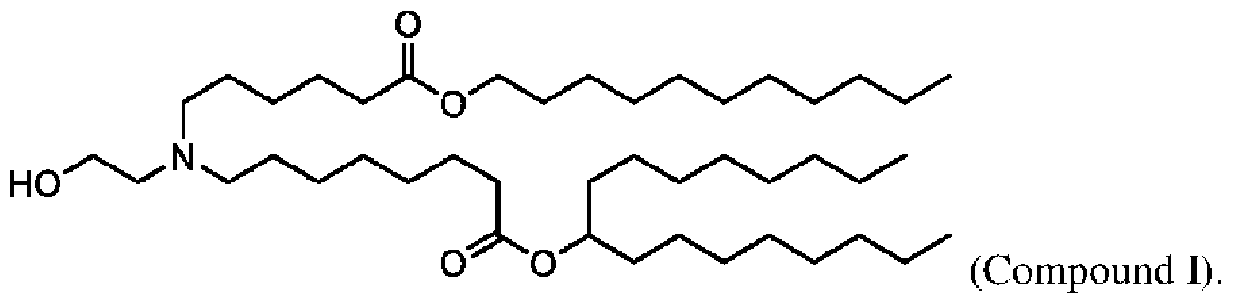
In some aspects, an ionizable cationic lipid of the disclosure comprises a compound having structure:
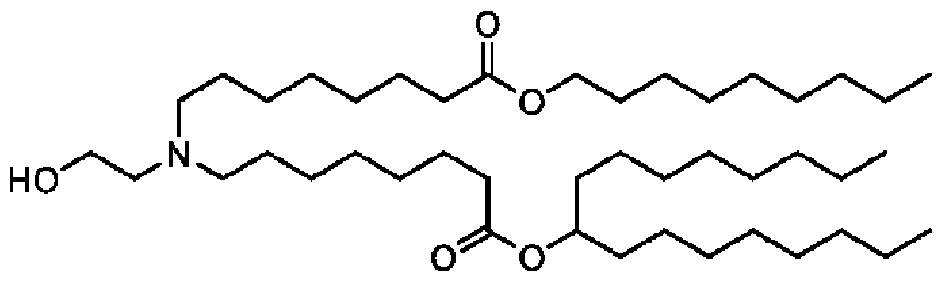 (Compound 11).
In some embodiments, the cationic lipid is
In some embodiments, the cationic lipid is
In one aspect, the lipid nanoparticles comprise (4- hydroxybutyl)azanediyl)bis(hexane-6,1 -diyl)bis(2-hexyldecanoate) (ALC-0315), having the formula:
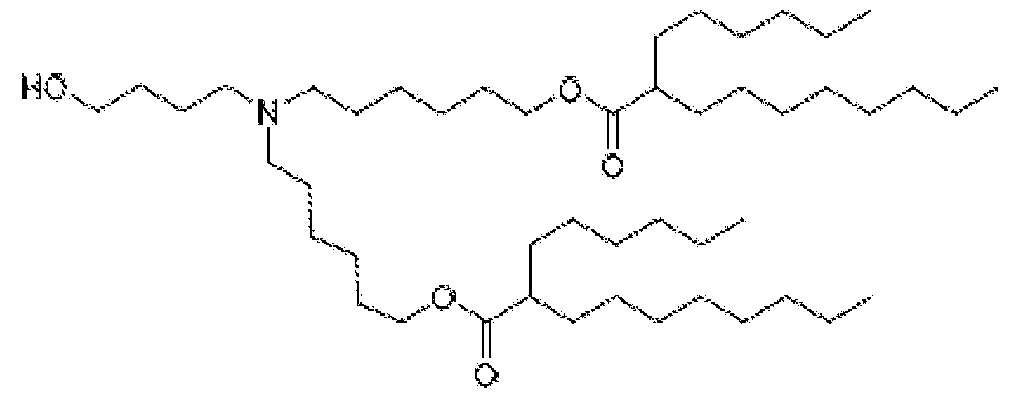
Additional exemplary cationic lipids are disclosed in, e.g., U.S. 10,166,298, the full disclosure of which is herein incorporated by reference in its entirety for all purposes. In some aspects, 1 , 2, 3, 4, 5, or more of the foregoing cationic lipids may be excluded from the LNPs of the present disclosure.
In some aspects, the RNA-LNPs comprise a cationic lipid, an RNA molecule as described herein, and one or more of neutral lipids, steroids, pegylated lipids, or combinations thereof. In one aspect, the cationic lipid is or is not present in the LNP in an amount such as at least, at most, exactly, between (inclusive or exclusive) of, or about 40, 41 , 42, 43, 44, 45, 46, 47, 48, 49, 50, 51 , 52, 53, 54, 55, 56, 57, 58, 59, or 60 mole percent (mol %). In some aspects, two or more cationic lipids are incorporated within the LNP. If more than one cationic lipid is incorporated within the LNP, the foregoing percentages apply to the combined cationic lipids.
In some aspects of the disclosure, the LNP comprises a combination or mixture of any the lipids described above. ii. POLYMER CONJUGATED LIPIDS
In some aspects, the LNPs comprise a polymer conjugated lipid. The term “polymer conjugated lipid” refers to a molecule comprising both a lipid portion and a polymer portion. An example of a polymer conjugated lipid is a pegylated lipid (e.g., polyethylene glycol-lipid, PEG-lipid). In certain aspects, the LNP comprises an additional, stabilizing lipid that is a pegylated lipid. The term “pegylated lipid” refers to a molecule comprising both a lipid portion and a polyethylene glycol portion.
Pegylated lipids are known in the art and include, but are not limited to, PEG- modified phosphatidylethanolamine, PEG-modified phosphatidic acid, PEG-modified ceramides (e.g., PEG-CerC14 or PEG-CerC20), PEG-modified dialkylamines, PEG- modified diacylglycerols, PEG-modified dialkylglycerols, 2-[(polyethylene glycol)- 2000]-N,N-ditetradecylacetamide, and mixtures thereof. Representative polyethylene glycol-lipids include PEG-c-DOMG, PEG-c-DMA, PEG-DSG, PEG-DPG, and PEG-s- DMG (1 -(monomethoxy-polyethyleneglycol)-2,3-dimyristoylglycerol). In one aspect, the polyethylene glycol-lipid is N-[(methoxy polyethylene glycol)2000)carbamoyl]-1 ,2- dimyristyloxlpropyl-3-amine (PEG-c-DMA). In one aspect, the polyethylene glycol-lipid is PEG-2000-DMG. In one aspect, the polyethylene glycol-lipid is PEG-c-DOMG. In other aspects, the LNPs comprise a PEGylated diacylglycerol (PEG-DAG) such as 1 - (monomethoxy-polyethyleneglycol)-2,3-dimyristoylglycerol (PEG-DMG), a PEGylated phosphatidylethanolamine (PEG-PE), a PEG succinate diacylglycerol (PEG-S-DAG) such as 4-0-(2',3'-di(tetradecanoyloxy)propyl-1 -0-((0- methoxy(polyethoxy)ethyl)butanedioate (PEG-S-DMG), a PEGylated ceramide (PEG- cer), or a PEG dialkoxypropylcarbamate such as co-methoxy(polyethoxy)ethyl-N- (2,3di(tetradecanoxy)propyl)carbamate or 2,3-di(tetradecanoxy)propyl-N-(co- methoxy(polyethoxy)ethyl)carbamate. PEG-lipids are disclosed in, e.g., U.S. 9,737,619, the full disclosures of which is herein incorporated by reference in its entirety for all purposes. In some aspects, 1 , 2, 3, 4, 5, or more of the foregoing pegylated lipids may be excluded from the LNPs of the present disclosure.
In some aspects, the composition comprises a pegylated lipid having the following structure:
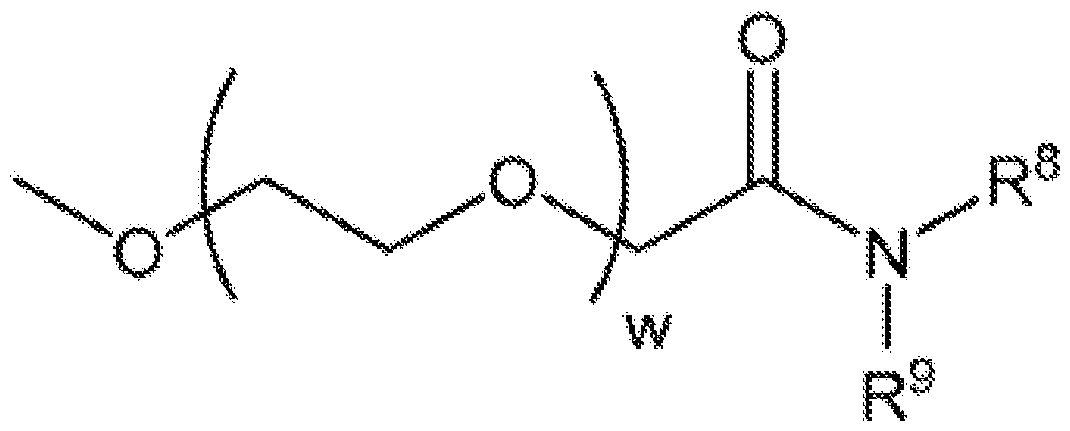 or a pharmaceutically acceptable salt, tautomer, or stereoisomer thereof, wherein:
R8 and R9 are each independently a straight or branched, saturated or unsaturated alkyl chain containing from 10 to 30 carbon atoms, wherein the alkyl chain is optionally interrupted by one or more ester bonds; and w has a mean value ranging from 30 to 60. In some aspects, R8 and R9 are each independently straight, saturated alkyl chains containing from 12 to 16 carbon atoms. In some aspects, w has a mean value ranging from 43 to 53. In other aspects, the average w is or is about 45. In other different embodiments, the average w is or is about 49.
In some aspects, the lipid nanoparticles comprise a polymer conjugated lipid. In one aspect, the lipid nanoparticle comprises 2-[(polyethylene glycol)-2000]-N,N- ditetradecylacetamide (ALC-0159), having the formula:

In various aspects, the molar ratio of the cationic lipid to the pegylated lipid ranges from or from about 100:1 to about 20:1 , e.g., 20:1 , 25:1 , 30:1 , 35:1 , 40:1 , 45:1 , 50:1 , 55:1 , 60:1 , 65:1 , 70:1 , 75:1 , 80:1 , 85:1 , 90:1 , 95:1 , or 100:1 , or any range or value derivable therein.
In certain aspects, the PEG-lipid is or is not present in the LNP in an amount from or from about 1 to about 10 mole percent (mol %) (e.g., at least, at most, exactly, or between (inclusive or exclusive) of 1 , 2, 3, 4, 5, 6, 7, 8, 9, or 10 mol %), relative to the total lipid content of the nanoparticle.
In some aspects, the ratio of PEG in the lipid nanoparticle formulations may be increased or decreased and/or the carbon chain length of the PEG lipid may be modified to alter the pharmacokinetics and/or biodistribution of the lipid nanoparticle formulations.
iii. ADDITIONAL LIPIDS
In certain aspects, the LNP comprises one or more additional lipids or lipid-like materials that stabilize particles during their formation. Suitable stabilizing or structural lipids include non-cationic lipids, e.g., neutral lipids and anionic lipids. Without being bound by any theory, optimizing the formulation of LNPs by addition of other hydrophobic moieties, such as cholesterol and lipids, in addition to an ionizable/cationic lipid or lipid-like material may enhance particle stability and efficacy of nucleic acid delivery.
As used herein, an “anionic lipid” refers to any lipid that is negatively charged at a selected pH. The term “neutral lipid” refers to any one of a number of lipid species that exist in either an uncharged or neutral zwitterionic form at physiological pH. In some aspects, additional lipids comprise one of the following neutral lipid components: (1 ) a phospholipid, (2) cholesterol or a derivative thereof; or (3) a mixture of a phospholipid and cholesterol or a derivative thereof.
Representative neutral lipids include phosphatidylcholines, phosphatidylethanolamines, phosphatidylglycerols, phosphatidic acids, phosphatidylserines, ceramides, sphingomyelins, dihydro-sphingomyelins, cephalins, and cerebrosides. Exemplary phospholipids include, for example, phosphatidylcholines, e.g., diacylphosphatidylcholines, such as distearoylphosphatidylcholine (DSPC), dioleoylphosphatidylcholine (DOPC), dimyristoylphosphatidylcholine (DMPC), dipentadecanoylphosphatidylcholine, dilauroylphosphatidylcholine, dipalmitoylphosphatidylcholine (DPPC), dioleoylphosphatidylglycerol (DOPG), dipalmitoylphosphatidylglycerol (DPPG), diarachidoylphosphatidylcholine (DAPC), dibehenoylphosphatidylcholine (DBPC), ditricosanoylphosphatidylcholine (DTPC), dilignoceroylphatidylcholine (DLPC), palmitoyloleoyl-phosphatidylcholine (POPC), 1 ,2-di-0-octadecenyl-sn-glycero-3- phosphocholine (18:0 Diether PC), 1 -oleoyl-2-cholesterylhemisuccinoyl-sn-glycero-3- phosphocholine (OChemsPC), and 1 -hexadecyl-sn-glycero-3-phosphocholine (C16 Lyso PC); and phosphatidylethanolamines, e.g., diacylphosphatidylethanolamines, such as dioleoyl-phosphatidylethanolamine (DOPE), 1 ,2-diundecanoyl-sn-glycero- phosphocholine (DUPC), palmitoyloleoylphosphatidylcholine (POPC), palmitoyloleoyl-phosphatidylethanolamine (POPE) and dioleoylphosphatidylethanolamine 4-(N-maleimidomethyl)-cyclohexane-1 -carboxylate (DOPE-mal), dipalmitoyl phosphatidyl ethanolamine (DPPE),
dimyristoylphosphoethanolamine (DMPE), dilauroyl-phosphatidylethanolamine (DLPE), distearoyl-phosphatidylethanolamine (DSPE), 1 -phytanoyl- phosphatidylethanolamine (DpyPE), 16-O-monomethyl PE, 16-O-dimethyl PE, 18-1- trans PE, 1 -stearoyl-2-oleoylphosphatidyethanolamine (SOPE), 1 ,2-dielaidoyl-sn- glycero-3-phosphoethanolamine (transDOPE), 1 ,2- dilinolenoyl-sn-glycero-3- phosphocholine,1 ,2-diarachidonoyl-sn-glycero-3-phosphocholine, 1 ,2- didocosahexaenoyl-sn-glycero-3-phosphocholine, 1 ,2-diphytanoyl-sn-glycero-3- phosphoethanolamine (ME 16.0 PE), 1 ,2-distearoyl-sn-glycero-3- phosphoethanolamine, 1 ,2- dilinoleoyl-sn-glycero-3-phosphoethanolamine, 1 ,2- dilinolenoyl-sn-glycero-3- phosphoethanolamine, 1 ,2-diarachidonoyl-sn-glycero-3- phosphoethanolamine, 1 ,2- didocosahexaenoyl-sn-glycero-3-phosphoethanolamine, 1 ,2-dioleoyl-sn-glycero-3-phospho-rac- (1 -glycerol) sodium salt (DOPG), sphingomyelin, and mixtures thereof. In some aspects, 1 , 2, 3, 4, 5, or more of the foregoing neutral lipids may be excluded from the LNPs of the present disclosure.
In one aspect, the neutral lipid is 1 ,2-distearoyl-sn-glycero-3-phosphocholine (DSPC), having the formula:

In some aspects, the LNPs comprise a neutral lipid, and the neutral lipid comprises one or more of DSPC, DPPC, DMPC, DOPC, POPC, DOPE, and/or SM. In some aspects, 1 , 2, 3, 4, 5, or more of the foregoing neutral lipids may be excluded from the LNPs of the present disclosure.
In various aspects, the LNPs further comprise a steroid or steroid analogue. A “steroid” is a compound comprising the following carbon skeleton:
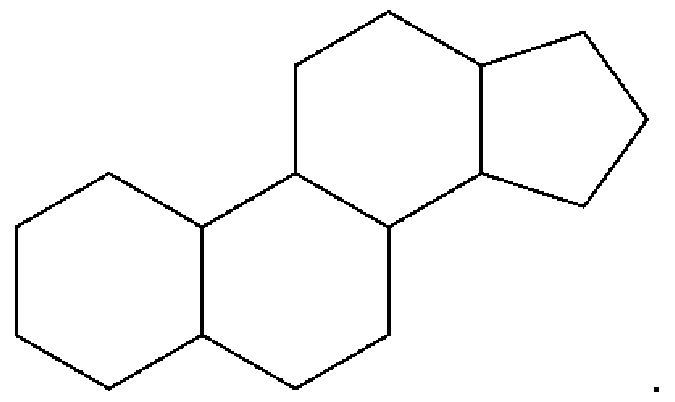
In certain aspects, the steroid or steroid analogue is cholesterol, fecosterol, sitosterol, ergosterol, campesterol, stigmasterol, brassicasterol, tomatidine, ursolic acid, alpha- tocopherol, and mixtures thereof. In some aspects, 1 , 2, 3, 4, 5, or more of the foregoing steroid or steroid analogues may be excluded from the LNPs of the
present disclosure. In certain aspects, the steroid or steroid analogue is cholesterol. Examples of cholesterol derivatives include, but are not limited to, cholestanol, cholestanone, cholestenone, coprostanol, cholesteryl-2'-hydroxyethyl ether, cholesteryl-4'-hydroxybutyl ether, tocopherol and derivatives thereof, and mixtures thereof. In some aspects, 1 , 2, 3, 4, 5, or more of the foregoing cholesterol derivatives may be excluded from the LNPs of the present disclosure. In one aspect, the cholesterol has the formula:

Without being bound by any theory, the amount of the at least one cationic lipid compared to the amount of the at least one additional lipid may affect important nucleic acid particle characteristics, such as charge, particle size, stability, tissue selectivity, and bioactivity of the nucleic acid. Accordingly, in some aspects, the molar ratio of the cationic lipid to the neutral lipid ranges from or from about 2:1 to about 8:1 , or from or from about 10:0 to about 1 :9, about 4:1 to about 1 :2, or about 3:1 to about 1 :1 .
In some aspects, the non-cationic lipid, e.g., neutral lipid (e.g., one or more phospholipids and/or cholesterol), may comprise from or from about 0 mol % to about 90 mol %, from or from about 0 mol % to about 80 mol %, from or from about 0 mol % to about 70 mol %, from or from about 0 mol % to about 60 mol %, or from or from about 0 mol % to about 50 mol %, of the total lipid present in the particle. In some aspects, the non-cationic lipid, e.g., neutral lipid (e.g., one or more phospholipids and/or cholesterol), may or may not be at least, at most, exactly, or between (inclusive or exclusive) of 0 mol %, 10 mol %, 20 mol %, 30 mol %, 40 mol %, 50 mol %, 60 mol %, 70 mol %, 80 mol %, or 90 mol % of the total lipid present in the particle.
VI. CHARACTERIZATION AND ANALYSIS OF RNA MOLECULE
The RNA molecule described herein may be analyzed and characterized using various methods. Analysis may be performed before and/or after capping. Alternatively, analysis may be performed before and/or after poly-A capture-based affinity purification. In another aspect, analysis may be performed before and/or after additional purification steps, e.g., anion exchange chromatography and the like. For example, RNA template quality may be determined using a Bioanalyzer chip-based
electrophoresis system. In other aspects, RNA template purity is analyzed using analytical reverse phase HPLC. Capping efficiency may be analyzed using, e.g., total nuclease digestion followed by MS/MS quantitation of the dinucleotide cap species vs. uncapped GTP species. In vitro efficacy may be analyzed by, e.g., transfecting an RNA molecule into a human cell line. Protein expression of the polypeptide of interest may be quantified using methods such as ELISA and/or flow cytometry. Immunogenicity may be analyzed by, e.g., transfecting RNA molecules into cell lines that indicate innate immune stimulation, e.g., PBMCs. Cytokine induction may be analyzed using, e.g., methods such as ELISA to quantify a cytokine, e.g., Interferon- a. Biodistribution may be analyzed by, e.g., bioluminescence measurements. In some aspects, 1 , 2, 3, 4, 5, or more of the foregoing analytic methods may be excluded.
In some aspects, an RNA polynucleotide disclosed herein is characterized in that, when assessed in an organism administered a composition or medical preparation comprising an RNA polynucleotide, elevated expression of a gene of interest (e.g., an antigen); increased duration of expression (e.g., prolonged expression) of a gene of interest (e.g., an antigen); elevated expression and increased duration of expression (e.g., prolonged expression) of a gene of interest (e.g., an antigen); decreased interaction with IFIT 1 of an RNA polynucleotide; and/or increased translation of an RNA polynucleotide; is observed relative to an appropriate reference. In some aspects, 1 , 2, 3, 4, 5, or more of the foregoing characteristics may not be observed after administration of a composition or medical preparation comprising an RNA molecule of the present disclosure.
In some aspects, a reference comprises an organism administered an otherwise similar RNA polynucleotide without a m7(3'OMeG)(5')ppp(5')(2'OMeAi)pG2 cap. In some aspects, a reference comprises an organism administered an otherwise similar RNA polynucleotide without a cap proximal sequence disclosed herein. In some aspects, a reference comprises an organism administered an otherwise similar RNA polynucleotide with a self-hybridizing sequence.
In some aspects, elevated expression is determined at least 24 hours, at least 48 hours, at least 72 hours, at least 96 hours, or at least 120 hours after administration of a composition or medical preparation comprising an RNA polynucleotide. In some aspects, elevated expression is determined at least 24 hours after administration of a composition or medical preparation comprising an RNA polynucleotide. In some aspects, elevated expression is determined at least 48 hours after administration of a
composition or medical preparation comprising an RNA polynucleotide. In some aspects, elevated expression is determined at least 72 hours after administration of a composition or medical preparation comprising an RNA polynucleotide. In some aspects, elevated expression is determined at least 96 hours after administration of a composition or medical preparation comprising an RNA polynucleotide. In some aspects, elevated expression is determined at least 120 hours after administration of a composition or medical preparation comprising an RNA polynucleotide.
In some aspects, expression of a gene of interest (e.g., an antigen) is elevated or elevated about 2-fold to about 50-fold. In some aspects, expression of a gene of interest (e.g., an antigen) is elevated or elevated about 2-fold to about 45-fold, about 2-fold to about 40-fold, about 2-fold to about 30-fold, about 2-fold to about 25-fold, about 2-fold to about 20-fold, about 2-fold to about 15-fold, about 2-fold to about 10- fold, about 2-fold to about 8-fold, about 2-fold to about 5-fold, about 5-fold to about 50- fold, about 10-fold to about 50-fold, about 15-fold to about 50-fold, about 20-fold to about 50-fold, about 25-fold to about 50-fold, about 30-fold to about 50-fold, about 40- fold to about 50-fold, or about 45-fold to about 50-fold. In some aspects, expression of a gene of interest (e.g., an antigen) is or is not elevated at least, at most, exactly, or between (inclusive or exclusive) of 2-fold, 3-fold, 4-fold, 5-fold, 6-fold, 7-fold, 8-fold, 9- fold, 10-fold, 11 -fold, 12-fold, 13-fold, 14-fold, 15-fold, 16-fold, 17-fold, 18-fold, 19-fold, 20-fold, 21 -fold, 22-fold, 23-fold, 24-fold, 25-fold, 26-fold, 27-fold, 28-fold, 29-fold, 30- fold, 31 -fold, 32-fold, 33-fold, 34-fold, 35-fold, 36-fold, 37-fold, 38-fold, 39-fold, 40-fold, 41 -fold, 42-fold, 43-fold, 44-fold, 45-fold, 46-fold, 47-fold, 48-fold, 49-fold, or 50-fold, or any range or value derivable therein.
In some aspects, elevated expression (e.g., increased duration of expression) of a gene of interest (e.g., an antigen) persists for at least, at most, exactly, or between (inclusive or exclusive) of 24 hours, 48 hours, 72 hours, 96 hours, or 120 hours after administration of a composition or a medical preparation comprising an RNA polynucleotide. In some aspects, elevated expression of a gene of interest (e.g., an antigen) persists for at least 24 hours after administration. In some aspects, elevated expression of a gene of interest (e.g., an antigen) persists for at least 48 hours after administration. In some aspects, elevated expression of a gene of interest (e.g., an antigen) persists for at least 72 hours after administration. In some aspects, elevated expression of a gene of interest (e.g., an antigen) persists for at least 96 hours after administration. In some aspects, elevated expression of a gene of interest (e.g., an
antigen) persists for at least 120 hours after administration of a composition or medical preparation comprising an RNA polynucleotide.
VII. IMMUNE RESPONSE AND ASSAYS
As discussed herein, the disclosure concerns evoking or inducing an immune response in a subject against a N. meningitidis protein, e.g., a wild type or variant fHbp. In one aspect, the immune response may protect against and/or treat a subject exposed to, having, suspected of having, and/or at risk of developing an infection or related disease, particularly those related to N. meningitidis.
One use of the immunogenic compositions of the disclosure is to prevent N. meningitidis infections by inoculation or vaccination of a subject. In some aspects, the immunogenic compositions immunize the subject against N. meningitidis up to 1 year (e.g., for a single N. meningitidis season). In some aspects, the immunogenic compositions immunize the subject against N. meningitidis for up to 2 years. In some aspects, the immunogenic compositions immunize the subject against N. meningitidis for more than 2 years. In some aspects, the immunogenic compositions immunize the subject against N. meningitidis for more than 3 years. In some aspects, the immunogenic compositions immunize the subject against N. meningitidisfor more than 4 years. In some aspects, the immunogenic compositions immunize the subject against N. meningitidis for 5-10 years, or longer.
A. IMMUNOASSAYS
The present disclosure includes the implementation of serological assays to evaluate whether and to what extent an immune response is induced or evoked by compositions of the disclosure. There are many types of immunoassays that may be implemented. Immunoassays encompassed by the present disclosure include, but are not limited to, those described in U.S. Patent 4,367,1 10 (double monoclonal antibody sandwich assay) and U.S. Patent 4,452,901 (western blot). Other assays include immunoprecipitation of labeled ligands and immunocytochemistry, both in vitro and in vivo.
Immunoassays generally are binding assays. In some aspects, the immunoassays are the various types of enzyme linked immunosorbent assays (ELISAs) and radioimmunoassays (RIA) known in the art. Immunohistochemical detection using tissue sections is also particularly useful. In one example, antibodies or antigens are immobilized on a selected surface, such as a well in a polystyrene microtiter plate, dipstick, or column support. Then, a test composition suspected of
containing the desired antigen or antibody, such as a clinical sample, is added to the wells. After binding and washing to remove non-specifically bound immune complexes, the bound antigen or antibody may be detected. Detection is generally achieved by the addition of another antibody, specific for the desired antigen or antibody, that is linked to a detectable label. This type of ELISA is known as a “sandwich ELISA.” Detection also may be achieved by the addition of a second antibody specific for the desired antigen, followed by the addition of a third antibody that has binding affinity for the second antibody, with the third antibody being linked to a detectable label.
Competition ELISAs are also possible implementations in which test samples compete for binding with known amounts of labeled antigens or antibodies. The amount of reactive species in the unknown sample is determined by mixing the sample with the known labeled species before or during incubation with coated wells. The presence of reactive species in the sample acts to reduce the amount of labeled species available for binding to the well and thus reduces the ultimate signal. Irrespective of the format employed, ELISAs have certain features in common, such as coating, incubating, or binding, washing to remove non-specifically bound species, and detecting the bound immune complexes.
Antigen or antibodies may also be linked to a solid support, such as in the form of plate, beads, dipstick, membrane, or column matrix, and the sample to be analyzed is applied to the immobilized antigen or antibody. In coating a plate with either antigen or antibody, one will generally incubate the wells of the plate with a solution of the antigen or antibody, either overnight or for a specified period. The wells of the plate will then be washed to remove incompletely-adsorbed material. Any remaining available surfaces of the wells are then “coated” with a nonspecific protein that is antigenically neutral with regard to the test antisera. These include bovine serum albumin (BSA), casein, and solutions of milk powder. The coating allows for blocking of nonspecific adsorption sites on the immobilizing surface and thus reduces the background caused by nonspecific binding of antisera onto the surface.
B. DIAGNOSIS OF N. MENINGITIDIS INFECTION
The present disclosure contemplates the use of N. meningitidis polypeptides, proteins, and/or peptides in a variety of ways, including the detection of the presence of N. meningitidis to diagnose an infection. In accordance with the disclosure, a method of detecting the presence of infection involves the steps of obtaining a sample
suspected of being infected by one or more N. meningitidis strains, such as a sample taken from an individual, for example, from one’s blood, saliva, tissues, bone, muscle, cartilage, and/or skin. Following isolation of the sample, diagnostic assays utilizing the polypeptides, proteins, and/or peptides of the present disclosure may be carried out to detect the presence of N. meningitidis, and such assay techniques for determining such presence in a sample are well known to those skilled in the art and include methods such as radioimmunoassay, western blot analysis and ELISA assays.
In general, in accordance with the disclosure, a method of diagnosing an infection is contemplated wherein a sample suspected of being infected with, previously infected with, or infected with, N. meningitidis has added to it the polypeptide, protein, or peptide, in accordance with the present disclosure, and N. meningitidis is indicated by antibody binding to the polypeptides, proteins, and/or peptides, or polypeptides, proteins, and/or peptides binding to the antibodies in the sample.
Also contemplated is a method of testing a sample suspected of being infected with, previously infected with, or infected with, N. meningitidis has added to it the polypeptide, protein, or peptide, in accordance with the present disclosure, and N. meningitidis is indicated by antibody binding to the polypeptides, proteins, and/or peptides, or polypeptides, proteins, and/or peptides binding to the antibodies in the sample.
Accordingly, RNA molecules encoding N. meningitidis polypeptides, proteins, and/or peptides in accordance with the disclosure may be used for to treat, prevent, and/or reduce the severity of illness from infection due to N. meningitidis infection (e.g., active or passive immunization) and/or for use as research tools.
Any of the above-described polypeptides, proteins, and/or peptides may be labeled directly with a detectable label for identification and quantification of N. meningitidis. Labels for use in immunoassays are generally known to those skilled in the art and include enzymes, radioisotopes, and fluorescent, luminescent and chromogenic substances, including colored particles such as colloidal gold or latex beads. Suitable immunoassays include enzyme-linked immunosorbent assays (ELISA).
C. PROTECTIVE IMMUNITY
In some aspects of the disclosure, RNA molecules encoding N. meningitidis polypeptides, RNA-LNPs and compositions thereof, confer protective immunity to a
subject. Protective immunity refers to a body’s ability to mount a specific immune response that protects the subject from developing a particular disease or condition that involves the agent against which there is an immune response. An immunogenically effective amount is capable of conferring protective immunity to the subject. In some aspects, the RNA molecules encoding N. meningitidis polypeptides, RNA-LNPs and compositions thereof of the present disclosure may be used to induce a balanced immune response against N. meningitidis comprising both cellular and humoral immunity, without many of the risks associated with attenuated bacterial vaccination. A “humoral” immune response refers to an immune response mediated by antibody molecules, including, e.g., secretory (IgA) or IgG molecules, while a “cellular” immune response is one mediated by T- lymphocytes (e.g., CD4+ helper and/or CD8+ T cells (e.g., CTLs) and/or other white blood cells.
As used herein the phrase “immune response” or its equivalent “immunological response” refers to the development of a humoral (antibody mediated), cellular (mediated by antigen-specific T cells or their secretion products) or both humoral and cellular response directed against an antigen. Such a response may be an active response or a passive response. A cellular immune response is elicited by the presentation of polypeptide epitopes in association with Class I or Class II MHC molecules, to activate antigen-specific CD4 (+) T helper cells and/or CD8 (+) cytotoxic T cells. The response may also involve activation of monocytes, macrophages, NK cells, basophils, dendritic cells, astrocytes, microglia cells, eosinophils and/or other components of innate immunity. In some aspects, 1 , 2, 3, 4, 5, or more of the foregoing cell types may be excluded from an immune response.
As used herein “active immunity” refers to any immunity conferred upon a subject from the production of antibodies in response to the presence of an of an antigen, e.g., a N. meningitidis polypeptide encoded by an RNA molecule of the present disclosure.
As used herein “passive immunity” includes, but is not limited to, administration of activated immune effectors including cellular mediators and/or protein mediators (e.g., monoclonal and/or polyclonal antibodies) of an immune response. A monoclonal or polyclonal antibody composition may be used in passive immunization to treat, prevent, and/or reduce the severity of illness caused by infection by organisms that carry the antigen recognized by the antibody. An antibody composition may include antibodies that bind to a variety of antigens that may in turn be associated with various
organisms. The antibody component may be a polyclonal antiserum. In certain aspects the antibody or antibodies are affinity purified from an animal or second subject that has been challenged with an antigen(s). Alternatively, an antibody mixture may be used, which is a mixture of monoclonal and/or polyclonal antibodies to antigens present in the same, related, or different microbes or organisms, such as bacteria, including but not limited to N. meningitidis.
Passive immunity may be imparted to a patient or subject by administering to the patient immunoglobulins (Ig) and/or other immune factors obtained from a donor or other non-patient source having a known immunoreactivity. In other aspects, an immunogenic composition of the present disclosure may be administered to a subject who then acts as a source or donor for globulin, produced in response to challenge with the immunogenic composition (“hyperimmune globulin”), that contains antibodies directed against a N. meningitidis or other organism. A subject thus treated would donate plasma from which hyperimmune globulin would then be obtained, via conventional plasma-fractionation methodology, and administered to another subject in order to impart resistance against and/or to treat N. meningitidis infection.
For purposes of this specification and the accompanying claims the terms “epitope” and “antigenic determinant” are used interchangeably to refer to a site on an antigen to which B and/or T cells respond or recognize. B-cell epitopes may be formed both from contiguous amino acids or noncontiguous amino acids juxtaposed by tertiary folding of a protein. Epitopes formed from contiguous amino acids are typically retained on exposure to denaturing solvents whereas epitopes formed by tertiary folding are typically lost on treatment with denaturing solvents. An epitope typically includes at least 3, and more usually, at least 5 or 8-10 amino acids in a unique spatial conformation. Methods of determining spatial conformation of epitopes include, for example, x-ray crystallography and 2-dimensional nuclear magnetic resonance. See, e.g., Epitope Mapping Protocols (1996). Antibodies that recognize the same epitope may be identified in a simple immunoassay showing the ability of one antibody to block the binding of another antibody to a target antigen. T cells recognize continuous epitopes of or of about nine amino acids for CD8 cells or of or of about 13-15 amino acids for CD4 cells. T cells that recognize the epitope may be identified by in vitro assays that measure antigen-dependent proliferation, as determined by 3H-thymidine incorporation by primed T cells in response to an epitope (Burke et al., 1994), by
antigen-dependent killing (cytotoxic T lymphocyte assay, Tigges et al., 1996) and/or by cytokine secretion.
The presence of a cell-mediated immunological response may be determined by proliferation assays (CD4 (+) T cells) and/or CTL (cytotoxic T lymphocyte) assays. The relative contributions of humoral and cellular responses to the protective and/or therapeutic effect of an immunogenic composition may be distinguished by separately isolating IgG and T cells from an immunized syngeneic animal and measuring protective and/or therapeutic effect in a second subject.
As used herein, the terms “antibody” or “immunoglobulin” are used interchangeably and refer to any of several classes of structurally related proteins that function as part of the immune response of an animal or recipient, which proteins include IgG, IgD, IgE, IgA, IgM and related proteins. Under normal physiological conditions antibodies are found in plasma and other body fluids and in the membrane of certain cells and are produced by lymphocytes of the type denoted B cells or their functional equivalent.
As used herein the terms “immunogenic agent” or “immunogen” or “antigen” are used interchangeably to describe a molecule capable of inducing an immunological response against itself on administration to a recipient, either alone, in conjunction with an adjuvant, and/or presented on a display vehicle.
VIII. COMPOSITIONS
In some aspects, RNA molecules and/or RNA-LNPs disclosed herein may be administered in a pharmaceutical composition or a medicament and may be administered in the form of any suitable pharmaceutical composition. In some aspects, a pharmaceutical composition is for therapeutic and/or prophylactic treatment. In one aspect, the disclosure relates to a composition for administration to a host. In some aspects, the host is a human. In other aspects, the host is a non-human.
Formulations of the compositions described herein may be prepared by any method known or hereafter developed in the art of pharmacology. In general, such preparatory methods include the step of bringing an active ingredient (e.g., RNA molecules and/or RNA-LNPs) into association with an excipient and/or one or more other accessory ingredients, and then, if necessary and/or desirable, dividing, shaping and/or packaging the product into a desired single- or multi-dose unit. A pharmaceutical composition or formulation in accordance with the present disclosure
can be prepared, packaged, and/or sold in bulk, as a single unit dose, and/or as a plurality of single unit doses. Relative amounts of the active ingredient, the pharmaceutically acceptable excipient, and/or any additional ingredients in a composition in accordance with the disclosure will vary, depending upon the identity, size, and/or condition of the subject treated and further depending upon the route by which the composition is to be administered. By way of example, the composition may comprise between 0.1 % and 100%, e.g., between 0.5 and 50%, between 1 -30%, between 5-80%, at least 80% (w/w), or at least, at most, exactly, or between (inclusive or exclusive) any two of 0.1 %, 0.15%, 0.2%, 0.25%, 0.3%, 0.35%, 0.4%, 0.45%, 0.5%, 0.55%, 0.6%, 0.65%, 0.7%, 0.75%, 0.8%, 0.85%, 0.9%, 0.95%, 1 %, 5%, 10%, 15%, 20%, 25%, 30%, 35%, 40%, 45%, 50%, 55%, 60%, 65%, 70%, 75%, 80%, 85%, 90%, 95%, or 100% (w/w) active ingredient. General considerations in the formulation and/or manufacture of pharmaceutical agents, such as the compositions described herein, may be found, for example, in Remington: The Science and Practice of Pharmacy 21 st ed., Lippincott Williams & Wilkins, 2005 (incorporated herein by reference in its entirety).
In some aspects, RNA molecules and/or RNA-LNPs disclosed herein may be administered in a pharmaceutical composition which may be formulated into preparations in solid, semi-solid, liquid, lyophilized, frozen, and/or gaseous forms. In some aspects, an RNA molecule and/or RNA-LNPs disclosed herein may be administered in a pharmaceutical composition which may comprise a pharmaceutically acceptable carrier and may optionally comprise one or more adjuvants, stabilizers, salts, buffers, preservatives, and optionally other therapeutic agents. In some aspects, a pharmaceutical composition disclosed herein comprises one or more pharmaceutically acceptable carriers, diluents and/or excipients. In some aspects, pharmaceutical compositions do not include an adjuvant (e.g., they are adjuvant free).
The term “excipient” as used herein refers to a substance which may be present in a pharmaceutical composition of the present disclosure but is not an active ingredient. Examples of excipients, include without limitation, carriers, diluents (e.g., solvents, dispersion media, and/or other liquid vehicles, dispersion or suspension aids), granulating and/or dispersing agents, surface active agents, isotonic agents, thickening and/or emulsifying agents, preservatives, binders, lubricants and/or oil, coloring, sweetening and/or flavoring agents, stabilizers, antioxidants, antimicrobial
and/or antifungal agents, osmolality adjusting agents, pH adjusting agents, buffers, chelants, cryoprotectants, and/or bulking agents. In some aspects, 1 , 2, 3, 4, 5, or more of the foregoing excipients may be excluded from the pharmaceutical compositions disclosed herein.
The term “carrier” refers to a component which may be natural, synthetic, organic, or inorganic, in which the active component is combined in order to facilitate, enhance and/or enable administration of the pharmaceutical composition. A carrier as used herein may be one or more compatible solid or liquid fillers, diluents or encapsulating substances, which are suitable for administration to subject. Suitable carriers include, without limitation, sterile water, Ringer’s solution, Ringer’s lactate solution, sterile sodium chloride solution, isotonic saline, polyalkylene glycols, hydrogenated naphthalenes and, in particular, biocompatible lactide polymers, lactide/glycolide copolymers or polyoxyethylene/polyoxy-propylene copolymers. In some aspects, the pharmaceutical composition of the present disclosure includes sodium chloride. In some aspects, 1 , 2, 3, 4, 5, or more of the foregoing carriers may be excluded from the pharmaceutical compositions disclosed herein.
The term “diluent” relates a diluting and/or thinning agent. Moreover, the term “diluent” includes any one or more of fluid, liquid or solid suspension and/or mixing media. Examples of suitable diluents for use in a pharmaceutical compositions of the present disclosure include, without limitation, ethanol, glycerol, saline, water, calcium or sodium carbonate, calcium phosphate, calcium hydrogen phosphate, sodium phosphate, lactose, sucrose, cellulose, microcrystalline cellulose, kaolin, mannitol, sorbitol, etc., and/or combinations thereof. In some aspects, 1 , 2, 3, 4, 5, or more of the foregoing diluents may be excluded from the pharmaceutical compositions disclosed herein.
Examples of suitable granulating and/or dispersing agents include, without limitation, starches, pregelatinized starches, or microcrystalline starch, alginic acid, guar gum, agar, poly(vinyl-pyrrolidone), (providone), cross-linked polyvinylpyrrolidone) (crospovidone), cellulose, methylcellulose, carboxymethyl cellulose, cross-linked sodium carboxymethyl cellulose (croscarmellose), magnesium aluminum silicate (VEEGUM®), sodium lauryl sulfate, etc., and/or combinations thereof. In some aspects, 1 , 2, 3, 4, 5, or more of the foregoing granulating and/or dispersing agents may be excluded from the pharmaceutical compositions disclosed herein.
Examples of suitable surface active agents for use in a pharmaceutical compositions of the present disclosure include, without limitation, natural emulsifiers (e.g., acacia, agar, alginic acid, sodium alginate, tragacanth, chondrux, cholesterol, xanthan, pectin, gelatin, egg yolk, casein, wool fat, cholesterol, wax, and lecithin), sorbitan fatty acid esters (e.g., polyoxyethylene sorbitan monooleate [TWEEN®80], sorbitan monopalmitate [SPAN®40], glyceryl monooleate, polyoxyethylene esters, polyethylene glycol fatty acid esters (e.g., CREMOPHOR®), polyoxyethylene ethers (e.g., polyoxyethylene lauryl ether [BRIJ®30]), PLUORINC®F 68, POLOXAMER®188, etc. and/or combinations thereof. In some aspects, 1 , 2, 3, 4, 5, or more of the foregoing surface active agents may be excluded from the pharmaceutical compositions disclosed herein.
Examples of suitable preservatives for use in a pharmaceutical compositions of the present disclosure include, without limitation, benzalkonium chloride, chlorobutanol, paraben, thimerosal, vitamin A, vitamin C, vitamin E, beta-carotene, citric acid, ascorbic acid, butylated hydroxyanisole, ethylenediamine, sodium lauryl sulfate (SLS), sodium lauryl ether sulfate (SLES), etc., and combinations thereof. In some aspects, 1 , 2, 3, 4, 5, or more of the foregoing preservatives may be excluded from the pharmaceutical compositions disclosed herein.
Examples of suitable antimicrobial and/or antifungal agents for use in a pharmaceutical compositions of the present disclosure include, without limitation, benzalkonium chloride, benzethonium chloride, methyl paraben, ethyl paraben, propyl paraben, butyl paraben, benzoic acid, hydroxybenzoic acid, potassium or sodium benzoate, potassium or sodium sorbate, sodium propionate, sorbic acid, etc., and combinations thereof. In some aspects, 1 , 2, 3, 4, 5, or more of the foregoing antimicrobial and/or antifungal agents may be excluded from the pharmaceutical compositions disclosed herein.
Examples of suitable binders for use in a pharmaceutical compositions of the present disclosure include, without limitation, starch, gelatin, sugars (e.g., sucrose, glucose, dextrose, dextrin, molasses, lactose, lactitol, mannitol), amino acids (e.g., glycine), natural and synthetic gums (e.g., acacia, sodium alginate), ethylcellulose, hydroxyethylcellulose, hydroxypropyl methylcellulose, etc., and combinations thereof. In some aspects, 1 , 2, 3, 4, 5, or more of the foregoing binders may be excluded from the pharmaceutical compositions disclosed herein.
Examples of suitable lubricants and/or oil for use in a pharmaceutical compositions of the present disclosure include, without limitation, magnesium stearate, calcium stearate, stearic acid, silica, talc, malt, hydrogenated vegetable oils, polyethylene glycol, sodium benzoate, sodium or magnesium lauryl sulfate, etc., and combinations thereof. In some aspects, 1 , 2, 3, 4, 5, or more of the foregoing lubricants and/or oils may be excluded from the pharmaceutical compositions disclosed herein.
Examples of suitable antioxidants for use in a pharmaceutical compositions of the present disclosure include, without limitation, alpha tocopherol, ascorbic acid, ascorbyl palmitate, benzyl alcohol, butylated hydroxyanisole, m-cresol, methionine, butylated hydroxytoluene, monothioglycerol, sodium or potassium metabisulfite, propionic acid, propyl gallate, sodium ascorbate, etc., and combinations thereof. In some aspects, 1 , 2, 3, 4, 5, or more of the foregoing antioxidants may be excluded from the pharmaceutical compositions disclosed herein.
Examples of suitable osmolality adjusting agents, pH adjusting agents, and buffers for use in a pharmaceutical compositions of the present disclosure include, without limitation, sodium phosphate, sodium citrate, sodium succinate, histidine (or histidine-HCI), sodium malate, sodium carbonate, etc., and/or combinations thereof. In some aspects, 1 , 2, 3, 4, 5, or more of the foregoing osmolality adjusting agents may be excluded from the pharmaceutical compositions disclosed herein.
Examples of suitable chelating agents for use in a pharmaceutical compositions of the present disclosure include, without limitation, ethylenediaminetetraacetic acid (EDTA), citric acid monohydrate, disodium edetate, fumaric acid, malic acid, phosphoric acid, sodium edetate, tartaric acid, trisodium edetate, etc., and combinations thereof. In some aspects, 1 , 2, 3, 4, 5, or more of the foregoing chelating agents may be excluded from the pharmaceutical compositions disclosed herein.
Examples of suitable cryoprotectants for use in a pharmaceutical compositions of the present disclosure include, without limitation, mannitol, sucrose, trehalose, lactose, glycerol, dextrose, etc., and combinations thereof. In some aspects, 1 , 2, 3, 4, 5, or more of the foregoing cryoprotectants may be excluded from the pharmaceutical compositions disclosed herein.
Examples of suitable bulking agents include, without limitation, sucrose, trehalose, mannitol, glycine, lactose, raffinose, and combinations thereof. In some aspects, 1 , 2, 3, 4, 5, or more of the foregoing bulking agents may be excluded from the pharmaceutical compositions disclosed herein.
Compositions can be formulated using one or more excipients (e.g., one or more carriers and/or diluents) to, e.g. (1 ) increase stability; (2) increase cell transfection; (3) permit the sustained and/or delayed release (e.g., from a depot formulation); (4) alter the biodistribution (e.g., target to specific tissues and/or cell types); (5) increase the translation of encoded protein in vivo; and/or (6) alter the release profile of encoded protein (antigen) in vivo. In some aspects, 1 , 2, 3, 4, 5, or more of the foregoing excipient purposes may be excluded. Pharmaceutically acceptable excipients (e.g., carriers and/or diluents) for therapeutic use are well known in the pharmaceutical art, and are described, for example, in Remington’s Pharmaceutical Sciences, Mack Publishing Co. (A. R Gennaro edit. 1985).
Pharmaceutical excipients (e.g., carriers and/or diluents) may be selected with regard to the intended route of administration and standard pharmaceutical practice.
A. IMMUNOGENIC COMPOSITIONS INCLUDING LNPS
In some aspects, a pharmaceutical composition comprises an RNA molecule (e.g., polynucleotide) disclosed herein formulated with a lipid-based delivery system. Thus, in some aspects, the composition includes a lipid-based delivery system (e.g., LNPs) (e.g., a lipid-based vaccine), which delivers a nucleic acid molecule to the interior of a cell, where it may then replicate, inhibit protein expression of interest, and/or express the encoded polypeptide of interest. The delivery system may have adjuvant effects which enhance the immunogenicity of an encoded antigen. In some aspects, the composition comprises at least one RNA molecule encoding a N. meningitidis polypeptide complexed with, encapsulated in, and/or formulated with one or more lipids, and forming lipid nanoparticles (LNPs), liposomes, lipoplexes and/or nanoliposomes. In some aspects, the composition comprises a lipid nanoparticle. Thus, in certain aspects, the present disclosure concerns compositions comprising one or more lipids associated with a nucleic acid or a polypeptide/peptide (e.g., N. meningitidis RNA-LNPs).
The immunogenic composition including a lipid-based delivery system may further include one or more salts and/or one or more pharmaceutically acceptable surfactants, preservatives, carriers, diluents, and/or excipients, in some cases. In some aspects, the immunogenic composition including a lipid-based delivery system further includes a pharmaceutically acceptable vehicle. In some aspects, each of a buffer, stabilizing agent, and optionally a salt, may be included in the immunogenic composition including a lipid-based delivery system. In other aspects, any one or more
of a buffer, stabilizing agent, salt, surfactant, preservative, and excipient may be excluded from the immunogenic composition including a lipid-based delivery system.
In a further aspect, the immunogenic composition including a lipid-based delivery system further comprises a stabilizing agent. In some aspects, the stabilizing agent comprises sucrose, mannose, sorbitol, raffinose, trehalose, mannitol, inositol, sodium chloride, arginine, lactose, hydroxyethyl starch, dextran, polyvinylpyrolidone, glycine, or a combination thereof. In some aspects, 1 , 2, 3, 4, 5, or more of the foregoing stabilizing agents may be excluded from the immunogenic compositions disclosed herein. In some aspects, the stabilizing agent is a disaccharide, or sugar. In one aspect, the stabilizing agent is sucrose. In another aspect, the stabilizing agent is trehalose. In a further aspect, the stabilizing agent is a combination of sucrose and trehalose. In some aspects, the total concentration of the stabilizing agent(s) in the composition is or is about 5% to about 10% w/v. For example, the total concentration of the stabilizing agent may or may not be equal to at least, at most, exactly, or between (inclusive or exclusive) of 1 %, 2%, 3%, 4%, 5%, 6%, 7%, 8%, 9%, 10%, 1 1 %, 12%, 13%, 14%, 15%, 16%, 17%, 18%, 19%, or 20% w/v or any range or value derivable therein. In some aspects, the stabilizing agent concentration includes, but is not limited to, a concentration of or of about 10 mg/mL to about 400 mg/mL, about 100 mg/mL to about 200 mg/mL, about 100 mg/mL to about 150 mg/mL, about 100 mg/mL to about 140 mg/mL, about 100 mg/mL to about 130 mg/mL, about 100 mg/mL to about 120 mg/mL, about 100 mg/mL to about 1 10 mg/mL, or about 100 mg/mL to about 105 mg/mL. In some aspects, the concentration of the stabilizing agent is or is not equal to at least, at most, exactly, or between (inclusive or exclusive) of 10 mg/mL, 20 mg/mL, 50 mg/mL, 100 mg/mL, 101 mg/mL, 102 mg/mL, 103 mg/mL, 104 mg/mL, 105 mg/mL, 106 mg/mL, 107 mg/mL, 108 mg/mL, 109 mg/mL, 110 mg/mL, 150 mg/mL, 200 mg/mL, 300 mg/mL, 400 mg/mL, or more.
In a further aspect, the mass amount of the stabilizing agent and the mass amount of the RNA are in a specific ratio. In one aspect, the ratio of the mass amount of the stabilizing agent and the RNA is no greater than 5000. In another aspect, the ratio of the mass amount of the stabilizing agent and the RNA is no greater than 2000. In another aspect, the ratio of the mass amount of the stabilizing agent and the RNA is no greater than 1000. In another aspect, the ratio of the mass amount of the stabilizing agent and the RNA is no greater than 500. In another aspect, the ratio of the mass amount of the stabilizing agent and the RNA is no greater than 100. In
another aspect, the ratio of the mass amount of the stabilizing agent and the pharmaceutical substance is no greater than 50. In another aspect, the ratio of the mass amount of the stabilizing agent and the RNA is no greater than 10. In another aspect, the ratio of the mass amount of the stabilizing agent and the RNA is no greater than 1 . In another aspect, the ratio of the mass amount of the stabilizing agent and the RNA is no greater than 0.5. In another aspect, the ratio of the mass amount of the stabilizing agent and the RNA is no greater than 0.1 . In another aspect, the stabilizing agent and RNA comprise a mass ratio of or of about 200 - 2000 of the stabilizing agent : 1 of the RNA.
In some aspects, the immunogenic composition including a lipid-based delivery system further comprises a buffer. Examples of buffering agents include, but are not limited to, citrate buffer solutions, acetate buffer solutions, phosphate buffer solutions, ammonium chloride, calcium carbonate, calcium chloride, calcium citrate, calcium glubionate, calcium gluceptate, calcium gluconate, d-gluconic acid, calcium glycerophosphate, calcium lactate, calcium lactobionate, propanoic acid, calcium levulinate, pentanoic acid, dibasic calcium phosphate, phosphoric acid, tribasic calcium phosphate, calcium hydroxide phosphate, potassium acetate, potassium chloride, potassium gluconate, potassium mixtures, dibasic potassium phosphate, monobasic potassium phosphate, potassium phosphate mixtures, sodium acetate, sodium bicarbonate, sodium chloride, sodium citrate, sodium lactate, dibasic sodium phosphate, monobasic sodium phosphate, sodium phosphate mixtures, tromethamine, Tris hydrochloride (HCI), amino-sulfonate buffers (e.g., HEPES), magnesium hydroxide, aluminum hydroxide, alginic acid, pyrogen-free water, isotonic saline, Ringer’s solution, ethyl alcohol, and/or combinations thereof. In some aspects, 1 , 2, 3, 4, 5, or more of the foregoing buffering agents may be excluded from the immunogenic compositions disclosed herein. In some aspects, the buffer is a HEPES buffer, a Tris buffer, and/or a PBS buffer. In one aspect, the buffer is Tris buffer. In another aspect, the buffer is a HEPES buffer. In a further aspect, the buffer is a PBS buffer. For example, the buffer concentration may or may not be equal to at least, at most, exactly, or between (inclusive or exclusive) of 1 mM, 2 mM, 3 mM, 4 mM, 5 mM, 6 mM, 7 mM, 8 mM, 9 mM, 10 mM, 1 1 mM, 12 mM, 13 mM, 14 mM, 15 mM, 16 mM, 17 mM, 18 mM, 19 mM, or 20 mM, or any range or value derivable therein. The buffer may be at a neutral pH, pH 6.5 to 8.5, pH 7.0 to pH 8.0, or pH 7.2 to pH 7.6. For example, the buffer may or may not be at least, at most, exactly, or between (inclusive
or exclusive) of pH 6.5, 6.6, 6.7, 6.8, 6.9, 7, 7.1 , 7.2, 7.3, 7.4, 7.5, 7.6, 7.7, 7.8, 7.9, 8, 8.1 , 8.2, 8.3, 8.4, or 8.5, or any range or value derivable therein. In specific aspects, the buffer is at pH 7.4.
In some aspects, the immunogenic composition including a lipid-based delivery system may further comprise a salt. Examples of salts include but not limited to sodium salts and/or potassium salts. In one aspect, the salt is a sodium salt. In a specific aspect, the sodium salt is sodium chloride. In one aspect, the salt is a potassium salt. In some aspects, the potassium salt comprises potassium chloride. In some aspects, any one or more of the foregoing salts may be excluded from the immunogenic compositions disclosed herein. The concentration of the salts in the composition may be or be about 70 mM to about 140 mM. For example, the salt concentration may or may not be equal to at least, at most, exactly, or between (inclusive or exclusive) of 50 mM, 60 mM, 70 mM, 80 mM, 90 mM, 100 mM, 120 mM, 130 mM, 140 mM, 150 mM, 160 mM, 170 mM, 180 mM, 190 mM, or 200 mM.
In some aspects, the salt concentration includes, but is not limited to, a concentration of or of about 1 mg/mL to about 100 mg/mL, about 1 mg/mL to about 50 mg/mL, about 1 mg/mL to about 40 mg/mL, about 1 mg/mL to about 30 mg/mL, about 1 mg/mL to about 20 mg/mL, about 1 mg/mL to about 10 mg/mL, or about 1 mg/mL to about 15 mg/mL. In some aspects, the concentration of the salt is or is not equal to at least, at most, exactly, or between (inclusive or exclusive) of 1 mg/mL, 2 mg/mL, 3 mg/mL, 4 mg/mL, 5 mg/mL, 6 mg/mL, 7 mg/mL, 8 mg/mL, 9 mg/mL, 10 mg/mL, 1 1 mg/mL, 12 mg/mL, 13 mg/mL, 14 mg/mL, 15 mg/mL, 16 mg/mL, 17 mg/mL, 18 mg/mL, 19 mg/mL, 20 mg/mL, or more. The salt may be at a neutral pH, pH 6.5 to 8.5, pH 7.0 to pH 8.0, or pH 7.2 to pH 7.6. For example, the salt may or may not be at a pH equal to at least, at most, exactly, or between (inclusive or exclusive) of 6.5, 6.6, 6.7, 6.8, 6.9, 7, 7.1 , 7.2, 7.3, 7.4, 7.5, 7.6, 7.7, 7.8, 7.9, 8, 8.1 , 8.2, 8.3, 8.4, or 8.5.
In some aspects, the immunogenic composition including a lipid-based delivery system further comprises a surfactant, a preservative, any other excipient, or a combination thereof. As used herein, “any other excipient” includes, but is not limited to, antioxidants, glutathione, EDTA, methionine, desferal, antioxidants, metal scavengers, and/or free radical scavengers. In one aspect, the surfactant, preservative, excipient or combination thereof is sterile water for injection (sWFI), bacteriostatic water for injection (BWFI), saline, dextrose solution, polysorbates, poloxamers, Triton, divalent cations, Ringer’s lactate, amino acids, sugars, polyols,
polymers, and/or cyclodextrins. In some aspects, 1 , 2, 3, 4, 5, or more of the foregoing excipients may be excluded from the immunogenic compositions disclosed herein.
Further examples of excipients, which refer to ingredients in the immunogenic compositions that are not active ingredients, include but are not limited to carriers, binders, diluents, lubricants, thickeners, surface active agents, preservatives, stabilizers, emulsifiers, buffers, flavoring agents, disintegrants, coatings, plasticizers, compression agents, wet granulation agents, and/or colorants. As used herein, “pharmaceutically acceptable carrier” includes any and all aqueous solvents (e.g., water, alcoholic/aqueous solutions, saline solutions, parenteral vehicles, such as sodium chloride, Ringer’s dextrose, etc.), non-aqueous solvents (e.g., propylene glycol, polyethylene glycol, vegetable oil, and injectable organic esters, such as ethyl oleate), dispersion media, coatings, surfactants, antioxidants, preservatives (e.g., antibacterial and/or antifungal agents, anti-oxidants, chelating agents, and inert gases), isotonic agents, absorption delaying agents, salts, drugs, drug stabilizers, gels, binders, excipients, disintegration agents, lubricants, sweetening agents, flavoring agents, dyes, fluid and nutrient replenishers, such like materials and combinations thereof, as would be known to one of ordinary skill in the art. Diluents, or diluting or thinning agents, include but are not limited to ethanol, glycerol, water, sugars such as lactose, sucrose, mannitol, and sorbitol, and starches derived from wheat, corn rice, and potato; and celluloses such as microcrystalline cellulose. The amount of diluent in the composition may range from or from about 10% to about 90% by weight of the total composition, e.g., from or from about 25% to about 75%, about 30% to about 60% by weight, or about 12% to about 60%. Preservatives for use in the compositions disclosed herein include but are not limited to benzalkonium chloride, chlorobutanol, paraben and thimerosal. In some aspects, 1 , 2, 3, 4, 5, or more of the foregoing excipients may be excluded from the immunogenic compositions disclosed herein.
The pH and exact concentration of the various components in the immunogenic composition including a lipid-based delivery system are adjusted according to well- known parameters. The use of such media and agents for pharmaceutical active substances is well known in the art. Except insofar as any conventional media or agent is incompatible with the active ingredients, its use in immunogenic, prophylactic and/or therapeutic compositions is contemplated.
In one aspect, a pharmaceutical composition comprises a N. meningitidis RNA molecule encoding a N. meningitidis polypeptide as disclosed herein that is complexed with, encapsulated in, and/or formulated with one or more lipids to form N. meningitidis RNA-LNPs. In some aspects, the N. meningitidis RNA-LNP composition is a liquid. In some aspects, the N. meningitidis RNA-LNP composition is frozen. In some aspects, the N. meningitidis RNA-LNP composition is lyophilized. In some aspects, a N. meningitidis RNA-LNP composition comprises a N. meningitidis RNA polynucleotide molecule encoding a N. meningitidis polypeptide as disclosed herein, encapsulated in LNPs with a lipid composition of a cationic lipid, a PEGylated lipid (e.g., PEG-lipid), and one or more structural lipids (e.g., a neutral lipid). In some aspects, any one or more of the foregoing lipids may be excluded from the LNPs of the pharmaceutical compositions disclosed herein.
In some aspects, the N. meningitidis RNA-LNP composition further comprises one or more buffers and stabilizing agents, and optionally, salt diluents. Thus, in some aspects, the N. meningitidis RNA-LNP composition comprises a cationic lipid, a PEGylated lipid, one or more structural lipids, one or more buffers, a stabilizing agent, and optionally, a salt diluent. In some aspects, 1 , 2, 3, or more of the foregoing elements are excluded from the N. meningitidis RNA-LNP composition.
In some aspects, a N. meningitidis RNA-LNP composition comprises one or more buffers. The one or more buffers may comprise any one or more buffering agents disclosed herein. In specific aspects, the composition comprises a Tris buffer comprising at least a first buffer and a second buffer. In some aspects, the first buffer is tromethamine. In some aspects, the second buffer is Tris hydrochloride (HCI). In some aspects, the first buffer and second buffer of the Tris buffer (e.g., tromethamine and Tris HCI) are or are not included in the composition at a concentration of at least, at most, between (inclusive or exclusive) of, or exactly 0.01 , 0.02, 0.03, 0.04, 0.05, 0.06, 0.07, 0.08, 0.09, 0.1 , 0.1 1 , 0.12, 0.13, 0.14, 0.15, 0.16, 0.17, 0.18, 0.19, 0.2, 0.21 , 0.22, 0.23, 0.24, 0.25, 0.26, 0.27, 0.28, 0.29, 0.3, 0.31 , 0.32, 0.33, 0.34, 0.35, 0.36, 0.37, 0.38, 0.39, 0.4, 0.41 , 0.42, 0.43, 0.44, 0.45, 0.46, 0.47, 0.48, 0.49, 0.5, 0.51 , 0.52, 0.53, 0.54, 0.55, 0.56, 0.57, 0.58, 0.59, 0.6, 0.61 , 0.62, 0.63, 0.64, 0.65, 0.66, 0.67, 0.68, 0.69, 0.7, 0.71 , 0.72, 0.73, 0.74, 0.75, 0.76, 0.77, 0.78, 0.79, 0.8, 0.81 , 0.82, 0.83, 0.84, 0.85, 0.86, 0.87, 0.88, 0.89, 0.9, 0.91 , 0.92, 0.93, 0.94, 0.95, 0.96, 0.97, 0.98, 0.99, 1 , 1 .01 , 1 .02, 1 .03, 1 .04, 1 .05, 1 .06, 1 .07, 1 .08, 1 .09, 1.1 , 1.1 1 , 1.12, 1.13, 1.14, 1.15, 1.16, 1.17, 1.18, 1.19, 1.2, 1.21 , 1.22, 1.23, 1.24, 1.25, 1.26,
1.27, 1.28, 1.29, 1.3, 1.31 , 1.32, 1.33, 1.34, 1.35, 1.36, 1.37, 1.38, 1.39, 1.4, 1.41 , 1.42, 1.43, 1.44, 1.45, 1.46, 1.47, 1.48, 1.49, 1.5, 1.51 , 1.52, 1.53, 1.54, 1.55, 1.56, 1.57, 1.58, 1.59, 1.6, 1.61 , 1.62, 1.63, 1.64, 1.65, 1.66, 1.67, 1.68, 1.69, 1.7, 1.71 , 1.72, 1.73, 1.74, 1.75, 1.76, 1.77, 1.78, 1.79, 1.8, 1.81 , 1.82, 1.83, 1.84, 1.85, 1.86, 1 .87, 1 .88, 1 .89, 1 .9, 1.91 , 1 .92, 1 .93, 1 .94, 1 .95, 1 .96, 1 .97, 1 .98, 1 .99, or 2 ng/pg/mg per mL. Concentrations for lyophilized compositions are determined postreconstitution.
In some aspects, the N. meningitidis RNA-LNP composition is a liquid composition comprising a T ris buffer. In some aspects, the T ris buffer comprises a first buffer. In some aspects, the first buffer is tromethamine. In some aspects, the first buffer (e.g., tromethamine) is or is not included in the liquid composition at a concentration of at least, at most, between (inclusive or exclusive) of, or exactly 0.01 , 0.02, 0.03, 0.04, 0.05, 0.06, 0.07, 0.08, 0.09, 0.1 , 0.1 1 , 0.12, 0.13, 0.14, 0.15, 0.16, 0.17, 0.18, 0.19, 0.2, 0.21 , 0.22, 0.23, 0.24, 0.25, 0.26, 0.27, 0.28, 0.29, 0.3, 0.31 , 0.32, 0.33, 0.34, 0.35, 0.36, 0.37, 0.38, 0.39, 0.4, 0.41 , 0.42, 0.43, 0.44, 0.45, 0.46, 0.47, 0.48, 0.49, or 0.5 mg/mL. In some aspects, the first buffer (e.g., tromethamine) is included in the liquid composition at a concentration of at least 0.1 , at least .05, at least 0.1 , at least 0.15, at least 0.2, at least 0.25, at least 0.3, at least 0.35, at least 0.4, at least 0.45, at least 0.5, at least 0.55, at least 0.6, at least 0.65, at least 0.7, at least 0.75, at least 0.8, at least 0.85, at least 0.9, at least 0.95, or at least 1 mg/mL. In some aspects, the first buffer (e.g., tromethamine) is included in the liquid composition at a concentration of between 0.05 and 0.15, between 0.15 and 0.25, between 0.25 and 0.35, between 0.35 and 0.45, between 0.45 and 0.55, between 0.55 and 0.65, between 0.65 and 0.75, between 0.75 and 0.85, or between 0.85 and 0.95. In some aspects, the first buffer (e.g., tromethamine) is included in the liquid composition at a concentration of between 0.05 and 0.1 , between 0.1 and 0.15, between 0.15 and 0.2, between 0.2 and 0.25, between 0.25 and 0.3, between 0.3 and 0.35, between 0.35 and 0.4, between 0.4 and 0.45, between 0.45 and 0.5, between 0.5 and 0.55, between 0.55 and 0.6, between 0.6 and 0.65, between 0.65 and 0.7, between 0.7 and 0.75, between 0.75 and 0.8, between 0.8 and 0.85, between 0.85 and 0.9, between 0.9 and 0.95, or between 0.95 and 1 mg/mL.
In specific aspects, the first buffer (e.g., tromethamine) is included in the liquid composition at a concentration of or of about 0.1 to 0.3 mg/mL. In specific aspects, the first buffer (e.g., tromethamine) is included in the liquid composition at a concentration
of or of about 0.15 to 0.25 mg/mL. In specific aspects, the first buffer (e.g., tromethamine) is or is not included in the liquid composition at a concentration of or of at least, at most, exactly, between (inclusive or exclusive) any two of, or about 0.1 , 0.1 1 , 0.12, 0.13, 0.14, 0.15, 0.16, 0.17, 0.18, 0.19, 0.20, 0.21 , 0.22, 0.23, 0.24, 0.25, 0.26, 0.27, 0.28, 0.29, or 0.3 mg/mL. In specific aspects, the first buffer (e.g., tromethamine) is included in the liquid composition at a concentration of or of about 0.20 mg/mL.
In some aspects, the N. meningitidis RNA-LNP composition is a liquid composition comprising a Tris buffer comprising a second buffer. In some aspects, the second buffer comprises Tris HCI. In some aspects, the second buffer (e.g., Tris HCI) is or is not included in the liquid composition at a concentration of at least, at most, between (inclusive or exclusive) of, or exactly 0.5, 0.55, 1 , 1 .01 , 1 .02, 1 .03, 1 .04, 1 .05, 1.06, 1.07, 1.08, 1.09, 1.1 , 1.1 1 , 1.12, 1.13, 1.14, 1.15, 1.16, 1.17, 1.18, 1.19, 1.2, 1.21 , 1.22, 1.23, 1.24, 1.25, 1.26, 1.27, 1.28, 1.29, 1.3, 1.31 , 1.32, 1.33, 1.34, 1.35, 1.36, 1.37, 1.38, 1.39, 1.4, 1.41 , 1.42, 1.43, 1.44, 1.45, 1.46, 1.47, 1.48, 1.49, or 1.5 mg/mL. In some aspects, the second buffer (e.g., Tris HCI) is included in the liquid composition at a concentration of at least 0.5, at least 0.55, at least 0.6, at least 0.65, at least 0.7, at least 0.75, at least 0.8, at least 0.85, at least 0.9, at least 0.95, at least 1 , at least 1 .05, at least 1 .10, at least 1 .15, at least 1 .20, at least 1 .25, at least 1 .30, at least 1 .35, at least 1 .40, at least 1 .45, or at least 1 .50 mg/mL. In some aspects, the second buffer (e.g., Tris HCI) is included in the liquid composition at a concentration of between 0.5 and 0.6, between 0.6 and 0.7, between 0.7 and 0.8, between 0.8 and 0.9, between 0.9 and 1 , between 1 and 1.10, between 1.10 and 1.20, between 1.20 and 1 .30, between 1 .30 and 1 .40, or between 1 .40 and 1 .50 mg/mL.
In specific aspects, the second buffer (e.g., Tris HCI) is included in the liquid composition at a concentration of or of about 1 .25 to 1 .40 mg/mL. In specific aspects, the second buffer (e.g., Tris HCI) is included in the liquid composition at a concentration of or of about 1 .30 to 1 .40 mg/mL. In specific aspects, the second buffer (e.g., Tris HCI) is or is not included in the liquid composition at a concentration of or of at least, at most, exactly, between (inclusive or exclusive) any two of, or about 1 .25, 1.26, 1.27, 1.28, 1.29, 1.30, 1.31 , 1.32, 1.33, 1.34, or 1.35, 1.36, 1.37, 1.38, 1.39, or 1.40 mg/mL. In specific aspects, the second buffer (e.g., Tris HCI) is included in the liquid composition at a concentration of or of about 1 .32 mg/mL.
In some aspects, the N. meningitidis RNA-LNP composition is a lyophilized composition comprising a T ris buffer. In some aspects, the T ris buffer comprises a first buffer. In some aspects, the first buffer is tromethamine. In some aspects, the first buffer (e.g., tromethamine) is or is not included in the lyophilized composition at a concentration, after reconstitution, of at least, at most, between (inclusive or exclusive) of, or exactly 0.01 , 0.02, 0.03, 0.04, 0.05, 0.06, 0.07, 0.08, 0.09, 0.1 , 0.1 1 , 0.12, 0.13, 0.14, 0.15, 0.16, 0.17, 0.18, 0.19, 0.2, 0.21 , 0.22, 0.23, 0.24, 0.25, 0.26, 0.27, 0.28, 0.29, 0.3, 0.31 , 0.32, 0.33, 0.34, 0.35, 0.36, 0.37, 0.38, 0.39, 0.4, 0.41 , 0.42, 0.43, 0.44, 0.45, 0.46, 0.47, 0.48, 0.49, or 0.5 mg/mL. In some aspects, the first buffer (e.g., tromethamine) is included in the lyophilized composition at a concentration, after reconstitution, of at least 0.01 , of at least 0.05, of at least 0.1 , of at least 0.15, of at least 0.2, of at least 0.25, of at least 0.3, of at least 0.35, of at least 0.4, of at least 0.45, or of at least 0.5 mg/mL. In some aspects, the first buffer (e.g., tromethamine (Tris base)) is included in the lyophilized composition at a concentration, after reconstitution, of between 0.01 and 0.05, between 0.05 and 0.1 , between 0.1 and 0.15, between 0.15 and 0.2, between 0.2 and 0.25 mg/mL, between 0.25 and 0.3 mg/mL, between 0.3 and 0.35 mg/mL, between 0.35 and 0.4 mg/mL, between 0.4 and 0.45 mg/mL, or between 0.45 and 0.5 mg/mL.
In specific aspects, the first buffer (e.g., tromethamine) is included in the lyophilized composition at a concentration, after reconstitution, of or of about 0.01 and 0.15 mg/mL. In specific aspects, the first buffer (e.g., tromethamine) is included in the lyophilized composition at a concentration, after reconstitution, of or of about 0.01 and 0.10 mg/mL. In specific aspects, the first buffer (e.g., tromethamine) is included in the lyophilized composition at a concentration, after reconstitution, of or of about 0.05 and 0.15 mg/mL. In specific aspects, the first buffer (e.g., tromethamine) is or is not included in the lyophilized composition at a concentration, after reconstitution, of or of at least, at most, exactly, between (inclusive or exclusive) any two of, or about 0.01 , 0.02, 0.03, 0.04, 0.05, 0.06, 0.07, 0.08, 0.09, 0.1 , 0.1 1 , 0.12, 0.13, 0.14, or 0.15 mg/mL. In specific aspects, the first buffer (e.g., tromethamine) is included in the lyophilized composition at a concentration, after reconstitution, of or of about 0.09 mg/mL.
In some aspects, lyophilized compositions are reconstituted in a suitable carrier and/or diluent. The carrier and/or diluent may comprise any one or more carriers and/or diluents disclosed herein. In specific aspects, the carrier and/or diluent
comprises a salt diluent, such as sodium chloride (NaCI) (e.g., saline, e.g., physiological or normal saline). The sodium chloride may comprise 0.9% sodium chloride for injection. In some aspects, the lyophilized compositions are or are not reconstituted in at least, at most, between (inclusive or exclusive) of, or exactly 0.1 , 0.2, 0.3, 0.4, 0.5, 0.6, 0.7, 0.8, 0.9, 0.10, 0.1 1 , 0.12, 0.13, 0.14, 0.15, 0.16, 0.17, 0.18, 0.19, 0.20, 0.21 , 0.22, 0.23, 0.24, 0.25, 0.26, 0.27, 0.28, 0.29, 0.30, 0.31 , 0.32, 0.33,
0.34, 0.35, 0.36, 0.37, 0.38, 0.39, 0.40, 0.41 , 0.42, 0.43, 0.44, 0.45, 0.46, 0.47, 0.48,
0.49, 0.50, 0.51 , 0.52, 0.53, 0.54, 0.55, 0.56, 0.57, 0.58, 0.59, 0.60, 0.61 , 0.62, 0.63,
0.64, 0.65, 0.66, 0.67, 0.68, 0.69, 0.70, 0.71 , 0.72, 0.73, 0.74, 0.75, 0.76, 0.77, 0.78,
0.79, 0.80, 0.81 , 0.82, 0.83, 0.84, 0.85, 0.86, 0.87, 0.88, 0.89, 0.90, 0.91 , 0.92, 0.93,
0.94, 0.95, 0.96, 0.97, 0.98, 0.99, or 1 mL of saline. In some aspects, the lyophilized compositions are reconstituted in at least 0.1 , at least 0.2, at least 0.3, at least 0.4, at least 0.5, at least 0.6, at least 0.7, at least 0.8, at least 0.9, or at least 1 mL of sodium chloride.
In specific aspects, the lyophilized compositions are reconstituted in or in about 0.6 to 0.75 mL of sodium chloride/saline. In specific aspects, the lyophilized compositions are reconstituted in or in about 0.65 to 0.75 mL of sodium chloride/saline. In specific aspects, the lyophilized compositions are or are not reconstituted in or in at least, at most, exactly, between (inclusive or exclusive) any two of, or about 0.6, 0.61 , 0.62, 0.63, 0.64, 0.65, 0.66, 0.67, 0.68, 0.69, 0.7, 0.71 , 0.72, 0.73, 0,74, or 0.75 mL of sodium chloride/saline.
In some aspects, the salt diluent (e.g., NaCI) is or is not included in the lyophilized composition at a concentration, after reconstitution, of at least, at most, between (inclusive or exclusive) of, or exactly 0.5, 1 , 1.5, 2, 2.5, 3, 3.5, 4, 4.5, 5, 5.5, 6, 6.5, 7, 7.5, 8, 8.5, 9, 9.5, 10, 10.5, 1 1 , 1 1.5, 12, 12.5, 13, 13.5, 14, 14.5, 15, 15.5,
16, 16.5, 17, 17.5, 18, 18.5, 19, 19.5, 20, 20.5, 21 , 21.5, 22, 22.5, 23, 23.5, 24, 24.5,
25, 25.5, 26, 26.5, 27, 27.5, 28, 28.5, 29, 29.5, 30, 30.5, 31 , 31 .5, 32, 32.5, 33, 33.5,
34, 34.5, 35, 35.5, 36, 36.5, 37, 37.5, 38, 38.5, 39, 39.5, 40, 40.5, 41 , 41 .5, 42, 42.5,
43, 43.5, 44, 44.5, 45, 45.5, 46, 46.5, 47, 47.5, 48, 48.5, 49, 49.5, or 50 ng/pg/mg per mL. In some aspects, the salt diluent (e.g., NaCI) is or is not included in the lyophilized composition at a concentration, after reconstitution, of in at least, at most, between (inclusive or exclusive) of, or exactly 1 , 1.5, 2, 2.5, 3, 3.5, 4, 4.5, 5, 5.5, 6, 6.5, 7, 7.5, 8, 8.5, 9, 9.5, 10, 10.5, 1 1 , 1 1.5, 12, 12.5, 13, 13.5, 14, 14.5, 15, 15.5, 16, 16.5, 17, 17.5, 18, 18.5, 19, 19.5, or 20 mg/mL. In some aspects, the salt diluent (e.g., NaCI) is
included in the lyophilized composition at a concentration, after reconstitution, of at least 1 , at least 2, at least 3, at least 4, at least 5, at least 6, at least 7, at least 8, at least 9, at least 10, at least 1 1 , at least 12, at least 13, at least 14, at least 15, or at least 20 mg/mL.
In specific aspects, the salt diluent (e.g., NaCI) is included in the lyophilized composition at a concentration, after reconstitution, of between or between about 5 and 15 mg/mL. In some aspects, the salt diluent (e.g., NaCI) is included in the lyophilized composition at a concentration, after reconstitution, of between or between about 5 and 10 mg/mL. In specific aspects, the salt diluent (e.g., NaCI) is or is not included in the lyophilized composition at a concentration, after reconstitution, of or of at least, at most, exactly, between (inclusive or exclusive) any two of, or about 5, 6, 7, 8, 9, 10, 1 1 , 12, 13, 14, or 15 mg/mL. In specific aspects, the salt diluent (e.g., NaCI) is included in the lyophilized composition at a concentration, after reconstitution, of or of about 9 mg/mL.
The pH of the N. meningitidis RNA-LNP composition may or may not be at least, at most, exactly, or between (inclusive or exclusive) of pH 6.5, 6.6, 6.7, 6.8, 6.9, 7.0, 7.1 , 7.2, 7.3, 7.4, 7.5, 7.6, 7.7, 7.8, 7.9, 8.0, 8.1 , 8.2, 8.3, 8.4, or 8.5, or any range or value derivable therein. In some aspects, the N. meningitidis RNA-LNP composition is at a pH of at least 6.5, at least 7.0, at least 7.5, at least 8.0, or at least 8.5. In specific aspects, the N. meningitidis RNA-LNP composition is at a pH between 6.0 and 7.5, between 6.5 and 7.5, between 7.0 and 8.0, between and 7.5 and 8.5. In specific aspects, the N. meningitidis RNA-LNP composition is between 7.0 and 8.0. In specific aspects, the N. meningitidis RNA-LNP composition is or is not at least, at most, exactly, between (inclusive or exclusive) any two of, or about pH 7.0, 7.1 , 7.2, 7.3, 7.4, 7.5, 7.6, 7.7, 7.8, 7.9, or 8.0. In specific aspects, the N. meningitidis RNA-LNP composition is at or at about pH 7.4. In some aspects, sodium hydroxide buffer may be used for a buffer pH adjustment.
In specific aspects, a N. meningitidis RNA-LNP composition comprises a N. meningitidis RNA polynucleotide encoding a N. meningitidis polypeptide as disclosed herein, encapsulated in LNPs with a lipid composition of an cationic lipid at a concentration of or of about 0.8 to 0.95 mg/mL, a PEGylated lipid at a concentration of or of about 0.05 to 0.15 mg/mL, a first structural lipid at a concentration of or of about 0.1 to 0.25 mg/mL, and a second structural lipid at a concentration of or of about
0.3 to 0.45 mg/mL. In some aspects, one or more of the foregoing elements may be excluded from the N. meningitidis RNA-LNP composition.
In specific aspects, a N. meningitidis RNA-LNP composition comprises a N. meningitidis RNA polynucleotide encoding a N. meningitidis polypeptide as disclosed herein, encapsulated in LNPs with a lipid composition of ALC-0315 at a concentration of or of about 0.8 to 0.95 mg/mL, ALC-0159 at a concentration of or of about 0.05 to 0.15 mg/mL, DSPC at a concentration of or of about 0.1 to 0.25 mg/mL, and cholesterol at a concentration of about 0.3 to 0.45 mg/mL. In some aspects, one or more of the foregoing elements may be excluded from the N. meningitidis RNA-LNP composition.
In specific aspects, the N. meningitidis RNA-LNP composition is a liquid N. meningitidis RNA-LNP composition, and the liquid N. meningitidis RNA-LNP composition further comprises a buffer composition comprising a first buffer at a concentration of or of about 0.15 to 0.3 mg/mL, a second buffer at a concentration of or of about 1 .25 to 1 .4 mg/mL, and a stabilizing agent at a concentration of or of about 95 to 110 mg/mL. In specific aspects, the N. meningitidis RNA-LNP composition is a liquid N. meningitidis RNA-LNP composition, and the liquid N. meningitidis RNA-LNP composition further comprises a Tris buffer composition comprising tromethamine at a concentration of or of about 0.1 to 0.3 mg/mL, Tris HCI at a concentration of or of about 1.25 to 1.4 mg/mL, and sucrose at a concentration of or of about 95 to 1 10 mg/mL. In some aspects, one or more of the foregoing elements may be excluded from the N. meningitidis RNA-LNP composition.
In specific aspects, the N. meningitidis RNA-LNP composition is a lyophilized N. meningitidis RNA-LNP composition, and the lyophilized N. meningitidis RNA-LNP composition further comprises (after reconstitution) a first buffer at a concentration of or of about 0.01 and 0.15 mg/mL, a second buffer at a concentration of or of about 0.5 and 0.65 mg/mL, a stabilizing agent at a concentration of or of about 35 to 50 mg/mL, and a salt diluent at a concentration of between or between about 5 and 15 mg/mL. In some aspects, one or more of the foregoing elements may be excluded from the N. meningitidis RNA-LNP composition.
In specific aspects, the N. meningitidis RNA-LNP composition is a lyophilized N. meningitidis RNA-LNP composition, and the lyophilized N. meningitidis RNA-LNP composition further comprises (after reconstitution) a Tris buffer composition comprising tromethamine at a concentration of or of about 0.01 and 0.15 mg/mL, Tris
HCI at a concentration of or of about 0.5 and 0.65 mg/mL, sucrose at a concentration of or of about 35 to 50 mg/mL, and sodium chloride (NaCI) at a concentration of or of about 5 to 15 mg/mL. In some aspects, one or more of the foregoing elements may be excluded from the N. meningitidis RNA-LNP composition.
B. VACCINES
In some aspects, a pharmaceutical composition described herein is an immunogenic composition for inducing an immune response. For example, in some aspects, an immunogenic composition is a vaccine. In some aspects, the compositions described herein include at least one isolated nucleic acid or polypeptide molecule as described herein. In specific aspects, the immunogenic compositions comprise nucleic acids, and the immunogenic compositions are nucleic acid vaccines. In some aspects, the immunogenic compositions comprise RNA (e.g., mRNA, saRNA), and vaccines are RNA vaccines. In other aspects, the immunogenic compositions comprise DNA, and vaccines are DNA vaccines. In yet other aspects, the immunogenic compositions comprise a polypeptide, and vaccines are polypeptide vaccines. Conditions and/or diseases that may be treated with the nucleic acid and/or peptide or polypeptide compositions include, but are not limited to, those caused and/or impacted by infection, cancer, rare diseases, and other diseases or conditions caused by overproduction, underproduction, and/or improper production of protein or nucleic acids.
In some aspects, the composition is substantially free of one or more impurities or contaminants and, for instance, includes nucleic acid or polypeptide molecules that are equal to at least, at most, exactly, or between (inclusive or exclusive) of 90%, 91 %, 92%, 93%, 94%, 95%, 96%, 97%, 98%, or 99% pure; at least 98% pure, or at least 99% pure.
The present disclosure includes methods for preventing, treating and/or ameliorating an infection, disease or condition in a subject, including administering to a subject an effective amount of an RNA molecule that includes at least one open reading frame encoding a polypeptide or composition described herein. As such, the disclosure contemplates vaccines for use in both active and passive immunization aspects. Immunogenic compositions, proposed to be suitable for use as a vaccine, may be prepared from RNA molecules encoding polypeptide(s), such as fHbp. In certain aspects, immunogenic compositions are lyophilized for more ready formulation into a desired vehicle.
The preparation of vaccines that contain nucleic acid and/or peptide or polypeptide as active ingredients is generally well understood in the art, as exemplified by U.S. Patents 4,608,251 ; 4,601 ,903; 4,599,231 ; 4,599,230; 4,596,792; and 4,578,770, all of which are incorporated herein by reference. Typically, such vaccines are prepared as injectables either as liquid solutions or suspensions; solid forms suitable for solution in or suspension in liquid prior to injection may also be prepared. The preparation may also be emulsified. The active immunogenic ingredient is often mixed with excipients that are pharmaceutically acceptable and compatible with the active ingredient. Suitable excipients are, for example, water, saline, dextrose, glycerol, ethanol, or the like and combinations thereof. In addition, if desired, the vaccine may contain amounts of auxiliary substances such as wetting or emulsifying agents, pH buffering agents, or adjuvants that enhance the effectiveness of the vaccines. In specific aspects, vaccines are formulated with a combination of substances, as described in U.S. Patents 6,793,923 and 6,733,754, which are incorporated herein by reference. In some aspects, one or more of the foregoing elements may be excluded from a vaccine.
Vaccines may be conventionally administered parenterally, by injection, for example, either subcutaneously or intramuscularly. Additional formulations which are suitable for other modes of administration include suppositories and, in some cases, oral formulations. For suppositories, traditional binders and carriers may include, for example, polyalkylene glycols or triglycerides; such suppositories may be formed from mixtures containing the active ingredient in the range of or of about 0.5% to about 10%. In some aspects, suppositories may be formed from mixtures containing the active ingredient in the range of or of about 1% to about 2%. Oral formulations include such normally employed excipients as, for example, pharmaceutical grades of mannitol, lactose, starch, magnesium stearate, sodium saccharine, cellulose, magnesium carbonate and the like. In some aspects, 1 , 2, 3, 4, 5, or more of the foregoing excipients may be excluded from an oral formulation. These compositions take the form of solutions, suspensions, tablets, pills, capsules, sustained release formulations or powders and contain or contain about 10% to about 95% of active ingredient.
Typically, vaccines are administered in a manner compatible with the dosage formulation, and in such amount as will be therapeutically effective and immunogenic. The quantity to be administered depends on the subject to be treated, including the
capacity of the individual’s immune system to synthesize antibodies and the degree of protection desired. Precise amounts of active ingredient required to be administered depend on the judgment of the practitioner. However, suitable dosage ranges are of the order of several hundred micrograms of active ingredient per vaccination. Suitable regimes for initial administration and booster shots are also variable, but are typified by an initial administration followed by subsequent inoculations and/or other administrations.
The manner of application may be varied widely. Any of the conventional methods for administration of a vaccine are applicable. These are believed to include oral application within a solid physiologically acceptable base or in a physiologically acceptable dispersion, parenterally, by injection and the like. The dosage of the vaccine will depend on the route of administration and will vary according to the size and health of the subject.
In certain aspects, it will be desirable to have one administration of the vaccine. In some aspects, it will be desirable to have multiple administrations of the vaccine, e.g., 2, 3, 4, 5, 6, or more administrations. The vaccinations may be at 1 , 2, 3, 4, 5, 6, 7, 8, to 5, 6, 7, 8, 9 ,10, 1 1 , or 12 week intervals, including all ranges there between. In some aspects, vaccinations may be at 1 , 2, 3, 4, 5, 6, 7, 8, 9, 10, 11 , or 12 month intervals, including all ranges there between. Periodic boosters at intervals of 1 to 5 years may be desirable to maintain protective levels of the antibodies. i. CARRIERS
A pharmaceutically acceptable carrier may include the liquid or non-liquid basis of a composition. If a composition is provided in liquid form, the carrier may be water, such as pyrogen-free water, isotonic saline or buffered (aqueous) solutions, e.g., phosphate, citrate buffered solutions. Water and/or a buffer, such as an aqueous buffer, may be used, containing a sodium salt, a calcium salt, and and/or a potassium salt. The sodium, calcium and/or potassium salts may occur in the form of their halogenides, e.g., chlorides, iodides, or bromides, in the form of their hydroxides, carbonates, hydrogen carbonates, or sulfates, etc. Examples of sodium salts include, but are not limited to, NaCI, Nal, NaBr, Na2CO3, NaHCOa, NaaSC , NaaHPC , Na2HPO4-2H2O, examples of potassium salts include, but are not limited to, KCI, KI, KBr, K2CO3, KHCO3, K2SO4, KH2PO4, and examples of calcium salts include, but are not limited to, CaCh, Cah, CaBr2, CaCOa, CaSC , Ca(OH)2. Examples of further carriers may include sugars, such as, for example, lactose, glucose, trehalose and
sucrose; starches, such as, for example, com starch or potato starch; dextrose; cellulose and its derivatives, such as, for example, sodium carboxymethylcellulose, ethylcellulose, cellulose acetate; powdered tragacanth; malt; gelatin; tallow; solid glidants, such as, for example, stearic acid, magnesium stearate; calcium sulfate; vegetable oils, such as, for example, groundnut oil, cottonseed oil, sesame oil, olive oil, corn oil and oil from theobroma; polyols, such as, for example, polypropylene glycol, glycerol, sorbitol, mannitol and polyethylene glycol; alginic acid. Examples of further carriers may include colloidal silicon oxide, magnesium stearate, cellulose, and sodium lauryl sulfate. Additional suitable pharmaceutical carriers and diluents, as well as pharmaceutical necessities for their use, are described in Remington’s Pharmaceutical Sciences. In some aspects, 1 , 2, 3, 4, 5, or more of the foregoing carriers may be excluded. ii. ADJUVANTS
Suitable adjuvants include all acceptable immunostimulatory compounds, such as cytokines, toxins, or synthetic compositions. A number of adjuvants may be used to enhance an antibody response. Adjuvants include, but are not limited to, oil-in-water emulsions, water-in-oil emulsions, mineral salts, polynucleotides, and natural substances. Specific adjuvants that may be used include Freund’s adjuvant, oil such as MONTANIDE® ISA51 , IL1 , IL2, IL3, IL4, IL5, IL6, IL7, IL8, IL9, IL10, IL12, alphainterferon, PTNGg, GM-CSF, GMCSP, BCG, LT-a, aluminum salts, such as aluminum hydroxide or other aluminum compound, MDP compounds, such as thur-MDP and nor-MDP, CGP (MTP-PE), lipid A, monophosphoryl lipid A (MPL), lipopeptides (e.g., Pam3Cys), or RIBI, which contains three components extracted from bacteria (MPL, trehalose dimycolate (TDM), and cell wall skeleton (CWS)) in a 2% squalene/Tween 80 emulsion. MHC antigens may even be used.
Various methods of achieving adjuvant affect for the vaccine includes use of agents such as aluminum hydroxide or phosphate (alum), commonly used as or as about 0.05 to about 0.1 % (e.g., at least, at most, exactly, or between (inclusive or exclusive) of 0.05%, 0.055%, 0.06%, 0.065%, 0.07%, 0.075%, 0.08%, 0.085%, 0.09%, 0.095%, or 0.1 %) solution in phosphate buffered saline, admixture with synthetic polymers of sugars (CARBOPOL®) used as an or as an about 0.25% solution, and/or aggregation of the protein in the vaccine by heat treatment with temperatures ranging between or between about 70 °C to about 101 °C for a 30-second to 2-minute period, respectively. Aggregation by reactivating with pepsin-treated (Fab) antibodies to
albumin; mixture with bacterial cells (e.g., C. parvurri), endotoxins or lipopolysaccharide components of Gram-negative bacteria; emulsion in physiologically acceptable oil vehicles (e.g., mannide mono-oleate (Aracel A)); or emulsion with a 20% solution of a perfluorocarbon (FLUOSOL-DA®) used as a block substitute may also be employed to produce an adjuvant effect.
In some aspects, 1 , 2, 3, 4, 5, or more of the foregoing adjuvants may be excluded.
In addition to adjuvants, it may be desirable to co-administer biologic response modifiers (BRM) to enhance immune responses. BRMs have been shown to upregulate T cell immunity and/or downregulate suppressor cell activity. Such BRMs include, but are not limited to, Cimetidine (CIM; 1200 mg/d) (Smith/Kline, PA); or low- dose Cyclophosphamide (CYP; 300 mg/m2) (Johnson/ Mead, NJ) and cytokines such as y-interferon, IL-2, or IL-12 or genes encoding proteins involved in immune helper functions, such as B-7.
C. COMBINATION THERAPY
The compositions and related methods of the present disclosure, particularly administration of an RNA molecule encoding a N. meningitidis polypeptide, may also be used in combination with the administration of one or more other therapeutic and/or prophylactic agents. These include, but are not limited to, the administration of traditional therapies, e.g., anti-bacterial agents. Also included are the administration of one or more therapies to treat one or more symptoms of N. meningitidis infection, including, but not limited to, steroids including corticosteroids, anti-inflammatories including acetaminophen or ibuprofen, pain-relief agents, creams or lotions to relieve itching, cool compresses, or various combinations thereof. In some aspects, 1 , 2, 3, 4, 5, or more of the foregoing therapeutic agents may be excluded.
Such combination therapy includes administration of a single pharmaceutical dosage formulation of a composition of the invention and one or more additional active agents, as well as administration of the composition of the invention and each active agent in its own separate pharmaceutical dosage formulation. For example, a composition of the invention and the other active agent can be administered to the patient together in a single dosage composition such as an injection or tablet or capsule, or each agent administered in separate oral dosage formulations. Where separate dosage formulations are used, the compounds of the invention and one or more additional active agents can be administered at essentially the same time, e.g.,
concurrently, or at separately staggered times, e.g., sequentially; combination therapy is understood to include all these regimens.
In one aspect, it is contemplated that a vaccine and/or therapy is used in conjunction with anti-bacterial treatment. Alternatively, the vaccine and/or therapy may precede or follow treatment with another agent by intervals ranging from minutes to weeks. In aspects where the other agents and/or vaccines are administered separately, one would generally ensure that a significant period of time did not expire between the time of each delivery, such that the agent and immunogenic composition would still be able to exert an advantageously combined effect on the subject. In such aspects, it is contemplated that one may administer both modalities within or within about 12-24 hours of each other or within or within about 6-12 hours of each other (e.g., within at least, at most, exactly, or between (inclusive or exclusive) any two of 1 , 2, 3, 4, 5, 6, 7, 8, 9, 10, 1 1 , 12, 13, 14, 15, 16, 17, 18, 19, 20, 21 , 22, 23, or 24 hours). In some situations, it may be desirable to extend the time period for administration significantly, where several days (2, 3, 4, 5, 6, 7, or more) to several weeks (1 , 2, 3, 4, 5, 6, 7, 8, or more) lapse between the respective administrations.
Various combinations may be employed, for example antibacterial therapy “A” and immunogenic composition as disclosed herein given as part of an immune therapy regime “B”:
A/B/A B/A/B B/B/A A/A/B A/B/B B/A/A A/B/B/B B/A/B/B
B/B/B/A B/B/A/B A/A/B/B A/B/A/B A/B/B/A B/B/A/A
B/A/B/A B/ A/A/B A/A/A/B B/A/A/A A/B/A/A A/ A/B/A
Administration of the immunogenic compositions of the present disclosure to a patient/subject will follow general protocols for the administration of such compounds, taking into account the toxicity, if any, of the N. meningitidis RNA vaccine composition, or other compositions described herein. It is expected that the treatment cycles would be repeated as necessary. It also is contemplated that various standard therapies, such as hydration, may be applied in combination with the described therapy.
D. ADMINISTRATION
Administration of the compositions described herein may be carried out via any of the accepted modes of administration of agents for serving similar utilities. In some aspects, a pharmaceutical composition described herein may be administered intravenously, intraarterially, subcutaneously, intraderN1 -mally, intranasally, or intramuscularly. In specific aspects, the N. meningitidis RNA molecules and/or RNA-
LNP compositions are administered intramuscularly. In specific aspects, the N. meningitidis RNA molecules and/or RNA-LNP compositions are administered intradermally. In specific aspects, the N. meningitidis RNA molecules and/or RNA-LNP compositions are administered intranasally. In certain aspects, the pharmaceutical composition is formulated for local administration and/or systemic administration. Systemic administration may include enteral administration, which involves absorption through the gastrointestinal tract, or parenteral administration. As used herein, “parenteral administration” refers to the administration in any manner other than through the gastrointestinal tract, such as by intravenous injection. In one aspect, the pharmaceutical composition is formulated for intramuscular, intradermal, or intranasal administration. In another aspect, the pharmaceutical composition is formulated for systemic administration, e.g., for intravenous administration. In some aspects, 1 , 2, 3, or more of the foregoing administration routes may be excluded.
A pharmaceutical composition within the scope of this disclosure may be in the form of a solid or liquid and may be frozen or lyophilized. In one aspect, the carrier(s) are particulate, so that the compositions are, for example, in tablet or powder form. The carrier(s) may be liquid, with the compositions being, for example, an oral syrup, injectable liquid, or an aerosol, which is useful in, for example, inhalatory administration. In some aspects, when intended for oral administration, the pharmaceutical composition is in either solid or liquid form, where semi-solid, semiliquid, suspension, and gel forms are included within the forms considered herein as either solid or liquid.
As a solid composition for oral administration, the pharmaceutical composition may be formulated into a powder, granule, compressed tablet, pill, capsule, chewing gum, wafer or the like form. Such a solid composition will typically contain one or more inert diluents or edible carriers. In addition, one or more of the following may be present or exclude: binders such as carboxymethylcellulose, ethyl cellulose, microcrystalline cellulose, gum tragacanth, or gelatin; excipients such as starch, lactose, or dextrins; disintegrating agents such as alginic acid, sodium alginate, PRIMOJEL®, corn starch and the like; lubricants such as magnesium stearate or STEROTEX®; glidants such as colloidal silicon dioxide; sweetening agents such as sucrose or saccharin; a flavoring agent such as peppermint, methyl salicylate, or orange flavoring; and a coloring agent. When the pharmaceutical composition is in the form of a capsule, for example, a gelatin capsule, it may contain, in addition to materials of the above type,
a liquid carrier such as polyethylene glycol or oil. In some aspects, 1 , 2, 3, or more of the foregoing elements may be excluded from a solid composition.
A liquid pharmaceutical composition, whether it be a solution, suspension, or other like form, may include or exclude one or more of the following adjuvants: sterile diluents such as water for injection, saline solution, e.g., physiological saline, Ringer’s solution, isotonic sodium chloride, fixed oils such as synthetic mono or diglycerides which may serve as the solvent or suspending medium, polyethylene glycols, glycerin, propylene glycol or other solvents; antibacterial agents such as benzyl alcohol or methyl paraben; antioxidants such as ascorbic acid or sodium bisulfite; chelating agents such as ethylenediaminetetraacetic acid; buffers such as acetates, citrates, or phosphates; and agents for the adjustment of tonicity such as sodium chloride or dextrose; agents to act as cryoprotectants such as sucrose or trehalose. The parenteral preparation may be enclosed in ampoules, disposable syringes, or multiple dose vials made of glass or plastic. In one aspect, physiological saline is the adjuvant. In one aspect, an injectable pharmaceutical composition is sterile. A liquid pharmaceutical composition intended for either parenteral or oral administration should contain an amount of a compound such that a suitable dosage will be obtained.
The compositions within the scope of the disclosure are administered in a therapeutically and/or prophylactically effective amount, which will vary depending upon a variety of factors including the activity of the specific therapeutic and/or prophylactic agent employed; the metabolic stability and length of action of the therapeutic and/or prophylactic agent; the individual parameters of the patient, including the age, body weight, general health, gender, and diet of the patient; the mode, time, and/or duration of administration; the rate of excretion; the drug combination; the severity of the particular disorder or condition; and the subject undergoing therapy. In some aspects, 1 , 2, 3, 4, 5, or more of the factors may be excluded from determining a therapeutically and/or prophylactically effective amount. Accordingly, the doses administered of the compositions described herein may depend on various of such parameters. In the case that a reaction in a patient is insufficient with an initial dose, higher doses (or effectively higher doses achieved by a different, more localized route of administration) may be used. In some aspects, compositions (e.g., N. meningitidis RNA-LNP compositions) may be administered at dosage levels sufficient to deliver 0.0001 ng/pg/mg per kg to 100 ng/pg/mg per kg, 0.001 ng/pg/mg per kg to 0.05 ng/pg/mg per kg, 0.005 ng/pg/mg per kg to 0.05
ng/pg/mg per kg, 0.001 ng/pg/mg per kg to 0.005 ng/pg/mg per kg, 0.05 ng/pg/mg per kg to 0.5 ng/pg/mg per kg, 0.01 ng/pg/mg per kg to 50 ng/pg/mg per kg, 0.1 ng/pg/mg per kg to 40 ng/pg/mg per kg, 0.5 ng/pg/mg per kg to 30 ng/pg/mg per kg, 0.01 ng/pg/mg per kg to 10 ng/pg/mg per kg, 0.1 ng/pg/mg per kg to 10 ng/pg/mg per kg, or 1 ng/pg/mg per kg to 25 ng/pg/mg per kg, of subject body weight per day, one or more times a day, per week, per month, etc. to obtain the desired therapeutic, diagnostic, prophylactic, and/or imaging effect (see, e.g., the range of unit doses described in International Publication No. WO2013/078199, herein incorporated by reference in its entirety). In some aspects, compositions (e.g., N. meningitidis RNA- LNP compositions) may or may not be administered at dosage levels sufficient to deliver at least, at most, exactly, or between (inclusive or exclusive) any two of 0.0001 , 0.0002, 0.0003, 0.0004, 0.0005, 0.0006, 0.0007, 0.0008, 0.0009, 0.001 , 0.002, 0.003, 0.004, 0.005, 0.006, 0.007, 0.008, 0.009, 0.01 , 0.02, 0.03, 0.04, 0.05, 0.06, 0.07, 0.08, 0.09, 0.1 , 0.2, 0.3, 0.4, 0.5, 0.6, 0.7, 0.8, 0.9, 1 , 2, 3, 4, 5, 6, 7, 8, 9, 10, 1 1 , 12, 13, 14,
15, 16, 17, 18, 19, 20, 21 , 22, 23, 24, 25, 26, 27, 28, 29, 30, 31 , 32, 33, 34, 35, 36, 37,
38, 39, 40, 41 , 42, 43, 44, 45, 46, 47, 48, 49, 50, 51 , 52, 53, 54, 55, 56, 57, 58, 59, 60,
61 , 62, 63, 64, 65, 66, 67, 68, 69, 70, 71 , 72, 73, 74, 75, 76, 77, 78, 79, 80, 81 , 82, 83,
84, 85, 86, 87, 88, 89, 90, 91 , 92, 93, 94, 95, 96, 97, 98, 99, or 100 ng/pg/mg per kg, of subject body weight per day, one or more times a day, per week, per month, etc. to obtain the desired therapeutic, diagnostic, prophylactic, and/or imaging effect.
IX. METHODS OF USE
Provided herein are compositions (e.g., pharmaceutical compositions comprising N. meningitidis RNA molecules and/or N. meningitidis RNA-LNPs), methods, kits and reagents for prevention and/or treatment of N. meningitidis in humans and other mammals.
N. meningitidis RNA compositions (e.g., N. meningitidis RNA-LNP compositions) may be used as therapeutic and/or prophylactic agents. They may be used in medicine to prevent and/or treat infectious disease. In exemplary aspects, the N. meningitidis RNA compositions are used to provide prophylactic protection from N. meningitidis of any serotype, genotype, strain, or isolate. It is envisioned that there may be situations where persons are at risk for infection with more than one strain of N. meningitidis. N. meningitidis RNA compositions (e.g., N. meningitidis RNA-LNP compositions) are particularly amenable to combination vaccination approaches due to a number of factors including, but not limited to, speed of manufacture, ability to
rapidly tailor vaccines to accommodate perceived geographical threat, and the like. Moreover, because the N. meningitidis RNA compositions (e.g., N. meningitidis RNA- LNP compositions) utilize the human body to produce the antigenic protein, the N. meningitidis RNA compositions (e.g., N. meningitidis RNA-LNP compositions) are amenable to the production of larger, more complex antigenic proteins, allowing for proper folding, surface expression, antigen presentation, etc. in the human subject. To protect against more than one strain of N. meningitidis, a combination N. meningitidis RNA composition can be administered that includes RNA encoding at least one antigenic polypeptide protein (or antigenic portion thereof) of a first N. meningitidis and further includes RNA encoding at least one antigenic polypeptide protein (or antigenic portion thereof) of a second N. meningitidis.
In some aspects, the N. meningitidis RNA compositions of the disclosure may be used to prime immune effector cells, for example, to activate peripheral blood mononuclear cells (PBMCs) ex vivo, which are then infused (re-infused) into a subject.
In some aspects, after administration of a N. meningitidis RNA molecule described herein, e.g., formulated as RNA-LNPs, at least a portion of the RNA is delivered to a target cell. In some aspects, at least a portion of the RNA is delivered to the cytosol of the target cell. In some aspects, the RNA is translated by the target cell to produce the polypeptide or protein it encodes. In some aspects, the target cell is a spleen cell. In some aspects, the target cell is an antigen presenting cell such as a professional antigen presenting cell in the spleen. In some aspects, the target cell is a dendritic cell and/or macrophage. RNA molecules such as RNA-LNPs described herein may be used for delivering RNA to such target cell. Accordingly, the present disclosure also relates to a method for delivering RNA to a target cell in a subject comprising the administration of the RNA-particles described herein to the subject.
In some aspects, the RNA is delivered to the cytosol of the target cell. In some aspects, the RNA is translated by the target cell to produce the polypeptide or protein encoded by the RNA. “Encoding” refers to the inherent property of specific sequences of nucleotides in a polynucleotide, such as a gene, a cDNA, or an mRNA, to serve as templates for synthesis of other polymers and macromolecules in biological processes having either a defined sequence of nucleotides (e.g., rRNA, tRNA and mRNA) or a defined sequence of amino acids and the biological properties resulting therefrom. Thus, a gene encodes a protein if transcription and translation of mRNA corresponding to that gene produces the protein in a cell or other biological system. Both the coding
strand, the nucleotide sequence of which is identical to the mRNA sequence and is usually provided in sequence listings, and the non-coding strand, used as the template for transcription of a gene or cDNA, may be referred to as encoding the protein or other product of that gene or cDNA.
In some aspects, nucleic acid compositions described herein, e.g., compositions comprising a N. meningitidis RNA-LNP are characterized by (e.g., when administered to a subject) sustained expression of an encoded polypeptide. For example, in some aspects, such compositions are characterized in that, when administered to a human, they achieve detectable polypeptide expression in a biological sample (e.g., serum) from such human and, in some aspects, such expression persists for a period of time that is at least 36 hours or longer, including, e.g., at least 48 hours, at least 60 hours, at least 72 hours, at least 96 hours, at least 120 hours, at least 148 hours, or longer.
In some aspects, nucleic acid compositions described herein, e.g., compositions comprising a N. meningitidis RNA-LNP, are characterized by (e.g., when administered to a subject) an induced and/or boosted immune response as a function of antigen production in the cell. Increased antigen production may be demonstrated by, e.g., increased cell transfection (the percentage of cells transfected with the RNA vaccine), increased protein translation from the polynucleotide, decreased nucleic acid degradation (as demonstrated, for example, by increased duration of protein translation from a modified polynucleotide), and/or altered antigen specific immune response of the host cell.
In another aspect, the disclosure relates to a method of treating and/or preventing and/or reducing the severity of a N. meningitidis infection and/or illness caused by N. meningitidis. The method includes administering to the subject an effective amount of an RNA molecule, RNA-LNP and/or composition as described herein.
In another aspect, the disclosure relates to a method of treating and/or preventing and/or reducing the severity of an infectious disease in a subject by, for example, inducing an immune response to an infectious disease in the subject. In some aspects, the method includes administering a priming composition that includes an effective amount of an RNA molecule, RNA-LNP and/or composition described herein, and administering a booster composition including an effective amount of an RNA molecule, RNA-LNP and/or composition. In some aspects, the composition elicits
an immune response including an antibody response. In some aspects, the composition elicits an immune response including a T cell response and/or a B cell response. In some aspects, an immune response comprises a T cell response and a B cell response. In some aspects, the composition elicits a neutralizing immune response. A neutralizing immune response is an immune response that is a neutralizing antibody response and/or an effective neutralizing T cell response. In some embodiments a neutralizing antibody response produces a level of antibodies that meet or exceed a seroprotection threshold. In some aspects, the composition elicits an effective T cell response. An effective T cell response is a response which produces a baseline level of infectious disease-activated and/or infectious diseasespecific T cells including CD8+ and CD4+ T helper type 1 cells. In some aspects, the effective T cells comprises a high proportion of CD8+ T cells and/or CD4+ T cells, relative to a baseline level (in a naive subject). In some embodiments these T cells are differentiated towards an early- differentiated memory phenotype with co-expression of CD27 and CD28.
In some aspects, an effective amount of a N. meningitidis RNA-LNP composition comprising at least one N. meningitidis RNA molecule having an open reading frame encoding at least one N. meningitidis antigenic polypeptide results in a 2-fold to 200-fold (e.g., at least, at most, exactly, or between (inclusive or exclusive) any two of a 2-, 3-, 4-, 5-, 6-, 7-, 8-, 9-, 10-, 20-, 30-, 40-, 50-, 60-, 70-, 80-, 90-, 100-, 1 10-, 120-, 130-, 140-, 150-, 160-, 170-, 180-, 190-, or 200-fold) increase in serum neutralizing antibodies against N. meningitidis, relative to a traditional composition against N. meningitidis (e.g., the standard of care dose of a recombinant or purified N. meningitidis protein vaccine, a live attenuated or inactivated N. meningitidis vaccine, or a N. meningitidis VLP vaccine).
The methods disclosed herein may involve administering to the subject a N. meningitidis RNA-LNP composition comprising at least one N. meningitidis RNA molecule having an open reading frame encoding at least one N. meningitidis antigenic polypeptide, thereby inducing in the subject an immune response specific to N. meningitidis antigenic polypeptide, wherein the immune response in the subject is equivalent to an immune response in a subject administered with a traditional composition against the N. meningitidis that is or is not at least, at most, in between (inclusive or exclusive) any two of, or exactly 2, 4, 6, 8, 10, 12, 14, 16, 18, 20, 22, 24, 26, 28, 30, 32, 34, 36, 38, 40, 42, 44, 46, 48, 50, 52, 54, 56, 58, 60, 62, 64, 66, 68, 70,
72, 74, 76, 78, 80, 82, 84, 86, 88, 90, 92, 94, 96, 98, or 100 times the dosage level relative to the RNA composition.
In some aspects, methods of the disclosure relate to prognosing, diagnosing, testing, monitoring, and/or treating a subject suspected of having had an infectious disease (e.g., N. meningitidis), having an infectious disease (e.g., N. meningitidis), at risk of having an infectious disease (e.g., N. meningitidis), and/or having symptoms of an infectious disease (e.g., N. meningitidis). The subject may have one or more symptoms of an infectious disease (e.g., N. meningitidis). The subject may be tested for one or more antigenic polypeptides or proteins (or antigenic portions thereof) from an infectious disease (e.g., N. meningitidis) by the one or more diagnostic tests (e.g., PCR testing to detect N. meningitidis in skin lesions; Tzanck smear; IgM serologic testing; ELISA, glycoprotein-based ELISA, latex agglutination, and/or indirect fluorescent antibody for IgG detection; direct fluorescent antibody assay, bacterial culture, etc.). In some aspects, the subject having had an infectious disease (e.g., N. meningitidis), having an infectious disease (e.g., N. meningitidis), at risk of having an infectious disease (e.g., N. meningitidis), and/or having symptoms of an infectious disease (e.g., N. meningitidis) is prognosed, diagnosed, monitored, and/or treated with or for the infectious disease (e.g., N. meningitidis) based on measurement, assaying, or detection in a sample (e.g., blood, saliva, tissues, bone, muscle, cartilage, and/or skin) from the subject one or more antigenic polypeptides or proteins (or antigenic portions thereof) from an infectious disease (e.g., N. meningitidis) by one or more diagnostic tests (e.g., PCR testing to detect N. meningitidis; Tzanck smear; IgM serologic testing; ELISA, glycoprotein-based ELISA, latex agglutination, and/or indirect fluorescent antibody for IgG detection; direct fluorescent antibody assay, bacterial culture, etc.).
The present disclosure further provides a kit comprising the RNA molecule, RNA-LNP, and/or composition.
In some aspects, the RNA molecule, RNA-LNP and/or composition described herein is administered to a subject that is or is less than about 1 years old, or is or is about 1 years old to about 10 years old, or is or is about 10 years old to about 20 years old, or is or is about 20 years old to about 50 years old, or is or is about 60 years old to about 70 years old, or older.
In some aspects the subject is or is not at least, at most, exactly, or between (inclusive or exclusive) any two of less than 1 year of age, greater than 1 year of age,
greater than 5 years of age, greater than 10 years of age, greater than 20 years of age, greater than 30 years of age, greater than 40 years of age, greater than 50 years of age, greater than 60 years of age, greater than 70 years of age, or older. In some aspects, the subject is greater than 50 years of age.
In some aspects the subject is or is not at least, at most, exactly, between (inclusive or exclusive) any two of, or about 1 year of age or older, 5 years of age or older, 10 years of age or older, 20 years of age or older, 30 years of age or older, 40 years of age or older, 50 years of age or older, 60 years of age or older, 70 years of age or older, or older. In some aspects, the subject may be or be about 50 years of age or older.
In some aspects the subject is at least, at most, exactly, or between any two of 1 year of age or older, 5 years of age or older, 10 years of age or older, 20 years of age or older, 30 years of age or older, 40 years of age or older, 50 years of age or older, 60 years of age or older, 70 years of age or older, or older. In some aspects the subject may be 50 years of age or older.
EXAMPLES
Below are examples of specific aspects for carrying out the present disclosure. The following examples are included to demonstrate aspects of the disclosure. The examples are offered for illustrative purposes only and are not intended to limit the scope of the present disclosure in any way. It should be appreciated by those of skill in the art that the techniques disclosed in the examples which follow represent techniques discovered by the inventor to function well in the practice of the disclosure. However, those of skill in the art should, in light of the present disclosure, appreciate that many changes may be made in the specific aspects which are disclosed and still obtain a like or similar result without departing from the spirit and scope of the disclosure. Efforts have been made to ensure accuracy with respect to numbers used (e.g., amounts, temperatures, etc.), but some experimental error and deviation should, of course, be allowed for.
EXAMPLE 1. Cloning of mRNA Constructs
Synthetic genes of interest (GOIs) encoding fHbp-A05 and fHbp-B01 were codon optimized using the Genewiz codon optimization tool (Codon Optimization (genewiz.com)) and ordered as synthetic FragmentGENEs from Genewiz for human
host expression. Fragments were directionally cloned into Pmel linearized BMD576 (see Example 8) using homologous regions via Gibson assembly. The Gibson enzyme mix used in the cloning reaction (NEBuilder® HiFi mix, NEB) removes the Pmel digested DNA termini, fusing the start and stop codons of the synthetic gene respectively, to the Kozak sequence of the 5’IITR and first nucleotide of the 3’ UTR sequence. BMD576 includes a T7 promoter for in vitro transcription (IVT), and a 3’ 80 nt polyA adenylation site with a terminal, unique, BspQ1 restriction enzyme site for linearization of the DNA plasmid as IVT template.
EXAMPLE 2. modRNA Production from mRNA Constructs
DNA plasmids were linearized with BspQI prior to in vitro transcription. The linearized templates were purified by treatment with Proteinase K (200 pg/mL)/SDS (0.5%) at 50°C for 30 minutes and phenol/chloroform extraction (equivalent volume of 25:24:1 premixed IAA reagent) followed by ethanol precipitation. 5 pg of BspQI linearized plasmid DNA was used as template in each 100 pL in vitro transcription reaction. The RNA was transcribed by T7 RNA polymerase (New England Biolabs), and the CleanCap® AG kit (TriLink) was used to simultaneously cap the newly transcribed modRNA molecules with m7G(5'’)ppp(5'’)(2'’OMeA)pG. Following incubation for 2 hours at 37°C, each reaction was treated with 0.3 U/pL DNasel for 30 minutes at 37°C, and modRNA containing N1 -methylpseudo UTP was precipitated by the addition of 2.5M LiCI solution and incubation for 30 minutes at -20°C. After LiCI precipitation, centrifuged pellets were collected by spinning LiCI incubated tubes at 15,000 rpm for 20 minutes at 4°C, washed twice with 70% ethanol and resuspended in nuclease free water. Size and integrity of the transcribed RNAs were confirmed using an Advanced Analytical Fragment Analyzer and RNA markers (Agilent). Between 330-650 pg of purified modRNA was generated in each reaction.
EXAMPLE 3. In vitro Expression (IVE) NA-Anchored Constructs
25 pL volumes of 4-fold serial dilutions of RNA (from 30 ng/well) were combined with lipofectamine (MessengerMax, Invitrogen) for 5 minutes at room temperature in a 96-well deep-well (2.2 mL) plate (Fisher Scientific). Expi293 suspension cells (ThermoFisher) were diluted in 0.45 mL of Opti-MEM growth media to a final concentration of 1 x10⁶/well with shaking for 24 hours at 37°C, 8% CO2 and 80% humidity overnight. The next day cells were divided equally into different 96-well
plates to perform surface staining using a monoclonal mouse mAb MN86-994-1 1 -1 , which recognizes both subfamily A and B strains or human A05/B01 antisera followed by PE conjugated antibody (McNeil, L.K., et al., mBio, 2018. 9(2)). Cells were also stained with Fixable Dye eFluor™ 780 to assess cell viability. Plates were read on an LSRII flow cytometer instrument (BD Biosciences).
EXAMPLE 4: In vitro Expression (IVE) Secreted Constructs
25 pL volumes of 4-fold serial dilutions of RNA (from 300 ng/well) were combined with lipofectamine (MessengerMax, Invitrogen) for 5 minutes at room temperature in a 96-well deep-well (2.2 mL) plate. Expi293 suspension cells (ThermoFisher) were diluted in 0.45 mL of Opti-MEM growth media to a final concentration of 1 x10⁶/well with shaking for 24 hours at 37°C, 8% CO2, and 80% humidity overnight. fHbp secreted into culture media supernatants was quantified by Octet biolayer interferometry 24 hour after the transfection of Expi293 cells with modRNA. Antihuman FcProG biosensors were used to first bind the monoclonal mouse mAb MN86- 994-1 1 -1 followed by binding reactions with clarified transfection supernatants. The biosensors were first hydrated with conditioned Expi293 media (200 pL/well) for 10 minutes at room temperature, followed by capture with saturating concentration of mAb (final 1 pg/mL, 200 pL/well) for 10 minutes at room temperature on an orbital shaker. fHbp concentrations were determined by interpolating values from a parallel titration of purified recombinant fHbp protein standard (MnB Bulk DS Subfamily B batch G09710B306) starting at 20 pg/ml with 2-fold dilutions using linear regression analysis. In addition, samples of normalized cell pellets and supernatants were analyzed by SDS-PAGE followed by Western blot with detection by primary antibody mAB MN86-994-1 1 -1 (mouse) and secondary anti-mouse AP conjugate.
EXAMPLE 5. Design of mRNA Constructs for Expression of Secreted and Neuraminidase (NA) Anchored fHbp-B01 and fHbp-A05 and Experimental Results
As a proof of concept, mRNA constructs were designed using the BMD576 backbone encoding secreted and anchored versions of both fHbp proteins. Nonnative glycosylation that occurs on proteins produced in mammalian cells was predicted using the NetNGIyc N-glycoslyation prediction server, https:/ services.healthtech.dtu.dk/services/NetNGIyc-1 .0/ (Gupta, R. and S. Brunak, Pac Symp Biocomput, 2002: p. 310-22). Asparagine 46 in fHbp-A05 and asparagine
47 in fHbp-B01 were predicted to be glycosylated during mammalian expression. These positions were mutated to serine in the expression constructs. The N-terminal cysteine present in both native sequences was removed to avoid potential mispairing disulfide bond formation.
For the secreted constructs, DNA sequences encoding fHbp-A05-N46S and fHbp- B01 -N47S were cloned into the BMD576 expression plasmid in frame with a mouse IgK signal peptide to drive trafficking through the secretory pathway and into the extracellular milieu (Figure 1 ). Expi293 cells were transfected with modRNAs transcribed from these constructs, and after 24 hours, supernatants were analyzed by Octet and Western blot using anti-fHbp monoclonal antibody MN86-994-1 1 -1 . Robust expression of both versions of fHbp in culture supernatants was observed (Figure 2).
EXAMPLE 6. Design of Membrane-Anchored fHbp Antigens
It was of interest to evaluate whether membrane-anchored fHbp expressed in vivo from modRNA would induce increased immune responses relative to secreted protein. In nature, fHbp is posttranslationally lipidated at the N-terminus, which mediates its association with the bacterial cell membrane (da Silva, R.A.G., et al., Br J Pharmacol, 2017. 174(14): p. 2247-2260). This type of lipidation does not occur in mammalian cells, thus in order to anchor fHbp to the mammalian cell surface, an alternative strategy of anchoring the protein via the N-terminus is required. One option initially considered was to use a glycosylphosphatidylinositol (GPI) anchor. However, since GPI anchors are attached to the C-terminus of proteins, they could not be applied to fHbp as it would be presented in the opposite orientation than in nature. Various anchoring approaches were considered, such as lipidation and type I or II single pass transmembrane domains (Spiess, M., FEBS Lett, 1995. 369(1 ): p. 76-9). Lipidation primarily localizes proteins to the intracellular side of the plasma membrane, so it was not an option. A type I transmembrane domain fusion protein would orient the fusion partner protein with the C-terminus facing into the cytoplasm; however a type II transmembrane domain or signal anchor would confer the appropriate orientation to fHbp with the C-terminus facing the extracellular milieu.
A type II signal anchor is a highly hydrophobic sequence that directs proteins to the plasma membrane. Notably, unlike a signal peptide, the type II signal anchor is not cleaved (Lemire, I., etal., Biochemical Journal, 1997. 322(1 ): p. 335-342). The C-
terminus and functional domains of proteins with a type II signal anchor are located on the extracellular side of the cell membrane and are anchored to the cell via a transmembrane helix. The N-termini remain on the cytoplasmic side of the membrane.
Influenza neuraminidase (NA) is a viral protein that cleaves sialic acid residues on viral proteins that are added during protein production in the host cell ER, which is an essential process for virion release and budding (Gong, J., W. Xu, and J. Zhang, Curr Med Chem, 2007. 14(1 ): p. 1 13-22; McAuley, J.L., et al., Front Microbiol, 2019. 10: p. 39). NA is a type II signal anchor protein which exists as a tetramer of four identical monomers, each composed of four distinct structural domains (the catalytic head, stalk, transmembrane region and the cytoplasmic tail) (Figure 3). Tetramerization is mediated primarily by residues in the N-terminal transmembrane domain, though cysteine residues in the stalk region may also be important for subunit interactions, by assisting with tetramer stabilization via promotion of intermolecular disulfide bond formation between monomers (Gong, J., W. Xu, and J. Zhang, Curr Med Chem, 2007. 14(1 ): p. 113-22; McAuley, J.L., et al., Front Microbiol, 2019. 10: p. 39). The HINI
WSN/33 NA sequence was selected for evaluation in the initial fHbp mammalian expression experiments.
EXAMPLE 7: Cloning and Expression of Membrane-Anchored fHbp-A05 and fHbp-B01 from modRNA Transcripts
DNA sequences encoding fHbp-A05 and fHbp-B01 fused in-frame with Influenza WSN/33 neuraminidase transmembrane domain sequence (residues 1 -40) were cloned into the BMD576 backbone. Position N47 in fHbp-B01 and position N46 in fHbp-A05 were mutated to S to prevent non-native glycosylation (Figure 4). modRNA transcripts were transfected into Expi293 cells and robust fHbp surface expression was observed with both sequences after 24 hours, detected using both a mouse mAb and human antisera (Figure 5). EXAMPLE 8: mRNA Constructs - fHbp Protein and RNA Sequences
Table 1 below provides the amino acid and RNA sequences of several fHbp constructs.
Table 1
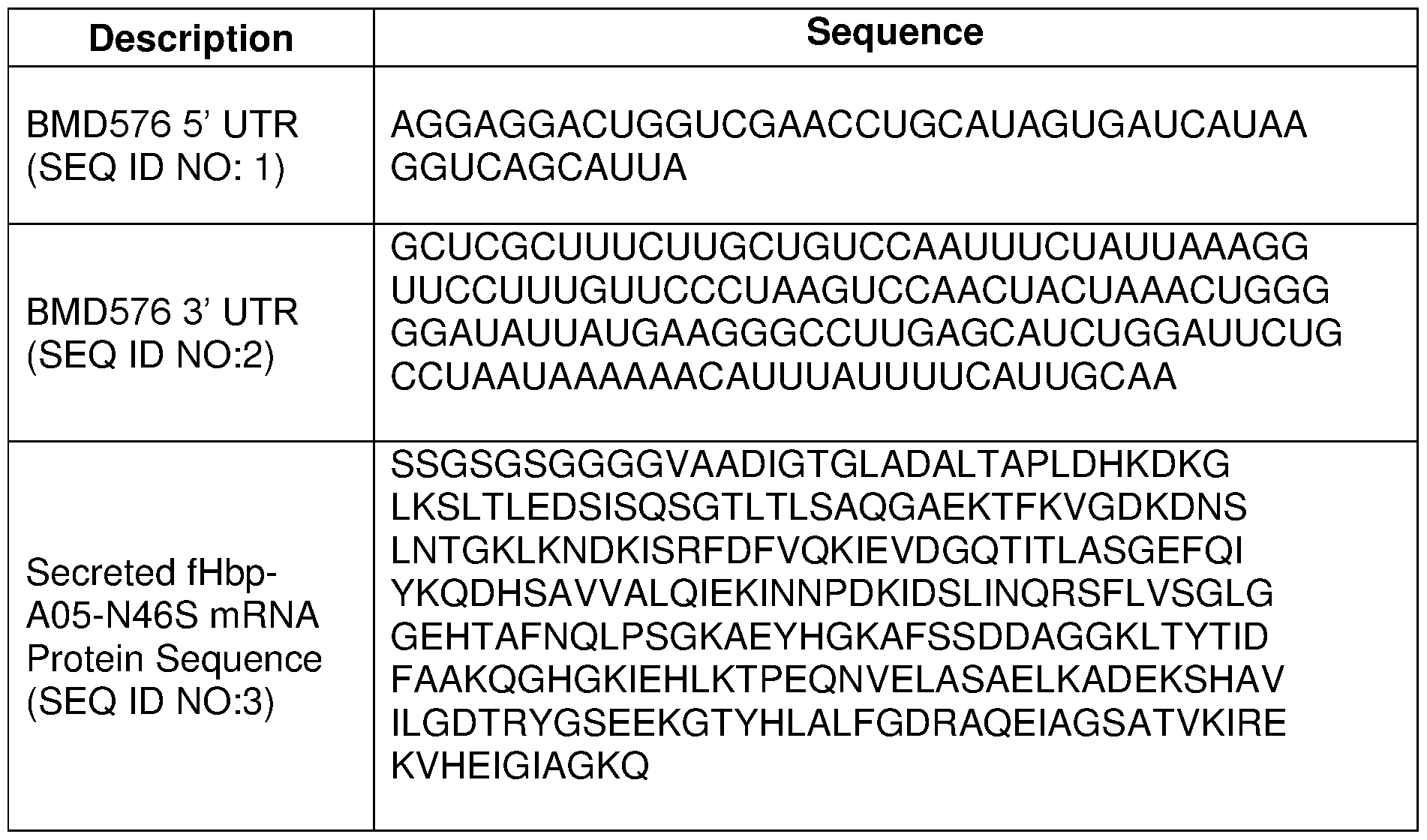

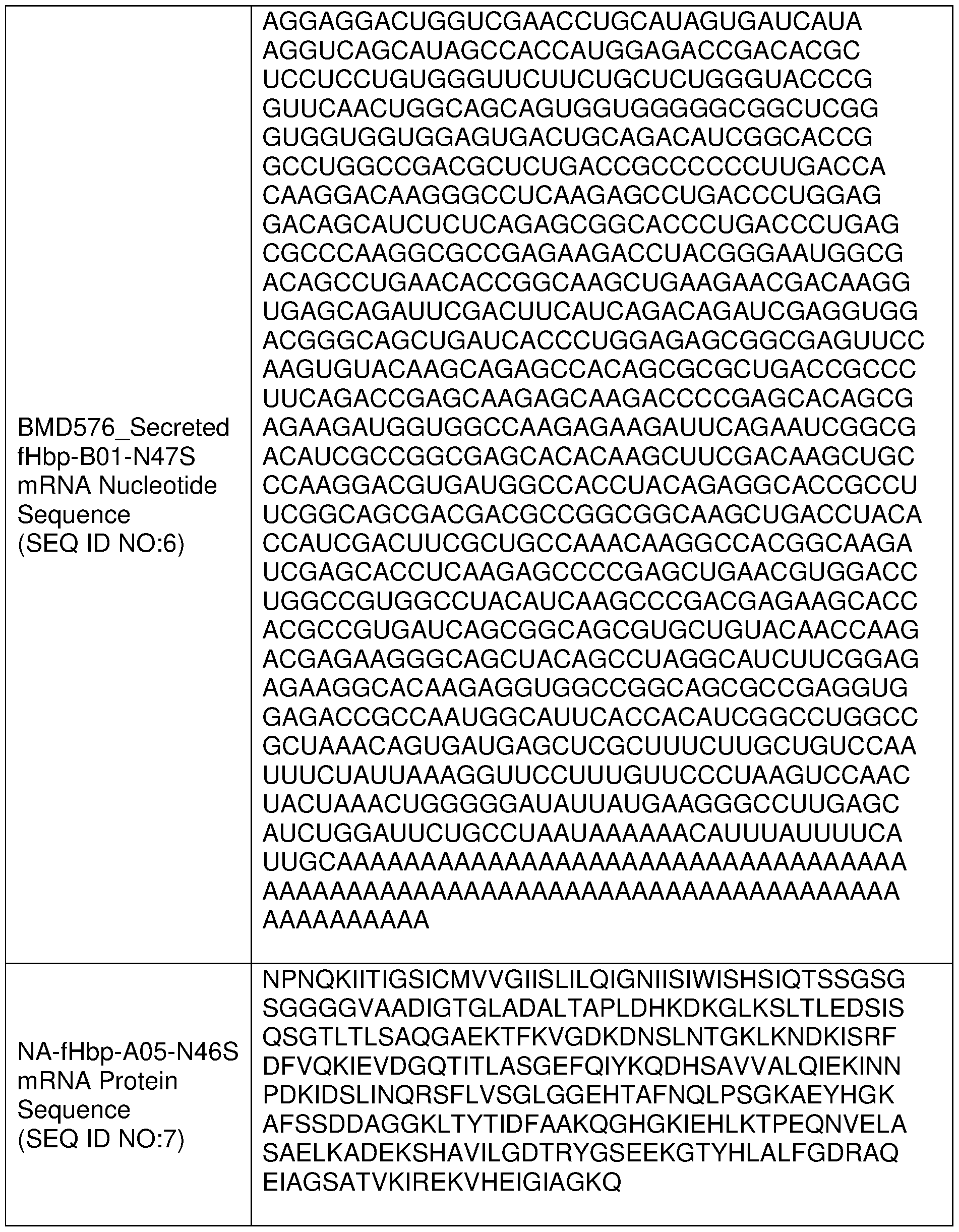
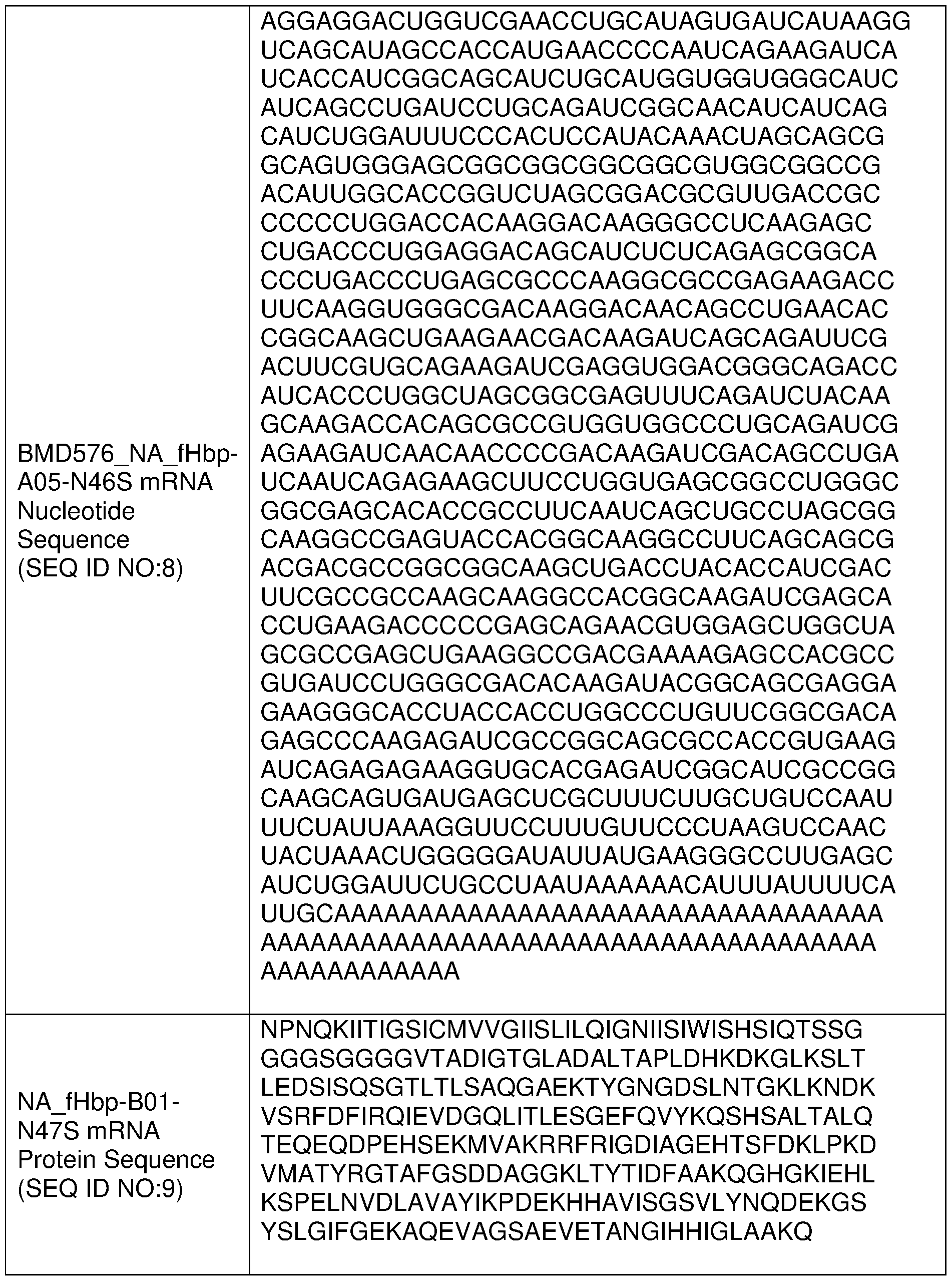
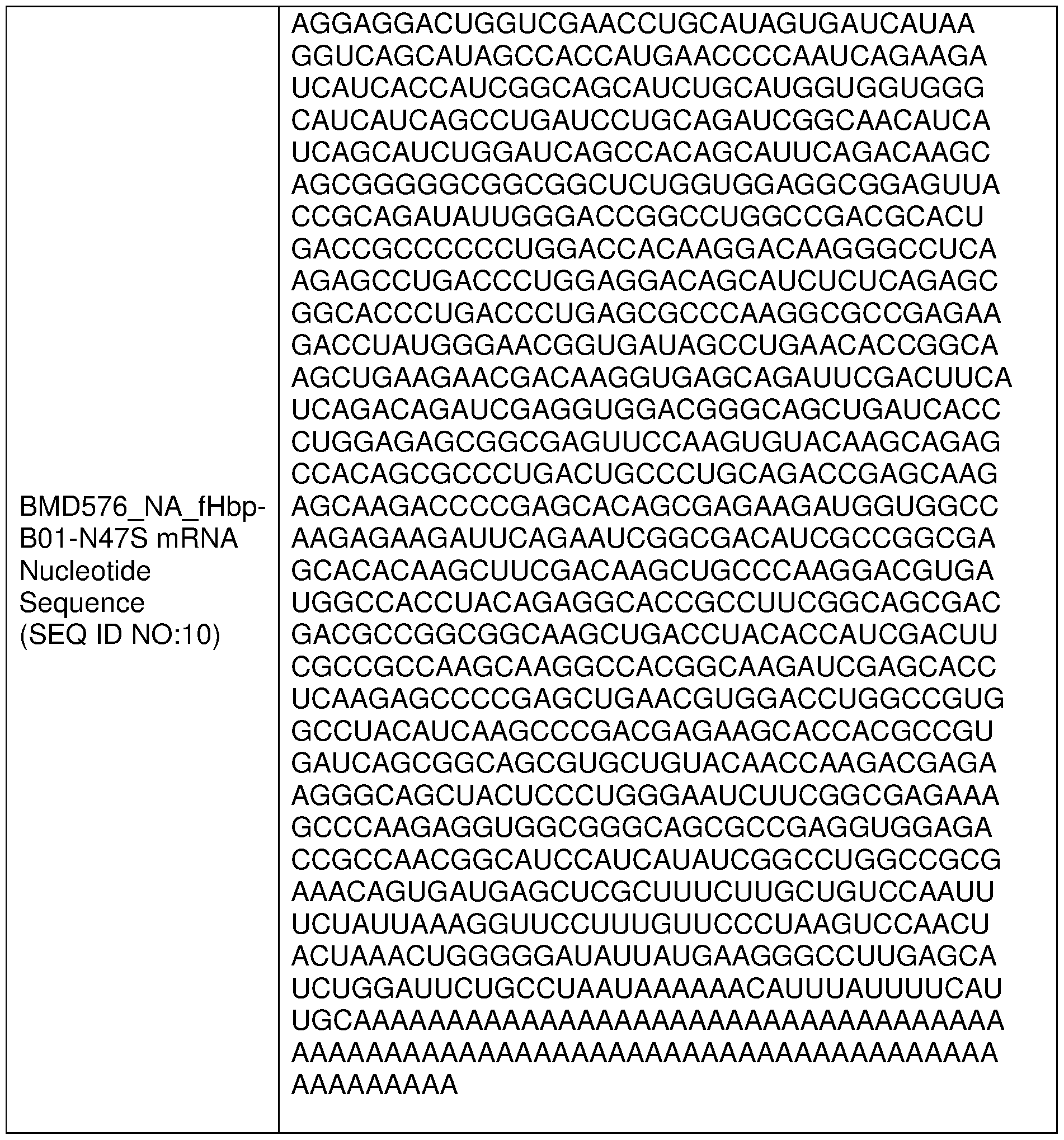
EXAMPLE 9: modRNA LNP Production modRNA LNPs were formulated using microfluidic mixing. Lipids including ALC315 and ALC159, distearoylphosphatidylcholine (DSPC) and cholesterol were dissolved in ethanol (ALC315:cholesterol:DSPC:ALC159=46.3:42.7:9.4:1 .6 molar ratio). The lipid mixture was combined with 50 mM citrate buffer (pH=4) containing modRNA at a ratio of 3:1 (aqueous: ethanol) using Precision Ignite Nanoassemblr™. The LNPs were further dialyzed into 10 mM Tris buffer (pH=7.5). 300 mM sucrose was added to the resulting formulations and then sterile filtered using 0.22 pm PES filters.
Endotoxin levels for all DP modRNA LNPs measured with the LAL test cartridge system were 1 EU/mL (Endosafe). Testing by PCR for adventitious agents was done by Charles River Research Animal Diagnostic Services with their standard infectious disease panel. All samples were negative. (Signals 00803405-0002, 0003) Encapsulation efficiency was determined by RiboGreen assay, LNP size and polydispersity index (PDI) by dynamic light scattering (DLS) (Malvern).
EXAMPLE 10: Mouse Immunogenicity
Swiss Webster and CD-1 female mice were used for immunogenicity studies. Fifteen mice of each strain were used for baseline control sera. Forty mice of each strain were vaccinated with LNPs encoding fHBP. Twenty mice of each strain were vaccinated with Trumenba® for reference comparison. There were four cages per group. Cages 1 and 2 from the vaccinated groups were vaccinated intramuscularly at weeks 0 and 4. Cages 3 and 4 from the vaccinated groups were vaccinated intramuscularly at weeks 0, 4, and 8. Of the vaccinated animals, cages 1 and 2 were terminally bled at week 6 and cages 3 and 4 will be terminally bled at week 10.
Table 2 Mouse Study Design

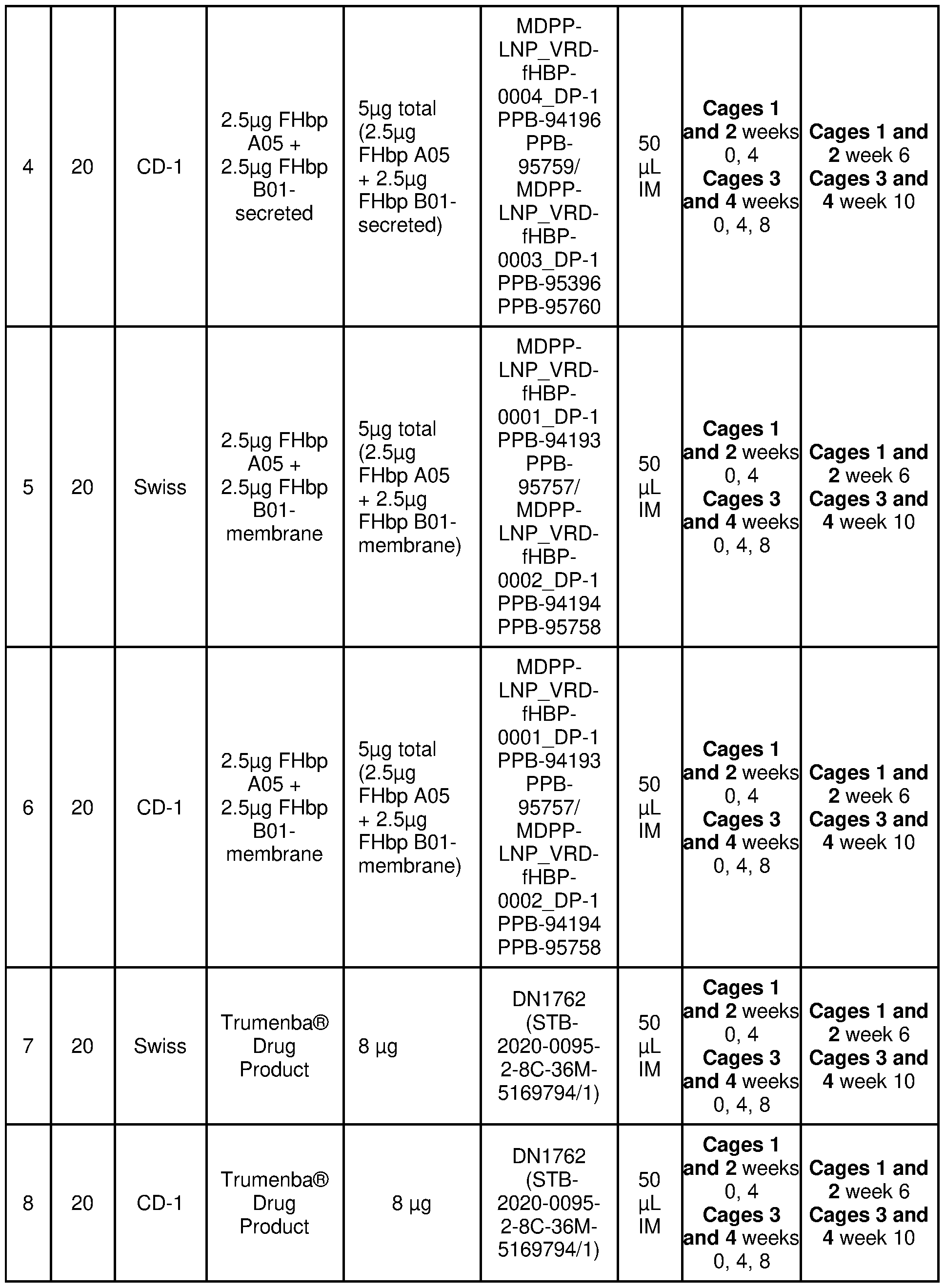 EXAMPLE 11 : Serum Bactericidal Assay (SBA)
The serum bactericidal assay (SBA) quantifies functional N. meningitidis antibody titers as the reciprocal of the highest test serum dilution resulting in at least a 50 percent reduction in the bacteria. Performing the hSBA requires 3 days: one day for initiating the culture of target bacteria, a second day to perform the assay and a third day to enumerate surviving target bacteria and determine assay results. In summary, on the first day bacteria stock is streaked on agar plates for overnight growth of isolated bacterial colonies. On the subsequent day, bacterial colonies are resuspended in liquid medium for mixing with human serum samples and a source of complement, which is a group of proteins that aid in the destruction of bacteria. The mixture is then incubated to allow the antibodies in the serum to bind to the bacteria and activate the complement system, leading to bacterial lysis. At the end of the incubation, a portion of this mixture is transferred to filter plates for growth of remaining viable bacterium. Colonies generated by surviving bacteria are enumerated on the third day to determine the effectiveness of the antibodies. This is calculated by quantifying if there was at least a 50 percent reduction in the number of viable bacteria, when compared to the number of viable bacteria in control wells containing all assay components except test serum.
EXAMPLE 12: Immunogenicity of modRNA fHBP LNPs in Mice
The results of the MenB fHbp modRNA LNP comparison study to Trumenba®- vaccinated mice indicate that the LNP modRNA vaccine constructs yielded higher geometric mean titers (GMT) compared to the fHbp protein vaccine (Figure 6 and Figure 7). Both the fHbp A05+B01 Secreted and fHbp A05+B01 Membrane modRNA formats showed higher titers than Trumenba® in both CD-1 (Figure 6) and Swiss- Webster (Figure 7) mice strains. The 2-dose schedule for the LNP mRNA constructs resulted in comparable or higher titers than the 3-dose schedule, demonstrating robust early responses to the LNP modRNA constructs. Following two doses of Trumenba®, lower bactercidial responses were observed with the 3-dose yielding higher GMTs for Trumenba®. Overall, both the CD-1 and Swiss Webster mice exhibited higher GMTs following vaccination as compared to Trumenba®.
The following paragraphs describe additional aspects of the disclosure:
1 . An RNA molecule comprising at least one open reading frame encoding a Nesiseria meningitidis polypeptide.
2. The RNA molecule of paragraph 1 , wherein the Neisseria meningitidis polypeptide is a full-length, truncated, fragment, or variant thereof.
3. The RNA molecule of paragraph 1 , wherein the Neisseria meningitidis polypeptide comprises at least one mutation.
4. The RNA molecule of paragraph 3, wherein the at least one mutation occurs at a predicted glycosylation site.
5. The RNA molecule of paragraph 4, wherein the predicted glycosylation site is an asparagine residue in the corresponding polypeptide sequence.
6. The RNA molecule of paragraph 5, wherein the asparagine is mutated to a serine residue.
7. The RNA molecule of paragraph 1 , wherein the polypeptide is human factor H binding protein (fHbp).
8. The RNA molecule of paragraph 4, wherein the fHbp polypeptide is from serogroup B.
9. The RNA molecule of paragraph 5, wherein the fHbp polypeptide is from the subfamily A strain.
10. The RNA molecule of paragraph 6, wherein the polypeptide is fHbp-A05.
11 . The RNA molecule of paragraph 5, wherein the fHbp polypeptide is from the subfamily B strain.
12. The RNA molecule of paragraph 8, wherein the polypeptide is fHbp-B01 .
13. The RNA molecule of paragraph 4, wherein the open reading frame further encodes an N-terminal secretion signal polypeptide.
14. The RNA molecule of paragraph 10, wherein the N-terminal secretion signal is fused in-frame at the N-terminal position of the fHbp.
15. The RNA molecule of paragraph 11 , wherein the secretion signal is a murine IgK secretion signal.
16. The RNA molecule of paragraph 11 , further comprising a linker sequence between the N-terminal secretion signal and the fHbp.
17. The RNA molecule of paragraph 4, wherein the open reading frame further encodes an influenza neuraminidase (NA) structural domain polypeptide, or fragment thereof.
18. The RNA molecule of paragraph 14, wherein the NA structural domain, or fragment thereof, is fused in-frame at the N-terminal position of the fHbp.
19. The RNA molecule of paragraph 15, further comprising a linker sequence between the NA structural domain, or fragment thereof, and the fHbp.
20. The RNA molecule of paragraph 14, wherein the NA structural domain, or fragment thereof, comprises the cytoplasmic tail, the transmembrane domain, and the first 7 amino acids of the stalk region.
21 . The RNA molecule of any one of paragraphs 1 to 20, wherein the Neisseria meningitidis polypeptide comprises an amino acid sequence of Table 1 , including but not limited to any of SEQ ID NOs: 3, 5, 7, and 9.
22. The RNA molecule of any one of paragraphs 1 to 20, wherein the Neisseria meningitidis polypeptide has at least 90%, 95, 96%, 97%, 98% or 99% identity to the amino acid sequence of any one of SEQ ID NOs: 3, 5, 7, and 9.
23. The RNA molecule of any one of paragraphs 1 to 20, wherein the Neisseria meningitidis polypeptide comprises an amino acid sequence of any one of SEQ ID NOs: 3, 5, 7, and 9.
24. The RNA molecule of any one of paragraphs 1 to 20, wherein the open reading frame is transcribed from a nucleic acid sequence having at least 90%, 95, 96%, 97%, 98% or 99% identity to the sequence of any of SEQ ID NOs: 4, 6, 8, and 10.
25. The RNA molecule of any one of paragraphs 1 to 20, wherein the open reading frame comprises a nucleic acid sequence of Table 1 , including but not limited to any of SEQ ID NOs: 4, 6, 8, and 10.
26. The RNA molecule of any one of paragraphs 1 to 20, wherein the open reading frame comprises a nucleic acid sequence having at least 90%, 95, 96%, 97%, 98% or 99% identity to the sequence of any of SEQ ID NOs: 4, 6, 8, and 10.
27. The RNA molecule of paragraph 1 , comprising in the 5’ to 3’ direction: a. an open reading frame encoding an influenza neuraminidase (NA) structural domain polypeptide, or fragment thereof; and b. an open reading frame encoding a fHbp polypeptide.
28. The RNA molecule of paragraph 27, further comprising a linker sequence located between the open reading frame encoding an influenza NA structural domain polypeptide, or fragment thereof, and the open reading frame encoding the fHbp polypeptide.
29. The RNA molecule of paragraph 1 , comprising in the 5’ to 3’ direction: a. an open reading frame encoding an N-terminal secretion signal polypeptide; and b. an open reading frame encoding a fHbp polypeptide.
30. The RNA molecule of paragraph 29, further comprising a linker sequence located between the open reading frame encoding the N-terminal secretion signal polypeptide and the open reading frame encoding the fHbp polypeptide.
31 . The RNA molecule of any one of paragraphs 1 to 30, wherein each uridine is replaced by N1 -methylpseudouridine (4»).
32. The RNA molecule of any one of paragraphs 1 to 31 , further comprising a 5' untranslated region (5' UTR).
33. The RNA molecule of paragraph 32, wherein the 5' UTR comprises a sequence of SEQ ID NO: 1 .
34. The RNA molecule any one of paragraphs 1 to 31 , further comprising a 3' untranslated region (3' UTR).
35. The composition of paragraph 34, wherein the 3' UTR comprises a sequence of SEQ ID NO: 2.
36. The RNA molecule of any one of paragraphs 1 to 35, wherein the RNA molecule comprises a 5' cap moiety.
37. The RNA molecule of paragraph 36, wherein the RNA molecule comprises a 5' cap moiety comprising (3'OMe) - m27’3'°Gppp (mi2’ °)ApG.
38. The RNA molecule of any one of paragraphs 1 to 37, further comprising a 3' poly-A tail.
39. The RNA molecule of any one of paragraphs 1 to 31 , wherein the RNA molecule comprises a 5' UTR and 3' UTR.
40. The RNA molecule of any one of paragraphs 1 to 31 , wherein the RNA molecule comprises a 5' cap, 5' UTR, and 3' UTR.
41 . The RNA molecule of any one of paragraphs 1 to 31 , wherein the RNA molecule comprises a 5' cap, 5' UTR, 3' UTR, and poly-A tail.
42. The RNA molecule of any of paragraphs 1 to 31 comprising a 5' UTR comprising the sequence of SEQ ID NO: 1 , an open reading frame comprising the sequence of any of SEQ ID NOs: 3, 5, 7, and 9 and a 3' UTR comprising the sequence of SEQ ID NO: 2.
43. The RNA molecule of any one of paragraphs 1 to 42, wherein the open reading frame was generated from codon-optimized DNA.
44. The RNA molecule of any one of paragraphs 1 to 43, wherein the open reading frame comprises a G/C content of at least 55%, at least 60%, at least 65%, at least 70%, or at least 75%, of or of about 50% to 75% or 55% to 70%, or of or of about 58%, 66%, or 62%.
45. The RNA molecule of any one of paragraphs 1 to 44, wherein the encoded Neisseria meningitidis polypeptide localizes in the cellular membrane, localizes in the Golgi and/or is anchored in the membrane and is secreted.
46. The RNA molecule of any of paragraphs 1 to 45, wherein the RNA molecule comprises stabilized RNA.
47. The RNA molecule of any one of paragraphs 1 to 46, wherein the RNA comprises at least one modified nucleotide.
48. The RNA molecule of paragraph 47, wherein the modified nucleotide is pseudouridine, N1 -methylpseudouridine, N1 -ethylpseudouridine, 2-thiouridine, 4'- thiouridine, 5-methylcytosine, 5-methyluridine, 2-thio-1 -methyl-1 -deazapseudouridine, 2-thio-1 -methyl-pseudouridine, 2-thio-5-aza-uridine, 2-thio- dihydropseudouridine, 2-thio-dihydrouridine, 2-thio-pseudouridine, 4-methoxy-2-thio- pseudouridine, 4-methoxy-pseudouridine, 4-thio-1 -methyl-pseudouridine, 4-thio- pseudouridine, 5-aza-uridine, dihydropseudouridine, 5-methoxyuridine or 2'-O-methyl uridine.
49. The RNA molecule of paragraph 47 or 48, wherein the modified nucleotide is N1 -methylpseudouridine (4»).
50. The RNA molecule of any one of paragraphs 1 to 49, wherein each uridine is replaced by N1 -methylpseudouridine (4»).
51 . The RNA molecule of any one of paragraphs 1 to 50, wherein the RNA is mRNA or self-replicating RNA.
52. The RNA molecule of paragraph 51 , wherein the RNA is a mRNA.
53. A composition comprising the RNA molecule of any one of paragraphs 1 to 52, wherein the RNA molecule is formulated in a lipid nanoparticle (LNP).
54. The composition of paragraph 53, wherein the lipid nanoparticle comprises at least one of a cationic lipid, a PEGylated lipid, and at least a first and second structural lipid.
55. The composition of paragraph 53 or 54, wherein the lipid nanoparticle comprises a cationic lipid.
56. The composition of paragraph 55, wherein the cationic lipid is (4- hydroxybutyl)azanediyl)bis(hexane-6,1 -diyl)bis(2-hexyldecanoate) (ALC-0315).
57. The composition of any one of paragraphs 53 to 56, wherein the lipid nanoparticle comprises a PEGylated lipid.
58. The composition of any one of paragraphs 53 to 57, wherein the PEGylated lipid is PEG-modified phosphatidylethanolamine, PEG-modified phosphatidic acid, PEG-modified ceramides (e.g., PEG-CerC14 or PEG-CerC20), PEG-modified dialkylamines, PEG-modified diacylglycerols, PEG-modified dialkylglycerols, 2- [(polyethylene glycol)-2000]-N,N-ditetradecylacetamide, glycol-lipids including PEG- c-DOMG, PEG-c-DMA, PEG-s-DMG, N-[(methoxy polyethylene glycol)2000)carbamoyl]-1 ,2-dimyristyloxlpropyl-3-amine (PEG-c-DMA), and PEG- 2000-DMG, PEGylated diacylglycerol (PEG-DAG) such as 1-(monomethoxy- polyethyleneglycol)-2,3-dimyristoylglycerol (PEG-DMG), a PEGylated phosphatidylethanolamine (PEG-PE), a PEG succinate diacylglycerol (PEG-S-DAG) such as 4-O-(2’,3'- di(tetradecanoyloxy)propyl-1 -0-((o- methoxy(polyethoxy)ethyl)butanedioate (PEG-S-DMG), a PEGylated ceramide (PEG-cer), or a PEG dialkoxypropylcarbamate such as co-methoxy(polyethoxy)ethyl- N-(2,3di(tetradecanoxy)propyl)carbamate or 2,3-di(tetradecanoxy)propyl-N-(u>- methoxy(polyethoxy)ethyl)carbamate.
59. The composition of any one of paragraphs 56 to 58, wherein the PEGylated lipid is 2-[(polyethylene glycol)-2000]-N,N-ditetradecylacetamide (ALC-0159).
60. The composition of any one of paragraphs 56 to 59, wherein the first structural lipid is a neutral lipid.
61 . The composition of paragraph 60, wherein the neutral lipid is 1 ,2-distearoyl- sn-glycero-3-phosphocholine (DSPC), distearoylphosphatidylcholine (DSPC), dioleoylphosphatidylcholine (DOPC), dipalmitoylphosphatidylcholine (DPPC), dioleoylphosphatidylglycerol (DOPG), dipalmitoylphosphatidylglycerol (DPPG),
dioleoyl-phosphatidylethanolamine (DOPE), palmitoyloleoylphosphatidylcholine (POPC), palmitoyl-oleoyl-phosphatidylethanolamine (POPE), dioleoylphosphatidylethanolamine 4-(N-maleimidomethyl)-cyclohexane-1 -carboxylate (DOPE-mal), dipalmitoylphosphatidylethanolamine (DPPE), dimyristoylphosphoethanolamine (DMPE), distearoylphosphatidylethanolamine (DSPE), 16-O-monomethyl PE, 16-O-dimethyl PE, 18-1 -trans PE, 1 -stearoyl-2- oleoylphosphatidyethanolamine (SOPE), and/or 1 ,2-dielaidoyl-sn-glycero-3- phosphoethanolamine (transDOPE).
62. The composition of paragraph 60 or 61 , wherein the neutral lipid is 1 ,2- distearoyl-sn-glycero-3-phosphocholine (DSPC).
63. The composition of any one of paragraphs 54 to 62, wherein the second structural lipid is a steroid or steroid analog.
64. The composition of paragraph 63, wherein the steroid or steroid analog is cholesterol.
65. The composition of any one of paragraphs 53 to 64, wherein lipid nanoparticle has a mean diameter of or of about 1 to about 500 nm.
66. The composition of any one of paragraphs 53 to 65, comprising an RNA molecule at a concentration of or of about 0.01 to 0.09 mg/mL formulated in a lipid nanoparticle (LNP) comprising a cationic lipid at a concentration of or of about 0.8 to 0.95 mg/mL, a PEGylated lipid at a concentration of or of about 0.05 to 0.15 mg/mL, a neutral lipid at a concentration of or of about 0.1 to 0.25 mg/mL and a steroid or steroid analog at a concentration of or of about 0.3 to 0.45 mg/mL.
67. The composition of any one of paragraphs 53 to 66, comprising an RNA molecule at a concentration of or of about 0.01 to 0.09 mg/mL formulated in a lipid nanoparticle (LNP) comprising (4-hydroxybutyl)azanediyl)bis(hexane-6,1 -diyl)bis(2- hexyldecanoate) (ALC-0315) at a concentration of or of about 0.8 to 0.95 mg/mL, 2- [(polyethylene glycol)-2000]-N,N-ditetradecylacetamide (ALC-0159) at a concentration of or of about 0.05 to 0.15 mg/mL, 1 ,2-distearoyl-sn-glycero-3- phosphocholine (DSPC) at a concentration of or of about 0.1 to 0.25 mg/mL and cholesterol at a concentration of or of about 0.3 to 0.45 mg/mL.
68. The composition of any one of paragraphs 53 to 67, comprising an RNA molecule at a concentration of or of about 0.06 mg/mL formulated in a lipid nanoparticle (LNP).
69. The composition of any one of paragraphs 53 to 68, further comprising at least one of a buffer, a stabilizing agent, salt, surfactant, preservative, excipient, and/or adjuvant.
70. The composition of any one of paragraphs 53 to 69, further comprising at least a buffer and a stabilizing agent, and optionally, a salt diluent.
71 . The composition of paragraph 69 or 70, wherein the buffer is a Tris buffer.
72. The composition of paragraph 71 , wherein the Tris buffer comprises tromethamine and Tris hydrochloride (HCI).
73. The composition of paragraph 72, wherein the tromethamine is at a concentration of or of about 0.1 to 0.3 mg/mL or of or of about 0.01 to 0.15 mg/mL.
74. The composition of paragraph 72 or 73, wherein and the Tris HCI is at a concentration of or of about 1 .25 to 1 .40 mg/mL or of or of about 0.5 to 0.65 mg/mL.
75. The composition of any one of paragraphs 53 to 74, wherein the composition is a liquid or lyophilized.
76. The composition of paragraph 75, comprising an RNA molecule at a concentration of or of about 0.01 to 0.09 mg/mL formulated in a lipid nanoparticle (LNP) comprising a cationic lipid at a concentration of or of about 0.8 to 0.95 mg/mL, a PEGylated lipid at a concentration of or of about 0.05 to 0.15 mg/mL, a neutral lipid at a concentration of or of about 0.1 to 0.25 mg/mL and a steroid or steroid analog at a concentration of or of about 0.3 to 0.45 mg/mL, and further comprising a Tris buffer comprising tromethamine at a concentration of or of about 0.1 to 0.3 mg/mL and Tris hydrochloride (HCI) at a concentration of or of about 1 .25 to 1 .40 mg/mL, and sucrose at a concentration of or of about 95 to 110 mg/mL, wherein the composition is a liquid composition.
77. The composition of paragraph 75, comprising an RNA molecule at a concentration of or of about 0.01 to 0.09 mg/mL formulated in a lipid nanoparticle (LNP) comprising a cationic lipid at a concentration of or of about 0.8 to 0.95 mg/mL, a PEGylated lipid at a concentration of or of about 0.05 to 0.15 mg/mL, a neutral lipid at a concentration of or of about 0.1 to 0.25 mg/mL and a steroid or steroid analog at a concentration of or of about 0.3 to 0.45 mg/mL, and further comprising a Tris buffer comprising tromethamine at a concentration of or of about 0.01 to 0.15 mg/mL and Tris hydrochloride (HCI) at a concentration of or of about 0.5 to 0.65 mg/mL, sucrose at a concentration of or of about 35 to 50 mg/mL.
78. The composition of paragraph 77, wherein the composition is reconstituted with sodium chloride at a concentration of or of about 5 to 15 mg/mL.
79. The composition of paragraph 77, wherein the composition is reconstituted with or with about 0.6 to 0.75 mL sodium chloride.
80. The composition of paragraph 77, further comprising or comprising about 5 to 15 mM Tris buffer, 200 to 400 mM sucrose at a pH of or of about 7.0 to 8.0, and optionally, 0.9% sodium chloride diluent to reconstitute.
81 . A method of inducing an immune response against Neisseria meningitidis in a subject, comprising administering to the subject an effective amount of the RNA molecule and/or composition of any one of paragraphs 1 to 80.
82. A method of preventing, treating and/or ameliorating an infection, disease or condition in a subject, comprising administering to a subject an effective amount of the RNA molecule and/or composition of any one of paragraphs 1 to 80.
83. The method of paragraph 82, wherein the infection, disease or condition is associated with Neisseria meningitids.
84. The method of paragraph 81 or 82, wherein the infection, disease or condition is meningococcal disease.
85. Use of the RNA molecule and/or composition of any one of paragraphs 1 to 80 in the manufacture of a medicament for use in inducing an immune response against Neisseria meningitids in a subject.
86. Use of the RNA molecule or composition of any one of paragraphs 1 to 80 in the manufacture of a medicament for use in preventing, treating, and/or ameliorating an infection, disease, or condition in a subject.
87. The use of paragraph 86, wherein the infection, disease, or condition is associated with Neisseria meningitidis.
88. The use of paragraph 86 or 87, wherein the infection, disease, or condition is meningococcal disease.
89. The method or use of any one of paragraphs 81 to 88, wherein the subject is or is about less than 1 year of age, 1 year of age or older, 5 years of age or older, 10 years of age or older, 20 years of age or older, 30 years of age or older, 40 years of age or older, 50 years of age or older, 60 years of age or older, 70 years of age or older, or older.
90. The method or use of any one of paragraphs 81 to 89, wherein the subject the subject is or is about 50 years of age or older.
91 . The method or use of any one of paragraphs 81 to 90, wherein the subject is immunocompetent.
92. The method or use of any one of paragraphs 81 to 91 , wherein the subject is immunocompromised.
93. The method or use of any one of paragraphs 81 to 92, wherein the RNA molecule and/or composition is administered as a vaccine.
94. The method or use of any one of paragraphs 81 to 93, wherein the RNA molecule and/or composition is administered by intradermal or intramuscular injection.
95. The method or use of any one of paragraphs 81 to 94, wherein the subject is administered a single dose, two doses, three doses, or more doses of the RNA molecule and/or composition.
96. The method or use of any one of paragraphs 81 to 95, wherein the subject is administered a single dose of the RNA molecule and/or composition.
97. The method or use of any one of paragraphs 81 to 96, wherein the subject is administered two doses of the RNA molecule and/or composition.
98. The method or use of any one of paragraphs 81 to 97, wherein the subject is administered two doses of the RNA molecule and/or composition on Day 0 and on or about 2 months later.
99. The method or use of any one of paragraphs 81 to 98, wherein the subject is administered two doses of the RNA molecule and/or composition on Day 0 and on or about 6 months later.
100. The method or use of any one of paragraphs 81 to 99, wherein the subject is administered at least one booster dose of the RNA molecule and/or composition.
101 . The method or use of any one of paragraphs 81 to 100, wherein the subject is administered a dose of at least or at least about 15 pg, 30 pg, 60 pg, 90 pg, 100 pg or higher RNA molecule and/or composition per administration.
102. The method or use of any one of paragraphs 81 to 102, wherein the subject is administered an injection with a volume of or of about 0.25 to 1 mL, including but not limited to, of or of about 0.25, 0.5, 1 mL.
All of the methods disclosed and claimed herein can be made and executed without undue experimentation in light of the present disclosure. While the compositions and methods of this disclosure have been described in terms of certain
aspects, it will be apparent to those of skill in the art that variations may be applied to the methods and in the steps or in the sequence of steps of the method described herein without departing from the concept, spirit and scope of the disclosure. More specifically, it will be apparent that certain agents which are both chemically and physiologically related may be substituted for the agents described herein while the same or similar results would be achieved. All such similar substitutes and modifications apparent to those skilled in the art are deemed to be within the spirit, scope and concept of the disclosure as defined by the appended claims.
The contents of all cited references (including literature references, issued patents, published patent applications, and GENBANK® Accession numbers as cited throughout this application) recited in the application, to the extent that they provide exemplary procedural or other details supplementary to those set forth herein, are hereby specifically and expressly incorporated by reference. When definitions of terms in documents that are incorporated by reference herein conflict with those used herein, the definitions used herein govern.
Claims
1 . An mRNA molecule comprising at least one open reading frame encoding a Neisseria meningitidis polypeptide, wherein said polypeptide is fHbp-A05 or fHbp-B01.
2. The mRNA molecule of claim 1 , wherein the at least one open reading frame further encodes an N-terminal secretion signal polypeptide.
3. The mRNA molecule of claim 2, wherein the N-terminal secretion signal is fused in-frame at the N-terminal position of the fHbp.
4. The mRNA molecule of claim 3, wherein the secretion signal is a murine IgK secretion signal.
5. The mRNA molecule of claim 3, further comprising a linker sequence between the N-terminal secretion signal and the fHbp.
6. The mRNA molecule of claim 1 , wherein the open reading frame further encodes an influenza neuraminidase (NA) structural domain polypeptide, or fragment thereof.
7. The mRNA molecule of claim 6, wherein the NA structural domain, or fragment thereof, is fused in-frame at the N-terminal position of the fHbp.
8. The mRNA molecule of claim 7, further comprising a linker sequence between the NA structural domain, or fragment thereof, and the fHbp.
9. The mRNA molecule of claim 6, wherein the NA structural domain, or fragment thereof, comprises the cytoplasmic tail, the transmembrane domain, and the first 7 amino acids of the stalk region.
10. The mRNA molecule of claim 1 , wherein the polypeptide encoded by the open reading frame has at least 90%, 95%, 96%, 97%, 98%, or 99% identity to any one of the amino acid sequences of SEQ ID NOs: 3, 5, 7, or 9.
11 . The mRNA molecule of claim 1 , comprising a nucleic acid sequence having at least 90%, 95%, 96%, 97%, 98%, or 99% identity to any one of the sequences of SEQ ID NOs: 4, 6, 8, or 10.
12. The mRNA molecule of claim 1 , further comprising a 5' untranslated region (5' UTR), wherein the 5' UTR comprises a sequence of SEQ ID NO:1 .
13. The mRNA molecule of claim 1 , further comprising a 3' untranslated region (3' UTR), wherein the 3' UTR comprises the sequence of SEQ ID NO:2
14. The mRNA molecule of claim 1 , further comprising a 5' cap moiety and/or a 3' poly-A tail.
15. The mRNA molecule of claim 1 , wherein the open reading frame comprises a G/C content of at least 55%, 60%, 65%, 70%, or 75%, or of or of about 50% to 75% or 55% to 70%.
16. The mRNA molecule of claim 1 , wherein the encoded Neisseria meningitidis polypeptide localizes in the cellular membrane, localizes in the Golgi and/or is secreted.
17. The mRNA molecule of claim 1 , wherein each uridine is replaced by N1 -methylpseudouridine (4»).
18. A composition comprising the mRNA molecule of claim 1 , wherein the mRNA molecule is formulated in a lipid nanoparticle (LNP).
19. The composition of claim 18, wherein the lipid nanoparticle comprises at least one of a cationic lipid, a PEGylated lipid, a neutral lipid, and a steroid or steroid analog.
20. The composition of claim 19, wherein the cationic lipid is (4- hydroxybutyl)azanediyl)bis(hexane-6,1 -diyl)bis(2-hexyldecanoate) (ALC-0315).
21 . The composition of claim 19, wherein the steroid or steroid analog is cholesterol.
22. A method of inducing an immune response against Neisseria meningitidis in a subject, comprising administering to the subject an effective amount of the mRNA molecule of claim 1 .
23. The method of claim 22, wherein the subject is or is about less than 2 years of age.
24. A method of inducing an immune response against Neisseria meningitidis in a subject, comprising administering to the subject an effective amount of the composition of claim 18.
Applications Claiming Priority (4)
| Application Number | Priority Date | Filing Date | Title |
|---|---|---|---|
| US202363609484P | 2023-12-13 | 2023-12-13 | |
| US63/609,484 | 2023-12-13 | ||
| US202463708841P | 2024-10-18 | 2024-10-18 | |
| US63/708,841 | 2024-10-18 |
Publications (1)
| Publication Number | Publication Date |
|---|---|
| WO2025126019A1 true WO2025126019A1 (en) | 2025-06-19 |
Family
ID=94128742
Family Applications (1)
| Application Number | Title | Priority Date | Filing Date |
|---|---|---|---|
| PCT/IB2024/062402 Pending WO2025126019A1 (en) | 2023-12-13 | 2024-12-10 | Rna molecules |
Country Status (1)
| Country | Link |
|---|---|
| WO (1) | WO2025126019A1 (en) |
Citations (27)
| Publication number | Priority date | Publication date | Assignee | Title |
|---|---|---|---|---|
| US4367110A (en) | 1979-07-02 | 1983-01-04 | Toppan Printing Co. | Decorative laminate and a manufacturing method therefor |
| US4452901A (en) | 1980-03-20 | 1984-06-05 | Ciba-Geigy Corporation | Electrophoretically transferring electropherograms to nitrocellulose sheets for immuno-assays |
| US4578770A (en) | 1982-08-30 | 1986-03-25 | Musashi Engineering Kabushiki Kaisha | Method of discriminating sheet |
| US4596792A (en) | 1981-09-04 | 1986-06-24 | The Regents Of The University Of California | Safe vaccine for hepatitis containing polymerized serum albumin |
| US4599231A (en) | 1984-03-09 | 1986-07-08 | Scripps Clinic And Research Foundation | Synthetic hepatitis B virus vaccine including both T cell and B cell determinants |
| US4599230A (en) | 1984-03-09 | 1986-07-08 | Scripps Clinic And Research Foundation | Synthetic hepatitis B virus vaccine including both T cell and B cell determinants |
| US4601903A (en) | 1985-05-01 | 1986-07-22 | The United States Of America As Represented By The Department Of Health And Human Services | Vaccine against Neisseria meningitidis Group B serotype 2 invasive disease |
| US4608251A (en) | 1984-11-09 | 1986-08-26 | Pitman-Moore, Inc. | LHRH analogues useful in stimulating anti-LHRH antibodies and vaccines containing such analogues |
| US6733754B2 (en) | 1999-01-29 | 2004-05-11 | Pfizer, Inc. | Adjuvants for use in vaccines |
| US20040142025A1 (en) | 2002-06-28 | 2004-07-22 | Protiva Biotherapeutics Ltd. | Liposomal apparatus and manufacturing methods |
| US6793923B2 (en) | 2000-11-07 | 2004-09-21 | Immunovaccine Technologies, Inc. | Vaccines with enhanced immune response and methods for their preparation |
| US20070042031A1 (en) | 2005-07-27 | 2007-02-22 | Protiva Biotherapeutics, Inc. | Systems and methods for manufacturing liposomes |
| US20090226470A1 (en) | 2007-12-11 | 2009-09-10 | Mauro Vincent P | Compositions and methods related to mRNA translational enhancer elements |
| WO2012019780A1 (en) | 2010-08-13 | 2012-02-16 | Curevac Gmbh | Nucleic acid comprising or coding for a histone stem-loop and a poly(a) sequence or a polyadenylation signal for increasing the expression of an encoded protein |
| WO2013016058A1 (en) | 2011-07-22 | 2013-01-31 | Merck Sharp & Dohme Corp. | Novel bis-nitrogen containing cationic lipids for oligonucleotide delivery |
| WO2013078199A2 (en) | 2011-11-23 | 2013-05-30 | Children's Medical Center Corporation | Methods for enhanced in vivo delivery of synthetic, modified rnas |
| WO2013086373A1 (en) | 2011-12-07 | 2013-06-13 | Alnylam Pharmaceuticals, Inc. | Lipids for the delivery of active agents |
| WO2013103659A1 (en) | 2012-01-04 | 2013-07-11 | Board Of Supervisors Of Louisiana State University And Agricultural And Mechanical College | Stabilizing rna by incorporating chain-terminating nucleosides at the 3'-terminus |
| WO2013143700A2 (en) | 2012-03-27 | 2013-10-03 | Curevac Gmbh | Artificial nucleic acid molecules comprising a 5'top utr |
| WO2016005324A1 (en) | 2014-07-11 | 2016-01-14 | Biontech Rna Pharmaceuticals Gmbh | Stabilization of poly(a) sequence encoding dna sequences |
| WO2016091391A1 (en) | 2014-12-12 | 2016-06-16 | Curevac Ag | Artificial nucleic acid molecules for improved protein expression |
| US9737619B2 (en) | 2014-06-25 | 2017-08-22 | Acuitas Therapeutics, Inc. | Lipids and lipid nanoparticle formulations for delivery of nucleic acids |
| WO2018170270A1 (en) | 2017-03-15 | 2018-09-20 | Modernatx, Inc. | Varicella zoster virus (vzv) vaccine |
| US10166298B2 (en) | 2015-10-28 | 2019-01-01 | Acuitas Therapeutics, Inc. | Lipids and lipid nanoparticle formulations for delivery of nucleic acids |
| WO2022032154A2 (en) | 2020-08-06 | 2022-02-10 | Modernatx, Inc. | Compositions for the delivery of payload molecules to airway epithelium |
| WO2022067010A1 (en) | 2020-09-25 | 2022-03-31 | Modernatx, Inc. | Multi-proline-substituted coronavirus spike protein vaccines |
| WO2022178196A1 (en) * | 2021-02-19 | 2022-08-25 | Sanofi Pasteur Inc. | Meningococcal b recombinant vaccine |
-
2024
- 2024-12-10 WO PCT/IB2024/062402 patent/WO2025126019A1/en active Pending
Patent Citations (27)
| Publication number | Priority date | Publication date | Assignee | Title |
|---|---|---|---|---|
| US4367110A (en) | 1979-07-02 | 1983-01-04 | Toppan Printing Co. | Decorative laminate and a manufacturing method therefor |
| US4452901A (en) | 1980-03-20 | 1984-06-05 | Ciba-Geigy Corporation | Electrophoretically transferring electropherograms to nitrocellulose sheets for immuno-assays |
| US4596792A (en) | 1981-09-04 | 1986-06-24 | The Regents Of The University Of California | Safe vaccine for hepatitis containing polymerized serum albumin |
| US4578770A (en) | 1982-08-30 | 1986-03-25 | Musashi Engineering Kabushiki Kaisha | Method of discriminating sheet |
| US4599231A (en) | 1984-03-09 | 1986-07-08 | Scripps Clinic And Research Foundation | Synthetic hepatitis B virus vaccine including both T cell and B cell determinants |
| US4599230A (en) | 1984-03-09 | 1986-07-08 | Scripps Clinic And Research Foundation | Synthetic hepatitis B virus vaccine including both T cell and B cell determinants |
| US4608251A (en) | 1984-11-09 | 1986-08-26 | Pitman-Moore, Inc. | LHRH analogues useful in stimulating anti-LHRH antibodies and vaccines containing such analogues |
| US4601903A (en) | 1985-05-01 | 1986-07-22 | The United States Of America As Represented By The Department Of Health And Human Services | Vaccine against Neisseria meningitidis Group B serotype 2 invasive disease |
| US6733754B2 (en) | 1999-01-29 | 2004-05-11 | Pfizer, Inc. | Adjuvants for use in vaccines |
| US6793923B2 (en) | 2000-11-07 | 2004-09-21 | Immunovaccine Technologies, Inc. | Vaccines with enhanced immune response and methods for their preparation |
| US20040142025A1 (en) | 2002-06-28 | 2004-07-22 | Protiva Biotherapeutics Ltd. | Liposomal apparatus and manufacturing methods |
| US20070042031A1 (en) | 2005-07-27 | 2007-02-22 | Protiva Biotherapeutics, Inc. | Systems and methods for manufacturing liposomes |
| US20090226470A1 (en) | 2007-12-11 | 2009-09-10 | Mauro Vincent P | Compositions and methods related to mRNA translational enhancer elements |
| WO2012019780A1 (en) | 2010-08-13 | 2012-02-16 | Curevac Gmbh | Nucleic acid comprising or coding for a histone stem-loop and a poly(a) sequence or a polyadenylation signal for increasing the expression of an encoded protein |
| WO2013016058A1 (en) | 2011-07-22 | 2013-01-31 | Merck Sharp & Dohme Corp. | Novel bis-nitrogen containing cationic lipids for oligonucleotide delivery |
| WO2013078199A2 (en) | 2011-11-23 | 2013-05-30 | Children's Medical Center Corporation | Methods for enhanced in vivo delivery of synthetic, modified rnas |
| WO2013086373A1 (en) | 2011-12-07 | 2013-06-13 | Alnylam Pharmaceuticals, Inc. | Lipids for the delivery of active agents |
| WO2013103659A1 (en) | 2012-01-04 | 2013-07-11 | Board Of Supervisors Of Louisiana State University And Agricultural And Mechanical College | Stabilizing rna by incorporating chain-terminating nucleosides at the 3'-terminus |
| WO2013143700A2 (en) | 2012-03-27 | 2013-10-03 | Curevac Gmbh | Artificial nucleic acid molecules comprising a 5'top utr |
| US9737619B2 (en) | 2014-06-25 | 2017-08-22 | Acuitas Therapeutics, Inc. | Lipids and lipid nanoparticle formulations for delivery of nucleic acids |
| WO2016005324A1 (en) | 2014-07-11 | 2016-01-14 | Biontech Rna Pharmaceuticals Gmbh | Stabilization of poly(a) sequence encoding dna sequences |
| WO2016091391A1 (en) | 2014-12-12 | 2016-06-16 | Curevac Ag | Artificial nucleic acid molecules for improved protein expression |
| US10166298B2 (en) | 2015-10-28 | 2019-01-01 | Acuitas Therapeutics, Inc. | Lipids and lipid nanoparticle formulations for delivery of nucleic acids |
| WO2018170270A1 (en) | 2017-03-15 | 2018-09-20 | Modernatx, Inc. | Varicella zoster virus (vzv) vaccine |
| WO2022032154A2 (en) | 2020-08-06 | 2022-02-10 | Modernatx, Inc. | Compositions for the delivery of payload molecules to airway epithelium |
| WO2022067010A1 (en) | 2020-09-25 | 2022-03-31 | Modernatx, Inc. | Multi-proline-substituted coronavirus spike protein vaccines |
| WO2022178196A1 (en) * | 2021-02-19 | 2022-08-25 | Sanofi Pasteur Inc. | Meningococcal b recombinant vaccine |
Non-Patent Citations (38)
| Title |
|---|
| "Remington: The Science and Practice of Pharmacy", 2005, LIPPINCOTT WILLIAMS & WILKINS |
| "Remington's Pharmaceutical Sciences", 1985, MACK PUBLISHING CO. |
| AKASHI, CURR. OPIN. GENET. DEV., no. 6, 2001, pages 660 - 666 |
| ANDREAS MAX ERNST ET AL: "Differential transport of Influenza A neuraminidase signal anchor peptides to the plasma membrane", FEBS LETTERS, ELSEVIER, AMSTERDAM, NL, vol. 587, no. 9, 21 March 2013 (2013-03-21), pages 1411 - 1417, XP071254322, ISSN: 0014-5793, DOI: 10.1016/J.FEBSLET.2013.03.019 * |
| BOWMAN, J.C.AZIZI, B.LENZ, T.K.RAY, P.WILLIAMS, L.D.: "Methods", vol. 941, 2012, N.Y. HUMANA PRESS, article "RNA in vitro transcription and RNA purification by denaturing PAGE in Recombinant and in vitro RNA syntheses" |
| BRUGE, J. ET AL., VACCINE, vol. 22, no. 9-10, 2004, pages 1087 - 96 |
| BRUNELLE, J.L.GREEN, R.: "Chapter Five - In vitro transcription from plasmid or PCR-amplified DNA", METHODS IN ENZYMOLOGY, vol. 530, 2013, pages 101 - 114 |
| DA SILVA, R.A.G. ET AL., BR J PHARMACOL, vol. 174, no. 14, 2017, pages 2247 - 2260 |
| FINNE, J.M. LEINONENP.H. MAKELA, LANCET, vol. 2, no. 8346, 1983, pages 355 - 7 |
| FLETCHER, L.D. ET AL., INFECT IMMUN, vol. 72, no. 4, 2004, pages 2088 - 100 |
| FONSECA JAIRO A ET AL: "Inclusion of the murine IgG[kappa] signal peptide increases the cellular immunogenicity of a simian adenoviral vectoredPlasmodium vivaxmultistage vaccine", VACCINE, ELSEVIER, AMSTERDAM, NL, vol. 36, no. 20, 12 April 2018 (2018-04-12), pages 2799 - 2808, XP085385195, ISSN: 0264-410X, DOI: 10.1016/J.VACCINE.2018.03.091 * |
| GABUTTI, G.A. STEFANATIP. KUHDARI, J PREV MED HYG, vol. 56, no. 3, 2015, pages 116 - 20 |
| GONG, J.W. XUJ. ZHANG, CURR MED CHEM, vol. 14, no. 1, 2007, pages 113 - 22 |
| GRANOFF, D.M.J.A. WELSCHS. RAM, INFECT IMMUN, vol. 77, no. 2, 2009, pages 764 - 9 |
| GRUDZIEN-NOGALSKA, E.KOWALSKA, J.SU, W.KUHN, A.N.SLEPENKOV, S.V.DARYNKIEWICZ, E.SAHIN, U.JEMIELITY, J.RHOADS, R.E.: "Methods in Molecular Biology", vol. 703, 2010, N.Y. HUMANA PRESS, article "Synthetic mRNAs with superior translation and stability properties in Synthetic Messenger RNA and Cell Metabolism Modulation" |
| JIANG, H.Q. ET AL., VACCINE, vol. 28, no. 37, 2010, pages 6086 - 93 |
| KAMAKAKA, R. T. AND KRAUS, W.L., TRANSCRIPTION, CURRENT PROTOCOLS IN CELL BIOLOGY, 2001, pages 11 - 17 |
| KOEBERLING, O. ET AL., VACCINE, vol. 29, no. 29-30, 2011, pages 4728 - 34 |
| KOPPEL, D., J. CHEM. PHYS., vol. 57, 1972, pages 4814 - 4820 |
| LEMIRE, I. ET AL., BIOCHEMICAL JOURNAL, vol. 322, no. 1, 1997, pages 335 - 342 |
| LINPINSEL, J.LCONN, G.L., GENERAL PROTOCOLS FOR PREPARATION OF PLASMID DNA TEMPLATE |
| LIPMAN, PROC. NATL ACAD. SCI. USA, vol. 88, 1988, pages 2444 |
| LOSICK, R., ANN REV BIOCHEM, vol. 41, 1972, pages 409 - 46 |
| MARSHALL, H.S. ET AL., PEDIATR INFECT DIS J, vol. 31, no. 10, 2012, pages 1061 - 8 |
| MARSHALL, H.S. ET AL., VACCINE, vol. 31, no. 12, 2013, pages 1569 - 75 |
| MASIGNANI, V. ET AL., J EXP MED, vol. 197, no. 6, 2003, pages 789 - 99 |
| MCAULEY, J.L. ET AL., FRONT MICROBIOL, vol. 10, 2019, pages 39 |
| MCAULEY, J.L. ET AL., MICROBIOL, no. 10, 2019, pages 39 |
| MCNEIL, L.K. ET AL., MBIO, vol. 9, no. 2, 2018 |
| MCNEIL, L.K. ET AL., MICROBIOLOGY AND MOLECULAR BIOLOGY REVIEWS, vol. 77, no. 2, 2013, pages 234 - 252 |
| MCNEIL, L.K. ET AL., VACCINE, vol. 27, no. 25-26, 2009, pages 3417 - 21 |
| NEDDLEMANWUNSCH, J. MOL. BIOL., vol. 48, 1970, pages 443 |
| PAC SYMP BIOCOMPUT, 2002, pages 310 - 22 |
| ROSENSTEIN, N.E. ET AL., NEW ENGLAND JOURNAL OF MEDICINE, vol. 344, no. 18, 2001, pages 1378 - 1388 |
| SCHNEIDER, M.C. ET AL., J IMMUNOL, vol. 176, no. 12, 2006, pages 7566 - 75 |
| SMITHWATERMAN, ADS. APP. MATH., vol. 2, 1981, pages 482 |
| SPIESS, M., FEBS LETT, vol. 369, no. 1, 1995, pages 76 - 9 |
| STEPHENS, D.S., FEMS MICROBIOL REV, vol. 31, no. 1, 2007, pages 3 - 14 |
Similar Documents
| Publication | Publication Date | Title |
|---|---|---|
| US20230233671A1 (en) | Rna molecules | |
| WO2023111907A1 (en) | Polynucleotide compositions and uses thereof | |
| TWI888970B (en) | Rna molecules | |
| US20250000960A1 (en) | Polynucleotide compositions and uses thereof | |
| US20240252612A1 (en) | Immunogenic compositions and uses thereof | |
| EP4608441A1 (en) | Immunogenic compositions against influenza and rsv | |
| WO2025126019A1 (en) | Rna molecules | |
| CA3146392A1 (en) | Compositions and methods for the prevention and/or treatment of covid-19 | |
| WO2025126071A1 (en) | Rna molecules | |
| JP2025166811A (en) | RNA molecules encoding RSV-F and vaccines containing the same | |
| WO2025027492A1 (en) | Coronavirus antigen variants | |
| US20260021175A1 (en) | Immunogenic compositions and uses thereof | |
| HK40122508A (en) | Rna molecules encoding rsv-f and vaccines containing them | |
| EP4651890A1 (en) | Immunogenic compositions and methods of inducing an immune response against varicella zoster virus | |
| WO2026030275A1 (en) | Rna molecules | |
| JP2026504080A (en) | Immunogenic compositions and methods for inducing an immune response against varicella-zoster virus | |
| KR20240152232A (en) | Rna molecules | |
| CN118574637A (en) | RNA molecules | |
| WO2025186725A2 (en) | Improved lnp formulations and uses thereof | |
| WO2025202834A1 (en) | Polynucleotide compositions and uses thereof | |
| HK40125987A (en) | Immunogenic compositions and methods of inducing an immune response against varicella zoster virus | |
| HK40109231A (en) | Rna molecules | |
| KR20260020489A (en) | How to stabilize RNA | |
| WO2025186719A1 (en) | Immunogenic compositions and uses thereof |
Legal Events
| Date | Code | Title | Description |
|---|---|---|---|
| 121 | Ep: the epo has been informed by wipo that ep was designated in this application |
Ref document number: 24829244 Country of ref document: EP Kind code of ref document: A1 |