WO2025101824A1 - Syntheses of compounds useful for producing treprostinil - Google Patents
Syntheses of compounds useful for producing treprostinil Download PDFInfo
- Publication number
- WO2025101824A1 WO2025101824A1 PCT/US2024/055018 US2024055018W WO2025101824A1 WO 2025101824 A1 WO2025101824 A1 WO 2025101824A1 US 2024055018 W US2024055018 W US 2024055018W WO 2025101824 A1 WO2025101824 A1 WO 2025101824A1
- Authority
- WO
- WIPO (PCT)
- Prior art keywords
- compound
- formula
- treprostinil
- reacting
- catalyst
- Prior art date
- Legal status (The legal status is an assumption and is not a legal conclusion. Google has not performed a legal analysis and makes no representation as to the accuracy of the status listed.)
- Pending
Links
Classifications
-
- C—CHEMISTRY; METALLURGY
- C07—ORGANIC CHEMISTRY
- C07C—ACYCLIC OR CARBOCYCLIC COMPOUNDS
- C07C51/00—Preparation of carboxylic acids or their salts, halides or anhydrides
- C07C51/347—Preparation of carboxylic acids or their salts, halides or anhydrides by reactions not involving formation of carboxyl groups
- C07C51/36—Preparation of carboxylic acids or their salts, halides or anhydrides by reactions not involving formation of carboxyl groups by hydrogenation of carbon-to-carbon unsaturated bonds
-
- B—PERFORMING OPERATIONS; TRANSPORTING
- B01—PHYSICAL OR CHEMICAL PROCESSES OR APPARATUS IN GENERAL
- B01J—CHEMICAL OR PHYSICAL PROCESSES, e.g. CATALYSIS OR COLLOID CHEMISTRY; THEIR RELEVANT APPARATUS
- B01J31/00—Catalysts comprising hydrides, coordination complexes or organic compounds
- B01J31/003—Catalysts comprising hydrides, coordination complexes or organic compounds containing enzymes
-
- C—CHEMISTRY; METALLURGY
- C07—ORGANIC CHEMISTRY
- C07C—ACYCLIC OR CARBOCYCLIC COMPOUNDS
- C07C29/00—Preparation of compounds having hydroxy or O-metal groups bound to a carbon atom not belonging to a six-membered aromatic ring
- C07C29/09—Preparation of compounds having hydroxy or O-metal groups bound to a carbon atom not belonging to a six-membered aromatic ring by hydrolysis
- C07C29/095—Preparation of compounds having hydroxy or O-metal groups bound to a carbon atom not belonging to a six-membered aromatic ring by hydrolysis of esters of organic acids
-
- C—CHEMISTRY; METALLURGY
- C07—ORGANIC CHEMISTRY
- C07C—ACYCLIC OR CARBOCYCLIC COMPOUNDS
- C07C29/00—Preparation of compounds having hydroxy or O-metal groups bound to a carbon atom not belonging to a six-membered aromatic ring
- C07C29/132—Preparation of compounds having hydroxy or O-metal groups bound to a carbon atom not belonging to a six-membered aromatic ring by reduction of an oxygen containing functional group
- C07C29/136—Preparation of compounds having hydroxy or O-metal groups bound to a carbon atom not belonging to a six-membered aromatic ring by reduction of an oxygen containing functional group of >C=O containing groups, e.g. —COOH
- C07C29/143—Preparation of compounds having hydroxy or O-metal groups bound to a carbon atom not belonging to a six-membered aromatic ring by reduction of an oxygen containing functional group of >C=O containing groups, e.g. —COOH of ketones
-
- C—CHEMISTRY; METALLURGY
- C07—ORGANIC CHEMISTRY
- C07C—ACYCLIC OR CARBOCYCLIC COMPOUNDS
- C07C29/00—Preparation of compounds having hydroxy or O-metal groups bound to a carbon atom not belonging to a six-membered aromatic ring
- C07C29/36—Preparation of compounds having hydroxy or O-metal groups bound to a carbon atom not belonging to a six-membered aromatic ring increasing the number of carbon atoms by reactions with formation of hydroxy groups, which may occur via intermediates being derivatives of hydroxy, e.g. O-metal
-
- C—CHEMISTRY; METALLURGY
- C07—ORGANIC CHEMISTRY
- C07C—ACYCLIC OR CARBOCYCLIC COMPOUNDS
- C07C29/00—Preparation of compounds having hydroxy or O-metal groups bound to a carbon atom not belonging to a six-membered aromatic ring
- C07C29/36—Preparation of compounds having hydroxy or O-metal groups bound to a carbon atom not belonging to a six-membered aromatic ring increasing the number of carbon atoms by reactions with formation of hydroxy groups, which may occur via intermediates being derivatives of hydroxy, e.g. O-metal
- C07C29/38—Preparation of compounds having hydroxy or O-metal groups bound to a carbon atom not belonging to a six-membered aromatic ring increasing the number of carbon atoms by reactions with formation of hydroxy groups, which may occur via intermediates being derivatives of hydroxy, e.g. O-metal by reaction with aldehydes or ketones
- C07C29/42—Preparation of compounds having hydroxy or O-metal groups bound to a carbon atom not belonging to a six-membered aromatic ring increasing the number of carbon atoms by reactions with formation of hydroxy groups, which may occur via intermediates being derivatives of hydroxy, e.g. O-metal by reaction with aldehydes or ketones with compounds containing triple carbon-to-carbon bonds, e.g. with metal-alkynes
-
- C—CHEMISTRY; METALLURGY
- C07—ORGANIC CHEMISTRY
- C07C—ACYCLIC OR CARBOCYCLIC COMPOUNDS
- C07C29/00—Preparation of compounds having hydroxy or O-metal groups bound to a carbon atom not belonging to a six-membered aromatic ring
- C07C29/56—Preparation of compounds having hydroxy or O-metal groups bound to a carbon atom not belonging to a six-membered aromatic ring by isomerisation
-
- C—CHEMISTRY; METALLURGY
- C07—ORGANIC CHEMISTRY
- C07C—ACYCLIC OR CARBOCYCLIC COMPOUNDS
- C07C45/00—Preparation of compounds having >C = O groups bound only to carbon or hydrogen atoms; Preparation of chelates of such compounds
- C07C45/27—Preparation of compounds having >C = O groups bound only to carbon or hydrogen atoms; Preparation of chelates of such compounds by oxidation
- C07C45/29—Preparation of compounds having >C = O groups bound only to carbon or hydrogen atoms; Preparation of chelates of such compounds by oxidation of hydroxy groups
-
- C—CHEMISTRY; METALLURGY
- C07—ORGANIC CHEMISTRY
- C07F—ACYCLIC, CARBOCYCLIC OR HETEROCYCLIC COMPOUNDS CONTAINING ELEMENTS OTHER THAN CARBON, HYDROGEN, HALOGEN, OXYGEN, NITROGEN, SULFUR, SELENIUM OR TELLURIUM
- C07F7/00—Compounds containing elements of Groups 4 or 14 of the Periodic Table
- C07F7/02—Silicon compounds
- C07F7/08—Compounds having one or more C—Si linkages
- C07F7/0803—Compounds with Si-C or Si-Si linkages
- C07F7/0825—Preparations of compounds not comprising Si-Si or Si-cyano linkages
- C07F7/083—Syntheses without formation of a Si-C bond
-
- C—CHEMISTRY; METALLURGY
- C12—BIOCHEMISTRY; BEER; SPIRITS; WINE; VINEGAR; MICROBIOLOGY; ENZYMOLOGY; MUTATION OR GENETIC ENGINEERING
- C12P—FERMENTATION OR ENZYME-USING PROCESSES TO SYNTHESISE A DESIRED CHEMICAL COMPOUND OR COMPOSITION OR TO SEPARATE OPTICAL ISOMERS FROM A RACEMIC MIXTURE
- C12P7/00—Preparation of oxygen-containing organic compounds
- C12P7/02—Preparation of oxygen-containing organic compounds containing a hydroxy group
- C12P7/04—Preparation of oxygen-containing organic compounds containing a hydroxy group acyclic
-
- C—CHEMISTRY; METALLURGY
- C12—BIOCHEMISTRY; BEER; SPIRITS; WINE; VINEGAR; MICROBIOLOGY; ENZYMOLOGY; MUTATION OR GENETIC ENGINEERING
- C12Y—ENZYMES
- C12Y101/00—Oxidoreductases acting on the CH-OH group of donors (1.1)
- C12Y101/01—Oxidoreductases acting on the CH-OH group of donors (1.1) with NAD+ or NADP+ as acceptor (1.1.1)
-
- C—CHEMISTRY; METALLURGY
- C07—ORGANIC CHEMISTRY
- C07B—GENERAL METHODS OF ORGANIC CHEMISTRY; APPARATUS THEREFOR
- C07B2200/00—Indexing scheme relating to specific properties of organic compounds
- C07B2200/07—Optical isomers
-
- C—CHEMISTRY; METALLURGY
- C07—ORGANIC CHEMISTRY
- C07C—ACYCLIC OR CARBOCYCLIC COMPOUNDS
- C07C2523/00—Catalysts comprising metals or metal oxides or hydroxides, not provided for in group C07C2521/00
- C07C2523/38—Catalysts comprising metals or metal oxides or hydroxides, not provided for in group C07C2521/00 of noble metals
- C07C2523/40—Catalysts comprising metals or metal oxides or hydroxides, not provided for in group C07C2521/00 of noble metals of the platinum group metals
- C07C2523/46—Ruthenium, rhodium, osmium or iridium
-
- C—CHEMISTRY; METALLURGY
- C07—ORGANIC CHEMISTRY
- C07C—ACYCLIC OR CARBOCYCLIC COMPOUNDS
- C07C2603/00—Systems containing at least three condensed rings
- C07C2603/02—Ortho- or ortho- and peri-condensed systems
- C07C2603/04—Ortho- or ortho- and peri-condensed systems containing three rings
- C07C2603/06—Ortho- or ortho- and peri-condensed systems containing three rings containing at least one ring with less than six ring members
- C07C2603/10—Ortho- or ortho- and peri-condensed systems containing three rings containing at least one ring with less than six ring members containing five-membered rings
- C07C2603/12—Ortho- or ortho- and peri-condensed systems containing three rings containing at least one ring with less than six ring members containing five-membered rings only one five-membered ring
- C07C2603/14—Benz[f]indenes; Hydrogenated benz[f]indenes
Definitions
- the present disclosure relates to methods of producing compounds, which are useful in synthesizing prostacyclin derivatives, such as treprostinil.
- One is embodiment is a method of synthesizing a compound of formula (1)
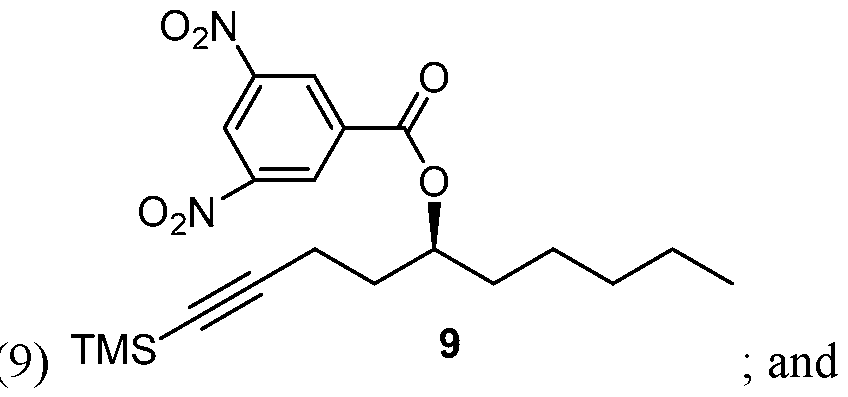
- the method comprises: reacting a compound of formula ( 3,5 dinitrobenzoyl chloride to form a compound of formula ( deprotecting the compound of formula (9) to form the compound of formula (1)
- Another embodiment is a method of synthesizing a compound of formula (1)
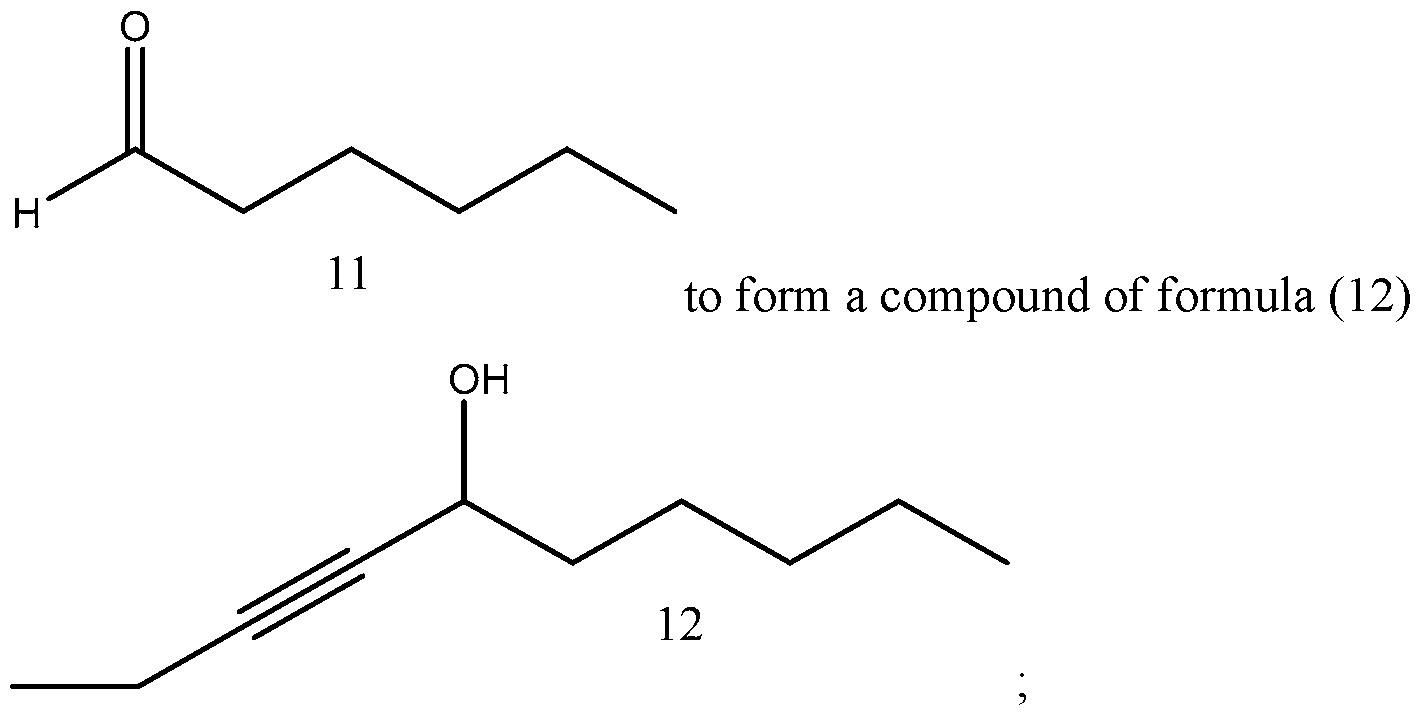
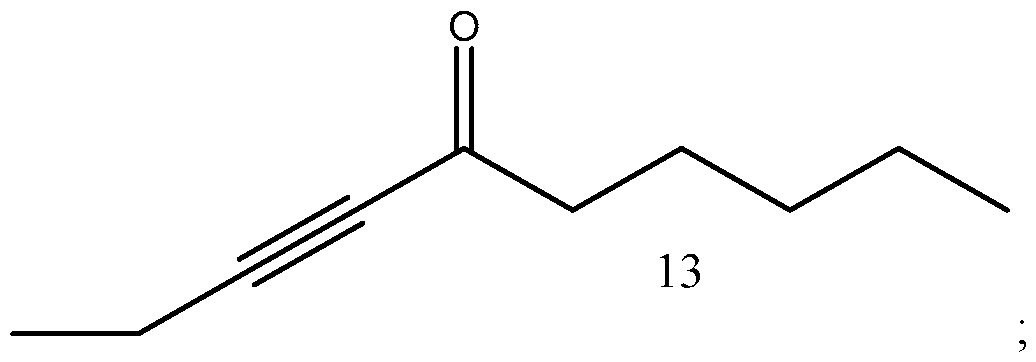
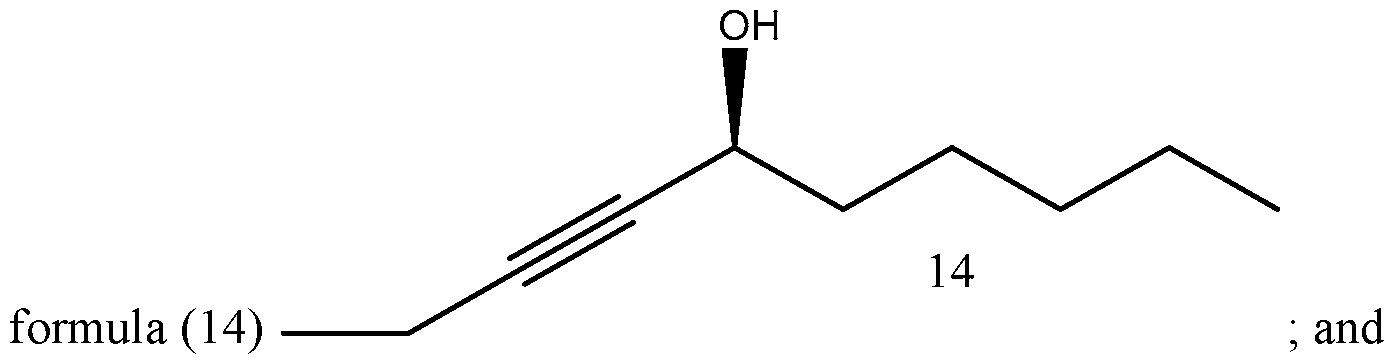
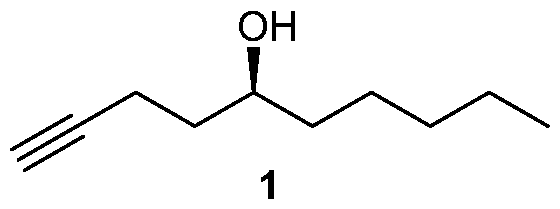
- the method comprises reacting a compound of formula (10) a compound of formula (11) oxidizing the compound of formula (12) to form a compound of formula (13) enantioselectively reducing the compound of formula (13) to form a chiral compound of isomerizing the compound of formula (14) to form the compound of formula (1)
- Yet another embodiments is a method of synthesizing treprostinil comprising: enantioselectively reducing a compound of formula (16) e enzyme catalyst; and converting the compound of formula (17) into treprostinil (4) , wherein R 1 is a hydroxy protecting group — (CH2)nX; X being H, phenyl, — CN, — OR 3 or COOR 3 ; n being 1 to 3, R 3 being an alkyl, a hydroxy protecting group or a substituted or unsubstituted benzyl group; and R 2 is a hydroxy protecting group.
- R 1 is a hydroxy protecting group — (CH2)nX
- X being H, phenyl, — CN, — OR 3 or COOR 3
- n being 1 to 3
- R 3 being an alkyl, a hydroxy protecting group or a substituted or unsubstituted benzyl group
- R 2 is a hydroxy protecting group
- an alcohol protecting group or “a hydroxy protecting group” is a functional group that protects the alcohol (hydroxy) group from participating in reactions that are occurring in other parts of the molecule.
- Suitable alcohol protecting groups are well known to those of ordinary skill in the art and include those found in T. W. Greene, Protecting Groups in Organic Synthesis, John Wiley & Sons, Inc. 1981, or in "Greene's Protective Groups in Organic Synthesis” by Peter G. M. Wuts, Theodora W. Greene 4 th edition, 2007, the entire teachings of which are incorporated herein by reference.
- Exemplary alcohol protecting groups include, but are not limited to, actetyl, benzoyl, benzyl, p-methoxyethoxymethyl ether, methoxymethyl ether, dimethoxytrityl, p-methoxybenzyl ether, trityl, silyl ether (e.g., trimethyl silyl (TMS), tert-butyldimethylsilyl (TBMDS), tert-butyldimethylsilyloxymethyl (TOM) or triisopropyl silyl (TIPS) ether), tetrahydropyranyl (THP), methyl ether and ethoxy ethyl ether (EE).
- silyl ether e.g., trimethyl silyl (TMS), tert-butyldimethylsilyl (TBMDS), tert-butyldimethylsilyloxymethyl (TOM) or triisopropyl silyl (TIPS
- An alkyl group may be a saturated straight-chain or branched aliphatic group.
- an alkyl group may a (Ci-Ce)alkyl, (Ci-Cs)alkyl, (Ci-C4)alkyl or (Ci-C3)alkyl.
- alkyl groups include methyl, ethyl, n-propyl, isopropyl, n-butyl, isobutyl, sec-butyl, tertbutyl, pentyl, iso-amyl, and hexyl.
- An alkyl group is optionally substituted with an alkyl, a cycloalkyl (e.g., cyclopentyl or cyclohexyl), an aryl (e.g., phenyl), or heteroaryl group.
- a cycloalkyl e.g., cyclopentyl or cyclohexyl
- an aryl e.g., phenyl
- heteroaryl group e.g., phenyl
- a phenyl group may be optionally substituted with one or more substituents, which may be independently selected from the group consisting of — NCh, — CN, halogen (e.g., — F, — Cl, — Br or — I), (Ci-C3)alkyl, halo(Ci-C3)alkyl, (Ci-C3)alkoxy and halo(Ci-C3)alkoxy.
- substituents e.g., — F, — Cl, — Br or — I
- a substituted benzyl group may be optionally substituted at one or more meta, ortho or para positions with one or more substituents, which may be independently selected from the group consisting of — NCh, — CN, halogen (e.g., — F, — Cl, — Br or — I), (Ci-C3)alkyl, halo(Ci- C3)alkyl, (Ci-C3)alkoxy and halo(Ci-C3)alkoxy.
- substituents which may be independently selected from the group consisting of — NCh, — CN, halogen (e.g., — F, — Cl, — Br or — I), (Ci-C3)alkyl, halo(Ci- C3)alkyl, (Ci-C3)alkoxy and halo(Ci-C3)alkoxy.
- Treprostinil the active ingredient in Remodulin® (treprostinil) Injection, Tyvaso® (treprostinil) Inhalation Solution, and Orenitram® (treprostinil) Extended Release Tablets, was described in U.S. Patent No. 4,306,075. Methods of making treprostinil and other prostacyclin derivatives are described, for example, in Moriarty, et al., J. Org. Chem. 2004, 69, 1890-1902, Drug of the Future, 2001, 26(4), 364-374, U.S. Pat. Nos.
- Treprostinil has the following chemical formula:
- biae unam Scheme 1 illustrates a process of synthesizing treprostinil using side chain (1).
- Side chain (1) is converted into protected side chain (3), which has R 2 being a hydroxy protecting group, such as, for example, tetrahydrofuranyl (THP), benzyl, 2,4-dinitrobenzyl, methoxymethyl (MOM), tertiarybutyldimethylsilyl (TBDMS), tertiarybutyldiphenylsilyl (TBDPS), triethylsilyl (TES), benzyloxy groups, including substituted benzyloxy groups.
- THP tetrahydrofuranyl
- MOM methoxymethyl
- TDMS tertiarybutyldimethylsilyl
- TDPS tertiarybutyldiphenylsilyl
- TES triethylsilyl
- benzyloxy groups including substituted benzyloxy groups.
- R 2 Hydroxy protecting groups disclosed in "Greene's Protective Groups in Organic Synthesis” by Peter G. M. Wuts, Theodora W. Greene 4 th addition may be used as R 2 .
- Side chain (3) is reacted with aldehyde 2 having R 1 being a hydroxy protecting group and/or R 1 being — (CH2)nX; X being H, phenyl, — CN, — OR 3 or COOR 3 ; n being 1 to 3, R 3 being an alkyl, a hydroxy protecting group, such as THP or TBDMS, a substituted or unsubstituted benzyl group, a phenol protecting group.
- R 1 being a hydroxy protecting group and/or R 1 being — (CH2)nX
- X being H, phenyl, — CN, — OR 3 or COOR 3
- n being 1 to 3
- R 3 being an alkyl, a hydroxy protecting group, such as THP or TBDMS,
- the synthesis process of Scheme 2 may have a number of drawbacks.
- this process uses expensive reagents, such as chiral 5-epichlorohydrin and TMS-propyne, which add to the overall cost of the process.
- the process of Scheme 2 uses a deprotection step.
- Process of Scheme 3 and Process of Scheme 4 for synthesizing side chain (1). These alternative processes may overcome at least some of the discussed above drawbacks of the process of Scheme 2.
- Table 1 provides comparison of Process of Scheme 2, Process of Scheme 3 and Process of Scheme 4.
- Process of Scheme 3 for synthesizing the side chain compound of formula (1) may involve reacting TMS alkyne compound of formula trimethylsilyl) with 3,5 dinitrobenzoyl chloride to form 3,5 dinitrobenzate compound of deprotecting the compound of formula (9) to form the compound of formula (1)
- the TMS alkyne compound of formula (8) may prepared by (A) reacting a compound of formula -epichorohydrin) with butylmagnesium halide, such as
- the TMS alkyne compound of formula (8) for Process of Scheme 3 may be obtained using the first three reactions in Scheme 2.
- the compound of formula (5) ((5)-epichorohydrin) is reacted with butylmagnesium halide, such as butylmagnesium chloride, to form the compound of formula (6) (chloroheptanol).
- This reaction may be performed in the presence of a reagent, such as Cui.
- a reagent such as Cui.
- solvents may be used for this reaction, including tetrahydrofuran (THF), t-butyl methylether (MTBE), 2-methyl tetrahydrofuran (2-MeTHF), diethyl ether and their mixtures.
- the compound of formula (6) is reacted with a base, such as NaOH or KOH, to form a compound of formula (7) (epoxyheptane).
- the base may be an or any inorganic base, such as NaOH or KOH, or an organic base.
- solvents may be used for this reaction, including methyl tert-butyl ether (MTBE) and tert-amyl ethyl ether (TAEE), water, tetrahydrofuran, dichloromethane, methanol, acetonitrile, toluene, dimethylformamide, diethyl ether, hexane, ethanol, pyridine, 1,4-di oxane, acetone, isopropanol, tert-butanol, dimethyl sulfoxide, benzene, 1,2-di chloroethane, ethyl acetate and their mixtures.
- MTBE methyl tert-butyl ether
- TAEE tert-amyl ethyl ether
- the compound of formula (7) is reacted with trimethyl silyl propyne to form TMS alkyne compound of formula (8).
- This reaction may be performed in the presence of a base, such as an organolithium base, e.g. w-Butyllithium (abbreviated n- BuLi) or reacting with Grignard reagent of alkynyl bromide, such as 3 -Bromo- 1- (trimethyl silyl)- 1 -propyne .
- the reaction may be performed at a temperature from -75°C to - 45°C or from -70°C to -60°C or from -60°C to -50°C.
- solvents may be used for this reaction, including THF, hexane, t-butyl methylether (MTBE), 2-methyl tetrahydrofuran (2-MeTHF), diethyl ether, or their mixtures.
- the TMS alkyne compound of formula (8) is reacted with 3,5 dinitrobenzoyl chloride to derivatize the hydroxy group of the compound of formula (8) and thereby, form 3,5 dinitrobenzate compound of formula (9).
- This reaction may be performed in the presence of a base.
- the base a organic base, such as pyridine, tri ethylamine, diisopropylethyl amine, l,8-Diazabicyclo[5.4.0]undec-7-ene (DBU).
- the base may be an inorganic base, such as ammonium hydroxide or cesium carbonate.
- DCM dicholoromethane
- MTBE tetrahydrofuran
- 2-methyl tetrahydrofuran di chol or ethane, and their mixtures.
- the compound of formula (9) is deprotected to form the compound of formula (1).
- the deprotection reaction may be performed in the presence of a base.
- the base may be an inorganic base, such as NaOH or KOH, or an organic base.
- a number of solvents may be used for this reaction, including a lower alcohol, such as propanol, ethanol, or methanol, or its mixture with water.
- the five reactions of Scheme 3 may consume no more than 1000 L or no more than 900 L or not more than 800 L or no more than 750 L or no more than 600 L or no more than 650 L or from about 550 L to about 650 L or solvents for purification by column chromatography for per 1 kg of the compound of formula (1).
- a chiral purity of the product of the five reactions of Scheme 3, which product contain the compound of formula (1), may be at least 97.5% or at least 97.8% or at least 98% or at least 98.1% or at least 98.2% or at least 98.3% or at least 98.4% or at least 98.5 % or at least 98.6% or at least 98.7% or at least 98.8% or at least 98.9% or at least 99.0% or at least 99.1% or at least 99.2% or at least 99.3% or at least 99.4% or at least 99.5% or at least 99.6% or at least 99.7% or at least 99.8% or at least 99.9%.
- the chiral purity may be determined, for example, by chiral gas chromatography (GC).
- a chemical purity of the product of the five reactions of Scheme 3, which product contain the compound of formula (1), may be at least 97.5% or at least 97.8% or at least 98% or at least 98.1% or at least 98.2% or at least 98.3% or at least 98.4% or at least 98.5 % or at least 98.6%.
- Process of Scheme 4 for synthesizing the side chain compound of formula (1) may involve reacting a compound of formula (10) (1 -butyne) with an aldehyde compound of formula form a racemic propargylic alcohol compound of formula oxidizing the compound of formula (12) to form a ynone compound of formula (13) enantioselectively reducing the compound of formula (13) to form a chiral propargylic alcohol compound of formula isomerizing the compound of formula (14) to form the compound of formula (1).
- Scheme 4 illustrates the reactions of process of Scheme 4. Specific reaction conditions are listed in Scheme 4 only for illustrative purposes.
- the compound of formula (10) (1-butyne) is reacted with the aldehyde compound of formula (11) to form the racemic propargylic alcohol compound of formula (12).
- This reaction may be performed in the presence of a base, such as an organolithium base, e.g. w-Butyllithium (abbreviated w-BuLi).
- a base such as an organolithium base, e.g. w-Butyllithium (abbreviated w-BuLi).
- the reaction may be performed at a temperature from -78°C to 20°C or from -50°C to -5°C or from -25°C to - 15°C, such as about -20°C.
- a number of solvents may be used for this reaction, including THF, t-butyl methylether (MTBE), 2-methyl tetrahydrofuran (2Me-THF), diethyl ether, and their mixtures.
- the compound of formula (12) is oxidized to form a ynone compound of formula (13).
- This reaction may be performed in the presence of an oxidation catalyst, such as (2,2,6,6-Tetramethylpiperidin-l-yl)oxyl or an oxidizing agents, such as chromium trioxide, manganese dioxide, hypervalent iodine based reagents, Tetrapropylammonium perruthenate, or Swern oxidizing reagent.
- the reaction may be performed in the presence of one or more salts, such as NaOCl, KBr and KHCO3.
- the enantioselective reduction may be performed in the presence of an enantioselective catalyst or an enantioselective reducing agent.
- the enantioselective catalyst may be a metal containing catalyst, such as a transitional metal containing catalyst.
- the metal containing catalyst may be a preformed ruthenium containing catalyst, such as RuCl[(S,S)- TsDPEN](p-cymene) (also known as [(S,S)-N-(2 -Amino- l,2-diphenylethyl)-p- toluenesulfonamide]chloro(p-cymene)ruthenium(II)) or RuCl[(S,S)-TsDPEN](mesitylene) (also known as [N-[(lS,2S)-2-(Amino-KN)-l,2-diphenylethyl]-4- methylbenzenesulfonamidato-KN]chloro[(l,2,3,4,5,6-r
- the catalyst may also be generated in situ using dichloro(mesitylene)ruthenium(II) dimer and (lS,2S)-(+)-N-p-Tosyl-l,2-diphenylethylenediamine ligand or dichloro(p- cymene)ruthenium(II) dimer and (l S,2S)-(+)-N-p-Tosyl-l,2-diphenylethylenediamine ligand.
- reducing agents include borane reagents, such as catecholborane; lithium based reagents, such as lithium aluminumhydride; sodium based reagents, such as sodium borohydride, in combination with a chiral ligand, such as 3-nitrophenylboronicacid-L-tartaric acid ester.
- the enantioselective reduction in the presence of a ruthenium containing catalyst such as RuCl[(S,S)-TsDPEN](mesitylene) may be performed also in the presence of a base, such as NaOH or KOH or triethylamine:formic acid or any other hydrogen source.
- a base such as NaOH or KOH or triethylamine:formic acid or any other hydrogen source.
- solvents may be used for this reaction, including isopropanol (IP A), dichloromethane and their mixture.
- the enantioselective catalyst may be an enzyme catalyst.
- the enzyme catalyst may be a ketoreductase, such as a ketoreductase derived from the Thermoanaerobacter brockii alcohol dehydrogenase, e.g. KRED-P3-B03 or KRED- P2-G03 or KRED-130.
- Ketoreductase compounds, such as KRED-P3-B03 are commercially available from Codexis, Inc, California, U.S.A.
- the enantioselective reduction in the presence of an enzyme catalyst such as a ketoreductase, e.g.
- KRED-P3-B03 may be performed in the presence of reconstituted KRED Recycle Mix P which may contain sodium phosphate, magnesium sulfate, and nicotinamide adenine dinucleotide phosphate (NADP + ).
- KRED Recycle Mix P may have a pH of about 7.0.
- a reconstituted KRED Recycle Mix P may contain 128 mM sodium phosphate, 1.7 mM magnesium sulfate, 1.1 mM NADP + , pH 7.0 per 250 mg of an enzyme catalyst, such as a ketoreductase, e.g. KRED-P3-B03.
- a number of solvents may be used for this reaction, including IP A, dimethylsulfoxide (DMSO) and their mixtures.
- the compound of formula (14) is isomerized to form the compound of formula (1).
- the isomerization reaction may be a zipper isomerization reaction.
- the isomerization reaction may be performed in the presence of a zipper isomerization reagent.
- the zipper isomerization catalyst may be 1,3- diaminopropane, a mixture of 1,3 -diaminopropane and alkali metal compound (e.g. a lithium compound, such as lithium metal, BuLi, or a potassium compound, such as potassium hydride or potassium /c/V-butoxide, or a sodium compound, such as sodium hydride) or an alkali metal salt of 1,3-diaminopropane, such as a lithium, sodium or potassium salt of 1,3- diaminopropane.
- the isomerization reaction may be performed in the presence of 1,3-diaminopropane, butyl lithium and potassium Zc/V-butoxide.
- solvents may be used in the isomerization reaction, including THF, 1,3- diaminopropane, 2-methyl tetrahydrofuran (2Me-THF), t-butyl methylether (MTBE), hexane, heptane, diethyl ether, and their mixtures.
- the four reactions of Scheme 4 may consume no more than 800 L or no more than 700 L or not more than 600 L or no more than 550 L or no more than 500 L or from about 400 L to about 500 L or solvents for purification by column chromatography of per 1 kg of the compound of formula (1).
- a chiral purity of the product of the four reactions of Scheme 4, which product contain the compound of formula (1), may be at least 97.5% or at least 97.8% or at least 98% or at least 98.1% or at least 98.2% or at least 98.3% or at least 98.4% or at least 98.5 %.
- the chiral purity may be determined, for example, by a chiral chromatography, such as chiral gas chromatography (GC).
- a chemical purity of the product of the four reactions of Scheme 4, which product contain the compound of formula (1), may be at least 96.0% or at least 96.5% or at least 96.6% or at least 96.7% or at least 96.8% or at least 96.9% or at least 97.0%.
- the compound of formula (1) synthesized according to Scheme 3 or 4 may be used for synthesizing treprostinil by protecting the compound of formula (1) to form a compound of formula reacting the compound of formula (3) with a compound of formula to form a compound of formula and converting the compound of formula (15) into treprostinil (4) R 1 and R 2 may be as defined above.
- the reacting the compound of formula (3) with the compound of formula (2) to form the compound of formula (15) and the converting the compound of formula (15) into treprostinil may be performed as disclosed in U.S. patents Nos. 6,441,245, 6,700,025,
- Aryl alkynyl ketone (16) for this reaction may be obtained from racemic alcohol (15), see Scheme 1, using, for example, Pyridinium chlorochromate (PCC) oxidation reaction as disclosed, for example, in U.S. patents Nos. 6,441,245, 6,700,025, 8,481,782, 8,940,930.
- the enantioselective reduction reaction of aryl alkynyl ketone (16) to obtain chiral alcohol (17) uses a R-CBS reagent, such as (R)-2-Methyl-CBS-oxazaborolidine.
- Scheme 5 below illustrates the process of synthesizing treprostinil disclosed in U.S. Patent No. 6,441,245, which uses the enantioselective reduction reaction of aryl alkynyl ketone (16) to obtain chiral alcohol (17) uses a R-CBS reagent.
- the enantioselective reduction reaction of aryl alkynyl ketone (16) using R-CBS reagent(s) may have a number of drawbacks. For example, this reaction yields typically only -95-96% chiral selectivity. The reduced chiral selectivity leads to a known impurity (3 AU90 isomer) in the process. Tedious column chromatography to remove borates and other by-products may be needed to isolate the product. Cryogenic conditions may be needed for the reaction.
- the borane-dimethyl sulfide complex typically used with R-CBS reagent(s) in treprostinil synthesis may have an unpleasant, obnoxious smell.
- the present disclosure provides an alternative enantioselective reduction reaction of aryl alkynyl ketone (16) to produce chiral alcohol (17), which may avoid some or all of the drawbacks of the enantioselective reduction reaction of aryl alkynyl ketone (16) using R-CBS reagent(s).
- a method of synthesizing treprostinil may involve enantioselective reduction of a aryl alkynyl ketone compound of formula (16) enantioselective enzyme catalyst; and converting the compound of formula (17) into treprostinil (4)
- the converting the compound of formula (15) into treprostinil may be performed as disclosed in U.S. patents Nos. 6,441,245,
- the enantioselective enzyme catalyst may be a ketoreductase, such as KRED-P1-B05 or KRED-101.
- Ketoreductase compounds such as KRED-P1-B05 or KRED- 101, are commercially available from Codexis, Inc, California, U.S.A.
- the enantioselective reduction in the presence of an enzyme catalyst such as a ketoreductase, e.g. KRED-P3-B05
- an enzyme catalyst such as a ketoreductase, e.g. KRED-P3-B05
- KRED-P3-B05 may be performed in the presence of reconstituted KRED Recycle Mix P which may contain sodium phosphate, magnesium sulfate, and nicotinamide adenine dinucleotide phosphate (NADP + ).
- the KRED Recycle Mix P may have a pH of about 7.0.
- a reconstituted KRED Recycle Mix P may contain 128 mM sodium phosphate, 1.7 mM magnesium sulfate, 1.1 mM NADP + , pH 7.0 per 250 mg of an enzyme catalyst, such as a ketoreductase, e.g. KRED-P3- B05.
- the enantioselective reduction in the presence of an enzyme catalyst such as a ketoreductase, e.g. KRED- 10
- an enzyme catalyst such as a ketoreductase, e.g. KRED- 10
- KRED Recycle Mix N contains sodium phosphate, magnesium sulfate, NADP + , nicotinamide adenine dinucleotide (NAD + ), D-glucose, and glucose dehydrogenase.
- the KRED Recycle Mix N may have a pH of about 7.0.
- reconstituted KRED Recycle Mix N contains 263 mM sodium phosphate, 1.7 mM magnesium sulfate, 1.1 mM NADP + , 1.1 mM NAD + , 80 mM D-glucose, 4.3 U/mL glucose dehydrogenase, pH 7.0. per 250 mg of an enzyme catalyst, such as a ketoreductase, e.g. KRED-101.
- an enzyme catalyst such as a ketoreductase, e.g. KRED-101.
- a product of the enantioselective reduction performed in the presence of an enantioselective enzyme catalyst, which product contains the compound of formula (17); may have a chiral purity of at least 98%, or at least 98.1%, or at least 98.2%, or at least 98.3% or at least 98.4% or at least 98.5%, or at least 98.6% or at least 98.7% or at least 98.8% or at 98.9% or at least 99%.
- the chiral purity may be determined, for example, by chiral chromatography, such as chiral gas chromatography (GC) or chiral high-performance liquid chromatography (HPLC).
- the chiral purity of the product of the enantioselective reduction performed in the presence of an enantioselective enzyme catalyst may be higher than a chiral purity of a product of a enantioselective reduction performed in the presence of R-CBS reagents, such as the enantioselective reactions in U.S. patents Nos. 6,441,245, 6,700,025, 8,481,782, 8,940,930.
- a final treprostinil batch produced by a process including such enantioselective reduction may have a lower concentration of impurities, such as 3 AU90 isomer, compared a treprostinil batch produced by a process including a enantioselective reduction performed in the presence of R-CBS reagents, such as the processes in U.S. patents Nos. 6,441,245, 6,700,025, 8,481,782, 8,940,930.
- a content of a 3 AU90 isomer in a treprostinil batch synthesized by a process including the enantioselective reduction performed in the presence of an enantioselective enzyme catalyst may be 0.3 mass % or less, 0.25 mass % or less, 0.2 mass % or less, 0.15 mass % or less, 0.1 mass % or less or 0.05 mass % or less.
- a 2000 mL reaction vessel was charged with a solution of TMS propyne (112.2.0 g, 1.0 mol) and epoxyheptane (7) (115 g, 0.77 mol) in anhydrous THF /hexane (1 : 1, 600 mL), then it was stirred for 10 min and was cooled to -60 to -70 °C. To this w-butyllithium (2.5 M in hexane, 400 mL, 1.0 mol) was added dropwise under argon. The reaction mixture was stirred at -60 to -70 °C for 10 h and the reaction mixture was allowed to be warmed to RT and stirred overnight under argon.
- the reaction mixture was cooled to around 0 °C and was quenched by saturated NH4Q (150 mL). The reaction was stirred at RT for 0.5 h, organic layer was separated, and the aqueous layer was extracted with MTBE (2 x 100 mL). The combined organic layers were washed with brine, dried over Na2SO4, and concentrated in vacuo to provide crude TMS alkyne (8) (175.0 g) as brown liquid.
- the crude product was purified by silica gel column chromatography obtain pure TMS alkyne (8) (122.5 g, yield 70.2%). The product was characterized by J H NMR.
- reaction vessel A 3000 mL reaction vessel was charged with a solution of crude TMS alkyne (8) (121.3 g) and 3,5-dinitrobenzoyl chloride (228.7 g, 0.99 mol) in anhydrous DCM (1200 mL) and was stirred for 10 min under argon at 0 - 5 °C. To this pyridine (120 mL, 1.50 mol) was added dropwise under argon. The reaction mixture was stirred at 0 - 10 °C for 0.5 h and warmed to RT and stirred overnight. The reaction progress was monitored by TLC and after complete reaction, MTBE was added to reaction mixture and stirred for 0.5 h.
- Step 1 Addition of 1-butyne (10) to aldehyde (11):
- Step 2 Oxidation of racemic propargylic alcohol (12) to ynone (13):
- the racemic propargylic alcohol (12) (5.11 g) was dissolved in dichloromethane (100 mL) and cooled to 0 °C. To this solution potassium bromide (0.78 g, 6.62 mmol) in water (13.2 mL), 2,2,6,6-tetramethylpiperidine 1-oxyl (TEMPO) (0.79 mg, 6.62 mmol) and potassium bicarbonate (41.4 g, 414 mmol) in water (138 mL) were added. A solution of bleach (10-15% by wt.) (62 mL) in water (205 mL) was added dropwise. After 3 h, the reaction was found to be complete by TLC.
- TEMPO 2,2,6,6-tetramethylpiperidine 1-oxyl
- Step 3 Enantioselective reduction of ynone (13) to chiral propargylic alcohol (14):
- KRED-P3-B03 (10 mg) was added KRED Recycle Mix P (475 pL). A solution of ynone (13) (2 mg) in 25 pL DMSO was added. The mixture was stirred at 30 °C for 24 h. At this stage the reaction was quenched by adding MTBE (1.5 mL). The reaction mixture was centrifuged, organic layer was separated, and aqueous layer was extracted with MTBE. The combined organic layers were evaporated in vacuo to obtain crude propargylic alcohol (14) (2 mg). The chiral purity by GC was found to be 97.4%.
- Step 4 Zipper isomerization of chiral propargylic alcohol (14) to side chain (1):
- KRED-P1-B05 (10 mg) was added KRED Recycle Mix P (from Codexis) (475 pL). A solution of aryl alkynyl ketone (16) (2 mg) in 25 pL DMSO was added. This was stirred at 30 °C for 24 h. At this stage the reaction was quenched by adding acetonitrile. The reaction mixture was centrifuged, and the supernatant was separated and extracted with MTBE. The organic layer was evaporated in vacuo to obtain crude chiral alcohol (17) (2 mg). The chiral purity by HPLC was found to be >99.0%.
- KRED-101 (10 mg) was added KRED Recycle Mix N (from Codexis) (475 pL).
Landscapes
- Chemical & Material Sciences (AREA)
- Organic Chemistry (AREA)
- Chemical Kinetics & Catalysis (AREA)
- Engineering & Computer Science (AREA)
- Life Sciences & Earth Sciences (AREA)
- Zoology (AREA)
- Wood Science & Technology (AREA)
- Genetics & Genomics (AREA)
- Health & Medical Sciences (AREA)
- General Health & Medical Sciences (AREA)
- General Engineering & Computer Science (AREA)
- Bioinformatics & Cheminformatics (AREA)
- Biochemistry (AREA)
- Materials Engineering (AREA)
- Oil, Petroleum & Natural Gas (AREA)
- Biotechnology (AREA)
- General Chemical & Material Sciences (AREA)
- Microbiology (AREA)
- Organic Low-Molecular-Weight Compounds And Preparation Thereof (AREA)
Abstract
Provided are methods of producing compounds, which are useful in synthesizing prostacyclin derivatives, such as treprostinil.
Description
SYNTHESES OF COMPOUNDS USEFUL FOR PRODUCING
TREPROSTINIL
CROSS-REFERENCE TO RELAED APPLICATIONS
The present application claims priority to U.S. Provisional Application No. 63/597,473, filed November 9, 2023, which is incorporated herein by reference in its entirety.
FIELD
The present disclosure relates to methods of producing compounds, which are useful in synthesizing prostacyclin derivatives, such as treprostinil.
SUMMARY
One is embodiment is a method of synthesizing a compound of formula (1)
 The method comprises: reacting a compound of formula (
 3,5 dinitrobenzoyl chloride to form a compound of formula (
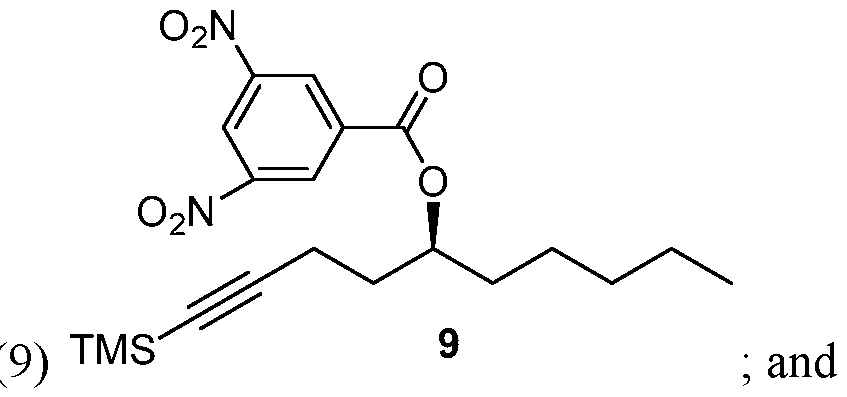 deprotecting the compound of formula (9) to form the compound of formula (1)
OH
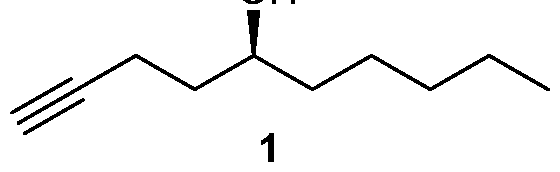 , wherein TMS is trimethyl silyl.
Another embodiment is a method of synthesizing a compound of formula (1)
, wherein TMS is trimethyl silyl.
Another embodiment is a method of synthesizing a compound of formula (1)
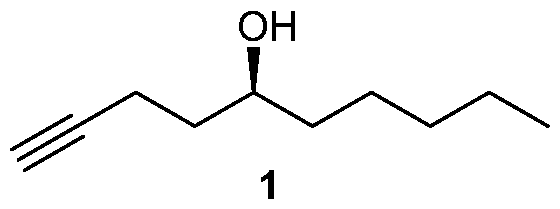 The method comprises reacting a compound of formula (10)
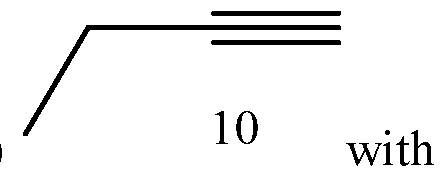 a compound of formula (11)
 oxidizing the compound of formula (12) to form a compound of formula (13)
 enantioselectively reducing the compound of formula (13) to form a chiral compound of
 isomerizing the compound of formula (14) to form the compound of formula (1)
Yet another embodiments is a method of synthesizing treprostinil comprising: enantioselectively reducing a compound of formula (16)
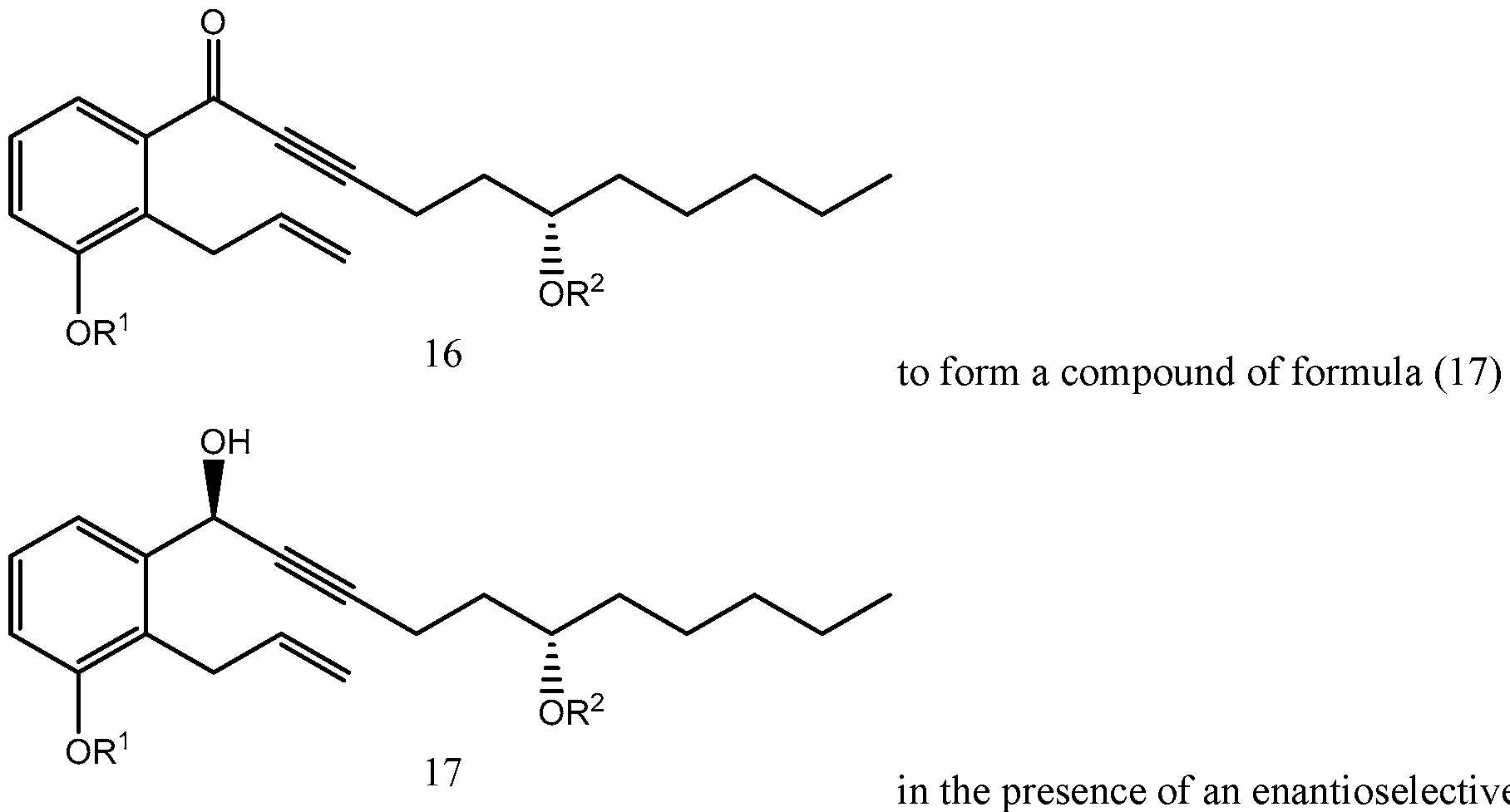 e enzyme catalyst; and converting the compound of formula (17) into treprostinil (4)
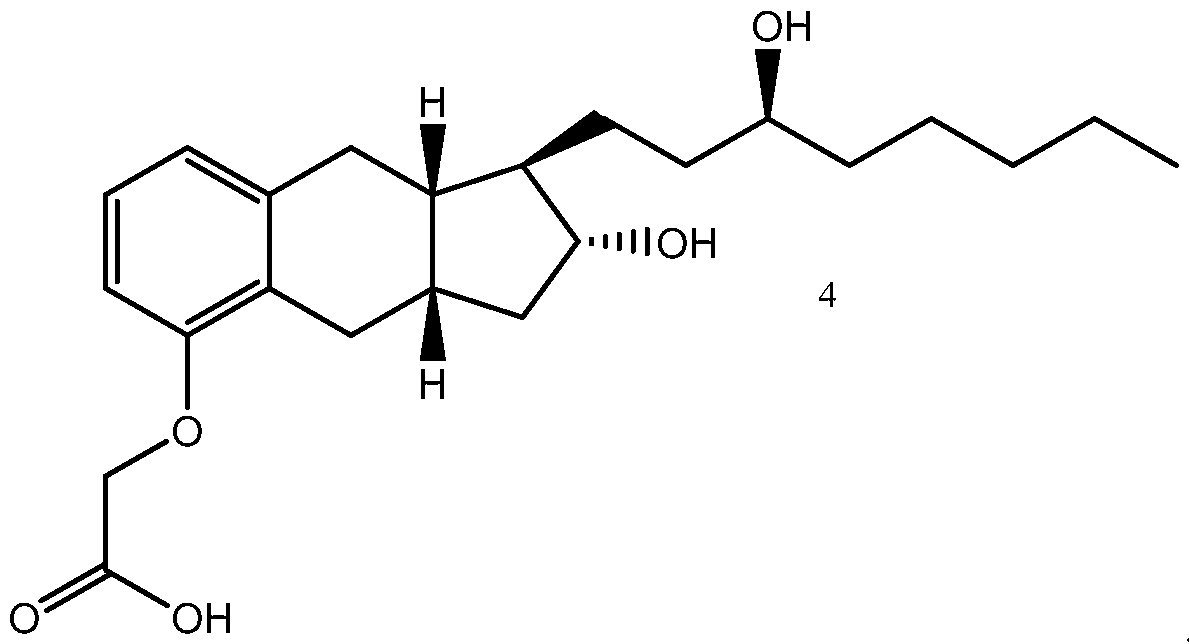 , wherein R1 is a hydroxy protecting group — (CH2)nX; X being H, phenyl, — CN, — OR3 or COOR3; n being 1 to 3, R3
being an alkyl, a hydroxy protecting group or a substituted or unsubstituted benzyl group; and R2 is a hydroxy protecting group.
, wherein R1 is a hydroxy protecting group — (CH2)nX; X being H, phenyl, — CN, — OR3 or COOR3; n being 1 to 3, R3
being an alkyl, a hydroxy protecting group or a substituted or unsubstituted benzyl group; and R2 is a hydroxy protecting group.
DETAILED DESCRIPTION
As used herein and in the claims, the singular forms “a,” “an,” and “the” include the plural reference unless the context clearly indicates otherwise. Throughout this specification, unless otherwise indicated, “comprise,” “comprises” and “comprising” are used inclusively rather than exclusively, so that a stated integer or group of integers may include one or more other non-stated integers or groups of integers. The term “or” is inclusive unless modified, for example, by “either.” Thus, unless context indicates otherwise, the word “or” means any one member of a particular list and also includes any combination of members of that list. Other than in the operating examples, or where otherwise indicated, all numbers expressing quantities of ingredients or reaction conditions used herein should be understood as modified in all instances by the term “about.”
Headings are provided for convenience only and are not to be construed to limit the invention in any way. Unless defined otherwise, all technical and scientific terms used herein have the same meaning as those commonly understood to one of ordinary skill in the art. The terminology used herein is for the purpose of describing particular embodiments only, and is not intended to limit the scope of the present invention, which is defined solely by the claims. In order that the present disclosure can be more readily understood, certain terms are first defined. Additional definitions are set forth throughout the detailed description.
All numerical designations, e.g., pH, temperature, time, concentration, and molecular weight, including ranges, are approximations which are varied (+) or (-) by increments of 0.05%, 1%, 2%, 5%, 10% or 20%. It is to be understood, although not always explicitly stated that all numerical designations are preceded by the term “about.” It also is to be understood, although not always explicitly stated, that the reagents described herein are merely exemplary and that equivalents of such are known in the art.
As used herein, “an alcohol protecting group” or “a hydroxy protecting group” is a functional group that protects the alcohol (hydroxy) group from participating in reactions that are
occurring in other parts of the molecule. Suitable alcohol protecting groups are well known to those of ordinary skill in the art and include those found in T. W. Greene, Protecting Groups in Organic Synthesis, John Wiley & Sons, Inc. 1981, or in "Greene's Protective Groups in Organic Synthesis" by Peter G. M. Wuts, Theodora W. Greene 4th edition, 2007, the entire teachings of which are incorporated herein by reference. Exemplary alcohol protecting groups include, but are not limited to, actetyl, benzoyl, benzyl, p-methoxyethoxymethyl ether, methoxymethyl ether, dimethoxytrityl, p-methoxybenzyl ether, trityl, silyl ether (e.g., trimethyl silyl (TMS), tert-butyldimethylsilyl (TBMDS), tert-butyldimethylsilyloxymethyl (TOM) or triisopropyl silyl (TIPS) ether), tetrahydropyranyl (THP), methyl ether and ethoxy ethyl ether (EE).
An alkyl group may be a saturated straight-chain or branched aliphatic group. For example, an alkyl group may a (Ci-Ce)alkyl, (Ci-Cs)alkyl, (Ci-C4)alkyl or (Ci-C3)alkyl. Examples of alkyl groups include methyl, ethyl, n-propyl, isopropyl, n-butyl, isobutyl, sec-butyl, tertbutyl, pentyl, iso-amyl, and hexyl. An alkyl group is optionally substituted with an alkyl, a cycloalkyl (e.g., cyclopentyl or cyclohexyl), an aryl (e.g., phenyl), or heteroaryl group.
A phenyl group may be optionally substituted with one or more substituents, which may be independently selected from the group consisting of — NCh, — CN, halogen (e.g., — F, — Cl, — Br or — I), (Ci-C3)alkyl, halo(Ci-C3)alkyl, (Ci-C3)alkoxy and halo(Ci-C3)alkoxy.
A substituted benzyl group may be optionally substituted at one or more meta, ortho or para positions with one or more substituents, which may be independently selected from the group consisting of — NCh, — CN, halogen (e.g., — F, — Cl, — Br or — I), (Ci-C3)alkyl, halo(Ci- C3)alkyl, (Ci-C3)alkoxy and halo(Ci-C3)alkoxy.
Treprostinil, the active ingredient in Remodulin® (treprostinil) Injection, Tyvaso® (treprostinil) Inhalation Solution, and Orenitram® (treprostinil) Extended Release Tablets, was described in U.S. Patent No. 4,306,075. Methods of making treprostinil and other prostacyclin derivatives are described, for example, in Moriarty, et al., J. Org. Chem. 2004, 69, 1890-1902, Drug of the Future, 2001, 26(4), 364-374, U.S. Pat. Nos. 6,441,245, 6,528,688, 6,700,025, 6,809,223, 6,756,117, 8,461,393, 8,481,782; 8,242,305, 8,497,393, 8,748,657, 8,940,930, 9,029,607, 9,156,786, 9,388,154, 9,346,738; 9,593,066; 9,604,901;
10,478,410; 10,322,099; 10,548,863; 11,723,887; U.S. Published Patent Application Nos. 2012-0197041, 2013-0331593, 2014-0024856, 2015-0299091, 2015-0376106, 2016- 0107973, 2015-0315114, 2016-0152548, and 2016-0175319; PCT Publication No.
WO20 16/0055819 and WO2016/081658.
Various uses and/ or various forms of treprostinil are disclosed, for examples, in U.S. Patent Nos. 5,153,222, 5,234,953, 6,521,212, 6,756,033, 6,803,386, 7,199,157, 6,054,486, 7,417,070, 7,384,978, 7,879,909, 8,563,614, 8,252,839, 8,536,363, 8,410,169, 8,232,316, 8,609,728, 8,350,079, 8,349,892, 7,999,007, 8,658,694, 8,653,137, 9,029,607, 8,765,813, 9,050,311, 9,199,908, 9,278,901, 8,747,897, 9,358,240, 9,339,507, 9,255,064, 9,278,902, 9,278,903, 9,758,465; 9,422,223; 9,878,972; 9,624,156; U.S. Published Patent Application Nos. 2009-0036465, 2008-0200449, 2008-0280986, 2009-0124697, 2014-0275616, 2014- 0275262, 2013-0184295, 2014-0323567, 2016-0030371, 2016-0051505, 2016-0030355, 2016-0143868, 2015-0328232, 2015-0148414, 2016-0045470, 2016-0129087, 2017- 0095432; 2018-0153847; 2021-0330621 and PCT Publications Nos. WO00/57701, W020160105538, WO2016038532, WO2018/058124.
Treprostinil has the following chemical formula:
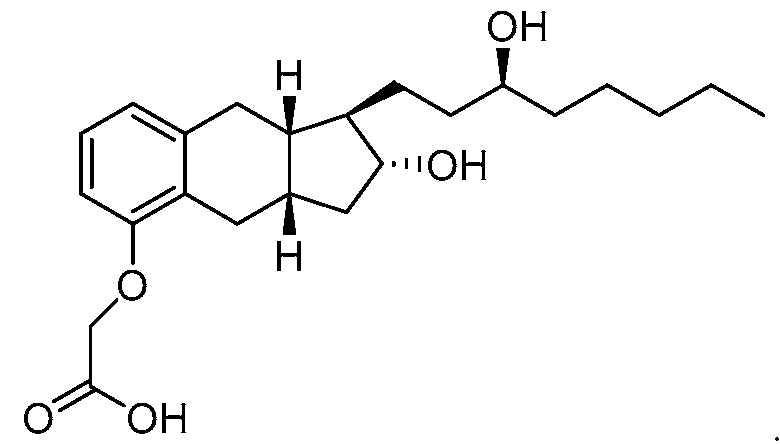
(A) Side Chain Synthesis
Many processes of synthesizing treprostinil, including those of U.S. patents Nos. 6,441,245, 6,700,025, 8,481,782, 8,940,930, use as one of starting materials side chain (1), (5S)-l-Decyn-5-ol ((S)-l-Decyne-5-ol or
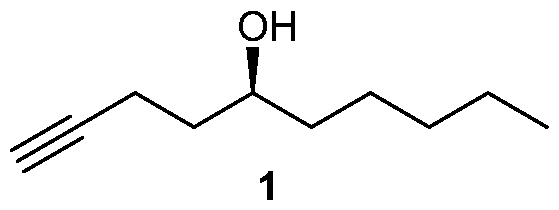
(S)-dec-l-yn-5-ol): biae unam Scheme 1 illustrates a process of synthesizing treprostinil using side chain (1). Side chain (1) is converted into protected side chain (3), which has R2 being a hydroxy protecting group, such as, for example, tetrahydrofuranyl (THP), benzyl, 2,4-dinitrobenzyl, methoxymethyl (MOM), tertiarybutyldimethylsilyl (TBDMS), tertiarybutyldiphenylsilyl (TBDPS), triethylsilyl (TES), benzyloxy groups, including substituted benzyloxy groups. Hydroxy protecting groups disclosed in "Greene's Protective Groups in Organic Synthesis" by Peter G. M. Wuts, Theodora W. Greene 4th addition may be used as R2. Side chain (3) is reacted with aldehyde 2 having R1 being a hydroxy protecting group and/or R1 being — (CH2)nX; X being H, phenyl, — CN, — OR3 or COOR3; n being 1 to 3, R3 being an alkyl, a hydroxy protecting group, such as THP or TBDMS, a substituted or unsubstituted benzyl group, a phenol protecting group. Hydroxy protecting groups and phenol protecting groups are disclosed in "Greene's Protective Groups in Organic Synthesis" by Peter G. M. Wuts, Theodora W. Greene 4th edition. The reacting of side chain (3) with aldehyde (2) gives racemic alcohol compound (15), which may be converted into treprostinil, for example, as disclosed in U.S. patents Nos. 6,441,245, 6,700,025, 8,481,782, 8,940,930 or the process discussed in this disclosure.
Scheme 1.
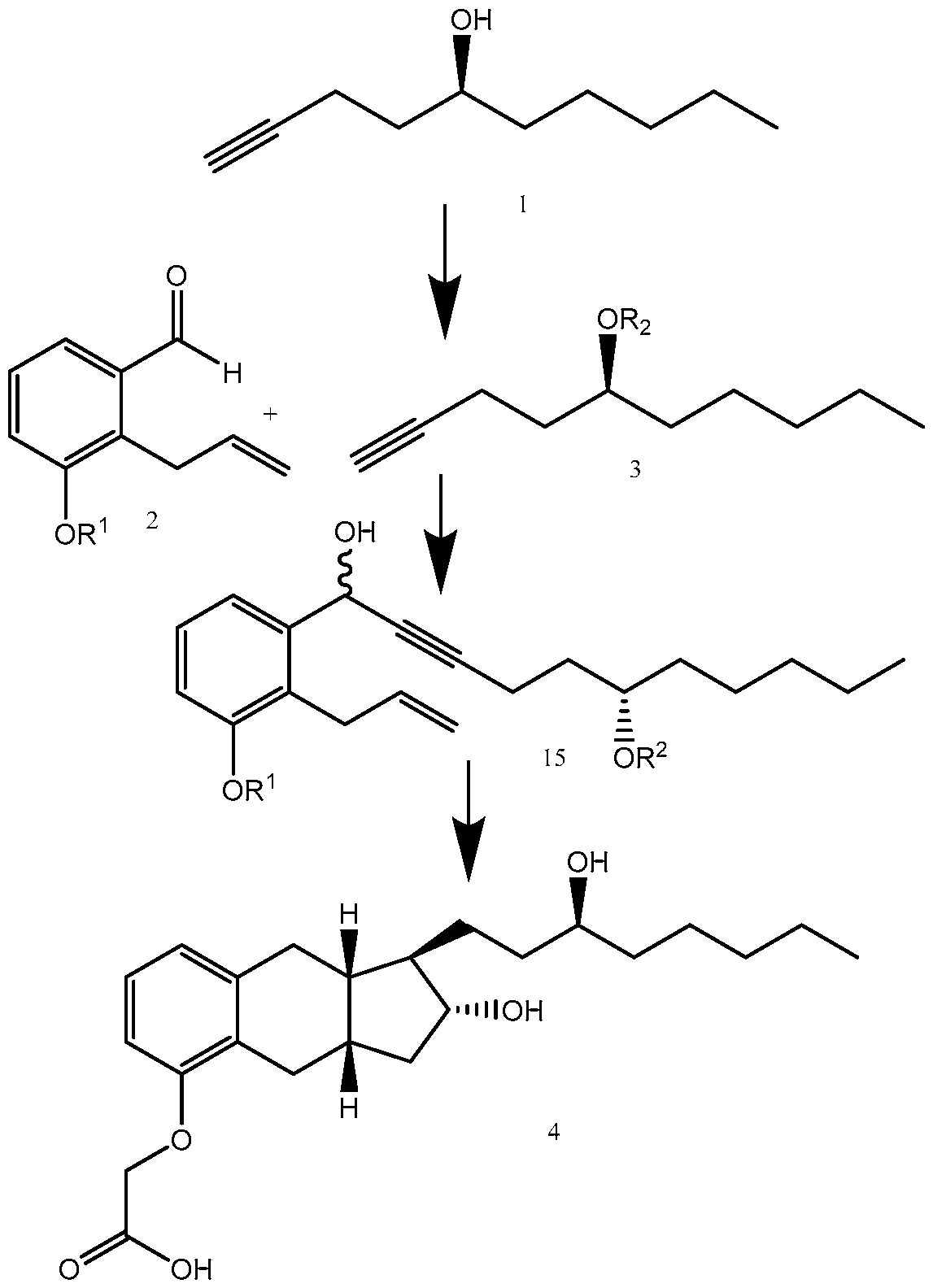
The current synthesis of side chain (1) is illustrated in Scheme 2.
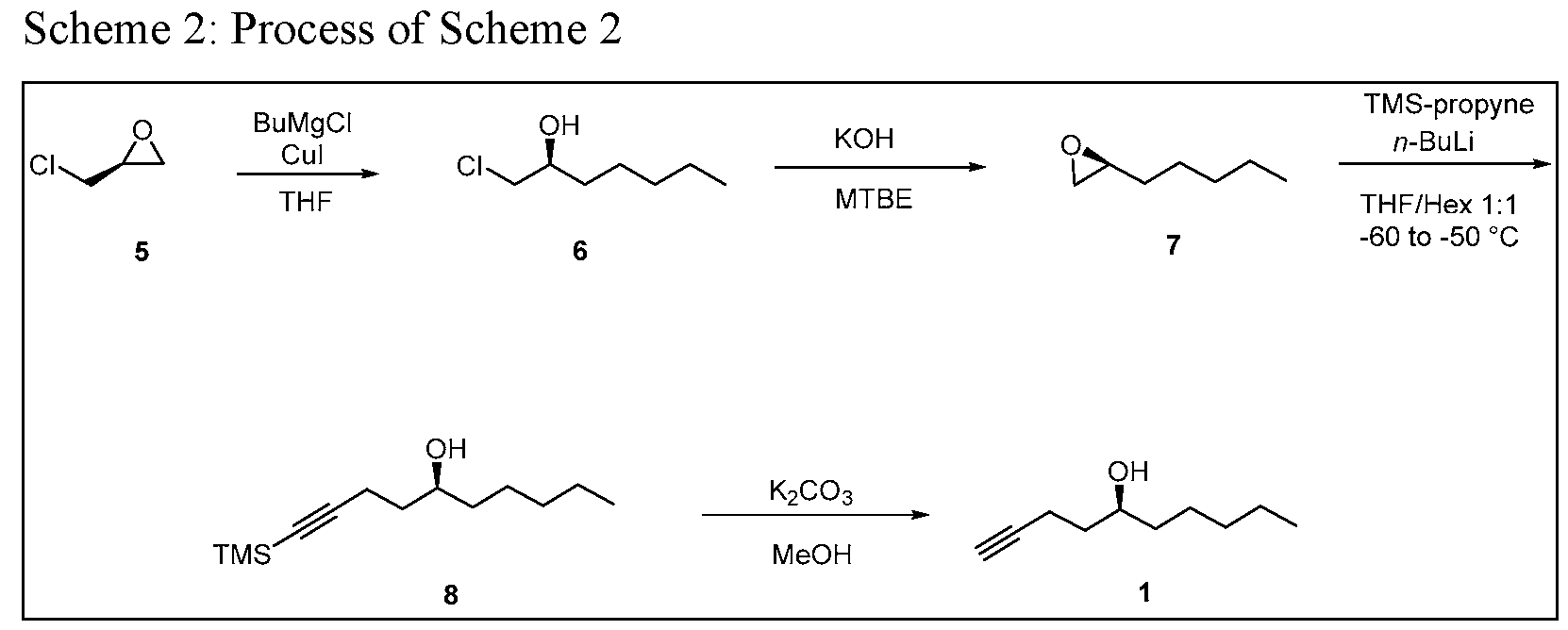
The synthesis process of Scheme 2 may have a number of drawbacks. For example, this process uses expensive reagents, such as chiral 5-epichlorohydrin and TMS-propyne, which
add to the overall cost of the process. The process of Scheme 2 uses a deprotection step.
The process of Scheme 2 generates diflficult-to-remove isomeric impurities leading to tedious column chromatographic purifications. Typically, -1500 to 1600L of solvent(s) may be needed for the purification of per kilogram (kg) of side chain compound (1) and a second column purification may be also needed on impure fractions to improve the yields. This large excess of solvents adds to the cost of the process as well as to the cost of disposal. The overall yield of the process is approximately 31%.
The present disclosure provides two alternative processes: Process of Scheme 3 and Process of Scheme 4, for synthesizing side chain (1). These alternative processes may overcome at least some of the discussed above drawbacks of the process of Scheme 2. Table 1 provides comparison of Process of Scheme 2, Process of Scheme 3 and Process of Scheme 4.
Table 1
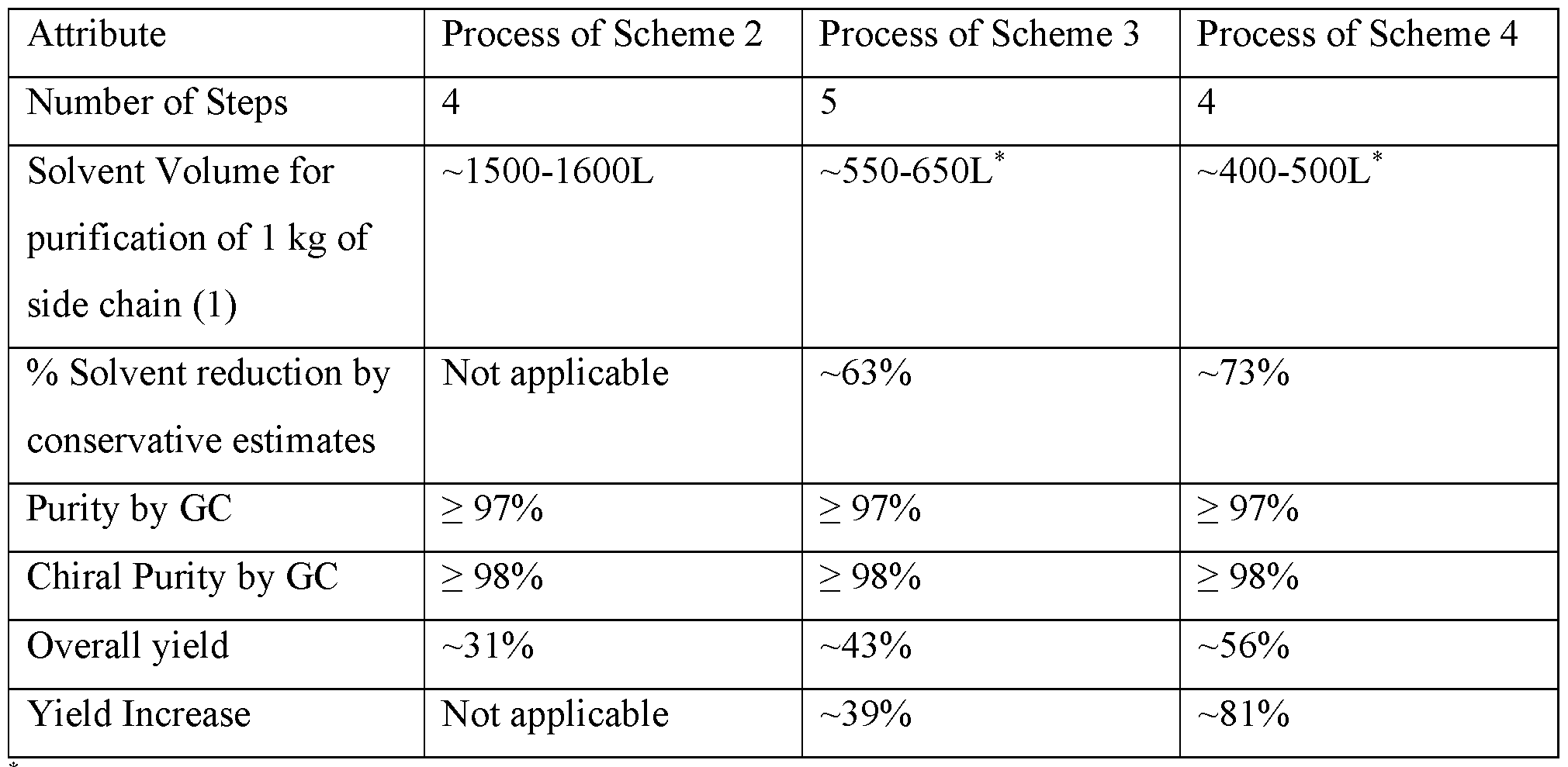
’Calculated volume based on lab work
Process of Scheme 3 for synthesizing the side chain compound of formula (1) may involve
reacting TMS alkyne compound of formula
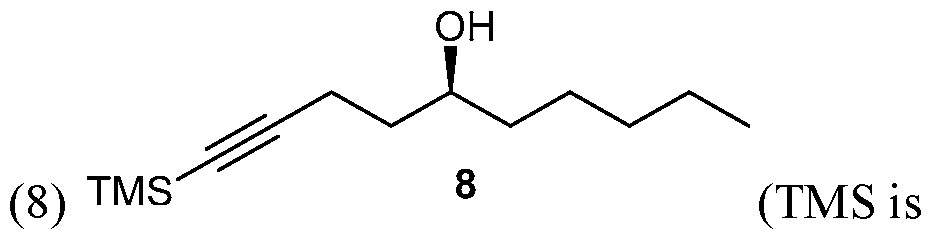 trimethylsilyl) with 3,5 dinitrobenzoyl chloride to form 3,5 dinitrobenzate compound of
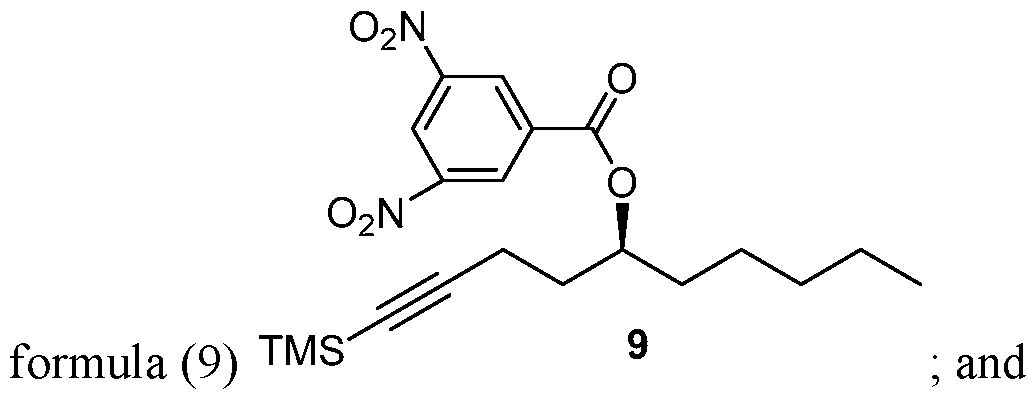 deprotecting the compound of formula (9) to form the compound of formula (1)
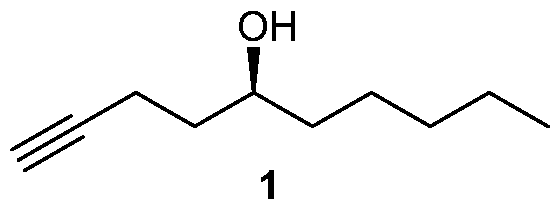
The TMS alkyne compound of formula (8) may prepared by (A) reacting a compound of formula
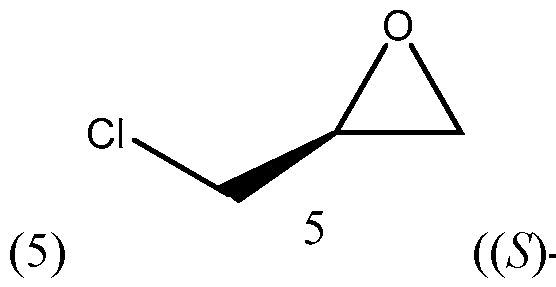 -epichorohydrin) with butylmagnesium halide, such as
OH butylmagnesium chloride, to form a compound of formula (6)

(chloroheptanol); (B) reacting the compound of formula (6) with a base to form a compound
 of formula (7) 7 (epoxyheptane); and (C) reacting the compound of formula
(7) with trimethyl silyl propyne to form the compound of formula (8).
Scheme 3 below illustrates the reactions of process (1) starting with (5)-epichorohydrin.
Specific reaction conditions are listed in Scheme 3 only for illustrative purposes.
Scheme 3. Process of Scheme 3
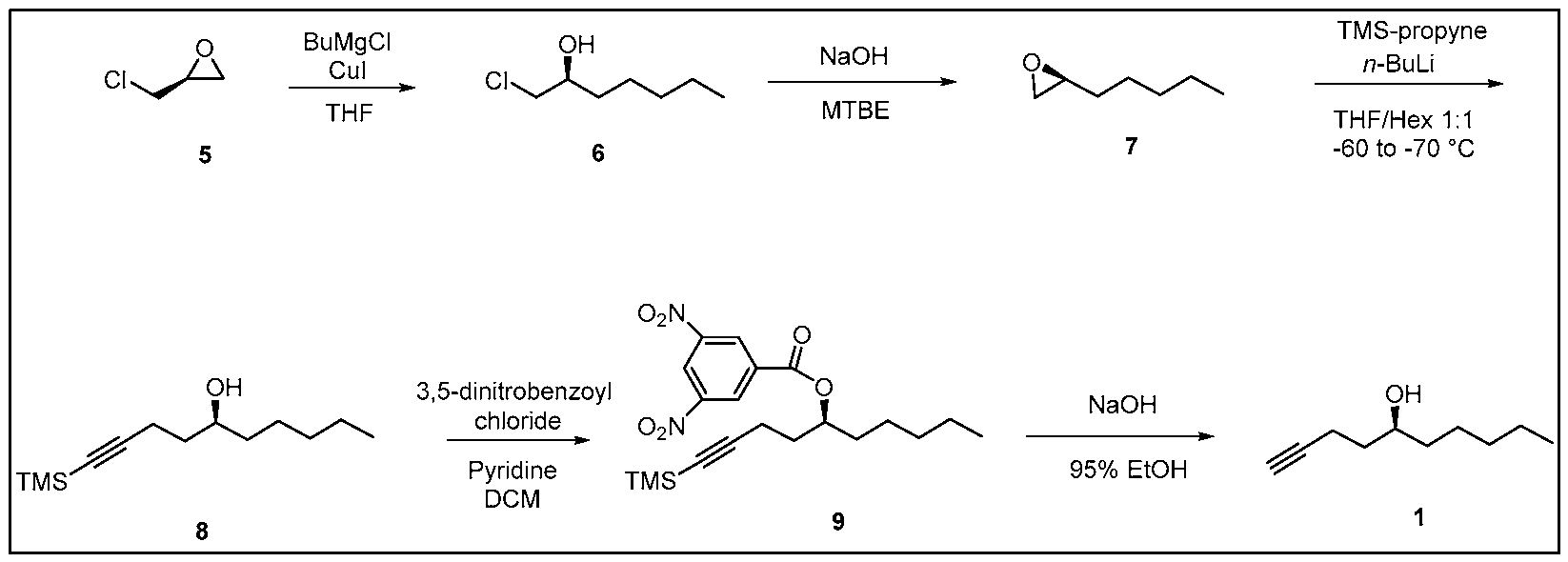
The first three reactions in Scheme 3 are similar to the first three reactions in Scheme 2.
Thus, in some embodiments, the TMS alkyne compound of formula (8) for Process of Scheme 3 may be obtained using the first three reactions in Scheme 2.
In the first reaction in Scheme 3, the compound of formula (5) ((5)-epichorohydrin) is reacted with butylmagnesium halide, such as butylmagnesium chloride, to form the compound of formula (6) (chloroheptanol). This reaction may be performed in the presence of a reagent, such as Cui. A number of solvents may be used for this reaction, including tetrahydrofuran (THF), t-butyl methylether (MTBE), 2-methyl tetrahydrofuran (2-MeTHF), diethyl ether and their mixtures.
In the second reaction in Scheme 3, the compound of formula (6) is reacted with a base, such as NaOH or KOH, to form a compound of formula (7) (epoxyheptane). The base may be an or any inorganic base, such as NaOH or KOH, or an organic base. A number of solvents may be used for this reaction, including methyl tert-butyl ether (MTBE) and tert-amyl ethyl ether (TAEE), water, tetrahydrofuran, dichloromethane, methanol, acetonitrile, toluene, dimethylformamide, diethyl ether, hexane, ethanol, pyridine, 1,4-di oxane, acetone, isopropanol, tert-butanol, dimethyl sulfoxide, benzene, 1,2-di chloroethane, ethyl acetate and their mixtures.
In the third reaction in Scheme 3, the compound of formula (7) is reacted with trimethyl silyl propyne to form TMS alkyne compound of formula (8). This reaction may be performed in the presence of a base, such as an organolithium base, e.g. w-Butyllithium (abbreviated n- BuLi) or reacting with Grignard reagent of alkynyl bromide, such as 3 -Bromo- 1- (trimethyl silyl)- 1 -propyne . The reaction may be performed at a temperature from -75°C to -
45°C or from -70°C to -60°C or from -60°C to -50°C. A number of solvents may be used for this reaction, including THF, hexane, t-butyl methylether (MTBE), 2-methyl tetrahydrofuran (2-MeTHF), diethyl ether, or their mixtures.
In the fourth reaction in Scheme 3, the TMS alkyne compound of formula (8) is reacted with 3,5 dinitrobenzoyl chloride to derivatize the hydroxy group of the compound of formula (8) and thereby, form 3,5 dinitrobenzate compound of formula (9). This reaction may be performed in the presence of a base. In some embodiments, the base a organic base, such as pyridine, tri ethylamine, diisopropylethyl amine, l,8-Diazabicyclo[5.4.0]undec-7-ene (DBU). Yet in some embodiments, the base may be an inorganic base, such as ammonium hydroxide or cesium carbonate. A number of solvents may be used for this reaction, including dicholoromethane (DCM), ethyl acetate, tetrahydrofuran, diethyl ether, t-butyl methylether (MTBE), 2-methyl tetrahydrofuran, di chol or ethane, and their mixtures.
In the fifth reaction in Scheme 3, the compound of formula (9) is deprotected to form the compound of formula (1). The deprotection reaction may be performed in the presence of a base. The base may be an inorganic base, such as NaOH or KOH, or an organic base. A number of solvents may be used for this reaction, including a lower alcohol, such as propanol, ethanol, or methanol, or its mixture with water.
The five reactions of Scheme 3 may consume no more than 1000 L or no more than 900 L or not more than 800 L or no more than 750 L or no more than 600 L or no more than 650 L or from about 550 L to about 650 L or solvents for purification by column chromatography for per 1 kg of the compound of formula (1).
A chiral purity of the product of the five reactions of Scheme 3, which product contain the compound of formula (1), may be at least 97.5% or at least 97.8% or at least 98% or at least 98.1% or at least 98.2% or at least 98.3% or at least 98.4% or at least 98.5 % or at least 98.6% or at least 98.7% or at least 98.8% or at least 98.9% or at least 99.0% or at least 99.1% or at least 99.2% or at least 99.3% or at least 99.4% or at least 99.5% or at least 99.6% or at least 99.7% or at least 99.8% or at least 99.9%. The chiral purity may be determined, for example, by chiral gas chromatography (GC).
A chemical purity of the product of the five reactions of Scheme 3, which product contain the compound of formula (1), may be at least 97.5% or at least 97.8% or at least 98% or at least 98.1% or at least 98.2% or at least 98.3% or at least 98.4% or at least 98.5 % or at least 98.6%.
Process of Scheme 4 for synthesizing the side chain compound of formula (1) may involve
 reacting a compound of formula (10) (1 -butyne) with an aldehyde compound of formula
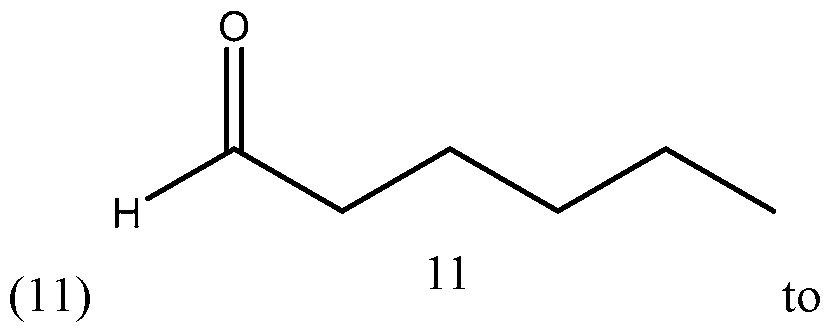 form a racemic propargylic alcohol compound of formula
 oxidizing the compound of formula (12) to form a ynone compound of formula (13)
 enantioselectively reducing the compound of formula (13) to form a chiral propargylic alcohol compound of formula
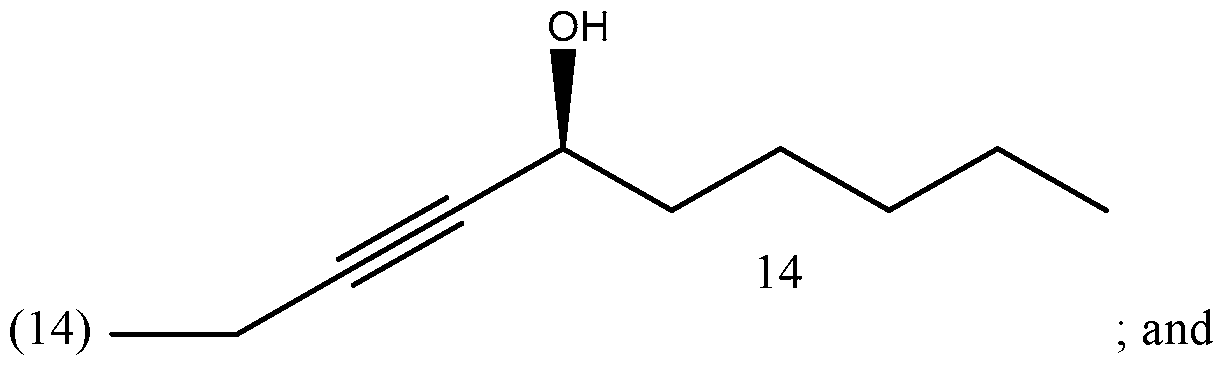 isomerizing the compound of formula (14) to form the compound of formula (1).
Scheme 4 below illustrates the reactions of process of Scheme 4. Specific reaction conditions are listed in Scheme 4 only for illustrative purposes.

In the first reaction in Scheme 4, the compound of formula (10) (1-butyne) is reacted with the aldehyde compound of formula (11) to form the racemic propargylic alcohol compound of formula (12). This reaction may be performed in the presence of a base, such as an organolithium base, e.g. w-Butyllithium (abbreviated w-BuLi). The reaction may be performed at a temperature from -78°C to 20°C or from -50°C to -5°C or from -25°C to - 15°C, such as about -20°C. A number of solvents may be used for this reaction, including THF, t-butyl methylether (MTBE), 2-methyl tetrahydrofuran (2Me-THF), diethyl ether, and their mixtures.
In the second reaction in Scheme 4, the compound of formula (12) is oxidized to form a ynone compound of formula (13). This reaction may be performed in the presence of an oxidation catalyst, such as (2,2,6,6-Tetramethylpiperidin-l-yl)oxyl or an oxidizing agents, such as chromium trioxide, manganese dioxide, hypervalent iodine based reagents, Tetrapropylammonium perruthenate, or Swern oxidizing reagent. The reaction may be performed in the presence of one or more salts, such as NaOCl, KBr and KHCO3. A number of solvents may be used for this reaction, including DCM, ethyl acetate, di chloroethane, tetrahydrofuran and their mixtures.
In the third reaction of Scheme 4, the compound of formula (13) is enantioselectivity reduced to form a chiral propargylic alcohol compound of formula (14).
The enantioselective reduction may be performed in the presence of an enantioselective catalyst or an enantioselective reducing agent.
In some embodiments, the enantioselective catalyst may be a metal containing catalyst, such as a transitional metal containing catalyst. For example, in some embodiments, the metal containing catalyst may be a preformed ruthenium containing catalyst, such as RuCl[(S,S)- TsDPEN](p-cymene) (also known as [(S,S)-N-(2 -Amino- l,2-diphenylethyl)-p- toluenesulfonamide]chloro(p-cymene)ruthenium(II)) or RuCl[(S,S)-TsDPEN](mesitylene) (also known as [N-[(lS,2S)-2-(Amino-KN)-l,2-diphenylethyl]-4- methylbenzenesulfonamidato-KN]chloro[(l,2,3,4,5,6-r|)-l,3,5-trimethylbenzene]-ruthenium). The catalyst may also be generated in situ using dichloro(mesitylene)ruthenium(II) dimer and (lS,2S)-(+)-N-p-Tosyl-l,2-diphenylethylenediamine ligand or dichloro(p- cymene)ruthenium(II) dimer and (l S,2S)-(+)-N-p-Tosyl-l,2-diphenylethylenediamine ligand. Other reducing agents include borane reagents, such as catecholborane; lithium based reagents, such as lithium aluminumhydride; sodium based reagents, such as sodium borohydride, in combination with a chiral ligand, such as 3-nitrophenylboronicacid-L-tartaric acid ester.
The enantioselective reduction in the presence of a ruthenium containing catalyst, such as RuCl[(S,S)-TsDPEN](mesitylene), may be performed also in the presence of a base, such as NaOH or KOH or triethylamine:formic acid or any other hydrogen source. A number of solvents may be used for this reaction, including isopropanol (IP A), dichloromethane and their mixture.
In some embodiments, the enantioselective catalyst may be an enzyme catalyst. In some embodiments, the enzyme catalyst may be a ketoreductase, such as a ketoreductase derived from the Thermoanaerobacter brockii alcohol dehydrogenase, e.g. KRED-P3-B03 or KRED- P2-G03 or KRED-130. Ketoreductase compounds, such as KRED-P3-B03, are commercially available from Codexis, Inc, California, U.S.A.
The enantioselective reduction in the presence of an enzyme catalyst, such as a ketoreductase, e.g. KRED-P3-B03, may be performed in the presence of reconstituted KRED Recycle Mix P which may contain sodium phosphate, magnesium sulfate, and nicotinamide adenine dinucleotide phosphate (NADP+). KRED Recycle Mix P may have a pH of about 7.0. In one exemplary embodiment, a reconstituted KRED Recycle Mix P may contain 128 mM sodium phosphate, 1.7 mM magnesium sulfate, 1.1 mM NADP+, pH 7.0 per 250 mg of an enzyme catalyst, such as a ketoreductase, e.g. KRED-P3-B03. A number of solvents may be used for this reaction, including IP A, dimethylsulfoxide (DMSO) and their mixtures.
In the fourth reaction in Scheme 4, the compound of formula (14) is isomerized to form the compound of formula (1). The isomerization reaction may be a zipper isomerization reaction.
The isomerization reaction may be performed in the presence of a zipper isomerization reagent. In some embodiments, the zipper isomerization catalyst may be 1,3- diaminopropane, a mixture of 1,3 -diaminopropane and alkali metal compound (e.g. a lithium compound, such as lithium metal, BuLi, or a potassium compound, such as potassium hydride or potassium /c/V-butoxide, or a sodium compound, such as sodium hydride) or an alkali metal salt of 1,3-diaminopropane, such as a lithium, sodium or potassium salt of 1,3- diaminopropane. For example, in one embodiment, the isomerization reaction may be performed in the presence of 1,3-diaminopropane, butyl lithium and potassium Zc/V-butoxide.
A number of solvents may be used in the isomerization reaction, including THF, 1,3- diaminopropane, 2-methyl tetrahydrofuran (2Me-THF), t-butyl methylether (MTBE), hexane, heptane, diethyl ether, and their mixtures.
The four reactions of Scheme 4 may consume no more than 800 L or no more than 700 L or not more than 600 L or no more than 550 L or no more than 500 L or from about 400 L to about 500 L or solvents for purification by column chromatography of per 1 kg of the compound of formula (1).
A chiral purity of the product of the four reactions of Scheme 4, which product contain the compound of formula (1), may be at least 97.5% or at least 97.8% or at least 98% or at least
98.1% or at least 98.2% or at least 98.3% or at least 98.4% or at least 98.5 %. The chiral purity may be determined, for example, by a chiral chromatography, such as chiral gas chromatography (GC).
A chemical purity of the product of the four reactions of Scheme 4, which product contain the compound of formula (1), may be at least 96.0% or at least 96.5% or at least 96.6% or at least 96.7% or at least 96.8% or at least 96.9% or at least 97.0%.
The compound of formula (1) synthesized according to Scheme 3 or 4 may be used for synthesizing treprostinil by protecting the compound of formula (1) to form a compound of formula
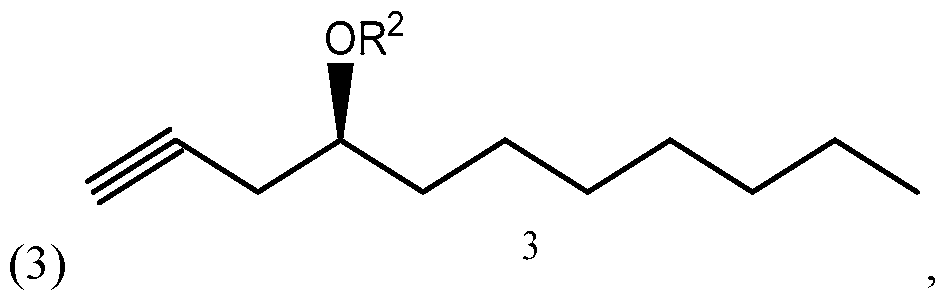 reacting the compound of formula (3) with a compound of formula
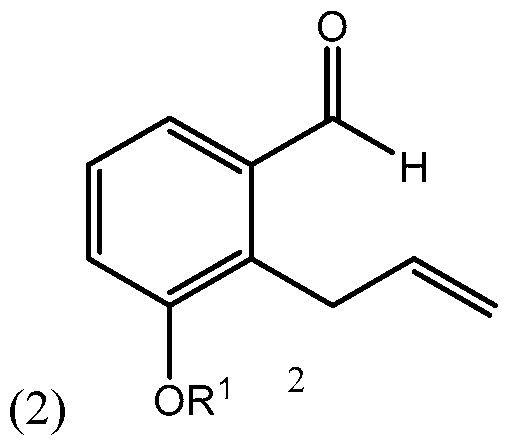 to form a compound of formula
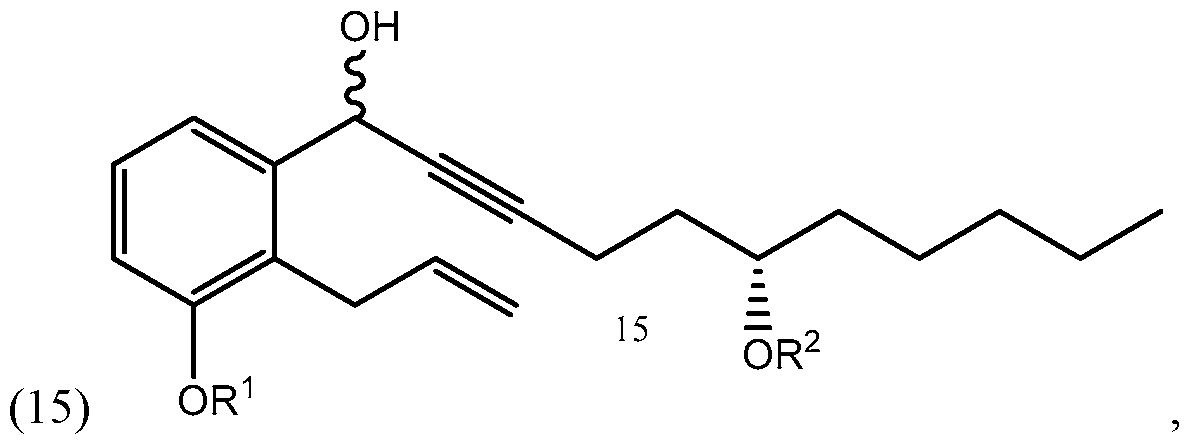 and converting the compound of formula (15) into treprostinil (4)
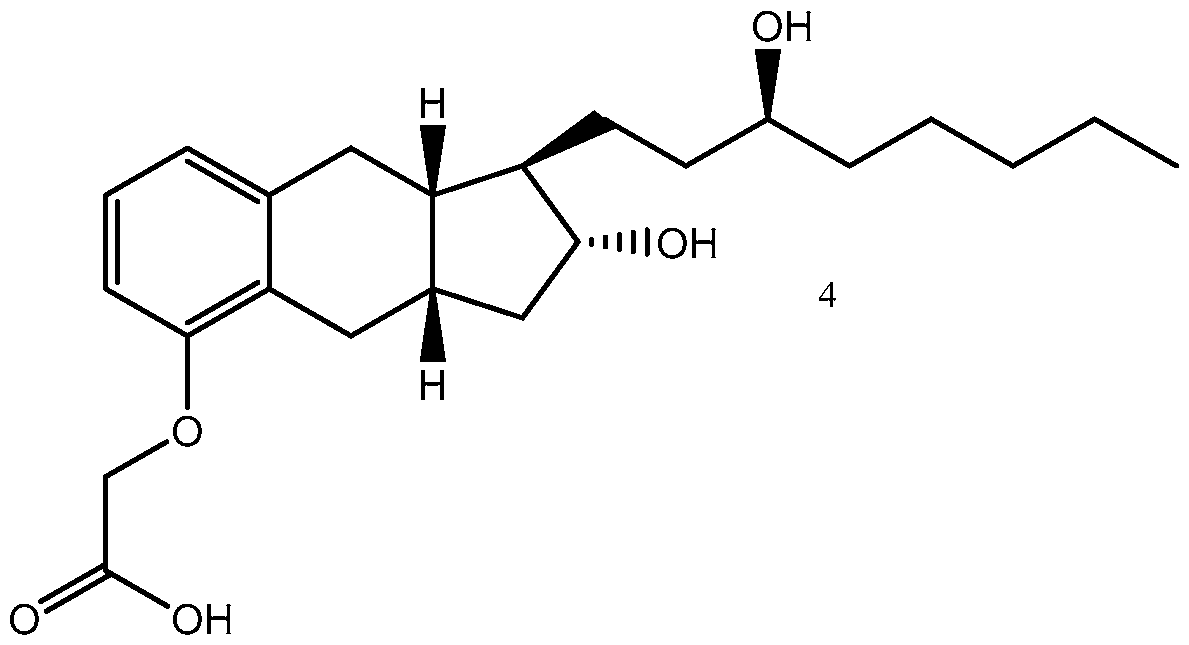 R1 and R2 may be as defined above. The reacting the compound of formula (3) with the compound of formula (2) to form the compound of formula (15) and the converting the compound of formula (15) into treprostinil may be performed as disclosed in U.S. patents Nos. 6,441,245, 6,700,025,
8,481,782, 8,940,930.
Treprostinil Synthesis
Many current treprostinil synthesis processes, including those disclosed in U.S. patents Nos. 6,441,245, 6,700,025, 8,481,782, 8,940,930, use the following enantioselective reduction of aryl alkynyl ketone (16) to obtain chiral alcohol (17), which may be later converted into treprostinil.
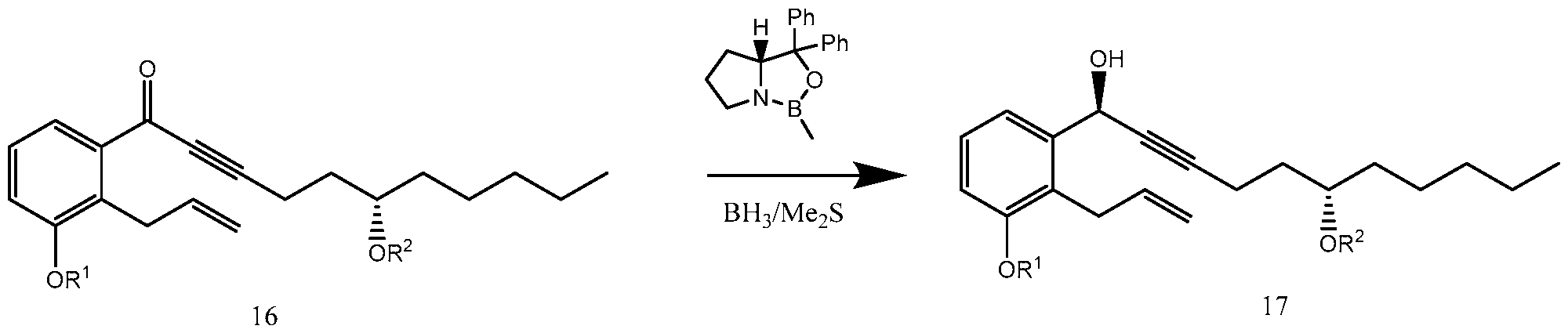
Aryl alkynyl ketone (16) for this reaction may be obtained from racemic alcohol (15), see Scheme 1, using, for example, Pyridinium chlorochromate (PCC) oxidation reaction as disclosed, for example, in U.S. patents Nos. 6,441,245, 6,700,025, 8,481,782, 8,940,930. The
enantioselective reduction reaction of aryl alkynyl ketone (16) to obtain chiral alcohol (17) uses a R-CBS reagent, such as (R)-2-Methyl-CBS-oxazaborolidine. Scheme 5 below illustrates the process of synthesizing treprostinil disclosed in U.S. Patent No. 6,441,245, which uses the enantioselective reduction reaction of aryl alkynyl ketone (16) to obtain chiral alcohol (17) uses a R-CBS reagent.
Scheme 5.
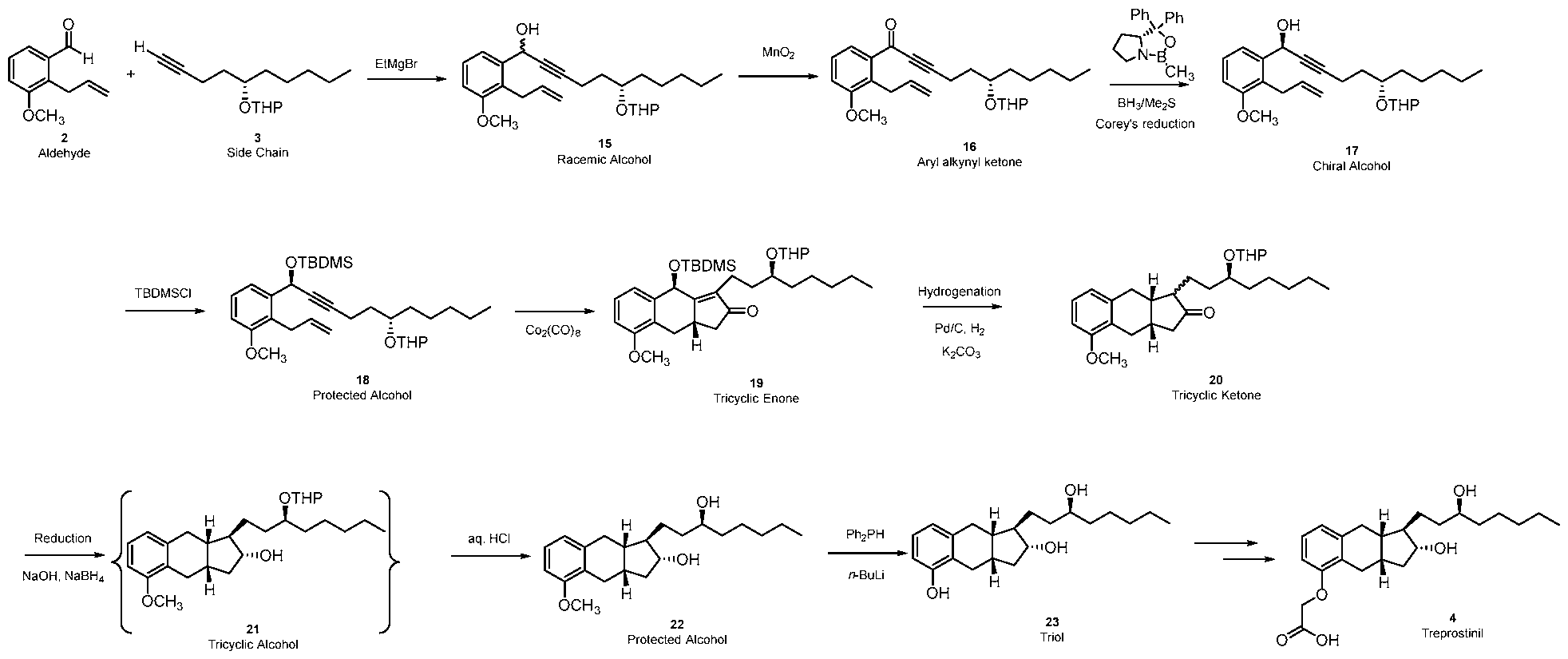
The enantioselective reduction reaction of aryl alkynyl ketone (16) using R-CBS reagent(s) may have a number of drawbacks. For example, this reaction yields typically only -95-96% chiral selectivity. The reduced chiral selectivity leads to a known impurity (3 AU90 isomer) in the process. Tedious column chromatography to remove borates and other by-products may be needed to isolate the product. Cryogenic conditions may be needed for the reaction. The borane-dimethyl sulfide complex typically used with R-CBS reagent(s) in treprostinil synthesis may have an unpleasant, obnoxious smell.
The present disclosure provides an alternative enantioselective reduction reaction of aryl alkynyl ketone (16) to produce chiral alcohol (17), which may avoid some or all of the drawbacks of the enantioselective reduction reaction of aryl alkynyl ketone (16) using R-CBS reagent(s).
A method of synthesizing treprostinil may involve
enantioselective reduction of a aryl alkynyl ketone compound of formula (16)
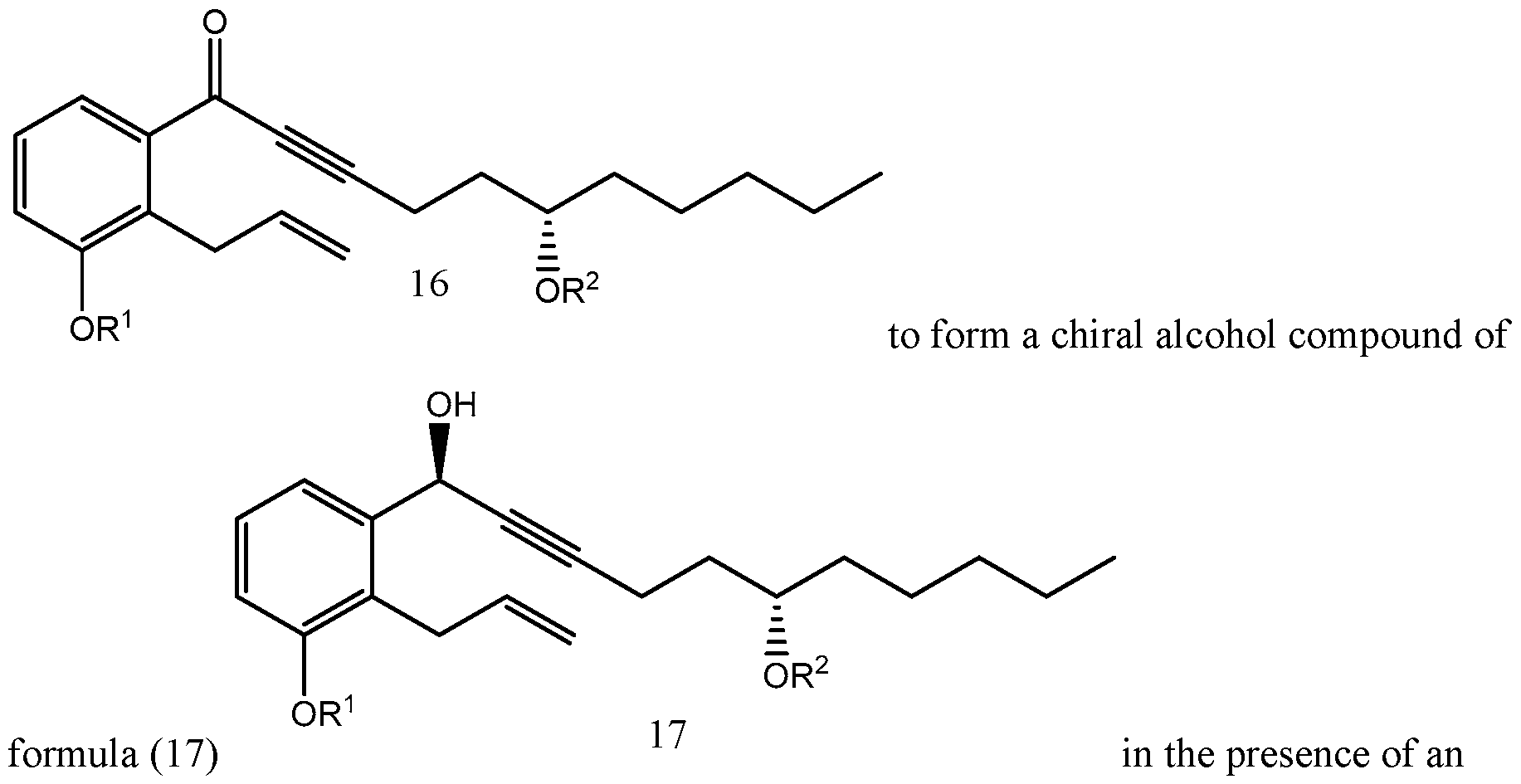 enantioselective enzyme catalyst; and converting the compound of formula (17) into treprostinil (4)
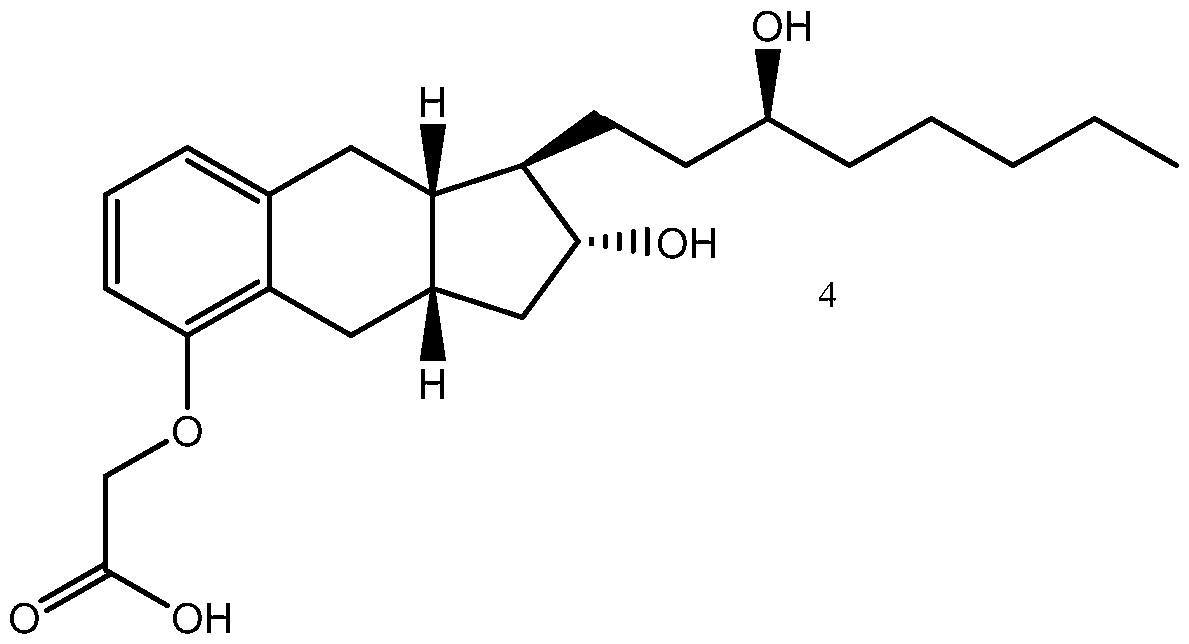 The converting the compound of formula (15) into treprostinil may be performed as disclosed in U.S. patents Nos. 6,441,245,
6,700,025, 8,481,782, 8,940,930.
The enantioselective reduction of the compound of formula (16) to form the compound of formula (17) in the presence of an enantioselective enzyme catalyst is illustrated in Scheme 6. Specific reaction conditions are listed in Scheme 6 only for illustrative purposes.
Scheme 6.

In some embodiments, the enantioselective enzyme catalyst may be a ketoreductase, such as KRED-P1-B05 or KRED-101. Ketoreductase compounds, such as KRED-P1-B05 or KRED- 101, are commercially available from Codexis, Inc, California, U.S.A.
In some embodiments, the enantioselective reduction in the presence of an enzyme catalyst, such as a ketoreductase, e.g. KRED-P3-B05, may be performed in the presence of reconstituted KRED Recycle Mix P which may contain sodium phosphate, magnesium sulfate, and nicotinamide adenine dinucleotide phosphate (NADP+). The KRED Recycle Mix P may have a pH of about 7.0. In one exemplary embodiment, a reconstituted KRED Recycle Mix P may contain 128 mM sodium phosphate, 1.7 mM magnesium sulfate, 1.1 mM NADP+, pH 7.0 per 250 mg of an enzyme catalyst, such as a ketoreductase, e.g. KRED-P3- B05.
In some embodiments, the enantioselective reduction in the presence of an enzyme catalyst, such as a ketoreductase, e.g. KRED- 10, may be performed in the presence of reconstituted KRED Recycle Mix N contains sodium phosphate, magnesium sulfate, NADP+, nicotinamide adenine dinucleotide (NAD+), D-glucose, and glucose dehydrogenase. The KRED Recycle Mix N may have a pH of about 7.0. In one exemplary embodiment, reconstituted KRED Recycle Mix N contains 263 mM sodium phosphate, 1.7 mM magnesium sulfate, 1.1 mM NADP+, 1.1 mM NAD+, 80 mM D-glucose, 4.3 U/mL glucose dehydrogenase, pH 7.0. per 250 mg of an enzyme catalyst, such as a ketoreductase, e.g. KRED-101.
A number of solvents may be used for the enantioselective reduction reaction, including IP A, dimethylsulfoxide (DMSO) and their mixtures.
In some embodiments, a product of the enantioselective reduction performed in the presence of an enantioselective enzyme catalyst, which product contains the compound of formula (17); may have a chiral purity of at least 98%, or at least 98.1%, or at least 98.2%, or at least 98.3% or at least 98.4% or at least 98.5%, or at least 98.6% or at least 98.7% or at least 98.8% or at 98.9% or at least 99%. The chiral purity may be determined, for example, by chiral chromatography, such as chiral gas chromatography (GC) or chiral high-performance liquid chromatography (HPLC).
The chiral purity of the product of the enantioselective reduction performed in the presence of an enantioselective enzyme catalyst may be higher than a chiral purity of a product of a enantioselective reduction performed in the presence of R-CBS reagents, such as the enantioselective reactions in U.S. patents Nos. 6,441,245, 6,700,025, 8,481,782, 8,940,930. Because the higher chiral purity for the enantioselective reduction performed in the presence of an enantioselective enzyme catalyst, a final treprostinil batch produced by a process including such enantioselective reduction may have a lower concentration of impurities, such as 3 AU90 isomer, compared a treprostinil batch produced by a process including a enantioselective reduction performed in the presence of R-CBS reagents, such as the processes in U.S. patents Nos. 6,441,245, 6,700,025, 8,481,782, 8,940,930. For example, in some embodiments a content of a 3 AU90 isomer in a treprostinil batch synthesized by a process including the enantioselective reduction performed in the presence of an enantioselective enzyme catalyst may be 0.3 mass % or less, 0.25 mass % or less, 0.2 mass % or less, 0.15 mass % or less, 0.1 mass % or less or 0.05 mass % or less.
Embodiments described herein are further illustrated by, though in no way limited to, the following working examples.
EXAMPLE 1 : Process of Scheme 2 for Side Chain Synthesis
Step 1 : Synthesis of chloroheptanol (6):

5 6
A 2000 mL 3-neck round bottom flask was charged with a solution of (5)-epichlorohydrin (5) (100.0 g, 1.08 mol) in anhydrous THF (500 mL) and cupper iodide (20.95 g, 1.13 mol) was added. The reaction mixture was stirred for 0.5 h and cooled to 0 - 5 °C under argon. Then butylmagnesium chloride (609 mL) was added dropwise within 2 h. After completion, the mixture was allowed to RT and stirred overnight. The reaction was quenched with 15% NH4OH at 0 - 5 °C and filtered through a celite pad and washed the pad with MTBE. The organic layer and washed were combined and washed with 15% NH4OH, brine, then dried over Na2SO4. The mixture was concentrated in vacuo to obtain crude chloroheptanol (6) (183 g). The crude product was used for the next step reaction without purification. The product was characterized by 1 H NMR.
Step 2: Synthesis of epoxyheptane (7)

A2000 mL 2-neck round bottom flask was charged with a solution of chloroheptanol (6) (192.0 g, 1.11 mol) in MTBE (550 mL) and was cooled to 0 - 5 °C, then sodium hydroxide (106.4 g, 2.66 mol) was added in 4 portions within 2 h and then warmed to RT under argon. The reaction mixture was stirred overnight. The mixture was filtered through a celite pad (80 g) and washed the pad with MTBE. The filtrate was washed with brine and dried over Na2SO4. The mixture was concentrated in vacuo to obtain crude epoxyheptane (7) (125 g) as pale-yellow liquid. The crude epoxyheptane (7) was used for the next step reaction without purification. The product was characterized by 1 H NMR.
Step 3: Synthesis of TMS alkyne (8)
TMS

A 2000 mL reaction vessel was charged with a solution of TMS propyne (112.2.0 g, 1.0 mol) and epoxyheptane (7) (115 g, 0.77 mol) in anhydrous THF /hexane (1 : 1, 600 mL), then it was stirred for 10 min and was cooled to -60 to -70 °C. To this w-butyllithium (2.5 M in hexane,
400 mL, 1.0 mol) was added dropwise under argon. The reaction mixture was stirred at -60 to -70 °C for 10 h and the reaction mixture was allowed to be warmed to RT and stirred overnight under argon. The reaction mixture was cooled to around 0 °C and was quenched by saturated NH4Q (150 mL). The reaction was stirred at RT for 0.5 h, organic layer was separated, and the aqueous layer was extracted with MTBE (2 x 100 mL). The combined organic layers were washed with brine, dried over Na2SO4, and concentrated in vacuo to provide crude TMS alkyne (8) (175.0 g) as brown liquid. The crude product was purified by silica gel column chromatography obtain pure TMS alkyne (8) (122.5 g, yield 70.2%). The product was characterized by JH NMR.
Process of Scheme 3: Step 4: Synthesis of 3,5-dinitrobenzoate (9)
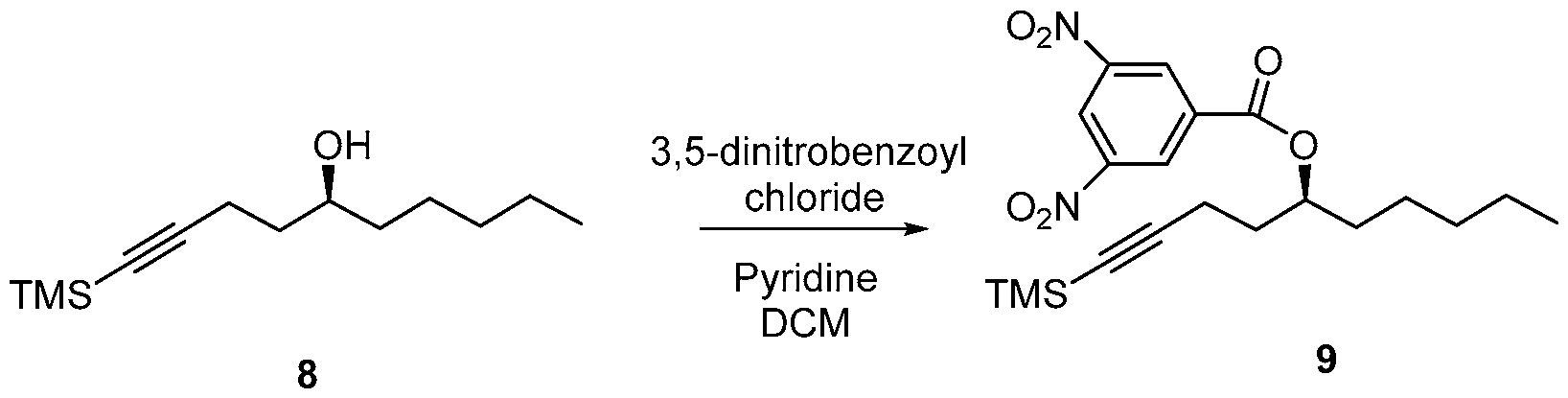
A 3000 mL reaction vessel was charged with a solution of crude TMS alkyne (8) (121.3 g) and 3,5-dinitrobenzoyl chloride (228.7 g, 0.99 mol) in anhydrous DCM (1200 mL) and was stirred for 10 min under argon at 0 - 5 °C. To this pyridine (120 mL, 1.50 mol) was added dropwise under argon. The reaction mixture was stirred at 0 - 10 °C for 0.5 h and warmed to RT and stirred overnight. The reaction progress was monitored by TLC and after complete reaction, MTBE was added to reaction mixture and stirred for 0.5 h. The precipitated solids were filtered, and the solids were washed with MTBE. The filtrate was washed with saturated aq. NaHCOs, brine and dried over Na2SO4. The mixture was concentrated in vacuo to provide crude 3,5 dinitrobenzoate (9) (236.2 g) as a pale-yellow solid which was crystallized from ethanol to provide pure dinitrobenzoate (184.0 g). The mother liquid was concentrated to around 500 mL and the solids was collected and washed with isopropyl alcohol (300 mL) to obtain product (30.0 g) which was slurried in hexane to provide additional product (22.5g). The compound was characterized by JH NMR, 13C NMR, and UPLC.
Step 5: Synthesis of side chain (1):
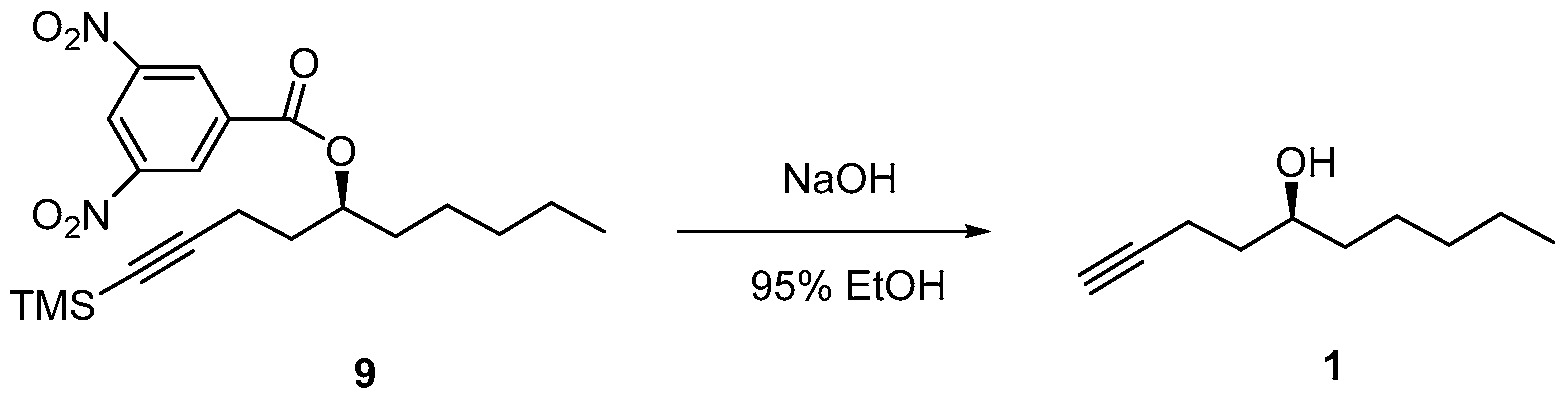
A 2000 mL round bottom flask was charged with sodium hydroxide (39.2 g, 0.98 mol) and 95% ethanol (1200 mL) and cooled to 0-5 °C and then 3,5-dinitrobenzoate (9) (206.0 g, 0.49 mol) was added under argon. The mixture was stirred at 0-5 °C for 1 h and then at RT for 4 h until the reaction was complete. At this stage MTBE was added and the mixture was filtered through a celite pad and washed with MTBE. The filtrate was concentrated in vacuo and the residue was dissolved in MTBE, washed with saturated aq. NaHCOs, brine, dried over Na2SO4 and concentrated in vacuo to provide side chain (1) 71.5 g (94.7% yield). The chemical and chiral purity by GC was found to be 98.6% and 100% respectively. The compound was characterized by JH NMR, 13C NMR and IR. The overall yield over five steps was found to be 43%.
EXAMPLE 2: Process of Scheme 4 for Side Chain Synthesis (via Enantioselective Reduction)
Step 1 : Addition of 1-butyne (10) to aldehyde (11):

10 11
To THF (200 mL) at -20 °C, 1-butyne (10) gas (13 g, 240.5 mmol) was bubbled. To this solution 2.5 M w-butyllithium in hexane (40 mL, 99.8 mmol) was added dropwise and after complete addition more butyne gas (4.88 g, 90.2 mmol) was bubbled to the reaction mixture. A solution of aldehyde (11) (10 g, 99.8 mmol) in THF was added dropwise. After complete addition the reaction mixture was allowed to warm to room temperature. The reaction was monitored by TLC and found to be complete after 2 h. The reaction was quenched with saturated ammonium chloride solution and the organic layer was extracted with MTBE. The combined organic layers were washed with water, brine, dried over sodium sulfate and evaporated in vacuo to obtain
crude racemic propargylic alcohol (12) (14.7 g) which was carried to next step. The product was characterized by JH NMR and 13C NMR.
Step 2: Oxidation of racemic propargylic alcohol (12) to ynone (13):

The racemic propargylic alcohol (12) (5.11 g) was dissolved in dichloromethane (100 mL) and cooled to 0 °C. To this solution potassium bromide (0.78 g, 6.62 mmol) in water (13.2 mL), 2,2,6,6-tetramethylpiperidine 1-oxyl (TEMPO) (0.79 mg, 6.62 mmol) and potassium bicarbonate (41.4 g, 414 mmol) in water (138 mL) were added. A solution of bleach (10-15% by wt.) (62 mL) in water (205 mL) was added dropwise. After 3 h, the reaction was found to be complete by TLC. At this stage the organic layer was separated, and aqueous layer was extracted twice with di chloromethane. The combined organic layers were washed with 10% aq. sodium thiosulfate solution, 0.5 N HC1 solution, saturated aqueous sodium bicarbonate solution, water, brine, dried over sodium sulfate and evaporated in vacuo to obtain crude ynone (13) (4.82 g). The product was characterized by JH NMR and 13C NMR.
Step 3: Enantioselective reduction of ynone (13) to chiral propargylic alcohol (14):
Method A
RuCI[(S,S)-TsDPEN]

KRED-P3-B03 Enzyme, IPA, DMSO, Recycle mix P
Method A (metal catalyst based enantioselective reduction):
A solution of ynone (13) (6.5 g, 42.70 mmol) in IPA (124 mL) was evacuated and replaced with argon (three times). To the above solution RuCl[(5,5)-TsDPEN] (mesitylene) (1.06 g, 1.71 mmol) and a solution of potassium hydroxide (192 mg, 3.42 mmol) in IPA (6 mL) were added.
After 2.5 h, TLC indicated completion of the reaction. The reaction mixture was evaporated in vacuo and the residue was partitioned between MTBE and IN HC1. The organic layer was separated, and the solids were filtered through celite. The filtrate was washed with saturated sodium bicarbonate solution, water, brine, dried over sodium sulfate and evaporated in vacuo to obtain crude chiral propargylic alcohol (14) (6.33 g). The product was characterized by JH NMR and 13C NMR.
Method B (Enzyme based enantioselective reduction):
To KRED enzyme KRED-P3-B03 (10 mg) was added KRED Recycle Mix P (475 pL). A solution of ynone (13) (2 mg) in 25 pL DMSO was added. The mixture was stirred at 30 °C for 24 h. At this stage the reaction was quenched by adding MTBE (1.5 mL). The reaction mixture was centrifuged, organic layer was separated, and aqueous layer was extracted with MTBE. The combined organic layers were evaporated in vacuo to obtain crude propargylic alcohol (14) (2 mg). The chiral purity by GC was found to be 97.4%.
Step 4: Zipper isomerization of chiral propargylic alcohol (14) to side chain (1):

To 1,3-diaminopropane (3.3 mL, 38.90 mmol) was added THF (25 mL) under argon atmosphere and was cooled to 0 °C. A solution of 2.5M w-butyllithium (10.4 mL, 25.92 mmol) was added dropwise to the reaction mixture and stirred for 40 min allowing to RT. The potassium Zc/V-butoxide (2.9 g, 25.92 mmol) was added at RT and stirred for 30 mins. To this reaction mixture chiral propargylic alcohol (14) (1.0 g 6.48 mmol) obtained via enantioselective reduction (Method A) was added as a solution in THF (2 mL). After 2 h, TLC indicated completion of the reaction and the reaction was quenched by adding saturated aqueous ammonium chloride solution, The reaction mixture was partitioned between water and MTBE. The organic layer was separated, and the aqueous layer was extracted three times with MTBE. The combined organic layers were evaporated in vacuo. The residue was dissolved in MTBE, washed with IN HC1, saturated aqueous sodium bicarbonate solution, water, brine,
dried over sodium sulfate and evaporated in vacuo to obtain crude side chain (1). The crude product was purified by silica gel column chromatography to obtain pure side chain (0.61 g) with an overall yield of 56% in four steps. The product was characterized by 1 H NMR and 13C NMR. The chiral purity was found to be 98.6% by chiral GC with a chemical purity of 97%.
EXAMPLE 3 : Chiral Selectivity in Enantioselective Reduction of Aryl Alkynyl Ketone
Enzymatic Enantioselective Reduction of Aryl Alkynyl Ketone (16)

Method A:
To KRED enzyme KRED-P1-B05 (10 mg) was added KRED Recycle Mix P (from Codexis) (475 pL). A solution of aryl alkynyl ketone (16) (2 mg) in 25 pL DMSO was added. This was stirred at 30 °C for 24 h. At this stage the reaction was quenched by adding acetonitrile. The reaction mixture was centrifuged, and the supernatant was separated and extracted with MTBE. The organic layer was evaporated in vacuo to obtain crude chiral alcohol (17) (2 mg). The chiral purity by HPLC was found to be >99.0%.
Method B:
To KRED enzyme KRED-101 (10 mg) was added KRED Recycle Mix N (from Codexis) (475 pL). A solution of aryl alkynyl ketone (16) (2 mg) in 25 pL DMSO was added. This was stirred at 30 °C for 24 h. At this stage the reaction was quenched by adding acetonitrile. The reaction mixture was centrifuged, and the supernatant was separated and extracted with MTBE. The organic layer was evaporated in vacuo to obtain crude chiral alcohol (17) (2 mg). The chiral purity by HPLC was found to be >98.5%.
* * *
Although the foregoing refers to particular preferred embodiments, it will be understood that the present invention is not so limited. It will occur to those of ordinary skill in the art that
various modifications may be made to the disclosed embodiments and that such modifications are intended to be within the scope of the present invention.
All of the publications, patent applications and patents cited in this specification are incorporated herein by reference in their entirety.
Claims
1. A method of synthesizing a compound of formula (
 , the method comprising: reacting a compound of formula (
 3,5 dinitrobenzoyl chloride to form a compound of formula (
 deprotecting the compound of formula (9) to form the compound of formula (1)
OH
 , wherein TMS is trimethyl silyl.
2. The method of claim 1, wherein said deprotecting is performed in the presence of a base.
3. The method of claim 2, wherein said base is NaOH.
4. The method of any one of the preceding claims, further comprising
(B) reacting a compound of formula
 butylmagnesium chloride to form a compound of formula (
 (C) reacting the compound of formula (6) with a base to form a compound of formula (7)

(D) reacting the compound of formula (7) with trimethyl silyl propyne to form the compound of formula (8).
5. The method of claim 4, wherein said reacting (A) is performed in the presence of Cui.
6. The method of claim 4 or 5, wherein the base in said reacting (B) is NaOH.
7. The method of any one of claims 4-6, wherein said reacting (C) is performed at a temperature from -60° to -70°C.
8. A method of synthesizing treprostinil comprising: protecting the compound of formula (1) synthesized according to the method of any one of claims 1-7 a compound of formula (
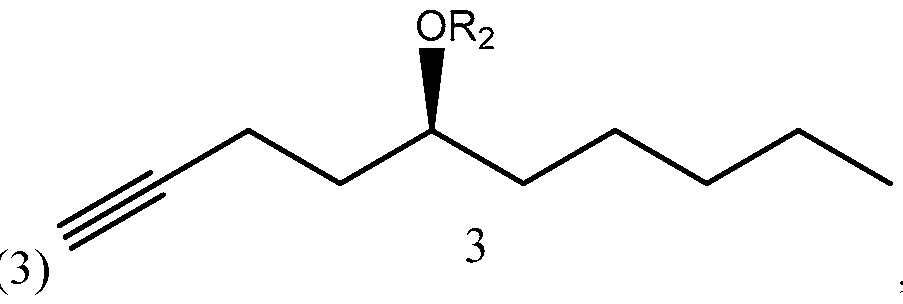 , wherein R2 is a hydroxy protecting group;
reacting the compound of formula (3) with a compound of formula (
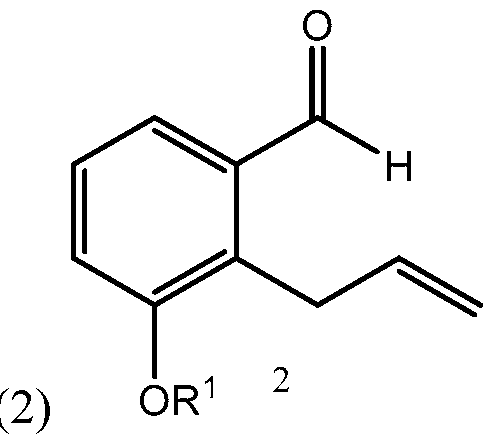 to form a compound of formula
 wherein R1 is a hydroxy protecting group; and converting the compound of formula (15) in treprostinil (4)

A method of synthesizing a compound of formula (
 the method comprising:
reacting a compound of formula (10)
the method comprising:
reacting a compound of formula (10)
 a compound of formula (11)
 oxidizing the compound of formula (12) to form a compound of formula (13)
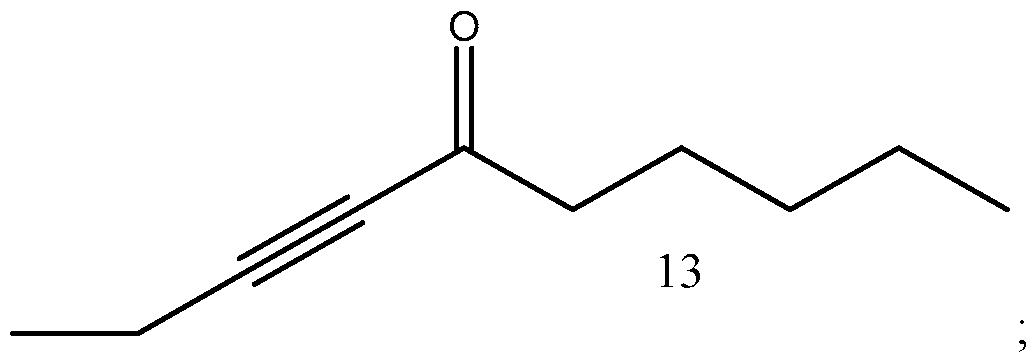 enantioselectively reducing the compound of formula (13) to form a chiral compound of
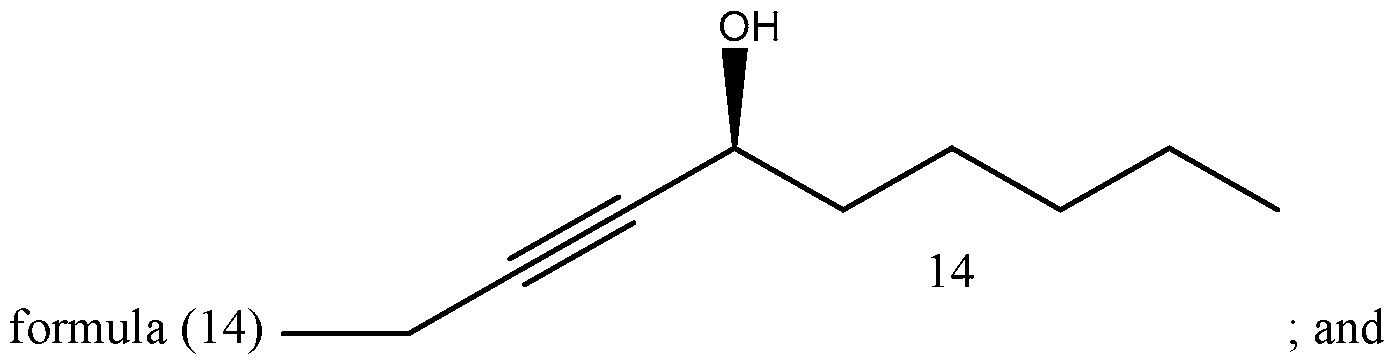 isomerizing the compound of formula (14) to form the compound of formula (1)
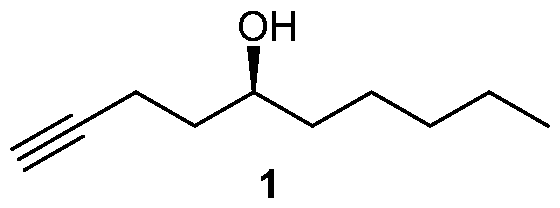
10. The method of claim 9, wherein said reacting the compound of formula (10) with the compound of formula (11) is performed in the presence of BuLi.
11. The method of claim 9 or 10, wherein said reacting the compound of formula (10) with the compound of formula (11) is performed at a temperature from about -15°C to about - 25°C.
12. The method of any one of claims 9-11, wherein said oxidizing is performed in the presence of an oxidation catalyst.
13. The method of claim 12, wherein the oxidation catalyst is (2, 2,6,6- T etram ethylpiperi din- 1 -yl)oxyl .
14. The method of any one of claims 9-13, wherein said reducing is performed in the presence of an enantioselective catalyst.
15. The method of claim 14, wherein the enantioselective catalyst is a metal containing catalyst.
16. The method of claim 15, wherein the metal containing catalyst is a ruthenium containing catalyst.
17. The method of claim 16, wherein the ruthenium containing catalyst is RuCl[(S,S)- TsDPEN] mesitylene.
18. The method of claim 14, wherein the enantioselective catalyst is an enzyme catalyst.
19. The method of claim 18, wherein the enzyme catalyst is a ketoreductase.
20. The method of claim 19, wherein the ketoreductase is KRED-P3-B03.
21. The method of any one of claims 9-20, wherein said isomerizing is performed in the presence of a zipper isomerization reagent.
22. The method of claim 21, wherein the zipper isomerization reagent comprises 1,3- diaminopropane or an alkali metal salt thereof.
23. A method of synthesizing treprostinil comprising: protecting the compound of formula (1) synthesized according to the method of any one of claims 9-22 a compound of formula (
 wherein
R2 is a hydroxy protecting group; reacting the compound of formula (3) with a compound of formula (
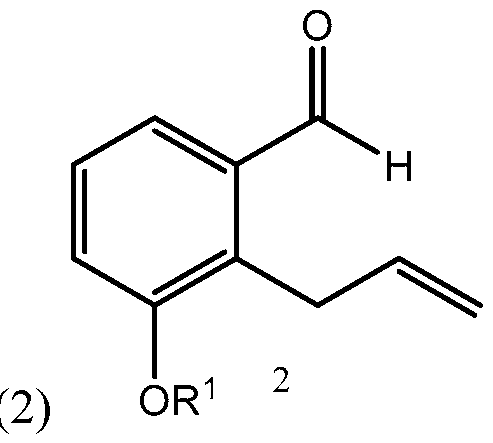 to form a compound of formula
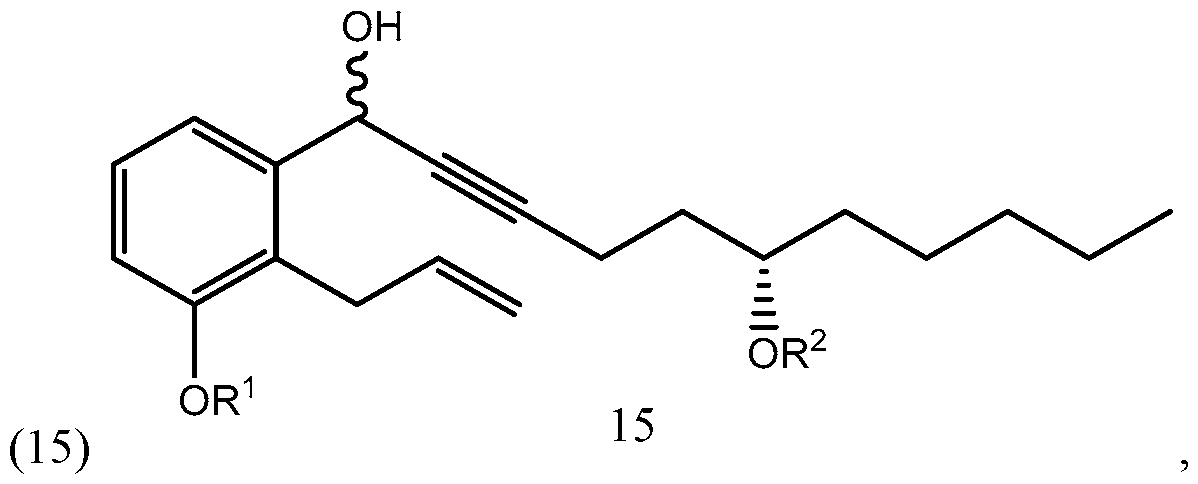 wherein R1 is a hydroxy protecting group — (CH2)nX; X being H, phenyl, — CN, — OR3 or COOR3; n being 1 to 3, R3 being an alkyl, a hydroxy protecting group or a substituted or unsubstituted benzyl group; and converting the compound of formula (15) into treprostinil (4)
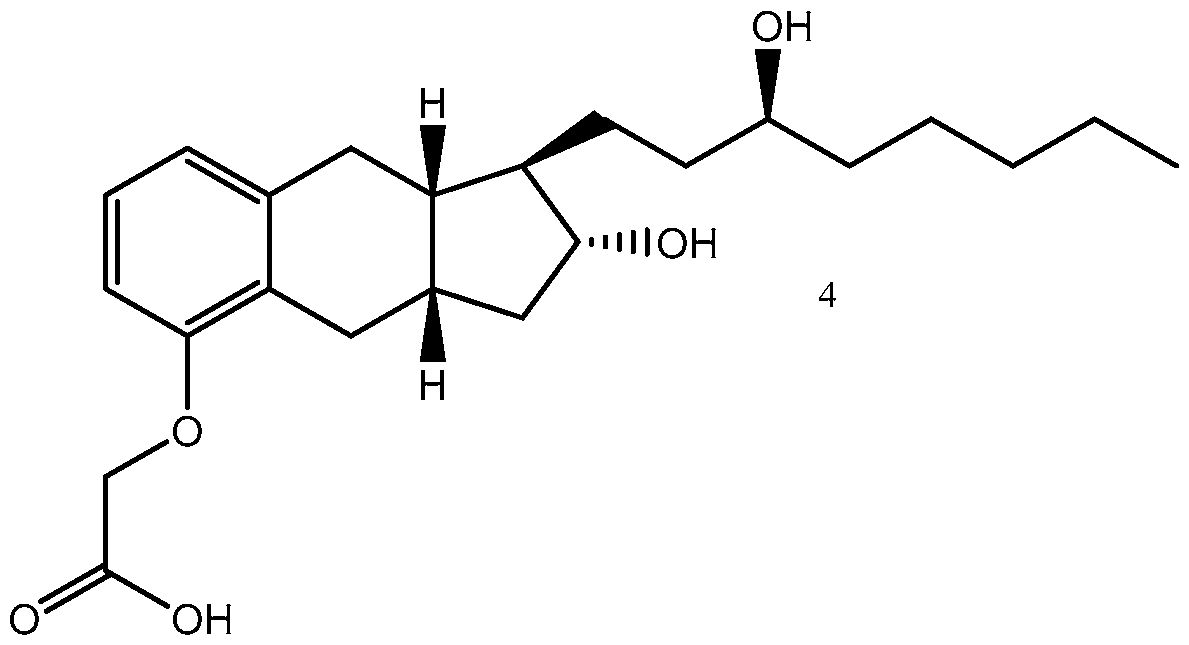
24. A method of synthesizing treprostinil comprising: enantioselectively reducing a compound of formula (16)
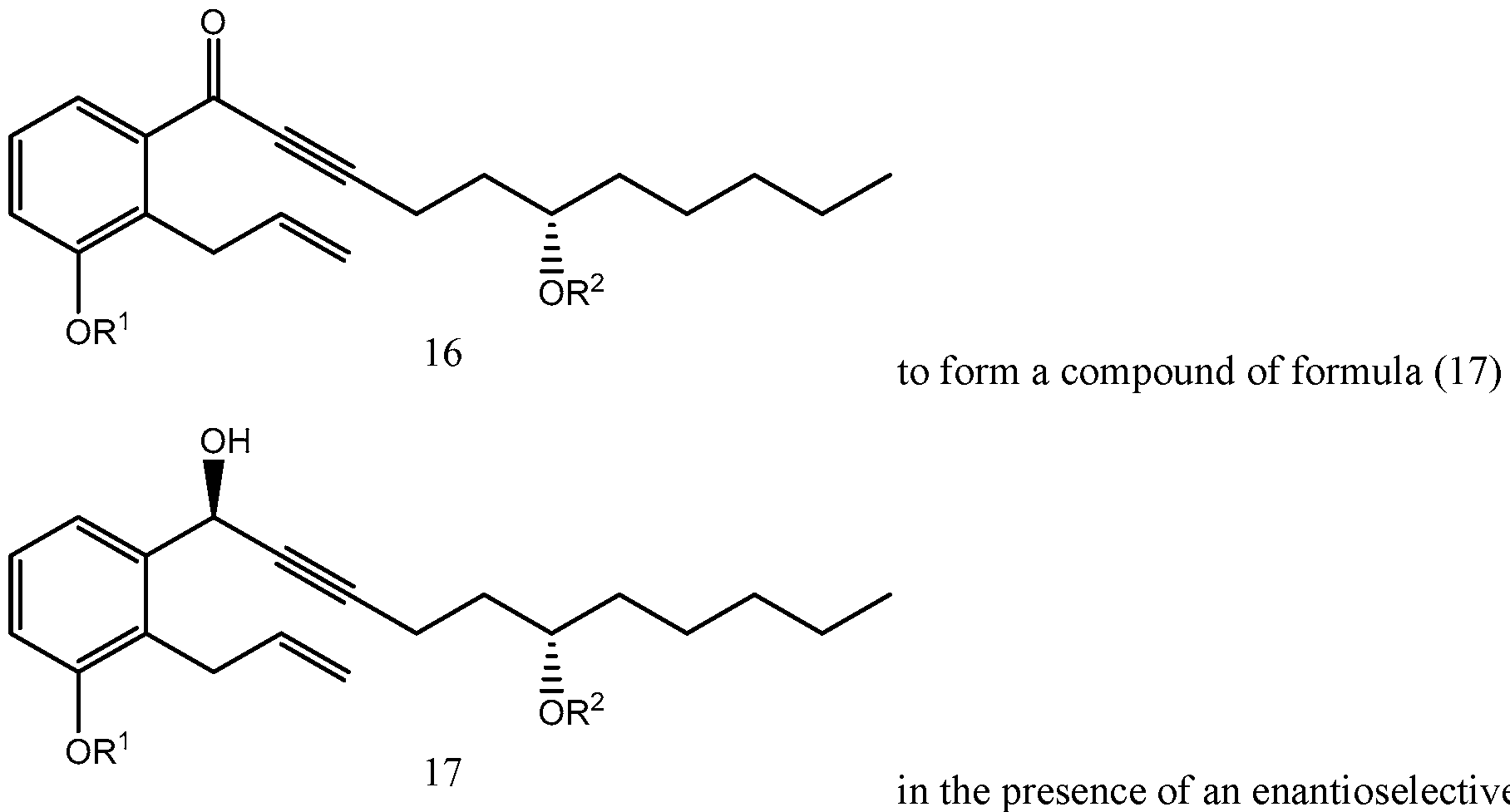 e enzyme catalyst; and
converting the compound of formula (17) into treprostinil (4)
e enzyme catalyst; and
converting the compound of formula (17) into treprostinil (4)
 , wherein R1 is a hydroxy protecting group — (CH2)nX; X being H, phenyl, — CN, — OR3 or COOR3; n being 1 to 3, R3 being an alkyl, a hydroxy protecting group or a substituted or unsubstituted benzyl group; and R2 is a hydroxy protecting group.
25. The method of claim 24, wherein the enantioselective enzyme catalyst is a ketoreductase.
26. The method of claim 25, wherein the ketoreductase is KRED-P1-B05.
27. The method of claim 25, wherein the ketoreductase is KRED-101.
28. The method of any one of claims 24-27, wherein the compound of formula (17) produced by said enantioselective reducing has a chiral purity of at least 98%.
29. The method of claim 28, wherein the chiral purity is at least 98.5%.
30. The method of any one of claims 28-29, wherein a content of a 3AU90 isomer in a synthesized batch of treprostinil is no more than 0.1 mass %.
31. A treprostinil batch synthesized according to the method of any one of claims 24-30.
32. The treprostinil batch of claim 31, wherein a content of a 3 AU90 isomer in the batch is no more than 0.1 mass %.
33. The method of any one of claims 8 and 23-30, wherein R1 is methyl or benzyl.
34. The method of any one of claims 8, 23-30 and 33, wherein R2 is THP.
Applications Claiming Priority (2)
| Application Number | Priority Date | Filing Date | Title |
|---|---|---|---|
| US202363597473P | 2023-11-09 | 2023-11-09 | |
| US63/597,473 | 2023-11-09 |
Publications (1)
| Publication Number | Publication Date |
|---|---|
| WO2025101824A1 true WO2025101824A1 (en) | 2025-05-15 |
Family
ID=93651399
Family Applications (1)
| Application Number | Title | Priority Date | Filing Date |
|---|---|---|---|
| PCT/US2024/055018 Pending WO2025101824A1 (en) | 2023-11-09 | 2024-11-08 | Syntheses of compounds useful for producing treprostinil |
Country Status (2)
| Country | Link |
|---|---|
| US (1) | US20250197338A1 (en) |
| WO (1) | WO2025101824A1 (en) |
Citations (37)
| Publication number | Priority date | Publication date | Assignee | Title |
|---|---|---|---|---|
| US2485614A (en) | 1946-08-29 | 1949-10-25 | Chicago Bridge & Iron Co | Stabilizing and guide apparatus for lifter roofs |
| US3035516A (en) | 1958-08-18 | 1962-05-22 | Lee Brothers Company | Stencil device |
| US3037116A (en) | 1957-07-26 | 1962-05-29 | Weber Georges | Apparatus for irradiating liquids |
| US3646509A (en) | 1969-08-08 | 1972-02-29 | Texas Instruments Inc | Method for field stacking seismic data and system using write after read bulk data storage |
| US4306075A (en) | 1980-03-28 | 1981-12-15 | The Upjohn Company | Composition and process |
| US4547016A (en) | 1984-08-13 | 1985-10-15 | Eeco Incorporated | Quick release mounting |
| US5150516A (en) | 1989-09-28 | 1992-09-29 | Societa' Cavi Pirelli S.P.A. | Process for making detachable connecting means for ribbon optical fiber cables and the connecting means obtained thereby |
| US5153222A (en) | 1988-06-17 | 1992-10-06 | Burroughs Wellcome Co. | Method of treating pulmonary hypertension with benzidine prostaglandins |
| US6054486A (en) | 1997-11-14 | 2000-04-25 | United Technology Corporation | Use of 9-Deoxy-2',9-α-methano-3-oxa-4,5,6-trinor-3,7-(1',3'-interphenylen e)-13,14-dihydro-prostaglandin f1 to treat peripheral vascular disease |
| WO2000057701A1 (en) | 1999-03-31 | 2000-10-05 | United Therapeutics Corporation | Prostaglandin compounds, compositions and methods of treating peripheral vascular disease and pulmonary hypertension |
| US6441245B1 (en) | 1997-10-24 | 2002-08-27 | United Therapeutics Corporation | Process for stereoselective synthesis of prostacyclin derivatives |
| US6700025B2 (en) | 2001-01-05 | 2004-03-02 | United Therapeutics Corporation | Process for stereoselective synthesis of prostacyclin derivatives |
| US6756117B1 (en) | 2002-12-20 | 2004-06-29 | The United States Of America As Represented By The United States Department Of Energy | Photonic polymer-blend structures and method for making |
| US7199157B2 (en) | 2003-12-16 | 2007-04-03 | United Therapeutics Corporation | Use of treprostinil to improve kidney functions |
| US8242305B2 (en) | 2007-12-17 | 2012-08-14 | United Therapeutics Corporation | Process to prepare treprostinil, the active ingredient in remodulin |
| US8461393B2 (en) | 2011-03-02 | 2013-06-11 | United Therapeutics Corporation | Synthesis of intermediate for treprostinil production |
| US8481782B2 (en) | 2010-06-03 | 2013-07-09 | United Therapeutics Corporation | Treprostinil production |
| US8747897B2 (en) | 2006-04-27 | 2014-06-10 | Supernus Pharmaceuticals, Inc. | Osmotic drug delivery system |
| US8765813B2 (en) | 2003-12-16 | 2014-07-01 | United Therapeutics Corporation | Use of treprostinil to treat and prevent ischemic lesions |
| US9029607B2 (en) | 2010-07-22 | 2015-05-12 | Alphora Research Inc. | Protected aldehydes for use as intermediates in chemical syntheses, and processes for their preparation |
| US9050311B2 (en) | 2003-05-22 | 2015-06-09 | United Therapeutics Corporation | Compounds and methods for delivery of prostacyclin analogs |
| US9255064B2 (en) | 2013-10-25 | 2016-02-09 | Insmed Incorporated | Prostacyclin compounds, compositions and methods of use thereof |
| US9278902B2 (en) | 2012-01-10 | 2016-03-08 | Shanghai Techwell Biopharmaceutical Co., Ltd. | Crystal form of prostaglandin analogue, and preparation method and use thereof |
| US9278903B2 (en) | 2012-01-10 | 2016-03-08 | Shanghai Techwell Biopharmaceutical Co., Ltd. | Crystal form of prostaglandin analogue, and preparation method and use thereof |
| WO2016038532A1 (en) | 2014-09-09 | 2016-03-17 | Mylan Laboratories Limited | Amorphous treprostinil diethanolamine |
| WO2016055819A1 (en) | 2014-10-08 | 2016-04-14 | CHINOIN Gyógyszer és Vegyészeti Termékek Gyára Zrt. | Process for the preparation of treprostinil |
| US9339507B2 (en) | 2006-05-15 | 2016-05-17 | United Therapeutics Corporation | Treprostinil administration by inhalation |
| US9346738B2 (en) | 2012-05-23 | 2016-05-24 | Scipharm Sarl | Process for the preparation of treprostinil and derivatives thereof |
| WO2016081658A1 (en) | 2014-11-18 | 2016-05-26 | Insmed Incorporated | Methods of manufacturing treprostinil and treprostinil derivative prodrugs |
| WO2016105538A1 (en) | 2014-12-23 | 2016-06-30 | Sandia Corporation Sandia National Laboratories | Adjusting the ph of a pretreatment solution using carbon dioxide useful for integrating saccharification and fermentation |
| US9388154B2 (en) | 2011-09-12 | 2016-07-12 | Lund Biotechnology PBC | Process for preparing synthetic prostacyclins |
| US9543217B2 (en) | 2014-05-14 | 2017-01-10 | Fuji Electric Co., Ltd. | Semiconductor device and method of manufacturing semiconductor device |
| US9758465B2 (en) | 2013-04-30 | 2017-09-12 | United Therapeutics Corporation | Controlled release pharmaceutical formulations |
| WO2018058124A1 (en) | 2016-09-26 | 2018-03-29 | United Therapeutics Corporation | Treprostinil prodrugs |
| CN104892555B (en) * | 2014-03-04 | 2019-03-08 | 江苏豪森药业集团有限公司 | Preparation method of Treprostinil intermediate |
| US10797316B2 (en) | 2012-11-20 | 2020-10-06 | Sumitomo Metal Mining Co., Ltd. | Coated nickel hydroxide powder for alkali secondary battery positive electrode active material and method of producing same |
| US12469709B2 (en) | 2017-08-17 | 2025-11-11 | Semiconductor Components Industries, Llc | Semiconductor package electrical contact structures and related methods |
-
2024
- 2024-11-08 WO PCT/US2024/055018 patent/WO2025101824A1/en active Pending
- 2024-11-08 US US18/941,032 patent/US20250197338A1/en active Pending
Patent Citations (55)
| Publication number | Priority date | Publication date | Assignee | Title |
|---|---|---|---|---|
| US2485614A (en) | 1946-08-29 | 1949-10-25 | Chicago Bridge & Iron Co | Stabilizing and guide apparatus for lifter roofs |
| US3037116A (en) | 1957-07-26 | 1962-05-29 | Weber Georges | Apparatus for irradiating liquids |
| US3035516A (en) | 1958-08-18 | 1962-05-22 | Lee Brothers Company | Stencil device |
| US3646509A (en) | 1969-08-08 | 1972-02-29 | Texas Instruments Inc | Method for field stacking seismic data and system using write after read bulk data storage |
| US4306075A (en) | 1980-03-28 | 1981-12-15 | The Upjohn Company | Composition and process |
| US4547016A (en) | 1984-08-13 | 1985-10-15 | Eeco Incorporated | Quick release mounting |
| US5153222A (en) | 1988-06-17 | 1992-10-06 | Burroughs Wellcome Co. | Method of treating pulmonary hypertension with benzidine prostaglandins |
| US5150516A (en) | 1989-09-28 | 1992-09-29 | Societa' Cavi Pirelli S.P.A. | Process for making detachable connecting means for ribbon optical fiber cables and the connecting means obtained thereby |
| US6441245B1 (en) | 1997-10-24 | 2002-08-27 | United Therapeutics Corporation | Process for stereoselective synthesis of prostacyclin derivatives |
| US6528688B2 (en) | 1997-10-24 | 2003-03-04 | United Therapeutics Corporation | Prostacyclin derivatives |
| US6054486A (en) | 1997-11-14 | 2000-04-25 | United Technology Corporation | Use of 9-Deoxy-2',9-α-methano-3-oxa-4,5,6-trinor-3,7-(1',3'-interphenylen e)-13,14-dihydro-prostaglandin f1 to treat peripheral vascular disease |
| WO2000057701A1 (en) | 1999-03-31 | 2000-10-05 | United Therapeutics Corporation | Prostaglandin compounds, compositions and methods of treating peripheral vascular disease and pulmonary hypertension |
| US6700025B2 (en) | 2001-01-05 | 2004-03-02 | United Therapeutics Corporation | Process for stereoselective synthesis of prostacyclin derivatives |
| US6809223B2 (en) | 2001-01-05 | 2004-10-26 | United Therapeutics Corporation | Process for stereoselective synthesis of prostacyclin derivatives |
| US6756117B1 (en) | 2002-12-20 | 2004-06-29 | The United States Of America As Represented By The United States Department Of Energy | Photonic polymer-blend structures and method for making |
| US9199908B2 (en) | 2003-05-22 | 2015-12-01 | United Therapeutics Corporation | Compounds and methods for delivery of prostacyclin analogs |
| US9050311B2 (en) | 2003-05-22 | 2015-06-09 | United Therapeutics Corporation | Compounds and methods for delivery of prostacyclin analogs |
| US9878972B2 (en) | 2003-05-22 | 2018-01-30 | United Therapeutics Corporation | Compounds and methods for delivery of prostacyclin analogs |
| US9624156B2 (en) | 2003-05-22 | 2017-04-18 | United Therapeutics Corporation | Compounds and methods for delivery of prostacyclin analogs |
| US9422223B2 (en) | 2003-05-22 | 2016-08-23 | United Therapeutics Corporation | Compounds and methods for delivery of prostacyclin analogs |
| US9278901B2 (en) | 2003-05-22 | 2016-03-08 | United Therapeutics Corporation | Compounds and methods for delivery of prostacyclin analogs |
| US8765813B2 (en) | 2003-12-16 | 2014-07-01 | United Therapeutics Corporation | Use of treprostinil to treat and prevent ischemic lesions |
| US7199157B2 (en) | 2003-12-16 | 2007-04-03 | United Therapeutics Corporation | Use of treprostinil to improve kidney functions |
| US8747897B2 (en) | 2006-04-27 | 2014-06-10 | Supernus Pharmaceuticals, Inc. | Osmotic drug delivery system |
| US9339507B2 (en) | 2006-05-15 | 2016-05-17 | United Therapeutics Corporation | Treprostinil administration by inhalation |
| US9358240B2 (en) | 2006-05-15 | 2016-06-07 | United Therapeutics Corporation | Treprostinil administration by inhalation |
| US8748657B2 (en) | 2007-12-17 | 2014-06-10 | United Therapeutics Corporation | Process to prepare treprostinil |
| US9604901B2 (en) | 2007-12-17 | 2017-03-28 | United Therapeutics Corporation | Process to prepare treprostinil, the active ingredient in Remodulin® |
| US11723887B2 (en) | 2007-12-17 | 2023-08-15 | United Therapeutics Corporation | Process to prepare treprostinil, the active ingredient in Remodulin® |
| US10548863B2 (en) | 2007-12-17 | 2020-02-04 | United Therapeutics Corporation | Process to prepare treprostinil, the active ingredient in Remodulin® |
| US10478410B2 (en) | 2007-12-17 | 2019-11-19 | United Therapeutics Corporation | Process to prepare treprostinil, the active ingredient in Remodulin® |
| US8497393B2 (en) | 2007-12-17 | 2013-07-30 | United Therapeutics Corporation | Process to prepare treprostinil, the active ingredient in Remodulin® |
| US10322099B2 (en) | 2007-12-17 | 2019-06-18 | United Therapeutics Corporation | Process to prepare treprostinil, the active ingredient in remodulin® |
| US9593066B2 (en) | 2007-12-17 | 2017-03-14 | United Therapeutics Corporation | Process to prepare treprostinil, the active ingredient in remodulin® |
| US8242305B2 (en) | 2007-12-17 | 2012-08-14 | United Therapeutics Corporation | Process to prepare treprostinil, the active ingredient in remodulin |
| US9156786B2 (en) | 2007-12-17 | 2015-10-13 | United Therapeutics Corporation | Process to prepare treprostinil, the active ingredient in remodulin® |
| US8940930B2 (en) | 2010-06-03 | 2015-01-27 | United Therapeutics Corporation | Treprostinil production |
| US8481782B2 (en) | 2010-06-03 | 2013-07-09 | United Therapeutics Corporation | Treprostinil production |
| US9029607B2 (en) | 2010-07-22 | 2015-05-12 | Alphora Research Inc. | Protected aldehydes for use as intermediates in chemical syntheses, and processes for their preparation |
| US8461393B2 (en) | 2011-03-02 | 2013-06-11 | United Therapeutics Corporation | Synthesis of intermediate for treprostinil production |
| US9388154B2 (en) | 2011-09-12 | 2016-07-12 | Lund Biotechnology PBC | Process for preparing synthetic prostacyclins |
| US9278903B2 (en) | 2012-01-10 | 2016-03-08 | Shanghai Techwell Biopharmaceutical Co., Ltd. | Crystal form of prostaglandin analogue, and preparation method and use thereof |
| US9278902B2 (en) | 2012-01-10 | 2016-03-08 | Shanghai Techwell Biopharmaceutical Co., Ltd. | Crystal form of prostaglandin analogue, and preparation method and use thereof |
| US9346738B2 (en) | 2012-05-23 | 2016-05-24 | Scipharm Sarl | Process for the preparation of treprostinil and derivatives thereof |
| US10797316B2 (en) | 2012-11-20 | 2020-10-06 | Sumitomo Metal Mining Co., Ltd. | Coated nickel hydroxide powder for alkali secondary battery positive electrode active material and method of producing same |
| US9758465B2 (en) | 2013-04-30 | 2017-09-12 | United Therapeutics Corporation | Controlled release pharmaceutical formulations |
| US9255064B2 (en) | 2013-10-25 | 2016-02-09 | Insmed Incorporated | Prostacyclin compounds, compositions and methods of use thereof |
| CN104892555B (en) * | 2014-03-04 | 2019-03-08 | 江苏豪森药业集团有限公司 | Preparation method of Treprostinil intermediate |
| US9543217B2 (en) | 2014-05-14 | 2017-01-10 | Fuji Electric Co., Ltd. | Semiconductor device and method of manufacturing semiconductor device |
| WO2016038532A1 (en) | 2014-09-09 | 2016-03-17 | Mylan Laboratories Limited | Amorphous treprostinil diethanolamine |
| WO2016055819A1 (en) | 2014-10-08 | 2016-04-14 | CHINOIN Gyógyszer és Vegyészeti Termékek Gyára Zrt. | Process for the preparation of treprostinil |
| WO2016081658A1 (en) | 2014-11-18 | 2016-05-26 | Insmed Incorporated | Methods of manufacturing treprostinil and treprostinil derivative prodrugs |
| WO2016105538A1 (en) | 2014-12-23 | 2016-06-30 | Sandia Corporation Sandia National Laboratories | Adjusting the ph of a pretreatment solution using carbon dioxide useful for integrating saccharification and fermentation |
| WO2018058124A1 (en) | 2016-09-26 | 2018-03-29 | United Therapeutics Corporation | Treprostinil prodrugs |
| US12469709B2 (en) | 2017-08-17 | 2025-11-11 | Semiconductor Components Industries, Llc | Semiconductor package electrical contact structures and related methods |
Non-Patent Citations (6)
| Title |
|---|
| DRUG OF THE FUTURE, vol. 26, no. 4, 2001, pages 364 - 374 |
| JORGE GARC�A-LACUNA ET AL: "Synthesis of treprostinil: key Claisen rearrangement and catalytic Pauson-Khand reactions in continuous flow", ORGANIC & BIOMOLECULAR CHEMISTRY, vol. 17, no. 43, 1 January 2019 (2019-01-01), pages 9489 - 9501, XP055668945, ISSN: 1477-0520, DOI: 10.1039/C9OB02124H * |
| MORIARTY ET AL., J. ORG. CHEM., vol. 69, 2004, pages 1890 - 1902 |
| MORIARTY ROBERT M ET AL: "The Intramolecular Asymmetric Pauson-Khand Cyclization as a Novel and General Stereoselective route to Benzindene Prostacyclins: Synthesis of UT-15 (Treprostinil)", THE JOURNAL OF ORGANIC CHEMISTRY, AMERICAN CHEMICAL SOCIETY, UNITED STATES, vol. 69, no. 6, 1 January 2004 (2004-01-01), pages 1890 - 1902, XP002523983, ISSN: 0022-3263, [retrieved on 20040219], DOI: 10.1021/JO0347720 * |
| PETER G. M. WUTSTHEODORA W. GREENE: "Greene's Protective Groups in Organic Synthesis", 2007 |
| T. W. GREENE: "Protecting Groups in Organic Synthesis", 1981, JOHN WILEY & SONS, INC. |
Also Published As
| Publication number | Publication date |
|---|---|
| US20250197338A1 (en) | 2025-06-19 |
Similar Documents
| Publication | Publication Date | Title |
|---|---|---|
| JP4015450B2 (en) | Method for producing optically active alcohol | |
| Takayanagi et al. | Total synthesis of sarcophytol A, an anticarcinogenic marine cembranoid | |
| WO2025101824A1 (en) | Syntheses of compounds useful for producing treprostinil | |
| EP3166918B1 (en) | Metal-catalyzed asymmetric 1,4-conjugate addition of vinylboron compounds to 2-substituted-4-oxy- cyclopent-2-en-1-ones yielding prostaglandins and prostaglandin analogs | |
| US20050272943A1 (en) | Process for preparing prostaglandin derivatives and starting materials for the same | |
| US11059799B2 (en) | Process for preparation of eribulin and intermediates thereof | |
| CN104755469B (en) | The manufacture method of difluoro ester compounds | |
| JP2710688B2 (en) | Method for producing 4-bromo-3-hydroxybutyrate derivative | |
| AU696027B2 (en) | Process for preparing prostaglandin E1, E2 and analogs thereof using furylcopper reagents | |
| WO2014094511A1 (en) | Intermediates for synthesizing treprostinil and preparation method thereof as well as the preparation method of treprostinil thereby | |
| JP2917552B2 (en) | Method for producing α-methylenecyclopentanone derivative | |
| CN113825759A (en) | Preparation of maytansinol | |
| JP2536026B2 (en) | Process for producing α, β-substituted cyclopentanone derivative | |
| FR2887873A1 (en) | PROCESS FOR THE PREPARATION OF AN ALKYNE HAVING AN OPTICALLY ACTIVE HYDROXYL GROUP IN THE POSITION B OR G OF A TRIPLE BINDING AND INTERMEDIATE PRODUCTS OBTAINED | |
| JP2002505321A (en) | New manufacturing method | |
| US4632997A (en) | Method for preparing cis-bicyclo[3.3.0]octylidene derivative | |
| JP2013166736A (en) | Novel dihydropyran compound and method for producing the same | |
| JP2664841B2 (en) | Process for producing 6,7-disubstituted-2-hydroxy-3-methylenebicyclo [3.3.0] octanes | |
| CA2216245C (en) | Preparation of cis-4-o-protected-2-cyclopentenol derivatives | |
| JP2896584B2 (en) | Optically active keto alcohol having silyl group at γ-position and method for producing the same | |
| Tanaka et al. | Syntheses of poly‐deuterated 9 (O)‐methano‐Δ6 (9α)‐prostaglandin I1 methyl esters | |
| JP3446225B2 (en) | Cyclopentane derivative and method for producing the same | |
| US6388097B1 (en) | Process for the preparation of β hydroxy-δ lactone using novel intermediates | |
| CN119019277A (en) | A controllable defluorination hydrogenation method of polyfluoroamide | |
| JPH02255654A (en) | Production of prostaglandin e derivative |
Legal Events
| Date | Code | Title | Description |
|---|---|---|---|
| 121 | Ep: the epo has been informed by wipo that ep was designated in this application |
Ref document number: 24813025 Country of ref document: EP Kind code of ref document: A1 |