WO2025005068A1 - ジアミノビニリデン誘導体又はその塩、及び該化合物を含有する有害生物防除剤、並びにそれらの使用方法 - Google Patents
ジアミノビニリデン誘導体又はその塩、及び該化合物を含有する有害生物防除剤、並びにそれらの使用方法 Download PDFInfo
- Publication number
- WO2025005068A1 WO2025005068A1 PCT/JP2024/022931 JP2024022931W WO2025005068A1 WO 2025005068 A1 WO2025005068 A1 WO 2025005068A1 JP 2024022931 W JP2024022931 W JP 2024022931W WO 2025005068 A1 WO2025005068 A1 WO 2025005068A1
- Authority
- WO
- WIPO (PCT)
- Prior art keywords
- group
- independently selected
- substituents independently
- substituent
- alkyl
- Prior art date
- Legal status (The legal status is an assumption and is not a legal conclusion. Google has not performed a legal analysis and makes no representation as to the accuracy of the status listed.)
- Pending
Links
Classifications
-
- A—HUMAN NECESSITIES
- A01—AGRICULTURE; FORESTRY; ANIMAL HUSBANDRY; HUNTING; TRAPPING; FISHING
- A01N—PRESERVATION OF BODIES OF HUMANS OR ANIMALS OR PLANTS OR PARTS THEREOF; BIOCIDES, e.g. AS DISINFECTANTS, AS PESTICIDES OR AS HERBICIDES; PEST REPELLANTS OR ATTRACTANTS; PLANT GROWTH REGULATORS
- A01N35/00—Biocides, pest repellants or attractants, or plant growth regulators containing organic compounds containing a carbon atom having two bonds to hetero atoms with at the most one bond to halogen, e.g. aldehyde radical
- A01N35/06—Biocides, pest repellants or attractants, or plant growth regulators containing organic compounds containing a carbon atom having two bonds to hetero atoms with at the most one bond to halogen, e.g. aldehyde radical containing keto or thioketo groups as part of a ring, e.g. cyclohexanone, quinone; Derivatives thereof, e.g. ketals
-
- A—HUMAN NECESSITIES
- A01—AGRICULTURE; FORESTRY; ANIMAL HUSBANDRY; HUNTING; TRAPPING; FISHING
- A01N—PRESERVATION OF BODIES OF HUMANS OR ANIMALS OR PLANTS OR PARTS THEREOF; BIOCIDES, e.g. AS DISINFECTANTS, AS PESTICIDES OR AS HERBICIDES; PEST REPELLANTS OR ATTRACTANTS; PLANT GROWTH REGULATORS
- A01N43/00—Biocides, pest repellants or attractants, or plant growth regulators containing heterocyclic compounds
- A01N43/02—Biocides, pest repellants or attractants, or plant growth regulators containing heterocyclic compounds having rings with one or more oxygen or sulfur atoms as the only ring hetero atoms
- A01N43/04—Biocides, pest repellants or attractants, or plant growth regulators containing heterocyclic compounds having rings with one or more oxygen or sulfur atoms as the only ring hetero atoms with one hetero atom
- A01N43/06—Biocides, pest repellants or attractants, or plant growth regulators containing heterocyclic compounds having rings with one or more oxygen or sulfur atoms as the only ring hetero atoms with one hetero atom five-membered rings
- A01N43/10—Biocides, pest repellants or attractants, or plant growth regulators containing heterocyclic compounds having rings with one or more oxygen or sulfur atoms as the only ring hetero atoms with one hetero atom five-membered rings with sulfur as the ring hetero atom
-
- A—HUMAN NECESSITIES
- A01—AGRICULTURE; FORESTRY; ANIMAL HUSBANDRY; HUNTING; TRAPPING; FISHING
- A01N—PRESERVATION OF BODIES OF HUMANS OR ANIMALS OR PLANTS OR PARTS THEREOF; BIOCIDES, e.g. AS DISINFECTANTS, AS PESTICIDES OR AS HERBICIDES; PEST REPELLANTS OR ATTRACTANTS; PLANT GROWTH REGULATORS
- A01N43/00—Biocides, pest repellants or attractants, or plant growth regulators containing heterocyclic compounds
- A01N43/02—Biocides, pest repellants or attractants, or plant growth regulators containing heterocyclic compounds having rings with one or more oxygen or sulfur atoms as the only ring hetero atoms
- A01N43/04—Biocides, pest repellants or attractants, or plant growth regulators containing heterocyclic compounds having rings with one or more oxygen or sulfur atoms as the only ring hetero atoms with one hetero atom
- A01N43/14—Biocides, pest repellants or attractants, or plant growth regulators containing heterocyclic compounds having rings with one or more oxygen or sulfur atoms as the only ring hetero atoms with one hetero atom six-membered rings
- A01N43/16—Biocides, pest repellants or attractants, or plant growth regulators containing heterocyclic compounds having rings with one or more oxygen or sulfur atoms as the only ring hetero atoms with one hetero atom six-membered rings with oxygen as the ring hetero atom
-
- A—HUMAN NECESSITIES
- A01—AGRICULTURE; FORESTRY; ANIMAL HUSBANDRY; HUNTING; TRAPPING; FISHING
- A01N—PRESERVATION OF BODIES OF HUMANS OR ANIMALS OR PLANTS OR PARTS THEREOF; BIOCIDES, e.g. AS DISINFECTANTS, AS PESTICIDES OR AS HERBICIDES; PEST REPELLANTS OR ATTRACTANTS; PLANT GROWTH REGULATORS
- A01N43/00—Biocides, pest repellants or attractants, or plant growth regulators containing heterocyclic compounds
- A01N43/34—Biocides, pest repellants or attractants, or plant growth regulators containing heterocyclic compounds having rings with one nitrogen atom as the only ring hetero atom
- A01N43/40—Biocides, pest repellants or attractants, or plant growth regulators containing heterocyclic compounds having rings with one nitrogen atom as the only ring hetero atom six-membered rings
-
- A—HUMAN NECESSITIES
- A01—AGRICULTURE; FORESTRY; ANIMAL HUSBANDRY; HUNTING; TRAPPING; FISHING
- A01N—PRESERVATION OF BODIES OF HUMANS OR ANIMALS OR PLANTS OR PARTS THEREOF; BIOCIDES, e.g. AS DISINFECTANTS, AS PESTICIDES OR AS HERBICIDES; PEST REPELLANTS OR ATTRACTANTS; PLANT GROWTH REGULATORS
- A01N43/00—Biocides, pest repellants or attractants, or plant growth regulators containing heterocyclic compounds
- A01N43/34—Biocides, pest repellants or attractants, or plant growth regulators containing heterocyclic compounds having rings with one nitrogen atom as the only ring hetero atom
- A01N43/46—Biocides, pest repellants or attractants, or plant growth regulators containing heterocyclic compounds having rings with one nitrogen atom as the only ring hetero atom rings with more than six members
-
- A—HUMAN NECESSITIES
- A01—AGRICULTURE; FORESTRY; ANIMAL HUSBANDRY; HUNTING; TRAPPING; FISHING
- A01N—PRESERVATION OF BODIES OF HUMANS OR ANIMALS OR PLANTS OR PARTS THEREOF; BIOCIDES, e.g. AS DISINFECTANTS, AS PESTICIDES OR AS HERBICIDES; PEST REPELLANTS OR ATTRACTANTS; PLANT GROWTH REGULATORS
- A01N43/00—Biocides, pest repellants or attractants, or plant growth regulators containing heterocyclic compounds
- A01N43/48—Biocides, pest repellants or attractants, or plant growth regulators containing heterocyclic compounds having rings with two nitrogen atoms as the only ring hetero atoms
- A01N43/54—1,3-Diazines; Hydrogenated 1,3-diazines
-
- A—HUMAN NECESSITIES
- A01—AGRICULTURE; FORESTRY; ANIMAL HUSBANDRY; HUNTING; TRAPPING; FISHING
- A01N—PRESERVATION OF BODIES OF HUMANS OR ANIMALS OR PLANTS OR PARTS THEREOF; BIOCIDES, e.g. AS DISINFECTANTS, AS PESTICIDES OR AS HERBICIDES; PEST REPELLANTS OR ATTRACTANTS; PLANT GROWTH REGULATORS
- A01N43/00—Biocides, pest repellants or attractants, or plant growth regulators containing heterocyclic compounds
- A01N43/48—Biocides, pest repellants or attractants, or plant growth regulators containing heterocyclic compounds having rings with two nitrogen atoms as the only ring hetero atoms
- A01N43/56—1,2-Diazoles; Hydrogenated 1,2-diazoles
-
- A—HUMAN NECESSITIES
- A01—AGRICULTURE; FORESTRY; ANIMAL HUSBANDRY; HUNTING; TRAPPING; FISHING
- A01N—PRESERVATION OF BODIES OF HUMANS OR ANIMALS OR PLANTS OR PARTS THEREOF; BIOCIDES, e.g. AS DISINFECTANTS, AS PESTICIDES OR AS HERBICIDES; PEST REPELLANTS OR ATTRACTANTS; PLANT GROWTH REGULATORS
- A01N43/00—Biocides, pest repellants or attractants, or plant growth regulators containing heterocyclic compounds
- A01N43/48—Biocides, pest repellants or attractants, or plant growth regulators containing heterocyclic compounds having rings with two nitrogen atoms as the only ring hetero atoms
- A01N43/58—1,2-Diazines; Hydrogenated 1,2-diazines
-
- A—HUMAN NECESSITIES
- A01—AGRICULTURE; FORESTRY; ANIMAL HUSBANDRY; HUNTING; TRAPPING; FISHING
- A01N—PRESERVATION OF BODIES OF HUMANS OR ANIMALS OR PLANTS OR PARTS THEREOF; BIOCIDES, e.g. AS DISINFECTANTS, AS PESTICIDES OR AS HERBICIDES; PEST REPELLANTS OR ATTRACTANTS; PLANT GROWTH REGULATORS
- A01N43/00—Biocides, pest repellants or attractants, or plant growth regulators containing heterocyclic compounds
- A01N43/72—Biocides, pest repellants or attractants, or plant growth regulators containing heterocyclic compounds having rings with nitrogen atoms and oxygen or sulfur atoms as ring hetero atoms
- A01N43/74—Biocides, pest repellants or attractants, or plant growth regulators containing heterocyclic compounds having rings with nitrogen atoms and oxygen or sulfur atoms as ring hetero atoms five-membered rings with one nitrogen atom and either one oxygen atom or one sulfur atom in positions 1,3
- A01N43/78—1,3-Thiazoles; Hydrogenated 1,3-thiazoles
-
- A—HUMAN NECESSITIES
- A01—AGRICULTURE; FORESTRY; ANIMAL HUSBANDRY; HUNTING; TRAPPING; FISHING
- A01N—PRESERVATION OF BODIES OF HUMANS OR ANIMALS OR PLANTS OR PARTS THEREOF; BIOCIDES, e.g. AS DISINFECTANTS, AS PESTICIDES OR AS HERBICIDES; PEST REPELLANTS OR ATTRACTANTS; PLANT GROWTH REGULATORS
- A01N43/00—Biocides, pest repellants or attractants, or plant growth regulators containing heterocyclic compounds
- A01N43/72—Biocides, pest repellants or attractants, or plant growth regulators containing heterocyclic compounds having rings with nitrogen atoms and oxygen or sulfur atoms as ring hetero atoms
- A01N43/80—Biocides, pest repellants or attractants, or plant growth regulators containing heterocyclic compounds having rings with nitrogen atoms and oxygen or sulfur atoms as ring hetero atoms five-membered rings with one nitrogen atom and either one oxygen atom or one sulfur atom in positions 1,2
-
- A—HUMAN NECESSITIES
- A01—AGRICULTURE; FORESTRY; ANIMAL HUSBANDRY; HUNTING; TRAPPING; FISHING
- A01N—PRESERVATION OF BODIES OF HUMANS OR ANIMALS OR PLANTS OR PARTS THEREOF; BIOCIDES, e.g. AS DISINFECTANTS, AS PESTICIDES OR AS HERBICIDES; PEST REPELLANTS OR ATTRACTANTS; PLANT GROWTH REGULATORS
- A01N47/00—Biocides, pest repellants or attractants, or plant growth regulators containing organic compounds containing a carbon atom not being member of a ring and having no bond to a carbon or hydrogen atom, e.g. derivatives of carbonic acid
- A01N47/02—Biocides, pest repellants or attractants, or plant growth regulators containing organic compounds containing a carbon atom not being member of a ring and having no bond to a carbon or hydrogen atom, e.g. derivatives of carbonic acid the carbon atom having no bond to a nitrogen atom
-
- A—HUMAN NECESSITIES
- A01—AGRICULTURE; FORESTRY; ANIMAL HUSBANDRY; HUNTING; TRAPPING; FISHING
- A01N—PRESERVATION OF BODIES OF HUMANS OR ANIMALS OR PLANTS OR PARTS THEREOF; BIOCIDES, e.g. AS DISINFECTANTS, AS PESTICIDES OR AS HERBICIDES; PEST REPELLANTS OR ATTRACTANTS; PLANT GROWTH REGULATORS
- A01N47/00—Biocides, pest repellants or attractants, or plant growth regulators containing organic compounds containing a carbon atom not being member of a ring and having no bond to a carbon or hydrogen atom, e.g. derivatives of carbonic acid
- A01N47/02—Biocides, pest repellants or attractants, or plant growth regulators containing organic compounds containing a carbon atom not being member of a ring and having no bond to a carbon or hydrogen atom, e.g. derivatives of carbonic acid the carbon atom having no bond to a nitrogen atom
- A01N47/06—Biocides, pest repellants or attractants, or plant growth regulators containing organic compounds containing a carbon atom not being member of a ring and having no bond to a carbon or hydrogen atom, e.g. derivatives of carbonic acid the carbon atom having no bond to a nitrogen atom containing —O—CO—O— groups; Thio analogues thereof
-
- A—HUMAN NECESSITIES
- A01—AGRICULTURE; FORESTRY; ANIMAL HUSBANDRY; HUNTING; TRAPPING; FISHING
- A01N—PRESERVATION OF BODIES OF HUMANS OR ANIMALS OR PLANTS OR PARTS THEREOF; BIOCIDES, e.g. AS DISINFECTANTS, AS PESTICIDES OR AS HERBICIDES; PEST REPELLANTS OR ATTRACTANTS; PLANT GROWTH REGULATORS
- A01N47/00—Biocides, pest repellants or attractants, or plant growth regulators containing organic compounds containing a carbon atom not being member of a ring and having no bond to a carbon or hydrogen atom, e.g. derivatives of carbonic acid
- A01N47/08—Biocides, pest repellants or attractants, or plant growth regulators containing organic compounds containing a carbon atom not being member of a ring and having no bond to a carbon or hydrogen atom, e.g. derivatives of carbonic acid the carbon atom having one or more single bonds to nitrogen atoms
- A01N47/10—Carbamic acid derivatives, i.e. containing the group —O—CO—N<; Thio analogues thereof
- A01N47/16—Carbamic acid derivatives, i.e. containing the group —O—CO—N<; Thio analogues thereof the nitrogen atom being part of a heterocyclic ring
-
- A—HUMAN NECESSITIES
- A01—AGRICULTURE; FORESTRY; ANIMAL HUSBANDRY; HUNTING; TRAPPING; FISHING
- A01P—BIOCIDAL, PEST REPELLANT, PEST ATTRACTANT OR PLANT GROWTH REGULATORY ACTIVITY OF CHEMICAL COMPOUNDS OR PREPARATIONS
- A01P5/00—Nematocides
-
- A—HUMAN NECESSITIES
- A01—AGRICULTURE; FORESTRY; ANIMAL HUSBANDRY; HUNTING; TRAPPING; FISHING
- A01P—BIOCIDAL, PEST REPELLANT, PEST ATTRACTANT OR PLANT GROWTH REGULATORY ACTIVITY OF CHEMICAL COMPOUNDS OR PREPARATIONS
- A01P7/00—Arthropodicides
- A01P7/04—Insecticides
-
- A—HUMAN NECESSITIES
- A61—MEDICAL OR VETERINARY SCIENCE; HYGIENE
- A61K—PREPARATIONS FOR MEDICAL, DENTAL OR TOILETRY PURPOSES
- A61K31/00—Medicinal preparations containing organic active ingredients
- A61K31/13—Amines
- A61K31/135—Amines having aromatic rings, e.g. ketamine, nortriptyline
- A61K31/136—Amines having aromatic rings, e.g. ketamine, nortriptyline having the amino group directly attached to the aromatic ring, e.g. benzeneamine
-
- A—HUMAN NECESSITIES
- A61—MEDICAL OR VETERINARY SCIENCE; HYGIENE
- A61K—PREPARATIONS FOR MEDICAL, DENTAL OR TOILETRY PURPOSES
- A61K31/00—Medicinal preparations containing organic active ingredients
- A61K31/33—Heterocyclic compounds
- A61K31/335—Heterocyclic compounds having oxygen as the only ring hetero atom, e.g. fungichromin
- A61K31/34—Heterocyclic compounds having oxygen as the only ring hetero atom, e.g. fungichromin having five-membered rings with one oxygen as the only ring hetero atom, e.g. isosorbide
- A61K31/341—Heterocyclic compounds having oxygen as the only ring hetero atom, e.g. fungichromin having five-membered rings with one oxygen as the only ring hetero atom, e.g. isosorbide not condensed with another ring, e.g. ranitidine, furosemide, bufetolol, muscarine
-
- A—HUMAN NECESSITIES
- A61—MEDICAL OR VETERINARY SCIENCE; HYGIENE
- A61K—PREPARATIONS FOR MEDICAL, DENTAL OR TOILETRY PURPOSES
- A61K31/00—Medicinal preparations containing organic active ingredients
- A61K31/33—Heterocyclic compounds
- A61K31/335—Heterocyclic compounds having oxygen as the only ring hetero atom, e.g. fungichromin
- A61K31/34—Heterocyclic compounds having oxygen as the only ring hetero atom, e.g. fungichromin having five-membered rings with one oxygen as the only ring hetero atom, e.g. isosorbide
- A61K31/343—Heterocyclic compounds having oxygen as the only ring hetero atom, e.g. fungichromin having five-membered rings with one oxygen as the only ring hetero atom, e.g. isosorbide condensed with a carbocyclic ring, e.g. coumaran, bufuralol, befunolol, clobenfurol, amiodarone
-
- A—HUMAN NECESSITIES
- A61—MEDICAL OR VETERINARY SCIENCE; HYGIENE
- A61K—PREPARATIONS FOR MEDICAL, DENTAL OR TOILETRY PURPOSES
- A61K31/00—Medicinal preparations containing organic active ingredients
- A61K31/33—Heterocyclic compounds
- A61K31/335—Heterocyclic compounds having oxygen as the only ring hetero atom, e.g. fungichromin
- A61K31/35—Heterocyclic compounds having oxygen as the only ring hetero atom, e.g. fungichromin having six-membered rings with one oxygen as the only ring hetero atom
- A61K31/351—Heterocyclic compounds having oxygen as the only ring hetero atom, e.g. fungichromin having six-membered rings with one oxygen as the only ring hetero atom not condensed with another ring
-
- A—HUMAN NECESSITIES
- A61—MEDICAL OR VETERINARY SCIENCE; HYGIENE
- A61K—PREPARATIONS FOR MEDICAL, DENTAL OR TOILETRY PURPOSES
- A61K31/00—Medicinal preparations containing organic active ingredients
- A61K31/33—Heterocyclic compounds
- A61K31/38—Heterocyclic compounds having sulfur as a ring hetero atom
- A61K31/381—Heterocyclic compounds having sulfur as a ring hetero atom having five-membered rings
-
- A—HUMAN NECESSITIES
- A61—MEDICAL OR VETERINARY SCIENCE; HYGIENE
- A61K—PREPARATIONS FOR MEDICAL, DENTAL OR TOILETRY PURPOSES
- A61K31/00—Medicinal preparations containing organic active ingredients
- A61K31/33—Heterocyclic compounds
- A61K31/395—Heterocyclic compounds having nitrogen as a ring hetero atom, e.g. guanethidine or rifamycins
- A61K31/41—Heterocyclic compounds having nitrogen as a ring hetero atom, e.g. guanethidine or rifamycins having five-membered rings with two or more ring hetero atoms, at least one of which being nitrogen, e.g. tetrazole
- A61K31/42—Oxazoles
-
- A—HUMAN NECESSITIES
- A61—MEDICAL OR VETERINARY SCIENCE; HYGIENE
- A61K—PREPARATIONS FOR MEDICAL, DENTAL OR TOILETRY PURPOSES
- A61K31/00—Medicinal preparations containing organic active ingredients
- A61K31/33—Heterocyclic compounds
- A61K31/395—Heterocyclic compounds having nitrogen as a ring hetero atom, e.g. guanethidine or rifamycins
- A61K31/41—Heterocyclic compounds having nitrogen as a ring hetero atom, e.g. guanethidine or rifamycins having five-membered rings with two or more ring hetero atoms, at least one of which being nitrogen, e.g. tetrazole
- A61K31/425—Thiazoles
- A61K31/426—1,3-Thiazoles
-
- A—HUMAN NECESSITIES
- A61—MEDICAL OR VETERINARY SCIENCE; HYGIENE
- A61K—PREPARATIONS FOR MEDICAL, DENTAL OR TOILETRY PURPOSES
- A61K31/00—Medicinal preparations containing organic active ingredients
- A61K31/33—Heterocyclic compounds
- A61K31/395—Heterocyclic compounds having nitrogen as a ring hetero atom, e.g. guanethidine or rifamycins
- A61K31/435—Heterocyclic compounds having nitrogen as a ring hetero atom, e.g. guanethidine or rifamycins having six-membered rings with one nitrogen as the only ring hetero atom
- A61K31/44—Non condensed pyridines; Hydrogenated derivatives thereof
- A61K31/4402—Non condensed pyridines; Hydrogenated derivatives thereof only substituted in position 2, e.g. pheniramine, bisacodyl
-
- A—HUMAN NECESSITIES
- A61—MEDICAL OR VETERINARY SCIENCE; HYGIENE
- A61K—PREPARATIONS FOR MEDICAL, DENTAL OR TOILETRY PURPOSES
- A61K31/00—Medicinal preparations containing organic active ingredients
- A61K31/33—Heterocyclic compounds
- A61K31/395—Heterocyclic compounds having nitrogen as a ring hetero atom, e.g. guanethidine or rifamycins
- A61K31/435—Heterocyclic compounds having nitrogen as a ring hetero atom, e.g. guanethidine or rifamycins having six-membered rings with one nitrogen as the only ring hetero atom
- A61K31/44—Non condensed pyridines; Hydrogenated derivatives thereof
- A61K31/4427—Non condensed pyridines; Hydrogenated derivatives thereof containing further heterocyclic ring systems
- A61K31/4439—Non condensed pyridines; Hydrogenated derivatives thereof containing further heterocyclic ring systems containing a five-membered ring with nitrogen as a ring hetero atom, e.g. omeprazole
-
- A—HUMAN NECESSITIES
- A61—MEDICAL OR VETERINARY SCIENCE; HYGIENE
- A61K—PREPARATIONS FOR MEDICAL, DENTAL OR TOILETRY PURPOSES
- A61K31/00—Medicinal preparations containing organic active ingredients
- A61K31/33—Heterocyclic compounds
- A61K31/395—Heterocyclic compounds having nitrogen as a ring hetero atom, e.g. guanethidine or rifamycins
- A61K31/435—Heterocyclic compounds having nitrogen as a ring hetero atom, e.g. guanethidine or rifamycins having six-membered rings with one nitrogen as the only ring hetero atom
- A61K31/44—Non condensed pyridines; Hydrogenated derivatives thereof
- A61K31/4427—Non condensed pyridines; Hydrogenated derivatives thereof containing further heterocyclic ring systems
- A61K31/444—Non condensed pyridines; Hydrogenated derivatives thereof containing further heterocyclic ring systems containing a six-membered ring with nitrogen as a ring heteroatom, e.g. amrinone
-
- A—HUMAN NECESSITIES
- A61—MEDICAL OR VETERINARY SCIENCE; HYGIENE
- A61K—PREPARATIONS FOR MEDICAL, DENTAL OR TOILETRY PURPOSES
- A61K31/00—Medicinal preparations containing organic active ingredients
- A61K31/33—Heterocyclic compounds
- A61K31/395—Heterocyclic compounds having nitrogen as a ring hetero atom, e.g. guanethidine or rifamycins
- A61K31/495—Heterocyclic compounds having nitrogen as a ring hetero atom, e.g. guanethidine or rifamycins having six-membered rings with two or more nitrogen atoms as the only ring heteroatoms, e.g. piperazine or tetrazines
- A61K31/4965—Non-condensed pyrazines
-
- A—HUMAN NECESSITIES
- A61—MEDICAL OR VETERINARY SCIENCE; HYGIENE
- A61K—PREPARATIONS FOR MEDICAL, DENTAL OR TOILETRY PURPOSES
- A61K31/00—Medicinal preparations containing organic active ingredients
- A61K31/33—Heterocyclic compounds
- A61K31/395—Heterocyclic compounds having nitrogen as a ring hetero atom, e.g. guanethidine or rifamycins
- A61K31/495—Heterocyclic compounds having nitrogen as a ring hetero atom, e.g. guanethidine or rifamycins having six-membered rings with two or more nitrogen atoms as the only ring heteroatoms, e.g. piperazine or tetrazines
- A61K31/4965—Non-condensed pyrazines
- A61K31/497—Non-condensed pyrazines containing further heterocyclic rings
-
- A—HUMAN NECESSITIES
- A61—MEDICAL OR VETERINARY SCIENCE; HYGIENE
- A61K—PREPARATIONS FOR MEDICAL, DENTAL OR TOILETRY PURPOSES
- A61K31/00—Medicinal preparations containing organic active ingredients
- A61K31/33—Heterocyclic compounds
- A61K31/395—Heterocyclic compounds having nitrogen as a ring hetero atom, e.g. guanethidine or rifamycins
- A61K31/495—Heterocyclic compounds having nitrogen as a ring hetero atom, e.g. guanethidine or rifamycins having six-membered rings with two or more nitrogen atoms as the only ring heteroatoms, e.g. piperazine or tetrazines
- A61K31/505—Pyrimidines; Hydrogenated pyrimidines, e.g. trimethoprim
-
- A—HUMAN NECESSITIES
- A61—MEDICAL OR VETERINARY SCIENCE; HYGIENE
- A61K—PREPARATIONS FOR MEDICAL, DENTAL OR TOILETRY PURPOSES
- A61K31/00—Medicinal preparations containing organic active ingredients
- A61K31/33—Heterocyclic compounds
- A61K31/395—Heterocyclic compounds having nitrogen as a ring hetero atom, e.g. guanethidine or rifamycins
- A61K31/495—Heterocyclic compounds having nitrogen as a ring hetero atom, e.g. guanethidine or rifamycins having six-membered rings with two or more nitrogen atoms as the only ring heteroatoms, e.g. piperazine or tetrazines
- A61K31/505—Pyrimidines; Hydrogenated pyrimidines, e.g. trimethoprim
- A61K31/506—Pyrimidines; Hydrogenated pyrimidines, e.g. trimethoprim not condensed and containing further heterocyclic rings
-
- A—HUMAN NECESSITIES
- A61—MEDICAL OR VETERINARY SCIENCE; HYGIENE
- A61P—SPECIFIC THERAPEUTIC ACTIVITY OF CHEMICAL COMPOUNDS OR MEDICINAL PREPARATIONS
- A61P33/00—Antiparasitic agents
-
- C—CHEMISTRY; METALLURGY
- C07—ORGANIC CHEMISTRY
- C07C—ACYCLIC OR CARBOCYCLIC COMPOUNDS
- C07C225/00—Compounds containing amino groups and doubly—bound oxygen atoms bound to the same carbon skeleton, at least one of the doubly—bound oxygen atoms not being part of a —CHO group, e.g. amino ketones
- C07C225/02—Compounds containing amino groups and doubly—bound oxygen atoms bound to the same carbon skeleton, at least one of the doubly—bound oxygen atoms not being part of a —CHO group, e.g. amino ketones having amino groups bound to acyclic carbon atoms of the carbon skeleton
- C07C225/14—Compounds containing amino groups and doubly—bound oxygen atoms bound to the same carbon skeleton, at least one of the doubly—bound oxygen atoms not being part of a —CHO group, e.g. amino ketones having amino groups bound to acyclic carbon atoms of the carbon skeleton the carbon skeleton being unsaturated
- C07C225/16—Compounds containing amino groups and doubly—bound oxygen atoms bound to the same carbon skeleton, at least one of the doubly—bound oxygen atoms not being part of a —CHO group, e.g. amino ketones having amino groups bound to acyclic carbon atoms of the carbon skeleton the carbon skeleton being unsaturated and containing six-membered aromatic rings
- C07C225/18—Compounds containing amino groups and doubly—bound oxygen atoms bound to the same carbon skeleton, at least one of the doubly—bound oxygen atoms not being part of a —CHO group, e.g. amino ketones having amino groups bound to acyclic carbon atoms of the carbon skeleton the carbon skeleton being unsaturated and containing six-membered aromatic rings the carbon skeleton containing also rings other than six-membered aromatic rings
-
- C—CHEMISTRY; METALLURGY
- C07—ORGANIC CHEMISTRY
- C07D—HETEROCYCLIC COMPOUNDS
- C07D213/00—Heterocyclic compounds containing six-membered rings, not condensed with other rings, with one nitrogen atom as the only ring hetero atom and three or more double bonds between ring members or between ring members and non-ring members
- C07D213/02—Heterocyclic compounds containing six-membered rings, not condensed with other rings, with one nitrogen atom as the only ring hetero atom and three or more double bonds between ring members or between ring members and non-ring members having three double bonds between ring members or between ring members and non-ring members
- C07D213/04—Heterocyclic compounds containing six-membered rings, not condensed with other rings, with one nitrogen atom as the only ring hetero atom and three or more double bonds between ring members or between ring members and non-ring members having three double bonds between ring members or between ring members and non-ring members having no bond between the ring nitrogen atom and a non-ring member or having only hydrogen or carbon atoms directly attached to the ring nitrogen atom
- C07D213/24—Heterocyclic compounds containing six-membered rings, not condensed with other rings, with one nitrogen atom as the only ring hetero atom and three or more double bonds between ring members or between ring members and non-ring members having three double bonds between ring members or between ring members and non-ring members having no bond between the ring nitrogen atom and a non-ring member or having only hydrogen or carbon atoms directly attached to the ring nitrogen atom with substituted hydrocarbon radicals attached to ring carbon atoms
- C07D213/36—Radicals substituted by singly-bound nitrogen atoms
- C07D213/38—Radicals substituted by singly-bound nitrogen atoms having only hydrogen or hydrocarbon radicals attached to the substituent nitrogen atom
-
- C—CHEMISTRY; METALLURGY
- C07—ORGANIC CHEMISTRY
- C07D—HETEROCYCLIC COMPOUNDS
- C07D213/00—Heterocyclic compounds containing six-membered rings, not condensed with other rings, with one nitrogen atom as the only ring hetero atom and three or more double bonds between ring members or between ring members and non-ring members
- C07D213/02—Heterocyclic compounds containing six-membered rings, not condensed with other rings, with one nitrogen atom as the only ring hetero atom and three or more double bonds between ring members or between ring members and non-ring members having three double bonds between ring members or between ring members and non-ring members
- C07D213/04—Heterocyclic compounds containing six-membered rings, not condensed with other rings, with one nitrogen atom as the only ring hetero atom and three or more double bonds between ring members or between ring members and non-ring members having three double bonds between ring members or between ring members and non-ring members having no bond between the ring nitrogen atom and a non-ring member or having only hydrogen or carbon atoms directly attached to the ring nitrogen atom
- C07D213/24—Heterocyclic compounds containing six-membered rings, not condensed with other rings, with one nitrogen atom as the only ring hetero atom and three or more double bonds between ring members or between ring members and non-ring members having three double bonds between ring members or between ring members and non-ring members having no bond between the ring nitrogen atom and a non-ring member or having only hydrogen or carbon atoms directly attached to the ring nitrogen atom with substituted hydrocarbon radicals attached to ring carbon atoms
- C07D213/44—Radicals substituted by doubly-bound oxygen, sulfur, or nitrogen atoms, or by two such atoms singly-bound to the same carbon atom
- C07D213/46—Oxygen atoms
- C07D213/50—Ketonic radicals
-
- C—CHEMISTRY; METALLURGY
- C07—ORGANIC CHEMISTRY
- C07D—HETEROCYCLIC COMPOUNDS
- C07D213/00—Heterocyclic compounds containing six-membered rings, not condensed with other rings, with one nitrogen atom as the only ring hetero atom and three or more double bonds between ring members or between ring members and non-ring members
- C07D213/02—Heterocyclic compounds containing six-membered rings, not condensed with other rings, with one nitrogen atom as the only ring hetero atom and three or more double bonds between ring members or between ring members and non-ring members having three double bonds between ring members or between ring members and non-ring members
- C07D213/04—Heterocyclic compounds containing six-membered rings, not condensed with other rings, with one nitrogen atom as the only ring hetero atom and three or more double bonds between ring members or between ring members and non-ring members having three double bonds between ring members or between ring members and non-ring members having no bond between the ring nitrogen atom and a non-ring member or having only hydrogen or carbon atoms directly attached to the ring nitrogen atom
- C07D213/60—Heterocyclic compounds containing six-membered rings, not condensed with other rings, with one nitrogen atom as the only ring hetero atom and three or more double bonds between ring members or between ring members and non-ring members having three double bonds between ring members or between ring members and non-ring members having no bond between the ring nitrogen atom and a non-ring member or having only hydrogen or carbon atoms directly attached to the ring nitrogen atom with hetero atoms or with carbon atoms having three bonds to hetero atoms with at the most one bond to halogen, e.g. ester or nitrile radicals, directly attached to ring carbon atoms
- C07D213/62—Oxygen or sulfur atoms
- C07D213/69—Two or more oxygen atoms
-
- C—CHEMISTRY; METALLURGY
- C07—ORGANIC CHEMISTRY
- C07D—HETEROCYCLIC COMPOUNDS
- C07D213/00—Heterocyclic compounds containing six-membered rings, not condensed with other rings, with one nitrogen atom as the only ring hetero atom and three or more double bonds between ring members or between ring members and non-ring members
- C07D213/02—Heterocyclic compounds containing six-membered rings, not condensed with other rings, with one nitrogen atom as the only ring hetero atom and three or more double bonds between ring members or between ring members and non-ring members having three double bonds between ring members or between ring members and non-ring members
- C07D213/04—Heterocyclic compounds containing six-membered rings, not condensed with other rings, with one nitrogen atom as the only ring hetero atom and three or more double bonds between ring members or between ring members and non-ring members having three double bonds between ring members or between ring members and non-ring members having no bond between the ring nitrogen atom and a non-ring member or having only hydrogen or carbon atoms directly attached to the ring nitrogen atom
- C07D213/60—Heterocyclic compounds containing six-membered rings, not condensed with other rings, with one nitrogen atom as the only ring hetero atom and three or more double bonds between ring members or between ring members and non-ring members having three double bonds between ring members or between ring members and non-ring members having no bond between the ring nitrogen atom and a non-ring member or having only hydrogen or carbon atoms directly attached to the ring nitrogen atom with hetero atoms or with carbon atoms having three bonds to hetero atoms with at the most one bond to halogen, e.g. ester or nitrile radicals, directly attached to ring carbon atoms
- C07D213/72—Nitrogen atoms
- C07D213/74—Amino or imino radicals substituted by hydrocarbon or substituted hydrocarbon radicals
-
- C—CHEMISTRY; METALLURGY
- C07—ORGANIC CHEMISTRY
- C07D—HETEROCYCLIC COMPOUNDS
- C07D223/00—Heterocyclic compounds containing seven-membered rings having one nitrogen atom as the only ring hetero atom
- C07D223/02—Heterocyclic compounds containing seven-membered rings having one nitrogen atom as the only ring hetero atom not condensed with other rings
- C07D223/06—Heterocyclic compounds containing seven-membered rings having one nitrogen atom as the only ring hetero atom not condensed with other rings with hetero atoms or with carbon atoms having three bonds to hetero atoms with at the most one bond to halogen, e.g. ester or nitrile radicals, directly attached to ring carbon atoms
- C07D223/08—Oxygen atoms
- C07D223/10—Oxygen atoms attached in position 2
-
- C—CHEMISTRY; METALLURGY
- C07—ORGANIC CHEMISTRY
- C07D—HETEROCYCLIC COMPOUNDS
- C07D231/00—Heterocyclic compounds containing 1,2-diazole or hydrogenated 1,2-diazole rings
- C07D231/02—Heterocyclic compounds containing 1,2-diazole or hydrogenated 1,2-diazole rings not condensed with other rings
- C07D231/10—Heterocyclic compounds containing 1,2-diazole or hydrogenated 1,2-diazole rings not condensed with other rings having two or three double bonds between ring members or between ring members and non-ring members
- C07D231/12—Heterocyclic compounds containing 1,2-diazole or hydrogenated 1,2-diazole rings not condensed with other rings having two or three double bonds between ring members or between ring members and non-ring members with only hydrogen atoms, hydrocarbon or substituted hydrocarbon radicals, directly attached to ring carbon atoms
-
- C—CHEMISTRY; METALLURGY
- C07—ORGANIC CHEMISTRY
- C07D—HETEROCYCLIC COMPOUNDS
- C07D231/00—Heterocyclic compounds containing 1,2-diazole or hydrogenated 1,2-diazole rings
- C07D231/02—Heterocyclic compounds containing 1,2-diazole or hydrogenated 1,2-diazole rings not condensed with other rings
- C07D231/10—Heterocyclic compounds containing 1,2-diazole or hydrogenated 1,2-diazole rings not condensed with other rings having two or three double bonds between ring members or between ring members and non-ring members
- C07D231/14—Heterocyclic compounds containing 1,2-diazole or hydrogenated 1,2-diazole rings not condensed with other rings having two or three double bonds between ring members or between ring members and non-ring members with hetero atoms or with carbon atoms having three bonds to hetero atoms with at the most one bond to halogen, e.g. ester or nitrile radicals, directly attached to ring carbon atoms
- C07D231/38—Nitrogen atoms
-
- C—CHEMISTRY; METALLURGY
- C07—ORGANIC CHEMISTRY
- C07D—HETEROCYCLIC COMPOUNDS
- C07D237/00—Heterocyclic compounds containing 1,2-diazine or hydrogenated 1,2-diazine rings
- C07D237/02—Heterocyclic compounds containing 1,2-diazine or hydrogenated 1,2-diazine rings not condensed with other rings
- C07D237/06—Heterocyclic compounds containing 1,2-diazine or hydrogenated 1,2-diazine rings not condensed with other rings having three double bonds between ring members or between ring members and non-ring members
- C07D237/10—Heterocyclic compounds containing 1,2-diazine or hydrogenated 1,2-diazine rings not condensed with other rings having three double bonds between ring members or between ring members and non-ring members with hetero atoms or with carbon atoms having three bonds to hetero atoms with at the most one bond to halogen, e.g. ester or nitrile radicals, directly attached to ring carbon atoms
- C07D237/20—Nitrogen atoms
-
- C—CHEMISTRY; METALLURGY
- C07—ORGANIC CHEMISTRY
- C07D—HETEROCYCLIC COMPOUNDS
- C07D239/00—Heterocyclic compounds containing 1,3-diazine or hydrogenated 1,3-diazine rings
- C07D239/02—Heterocyclic compounds containing 1,3-diazine or hydrogenated 1,3-diazine rings not condensed with other rings
- C07D239/24—Heterocyclic compounds containing 1,3-diazine or hydrogenated 1,3-diazine rings not condensed with other rings having three or more double bonds between ring members or between ring members and non-ring members
- C07D239/26—Heterocyclic compounds containing 1,3-diazine or hydrogenated 1,3-diazine rings not condensed with other rings having three or more double bonds between ring members or between ring members and non-ring members with only hydrogen atoms, hydrocarbon or substituted hydrocarbon radicals, directly attached to ring carbon atoms
-
- C—CHEMISTRY; METALLURGY
- C07—ORGANIC CHEMISTRY
- C07D—HETEROCYCLIC COMPOUNDS
- C07D239/00—Heterocyclic compounds containing 1,3-diazine or hydrogenated 1,3-diazine rings
- C07D239/02—Heterocyclic compounds containing 1,3-diazine or hydrogenated 1,3-diazine rings not condensed with other rings
- C07D239/24—Heterocyclic compounds containing 1,3-diazine or hydrogenated 1,3-diazine rings not condensed with other rings having three or more double bonds between ring members or between ring members and non-ring members
- C07D239/28—Heterocyclic compounds containing 1,3-diazine or hydrogenated 1,3-diazine rings not condensed with other rings having three or more double bonds between ring members or between ring members and non-ring members with hetero atoms or with carbon atoms having three bonds to hetero atoms with at the most one bond to halogen, directly attached to ring carbon atoms
- C07D239/32—One oxygen, sulfur or nitrogen atom
- C07D239/42—One nitrogen atom
-
- C—CHEMISTRY; METALLURGY
- C07—ORGANIC CHEMISTRY
- C07D—HETEROCYCLIC COMPOUNDS
- C07D239/00—Heterocyclic compounds containing 1,3-diazine or hydrogenated 1,3-diazine rings
- C07D239/02—Heterocyclic compounds containing 1,3-diazine or hydrogenated 1,3-diazine rings not condensed with other rings
- C07D239/24—Heterocyclic compounds containing 1,3-diazine or hydrogenated 1,3-diazine rings not condensed with other rings having three or more double bonds between ring members or between ring members and non-ring members
- C07D239/28—Heterocyclic compounds containing 1,3-diazine or hydrogenated 1,3-diazine rings not condensed with other rings having three or more double bonds between ring members or between ring members and non-ring members with hetero atoms or with carbon atoms having three bonds to hetero atoms with at the most one bond to halogen, directly attached to ring carbon atoms
- C07D239/46—Two or more oxygen, sulphur or nitrogen atoms
- C07D239/47—One nitrogen atom and one oxygen or sulfur atom, e.g. cytosine
-
- C—CHEMISTRY; METALLURGY
- C07—ORGANIC CHEMISTRY
- C07D—HETEROCYCLIC COMPOUNDS
- C07D241/00—Heterocyclic compounds containing 1,4-diazine or hydrogenated 1,4-diazine rings
- C07D241/02—Heterocyclic compounds containing 1,4-diazine or hydrogenated 1,4-diazine rings not condensed with other rings
- C07D241/10—Heterocyclic compounds containing 1,4-diazine or hydrogenated 1,4-diazine rings not condensed with other rings having three double bonds between ring members or between ring members and non-ring members
- C07D241/12—Heterocyclic compounds containing 1,4-diazine or hydrogenated 1,4-diazine rings not condensed with other rings having three double bonds between ring members or between ring members and non-ring members with only hydrogen atoms, hydrocarbon or substituted hydrocarbon radicals, directly attached to ring carbon atoms
-
- C—CHEMISTRY; METALLURGY
- C07—ORGANIC CHEMISTRY
- C07D—HETEROCYCLIC COMPOUNDS
- C07D241/00—Heterocyclic compounds containing 1,4-diazine or hydrogenated 1,4-diazine rings
- C07D241/02—Heterocyclic compounds containing 1,4-diazine or hydrogenated 1,4-diazine rings not condensed with other rings
- C07D241/10—Heterocyclic compounds containing 1,4-diazine or hydrogenated 1,4-diazine rings not condensed with other rings having three double bonds between ring members or between ring members and non-ring members
- C07D241/14—Heterocyclic compounds containing 1,4-diazine or hydrogenated 1,4-diazine rings not condensed with other rings having three double bonds between ring members or between ring members and non-ring members with hetero atoms or with carbon atoms having three bonds to hetero atoms with at the most one bond to halogen, e.g. ester or nitrile radicals, directly attached to ring carbon atoms
- C07D241/20—Nitrogen atoms
-
- C—CHEMISTRY; METALLURGY
- C07—ORGANIC CHEMISTRY
- C07D—HETEROCYCLIC COMPOUNDS
- C07D261/00—Heterocyclic compounds containing 1,2-oxazole or hydrogenated 1,2-oxazole rings
- C07D261/02—Heterocyclic compounds containing 1,2-oxazole or hydrogenated 1,2-oxazole rings not condensed with other rings
- C07D261/06—Heterocyclic compounds containing 1,2-oxazole or hydrogenated 1,2-oxazole rings not condensed with other rings having two or more double bonds between ring members or between ring members and non-ring members
- C07D261/08—Heterocyclic compounds containing 1,2-oxazole or hydrogenated 1,2-oxazole rings not condensed with other rings having two or more double bonds between ring members or between ring members and non-ring members with only hydrogen atoms, hydrocarbon or substituted hydrocarbon radicals, directly attached to ring carbon atoms
-
- C—CHEMISTRY; METALLURGY
- C07—ORGANIC CHEMISTRY
- C07D—HETEROCYCLIC COMPOUNDS
- C07D261/00—Heterocyclic compounds containing 1,2-oxazole or hydrogenated 1,2-oxazole rings
- C07D261/02—Heterocyclic compounds containing 1,2-oxazole or hydrogenated 1,2-oxazole rings not condensed with other rings
- C07D261/06—Heterocyclic compounds containing 1,2-oxazole or hydrogenated 1,2-oxazole rings not condensed with other rings having two or more double bonds between ring members or between ring members and non-ring members
- C07D261/10—Heterocyclic compounds containing 1,2-oxazole or hydrogenated 1,2-oxazole rings not condensed with other rings having two or more double bonds between ring members or between ring members and non-ring members with hetero atoms or with carbon atoms having three bonds to hetero atoms with at the most one bond to halogen, e.g. ester or nitrile radicals, directly attached to ring carbon atoms
- C07D261/14—Nitrogen atoms
-
- C—CHEMISTRY; METALLURGY
- C07—ORGANIC CHEMISTRY
- C07D—HETEROCYCLIC COMPOUNDS
- C07D263/00—Heterocyclic compounds containing 1,3-oxazole or hydrogenated 1,3-oxazole rings
- C07D263/02—Heterocyclic compounds containing 1,3-oxazole or hydrogenated 1,3-oxazole rings not condensed with other rings
- C07D263/30—Heterocyclic compounds containing 1,3-oxazole or hydrogenated 1,3-oxazole rings not condensed with other rings having two or three double bonds between ring members or between ring members and non-ring members
- C07D263/32—Heterocyclic compounds containing 1,3-oxazole or hydrogenated 1,3-oxazole rings not condensed with other rings having two or three double bonds between ring members or between ring members and non-ring members with only hydrogen atoms, hydrocarbon or substituted hydrocarbon radicals, directly attached to ring carbon atoms
-
- C—CHEMISTRY; METALLURGY
- C07—ORGANIC CHEMISTRY
- C07D—HETEROCYCLIC COMPOUNDS
- C07D277/00—Heterocyclic compounds containing 1,3-thiazole or hydrogenated 1,3-thiazole rings
- C07D277/02—Heterocyclic compounds containing 1,3-thiazole or hydrogenated 1,3-thiazole rings not condensed with other rings
- C07D277/20—Heterocyclic compounds containing 1,3-thiazole or hydrogenated 1,3-thiazole rings not condensed with other rings having two or three double bonds between ring members or between ring members and non-ring members
- C07D277/22—Heterocyclic compounds containing 1,3-thiazole or hydrogenated 1,3-thiazole rings not condensed with other rings having two or three double bonds between ring members or between ring members and non-ring members with only hydrogen atoms, hydrocarbon or substituted hydrocarbon radicals, directly attached to ring carbon atoms
- C07D277/28—Radicals substituted by nitrogen atoms
-
- C—CHEMISTRY; METALLURGY
- C07—ORGANIC CHEMISTRY
- C07D—HETEROCYCLIC COMPOUNDS
- C07D307/00—Heterocyclic compounds containing five-membered rings having one oxygen atom as the only ring hetero atom
- C07D307/02—Heterocyclic compounds containing five-membered rings having one oxygen atom as the only ring hetero atom not condensed with other rings
- C07D307/04—Heterocyclic compounds containing five-membered rings having one oxygen atom as the only ring hetero atom not condensed with other rings having no double bonds between ring members or between ring members and non-ring members
- C07D307/10—Heterocyclic compounds containing five-membered rings having one oxygen atom as the only ring hetero atom not condensed with other rings having no double bonds between ring members or between ring members and non-ring members with substituted hydrocarbon radicals attached to ring carbon atoms
- C07D307/14—Radicals substituted by nitrogen atoms not forming part of a nitro radical
-
- C—CHEMISTRY; METALLURGY
- C07—ORGANIC CHEMISTRY
- C07D—HETEROCYCLIC COMPOUNDS
- C07D307/00—Heterocyclic compounds containing five-membered rings having one oxygen atom as the only ring hetero atom
- C07D307/02—Heterocyclic compounds containing five-membered rings having one oxygen atom as the only ring hetero atom not condensed with other rings
- C07D307/34—Heterocyclic compounds containing five-membered rings having one oxygen atom as the only ring hetero atom not condensed with other rings having two or three double bonds between ring members or between ring members and non-ring members
- C07D307/38—Heterocyclic compounds containing five-membered rings having one oxygen atom as the only ring hetero atom not condensed with other rings having two or three double bonds between ring members or between ring members and non-ring members with substituted hydrocarbon radicals attached to ring carbon atoms
- C07D307/52—Radicals substituted by nitrogen atoms not forming part of a nitro radical
-
- C—CHEMISTRY; METALLURGY
- C07—ORGANIC CHEMISTRY
- C07D—HETEROCYCLIC COMPOUNDS
- C07D307/00—Heterocyclic compounds containing five-membered rings having one oxygen atom as the only ring hetero atom
- C07D307/77—Heterocyclic compounds containing five-membered rings having one oxygen atom as the only ring hetero atom ortho- or peri-condensed with carbocyclic rings or ring systems
- C07D307/78—Benzo [b] furans; Hydrogenated benzo [b] furans
- C07D307/79—Benzo [b] furans; Hydrogenated benzo [b] furans with only hydrogen atoms, hydrocarbon or substituted hydrocarbon radicals, directly attached to carbon atoms of the hetero ring
- C07D307/81—Radicals substituted by nitrogen atoms not forming part of a nitro radical
-
- C—CHEMISTRY; METALLURGY
- C07—ORGANIC CHEMISTRY
- C07D—HETEROCYCLIC COMPOUNDS
- C07D309/00—Heterocyclic compounds containing six-membered rings having one oxygen atom as the only ring hetero atom, not condensed with other rings
- C07D309/02—Heterocyclic compounds containing six-membered rings having one oxygen atom as the only ring hetero atom, not condensed with other rings having no double bonds between ring members or between ring members and non-ring members
- C07D309/04—Heterocyclic compounds containing six-membered rings having one oxygen atom as the only ring hetero atom, not condensed with other rings having no double bonds between ring members or between ring members and non-ring members with only hydrogen atoms, hydrocarbon or substituted hydrocarbon radicals, directly attached to ring carbon atoms
-
- C—CHEMISTRY; METALLURGY
- C07—ORGANIC CHEMISTRY
- C07D—HETEROCYCLIC COMPOUNDS
- C07D311/00—Heterocyclic compounds containing six-membered rings having one oxygen atom as the only hetero atom, condensed with other rings
- C07D311/02—Heterocyclic compounds containing six-membered rings having one oxygen atom as the only hetero atom, condensed with other rings ortho- or peri-condensed with carbocyclic rings or ring systems
- C07D311/74—Benzo[b]pyrans, hydrogenated in the carbocyclic ring
-
- C—CHEMISTRY; METALLURGY
- C07—ORGANIC CHEMISTRY
- C07D—HETEROCYCLIC COMPOUNDS
- C07D333/00—Heterocyclic compounds containing five-membered rings having one sulfur atom as the only ring hetero atom
- C07D333/02—Heterocyclic compounds containing five-membered rings having one sulfur atom as the only ring hetero atom not condensed with other rings
- C07D333/04—Heterocyclic compounds containing five-membered rings having one sulfur atom as the only ring hetero atom not condensed with other rings not substituted on the ring sulphur atom
- C07D333/06—Heterocyclic compounds containing five-membered rings having one sulfur atom as the only ring hetero atom not condensed with other rings not substituted on the ring sulphur atom with only hydrogen atoms, hydrocarbon or substituted hydrocarbon radicals, directly attached to the ring carbon atoms
- C07D333/14—Radicals substituted by singly bound hetero atoms other than halogen
- C07D333/20—Radicals substituted by singly bound hetero atoms other than halogen by nitrogen atoms
-
- C—CHEMISTRY; METALLURGY
- C07—ORGANIC CHEMISTRY
- C07D—HETEROCYCLIC COMPOUNDS
- C07D333/00—Heterocyclic compounds containing five-membered rings having one sulfur atom as the only ring hetero atom
- C07D333/02—Heterocyclic compounds containing five-membered rings having one sulfur atom as the only ring hetero atom not condensed with other rings
- C07D333/04—Heterocyclic compounds containing five-membered rings having one sulfur atom as the only ring hetero atom not condensed with other rings not substituted on the ring sulphur atom
- C07D333/06—Heterocyclic compounds containing five-membered rings having one sulfur atom as the only ring hetero atom not condensed with other rings not substituted on the ring sulphur atom with only hydrogen atoms, hydrocarbon or substituted hydrocarbon radicals, directly attached to the ring carbon atoms
- C07D333/22—Radicals substituted by doubly bound hetero atoms, or by two hetero atoms other than halogen singly bound to the same carbon atom
-
- C—CHEMISTRY; METALLURGY
- C07—ORGANIC CHEMISTRY
- C07D—HETEROCYCLIC COMPOUNDS
- C07D401/00—Heterocyclic compounds containing two or more hetero rings, having nitrogen atoms as the only ring hetero atoms, at least one ring being a six-membered ring with only one nitrogen atom
- C07D401/02—Heterocyclic compounds containing two or more hetero rings, having nitrogen atoms as the only ring hetero atoms, at least one ring being a six-membered ring with only one nitrogen atom containing two hetero rings
- C07D401/04—Heterocyclic compounds containing two or more hetero rings, having nitrogen atoms as the only ring hetero atoms, at least one ring being a six-membered ring with only one nitrogen atom containing two hetero rings directly linked by a ring-member-to-ring-member bond
-
- C—CHEMISTRY; METALLURGY
- C07—ORGANIC CHEMISTRY
- C07D—HETEROCYCLIC COMPOUNDS
- C07D401/00—Heterocyclic compounds containing two or more hetero rings, having nitrogen atoms as the only ring hetero atoms, at least one ring being a six-membered ring with only one nitrogen atom
- C07D401/02—Heterocyclic compounds containing two or more hetero rings, having nitrogen atoms as the only ring hetero atoms, at least one ring being a six-membered ring with only one nitrogen atom containing two hetero rings
- C07D401/12—Heterocyclic compounds containing two or more hetero rings, having nitrogen atoms as the only ring hetero atoms, at least one ring being a six-membered ring with only one nitrogen atom containing two hetero rings linked by a chain containing hetero atoms as chain links
-
- C—CHEMISTRY; METALLURGY
- C07—ORGANIC CHEMISTRY
- C07D—HETEROCYCLIC COMPOUNDS
- C07D401/00—Heterocyclic compounds containing two or more hetero rings, having nitrogen atoms as the only ring hetero atoms, at least one ring being a six-membered ring with only one nitrogen atom
- C07D401/14—Heterocyclic compounds containing two or more hetero rings, having nitrogen atoms as the only ring hetero atoms, at least one ring being a six-membered ring with only one nitrogen atom containing three or more hetero rings
-
- C—CHEMISTRY; METALLURGY
- C07—ORGANIC CHEMISTRY
- C07D—HETEROCYCLIC COMPOUNDS
- C07D403/00—Heterocyclic compounds containing two or more hetero rings, having nitrogen atoms as the only ring hetero atoms, not provided for by group C07D401/00
- C07D403/02—Heterocyclic compounds containing two or more hetero rings, having nitrogen atoms as the only ring hetero atoms, not provided for by group C07D401/00 containing two hetero rings
- C07D403/04—Heterocyclic compounds containing two or more hetero rings, having nitrogen atoms as the only ring hetero atoms, not provided for by group C07D401/00 containing two hetero rings directly linked by a ring-member-to-ring-member bond
-
- C—CHEMISTRY; METALLURGY
- C07—ORGANIC CHEMISTRY
- C07D—HETEROCYCLIC COMPOUNDS
- C07D405/00—Heterocyclic compounds containing both one or more hetero rings having oxygen atoms as the only ring hetero atoms, and one or more rings having nitrogen as the only ring hetero atom
- C07D405/14—Heterocyclic compounds containing both one or more hetero rings having oxygen atoms as the only ring hetero atoms, and one or more rings having nitrogen as the only ring hetero atom containing three or more hetero rings
-
- C—CHEMISTRY; METALLURGY
- C07—ORGANIC CHEMISTRY
- C07D—HETEROCYCLIC COMPOUNDS
- C07D409/00—Heterocyclic compounds containing two or more hetero rings, at least one ring having sulfur atoms as the only ring hetero atoms
- C07D409/02—Heterocyclic compounds containing two or more hetero rings, at least one ring having sulfur atoms as the only ring hetero atoms containing two hetero rings
- C07D409/12—Heterocyclic compounds containing two or more hetero rings, at least one ring having sulfur atoms as the only ring hetero atoms containing two hetero rings linked by a chain containing hetero atoms as chain links
-
- C—CHEMISTRY; METALLURGY
- C07—ORGANIC CHEMISTRY
- C07D—HETEROCYCLIC COMPOUNDS
- C07D409/00—Heterocyclic compounds containing two or more hetero rings, at least one ring having sulfur atoms as the only ring hetero atoms
- C07D409/14—Heterocyclic compounds containing two or more hetero rings, at least one ring having sulfur atoms as the only ring hetero atoms containing three or more hetero rings
-
- C—CHEMISTRY; METALLURGY
- C07—ORGANIC CHEMISTRY
- C07D—HETEROCYCLIC COMPOUNDS
- C07D413/00—Heterocyclic compounds containing two or more hetero rings, at least one ring having nitrogen and oxygen atoms as the only ring hetero atoms
- C07D413/02—Heterocyclic compounds containing two or more hetero rings, at least one ring having nitrogen and oxygen atoms as the only ring hetero atoms containing two hetero rings
- C07D413/12—Heterocyclic compounds containing two or more hetero rings, at least one ring having nitrogen and oxygen atoms as the only ring hetero atoms containing two hetero rings linked by a chain containing hetero atoms as chain links
-
- C—CHEMISTRY; METALLURGY
- C07—ORGANIC CHEMISTRY
- C07D—HETEROCYCLIC COMPOUNDS
- C07D413/00—Heterocyclic compounds containing two or more hetero rings, at least one ring having nitrogen and oxygen atoms as the only ring hetero atoms
- C07D413/14—Heterocyclic compounds containing two or more hetero rings, at least one ring having nitrogen and oxygen atoms as the only ring hetero atoms containing three or more hetero rings
-
- C—CHEMISTRY; METALLURGY
- C07—ORGANIC CHEMISTRY
- C07D—HETEROCYCLIC COMPOUNDS
- C07D417/00—Heterocyclic compounds containing two or more hetero rings, at least one ring having nitrogen and sulfur atoms as the only ring hetero atoms, not provided for by group C07D415/00
- C07D417/02—Heterocyclic compounds containing two or more hetero rings, at least one ring having nitrogen and sulfur atoms as the only ring hetero atoms, not provided for by group C07D415/00 containing two hetero rings
- C07D417/12—Heterocyclic compounds containing two or more hetero rings, at least one ring having nitrogen and sulfur atoms as the only ring hetero atoms, not provided for by group C07D415/00 containing two hetero rings linked by a chain containing hetero atoms as chain links
-
- C—CHEMISTRY; METALLURGY
- C07—ORGANIC CHEMISTRY
- C07D—HETEROCYCLIC COMPOUNDS
- C07D417/00—Heterocyclic compounds containing two or more hetero rings, at least one ring having nitrogen and sulfur atoms as the only ring hetero atoms, not provided for by group C07D415/00
- C07D417/14—Heterocyclic compounds containing two or more hetero rings, at least one ring having nitrogen and sulfur atoms as the only ring hetero atoms, not provided for by group C07D415/00 containing three or more hetero rings
Definitions
- the present invention relates to a diaminovinylidene derivative or a salt thereof, a pest control agent containing said compound, and a method for using the same.
- Patent documents 1 to 3 state that certain tetrahydropyridine derivatives, tetrahydropyridazine derivatives, and cyclohexanedione derivatives have control activity against agricultural and horticultural pests.
- patent documents 4 to 6 report certain dihydropyran derivatives, piperidinone derivatives, and azepanedione derivatives as pharmaceutical compounds or intermediates thereof.
- these documents do not state or suggest the compounds having a diaminovinylidene skeleton of the present invention, and nothing is known about the control activity of said compounds against harmful organisms such as agricultural and horticultural pests and animal parasites.
- the present inventors have conducted extensive research to develop novel pest control agents, particularly agricultural and horticultural pest control agents, animal ectoparasite control agents, and animal endoparasite control agents, and as a result have found that the diaminovinylidene compound represented by general formula (1) of the present invention or a salt thereof is useful as a pest control agent, thus completing the present invention.
- R 1a and R 1b are (a1) a hydrogen atom; (a2) a halogen atom; (a3) (C 1 -C 6 ) alkyl groups; (a4) a halo(C 1 -C 6 )alkyl group; (a5) a phenyl group; (a6) a phenyl group having 1 to 5 substituents independently selected from the substituent group B; (a7) a pyridyl group; or (a8) a pyridyl group having 1 to 4 substituents independently selected from the substituent group B, R 1a and R 1b may be the same or different.
- R 1c is (b1) a hydrogen atom; (b2) (C 1 -C 6 ) alkyl groups; (b3) a ( C2 - C6 ) alkenyl group; (b4) a (C 2 -C 6 ) alkynyl group; (b5) ( C3 - C6 ) cycloalkyl groups; (b6) halo(C 1 -C 6 )alkyl groups; (b7) a halo(C 2 -C 6 )alkenyl group; (b8) a halo(C 2 -C 6 )alkynyl group; (b9) halo(C 3 -C 6 )cycloalkyl groups; (b10) a (C 1 -C 6 )alkyl group having 1 to 3 substituents independently selected from the substituent group A; (b11) (C 1 -C 6 ) alkylcarbonyl group; (b12) (C 1 -C 6 ) alkoxycarbonyl
- R2a is (c1) a hydrogen atom; (c2) a phenyl group; (c3) a phenyl group having 1 to 5 substituents independently selected from substituent group B; (c4) a pyridyl group; (c5) a pyridyl group having 1 to 4 substituents independently selected from substituent group B; (c6) a pyridazinyl group; (c7) a pyridazinyl group having 1 to 3 substituents independently selected from substituent group B; (c8) a pyrimidinyl group; (c9) a pyrimidinyl group having 1 to 3 substituents independently selected from substituent group B; (c10) a pyrazinyl group; (c11) a pyrazinyl group having 1 to 3 substituents independently selected from substituent group B; (c12) a furyl group; (c13) a furany
- R 2b is (d1) a hydrogen atom; or (d2) represents a (C 1 -C 6 ) alkyl group.
- R 2c is (e1) (C 1 -C 6 )alkoxycarbonyl group; (e2) a phenyl group; (e3) a phenyl group having 1 to 5 substituents independently selected from the substituent group B; (e4) a pyridyl group; (e5) a pyridyl group having 1 to 4 substituents independently selected from substituent group B; (e6) a pyridazinyl group; (e7) a pyridazinyl group having 1 to 3 substituents independently selected from substituent group B; (e8) a pyrimidinyl group; (e9) a pyrimidinyl group having 1 to 3 substituents independently selected from substituent group B; (e10) a pyrazinyl group; (e11) a pyrazinyl group having 1 to 3 substituents
- R 3a is (f1) a hydrogen atom; (f2) (C 1 -C 6 ) alkyl groups; (f3) halo(C 1 -C 6 )alkyl groups; (f4) a phenyl group; (f5) a phenyl group having 1 to 5 substituents independently selected from the substituent group B; (f6) a pyridyl group; (f7) a pyridyl group having 1 to 4 substituents independently selected from substituent group B; (f8) a thiazolyl group; (f9) a thiazolyl group having 1 to 2 substituents independently selected from substituent group B; (f10) a quinolyl group; or (f11) A quinolyl group having 1 to 6 substituents independently selected from the substituent group B.
- R 3b is (g1) a hydrogen atom; (g2) a (C 1 -C 6 ) alkyl group; or (g3) A halo(C 1 -C 6 )alkyl group.
- R 1a , R 1b , R 2a , R 2b , R 3a and R 3b do not simultaneously represent a hydrogen atom.
- R 4a and R 5 are (h1) a hydrogen atom; (h2) hydroxyl group; (h3) a cyano group; (h4) (C 1 -C 6 ) alkyl group; (h5) a (C 2 -C 6 ) alkenyl group; (h6) a (C 2 -C 6 ) alkynyl group; (h7) (C 3 -C 6 ) cycloalkyl groups; (h8) (C 1 -C 6 ) alkoxy group; (h9) a halo(C 1 -C 6 )alkyl group; (h10) a halo(C 2 -C 6 )alkenyl group; (h11) a halo(C 2 -C 6 )alkynyl group; (h12) a halo(C 3 -C 6 )cycloalkyl group; (h13) a halo(C 1 -C 6 )alkoxy group; (h14) a (
- R 4b is (i1) a hydrogen atom; (i2) a (C 1 -C 6 ) alkyl group; or (i3) A halo(C 1 -C 6 )alkyl group.
- R 4a represents (h4) a (C 1 -C 6 ) alkyl group or (h14) a (C 1 -C 6 ) alkyl group having 1 to 3 substituents independently selected from the substituent group A
- R 4b represents (i2) a (C 1 -C 6 ) alkyl group
- R 4a and R 4b may form a 3- to 6-membered ring together with the adjacent nitrogen atom.
- Z represents an oxygen atom, a sulfur atom, or NR 7 (wherein R 7 represents a hydroxyl group, a (C 1 -C 6 )alkoxy group, a halo(C 1 -C 6 )alkoxy group, a (C 1 -C 6 )alkyl group, a halo(C 1 -C 6 )alkyl group, a (C 3 -C 6 )cycloalkyl group, an amino group, a (C 1 -C 6 )alkylamino group, or a di(C 1 -C 6 )alkylamino group (the (C 1 -C 6 )alkyl groups may be the same or different)).
- R 7 represents a hydroxyl group, a (C 1 -C 6 )alkoxy group, a halo(C 1 -C 6 )alkoxy group, a (C 1 -C 6 )alkyl group, a halo(C 1
- Substituent group A is (j1) a cyano group; (j2) ( C3 - C6 ) cycloalkyl groups; (j3) (C 1 -C 6 ) alkoxy group; (j4) (C 1 -C 6 ) alkylsulfanyl group; (j5) (C 1 -C 6 ) alkylsulfinyl group; (j6) (C 1 -C 6 ) alkylsulfonyl group; (j7) (C 1 -C 6 ) alkylamino group; (j8) di(C 1 -C 6 )alkylamino group (the (C 1 -C 6 )alkyl may be the same or different); (j9) halo(C 3 -C 6 )cycloalkyl groups; (j10) a halo(C 1 -C 6 )alkoxy group; (j11) a halo(C 1 -C 6 )alkylsulfanyl group;
- Substituent group B is (k1) a halogen atom; (k2) a cyano group; (k3) a nitro group; (k4) amino group; (k5) hydroxyl group; (k6) a carboxyl group; (k7) (C 1 -C 6 ) alkyl group; (k8) (C 2 -C 6 ) alkenyl group; (k9) a (C 2 -C 6 ) alkynyl group; (k10) (C 1 -C 6 ) alkoxy group; (k11) (C 3 -C 6 ) cycloalkyl groups; (k12) (C 1 -C 6 ) alkylsulfanyl group; (k13) (C 1 -C 6 ) alkylsulfinyl group; (k14) (C 1 -C 6 ) alkylsulfonyl group; (k15) a (C 1 -C 6 ) alkylamino group; (k16)
- Substituent group C is (l1) a halogen atom; (l2) a cyano group; (l3) nitro group; (l4) amino group; (l5) hydroxyl group; (l6) carboxyl group; (l7) (C 1 -C 6 ) alkyl groups; (l8) ( C2 - C6 ) alkenyl group; (l9) (C 2 -C 6 ) alkynyl group; (l10) (C 1 -C 6 ) alkoxy group; (l11) ( C3 - C6 ) cycloalkyl groups; (l12) (C 1 -C 6 ) alkylsulfanyl group; (l13) (C 1 -C 6 ) alkylsulfinyl group; (l14) (C 1 -C 6 ) alkylsulfonyl group; (l15) (C 1 -C 6 ) alkylamino group; (l16) di(C 1 -C 6
- X is CR 1a R 1b , NR 1c or an oxygen atom;
- R 1a and R 1b are (a1) a hydrogen atom; (a2) a halogen atom; (a3) (C 1 -C 6 ) alkyl groups; (a4) a halo(C 1 -C 6 )alkyl group; (a5) a phenyl group; (a6) a phenyl group having 1 to 5 substituents independently selected from the substituent group B; (a7) a pyridyl group; or (a8) a pyridyl group having 1 to 4 substituents independently selected from the substituent group B, R 1a and R 1b may be the same or different;
- R 1c is (b1) a hydrogen atom; (b2) (C 1 -C 6 ) alkyl groups; (b5) ( C3 - C6 ) cycloalkyl groups; (
- Substituent group A is (j1) a cyano group; (j2) ( C3 - C6 ) cycloalkyl groups; (j3) (C 1 -C 6 ) alkoxy group; (j4) (C 1 -C 6 ) alkylsulfanyl group; (j5) (C 1 -C 6 ) alkylsulfinyl group; (j6) (C 1 -C 6 ) alkylsulfonyl group; (j7) (C 1 -C 6 ) alkylamino group; (j8) di(C 1 -C 6 )alkylamino groups, wherein the (C 1 -C 6 )alkyls may be the same or different; and (j10) a halo(C 1 -C 6 )alkoxy group;
- Substituent group B is (k1) a halogen atom; (k2) a cyano group; (k7) (C 1 -C 6 ) alkyl
- X is CR 1a R 1b , NR 1c or an oxygen atom;
- R 1a and R 1b are (a1) a hydrogen atom; (a3) (C 1 -C 6 ) alkyl groups; (a4) a halo(C 1 -C 6 )alkyl group; (a6) a phenyl group having 1 to 5 substituents independently selected from the substituent group B; (a7) a pyridyl group; or (a8) a pyridyl group having 1 to 4 substituents independently selected from the substituent group B, R 1a and R 1b may be the same or different;
- R 1c is (b1) a hydrogen atom; (b2) (C 1 -C 6 ) alkyl groups; (b10) a (C 1 -C 6 )alkyl group having 1 to 3 substituents independently selected from the substituent group A; (b12) (C 1 -C 6 ) alkoxycarbonyl group; (b13) (
- Substituent group A is (j1) a cyano group; (j2) ( C3 - C6 ) cycloalkyl groups; (j3) (C 1 -C 6 )alkoxy groups; and (j8) a di(C 1 -C 6 )alkylamino group (the (C 1 -C 6 )alkyls may be the same or different);
- Substituent group B is (k1) a halogen atom; (k2) a cyano group; (k7) (C 1 -C 6 ) alkyl group; (k10) (C 1 -C 6 ) alkoxy group; (k17) halo(C 1 -C 6 )alkyl groups; (k20) a halo(C 1 -C 6 )alkoxy group; (k26) phenyl group; and (k27) a phenyl group having 1 to 5 substituents independently selected from the group consisting of a halogen atom,
- [4] The compound or salt thereof according to the above-mentioned [1], wherein Y is CR 2a R 2b or NR 2c .
- [5] The compound or salt thereof according to the above [2] or [2' ] , wherein Y is CR2aR2b or NR2c .
- [6] The compound or salt thereof according to the above [3] or [3'], wherein Y is CR 2a R 2b or NR 2c .
- a pest control agent comprising the compound or a salt thereof according to any one of the above [1] to [6], [2'] and [3'] as an active ingredient.
- An agricultural and horticultural pest control agent comprising the compound or a salt thereof according to any one of the above [1] to [6], [2'] and [3'] as an active ingredient.
- An animal ectoparasite-controlling agent comprising the compound or a salt thereof according to any one of the above [1] to [6], [2'] and [3'] as an active ingredient.
- An animal internal parasite control agent comprising the compound or a salt thereof according to any one of the above [1] to [6], [2'] and [3'] as an active ingredient.
- a method for controlling agricultural and horticultural pests comprising applying an effective amount of the agricultural and horticultural pest control agent according to [8] above to plants or soil.
- a method for controlling ectoparasites in animals comprising orally or parenterally administering to a target animal an effective amount of the animal ectoparasite-controlling agent according to [9] above.
- a method for controlling internal parasites in animals comprising orally or parenterally administering an effective amount of the animal internal parasite control agent according to [10] above to a target animal.
- R 1a and R 1b are (a1) a hydrogen atom; (a2) a halogen atom; (a3) (C 1 -C 6 ) alkyl groups; (a4) a halo(C 1 -C 6 )alkyl group; (a5) a phenyl group; (a6) a phenyl group having 1 to 5 substituents independently selected from the substituent group B; (a7) a pyridyl group; or (a8) a pyridyl group having 1 to 4 substituents independently selected from the substituent group B, R 1a and R 1b may be the same or different.
- R 1c is (b1) a hydrogen atom; (b2) (C 1 -C 6 ) alkyl groups; (b5) ( C3 - C6 ) cycloalkyl groups; (b6) halo(C 1 -C 6 )alkyl groups; (b9) halo(C 3 -C 6 )cycloalkyl groups; (b10) a (C 1 -C 6 )alkyl group having 1 to 3 substituents independently selected from the substituent group A; (b12) (C 1 -C 6 ) alkoxycarbonyl group; (b13) (C 1 -C 6 )alkoxy(C 1 -C 6 )alkoxycarbonyl group; (b14) a phenyl group; (b15) a phenyl group having 1 to 5 substituents independently selected from the substituent group B; (b16) a pyridyl group; (b17) a pyridyl group having 1 to 4 substituents independently
- R2a is (c1) a hydrogen atom; (c3) a phenyl group having 1 to 5 substituents independently selected from substituent group B; (c4) a pyridyl group; (c5) a pyridyl group having 1 to 4 substituents independently selected from substituent group B; (c6) a pyridazinyl group; (c7) a pyridazinyl group having 1 to 3 substituents independently selected from substituent group B; (c8) a pyrimidinyl group; (c9) a pyrimidinyl group having 1 to 3 substituents independently selected from substituent group B; (c10) a pyrazinyl group; (c11) a pyrazinyl group having 1 to 3 substituents independently selected from substituent group B; (c12) a furyl group; (c13) a furyl group having 1 to 3 substituents independently selected from
- R 2b is (d1) a hydrogen atom; or (d2) represents a (C 1 -C 6 ) alkyl group.
- R 2c is (e1) (C 1 -C 6 )alkoxycarbonyl group; (e2) a phenyl group; (e3) a phenyl group having 1 to 5 substituents independently selected from the substituent group B; (e4) a pyridyl group; (e5) a pyridyl group having 1 to 4 substituents independently selected from substituent group B; (e6) a pyridazinyl group; (e7) a pyridazinyl group having 1 to 3 substituents independently selected from substituent group B; (e8) a pyrimidinyl group; (e9) a pyrimidinyl group having 1 to 3 substituents independently selected from substituent group B; (e10) a pyrazinyl group; (e11) a pyrazinyl group having 1 to 3 substituents
- R 3a is (f1) a hydrogen atom; (f2) (C 1 -C 6 ) alkyl groups; (f4) a phenyl group; (f5) a phenyl group having 1 to 5 substituents independently selected from the substituent group B; (f6) a pyridyl group; (f7) a pyridyl group having 1 to 4 substituents independently selected from substituent group B; (f8) a thiazolyl group; (f9) a thiazolyl group having 1 to 2 substituents independently selected from substituent group B; (f10) a quinolyl group; or (f11) A quinolyl group having 1 to 6 substituents independently selected from the substituent group B.
- R 3b is (g1) a hydrogen atom; (g2) a (C 1 -C 6 ) alkyl group; or (g3) A halo(C 1 -C 6 )alkyl group.
- R 1a , R 1b , R 2a , R 2b , R 3a and R 3b do not simultaneously represent a hydrogen atom, and X does not simultaneously represent NR 1c and Y does not simultaneously represent NR 2c .
- R5 is (h1) a hydrogen atom; (h2) hydroxyl group; (h3) a cyano group; (h4) (C 1 -C 6 ) alkyl group; (h5) a (C 2 -C 6 ) alkenyl group; (h6) a (C 2 -C 6 ) alkynyl group; (h7) (C 3 -C 6 ) cycloalkyl groups; (h8) (C 1 -C 6 ) alkoxy group; (h9) a halo(C 1 -C 6 )alkyl group; (h12) a halo(C 3 -C 6 )cycloalkyl group; (h13) a halo(C 1 -C 6 )alkoxy group; (h14) a (C 1 -C 6 )alkyl group having 1 to 3 substituents independently selected from the substituent group A; (h15) a phenyl group; (h16) a phenyl group having
- R6 is (m1) a (C 1 -C 6 ) alkyl group; (m2) (C 2 -C 6 ) alkenyl group; (m3) (C 2 -C 6 ) alkynyl group; (m4) halo(C 1 -C 6 )alkyl groups; (m5) a phenyl(C 1 -C 6 )alkyl group; or (m6) represents a phenyl(C 1 -C 6 )alkyl group having 1 to 5 substituents independently selected from the substituent group C.
- Substituent group A is (j1) a cyano group; (j2) ( C3 - C6 ) cycloalkyl groups; (j3) (C 1 -C 6 ) alkoxy group; (j4) (C 1 -C 6 ) alkylsulfanyl group; (j5) (C 1 -C 6 ) alkylsulfinyl group; (j6) (C 1 -C 6 ) alkylsulfonyl group; (j7) (C 1 -C 6 ) alkylamino group; (j8) di(C 1 -C 6 )alkylamino group (the (C 1 -C 6 )alkyl may be the same or different); (j9) halo(C 3 -C 6 )cycloalkyl groups; (j10) a halo(C 1 -C 6 )alkoxy group; (j11) a halo(C 1 -C 6 )alkylsulfanyl group;
- Substituent group B is (k1) a halogen atom; (k2) a cyano group; (k3) a nitro group; (k4) amino group; (k5) hydroxyl group; (k6) a carboxyl group; (k7) (C 1 -C 6 ) alkyl group; (k8) (C 2 -C 6 ) alkenyl group; (k9) a (C 2 -C 6 ) alkynyl group; (k10) (C 1 -C 6 ) alkoxy group; (k11) (C 3 -C 6 ) cycloalkyl groups; (k12) (C 1 -C 6 ) alkylsulfanyl group; (k13) (C 1 -C 6 ) alkylsulfinyl group; (k14) (C 1 -C 6 ) alkylsulfonyl group; (k15) a (C 1 -C 6 ) alkylamino group; (k16)
- Substituent group C is (l1) a halogen atom; (l2) a cyano group; (l3) nitro group; (l4) amino group; (l5) hydroxyl group; (l6) carboxyl group; (l7) (C 1 -C 6 ) alkyl groups; (l8) ( C2 - C6 ) alkenyl group; (l9) (C 2 -C 6 ) alkynyl group; (l10) (C 1 -C 6 ) alkoxy group; (l11) ( C3 - C6 ) cycloalkyl groups; (l12) (C 1 -C 6 ) alkylsulfanyl group; (l13) (C 1 -C 6 ) alkylsulfinyl group; (l14) (C 1 -C 6 ) alkylsulfonyl group; (l15) (C 1 -C 6 ) alkylamino group; (l16) di(C 1 -C 6
- Substituent group A is (j1) a cyano group; (j2) ( C3 - C6 ) cycloalkyl groups; (j3) (C 1 -C 6 ) alkoxy group; (j4) (C 1 -C 6 ) alkylsulfanyl group; (j5) (C 1 -C 6 ) alkylsulfinyl group; (j6) (C 1 -C 6 ) alkylsulfonyl group; (j7) (C 1 -C 6 ) alkylamino group; (j8) di(C 1 -C 6 )alkylamino groups, wherein the (C 1 -C 6 )alkyls may be the same or different; and (j10) a halo(C 1 -C 6 )alkoxy group;
- Substituent group B is (k1) a halogen atom; (k2) a cyano group; (k7) (C 1 -C 6 ) alkyl
- X is CR 1a R 1b , NR 1c or an oxygen atom;
- R 1a and R 1b are (a1) a hydrogen atom; (a3) (C 1 -C 6 ) alkyl groups; (a4) a halo(C 1 -C 6 )alkyl group; (a6) a phenyl group having 1 to 5 substituents independently selected from the substituent group B; (a7) a pyridyl group; or (a8) a pyridyl group having 1 to 4 substituents independently selected from the substituent group B, R 1a and R 1b may be the same or different;
- R 1c is (b1) a hydrogen atom; (b2) (C 1 -C 6 ) alkyl groups; (b12) (C 1 -C 6 ) alkoxycarbonyl group; (b14) a phenyl group; (b15) a phenyl group having 1 to 5 substituents independently selected from the substituent group B;
- R 1a and R 1b are (a1) a hydrogen atom; (a2) a halogen atom; (a3) a (C 1 -C 6 ) alkyl group; or (a4) a halo(C 1 -C 6 )alkyl group; R 1a and R 1b may be the same or different.
- R 1c is (b1) a hydrogen atom; (b2) (C 1 -C 6 ) alkyl groups; (b3) a ( C2 - C6 ) alkenyl group; (b4) a (C 2 -C 6 ) alkynyl group; (b5) ( C3 - C6 ) cycloalkyl groups; (b6) halo(C 1 -C 6 )alkyl groups; (b7) a halo(C 2 -C 6 )alkenyl group; (b8) a halo(C 2 -C 6 )alkynyl group; (b9) halo(C 3 -C 6 )cycloalkyl groups; (b10') a (C 1 -C 6 )alkyl group having 1 to 3 substituents independently selected from the substituent group A 0 ; (b11) (C 1 -C 6 ) alkylcarbonyl group; (b12) (C 1 -C 6 ) al
- Y represents CR2aR2b , NR2c or CH2CH2 .
- R2a is (c1) a hydrogen atom; (c2) a phenyl group; (c3') a phenyl group having 1 to 5 substituents independently selected from the substituent group B 0 ; (c4) a pyridyl group; (c5') a pyridyl group having 1 to 4 substituents independently selected from Substituent Group B 0 ; (c6) a pyridazinyl group; (c7') a pyridazinyl group having 1 to 3 substituents independently selected from Substituent Group B 0 ; (c8) a pyrimidinyl group; (c9') a pyrimidinyl group having 1 to 3 substituents independently selected from Substituent Group B 0 ; (c10) a pyrazinyl group; (c11') a pyrazinyl
- R 2b is (d1) a hydrogen atom; or (d2) represents a (C 1 -C 6 ) alkyl group.
- R 2c is (e1) (C 1 -C 6 )alkoxycarbonyl group; (e2) a phenyl group; (e3') a phenyl group having 1 to 5 substituents independently selected from the substituent group B 0 ; (e4) a pyridyl group; (e5') a pyridyl group having 1 to 4 substituents independently selected from the substituent group B 0 ; (e6) a pyridazinyl group; (e7') a pyridazinyl group having 1 to 3 substituents independently selected from the substituent group B 0 ; (e8) a pyrimidinyl group; (e9') a pyrimidinyl group having 1 to 3 substituents independently selected from the substituent group B 0 ; (e10) a pyraziny
- R 3a is (f1) a hydrogen atom; (f2) (C 1 -C 6 ) alkyl groups; (f3) halo(C 1 -C 6 )alkyl groups; (f4) a phenyl group; (f5') a phenyl group having 1 to 5 substituents independently selected from Substituent Group B 0 ; (f6) a pyridyl group; or (f7') Substituent group B represents a pyridyl group having 1 to 4 substituents independently selected from 0 .
- R 3b is (g1) a hydrogen atom; (g2) a (C 1 -C 6 ) alkyl group; or (g3) A halo(C 1 -C 6 )alkyl group.
- R 4a and R 5 are (h1) a hydrogen atom; (h2) hydroxyl group; (h3) a cyano group; (h4) (C 1 -C 6 ) alkyl group; (h5) a (C 2 -C 6 ) alkenyl group; (h6) a (C 2 -C 6 ) alkynyl group; (h7) (C 3 -C 6 ) cycloalkyl groups; (h8) (C 1 -C 6 ) alkoxy group; (h9) a halo(C 1 -C 6 )alkyl group; (h10) a halo(C 2 -C 6 )alkenyl group; (h11) a halo(C 2 -C 6 )alkynyl group
- R 4b is (i1) a hydrogen atom; (i2) a (C 1 -C 6 ) alkyl group; or (i3) A halo(C 1 -C 6 )alkyl group.
- R 4a represents (h4) a (C 1 -C 6 ) alkyl group or (h14') a (C 1 -C 6 ) alkyl group having 1 to 3 substituents independently selected from the substituent group A 0
- R 4b represents (i2) a (C 1 -C 6 ) alkyl group
- R 4a and R 4b may form a 3- to 6-membered ring together with the adjacent nitrogen atom.
- the substituent group A0 is (j1) a cyano group; (j2) ( C3 - C6 ) cycloalkyl groups; (j3) (C 1 -C 6 ) alkoxy group; (j4) (C 1 -C 6 ) alkylsulfanyl group; (j5) (C 1 -C 6 ) alkylsulfinyl group; (j6) (C 1 -C 6 ) alkylsulfonyl group; (j7) (C 1 -C 6 ) alkylamino group; (j8) di(C 1 -C 6 )alkylamino group (the (C 1 -C 6 )alkyl may be the same or different); (j9) halo(C 3 -C 6 )cycloalkyl groups; (j10) a halo(C 1 -C 6 )alkoxy group; (j11) a halo(C 1 -C 6 )alkylsulfanyl group; (
- Substituent group B0 is (k1) a halogen atom; (k2) a cyano group; (k3) a nitro group; (k4) amino group; (k5) hydroxyl group; (k6) a carboxyl group; (k7) (C 1 -C 6 ) alkyl group; (k8) (C 2 -C 6 ) alkenyl group; (k9) a (C 2 -C 6 ) alkynyl group; (k10) (C 1 -C 6 ) alkoxy group; (k11) (C 3 -C 6 ) cycloalkyl groups; (k12) (C 1 -C 6 ) alkylsulfanyl group; (k13) (C 1 -C 6 ) alkylsulfinyl group; (k14) (C 1 -C 6 ) alkylsulfonyl group; (k15) a (C 1 -C 6 ) alkylamino group; (k16)
- the substituent group C0 is (l1) a halogen atom; (l2) a cyano group; (l3) nitro group; (l4) amino group; (l5) hydroxyl group; (l6) carboxyl group; (l7) (C 1 -C 6 ) alkyl groups; (l8) ( C2 - C6 ) alkenyl group; (l9) (C 2 -C 6 ) alkynyl group; (l10) (C 1 -C 6 ) alkoxy group; (l11) ( C3 - C6 ) cycloalkyl groups; (l12) (C 1 -C 6 ) alkylsulfanyl group; (l13) (C 1 -C 6 ) alkylsulfinyl group; (l14) (C 1 -C 6 ) alkylsulfonyl group; (l15) (C 1 -C 6 ) alkylamino group; (l16) di(C 1 -C 6 )
- the (c3') substituted phenyl group, (c5') substituted pyridyl group, (c7') substituted pyridazinyl group, (c9') substituted pyrimidinyl group, (c11') substituted pyrazinyl group, (c13') substituted furyl group, (c15') substituted thienyl group, (c17') substituted oxazolyl group, (c19') substituted isoxazolyl group, (c21') substituted thiazolyl group, and (c23') substituted isothiazolyl group of R 2a, and the (f5') substituted phenyl group and (f7') substituted pyridyl group of R 3a are not substituted with a (C 1 -C 6 ) alkylsulfonyl group or a halo(C 1 -C 6 ) alkylsulfonyl group on an atom
- a compound represented by the formula (1A) or a salt thereof, [18] X is CR 1a R 1b , NR 1c or an oxygen atom; R 1a and R 1b are (a1) a hydrogen atom; (a2) a halogen atom; or (a3) a (C 1 -C 6 ) alkyl group; R 1a and R 1b may be the same or different; R 1c is (b1) a hydrogen atom; (b2) (C 1 -C 6 ) alkyl groups; (b5) ( C3 - C6 ) cycloalkyl groups; (b6) halo(C 1 -C 6 )alkyl groups; (b9) halo(C 3 -C 6 )cycloalkyl groups; (b10') a (C 1 -C 6 )alkyl group having 1 to 3 substituents independently selected from the substituent group A 0 ; (b12)
- X is CR 1a R 1b , NR 1c or an oxygen atom; R 1a and R 1b are (a1) a hydrogen atom; or (a3) a (C 1 -C 6 ) alkyl group; R 1a and R 1b may be the same or different; R 1c is (b1) a hydrogen atom; (b2) (C 1 -C 6 ) alkyl groups; (b10') a (C 1 -C 6 )alkyl group having 1 to 3 substituents independently selected from the substituent group A 0 ; (b12) (C 1 -C 6 ) alkoxycarbonyl group; (b13) (C 1 -C 6 )alkoxy(C 1 -C 6 )alkoxycarbonyl group; (b14) a phenyl group; (b15') a phenyl group having 1 to 5 substituents independently selected from the substituent group B 0 ; (b16) a pyridyl group
- a pest control agent comprising the compound or a salt thereof according to any one of [17] to [19], [18'] and [19'] as an active ingredient.
- An agricultural and horticultural pest control agent comprising the compound or a salt thereof according to any one of [17] to [19], [18'] and [19'] as an active ingredient.
- An animal ectoparasite control agent comprising the compound or a salt thereof according to any one of [17] to [19], [18'] and [19'] as an active ingredient.
- An animal internal parasite control agent comprising the compound or a salt thereof according to any one of [17] to [19], [18'] and [19'] as an active ingredient.
- a method for controlling agricultural and horticultural pests comprising treating a plant or soil with an effective amount of the agricultural and horticultural pest control agent according to [21].
- a method for controlling external parasites in animals comprising orally or parenterally administering an effective amount of the animal ectoparasite control agent according to [22] to a target animal.
- a method for controlling internal parasites in animals comprising orally or parenterally administering an effective amount of the animal internal parasite control agent according to [23] to a target animal.
- the compound or salt thereof of the present invention provides a diaminovinylidene derivative represented by general formula (1) that has excellent effects as a pest control agent.
- halo means a "halogen atom” and refers to a chlorine atom, bromine atom, iodine atom, or fluorine atom.
- (C 1 -C 6 ) alkyl group refers to a straight-chain or branched-chain alkyl group having 1 to 6 carbon atoms, such as a methyl group, an ethyl group, a normal propyl group, an isopropyl group, a normal butyl group, an isobutyl group, a secondary butyl group, a tertiary butyl group, a normal pentyl group, an isopentyl group, a tertiary pentyl group, a neopentyl group, a 2,3-dimethylpropyl group, a 1-ethylpropyl group, a 1-methylbutyl group, a 2-methylbutyl group, a normal hexyl group, an isohexyl group, a 2-hexyl group, a 3-hexyl group, a 2-methylpentyl group, a 3-methylpentyl group, a
- (C 2 -C 6 ) alkenyl group refers to a linear or branched alkenyl group having 2 to 6 carbon atoms, such as a vinyl group, an allyl group, an isopropenyl group, a 1-butenyl group, a 2-butenyl group, a 2-methyl-2-propenyl group, a 1-methyl-2-propenyl group, a 2-methyl-1-propenyl group, a pentenyl group, a 1-hexenyl group, or a 3,3-dimethyl-1- butenyl group.
- alkynyl group refers to a straight-chain or branched-chain alkynyl group having 2 to 6 carbon atoms, such as an ethynyl group, a 1-propynyl group, a 2-propynyl group, a 1-butynyl group, a 2-butynyl group, a 3-butynyl group, a 3-methyl-1-propynyl group, a 2-methyl-3-propynyl group, a pentynyl group, a 1-hexynyl group, a 3-methyl-1-butynyl group, or a 3,3-dimethyl-1-butynyl group.
- (C 3 -C 6 )cycloalkyl group refers to a cyclic alkyl group having 3 to 6 carbon atoms, such as a cyclopropyl group, a cyclobutyl group, a cyclopentyl group, a cyclohexyl group, and the like.
- (C 1 -C 6 )alkoxy group refers to a straight-chain or branched-chain alkoxy group having 1 to 6 carbon atoms, such as a methoxy group, an ethoxy group, a normal propoxy group, an isopropoxy group, a normal butoxy group, a secondary butoxy group, a tertiary butoxy group, a normal pentyloxy group, an isopentyloxy group, a tertiary pentyloxy group, a neopentyloxy group, a 2,3-dimethylpropyloxy group, a 1-ethylpropyloxy group, a 1-methylbutyloxy group, a normal hexyloxy group, an isohexyloxy group, or a 1,1,2-trimethylpropyloxy group.
- (C 1 -C 6 )alkylsulfanyl group refers to a linear or branched alkylsulfanyl group having 1 to 6 carbon atoms, such as a methylsulfanyl group, ethylsulfanyl group, normal propylsulfanyl group, isopropylsulfanyl group, normal butylsulfanyl group, secondary butylsulfanyl group, tertiary butylsulfanyl group, normal pentylsulfanyl group, isopentylsulfanyl group, tertiary pentylsulfanyl group, neopentylsulfanyl group, 2,3-dimethylpropylsulfanyl group, 1-ethylpropylsulfanyl group, 1-methylbutylsulfanyl group, normal hexylsulfanyl group, isohexylsulfany
- (C 1 -C 6 )alkylsulfinyl group refers to a straight-chain or branched-chain alkylsulfinyl group having 1 to 6 carbon atoms, such as a methylsulfinyl group, ethylsulfinyl group, normal propylsulfinyl group, isopropylsulfinyl group, normal butylsulfinyl group, secondary butylsulfinyl group, tertiary butylsulfinyl group, normal pentylsulfinyl group, isopentylsulfinyl group, tertiary pentylsulfinyl group, neopentylsulfinyl group, 2,3-dimethylpropylsulfinyl group, 1-ethylpropylsulfinyl group, 1-methylbutylsulfinyl group, normal he
- (C 1 -C 6 ) alkylsulfonyl group refers to a linear or branched alkylsulfonyl group having 1 to 6 carbon atoms, such as a methylsulfonyl group, ethylsulfonyl group, normal propylsulfonyl group, isopropylsulfonyl group, normal butylsulfonyl group, secondary butylsulfonyl group, tertiary butylsulfonyl group, normal pentylsulfonyl group, isopentylsulfonyl group, tertiary pentylsulfonyl group, neopentylsulfonyl group, 2,3-dimethylpropylsulfonyl group, 1-ethylpropylsulfonyl group, 1-methylbutylsulfonyl group, normal hexyls
- (C 1 -C 6 ) alkylamino group refers to a straight-chain or branched-chain alkylamino group having 1 to 6 carbon atoms, such as a methylamino group, an ethylamino group, a normal propylamino group, an isopropylamino group, a normal butylamino group, an isobutylamino group, a secondary butylamino group, a tertiary butylamino group, a normal pentylamino group, an isopentylamino group, a tertiary pentylamino group, a neopentylamino group, a normal hexylamino group, or an isohexylamino group.
- Examples of the "di(C 1 -C 6 )alkylamino group" include an N,N-dimethylamino group, an N,N-diethylamino group, an N,N-di-n-propylamino group, an N,N-diisopropylamino group, an N,N-di-n-butylamino group, an N,N-di-secondary butylamino group, an N,N-di-tertiary butylamino group, an N-methyl-N-ethylamino group, an N-methyl-N-n-propylamino group, an N-methyl-N-isopropylamino group, an N-methyl-N-n-butylamino group, an N-methyl-N-secondary butylamino group, an N-methyl-N-tertiary butylamino group, an N-methyl-N-pentyl It refers to a dialkylamin
- (C 1 -C 6 ) alkylcarbonyl group refers to an alkylcarbonyl group having 2 to 7 carbon atoms, such as an acetyl group, a propanoyl group, a butanoyl group, a 2-methylpropanoyl group, a pentanoyl group, a 2-methylbutanoyl group, a 3-methylbutanoyl group, a pivaloyl group, a hexanoyl group, or other alkylcarbonyl groups having the above-mentioned (C 1 -C 6 ) alkyl group.
- (C 1 -C 6 )alkoxycarbonyl group refers to an alkoxycarbonyl group having 2 to 7 carbon atoms, such as an alkoxycarbonyl group having the above-mentioned (C 1 -C 6 )alkoxy group, such as a methoxycarbonyl group, an ethoxycarbonyl group, a normal propoxycarbonyl group, an isopropoxycarbonyl group, a normal butoxycarbonyl group, an isobutoxycarbonyl group, a secondary butoxycarbonyl group, a tertiary butoxycarbonyl group, or a pentyloxycarbonyl group.
- Each of the above groups substituted with one or more halogen atoms is respectively represented as a "halo(C 1 -C 6 )alkyl group", a “halo(C 2 -C 6 )alkenyl group", a “halo(C 2 -C 6 )alkynyl group", a “halo(C 1 -C 6 )alkoxy group", a "halo(C 1 -C 6 )alkylsulfanyl group”, a “halo(C 1 -C 6 )alkylsulfinyl group", a "halo(C 1 -C 6 )alkylsulfonyl group", a "halo(C 3 -C 6 )cycloalkyl group", a "halo(C 1 -C 6 )alkylcarbonyl group", a "halo(C 1 -C 6 )alkoxycarbonyl group”, a "halo(C 1 -C 6 )al
- R 4a represents a (C 1 -C 6 )alkyl group or a (C 1 -C 6 )alkyl group (substituted (C 1 -C 6 )alkyl group) having 1 to 3 substituents independently selected from the substituent group A (or the substituent group A 0 ) (substituent group A or the substituent group A 0 have the same meaning as above), and R 4b represents a (C 1 -C 6 )alkyl group
- R 4a and R 4b may form a 3- to 6-membered ring together with the adjacent nitrogen atom.
- the "3- to 6-membered ring" include an aziridine ring, an azetidine ring, a pyrrolidine ring, a piperidine ring, and a morpholine ring.
- Examples of salts of the compounds represented by general formulas (1), (1A), and (3) of the present invention include inorganic acid salts such as hydrochloride, sulfate, nitrate, and phosphate; organic acid salts such as acetate, fumarate, maleate, oxalate, methanesulfonate, benzenesulfonate, and paratoluenesulfonate; inorganic base salts such as sodium salt, potassium salt, magnesium salt, and calcium salt; and organic base salts such as trimethylammonium salt.
- inorganic acid salts such as hydrochloride, sulfate, nitrate, and phosphate
- organic acid salts such as acetate, fumarate, maleate, oxalate, methanesulfonate, benzenesulfonate, and paratoluenesulfonate
- inorganic base salts such as sodium salt, potassium salt, magnesium salt, and calcium salt
- the compounds or salts thereof represented by the general formulae (1), (1A) and (3) of the present invention may have one or more asymmetric centers in their structural formulae, and may have two or more optical isomers and diastereomers, and the present invention includes all of the optical isomers and mixtures containing them in any ratio.
- the compounds or salts thereof represented by the general formulae (1), (1A) and (3) of the present invention may have two geometric isomers derived from a carbon-carbon double bond in their structural formulae, and the present invention includes all of the geometric isomers and mixtures containing them in any ratio.
- the compounds or salts thereof represented by the general formulae (1), (1A) and (3) of the present invention may have multiple tautomers, and the present invention includes all of the tautomers and mixtures containing them in any ratio.
- the compound represented by the general formula (3) is useful as a synthetic intermediate for the compound represented by the general formula (1) or (1A).
- X is preferably CR 1a R 1b , NR 1c or an oxygen atom.
- Y is preferably CR 2a R 2b , NR 2c or CH 2 CH 2 .
- Y is also preferably CR 2a R 2b or NR 2c .
- X is CR 1a R 1b and Y is CR 2a R 2b .
- X is an oxygen atom and Y is CR 2a R 2b . It is also preferred that in general formula (1), (1A) or (3), X is NR 1c and Y is CR 2a R 2b .
- X is CR 1a R 1b and Y is NR 2c . It is also preferred that in general formula (1), (1A) or (3), X is NR 1c and Y is CH 2 CH 2 . In addition, in the general formula (1), (1A), or (3), it is also preferable that X is NR 1c and Y is NR 2c .
- R 1a and R 1b are the same or different and are preferably the above-mentioned (a1), (a2), (a3), (a4), (a5), (a6), (a7), or (a8) group, more preferably the above-mentioned (a1), (a3), (a4), (a6), (a7), or (a8) group.
- R 1a and R 1b may be the same or different and are preferably the above group (a1), (a2) or (a3), more preferably the above group (a1) or (a3).
- R 1a and R 1b are the same or different and are preferably the above-mentioned (a1), (a2), (a3), (a4), (a5), (a6), (a7), or (a8) group, more preferably the above-mentioned (a1), (a3), (a4), (a6), (a7), or (a8) group.
- R 1c is preferably the above-mentioned (b1), (b2), (b5), (b6), (b9), (b10), (b12), (b13), (b14), (b15), (b16), (b17), (b18), (b19), (b20), (b21), (b22), (b23), (b24), (b25), (b26), (b27), (b28), or (b29), and more preferably the above-mentioned (b1), (b2), (b10), (b12), (b13), (b14), (b15), (b16), (b17), (b24), (b25), (b28), or (b29).
- R 1c is preferably the above-mentioned (b1), (b2), (b5), (b6), (b9), (b10'), (b12), (b13), (b14), (b15'), (b16), (b17'), (b18), (b19'), (b20), (b21'), (b22), (b23'), (b24), (b25'), (b26), (b27'), (b28), or (b29'), and more preferably the above-mentioned (b1), (b2), (b10'), (b12), (b13), (b14), (b15'), (b16), (b17'), (b24), (b25'), (b28), or (b29').
- R 1c is preferably the above-mentioned (b1), (b2), (b5), (b6), (b9), (b10), (b12), (b13), (b14), (b15), (b16), (b17), (b18), (b19), (b20), (b21), (b22), (b23), (b24), (b25), (b26), (b27), (b28), or (b29), and more preferably the above-mentioned (b1), (b2), (b12), (b14), (b15), (b16), or (b17).
- R2a is the above-mentioned (c1), (c2), (c3), (c4), (c5), (c6), (c7), (c8), (c9), (c10), (c11), (c12), (c13), (c14), (c15), (c16), (c17), (c18), (c19), (c20), (c21), (c22), (c23), (c24), (c25), (c26), (c27), (c44), or (c 45) is preferred, the above groups (c1), (c2), (c3), (c4), (c5), (c6), (c7), (c8), (c9), (c10), (c11), (c12), (c13), (c14), or (c15) are more preferred, and the above groups (c1), (c2), (c3), (c4), (c5), (c12), (c13), (c14), or (c15) are even more preferred.
- R 2a is preferably the above-mentioned (c1), (c2), (c3'), (c4), (c5'), (c6), (c7'), (c8), (c9'), (c10), (c11'), (c12), (c13'), (c14), or (c15') group, and more preferably the above-mentioned (c1), (c2), (c3'), (c4), (c5'), (c12), (c13'), (c14), or (c15') group.
- R 2a is the above-mentioned (c1), (c3), (c4), (c5), (c6), (c7), (c8), (c9), (c10), (c11), (c12), (c13), (c14), (c15), (c16), (c17), (c18), (c19), (c20), (c21), (c22), (c23), (c24), (c25), (c26), (c27), (c28), (c29), (c44), or
- the group (c45) is preferred, and the above groups (c1), (c3), (c4), (c5), (c6), (c7), (c8), (c9), (c10), (c11), (c12), (c13), (c14), (c15), (c16), (c17), (c18), (c19), (c20), (c21), (c22), (c23), (c24), (c25), (c44), or (c45) are more preferred
- R 2b is preferably the above group (d1) or (d2), more preferably the above group (d1).
- R 2c is preferably the above-mentioned (e1), (e2), (e3), (e4), (e5), (e6), (e7), (e8), (e9), (e10), (e11), (e12), (e13), (e14), (e15), (e16), (e17), (e20), (e21), (e44), (e45), or (e46) group, and more preferably the above-mentioned (e1), (e2), (e3), (e4), (e5), (e6), (e7), (e8), (e9), (e44), (e45), or (e46) group.
- R 2c is preferably the above group (e1), (e2), (e3), (e4), (e5), (e6), (e7), (e8), (e9), (e10), (e11), (e12), (e13), (e14), (e15), (e16), (e17), (e20), or (e21), and more preferably the above group (e1), (e2), (e3), (e4), (e5), (e6), (e7), (e8), or (e9).
- R 2c is preferably the above-mentioned (e1), (e2), (e3'), (e4), (e5'), (e6), (e7'), (e8), (e9'), (e10), (e11'), (e12), (e13'), (e14), (e15'), (e16), (e17'), (e20), or (e21') group, and more preferably the above-mentioned (e1), (e2), (e3'), (e4), (e5'), (e6), (e7'), (e8), or (e9') group.
- R 2c is preferably the above-mentioned (e1), (e2), (e3), (e4), (e5), (e6), (e7), (e8), (e9), (e10), (e11), (e12), (e13), (e14), (e15), (e16), (e17), (e20), or (e21) group, and more preferably the above-mentioned (e1), (e4), (e5), (e44), or (e45) group.
- R3a is preferably the above-mentioned (f1), (f2), (f4), (f5), (f6), (f7), (f8), (f9), (f10), or (f11) group, more preferably the above-mentioned (f1), (f5), (f6), (f7), (f8), (f9), (f10), or (f11) group, and even more preferably the above-mentioned (f1), (f6), or (f7) group.
- R3a is preferably the above-mentioned (f1), (f2), (f4), (f5'), (f6), or (f7'), and more preferably the above-mentioned (f1), (f6), or (f7').
- R3a is preferably the above-mentioned (f1), (f2), (f4), (f5), (f6), (f7), (f8), (f9), (f10), or (f11) group, more preferably the above-mentioned (f1), (f5), (f6), (f7), (f8), (f9), (f10), or (f11) group, and even more preferably the above-mentioned (f1), (f6), or (f7) group.
- R 3b is preferably the above group (g1), (g2) or (g3), more preferably the above group (g1) or (g2).
- R 1a , R 1b , R 2a , R 2b , R 3a and R 3b do not simultaneously represent a hydrogen atom, and X does not simultaneously represent NR 1c and Y does not simultaneously represent NR 2c .
- R 4a may be any of the above-mentioned (h1), (h2), (h3), (h4), (h5), (h6), (h7), (h8), (h9), (h12), (h13), (h14), (h15), (h16), (h17), (h18), (h19), (h20), (h21), (h22), (h23), (h24), (h25), (h26), (h27), (h28), (h29), (h30), (h31), (h32), (h37), (h38), (h39), (h40), (h41), (h42), (h43), (h44), (h45), (h46), (h47), (h48), (h49), (h50), (h51), (h52), (h53), (h54), (h55), (h56), (h57), (h58), (h59), (h60), (h61), (h62), (h63), (h64), (h65
- R 4a is any of the above (h1), (h2), (h3), (h4), (h7), (h8), (h9), (h12), (h13), (h14'), (h15), (h16'), (h17), (h18'), (h19), (h20'), (h21), (h22'), (h23), and (h24).
- R 4b is preferably the above group (i1), (i2) or (i3), more preferably the above group (i1) or (i2).
- R 4a is (h4) a (C 1 -C 6 ) alkyl group or (h14) a (C 1 -C 6 ) alkyl group having 1 to 3 substituents independently selected from the substituent group A
- R 4b is (i2) a (C 1 -C 6 ) alkyl group
- R 4a and R 4b together with the adjacent nitrogen atom form a 3- to 6-membered ring
- R 4a and R 4b together with the adjacent nitrogen atom form a 3- to 6-membered ring
- R 4a and R 4b together with the adjacent nitrogen atom form a 3- to 6-membered ring.
- R 4b is preferably the above group (i1), (i2) or (i3), more preferably the above group (i1) or (i2).
- R 4a is (h4) a (C 1 -C 6 ) alkyl group or (h14') a (C 1 -C 6 ) alkyl group having 1 to 3 substituents independently selected from the substituent group A 0
- R 4b is (i2) a (C 1 -C 6 ) alkyl group
- R 4a and R 4b together with the adjacent nitrogen atom form a 3- to 6-membered ring
- R 4a and R 4b together with the adjacent nitrogen atom form a 3- to 6-membered ring
- R 4a and R 4b together with the adjacent nitrogen atom form a 3- to 6-membered ring.
- R5 is the above-mentioned (h1), (h2), (h3), (h4), (h5), (h6), (h7), (h8), (h9), (h12), (h13), (h14), (h15), (h16), (h17), (h18), (h19), (h20), (h21), (h22), (h23), (h24), (h25), (h26), (h27), (h28), (h29), (h30), (h31), (h32), (h37), (h38), (h39), (h40), (h41), and (h42).
- R5 is any of the above-mentioned (h1), (h2), (h3), (h4), (h7), (h8), (h9), (h12), (h13), (h14'), (h15), (h16'), (h17), (h18'), (h19), (h20'), (h21), (h22'), (h23), (h24'), (h25), (h26'), (h27), (h28'), (h29), (h30'), (h31), and (h32').
- R5 is the above-mentioned (h1), (h2), (h3), (h4), (h5), (h6), (h7), (h8), (h9), (h12), (h13), (h14), (h15), (h16), (h17), (h18), (h19), (h20), (h21), (h22), (h23), (h24), (h25), (h26), (h27), (h28), (h29), (h30), (h31), (h32), (h37), (h38), (h39), (h40), and (h41).
- Z is preferably an oxygen atom, a sulfur atom or NR7 , and more preferably an oxygen atom.
- R 7 is preferably a hydroxyl group, a (C 1 -C 6 )alkoxy group, a halo(C 1 -C 6 )alkoxy group, a (C 1 -C 6 )alkyl group, a halo(C 1 -C 6 )alkyl group, a (C 3 -C 6 )cycloalkyl group, an amino group, a (C 1 -C 6 )alkylamino group or a di(C 1 -C 6 )alkylamino group (the two (C 1 -C 6 )alkyl groups may be the same or different), and more preferably a hydroxyl group or a (C 1 -C 6 )alkoxy group.
- R6 is preferably the above-mentioned (m1), (m2), (m3), (m4), (m5), or (m6), and more preferably the above-mentioned (m1), (m5), or (m6).
- the substituent group A is preferably composed of the above groups (j1), (j2), (j3), (j4), (j5), (j6), (j7), (j8), and (j10), and more preferably composed of the above groups (j1), (j2), (j3), and (j8).
- the substituent group A0 preferably consists of the above groups (j1), (j2), (j3), (j4), (j5), (j6), (j7), (j8), and (j10), and more preferably consists of the above groups (j1), (j2), (j3), and (j8).
- the substituent group B is preferably composed of the above groups (k1), (k2), (k7), (k10), (k11), (k12), (k13), (k14), (k17), (k20), (k22), (k23), (k24), (k26), (k27), (k28) and (k29), and more preferably composed of the above groups (k1), (k2), (k7), (k10), (k17), (k20), (k26), (k27), (k28) and (k29).
- the substituent group B0 is preferably the above-mentioned groups (k1), (k2), (k7), (k10), (k11), (k12), (k13), (k14), (k17), (k20), (k22), (k23), and (k24), and more preferably the above-mentioned groups (k1), (k2), (k10), and (k17).
- the substituent group C is preferably composed of the above groups (l1), (l2), (l7), (l10), (l11), (l12), (l13), (l14), (l17), (l20), (l22), (l23), and (l24), and more preferably composed of the above groups (l1), (l7), (l10), and (l20).
- the substituent group C0 is preferably the above-mentioned groups (l1), (l2), (l7), (l10), (l11), (l12), (l13), (l14), (l17), (l20), (l22), (l23), and (l24), and more preferably the above-mentioned groups (l1), (l7), (l10), and (l20).
- the substituent group A is preferably composed of the above groups (j1), (j2), (j3), (j4), (j5), (j6), (j7), (j8), and (j10), and more preferably composed of the above groups (j1), (j2), (j3), and (j8).
- the substituent group B is preferably composed of the above groups (k1), (k2), (k7), (k10), (k11), (k12), (k13), (k14), (k17), (k20), (k22), (k23), (k24), (k26), (k27), (k28), and (k29), and more preferably composed of the above groups (k1), (k2), (k7), (k10), (k17), (k26), and (k27).
- the substituent group C is preferably composed of the above groups (l1), (l2), (l7), (l10), (l11), (l12), (l13), (l14), (l17), (l20), (l22), (l23), and (l24), and more preferably composed of the above groups (l1), (l7), (l10), and (l20).
- X is CR 1a R 1b , NR 1c or an oxygen atom
- R 1a and R 1b are the same or different and each represent the above group (a1), (a2), (a3), (a4), (a5), (a6), (a7), or (a8)
- R 1c is the above group (b1), (b2), (b5), (b6), (b9), (b10), (b12), (b13), (b14), (b15), (b16), (b17), (b18), (b19), (b20), (b21), (b22), (b23), (b24), (b25), (b26), (b27), (b28), or (b29)
- Y is CR2aR2b , NR2c or CH2CH2
- R 2a is the above group (c1), (c2), (c3), (c4), (c5), (c6), (c7)
- X is CR 1a R 1b , NR 1c or an oxygen atom;
- R 1a and R 1b are the same or different and each represent the above group (a1), (a3), (a4), (a6), (a7), or (a8);
- R 1c is the group (b1), (b2), (b10), (b12), (b13), (b14), (b15), (b16), (b17), (b24), (b25), (b28), or (b29) above;
- Y is CR2aR2b , NR2c or CH2CH2 ;
- R 2a is the above group (c1), (c2), (c3), (c4), (c5), (c6), (c7), (c8), (c9), (c10), (c11), (c12), (c13), (c14), (c15), (c16), (c17), (c18), (c19), (c20), (c21), (c22), (
- X is CR 1a R 1b , NR 1c or an oxygen atom;
- R 1a and R 1b are the same or different and are the above-mentioned groups (a1), (a2), (a3), (a4), (a5), (a6), (a7), or (a8).
- R 1c is any one of (b1), (b2), (b5), (b6), (b9), (b10), (b12), (b13), (b14), (b15), and (b16) above.
- R 3b is a group represented by (g1), (g2), or (g3) above; However, R 1a , R 1b , R 2a , R 2b , R 3a and R 3b do not simultaneously represent a hydrogen atom; R 4a is any one of the above (h1), (h2), (h3), (h4), (h5), (h6), (h7), (h8), (h9), (h12), and (h13).
- R 4b is a group represented by (i1), (i2), or (i3) above;
- R 4a is (h4) a (C 1 -C 6 ) alkyl group or (h14) a (C 1 -C 6 ) alkyl group having 1 to 3 substituents independently selected from the substituent group A;
- R 4b is (i2) a (C 1 -C 6 ) alkyl group, R 4a and R 4b may be joined
- R5 is any one of the above (h1), (h2), (h3), (h4), (h5), (h6), (h7), (h8), (h9), (h12), and (h13), (h14), (h15), (h16), (h17), (h18), (h19), (h20), (h21), (h22), (h23), (h24), (h25), (h 26), (h27), (h28), (h29), (h30), (h31), (h32), (h37), (h38), (h39), (h40), (h41), (h42) , (h43), (h44), (h45), (h46), (h47), (h48), (h49), (h50) or (h51), Z is an oxygen atom, a sulfur atom or NR 7 , and R 7 is a hydroxyl group or a (C 1 -C 6 )alkoxy group; Compound (1) or a salt thereof.
- X is CR 1a R 1b , NR 1c or an oxygen atom;
- R 1a and R 1b are the same or different and each represent the above group (a1), (a3), (a4), (a6), (a7), or (a8);
- R 1c is any one of the above (b1), (b2), (b10), (b12), (b13), (b14), (b15), (b16), (b17), (b24), and (b25).
- R 2a is the above-mentioned (c1), (c2), (c3), (c4), (c5), (c6), (c7), (c8), (c9), (c10), (c11), (c12), (c13), (c14), (c15), (c16), (c17), (c18), (c19), (c20), (c21), (c22), (c23), (c24) ), (c25), (c26), (c27), (c44) or (c45), R 2b is the above group (d1) or (d2); R 2c is the above (e1), (e2), (e3), (e4), (e5), (e6), (e7), (e8), (e9), (e44), (e45), or a group of formula (e46), R 3a is a group represented by (f1), (f5), (
- R 4b is the above group (i1) or (i2);
- R 4a is (h4) a (C 1 -C 6 ) alkyl group and R 4b is (i2) a (C 1 -C 6 ) alkyl group, R 4a and R 4b are adjacent nitrogen atoms.
- R5 is any one of the above (h1), (h4), (h5), (h6), (h7), (h9), (h14), (h15), (h16), (h17), and (h18). (h19), (h20), (h23), (h24), (h27), (h28), (h29), (h30), (h37), (h38), or (h51); and Z is an oxygen atom; Compound (1) or a salt thereof.
- X is CR 1a R 1b ;
- R 1a and R 1b are the same or different and each represent the above group (a1), (a2), (a3), (a4), (a6), (a7), or (a8);
- Y is CR2aR2b ;
- R 2a is the above-mentioned (c1), (c2), (c3), (c4), (c5), (c6), (c7), (c8), (c9), (c10), (c11), (c12), (c13), (c14), (c15), (c16), (c17), (c18), (c19), (c20), (c21), (c22), (c23), (c24) ), (c25), (c26), (c27), (c44) or (c45),
- R 2b is the above group (d1) or (d2);
- R 3a is a group represented by (f1), (f2), (f4), (f5), (f6)
- R 3b is a group represented by (g1), (g2), or (g3) above;
- R 4a is any one of the above (h1), (h2), (h3), (h4), (h5), (h6), (h7), (h8), (h9), (h12), and (h13).
- R 4b is a group represented by (i1), (i2), or (i3) above;
- R 4a is (h4) a (C 1 -C 6 ) alkyl group or (h14) a (C 1 -C 6 ) alkyl group having 1 to 3 substituents independently selected from the substituent group A;
- R 4b is (i2) a (C 1 -C 6 ) alkyl group, R 4a and R 4b may be joined
- R5 is any one of the above (h1), (h2), (h3), (h4), (h5), (h6), (h7), (h8), (h9), (h12), and (h13), (h14), (h15), (h16), (h17), (h18), (h19), (h20), (h21), (h22), (h23), (h24), (h25) , (h26), (h27), (h28), (h29), (h30), (h31), (h32), (h37), (h38), (h39), (h40), (h41), ( h42), (h43), (h44), (h45), (h46), (h47), (h48), (h49), (h50) or (h51), Z is an oxygen atom, a sulfur atom or NR 7 , and R 7 is a hydroxyl group, a (C 1 -C 6 )alkoxy group, a halo(C 1 -C 6 )al
- X is an oxygen atom
- Y is CR2aR2b
- R 2a is the above group (c1), (c2), (c3), (c4), (c5), (c6), (c7), (c8), (c9), (c10), (c11), (c12), (c13), (c14), (c15), (c16), (c17), (c18), (c19), (c20), (c21), (c22), (c23), (c24), (c25), (c26), (c27), (c44), or (c45);
- R 2b is the above group (d1) or (d2);
- R 3a is a group represented by (f1), (f2), (f4), (f5), (f6), (f7), (f8), (f9), (f10), or (f11) above;
- R 3b is a group represented by (g1), (g2), or (g3) above;
- R 4a is the above-mentioned
- X is NR 1c ;
- R 1c is any one of (b1), (b2), (b5), (b6), (b9), (b10), (b12), (b13), (b14), (b15), and (b16) above.
- R 2a is the above-mentioned (c1), (c2), (c3), (c4), (c5), (c6), (c7), (c8), (c9), (c10), (c11), (c12), (c13), (c14), or (c15), (c16), (c17), (c18), (c19), (c20), (c21), (c22), (c23), ( c24), (c25), (c26), (c27), (c44) or (c45), R 2b is the above group (d1) or (d2); R 3a is a group represented by (f1), (f2), (f4), (f5), (f6), (f7), (f8), (f9), (f10)
- R 3b is a group represented by (g1), (g2), or (g3) above;
- R 4a is any one of the above (h1), (h2), (h3), (h4), (h5), (h6), (h7), (h8), (h9), (h12), and (h13).
- R 4b is a group represented by (i1), (i2), or (i3) above;
- R 4a is (h4) a (C 1 -C 6 ) alkyl group or (h14) a (C 1 -C 6 ) alkyl group having 1 to 3 substituents independently selected from the substituent group A;
- R 4b is (i2) a (C 1 -C 6 ) alkyl group, R 4a and R 4b may be joined
- R5 is any one of the above (h1), (h2), (h3), (h4), (h5), (h6), (h7), (h8), (h9), (h12), and (h13), (h14), (h15), (h16), (h17), (h18), (h19), (h20), (h21), (h22), (h23), (h24), (h25), (h 26), (h27), (h28), (h29), (h30), (h31), (h32), (h37), (h38), (h39), (h40), (h41), (h42) , (h43), (h44), (h45), (h46), (h47), (h48), (h49), (h50) or (h51), Z is an oxygen atom, a sulfur atom or NR 7 , and R 7 is a hydroxyl group, a (C 1 -C 6 )alkoxy group, a halo(C 1 -C 6 )alk
- X is CR 1a R 1b ;
- R 1a and R 1b are the same or different and are the above-mentioned groups (a1), (a2), (a3), (a4), (a5), (a6), (a7), or (a8).
- R 2c is the above (e1), (e2), (e3), (e4), (e5), (e6), (e7), (e8), (e9), (e10), (e11), (e12), (e13), (e14), (e15), (e16), (e17), (e20), (e21), (e44), (e45) or (e46),
- R 3a is a group represented by (f1), (f2), (f4), (f5), (f6), (f7), (f8), (f9), (f10), or (f11).
- R 3b is a group represented by (g1), (g2), or (g3) above;
- R 4a is any one of the above (h1), (h2), (h3), (h4), (h5), (h6), (h7), (h8), (h9), (h12), and (h13).
- R 4b is a group represented by (i1), (i2), or (i3) above;
- R 4a is (h4) a (C 1 -C 6 ) alkyl group or (h14) a (C 1 -C 6 ) alkyl group having 1 to 3 substituents independently selected from the substituent group A;
- R 4b is (i2) a (C 1 -C 6 ) alkyl group, R 4a and R 4b may be joined
- R5 is any one of the above (h1), (h2), (h3), (h4), (h5), (h6), (h7), (h8), (h9), (h12), and (h13), (h14), (h15), (h16), (h17), (h18), (h19), (h20), (h21), (h22), (h23), (h24), (h25), (h 26), (h27), (h28), (h29), (h30), (h31), (h32), (h37), (h38), (h39), (h40), (h41), (h42) , (h43), (h44), (h45), (h46), (h47), (h48), (h49), (h50) or (h51), Z is an oxygen atom, a sulfur atom or NR 7 , and R 7 is a hydroxyl group, a (C 1 -C 6 )alkoxy group, a halo(C 1 -C 6 )alk
- X is NR 1c ;
- R 1c is any one of (b1), (b2), (b5), (b6), (b9), (b10), (b12), (b13), (b14), (b15), and (b16) above.
- Y is CH2CH2 ;
- R 3a is a group represented by (f1), (f2), (f4), (f5), (f6), (f7), (f8), (f9), (f10), or (f11).
- R 3b is a group represented by (g1), (g2), or (g3) above;
- R 4a is any one of the above (h1), (h2), (h3), (h4), (h5), (h6), (h7), (h8), (h9), (h12), and (h13).
- R 4b is a group represented by (i1), (i2), or (i3) above;
- R 4a is (h4) a (C 1 -C 6 ) alkyl group or (h14) a (C 1 -C 6 ) alkyl group having 1 to 3 substituents independently selected from the substituent group A;
- R 4b is (i2) a (C 1 -C 6 ) alkyl group, R 4a and R 4b may be joined
- R5 is any one of the above (h1), (h2), (h3), (h4), (h5), (h6), (h7), (h8), (h9), (h12), and (h13), (h14), (h15), (h16), (h17), (h18), (h19), (h20), (h21), (h22), (h23), (h24), (h25), (h 26), (h27), (h28), (h29), (h30), (h31), (h32), (h37), (h38), (h39), (h40), (h41), (h42) , (h43), (h44), (h45), (h46), (h47), (h48), (h49), (h50) or (h51), Z is an oxygen atom, a sulfur atom or NR 7 , and R 7 is a hydroxyl group, a (C 1 -C 6 )alkoxy group, a halo(C 1 -C 6 )alk
- X is NR 1c ;
- R 1c is any one of (b1), (b2), (b5), (b6), (b9), (b10), (b12), (b13), (b14), (b15), and (b16) above.
- R 2c is the above (e1), (e2), (e3), (e4), (e5), (e6), (e7), (e8), (e9), (e10), (e11), (e12), (e13), (e14), (e15), (e16), (e17), (e20), (e21), (e44), (e45) or (e46),
- R 3a is a group represented by (f1), (f2), (f4), (f5), (f6), (f7), (f8), (f9), (f10), or (f11).
- R 3b is a group represented by (g1), (g2), or (g3) above;
- R 4a is any one of the above (h1), (h2), (h3), (h4), (h5), (h6), (h7), (h8), (h9), (h12), and (h13).
- R 4b is a group represented by (i1), (i2), or (i3) above;
- R 4a is (h4) a (C 1 -C 6 ) alkyl group or (h14) a (C 1 -C 6 ) alkyl group having 1 to 3 substituents independently selected from the substituent group A;
- R 4b is (i2) a (C 1 -C 6 ) alkyl group, R 4a and R 4b may be joined
- R5 is any one of the above (h1), (h2), (h3), (h4), (h5), (h6), (h7), (h8), (h9), (h12), and (h13), (h14), (h15), (h16), (h17), (h18), (h19), (h20), (h21), (h22), (h23), (h24), (h25), (h 26), (h27), (h28), (h29), (h30), (h31), (h32), (h37), (h38), (h39), (h40), (h41), (h42) , (h43), (h44), (h45), (h46), (h47), (h48), (h49), (h50) or (h51), Z is an oxygen atom, a sulfur atom or NR 7 , and R 7 is a hydroxyl group, a (C 1 -C 6 )alkoxy group, a halo(C 1 -C 6 )alk
- X is CR 1a R 1b ;
- R 1a and R 1b are the same or different and each represent the above group (a1), (a3), (a4), (a6), (a7), or (a8);
- Y is CR2aR2b ;
- R 2a is the above-mentioned (c1), (c2), (c3), (c4), (c5), (c6), (c7), (c8), (c9), (c10), (c11), (c12), (c13), (c14), (c15), (c16), (c17), (c18), (c19), (c20), (c21), (c22), (c23), (c24) ), (c25), (c26), (c27), (c44) or (c45),
- R 2b is the group (d1) above;
- R 3a is a group represented by (f1), (f5), (f6), or (f7), (f8), (f9), (f
- R 4b is a group represented by (i1), (i2), or (i3) above;
- R 4a is (h4) a (C 1 -C 6 ) alkyl group or (h14) a (C 1 -C 6 ) alkyl group having 1 to 3 substituents independently selected from the substituent group A;
- R 4b is (i2) a (C 1 -C 6 ) alkyl group, R 4a and R 4b may be joined
- R5 is any one of the above (h1), (h2), (h3), (h4), (h5), (h6), (h7), (h8), (h9), (h12), and (h13), (h14), (h15), (h16), (h17), (h18), (h19), (h20), (h21), (h22), (h23), (h24), (h25), (h 26), (h27), (h28), (h29), (h30), (h31), (h32), (h37), (h38), (h39), (h40), (h41), (h42) , (h43), (h44), (h45), (h46), (h47), (h48), (h49), (h50) or (h51), Z is an oxygen atom, a sulfur atom or NR 7 , and R 7 is a hydroxyl group or a (C 1 -C 6 )alkoxy group; Compound (1) or a salt thereof.
- X is an oxygen atom
- Y is CR2aR2b
- R 2a is the above-mentioned (c1), (c2), (c3), (c4), (c5), (c6), (c7), (c8), (c9), (c10), (c11), (c12), (c13), (c14), (c15), (c16), (c17), (c18), (c19), (c20), (c21), (c22), (c23), (c24) ), (c25), (c26), (c27), (c44) or (c45),
- R 2b is the group (d1) above;
- R 3a is a group represented by (f1), (f5), (f6), or (f7), (f8), (f9), (f10), or (f11) above;
- R 3b is the group (g1) or (g2) above;
- R 4a is any one of the above (h1), (h2), (h3), (h4)
- R 4b is a group represented by (i1), (i2), or (i3) above;
- R 4a is (h4) a (C 1 -C 6 ) alkyl group or (h14) a (C 1 -C 6 ) alkyl group having 1 to 3 substituents independently selected from the substituent group A;
- R 4b is (i2) a (C 1 -C 6 ) alkyl group, R 4a and R 4b may be joined
- R5 is any one of the above (h1), (h2), (h3), (h4), (h5), (h6), (h7), (h8), (h9), (h12), and (h13), (h14), (h15), (h16), (h17), (h18), (h19), (h20), (h21), (h22), (h23), (h24), (h25), (h 26), (h27), (h28), (h29), (h30), (h31), (h32), (h37), (h38), (h39), (h40), (h41), (h42) , (h43), (h44), (h45), (h46), (h47), (h48), (h49), (h50) or (h51), Z is an oxygen atom, a sulfur atom or NR 7 , and R 7 is a hydroxyl group or a (C 1 -C 6 )alkoxy group; Compound (1) or a salt thereof.
- X is NR 1c ;
- R 1c is any one of (b1), (b2), (b5), (b6), (b9), (b10), (b12), (b13), (b14), (b15), and (b16) above.
- R 2a is the above-mentioned (c1), (c2), (c3), (c4), (c5), (c6), (c7), (c8), (c9), (c10), (c11), (c12), (c13), (c14), (c15), (c16), (c17), (c18), (c19), (c20), (c21), (c22), (c23), (c24) ), (c25), (c26), (c27), (c44) or (c45), R 2b is the group (d1) above; R 3a is a group represented by (f1), (f5), (f6), or (f7), (f8), (f9), (f10), or (f11) above; R 3b
- R 4b is a group represented by (i1), (i2), or (i3) above;
- R 4a is (h4) a (C 1 -C 6 ) alkyl group or (h14) a (C 1 -C 6 ) alkyl group having 1 to 3 substituents independently selected from the substituent group A;
- R 4b is (i2) a (C 1 -C 6 ) alkyl group, R 4a and R 4b may be joined
- R5 is any one of the above (h1), (h2), (h3), (h4), (h5), (h6), (h7), (h8), (h9), (h12), and (h13).
- Z is an oxygen atom, a sulfur atom or NR 7
- R 7 is a hydroxyl group or a (C 1 -C 6 )alkoxy group
- Compound (1) or a salt thereof Compound (1) or a
- X is CR 1a R 1b ; R 1a and R 1b are the same or different and each represent the above group (a1), (a3), (a4), (a6), (a7), or (a8); Y is NR 2c ; R 2c is the above (e1), (e2), (e3), (e4), (e5), (e6), (e7), (e8), (e9), (e44), (e45), or a group of formula (e46), R 3a is a group represented by (f1), (f5), (f6), or (f7), (f8), (f9), (f10), or (f11) above; R 3b is the group (g1) or (g2) above; R 4a is any one of the above (h1), (h2), (h3), (h4), (h5), (h6), (h7), (h8), (h9), (h12), and (h13).
- R 4b is a group represented by (i1), (i2), or (i3) above;
- R 4a is (h4) a (C 1 -C 6 ) alkyl group or (h14) a (C 1 -C 6 ) alkyl group having 1 to 3 substituents independently selected from the substituent group A;
- R 4b is (i2) a (C 1 -C 6 ) alkyl group, R 4a and R 4b may be joined
- R5 is any one of the above (h1), (h2), (h3), (h4), (h5), (h6), (h7), (h8), (h9), (h12), and (h13), (h14), (h15), (h16), (h17), (h18), (h19), (h20), (h21), (h22), (h23), (h24), (h25), (h 26), (h27), (h28), (h29), (h30), (h31), (h32), (h37), (h38), (h39), (h40), (h41), (h42) , (h43), (h44), (h45), (h46), (h47), (h48), (h49), (h50) or (h51), Z is an oxygen atom, a sulfur atom or NR 7 , and R 7 is a hydroxyl group or a (C 1 -C 6 )alkoxy group; Compound (1) or a salt thereof.
- X is NR 1c ;
- R 1c is any one of the above (b1), (b2), (b10), (b12), (b13), (b14), (b15), (b16), (b17), (b24), and (b25).
- R 3a is a group represented by (f1), (f5), (f6), or (f7), (f8), (f9), (f10), or (f11) above
- R 3b is the group (g1) or (g2) above
- R 4a is any one of the above (h1), (h2), (h3), (h4), (h5), (h6), (h7), (h8), (h9), (h12), and (h13).
- R 4b is a group represented by (i1), (i2), or (i3) above;
- R 4a is (h4) a (C 1 -C 6 ) alkyl group or (h14) a (C 1 -C 6 ) alkyl group having 1 to 3 substituents independently selected from the substituent group A;
- R 4b is (i2) a (C 1 -C 6 ) alkyl group, R 4a and R 4b may be joined
- R5 is any one of the above (h1), (h2), (h3), (h4), (h5), (h6), (h7), (h8), (h9), (h12), and (h13), (h14), (h15), (h16), (h17), (h18), (h19), (h20), (h21), (h22), (h23), (h24), (h25), (h 26), (h27), (h28), (h29), (h30), (h31), (h32), (h37), (h38), (h39), (h40), (h41), (h42) , (h43), (h44), (h45), (h46), (h47), (h48), (h49), (h50) or (h51), Z is an oxygen atom, a sulfur atom or NR 7 , and R 7 is a hydroxyl group or a (C 1 -C 6 )alkoxy group; Compound (1) or a salt thereof.
- X is NR 1c ;
- R 1c is any one of the above (b1), (b2), (b10), (b12), (b13), (b14), (b15), (b16), (b17), (b24), and (b25).
- R 2c is the above (e1), (e2), (e3), (e4), (e5), (e6), (e7), (e8), (e9), (e44), (e45), or a group of formula (e46),
- R 3a is a group represented by (f1), (f5), (f6), or (f7), (f8), (f9), (f10), or (f11) above;
- R 3b is the group (g1) or (g2) above;
- R 4a is any one of the above (h1), (h2), (h3), (h4), (h5), (h6), (h7), (h8), (h9), (h12), and (h13).
- R 4b is a group represented by (i1), (i2), or (i3) above;
- R 4a is (h4) a (C 1 -C 6 ) alkyl group or (h14) a (C 1 -C 6 ) alkyl group having 1 to 3 substituents independently selected from the substituent group A;
- R 4b is (i2) a (C 1 -C 6 ) alkyl group, R 4a and R 4b may be joined
- R5 is any one of the above (h1), (h2), (h3), (h4), (h5), (h6), (h7), (h8), (h9), (h12), and (h13), (h14), (h15), (h16), (h17), (h18), (h19), (h20), (h21), (h22), (h23), (h24), (h25), (h 26), (h27), (h28), (h29), (h30), (h31), (h32), (h37), (h38), (h39), (h40), (h41), (h42) , (h43), (h44), (h45), (h46), (h47), (h48), (h49), (h50) or (h51), Z is an oxygen atom, a sulfur atom or NR 7 , and R 7 is a hydroxyl group or a (C 1 -C 6 )alkoxy group; Compound (1) or a salt thereof.
- X is CR 1a R 1b ;
- R 1a and R 1b are the same or different and each represent the above group (a1), (a2), (a3), (a4), (a5), (a6), (a7), or (a8);
- Y is CR2aR2b ;
- R 2a is the above group (c1), (c2), (c3), (c4), (c5), (c6), (c7), (c8), (c9), (c10), (c11), (c12), (c13), (c14), (c15), (c16), (c17), (c18), (c19), (c20), (c21), (c22), (c23), (c24), (c25), (c26), (c27), (c44), or (c45);
- R 2b is the above group (d1) or (d2);
- R 3a is a group represented by (f1), (f2), (f4), (f5), (f6), (
- X is an oxygen atom
- Y is CR2aR2b
- R 2a is the above-mentioned (c1), (c2), (c3), (c4), (c5), (c6), (c7), (c8), (c9), (c10), (c11), (c12), (c13), (c14), (c15), (c16), (c17), (c18), (c19), (c20), (c21), (c22), (c23), (c24) ), (c25), (c26), (c27), (c44) or (c45),
- R 2b is the above group (d1) or (d2);
- R 3a is a group represented by (f1), (f2), (f4), (f5), (f6), (f7), (f8), (f9), (f10), or (f11).
- R 3b is a group represented by (g1), (g2), or (g3) above;
- R 4a is any one of the above (h1), (h2), (h3), (h4), (h7), (h8), (h9), (h12), (h13), (h14), and (h15).
- R 4b is the above group (i1) or (i2);
- R 4a is (h4) a (C 1 -C 6 ) alkyl group and R 4b is (i2) a (C 1 -C 6 ) alkyl group, R 4a and R 4b are adjacent nitrogen atoms.
- R5 is any one of the above (h1), (h4), (h5), (h6), (h7), (h9), (h14), (h15), (h16), (h17), and (h18). (h19), (h20), (h21), (h22), (h23), (h24), (h27), (h28), (h29), (h30), (h37), (h38), or ( h51), Z is an oxygen atom, a sulfur atom or NR 7 , and R 7 is a hydroxyl group or a (C 1 -C 6 )alkoxy group; Compound (1) or a salt thereof.
- X is NR 1c ;
- R 1c is any one of (b1), (b2), (b5), (b6), (b9), (b10), (b12), (b13), (b14), (b15), and (b16) above.
- R 2a is the above-mentioned (c1), (c2), (c3), (c4), (c5), (c6), (c7), (c8), (c9), (c10), (c11), (c12), (c13), (c14), (c15), (c16), (c17), (c18), (c19), (c20), (c21), (c22), (c23), (c24) ), (c25), (c26), (c27), (c44) or (c45), R 2b is the above group (d1) or (d2); R 3a is a group represented by (f1), (f2), (f4), (f5), (f6), (f7), (f8), (f9), (f10)
- R 3b is a group represented by (g1), (g2), or (g3) above;
- R 4a is any one of the above (h1), (h2), (h3), (h4), (h7), (h8), (h9), (h12), (h13), (h14), and (h15).
- R 4b is the above group (i1) or (i2);
- R 4a is (h4) a (C 1 -C 6 ) alkyl group and R 4b is (i2) a (C 1 -C 6 ) alkyl group, R 4a and R 4b are adjacent nitrogen atoms.
- R5 is any one of the above (h1), (h4), (h5), (h6), (h7), (h9), (h14), (h15), (h16), (h17), and (h18). (h19), (h20), (h21), (h22), (h23), (h24), (h27), (h28), (h29), (h30), (h37), (h38), or ( h51), Z is an oxygen atom, a sulfur atom or NR 7 , and R 7 is a hydroxyl group or a (C 1 -C 6 )alkoxy group; Compound (1) or a salt thereof.
- X is CR 1a R 1b ;
- R 1a and R 1b are the same or different and are the above-mentioned groups (a1), (a2), (a3), (a4), (a5), (a6), (a7), or (a8).
- R 2c is the above (e1), (e2), (e3), (e4), (e5), (e6), (e7), (e8), (e9), (e10), (e11), (e12), (e13), (e14), (e15), (e16), (e17), (e20), (e21), (e44), (e45) or (e46),
- R 3a is a group represented by (f1), (f2), (f4), (f5), (f6), (f7), (f8), (f9), (f10), or (f11).
- R 3b is a group represented by (g1), (g2), or (g3) above;
- R 4a is any one of the above (h1), (h2), (h3), (h4), (h7), (h8), (h9), (h12), (h13), (h14), and (h15).
- R 4b is the above group (i1) or (i2);
- R 4a is (h4) a (C 1 -C 6 ) alkyl group and R 4b is (i2) a (C 1 -C 6 ) alkyl group, R 4a and R 4b are adjacent nitrogen atoms.
- R5 is any one of the above (h1), (h4), (h5), (h6), (h7), (h9), (h14), (h15), (h16), (h17), and (h18). (h19), (h20), (h21), (h22), (h23), (h24), (h27), (h28), (h29), (h30), (h37), (h38), or ( h51), Z is an oxygen atom, a sulfur atom or NR 7 , and R 7 is a hydroxyl group or a (C 1 -C 6 )alkoxy group; Compound (1) or a salt thereof.
- X is NR 1c ;
- R 1c is any one of (b1), (b2), (b5), (b6), (b9), (b10), (b12), (b13), (b14), (b15), and (b16) above.
- Y is CH2CH2 ;
- R 3a is a group represented by (f1), (f2), (f4), (f5), (f6), (f7), (f8), (f9), (f10), or (f11).
- R 3b is a group represented by (g1), (g2), or (g3) above;
- R 4a is any one of the above (h1), (h2), (h3), (h4), (h7), (h8), (h9), (h12), (h13), (h14), and (h15).
- R 4b is the above group (i1) or (i2);
- R 4a is (h4) a (C 1 -C 6 ) alkyl group and R 4b is (i2) a (C 1 -C 6 ) alkyl group, R 4a and R 4b are adjacent nitrogen atoms.
- R5 is any one of the above (h1), (h4), (h5), (h6), (h7), (h9), (h14), (h15), (h16), (h17), and (h18). (h19), (h20), (h21), (h22), (h23), (h24), (h27), (h28), (h29), (h30), (h37), (h38), or ( h51), Z is an oxygen atom, a sulfur atom or NR 7 , and R 7 is a hydroxyl group or a (C 1 -C 6 )alkoxy group; Compound (1) or a salt thereof.
- X is NR 1c ;
- R 1c is any one of (b1), (b2), (b5), (b6), (b9), (b10), (b12), (b13), (b14), (b15), and (b16) above.
- R 2c is the above (e1), (e2), (e3), (e4), (e5), (e6), (e7), (e8), (e9), (e10), (e11), (e12), (e13), (e14), (e15), (e16), (e17), (e20), (e21), (e44), (e45) or (e46),
- R 3a is a group represented by (f1), (f2), (f4), (f5), (f6), (f7), (f8), (f9), (f10), or (f11).
- R 3b is a group represented by (g1), (g2), or (g3) above;
- R 4a is any one of the above (h1), (h2), (h3), (h4), (h7), (h8), (h9), (h12), (h13), (h14), and (h15).
- R 4b is the above group (i1) or (i2);
- R 4a is (h4) a (C 1 -C 6 ) alkyl group and R 4b is (i2) a (C 1 -C 6 ) alkyl group, R 4a and R 4b are adjacent nitrogen atoms.
- R5 is any one of the above (h1), (h4), (h5), (h6), (h7), (h9), (h14), (h15), (h16), (h17), and (h18). (h19), (h20), (h21), (h22), (h23), (h24), (h27), (h28), (h29), (h30), (h37), (h38), or ( h51), Z is an oxygen atom, a sulfur atom or NR 7 , and R 7 is a hydroxyl group or a (C 1 -C 6 )alkoxy group; Compound (1) or a salt thereof.
- X is an oxygen atom
- Y is CR2aR2b
- R 2a is the above-mentioned (c1), (c2), (c3), (c4), (c5), (c6), (c7), (c8), (c9), (c10), (c11), (c12), (c13), (c14), (c15), (c16), (c17), (c18), (c19), (c20), (c21), (c22), (c23), (c24) ), (c25), (c26), (c27), (c44) or (c45),
- R 2b is the group (d1) above;
- R 3a is a group represented by (f1), (f5), (f6), (f7), (f8), (f9), (f10), or (f11) above;
- R 3b is the group (g1) or (g2) above;
- R 4a is any one of the above (h1), (h2), (h3), (h4),
- R 4b is the above group (i1) or (i2);
- R 4a is (h4) a (C 1 -C 6 ) alkyl group and R 4b is (i2) a (C 1 -C 6 ) alkyl group, R 4a and R 4b are adjacent nitrogen atoms.
- R5 is any one of the above (h1), (h4), (h5), (h6), (h7), (h9), (h14), (h15), (h16), (h17), and (h18). (h19), (h20), (h21), (h22), (h23), (h24), (h27), (h28), (h29), (h30), (h37), (h38), or ( h51), Z is an oxygen atom, a sulfur atom or NR 7 , and R 7 is a hydroxyl group or a (C 1 -C 6 )alkoxy group; Compound (1) or a salt thereof.
- X is NR 1c ;
- R 1c is any one of the above (b1), (b2), (b10), (b12), (b13), (b14), (b15), (b16), (b17), (b24), and (b25).
- R 2a is the above-mentioned (c1), (c2), (c3), (c4), (c5), (c6), (c7), (c8), (c9), (c10), (c11), (c12), (c13), (c14), (c15), (c16), (c17), (c18), (c19), (c20), (c21), (c22), (c23), (c24) ), (c25), (c26), (c27), (c44) or (c45), R 2b is the group (d1) above; R 3a is a group represented by (f1), (f5), (f6), (f7), (f8), (f9), (f10), or (f11) above; R 3b is the group (g1) or (g2) above; R 4a is any one of the above (h1), (h2), (h3), (h4), (h7)
- R 4b is the above group (i1) or (i2);
- R 4a is (h4) a (C 1 -C 6 ) alkyl group and R 4b is (i2) a (C 1 -C 6 ) alkyl group, R 4a and R 4b are adjacent nitrogen atoms.
- R5 is any one of the above (h1), (h4), (h5), (h6), (h7), (h9), (h14), (h15), (h16), (h17), and (h18). (h19), (h20), (h21), (h22), (h23), (h24), (h27), (h28), (h29), (h30), (h37), (h38), or ( h51), Z is an oxygen atom, a sulfur atom or NR 7 , and R 7 is a hydroxyl group or a (C 1 -C 6 )alkoxy group; Compound (1) or a salt thereof.
- X is CR 1a R 1b ;
- R 1a and R 1b are the same or different and each represent the above group (a1), (a3), (a4), (a6), (a7), or (a8);
- Y is NR 2c ;
- R2c is the above-mentioned (e1), (e2), (e3), (e4), (e5), (e6), (e7), (e8), (e9), (e44), (e45), or a group of formula (e46),
- R 3a is a group represented by (f1), (f5), (f6), (f7), (f8), (f9), (f10), or (f11) above;
- R 3b is the group (g1) or (g2) above;
- R 4a is any one of the above (h1), (h2), (h3), (h4), (h7), (h8), (h9), (h12), (h13), (h14), and (h15).
- R 4b is the above group (i1) or (i2);
- R 4a is (h4) a (C 1 -C 6 ) alkyl group and R 4b is (i2) a (C 1 -C 6 ) alkyl group, R 4a and R 4b are adjacent nitrogen atoms.
- R5 is any one of the above (h1), (h4), (h5), (h6), (h7), (h9), (h14), (h15), (h16), (h17), and (h18), (h19), (h20), (h21), (h22), (h23), (h24), (h27), (h28), (h29), (h30), (h37), (h38), or ( h51),
- Z is an oxygen atom, a sulfur atom or NR 7
- R 7 is a hydroxyl group or a (C 1 -C 6 )alkoxy group
- Compound (1) or a salt thereof Compound (1) or a salt thereof.
- X is NR 1c ;
- R 1c is any one of the above (b1), (b2), (b10), (b12), (b13), (b14), (b15), (b16), (b17), (b24), and (b25).
- R 3a is a group represented by (f1), (f5), (f6), (f7), (f8), (f9), (f10), or (f11) above
- R 3b is the group (g1) or (g2) above
- R 4a is any one of the above (h1), (h2), (h3), (h4), (h7), (h8), (h9), (h12), (h13), (h14), and (h15).
- R 4b is the above group (i1) or (i2);
- R 4a is (h4) a (C 1 -C 6 ) alkyl group and R 4b is (i2) a (C 1 -C 6 ) alkyl group, R 4a and R 4b are adjacent nitrogen atoms.
- R5 is any one of the above (h1), (h4), (h5), (h6), (h7), (h9), (h14), (h15), (h16), (h17), and (h18). (h19), (h20), (h21), (h22), (h23), (h24), (h27), (h28), (h29), (h30), (h37), (h38), or ( h51), Z is an oxygen atom, a sulfur atom or NR 7 , and R 7 is a hydroxyl group or a (C 1 -C 6 )alkoxy group; Compound (1) or a salt thereof.
- X is NR 1c ;
- R 1c is any one of the above (b1), (b2), (b10), (b12), (b13), (b14), (b15), (b16), (b17), (b24), and (b25).
- R 2c is the above (e1), (e2), (e3), (e4), (e5), (e6), (e7), (e8), (e9), (e44), (e45), or a group of formula (e46),
- R 3a is a group represented by (f1), (f5), (f6), (f7), (f8), (f9), (f10), or (f11) above;
- R 3b is the group (g1) or (g2) above;
- R 4a is any one of the above (h1), (h2), (h3), (h4), (h7), (h8), (h9), (h12), (h13), (h14), and (h15).
- R 4b is the above group (i1) or (i2);
- R 4a is (h4) a (C 1 -C 6 ) alkyl group and R 4b is (i2) a (C 1 -C 6 ) alkyl group, R 4a and R 4b are adjacent nitrogen atoms.
- R5 is any one of the above (h1), (h4), (h5), (h6), (h7), (h9), (h14), (h15), (h16), (h17), and (h18). (h19), (h20), (h21), (h22), (h23), (h24), (h27), (h28), (h29), (h30), (h37), (h38), or ( h51), Z is an oxygen atom, a sulfur atom or NR 7 , and R 7 is a hydroxyl group or a (C 1 -C 6 )alkoxy group; Compound (1) or a salt thereof.
- X is CR 1a R 1b ;
- R 1a and R 1b are the same or different and each represent the above group (a1), (a3), (a4), (a6), (a7), or (a8);
- Y is CR2aR2b ;
- R 2a is the above-mentioned (c1), (c2), (c3), (c4), (c5), (c6), (c7), (c8), (c9), (c10), (c11), (c12), (c13), (c14), (c15), (c16), (c17), (c18), (c19), (c20), (c21), (c22), (c23), (c24) ), (c25), (c26), (c27), (c44) or (c45),
- R 2b is the group (d1) above;
- R 3a is a group represented by (f1), (f5), (f6), (f7), (f8), (f9), (f10)
- R 4b is the above group (i1) or (i2);
- R 4a is (h4) a (C 1 -C 6 ) alkyl group and R 4b is (i2) a (C 1 -C 6 ) alkyl group, R 4a and R 4b are adjacent nitrogen atoms.
- R5 is any one of the above (h1), (h4), (h5), (h6), (h7), (h9), (h14), (h15), (h16), (h17), and (h18), (h19), (h20), (h21), (h22), (h23), (h24), (h27), (h28), (h29), (h30), (h37), (h38), or ( h51),
- Z is an oxygen atom, a sulfur atom or NR 7
- R 7 is a hydroxyl group or a (C 1 -C 6 )alkoxy group
- Compound (1) or a salt thereof Compound (1) or a salt thereof.
- X is an oxygen atom
- Y is CR2aR2b
- R 2a is the above-mentioned (c1), (c2), (c3), (c4), (c5), (c6), (c7), (c8), (c9), (c10), (c11), (c12), (c13), (c14), (c15), (c16), (c17), (c18), (c19), (c20), (c21), (c22), (c23), (c24) ), (c25), (c26), (c27), (c44) or (c45),
- R 2b is the group (d1) above;
- R 3a is a group represented by (f1), (f5), (f6), (f7), (f8), (f9), (f10), or (f11) above;
- R 3b is the group (g1) or (g2) above;
- R 4a is any one of the above (h1), (h2), (h3), (h4),
- R 4b is the above group (i1) or (i2);
- R 4a is (h4) a (C 1 -C 6 ) alkyl group and R 4b is (i2) a (C 1 -C 6 ) alkyl group, R 4a and R 4b are adjacent nitrogen atoms.
- R5 is any one of the above (h1), (h4), (h5), (h6), (h7), (h9), (h14), (h15), (h16), (h17), and (h18). (h19), (h20), (h21), (h22), (h23), (h24), (h27), (h28), (h29), (h30), (h37), (h38), or ( h51), Z is an oxygen atom, a sulfur atom or NR 7 , and R 7 is a hydroxyl group or a (C 1 -C 6 )alkoxy group; Compound (1) or a salt thereof.
- X is NR 1c ;
- R 1c is any one of the above (b1), (b2), (b10), (b12), (b13), (b14), (b15), (b16), (b17), (b24), and (b25).
- R 2a is the above-mentioned (c1), (c2), (c3), (c4), (c5), (c6), (c7), (c8), (c9), (c10), (c11), (c12), (c13), (c14), (c15), (c16), (c17), (c18), (c19), (c20), (c21), (c22), (c23), (c24) ), (c25), (c26), (c27), (c44) or (c45), R 2b is the group (d1) above; R 3a is a group represented by (f1), (f5), (f6), (f7), (f8), (f9), (f10), or (f11) above; R 3b is the group (g1) or (g2) above; R 4a is any one of the above (h1), (h2), (h3), (h4), (h7)
- R 4b is the above group (i1) or (i2);
- R 4a is (h4) a (C 1 -C 6 ) alkyl group and R 4b is (i2) a (C 1 -C 6 ) alkyl group, R 4a and R 4b are adjacent nitrogen atoms.
- R5 is any one of the above (h1), (h4), (h5), (h6), (h7), (h9), (h14), (h15), (h16), (h17), and (h18). (h19), (h20), (h21), (h22), (h23), (h24), (h27), (h28), (h29), (h30), (h37), (h38), or ( h51), Z is an oxygen atom, a sulfur atom or NR 7 , and R 7 is a hydroxyl group or a (C 1 -C 6 )alkoxy group; Compound (1) or a salt thereof.
- X is CR 1a R 1b ; R 1a and R 1b are the same or different and each represent the above group (a1), (a3), (a4), (a6), (a7), or (a8); Y is NR 2c ; R 2c is the above (e1), (e2), (e3), (e4), (e5), (e6), (e7), (e8), (e9), (e44), (e45), or a group of formula (e46), R 3a is a group represented by (f1), (f5), (f6), (f7), (f8), (f9), (f10), or (f11) above; R 3b is the group (g1) or (g2) above; R 4a is any one of the above (h1), (h2), (h3), (h4), (h7), (h8), (h9), (h12), (h13), (h14), and (h15).
- R 4b is the above group (i1) or (i2);
- R 4a is (h4) a (C 1 -C 6 ) alkyl group and R 4b is (i2) a (C 1 -C 6 ) alkyl group, R 4a and R 4b are adjacent nitrogen atoms.
- R5 is any one of the above (h1), (h4), (h5), (h6), (h7), (h9), (h14), (h15), (h16), (h17), and (h18). (h19), (h20), (h21), (h22), (h23), (h24), (h27), (h28), (h29), (h30), (h37), (h38), or ( h51), Z is an oxygen atom, a sulfur atom or NR 7 , and R 7 is a hydroxyl group or a (C 1 -C 6 )alkoxy group; Compound (1) or a salt thereof.
- X is NR 1c ;
- R 1c is any one of the above (b1), (b2), (b10), (b12), (b13), (b14), (b15), (b16), (b17), (b24), and (b25).
- R 3a is a group represented by (f1), (f5), (f6), (f7), (f8), (f9), (f10), or (f11) above
- R 3b is the group (g1) or (g2) above
- R 4a is any one of the above (h1), (h2), (h3), (h4), (h7), (h8), (h9), (h12), (h13), (h14), and (h15).
- R 4b is the above group (i1) or (i2);
- R 4a is (h4) a (C 1 -C 6 ) alkyl group and R 4b is (i2) a (C 1 -C 6 ) alkyl group, R 4a and R 4b are adjacent nitrogen atoms.
- R5 is any one of the above (h1), (h4), (h5), (h6), (h7), (h9), (h14), (h15), (h16), (h17), and (h18). (h19), (h20), (h21), (h22), (h23), (h24), (h27), (h28), (h29), (h30), (h37), (h38), or ( h51), Z is an oxygen atom, a sulfur atom or NR 7 , and R 7 is a hydroxyl group or a (C 1 -C 6 )alkoxy group; Compound (1) or a salt thereof.
- X is NR 1c ;
- R 1c is any one of the above (b1), (b2), (b10), (b12), (b13), (b14), (b15), (b16), (b17), (b24), and (b25).
- R 2c is the above (e1), (e2), (e3), (e4), (e5), (e6), (e7), (e8), (e9), (e44), (e45), or a group of formula (e46),
- R 3a is a group represented by (f1), (f5), (f6), (f7), (f8), (f9), (f10), or (f11) above;
- R 3b is the group (g1) or (g2) above;
- R 4a is any one of the above (h1), (h2), (h3), (h4), (h7), (h8), (h9), (h12), (h13), (h14), and (h15).
- R 4b is the above group (i1) or (i2);
- R 4a is (h4) a (C 1 -C 6 ) alkyl group and R 4b is (i2) a (C 1 -C 6 ) alkyl group, R 4a and R 4b are adjacent nitrogen atoms.
- R5 is any one of the above (h1), (h4), (h5), (h6), (h7), (h9), (h14), (h15), (h16), (h17), and (h18). (h19), (h20), (h21), (h22), (h23), (h24), (h27), (h28), (h29), (h30), (h37), (h38), or ( h51), Z is an oxygen atom, a sulfur atom or NR 7 , and R 7 is a hydroxyl group or a (C 1 -C 6 )alkoxy group; Compound (1) or a salt thereof.
- X is CR 1a R 1b , NR 1c or an oxygen atom; R 1a and R 1b are the same or different and are the above group (a1), (a2), or (a3); Y is CR2aR2b , NR2c or CH2CH2 ; R 1c is the above group (b1), (b2), (b5), (b6), (b9), (b10'), (b12), (b13), (b14), (b15'), (b16), (b17'), (b18), (b19'), (b20), (b21'), (b22), (b23'), (b24), (b25'), (b26), (b27'), (b28) or (b29'); R 2a is the above group (c1), (c2), (c3'), (c4), (c5'), (c6), (c7'), (c8), (c
- R 4b is a group represented by (i1), (i2), or (i3) above;
- R 4a is (h4) a (C 1 -C 6 ) alkyl group or (h14') a (C 1 -C 6 ) alkyl group having 1 to 3 substituents independently selected from the substituent group A 0
- R 4b is (i2) a (C 1 -C 6 ) alkyl group
- R 4a and R 4b may form a 3- to 6-membered ring together with the adjacent nitrogen atom
- R 5 is the above (h1), (h2), (h3), (h4), (h7)
- X is CR 1a R 1b , NR 1c or an oxygen atom;
- R 1a and R 1b are the same or different and are the above group (a1) or (a3);
- R 1c is the above (b1), (b2), (b10'), (b12), (b13), (b14), (b15'), (b16), (b17'), (b24), ( b25'), (b28) or (b29'),
- Y is CR2aR2b , NR2c or CH2CH2 ;
- R 2a is the group (c1), (c2), (c3'), (c4), (c5'), (c12), (c13'), (c14) or (c15') above;
- R 2b is the group (d1) above;
- R 2c is the above group (e1), (e2), (e3'), (e4), (e5'), (e6), (e7'), (e8) or (e9').
- R 3a is a group represented by (f1), (f6), or (f7′) above;
- R 3b is the group (g1) or (g2) above;
- R 4a is any one of (h1), (h2), (h3), (h4), (h7), (h8), (h9), (h14'), (h15), (h16'), and (h17) above.
- R 4b is the above group (i1) or (i2);
- R 4a is (h4) a (C 1 -C 6 ) alkyl group and R 4b is (i2) a (C 1 -C 6 ) alkyl group, R 4a and R 4b are adjacent nitrogen atoms.
- R 5 is any one of the above (h1), (h4), (h7), (h9), (h14′), (h15), (h16'), (h17), (h18'), (h29) or (h30'), Compound (1A) or a salt thereof.
- X is CR 1a R 1b ; R 1a and R 1b are the same or different and are the above group (a1), (a2), or (a3); Y is CR2aR2b ; R 2a is the above (c1), (c2), (c3'), (c4), (c5'), (c6), (c7'), (c8), (c9'), (c10), (c11'), (c12), (c13'), (c14) or (c15'), R 2b is the above group (d1) or (d2); R 3a is a group represented by (f1), (f2), (f4), (f5'), (f6) or (f7') above; R 3b is a group represented by (g1), (g2), or (g3) above; R 4a is any one of the above (h1), (h2), (h3), (h4), (h7), (h8), (h9), (h12), (h
- R 4b is a group represented by (i1), (i2), or (i3) above;
- R 4a is (h4) a (C 1 -C 6 ) alkyl group or (h14') a (C 1 -C 6 ) alkyl group having 1 to 3 substituents independently selected from the substituent group A 0;
- R 4b is (i2) a (C 1 -C 6 ) alkyl group or (h14') a (C 1 -C 6 ) alkyl group having 1 to 3 substituents independently selected from the substituent group A 0;
- R 5 is the above (h1), (h2), (h3), (h4), (h7), (h8), (h9), (h12), (h13), (h14'), (h15), (h16'), (h17), (h18'), (h19), (h20'), (h21), (h22'), (h23), (h24'), (h25), (h26') , (h27), (h28'), (h29), (h30'), (h31), (h32'), (h37), (h38'), (h39), (h40'), (h41), (h42'), (h43), (h44'), (h45), (h46'), (h47), (h48'), (h49) or (h50'), Compound (1A) or a salt thereof.
- X is an oxygen atom
- Y is CR2aR2b
- R 2a is the above-mentioned (c1), (c2), (c3'), (c4), (c5'), (c6), (c7'), (c8), (c9'), (c10), (c11'), (c12), (c13'), (c14) or (c15')
- R 2b is the above group (d1) or (d2)
- R 3a is a group represented by (f1), (f2), (f4), (f5'), (f6) or (f7') above
- R 3b is a group represented by (g1), (g2), or (g3) above
- R 4a is any one of the above (h1), (h2), (h3), (h4), (h7), (h8), (h9), (h12), (h13), (h14'), and (h15).
- R 4b is the above group (i1), (i2), or (i3), and R 4a is (h4) a (C 1 -C 6 ) alkyl group or (h14′) a group selected from the substituent group
- a 0 R 4a and R 5b are each independently selected from the group consisting of (i2) a (C 1 -C 6 ) alkyl group having 1 to 3 substituents .
- R 5 is the above (h1), (h2), (h3), (h4), (h7), (h8), (h9), (h12), (h13), (h14'), (h15), (h16'), (h17), (h18'), (h19), (h20'), (h21), (h22'), (h23), (h24'), (h25), (h26') , (h27), (h28'), (h29), (h30'), (h31), (h32'), (h37), (h38'), (h39), (h40'), (h41), (h42'), (h43), (h44'), (h45), (h46'), (h47), (h48'), (h49) or (h50'), Compound (1A) or a salt thereof.
- X is NR 1c ;
- R 1c is any one of (b1), (b2), (b5), (b6), (b9), (b10'), (b12), (b13), (b14), (b15'), and (b16) above.
- R 2a is the above-mentioned (c1), (c2), (c3'), (c4), (c5'), (c6), (c7'), (c8), (c9'), (c10), (c11'), (c12), (c13'), (c14) or (c15'),
- R 2b is the above group (d1) or (d2);
- R 3a is a group represented by (f1), (f2), (f4), (f5'), (f6) or (f7') above;
- R 3b is a group represented by (g1), (g2), or (g3) above;
- R 4a is any one of the above (h1), (h2), (h3), (h4), (
- R 4b is a group represented by (i1), (i2), or (i3) above;
- R 4a is (h4) a (C 1 -C 6 ) alkyl group or (h14') a (C 1 -C 6 ) alkyl group having 1 to 3 substituents independently selected from the substituent group A 0;
- R 4b is (i2) a (C 1 -C 6 ) alkyl group or (h14') a (C 1 -C 6 ) alkyl group having 1 to 3 substituents independently selected from the substituent group A 0;
- R 5 is the above (h1), (h2), (h3), (h4), (h7), (h8), (h9), (h12), (h13), (h14'), (h15), (h16'), (h17), (h18'), (h19), (h20'), (h21), (h22'), (h23), (h24'), (h25), (h26') , (h27), (h28'), (h29), (h30'), (h31), (h32'), (h37), (h38'), (h39), (h40'), (h41), (h42'), (h43), (h44'), (h45), (h46'), (h47), (h48'), (h49) or (h50'), Compound (1A) or a salt thereof.
- X is CR 1a R 1b ; R 1a and R 1b are the same or different and are the above group (a1), (a2), or (a3); Y is NR 2c ; R 2c is the above (e1), (e2), (e3'), (e4), (e5'), (e6), (e7'), (e8), (e9'), (e10), (e11'), (e12), (e13'), (e14), (e15'), (e16), (e17'), (e20) or (e21'), R 3a is a group represented by (f1), (f2), (f4), (f5'), (f6) or (f7') above; R 3b is a group represented by (g1), (g2), or (g3) above; R 4a is any one of the above (h1), (h2), (h3), (h4), (h7), (h8), (h9), (h12), (
- R 4b is a group represented by (i1), (i2), or (i3) above;
- R 4a is (h4) a (C 1 -C 6 ) alkyl group or (h14') a (C 1 -C 6 ) alkyl group having 1 to 3 substituents independently selected from the substituent group A 0;
- R 4b is (i2) a (C 1 -C 6 ) alkyl group or (h14') a (C 1 -C 6 ) alkyl group having 1 to 3 substituents independently selected from the substituent group A 0;
- R 5 is the above (h1), (h2), (h3), (h4), (h7), (h8), (h9), (h12), (h13), (h14'), (h15), (h16'), (h17), (h18'), (h19), (h20'), (h21), (h22'), (h23), (h24'), (h25), (h26') , (h27), (h28'), (h29), (h30'), (h31), (h32'), (h37), (h38'), (h39), (h40'), (h41), (h42'), (h43), (h44'), (h45), (h46'), (h47), (h48'), (h49) or (h50'), Compound (1A) or a salt thereof.
- X is NR 1c ;
- R 1c is any one of (b1), (b2), (b5), (b6), (b9), (b10'), (b12), (b13), (b14), (b15'), and (b16) above.
- R 3a is a group represented by (f1), (f2), (f4), (f5'), (f6) or (f7') above
- R 3b is a group represented by (g1), (g2), or (g3) above
- R 4a is any one of the above (h1), (h2), (h3), (h4), (h7), (h8), (h9), (h12), (h13), (h14'), and (h15).
- R 4b is a group represented by (i1), (i2), or (i3) above;
- R 4a is (h4) a (C 1 -C 6 ) alkyl group or (h14') a (C 1 -C 6 ) alkyl group having 1 to 3 substituents independently selected from the substituent group A 0;
- R 4b is (i2) a (C 1 -C 6 ) alkyl group or (h14') a (C 1 -C 6 ) alkyl group having 1 to 3 substituents independently selected from the substituent group A 0;
- R 5 is the above (h1), (h2), (h3), (h4), (h7), (h8), (h9), (h12), (h13), (h14'), (h15), (h16'), (h17), (h18'), (h19), (h20'), (h21), (h22'), (h23), (h24'), (h25), (h26') , (h27), (h28'), (h29), (h30'), (h31), (h32'), (h37), (h38'), (h39), (h40'), (h41), (h42'), (h43), (h44'), (h45), (h46'), (h47), (h48'), (h49) or (h50'), Compound (1A) or a salt thereof.
- X is NR 1c ;
- R 1c is any one of (b1), (b2), (b5), (b6), (b9), (b10'), (b12), (b13), (b14), (b15'), and (b16) above.
- R 2c is the above (e1), (e2), (e3'), (e4), (e5'), (e6), (e7'), (e8), (e9'), (e10), (e11'), (e12), (e13'), (e14), (e15'), (e16), (e17'), (e20) or (e21'),
- R 3a is a group represented by (f1), (f2), (f4), (f5'), (f6) or (f7') above;
- R 3b is a group represented by (g1), (g2), or (g3) above;
- R 4a is any one of the above (h1), (h2), (h3), (h4), (h7), (h7), (h
- R 4b is a group represented by (i1), (i2), or (i3) above;
- R 4a is (h4) a (C 1 -C 6 ) alkyl group or (h14') a (C 1 -C 6 ) alkyl group having 1 to 3 substituents independently selected from the substituent group A 0;
- R 4b is (i2) a (C 1 -C 6 ) alkyl group or (h14') a (C 1 -C 6 ) alkyl group having 1 to 3 substituents independently selected from the substituent group A 0;
- R 5 is the above (h1), (h2), (h3), (h4), (h7), (h8), (h9), (h12), (h13), (h14'), (h15), (h16'), (h17), (h18'), (h19), (h20'), (h21), (h22'), (h23), (h24'), (h25), (h26') , (h27), (h28'), (h29), (h30'), (h31), (h32'), (h37), (h38'), (h39), (h40'), (h41), (h42'), (h43), (h44'), (h45), (h46'), (h47), (h48'), (h49) or (h50'), Compound (1A) or a salt thereof.
- X is CR 1a R 1b ; R 1a and R 1b are the same or different and are the above group (a1) or (a3); Y is CR2aR2b ; R 2a is the group (c1), (c2), (c3'), (c4), (c5'), (c12), (c13'), (c14) or (c15') above; , R 2b is the group (d1) above; R 3a is a group represented by (f1), (f6), or (f7′) above; R 3b is the group (g1) or (g2) above; R 4a is any one of the above (h1), (h2), (h3), (h4), (h7), (h8), (h9), (h12), (h13), (h14'), and (h15).
- R 4b is a group represented by (i1), (i2), or (i3) above;
- R 4a is (h4) a (C 1 -C 6 ) alkyl group or (h14') a (C 1 -C 6 ) alkyl group having 1 to 3 substituents independently selected from the substituent group A 0;
- R 4b is (i2) a (C 1 -C 6 ) alkyl group or (h14') a (C 1 -C 6 ) alkyl group having 1 to 3 substituents independently selected from the substituent group A 0;
- R 5 is the above (h1), (h2), (h3), (h4), (h7), (h8), (h9), (h12), (h13), (h14'), (h15), (h16'), (h17), (h18'), (h19), (h20'), (h21), (h22'), (h23), (h24'), (h25), (h26') , (h27), (h28'), (h29), (h30'), (h31), (h32'), (h37), (h38'), (h39), (h40'), (h41), (h42'), (h43), (h44'), (h45), (h46'), (h47), (h48'), (h49) or (h50'), Compound (1A) or a salt thereof.
- X is an oxygen atom
- Y is CR2aR2b
- R 2a is the group (c1), (c2), (c3'), (c4), (c5'), (c12), (c13'), (c14) or (c15') above
- R 2b is the group (d1) above
- R 3a is a group represented by (f1), (f6), or (f7′) above
- R 3b is the group (g1) or (g2) above
- R 4a is any one of the above (h1), (h2), (h3), (h4), (h7), (h8), (h9), (h12), (h13), (h14'), and (h15).
- R 4b is a group represented by (i1), (i2), or (i3) above;
- R 4a is (h4) a (C 1 -C 6 ) alkyl group or (h14') a (C 1 -C 6 ) alkyl group having 1 to 3 substituents independently selected from the substituent group A 0;
- R 4b is (i2) a (C 1 -C 6 ) alkyl group or (h14') a (C 1 -C 6 ) alkyl group having 1 to 3 substituents independently selected from the substituent group A 0;
- R 5 is the above (h1), (h2), (h3), (h4), (h7), (h8), (h9), (h12), (h13), (h14'), (h15), (h16'), (h17), (h18'), (h19), (h20'), (h21), (h22'), (h23), (h24'), (h25), (h26') , (h27), (h28'), (h29), (h30'), (h31), (h32'), (h37), (h38'), (h39), (h40'), (h41), (h42'), (h43), (h44'), (h45), (h46'), (h47), (h48'), (h49) or (h50'), Compound (1A) or a salt thereof.
- X is NR 1c ;
- R 1c is any one of (b1), (b2), (b5), (b6), (b9), (b10'), (b12), (b13), (b14), (b15'), and (b16) above.
- R 2a is the group (c1), (c2), (c3'), (c4), (c5'), (c12), (c13'), (c14) or (c15') above;
- R 2b is the above group (d1);
- R 3a is a group represented by (f1), (f6), or (f7′) above;
- R 3b is the group (g1) or (g2) above;
- R 4a is any one of the above (h1), (h2), (h3), (h4), (h7), (h8), (h9), (h12), (h13), (h14'), and (h15).
- R 4b is a group represented by (i1), (i2), or (i3) above;
- R 4a is (h4) a (C 1 -C 6 ) alkyl group or (h14') a (C 1 -C 6 ) alkyl group having 1 to 3 substituents independently selected from the substituent group A 0;
- R 4b is (i2) a (C 1 -C 6 ) alkyl group or (h14') a (C 1 -C 6 ) alkyl group having 1 to 3 substituents independently selected from the substituent group A 0;
- R 5 is the above (h1), (h2), (h3), (h4), (h7), (h8), (h9), (h12), (h13), (h14'), (h15), (h16'), (h17), (h18'), (h19), (h20'), (h21), (h22'), (h23), (h24'), (h25), (h26') , (h27), (h28'), (h29), (h30'), (h31), (h32'), (h37), (h38'), (h39), (h40'), (h41), (h42'), (h43), (h44'), (h45), (h46'), (h47), (h48'), (h49) or (h50'), Compound (1A) or a salt thereof.
- X is CR 1a R 1b ; R 1a and R 1b are the same or different and are the above group (a1) or (a3); Y is NR 2c ; R 2c is the above group (e1), (e2), (e3'), (e4), (e5'), (e6), (e7'), (e8) or (e9').
- R 3a is a group represented by (f1), (f6), or (f7′) above;
- R 3b is the group (g1) or (g2) above;
- R 4a is any one of the above (h1), (h2), (h3), (h4), (h7), (h8), (h9), (h12), (h13), (h14'), and (h15).
- R 4b is a group represented by (i1), (i2), or (i3) above;
- R 4a is (h4) a (C 1 -C 6 ) alkyl group or (h14') a (C 1 -C 6 ) alkyl group having 1 to 3 substituents independently selected from the substituent group A 0;
- R 4b is (i2) a (C 1 -C 6 ) alkyl group or (h14') a (C 1 -C 6 ) alkyl group having 1 to 3 substituents independently selected from the substituent group A 0;
- R 5 is the above (h1), (h2), (h3), (h4), (h7), (h8), (h9), (h12), (h13), (h14'), (h15), (h16'), (h17), (h18'), (h19), (h20'), (h21), (h22'), (h23), (h24'), (h25), (h26') , (h27), (h28'), (h29), (h30'), (h31), (h32'), (h37), (h38'), (h39), (h40'), (h41), (h42'), (h43), (h44'), (h45), (h46'), (h47), (h48'), (h49) or (h50'), Compound (1A) or a salt thereof.
- X is NR 1c ;
- R 1c is the above (b1), (b2), (b10'), (b12), (b13), (b14), (b15'), (b16), (b17'), (b24), ( b25'), (b28) or (b29'),
- Y is CH2CH2 ;
- R 3a is a group represented by (f1), (f6), or (f7′) above;
- R 3b is the group (g1) or (g2) above;
- R 4a is any one of the above (h1), (h2), (h3), (h4), (h7), (h8), (h9), (h12), (h13), (h14'), and (h15).
- R 4b is a group represented by (i1), (i2), or (i3) above;
- R 4a is (h4) a (C 1 -C 6 ) alkyl group or (h14') a (C 1 -C 6 ) alkyl group having 1 to 3 substituents independently selected from the substituent group A 0;
- R 4b is (i2) a (C 1 -C 6 ) alkyl group or (h14') a (C 1 -C 6 ) alkyl group having 1 to 3 substituents independently selected from the substituent group A 0;
- R 5 is the above (h1), (h2), (h3), (h4), (h7), (h8), (h9), (h12), (h13), (h14'), (h15), (h16'), (h17), (h18'), (h19), (h20'), (h21), (h22'), (h23), (h24'), (h25), (h26') , (h27), (h28'), (h29), (h30'), (h31), (h32'), (h37), (h38'), (h39), (h40'), (h41), (h42'), (h43), (h44'), (h45), (h46'), (h47), (h48'), (h49) or (h50'), Compound (1A) or a salt thereof.
- X is NR 1c ;
- R 1c is the above (b1), (b2), (b10'), (b12), (b13), (b14), (b15'), (b16), (b17'), (b24), ( b25'), (b28) or (b29'),
- Y is NR 2c ;
- R 2c is the above group (e1), (e2), (e3'), (e4), (e5'), (e6), (e7'), (e8) or (e9').
- R 3a is a group represented by (f1), (f6), or (f7′) above;
- R 3b is the group (g1) or (g2) above;
- R 4a is any one of the above (h1), (h2), (h3), (h4), (h7), (h8), (h9), (h12), (h13), (h14'), and (h15).
- R 4b is a group represented by (i1), (i2), or (i3) above;
- R 4a is (h4) a (C 1 -C 6 ) alkyl group or (h14') a (C 1 -C 6 ) alkyl group having 1 to 3 substituents independently selected from the substituent group A 0;
- R 4b is (i2) a (C 1 -C 6 ) alkyl group or (h14') a (C 1 -C 6 ) alkyl group having 1 to 3 substituents independently selected from the substituent group A 0;
- R 5 is the above (h1), (h2), (h3), (h4), (h7), (h8), (h9), (h12), (h13), (h14'), (h15), (h16'), (h17), (h18'), (h19), (h20'), (h21), (h22'), (h23), (h24'), (h25), (h26') , (h27), (h28'), (h29), (h30'), (h31), (h32'), (h37), (h38'), (h39), (h40'), (h41), (h42'), (h43), (h44'), (h45), (h46'), (h47), (h48'), (h49) or (h50'), Compound (1A) or a salt thereof.
- X is CR 1a R 1b ; R 1a and R 1b are the same or different and each represent the above group (a1), (a2), or (a3); Y is CR2aR2b ; R 2a is the above-mentioned (c1), (c2), (c3'), (c4), (c5'), (c6), (c7'), (c8), (c9'), (c10), (c11'), (c12), (c13'), (c14) or (c15'), R 2b is the above group (d1) or (d2); R 3a is a group represented by (f1), (f2), (f4), (f5'), (f6) or (f7') above; R 3b is a group represented by (g1), (g2), or (g3) above; R 4a is any one of (h1), (h2), (h3), (h4), (h7), (h8), (h9)
- R 4b is the above group (i1) or (i2);
- R 4a is (h4) a (C 1 -C 6 ) alkyl group and R 4b is (i2) a (C 1 -C 6 ) alkyl group, R 4a and R 4b are adjacent nitrogen atoms.
- R 5 is any one of the above (h1), (h4), (h7), (h9), (h14′), (h15), (h16'), (h17), (h18'), (h29) or (h30'), Compound (1A) or a salt thereof.
- X is an oxygen atom
- Y is CR2aR2b
- R 2a is the above-mentioned (c1), (c2), (c3'), (c4), (c5'), (c6), (c7'), (c8), (c9'), (c10), (c11'), (c12), (c13'), (c14) or (c15')
- R 2b is the above group (d1) or (d2)
- R 3a is a group represented by (f1), (f2), (f4), (f5'), (f6) or (f7') above
- R 3b is a group represented by (g1), (g2), or (g3) above
- R 4a is any one of (h1), (h2), (h3), (h4), (h7), (h8), (h9), (h14'), (h15), (h16'), and (h17) above.
- R 4b is the above group (i1) or (i2);
- R 4a is (h4) a (C 1 -C 6 ) alkyl group and R 4b is (i2) a (C 1 -C 6 ) alkyl group, R 4a and R 4b are adjacent nitrogen atoms.
- R 5 is any one of the above (h1), (h4), (h7), (h9), (h14′), (h15), (h16'), (h17), (h18'), (h29) or (h30'), Compound (1A) or a salt thereof.
- X is NR 1c ;
- R 1c is any one of (b1), (b2), (b5), (b6), (b9), (b10'), (b12), (b13), (b14), (b15'), and (b16) above.
- R 2a is the above (c1), (c2), (c3'), (c4), (c5'), (c6), (c7'), (c8), (c9'), (c10), (c11'), (c12), (c13'), (c14) or (c15'),
- R 2b is the above group (d1) or (d2);
- R 3a is a group represented by (f1), (f2), (f4), (f5'), (f6) or (f7') above;
- R 3b is a group represented by (g1), (g2), or (g3) above;
- R 4a is any one of (h1), (h2), (h3), (h4), (h7), (h8),
- R 4b is the above group (i1) or (i2);
- R 4a is (h4) a (C 1 -C 6 ) alkyl group and R 4b is (i2) a (C 1 -C 6 ) alkyl group, R 4a and R 4b are adjacent nitrogen atoms.
- R 5 is any one of the above (h1), (h4), (h7), (h9), (h14′), (h15), (h16'), (h17), (h18'), (h29) or (h30'), Compound (1A) or a salt thereof.
- X is CR 1a R 1b ; R 1a and R 1b are the same or different and each represent the above group (a1), (a2), or (a3); Y is NR 2c ; R 2c is the above (e1), (e2), (e3'), (e4), (e5'), (e6), (e7'), (e8), (e9'), (e10), (e11'), (e12), (e13'), (e14), (e15'), (e16), (e17'), (e20) or (e21'), R 3a is a group represented by (f1), (f2), (f4), (f5'), (f6) or (f7') above; R 3b is a group represented by (g1), (g2), or (g3) above; R 4a is any one of (h1), (h2), (h3), (h4), (h7), (h8), (h9), (h14'), (
- R 4b is the above group (i1) or (i2);
- R 4a is (h4) a (C 1 -C 6 ) alkyl group and R 4b is (i2) a (C 1 -C 6 ) alkyl group, R 4a and R 4b are adjacent nitrogen atoms.
- R 5 is any one of the above (h1), (h4), (h7), (h9), (h14′), (h15), (h16'), (h17), (h18'), (h29) or (h30'), Compound (1A) or a salt thereof.
- X is NR 1c ;
- R 1c is any one of (b1), (b2), (b5), (b6), (b9), (b10'), (b12), (b13), (b14), (b15'), and (b16) above.
- R 3a is a group represented by (f1), (f2), (f4), (f5'), (f6) or (f7') above
- R 3b is a group represented by (g1), (g2), or (g3) above
- R 4a is any one of (h1), (h2), (h3), (h4), (h7), (h8), (h9), (h14'), (h15), (h16'), and (h17) above.
- R 4b is the above group (i1) or (i2);
- R 4a is (h4) a (C 1 -C 6 ) alkyl group and R 4b is (i2) a (C 1 -C 6 ) alkyl group, R 4a and R 4b are adjacent nitrogen atoms.
- R 5 is any one of the above (h1), (h4), (h7), (h9), (h14′), (h15), (h16'), (h17), (h18'), (h29) or (h30'), Compound (1A) or a salt thereof.
- X is NR 1c ;
- R 1c is any one of (b1), (b2), (b5), (b6), (b9), (b10'), (b12), (b13), (b14), (b15'), and (b16) above.
- R 2c is the above (e1), (e2), (e3'), (e4), (e5'), (e6), (e7'), (e8), (e9'), (e10), (e11'), (e12), (e13'), (e14), (e15'), (e16), (e17'), (e20) or (e21'),
- R 3a is a group represented by (f1), (f2), (f4), (f5'), (f6) or (f7') above;
- R 3b is a group represented by (g1), (g2), or (g3) above;
- R 4a is any one of (h1), (h2), (h3), (h4), (h7), (h8),
- R 4b is the above group (i1) or (i2);
- R 4a is (h4) a (C 1 -C 6 ) alkyl group and R 4b is (i2) a (C 1 -C 6 ) alkyl group, R 4a and R 4b are adjacent nitrogen atoms.
- R 5 is any one of the above (h1), (h4), (h7), (h9), (h14′), (h15), (h16'), (h17), (h18'), (h29) or (h30'), Compound (1A) or a salt thereof.
- X is an oxygen atom
- Y is CR2aR2b
- R 2a is the group (c1), (c2), (c3'), (c4), (c5'), (c12), (c13'), (c14) or (c15') above
- R 2b is the group (d1) above
- R 3a is a group represented by (f1), (f6), or (f7′) above
- R 3b is the group (g1) or (g2) above
- R 4a is any one of (h1), (h2), (h3), (h4), (h7), (h8), (h9), (h14'), (h15), (h16'), and (h17) above.
- R 4b is the above group (i1) or (i2);
- R 4a is (h4) a (C 1 -C 6 ) alkyl group and R 4b is (i2) a (C 1 -C 6 ) alkyl group, R 4a and R 4b are adjacent nitrogen atoms.
- R 5 is any one of the above (h1), (h4), (h7), (h9), (h14′), (h15), (h16'), (h17), (h18'), (h29) or (h30'), Compound (1A) or a salt thereof.
- X is NR 1c ;
- R 1c is the above (b1), (b2), (b10'), (b12), (b13), (b14), (b15'), (b16), (b17'), (b24), ( b25'), (b28) or (b29'),
- Y is CR2aR2b ;
- R 2a is the group (c1), (c2), (c3'), (c4), (c5'), (c12), (c13'), (c14) or (c15') above;
- R 2b is the group (d1) above;
- R 3a is a group represented by (f1), (f6), or (f7′) above;
- R 3b is the group (g1) or (g2) above;
- R 4a is any one of (h1), (h2), (h3), (h4), (h7), (h8), (h9), (h14'), (h15), (h16'), and (h17)
- R 4b is the above group (i1) or (i2);
- R 4a is (h4) a (C 1 -C 6 ) alkyl group and R 4b is (i2) a (C 1 -C 6 ) alkyl group, R 4a and R 4b are adjacent nitrogen atoms.
- R 5 is any one of the above (h1), (h4), (h7), (h9), (h14′), (h15), (h16'), (h17), (h18'), (h29) or (h30'), Compound (1A) or a salt thereof.
- X is CR 1a R 1b ; R 1a and R 1b are the same or different and are the above group (a1) or (a3); Y is NR 2c ; R 2c is the above group (e1), (e2), (e3'), (e4), (e5'), (e6), (e7'), (e8) or (e9').
- R 3a is a group represented by (f1), (f6), or (f7′) above;
- R 3b is the group (g1) or (g2) above;
- R 4a is any one of (h1), (h2), (h3), (h4), (h7), (h8), (h9), (h14'), (h15), (h16'), and (h17) above.
- R 4b is the above group (i1) or (i2);
- R 4a is (h4) a (C 1 -C 6 ) alkyl group and R 4b is (i2) a (C 1 -C 6 ) alkyl group, R 4a and R 4b are adjacent nitrogen atoms.
- R 5 is any one of the above (h1), (h4), (h7), (h9), (h14′), (h15), (h16'), (h17), (h18'), (h29) or (h30'), Compound (1A) or a salt thereof.
- X is NR 1c ;
- R 1c is the above (b1), (b2), (b10'), (b12), (b13), (b14), (b15'), (b16), (b17'), (b24), ( b25'), (b28) or (b29'),
- Y is CH2CH2 ;
- R 3a is a group represented by (f1), (f6), or (f7′) above;
- R 3b is the group (g1) or (g2) above;
- R 4a is any one of (h1), (h2), (h3), (h4), (h7), (h8), (h9), (h14'), (h15), (h16'), and (h17) above.
- R 4b is the above group (i1) or (i2);
- R 4a is (h4) a (C 1 -C 6 ) alkyl group and R 4b is (i2) a (C 1 -C 6 ) alkyl group, R 4a and R 4b are adjacent nitrogen atoms.
- R 5 is any one of the above (h1), (h4), (h7), (h9), (h14′), (h15), (h16'), (h17), (h18'), (h29) or (h30'), Compound (1A) or a salt thereof.
- X is NR 1c ;
- R 1c is the above (b1), (b2), (b10'), (b12), (b13), (b14), (b15'), (b16), (b17'), (b24), ( b25'), (b28) or (b29'),
- Y is NR 2c ;
- R 2c is the above group (e1), (e2), (e3'), (e4), (e5'), (e6), (e7'), (e8) or (e9').
- R 3a is a group represented by (f1), (f6), or (f7′) above;
- R 3b is the group (g1) or (g2) above;
- R 4a is any one of (h1), (h2), (h3), (h4), (h7), (h8), (h9), (h14'), (h15), (h16'), and (h17) above.
- R 4b is the above group (i1) or (i2);
- R 4a is (h4) a (C 1 -C 6 ) alkyl group and R 4b is (i2) a (C 1 -C 6 ) alkyl group, R 4a and R 4b are adjacent nitrogen atoms.
- R 5 is any one of the above (h1), (h4), (h7), (h9), (h14′), (h15), (h16'), (h17), (h18'), (h29) or (h30'), Compound (1A) or a salt thereof.
- X is CR 1a R 1b ; R 1a and R 1b are the same or different and are the above group (a1) or (a3); Y is CR2aR2b ; R 2a is the group (c1), (c2), (c3'), (c4), (c5'), (c12), (c13'), (c14) or (c15') above; , R 2b is the group (d1) above; R 3a is a group represented by (f1), (f6), or (f7′) above; R 3b is the group (g1) or (g2) above; R 4a is any one of (h1), (h2), (h3), (h4), (h7), (h8), (h9), (h14'), (h15), (h16'), and (h17) above.
- R 4b is the above group (i1) or (i2);
- R 4a is (h4) a (C 1 -C 6 ) alkyl group and R 4b is (i2) a (C 1 -C 6 ) alkyl group, R 4a and R 4b are adjacent nitrogen atoms.
- R 5 is any one of the above (h1), (h4), (h7), (h9), (h14′), (h15), (h16'), (h17), (h18'), (h29) or (h30'), Compound (1A) or a salt thereof.
- X is an oxygen atom
- Y is CR2aR2b
- R 2a is the group (c1), (c2), (c3'), (c4), (c5'), (c12), (c13'), (c14) or (c15') above
- R 2b is the group (d1) above
- R 3a is a group represented by (f1), (f6), or (f7′) above
- R 3b is the group (g1) or (g2) above
- R 4a is any one of (h1), (h2), (h3), (h4), (h7), (h8), (h9), (h14'), (h15), (h16'), and (h17) above.
- R 4b is the above group (i1) or (i2);
- R 4a is (h4) a (C 1 -C 6 ) alkyl group and R 4b is (i2) a (C 1 -C 6 ) alkyl group, R 4a and R 4b are adjacent nitrogen atoms.
- R 5 is any one of the above (h1), (h4), (h7), (h9), (h14′), (h15), (h16'), (h17), (h18'), (h29) or (h30'), Compound (1A) or a salt thereof.
- X is NR 1c ;
- R 1c is the above (b1), (b2), (b10'), (b12), (b13), (b14), (b15'), (b16), (b17'), (b24), ( b25'), (b28) or (b29'),
- Y is CR2aR2b ;
- R 2a is the group (c1), (c2), (c3'), (c4), (c5'), (c12), (c13'), (c14) or (c15') above;
- R 2b is the group (d1) above;
- R 3a is a group represented by (f1), (f6), or (f7′) above;
- R 3b is the group (g1) or (g2) above;
- R 4a is any one of (h1), (h2), (h3), (h4), (h7), (h8), (h9), (h14'), (h15), (h16'), and (h17)
- R 4b is the above group (i1) or (i2);
- R 4a is (h4) a (C 1 -C 6 ) alkyl group and R 4b is (i2) a (C 1 -C 6 ) alkyl group, R 4a and R 4b are adjacent nitrogen atoms.
- R 5 is any one of the above (h1), (h4), (h7), (h9), (h14′), (h15), (h16'), (h17), (h18'), (h29) or (h30'), Compound (1A) or a salt thereof.
- X is CR 1a R 1b ; R 1a and R 1b are the same or different and are the above group (a1) or (a3); Y is NR 2c ; R 2c is the above group (e1), (e2), (e3'), (e4), (e5'), (e6), (e7'), (e8) or (e9').
- R 3a is a group represented by (f1), (f6), or (f7′) above;
- R 3b is the group (g1) or (g2) above;
- R 4a is any one of (h1), (h2), (h3), (h4), (h7), (h8), (h9), (h14'), (h15), (h16'), and (h17) above.
- R 4b is the above group (i1) or (i2);
- R 4a is (h4) a (C 1 -C 6 ) alkyl group and R 4b is (i2) a (C 1 -C 6 ) alkyl group, R 4a and R 4b are adjacent nitrogen atoms.
- R 5 is any one of the above (h1), (h4), (h7), (h9), (h14′), (h15), (h16'), (h17), (h18'), (h29) or (h30'), Compound (1A) or a salt thereof.
- X is NR 1c ;
- R 1c is the above (b1), (b2), (b10'), (b12), (b13), (b14), (b15'), (b16), (b17'), (b24), ( b25'), (b28) or (b29'),
- Y is CH2CH2 ;
- R 3a is a group represented by (f1), (f6), or (f7′) above;
- R 3b is the group (g1) or (g2) above;
- R 4a is any one of (h1), (h2), (h3), (h4), (h7), (h8), (h9), (h14'), (h15), (h16'), and (h17) above.
- R 4b is the above group (i1) or (i2);
- R 4a is (h4) a (C 1 -C 6 ) alkyl group and R 4b is (i2) a (C 1 -C 6 ) alkyl group, R 4a and R 4b are adjacent nitrogen atoms.
- R 5 is any one of the above (h1), (h4), (h7), (h9), (h14′), (h15), (h16'), (h17), (h18'), (h29) or (h30'), Compound (1A) or a salt thereof.
- X is NR 1c ;
- R 1c is the above (b1), (b2), (b10'), (b12), (b13), (b14), (b15'), (b16), (b17'), (b24), ( b25'), (b28) or (b29'),
- Y is NR 2c ;
- R 2c is the above group (e1), (e2), (e3'), (e4), (e5'), (e6), (e7'), (e8) or (e9').
- R 3a is a group represented by (f1), (f6), or (f7′) above;
- R 3b is the group (g1) or (g2) above;
- R 4a is any one of (h1), (h2), (h3), (h4), (h7), (h8), (h9), (h14'), (h15), (h16'), and (h17) above.
- R 4b is the above group (i1) or (i2);
- R 4a is (h4) a (C 1 -C 6 ) alkyl group and R 4b is (i2) a (C 1 -C 6 ) alkyl group, R 4a and R 4b are adjacent nitrogen atoms.
- R 5 is any one of the above (h1), (h4), (h7), (h9), (h14′), (h15), (h16'), (h17), (h18'), (h29) or (h30'), Compound (1) or a salt thereof.
- X is CR 1a R 1b , NR 1c or an oxygen atom
- R 1a and R 1b are the same or different and each represent the above group (a1), (a2), (a3), (a4), (a5), (a6), (a7), or (a8)
- R 1c is the above group (b1), (b2), (b5), (b6), (b9), (b10), (b12), (b13), (b14), (b15), (b16), (b17), (b18), (b19), (b20), (b21), (b22), (b23), (b24), (b25), (b26), (b27), (b28), or (b29)
- Y is CR2aR2b , NR2c or CH2CH2
- R 2a is the above group (c1), (c3), (c4), (c5), (c6), (c7), (c8)
- R 5 is any one of the above (h1), (h2), (h3), (h4), (h5), (h6), (h7), (h8), (h9), (h12), (h13), (h14), (h15), (h16), (h17), (h18), (h19), (h20), (h21), (h22), (h23), (h24), (h25), (h26), (h27), (h28), (h29), (h30), (h31), (h32), (h33), (h34), (h35), (h36), (h37), (h38), (h39), (h40), (h41), (h42), (h43), (h44), (h45), (h46), (h47), (h48), (h49), (h50), (h51), (h52), (h53), (h54), (h55), (h56), (h57), (h58), (h59), (h60), (h61), (h62), (h63), (h
- X is CR 1a R 1b , NR 1c or an oxygen atom;
- R 1a and R 1b are the same or different and each represent the above group (a1), (a3), (a4), (a6), (a7), or (a8);
- R 1c is the group (b1), (b2), (b12), (b14), (b15), (b16), or (b17) above;
- Y is CR2aR2b , NR2c or CH2CH2 ;
- R 2a is the above group (c1), (c3), (c4), (c5), (c6), (c7), (c8), (c9), (c10), (c11), (c12), (c13), (c14), (c15), (c16), (c17), (c18), (c19), (c20), (c21), (c22), (c23), (c24), (c25), (c26), (c27), (c44), or (c45);
- R 5 is a group as defined above in (h1), (h4), (h5), (h6), (h7), (h9), (h14), (h15), (h16), (h17), (h18), (h19), (h20), (h21), (h22), (h27), (h28), (h29), (h30), (h37), (h38), or (h51); and R 6 is a group as defined above in (m1), (m5), or (m6); Compound (3) or a salt thereof.
- X is CR 1a R 1b , NR 1c or an oxygen atom;
- R 1a and R 1b are the same or different and are the above-mentioned groups (a1), (a2), (a3), (a4), (a5), (a6), (a7), or (a8).
- R 1c is any one of (b1), (b2), (b5), (b6), (b9), (b10), (b12), (b13), (b14), (b15), and (b16) above.
- R 3b is a group represented by (g1), (g2), or (g3) above; However, R 1a , R 1b , R 2a , R 2b , R 3a and R 3b do not simultaneously represent a hydrogen atom, and X does not simultaneously represent NR 1c and Y does not simultaneously represent NR 2c .
- R5 is any one of the above (h1), (h4), (h5), (h6), (h7), (h9), (h14), (h15), (h16), (h17), and (h18).
- R 6 is a group represented by (m1), (m5) or (m6) above; Compound (3) or a salt thereof.
- X is CR 1a R 1b , NR 1c or an oxygen atom; R 1a and R 1b are the same or different and each represent the above group (a1), (a3), (a4), or (a7); R 1c is the group (b1), (b2), (b12), (b14), (b15), (b16) or (b17) above; Y is CR2aR2b , NR2c or CH2CH2 ; R 2a is the above group (c1), (c3), (c4), (c5), (c6), (c7), (c8), (c9), (c10), (c11), (c12), (c13), (c14), (c15), (c16), (c17), (c18), (c19), (c20), (c21), (c22), (c23), (c24), (c25), (c26), (c27), (c44), or (c45); R 2b is the above group (d
- R 5 is any one of the above (h1), (h2), (h3), (h4), (h5), (h6), (h7), (h8), (h9), (h12), (h13), (h14), (h15), (h16), (h17), (h18), (h19), (h20), (h21), (h22), (h23), (h24), (h25), (h26), (h27), (h28), (h29), (h30), (h31), (h32), (h33), (h34), (h35), (h36), (h37), (h38), (h39), (h40), (h41), (h42), (h43), (h44), (h45), (h46), (h47), (h48), (h49), (h50), (h51), (h52), (h53), (h54), (h55), (h56), (h57), (h58), (h59), (h60), (h61), (h62), (h63), (h
- X is CR 1a R 1b , NR 1c or an oxygen atom; R 1a and R 1b are the same or different and each represent the above group (a1), (a3), (a4), or (a7); R 1c is the group (b1), (b2), (b12), (b14), (b15), (b16), or (b17) above; Y is CR2aR2b or NR2c ; R 2a is the above-mentioned (c1), (c3), (c4), (c5), (c6), (c7), (c8), (c9), (c10), (c11), (c12), (c13), (c14), (c15), (c16), (c17), (c18), (c19), (c20), (c21), (c22), (c23), (c24), (c25) ), (c26), (c27), (c44) or (c45), R 2b is the group (d
- R5 is any one of the above (h1), (h4), (h5), (h6), (h7), (h9), (h14), (h15), (h16), (h17), and (h18). (h19), (h20), (h21), (h22), (h27), (h28), (h29), (h30), (h37), (h38), or (h51); and R 6 is a group represented by (m1), (m5) or (m6) above; Compound (3) or a salt thereof.
- Suitable compound (1) are the compounds of compound numbers 1-1 to 1-119, 2-1 to 2-7, 3-1 to 3-61, 4-1 to 4-16, 5-1 to 5-3, 6-1 to 6-48, 7-1 to 7-8, or salts thereof, which are described below.
- suitable compound (3) are the compounds Nos. 9-1 to 9-57 described below, or salts thereof.
- the compounds of the present invention can be produced, for example, by the following production methods, but the present invention is not limited to these.
- Manufacturing method 1 The compound represented by the general formula (1A) of the present invention can be produced from the compound represented by the general formula (2) by the following step [Ia].
- the compound represented by the general formula (1A) of the present invention can be produced by reacting the compound represented by the general formula (2) with the compounds represented by the general formulas (4) and (5) in the presence of an inert solvent and in the presence or absence of a base.
- Bases that can be used in this reaction include, for example, hydroxides such as lithium hydroxide, sodium hydroxide, potassium hydroxide, and calcium hydroxide; alkoxides such as sodium methoxide, sodium ethoxide, sodium tertiary butoxide, and potassium tertiary butoxide; alkali metal hydrides such as sodium hydride and potassium hydride; carbonates such as lithium carbonate, lithium hydrogen carbonate, sodium carbonate, sodium hydrogen carbonate, potassium carbonate, potassium hydrogen carbonate, calcium carbonate, magnesium carbonate, and cesium carbonate; acetates such as lithium acetate, sodium acetate, and potassium acetate; and organic bases such as pyridine, picoline, lutidine, triethylamine, tributylamine, N,N-diisopropylethylamine, and 1,8-diazabicyclo[5.4.0]-7-undecene (DBU).
- the amount of base used is usually in the range of 1
- the inert solvent that can be used in this reaction may be any solvent that does not significantly inhibit the progress of this reaction, and examples thereof include linear or cyclic saturated hydrocarbons such as pentane, hexane, cyclohexane, etc.; aromatic hydrocarbons such as benzene, toluene, xylene, etc.; halogenated aromatic hydrocarbons such as chlorobenzene and dichlorobenzene; linear or cyclic ethers such as diethyl ether, methyl tertiary butyl ether, dioxane, tetrahydrofuran, etc.; nitriles such as acetonitrile and propionitrile; aprotic polar solvents such as N,N-dimethylformamide, N,N-dimethylacetamide, dimethylsulfoxide, 1,3-dimethyl-2-imidazolidinone, etc.; alcohols such as methanol, ethanol, propanol, butano
- reaction temperature in this reaction is usually in the range of about 0°C to the boiling point of the solvent used, and the reaction time varies depending on the reaction scale and reaction temperature, etc., and is not constant, but can usually be selected appropriately from a few minutes to 48 hours.
- the target product can be isolated from the reaction system containing the target product by conventional methods, and the target product can be produced by purifying it by recrystallization, column chromatography, etc. as necessary.
- Manufacturing method 2 The compound represented by the general formula (1A) of the present invention can be produced from the compound represented by the general formula (3) by the following step [Ib].
- a compound represented by general formula (1A) can be produced by reacting a compound represented by general formula (3) with a compound represented by general formula (4) in the presence of an inert solvent and in the presence or absence of a base.
- Bases that can be used in this reaction include, for example, hydroxides such as lithium hydroxide, sodium hydroxide, potassium hydroxide, and calcium hydroxide; alkoxides such as sodium methoxide, sodium ethoxide, sodium tert-butoxide, and potassium tert-butoxide; alkali metal hydrides such as sodium hydride and potassium hydride; carbonates such as lithium carbonate, lithium hydrogen carbonate, sodium carbonate, sodium hydrogen carbonate, potassium carbonate, potassium hydrogen carbonate, calcium carbonate, magnesium carbonate, and cesium carbonate; acetates such as lithium acetate, sodium acetate, and potassium acetate; and organic bases such as pyridine, picoline, lutidine, triethylamine, tributylamine, N,N-diisopropylethylamine, and DBU, and the amount of base used is usually in the range of 1 to 10 times the molar amount of the compound represented by general formula (3).
- hydroxides such as
- the inert solvent that can be used in this reaction may be any solvent that does not significantly inhibit the progress of this reaction, and examples thereof include linear or cyclic saturated hydrocarbons such as pentane, hexane, cyclohexane, etc.; aromatic hydrocarbons such as benzene, toluene, xylene, etc.; halogenated aromatic hydrocarbons such as chlorobenzene and dichlorobenzene; linear or cyclic ethers such as diethyl ether, methyl tertiary butyl ether, dioxane, tetrahydrofuran, etc.; nitriles such as acetonitrile and propionitrile; aprotic polar solvents such as N,N-dimethylformamide, N,N-dimethylacetamide, dimethylsulfoxide, 1,3-dimethyl-2-imidazolidinone, etc.; alcohols such as methanol, ethanol, propanol, butano
- This reaction is an equimolar reaction, so equimolar amounts of each compound may be used, but any of the compounds may be used in excess.
- the reaction temperature in this reaction is usually in the range of about 0°C to the boiling point of the solvent used, and the reaction time varies depending on the reaction scale, reaction temperature, etc., and is not constant, but may usually be selected appropriately in the range of several minutes to 48 hours.
- This reaction can also be performed under microwave irradiation.
- the target product can be isolated from the reaction system containing the target product by conventional methods, and the target product can be produced by purifying it by recrystallization, column chromatography, etc. as necessary.
- a compound represented by general formula (1B) can be produced by reacting a compound represented by general formula (1A) of the present invention with a sulfurizing agent in the presence of an inert solvent.
- sulfurizing agents examples include Lawesson's Reagent and diphosphorus pentasulfide, and the amount used is usually in the range of 1.0 to 10 molar equivalents relative to the compound represented by general formula (1A).
- This reaction may or may not use a solvent, but the inert solvent that can be used in this reaction may be any solvent that does not significantly inhibit the progress of this reaction, such as linear or cyclic saturated hydrocarbons such as pentane, hexane, cyclohexane, etc.; aromatic hydrocarbons such as benzene, toluene, xylene, etc.; halogenated aromatic hydrocarbons such as chlorobenzene and dichlorobenzene; linear or cyclic ethers such as diethyl ether, methyl tertiary butyl ether, dioxane, tetrahydrofuran, etc.; nitriles such as acetonitrile and propionitrile; aprotic polar solvents such as N,N-dimethylformamide, N,N-dimethylacetamide, dimethylsulfoxide, 1,3-dimethyl-2-imidazolidinone, etc.; alcohols such as methanol,
- the reaction temperature in this reaction is usually in the range of about 0°C to the boiling point of the solvent used, and the reaction time varies depending on the reaction scale, reaction temperature, etc., and is not constant, but can usually be selected appropriately in the range of several minutes to 48 hours.
- This reaction can also be performed under microwave irradiation.
- the target product can be isolated from the reaction system containing the target product by conventional methods, and the target product can be produced by purifying it by recrystallization, column chromatography, etc. as necessary.
- Manufacturing method 4 The compound represented by the general formula (1C) of the present invention can be produced from the compound represented by the general formula (1A) of the present invention by the following step [Id].
- step [I-d] The compound represented by the general formula (1A) of the present invention is reacted with the compound represented by the general formula (4') by the method described in ORGANIC FUNCTIONAL GROUPS PREPARATIONS III 2nd edition ACADEMIC PRESS, INC. or Greene's PROTECTIVE GROUPS in ORGANIC SYNTHESIS FOURTH EDITION (WILEY) or a method similar thereto, to produce the compound represented by the general formula (1C).
- the target product may be isolated from the reaction system containing the target product by a conventional method, and the target product can be produced by purifying the product by recrystallization, column chromatography, or the like as necessary.
- Method 1 for producing starting material The compound represented by general formula (2), which is a starting material for the compound represented by general formula (1A) of the present invention, can be produced from the compound represented by general formula (6) by the following step [II-a].
- L represents a leaving group such as chlorine, bromine, iodine, a (C 1 -C 6 ) alkylcarbonyloxy group or a (C 1 -C 6 ) alkoxycarbonyloxy group.
- M represents an alkali metal atom such as a lithium atom, a sodium atom or a potassium atom.
- the compound represented by the general formula (6) is reacted with carbon disulfide (7) in the presence of a base and an inert solvent to obtain the corresponding dithiolate salt (8), which is then reacted with the compound represented by the general formula (9), with or without isolation, to produce the compound represented by the general formula (2).
- bases examples include sodium carbonate, potassium carbonate, sodium hydroxide, and potassium hydroxide. These can be used as solids or dissolved in an inert solvent, and the amount of base used can be selected from the range of 2 to 8 moles, and preferably 4 to 6 moles, per mole of the compound represented by formula (6).
- the inert solvent that can be used in this reaction may be any solvent that does not significantly inhibit the progress of this reaction, and examples of such solvents include alcohols such as methanol, ethanol, and isopropyl alcohol; polar solvents such as dimethyl sulfoxide, N,N-dimethylformamide, 1,3-dimethyl-2-imidazolidinone, and acetonitrile; water; or a mixture of these.
- the amount of inert solvent used is not a problem as long as it allows the reaction to proceed, and may be appropriately selected from the range of 0.5 L to 50 L per mole of the compound represented by general formula (6) or the compound represented by general formula (8).
- reaction temperature in this reaction is usually in the range of about 0°C to the boiling point of the solvent used, and the reaction time varies depending on the reaction scale, reaction temperature, etc., and is not constant, but may usually be selected appropriately within the range of several minutes to 48 hours.
- the target product may be isolated from the reaction system containing the target product by conventional methods, and the target product can be produced by purifying it by recrystallization, column chromatography, etc. as necessary. It is also possible to carry out the reaction in the next step without isolating it.
- Method 2 for producing starting material The compound represented by the general formula (3) of the present invention, which is a starting material for the compound represented by the general formula (1A) of the present invention, can be produced from the compound represented by the general formula (6) by the following steps [III-a] and [III-b].
- L represents a leaving group such as, for example, chlorine, bromine, iodine, a (C 1 -C 6 ) alkylcarbonyloxy group or a (C 1 -C 6 ) alkoxycarbonyloxy group.
- a compound represented by general formula (11) can be produced by reacting a compound represented by general formula (6) with a compound represented by general formula (10) in the presence of a base and an inert solvent.
- Bases that can be used in this reaction include, for example, hydroxides such as lithium hydroxide, sodium hydroxide, potassium hydroxide, and calcium hydroxide; alkoxides such as sodium methoxide, sodium ethoxide, sodium tert-butoxide, and potassium tert-butoxide; alkali metal hydrides such as sodium hydride and potassium hydride; carbonates such as lithium carbonate, lithium hydrogen carbonate, sodium carbonate, sodium hydrogen carbonate, potassium carbonate, potassium hydrogen carbonate, calcium carbonate, magnesium carbonate, and cesium carbonate; acetates such as lithium acetate, sodium acetate, and potassium acetate; and organic bases such as pyridine, picoline, lutidine, triethylamine, tributylamine, N,N-diisopropylethylamine, and DBU, and the amount of base used is usually in the range of 0.5 to 10 moles relative to the compound represented by general formula (6).
- hydroxides such as lithium
- the inert solvent that can be used in this reaction may be any solvent that does not significantly inhibit the progress of this reaction, and examples thereof include linear or cyclic saturated hydrocarbons such as pentane, hexane, cyclohexane, etc.; aromatic hydrocarbons such as benzene, toluene, xylene, etc.; halogenated hydrocarbons such as methylene chloride, chloroform, carbon tetrachloride, etc.; halogenated aromatic hydrocarbons such as chlorobenzene, dichlorobenzene, etc.; linear or cyclic ethers such as diethyl ether, methyl tertiary butyl ether, dioxane, tetrahydrofuran, etc.; nitriles such as acetonitrile, propionitrile, etc.; aprotic polar solvents such as N,N-dimethylformamide, N,N-dimethylacetamide, dimethylsulfoxide,
- reaction temperature in this reaction is usually in the range of about 0°C to the boiling point of the solvent used, and the reaction time varies depending on the reaction scale, reaction temperature, etc., and is not constant, but may usually be selected appropriately within the range of several minutes to 48 hours.
- the target product may be isolated from the reaction system containing the target product by conventional methods, and the target product can be produced by purifying it by recrystallization, column chromatography, etc. as necessary. It is also possible to carry out the reaction in the next step without isolating it.
- a compound represented by general formula (3) can be produced by reacting a compound represented by general formula (11) with a compound represented by general formula (9) in the presence of a base and an inert solvent.
- bases examples include hydroxides of alkali metal atoms such as sodium hydroxide and potassium hydroxide; hydrides of alkali metals such as sodium hydride and potassium hydride; alkoxides such as sodium ethoxide and potassium t-butoxide; inorganic bases such as carbonates such as sodium carbonate, potassium carbonate, cesium carbonate and sodium hydrogen carbonate; and organic bases such as triethylamine, pyridine, N,N-dimethyl-4-aminopyridine and DBU.
- the amount of base used is usually in the range of 1 to 10 moles relative to the compound represented by general formula (11).
- Inert solvents that can be used in this reaction may be any solvent that does not significantly inhibit the progress of this reaction, and examples thereof include linear or cyclic saturated hydrocarbons such as pentane, hexane, cyclohexane, etc.; aromatic hydrocarbons such as benzene, toluene, xylene, etc.; halogenated hydrocarbons such as methylene chloride, chloroform, carbon tetrachloride, etc.; halogenated aromatic hydrocarbons such as chlorobenzene, dichlorobenzene, etc.; linear or cyclic ethers such as diethyl ether, methyl tertiary butyl ether, dioxane, tetrahydrofuran, etc.; nitriles such as acetonitrile, propionitrile, etc.; esters such as methyl acetate; ketones such as acetone, methyl ethyl ketone, etc.; aprotic polar
- This reaction is an equimolar reaction, so equimolar amounts of each compound may be used, but any one compound may also be used in excess.
- the reaction temperature in this reaction is usually in the range of 0°C to the boiling point of the solvent used, and the reaction time varies depending on the reaction scale, reaction temperature, etc., and is not constant, but may usually be selected appropriately within the range of several minutes to 48 hours.
- the target product may be isolated from the reaction system containing the target product by conventional methods, and the target product can be produced by purifying it by recrystallization, column chromatography, etc. as necessary. It is also possible to carry out the reaction in the next step without isolating it.
- Method 3 for producing starting material In the compound represented by the general formula (6), a compound in which X is CR 1a R 1b (wherein R 1a and R 1b have the same meanings as defined above) and Y is CR 2a R 2b (wherein R 2a and R 2b have the same meanings as defined above) can be produced by the method described in Journal of the Chemical Society, 539-540 (1935) or Bioorganic & Medicinal Chemistry (2012), 20, 1029-1045, or in a similar manner thereto.
- Method 4 for producing starting material A compound represented by general formula (6) in which X is an oxygen atom and Y is CR2aR2b (wherein R2a and R2b have the same meanings as defined above) can be produced by the method described in WO 2008/014311 or a method analogous thereto.
- Method 5 for producing starting materials In the compound represented by the general formula (6), X is NR 1c (wherein R 1c has the same meaning as above), Y is CR 2a R 2b (wherein R 2a and R 2b have the same meaning as above), and R 3a and R 3b are hydrogen atoms.
- the compound represented by the general formula (6A) can be produced from the compound represented by the general formula (12) by the following step [V-a].
- the compound represented by the general formula (12) can be produced by the method described in WO 2021/261562 or in accordance therewith.
- R 1c , R 2a and R 2b are as defined above.
- R is, for example, a (C 1 -C 6 ) alkyl group such as a methyl group or an ethyl group.
- a compound represented by general formula (6A) can be produced by reacting a compound represented by general formula (12) in the presence of an inert solvent and in the presence or absence of a base under heating conditions.
- Bases that can be used in this reaction include, for example, hydroxides such as lithium hydroxide, sodium hydroxide, potassium hydroxide, and calcium hydroxide; alkoxides such as sodium methoxide, sodium ethoxide, sodium tert-butoxide, and potassium tert-butoxide; alkali metal hydrides such as sodium hydride and potassium hydride; carbonates such as lithium carbonate, lithium hydrogen carbonate, sodium carbonate, sodium hydrogen carbonate, potassium carbonate, potassium hydrogen carbonate, calcium carbonate, magnesium carbonate, and cesium carbonate; acetates such as lithium acetate, sodium acetate, and potassium acetate; and organic bases such as pyridine, picoline, lutidine, triethylamine, tributylamine, N,N-diisopropylethylamine, and DBU.
- the amount of base used is usually in the range of 1 to 10 moles relative to the compound represented by formula (12).
- the inert solvent that can be used in this reaction may be any solvent that does not significantly inhibit the progress of this reaction, and examples thereof include linear or cyclic saturated hydrocarbons such as pentane, hexane, cyclohexane, etc.; aromatic hydrocarbons such as benzene, toluene, xylene, etc.; halogenated aromatic hydrocarbons such as chlorobenzene, dichlorobenzene, etc.; linear or cyclic ethers such as diethyl ether, methyl tertiary butyl ether, dioxane, tetrahydrofuran, etc.; nitriles such as acetonitrile, propionitrile, etc.; aprotic polar solvents such as N,N-dimethylformamide, N,N-dimethylacetamide, dimethylsulfoxide, 1,3-dimethyl-2-imidazolidinone, etc.; alcohols such as methanol, ethanol, propan
- the reaction temperature in this reaction is usually in the range of about 0°C to the boiling point of the solvent used, but heating conditions at the boiling point of the solvent are preferred, and the reaction time varies depending on the reaction scale, reaction temperature, etc., and is not constant, but can usually be selected appropriately in the range of several minutes to 48 hours.
- the target product can be isolated from the reaction system containing the target product by conventional methods, and the target product can be produced by purifying it by recrystallization, column chromatography, etc. as necessary. It is also possible to carry out the reaction in the next step without isolating it.
- Method 6 for producing starting materials The compound represented by the general formula (6B) can be produced from the compound represented by the general formula (13) by the following steps [VI-a], [VI-b], [VI-c], [VI-d], [VI-e], [VI-f], and [VI-g].
- the reaction conditions for step [VI-g] are the same as those for step [V-a].
- R 3a and R 3b are as defined above.
- R 1c′ is a (C 1 -C 6 ) alkyl group, a (C 2 -C 6 ) alkenyl group, a (C 2 -C 6 ) alkynyl group, a (C 3 -C 6 ) cycloalkyl group, a halo(C 1 -C 6 ) alkyl group, a halo(C 2 -C 6 ) alkenyl group, a halo(C 2 -C 6 ) alkynyl group, a halo(C 3 -C 6 ) cycloalkyl group, a (C 1 -C 6 ) alkyl group having 1 to 3 substituents independently selected from Substituent Group A or Substituent Group A 0 (Substituent Group A or Substituent Group A 0 are as defined above), a (C 1 -C 6 ) alkylcarbonyl
- R and R' each represent a (C 1 -C 6 )alkyl group such as a methyl group or an ethyl group.
- L represents a leaving group such as, for example, chlorine, bromine, iodine, a (C 1 -C 6 ) alkylcarbonyloxy group, or a (C 1 -C 6 ) alkoxycarbonyloxy group.
- Boc represents a tertiary butoxycarbonyl group.
- a compound represented by general formula (15) can be produced by reacting a compound represented by general formula (13) with a compound represented by general formula (14) in the presence of a base and an inert solvent.
- Bases that can be used in this reaction include, for example, hydroxides such as sodium hydroxide and potassium hydroxide; alkali metal hydrides such as sodium hydride and potassium hydride; alkoxides such as sodium ethoxide and potassium t-butoxide; carbonates such as sodium carbonate, potassium carbonate, cesium carbonate and sodium hydrogen carbonate; and organic bases such as triethylamine, N,N-diisopropylethylamine, pyridine and DBU.
- the amount of base used is usually in the range of 1 to 10 moles relative to the compound represented by general formula (13).
- Inert solvents that can be used in this reaction may be any solvent that does not significantly inhibit the progress of this reaction, and examples thereof include linear or cyclic saturated hydrocarbons such as pentane, hexane, cyclohexane, etc.; aromatic hydrocarbons such as benzene, toluene, xylene, etc.; halogenated hydrocarbons such as methylene chloride, chloroform, carbon tetrachloride, etc.; halogenated aromatic hydrocarbons such as chlorobenzene, dichlorobenzene, etc.; linear or cyclic ethers such as diethyl ether, methyl tertiary butyl ether, dioxane, tetrahydrofuran, etc.; nitriles such as acetonitrile, propionitrile, etc.; esters such as methyl acetate; ketones such as acetone, methyl ethyl ketone, etc.; aprotic polar
- reaction temperature in this reaction is usually in the range of 0°C to the boiling point of the solvent used, and the reaction time varies depending on the reaction scale, reaction temperature, etc., and is not constant, but may usually be selected appropriately within the range of several minutes to 48 hours.
- the target product may be isolated from the reaction system containing the target product by conventional methods, and the target product can be produced by purifying it by recrystallization, column chromatography, etc. as necessary. It is also possible to carry out the reaction in the next step without isolating it.
- a compound represented by general formula (16) can be produced by reacting a compound represented by general formula (15) with di-tert-butyl dicarbonate in the presence of a metal halide, a reducing agent and an inert solvent.
- Metal halides that can be used in this reaction include, for example, lithium chloride, lithium bromide, lithium iodide, sodium chloride, sodium bromide, sodium iodide, potassium chloride, potassium bromide, potassium iodide, cesium chloride, cesium bromide, cesium iodide, cobalt chloride, etc., and are usually used in an amount ranging from 1 to 10 times the molar amount of the compound represented by general formula (15).
- Reducing agents that can be used in this reaction include, for example, sodium borohydride, sodium cyanoborohydride, sodium bis(2-methoxyethoxy)aluminum hydride, hydrogen/palladium on carbon, hydrogen/Raney nickel, etc., and are usually used in an amount ranging from 0.5 to 10 times the molar amount of the compound represented by general formula (15).
- Inert solvents that can be used in this reaction may be any solvent that does not significantly inhibit the progress of this reaction, and examples thereof include linear or cyclic saturated hydrocarbons such as pentane, hexane, cyclohexane, etc.; aromatic hydrocarbons such as benzene, toluene, xylene, etc.; halogenated hydrocarbons such as methylene chloride, chloroform, carbon tetrachloride, etc.; halogenated aromatic hydrocarbons such as chlorobenzene, dichlorobenzene, etc.; linear or cyclic ethers such as diethyl ether, methyl tertiary butyl ether, dioxane, tetrahydrofuran, etc.; nitriles such as acetonitrile, propionitrile, etc.; esters such as methyl acetate; ketones such as acetone, methyl ethyl ketone, etc.; aprotic polar
- reaction temperature in this reaction is usually in the range of 0°C to the boiling point of the solvent used, and the reaction time varies depending on the reaction scale, reaction temperature, etc., and is not constant, but may usually be selected appropriately in the range of several minutes to 96 hours.
- the target product may be isolated from the reaction system containing the target product by conventional methods, and the target product can be produced by purifying it by recrystallization, column chromatography, etc. as necessary. It is also possible to carry out the reaction in the next step without isolating it.
- a compound represented by general formula (18) can be produced by reacting a compound represented by general formula (16) with a compound represented by general formula (17) in the presence of a base and an inert solvent.
- the reaction conditions for step [VI-c] are the same as those for step [VI-a].
- a compound represented by general formula (19) or a salt thereof can be produced by hydrolyzing a compound represented by general formula (18) in the presence of an acid and in the presence or absence of an inert solvent.
- Acids that can be used in this reaction include, for example, inorganic acids such as hydrochloric acid, sulfuric acid, and nitric acid; organic acids such as formic acid, acetic acid, propionic acid, trifluoroacetic acid, and benzoic acid; sulfonic acids such as methanesulfonic acid, trifluoromethanesulfonic acid, and paratoluenesulfonic acid; and phosphoric acid.
- the amount of the acid used may be appropriately selected from the range of 0.01 to 10 times the molar amount of the compound represented by general formula (18), and the acid can also be used as a solvent.
- the inert solvent that can be used in this reaction may be any solvent that does not significantly inhibit the progress of this reaction, and examples of such inert solvents include aromatic hydrocarbons such as benzene, toluene, and xylene; halogenated hydrocarbons such as methylene chloride, chloroform, and carbon tetrachloride; halogenated aromatic hydrocarbons such as chlorobenzene and dichlorobenzene; chain or cyclic ethers such as diethyl ether, methyl tertiary butyl ether, dioxane, and tetrahydrofuran; esters such as ethyl acetate; amides such as N,N-dimethylformamide and N,N-dimethylacetamide; ketones such as acetone and methyl ethyl ketone; and polar solvents such as dimethyl sulfoxide and 1,3-dimethyl-2-imidazolidinone.
- aromatic hydrocarbons such as
- inert solvents can be used alone or in combination of two or more.
- the amount of the inert solvent used is not particularly limited as long as it is an amount that dissolves the reaction reagent, and may be appropriately selected from the range of 0.5 L to 100 L per mole of the compound represented by general formula (18).
- the acid when used as the solvent, no solvent may be used.
- the reaction temperature in this reaction can be from room temperature to the boiling point range of the inert solvent used, and the reaction time varies depending on the reaction scale and reaction temperature, but may be appropriately selected from a range of several minutes to 48 hours.
- the target product can be isolated from the reaction system containing the target product by conventional methods, and the target product can be produced by purifying it by recrystallization, column chromatography, etc. as necessary. It is also possible to carry out the reaction in the next step without isolating it.
- a compound represented by general formula (21) can be produced by reacting a compound represented by general formula (19) or a salt thereof with a compound represented by general formula (20) in the presence of a base and a condensing agent, and in the presence or absence of an inert solvent.
- Condensation agents that can be used in this reaction include, for example, acid activation reagents such as phosgene, phosphorus trichloride, phosphorus oxychloride, oxalyl chloride, and thionyl chloride; carbodiimides such as N,N'-dicyclohexylcarbodiimide (DCC) and 1-(3-dimethylaminopropyl)-3-ethylcarbodiimide (EDCI); and others such as phosphorus pentoxide, polyphosphoric acid, N,N'-carbonyldiimidazole, 2-chloropyridine 1-methiodide (Mukaiyama reagent), 2-ethoxy-N-ethyl methoxycarbonyl-1,2-dihydroquinoline (EEDQ), triphenylphosphine/carbon tetrachloride, bromotripyrrolidinophosphonium hexafluorophosphate (BROP),
- the amount of the base used may be appropriately selected from the range of 0.5 to 5 times the molar amount of the compound represented by general formula (19), and the base can also be used as a solvent.
- the inert solvent that can be used in this reaction may be any solvent that does not significantly inhibit the progress of this reaction, and examples of such solvents include linear or cyclic saturated hydrocarbons such as pentane, hexane, and cyclohexane; linear or cyclic ethers such as diethyl ether, tetrahydrofuran (THF), and dioxane; aromatic hydrocarbons such as benzene, toluene, and xylene; halogenated hydrocarbons such as methylene chloride, chloroform, and carbon tetrachloride; nitriles such as acetonitrile and isopropylnitrile; polar solvents such as N,N-dimethylformamide, N,N-dimethylacetamide, dimethylsulfoxide, and 1,3-dimethyl-2-imidazolidinone.
- linear or cyclic saturated hydrocarbons such as pentane, hexane, and cyclo
- inert solvents can be used alone or in combination of two or more.
- the amount of the inert solvent used is not particularly limited as long as it is an amount that dissolves the reaction reagent, and may be appropriately selected from the range of 0.5 L to 100 L per mole of the compound represented by general formula (19).
- the base when used as the solvent, no solvent may be used.
- reaction temperature in this reaction is usually in the range of about 0°C to the boiling point of the solvent used, and the reaction time varies depending on the reaction scale, reaction temperature, etc., and is not constant, but may usually be selected appropriately within the range of several minutes to 48 hours.
- the target product may be isolated from the reaction system containing the target product by conventional methods, and the target product can be produced by purifying it by recrystallization, column chromatography, etc. as necessary. It is also possible to carry out the reaction in the next step without isolating it.
- a compound represented by general formula (22) can be produced by subjecting a compound represented by general formula (21) to a cyclization reaction in the presence of a base and an inert solvent.
- Bases that can be used in this reaction include, for example, hydroxides such as lithium hydroxide, sodium hydroxide, potassium hydroxide, and calcium hydroxide; alkoxides such as sodium methoxide, sodium ethoxide, sodium tert-butoxide, and potassium tert-butoxide; carbonates such as lithium carbonate, lithium hydrogen carbonate, sodium carbonate, sodium hydrogen carbonate, potassium carbonate, potassium hydrogen carbonate, cesium carbonate, calcium carbonate, and magnesium carbonate; acetates such as lithium acetate, sodium acetate, and potassium acetate; and organic bases such as pyridine, picoline, lutidine, triethylamine, tributylamine, N,N-diisopropylethylamine, and DBU, and the amount of base used is usually in the range of 1 to 10 times the molar amount of the compound represented by general formula (21).
- hydroxides such as lithium hydroxide, sodium hydroxide, potassium hydroxide, and calcium hydrox
- the inert solvent that can be used in this reaction may be any solvent that does not significantly inhibit the progress of this reaction, and examples thereof include linear or cyclic saturated hydrocarbons such as pentane, hexane, cyclohexane, etc.; aromatic hydrocarbons such as benzene, toluene, xylene, etc.; halogenated aromatic hydrocarbons such as chlorobenzene and dichlorobenzene; linear or cyclic ethers such as diethyl ether, methyl tertiary butyl ether, dioxane, tetrahydrofuran, etc.; nitriles such as acetonitrile and propionitrile; aprotic polar solvents such as N,N-dimethylformamide, N,N-dimethylacetamide, dimethylsulfoxide, 1,3-dimethyl-2-imidazolidinone, etc.; alcohols such as methanol, ethanol, propanol, butano
- reaction temperature in this reaction is usually in the range of about 0°C to the boiling point of the solvent used, and the reaction time varies depending on the reaction scale, reaction temperature, etc., and is not constant, but may usually be selected appropriately within the range of several minutes to 48 hours.
- the target product may be isolated from the reaction system containing the target product by conventional methods, and the target product can be produced by purifying it by recrystallization, column chromatography, etc. as necessary. It is also possible to carry out the reaction in the next step without isolating it.
- Method 7 for producing starting materials In the compound represented by the general formula (6), X is CH 2 , Y is NR 2c (wherein R 2c has the same meaning as above), and R 3a and R 3b are hydrogen atoms.
- the compound represented by the general formula (6C) can be produced from the compound represented by the general formula (23) by the following steps [VII-a], [VII-b], [VII-c], [VII-d] and [VII-e].
- the reaction conditions of step [VII-c] are the same as those of step [VI-d].
- the compound represented by the general formula (6C) can also be produced by the method described in International Publication No. 2006/003096 or International Publication No. 2007/051062, or in accordance therewith.
- R 2c has the same meaning as defined above.
- R' represents, for example, a (C 1 -C 6 ) alkyl group such as a methyl group or an ethyl group.
- L represents, for example, a leaving group such as chlorine, bromine, iodine, a (C 1 -C 6 ) alkylcarbonyloxy group or a (C 1 -C 6 ) alkoxycarbonyloxy group.
- a compound represented by general formula (24) can be produced by reacting a compound represented by general formula (23) with di-tert-butyl dicarbonate in the presence of a base and in the presence or absence of an inert solvent.
- bases examples include hydroxides such as lithium hydroxide, sodium hydroxide, potassium hydroxide, and calcium hydroxide; alkoxides such as sodium methoxide, sodium ethoxide, sodium tert-butoxide, and potassium tert-butoxide; alkali metal hydrides such as sodium hydride and potassium hydride; carbonates such as lithium carbonate, lithium hydrogen carbonate, sodium carbonate, sodium hydrogen carbonate, potassium carbonate, potassium hydrogen carbonate, calcium carbonate, magnesium carbonate, and cesium carbonate; acetates such as lithium acetate, sodium acetate, and potassium acetate; and organic bases such as pyridine, picoline, lutidine, triethylamine, tributylamine, N,N-diisopropylethylamine, and DBU.
- the amount of base used may be selected from the range of 1 to 10 times the molar amount of the compound represented by formula (23), but the base can also be used as a solvent
- Inert solvents that can be used in this reaction may be any solvent that does not significantly inhibit the progress of this reaction, and examples thereof include linear or cyclic saturated hydrocarbons such as pentane, hexane, cyclohexane, etc.; aromatic hydrocarbons such as benzene, toluene, xylene, etc.; halogenated hydrocarbons such as methylene chloride, chloroform, carbon tetrachloride, etc.; halogenated aromatic hydrocarbons such as chlorobenzene, dichlorobenzene, etc.; linear or cyclic ethers such as diethyl ether, methyl tertiary butyl ether, dioxane, tetrahydrofuran, etc.; nitriles such as acetonitrile, propionitrile, etc.; esters such as methyl acetate; ketones such as acetone, methyl ethyl ketone, etc.; aprotic polar
- inert solvents may be used alone or in combination of two or more.
- the amount used may be appropriately selected from the range of 0.1 L to 100 L per mole of the compound represented by general formula (23).
- the base when used as a solvent, it is not necessary to use a solvent.
- reaction temperature in this reaction is usually in the range of -100°C to the boiling point of the solvent used, and the reaction time varies depending on the reaction scale, reaction temperature, etc., and is not constant, but may usually be selected appropriately within the range of several minutes to 48 hours.
- the target product may be isolated from the reaction system containing the target product by conventional methods, and the target product can be produced by purifying it by recrystallization, column chromatography, etc. as necessary. It is also possible to carry out the reaction in the next step without isolating it.
- a compound represented by general formula (26) can be produced by reacting a compound represented by general formula (24) with a compound represented by general formula (25) in the presence of a base and an inert solvent.
- bases examples include hydroxides such as lithium hydroxide, sodium hydroxide, potassium hydroxide, and calcium hydroxide; alkoxides such as sodium methoxide, sodium ethoxide, sodium tert-butoxide, and potassium tert-butoxide; alkali metal hydrides such as sodium hydride and potassium hydride; carbonates such as lithium carbonate, lithium hydrogen carbonate, sodium carbonate, sodium hydrogen carbonate, potassium carbonate, potassium hydrogen carbonate, calcium carbonate, magnesium carbonate, and cesium carbonate; acetates such as lithium acetate, sodium acetate, and potassium acetate; and organic bases such as pyridine, picoline, lutidine, triethylamine, tributylamine, N,N-diisopropylethylamine, and DBU.
- the amount of base used can be appropriately selected from the range of 1 to 10 times the molar amount of the compound represented by formula (24).
- the inert solvent used in this reaction may be any solvent that does not significantly inhibit the progress of this reaction, and examples thereof include linear or cyclic saturated hydrocarbons such as pentane, hexane, cyclohexane, etc.; aromatic hydrocarbons such as benzene, toluene, xylene, etc.; halogenated aromatic hydrocarbons such as chlorobenzene, dichlorobenzene, etc.; linear or cyclic ethers such as diethyl ether, methyl tertiary butyl ether, dioxane, tetrahydrofuran, etc.; nitriles such as acetonitrile, propionitrile, etc.; aprotic polar solvents such as N,N-dimethylformamide, N,N-dimethylacetamide, dimethylsulfoxide, 1,3-dimethyl-2-imidazolidinone, etc. These inert solvents may be used alone or in combination of two or more
- reaction temperature in this reaction is usually in the range of about 0°C to the boiling point of the solvent used, and the reaction time varies depending on the reaction scale, reaction temperature, etc., and is not constant, but may usually be selected appropriately within the range of several minutes to 48 hours.
- the target product may be isolated from the reaction system containing the target product by conventional methods, and the target product can be produced by purifying it by recrystallization, column chromatography, etc. as necessary. It is also possible to carry out the reaction in the next step without isolating it.
- a compound represented by general formula (29) can be produced by reacting a compound represented by general formula (27) with a compound represented by general formula (28) in the presence of a base and an inert solvent.
- bases examples include hydroxides such as lithium hydroxide, sodium hydroxide, potassium hydroxide, and calcium hydroxide; alkoxides such as sodium methoxide, sodium ethoxide, sodium tert-butoxide, and potassium tert-butoxide; alkali metal hydrides such as sodium hydride and potassium hydride; carbonates such as lithium carbonate, lithium hydrogen carbonate, sodium carbonate, sodium hydrogen carbonate, potassium carbonate, potassium hydrogen carbonate, calcium carbonate, magnesium carbonate, and cesium carbonate; acetates such as lithium acetate, sodium acetate, and potassium acetate; and organic bases such as pyridine, picoline, lutidine, triethylamine, tributylamine, N,N-diisopropylethylamine, and DBU.
- the amount of base used may be appropriately selected from the range of 1 to 10 times the molar amount of the compound represented by formula (27).
- the inert solvent used in this reaction may be any solvent that does not significantly inhibit the progress of this reaction, and examples thereof include linear or cyclic saturated hydrocarbons such as pentane, hexane, cyclohexane, etc.; aromatic hydrocarbons such as benzene, toluene, xylene, etc.; halogenated aromatic hydrocarbons such as chlorobenzene, dichlorobenzene, etc.; linear or cyclic ethers such as diethyl ether, methyl tertiary butyl ether, dioxane, tetrahydrofuran, etc.; nitriles such as acetonitrile, propionitrile, etc.; aprotic polar solvents such as N,N-dimethylformamide, N,N-dimethylacetamide, dimethylsulfoxide, 1,3-dimethyl-2-imidazolidinone, etc. These inert solvents may be used alone or in combination of two or more
- reaction temperature in this reaction is usually in the range of about 0°C to the boiling point of the solvent used, and the reaction time varies depending on the reaction scale, reaction temperature, etc., and is not constant, but may usually be selected appropriately within the range of several minutes to 48 hours.
- the target product may be isolated from the reaction system containing the target product by conventional methods, and the target product can be produced by purifying it by recrystallization, column chromatography, etc. as necessary. It is also possible to carry out the reaction in the next step without isolating it.
- a compound represented by general formula (6C) can be prepared by subjecting a compound represented by general formula (29) to a cyclization reaction in the presence of a base and an inert solvent.
- bases examples include hydroxides such as lithium hydroxide, sodium hydroxide, potassium hydroxide, and calcium hydroxide; alkoxides such as sodium methoxide, sodium ethoxide, sodium tert-butoxide, and potassium tert-butoxide; alkali metal hydrides such as sodium hydride and potassium hydride; carbonates such as lithium carbonate, lithium hydrogen carbonate, sodium carbonate, sodium hydrogen carbonate, potassium carbonate, potassium hydrogen carbonate, calcium carbonate, magnesium carbonate, and cesium carbonate; acetates such as lithium acetate, sodium acetate, and potassium acetate; and organic bases such as pyridine, picoline, lutidine, triethylamine, tributylamine, N,N-diisopropylethylamine, and DBU.
- the amount of base used can be appropriately selected from the range of 1 to 10 times the molar amount of the compound represented by formula (29).
- the inert solvent used in this reaction may be any solvent that does not significantly inhibit the progress of this reaction, and examples thereof include linear or cyclic saturated hydrocarbons such as pentane, hexane, cyclohexane, etc.; aromatic hydrocarbons such as benzene, toluene, xylene, etc.; halogenated aromatic hydrocarbons such as chlorobenzene, dichlorobenzene, etc.; linear or cyclic ethers such as diethyl ether, methyl tertiary butyl ether, dioxane, tetrahydrofuran, etc.; nitriles such as acetonitrile, propionitrile, etc.; aprotic polar solvents such as N,N-dimethylformamide, N,N-dimethylacetamide, dimethylsulfoxide, 1,3-dimethyl-2-imidazolidinone, etc. These inert solvents may be used alone or in combination of two or more
- the reaction temperature in this reaction can range from 0°C to the boiling point range of the inert solvent used, and the reaction time varies depending on the reaction scale and reaction temperature, but may be appropriately selected from a range of several minutes to 48 hours.
- the target product can be isolated from the reaction system containing the target product by conventional methods, and the target product can be produced by purifying it by recrystallization, column chromatography, etc. as necessary. It is also possible to carry out the reaction in the next step without isolating it.
- Method 8 for producing starting materials In the compound represented by the general formula (6), a compound in which X is NR 1c (wherein R 1c has the same meaning as above) and Y is CH 2 CH 2 can be produced by the method described in Tetrahedron Letters, 1995, 36, 3659, or Journal of Heterocyclic Chemistry, 2017, 54, 1318, or in a similar manner thereto.
- the compound represented by the general formula (6E) can be produced from the compound represented by the general formula (6D) by the following step [IX-a].
- the reaction conditions of the step [IX-a] are the same as those of the step [VI-a].
- the compound represented by the general formula (6D) can be produced by the method described in International Publication No. 2021/261563 or in accordance therewith.
- R 1c′ and R 2c are as defined above.
- L represents a leaving group such as, for example, chlorine, bromine, iodine, a (C 1 -C 6 ) alkylcarbonyloxy group, or a (C 1 -C 6 ) alkoxycarbonyloxy group.
- the pest control agent containing the compound represented by the general formula (1) or a salt thereof as an active ingredient of the present invention can be used as an agricultural and horticultural pest control agent, an animal ectoparasite control agent, and an animal endoparasite control agent.
- an agricultural and horticultural pest control agent it can be used to control various agricultural and forestry pests, horticulture pests, grain storage pests, sanitary pests, nematodes, and other pests that damage rice, fruit trees, vegetables, other crops, and ornamental plants.
- agricultural and horticultural insecticides containing the compound represented by the general formula (1) of the present invention or a salt thereof as an active ingredient are excellent in physical properties suitable for various labor-saving application methods, in systemic and translocation activity, and in environmental safety such as appropriate soil residual property. Furthermore, agricultural and horticultural insecticides containing the compound represented by the general formula (1) of the present invention or a salt thereof as an active ingredient have little effect on natural enemies; useful insects such as honeybees and bumblebees; and environmental organisms such as midges.
- an animal ectoparasite-controlling agent and an animal endoparasite-controlling agent, particularly an animal endoparasite-controlling agent, containing the compound represented by the general formula (1) of the present invention or a salt thereof as an active ingredient are excellent in terms of safety and pharmacokinetics.
- Examples of the above-mentioned pests, nematodes, etc. include the following.
- Examples of Lepidoptera (Lepidoptera) pests include Parasa consocia, Anomis mesogona, Papilio xuthus, Matsumuraeses azukivora, Ostrinia scapulalis, Spodoptera exempta, Hyphantria cunea, Ostrinia furnacalis, Pseudaletia separata, Tinea translucens, Bactra furfuryla, Parnara guttata, Marasmia exigua, Sesamia inferens, Brachmia triannulella, Monema flavescens, Trichoplusia ni, Pleuroptya ruralis, Cystidia couaggaria, Lampides boeticus, Cephonodes hylas, Helicoverpa armigera, Phalerodonta manleyi, Eu
- Hemiptera pests include, for example, the green grass bug (Nezara antennata), the red-striped grass bug (Stenotus rubrovittatus), the red-striped grass bug (Graphosoma rubrolineatum), the red-bearded green grass bug (Trigonotylus coelestialium), the red-spotted stink bug (Aeschynteles maculatus), the red-spotted grass bug (Creontiades pallidifer), the red-spotted stink bug (Dysdercus cingulatus), the red-spotted scale bug (Chrysomphalus ficus), the red-spotted scale bug (Aonidiella aurantii), the brown cicada (Graptopsaltria nigrofuscata), and the American long-legged moth.
- Stink bugs (Blissusleucopterus), Icerya scale bugs (Icerya purchasi), Spotted stink bugs (Piezodorus hybneri), Rice stink bugs (Lagynotomus elongatus), Rice yellow leafhopper (Thaia subrufa), Black rice stink bug (Scotinophara lurida), Thorny long-horn aphid (Sitobion ibarae), Iwasaki stink bugs (Stariodes iwasakii), Pale scale insects (Aspidiotus destructor), Pale-leaved rice bugs (Taylorilygus pallidulus), Plum aphids (Myzusmumecola), Plum white scale insects (Pseudaulacaspis prunicola), Pea long-horn aphid Aphids (Acyrthosiphon pisum), spider bugs (Anacanthocoris striicornis), white-spotted stink bugs (Ectometopterus micanth
- pests from the order Coleoptera include the Japanese longhorn beetle (Xystrocera globosa), the green leaf rove beetle (Paederus fuscipes), the green flower beetle (Eucetonia roelofsi), the azuki bean weevil (Callosobruchus chinensis), the sweet potato weevil (Cylas formicarius), the alfalfa weevil (Hypera postica), the rice weevil (Echinocnemus squameus), the rice leaf beetle (Oulema oryzae), the rice leaf beetle (Donacia provosti), and the rice water weevil (Lissorhoptrus oryzophrenia).
- Dipteran (fly) pests include, for example, Culex pipiens pallens, Pegomya hyoscyami, Liriomyza huidobrensis, Musca domestica, Chlorops oryzae, Hydrellia sasakii, Agromyza oryzae, Hydrellia griseola, Ophiomyia phaseoli, Dacus cucurbitae, and the Japanese corn borer.
- Flea flies such as Drosophila suzukii, Rhacochlaena japonica, Muscina stabulans, Megaselia spiracularis, Clogmia albipunctata, Tipula aino, Phormia regina, Culex tritaeniorhynchus, Anopheles sinensis, Hylemya brassicae, Asphondylia sp., and other insects.
- Muss fly (Delia platura), onion fly (Delia antiqua), European cherry fruit fly (Rhagoletis cerasi), Culex pipiens molestus forskal, Mediterranean fruit fly (Ceratitis capitata), Siberian black fungus fly (Bradysia agrestis), beet root fly (Pegomya cunicularia), tomato leafminer (Liriomyza sativae), eggplant leafminer (Liriomyza bryoniae), groundminer (Chromatomyia horticola), onion leafminer (Liriomyza chinensis) sis), Culex quinquefasciatus, Aedes aegypti, Aedes albopictus, Liriomyza trifolii, Liriomyza sativae, Dacus dorsalis, Dacus tsuneonis, Sitodiplosis mosellana, Meromuza nig
- Hymenoptera (Hymenoptera) pests include, for example, Pristomyrmex ponnes, ant wasps, Monomorium pharaohnis, Pheidole noda, Athalia rosae, chestnut gall wasp (Dryocosmus kuriphilus), black mountain ant (Formica fusca japonica), hornets, Athalia infumata infumata, Arge pagana, Athalia japonica, leaf-cutter ants (Acromyrmex spp.), fire ants (Solenopsis spp.), apple sawflies (Arge mali), and Ochetellus glaber.
- Orthoptera (orthoptera) pests include the grasshopper (Homorocoryphus lineosus), mole cricket (Gryllotalpa sp.), Japanese rice locust (Oxya hyla intricata), rice grasshopper (Oxya yezoensis), migratory locust (Locusta migratoria), long-winged grasshopper (Oxya japonica), lesser grasshopper (Homorocoryphus jezoensis), and field cricket (Teleogryllus emma).
- Thysanoptera pests include, for example, red banded thrips (Selenothrips rubrocinctus), rice thrips (Stenchaetothrips biformis), rice thrips (Haplothrips aculeatus), vine thrips (Ponticulothrips diospyrosi), yellow flower thrips (Thrips flavus), flower thrips (Anaphothrips obscurus), cusk thrips (Liothrips floridensis), and gladiolus thrips.
- Thrips simplex black thrips (Thrips nigropilosus), croton thrips (Heliothrips haemorrhoidalis), mulberry thrips (Pseudodendrothrips mori), cosmos thrips (Microcephalothrips abdominalis), long-legged thrips (Leeuwenia pasanii), Litotetothrips pasaniae, citrus thrips (Scirtothrips citri), Chinese thrips Mimosa (Haplothrips chinensis), Soybean thrips (Mycterothrips glycines), Soybean light brown thrips (Thrips setosus), Tea tree thrips (Scirtothrips dorsalis), Tea black thrips (Dendrothrips minowai), Nail thrips (Haplothrips niger), Onion thrips (Thr
- pests of the order Acarina include ticks such as the green chigger (Leptotrombidium akamushi), leg-legged spider mite (Tetranychus ludeni), American dog tick (Dermacentor variabilis), stone spider mite (Tetranychus truncatus), house dust mite (Ornithonyssus bacoti), dog demodex mite (Demodex canis), suzuki spider mite (Tetranychus viennensis), Kanzawa spider mite (Tetranychus kanzawai), and brown dog tick (Rhipicephalus sanguineus), as well as stag beetles.
- ticks such as the green chigger (Leptotrombidium akamushi), leg-legged spider mite (Tetranychus ludeni), American dog tick (Dermacentor variabilis), stone spider mite (Tetranychus truncatus), house dust mite (Ornithonyssus ba
- Chigger mites (Cheyletus malaccensis), dust mites (Tyrophagus putrescentiae), house dust mites (Dermatophagoides farinae), redback spiders (Latrodectus hasseltii), Taiwanese deer mites (Dermacentor taiwanicus), tea rust mites (Acaphylla theavagrans), tea dust mites (Polyphagotarsonemus latus), tomato rust mites (Aculops lycopersici), bird mites (Ornithonyssus sylvairum), two-spotted spider mites (Tetranyc hus urticae, false pear rust mite (Eriophyes chibaensis), scabies mite (Sarcoptes scabiei), long-spined tick (Haemaphysalis longicornis), black-legged tick (I
- Termite pests include, for example, the Amami termite (Reticulitermes miyatakei), the Formosan termite (Incisitermes minor), the Formosan termite (Coptotermes formosanus), the Japanese termite (Hodotermopsis japonica), the Formosan termite (Reticulitermes sp.), the yellow-legged termite (Reticulitermes flaviceps amamianus), the Japanese termite (Glyptotermes kushimensis), and the Formosan termite (Coptotermes guan gzhoensis, Neotermes koshunensis, Glyptotermes kodamai, Glyptotermes satsumensis, Cryptotermes domesticus, Odontotermes formosanus, Glyptotermes nakajimai, Pericapritermes nitobei, and Reticulitermes speratus are some of these.
- cockroach pests include the Smoky Brown cockroach (Periplaneta fuliginosa), German cockroach (Blattella germanica), Asian cockroach (Blatta orientalis), Brown cockroach (Periplaneta brunnea), Lesser German cockroach (Blattella lituricollis), Japanese cockroach (Periplaneta japonica), and American cockroach (Periplaneta americana).
- nematodes examples include the strawberry root nematode (Nothotylenchus acris), rice root nematode (Aphelenchoides besseyi), northern root-knot nematode (Pratylenchus penetrans), northern root-knot nematode (Meloidogyne hapla), sweet potato root-knot nematode (Meloidogyne incognita), potato cyst nematode (Globodera rostochiensis), Java root-knot nematode (Meloidogyne javanica), soybean cyst nematode (Heterodera glycines), southern root-knot nematode (Pratylenchus coffeee), rice root-knot nematode (Pratylenchus neglectus), and citrus root nematode (Tylenchus semipenetrans).
- mollusks examples include the apple snail (Pomacea canaliculata), African snail (Achatina fulica), slug (Meghimatium bilineatum), brown slug (Lehmannina valentiana), orange slug (Limax flavus), and pale blue snail (Acusta despecta sieboldiana).
- the agricultural and horticultural pest control agent of the present invention also has a strong insecticidal effect against another pest, the tomato horn moth (Tuta absoluta).
- the agricultural and horticultural pest control agent of the present invention which contains the compound represented by the general formula (1) or a salt thereof as an active ingredient, has a remarkable control effect against pests that cause damage to paddy field crops, field crops, fruit trees, vegetables, other crops, flowers, etc., and therefore the desired effect of the agricultural and horticultural pest control agent of the present invention can be achieved by treating the seedling facilities, paddy fields, fields, seeds of fruit trees, vegetables, other crops, flowers, etc., paddy water, stems and leaves, soil, and other cultivation carriers before or at the time when the emergence of the pests is confirmed, in accordance with the time when the emergence of the pests is predicted.
- the application utilizing the so-called systemic translocation property by treating the seedling soil of crops, flowers, etc., soil in planting holes at the time of transplantation, irrigation water, cultivation water in hydroponic cultivation, etc., and absorbing the compound of the present invention from the roots with or without the passage of soil is a preferred mode of use.
- Useful plants for which the agricultural and horticultural pest control agent of the present invention can be used are not particularly limited, but include, for example, cereals (e.g., rice, barley, wheat, rye, oats, corn, etc.), beans (soybeans, adzuki beans, broad beans, peas, kidney beans, peanuts, etc.), fruit trees and fruits (apples, citrus fruits, pears, grapes, peaches, plums, cherries, walnuts, chestnuts, almonds, bananas, etc.), leafy and fruit vegetables (cabbage, tomato, spinach, broccoli, lettuce, onion, green onion (chives, scallions), bell peppers, eggplant, strawberries, peppers, okra, Chinese chives, etc.), root vegetables (carrots, potatoes, sweet potatoes, taro, daikon radishes, turnips, lotus roots, burdock, garlic, etc.), and , shallots, etc.), processed crops (cotton, hemp, beets,
- plants also include plants that have been imparted resistance to HPPD inhibitors such as isoxaflutole; ALS inhibitors such as imazethapyr and thifensulfuron-methyl; EPSP synthase inhibitors such as glyphosate; glutamine synthase inhibitors such as glufosinate; acetyl-CoA carboxylase inhibitors such as sethoxydim; and herbicides such as bromoxynil, dicamba, and 2,4-D by classical breeding methods or recombinant gene technology.
- HPPD inhibitors such as isoxaflutole
- ALS inhibitors such as imazethapyr and thifensulfuron-methyl
- EPSP synthase inhibitors such as glyphosate
- glutamine synthase inhibitors such as glufosinate
- acetyl-CoA carboxylase inhibitors such as sethoxydim
- herbicides such as bromoxynil, dicamba, and 2,
- soybeans that are resistant to sulfonylurea ALS inhibitor herbicides such as thifensulfuron methyl by classical breeding are already sold under the trade name STS soybeans.
- examples of plants that have been given resistance to acetyl CoA carboxylase inhibitors such as trione oxime and aryloxyphenoxypropionic acid herbicides by classical breeding include SR corn.
- Science 285 By introducing a site-specific amino acid substitution mutation into the acetyl-CoA carboxylase gene, ALS gene, or the like of a plant by introducing a nucleic acid with a base substitution mutation, such as those represented by the above-mentioned nucleic acid sequences (see, for example, U.S. Pat. No. 3,316-318), into a plant cell, it is possible to produce a plant resistant to an acetyl-CoA carboxylase inhibitor, an ALS inhibitor, or the like, and the agricultural and horticultural pest control agent of the present invention can be used for such plants as well.
- a nucleic acid with a base substitution mutation such as those represented by the above-mentioned nucleic acid sequences (see, for example, U.S. Pat. No. 3,316-318)
- toxins expressed in genetically modified plants include insecticidal proteins derived from Bacillus cereus and Bacillus popilia; ⁇ -endotoxins such as Cry1Ab, Cry1Ac, Cry1F, Cry1Fa2, Cry2Ab, Cry3A, Cry3Bb1, and Cry9C derived from Bacillus thuringiensis, insecticidal proteins such as VIP1, VIP2, VIP3, and VIP3A; insecticidal proteins derived from nematodes; toxins produced by animals such as scorpion toxins, spider toxins, wasp toxins, and insect-specific neurotoxins; fungal toxins; plant lectins; agglutinins; trypsin inhibitors, serine protease inhibitors, patatin, and cystatin.
- ⁇ -endotoxins such as Cry1Ab, Cry1Ac, Cry1F, Cry1Fa2, Cry2Ab, Cry3A, Cry3Bb1, and Cry9C derived from Bacill
- RIPs ribosome inactivating proteins
- RIPs such as ricin, corn-RIP, abrin, rufin, saporin, and bryodin
- steroid metabolic enzymes such as 3-hydroxysteroid oxidase, ecdysteroid-UDP-glucosyltransferase, and cholesterol oxidase
- ecdysone inhibitors HMG-CoA reductase
- ion channel inhibitors such as sodium channel and calcium channel inhibitors
- juvenile hormone esterase diuretic hormone receptor
- stilbene synthase stilbene synthase
- bibenzyl synthase chitinase
- glucanase etc.
- Toxins expressed in such genetically modified plants also include hybrid toxins, partially deleted toxins, and modified toxins of ⁇ -endotoxin proteins such as Cry1Ab, Cry1Ac, Cry1F, Cry1Fa2, Cry2Ab, Cry3A, Cry3Bb1, Cry9C, Cry34Ab, and Cry35Ab; and insecticidal proteins such as VIP1, VIP2, VIP3, and VIP3A.
- Hybrid toxins are produced by new combinations of different domains of these proteins using recombinant technology.
- Cry1Ab which has a deleted portion of its amino acid sequence, is known.
- As a modified toxin one or more amino acids of the natural toxin are replaced.
- the toxins contained in these recombinant plants confer resistance to pests, particularly to Coleoptera, Hemiptera, Diptera, Lepidoptera, and nematodes.
- the agricultural and horticultural pest control agent of the present invention can be used in combination with these technologies or as a systematized combination.
- the agricultural and horticultural pest control agent of the present invention may be used as is, or appropriately diluted or suspended in water, in an amount effective for controlling pests or nematodes, on plants where the occurrence of said pests and nematodes is expected, and for example, for pests and nematodes occurring in fruit trees, grains, vegetables, etc., it can be sprayed on the stems and leaves, or it can be used by immersing seeds in the agent, seed dressing, seed treatment such as Calper treatment, mixing in the entire soil layer, row application, mixing in bed soil, cell seedling treatment, planting hole treatment, plant base treatment, top dressing, rice box treatment, water surface application, application to soil, etc. and absorption by the roots.
- seed treatment such as Calper treatment
- the agricultural and horticultural pest control agent of the present invention may be used in an amount effective for pest control in a location where the occurrence of the pest is predicted, either as is or after appropriate dilution or suspension with water or the like.
- the agricultural and horticultural pest control agent of the present invention may be used in an amount effective for pest control in a location where the occurrence of the pest is predicted, either as is or after appropriate dilution or suspension with water or the like.
- it in addition to being sprayed against grain storage pests, house pests, sanitary pests, forest pests, etc., it can also be used as a coating on building materials for houses, for smoking, as bait, etc.
- Seed treatment methods include, for example, a method in which seeds are soaked in a liquid or solid formulation, either diluted or undiluted, to allow the agent to penetrate the seeds; a method in which a solid or liquid formulation is mixed with seeds and dusted to adhere to the seed surface; a method in which the formulation is mixed with an adhesive carrier such as a resin or polymer and then coated on the seeds; and a method in which the formulation is sprayed around the seeds at the same time as planting.
- the "seeds" to be subjected to the seed treatment refer to plant bodies in the early stages of cultivation used for plant propagation, and examples thereof include seeds, as well as bulbs, tubers, seed potatoes, sprouts, corms, bulbs, and plant bodies for vegetative propagation used for cultivation by cuttings.
- the "soil” or “cultivation carrier” for a plant when carrying out the method of use of the present invention refers to a support for cultivating crops, particularly a support for growing roots, and the material is not particularly limited as long as it is a material in which plants can grow, and may be so-called soil, seedling mat, water, etc., and specific materials may be, for example, sand, pumice, vermiculite, diatomaceous earth, agar, gel-like substances, polymeric substances, rock wool, glass wool, wood chips, bark, etc.
- Methods for spraying on crop foliage or grain pests, house pests, sanitary pests, forest pests, and the like include a method in which a liquid formulation such as an emulsifiable concentrate or flowable concentrate, or a solid formulation such as a wettable powder or water dispersible granule, is appropriately diluted with water and sprayed, a method in which a powder is sprayed, a method in which the pests are smoked, and the like.
- Methods for application to soil include, for example, applying a liquid formulation, with or without dilution in water, to the base of a plant or a seedbed for raising seedlings; spraying a granule at the base of a plant or a seedbed for raising seedlings; spraying a dust, wettable powder, water dispersible granule, granule, etc. and mixing it with the entire soil before sowing or transplanting; and spraying a dust, wettable powder, water dispersible granule, granule, etc. in planting holes, rows, etc. before sowing or planting plants.
- the formulation may be in the form of a dust, water dispersible granule, granule, etc., although this may vary depending on the application time, such as application at the time of sowing, application during the greening period, application at the time of transplanting, etc.
- Application can also be by mixing with the culture soil, and the culture soil can be mixed with a dust, water dispersible granule, or granule, for example, by mixing with the bed soil, covering soil, or the entire culture soil.
- the culture soil and various formulations may simply be layered alternately and applied.
- liquid preparations such as jumbo, pack, granule, and granular water dispersible; or liquid preparations such as flowable and emulsion are usually sprayed on paddy fields in a flooded state.
- appropriate preparations can be sprayed or injected into the soil as they are or mixed with fertilizer.
- liquids such as emulsions and flowables at the water inlet of paddy fields such as water inlets and irrigation equipment, application can be labor-saving along with the water supply.
- the treatment can be applied to the seeds or to the cultivation carriers adjacent to the plant body during the sowing to seedling raising period.
- treatment to the base of the plant during cultivation is preferred.
- Spray treatment using granules, or irrigation treatment in liquid form of the agent diluted or not diluted with water, etc. are possible.
- Another preferred treatment is to mix the granules with the cultivation carrier before sowing and then sowing.
- the agricultural and horticultural pest control agent of the present invention is generally formulated into a convenient form for use according to the usual method for formulating pesticides.
- the compound represented by the general formula (1) of the present invention or a salt thereof may be mixed in an appropriate ratio with a suitable inert carrier, or, if necessary, with an auxiliary, and then dissolved, separated, suspended, mixed, impregnated, adsorbed or attached to the compound to prepare an appropriate dosage form, such as a suspension, emulsion, liquid, wettable powder, wettable granule, granules, powder, tablet, pack, etc., for use.
- an appropriate dosage form such as a suspension, emulsion, liquid, wettable powder, wettable granule, granules, powder, tablet, pack, etc.
- the agricultural and horticultural pest control agent of the present invention can contain, in addition to the active ingredient, additive ingredients that are commonly used in pesticide formulations, if necessary.
- additive ingredients include carriers such as solid carriers and liquid carriers, surfactants, dispersants, wetting agents, binders, tackifiers, thickeners, colorants, spreading agents, adhesives, antifreeze agents, anticaking agents, disintegrants, antidecomposition agents, etc. If necessary, preservatives, plant pieces, etc. may also be used as additive ingredients. These additive ingredients may be used alone, or two or more of them may be used in combination.
- Solid carriers include, for example, natural minerals such as quartz, clay, kaolinite, pyrophyllite, sericite, talc, bentonite, acid clay, attapulgite, zeolite, and diatomaceous earth; inorganic salts such as calcium carbonate, ammonium sulfate, sodium sulfate, and potassium chloride; organic solid carriers such as synthetic silicic acid, synthetic silicates, starch, cellulose, and plant powders (e.g., sawdust, coconut shells, corn cobs, tobacco stalks, etc.); plastic carriers such as polyethylene, polypropylene, and polyvinylidene chloride; urea; inorganic hollow bodies; plastic hollow bodies; fumed silica (white carbon), etc. These may be used alone or in combination of two or more types.
- Liquid carriers include, for example, monohydric alcohols such as methanol, ethanol, propanol, isopropanol, and butanol; polyhydric alcohols such as ethylene glycol, diethylene glycol, propylene glycol, hexylene glycol, polyethylene glycol, polypropylene glycol, and glycerin; polyhydric alcohol ethers such as propylene glycol ether; ketones such as acetone, methyl ethyl ketone, methyl isobutyl ketone, diisobutyl ketone, and cyclohexanone; ethers such as ethyl ether, dioxane, ethylene glycol monoethyl ether, dipropyl ether, and THF; normal paraffin, naphthene, and isoparaffin.
- monohydric alcohols such as methanol, ethanol, propanol, isopropanol, and butanol
- the solvent examples include aliphatic hydrocarbons such as kerosene and mineral oil; aromatic hydrocarbons such as benzene, toluene, xylene, solvent naphtha and alkylnaphthalene; halogenated hydrocarbons such as dichloromethane, chloroform and carbon tetrachloride; esters such as ethyl acetate, diisopropyl phthalate, dibutyl phthalate, dioctyl phthalate and dimethyl adipate; lactones such as ⁇ -butyrolactone; amides such as N,N-dimethylformamide, diethylformamide, N,N-dimethylacetamide and N-alkylpyrrolidinone; nitriles such as acetonitrile; sulfur compounds such as dimethyl sulfoxide; vegetable oils such as soybean oil, rapeseed oil, cottonseed oil and castor oil; and water. These may be used alone or in combination of
- Surfactants used as dispersants or wetting agents include, for example, sorbitan fatty acid esters, polyoxyethylene sorbitan fatty acid esters, sucrose fatty acid esters, polyoxyethylene fatty acid esters, polyoxyethylene resin acid esters, polyoxyethylene fatty acid diesters, polyoxyethylene alkyl ethers, polyoxyethylene alkylaryl ethers, polyoxyethylene alkylphenyl ethers, polyoxyethylene dialkylphenyl ethers, polyoxyethylene alkylphenyl ether formalin condensates, polyoxyethylene polyoxypropylene block copolymers, polystyrene polyoxyethylene block polymers, alkyl polyoxyethylene polypropylene block copolymer ethers, polyoxyethylene alkylamines, polyoxyethylene fatty acid amides, polyoxyethylene fatty acid bisphenyl ethers, polyalkylene benzyl phenyl ethers, polyoxyalkylene styryl phenyl ethers,
- Binders and tackifiers include, for example, carboxymethylcellulose or its salts, dextrin, water-soluble starch, xanthan gum, guar gum, sucrose, polyvinylpyrrolidone, gum arabic, polyvinyl alcohol, polyvinyl acetate, sodium polyacrylate, polyethylene glycol with an average molecular weight of 6,000 to 20,000, polyethylene oxide with an average molecular weight of 100,000 to 5,000,000, phospholipids (e.g., cephalin, lecithin, etc.), cellulose powder, dextrin, modified starch, polyaminocarboxylic acid chelate compounds, crosslinked polyvinylpyrrolidone, copolymers of maleic acid and styrenes, (meth)acrylic acid copolymers, half esters of polymers of polyhydric alcohols and dicarboxylic acid anhydrides, water-soluble salts of polystyrene sulfonic acid, paraffin, terpene,
- Thickening agents include, for example, water-soluble polymers such as xanthan gum, guar gum, dilution gum, carboxymethylcellulose, polyvinylpyrrolidone, carboxyvinyl polymers, acrylic polymers, starch compounds, and polysaccharides; inorganic fine powders such as high-purity bentonite and fumed silica (white carbon); etc.
- Colorants include, for example, inorganic pigments such as iron oxide, titanium oxide, and Prussian blue; and organic dyes such as alizarin dyes, azo dyes, and metal phthalocyanine dyes.
- antifreeze agents examples include polyhydric alcohols such as ethylene glycol, diethylene glycol, propylene glycol, and glycerin.
- adjuvants for preventing caking and promoting disintegration include starch, alginic acid, mannose, galactose, polyvinylpyrrolidone, fumed silica (white carbon), ester gum, petroleum resin, sodium tripolyphosphate, sodium hexametaphosphate, metal stearates, cellulose powder, dextrin, methacrylic acid ester copolymers, polyvinylpyrrolidone, polyaminocarboxylic acid chelate compounds, sulfonated styrene-isobutylene-maleic anhydride copolymers, and starch-polyacrylonitrile graft copolymers.
- decomposition inhibitors include drying agents such as zeolite, quicklime, and magnesium oxide; antioxidants such as phenol compounds, amine compounds, sulfur compounds, and phosphoric acid compounds; and ultraviolet absorbers such as salicylic acid compounds and benzophenone compounds.
- preservatives examples include potassium sorbate and 1,2-benzothiazolin-3-one.
- auxiliary agents such as functional spreading agents; activity enhancers such as metabolic decomposition inhibitors such as piperonyl butoxide; antifreeze agents such as propylene glycol; antioxidants such as BHT; and ultraviolet absorbers may also be used as necessary.
- the blending ratio of the active ingredient compound can be adjusted as necessary, and may be appropriately selected from the range of 0.01 to 90 parts by weight per 100 parts by weight of the agricultural and horticultural pest control agent of the present invention.
- 0.01 to 50 parts by weight 0.01 to 50% by weight relative to the total weight of the agricultural and horticultural pest control agent is appropriate.
- the amount of the agricultural and horticultural pest control agent of the present invention to be used will vary depending on various factors, such as the purpose, target pest, crop growth condition, pest occurrence tendency, weather, environmental conditions, formulation type, application method, application location, application time, etc., but may be appropriately selected from the range of 0.001 g to 10 kg, preferably 0.01 g to 1 kg, of the active ingredient compound per 10 ares depending on the purpose.
- the agricultural and horticultural pest control agent of the present invention can be used in combination with other agricultural and horticultural insecticides, miticides, nematicides, fungicides, biological pesticides, etc. in order to expand the range of pests and diseases to be controlled and the optimal control period, or for the purpose of reducing the amount of drug used. It can also be used in combination with herbicides, plant growth regulators, fertilizers, etc. depending on the situation of use.
- XMC 3,5-xylyl methylcarbamate
- BPMC fenobucarb
- Bt toxin-based insecticide compounds CPCBS (chlorfenson), DCIP (dichlorodiisopropyl ether), DD (1,3-dichloropropene), DDT, NAC, O-4-dimethylsulfamoylphenyl O,O-diethyl phosphorothioate (DSP), O-ethyl O-4-nitrophenyl phenylphosphonothioate (EPN), tripropylisocyanurate (TPIC), acrinathrin, azadirachtin, acinonapyr, azinphos-methyl, acequinocyl, acetamiprid, acetoprole, acephate, abamectin
- Examples of agricultural and horticultural fungicides used for similar purposes include aureofungin, azaconazole, azithiram, acypetacs, acibenzolar, acibenzolar-S-methyl, azoxystrobin, anilazine, amisulbrom, ampropylfos, ametoctradin, and allyl alcohol.
- herbicides include 1-naphthylacetamide, 2,4-PA, 2,3,6-TBA, 2,4,5-T, 2,4,5-TB, 2,4-D, 2,4-DB, 2,4-DEB, 2,4-DEP, 3,4-DA, 3,4-DB, 3,4-DP, 4-CPA, 4-CPB, 4-CPP, MCP, MCPA, MCPA thioethyl, MCPB, ioxynil, icafolin, icafolin-methyl, and aclonifen.
- Biological pesticides include, for example, viral preparations such as Nuclear polyhedrosis virus (NPV), Granulosis virus (GV), Cytoplasmic polyhedrosis virus (CPV), Entomopoxi virus (EPV), etc.; Monacrosporium phymatophagum, Steinernema carpocapsae, Steinernema kushidai, Pasteurella pneumoniae, and other pesticides; Similar effects can be expected by mixing with microbial pesticides used as insecticides or nematocides, such as Pasteuria penetrans; microbial pesticides used as fungicides, such as Trichoderma lignorum, Agrobacterium radiobactor, non-pathogenic Erwinia carotovora, and Bacillus subtilis; and biological pesticides used as herbicides, such as Xanthomonas campestris.
- viral preparations such as Nuclear polyhedrosis virus (NPV), Granulosis virus (GV), Cy
- biological pesticides include, for example, Encarsia formosa, Aphidius colemani, Aphidoletes aphidimyza, Diglyphus isaea, Dacnusa sibirica, Phytoseiulus persimilis, Amblyseius cucumer, and other insecticides.
- the compound represented by the general formula (1) of the present invention or a salt thereof is also suitable for controlling parasites in animals.
- Parasites in animals live inside or on the surface of a host animal and cause harm to the host animal. They are broadly divided into external parasites that live on the surface of the host animal's body and internal parasites that live inside the body.
- the compound represented by the general formula (1) of the present invention or a salt thereof can also be used as an external parasite control agent for animals or an internal parasite control agent for animals.
- animals to which it can be applied include, but are not limited to, livestock such as pigs, horses, cows, sheep, goats, rabbits, camels, buffalo, deer, mink, and chinchillas; pet animals such as dogs, cats, small birds, and monkeys; laboratory animals such as rats, mice, golden hamsters, and guinea pigs; poultry such as chickens, ducks, ducks, quails, ducks, geese, and turkeys; and humans. It can also be applied to farmed fish such as sea bream, flounder, tuna, yellowtail, and eel; and crustaceans and shellfish such as shrimp, crabs, scallops, oysters, clams, and clams.
- livestock such as pigs, horses, cows, sheep, goats, rabbits, camels, buffalo, deer, mink, and chinchillas
- pet animals such as dogs, cats, small birds, and monkeys
- laboratory animals such as rats, mice, golden ham
- External parasites that can be controlled by the external parasite control agent for animals of the present invention include, for example, the genus Rhipicephalus (Rhipicaphalus (Boophilus) microplus, Rhipicephalus sanguineus, etc.), the genus Amblyomma, the genus Dermacentor, the genus Haemaphysalis, the genus Hyalomma, the genus Ixodes, the genus Rhipicentor, the genus Margaropus, the genus Argas, the genus Otobius, the genus Ornithodoros, the genus Chorioptes (Chorioptes bovis, etc.), the genus Psoroptes (Psoroptes ovis, etc.), the genus Cheyletiella, the genus Demanyssus (Dermanyssus gallinae, etc.), the genus Ortnithonyssus, the gen
- mites include the cow tick (Boophilus microplus), brown dog tick (Rhipicephalus sanguineus), longicornis tick (Haemaphysalis longicornis), flava tick (Haemaphysalis flava), campanulata tick (Haemaphysalis campanulata), concinna tick (Haemaphysalis japonica), kitaokai tick (Haemaphysalis kitaokai), and ear tick (Haemaphysalis ticks such as Ixodes ovatus, Ixodes nipponensis, Ixodes persulcatus, Amblyommatestudinarium, Haemaphysalis megaspinosa, Dermacentor reticulatus, and Dermacentor taiwanesis; mite species such as Dermacentor gallinae, Ornithonyssus sylviarum
- Fleas include, for example, the Pulicidae and Ceratephyllus families.
- Fleas belonging to the Pulicidae family include, for example, the dog flea (Ctenocephalidescanis), cat flea (Ctenocephalides felis), human flea (Pulex irritans), chicken lift flea (Echidnophaga gallinacea), Cheops rat flea (Xenopsylla cheopis), blind rat flea (Leptopsylla segnis), European rat flea (Nosopsyllus fasciatus), and Japanese rat flea (Monopsyllus anisus).
- lice such as cattle lice (Haematopinus eurysternus), horse lice (Haematopinus asini), sheep lice (Dalmalinia ovis), cow lice (Linognathus vituli), pig
- the animal ectoparasite control agent of the present invention may be prepared by using a suitable solid or liquid carrier according to a commonly used formulation, and, if necessary, blending with an auxiliary agent or the like in an appropriate ratio, dissolving, suspending, mixing, impregnating, adsorbing or attaching the agent, and preparing the agent into an appropriate dosage form, such as a liquid agent, emulsion, cream, ointment, suspension, aerosol, etc., according to the intended use.
- the active ingredient in these formulations may be blended in the range of 0.01 to 80.0 parts by mass as the active ingredient per 100 parts by mass of the formulation.
- any carrier normally used for veterinary medicines may be used, and it is preferable to use a liquid carrier because of the ease of application to the target animal.
- liquid carriers include alcohols such as methyl alcohol, ethyl alcohol, isopropyl alcohol, tertiary butyl alcohol, and benzyl alcohol; propylene carbonate; N-methyl-2-pyrrolidone; and water. If necessary, an auxiliary agent can be used.
- auxiliary agent examples include surfactants, antioxidants, emulsifiers, etc., such as surfactants such as polyoxyethylene alkylaryl ether, polyoxyethylene sorbitan monolaurate, alkylaryl sorbitan monolaurate, alkylbenzene sulfonate, alkylnaphthalene sulfonate, lignin sulfonate, higher alcohol sulfate, glycol monoalkyl ether, and glycols; emulsifiers such as sorbitan monooleate, sorbitan monolaurate, monoglyceride caprylate, monoglyceride caprate, monoglyceride isostearate, and propylene glycol monocaprylate; and antioxidants such as BHA and BHT.
- surfactants such as polyoxyethylene alkylaryl ether, polyoxyethylene sorbitan monolaurate, alkylaryl sorbitan monolaurate, alkylbenzene sulfonate
- the animal ectoparasite control agent of the present invention may be administered to animals by any route that produces the desired effect, such as topical, oral, parenteral, or subcutaneous, and is not particularly limited, but topical administration is preferred.
- Local administration can be achieved by spot-on treatment, in which a liquid agent is dripped onto the skin of the dorsal region of the target animal; pour-on treatment, in which a liquid agent is applied along the back line of the target animal; spray-on or spray-race treatment, in which a liquid aerosol agent is applied by spraying, etc.; medicated bath (dip); or treatment using ear tags or collars carrying the agent.
- the application amount may be appropriately selected from the range of usually about 0.1 mg to 500 mg of the active ingredient compound and usually about 0.01 ml to 20 ml of the control agent of the present invention per 1 kg of the body weight of the target animal.
- active ingredients can be used in combination, such as afoxolaner, umifoxolaner, tigolaner, fluralaner, mivorilaner, modoflaner, lotilaner, surolaner, albendazole, cambendazole, fenbendazole, flubendazole, mebendazole, etc.
- the internal parasites that can be controlled by the animal internal parasite control agent of the present invention are broadly classified into protozoa and helminths.
- protozoa that parasitize humans include amoebas (Rhizopoda) such as Entamoeba histolytica; flagellates (Mastigophora) such as Leishmania, Trypanosoma, and Trichomonas; malaria parasites; sporozoa (Sporozoea) such as Toxoplasma; and ciliates (Ciliophora) such as Balantidium coli.
- helminths examples include roundworms, Anisakis, Ascaris canis, Trichozoa nervosa, pinworms, hookworms (Ancylostoma dubnii, Ancylostoma americanum, Ancylostoma braziliensis, etc.), Angiostrongylus nematode, Gnathostoma nigroma, filariasis (filariasis, Wuchereria bancrofti, Brussels spp., etc.), Onchocerca, Dracaena worms, and Trichomonas nervosa.
- worms include, but are not limited to, nematodes (Nematoda) such as Strongyloides stercoralis; Acanthocephala such as Acanthocephala giant; Iron nematodes (Gordiacea) such as Wireworms; Leeches (Hirudinea) such as Japanese leeches; Trematoda such as Schistosoma japonicum, Schistosoma mansoni, Schistosoma haematobium, liver fluke, heterophyll fluke, fluken, and lung fluke; Tapeworms (Cestoda) such as Tapeworm sclerotinus, Mansoni fox worm, Bryon fox worm, Diplogonum large, Taenia genus (Taenia solium, Taenia solium, Echinococcus hydatid, etc.), Membranous tapeworms, Tapeworm gourd, Tapeworm duct, Monkey barehead tapeworm, and Tap
- Protozoa that parasitize animals belonging to mammals or birds other than humans include the Apicomplexa, which includes coccidia such as Eimeria, Isospora, Toxoplasma, Neospora, Sarcocystis, Besnoitia, Hammondia, Cryptosporidium, and Caryospora.
- Apicomplexa which includes coccidia such as Eimeria, Isospora, Toxoplasma, Neospora, Sarcocystis, Besnoitia, Hammondia, Cryptosporidium, and Caryospora.
- Haemosporina such as Leucocytozoon and Plasmodium
- Piroplasma such as Theileria, Anaplasma, Eperythrozoon, Hemobartonella, and Rhrlichia
- other Apicomplexa such as Hepatozoon, Haemogregarina, etc.
- Microspora such as Encephalitozoon, Nosema, etc.
- Mastigophora such as Trypanosomatid, Trypanosoma, Leishmania, etc.
- Chilomastix Trichomonas, Monocercomon as Trichomonadida such as Histomonas
- Vaccinonadida such as Hexamita and Giardia
- Sarcodina such as Amoeba dysentery (Entamoeba)
- Ciliophora such as Balantidium coli, Buxtonella, and Entodinium ruminal ciliates.
- Helminths that parasitize animals belonging to mammals or birds other than humans include, for example, nematodes such as pig roundworms (Ascaris), dog and cat roundworms (Toxocara), dog minor roundworms (Toxascaris), horse roundworms (Parascaris), chicken roundworms (Ascaridia), chicken appendicitis worms (Heterakis), and Anisakis (Ascarida); pinworms such as horse pinworms (Oxyuris) and rabbit pinworms (Passalurus); horse strongyles (Strongylus), haemonchus, bovine Ostertagia, and serpentine hair-like Nematodes (Trichostrongylus), Cooperia, Nematodirus, Hystrongylus, Oesophagostomum, Chabertia, Ancylostoma, Uncinaria, Necator, Bunostomum, Dictyocaulus, Metastrongylus, Filaroides, Aelur
- Filariida such as Dirofilaria, Setaria, Dipetalonema, Parafilaria, and Onchocerca
- Enoplida such as Parafilaria, Stephanofilaria, Trichuris, Capillaria, Trichosomoides, Trichinella, and Dioctophyma.
- Flukes include Fasciolata, such as Fasciola and Fasciolopsis; Paramphistomatidae, such as Homalogaster; Eurytrema, lanceolate. Fluke (Dic) Diplostomata such as Pharyngostomum and Alaria; Diplostomata such as Echinostoma and Echinochasmu Echinostomata such as s); Troglotrematoidea such as Paragonimus and Nanophyetus; Opisthorchiida such as Clonorchis; Heterophyida such as Heterophyes and Metagonimus; Plagiorchiida such as Prosthogonimus; Schistosoma such as Schistoma.
- Fasciolata such as Fasciola and Fasciolopsis
- Paramphistomatidae such as Homalogaster
- Eurytrema lanceolate.
- the nematode genus Enoplida includes Trichuris spp., Capillaria spp., Trichomosoides spp., Trichinella spp., etc.; the genus Rhabditia includes Micronema spp., Strongyloides spp., etc.; the genus Strongylida includes Stronylus spp., Triodontophorus spp., Oesophagodontus spp., Trichonema spp., Dialodontus spp., Trichonema ...
- Gyalocephalus spp. Cylindropharynx spp., Poteriostomum spp., Cyclococercus spp., Cylicostephanus spp., Oesophagostomum spp., Chabertia spp., Stephanurus spp., Ancylostoma spp., Uncinaria spp., Bunostomum spp., Globocephalus spp., Syngamus spp., Cyathostoma spp., Meta Metastrongylus spp., Dictyocaulus spp., Muellerius spp., Protostrongylus spp., Neostrongylus spp., Cystocaulus spp., Pneumostrongylus spp., Spicocaulus spp., Elaphostrongylus spp., Parelaphostrongylus spp., Crenoso
- rongylus spp. Aelurostrongylus spp., Filaroides spp., Parafilaroides spp., Trichostrongylus spp., Haemonchus spp., Ostertagia spp., Marshallagia spp., Cooperia spp., Nematodirus spp., Hyostrongylus spp., Obeliscoides spp., Amidostomum spp., Ollulanus spp., etc.
- the genus Oxyurida includes, for example, Oxyuris spp., Enterobius spp., Passalurus spp., Syphacia spp., Aspiculuris spp., Heterakis spp., etc., and the family Ascaridia includes, for example, Ascaris spp.
- scaris spp. Toxascaris spp., Toxocara spp., Parascaris spp., Anisakis spp., Ascaridia spp., etc.
- the genus Spiruride includes, for example, Gnathosma spp., Physalopter spp., a spp.), Thelazia spp., Gongylonema spp., Habronema spp., Parabronema spp., Draschia spp., Dracunculus spp., etc.
- the genus Filariida includes, for example, Stephanofilaria spp.
- ilaria spp. ilaria spp.
- Parafilaria spp. Setaria spp.
- Loa spp. Dirofilaria spp.
- Litomosoides spp. Brugia spp.
- Wuchereria spp. Onchocerca spp., etc.
- Examples of the Acanthocephala include Filicollis spp., Moniliformis spp., Macracanthorhynchus spp., Prosthenorchis spp., etc.; examples of the Monogenea subclass of Trematodes include Gyrodactylus spp., Dactylogyrus spp., and Polystoma spp.; examples of the Digenea subclass include Diplostomum spp., Posthodiplostomum spp., and others.
- Schistosoma spp. Trichobilharzia spp., Ornithbilharzia spp., Austrobilharzia spp., Gigantobilharzias spp., Leucochloridium spp., Brachylaima spp., Echinostoma spp., Echinoparyphium spp., Echinochasmus spp., Hypoderaeum spp., Fasciola spp., iola spp.), Fasciolides spp., Fasciolopsis spp., Cyclocoelum spp., Typhlocoelum spp., Paramphistomum spp., Calicophoron spp., Cotylophoron spp., Gigantcotyle spp., Fischoederius spp., Gastrothylacus spp., Notocot
- the order Pseudophyllidea of tapeworms includes, for example, Diphyllobothrium spp., Spirometra spp., Schistocephalus spp., Ligula spp., Bothridium spp. and Diplogonoporus spp., while the order Cyclophylla Ideas include, for example, Mesocestoides spp., Anoplocephala spp., Paranoplocehala spp., Moniezia spp., Thysanosomsa spp., Thysaniezia spp., Avitellina spp., Stilesi spp.
- a spp. Cittotaenia spp., Andyra spp., Bertiella spp., Taenia spp., Echinococcus spp., Hydatigera spp., Davainea spp., Raillietina spp., Hymenolepis spp.
- parasites belonging to species such as Echinolepis spp., Echinocotyle spp., Diorchis spp., Dipylidium spp., Joyeuxiella spp., and Diplopylidium spp., as well as various other parasites belonging to the classes of Acanthopala and Glossophora.
- the animal internal parasite control agent of the present invention is effective not only in controlling parasites living in the bodies of intermediate and definitive hosts, but also in controlling parasites in the host organism. Furthermore, the compound represented by the general formula (1) of the present invention exerts a control effect in all developmental stages of parasites.
- the control effects are cysts, pre-encysted forms, trophozoites or schizonts in the asexual reproduction stage, amoeboid bodies, gametocytes in the sexual reproduction stage, gametes, fusion bodies, sporophytes, etc.; in nematodes, the control effects are eggs, larvae, and adults.
- the compound of the present invention not only exterminates parasites in the body, but can also be applied to the environment that is a route of infection to prevent infection with parasites prophylactically.
- the animal internal parasite control agent of the present invention can be administered as a medicine to humans, non-human mammals, or avian animals for the purpose of treating or preventing parasitic diseases. It can be administered either orally or parenterally. In the case of oral administration, it can be administered as a capsule, tablet, pill, powder, granule, fine granule, powder, syrup, enteric-coated agent, suspension, or paste, or by being incorporated into a liquid drink or feed for animals.
- parenteral administration it is administered in a dosage form that maintains mucosal or transdermal absorption, such as an injection, drip, suppository, emulsion, suspension, drop, ointment, cream, liquid, lotion, spray, aerosol, cataplasm, or tape.
- a dosage form that maintains mucosal or transdermal absorption such as an injection, drip, suppository, emulsion, suspension, drop, ointment, cream, liquid, lotion, spray, aerosol, cataplasm, or tape.
- the optimal amount (effective amount) of the active ingredient varies depending on whether it is for treatment or prevention, the type of infecting parasite, the type and degree of infection, the dosage form, etc., but in general, when administered orally, it is in the range of about 0.0001 mg/kg body weight to 10,000 mg/kg body weight per day. When administered parenterally, it is in the range of about 0.0001 mg/kg body weight to 10,000 mg/kg body weight per day, and is administered in a single dose or in divided doses.
- the concentration of the active ingredient in the animal internal parasite control agent of the present invention is generally about 0.001% by mass to 100% by mass, preferably 0.001% by mass to 99% by mass, and more preferably about 0.005% by mass to 20% by mass.
- the animal internal parasite control agent of the present invention may be a composition that is administered as is, or may be a high-concentration composition that is diluted to an appropriate concentration before use.
- the above-mentioned other active ingredients can be used in combination as necessary.
- two or more active ingredients may be mixed before administration, or two or more different preparations may be administered separately.
- Methylamine (7% tetrahydrofuran solution) (54 mg, 0.12 mmol) was added to a solution of 3-(((4-(tertiary butyl)benzyl)thio)((4-fluorophenyl)amino)methylene)-1-methyl-6-(4-(trifluoromethyl)phenyl)piperidine-2,4-dione (70 mg, 0.12 mmol) in tetrahydrofuran (5 mL), and the mixture was stirred at room temperature for 3 hours.
- Methylamine (7% tetrahydrofuran solution) (52 mg, 0.12 mmol) was added to a solution of 3-(((4-(tertiary butyl)benzyl)thio)((4-fluorophenyl)amino)methylene)-5-ethyl-1-methyl-5-(6-trifluoromethyl)pyridin-3-yl)piperidine-2,4-dione (70 mg, 0.12 mmol) in tetrahydrofuran (5 mL), and the mixture was stirred at room temperature for 3 hours.
- 6-(5-Bromopyridin-2-yl)dihydro-2H-pyran-2,4(3H)-dione 1.0 g, 3.7 mmol
- cesium carbonate 3.6 g, 11 mmol
- tetrabutylammonium bromide 13 mg, 0.039 mmol
- a mixture of carbon disulfide (0.89 g, 11 mmol) and N,N-dimethylacetamide (4 mL) was added dropwise to the reaction solution at room temperature, stirred for 30 minutes at room temperature, and then allowed to stand overnight at room temperature.
- N-(4-fluorophenyl)-4-hydroxy-1-methyl-2-oxo-6-(4-(trifluoromethyl)phenyl)-1,2,5,6-tetrahydropyridine-3-carbothioamide (0.34 g, 0.81 mmol)
- 4-tertiary butyl benzyl bromide (0.28 g, 1.2 mmol) in tetrahydrofuran (8.1 mL) was added with triethylamine (0.25 mg, 2.4 mmol) and stirred at room temperature for 5 hours.
- Methyl 2-cyano-2-(6-(trifluoromethyl)pyridin-3-yl)acetate (40 g, 0.16 mol) was dissolved in acetonitrile (0.55 L), and cesium carbonate (11 g, 0.33 mol) and iodoethane (38 g, 0.25 mol) were added, followed by stirring for 20 hours at 50° C.
- the reaction solution was neutralized with 1 M hydrochloric acid, the organic layer was washed with saturated saline, the resulting organic layer was dried over sodium sulfate, and then concentrated under reduced pressure.
- Methyl 2-cyano-2-(6-(trifluoromethyl)pyridin-3-yl)butanoate 35 g, 0.13 mol was dissolved in methanol (0.40 L), and di-tert-butyl dicarbonate (56 g, 0.26 mol) and palladium carbon (8.0 g, 10% wt%) were added. Under a hydrogen atmosphere, the reaction solution was stirred at 40° C. for 96 hours. After the reaction solution was cooled to room temperature, the palladium carbon was removed by celite filtration, and the mixture was extracted with ethyl acetate.
- Methyl 2-((methylamino)methyl)-2-(6-(trifluoromethyl)pyridin-3-yl)butanoate hydrochloride (32 g, 99 mmol) was dissolved in methylene chloride (0.30 L), and diisopropylethylamine (26 g, 0.20 mol) and ethyl 3-chloro-3-oxopropionate (15 g, 99 mmol) were added thereto, followed by stirring at 25° C. for 1 hour.
- reaction solution was washed with saturated saline, and the resulting organic layer was dried over sodium sulfate and then concentrated under reduced pressure to obtain methyl 2-((3-ethoxy-N-methyl-3-oxopropanamido)methyl)-2-(6-(trifluoromethyl)pyridin-3-yl)butanoate.
- Triethylamine (0.23 mg, 1.7 mmol) was added to a solution of 5-ethyl-N-(4-fluorophenyl)-4-hydroxy-1-methyl-2-oxo-5-(6-(trifluoromethyl)pyridin-3-yl)-1,2,5,6-tetrahydropyridine-3-carbothioamide (0.25 g, 0.55 mmol) and 4-tert-butylbenzyl bromide (0.19 mg, 0.83 mmol) in tetrahydrofuran (5.5 mL), and the mixture was stirred at room temperature for 5 hours.
- N,N-dimethylacetamide (100mL) was added to tert-butyl 3,5-dioxopiperidine-1-carboxylate (5.0g, 23mmol), cesium carbonate (31g, 94mmol), and tetrabutylammonium bromide (8.0mg, 0.020mmol), and the mixture was stirred at room temperature for 3 hours.
- Carbon disulfide (3.6g, 47mmol) was added dropwise to the reaction solution, and the mixture was allowed to stand at room temperature for 18 hours.
- Methyl iodide (7.3g, 52mmol) was added dropwise to the reaction solution, and the mixture was stirred at room temperature for 5 hours.
- Reference Example 6 Preparation of (3-(((4-(tertiary butyl)benzyl)thio)((4-fluorophenyl)amino)methylene)-1-(4-(trifluoromethyl)phenyl)azepane-2,4-dione (Compound No. 9-13)
- Reference Example 6-1 Preparation of N-(4-fluorophenyl)-4-hydroxy-2-oxo-1-(4-(trifluoromethyl)phenyl)-2,5,6,7-tetrahydro-1H-azepine-3-carbothioamide
- N-(4-fluorophenyl)-4-hydroxy-2-oxo-1-(4-(trifluoromethyl)phenyl)-2,5,6,7-tetrahydro-1H-azepine-3-carbothioamide (0.39 g, 0.92 mmol) was dissolved in tetrahydrofuran (5.0 mL), and 4-tert-butylbenzyl bromide (0.27 g, 1.2 mmol) and triethylamine (0.39 mL, 2.8 mmol) were added at room temperature. The reaction solution was stirred at room temperature for 3 hours, and then a saturated aqueous ammonium chloride solution was added, followed by extraction three times with ethyl acetate.
- Formulation example 1 Compound of the present invention 10 parts Xylene 70 parts N-methylpyrrolidone 10 parts Mixture of polyoxyethylene nonylphenyl ether and calcium alkylbenzenesulfonate 10 parts The above ingredients are mixed and dissolved uniformly to give an emulsion.
- Formulation example 2 Compound of the present invention 3 parts Clay powder 82 parts Diatomaceous earth powder 15 parts The above ingredients are uniformly mixed and pulverized to obtain a powder.
- Formulation example 3 Compound of the present invention 5 parts Mixed powder of bentonite and clay 90 parts Calcium lignosulfonate 5 parts The above ingredients are mixed uniformly, and an appropriate amount of water is added, followed by kneading, granulation, and drying to give granules.
- Formulation example 4 The compound of the present invention 20 parts Kaolin and synthetic highly dispersed silicic acid 75 parts Mixture of polyoxyethylene nonylphenyl ether and calcium alkylbenzene sulfonate 5 parts The above ingredients are uniformly mixed and pulverized to give a wettable powder.
- Test Example 1 Insecticidal test against diamondback moth (Plutella xylostella) Adult diamondback moths were released on Chinese cabbage seedlings to allow them to lay eggs, and two days after the release, the Chinese cabbage seedlings with the eggs were immersed for about 30 seconds in a drug solution containing a compound represented by the general formula (1) or (3) of the present invention or a salt thereof as an active ingredient, diluted to 500 ppm, and then air-dried and placed in a thermostatic chamber at 25°C. Six days after immersion in the drug solution, the number of surviving insects was counted, and the corrected mortality rate was calculated using the following formula, and the evaluation was performed according to the following evaluation criteria. 10 insects per area, 3 replicates.
- the compounds represented by the general formula (1) or (3) of the present invention exhibit significant insecticidal activity, particularly compound numbers 1-1, 1-10, 1-23, 1-28, 1-38, 1-43, 1-44, 1-45, 1-74, 1-75, 1-115, 1-116, 3-1, 3-4, 3-5, 3-6, 3-7, 3-11, 3-12, 3-13, 3-14, 3-15, 3-16, 3-21, 3-22, 3-23, 3-24, 3-25, 3-26, 3-27, 3-29, 3-30, 3-31, 3-32, 3-33, 3-34, 3-35, 3-36, 3-37, 3-38, 3-39, 3-40, 3-41, 3-42, 3-43, 3-44, 3-45, 3-46, 3-47, 3-48, 3-49, 3-50, 3-51, 3-52, 3-53, 3-54, 3-55, 3-56, 3-57, 3-58, 3-59, 3-60, 3-61, 3-62, 3-63, 3-64, 3-65, 3-66, 3-67, 3-68, 3-69, 3-70, 3-71, 3-72, 3-73,
- Test Example 2 Insecticidal test against small brown planthopper (Laodelphax striatellus) The compound represented by the general formula (1) or (3) of the present invention or a salt thereof was dispersed in water and diluted to a 500 ppm drug solution, rice seedlings (variety: Nipponbare) were immersed in the drug solution for 30 seconds, air-dried, and then placed in a glass test tube, inoculated with 10 small brown planthopper third instars each, and then plugged with cotton. Eight days after inoculation, the number of live and dead insects was counted, and the corrected mortality rate was calculated from the following formula and judged according to the judgment criteria of Test Example 1.
- the compounds represented by the general formula (1) or (3) of the present invention exhibit significant insecticidal activity, particularly compound numbers 1-43, 3-4, 3-11, 3-15, 3-16, 3-21, 3-22, 3-23, 3-42, 3-47, 4-10, 5-1, 6-1, 6-2, 6-4, 6-5, 6-6, 6-7, 6-8, 6-10, and 6-1.
- Compounds 1, 6-12, 6-13, 6-14, 6-15, 6-16, 6-19, 6-20, 6-22, 6-23, 6-33, 6-37, 6-43, 6-46, 6-47, 9-11, 9-13, 9-21, 9-29, 9-31, 9-32, 9-35 and 9-36 showed excellent activity against the small brown planthopper, rated as A.
- Test Example 3 Insecticidal test against Frankliniella occidentalis: Frankliniella occidentalis female adults were inoculated onto kidney bean leaf pieces, and after oviposition for one day, the female adults were removed. After three days, the number of hatched larvae on the leaf pieces was counted, and then a drug solution containing the compound represented by the general formula (1) or (3) of the present invention or a salt thereof as an active ingredient was diluted to 500 ppm and sprayed. After four days of treatment, the number of surviving larvae of this species was counted, and the corrected mortality rate was calculated according to the following formula, and the evaluation was performed according to the evaluation criteria of Test Example 1.
- the compounds represented by general formula (1) or (3) of the present invention exhibited significant insecticidal activity, and in particular, compounds Nos. 1-43, 3-47, 5-1, 6-1, 6-2, 6-4, 6-5, 6-6, 6-10, 6-11, 6-13, 6-15, 6-16, 6-19, 6-20, 6-23, 6-25, 6-28, 6-30, 6-33, 6-34, 6-37, 6-38, 6-43, 6-47, 9-11, 9-13, 9-35 and 9-36 exhibited excellent activity against western flower thrips, rated as A.
- Test Example 4 Effect test on dog heartworm (Dirofilaria immitis) A predetermined preparation solution, 100 L-1 stage larvae of dog heartworm, and a DMSO diluted solution of the compound represented by the general formula (1) or (3) of the present invention or a salt thereof were added to each well of a 96-well plate to give a final concentration of 100 ⁇ M. After 7 days, the number of inactive larvae was counted and the movement inhibition rate was calculated.
- the compounds of the present invention and their salts have excellent effects as pest control agents.
Landscapes
- Chemical & Material Sciences (AREA)
- Organic Chemistry (AREA)
- Life Sciences & Earth Sciences (AREA)
- Health & Medical Sciences (AREA)
- General Health & Medical Sciences (AREA)
- Veterinary Medicine (AREA)
- Plant Pathology (AREA)
- Wood Science & Technology (AREA)
- Environmental Sciences (AREA)
- Pharmacology & Pharmacy (AREA)
- Zoology (AREA)
- Animal Behavior & Ethology (AREA)
- Medicinal Chemistry (AREA)
- Public Health (AREA)
- Engineering & Computer Science (AREA)
- Epidemiology (AREA)
- Pest Control & Pesticides (AREA)
- Agronomy & Crop Science (AREA)
- Dentistry (AREA)
- Chemical Kinetics & Catalysis (AREA)
- General Chemical & Material Sciences (AREA)
- Insects & Arthropods (AREA)
- Tropical Medicine & Parasitology (AREA)
- Nuclear Medicine, Radiotherapy & Molecular Imaging (AREA)
- Plural Heterocyclic Compounds (AREA)
Abstract
本発明は、新規な動物用外部寄生虫防除剤及び動物用内部寄生虫防除剤を提供することを目的とする。 本発明は、一般式(1){式中の各記号は、本明細書中で定義した通りである。}で表される化合物又はその塩、及び該化合物を有効成分とする有害生物防除剤、並びにその使用方法を提供する。
Description
本発明は、ジアミノビニリデン誘導体又はその塩、及び該化合物を含有する有害生物防除剤、並びにそれらの使用方法に関する。
特許文献1乃至3には、ある種のテトラヒドロピリジン誘導体、テトラヒドロピリダジン誘導体やシクロヘキサンジオン誘導体が農園芸分野の害虫に対する防除活性を有することが記載されている。また、特許文献4乃至6には、ある種のジヒドロピラン誘導体、ピペリジノン誘導体やアゼパンジオン誘導体が医薬用化合物又はその中間体として報告されている。しかし、かかる文献中には、本発明のジアミノビニリデン骨格を有する化合物は記載も示唆もされておらず、該化合物の農園芸分野の害虫や動物の寄生虫のような有害生物に対する防除活性については全く知られていない。
農業、園芸等の有用作物の生産において、害虫による被害は甚大であり、これに有効な農園芸用害虫防除剤が数多く上市されている。しかしながら、既存薬に対する抵抗性害虫にも効果の高い薬剤、各種の省力的な施用方法に適した物性を備えた薬剤、急性毒性等の軽減された人畜安全性に優れた薬剤、適切な土壌残留性等の環境安全性に優れた薬剤の要望等から、新規な農園芸用害虫防除剤の開発は、現在でも農園芸分野の重要な課題の一つである。また、家畜、愛玩動物(ペット)等の動物飼育においても寄生虫の防除は重要な課題である。寄生虫の感染は、それ自体に加えて、寄生虫から伝染されるウィルス、細菌等による疾病の両方が動物に著しい苦痛をもたらし、家畜では甚大な経済的損失となるため、新規な動物用外部寄生虫防除剤及び動物用内部寄生虫防除剤の開発が望まれている。
本発明者等は、新規な有害生物防除剤、特に、農園芸用害虫防除剤、動物用外部寄生虫防除剤及び動物用内部寄生虫防除剤を開発すべく鋭意研究を重ねた結果、本発明の一般式(1)で表されるジアミノビニリデン化合物又はその塩が、有害生物防除剤として有用であることを見いだし、本発明を完成させた。
即ち、本発明は、
[1]一般式(1)
[1]一般式(1)

{式中、
Xは、CR1aR1b、NR1c又は酸素原子を示す。
R1a及びR1bは、
(a1) 水素原子;
(a2) ハロゲン原子;
(a3) (C1-C6)アルキル基;
(a4) ハロ(C1-C6)アルキル基;
(a5) フェニル基;
(a6) 置換基群Bからそれぞれ独立に選択される1乃至5個の置換基を有するフェニル基;
(a7) ピリジル基;又は
(a8) 置換基群Bからそれぞれ独立に選択される1乃至4個の置換基を有するピリジル基を示し、
R1a及びR1bは、同一又は異なってもよい。
R1cは、
(b1) 水素原子;
(b2) (C1-C6)アルキル基;
(b3) (C2-C6)アルケニル基;
(b4) (C2-C6)アルキニル基;
(b5) (C3-C6)シクロアルキル基;
(b6) ハロ(C1-C6)アルキル基;
(b7) ハロ(C2-C6)アルケニル基;
(b8) ハロ(C2-C6)アルキニル基;
(b9) ハロ(C3-C6)シクロアルキル基;
(b10) 置換基群Aからそれぞれ独立に選択される1乃至3個の置換基を有する(C1-C6)アルキル基;
(b11) (C1-C6)アルキルカルボニル基;
(b12) (C1-C6)アルコキシカルボニル基;
(b13) (C1-C6)アルコキシ(C1-C6)アルコキシカルボニル基;
(b14) フェニル基;
(b15) 置換基群Bからそれぞれ独立に選択される1乃至5個の置換基を有するフェニル基;
(b16) ピリジル基;
(b17) 置換基群Bからそれぞれ独立に選択される1乃至4個の置換基を有するピリジル基;
(b18) ピリダジニル基;
(b19) 置換基群Bからそれぞれ独立に選択される1乃至3個の置換基を有するピリダジニル基;
(b20) ピリミジニル基;
(b21) 置換基群Bからそれぞれ独立に選択される1乃至3個の置換基を有するピリミジニル基;
(b22) ピラジニル基;
(b23) 置換基群Bからそれぞれ独立に選択される1乃至3個の置換基を有するピラジニル基;
(b24) フェニル(C1-C6)アルキル基;
(b25) 置換基群Bからそれぞれ独立に選択される1乃至5個の置換基を有するフェニル(C1-C6)アルキル基;
(b26) ピリジル(C1-C6)アルキル基;
(b27) 置換基群Bからそれぞれ独立に選択される1乃至4個の置換基を有するピリジル(C1-C6)アルキル基;
(b28) チアゾリル(C1-C6)アルキル基;又は
(b29) 置換基群Bからそれぞれ独立に選択される1乃至2個の置換基を有するチアゾリル(C1-C6)アルキル基を示す。
Yは、CR2aR2b、NR2c又はCH2CH2を示す。
R2aは、
(c1) 水素原子;
(c2) フェニル基;
(c3) 置換基群Bからそれぞれ独立に選択される1乃至5個の置換基を有するフェニル基;
(c4) ピリジル基;
(c5) 置換基群Bからそれぞれ独立に選択される1乃至4個の置換基を有するピリジル基;
(c6) ピリダジニル基;
(c7) 置換基群Bからそれぞれ独立に選択される1乃至3個の置換基を有するピリダジニル基;
(c8) ピリミジニル基;
(c9) 置換基群Bからそれぞれ独立に選択される1乃至3個の置換基を有するピリミジニル基;
(c10) ピラジニル基;
(c11) 置換基群Bからそれぞれ独立に選択される1乃至3個の置換基を有するピラジニル基;
(c12) フリル基;
(c13) 置換基群Bからそれぞれ独立に選択される1乃至3個の置換基を有するフラニル基;
(c14) チエニル基;
(c15) 置換基群Bからそれぞれ独立に選択される1乃至3個の置換基を有するチエニル基;
(c16) オキサゾリル基;
(c17) 置換基群Bからそれぞれ独立に選択される1乃至2個の置換基を有するオキサゾリル基;
(c18) イソオキサゾリル基;
(c19) 置換基群Bからそれぞれ独立に選択される1乃至2個の置換基を有するイソオキサゾリル基;
(c20) チアゾリル基;
(c21) 置換基群Bからそれぞれ独立に選択される1乃至2個の置換基を有するチアゾリル基;
(c22) イソチアゾリル基;
(c23) 置換基群Bからそれぞれ独立に選択される1乃至2個の置換基を有するイソチアゾリル基;
(c24) ピラゾリル基;
(c25) 置換基群Bからそれぞれ独立に選択される1乃至3個の置換基を有するピラゾリル基;
(c26) オキサジアゾリル基;
(c27) 置換基群Bから選択される1個の置換基を有するオキサジアゾリル基;
(c28) トリアジニル基;
(c29) 置換基群Bからそれぞれ独立に選択される1乃至2個の置換基を有するトリアジニル基;
(c30) チアジアゾリル基;
(c31) 置換基群Bから選択される1個の置換基を有するチアジアゾリル基;
(c32) ピロリル基;
(c33) 置換基群Bからそれぞれ独立に選択される1乃至4個の置換基を有するピロリル基;
(c34) イミダゾリル基;
(c35) 置換基群Bからそれぞれ独立に選択される1乃至3個の置換基を有するイミダゾリル基;
(c36) トリアゾリル基;
(c37) 置換基群Bからそれぞれ独立に選択される1乃至2個の置換基を有するトリアゾリル基;
(c38) テトラゾリル基;
(c39) 置換基群Bから選択される1個の置換基を有するテトラゾリル基;
(c40) ナフチル基;
(c41) 置換基群Bからそれぞれ独立に選択される1乃至7個の置換基を有するナフチル基;
(c42) キノリル基;
(c43) 置換基群Bからそれぞれ独立に選択される1乃至6個の置換基を有するキノリル基;
(c44) カルボキシル基;又は
(c45) (C1-C6)アルコキシカルボニル基を示す。
R2bは、
(d1) 水素原子;又は
(d2) (C1-C6)アルキル基を示す。
R2cは、
(e1) (C1-C6)アルコキシカルボニル基;
(e2) フェニル基;
(e3) 置換基群Bからそれぞれ独立に選択される1乃至5個の置換基を有するフェニル基;
(e4) ピリジル基;
(e5) 置換基群Bからそれぞれ独立に選択される1乃至4個の置換基を有するピリジル基;
(e6) ピリダジニル基;
(e7) 置換基群Bからそれぞれ独立に選択される1乃至3個の置換基を有するピリダジニル基;
(e8) ピリミジニル基;
(e9) 置換基群Bからそれぞれ独立に選択される1乃至3個の置換基を有するピリミジニル基;
(e10) ピラジニル基;
(e11) 置換基群Bからそれぞれ独立に選択される1乃至3個の置換基を有するピラジニル基;
(e12) フリル基;
(e13) 置換基群Bからそれぞれ独立に選択される1乃至3個の置換基を有するフラニル基;
(e14) チエニル基;
(e15) 置換基群Bからそれぞれ独立に選択される1乃至3個の置換基を有するチエニル基;
(e16) オキサゾリル基;
(e17) 置換基群Bからそれぞれ独立に選択される1乃至2個の置換基を有するオキサゾリル基;
(e18) イソオキサゾリル基;
(e19) 置換基群Bからそれぞれ独立に選択される1乃至2個の置換基を有するイソオキサゾリル基;
(e20) チアゾリル基;
(e21) 置換基群Bからそれぞれ独立に選択される1乃至2個の置換基を有するチアゾリル基;
(e22) イソチアゾリル基;
(e23) 置換基群Bからそれぞれ独立に選択される1乃至2個の置換基を有するイソチアゾリル基;
(e24) トリアジニル基;
(e25) 置換基群Bからそれぞれ独立に選択される1乃至2個の置換基を有するトリアジニル基;
(e26) オキサジアゾリル基;
(e27) 置換基群Bから選択される1個の置換基を有するオキサジアゾリル基;
(e28) チアジアゾリル基;
(e29) 置換基群Bから選択される1個の置換基を有するチアジアゾリル基;
(e30) ピロリル基;
(e31) 置換基群Bからそれぞれ独立に選択される1乃至4個の置換基を有するピロリル基;
(e32) ピラゾリル基;
(e33) 置換基群Bからそれぞれ独立に選択される1乃至3個の置換基を有するピラゾリル基;
(e34) イミダゾリル基;
(e35) 置換基群Bからそれぞれ独立に選択される1乃至3個の置換基を有するイミダゾリル基;
(e36) トリアゾリル基;
(e37) 置換基群Bからそれぞれ独立に選択される1乃至2個の置換基を有するトリアゾリル基;
(e38) テトラゾリル基;
(e39) 置換基群Bから選択される1個の置換基を有するテトラゾリル基;
(e40) ナフチル基;
(e41) 置換基群Bからそれぞれ独立に選択される1乃至7個の置換基を有するナフチル基;
(e42) キノリル基;
(e43) 置換基群Bからそれぞれ独立に選択される1乃至6個の置換基を有するキノリル基;
(e44) ピリジルカルボニル基;
(e45) 置換基群Bからそれぞれ独立に選択される1乃至4個の置換基を有するピリジルカルボニル基;又は
(e46) 水素原子を示す。
R3aは、
(f1) 水素原子;
(f2) (C1-C6)アルキル基;
(f3) ハロ(C1-C6)アルキル基;
(f4) フェニル基;
(f5) 置換基群Bからそれぞれ独立に選択される1乃至5個の置換基を有するフェニル基;
(f6) ピリジル基;
(f7) 置換基群Bからそれぞれ独立に選択される1乃至4個の置換基を有するピリジル基;
(f8) チアゾリル基;
(f9) 置換基群Bからそれぞれ独立に選択される1乃至2個の置換基を有するチアゾリル基;
(f10) キノリル基;又は
(f11) 置換基群Bからそれぞれ独立に選択される1乃至6個の置換基を有するキノリル基を示す。
R3bは、
(g1) 水素原子;
(g2) (C1-C6)アルキル基;又は
(g3) ハロ(C1-C6)アルキル基を示す。
但し、R1a、R1b、R2a、R2b、R3a及びR3bは、同時に水素原子を示すことはない。
R4a及びR5は、
(h1) 水素原子;
(h2) ヒドロキシル基;
(h3) シアノ基;
(h4) (C1-C6)アルキル基;
(h5) (C2-C6)アルケニル基;
(h6) (C2-C6)アルキニル基;
(h7) (C3-C6)シクロアルキル基;
(h8) (C1-C6)アルコキシ基;
(h9) ハロ(C1-C6)アルキル基;
(h10) ハロ(C2-C6)アルケニル基;
(h11) ハロ(C2-C6)アルキニル基;
(h12) ハロ(C3-C6)シクロアルキル基;
(h13) ハロ(C1-C6)アルコキシ基;
(h14) 置換基群Aからそれぞれ独立に選択される1乃至3個の置換基を有する(C1-C6)アルキル基;
(h15) フェニル基;
(h16) 置換基群Cからそれぞれ独立に選択される1乃至5個の置換基を有するフェニル基;
(h17) ピリジル基;
(h18) 置換基群Cからそれぞれ独立に選択される1乃至4個の置換基を有するピリジル基;
(h19) ピリダジニル基;
(h20) 置換基群Cからそれぞれ独立に選択される1乃至3個の置換基を有するピリダジニル基;
(h21) ピリミジニル基;
(h22) 置換基群Cからそれぞれ独立に選択される1乃至3個の置換基を有するピリミジニル基;
(h23) ピラジニル基;
(h24) 置換基群Cからそれぞれ独立に選択される1乃至3個の置換基を有するピラジニル基;
(h25) イソキサゾリル基;
(h26) 置換基群Cからそれぞれ独立に選択される1乃至2個の置換基を有するイソキサゾリル基;
(h27) ピラゾリル基;
(h28) 置換基群Cからそれぞれ独立に選択される1乃至3個の置換基を有するピラゾリル基
(h29) フェニル(C1-C6)アルキル基;
(h30) 置換基群Cからそれぞれ独立に選択される1乃至5個の置換基を有するフェニル(C1-C6)アルキル基;
(h31) ピリジル(C1-C6)アルキル基;
(h32) 置換基群Cからそれぞれ独立に選択される1乃至4個の置換基を有するピリジル(C1-C6)アルキル基;
(h33) ピリダジニル(C1-C6)アルキル基;
(h34) 置換基群Cからそれぞれ独立に選択される1乃至3個の置換基を有するピリダジニル(C1-C6)アルキル基;
(h35) ピリミジニル(C1-C6)アルキル基;
(h36) 置換基群Cからそれぞれ独立に選択される1乃至3個の置換基を有するピリミジニル(C1-C6)アルキル基;
(h37) ピラジニル(C1-C6)アルキル基;
(h38) 置換基群Cからそれぞれ独立に選択される1乃至3個の置換基を有するピラジニル(C1-C6)アルキル基;
(h39) チエニル(C1-C6)アルキル基;
(h40) 置換基群Cからそれぞれ独立に選択される1乃至3個の置換基を有するチエニル(C1-C6)アルキル基;
(h41) フリル(C1-C6)アルキル基;
(h42) 置換基群Cからそれぞれ独立に選択される1乃至3個の置換基を有するフラニル(C1-C6)アルキル基;
(h43) オキサゾリル(C1-C6)アルキル基;
(h44) 置換基群Cからそれぞれ独立に選択される1乃至2個の置換基を有するオキサゾリル(C1-C6)アルキル基;
(h45) チアゾリル(C1-C6)アルキル基;
(h46) 置換基群Cからそれぞれ独立に選択される1乃至2個の置換基を有するチアゾリル(C1-C6)アルキル基;
(h47) ベンゾフラニル(C1-C6)アルキル基;
(h48) 置換基群Cからそれぞれ独立に選択される1乃至5個の置換基を有するベンゾフラニル(C1-C6)アルキル基;
(h49) テトラヒドロピラニル(C1-C6)アルキル基;
(h50) テトラヒドロフリル(C1-C6)アルキル基;又は
(h51) ジヒドロベンゾピラニル基を示し、
R4a及びR5は、同一又は異なってもよい。
R4bは、
(i1) 水素原子;
(i2) (C1-C6)アルキル基;又は
(i3) ハロ(C1-C6)アルキル基を示す。
R4aが、(h4) (C1-C6)アルキル基、又は(h14) 置換基群Aからそれぞれ独立に選択される1乃至3個の置換基を有する(C1-C6)アルキル基を示し、R4bが、(i2) (C1-C6)アルキル基を示すとき、R4a及びR4bは、隣接する窒素原子と一緒になって、3乃至6員環を形成してもよい。
Zは、酸素原子、硫黄原子又はNR7(式中、R7は、ヒドロキシル基、(C1-C6)アルコキシ基、ハロ(C1-C6)アルコキシ基、(C1-C6)アルキル基、ハロ(C1-C6)アルキル基、(C3-C6)シクロアルキル基、アミノ基、(C1-C6)アルキルアミノ基又はジ(C1-C6)アルキルアミノ基(当該(C1-C6)アルキル基は、同一又は異なってもよい。)を示す。)を示す。
置換基群Aは、
(j1) シアノ基;
(j2) (C3-C6)シクロアルキル基;
(j3) (C1-C6)アルコキシ基;
(j4) (C1-C6)アルキルスルファニル基;
(j5) (C1-C6)アルキルスルフィニル基;
(j6) (C1-C6)アルキルスルホニル基;
(j7) (C1-C6)アルキルアミノ基;
(j8) ジ(C1-C6)アルキルアミノ基(当該(C1-C6)アルキルは、同一又は異なってもよい);
(j9) ハロ(C3-C6)シクロアルキル基;
(j10) ハロ(C1-C6)アルコキシ基;
(j11) ハロ(C1-C6)アルキルスルファニル基;
(j12) ハロ(C1-C6)アルキルスルフィニル基;及び
(j13) ハロ(C1-C6)アルキルスルホニル基からなる。
置換基群Bは、
(k1) ハロゲン原子;
(k2) シアノ基;
(k3) ニトロ基;
(k4) アミノ基;
(k5) ヒドロキシル基;
(k6) カルボキシル基;
(k7) (C1-C6)アルキル基;
(k8) (C2-C6)アルケニル基;
(k9) (C2-C6)アルキニル基;
(k10) (C1-C6)アルコキシ基;
(k11) (C3-C6)シクロアルキル基;
(k12) (C1-C6)アルキルスルファニル基;
(k13) (C1-C6)アルキルスルフィニル基;
(k14) (C1-C6)アルキルスルホニル基;
(k15) (C1-C6)アルキルアミノ基;
(k16) ジ(C1-C6)アルキルアミノ基(当該(C1-C6)アルキルは、同一又は異なってもよい);
(k17) ハロ(C1-C6)アルキル基;
(k18) ハロ(C2-C6)アルケニル基;
(k19) ハロ(C2-C6)アルキニル基;
(k20) ハロ(C1-C6)アルコキシ基;
(k21) ハロ(C3-C6)シクロアルキル基;
(k22) ハロ(C1-C6)アルキルスルファニル基;
(k23) ハロ(C1-C6)アルキルスルフィニル基;
(k24) ハロ(C1-C6)アルキルスルホニル基;
(k25) (C1-C6)アルコキシ(C1-C6)アルキル基;
(k26) フェニル基;
(k27) ハロゲン原子、シアノ基、(C1-C6)アルキル基、(C1-C6)アルコキシ基、(C3-C6)シクロアルキル基、ハロ(C1-C6)アルキル基及びハロ(C1-C6)アルコキシ基からなる群からそれぞれ独立に選択される1乃至5個の置換基を有するフェニル基;
(k28) ピリジル基;及び
(k29) ハロゲン原子、シアノ基、(C1-C6)アルキル基、(C1-C6)アルコキシ基、(C3-C6)シクロアルキル基、ハロ(C1-C6)アルキル基及びハロ(C1-C6)アルコキシ基からなる群からそれぞれ独立に選択される1乃至4個の置換基を有するピリジル基からなる。
置換基群Cは、
(l1) ハロゲン原子;
(l2) シアノ基;
(l3) ニトロ基;
(l4) アミノ基;
(l5) ヒドロキシル基;
(l6) カルボキシル基;
(l7) (C1-C6)アルキル基;
(l8) (C2-C6)アルケニル基;
(l9) (C2-C6)アルキニル基;
(l10) (C1-C6)アルコキシ基;
(l11) (C3-C6)シクロアルキル基;
(l12) (C1-C6)アルキルスルファニル基;
(l13) (C1-C6)アルキルスルフィニル基;
(l14) (C1-C6)アルキルスルホニル基;
(l15) (C1-C6)アルキルアミノ基;
(l16) ジ(C1-C6)アルキルアミノ基(当該(C1-C6)アルキルは、同一又は異なってもよい);
(l17) ハロ(C1-C6)アルキル基;
(l18) ハロ(C2-C6)アルケニル基;
(l19) ハロ(C2-C6)アルキニル基;
(l20) ハロ(C1-C6)アルコキシ基;
(l21) ハロ(C3-C6)シクロアルキル基;
(l22) ハロ(C1-C6)アルキルスルファニル基;
(l23) ハロ(C1-C6)アルキルスルフィニル基;
(l24) ハロ(C1-C6)アルキルスルホニル基;及び
(l25) (C1-C6)アルコキシ(C1-C6)アルキル基からなる。}
で表される化合物(以下、化合物(1)と称することもある。)又はその塩。
[2]Xが、CR1aR1b、NR1c又は酸素原子であり、
R1a及びR1bが、
(a1) 水素原子;
(a2) ハロゲン原子;
(a3) (C1-C6)アルキル基;
(a4) ハロ(C1-C6)アルキル基;
(a5) フェニル基;
(a6) 置換基群Bからそれぞれ独立に選択される1乃至5個の置換基を有するフェニル基;
(a7) ピリジル基;又は
(a8) 置換基群Bからそれぞれ独立に選択される1乃至4個の置換基を有するピリジル基であり、
R1a及びR1bが、同一又は異なってもよく、
R1cが、
(b1) 水素原子;
(b2) (C1-C6)アルキル基;
(b5) (C3-C6)シクロアルキル基;
(b6) ハロ(C1-C6)アルキル基;
(b9) ハロ(C3-C6)シクロアルキル基;
(b10) 置換基群Aからそれぞれ独立に選択される1乃至3個の置換基を有する(C1-C6)アルキル基;
(b12) (C1-C6)アルコキシカルボニル基;
(b13) (C1-C6)アルコキシ(C1-C6)アルコキシカルボニル基;
(b14) フェニル基;
(b15) 置換基群Bからそれぞれ独立に選択される1乃至5個の置換基を有するフェニル基;
(b16) ピリジル基;
(b17) 置換基群Bからそれぞれ独立に選択される1乃至4個の置換基を有するピリジル基;
(b18) ピリダジニル基;
(b19) 置換基群Bからそれぞれ独立に選択される1乃至3個の置換基を有するピリダジニル基;
(b20) ピリミジニル基;
(b21) 置換基群Bからそれぞれ独立に選択される1乃至3個の置換基を有するピリミジニル基;
(b22) ピラジニル基;
(b23) 置換基群Bからそれぞれ独立に選択される1乃至3個の置換基を有するピラジニル基;
(b24) フェニル(C1-C6)アルキル基;
(b25) 置換基群Bからそれぞれ独立に選択される1乃至5個の置換基を有するフェニル(C1-C6)アルキル基;
(b26) ピリジル(C1-C6)アルキル基;
(b27) 置換基群Bからそれぞれ独立に選択される1乃至4個の置換基を有するピリジル(C1-C6)アルキル基;
(b28) チアゾリル(C1-C6)アルキル基;又は
(b29) 置換基群Bからそれぞれ独立に選択される1乃至2個の置換基を有するチアゾリル(C1-C6)アルキル基であり、
Yが、CR2aR2b、NR2c又はCH2CH2であり、
R2aが、
(c1) 水素原子;
(c2) フェニル基;
(c3) 置換基群Bからそれぞれ独立に選択される1乃至5個の置換基を有するフェニル基;
(c4) ピリジル基;
(c5) 置換基群Bからそれぞれ独立に選択される1乃至4個の置換基を有するピリジル基;
(c6) ピリダジニル基;
(c7) 置換基群Bからそれぞれ独立に選択される1乃至3個の置換基を有するピリダジニル基;
(c8) ピリミジニル基;
(c9) 置換基群Bからそれぞれ独立に選択される1乃至3個の置換基を有するピリミジニル基;
(c10) ピラジニル基;
(c11) 置換基群Bからそれぞれ独立に選択される1乃至3個の置換基を有するピラジニル基;
(c12) フリル基;
(c13) 置換基群Bからそれぞれ独立に選択される1乃至3個の置換基を有するフリル基;
(c14) チエニル基;
(c15) 置換基群Bからそれぞれ独立に選択される1乃至3個の置換基を有するチエニル基;
(c16) オキサゾリル基;
(c17) 置換基群Bからそれぞれ独立に選択される1乃至2個の置換基を有するオキサゾリル基;
(c18) イソオキサゾリル基;
(c19) 置換基群Bからそれぞれ独立に選択される1乃至2個の置換基を有するイソオキサゾリル基;
(c20) チアゾリル基;
(c21) 置換基群Bからそれぞれ独立に選択される1乃至2個の置換基を有するチアゾリル基;
(c22) イソチアゾリル基;
(c23) 置換基群Bからそれぞれ独立に選択される1乃至2個の置換基を有するイソチアゾリル基;
(c24) ピラゾリル基;
(c25) 置換基群Bからそれぞれ独立に選択される1乃至3個の置換基を有するピラゾリル基;
(c26) オキサジアゾリル基;
(c27) 置換基群Bから選択される1個の置換基を有するオキサジアゾリル基;
(c44) カルボキシル基;又は
(c45) (C1-C6)アルコキシカルボニル基であり、
R2bが、
(d1) 水素原子;又は
(d2) (C1-C6)アルキル基であり、
R2cが、
(e1) (C1-C6)アルコキシカルボニル基;
(e2) フェニル基;
(e3) 置換基群Bからそれぞれ独立に選択される1乃至5個の置換基を有するフェニル基;
(e4) ピリジル基;
(e5) 置換基群Bからそれぞれ独立に選択される1乃至4個の置換基を有するピリジル基;
(e6) ピリダジニル基;
(e7) 置換基群Bからそれぞれ独立に選択される1乃至3個の置換基を有するピリダジニル基;
(e8) ピリミジニル基;
(e9) 置換基群Bからそれぞれ独立に選択される1乃至3個の置換基を有するピリミジニル基;
(e10) ピラジニル基;
(e11) 置換基群Bからそれぞれ独立に選択される1乃至3個の置換基を有するピラジニル基;
(e12) フリル基;
(e13) 置換基群Bからそれぞれ独立に選択される1乃至3個の置換基を有するフリル基;
(e14) チエニル基;
(e15) 置換基群Bからそれぞれ独立に選択される1乃至3個の置換基を有するチエニル基;
(e16) オキサゾリル基;
(e17) 置換基群Bからそれぞれ独立に選択される1乃至2個の置換基を有するオキサゾリル基;
(e20) チアゾリル基;
(e21) 置換基群Bからそれぞれ独立に選択される1乃至2個の置換基を有するチアゾリル基;
(e44) ピリジルカルボニル基;
(e45) 置換基群Bからそれぞれ独立に選択される1乃至4個の置換基を有するピリジルカルボニル基;又は
(e46) 水素原子であり、
R3aが、
(f1) 水素原子;
(f2) (C1-C6)アルキル基;
(f4) フェニル基;
(f5) 置換基群Bからそれぞれ独立に選択される1乃至5個の置換基を有するフェニル基;
(f6) ピリジル基;
(f7) 置換基群Bからそれぞれ独立に選択される1乃至4個の置換基を有するピリジル基;
(f8) チアゾリル基;
(f9) 置換基群Bからそれぞれ独立に選択される1乃至2個の置換基を有するチアゾリル基;
(f10) キノリル基;又は
(f11) 置換基群Bからそれぞれ独立に選択される1乃至6個の置換基を有するキノリル基であり、
R3bが、
(g1) 水素原子;
(g2) (C1-C6)アルキル基;又は
(g3) ハロ(C1-C6)アルキル基であり、
但し、R1a、R1b、R2a、R2b、R3a及びR3bが、同時に水素原子を示すことはなく、
R4a及びR5が、
(h1) 水素原子;
(h2) ヒドロキシル基;
(h3) シアノ基;
(h4) (C1-C6)アルキル基;
(h5) (C2-C6)アルケニル基;
(h6) (C2-C6)アルキニル基;
(h7) (C3-C6)シクロアルキル基;
(h8) (C1-C6)アルコキシ基;
(h9) ハロ(C1-C6)アルキル基;
(h12) ハロ(C3-C6)シクロアルキル基;
(h13) ハロ(C1-C6)アルコキシ基;
(h14) 置換基群Aからそれぞれ独立に選択される1乃至3個の置換基を有する(C1-C6)アルキル基;
(h15) フェニル基;
(h16) 置換基群Cからそれぞれ独立に選択される1乃至5個の置換基を有するフェニル基;
(h17) ピリジル基;
(h18) 置換基群Cからそれぞれ独立に選択される1乃至4個の置換基を有するピリジル基;
(h19) ピリダジニル基;
(h20) 置換基群Cからそれぞれ独立に選択される1乃至3個の置換基を有するピリダジニル基;
(h21) ピリミジニル基;
(h22) 置換基群Cからそれぞれ独立に選択される1乃至3個の置換基を有するピリミジニル基;
(h23) ピラジニル基;
(h24) 置換基群Cからそれぞれ独立に選択される1乃至3個の置換基を有するピラジニル基;
(h25) イソキサゾリル基;
(h26) 置換基群Cからそれぞれ独立に選択される1乃至2個の置換基を有するイソキサゾリル基;
(h27) ピラゾリル基;
(h28) 置換基群Cからそれぞれ独立に選択される1乃至3個の置換基を有するピラゾリル基;
(h29) フェニル(C1-C6)アルキル基;
(h30) 置換基群Cからそれぞれ独立に選択される1乃至5個の置換基を有するフェニル(C1-C6)アルキル基;
(h31) ピリジル(C1-C6)アルキル基;
(h32) 置換基群Cからそれぞれ独立に選択される1乃至4個の置換基を有するピリジル(C1-C6)アルキル基;
(h37) ピラジニル(C1-C6)アルキル基;
(h38) 置換基群Cからそれぞれ独立に選択される1乃至3個の置換基を有するピラジニル(C1-C6)アルキル基;
(h39) チエニル(C1-C6)アルキル基;
(h40) 置換基群Cからそれぞれ独立に選択される1乃至3個の置換基を有するチエニル(C1-C6)アルキル基;
(h41) フリル(C1-C6)アルキル基;
(h42) 置換基群Cからそれぞれ独立に選択される1乃至3個の置換基を有するフリル(C1-C6)アルキル基;
(h43) オキサゾリル(C1-C6)アルキル基;
(h44) 置換基群Cからそれぞれ独立に選択される1乃至2個の置換基を有するオキサゾリル(C1-C6)アルキル基;
(h45) チアゾリル(C1-C6)アルキル基;
(h46) 置換基群Cからそれぞれ独立に選択される1乃至2個の置換基を有するチアゾリル(C1-C6)アルキル基;
(h47) ベンゾフラニル(C1-C6)アルキル基;
(h48) 置換基群Cからそれぞれ独立に選択される1乃至5個の置換基を有するベンゾフラニル(C1-C6)アルキル基;
(h49) テトラヒドロピラニル(C1-C6)アルキル基;
(h50) テトラヒドロフリル(C1-C6)アルキル基;又は
(h51) ジヒドロベンゾピラニル基であり、
R4a及びR5が、同一又は異なってもよく、
R4bが、
(i1) 水素原子;
(i2) (C1-C6)アルキル基;又は
(i3) ハロ(C1-C6)アルキル基であり、
R4aが、(h4) (C1-C6)アルキル基、又は(h14) 置換基群Aからそれぞれ独立に選択される1乃至3個の置換基を有する(C1-C6)アルキル基を示し、R4bが、(i2) (C1-C6)アルキル基を示すとき、R4a及びR4bは、隣接する窒素原子と一緒になって、3乃至6員環を形成してもよく、並びに
Zが、酸素原子、硫黄原子又はNR7(式中、R7はヒドロキシル基又は(C1-C6)アルコキシ基を示す。)である、上記[1]に記載の化合物又はその塩。
[2’]置換基群Aが、
(j1) シアノ基;
(j2) (C3-C6)シクロアルキル基;
(j3) (C1-C6)アルコキシ基;
(j4) (C1-C6)アルキルスルファニル基;
(j5) (C1-C6)アルキルスルフィニル基;
(j6) (C1-C6)アルキルスルホニル基;
(j7) (C1-C6)アルキルアミノ基;
(j8) ジ(C1-C6)アルキルアミノ基(当該(C1-C6)アルキルは、同一又は異なってもよい);及び
(j10) ハロ(C1-C6)アルコキシ基であり、
置換基群Bが、
(k1) ハロゲン原子;
(k2) シアノ基;
(k7) (C1-C6)アルキル基;
(k10) (C1-C6)アルコキシ基;
(k11) (C3-C6)シクロアルキル基;
(k12) (C1-C6)アルキルスルファニル基;
(k13) (C1-C6)アルキルスルフィニル基;
(k14) (C1-C6)アルキルスルホニル基;
(k17) ハロ(C1-C6)アルキル基;
(k20) ハロ(C1-C6)アルコキシ基;
(k22) ハロ(C1-C6)アルキルスルファニル基;
(k23) ハロ(C1-C6)アルキルスルフィニル基;
(k24) ハロ(C1-C6)アルキルスルホニル基;
(k26) フェニル基;
(k27) ハロゲン原子、シアノ基、(C1-C6)アルキル基、(C1-C6)アルコキシ基、(C3-C6)シクロアルキル基、ハロ(C1-C6)アルキル基及びハロ(C1-C6)アルコキシ基からなる群からそれぞれ独立に選択される1乃至5個の置換基を有するフェニル基;
(k28) ピリジル基;及び
(k29) ハロゲン原子、シアノ基、(C1-C6)アルキル基、(C1-C6)アルコキシ基、(C3-C6)シクロアルキル基、ハロ(C1-C6)アルキル基及びハロ(C1-C6)アルコキシ基からなる群からそれぞれ独立に選択される1乃至4個の置換基を有するピリジル基であり、及び
置換基群Cが、
(l1) ハロゲン原子;
(l2) シアノ基;
(l7) (C1-C6)アルキル基;
(l10) (C1-C6)アルコキシ基;
(l11) (C3-C6)シクロアルキル基;
(l12) (C1-C6)アルキルスルファニル基;
(l13) (C1-C6)アルキルスルフィニル基;
(l14) (C1-C6)アルキルスルホニル基;
(l17) ハロ(C1-C6)アルキル基;
(l20) ハロ(C1-C6)アルコキシ基;
(l22) ハロ(C1-C6)アルキルスルファニル基;
(l23) ハロ(C1-C6)アルキルスルフィニル基;及び
(l24) ハロ(C1-C6)アルキルスルホニル基である、上記[2]に記載の化合物又はその塩。
[3]Xが、CR1aR1b、NR1c又は酸素原子であり、
R1a及びR1bが、
(a1) 水素原子;
(a3) (C1-C6)アルキル基;
(a4) ハロ(C1-C6)アルキル基;
(a6) 置換基群Bからそれぞれ独立に選択される1乃至5個の置換基を有するフェニル基;
(a7) ピリジル基;又は
(a8) 置換基群Bからそれぞれ独立に選択される1乃至4個の置換基を有するピリジル基であり、
R1a及びR1bが、同一又は異なってもよく、
R1cが、
(b1) 水素原子;
(b2) (C1-C6)アルキル基;
(b10) 置換基群Aからそれぞれ独立に選択される1乃至3個の置換基を有する(C1-C6)アルキル基;
(b12) (C1-C6)アルコキシカルボニル基;
(b13) (C1-C6)アルコキシ(C1-C6)アルコキシカルボニル基;
(b14) フェニル基;
(b15) 置換基群Bからそれぞれ独立に選択される1乃至5個の置換基を有するフェニル基;
(b16) ピリジル基;
(b17) 置換基群Bからそれぞれ独立に選択される1乃至4個の置換基を有するピリジル基;
(b24) フェニル(C1-C6)アルキル基;
(b25) 置換基群Bからそれぞれ独立に選択される1乃至5個の置換基を有するフェニル(C1-C6)アルキル基;
(b28) チアゾリル(C1-C6)アルキル基;又は
(b29) 置換基群Bからそれぞれ独立に選択される1乃至2個の置換基を有するチアゾリル(C1-C6)アルキル基であり、
Yが、CR2aR2b、NR2c又はCH2CH2であり、
R2aが、
(c1) 水素原子;
(c2) フェニル基;
(c3) 置換基群Bからそれぞれ独立に選択される1乃至5個の置換基を有するフェニル基;
(c4) ピリジル基;
(c5) 置換基群Bからそれぞれ独立に選択される1乃至4個の置換基を有するピリジル基;
(c6) ピリダジニル基;
(c7) 置換基群Bからそれぞれ独立に選択される1乃至3個の置換基を有するピリダジニル基;
(c8) ピリミジニル基;
(c9) 置換基群Bからそれぞれ独立に選択される1乃至3個の置換基を有するピリミジニル基;
(c10) ピラジニル基;
(c11) 置換基群Bからそれぞれ独立に選択される1乃至3個の置換基を有するピラジニル基;
(c12) フリル基;
(c13) 置換基群Bからそれぞれ独立に選択される1乃至3個の置換基を有するフリル基;
(c14) チエニル基;
(c15) 置換基群Bからそれぞれ独立に選択される1乃至3個の置換基を有するチエニル基;
(c16) オキサゾリル基;
(c17) 置換基群Bからそれぞれ独立に選択される1乃至2個の置換基を有するオキサゾリル基;
(c18) イソオキサゾリル基;
(c19) 置換基群Bからそれぞれ独立に選択される1乃至2個の置換基を有するイソオキサゾリル基;
(c20) チアゾリル基;
(c21) 置換基群Bからそれぞれ独立に選択される1乃至2個の置換基を有するチアゾリル基;
(c22) イソチアゾリル基;
(c23) 置換基群Bからそれぞれ独立に選択される1乃至2個の置換基を有するイソチアゾリル基;
(c24) ピラゾリル基;
(c25) 置換基群Bからそれぞれ独立に選択される1乃至3個の置換基を有するピラゾリル基;
(c26) オキサジアゾリル基;
(c27) 置換基群Bから選択される1個の置換基を有するオキサジアゾリル基;
(c44) カルボキシル基;又は
(c45) (C1-C6)アルコキシカルボニル基であり、
R2bが、
(d1) 水素原子;又は
(d2) (C1-C6)アルキル基であり、
R2cが、
(e1) (C1-C6)アルコキシカルボニル基;
(e2) フェニル基;
(e3) 置換基群Bからそれぞれ独立に選択される1乃至5個の置換基を有するフェニル基;
(e4) ピリジル基;
(e5) 置換基群Bからそれぞれ独立に選択される1乃至4個の置換基を有するピリジル基;
(e6) ピリダジニル基;
(e7) 置換基群Bからそれぞれ独立に選択される1乃至3個の置換基を有するピリダジニル基;
(e8) ピリミジニル基;
(e9) 置換基群Bからそれぞれ独立に選択される1乃至3個の置換基を有するピリミジニル基;
(e44) ピリジルカルボニル基;
(e45) 置換基群Bからそれぞれ独立に選択される1乃至4個の置換基を有するピリジルカルボニル基;又は
(e46) 水素原子であり、
R3aが、
(f1) 水素原子;
(f5) 置換基群Bからそれぞれ独立に選択される1乃至5個の置換基を有するフェニル基;
(f6) ピリジル基;
(f7) 置換基群Bからそれぞれ独立に選択される1乃至4個の置換基を有するピリジル基;
(f8) チアゾリル基;
(f9) 置換基群Bからそれぞれ独立に選択される1乃至2個の置換基を有するチアゾリル基;
(f10) キノリル基;又は
(f11) 置換基群Bからそれぞれ独立に選択される1乃至6個の置換基を有するキノリル基であり、
R3bが、
(g1) 水素原子;又は
(g2) (C1-C6)アルキル基であり、
但し、R1a、R1b、R2a、R2b、R3a及びR3bが、同時に水素原子を示すことはなく、
R4aが、
(h1) 水素原子;
(h2) ヒドロキシル基;
(h3) シアノ基;
(h4) (C1-C6)アルキル基;
(h7) (C3-C6)シクロアルキル基;
(h8) (C1-C6)アルコキシ基;
(h9) ハロ(C1-C6)アルキル基;
(h14) 置換基群Aからそれぞれ独立に選択される1乃至3個の置換基を有する(C1-C6)アルキル基;
(h15) フェニル基;
(h16) 置換基群Cからそれぞれ独立に選択される1乃至5個の置換基を有するフェニル基;
(h17) ピリジル基;
(h18) 置換基群Cからそれぞれ独立に選択される1乃至4個の置換基を有するピリジル基;
(h21) ピリミジニル基;
(h22) 置換基群Cからそれぞれ独立に選択される1乃至3個の置換基を有するピリミジニル基;
(h23) ピラジニル基;
(h24) 置換基群Cからそれぞれ独立に選択される1乃至3個の置換基を有するピラジニル基;
(h25) イソキサゾリル基;
(h26) 置換基群Cからそれぞれ独立に選択される1乃至2個の置換基を有するイソキサゾリル基;
(h27) ピラゾリル基;
(h28) 置換基群Cからそれぞれ独立に選択される1乃至3個の置換基を有するピラゾリル基;
(h29) フェニル(C1-C6)アルキル基;
(h30) 置換基群Cからそれぞれ独立に選択される1乃至5個の置換基を有するフェニル(C1-C6)アルキル基;
(h31) ピリジル(C1-C6)アルキル基;
(h32) 置換基群Cからそれぞれ独立に選択される1乃至4個の置換基を有するピリジル(C1-C6)アルキル基;
(h37) ピラジニル(C1-C6)アルキル基;
(h38) 置換基群Cからそれぞれ独立に選択される1乃至3個の置換基を有するピラジニル(C1-C6)アルキル基;
(h39) チエニル(C1-C6)アルキル基;
(h40) 置換基群Cからそれぞれ独立に選択される1乃至3個の置換基を有するチエニル(C1-C6)アルキル基;
(h41) フリル(C1-C6)アルキル基;
(h42) 置換基群Cからそれぞれ独立に選択される1乃至3個の置換基を有するフリル(C1-C6)アルキル基;
(h45) チアゾリル(C1-C6)アルキル基;
(h46) 置換基群Cからそれぞれ独立に選択される1乃至2個の置換基を有するチアゾリル(C1-C6)アルキル基;
(h47) ベンゾフラニル(C1-C6)アルキル基;
(h48) 置換基群Cからそれぞれ独立に選択される1乃至5個の置換基を有するベンゾフラニル(C1-C6)アルキル基;
(h49) テトラヒドロピラニル(C1-C6)アルキル基;又は
(h50) テトラヒドロフリル(C1-C6)アルキル基であり、
R4bが、
(i1) 水素原子;又は
(i2) (C1-C6)アルキル基であり、
R4aが、(h4) (C1-C6)アルキル基を示し、R4bが、(i2) (C1-C6)アルキル基を示すとき、R4a及びR4bは、隣接する窒素原子と一緒になって、3乃至6員環を形成してもよく、
R5が、
(h1) 水素原子;
(h4) (C1-C6)アルキル基;
(h5) (C2-C6)アルケニル基;
(h6) (C2-C6)アルキニル基;
(h7) (C3-C6)シクロアルキル基;
(h9) ハロ(C1-C6)アルキル基;
(h14) 置換基群Aからそれぞれ独立に選択される1乃至3個の置換基を有する(C1-C6)アルキル基;
(h15) フェニル基;
(h16) 置換基群Cからそれぞれ独立に選択される1乃至5個の置換基を有するフェニル基;
(h17) ピリジル基;
(h18) 置換基群Cからそれぞれ独立に選択される1乃至4個の置換基を有するピリジル基;
(h19) ピリダジニル基;
(h20) 置換基群Cからそれぞれ独立に選択される1乃至3個の置換基を有するピリダジニル基;
(h21) ピリミジニル基;
(h22) 置換基群Cからそれぞれ独立に選択される1乃至3個の置換基を有するピリミジニル基;
(h23) ピラジニル基;
(h24) 置換基群Cからそれぞれ独立に選択される1乃至3個の置換基を有するピラジニル基;
(h27) ピラゾリル基;
(h28) 置換基群Cからそれぞれ独立に選択される1乃至3個の置換基を有するピラゾリル基;
(h29) フェニル(C1-C6)アルキル基;
(h30) 置換基群Cからそれぞれ独立に選択される1乃至5個の置換基を有するフェニル(C1-C6)アルキル基;
(h37) ピラジニル(C1-C6)アルキル基;
(h38) 置換基群Cからそれぞれ独立に選択される1乃至3個の置換基を有するピラジニル(C1-C6)アルキル基;又は
(h51) ジヒドロベンゾピラニル基であり、並びに
Zが、酸素原子である、上記[1]に記載の化合物又はその塩。
[3’]置換基群Aが、
(j1) シアノ基;
(j2) (C3-C6)シクロアルキル基;
(j3) (C1-C6)アルコキシ基;及び
(j8) ジ(C1-C6)アルキルアミノ基(当該(C1-C6)アルキルは、同一又は異なってもよい)であり、
置換基群Bが、
(k1) ハロゲン原子;
(k2) シアノ基;
(k7) (C1-C6)アルキル基;
(k10) (C1-C6)アルコキシ基;
(k17) ハロ(C1-C6)アルキル基;
(k20) ハロ(C1-C6)アルコキシ基;
(k26) フェニル基;及び
(k27) ハロゲン原子、シアノ基、(C1-C6)アルキル基、(C1-C6)アルコキシ基、(C3-C6)シクロアルキル基、ハロ(C1-C6)アルキル基及びハロ(C1-C6)アルコキシ基からなる群からそれぞれ独立に選択される1乃至5個の置換基を有するフェニル基;
(k28) ピリジル基;及び
(k29) ハロゲン原子、シアノ基、(C1-C6)アルキル基、(C1-C6)アルコキシ基、(C3-C6)シクロアルキル基、ハロ(C1-C6)アルキル基及びハロ(C1-C6)アルコキシ基からなる群からそれぞれ独立に選択される1乃至4個の置換基を有するピリジル基であり、
置換基群Cが、
(l1) ハロゲン原子;
(l7) (C1-C6)アルキル基;
(l10) (C1-C6)アルコキシ基;及び
(l20) ハロ(C1-C6)アルコキシ基である、上記[3]に記載の化合物又はその塩。
[4]Yが、CR2aR2b又はNR2cである、上記[1]に記載の化合物又はその塩。
[5]Yが、CR2aR2b又はNR2cである、上記[2]又は[2’]に記載の化合物又はその塩。
[6]Yが、CR2aR2b又はNR2cである、上記[3]又は[3’]に記載の化合物又はその塩。
[7]上記[1]乃至[6]、[2’]及び[3’]の何れかに記載の化合物又はその塩を有効成分として含有することを特徴とする有害生物防除剤。
[8]上記[1]乃至[6]、[2’]及び[3’]の何れかに記載の化合物又はその塩を有効成分として含有することを特徴とする農園芸用害虫防除剤。
[9]上記[1]乃至[6]、[2’]及び[3’]の何れかに記載の化合物又はその塩を有効成分として含有することを特徴とする動物用外部寄生虫防除剤。
[10]上記[1]乃至[6]、[2’]及び[3’]の何れかに記載の化合物又はその塩を有効成分として含有することを特徴とする動物用内部寄生虫防除剤。
[11]上記[8]に記載の農園芸用害虫防除剤の有効量を植物又は土壌に処理することを特徴とする農園芸用害虫の防除方法。
[12]上記[9]に記載の動物用外部寄生虫防除剤の有効量を対象動物に、経口又は非経口投与することを特徴とする動物の外部寄生虫の防除方法。
[13]上記[10]に記載の動物用内部寄生虫防除剤有効量を対象動物に、経口又は非経口投与することを特徴とする動物の内部寄生虫の防除方法。
[14]上記[1]乃至[6]、[2’]及び[3’]の何れかに記載の化合物又はその塩の有害生物防除剤としての使用。
[15]一般式(3)
Xは、CR1aR1b、NR1c又は酸素原子を示す。
R1a及びR1bは、
(a1) 水素原子;
(a2) ハロゲン原子;
(a3) (C1-C6)アルキル基;
(a4) ハロ(C1-C6)アルキル基;
(a5) フェニル基;
(a6) 置換基群Bからそれぞれ独立に選択される1乃至5個の置換基を有するフェニル基;
(a7) ピリジル基;又は
(a8) 置換基群Bからそれぞれ独立に選択される1乃至4個の置換基を有するピリジル基を示し、
R1a及びR1bは、同一又は異なってもよい。
R1cは、
(b1) 水素原子;
(b2) (C1-C6)アルキル基;
(b3) (C2-C6)アルケニル基;
(b4) (C2-C6)アルキニル基;
(b5) (C3-C6)シクロアルキル基;
(b6) ハロ(C1-C6)アルキル基;
(b7) ハロ(C2-C6)アルケニル基;
(b8) ハロ(C2-C6)アルキニル基;
(b9) ハロ(C3-C6)シクロアルキル基;
(b10) 置換基群Aからそれぞれ独立に選択される1乃至3個の置換基を有する(C1-C6)アルキル基;
(b11) (C1-C6)アルキルカルボニル基;
(b12) (C1-C6)アルコキシカルボニル基;
(b13) (C1-C6)アルコキシ(C1-C6)アルコキシカルボニル基;
(b14) フェニル基;
(b15) 置換基群Bからそれぞれ独立に選択される1乃至5個の置換基を有するフェニル基;
(b16) ピリジル基;
(b17) 置換基群Bからそれぞれ独立に選択される1乃至4個の置換基を有するピリジル基;
(b18) ピリダジニル基;
(b19) 置換基群Bからそれぞれ独立に選択される1乃至3個の置換基を有するピリダジニル基;
(b20) ピリミジニル基;
(b21) 置換基群Bからそれぞれ独立に選択される1乃至3個の置換基を有するピリミジニル基;
(b22) ピラジニル基;
(b23) 置換基群Bからそれぞれ独立に選択される1乃至3個の置換基を有するピラジニル基;
(b24) フェニル(C1-C6)アルキル基;
(b25) 置換基群Bからそれぞれ独立に選択される1乃至5個の置換基を有するフェニル(C1-C6)アルキル基;
(b26) ピリジル(C1-C6)アルキル基;
(b27) 置換基群Bからそれぞれ独立に選択される1乃至4個の置換基を有するピリジル(C1-C6)アルキル基;
(b28) チアゾリル(C1-C6)アルキル基;又は
(b29) 置換基群Bからそれぞれ独立に選択される1乃至2個の置換基を有するチアゾリル(C1-C6)アルキル基を示す。
Yは、CR2aR2b、NR2c又はCH2CH2を示す。
R2aは、
(c1) 水素原子;
(c2) フェニル基;
(c3) 置換基群Bからそれぞれ独立に選択される1乃至5個の置換基を有するフェニル基;
(c4) ピリジル基;
(c5) 置換基群Bからそれぞれ独立に選択される1乃至4個の置換基を有するピリジル基;
(c6) ピリダジニル基;
(c7) 置換基群Bからそれぞれ独立に選択される1乃至3個の置換基を有するピリダジニル基;
(c8) ピリミジニル基;
(c9) 置換基群Bからそれぞれ独立に選択される1乃至3個の置換基を有するピリミジニル基;
(c10) ピラジニル基;
(c11) 置換基群Bからそれぞれ独立に選択される1乃至3個の置換基を有するピラジニル基;
(c12) フリル基;
(c13) 置換基群Bからそれぞれ独立に選択される1乃至3個の置換基を有するフラニル基;
(c14) チエニル基;
(c15) 置換基群Bからそれぞれ独立に選択される1乃至3個の置換基を有するチエニル基;
(c16) オキサゾリル基;
(c17) 置換基群Bからそれぞれ独立に選択される1乃至2個の置換基を有するオキサゾリル基;
(c18) イソオキサゾリル基;
(c19) 置換基群Bからそれぞれ独立に選択される1乃至2個の置換基を有するイソオキサゾリル基;
(c20) チアゾリル基;
(c21) 置換基群Bからそれぞれ独立に選択される1乃至2個の置換基を有するチアゾリル基;
(c22) イソチアゾリル基;
(c23) 置換基群Bからそれぞれ独立に選択される1乃至2個の置換基を有するイソチアゾリル基;
(c24) ピラゾリル基;
(c25) 置換基群Bからそれぞれ独立に選択される1乃至3個の置換基を有するピラゾリル基;
(c26) オキサジアゾリル基;
(c27) 置換基群Bから選択される1個の置換基を有するオキサジアゾリル基;
(c28) トリアジニル基;
(c29) 置換基群Bからそれぞれ独立に選択される1乃至2個の置換基を有するトリアジニル基;
(c30) チアジアゾリル基;
(c31) 置換基群Bから選択される1個の置換基を有するチアジアゾリル基;
(c32) ピロリル基;
(c33) 置換基群Bからそれぞれ独立に選択される1乃至4個の置換基を有するピロリル基;
(c34) イミダゾリル基;
(c35) 置換基群Bからそれぞれ独立に選択される1乃至3個の置換基を有するイミダゾリル基;
(c36) トリアゾリル基;
(c37) 置換基群Bからそれぞれ独立に選択される1乃至2個の置換基を有するトリアゾリル基;
(c38) テトラゾリル基;
(c39) 置換基群Bから選択される1個の置換基を有するテトラゾリル基;
(c40) ナフチル基;
(c41) 置換基群Bからそれぞれ独立に選択される1乃至7個の置換基を有するナフチル基;
(c42) キノリル基;
(c43) 置換基群Bからそれぞれ独立に選択される1乃至6個の置換基を有するキノリル基;
(c44) カルボキシル基;又は
(c45) (C1-C6)アルコキシカルボニル基を示す。
R2bは、
(d1) 水素原子;又は
(d2) (C1-C6)アルキル基を示す。
R2cは、
(e1) (C1-C6)アルコキシカルボニル基;
(e2) フェニル基;
(e3) 置換基群Bからそれぞれ独立に選択される1乃至5個の置換基を有するフェニル基;
(e4) ピリジル基;
(e5) 置換基群Bからそれぞれ独立に選択される1乃至4個の置換基を有するピリジル基;
(e6) ピリダジニル基;
(e7) 置換基群Bからそれぞれ独立に選択される1乃至3個の置換基を有するピリダジニル基;
(e8) ピリミジニル基;
(e9) 置換基群Bからそれぞれ独立に選択される1乃至3個の置換基を有するピリミジニル基;
(e10) ピラジニル基;
(e11) 置換基群Bからそれぞれ独立に選択される1乃至3個の置換基を有するピラジニル基;
(e12) フリル基;
(e13) 置換基群Bからそれぞれ独立に選択される1乃至3個の置換基を有するフラニル基;
(e14) チエニル基;
(e15) 置換基群Bからそれぞれ独立に選択される1乃至3個の置換基を有するチエニル基;
(e16) オキサゾリル基;
(e17) 置換基群Bからそれぞれ独立に選択される1乃至2個の置換基を有するオキサゾリル基;
(e18) イソオキサゾリル基;
(e19) 置換基群Bからそれぞれ独立に選択される1乃至2個の置換基を有するイソオキサゾリル基;
(e20) チアゾリル基;
(e21) 置換基群Bからそれぞれ独立に選択される1乃至2個の置換基を有するチアゾリル基;
(e22) イソチアゾリル基;
(e23) 置換基群Bからそれぞれ独立に選択される1乃至2個の置換基を有するイソチアゾリル基;
(e24) トリアジニル基;
(e25) 置換基群Bからそれぞれ独立に選択される1乃至2個の置換基を有するトリアジニル基;
(e26) オキサジアゾリル基;
(e27) 置換基群Bから選択される1個の置換基を有するオキサジアゾリル基;
(e28) チアジアゾリル基;
(e29) 置換基群Bから選択される1個の置換基を有するチアジアゾリル基;
(e30) ピロリル基;
(e31) 置換基群Bからそれぞれ独立に選択される1乃至4個の置換基を有するピロリル基;
(e32) ピラゾリル基;
(e33) 置換基群Bからそれぞれ独立に選択される1乃至3個の置換基を有するピラゾリル基;
(e34) イミダゾリル基;
(e35) 置換基群Bからそれぞれ独立に選択される1乃至3個の置換基を有するイミダゾリル基;
(e36) トリアゾリル基;
(e37) 置換基群Bからそれぞれ独立に選択される1乃至2個の置換基を有するトリアゾリル基;
(e38) テトラゾリル基;
(e39) 置換基群Bから選択される1個の置換基を有するテトラゾリル基;
(e40) ナフチル基;
(e41) 置換基群Bからそれぞれ独立に選択される1乃至7個の置換基を有するナフチル基;
(e42) キノリル基;
(e43) 置換基群Bからそれぞれ独立に選択される1乃至6個の置換基を有するキノリル基;
(e44) ピリジルカルボニル基;
(e45) 置換基群Bからそれぞれ独立に選択される1乃至4個の置換基を有するピリジルカルボニル基;又は
(e46) 水素原子を示す。
R3aは、
(f1) 水素原子;
(f2) (C1-C6)アルキル基;
(f3) ハロ(C1-C6)アルキル基;
(f4) フェニル基;
(f5) 置換基群Bからそれぞれ独立に選択される1乃至5個の置換基を有するフェニル基;
(f6) ピリジル基;
(f7) 置換基群Bからそれぞれ独立に選択される1乃至4個の置換基を有するピリジル基;
(f8) チアゾリル基;
(f9) 置換基群Bからそれぞれ独立に選択される1乃至2個の置換基を有するチアゾリル基;
(f10) キノリル基;又は
(f11) 置換基群Bからそれぞれ独立に選択される1乃至6個の置換基を有するキノリル基を示す。
R3bは、
(g1) 水素原子;
(g2) (C1-C6)アルキル基;又は
(g3) ハロ(C1-C6)アルキル基を示す。
但し、R1a、R1b、R2a、R2b、R3a及びR3bは、同時に水素原子を示すことはない。
R4a及びR5は、
(h1) 水素原子;
(h2) ヒドロキシル基;
(h3) シアノ基;
(h4) (C1-C6)アルキル基;
(h5) (C2-C6)アルケニル基;
(h6) (C2-C6)アルキニル基;
(h7) (C3-C6)シクロアルキル基;
(h8) (C1-C6)アルコキシ基;
(h9) ハロ(C1-C6)アルキル基;
(h10) ハロ(C2-C6)アルケニル基;
(h11) ハロ(C2-C6)アルキニル基;
(h12) ハロ(C3-C6)シクロアルキル基;
(h13) ハロ(C1-C6)アルコキシ基;
(h14) 置換基群Aからそれぞれ独立に選択される1乃至3個の置換基を有する(C1-C6)アルキル基;
(h15) フェニル基;
(h16) 置換基群Cからそれぞれ独立に選択される1乃至5個の置換基を有するフェニル基;
(h17) ピリジル基;
(h18) 置換基群Cからそれぞれ独立に選択される1乃至4個の置換基を有するピリジル基;
(h19) ピリダジニル基;
(h20) 置換基群Cからそれぞれ独立に選択される1乃至3個の置換基を有するピリダジニル基;
(h21) ピリミジニル基;
(h22) 置換基群Cからそれぞれ独立に選択される1乃至3個の置換基を有するピリミジニル基;
(h23) ピラジニル基;
(h24) 置換基群Cからそれぞれ独立に選択される1乃至3個の置換基を有するピラジニル基;
(h25) イソキサゾリル基;
(h26) 置換基群Cからそれぞれ独立に選択される1乃至2個の置換基を有するイソキサゾリル基;
(h27) ピラゾリル基;
(h28) 置換基群Cからそれぞれ独立に選択される1乃至3個の置換基を有するピラゾリル基
(h29) フェニル(C1-C6)アルキル基;
(h30) 置換基群Cからそれぞれ独立に選択される1乃至5個の置換基を有するフェニル(C1-C6)アルキル基;
(h31) ピリジル(C1-C6)アルキル基;
(h32) 置換基群Cからそれぞれ独立に選択される1乃至4個の置換基を有するピリジル(C1-C6)アルキル基;
(h33) ピリダジニル(C1-C6)アルキル基;
(h34) 置換基群Cからそれぞれ独立に選択される1乃至3個の置換基を有するピリダジニル(C1-C6)アルキル基;
(h35) ピリミジニル(C1-C6)アルキル基;
(h36) 置換基群Cからそれぞれ独立に選択される1乃至3個の置換基を有するピリミジニル(C1-C6)アルキル基;
(h37) ピラジニル(C1-C6)アルキル基;
(h38) 置換基群Cからそれぞれ独立に選択される1乃至3個の置換基を有するピラジニル(C1-C6)アルキル基;
(h39) チエニル(C1-C6)アルキル基;
(h40) 置換基群Cからそれぞれ独立に選択される1乃至3個の置換基を有するチエニル(C1-C6)アルキル基;
(h41) フリル(C1-C6)アルキル基;
(h42) 置換基群Cからそれぞれ独立に選択される1乃至3個の置換基を有するフラニル(C1-C6)アルキル基;
(h43) オキサゾリル(C1-C6)アルキル基;
(h44) 置換基群Cからそれぞれ独立に選択される1乃至2個の置換基を有するオキサゾリル(C1-C6)アルキル基;
(h45) チアゾリル(C1-C6)アルキル基;
(h46) 置換基群Cからそれぞれ独立に選択される1乃至2個の置換基を有するチアゾリル(C1-C6)アルキル基;
(h47) ベンゾフラニル(C1-C6)アルキル基;
(h48) 置換基群Cからそれぞれ独立に選択される1乃至5個の置換基を有するベンゾフラニル(C1-C6)アルキル基;
(h49) テトラヒドロピラニル(C1-C6)アルキル基;
(h50) テトラヒドロフリル(C1-C6)アルキル基;又は
(h51) ジヒドロベンゾピラニル基を示し、
R4a及びR5は、同一又は異なってもよい。
R4bは、
(i1) 水素原子;
(i2) (C1-C6)アルキル基;又は
(i3) ハロ(C1-C6)アルキル基を示す。
R4aが、(h4) (C1-C6)アルキル基、又は(h14) 置換基群Aからそれぞれ独立に選択される1乃至3個の置換基を有する(C1-C6)アルキル基を示し、R4bが、(i2) (C1-C6)アルキル基を示すとき、R4a及びR4bは、隣接する窒素原子と一緒になって、3乃至6員環を形成してもよい。
Zは、酸素原子、硫黄原子又はNR7(式中、R7は、ヒドロキシル基、(C1-C6)アルコキシ基、ハロ(C1-C6)アルコキシ基、(C1-C6)アルキル基、ハロ(C1-C6)アルキル基、(C3-C6)シクロアルキル基、アミノ基、(C1-C6)アルキルアミノ基又はジ(C1-C6)アルキルアミノ基(当該(C1-C6)アルキル基は、同一又は異なってもよい。)を示す。)を示す。
置換基群Aは、
(j1) シアノ基;
(j2) (C3-C6)シクロアルキル基;
(j3) (C1-C6)アルコキシ基;
(j4) (C1-C6)アルキルスルファニル基;
(j5) (C1-C6)アルキルスルフィニル基;
(j6) (C1-C6)アルキルスルホニル基;
(j7) (C1-C6)アルキルアミノ基;
(j8) ジ(C1-C6)アルキルアミノ基(当該(C1-C6)アルキルは、同一又は異なってもよい);
(j9) ハロ(C3-C6)シクロアルキル基;
(j10) ハロ(C1-C6)アルコキシ基;
(j11) ハロ(C1-C6)アルキルスルファニル基;
(j12) ハロ(C1-C6)アルキルスルフィニル基;及び
(j13) ハロ(C1-C6)アルキルスルホニル基からなる。
置換基群Bは、
(k1) ハロゲン原子;
(k2) シアノ基;
(k3) ニトロ基;
(k4) アミノ基;
(k5) ヒドロキシル基;
(k6) カルボキシル基;
(k7) (C1-C6)アルキル基;
(k8) (C2-C6)アルケニル基;
(k9) (C2-C6)アルキニル基;
(k10) (C1-C6)アルコキシ基;
(k11) (C3-C6)シクロアルキル基;
(k12) (C1-C6)アルキルスルファニル基;
(k13) (C1-C6)アルキルスルフィニル基;
(k14) (C1-C6)アルキルスルホニル基;
(k15) (C1-C6)アルキルアミノ基;
(k16) ジ(C1-C6)アルキルアミノ基(当該(C1-C6)アルキルは、同一又は異なってもよい);
(k17) ハロ(C1-C6)アルキル基;
(k18) ハロ(C2-C6)アルケニル基;
(k19) ハロ(C2-C6)アルキニル基;
(k20) ハロ(C1-C6)アルコキシ基;
(k21) ハロ(C3-C6)シクロアルキル基;
(k22) ハロ(C1-C6)アルキルスルファニル基;
(k23) ハロ(C1-C6)アルキルスルフィニル基;
(k24) ハロ(C1-C6)アルキルスルホニル基;
(k25) (C1-C6)アルコキシ(C1-C6)アルキル基;
(k26) フェニル基;
(k27) ハロゲン原子、シアノ基、(C1-C6)アルキル基、(C1-C6)アルコキシ基、(C3-C6)シクロアルキル基、ハロ(C1-C6)アルキル基及びハロ(C1-C6)アルコキシ基からなる群からそれぞれ独立に選択される1乃至5個の置換基を有するフェニル基;
(k28) ピリジル基;及び
(k29) ハロゲン原子、シアノ基、(C1-C6)アルキル基、(C1-C6)アルコキシ基、(C3-C6)シクロアルキル基、ハロ(C1-C6)アルキル基及びハロ(C1-C6)アルコキシ基からなる群からそれぞれ独立に選択される1乃至4個の置換基を有するピリジル基からなる。
置換基群Cは、
(l1) ハロゲン原子;
(l2) シアノ基;
(l3) ニトロ基;
(l4) アミノ基;
(l5) ヒドロキシル基;
(l6) カルボキシル基;
(l7) (C1-C6)アルキル基;
(l8) (C2-C6)アルケニル基;
(l9) (C2-C6)アルキニル基;
(l10) (C1-C6)アルコキシ基;
(l11) (C3-C6)シクロアルキル基;
(l12) (C1-C6)アルキルスルファニル基;
(l13) (C1-C6)アルキルスルフィニル基;
(l14) (C1-C6)アルキルスルホニル基;
(l15) (C1-C6)アルキルアミノ基;
(l16) ジ(C1-C6)アルキルアミノ基(当該(C1-C6)アルキルは、同一又は異なってもよい);
(l17) ハロ(C1-C6)アルキル基;
(l18) ハロ(C2-C6)アルケニル基;
(l19) ハロ(C2-C6)アルキニル基;
(l20) ハロ(C1-C6)アルコキシ基;
(l21) ハロ(C3-C6)シクロアルキル基;
(l22) ハロ(C1-C6)アルキルスルファニル基;
(l23) ハロ(C1-C6)アルキルスルフィニル基;
(l24) ハロ(C1-C6)アルキルスルホニル基;及び
(l25) (C1-C6)アルコキシ(C1-C6)アルキル基からなる。}
で表される化合物(以下、化合物(1)と称することもある。)又はその塩。
[2]Xが、CR1aR1b、NR1c又は酸素原子であり、
R1a及びR1bが、
(a1) 水素原子;
(a2) ハロゲン原子;
(a3) (C1-C6)アルキル基;
(a4) ハロ(C1-C6)アルキル基;
(a5) フェニル基;
(a6) 置換基群Bからそれぞれ独立に選択される1乃至5個の置換基を有するフェニル基;
(a7) ピリジル基;又は
(a8) 置換基群Bからそれぞれ独立に選択される1乃至4個の置換基を有するピリジル基であり、
R1a及びR1bが、同一又は異なってもよく、
R1cが、
(b1) 水素原子;
(b2) (C1-C6)アルキル基;
(b5) (C3-C6)シクロアルキル基;
(b6) ハロ(C1-C6)アルキル基;
(b9) ハロ(C3-C6)シクロアルキル基;
(b10) 置換基群Aからそれぞれ独立に選択される1乃至3個の置換基を有する(C1-C6)アルキル基;
(b12) (C1-C6)アルコキシカルボニル基;
(b13) (C1-C6)アルコキシ(C1-C6)アルコキシカルボニル基;
(b14) フェニル基;
(b15) 置換基群Bからそれぞれ独立に選択される1乃至5個の置換基を有するフェニル基;
(b16) ピリジル基;
(b17) 置換基群Bからそれぞれ独立に選択される1乃至4個の置換基を有するピリジル基;
(b18) ピリダジニル基;
(b19) 置換基群Bからそれぞれ独立に選択される1乃至3個の置換基を有するピリダジニル基;
(b20) ピリミジニル基;
(b21) 置換基群Bからそれぞれ独立に選択される1乃至3個の置換基を有するピリミジニル基;
(b22) ピラジニル基;
(b23) 置換基群Bからそれぞれ独立に選択される1乃至3個の置換基を有するピラジニル基;
(b24) フェニル(C1-C6)アルキル基;
(b25) 置換基群Bからそれぞれ独立に選択される1乃至5個の置換基を有するフェニル(C1-C6)アルキル基;
(b26) ピリジル(C1-C6)アルキル基;
(b27) 置換基群Bからそれぞれ独立に選択される1乃至4個の置換基を有するピリジル(C1-C6)アルキル基;
(b28) チアゾリル(C1-C6)アルキル基;又は
(b29) 置換基群Bからそれぞれ独立に選択される1乃至2個の置換基を有するチアゾリル(C1-C6)アルキル基であり、
Yが、CR2aR2b、NR2c又はCH2CH2であり、
R2aが、
(c1) 水素原子;
(c2) フェニル基;
(c3) 置換基群Bからそれぞれ独立に選択される1乃至5個の置換基を有するフェニル基;
(c4) ピリジル基;
(c5) 置換基群Bからそれぞれ独立に選択される1乃至4個の置換基を有するピリジル基;
(c6) ピリダジニル基;
(c7) 置換基群Bからそれぞれ独立に選択される1乃至3個の置換基を有するピリダジニル基;
(c8) ピリミジニル基;
(c9) 置換基群Bからそれぞれ独立に選択される1乃至3個の置換基を有するピリミジニル基;
(c10) ピラジニル基;
(c11) 置換基群Bからそれぞれ独立に選択される1乃至3個の置換基を有するピラジニル基;
(c12) フリル基;
(c13) 置換基群Bからそれぞれ独立に選択される1乃至3個の置換基を有するフリル基;
(c14) チエニル基;
(c15) 置換基群Bからそれぞれ独立に選択される1乃至3個の置換基を有するチエニル基;
(c16) オキサゾリル基;
(c17) 置換基群Bからそれぞれ独立に選択される1乃至2個の置換基を有するオキサゾリル基;
(c18) イソオキサゾリル基;
(c19) 置換基群Bからそれぞれ独立に選択される1乃至2個の置換基を有するイソオキサゾリル基;
(c20) チアゾリル基;
(c21) 置換基群Bからそれぞれ独立に選択される1乃至2個の置換基を有するチアゾリル基;
(c22) イソチアゾリル基;
(c23) 置換基群Bからそれぞれ独立に選択される1乃至2個の置換基を有するイソチアゾリル基;
(c24) ピラゾリル基;
(c25) 置換基群Bからそれぞれ独立に選択される1乃至3個の置換基を有するピラゾリル基;
(c26) オキサジアゾリル基;
(c27) 置換基群Bから選択される1個の置換基を有するオキサジアゾリル基;
(c44) カルボキシル基;又は
(c45) (C1-C6)アルコキシカルボニル基であり、
R2bが、
(d1) 水素原子;又は
(d2) (C1-C6)アルキル基であり、
R2cが、
(e1) (C1-C6)アルコキシカルボニル基;
(e2) フェニル基;
(e3) 置換基群Bからそれぞれ独立に選択される1乃至5個の置換基を有するフェニル基;
(e4) ピリジル基;
(e5) 置換基群Bからそれぞれ独立に選択される1乃至4個の置換基を有するピリジル基;
(e6) ピリダジニル基;
(e7) 置換基群Bからそれぞれ独立に選択される1乃至3個の置換基を有するピリダジニル基;
(e8) ピリミジニル基;
(e9) 置換基群Bからそれぞれ独立に選択される1乃至3個の置換基を有するピリミジニル基;
(e10) ピラジニル基;
(e11) 置換基群Bからそれぞれ独立に選択される1乃至3個の置換基を有するピラジニル基;
(e12) フリル基;
(e13) 置換基群Bからそれぞれ独立に選択される1乃至3個の置換基を有するフリル基;
(e14) チエニル基;
(e15) 置換基群Bからそれぞれ独立に選択される1乃至3個の置換基を有するチエニル基;
(e16) オキサゾリル基;
(e17) 置換基群Bからそれぞれ独立に選択される1乃至2個の置換基を有するオキサゾリル基;
(e20) チアゾリル基;
(e21) 置換基群Bからそれぞれ独立に選択される1乃至2個の置換基を有するチアゾリル基;
(e44) ピリジルカルボニル基;
(e45) 置換基群Bからそれぞれ独立に選択される1乃至4個の置換基を有するピリジルカルボニル基;又は
(e46) 水素原子であり、
R3aが、
(f1) 水素原子;
(f2) (C1-C6)アルキル基;
(f4) フェニル基;
(f5) 置換基群Bからそれぞれ独立に選択される1乃至5個の置換基を有するフェニル基;
(f6) ピリジル基;
(f7) 置換基群Bからそれぞれ独立に選択される1乃至4個の置換基を有するピリジル基;
(f8) チアゾリル基;
(f9) 置換基群Bからそれぞれ独立に選択される1乃至2個の置換基を有するチアゾリル基;
(f10) キノリル基;又は
(f11) 置換基群Bからそれぞれ独立に選択される1乃至6個の置換基を有するキノリル基であり、
R3bが、
(g1) 水素原子;
(g2) (C1-C6)アルキル基;又は
(g3) ハロ(C1-C6)アルキル基であり、
但し、R1a、R1b、R2a、R2b、R3a及びR3bが、同時に水素原子を示すことはなく、
R4a及びR5が、
(h1) 水素原子;
(h2) ヒドロキシル基;
(h3) シアノ基;
(h4) (C1-C6)アルキル基;
(h5) (C2-C6)アルケニル基;
(h6) (C2-C6)アルキニル基;
(h7) (C3-C6)シクロアルキル基;
(h8) (C1-C6)アルコキシ基;
(h9) ハロ(C1-C6)アルキル基;
(h12) ハロ(C3-C6)シクロアルキル基;
(h13) ハロ(C1-C6)アルコキシ基;
(h14) 置換基群Aからそれぞれ独立に選択される1乃至3個の置換基を有する(C1-C6)アルキル基;
(h15) フェニル基;
(h16) 置換基群Cからそれぞれ独立に選択される1乃至5個の置換基を有するフェニル基;
(h17) ピリジル基;
(h18) 置換基群Cからそれぞれ独立に選択される1乃至4個の置換基を有するピリジル基;
(h19) ピリダジニル基;
(h20) 置換基群Cからそれぞれ独立に選択される1乃至3個の置換基を有するピリダジニル基;
(h21) ピリミジニル基;
(h22) 置換基群Cからそれぞれ独立に選択される1乃至3個の置換基を有するピリミジニル基;
(h23) ピラジニル基;
(h24) 置換基群Cからそれぞれ独立に選択される1乃至3個の置換基を有するピラジニル基;
(h25) イソキサゾリル基;
(h26) 置換基群Cからそれぞれ独立に選択される1乃至2個の置換基を有するイソキサゾリル基;
(h27) ピラゾリル基;
(h28) 置換基群Cからそれぞれ独立に選択される1乃至3個の置換基を有するピラゾリル基;
(h29) フェニル(C1-C6)アルキル基;
(h30) 置換基群Cからそれぞれ独立に選択される1乃至5個の置換基を有するフェニル(C1-C6)アルキル基;
(h31) ピリジル(C1-C6)アルキル基;
(h32) 置換基群Cからそれぞれ独立に選択される1乃至4個の置換基を有するピリジル(C1-C6)アルキル基;
(h37) ピラジニル(C1-C6)アルキル基;
(h38) 置換基群Cからそれぞれ独立に選択される1乃至3個の置換基を有するピラジニル(C1-C6)アルキル基;
(h39) チエニル(C1-C6)アルキル基;
(h40) 置換基群Cからそれぞれ独立に選択される1乃至3個の置換基を有するチエニル(C1-C6)アルキル基;
(h41) フリル(C1-C6)アルキル基;
(h42) 置換基群Cからそれぞれ独立に選択される1乃至3個の置換基を有するフリル(C1-C6)アルキル基;
(h43) オキサゾリル(C1-C6)アルキル基;
(h44) 置換基群Cからそれぞれ独立に選択される1乃至2個の置換基を有するオキサゾリル(C1-C6)アルキル基;
(h45) チアゾリル(C1-C6)アルキル基;
(h46) 置換基群Cからそれぞれ独立に選択される1乃至2個の置換基を有するチアゾリル(C1-C6)アルキル基;
(h47) ベンゾフラニル(C1-C6)アルキル基;
(h48) 置換基群Cからそれぞれ独立に選択される1乃至5個の置換基を有するベンゾフラニル(C1-C6)アルキル基;
(h49) テトラヒドロピラニル(C1-C6)アルキル基;
(h50) テトラヒドロフリル(C1-C6)アルキル基;又は
(h51) ジヒドロベンゾピラニル基であり、
R4a及びR5が、同一又は異なってもよく、
R4bが、
(i1) 水素原子;
(i2) (C1-C6)アルキル基;又は
(i3) ハロ(C1-C6)アルキル基であり、
R4aが、(h4) (C1-C6)アルキル基、又は(h14) 置換基群Aからそれぞれ独立に選択される1乃至3個の置換基を有する(C1-C6)アルキル基を示し、R4bが、(i2) (C1-C6)アルキル基を示すとき、R4a及びR4bは、隣接する窒素原子と一緒になって、3乃至6員環を形成してもよく、並びに
Zが、酸素原子、硫黄原子又はNR7(式中、R7はヒドロキシル基又は(C1-C6)アルコキシ基を示す。)である、上記[1]に記載の化合物又はその塩。
[2’]置換基群Aが、
(j1) シアノ基;
(j2) (C3-C6)シクロアルキル基;
(j3) (C1-C6)アルコキシ基;
(j4) (C1-C6)アルキルスルファニル基;
(j5) (C1-C6)アルキルスルフィニル基;
(j6) (C1-C6)アルキルスルホニル基;
(j7) (C1-C6)アルキルアミノ基;
(j8) ジ(C1-C6)アルキルアミノ基(当該(C1-C6)アルキルは、同一又は異なってもよい);及び
(j10) ハロ(C1-C6)アルコキシ基であり、
置換基群Bが、
(k1) ハロゲン原子;
(k2) シアノ基;
(k7) (C1-C6)アルキル基;
(k10) (C1-C6)アルコキシ基;
(k11) (C3-C6)シクロアルキル基;
(k12) (C1-C6)アルキルスルファニル基;
(k13) (C1-C6)アルキルスルフィニル基;
(k14) (C1-C6)アルキルスルホニル基;
(k17) ハロ(C1-C6)アルキル基;
(k20) ハロ(C1-C6)アルコキシ基;
(k22) ハロ(C1-C6)アルキルスルファニル基;
(k23) ハロ(C1-C6)アルキルスルフィニル基;
(k24) ハロ(C1-C6)アルキルスルホニル基;
(k26) フェニル基;
(k27) ハロゲン原子、シアノ基、(C1-C6)アルキル基、(C1-C6)アルコキシ基、(C3-C6)シクロアルキル基、ハロ(C1-C6)アルキル基及びハロ(C1-C6)アルコキシ基からなる群からそれぞれ独立に選択される1乃至5個の置換基を有するフェニル基;
(k28) ピリジル基;及び
(k29) ハロゲン原子、シアノ基、(C1-C6)アルキル基、(C1-C6)アルコキシ基、(C3-C6)シクロアルキル基、ハロ(C1-C6)アルキル基及びハロ(C1-C6)アルコキシ基からなる群からそれぞれ独立に選択される1乃至4個の置換基を有するピリジル基であり、及び
置換基群Cが、
(l1) ハロゲン原子;
(l2) シアノ基;
(l7) (C1-C6)アルキル基;
(l10) (C1-C6)アルコキシ基;
(l11) (C3-C6)シクロアルキル基;
(l12) (C1-C6)アルキルスルファニル基;
(l13) (C1-C6)アルキルスルフィニル基;
(l14) (C1-C6)アルキルスルホニル基;
(l17) ハロ(C1-C6)アルキル基;
(l20) ハロ(C1-C6)アルコキシ基;
(l22) ハロ(C1-C6)アルキルスルファニル基;
(l23) ハロ(C1-C6)アルキルスルフィニル基;及び
(l24) ハロ(C1-C6)アルキルスルホニル基である、上記[2]に記載の化合物又はその塩。
[3]Xが、CR1aR1b、NR1c又は酸素原子であり、
R1a及びR1bが、
(a1) 水素原子;
(a3) (C1-C6)アルキル基;
(a4) ハロ(C1-C6)アルキル基;
(a6) 置換基群Bからそれぞれ独立に選択される1乃至5個の置換基を有するフェニル基;
(a7) ピリジル基;又は
(a8) 置換基群Bからそれぞれ独立に選択される1乃至4個の置換基を有するピリジル基であり、
R1a及びR1bが、同一又は異なってもよく、
R1cが、
(b1) 水素原子;
(b2) (C1-C6)アルキル基;
(b10) 置換基群Aからそれぞれ独立に選択される1乃至3個の置換基を有する(C1-C6)アルキル基;
(b12) (C1-C6)アルコキシカルボニル基;
(b13) (C1-C6)アルコキシ(C1-C6)アルコキシカルボニル基;
(b14) フェニル基;
(b15) 置換基群Bからそれぞれ独立に選択される1乃至5個の置換基を有するフェニル基;
(b16) ピリジル基;
(b17) 置換基群Bからそれぞれ独立に選択される1乃至4個の置換基を有するピリジル基;
(b24) フェニル(C1-C6)アルキル基;
(b25) 置換基群Bからそれぞれ独立に選択される1乃至5個の置換基を有するフェニル(C1-C6)アルキル基;
(b28) チアゾリル(C1-C6)アルキル基;又は
(b29) 置換基群Bからそれぞれ独立に選択される1乃至2個の置換基を有するチアゾリル(C1-C6)アルキル基であり、
Yが、CR2aR2b、NR2c又はCH2CH2であり、
R2aが、
(c1) 水素原子;
(c2) フェニル基;
(c3) 置換基群Bからそれぞれ独立に選択される1乃至5個の置換基を有するフェニル基;
(c4) ピリジル基;
(c5) 置換基群Bからそれぞれ独立に選択される1乃至4個の置換基を有するピリジル基;
(c6) ピリダジニル基;
(c7) 置換基群Bからそれぞれ独立に選択される1乃至3個の置換基を有するピリダジニル基;
(c8) ピリミジニル基;
(c9) 置換基群Bからそれぞれ独立に選択される1乃至3個の置換基を有するピリミジニル基;
(c10) ピラジニル基;
(c11) 置換基群Bからそれぞれ独立に選択される1乃至3個の置換基を有するピラジニル基;
(c12) フリル基;
(c13) 置換基群Bからそれぞれ独立に選択される1乃至3個の置換基を有するフリル基;
(c14) チエニル基;
(c15) 置換基群Bからそれぞれ独立に選択される1乃至3個の置換基を有するチエニル基;
(c16) オキサゾリル基;
(c17) 置換基群Bからそれぞれ独立に選択される1乃至2個の置換基を有するオキサゾリル基;
(c18) イソオキサゾリル基;
(c19) 置換基群Bからそれぞれ独立に選択される1乃至2個の置換基を有するイソオキサゾリル基;
(c20) チアゾリル基;
(c21) 置換基群Bからそれぞれ独立に選択される1乃至2個の置換基を有するチアゾリル基;
(c22) イソチアゾリル基;
(c23) 置換基群Bからそれぞれ独立に選択される1乃至2個の置換基を有するイソチアゾリル基;
(c24) ピラゾリル基;
(c25) 置換基群Bからそれぞれ独立に選択される1乃至3個の置換基を有するピラゾリル基;
(c26) オキサジアゾリル基;
(c27) 置換基群Bから選択される1個の置換基を有するオキサジアゾリル基;
(c44) カルボキシル基;又は
(c45) (C1-C6)アルコキシカルボニル基であり、
R2bが、
(d1) 水素原子;又は
(d2) (C1-C6)アルキル基であり、
R2cが、
(e1) (C1-C6)アルコキシカルボニル基;
(e2) フェニル基;
(e3) 置換基群Bからそれぞれ独立に選択される1乃至5個の置換基を有するフェニル基;
(e4) ピリジル基;
(e5) 置換基群Bからそれぞれ独立に選択される1乃至4個の置換基を有するピリジル基;
(e6) ピリダジニル基;
(e7) 置換基群Bからそれぞれ独立に選択される1乃至3個の置換基を有するピリダジニル基;
(e8) ピリミジニル基;
(e9) 置換基群Bからそれぞれ独立に選択される1乃至3個の置換基を有するピリミジニル基;
(e44) ピリジルカルボニル基;
(e45) 置換基群Bからそれぞれ独立に選択される1乃至4個の置換基を有するピリジルカルボニル基;又は
(e46) 水素原子であり、
R3aが、
(f1) 水素原子;
(f5) 置換基群Bからそれぞれ独立に選択される1乃至5個の置換基を有するフェニル基;
(f6) ピリジル基;
(f7) 置換基群Bからそれぞれ独立に選択される1乃至4個の置換基を有するピリジル基;
(f8) チアゾリル基;
(f9) 置換基群Bからそれぞれ独立に選択される1乃至2個の置換基を有するチアゾリル基;
(f10) キノリル基;又は
(f11) 置換基群Bからそれぞれ独立に選択される1乃至6個の置換基を有するキノリル基であり、
R3bが、
(g1) 水素原子;又は
(g2) (C1-C6)アルキル基であり、
但し、R1a、R1b、R2a、R2b、R3a及びR3bが、同時に水素原子を示すことはなく、
R4aが、
(h1) 水素原子;
(h2) ヒドロキシル基;
(h3) シアノ基;
(h4) (C1-C6)アルキル基;
(h7) (C3-C6)シクロアルキル基;
(h8) (C1-C6)アルコキシ基;
(h9) ハロ(C1-C6)アルキル基;
(h14) 置換基群Aからそれぞれ独立に選択される1乃至3個の置換基を有する(C1-C6)アルキル基;
(h15) フェニル基;
(h16) 置換基群Cからそれぞれ独立に選択される1乃至5個の置換基を有するフェニル基;
(h17) ピリジル基;
(h18) 置換基群Cからそれぞれ独立に選択される1乃至4個の置換基を有するピリジル基;
(h21) ピリミジニル基;
(h22) 置換基群Cからそれぞれ独立に選択される1乃至3個の置換基を有するピリミジニル基;
(h23) ピラジニル基;
(h24) 置換基群Cからそれぞれ独立に選択される1乃至3個の置換基を有するピラジニル基;
(h25) イソキサゾリル基;
(h26) 置換基群Cからそれぞれ独立に選択される1乃至2個の置換基を有するイソキサゾリル基;
(h27) ピラゾリル基;
(h28) 置換基群Cからそれぞれ独立に選択される1乃至3個の置換基を有するピラゾリル基;
(h29) フェニル(C1-C6)アルキル基;
(h30) 置換基群Cからそれぞれ独立に選択される1乃至5個の置換基を有するフェニル(C1-C6)アルキル基;
(h31) ピリジル(C1-C6)アルキル基;
(h32) 置換基群Cからそれぞれ独立に選択される1乃至4個の置換基を有するピリジル(C1-C6)アルキル基;
(h37) ピラジニル(C1-C6)アルキル基;
(h38) 置換基群Cからそれぞれ独立に選択される1乃至3個の置換基を有するピラジニル(C1-C6)アルキル基;
(h39) チエニル(C1-C6)アルキル基;
(h40) 置換基群Cからそれぞれ独立に選択される1乃至3個の置換基を有するチエニル(C1-C6)アルキル基;
(h41) フリル(C1-C6)アルキル基;
(h42) 置換基群Cからそれぞれ独立に選択される1乃至3個の置換基を有するフリル(C1-C6)アルキル基;
(h45) チアゾリル(C1-C6)アルキル基;
(h46) 置換基群Cからそれぞれ独立に選択される1乃至2個の置換基を有するチアゾリル(C1-C6)アルキル基;
(h47) ベンゾフラニル(C1-C6)アルキル基;
(h48) 置換基群Cからそれぞれ独立に選択される1乃至5個の置換基を有するベンゾフラニル(C1-C6)アルキル基;
(h49) テトラヒドロピラニル(C1-C6)アルキル基;又は
(h50) テトラヒドロフリル(C1-C6)アルキル基であり、
R4bが、
(i1) 水素原子;又は
(i2) (C1-C6)アルキル基であり、
R4aが、(h4) (C1-C6)アルキル基を示し、R4bが、(i2) (C1-C6)アルキル基を示すとき、R4a及びR4bは、隣接する窒素原子と一緒になって、3乃至6員環を形成してもよく、
R5が、
(h1) 水素原子;
(h4) (C1-C6)アルキル基;
(h5) (C2-C6)アルケニル基;
(h6) (C2-C6)アルキニル基;
(h7) (C3-C6)シクロアルキル基;
(h9) ハロ(C1-C6)アルキル基;
(h14) 置換基群Aからそれぞれ独立に選択される1乃至3個の置換基を有する(C1-C6)アルキル基;
(h15) フェニル基;
(h16) 置換基群Cからそれぞれ独立に選択される1乃至5個の置換基を有するフェニル基;
(h17) ピリジル基;
(h18) 置換基群Cからそれぞれ独立に選択される1乃至4個の置換基を有するピリジル基;
(h19) ピリダジニル基;
(h20) 置換基群Cからそれぞれ独立に選択される1乃至3個の置換基を有するピリダジニル基;
(h21) ピリミジニル基;
(h22) 置換基群Cからそれぞれ独立に選択される1乃至3個の置換基を有するピリミジニル基;
(h23) ピラジニル基;
(h24) 置換基群Cからそれぞれ独立に選択される1乃至3個の置換基を有するピラジニル基;
(h27) ピラゾリル基;
(h28) 置換基群Cからそれぞれ独立に選択される1乃至3個の置換基を有するピラゾリル基;
(h29) フェニル(C1-C6)アルキル基;
(h30) 置換基群Cからそれぞれ独立に選択される1乃至5個の置換基を有するフェニル(C1-C6)アルキル基;
(h37) ピラジニル(C1-C6)アルキル基;
(h38) 置換基群Cからそれぞれ独立に選択される1乃至3個の置換基を有するピラジニル(C1-C6)アルキル基;又は
(h51) ジヒドロベンゾピラニル基であり、並びに
Zが、酸素原子である、上記[1]に記載の化合物又はその塩。
[3’]置換基群Aが、
(j1) シアノ基;
(j2) (C3-C6)シクロアルキル基;
(j3) (C1-C6)アルコキシ基;及び
(j8) ジ(C1-C6)アルキルアミノ基(当該(C1-C6)アルキルは、同一又は異なってもよい)であり、
置換基群Bが、
(k1) ハロゲン原子;
(k2) シアノ基;
(k7) (C1-C6)アルキル基;
(k10) (C1-C6)アルコキシ基;
(k17) ハロ(C1-C6)アルキル基;
(k20) ハロ(C1-C6)アルコキシ基;
(k26) フェニル基;及び
(k27) ハロゲン原子、シアノ基、(C1-C6)アルキル基、(C1-C6)アルコキシ基、(C3-C6)シクロアルキル基、ハロ(C1-C6)アルキル基及びハロ(C1-C6)アルコキシ基からなる群からそれぞれ独立に選択される1乃至5個の置換基を有するフェニル基;
(k28) ピリジル基;及び
(k29) ハロゲン原子、シアノ基、(C1-C6)アルキル基、(C1-C6)アルコキシ基、(C3-C6)シクロアルキル基、ハロ(C1-C6)アルキル基及びハロ(C1-C6)アルコキシ基からなる群からそれぞれ独立に選択される1乃至4個の置換基を有するピリジル基であり、
置換基群Cが、
(l1) ハロゲン原子;
(l7) (C1-C6)アルキル基;
(l10) (C1-C6)アルコキシ基;及び
(l20) ハロ(C1-C6)アルコキシ基である、上記[3]に記載の化合物又はその塩。
[4]Yが、CR2aR2b又はNR2cである、上記[1]に記載の化合物又はその塩。
[5]Yが、CR2aR2b又はNR2cである、上記[2]又は[2’]に記載の化合物又はその塩。
[6]Yが、CR2aR2b又はNR2cである、上記[3]又は[3’]に記載の化合物又はその塩。
[7]上記[1]乃至[6]、[2’]及び[3’]の何れかに記載の化合物又はその塩を有効成分として含有することを特徴とする有害生物防除剤。
[8]上記[1]乃至[6]、[2’]及び[3’]の何れかに記載の化合物又はその塩を有効成分として含有することを特徴とする農園芸用害虫防除剤。
[9]上記[1]乃至[6]、[2’]及び[3’]の何れかに記載の化合物又はその塩を有効成分として含有することを特徴とする動物用外部寄生虫防除剤。
[10]上記[1]乃至[6]、[2’]及び[3’]の何れかに記載の化合物又はその塩を有効成分として含有することを特徴とする動物用内部寄生虫防除剤。
[11]上記[8]に記載の農園芸用害虫防除剤の有効量を植物又は土壌に処理することを特徴とする農園芸用害虫の防除方法。
[12]上記[9]に記載の動物用外部寄生虫防除剤の有効量を対象動物に、経口又は非経口投与することを特徴とする動物の外部寄生虫の防除方法。
[13]上記[10]に記載の動物用内部寄生虫防除剤有効量を対象動物に、経口又は非経口投与することを特徴とする動物の内部寄生虫の防除方法。
[14]上記[1]乃至[6]、[2’]及び[3’]の何れかに記載の化合物又はその塩の有害生物防除剤としての使用。
[15]一般式(3)

{式中、
Xは、CR1aR1b、NR1c又は酸素原子を示す。
R1a及びR1bは、
(a1) 水素原子;
(a2) ハロゲン原子;
(a3) (C1-C6)アルキル基;
(a4) ハロ(C1-C6)アルキル基;
(a5) フェニル基;
(a6) 置換基群Bからそれぞれ独立に選択される1乃至5個の置換基を有するフェニル基;
(a7) ピリジル基;又は
(a8) 置換基群Bからそれぞれ独立に選択される1乃至4個の置換基を有するピリジル基を示し、
R1a及びR1bは、同一又は異なってもよい。
R1cは、
(b1) 水素原子;
(b2) (C1-C6)アルキル基;
(b5) (C3-C6)シクロアルキル基;
(b6) ハロ(C1-C6)アルキル基;
(b9) ハロ(C3-C6)シクロアルキル基;
(b10) 置換基群Aからそれぞれ独立に選択される1乃至3個の置換基を有する(C1-C6)アルキル基;
(b12) (C1-C6)アルコキシカルボニル基;
(b13) (C1-C6)アルコキシ(C1-C6)アルコキシカルボニル基;
(b14) フェニル基;
(b15) 置換基群Bからそれぞれ独立に選択される1乃至5個の置換基を有するフェニル基;
(b16) ピリジル基;
(b17) 置換基群Bからそれぞれ独立に選択される1乃至4個の置換基を有するピリジル基;
(b18) ピリダジニル基;
(b19) 置換基群Bからそれぞれ独立に選択される1乃至3個の置換基を有するピリダジニル基;
(b20) ピリミジニル基;
(b21) 置換基群Bからそれぞれ独立に選択される1乃至3個の置換基を有するピリミジニル基;
(b22) ピラジニル基;
(b23) 置換基群Bからそれぞれ独立に選択される1乃至3個の置換基を有するピラジニル基;
(b24) フェニル(C1-C6)アルキル基;
(b25) 置換基群Bからそれぞれ独立に選択される1乃至5個の置換基を有するフェニル(C1-C6)アルキル基;
(b26) ピリジル(C1-C6)アルキル基;
(b27) 置換基群Bからそれぞれ独立に選択される1乃至4個の置換基を有するピリジル(C1-C6)アルキル基;
(b28) チアゾリル(C1-C6)アルキル基;又は
(b29) 置換基群Bからそれぞれ独立に選択される1乃至2個の置換基を有するチアゾリル(C1-C6)アルキル基を示す。
Yは、CR2aR2b、NR2c又はCH2CH2を示す。
R2aは、
(c1) 水素原子;
(c3) 置換基群Bからそれぞれ独立に選択される1乃至5個の置換基を有するフェニル基;
(c4) ピリジル基;
(c5) 置換基群Bからそれぞれ独立に選択される1乃至4個の置換基を有するピリジル基;
(c6) ピリダジニル基;
(c7) 置換基群Bからそれぞれ独立に選択される1乃至3個の置換基を有するピリダジニル基;
(c8) ピリミジニル基;
(c9) 置換基群Bからそれぞれ独立に選択される1乃至3個の置換基を有するピリミジニル基;
(c10) ピラジニル基;
(c11) 置換基群Bからそれぞれ独立に選択される1乃至3個の置換基を有するピラジニル基;
(c12) フリル基;
(c13) 置換基群Bからそれぞれ独立に選択される1乃至3個の置換基を有するフリル基;
(c14) チエニル基;
(c15) 置換基群Bからそれぞれ独立に選択される1乃至3個の置換基を有するチエニル基;
(c16) オキサゾリル基;
(c17) 置換基群Bからそれぞれ独立に選択される1乃至2個の置換基を有するオキサゾリル基;
(c18) イソオキサゾリル基;
(c19) 置換基群Bからそれぞれ独立に選択される1乃至2個の置換基を有するイソオキサゾリル基;
(c20) チアゾリル基;
(c21) 置換基群Bからそれぞれ独立に選択される1乃至2個の置換基を有するチアゾリル基;
(c22) イソチアゾリル基;
(c23) 置換基群Bからそれぞれ独立に選択される1乃至2個の置換基を有するイソチアゾリル基;
(c24) ピラゾリル基;
(c25) 置換基群Bからそれぞれ独立に選択される1乃至3個の置換基を有するピラゾリル基;
(c26) オキサジアゾリル基;
(c27) 置換基群Bから選択される1個の置換基を有するオキサジアゾリル基;
(c28) カルボキシル基;
(c29) (C1-C6)アルコキシカルボニル基
(c44) カルボキシル基;又は
(c45) (C1-C6)アルコキシカルボニル基を示す。
R2bは、
(d1) 水素原子;又は
(d2) (C1-C6)アルキル基を示す。
R2cは、
(e1) (C1-C6)アルコキシカルボニル基;
(e2) フェニル基;
(e3) 置換基群Bからそれぞれ独立に選択される1乃至5個の置換基を有するフェニル基;
(e4) ピリジル基;
(e5) 置換基群Bからそれぞれ独立に選択される1乃至4個の置換基を有するピリジル基;
(e6) ピリダジニル基;
(e7) 置換基群Bからそれぞれ独立に選択される1乃至3個の置換基を有するピリダジニル基;
(e8) ピリミジニル基;
(e9) 置換基群Bからそれぞれ独立に選択される1乃至3個の置換基を有するピリミジニル基;
(e10) ピラジニル基;
(e11) 置換基群Bからそれぞれ独立に選択される1乃至3個の置換基を有するピラジニル基;
(e12) フリル基;
(e13) 置換基群Bからそれぞれ独立に選択される1乃至3個の置換基を有するフリル基;
(e14) チエニル基;
(e15) 置換基群Bからそれぞれ独立に選択される1乃至3個の置換基を有するチエニル基;
(e16) オキサゾリル基;
(e17) 置換基群Bからそれぞれ独立に選択される1乃至2個の置換基を有するオキサゾリル基;
(e20) チアゾリル基;
(e21) 置換基群Bからそれぞれ独立に選択される1乃至2個の置換基を有するチアゾリル基;
(e44) ピリジルカルボニル基;又は
(e45) 置換基群Bからそれぞれ独立に選択される1乃至4個の置換基を有するピリジルカルボニル基を示す。
R3aは、
(f1) 水素原子;
(f2) (C1-C6)アルキル基;
(f4) フェニル基;
(f5) 置換基群Bからそれぞれ独立に選択される1乃至5個の置換基を有するフェニル基;
(f6) ピリジル基;
(f7) 置換基群Bからそれぞれ独立に選択される1乃至4個の置換基を有するピリジル基;
(f8) チアゾリル基;
(f9) 置換基群Bからそれぞれ独立に選択される1乃至2個の置換基を有するチアゾリル基;
(f10) キノリル基;又は
(f11) 置換基群Bからそれぞれ独立に選択される1乃至6個の置換基を有するキノリル基を示す。
R3bは、
(g1) 水素原子;
(g2) (C1-C6)アルキル基;又は
(g3) ハロ(C1-C6)アルキル基を示す。
但し、R1a、R1b、R2a、R2b、R3a及びR3bが、同時に水素原子を示すことはなく、Xが、NR1cを、YがNR2cを同時に示すことはない。
R5は、
(h1) 水素原子;
(h2) ヒドロキシル基;
(h3) シアノ基;
(h4) (C1-C6)アルキル基;
(h5) (C2-C6)アルケニル基;
(h6) (C2-C6)アルキニル基;
(h7) (C3-C6)シクロアルキル基;
(h8) (C1-C6)アルコキシ基;
(h9) ハロ(C1-C6)アルキル基;
(h12) ハロ(C3-C6)シクロアルキル基;
(h13) ハロ(C1-C6)アルコキシ基;
(h14) 置換基群Aからそれぞれ独立に選択される1乃至3個の置換基を有する(C1-C6)アルキル基;
(h15) フェニル基;
(h16) 置換基群Cからそれぞれ独立に選択される1乃至5個の置換基を有するフェニル基;
(h17) ピリジル基;
(h18) 置換基群Cからそれぞれ独立に選択される1乃至4個の置換基を有するピリジル基;
(h19) ピリダジニル基;
(h20) 置換基群Cからそれぞれ独立に選択される1乃至3個の置換基を有するピリダジニル基;
(h21) ピリミジニル基;
(h22) 置換基群Cからそれぞれ独立に選択される1乃至3個の置換基を有するピリミジニル基;
(h23) ピラジニル基;
(h24) 置換基群Cからそれぞれ独立に選択される1乃至3個の置換基を有するピラジニル基;
(h25) イソキサゾリル基;
(h26) 置換基群Cからそれぞれ独立に選択される1乃至2個の置換基を有するイソキサゾリル基;
(h27) ピラゾリル基;
(h28) 置換基群Cからそれぞれ独立に選択される1乃至3個の置換基を有するピラゾリル基;
(h29) フェニル(C1-C6)アルキル基;
(h30) 置換基群Cからそれぞれ独立に選択される1乃至5個の置換基を有するフェニル(C1-C6)アルキル基;
(h31) ピリジル(C1-C6)アルキル基;
(h32) 置換基群Cからそれぞれ独立に選択される1乃至4個の置換基を有するピリジル(C1-C6)アルキル基;
(h37) ピラジニル(C1-C6)アルキル基;
(h38) 置換基群Cからそれぞれ独立に選択される1乃至3個の置換基を有するピラジニル(C1-C6)アルキル基;
(h39) チエニル(C1-C6)アルキル基;
(h40) 置換基群Cからそれぞれ独立に選択される1乃至3個の置換基を有するチエニル(C1-C6)アルキル基;
(h41) フリル(C1-C6)アルキル基;
(h42) 置換基群Cからそれぞれ独立に選択される1乃至3個の置換基を有するフリル(C1-C6)アルキル基;
(h43) オキサゾリル(C1-C6)アルキル基;
(h44) 置換基群Cからそれぞれ独立に選択される1乃至2個の置換基を有するオキサゾリル(C1-C6)アルキル基;
(h45) チアゾリル(C1-C6)アルキル基;
(h46) 置換基群Cからそれぞれ独立に選択される1乃至2個の置換基を有するチアゾリル(C1-C6)アルキル基;
(h47) ベンゾフラニル(C1-C6)アルキル基;
(h48) 置換基群Cからそれぞれ独立に選択される1乃至5個の置換基を有するベンゾフラニル(C1-C6)アルキル基;
(h49) テトラヒドロピラニル(C1-C6)アルキル基;
(h50) テトラヒドロフリル(C1-C6)アルキル基;又は
(h51) ジヒドロベンゾピラニル基を示す。
R6は、
(m1) (C1-C6)アルキル基;
(m2) (C2-C6)アルケニル基;
(m3) (C2-C6)アルキニル基;
(m4) ハロ(C1-C6)アルキル基;
(m5) フェニル(C1-C6)アルキル基;又は
(m6) 置換基群Cからそれぞれ独立に選択される1乃至5個の置換基を有するフェニル(C1-C6)アルキル基を示す。
置換基群Aは、
(j1) シアノ基;
(j2) (C3-C6)シクロアルキル基;
(j3) (C1-C6)アルコキシ基;
(j4) (C1-C6)アルキルスルファニル基;
(j5) (C1-C6)アルキルスルフィニル基;
(j6) (C1-C6)アルキルスルホニル基;
(j7) (C1-C6)アルキルアミノ基;
(j8) ジ(C1-C6)アルキルアミノ基(当該(C1-C6)アルキルは、同一又は異なってもよい);
(j9) ハロ(C3-C6)シクロアルキル基;
(j10) ハロ(C1-C6)アルコキシ基;
(j11) ハロ(C1-C6)アルキルスルファニル基;
(j12) ハロ(C1-C6)アルキルスルフィニル基;及び
(j13) ハロ(C1-C6)アルキルスルホニル基からなる。
置換基群Bは、
(k1) ハロゲン原子;
(k2) シアノ基;
(k3) ニトロ基;
(k4) アミノ基;
(k5) ヒドロキシル基;
(k6) カルボキシル基;
(k7) (C1-C6)アルキル基;
(k8) (C2-C6)アルケニル基;
(k9) (C2-C6)アルキニル基;
(k10) (C1-C6)アルコキシ基;
(k11) (C3-C6)シクロアルキル基;
(k12) (C1-C6)アルキルスルファニル基;
(k13) (C1-C6)アルキルスルフィニル基;
(k14) (C1-C6)アルキルスルホニル基;
(k15) (C1-C6)アルキルアミノ基;
(k16) ジ(C1-C6)アルキルアミノ基(当該(C1-C6)アルキルは、同一又は異なってもよい);
(k17) ハロ(C1-C6)アルキル基;
(k18) ハロ(C2-C6)アルケニル基;
(k19) ハロ(C2-C6)アルキニル基;
(k20) ハロ(C1-C6)アルコキシ基;
(k21) ハロ(C3-C6)シクロアルキル基;
(k22) ハロ(C1-C6)アルキルスルファニル基;
(k23) ハロ(C1-C6)アルキルスルフィニル基;
(k24) ハロ(C1-C6)アルキルスルホニル基;
(k25) (C1-C6)アルコキシ(C1-C6)アルキル基;
(k26) フェニル基;
(k27) ハロゲン原子、シアノ基、(C1-C6)アルキル基、(C1-C6)アルコキシ基、(C3-C6)シクロアルキル基、ハロ(C1-C6)アルキル基及びハロ(C1-C6)アルコキシ基からなる群からそれぞれ独立に選択される1乃至5個の置換基を有するフェニル基;
(k28) ピリジル基;及び
(k29) ハロゲン原子、シアノ基、(C1-C6)アルキル基、(C1-C6)アルコキシ基、(C3-C6)シクロアルキル基、ハロ(C1-C6)アルキル基及びハロ(C1-C6)アルコキシ基からなる群からそれぞれ独立に選択される1乃至4個の置換基を有するピリジル基からなる。
置換基群Cは、
(l1) ハロゲン原子;
(l2) シアノ基;
(l3) ニトロ基;
(l4) アミノ基;
(l5) ヒドロキシル基;
(l6) カルボキシル基;
(l7) (C1-C6)アルキル基;
(l8) (C2-C6)アルケニル基;
(l9) (C2-C6)アルキニル基;
(l10) (C1-C6)アルコキシ基;
(l11) (C3-C6)シクロアルキル基;
(l12) (C1-C6)アルキルスルファニル基;
(l13) (C1-C6)アルキルスルフィニル基;
(l14) (C1-C6)アルキルスルホニル基;
(l15) (C1-C6)アルキルアミノ基;
(l16) ジ(C1-C6)アルキルアミノ基(当該(C1-C6)アルキルは、同一又は異なってもよい);
(l17) ハロ(C1-C6)アルキル基;
(l18) ハロ(C2-C6)アルケニル基;
(l19) ハロ(C2-C6)アルキニル基;
(l20) ハロ(C1-C6)アルコキシ基;
(l21) ハロ(C3-C6)シクロアルキル基;
(l22) ハロ(C1-C6)アルキルスルファニル基;
(l23) ハロ(C1-C6)アルキルスルフィニル基;
(l24) ハロ(C1-C6)アルキルスルホニル基;及び
(l25) (C1-C6)アルコキシ(C1-C6)アルキル基からなる。}で表される化合物(以下、化合物(3)と称することもある。)又はその塩。
[15’]置換基群Aが、
(j1) シアノ基;
(j2) (C3-C6)シクロアルキル基;
(j3) (C1-C6)アルコキシ基;
(j4) (C1-C6)アルキルスルファニル基;
(j5) (C1-C6)アルキルスルフィニル基;
(j6) (C1-C6)アルキルスルホニル基;
(j7) (C1-C6)アルキルアミノ基;
(j8) ジ(C1-C6)アルキルアミノ基(当該(C1-C6)アルキルは、同一又は異なってもよい);及び
(j10) ハロ(C1-C6)アルコキシ基であり、
置換基群Bが、
(k1) ハロゲン原子;
(k2) シアノ基;
(k7) (C1-C6)アルキル基;
(k10) (C1-C6)アルコキシ基;
(k11) (C3-C6)シクロアルキル基;
(k12) (C1-C6)アルキルスルファニル基;
(k13) (C1-C6)アルキルスルフィニル基;
(k14) (C1-C6)アルキルスルホニル基;
(k17) ハロ(C1-C6)アルキル基;
(k20) ハロ(C1-C6)アルコキシ基;
(k22) ハロ(C1-C6)アルキルスルファニル基;
(k23) ハロ(C1-C6)アルキルスルフィニル基;
(k24) ハロ(C1-C6)アルキルスルホニル基;
(k26) フェニル基;
(k27) ハロゲン原子、シアノ基、(C1-C6)アルキル基、(C1-C6)アルコキシ基、(C3-C6)シクロアルキル基、ハロ(C1-C6)アルキル基及びハロ(C1-C6)アルコキシ基からなる群からそれぞれ独立に選択される1乃至5個の置換基を環上に有する置換フェニル基;
(k28) ピリジル基;及び
(k29) ハロゲン原子、シアノ基、(C1-C6)アルキル基、(C1-C6)アルコキシ基、(C3-C6)シクロアルキル基、ハロ(C1-C6)アルキル基及びハロ(C1-C6)アルコキシ基からなる群からそれぞれ独立に選択される1乃至4個の置換基を環上に有する置換ピリジル基であり、並びに
置換基群Cが、
(l1) ハロゲン原子;
(l2) シアノ基;
(l7) (C1-C6)アルキル基;
(l10) (C1-C6)アルコキシ基;
(l11) (C3-C6)シクロアルキル基;
(l12) (C1-C6)アルキルスルファニル基;
(l13) (C1-C6)アルキルスルフィニル基;
(l14) (C1-C6)アルキルスルホニル基;
(l17) ハロ(C1-C6)アルキル基;
(l20) ハロ(C1-C6)アルコキシ基;
(l22) ハロ(C1-C6)アルキルスルファニル基;
(l23) ハロ(C1-C6)アルキルスルフィニル基;及び
(l24) ハロ(C1-C6)アルキルスルホニル基である、上記[15]に記載の化合物又はその塩。
[16]Xが、CR1aR1b、NR1c又は酸素原子であり、
R1a及びR1bが、
(a1) 水素原子;
(a3) (C1-C6)アルキル基;
(a4) ハロ(C1-C6)アルキル基;
(a6) 置換基群Bからそれぞれ独立に選択される1乃至5個の置換基を有するフェニル基;
(a7) ピリジル基;又は
(a8) 置換基群Bからそれぞれ独立に選択される1乃至4個の置換基を有するピリジル基であり、
R1a及びR1bが、同一又は異なってもよく、
R1cが、
(b1) 水素原子;
(b2) (C1-C6)アルキル基;
(b12) (C1-C6)アルコキシカルボニル基;
(b14) フェニル基;
(b15) 置換基群Bからそれぞれ独立に選択される1乃至5個の置換基を有するフェニル基;
(b16) ピリジル基;又は
(b17) 置換基群Bからそれぞれ独立に選択される1乃至4個の置換基を有するピリジル基であり、
Yが、CR2aR2b、NR2c又はCH2CH2であり、
R2aが、
(c1) 水素原子;
(c3) 置換基群Bからそれぞれ独立に選択される1乃至5個の置換基を有するフェニル基;
(c4) ピリジル基;
(c5) 置換基群Bからそれぞれ独立に選択される1乃至4個の置換基を有するピリジル基;
(c6) ピリダジニル基;
(c7) 置換基群Bからそれぞれ独立に選択される1乃至3個の置換基を有するピリダジニル基;
(c8) ピリミジニル基;
(c9) 置換基群Bからそれぞれ独立に選択される1乃至3個の置換基を有するピリミジニル基;
(c10) ピラジニル基;
(c11) 置換基群Bからそれぞれ独立に選択される1乃至3個の置換基を有するピラジニル基;
(c12) フリル基;
(c13) 置換基群Bからそれぞれ独立に選択される1乃至3個の置換基を有するフリル基;
(c14) チエニル基;
(c15) 置換基群Bからそれぞれ独立に選択される1乃至3個の置換基を有するチエニル基;
(c16) オキサゾリル基;
(c17) 置換基群Bからそれぞれ独立に選択される1乃至2個の置換基を有するオキサゾリル基;
(c18) イソオキサゾリル基;
(c19) 置換基群Bからそれぞれ独立に選択される1乃至2個の置換基を有するイソオキサゾリル基;
(c20) チアゾリル基;
(c21) 置換基群Bからそれぞれ独立に選択される1乃至2個の置換基を有するチアゾリル基;
(c22) イソチアゾリル基;
(c23) 置換基群Bからそれぞれ独立に選択される1乃至2個の置換基を有するイソチアゾリル基;
(c24) ピラゾリル基;
(c25) 置換基群Bからそれぞれ独立に選択される1乃至3個の置換基を有するピラゾリル基;
(c26) オキサジアゾリル基;
(c27) 置換基群Bから選択される1個の置換基を有するオキサジアゾリル基;
(c44) カルボキシル基;又は
(c45) (C1-C6)アルコキシカルボニル基であり、
R2bが、
(d1) 水素原子;又は
(d2) (C1-C6)アルキル基であり、
R2cが、
(e1) (C1-C6)アルコキシカルボニル基;
(e4) ピリジル基;
(e5) 置換基群Bからそれぞれ独立に選択される1乃至4個の置換基を有するピリジル基;
(e44) ピリジルカルボニル基;又は
(e45) 置換基群Bからそれぞれ独立に選択される1乃至4個の置換基を有するピリジルカルボニル基であり、
R3aが、
(f1) 水素原子;
(f5) 置換基群Bからそれぞれ独立に選択される1乃至5個の置換基を有するフェニル基;
(f6) ピリジル基;
(f7) 置換基群Bからそれぞれ独立に選択される1乃至4個の置換基を有するピリジル基;
(f8) チアゾリル基;
(f9) 置換基群Bからそれぞれ独立に選択される1乃至2個の置換基を有するチアゾリル基;
(f10) キノリル基;又は
(f11) 置換基群Bからそれぞれ独立に選択される1乃至6個の置換基を有するキノリル基であり、
R3bが、
(g1) 水素原子;又は
(g2) (C1-C6)アルキル基であり、
但し、R1a、R1b、R2a、R2b、R3a及びR3bが、同時に水素原子を示すことはなく、
Xが、NR1cを、Yが、NR2cを同時に示すことはなく、
R5が、
(h1) 水素原子;
(h4) (C1-C6)アルキル基;
(h5) (C2-C6)アルケニル基;
(h6) (C2-C6)アルキニル基;
(h7) (C3-C6)シクロアルキル基;
(h9) ハロ(C1-C6)アルキル基;
(h14) 置換基群Aからそれぞれ独立に選択される1乃至3個の置換基を有する(C1-C6)アルキル基;
(h15) フェニル基;
(h16) 置換基群Cからそれぞれ独立に選択される1乃至5個の置換基を有するフェニル基;
(h17) ピリジル基;
(h18) 置換基群Cからそれぞれ独立に選択される1乃至4個の置換基を有するピリジル基;
(h19) ピリダジニル基;
(h20) 置換基群Cからそれぞれ独立に選択される1乃至3個の置換基を有するピリダジニル基;
(h21) ピリミジニル基;
(h22) 置換基群Cからそれぞれ独立に選択される1乃至3個の置換基を有するピリミジニル基;
(h27) ピラゾリル基;
(h28) 置換基群Cからそれぞれ独立に選択される1乃至3個の置換基を有するピラゾリル基;
(h29) フェニル(C1-C6)アルキル基;
(h30) 置換基群Cからそれぞれ独立に選択される1乃至5個の置換基を有するフェニル(C1-C6)アルキル基;
(h37) ピラジニル(C1-C6)アルキル基;
(h38) 置換基群Cからそれぞれ独立に選択される1乃至3個の置換基を有するピラジニル(C1-C6)アルキル基;又は
(h51) ジヒドロベンゾピラニル基であり、
R6が、
(m1) (C1-C6)アルキル基;
(m5) フェニル(C1-C6)アルキル基;又は
(m6) 置換基群Cからそれぞれ独立に選択される1乃至5個の置換基を有するフェニル(C1-C6)アルキル基である、上記[15]又は[15’]に記載の化合物又はその塩。
[17]一般式(1A)
Xは、CR1aR1b、NR1c又は酸素原子を示す。
R1a及びR1bは、
(a1) 水素原子;
(a2) ハロゲン原子;
(a3) (C1-C6)アルキル基;
(a4) ハロ(C1-C6)アルキル基;
(a5) フェニル基;
(a6) 置換基群Bからそれぞれ独立に選択される1乃至5個の置換基を有するフェニル基;
(a7) ピリジル基;又は
(a8) 置換基群Bからそれぞれ独立に選択される1乃至4個の置換基を有するピリジル基を示し、
R1a及びR1bは、同一又は異なってもよい。
R1cは、
(b1) 水素原子;
(b2) (C1-C6)アルキル基;
(b5) (C3-C6)シクロアルキル基;
(b6) ハロ(C1-C6)アルキル基;
(b9) ハロ(C3-C6)シクロアルキル基;
(b10) 置換基群Aからそれぞれ独立に選択される1乃至3個の置換基を有する(C1-C6)アルキル基;
(b12) (C1-C6)アルコキシカルボニル基;
(b13) (C1-C6)アルコキシ(C1-C6)アルコキシカルボニル基;
(b14) フェニル基;
(b15) 置換基群Bからそれぞれ独立に選択される1乃至5個の置換基を有するフェニル基;
(b16) ピリジル基;
(b17) 置換基群Bからそれぞれ独立に選択される1乃至4個の置換基を有するピリジル基;
(b18) ピリダジニル基;
(b19) 置換基群Bからそれぞれ独立に選択される1乃至3個の置換基を有するピリダジニル基;
(b20) ピリミジニル基;
(b21) 置換基群Bからそれぞれ独立に選択される1乃至3個の置換基を有するピリミジニル基;
(b22) ピラジニル基;
(b23) 置換基群Bからそれぞれ独立に選択される1乃至3個の置換基を有するピラジニル基;
(b24) フェニル(C1-C6)アルキル基;
(b25) 置換基群Bからそれぞれ独立に選択される1乃至5個の置換基を有するフェニル(C1-C6)アルキル基;
(b26) ピリジル(C1-C6)アルキル基;
(b27) 置換基群Bからそれぞれ独立に選択される1乃至4個の置換基を有するピリジル(C1-C6)アルキル基;
(b28) チアゾリル(C1-C6)アルキル基;又は
(b29) 置換基群Bからそれぞれ独立に選択される1乃至2個の置換基を有するチアゾリル(C1-C6)アルキル基を示す。
Yは、CR2aR2b、NR2c又はCH2CH2を示す。
R2aは、
(c1) 水素原子;
(c3) 置換基群Bからそれぞれ独立に選択される1乃至5個の置換基を有するフェニル基;
(c4) ピリジル基;
(c5) 置換基群Bからそれぞれ独立に選択される1乃至4個の置換基を有するピリジル基;
(c6) ピリダジニル基;
(c7) 置換基群Bからそれぞれ独立に選択される1乃至3個の置換基を有するピリダジニル基;
(c8) ピリミジニル基;
(c9) 置換基群Bからそれぞれ独立に選択される1乃至3個の置換基を有するピリミジニル基;
(c10) ピラジニル基;
(c11) 置換基群Bからそれぞれ独立に選択される1乃至3個の置換基を有するピラジニル基;
(c12) フリル基;
(c13) 置換基群Bからそれぞれ独立に選択される1乃至3個の置換基を有するフリル基;
(c14) チエニル基;
(c15) 置換基群Bからそれぞれ独立に選択される1乃至3個の置換基を有するチエニル基;
(c16) オキサゾリル基;
(c17) 置換基群Bからそれぞれ独立に選択される1乃至2個の置換基を有するオキサゾリル基;
(c18) イソオキサゾリル基;
(c19) 置換基群Bからそれぞれ独立に選択される1乃至2個の置換基を有するイソオキサゾリル基;
(c20) チアゾリル基;
(c21) 置換基群Bからそれぞれ独立に選択される1乃至2個の置換基を有するチアゾリル基;
(c22) イソチアゾリル基;
(c23) 置換基群Bからそれぞれ独立に選択される1乃至2個の置換基を有するイソチアゾリル基;
(c24) ピラゾリル基;
(c25) 置換基群Bからそれぞれ独立に選択される1乃至3個の置換基を有するピラゾリル基;
(c26) オキサジアゾリル基;
(c27) 置換基群Bから選択される1個の置換基を有するオキサジアゾリル基;
(c28) カルボキシル基;
(c29) (C1-C6)アルコキシカルボニル基
(c44) カルボキシル基;又は
(c45) (C1-C6)アルコキシカルボニル基を示す。
R2bは、
(d1) 水素原子;又は
(d2) (C1-C6)アルキル基を示す。
R2cは、
(e1) (C1-C6)アルコキシカルボニル基;
(e2) フェニル基;
(e3) 置換基群Bからそれぞれ独立に選択される1乃至5個の置換基を有するフェニル基;
(e4) ピリジル基;
(e5) 置換基群Bからそれぞれ独立に選択される1乃至4個の置換基を有するピリジル基;
(e6) ピリダジニル基;
(e7) 置換基群Bからそれぞれ独立に選択される1乃至3個の置換基を有するピリダジニル基;
(e8) ピリミジニル基;
(e9) 置換基群Bからそれぞれ独立に選択される1乃至3個の置換基を有するピリミジニル基;
(e10) ピラジニル基;
(e11) 置換基群Bからそれぞれ独立に選択される1乃至3個の置換基を有するピラジニル基;
(e12) フリル基;
(e13) 置換基群Bからそれぞれ独立に選択される1乃至3個の置換基を有するフリル基;
(e14) チエニル基;
(e15) 置換基群Bからそれぞれ独立に選択される1乃至3個の置換基を有するチエニル基;
(e16) オキサゾリル基;
(e17) 置換基群Bからそれぞれ独立に選択される1乃至2個の置換基を有するオキサゾリル基;
(e20) チアゾリル基;
(e21) 置換基群Bからそれぞれ独立に選択される1乃至2個の置換基を有するチアゾリル基;
(e44) ピリジルカルボニル基;又は
(e45) 置換基群Bからそれぞれ独立に選択される1乃至4個の置換基を有するピリジルカルボニル基を示す。
R3aは、
(f1) 水素原子;
(f2) (C1-C6)アルキル基;
(f4) フェニル基;
(f5) 置換基群Bからそれぞれ独立に選択される1乃至5個の置換基を有するフェニル基;
(f6) ピリジル基;
(f7) 置換基群Bからそれぞれ独立に選択される1乃至4個の置換基を有するピリジル基;
(f8) チアゾリル基;
(f9) 置換基群Bからそれぞれ独立に選択される1乃至2個の置換基を有するチアゾリル基;
(f10) キノリル基;又は
(f11) 置換基群Bからそれぞれ独立に選択される1乃至6個の置換基を有するキノリル基を示す。
R3bは、
(g1) 水素原子;
(g2) (C1-C6)アルキル基;又は
(g3) ハロ(C1-C6)アルキル基を示す。
但し、R1a、R1b、R2a、R2b、R3a及びR3bが、同時に水素原子を示すことはなく、Xが、NR1cを、YがNR2cを同時に示すことはない。
R5は、
(h1) 水素原子;
(h2) ヒドロキシル基;
(h3) シアノ基;
(h4) (C1-C6)アルキル基;
(h5) (C2-C6)アルケニル基;
(h6) (C2-C6)アルキニル基;
(h7) (C3-C6)シクロアルキル基;
(h8) (C1-C6)アルコキシ基;
(h9) ハロ(C1-C6)アルキル基;
(h12) ハロ(C3-C6)シクロアルキル基;
(h13) ハロ(C1-C6)アルコキシ基;
(h14) 置換基群Aからそれぞれ独立に選択される1乃至3個の置換基を有する(C1-C6)アルキル基;
(h15) フェニル基;
(h16) 置換基群Cからそれぞれ独立に選択される1乃至5個の置換基を有するフェニル基;
(h17) ピリジル基;
(h18) 置換基群Cからそれぞれ独立に選択される1乃至4個の置換基を有するピリジル基;
(h19) ピリダジニル基;
(h20) 置換基群Cからそれぞれ独立に選択される1乃至3個の置換基を有するピリダジニル基;
(h21) ピリミジニル基;
(h22) 置換基群Cからそれぞれ独立に選択される1乃至3個の置換基を有するピリミジニル基;
(h23) ピラジニル基;
(h24) 置換基群Cからそれぞれ独立に選択される1乃至3個の置換基を有するピラジニル基;
(h25) イソキサゾリル基;
(h26) 置換基群Cからそれぞれ独立に選択される1乃至2個の置換基を有するイソキサゾリル基;
(h27) ピラゾリル基;
(h28) 置換基群Cからそれぞれ独立に選択される1乃至3個の置換基を有するピラゾリル基;
(h29) フェニル(C1-C6)アルキル基;
(h30) 置換基群Cからそれぞれ独立に選択される1乃至5個の置換基を有するフェニル(C1-C6)アルキル基;
(h31) ピリジル(C1-C6)アルキル基;
(h32) 置換基群Cからそれぞれ独立に選択される1乃至4個の置換基を有するピリジル(C1-C6)アルキル基;
(h37) ピラジニル(C1-C6)アルキル基;
(h38) 置換基群Cからそれぞれ独立に選択される1乃至3個の置換基を有するピラジニル(C1-C6)アルキル基;
(h39) チエニル(C1-C6)アルキル基;
(h40) 置換基群Cからそれぞれ独立に選択される1乃至3個の置換基を有するチエニル(C1-C6)アルキル基;
(h41) フリル(C1-C6)アルキル基;
(h42) 置換基群Cからそれぞれ独立に選択される1乃至3個の置換基を有するフリル(C1-C6)アルキル基;
(h43) オキサゾリル(C1-C6)アルキル基;
(h44) 置換基群Cからそれぞれ独立に選択される1乃至2個の置換基を有するオキサゾリル(C1-C6)アルキル基;
(h45) チアゾリル(C1-C6)アルキル基;
(h46) 置換基群Cからそれぞれ独立に選択される1乃至2個の置換基を有するチアゾリル(C1-C6)アルキル基;
(h47) ベンゾフラニル(C1-C6)アルキル基;
(h48) 置換基群Cからそれぞれ独立に選択される1乃至5個の置換基を有するベンゾフラニル(C1-C6)アルキル基;
(h49) テトラヒドロピラニル(C1-C6)アルキル基;
(h50) テトラヒドロフリル(C1-C6)アルキル基;又は
(h51) ジヒドロベンゾピラニル基を示す。
R6は、
(m1) (C1-C6)アルキル基;
(m2) (C2-C6)アルケニル基;
(m3) (C2-C6)アルキニル基;
(m4) ハロ(C1-C6)アルキル基;
(m5) フェニル(C1-C6)アルキル基;又は
(m6) 置換基群Cからそれぞれ独立に選択される1乃至5個の置換基を有するフェニル(C1-C6)アルキル基を示す。
置換基群Aは、
(j1) シアノ基;
(j2) (C3-C6)シクロアルキル基;
(j3) (C1-C6)アルコキシ基;
(j4) (C1-C6)アルキルスルファニル基;
(j5) (C1-C6)アルキルスルフィニル基;
(j6) (C1-C6)アルキルスルホニル基;
(j7) (C1-C6)アルキルアミノ基;
(j8) ジ(C1-C6)アルキルアミノ基(当該(C1-C6)アルキルは、同一又は異なってもよい);
(j9) ハロ(C3-C6)シクロアルキル基;
(j10) ハロ(C1-C6)アルコキシ基;
(j11) ハロ(C1-C6)アルキルスルファニル基;
(j12) ハロ(C1-C6)アルキルスルフィニル基;及び
(j13) ハロ(C1-C6)アルキルスルホニル基からなる。
置換基群Bは、
(k1) ハロゲン原子;
(k2) シアノ基;
(k3) ニトロ基;
(k4) アミノ基;
(k5) ヒドロキシル基;
(k6) カルボキシル基;
(k7) (C1-C6)アルキル基;
(k8) (C2-C6)アルケニル基;
(k9) (C2-C6)アルキニル基;
(k10) (C1-C6)アルコキシ基;
(k11) (C3-C6)シクロアルキル基;
(k12) (C1-C6)アルキルスルファニル基;
(k13) (C1-C6)アルキルスルフィニル基;
(k14) (C1-C6)アルキルスルホニル基;
(k15) (C1-C6)アルキルアミノ基;
(k16) ジ(C1-C6)アルキルアミノ基(当該(C1-C6)アルキルは、同一又は異なってもよい);
(k17) ハロ(C1-C6)アルキル基;
(k18) ハロ(C2-C6)アルケニル基;
(k19) ハロ(C2-C6)アルキニル基;
(k20) ハロ(C1-C6)アルコキシ基;
(k21) ハロ(C3-C6)シクロアルキル基;
(k22) ハロ(C1-C6)アルキルスルファニル基;
(k23) ハロ(C1-C6)アルキルスルフィニル基;
(k24) ハロ(C1-C6)アルキルスルホニル基;
(k25) (C1-C6)アルコキシ(C1-C6)アルキル基;
(k26) フェニル基;
(k27) ハロゲン原子、シアノ基、(C1-C6)アルキル基、(C1-C6)アルコキシ基、(C3-C6)シクロアルキル基、ハロ(C1-C6)アルキル基及びハロ(C1-C6)アルコキシ基からなる群からそれぞれ独立に選択される1乃至5個の置換基を有するフェニル基;
(k28) ピリジル基;及び
(k29) ハロゲン原子、シアノ基、(C1-C6)アルキル基、(C1-C6)アルコキシ基、(C3-C6)シクロアルキル基、ハロ(C1-C6)アルキル基及びハロ(C1-C6)アルコキシ基からなる群からそれぞれ独立に選択される1乃至4個の置換基を有するピリジル基からなる。
置換基群Cは、
(l1) ハロゲン原子;
(l2) シアノ基;
(l3) ニトロ基;
(l4) アミノ基;
(l5) ヒドロキシル基;
(l6) カルボキシル基;
(l7) (C1-C6)アルキル基;
(l8) (C2-C6)アルケニル基;
(l9) (C2-C6)アルキニル基;
(l10) (C1-C6)アルコキシ基;
(l11) (C3-C6)シクロアルキル基;
(l12) (C1-C6)アルキルスルファニル基;
(l13) (C1-C6)アルキルスルフィニル基;
(l14) (C1-C6)アルキルスルホニル基;
(l15) (C1-C6)アルキルアミノ基;
(l16) ジ(C1-C6)アルキルアミノ基(当該(C1-C6)アルキルは、同一又は異なってもよい);
(l17) ハロ(C1-C6)アルキル基;
(l18) ハロ(C2-C6)アルケニル基;
(l19) ハロ(C2-C6)アルキニル基;
(l20) ハロ(C1-C6)アルコキシ基;
(l21) ハロ(C3-C6)シクロアルキル基;
(l22) ハロ(C1-C6)アルキルスルファニル基;
(l23) ハロ(C1-C6)アルキルスルフィニル基;
(l24) ハロ(C1-C6)アルキルスルホニル基;及び
(l25) (C1-C6)アルコキシ(C1-C6)アルキル基からなる。}で表される化合物(以下、化合物(3)と称することもある。)又はその塩。
[15’]置換基群Aが、
(j1) シアノ基;
(j2) (C3-C6)シクロアルキル基;
(j3) (C1-C6)アルコキシ基;
(j4) (C1-C6)アルキルスルファニル基;
(j5) (C1-C6)アルキルスルフィニル基;
(j6) (C1-C6)アルキルスルホニル基;
(j7) (C1-C6)アルキルアミノ基;
(j8) ジ(C1-C6)アルキルアミノ基(当該(C1-C6)アルキルは、同一又は異なってもよい);及び
(j10) ハロ(C1-C6)アルコキシ基であり、
置換基群Bが、
(k1) ハロゲン原子;
(k2) シアノ基;
(k7) (C1-C6)アルキル基;
(k10) (C1-C6)アルコキシ基;
(k11) (C3-C6)シクロアルキル基;
(k12) (C1-C6)アルキルスルファニル基;
(k13) (C1-C6)アルキルスルフィニル基;
(k14) (C1-C6)アルキルスルホニル基;
(k17) ハロ(C1-C6)アルキル基;
(k20) ハロ(C1-C6)アルコキシ基;
(k22) ハロ(C1-C6)アルキルスルファニル基;
(k23) ハロ(C1-C6)アルキルスルフィニル基;
(k24) ハロ(C1-C6)アルキルスルホニル基;
(k26) フェニル基;
(k27) ハロゲン原子、シアノ基、(C1-C6)アルキル基、(C1-C6)アルコキシ基、(C3-C6)シクロアルキル基、ハロ(C1-C6)アルキル基及びハロ(C1-C6)アルコキシ基からなる群からそれぞれ独立に選択される1乃至5個の置換基を環上に有する置換フェニル基;
(k28) ピリジル基;及び
(k29) ハロゲン原子、シアノ基、(C1-C6)アルキル基、(C1-C6)アルコキシ基、(C3-C6)シクロアルキル基、ハロ(C1-C6)アルキル基及びハロ(C1-C6)アルコキシ基からなる群からそれぞれ独立に選択される1乃至4個の置換基を環上に有する置換ピリジル基であり、並びに
置換基群Cが、
(l1) ハロゲン原子;
(l2) シアノ基;
(l7) (C1-C6)アルキル基;
(l10) (C1-C6)アルコキシ基;
(l11) (C3-C6)シクロアルキル基;
(l12) (C1-C6)アルキルスルファニル基;
(l13) (C1-C6)アルキルスルフィニル基;
(l14) (C1-C6)アルキルスルホニル基;
(l17) ハロ(C1-C6)アルキル基;
(l20) ハロ(C1-C6)アルコキシ基;
(l22) ハロ(C1-C6)アルキルスルファニル基;
(l23) ハロ(C1-C6)アルキルスルフィニル基;及び
(l24) ハロ(C1-C6)アルキルスルホニル基である、上記[15]に記載の化合物又はその塩。
[16]Xが、CR1aR1b、NR1c又は酸素原子であり、
R1a及びR1bが、
(a1) 水素原子;
(a3) (C1-C6)アルキル基;
(a4) ハロ(C1-C6)アルキル基;
(a6) 置換基群Bからそれぞれ独立に選択される1乃至5個の置換基を有するフェニル基;
(a7) ピリジル基;又は
(a8) 置換基群Bからそれぞれ独立に選択される1乃至4個の置換基を有するピリジル基であり、
R1a及びR1bが、同一又は異なってもよく、
R1cが、
(b1) 水素原子;
(b2) (C1-C6)アルキル基;
(b12) (C1-C6)アルコキシカルボニル基;
(b14) フェニル基;
(b15) 置換基群Bからそれぞれ独立に選択される1乃至5個の置換基を有するフェニル基;
(b16) ピリジル基;又は
(b17) 置換基群Bからそれぞれ独立に選択される1乃至4個の置換基を有するピリジル基であり、
Yが、CR2aR2b、NR2c又はCH2CH2であり、
R2aが、
(c1) 水素原子;
(c3) 置換基群Bからそれぞれ独立に選択される1乃至5個の置換基を有するフェニル基;
(c4) ピリジル基;
(c5) 置換基群Bからそれぞれ独立に選択される1乃至4個の置換基を有するピリジル基;
(c6) ピリダジニル基;
(c7) 置換基群Bからそれぞれ独立に選択される1乃至3個の置換基を有するピリダジニル基;
(c8) ピリミジニル基;
(c9) 置換基群Bからそれぞれ独立に選択される1乃至3個の置換基を有するピリミジニル基;
(c10) ピラジニル基;
(c11) 置換基群Bからそれぞれ独立に選択される1乃至3個の置換基を有するピラジニル基;
(c12) フリル基;
(c13) 置換基群Bからそれぞれ独立に選択される1乃至3個の置換基を有するフリル基;
(c14) チエニル基;
(c15) 置換基群Bからそれぞれ独立に選択される1乃至3個の置換基を有するチエニル基;
(c16) オキサゾリル基;
(c17) 置換基群Bからそれぞれ独立に選択される1乃至2個の置換基を有するオキサゾリル基;
(c18) イソオキサゾリル基;
(c19) 置換基群Bからそれぞれ独立に選択される1乃至2個の置換基を有するイソオキサゾリル基;
(c20) チアゾリル基;
(c21) 置換基群Bからそれぞれ独立に選択される1乃至2個の置換基を有するチアゾリル基;
(c22) イソチアゾリル基;
(c23) 置換基群Bからそれぞれ独立に選択される1乃至2個の置換基を有するイソチアゾリル基;
(c24) ピラゾリル基;
(c25) 置換基群Bからそれぞれ独立に選択される1乃至3個の置換基を有するピラゾリル基;
(c26) オキサジアゾリル基;
(c27) 置換基群Bから選択される1個の置換基を有するオキサジアゾリル基;
(c44) カルボキシル基;又は
(c45) (C1-C6)アルコキシカルボニル基であり、
R2bが、
(d1) 水素原子;又は
(d2) (C1-C6)アルキル基であり、
R2cが、
(e1) (C1-C6)アルコキシカルボニル基;
(e4) ピリジル基;
(e5) 置換基群Bからそれぞれ独立に選択される1乃至4個の置換基を有するピリジル基;
(e44) ピリジルカルボニル基;又は
(e45) 置換基群Bからそれぞれ独立に選択される1乃至4個の置換基を有するピリジルカルボニル基であり、
R3aが、
(f1) 水素原子;
(f5) 置換基群Bからそれぞれ独立に選択される1乃至5個の置換基を有するフェニル基;
(f6) ピリジル基;
(f7) 置換基群Bからそれぞれ独立に選択される1乃至4個の置換基を有するピリジル基;
(f8) チアゾリル基;
(f9) 置換基群Bからそれぞれ独立に選択される1乃至2個の置換基を有するチアゾリル基;
(f10) キノリル基;又は
(f11) 置換基群Bからそれぞれ独立に選択される1乃至6個の置換基を有するキノリル基であり、
R3bが、
(g1) 水素原子;又は
(g2) (C1-C6)アルキル基であり、
但し、R1a、R1b、R2a、R2b、R3a及びR3bが、同時に水素原子を示すことはなく、
Xが、NR1cを、Yが、NR2cを同時に示すことはなく、
R5が、
(h1) 水素原子;
(h4) (C1-C6)アルキル基;
(h5) (C2-C6)アルケニル基;
(h6) (C2-C6)アルキニル基;
(h7) (C3-C6)シクロアルキル基;
(h9) ハロ(C1-C6)アルキル基;
(h14) 置換基群Aからそれぞれ独立に選択される1乃至3個の置換基を有する(C1-C6)アルキル基;
(h15) フェニル基;
(h16) 置換基群Cからそれぞれ独立に選択される1乃至5個の置換基を有するフェニル基;
(h17) ピリジル基;
(h18) 置換基群Cからそれぞれ独立に選択される1乃至4個の置換基を有するピリジル基;
(h19) ピリダジニル基;
(h20) 置換基群Cからそれぞれ独立に選択される1乃至3個の置換基を有するピリダジニル基;
(h21) ピリミジニル基;
(h22) 置換基群Cからそれぞれ独立に選択される1乃至3個の置換基を有するピリミジニル基;
(h27) ピラゾリル基;
(h28) 置換基群Cからそれぞれ独立に選択される1乃至3個の置換基を有するピラゾリル基;
(h29) フェニル(C1-C6)アルキル基;
(h30) 置換基群Cからそれぞれ独立に選択される1乃至5個の置換基を有するフェニル(C1-C6)アルキル基;
(h37) ピラジニル(C1-C6)アルキル基;
(h38) 置換基群Cからそれぞれ独立に選択される1乃至3個の置換基を有するピラジニル(C1-C6)アルキル基;又は
(h51) ジヒドロベンゾピラニル基であり、
R6が、
(m1) (C1-C6)アルキル基;
(m5) フェニル(C1-C6)アルキル基;又は
(m6) 置換基群Cからそれぞれ独立に選択される1乃至5個の置換基を有するフェニル(C1-C6)アルキル基である、上記[15]又は[15’]に記載の化合物又はその塩。
[17]一般式(1A)

{式中、
Xは、CR1aR1b、NR1c又は酸素原子を示す。
R1a及びR1bは、
(a1) 水素原子;
(a2) ハロゲン原子;
(a3) (C1-C6)アルキル基;又は
(a4) ハロ(C1-C6)アルキル基を示し、
R1a及びR1bは、同一又は異なってもよい。
R1cは、
(b1) 水素原子;
(b2) (C1-C6)アルキル基;
(b3) (C2-C6)アルケニル基;
(b4) (C2-C6)アルキニル基;
(b5) (C3-C6)シクロアルキル基;
(b6) ハロ(C1-C6)アルキル基;
(b7) ハロ(C2-C6)アルケニル基;
(b8) ハロ(C2-C6)アルキニル基;
(b9) ハロ(C3-C6)シクロアルキル基;
(b10’) 置換基群A0からそれぞれ独立に選択される1乃至3個の置換基を有する(C1-C6)アルキル基;
(b11) (C1-C6)アルキルカルボニル基;
(b12) (C1-C6)アルコキシカルボニル基;
(b13) (C1-C6)アルコキシ(C1-C6)アルコキシカルボニル基;
(b14) フェニル基;
(b15’) 置換基群B0からそれぞれ独立に選択される1乃至5個の置換基を有するフェニル基;
(b16) ピリジル基;
(b17’) 置換基群B0からそれぞれ独立に選択される1乃至4個の置換基を有するピリジル基;
(b18) ピリダジニル基;
(b19’) 置換基群B0からそれぞれ独立に選択される1乃至3個の置換基を有するピリダジニル基;
(b20) ピリミジニル基;
(b21’) 置換基群B0からそれぞれ独立に選択される1乃至3個の置換基を有するピリミジニル基;
(b22) ピラジニル基;
(b23’) 置換基群B0からそれぞれ独立に選択される1乃至3個の置換基を有するピラジニル基;
(b24) フェニル(C1-C6)アルキル基;
(b25’) 置換基群B0からそれぞれ独立に選択される1乃至5個の置換基を有するフェニル(C1-C6)アルキル基;
(b26) ピリジル(C1-C6)アルキル基;
(b27’) 置換基群B0からそれぞれ独立に選択される1乃至4個の置換基を有するピリジル(C1-C6)アルキル基;
(b28) チアゾリル(C1-C6)アルキル基;又は
(b29’) 置換基群B0からそれぞれ独立に選択される1乃至2個の置換基を有するチアゾリル(C1-C6)アルキル基を示す。
Yは、CR2aR2b、NR2c又はCH2CH2を示す。
R2aは、
(c1) 水素原子;
(c2) フェニル基;
(c3’) 置換基群B0からそれぞれ独立に選択される1乃至5個の置換基を有するフェニル基;
(c4) ピリジル基;
(c5’) 置換基群B0からそれぞれ独立に選択される1乃至4個の置換基を有するピリジル基;
(c6) ピリダジニル基;
(c7’) 置換基群B0からそれぞれ独立に選択される1乃至3個の置換基を有するピリダジニル基;
(c8) ピリミジニル基;
(c9’) 置換基群B0からそれぞれ独立に選択される1乃至3個の置換基を有するピリミジニル基;
(c10) ピラジニル基;
(c11’) 置換基群B0からそれぞれ独立に選択される1乃至3個の置換基を有するピラジニル基;
(c12) フリル基;
(c13’) 置換基群B0からそれぞれ独立に選択される1乃至3個の置換基を有するフリル基;
(c14) チエニル基;
(c15’) 置換基群B0からそれぞれ独立に選択される1乃至3個の置換基を有するチエニル基;
(c16) オキサゾリル基;
(c17’) 置換基群B0からそれぞれ独立に選択される1乃至2個の置換基を有するオキサゾリル基;
(c18) イソオキサゾリル基;
(c19’) 置換基群B0からそれぞれ独立に選択される1乃至2個の置換基を有するイソオキサゾリル基;
(c20) チアゾリル基;
(c21’) 置換基群B0からそれぞれ独立に選択される1乃至2個の置換基を有するチアゾリル基;
(c22) イソチアゾリル基;又は
(c23’) 置換基群B0からそれぞれ独立に選択される1乃至2個の置換基を有するイソチアゾリル基を示す。
R2bは、
(d1) 水素原子;又は
(d2) (C1-C6)アルキル基を示す。
R2cは、
(e1) (C1-C6)アルコキシカルボニル基;
(e2) フェニル基;
(e3’) 置換基群B0からそれぞれ独立に選択される1乃至5個の置換基を有するフェニル基;
(e4) ピリジル基;
(e5’) 置換基群B0からそれぞれ独立に選択される1乃至4個の置換基を有するピリジル基;
(e6) ピリダジニル基;
(e7’) 置換基群B0からそれぞれ独立に選択される1乃至3個の置換基を有するピリダジニル基;
(e8) ピリミジニル基;
(e9’) 置換基群B0からそれぞれ独立に選択される1乃至3個の置換基を有するピリミジニル基;
(e10) ピラジニル基;
(e11’) 置換基群B0からそれぞれ独立に選択される1乃至3個の置換基を有するピラジニル基;
(e12) フリル基;
(e13’) 置換基群B0からそれぞれ独立に選択される1乃至3個の置換基を有するフリル基;
(e14) チエニル基;
(e15’) 置換基群B0からそれぞれ独立に選択される1乃至3個の置換基を有するチエニル基;
(e16) オキサゾリル基;
(e17’) 置換基群B0からそれぞれ独立に選択される1乃至2個の置換基を有するオキサゾリル基;
(e18) イソオキサゾリル基;
(e19’) 置換基群B0からそれぞれ独立に選択される1乃至2個の置換基を有するイソオキサゾリル基;
(e20) チアゾリル基;
(e21’) 置換基群B0からそれぞれ独立に選択される1乃至2個の置換基を有するチアゾリル基;
(e22) イソチアゾリル基;又は
(e23’) 置換基群B0からそれぞれ独立に選択される1乃至2個の置換基を有するイソチアゾリル基を示す。
R3aは、
(f1) 水素原子;
(f2) (C1-C6)アルキル基;
(f3) ハロ(C1-C6)アルキル基;
(f4) フェニル基;
(f5’) 置換基群B0からそれぞれ独立に選択される1乃至5個の置換基を有するフェニル基;
(f6) ピリジル基;又は
(f7’) 置換基群B0からそれぞれ独立に選択される1乃至4個の置換基を有するピリジル基を示す。
R3bは、
(g1) 水素原子;
(g2) (C1-C6)アルキル基;又は
(g3) ハロ(C1-C6)アルキル基を示す。
R4a及びR5は、
(h1) 水素原子;
(h2) ヒドロキシル基;
(h3) シアノ基;
(h4) (C1-C6)アルキル基;
(h5) (C2-C6)アルケニル基;
(h6) (C2-C6)アルキニル基;
(h7) (C3-C6)シクロアルキル基;
(h8) (C1-C6)アルコキシ基;
(h9) ハロ(C1-C6)アルキル基;
(h10) ハロ(C2-C6)アルケニル基;
(h11) ハロ(C2-C6)アルキニル基;
(h12) ハロ(C3-C6)シクロアルキル基;
(h13) ハロ(C1-C6)アルコキシ基;
(h14’) 置換基群A0からそれぞれ独立に選択される1乃至3個の置換基を有する(C1-C6)アルキル基;
(h15) フェニル基;
(h16’) 置換基群C0からそれぞれ独立に選択される1乃至5個の置換基を有するフェニル基;
(h17) ピリジル基;
(h18’) 置換基群C0からそれぞれ独立に選択される1乃至4個の置換基を有するピリジル基;
(h19) ピリダジニル基;
(h20’) 置換基群C0からそれぞれ独立に選択される1乃至3個の置換基を有するピリダジニル基;
(h21) ピリミジニル基;
(h22’) 置換基群C0からそれぞれ独立に選択される1乃至3個の置換基を有するピリミジニル基;
(h23) ピラジニル基;
(h24’) 置換基群C0からそれぞれ独立に選択される1乃至3個の置換基を有するピラジニル基;
(h25) イソキサゾリル基;
(h26’) 置換基群C0からそれぞれ独立に選択される1乃至2個の置換基を有するイソキサゾリル基;
(h27) ピラゾリル基;
(h28’) 置換基群C0からそれぞれ独立に選択される1乃至3個の置換基を有するピラゾリル基;
(h29) フェニル(C1-C6)アルキル基;
(h30’) 置換基群C0からそれぞれ独立に選択される1乃至5個の置換基を有するフェニル(C1-C6)アルキル基;
(h31) ピリジル(C1-C6)アルキル基;
(h32’) 置換基群C0からそれぞれ独立に選択される1乃至4個の置換基を有するピリジル(C1-C6)アルキル基;
(h33) ピリダジニル(C1-C6)アルキル基;
(h34’) 置換基群C0からそれぞれ独立に選択される1乃至3個の置換基を有するピリダジニル(C1-C6)アルキル基;
(h35) ピリミジニル(C1-C6)アルキル基;
(h36’) 置換基群C0からそれぞれ独立に選択される1乃至3個の置換基を有するピリミジニル(C1-C6)アルキル基;
(h37) ピラジニル(C1-C6)アルキル基;
(h38’) 置換基群C0からそれぞれ独立に選択される1乃至3個の置換基を有するピラジニル(C1-C6)アルキル基;
(h39) チエニル(C1-C6)アルキル基;
(h40’) 置換基群C0からそれぞれ独立に選択される1乃至3個の置換基を有するチエニル(C1-C6)アルキル基;
(h41) フリル(C1-C6)アルキル基;
(h42’) 置換基群C0からそれぞれ独立に選択される1乃至3個の置換基を有するフリル(C1-C6)アルキル基;
(h43) オキサゾリル(C1-C6)アルキル基;
(h44’) 置換基群C0からそれぞれ独立に選択される1乃至2個の置換基を有するオキサゾリル(C1-C6)アルキル基;
(h45) チアゾリル(C1-C6)アルキル基;
(h46’) 置換基群C0からそれぞれ独立に選択される1乃至2個の置換基を有するチアゾリル(C1-C6)アルキル基;
(h47) ベンゾフラニル(C1-C6)アルキル基;
(h48’) 置換基群C0からそれぞれ独立に選択される1乃至5個の置換基を有するベンゾフラニル(C1-C6)アルキル基;
(h49) テトラヒドロピラニル(C1-C6)アルキル基;又は
(h50) テトラヒドロフリル(C1-C6)アルキル基を示し、
R4a及びR5は、同一又は異なってもよい。
R4bは、
(i1) 水素原子;
(i2) (C1-C6)アルキル基;又は
(i3) ハロ(C1-C6)アルキル基を示す。
R4aが、(h4) (C1-C6)アルキル基又は(h14’) 置換基群A0からそれぞれ独立に選択される1乃至3個の置換基を有する(C1-C6)アルキル基を示し、R4bが、(i2) (C1-C6)アルキル基を示すとき、R4a及びR4bは、隣接する窒素原子と一緒になって、3乃至6員環を形成してもよい。
置換基群A0は、
(j1) シアノ基;
(j2) (C3-C6)シクロアルキル基;
(j3) (C1-C6)アルコキシ基;
(j4) (C1-C6)アルキルスルファニル基;
(j5) (C1-C6)アルキルスルフィニル基;
(j6) (C1-C6)アルキルスルホニル基;
(j7) (C1-C6)アルキルアミノ基;
(j8) ジ(C1-C6)アルキルアミノ基(当該(C1-C6)アルキルは、同一又は異なってもよい);
(j9) ハロ(C3-C6)シクロアルキル基;
(j10) ハロ(C1-C6)アルコキシ基;
(j11) ハロ(C1-C6)アルキルスルファニル基;
(j12) ハロ(C1-C6)アルキルスルフィニル基;及び
(j13) ハロ(C1-C6)アルキルスルホニル基からなる。
置換基群B0は、
(k1) ハロゲン原子;
(k2) シアノ基;
(k3) ニトロ基;
(k4) アミノ基;
(k5) ヒドロキシル基;
(k6) カルボキシル基;
(k7) (C1-C6)アルキル基;
(k8) (C2-C6)アルケニル基;
(k9) (C2-C6)アルキニル基;
(k10) (C1-C6)アルコキシ基;
(k11) (C3-C6)シクロアルキル基;
(k12) (C1-C6)アルキルスルファニル基;
(k13) (C1-C6)アルキルスルフィニル基;
(k14) (C1-C6)アルキルスルホニル基;
(k15) (C1-C6)アルキルアミノ基;
(k16) ジ(C1-C6)アルキルアミノ基(当該(C1-C6)アルキルは、同一又は異なってもよい);
(k17) ハロ(C1-C6)アルキル基;
(k18) ハロ(C2-C6)アルケニル基;
(k19) ハロ(C2-C6)アルキニル基;
(k20) ハロ(C1-C6)アルコキシ基;
(k21) ハロ(C3-C6)シクロアルキル基;
(k22) ハロ(C1-C6)アルキルスルファニル基;
(k23) ハロ(C1-C6)アルキルスルフィニル基;
(k24) ハロ(C1-C6)アルキルスルホニル基;及び
(k25) (C1-C6)アルコキシ(C1-C6)アルキル基からなる。
置換基群C0は、
(l1) ハロゲン原子;
(l2) シアノ基;
(l3) ニトロ基;
(l4) アミノ基;
(l5) ヒドロキシル基;
(l6) カルボキシル基;
(l7) (C1-C6)アルキル基;
(l8) (C2-C6)アルケニル基;
(l9) (C2-C6)アルキニル基;
(l10) (C1-C6)アルコキシ基;
(l11) (C3-C6)シクロアルキル基;
(l12) (C1-C6)アルキルスルファニル基;
(l13) (C1-C6)アルキルスルフィニル基;
(l14) (C1-C6)アルキルスルホニル基;
(l15) (C1-C6)アルキルアミノ基;
(l16) ジ(C1-C6)アルキルアミノ基(当該(C1-C6)アルキルは、同一又は異なってもよい);
(l17) ハロ(C1-C6)アルキル基;
(l18) ハロ(C2-C6)アルケニル基;
(l19) ハロ(C2-C6)アルキニル基;
(l20) ハロ(C1-C6)アルコキシ基;
(l21) ハロ(C3-C6)シクロアルキル基;
(l22) ハロ(C1-C6)アルキルスルファニル基;
(l23) ハロ(C1-C6)アルキルスルフィニル基;
(l24) ハロ(C1-C6)アルキルスルホニル基;及び
(l25) (C1-C6)アルコキシ(C1-C6)アルキル基からなる。
但し、R2aの(c3’)置換フェニル基、(c5’)置換ピリジル基、(c7’)置換ピリダジニル基、(c9’)置換ピリミジニル基、(c11’)置換ピラジニル基、(c13’)置換フリル基、(c15’)置換チエニル基、(c17’)置換オキサゾリル基、(c19’)置換イソオキサゾリル基、(c21’)置換チアゾリル基、及び(c23’)置換イソチアゾリル基、並びに、R3aの(f5’)置換フェニル基及び(f7’)置換ピリジル基は、炭素原子との結合原子の隣接原子に(C1-C6)アルキルスルホニル基、又はハロ(C1-C6)アルキルスルホニル基は置換せず、
R1cの(b15’)置換フェニル基、(b17’)置換ピリジル基、(b19’)置換ピリダジニル基、(b21’)置換ピリミジニル基、及び(b23’)置換ピラジニル基、並びに、R2cの(e3’)置換フェニル基、(e5’)置換ピリジル基、(e7’)置換ピリダジニル基、(e9’)置換ピリミジニル基、(e11’)置換ピラジニル基、(e13’)置換フリル基、(e15’)置換チエニル基、(e17’)置換オキサゾリル基、(e19’)置換イソオキサゾリル基、(e21’)置換チアゾリル基、及び(e23’)置換イソチアゾリル基は、窒素原子との結合原子の隣接原子に(C1-C6)アルキルスルホニル基、又はハロ(C1-C6)アルキルスルホニル基は置換しない。}
で表される化合物(以下、化合物(1A)と称することもある。)又はその塩、
[18]Xが、CR1aR1b、NR1c又は酸素原子であり、
R1a及びR1bが、
(a1) 水素原子;
(a2) ハロゲン原子;又は
(a3) (C1-C6)アルキル基であり、
R1a及びR1bが、同一又は異なってもよく、
R1cが、
(b1) 水素原子;
(b2) (C1-C6)アルキル基;
(b5) (C3-C6)シクロアルキル基;
(b6) ハロ(C1-C6)アルキル基;
(b9) ハロ(C3-C6)シクロアルキル基;
(b10’) 置換基群A0からそれぞれ独立に選択される1乃至3個の置換基を有する(C1-C6)アルキル基;
(b12) (C1-C6)アルコキシカルボニル基;
(b13) (C1-C6)アルコキシ(C1-C6)アルコキシカルボニル基;
(b14) フェニル基;
(b15’) 置換基群B0からそれぞれ独立に選択される1乃至5個の置換基を有するフェニル基;
(b16) ピリジル基;
(b17’) 置換基群B0からそれぞれ独立に選択される1乃至4個の置換基を有するピリジル基;
(b18) ピリダジニル基;
(b19’) 置換基群B0からそれぞれ独立に選択される1乃至3個の置換基を有するピリダジニル基;
(b20) ピリミジニル基;
(b21’) 置換基群B0からそれぞれ独立に選択される1乃至3個の置換基を有するピリミジニル基;
(b22) ピラジニル基;
(b23’) 置換基群B0からそれぞれ独立に選択される1乃至3個の置換基を有するピラジニル基;
(b24) フェニル(C1-C6)アルキル基;
(b25’) 置換基群B0からそれぞれ独立に選択される1乃至5個の置換基を有するフェニル(C1-C6)アルキル基;
(b26) ピリジル(C1-C6)アルキル基;
(b27’) 置換基群B0からそれぞれ独立に選択される1乃至4個の置換基を有するピリジル(C1-C6)アルキル基;
(b28) チアゾリル(C1-C6)アルキル基;又は
(b29’) 置換基群B0からそれぞれ独立に選択される1乃至2個の置換基を有するチアゾリル(C1-C6)アルキル基であり、
Yが、CR2aR2b、NR2c又はCH2CH2であり、
R2aが、
(c1) 水素原子;
(c2) フェニル基;
(c3’) 置換基群B0からそれぞれ独立に選択される1乃至5個の置換基を有するフェニル基;
(c4) ピリジル基;
(c5’) 置換基群B0からそれぞれ独立に選択される1乃至4個の置換基を有するピリジル基;
(c6) ピリダジニル基;
(c7’) 置換基群B0からそれぞれ独立に選択される1乃至3個の置換基を有するピリダジニル基;
(c8) ピリミジニル基;
(c9’) 置換基群B0からそれぞれ独立に選択される1乃至3個の置換基を有するピリミジニル基;
(c10) ピラジニル基;
(c11’) 置換基群B0からそれぞれ独立に選択される1乃至3個の置換基を有するピラジニル基;
(c12) フリル基;
(c13’) 置換基群B0からそれぞれ独立に選択される1乃至3個の置換基を有するフリル基;
(c14) チエニル基;又は
(c15’) 置換基群B0からそれぞれ独立に選択される1乃至3個の置換基を有するチエニル基であり、
R2bが、
(d1) 水素原子;又は
(d2) (C1-C6)アルキル基であり、
R2cが、
(e1) (C1-C6)アルコキシカルボニル基;
(e2) フェニル基;
(e3’) 置換基群B0からそれぞれ独立に選択される1乃至5個の置換基を有するフェニル基;
(e4) ピリジル基;
(e5’) 置換基群B0からそれぞれ独立に選択される1乃至4個の置換基を有するピリジル基;
(e6) ピリダジニル基;
(e7’) 置換基群B0からそれぞれ独立に選択される1乃至3個の置換基を有するピリダジニル基;
(e8) ピリミジニル基;
(e9’) 置換基群B0からそれぞれ独立に選択される1乃至3個の置換基を有するピリミジニル基;
(e10) ピラジニル基;
(e11’) 置換基群B0からそれぞれ独立に選択される1乃至3個の置換基を有するピラジニル基;
(e12) フリル基;
(e13’) 置換基群B0からそれぞれ独立に選択される1乃至3個の置換基を有するフリル基;
(e14) チエニル基;
(e15’) 置換基群B0からそれぞれ独立に選択される1乃至3個の置換基を有するチエニル基;
(e16) オキサゾリル基;
(e17’) 置換基群B0からそれぞれ独立に選択される1乃至2個の置換基を有するオキサゾリル基;
(e20) チアゾリル基;又は
(e21’) 置換基群B0からそれぞれ独立に選択される1乃至2個の置換基を有するチアゾリル基であり、
R3aが、
(f1) 水素原子;
(f2) (C1-C6)アルキル基;
(f4) フェニル基;
(f5’) 置換基群B0からそれぞれ独立に選択される1乃至5個の置換基を有するフェニル基;
(f6) ピリジル基;又は
(f7’) 置換基群B0からそれぞれ独立に選択される1乃至4個の置換基を有するピリジル基であり、
R3bが、
(g1) 水素原子;
(g2) (C1-C6)アルキル基;又は
(g3) ハロ(C1-C6)アルキル基であり、
R4a及びR5が、
(h1) 水素原子;
(h2) ヒドロキシル基;
(h3) シアノ基;
(h4) (C1-C6)アルキル基;
(h7) (C3-C6)シクロアルキル基;
(h8) (C1-C6)アルコキシ基;
(h9) ハロ(C1-C6)アルキル基;
(h12) ハロ(C3-C6)シクロアルキル基;
(h13) ハロ(C1-C6)アルコキシ基;
(h14’) 置換基群A0からそれぞれ独立に選択される1乃至3個の置換基を有する(C1-C6)アルキル基;
(h15) フェニル基;
(h16’) 置換基群C0からそれぞれ独立に選択される1乃至5個の置換基を有するフェニル基;
(h17) ピリジル基;
(h18’) 置換基群C0からそれぞれ独立に選択される1乃至4個の置換基を有するピリジル基;
(h19) ピリダジニル基;
(h20’) 置換基群C0からそれぞれ独立に選択される1乃至3個の置換基を有するピリダジニル基;
(h21) ピリミジニル基;
(h22’) 置換基群C0からそれぞれ独立に選択される1乃至3個の置換基を有するピリミジニル基;
(h23) ピラジニル基;
(h24’) 置換基群C0からそれぞれ独立に選択される1乃至3個の置換基を有するピラジニル基;
(h25) イソキサゾリル基;
(h26’) 置換基群C0からそれぞれ独立に選択される1乃至2個の置換基を有するイソキサゾリル基;
(h27) ピラゾリル基;
(h28’) 置換基群C0からそれぞれ独立に選択される1乃至3個の置換基を有するピラゾリル基;
(h29) フェニル(C1-C6)アルキル基;
(h30’) 置換基群C0からそれぞれ独立に選択される1乃至5個の置換基を有するフェニル(C1-C6)アルキル基;
(h31) ピリジル(C1-C6)アルキル基;
(h32’) 置換基群C0からそれぞれ独立に選択される1乃至4個の置換基を有するピリジル(C1-C6)アルキル基;
(h37) ピラジニル(C1-C6)アルキル基;
(h38’) 置換基群C0からそれぞれ独立に選択される1乃至3個の置換基を有するピラジニル(C1-C6)アルキル基;
(h39) チエニル(C1-C6)アルキル基;
(h40’) 置換基群C0からそれぞれ独立に選択される1乃至3個の置換基を有するチエニル(C1-C6)アルキル基;
(h41) フリル(C1-C6)アルキル基;
(h42’) 置換基群C0からそれぞれ独立に選択される1乃至3個の置換基を有するフリル(C1-C6)アルキル基;
(h43) オキサゾリル(C1-C6)アルキル基;
(h44’) 置換基群C0からそれぞれ独立に選択される1乃至2個の置換基を有するオキサゾリル(C1-C6)アルキル基;
(h45) チアゾリル(C1-C6)アルキル基;
(h46’) 置換基群C0からそれぞれ独立に選択される1乃至2個の置換基を有するチアゾリル(C1-C6)アルキル基;
(h47) ベンゾフラニル(C1-C6)アルキル基;
(h48’) 置換基群C0からそれぞれ独立に選択される1乃至5個の置換基を有するベンゾフラニル(C1-C6)アルキル基;
(h49) テトラヒドロピラニル(C1-C6)アルキル基;又は
(h50) テトラヒドロフリル(C1-C6)アルキル基であり、
R4a及びR5が、同一又は異なってもよく、
R4bが、
(i1) 水素原子;
(i2) (C1-C6)アルキル基;又は
(i3) ハロ(C1-C6)アルキル基であり、
R4aが、(h4) (C1-C6)アルキル基又は(h14’) 置換基群A0からそれぞれ独立に選択される1乃至3個の置換基を有する(C1-C6)アルキル基を示し、R4bが(i2) (C1-C6)アルキル基を示すとき、R4a及びR4bは、隣接する窒素原子と一緒になって、3乃至6員環を形成してもよい、上記[17]に記載の化合物又はその塩、
[18’]置換基群A0が、
(j1) シアノ基;
(j2) (C3-C6)シクロアルキル基;
(j3) (C1-C6)アルコキシ基;
(j4) (C1-C6)アルキルスルファニル基;
(j5) (C1-C6)アルキルスルフィニル基;
(j6) (C1-C6)アルキルスルホニル基;
(j7) (C1-C6)アルキルアミノ基;
(j8) ジ(C1-C6)アルキルアミノ基(当該(C1-C6)アルキルは、同一又は異なってもよい);及び
(j10) ハロ(C1-C6)アルコキシ基であり、
置換基群B0が、
(k1) ハロゲン原子;
(k2) シアノ基;
(k7) (C1-C6)アルキル基;
(k10) (C1-C6)アルコキシ基;
(k11) (C3-C6)シクロアルキル基;
(k12) (C1-C6)アルキルスルファニル基;
(k13) (C1-C6)アルキルスルフィニル基;
(k14) (C1-C6)アルキルスルホニル基;
(k17) ハロ(C1-C6)アルキル基;
(k20) ハロ(C1-C6)アルコキシ基;
(k22) ハロ(C1-C6)アルキルスルファニル基;
(k23) ハロ(C1-C6)アルキルスルフィニル基;及び
(k24) ハロ(C1-C6)アルキルスルホニル基であり、並びに
置換基群C0が、
(l1) ハロゲン原子;
(l2) シアノ基;
(l7) (C1-C6)アルキル基;
(l10) (C1-C6)アルコキシ基;
(l11) (C3-C6)シクロアルキル基;
(l12) (C1-C6)アルキルスルファニル基;
(l13) (C1-C6)アルキルスルフィニル基;
(l14) (C1-C6)アルキルスルホニル基;
(l17) ハロ(C1-C6)アルキル基;
(l20) ハロ(C1-C6)アルコキシ基;
(l22) ハロ(C1-C6)アルキルスルファニル基;
(l23) ハロ(C1-C6)アルキルスルフィニル基;及び
(l24) ハロ(C1-C6)アルキルスルホニル基である、上記[18]に記載の化合物又はその塩、
[19]Xが、CR1aR1b、NR1c又は酸素原子であり、
R1a及びR1bが、
(a1) 水素原子;又は
(a3) (C1-C6)アルキル基であり、
R1a及びR1bが、同一又は異なってもよく、
R1cが、
(b1) 水素原子;
(b2) (C1-C6)アルキル基;
(b10’) 置換基群A0からそれぞれ独立に選択される1乃至3個の置換基を有する(C1-C6)アルキル基;
(b12) (C1-C6)アルコキシカルボニル基;
(b13) (C1-C6)アルコキシ(C1-C6)アルコキシカルボニル基;
(b14) フェニル基;
(b15’) 置換基群B0からそれぞれ独立に選択される1乃至5個の置換基を有するフェニル基;
(b16) ピリジル基;
(b17’) 置換基群B0からそれぞれ独立に選択される1乃至4個の置換基を有するピリジル基;
(b24) フェニル(C1-C6)アルキル基;
(b25’) 置換基群B0からそれぞれ独立に選択される1乃至5個の置換基を有するフェニル(C1-C6)アルキル基;
(b28) チアゾリル(C1-C6)アルキル基;又は
(b29’) 置換基群B0からそれぞれ独立に選択される1乃至2個の置換基を有するチアゾリル(C1-C6)アルキル基であり、
Yが、CR2aR2b、NR2c又はCH2CH2であり、
R2aが、
(c1) 水素原子;
(c2) フェニル基;
(c3’) 置換基群B0からそれぞれ独立に選択される1乃至5個の置換基を有するフェニル基;
(c4) ピリジル基;
(c5’) 置換基群B0からそれぞれ独立に選択される1乃至4個の置換基を有するピリジル基;
(c12) フリル基;
(c13’) 置換基群B0からそれぞれ独立に選択される1乃至3個の置換基を有するフリル基;
(c14) チエニル基;又は
(c15’) 置換基群B0からそれぞれ独立に選択される1乃至3個の置換基を有するチエニル基であり、
R2bが、
(d1) 水素原子であり、
R2cが、
(e1) (C1-C6)アルコキシカルボニル基;
(e2) フェニル基;
(e3’) 置換基群B0からそれぞれ独立に選択される1乃至5個の置換基を有するフェニル基;
(e4) ピリジル基;
(e5’) 置換基群B0からそれぞれ独立に選択される1乃至4個の置換基を有するピリジル基;
(e6) ピリダジニル基;
(e7’) 置換基群B0からそれぞれ独立に選択される1乃至3個の置換基を有するピリダジニル基;
(e8) ピリミジニル基;又は
(e9’) 置換基群B0からそれぞれ独立に選択される1乃至3個の置換基を有するピリミジニル基であり、
R3aが、
(f1) 水素原子;
(f6) ピリジル基;又は
(f7’) 置換基群B0からそれぞれ独立に選択される1乃至4個の置換基を有するピリジル基であり、
R3bが、
(g1) 水素原子;又は
(g2) (C1-C6)アルキル基であり、
R4aが、
(h1) 水素原子;
(h2) ヒドロキシル基;
(h3) シアノ基;
(h4) (C1-C6)アルキル基;
(h7) (C3-C6)シクロアルキル基;
(h8) (C1-C6)アルコキシ基;
(h9) ハロ(C1-C6)アルキル基;
(h14’) 置換基群A0からそれぞれ独立に選択される1乃至3個の置換基を有する(C1-C6)アルキル基;
(h15) フェニル基;
(h16’) 置換基群C0からそれぞれ独立に選択される1乃至5個の置換基を有するフェニル基;
(h17) ピリジル基;
(h18’) 置換基群C0からそれぞれ独立に選択される1乃至4個の置換基を有するピリジル基;
(h21) ピリミジニル基;
(h22’) 置換基群C0からそれぞれ独立に選択される1乃至3個の置換基を有するピリミジニル基;
(h25) イソキサゾリル基;
(h26’) 置換基群C0からそれぞれ独立に選択される1乃至2個の置換基を有するイソキサゾリル基;
(h27) ピラゾリル基;
(h28’) 置換基群C0からそれぞれ独立に選択される1乃至3個の置換基を有するピラゾリル基;
(h29) フェニル(C1-C6)アルキル基;
(h30’) 置換基群C0からそれぞれ独立に選択される1乃至5個の置換基を有するフェニル(C1-C6)アルキル基;
(h31) ピリジル(C1-C6)アルキル基;
(h32’) 置換基群C0からそれぞれ独立に選択される1乃至4個の置換基を有するピリジル(C1-C6)アルキル基;
(h37) ピラジニル(C1-C6)アルキル基;
(h38’) 置換基群C0からそれぞれ独立に選択される1乃至3個の置換基を有するピラジニル(C1-C6)アルキル基;
(h39) チエニル(C1-C6)アルキル基;
(h40’) 置換基群C0からそれぞれ独立に選択される1乃至3個の置換基を有するチエニル(C1-C6)アルキル基;
(h41) フリル(C1-C6)アルキル基;
(h42’) 置換基群C0からそれぞれ独立に選択される1乃至3個の置換基を有するフリル(C1-C6)アルキル基;
(h45) チアゾリル(C1-C6)アルキル基;
(h46’) 置換基群C0からそれぞれ独立に選択される1乃至2個の置換基を有するチアゾリル(C1-C6)アルキル基;
(h47) ベンゾフラニル(C1-C6)アルキル基;
(h48’) 置換基群C0からそれぞれ独立に選択される1乃至5個の置換基を有するベンゾフラニル(C1-C6)アルキル基;
(h49) テトラヒドロピラニル(C1-C6)アルキル基;又は
(h50) テトラヒドロフリル(C1-C6)アルキル基であり、
R4bが、
(i1) 水素原子;又は
(i2) (C1-C6)アルキル基であり、
R4aが(h4) (C1-C6)アルキル基を示し、R4bが(i2) (C1-C6)アルキル基を示すとき、R4a及びR4bは、隣接する窒素原子と一緒になって、3乃至6員環を形成してもよく、
R5が、
(h1) 水素原子;
(h4) (C1-C6)アルキル基;
(h7) (C3-C6)シクロアルキル基;
(h9) ハロ(C1-C6)アルキル基;
(h14') 置換基群A0からそれぞれ独立に選択される1乃至3個の置換基を有する(C1-C6)アルキル基;
(h15) フェニル基;
(h16') 置換基群C0からそれぞれ独立に選択される1乃至5個の置換基を有するフェニル基;
(h17) ピリジル基;
(h18') 置換基群C0からそれぞれ独立に選択される1乃至4個の置換基を有するピリジル基;
(h29) フェニル(C1-C6)アルキル基;又は
(h30') 置換基群C0からそれぞれ独立に選択される1乃至5個の置換基を有するフェニル(C1-C6)アルキル基である、上記[17]に記載の化合物又はその塩、
[19’]置換基群A0が、
(j1) シアノ基;
(j2) (C3-C6)シクロアルキル基;
(j3) (C1-C6)アルコキシ基;及び
(j8) ジ(C1-C6)アルキルアミノ基(当該(C1-C6)アルキルは、同一又は異なってもよい)であり、
置換基群B0が、
(k1) ハロゲン原子;
(k2) シアノ基;
(k10) (C1-C6)アルコキシ基;及び
(k17) ハロ(C1-C6)アルキル基であり、並びに
置換基群C0が、
(l1) ハロゲン原子;
(l7) (C1-C6)アルキル基;
(l10) (C1-C6)アルコキシ基;及び
(l20) ハロ(C1-C6)アルコキシ基である、上記[19]に記載の化合物又はその塩、
[20][17]乃至[19]、[18’]及び[19’]の何れかに記載の化合物又はその塩を有効成分として含有することを特徴とする有害生物防除剤、
[21][17]乃至[19]、[18’]及び[19’]の何れかに記載の化合物又はその塩を有効成分として含有することを特徴とする農園芸用害虫防除剤、
[22][17]乃至[19]、[18’]及び[19’]の何れかに記載の化合物又はその塩を有効成分として含有することを特徴とする動物用外部寄生虫防除剤、
[23][17]乃至[19]、[18’]及び[19’]の何れかに記載の化合物又はその塩を有効成分として含有することを特徴とする動物用内部寄生虫防除剤、
[24][21]に記載の農園芸用害虫防除剤の有効量を植物又は土壌に処理することを特徴とする農園芸用害虫の防除方法、
[25][22]に記載の動物用外部寄生虫防除剤の有効量を対象動物に、経口又は非経口投与することを特徴とする動物の外部寄生虫の防除方法、
[26][23]に記載の動物用内部寄生虫防除剤の有効量を対象動物に、経口又は非経口投与することを特徴とする動物の内部寄生虫の防除方法、
[27][17]乃至[19]、[18’]及び[19’]の何れかに記載の化合物又はその塩の有害生物防除剤としての使用、
に関する。
Xは、CR1aR1b、NR1c又は酸素原子を示す。
R1a及びR1bは、
(a1) 水素原子;
(a2) ハロゲン原子;
(a3) (C1-C6)アルキル基;又は
(a4) ハロ(C1-C6)アルキル基を示し、
R1a及びR1bは、同一又は異なってもよい。
R1cは、
(b1) 水素原子;
(b2) (C1-C6)アルキル基;
(b3) (C2-C6)アルケニル基;
(b4) (C2-C6)アルキニル基;
(b5) (C3-C6)シクロアルキル基;
(b6) ハロ(C1-C6)アルキル基;
(b7) ハロ(C2-C6)アルケニル基;
(b8) ハロ(C2-C6)アルキニル基;
(b9) ハロ(C3-C6)シクロアルキル基;
(b10’) 置換基群A0からそれぞれ独立に選択される1乃至3個の置換基を有する(C1-C6)アルキル基;
(b11) (C1-C6)アルキルカルボニル基;
(b12) (C1-C6)アルコキシカルボニル基;
(b13) (C1-C6)アルコキシ(C1-C6)アルコキシカルボニル基;
(b14) フェニル基;
(b15’) 置換基群B0からそれぞれ独立に選択される1乃至5個の置換基を有するフェニル基;
(b16) ピリジル基;
(b17’) 置換基群B0からそれぞれ独立に選択される1乃至4個の置換基を有するピリジル基;
(b18) ピリダジニル基;
(b19’) 置換基群B0からそれぞれ独立に選択される1乃至3個の置換基を有するピリダジニル基;
(b20) ピリミジニル基;
(b21’) 置換基群B0からそれぞれ独立に選択される1乃至3個の置換基を有するピリミジニル基;
(b22) ピラジニル基;
(b23’) 置換基群B0からそれぞれ独立に選択される1乃至3個の置換基を有するピラジニル基;
(b24) フェニル(C1-C6)アルキル基;
(b25’) 置換基群B0からそれぞれ独立に選択される1乃至5個の置換基を有するフェニル(C1-C6)アルキル基;
(b26) ピリジル(C1-C6)アルキル基;
(b27’) 置換基群B0からそれぞれ独立に選択される1乃至4個の置換基を有するピリジル(C1-C6)アルキル基;
(b28) チアゾリル(C1-C6)アルキル基;又は
(b29’) 置換基群B0からそれぞれ独立に選択される1乃至2個の置換基を有するチアゾリル(C1-C6)アルキル基を示す。
Yは、CR2aR2b、NR2c又はCH2CH2を示す。
R2aは、
(c1) 水素原子;
(c2) フェニル基;
(c3’) 置換基群B0からそれぞれ独立に選択される1乃至5個の置換基を有するフェニル基;
(c4) ピリジル基;
(c5’) 置換基群B0からそれぞれ独立に選択される1乃至4個の置換基を有するピリジル基;
(c6) ピリダジニル基;
(c7’) 置換基群B0からそれぞれ独立に選択される1乃至3個の置換基を有するピリダジニル基;
(c8) ピリミジニル基;
(c9’) 置換基群B0からそれぞれ独立に選択される1乃至3個の置換基を有するピリミジニル基;
(c10) ピラジニル基;
(c11’) 置換基群B0からそれぞれ独立に選択される1乃至3個の置換基を有するピラジニル基;
(c12) フリル基;
(c13’) 置換基群B0からそれぞれ独立に選択される1乃至3個の置換基を有するフリル基;
(c14) チエニル基;
(c15’) 置換基群B0からそれぞれ独立に選択される1乃至3個の置換基を有するチエニル基;
(c16) オキサゾリル基;
(c17’) 置換基群B0からそれぞれ独立に選択される1乃至2個の置換基を有するオキサゾリル基;
(c18) イソオキサゾリル基;
(c19’) 置換基群B0からそれぞれ独立に選択される1乃至2個の置換基を有するイソオキサゾリル基;
(c20) チアゾリル基;
(c21’) 置換基群B0からそれぞれ独立に選択される1乃至2個の置換基を有するチアゾリル基;
(c22) イソチアゾリル基;又は
(c23’) 置換基群B0からそれぞれ独立に選択される1乃至2個の置換基を有するイソチアゾリル基を示す。
R2bは、
(d1) 水素原子;又は
(d2) (C1-C6)アルキル基を示す。
R2cは、
(e1) (C1-C6)アルコキシカルボニル基;
(e2) フェニル基;
(e3’) 置換基群B0からそれぞれ独立に選択される1乃至5個の置換基を有するフェニル基;
(e4) ピリジル基;
(e5’) 置換基群B0からそれぞれ独立に選択される1乃至4個の置換基を有するピリジル基;
(e6) ピリダジニル基;
(e7’) 置換基群B0からそれぞれ独立に選択される1乃至3個の置換基を有するピリダジニル基;
(e8) ピリミジニル基;
(e9’) 置換基群B0からそれぞれ独立に選択される1乃至3個の置換基を有するピリミジニル基;
(e10) ピラジニル基;
(e11’) 置換基群B0からそれぞれ独立に選択される1乃至3個の置換基を有するピラジニル基;
(e12) フリル基;
(e13’) 置換基群B0からそれぞれ独立に選択される1乃至3個の置換基を有するフリル基;
(e14) チエニル基;
(e15’) 置換基群B0からそれぞれ独立に選択される1乃至3個の置換基を有するチエニル基;
(e16) オキサゾリル基;
(e17’) 置換基群B0からそれぞれ独立に選択される1乃至2個の置換基を有するオキサゾリル基;
(e18) イソオキサゾリル基;
(e19’) 置換基群B0からそれぞれ独立に選択される1乃至2個の置換基を有するイソオキサゾリル基;
(e20) チアゾリル基;
(e21’) 置換基群B0からそれぞれ独立に選択される1乃至2個の置換基を有するチアゾリル基;
(e22) イソチアゾリル基;又は
(e23’) 置換基群B0からそれぞれ独立に選択される1乃至2個の置換基を有するイソチアゾリル基を示す。
R3aは、
(f1) 水素原子;
(f2) (C1-C6)アルキル基;
(f3) ハロ(C1-C6)アルキル基;
(f4) フェニル基;
(f5’) 置換基群B0からそれぞれ独立に選択される1乃至5個の置換基を有するフェニル基;
(f6) ピリジル基;又は
(f7’) 置換基群B0からそれぞれ独立に選択される1乃至4個の置換基を有するピリジル基を示す。
R3bは、
(g1) 水素原子;
(g2) (C1-C6)アルキル基;又は
(g3) ハロ(C1-C6)アルキル基を示す。
R4a及びR5は、
(h1) 水素原子;
(h2) ヒドロキシル基;
(h3) シアノ基;
(h4) (C1-C6)アルキル基;
(h5) (C2-C6)アルケニル基;
(h6) (C2-C6)アルキニル基;
(h7) (C3-C6)シクロアルキル基;
(h8) (C1-C6)アルコキシ基;
(h9) ハロ(C1-C6)アルキル基;
(h10) ハロ(C2-C6)アルケニル基;
(h11) ハロ(C2-C6)アルキニル基;
(h12) ハロ(C3-C6)シクロアルキル基;
(h13) ハロ(C1-C6)アルコキシ基;
(h14’) 置換基群A0からそれぞれ独立に選択される1乃至3個の置換基を有する(C1-C6)アルキル基;
(h15) フェニル基;
(h16’) 置換基群C0からそれぞれ独立に選択される1乃至5個の置換基を有するフェニル基;
(h17) ピリジル基;
(h18’) 置換基群C0からそれぞれ独立に選択される1乃至4個の置換基を有するピリジル基;
(h19) ピリダジニル基;
(h20’) 置換基群C0からそれぞれ独立に選択される1乃至3個の置換基を有するピリダジニル基;
(h21) ピリミジニル基;
(h22’) 置換基群C0からそれぞれ独立に選択される1乃至3個の置換基を有するピリミジニル基;
(h23) ピラジニル基;
(h24’) 置換基群C0からそれぞれ独立に選択される1乃至3個の置換基を有するピラジニル基;
(h25) イソキサゾリル基;
(h26’) 置換基群C0からそれぞれ独立に選択される1乃至2個の置換基を有するイソキサゾリル基;
(h27) ピラゾリル基;
(h28’) 置換基群C0からそれぞれ独立に選択される1乃至3個の置換基を有するピラゾリル基;
(h29) フェニル(C1-C6)アルキル基;
(h30’) 置換基群C0からそれぞれ独立に選択される1乃至5個の置換基を有するフェニル(C1-C6)アルキル基;
(h31) ピリジル(C1-C6)アルキル基;
(h32’) 置換基群C0からそれぞれ独立に選択される1乃至4個の置換基を有するピリジル(C1-C6)アルキル基;
(h33) ピリダジニル(C1-C6)アルキル基;
(h34’) 置換基群C0からそれぞれ独立に選択される1乃至3個の置換基を有するピリダジニル(C1-C6)アルキル基;
(h35) ピリミジニル(C1-C6)アルキル基;
(h36’) 置換基群C0からそれぞれ独立に選択される1乃至3個の置換基を有するピリミジニル(C1-C6)アルキル基;
(h37) ピラジニル(C1-C6)アルキル基;
(h38’) 置換基群C0からそれぞれ独立に選択される1乃至3個の置換基を有するピラジニル(C1-C6)アルキル基;
(h39) チエニル(C1-C6)アルキル基;
(h40’) 置換基群C0からそれぞれ独立に選択される1乃至3個の置換基を有するチエニル(C1-C6)アルキル基;
(h41) フリル(C1-C6)アルキル基;
(h42’) 置換基群C0からそれぞれ独立に選択される1乃至3個の置換基を有するフリル(C1-C6)アルキル基;
(h43) オキサゾリル(C1-C6)アルキル基;
(h44’) 置換基群C0からそれぞれ独立に選択される1乃至2個の置換基を有するオキサゾリル(C1-C6)アルキル基;
(h45) チアゾリル(C1-C6)アルキル基;
(h46’) 置換基群C0からそれぞれ独立に選択される1乃至2個の置換基を有するチアゾリル(C1-C6)アルキル基;
(h47) ベンゾフラニル(C1-C6)アルキル基;
(h48’) 置換基群C0からそれぞれ独立に選択される1乃至5個の置換基を有するベンゾフラニル(C1-C6)アルキル基;
(h49) テトラヒドロピラニル(C1-C6)アルキル基;又は
(h50) テトラヒドロフリル(C1-C6)アルキル基を示し、
R4a及びR5は、同一又は異なってもよい。
R4bは、
(i1) 水素原子;
(i2) (C1-C6)アルキル基;又は
(i3) ハロ(C1-C6)アルキル基を示す。
R4aが、(h4) (C1-C6)アルキル基又は(h14’) 置換基群A0からそれぞれ独立に選択される1乃至3個の置換基を有する(C1-C6)アルキル基を示し、R4bが、(i2) (C1-C6)アルキル基を示すとき、R4a及びR4bは、隣接する窒素原子と一緒になって、3乃至6員環を形成してもよい。
置換基群A0は、
(j1) シアノ基;
(j2) (C3-C6)シクロアルキル基;
(j3) (C1-C6)アルコキシ基;
(j4) (C1-C6)アルキルスルファニル基;
(j5) (C1-C6)アルキルスルフィニル基;
(j6) (C1-C6)アルキルスルホニル基;
(j7) (C1-C6)アルキルアミノ基;
(j8) ジ(C1-C6)アルキルアミノ基(当該(C1-C6)アルキルは、同一又は異なってもよい);
(j9) ハロ(C3-C6)シクロアルキル基;
(j10) ハロ(C1-C6)アルコキシ基;
(j11) ハロ(C1-C6)アルキルスルファニル基;
(j12) ハロ(C1-C6)アルキルスルフィニル基;及び
(j13) ハロ(C1-C6)アルキルスルホニル基からなる。
置換基群B0は、
(k1) ハロゲン原子;
(k2) シアノ基;
(k3) ニトロ基;
(k4) アミノ基;
(k5) ヒドロキシル基;
(k6) カルボキシル基;
(k7) (C1-C6)アルキル基;
(k8) (C2-C6)アルケニル基;
(k9) (C2-C6)アルキニル基;
(k10) (C1-C6)アルコキシ基;
(k11) (C3-C6)シクロアルキル基;
(k12) (C1-C6)アルキルスルファニル基;
(k13) (C1-C6)アルキルスルフィニル基;
(k14) (C1-C6)アルキルスルホニル基;
(k15) (C1-C6)アルキルアミノ基;
(k16) ジ(C1-C6)アルキルアミノ基(当該(C1-C6)アルキルは、同一又は異なってもよい);
(k17) ハロ(C1-C6)アルキル基;
(k18) ハロ(C2-C6)アルケニル基;
(k19) ハロ(C2-C6)アルキニル基;
(k20) ハロ(C1-C6)アルコキシ基;
(k21) ハロ(C3-C6)シクロアルキル基;
(k22) ハロ(C1-C6)アルキルスルファニル基;
(k23) ハロ(C1-C6)アルキルスルフィニル基;
(k24) ハロ(C1-C6)アルキルスルホニル基;及び
(k25) (C1-C6)アルコキシ(C1-C6)アルキル基からなる。
置換基群C0は、
(l1) ハロゲン原子;
(l2) シアノ基;
(l3) ニトロ基;
(l4) アミノ基;
(l5) ヒドロキシル基;
(l6) カルボキシル基;
(l7) (C1-C6)アルキル基;
(l8) (C2-C6)アルケニル基;
(l9) (C2-C6)アルキニル基;
(l10) (C1-C6)アルコキシ基;
(l11) (C3-C6)シクロアルキル基;
(l12) (C1-C6)アルキルスルファニル基;
(l13) (C1-C6)アルキルスルフィニル基;
(l14) (C1-C6)アルキルスルホニル基;
(l15) (C1-C6)アルキルアミノ基;
(l16) ジ(C1-C6)アルキルアミノ基(当該(C1-C6)アルキルは、同一又は異なってもよい);
(l17) ハロ(C1-C6)アルキル基;
(l18) ハロ(C2-C6)アルケニル基;
(l19) ハロ(C2-C6)アルキニル基;
(l20) ハロ(C1-C6)アルコキシ基;
(l21) ハロ(C3-C6)シクロアルキル基;
(l22) ハロ(C1-C6)アルキルスルファニル基;
(l23) ハロ(C1-C6)アルキルスルフィニル基;
(l24) ハロ(C1-C6)アルキルスルホニル基;及び
(l25) (C1-C6)アルコキシ(C1-C6)アルキル基からなる。
但し、R2aの(c3’)置換フェニル基、(c5’)置換ピリジル基、(c7’)置換ピリダジニル基、(c9’)置換ピリミジニル基、(c11’)置換ピラジニル基、(c13’)置換フリル基、(c15’)置換チエニル基、(c17’)置換オキサゾリル基、(c19’)置換イソオキサゾリル基、(c21’)置換チアゾリル基、及び(c23’)置換イソチアゾリル基、並びに、R3aの(f5’)置換フェニル基及び(f7’)置換ピリジル基は、炭素原子との結合原子の隣接原子に(C1-C6)アルキルスルホニル基、又はハロ(C1-C6)アルキルスルホニル基は置換せず、
R1cの(b15’)置換フェニル基、(b17’)置換ピリジル基、(b19’)置換ピリダジニル基、(b21’)置換ピリミジニル基、及び(b23’)置換ピラジニル基、並びに、R2cの(e3’)置換フェニル基、(e5’)置換ピリジル基、(e7’)置換ピリダジニル基、(e9’)置換ピリミジニル基、(e11’)置換ピラジニル基、(e13’)置換フリル基、(e15’)置換チエニル基、(e17’)置換オキサゾリル基、(e19’)置換イソオキサゾリル基、(e21’)置換チアゾリル基、及び(e23’)置換イソチアゾリル基は、窒素原子との結合原子の隣接原子に(C1-C6)アルキルスルホニル基、又はハロ(C1-C6)アルキルスルホニル基は置換しない。}
で表される化合物(以下、化合物(1A)と称することもある。)又はその塩、
[18]Xが、CR1aR1b、NR1c又は酸素原子であり、
R1a及びR1bが、
(a1) 水素原子;
(a2) ハロゲン原子;又は
(a3) (C1-C6)アルキル基であり、
R1a及びR1bが、同一又は異なってもよく、
R1cが、
(b1) 水素原子;
(b2) (C1-C6)アルキル基;
(b5) (C3-C6)シクロアルキル基;
(b6) ハロ(C1-C6)アルキル基;
(b9) ハロ(C3-C6)シクロアルキル基;
(b10’) 置換基群A0からそれぞれ独立に選択される1乃至3個の置換基を有する(C1-C6)アルキル基;
(b12) (C1-C6)アルコキシカルボニル基;
(b13) (C1-C6)アルコキシ(C1-C6)アルコキシカルボニル基;
(b14) フェニル基;
(b15’) 置換基群B0からそれぞれ独立に選択される1乃至5個の置換基を有するフェニル基;
(b16) ピリジル基;
(b17’) 置換基群B0からそれぞれ独立に選択される1乃至4個の置換基を有するピリジル基;
(b18) ピリダジニル基;
(b19’) 置換基群B0からそれぞれ独立に選択される1乃至3個の置換基を有するピリダジニル基;
(b20) ピリミジニル基;
(b21’) 置換基群B0からそれぞれ独立に選択される1乃至3個の置換基を有するピリミジニル基;
(b22) ピラジニル基;
(b23’) 置換基群B0からそれぞれ独立に選択される1乃至3個の置換基を有するピラジニル基;
(b24) フェニル(C1-C6)アルキル基;
(b25’) 置換基群B0からそれぞれ独立に選択される1乃至5個の置換基を有するフェニル(C1-C6)アルキル基;
(b26) ピリジル(C1-C6)アルキル基;
(b27’) 置換基群B0からそれぞれ独立に選択される1乃至4個の置換基を有するピリジル(C1-C6)アルキル基;
(b28) チアゾリル(C1-C6)アルキル基;又は
(b29’) 置換基群B0からそれぞれ独立に選択される1乃至2個の置換基を有するチアゾリル(C1-C6)アルキル基であり、
Yが、CR2aR2b、NR2c又はCH2CH2であり、
R2aが、
(c1) 水素原子;
(c2) フェニル基;
(c3’) 置換基群B0からそれぞれ独立に選択される1乃至5個の置換基を有するフェニル基;
(c4) ピリジル基;
(c5’) 置換基群B0からそれぞれ独立に選択される1乃至4個の置換基を有するピリジル基;
(c6) ピリダジニル基;
(c7’) 置換基群B0からそれぞれ独立に選択される1乃至3個の置換基を有するピリダジニル基;
(c8) ピリミジニル基;
(c9’) 置換基群B0からそれぞれ独立に選択される1乃至3個の置換基を有するピリミジニル基;
(c10) ピラジニル基;
(c11’) 置換基群B0からそれぞれ独立に選択される1乃至3個の置換基を有するピラジニル基;
(c12) フリル基;
(c13’) 置換基群B0からそれぞれ独立に選択される1乃至3個の置換基を有するフリル基;
(c14) チエニル基;又は
(c15’) 置換基群B0からそれぞれ独立に選択される1乃至3個の置換基を有するチエニル基であり、
R2bが、
(d1) 水素原子;又は
(d2) (C1-C6)アルキル基であり、
R2cが、
(e1) (C1-C6)アルコキシカルボニル基;
(e2) フェニル基;
(e3’) 置換基群B0からそれぞれ独立に選択される1乃至5個の置換基を有するフェニル基;
(e4) ピリジル基;
(e5’) 置換基群B0からそれぞれ独立に選択される1乃至4個の置換基を有するピリジル基;
(e6) ピリダジニル基;
(e7’) 置換基群B0からそれぞれ独立に選択される1乃至3個の置換基を有するピリダジニル基;
(e8) ピリミジニル基;
(e9’) 置換基群B0からそれぞれ独立に選択される1乃至3個の置換基を有するピリミジニル基;
(e10) ピラジニル基;
(e11’) 置換基群B0からそれぞれ独立に選択される1乃至3個の置換基を有するピラジニル基;
(e12) フリル基;
(e13’) 置換基群B0からそれぞれ独立に選択される1乃至3個の置換基を有するフリル基;
(e14) チエニル基;
(e15’) 置換基群B0からそれぞれ独立に選択される1乃至3個の置換基を有するチエニル基;
(e16) オキサゾリル基;
(e17’) 置換基群B0からそれぞれ独立に選択される1乃至2個の置換基を有するオキサゾリル基;
(e20) チアゾリル基;又は
(e21’) 置換基群B0からそれぞれ独立に選択される1乃至2個の置換基を有するチアゾリル基であり、
R3aが、
(f1) 水素原子;
(f2) (C1-C6)アルキル基;
(f4) フェニル基;
(f5’) 置換基群B0からそれぞれ独立に選択される1乃至5個の置換基を有するフェニル基;
(f6) ピリジル基;又は
(f7’) 置換基群B0からそれぞれ独立に選択される1乃至4個の置換基を有するピリジル基であり、
R3bが、
(g1) 水素原子;
(g2) (C1-C6)アルキル基;又は
(g3) ハロ(C1-C6)アルキル基であり、
R4a及びR5が、
(h1) 水素原子;
(h2) ヒドロキシル基;
(h3) シアノ基;
(h4) (C1-C6)アルキル基;
(h7) (C3-C6)シクロアルキル基;
(h8) (C1-C6)アルコキシ基;
(h9) ハロ(C1-C6)アルキル基;
(h12) ハロ(C3-C6)シクロアルキル基;
(h13) ハロ(C1-C6)アルコキシ基;
(h14’) 置換基群A0からそれぞれ独立に選択される1乃至3個の置換基を有する(C1-C6)アルキル基;
(h15) フェニル基;
(h16’) 置換基群C0からそれぞれ独立に選択される1乃至5個の置換基を有するフェニル基;
(h17) ピリジル基;
(h18’) 置換基群C0からそれぞれ独立に選択される1乃至4個の置換基を有するピリジル基;
(h19) ピリダジニル基;
(h20’) 置換基群C0からそれぞれ独立に選択される1乃至3個の置換基を有するピリダジニル基;
(h21) ピリミジニル基;
(h22’) 置換基群C0からそれぞれ独立に選択される1乃至3個の置換基を有するピリミジニル基;
(h23) ピラジニル基;
(h24’) 置換基群C0からそれぞれ独立に選択される1乃至3個の置換基を有するピラジニル基;
(h25) イソキサゾリル基;
(h26’) 置換基群C0からそれぞれ独立に選択される1乃至2個の置換基を有するイソキサゾリル基;
(h27) ピラゾリル基;
(h28’) 置換基群C0からそれぞれ独立に選択される1乃至3個の置換基を有するピラゾリル基;
(h29) フェニル(C1-C6)アルキル基;
(h30’) 置換基群C0からそれぞれ独立に選択される1乃至5個の置換基を有するフェニル(C1-C6)アルキル基;
(h31) ピリジル(C1-C6)アルキル基;
(h32’) 置換基群C0からそれぞれ独立に選択される1乃至4個の置換基を有するピリジル(C1-C6)アルキル基;
(h37) ピラジニル(C1-C6)アルキル基;
(h38’) 置換基群C0からそれぞれ独立に選択される1乃至3個の置換基を有するピラジニル(C1-C6)アルキル基;
(h39) チエニル(C1-C6)アルキル基;
(h40’) 置換基群C0からそれぞれ独立に選択される1乃至3個の置換基を有するチエニル(C1-C6)アルキル基;
(h41) フリル(C1-C6)アルキル基;
(h42’) 置換基群C0からそれぞれ独立に選択される1乃至3個の置換基を有するフリル(C1-C6)アルキル基;
(h43) オキサゾリル(C1-C6)アルキル基;
(h44’) 置換基群C0からそれぞれ独立に選択される1乃至2個の置換基を有するオキサゾリル(C1-C6)アルキル基;
(h45) チアゾリル(C1-C6)アルキル基;
(h46’) 置換基群C0からそれぞれ独立に選択される1乃至2個の置換基を有するチアゾリル(C1-C6)アルキル基;
(h47) ベンゾフラニル(C1-C6)アルキル基;
(h48’) 置換基群C0からそれぞれ独立に選択される1乃至5個の置換基を有するベンゾフラニル(C1-C6)アルキル基;
(h49) テトラヒドロピラニル(C1-C6)アルキル基;又は
(h50) テトラヒドロフリル(C1-C6)アルキル基であり、
R4a及びR5が、同一又は異なってもよく、
R4bが、
(i1) 水素原子;
(i2) (C1-C6)アルキル基;又は
(i3) ハロ(C1-C6)アルキル基であり、
R4aが、(h4) (C1-C6)アルキル基又は(h14’) 置換基群A0からそれぞれ独立に選択される1乃至3個の置換基を有する(C1-C6)アルキル基を示し、R4bが(i2) (C1-C6)アルキル基を示すとき、R4a及びR4bは、隣接する窒素原子と一緒になって、3乃至6員環を形成してもよい、上記[17]に記載の化合物又はその塩、
[18’]置換基群A0が、
(j1) シアノ基;
(j2) (C3-C6)シクロアルキル基;
(j3) (C1-C6)アルコキシ基;
(j4) (C1-C6)アルキルスルファニル基;
(j5) (C1-C6)アルキルスルフィニル基;
(j6) (C1-C6)アルキルスルホニル基;
(j7) (C1-C6)アルキルアミノ基;
(j8) ジ(C1-C6)アルキルアミノ基(当該(C1-C6)アルキルは、同一又は異なってもよい);及び
(j10) ハロ(C1-C6)アルコキシ基であり、
置換基群B0が、
(k1) ハロゲン原子;
(k2) シアノ基;
(k7) (C1-C6)アルキル基;
(k10) (C1-C6)アルコキシ基;
(k11) (C3-C6)シクロアルキル基;
(k12) (C1-C6)アルキルスルファニル基;
(k13) (C1-C6)アルキルスルフィニル基;
(k14) (C1-C6)アルキルスルホニル基;
(k17) ハロ(C1-C6)アルキル基;
(k20) ハロ(C1-C6)アルコキシ基;
(k22) ハロ(C1-C6)アルキルスルファニル基;
(k23) ハロ(C1-C6)アルキルスルフィニル基;及び
(k24) ハロ(C1-C6)アルキルスルホニル基であり、並びに
置換基群C0が、
(l1) ハロゲン原子;
(l2) シアノ基;
(l7) (C1-C6)アルキル基;
(l10) (C1-C6)アルコキシ基;
(l11) (C3-C6)シクロアルキル基;
(l12) (C1-C6)アルキルスルファニル基;
(l13) (C1-C6)アルキルスルフィニル基;
(l14) (C1-C6)アルキルスルホニル基;
(l17) ハロ(C1-C6)アルキル基;
(l20) ハロ(C1-C6)アルコキシ基;
(l22) ハロ(C1-C6)アルキルスルファニル基;
(l23) ハロ(C1-C6)アルキルスルフィニル基;及び
(l24) ハロ(C1-C6)アルキルスルホニル基である、上記[18]に記載の化合物又はその塩、
[19]Xが、CR1aR1b、NR1c又は酸素原子であり、
R1a及びR1bが、
(a1) 水素原子;又は
(a3) (C1-C6)アルキル基であり、
R1a及びR1bが、同一又は異なってもよく、
R1cが、
(b1) 水素原子;
(b2) (C1-C6)アルキル基;
(b10’) 置換基群A0からそれぞれ独立に選択される1乃至3個の置換基を有する(C1-C6)アルキル基;
(b12) (C1-C6)アルコキシカルボニル基;
(b13) (C1-C6)アルコキシ(C1-C6)アルコキシカルボニル基;
(b14) フェニル基;
(b15’) 置換基群B0からそれぞれ独立に選択される1乃至5個の置換基を有するフェニル基;
(b16) ピリジル基;
(b17’) 置換基群B0からそれぞれ独立に選択される1乃至4個の置換基を有するピリジル基;
(b24) フェニル(C1-C6)アルキル基;
(b25’) 置換基群B0からそれぞれ独立に選択される1乃至5個の置換基を有するフェニル(C1-C6)アルキル基;
(b28) チアゾリル(C1-C6)アルキル基;又は
(b29’) 置換基群B0からそれぞれ独立に選択される1乃至2個の置換基を有するチアゾリル(C1-C6)アルキル基であり、
Yが、CR2aR2b、NR2c又はCH2CH2であり、
R2aが、
(c1) 水素原子;
(c2) フェニル基;
(c3’) 置換基群B0からそれぞれ独立に選択される1乃至5個の置換基を有するフェニル基;
(c4) ピリジル基;
(c5’) 置換基群B0からそれぞれ独立に選択される1乃至4個の置換基を有するピリジル基;
(c12) フリル基;
(c13’) 置換基群B0からそれぞれ独立に選択される1乃至3個の置換基を有するフリル基;
(c14) チエニル基;又は
(c15’) 置換基群B0からそれぞれ独立に選択される1乃至3個の置換基を有するチエニル基であり、
R2bが、
(d1) 水素原子であり、
R2cが、
(e1) (C1-C6)アルコキシカルボニル基;
(e2) フェニル基;
(e3’) 置換基群B0からそれぞれ独立に選択される1乃至5個の置換基を有するフェニル基;
(e4) ピリジル基;
(e5’) 置換基群B0からそれぞれ独立に選択される1乃至4個の置換基を有するピリジル基;
(e6) ピリダジニル基;
(e7’) 置換基群B0からそれぞれ独立に選択される1乃至3個の置換基を有するピリダジニル基;
(e8) ピリミジニル基;又は
(e9’) 置換基群B0からそれぞれ独立に選択される1乃至3個の置換基を有するピリミジニル基であり、
R3aが、
(f1) 水素原子;
(f6) ピリジル基;又は
(f7’) 置換基群B0からそれぞれ独立に選択される1乃至4個の置換基を有するピリジル基であり、
R3bが、
(g1) 水素原子;又は
(g2) (C1-C6)アルキル基であり、
R4aが、
(h1) 水素原子;
(h2) ヒドロキシル基;
(h3) シアノ基;
(h4) (C1-C6)アルキル基;
(h7) (C3-C6)シクロアルキル基;
(h8) (C1-C6)アルコキシ基;
(h9) ハロ(C1-C6)アルキル基;
(h14’) 置換基群A0からそれぞれ独立に選択される1乃至3個の置換基を有する(C1-C6)アルキル基;
(h15) フェニル基;
(h16’) 置換基群C0からそれぞれ独立に選択される1乃至5個の置換基を有するフェニル基;
(h17) ピリジル基;
(h18’) 置換基群C0からそれぞれ独立に選択される1乃至4個の置換基を有するピリジル基;
(h21) ピリミジニル基;
(h22’) 置換基群C0からそれぞれ独立に選択される1乃至3個の置換基を有するピリミジニル基;
(h25) イソキサゾリル基;
(h26’) 置換基群C0からそれぞれ独立に選択される1乃至2個の置換基を有するイソキサゾリル基;
(h27) ピラゾリル基;
(h28’) 置換基群C0からそれぞれ独立に選択される1乃至3個の置換基を有するピラゾリル基;
(h29) フェニル(C1-C6)アルキル基;
(h30’) 置換基群C0からそれぞれ独立に選択される1乃至5個の置換基を有するフェニル(C1-C6)アルキル基;
(h31) ピリジル(C1-C6)アルキル基;
(h32’) 置換基群C0からそれぞれ独立に選択される1乃至4個の置換基を有するピリジル(C1-C6)アルキル基;
(h37) ピラジニル(C1-C6)アルキル基;
(h38’) 置換基群C0からそれぞれ独立に選択される1乃至3個の置換基を有するピラジニル(C1-C6)アルキル基;
(h39) チエニル(C1-C6)アルキル基;
(h40’) 置換基群C0からそれぞれ独立に選択される1乃至3個の置換基を有するチエニル(C1-C6)アルキル基;
(h41) フリル(C1-C6)アルキル基;
(h42’) 置換基群C0からそれぞれ独立に選択される1乃至3個の置換基を有するフリル(C1-C6)アルキル基;
(h45) チアゾリル(C1-C6)アルキル基;
(h46’) 置換基群C0からそれぞれ独立に選択される1乃至2個の置換基を有するチアゾリル(C1-C6)アルキル基;
(h47) ベンゾフラニル(C1-C6)アルキル基;
(h48’) 置換基群C0からそれぞれ独立に選択される1乃至5個の置換基を有するベンゾフラニル(C1-C6)アルキル基;
(h49) テトラヒドロピラニル(C1-C6)アルキル基;又は
(h50) テトラヒドロフリル(C1-C6)アルキル基であり、
R4bが、
(i1) 水素原子;又は
(i2) (C1-C6)アルキル基であり、
R4aが(h4) (C1-C6)アルキル基を示し、R4bが(i2) (C1-C6)アルキル基を示すとき、R4a及びR4bは、隣接する窒素原子と一緒になって、3乃至6員環を形成してもよく、
R5が、
(h1) 水素原子;
(h4) (C1-C6)アルキル基;
(h7) (C3-C6)シクロアルキル基;
(h9) ハロ(C1-C6)アルキル基;
(h14') 置換基群A0からそれぞれ独立に選択される1乃至3個の置換基を有する(C1-C6)アルキル基;
(h15) フェニル基;
(h16') 置換基群C0からそれぞれ独立に選択される1乃至5個の置換基を有するフェニル基;
(h17) ピリジル基;
(h18') 置換基群C0からそれぞれ独立に選択される1乃至4個の置換基を有するピリジル基;
(h29) フェニル(C1-C6)アルキル基;又は
(h30') 置換基群C0からそれぞれ独立に選択される1乃至5個の置換基を有するフェニル(C1-C6)アルキル基である、上記[17]に記載の化合物又はその塩、
[19’]置換基群A0が、
(j1) シアノ基;
(j2) (C3-C6)シクロアルキル基;
(j3) (C1-C6)アルコキシ基;及び
(j8) ジ(C1-C6)アルキルアミノ基(当該(C1-C6)アルキルは、同一又は異なってもよい)であり、
置換基群B0が、
(k1) ハロゲン原子;
(k2) シアノ基;
(k10) (C1-C6)アルコキシ基;及び
(k17) ハロ(C1-C6)アルキル基であり、並びに
置換基群C0が、
(l1) ハロゲン原子;
(l7) (C1-C6)アルキル基;
(l10) (C1-C6)アルコキシ基;及び
(l20) ハロ(C1-C6)アルコキシ基である、上記[19]に記載の化合物又はその塩、
[20][17]乃至[19]、[18’]及び[19’]の何れかに記載の化合物又はその塩を有効成分として含有することを特徴とする有害生物防除剤、
[21][17]乃至[19]、[18’]及び[19’]の何れかに記載の化合物又はその塩を有効成分として含有することを特徴とする農園芸用害虫防除剤、
[22][17]乃至[19]、[18’]及び[19’]の何れかに記載の化合物又はその塩を有効成分として含有することを特徴とする動物用外部寄生虫防除剤、
[23][17]乃至[19]、[18’]及び[19’]の何れかに記載の化合物又はその塩を有効成分として含有することを特徴とする動物用内部寄生虫防除剤、
[24][21]に記載の農園芸用害虫防除剤の有効量を植物又は土壌に処理することを特徴とする農園芸用害虫の防除方法、
[25][22]に記載の動物用外部寄生虫防除剤の有効量を対象動物に、経口又は非経口投与することを特徴とする動物の外部寄生虫の防除方法、
[26][23]に記載の動物用内部寄生虫防除剤の有効量を対象動物に、経口又は非経口投与することを特徴とする動物の内部寄生虫の防除方法、
[27][17]乃至[19]、[18’]及び[19’]の何れかに記載の化合物又はその塩の有害生物防除剤としての使用、
に関する。
本発明の化合物又はその塩は、有害生物防除剤として優れた効果を有する、一般式(1)で表されるジアミノビニリデン誘導体を提供するものである。
本発明化合物の一般式(1)、(1A)及び(3)の定義において、「ハロ」とは、「ハロゲン原子」を意味し、塩素原子、臭素原子、ヨウ素原子又はフッ素原子を示す。
「(C1-C6)アルキル基」とは、例えば、メチル基、エチル基、ノルマルプロピル基、イソプロピル基、ノルマルブチル基、イソブチル基、セカンダリーブチル基、ターシャリーブチル基、ノルマルペンチル基、イソペンチル基、ターシャリーペンチル基、ネオペンチル基、2,3-ジメチルプロピル基、1-エチルプロピル基、1-メチルブチル基、2-メチルブチル基、ノルマルヘキシル基、イソヘキシル基、2-ヘキシル基、3-ヘキシル基、2-メチルペンチル基、3-メチルペンチル基、1,1,2-トリメチルプロピル基、3,3-ジメチルブチル基等の直鎖又は分岐鎖状の炭素原子数1~6個のアルキル基を示す。
「(C2-C6)アルケニル基」とは、例えば、ビニル基、アリル基、イソプロペニル基、1-ブテニル基、2-ブテニル基、2-メチル-2-プロペニル基、1-メチル-2-プロペニル基、2-メチル-1-プロペニル基、ペンテニル基、1-ヘキセニル基、3,3-ジメチル-1-ブテニル基等の直鎖又は分鎖状の炭素原子数2~6個のアルケニル基を示し、「(C2-C6)アルキニル基」とは、例えばエチニル基、1-プロピニル基、2-プロピニル基、1-ブチニル基、2-ブチニル基、3-ブチニル基、3-メチル-1-プロピニル基、2-メチル-3-プロピニル基、ペンチニル基、1-ヘキシニル基、3-メチル-1-ブチニル基、3,3-ジメチル-1-ブチニル基等の直鎖又は分鎖状の炭素原子数2~6個のアルキニル基を示す。
「(C3-C6)シクロアルキル基」とは、例えば、シクロプロピル基、シクロブチル基、シクロペンチル基、シクロヘキシル基等の炭素原子数3~6個の環状のアルキル基を示す。
「(C1-C6)アルコキシ基」とは、例えば、メトキシ基、エトキシ基、ノルマルプロポキシ基、イソプロポキシ基、ノルマルブトキシ基、セカンダリーブトキシ基、ターシャリーブトキシ基、ノルマルペンチルオキシ基、イソペンチルオキシ基、ターシャリーペンチルオキシ基、ネオペンチルオキシ基、2,3-ジメチルプロピルオキシ基、1-エチルプロピルオキシ基、1-メチルブチルオキシ基、ノルマルヘキシルオキシ基、イソヘキシルオキシ基、1,1,2-トリメチルプロピルオキシ基等の直鎖又は分岐鎖状の炭素原子数1~6個のアルコキシ基を示す。
「(C1-C6)アルキルスルファニル基」とは、例えば、メチルスルファニル基、エチルスルファニル基、ノルマルプロピルスルファニル基、イソプロピルスルファニル基、ノルマルブチルスルファニル基、セカンダリーブチルスルファニル基、ターシャリーブチルスルファニル基、ノルマルペンチルスルファニル基、イソペンチルスルファニル基、ターシャリーペンチルスルファニル基、ネオペンチルスルファニル基、2,3-ジメチルプロピルスルファニル基、1-エチルプロピルスルファニル基、1-メチルブチルスルファニル基、ノルマルヘキシルスルファニル基、イソヘキシルスルファニル基、1,1,2-トリメチルプロピルスルファニル基等の直鎖又は分岐鎖状の炭素原子数1~6個のアルキルスルファニル基を示す。
「(C1-C6)アルキルスルフィニル基」とは、例えば、メチルスルフィニル基、エチルスルフィニル基、ノルマルプロピルスルフィニル基、イソプロピルスルフィニル基、ノルマルブチルスルフィニル基、セカンダリーブチルスルフィニル基、ターシャリーブチルスルフィニル基、ノルマルペンチルスルフィニル基、イソペンチルスルフィニル基、ターシャリーペンチルスルフィニル基、ネオペンチルスルフィニル基、2,3-ジメチルプロピルスルフィニル基、1-エチルプロピルスルフィニル基、1-メチルブチルスルフィニル基、ノルマルヘキシルスルフィニル基、イソヘキシルスルフィニル基、1,1,2-トリメチルプロピルスルフィニル基等の直鎖又は分岐鎖状の炭素原子数1~6個のアルキルスルフィニル基を示す。
「(C1-C6)アルキルスルホニル基」とは、例えば、メチルスルホニル基、エチルスルホニル基、ノルマルプロピルスルホニル基、イソプロピルスルホニル基、ノルマルブチルスルホニル基、セカンダリーブチルスルホニル基、ターシャリーブチルスルホニル基、ノルマルペンチルスルホニル基、イソペンチルスルホニル基、ターシャリーペンチルスルホニル基、ネオペンチルスルホニル基、2,3-ジメチルプロピルスルホニル基、1-エチルプロピルスルホニル基、1-メチルブチルスルホニル基、ノルマルヘキシルスルホニル基、イソヘキシルスルホニル基、1,1,2-トリメチルプロピルスルホニル基等の直鎖又は分岐鎖状の炭素原子数1~6個のアルキルスルホニル基を示す。
「(C1-C6)アルキルアミノ基」とは、例えば、メチルアミノ基、エチルアミノ基、ノルマルプロピルアミノ基、イソプロピルアミノ基、ノルマルブチルアミノ基、イソブチルアミノ基、セカンダリーブチルアミノ基、ターシャリーブチルアミノ基、ノルマルペンチルアミノ基、イソペンチルアミノ基、ターシャリーペンチルアミノ基、ネオペンチアミノ基、ノルマルヘキシルアミノ基、イソヘキシルアミノ基等の直鎖又は分岐鎖状の炭素原子数1~6個のアルキルアミノ基を示す。
「ジ(C1-C6)アルキルアミノ基」とは、例えば、N,N-ジメチルアミノ基、N,N-ジエチルアミノ基、N,N-ジノルマルプロピルアミノ基、N,N-ジイソプロピルアミノ基、N,N-ジノルマルブチルアミノ基、N,N-ジセカンダリーブチルアミノ基、N,N-ジターシャリーブチルアミノ基、N-メチル-N-エチルアミノ基、N-メチル-N-ノルマルプロピルアミノ基、N-メチル-N-イソプロピルアミノ基、N-メチル-N-ノルマルブチルアミノ基、N-メチル-N-セカンダリーブチルアミノ基、N-メチル-N-ターシャリーブチルアミノ基、N-メチル-N-ノルマルペンチルアミノ基、N-メチル-N-イソペンチルアミノ基、N-メチル-N-ターシャリーペンチルアミノ基、N-メチル-N-ネオペンチルアミノ基、N-メチル-N-(2,3-ジメチル-プロピル)アミノ基、N-メチル-N-(1-エチルプロピル)アミノ基、N-メチル-N-(1-メチル-ブチル)アミノ基、N-メチル-N-ノルマルヘキシルアミノ基、N-メチル-N-イソヘキシルアミノ基、N-メチル-N-(1,1,2-トリメチル-プロピル)アミノ基等の直鎖又は分岐鎖状の炭素原子数1~6個のアルキル基を2個有する炭素原子数2~12個のジアルキルアミノ基を示す。
「(C1-C6)アルキルカルボニル基」とは、例えば、アセチル基、プロパノイル基、ブタノイル基、2-メチルプロパノイル基、ペンタノイル基、2-メチルブタノイル基、3-メチルブタノイル基、ピバロイル基、ヘキサノイル基等の前記(C1-C6)アルキル基を有するアルキルカルボニル基等の炭素原子数2~7のアルキルカルボニル基を示す。
「(C1-C6)アルコキシカルボニル基」とは、例えば、メトキシカルボニル基、エトキシカルボニル基、ノルマルプロポキシカルボニル基、イソプロポキシカルボニル基、ノルマルブトキシカルボニル基、イソブトキシカルボニル基、セカンダリーブトキシカルボニル基、ターシャリーブトキシカルボニル基、ペンチルオキシカルボニル基等の前記(C1-C6)アルコキシ基を有するアルコキシカルボニル基等の炭素原子数2~7のアルコキシカルボニル基を示す。
上記「(C1-C6)アルキル基」、「(C2-C6)アルケニル基」、「(C2-C6)アルキニル基」、「(C1-C6)アルコキシ基」、「(C1-C6)アルキルスルスルファニル基」、「(C1-C6)アルキルスルフィニル基」、「(C1-C6)アルキルスルホニル基」、「(C3-C6)シクロアルキル基」、「(C1-C6)アルキルカルボニル基」、「(C1-C6)アルコキシカルボニル基」、「(C1-C6)アルキルアミノ基」、「ジ(C1-C6)アルキルアミノ基」等の置換し得る位置に1又は2以上のハロゲン原子が置換されていても良く、置換されるハロゲン原子が2以上の場合は、ハロゲン原子は同一又は異なっても良い。
1又は2以上のハロゲン原子が置換された上記各基は、それぞれ、「ハロ(C1-C6)アルキル基」、「ハロ(C2-C6)アルケニル基」、「ハロ(C2-C6)アルキニル基」、「ハロ(C1-C6)アルコキシ基」、「ハロ(C1-C6)アルキルスルファニル基」、「ハロ(C1-C6)アルキルスルフィニル基」、「ハロ(C1-C6)アルキルスルホニル基」、「ハロ(C3-C6)シクロアルキル基」、「ハロ(C1-C6)アルキルカルボニル基」、「ハロ(C1-C6)アルコキシカルボニル基」、「ハロ(C1-C6)アルキルアミノ基」、「ジハロ(C1-C6)アルキルアミノ基」等と示す。
「(C1-C6)」、「(C2-C6)」、「(C3-C6)」等の表現は、各種置換基の炭素原子数の範囲を示す。更に、上記置換基が連結した基についても上記定義を示すことができ、例えば、「(C1-C6)アルコキシ(C1-C6)アルキル基」の場合は、直鎖又は分岐鎖状の炭素数1~6個のアルコキシ基が直鎖又は分岐鎖状の炭素数1~6個のアルキル基に結合していることを示す。
R4aが、(C1-C6)アルキル基又は置換基群A(又は置換基群A0)からそれぞれ独立に選択される1乃至3個の置換基を有する(C1-C6)アルキル基(置換(C1-C6)アルキル基)(置換基群A又は置換基群A0は、前記と同義を示す。)を示し、R4bが(C1-C6)アルキル基を示すとき、R4a及びR4bは、隣接する窒素原子と一緒になって、3乃至6員環を形成してもよい。当該「3乃至6員環」としては、例えば、アジリジン環、アゼチジン環、ピロリジン環、ピペリジン環、モルホリン環等が挙げられる。
本発明の一般式(1)、(1A)及び(3)で表される化合物の塩としては、例えば、塩酸塩、硫酸塩、硝酸塩、燐酸塩等の無機酸塩、酢酸塩、フマル酸塩、マレイン酸塩、シュウ酸塩、メタンスルホン酸塩、ベンゼンスルホン酸塩、パラトルエンスルホン酸塩等の有機酸塩;ナトリウム塩、カリウム塩、マグネシウム塩、カルシウム塩等の無機塩基塩、トリメチルアンモニウム塩等の有機塩基塩を例示することができる。
本発明の一般式(1)、(1A)及び(3)で表される化合物又はその塩は、その構造式中に1つ又は複数個の不斉中心を有する場合があり、2種以上の光学異性体及びジアステレオマーが存在する場合もあり、本発明は各々の光学異性体及びそれらが任意の割合で含まれる混合物をも全て包含するものである。又、本発明の一般式(1)、(1A)及び(3)で表される化合物又はその塩は、その構造式中に炭素-炭素二重結合に由来する2種の幾何異性体が存在する場合もあるが、本発明は各々の幾何異性体及びそれらが任意の割合で含まれる混合物をも全て包含するものである。さらに、本発明の一般式(1)、(1A)及び(3)で表される化合物又はその塩には、複数の互変異性体が存在する場合もあるが、本発明は各々の互変異性体及びそれらが任意の割合で含まれる混合物をも全て包含するものである。
本発明の一般式(1)、(1A)及び(3)で表される化合物において、以下に好ましい態様を示す。一般式(3)で表される化合物は、一般式(1)又は(1A)で表される化合物の合成中間体として有用である。
一般式(1)、(1A)、又は(3)において、Xとしては、CR1aR1b、NR1c又は酸素原子が好ましい。
一般式(1)、(1A)、又は(3)において、Xとしては、CR1aR1b、NR1c又は酸素原子が好ましい。
一般式(1)、(1A)、又は(3)において、Yとしては、CR2aR2b、NR2c又はCH2CH2が好ましい。
また、一般式(1)において、Yとしては、CR2aR2b又はNR2cであることも好ましい。
また、一般式(1)、(1A)、又は(3)において、XがCR1aR1bであり、YがCR2aR2bであることも好ましい。
また、一般式(1)、(1A)、又は(3)において、Xが酸素原子であり、YがCR2aR2bであることも好ましい。
また、一般式(1)、(1A)、又は(3)において、XがNR1cであり、YがCR2aR2bであることも好ましい。
また、一般式(1)、(1A)、又は(3)において、XがCR1aR1bであり、YがNR2cであることも好ましい。
また、一般式(1)、(1A)、又は(3)において、XがNR1cであり、YがCH2CH2であることも好ましい。
また、一般式(1)、(1A)、又は(3)において、XがNR1cであり、YがNR2cであることも好ましい。
また、一般式(1)において、Yとしては、CR2aR2b又はNR2cであることも好ましい。
また、一般式(1)、(1A)、又は(3)において、XがCR1aR1bであり、YがCR2aR2bであることも好ましい。
また、一般式(1)、(1A)、又は(3)において、Xが酸素原子であり、YがCR2aR2bであることも好ましい。
また、一般式(1)、(1A)、又は(3)において、XがNR1cであり、YがCR2aR2bであることも好ましい。
また、一般式(1)、(1A)、又は(3)において、XがCR1aR1bであり、YがNR2cであることも好ましい。
また、一般式(1)、(1A)、又は(3)において、XがNR1cであり、YがCH2CH2であることも好ましい。
また、一般式(1)、(1A)、又は(3)において、XがNR1cであり、YがNR2cであることも好ましい。
一般式(1)において、R1a及びR1bは、同一又は異なって、上記の(a1)、(a2)、(a3)、(a4)、(a5)、(a6)、(a7)、又は(a8)の基が好ましく、上記の(a1)、(a3)、(a4)、(a6)、(a7)、又は(a8)の基がより好ましい。
また、一般式(1A)において、R1a及びR1bは、同一又は異なって、上記の(a1)、(a2)、又は(a3)の基が好ましく、上記の(a1)又は(a3)の基がより好ましい。
一般式(3)において、R1a及びR1bは、同一又は異なって、上記の(a1)、(a2)、(a3)、(a4)、(a5)、(a6)、(a7)、又は(a8)の基が好ましく、上記の(a1)、(a3)、(a4)、(a6)、(a7)、又は(a8)の基がより好ましい。
一般式(1)において、R1cは、上記の(b1)、(b2)、(b5)、(b6)、(b9)、(b10)、(b12)、(b13)、(b14)、(b15)、(b16)、(b17)、(b18)、(b19)、(b20)、(b21)、(b22)、(b23)、(b24)、(b25)、(b26)、(b27)、(b28)、又は(b29)の基が好ましく、上記の(b1)、(b2)、(b10)、(b12)、(b13)、(b14)、(b15)、(b16)、(b17)、(b24)、(b25)、(b28)、又は(b29)の基がより好ましい。
一般式(1A)において、R1cは、上記の(b1)、(b2)、(b5)、(b6)、(b9)、(b10’)、(b12)、(b13)、(b14)、(b15’)、(b16)、(b17’)、(b18)、(b19’)、(b20)、(b21’)、(b22)、(b23’)、(b24)、(b25’)、(b26)、(b27’)、(b28)、又は(b29’)の基が好ましく、上記の(b1)、(b2)、(b10’)、(b12)、(b13)、(b14)、(b15’)、(b16)、(b17’)、(b24)、(b25’)、(b28)、又は(b29’)の基がより好ましい。
一般式(3)において、R1cは、上記の(b1)、(b2)、(b5)、(b6)、(b9)、(b10)、(b12)、(b13)、(b14)、(b15)、(b16)、(b17)、(b18)、(b19)、(b20)、(b21)、(b22)、(b23)、(b24)、(b25)、(b26)、(b27)、(b28)、又は(b29)の基が好ましく、上記の(b1)、(b2)、(b12)、(b14)、(b15)、(b16)、又は(b17)の基がより好ましい。
一般式(1)において、R2aは、上記の(c1)、(c2)、(c3)、(c4)、(c5)、(c6)、(c7)、(c8)、(c9)、(c10)、(c11)、(c12)、(c13)、(c14)、(c15)、(c16)、(c17)、(c18)、(c19)、(c20)、(c21)、(c22)、(c23)、(c24)、(c25)、(c26)、(c27)、(c44)、又は(c45)の基が好ましく、上記の(c1)、(c2)、(c3)、(c4)、(c5)、(c6)、(c7)、(c8)、(c9)、(c10)、(c11)、(c12)、(c13)、(c14)、又は(c15)の基がより好ましく、上記の(c1)、(c2)、(c3)、(c4)、(c5)、(c12)、(c13)、(c14)、又は(c15)の基がさらに好ましい。
一般式(1A)において、R2aは、上記の(c1)、(c2)、(c3’)、(c4)、(c5’)、(c6)、(c7’)、(c8)、(c9’)、(c10)、(c11’)、(c12)、(c13’)、(c14)、又は(c15’)の基が好ましく、上記の(c1)、(c2)、(c3’)、(c4)、(c5’)、(c12)、(c13’)、(c14)、又は(c15’)の基がより好ましい。
一般式(3)において、R2aは、上記の(c1)、(c3)、(c4)、(c5)、(c6)、(c7)、(c8)、(c9)、(c10)、(c11)、(c12)、(c13)、(c14)、(c15)、(c16)、(c17)、(c18)、(c19)、(c20)、(c21)、(c22)、(c23)、(c24)、(c25)、(c26)、(c27)、(c28)、(c29)、(c44)、又は(c45)の基が好ましく、上記の(c1)、(c3)、(c4)、(c5)、(c6)、(c7)、(c8)、(c9)、(c10)、(c11)、(c12)、(c13)、(c14)、(c15)、(c16)、(c17)、(c18)、(c19)、(c20)、(c21)、(c22)、(c23)、(c24)、(c25)、(c44)、又は(c45)の基がより好ましい。
一般式(1)、(1A)又は(3)において、R2bは、上記の(d1)又は(d2)の基が好ましく、上記の(d1)の基がより好ましい。
一般式(1)において、R2cは、上記の(e1)、(e2)、(e3)、(e4)、(e5)、(e6)、(e7)、(e8)、(e9)、(e10)、(e11)、(e12)、(e13)、(e14)、(e15)、(e16)、(e17)、(e20)、(e21)、(e44)、(e45)、又は(e46)の基が好ましく、上記の(e1)、(e2)、(e3)、(e4)、(e5)、(e6)、(e7)、(e8)、(e9)、(e44)、(e45)、又は(e46)の基がより好ましい。また、別の態様として、R2cは、上記の(e1)、(e2)、(e3)、(e4)、(e5)、(e6)、(e7)、(e8)、(e9)、(e10)、(e11)、(e12)、(e13)、(e14)、(e15)、(e16)、(e17)、(e20)、又は(e21)の基が好ましく、上記の(e1)、(e2)、(e3)、(e4)、(e5)、(e6)、(e7)、(e8)、又は(e9)の基がより好ましい。
一般式(1A)において、R2cは、上記の(e1)、(e2)、(e3’)、(e4)、(e5’)、(e6)、(e7’)、(e8)、(e9’)、(e10)、(e11’)、(e12)、(e13’)、(e14)、(e15’)、(e16)、(e17’)、(e20)、又は(e21’)の基が好ましく、上記の(e1)、(e2)、(e3’)、(e4)、(e5’)、(e6)、(e7’)、(e8)、又は(e9’)の基がより好ましい。
一般式(3)において、R2cは、上記の(e1)、(e2)、(e3)、(e4)、(e5)、(e6)、(e7)、(e8)、(e9)、(e10)、(e11)、(e12)、(e13)、(e14)、(e15)、(e16)、(e17)、(e20)、又は(e21)の基が好ましく、上記の(e1)、(e4)、(e5)、(e44)、又は(e45)の基がより好ましい。
一般式(1)において、R3aとしては、上記の(f1)、(f2)、(f4)、(f5)、(f6)、(f7)、(f8)、(f9)、(f10)、又は(f11)の基が好ましく、上記の(f1)、(f5)、(f6)、(f7)、(f8)、(f9)、(f10)、又は(f11)の基がより好ましく、上記の(f1)、(f6)、又は(f7)の基がさらに好ましい。
一般式(1A)において、R3aとしては、上記の(f1)、(f2)、(f4)、(f5’)、(f6)、又は(f7’)の基が好ましく、上記の(f1)、(f6)、又は(f7’)の基がより好ましい。
一般式(3)において、R3aとしては、上記の(f1)、(f2)、(f4)、(f5)、(f6)、(f7)、(f8)、(f9)、(f10)、又は(f11)の基が好ましく、上記の(f1)、(f5)、(f6)、(f7)、(f8)、(f9)、(f10)、又は(f11)の基がより好ましく、上記の(f1)、(f6)、又は(f7)の基がさらに好ましい。
一般式(1)、(1A)、又は(3)において、R3bとしては、上記の(g1)、(g2)、又は(g3)の基が好ましく、上記の(g1)又は(g2)の基がより好ましい。
一般式(3)において、R1a、R1b、R2a、R2b、R3a及びR3bが、同時に水素原子を示すことはない。また、Xが、NR1cを、YがNR2cを同時に示すことはない。
一般式(1)において、R4aとしては、上記の(h1)、(h2)、(h3)、(h4)、(h5)、(h6)、(h7)、(h8)、(h9)、(h12)、(h13)、(h14)、(h15)、(h16)、(h17)、(h18)、(h19)、(h20)、(h21)、(h22)、(h23)、(h24)、(h25)、(h26)、(h27)、(h28)、(h29)、(h30)、(h31)、(h32)、(h37)、(h38)、(h39)、(h40)、(h41)、(h42)、(h43)、(h44)、(h45)、(h46)、(h47)、(h48)、(h49)、(h50)、又は(h51)の基が好ましく、上記の(h1)、(h2)、(h3)、(h4)、(h7)、(h8)、(h9)、(h12)、(h13)、(h14)、(h15)、(h16)、(h17)、(h18)、(h19)、(h20)、(h21)、(h22)、(h23)、(h24)、(h25)、(h26)、(h27)、(h28)、(h29)、(h30)、(h31)、(h32)、(h37)、(h38)、(h39)、(h40)、(h41)、(h42)、(h43)、(h44)、(h45)、(h46)、(h47)、(h48)、(h49)、又は(h50)の基がより好ましく、上記の(h1)、(h2)、(h3)、(h4)、(h7)、(h8)、(h9)、(h14)、(h15)、(h16)、(h17)、(h18)、(h21)、(h22)、(h23)、(h24)、(h25)、(h26)、(h27)、(h28)、(h29)、(h30)、(h31)、(h32)、(h37)、(h38)、(h39)、(h40)、(h41)、(h42)、(h45)、(h46)、(h47)、(h48)、(h49)、又は(h50)の基がさらに好ましい。
一般式(1A)において、R4aとしては、上記の(h1)、(h2)、(h3)、(h4)、(h7)、(h8)、(h9)、(h12)、(h13)、(h14’)、(h15)、(h16’)、(h17)、(h18’)、(h19)、(h20’)、(h21)、(h22’)、(h23)、(h24’)、(h25)、(h26’)、(h27)、(h28’)、(h29)、(h30’)、(h31)、(h32’)、(h37)、(h38’)、(h39)、(h40’)、(h41)、(h42’)、(h43)、(h44’)、(h45)、(h46’)、(h47)、(h48’)、(h49)、又は(h50)の基が好ましく、上記の(h1)、(h2)、(h3)、(h4)、(h7)、(h8)、(h9)、(h14’)、(h15)、(h16’)、(h17)、(h18’)、(h21)、(h22’)、(h25)、(h26’)、(h27)、(h28’)、(h29)、(h30’)、(h31)、(h32’)、(h37)、(h38’)、(h39)、(h40’)、(h41)、(h42’)、(h45)、(h46’)、(h47)、(h48’)、(h49)、又は(h50)の基がより好ましい。
一般式(1)において、R4bとしては、上記の(i1)、(i2)、又は(i3)の基が好ましく、上記の(i1)又は(i2)の基がより好ましい。
また、R4aが、(h4) (C1-C6)アルキル基又は(h14) 置換基群Aからそれぞれ独立に選択される1乃至3個の置換基を有する(C1-C6)アルキル基であり、R4bが、(i2) (C1-C6)アルキル基であるとき、R4a及びR4bは、隣接する窒素原子と一緒になって、3乃至6員環を形成することも好ましく、
R4aが、(h4) (C1-C6)アルキル基であり、R4bが、(i2) (C1-C6)アルキル基であるとき、R4a及びR4bは、隣接する窒素原子と一緒になって、3乃至6員環を形成することもより好ましい。
また、R4aが、(h4) (C1-C6)アルキル基又は(h14) 置換基群Aからそれぞれ独立に選択される1乃至3個の置換基を有する(C1-C6)アルキル基であり、R4bが、(i2) (C1-C6)アルキル基であるとき、R4a及びR4bは、隣接する窒素原子と一緒になって、3乃至6員環を形成することも好ましく、
R4aが、(h4) (C1-C6)アルキル基であり、R4bが、(i2) (C1-C6)アルキル基であるとき、R4a及びR4bは、隣接する窒素原子と一緒になって、3乃至6員環を形成することもより好ましい。
一般式(1A)において、R4bとしては、上記の(i1)、(i2)、又は(i3)の基が好ましく、上記の(i1)又は(i2)の基がより好ましい。
また、R4aが、(h4) (C1-C6)アルキル基又は(h14’) 置換基群A0からそれぞれ独立に選択される1乃至3個の置換基を有する(C1-C6)アルキル基であり、R4bが、(i2) (C1-C6)アルキル基であるとき、R4a及びR4bは、隣接する窒素原子と一緒になって、3乃至6員環を形成することも好ましく、
R4aが、(h4) (C1-C6)アルキル基であり、R4bが、(i2) (C1-C6)アルキル基であるとき、R4a及びR4bは、隣接する窒素原子と一緒になって、3乃至6員環を形成することもより好ましい。
また、R4aが、(h4) (C1-C6)アルキル基又は(h14’) 置換基群A0からそれぞれ独立に選択される1乃至3個の置換基を有する(C1-C6)アルキル基であり、R4bが、(i2) (C1-C6)アルキル基であるとき、R4a及びR4bは、隣接する窒素原子と一緒になって、3乃至6員環を形成することも好ましく、
R4aが、(h4) (C1-C6)アルキル基であり、R4bが、(i2) (C1-C6)アルキル基であるとき、R4a及びR4bは、隣接する窒素原子と一緒になって、3乃至6員環を形成することもより好ましい。
一般式(1)において、R5としては、上記の(h1)、(h2)、(h3)、(h4)、(h5)、(h6)、(h7)、(h8)、(h9)、(h12)、(h13)、(h14)、(h15)、(h16)、(h17)、(h18)、(h19)、(h20)、(h21)、(h22)、(h23)、(h24)、(h25)、(h26)、(h27)、(h28)、(h29)、(h30)、(h31)、(h32)、(h37)、(h38)、(h39)、(h40)、(h41)、(h42)、(h43)、(h44)、(h45)、(h46)、(h47)、(h48)、(h49)、(h50)、又は(h51)の基が好ましく、上記の(h1)、(h4)、(h5)、(h6)、(h7)、(h9)、(h14)、(h15)、(h16)、(h17)、(h18)、(h19)、(h20)、(h21)、(h22)、(h23)、(h24)、(h27)、(h28)、(h29)、(h30)、(h37)、(h38)、又は(h51)の基がより好ましい。また、R5の別の好ましい態様としては、上記の(h1)、(h2)、(h3)、(h4)、(h7)、(h8)、(h9)、(h12)、(h13)、(h14)、(h15)、(h16)、(h17)、(h18)、(h19)、(h20)、(h21)、(h22)、(h23)、(h24)、(h25)、(h26)、(h27)、(h28)、(h29)、(h30)、(h31)、(h32)、(h37)、(h38)、(h39)、(h40)、(h41)、(h42)、(h43)、(h44)、(h45)、(h46)、(h47)、(h48)、(h49)、又は(h50)の基が好ましく、上記の(h1)、(h4)、(h7)、(h9)、(h14)、(h15)、(h16)、(h17)、(h18)、(h29)、又は(h30)の基がより好ましい。
一般式(1A)において、R5としては、上記の(h1)、(h2)、(h3)、(h4)、(h7)、(h8)、(h9)、(h12)、(h13)、(h14’)、(h15)、(h16’)、(h17)、(h18’)、(h19)、(h20’)、(h21)、(h22’)、(h23)、(h24’)、(h25)、(h26’)、(h27)、(h28’)、(h29)、(h30’)、(h31)、(h32’)、(h37)、(h38’)、(h39)、(h40’)、(h41)、(h42’)、(h43)、(h44’)、(h45)、(h46’)、(h47)、(h48’)、(h49)、又は(h50’)の基が好ましく、上記の(h1)、(h4)、(h7)、(h9)、(h14')、(h15)、(h16')、(h17)、(h18')、(h29)、又は(h30')の基がより好ましい。
一般式(3)において、R5としては、上記の(h1)、(h2)、(h3)、(h4)、(h5)、(h6)、(h7)、(h8)、(h9)、(h12)、(h13)、(h14)、(h15)、(h16)、(h17)、(h18)、(h19)、(h20)、(h21)、(h22)、(h23)、(h24)、(h25)、(h26)、(h27)、(h28)、(h29)、(h30)、(h31)、(h32)、(h37)、(h38)、(h39)、(h40)、(h41)、(h42)、(h43)、(h44)、(h45)、(h46)、(h47)、(h48)、(h49)、(h50)、又は(h51)の基が好ましく、上記の(h1)、(h4)、(h5)、(h6)、(h7)、(h9)、(h14)、(h15)、(h16)、(h17)、(h18)、(h19)、(h20)、(h21)、(h22)、(h27)、(h28)、(h29)、(h30)、(h37)、(h38)、又は(h51)の基がより好ましい。
一般式(1)において、Zは、酸素原子、硫黄原子又はNR7が好ましく、酸素原子がより好ましい。
一般式(1)において、R7としては、ヒドロキシル基、(C1-C6)アルコキシ基、ハロ(C1-C6)アルコキシ基、(C1-C6)アルキル基、ハロ(C1-C6)アルキル基、(C3-C6)シクロアルキル基、アミノ基、(C1-C6)アルキルアミノ基又はジ(C1-C6)アルキルアミノ基(当該2個の(C1-C6)アルキル基は、同一又は異なってもよい。)が好ましく、ヒドロキシル基又は(C1-C6)アルコキシ基がより好ましい。
一般式(3)において、R6としては、上記の(m1)、(m2)、(m3)、(m4)、(m5)、又は(m6)の基が好ましく、上記の(m1)、(m5)、又は(m6)の基がより好ましい。
一般式(1)において、置換基群Aとしては、上記の(j1)、(j2)、(j3)、(j4)、(j5)、(j6)、(j7)、(j8)、及び(j10)の基からなることが好ましく、上記の(j1)、(j2)、(j3)、及び(j8)の基からなることがより好ましい。
一般式(1A)において、置換基群A0としては、上記の(j1)、(j2)、(j3)、(j4)、(j5)、(j6)、(j7)、(j8)、及び(j10)の基からなることが好ましく、上記の(j1)、(j2)、(j3)、及び(j8)の基からなることがより好ましい。
一般式(1)において、置換基群Bとしては、上記の(k1)、(k2)、(k7)、(k10)、(k11)、(k12)、(k13)、(k14)、(k17)、(k20)、(k22)、(k23)、(k24)、(k26)、(k27)、(k28)及び(k29)の基からなることが好ましく、上記の(k1)、(k2)、(k7)、(k10)、(k17)、(k20)、(k26)、(k27)、(k28)及び(k29)の基からなることがより好ましい。
一般式(1A)において、置換基群B0としては、上記の(k1)、(k2)、(k7)、(k10)、(k11)、(k12)、(k13)、(k14)、(k17)、(k20)、(k22)、(k23)、及び(k24)の基からなることが好ましく、上記の(k1)、(k2)、(k10)、及び(k17)の基からなることがより好ましい。
一般式(1)において、置換基群Cとしては、上記の(l1)、(l2)、(l7)、(l10)、(l11)、(l12)、(l13)、(l14)、(l17)、(l20)、(l22)、(l23)、及び(l24)の基からなることが好ましく、上記の(l1)、(l7)、(l10)、及び(l20)の基からなることがより好ましい。
一般式(1A)において、置換基群C0としては、上記の(l1)、(l2)、(l7)、(l10)、(l11)、(l12)、(l13)、(l14)、(l17)、(l20)、(l22)、(l23)、及び(l24)の基からなることが好ましく、上記の(l1)、(l7)、(l10)、及び(l20)の基からなることがより好ましい。
一般式(3)において、置換基群Aとしては、上記の(j1)、(j2)、(j3)、(j4)、(j5)、(j6)、(j7)、(j8)、及び(j10)の基からなることが好ましく、上記の(j1)、(j2)、(j3)、及び(j8)の基からなることがより好ましい。
一般式(3)において、置換基群Bとしては、上記の(k1)、(k2)、(k7)、(k10)、(k11)、(k12)、(k13)、(k14)、(k17)、(k20)、(k22)、(k23)、(k24)、(k26)、(k27)、(k28)、及び(k29)の基からなることが好ましく、上記の(k1)、(k2)、(k7)、(k10)、(k17)、(k26)、及び(k27)の基からなることがより好ましい。
一般式(3)において、置換基群Cとしては、上記の(l1)、(l2)、(l7)、(l10)、(l11)、(l12)、(l13)、(l14)、(l17)、(l20)、(l22)、(l23)、及び(l24)の基からなることが好ましく、上記の(l1)、(l7)、(l10)、及び(l20)の基からなることがより好ましい。
化合物(1)としては、以下の化合物が好適である。
[化合物(1-0-i)]
Xが、CR1aR1b、NR1c又は酸素原子であり、
R1a及びR1bが、同一又は異なって、上記の(a1)、(a2)、(a3)、(a4)、(a5)、(a6)、(a7)、又は(a8)の基であり、
R1cが、上記の(b1)、(b2)、(b5)、(b6)、(b9)、(b10)、(b12)、(b13)、(b14)、(b15)、(b16)、(b17)、(b18)、(b19)、(b20)、(b21)、(b22)、(b23)、(b24)、(b25)、(b26)、(b27)、(b28)、又は(b29)の基であり、
Yが、CR2aR2b、NR2c又はCH2CH2であり、
R2aが、上記の(c1)、(c2)、(c3)、(c4)、(c5)、(c6)、(c7)、(c8)、(c9)、(c10)、(c11)、(c12)、(c13)、(c14)、(c15)、(c16)、(c17)、(c18)、(c19)、(c20)、(c21)、(c22)、(c23)、(c24)、(c25)、(c26)、(c27)、(c44)、又は(c45)の基であり、
R2bが、上記の(d1)又は(d2)の基であり、
R2cが、上記の(e1)、(e2)、(e3)、(e4)、(e5)、(e6)、(e7)、(e8)、(e9)、(e10)、(e11)、(e12)、(e13)、(e14)、(e15)、(e16)、(e17)、(e20)、(e21)、(e44)、(e45)、又は(e46)の基であり、
R3aが、上記の(f1)、(f2)、(f4)、(f5)、(f6)、(f7)、(f8)、(f9)、(f10)、又は(f11)の基であり、
R3bが、上記の(g1)、(g2)、又は(g3)の基であり、
但し、R1a、R1b、R2a、R2b、R3a及びR3bが、同時に水素原子を示すことはなく、
R4aが、上記の(h1)、(h2)、(h3)、(h4)、(h5)、(h6)、(h7)、(h8)、(h9)、(h12)、(h13)、(h14)、(h15)、(h16)、(h17)、(h18)、(h19)、(h20)、(h21)、(h22)、(h23)、(h24)、(h25)、(h26)、(h27)、(h28)、(h29)、(h30)、(h31)、(h32)、(h37)、(h38)、(h39)、(h40)、(h41)、(h42)、(h43)、(h44)、(h45)、(h46)、(h47)、(h48)、(h49)、(h50)、又は(h51)の基であり、
R4bが、上記の(i1)、(i2)、又は(i3)の基であり、
R4aが、(h4) (C1-C6)アルキル基又は(h14) 置換基群Aからそれぞれ独立に選択される1乃至3個の置換基を有する(C1-C6)アルキル基であり、R4bが、(i2) (C1-C6)アルキル基であるとき、R4a及びR4bは、隣接する窒素原子と一緒になって、3乃至6員環を形成してもよく、
R5が、上記の(h1)、(h2)、(h3)、(h4)、(h5)、(h6)、(h7)、(h8)、(h9)、(h12)、(h13)、(h14)、(h15)、(h16)、(h17)、(h18)、(h19)、(h20)、(h21)、(h22)、(h23)、(h24)、(h25)、(h26)、(h27)、(h28)、(h29)、(h30)、(h31)、(h32)、(h37)、(h38)、(h39)、(h40)、(h41)、(h42)、(h43)、(h44)、(h45)、(h46)、(h47)、(h48)、(h49)、(h50)、又は(h51)の基であり、
Zが、酸素原子、硫黄原子又はNR7であり、及び
R7が、ヒドロキシル基又は(C1-C6)アルコキシ基である、
化合物(1)又はその塩。
[化合物(1-0-i)]
Xが、CR1aR1b、NR1c又は酸素原子であり、
R1a及びR1bが、同一又は異なって、上記の(a1)、(a2)、(a3)、(a4)、(a5)、(a6)、(a7)、又は(a8)の基であり、
R1cが、上記の(b1)、(b2)、(b5)、(b6)、(b9)、(b10)、(b12)、(b13)、(b14)、(b15)、(b16)、(b17)、(b18)、(b19)、(b20)、(b21)、(b22)、(b23)、(b24)、(b25)、(b26)、(b27)、(b28)、又は(b29)の基であり、
Yが、CR2aR2b、NR2c又はCH2CH2であり、
R2aが、上記の(c1)、(c2)、(c3)、(c4)、(c5)、(c6)、(c7)、(c8)、(c9)、(c10)、(c11)、(c12)、(c13)、(c14)、(c15)、(c16)、(c17)、(c18)、(c19)、(c20)、(c21)、(c22)、(c23)、(c24)、(c25)、(c26)、(c27)、(c44)、又は(c45)の基であり、
R2bが、上記の(d1)又は(d2)の基であり、
R2cが、上記の(e1)、(e2)、(e3)、(e4)、(e5)、(e6)、(e7)、(e8)、(e9)、(e10)、(e11)、(e12)、(e13)、(e14)、(e15)、(e16)、(e17)、(e20)、(e21)、(e44)、(e45)、又は(e46)の基であり、
R3aが、上記の(f1)、(f2)、(f4)、(f5)、(f6)、(f7)、(f8)、(f9)、(f10)、又は(f11)の基であり、
R3bが、上記の(g1)、(g2)、又は(g3)の基であり、
但し、R1a、R1b、R2a、R2b、R3a及びR3bが、同時に水素原子を示すことはなく、
R4aが、上記の(h1)、(h2)、(h3)、(h4)、(h5)、(h6)、(h7)、(h8)、(h9)、(h12)、(h13)、(h14)、(h15)、(h16)、(h17)、(h18)、(h19)、(h20)、(h21)、(h22)、(h23)、(h24)、(h25)、(h26)、(h27)、(h28)、(h29)、(h30)、(h31)、(h32)、(h37)、(h38)、(h39)、(h40)、(h41)、(h42)、(h43)、(h44)、(h45)、(h46)、(h47)、(h48)、(h49)、(h50)、又は(h51)の基であり、
R4bが、上記の(i1)、(i2)、又は(i3)の基であり、
R4aが、(h4) (C1-C6)アルキル基又は(h14) 置換基群Aからそれぞれ独立に選択される1乃至3個の置換基を有する(C1-C6)アルキル基であり、R4bが、(i2) (C1-C6)アルキル基であるとき、R4a及びR4bは、隣接する窒素原子と一緒になって、3乃至6員環を形成してもよく、
R5が、上記の(h1)、(h2)、(h3)、(h4)、(h5)、(h6)、(h7)、(h8)、(h9)、(h12)、(h13)、(h14)、(h15)、(h16)、(h17)、(h18)、(h19)、(h20)、(h21)、(h22)、(h23)、(h24)、(h25)、(h26)、(h27)、(h28)、(h29)、(h30)、(h31)、(h32)、(h37)、(h38)、(h39)、(h40)、(h41)、(h42)、(h43)、(h44)、(h45)、(h46)、(h47)、(h48)、(h49)、(h50)、又は(h51)の基であり、
Zが、酸素原子、硫黄原子又はNR7であり、及び
R7が、ヒドロキシル基又は(C1-C6)アルコキシ基である、
化合物(1)又はその塩。
[化合物(1-0-ii)]
Xが、CR1aR1b、NR1c又は酸素原子であり、
R1a及びR1bが、同一又は異なって、上記の(a1)、(a3)、(a4)、(a6)、(a7)、又は(a8)の基であり、
R1cが、上記の(b1)、(b2)、(b10)、(b12)、(b13)、(b14)、(b15)、(b16)、(b17)、(b24)、(b25)、(b28)、又は(b29)の基であり、
Yが、CR2aR2b、NR2c又はCH2CH2であり、
R2aが、上記の(c1)、(c2)、(c3)、(c4)、(c5)、(c6)、(c7)、(c8)、(c9)、(c10)、(c11)、(c12)、(c13)、(c14)、(c15)、(c16)、(c17)、(c18)、(c19)、(c20)、(c21)、(c22)、(c23)、(c24)、(c25)、(c26)、(c27)、(c44)、又は(c45)の基であり、
R2bが、上記の(d1)又は(d2)の基であり、
R2cが、上記の(e1)、(e2)、(e3)、(e4)、(e5)、(e6)、(e7)、(e8)、(e9)、(e44)、(e45)、又は(e46)の基であり、
R3aが、上記の(f1)、(f5)、(f6)、(f7)、(f8)、(f9)、(f10)、又は(f11)の基であり、
R3bが、上記の(g1)又は(g2)の基であり、
但し、R1a、R1b、R2a、R2b、R3a及びR3bが、同時に水素原子を示すことはなく、
R4aが、上記の(h1)、(h2)、(h3)、(h4)、(h7)、(h8)、(h9)、(h14)、(h15)、(h16)、(h17)、(h18)、(h21)、(h22)、(h23)、(h24)、(h25)、(h26)、(h27)、(h28)、(h29)、(h30)、(h31)、(h32)、(h37)、(h38)、(h39)、(h40)、(h41)、(h42)、(h45)、(h46)、(h47)、(h48)、(h49)、又は(h50)の基であり、
R4bが、上記の(i1)又は(i2)の基であり、
R4aが、(h4) (C1-C6)アルキル基であり、R4bが、(i2) (C1-C6)アルキル基であるとき、R4a及びR4bは、隣接する窒素原子と一緒になって、3乃至6員環を形成してもよく、
R5が、上記の(h1)、(h4)、(h5)、(h6)、(h7)、(h9)、(h14)、(h15)、(h16)、(h17)、(h18)、(h19)、(h20)、(h21)、(h22)、(h23)、(h24)、(h27)、(h28)、(h29)、(h30)、(h37)、(h38)、又は(h51)の基であり、及び
Zが、酸素原子である、
化合物(1)又はその塩。
Xが、CR1aR1b、NR1c又は酸素原子であり、
R1a及びR1bが、同一又は異なって、上記の(a1)、(a3)、(a4)、(a6)、(a7)、又は(a8)の基であり、
R1cが、上記の(b1)、(b2)、(b10)、(b12)、(b13)、(b14)、(b15)、(b16)、(b17)、(b24)、(b25)、(b28)、又は(b29)の基であり、
Yが、CR2aR2b、NR2c又はCH2CH2であり、
R2aが、上記の(c1)、(c2)、(c3)、(c4)、(c5)、(c6)、(c7)、(c8)、(c9)、(c10)、(c11)、(c12)、(c13)、(c14)、(c15)、(c16)、(c17)、(c18)、(c19)、(c20)、(c21)、(c22)、(c23)、(c24)、(c25)、(c26)、(c27)、(c44)、又は(c45)の基であり、
R2bが、上記の(d1)又は(d2)の基であり、
R2cが、上記の(e1)、(e2)、(e3)、(e4)、(e5)、(e6)、(e7)、(e8)、(e9)、(e44)、(e45)、又は(e46)の基であり、
R3aが、上記の(f1)、(f5)、(f6)、(f7)、(f8)、(f9)、(f10)、又は(f11)の基であり、
R3bが、上記の(g1)又は(g2)の基であり、
但し、R1a、R1b、R2a、R2b、R3a及びR3bが、同時に水素原子を示すことはなく、
R4aが、上記の(h1)、(h2)、(h3)、(h4)、(h7)、(h8)、(h9)、(h14)、(h15)、(h16)、(h17)、(h18)、(h21)、(h22)、(h23)、(h24)、(h25)、(h26)、(h27)、(h28)、(h29)、(h30)、(h31)、(h32)、(h37)、(h38)、(h39)、(h40)、(h41)、(h42)、(h45)、(h46)、(h47)、(h48)、(h49)、又は(h50)の基であり、
R4bが、上記の(i1)又は(i2)の基であり、
R4aが、(h4) (C1-C6)アルキル基であり、R4bが、(i2) (C1-C6)アルキル基であるとき、R4a及びR4bは、隣接する窒素原子と一緒になって、3乃至6員環を形成してもよく、
R5が、上記の(h1)、(h4)、(h5)、(h6)、(h7)、(h9)、(h14)、(h15)、(h16)、(h17)、(h18)、(h19)、(h20)、(h21)、(h22)、(h23)、(h24)、(h27)、(h28)、(h29)、(h30)、(h37)、(h38)、又は(h51)の基であり、及び
Zが、酸素原子である、
化合物(1)又はその塩。
[化合物(1-0-iii)]
Xが、CR1aR1b、NR1c又は酸素原子であり、
R1a及びR1bが、同一又は異なって、上記の(a1)、(a2)、(a3)、(a4)、(a5)、(a6)、(a7)、又は(a8)の基であり、
R1cが、上記の(b1)、(b2)、(b5)、(b6)、(b9)、(b10)、(b12)、(b13)、(b14)、(b15)、(b16)、(b17)、(b18)、(b19)、(b20)、(b21)、(b22)、(b23)、(b24)、(b25)、(b26)、(b27)、(b28)、又は(b29)の基であり、
Yが、CR2aR2b又はNR2cであり、
R2aが、上記の(c1)、(c2)、(c3)、(c4)、(c5)、(c6)、(c7)、(c8)、(c9)、(c10)、(c11)、(c12)、(c13)、(c14)、(c15)、(c16)、(c17)、(c18)、(c19)、(c20)、(c21)、(c22)、(c23)、(c24)、(c25)、(c26)、(c27)、(c44)、又は(c45)の基であり、
R2bが、上記の(d1)又は(d2)の基であり、
R2cが、上記の(e1)、(e2)、(e3)、(e4)、(e5)、(e6)、(e7)、(e8)、(e9)、(e10)、(e11)、(e12)、(e13)、(e14)、(e15)、(e16)、(e17)、(e20)、(e21)、(e44)、(e45)、又は(e46)の基であり、
R3aが、上記の(f1)、(f2)、(f4)、(f5)、(f6)、(f7)、(f8)、(f9)、(f10)、又は(f11)の基であり、
R3bが、上記の(g1)、(g2)、又は(g3)の基であり、
但し、R1a、R1b、R2a、R2b、R3a及びR3bが、同時に水素原子を示すことはなく、
R4aが、上記の(h1)、(h2)、(h3)、(h4)、(h5)、(h6)、(h7)、(h8)、(h9)、(h12)、(h13)、(h14)、(h15)、(h16)、(h17)、(h18)、(h19)、(h20)、(h21)、(h22)、(h23)、(h24)、(h25)、(h26)、(h27)、(h28)、(h29)、(h30)、(h31)、(h32)、(h37)、(h38)、(h39)、(h40)、(h41)、(h42)、(h43)、(h44)、(h45)、(h46)、(h47)、(h48)、(h49)、(h50)、又は(h51)の基であり、
R4bが、上記の(i1)、(i2)、又は(i3)の基であり、
R4aが、(h4) (C1-C6)アルキル基又は(h14) 置換基群Aからそれぞれ独立に選択される1乃至3個の置換基を有する(C1-C6)アルキル基であり、R4bが、(i2) (C1-C6)アルキル基であるとき、R4a及びR4bは、隣接する窒素原子と一緒になって、3乃至6員環を形成してもよく、
R5が、上記の(h1)、(h2)、(h3)、(h4)、(h5)、(h6)、(h7)、(h8)、(h9)、(h12)、(h13)、(h14)、(h15)、(h16)、(h17)、(h18)、(h19)、(h20)、(h21)、(h22)、(h23)、(h24)、(h25)、(h26)、(h27)、(h28)、(h29)、(h30)、(h31)、(h32)、(h37)、(h38)、(h39)、(h40)、(h41)、(h42)、(h43)、(h44)、(h45)、(h46)、(h47)、(h48)、(h49)、(h50)、又は(h51)の基であり、
Zが、酸素原子、硫黄原子又はNR7であり、及び
R7が、ヒドロキシル基又は(C1-C6)アルコキシ基である、
化合物(1)又はその塩。
Xが、CR1aR1b、NR1c又は酸素原子であり、
R1a及びR1bが、同一又は異なって、上記の(a1)、(a2)、(a3)、(a4)、(a5)、(a6)、(a7)、又は(a8)の基であり、
R1cが、上記の(b1)、(b2)、(b5)、(b6)、(b9)、(b10)、(b12)、(b13)、(b14)、(b15)、(b16)、(b17)、(b18)、(b19)、(b20)、(b21)、(b22)、(b23)、(b24)、(b25)、(b26)、(b27)、(b28)、又は(b29)の基であり、
Yが、CR2aR2b又はNR2cであり、
R2aが、上記の(c1)、(c2)、(c3)、(c4)、(c5)、(c6)、(c7)、(c8)、(c9)、(c10)、(c11)、(c12)、(c13)、(c14)、(c15)、(c16)、(c17)、(c18)、(c19)、(c20)、(c21)、(c22)、(c23)、(c24)、(c25)、(c26)、(c27)、(c44)、又は(c45)の基であり、
R2bが、上記の(d1)又は(d2)の基であり、
R2cが、上記の(e1)、(e2)、(e3)、(e4)、(e5)、(e6)、(e7)、(e8)、(e9)、(e10)、(e11)、(e12)、(e13)、(e14)、(e15)、(e16)、(e17)、(e20)、(e21)、(e44)、(e45)、又は(e46)の基であり、
R3aが、上記の(f1)、(f2)、(f4)、(f5)、(f6)、(f7)、(f8)、(f9)、(f10)、又は(f11)の基であり、
R3bが、上記の(g1)、(g2)、又は(g3)の基であり、
但し、R1a、R1b、R2a、R2b、R3a及びR3bが、同時に水素原子を示すことはなく、
R4aが、上記の(h1)、(h2)、(h3)、(h4)、(h5)、(h6)、(h7)、(h8)、(h9)、(h12)、(h13)、(h14)、(h15)、(h16)、(h17)、(h18)、(h19)、(h20)、(h21)、(h22)、(h23)、(h24)、(h25)、(h26)、(h27)、(h28)、(h29)、(h30)、(h31)、(h32)、(h37)、(h38)、(h39)、(h40)、(h41)、(h42)、(h43)、(h44)、(h45)、(h46)、(h47)、(h48)、(h49)、(h50)、又は(h51)の基であり、
R4bが、上記の(i1)、(i2)、又は(i3)の基であり、
R4aが、(h4) (C1-C6)アルキル基又は(h14) 置換基群Aからそれぞれ独立に選択される1乃至3個の置換基を有する(C1-C6)アルキル基であり、R4bが、(i2) (C1-C6)アルキル基であるとき、R4a及びR4bは、隣接する窒素原子と一緒になって、3乃至6員環を形成してもよく、
R5が、上記の(h1)、(h2)、(h3)、(h4)、(h5)、(h6)、(h7)、(h8)、(h9)、(h12)、(h13)、(h14)、(h15)、(h16)、(h17)、(h18)、(h19)、(h20)、(h21)、(h22)、(h23)、(h24)、(h25)、(h26)、(h27)、(h28)、(h29)、(h30)、(h31)、(h32)、(h37)、(h38)、(h39)、(h40)、(h41)、(h42)、(h43)、(h44)、(h45)、(h46)、(h47)、(h48)、(h49)、(h50)、又は(h51)の基であり、
Zが、酸素原子、硫黄原子又はNR7であり、及び
R7が、ヒドロキシル基又は(C1-C6)アルコキシ基である、
化合物(1)又はその塩。
[化合物(1-0-iv)]
Xが、CR1aR1b、NR1c又は酸素原子であり、
R1a及びR1bが、同一又は異なって、上記の(a1)、(a3)、(a4)、(a6)、(a7)、又は(a8)の基であり、
R1cが、上記の(b1)、(b2)、(b10)、(b12)、(b13)、(b14)、(b15)、(b16)、(b17)、(b24)、(b25)、(b28)、又は(b29)の基であり、
Yが、CR2aR2b又はNR2cであり、
R2aが、上記の(c1)、(c2)、(c3)、(c4)、(c5)、(c6)、(c7)、(c8)、(c9)、(c10)、(c11)、(c12)、(c13)、(c14)、(c15)、(c16)、(c17)、(c18)、(c19)、(c20)、(c21)、(c22)、(c23)、(c24)、(c25)、(c26)、(c27)、(c44)、又は(c45)の基であり、
R2bが、上記の(d1)又は(d2)の基であり、
R2cが、上記の(e1)、(e2)、(e3)、(e4)、(e5)、(e6)、(e7)、(e8)、(e9)、(e44)、(e45)、又は(e46)の基であり、
R3aが、上記の(f1)、(f5)、(f6)、(f7)、(f8)、(f9)、(f10)、又は(f11)の基であり、
R3bが、上記の(g1)又は(g2)の基であり、
但し、R1a、R1b、R2a、R2b、R3a及びR3bが、同時に水素原子を示すことはなく、
R4aが、上記の(h1)、(h2)、(h3)、(h4)、(h7)、(h8)、(h9)、(h14)、(h15)、(h16)、(h17)、(h18)、(h21)、(h22)、(h23)、(h24)、(h25)、(h26)、(h27)、(h28)、(h29)、(h30)、(h31)、(h32)、(h37)、(h38)、(h39)、(h40)、(h41)、(h42)、(h45)、(h46)、(h47)、(h48)、(h49)、又は(h50)の基であり、
R4bが、上記の(i1)又は(i2)の基であり、
R4aが、(h4) (C1-C6)アルキル基であり、R4bが、(i2) (C1-C6)アルキル基であるとき、R4a及びR4bは、隣接する窒素原子と一緒になって、3乃至6員環を形成してもよく、
R5が、上記の(h1)、(h4)、(h5)、(h6)、(h7)、(h9)、(h14)、(h15)、(h16)、(h17)、(h18)、(h19)、(h20)、(h23)、(h24)、(h27)、(h28)、(h29)、(h30)、(h37)、(h38)、又は(h51)の基であり、及び
Zが、酸素原子である、
化合物(1)又はその塩。
Xが、CR1aR1b、NR1c又は酸素原子であり、
R1a及びR1bが、同一又は異なって、上記の(a1)、(a3)、(a4)、(a6)、(a7)、又は(a8)の基であり、
R1cが、上記の(b1)、(b2)、(b10)、(b12)、(b13)、(b14)、(b15)、(b16)、(b17)、(b24)、(b25)、(b28)、又は(b29)の基であり、
Yが、CR2aR2b又はNR2cであり、
R2aが、上記の(c1)、(c2)、(c3)、(c4)、(c5)、(c6)、(c7)、(c8)、(c9)、(c10)、(c11)、(c12)、(c13)、(c14)、(c15)、(c16)、(c17)、(c18)、(c19)、(c20)、(c21)、(c22)、(c23)、(c24)、(c25)、(c26)、(c27)、(c44)、又は(c45)の基であり、
R2bが、上記の(d1)又は(d2)の基であり、
R2cが、上記の(e1)、(e2)、(e3)、(e4)、(e5)、(e6)、(e7)、(e8)、(e9)、(e44)、(e45)、又は(e46)の基であり、
R3aが、上記の(f1)、(f5)、(f6)、(f7)、(f8)、(f9)、(f10)、又は(f11)の基であり、
R3bが、上記の(g1)又は(g2)の基であり、
但し、R1a、R1b、R2a、R2b、R3a及びR3bが、同時に水素原子を示すことはなく、
R4aが、上記の(h1)、(h2)、(h3)、(h4)、(h7)、(h8)、(h9)、(h14)、(h15)、(h16)、(h17)、(h18)、(h21)、(h22)、(h23)、(h24)、(h25)、(h26)、(h27)、(h28)、(h29)、(h30)、(h31)、(h32)、(h37)、(h38)、(h39)、(h40)、(h41)、(h42)、(h45)、(h46)、(h47)、(h48)、(h49)、又は(h50)の基であり、
R4bが、上記の(i1)又は(i2)の基であり、
R4aが、(h4) (C1-C6)アルキル基であり、R4bが、(i2) (C1-C6)アルキル基であるとき、R4a及びR4bは、隣接する窒素原子と一緒になって、3乃至6員環を形成してもよく、
R5が、上記の(h1)、(h4)、(h5)、(h6)、(h7)、(h9)、(h14)、(h15)、(h16)、(h17)、(h18)、(h19)、(h20)、(h23)、(h24)、(h27)、(h28)、(h29)、(h30)、(h37)、(h38)、又は(h51)の基であり、及び
Zが、酸素原子である、
化合物(1)又はその塩。
[化合物(1-i)]
Xが、CR1aR1bであり、
R1a及びR1bが、同一又は異なって、上記の(a1)、(a2)、(a3)、(a4)、(a6)、(a7)、又は(a8)の基であり、
Yが、CR2aR2bであり、
R2aが、上記の(c1)、(c2)、(c3)、(c4)、(c5)、(c6)、(c7)、(c8)、(c9)、(c10)、(c11)、(c12)、(c13)、(c14)、(c15)、(c16)、(c17)、(c18)、(c19)、(c20)、(c21)、(c22)、(c23)、(c24)、(c25)、(c26)、(c27)、(c44)、又は(c45)の基であり、
R2bが、上記の(d1)又は(d2)の基であり、
R3aが、上記の(f1)、(f2)、(f4)、(f5)、(f6)、(f7)、(f8)、(f9)、(f10)、又は(f11)の基であり、
R3bが、上記の(g1)、(g2)、又は(g3)の基であり、
R4aが、上記の(h1)、(h2)、(h3)、(h4)、(h5)、(h6)、(h7)、(h8)、(h9)、(h12)、(h13)、(h14)、(h15)、(h16)、(h17)、(h18)、(h19)、(h20)、(h21)、(h22)、(h23)、(h24)、(h25)、(h26)、(h27)、(h28)、(h29)、(h30)、(h31)、(h32)、(h37)、(h38)、(h39)、(h40)、(h41)、(h42)、(h43)、(h44)、(h45)、(h46)、(h47)、(h48)、(h49)、(h50)、又は(h51)の基であり、
R4bが、上記の(i1)、(i2)、又は(i3)の基であり、
R4aが、(h4) (C1-C6)アルキル基又は(h14) 置換基群Aからそれぞれ独立に選択される1乃至3個の置換基を有する(C1-C6)アルキル基であり、R4bが、(i2) (C1-C6)アルキル基であるとき、R4a及びR4bは、隣接する窒素原子と一緒になって、3乃至6員環を形成してもよく、
R5が、上記の(h1)、(h2)、(h3)、(h4)、(h5)、(h6)、(h7)、(h8)、(h9)、(h12)、(h13)、(h14)、(h15)、(h16)、(h17)、(h18)、(h19)、(h20)、(h21)、(h22)、(h23)、(h24)、(h25)、(h26)、(h27)、(h28)、(h29)、(h30)、(h31)、(h32)、(h37)、(h38)、(h39)、(h40)、(h41)、(h42)、(h43)、(h44)、(h45)、(h46)、(h47)、(h48)、(h49)、(h50)、又は(h51) の基であり、
Zが、酸素原子、硫黄原子又はNR7であり、及び
R7が、ヒドロキシル基、(C1-C6)アルコキシ基、ハロ(C1-C6)アルコキシ基、(C1-C6)アルキル基、ハロ(C1-C6)アルキル基、(C3-C6)シクロアルキル基、アミノ基、(C1-C6)アルキルアミノ基又はジ(C1-C6)アルキルアミノ基(当該2個の(C1-C6)アルキル基は、同一又は異なってもよい。)である、
化合物(1)又はその塩。
Xが、CR1aR1bであり、
R1a及びR1bが、同一又は異なって、上記の(a1)、(a2)、(a3)、(a4)、(a6)、(a7)、又は(a8)の基であり、
Yが、CR2aR2bであり、
R2aが、上記の(c1)、(c2)、(c3)、(c4)、(c5)、(c6)、(c7)、(c8)、(c9)、(c10)、(c11)、(c12)、(c13)、(c14)、(c15)、(c16)、(c17)、(c18)、(c19)、(c20)、(c21)、(c22)、(c23)、(c24)、(c25)、(c26)、(c27)、(c44)、又は(c45)の基であり、
R2bが、上記の(d1)又は(d2)の基であり、
R3aが、上記の(f1)、(f2)、(f4)、(f5)、(f6)、(f7)、(f8)、(f9)、(f10)、又は(f11)の基であり、
R3bが、上記の(g1)、(g2)、又は(g3)の基であり、
R4aが、上記の(h1)、(h2)、(h3)、(h4)、(h5)、(h6)、(h7)、(h8)、(h9)、(h12)、(h13)、(h14)、(h15)、(h16)、(h17)、(h18)、(h19)、(h20)、(h21)、(h22)、(h23)、(h24)、(h25)、(h26)、(h27)、(h28)、(h29)、(h30)、(h31)、(h32)、(h37)、(h38)、(h39)、(h40)、(h41)、(h42)、(h43)、(h44)、(h45)、(h46)、(h47)、(h48)、(h49)、(h50)、又は(h51)の基であり、
R4bが、上記の(i1)、(i2)、又は(i3)の基であり、
R4aが、(h4) (C1-C6)アルキル基又は(h14) 置換基群Aからそれぞれ独立に選択される1乃至3個の置換基を有する(C1-C6)アルキル基であり、R4bが、(i2) (C1-C6)アルキル基であるとき、R4a及びR4bは、隣接する窒素原子と一緒になって、3乃至6員環を形成してもよく、
R5が、上記の(h1)、(h2)、(h3)、(h4)、(h5)、(h6)、(h7)、(h8)、(h9)、(h12)、(h13)、(h14)、(h15)、(h16)、(h17)、(h18)、(h19)、(h20)、(h21)、(h22)、(h23)、(h24)、(h25)、(h26)、(h27)、(h28)、(h29)、(h30)、(h31)、(h32)、(h37)、(h38)、(h39)、(h40)、(h41)、(h42)、(h43)、(h44)、(h45)、(h46)、(h47)、(h48)、(h49)、(h50)、又は(h51) の基であり、
Zが、酸素原子、硫黄原子又はNR7であり、及び
R7が、ヒドロキシル基、(C1-C6)アルコキシ基、ハロ(C1-C6)アルコキシ基、(C1-C6)アルキル基、ハロ(C1-C6)アルキル基、(C3-C6)シクロアルキル基、アミノ基、(C1-C6)アルキルアミノ基又はジ(C1-C6)アルキルアミノ基(当該2個の(C1-C6)アルキル基は、同一又は異なってもよい。)である、
化合物(1)又はその塩。
[化合物(1-ii)]
Xが、酸素原子であり、
Yが、CR2aR2bであり、
R2aが、上記の(c1)、(c2)、(c3)、(c4)、(c5)、(c6)、(c7)、(c8)、(c9)、(c10)、(c11)、(c12)、(c13)、(c14)、(c15)、(c16)、(c17)、(c18)、(c19)、(c20)、(c21)、(c22)、(c23)、(c24)、(c25)、(c26)、(c27)、(c44)、又は(c45)の基であり、
R2bが、上記の(d1)又は(d2)の基であり、
R3aが、上記の(f1)、(f2)、(f4)、(f5)、(f6)、(f7)、(f8)、(f9)、(f10)、又は(f11)の基であり、
R3bが、上記の(g1)、(g2)、又は(g3)の基であり、
R4aが、上記の(h1)、(h2)、(h3)、(h4)、(h5)、(h6)、(h7)、(h8)、(h9)、(h12)、(h13)、(h14)、(h15)、(h16)、(h17)、(h18)、(h19)、(h20)、(h21)、(h22)、(h23)、(h24)、(h25)、(h26)、(h27)、(h28)、(h29)、(h30)、(h31)、(h32)、(h37)、(h38)、(h39)、(h40)、(h41)、(h42)、(h43)、(h44)、(h45)、(h46)、(h47)、(h48)、(h49)、(h50)、又は(h51)の基であり、
R4bが、上記の(i1)、(i2)、又は(i3)の基であり、
R4aが、(h4) (C1-C6)アルキル基又は(h14) 置換基群Aからそれぞれ独立に選択される1乃至3個の置換基を有する(C1-C6)アルキル基であり、R4bが、(i2) (C1-C6)アルキル基であるとき、R4a及びR4bは、隣接する窒素原子と一緒になって、3乃至6員環を形成してもよく、
R5が、上記の(h1)、(h2)、(h3)、(h4)、(h5)、(h6)、(h7)、(h8)、(h9)、(h12)、(h13)、(h14)、(h15)、(h16)、(h17)、(h18)、(h19)、(h20)、(h21)、(h22)、(h23)、(h24)、(h25)、(h26)、(h27)、(h28)、(h29)、(h30)、(h31)、(h32)、(h37)、(h38)、(h39)、(h40)、(h41)、(h42)、(h43)、(h44)、(h45)、(h46)、(h47)、(h48)、(h49)、(h50)、又は(h51)の基であり、
Zが、酸素原子、硫黄原子又はNR7であり、及び
R7が、ヒドロキシル基、(C1-C6)アルコキシ基、ハロ(C1-C6)アルコキシ基、(C1-C6)アルキル基、ハロ(C1-C6)アルキル基、(C3-C6)シクロアルキル基、アミノ基、(C1-C6)アルキルアミノ基又はジ(C1-C6)アルキルアミノ基(当該2個の(C1-C6)アルキル基は、同一又は異なってもよい。)である、
化合物(1)又はその塩。
Xが、酸素原子であり、
Yが、CR2aR2bであり、
R2aが、上記の(c1)、(c2)、(c3)、(c4)、(c5)、(c6)、(c7)、(c8)、(c9)、(c10)、(c11)、(c12)、(c13)、(c14)、(c15)、(c16)、(c17)、(c18)、(c19)、(c20)、(c21)、(c22)、(c23)、(c24)、(c25)、(c26)、(c27)、(c44)、又は(c45)の基であり、
R2bが、上記の(d1)又は(d2)の基であり、
R3aが、上記の(f1)、(f2)、(f4)、(f5)、(f6)、(f7)、(f8)、(f9)、(f10)、又は(f11)の基であり、
R3bが、上記の(g1)、(g2)、又は(g3)の基であり、
R4aが、上記の(h1)、(h2)、(h3)、(h4)、(h5)、(h6)、(h7)、(h8)、(h9)、(h12)、(h13)、(h14)、(h15)、(h16)、(h17)、(h18)、(h19)、(h20)、(h21)、(h22)、(h23)、(h24)、(h25)、(h26)、(h27)、(h28)、(h29)、(h30)、(h31)、(h32)、(h37)、(h38)、(h39)、(h40)、(h41)、(h42)、(h43)、(h44)、(h45)、(h46)、(h47)、(h48)、(h49)、(h50)、又は(h51)の基であり、
R4bが、上記の(i1)、(i2)、又は(i3)の基であり、
R4aが、(h4) (C1-C6)アルキル基又は(h14) 置換基群Aからそれぞれ独立に選択される1乃至3個の置換基を有する(C1-C6)アルキル基であり、R4bが、(i2) (C1-C6)アルキル基であるとき、R4a及びR4bは、隣接する窒素原子と一緒になって、3乃至6員環を形成してもよく、
R5が、上記の(h1)、(h2)、(h3)、(h4)、(h5)、(h6)、(h7)、(h8)、(h9)、(h12)、(h13)、(h14)、(h15)、(h16)、(h17)、(h18)、(h19)、(h20)、(h21)、(h22)、(h23)、(h24)、(h25)、(h26)、(h27)、(h28)、(h29)、(h30)、(h31)、(h32)、(h37)、(h38)、(h39)、(h40)、(h41)、(h42)、(h43)、(h44)、(h45)、(h46)、(h47)、(h48)、(h49)、(h50)、又は(h51)の基であり、
Zが、酸素原子、硫黄原子又はNR7であり、及び
R7が、ヒドロキシル基、(C1-C6)アルコキシ基、ハロ(C1-C6)アルコキシ基、(C1-C6)アルキル基、ハロ(C1-C6)アルキル基、(C3-C6)シクロアルキル基、アミノ基、(C1-C6)アルキルアミノ基又はジ(C1-C6)アルキルアミノ基(当該2個の(C1-C6)アルキル基は、同一又は異なってもよい。)である、
化合物(1)又はその塩。
[化合物(1-iii)]
Xが、NR1cであり、
R1cが、上記の(b1)、(b2)、(b5)、(b6)、(b9)、(b10)、(b12)、(b13)、(b14)、(b15)、(b16)、(b17)、(b18)、(b19)、(b20)、(b21)、(b22)、(b23)、(b24)、(b25)、(b26)、(b27)、(b28)、又は(b29)の基であり、
Yが、CR2aR2bであり、
R2aが、上記の(c1)、(c2)、(c3)、(c4)、(c5)、(c6)、(c7)、(c8)、(c9)、(c10)、(c11)、(c12)、(c13)、(c14)、又は(c15)、(c16)、(c17)、(c18)、(c19)、(c20)、(c21)、(c22)、(c23)、(c24)、(c25)、(c26)、(c27)、(c44)、又は(c45)の基であり、
R2bが、上記の(d1)又は(d2)の基であり、
R3aが、上記の(f1)、(f2)、(f4)、(f5)、(f6)、(f7)、(f8)、(f9)、(f10)、又は(f11)の基であり、
R3bが、上記の(g1)、(g2)、又は(g3)の基であり、
R4aが、上記の(h1)、(h2)、(h3)、(h4)、(h5)、(h6)、(h7)、(h8)、(h9)、(h12)、(h13)、(h14)、(h15)、(h16)、(h17)、(h18)、(h19)、(h20)、(h21)、(h22)、(h23)、(h24)、(h25)、(h26)、(h27)、(h28)、(h29)、(h30)、(h31)、(h32)、(h37)、(h38)、(h39)、(h40)、(h41)、(h42)、(h43)、(h44)、(h45)、(h46)、(h47)、(h48)、(h49)、(h50)、又は(h51)の基であり、
R4bが、上記の(i1)、(i2)、又は(i3)の基であり、
R4aが、(h4) (C1-C6)アルキル基又は(h14) 置換基群Aからそれぞれ独立に選択される1乃至3個の置換基を有する(C1-C6)アルキル基であり、R4bが、(i2) (C1-C6)アルキル基であるとき、R4a及びR4bは、隣接する窒素原子と一緒になって、3乃至6員環を形成してもよく、
R5が、上記の(h1)、(h2)、(h3)、(h4)、(h5)、(h6)、(h7)、(h8)、(h9)、(h12)、(h13)、(h14)、(h15)、(h16)、(h17)、(h18)、(h19)、(h20)、(h21)、(h22)、(h23)、(h24)、(h25)、(h26)、(h27)、(h28)、(h29)、(h30)、(h31)、(h32)、(h37)、(h38)、(h39)、(h40)、(h41)、(h42)、(h43)、(h44)、(h45)、(h46)、(h47)、(h48)、(h49)、(h50)、又は(h51)の基であり、
Zが、酸素原子、硫黄原子又はNR7であり、及び
R7が、ヒドロキシル基、(C1-C6)アルコキシ基、ハロ(C1-C6)アルコキシ基、(C1-C6)アルキル基、ハロ(C1-C6)アルキル基、(C3-C6)シクロアルキル基、アミノ基、(C1-C6)アルキルアミノ基又はジ(C1-C6)アルキルアミノ基(当該2個の(C1-C6)アルキル基は、同一又は異なってもよい。)である、
化合物(1)又はその塩。
Xが、NR1cであり、
R1cが、上記の(b1)、(b2)、(b5)、(b6)、(b9)、(b10)、(b12)、(b13)、(b14)、(b15)、(b16)、(b17)、(b18)、(b19)、(b20)、(b21)、(b22)、(b23)、(b24)、(b25)、(b26)、(b27)、(b28)、又は(b29)の基であり、
Yが、CR2aR2bであり、
R2aが、上記の(c1)、(c2)、(c3)、(c4)、(c5)、(c6)、(c7)、(c8)、(c9)、(c10)、(c11)、(c12)、(c13)、(c14)、又は(c15)、(c16)、(c17)、(c18)、(c19)、(c20)、(c21)、(c22)、(c23)、(c24)、(c25)、(c26)、(c27)、(c44)、又は(c45)の基であり、
R2bが、上記の(d1)又は(d2)の基であり、
R3aが、上記の(f1)、(f2)、(f4)、(f5)、(f6)、(f7)、(f8)、(f9)、(f10)、又は(f11)の基であり、
R3bが、上記の(g1)、(g2)、又は(g3)の基であり、
R4aが、上記の(h1)、(h2)、(h3)、(h4)、(h5)、(h6)、(h7)、(h8)、(h9)、(h12)、(h13)、(h14)、(h15)、(h16)、(h17)、(h18)、(h19)、(h20)、(h21)、(h22)、(h23)、(h24)、(h25)、(h26)、(h27)、(h28)、(h29)、(h30)、(h31)、(h32)、(h37)、(h38)、(h39)、(h40)、(h41)、(h42)、(h43)、(h44)、(h45)、(h46)、(h47)、(h48)、(h49)、(h50)、又は(h51)の基であり、
R4bが、上記の(i1)、(i2)、又は(i3)の基であり、
R4aが、(h4) (C1-C6)アルキル基又は(h14) 置換基群Aからそれぞれ独立に選択される1乃至3個の置換基を有する(C1-C6)アルキル基であり、R4bが、(i2) (C1-C6)アルキル基であるとき、R4a及びR4bは、隣接する窒素原子と一緒になって、3乃至6員環を形成してもよく、
R5が、上記の(h1)、(h2)、(h3)、(h4)、(h5)、(h6)、(h7)、(h8)、(h9)、(h12)、(h13)、(h14)、(h15)、(h16)、(h17)、(h18)、(h19)、(h20)、(h21)、(h22)、(h23)、(h24)、(h25)、(h26)、(h27)、(h28)、(h29)、(h30)、(h31)、(h32)、(h37)、(h38)、(h39)、(h40)、(h41)、(h42)、(h43)、(h44)、(h45)、(h46)、(h47)、(h48)、(h49)、(h50)、又は(h51)の基であり、
Zが、酸素原子、硫黄原子又はNR7であり、及び
R7が、ヒドロキシル基、(C1-C6)アルコキシ基、ハロ(C1-C6)アルコキシ基、(C1-C6)アルキル基、ハロ(C1-C6)アルキル基、(C3-C6)シクロアルキル基、アミノ基、(C1-C6)アルキルアミノ基又はジ(C1-C6)アルキルアミノ基(当該2個の(C1-C6)アルキル基は、同一又は異なってもよい。)である、
化合物(1)又はその塩。
[化合物(1-iv)]
Xが、CR1aR1bであり、
R1a及びR1bが、同一又は異なって、上記の(a1)、(a2)、(a3)、(a4)、(a5)、(a6)、(a7)、又は(a8)の基であり、
Yが、NR2cであり、
R2cが、上記の(e1)、(e2)、(e3)、(e4)、(e5)、(e6)、(e7)、(e8)、(e9)、(e10)、(e11)、(e12)、(e13)、(e14)、(e15)、(e16)、(e17)、(e20)、(e21)、(e44)、(e45)、又は(e46)の基であり、
R3aが、上記の(f1)、(f2)、(f4)、(f5)、(f6)、(f7)、(f8)、(f9)、(f10)、又は(f11)の基であり、
R3bが、上記の(g1)、(g2)、又は(g3)の基であり、
R4aが、上記の(h1)、(h2)、(h3)、(h4)、(h5)、(h6)、(h7)、(h8)、(h9)、(h12)、(h13)、(h14)、(h15)、(h16)、(h17)、(h18)、(h19)、(h20)、(h21)、(h22)、(h23)、(h24)、(h25)、(h26)、(h27)、(h28)、(h29)、(h30)、(h31)、(h32)、(h37)、(h38)、(h39)、(h40)、(h41)、(h42)、(h43)、(h44)、(h45)、(h46)、(h47)、(h48)、(h49)、(h50)、又は(h51)の基であり、
R4bが、上記の(i1)、(i2)、又は(i3)の基であり、
R4aが、(h4) (C1-C6)アルキル基又は(h14) 置換基群Aからそれぞれ独立に選択される1乃至3個の置換基を有する(C1-C6)アルキル基であり、R4bが、(i2) (C1-C6)アルキル基であるとき、R4a及びR4bは、隣接する窒素原子と一緒になって、3乃至6員環を形成してもよく、
R5が、上記の(h1)、(h2)、(h3)、(h4)、(h5)、(h6)、(h7)、(h8)、(h9)、(h12)、(h13)、(h14)、(h15)、(h16)、(h17)、(h18)、(h19)、(h20)、(h21)、(h22)、(h23)、(h24)、(h25)、(h26)、(h27)、(h28)、(h29)、(h30)、(h31)、(h32)、(h37)、(h38)、(h39)、(h40)、(h41)、(h42)、(h43)、(h44)、(h45)、(h46)、(h47)、(h48)、(h49)、(h50)、又は(h51)の基であり、
Zが、酸素原子、硫黄原子又はNR7であり、及び
R7が、ヒドロキシル基、(C1-C6)アルコキシ基、ハロ(C1-C6)アルコキシ基、(C1-C6)アルキル基、ハロ(C1-C6)アルキル基、(C3-C6)シクロアルキル基、アミノ基、(C1-C6)アルキルアミノ基又はジ(C1-C6)アルキルアミノ基(当該2個の(C1-C6)アルキル基は、同一又は異なってもよい。)である、
化合物(1)又はその塩。
Xが、CR1aR1bであり、
R1a及びR1bが、同一又は異なって、上記の(a1)、(a2)、(a3)、(a4)、(a5)、(a6)、(a7)、又は(a8)の基であり、
Yが、NR2cであり、
R2cが、上記の(e1)、(e2)、(e3)、(e4)、(e5)、(e6)、(e7)、(e8)、(e9)、(e10)、(e11)、(e12)、(e13)、(e14)、(e15)、(e16)、(e17)、(e20)、(e21)、(e44)、(e45)、又は(e46)の基であり、
R3aが、上記の(f1)、(f2)、(f4)、(f5)、(f6)、(f7)、(f8)、(f9)、(f10)、又は(f11)の基であり、
R3bが、上記の(g1)、(g2)、又は(g3)の基であり、
R4aが、上記の(h1)、(h2)、(h3)、(h4)、(h5)、(h6)、(h7)、(h8)、(h9)、(h12)、(h13)、(h14)、(h15)、(h16)、(h17)、(h18)、(h19)、(h20)、(h21)、(h22)、(h23)、(h24)、(h25)、(h26)、(h27)、(h28)、(h29)、(h30)、(h31)、(h32)、(h37)、(h38)、(h39)、(h40)、(h41)、(h42)、(h43)、(h44)、(h45)、(h46)、(h47)、(h48)、(h49)、(h50)、又は(h51)の基であり、
R4bが、上記の(i1)、(i2)、又は(i3)の基であり、
R4aが、(h4) (C1-C6)アルキル基又は(h14) 置換基群Aからそれぞれ独立に選択される1乃至3個の置換基を有する(C1-C6)アルキル基であり、R4bが、(i2) (C1-C6)アルキル基であるとき、R4a及びR4bは、隣接する窒素原子と一緒になって、3乃至6員環を形成してもよく、
R5が、上記の(h1)、(h2)、(h3)、(h4)、(h5)、(h6)、(h7)、(h8)、(h9)、(h12)、(h13)、(h14)、(h15)、(h16)、(h17)、(h18)、(h19)、(h20)、(h21)、(h22)、(h23)、(h24)、(h25)、(h26)、(h27)、(h28)、(h29)、(h30)、(h31)、(h32)、(h37)、(h38)、(h39)、(h40)、(h41)、(h42)、(h43)、(h44)、(h45)、(h46)、(h47)、(h48)、(h49)、(h50)、又は(h51)の基であり、
Zが、酸素原子、硫黄原子又はNR7であり、及び
R7が、ヒドロキシル基、(C1-C6)アルコキシ基、ハロ(C1-C6)アルコキシ基、(C1-C6)アルキル基、ハロ(C1-C6)アルキル基、(C3-C6)シクロアルキル基、アミノ基、(C1-C6)アルキルアミノ基又はジ(C1-C6)アルキルアミノ基(当該2個の(C1-C6)アルキル基は、同一又は異なってもよい。)である、
化合物(1)又はその塩。
[化合物(1-v)]
Xが、NR1cであり、
R1cが、上記の(b1)、(b2)、(b5)、(b6)、(b9)、(b10)、(b12)、(b13)、(b14)、(b15)、(b16)、(b17)、(b18)、(b19)、(b20)、(b21)、(b22)、(b23)、(b24)、(b25)、(b26)、(b27)、(b28)、又は(b29)の基であり、
Yが、CH2CH2であり、
R3aが、上記の(f1)、(f2)、(f4)、(f5)、(f6)、(f7)、(f8)、(f9)、(f10)、又は(f11)の基であり、
R3bが、上記の(g1)、(g2)、又は(g3)の基であり、
R4aが、上記の(h1)、(h2)、(h3)、(h4)、(h5)、(h6)、(h7)、(h8)、(h9)、(h12)、(h13)、(h14)、(h15)、(h16)、(h17)、(h18)、(h19)、(h20)、(h21)、(h22)、(h23)、(h24)、(h25)、(h26)、(h27)、(h28)、(h29)、(h30)、(h31)、(h32)、(h37)、(h38)、(h39)、(h40)、(h41)、(h42)、(h43)、(h44)、(h45)、(h46)、(h47)、(h48)、(h49)、(h50)、又は(h51)の基であり、
R4bが、上記の(i1)、(i2)、又は(i3)の基であり、
R4aが、(h4) (C1-C6)アルキル基又は(h14) 置換基群Aからそれぞれ独立に選択される1乃至3個の置換基を有する(C1-C6)アルキル基であり、R4bが、(i2) (C1-C6)アルキル基であるとき、R4a及びR4bは、隣接する窒素原子と一緒になって、3乃至6員環を形成してもよく、
R5が、上記の(h1)、(h2)、(h3)、(h4)、(h5)、(h6)、(h7)、(h8)、(h9)、(h12)、(h13)、(h14)、(h15)、(h16)、(h17)、(h18)、(h19)、(h20)、(h21)、(h22)、(h23)、(h24)、(h25)、(h26)、(h27)、(h28)、(h29)、(h30)、(h31)、(h32)、(h37)、(h38)、(h39)、(h40)、(h41)、(h42)、(h43)、(h44)、(h45)、(h46)、(h47)、(h48)、(h49)、(h50)、又は(h51)の基であり、
Zが、酸素原子、硫黄原子又はNR7であり、及び
R7が、ヒドロキシル基、(C1-C6)アルコキシ基、ハロ(C1-C6)アルコキシ基、(C1-C6)アルキル基、ハロ(C1-C6)アルキル基、(C3-C6)シクロアルキル基、アミノ基、(C1-C6)アルキルアミノ基又はジ(C1-C6)アルキルアミノ基(当該2個の(C1-C6)アルキル基は、同一又は異なってもよい。)である、
化合物(1)又はその塩。
Xが、NR1cであり、
R1cが、上記の(b1)、(b2)、(b5)、(b6)、(b9)、(b10)、(b12)、(b13)、(b14)、(b15)、(b16)、(b17)、(b18)、(b19)、(b20)、(b21)、(b22)、(b23)、(b24)、(b25)、(b26)、(b27)、(b28)、又は(b29)の基であり、
Yが、CH2CH2であり、
R3aが、上記の(f1)、(f2)、(f4)、(f5)、(f6)、(f7)、(f8)、(f9)、(f10)、又は(f11)の基であり、
R3bが、上記の(g1)、(g2)、又は(g3)の基であり、
R4aが、上記の(h1)、(h2)、(h3)、(h4)、(h5)、(h6)、(h7)、(h8)、(h9)、(h12)、(h13)、(h14)、(h15)、(h16)、(h17)、(h18)、(h19)、(h20)、(h21)、(h22)、(h23)、(h24)、(h25)、(h26)、(h27)、(h28)、(h29)、(h30)、(h31)、(h32)、(h37)、(h38)、(h39)、(h40)、(h41)、(h42)、(h43)、(h44)、(h45)、(h46)、(h47)、(h48)、(h49)、(h50)、又は(h51)の基であり、
R4bが、上記の(i1)、(i2)、又は(i3)の基であり、
R4aが、(h4) (C1-C6)アルキル基又は(h14) 置換基群Aからそれぞれ独立に選択される1乃至3個の置換基を有する(C1-C6)アルキル基であり、R4bが、(i2) (C1-C6)アルキル基であるとき、R4a及びR4bは、隣接する窒素原子と一緒になって、3乃至6員環を形成してもよく、
R5が、上記の(h1)、(h2)、(h3)、(h4)、(h5)、(h6)、(h7)、(h8)、(h9)、(h12)、(h13)、(h14)、(h15)、(h16)、(h17)、(h18)、(h19)、(h20)、(h21)、(h22)、(h23)、(h24)、(h25)、(h26)、(h27)、(h28)、(h29)、(h30)、(h31)、(h32)、(h37)、(h38)、(h39)、(h40)、(h41)、(h42)、(h43)、(h44)、(h45)、(h46)、(h47)、(h48)、(h49)、(h50)、又は(h51)の基であり、
Zが、酸素原子、硫黄原子又はNR7であり、及び
R7が、ヒドロキシル基、(C1-C6)アルコキシ基、ハロ(C1-C6)アルコキシ基、(C1-C6)アルキル基、ハロ(C1-C6)アルキル基、(C3-C6)シクロアルキル基、アミノ基、(C1-C6)アルキルアミノ基又はジ(C1-C6)アルキルアミノ基(当該2個の(C1-C6)アルキル基は、同一又は異なってもよい。)である、
化合物(1)又はその塩。
[化合物(1-vi)]
Xが、NR1cであり、
R1cが、上記の(b1)、(b2)、(b5)、(b6)、(b9)、(b10)、(b12)、(b13)、(b14)、(b15)、(b16)、(b17)、(b18)、(b19)、(b20)、(b21)、(b22)、(b23)、(b24)、(b25)、(b26)、(b27)、(b28)、又は(b29)の基であり、
Yが、NR2cであり、
R2cが、上記の(e1)、(e2)、(e3)、(e4)、(e5)、(e6)、(e7)、(e8)、(e9)、(e10)、(e11)、(e12)、(e13)、(e14)、(e15)、(e16)、(e17)、(e20)、(e21)、(e44)、(e45)、又は(e46)の基であり、
R3aが、上記の(f1)、(f2)、(f4)、(f5)、(f6)、(f7)、(f8)、(f9)、(f10)、又は(f11)の基であり、
R3bが、上記の(g1)、(g2)、又は(g3)の基であり、
R4aが、上記の(h1)、(h2)、(h3)、(h4)、(h5)、(h6)、(h7)、(h8)、(h9)、(h12)、(h13)、(h14)、(h15)、(h16)、(h17)、(h18)、(h19)、(h20)、(h21)、(h22)、(h23)、(h24)、(h25)、(h26)、(h27)、(h28)、(h29)、(h30)、(h31)、(h32)、(h37)、(h38)、(h39)、(h40)、(h41)、(h42)、(h43)、(h44)、(h45)、(h46)、(h47)、(h48)、(h49)、(h50)、又は(h51)の基であり、
R4bが、上記の(i1)、(i2)、又は(i3)の基であり、
R4aが、(h4) (C1-C6)アルキル基又は(h14) 置換基群Aからそれぞれ独立に選択される1乃至3個の置換基を有する(C1-C6)アルキル基であり、R4bが、(i2) (C1-C6)アルキル基であるとき、R4a及びR4bは、隣接する窒素原子と一緒になって、3乃至6員環を形成してもよく、
R5が、上記の(h1)、(h2)、(h3)、(h4)、(h5)、(h6)、(h7)、(h8)、(h9)、(h12)、(h13)、(h14)、(h15)、(h16)、(h17)、(h18)、(h19)、(h20)、(h21)、(h22)、(h23)、(h24)、(h25)、(h26)、(h27)、(h28)、(h29)、(h30)、(h31)、(h32)、(h37)、(h38)、(h39)、(h40)、(h41)、(h42)、(h43)、(h44)、(h45)、(h46)、(h47)、(h48)、(h49)、(h50)、又は(h51)の基であり、
Zが、酸素原子、硫黄原子又はNR7であり、及び
R7が、ヒドロキシル基、(C1-C6)アルコキシ基、ハロ(C1-C6)アルコキシ基、(C1-C6)アルキル基、ハロ(C1-C6)アルキル基、(C3-C6)シクロアルキル基、アミノ基、(C1-C6)アルキルアミノ基又はジ(C1-C6)アルキルアミノ基(当該2個の(C1-C6)アルキル基は、同一又は異なってもよい。)である、
化合物(1)又はその塩。
Xが、NR1cであり、
R1cが、上記の(b1)、(b2)、(b5)、(b6)、(b9)、(b10)、(b12)、(b13)、(b14)、(b15)、(b16)、(b17)、(b18)、(b19)、(b20)、(b21)、(b22)、(b23)、(b24)、(b25)、(b26)、(b27)、(b28)、又は(b29)の基であり、
Yが、NR2cであり、
R2cが、上記の(e1)、(e2)、(e3)、(e4)、(e5)、(e6)、(e7)、(e8)、(e9)、(e10)、(e11)、(e12)、(e13)、(e14)、(e15)、(e16)、(e17)、(e20)、(e21)、(e44)、(e45)、又は(e46)の基であり、
R3aが、上記の(f1)、(f2)、(f4)、(f5)、(f6)、(f7)、(f8)、(f9)、(f10)、又は(f11)の基であり、
R3bが、上記の(g1)、(g2)、又は(g3)の基であり、
R4aが、上記の(h1)、(h2)、(h3)、(h4)、(h5)、(h6)、(h7)、(h8)、(h9)、(h12)、(h13)、(h14)、(h15)、(h16)、(h17)、(h18)、(h19)、(h20)、(h21)、(h22)、(h23)、(h24)、(h25)、(h26)、(h27)、(h28)、(h29)、(h30)、(h31)、(h32)、(h37)、(h38)、(h39)、(h40)、(h41)、(h42)、(h43)、(h44)、(h45)、(h46)、(h47)、(h48)、(h49)、(h50)、又は(h51)の基であり、
R4bが、上記の(i1)、(i2)、又は(i3)の基であり、
R4aが、(h4) (C1-C6)アルキル基又は(h14) 置換基群Aからそれぞれ独立に選択される1乃至3個の置換基を有する(C1-C6)アルキル基であり、R4bが、(i2) (C1-C6)アルキル基であるとき、R4a及びR4bは、隣接する窒素原子と一緒になって、3乃至6員環を形成してもよく、
R5が、上記の(h1)、(h2)、(h3)、(h4)、(h5)、(h6)、(h7)、(h8)、(h9)、(h12)、(h13)、(h14)、(h15)、(h16)、(h17)、(h18)、(h19)、(h20)、(h21)、(h22)、(h23)、(h24)、(h25)、(h26)、(h27)、(h28)、(h29)、(h30)、(h31)、(h32)、(h37)、(h38)、(h39)、(h40)、(h41)、(h42)、(h43)、(h44)、(h45)、(h46)、(h47)、(h48)、(h49)、(h50)、又は(h51)の基であり、
Zが、酸素原子、硫黄原子又はNR7であり、及び
R7が、ヒドロキシル基、(C1-C6)アルコキシ基、ハロ(C1-C6)アルコキシ基、(C1-C6)アルキル基、ハロ(C1-C6)アルキル基、(C3-C6)シクロアルキル基、アミノ基、(C1-C6)アルキルアミノ基又はジ(C1-C6)アルキルアミノ基(当該2個の(C1-C6)アルキル基は、同一又は異なってもよい。)である、
化合物(1)又はその塩。
[化合物(1-vii)]
Xが、CR1aR1bであり、
R1a及びR1bが、同一又は異なって、上記の(a1)、(a3)、(a4)、(a6)、(a7)、又は(a8)の基であり、
Yが、CR2aR2bであり、
R2aが、上記の(c1)、(c2)、(c3)、(c4)、(c5)、(c6)、(c7)、(c8)、(c9)、(c10)、(c11)、(c12)、(c13)、(c14)、(c15)、(c16)、(c17)、(c18)、(c19)、(c20)、(c21)、(c22)、(c23)、(c24)、(c25)、(c26)、(c27)、(c44)、又は(c45)の基であり、
R2bが、上記の(d1)の基であり、
R3aが、上記の(f1)、(f5)、(f6)、又は(f7)、(f8)、(f9)、(f10)、又は(f11)の基であり、
R3bが、上記の(g1)又は(g2)の基であり、
R4aが、上記の(h1)、(h2)、(h3)、(h4)、(h5)、(h6)、(h7)、(h8)、(h9)、(h12)、(h13)、(h14)、(h15)、(h16)、(h17)、(h18)、(h19)、(h20)、(h21)、(h22)、(h23)、(h24)、(h25)、(h26)、(h27)、(h28)、(h29)、(h30)、(h31)、(h32)、(h37)、(h38)、(h39)、(h40)、(h41)、(h42)、(h43)、(h44)、(h45)、(h46)、(h47)、(h48)、(h49)、(h50)、又は(h51)の基であり、
R4bが、上記の(i1)、(i2)、又は(i3)の基であり、
R4aが、(h4) (C1-C6)アルキル基又は(h14) 置換基群Aからそれぞれ独立に選択される1乃至3個の置換基を有する(C1-C6)アルキル基であり、R4bが、(i2) (C1-C6)アルキル基であるとき、R4a及びR4bは、隣接する窒素原子と一緒になって、3乃至6員環を形成してもよく、
R5が、上記の(h1)、(h2)、(h3)、(h4)、(h5)、(h6)、(h7)、(h8)、(h9)、(h12)、(h13)、(h14)、(h15)、(h16)、(h17)、(h18)、(h19)、(h20)、(h21)、(h22)、(h23)、(h24)、(h25)、(h26)、(h27)、(h28)、(h29)、(h30)、(h31)、(h32)、(h37)、(h38)、(h39)、(h40)、(h41)、(h42)、(h43)、(h44)、(h45)、(h46)、(h47)、(h48)、(h49)、(h50)、又は(h51)の基であり、
Zが、酸素原子、硫黄原子又はNR7であり、及び
R7が、ヒドロキシル基又は(C1-C6)アルコキシ基である、
化合物(1)又はその塩。
Xが、CR1aR1bであり、
R1a及びR1bが、同一又は異なって、上記の(a1)、(a3)、(a4)、(a6)、(a7)、又は(a8)の基であり、
Yが、CR2aR2bであり、
R2aが、上記の(c1)、(c2)、(c3)、(c4)、(c5)、(c6)、(c7)、(c8)、(c9)、(c10)、(c11)、(c12)、(c13)、(c14)、(c15)、(c16)、(c17)、(c18)、(c19)、(c20)、(c21)、(c22)、(c23)、(c24)、(c25)、(c26)、(c27)、(c44)、又は(c45)の基であり、
R2bが、上記の(d1)の基であり、
R3aが、上記の(f1)、(f5)、(f6)、又は(f7)、(f8)、(f9)、(f10)、又は(f11)の基であり、
R3bが、上記の(g1)又は(g2)の基であり、
R4aが、上記の(h1)、(h2)、(h3)、(h4)、(h5)、(h6)、(h7)、(h8)、(h9)、(h12)、(h13)、(h14)、(h15)、(h16)、(h17)、(h18)、(h19)、(h20)、(h21)、(h22)、(h23)、(h24)、(h25)、(h26)、(h27)、(h28)、(h29)、(h30)、(h31)、(h32)、(h37)、(h38)、(h39)、(h40)、(h41)、(h42)、(h43)、(h44)、(h45)、(h46)、(h47)、(h48)、(h49)、(h50)、又は(h51)の基であり、
R4bが、上記の(i1)、(i2)、又は(i3)の基であり、
R4aが、(h4) (C1-C6)アルキル基又は(h14) 置換基群Aからそれぞれ独立に選択される1乃至3個の置換基を有する(C1-C6)アルキル基であり、R4bが、(i2) (C1-C6)アルキル基であるとき、R4a及びR4bは、隣接する窒素原子と一緒になって、3乃至6員環を形成してもよく、
R5が、上記の(h1)、(h2)、(h3)、(h4)、(h5)、(h6)、(h7)、(h8)、(h9)、(h12)、(h13)、(h14)、(h15)、(h16)、(h17)、(h18)、(h19)、(h20)、(h21)、(h22)、(h23)、(h24)、(h25)、(h26)、(h27)、(h28)、(h29)、(h30)、(h31)、(h32)、(h37)、(h38)、(h39)、(h40)、(h41)、(h42)、(h43)、(h44)、(h45)、(h46)、(h47)、(h48)、(h49)、(h50)、又は(h51)の基であり、
Zが、酸素原子、硫黄原子又はNR7であり、及び
R7が、ヒドロキシル基又は(C1-C6)アルコキシ基である、
化合物(1)又はその塩。
[化合物(1-viii)]
Xが、酸素原子であり、
Yが、CR2aR2bであり、
R2aが、上記の(c1)、(c2)、(c3)、(c4)、(c5)、(c6)、(c7)、(c8)、(c9)、(c10)、(c11)、(c12)、(c13)、(c14)、(c15)、(c16)、(c17)、(c18)、(c19)、(c20)、(c21)、(c22)、(c23)、(c24)、(c25)、(c26)、(c27)、(c44)、又は(c45)の基であり、
R2bが、上記の(d1)の基であり、
R3aが、上記の(f1)、(f5)、(f6)、又は(f7)、(f8)、(f9)、(f10)、又は(f11)の基であり、
R3bが、上記の(g1)又は(g2)の基であり、
R4aが、上記の(h1)、(h2)、(h3)、(h4)、(h5)、(h6)、(h7)、(h8)、(h9)、(h12)、(h13)、(h14)、(h15)、(h16)、(h17)、(h18)、(h19)、(h20)、(h21)、(h22)、(h23)、(h24)、(h25)、(h26)、(h27)、(h28)、(h29)、(h30)、(h31)、(h32)、(h37)、(h38)、(h39)、(h40)、(h41)、(h42)、(h43)、(h44)、(h45)、(h46)、(h47)、(h48)、(h49)、(h50)、又は(h51)の基であり、
R4bが、上記の(i1)、(i2)、又は(i3)の基であり、
R4aが、(h4) (C1-C6)アルキル基又は(h14) 置換基群Aからそれぞれ独立に選択される1乃至3個の置換基を有する(C1-C6)アルキル基であり、R4bが、(i2) (C1-C6)アルキル基であるとき、R4a及びR4bは、隣接する窒素原子と一緒になって、3乃至6員環を形成してもよく、
R5が、上記の(h1)、(h2)、(h3)、(h4)、(h5)、(h6)、(h7)、(h8)、(h9)、(h12)、(h13)、(h14)、(h15)、(h16)、(h17)、(h18)、(h19)、(h20)、(h21)、(h22)、(h23)、(h24)、(h25)、(h26)、(h27)、(h28)、(h29)、(h30)、(h31)、(h32)、(h37)、(h38)、(h39)、(h40)、(h41)、(h42)、(h43)、(h44)、(h45)、(h46)、(h47)、(h48)、(h49)、(h50)、又は(h51)の基であり、
Zが、酸素原子、硫黄原子又はNR7であり、及び
R7が、ヒドロキシル基又は(C1-C6)アルコキシ基である、
化合物(1)又はその塩。
Xが、酸素原子であり、
Yが、CR2aR2bであり、
R2aが、上記の(c1)、(c2)、(c3)、(c4)、(c5)、(c6)、(c7)、(c8)、(c9)、(c10)、(c11)、(c12)、(c13)、(c14)、(c15)、(c16)、(c17)、(c18)、(c19)、(c20)、(c21)、(c22)、(c23)、(c24)、(c25)、(c26)、(c27)、(c44)、又は(c45)の基であり、
R2bが、上記の(d1)の基であり、
R3aが、上記の(f1)、(f5)、(f6)、又は(f7)、(f8)、(f9)、(f10)、又は(f11)の基であり、
R3bが、上記の(g1)又は(g2)の基であり、
R4aが、上記の(h1)、(h2)、(h3)、(h4)、(h5)、(h6)、(h7)、(h8)、(h9)、(h12)、(h13)、(h14)、(h15)、(h16)、(h17)、(h18)、(h19)、(h20)、(h21)、(h22)、(h23)、(h24)、(h25)、(h26)、(h27)、(h28)、(h29)、(h30)、(h31)、(h32)、(h37)、(h38)、(h39)、(h40)、(h41)、(h42)、(h43)、(h44)、(h45)、(h46)、(h47)、(h48)、(h49)、(h50)、又は(h51)の基であり、
R4bが、上記の(i1)、(i2)、又は(i3)の基であり、
R4aが、(h4) (C1-C6)アルキル基又は(h14) 置換基群Aからそれぞれ独立に選択される1乃至3個の置換基を有する(C1-C6)アルキル基であり、R4bが、(i2) (C1-C6)アルキル基であるとき、R4a及びR4bは、隣接する窒素原子と一緒になって、3乃至6員環を形成してもよく、
R5が、上記の(h1)、(h2)、(h3)、(h4)、(h5)、(h6)、(h7)、(h8)、(h9)、(h12)、(h13)、(h14)、(h15)、(h16)、(h17)、(h18)、(h19)、(h20)、(h21)、(h22)、(h23)、(h24)、(h25)、(h26)、(h27)、(h28)、(h29)、(h30)、(h31)、(h32)、(h37)、(h38)、(h39)、(h40)、(h41)、(h42)、(h43)、(h44)、(h45)、(h46)、(h47)、(h48)、(h49)、(h50)、又は(h51)の基であり、
Zが、酸素原子、硫黄原子又はNR7であり、及び
R7が、ヒドロキシル基又は(C1-C6)アルコキシ基である、
化合物(1)又はその塩。
[化合物(1-ix)]
Xが、NR1cであり、
R1cが、上記の(b1)、(b2)、(b5)、(b6)、(b9)、(b10)、(b12)、(b13)、(b14)、(b15)、(b16)、(b17)、(b18)、(b19)、(b20)、(b21)、(b22)、(b23)、(b24)、(b25)、(b26)、(b27)、(b28)、又は(b29)の基であり、
Yが、CR2aR2bであり、
R2aが、上記の(c1)、(c2)、(c3)、(c4)、(c5)、(c6)、(c7)、(c8)、(c9)、(c10)、(c11)、(c12)、(c13)、(c14)、(c15)、(c16)、(c17)、(c18)、(c19)、(c20)、(c21)、(c22)、(c23)、(c24)、(c25)、(c26)、(c27)、(c44)、又は(c45)の基であり、
R2bが、上記の(d1)の基であり、
R3aが、上記の(f1)、(f5)、(f6)、又は(f7)、(f8)、(f9)、(f10)、又は(f11)の基であり、
R3bが、上記の(g1)又は(g2)の基であり、
R4aが、上記の(h1)、(h2)、(h3)、(h4)、(h5)、(h6)、(h7)、(h8)、(h9)、(h12)、(h13)、(h14)、(h15)、(h16)、(h17)、(h18)、(h19)、(h20)、(h21)、(h22)、(h23)、(h24)、(h25)、(h26)、(h27)、(h28)、(h29)、(h30)、(h31)、(h32)、(h37)、(h38)、(h39)、(h40)、(h41)、(h42)、(h43)、(h44)、(h45)、(h46)、(h47)、(h48)、(h49)、(h50)、又は(h51)の基であり、
R4bが、上記の(i1)、(i2)、又は(i3)の基であり、
R4aが、(h4) (C1-C6)アルキル基又は(h14) 置換基群Aからそれぞれ独立に選択される1乃至3個の置換基を有する(C1-C6)アルキル基であり、R4bが、(i2) (C1-C6)アルキル基であるとき、R4a及びR4bは、隣接する窒素原子と一緒になって、3乃至6員環を形成してもよく、
R5が、上記の(h1)、(h2)、(h3)、(h4)、(h5)、(h6)、(h7)、(h8)、(h9)、(h12)、(h13)、(h14)、(h15)、(h16)、(h17)、(h18)、(h19)、(h20)、(h21)、(h22)、(h23)、(h24)、(h25)、(h26)、(h27)、(h28)、(h29)、(h30)、(h31)、(h32)、(h37)、(h38)、(h39)、(h40)、(h41)、(h42)、(h43)、(h44)、(h45)、(h46)、(h47)、(h48)、(h49)、(h50)、又は(h51)の基であり、
Zが、酸素原子、硫黄原子又はNR7であり、及び
R7が、ヒドロキシル基又は(C1-C6)アルコキシ基である、
化合物(1)又はその塩。
Xが、NR1cであり、
R1cが、上記の(b1)、(b2)、(b5)、(b6)、(b9)、(b10)、(b12)、(b13)、(b14)、(b15)、(b16)、(b17)、(b18)、(b19)、(b20)、(b21)、(b22)、(b23)、(b24)、(b25)、(b26)、(b27)、(b28)、又は(b29)の基であり、
Yが、CR2aR2bであり、
R2aが、上記の(c1)、(c2)、(c3)、(c4)、(c5)、(c6)、(c7)、(c8)、(c9)、(c10)、(c11)、(c12)、(c13)、(c14)、(c15)、(c16)、(c17)、(c18)、(c19)、(c20)、(c21)、(c22)、(c23)、(c24)、(c25)、(c26)、(c27)、(c44)、又は(c45)の基であり、
R2bが、上記の(d1)の基であり、
R3aが、上記の(f1)、(f5)、(f6)、又は(f7)、(f8)、(f9)、(f10)、又は(f11)の基であり、
R3bが、上記の(g1)又は(g2)の基であり、
R4aが、上記の(h1)、(h2)、(h3)、(h4)、(h5)、(h6)、(h7)、(h8)、(h9)、(h12)、(h13)、(h14)、(h15)、(h16)、(h17)、(h18)、(h19)、(h20)、(h21)、(h22)、(h23)、(h24)、(h25)、(h26)、(h27)、(h28)、(h29)、(h30)、(h31)、(h32)、(h37)、(h38)、(h39)、(h40)、(h41)、(h42)、(h43)、(h44)、(h45)、(h46)、(h47)、(h48)、(h49)、(h50)、又は(h51)の基であり、
R4bが、上記の(i1)、(i2)、又は(i3)の基であり、
R4aが、(h4) (C1-C6)アルキル基又は(h14) 置換基群Aからそれぞれ独立に選択される1乃至3個の置換基を有する(C1-C6)アルキル基であり、R4bが、(i2) (C1-C6)アルキル基であるとき、R4a及びR4bは、隣接する窒素原子と一緒になって、3乃至6員環を形成してもよく、
R5が、上記の(h1)、(h2)、(h3)、(h4)、(h5)、(h6)、(h7)、(h8)、(h9)、(h12)、(h13)、(h14)、(h15)、(h16)、(h17)、(h18)、(h19)、(h20)、(h21)、(h22)、(h23)、(h24)、(h25)、(h26)、(h27)、(h28)、(h29)、(h30)、(h31)、(h32)、(h37)、(h38)、(h39)、(h40)、(h41)、(h42)、(h43)、(h44)、(h45)、(h46)、(h47)、(h48)、(h49)、(h50)、又は(h51)の基であり、
Zが、酸素原子、硫黄原子又はNR7であり、及び
R7が、ヒドロキシル基又は(C1-C6)アルコキシ基である、
化合物(1)又はその塩。
[化合物(1-x)]
Xが、CR1aR1bであり、
R1a及びR1bが、同一又は異なって、上記の(a1)、(a3)、(a4)、(a6)、(a7)、又は(a8)の基であり、
Yが、NR2cであり、
R2cが、上記の(e1)、(e2)、(e3)、(e4)、(e5)、(e6)、(e7)、(e8)、(e9)、(e44)、(e45)、又は(e46)の基であり、
R3aが、上記の(f1)、(f5)、(f6)、又は(f7)、(f8)、(f9)、(f10)、又は(f11)の基であり、
R3bが、上記の(g1)又は(g2)の基であり、
R4aが、上記の(h1)、(h2)、(h3)、(h4)、(h5)、(h6)、(h7)、(h8)、(h9)、(h12)、(h13)、(h14)、(h15)、(h16)、(h17)、(h18)、(h19)、(h20)、(h21)、(h22)、(h23)、(h24)、(h25)、(h26)、(h27)、(h28)、(h29)、(h30)、(h31)、(h32)、(h37)、(h38)、(h39)、(h40)、(h41)、(h42)、(h43)、(h44)、(h45)、(h46)、(h47)、(h48)、(h49)、(h50)、又は(h51)の基であり、
R4bが、上記の(i1)、(i2)、又は(i3)の基であり、
R4aが、(h4) (C1-C6)アルキル基又は(h14) 置換基群Aからそれぞれ独立に選択される1乃至3個の置換基を有する(C1-C6)アルキル基であり、R4bが、(i2) (C1-C6)アルキル基であるとき、R4a及びR4bは、隣接する窒素原子と一緒になって、3乃至6員環を形成してもよく、
R5が、上記の(h1)、(h2)、(h3)、(h4)、(h5)、(h6)、(h7)、(h8)、(h9)、(h12)、(h13)、(h14)、(h15)、(h16)、(h17)、(h18)、(h19)、(h20)、(h21)、(h22)、(h23)、(h24)、(h25)、(h26)、(h27)、(h28)、(h29)、(h30)、(h31)、(h32)、(h37)、(h38)、(h39)、(h40)、(h41)、(h42)、(h43)、(h44)、(h45)、(h46)、(h47)、(h48)、(h49)、(h50)、又は(h51)の基であり、
Zが、酸素原子、硫黄原子又はNR7であり、及び
R7が、ヒドロキシル基又は(C1-C6)アルコキシ基である、
化合物(1)又はその塩。
Xが、CR1aR1bであり、
R1a及びR1bが、同一又は異なって、上記の(a1)、(a3)、(a4)、(a6)、(a7)、又は(a8)の基であり、
Yが、NR2cであり、
R2cが、上記の(e1)、(e2)、(e3)、(e4)、(e5)、(e6)、(e7)、(e8)、(e9)、(e44)、(e45)、又は(e46)の基であり、
R3aが、上記の(f1)、(f5)、(f6)、又は(f7)、(f8)、(f9)、(f10)、又は(f11)の基であり、
R3bが、上記の(g1)又は(g2)の基であり、
R4aが、上記の(h1)、(h2)、(h3)、(h4)、(h5)、(h6)、(h7)、(h8)、(h9)、(h12)、(h13)、(h14)、(h15)、(h16)、(h17)、(h18)、(h19)、(h20)、(h21)、(h22)、(h23)、(h24)、(h25)、(h26)、(h27)、(h28)、(h29)、(h30)、(h31)、(h32)、(h37)、(h38)、(h39)、(h40)、(h41)、(h42)、(h43)、(h44)、(h45)、(h46)、(h47)、(h48)、(h49)、(h50)、又は(h51)の基であり、
R4bが、上記の(i1)、(i2)、又は(i3)の基であり、
R4aが、(h4) (C1-C6)アルキル基又は(h14) 置換基群Aからそれぞれ独立に選択される1乃至3個の置換基を有する(C1-C6)アルキル基であり、R4bが、(i2) (C1-C6)アルキル基であるとき、R4a及びR4bは、隣接する窒素原子と一緒になって、3乃至6員環を形成してもよく、
R5が、上記の(h1)、(h2)、(h3)、(h4)、(h5)、(h6)、(h7)、(h8)、(h9)、(h12)、(h13)、(h14)、(h15)、(h16)、(h17)、(h18)、(h19)、(h20)、(h21)、(h22)、(h23)、(h24)、(h25)、(h26)、(h27)、(h28)、(h29)、(h30)、(h31)、(h32)、(h37)、(h38)、(h39)、(h40)、(h41)、(h42)、(h43)、(h44)、(h45)、(h46)、(h47)、(h48)、(h49)、(h50)、又は(h51)の基であり、
Zが、酸素原子、硫黄原子又はNR7であり、及び
R7が、ヒドロキシル基又は(C1-C6)アルコキシ基である、
化合物(1)又はその塩。
[化合物(1-xi)]
Xが、NR1cであり、
R1cが、上記の(b1)、(b2)、(b10)、(b12)、(b13)、(b14)、(b15)、(b16)、(b17)、(b24)、(b25)、(b28)、又は(b29)の基であり、
Yが、CH2CH2であり、
R3aが、上記の(f1)、(f5)、(f6)、又は(f7)、(f8)、(f9)、(f10)、又は(f11)の基であり、
R3bが、上記の(g1)又は(g2)の基であり、
R4aが、上記の(h1)、(h2)、(h3)、(h4)、(h5)、(h6)、(h7)、(h8)、(h9)、(h12)、(h13)、(h14)、(h15)、(h16)、(h17)、(h18)、(h19)、(h20)、(h21)、(h22)、(h23)、(h24)、(h25)、(h26)、(h27)、(h28)、(h29)、(h30)、(h31)、(h32)、(h37)、(h38)、(h39)、(h40)、(h41)、(h42)、(h43)、(h44)、(h45)、(h46)、(h47)、(h48)、(h49)、(h50)、又は(h51)の基であり、
R4bが、上記の(i1)、(i2)、又は(i3)の基であり、
R4aが、(h4) (C1-C6)アルキル基又は(h14) 置換基群Aからそれぞれ独立に選択される1乃至3個の置換基を有する(C1-C6)アルキル基であり、R4bが、(i2) (C1-C6)アルキル基であるとき、R4a及びR4bは、隣接する窒素原子と一緒になって、3乃至6員環を形成してもよく、
R5が、上記の(h1)、(h2)、(h3)、(h4)、(h5)、(h6)、(h7)、(h8)、(h9)、(h12)、(h13)、(h14)、(h15)、(h16)、(h17)、(h18)、(h19)、(h20)、(h21)、(h22)、(h23)、(h24)、(h25)、(h26)、(h27)、(h28)、(h29)、(h30)、(h31)、(h32)、(h37)、(h38)、(h39)、(h40)、(h41)、(h42)、(h43)、(h44)、(h45)、(h46)、(h47)、(h48)、(h49)、(h50)、又は(h51)の基であり、
Zが、酸素原子、硫黄原子又はNR7であり、及び
R7が、ヒドロキシル基又は(C1-C6)アルコキシ基である、
化合物(1)又はその塩。
Xが、NR1cであり、
R1cが、上記の(b1)、(b2)、(b10)、(b12)、(b13)、(b14)、(b15)、(b16)、(b17)、(b24)、(b25)、(b28)、又は(b29)の基であり、
Yが、CH2CH2であり、
R3aが、上記の(f1)、(f5)、(f6)、又は(f7)、(f8)、(f9)、(f10)、又は(f11)の基であり、
R3bが、上記の(g1)又は(g2)の基であり、
R4aが、上記の(h1)、(h2)、(h3)、(h4)、(h5)、(h6)、(h7)、(h8)、(h9)、(h12)、(h13)、(h14)、(h15)、(h16)、(h17)、(h18)、(h19)、(h20)、(h21)、(h22)、(h23)、(h24)、(h25)、(h26)、(h27)、(h28)、(h29)、(h30)、(h31)、(h32)、(h37)、(h38)、(h39)、(h40)、(h41)、(h42)、(h43)、(h44)、(h45)、(h46)、(h47)、(h48)、(h49)、(h50)、又は(h51)の基であり、
R4bが、上記の(i1)、(i2)、又は(i3)の基であり、
R4aが、(h4) (C1-C6)アルキル基又は(h14) 置換基群Aからそれぞれ独立に選択される1乃至3個の置換基を有する(C1-C6)アルキル基であり、R4bが、(i2) (C1-C6)アルキル基であるとき、R4a及びR4bは、隣接する窒素原子と一緒になって、3乃至6員環を形成してもよく、
R5が、上記の(h1)、(h2)、(h3)、(h4)、(h5)、(h6)、(h7)、(h8)、(h9)、(h12)、(h13)、(h14)、(h15)、(h16)、(h17)、(h18)、(h19)、(h20)、(h21)、(h22)、(h23)、(h24)、(h25)、(h26)、(h27)、(h28)、(h29)、(h30)、(h31)、(h32)、(h37)、(h38)、(h39)、(h40)、(h41)、(h42)、(h43)、(h44)、(h45)、(h46)、(h47)、(h48)、(h49)、(h50)、又は(h51)の基であり、
Zが、酸素原子、硫黄原子又はNR7であり、及び
R7が、ヒドロキシル基又は(C1-C6)アルコキシ基である、
化合物(1)又はその塩。
[化合物(1-xii)]
Xが、NR1cであり、
R1cが、上記の(b1)、(b2)、(b10)、(b12)、(b13)、(b14)、(b15)、(b16)、(b17)、(b24)、(b25)、(b28)、又は(b29)の基であり、
Yが、NR2cであり、
R2cが、上記の(e1)、(e2)、(e3)、(e4)、(e5)、(e6)、(e7)、(e8)、(e9)、(e44)、(e45)、又は(e46)の基であり、
R3aが、上記の(f1)、(f5)、(f6)、又は(f7)、(f8)、(f9)、(f10)、又は(f11)の基であり、
R3bが、上記の(g1)又は(g2)の基であり、
R4aが、上記の(h1)、(h2)、(h3)、(h4)、(h5)、(h6)、(h7)、(h8)、(h9)、(h12)、(h13)、(h14)、(h15)、(h16)、(h17)、(h18)、(h19)、(h20)、(h21)、(h22)、(h23)、(h24)、(h25)、(h26)、(h27)、(h28)、(h29)、(h30)、(h31)、(h32)、(h37)、(h38)、(h39)、(h40)、(h41)、(h42)、(h43)、(h44)、(h45)、(h46)、(h47)、(h48)、(h49)、(h50)、又は(h51)の基であり、
R4bが、上記の(i1)、(i2)、又は(i3)の基であり、
R4aが、(h4) (C1-C6)アルキル基又は(h14) 置換基群Aからそれぞれ独立に選択される1乃至3個の置換基を有する(C1-C6)アルキル基であり、R4bが、(i2) (C1-C6)アルキル基であるとき、R4a及びR4bは、隣接する窒素原子と一緒になって、3乃至6員環を形成してもよく、
R5が、上記の(h1)、(h2)、(h3)、(h4)、(h5)、(h6)、(h7)、(h8)、(h9)、(h12)、(h13)、(h14)、(h15)、(h16)、(h17)、(h18)、(h19)、(h20)、(h21)、(h22)、(h23)、(h24)、(h25)、(h26)、(h27)、(h28)、(h29)、(h30)、(h31)、(h32)、(h37)、(h38)、(h39)、(h40)、(h41)、(h42)、(h43)、(h44)、(h45)、(h46)、(h47)、(h48)、(h49)、(h50)、又は(h51)の基であり、
Zが、酸素原子、硫黄原子又はNR7であり、及び
R7が、ヒドロキシル基又は(C1-C6)アルコキシ基である、
化合物(1)又はその塩。
Xが、NR1cであり、
R1cが、上記の(b1)、(b2)、(b10)、(b12)、(b13)、(b14)、(b15)、(b16)、(b17)、(b24)、(b25)、(b28)、又は(b29)の基であり、
Yが、NR2cであり、
R2cが、上記の(e1)、(e2)、(e3)、(e4)、(e5)、(e6)、(e7)、(e8)、(e9)、(e44)、(e45)、又は(e46)の基であり、
R3aが、上記の(f1)、(f5)、(f6)、又は(f7)、(f8)、(f9)、(f10)、又は(f11)の基であり、
R3bが、上記の(g1)又は(g2)の基であり、
R4aが、上記の(h1)、(h2)、(h3)、(h4)、(h5)、(h6)、(h7)、(h8)、(h9)、(h12)、(h13)、(h14)、(h15)、(h16)、(h17)、(h18)、(h19)、(h20)、(h21)、(h22)、(h23)、(h24)、(h25)、(h26)、(h27)、(h28)、(h29)、(h30)、(h31)、(h32)、(h37)、(h38)、(h39)、(h40)、(h41)、(h42)、(h43)、(h44)、(h45)、(h46)、(h47)、(h48)、(h49)、(h50)、又は(h51)の基であり、
R4bが、上記の(i1)、(i2)、又は(i3)の基であり、
R4aが、(h4) (C1-C6)アルキル基又は(h14) 置換基群Aからそれぞれ独立に選択される1乃至3個の置換基を有する(C1-C6)アルキル基であり、R4bが、(i2) (C1-C6)アルキル基であるとき、R4a及びR4bは、隣接する窒素原子と一緒になって、3乃至6員環を形成してもよく、
R5が、上記の(h1)、(h2)、(h3)、(h4)、(h5)、(h6)、(h7)、(h8)、(h9)、(h12)、(h13)、(h14)、(h15)、(h16)、(h17)、(h18)、(h19)、(h20)、(h21)、(h22)、(h23)、(h24)、(h25)、(h26)、(h27)、(h28)、(h29)、(h30)、(h31)、(h32)、(h37)、(h38)、(h39)、(h40)、(h41)、(h42)、(h43)、(h44)、(h45)、(h46)、(h47)、(h48)、(h49)、(h50)、又は(h51)の基であり、
Zが、酸素原子、硫黄原子又はNR7であり、及び
R7が、ヒドロキシル基又は(C1-C6)アルコキシ基である、
化合物(1)又はその塩。
[化合物(1-xiii)]
Xが、CR1aR1bであり、
R1a及びR1bが、同一又は異なって、上記の(a1)、(a2)、(a3)、(a4)、(a5)、(a6)、(a7)、又は(a8)の基であり、
Yが、CR2aR2bであり、
R2aが、上記の(c1)、(c2)、(c3)、(c4)、(c5)、(c6)、(c7)、(c8)、(c9)、(c10)、(c11)、(c12)、(c13)、(c14)、(c15)、(c16)、(c17)、(c18)、(c19)、(c20)、(c21)、(c22)、(c23)、(c24)、(c25)、(c26)、(c27)、(c44)、又は(c45)の基であり、
R2bが、上記の(d1)又は(d2)の基であり、
R3aが、上記の(f1)、(f2)、(f4)、(f5)、(f6)、(f7)、(f8)、(f9)、(f10)、又は(f11)の基であり、
R3bが、上記の(g1)、(g2)、又は(g3)の基であり、
R4aが、上記の(h1)、(h2)、(h3)、(h4)、(h7)、(h8)、(h9)、(h12)、(h13)、(h14)、(h15)、(h16)、(h17)、(h18)、(h19)、(h20)、(h21)、(h22)、(h23)、(h24)、(h25)、(h26)、(h27)、(h28)、(h29)、(h30)、(h31)、(h32)、(h37)、(h38)、(h39)、(h40)、(h41)、(h42)、(h43)、(h44)、(h45)、(h46)、(h47)、(h48)、(h49)、又は(h50)の基であり、
R4bが、上記の(i1)又は(i2)の基であり、
R4aが、(h4) (C1-C6)アルキル基であり、R4bが、(i2) (C1-C6)アルキル基であるとき、R4a及びR4bは、隣接する窒素原子と一緒になって、3乃至6員環を形成してもよく、
R5が、上記の(h1)、(h4)、(h5)、(h6)、(h7)、(h9)、(h14)、(h15)、(h16)、(h17)、(h18)、(h19)、(h20)、(h21)、(h22)、(h23)、(h24)、(h27)、(h28)、(h29)、(h30)、(h37)、(h38)、又は(h51)の基であり、
Zが、酸素原子、硫黄原子又はNR7であり、及び
R7が、ヒドロキシル基又は(C1-C6)アルコキシ基である、
化合物(1)又はその塩。
Xが、CR1aR1bであり、
R1a及びR1bが、同一又は異なって、上記の(a1)、(a2)、(a3)、(a4)、(a5)、(a6)、(a7)、又は(a8)の基であり、
Yが、CR2aR2bであり、
R2aが、上記の(c1)、(c2)、(c3)、(c4)、(c5)、(c6)、(c7)、(c8)、(c9)、(c10)、(c11)、(c12)、(c13)、(c14)、(c15)、(c16)、(c17)、(c18)、(c19)、(c20)、(c21)、(c22)、(c23)、(c24)、(c25)、(c26)、(c27)、(c44)、又は(c45)の基であり、
R2bが、上記の(d1)又は(d2)の基であり、
R3aが、上記の(f1)、(f2)、(f4)、(f5)、(f6)、(f7)、(f8)、(f9)、(f10)、又は(f11)の基であり、
R3bが、上記の(g1)、(g2)、又は(g3)の基であり、
R4aが、上記の(h1)、(h2)、(h3)、(h4)、(h7)、(h8)、(h9)、(h12)、(h13)、(h14)、(h15)、(h16)、(h17)、(h18)、(h19)、(h20)、(h21)、(h22)、(h23)、(h24)、(h25)、(h26)、(h27)、(h28)、(h29)、(h30)、(h31)、(h32)、(h37)、(h38)、(h39)、(h40)、(h41)、(h42)、(h43)、(h44)、(h45)、(h46)、(h47)、(h48)、(h49)、又は(h50)の基であり、
R4bが、上記の(i1)又は(i2)の基であり、
R4aが、(h4) (C1-C6)アルキル基であり、R4bが、(i2) (C1-C6)アルキル基であるとき、R4a及びR4bは、隣接する窒素原子と一緒になって、3乃至6員環を形成してもよく、
R5が、上記の(h1)、(h4)、(h5)、(h6)、(h7)、(h9)、(h14)、(h15)、(h16)、(h17)、(h18)、(h19)、(h20)、(h21)、(h22)、(h23)、(h24)、(h27)、(h28)、(h29)、(h30)、(h37)、(h38)、又は(h51)の基であり、
Zが、酸素原子、硫黄原子又はNR7であり、及び
R7が、ヒドロキシル基又は(C1-C6)アルコキシ基である、
化合物(1)又はその塩。
[化合物(1-xiv)]
Xが、酸素原子であり、
Yが、CR2aR2bであり、
R2aが、上記の(c1)、(c2)、(c3)、(c4)、(c5)、(c6)、(c7)、(c8)、(c9)、(c10)、(c11)、(c12)、(c13)、(c14)、(c15)、(c16)、(c17)、(c18)、(c19)、(c20)、(c21)、(c22)、(c23)、(c24)、(c25)、(c26)、(c27)、(c44)、又は(c45)の基であり、
R2bが、上記の(d1)又は(d2)の基であり、
R3aが、上記の(f1)、(f2)、(f4)、(f5)、(f6)、(f7)、(f8)、(f9)、(f10)、又は(f11)の基であり、
R3bが、上記の(g1)、(g2)、又は(g3)の基であり、
R4aが、上記の(h1)、(h2)、(h3)、(h4)、(h7)、(h8)、(h9)、(h12)、(h13)、(h14)、(h15)、(h16)、(h17)、(h18)、(h19)、(h20)、(h21)、(h22)、(h23)、(h24)、(h25)、(h26)、(h27)、(h28)、(h29)、(h30)、(h31)、(h32)、(h37)、(h38)、(h39)、(h40)、(h41)、(h42)、(h43)、(h44)、(h45)、(h46)、(h47)、(h48)、(h49)、又は(h50)の基であり、
R4bが、上記の(i1)又は(i2)の基であり、
R4aが、(h4) (C1-C6)アルキル基であり、R4bが、(i2) (C1-C6)アルキル基であるとき、R4a及びR4bは、隣接する窒素原子と一緒になって、3乃至6員環を形成してもよく、
R5が、上記の(h1)、(h4)、(h5)、(h6)、(h7)、(h9)、(h14)、(h15)、(h16)、(h17)、(h18)、(h19)、(h20)、(h21)、(h22)、(h23)、(h24)、(h27)、(h28)、(h29)、(h30)、(h37)、(h38)、又は(h51)の基であり、
Zが、酸素原子、硫黄原子又はNR7であり、及び
R7が、ヒドロキシル基又は(C1-C6)アルコキシ基である、
化合物(1)又はその塩。
Xが、酸素原子であり、
Yが、CR2aR2bであり、
R2aが、上記の(c1)、(c2)、(c3)、(c4)、(c5)、(c6)、(c7)、(c8)、(c9)、(c10)、(c11)、(c12)、(c13)、(c14)、(c15)、(c16)、(c17)、(c18)、(c19)、(c20)、(c21)、(c22)、(c23)、(c24)、(c25)、(c26)、(c27)、(c44)、又は(c45)の基であり、
R2bが、上記の(d1)又は(d2)の基であり、
R3aが、上記の(f1)、(f2)、(f4)、(f5)、(f6)、(f7)、(f8)、(f9)、(f10)、又は(f11)の基であり、
R3bが、上記の(g1)、(g2)、又は(g3)の基であり、
R4aが、上記の(h1)、(h2)、(h3)、(h4)、(h7)、(h8)、(h9)、(h12)、(h13)、(h14)、(h15)、(h16)、(h17)、(h18)、(h19)、(h20)、(h21)、(h22)、(h23)、(h24)、(h25)、(h26)、(h27)、(h28)、(h29)、(h30)、(h31)、(h32)、(h37)、(h38)、(h39)、(h40)、(h41)、(h42)、(h43)、(h44)、(h45)、(h46)、(h47)、(h48)、(h49)、又は(h50)の基であり、
R4bが、上記の(i1)又は(i2)の基であり、
R4aが、(h4) (C1-C6)アルキル基であり、R4bが、(i2) (C1-C6)アルキル基であるとき、R4a及びR4bは、隣接する窒素原子と一緒になって、3乃至6員環を形成してもよく、
R5が、上記の(h1)、(h4)、(h5)、(h6)、(h7)、(h9)、(h14)、(h15)、(h16)、(h17)、(h18)、(h19)、(h20)、(h21)、(h22)、(h23)、(h24)、(h27)、(h28)、(h29)、(h30)、(h37)、(h38)、又は(h51)の基であり、
Zが、酸素原子、硫黄原子又はNR7であり、及び
R7が、ヒドロキシル基又は(C1-C6)アルコキシ基である、
化合物(1)又はその塩。
[化合物(1-xv)]
Xが、NR1cであり、
R1cが、上記の(b1)、(b2)、(b5)、(b6)、(b9)、(b10)、(b12)、(b13)、(b14)、(b15)、(b16)、(b17)、(b18)、(b19)、(b20)、(b21)、(b22)、(b23)、(b24)、(b25)、(b26)、(b27)、(b28)、又は(b29)の基であり、
Yが、CR2aR2bであり、
R2aが、上記の(c1)、(c2)、(c3)、(c4)、(c5)、(c6)、(c7)、(c8)、(c9)、(c10)、(c11)、(c12)、(c13)、(c14)、(c15)、(c16)、(c17)、(c18)、(c19)、(c20)、(c21)、(c22)、(c23)、(c24)、(c25)、(c26)、(c27)、(c44)、又は(c45)の基であり、
R2bが、上記の(d1)又は(d2)の基であり、
R3aが、上記の(f1)、(f2)、(f4)、(f5)、(f6)、(f7)、(f8)、(f9)、(f10)、又は(f11)の基であり、
R3bが、上記の(g1)、(g2)、又は(g3)の基であり、
R4aが、上記の(h1)、(h2)、(h3)、(h4)、(h7)、(h8)、(h9)、(h12)、(h13)、(h14)、(h15)、(h16)、(h17)、(h18)、(h19)、(h20)、(h21)、(h22)、(h23)、(h24)、(h25)、(h26)、(h27)、(h28)、(h29)、(h30)、(h31)、(h32)、(h37)、(h38)、(h39)、(h40)、(h41)、(h42)、(h43)、(h44)、(h45)、(h46)、(h47)、(h48)、(h49)、又は(h50)の基であり、
R4bが、上記の(i1)又は(i2)の基であり、
R4aが、(h4) (C1-C6)アルキル基であり、R4bが、(i2) (C1-C6)アルキル基であるとき、R4a及びR4bは、隣接する窒素原子と一緒になって、3乃至6員環を形成してもよく、
R5が、上記の(h1)、(h4)、(h5)、(h6)、(h7)、(h9)、(h14)、(h15)、(h16)、(h17)、(h18)、(h19)、(h20)、(h21)、(h22)、(h23)、(h24)、(h27)、(h28)、(h29)、(h30)、(h37)、(h38)、又は(h51)の基であり、
Zが、酸素原子、硫黄原子又はNR7であり、及び
R7が、ヒドロキシル基又は(C1-C6)アルコキシ基である、
化合物(1)又はその塩。
Xが、NR1cであり、
R1cが、上記の(b1)、(b2)、(b5)、(b6)、(b9)、(b10)、(b12)、(b13)、(b14)、(b15)、(b16)、(b17)、(b18)、(b19)、(b20)、(b21)、(b22)、(b23)、(b24)、(b25)、(b26)、(b27)、(b28)、又は(b29)の基であり、
Yが、CR2aR2bであり、
R2aが、上記の(c1)、(c2)、(c3)、(c4)、(c5)、(c6)、(c7)、(c8)、(c9)、(c10)、(c11)、(c12)、(c13)、(c14)、(c15)、(c16)、(c17)、(c18)、(c19)、(c20)、(c21)、(c22)、(c23)、(c24)、(c25)、(c26)、(c27)、(c44)、又は(c45)の基であり、
R2bが、上記の(d1)又は(d2)の基であり、
R3aが、上記の(f1)、(f2)、(f4)、(f5)、(f6)、(f7)、(f8)、(f9)、(f10)、又は(f11)の基であり、
R3bが、上記の(g1)、(g2)、又は(g3)の基であり、
R4aが、上記の(h1)、(h2)、(h3)、(h4)、(h7)、(h8)、(h9)、(h12)、(h13)、(h14)、(h15)、(h16)、(h17)、(h18)、(h19)、(h20)、(h21)、(h22)、(h23)、(h24)、(h25)、(h26)、(h27)、(h28)、(h29)、(h30)、(h31)、(h32)、(h37)、(h38)、(h39)、(h40)、(h41)、(h42)、(h43)、(h44)、(h45)、(h46)、(h47)、(h48)、(h49)、又は(h50)の基であり、
R4bが、上記の(i1)又は(i2)の基であり、
R4aが、(h4) (C1-C6)アルキル基であり、R4bが、(i2) (C1-C6)アルキル基であるとき、R4a及びR4bは、隣接する窒素原子と一緒になって、3乃至6員環を形成してもよく、
R5が、上記の(h1)、(h4)、(h5)、(h6)、(h7)、(h9)、(h14)、(h15)、(h16)、(h17)、(h18)、(h19)、(h20)、(h21)、(h22)、(h23)、(h24)、(h27)、(h28)、(h29)、(h30)、(h37)、(h38)、又は(h51)の基であり、
Zが、酸素原子、硫黄原子又はNR7であり、及び
R7が、ヒドロキシル基又は(C1-C6)アルコキシ基である、
化合物(1)又はその塩。
[化合物(1-xvi)]
Xが、CR1aR1bであり、
R1a及びR1bが、同一又は異なって、上記の(a1)、(a2)、(a3)、(a4)、(a5)、(a6)、(a7)、又は(a8)の基であり、
Yが、NR2cであり、
R2cが、上記の(e1)、(e2)、(e3)、(e4)、(e5)、(e6)、(e7)、(e8)、(e9)、(e10)、(e11)、(e12)、(e13)、(e14)、(e15)、(e16)、(e17)、(e20)、(e21)、(e44)、(e45)、又は(e46)の基であり、
R3aが、上記の(f1)、(f2)、(f4)、(f5)、(f6)、(f7)、(f8)、(f9)、(f10)、又は(f11)の基であり、
R3bが、上記の(g1)、(g2)、又は(g3)の基であり、
R4aが、上記の(h1)、(h2)、(h3)、(h4)、(h7)、(h8)、(h9)、(h12)、(h13)、(h14)、(h15)、(h16)、(h17)、(h18)、(h19)、(h20)、(h21)、(h22)、(h23)、(h24)、(h25)、(h26)、(h27)、(h28)、(h29)、(h30)、(h31)、(h32)、(h37)、(h38)、(h39)、(h40)、(h41)、(h42)、(h43)、(h44)、(h45)、(h46)、(h47)、(h48)、(h49)、又は(h50)の基であり、
R4bが、上記の(i1)又は(i2)の基であり、
R4aが、(h4) (C1-C6)アルキル基であり、R4bが、(i2) (C1-C6)アルキル基であるとき、R4a及びR4bは、隣接する窒素原子と一緒になって、3乃至6員環を形成してもよく、
R5が、上記の(h1)、(h4)、(h5)、(h6)、(h7)、(h9)、(h14)、(h15)、(h16)、(h17)、(h18)、(h19)、(h20)、(h21)、(h22)、(h23)、(h24)、(h27)、(h28)、(h29)、(h30)、(h37)、(h38)、又は(h51)の基であり、
Zが、酸素原子、硫黄原子又はNR7であり、及び
R7が、ヒドロキシル基又は(C1-C6)アルコキシ基である、
化合物(1)又はその塩。
Xが、CR1aR1bであり、
R1a及びR1bが、同一又は異なって、上記の(a1)、(a2)、(a3)、(a4)、(a5)、(a6)、(a7)、又は(a8)の基であり、
Yが、NR2cであり、
R2cが、上記の(e1)、(e2)、(e3)、(e4)、(e5)、(e6)、(e7)、(e8)、(e9)、(e10)、(e11)、(e12)、(e13)、(e14)、(e15)、(e16)、(e17)、(e20)、(e21)、(e44)、(e45)、又は(e46)の基であり、
R3aが、上記の(f1)、(f2)、(f4)、(f5)、(f6)、(f7)、(f8)、(f9)、(f10)、又は(f11)の基であり、
R3bが、上記の(g1)、(g2)、又は(g3)の基であり、
R4aが、上記の(h1)、(h2)、(h3)、(h4)、(h7)、(h8)、(h9)、(h12)、(h13)、(h14)、(h15)、(h16)、(h17)、(h18)、(h19)、(h20)、(h21)、(h22)、(h23)、(h24)、(h25)、(h26)、(h27)、(h28)、(h29)、(h30)、(h31)、(h32)、(h37)、(h38)、(h39)、(h40)、(h41)、(h42)、(h43)、(h44)、(h45)、(h46)、(h47)、(h48)、(h49)、又は(h50)の基であり、
R4bが、上記の(i1)又は(i2)の基であり、
R4aが、(h4) (C1-C6)アルキル基であり、R4bが、(i2) (C1-C6)アルキル基であるとき、R4a及びR4bは、隣接する窒素原子と一緒になって、3乃至6員環を形成してもよく、
R5が、上記の(h1)、(h4)、(h5)、(h6)、(h7)、(h9)、(h14)、(h15)、(h16)、(h17)、(h18)、(h19)、(h20)、(h21)、(h22)、(h23)、(h24)、(h27)、(h28)、(h29)、(h30)、(h37)、(h38)、又は(h51)の基であり、
Zが、酸素原子、硫黄原子又はNR7であり、及び
R7が、ヒドロキシル基又は(C1-C6)アルコキシ基である、
化合物(1)又はその塩。
[化合物(1-xvii)]
Xが、NR1cであり、
R1cが、上記の(b1)、(b2)、(b5)、(b6)、(b9)、(b10)、(b12)、(b13)、(b14)、(b15)、(b16)、(b17)、(b18)、(b19)、(b20)、(b21)、(b22)、(b23)、(b24)、(b25)、(b26)、(b27)、(b28)、又は(b29)の基であり、
Yが、CH2CH2であり、
R3aが、上記の(f1)、(f2)、(f4)、(f5)、(f6)、(f7)、(f8)、(f9)、(f10)、又は(f11)の基であり、
R3bが、上記の(g1)、(g2)、又は(g3)の基であり、
R4aが、上記の(h1)、(h2)、(h3)、(h4)、(h7)、(h8)、(h9)、(h12)、(h13)、(h14)、(h15)、(h16)、(h17)、(h18)、(h19)、(h20)、(h21)、(h22)、(h23)、(h24)、(h25)、(h26)、(h27)、(h28)、(h29)、(h30)、(h31)、(h32)、(h37)、(h38)、(h39)、(h40)、(h41)、(h42)、(h43)、(h44)、(h45)、(h46)、(h47)、(h48)、(h49)、又は(h50)の基であり、
R4bが、上記の(i1)又は(i2)の基であり、
R4aが、(h4) (C1-C6)アルキル基であり、R4bが、(i2) (C1-C6)アルキル基であるとき、R4a及びR4bは、隣接する窒素原子と一緒になって、3乃至6員環を形成してもよく、
R5が、上記の(h1)、(h4)、(h5)、(h6)、(h7)、(h9)、(h14)、(h15)、(h16)、(h17)、(h18)、(h19)、(h20)、(h21)、(h22)、(h23)、(h24)、(h27)、(h28)、(h29)、(h30)、(h37)、(h38)、又は(h51)の基であり、
Zが、酸素原子、硫黄原子又はNR7であり、及び
R7が、ヒドロキシル基又は(C1-C6)アルコキシ基である、
化合物(1)又はその塩。
Xが、NR1cであり、
R1cが、上記の(b1)、(b2)、(b5)、(b6)、(b9)、(b10)、(b12)、(b13)、(b14)、(b15)、(b16)、(b17)、(b18)、(b19)、(b20)、(b21)、(b22)、(b23)、(b24)、(b25)、(b26)、(b27)、(b28)、又は(b29)の基であり、
Yが、CH2CH2であり、
R3aが、上記の(f1)、(f2)、(f4)、(f5)、(f6)、(f7)、(f8)、(f9)、(f10)、又は(f11)の基であり、
R3bが、上記の(g1)、(g2)、又は(g3)の基であり、
R4aが、上記の(h1)、(h2)、(h3)、(h4)、(h7)、(h8)、(h9)、(h12)、(h13)、(h14)、(h15)、(h16)、(h17)、(h18)、(h19)、(h20)、(h21)、(h22)、(h23)、(h24)、(h25)、(h26)、(h27)、(h28)、(h29)、(h30)、(h31)、(h32)、(h37)、(h38)、(h39)、(h40)、(h41)、(h42)、(h43)、(h44)、(h45)、(h46)、(h47)、(h48)、(h49)、又は(h50)の基であり、
R4bが、上記の(i1)又は(i2)の基であり、
R4aが、(h4) (C1-C6)アルキル基であり、R4bが、(i2) (C1-C6)アルキル基であるとき、R4a及びR4bは、隣接する窒素原子と一緒になって、3乃至6員環を形成してもよく、
R5が、上記の(h1)、(h4)、(h5)、(h6)、(h7)、(h9)、(h14)、(h15)、(h16)、(h17)、(h18)、(h19)、(h20)、(h21)、(h22)、(h23)、(h24)、(h27)、(h28)、(h29)、(h30)、(h37)、(h38)、又は(h51)の基であり、
Zが、酸素原子、硫黄原子又はNR7であり、及び
R7が、ヒドロキシル基又は(C1-C6)アルコキシ基である、
化合物(1)又はその塩。
[化合物(1-xviii)]
Xが、NR1cであり、
R1cが、上記の(b1)、(b2)、(b5)、(b6)、(b9)、(b10)、(b12)、(b13)、(b14)、(b15)、(b16)、(b17)、(b18)、(b19)、(b20)、(b21)、(b22)、(b23)、(b24)、(b25)、(b26)、(b27)、(b28)、又は(b29)の基であり、
Yが、NR2cであり、
R2cが、上記の(e1)、(e2)、(e3)、(e4)、(e5)、(e6)、(e7)、(e8)、(e9)、(e10)、(e11)、(e12)、(e13)、(e14)、(e15)、(e16)、(e17)、(e20)、(e21)、(e44)、(e45)、又は(e46)の基であり、
R3aが、上記の(f1)、(f2)、(f4)、(f5)、(f6)、(f7)、(f8)、(f9)、(f10)、又は(f11)の基であり、
R3bが、上記の(g1)、(g2)、又は(g3)の基であり、
R4aが、上記の(h1)、(h2)、(h3)、(h4)、(h7)、(h8)、(h9)、(h12)、(h13)、(h14)、(h15)、(h16)、(h17)、(h18)、(h19)、(h20)、(h21)、(h22)、(h23)、(h24)、(h25)、(h26)、(h27)、(h28)、(h29)、(h30)、(h31)、(h32)、(h37)、(h38)、(h39)、(h40)、(h41)、(h42)、(h43)、(h44)、(h45)、(h46)、(h47)、(h48)、(h49)、又は(h50)の基であり、
R4bが、上記の(i1)又は(i2)の基であり、
R4aが、(h4) (C1-C6)アルキル基であり、R4bが、(i2) (C1-C6)アルキル基であるとき、R4a及びR4bは、隣接する窒素原子と一緒になって、3乃至6員環を形成してもよく、
R5が、上記の(h1)、(h4)、(h5)、(h6)、(h7)、(h9)、(h14)、(h15)、(h16)、(h17)、(h18)、(h19)、(h20)、(h21)、(h22)、(h23)、(h24)、(h27)、(h28)、(h29)、(h30)、(h37)、(h38)、又は(h51)の基であり、
Zが、酸素原子、硫黄原子又はNR7であり、及び
R7が、ヒドロキシル基又は(C1-C6)アルコキシ基である、
化合物(1)又はその塩。
Xが、NR1cであり、
R1cが、上記の(b1)、(b2)、(b5)、(b6)、(b9)、(b10)、(b12)、(b13)、(b14)、(b15)、(b16)、(b17)、(b18)、(b19)、(b20)、(b21)、(b22)、(b23)、(b24)、(b25)、(b26)、(b27)、(b28)、又は(b29)の基であり、
Yが、NR2cであり、
R2cが、上記の(e1)、(e2)、(e3)、(e4)、(e5)、(e6)、(e7)、(e8)、(e9)、(e10)、(e11)、(e12)、(e13)、(e14)、(e15)、(e16)、(e17)、(e20)、(e21)、(e44)、(e45)、又は(e46)の基であり、
R3aが、上記の(f1)、(f2)、(f4)、(f5)、(f6)、(f7)、(f8)、(f9)、(f10)、又は(f11)の基であり、
R3bが、上記の(g1)、(g2)、又は(g3)の基であり、
R4aが、上記の(h1)、(h2)、(h3)、(h4)、(h7)、(h8)、(h9)、(h12)、(h13)、(h14)、(h15)、(h16)、(h17)、(h18)、(h19)、(h20)、(h21)、(h22)、(h23)、(h24)、(h25)、(h26)、(h27)、(h28)、(h29)、(h30)、(h31)、(h32)、(h37)、(h38)、(h39)、(h40)、(h41)、(h42)、(h43)、(h44)、(h45)、(h46)、(h47)、(h48)、(h49)、又は(h50)の基であり、
R4bが、上記の(i1)又は(i2)の基であり、
R4aが、(h4) (C1-C6)アルキル基であり、R4bが、(i2) (C1-C6)アルキル基であるとき、R4a及びR4bは、隣接する窒素原子と一緒になって、3乃至6員環を形成してもよく、
R5が、上記の(h1)、(h4)、(h5)、(h6)、(h7)、(h9)、(h14)、(h15)、(h16)、(h17)、(h18)、(h19)、(h20)、(h21)、(h22)、(h23)、(h24)、(h27)、(h28)、(h29)、(h30)、(h37)、(h38)、又は(h51)の基であり、
Zが、酸素原子、硫黄原子又はNR7であり、及び
R7が、ヒドロキシル基又は(C1-C6)アルコキシ基である、
化合物(1)又はその塩。
[化合物(1-xix)]
Xが、酸素原子であり、
Yが、CR2aR2bであり、
R2aが、上記の(c1)、(c2)、(c3)、(c4)、(c5)、(c6)、(c7)、(c8)、(c9)、(c10)、(c11)、(c12)、(c13)、(c14)、(c15)、(c16)、(c17)、(c18)、(c19)、(c20)、(c21)、(c22)、(c23)、(c24)、(c25)、(c26)、(c27)、(c44)、又は(c45)の基であり、
R2bが、上記の(d1)の基であり、
R3aが、上記の(f1)、(f5)、(f6)、(f7)、(f8)、(f9)、(f10)、又は(f11)の基であり、
R3bが、上記の(g1)又は(g2)の基であり、
R4aが、上記の(h1)、(h2)、(h3)、(h4)、(h7)、(h8)、(h9)、(h12)、(h13)、(h14)、(h15)、(h16)、(h17)、(h18)、(h19)、(h20)、(h21)、(h22)、(h23)、(h24)、(h25)、(h26)、(h27)、(h28)、(h29)、(h30)、(h31)、(h32)、(h37)、(h38)、(h39)、(h40)、(h41)、(h42)、(h43)、(h44)、(h45)、(h46)、(h47)、(h48)、(h49)、又は(h50)の基であり、
R4bが、上記の(i1)又は(i2)の基であり、
R4aが、(h4) (C1-C6)アルキル基であり、R4bが、(i2) (C1-C6)アルキル基であるとき、R4a及びR4bは、隣接する窒素原子と一緒になって、3乃至6員環を形成してもよく、
R5が、上記の(h1)、(h4)、(h5)、(h6)、(h7)、(h9)、(h14)、(h15)、(h16)、(h17)、(h18)、(h19)、(h20)、(h21)、(h22)、(h23)、(h24)、(h27)、(h28)、(h29)、(h30)、(h37)、(h38)、又は(h51)の基であり、
Zが、酸素原子、硫黄原子又はNR7であり、及び
R7が、ヒドロキシル基又は(C1-C6)アルコキシ基である、
化合物(1)又はその塩。
Xが、酸素原子であり、
Yが、CR2aR2bであり、
R2aが、上記の(c1)、(c2)、(c3)、(c4)、(c5)、(c6)、(c7)、(c8)、(c9)、(c10)、(c11)、(c12)、(c13)、(c14)、(c15)、(c16)、(c17)、(c18)、(c19)、(c20)、(c21)、(c22)、(c23)、(c24)、(c25)、(c26)、(c27)、(c44)、又は(c45)の基であり、
R2bが、上記の(d1)の基であり、
R3aが、上記の(f1)、(f5)、(f6)、(f7)、(f8)、(f9)、(f10)、又は(f11)の基であり、
R3bが、上記の(g1)又は(g2)の基であり、
R4aが、上記の(h1)、(h2)、(h3)、(h4)、(h7)、(h8)、(h9)、(h12)、(h13)、(h14)、(h15)、(h16)、(h17)、(h18)、(h19)、(h20)、(h21)、(h22)、(h23)、(h24)、(h25)、(h26)、(h27)、(h28)、(h29)、(h30)、(h31)、(h32)、(h37)、(h38)、(h39)、(h40)、(h41)、(h42)、(h43)、(h44)、(h45)、(h46)、(h47)、(h48)、(h49)、又は(h50)の基であり、
R4bが、上記の(i1)又は(i2)の基であり、
R4aが、(h4) (C1-C6)アルキル基であり、R4bが、(i2) (C1-C6)アルキル基であるとき、R4a及びR4bは、隣接する窒素原子と一緒になって、3乃至6員環を形成してもよく、
R5が、上記の(h1)、(h4)、(h5)、(h6)、(h7)、(h9)、(h14)、(h15)、(h16)、(h17)、(h18)、(h19)、(h20)、(h21)、(h22)、(h23)、(h24)、(h27)、(h28)、(h29)、(h30)、(h37)、(h38)、又は(h51)の基であり、
Zが、酸素原子、硫黄原子又はNR7であり、及び
R7が、ヒドロキシル基又は(C1-C6)アルコキシ基である、
化合物(1)又はその塩。
[化合物(1-xx)]
Xが、NR1cであり、
R1cが、上記の(b1)、(b2)、(b10)、(b12)、(b13)、(b14)、(b15)、(b16)、(b17)、(b24)、(b25)、(b28)、又は(b29)の基であり、
Yが、CR2aR2bであり、
R2aが、上記の(c1)、(c2)、(c3)、(c4)、(c5)、(c6)、(c7)、(c8)、(c9)、(c10)、(c11)、(c12)、(c13)、(c14)、(c15)、(c16)、(c17)、(c18)、(c19)、(c20)、(c21)、(c22)、(c23)、(c24)、(c25)、(c26)、(c27)、(c44)、又は(c45)の基であり、
R2bが、上記の(d1)の基であり、
R3aが、上記の(f1)、(f5)、(f6)、(f7)、(f8)、(f9)、(f10)、又は(f11)の基であり、
R3bが、上記の(g1)又は(g2)の基であり、
R4aが、上記の(h1)、(h2)、(h3)、(h4)、(h7)、(h8)、(h9)、(h12)、(h13)、(h14)、(h15)、(h16)、(h17)、(h18)、(h19)、(h20)、(h21)、(h22)、(h23)、(h24)、(h25)、(h26)、(h27)、(h28)、(h29)、(h30)、(h31)、(h32)、(h37)、(h38)、(h39)、(h40)、(h41)、(h42)、(h43)、(h44)、(h45)、(h46)、(h47)、(h48)、(h49)、又は(h50)の基であり、
R4bが、上記の(i1)又は(i2)の基であり、
R4aが、(h4) (C1-C6)アルキル基であり、R4bが、(i2) (C1-C6)アルキル基であるとき、R4a及びR4bは、隣接する窒素原子と一緒になって、3乃至6員環を形成してもよく、
R5が、上記の(h1)、(h4)、(h5)、(h6)、(h7)、(h9)、(h14)、(h15)、(h16)、(h17)、(h18)、(h19)、(h20)、(h21)、(h22)、(h23)、(h24)、(h27)、(h28)、(h29)、(h30)、(h37)、(h38)、又は(h51)の基であり、
Zが、酸素原子、硫黄原子又はNR7であり、及び
R7が、ヒドロキシル基又は(C1-C6)アルコキシ基である、
化合物(1)又はその塩。
Xが、NR1cであり、
R1cが、上記の(b1)、(b2)、(b10)、(b12)、(b13)、(b14)、(b15)、(b16)、(b17)、(b24)、(b25)、(b28)、又は(b29)の基であり、
Yが、CR2aR2bであり、
R2aが、上記の(c1)、(c2)、(c3)、(c4)、(c5)、(c6)、(c7)、(c8)、(c9)、(c10)、(c11)、(c12)、(c13)、(c14)、(c15)、(c16)、(c17)、(c18)、(c19)、(c20)、(c21)、(c22)、(c23)、(c24)、(c25)、(c26)、(c27)、(c44)、又は(c45)の基であり、
R2bが、上記の(d1)の基であり、
R3aが、上記の(f1)、(f5)、(f6)、(f7)、(f8)、(f9)、(f10)、又は(f11)の基であり、
R3bが、上記の(g1)又は(g2)の基であり、
R4aが、上記の(h1)、(h2)、(h3)、(h4)、(h7)、(h8)、(h9)、(h12)、(h13)、(h14)、(h15)、(h16)、(h17)、(h18)、(h19)、(h20)、(h21)、(h22)、(h23)、(h24)、(h25)、(h26)、(h27)、(h28)、(h29)、(h30)、(h31)、(h32)、(h37)、(h38)、(h39)、(h40)、(h41)、(h42)、(h43)、(h44)、(h45)、(h46)、(h47)、(h48)、(h49)、又は(h50)の基であり、
R4bが、上記の(i1)又は(i2)の基であり、
R4aが、(h4) (C1-C6)アルキル基であり、R4bが、(i2) (C1-C6)アルキル基であるとき、R4a及びR4bは、隣接する窒素原子と一緒になって、3乃至6員環を形成してもよく、
R5が、上記の(h1)、(h4)、(h5)、(h6)、(h7)、(h9)、(h14)、(h15)、(h16)、(h17)、(h18)、(h19)、(h20)、(h21)、(h22)、(h23)、(h24)、(h27)、(h28)、(h29)、(h30)、(h37)、(h38)、又は(h51)の基であり、
Zが、酸素原子、硫黄原子又はNR7であり、及び
R7が、ヒドロキシル基又は(C1-C6)アルコキシ基である、
化合物(1)又はその塩。
[化合物(1-xxi)]
Xが、CR1aR1bであり、
R1a及びR1bが、同一又は異なって、上記の(a1)、(a3)、(a4)、(a6)、(a7)、又は(a8)の基であり、
Yが、NR2cであり、
R2cが、上記の(e1)、(e2)、(e3)、(e4)、(e5)、(e6)、(e7)、(e8)、(e9)、(e44)、(e45) 、又は(e46)の基であり、
R3aが、上記の(f1)、(f5)、(f6)、(f7)、(f8)、(f9)、(f10)、又は(f11)の基であり、
R3bが、上記の(g1)又は(g2)の基であり、
R4aが、上記の(h1)、(h2)、(h3)、(h4)、(h7)、(h8)、(h9)、(h12)、(h13)、(h14)、(h15)、(h16)、(h17)、(h18)、(h19)、(h20)、(h21)、(h22)、(h23)、(h24)、(h25)、(h26)、(h27)、(h28)、(h29)、(h30)、(h31)、(h32)、(h37)、(h38)、(h39)、(h40)、(h41)、(h42)、(h43)、(h44)、(h45)、(h46)、(h47)、(h48)、(h49)、又は(h50)の基であり、
R4bが、上記の(i1)又は(i2)の基であり、
R4aが、(h4) (C1-C6)アルキル基であり、R4bが、(i2) (C1-C6)アルキル基であるとき、R4a及びR4bは、隣接する窒素原子と一緒になって、3乃至6員環を形成してもよく、
R5が、上記の(h1)、(h4)、(h5)、(h6)、(h7)、(h9)、(h14)、(h15)、(h16)、(h17)、(h18)、(h19)、(h20)、(h21)、(h22)、(h23)、(h24)、(h27)、(h28)、(h29)、(h30)、(h37)、(h38)、又は(h51)の基であり、
Zが、酸素原子、硫黄原子又はNR7であり、及び
R7が、ヒドロキシル基又は(C1-C6)アルコキシ基である、
化合物(1)又はその塩。
Xが、CR1aR1bであり、
R1a及びR1bが、同一又は異なって、上記の(a1)、(a3)、(a4)、(a6)、(a7)、又は(a8)の基であり、
Yが、NR2cであり、
R2cが、上記の(e1)、(e2)、(e3)、(e4)、(e5)、(e6)、(e7)、(e8)、(e9)、(e44)、(e45) 、又は(e46)の基であり、
R3aが、上記の(f1)、(f5)、(f6)、(f7)、(f8)、(f9)、(f10)、又は(f11)の基であり、
R3bが、上記の(g1)又は(g2)の基であり、
R4aが、上記の(h1)、(h2)、(h3)、(h4)、(h7)、(h8)、(h9)、(h12)、(h13)、(h14)、(h15)、(h16)、(h17)、(h18)、(h19)、(h20)、(h21)、(h22)、(h23)、(h24)、(h25)、(h26)、(h27)、(h28)、(h29)、(h30)、(h31)、(h32)、(h37)、(h38)、(h39)、(h40)、(h41)、(h42)、(h43)、(h44)、(h45)、(h46)、(h47)、(h48)、(h49)、又は(h50)の基であり、
R4bが、上記の(i1)又は(i2)の基であり、
R4aが、(h4) (C1-C6)アルキル基であり、R4bが、(i2) (C1-C6)アルキル基であるとき、R4a及びR4bは、隣接する窒素原子と一緒になって、3乃至6員環を形成してもよく、
R5が、上記の(h1)、(h4)、(h5)、(h6)、(h7)、(h9)、(h14)、(h15)、(h16)、(h17)、(h18)、(h19)、(h20)、(h21)、(h22)、(h23)、(h24)、(h27)、(h28)、(h29)、(h30)、(h37)、(h38)、又は(h51)の基であり、
Zが、酸素原子、硫黄原子又はNR7であり、及び
R7が、ヒドロキシル基又は(C1-C6)アルコキシ基である、
化合物(1)又はその塩。
[化合物(1-xxii)]
Xが、NR1cであり、
R1cが、上記の(b1)、(b2)、(b10)、(b12)、(b13)、(b14)、(b15)、(b16)、(b17)、(b24)、(b25)、(b28)、又は(b29)の基であり、
Yが、CH2CH2であり、
R3aが、上記の(f1)、(f5)、(f6)、(f7)、(f8)、(f9)、(f10)、又は(f11)の基であり、
R3bが、上記の(g1)又は(g2)の基であり、
R4aが、上記の(h1)、(h2)、(h3)、(h4)、(h7)、(h8)、(h9)、(h12)、(h13)、(h14)、(h15)、(h16)、(h17)、(h18)、(h19)、(h20)、(h21)、(h22)、(h23)、(h24)、(h25)、(h26)、(h27)、(h28)、(h29)、(h30)、(h31)、(h32)、(h37)、(h38)、(h39)、(h40)、(h41)、(h42)、(h43)、(h44)、(h45)、(h46)、(h47)、(h48)、(h49)、又は(h50)の基であり、
R4bが、上記の(i1)又は(i2)の基であり、
R4aが、(h4) (C1-C6)アルキル基であり、R4bが、(i2) (C1-C6)アルキル基であるとき、R4a及びR4bは、隣接する窒素原子と一緒になって、3乃至6員環を形成してもよく、
R5が、上記の(h1)、(h4)、(h5)、(h6)、(h7)、(h9)、(h14)、(h15)、(h16)、(h17)、(h18)、(h19)、(h20)、(h21)、(h22)、(h23)、(h24)、(h27)、(h28)、(h29)、(h30)、(h37)、(h38)、又は(h51)の基であり、
Zが、酸素原子、硫黄原子又はNR7であり、及び
R7が、ヒドロキシル基又は(C1-C6)アルコキシ基である、
化合物(1)又はその塩。
Xが、NR1cであり、
R1cが、上記の(b1)、(b2)、(b10)、(b12)、(b13)、(b14)、(b15)、(b16)、(b17)、(b24)、(b25)、(b28)、又は(b29)の基であり、
Yが、CH2CH2であり、
R3aが、上記の(f1)、(f5)、(f6)、(f7)、(f8)、(f9)、(f10)、又は(f11)の基であり、
R3bが、上記の(g1)又は(g2)の基であり、
R4aが、上記の(h1)、(h2)、(h3)、(h4)、(h7)、(h8)、(h9)、(h12)、(h13)、(h14)、(h15)、(h16)、(h17)、(h18)、(h19)、(h20)、(h21)、(h22)、(h23)、(h24)、(h25)、(h26)、(h27)、(h28)、(h29)、(h30)、(h31)、(h32)、(h37)、(h38)、(h39)、(h40)、(h41)、(h42)、(h43)、(h44)、(h45)、(h46)、(h47)、(h48)、(h49)、又は(h50)の基であり、
R4bが、上記の(i1)又は(i2)の基であり、
R4aが、(h4) (C1-C6)アルキル基であり、R4bが、(i2) (C1-C6)アルキル基であるとき、R4a及びR4bは、隣接する窒素原子と一緒になって、3乃至6員環を形成してもよく、
R5が、上記の(h1)、(h4)、(h5)、(h6)、(h7)、(h9)、(h14)、(h15)、(h16)、(h17)、(h18)、(h19)、(h20)、(h21)、(h22)、(h23)、(h24)、(h27)、(h28)、(h29)、(h30)、(h37)、(h38)、又は(h51)の基であり、
Zが、酸素原子、硫黄原子又はNR7であり、及び
R7が、ヒドロキシル基又は(C1-C6)アルコキシ基である、
化合物(1)又はその塩。
[化合物(1-xxiii)]
Xが、NR1cであり、
R1cが、上記の(b1)、(b2)、(b10)、(b12)、(b13)、(b14)、(b15)、(b16)、(b17)、(b24)、(b25)、(b28)、又は(b29)の基であり、
Yが、NR2cであり、
R2cが、上記の(e1)、(e2)、(e3)、(e4)、(e5)、(e6)、(e7)、(e8)、(e9)、(e44)、(e45)、又は(e46)の基であり、
R3aが、上記の(f1)、(f5)、(f6)、(f7)、(f8)、(f9)、(f10)、又は(f11)の基であり、
R3bが、上記の(g1)又は(g2)の基であり、
R4aが、上記の(h1)、(h2)、(h3)、(h4)、(h7)、(h8)、(h9)、(h12)、(h13)、(h14)、(h15)、(h16)、(h17)、(h18)、(h19)、(h20)、(h21)、(h22)、(h23)、(h24)、(h25)、(h26)、(h27)、(h28)、(h29)、(h30)、(h31)、(h32)、(h37)、(h38)、(h39)、(h40)、(h41)、(h42)、(h43)、(h44)、(h45)、(h46)、(h47)、(h48)、(h49)、又は(h50)の基であり、
R4bが、上記の(i1)又は(i2)の基であり、
R4aが、(h4) (C1-C6)アルキル基であり、R4bが、(i2) (C1-C6)アルキル基であるとき、R4a及びR4bは、隣接する窒素原子と一緒になって、3乃至6員環を形成してもよく、
R5が、上記の(h1)、(h4)、(h5)、(h6)、(h7)、(h9)、(h14)、(h15)、(h16)、(h17)、(h18)、(h19)、(h20)、(h21)、(h22)、(h23)、(h24)、(h27)、(h28)、(h29)、(h30)、(h37)、(h38)、又は(h51)の基であり、
Zが、酸素原子、硫黄原子又はNR7であり、及び
R7が、ヒドロキシル基又は(C1-C6)アルコキシ基である、
化合物(1)又はその塩。
Xが、NR1cであり、
R1cが、上記の(b1)、(b2)、(b10)、(b12)、(b13)、(b14)、(b15)、(b16)、(b17)、(b24)、(b25)、(b28)、又は(b29)の基であり、
Yが、NR2cであり、
R2cが、上記の(e1)、(e2)、(e3)、(e4)、(e5)、(e6)、(e7)、(e8)、(e9)、(e44)、(e45)、又は(e46)の基であり、
R3aが、上記の(f1)、(f5)、(f6)、(f7)、(f8)、(f9)、(f10)、又は(f11)の基であり、
R3bが、上記の(g1)又は(g2)の基であり、
R4aが、上記の(h1)、(h2)、(h3)、(h4)、(h7)、(h8)、(h9)、(h12)、(h13)、(h14)、(h15)、(h16)、(h17)、(h18)、(h19)、(h20)、(h21)、(h22)、(h23)、(h24)、(h25)、(h26)、(h27)、(h28)、(h29)、(h30)、(h31)、(h32)、(h37)、(h38)、(h39)、(h40)、(h41)、(h42)、(h43)、(h44)、(h45)、(h46)、(h47)、(h48)、(h49)、又は(h50)の基であり、
R4bが、上記の(i1)又は(i2)の基であり、
R4aが、(h4) (C1-C6)アルキル基であり、R4bが、(i2) (C1-C6)アルキル基であるとき、R4a及びR4bは、隣接する窒素原子と一緒になって、3乃至6員環を形成してもよく、
R5が、上記の(h1)、(h4)、(h5)、(h6)、(h7)、(h9)、(h14)、(h15)、(h16)、(h17)、(h18)、(h19)、(h20)、(h21)、(h22)、(h23)、(h24)、(h27)、(h28)、(h29)、(h30)、(h37)、(h38)、又は(h51)の基であり、
Zが、酸素原子、硫黄原子又はNR7であり、及び
R7が、ヒドロキシル基又は(C1-C6)アルコキシ基である、
化合物(1)又はその塩。
[化合物(1-xxiv)]
Xが、CR1aR1bであり、
R1a及びR1bが、同一又は異なって、上記の(a1)、(a3)、(a4)、(a6)、(a7)、又は(a8)の基であり、
Yが、CR2aR2bであり、
R2aが、上記の(c1)、(c2)、(c3)、(c4)、(c5)、(c6)、(c7)、(c8)、(c9)、(c10)、(c11)、(c12)、(c13)、(c14)、(c15)、(c16)、(c17)、(c18)、(c19)、(c20)、(c21)、(c22)、(c23)、(c24)、(c25)、(c26)、(c27)、(c44)、又は(c45)の基であり、
R2bが、上記の(d1)の基であり、
R3aが、上記の(f1)、(f5)、(f6)、(f7)、(f8)、(f9)、(f10)、又は(f11)の基であり、
R3bが、上記の(g1)又は(g2)の基であり、
R4aが、上記の(h1)、(h2)、(h3)、(h4)、(h7)、(h8)、(h9)、(h12)、(h13)、(h14)、(h15)、(h16)、(h17)、(h18)、(h19)、(h20)、(h21)、(h22)、(h23)、(h24)、(h25)、(h26)、(h27)、(h28)、(h29)、(h30)、(h31)、(h32)、(h37)、(h38)、(h39)、(h40)、(h41)、(h42)、(h43)、(h44)、(h45)、(h46)、(h47)、(h48)、(h49)、又は(h50)の基であり、
R4bが、上記の(i1)又は(i2)の基であり、
R4aが、(h4) (C1-C6)アルキル基であり、R4bが、(i2) (C1-C6)アルキル基であるとき、R4a及びR4bは、隣接する窒素原子と一緒になって、3乃至6員環を形成してもよく、
R5が、上記の(h1)、(h4)、(h5)、(h6)、(h7)、(h9)、(h14)、(h15)、(h16)、(h17)、(h18)、(h19)、(h20)、(h21)、(h22)、(h23)、(h24)、(h27)、(h28)、(h29)、(h30)、(h37)、(h38)、又は(h51)の基であり、
Zが、酸素原子、硫黄原子又はNR7であり、及び
R7が、ヒドロキシル基又は(C1-C6)アルコキシ基である、
化合物(1)又はその塩。
Xが、CR1aR1bであり、
R1a及びR1bが、同一又は異なって、上記の(a1)、(a3)、(a4)、(a6)、(a7)、又は(a8)の基であり、
Yが、CR2aR2bであり、
R2aが、上記の(c1)、(c2)、(c3)、(c4)、(c5)、(c6)、(c7)、(c8)、(c9)、(c10)、(c11)、(c12)、(c13)、(c14)、(c15)、(c16)、(c17)、(c18)、(c19)、(c20)、(c21)、(c22)、(c23)、(c24)、(c25)、(c26)、(c27)、(c44)、又は(c45)の基であり、
R2bが、上記の(d1)の基であり、
R3aが、上記の(f1)、(f5)、(f6)、(f7)、(f8)、(f9)、(f10)、又は(f11)の基であり、
R3bが、上記の(g1)又は(g2)の基であり、
R4aが、上記の(h1)、(h2)、(h3)、(h4)、(h7)、(h8)、(h9)、(h12)、(h13)、(h14)、(h15)、(h16)、(h17)、(h18)、(h19)、(h20)、(h21)、(h22)、(h23)、(h24)、(h25)、(h26)、(h27)、(h28)、(h29)、(h30)、(h31)、(h32)、(h37)、(h38)、(h39)、(h40)、(h41)、(h42)、(h43)、(h44)、(h45)、(h46)、(h47)、(h48)、(h49)、又は(h50)の基であり、
R4bが、上記の(i1)又は(i2)の基であり、
R4aが、(h4) (C1-C6)アルキル基であり、R4bが、(i2) (C1-C6)アルキル基であるとき、R4a及びR4bは、隣接する窒素原子と一緒になって、3乃至6員環を形成してもよく、
R5が、上記の(h1)、(h4)、(h5)、(h6)、(h7)、(h9)、(h14)、(h15)、(h16)、(h17)、(h18)、(h19)、(h20)、(h21)、(h22)、(h23)、(h24)、(h27)、(h28)、(h29)、(h30)、(h37)、(h38)、又は(h51)の基であり、
Zが、酸素原子、硫黄原子又はNR7であり、及び
R7が、ヒドロキシル基又は(C1-C6)アルコキシ基である、
化合物(1)又はその塩。
[化合物(1-xxv)]
Xが、酸素原子であり、
Yが、CR2aR2bであり、
R2aが、上記の(c1)、(c2)、(c3)、(c4)、(c5)、(c6)、(c7)、(c8)、(c9)、(c10)、(c11)、(c12)、(c13)、(c14)、(c15)、(c16)、(c17)、(c18)、(c19)、(c20)、(c21)、(c22)、(c23)、(c24)、(c25)、(c26)、(c27)、(c44)、又は(c45)の基であり、
R2bが、上記の(d1)の基であり、
R3aが、上記の(f1)、(f5)、(f6)、(f7)、(f8)、(f9)、(f10)、又は(f11)の基であり、
R3bが、上記の(g1)又は(g2)の基であり、
R4aが、上記の(h1)、(h2)、(h3)、(h4)、(h7)、(h8)、(h9)、(h12)、(h13)、(h14)、(h15)、(h16)、(h17)、(h18)、(h19)、(h20)、(h21)、(h22)、(h23)、(h24)、(h25)、(h26)、(h27)、(h28)、(h29)、(h30)、(h31)、(h32)、(h37)、(h38)、(h39)、(h40)、(h41)、(h42)、(h43)、(h44)、(h45)、(h46)、(h47)、(h48)、(h49)、又は(h50)の基であり、
R4bが、上記の(i1)又は(i2)の基であり、
R4aが、(h4) (C1-C6)アルキル基であり、R4bが、(i2) (C1-C6)アルキル基であるとき、R4a及びR4bは、隣接する窒素原子と一緒になって、3乃至6員環を形成してもよく、
R5が、上記の(h1)、(h4)、(h5)、(h6)、(h7)、(h9)、(h14)、(h15)、(h16)、(h17)、(h18)、(h19)、(h20)、(h21)、(h22)、(h23)、(h24)、(h27)、(h28)、(h29)、(h30)、(h37)、(h38)、又は(h51)の基であり、
Zが、酸素原子、硫黄原子又はNR7であり、及び
R7が、ヒドロキシル基又は(C1-C6)アルコキシ基である、
化合物(1)又はその塩。
Xが、酸素原子であり、
Yが、CR2aR2bであり、
R2aが、上記の(c1)、(c2)、(c3)、(c4)、(c5)、(c6)、(c7)、(c8)、(c9)、(c10)、(c11)、(c12)、(c13)、(c14)、(c15)、(c16)、(c17)、(c18)、(c19)、(c20)、(c21)、(c22)、(c23)、(c24)、(c25)、(c26)、(c27)、(c44)、又は(c45)の基であり、
R2bが、上記の(d1)の基であり、
R3aが、上記の(f1)、(f5)、(f6)、(f7)、(f8)、(f9)、(f10)、又は(f11)の基であり、
R3bが、上記の(g1)又は(g2)の基であり、
R4aが、上記の(h1)、(h2)、(h3)、(h4)、(h7)、(h8)、(h9)、(h12)、(h13)、(h14)、(h15)、(h16)、(h17)、(h18)、(h19)、(h20)、(h21)、(h22)、(h23)、(h24)、(h25)、(h26)、(h27)、(h28)、(h29)、(h30)、(h31)、(h32)、(h37)、(h38)、(h39)、(h40)、(h41)、(h42)、(h43)、(h44)、(h45)、(h46)、(h47)、(h48)、(h49)、又は(h50)の基であり、
R4bが、上記の(i1)又は(i2)の基であり、
R4aが、(h4) (C1-C6)アルキル基であり、R4bが、(i2) (C1-C6)アルキル基であるとき、R4a及びR4bは、隣接する窒素原子と一緒になって、3乃至6員環を形成してもよく、
R5が、上記の(h1)、(h4)、(h5)、(h6)、(h7)、(h9)、(h14)、(h15)、(h16)、(h17)、(h18)、(h19)、(h20)、(h21)、(h22)、(h23)、(h24)、(h27)、(h28)、(h29)、(h30)、(h37)、(h38)、又は(h51)の基であり、
Zが、酸素原子、硫黄原子又はNR7であり、及び
R7が、ヒドロキシル基又は(C1-C6)アルコキシ基である、
化合物(1)又はその塩。
[化合物(1-xxvi)]
Xが、NR1cであり、
R1cが、上記の(b1)、(b2)、(b10)、(b12)、(b13)、(b14)、(b15)、(b16)、(b17)、(b24)、(b25)、(b28)、又は(b29)の基であり、
Yが、CR2aR2bであり、
R2aが、上記の(c1)、(c2)、(c3)、(c4)、(c5)、(c6)、(c7)、(c8)、(c9)、(c10)、(c11)、(c12)、(c13)、(c14)、(c15)、(c16)、(c17)、(c18)、(c19)、(c20)、(c21)、(c22)、(c23)、(c24)、(c25)、(c26)、(c27)、(c44)、又は(c45)の基であり、
R2bが、上記の(d1)の基であり、
R3aが、上記の(f1)、(f5)、(f6)、(f7)、(f8)、(f9)、(f10)、又は(f11)の基であり、
R3bが、上記の(g1)又は(g2)の基であり、
R4aが、上記の(h1)、(h2)、(h3)、(h4)、(h7)、(h8)、(h9)、(h12)、(h13)、(h14)、(h15)、(h16)、(h17)、(h18)、(h19)、(h20)、(h21)、(h22)、(h23)、(h24)、(h25)、(h26)、(h27)、(h28)、(h29)、(h30)、(h31)、(h32)、(h37)、(h38)、(h39)、(h40)、(h41)、(h42)、(h43)、(h44)、(h45)、(h46)、(h47)、(h48)、(h49)、又は(h50)の基であり、
R4bが、上記の(i1)又は(i2)の基であり、
R4aが、(h4) (C1-C6)アルキル基であり、R4bが、(i2) (C1-C6)アルキル基であるとき、R4a及びR4bは、隣接する窒素原子と一緒になって、3乃至6員環を形成してもよく、
R5が、上記の(h1)、(h4)、(h5)、(h6)、(h7)、(h9)、(h14)、(h15)、(h16)、(h17)、(h18)、(h19)、(h20)、(h21)、(h22)、(h23)、(h24)、(h27)、(h28)、(h29)、(h30)、(h37)、(h38)、又は(h51)の基であり、
Zが、酸素原子、硫黄原子又はNR7であり、及び
R7が、ヒドロキシル基又は(C1-C6)アルコキシ基である、
化合物(1)又はその塩。
Xが、NR1cであり、
R1cが、上記の(b1)、(b2)、(b10)、(b12)、(b13)、(b14)、(b15)、(b16)、(b17)、(b24)、(b25)、(b28)、又は(b29)の基であり、
Yが、CR2aR2bであり、
R2aが、上記の(c1)、(c2)、(c3)、(c4)、(c5)、(c6)、(c7)、(c8)、(c9)、(c10)、(c11)、(c12)、(c13)、(c14)、(c15)、(c16)、(c17)、(c18)、(c19)、(c20)、(c21)、(c22)、(c23)、(c24)、(c25)、(c26)、(c27)、(c44)、又は(c45)の基であり、
R2bが、上記の(d1)の基であり、
R3aが、上記の(f1)、(f5)、(f6)、(f7)、(f8)、(f9)、(f10)、又は(f11)の基であり、
R3bが、上記の(g1)又は(g2)の基であり、
R4aが、上記の(h1)、(h2)、(h3)、(h4)、(h7)、(h8)、(h9)、(h12)、(h13)、(h14)、(h15)、(h16)、(h17)、(h18)、(h19)、(h20)、(h21)、(h22)、(h23)、(h24)、(h25)、(h26)、(h27)、(h28)、(h29)、(h30)、(h31)、(h32)、(h37)、(h38)、(h39)、(h40)、(h41)、(h42)、(h43)、(h44)、(h45)、(h46)、(h47)、(h48)、(h49)、又は(h50)の基であり、
R4bが、上記の(i1)又は(i2)の基であり、
R4aが、(h4) (C1-C6)アルキル基であり、R4bが、(i2) (C1-C6)アルキル基であるとき、R4a及びR4bは、隣接する窒素原子と一緒になって、3乃至6員環を形成してもよく、
R5が、上記の(h1)、(h4)、(h5)、(h6)、(h7)、(h9)、(h14)、(h15)、(h16)、(h17)、(h18)、(h19)、(h20)、(h21)、(h22)、(h23)、(h24)、(h27)、(h28)、(h29)、(h30)、(h37)、(h38)、又は(h51)の基であり、
Zが、酸素原子、硫黄原子又はNR7であり、及び
R7が、ヒドロキシル基又は(C1-C6)アルコキシ基である、
化合物(1)又はその塩。
[化合物(1-xxvii)]
Xが、CR1aR1bであり、
R1a及びR1bが、同一又は異なって、上記の(a1)、(a3)、(a4)、(a6)、(a7)、又は(a8)の基であり、
Yが、NR2cであり、
R2cが、上記の(e1)、(e2)、(e3)、(e4)、(e5)、(e6)、(e7)、(e8)、(e9)、(e44)、(e45)、又は(e46)の基であり、
R3aが、上記の(f1)、(f5)、(f6)、(f7)、(f8)、(f9)、(f10)、又は(f11)の基であり、
R3bが、上記の(g1)又は(g2)の基であり、
R4aが、上記の(h1)、(h2)、(h3)、(h4)、(h7)、(h8)、(h9)、(h12)、(h13)、(h14)、(h15)、(h16)、(h17)、(h18)、(h19)、(h20)、(h21)、(h22)、(h23)、(h24)、(h25)、(h26)、(h27)、(h28)、(h29)、(h30)、(h31)、(h32)、(h37)、(h38)、(h39)、(h40)、(h41)、(h42)、(h43)、(h44)、(h45)、(h46)、(h47)、(h48)、(h49)、又は(h50)の基であり、
R4bが、上記の(i1)又は(i2)の基であり、
R4aが、(h4) (C1-C6)アルキル基であり、R4bが、(i2) (C1-C6)アルキル基であるとき、R4a及びR4bは、隣接する窒素原子と一緒になって、3乃至6員環を形成してもよく、
R5が、上記の(h1)、(h4)、(h5)、(h6)、(h7)、(h9)、(h14)、(h15)、(h16)、(h17)、(h18)、(h19)、(h20)、(h21)、(h22)、(h23)、(h24)、(h27)、(h28)、(h29)、(h30)、(h37)、(h38)、又は(h51)の基であり、
Zが、酸素原子、硫黄原子又はNR7であり、及び
R7が、ヒドロキシル基又は(C1-C6)アルコキシ基である、
化合物(1)又はその塩。
Xが、CR1aR1bであり、
R1a及びR1bが、同一又は異なって、上記の(a1)、(a3)、(a4)、(a6)、(a7)、又は(a8)の基であり、
Yが、NR2cであり、
R2cが、上記の(e1)、(e2)、(e3)、(e4)、(e5)、(e6)、(e7)、(e8)、(e9)、(e44)、(e45)、又は(e46)の基であり、
R3aが、上記の(f1)、(f5)、(f6)、(f7)、(f8)、(f9)、(f10)、又は(f11)の基であり、
R3bが、上記の(g1)又は(g2)の基であり、
R4aが、上記の(h1)、(h2)、(h3)、(h4)、(h7)、(h8)、(h9)、(h12)、(h13)、(h14)、(h15)、(h16)、(h17)、(h18)、(h19)、(h20)、(h21)、(h22)、(h23)、(h24)、(h25)、(h26)、(h27)、(h28)、(h29)、(h30)、(h31)、(h32)、(h37)、(h38)、(h39)、(h40)、(h41)、(h42)、(h43)、(h44)、(h45)、(h46)、(h47)、(h48)、(h49)、又は(h50)の基であり、
R4bが、上記の(i1)又は(i2)の基であり、
R4aが、(h4) (C1-C6)アルキル基であり、R4bが、(i2) (C1-C6)アルキル基であるとき、R4a及びR4bは、隣接する窒素原子と一緒になって、3乃至6員環を形成してもよく、
R5が、上記の(h1)、(h4)、(h5)、(h6)、(h7)、(h9)、(h14)、(h15)、(h16)、(h17)、(h18)、(h19)、(h20)、(h21)、(h22)、(h23)、(h24)、(h27)、(h28)、(h29)、(h30)、(h37)、(h38)、又は(h51)の基であり、
Zが、酸素原子、硫黄原子又はNR7であり、及び
R7が、ヒドロキシル基又は(C1-C6)アルコキシ基である、
化合物(1)又はその塩。
[化合物(1-xxviii)]
Xが、NR1cであり、
R1cが、上記の(b1)、(b2)、(b10)、(b12)、(b13)、(b14)、(b15)、(b16)、(b17)、(b24)、(b25)、(b28)、又は(b29)の基であり、
Yが、CH2CH2であり、
R3aが、上記の(f1)、(f5)、(f6)、(f7)、(f8)、(f9)、(f10)、又は(f11)の基であり、
R3bが、上記の(g1)又は(g2)の基であり、
R4aが、上記の(h1)、(h2)、(h3)、(h4)、(h7)、(h8)、(h9)、(h12)、(h13)、(h14)、(h15)、(h16)、(h17)、(h18)、(h19)、(h20)、(h21)、(h22)、(h23)、(h24)、(h25)、(h26)、(h27)、(h28)、(h29)、(h30)、(h31)、(h32)、(h37)、(h38)、(h39)、(h40)、(h41)、(h42)、(h43)、(h44)、(h45)、(h46)、(h47)、(h48)、(h49)、又は(h50)の基であり、
R4bが、上記の(i1)又は(i2)の基であり、
R4aが、(h4) (C1-C6)アルキル基であり、R4bが、(i2) (C1-C6)アルキル基であるとき、R4a及びR4bは、隣接する窒素原子と一緒になって、3乃至6員環を形成してもよく、
R5が、上記の(h1)、(h4)、(h5)、(h6)、(h7)、(h9)、(h14)、(h15)、(h16)、(h17)、(h18)、(h19)、(h20)、(h21)、(h22)、(h23)、(h24)、(h27)、(h28)、(h29)、(h30)、(h37)、(h38)、又は(h51)の基であり、
Zが、酸素原子、硫黄原子又はNR7であり、及び
R7が、ヒドロキシル基又は(C1-C6)アルコキシ基である、
化合物(1)又はその塩。
Xが、NR1cであり、
R1cが、上記の(b1)、(b2)、(b10)、(b12)、(b13)、(b14)、(b15)、(b16)、(b17)、(b24)、(b25)、(b28)、又は(b29)の基であり、
Yが、CH2CH2であり、
R3aが、上記の(f1)、(f5)、(f6)、(f7)、(f8)、(f9)、(f10)、又は(f11)の基であり、
R3bが、上記の(g1)又は(g2)の基であり、
R4aが、上記の(h1)、(h2)、(h3)、(h4)、(h7)、(h8)、(h9)、(h12)、(h13)、(h14)、(h15)、(h16)、(h17)、(h18)、(h19)、(h20)、(h21)、(h22)、(h23)、(h24)、(h25)、(h26)、(h27)、(h28)、(h29)、(h30)、(h31)、(h32)、(h37)、(h38)、(h39)、(h40)、(h41)、(h42)、(h43)、(h44)、(h45)、(h46)、(h47)、(h48)、(h49)、又は(h50)の基であり、
R4bが、上記の(i1)又は(i2)の基であり、
R4aが、(h4) (C1-C6)アルキル基であり、R4bが、(i2) (C1-C6)アルキル基であるとき、R4a及びR4bは、隣接する窒素原子と一緒になって、3乃至6員環を形成してもよく、
R5が、上記の(h1)、(h4)、(h5)、(h6)、(h7)、(h9)、(h14)、(h15)、(h16)、(h17)、(h18)、(h19)、(h20)、(h21)、(h22)、(h23)、(h24)、(h27)、(h28)、(h29)、(h30)、(h37)、(h38)、又は(h51)の基であり、
Zが、酸素原子、硫黄原子又はNR7であり、及び
R7が、ヒドロキシル基又は(C1-C6)アルコキシ基である、
化合物(1)又はその塩。
[化合物(1-xxix)]
Xが、NR1cであり、
R1cが、上記の(b1)、(b2)、(b10)、(b12)、(b13)、(b14)、(b15)、(b16)、(b17)、(b24)、(b25)、(b28)、又は(b29)の基であり、
Yが、NR2cであり、
R2cが、上記の(e1)、(e2)、(e3)、(e4)、(e5)、(e6)、(e7)、(e8)、(e9)、(e44)、(e45)、又は(e46)の基であり、
R3aが、上記の(f1)、(f5)、(f6)、(f7)、(f8)、(f9)、(f10)、又は(f11)の基であり、
R3bが、上記の(g1)又は(g2)の基であり、
R4aが、上記の(h1)、(h2)、(h3)、(h4)、(h7)、(h8)、(h9)、(h12)、(h13)、(h14)、(h15)、(h16)、(h17)、(h18)、(h19)、(h20)、(h21)、(h22)、(h23)、(h24)、(h25)、(h26)、(h27)、(h28)、(h29)、(h30)、(h31)、(h32)、(h37)、(h38)、(h39)、(h40)、(h41)、(h42)、(h43)、(h44)、(h45)、(h46)、(h47)、(h48)、(h49)、又は(h50)の基であり、
R4bが、上記の(i1)又は(i2)の基であり、
R4aが、(h4) (C1-C6)アルキル基であり、R4bが、(i2) (C1-C6)アルキル基であるとき、R4a及びR4bは、隣接する窒素原子と一緒になって、3乃至6員環を形成してもよく、
R5が、上記の(h1)、(h4)、(h5)、(h6)、(h7)、(h9)、(h14)、(h15)、(h16)、(h17)、(h18)、(h19)、(h20)、(h21)、(h22)、(h23)、(h24)、(h27)、(h28)、(h29)、(h30)、(h37)、(h38)、又は(h51)の基であり、
Zが、酸素原子、硫黄原子又はNR7であり、及び
R7が、ヒドロキシル基又は(C1-C6)アルコキシ基である、
化合物(1)又はその塩。
Xが、NR1cであり、
R1cが、上記の(b1)、(b2)、(b10)、(b12)、(b13)、(b14)、(b15)、(b16)、(b17)、(b24)、(b25)、(b28)、又は(b29)の基であり、
Yが、NR2cであり、
R2cが、上記の(e1)、(e2)、(e3)、(e4)、(e5)、(e6)、(e7)、(e8)、(e9)、(e44)、(e45)、又は(e46)の基であり、
R3aが、上記の(f1)、(f5)、(f6)、(f7)、(f8)、(f9)、(f10)、又は(f11)の基であり、
R3bが、上記の(g1)又は(g2)の基であり、
R4aが、上記の(h1)、(h2)、(h3)、(h4)、(h7)、(h8)、(h9)、(h12)、(h13)、(h14)、(h15)、(h16)、(h17)、(h18)、(h19)、(h20)、(h21)、(h22)、(h23)、(h24)、(h25)、(h26)、(h27)、(h28)、(h29)、(h30)、(h31)、(h32)、(h37)、(h38)、(h39)、(h40)、(h41)、(h42)、(h43)、(h44)、(h45)、(h46)、(h47)、(h48)、(h49)、又は(h50)の基であり、
R4bが、上記の(i1)又は(i2)の基であり、
R4aが、(h4) (C1-C6)アルキル基であり、R4bが、(i2) (C1-C6)アルキル基であるとき、R4a及びR4bは、隣接する窒素原子と一緒になって、3乃至6員環を形成してもよく、
R5が、上記の(h1)、(h4)、(h5)、(h6)、(h7)、(h9)、(h14)、(h15)、(h16)、(h17)、(h18)、(h19)、(h20)、(h21)、(h22)、(h23)、(h24)、(h27)、(h28)、(h29)、(h30)、(h37)、(h38)、又は(h51)の基であり、
Zが、酸素原子、硫黄原子又はNR7であり、及び
R7が、ヒドロキシル基又は(C1-C6)アルコキシ基である、
化合物(1)又はその塩。
化合物(1A)としては、以下の化合物が好適である。
[化合物(1A-0-i)]
Xが、CR1aR1b、NR1c又は酸素原子であり、
R1a及びR1bが、同一又は異なって、上記の(a1)、(a2)、又は(a3)の基であり、
Yが、CR2aR2b、NR2c又はCH2CH2であり、
R1cが、上記の(b1)、(b2)、(b5)、(b6)、(b9)、(b10’)、(b12)、(b13)、(b14)、(b15’)、(b16)、(b17’)、(b18)、(b19’)、(b20)、(b21’)、(b22)、(b23’)、(b24)、(b25’)、(b26)、(b27’)、(b28)、又は(b29’)の基であり、
R2aが、上記の(c1)、(c2)、(c3’)、(c4)、(c5’)、(c6)、(c7’)、(c8)、(c9’)、(c10)、(c11’)、(c12)、(c13’)、(c14)、又は(c15’)の基であり、
R2bが、上記の(d1)又は(d2)の基であり、
R2cが、上記の(e1)、(e2)、(e3’)、(e4)、(e5’)、(e6)、(e7’)、(e8)、(e9’)、(e10)、(e11’)、(e12)、(e13’)、(e14)、(e15’)、(e16)、(e17’)、(e20)、又は(e21’)の基であり、
R3aが、上記の(f1)、(f2)、(f4)、(f5’)、(f6)、又は(f7’)の基であり、
R3bが、上記の(g1)、(g2)、又は(g3)の基であり、
R4aが、上記の(h1)、(h2)、(h3)、(h4)、(h7)、(h8)、(h9)、(h12)、(h13)、(h14’)、(h15)、(h16’)、(h17)、(h18’)、(h19)、(h20’)、(h21)、(h22’)、(h23)、(h24’)、(h25)、(h26’)、(h27)、(h28’)、(h29)、(h30’)、(h31)、(h32’)、(h37)、(h38’)、(h39)、(h40’)、(h41)、(h42’)、(h43)、(h44’)、(h45)、(h46’)、(h47)、(h48’)、(h49)、又は(h50’)の基であり、
R4bが、上記の(i1)、(i2)、又は(i3)の基であり、
R4aが、(h4) (C1-C6)アルキル基又は(h14’) 置換基群A0からそれぞれ独立に選択される1乃至3個の置換基を有する(C1-C6)アルキル基であり、R4bが、(i2) (C1-C6)アルキル基であるとき、R4a及びR4bは、隣接する窒素原子と一緒になって、3乃至6員環を形成してもよく、及び
R5が、上記の(h1)、(h2)、(h3)、(h4)、(h7)、(h8)、(h9)、(h12)、(h13)、(h14’)、(h15)、(h16’)、(h17)、(h18’)、(h19)、(h20’)、(h21)、(h22’)、(h23)、(h24’)、(h25)、(h26’)、(h27)、(h28’)、(h29)、(h30’)、(h31)、(h32’)、(h37)、(h38’)、(h39)、(h40’)、(h41)、(h42’)、(h43)、(h44’)、(h45)、(h46’)、(h47)、(h48’)、(h49)、又は(h50’)の基である、
化合物(1A)又はその塩。
[化合物(1A-0-i)]
Xが、CR1aR1b、NR1c又は酸素原子であり、
R1a及びR1bが、同一又は異なって、上記の(a1)、(a2)、又は(a3)の基であり、
Yが、CR2aR2b、NR2c又はCH2CH2であり、
R1cが、上記の(b1)、(b2)、(b5)、(b6)、(b9)、(b10’)、(b12)、(b13)、(b14)、(b15’)、(b16)、(b17’)、(b18)、(b19’)、(b20)、(b21’)、(b22)、(b23’)、(b24)、(b25’)、(b26)、(b27’)、(b28)、又は(b29’)の基であり、
R2aが、上記の(c1)、(c2)、(c3’)、(c4)、(c5’)、(c6)、(c7’)、(c8)、(c9’)、(c10)、(c11’)、(c12)、(c13’)、(c14)、又は(c15’)の基であり、
R2bが、上記の(d1)又は(d2)の基であり、
R2cが、上記の(e1)、(e2)、(e3’)、(e4)、(e5’)、(e6)、(e7’)、(e8)、(e9’)、(e10)、(e11’)、(e12)、(e13’)、(e14)、(e15’)、(e16)、(e17’)、(e20)、又は(e21’)の基であり、
R3aが、上記の(f1)、(f2)、(f4)、(f5’)、(f6)、又は(f7’)の基であり、
R3bが、上記の(g1)、(g2)、又は(g3)の基であり、
R4aが、上記の(h1)、(h2)、(h3)、(h4)、(h7)、(h8)、(h9)、(h12)、(h13)、(h14’)、(h15)、(h16’)、(h17)、(h18’)、(h19)、(h20’)、(h21)、(h22’)、(h23)、(h24’)、(h25)、(h26’)、(h27)、(h28’)、(h29)、(h30’)、(h31)、(h32’)、(h37)、(h38’)、(h39)、(h40’)、(h41)、(h42’)、(h43)、(h44’)、(h45)、(h46’)、(h47)、(h48’)、(h49)、又は(h50’)の基であり、
R4bが、上記の(i1)、(i2)、又は(i3)の基であり、
R4aが、(h4) (C1-C6)アルキル基又は(h14’) 置換基群A0からそれぞれ独立に選択される1乃至3個の置換基を有する(C1-C6)アルキル基であり、R4bが、(i2) (C1-C6)アルキル基であるとき、R4a及びR4bは、隣接する窒素原子と一緒になって、3乃至6員環を形成してもよく、及び
R5が、上記の(h1)、(h2)、(h3)、(h4)、(h7)、(h8)、(h9)、(h12)、(h13)、(h14’)、(h15)、(h16’)、(h17)、(h18’)、(h19)、(h20’)、(h21)、(h22’)、(h23)、(h24’)、(h25)、(h26’)、(h27)、(h28’)、(h29)、(h30’)、(h31)、(h32’)、(h37)、(h38’)、(h39)、(h40’)、(h41)、(h42’)、(h43)、(h44’)、(h45)、(h46’)、(h47)、(h48’)、(h49)、又は(h50’)の基である、
化合物(1A)又はその塩。
[化合物(1A-0-ii)]
Xが、CR1aR1b、NR1c又は酸素原子であり、
R1a及びR1bが、同一又は異なって、上記の(a1)又は(a3)の基であり、
R1cが、上記の(b1)、(b2)、(b10’)、(b12)、(b13)、(b14)、(b15’)、(b16)、(b17’)、 (b24)、(b25’)、(b28)、又は(b29’)の基であり、
Yが、CR2aR2b、NR2c又はCH2CH2であり、
R2aが、上記の(c1)、(c2)、(c3’)、(c4)、(c5’)、(c12)、(c13’)、(c14)、又は(c15’)の基であり、
R2bが、上記の(d1)の基であり、
R2cが、上記の(e1)、(e2)、(e3’)、(e4)、(e5’)、(e6)、(e7’)、(e8)、又は(e9’)の基であり、
R3aが、上記の(f1)、(f6)、又は(f7’)の基であり、
R3bが、上記の(g1)又は(g2)の基であり、
R4aが、上記の(h1)、(h2)、(h3)、(h4)、(h7)、(h8)、(h9)、(h14’)、(h15)、(h16’)、(h17)、(h18’)、(h21)、(h22’)、(h25)、(h26’)、(h27)、(h28’)、(h29)、(h30’)、(h31)、(h32’)、(h37)、(h38’)、(h39)、(h40’)、(h41)、(h42’)、(h45)、(h46’)、(h47)、(h48’)、(h49)、又は(h50’)の基であり、
R4bが、上記の(i1)又は(i2)の基であり、
R4aが、(h4) (C1-C6)アルキル基であり、R4bが、(i2) (C1-C6)アルキル基であるとき、R4a及びR4bは、隣接する窒素原子と一緒になって、3乃至6員環を形成してもよく、及び
R5が、上記の(h1)、(h4)、(h7)、(h9)、(h14')、(h15)、(h16')、(h17)、(h18')、(h29)、又は(h30')の基である、
化合物(1A)又はその塩。
Xが、CR1aR1b、NR1c又は酸素原子であり、
R1a及びR1bが、同一又は異なって、上記の(a1)又は(a3)の基であり、
R1cが、上記の(b1)、(b2)、(b10’)、(b12)、(b13)、(b14)、(b15’)、(b16)、(b17’)、 (b24)、(b25’)、(b28)、又は(b29’)の基であり、
Yが、CR2aR2b、NR2c又はCH2CH2であり、
R2aが、上記の(c1)、(c2)、(c3’)、(c4)、(c5’)、(c12)、(c13’)、(c14)、又は(c15’)の基であり、
R2bが、上記の(d1)の基であり、
R2cが、上記の(e1)、(e2)、(e3’)、(e4)、(e5’)、(e6)、(e7’)、(e8)、又は(e9’)の基であり、
R3aが、上記の(f1)、(f6)、又は(f7’)の基であり、
R3bが、上記の(g1)又は(g2)の基であり、
R4aが、上記の(h1)、(h2)、(h3)、(h4)、(h7)、(h8)、(h9)、(h14’)、(h15)、(h16’)、(h17)、(h18’)、(h21)、(h22’)、(h25)、(h26’)、(h27)、(h28’)、(h29)、(h30’)、(h31)、(h32’)、(h37)、(h38’)、(h39)、(h40’)、(h41)、(h42’)、(h45)、(h46’)、(h47)、(h48’)、(h49)、又は(h50’)の基であり、
R4bが、上記の(i1)又は(i2)の基であり、
R4aが、(h4) (C1-C6)アルキル基であり、R4bが、(i2) (C1-C6)アルキル基であるとき、R4a及びR4bは、隣接する窒素原子と一緒になって、3乃至6員環を形成してもよく、及び
R5が、上記の(h1)、(h4)、(h7)、(h9)、(h14')、(h15)、(h16')、(h17)、(h18')、(h29)、又は(h30')の基である、
化合物(1A)又はその塩。
[化合物(1A-i)]
Xが、CR1aR1bであり、
R1a及びR1bが、同一又は異なって、上記の(a1)、(a2)、又は(a3)の基であり、
Yが、CR2aR2bであり、
R2aが、上記の(c1)、(c2)、(c3’)、(c4)、(c5’)、(c6)、(c7’)、(c8)、(c9’)、(c10)、(c11’)、(c12)、(c13’)、(c14)、又は(c15’)の基であり、
R2bが、上記の(d1)又は(d2)の基であり、
R3aが、上記の(f1)、(f2)、(f4)、(f5’)、(f6)、又は(f7’)の基であり、
R3bが、上記の(g1)、(g2)、又は(g3)の基であり、
R4aが、上記の(h1)、(h2)、(h3)、(h4)、(h7)、(h8)、(h9)、(h12)、(h13)、(h14’)、(h15)、(h16’)、(h17)、(h18’)、(h19)、(h20’)、(h21)、(h22’)、(h23)、(h24’)、(h25)、(h26’)、(h27)、(h28’)、(h29)、(h30’)、(h31)、(h32’)、(h37)、(h38’)、(h39)、(h40’)、(h41)、(h42’)、(h43)、(h44’)、(h45)、(h46’)、(h47)、(h48’)、(h49)、又は(h50’)の基であり、
R4bが、上記の(i1)、(i2)、又は(i3)の基であり、
R4aが、(h4) (C1-C6)アルキル基又は(h14’) 置換基群A0からそれぞれ独立に選択される1乃至3個の置換基を有する(C1-C6)アルキル基であり、R4bが、(i2) (C1-C6)アルキル基であるとき、R4a及びR4bは、隣接する窒素原子と一緒になって、3乃至6員環を形成してもよく、及び
R5が、上記の(h1)、(h2)、(h3)、(h4)、(h7)、(h8)、(h9)、(h12)、(h13)、(h14’)、(h15)、(h16’)、(h17)、(h18’)、(h19)、(h20’)、(h21)、(h22’)、(h23)、(h24’)、(h25)、(h26’)、(h27)、(h28’)、(h29)、(h30’)、(h31)、(h32’)、(h37)、(h38’)、(h39)、(h40’)、(h41)、(h42’)、(h43)、(h44’)、(h45)、(h46’)、(h47)、(h48’)、(h49)、又は(h50’)の基である、
化合物(1A)又はその塩。
Xが、CR1aR1bであり、
R1a及びR1bが、同一又は異なって、上記の(a1)、(a2)、又は(a3)の基であり、
Yが、CR2aR2bであり、
R2aが、上記の(c1)、(c2)、(c3’)、(c4)、(c5’)、(c6)、(c7’)、(c8)、(c9’)、(c10)、(c11’)、(c12)、(c13’)、(c14)、又は(c15’)の基であり、
R2bが、上記の(d1)又は(d2)の基であり、
R3aが、上記の(f1)、(f2)、(f4)、(f5’)、(f6)、又は(f7’)の基であり、
R3bが、上記の(g1)、(g2)、又は(g3)の基であり、
R4aが、上記の(h1)、(h2)、(h3)、(h4)、(h7)、(h8)、(h9)、(h12)、(h13)、(h14’)、(h15)、(h16’)、(h17)、(h18’)、(h19)、(h20’)、(h21)、(h22’)、(h23)、(h24’)、(h25)、(h26’)、(h27)、(h28’)、(h29)、(h30’)、(h31)、(h32’)、(h37)、(h38’)、(h39)、(h40’)、(h41)、(h42’)、(h43)、(h44’)、(h45)、(h46’)、(h47)、(h48’)、(h49)、又は(h50’)の基であり、
R4bが、上記の(i1)、(i2)、又は(i3)の基であり、
R4aが、(h4) (C1-C6)アルキル基又は(h14’) 置換基群A0からそれぞれ独立に選択される1乃至3個の置換基を有する(C1-C6)アルキル基であり、R4bが、(i2) (C1-C6)アルキル基であるとき、R4a及びR4bは、隣接する窒素原子と一緒になって、3乃至6員環を形成してもよく、及び
R5が、上記の(h1)、(h2)、(h3)、(h4)、(h7)、(h8)、(h9)、(h12)、(h13)、(h14’)、(h15)、(h16’)、(h17)、(h18’)、(h19)、(h20’)、(h21)、(h22’)、(h23)、(h24’)、(h25)、(h26’)、(h27)、(h28’)、(h29)、(h30’)、(h31)、(h32’)、(h37)、(h38’)、(h39)、(h40’)、(h41)、(h42’)、(h43)、(h44’)、(h45)、(h46’)、(h47)、(h48’)、(h49)、又は(h50’)の基である、
化合物(1A)又はその塩。
[化合物(1A-ii)]
Xが、酸素原子であり、
Yが、CR2aR2bであり、
R2aが、上記の(c1)、(c2)、(c3’)、(c4)、(c5’)、(c6)、(c7’)、(c8)、(c9’)、(c10)、(c11’)、(c12)、(c13’)、(c14)、又は(c15’)の基であり、
R2bが、上記の(d1)又は(d2)の基であり、
R3aが、上記の(f1)、(f2)、(f4)、(f5’)、(f6)、又は(f7’)の基であり、
R3bが、上記の(g1)、(g2)、又は(g3)の基であり、
R4aが、上記の(h1)、(h2)、(h3)、(h4)、(h7)、(h8)、(h9)、(h12)、(h13)、(h14’)、(h15)、(h16’)、(h17)、(h18’)、(h19)、(h20’)、(h21)、(h22’)、(h23)、(h24’)、(h25)、(h26’)、(h27)、(h28’)、(h29)、(h30’)、(h31)、(h32’)、(h37)、(h38’)、(h39)、(h40’)、(h41)、(h42’)、(h43)、(h44’)、(h45)、(h46’)、(h47)、(h48’)、(h49)、又は(h50’)の基であり、
R4bが、上記の(i1)、(i2)、又は(i3)の基であり
R4aが、(h4) (C1-C6)アルキル基又は(h14’) 置換基群A0からそれぞれ独立に選択される1乃至3個の置換基を有する(C1-C6)アルキル基であり、R4bが、(i2) (C1-C6)アルキル基であるとき、R4a及びR4bは、隣接する窒素原子と一緒になって、3乃至6員環を形成してもよく、及び
R5が、上記の(h1)、(h2)、(h3)、(h4)、(h7)、(h8)、(h9)、(h12)、(h13)、(h14’)、(h15)、(h16’)、(h17)、(h18’)、(h19)、(h20’)、(h21)、(h22’)、(h23)、(h24’)、(h25)、(h26’)、(h27)、(h28’)、(h29)、(h30’)、(h31)、(h32’)、(h37)、(h38’)、(h39)、(h40’)、(h41)、(h42’)、(h43)、(h44’)、(h45)、(h46’)、(h47)、(h48’)、(h49)、又は(h50’)の基である、
化合物(1A)又はその塩。
Xが、酸素原子であり、
Yが、CR2aR2bであり、
R2aが、上記の(c1)、(c2)、(c3’)、(c4)、(c5’)、(c6)、(c7’)、(c8)、(c9’)、(c10)、(c11’)、(c12)、(c13’)、(c14)、又は(c15’)の基であり、
R2bが、上記の(d1)又は(d2)の基であり、
R3aが、上記の(f1)、(f2)、(f4)、(f5’)、(f6)、又は(f7’)の基であり、
R3bが、上記の(g1)、(g2)、又は(g3)の基であり、
R4aが、上記の(h1)、(h2)、(h3)、(h4)、(h7)、(h8)、(h9)、(h12)、(h13)、(h14’)、(h15)、(h16’)、(h17)、(h18’)、(h19)、(h20’)、(h21)、(h22’)、(h23)、(h24’)、(h25)、(h26’)、(h27)、(h28’)、(h29)、(h30’)、(h31)、(h32’)、(h37)、(h38’)、(h39)、(h40’)、(h41)、(h42’)、(h43)、(h44’)、(h45)、(h46’)、(h47)、(h48’)、(h49)、又は(h50’)の基であり、
R4bが、上記の(i1)、(i2)、又は(i3)の基であり
R4aが、(h4) (C1-C6)アルキル基又は(h14’) 置換基群A0からそれぞれ独立に選択される1乃至3個の置換基を有する(C1-C6)アルキル基であり、R4bが、(i2) (C1-C6)アルキル基であるとき、R4a及びR4bは、隣接する窒素原子と一緒になって、3乃至6員環を形成してもよく、及び
R5が、上記の(h1)、(h2)、(h3)、(h4)、(h7)、(h8)、(h9)、(h12)、(h13)、(h14’)、(h15)、(h16’)、(h17)、(h18’)、(h19)、(h20’)、(h21)、(h22’)、(h23)、(h24’)、(h25)、(h26’)、(h27)、(h28’)、(h29)、(h30’)、(h31)、(h32’)、(h37)、(h38’)、(h39)、(h40’)、(h41)、(h42’)、(h43)、(h44’)、(h45)、(h46’)、(h47)、(h48’)、(h49)、又は(h50’)の基である、
化合物(1A)又はその塩。
[化合物(1A-iii)]
Xが、NR1cであり、
R1cが、上記の(b1)、(b2)、(b5)、(b6)、(b9)、(b10’)、(b12)、(b13)、(b14)、(b15’)、(b16)、(b17’)、(b18)、(b19’)、(b20)、(b21’)、(b22)、(b23’)、(b24)、(b25’)、(b26)、(b27’)、(b28)、又は(b29’)の基であり、
Yが、CR2aR2bであり、
R2aが、上記の(c1)、(c2)、(c3’)、(c4)、(c5’)、(c6)、(c7’)、(c8)、(c9’)、(c10)、(c11’)、(c12)、(c13’)、(c14)、又は(c15’)の基であり、
R2bが、上記の(d1)又は(d2)の基であり、
R3aが、上記の(f1)、(f2)、(f4)、(f5’)、(f6)、又は(f7’)の基であり、
R3bが、上記の(g1)、(g2)、又は(g3)の基であり、
R4aが、上記の(h1)、(h2)、(h3)、(h4)、(h7)、(h8)、(h9)、(h12)、(h13)、(h14’)、(h15)、(h16’)、(h17)、(h18’)、(h19)、(h20’)、(h21)、(h22’)、(h23)、(h24’)、(h25)、(h26’)、(h27)、(h28’)、(h29)、(h30’)、(h31)、(h32’)、(h37)、(h38’)、(h39)、(h40’)、(h41)、(h42’)、(h43)、(h44’)、(h45)、(h46’)、(h47)、(h48’)、(h49)、又は(h50’)の基であり、
R4bが、上記の(i1)、(i2)、又は(i3)の基であり、
R4aが、(h4) (C1-C6)アルキル基又は(h14’) 置換基群A0からそれぞれ独立に選択される1乃至3個の置換基を有する(C1-C6)アルキル基であり、R4bが、(i2) (C1-C6)アルキル基であるとき、R4a及びR4bは、隣接する窒素原子と一緒になって、3乃至6員環を形成してもよく、及び
R5が、上記の(h1)、(h2)、(h3)、(h4)、(h7)、(h8)、(h9)、(h12)、(h13)、(h14’)、(h15)、(h16’)、(h17)、(h18’)、(h19)、(h20’)、(h21)、(h22’)、(h23)、(h24’)、(h25)、(h26’)、(h27)、(h28’)、(h29)、(h30’)、(h31)、(h32’)、(h37)、(h38’)、(h39)、(h40’)、(h41)、(h42’)、(h43)、(h44’)、(h45)、(h46’)、(h47)、(h48’)、(h49)、又は(h50’)の基である、
化合物(1A)又はその塩。
Xが、NR1cであり、
R1cが、上記の(b1)、(b2)、(b5)、(b6)、(b9)、(b10’)、(b12)、(b13)、(b14)、(b15’)、(b16)、(b17’)、(b18)、(b19’)、(b20)、(b21’)、(b22)、(b23’)、(b24)、(b25’)、(b26)、(b27’)、(b28)、又は(b29’)の基であり、
Yが、CR2aR2bであり、
R2aが、上記の(c1)、(c2)、(c3’)、(c4)、(c5’)、(c6)、(c7’)、(c8)、(c9’)、(c10)、(c11’)、(c12)、(c13’)、(c14)、又は(c15’)の基であり、
R2bが、上記の(d1)又は(d2)の基であり、
R3aが、上記の(f1)、(f2)、(f4)、(f5’)、(f6)、又は(f7’)の基であり、
R3bが、上記の(g1)、(g2)、又は(g3)の基であり、
R4aが、上記の(h1)、(h2)、(h3)、(h4)、(h7)、(h8)、(h9)、(h12)、(h13)、(h14’)、(h15)、(h16’)、(h17)、(h18’)、(h19)、(h20’)、(h21)、(h22’)、(h23)、(h24’)、(h25)、(h26’)、(h27)、(h28’)、(h29)、(h30’)、(h31)、(h32’)、(h37)、(h38’)、(h39)、(h40’)、(h41)、(h42’)、(h43)、(h44’)、(h45)、(h46’)、(h47)、(h48’)、(h49)、又は(h50’)の基であり、
R4bが、上記の(i1)、(i2)、又は(i3)の基であり、
R4aが、(h4) (C1-C6)アルキル基又は(h14’) 置換基群A0からそれぞれ独立に選択される1乃至3個の置換基を有する(C1-C6)アルキル基であり、R4bが、(i2) (C1-C6)アルキル基であるとき、R4a及びR4bは、隣接する窒素原子と一緒になって、3乃至6員環を形成してもよく、及び
R5が、上記の(h1)、(h2)、(h3)、(h4)、(h7)、(h8)、(h9)、(h12)、(h13)、(h14’)、(h15)、(h16’)、(h17)、(h18’)、(h19)、(h20’)、(h21)、(h22’)、(h23)、(h24’)、(h25)、(h26’)、(h27)、(h28’)、(h29)、(h30’)、(h31)、(h32’)、(h37)、(h38’)、(h39)、(h40’)、(h41)、(h42’)、(h43)、(h44’)、(h45)、(h46’)、(h47)、(h48’)、(h49)、又は(h50’)の基である、
化合物(1A)又はその塩。
[化合物(1A-iv)]
Xが、CR1aR1bであり、
R1a及びR1bが、同一又は異なって、上記の(a1)、(a2)、又は(a3)の基であり、
Yが、NR2cであり、
R2cが、上記の(e1)、(e2)、(e3’)、(e4)、(e5’)、(e6)、(e7’)、(e8)、(e9’)、(e10)、(e11’)、(e12)、(e13’)、(e14)、(e15’)、(e16)、(e17’)、(e20)、又は(e21’)の基であり、
R3aが、上記の(f1)、(f2)、(f4)、(f5’)、(f6)、又は(f7’)の基であり、
R3bが、上記の(g1)、(g2)、又は(g3)の基であり、
R4aが、上記の(h1)、(h2)、(h3)、(h4)、(h7)、(h8)、(h9)、(h12)、(h13)、(h14’)、(h15)、(h16’)、(h17)、(h18’)、(h19)、(h20’)、(h21)、(h22’)、(h23)、(h24’)、(h25)、(h26’)、(h27)、(h28’)、(h29)、(h30’)、(h31)、(h32’)、(h37)、(h38’)、(h39)、(h40’)、(h41)、(h42’)、(h43)、(h44’)、(h45)、(h46’)、(h47)、(h48’)、(h49)、又は(h50’)の基であり、
R4bが、上記の(i1)、(i2)、又は(i3)の基であり、
R4aが、(h4) (C1-C6)アルキル基又は(h14’) 置換基群A0からそれぞれ独立に選択される1乃至3個の置換基を有する(C1-C6)アルキル基であり、R4bが、(i2) (C1-C6)アルキル基であるとき、R4a及びR4bは、隣接する窒素原子と一緒になって、3乃至6員環を形成してもよく、及び
R5が、上記の(h1)、(h2)、(h3)、(h4)、(h7)、(h8)、(h9)、(h12)、(h13)、(h14’)、(h15)、(h16’)、(h17)、(h18’)、(h19)、(h20’)、(h21)、(h22’)、(h23)、(h24’)、(h25)、(h26’)、(h27)、(h28’)、(h29)、(h30’)、(h31)、(h32’)、(h37)、(h38’)、(h39)、(h40’)、(h41)、(h42’)、(h43)、(h44’)、(h45)、(h46’)、(h47)、(h48’)、(h49)、又は(h50’)の基である、
化合物(1A)又はその塩。
Xが、CR1aR1bであり、
R1a及びR1bが、同一又は異なって、上記の(a1)、(a2)、又は(a3)の基であり、
Yが、NR2cであり、
R2cが、上記の(e1)、(e2)、(e3’)、(e4)、(e5’)、(e6)、(e7’)、(e8)、(e9’)、(e10)、(e11’)、(e12)、(e13’)、(e14)、(e15’)、(e16)、(e17’)、(e20)、又は(e21’)の基であり、
R3aが、上記の(f1)、(f2)、(f4)、(f5’)、(f6)、又は(f7’)の基であり、
R3bが、上記の(g1)、(g2)、又は(g3)の基であり、
R4aが、上記の(h1)、(h2)、(h3)、(h4)、(h7)、(h8)、(h9)、(h12)、(h13)、(h14’)、(h15)、(h16’)、(h17)、(h18’)、(h19)、(h20’)、(h21)、(h22’)、(h23)、(h24’)、(h25)、(h26’)、(h27)、(h28’)、(h29)、(h30’)、(h31)、(h32’)、(h37)、(h38’)、(h39)、(h40’)、(h41)、(h42’)、(h43)、(h44’)、(h45)、(h46’)、(h47)、(h48’)、(h49)、又は(h50’)の基であり、
R4bが、上記の(i1)、(i2)、又は(i3)の基であり、
R4aが、(h4) (C1-C6)アルキル基又は(h14’) 置換基群A0からそれぞれ独立に選択される1乃至3個の置換基を有する(C1-C6)アルキル基であり、R4bが、(i2) (C1-C6)アルキル基であるとき、R4a及びR4bは、隣接する窒素原子と一緒になって、3乃至6員環を形成してもよく、及び
R5が、上記の(h1)、(h2)、(h3)、(h4)、(h7)、(h8)、(h9)、(h12)、(h13)、(h14’)、(h15)、(h16’)、(h17)、(h18’)、(h19)、(h20’)、(h21)、(h22’)、(h23)、(h24’)、(h25)、(h26’)、(h27)、(h28’)、(h29)、(h30’)、(h31)、(h32’)、(h37)、(h38’)、(h39)、(h40’)、(h41)、(h42’)、(h43)、(h44’)、(h45)、(h46’)、(h47)、(h48’)、(h49)、又は(h50’)の基である、
化合物(1A)又はその塩。
[化合物(1A-v)]
Xが、NR1cであり、
R1cが、上記の(b1)、(b2)、(b5)、(b6)、(b9)、(b10’)、(b12)、(b13)、(b14)、(b15’)、(b16)、(b17’)、(b18)、(b19’)、(b20)、(b21’)、(b22)、(b23’)、(b24)、(b25’)、(b26)、(b27’)、(b28)、又は(b29’)の基であり、
Yが、CH2CH2であり、
R3aが、上記の(f1)、(f2)、(f4)、(f5’)、(f6)、又は(f7’)の基であり、
R3bが、上記の(g1)、(g2)、又は(g3)の基であり、
R4aが、上記の(h1)、(h2)、(h3)、(h4)、(h7)、(h8)、(h9)、(h12)、(h13)、(h14’)、(h15)、(h16’)、(h17)、(h18’)、(h19)、(h20’)、(h21)、(h22’)、(h23)、(h24’)、(h25)、(h26’)、(h27)、(h28’)、(h29)、(h30’)、(h31)、(h32’)、(h37)、(h38’)、(h39)、(h40’)、(h41)、(h42’)、(h43)、(h44’)、(h45)、(h46’)、(h47)、(h48’)、(h49)、又は(h50’)の基であり、
R4bが、上記の(i1)、(i2)、又は(i3)の基であり、
R4aが、(h4) (C1-C6)アルキル基又は(h14’) 置換基群A0からそれぞれ独立に選択される1乃至3個の置換基を有する(C1-C6)アルキル基であり、R4bが、(i2) (C1-C6)アルキル基であるとき、R4a及びR4bは、隣接する窒素原子と一緒になって、3乃至6員環を形成してもよく、及び
R5が、上記の(h1)、(h2)、(h3)、(h4)、(h7)、(h8)、(h9)、(h12)、(h13)、(h14’)、(h15)、(h16’)、(h17)、(h18’)、(h19)、(h20’)、(h21)、(h22’)、(h23)、(h24’)、(h25)、(h26’)、(h27)、(h28’)、(h29)、(h30’)、(h31)、(h32’)、(h37)、(h38’)、(h39)、(h40’)、(h41)、(h42’)、(h43)、(h44’)、(h45)、(h46’)、(h47)、(h48’)、(h49)、又は(h50’)の基である、
化合物(1A)又はその塩。
Xが、NR1cであり、
R1cが、上記の(b1)、(b2)、(b5)、(b6)、(b9)、(b10’)、(b12)、(b13)、(b14)、(b15’)、(b16)、(b17’)、(b18)、(b19’)、(b20)、(b21’)、(b22)、(b23’)、(b24)、(b25’)、(b26)、(b27’)、(b28)、又は(b29’)の基であり、
Yが、CH2CH2であり、
R3aが、上記の(f1)、(f2)、(f4)、(f5’)、(f6)、又は(f7’)の基であり、
R3bが、上記の(g1)、(g2)、又は(g3)の基であり、
R4aが、上記の(h1)、(h2)、(h3)、(h4)、(h7)、(h8)、(h9)、(h12)、(h13)、(h14’)、(h15)、(h16’)、(h17)、(h18’)、(h19)、(h20’)、(h21)、(h22’)、(h23)、(h24’)、(h25)、(h26’)、(h27)、(h28’)、(h29)、(h30’)、(h31)、(h32’)、(h37)、(h38’)、(h39)、(h40’)、(h41)、(h42’)、(h43)、(h44’)、(h45)、(h46’)、(h47)、(h48’)、(h49)、又は(h50’)の基であり、
R4bが、上記の(i1)、(i2)、又は(i3)の基であり、
R4aが、(h4) (C1-C6)アルキル基又は(h14’) 置換基群A0からそれぞれ独立に選択される1乃至3個の置換基を有する(C1-C6)アルキル基であり、R4bが、(i2) (C1-C6)アルキル基であるとき、R4a及びR4bは、隣接する窒素原子と一緒になって、3乃至6員環を形成してもよく、及び
R5が、上記の(h1)、(h2)、(h3)、(h4)、(h7)、(h8)、(h9)、(h12)、(h13)、(h14’)、(h15)、(h16’)、(h17)、(h18’)、(h19)、(h20’)、(h21)、(h22’)、(h23)、(h24’)、(h25)、(h26’)、(h27)、(h28’)、(h29)、(h30’)、(h31)、(h32’)、(h37)、(h38’)、(h39)、(h40’)、(h41)、(h42’)、(h43)、(h44’)、(h45)、(h46’)、(h47)、(h48’)、(h49)、又は(h50’)の基である、
化合物(1A)又はその塩。
[化合物(1A-vi)]
Xが、NR1cであり、
R1cが、上記の(b1)、(b2)、(b5)、(b6)、(b9)、(b10’)、(b12)、(b13)、(b14)、(b15’)、(b16)、(b17’)、(b18)、(b19’)、(b20)、(b21’)、(b22)、(b23’)、(b24)、(b25’)、(b26)、(b27’)、(b28)、又は(b29’)の基であり、
Yが、NR2cであり、
R2cが、上記の(e1)、(e2)、(e3’)、(e4)、(e5’)、(e6)、(e7’)、(e8)、(e9’)、(e10)、(e11’)、(e12)、(e13’)、(e14)、(e15’)、(e16)、(e17’)、(e20)、又は(e21’)の基であり、
R3aが、上記の(f1)、(f2)、(f4)、(f5’)、(f6)、又は(f7’)の基であり、
R3bが、上記の(g1)、(g2)、又は(g3)の基であり、
R4aが、上記の(h1)、(h2)、(h3)、(h4)、(h7)、(h8)、(h9)、(h12)、(h13)、(h14’)、(h15)、(h16’)、(h17)、(h18’)、(h19)、(h20’)、(h21)、(h22’)、(h23)、(h24’)、(h25)、(h26’)、(h27)、(h28’)、(h29)、(h30’)、(h31)、(h32’)、(h37)、(h38’)、(h39)、(h40’)、(h41)、(h42’)、(h43)、(h44’)、(h45)、(h46’)、(h47)、(h48’)、(h49)、又は(h50’)の基であり、
R4bが、上記の(i1)、(i2)、又は(i3)の基であり、
R4aが、(h4) (C1-C6)アルキル基又は(h14’) 置換基群A0からそれぞれ独立に選択される1乃至3個の置換基を有する(C1-C6)アルキル基であり、R4bが、(i2) (C1-C6)アルキル基であるとき、R4a及びR4bは、隣接する窒素原子と一緒になって、3乃至6員環を形成してもよく、及び
R5が、上記の(h1)、(h2)、(h3)、(h4)、(h7)、(h8)、(h9)、(h12)、(h13)、(h14’)、(h15)、(h16’)、(h17)、(h18’)、(h19)、(h20’)、(h21)、(h22’)、(h23)、(h24’)、(h25)、(h26’)、(h27)、(h28’)、(h29)、(h30’)、(h31)、(h32’)、(h37)、(h38’)、(h39)、(h40’)、(h41)、(h42’)、(h43)、(h44’)、(h45)、(h46’)、(h47)、(h48’)、(h49)、又は(h50’)の基である、
化合物(1A)又はその塩。
Xが、NR1cであり、
R1cが、上記の(b1)、(b2)、(b5)、(b6)、(b9)、(b10’)、(b12)、(b13)、(b14)、(b15’)、(b16)、(b17’)、(b18)、(b19’)、(b20)、(b21’)、(b22)、(b23’)、(b24)、(b25’)、(b26)、(b27’)、(b28)、又は(b29’)の基であり、
Yが、NR2cであり、
R2cが、上記の(e1)、(e2)、(e3’)、(e4)、(e5’)、(e6)、(e7’)、(e8)、(e9’)、(e10)、(e11’)、(e12)、(e13’)、(e14)、(e15’)、(e16)、(e17’)、(e20)、又は(e21’)の基であり、
R3aが、上記の(f1)、(f2)、(f4)、(f5’)、(f6)、又は(f7’)の基であり、
R3bが、上記の(g1)、(g2)、又は(g3)の基であり、
R4aが、上記の(h1)、(h2)、(h3)、(h4)、(h7)、(h8)、(h9)、(h12)、(h13)、(h14’)、(h15)、(h16’)、(h17)、(h18’)、(h19)、(h20’)、(h21)、(h22’)、(h23)、(h24’)、(h25)、(h26’)、(h27)、(h28’)、(h29)、(h30’)、(h31)、(h32’)、(h37)、(h38’)、(h39)、(h40’)、(h41)、(h42’)、(h43)、(h44’)、(h45)、(h46’)、(h47)、(h48’)、(h49)、又は(h50’)の基であり、
R4bが、上記の(i1)、(i2)、又は(i3)の基であり、
R4aが、(h4) (C1-C6)アルキル基又は(h14’) 置換基群A0からそれぞれ独立に選択される1乃至3個の置換基を有する(C1-C6)アルキル基であり、R4bが、(i2) (C1-C6)アルキル基であるとき、R4a及びR4bは、隣接する窒素原子と一緒になって、3乃至6員環を形成してもよく、及び
R5が、上記の(h1)、(h2)、(h3)、(h4)、(h7)、(h8)、(h9)、(h12)、(h13)、(h14’)、(h15)、(h16’)、(h17)、(h18’)、(h19)、(h20’)、(h21)、(h22’)、(h23)、(h24’)、(h25)、(h26’)、(h27)、(h28’)、(h29)、(h30’)、(h31)、(h32’)、(h37)、(h38’)、(h39)、(h40’)、(h41)、(h42’)、(h43)、(h44’)、(h45)、(h46’)、(h47)、(h48’)、(h49)、又は(h50’)の基である、
化合物(1A)又はその塩。
[化合物(1A-vii)]
Xが、CR1aR1bであり、
R1a及びR1bが、同一又は異なって、上記の(a1)又は(a3)の基であり、
Yが、CR2aR2bであり、
R2aが、上記の(c1)、(c2)、(c3’)、(c4)、(c5’)、(c12)、(c13’)、(c14)、又は(c15’)の基であり、
R2bが、上記の(d1)の基であり、
R3aが、上記の(f1)、(f6)、又は(f7’)の基であり、
R3bが、上記の(g1)又は(g2)の基であり、
R4aが、上記の(h1)、(h2)、(h3)、(h4)、(h7)、(h8)、(h9)、(h12)、(h13)、(h14’)、(h15)、(h16’)、(h17)、(h18’)、(h19)、(h20’)、(h21)、(h22’)、(h23)、(h24’)、(h25)、(h26’)、(h27)、(h28’)、(h29)、(h30’)、(h31)、(h32’)、(h37)、(h38’)、(h39)、(h40’)、(h41)、(h42’)、(h43)、(h44’)、(h45)、(h46’)、(h47)、(h48’)、(h49)、又は(h50’)の基であり、
R4bが、上記の(i1)、(i2)、又は(i3)の基であり、
R4aが、(h4) (C1-C6)アルキル基又は(h14’) 置換基群A0からそれぞれ独立に選択される1乃至3個の置換基を有する(C1-C6)アルキル基であり、R4bが、(i2) (C1-C6)アルキル基であるとき、R4a及びR4bは、隣接する窒素原子と一緒になって、3乃至6員環を形成してもよく、及び
R5が、上記の(h1)、(h2)、(h3)、(h4)、(h7)、(h8)、(h9)、(h12)、(h13)、(h14’)、(h15)、(h16’)、(h17)、(h18’)、(h19)、(h20’)、(h21)、(h22’)、(h23)、(h24’)、(h25)、(h26’)、(h27)、(h28’)、(h29)、(h30’)、(h31)、(h32’)、(h37)、(h38’)、(h39)、(h40’)、(h41)、(h42’)、(h43)、(h44’)、(h45)、(h46’)、(h47)、(h48’)、(h49)、又は(h50’)の基である、
化合物(1A)又はその塩。
Xが、CR1aR1bであり、
R1a及びR1bが、同一又は異なって、上記の(a1)又は(a3)の基であり、
Yが、CR2aR2bであり、
R2aが、上記の(c1)、(c2)、(c3’)、(c4)、(c5’)、(c12)、(c13’)、(c14)、又は(c15’)の基であり、
R2bが、上記の(d1)の基であり、
R3aが、上記の(f1)、(f6)、又は(f7’)の基であり、
R3bが、上記の(g1)又は(g2)の基であり、
R4aが、上記の(h1)、(h2)、(h3)、(h4)、(h7)、(h8)、(h9)、(h12)、(h13)、(h14’)、(h15)、(h16’)、(h17)、(h18’)、(h19)、(h20’)、(h21)、(h22’)、(h23)、(h24’)、(h25)、(h26’)、(h27)、(h28’)、(h29)、(h30’)、(h31)、(h32’)、(h37)、(h38’)、(h39)、(h40’)、(h41)、(h42’)、(h43)、(h44’)、(h45)、(h46’)、(h47)、(h48’)、(h49)、又は(h50’)の基であり、
R4bが、上記の(i1)、(i2)、又は(i3)の基であり、
R4aが、(h4) (C1-C6)アルキル基又は(h14’) 置換基群A0からそれぞれ独立に選択される1乃至3個の置換基を有する(C1-C6)アルキル基であり、R4bが、(i2) (C1-C6)アルキル基であるとき、R4a及びR4bは、隣接する窒素原子と一緒になって、3乃至6員環を形成してもよく、及び
R5が、上記の(h1)、(h2)、(h3)、(h4)、(h7)、(h8)、(h9)、(h12)、(h13)、(h14’)、(h15)、(h16’)、(h17)、(h18’)、(h19)、(h20’)、(h21)、(h22’)、(h23)、(h24’)、(h25)、(h26’)、(h27)、(h28’)、(h29)、(h30’)、(h31)、(h32’)、(h37)、(h38’)、(h39)、(h40’)、(h41)、(h42’)、(h43)、(h44’)、(h45)、(h46’)、(h47)、(h48’)、(h49)、又は(h50’)の基である、
化合物(1A)又はその塩。
[化合物(1A-viii)]
Xが、酸素原子であり、
Yが、CR2aR2bであり、
R2aが、上記の(c1)、(c2)、(c3’)、(c4)、(c5’)、(c12)、(c13’)、(c14)、又は(c15’)の基であり、
R2bが、上記の(d1)の基であり、
R3aが、上記の(f1)、(f6)、又は(f7’)の基であり、
R3bが、上記の(g1)又は(g2)の基であり、
R4aが、上記の(h1)、(h2)、(h3)、(h4)、(h7)、(h8)、(h9)、(h12)、(h13)、(h14’)、(h15)、(h16’)、(h17)、(h18’)、(h19)、(h20’)、(h21)、(h22’)、(h23)、(h24’)、(h25)、(h26’)、(h27)、(h28’)、(h29)、(h30’)、(h31)、(h32’)、(h37)、(h38’)、(h39)、(h40’)、(h41)、(h42’)、(h43)、(h44’)、(h45)、(h46’)、(h47)、(h48’)、(h49)、又は(h50’)の基であり、
R4bが、上記の(i1)、(i2)、又は(i3)の基であり、
R4aが、(h4) (C1-C6)アルキル基又は(h14’) 置換基群A0からそれぞれ独立に選択される1乃至3個の置換基を有する(C1-C6)アルキル基であり、R4bが、(i2) (C1-C6)アルキル基であるとき、R4a及びR4bは、隣接する窒素原子と一緒になって、3乃至6員環を形成してもよく、及び
R5が、上記の(h1)、(h2)、(h3)、(h4)、(h7)、(h8)、(h9)、(h12)、(h13)、(h14’)、(h15)、(h16’)、(h17)、(h18’)、(h19)、(h20’)、(h21)、(h22’)、(h23)、(h24’)、(h25)、(h26’)、(h27)、(h28’)、(h29)、(h30’)、(h31)、(h32’)、(h37)、(h38’)、(h39)、(h40’)、(h41)、(h42’)、(h43)、(h44’)、(h45)、(h46’)、(h47)、(h48’)、(h49)、又は(h50’)の基である、
化合物(1A)又はその塩。
Xが、酸素原子であり、
Yが、CR2aR2bであり、
R2aが、上記の(c1)、(c2)、(c3’)、(c4)、(c5’)、(c12)、(c13’)、(c14)、又は(c15’)の基であり、
R2bが、上記の(d1)の基であり、
R3aが、上記の(f1)、(f6)、又は(f7’)の基であり、
R3bが、上記の(g1)又は(g2)の基であり、
R4aが、上記の(h1)、(h2)、(h3)、(h4)、(h7)、(h8)、(h9)、(h12)、(h13)、(h14’)、(h15)、(h16’)、(h17)、(h18’)、(h19)、(h20’)、(h21)、(h22’)、(h23)、(h24’)、(h25)、(h26’)、(h27)、(h28’)、(h29)、(h30’)、(h31)、(h32’)、(h37)、(h38’)、(h39)、(h40’)、(h41)、(h42’)、(h43)、(h44’)、(h45)、(h46’)、(h47)、(h48’)、(h49)、又は(h50’)の基であり、
R4bが、上記の(i1)、(i2)、又は(i3)の基であり、
R4aが、(h4) (C1-C6)アルキル基又は(h14’) 置換基群A0からそれぞれ独立に選択される1乃至3個の置換基を有する(C1-C6)アルキル基であり、R4bが、(i2) (C1-C6)アルキル基であるとき、R4a及びR4bは、隣接する窒素原子と一緒になって、3乃至6員環を形成してもよく、及び
R5が、上記の(h1)、(h2)、(h3)、(h4)、(h7)、(h8)、(h9)、(h12)、(h13)、(h14’)、(h15)、(h16’)、(h17)、(h18’)、(h19)、(h20’)、(h21)、(h22’)、(h23)、(h24’)、(h25)、(h26’)、(h27)、(h28’)、(h29)、(h30’)、(h31)、(h32’)、(h37)、(h38’)、(h39)、(h40’)、(h41)、(h42’)、(h43)、(h44’)、(h45)、(h46’)、(h47)、(h48’)、(h49)、又は(h50’)の基である、
化合物(1A)又はその塩。
[化合物(1A-ix)]
Xが、NR1cであり、
R1cが、上記の(b1)、(b2)、(b5)、(b6)、(b9)、(b10’)、(b12)、(b13)、(b14)、(b15’)、(b16)、(b17’)、(b18)、(b19’)、(b20)、(b21’)、(b22)、(b23’)、(b24)、(b25’)、(b26)、(b27’)、(b28)、又は(b29’)の基であり、
Yが、CR2aR2bであり、
R2aが、上記の(c1)、(c2)、(c3’)、(c4)、(c5’)、(c12)、(c13’)、(c14)、又は(c15’)の基であり、
R2bが、上記の(d1)の基であり、
R3aが、上記の(f1)、(f6)、又は(f7’)の基であり、
R3bが、上記の(g1)又は(g2)の基であり、
R4aが、上記の(h1)、(h2)、(h3)、(h4)、(h7)、(h8)、(h9)、(h12)、(h13)、(h14’)、(h15)、(h16’)、(h17)、(h18’)、(h19)、(h20’)、(h21)、(h22’)、(h23)、(h24’)、(h25)、(h26’)、(h27)、(h28’)、(h29)、(h30’)、(h31)、(h32’)、(h37)、(h38’)、(h39)、(h40’)、(h41)、(h42’)、(h43)、(h44’)、(h45)、(h46’)、(h47)、(h48’)、(h49)、又は(h50’)の基であり、
R4bが、上記の(i1)、(i2)、又は(i3)の基であり、
R4aが、(h4) (C1-C6)アルキル基又は(h14’) 置換基群A0からそれぞれ独立に選択される1乃至3個の置換基を有する(C1-C6)アルキル基であり、R4bが、(i2) (C1-C6)アルキル基であるとき、R4a及びR4bは、隣接する窒素原子と一緒になって、3乃至6員環を形成してもよく、及び
R5が、上記の(h1)、(h2)、(h3)、(h4)、(h7)、(h8)、(h9)、(h12)、(h13)、(h14’)、(h15)、(h16’)、(h17)、(h18’)、(h19)、(h20’)、(h21)、(h22’)、(h23)、(h24’)、(h25)、(h26’)、(h27)、(h28’)、(h29)、(h30’)、(h31)、(h32’)、(h37)、(h38’)、(h39)、(h40’)、(h41)、(h42’)、(h43)、(h44’)、(h45)、(h46’)、(h47)、(h48’)、(h49)、又は(h50’)の基である、
化合物(1A)又はその塩。
Xが、NR1cであり、
R1cが、上記の(b1)、(b2)、(b5)、(b6)、(b9)、(b10’)、(b12)、(b13)、(b14)、(b15’)、(b16)、(b17’)、(b18)、(b19’)、(b20)、(b21’)、(b22)、(b23’)、(b24)、(b25’)、(b26)、(b27’)、(b28)、又は(b29’)の基であり、
Yが、CR2aR2bであり、
R2aが、上記の(c1)、(c2)、(c3’)、(c4)、(c5’)、(c12)、(c13’)、(c14)、又は(c15’)の基であり、
R2bが、上記の(d1)の基であり、
R3aが、上記の(f1)、(f6)、又は(f7’)の基であり、
R3bが、上記の(g1)又は(g2)の基であり、
R4aが、上記の(h1)、(h2)、(h3)、(h4)、(h7)、(h8)、(h9)、(h12)、(h13)、(h14’)、(h15)、(h16’)、(h17)、(h18’)、(h19)、(h20’)、(h21)、(h22’)、(h23)、(h24’)、(h25)、(h26’)、(h27)、(h28’)、(h29)、(h30’)、(h31)、(h32’)、(h37)、(h38’)、(h39)、(h40’)、(h41)、(h42’)、(h43)、(h44’)、(h45)、(h46’)、(h47)、(h48’)、(h49)、又は(h50’)の基であり、
R4bが、上記の(i1)、(i2)、又は(i3)の基であり、
R4aが、(h4) (C1-C6)アルキル基又は(h14’) 置換基群A0からそれぞれ独立に選択される1乃至3個の置換基を有する(C1-C6)アルキル基であり、R4bが、(i2) (C1-C6)アルキル基であるとき、R4a及びR4bは、隣接する窒素原子と一緒になって、3乃至6員環を形成してもよく、及び
R5が、上記の(h1)、(h2)、(h3)、(h4)、(h7)、(h8)、(h9)、(h12)、(h13)、(h14’)、(h15)、(h16’)、(h17)、(h18’)、(h19)、(h20’)、(h21)、(h22’)、(h23)、(h24’)、(h25)、(h26’)、(h27)、(h28’)、(h29)、(h30’)、(h31)、(h32’)、(h37)、(h38’)、(h39)、(h40’)、(h41)、(h42’)、(h43)、(h44’)、(h45)、(h46’)、(h47)、(h48’)、(h49)、又は(h50’)の基である、
化合物(1A)又はその塩。
[化合物(1A-x)]
Xが、CR1aR1bであり、
R1a及びR1bが、同一又は異なって、上記の(a1)又は(a3)の基であり、
Yが、NR2cであり、
R2cが、上記の(e1)、(e2)、(e3’)、(e4)、(e5’)、(e6)、(e7’)、(e8)、又は(e9’)の基であり、
R3aが、上記の(f1)、(f6)、又は(f7’)の基であり、
R3bが、上記の(g1)又は(g2)の基であり、
R4aが、上記の(h1)、(h2)、(h3)、(h4)、(h7)、(h8)、(h9)、(h12)、(h13)、(h14’)、(h15)、(h16’)、(h17)、(h18’)、(h19)、(h20’)、(h21)、(h22’)、(h23)、(h24’)、(h25)、(h26’)、(h27)、(h28’)、(h29)、(h30’)、(h31)、(h32’)、(h37)、(h38’)、(h39)、(h40’)、(h41)、(h42’)、(h43)、(h44’)、(h45)、(h46’)、(h47)、(h48’)、(h49)、又は(h50’)の基であり、
R4bが、上記の(i1)、(i2)、又は(i3)の基であり、
R4aが、(h4) (C1-C6)アルキル基又は(h14’) 置換基群A0からそれぞれ独立に選択される1乃至3個の置換基を有する(C1-C6)アルキル基であり、R4bが、(i2) (C1-C6)アルキル基であるとき、R4a及びR4bは、隣接する窒素原子と一緒になって、3乃至6員環を形成してもよく、及び
R5が、上記の(h1)、(h2)、(h3)、(h4)、(h7)、(h8)、(h9)、(h12)、(h13)、(h14’)、(h15)、(h16’)、(h17)、(h18’)、(h19)、(h20’)、(h21)、(h22’)、(h23)、(h24’)、(h25)、(h26’)、(h27)、(h28’)、(h29)、(h30’)、(h31)、(h32’)、(h37)、(h38’)、(h39)、(h40’)、(h41)、(h42’)、(h43)、(h44’)、(h45)、(h46’)、(h47)、(h48’)、(h49)、又は(h50’)の基である、
化合物(1A)又はその塩。
Xが、CR1aR1bであり、
R1a及びR1bが、同一又は異なって、上記の(a1)又は(a3)の基であり、
Yが、NR2cであり、
R2cが、上記の(e1)、(e2)、(e3’)、(e4)、(e5’)、(e6)、(e7’)、(e8)、又は(e9’)の基であり、
R3aが、上記の(f1)、(f6)、又は(f7’)の基であり、
R3bが、上記の(g1)又は(g2)の基であり、
R4aが、上記の(h1)、(h2)、(h3)、(h4)、(h7)、(h8)、(h9)、(h12)、(h13)、(h14’)、(h15)、(h16’)、(h17)、(h18’)、(h19)、(h20’)、(h21)、(h22’)、(h23)、(h24’)、(h25)、(h26’)、(h27)、(h28’)、(h29)、(h30’)、(h31)、(h32’)、(h37)、(h38’)、(h39)、(h40’)、(h41)、(h42’)、(h43)、(h44’)、(h45)、(h46’)、(h47)、(h48’)、(h49)、又は(h50’)の基であり、
R4bが、上記の(i1)、(i2)、又は(i3)の基であり、
R4aが、(h4) (C1-C6)アルキル基又は(h14’) 置換基群A0からそれぞれ独立に選択される1乃至3個の置換基を有する(C1-C6)アルキル基であり、R4bが、(i2) (C1-C6)アルキル基であるとき、R4a及びR4bは、隣接する窒素原子と一緒になって、3乃至6員環を形成してもよく、及び
R5が、上記の(h1)、(h2)、(h3)、(h4)、(h7)、(h8)、(h9)、(h12)、(h13)、(h14’)、(h15)、(h16’)、(h17)、(h18’)、(h19)、(h20’)、(h21)、(h22’)、(h23)、(h24’)、(h25)、(h26’)、(h27)、(h28’)、(h29)、(h30’)、(h31)、(h32’)、(h37)、(h38’)、(h39)、(h40’)、(h41)、(h42’)、(h43)、(h44’)、(h45)、(h46’)、(h47)、(h48’)、(h49)、又は(h50’)の基である、
化合物(1A)又はその塩。
[化合物(1A-xi)]
Xが、NR1cであり、
R1cが、上記の(b1)、(b2)、(b10’)、(b12)、(b13)、(b14)、(b15’)、(b16)、(b17’)、(b24)、(b25’)、(b28)、又は(b29’)の基であり、
Yが、CH2CH2であり、
R3aが、上記の(f1)、(f6)、又は(f7’)の基であり、
R3bが、上記の(g1)又は(g2)の基であり、
R4aが、上記の(h1)、(h2)、(h3)、(h4)、(h7)、(h8)、(h9)、(h12)、(h13)、(h14’)、(h15)、(h16’)、(h17)、(h18’)、(h19)、(h20’)、(h21)、(h22’)、(h23)、(h24’)、(h25)、(h26’)、(h27)、(h28’)、(h29)、(h30’)、(h31)、(h32’)、(h37)、(h38’)、(h39)、(h40’)、(h41)、(h42’)、(h43)、(h44’)、(h45)、(h46’)、(h47)、(h48’)、(h49)、又は(h50’)の基であり、
R4bが、上記の(i1)、(i2)、又は(i3)の基であり、
R4aが、(h4) (C1-C6)アルキル基又は(h14’) 置換基群A0からそれぞれ独立に選択される1乃至3個の置換基を有する(C1-C6)アルキル基であり、R4bが、(i2) (C1-C6)アルキル基であるとき、R4a及びR4bは、隣接する窒素原子と一緒になって、3乃至6員環を形成してもよく、及び
R5が、上記の(h1)、(h2)、(h3)、(h4)、(h7)、(h8)、(h9)、(h12)、(h13)、(h14’)、(h15)、(h16’)、(h17)、(h18’)、(h19)、(h20’)、(h21)、(h22’)、(h23)、(h24’)、(h25)、(h26’)、(h27)、(h28’)、(h29)、(h30’)、(h31)、(h32’)、(h37)、(h38’)、(h39)、(h40’)、(h41)、(h42’)、(h43)、(h44’)、(h45)、(h46’)、(h47)、(h48’)、(h49)、又は(h50’)の基である、
化合物(1A)又はその塩。
Xが、NR1cであり、
R1cが、上記の(b1)、(b2)、(b10’)、(b12)、(b13)、(b14)、(b15’)、(b16)、(b17’)、(b24)、(b25’)、(b28)、又は(b29’)の基であり、
Yが、CH2CH2であり、
R3aが、上記の(f1)、(f6)、又は(f7’)の基であり、
R3bが、上記の(g1)又は(g2)の基であり、
R4aが、上記の(h1)、(h2)、(h3)、(h4)、(h7)、(h8)、(h9)、(h12)、(h13)、(h14’)、(h15)、(h16’)、(h17)、(h18’)、(h19)、(h20’)、(h21)、(h22’)、(h23)、(h24’)、(h25)、(h26’)、(h27)、(h28’)、(h29)、(h30’)、(h31)、(h32’)、(h37)、(h38’)、(h39)、(h40’)、(h41)、(h42’)、(h43)、(h44’)、(h45)、(h46’)、(h47)、(h48’)、(h49)、又は(h50’)の基であり、
R4bが、上記の(i1)、(i2)、又は(i3)の基であり、
R4aが、(h4) (C1-C6)アルキル基又は(h14’) 置換基群A0からそれぞれ独立に選択される1乃至3個の置換基を有する(C1-C6)アルキル基であり、R4bが、(i2) (C1-C6)アルキル基であるとき、R4a及びR4bは、隣接する窒素原子と一緒になって、3乃至6員環を形成してもよく、及び
R5が、上記の(h1)、(h2)、(h3)、(h4)、(h7)、(h8)、(h9)、(h12)、(h13)、(h14’)、(h15)、(h16’)、(h17)、(h18’)、(h19)、(h20’)、(h21)、(h22’)、(h23)、(h24’)、(h25)、(h26’)、(h27)、(h28’)、(h29)、(h30’)、(h31)、(h32’)、(h37)、(h38’)、(h39)、(h40’)、(h41)、(h42’)、(h43)、(h44’)、(h45)、(h46’)、(h47)、(h48’)、(h49)、又は(h50’)の基である、
化合物(1A)又はその塩。
[化合物(1A-xii)]
Xが、NR1cであり、
R1cが、上記の(b1)、(b2)、(b10’)、(b12)、(b13)、(b14)、(b15’)、(b16)、(b17’)、(b24)、(b25’)、(b28)、又は(b29’)の基であり、
Yが、NR2cであり、
R2cが、上記の(e1)、(e2)、(e3’)、(e4)、(e5’)、(e6)、(e7’)、(e8)、又は(e9’)の基であり、
R3aが、上記の(f1)、(f6)、又は(f7’)の基であり、
R3bが、上記の(g1)又は(g2)の基であり、
R4aが、上記の(h1)、(h2)、(h3)、(h4)、(h7)、(h8)、(h9)、(h12)、(h13)、(h14’)、(h15)、(h16’)、(h17)、(h18’)、(h19)、(h20’)、(h21)、(h22’)、(h23)、(h24’)、(h25)、(h26’)、(h27)、(h28’)、(h29)、(h30’)、(h31)、(h32’)、(h37)、(h38’)、(h39)、(h40’)、(h41)、(h42’)、(h43)、(h44’)、(h45)、(h46’)、(h47)、(h48’)、(h49)、又は(h50’)の基であり、
R4bが、上記の(i1)、(i2)、又は(i3)の基であり、
R4aが、(h4) (C1-C6)アルキル基又は(h14’) 置換基群A0からそれぞれ独立に選択される1乃至3個の置換基を有する(C1-C6)アルキル基であり、R4bが、(i2) (C1-C6)アルキル基であるとき、R4a及びR4bは、隣接する窒素原子と一緒になって、3乃至6員環を形成してもよく、及び
R5が、上記の(h1)、(h2)、(h3)、(h4)、(h7)、(h8)、(h9)、(h12)、(h13)、(h14’)、(h15)、(h16’)、(h17)、(h18’)、(h19)、(h20’)、(h21)、(h22’)、(h23)、(h24’)、(h25)、(h26’)、(h27)、(h28’)、(h29)、(h30’)、(h31)、(h32’)、(h37)、(h38’)、(h39)、(h40’)、(h41)、(h42’)、(h43)、(h44’)、(h45)、(h46’)、(h47)、(h48’)、(h49)、又は(h50’)の基である、
化合物(1A)又はその塩。
Xが、NR1cであり、
R1cが、上記の(b1)、(b2)、(b10’)、(b12)、(b13)、(b14)、(b15’)、(b16)、(b17’)、(b24)、(b25’)、(b28)、又は(b29’)の基であり、
Yが、NR2cであり、
R2cが、上記の(e1)、(e2)、(e3’)、(e4)、(e5’)、(e6)、(e7’)、(e8)、又は(e9’)の基であり、
R3aが、上記の(f1)、(f6)、又は(f7’)の基であり、
R3bが、上記の(g1)又は(g2)の基であり、
R4aが、上記の(h1)、(h2)、(h3)、(h4)、(h7)、(h8)、(h9)、(h12)、(h13)、(h14’)、(h15)、(h16’)、(h17)、(h18’)、(h19)、(h20’)、(h21)、(h22’)、(h23)、(h24’)、(h25)、(h26’)、(h27)、(h28’)、(h29)、(h30’)、(h31)、(h32’)、(h37)、(h38’)、(h39)、(h40’)、(h41)、(h42’)、(h43)、(h44’)、(h45)、(h46’)、(h47)、(h48’)、(h49)、又は(h50’)の基であり、
R4bが、上記の(i1)、(i2)、又は(i3)の基であり、
R4aが、(h4) (C1-C6)アルキル基又は(h14’) 置換基群A0からそれぞれ独立に選択される1乃至3個の置換基を有する(C1-C6)アルキル基であり、R4bが、(i2) (C1-C6)アルキル基であるとき、R4a及びR4bは、隣接する窒素原子と一緒になって、3乃至6員環を形成してもよく、及び
R5が、上記の(h1)、(h2)、(h3)、(h4)、(h7)、(h8)、(h9)、(h12)、(h13)、(h14’)、(h15)、(h16’)、(h17)、(h18’)、(h19)、(h20’)、(h21)、(h22’)、(h23)、(h24’)、(h25)、(h26’)、(h27)、(h28’)、(h29)、(h30’)、(h31)、(h32’)、(h37)、(h38’)、(h39)、(h40’)、(h41)、(h42’)、(h43)、(h44’)、(h45)、(h46’)、(h47)、(h48’)、(h49)、又は(h50’)の基である、
化合物(1A)又はその塩。
[化合物(1A-xiii)]
Xが、CR1aR1bであり、
R1a及びR1bが、同一又は異なって、上記の(a1)、(a2)、又は(a3)の基であり、
Yが、CR2aR2bであり、
R2aが、上記の(c1)、(c2)、(c3’)、(c4)、(c5’)、(c6)、(c7’)、(c8)、(c9’)、(c10)、(c11’)、(c12)、(c13’)、(c14)、又は(c15’)の基であり、
R2bが、上記の(d1)又は(d2)の基であり、
R3aが、上記の(f1)、(f2)、(f4)、(f5’)、(f6)、又は(f7’)の基であり、
R3bが、上記の(g1)、(g2)、又は(g3)の基であり、
R4aが、上記の(h1)、(h2)、(h3)、(h4)、(h7)、(h8)、(h9)、(h14’)、(h15)、(h16’)、(h17)、(h18’)、(h21)、(h22’)、(h25)、(h26’)、(h27)、(h28’)、(h29)、(h30’)、(h31)、(h32’)、(h37)、(h38’)、(h39)、(h40’)、(h41)、(h42’)、(h45)、(h46’)、(h47)、(h48’)、(h49)、又は(h50’)の基であり、
R4bが、上記の(i1)又は(i2)の基であり、
R4aが、(h4) (C1-C6)アルキル基であり、R4bが、(i2) (C1-C6)アルキル基であるとき、R4a及びR4bは、隣接する窒素原子と一緒になって、3乃至6員環を形成してもよく、及び
R5が、上記の(h1)、(h4)、(h7)、(h9)、(h14')、(h15)、(h16')、(h17)、(h18')、(h29)、又は(h30')の基である、
化合物(1A)又はその塩。
Xが、CR1aR1bであり、
R1a及びR1bが、同一又は異なって、上記の(a1)、(a2)、又は(a3)の基であり、
Yが、CR2aR2bであり、
R2aが、上記の(c1)、(c2)、(c3’)、(c4)、(c5’)、(c6)、(c7’)、(c8)、(c9’)、(c10)、(c11’)、(c12)、(c13’)、(c14)、又は(c15’)の基であり、
R2bが、上記の(d1)又は(d2)の基であり、
R3aが、上記の(f1)、(f2)、(f4)、(f5’)、(f6)、又は(f7’)の基であり、
R3bが、上記の(g1)、(g2)、又は(g3)の基であり、
R4aが、上記の(h1)、(h2)、(h3)、(h4)、(h7)、(h8)、(h9)、(h14’)、(h15)、(h16’)、(h17)、(h18’)、(h21)、(h22’)、(h25)、(h26’)、(h27)、(h28’)、(h29)、(h30’)、(h31)、(h32’)、(h37)、(h38’)、(h39)、(h40’)、(h41)、(h42’)、(h45)、(h46’)、(h47)、(h48’)、(h49)、又は(h50’)の基であり、
R4bが、上記の(i1)又は(i2)の基であり、
R4aが、(h4) (C1-C6)アルキル基であり、R4bが、(i2) (C1-C6)アルキル基であるとき、R4a及びR4bは、隣接する窒素原子と一緒になって、3乃至6員環を形成してもよく、及び
R5が、上記の(h1)、(h4)、(h7)、(h9)、(h14')、(h15)、(h16')、(h17)、(h18')、(h29)、又は(h30')の基である、
化合物(1A)又はその塩。
[化合物(1A-xiv)]
Xが、酸素原子であり、
Yが、CR2aR2bであり、
R2aが、上記の(c1)、(c2)、(c3’)、(c4)、(c5’)、(c6)、(c7’)、(c8)、(c9’)、(c10)、(c11’)、(c12)、(c13’)、(c14)、又は(c15’)の基であり、
R2bが、上記の(d1)又は(d2)の基であり、
R3aが、上記の(f1)、(f2)、(f4)、(f5’)、(f6)、又は(f7’)の基であり、
R3bが、上記の(g1)、(g2)、又は(g3)の基であり、
R4aが、上記の(h1)、(h2)、(h3)、(h4)、(h7)、(h8)、(h9)、(h14’)、(h15)、(h16’)、(h17)、(h18’)、(h21)、(h22’)、(h25)、(h26’)、(h27)、(h28’)、(h29)、(h30’)、(h31)、(h32’)、(h37)、(h38’)、(h39)、(h40’)、(h41)、(h42’)、(h45)、(h46’)、(h47)、(h48’)、(h49)、又は(h50’)の基であり、
R4bが、上記の(i1)又は(i2)の基であり、
R4aが、(h4) (C1-C6)アルキル基であり、R4bが、(i2) (C1-C6)アルキル基であるとき、R4a及びR4bは、隣接する窒素原子と一緒になって、3乃至6員環を形成してもよく、及び
R5が、上記の(h1)、(h4)、(h7)、(h9)、(h14')、(h15)、(h16')、(h17)、(h18')、(h29)、又は(h30')の基である、
化合物(1A)又はその塩。
Xが、酸素原子であり、
Yが、CR2aR2bであり、
R2aが、上記の(c1)、(c2)、(c3’)、(c4)、(c5’)、(c6)、(c7’)、(c8)、(c9’)、(c10)、(c11’)、(c12)、(c13’)、(c14)、又は(c15’)の基であり、
R2bが、上記の(d1)又は(d2)の基であり、
R3aが、上記の(f1)、(f2)、(f4)、(f5’)、(f6)、又は(f7’)の基であり、
R3bが、上記の(g1)、(g2)、又は(g3)の基であり、
R4aが、上記の(h1)、(h2)、(h3)、(h4)、(h7)、(h8)、(h9)、(h14’)、(h15)、(h16’)、(h17)、(h18’)、(h21)、(h22’)、(h25)、(h26’)、(h27)、(h28’)、(h29)、(h30’)、(h31)、(h32’)、(h37)、(h38’)、(h39)、(h40’)、(h41)、(h42’)、(h45)、(h46’)、(h47)、(h48’)、(h49)、又は(h50’)の基であり、
R4bが、上記の(i1)又は(i2)の基であり、
R4aが、(h4) (C1-C6)アルキル基であり、R4bが、(i2) (C1-C6)アルキル基であるとき、R4a及びR4bは、隣接する窒素原子と一緒になって、3乃至6員環を形成してもよく、及び
R5が、上記の(h1)、(h4)、(h7)、(h9)、(h14')、(h15)、(h16')、(h17)、(h18')、(h29)、又は(h30')の基である、
化合物(1A)又はその塩。
[化合物(1A-xv)]
Xが、NR1cであり、
R1cが、上記の(b1)、(b2)、(b5)、(b6)、(b9)、(b10’)、(b12)、(b13)、(b14)、(b15’)、(b16)、(b17’)、(b18)、(b19’)、(b20)、(b21’)、(b22)、(b23’)、(b24)、(b25’)、(b26)、(b27’)、(b28)、又は(b29’)の基であり、
Yが、CR2aR2bであり、
R2aが、上記の(c1)、(c2)、(c3’)、(c4)、(c5’)、(c6)、(c7’)、(c8)、(c9’)、(c10)、(c11’)、(c12)、(c13’)、(c14)、又は(c15’)の基であり、
R2bが、上記の(d1)又は(d2)の基であり、
R3aが、上記の(f1)、(f2)、(f4)、(f5’)、(f6)、又は(f7’)の基であり、
R3bが、上記の(g1)、(g2)、又は(g3)の基であり、
R4aが、上記の(h1)、(h2)、(h3)、(h4)、(h7)、(h8)、(h9)、(h14’)、(h15)、(h16’)、(h17)、(h18’)、(h21)、(h22’)、(h25)、(h26’)、(h27)、(h28’)、(h29)、(h30’)、(h31)、(h32’)、(h37)、(h38’)、(h39)、(h40’)、(h41)、(h42’)、(h45)、(h46’)、(h47)、(h48’)、(h49)、又は(h50’)の基であり、
R4bが、上記の(i1)又は(i2)の基であり、
R4aが、(h4) (C1-C6)アルキル基であり、R4bが、(i2) (C1-C6)アルキル基であるとき、R4a及びR4bは、隣接する窒素原子と一緒になって、3乃至6員環を形成してもよく、及び
R5が、上記の(h1)、(h4)、(h7)、(h9)、(h14')、(h15)、(h16')、(h17)、(h18')、(h29)、又は(h30')の基である、
化合物(1A)又はその塩。
Xが、NR1cであり、
R1cが、上記の(b1)、(b2)、(b5)、(b6)、(b9)、(b10’)、(b12)、(b13)、(b14)、(b15’)、(b16)、(b17’)、(b18)、(b19’)、(b20)、(b21’)、(b22)、(b23’)、(b24)、(b25’)、(b26)、(b27’)、(b28)、又は(b29’)の基であり、
Yが、CR2aR2bであり、
R2aが、上記の(c1)、(c2)、(c3’)、(c4)、(c5’)、(c6)、(c7’)、(c8)、(c9’)、(c10)、(c11’)、(c12)、(c13’)、(c14)、又は(c15’)の基であり、
R2bが、上記の(d1)又は(d2)の基であり、
R3aが、上記の(f1)、(f2)、(f4)、(f5’)、(f6)、又は(f7’)の基であり、
R3bが、上記の(g1)、(g2)、又は(g3)の基であり、
R4aが、上記の(h1)、(h2)、(h3)、(h4)、(h7)、(h8)、(h9)、(h14’)、(h15)、(h16’)、(h17)、(h18’)、(h21)、(h22’)、(h25)、(h26’)、(h27)、(h28’)、(h29)、(h30’)、(h31)、(h32’)、(h37)、(h38’)、(h39)、(h40’)、(h41)、(h42’)、(h45)、(h46’)、(h47)、(h48’)、(h49)、又は(h50’)の基であり、
R4bが、上記の(i1)又は(i2)の基であり、
R4aが、(h4) (C1-C6)アルキル基であり、R4bが、(i2) (C1-C6)アルキル基であるとき、R4a及びR4bは、隣接する窒素原子と一緒になって、3乃至6員環を形成してもよく、及び
R5が、上記の(h1)、(h4)、(h7)、(h9)、(h14')、(h15)、(h16')、(h17)、(h18')、(h29)、又は(h30')の基である、
化合物(1A)又はその塩。
[化合物(1A-xvi)]
Xが、CR1aR1bであり、
R1a及びR1bが、同一又は異なって、上記の(a1)、(a2)、又は(a3)の基であり、
Yが、NR2cであり、
R2cが、上記の(e1)、(e2)、(e3’)、(e4)、(e5’)、(e6)、(e7’)、(e8)、(e9’)、(e10)、(e11’)、(e12)、(e13’)、(e14)、(e15’)、(e16)、(e17’)、(e20)、又は(e21’)の基であり、
R3aが、上記の(f1)、(f2)、(f4)、(f5’)、(f6)、又は(f7’)の基であり、
R3bが、上記の(g1)、(g2)、又は(g3)の基であり、
R4aが、上記の(h1)、(h2)、(h3)、(h4)、(h7)、(h8)、(h9)、(h14’)、(h15)、(h16’)、(h17)、(h18’)、(h21)、(h22’)、(h25)、(h26’)、(h27)、(h28’)、(h29)、(h30’)、(h31)、(h32’)、(h37)、(h38’)、(h39)、(h40’)、(h41)、(h42’)、(h45)、(h46’)、(h47)、(h48’)、(h49)、又は(h50’)の基であり、
R4bが、上記の(i1)又は(i2)の基であり、
R4aが、(h4) (C1-C6)アルキル基であり、R4bが、(i2) (C1-C6)アルキル基であるとき、R4a及びR4bは、隣接する窒素原子と一緒になって、3乃至6員環を形成してもよく、及び
R5が、上記の(h1)、(h4)、(h7)、(h9)、(h14')、(h15)、(h16')、(h17)、(h18')、(h29)、又は(h30')の基である、
化合物(1A)又はその塩。
Xが、CR1aR1bであり、
R1a及びR1bが、同一又は異なって、上記の(a1)、(a2)、又は(a3)の基であり、
Yが、NR2cであり、
R2cが、上記の(e1)、(e2)、(e3’)、(e4)、(e5’)、(e6)、(e7’)、(e8)、(e9’)、(e10)、(e11’)、(e12)、(e13’)、(e14)、(e15’)、(e16)、(e17’)、(e20)、又は(e21’)の基であり、
R3aが、上記の(f1)、(f2)、(f4)、(f5’)、(f6)、又は(f7’)の基であり、
R3bが、上記の(g1)、(g2)、又は(g3)の基であり、
R4aが、上記の(h1)、(h2)、(h3)、(h4)、(h7)、(h8)、(h9)、(h14’)、(h15)、(h16’)、(h17)、(h18’)、(h21)、(h22’)、(h25)、(h26’)、(h27)、(h28’)、(h29)、(h30’)、(h31)、(h32’)、(h37)、(h38’)、(h39)、(h40’)、(h41)、(h42’)、(h45)、(h46’)、(h47)、(h48’)、(h49)、又は(h50’)の基であり、
R4bが、上記の(i1)又は(i2)の基であり、
R4aが、(h4) (C1-C6)アルキル基であり、R4bが、(i2) (C1-C6)アルキル基であるとき、R4a及びR4bは、隣接する窒素原子と一緒になって、3乃至6員環を形成してもよく、及び
R5が、上記の(h1)、(h4)、(h7)、(h9)、(h14')、(h15)、(h16')、(h17)、(h18')、(h29)、又は(h30')の基である、
化合物(1A)又はその塩。
[化合物(1A-xvii)]
Xが、NR1cであり、
R1cが、上記の(b1)、(b2)、(b5)、(b6)、(b9)、(b10’)、(b12)、(b13)、(b14)、(b15’)、(b16)、(b17’)、(b18)、(b19’)、(b20)、(b21’)、(b22)、(b23’)、(b24)、(b25’)、(b26)、(b27’)、(b28)、又は(b29’)の基であり、
Yが、CH2CH2であり、
R3aが、上記の(f1)、(f2)、(f4)、(f5’)、(f6)、又は(f7’)の基であり、
R3bが、上記の(g1)、(g2)、又は(g3)の基であり、
R4aが、上記の(h1)、(h2)、(h3)、(h4)、(h7)、(h8)、(h9)、(h14’)、(h15)、(h16’)、(h17)、(h18’)、(h21)、(h22’)、(h25)、(h26’)、(h27)、(h28’)、(h29)、(h30’)、(h31)、(h32’)、(h37)、(h38’)、(h39)、(h40’)、(h41)、(h42’)、(h45)、(h46’)、(h47)、(h48’)、(h49)、又は(h50’)の基であり、
R4bが、上記の(i1)又は(i2)の基であり、
R4aが、(h4) (C1-C6)アルキル基であり、R4bが、(i2) (C1-C6)アルキル基であるとき、R4a及びR4bは、隣接する窒素原子と一緒になって、3乃至6員環を形成してもよく、及び
R5が、上記の(h1)、(h4)、(h7)、(h9)、(h14')、(h15)、(h16')、(h17)、(h18')、(h29)、又は(h30')の基である、
化合物(1A)又はその塩。
Xが、NR1cであり、
R1cが、上記の(b1)、(b2)、(b5)、(b6)、(b9)、(b10’)、(b12)、(b13)、(b14)、(b15’)、(b16)、(b17’)、(b18)、(b19’)、(b20)、(b21’)、(b22)、(b23’)、(b24)、(b25’)、(b26)、(b27’)、(b28)、又は(b29’)の基であり、
Yが、CH2CH2であり、
R3aが、上記の(f1)、(f2)、(f4)、(f5’)、(f6)、又は(f7’)の基であり、
R3bが、上記の(g1)、(g2)、又は(g3)の基であり、
R4aが、上記の(h1)、(h2)、(h3)、(h4)、(h7)、(h8)、(h9)、(h14’)、(h15)、(h16’)、(h17)、(h18’)、(h21)、(h22’)、(h25)、(h26’)、(h27)、(h28’)、(h29)、(h30’)、(h31)、(h32’)、(h37)、(h38’)、(h39)、(h40’)、(h41)、(h42’)、(h45)、(h46’)、(h47)、(h48’)、(h49)、又は(h50’)の基であり、
R4bが、上記の(i1)又は(i2)の基であり、
R4aが、(h4) (C1-C6)アルキル基であり、R4bが、(i2) (C1-C6)アルキル基であるとき、R4a及びR4bは、隣接する窒素原子と一緒になって、3乃至6員環を形成してもよく、及び
R5が、上記の(h1)、(h4)、(h7)、(h9)、(h14')、(h15)、(h16')、(h17)、(h18')、(h29)、又は(h30')の基である、
化合物(1A)又はその塩。
[化合物(1A-xviii)]
Xが、NR1cであり、
R1cが、上記の(b1)、(b2)、(b5)、(b6)、(b9)、(b10’)、(b12)、(b13)、(b14)、(b15’)、(b16)、(b17’)、(b18)、(b19’)、(b20)、(b21’)、(b22)、(b23’)、(b24)、(b25’)、(b26)、(b27’)、(b28)、又は(b29’)の基であり、
Yが、NR2cであり、
R2cが、上記の(e1)、(e2)、(e3’)、(e4)、(e5’)、(e6)、(e7’)、(e8)、(e9’)、(e10)、(e11’)、(e12)、(e13’)、(e14)、(e15’)、(e16)、(e17’)、(e20)、又は(e21’)の基であり、
R3aが、上記の(f1)、(f2)、(f4)、(f5’)、(f6)、又は(f7’)の基であり、
R3bが、上記の(g1)、(g2)、又は(g3)の基であり、
R4aが、上記の(h1)、(h2)、(h3)、(h4)、(h7)、(h8)、(h9)、(h14’)、(h15)、(h16’)、(h17)、(h18’)、(h21)、(h22’)、(h25)、(h26’)、(h27)、(h28’)、(h29)、(h30’)、(h31)、(h32’)、(h37)、(h38’)、(h39)、(h40’)、(h41)、(h42’)、(h45)、(h46’)、(h47)、(h48’)、(h49)、又は(h50’)の基であり、
R4bが、上記の(i1)又は(i2)の基であり、
R4aが、(h4) (C1-C6)アルキル基であり、R4bが、(i2) (C1-C6)アルキル基であるとき、R4a及びR4bは、隣接する窒素原子と一緒になって、3乃至6員環を形成してもよく、及び
R5が、上記の(h1)、(h4)、(h7)、(h9)、(h14')、(h15)、(h16')、(h17)、(h18')、(h29)、又は(h30')の基である、
化合物(1A)又はその塩。
Xが、NR1cであり、
R1cが、上記の(b1)、(b2)、(b5)、(b6)、(b9)、(b10’)、(b12)、(b13)、(b14)、(b15’)、(b16)、(b17’)、(b18)、(b19’)、(b20)、(b21’)、(b22)、(b23’)、(b24)、(b25’)、(b26)、(b27’)、(b28)、又は(b29’)の基であり、
Yが、NR2cであり、
R2cが、上記の(e1)、(e2)、(e3’)、(e4)、(e5’)、(e6)、(e7’)、(e8)、(e9’)、(e10)、(e11’)、(e12)、(e13’)、(e14)、(e15’)、(e16)、(e17’)、(e20)、又は(e21’)の基であり、
R3aが、上記の(f1)、(f2)、(f4)、(f5’)、(f6)、又は(f7’)の基であり、
R3bが、上記の(g1)、(g2)、又は(g3)の基であり、
R4aが、上記の(h1)、(h2)、(h3)、(h4)、(h7)、(h8)、(h9)、(h14’)、(h15)、(h16’)、(h17)、(h18’)、(h21)、(h22’)、(h25)、(h26’)、(h27)、(h28’)、(h29)、(h30’)、(h31)、(h32’)、(h37)、(h38’)、(h39)、(h40’)、(h41)、(h42’)、(h45)、(h46’)、(h47)、(h48’)、(h49)、又は(h50’)の基であり、
R4bが、上記の(i1)又は(i2)の基であり、
R4aが、(h4) (C1-C6)アルキル基であり、R4bが、(i2) (C1-C6)アルキル基であるとき、R4a及びR4bは、隣接する窒素原子と一緒になって、3乃至6員環を形成してもよく、及び
R5が、上記の(h1)、(h4)、(h7)、(h9)、(h14')、(h15)、(h16')、(h17)、(h18')、(h29)、又は(h30')の基である、
化合物(1A)又はその塩。
[化合物(1A-xix)]
Xが、酸素原子であり、
Yが、CR2aR2bであり、
R2aが、上記の(c1)、(c2)、(c3’)、(c4)、(c5’)、(c12)、(c13’)、(c14)、又は(c15’)の基であり、
R2bが、上記の(d1)の基であり、
R3aが、上記の(f1)、(f6)、又は(f7’)の基であり、
R3bが、上記の(g1)又は(g2)の基であり、
R4aが、上記の(h1)、(h2)、(h3)、(h4)、(h7)、(h8)、(h9)、(h14’)、(h15)、(h16’)、(h17)、(h18’)、(h21)、(h22’)、(h25)、(h26’)、(h27)、(h28’)、(h29)、(h30’)、(h31)、(h32’)、(h37)、(h38’)、(h39)、(h40’)、(h41)、(h42’)、(h45)、(h46’)、(h47)、(h48’)、(h49)、又は(h50’)の基であり、
R4bが、上記の(i1)又は(i2)の基であり、
R4aが、(h4) (C1-C6)アルキル基であり、R4bが、(i2) (C1-C6)アルキル基であるとき、R4a及びR4bは、隣接する窒素原子と一緒になって、3乃至6員環を形成してもよく、及び
R5が、上記の(h1)、(h4)、(h7)、(h9)、(h14')、(h15)、(h16')、(h17)、(h18')、(h29)、又は(h30')の基である、
化合物(1A)又はその塩。
Xが、酸素原子であり、
Yが、CR2aR2bであり、
R2aが、上記の(c1)、(c2)、(c3’)、(c4)、(c5’)、(c12)、(c13’)、(c14)、又は(c15’)の基であり、
R2bが、上記の(d1)の基であり、
R3aが、上記の(f1)、(f6)、又は(f7’)の基であり、
R3bが、上記の(g1)又は(g2)の基であり、
R4aが、上記の(h1)、(h2)、(h3)、(h4)、(h7)、(h8)、(h9)、(h14’)、(h15)、(h16’)、(h17)、(h18’)、(h21)、(h22’)、(h25)、(h26’)、(h27)、(h28’)、(h29)、(h30’)、(h31)、(h32’)、(h37)、(h38’)、(h39)、(h40’)、(h41)、(h42’)、(h45)、(h46’)、(h47)、(h48’)、(h49)、又は(h50’)の基であり、
R4bが、上記の(i1)又は(i2)の基であり、
R4aが、(h4) (C1-C6)アルキル基であり、R4bが、(i2) (C1-C6)アルキル基であるとき、R4a及びR4bは、隣接する窒素原子と一緒になって、3乃至6員環を形成してもよく、及び
R5が、上記の(h1)、(h4)、(h7)、(h9)、(h14')、(h15)、(h16')、(h17)、(h18')、(h29)、又は(h30')の基である、
化合物(1A)又はその塩。
[化合物(1A-xx)]
Xが、NR1cであり、
R1cが、上記の(b1)、(b2)、(b10’)、(b12)、(b13)、(b14)、(b15’)、(b16)、(b17’)、(b24)、(b25’)、(b28)、又は(b29’)の基であり、
Yが、CR2aR2bであり、
R2aが、上記の(c1)、(c2)、(c3’)、(c4)、(c5’)、(c12)、(c13’)、(c14)、又は(c15’)の基であり、
R2bが、上記の(d1)の基であり、
R3aが、上記の(f1)、(f6)、又は(f7’)の基であり、
R3bが、上記の(g1)又は(g2)の基であり、
R4aが、上記の(h1)、(h2)、(h3)、(h4)、(h7)、(h8)、(h9)、(h14’)、(h15)、(h16’)、(h17)、(h18’)、(h21)、(h22’)、(h25)、(h26’)、(h27)、(h28’)、(h29)、(h30’)、(h31)、(h32’)、(h37)、(h38’)、(h39)、(h40’)、(h41)、(h42’)、(h45)、(h46’)、(h47)、(h48’)、(h49)、又は(h50’)の基であり、
R4bが、上記の(i1)又は(i2)の基であり、
R4aが、(h4) (C1-C6)アルキル基であり、R4bが、(i2) (C1-C6)アルキル基であるとき、R4a及びR4bは、隣接する窒素原子と一緒になって、3乃至6員環を形成してもよく、及び
R5が、上記の(h1)、(h4)、(h7)、(h9)、(h14')、(h15)、(h16')、(h17)、(h18')、(h29)、又は(h30')の基である、
化合物(1A)又はその塩。
Xが、NR1cであり、
R1cが、上記の(b1)、(b2)、(b10’)、(b12)、(b13)、(b14)、(b15’)、(b16)、(b17’)、(b24)、(b25’)、(b28)、又は(b29’)の基であり、
Yが、CR2aR2bであり、
R2aが、上記の(c1)、(c2)、(c3’)、(c4)、(c5’)、(c12)、(c13’)、(c14)、又は(c15’)の基であり、
R2bが、上記の(d1)の基であり、
R3aが、上記の(f1)、(f6)、又は(f7’)の基であり、
R3bが、上記の(g1)又は(g2)の基であり、
R4aが、上記の(h1)、(h2)、(h3)、(h4)、(h7)、(h8)、(h9)、(h14’)、(h15)、(h16’)、(h17)、(h18’)、(h21)、(h22’)、(h25)、(h26’)、(h27)、(h28’)、(h29)、(h30’)、(h31)、(h32’)、(h37)、(h38’)、(h39)、(h40’)、(h41)、(h42’)、(h45)、(h46’)、(h47)、(h48’)、(h49)、又は(h50’)の基であり、
R4bが、上記の(i1)又は(i2)の基であり、
R4aが、(h4) (C1-C6)アルキル基であり、R4bが、(i2) (C1-C6)アルキル基であるとき、R4a及びR4bは、隣接する窒素原子と一緒になって、3乃至6員環を形成してもよく、及び
R5が、上記の(h1)、(h4)、(h7)、(h9)、(h14')、(h15)、(h16')、(h17)、(h18')、(h29)、又は(h30')の基である、
化合物(1A)又はその塩。
[化合物(1A-xxi)]
Xが、CR1aR1bであり、
R1a及びR1bが、同一又は異なって、上記の(a1)又は(a3)の基であり、
Yが、NR2cであり、
R2cが、上記の(e1)、(e2)、(e3’)、(e4)、(e5’)、(e6)、(e7’)、(e8)、又は(e9’)の基であり、
R3aが、上記の(f1)、(f6)、又は(f7’)の基であり、
R3bが、上記の(g1)又は(g2)の基であり、
R4aが、上記の(h1)、(h2)、(h3)、(h4)、(h7)、(h8)、(h9)、(h14’)、(h15)、(h16’)、(h17)、(h18’)、(h21)、(h22’)、(h25)、(h26’)、(h27)、(h28’)、(h29)、(h30’)、(h31)、(h32’)、(h37)、(h38’)、(h39)、(h40’)、(h41)、(h42’)、(h45)、(h46’)、(h47)、(h48’)、(h49)、又は(h50’)の基であり、
R4bが、上記の(i1)又は(i2)の基であり、
R4aが、(h4) (C1-C6)アルキル基であり、R4bが、(i2) (C1-C6)アルキル基であるとき、R4a及びR4bは、隣接する窒素原子と一緒になって、3乃至6員環を形成してもよく、及び
R5が、上記の(h1)、(h4)、(h7)、(h9)、(h14')、(h15)、(h16')、(h17)、(h18')、(h29)、又は(h30')の基である、
化合物(1A)又はその塩。
Xが、CR1aR1bであり、
R1a及びR1bが、同一又は異なって、上記の(a1)又は(a3)の基であり、
Yが、NR2cであり、
R2cが、上記の(e1)、(e2)、(e3’)、(e4)、(e5’)、(e6)、(e7’)、(e8)、又は(e9’)の基であり、
R3aが、上記の(f1)、(f6)、又は(f7’)の基であり、
R3bが、上記の(g1)又は(g2)の基であり、
R4aが、上記の(h1)、(h2)、(h3)、(h4)、(h7)、(h8)、(h9)、(h14’)、(h15)、(h16’)、(h17)、(h18’)、(h21)、(h22’)、(h25)、(h26’)、(h27)、(h28’)、(h29)、(h30’)、(h31)、(h32’)、(h37)、(h38’)、(h39)、(h40’)、(h41)、(h42’)、(h45)、(h46’)、(h47)、(h48’)、(h49)、又は(h50’)の基であり、
R4bが、上記の(i1)又は(i2)の基であり、
R4aが、(h4) (C1-C6)アルキル基であり、R4bが、(i2) (C1-C6)アルキル基であるとき、R4a及びR4bは、隣接する窒素原子と一緒になって、3乃至6員環を形成してもよく、及び
R5が、上記の(h1)、(h4)、(h7)、(h9)、(h14')、(h15)、(h16')、(h17)、(h18')、(h29)、又は(h30')の基である、
化合物(1A)又はその塩。
[化合物(1A-xxii)]
Xが、NR1cであり、
R1cが、上記の(b1)、(b2)、(b10’)、(b12)、(b13)、(b14)、(b15’)、(b16)、(b17’)、(b24)、(b25’)、(b28)、又は(b29’)の基であり、
Yが、CH2CH2であり、
R3aが、上記の(f1)、(f6)、又は(f7’)の基であり、
R3bが、上記の(g1)又は(g2)の基であり、
R4aが、上記の(h1)、(h2)、(h3)、(h4)、(h7)、(h8)、(h9)、(h14’)、(h15)、(h16’)、(h17)、(h18’)、(h21)、(h22’)、(h25)、(h26’)、(h27)、(h28’)、(h29)、(h30’)、(h31)、(h32’)、(h37)、(h38’)、(h39)、(h40’)、(h41)、(h42’)、(h45)、(h46’)、(h47)、(h48’)、(h49)、又は(h50’)の基であり、
R4bが、上記の(i1)又は(i2)の基であり、
R4aが、(h4) (C1-C6)アルキル基であり、R4bが、(i2) (C1-C6)アルキル基であるとき、R4a及びR4bは、隣接する窒素原子と一緒になって、3乃至6員環を形成してもよく、及び
R5が、上記の(h1)、(h4)、(h7)、(h9)、(h14')、(h15)、(h16')、(h17)、(h18')、(h29)、又は(h30')の基である、
化合物(1A)又はその塩。
Xが、NR1cであり、
R1cが、上記の(b1)、(b2)、(b10’)、(b12)、(b13)、(b14)、(b15’)、(b16)、(b17’)、(b24)、(b25’)、(b28)、又は(b29’)の基であり、
Yが、CH2CH2であり、
R3aが、上記の(f1)、(f6)、又は(f7’)の基であり、
R3bが、上記の(g1)又は(g2)の基であり、
R4aが、上記の(h1)、(h2)、(h3)、(h4)、(h7)、(h8)、(h9)、(h14’)、(h15)、(h16’)、(h17)、(h18’)、(h21)、(h22’)、(h25)、(h26’)、(h27)、(h28’)、(h29)、(h30’)、(h31)、(h32’)、(h37)、(h38’)、(h39)、(h40’)、(h41)、(h42’)、(h45)、(h46’)、(h47)、(h48’)、(h49)、又は(h50’)の基であり、
R4bが、上記の(i1)又は(i2)の基であり、
R4aが、(h4) (C1-C6)アルキル基であり、R4bが、(i2) (C1-C6)アルキル基であるとき、R4a及びR4bは、隣接する窒素原子と一緒になって、3乃至6員環を形成してもよく、及び
R5が、上記の(h1)、(h4)、(h7)、(h9)、(h14')、(h15)、(h16')、(h17)、(h18')、(h29)、又は(h30')の基である、
化合物(1A)又はその塩。
[化合物(1A-xxiii)]
Xが、NR1cであり、
R1cが、上記の(b1)、(b2)、(b10’)、(b12)、(b13)、(b14)、(b15’)、(b16)、(b17’)、(b24)、(b25’)、(b28)、又は(b29’)の基であり、
Yが、NR2cであり、
R2cが、上記の(e1)、(e2)、(e3’)、(e4)、(e5’)、(e6)、(e7’)、(e8)、又は(e9’)の基であり、
R3aが、上記の(f1)、(f6)、又は(f7’)の基であり、
R3bが、上記の(g1)又は(g2)の基であり、
R4aが、上記の(h1)、(h2)、(h3)、(h4)、(h7)、(h8)、(h9)、(h14’)、(h15)、(h16’)、(h17)、(h18’)、(h21)、(h22’)、(h25)、(h26’)、(h27)、(h28’)、(h29)、(h30’)、(h31)、(h32’)、(h37)、(h38’)、(h39)、(h40’)、(h41)、(h42’)、(h45)、(h46’)、(h47)、(h48’)、(h49)、又は(h50’)の基であり、
R4bが、上記の(i1)又は(i2)の基であり、
R4aが、(h4) (C1-C6)アルキル基であり、R4bが、(i2) (C1-C6)アルキル基であるとき、R4a及びR4bは、隣接する窒素原子と一緒になって、3乃至6員環を形成してもよく、及び
R5が、上記の(h1)、(h4)、(h7)、(h9)、(h14')、(h15)、(h16')、(h17)、(h18')、(h29)、又は(h30')の基である、
化合物(1A)又はその塩。
Xが、NR1cであり、
R1cが、上記の(b1)、(b2)、(b10’)、(b12)、(b13)、(b14)、(b15’)、(b16)、(b17’)、(b24)、(b25’)、(b28)、又は(b29’)の基であり、
Yが、NR2cであり、
R2cが、上記の(e1)、(e2)、(e3’)、(e4)、(e5’)、(e6)、(e7’)、(e8)、又は(e9’)の基であり、
R3aが、上記の(f1)、(f6)、又は(f7’)の基であり、
R3bが、上記の(g1)又は(g2)の基であり、
R4aが、上記の(h1)、(h2)、(h3)、(h4)、(h7)、(h8)、(h9)、(h14’)、(h15)、(h16’)、(h17)、(h18’)、(h21)、(h22’)、(h25)、(h26’)、(h27)、(h28’)、(h29)、(h30’)、(h31)、(h32’)、(h37)、(h38’)、(h39)、(h40’)、(h41)、(h42’)、(h45)、(h46’)、(h47)、(h48’)、(h49)、又は(h50’)の基であり、
R4bが、上記の(i1)又は(i2)の基であり、
R4aが、(h4) (C1-C6)アルキル基であり、R4bが、(i2) (C1-C6)アルキル基であるとき、R4a及びR4bは、隣接する窒素原子と一緒になって、3乃至6員環を形成してもよく、及び
R5が、上記の(h1)、(h4)、(h7)、(h9)、(h14')、(h15)、(h16')、(h17)、(h18')、(h29)、又は(h30')の基である、
化合物(1A)又はその塩。
[化合物(1A-xxiv)]
Xが、CR1aR1bであり、
R1a及びR1bが、同一又は異なって、上記の(a1)又は(a3)の基であり、
Yが、CR2aR2bであり、
R2aが、上記の(c1)、(c2)、(c3’)、(c4)、(c5’)、(c12)、(c13’)、(c14)、又は(c15’)の基であり、
R2bが、上記の(d1)の基であり、
R3aが、上記の(f1)、(f6)、又は(f7’)の基であり、
R3bが、上記の(g1)又は(g2)の基であり、
R4aが、上記の(h1)、(h2)、(h3)、(h4)、(h7)、(h8)、(h9)、(h14’)、(h15)、(h16’)、(h17)、(h18’)、(h21)、(h22’)、(h25)、(h26’)、(h27)、(h28’)、(h29)、(h30’)、(h31)、(h32’)、(h37)、(h38’)、(h39)、(h40’)、(h41)、(h42’)、(h45)、(h46’)、(h47)、(h48’)、(h49)、又は(h50’)の基であり、
R4bが、上記の(i1)又は(i2)の基であり、
R4aが、(h4) (C1-C6)アルキル基であり、R4bが、(i2) (C1-C6)アルキル基であるとき、R4a及びR4bは、隣接する窒素原子と一緒になって、3乃至6員環を形成してもよく、及び
R5が、上記の(h1)、(h4)、(h7)、(h9)、(h14')、(h15)、(h16')、(h17)、(h18')、(h29)、又は(h30')の基である、
化合物(1A)又はその塩。
Xが、CR1aR1bであり、
R1a及びR1bが、同一又は異なって、上記の(a1)又は(a3)の基であり、
Yが、CR2aR2bであり、
R2aが、上記の(c1)、(c2)、(c3’)、(c4)、(c5’)、(c12)、(c13’)、(c14)、又は(c15’)の基であり、
R2bが、上記の(d1)の基であり、
R3aが、上記の(f1)、(f6)、又は(f7’)の基であり、
R3bが、上記の(g1)又は(g2)の基であり、
R4aが、上記の(h1)、(h2)、(h3)、(h4)、(h7)、(h8)、(h9)、(h14’)、(h15)、(h16’)、(h17)、(h18’)、(h21)、(h22’)、(h25)、(h26’)、(h27)、(h28’)、(h29)、(h30’)、(h31)、(h32’)、(h37)、(h38’)、(h39)、(h40’)、(h41)、(h42’)、(h45)、(h46’)、(h47)、(h48’)、(h49)、又は(h50’)の基であり、
R4bが、上記の(i1)又は(i2)の基であり、
R4aが、(h4) (C1-C6)アルキル基であり、R4bが、(i2) (C1-C6)アルキル基であるとき、R4a及びR4bは、隣接する窒素原子と一緒になって、3乃至6員環を形成してもよく、及び
R5が、上記の(h1)、(h4)、(h7)、(h9)、(h14')、(h15)、(h16')、(h17)、(h18')、(h29)、又は(h30')の基である、
化合物(1A)又はその塩。
[化合物(1A-xxv)]
Xが、酸素原子であり、
Yが、CR2aR2bであり、
R2aが、上記の(c1)、(c2)、(c3’)、(c4)、(c5’)、(c12)、(c13’)、(c14)、又は(c15’)の基であり、
R2bが、上記の(d1)の基であり、
R3aが、上記の(f1)、(f6)、又は(f7’)の基であり、
R3bが、上記の(g1)又は(g2)の基であり、
R4aが、上記の(h1)、(h2)、(h3)、(h4)、(h7)、(h8)、(h9)、(h14’)、(h15)、(h16’)、(h17)、(h18’)、(h21)、(h22’)、(h25)、(h26’)、(h27)、(h28’)、(h29)、(h30’)、(h31)、(h32’)、(h37)、(h38’)、(h39)、(h40’)、(h41)、(h42’)、(h45)、(h46’)、(h47)、(h48’)、(h49)、又は(h50’)の基であり、
R4bが、上記の(i1)又は(i2)の基であり、
R4aが、(h4) (C1-C6)アルキル基であり、R4bが、(i2) (C1-C6)アルキル基であるとき、R4a及びR4bは、隣接する窒素原子と一緒になって、3乃至6員環を形成してもよく、及び
R5が、上記の(h1)、(h4)、(h7)、(h9)、(h14')、(h15)、(h16')、(h17)、(h18')、(h29)、又は(h30')の基である、
化合物(1A)又はその塩。
Xが、酸素原子であり、
Yが、CR2aR2bであり、
R2aが、上記の(c1)、(c2)、(c3’)、(c4)、(c5’)、(c12)、(c13’)、(c14)、又は(c15’)の基であり、
R2bが、上記の(d1)の基であり、
R3aが、上記の(f1)、(f6)、又は(f7’)の基であり、
R3bが、上記の(g1)又は(g2)の基であり、
R4aが、上記の(h1)、(h2)、(h3)、(h4)、(h7)、(h8)、(h9)、(h14’)、(h15)、(h16’)、(h17)、(h18’)、(h21)、(h22’)、(h25)、(h26’)、(h27)、(h28’)、(h29)、(h30’)、(h31)、(h32’)、(h37)、(h38’)、(h39)、(h40’)、(h41)、(h42’)、(h45)、(h46’)、(h47)、(h48’)、(h49)、又は(h50’)の基であり、
R4bが、上記の(i1)又は(i2)の基であり、
R4aが、(h4) (C1-C6)アルキル基であり、R4bが、(i2) (C1-C6)アルキル基であるとき、R4a及びR4bは、隣接する窒素原子と一緒になって、3乃至6員環を形成してもよく、及び
R5が、上記の(h1)、(h4)、(h7)、(h9)、(h14')、(h15)、(h16')、(h17)、(h18')、(h29)、又は(h30')の基である、
化合物(1A)又はその塩。
[化合物(1A-xxvi)]
Xが、NR1cであり、
R1cが、上記の(b1)、(b2)、(b10’)、(b12)、(b13)、(b14)、(b15’)、(b16)、(b17’)、(b24)、(b25’)、(b28)、又は(b29’)の基であり、
Yが、CR2aR2bであり、
R2aが、上記の(c1)、(c2)、(c3’)、(c4)、(c5’)、(c12)、(c13’)、(c14)、又は(c15’)の基であり、
R2bが、上記の(d1)の基であり、
R3aが、上記の(f1)、(f6)、又は(f7’)の基であり、
R3bが、上記の(g1)又は(g2)の基であり、
R4aが、上記の(h1)、(h2)、(h3)、(h4)、(h7)、(h8)、(h9)、(h14’)、(h15)、(h16’)、(h17)、(h18’)、(h21)、(h22’)、(h25)、(h26’)、(h27)、(h28’)、(h29)、(h30’)、(h31)、(h32’)、(h37)、(h38’)、(h39)、(h40’)、(h41)、(h42’)、(h45)、(h46’)、(h47)、(h48’)、(h49)、又は(h50’)の基であり、
R4bが、上記の(i1)又は(i2)の基であり、
R4aが、(h4) (C1-C6)アルキル基であり、R4bが、(i2) (C1-C6)アルキル基であるとき、R4a及びR4bは、隣接する窒素原子と一緒になって、3乃至6員環を形成してもよく、及び
R5が、上記の(h1)、(h4)、(h7)、(h9)、(h14')、(h15)、(h16')、(h17)、(h18')、(h29)、又は(h30')の基である、
化合物(1A)又はその塩。
Xが、NR1cであり、
R1cが、上記の(b1)、(b2)、(b10’)、(b12)、(b13)、(b14)、(b15’)、(b16)、(b17’)、(b24)、(b25’)、(b28)、又は(b29’)の基であり、
Yが、CR2aR2bであり、
R2aが、上記の(c1)、(c2)、(c3’)、(c4)、(c5’)、(c12)、(c13’)、(c14)、又は(c15’)の基であり、
R2bが、上記の(d1)の基であり、
R3aが、上記の(f1)、(f6)、又は(f7’)の基であり、
R3bが、上記の(g1)又は(g2)の基であり、
R4aが、上記の(h1)、(h2)、(h3)、(h4)、(h7)、(h8)、(h9)、(h14’)、(h15)、(h16’)、(h17)、(h18’)、(h21)、(h22’)、(h25)、(h26’)、(h27)、(h28’)、(h29)、(h30’)、(h31)、(h32’)、(h37)、(h38’)、(h39)、(h40’)、(h41)、(h42’)、(h45)、(h46’)、(h47)、(h48’)、(h49)、又は(h50’)の基であり、
R4bが、上記の(i1)又は(i2)の基であり、
R4aが、(h4) (C1-C6)アルキル基であり、R4bが、(i2) (C1-C6)アルキル基であるとき、R4a及びR4bは、隣接する窒素原子と一緒になって、3乃至6員環を形成してもよく、及び
R5が、上記の(h1)、(h4)、(h7)、(h9)、(h14')、(h15)、(h16')、(h17)、(h18')、(h29)、又は(h30')の基である、
化合物(1A)又はその塩。
[化合物(1A-xxvii)]
Xが、CR1aR1bであり、
R1a及びR1bが、同一又は異なって、上記の(a1)又は(a3)の基であり、
Yが、NR2cであり、
R2cが、上記の(e1)、(e2)、(e3’)、(e4)、(e5’)、(e6)、(e7’)、(e8)、又は(e9’)の基であり、
R3aが、上記の(f1)、(f6)、又は(f7’)の基であり、
R3bが、上記の(g1)又は(g2)の基であり、
R4aが、上記の(h1)、(h2)、(h3)、(h4)、(h7)、(h8)、(h9)、(h14’)、(h15)、(h16’)、(h17)、(h18’)、(h21)、(h22’)、(h25)、(h26’)、(h27)、(h28’)、(h29)、(h30’)、(h31)、(h32’)、(h37)、(h38’)、(h39)、(h40’)、(h41)、(h42’)、(h45)、(h46’)、(h47)、(h48’)、(h49)、又は(h50’)の基であり、
R4bが、上記の(i1)又は(i2)の基であり、
R4aが、(h4) (C1-C6)アルキル基であり、R4bが、(i2) (C1-C6)アルキル基であるとき、R4a及びR4bは、隣接する窒素原子と一緒になって、3乃至6員環を形成してもよく、及び
R5が、上記の(h1)、(h4)、(h7)、(h9)、(h14')、(h15)、(h16')、(h17)、(h18')、(h29)、又は(h30')の基である、
化合物(1A)又はその塩。
Xが、CR1aR1bであり、
R1a及びR1bが、同一又は異なって、上記の(a1)又は(a3)の基であり、
Yが、NR2cであり、
R2cが、上記の(e1)、(e2)、(e3’)、(e4)、(e5’)、(e6)、(e7’)、(e8)、又は(e9’)の基であり、
R3aが、上記の(f1)、(f6)、又は(f7’)の基であり、
R3bが、上記の(g1)又は(g2)の基であり、
R4aが、上記の(h1)、(h2)、(h3)、(h4)、(h7)、(h8)、(h9)、(h14’)、(h15)、(h16’)、(h17)、(h18’)、(h21)、(h22’)、(h25)、(h26’)、(h27)、(h28’)、(h29)、(h30’)、(h31)、(h32’)、(h37)、(h38’)、(h39)、(h40’)、(h41)、(h42’)、(h45)、(h46’)、(h47)、(h48’)、(h49)、又は(h50’)の基であり、
R4bが、上記の(i1)又は(i2)の基であり、
R4aが、(h4) (C1-C6)アルキル基であり、R4bが、(i2) (C1-C6)アルキル基であるとき、R4a及びR4bは、隣接する窒素原子と一緒になって、3乃至6員環を形成してもよく、及び
R5が、上記の(h1)、(h4)、(h7)、(h9)、(h14')、(h15)、(h16')、(h17)、(h18')、(h29)、又は(h30')の基である、
化合物(1A)又はその塩。
[化合物(1A-xxviii)]
Xが、NR1cであり、
R1cが、上記の(b1)、(b2)、(b10’)、(b12)、(b13)、(b14)、(b15’)、(b16)、(b17’)、(b24)、(b25’)、(b28)、又は(b29’)の基であり、
Yが、CH2CH2であり、
R3aが、上記の(f1)、(f6)、又は(f7’)の基であり、
R3bが、上記の(g1)又は(g2)の基であり、
R4aが、上記の(h1)、(h2)、(h3)、(h4)、(h7)、(h8)、(h9)、(h14’)、(h15)、(h16’)、(h17)、(h18’)、(h21)、(h22’)、(h25)、(h26’)、(h27)、(h28’)、(h29)、(h30’)、(h31)、(h32’)、(h37)、(h38’)、(h39)、(h40’)、(h41)、(h42’)、(h45)、(h46’)、(h47)、(h48’)、(h49)、又は(h50’)の基であり、
R4bが、上記の(i1)又は(i2)の基であり、
R4aが、(h4) (C1-C6)アルキル基であり、R4bが、(i2) (C1-C6)アルキル基であるとき、R4a及びR4bは、隣接する窒素原子と一緒になって、3乃至6員環を形成してもよく、及び
R5が、上記の(h1)、(h4)、(h7)、(h9)、(h14')、(h15)、(h16')、(h17)、(h18')、(h29)、又は(h30')の基である、
化合物(1A)又はその塩。
Xが、NR1cであり、
R1cが、上記の(b1)、(b2)、(b10’)、(b12)、(b13)、(b14)、(b15’)、(b16)、(b17’)、(b24)、(b25’)、(b28)、又は(b29’)の基であり、
Yが、CH2CH2であり、
R3aが、上記の(f1)、(f6)、又は(f7’)の基であり、
R3bが、上記の(g1)又は(g2)の基であり、
R4aが、上記の(h1)、(h2)、(h3)、(h4)、(h7)、(h8)、(h9)、(h14’)、(h15)、(h16’)、(h17)、(h18’)、(h21)、(h22’)、(h25)、(h26’)、(h27)、(h28’)、(h29)、(h30’)、(h31)、(h32’)、(h37)、(h38’)、(h39)、(h40’)、(h41)、(h42’)、(h45)、(h46’)、(h47)、(h48’)、(h49)、又は(h50’)の基であり、
R4bが、上記の(i1)又は(i2)の基であり、
R4aが、(h4) (C1-C6)アルキル基であり、R4bが、(i2) (C1-C6)アルキル基であるとき、R4a及びR4bは、隣接する窒素原子と一緒になって、3乃至6員環を形成してもよく、及び
R5が、上記の(h1)、(h4)、(h7)、(h9)、(h14')、(h15)、(h16')、(h17)、(h18')、(h29)、又は(h30')の基である、
化合物(1A)又はその塩。
[化合物(1A-xxix)]
Xが、NR1cであり、
R1cが、上記の(b1)、(b2)、(b10’)、(b12)、(b13)、(b14)、(b15’)、(b16)、(b17’)、(b24)、(b25’)、(b28)、又は(b29’)の基であり、
Yが、NR2cであり、
R2cが、上記の(e1)、(e2)、(e3’)、(e4)、(e5’)、(e6)、(e7’)、(e8)、又は(e9’)の基であり、
R3aが、上記の(f1)、(f6)、又は(f7’)の基であり、
R3bが、上記の(g1)又は(g2)の基であり、
R4aが、上記の(h1)、(h2)、(h3)、(h4)、(h7)、(h8)、(h9)、(h14’)、(h15)、(h16’)、(h17)、(h18’)、(h21)、(h22’)、(h25)、(h26’)、(h27)、(h28’)、(h29)、(h30’)、(h31)、(h32’)、(h37)、(h38’)、(h39)、(h40’)、(h41)、(h42’)、(h45)、(h46’)、(h47)、(h48’)、(h49)、又は(h50’)の基であり、
R4bが、上記の(i1)又は(i2)の基であり、
R4aが、(h4) (C1-C6)アルキル基であり、R4bが、(i2) (C1-C6)アルキル基であるとき、R4a及びR4bは、隣接する窒素原子と一緒になって、3乃至6員環を形成してもよく、及び
R5が、上記の(h1)、(h4)、(h7)、(h9)、(h14')、(h15)、(h16')、(h17)、(h18')、(h29)、又は(h30')の基である、
化合物(1)又はその塩。
Xが、NR1cであり、
R1cが、上記の(b1)、(b2)、(b10’)、(b12)、(b13)、(b14)、(b15’)、(b16)、(b17’)、(b24)、(b25’)、(b28)、又は(b29’)の基であり、
Yが、NR2cであり、
R2cが、上記の(e1)、(e2)、(e3’)、(e4)、(e5’)、(e6)、(e7’)、(e8)、又は(e9’)の基であり、
R3aが、上記の(f1)、(f6)、又は(f7’)の基であり、
R3bが、上記の(g1)又は(g2)の基であり、
R4aが、上記の(h1)、(h2)、(h3)、(h4)、(h7)、(h8)、(h9)、(h14’)、(h15)、(h16’)、(h17)、(h18’)、(h21)、(h22’)、(h25)、(h26’)、(h27)、(h28’)、(h29)、(h30’)、(h31)、(h32’)、(h37)、(h38’)、(h39)、(h40’)、(h41)、(h42’)、(h45)、(h46’)、(h47)、(h48’)、(h49)、又は(h50’)の基であり、
R4bが、上記の(i1)又は(i2)の基であり、
R4aが、(h4) (C1-C6)アルキル基であり、R4bが、(i2) (C1-C6)アルキル基であるとき、R4a及びR4bは、隣接する窒素原子と一緒になって、3乃至6員環を形成してもよく、及び
R5が、上記の(h1)、(h4)、(h7)、(h9)、(h14')、(h15)、(h16')、(h17)、(h18')、(h29)、又は(h30')の基である、
化合物(1)又はその塩。
化合物(3)としては、以下の化合物が好適である。
[化合物(3-0-i)]
Xが、CR1aR1b、NR1c又は酸素原子であり、
R1a及びR1bが、同一又は異なって、上記の(a1)、(a2)、(a3)、(a4)、(a5)、(a6)、(a7)、又は(a8)の基であり、
R1cが、上記の(b1)、(b2)、(b5)、(b6)、(b9)、(b10)、(b12)、(b13)、(b14)、(b15)、(b16)、(b17)、(b18)、(b19)、(b20)、(b21)、(b22)、(b23)、(b24)、(b25)、(b26)、(b27)、(b28)、又は(b29)の基であり、
Yが、CR2aR2b、NR2c又はCH2CH2であり、
R2aが、上記の(c1)、(c3)、(c4)、(c5)、(c6)、(c7)、(c8)、(c9)、(c10)、(c11)、(c12)、(c13)、(c14)、(c15)、(c16)、(c17)、(c18)、(c19)、(c20)、(c21)、(c22)、(c23)、(c24)、(c25)、(c26)、(c27)、(c28)、(c29)、(c44)、又は(c45)の基であり、
R2bが、上記の(d1)又は(d2)の基であり、
R2cが、上記の(e1)、(e2)、(e3)、(e4)、(e5)、(e6)、(e7)、(e8)、(e9)、(e10)、(e11)、(e12)、(e13)、(e14)、(e15)、(e16)、(e17)、(e20)、(e21)、(e44)、又は(e45)の基であり、
R3aが、上記の(f1)、(f2)、(f4)、(f5)、(f6)、(f7)、(f8)、(f9)、(f10)、又は(f11)の基であり、
R3bが、上記の(g1)、(g2)、又は(g3)の基であり、
但し、R1a、R1b、R2a、R2b、R3a及びR3bが、同時に水素原子を示すことはなく、XがNR1cを、YがNR2cを同時に示すことはない。
R5が、上記の(h1)、(h2)、(h3)、(h4)、(h5)、(h6)、(h7)、(h8)、(h9)、(h12)、(h13)、(h14)、(h15)、(h16)、(h17)、(h18)、(h19)、(h20)、(h21)、(h22)、(h23)、(h24)、(h25)、(h26)、(h27)、(h28)、(h29)、(h30)、(h31)、(h32)、(h37)、(h38)、(h39)、(h40)、(h41)、(h42)、(h43)、(h44)、(h45)、(h46)、(h47)、(h48)、(h49)、(h50)、又は(h51)の基であり、及び
R6が、上記の(m1)、(m2)、(m3)、(m4)、(m5)、又は(m6)の基である、
化合物(3)又はその塩。
[化合物(3-0-i)]
Xが、CR1aR1b、NR1c又は酸素原子であり、
R1a及びR1bが、同一又は異なって、上記の(a1)、(a2)、(a3)、(a4)、(a5)、(a6)、(a7)、又は(a8)の基であり、
R1cが、上記の(b1)、(b2)、(b5)、(b6)、(b9)、(b10)、(b12)、(b13)、(b14)、(b15)、(b16)、(b17)、(b18)、(b19)、(b20)、(b21)、(b22)、(b23)、(b24)、(b25)、(b26)、(b27)、(b28)、又は(b29)の基であり、
Yが、CR2aR2b、NR2c又はCH2CH2であり、
R2aが、上記の(c1)、(c3)、(c4)、(c5)、(c6)、(c7)、(c8)、(c9)、(c10)、(c11)、(c12)、(c13)、(c14)、(c15)、(c16)、(c17)、(c18)、(c19)、(c20)、(c21)、(c22)、(c23)、(c24)、(c25)、(c26)、(c27)、(c28)、(c29)、(c44)、又は(c45)の基であり、
R2bが、上記の(d1)又は(d2)の基であり、
R2cが、上記の(e1)、(e2)、(e3)、(e4)、(e5)、(e6)、(e7)、(e8)、(e9)、(e10)、(e11)、(e12)、(e13)、(e14)、(e15)、(e16)、(e17)、(e20)、(e21)、(e44)、又は(e45)の基であり、
R3aが、上記の(f1)、(f2)、(f4)、(f5)、(f6)、(f7)、(f8)、(f9)、(f10)、又は(f11)の基であり、
R3bが、上記の(g1)、(g2)、又は(g3)の基であり、
但し、R1a、R1b、R2a、R2b、R3a及びR3bが、同時に水素原子を示すことはなく、XがNR1cを、YがNR2cを同時に示すことはない。
R5が、上記の(h1)、(h2)、(h3)、(h4)、(h5)、(h6)、(h7)、(h8)、(h9)、(h12)、(h13)、(h14)、(h15)、(h16)、(h17)、(h18)、(h19)、(h20)、(h21)、(h22)、(h23)、(h24)、(h25)、(h26)、(h27)、(h28)、(h29)、(h30)、(h31)、(h32)、(h37)、(h38)、(h39)、(h40)、(h41)、(h42)、(h43)、(h44)、(h45)、(h46)、(h47)、(h48)、(h49)、(h50)、又は(h51)の基であり、及び
R6が、上記の(m1)、(m2)、(m3)、(m4)、(m5)、又は(m6)の基である、
化合物(3)又はその塩。
[化合物(3-0-ii)]
Xが、CR1aR1b、NR1c又は酸素原子であり、
R1a及びR1bが、同一又は異なって、上記の(a1)、(a3)、(a4)、(a6)、(a7)、又は(a8)の基であり、
R1cが、上記の(b1)、(b2)、(b12)、(b14)、(b15)、(b16)、又は(b17)の基であり、
Yが、CR2aR2b、NR2c又はCH2CH2であり、
R2aが、上記の(c1)、(c3)、(c4)、(c5)、(c6)、(c7)、(c8)、(c9)、(c10)、(c11)、(c12)、(c13)、(c14)、(c15)、(c16)、(c17)、(c18)、(c19)、(c20)、(c21)、(c22)、(c23)、(c24)、(c25)、(c26)、(c27)、(c44)、又は(c45)の基であり、
R2bが、上記の(d1)又は(d2)の基であり、
R2cが、上記の(e1)、(e4)、(e5)、(e44)、又は(e45)の基であり、
R3aが、上記の(f1)、(f5)、(f6)、(f7)、(f8)、(f9)、(f10)、又は(f11)の基であり、
R3bが、上記の(g1)又は(g2)の基であり、
但し、R1a、R1b、R2a、R2b、R3a及びR3bが、同時に水素原子を示すことはなく、XがNR1cを、YがNR2cを同時に示すことはない。
R5が、上記の(h1)、(h4)、(h5)、(h6)、(h7)、(h9)、(h14)、(h15)、(h16)、(h17)、(h18)、(h19)、(h20)、(h21)、(h22)、(h27)、(h28)、(h29)、(h30)、(h37)、(h38)、又は(h51)の基であり、及び
R6が、上記の(m1)、(m5)、又は(m6)の基である、
化合物(3)又はその塩。
Xが、CR1aR1b、NR1c又は酸素原子であり、
R1a及びR1bが、同一又は異なって、上記の(a1)、(a3)、(a4)、(a6)、(a7)、又は(a8)の基であり、
R1cが、上記の(b1)、(b2)、(b12)、(b14)、(b15)、(b16)、又は(b17)の基であり、
Yが、CR2aR2b、NR2c又はCH2CH2であり、
R2aが、上記の(c1)、(c3)、(c4)、(c5)、(c6)、(c7)、(c8)、(c9)、(c10)、(c11)、(c12)、(c13)、(c14)、(c15)、(c16)、(c17)、(c18)、(c19)、(c20)、(c21)、(c22)、(c23)、(c24)、(c25)、(c26)、(c27)、(c44)、又は(c45)の基であり、
R2bが、上記の(d1)又は(d2)の基であり、
R2cが、上記の(e1)、(e4)、(e5)、(e44)、又は(e45)の基であり、
R3aが、上記の(f1)、(f5)、(f6)、(f7)、(f8)、(f9)、(f10)、又は(f11)の基であり、
R3bが、上記の(g1)又は(g2)の基であり、
但し、R1a、R1b、R2a、R2b、R3a及びR3bが、同時に水素原子を示すことはなく、XがNR1cを、YがNR2cを同時に示すことはない。
R5が、上記の(h1)、(h4)、(h5)、(h6)、(h7)、(h9)、(h14)、(h15)、(h16)、(h17)、(h18)、(h19)、(h20)、(h21)、(h22)、(h27)、(h28)、(h29)、(h30)、(h37)、(h38)、又は(h51)の基であり、及び
R6が、上記の(m1)、(m5)、又は(m6)の基である、
化合物(3)又はその塩。
[化合物(3-i)]
Xが、CR1aR1b、NR1c又は酸素原子であり、
R1a及びR1bが、同一又は異なって、上記の(a1)、(a2)、(a3)、(a4)、(a5)、(a6)、(a7)、又は(a8)の基であり、
R1cが、上記の(b1)、(b2)、(b5)、(b6)、(b9)、(b10)、(b12)、(b13)、(b14)、(b15)、(b16)、(b17)、(b18)、(b19)、(b20)、(b21)、(b22)、(b23)、(b24)、(b25)、(b26)、(b27)、(b28)、又は(b29)の基であり、
Yが、CR2aR2b、NR2c又はCH2CH2であり、
R2aが、上記の(c1)、(c3)、(c4)、(c5)、(c6)、(c7)、(c8)、(c9)、(c10)、(c11)、(c12)、(c13)、(c14)、(c15)、(c16)、(c17)、(c18)、(c19)、(c20)、(c21)、(c22)、(c23)、(c24)、(c25)、(c26)、(c27)、(c28)、(c29)、(c44)、又は(c45)の基であり、
R2bが、上記の(d1)又は(d2)の基であり、
R2cが、上記の(e1)、(e2)、(e3)、(e4)、(e5)、(e6)、(e7)、(e8)、(e9)、(e10)、(e11)、(e12)、(e13)、(e14)、(e15)、(e16)、(e17)、(e20)、(e21)、(e44)、又は(e45)の基であり、
R3aが、上記の(f1)、(f2)、(f4)、(f5)、(f6)、(f7)、(f8)、(f9)、(f10)、又は(f11)の基であり、
R3bが、上記の(g1)、(g2)、又は(g3)の基であり、
但し、R1a、R1b、R2a、R2b、R3a及びR3bが、同時に水素原子を示すことはなく、XがNR1cを、YがNR2cを同時に示すことはない。
R5が、上記の(h1)、(h4)、(h5)、(h6)、(h7)、(h9)、(h14)、(h15)、(h16)、(h17)、(h18)、(h19)、(h20)、(h21)、(h22)、(h27)、(h28)、(h29)、(h30)、(h37)、(h38)、又は(h51)の基であり、及び
R6が、上記の(m1)、(m5)、又は(m6)の基である、
化合物(3)又はその塩。
Xが、CR1aR1b、NR1c又は酸素原子であり、
R1a及びR1bが、同一又は異なって、上記の(a1)、(a2)、(a3)、(a4)、(a5)、(a6)、(a7)、又は(a8)の基であり、
R1cが、上記の(b1)、(b2)、(b5)、(b6)、(b9)、(b10)、(b12)、(b13)、(b14)、(b15)、(b16)、(b17)、(b18)、(b19)、(b20)、(b21)、(b22)、(b23)、(b24)、(b25)、(b26)、(b27)、(b28)、又は(b29)の基であり、
Yが、CR2aR2b、NR2c又はCH2CH2であり、
R2aが、上記の(c1)、(c3)、(c4)、(c5)、(c6)、(c7)、(c8)、(c9)、(c10)、(c11)、(c12)、(c13)、(c14)、(c15)、(c16)、(c17)、(c18)、(c19)、(c20)、(c21)、(c22)、(c23)、(c24)、(c25)、(c26)、(c27)、(c28)、(c29)、(c44)、又は(c45)の基であり、
R2bが、上記の(d1)又は(d2)の基であり、
R2cが、上記の(e1)、(e2)、(e3)、(e4)、(e5)、(e6)、(e7)、(e8)、(e9)、(e10)、(e11)、(e12)、(e13)、(e14)、(e15)、(e16)、(e17)、(e20)、(e21)、(e44)、又は(e45)の基であり、
R3aが、上記の(f1)、(f2)、(f4)、(f5)、(f6)、(f7)、(f8)、(f9)、(f10)、又は(f11)の基であり、
R3bが、上記の(g1)、(g2)、又は(g3)の基であり、
但し、R1a、R1b、R2a、R2b、R3a及びR3bが、同時に水素原子を示すことはなく、XがNR1cを、YがNR2cを同時に示すことはない。
R5が、上記の(h1)、(h4)、(h5)、(h6)、(h7)、(h9)、(h14)、(h15)、(h16)、(h17)、(h18)、(h19)、(h20)、(h21)、(h22)、(h27)、(h28)、(h29)、(h30)、(h37)、(h38)、又は(h51)の基であり、及び
R6が、上記の(m1)、(m5)、又は(m6)の基である、
化合物(3)又はその塩。
[化合物(3-ii)]
Xが、CR1aR1b、NR1c又は酸素原子であり、
R1a及びR1bが、同一又は異なって、上記の(a1)、(a3)、(a4)、又は(a7)の基であり、
R1cが、上記の(b1)、(b2)、(b12)、(b14)、(b15)、(b16)、又は(b17)の基であり、
Yが、CR2aR2b、NR2c又はCH2CH2であり、
R2aが、上記の(c1)、(c3)、(c4)、(c5)、(c6)、(c7)、(c8)、(c9)、(c10)、(c11)、(c12)、(c13)、(c14)、(c15)、(c16)、(c17)、(c18)、(c19)、(c20)、(c21)、(c22)、(c23)、(c24)、(c25)、(c26)、(c27)、(c44)、又は(c45)の基であり、
R2bが、上記の(d1)又は(d2)の基であり、
R2cが、上記の(e1)、(e4)、(e5)、(e44)、又は(e45)の基であり、
R3aが、上記の(f1)、(f5)、(f6)、(f7)、(f8)、(f9)、(f10)、又は(f11)の基であり、
R3bが、上記の(g1)又は(g2)の基であり、
但し、R1a、R1b、R2a、R2b、R3a及びR3bが、同時に水素原子を示すことはなく、XがNR1cを、YがNR2cを同時に示すことはない。
R5が、上記の(h1)、(h2)、(h3)、(h4)、(h5)、(h6)、(h7)、(h8)、(h9)、(h12)、(h13)、(h14)、(h15)、(h16)、(h17)、(h18)、(h19)、(h20)、(h21)、(h22)、(h23)、(h24)、(h25)、(h26)、(h27)、(h28)、(h29)、(h30)、(h31)、(h32)、(h37)、(h38)、(h39)、(h40)、(h41)、(h42)、(h43)、(h44)、(h45)、(h46)、(h47)、(h48)、(h49)、(h50)、又は(h51)の基であり、及び
R6が、上記の(m1)、(m2)、(m3)、(m4)、(m5)、又は(m6)の基である、
化合物(3)又はその塩。
Xが、CR1aR1b、NR1c又は酸素原子であり、
R1a及びR1bが、同一又は異なって、上記の(a1)、(a3)、(a4)、又は(a7)の基であり、
R1cが、上記の(b1)、(b2)、(b12)、(b14)、(b15)、(b16)、又は(b17)の基であり、
Yが、CR2aR2b、NR2c又はCH2CH2であり、
R2aが、上記の(c1)、(c3)、(c4)、(c5)、(c6)、(c7)、(c8)、(c9)、(c10)、(c11)、(c12)、(c13)、(c14)、(c15)、(c16)、(c17)、(c18)、(c19)、(c20)、(c21)、(c22)、(c23)、(c24)、(c25)、(c26)、(c27)、(c44)、又は(c45)の基であり、
R2bが、上記の(d1)又は(d2)の基であり、
R2cが、上記の(e1)、(e4)、(e5)、(e44)、又は(e45)の基であり、
R3aが、上記の(f1)、(f5)、(f6)、(f7)、(f8)、(f9)、(f10)、又は(f11)の基であり、
R3bが、上記の(g1)又は(g2)の基であり、
但し、R1a、R1b、R2a、R2b、R3a及びR3bが、同時に水素原子を示すことはなく、XがNR1cを、YがNR2cを同時に示すことはない。
R5が、上記の(h1)、(h2)、(h3)、(h4)、(h5)、(h6)、(h7)、(h8)、(h9)、(h12)、(h13)、(h14)、(h15)、(h16)、(h17)、(h18)、(h19)、(h20)、(h21)、(h22)、(h23)、(h24)、(h25)、(h26)、(h27)、(h28)、(h29)、(h30)、(h31)、(h32)、(h37)、(h38)、(h39)、(h40)、(h41)、(h42)、(h43)、(h44)、(h45)、(h46)、(h47)、(h48)、(h49)、(h50)、又は(h51)の基であり、及び
R6が、上記の(m1)、(m2)、(m3)、(m4)、(m5)、又は(m6)の基である、
化合物(3)又はその塩。
[化合物(3-iii)]
Xが、CR1aR1b、NR1c又は酸素原子であり、
R1a及びR1bが、同一又は異なって、上記の(a1)、(a3)、(a4)、又は(a7)の基であり、
R1cが、上記の(b1)、(b2)、(b12)、(b14)、(b15)、(b16)、又は(b17)の基であり、
Yが、CR2aR2b又はNR2cであり、
R2aが、上記の(c1)、(c3)、(c4)、(c5)、(c6)、(c7)、(c8)、(c9)、(c10)、(c11)、(c12)、(c13)、(c14)、(c15)、(c16)、(c17)、(c18)、(c19)、(c20)、(c21)、(c22)、(c23)、(c24)、(c25)、(c26)、(c27)、(c44)、又は(c45)の基であり、
R2bが、上記の(d1)の基であり、
R2cが、上記の(e1)、(e4)、(e5)、(e44)、又は(e45)の基であり、
R3aが、上記の(f1)、(f5)、(f6)、(f7)、(f8)、(f9)、(f10)、又は(f11)の基であり、
R3bが、上記の(g1)又は(g2)の基であり、
但し、R1a、R1b、R2a、R2b、R3a及びR3bが、同時に水素原子を示すことはなく、Xが、NR1cを、YがNR2cを同時に示すことはない。
R5が、上記の(h1)、(h4)、(h5)、(h6)、(h7)、(h9)、(h14)、(h15)、(h16)、(h17)、(h18)、(h19)、(h20)、(h21)、(h22)、(h27)、(h28)、(h29)、(h30)、(h37)、(h38)、又は(h51)の基であり、及び
R6が、上記の(m1)、(m5)、又は(m6)の基である、
化合物(3)又はその塩。
Xが、CR1aR1b、NR1c又は酸素原子であり、
R1a及びR1bが、同一又は異なって、上記の(a1)、(a3)、(a4)、又は(a7)の基であり、
R1cが、上記の(b1)、(b2)、(b12)、(b14)、(b15)、(b16)、又は(b17)の基であり、
Yが、CR2aR2b又はNR2cであり、
R2aが、上記の(c1)、(c3)、(c4)、(c5)、(c6)、(c7)、(c8)、(c9)、(c10)、(c11)、(c12)、(c13)、(c14)、(c15)、(c16)、(c17)、(c18)、(c19)、(c20)、(c21)、(c22)、(c23)、(c24)、(c25)、(c26)、(c27)、(c44)、又は(c45)の基であり、
R2bが、上記の(d1)の基であり、
R2cが、上記の(e1)、(e4)、(e5)、(e44)、又は(e45)の基であり、
R3aが、上記の(f1)、(f5)、(f6)、(f7)、(f8)、(f9)、(f10)、又は(f11)の基であり、
R3bが、上記の(g1)又は(g2)の基であり、
但し、R1a、R1b、R2a、R2b、R3a及びR3bが、同時に水素原子を示すことはなく、Xが、NR1cを、YがNR2cを同時に示すことはない。
R5が、上記の(h1)、(h4)、(h5)、(h6)、(h7)、(h9)、(h14)、(h15)、(h16)、(h17)、(h18)、(h19)、(h20)、(h21)、(h22)、(h27)、(h28)、(h29)、(h30)、(h37)、(h38)、又は(h51)の基であり、及び
R6が、上記の(m1)、(m5)、又は(m6)の基である、
化合物(3)又はその塩。
好適な化合物(1)(又は化合物(1A))の具体例は、後述する化合物番号1-1乃至1-119の化合物、化合物番号2-1乃至2-7の化合物、化合物番号3-1乃至3-61の化合物、化合物番号4-1乃至4-16の化合物、化合物番号5-1乃至5-3の化合物、化合物番号6-1乃至6-48の化合物、化合物番号7-1乃至7-8の化合物、又はそれらの塩である。
好適な化合物(3)の具体例は、後述する化合物番号9-1乃至9-57の化合物、又はそれらの塩である。
本発明の各種化合物は、例えば、下記製造方法によって製造することができるが、本発明は、これらに限定されるものではない。
製造方法1
本発明の一般式(1A)で表される化合物は、一般式(2)で表される化合物から、下記工程[I-a]により製造することができる。
本発明の一般式(1A)で表される化合物は、一般式(2)で表される化合物から、下記工程[I-a]により製造することができる。
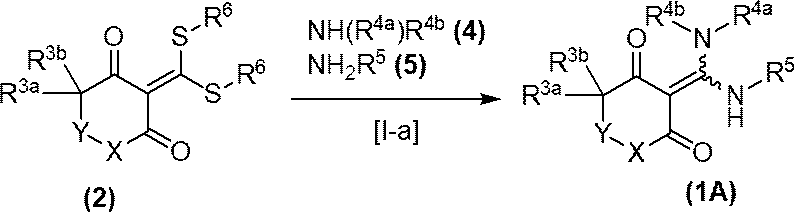
{式中、X、Y,R3a、R3b、R4a、R4b、R5及びR6は、前記と同義を示す。}
工程[I-a]の製造方法
一般式(2)で表される化合物を、不活性溶媒の存在下、塩基の存在又は非存在下、一般式(4)及び一般式(5)で表される化合物と反応させることにより、本発明の一般式(1A)で表される化合物を製造することができる。
一般式(2)で表される化合物を、不活性溶媒の存在下、塩基の存在又は非存在下、一般式(4)及び一般式(5)で表される化合物と反応させることにより、本発明の一般式(1A)で表される化合物を製造することができる。
本反応で使用できる塩基としては、例えば、水酸化リチウム、水酸化ナトリウム、水酸化カリウム、水酸化カルシウム等の水酸化物;ナトリウムメトキサイド、ナトリウムエトキサイド、ナトリウムターシャリーブトキサイド、カリウムターシャリーブトキサイド等のアルコキサイド;水素化ナトリウム、水素化カリウム等のアルカリ金属ヒドリド類;炭酸リチウム、炭酸水素リチウム、炭酸ナトリウム、炭酸水素ナトリウム、炭酸カリウム、炭酸水素カリウム、炭酸カルシウム、炭酸マグネシウム、炭酸セシウム等の炭酸塩;酢酸リチウム、酢酸ナトリウム、酢酸カリウム等の酢酸塩;ピリジン、ピコリン、ルチジン、トリエチルアミン、トリブチルアミン、N,N-ジイソプロピルエチルアミン、1,8-ジアザビシクロ[5.4.0]-7-ウンデセン(DBU)等の有機塩基等を挙げることができ、その使用量は、一般式(2)で表される化合物に対して通常1倍モル~10倍モルの範囲で使用される。
本反応で使用できる不活性溶媒としては、本反応の進行を著しく阻害しないものであれば良く、例えば、ペンタン、ヘキサン、シクロヘキサン等の鎖状又は環状飽和炭化水素類;ベンゼン、トルエン、キシレン等の芳香族炭化水素類;クロロベンゼン、ジクロロベンゼン等のハロゲン化芳香族炭化水素類;ジエチルエーテル、メチルターシャリーブチルエーテル、ジオキサン、テトラヒドロフラン等の鎖状又は環状エーテル類;アセトニトリル、プロピオニトリル等のニトリル類;N,N-ジメチルホルムアミド、N,N-ジメチルアセトアミド、ジメチルスルホキシド、1,3-ジメチル-2-イミダゾリジノン等の非プロトン性極性溶媒;メタノール、エタノール、プロパノール、ブタノール、2-プロパノール等のアルコール類等を挙げることができ、これらの不活性溶媒は単独で又は2種以上混合して使用することができる。その使用量は、一般式(2)で表される化合物1モルに対して通常0.1L~100Lの範囲から適宜選択すればよい。
本反応は等モル反応であるので、各化合物を等モル使用すればよいが、いずれかの化合物を過剰に用いることもできる。本反応における反応温度は、通常約0℃から使用する溶媒の沸点の範囲で行えば良く、反応時間は、反応規模、反応温度等により変化し、一定ではないが、通常数分~48時間の範囲で適宜選択すれば良い。反応終了後、目的物を含む反応系から目的物を常法により単離すれば良く、必要に応じて再結晶、カラムクロマトグラフィー等で精製することにより目的物を製造することができる。
製造方法2
本発明の一般式(1A)で表される化合物は、一般式(3)で表される化合物から、下記工程[I-b]により製造することができる。
本発明の一般式(1A)で表される化合物は、一般式(3)で表される化合物から、下記工程[I-b]により製造することができる。
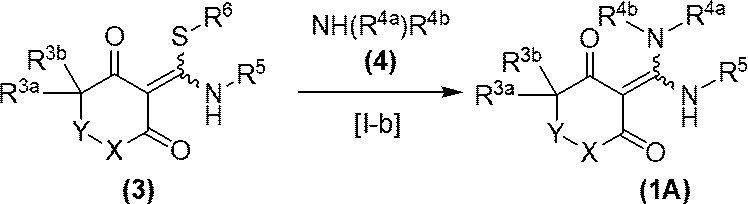
{式中、X、Y、R3a、R3b、R4a、R4b、R5及びR6は、前記と同義を示す。}
工程[I-b]の製造方法
一般式(3)で表される化合物を、不活性溶媒の存在下、塩基の存在又は非存在下、一般式(4)で表される化合物と反応させることにより、一般式(1A)で表される化合物を製造することができる。
一般式(3)で表される化合物を、不活性溶媒の存在下、塩基の存在又は非存在下、一般式(4)で表される化合物と反応させることにより、一般式(1A)で表される化合物を製造することができる。
本反応で使用できる塩基としては、例えば、水酸化リチウム、水酸化ナトリウム、水酸化カリウム、水酸化カルシウム等の水酸化物;ナトリウムメトキサイド、ナトリウムエトキサイド、ナトリウムターシャリーブトキサイド、カリウムターシャリーブトキサイド等のアルコキサイド;水素化ナトリウム、水素化カリウム等のアルカリ金属ヒドリド類;炭酸リチウム、炭酸水素リチウム、炭酸ナトリウム、炭酸水素ナトリウム、炭酸カリウム、炭酸水素カリウム、炭酸カルシウム、炭酸マグネシウム、炭酸セシウム等の炭酸塩;酢酸リチウム、酢酸ナトリウム、酢酸カリウム等の酢酸塩;ピリジン、ピコリン、ルチジン、トリエチルアミン、トリブチルアミン、N,N-ジイソプロピルエチルアミン、DBU等の有機塩基等を挙げることができ、その使用量は、一般式(3)で表される化合物に対して通常1倍モル~10倍モルの範囲で使用される。
本反応で使用できる不活性溶媒としては、本反応の進行を著しく阻害しないものであれば良く、例えば、ペンタン、ヘキサン、シクロヘキサン等の鎖状又は環状飽和炭化水素類;ベンゼン、トルエン、キシレン等の芳香族炭化水素類;クロロベンゼン、ジクロロベンゼン等のハロゲン化芳香族炭化水素類;ジエチルエーテル、メチルターシャリーブチルエーテル、ジオキサン、テトラヒドロフラン等の鎖状又は環状エーテル類;アセトニトリル、プロピオニトリル等のニトリル類;N,N-ジメチルホルムアミド、N,N-ジメチルアセトアミド、ジメチルスルホキシド、1,3-ジメチル-2-イミダゾリジノン等の非プロトン性極性溶媒;メタノール、エタノール、プロパノール、ブタノール、2-プロパノール等のアルコール類等を挙げることができ、これらの不活性溶媒は、単独で又は2種以上混合して使用することができる。その使用量は、一般式(3)で表される化合物1モルに対して通常0.1L~100Lの範囲から適宜選択すればよい。
本反応は、等モル反応であるので、各化合物を等モル使用すればよいが、いずれかの化合物を過剰に用いることもできる。本反応における反応温度は、通常約0℃から使用する溶媒の沸点の範囲で行えば良く、反応時間は、反応規模、反応温度等により変化し、一定ではないが、通常数分~48時間の範囲で適宜選択すれば良い。また、本反応は、マイクロ波照射下で行うこともできる。反応終了後、目的物を含む反応系から目的物を常法により単離すれば良く、必要に応じて再結晶、カラムクロマトグラフィー等で精製することにより目的物を製造することができる。
製造方法3
本発明の一般式(1B)で表される化合物は、本発明の一般式(1A)で表される化合物から、下記工程[I-c]により製造することができる。
本発明の一般式(1B)で表される化合物は、本発明の一般式(1A)で表される化合物から、下記工程[I-c]により製造することができる。

{式中、X、Y、R3a、R3b、R4a、R4b及びR5は、前記と同義を示す。}
工程[I-c]の製造方法
本発明の一般式(1A)で表される化合物を、不活性溶媒の存在下、硫化剤と反応させることにより、一般式(1B)で表される化合物を製造することができる。
本発明の一般式(1A)で表される化合物を、不活性溶媒の存在下、硫化剤と反応させることにより、一般式(1B)で表される化合物を製造することができる。
本反応で使用できる硫化剤としては、例えば、ローソン試薬(Lawesson's Reagent)、五硫化二リン等を挙げることができ、その使用量は、一般式(1A)で表される化合物に対して通常1.0倍モル~10倍モルの範囲で使用される。
本反応は、溶媒を使用しても使用しなくても良いが、本反応で使用できる不活性溶媒としては、本反応の進行を著しく阻害しないものであれば良く、例えば、ペンタン、ヘキサン、シクロヘキサン等の鎖状又は環状飽和炭化水素類;ベンゼン、トルエン、キシレン等の芳香族炭化水素類;クロロベンゼン、ジクロロベンゼン等のハロゲン化芳香族炭化水素類;ジエチルエーテル、メチルターシャリーブチルエーテル、ジオキサン、テトラヒドロフラン等の鎖状又は環状エーテル類;アセトニトリル、プロピオニトリル等のニトリル類;N,N-ジメチルホルムアミド、N,N-ジメチルアセトアミド、ジメチルスルホキシド、1,3-ジメチル-2-イミダゾリジノン等の非プロトン性極性溶媒;メタノール、エタノール、プロパノール、ブタノール、2-プロパノール等のアルコール類等を挙げることができ、これらの不活性溶媒は、単独で又は2種以上混合して使用することができる。その使用量は、一般式(1A)で表される化合物1モルに対して通常0.1L~100Lの範囲から適宜選択すればよい。
本反応における反応温度は、通常約0℃から使用する溶媒の沸点の範囲で行えば良く、反応時間は、反応規模、反応温度等により変化し、一定ではないが、通常数分~48時間の範囲で適宜選択すれば良い。また本反応は、マイクロ波照射下で行うこともできる。反応終了後、目的物を含む反応系から目的物を常法により単離すれば良く、必要に応じて再結晶、カラムクロマトグラフィー等で精製することにより目的物を製造することができる。
製造方法4
本発明の一般式(1C)で表される化合物は、本発明の一般式(1A)で表される化合物から、下記工程[I-d]により製造することができる。
本発明の一般式(1C)で表される化合物は、本発明の一般式(1A)で表される化合物から、下記工程[I-d]により製造することができる。

{式中、X、Y、R3a、R3b、R4a、R4b、R5及びR7は、前記と同義を示す。}
工程[I-d]の製造方法
本発明の一般式(1A)で表される化合物を、一般式(4’)で表される化合物と、ORGANIC FUNCTIONAL GROUP PREPARATIONS III 2nd edition ACADEMIC PRESS,INC.又はGreene’s PROTECTIVE GROUPS in ORGANIC SYNTHESIS FOURTH EDITION(WILEY)に記載の方法又はこれらに準じた方法で反応させることにより、一般式(1C)で表される化合物を製造することができる。反応終了後、目的物を含む反応系から目的物を常法により単離すれば良く、必要に応じて再結晶、カラムクロマトグラフィー等で精製することにより目的物を製造することができる。
本発明の一般式(1A)で表される化合物を、一般式(4’)で表される化合物と、ORGANIC FUNCTIONAL GROUP PREPARATIONS III 2nd edition ACADEMIC PRESS,INC.又はGreene’s PROTECTIVE GROUPS in ORGANIC SYNTHESIS FOURTH EDITION(WILEY)に記載の方法又はこれらに準じた方法で反応させることにより、一般式(1C)で表される化合物を製造することができる。反応終了後、目的物を含む反応系から目的物を常法により単離すれば良く、必要に応じて再結晶、カラムクロマトグラフィー等で精製することにより目的物を製造することができる。
出発原料の製造方法1
本発明の一般式(1A)で表される化合物の出発原料である一般式(2)で表される化合物は、一般式(6)で表される化合物から、下記工程[II-a]により製造することができる。
本発明の一般式(1A)で表される化合物の出発原料である一般式(2)で表される化合物は、一般式(6)で表される化合物から、下記工程[II-a]により製造することができる。
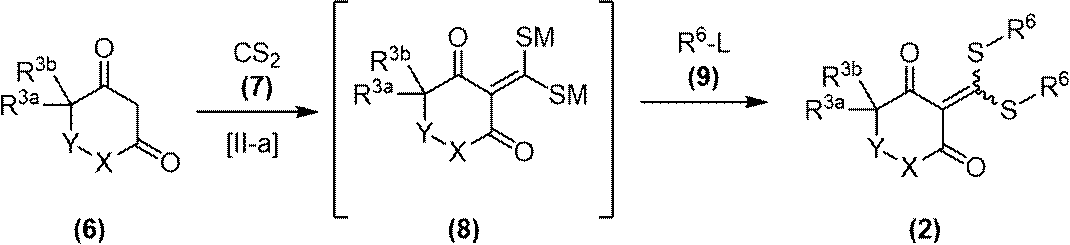
{式中、X、Y、R3a、R3b及びR6は、前記と同義を示す。Lは、例えば、塩素、臭素、ヨウ素、(C1-C6)アルキルカルボニルオキシ基、(C1-C6)アルコキシカルボニルオキシ基等の脱離基を示す。Mは、リチウム原子、ナトリウム原子、カリウム原子等のアルカリ金属原子を示す。}
工程[II-a]の製造方法
特開昭61-57565号公報に記載の製造方法と同様に、一般式(6)で表される化合物と二硫化炭素(7)とを塩基及び不活性溶媒の存在下に反応させることにより、対応するジチオレート塩(8)とし、該化合物を単離又は単離せずして、一般式(9)で表される化合物と反応させることにより、一般式(2)で表される化合物を製造することができる。
特開昭61-57565号公報に記載の製造方法と同様に、一般式(6)で表される化合物と二硫化炭素(7)とを塩基及び不活性溶媒の存在下に反応させることにより、対応するジチオレート塩(8)とし、該化合物を単離又は単離せずして、一般式(9)で表される化合物と反応させることにより、一般式(2)で表される化合物を製造することができる。
本反応で使用できる塩基としては、例えば、炭酸ナトリウム、炭酸カリウム、水酸化ナトリウム、水酸化カリウム等を挙げることができる。これらは固体のまま又は不活性溶媒に溶解させて使用でき、塩基の使用量は、一般式(6)で表される化合物1モルに対して、2倍モルから8倍モルの範囲から選択すれば良く、好ましくは4倍モルから6倍モルである。
本反応で使用できる不活性溶媒としては、本反応の進行を著しく阻害しないものであれば良く、例えば、メタノール、エタノール、イソプロピルアルコール等のアルコール類;ジメチルスルホキシド、N,N-ジメチルホルムアミド、1,3-ジメチル-2-イミダゾリジノン、アセトニトリル等の極性溶媒;水;又はこれらの混合溶媒を用いることができる。不活性溶媒の使用量は、反応が進行する量ならば問題ないが、一般式(6)で表される化合物又は一般式(8)で表される化合物1モルに対して、0.5L~50Lの範囲から適宜選択すればよい。
本反応は等モル反応であるので、各化合物を等モル使用すればよいが、いずれかの化合物を過剰に用いることもできる。本反応における反応温度は、通常約0℃から使用する溶媒の沸点の範囲で行えば良く、反応時間は、反応規模、反応温度等により変化し、一定ではないが、通常数分~48時間の範囲で適宜選択すれば良い。反応終了後、目的物を含む反応系から目的物を常法により単離すれば良く、必要に応じて再結晶、カラムクロマトグラフィー等で精製することにより目的物を製造することができる。また、単離せずに次の工程に供することもできる。
出発原料の製造方法2
本発明の一般式(1A)で表される化合物の出発原料である本発明の一般式(3)で表される化合物は、一般式(6)で表される化合物から、下記工程[III-a]及び[III-b]により製造することができる。
本発明の一般式(1A)で表される化合物の出発原料である本発明の一般式(3)で表される化合物は、一般式(6)で表される化合物から、下記工程[III-a]及び[III-b]により製造することができる。

{式中、X、Y、R3a、R3b、R5及びR6は、前記と同義を示す。Lは、例えば、塩素、臭素、ヨウ素、(C1-C6)アルキルカルボニルオキシ基、(C1-C6)アルコキシカルボニルオキシ基等の脱離基を示す。}
工程[III-a]の製造方法
一般式(6)で表される化合物を、塩基及び不活性溶媒存在下、一般式(10)で表される化合物と反応させることにより、一般式(11)で表される化合物を製造することができる。
一般式(6)で表される化合物を、塩基及び不活性溶媒存在下、一般式(10)で表される化合物と反応させることにより、一般式(11)で表される化合物を製造することができる。
本反応で使用できる塩基としては、例えば、水酸化リチウム、水酸化ナトリウム、水酸化カリウム、水酸化カルシウム等の水酸化物;ナトリウムメトキサイド、ナトリウムエトキサイド、ナトリウムターシャリーブトキサイド、カリウムターシャリーブトキサイド等のアルコキサイド;水素化ナトリウム、水素化カリウム等のアルカリ金属ヒドリド類;炭酸リチウム、炭酸水素リチウム、炭酸ナトリウム、炭酸水素ナトリウム、炭酸カリウム、炭酸水素カリウム、炭酸カルシウム、炭酸マグネシウム、炭酸セシウム等の炭酸塩;酢酸リチウム、酢酸ナトリウム、酢酸カリウム等の酢酸塩;ピリジン、ピコリン、ルチジン、トリエチルアミン、トリブチルアミン、N,N-ジイソプロピルエチルアミン、DBU等の有機塩基等を挙げることができ、その使用量は一般式(6)で表される化合物に対して通常0.5倍モル~10倍モルの範囲で使用される。
本反応で使用できる不活性溶媒としては、本反応の進行を著しく阻害しないものであれば良く、例えば、ペンタン、ヘキサン、シクロヘキサン等の鎖状又は環状飽和炭化水素類;ベンゼン、トルエン、キシレン等の芳香族炭化水素類;塩化メチレン、クロロホルム、四塩化炭素等のハロゲン化炭化水素類;クロロベンゼン、ジクロロベンゼン等のハロゲン化芳香族炭化水素類;ジエチルエーテル、メチルターシャリーブチルエーテル、ジオキサン、テトラヒドロフラン等の鎖状又は環状エーテル類;アセトニトリル、プロピオニトリル等のニトリル類、N,N-ジメチルホルムアミド、N,N-ジメチルアセトアミド、ジメチルスルホキシド、1,3-ジメチル-2-イミダゾリジノン等の非プロトン性極性溶媒;メタノール、エタノール、プロパノール、ブタノール、2-プロパノール等のアルコール類等を挙げることができ、これらの不活性溶媒は、単独で又は2種以上混合して使用することができる。その使用量は、一般式(6)で表される化合物1モルに対して通常0.1L~100Lの範囲から適宜選択すればよい。
本反応は等モル反応であるので、各化合物を等モル使用すればよいが、いずれかの化合物を過剰に用いることもできる。本反応における反応温度は、通常約0℃から使用する溶媒の沸点の範囲で行えば良く、反応時間は、反応規模、反応温度等により変化し、一定ではないが、通常数分~48時間の範囲で適宜選択すれば良い。反応終了後、目的物を含む反応系から目的物を常法により単離すれば良く、必要に応じて再結晶、カラムクロマトグラフィー等で精製することにより目的物を製造することができる。また、単離せずに次の工程に供することもできる。
工程[III-b]の製造方法
一般式(11)で表される化合物を、塩基及び不活性溶媒存在下、一般式(9)で表される化合物と反応させることにより、一般式(3)で表される化合物を製造することができる。
一般式(11)で表される化合物を、塩基及び不活性溶媒存在下、一般式(9)で表される化合物と反応させることにより、一般式(3)で表される化合物を製造することができる。
本反応で使用できる塩基としては、例えば、水酸化ナトリウム、水酸化カリウム等のアルカリ金属原子の水酸化物;水素化ナトリウム、水素化カリウム等のアルカリ金属の水素化物;ナトリウムエトキシド、カリウムt-ブトキシド等のアルコキサイド;炭酸ナトリウム、炭酸カリウム、炭酸セシウム、炭酸水素ナトリウム等の炭酸塩等の無機塩基、トリエチルアミン、ピリジン、N,N-ジメチル-4-アミノピリジン、DBU等の有機塩基等を挙げることができ、その使用量は、一般式(11)で表される化合物に対して通常1倍モル~10倍モルの範囲で使用される。
本反応で使用できる不活性溶媒としては、本反応の進行を著しく阻害しないものであれば良く、例えば、ペンタン、ヘキサン、シクロヘキサン等の鎖状又は環状飽和炭化水素類;ベンゼン、トルエン、キシレン等の芳香族炭化水素類;塩化メチレン、クロロホルム、四塩化炭素等のハロゲン化炭化水素類;クロロベンゼン、ジクロロベンゼン等のハロゲン化芳香族炭化水素類;ジエチルエーテル、メチルターシャリーブチルエーテル、ジオキサン、テトラヒドロフラン等の鎖状又は環状エーテル類;アセトニトリル、プロピオニトリル等のニトリル類;酢酸メチル等のエステル類;アセトン、メチルエチルケトン等のケトン類;N,N-ジメチルホルムアミド、N,N-ジメチルアセトアミド、ジメチルスルホキシド、1,3-ジメチル-2-イミダゾリジノン等の非プロトン性極性溶媒;メタノール、エタノール、プロパノール、ブタノール、2-プロパノール等のアルコール類等を挙げることができ、これらの不活性溶媒は単独で又は2種以上混合して使用することができる。その使用量は、一般式(11)で表される化合物1モルに対して通常0.1L~100Lの範囲から適宜選択すればよい。
本反応は、等モル反応であるので、各化合物を等モル使用すればよいが、いずれかの化合物を過剰に用いることもできる。本反応における反応温度は、通常0℃から使用する溶媒の沸点の範囲で行えば良く、反応時間は、反応規模、反応温度等により変化し、一定ではないが、通常数分~48時間の範囲で適宜選択すれば良い。反応終了後、目的物を含む反応系から目的物を常法により単離すれば良く、必要に応じて再結晶、カラムクロマトグラフィー等で精製することにより目的物を製造することができる。また、単離せずに次の工程に供することもできる。
出発原料の製造方法3
一般式(6)で表される化合物において、XがCR1aR1b(式中、R1a及びR1bは、前記と同義を示す。)であり、YがCR2aR2b(式中、R2a及びR2bは、前記と同義を示す。)である化合物は、Journal of the Chemical Society,539-540(1935)、又はBioorganic & Medicinal Chemistry(2012),20,1029-1045に記載の方法により、又はこれらに準じて製造することができる。
一般式(6)で表される化合物において、XがCR1aR1b(式中、R1a及びR1bは、前記と同義を示す。)であり、YがCR2aR2b(式中、R2a及びR2bは、前記と同義を示す。)である化合物は、Journal of the Chemical Society,539-540(1935)、又はBioorganic & Medicinal Chemistry(2012),20,1029-1045に記載の方法により、又はこれらに準じて製造することができる。
出発原料の製造方法4
一般式(6)で表される化合物において、Xが酸素原子であり、YがCR2aR2b(式中、R2a及びR2bは、前記と同義を示す。)である化合物は、国際公開第2008/014311号に記載の方法により、又はこれに準じて製造することができる。
一般式(6)で表される化合物において、Xが酸素原子であり、YがCR2aR2b(式中、R2a及びR2bは、前記と同義を示す。)である化合物は、国際公開第2008/014311号に記載の方法により、又はこれに準じて製造することができる。
出発原料の製造方法5
一般式(6)で表される化合物において、XがNR1c(式中、R1cは、前記と同義を示す。)であり、YがCR2aR2b(式中、R2a及びR2bは、前記と同義を示す。)であり、R3a及びR3bが水素原子である、一般式(6A)で表される化合物は、一般式(12)で表される化合物から、下記工程[V-a]により製造することができる。なお、一般式(12)で表される化合物は、国際公開第2021/261562号に記載の方法により、又はこれに準じて製造することができる。
一般式(6)で表される化合物において、XがNR1c(式中、R1cは、前記と同義を示す。)であり、YがCR2aR2b(式中、R2a及びR2bは、前記と同義を示す。)であり、R3a及びR3bが水素原子である、一般式(6A)で表される化合物は、一般式(12)で表される化合物から、下記工程[V-a]により製造することができる。なお、一般式(12)で表される化合物は、国際公開第2021/261562号に記載の方法により、又はこれに準じて製造することができる。
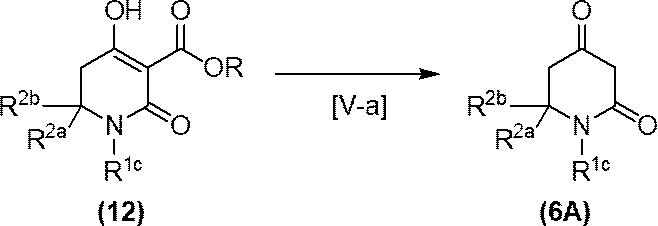
{式中、R1c、R2a及びR2bは、前記と同義を示す。Rは、例えば、メチル基、エチル基等の(C1-C6)アルキル基を示す。}
工程[V-a]の製造方法
一般式(12)で表される化合物を、不活性溶媒の存在下、塩基の存在又は非存在下、加熱条件で反応させることにより、一般式(6A)で表される化合物を製造することができる。
一般式(12)で表される化合物を、不活性溶媒の存在下、塩基の存在又は非存在下、加熱条件で反応させることにより、一般式(6A)で表される化合物を製造することができる。
本反応で使用できる塩基としては、例えば、水酸化リチウム、水酸化ナトリウム、水酸化カリウム、水酸化カルシウム等の水酸化物;ナトリウムメトキサイド、ナトリウムエトキサイド、ナトリウムターシャリーブトキサイド、カリウムターシャリーブトキサイド等のアルコキサイド;水素化ナトリウム、水素化カリウム等のアルカリ金属ヒドリド類;炭酸リチウム、炭酸水素リチウム、炭酸ナトリウム、炭酸水素ナトリウム、炭酸カリウム、炭酸水素カリウム、炭酸カルシウム、炭酸マグネシウム、炭酸セシウム等の炭酸塩;酢酸リチウム、酢酸ナトリウム、酢酸カリウム等の酢酸塩;ピリジン、ピコリン、ルチジン、トリエチルアミン、トリブチルアミン、N,N-ジイソプロピルエチルアミン、DBU等の有機塩基等を挙げることができ、その使用量は、一般式(12)で表される化合物に対して通常1倍モル~10倍モルの範囲で使用される。
本反応で使用できる不活性溶媒としては、本反応の進行を著しく阻害しないものであれば良く、例えば、ペンタン、ヘキサン、シクロヘキサン等の鎖状又は環状飽和炭化水素類;ベンゼン、トルエン、キシレン等の芳香族炭化水素類;クロロベンゼン、ジクロロベンゼン等のハロゲン化芳香族炭化水素類;ジエチルエーテル、メチルターシャリーブチルエーテル、ジオキサン、テトラヒドロフラン等の鎖状又は環状エーテル類;アセトニトリル、プロピオニトリル等のニトリル類;N,N-ジメチルホルムアミド、N,N-ジメチルアセトアミド、ジメチルスルホキシド、1,3-ジメチル-2-イミダゾリジノン等の非プロトン性極性溶媒;メタノール、エタノール、プロパノール、ブタノール、2-プロパノール等のアルコール類;水等を挙げることができ、これらの不活性溶媒は、単独で又は2種以上混合して使用することができる。その使用量は、一般式(12)で表される化合物1モルに対して通常0.1L~100Lの範囲から適宜選択すればよい。
本反応における反応温度は、通常約0℃から使用する溶媒の沸点の範囲で行えば良いが、溶媒の沸点の加熱条件が好ましく、反応時間は、反応規模、反応温度等により変化し、一定ではないが、通常数分~48時間の範囲で適宜選択すれば良い。反応終了後、目的物を含む反応系から目的物を常法により単離すれば良く、必要に応じて再結晶、カラムクロマトグラフィー等で精製することにより目的物を製造することができる。また、単離せずに次の工程に供することもできる。
出発原料の製造方法6
一般式(6B)で表される化合物は、一般式(13)で表される化合物から、下記工程[VI-a]、[VI-b]、[VI-c]、[VI-d]、[VI-e]、[VI-f]、及び[VI-g]により製造することができる。なお、工程[VI-g]の反応条件は、前記工程[V-a]に同じである。
一般式(6B)で表される化合物は、一般式(13)で表される化合物から、下記工程[VI-a]、[VI-b]、[VI-c]、[VI-d]、[VI-e]、[VI-f]、及び[VI-g]により製造することができる。なお、工程[VI-g]の反応条件は、前記工程[V-a]に同じである。

{式中、R3a及びR3bは、前記と同義を示す。R1c’は、(C1-C6)アルキル基、(C2-C6)アルケニル基、(C2-C6)アルキニル基、(C3-C6)シクロアルキル基、ハロ(C1-C6)アルキル基、ハロ(C2-C6)アルケニル基、ハロ(C2-C6)アルキニル基、ハロ(C3-C6)シクロアルキル基、置換基群A又は置換基群A0からそれぞれ独立に選択される1乃至3個の置換基を有する(C1-C6)アルキル基(置換基群A又は置換基群A0は、前記と同義を示す)、(C1-C6)アルキルカルボニル基、(C1-C6)アルコキシカルボニル基、(C1-C6)アルコキシ(C1-C6)アルコキシカルボニル基、フェニル基、置換基群B又は置換基群B0からそれぞれ独立に選択される1乃至5個の置換基を有するフェニル基(置換基群B又は置換基群B0は、前記と同義を示す)、ピリジル基、置換基群B又は置換基群B0からそれぞれ独立に選択される1乃至4個の置換基を有するピリジル基(置換基群B又は置換基群B0は、前記と同義を示す)、ピリダジニル基、置換基群B又は置換基群B0からそれぞれ独立に選択される1乃至3個の置換基を有するピリダジニル基(置換基群B又は置換基群B0は、前記と同義を示す)、ピリミジニル基、置換基群B又は置換基群B0からそれぞれ独立に選択される1乃至3個の置換基を有するピリミジニル基(置換基群B又は置換基群B0は、前記と同義を示す)、ピラジニル基、置換基群B又は置換基群B0からそれぞれ独立に選択される1乃至3個の置換基を有するピラジニル基(置換基群B又は置換基群B0は、前記と同義を示す)、フェニル(C1-C6)アルキル基、置換基群B又は置換基群B0からそれぞれ独立に選択される1乃至5個の置換基を有するフェニル(C1-C6)アルキル基(置換基群B又は置換基群B0は、前記と同義を示す)、ピリジル(C1-C6)アルキル基、置換基群B又は置換基群B0からそれぞれ独立に選択される1乃至4個の置換基を有するピリジル(C1-C6)アルキル基(置換基群B又は置換基群B0は、前記と同義を示す)、チアゾリル(C1-C6)アルキル基、又は、置換基群B又は置換基群B0からそれぞれ独立に選択される1乃至2個の置換基を有するチアゾリル(C1-C6)アルキル基(置換基群B又は置換基群B0は、前記と同義を示す)を示す。R及びR’は、例えば、メチル基、エチル基等の(C1-C6)アルキル基を示す。Lは、例えば、塩素、臭素、ヨウ素、(C1-C6)アルキルカルボニルオキシ基、(C1-C6)アルコキシカルボニルオキシ基等の脱離基を示す。Bocは、ターシャリーブトキシカルボニル基を示す。}
工程[VI-a]の製造方法
一般式(13)で表される化合物を、塩基及び不活性溶媒存在下、一般式(14)で表される化合物と反応させることにより、一般式(15)で表される化合物を製造することができる。
一般式(13)で表される化合物を、塩基及び不活性溶媒存在下、一般式(14)で表される化合物と反応させることにより、一般式(15)で表される化合物を製造することができる。
本反応で使用できる塩基としては、例えば、水酸化ナトリウム、水酸化カリウム等の水酸化物;水素化ナトリウム、水素化カリウム等のアルカリ金属ヒドリド類;ナトリウムエトキシド、カリウムt-ブトキシド等のアルコキサイド;炭酸ナトリウム、炭酸カリウム、炭酸セシウム、炭酸水素ナトリウム等の炭酸塩;トリエチルアミン、N,N-ジイソプロピルエチルアミン、ピリジン、DBU等の有機塩基等を挙げることができ、その使用量は、一般式(13)で表される化合物に対して通常1倍モル~10倍モルの範囲で使用される。
本反応で使用できる不活性溶媒としては、本反応の進行を著しく阻害しないものであれば良く、例えば、ペンタン、ヘキサン、シクロヘキサン等の鎖状又は環状飽和炭化水素類;ベンゼン、トルエン、キシレン等の芳香族炭化水素類;塩化メチレン、クロロホルム、四塩化炭素等のハロゲン化炭化水素類;クロロベンゼン、ジクロロベンゼン等のハロゲン化芳香族炭化水素類;ジエチルエーテル、メチルターシャリーブチルエーテル、ジオキサン、テトラヒドロフラン等の鎖状又は環状エーテル類;アセトニトリル、プロピオニトリル等のニトリル類;酢酸メチル等のエステル類;アセトン、メチルエチルケトン等のケトン類;N,N-ジメチルホルムアミド、N,N-ジメチルアセトアミド、ジメチルスルホキシド、1,3-ジメチル-2-イミダゾリジノン等の非プロトン性極性溶媒;メタノール、エタノール、プロパノール、ブタノール、2-プロパノール等のアルコール類等を挙げることができ、これらの不活性溶媒は、単独で又は2種以上混合して使用することができる。その使用量は、一般式(13)で表される化合物1モルに対して通常0.1L~100Lの範囲から適宜選択すればよい。
本反応は等モル反応であるので、各化合物を等モル使用すればよいが、いずれかの化合物を過剰に用いることもできる。本反応における反応温度は、通常0℃から使用する溶媒の沸点の範囲で行えば良く、反応時間は、反応規模、反応温度等により変化し、一定ではないが、通常数分~48時間の範囲で適宜選択すれば良い。反応終了後、目的物を含む反応系から目的物を常法により単離すれば良く、必要に応じて再結晶、カラムクロマトグラフィー等で精製することにより目的物を製造することができる。また、単離せずに次の工程に供することもできる。
工程[VI-b]の製造方法
一般式(15)で表される化合物を、金属ハロゲン化物、還元剤及び不活性溶媒存在下、二炭酸ジターシャリーブチルと反応させることにより、一般式(16)で表される化合物を製造することができる。
一般式(15)で表される化合物を、金属ハロゲン化物、還元剤及び不活性溶媒存在下、二炭酸ジターシャリーブチルと反応させることにより、一般式(16)で表される化合物を製造することができる。
本反応で使用できる金属ハロゲン化物としては、例えば、塩化リチウム、臭化リチウム、ヨウ化リチウム、塩化ナトリウム、臭化ナトリウム、ヨウ化ナトリウム、塩化カリウム、臭化カリウム、ヨウ化カリウム、塩化セシウム、臭化セシウム、ヨウ化セシウム、塩化コバルト等を挙げることができ、その使用量は、一般式(15)で表される化合物に対して通常1倍モル~10倍モルの範囲で使用される。
本反応で使用できる還元剤としては、例えば、水素化ホウ素ナトリウム、水素化シアノホウ素ナトリウム、水素化ビス(2-メトキシエトキシ)アルミニウムナトリウム、水素/パラジウム炭素、水素/ラネーニッケル等を挙げることができ、その使用量は、一般式(15)で表される化合物に対して通常0.5倍モル~10倍モルの範囲で使用される。
本反応で使用できる不活性溶媒としては、本反応の進行を著しく阻害しないものであれば良く、例えば、ペンタン、ヘキサン、シクロヘキサン等の鎖状又は環状飽和炭化水素類;ベンゼン、トルエン、キシレン等の芳香族炭化水素類;塩化メチレン、クロロホルム、四塩化炭素等のハロゲン化炭化水素類;クロロベンゼン、ジクロロベンゼン等のハロゲン化芳香族炭化水素類;ジエチルエーテル、メチルターシャリーブチルエーテル、ジオキサン、テトラヒドロフラン等の鎖状又は環状エーテル類;アセトニトリル、プロピオニトリル等のニトリル類;酢酸メチル等のエステル類;アセトン、メチルエチルケトン等のケトン類;N,N-ジメチルホルムアミド、N,N-ジメチルアセトアミド、ジメチルスルホキシド、1,3-ジメチル-2-イミダゾリジノン等の非プロトン性極性溶媒;メタノール、エタノール、プロパノール、ブタノール、2-プロパノール等のアルコール類等を挙げることができ、これらの不活性溶媒は、単独で又は2種以上混合して使用することができる。その使用量は、一般式(15)で表される化合物1モルに対して通常0.1L~100Lの範囲から適宜選択すればよい。
本反応は等モル反応であるので、各化合物を等モル使用すればよいが、いずれかの化合物を過剰に用いることもできる。本反応における反応温度は、通常0℃から使用する溶媒の沸点の範囲で行えば良く、反応時間は、反応規模、反応温度等により変化し、一定ではないが、通常数分~96時間の範囲で適宜選択すれば良い。反応終了後、目的物を含む反応系から目的物を常法により単離すれば良く、必要に応じて再結晶、カラムクロマトグラフィー等で精製することにより目的物を製造することができる。また、単離せずに次の工程に供することもできる。
工程[VI-c]の製造方法
一般式(16)で表される化合物を、塩基及び不活性溶媒存在下、一般式(17)で表される化合物と反応させることにより、一般式(18)で表される化合物を製造することができる。なお、工程[VI-c]の反応条件は、前記工程[VI-a]に同じである。
一般式(16)で表される化合物を、塩基及び不活性溶媒存在下、一般式(17)で表される化合物と反応させることにより、一般式(18)で表される化合物を製造することができる。なお、工程[VI-c]の反応条件は、前記工程[VI-a]に同じである。
工程[VI-d]の製造方法
一般式(18)で表される化合物を、酸存在下、不活性溶媒の存在又は非存在下、加水分解させることにより、一般式(19)で表される化合物又はその塩を製造することができる。
一般式(18)で表される化合物を、酸存在下、不活性溶媒の存在又は非存在下、加水分解させることにより、一般式(19)で表される化合物又はその塩を製造することができる。
本反応で使用できる酸としては、例えば、塩酸、硫酸、硝酸等の無機酸;ギ酸、酢酸、プロピオン酸、トリフルオロ酢酸、安息香酸等の有機酸;メタンスルホン酸、トリフルオロメタンスルホン酸、パラトルエンスルホン酸等のスルホン酸;リン酸等を挙げることができ、その使用量は、一般式(18)で表される化合物に対して0.01倍モル~10倍モルの範囲から適宜選択すればよいが、当該酸を溶媒として使用することもできる。
本反応に使用できる不活性溶媒としては、本反応の進行を著しく阻害しないものであれば良く、例えば、ベンゼン、トルエン、キシレン等の芳香族炭化水素類;塩化メチレン、クロロホルム、四塩化炭素等のハロゲン化炭化水素類;クロロベンゼン、ジクロロベンゼン等のハロゲン化芳香族炭化水素類;ジエチルエーテル、メチルターシャリーブチルエーテル、ジオキサン、テトラヒドロフラン等の鎖状又は環状エーテル類;酢酸エチル等のエステル類;N,N-ジメチルホルムアミド、N,N-ジメチルアセトアミド等のアミド類;アセトン、メチルエチルケトン等のケトン類;ジメチルスルホキシド、1,3-ジメチル-2-イミダゾリジノン等の極性溶媒等の不活性溶媒を挙げることができ、これらの不活性溶媒は、単独で又は2種以上混合して使用することができる。不活性溶媒の使用量は、反応試薬を溶解させる量であれば特に限定されないが、一般式(18)で表される化合物1モルに対して0.5L~100Lの範囲から適宜選択すればよい。また、前記酸を溶媒として使用する場合は溶媒を使用しなくてもよい。
本反応における反応温度は、室温から使用する不活性溶媒の沸点域で行うことができ、反応時間は、反応規模、反応温度により一定しないが、数分~48時間の範囲から適宜選択すればよい。反応終了後、目的物を含む反応系から目的物を常法により単離すれば良く、必要に応じて再結晶、カラムクロマトグラフィー等で精製することにより目的物を製造することができる。また、単離せずに次の工程に供することもできる。
工程[VI-e]の製造方法
一般式(19)で表される化合物又はその塩を、塩基及び縮合剤存在下、不活性溶媒の存在又は非存在下、一般式(20)で表される化合物と反応させることにより、一般式(21)で表される化合物を製造することができる。
一般式(19)で表される化合物又はその塩を、塩基及び縮合剤存在下、不活性溶媒の存在又は非存在下、一般式(20)で表される化合物と反応させることにより、一般式(21)で表される化合物を製造することができる。
本反応で使用できる縮合剤としては、例えば、ホスゲン、三塩化リン、オキシ塩化リン、オキサリルクロライド、塩化チオニル等の酸活性化試薬;N,N’-ジシクロヘキシルカルボジイミド(DCC)、1-(3-ジメチルアミノプロピル)-3-エチルカルボジイミド(EDCI)等のカルボジイミド類;その他、五酸化リン、ポリリン酸、N,N’-カルボニルジイミダゾール、2-クロロピリジン1-メトヨージド(向山試薬)、2-エトキシ-N-エトキシカルボニル-1,2-ジヒドロキノリン(EEDQ)、トリフェニルホスフィン/四塩化炭素、ブロモトリピロリジノホスホニウムヘキサフルオロホスフェート(BROP)、O-(1H-ベンゾトリアゾール-1-イルオキシ)トリス(ジメチルアミノ)ホスホニウムヘキサフルオロホスフェート(BOP)、N,N,N’,N’-ビス(テトラメチレン)クロロウロニウムテトラフルオロボレート、O-(1H-ベンゾトリアゾール-1-イル)-N,N,N’,N’-テトラメチルウロニウムヘキサフルオロホスフェート(HBTU)、O-(1H-ベンゾトリアゾール-1-イル)-N,N,N’,N’-ビス(テトラメチレン)ウロニウムヘキサフルオロホスフェート、O-(1H-ベンゾトリアゾール-1-イル)-N,N,N’,N’-テトラメチルウロニウムテトラフルオロボレート(TBTU)、O-(1H-ベンゾトリアゾール-1-イル)-N,N,N’,N’-ビス(テトラメチレン)ウロニウムテトラフルオロボレート、O-(7-アザベンゾトリアゾール-1-イル)-N,N,N’,N’-テトラメチルウロニウムヘキサフルオロホスフェート(HATU)、1-ヒドロキシベンゾトリアゾール(HOBt)、プロピルホスホン酸無水物(T3P)、4-(4,6-ジメトキシ-1,3,5-トリアジン-2-イル)-4-メチルモルホリニウム塩(DMT-MM)等を挙げることができ、これらの試薬は、単独で又は2種以上混合して使用することができる。縮合剤の使用量は、一般式(19)で表される化合物に対して0.5倍モル~5倍モルの範囲から適宜選択すればよい。
本反応で使用できる塩基としては、例えば、炭酸リチウム、炭酸水素リチウム、炭酸ナトリウム、炭酸水素ナトリウム、炭酸カリウム、炭酸水素カリウム、炭酸セシウム、炭酸カルシウム、炭酸マグネシウム等の炭酸塩;酢酸リチウム、酢酸ナトリウム、酢酸カリウム等の酢酸塩;ピリジン、ピコリン、ルチジン、トリエチルアミン、トリブチルアミン、N,N-ジイソプロピルエチルアミン、N,N-ジメチル-4-アミノピリジン、DBU等の有機塩基等を挙げることができ、塩基の使用量は、一般式(19)で表される化合物に対して0.5倍モル~5倍モルの範囲から適宜選択すればよいが、当該塩基を溶媒として使用することもできる。
本反応で使用できる不活性溶媒としては、本反応の進行を著しく阻害しないものであれば良く、例えば、ペンタン、ヘキサン、シクロヘキサン等の鎖状又は環状飽和炭化水素類;ジエチルエーテル、テトラヒドロフラン(THF)、ジオキサン等の鎖状又は環状エーテル類;ベンゼン、トルエン、キシレン等の芳香族炭化水素類;塩化メチレン、クロロホルム、四塩化炭素等のハロゲン化炭化水素類;アセトニトリル、イソプロピルニトリル等のニトリル類;N,N-ジメチルホルムアミド、N,N-ジメチルアセトアミド、ジメチルスルホキシド、1,3-ジメチル-2-イミダゾリジノン等の極性溶媒等を挙げることができ、これらの不活性溶媒は、単独で又は2種以上混合して使用することもできる。不活性溶媒の使用量は、反応試薬を溶解させる量であれば特に限定されないが、一般式(19)で表される化合物1モルに対して0.5L~100Lの範囲から適宜選択すればよい。また、前記塩基を溶媒として使用する場合は、溶媒を使用しなくてもよい。
本反応は、等モル反応であるので、各化合物を等モル使用すればよいが、いずれかの化合物を過剰に用いることもできる。本反応における反応温度は、通常約0℃から使用する溶媒の沸点の範囲で行えば良く、反応時間は、反応規模、反応温度等により変化し、一定ではないが、通常数分~48時間の範囲で適宜選択すれば良い。反応終了後、目的物を含む反応系から目的物を常法により単離すれば良く、必要に応じて再結晶、カラムクロマトグラフィー等で精製することにより目的物を製造することができる。また、単離せずに次の工程に供することもできる。
工程[VI-f]の製造方法
一般式(21)で表される化合物を、塩基及び不活性溶媒存在下で環化反応を行うことにより、一般式(22)で表される化合物を製造することができる。
一般式(21)で表される化合物を、塩基及び不活性溶媒存在下で環化反応を行うことにより、一般式(22)で表される化合物を製造することができる。
本反応で使用できる塩基としては、例えば、水酸化リチウム、水酸化ナトリウム、水酸化カリウム、水酸化カルシウム等の水酸化物;ナトリウムメトキサイド、ナトリウムエトキサイド、ナトリウムターシャリーブトキサイド、カリウムターシャリーブトキサイド等のアルコキサイド;炭酸リチウム、炭酸水素リチウム、炭酸ナトリウム、炭酸水素ナトリウム、炭酸カリウム、炭酸水素カリウム、炭酸セシウム、炭酸カルシウム、炭酸マグネシウム等の炭酸塩;酢酸リチウム、酢酸ナトリウム、酢酸カリウム等の酢酸塩;ピリジン、ピコリン、ルチジン、トリエチルアミン、トリブチルアミン、N,N-ジイソプロピルエチルアミン、DBU等の有機塩基等を挙げることができ、その使用量は、一般式(21)で表される化合物に対して通常1倍モル~10倍モルの範囲で使用される。
本反応で使用出来る不活性溶媒としては、本反応の進行を著しく阻害しないものであれば良く、例えば、ペンタン、ヘキサン、シクロヘキサン等の鎖状又は環状飽和炭化水素類;ベンゼン、トルエン、キシレン等の芳香族炭化水素類;クロロベンゼン、ジクロロベンゼン等のハロゲン化芳香族炭化水素類;ジエチルエーテル、メチルターシャリーブチルエーテル、ジオキサン、テトラヒドロフラン等の鎖状又は環状エーテル類;アセトニトリル、プロピオニトリル等のニトリル類;N,N-ジメチルホルムアミド、N,N-ジメチルアセトアミド、ジメチルスルホキシド、1,3-ジメチル-2-イミダゾリジノン等の非プロトン性極性溶媒;メタノール、エタノール、プロパノール、ブタノール、2-プロパノール等のアルコール類等を挙げることができ、これらの不活性溶媒は、単独で又は2種以上混合して使用することができる。その使用量は、一般式(21)で表される化合物1モルに対して通常0.1L~100Lの範囲から適宜選択すればよい。
本反応は等モル反応であるので、各化合物を等モル使用すればよいが、いずれかの化合物を過剰に用いることもできる。本反応における反応温度は、通常約0℃から使用する溶媒の沸点の範囲で行えば良く、反応時間は、反応規模、反応温度等により変化し、一定ではないが、通常数分~48時間の範囲で適宜選択すれば良い。反応終了後、目的物を含む反応系から目的物を常法により単離すれば良く、必要に応じて再結晶、カラムクロマトグラフィー等で精製することにより目的物を製造することができる。また、単離せずに次の工程に供することもできる。
出発原料の製造方法7
一般式(6)で表される化合物において、XがCH2であり、YがNR2c(式中、R2cは、前記と同義を示す。)であり、R3a及びR3bが水素原子である、一般式(6C)で表される化合物は、一般式(23)で表される化合物から、下記工程[VII-a]、[VII-b]、[VII-c]、[VII-d]及び[VII-e]により製造することができる。なお、工程[VII-c]の反応条件は、前記工程[VI-d]に同じである。また、一般式(6C)で表される化合物は、国際公開第2006/003096号、又は国際公開第2007/051062号に記載の方法により、又はこれに準じて製造することもできる。
一般式(6)で表される化合物において、XがCH2であり、YがNR2c(式中、R2cは、前記と同義を示す。)であり、R3a及びR3bが水素原子である、一般式(6C)で表される化合物は、一般式(23)で表される化合物から、下記工程[VII-a]、[VII-b]、[VII-c]、[VII-d]及び[VII-e]により製造することができる。なお、工程[VII-c]の反応条件は、前記工程[VI-d]に同じである。また、一般式(6C)で表される化合物は、国際公開第2006/003096号、又は国際公開第2007/051062号に記載の方法により、又はこれに準じて製造することもできる。

{式中、R2cは、前記と同義を示す。R’は、例えば、メチル基、エチル基等の(C1-C6)アルキル基を示す。Lは、例えば、塩素、臭素、ヨウ素、(C1-C6)アルキルカルボニルオキシ基、(C1-C6)アルコキシカルボニルオキシ基等の脱離基を示す。}
工程[VII-a]の製造方法
一般式(23)で表される化合物を、塩基の存在下、不活性溶媒の存在又は非存在下、二炭酸ジターシャリーブチルと反応させることにより、一般式(24)で表される化合物を製造することができる。
一般式(23)で表される化合物を、塩基の存在下、不活性溶媒の存在又は非存在下、二炭酸ジターシャリーブチルと反応させることにより、一般式(24)で表される化合物を製造することができる。
本反応で使用できる塩基としては、例えば、水酸化リチウム、水酸化ナトリウム、水酸化カリウム、水酸化カルシウム等の水酸化物;ナトリウムメトキサイド、ナトリウムエトキサイド、ナトリウムターシャリーブトキサイド、カリウムターシャリーブトキサイド等のアルコキサイド;水素化ナトリウム、水素化カリウム等のアルカリ金属ヒドリド類;炭酸リチウム、炭酸水素リチウム、炭酸ナトリウム、炭酸水素ナトリウム、炭酸カリウム、炭酸水素カリウム、炭酸カルシウム、炭酸マグネシウム、炭酸セシウム等の炭酸塩;酢酸リチウム、酢酸ナトリウム、酢酸カリウム等の酢酸塩;ピリジン、ピコリン、ルチジン、トリエチルアミン、トリブチルアミン、N,N-ジイソプロピルエチルアミン、DBU等の有機塩基等を挙げることができ、その使用量は、一般式(23)で表される化合物に対して通常1倍モル~10倍モルの範囲から適宜選択すればよいが、当該塩基を溶媒として使用することもできる。
本反応で使用できる不活性溶媒としては、本反応の進行を著しく阻害しないものであれば良く、例えば、ペンタン、ヘキサン、シクロヘキサン等の鎖状又は環状飽和炭化水素類;ベンゼン、トルエン、キシレン等の芳香族炭化水素類;塩化メチレン、クロロホルム、四塩化炭素等のハロゲン化炭化水素類;クロロベンゼン、ジクロロベンゼン等のハロゲン化芳香族炭化水素類;ジエチルエーテル、メチルターシャリーブチルエーテル、ジオキサン、テトラヒドロフラン等の鎖状又は環状エーテル類;アセトニトリル、プロピオニトリル等のニトリル類;酢酸メチル等のエステル類;アセトン、メチルエチルケトン等のケトン類;N,N-ジメチルホルムアミド、N,N-ジメチルアセトアミド、ジメチルスルホキシド、1,3-ジメチル-2-イミダゾリジノン等の非プロトン性極性溶媒;メタノール、エタノール、プロパノール、ブタノール、2-プロパノール等のアルコール類等を挙げることができ、これらの不活性溶媒は、単独で又は2種以上混合して使用することができる。その使用量は、一般式(23)で表される化合物1モルに対して通常0.1L~100Lの範囲から適宜選択すればよい。また、前記塩基を溶媒として使用する場合は、溶媒を使用しなくてもよい。
本反応は等モル反応であるので、各化合物を等モル使用すればよいが、いずれかの化合物を過剰に用いることもできる。本反応における反応温度は、通常-100℃から使用する溶媒の沸点の範囲で行えば良く、反応時間は、反応規模、反応温度等により変化し、一定ではないが、通常数分~48時間の範囲で適宜選択すれば良い。反応終了後、目的物を含む反応系から目的物を常法により単離すれば良く、必要に応じて再結晶、カラムクロマトグラフィー等で精製することにより目的物を製造することができる。また、単離せずに次の工程に供することもできる。
工程[VII-b]の製造方法
一般式(24)で表される化合物を、塩基及び不活性溶媒存在下、一般式(25)で表される化合物と反応させることにより、一般式(26)で表される化合物を製造することができる。
一般式(24)で表される化合物を、塩基及び不活性溶媒存在下、一般式(25)で表される化合物と反応させることにより、一般式(26)で表される化合物を製造することができる。
本反応で使用できる塩基としては、例えば、水酸化リチウム、水酸化ナトリウム、水酸化カリウム、水酸化カルシウム等の水酸化物;ナトリウムメトキサイド、ナトリウムエトキサイド、ナトリウムターシャリーブトキサイド、カリウムターシャリーブトキサイド等のアルコキサイド;水素化ナトリウム、水素化カリウム等のアルカリ金属ヒドリド類;炭酸リチウム、炭酸水素リチウム、炭酸ナトリウム、炭酸水素ナトリウム、炭酸カリウム、炭酸水素カリウム、炭酸カルシウム、炭酸マグネシウム、炭酸セシウム等の炭酸塩;酢酸リチウム、酢酸ナトリウム、酢酸カリウム等の酢酸塩;ピリジン、ピコリン、ルチジン、トリエチルアミン、トリブチルアミン、N,N-ジイソプロピルエチルアミン、DBU等の有機塩基等を挙げることができ、その使用量は、一般式(24)で表される化合物に対して通常1倍モル~10倍モルの範囲から適宜選択すればよい。
本反応で使用する不活性溶媒としては、本反応の進行を著しく阻害しないものであれば良く、例えば、ペンタン、ヘキサン、シクロヘキサン等の鎖状又は環状飽和炭化水素類;ベンゼン、トルエン、キシレン等の芳香族炭化水素類;クロロベンゼン、ジクロロベンゼン等のハロゲン化芳香族炭化水素類;ジエチルエーテル、メチルターシャリーブチルエーテル、ジオキサン、テトラヒドロフラン等の鎖状又は環状エーテル類;アセトニトリル、プロピオニトリル等のニトリル類;N,N-ジメチルホルムアミド、N,N-ジメチルアセトアミド、ジメチルスルホキシド、1,3-ジメチル-2-イミダゾリジノン等の非プロトン性極性溶媒等を挙げることができ、これらの不活性溶媒は、単独で又は2種以上混合して使用することができる。その使用量は、一般式(24)で表される化合物1モルに対して通常0.1L~100Lの範囲から適宜選択すればよい。
本反応は等モル反応であるので、各化合物を等モル使用すればよいが、いずれかの化合物を過剰に用いることもできる。本反応における反応温度は、通常約0℃から使用する溶媒の沸点の範囲で行えば良く、反応時間は、反応規模、反応温度等により変化し、一定ではないが、通常数分~48時間の範囲で適宜選択すれば良い。反応終了後、目的物を含む反応系から目的物を常法により単離すれば良く、必要に応じて再結晶、カラムクロマトグラフィー等で精製することにより目的物を製造することができる。また、単離せずに次の工程に供することもできる。
工程[VII-d]の製造方法
一般式(27)で表される化合物を、塩基及び不活性溶媒存在下、一般式(28)で表される化合物と反応させることにより、一般式(29)で表される化合物を製造することができる。
一般式(27)で表される化合物を、塩基及び不活性溶媒存在下、一般式(28)で表される化合物と反応させることにより、一般式(29)で表される化合物を製造することができる。
本反応で使用できる塩基としては、例えば、水酸化リチウム、水酸化ナトリウム、水酸化カリウム、水酸化カルシウム等の水酸化物;ナトリウムメトキサイド、ナトリウムエトキサイド、ナトリウムターシャリーブトキサイド、カリウムターシャリーブトキサイド等のアルコキサイド;水素化ナトリウム、水素化カリウム等のアルカリ金属ヒドリド類;炭酸リチウム、炭酸水素リチウム、炭酸ナトリウム、炭酸水素ナトリウム、炭酸カリウム、炭酸水素カリウム、炭酸カルシウム、炭酸マグネシウム、炭酸セシウム等の炭酸塩;酢酸リチウム、酢酸ナトリウム、酢酸カリウム等の酢酸塩;ピリジン、ピコリン、ルチジン、トリエチルアミン、トリブチルアミン、N,N-ジイソプロピルエチルアミン、DBU等の有機塩基等を挙げることができ、その使用量は、一般式(27)で表される化合物に対して通常1倍モル~10倍モルの範囲から適宜選択すればよい。
本反応で使用する不活性溶媒としては、本反応の進行を著しく阻害しないものであれば良く、例えば、ペンタン、ヘキサン、シクロヘキサン等の鎖状又は環状飽和炭化水素類;ベンゼン、トルエン、キシレン等の芳香族炭化水素類;クロロベンゼン、ジクロロベンゼン等のハロゲン化芳香族炭化水素類;ジエチルエーテル、メチルターシャリーブチルエーテル、ジオキサン、テトラヒドロフラン等の鎖状又は環状エーテル類;アセトニトリル、プロピオニトリル等のニトリル類;N,N-ジメチルホルムアミド、N,N-ジメチルアセトアミド、ジメチルスルホキシド、1,3-ジメチル-2-イミダゾリジノン等の非プロトン性極性溶媒等を挙げることができ、これらの不活性溶媒は、単独で又は2種以上混合して使用することができる。その使用量は、一般式(27)で表される化合物1モルに対して通常0.1L~100Lの範囲から適宜選択すればよい。
本反応は等モル反応であるので、各化合物を等モル使用すればよいが、いずれかの化合物を過剰に用いることもできる。本反応における反応温度は、通常約0℃から使用する溶媒の沸点の範囲で行えば良く、反応時間は、反応規模、反応温度等により変化し、一定ではないが、通常数分~48時間の範囲で適宜選択すれば良い。反応終了後、目的物を含む反応系から目的物を常法により単離すれば良く、必要に応じて再結晶、カラムクロマトグラフィー等で精製することにより目的物を製造することができる。また、単離せずに次の工程に供することもできる。
工程[VII-e]の製造方法
一般式(29)で表される化合物を、塩基及び不活性溶媒存在下で環化反応を行うことにより、一般式(6C)で表される化合物を製造することができる。
一般式(29)で表される化合物を、塩基及び不活性溶媒存在下で環化反応を行うことにより、一般式(6C)で表される化合物を製造することができる。
本反応で使用できる塩基としては、例えば、水酸化リチウム、水酸化ナトリウム、水酸化カリウム、水酸化カルシウム等の水酸化物;ナトリウムメトキサイド、ナトリウムエトキサイド、ナトリウムターシャリーブトキサイド、カリウムターシャリーブトキサイド等のアルコキサイド;水素化ナトリウム、水素化カリウム等のアルカリ金属ヒドリド類;炭酸リチウム、炭酸水素リチウム、炭酸ナトリウム、炭酸水素ナトリウム、炭酸カリウム、炭酸水素カリウム、炭酸カルシウム、炭酸マグネシウム、炭酸セシウム等の炭酸塩;酢酸リチウム、酢酸ナトリウム、酢酸カリウム等の酢酸塩;ピリジン、ピコリン、ルチジン、トリエチルアミン、トリブチルアミン、N,N-ジイソプロピルエチルアミン、DBU等の有機塩基等を挙げることができ、その使用量は、一般式(29)で表される化合物に対して通常1倍モル~10倍モルの範囲から適宜選択すればよい。
本反応で使用する不活性溶媒としては、本反応の進行を著しく阻害しないものであれば良く、例えば、ペンタン、ヘキサン、シクロヘキサン等の鎖状又は環状飽和炭化水素類;ベンゼン、トルエン、キシレン等の芳香族炭化水素類;クロロベンゼン、ジクロロベンゼン等のハロゲン化芳香族炭化水素類;ジエチルエーテル、メチルターシャリーブチルエーテル、ジオキサン、テトラヒドロフラン等の鎖状又は環状エーテル類;アセトニトリル、プロピオニトリル等のニトリル類;N,N-ジメチルホルムアミド、N,N-ジメチルアセトアミド、ジメチルスルホキシド、1,3-ジメチル-2-イミダゾリジノン等の非プロトン性極性溶媒等を挙げることができ、これらの不活性溶媒は、単独で又は2種以上混合して使用することができる。その使用量は、一般式(29)で表される化合物1モルに対して通常0.1L~100Lの範囲から適宜選択すればよい。
本反応における反応温度は、0℃から使用する不活性溶媒の沸点域で行うことができ、反応時間は、反応規模、反応温度により一定しないが、数分~48時間の範囲から適宜選択すればよい。反応終了後、目的物を含む反応系から目的物を常法により単離すればよく、必要に応じて再結晶、カラムクロマトグラフィー等で精製することにより目的物を製造することができる。また、単離せずに次の工程に供することもできる。
出発原料の製造方法8
一般式(6)で表される化合物において、XがNR1c(式中、R1cは前記と同義を示す。)であり、YがCH2CH2である化合物は、Tetrahedron Letters,1995,36,3659、又はJournal of Heterocyclic Chemistry,2017,54,1318記載の方法により、又はこれに準じて製造することができる。
一般式(6)で表される化合物において、XがNR1c(式中、R1cは前記と同義を示す。)であり、YがCH2CH2である化合物は、Tetrahedron Letters,1995,36,3659、又はJournal of Heterocyclic Chemistry,2017,54,1318記載の方法により、又はこれに準じて製造することができる。
出発原料の製造方法9
一般式(6E)で表される化合物は、一般式(6D)で表される化合物から、下記工程[IX-a]により製造することができる。なお、工程[IX-a]の反応条件は、前記工程[VI-a]に同じである。また、一般式(6D)で表される化合物は、国際公開第2021/261563号記載の方法により、又はこれに準じて製造することができる。
一般式(6E)で表される化合物は、一般式(6D)で表される化合物から、下記工程[IX-a]により製造することができる。なお、工程[IX-a]の反応条件は、前記工程[VI-a]に同じである。また、一般式(6D)で表される化合物は、国際公開第2021/261563号記載の方法により、又はこれに準じて製造することができる。

{式中、R1c’及びR2cは、前記と同義を示す。Lは、例えば、塩素、臭素、ヨウ素、(C1-C6)アルキルカルボニルオキシ基、(C1-C6)アルコキシカルボニルオキシ基等の脱離基を示す。}
以下に本発明の一般式(1)で表される化合物(化合物(1))の代表例を第1表~第7表に例示するが、本発明は、これらに限定されるものではない。また、化合物(2)の代表例を第8表に、化合物(3)の代表例を第9表に例示する。下記の表において、「Me」は、メチル基を示し、「Et」は、エチル基を示し、「n-Pr」は、ノルマルプロピル基を示し、「c-Pr」は、シクロプロピル基を示し、「c-Bu」は、シクロブチル基を示し、「i-Bu」は、イソブチル基を示し、「t-Bu」は、ターシャリーブチル基を示し、「Ph」は、フェニル基を示し、「Bn」はベンジル基を示す。物性値は、融点(℃)、屈折率nd(測定温度;℃)又はH1-NMRを示す。H1-NMRデータは、第10表に示す。


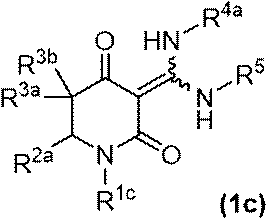
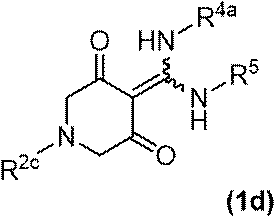
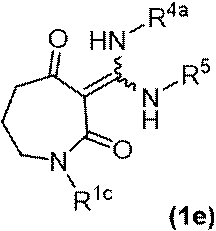
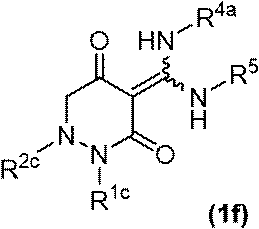


本発明の一般式(1)で表される化合物又はその塩を有効成分として含有する有害生物防除剤は、農園芸用害虫防除剤、動物用外部寄生虫防除剤及び動物用内部寄生虫防除剤として適用できる。農園芸用害虫防除剤としては、水稲、果樹、野菜、その他の作物及び花卉類を加害する各種農林、園芸、貯穀害虫、衛生害虫、線虫類等の害虫防除に適用できる。
また、本発明の一般式(1)で表される化合物又はその塩を有効成分として含有する農園芸用殺虫剤は、各種の省力的な施用方法に適した物性、浸透移行活性、適切な土壌残留性等の環境安全性に優れる。
さらに、本発明の一般式(1)で表される化合物又はその塩を有効成分として含有する農園芸用殺虫剤は、天敵;セイヨウミツバチ、マルハナバチ等の有用昆虫;ユスリカ等の環境生物への影響が少ない。
さらに、本発明の一般式(1)で表される化合物又はその塩を有効成分として含有する動物用外部寄生虫防除剤及び動物用内部寄生虫防除剤、特に、動物用内部寄生虫防除剤は、安全性、及び薬物動態面に優れる。
また、本発明の一般式(1)で表される化合物又はその塩を有効成分として含有する農園芸用殺虫剤は、各種の省力的な施用方法に適した物性、浸透移行活性、適切な土壌残留性等の環境安全性に優れる。
さらに、本発明の一般式(1)で表される化合物又はその塩を有効成分として含有する農園芸用殺虫剤は、天敵;セイヨウミツバチ、マルハナバチ等の有用昆虫;ユスリカ等の環境生物への影響が少ない。
さらに、本発明の一般式(1)で表される化合物又はその塩を有効成分として含有する動物用外部寄生虫防除剤及び動物用内部寄生虫防除剤、特に、動物用内部寄生虫防除剤は、安全性、及び薬物動態面に優れる。
上記害虫、線虫類等としては、以下のものが例示される。
鱗翅目(チョウ目)害虫としては、例えば、アオイラガ(Parasa consocia)、アカキリバ(Anomis mesogona)、アゲハ(Papilio xuthus)、アズキサヤムシガ(Matsumuraeses azukivora)、アズキノメイガ(Ostrinia scapulalis)、アフリカヨトウ(Spodoptera exempta)、アメリカシロヒトリ(Hyphantria cunea)、アワノメイガ(Ostrinia furnacalis)、アワヨトウ(Pseudaletia separata)、イガ(Tinea translucens)、イグサシンムシガ(Bactra furfuryla)、イチモンジセセリ又はイネツトムシ(Parnara guttata)、イネタテハマキ(Marasmia exigua)、イネヨトウ(Sesamia inferens)、イモキバガ(Brachmia triannulella)、イラガ(Monema flavescens)、イラクサギンウワバ(Trichoplusia ni)、ウコンノメイガ(Pleuroptya ruralis)、ウメエダシャク(Cystidia couaggaria)、ウラナミシジミ(Lampides boeticus)、オオスカシバ(Cephonodes hylas)、オオタバコガ(Helicoverpa armigera)、オオトビモンシャチホコ(Phalerodonta manleyi)、オオミノガ(Eumeta japonica)、オオモンシロチョウ(Pieris brassicae)、オビカレハ(Malacosoma neustria testacea)、カキノヘタムシガ(Stathmopoda masinissa)、カキホソガ(Cuphodes diospyrosella)、カクモンハマキ(Archips xylosteanus)、カブラヤガ(Agrotis segetum)、カンショシンクイハマキ(Tetramoera schistaceana)、キアゲハ(Papilio machaon hippocrates)、キマダラコウモリ(Endoclyta sinensis)、ギンモンハモグリガ(Lyonetia prunifoliella)、キンモンホソガ(Phyllonorycter ringoneella)、クリミガ(Cydia kurokoi)、クリミドリシンクイガ(Eucoenogenes aestuosa)、グレープベリーモス(Lobesia botrana)、クロシタアオイラガ(Latoia sinica)、クロフタモンマダラメイガ(Euzophera batangensis)、クワイホソハマキ(Phalonidia mesotypa)、クワゴマダラヒトリ(Spilosoma imparilis)、クワノメイガ(Glyphodes pyloalis)、クワヒメハマキ(Olethreutes mori)、コイガ(Tineola bisselliella)、コウモリガ(Endoclyta excrescens)、コクガ(Nemapogon granellus)、コスカシバ(Synanthedon hector)、コドリンガ(Cydia pomonella)、コナガ(Plutella xylostella)、コブノメイガ(Cnaphalocrocis medinalis)、サザンピンクボーラー(Sesamia calamistis)、サンカメイガ(Scirpophaga incertulas)、シバツトガ(Pediasia teterrellus)、ジャガイモガ(Phthorimaea operculella)、シャチホコガ(Stauropus fagi persimilis)、シロイチモジマダラメイガ(Etiella zinckenella)、シロイチモジヨトウ(Spodoptera exigua)、シロテンコウモリ(Palpifer sexnotata)、シロナヨトウ(Spodoptera mauritia)、イネシロオオメイガ(Scirpophaga innotata)、シロモンヤガ(Xestia c-nigrum)、スジキリヨトウ(Spodoptera depravata)、スジコナマダラメイガ(Ephestia kuehniella)、スモモエダシャク(Angerona prunaria)、セグロシャチホコ(Clostera anastomosis)、ソイビーンルーパー(Pseudoplusia includens)、ダイズサヤムシガ(Matsumuraeses falcana)、タバコガ(Helicoverpa assulta)、タマナギンウワバ(Autographa nigrisigna)、タマナヤガ(Agrotis ipsilon)、チャドクガ(Euproctis pseudoconspersa)、チャノコカクモンハマキ(Adoxophyes orana)、チャノホソガ(Caloptilia theivora)、チャハマキ(Homona magnanima)、チャマダラメイガ(Ephestia elutella)、チャミノガ(Eumeta minuscula)、ツマアカシャチホコ(Clostera anachoreta)、ツメクサガ(Heliothis maritima)、テングハマキ(Sparganothis pilleriana)、トウモロコシメイガ(Busseola fusca)、ドクガ(Euproctis subflava)、トビモンオオエダシャク(Biston robustum)、トマトフルーツワーム(Heliothis zea)、ナカジロシタバ(Aedia leucomelas)、ナシイラガ(Narosoideus flavidorsalis)、ナシケンモン(Viminia rumicis)、ナシチビガ(Bucculatrix pyrivorella)、ナシヒメシンクイ(Grapholita molesta)、ナシホソガ(Spulerina astaurota)、ナシマダラメイガ(Ectomyelois pyrivorella)、ニカメイガ(Chilo suppressalis)、ネギコガ(Acrolepiopsis sapporensis)、ノシメマダラメイガ(Plodia interpunctella)、ハイマダラノメイガ(Hellula undalis)、バクガ(Sitotroga cerealella)、ハスモンヨトウ(Spodoptera litura)、ハマキガの一種(Eucosma aporema)、バラハマキ(Acleris comariana)、ヒメクロイラガ(Scopelodes contractus)、ヒメシロモンドクガ(Orgyia thyellina)、フォールアーミーワーム(Spodoptera frugiperda)、フキノメイガ(Ostrinia zaguliaevi)、フタオビコヤガ(Naranga aenescens)、フタテンカギバモドキ(Andraca bipunctata)、ブドウスカシバ(Paranthrene regalis)、ブドウスズメ(Acosmeryx castanea)、ブドウハモグリガ(Phyllocnistis toparcha)、ブドウヒメハマキ(Endopiza viteana)、ブドウホソハマキ(Eupoecillia ambiguella)、ベルベットビーンキャタピラー(Anticarsia gemmatalis)、ホソバハイイロハマキ(Cnephasia cinereipalpana)、マイマイガ(Lymantria dispar)、マツカレハ(Dendrolimus spectabilis)、マメシンクイガ(Leguminivora glycinivorella)、マメノメイガ(Maruca testulalis)、マメヒメサヤムシガ(Matsumuraeses phaseoli)、マメホソガ(Caloptilia soyella)、ミカンハモグリガ(Phyllocnistis citrella)、マエウスキノメイガ(Omiodes indicate)、ミダレカクモンハマキ(Archips fuscocupreanus)、ミツモンキンウワバ(Acanthoplusia agnata)、ミノガ(Bambalina sp.)、モモシンクイガ(Carposina niponensis)、モモノゴマダラノメイガ(Conogethes punctiferalis)、モモスカシバ類(Synanthedon sp.)、モモハモグリガ(Lyonetia clerkella)、モンキアゲハ(Papilio helenus)、モンキチョウ(Colias erate poliographus)、モンクロシャチホコ(Phalera flavescens)、モンシロチョウ(Pieris rapae crucivora)、モンシロチョウ(Pieris rapae)等のシロチョウ類、モンシロドクガ(Euproctis similis)、ヤマノイモコガ(Acrolepiopsis suzukiella)、ヨーロピアンコーンボーラー(Ostrinia nubilalis)、ヨトウガ(Mamestra brassicae)、ヨモギエダシャク(Ascotis selenaria)、ヨモギオオホソハマキ(Phtheochroides clandestina)、リンゴオオハマキ(Hoshinoa adumbratana)、リンゴカレハ(Odonestis pruni japonensis)、リンゴケンモン(Triaena intermedia)、リンゴコカクモンハマキ(Adoxophyes orana fasciata)、リンゴコシンクイ(Grapholita inopinata)、リンゴシロヒメハマキ(Spilonota ocellana)、リンゴハイイロハマキ(Spilonota lechriaspis)、リンゴハマキクロバ(Illiberis pruni)、リンゴヒメシンクイ(Argyresthia conjugella)、リンゴホソガ(Caloptilia zachrysa)、リンゴモンハマキ(Archips breviplicanus)、ワタアカキリバ(Anomis flava)、ワタアカミムシ(Pectinophora gossypiella)、ワタノメイガ(Notarcha derogata)、ワタヘリクロノメイガ(Diaphania indica)、ニセアメリカタバコガ(Heliothis virescens)、ワタリンガ(Earias cupreoviridis)等が挙げられる。
鱗翅目(チョウ目)害虫としては、例えば、アオイラガ(Parasa consocia)、アカキリバ(Anomis mesogona)、アゲハ(Papilio xuthus)、アズキサヤムシガ(Matsumuraeses azukivora)、アズキノメイガ(Ostrinia scapulalis)、アフリカヨトウ(Spodoptera exempta)、アメリカシロヒトリ(Hyphantria cunea)、アワノメイガ(Ostrinia furnacalis)、アワヨトウ(Pseudaletia separata)、イガ(Tinea translucens)、イグサシンムシガ(Bactra furfuryla)、イチモンジセセリ又はイネツトムシ(Parnara guttata)、イネタテハマキ(Marasmia exigua)、イネヨトウ(Sesamia inferens)、イモキバガ(Brachmia triannulella)、イラガ(Monema flavescens)、イラクサギンウワバ(Trichoplusia ni)、ウコンノメイガ(Pleuroptya ruralis)、ウメエダシャク(Cystidia couaggaria)、ウラナミシジミ(Lampides boeticus)、オオスカシバ(Cephonodes hylas)、オオタバコガ(Helicoverpa armigera)、オオトビモンシャチホコ(Phalerodonta manleyi)、オオミノガ(Eumeta japonica)、オオモンシロチョウ(Pieris brassicae)、オビカレハ(Malacosoma neustria testacea)、カキノヘタムシガ(Stathmopoda masinissa)、カキホソガ(Cuphodes diospyrosella)、カクモンハマキ(Archips xylosteanus)、カブラヤガ(Agrotis segetum)、カンショシンクイハマキ(Tetramoera schistaceana)、キアゲハ(Papilio machaon hippocrates)、キマダラコウモリ(Endoclyta sinensis)、ギンモンハモグリガ(Lyonetia prunifoliella)、キンモンホソガ(Phyllonorycter ringoneella)、クリミガ(Cydia kurokoi)、クリミドリシンクイガ(Eucoenogenes aestuosa)、グレープベリーモス(Lobesia botrana)、クロシタアオイラガ(Latoia sinica)、クロフタモンマダラメイガ(Euzophera batangensis)、クワイホソハマキ(Phalonidia mesotypa)、クワゴマダラヒトリ(Spilosoma imparilis)、クワノメイガ(Glyphodes pyloalis)、クワヒメハマキ(Olethreutes mori)、コイガ(Tineola bisselliella)、コウモリガ(Endoclyta excrescens)、コクガ(Nemapogon granellus)、コスカシバ(Synanthedon hector)、コドリンガ(Cydia pomonella)、コナガ(Plutella xylostella)、コブノメイガ(Cnaphalocrocis medinalis)、サザンピンクボーラー(Sesamia calamistis)、サンカメイガ(Scirpophaga incertulas)、シバツトガ(Pediasia teterrellus)、ジャガイモガ(Phthorimaea operculella)、シャチホコガ(Stauropus fagi persimilis)、シロイチモジマダラメイガ(Etiella zinckenella)、シロイチモジヨトウ(Spodoptera exigua)、シロテンコウモリ(Palpifer sexnotata)、シロナヨトウ(Spodoptera mauritia)、イネシロオオメイガ(Scirpophaga innotata)、シロモンヤガ(Xestia c-nigrum)、スジキリヨトウ(Spodoptera depravata)、スジコナマダラメイガ(Ephestia kuehniella)、スモモエダシャク(Angerona prunaria)、セグロシャチホコ(Clostera anastomosis)、ソイビーンルーパー(Pseudoplusia includens)、ダイズサヤムシガ(Matsumuraeses falcana)、タバコガ(Helicoverpa assulta)、タマナギンウワバ(Autographa nigrisigna)、タマナヤガ(Agrotis ipsilon)、チャドクガ(Euproctis pseudoconspersa)、チャノコカクモンハマキ(Adoxophyes orana)、チャノホソガ(Caloptilia theivora)、チャハマキ(Homona magnanima)、チャマダラメイガ(Ephestia elutella)、チャミノガ(Eumeta minuscula)、ツマアカシャチホコ(Clostera anachoreta)、ツメクサガ(Heliothis maritima)、テングハマキ(Sparganothis pilleriana)、トウモロコシメイガ(Busseola fusca)、ドクガ(Euproctis subflava)、トビモンオオエダシャク(Biston robustum)、トマトフルーツワーム(Heliothis zea)、ナカジロシタバ(Aedia leucomelas)、ナシイラガ(Narosoideus flavidorsalis)、ナシケンモン(Viminia rumicis)、ナシチビガ(Bucculatrix pyrivorella)、ナシヒメシンクイ(Grapholita molesta)、ナシホソガ(Spulerina astaurota)、ナシマダラメイガ(Ectomyelois pyrivorella)、ニカメイガ(Chilo suppressalis)、ネギコガ(Acrolepiopsis sapporensis)、ノシメマダラメイガ(Plodia interpunctella)、ハイマダラノメイガ(Hellula undalis)、バクガ(Sitotroga cerealella)、ハスモンヨトウ(Spodoptera litura)、ハマキガの一種(Eucosma aporema)、バラハマキ(Acleris comariana)、ヒメクロイラガ(Scopelodes contractus)、ヒメシロモンドクガ(Orgyia thyellina)、フォールアーミーワーム(Spodoptera frugiperda)、フキノメイガ(Ostrinia zaguliaevi)、フタオビコヤガ(Naranga aenescens)、フタテンカギバモドキ(Andraca bipunctata)、ブドウスカシバ(Paranthrene regalis)、ブドウスズメ(Acosmeryx castanea)、ブドウハモグリガ(Phyllocnistis toparcha)、ブドウヒメハマキ(Endopiza viteana)、ブドウホソハマキ(Eupoecillia ambiguella)、ベルベットビーンキャタピラー(Anticarsia gemmatalis)、ホソバハイイロハマキ(Cnephasia cinereipalpana)、マイマイガ(Lymantria dispar)、マツカレハ(Dendrolimus spectabilis)、マメシンクイガ(Leguminivora glycinivorella)、マメノメイガ(Maruca testulalis)、マメヒメサヤムシガ(Matsumuraeses phaseoli)、マメホソガ(Caloptilia soyella)、ミカンハモグリガ(Phyllocnistis citrella)、マエウスキノメイガ(Omiodes indicate)、ミダレカクモンハマキ(Archips fuscocupreanus)、ミツモンキンウワバ(Acanthoplusia agnata)、ミノガ(Bambalina sp.)、モモシンクイガ(Carposina niponensis)、モモノゴマダラノメイガ(Conogethes punctiferalis)、モモスカシバ類(Synanthedon sp.)、モモハモグリガ(Lyonetia clerkella)、モンキアゲハ(Papilio helenus)、モンキチョウ(Colias erate poliographus)、モンクロシャチホコ(Phalera flavescens)、モンシロチョウ(Pieris rapae crucivora)、モンシロチョウ(Pieris rapae)等のシロチョウ類、モンシロドクガ(Euproctis similis)、ヤマノイモコガ(Acrolepiopsis suzukiella)、ヨーロピアンコーンボーラー(Ostrinia nubilalis)、ヨトウガ(Mamestra brassicae)、ヨモギエダシャク(Ascotis selenaria)、ヨモギオオホソハマキ(Phtheochroides clandestina)、リンゴオオハマキ(Hoshinoa adumbratana)、リンゴカレハ(Odonestis pruni japonensis)、リンゴケンモン(Triaena intermedia)、リンゴコカクモンハマキ(Adoxophyes orana fasciata)、リンゴコシンクイ(Grapholita inopinata)、リンゴシロヒメハマキ(Spilonota ocellana)、リンゴハイイロハマキ(Spilonota lechriaspis)、リンゴハマキクロバ(Illiberis pruni)、リンゴヒメシンクイ(Argyresthia conjugella)、リンゴホソガ(Caloptilia zachrysa)、リンゴモンハマキ(Archips breviplicanus)、ワタアカキリバ(Anomis flava)、ワタアカミムシ(Pectinophora gossypiella)、ワタノメイガ(Notarcha derogata)、ワタヘリクロノメイガ(Diaphania indica)、ニセアメリカタバコガ(Heliothis virescens)、ワタリンガ(Earias cupreoviridis)等が挙げられる。
半翅目(カメムシ目)害虫としては、例えば、アオクサカメムシ(Nezara antennata)、アカスジカスミカメ(Stenotus rubrovittatus)、アカスジカメムシ(Graphosoma rubrolineatum)、アカヒゲホソミドリカスミカメ(Trigonotylus coelestialium)等、アカヒメヘリカメムシ(Aeschynteles maculatus)、アカホシカスミカメ(Creontiades pallidifer)、アカホシカメムシ(Dysdercus cingulatus)、アカホシマルカイアガラムシ(Chrysomphalus ficus)、アカマルカイガラムシ(Aonidiella aurantii)、アブラゼミ(Graptopsaltria nigrofuscata)、アメリカコバネナガカメムシ(Blissusleucopterus)、イセリヤカイガラムシ(Icerya purchasi)、イチモンジカメムシ(Piezodorus hybneri)、イネカメムシ(Lagynotomus elongatus)、イネキイロヒメヨコバイ(Thaia subrufa)、イネクロカメムシ(Scotinophara lurida)、イバラヒゲナガアブラムシ(Sitobion ibarae)、イワサキカメムシ(Stariodes iwasakii)、ウスイロマルカイガラムシ(Aspidiotus destructor)、ウスモンミドリカスミカメ(Taylorilygus pallidulus)、ウメコブアブラムシ(Myzusmumecola)、ウメシロカイガラムシ(Pseudaulacaspis prunicola)、エンドウヒゲナガアブラムシ(Acyrthosiphon pisum)、オオクモヘリカメムシ(Anacanthocoris striicornis)、オオクロトビカスミカメ(Ectometopterus micantulus)、オオトゲシラホシカメムシ(Eysarcoris lewisi)、オオヘリカメムシ(Molipteryx fuliginosa)、オオヨコバイ(Cicadella viridis)、オカボノアカアブラムシ(Rhopalosophum rufiabdominalis)、オリーブカタカイガラムシ(Saissetia oleate)、オンシツコナジラミ(Trialeurodes vaporariorum)、カシヒメヨコバイ(Aguriahana quercus)、カスミカメムシ類(Lygus spp.)、カバワタフキマダラアブラムシ(Euceraphis punctipennis)、カンキツカイガラムシ(Andaspis kashicola)、カンキツカタカイガラムシ(Coccus pseudomagnoliarum)、カンシャコバネナガカメムシ(Cavelerius saccharivorus)、キクグンバイ(Galeatus spinifrons)、キクヒメヒゲナガアブラムシ(Macrosiphoniella sanborni)、キマルカイガラムシ(Aonidiella citrina)、クサギカメムシ(Halyomorpha mista)、クスグンバイ(Stephanitis fasciicarina)、クストガリキジラミ(Trioza camphorae)、クモヘリカメムシ(Leptocorisa chinensis)、クリトガリキジラミ(Trioza quercicola)、クルミグンバイ(Uhlerites latius)、グレープリーフホッパー(Erythroneura comes)、クロアシホソナガカメムシ(Paromius exiguus)、クロカタマルカイガラムシ(Duplaspidiotus claviger)、クロスジツマグロヨコバイ(Nephotettix nigropictus)、クロトビカスミカメ(Halticiellus insularis)、クロフツノウンカ(Perkinsiella saccharicida)、クロリンゴキジラミ(Psylla malivorella)、クワキジラミ(Anomomeura mori)、クワコナカイガラムシ(Pseudococcus longispinis)、クワシロカイガラムシ(Pseudaulacaspis pentagona)、クワワタカイガラムシ(Pulvinaria kuwacola)、コアオカスミカメ(Apolygus lucorum)、コバネヒョウタンナガカメムシ(Togo hemipterus)、コミカンアブラムシ(Toxoptera aurantii)、サトウキビコナカイガラムシ(Saccharicoccus sacchari)、サトウキビネワタムシ(Geoica lucifuga)、サトウノウスイロウンカ(Numata muiri)、サンホーゼカイガラムシ(Comstockaspis perniciosa)、シトラススノースケール(Unaspis citri)、ジャガイモヒゲナガアブラムシ(Aulacorthum solani)、シラホシカメムシ(Eysarcoris ventralis)、シルバーリーフコナジラミ(Bemisia argentifolii)、シロオオヨコバイ(Cicadella spectra)、シロマルカイガラムシ(Aspidiotus hederae)、スカシヒメヘリカメムシ(Liorhyssus hyalinus)、セグロヒメキジラミ(Calophya nigridorsalis)、セジロウンカ(Sogatella furcifera)、ソラマメヒゲナガアブラムシ(Megoura crassicauda)、ダイコンアブラムシ(Brevicoryne brassicae)、ダイズアブラムシ(Aphis glycines)、タイワンクモヘリカメムシ(Leptocorisa oratorius)、タイワンツマグロヨコバイ(Nephotettix virescens)、タイワンヒゲナガアブラムシ(Uroeucon formosanum)、タバコカスミカメ(Cyrtopeltis tennuis)、タバココナジラミ(Bemisia tabaci)、チャノカタカイガラムシ(Lecanium persicae)、チャノクロホシカイガラムシ(Parlatoria theae)、チャノマルカイガラムシ(Pseudaonidia paeoniae)、チャノミドリヒメヨコバイ(Empoasca onukii)、チャバネアオカメムシ(Plautia stali)、チューリップネアブラムシ(Dysaphis tulipae)、チューリップヒゲナガアブラムシ(Macrosiphum euphorbiae)、ツツジグンバイ(Stephanitis pyrioides)、ツノロウムシ(Ceroplastes ceriferus)、ツバキクロホシカイガラムシ(Parlatoria camelliae)、ツマグロアオカスミカメ(Apolygus spinolai)、ツマグロヨコバイ(Nephotettix cincticeps)、ツヤアオカメムシ(Glaucias subpunctatus)、テンサイカスミカメ(Orthotylus flavosparsus)、トウモロコシアブラムシ(Rhopalosiphum maidis)、トウモロコシウンカ(Peregrinus maidis)、トゲシラホシカメムシ(Eysarcoris parvus)、トコジラミ(Cimex lectularius)、トドキジラミ(Psylla abieti)、トビイロウンカ(Nilaparvata lugens)、トベラキジラミ(Psylla tobirae)、ナガメ(Eurydema rugosum)、ナシアブラムシ(Schizaphis piricola)、ナシキジラミ(Psylla pyricola)、ナシクロホシカイガラムシ(Parlatoreopsis pyri)、ナシグンバイ(Stephanitis nashi)、ナシコナカイガラムシ(Dysmicoccus wistariae)、ナシシロナガカイガラムシ(Lepholeucaspis japonica)、ナシマルアブラムシ(Sappaphis piri)、ニセダイコンアブラムシ(Lipaphis erysimi)、ネギアブラムシ(Neotoxoptera formosana)、ハスクビレアブラムシ(Rhopalosophum nymphaeae)、バラヒメヨコバイ(Edwardsianarosae)、ハランナガカイガラムシ(Pinnaspisaspidistrae)、ハンノキジラミ(Psylla alni)、ハンノナガヨコバイ(Speusotettix subfusculus)、ハンノヒメヨコバイ(Alnetoidia alneti)、ヒエウンカ(Sogatella panicicola)、ヒゲナガカスミカメ(Adelphocoris lineolatus)、ヒメアカホシカメムシ(Dysdercus poecilus)、ヒメクロカイガラムシ(Parlatoria ziziphi)、ヒメグンバイ(Uhlerites debile)、ヒメトビウンカ(Laodelphax striatellus)、ヒメナガメ(Eurydema pulchrum)、ヒメハリカメムシ(Cletus trigonus)、ヒメフタテンナガアワフキ(Clovia punctata)、ヒメヨコバイ類(Empoasca sp.)、ヒラタカタカイガラムシ(Coccus hesperidum)、ヒラタヒョウタンナガカメムシ(Pachybrachius luridus)、フジコナカイガラムシ(Planococcus kraunhiae)、フタスジカスミカメ(Stenotus binotatus)、フタテンヒメヨコバイ(Arboridia apicalis)、フタテンヨコバイ(Macrosteles fascifrons)、ブチヒゲカメムシ(Dolycoris baccarum)、ブチヒゲクロカスミカメ(Adelphocoris triannulatus)、ブドウネアブラムシ(Viteus vitifolii)、ホオズキカメムシ(Acanthocoris sordidus)、ホソクモヘリカメムシ(Leptocorisa acuta)、ホソコバネナガカメムシ(Macropes obnubilus)、ホソハリカメムシ(Cletus punctiger)、ホソヘリカメムシ(Riptortus clavatus)、ポテトピシリド(Paratrioza cockerelli)、マエキアワフキ(Aphrophora costalis)、マキバカスミカメ(Lygus disponsi)、マダラカスミカメ(Lygus saundersi)、マツコナカイガラムシ(Crisicoccus pini)、マツヒメヨコバイ(Empoasca abietis)、マツモトコナカイガラムシ(Crisicoccus matsumotoi)、マメアブラムシ(Aphis craccivora)、マルカメムシ(Megacopta punctatissimum)、マルシラホシカメムシ(Eysarcoris guttiger)、ミカンカキカイガラムシ(Lepidosaphes beckii)、ミカンキジラミ(Diaphorina citri)、ミカンクロアブラムシ(Toxoptera citricidus)、ミカンコナカイガラムシ(Planococcus citri)、ミカンコナジラミ(Dialeurodes citri)、ミカントゲコナジラミ(Aleurocanthus spiniferus)、ミカンヒメコナカイガラムシ(Pseudococcus citriculus)、ミカンヒメヨコバイ(Zyginella citri)、ミカンヒメワタカイガラムシ(Pulvinaria citricola)、ミカンヒラタカイガラムシ(Coccus discrepans)、ミカンマルカイガラムシ(Pseudaonidia duplex)、ミカンワタカイガラムシ(Pulvinaria aurantii)、ミズキカタカイガラムシ(Lecanium corni)、ミナミアオカメムシ(Nezara viridula)、ムギカスミカメ(Stenodema calcaratum)、ムギクビレアブラムシ(Rhopalosiphum padi)、ムギヒゲナガアブラムシ(Sitobion akebiae)、ムギミドリアブラムシ(Schizaphis graminum)、ムギヨコバイ(Sorhoanus tritici)、ムギワラギクオマルアブラムシ(Brachycaudus helichrysi)、ムラサキカメムシ(Carpocoris purpureipennis)、モモアカアブラムシ(Myzus persicae)、モモコフキアブラムシ(Hyalopterus pruni)、ヤナギアブラムシ(Aphis farinose yanagicola)、ヤナギグンバイ(Metasalis populi)、ヤノネカイガラムシ(Unaspis yanonensis)、ヤマアサキジラミ(Mesohomotoma camphorae)、ユキヤナギアブラムシ(Aphis spiraecola)、リンゴアブラムシ(Aphis pomi)、リンゴカキカイガラムシ(Lepidosaphes ulmi)、リンゴキジラミ(Psylla mali)、リンゴクロカスミカメ(Heterocordylus flavipes)、リンゴコブアブラムシ(Myzus malisuctus)、リンゴネアブラムシ(Aphidonuguis mali)、リンゴマダラヨコバイ(Orientus ishidai)、リンゴミドリアブラムシ(Ovatus malicolens)、リンゴワタムシ(Eriosoma lanigerum)、ルビーロウムシ(Ceroplastes rubens)、ワタアブラムシ(Aphis gossypii)等が挙げられる。
鞘翅目(コウチュウ目)害虫としては、例えば、アオスジカミキリ(Xystrocera globosa)、アオバアリガタハネカクシ(Paederus fuscipes)、アオハナムグリ(Eucetonia roelofsi)、アズキゾウムシ(Callosobruchus chinensis)、アリモドキゾウムシ(Cylas formicarius)、アルファルファタコゾウムシ(Hypera postica)、イネゾウムシ(Echinocnemus squameus)、イネドロオイムシ(Oulema oryzae)、イネネクイハムシ(Donacia provosti)、イネミズゾウムシ(Lissorhoptrus oryzophilus)、イモサルハムシ(Colasposoma dauricum)、イモゾウムシ(Euscepes postfasciatus)、インゲンテントウ(Epilachna varivestis)、インゲンマメゾウムシ(Acanthoscelides obtectus)、ウエスタンコーンルートワーム(Diabrotica virgifera virgifera)、ウメチョッキリゾウムシ(Involvulus cupreus)、ウリハムシ(Aulacophora femoralis)、エンドウゾウムシ(Bruchus pisorum)、オオニジュウヤホシテントウ(Epilachna vigintioctomaculata)、ガイマイデオキスイ(Carpophilus dimidiatus)、カメノコハムシ(Cassida nebulosa)、キアシノミハムシ(Luperomorpha tunebrosa)、キスジノミハムシ(Phyllotreta striolata)、キボシカミキリ(Psacothea hilaris)、キマダラカミキリ(Aeolesthes chrysothrix)、クリシギゾウムシ(Curculio sikkimensis)、クリヤケシキスイ(Carpophilus hemipterus)、コアオハナムグリ(Oxycetonia jucunda)、コーンルートワーム類(Diabrotica spp.)、コガネムシ(Mimela splendens)、コクゾウムシ(Sitophilus zeamais)、コクヌストモドキ(Tribolium castaneum)、ココクゾウムシ(Sitophilus oryzae)、コヒメコクヌストモドキ(Palorus subdepressus)、コフキコガネ(Melolontha japonica)、ゴマダラカミキリ(Anoplophora malasiaca)、ゴミムシダマシ(Neatus picipes)、コロラドハムシ(Leptinotarsa decemlineata)、サザンコーンルートワーム(Diabrotica undecimpunctata howardi)、シバオサゾウムシ(Sphenophorus venatus)、ジュウシホシクビナガハムシ(Crioceris quatuordecimpunctata)、スモモゾウムシ(Conotrachelus nenuphar)、ダイコンサルゾウムシ(Ceuthorhynchidius albosuturalis)、ダイコンハムシ(Phaedon brassicae)、タバコシバンムシ(Lasioderma serricorne)、チビコフキゾウムシ(Sitona japonicus)、チャイロコガネ(Adoretus tenuimaculatus)、チャイロコメノゴミムシダマシ(Tenebrio molitor)、チャイロサルハムシ(Basilepta balyi)、ツメクサタコゾウムシ(Hypera nigrirostris)、テンサイトビハムシ(Chaetocnema concinna)、ドウガネブイブイ(Anomala cuprea)、ナガチャコガネ(Heptophylla picea)、ニジュウヤホシテントウ(Epilachna vigintioctopunctata)、ノーザンコーンルートワーム(Diabrotica longicornis)、ハナムグリ(Eucetonia pilifera)、ハリガネムシ類(Agriotes spp.)、ヒメカツオブシムシ(Attagenus unicolor japonicus)、ヒメキバネサルハムシ(Pagria signata)、ヒメコガネ(Anomala rufocuprea)、ヒメコクヌストモドキ(Palorus ratzeburgii)、ヒメゴミムシダマシ(Alphitobius laevigatus)、ヒメマルカツオブシムシ(Anthrenus verbasci)、ヒラタキクイムシ(Lyctus brunneus)、ヒラタコクヌストモドキ(Tribolium confusum)、フタスジヒメハムシ(Medythia nigrobilineata)、ブドウトラカミキリ(Xylotrechus pyrrhoderus)、ポテトフリービートル(Epitrix cucumeris)、マツノキクイムシ(Tomicus piniperda)、マツノマダラカミキリ(Monochamus alternatus)、マメコガネ(Popillia japonica)、マメハンミョウ(Epicauta gorhami)、メイズウィービル(Sitophilus zeamais)、モモチョッキリゾウムシ(Rhynchites heros)、ヤサイゾウムシ(Listroderes costirostris)、ヨツモンマメゾウムシ(Callosobruchus maculatus)、リンゴコフキゾウムシ(Phyllobius armatus)、リンゴハナゾウムシ(Anthonomus pomorum)、ルリハムシ(Linaeidea aenea)、ワタミゾウムシ(Anthonomus grandis)等が挙げられる。
双翅目(ハエ目)害虫としては、例えば、アカイエカ(Culex pipiens pallens)、アカザモグリハナバエ(Pegomya hyoscyami)、アシグロハモグリバエ(Liriomyza huidobrensis)、イエバエ(Musca domestica)、イネキモグリバエ(Chlorops oryzae)、イネクキミギワバエ(Hydrellia sasakii)、イネハモグリバエ(Agromyza oryzae)、イネヒメハモグリバエ又はイネミギワバエ(Hydrellia griseola)、インゲンモグリバエ(Ophiomyia phaseoli)、ウリミバエ(Dacus cucurbitae)、オウトウショウジョウバエ(Drosophila suzukii)、オウトウハマダラミバエ(Rhacochlaena japonica)、オオイエバエ(Muscina stabulans)、オオキモンノミバエ(Megaselia spiracularis)等のノミバエ類、オオチョウバエ(Clogmia albipunctata)、キリウジガガンボ(Tipula aino)、クロキンバエ(Phormia regina)、コガタアカイエカ(Culex tritaeniorhynchus)、シナハマダラカ(Anopheles sinensis)、ダイコンバエ(Hylemya brassicae)、ダイズサヤタマバエ(Asphondylia sp.)、タネバエ(Delia platura)、タマネギバエ(Delia antiqua)、ヨーロッパオウトウミバエ(Rhagoletis cerasi)、チカイエカ(Culex pipiens molestus forskal)、チチュウカイミバエ(Ceratitis capitata)、チビクロバネキノコバエ(Bradysia agrestis)、テンサイモグリハナバエ(Pegomya cunicularia)、トマトハモグリバエ(Liriomyza sativae)、ナスハモグリバエ(Liriomyza bryoniae)、ナモグリバエ(Chromatomyia horticola)、ネギハモグリバエ(Liriomyza chinensis)、ネッタイイエカ(Culex quinquefasciatus)、ネッタイシマカ(Aedes aegypti)、ヒトスジシマカ(Aedes albopictus)、マメハモグリバエ(Liriomyza trifolii)、トマトハモグリバエ(Liriomyza sativae)、ミカンコミバエ(Dacus dorsalis)、ミカンバエ(Dacus tsuneonis)、ムギアカタマバエ(Sitodiplosis mosellana)、ムギキモグリバエ(Meromuza nigriventris)、メキシコミバエ(Anastrepha ludens)、リンゴミバエ(Rhagoletis pomonella)等が挙げられる。
膜翅目(ハチ目)害虫としては、例えば、アミメアリ(Pristomyrmex pungens)、アリガタバチ類、イエヒメアリ(Monomorium pharaohnis)、オオズアリ(Pheidole noda)、カブラハバチ(Athalia rosae)、クリタマバチ(Dryocosmus kuriphilus)、クロヤマアリ(Formica fusca japonica)、スズメバチ類、セグロカブラハバチ(Athalia infumata infumata)、チュウレンジハバチ(Arge pagana)、ニホンカブラハバチ(Athalia japonica)、ハキリアリ(Acromyrmex spp.)、ファイヤーアント(Solenopsis spp.)、リンゴハバチ(Arge mali)、ルリアリ(Ochetellus glaber)等が挙げられる。
直翅目(バッタ目)害虫としては、例えば、クサキリ(Homorocoryphus lineosus)、ケラ(Gryllotalpa sp.)、コイナゴ(Oxya hyla intricata)、コバネイナゴ(Oxya yezoensis)、トノサマバッタ(Locusta migratoria)、ハネナガイナゴ(Oxya japonica)、ヒメクサキリ(Homorocoryphus jezoensis)、エンマコオロギ(Teleogryllus emma)等が挙げられる。
アザミウマ目害虫としては、例えば、アカオビアザミウマ(Selenothrips rubrocinctus)、イネアザミウマ(Stenchaetothrips biformis)、イネクダアザミウマ(Haplothrips aculeatus)、カキクダアザミウマ(Ponticulothrips diospyrosi)、キイロハナアザミウマ(Thrips flavus)、クサキイロアザミウマ(Anaphothrips obscurus)、クスクダアザミウマ(Liothrips floridensis) 、グラジオラスアザミウマ(Thrips simplex)、クロゲハナアザミウマ(Thrips nigropilosus)、クロトンアザミウマ(Heliothrips haemorrhoidalis)、クワアザミウマ(Pseudodendrothrips mori)、コスモスアザミウマ(Microcephalothrips abdominalis)、シイオナガクダアザミウマ(Leeuwenia pasanii)、シイマルクダアザミウマ(Litotetothrips pasaniae)、シトラススリップス(Scirtothrips citri)、シナクダアザミウマ(Haplothrips chinensis)、ダイズアザミウマ(Mycterothrips glycines)、ダイズウスイロアザミウマ(Thrips setosus)、チャノキイロアザミウマ(Scirtothrips dorsalis)、チャノクロアザミウマ(Dendrothrips minowai)、ツメクサクダアザミウマ(Haplothrips niger)、ネギアザミウマ(Thrips tabaci)、ネギクロアザミウマ(Thrips alliorum)、ハナアザミウマ(Thrips hawaiiensis)、ハナクダアザミウマ(Haplothrips kurdjumovi)、ヒゲブトアザミウマ(Chirothrips manicatus)、ヒラズハナアザミウマ(Frankliniella intonsa)、ビワハナアザミウマ(Thrips coloratus)、ミカンキイロアザミウマ(Franklinella occidentalis)、ミナミキイロアザミウマ(Thrips palmi)、ユリキイロアザミウマ(Frankliniella lilivora)、ユリノクダアザミウマ(Liothrips vaneeckei)等が挙げられる。
ダニ目害虫としては、例えば、アオツツガムシ(Leptotrombidium akamushi)、アシノワハダニ(Tetranychus ludeni)、アメリカンドックチック(Dermacentor variabilis)、イシイナミハダニ(Tetranychus truncatus)、イエダニ(Ornithonyssus bacoti)、イヌニキビダニ(Demodex canis)、オウトウハダニ(Tetranychus viennensis)、カンザワハダニ(Tetranychus kanzawai)、クリイロコイタマダニ(Rhipicephalus sanguineus)等のマダニ類、クワガタツメダニ(Cheyletus malaccensis)、ケナガコナダニ(Tyrophagus putrescentiae)、コナヒョウヒダニ(Dermatophagoides farinae)、セアカゴケグモ(Latrodectus hasseltii)、タイワンカクマダニ(Dermacentor taiwanicus)、チャノナガサビダニ(Acaphylla theavagrans)、チャノホコリダニ(Polyphagotarsonemus latus)、トマトサビダニ(Aculops lycopersici)、トリサシダニ(Ornithonyssus sylvairum)、ナミハダニ(Tetranychus urticae)、ニセナシサビダニ(Eriophyes chibaensis)、ヒゼンダニ(Sarcoptes scabiei)、フタトゲチマダニ(Haemaphysalis longicornis)、ブラックレッグドチック(Ixodes scapularis)、ホウレンソウケナガコナダニ(Tyrophagus similis)、ホソツメダニ(Cheyletus eruditus)、ミカンハダニ(Panonychus citri)、ミナミツメダニ(Cheyletus moorei)、ミナミヒメハダニ(Brevipalpus phoenicis)、ミミヒゼンダニ(Octodectes cynotis)、ヤケヒョウヒダニ(Dermatophagoides ptrenyssnus)、ヤマトチマダニ(Haemaphysalis flava)、ヤマトマダニ(Ixodes ovatus)、リュウキュウミカンサビダニ(Phyllocoptruta citri)、リンゴサビダニ(Aculus schlechtendali)、リンゴハダニ(Panonychus ulmi)、ローンスターチック(Amblyomma americanum)、及びワクモ(Dermanyssus gallinae)、ロビンネダニ(Rhyzoglyphus robini)、ネダニモドキの一種(Sancassania sp.)等が挙げられる。
シロアリ目害虫としては、例えば、アマミシロアリ(Reticulitermes miyatakei)、アメリカカンザイシロアリ(Incisitermes minor)、イエシロアリ(Coptotermes formosanus)、オオシロアリ(Hodotermopsis japonica)、カンモンシロアリ(Reticulitermes sp.)、キアシシロアリ(Reticulitermes flaviceps amamianus)、クシモトシロアリ(Glyptotermes kushimensis)、コウシュウイエシロアリ(Coptotermes guangzhoensis)、コウシュンシロアリ(Neotermes koshunensis)、コダマシロアリ(Glyptotermes kodamai)、サツマシロアリ(Glyptotermes satsumensis)、ダイコクシロアリ(Cryptotermes domesticus)、タイワンシロアリ(Odontotermes formosanus)、ナカジマシロアリ(Glyptotermes nakajimai)、ニトベシロアリ(Pericapritermes nitobei)、ヤマトシロアリ(Reticulitermes speratus)等が挙げられる。
ゴキブリ目害虫としては、例えば、クロゴキブリ(Periplaneta fuliginosa)、チャバネゴキブリ(Blattella germanica)、トウヨウゴキブリ(Blatta orientalis)、トビイロゴキブリ(Periplaneta brunnea)、ヒメチャバネゴキブリ(Blattella lituricollis)、ヤマトゴキブリ(Periplaneta japonica)、ワモンゴキブリ(Periplaneta americana)等が挙げられる。
線虫類としては、例えば、イチゴメセンチュウ(Nothotylenchus acris)、イネシンガレセンチュウ(Aphelenchoides besseyi)、キタネグサレセンチュウ(Pratylenchus penetrans)、キタネコブセンチュウ(Meloidogyne hapla)、サツマイモネコブセンチュウ(Meloidogyne incognita)、ジャガイモシストセンチュウ(Globodera rostochiensis)、ジャワネコブセンチュウ(Meloidogyne javanica)、ダイズシストセンチュウ(Heterodera glycines)、ミナミネグサレセンチュウ(Pratylenchus coffeae)、ムギネグサレセンチュウ(Pratylenchus neglectus)、ミカンネセンチュウ(Tylenchus semipenetrans)等が挙げられる。
軟体動物類としては、例えば、スクミリンゴガイ(Pomacea canaliculata)、アフリカマイマイ(Achatina fulica)、ナメクジ(Meghimatium bilineatum)、チャコウラナメクジ(Lehmannina valentiana)、コウラナメクジ(Limax flavus)、ウスカワマイマイ(Acusta despecta sieboldiana)等が挙げられる。
また、本発明の農園芸用害虫防除剤は、その他の害虫として、トマトキバガ(Tuta absoluta)に対しても強い殺虫効果を有するものである。
本発明の一般式(1)で表される化合物又はその塩を有効成分とする農園芸用害虫防除剤は、水田作物、畑作物、果樹、野菜、その他の作物、花卉等に被害を与える前記害虫に対して顕著な防除効果を有するので、害虫の発生が予測される時期に合わせて、害虫の発生前又は発生が確認された時点で育苗施設、水田、畑、果樹、野菜、その他の作物、花卉等の種子、水田水、茎葉、土壌等の栽培担体等に処理することにより本発明の農園芸用害虫防除剤の所期の効果が奏せられるものである。中でも、作物、花卉等の育苗土壌、移植時の植え穴土壌、株元、灌漑水、水耕栽培における栽培水等に処理して、土壌を介し又は介さずして根から本発明化合物を吸収させることによるいわゆる浸透移行性を利用した施用が好ましい使用形態である。
本発明の農園芸用害虫防除剤を使用することができる有用植物は、特に限定されるものではないが、例えば、穀類(例えば、稲、大麦、小麦、ライ麦、オート麦、とうもろこし等)、豆類(大豆、小豆、そら豆、えんどう豆、いんげん豆、落花生等)、果樹・果実類(林檎、柑橘類、梨、葡萄、桃、梅、桜桃、胡桃、栗、アーモンド、バナナ等)、葉・果菜類(キャベツ、トマト、ほうれんそう、ブロッコリー、レタス、たまねぎ、ねぎ(あさつき、わけぎ)、ピーマン、なす、いちご、ペッパー、おくら、にら等)、根菜類(にんじん、馬鈴薯、さつまいも、さといも、だいこん、かぶ、れんこん、ごぼう、にんにく、らっきょう等)、加工用作物(棉、麻、ビート、ホップ、さとうきび、てんさい、オリーブ、ゴム、コーヒー、タバコ、茶等)、ウリ類(かぼちゃ、きゅうり、すいか、まくわうり、メロン等)、牧草類(オーチャードグラス、ソルガム、チモシー、クローバー、アルファルファ等)、芝類(高麗芝、ベントグラス等)、香料等鑑賞用作物(ラベンダー、ローズマリー、タイム、パセリ、胡椒、生姜等)、花卉類(きく、ばら、カーネーション、蘭、チューリップ、ゆり等)、庭木(いちょう、さくら類、あおき等)、林木(トドマツ類、エゾマツ類、松類、ヒバ、杉、桧、ユウカリ等)等の植物を挙げることができる。
上記「植物」には、イソキサフルトール等のHPPD阻害剤;イマゼタピル、チフェンスルフロンメチル等のALS阻害剤;グリホサート等のEPSP合成酵素阻害剤;グルホシネート等のグルタミン合成酵素阻害剤;セトキシジム等のアセチルCoAカルボキシラーゼ阻害剤;及びブロモキシニル、ジカンバ、2,4-D等の除草剤に対する耐性を古典的な育種法、又は遺伝子組換え技術により付与された植物も含まれる。
古典的な育種法により耐性を付与された「植物」の例としては、イマゼタピル等のイミダゾリノン系ALS阻害型除草剤に耐性のナタネ、コムギ、ヒマワリ、イネがあり、Clearfield(登録商標)の商品名で既に販売されている。同様に古典的な育種法によるチフェンスルフロンメチル等のスルホニルウレア系ALS阻害型除草剤に耐性のダイズがあり、STSダイズの商品名で既に販売されている。同様に古典的な育種法によりトリオンオキシム系、アリールオキシフェノキシプロピオン酸系除草剤等のアセチルCoAカルボキシラーゼ阻害剤に耐性が付与された植物の例として、SRコーン等がある。
また、アセチルCoAカルボキシラーゼ阻害剤に耐性が付与された植物は、プロシーディングズ・オブ・ザ・ナショナル・アカデミー・オブ・サイエンシーズ・オブ・ザ・ユナイテッド・ステーツ・オブ・アメリカ(Proc.Natl.Acad.Sci.USA)87巻、7175~7179頁(1990年)等に記載されている。また、アセチルCoAカルボキシラーゼ阻害剤に耐性の変異アセチルCoAカルボキシラーゼが、ウィード・サイエンス(Weed Science)53巻、728~746頁(2005年)等に報告されており、かかる変異アセチルCoAカルボキシラーゼ遺伝子を遺伝子組換え技術により植物に導入するか、又は抵抗性付与に関わる変異を植物アセチルCoAカルボキシラーゼに導入する事により、アセチルCoAカルボキシラーゼ阻害剤に耐性の植物を作出することができ、さらに、キメラプラスティ技術(Gura T. 1999. Repairing the Genome’s Spelling Mistakes. Science 285: 316-318.)に代表される塩基置換変異導入核酸を植物細胞内に導入して植物のアセチルCoAカルボキシラーゼ遺伝子、ALS遺伝子等に部位特異的アミノ酸置換変異を導入することにより、アセチルCoAカルボキシラーゼ阻害剤やALS阻害剤等に耐性の植物を作出することができ、これらの植物に対しても本発明の農園芸用害虫防除剤を使用することができる。
また、アセチルCoAカルボキシラーゼ阻害剤に耐性が付与された植物は、プロシーディングズ・オブ・ザ・ナショナル・アカデミー・オブ・サイエンシーズ・オブ・ザ・ユナイテッド・ステーツ・オブ・アメリカ(Proc.Natl.Acad.Sci.USA)87巻、7175~7179頁(1990年)等に記載されている。また、アセチルCoAカルボキシラーゼ阻害剤に耐性の変異アセチルCoAカルボキシラーゼが、ウィード・サイエンス(Weed Science)53巻、728~746頁(2005年)等に報告されており、かかる変異アセチルCoAカルボキシラーゼ遺伝子を遺伝子組換え技術により植物に導入するか、又は抵抗性付与に関わる変異を植物アセチルCoAカルボキシラーゼに導入する事により、アセチルCoAカルボキシラーゼ阻害剤に耐性の植物を作出することができ、さらに、キメラプラスティ技術(Gura T. 1999. Repairing the Genome’s Spelling Mistakes. Science 285: 316-318.)に代表される塩基置換変異導入核酸を植物細胞内に導入して植物のアセチルCoAカルボキシラーゼ遺伝子、ALS遺伝子等に部位特異的アミノ酸置換変異を導入することにより、アセチルCoAカルボキシラーゼ阻害剤やALS阻害剤等に耐性の植物を作出することができ、これらの植物に対しても本発明の農園芸用害虫防除剤を使用することができる。
更に遺伝子組換え植物で発現される毒素としては、バチルス・セレウスやバチルス・ポピリエ由来の殺虫性タンパク;バチルス・チューリンゲンシス由来のCry1Ab、Cry1Ac、Cry1F、Cry1Fa2、Cry2Ab、Cry3A、Cry3Bb1、Cry9C等のδ-エンドトキシン、VIP1、VIP2、VIP3、VIP3A等の殺虫タンパク;線虫由来の殺虫タンパク;さそり毒素、クモ毒素、ハチ毒素、昆虫特異的神経毒素等の動物によって産生される毒素;糸状菌類毒素;植物レクチン;アグルチニン;トリプシン阻害剤、セリンプロテアーゼ阻害剤、パタチン、シスタチン、パパイン阻害剤等のプロテアーゼ阻害剤;リシン、トウモロコシ-RIP、アブリン、ルフィン、サポリン、ブリオジン等のリボゾーム不活性化タンパク(RIP);3-ヒドロキシステロイドオキシダーゼ、エクジステロイド-UDP-グルコシルトランスフェラーゼ、コレステロールオキシダーゼ等のステロイド代謝酵素;エクダイソン阻害剤;HMG-CoAリダクターゼ;ナトリウムチャネル、カルシウムチャネル阻害剤等のイオンチャネル阻害剤;幼若ホルモンエステラーゼ;利尿ホルモン受容体;スチルベンシンターゼ;ビベンジルシンターゼ;キチナーゼ;グルカナーゼ等が挙げられる。
また、この様な遺伝子組換え植物で発現される毒素として、Cry1Ab、Cry1Ac、Cry1F、Cry1Fa2、Cry2Ab、Cry3A、Cry3Bb1、Cry9C、Cry34Ab、Cry35Ab等のδ-エンドトキシンタンパク;VIP1、VIP2、VIP3、VIP3A等の殺虫タンパクのハイブリッド毒素、一部を欠損した毒素、及び修飾された毒素も含まれる。ハイブリッド毒素は、組換え技術を用いて、これらタンパクの異なるドメインの新しい組み合わせによって作り出される。一部を欠損した毒素としては、アミノ酸配列の一部を欠損したCry1Abが知られている。修飾された毒素としては、天然型の毒素のアミノ酸の1つ又は複数が置換されている。
これら毒素の例及びこれら毒素を合成する事ができる組換え植物は、欧州特許出願公開第0374753号明細書、国際公開第93/07278号、国際公開第95/34656号、欧州特許出願公開第0427529号明細書、欧州特許出願公開第451878号明細書、国際公開第03/052073号等に記載されている。
これら毒素の例及びこれら毒素を合成する事ができる組換え植物は、欧州特許出願公開第0374753号明細書、国際公開第93/07278号、国際公開第95/34656号、欧州特許出願公開第0427529号明細書、欧州特許出願公開第451878号明細書、国際公開第03/052073号等に記載されている。
これらの組換え植物に含まれる毒素は、特に、甲虫目害虫、半翅目害虫、双翅目害虫、鱗翅目害虫、及び線虫類への耐性を植物に付与する。本発明の農園芸用害虫防除剤は、それらの技術と併用、あるいは体系化して用いることもできる。
本発明の農園芸用害虫防除剤は各種害虫を防除するためにそのまま、又は水等で適宜希釈し、若しくは懸濁させた形で害虫又は線虫防除に有効な量を当該害虫及び線虫の発生が予測される植物に使用すれば良く、例えば、果樹、穀類、野菜等において発生する害虫及び線虫に対しては茎葉部に散布する他に、種子の薬剤への浸漬、種子粉衣、カルパー処理等の種子処理、土壌全層混和、作条施用、床土混和、セル苗処理、植え穴処理、株元処理、トップドレス、イネの箱処理、水面施用、土壌等に処理して根から吸収させて使用することもできる。加えて、養液(水耕)栽培における養液への施用、くん煙、樹幹注入等による使用もできる。
更に、本発明の農園芸用害虫防除剤は、そのまま、又は水等で適宜希釈し、若しくは懸濁させた形で害虫防除に有効な量を当該害虫の発生が予測される場所に使用すれば良く、例えば、貯穀害虫、家屋害虫、衛生害虫、森林害虫等に散布する他に、家屋建材への塗布、くん煙、ベイト等として使用することもできる。
更に、本発明の農園芸用害虫防除剤は、そのまま、又は水等で適宜希釈し、若しくは懸濁させた形で害虫防除に有効な量を当該害虫の発生が予測される場所に使用すれば良く、例えば、貯穀害虫、家屋害虫、衛生害虫、森林害虫等に散布する他に、家屋建材への塗布、くん煙、ベイト等として使用することもできる。
種子処理の方法としては、例えば、液状又は固体状の製剤を希釈又は希釈せずして液体状態にて種子を浸漬して薬剤を浸透させる方法、固形製剤又は液状製剤を種子と混和、粉衣処理して種子の表面に付着させる方法、樹脂、ポリマー等の付着性の担体と混和して種子にコーティングする方法、植え付けと同時に種子付近に散布する方法等が挙げられる。
当該種子処理を行う「種子」とは、植物の繁殖に用いられる栽培初期の植物体を意味し、例えば、種子の他、球根、塊茎、種芋、株芽、むかご、鱗茎、及び挿し木栽培用の栄養繁殖用の植物体を挙げることができる。
本発明の使用方法を実施する場合の植物の「土壌」又は「栽培担体」とは、作物を栽培するための支持体、特に根を生えさせる支持体を示すものであり、材質は特に制限されないが、植物が生育しうる材質であれば良く、いわゆる土壌、育苗マット、水等であっても良く、具体的な素材としては、例えば、砂、軽石、バーミキュライト、珪藻土、寒天、ゲル状物質、高分子物質、ロックウール、グラスウール、木材チップ、バーク等であっても良い。
当該種子処理を行う「種子」とは、植物の繁殖に用いられる栽培初期の植物体を意味し、例えば、種子の他、球根、塊茎、種芋、株芽、むかご、鱗茎、及び挿し木栽培用の栄養繁殖用の植物体を挙げることができる。
本発明の使用方法を実施する場合の植物の「土壌」又は「栽培担体」とは、作物を栽培するための支持体、特に根を生えさせる支持体を示すものであり、材質は特に制限されないが、植物が生育しうる材質であれば良く、いわゆる土壌、育苗マット、水等であっても良く、具体的な素材としては、例えば、砂、軽石、バーミキュライト、珪藻土、寒天、ゲル状物質、高分子物質、ロックウール、グラスウール、木材チップ、バーク等であっても良い。
作物茎葉部又は貯穀害虫、家屋害虫、衛生害虫、森林害虫等への散布方法としては、乳剤、フロアブル剤等の液体製剤、又は水和剤、顆粒水和剤等の固形製剤を水で適宜希釈し、散布する方法、粉剤を散布する方法、くん煙等が挙げられる。
土壌への施用方法としては、例えば、液体製剤を水に希釈又は希釈せずして植物体の株元又は育苗用苗床等に施用する方法;粒剤を植物体の株元又は育苗のための苗床等に散布する方法;播種前又は移植前に粉剤、水和剤、顆粒水和剤、粒剤等を散布し土壌全体と混和する方法;播種前又は植物体を植える前に植え穴、作条等に粉剤、水和剤、顆粒水和剤、粒剤等を散布する方法等が挙げられる。
土壌への施用方法としては、例えば、液体製剤を水に希釈又は希釈せずして植物体の株元又は育苗用苗床等に施用する方法;粒剤を植物体の株元又は育苗のための苗床等に散布する方法;播種前又は移植前に粉剤、水和剤、顆粒水和剤、粒剤等を散布し土壌全体と混和する方法;播種前又は植物体を植える前に植え穴、作条等に粉剤、水和剤、顆粒水和剤、粒剤等を散布する方法等が挙げられる。
水稲の育苗箱への施用方法としては、剤型は、例えば、播種時施用、緑化期施用、移植時施用等の施用時期により異なる場合もあるが、粉剤、顆粒水和剤、粒剤等の剤型で施用すればよい。培土との混和によっても施用することができ、培土と粉剤、顆粒水和剤又は粒剤等との混和、例えば、床土混和、覆土混和、培土全体への混和等することができる。単に、培土と各種製剤を交互に層状にして施用してもよい。
水田への施用方法としては、ジャンボ剤、パック剤、粒剤、顆粒水和剤等の固形製剤;又はフロアブル、乳剤等の液体状製剤を、通常は、湛水状態の水田に散布する。その他、田植え時には、適当な製剤をそのまま、又は、肥料に混和して土壌に散布、注入することもできる。また、水口や灌漑装置等の水田への水の流入元に乳剤、フロアブル等の薬液を利用することにより、水の供給に伴い省力的に施用することもできる。
水田への施用方法としては、ジャンボ剤、パック剤、粒剤、顆粒水和剤等の固形製剤;又はフロアブル、乳剤等の液体状製剤を、通常は、湛水状態の水田に散布する。その他、田植え時には、適当な製剤をそのまま、又は、肥料に混和して土壌に散布、注入することもできる。また、水口や灌漑装置等の水田への水の流入元に乳剤、フロアブル等の薬液を利用することにより、水の供給に伴い省力的に施用することもできる。
畑作物においては、播種から育苗期において、種子又は植物体に近接する栽培担体等へ処理ができる。畑に直接播種する植物においては、種子への直接処理の他、栽培中の植物の株元への処理が好適である。粒剤を用いて散布処理、又は水に希釈若しくは希釈しない薬剤を液状にて潅注処理を行うこと等ができる。粒剤を播種前の栽培担体と混和させた後、播種するのも好ましい処理である。
移植を行う栽培植物の播種、育苗期の処理としては、種子への直接処理の他、育苗用苗床への、液状とした薬剤の潅注処理、又は粒剤の散布処理が好ましい。また、定植時に粒剤を植え穴に処理をしたり、移植場所近辺の栽培担体に混和することも好ましい処理である。
本発明の農園芸用害虫防除剤は、農薬製剤上の常法に従い、使用上都合の良い形状に製剤して使用するのが一般的である。
即ち、本発明の一般式(1)で表される化合物又はその塩は、これらを適当な不活性担体に、又は必要に応じて補助剤と一緒に適当な割合に配合して、溶解、分離、懸濁、混合、含浸、吸着若しくは付着させて適宜の剤型、例えば、懸濁剤、乳剤、液剤、水和剤、顆粒水和剤、粒剤、粉剤、錠剤、パック剤等に製剤して使用すれば良い。
移植を行う栽培植物の播種、育苗期の処理としては、種子への直接処理の他、育苗用苗床への、液状とした薬剤の潅注処理、又は粒剤の散布処理が好ましい。また、定植時に粒剤を植え穴に処理をしたり、移植場所近辺の栽培担体に混和することも好ましい処理である。
本発明の農園芸用害虫防除剤は、農薬製剤上の常法に従い、使用上都合の良い形状に製剤して使用するのが一般的である。
即ち、本発明の一般式(1)で表される化合物又はその塩は、これらを適当な不活性担体に、又は必要に応じて補助剤と一緒に適当な割合に配合して、溶解、分離、懸濁、混合、含浸、吸着若しくは付着させて適宜の剤型、例えば、懸濁剤、乳剤、液剤、水和剤、顆粒水和剤、粒剤、粉剤、錠剤、パック剤等に製剤して使用すれば良い。
本発明の農園芸用害虫防除剤は、有効成分の他に必要に応じて、農薬製剤に通常用いられる添加成分を含有することができる。この添加成分としては、固体担体、液体担体等の担体、界面活性剤、分散剤、湿潤剤、結合剤、粘着付与剤、増粘剤、着色剤、拡展剤、展着剤、凍結防止剤、固結防止剤、崩壊剤、分解防止剤等が挙げられる。その他必要に応じ、防腐剤、植物片等を添加成分に用いてもよい。これらの添加成分は単独で用いてもよいし、また、2種以上を組み合わせて用いてもよい。
固体担体としては、例えば、石英、クレー、カオリナイト、ピロフィライト、セリサイト、タルク、ベントナイト、酸性白土、アタパルジャイト、ゼオライト、珪藻土等の天然鉱物類;炭酸カルシウム、硫酸アンモニウム、硫酸ナトリウム、塩化カリウム等の無機塩;合成ケイ酸、合成ケイ酸塩、デンプン、セルロース、植物粉末(例えば、おがくず、ヤシガラ、トウモロコシ穂軸、タバコ茎等)等の有機固体担体;ポリエチレン、ポリプロピレン、ポリ塩化ビニリデン等のプラスチック担体;尿素;無機中空体;プラスチック中空体;フュームド シリカ(fumed silica, ホワイトカーボン)等が挙げられる。これらは単独で用いてもよいし、また、2種以上を組み合わせて用いてもよい。
液体担体としては、例えば、メタノール、エタノール、プロパノール、イソプロパノール、ブタノール等の一価アルコール類;エチレングリコール、ジエチレングリコール、プロピレングリコール、ヘキシレングリコール、ポリエチレングリコール、ポリプロピレングリコール、グリセリン等の多価アルコール類;プロピレングリコールエーテル等の多価アルコールエーテル類;アセトン、メチルエチルケトン、メチルイソブチルケトン、ジイソブチルケトン、シクロヘキサノン等のケトン類;エチルエーテル、ジオキサン、エチレングリコールモノエチルエーテル、ジプロピルエーテル、THF等のエーテル類;ノルマルパラフィン、ナフテン、イソパラフィン、ケロシン、鉱油等の脂肪族炭化水素類;ベンゼン、トルエン、キシレン、ソルベントナフサ、アルキルナフタレン等の芳香族炭化水素類;ジクロロメタン、クロロホルム、四塩化炭素等のハロゲン化炭化水素類;酢酸エチル、ジイソプロピルフタレート、ジブチルフタレート、ジオクチルフタレート、アジピン酸ジメチル等のエステル類;γ-ブチロラクトン等のラクトン類;N,N-ジメチルホルムアミド、ジエチルホルムアミド、N,N-ジメチルアセトアミド、N-アルキルピロリジノン等のアミド類;アセトニトリル等のニトリル類;ジメチルスルホキシド等の硫黄化合物類;大豆油、ナタネ油、綿実油、ヒマシ油等の植物油;水等を挙げることができる。これらは、単独で用いてもよいし、また、2種以上を組み合わせて用いてもよい。
分散剤や湿展剤として用いる界面活性剤としては、例えば、ソルビタン脂肪酸エステル、ポリオキシエチレンソルビタン脂肪酸エステル、ショ糖脂肪酸エステル、ポリオキシエチレン脂肪酸エステル、ポリオキシエチレン樹脂酸エステル、ポリオキシエチレン脂肪酸ジエステル、ポリオキシエチレンアルキルエーテル、ポリオキシエチレンアルキルアリールエーテル、ポリオキシエチレンアルキルフェニルエーテル、ポリオキシエチレンジアルキルフェニルエーテル、ポリオキシエチレンアルキルフェニルエーテルホルマリン縮合物、ポリオキシエチレンポリオキシプロピレンブロックコポリマー、ポリスチレンポリオキシエチレンブロックポリマー、アルキルポリオキシエチレンポリプロピレンブロックコポリマーエーテル、ポリオキシエチレンアルキルアミン、ポリオキシエチレン脂肪酸アミド、ポリオキシエチレン脂肪酸ビスフェニルエーテル、ポリアルキレンベンジルフェニルエーテル、ポリオキシアルキレンスチリルフェニルエーテル、アセチレンジオール、ポリオキシアルキレン付加アセチレンジオール、ポリオキシエチレンエーテル型シリコーン、エステル型シリコーン、フッ素系界面活性剤、ポリオキシエチレンひまし油、ポリオキシエチレン硬化ひまし油等の非イオン性界面活性剤;アルキル硫酸塩、ポリオキシエチレンアルキルエーテル硫酸塩、ポリオキシエチレンアルキルフェニルエーテル硫酸塩、ポリオキシエチレンスチリルフェニルエーテル硫酸塩、アルキルベンゼンスルホン酸塩、アルキルアリールスルホン酸塩、リグニンスルホン酸塩、アルキルスルホコハク酸塩、ナフタレンスルホン酸塩、アルキルナフタレンスルホン酸塩、ナフタレンスルホン酸のホルマリン縮合物の塩、アルキルナフタレンスルホン酸のホルマリン縮合物の塩、脂肪酸塩、ポリカルボン酸塩、ポリアクリル酸塩、N-メチル-脂肪酸サルコシネート、樹脂酸塩、ポリオキシエチレンアルキルエーテルリン酸塩、ポリオキシエチレンアルキルフェニルエーテルリン酸塩等のアニオン性界面活性剤;ラウリルアミン塩酸塩、ステアリルアミン塩酸塩、オレイルアミン塩酸塩、ステアリルアミン酢酸塩、ステアリルアミノプロピルアミン酢酸塩、アルキルトリメチルアンモニウムクロライド、アルキルジメチルベンザルコニウムクロライド等のカチオン性界面活性剤;アミノ酸型又はベタイン型等の両性界面活性剤等が挙げられる。これらの界面活性剤は、単独で用いてもよいし、また、2種以上を組み合わせて用いてもよい。
結合剤や粘着付与剤としては、例えば、カルボキシメチルセルロース又はその塩、デキストリン、水溶性デンプン、キサンタンガム、グアーガム、蔗糖、ポリビニルピロリドン、アラビアゴム、ポリビニルアルコール、ポリビニルアセテート、ポリアクリル酸ナトリウム、平均分子量6000~20000のポリエチレングリコール、平均分子量10万~500万のポリエチレンオキサイド、燐脂質(例えばセファリン、レシチン等)、セルロース粉末、デキストリン、加工デンプン、ポリアミノカルボン酸キレート化合物、架橋ポリビニルピロリドン、マレイン酸とスチレン類の共重合体、(メタ)アクリル酸系共重合体、多価アルコールからなるポリマーとジカルボン酸無水物とのハーフエステル、ポリスチレンスルホン酸の水溶性塩、パラフィン、テルペン、ポリアミド樹脂、ポリアクリル酸塩、ポリオキシエチレン、ワックス、ポリビニルアルキルエーテル、アルキルフェノールホルマリン縮合物、合成樹脂エマルション等が挙げられる。
増粘剤としては、例えば、キサンタンガム、グアーガム、ダイユウタンガム、カルボキシメチルセルロース、ポリビニルピロリドン、カルボキシビニルポリマー、アクリル系ポリマー、デンプン化合物、多糖類等の水溶性高分子;高純度ベントナイト、フュームド シリカ(fumed silica, ホワイトカーボン)等の無機微粉等が挙げられる。
着色剤としては、例えば、酸化鉄、酸化チタン、プルシアンブルー等の無機顔料;アリザリン染料、アゾ染料、金属フタロシアニン染料等の有機染料等が挙げられる。
凍結防止剤としては、例えば、エチレングリコール、ジエチレングリコール、プロピレングリコール、グリセリン等の多価アルコール類等が挙げられる。
固結防止や崩壊促進のための補助剤としては、例えば、デンプン、アルギン酸、マンノース、ガラクトース、ポリビニルピロリドン、フュームド シリカ(fumed silica, ホワイトカーボン)、エステルガム、石油樹脂、トリポリリン酸ナトリウム、ヘキサメタリン酸ナトリウム、ステアリン酸金属塩、セルロース粉末、デキストリン、メタクリル酸エステルの共重合体、ポリビニルピロリドン、ポリアミノカルボン酸キレート化合物、スルホン化スチレン・イソブチレン・無水マレイン酸共重合体、デンプン・ポリアクリロニトリルグラフト共重合体等が挙げられる。
分解防止剤としては、例えば、ゼオライト、生石灰、酸化マグネシウム等の乾燥剤;フェノール化合物、アミン化合物、硫黄化合物、リン酸化合物等の酸化防止剤;サリチル酸化合物、ベンゾフェノン化合物等の紫外線吸収剤等が挙げられる。
防腐剤としては、例えば、ソルビン酸カリウム、1,2-ベンゾチアゾリン-3-オン等が挙げられる。
更に必要に応じて、機能性展着剤;ピペロニルブトキサイド等の代謝分解阻害剤等の活性増強剤;プロピレングリコール等の凍結防止剤;BHT等の酸化防止剤;紫外線吸収剤等のその他の補助剤も使用することができる。
更に必要に応じて、機能性展着剤;ピペロニルブトキサイド等の代謝分解阻害剤等の活性増強剤;プロピレングリコール等の凍結防止剤;BHT等の酸化防止剤;紫外線吸収剤等のその他の補助剤も使用することができる。
有効成分化合物の配合割合は、必要に応じて加減することができ、本発明の農園芸用害虫防除剤100重量部中、0.01重量部~90重量部の範囲から適宜選択して使用すれば良く、例えば、粉剤、粒剤、乳剤又は水和剤とする場合は、0.01重量部~50重量部(農園芸用害虫防除剤全体の重量に対して0.01重量%~50重量%)が適当である。
本発明の農園芸用害虫防除剤の使用量は種々の因子、例えば、目的、対象害虫、作物の生育状況、害虫の発生傾向、天候、環境条件、剤型、施用方法、施用場所、施用時期等により変動するが、有効成分化合物として、10アール当たり0.001g~10kg、好ましくは0.01g~1kgの範囲から目的に応じて適宜選択すれば良い。
本発明の農園芸用害虫防除剤は、防除対象病害虫、防除適期の拡大のため、又は薬量の低減をはかる目的で他の農園芸用殺虫剤、殺ダニ剤、殺線虫剤、殺菌剤、生物農薬等と混合して使用することも可能であり、また、使用場面に応じて、除草剤、植物成長調節剤、肥料等と混合して使用することも可能である。
本発明の農園芸用害虫防除剤は、防除対象病害虫、防除適期の拡大のため、又は薬量の低減をはかる目的で他の農園芸用殺虫剤、殺ダニ剤、殺線虫剤、殺菌剤、生物農薬等と混合して使用することも可能であり、また、使用場面に応じて、除草剤、植物成長調節剤、肥料等と混合して使用することも可能である。
かかる目的で使用する他の農園芸用殺虫剤、殺ダニ剤、又は殺線虫剤としては、例えば、3,5-キシリルメチルカルバメイト(3,5-xylyl methylcarbamate,XMC)、フェノブカルブ(fenobucarb,BPMC)、Btトキシン系殺虫性化合物、CPCBS(chlorfenson)、DCIP(dichlorodiisopropyl ether)、D-D(1,3-Dichloropropene)、DDT、NAC、O-4-dimethylsulfamoylphenyl O,O-diethyl phosphorothioate(DSP)、O-ethyl O-4-nitrophenyl phenylphosphonothioate(EPN)、tripropylisocyanurate(TPIC)、アクリナトリン(acrinathrin)、アザディラクチン(azadirachtin)、アシノナピル(acynonapyr)、アジンホス-メチル(azinphos-methyl)、アセキノシル(acequinocyl)、アセタミプリド(acetamiprid)、アセトプロール(acetoprole)、アセフェート(acephate)、アバメクチン(abamectin)、アフィドピロペン(afidopyropen)、アベルメクチン(avermectin)-B、アミドフルメット(amidoflumet)、アミトラズ(amitraz)、アラニカルブ(alanycarb)、アルジカルブ(aldicarb)、アルドキシカルブ(aldoxycarb)、アルドリン(aldrin)、アルファ-エンドスルファン(alpha-endosulfan)、アルファ-シペルメトリン(alpha-cypermethrin)、アルベンダゾール(albendazole)、アレスリン(allethrin)、イサゾホス(isazofos)、イサミドホス(isamidofos)、イソアミドホス(isoamidofos)、イソキサチオン(isoxathion)、イソシクロセラム(isocycloseram)、イソフェンホス(isofenphos)、イソフルアラナム(isoflualanam)、イソプロカルブ(isoprocarb: MIPC)、イプシロン-メトフルトリン(epsilon-metofluthrin)、イプシロン-モンフルトリン(epsilon-momfluorothrin)、イベルメクチン(ivermectin)、イミシアホス(imicyafos)、イミダクロプリド(imidac1oprid)、イミプロトリン(imiprothrin)、インダザピロキサメト(indazapyroxamet)、インドキサカルブ(indoxacarb)、エスフェンバレレート(esfenvalerate)、エチオフェンカルブ(ethiofencarb)、エチオン(ethion)、エチプロール(ethiprole)、エトキサゾール(etoxazole)、エトフェンプロックス(ethofenprox)、エトプロホス(ethoprophos)、エトリムホス(etrimfos)、エマメクチン(emamectin)、エマメクチンベンゾエート(emamectin-benzoate)、エンドスルファン(endosulfan)、エンペントリン(empenthrin)、オキサゾスルフィル(oxazosulfyl)、オキサミル(oxamyl)、オキシジメトン・メチル(oxydemeton-methyl)、オキシデプロホス(oxydeprofos: ESP)、オキシベンダゾール(oxibendazole)、オクスフェンダゾール(oxfendazole)、オレイン酸カリウム(Potassium oleate)、オレイン酸ナトリウム(sodium oleate)、カズサホス(cadusafos)、カッパ-ビフェントリン(kappa-bifenthrin)、カルタップ(cartap)、カルバリル(carbaryl)、カルボスルファン(carbosulfan)、カルボフラン(carbofuran)、ガンマ-シハロトリン(gamma-cyhalothrin)、キシリルカルブ(xylylcarb)、キナルホス(quinalphos)、キノプレン(kinoprene)、キノメチオネート(chinomethionat)、クロエトカルブ(cloethocarb)、クロチアニジン(clothianidin)、クロフェンテジン(clofentezine)、クロマフェノジド(chromafenozide)、クロラントラニリプロール(chlorantraniliprole)、クロルエトキシホス(chlorethoxyfos)、クロルジメホルム(chlordimeform)、クロルデン(chlordane)、クロルピリホス(chlorpyrifos)、クロルピリホス-メチル(chlorpyrifos-methyl)、クロルフェナピル(chlorphenapyr)、クロルフェンソン(chlorfenson)、クロルフェンビンホス(chlorfenvinphos)、クロルフルアズロン(chlorfluazuron)、クロルベンジレート(chlorobenzilate)、クロロベンゾエート(chlorobenzoate)、クロロプラレトリン(chloroprallethrin)、ケルセン(ジコホル: dicofol)、サリチオン(salithion)、シハロジアミド(cyhalodiamide)、シアノホス(cyanophos: CYAP)、ジアフェンチウロン(diafenthiuron)、ジアミダホス(diamidafos)、シアントラニリプロール(cyantraniliprole)、シータ-シペルメトリン(theta-cypermethrin)、ジエノクロル(dienochlor)、シエトピラフェン(cyetpyrafen)、シエノピラフェン(cyenopyrafen)、ジオキサベンゾホス(dioxabenzofos)、ジオフェノラン(diofenolan)、シグマ-シペルメトリン(sigma-cypermethrin)、シクラニリプロール(cyclaniliprole)、ジクロフェンチオン(dichlofenthion: ECP)、シクロプロトリン(cycloprothrin)、ジクロルボス(dichlorvos: DDVP)、ジクロロメゾティアズ(dicloromezotiaz)、ジスルホトン(disulfoton)、ジノテフラン(dinotefuran)、シハロジアミド(cyhalodiamide)、シハロトリン(cyhalothrin)、シフェノトリン(cyphenothrin)、シフルトリン(cyfluthrin)、ジフルベンズロン(diflubenzuron)、シフルメトフェン(cyflumetofen)、ジフロビダジン(diflovidazin)、シプロフラニリド(cyproflanilide)、シヘキサチン(cyhexatin)、シペルメトリン(cypermethrin)、シベンゾキサスルフィル(cybenzoxasulfyl)、ジメチルビンホス(dimethylvinphos)、ジメトエート(dimethoate)、ジムプロピリダヅ(dimpropyridaz)、ジメフルスリン(dimefluthrin)、シラフルオフェン(silafluofen)、シロマジン(cyromazine)、スピドキサマト(spidoxamat)、スピネトラム(spinetoram)、スピノサッド(spinosad)、スピロジクロフェン(spirodiclofen)、スピロテトラマト(spirotetramat)、スピロピジオン(spiropidion)、スピロブジフェン(spirobudifen)、スピロメシフェン(spiromesifen)、スルフィフラミン(sulfiflumin)、スルフルラミド(sulfluramid)、スルプロホス(sulprofos)、スルホキサフロール(sulfoxaflor)、ゼータ-シペルメトリン(zeta-cypermethrin)、ダイアジノン(diazinon)、タウ-フルバリネート(tau-fluvalinate)、ダゾメット(dazomet)、チアクロプリド(thiacloprid)、チアピラクロール(tiapyrachlor)、チアメトキサム(thiamethoxam)、チオキサザフェン(tioxazafen)、チオジカルブ(thiodicarb)、チオシクラム(thiocyclam)、チオスルタップ(thiosultap)、チオスルタップ-ナトリウム(thiosultap-sodium)、チオナジン(thionazin)、チオメトン(thiometon)、チオラントラニリプロール(tiorantraniliprole)、ディート(deet)、ディルドリン(dieldrin)、テトラクロラントラニリプロール(tetrachlorantraniliprole)、チクロピラゾフロル(tyclopyrazoflor)、テトラクロルビンホス(tetrachlorvinphos)、テトラジホン(tetradifon)、テトラニリプロール(tetraniliprole)、テトラメチルフルトリン(tetramethylfluthrin)、テトラメトリン(tetramethrin)、テブピリムホス(tebupirimfos)、テブフェノジド(tebufenozide)、テブフェンピラド(tebufenpyrad)、テフルトリン(tefluthrin)、テフルベンズロン(teflubenzuron)、デメトン-S-メチル(demeton-S-methyl)、テメホス(temephos)、デルタメトリン(deltamethrin)、テルブホス(terbufos)、ドラメクチン(doramectin)、トラロピリル(tralopyril)、トラロメトリン(tralomethrin)、トランスフルトリン(transfluthrin)、トリアザメート(triazamate)、トリアズロン(triazuron)、トリクラミド(trichlamide)、トリクロルホン(trichlorphon: DEP)、トリフルエンフロネート(trifluenfuronate)、トリフルメゾピリム(triflumezopyrium)、トリフルムロン(triflumuron)、トルフェンピラド(tolfenpyrad)、ナレッド(naled: BRP)、ニコフルプロール(nicofluprole)、ニチアジン(nithiazine)、ニテンピラム(nitenpyram)、ノバルロン(novaluron)、ノビフルムロン(noviflumuron)、ハイドロプレン(hydroprene)、バニリプロール(vaniliprole)、バミドチオン(vamidothion)、パラチオン(parathion)、パラチオン-メチル(parathion-methyl)、ハルフェンプロックス(halfenprox)、ハロフェノジド(halofenozide)、ピオキサニリプロール(pioxaniliprole)、ビストリフルロン(bistrifluron)、ビスルタップ(bisultap)、ビスルフルフェン(bisulflufen)、ヒドラメチルノン(hydramethylnon)、ヒドロキシプロピルデンプン(hydroxy propyl starch)、ビナパクリル(binapacryl)、ピフルブミド(pyflubumide)、ビフェナゼート(bifenazate)、ビフェントリン(bifenthrin)、ピペルフラニリド(piperflanilide)、ピメトロジン(pymetrozine)、ピラクロホス(pyraclorfos)、ピラフルプロール(pyrafluprole)、ピリダフェンチオン(pyridafenthion)、ピリダベン(pyridaben)、ピリダリル(pyridalyl)、ピリフルキナゾン(pyrifluquinazon)、ピリプロール(pyriprole)、ピリプロキシフェン(pyriproxyfen)、ピリミカーブ(pirimicarb)、ピリミジフェン(pyrimidifen)、ピリミノストロビン(pyriminostrobin)、ピリミホスメチル(pirimiphos-methyl)、ピレトリン(pyrethrins)、フィプロニル(fipronil)、フェナザキン(fenazaquin)、フェナミフォス(fenamiphos)、フェニソブロモレート(bromopropylate)、フェニトロチオン(fenitrothion: MEP)、フェノキシカルブ(fenoxycarb)、フェノチオカルブ(fenothiocarb)、フェノトリン(phenothrin)、フェノブカルブ(fenobucarb)、フェンスルフォチオン(fensulfothion)、フェンチオン(fenthion: MPP)、フェントエート(phenthoate: PAP)、フェンバレレート(fenvalerate)、フェンピロキシメート(fenpyroximate)、フェンプロパトリン(fenpropathrin)、フェンベンダゾール(fenbendazole)、フェンメゾジチアズ(fenmezoditiaz)、ブタチオホス(butathiofos)、ブプロフェジン(buprofezin)、フラチオカルブ(furathiocarb)、プラレトリン(prallethrin)、フルアクリピリム(fluacrypyrim)、フラザインドリジン(fluazaindolizine)、フルアジナム(fluazinam)、フルアズロン(fluazuron)、フルエンスルホン(fluensulfone)、フルキサメタミド(fluxametamide)、フルクロルジニリプロール(fluchlordiniliprole)、フルシクロクスロン(flucycloxuron)、フルシトリネート(flucythrinate)、フルバリネート(fluvalinate)、フルピラジフロン(flupyradifurone)、フルフィプロール(flufiprole)、フルピラジフロン(flupyradifurone)、フルピラゾホス(flupyrazofos)、フルピリミン(flupyrimin)、フルフェネリム(flufenerim)、フルフェノキシストロビン(flufenoxystrobin)、フルフェノクスロン(flufenoxuron)、フルフェンジン(flufenzine)、フルフェンプロックス(flufenoprox)、フルピロキシストロビン(flupyroxystrobin)、フルプロキシフェン(fluproxyfen)、フルブロシスリネート(flubrocythrinate)、フルヘキサホン(fluhexafon)、フルベンジアミド(flubendiamide)、フルペンチオフェノックス(flupentiofenox)、フルメトリン(flumethrin)、フルリムフェン(flurimfen)、プロチオホス(prothiofos)、プロトリフェンブト(protrifenbute)、フロニカミド(flonicamid)、プロパホス(propaphos)、プロパルギット(propargite: BPPS)、プロフェノホス(profenofos)、ブロフラニリド(broflanilide)、プロフルスリン(profluthrin)、プロポキスル(propoxur: PHC)、フロメトキン(flometoquin)、α-ブロマディオロン(alpha-bromadiolone)、ブロモプロピレート(bromopropylate)、ベータ-シフルトリン(beta-cyfluthrin)、ヘキサフルムロン(hexaflumuron)、ヘキシチアゾクス(hexythiazox)、ヘプタフルトリン(heptafluthrin)、ヘプテノホス(heptenophos)、ペルメトリン(permethrin)、ベンクロチアズ(benclothiaz)、ベンジオカルブ(bendiocarb)、ベンズピリモキサン(benzpyrimoxan)、ベンスルタップ(bensultap)、ベンゾキシメート(benzoximate)、ベンチオフルミン(bentioflumin)、ベンフラカルブ(benfuracarb)、ホキシム(phoxim)、ホサロン(phosalone)、ホスチアゼート(fosthiazate)、ホスチエタン(fosthietan)、ホスファミドン(phosphamidon)、ホスホカルブ(phosphocarb)、ホスメット(phosmet: PMP)、ポリナクチン (polynactins)複合体、ホルメタネート(formetanate)、ホルモチオン(formothion)、ホレート(phorate)、マシン油(machine oil)、マラチオン(malathion)、ミルベマイシン(milbemycin)、ミルベマイシンA(milbemycin-A)、ミルベメクチン(milbemectin)、メカルバム(mecarbam)、メスルフェンホス(mesulfenfos)、メソミル(methomyl)、
メタアルデヒド(metaldehyde)、メタフルミゾン(metaflumizone)、メタミドホス(methamidophos)、メタム-アンモニウム(metam-ammonium)、メタム-ナトリウム(metam-sodium)、メチオカルブ(methiocarb)、メチダチオン(methidathion: DMTP)、メチルイソチオシアネート(methylisothiocyanate)、メチルネオデカナミド(methylneodecanamide)、メチルパラチオン(methylparathion)、メトキサジアゾン(metoxadiazone)、メトキシクロル(methoxychlor)、メトキシフェノジド(methoxyfenozide)、メトフルトリン(metofluthrin)、メトプレン(methoprene)、メトルカルブ(metolcarb)、メペルフルスリン(meperfluthrin)、メビンホス(mevinphos)、モノクロトホス(monocrotophos)、モノスルタップ(monosultap)、モムフルオロスリン(momfluorothrin)、ラムダ-シハロトリン(lambda-cyhalothrin)、リアノジン(ryanodine)、ルフェヌロン(lufenuron)、レスカルール(rescalure)、レスメトリン(resmethrin)、レピメクチン(lepimectin)、ロテノン(rotenone)、塩酸レバミゾール(levamisol hydrochloride)、酸化フェンブタスズ(fenbutatin oxide)、酒石酸モランテル(morantel tartarate)、臭化メチル(methyl bromide)、水酸化トリシクロヘキシルスズ(cyhexatin)、石灰窒素(calcium cyanamide)、石灰硫黄合剤(calcium polysulfide)、硫黄(sulfur)、硫酸ニコチン(nicotine-sulfate)等を例示することができる。
メタアルデヒド(metaldehyde)、メタフルミゾン(metaflumizone)、メタミドホス(methamidophos)、メタム-アンモニウム(metam-ammonium)、メタム-ナトリウム(metam-sodium)、メチオカルブ(methiocarb)、メチダチオン(methidathion: DMTP)、メチルイソチオシアネート(methylisothiocyanate)、メチルネオデカナミド(methylneodecanamide)、メチルパラチオン(methylparathion)、メトキサジアゾン(metoxadiazone)、メトキシクロル(methoxychlor)、メトキシフェノジド(methoxyfenozide)、メトフルトリン(metofluthrin)、メトプレン(methoprene)、メトルカルブ(metolcarb)、メペルフルスリン(meperfluthrin)、メビンホス(mevinphos)、モノクロトホス(monocrotophos)、モノスルタップ(monosultap)、モムフルオロスリン(momfluorothrin)、ラムダ-シハロトリン(lambda-cyhalothrin)、リアノジン(ryanodine)、ルフェヌロン(lufenuron)、レスカルール(rescalure)、レスメトリン(resmethrin)、レピメクチン(lepimectin)、ロテノン(rotenone)、塩酸レバミゾール(levamisol hydrochloride)、酸化フェンブタスズ(fenbutatin oxide)、酒石酸モランテル(morantel tartarate)、臭化メチル(methyl bromide)、水酸化トリシクロヘキシルスズ(cyhexatin)、石灰窒素(calcium cyanamide)、石灰硫黄合剤(calcium polysulfide)、硫黄(sulfur)、硫酸ニコチン(nicotine-sulfate)等を例示することができる。
同様の目的で使用する農園芸用殺菌剤としては、例えば、アウレオフンギン(aureofungin)、アザコナゾール(azaconazole)、アジチラム(azithiram)、アシペタックス(acypetacs)、アシベンゾラル(acibenzolar)、アシベンゾラル-S-メチル(acibenzolar-S-methyl)、アゾキシストロビン(azoxystrobin)、アニラジン(anilazine)、アミスルブロム(amisulbrom)、アムプロピルホス(ampropylfos)、アメトクトラジン(ametoctradin)、アリルアルコール(allyl alcohol)、アルジモルフ(aldimorph)、アンバム(amobam)、イソチアニル(isotianil)、イソバレジオン(isovaledione)、イソピラザム(isopyrazam)、イソフェタミド(isofetamid)、イソフルシプラム(isoflucypram)、イソプロチオラン(isoprothiolane)、イプコナゾール(ipconazole)、イプフェントリフルコナゾール(ipfentrifluconazole)、イプフルフェノキン(ipflufenoquin)、イプロジオン(iprodione)、イプロバリカルブ(iprovalicarb)、イプロベンホス(iprobenfos)、イマザリル(imazalil)、イミノクタジン(iminoctadine)、メタム(metam)、イミノクタジンアルベシル酸塩(iminoctadine-albesilate)、イミノクタジン酢酸塩(iminoctadine-triacetate)、イミベンコナゾール(imibenconazole)、インピルフルキサム(inpyrfluxam)、ウニコナゾール(uniconazole)、ウニコナゾール-P(uniconazole-P)、エクロメゾール(echlomezole)、エジフェンホス(edifenphos)、エタコナゾール(etaconazole)、エタボキサム(ethaboxam)、エチリモール(ethirimol)、エテム(etem)、エトキシキン(ethoxyquin)、エトリジアゾール(etridiazole)、エネストロブリン(enestroburin)、エノキサストロビン(enoxastrobin)、エポキシコナゾール(epoxiconazole)、オキサジキシル(oxadixyl)、オキサチアピプロリン(oxathiapiprolin)、オキシカルボキシン(oxycarboxin)、オキシキノリン銅(copper-8-quinolinolate)、オキシテトラサイクリン(oxytetracycline)、オキシン銅(copper-oxinate)、オキスポコナゾール(oxpoconazole)、オキスポコナゾールフマル酸塩(oxpoconazole-fumarate)、オキソリニック酸(oxolinic acid)、オクチリノン(octhilinone)、オフラセ(ofurace)、オリサストロビン(orysastrobin)、カーバム(carbam、metam-sodium)、カスガマイシン(kasugamycin)、ガルキン(galquin)、カルバモルフ(carbamorph)、カルプロパミド(carpropamid)、カルベンダジム(carbendazim)、カルボキシン(carboxin)、カルボン(carvone)、キナザミド(quinazamid)、キナセトール(quinacetol)、キノキシフェン(quinoxyfen)、キノフメリン(quinofumelin)、キノメチオネート(chinomethionat 、quinomethionate)、キャプタホール(captafol)、キャプタン(captan)、キララキシル(kiralaxyl)、キンコナゾール(quinconazole)、キントゼン(quintozene)、グアザチン(guazatine)、クフラネブ(cufraneb)、クプロバム(cuprobam)、クモキシストロビン(coumoxystrobin)、グリオジン(glyodin)、グリセオフルビン(griseofulvin)、クリムバゾール(climbazole)、クレゾール(cresol)、クレソキシム-メチル(kresoxim-methyl)、クロゾリネート(chlozolinate)、クロトリマゾール(clotrimazole)、クロベンチアゾン(chlobenthiazone)、クロラニホルメタン(chloraniformethan)、クロラニル(chloranil)、クロルキノックス(chlorquinox)、クロルピクリン(chloropicrin)、クロルフェナゾール(chlorfenazole)、クロロインコナジド(chloroinconazide)、クロロジニトロナフタレン(chlorodinitronaphthalene)、クロロタロニル(chlorothalonil)、クロロネブ(chloroneb)、サリチルアニリド(salicylanilide)、ザリラミド(zarilamid)、シアゾファミド(cyazofamid)、ジエチルピロパカーボナート(diethyl pyrocarbonate)、ジエトフェンカルブ(diethofencarb)、シクラフラミド(cyclafuramid)、シクロシメット(diclocymet)、ジクロゾリン(dichlozoline)、ジクロブトラゾール(diclobutrazol)、シクロブトリフルラム(cyclobutrifluram)、ジクロフルアニド(dichlofluanid)、シクロヘキシミド(cycloheximide)、ジクロベンチアゾクス(dichlobentiazox)、ジクロメジン(diclomezine)、ジクロラン(dicloran)、ジクロロフェン(dichlorophen)、ジクロン(dichlone)、ジスルフィラム(disulfiram)、ジタリムフォス(ditalimfos)、ジチアノン(dithianon)、ジニコナゾール(diniconazole)、ジニコナゾール-M(diniconazole-M)、ジネブ(zineb)、ジノカップ(dinocap)、ジノクトン(dinocton)、ジノスルホン(dinosulfon)、ジノテルボン(dinoterbon)、ジノブトン(dinobuton)、ジノペントン(dinopenton)、ジピメチトロン(dipymetitrone)、ジピリチオン(dipyrithione)、ジフェニルアミン(diphenylamine)、ジフェノコナゾール(difenoconazole)、シフルフェナミド(cyflufenamid)、ジフルメトリム(diflumetorim)、シプロコナゾール(cyproconazole)、シプロジニル(cyprodinil)、シプロフラム(cyprofuram)、シペンダゾール(cypendazole)、シメコナゾール(simeconazole)、ジメチリモール(dimethirimol)、ジメトモルフ(dimethomorph)、シモキサニル(cymoxanil)、ジモキシストロビン(dimoxystrobin)、ジラム(ziram)、シルチオファム(silthiofam)、ストレプトマイシン(streptomycin)、スピロキサミン(spiroxamine)、スルトロペン(sultropen)、セダキサン(sedaxane)、ゾキサミド(zoxamide)、ダゾメット(dazomet)、チアジアジン(thiadiazin)、チアジニル(tiadinil)、チアジフルオル(thiadifluor)、チアベンダゾール(thiabendazole)、チオキシミド(tioxymid)、チオクロルフェンフィム(thiochlorfenphim)、チオファネート(thiophanate)、チオファネート-メチル(thiophanate-methyl)、チオフルザミド(thifluzamide)、チシオフェン(thicyofen)、チノキノックス(thioquinox)、チラム(thiram)、デカフェンチン(decafentin)、テクナゼン(tecnazene)、テクロフタラム(tecloftalam)、テコラム(tecoram)、テトラコナゾール(tetraconazole)、デバカルブ(debacarb)、デヒドロ酢酸(dehydroacetic acid)、テブコナゾール(tebuconazole)、テブフロキン(tebufloquin)、ドジシン(dodicin)、ドジン(dodine)、ドデシルベンゼンスルホン酸ビスエチレンジアミン銅錯塩(II)(DBEDC)、ドデモルフ(dodemorph)、ドラゾキソロン(drazoxolon)、トリアジメノール(triadimenol)、トリアジメホン(triadimefon)、トリアズブチル(triazbutil)、トリアゾキシド(triazoxide)、トリアミホス(triamiphos)、トリアリモール(triarimol)、トリクラミド(trichlamide)、トリクロピリカルブ(triclopyricarb)、トリシクラゾール(tricyclazole)、トリチコナゾール(triticonazole)、トリデモルフ(tridemorph)、トリブチルチンオキシド(tributyltin oxide)、トリフルミゾール(triflumizole)、トリフロキシストロビン(trifloxystrobin)、トリホリン(triforine)、トリルフルアラニド(tolylfluanid)、トルクロホスメチル(tolclofos-methyl)、トルプロカルブ(tolprocarb)、ナタマイシン(natamycin)、ナバム(nabam)、ニトロスチレン(nitrostyrene)、ニトロタサルイソプロピル(nitrothal-isopropyl)、ヌアリモール(nuarimol)、ノニルフェノールスルホン酸銅(copper nonylphenol sulfonate)、ハラクリネート(halacrinate)、バリダマイシン(validamycin)、バリフェナラート(valifenalate)、ハルピンタンパク(harpin protein)、ピカルブトラゾクス(picarbutrazox)、ビキサフェン(bixafen)、ピコキシストロビン(picoxystrobin)、ピコベンザミド(picobenzamide)、ピジフルメトフェン(pydiflumetofen)、ビチオノール(bithionol)、ビテルタノール(bitertanol)、ヒドロキシイソキサゾール(hydroxyisoxazole)、ヒドロキシイソキサゾール-カリウム(hydroisoxazole-potassium)、ビナパクリル(binapacryl)、ビフェニル(biphenyl)、ピペラリン(piperalin)、ヒメキサゾール(hymexazol)、ピラオキシストロビン(pyraoxystrobin)、ピラカルボリド(pyracarbolid)、ピラクロストロビン(pyraclostrobin)、ピラジフルミド(pyraziflumid)、ピラゾホス(pyrazophos)、ピラプロポイン(pyrapropoyne)、ピラメトストロビン(pyrametostrobin)、ピリオフェノン(pyriofenone)、ピリジニトリル(pyridinitril)、ピリジフルメトフェン(pydiflumetofen)、ピリソキサゾール(pyrisoxazole)、ピリダクロメチル(pyridachlometyl)、ピリフェノックス(pyrifenox)、ピリベンカルブ(pyribencarb)、ピリミノストロビン(pyriminostrobin)、ピリメタニル(pyrimethanil)、ピロキシクロル(pyroxychlor)、ピロキシフル(pyroxyfur)、ピロキロン(pyroquilon)、ビンクロゾリン(vinclozolin)、ファーバム(ferbam)、ファモキサドン(famoxadone)、フェナパニル(fenapanil)、フェナミドン(fenamidone)、フェナミノスルフ(fenaminosulf)、フェナミンストロビン(fenaminstrobin)、フェナリモール(fenarimol)、フェニトロパン(fenitropan)、フェネプタミドキン(feneptamidoquin)、フェノキサニル(fenoxanil)、フェノピラリド(fenopyramid)、フェリムゾン(ferimzone)、フェルバム(ferbam)、フェンチン(fentin)、フェンピクロニル(fenpiclonil)、フェンピコキサミド(fenpicoxamid)、フェンピラザミン(fenpyrazamine)、フェンブコナゾール(fenbuconazole)、フェンフラム(fenfuram)、フェンプロピジン(fenpropidin)、フェンプロピモルフ(fenpropimorph)、フェンヘキサミド(fenhexamid)、フタリド(phthalide)、ブチオベート(buthiobate)、ブチルアミン(butylamine)、ブピリメート(bupirimate)、フベリダゾール(fuberidazole)、ブラストサイジン-S(blasticidin-S)、フラメトピル(furametpyr)、フララキシル(furalaxyl)、フルアクリピリム(fluacrypyrim)、フルアジナム(fluazinam)、フルインダピル(fluindapyr)、フルオキサストロビン(fluoxastrobin)、フルオキサピプロリン(fluoxapiprolin)、フルオキシチオコナゾール(fluoxytioconazole)、フルオトリマゾール(fluotrimazole)、フルオピコリド(fluopicolide)、フルオピモミド(Fluopimomide)、フルオピラム(fluopyram)、フルオロイミド(fluoroimide)、フルカルバニル(furcarbanil)、フルキサピロキサド(fluxapyroxad)、フルキンコナゾール(fluquinconazole)、フルコナゾール(furconazole)、フルコナゾール-シス(furconazole-cis)、フルジオキソニル(fludioxonil)、フルシラゾール(flusilazole)、フルスルファミド(flusulfamide)、フルチアニル(flutianil)、フルトラニル(flutolanil)、フルトリアホール(flutriafol)、フルフェノキサジアザム(flufenoxadiazam)、フルフェノキシストロビン(flufenoxystrobin)、フルフラール(furfural)、フルベネテラム(flubeneteram)、フルメシクロックス(furmecyclox)、フルメチルスルフォリム(flumetylsulforim)、フルメットベル(flumetover)、フルモルフ(flumorph)、プロキナジド(proquinazid)、プロクロラズ(prochloraz)、プロシミドン(procymidone)、プロチオカルブ(prothiocarb)、プロチオコナゾール(prothioconazole)、プロニトリジン(pronitridine)、プロパモカルブ(propamocarb)、プロピコナゾール(propiconazole)、プロピネブ(propineb)、フロファネート(furophanate)、プロベナゾール(probenazole)、ブロムコナゾール(bromuconazole)、フロリルピコキサミド(florylpicoxamid)、ヘキサクロロブタジエン(hexachlorobutadiene)、ヘキサコナゾール(hexaconazole)、ヘキシルチオホス(hexylthiofos)、ベトキサジン(bethoxazin)、ベナラキシル(benalaxyl)、ベナラキシル-M(benalaxyl-M)、ベノダニル(benodanil)、ベノミル(benomyl)、ペフラゾエート(pefurazoate)、ベンキノックス(benquinox)、ペンコナゾール(penconazole)、ベンザモルフ(benzamorf)、ペンシクロン(pencycuron)、ベンゾヒドロキサム酸(benzohydroxamic acid)、ベンゾビンジフルピル(benzovindiflupyr)、ベンタルロン(bentaluron)、ベンチアゾール(benthiazole)、ベンチアバリカルブ(benthiavalicarb)、ベンチアバリカルブ-イソプロピル(benthiavalicarb-isopropyl)、ペンチオピラド
(penthiopyrad)、ペンフルフェン(penflufen)、ボスカリド(boscalid)、ホスジフェン(phosdiphen)、ホセチル(fosetyl)、ホセチル-アルミニウム(fosetyl-Al)、ポリオキシン(polyoxins)、ポリオキソリン(polyoxorim)、ポリカーバメート(polycarbamate)、ホルペット(folpet)、ホルムアルデヒド(formaldehyde)、マシン油(machine oil)、マネブ(maneb)、マンコゼブ(mancozeb)、マンジプロパミド(mandipropamid)、マンデストロビン(mandestrobin)、ミクロゾリン(myclozolin)、ミクロブタニル(myclobutanil)、ミルディオマイシン(mildiomycin)、ミルネブ(milneb)、メカルビンジド(mecarbinzid)、メタスルホカルブ(methasulfocarb)、メタゾキソロン(metazoxolon)、メタム(metam)、メタムナトリウム塩(metam-sodium)、メタラキシル(metalaxyl)、メタラキシル-M(metalaxyl-M)、メタリルピコキサミド(metarylpicoxamid)、メチラム(metiram)、メチルイソチオシアナート(methyl isothiocyanate)、メチルジノカップ(mepthyldinocap)、メチルテトラプロール(Metyltetraprole)、メトコナゾール(metconazole)、メトスルホバックス(metsulfovax)、メトフロキサム(methfuroxam)、メトミノストロビン(metominostrobin)、メトラフェノン(metrafenone)、メパニピリム(mepanipyrim)、メフェノキサム(mefenoxam)、メフェントリフルコナゾール(mefentrifluconazole)、メプチルジノカップ(meptyldinocap)、メプロニル(mepronil)、メベニル(mebenil)、ヨウ化メチル(iodomethane)、ラベンザゾール(rabenzazole)、臭化メチル(methyl bromide)、塩化ベンザルコニウム(benzalkonium chloride)、塩基性塩化銅(basic copper chloride)、塩基性硫酸銅(basic copper sulfate)、金属銀(silver)、次亜塩素酸ナトリウム(sodium hypochlorote)、水酸化第二銅(cupric hydroxide)、水和硫黄剤(wettable sulfur)、石灰硫黄合剤(calcium polysulfide)、炭酸水素カリウム(potassium hydrogen carbonate)、炭酸水素ナトリウム(sodium hydrogen carbonate)、無機硫黄(sulfur)、無水硫酸銅(copper sulfate anhydride)、ジメチルジチオカルバミド酸ニッケル(nickel dimethyldithiocarbamate)、8-ヒドロキシキノリン銅(oxine copper)、硫酸亜鉛(zinc sulfate)、硫酸銅五水和物(copper sulfate pentahydrate)等を例示することができる。
(penthiopyrad)、ペンフルフェン(penflufen)、ボスカリド(boscalid)、ホスジフェン(phosdiphen)、ホセチル(fosetyl)、ホセチル-アルミニウム(fosetyl-Al)、ポリオキシン(polyoxins)、ポリオキソリン(polyoxorim)、ポリカーバメート(polycarbamate)、ホルペット(folpet)、ホルムアルデヒド(formaldehyde)、マシン油(machine oil)、マネブ(maneb)、マンコゼブ(mancozeb)、マンジプロパミド(mandipropamid)、マンデストロビン(mandestrobin)、ミクロゾリン(myclozolin)、ミクロブタニル(myclobutanil)、ミルディオマイシン(mildiomycin)、ミルネブ(milneb)、メカルビンジド(mecarbinzid)、メタスルホカルブ(methasulfocarb)、メタゾキソロン(metazoxolon)、メタム(metam)、メタムナトリウム塩(metam-sodium)、メタラキシル(metalaxyl)、メタラキシル-M(metalaxyl-M)、メタリルピコキサミド(metarylpicoxamid)、メチラム(metiram)、メチルイソチオシアナート(methyl isothiocyanate)、メチルジノカップ(mepthyldinocap)、メチルテトラプロール(Metyltetraprole)、メトコナゾール(metconazole)、メトスルホバックス(metsulfovax)、メトフロキサム(methfuroxam)、メトミノストロビン(metominostrobin)、メトラフェノン(metrafenone)、メパニピリム(mepanipyrim)、メフェノキサム(mefenoxam)、メフェントリフルコナゾール(mefentrifluconazole)、メプチルジノカップ(meptyldinocap)、メプロニル(mepronil)、メベニル(mebenil)、ヨウ化メチル(iodomethane)、ラベンザゾール(rabenzazole)、臭化メチル(methyl bromide)、塩化ベンザルコニウム(benzalkonium chloride)、塩基性塩化銅(basic copper chloride)、塩基性硫酸銅(basic copper sulfate)、金属銀(silver)、次亜塩素酸ナトリウム(sodium hypochlorote)、水酸化第二銅(cupric hydroxide)、水和硫黄剤(wettable sulfur)、石灰硫黄合剤(calcium polysulfide)、炭酸水素カリウム(potassium hydrogen carbonate)、炭酸水素ナトリウム(sodium hydrogen carbonate)、無機硫黄(sulfur)、無水硫酸銅(copper sulfate anhydride)、ジメチルジチオカルバミド酸ニッケル(nickel dimethyldithiocarbamate)、8-ヒドロキシキノリン銅(oxine copper)、硫酸亜鉛(zinc sulfate)、硫酸銅五水和物(copper sulfate pentahydrate)等を例示することができる。
同様に除草剤としては、例えば、1-ナフチルアセトアミド、2,4-PA、2,3,6-TBA、2,4,5-T、2,4,5-TB、2,4-D、2,4-DB、2,4-DEB、2,4-DEP、3,4-DA、3,4-DB、3,4-DP、4-CPA、4-CPB、4-CPP、MCP、MCPA、MCPAチオエチル、MCPB、アイオキシニル(ioxynil)、アイカフォリン(icafolin)、アイカフォリン-メチル(icafolin-methyl)、アクロニフェン(aclonifen)、アザフェニジン(azafenidin)、アシフルオルフェン(acifluorfen)、アジプロトリン(aziprotryne)、アジムスルフロン(azimsulfuron)、アシュラム(asulam)、アセトクロール(acetochlor)、アトラジン(atrazine)、アトラトン(atraton)、アニスロン(anisuron)、アニロホス(anilofos)、アビグリシン(aviglycine)、アブシジン酸(abscisic acid)、アミカルバゾン(amicarbazone)、アミドスルフロン(amidosulfuron)、アミトロール(amitrole)、アミノシクロピラクロール(aminocyclopyrachlor)、アミノピラリド(aminopyralid)、アミブジン(amibuzin)、アミプロホスメチル(amiprophos-methyl)、アメトリジオン(ametridione)、アメトリン(ametryn)、アラクロール(alachlor)、アリドクロール(allidochlor)、アロキシジム(alloxydim)、アロラック(alorac)、イオフェンスルフロン(iofensulfuron)、イソウロン(isouron)、イソカルバミド(isocarbamid)、イソキサクロルトール(isoxachlortole)、イソキサピリホップ(isoxapyrifop)、イソキサフルトール(isoxaflutole)、イソキサベン(isoxaben)、イソシル(isocil)、イソノルロン(isonoruron)、イソプロツロン(isoproturon)、イソプロパリン(isopropalin)、イソポリナート(isopolinate)、イソメチオジン(isomethiozin)、イナベンフィド(inabenfide)、イパジン(ipazine)、イプトリアゾピリド(iptriazopyrid)、イプフェンカルバゾン(ipfencarbazone)、イプリミダム(iprymidam)、イマザキン(imazaquin)、イマザピック(imazapic)、イマザピル(imazapyr)、イマザメタピル(imazamethapyr)、イマザメタベンズ(imazamethabenz)、イマザメタベンズ-メチル(imazamethabenz-methyl)、イマザモックス(imazamox)、イマゼタピル(imazethapyr)、イマゾスルフロン(imazosulfuron)、インダジフラム(indaziflam)、インダノファン(indanofan)、インドール酪酸(indolebutyric acid)、インドラウキシピル(indolauxipyr)、インドラウキシピル-シアノメチル(indolauxipyr-cyanomethyl)、ウニコナゾール-P(uniconazole-P)、エグリナジン(eglinazine)、エスプロカルブ(esprocarb)、エタメスルフロン(ethametsulfuron)、エタメトスルフロン-メチル(ethametsulfuron-methyl)、エタルフルラリン(ethalfluralin)、エチオレート(ethiolate)、エチクロゼート-エチル(ethychlozate-ethyl)、エチジムロン(ethidimuron)、エチノフェン(etinofen)、エテホン(ethephon)、エトキシスルフロン(ethoxysulfuron)、エトキシフェン(ethoxyfen)、エトニプロミド(etnipromid)、エトフメセート(ethofumesate)、エトベンザニド(etobenzanid)、エピリフェナシル(epyrifenacil)、エプロナズ(epronaz)、エルボン(erbon)、エンドタール(endothal)、オキサジアゾン(oxadiazon)、オキサジアルギル(oxadiargyl)、オキサジクロメホン(oxaziclomefone)、オキサスルフロン(oxasulfuron)、オキサピラゾン(oxapyrazon)、オキシフルオルフェン(oxyfluorfen)、オリザリン(oryzalin)、オルソスルファムロン(orthosulfamuron)、オルベンカルブ(orbencarb)、カフェンストロール(cafenstrole)、カムベンジクロール(cambendichlor)、カルバスラム(carbasulam)、カルフェントラゾン(carfentrazone)、カルフェントラゾン-エチル(carfentrazone-ethyl)、カルブチレート(karbutilate)、カルベタミド(carbetamide)、カルボキサゾール(carboxazole)、キザロホップ(quizalofop)、キザロホップ-P(quizalofop-P)、キザロホップ-エチル(quizalofop-ethyl)、キシラクロール(xylachlor)、キノクラミン(quinoclamine)、キノナミド(quinonamid)、キンクロラック(quinclorac)、キンメラック(quinmerac)、クミルロン(cumyluron)、クラシホス(clacyfos)、クリオジネート(cliodinate)、グリホサート(glyphosate)、グルホシネート(glufosinate)、グルホシネート-P(glufosinate-P)、クレダジン(credazine)、クレトジム(clethodim)、クロキシホナック(cloxyfonac)、クロジナホップ(clodinafop)、クロジナホップ-プロパルギル(clodinafop-propargyl)、クロトルロン(chlorotoluron)、クロピラリド(clopyralid)、クロプロキシジム(cloproxydim)、クロプロップ(cloprop)、クロブロムロン(chlorbromuron)、クロホップ(clofop)、クロマゾン(clomazone)、クロメトキシニル(chlomethoxynil)、クロメトキシフェン(chlomethoxyfen)、クロメプロップ(clomeprop)、クロラジホップ(chlorazifop)、クロラジン(chlorazine)、クロラノクリル(chloranocryl)、クロラムベン(chloramben)、クロランスラム(cloransulam)、クロランスラム-メチル(cloransulam-methyl)、クロリダゾン(chloridazon)、クロリムロン(chlorimuron)、クロリムロン-エチル(chlorimuron-ethyl)、クロルスルフロン(chlorsulfuron)、クロルタール(chlorthal)、クロルチアミド(chlorthiamid)、クロルトルロン(chlortoluron)、クロルニトロフェン(chlornitrofen)、クロルフェナック(chlorfenac)、クロルフェンプロップ(chlorfenprop)、クロルブファム(chlorbufam)、クロルフタリム(chlorphthalim)、クロルフルラゾール(chlorflurazole)、クロルフルレノール(chlorflurenol)、クロルプロカルブ(chlorprocarb)、クロルプロファム(chlorpropham)、クロルメコート(chlormequat)、クロレツロン(chloreturon)、クロロキシニル(chloroxynil)、クロロクスロン(chloroxuron)、クロロトルロン(chlorotoluron)、クロロポン(chloropon)、サフルフェナシル(saflufenacil)、シアナジン(cyanazine)、シアナトリン(cyanatryn)、ジアレート(di-allate)、ジウロン(diuron)、ジエタムコート(diethamquat)、ジオキソピリトリオン(dioxopyritrione)、ジカンバ(dicamba)、シクルロン(cycluron)、シクロエート(cycloate)、シクロキシジム(cycloxydim)、ジクロスラム(diclosulam)、シクロスルファムロン(cyclosulfamuron)、シクロピラニル(cyclopyranil) 、シクロピリモレート(cyclopyrimorate)、ジクロプロップ(dichlorprop)、ジクロプロップ-P(dichlorprop-P)、ジクロベニル(dichlobenil)、ジクロホップ(diclofop)、ジクロホップ-メチル(diclofop-methyl)、ジクロメート(dichlormate)、ジクロラルウレア(dichloralurea)、ジクワット(diquat)、シサニリド(cisanilide)、ジスル(disul)、シズロン(siduron)、ジチオピル(dithiopyr)、ジニトラミン(dinitramine)、シニドンエチル(cinidon-ethyl)、ジノサム(dinosam)、シノスルフロン(cinosulfuron)、ジノセブ(dinoseb)、ジノテルブ(dinoterb)、ジノフェナート(dinofenate)、ジノプロップ(dinoprop)、シハロホップ-ブチル(cyhalofop-butyl)、シピラフルオン(cypyrafluone)、ジフェナミド(diphenamid)、ジフェノクスロン(difenoxuron)、ジフェノペンテン(difenopenten)、ジフェンゾコート(difenzoquat)、シブトリン(cybutryne)、シプラジン(cyprazine)、シプラゾール(cyprazole)、ジフルフェニカン(diflufenican)、ジフルフェンゾピル(diflufenzopyr)、ジプロペトリン(dipropetryn)、シプロミド(cypromid)、シペルコート(cyperquat)、ジベレリン(gibberellin)、シマジン(simazine)、ジメキサノ(dimexano)、ジメスルファゼト(dimesulfazet)、ジメタクロール(dimethachlor)、ジメダゾン(dimidazon)、ジメタメトリン(dimethametryn)、ジメテナミド(dimethenamid)、シメトリン(simetryn)、シメトン(simeton)、ジメピペレート(dimepiperate)、ジメフロン(dimefuron)、シンフルブロリン(cinflubrolin)、シンメチリン(cinmethylin)、スエップ(swep)、スルグリカピン(sulglycapin)、スルコトリオン(sulcotrione)、スルファレート(sulfallate)、スルフェントラゾン(sulfentrazone)、スルホスルフロン(sulfosulfuron)、スルホメツロン(sulfometuron)、スルホメツロンメチル(sulfometuron-methyl)、セクブメトン(secbumeton)、セトキシジム(sethoxydim)、セブチラジン(sebuthylazine)、ターバシル(terbacil)、ダイムロン(daimuron)、ダゾメット(dazomet)、ダラポン(dalapon)、チアザフルロン(thiazafluron)、チアゾピル(thiazopyr)、チアフェナシル(tiafenacil)、チエンカルバゾン(thiencarbazone)、チエンカルバゾン-メチル(thiencarbazone-methyl)、チオカルバジル(tiocarbazil)、チオクロリム(tioclorim)、チオベンカルブ(thiobencarb)、チジアジミン(thidiazimin)、チジアズロン(thidiazuron)、チフェンスルフロン(thifensulfuron)、チフェンスルフロン-メチル(thifensulfuron-methyl)、デスメディファム(desmedipham)、デスメトリン(desmetryn)、テトフルピロリメツ(tetflupyrolimet)、テトラフルロン(tetrafluron)、テニルクロール(thenylchlor)、テブタム(tebutam)、テブチウロン(tebuthiuron)、テルブメトン(terbumeton)、テプラロキシジム(tepraloxydim)、テフリールトリオン(tefuryltrione)、テムボトリオン(tembotrione)、デラクロール(delachlor)、テルバシル(terbacil)、テルブカルブ(terbucarb)、テルブクロール(terbuchlor)、テルブチラジン(terbuthylazine)、テルブトリン(terbutryn)、トプラメゾン(topramezone)、トラルコキシジム(tralkoxydim)、トリアジフラム(triaziflam)、トリアスルフロン(triasulfuron)、トリアファモン(triafamone)、トリ-アレート(tri-allate)、トリエタジン(trietazine)、トリカンバ(tricamba)、トリクロピル(triclopyr)、トリジファン(tridiphane)、トリタック(tritac)、トリトスルフロン(tritosulfuron)、トリピラスルホン(tripyrasulfone)、トリフルジモキサジン(trifludimoxazin)、トリフルスルフロン(triflusulfuron)、トリフルスルフロン-メチル(triflusulfuron-methyl)、トリフルラリン(trifluralin)、トリフロキシスルフロン(trifloxysulfuron)、トリプロピンダン(tripropindan)、トリベヌロン(tribenuron)、トリベヌロン-メチル(tribenuron-methyl)、トリホップ(trifop)、トリホプシメ(trifopsime)、トリメツロン(trimeturon)、トルピラレート(tolpyralate)、ナプタラム(naptalam)、ナプロアニリド(naproanilide)、ナプロパミド(napropamide)、ニコスルフロン(nicosulfuron)、ニトラリン(nitralin)、ニトロフェン(nitrofen)、ニトロフルオルフェン(nitrofluorfen)、ニピラクロフェン(nipyraclofen)、ネブロン(neburon)、ノルフルラゾン(norflurazon)、ノルロン(noruron)、バーバン(barban)、パクロブトラゾール(paclobutrazol)、パラコート(paraquat)、パラフルロン(parafluron)、ハロキシジン(haloxydine)、ハロキシフェン(halauxifen)、ハロキシホップ(haloxyfop)、ハロキシホップ-P(haloxyfop-P)、ハロキシホップ-メチル(haloxyfop-methyl)、ハロサフェン(halosafen)、ハロスルフロン(halosulfuron)、ハロスルフロン-メチル(halosulfuron-methyl)、ビアラホス(bilanafos)、ビクスロゾン(bixlozone)、ピクロラム(picloram)、ピコリナフェン(picolinafen)、ビシクロピロン(bicyclopyrone)、ビスピリバック(bispyribac)、ビスピリバック-ナトリウム(bispyribac-sodium)、ピダノン(pydanon)、ピノキサデン(pinoxaden)、ビピラゾン(bipyrazone)、ビフェノックス(bifenox)、ピペロホス(piperophos)、ヒメキサゾール(hymexazol)、ピラキネート(pyraquinate)、ピラクロニル(pyraclonil)、ピラスルホトール(pyrasulfotole)、ピラゾキシフェン(pyrazoxyfen)、ピラゾスルフロン(pyrazosulfuron)、ピラゾスルフロン-エチル(pyrazosulfuron-ethyl)、ピラゾレート(pyrazolate)、ビラナホス(bilanafos)、ピラフルフェン(pyraflufen)、ピラフルフェン-エチル(pyraflufen-ethyl)、ピリクロール(pyriclor)、ピリダホール(pyridafol)、ピリチオバック(pyrithiobac)、ピリチオバック-ナトリウム(pyrithiobac-sodium)、ピリデート(pyridate)、ピリフタリド(pyriftalid)、ピリブチカルブ(pyributicarb)、ピリフルベンゾキシム(pyriflubenzoxim)、ピリベンゾキシム(pyribenzoxim)、ピリミスルファン(pyrimisulfan)、ピリミスルフロン(primisulfuron)、ピリミノバック-メチル(pyriminobac-methyl)、ピロキサスルホン(pyroxasulfone)、ピロクス
ラム(pyroxsulam)、フェナスラム(fenasulam)、フェニソファム(phenisopham)、フェヌロン(fenuron)、フェノキサスルホン(fenoxasulfone)、フェノキサプロップ(fenoxaprop)、フェノキサプロップ-P(fenoxaprop-P)、フェノキサプロップ-エチル(fenoxaprop-ethyl)、フェノチオール(phenothiol)、フェノプロップ(fenoprop)、フェノベンズロン(phenobenzuron)、フェプロキシジム(feproxydim)、フェンキノトリオン(fenquinotrione)、フェンチアプロップ(fenthiaprop)、フェンテラコール(fenteracol)、フェントラザミド(fentrazamide)、フェンピラゾン(fenpyrazone)、フェンメディファム(phenmedipham)、フェンメディファム-エチル(phenmedipham-ethyl)、ブタクロール(butachlor)、ブタフェナシル(butafenacil)、ブタミホス(butamifos)、ブチウロン(buthiuron)、ブチダゾール(buthidazole)、ブチレート(butylate)、ブツロン(buturon)、ブテナクロール(butenachlor)、ブトキシジム(butroxydim)、ブトラリン(butralin)、ブトロキシジム(butroxydim)、フラザスルフロン(flazasulfuron)、フラムプロップ(flamprop)、フリロオキシフェン(furyloxyfen)、プリナクロール(prynachlor)、プリミスルフロンメチル(primisulfuron-methyl)、フルアジホップ(fluazifop)、フルアジホップ-P(fluazifop-P)、フルアジホップ-ブチル(fluazifop-butyl)、フルアゾレート(fluazolate)、フルロキシピル(fluroxypyr)、フルオチウロン(fluothiuron)、フルオメツロン(fluometuron)、フルオログリコフェン(fluoroglycofen)、フルロクロリドン(flurochloridone)、フルオロジフェン(fluorodifen)、フルオロニトロフェン(fluoronitrofen)、フルオロミジン(fluoromidine)、フルカルバゾン(flucarbazone)、フルカルバゾン-ナトリウム(flucarbazone-sodium)、フルクロラリン(fluchloralin)、フルスルフィナム(flusulfinam)、フルセトスルフロン(flucetosulfuron)、フルチアセット(fluthiacet)、フルチアセット-メチル(fluthiacet-methyl)、フルピルスルフロン(flupyrsulfuron)、フルフェナセット(flufenacet)、フルフェニカン(flufenican)、フルフェノキシマシル(flufenoximacil)、フルフェンピル(flufenpyr)、フルプロパシル(flupropacil)、フルプロパナート(flupropanate)、フルポキサム(flupoxam)、フルミオキサジン(flumioxazin)、フルミクロラック(flumiclorac)、フルミクロラック-ペンチル(flumiclorac-pentyl)、フルミプロピン(flumipropyn)、フルメジン(flumezin)、フルオメツロン(fluometuron)、フルクロラミノピル(fluchloraminopyr)、フルクロラミノピル-テフリル(fluchloraminopyr-tefuryl)、フルメトスラム(flumetsulam)、フルリドン(fluridone)、フルルタモン(flurtamone)、フルロキシピル(fluroxypyr)、プレチラクロール(pretilachlor)、プロキサン(proxan)、プログリナジン(proglinazine)、ブロクロゾン(broclozone)、プロシアジン(procyazine)、プロジアミン(prodiamine)、プロスルファリン(prosulfalin)、プロスルフロン(prosulfuron)、プロスルホカルブ(prosulfocarb)、プロパキザホップ(propaquizafop)、プロパクロール(propachlor)、プロパジン(propazine)、プロパニル(propanil)、プロピザミド(propyzamide)、プロピソクロール(propisochlor)、プロヒドロジャスモン(prohydrojasmon)、プロピリスルフロン(propyrisulfuron)、プロファム(propham)、プロフルアゾール(profluazol)、プロフルラリン(profluralin)、プロヘキサジオン-カルシウム(prohexadione-calcium)、プロポキシカルバゾン(propoxycarbazone)、プロポキシカルバゾン-ナトリウム(propoxycarbazone-sodium)、プロホキシジム(profoxydim)、ブロマシル(bromacil)、ブロムピラゾン(brompyrazon)、プロメトリン(prometryn)、プロメトン(prometon)、ブロモキシニル(bromoxynil)、ブロモフェノキシム(bromofenoxim)、ブロモブチド(bromobutide)、ブロモボニル(bromobonil)、フロラスラム(florasulam)、フロルピラウキシフェン(florpyrauxifen)、ヘキサクロロアセトン(hexachloroacetone)、ヘキサジノン(hexazinone)、ペトキサミド(pethoxamid)、ベナゾリン(benazolin)、ペノクスラム(penoxsulam)、ペブレート(pebulate)、ベフルブタミド(beflubutamid)、ベフルブタミド-M(beflubutamid-M)、ベルノレート(vernolate)、ペルフルイドン(perfluidone)、ベンカルバゾン(bencarbazone)、ベンクワイトリオン(benquitrione)、ベンザドックス(benzadox)、ベンジプラム(benzipram)、ベンジルアミノプリン(benzylaminopurine)、ベンズチアズロン(benzthiazuron)、ベンズフェンジゾン(benzfendizone)、ベンスリド(bensulide)、ベンスルフロン-メチル(bensulfuron-methyl)、ベンゾイルプロップ(benzoylprop)、ベンゾビシクロン(benzobicyclon)、ベンゾフェナップ(benzofenap)、ベンゾフルオール(benzofluor)、ベンタゾン(bentazone)、ペンタノクロール(pentanochlor)、ベンチオカーブ(benthiocarb)、ペンディメタリン(pendimethalin)、ペントキサゾン(pentoxazone)、ベンフラリン(benfluralin)、ベンフレセート(benfuresate)、ホサミン(fosamine)、ホメサフェン(fomesafen)、ホラムスルフロン(foramsulfuron)、ホルクロルフェニュロン(forchlorfenuron)、マレイン酸ヒドラジド(maleic hydrazide)、メコプロップ(mecoprop)、メコプロップ-P(mecoprop-P)、メジノテルブ(medinoterb)、メソスルフロン(mesosulfuron)、メソスルフロン-メチル(mesosulfuron-methyl)、メソトリオン(mesotrione)、メソプラジン(mesoprazine)、メソプロトリン(methoprotryne)、メタザクロール(metazachlor)、メタゾール(methazole)、メタゾスルフロン(metazosulfuron)、メタベンズチアズロン(methabenzthiazuron)、メタミトロン(metamitron)、メタミホップ(metamifop)、メタム(metam)、メタルプロパリン(methalpropalin)、メチウロン(methiuron)、メチオゾリン(methiozolin)、メチオベンカルブ(methiobencarb)、メチルダイムロン(methyldymron)、メトクスロン(metoxuron)、メトスラム(metosulam)、メトスルフロン(metsulfuron)、メトスルフロン-メチル(metsulfuron-methyl)、メトフラゾン(metflurazon)、メトプロキシビシクロン(metproxybicyclone)、メトブロムロン(metobromuron)、メトベンズロン(metobenzuron)、メトメトン(methometon)、メトラクロール(metolachlor)、メトリブジン(metribuzin)、メピコートクロリド(mepiquat-chloride)、メフェナセット(mefenacet)、メフルイジド(mefluidide)、モナリド(monalide)、モニソウロン(monisouron)、モニュヌロン(monuron)、モノクロル酢酸(monochloroacetic acid)、モノリニュヌロン(monolinuron)、モリネート(molinate)、モルファムコート(morfamquat)、ヨードスルフロン(iodosulfuron)、ヨードスルフロン-メチル-ナトリウム(iodosulfuron-methyl-sodium)、ヨードボニル(iodobonil)、ヨードメタン(iodomethane)、ラクトフェン(lactofen)、ランコトリオン(lancotrione)、リヌロン(linuron)、リミソキサフェン(rimisoxafen)、リムスルフロン(rimsulfuron)、レナシル(lenacil)、ローデタニル(rhodethanil)、過酸化カルシウム(calcium peroxide)、臭化メチル(methyl bromide)等を例示することができる。
ラム(pyroxsulam)、フェナスラム(fenasulam)、フェニソファム(phenisopham)、フェヌロン(fenuron)、フェノキサスルホン(fenoxasulfone)、フェノキサプロップ(fenoxaprop)、フェノキサプロップ-P(fenoxaprop-P)、フェノキサプロップ-エチル(fenoxaprop-ethyl)、フェノチオール(phenothiol)、フェノプロップ(fenoprop)、フェノベンズロン(phenobenzuron)、フェプロキシジム(feproxydim)、フェンキノトリオン(fenquinotrione)、フェンチアプロップ(fenthiaprop)、フェンテラコール(fenteracol)、フェントラザミド(fentrazamide)、フェンピラゾン(fenpyrazone)、フェンメディファム(phenmedipham)、フェンメディファム-エチル(phenmedipham-ethyl)、ブタクロール(butachlor)、ブタフェナシル(butafenacil)、ブタミホス(butamifos)、ブチウロン(buthiuron)、ブチダゾール(buthidazole)、ブチレート(butylate)、ブツロン(buturon)、ブテナクロール(butenachlor)、ブトキシジム(butroxydim)、ブトラリン(butralin)、ブトロキシジム(butroxydim)、フラザスルフロン(flazasulfuron)、フラムプロップ(flamprop)、フリロオキシフェン(furyloxyfen)、プリナクロール(prynachlor)、プリミスルフロンメチル(primisulfuron-methyl)、フルアジホップ(fluazifop)、フルアジホップ-P(fluazifop-P)、フルアジホップ-ブチル(fluazifop-butyl)、フルアゾレート(fluazolate)、フルロキシピル(fluroxypyr)、フルオチウロン(fluothiuron)、フルオメツロン(fluometuron)、フルオログリコフェン(fluoroglycofen)、フルロクロリドン(flurochloridone)、フルオロジフェン(fluorodifen)、フルオロニトロフェン(fluoronitrofen)、フルオロミジン(fluoromidine)、フルカルバゾン(flucarbazone)、フルカルバゾン-ナトリウム(flucarbazone-sodium)、フルクロラリン(fluchloralin)、フルスルフィナム(flusulfinam)、フルセトスルフロン(flucetosulfuron)、フルチアセット(fluthiacet)、フルチアセット-メチル(fluthiacet-methyl)、フルピルスルフロン(flupyrsulfuron)、フルフェナセット(flufenacet)、フルフェニカン(flufenican)、フルフェノキシマシル(flufenoximacil)、フルフェンピル(flufenpyr)、フルプロパシル(flupropacil)、フルプロパナート(flupropanate)、フルポキサム(flupoxam)、フルミオキサジン(flumioxazin)、フルミクロラック(flumiclorac)、フルミクロラック-ペンチル(flumiclorac-pentyl)、フルミプロピン(flumipropyn)、フルメジン(flumezin)、フルオメツロン(fluometuron)、フルクロラミノピル(fluchloraminopyr)、フルクロラミノピル-テフリル(fluchloraminopyr-tefuryl)、フルメトスラム(flumetsulam)、フルリドン(fluridone)、フルルタモン(flurtamone)、フルロキシピル(fluroxypyr)、プレチラクロール(pretilachlor)、プロキサン(proxan)、プログリナジン(proglinazine)、ブロクロゾン(broclozone)、プロシアジン(procyazine)、プロジアミン(prodiamine)、プロスルファリン(prosulfalin)、プロスルフロン(prosulfuron)、プロスルホカルブ(prosulfocarb)、プロパキザホップ(propaquizafop)、プロパクロール(propachlor)、プロパジン(propazine)、プロパニル(propanil)、プロピザミド(propyzamide)、プロピソクロール(propisochlor)、プロヒドロジャスモン(prohydrojasmon)、プロピリスルフロン(propyrisulfuron)、プロファム(propham)、プロフルアゾール(profluazol)、プロフルラリン(profluralin)、プロヘキサジオン-カルシウム(prohexadione-calcium)、プロポキシカルバゾン(propoxycarbazone)、プロポキシカルバゾン-ナトリウム(propoxycarbazone-sodium)、プロホキシジム(profoxydim)、ブロマシル(bromacil)、ブロムピラゾン(brompyrazon)、プロメトリン(prometryn)、プロメトン(prometon)、ブロモキシニル(bromoxynil)、ブロモフェノキシム(bromofenoxim)、ブロモブチド(bromobutide)、ブロモボニル(bromobonil)、フロラスラム(florasulam)、フロルピラウキシフェン(florpyrauxifen)、ヘキサクロロアセトン(hexachloroacetone)、ヘキサジノン(hexazinone)、ペトキサミド(pethoxamid)、ベナゾリン(benazolin)、ペノクスラム(penoxsulam)、ペブレート(pebulate)、ベフルブタミド(beflubutamid)、ベフルブタミド-M(beflubutamid-M)、ベルノレート(vernolate)、ペルフルイドン(perfluidone)、ベンカルバゾン(bencarbazone)、ベンクワイトリオン(benquitrione)、ベンザドックス(benzadox)、ベンジプラム(benzipram)、ベンジルアミノプリン(benzylaminopurine)、ベンズチアズロン(benzthiazuron)、ベンズフェンジゾン(benzfendizone)、ベンスリド(bensulide)、ベンスルフロン-メチル(bensulfuron-methyl)、ベンゾイルプロップ(benzoylprop)、ベンゾビシクロン(benzobicyclon)、ベンゾフェナップ(benzofenap)、ベンゾフルオール(benzofluor)、ベンタゾン(bentazone)、ペンタノクロール(pentanochlor)、ベンチオカーブ(benthiocarb)、ペンディメタリン(pendimethalin)、ペントキサゾン(pentoxazone)、ベンフラリン(benfluralin)、ベンフレセート(benfuresate)、ホサミン(fosamine)、ホメサフェン(fomesafen)、ホラムスルフロン(foramsulfuron)、ホルクロルフェニュロン(forchlorfenuron)、マレイン酸ヒドラジド(maleic hydrazide)、メコプロップ(mecoprop)、メコプロップ-P(mecoprop-P)、メジノテルブ(medinoterb)、メソスルフロン(mesosulfuron)、メソスルフロン-メチル(mesosulfuron-methyl)、メソトリオン(mesotrione)、メソプラジン(mesoprazine)、メソプロトリン(methoprotryne)、メタザクロール(metazachlor)、メタゾール(methazole)、メタゾスルフロン(metazosulfuron)、メタベンズチアズロン(methabenzthiazuron)、メタミトロン(metamitron)、メタミホップ(metamifop)、メタム(metam)、メタルプロパリン(methalpropalin)、メチウロン(methiuron)、メチオゾリン(methiozolin)、メチオベンカルブ(methiobencarb)、メチルダイムロン(methyldymron)、メトクスロン(metoxuron)、メトスラム(metosulam)、メトスルフロン(metsulfuron)、メトスルフロン-メチル(metsulfuron-methyl)、メトフラゾン(metflurazon)、メトプロキシビシクロン(metproxybicyclone)、メトブロムロン(metobromuron)、メトベンズロン(metobenzuron)、メトメトン(methometon)、メトラクロール(metolachlor)、メトリブジン(metribuzin)、メピコートクロリド(mepiquat-chloride)、メフェナセット(mefenacet)、メフルイジド(mefluidide)、モナリド(monalide)、モニソウロン(monisouron)、モニュヌロン(monuron)、モノクロル酢酸(monochloroacetic acid)、モノリニュヌロン(monolinuron)、モリネート(molinate)、モルファムコート(morfamquat)、ヨードスルフロン(iodosulfuron)、ヨードスルフロン-メチル-ナトリウム(iodosulfuron-methyl-sodium)、ヨードボニル(iodobonil)、ヨードメタン(iodomethane)、ラクトフェン(lactofen)、ランコトリオン(lancotrione)、リヌロン(linuron)、リミソキサフェン(rimisoxafen)、リムスルフロン(rimsulfuron)、レナシル(lenacil)、ローデタニル(rhodethanil)、過酸化カルシウム(calcium peroxide)、臭化メチル(methyl bromide)等を例示することができる。
また、生物農薬としては、例えば、核多角体ウイルス(Nuclear polyhedrosis virus、NPV)、顆粒病ウイルス(Granulosis virus、GV)、細胞質多角体病ウイルス(Cytoplasmic polyhedrosis virus、CPV)、昆虫ポックスウイルス(Entomopoxi virus 、EPV)等のウイルス製剤;モノクロスポリウム・フィマトパガム(Monacrosporium phymatophagum)、スタイナ-ネマ・カーポカプサエ(Steinernema carpocapsae)、スタイナーネマ・クシダエ(Steinernema kushidai)、パスツーリア・ペネトランス(Pasteuria penetrans)等の殺虫又は殺線虫剤として利用される微生物農薬;トリコデルマ・リグノラン(Trichoderma lignorum)、アグロバクテリウウム・ラジオバクター(Agrobacterium radiobactor)、非病原性エルビニア・カロトボーラ(Erwinia carotovora)、バチルス・ズブチリス(Bacillus subtilis)等の殺菌剤として使用される微生物農薬;ザントモナス・キャンペストリス(Xanthomonas campestris)等の除草剤として利用される生物農薬等と混合して使用することにより、同様の効果が期待できる。
更に、生物農薬としては、例えば、オンシツツヤコバチ(Encarsia formosa)、コレマンアブラバチ(Aphidius colemani)、ショクガタマバエ(Aphidoletes aphidimyza)、イサエアヒメコバチ(Diglyphus isaea)、ハモグリコマユバチ(Dacnusa sibirica)、チリカブリダニ(Phytoseiulus persimilis)、ククメリスカブリダニ(Amblyseius cucumeris)、ナミヒメハナカメムシ(Orius sauteri)等の天敵生物;ボーベリア・ブロンニアティ(Beauveria brongniartii)等の微生物農薬;(Z)-10-テトラデセニル=アセタート、(E,Z)-4,10-テトラデカジニエル=アセタート、(Z)-8-ドデセニル=アセタート、(Z)-11-テトラデセニル=アセタート、(Z)-13-イコセン-10-オン、14-メチル-1-オクタデセン等のフェロモン剤等と併用することも可能である。
また、本発明の一般式(1)で表される化合物又はその塩は、動物の寄生虫防除にも適している。動物の寄生虫は、宿主動物の体内又は体表に生息し、宿主動物に不利益をもたらすものであり、宿主動物の体表に生息する外部寄生虫と体内に生息する内部寄生虫とに大別され、本発明の一般式(1)で表される化合物又はその塩は、動物用外部寄生虫防除剤又は動物用内部寄生虫防除剤としても適用できる。
本発明の一般式(1)で表される化合物又はその塩を、動物用外部寄生虫防除剤又は動物用内部寄生虫防除剤として適用する場合、適用できる動物としては、例えば、豚、馬、牛、羊、山羊、兎、ラクダ、水牛、鹿、ミンク、チンチラ等の家畜;犬、猫、小鳥、猿等の愛玩動物;ラット、マウス、ゴールデンハムスター、モルモット等の実験動物;鶏、カモ、合鴨、ウズラ、アヒル、ガチョウ、七面鳥等の家禽;ヒト等が挙げられるが、これらに限定されるものではない。また、タイ、ヒラメ、マグロ、ハマチ、ウナギ等の養殖魚類;エビ、カニ、ホタテ、カキ、アサリ、ハマグリ等の甲殻類や貝類等にも適用できる。
本発明の動物用外部寄生虫防除剤が防除可能な外部寄生虫としては、例えば、Rhipicephalus属(Rhipicaphalus(Boophilus) microplus、Rhipicephalus sanguineus等)、Amblyomma属、Dermacentor属、Haemaphysalis属、Hyalomma属、Ixodes属、Rhipicentor属、Margaropus属、Argas属、Otobius属、Ornithodoros属、Chorioptes属(Chorioptes bovis等)、Psoroptes属(Psoroptes ovis等)、Cheyletiella属、Dermanyssus属(Dermanyssus gallinae等)、Ortnithonyssus属、Demodex属(Demodex canis等)、Sarcoptes属(Sarcoptes scabiei等)、Psorergates属、Siphonaptera目(Ctenocephalides felis、Ctenocephalides canis等)、Diptera目(Musca spp、Gasterophilus intestinalis、Oestrus ovis等)、Phthiraptera目(Bovicola Ovis、Bovicola Bovis等)、Lepidoptera目、Coleoptera目、Homoptera目、Haematopota属、Tabunus属、Haematobia属(Haematobia irritans等)、Stomoxys属、Lucilia属、Lepeophtheirus属等が挙げられるが、これらに限定されるものではない。
さらに具体的には、ダニ類としては、例えば、オウシマダニ(Boophilus microplus)、クリイロコイタマダニ(Rhipicephalus sanguineus)、フタトゲチマダニ(Haemaphysalis longicornis)、キチマダニ(Haemaphysalis flava)、ツリガネチマダニ(Haemaphysaliscampanulata)、イスカチマダニ(Haemaphysalis concinna)、ヤマトチマダニ(Haemaphysalisjaponica)、ヒゲナガチマダニ(Haemaphysalis kitaokai)、イヤスチマダニ(Haemaphysalis ias)、ヤマトマダニ(Ixodes ovatus)、タネガタマダニ(Ixodes nipponensis)、シュルツェマダニ(Ixodespersulcatus)、タカサゴキララマダニ(Amblyommatestudinarium)、オオトゲチマダニ(Haemaphysalis megaspinosa)、アミノカクマダニ(Dermacentor reticulatus)、タイワンカクマダニ(Dermacentor taiwanesis)等のマダニ類;ワクモ(Dermanyssus gallinae)、トリサシダニ(Ornithonyssus sylviarum)、ミナミトリサシダニ(Ornithonyssus bursa)等のトリサシダニ類;ナンヨウツツガムシ(Eutrombicula wichmanni)、アカツツガムシ(Leptotrombidium akamushi)、フトゲツツガムシ(Leptotrombidium pallidum)、フジツツガムシ(Leptotrombidium fuji)、トサツツガムシ(Leptotrombidium tosa)、ヨーロッパアキダニ(Neotrombicula autumnalis)、アメリカツツガムシ(Eutrombicula alfreddugesi)、ミヤガワタマツツガムシ(Helenicula miyagawai)等のツツガムシ類;イヌツメダニ(Cheyletiella yasguri)、ウサギツメダニ(Cheyletiella parasitivorax)、ネコツメダニ(Cheyletiella blakei)等のツメダニ類;ウサギキュウセンダニ(Psoroptes cuniculi)、ウシショクヒダニ(Chorioptes bovis)、イヌミミヒゼンダニ(Otodectes cynotis)、ヒゼンダニ(Sarcoptes scabiei)、ネコショウセンコウヒゼンダニ(Notoedres cati)等のヒゼンダニ類;イヌニキビダニ(Demodex canis)等のニキビダニ類等が挙げられる。
ノミ類としては、例えば、ヒトノミ科(Pulicidae)、ナガノミ科(Ceratephyllus)等が挙げられる。ヒトノミ科に属するノミ類としては、例えば、イヌノミ(Ctenocephalidescanis)、ネコノミ(Ctenocephalides felis)、ヒトノミ(Pulex irritans)、ニワトリフトノミ(Echidnophaga gallinacea)、ケオプスネズミノミ(Xenopsylla cheopis)、メクラネズミノミ(Leptopsylla segnis)、ヨーロッパネズミノミ(Nosopsyllus fasciatus)、ヤマトネズミノミ(Monopsyllus anisus)等が挙げられる。
また、ウシジラミ(Haematopinus eurysternus)、ウマジラミ(Haematopinus asini)、ヒツジジラミ(Dalmalinia ovis)、ウシホソジラミ(Linognathus vituli)、ブタジラミ(Haematopinus suis)、ケジラミ(Phthirus pubis)、アタマジラミ(Pediculus capitis)等のシラミ類;イヌハジラミ(Trichodectes canis)等のハジラミ類;ウシアブ(Tabanus trigonus)、ウアイヌカカ(Culicoides schultzei)、ツメトゲブユ(Simulium ornatum)等の吸血性双翅目害虫等も本発明の動物用外部寄生虫防除剤によって防除できる外部寄生虫として挙げられる。
本発明の動物用外部寄生虫防除剤は、通常使用される製剤処方に従って適当な固体担体又は液体担体を使用し、必要に応じて、補助剤等と共に適当な割合に配合して溶解、懸濁、混合、含浸、吸着又は付着させ、使用目的に応じて適当な剤型、例えば、液剤、乳化剤、クリーム、軟膏、懸濁剤、エアゾール剤等に調製して使用すればよい。これら製剤中の有効成分は、製剤100質量部中に有効成分として、0.01質量部~80.0質量部の範囲で配合することができる。使用する固体担体又は液体担体としては、通常動物用薬剤に使用される担体を使用すれば良く、対象動物への処理のし易さから液体担体を使用するのがよい。液体担体としては、例えば、メチルアルコール、エチルアルコール、イソプロピルアルコール、ターシャリーブチルアルコール、ベンジルアルコール等のアルコール類;炭酸プロピレン;N-メチル-2-ピロリドン;水等が挙げられる。必要に応じて、補助剤を使用することができ、補助剤としては、界面活性剤、酸化防止剤、乳化剤等を使用することができ、例えば、ポリオキシエチレンアルキルアリールエーテル、ポリオキシエチレンソルビタンモノラウレート、アルキルアリルソルビタンモノラウレート、アルキルベンゼンスルホン酸塩、アルキルナフタレンスルホン酸、リグニンスルホン酸塩、高級アルコール硫酸エステル塩、グリコールモノアルキルエーテル、グリコール類等の界面活性剤;モノオイレン酸ソルビタン、モノラウリン酸ソルビタン、カプリル酸モノグリセライド、カプリン酸モノグリセライド、イソステアリン酸モノグリセライド、モノカプリル酸プロピレングリコール等の乳化剤;BHA、BHT等の酸化防止剤等が挙げられる。
本発明の動物用外部寄生虫防除剤は、局所的、経口的、非経口的、皮下的等の所望の効果を有する経路で動物に投与すれば良く、特に限定されないが、局所投与が好ましい。局所投与には、対象動物の肩甲背部の皮膚等に液状の薬剤を滴下するスポットオン処理;対象動物の背中線に沿って液状の薬剤を処理するポアオン処理;スプレー等で液体のエアゾール薬剤を処理するスプレーオンやスプレーレース;薬浴(ディップ);薬剤を担持させたイヤータグ又は首輪(カラー)等を用いた処理方法で投与することができる。その施用量は、対象動物の体重1kg当たり、有効成分化合物として、通常約0.1mg~500mg、本発明防除剤として、通常約0.01ml~20mlの範囲から適宜選択して処理すればよい。
また、必要に応じて、他の活性成分を併用することができ、例えば、アフォキソラネル(afoxolaner)、ウミフォキソラネル(umifoxolaner)、チゴラネル(tigolaner)、フルララネル(fluralaner)、ミヴォリラネル(mivorilaner)、モドフラネル(modoflaner)、ロチラネル(lotilaner)、スロラネル(surolaner)、アルベンダゾール、カムベンダゾール、フェンベンダゾール、フルベンダゾール、メベンダゾール、オキシフェンダゾール、パラベンダゾール、チアベンダゾール、トリクラベンダゾール、アミトラズ、デミジトラズ(demiditraz)、クロルスロン、クロサンテル、オキシクロナジド、ラフォキサニド、シフェノトリン(cyphenothrin)、フルメトリン(flumethrin)、ペルメトリン(permethrin)、シロマジン(cyromazine)、デルクアンテル(derquantel)、ジアンフェネチド(diamphenetide)、ジシクラニル(dicyclanil)、ジノテフラン(dinotefuran)、イミダクロプリド(imidacloprid)、ニテンピラム(nitenpyram)、チアメトキサム(thiamethoxam)、アバメクチン(abamectin)、ドラメクチン(doramectin)、エマメクチン(emamectin)、エプリノメクチン(eprinomectin)、イベルメクチン、モキシデクチン、セラメクチン、ミルベマイシンオキシム(milbemycin oxime)、エモデプシド、エプシプランテル、フィプロニル、フルアズロン、フルヘキサホン(fluhexafon)、インドキサカルブ、レバミゾール、ルフェヌロン、メタフルミゾン、メトプレン、モネパンテル、モランテル、ニクロサミド、ニトロスカナート(nitroscanate)、ニトロキシニル、ノバルロン、オキサンテル、プラジカンテル、ピランテル、ピリプロール、ピリプロキシフェン、シサプロニル、スピノサド、スピネトラム、トリフルメゾピリム等が挙げられる。併用にあたっては、投与前に2種以上の有効成分を混合した製剤でも良く、異なる2種以上の製剤を別々に投与してもよい。
本発明の動物用内部寄生虫防除剤が防除可能な内部寄生虫としては、原虫類及び蠕虫類に大別される。ヒトに寄生する原虫類としては、例えば、赤痢アメーバ等のアメーバ類(Rhizopoda);リーシュマニア、トリパノソーマ、トリコモナス等の鞭毛虫類(Mastigophora);マラリア原虫;トキソプラズマ等の胞子虫類(Sporozoea);大腸バランチジウム等の繊毛虫類(Ciliophora)等が挙げられ、ヒトに寄生する蠕虫類としては、例えば、蛔虫、アニサキス、イヌ蛔虫、毛様線虫、蟯虫、鉤虫(ズビニ鉤虫、アメリカ鉤虫、ブラジル鉤虫等)、住血線虫、顎口虫、糸状虫(フィラリア、バンクロフト糸状虫、マレー糸状虫等)、回施糸状虫(オンコセルカ)、メジナ虫、施毛虫、糞線虫等の線虫類(Nematoda);大鉤頭虫等の鉤頭虫類(Acannthocephala);ハリガネムシ等の鉄線虫類(Gordiacea);チスイビル等のヒル類(Hirudinea);日本住血吸虫、マンソン住血吸虫、ビルハルツ住血吸虫、肝吸虫、異形吸虫、蛭状吸虫、肺吸虫等の吸虫類(Trematoda);広節烈頭条虫、マンソン狐虫、芽殖狐虫、大複殖門条虫、テニア属条虫(無鉤条虫、有鉤条虫、包虫(エキノコックス)等)、膜様条虫、瓜実条虫、有線条虫、サル裸頭条虫、ニベリン条虫等の条虫類(Cestoda)等が挙げられるが、これらに限定されるものではない。
ヒト以外の哺乳類又は鳥類に属する動物に寄生する原虫類としては、アピコンプレックス類(Apicomplexa)として、コクシジウム(Eimeria)、イソスポラ(Isospora)、トキソプラズマ(Toxoplasma)、ネオスポラ(Neospora)、サルコシスチス(Sarcocystis)、ベスノイチア(Besnoitia)、ハモンディア(Hammondia)、クリプトスポリジウム(Cryptosporidium)、カリオスポラ(Caryospora)等のコクシジウム類(Cocidia);ロイコチトゾーン(Leucocytozoon)、マラリア原虫(Plasmodium)等の住血胞子虫類(Haemosporina);ピロプラズマ(Theileria)、アナプラズマ(Anaplasma)、エペリスロゾーン(Eperythrozoon)、ヘモバルトネラ(Heamobartonella)、エールリッヒア(Rhrlichia)等のピロプラズマ類(Piroplasma)等、その他のアピコンプレックス類として、ヘパトゾーン(Hepatozoon)、ヘモグリガリナ(Haemogregarina)等;微胞子虫類(Microspora)として、エンケファリトゾーン(Encephalitozoon)、ノセマ(Nosema)等;鞭毛虫類(Mastigophora)として、トリパノソーマ(Trypanosoma)、リーシュマニア(Leishmania)等のトリパノソーマ類(Trypanosomatid);キロマスティクス(Chilomastix)、トリコモナス(Trichomonas)、モノセルコモナス(Monocercomonas)、ヒストモナス(Histomonas)等のトリコモナス類(Trichomonadida);ヘキサミタ(Hexamita)、ジアルジア(Giardia)等のディプロモナス類(Diplomonadida);肉質虫類(Sarcodina)として、赤痢アメーバ(Entamoeba)等のアメーバ類等;繊毛虫類(Ciliophora)として、大腸バランチジウム(Balantidium)、バクストネラ(Buxtonella)、ルーメン内繊毛虫(Entodinium)等が挙げられ、
ヒト以外の哺乳類又は鳥類に属する動物に寄生する蠕虫類としては、例えば、線虫類として、豚蛔虫(Ascaris)、犬蛔虫及び猫蛔虫(Toxocara)、犬小蛔虫(Toxascaris)、馬蛔虫(Parascaris)、鶏蛔虫(Ascaridia)、鶏盲腸虫(Heterakis)、アニサキス(Anisakis)等の回虫類(Ascarida);馬蟯虫(Oxyuris)、ウサギ蟯虫(Passalurus)等の蟯虫類(Oxyurida);馬円虫(Strongylus)、捻転胃虫(Haemonchus)、牛のオクテルターグ胃虫(Ostertagia)、蛇状毛様線虫(Trichostrongylus)、点状毛様線虫(Cooperia)、細頸毛様線虫(Nematodirus)、紅色毛様線虫(Hystrongylus)、牛腸結節虫(Oesophagostomum)、大口腸線虫(Chabertia)、犬鉤虫(Ancylostoma)、狭頭鉤虫(Uncinaria)、アメリカ鉤虫(Necator)、牛鉤虫(Bunostomum)、牛肺虫(Dictyocaulus)、豚肺虫(Metastrongylus)、犬肺虫(Filaroides)、猫肺虫(Aelurostrongulus)、広東住血線虫(Angiostrongylus)、気管開嘴虫(Syngamus)、豚腎虫(Stephanurus)等の円虫類(Strongylida);糞線虫(Strongyloides)、ミクロネマ(Micronema)等の桿線虫類(Rhabditida);ロデシア眼虫(Thelazia)、マンソン眼虫(Oxyspirura)、血色食道虫(Spirocerca)、美麗食道虫(Gongylonema)、大口馬胃虫(Draschia)、小口馬胃虫(Habronema)、類円豚胃虫(Ascarops)、猫胃虫(Physaloptera)、有棘顎口虫(Gnathostoma)等の旋尾線虫類(Spirurida);犬糸条虫(Dirofilaria)、馬糸条虫(Setaria)、ディペタロネマ(Dipetalonema)、多乳頭糸状虫(Parafilaria)、頸部糸状虫(Onchocerca)等の糸状虫類(Filariida);パラフィラリア(Parafilaria)、沖縄糸状虫(Stephanofilaria)、犬鞭虫(Trichuris)、牛毛細線虫(Capillaria)、ネズミ膀胱毛細線虫(Trichosomoides)、旋毛虫(Trichinella)、腎虫(Dioctophyma)等のエノプリダ類(Enoplida)等が挙げられ、
吸虫類として、肝蛭(Fasciola)、肥大吸虫(Fasciolopsis)等の肝蛭類(Fasciolata);平腹双口吸虫(Homalogaster)等の双口吸虫類(Paramphistomatidae);膵蛭(Eurytrema)、槍形吸虫(Dicrocoelium)等の二腔吸虫類(Dicrocoelata);壺形吸虫(Pharyngostomum)、アラリア(Alaria)等の重口吸虫類(Diplostomata);浅田棘口吸虫(Echinostoma)、エキノカスムス(Echinochasmus)、等の棘口吸虫類(Echinostomata);肺吸虫(Paragonimus)、サケ中毒吸虫(Nanophyetus)等の住胞吸虫類(Troglotrematoidea);肝吸虫(Clonorchis)等の後睾吸虫類(Opisthorchiida);異形吸虫(Heterophyes)、横河吸虫(Metagonimus)等の異形吸虫類(Heterophyida);鶏卵吸虫(Prosthogonimus)等の斜睾吸虫類(Plagiorchiida);日本住血吸虫(Schistoma)等の住血吸虫類(Schistosoma)等、条虫類として、日本海裂頭条虫(Diphyllobothrium)、マンソン裂頭条虫(Spirometra)等の擬葉類(Pseudophylidea);葉状条虫(Anoplocephara)、乳頭条虫(Paranoplocephala)、ベネデン条虫(Moniezia)、犬条虫(Dipylidium)、有線条虫(Mesocestoides)、豆状条虫、胞状条虫(Tenia)、猫条虫(Hydatigera)、多頭条虫(Multiceps)、単包条虫(Echinococcus)、多包条虫(Echinococcus)、有鉤条虫(Taenia)、無鉤条虫(Taeniarhynchus)、縮小条虫(Hymenolepis)、小形条虫(Vampirolepis)、方形条虫(Raillietina)、楔形条虫(Amoebotaenia)等の円葉類(Cyclophyllidea)等;鉤頭虫類として、犬鉤頭虫(Macracanthorhynchus)、鎖状鉤頭虫(Moniliformis)等;舌虫類として、犬舌虫(Linguatula)等、その他種々の寄生虫が挙げられるが、これらに限定されるものではない。
さらに、蠕虫類として別呼称では、例えば、線虫類のエノプリダ属(Enoplida)として、鞭虫種(Trichuris spp.)、カピラリア種(Capillaria spp.)、トリコモソイデス種(Trichomosoides spp.)、トリキネラ種(Trichinella spp.)等が挙げられ、ラブディティア属(Rhabditia)として、例えば、ミクロネマ種(Micronema spp.)、ストロンギロイデス種(Strongyloides spp.)等が挙げられ、ストロンギリダ属(Strongylida)として、例えば、ストロニルス種(Stronylus spp.)、トリオドントホルス種(Triodontophorus spp.)、オエソファゴドントウス種(Oesophagodontus spp.)、トリコネマ種(Trichonema spp.)、ジアロセファルス種(Gyalocephalus spp.)、シリンドロフアリンクス種(Cylindropharynx spp.)、ポテリオストムム種(Poteriostomum spp.)、シクロコセルクス種(Cyclococercus spp.)、シリコステファヌス種(Cylicostephanus spp.)、オエソファゴストムム種(Oesophagostomum spp.)、カベルチア種(Chabertia spp.)、ステファヌルス種(Stephanurus spp.)、鉤虫種(Ancylostoma spp.)、有鉤虫種(Uncinaria spp.)、ブノストムム種(Bunostomum spp.)、グロボセファルス種(Globocephalus spp.)、シンガムス種(Syngamus spp.)、シアトストマ種(Cyathostoma spp.)、メタストロンギルス種(Metastrongylus spp.)、ジクチオカウルス種(Dictyocaulus spp.)、ムエレリウス種(Muellerius spp.)、プロトストロンギルス種(Protostrongylus spp.)、ネオストロンギルス種(Neostrongylus spp.)、シストカウルス種(Cystocaulus spp.)、ニューモストロンギルス種(Pneumostrongylus spp.)、スピコカウルス種(Spicocaulus spp.)、エラフォストロンギルス種(Elaphostrongylus spp.)、パレラフォストロンギルス種(Parelaphostrongylus spp.)、クレノソマ種(Crenosoma spp.)、パラクレノソマ種(Paracrenosoma spp.)、アンジオストロンギルス種(Angiostrongylus spp.)、アエルロストロンギルス種(Aelurostrongylus spp.)、フィラロイデス種(Filaroides spp.)、パラフィラロイデス種(Parafilaroides spp.)、トリコストロンギルス種(Trichostrongylus spp.)、ヘモンクス種(Haemonchus spp.)、オステルタギア種(Ostertagia spp.)、マーシャラギア種(Marshallagia spp.)、クーペリア種(Cooperia spp.)、ネマトディルス種(Nematodirus spp.)、ヒオストロンギルス種(Hyostrongylus spp.)、オベリスコイデス種(Obeliscoides spp.)、アミドストムム種(Amidostomum spp.)、オルラヌス種(Ollulanus spp.)等が挙げられ、
蟯虫属(Oxyurida)として、例えば、オキシウリス種(Oxyuris spp.)、エンテロビウス種(Enterobius spp.)、パサルルス種(Passalurus spp.)、サイファシア種(Syphacia spp.)、アスピキュルリス種(Aspiculuris spp.)、ヘテラキス種(Heterakis spp.)等が挙げられ、蛔虫科(Ascaridia)として、例えば、アスカリス種(Ascaris spp.)、トキサスカリス種(Toxascaris spp.)、トキソカラ種(Toxocara spp.)、パラスカリス種(Parascaris spp.)、アニサキス種(Anisakis spp.)、アスカリディア種(Ascaridia spp.)等が挙げられ、スピルリダ属(Spiruride)として、例えば、顎口虫種(Gnathosma spp.)、フィサロプテラ種(Physaloptera spp.)、テラジア種(Thelazia spp.)、ゴンギロネマ種(Gongylonema spp.)、ハブロネマ種(Habronema spp.)、パラグロネマ種(Parabronema spp.)、ドラシア種(Draschia spp.)、ドラクンクルス種(Dracunculus spp.)等が挙げられ、フィラリイダ属(Filariida)として、例えば、ステファノフィラリア種(Stephanofilaria spp.)、パラフィラリア種(Parafilaria spp.)、セタリア種(Setaria spp.)、ロア種(Loa spp.)、デイロフィラリア種(Dirofilaria spp.)、リトモソイデス種(Litomosoides spp.)、ブルギア種(Brugia spp.)、ウチエレリア種(Wuchereria spp.)、オンコセルカ種(Onchocerca spp.)等が挙げられ、
鉤頭虫類(Acanthocephala)として、例えば、フィリコリス種(Filicollis spp.)、モニリホルミス種(Moniliformis spp.)、マクラカントルヒンクス種(Macracanthorhynchus spp.)、プロステノルチス種(Prosthenorchis spp.)等が挙げられ、吸虫類の単生類(Monogenea)の亜綱として、例えば、ジロダクチルス種(Gyrodactylus spp.)、ダクチロギルス種(Dactylogyrusspp.)及びポリストマ種(Polystoma spp.)等が挙げられ、二生類の亜綱として、例えば、ディプロストムム種(Diplostomum spp.)、ポストディプロストムム種(Posthodiplostomum spp.)、住血吸虫種(Schistosomaspp.)、トリコビルハルジア種(Trichobilharzia spp.)、オルニトビルハルジア種(Ornithbilharzia spp.)、オーストロビルハルジア種(Austrobilharzia spp.)、ジガントビルハルジア種(Gigantobilharziaspp.)、ロイコクロリジウム種(Leucochloridium spp.)、ブラキライマ種(Brachylaima spp.)、棘口吸虫種(Echinostoma spp.)、エノキパリフィウム種(Echinoparyphium spp.)、エキノカスムス種(Echinochasmus spp.)、ヒポデレウム種(Hypoderaeum spp.)、ファスキオラ種(Fasciola spp.)、ファスキオリデス種(Fasciolides spp.)、肥大吸虫種(Fasciolopsis spp.)、シクロコエルム種(Cyclocoelum spp.)、チフロコエルム種(Typhlocoelum spp.)、パラムフィストムム種(Paramphistomum spp.)、カリコフオロン種(Calicophoron spp.)、コチロホロン種(Cotylophoron spp.)、ジガントコチレ種(Gigantcotyle spp.)、フィスコエデリウム種(Fischoederius spp.)、ガストロチラクス種(Gastrothylacus spp.)、ノトコチルス種(Notocotylus spp.)、カタトロピス種(Catatropis spp.)、プラジオルキス種(Plagiorchis spp.)、プロストゴニムス種(Prosthogonimus spp.)、ジクロコエリウム種(Dicrocoelium spp.)、ユーリトレマ種(Eurytrema spp.)、トログロトレマ種(Troglotrema spp.)、肺吸虫種(Paragonimus spp.)、コリリクルム種(Collyriclum spp.)、ナノフィエトウス種(Nanophyetus spp.)、オピストルキス種(Opisthorchis spp.)、クロノルキス種(Clonorchis spp.)、メトルキス種(Metorchis spp.)、異形吸虫種(Heterophyes spp.)、メタゴニムス種(Metagonimus spp.)等が挙げられ、
条虫類の擬葉目(Pseudophyllidea)として、例えば、裂頭条虫属種(Diphyllobothrium spp.)、スピロメトラ種(Spirometra spp.)、シストセファルス種(Schistocephalus spp.)、リグラ条虫種(Ligula spp.)、ボトリジウム種(Bothridium spp.)及び大複殖門条虫種(Diplogonoporus spp.)が挙げられ、円葉目(Cyclophyllidea)として、例えば、メソセストイデス種(Mesocestoides spp.)、裸頭条虫種(Anoplocephala spp.)、パラノプロセフアラ種(Paranoplocehala spp.)、モニエジア種(Moniezia spp.)、チサノソムサ種(Thysanosomsa spp.)、チサニエジア種(Thysaniezia spp.)、アビテリナ種(Avitellina spp.)、ステレシア種(Stilesia spp.)、シトテニア種(Cittotaenia spp.)、アンディラ種(Andyra spp.)、ベルチエラ種(Bertiella spp.)、チーニア種(taenia spp.)エキノコッカス種(Echinococcus spp.)、ヒダチゲラ種(Hydatigera spp.)、ダヴェネア種(Davainea spp.)、方形条虫種(Raillietina spp.)、膜様条虫種(Hymenolepis spp.)、エキノレビス種(Echinolepis spp.)、エキノコチレ種(Echinocotyle spp.)、ジオルキス種(Diorchisspp.)、ジピリジウム種(Dipylidium spp.)、ジョイオイキシェラ種(Joyeuxiella spp.)、ジプロピリジウム種(Diplopylidium spp.)等の種に属する寄生虫や、その他鉤頭虫類、舌虫類に属する種々の寄生虫が挙げられるが、これらに限定されるものではない。
本発明の動物用内部寄生虫防除剤は、中間宿主及び終宿主の体内に生息する寄生虫だけでなく、保虫宿主生体内の寄生虫の防除にも効果を発現する。また、本発明の一般式(1)で表される化合物は、寄生虫のすべての発育段階に於いて防除効果を発現する。例えば、原虫類では、嚢子、前被嚢型、栄養型又は無性生殖期の分裂体、アメーバ体、有性生殖期の生殖母体、生殖体、融合体、胞子体等である。線虫類では、卵、幼虫、及び成虫である。さらに、本発明に係わる化合物は、生体内の寄生虫を駆除するだけでなく、感染経路となる環境中に施用する事で予防的に寄生虫の感染を防ぐことが可能である。例えば、畑、公園等の土壌からの土壌伝播感染;河川、湖沼、湿地、水田等の水系からの経皮感染;イヌ、ネコ等の動物の糞からの経口的感染;海水魚、淡水魚、甲殻類、貝類、家畜の生肉等からの経口的感染;蚊、アブ、ハエ、ゴキブリ、ダニ、ノミ、シラミ、サシガメ、ツツガムシ等からの感染等を未然に予防することが可能である。
本発明の動物用内部寄生虫防除剤は、ヒト、ヒト以外の哺乳類又は鳥類に属する動物の医薬品として、寄生虫症の治療又は予防の目的で投与することが可能である。投与方法は、経口投与又は非経口投与のいずれも可能である。経口投与の場合は、カプセル剤、錠剤、丸剤、粉剤、顆粒剤、細粒剤、散剤、シロップ、腸溶剤、懸濁剤、又はペーストとして、或いは動物用の液体飲料又は飼料中に配合することにより、投与することが可能である。非経口投与の場合は、注射剤、点滴剤、座薬、乳剤、懸濁剤、滴下剤、軟膏剤、クリーム剤、液剤、ローション剤、スプレー剤、エアゾル剤、パップ剤、又はテープ剤として、粘膜又は経皮吸収が維持できるような剤型で投与される。
本発明の動物用内部寄生虫防除剤を、ヒト、ヒト以外の哺乳類又は鳥類に属する動物の医薬品として使用する場合、有効成分の最適量(有効量)は治療又は予防の別、感染寄生虫の種類、感染の型及び程度、剤型等により変化するが、一般に経口投与の場合は、1日当たり約0.0001mg/kg体重から10000mg/kg体重の範囲である。非経口投与の場合は、1日当たり約0.0001mg/kg体重から10000mg/kg体重の範囲であり、単回或いは分割して投与される。
本発明の動物用内部寄生虫防除剤中の有効成分の濃度は、一般に0.001質量%~100質量%、好ましくは0.001質量%~99質量%、さらに好ましくは0.005質量%~20質量%程度である。本発明の動物用内部寄生虫防除剤は、そのまま投与する組成物でも良く、使用時に適当な濃度に希釈して使用される高濃度な組成物でもよい。
また、本発明の動物用内部寄生虫防除剤の効果を補強又は補完する目的で必要に応じて、前記の他の活性成分を併用することもできる。併用にあたっては、投与前に2種以上の有効成分を混合した製剤でも良く、異なる2種以上の製剤を別々に投与してもよい。
以下に本発明の代表的な実施例を例示するが、本発明はこれらに限定されるものではない。
製造実施例1
2-(ビス((4-フルオロフェニル)アミノ)メチレン)-5-(4-(トリフルオロメチル)フェニル)シクロヘキサン-1,3-ジオン(化合物番号1-9)の製造
2-(ビス((4-フルオロフェニル)アミノ)メチレン)-5-(4-(トリフルオロメチル)フェニル)シクロヘキサン-1,3-ジオン(化合物番号1-9)の製造

2-(ビス(メチルチオ)メチレン)-5-(4-(トリフルオロメチル)フェニル)シクロヘキサン-1,3-ジオン(0.24g,0.67mmol)と4-フルオロアニリン(0.22g,2.0mmol)をキシレン(5mL)に溶解させ、加熱還流下、2時間反応させた。反応液を減圧濃縮後、酢酸エチル及びノルマルヘキサンで再結晶し、結晶をろ取、ノルマルヘキサンで洗浄することにより、2-(ビス((4-フルオロフェニル)アミノ)メチレン)-5-(4-(トリフルオロメチル)フェニル)シクロヘキサン-1,3-ジオン(0.24g,0.50mmol)を得た。
収率:76%
物性:融点215-218℃
収率:76%
物性:融点215-218℃
製造実施例2
3-(ビス((2-フルオロピリジン-4-イル)アミノ)メチレン)-6-(5-ブロモピリジン-2-イル)ジヒドロ-2H-ピラン-2,4(3H)-ジオン(化合物番号2-6)の製造
3-(ビス((2-フルオロピリジン-4-イル)アミノ)メチレン)-6-(5-ブロモピリジン-2-イル)ジヒドロ-2H-ピラン-2,4(3H)-ジオン(化合物番号2-6)の製造
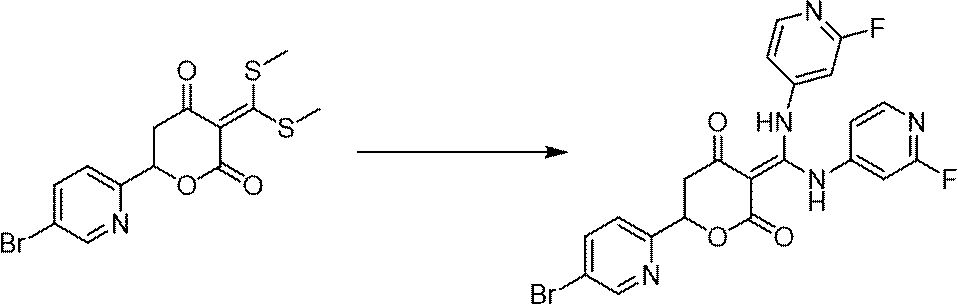
3-(ビス(メチルチオ)メチレン)-6-(5-ブロモピリジン-2-イル)ジヒドロ-2H-ピラン-2,4(3H)-ジオン(0.15g,0.40mmol)及び4-アミノ-2-フルオロピリジン(0.14mg,1.2mmol)をアセトニトリル(3mL)に溶解させ、加熱還流下で6時間攪拌した。反応終了後、反応液に1N塩酸を加え、これを酢酸エチルで抽出し、得られた有機層を硫酸マグネシウムで乾燥後、減圧濃縮した。得られた残渣をシリカゲルカラムクロマトグラフィーで精製することにより、3-(ビス((2-フルオロピリジン-4-イル)アミノ)メチレン)-6-(5-ブロモピリジン-2-イル)ジヒドロ-2H-ピラン-2,4(3H)-ジオン(0.011g,0.022mmol)を得た。
収率:6%
物性:融点164-165℃
収率:6%
物性:融点164-165℃
製造実施例3
3-(((4-フルオロフェニル)アミノ)(メチルアミノ)メチレン)-1-メチル-6-(4-(トリフルオロメチル)フェニル)ピペリジン-2,4-ジオン(化合物番号3-1)の製造
3-(((4-フルオロフェニル)アミノ)(メチルアミノ)メチレン)-1-メチル-6-(4-(トリフルオロメチル)フェニル)ピペリジン-2,4-ジオン(化合物番号3-1)の製造

3-(((4-(ターシャリーブチル)ベンジル)チオ)((4-フルオロフェニル)アミノ)メチレン)-1-メチル-6-(4-(トリフルオロメチル)フェニル)ピペリジン-2,4-ジオン(70mg,0.12mmol)のテトラヒドロフラン(5mL)溶液に、メチルアミン(7%テトラヒドロフラン溶液)(54mg,0.12mmol)を加えて室温で3時間攪拌した。反応液を減圧濃縮後、得られた残渣をシリカゲルカラムクロマトグラフィーで精製することにより、3-(((4-フルオロフェニル)アミノ)(メチルアミノ)メチレン)-1-メチル-6-(4-(トリフルオロメチル)フェニル)ピペリジン-2,4-ジオン(45mg,0.11mmol)を得た。
収率:87%
物性:1H-NMR(CDCl3):δ 12.9(d,1H),11.4(d,1H),7.61(d,2H),7.31(d,2H),7.10-7.13(m,2H),7.02-7.06(m,2H),4.60-4.62(m,1H),3.25-3.33(m,1H),3.00-3.02(m,3H),2.61-2.66(m,1H),2.51-2.54(m,3H)
収率:87%
物性:1H-NMR(CDCl3):δ 12.9(d,1H),11.4(d,1H),7.61(d,2H),7.31(d,2H),7.10-7.13(m,2H),7.02-7.06(m,2H),4.60-4.62(m,1H),3.25-3.33(m,1H),3.00-3.02(m,3H),2.61-2.66(m,1H),2.51-2.54(m,3H)
製造実施例4
5-エチル-3-((4-フルオロフェニル)アミノ)(メチルアミノ)メチレン)-1-メチル-5(6-(トリフルオロメチル)ピリジン-3-イル)ピペリジン-2,4-ジオン(化合物番号3-2)の製造
5-エチル-3-((4-フルオロフェニル)アミノ)(メチルアミノ)メチレン)-1-メチル-5(6-(トリフルオロメチル)ピリジン-3-イル)ピペリジン-2,4-ジオン(化合物番号3-2)の製造
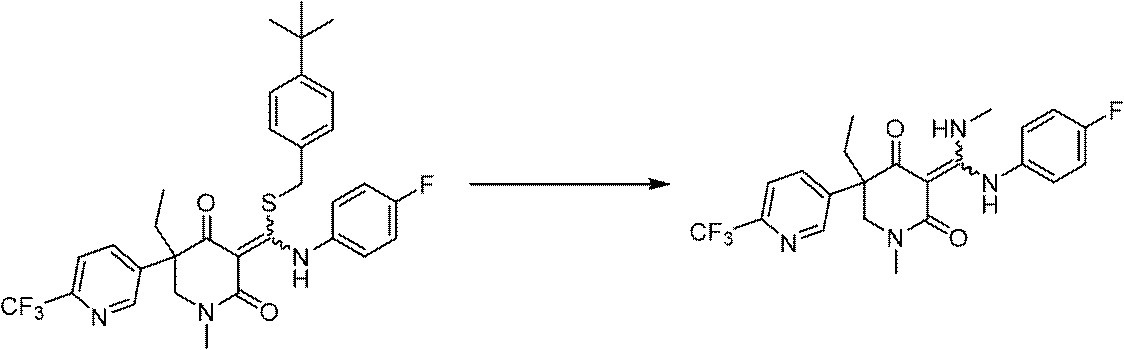
3-(((4-(ターシャリーブチル)ベンジル)チオ)((4-フルオロフェニル)アミノ)メチレン)-5-エチル-1-メチル-5-(6-トリフルオロメチル)ピリジン-3-イル)ピペリジン-2,4-ジオン(70mg,0.12mmol)のテトラヒドロフラン(5mL)溶液に、メチルアミン(7%テトラヒドロフラン溶液)(52mg,0.12mmol)を加えて室温で3時間攪拌した。反応液を減圧濃縮後、得られた残渣をシリカゲルカラムクロマトグラフィーで精製することにより、5-エチル-3-(((4-フルオロフェニル)アミノ)(メチルアミノ)メチレン)-1-メチル-5(6-(トリフルオロメチル)ピリジン-3-イル)ピペリジン-2,4-ジオン(43mg,0.081mmol)を得た。
収率:69%
物性:1H-NMR(CDCl3):δ 12.5-13.4(m,1H),11.2-12.0(m,1H),8.68(s,1H),7.85(d,1H),7.63(d,1H),7.00-7.10(m,4H),3.71(d,1H),3.60(d,1H),3.09(s,3H),2.51(d,3H),2.14(quint.,1H),1.95(quint.,1H),0.78(t,3H)
収率:69%
物性:1H-NMR(CDCl3):δ 12.5-13.4(m,1H),11.2-12.0(m,1H),8.68(s,1H),7.85(d,1H),7.63(d,1H),7.00-7.10(m,4H),3.71(d,1H),3.60(d,1H),3.09(s,3H),2.51(d,3H),2.14(quint.,1H),1.95(quint.,1H),0.78(t,3H)
製造実施例5
ターシャリーブチル 4-(ビス((5-フルオロピリジン-2-イル)アミノ)メチレン)-3,5-ジオキソピペリジン-1-カルボキシレート(化合物番号4-10)の製造
ターシャリーブチル 4-(ビス((5-フルオロピリジン-2-イル)アミノ)メチレン)-3,5-ジオキソピペリジン-1-カルボキシレート(化合物番号4-10)の製造

ターシャリーブチル 4-(ビス(メチルチオ)メチレン)-3,5-ジオキソピペリジン-1-カルボキシレート(0.14g,0.45mmol)と5-フルオロピリジン-2-アミン(0.11g,0.98mmol)をトルエン(10mL)に溶解させ、加熱還流下1時間反応させた。反応液を減圧濃縮後、得られた残渣をシリカゲルカラムクロマトグラフィーで精製することにより、ターシャリーブチル 4-(ビス((5-フルオロピリジン-2-イル)アミノ)メチレン)-3,5-ジオキソピペリジン-1-カルボキシレート(0.14g,0.30mmol)を得た。
収率:67%
物性:融点196-198℃
収率:67%
物性:融点196-198℃
製造実施例6
3-(アミノ((4-フルオロフェニル)アミノ)メチレン)-1-(4-(トリフルオロメチル)フェニル)アゼパン-2,4-ジオン(化合物番号5-1)の製造
3-(アミノ((4-フルオロフェニル)アミノ)メチレン)-1-(4-(トリフルオロメチル)フェニル)アゼパン-2,4-ジオン(化合物番号5-1)の製造
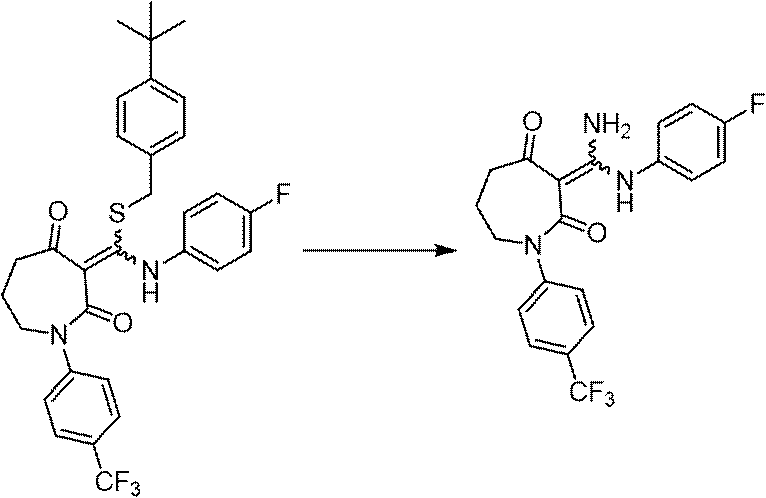
3-(((4-(ターシャリーブチル)ベンジル)チオ)((4-フルオロフェニル)アミノ)メチレン)-1-(4-(トリフルオロメチル)フェニル)アゼパン-2,4-ジオン(80mg,0.14mmol)のテトラヒドロフラン(1.0mL)溶液に、アンモニアのメタノール溶液(0.11mL,0.21mmol)を室温で加えた。反応液を室温で1時間撹拌した後、反応液に水を加え、酢酸エチルで3回抽出した。有機層を減圧濃縮後、得られた残渣をシリカゲルカラムクロマトグラフィーで精製することにより、3-(アミノ((4-フルオロフェニル)アミノ)メチレン)-1-(4-(トリフルオロメチル)フェニル)アゼパン-2,4-ジオン(44mg,0.11mmol)を得た。
収率:77%
物性:融点220-221℃
収率:77%
物性:融点220-221℃
製造実施例7
メチル 2-(6-シアノピリジン-3-イル)-5-(((2,2-ジフルオロエチル)アミノ)((4-フルオロフェニル)アミノ)メチレン)-4,6-ジオキソテトラヒドロピリダジン-1(2H)-カルボキシレ-ト(化合物番号6-15)の製造
メチル 2-(6-シアノピリジン-3-イル)-5-(((2,2-ジフルオロエチル)アミノ)((4-フルオロフェニル)アミノ)メチレン)-4,6-ジオキソテトラヒドロピリダジン-1(2H)-カルボキシレ-ト(化合物番号6-15)の製造

メチル 2-(6-シアノピリジン-3-イル)-5-(((4-フルオロフェニル)アミノ)(メチルチオ)メチレン)-4,6-ジオキソテトラヒドロピリダジン-1(2H)-カルボキシレート(0.15g,0.34mmol)をアルゴン雰囲気下、テトラヒドロフラン(2mL)に溶解させ、トリエチルアミン(41mg,0.41mmol)、及びジフルオロエチルアミン(33mg,0.41mmol)を加え、室温で40分間攪拌した。反応液に1N塩酸(6mL)を加え、酢酸エチルで2回抽出し、有機層を飽和食塩水で洗浄後、無水硫酸ナトリウムで乾燥し、減圧濃縮した。析出した結晶をターシャリーブチルメチルエーテルで洗浄することにより、メチル 2-(6-シアノピリジン-3-イル)-5-(((2,2-ジフルオロエチル)アミノ)((4-フルオロフェニル)アミノ)メチレン)-4,6-ジオキソテトラヒドロピリダジン-1(2H)-カルボキシレート(0.12mg,0.24mmol)を得た。
収率:72%
物性:融点115-120℃
収率:72%
物性:融点115-120℃
参考実施例1
2-(ビス(メチルチオ)メチレン)-5-(4-(トリフルオロメチル)フェニル)シクロヘキサン-1,3-ジオン(化合物番号8-13)の製造
2-(ビス(メチルチオ)メチレン)-5-(4-(トリフルオロメチル)フェニル)シクロヘキサン-1,3-ジオン(化合物番号8-13)の製造
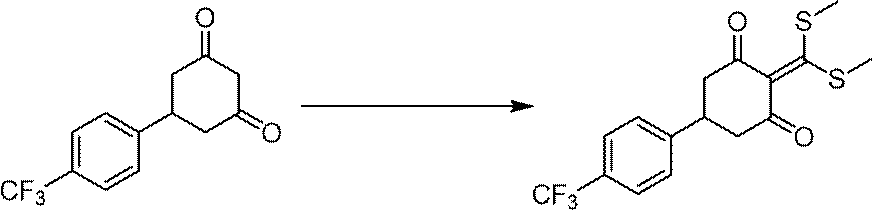
5-(4-(トリフルオロメチル)フェニル)シクロヘキサン-1,3-ジオン(2.6g,10mmol)、炭酸セシウム(9.8g,30mmol)、及びテトラブチルアンモニウムブロミド(32mg,0.10mmol)をN,N-ジメチルアセトアミド(10mL)に加え、アルゴン雰囲気下、室温で1時間攪拌した。室温下、反応液に二硫化炭素(2.3g,30mmol)のN,N-ジメチルアセトアミド(2mL)溶液を滴下し、室温で30分攪拌後、室温で1晩静置した。室温下、反応液にヨウ化メチル(3.20g,22.5mmol)のN,N-ジメチルアセトアミド(2mL)溶液を滴下し、室温で2時間攪拌した。反応液に飽和塩化アンモニウム水溶液を加えて、酢酸エチルで抽出した。有機層を5%チオ硫酸ナトリウム水溶液、及び飽和塩化アンモニウム水溶液で順次洗浄後、無水硫酸ナトリウムで乾燥し、ろ過、及び減圧濃縮をした。得られた残渣をシリカゲルカラムクロマトグラフィーで精製することにより、2-(ビス(メチルチオ)メチレン)-5-(4-(トリフルオロメチル)フェニル)シクロヘキサン-1,3-ジオン(2.9g,8.1mmol)を得た。
収率:81%
物性:融点110-114℃
収率:81%
物性:融点110-114℃
参考実施例2
3-(ビス(メチルチオ)メチレン)-6-(5-ブロモピリジン-2-イル)ジヒドロ-2H-ピラン-2,4(3H)-ジオンの製造
3-(ビス(メチルチオ)メチレン)-6-(5-ブロモピリジン-2-イル)ジヒドロ-2H-ピラン-2,4(3H)-ジオンの製造

6-(5-ブロモピリジン-2-イル)ジヒドロ-2H-ピラン-2,4(3H)-ジオン(1.0g,3.7mmol)、炭酸セシウム(3.6g,11mmol)、及びテトラブチルアンモニウムブロミド(13mg,0.039mmol)をN,N-ジメチルアセトアミド(40mL)に溶解させて、アルゴン雰囲気下、室温で1時間攪拌した。二硫化炭素(0.89g,11mmol)とN,N-ジメチルアセトアミド(4mL)の混合物を室温で反応液に滴下し、室温で30分攪拌後、室温で1晩静置した。ヨウ化メチル(1.3g,8.8mmol)のN,N-ジメチルアセトアミド(2mL)溶液を室温で反応液に滴下し、室温で2時間攪拌した。反応液に飽和塩化アンモニウム水溶液を加えて、酢酸エチルで抽出した。有機層を5%チオ硫酸ナトリウム水溶液、及び飽和塩化アンモニウム水溶液で順次洗浄後、無水硫酸ナトリウムで乾燥し、ろ過、減圧濃縮をした。得られた残渣をシリカゲルカラムクロマトグラフィーで精製することにより、3-(ビス(メチルチオ)メチレン)-6-(5-ブロモピリジン-2-イル)ジヒドロ-2H-ピラン-2,4(3H)-ジオン(1.6g,4.2mmol)を粗生成物として得た。
参考実施例3
3-(((4-ターシャリーブチル)ベンジル)チオ)((4-フルオロフェニル)アミノ)メチレン)-1-メチル-6-(4-(トリフルオロメチル)フェニル)ピペリジン-2,4-ジオン(化合物番号9-7)の製造
参考実施例3-1
1-メチル-6-(4-(トリフルオロメチル)フェニル)ピペリジン-2,4-ジオンの製造
3-(((4-ターシャリーブチル)ベンジル)チオ)((4-フルオロフェニル)アミノ)メチレン)-1-メチル-6-(4-(トリフルオロメチル)フェニル)ピペリジン-2,4-ジオン(化合物番号9-7)の製造
参考実施例3-1
1-メチル-6-(4-(トリフルオロメチル)フェニル)ピペリジン-2,4-ジオンの製造

エチル 4-ヒドロキシ-1-メチル-2-オキソ-6-(4-(トリフルオロメチル)フェニル)-1,2,5,6-テトラヒドロピリジン-3-カルボキシレート(0.50g,1.5mmol)をアセトニトリル(14mL)に溶解させて、水(1.5mL)を加えて加熱還流下で2時間攪拌した。反応液を減圧濃縮することにより、1-メチル-6-(4-(トリフルオロメチル)フェニル)ピペリジン-2,4-ジオン(0.20g,0.74mmol)を粗生成物として得た。本化合物はこれ以上精製することなく次の工程に用いた。
参考実施例3-2
N-(4-フルオロフェニル)-4-ヒドロキシ-1-メチル-6-オキソ-2-(4-(トリフルオロメチル)フェニル)-2,3-ジヒドロピリジン-5-カルボチオアミドの製造
N-(4-フルオロフェニル)-4-ヒドロキシ-1-メチル-6-オキソ-2-(4-(トリフルオロメチル)フェニル)-2,3-ジヒドロピリジン-5-カルボチオアミドの製造

1-メチル-6-(4-(トリフルオロメチル)フェニル)ピペリジン-2,4-ジオン(0.36g,1.2mmol)、及び4-フルオロフェニルイソチオシアネート(0.28g,1.8mmol)のN,N-ジメチルアセトアミド(3mL)溶液に60%wt水素化ナトリウム(72mg,1.8mmol)を加えて室温で3時間攪拌した。反応終了後、反応液を1N塩酸に注ぎ入れ、酢酸エチルで抽出し、水で洗浄、得られた有機層を硫酸マグネシウムで乾燥後、減圧濃縮した。得られた残渣をシリカゲルカラムクロマトグラフィーで精製することにより、N-(4-フルオロフェニル)-4-ヒドロキシ-1-メチル-2-オキソ-6-(4-(トリフルオロメチル)フェニル)-1,2,5,6-テトラヒドロピリジン-3-カルボチオアミド(0.34g,0.63mmol)を得た。
収率:63%
物性:融点155-156℃
収率:63%
物性:融点155-156℃
参考実施例3-3
3-(((4-(ターシャリーブチル)ベンジル)チオ)((4-フルオロフェニル)アミノ)メチレン)-1-メチル-6-(4-(トリフルオロメチル)フェニル)ピペリジン-2,4-ジオンの製造
3-(((4-(ターシャリーブチル)ベンジル)チオ)((4-フルオロフェニル)アミノ)メチレン)-1-メチル-6-(4-(トリフルオロメチル)フェニル)ピペリジン-2,4-ジオンの製造

N-(4-フルオロフェニル)-4-ヒドロキシ-1-メチル-2-オキソ-6-(4-(トリフルオロメチル)フェニル)-1,2,5,6-テトラヒドロピリジン-3-カルボチオアミド(0.34g,0.81mmol)、4-ターシャリーブチルベンジルブロミド(0.28g,1.2mmol)のテトラヒドロフラン(8.1mL)溶液に、トリエチルアミン(0.25mg,2.4mmol)を加えて室温で5時間攪拌した。反応終了後、反応液に飽和塩化アンモニウム水溶液を加え、酢酸エチルで抽出し、水で洗浄、得られた有機層を硫酸マグネシウムで乾燥後、減圧濃縮することにより、3-(((4-(ターシャリーブチル)ベンジル)チオ)((4-フルオロフェニル)アミノ)メチレン)-1-メチル-6-(4-(トリフルオロメチル)フェニル)ピペリジン-2,4-ジオン(0.41mg,0.72mmol)を得た。
収率:90%
物性:1H-NMR(CDCl3):δ 14.1(s,1H),7.61(m,2H),7.21-7.35(m,6H),7.08(m,2H),6.95(m,2H),4.69(m,1H),3.55(m,2H),3.31(m,1H),3.11(m,3H),2.77(m,1H),1.27(m,9H)
収率:90%
物性:1H-NMR(CDCl3):δ 14.1(s,1H),7.61(m,2H),7.21-7.35(m,6H),7.08(m,2H),6.95(m,2H),4.69(m,1H),3.55(m,2H),3.31(m,1H),3.11(m,3H),2.77(m,1H),1.27(m,9H)
参考実施例4
3-(((4-ターシャリーブチル)ベンジル)チオ)((4-フルオロフェニル)アミノ)メチレン)-5-エチル-1-メチル-5-(6-(トリフルオロメチル)ピリジン-3-イル)ピペリジン-2,4-ジオン(化合物番号9-8)の製造
参考実施例4-1
メチル 2-シアノ-2-(6-(トリフルオロメチル)ピリジン-3-イル)ブタノエートの製造
3-(((4-ターシャリーブチル)ベンジル)チオ)((4-フルオロフェニル)アミノ)メチレン)-5-エチル-1-メチル-5-(6-(トリフルオロメチル)ピリジン-3-イル)ピペリジン-2,4-ジオン(化合物番号9-8)の製造
参考実施例4-1
メチル 2-シアノ-2-(6-(トリフルオロメチル)ピリジン-3-イル)ブタノエートの製造
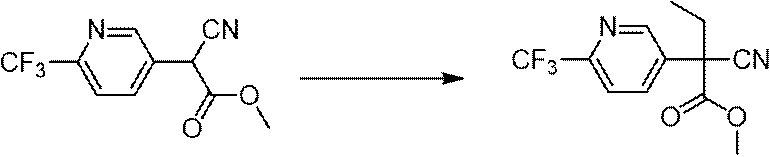
メチル 2-シアノ-2-(6-(トリフルオロメチル)ピリジン-3-イル)アセテート(40g,0.16mol)をアセトニトリル(0.55L)に溶解させ、炭酸セシウム(11g,0.33mol)、及びヨードエタン(38g,0.25mol)を加え、50℃で20時間攪拌した。反応液を1M塩酸で中和し、有機層を飽和食塩水で洗浄し、得られた有機層を硫酸ナトリウムで乾燥後、減圧濃縮し、得られた残渣をシリカゲルクロマトグラフィーで精製することにより、メチル 2-シアノ-2-(6-(トリフルオロメチル)ピリジン-3-イル)ブタノエート(35g,0.13mmol)を得た。
収率:75%
物性:1H-NMR(CDCl3):δ 8.94(d,1H),8.10(dd,1H),7.75(d,1H),3.85(s,3H),2.46-2.57(m,1H),2.16-2.27(m,1H),1.11(t,3H)
収率:75%
物性:1H-NMR(CDCl3):δ 8.94(d,1H),8.10(dd,1H),7.75(d,1H),3.85(s,3H),2.46-2.57(m,1H),2.16-2.27(m,1H),1.11(t,3H)
参考実施例4-2
メチル 2-(((ターシャリーブトキシカルボニル)アミノ)メチル)-2-(6-(トリフルオロメチル)ピリジン-3-イル)ブタノエートの製造
メチル 2-(((ターシャリーブトキシカルボニル)アミノ)メチル)-2-(6-(トリフルオロメチル)ピリジン-3-イル)ブタノエートの製造

メチル 2-シアノ-2-(6-(トリフルオロメチル)ピリジン-3-イル)ブタノエート(35g,0.13mol)をメタノール(0.40L)に溶解させ、二炭酸ジターシャリーブチル(56g,0.26mol)、及びパラジウム炭素(8.0g,10%wt%)を加えた。水素雰囲気下、反応液を40℃96時間攪拌した。反応液を室温まで冷却後、セライトろ過によりパラジウム炭素を除去し、酢酸エチルで抽出した。有機層を飽和食塩水で洗浄し、得られた有機層を硫酸ナトリウムで乾燥後、ろ過乾燥し、石油エーテル中、再結晶することにより、メチル 2-(((ターシャリーブトキシカルボニル)アミノ)メチル)-2-(6-(トリフルオロメチル)ピリジン-3-イル)ブタノエート(38g,0.10mol)で得た。
物性:1H-NMR(CDCl3):δ 8.53(s,1H),7.78(d,1H),7.65(d,1H),4.89(brs,1H),3.78(s,3H),3.64-3.73(m,2H),2.12(q,2H),1.29(s,9H),0.93(t,3H)
物性:1H-NMR(CDCl3):δ 8.53(s,1H),7.78(d,1H),7.65(d,1H),4.89(brs,1H),3.78(s,3H),3.64-3.73(m,2H),2.12(q,2H),1.29(s,9H),0.93(t,3H)
参考実施例4-3
メチル 2-(((ターシャリーブトキシカルボニル)(メチル)アミノ)メチル)-2-(6-(トリフルオロメチル)ピリジン-3-イル)ブタノエートの製造
メチル 2-(((ターシャリーブトキシカルボニル)(メチル)アミノ)メチル)-2-(6-(トリフルオロメチル)ピリジン-3-イル)ブタノエートの製造

メチル 2-(((ターシャリーブトキシカルボニル)アミノ)メチル)-2-(6-(トリフルオロメチル)ピリジン-3-イル)ブタノエート(38g,0.10mol)をテトラヒドロフラン(0.40L)に溶解させて、0℃で水素化ナトリウム(10g,0.25mol,60%wt%)を加えて30分攪拌した。その後、反応液にヨウ化メチル(72g,0.51mol)を25℃で加え、55℃で12時間攪拌した。反応液に、飽和塩化アンモニウム水溶液を加えて、酢酸エチルで抽出した。有機層を飽和食塩水で洗浄し、得られた有機層を硫酸ナトリウムで乾燥後、減圧濃縮し、得られた残渣をシリカゲルカラムクロマトグラフィーで精製することにより、メチル 2-(((ターシャリーブトキシカルボニル)(メチル)アミノ)メチル)-2-(6-(トリフルオロメチル)ピリジン-3-イル)ブタノエート(37g,0.094mol)を得た。
収率:92%
収率:92%
参考実施例4-4
メチル 2-((メチルアミノ)メチル)-2-(6-(トリフルオロメチル)ピリジン-3-イル)ブタノエート塩酸塩の製造
メチル 2-((メチルアミノ)メチル)-2-(6-(トリフルオロメチル)ピリジン-3-イル)ブタノエート塩酸塩の製造

メチル 2-(((ターシャリーブトキシカルボニル)(メチル)アミノ)メチル)-2-(6-(トリフルオロメチル)ピリジン-3-イル)ブタノエート(41g,0.11mol)を酢酸(50mL)に溶解させて、4N塩化水素/酢酸エチル溶液(0.20L)を加え、室温で2時間攪拌した。反応液を減圧濃縮し、得られた残渣にジエチルエーテルを加え、析出した固体をろ取した後、乾燥することにより、メチル 2-((メチルアミノ)メチル)-2-(6-(トリフルオロメチル)ピリジン-3-イル)ブタノエート塩酸塩(41g,0.10mol)を得た。
収率:98%
収率:98%
参考実施例4-5
メチル 2-((3-エトキシ-N-メチル-3-オキソプロパンアミド)メチル)-2-(6-(トリフルオロメチル)ピリジン-3-イル)ブタノエートの製造
メチル 2-((3-エトキシ-N-メチル-3-オキソプロパンアミド)メチル)-2-(6-(トリフルオロメチル)ピリジン-3-イル)ブタノエートの製造

メチル 2-((メチルアミノ)メチル)-2(6-(トリフルオロメチル)ピリジン-3-イル)ブタノエート塩酸塩(32g,99mmol)を塩化メチレン(0.30L)に溶解させ、ジイソプロピルエチルアミン(26g,0.20mol)とエチル 3-クロロ-3-オキソプロピオネート(15g,99mmol)を加え、25℃で1時間攪拌した。反応液を飽和食塩水で洗浄し、得られた有機層を硫酸ナトリウムで乾燥後、減圧濃縮することにより、メチル 2-((3-エトキシ-N-メチル-3-オキソプロパンアミド)メチル)-2-(6-(トリフルオロメチル)ピリジン-3-イル)ブタノエートを得た。
収率:91%
物性:1H-NMR(CDCl3):δ 8.56(d,1H),7.82(dd,1H),7.65(d,1H),4.26(d,1H),4.16(q,2H),3.82(d,1H),3.75(s,3H),3.30(s,2H),2.65(s,3H),2.21-2.33(m,1H),2.05-2.16(m,1H),1.25(t,3H),0.91(t,3H)
収率:91%
物性:1H-NMR(CDCl3):δ 8.56(d,1H),7.82(dd,1H),7.65(d,1H),4.26(d,1H),4.16(q,2H),3.82(d,1H),3.75(s,3H),3.30(s,2H),2.65(s,3H),2.21-2.33(m,1H),2.05-2.16(m,1H),1.25(t,3H),0.91(t,3H)
参考実施例4-6
エチル 3-エチル-4-ヒドロキシ-1-メチル-6-オキソ-3-(6-(トリフルオロメチル)ピリジン-3-イル)-2H-ピリジン-5-カルボキシレートの製造
エチル 3-エチル-4-ヒドロキシ-1-メチル-6-オキソ-3-(6-(トリフルオロメチル)ピリジン-3-イル)-2H-ピリジン-5-カルボキシレートの製造

メチル 2-((3-エトキシ-N-メチル-3-オキソプロパンアミド)メチル)-2-(6-(トリフルオロメチル)ピリジン-3-イル)ブタノエート(30g,74mmol)のエタノール(0.30L)溶液に、ナトリウムエトキサイド(51g,0.15mol)のエタノール溶液(0.20L)を加えた。反応液を60℃で1時間攪拌した後、反応液を飽和塩化アンモニウム水溶液に注ぎ入れ、塩化メチレンで抽出し、飽和食塩水で洗浄した。得られた有機層を硫酸ナトリウムで乾燥し、減圧濃縮した後、エタノールで再結晶し、得られた固体をろ取することにより、エチル 3-エチル-4-ヒドロキシ-1-メチル-6-オキソ-3-(6-(トリフルオロメチル)ピリジン-3-イル)-2H-ピリジン-5-カルボキシレート(19g,38mmol)を得た。
物性:1H-NMR(CDCl3):δ 16.3(s,0.3H),14.9(s,0.4H),8.50-8.81(m,1H),7.85(d,J=6.8Hz,1H),7.65(d,J=8.0Hz,1H),4.24-4.44(m,2H),3.63-3.89(m,2H),2.99-3.25(m,3H),2.11-2.23(m,1H),1.80-2.09(m,1H),1.39(t,J=7.2Hz,3H),0.70-0.91(m,3H)
物性:1H-NMR(CDCl3):δ 16.3(s,0.3H),14.9(s,0.4H),8.50-8.81(m,1H),7.85(d,J=6.8Hz,1H),7.65(d,J=8.0Hz,1H),4.24-4.44(m,2H),3.63-3.89(m,2H),2.99-3.25(m,3H),2.11-2.23(m,1H),1.80-2.09(m,1H),1.39(t,J=7.2Hz,3H),0.70-0.91(m,3H)
参考実施例4-7
5-エチル-1-メチル-5-(6-(トリフルオロメチル)ピリジン-3-イル)ピペリジン-2,4-ジオンの製造
5-エチル-1-メチル-5-(6-(トリフルオロメチル)ピリジン-3-イル)ピペリジン-2,4-ジオンの製造

エチル 3-エチル-4-ヒドロキシ-1-メチル-6-オキソ-3-(6-(トリフルオロメチル)ピリジン-3-イル)-2H-ピリジン-5-カルボキシレート(0.50g,1.3mmol)をアセトニトリル(20mL)に溶解させて、水(2mL)を加えて加熱還流下で4時間攪拌した。反応液を減圧濃縮することにより、5-エチル-1-メチル-5-(6-(トリフルオロメチル)ピリジン-3-イル)ピペリジン-2,4-ジオン(0.40g,1.3mmol)を粗生成物として得た。本化合物はこれ以上精製することなく次の工程に用いた。
参考実施例4-8
5-エチル-N-(4-フルオロフェニル)-4-ヒドロキシ-1-メチル-2-オキソ-5-(6-(トリフルオロメチル)ピリジン-3-イル)-1,2,5,6-テトラヒドロピリジン-3-カルボチオアミドの製造
5-エチル-N-(4-フルオロフェニル)-4-ヒドロキシ-1-メチル-2-オキソ-5-(6-(トリフルオロメチル)ピリジン-3-イル)-1,2,5,6-テトラヒドロピリジン-3-カルボチオアミドの製造

5-エチル-1-メチル-5-(6-(トリフルオロメチル)ピリジン-3-イル)ピペリジン-2,4-ジオン(0.40g,1.3mmol)、及び4-フルオロフェニルイソチオシアネート(0.33g,2.0mmol)のN,N-ジメチルアセトアミド(3mL)溶液に60%wt水素化ナトリウム(80mg,2.0mmol)を加えて室温で2時間攪拌した。反応終了後、反応液を1N塩酸に注ぎ入れ、これを酢酸エチルで抽出し、水で洗浄後、得られた有機層を硫酸マグネシウムで乾燥し、減圧濃縮した。得られた残渣をシリカゲルカラムクロマトグラフィーで精製することにより、5-エチル-N-(4-フルオロフェニル)-4-ヒドロキシ-1-メチル-2-オキソ-5-(6-(トリフルオロメチル)ピリジン-3-イル)-1,2,5,6-テトラヒドロピリジン-3-カルボチオアミド(0.28g,0.62mmol)を得た。
収率:58%
物性:融点146-147℃
収率:58%
物性:融点146-147℃
参考実施例4-9
3-(((4-(ターシャリーブチル)ベンジル)チオ)((4-フルオロフェニル)アミノ)メチレン)-5-エチル-1-メチル-5-(6-トリフルオロメチル)ピリジン-3-イル)ピペリジン-2,4-ジオンの製造
3-(((4-(ターシャリーブチル)ベンジル)チオ)((4-フルオロフェニル)アミノ)メチレン)-5-エチル-1-メチル-5-(6-トリフルオロメチル)ピリジン-3-イル)ピペリジン-2,4-ジオンの製造

5-エチル-N-(4-フルオロフェニル)-4-ヒドロキシ-1-メチル-2-オキソ-5-(6-(トリフルオロメチル)ピリジン-3-イル)-1,2,5,6-テトラヒドロピリジン-3-カルボチオアミド(0.25g,0.55mmol)、及び4-ターシャリーブチルベンジルブロミド(0.19mg,0.83mmol)のテトラヒドロフラン(5.5mL)溶液にトリエチルアミン(0.23mg,1.7mmol)を加えて室温で5時間攪拌した。反応終了後、反応液に飽和塩化アンモニウム水溶液を加え、これを酢酸エチルで抽出し、水で洗浄後、得られた有機層を硫酸マグネシウムで乾燥し、ろ過後、減圧濃縮することにより、3-(((4-(ターシャリーブチル)ベンジル)チオ)((4-フルオロフェニル)アミノ)メチレン)-5-エチル-1-メチル-5-(6-トリフルオロメチル)ピリジン-3-イル)ピペリジン-2,4-ジオン(0.29g,0.49mmol)を得た。
収率:88%
物性:融点162-163℃
収率:88%
物性:融点162-163℃
参考実施例5
ターシャリーブチル 4-(ビス(メチルチオ)メチレン)-3,5-ジオキソピペリジン-1-カルボキシレート(化合物番号8-22)の製造
ターシャリーブチル 4-(ビス(メチルチオ)メチレン)-3,5-ジオキソピペリジン-1-カルボキシレート(化合物番号8-22)の製造
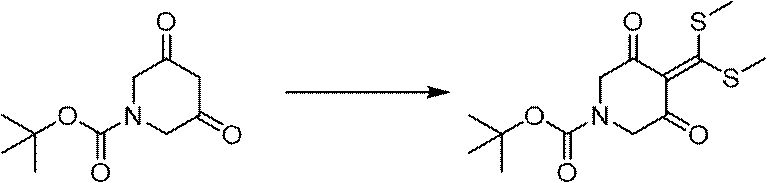
ターシャリーブチル 3,5-ジオキソピペリジン-1-カルボキシレート(5.0g,23mmo1)、炭酸セシウム(31g,94mmo1)、及び臭化テトラブチルアンモニウム(8.0mg,0.020mmo1)に、N,N-ジメチルアセトアミド(100mL)を加えて、室温で3時間攪拌した。二硫化炭素(3.6g,47mmo1)を反応液に滴下し室温で18時間静置した。ヨウ化メチル(7.3g,52mmo1)を反応液に滴下し室温で5時間攪拌した。反応液に2M塩酸を加えて、酢酸エチルで抽出した。更に、有機層を2M塩酸で2回洗浄し、飽和塩化アンモニウム水溶液で洗浄後、無水硫酸ナトリウムで乾燥し、減圧濃縮することにより、ターシャリーブチル 4-(ビス(メチルチオ)メチレン)-3,5-ジオキソピペリジン-1-カルボキシレート(5.47g,17.2mmo1)を得た。
収率:77%
物性:融点95-97℃
収率:77%
物性:融点95-97℃
参考実施例6
(3-(((4-(ターシャリーブチル)ベンジル)チオ)((4-フルオロフェニル)アミノ)メチレン)-1-(4-(トリフルオロメチル)フェニル)アゼパン-2,4-ジオン(化合物番号9-13)の製造
参考実施例6-1
N-(4-フルオロフェニル)-4-ヒドロキシ-2-オキソ-1-(4-(トリフルオロメチル)フェニル)-2,5,6,7-テトラヒドロ-1H-アゼピン-3-カルボチオアミドの製造
(3-(((4-(ターシャリーブチル)ベンジル)チオ)((4-フルオロフェニル)アミノ)メチレン)-1-(4-(トリフルオロメチル)フェニル)アゼパン-2,4-ジオン(化合物番号9-13)の製造
参考実施例6-1
N-(4-フルオロフェニル)-4-ヒドロキシ-2-オキソ-1-(4-(トリフルオロメチル)フェニル)-2,5,6,7-テトラヒドロ-1H-アゼピン-3-カルボチオアミドの製造

1-(4-トリフルオロフェニル)アゼパン-2,4-ジオン(0.35g,1.3mmol)をN,N-ジメチルアセトアミド(5.0mL)に溶解させ、水素化ナトリウム(58mg,1.4mmol)、及び4-フルオロフェニルチオイソシアネート(0.26g,1.7mmol)を室温で加えた。反応液を室温で3時間撹拌した後、飽和塩化アンモニウム水溶液を加え、酢酸エチルで3回抽出した。有機層を減圧濃縮後、得られた残渣をシリカゲルカラムクロマトグラフィーで精製することにより、N-(4-フルオロフェニル)-4-ヒドロキシ-2-オキソ-1-(4-(トリフルオロメチル)フェニル)-2,5,6,7-テトラヒドロ-1H-アゼピン-3-カルボチオアミド(0.48g,1.1mmol)を得た。
収率:88%
収率:88%
参考実施例6-2
(3-(((4-(ターシャリーブチル)ベンジル)チオ)((4-フルオロフェニル)アミノ)メチレン)-1-(4-(トリフルオロメチル)フェニル)アゼパン-2,4-ジオンの製造
(3-(((4-(ターシャリーブチル)ベンジル)チオ)((4-フルオロフェニル)アミノ)メチレン)-1-(4-(トリフルオロメチル)フェニル)アゼパン-2,4-ジオンの製造

N-(4-フルオロフェニル)-4-ヒドロキシ-2-オキソ-1-(4-(トリフルオロメチル)フェニル)-2,5,6,7-テトラヒドロ-1H-アゼピン-3-カルボチオアミド(0.39g,0.92mmol)をテトラヒドロフラン(5.0mL)に溶解させ、4-ターシャリーブチルベンジルブロミド(0.27g,1.2mmol)、及びトリエチルアミン(0.39mL,2.8mmol)を室温で加えた。反応液を室温で3時間撹拌した後、飽和塩化アンモニウム水溶液を加え、酢酸エチルで3回抽出した。有機層を減圧濃縮後、得られた残渣をシリカゲルカラムクロマトグラフィーで精製することにより、(3-(((4-(ターシャリーブチル)ベンジル)チオ)((4-フルオロフェニル)アミノ)メチレン)-1-(4-(トリフルオロメチル)フェニル)アゼパン-2,4-ジオン(0.52g,0.91mmol)を得た。
収率:76%
物性:融点129-130℃
収率:76%
物性:融点129-130℃
参考実施例7
メチル 2-(6-シアノピリジン-3-イル)-5-(((4-フルオロフェニル)アミノ)(メチルチオ)メチレン)-4,6-ジオキソテトラヒドロピリダジン-1(2H)-カルボキシレートの製造
参考実施例7-1
メチル 2-(6-シアノピリジン-3-イル)-4,6-ジオキソテトラヒドロピリダジン-1(2H)-カルボキシレートの製造
メチル 2-(6-シアノピリジン-3-イル)-5-(((4-フルオロフェニル)アミノ)(メチルチオ)メチレン)-4,6-ジオキソテトラヒドロピリダジン-1(2H)-カルボキシレートの製造
参考実施例7-1
メチル 2-(6-シアノピリジン-3-イル)-4,6-ジオキソテトラヒドロピリダジン-1(2H)-カルボキシレートの製造
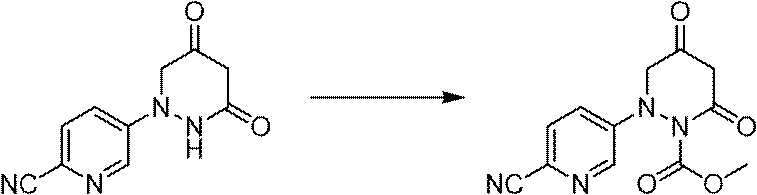
5-(3,5-ジオキソテトラヒドロピリダジン-1(2H)-イル)ピコリノニトリル(1.0g,4.6mmol)及び炭酸カリウム(1.5g,11mmol)をアセトニトリル10mLに溶解させ、クロロギ酸メチル(0.96g,10mmol)を加え、室温で30分攪拌した。その後、メタノール(2mL)及び4-ジメチルアミノピリジン(0.57g,4.6mmol)を加え、室温で2分攪拌した。反応液に、2M硫酸水素カリウム水溶液(13mL)、及び水(10mL)を加え、酢酸エチルで2回抽出し、有機層を飽和食塩水で洗浄後、硫酸ナトリウムで乾燥し、減圧濃縮することにより、メチル-2-(6-シアノピリジン-3-イル)-4,6-ジオキソテトラヒドロピリダジン-1(2H)-カルボキシレート(0.82g,3.0mmol)を得た。
収率:65%
物性:1H-NMR(CDCl3/TMS,ppm):δ 8.34(d,1H),7.67(d,1H),7.24(d,1H),4.59-4.00(brs,2H),3.42(s,2H),1.55(s,9H)
収率:65%
物性:1H-NMR(CDCl3/TMS,ppm):δ 8.34(d,1H),7.67(d,1H),7.24(d,1H),4.59-4.00(brs,2H),3.42(s,2H),1.55(s,9H)
参考実施例7-2
メチル 2-(6-シアノピリジン-3-イル)-5-((4-フルオロフェニル)カルバモチオイル)-4-ヒドロキシ-6-オキソ-2,3-ジヒドロピリダジン-1(6H)-カルボキシレートの製造
メチル 2-(6-シアノピリジン-3-イル)-5-((4-フルオロフェニル)カルバモチオイル)-4-ヒドロキシ-6-オキソ-2,3-ジヒドロピリダジン-1(6H)-カルボキシレートの製造

メチル 2-(6-シアノピリジン-3-イル)-4,6-ジオキソテトラヒドロピリダジン-1(2H)-カルボキシレート(0.30g,1.1mmol)をN,N-ジメチルアセトアミド(5mL)に溶解させ、ジアザビシクロウンデセン(0.20g,1.3mmol)、及び4-フルオロフェニルイソチオシアネート(0.18g,1.2mmol)を加え、室温で3.4時間攪拌した。反応液に飽和塩化アンモニウム水溶液を加え、酢酸エチルで4回抽出し、有機層を飽和食塩水で洗浄後、硫酸ナトリウムで乾燥し、減圧濃縮した。得られた残渣をシリカゲルカラムクロマトグラフィーで精製することにより、メチル 2-(6-シアノピリジン-3-イル)-5-((4-フルオロフェニル)カルバモチオイル)-4-ヒドロキシ-6-オキソ-2,3-ジヒドロピリダジン-1(6H)-カルボキシレート(0.14g,0.34mmol)を得た。
収率:31%
物性:融点122-124℃
収率:31%
物性:融点122-124℃
参考実施例7-3
メチル 2-(6-シアノピリジン-3-イル)-5-(((4-フルオロフェニル)アミノ)(メチルチオ)メチレン)-4,6-ジオキソテトラヒドロピリダジン-1(2H)-カルボキシレートの製造
メチル 2-(6-シアノピリジン-3-イル)-5-(((4-フルオロフェニル)アミノ)(メチルチオ)メチレン)-4,6-ジオキソテトラヒドロピリダジン-1(2H)-カルボキシレートの製造

メチル 2-(6-シアノピリジン-3-イル)-5-((4-フルオロフェニル)カルバモチオイル)-4-ヒドロキシ-6-オキソ-2,3-ジヒドロピリダジン-1(6H)-カルボキシレート(0.12g,0.28mmol)をアセトニトリル(4mL)に溶解させ、炭酸カリウム(53mg,0.39mmol)、及びヨウ化メチル(47mg,0.33mmol)を加え、室温で2時間攪拌した。反応液に1N塩酸を加え、酢酸エチルで4回抽出し、有機層を飽和食塩水で洗浄後、硫酸ナトリウムで乾燥し、減圧濃縮した。得られた残渣をメチルターシャリーブチルエーテルで洗浄することにより、メチル 2-(6-シアノピリジン-3-イル)-5-(((4-フルオロフェニル)アミノ)(メチルチオ)メチレン)-4,6-ジオキソテトラヒドロピリダジン-1(2H)-カルボキシレート(90mg,0.20mmol)を得た。
収率:74%
物性:融点185-187℃
収率:74%
物性:融点185-187℃
以下に、製剤例を示すが、これらに限定されるものではない。製剤例中、部とあるのは重量部を示す。
製剤例1.
本発明化合物 10部
キシレン 70部
N-メチルピロリドン 10部
ポリオキシエチレンノニルフェニルエーテルと
アルキルベンゼンスルホン酸カルシウムとの混合物 10部
以上を均一に混合溶解して乳剤とする。
本発明化合物 10部
キシレン 70部
N-メチルピロリドン 10部
ポリオキシエチレンノニルフェニルエーテルと
アルキルベンゼンスルホン酸カルシウムとの混合物 10部
以上を均一に混合溶解して乳剤とする。
製剤例2.
本発明化合物 3部
クレー粉末 82部
珪藻土粉末 15部
以上を均一に混合粉砕して粉剤とする。
本発明化合物 3部
クレー粉末 82部
珪藻土粉末 15部
以上を均一に混合粉砕して粉剤とする。
製剤例3.
本発明化合物 5部
ベントナイトとクレーの混合粉末 90部
リグニンスルホン酸カルシウム 5部
以上を均一に混合し、適量の水を加えて混練し、造粒、乾燥して粒剤とする。
本発明化合物 5部
ベントナイトとクレーの混合粉末 90部
リグニンスルホン酸カルシウム 5部
以上を均一に混合し、適量の水を加えて混練し、造粒、乾燥して粒剤とする。
製剤例4.
本発明化合物 20部
カオリンと合成高分散珪酸 75部
ポリオキシエチレンノニルフェニルエーテルと
アルキルベンゼンスルホン酸カルシウムとの混合物 5部
以上を均一に混合粉砕して水和剤とする。
本発明化合物 20部
カオリンと合成高分散珪酸 75部
ポリオキシエチレンノニルフェニルエーテルと
アルキルベンゼンスルホン酸カルシウムとの混合物 5部
以上を均一に混合粉砕して水和剤とする。
以下に、生物試験の実施例を示すが、本発明はこれらに限定されるわけではない。
試験例1.コナガ(Plutella xylostella) に対する殺虫試験
ハクサイ実生にコナガの成虫を放飼して産卵させ、放飼2日後に産下卵の付いたハクサイ実生を本発明の一般式(1)又は(3)で表される化合物、或いはその塩を有効成分とする薬剤を500ppmに希釈した薬液に約30秒間浸漬し、風乾後に25℃の恒温室に静置した。薬液浸漬6日後に生存虫数を調査し、下記の式により補正死虫率を算出し、下記の判定基準に従って判定を行った。1区10頭3連制。
ハクサイ実生にコナガの成虫を放飼して産卵させ、放飼2日後に産下卵の付いたハクサイ実生を本発明の一般式(1)又は(3)で表される化合物、或いはその塩を有効成分とする薬剤を500ppmに希釈した薬液に約30秒間浸漬し、風乾後に25℃の恒温室に静置した。薬液浸漬6日後に生存虫数を調査し、下記の式により補正死虫率を算出し、下記の判定基準に従って判定を行った。1区10頭3連制。

判定基準. A・・・死虫率100%
B・・・死虫率99%~90%
C・・・死虫率89%~80%
D・・・死虫率79%~50%
E・・・死虫率49%~0%
B・・・死虫率99%~90%
C・・・死虫率89%~80%
D・・・死虫率79%~50%
E・・・死虫率49%~0%
その結果、本発明の一般式(1)又は(3)で表される化合物は有意な殺虫活性を示し、特に化合物番号1-1、1-10、1-23、1-28、1-38、1-43、1-44、1-45、1-74、1-75、1-115、1-116、3-1、3-4、3-5、3-6、3-7、3-11、3-12、3-13、3-14、3-15、3-16、3-21、3-22、3-23、3-24、3-25、3-39、3-42、3-47、4-1、4-3、4-4、5-1、6-6、6-8、6-13、6-16、6-17、6-19、6-33、9-1、9-2、9-4、9-7、9-9、9-10、9-11、9-13、9-16、9-17、9-21、9-22、9-28、9-29、9-30、9-31、9-32、9-35、9-36及び9-57の化合物は、コナガに対して、A判定の優れた活性を示した。
試験例2.ヒメトビウンカ(Laodelphax striatellus)に対する殺虫試験
本発明の一般式(1)又は(3)で表される化合物、或いはその塩を水に分散させて500ppmの薬液に希釈し、該薬液にイネ実生(品種:日本晴)を30秒間浸漬し、風乾した後にガラス試験管に入れ、ヒメトビウンカ3令を各10頭ずつ接種した後に綿栓をし、接種8日後に生死虫数を調査し、補正死虫率を下記の式より算出し、試験例1の判定基準に従って判定を行った。
本発明の一般式(1)又は(3)で表される化合物、或いはその塩を水に分散させて500ppmの薬液に希釈し、該薬液にイネ実生(品種:日本晴)を30秒間浸漬し、風乾した後にガラス試験管に入れ、ヒメトビウンカ3令を各10頭ずつ接種した後に綿栓をし、接種8日後に生死虫数を調査し、補正死虫率を下記の式より算出し、試験例1の判定基準に従って判定を行った。

その結果、本発明の一般式(1)又は(3)で表される化合物は、有意な殺虫活性を示し、特に化合物番号1-43、3-4、3-11、3-15、3-16、3-21、3-22、3-23、3-42、3-47、4-10、5-1、6-1、6-2、6-4、6-5、6-6、6-7、6-8、6-10、6-11、6-12、6-13、6-14、6-15、6-16、6-19、6-20、6-22、6-23、6-33、6-37、6-43、6-46、6-47、9-11、9-13、9-21、9-29、9-31、9-32、9-35及び9-36の化合物は、ヒメトビウンカに対して、A判定の優れた活性を示した。
試験例3.ミカンキイロアザミウマ(Frankliniella occidentalis)に対する殺虫試験
インゲン葉片にミカンキイロアザミウマ雌成虫を接種し、1日産卵させた後、雌成虫を除去した。さらに3日後、葉片上の孵化幼虫を計数した後、本発明の一般式(1)又は(3)で表される化合物、或いはその塩を有効成分とする薬剤を500ppmに希釈した薬液を散布した。処理4日後に生存している本種幼虫数を調査し、下記の式により補正死虫率を算出し、試験例1の判定基準に従って判定を行った。
インゲン葉片にミカンキイロアザミウマ雌成虫を接種し、1日産卵させた後、雌成虫を除去した。さらに3日後、葉片上の孵化幼虫を計数した後、本発明の一般式(1)又は(3)で表される化合物、或いはその塩を有効成分とする薬剤を500ppmに希釈した薬液を散布した。処理4日後に生存している本種幼虫数を調査し、下記の式により補正死虫率を算出し、試験例1の判定基準に従って判定を行った。

その結果、本発明の一般式(1)又は(3)で表される化合物は、有意な殺虫活性を示し、特に化合物番号1-43、3-47、5-1、6-1、6-2、6-4、6-5、6-6、6-10、6-11、6-13、6-15、6-16、6-19、6-20、6-23、6-25、6-28、6-30、6-33、6-34、6-37、6-38、6-43、6-47、9-11、9-13、9-35及び9-36の化合物は、ミカンキイロアザミウマに対して、A判定の優れた活性を示した。
試験例4.犬糸状虫(Dirofilaria immitis)に対する効果試験
96穴プレート1穴毎に所定の調整液、犬糸状虫のL-1ステージ幼虫100頭及び本発明の一般式(1)又は(3)で表される化合物、或いはその塩のDMSO希釈溶液を加えて最終濃度を100μMとした。その7日後に不活動幼虫数を計数し、運動阻害率を算出した。
96穴プレート1穴毎に所定の調整液、犬糸状虫のL-1ステージ幼虫100頭及び本発明の一般式(1)又は(3)で表される化合物、或いはその塩のDMSO希釈溶液を加えて最終濃度を100μMとした。その7日後に不活動幼虫数を計数し、運動阻害率を算出した。
その結果、本発明の一般式(1)又は(3)で表される化合物のうち、化合物番号1-1、1-2、1-3、1-4、1-5、1-6、1-7、1-8、1-9、1-10、1-11、1-14、1-15、1-19、1-23、1-25、1-27、1-28、1-29、1-34、1-36、1-38、1-42、1-44、1-45、1-46、1-47、1-49、1-52、1-54、1-56、1-57、1-64、1-69、1-70、1-72、1-73、1-79、1-80、1-82、1-115、1-116、1-117、1-118、2-1、2-2、2-3、3-1、3-2、3-8、3-9、3-10、3-11、3-20、3-22、3-23、3-24、3-25、3-39、3-42、3-43、4-1、4-3、5-2、6-4、6-6、6-7、6-15、6-20、6-21、6-22、6-27、6-29、6-30、6-31、6-35、6-38、6-44、6-47、9-1、9-32、9-33、9-34、9-35、9-36、9-37及び9-38の化合物は、50%以上の運動阻害率を示した。
本発明の化合物並びにその塩は有害生物防除剤として優れた効果を有する。
本出願は、日本国で2023年6月26日に出願された特願2023-104156を基礎としており、その内容は本明細書にすべて包含されるものである。
Claims (16)
- 一般式(1)
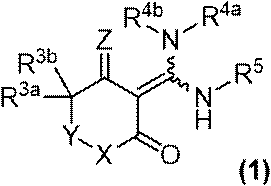
{式中、
Xは、CR1aR1b、NR1c又は酸素原子を示す。
R1a及びR1bは、
(a1) 水素原子;
(a2) ハロゲン原子;
(a3) (C1-C6)アルキル基;
(a4) ハロ(C1-C6)アルキル基;
(a5) フェニル基;
(a6) 置換基群Bからそれぞれ独立に選択される1乃至5個の置換基を有するフェニル基;
(a7) ピリジル基;又は
(a8) 置換基群Bからそれぞれ独立に選択される1乃至4個の置換基を有するピリジル基を示し、
R1a及びR1bは、同一又は異なってもよい。
R1cは、
(b1) 水素原子;
(b2) (C1-C6)アルキル基;
(b3) (C2-C6)アルケニル基;
(b4) (C2-C6)アルキニル基;
(b5) (C3-C6)シクロアルキル基;
(b6) ハロ(C1-C6)アルキル基;
(b7) ハロ(C2-C6)アルケニル基;
(b8) ハロ(C2-C6)アルキニル基;
(b9) ハロ(C3-C6)シクロアルキル基;
(b10) 置換基群Aからそれぞれ独立に選択される1乃至3個の置換基を有する(C1-C6)アルキル基;
(b11) (C1-C6)アルキルカルボニル基;
(b12) (C1-C6)アルコキシカルボニル基;
(b13) (C1-C6)アルコキシ(C1-C6)アルコキシカルボニル基;
(b14) フェニル基;
(b15) 置換基群Bからそれぞれ独立に選択される1乃至5個の置換基を有するフェニル基;
(b16) ピリジル基;
(b17) 置換基群Bからそれぞれ独立に選択される1乃至4個の置換基を有するピリジル基;
(b18) ピリダジニル基;
(b19) 置換基群Bからそれぞれ独立に選択される1乃至3個の置換基を有するピリダジニル基;
(b20) ピリミジニル基;
(b21) 置換基群Bからそれぞれ独立に選択される1乃至3個の置換基を有するピリミジニル基;
(b22) ピラジニル基;
(b23) 置換基群Bからそれぞれ独立に選択される1乃至3個の置換基を有するピラジニル基;
(b24) フェニル(C1-C6)アルキル基;
(b25) 置換基群Bからそれぞれ独立に選択される1乃至5個の置換基を有するフェニル(C1-C6)アルキル基;
(b26) ピリジル(C1-C6)アルキル基;
(b27) 置換基群Bからそれぞれ独立に選択される1乃至4個の置換基を有するピリジル(C1-C6)アルキル基;
(b28) チアゾリル(C1-C6)アルキル基;又は
(b29) 置換基群Bからそれぞれ独立に選択される1乃至2個の置換基を有するチアゾリル(C1-C6)アルキル基を示す。
Yは、CR2aR2b、NR2c又はCH2CH2を示す。
R2aは、
(c1) 水素原子;
(c2) フェニル基;
(c3) 置換基群Bからそれぞれ独立に選択される1乃至5個の置換基を有するフェニル基;
(c4) ピリジル基;
(c5) 置換基群Bからそれぞれ独立に選択される1乃至4個の置換基を有するピリジル基;
(c6) ピリダジニル基;
(c7) 置換基群Bからそれぞれ独立に選択される1乃至3個の置換基を有するピリダジニル基;
(c8) ピリミジニル基;
(c9) 置換基群Bからそれぞれ独立に選択される1乃至3個の置換基を有するピリミジニル基;
(c10) ピラジニル基;
(c11) 置換基群Bからそれぞれ独立に選択される1乃至3個の置換基を有するピラジニル基;
(c12) フリル基;
(c13) 置換基群Bからそれぞれ独立に選択される1乃至3個の置換基を有するフリル基;
(c14) チエニル基;
(c15) 置換基群Bからそれぞれ独立に選択される1乃至3個の置換基を有するチエニル基;
(c16) オキサゾリル基;
(c17) 置換基群Bからそれぞれ独立に選択される1乃至2個の置換基を有するオキサゾリル基;
(c18) イソオキサゾリル基;
(c19) 置換基群Bからそれぞれ独立に選択される1乃至2個の置換基を有するイソオキサゾリル基;
(c20) チアゾリル基;
(c21) 置換基群Bからそれぞれ独立に選択される1乃至2個の置換基を有するチアゾリル基;
(c22) イソチアゾリル基;
(c23) 置換基群Bからそれぞれ独立に選択される1乃至2個の置換基を有するイソチアゾリル基;
(c24) ピラゾリル基;
(c25) 置換基群Bからそれぞれ独立に選択される1乃至3個の置換基を有するピラゾリル基;
(c26) オキサジアゾリル基;
(c27) 置換基群Bから選択される1個の置換基を有するオキサジアゾリル基;
(c28) トリアジニル基;
(c29) 置換基群Bからそれぞれ独立に選択される1乃至2個の置換基を有するトリアジニル基;
(c30) チアジアゾリル基;
(c31) 置換基群Bから選択される1個の置換基を有するチアジアゾリル基;
(c32) ピロリル基;
(c33) 置換基群Bからそれぞれ独立に選択される1乃至4個の置換基を有するピロリル基;
(c34) イミダゾリル基;
(c35) 置換基群Bからそれぞれ独立に選択される1乃至3個の置換基を有するイミダゾリル基;
(c36) トリアゾリル基;
(c37) 置換基群Bからそれぞれ独立に選択される1乃至2個の置換基を有するトリアゾリル基;
(c38) テトラゾリル基;
(c39) 置換基群Bから選択される1個の置換基を有するテトラゾリル基;
(c40) ナフチル基;
(c41) 置換基群Bからそれぞれ独立に選択される1乃至7個の置換基を有するナフチル基;
(c42) キノリル基;
(c43) 置換基群Bからそれぞれ独立に選択される1乃至6個の置換基を有するキノリル基;
(c44) カルボキシル基;又は
(c45) (C1-C6)アルコキシカルボニル基を示す。
R2bは、
(d1) 水素原子;又は
(d2) (C1-C6)アルキル基を示す。
R2cは、
(e1) (C1-C6)アルコキシカルボニル基;
(e2) フェニル基;
(e3) 置換基群Bからそれぞれ独立に選択される1乃至5個の置換基を有するフェニル基;
(e4) ピリジル基;
(e5) 置換基群Bからそれぞれ独立に選択される1乃至4個の置換基を有するピリジル基;
(e6) ピリダジニル基;
(e7) 置換基群Bからそれぞれ独立に選択される1乃至3個の置換基を有するピリダジニル基;
(e8) ピリミジニル基;
(e9) 置換基群Bからそれぞれ独立に選択される1乃至3個の置換基を有するピリミジニル基;
(e10) ピラジニル基;
(e11) 置換基群Bからそれぞれ独立に選択される1乃至3個の置換基を有するピラジニル基;
(e12) フリル基;
(e13) 置換基群Bからそれぞれ独立に選択される1乃至3個の置換基を有するフリル基;
(e14) チエニル基;
(e15) 置換基群Bからそれぞれ独立に選択される1乃至3個の置換基を有するチエニル基;
(e16) オキサゾリル基;
(e17) 置換基群Bからそれぞれ独立に選択される1乃至2個の置換基を有するオキサゾリル基;
(e18) イソオキサゾリル基;
(e19) 置換基群Bからそれぞれ独立に選択される1乃至2個の置換基を有するイソオキサゾリル基;
(e20) チアゾリル基;
(e21) 置換基群Bからそれぞれ独立に選択される1乃至2個の置換基を有するチアゾリル基;
(e22) イソチアゾリル基;
(e23) 置換基群Bからそれぞれ独立に選択される1乃至2個の置換基を有するイソチアゾリル基;
(e24) トリアジニル基;
(e25) 置換基群Bからそれぞれ独立に選択される1乃至2個の置換基を有するトリアジニル基;
(e26) オキサジアゾリル基;
(e27) 置換基群Bから選択される1個の置換基を有するオキサジアゾリル基;
(e28) チアジアゾリル基;
(e29) 置換基群Bから選択される1個の置換基を有するチアジアゾリル基;
(e30) ピロリル基;
(e31) 置換基群Bからそれぞれ独立に選択される1乃至4個の置換基を有するピロリル基;
(e32) ピラゾリル基;
(e33) 置換基群Bからそれぞれ独立に選択される1乃至3個の置換基を有するピラゾリル基;
(e34) イミダゾリル基;
(e35) 置換基群Bからそれぞれ独立に選択される1乃至3個の置換基を有するイミダゾリル基;
(e36) トリアゾリル基;
(e37) 置換基群Bからそれぞれ独立に選択される1乃至2個の置換基を有するトリアゾリル基;
(e38) テトラゾリル基;
(e39) 置換基群Bから選択される1個の置換基を有するテトラゾリル基;
(e40) ナフチル基;
(e41) 置換基群Bからそれぞれ独立に選択される1乃至7個の置換基を有するナフチル基;
(e42) キノリル基;
(e43) 置換基群Bからそれぞれ独立に選択される1乃至6個の置換基を有するキノリル基;
(e44) ピリジルカルボニル基;
(e45) 置換基群Bからそれぞれ独立に選択される1乃至4個の置換基を有するピリジルカルボニル基;又は
(e46) 水素原子を示す。
R3aは、
(f1) 水素原子;
(f2) (C1-C6)アルキル基;
(f3) ハロ(C1-C6)アルキル基;
(f4) フェニル基;
(f5) 置換基群Bからそれぞれ独立に選択される1乃至5個の置換基を有するフェニル基;
(f6) ピリジル基;
(f7) 置換基群Bからそれぞれ独立に選択される1乃至4個の置換基を有するピリジル基;
(f8) チアゾリル基;
(f9) 置換基群Bからそれぞれ独立に選択される1乃至2個の置換基を有するチアゾリル基;
(f10) キノリル基;又は
(f11) 置換基群Bからそれぞれ独立に選択される1乃至6個の置換基を有するキノリル基を示す。
R3bは、
(g1) 水素原子;
(g2) (C1-C6)アルキル基;又は
(g3) ハロ(C1-C6)アルキル基を示す。
但し、R1a、R1b、R2a、R2b、R3a及びR3bは、同時に水素原子を示すことはない。
R4a及びR5は、
(h1) 水素原子;
(h2) ヒドロキシル基;
(h3) シアノ基;
(h4) (C1-C6)アルキル基;
(h5) (C2-C6)アルケニル基;
(h6) (C2-C6)アルキニル基;
(h7) (C3-C6)シクロアルキル基;
(h8) (C1-C6)アルコキシ基;
(h9) ハロ(C1-C6)アルキル基;
(h10) ハロ(C2-C6)アルケニル基;
(h11) ハロ(C2-C6)アルキニル基;
(h12) ハロ(C3-C6)シクロアルキル基;
(h13) ハロ(C1-C6)アルコキシ基;
(h14) 置換基群Aからそれぞれ独立に選択される1乃至3個の置換基を有する(C1-C6)アルキル基;
(h15) フェニル基;
(h16) 置換基群Cからそれぞれ独立に選択される1乃至5個の置換基を有するフェニル基;
(h17) ピリジル基;
(h18) 置換基群Cからそれぞれ独立に選択される1乃至4個の置換基を有するピリジル基;
(h19) ピリダジニル基;
(h20) 置換基群Cからそれぞれ独立に選択される1乃至3個の置換基を有するピリダジニル基;
(h21) ピリミジニル基;
(h22) 置換基群Cからそれぞれ独立に選択される1乃至3個の置換基を有するピリミジニル基;
(h23) ピラジニル基;
(h24) 置換基群Cからそれぞれ独立に選択される1乃至3個の置換基を有するピラジニル基;
(h25) イソキサゾリル基;
(h26) 置換基群Cからそれぞれ独立に選択される1乃至2個の置換基を有するイソキサゾリル基;
(h27) ピラゾリル基;
(h28) 置換基群Cからそれぞれ独立に選択される1乃至3個の置換基を有するピラゾリル基
(h29) フェニル(C1-C6)アルキル基;
(h30) 置換基群Cからそれぞれ独立に選択される1乃至5個の置換基を有するフェニル(C1-C6)アルキル基;
(h31) ピリジル(C1-C6)アルキル基;
(h32) 置換基群Cからそれぞれ独立に選択される1乃至4個の置換基を有するピリジル(C1-C6)アルキル基;
(h33) ピリダジニル(C1-C6)アルキル基;
(h34) 置換基群Cからそれぞれ独立に選択される1乃至3個の置換基を有するピリダジニル(C1-C6)アルキル基;
(h35) ピリミジニル(C1-C6)アルキル基;
(h36) 置換基群Cからそれぞれ独立に選択される1乃至3個の置換基を有するピリミジニル(C1-C6)アルキル基;
(h37) ピラジニル(C1-C6)アルキル基;
(h38) 置換基群Cからそれぞれ独立に選択される1乃至3個の置換基を有するピラジニル(C1-C6)アルキル基;
(h39) チエニル(C1-C6)アルキル基;
(h40) 置換基群Cからそれぞれ独立に選択される1乃至3個の置換基を有するチエニル(C1-C6)アルキル基;
(h41) フリル(C1-C6)アルキル基;
(h42) 置換基群Cからそれぞれ独立に選択される1乃至3個の置換基を有するフリル(C1-C6)アルキル基;
(h43) オキサゾリル(C1-C6)アルキル基;
(h44) 置換基群Cからそれぞれ独立に選択される1乃至2個の置換基を有するオキサゾリル(C1-C6)アルキル基;
(h45) チアゾリル(C1-C6)アルキル基;
(h46) 置換基群Cからそれぞれ独立に選択される1乃至2個の置換基を有するチアゾリル(C1-C6)アルキル基;
(h47) ベンゾフラニル(C1-C6)アルキル基;
(h48) 置換基群Cからそれぞれ独立に選択される1乃至5個の置換基を有するベンゾフラニル(C1-C6)アルキル基;
(h49) テトラヒドロピラニル(C1-C6)アルキル基;
(h50) テトラヒドロフリル(C1-C6)アルキル基;又は
(h51) ジヒドロベンゾピラニル基を示し、
R4a及びR5は、同一又は異なってもよい。
R4bは、
(i1) 水素原子;
(i2) (C1-C6)アルキル基;又は
(i3) ハロ(C1-C6)アルキル基を示す。
R4aが、(h4) (C1-C6)アルキル基、又は(h14) 置換基群Aからそれぞれ独立に選択される1乃至3個の置換基を有する(C1-C6)アルキル基を示し、R4bが、(i2) (C1-C6)アルキル基を示すとき、R4a及びR4bは、隣接する窒素原子と一緒になって、3乃至6員環を形成してもよい。
Zは、酸素原子、硫黄原子又はNR7(式中、R7は、ヒドロキシル基、(C1-C6)アルコキシ基、ハロ(C1-C6)アルコキシ基、(C1-C6)アルキル基、ハロ(C1-C6)アルキル基、(C3-C6)シクロアルキル基、アミノ基、(C1-C6)アルキルアミノ基又はジ(C1-C6)アルキルアミノ基(当該(C1-C6)アルキル基は、同一又は異なってもよい。)を示す。)を示す。
置換基群Aは、
(j1) シアノ基;
(j2) (C3-C6)シクロアルキル基;
(j3) (C1-C6)アルコキシ基;
(j4) (C1-C6)アルキルスルファニル基;
(j5) (C1-C6)アルキルスルフィニル基;
(j6) (C1-C6)アルキルスルホニル基;
(j7) (C1-C6)アルキルアミノ基;
(j8) ジ(C1-C6)アルキルアミノ基(当該(C1-C6)アルキルは、同一又は異なってもよい);
(j9) ハロ(C3-C6)シクロアルキル基;
(j10) ハロ(C1-C6)アルコキシ基;
(j11) ハロ(C1-C6)アルキルスルファニル基;
(j12) ハロ(C1-C6)アルキルスルフィニル基;及び
(j13) ハロ(C1-C6)アルキルスルホニル基からなる。
置換基群Bは、
(k1) ハロゲン原子;
(k2) シアノ基;
(k3) ニトロ基;
(k4) アミノ基;
(k5) ヒドロキシル基;
(k6) カルボキシル基;
(k7) (C1-C6)アルキル基;
(k8) (C2-C6)アルケニル基;
(k9) (C2-C6)アルキニル基;
(k10) (C1-C6)アルコキシ基;
(k11) (C3-C6)シクロアルキル基;
(k12) (C1-C6)アルキルスルファニル基;
(k13) (C1-C6)アルキルスルフィニル基;
(k14) (C1-C6)アルキルスルホニル基;
(k15) (C1-C6)アルキルアミノ基;
(k16) ジ(C1-C6)アルキルアミノ基(当該(C1-C6)アルキルは、同一又は異なってもよい);
(k17) ハロ(C1-C6)アルキル基;
(k18) ハロ(C2-C6)アルケニル基;
(k19) ハロ(C2-C6)アルキニル基;
(k20) ハロ(C1-C6)アルコキシ基;
(k21) ハロ(C3-C6)シクロアルキル基;
(k22) ハロ(C1-C6)アルキルスルファニル基;
(k23) ハロ(C1-C6)アルキルスルフィニル基;
(k24) ハロ(C1-C6)アルキルスルホニル基;
(k25) (C1-C6)アルコキシ(C1-C6)アルキル基;
(k26) フェニル基;
(k27) ハロゲン原子、シアノ基、(C1-C6)アルキル基、(C1-C6)アルコキシ基、(C3-C6)シクロアルキル基、ハロ(C1-C6)アルキル基及びハロ(C1-C6)アルコキシ基からなる群からそれぞれ独立に選択される1乃至5個の置換基を有するフェニル基;
(k28) ピリジル基;及び
(k29) ハロゲン原子、シアノ基、(C1-C6)アルキル基、(C1-C6)アルコキシ基、(C3-C6)シクロアルキル基、ハロ(C1-C6)アルキル基及びハロ(C1-C6)アルコキシ基からなる群からそれぞれ独立に選択される1乃至4個の置換基を有するピリジル基からなる。
置換基群Cは、
(l1) ハロゲン原子;
(l2) シアノ基;
(l3) ニトロ基;
(l4) アミノ基;
(l5) ヒドロキシル基;
(l6) カルボキシル基;
(l7) (C1-C6)アルキル基;
(l8) (C2-C6)アルケニル基;
(l9) (C2-C6)アルキニル基;
(l10) (C1-C6)アルコキシ基;
(l11) (C3-C6)シクロアルキル基;
(l12) (C1-C6)アルキルスルファニル基;
(l13) (C1-C6)アルキルスルフィニル基;
(l14) (C1-C6)アルキルスルホニル基;
(l15) (C1-C6)アルキルアミノ基;
(l16) ジ(C1-C6)アルキルアミノ基(当該(C1-C6)アルキルは、同一又は異なってもよい);
(l17) ハロ(C1-C6)アルキル基;
(l18) ハロ(C2-C6)アルケニル基;
(l19) ハロ(C2-C6)アルキニル基;
(l20) ハロ(C1-C6)アルコキシ基;
(l21) ハロ(C3-C6)シクロアルキル基;
(l22) ハロ(C1-C6)アルキルスルファニル基;
(l23) ハロ(C1-C6)アルキルスルフィニル基;
(l24) ハロ(C1-C6)アルキルスルホニル基;及び
(l25) (C1-C6)アルコキシ(C1-C6)アルキル基からなる。}
で表される化合物又はその塩。 - Xが、CR1aR1b、NR1c又は酸素原子であり、
R1a及びR1bが、
(a1) 水素原子;
(a2) ハロゲン原子;
(a3) (C1-C6)アルキル基;
(a4) ハロ(C1-C6)アルキル基;
(a5) フェニル基;
(a6) 置換基群Bからそれぞれ独立に選択される1乃至5個の置換基を有するフェニル基;
(a7) ピリジル基;又は
(a8) 置換基群Bからそれぞれ独立に選択される1乃至4個の置換基を有するピリジル基であり、
R1a及びR1bが、同一又は異なってもよく、
R1cが、
(b1) 水素原子;
(b2) (C1-C6)アルキル基;
(b5) (C3-C6)シクロアルキル基;
(b6) ハロ(C1-C6)アルキル基;
(b9) ハロ(C3-C6)シクロアルキル基;
(b10) 置換基群Aからそれぞれ独立に選択される1乃至3個の置換基を有する(C1-C6)アルキル基;
(b12) (C1-C6)アルコキシカルボニル基;
(b13) (C1-C6)アルコキシ(C1-C6)アルコキシカルボニル基;
(b14) フェニル基;
(b15) 置換基群Bからそれぞれ独立に選択される1乃至5個の置換基を有するフェニル基;
(b16) ピリジル基;
(b17) 置換基群Bからそれぞれ独立に選択される1乃至4個の置換基を有するピリジル基;
(b18) ピリダジニル基;
(b19) 置換基群Bからそれぞれ独立に選択される1乃至3個の置換基を有するピリダジニル基;
(b20) ピリミジニル基;
(b21) 置換基群Bからそれぞれ独立に選択される1乃至3個の置換基を有するピリミジニル基;
(b22) ピラジニル基;
(b23) 置換基群Bからそれぞれ独立に選択される1乃至3個の置換基を有するピラジニル基;
(b24) フェニル(C1-C6)アルキル基;
(b25) 置換基群Bからそれぞれ独立に選択される1乃至5個の置換基を有するフェニル(C1-C6)アルキル基;
(b26) ピリジル(C1-C6)アルキル基;
(b27) 置換基群Bからそれぞれ独立に選択される1乃至4個の置換基を有するピリジル(C1-C6)アルキル基;
(b28) チアゾリル(C1-C6)アルキル基;又は
(b29) 置換基群Bからそれぞれ独立に選択される1乃至2個の置換基を有するチアゾリル(C1-C6)アルキル基であり、
Yが、CR2aR2b、NR2c又はCH2CH2であり、
R2aが、
(c1) 水素原子;
(c2) フェニル基;
(c3) 置換基群Bからそれぞれ独立に選択される1乃至5個の置換基を有するフェニル基;
(c4) ピリジル基;
(c5) 置換基群Bからそれぞれ独立に選択される1乃至4個の置換基を有するピリジル基;
(c6) ピリダジニル基;
(c7) 置換基群Bからそれぞれ独立に選択される1乃至3個の置換基を有するピリダジニル基;
(c8) ピリミジニル基;
(c9) 置換基群Bからそれぞれ独立に選択される1乃至3個の置換基を有するピリミジニル基;
(c10) ピラジニル基;
(c11) 置換基群Bからそれぞれ独立に選択される1乃至3個の置換基を有するピラジニル基;
(c12) フリル基;
(c13) 置換基群Bからそれぞれ独立に選択される1乃至3個の置換基を有するフリル基;
(c14) チエニル基;
(c15) 置換基群Bからそれぞれ独立に選択される1乃至3個の置換基を有するチエニル基;
(c16) オキサゾリル基;
(c17) 置換基群Bからそれぞれ独立に選択される1乃至2個の置換基を有するオキサゾリル基;
(c18) イソオキサゾリル基;
(c19) 置換基群Bからそれぞれ独立に選択される1乃至2個の置換基を有するイソオキサゾリル基;
(c20) チアゾリル基;
(c21) 置換基群Bからそれぞれ独立に選択される1乃至2個の置換基を有するチアゾリル基;
(c22) イソチアゾリル基;
(c23) 置換基群Bからそれぞれ独立に選択される1乃至2個の置換基を有するイソチアゾリル基;
(c24) ピラゾリル基;
(c25) 置換基群Bからそれぞれ独立に選択される1乃至3個の置換基を有するピラゾリル基;
(c26) オキサジアゾリル基;
(c27) 置換基群Bから選択される1個の置換基を有するオキサジアゾリル基;
(c44) カルボキシル基;又は
(c45) (C1-C6)アルコキシカルボニル基であり、
R2bが、
(d1) 水素原子;又は
(d2) (C1-C6)アルキル基であり、
R2cが、
(e1) (C1-C6)アルコキシカルボニル基;
(e2) フェニル基;
(e3) 置換基群Bからそれぞれ独立に選択される1乃至5個の置換基を有するフェニル基;
(e4) ピリジル基;
(e5) 置換基群Bからそれぞれ独立に選択される1乃至4個の置換基を有するピリジル基;
(e6) ピリダジニル基;
(e7) 置換基群Bからそれぞれ独立に選択される1乃至3個の置換基を有するピリダジニル基;
(e8) ピリミジニル基;
(e9) 置換基群Bからそれぞれ独立に選択される1乃至3個の置換基を有するピリミジニル基;
(e10) ピラジニル基;
(e11) 置換基群Bからそれぞれ独立に選択される1乃至3個の置換基を有するピラジニル基;
(e12) フリル基;
(e13) 置換基群Bからそれぞれ独立に選択される1乃至3個の置換基を有するフリル基;
(e14) チエニル基;
(e15) 置換基群Bからそれぞれ独立に選択される1乃至3個の置換基を有するチエニル基;
(e16) オキサゾリル基;
(e17) 置換基群Bからそれぞれ独立に選択される1乃至2個の置換基を有するオキサゾリル基;
(e20) チアゾリル基;
(e21) 置換基群Bからそれぞれ独立に選択される1乃至2個の置換基を有するチアゾリル基;
(e44) ピリジルカルボニル基;
(e45) 置換基群Bからそれぞれ独立に選択される1乃至4個の置換基を有するピリジルカルボニル基;又は
(e46) 水素原子であり、
R3aが、
(f1) 水素原子;
(f2) (C1-C6)アルキル基;
(f4) フェニル基;
(f5) 置換基群Bからそれぞれ独立に選択される1乃至5個の置換基を有するフェニル基;
(f6) ピリジル基;
(f7) 置換基群Bからそれぞれ独立に選択される1乃至4個の置換基を有するピリジル基;
(f8) チアゾリル基;
(f9) 置換基群Bからそれぞれ独立に選択される1乃至2個の置換基を有するチアゾリル基;
(f10) キノリル基;又は
(f11) 置換基群Bからそれぞれ独立に選択される1乃至6個の置換基を有するキノリル基であり、
R3bが、
(g1) 水素原子;
(g2) (C1-C6)アルキル基;又は
(g3) ハロ(C1-C6)アルキル基であり、
但し、R1a、R1b、R2a、R2b、R3a及びR3bが、同時に水素原子を示すことはなく、
R4a及びR5が、
(h1) 水素原子;
(h2) ヒドロキシル基;
(h3) シアノ基;
(h4) (C1-C6)アルキル基;
(h5) (C2-C6)アルケニル基;
(h6) (C2-C6)アルキニル基;
(h7) (C3-C6)シクロアルキル基;
(h8) (C1-C6)アルコキシ基;
(h9) ハロ(C1-C6)アルキル基;
(h12) ハロ(C3-C6)シクロアルキル基;
(h13) ハロ(C1-C6)アルコキシ基;
(h14) 置換基群Aからそれぞれ独立に選択される1乃至3個の置換基を有する(C1-C6)アルキル基;
(h15) フェニル基;
(h16) 置換基群Cからそれぞれ独立に選択される1乃至5個の置換基を有するフェニル基;
(h17) ピリジル基;
(h18) 置換基群Cからそれぞれ独立に選択される1乃至4個の置換基を有するピリジル基;
(h19) ピリダジニル基;
(h20) 置換基群Cからそれぞれ独立に選択される1乃至3個の置換基を有するピリダジニル基;
(h21) ピリミジニル基;
(h22) 置換基群Cからそれぞれ独立に選択される1乃至3個の置換基を有するピリミジニル基;
(h23) ピラジニル基;
(h24) 置換基群Cからそれぞれ独立に選択される1乃至3個の置換基を有するピラジニル基;
(h25) イソキサゾリル基;
(h26) 置換基群Cからそれぞれ独立に選択される1乃至2個の置換基を有するイソキサゾリル基;
(h27) ピラゾリル基;
(h28) 置換基群Cからそれぞれ独立に選択される1乃至3個の置換基を有するピラゾリル基;
(h29) フェニル(C1-C6)アルキル基;
(h30) 置換基群Cからそれぞれ独立に選択される1乃至5個の置換基を有するフェニル(C1-C6)アルキル基;
(h31) ピリジル(C1-C6)アルキル基;
(h32) 置換基群Cからそれぞれ独立に選択される1乃至4個の置換基を有するピリジル(C1-C6)アルキル基;
(h37) ピラジニル(C1-C6)アルキル基;
(h38) 置換基群Cからそれぞれ独立に選択される1乃至3個の置換基を有するピラジニル(C1-C6)アルキル基;
(h39) チエニル(C1-C6)アルキル基;
(h40) 置換基群Cからそれぞれ独立に選択される1乃至3個の置換基を有するチエニル(C1-C6)アルキル基;
(h41) フリル(C1-C6)アルキル基;
(h42) 置換基群Cからそれぞれ独立に選択される1乃至3個の置換基を有するフリル(C1-C6)アルキル基;
(h43) オキサゾリル(C1-C6)アルキル基;
(h44) 置換基群Cからそれぞれ独立に選択される1乃至2個の置換基を有するオキサゾリル(C1-C6)アルキル基;
(h45) チアゾリル(C1-C6)アルキル基;
(h46) 置換基群Cからそれぞれ独立に選択される1乃至2個の置換基を有するチアゾリル(C1-C6)アルキル基;
(h47) ベンゾフラニル(C1-C6)アルキル基;
(h48) 置換基群Cからそれぞれ独立に選択される1乃至5個の置換基を有するベンゾフラニル(C1-C6)アルキル基;
(h49) テトラヒドロピラニル(C1-C6)アルキル基;
(h50) テトラヒドロフリル(C1-C6)アルキル基;又は
(h51) ジヒドロベンゾピラニル基であり、
R4a及びR5が、同一又は異なってもよく、
R4bが、
(i1) 水素原子;
(i2) (C1-C6)アルキル基;又は
(i3) ハロ(C1-C6)アルキル基であり、
R4aが、(h4) (C1-C6)アルキル基、又は(h14) 置換基群Aからそれぞれ独立に選択される1乃至3個の置換基を有する(C1-C6)アルキル基を示し、R4bが、(i2) (C1-C6)アルキル基を示すとき、R4a及びR4bは、隣接する窒素原子と一緒になって、3乃至6員環を形成してもよく、並びに
Zが、酸素原子、硫黄原子又はNR7(式中、R7はヒドロキシル基又は(C1-C6)アルコキシ基を示す。)である、請求項1に記載の化合物又はその塩。 - Xが、CR1aR1b、NR1c又は酸素原子であり、
R1a及びR1bが、
(a1) 水素原子;
(a3) (C1-C6)アルキル基;
(a4) ハロ(C1-C6)アルキル基;
(a6) 置換基群Bからそれぞれ独立に選択される1乃至5個の置換基を有するフェニル基;
(a7) ピリジル基;又は
(a8) 置換基群Bからそれぞれ独立に選択される1乃至4個の置換基を有するピリジル基であり、
R1a及びR1bが、同一又は異なってもよく、
R1cが、
(b1) 水素原子;
(b2) (C1-C6)アルキル基;
(b10) 置換基群Aからそれぞれ独立に選択される1乃至3個の置換基を有する(C1-C6)アルキル基;
(b12) (C1-C6)アルコキシカルボニル基;
(b13) (C1-C6)アルコキシ(C1-C6)アルコキシカルボニル基;
(b14) フェニル基;
(b15) 置換基群Bからそれぞれ独立に選択される1乃至5個の置換基を有するフェニル基;
(b16) ピリジル基;
(b17) 置換基群Bからそれぞれ独立に選択される1乃至4個の置換基を有するピリジル基;
(b24) フェニル(C1-C6)アルキル基;
(b25) 置換基群Bからそれぞれ独立に選択される1乃至5個の置換基を有するフェニル(C1-C6)アルキル基;
(b28) チアゾリル(C1-C6)アルキル基;又は
(b29) 置換基群Bからそれぞれ独立に選択される1乃至2個の置換基を有するチアゾリル(C1-C6)アルキル基であり、
Yが、CR2aR2b、NR2c又はCH2CH2であり、
R2aが、
(c1) 水素原子;
(c2) フェニル基;
(c3) 置換基群Bからそれぞれ独立に選択される1乃至5個の置換基を有するフェニル基;
(c4) ピリジル基;
(c5) 置換基群Bからそれぞれ独立に選択される1乃至4個の置換基を有するピリジル基;
(c6) ピリダジニル基;
(c7) 置換基群Bからそれぞれ独立に選択される1乃至3個の置換基を有するピリダジニル基;
(c8) ピリミジニル基;
(c9) 置換基群Bからそれぞれ独立に選択される1乃至3個の置換基を有するピリミジニル基;
(c10) ピラジニル基;
(c11) 置換基群Bからそれぞれ独立に選択される1乃至3個の置換基を有するピラジニル基;
(c12) フリル基;
(c13) 置換基群Bからそれぞれ独立に選択される1乃至3個の置換基を有するフリル基;
(c14) チエニル基;
(c15) 置換基群Bからそれぞれ独立に選択される1乃至3個の置換基を有するチエニル基;
(c16) オキサゾリル基;
(c17) 置換基群Bからそれぞれ独立に選択される1乃至2個の置換基を有するオキサゾリル基;
(c18) イソオキサゾリル基;
(c19) 置換基群Bからそれぞれ独立に選択される1乃至2個の置換基を有するイソオキサゾリル基;
(c20) チアゾリル基;
(c21) 置換基群Bからそれぞれ独立に選択される1乃至2個の置換基を有するチアゾリル基;
(c22) イソチアゾリル基;
(c23) 置換基群Bからそれぞれ独立に選択される1乃至2個の置換基を有するイソチアゾリル基;
(c24) ピラゾリル基;
(c25) 置換基群Bからそれぞれ独立に選択される1乃至3個の置換基を有するピラゾリル基;
(c26) オキサジアゾリル基;
(c27) 置換基群Bから選択される1個の置換基を有するオキサジアゾリル基;
(c44) カルボキシル基;又は
(c45) (C1-C6)アルコキシカルボニル基であり、
R2bが、
(d1) 水素原子;又は
(d2) (C1-C6)アルキル基であり、
R2cが、
(e1) (C1-C6)アルコキシカルボニル基;
(e2) フェニル基;
(e3) 置換基群Bからそれぞれ独立に選択される1乃至5個の置換基を有するフェニル基;
(e4) ピリジル基;
(e5) 置換基群Bからそれぞれ独立に選択される1乃至4個の置換基を有するピリジル基;
(e6) ピリダジニル基;
(e7) 置換基群Bからそれぞれ独立に選択される1乃至3個の置換基を有するピリダジニル基;
(e8) ピリミジニル基;
(e9) 置換基群Bからそれぞれ独立に選択される1乃至3個の置換基を有するピリミジニル基;
(e44) ピリジルカルボニル基;
(e45) 置換基群Bからそれぞれ独立に選択される1乃至4個の置換基を有するピリジルカルボニル基;又は
(e46) 水素原子であり、
R3aが、
(f1) 水素原子;
(f5) 置換基群Bからそれぞれ独立に選択される1乃至5個の置換基を有するフェニル基;
(f6) ピリジル基;
(f7) 置換基群Bからそれぞれ独立に選択される1乃至4個の置換基を有するピリジル基;
(f8) チアゾリル基;
(f9) 置換基群Bからそれぞれ独立に選択される1乃至2個の置換基を有するチアゾリル基;
(f10) キノリル基;又は
(f11) 置換基群Bからそれぞれ独立に選択される1乃至6個の置換基を有するキノリル基であり、
R3bが、
(g1) 水素原子;又は
(g2) (C1-C6)アルキル基であり、
但し、R1a、R1b、R2a、R2b、R3a及びR3bが、同時に水素原子を示すことはなく、
R4aが、
(h1) 水素原子;
(h2) ヒドロキシル基;
(h3) シアノ基;
(h4) (C1-C6)アルキル基;
(h7) (C3-C6)シクロアルキル基;
(h8) (C1-C6)アルコキシ基;
(h9) ハロ(C1-C6)アルキル基;
(h14) 置換基群Aからそれぞれ独立に選択される1乃至3個の置換基を有する(C1-C6)アルキル基;
(h15) フェニル基;
(h16) 置換基群Cからそれぞれ独立に選択される1乃至5個の置換基を有するフェニル基;
(h17) ピリジル基;
(h18) 置換基群Cからそれぞれ独立に選択される1乃至4個の置換基を有するピリジル基;
(h21) ピリミジニル基;
(h22) 置換基群Cからそれぞれ独立に選択される1乃至3個の置換基を有するピリミジニル基;
(h23) ピラジニル基;
(h24) 置換基群Cからそれぞれ独立に選択される1乃至3個の置換基を有するピラジニル基;
(h25) イソキサゾリル基;
(h26) 置換基群Cからそれぞれ独立に選択される1乃至2個の置換基を有するイソキサゾリル基;
(h27) ピラゾリル基;
(h28) 置換基群Cからそれぞれ独立に選択される1乃至3個の置換基を有するピラゾリル基;
(h29) フェニル(C1-C6)アルキル基;
(h30) 置換基群Cからそれぞれ独立に選択される1乃至5個の置換基を有するフェニル(C1-C6)アルキル基;
(h31) ピリジル(C1-C6)アルキル基;
(h32) 置換基群Cからそれぞれ独立に選択される1乃至4個の置換基を有するピリジル(C1-C6)アルキル基;
(h37) ピラジニル(C1-C6)アルキル基;
(h38) 置換基群Cからそれぞれ独立に選択される1乃至3個の置換基を有するピラジニル(C1-C6)アルキル基;
(h39) チエニル(C1-C6)アルキル基;
(h40) 置換基群Cからそれぞれ独立に選択される1乃至3個の置換基を有するチエニル(C1-C6)アルキル基;
(h41) フリル(C1-C6)アルキル基;
(h42) 置換基群Cからそれぞれ独立に選択される1乃至3個の置換基を有するフリル(C1-C6)アルキル基;
(h45) チアゾリル(C1-C6)アルキル基;
(h46) 置換基群Cからそれぞれ独立に選択される1乃至2個の置換基を有するチアゾリル(C1-C6)アルキル基;
(h47) ベンゾフラニル(C1-C6)アルキル基;
(h48) 置換基群Cからそれぞれ独立に選択される1乃至5個の置換基を有するベンゾフラニル(C1-C6)アルキル基;
(h49) テトラヒドロピラニル(C1-C6)アルキル基;又は
(h50) テトラヒドロフリル(C1-C6)アルキル基であり、
R4bが、
(i1) 水素原子;又は
(i2) (C1-C6)アルキル基であり、
R4aが、(h4) (C1-C6)アルキル基を示し、R4bが、(i2) (C1-C6)アルキル基を示すとき、R4a及びR4bは、隣接する窒素原子と一緒になって、3乃至6員環を形成してもよく、
R5が、
(h1) 水素原子;
(h4) (C1-C6)アルキル基;
(h5) (C2-C6)アルケニル基;
(h6) (C2-C6)アルキニル基;
(h7) (C3-C6)シクロアルキル基;
(h9) ハロ(C1-C6)アルキル基;
(h14) 置換基群Aからそれぞれ独立に選択される1乃至3個の置換基を有する(C1-C6)アルキル基;
(h15) フェニル基;
(h16) 置換基群Cからそれぞれ独立に選択される1乃至5個の置換基を有するフェニル基;
(h17) ピリジル基;
(h18) 置換基群Cからそれぞれ独立に選択される1乃至4個の置換基を有するピリジル基;
(h19) ピリダジニル基;
(h20) 置換基群Cからそれぞれ独立に選択される1乃至3個の置換基を有するピリダジニル基;
(h21) ピリミジニル基;
(h22) 置換基群Cからそれぞれ独立に選択される1乃至3個の置換基を有するピリミジニル基;
(h23) ピラジニル基;
(h24) 置換基群Cからそれぞれ独立に選択される1乃至3個の置換基を有するピラジニル基;
(h27) ピラゾリル基;
(h28) 置換基群Cからそれぞれ独立に選択される1乃至3個の置換基を有するピラゾリル基;
(h29) フェニル(C1-C6)アルキル基;
(h30) 置換基群Cからそれぞれ独立に選択される1乃至5個の置換基を有するフェニル(C1-C6)アルキル基;
(h37) ピラジニル(C1-C6)アルキル基;
(h38) 置換基群Cからそれぞれ独立に選択される1乃至3個の置換基を有するピラジニル(C1-C6)アルキル基;又は
(h51) ジヒドロベンゾピラニル基であり、並びに
Zが、酸素原子である、請求項1に記載の化合物又はその塩。 - Yが、CR2aR2b又はNR2cである、請求項1に記載の化合物又はその塩。
- Yが、CR2aR2b又はNR2cである、請求項2に記載の化合物又はその塩。
- Yが、CR2aR2b又はNR2cである、請求項3に記載の化合物又はその塩。
- 請求項1乃至6の何れか一項に記載の化合物又はその塩を有効成分として含有することを特徴とする有害生物防除剤。
- 請求項1乃至6の何れか一項に記載の化合物又はその塩を有効成分として含有することを特徴とする農園芸用害虫防除剤。
- 請求項1乃至6の何れか一項に記載の化合物又はその塩を有効成分として含有することを特徴とする動物用外部寄生虫防除剤。
- 請求項1乃至6の何れか一項に記載の化合物又はその塩を有効成分として含有することを特徴とする動物用内部寄生虫防除剤。
- 請求項8に記載の農園芸用害虫防除剤の有効量を植物又は土壌に処理することを特徴とする農園芸用害虫の防除方法。
- 請求項9に記載の動物用外部寄生虫防除剤の有効量を対象動物に、経口又は非経口投与することを特徴とする動物の外部寄生虫の防除方法。
- 請求項10に記載の動物用内部寄生虫防除剤有効量を対象動物に、経口又は非経口投与することを特徴とする動物の内部寄生虫の防除方法。
- 請求項1乃至6の何れか一項に記載の化合物又はその塩の有害生物防除剤としての使用。
- 一般式(3)

{式中、
Xは、CR1aR1b、NR1c又は酸素原子を示す。
R1a及びR1bは、
(a1) 水素原子;
(a2) ハロゲン原子;
(a3) (C1-C6)アルキル基;
(a4) ハロ(C1-C6)アルキル基;
(a5) フェニル基;
(a6) 置換基群Bからそれぞれ独立に選択される1乃至5個の置換基を有するフェニル基;
(a7) ピリジル基;又は
(a8) 置換基群Bからそれぞれ独立に選択される1乃至4個の置換基を有するピリジル基を示し、
R1a及びR1bは、同一又は異なってもよい。
R1cは、
(b1) 水素原子;
(b2) (C1-C6)アルキル基;
(b5) (C3-C6)シクロアルキル基;
(b6) ハロ(C1-C6)アルキル基;
(b9) ハロ(C3-C6)シクロアルキル基;
(b10) 置換基群Aからそれぞれ独立に選択される1乃至3個の置換基を有する(C1-C6)アルキル基;
(b12) (C1-C6)アルコキシカルボニル基;
(b13) (C1-C6)アルコキシ(C1-C6)アルコキシカルボニル基;
(b14) フェニル基;
(b15) 置換基群Bからそれぞれ独立に選択される1乃至5個の置換基を有するフェニル基;
(b16) ピリジル基;
(b17) 置換基群Bからそれぞれ独立に選択される1乃至4個の置換基を有するピリジル基;
(b18) ピリダジニル基;
(b19) 置換基群Bからそれぞれ独立に選択される1乃至3個の置換基を有するピリダジニル基;
(b20) ピリミジニル基;
(b21) 置換基群Bからそれぞれ独立に選択される1乃至3個の置換基を有するピリミジニル基;
(b22) ピラジニル基;
(b23) 置換基群Bからそれぞれ独立に選択される1乃至3個の置換基を有するピラジニル基;
(b24) フェニル(C1-C6)アルキル基;
(b25) 置換基群Bからそれぞれ独立に選択される1乃至5個の置換基を有するフェニル(C1-C6)アルキル基;
(b26) ピリジル(C1-C6)アルキル基;
(b27) 置換基群Bからそれぞれ独立に選択される1乃至4個の置換基を有するピリジル(C1-C6)アルキル基;
(b28) チアゾリル(C1-C6)アルキル基;又は
(b29) 置換基群Bからそれぞれ独立に選択される1乃至2個の置換基を有するチアゾリル(C1-C6)アルキル基を示す。
Yは、CR2aR2b、NR2c又はCH2CH2を示す。
R2aは、
(c1) 水素原子;
(c3) 置換基群Bからそれぞれ独立に選択される1乃至5個の置換基を有するフェニル基;
(c4) ピリジル基;
(c5) 置換基群Bからそれぞれ独立に選択される1乃至4個の置換基を有するピリジル基;
(c6) ピリダジニル基;
(c7) 置換基群Bからそれぞれ独立に選択される1乃至3個の置換基を有するピリダジニル基;
(c8) ピリミジニル基;
(c9) 置換基群Bからそれぞれ独立に選択される1乃至3個の置換基を有するピリミジニル基;
(c10) ピラジニル基;
(c11) 置換基群Bからそれぞれ独立に選択される1乃至3個の置換基を有するピラジニル基;
(c12) フリル基;
(c13) 置換基群Bからそれぞれ独立に選択される1乃至3個の置換基を有するフリル基;
(c14) チエニル基;
(c15) 置換基群Bからそれぞれ独立に選択される1乃至3個の置換基を有するチエニル基;
(c16) オキサゾリル基;
(c17) 置換基群Bからそれぞれ独立に選択される1乃至2個の置換基を有するオキサゾリル基;
(c18) イソオキサゾリル基;
(c19) 置換基群Bからそれぞれ独立に選択される1乃至2個の置換基を有するイソオキサゾリル基;
(c20) チアゾリル基;
(c21) 置換基群Bからそれぞれ独立に選択される1乃至2個の置換基を有するチアゾリル基;
(c22) イソチアゾリル基;
(c23) 置換基群Bからそれぞれ独立に選択される1乃至2個の置換基を有するイソチアゾリル基;
(c24) ピラゾリル基;
(c25) 置換基群Bからそれぞれ独立に選択される1乃至3個の置換基を有するピラゾリル基;
(c26) オキサジアゾリル基;
(c27) 置換基群Bから選択される1個の置換基を有するオキサジアゾリル基;
(c28) カルボキシル基;
(c29) (C1-C6)アルコキシカルボニル基;
(c44) カルボキシル基;又は
(c45) (C1-C6)アルコキシカルボニル基を示す。
R2bは、
(d1) 水素原子;又は
(d2) (C1-C6)アルキル基を示す。
R2cは、
(e1) (C1-C6)アルコキシカルボニル基;
(e2) フェニル基;
(e3) 置換基群Bからそれぞれ独立に選択される1乃至5個の置換基を有するフェニル基;
(e4) ピリジル基;
(e5) 置換基群Bからそれぞれ独立に選択される1乃至4個の置換基を有するピリジル基;
(e6) ピリダジニル基;
(e7) 置換基群Bからそれぞれ独立に選択される1乃至3個の置換基を有するピリダジニル基;
(e8) ピリミジニル基;
(e9) 置換基群Bからそれぞれ独立に選択される1乃至3個の置換基を有するピリミジニル基;
(e10) ピラジニル基;
(e11) 置換基群Bからそれぞれ独立に選択される1乃至3個の置換基を有するピラジニル基;
(e12) フリル基;
(e13) 置換基群Bからそれぞれ独立に選択される1乃至3個の置換基を有するフリル基;
(e14) チエニル基;
(e15) 置換基群Bからそれぞれ独立に選択される1乃至3個の置換基を有するチエニル基;
(e16) オキサゾリル基;
(e17) 置換基群Bからそれぞれ独立に選択される1乃至2個の置換基を有するオキサゾリル基;
(e20) チアゾリル基;
(e21) 置換基群Bからそれぞれ独立に選択される1乃至2個の置換基を有するチアゾリル基;
(e44) ピリジルカルボニル基;又は
(e45) 置換基群Bからそれぞれ独立に選択される1乃至4個の置換基を有するピリジルカルボニル基を示す。
R3aは、
(f1) 水素原子;
(f2) (C1-C6)アルキル基;
(f4) フェニル基;
(f5) 置換基群Bからそれぞれ独立に選択される1乃至5個の置換基を有するフェニル基;
(f6) ピリジル基;
(f7) 置換基群Bからそれぞれ独立に選択される1乃至4個の置換基を有するピリジル基;
(f8) チアゾリル基;
(f9) 置換基群Bからそれぞれ独立に選択される1乃至2個の置換基を有するチアゾリル基;
(f10) キノリル基;又は
(f11) 置換基群Bからそれぞれ独立に選択される1乃至6個の置換基を有するキノリル基を示す。
R3bは、
(g1) 水素原子;
(g2) (C1-C6)アルキル基;又は
(g3) ハロ(C1-C6)アルキル基を示す。
但し、R1a、R1b、R2a、R2b、R3a及びR3bが、同時に水素原子を示すことはなく、XがNR1cを、YがNR2cを同時に示すことはない。
R5は、
(h1) 水素原子;
(h2) ヒドロキシル基;
(h3) シアノ基;
(h4) (C1-C6)アルキル基;
(h5) (C2-C6)アルケニル基;
(h6) (C2-C6)アルキニル基;
(h7) (C3-C6)シクロアルキル基;
(h8) (C1-C6)アルコキシ基;
(h9) ハロ(C1-C6)アルキル基;
(h12) ハロ(C3-C6)シクロアルキル基;
(h13) ハロ(C1-C6)アルコキシ基;
(h14) 置換基群Aからそれぞれ独立に選択される1乃至3個の置換基を有する(C1-C6)アルキル基;
(h15) フェニル基;
(h16) 置換基群Cからそれぞれ独立に選択される1乃至5個の置換基を有するフェニル基;
(h17) ピリジル基;
(h18) 置換基群Cからそれぞれ独立に選択される1乃至4個の置換基を有するピリジル基;
(h19) ピリダジニル基;
(h20) 置換基群Cからそれぞれ独立に選択される1乃至3個の置換基を有するピリダジニル基;
(h21) ピリミジニル基;
(h22) 置換基群Cからそれぞれ独立に選択される1乃至3個の置換基を有するピリミジニル基;
(h23) ピラジニル基;
(h24) 置換基群Cからそれぞれ独立に選択される1乃至3個の置換基を有するピラジニル基;
(h25) イソキサゾリル基;
(h26) 置換基群Cからそれぞれ独立に選択される1乃至2個の置換基を有するイソキサゾリル基;
(h27) ピラゾリル基;
(h28) 置換基群Cからそれぞれ独立に選択される1乃至3個の置換基を有するピラゾリル基;
(h29) フェニル(C1-C6)アルキル基;
(h30) 置換基群Cからそれぞれ独立に選択される1乃至5個の置換基を有するフェニル(C1-C6)アルキル基;
(h31) ピリジル(C1-C6)アルキル基;
(h32) 置換基群Cからそれぞれ独立に選択される1乃至4個の置換基を有するピリジル(C1-C6)アルキル基;
(h37) ピラジニル(C1-C6)アルキル基;
(h38) 置換基群Cからそれぞれ独立に選択される1乃至3個の置換基を有するピラジニル(C1-C6)アルキル基;
(h39) チエニル(C1-C6)アルキル基;
(h40) 置換基群Cからそれぞれ独立に選択される1乃至3個の置換基を有するチエニル(C1-C6)アルキル基;
(h41) フリル(C1-C6)アルキル基;
(h42) 置換基群Cからそれぞれ独立に選択される1乃至3個の置換基を有するフリル(C1-C6)アルキル基;
(h43) オキサゾリル(C1-C6)アルキル基;
(h44) 置換基群Cからそれぞれ独立に選択される1乃至2個の置換基を有するオキサゾリル(C1-C6)アルキル基;
(h45) チアゾリル(C1-C6)アルキル基;
(h46) 置換基群Cからそれぞれ独立に選択される1乃至2個の置換基を有するチアゾリル(C1-C6)アルキル基;
(h47) ベンゾフラニル(C1-C6)アルキル基;
(h48) 置換基群Cからそれぞれ独立に選択される1乃至5個の置換基を有するベンゾフラニル(C1-C6)アルキル基;
(h49) テトラヒドロピラニル(C1-C6)アルキル基;
(h50) テトラヒドロフリル(C1-C6)アルキル基;又は
(h51) ジヒドロベンゾピラニル基を示す。
R6は、
(m1) (C1-C6)アルキル基;
(m2) (C2-C6)アルケニル基;
(m3) (C2-C6)アルキニル基;
(m4) ハロ(C1-C6)アルキル基;
(m5) フェニル(C1-C6)アルキル基;又は
(m6) 置換基群Cからそれぞれ独立に選択される1乃至5個の置換基を有するフェニル(C1-C6)アルキル基を示す。
置換基群Aは、
(j1) シアノ基;
(j2) (C3-C6)シクロアルキル基;
(j3) (C1-C6)アルコキシ基;
(j4) (C1-C6)アルキルスルファニル基;
(j5) (C1-C6)アルキルスルフィニル基;
(j6) (C1-C6)アルキルスルホニル基;
(j7) (C1-C6)アルキルアミノ基;
(j8) ジ(C1-C6)アルキルアミノ基(当該(C1-C6)アルキルは、同一又は異なってもよい);
(j9) ハロ(C3-C6)シクロアルキル基;
(j10) ハロ(C1-C6)アルコキシ基;
(j11) ハロ(C1-C6)アルキルスルファニル基;
(j12) ハロ(C1-C6)アルキルスルフィニル基;及び
(j13) ハロ(C1-C6)アルキルスルホニル基からなる。
置換基群Bは、
(k1) ハロゲン原子;
(k2) シアノ基;
(k3) ニトロ基;
(k4) アミノ基;
(k5) ヒドロキシル基;
(k6) カルボキシル基;
(k7) (C1-C6)アルキル基;
(k8) (C2-C6)アルケニル基;
(k9) (C2-C6)アルキニル基;
(k10) (C1-C6)アルコキシ基;
(k11) (C3-C6)シクロアルキル基;
(k12) (C1-C6)アルキルスルファニル基;
(k13) (C1-C6)アルキルスルフィニル基;
(k14) (C1-C6)アルキルスルホニル基;
(k15) (C1-C6)アルキルアミノ基;
(k16) ジ(C1-C6)アルキルアミノ基(当該(C1-C6)アルキルは、同一又は異なってもよい);
(k17) ハロ(C1-C6)アルキル基;
(k18) ハロ(C2-C6)アルケニル基;
(k19) ハロ(C2-C6)アルキニル基;
(k20) ハロ(C1-C6)アルコキシ基;
(k21) ハロ(C3-C6)シクロアルキル基;
(k22) ハロ(C1-C6)アルキルスルファニル基;
(k23) ハロ(C1-C6)アルキルスルフィニル基;
(k24) ハロ(C1-C6)アルキルスルホニル基;
(k25) (C1-C6)アルコキシ(C1-C6)アルキル基;
(k26) フェニル基;
(k27) ハロゲン原子、シアノ基、(C1-C6)アルキル基、(C1-C6)アルコキシ基、(C3-C6)シクロアルキル基、ハロ(C1-C6)アルキル基及びハロ(C1-C6)アルコキシ基からなる群からそれぞれ独立に選択される1乃至5個の置換基を有するフェニル基;
(k28) ピリジル基;及び
(k29) ハロゲン原子、シアノ基、(C1-C6)アルキル基、(C1-C6)アルコキシ基、(C3-C6)シクロアルキル基、ハロ(C1-C6)アルキル基及びハロ(C1-C6)アルコキシ基からなる群からそれぞれ独立に選択される1乃至4個の置換基を有するピリジル基からなる。
置換基群Cは、
(l1) ハロゲン原子;
(l2) シアノ基;
(l3) ニトロ基;
(l4) アミノ基;
(l5) ヒドロキシル基;
(l6) カルボキシル基;
(l7) (C1-C6)アルキル基;
(l8) (C2-C6)アルケニル基;
(l9) (C2-C6)アルキニル基;
(l10) (C1-C6)アルコキシ基;
(l11) (C3-C6)シクロアルキル基;
(l12) (C1-C6)アルキルスルファニル基;
(l13) (C1-C6)アルキルスルフィニル基;
(l14) (C1-C6)アルキルスルホニル基;
(l15) (C1-C6)アルキルアミノ基;
(l16) ジ(C1-C6)アルキルアミノ基(当該(C1-C6)アルキルは、同一又は異なってもよい);
(l17) ハロ(C1-C6)アルキル基;
(l18) ハロ(C2-C6)アルケニル基;
(l19) ハロ(C2-C6)アルキニル基;
(l20) ハロ(C1-C6)アルコキシ基;
(l21) ハロ(C3-C6)シクロアルキル基;
(l22) ハロ(C1-C6)アルキルスルファニル基;
(l23) ハロ(C1-C6)アルキルスルフィニル基;
(l24) ハロ(C1-C6)アルキルスルホニル基;及び
(l25) (C1-C6)アルコキシ(C1-C6)アルキル基からなる。}で表される化合物又はその塩。 - Xが、CR1aR1b、NR1c又は酸素原子であり、
R1a及びR1bが、
(a1) 水素原子;
(a3) (C1-C6)アルキル基;
(a4) ハロ(C1-C6)アルキル基;
(a6) 置換基群Bからそれぞれ独立に選択される1乃至5個の置換基を有するフェニル基;
(a7) ピリジル基であり、又は
(a8) 置換基群Bからそれぞれ独立に選択される1乃至4個の置換基を有するピリジル基であり、
R1a及びR1bが、同一又は異なってもよく、
R1cが、
(b1) 水素原子;
(b2) (C1-C6)アルキル基;
(b12) (C1-C6)アルコキシカルボニル基;
(b14) フェニル基;
(b15) 置換基群Bからそれぞれ独立に選択される1乃至5個の置換基を有するフェニル基;
(b16) ピリジル基;又は
(b17) 置換基群Bからそれぞれ独立に選択される1乃至4個の置換基を有するピリジル基であり、
Yが、CR2aR2b、NR2c又はCH2CH2であり、
R2aが、
(c1) 水素原子;
(c3) 置換基群Bからそれぞれ独立に選択される1乃至5個の置換基を有するフェニル基;
(c4) ピリジル基;
(c5) 置換基群Bからそれぞれ独立に選択される1乃至4個の置換基を有するピリジル基;
(c6) ピリダジニル基;
(c7) 置換基群Bからそれぞれ独立に選択される1乃至3個の置換基を有するピリダジニル基;
(c8) ピリミジニル基;
(c9) 置換基群Bからそれぞれ独立に選択される1乃至3個の置換基を有するピリミジニル基;
(c10) ピラジニル基;
(c11) 置換基群Bからそれぞれ独立に選択される1乃至3個の置換基を有するピラジニル基;
(c12) フリル基;
(c13) 置換基群Bからそれぞれ独立に選択される1乃至3個の置換基を有するフリル基;
(c14) チエニル基;
(c15) 置換基群Bからそれぞれ独立に選択される1乃至3個の置換基を有するチエニル基;
(c16) オキサゾリル基;
(c17) 置換基群Bからそれぞれ独立に選択される1乃至2個の置換基を有するオキサゾリル基;
(c18) イソオキサゾリル基;
(c19) 置換基群Bからそれぞれ独立に選択される1乃至2個の置換基を有するイソオキサゾリル基;
(c20) チアゾリル基;
(c21) 置換基群Bからそれぞれ独立に選択される1乃至2個の置換基を有するチアゾリル基;
(c22) イソチアゾリル基;
(c23) 置換基群Bからそれぞれ独立に選択される1乃至2個の置換基を有するイソチアゾリル基;
(c24) ピラゾリル基;
(c25) 置換基群Bからそれぞれ独立に選択される1乃至3個の置換基を有するピラゾリル基;
(c26) オキサジアゾリル基;
(c27) 置換基群Bから選択される1個の置換基を有するオキサジアゾリル基;(c44) カルボキシル基;又は
(c45) (C1-C6)アルコキシカルボニル基であり、
R2bが、
(d1) 水素原子;又は
(d2) (C1-C6)アルキル基であり、
R2cが、
(e1) (C1-C6)アルコキシカルボニル基;
(e4) ピリジル基;
(e5) 置換基群Bからそれぞれ独立に選択される1乃至4個の置換基を有するピリジル基;
(e44) ピリジルカルボニル基;又は
(e45) 置換基群Bからそれぞれ独立に選択される1乃至4個の置換基を有するピリジルカルボニル基であり、
R3aが、
(f1) 水素原子;
(f5) 置換基群Bからそれぞれ独立に選択される1乃至5個の置換基を有するフェニル基;
(f6) ピリジル基;
(f7) 置換基群Bからそれぞれ独立に選択される1乃至4個の置換基を有するピリジル基;
(f8) チアゾリル基;
(f9) 置換基群Bからそれぞれ独立に選択される1乃至2個の置換基を有するチアゾリル基;
(f10) キノリル基;又は
(f11) 置換基群Bからそれぞれ独立に選択される1乃至6個の置換基を有するキノリル基であり、
R3bが、
(g1) 水素原子;又は
(g2) (C1-C6)アルキル基であり、
但し、R1a、R1b、R2a、R2b、R3a及びR3bが、同時に水素原子を示すことはなく、
Xが、NR1cを、Yが、NR2cを同時に示すことはなく、
R5が、
(h1) 水素原子;
(h4) (C1-C6)アルキル基;
(h5) (C2-C6)アルケニル基;
(h6) (C2-C6)アルキニル基;
(h7) (C3-C6)シクロアルキル基;
(h9) ハロ(C1-C6)アルキル基;
(h14) 置換基群Aからそれぞれ独立に選択される1乃至3個の置換基を有する(C1-C6)アルキル基;
(h15) フェニル基;
(h16) 置換基群Cからそれぞれ独立に選択される1乃至5個の置換基を有するフェニル基;
(h17) ピリジル基;
(h18) 置換基群Cからそれぞれ独立に選択される1乃至4個の置換基を有するピリジル基;
(h19) ピリダジニル基;
(h20) 置換基群Cからそれぞれ独立に選択される1乃至3個の置換基を有するピリダジニル基;
(h21) ピリミジニル基;
(h22) 置換基群Cからそれぞれ独立に選択される1乃至3個の置換基を有するピリミジニル基;
(h27) ピラゾリル基;
(h28) 置換基群Cからそれぞれ独立に選択される1乃至3個の置換基を有するピラゾリル基;
(h29) フェニル(C1-C6)アルキル基;
(h30) 置換基群Cからそれぞれ独立に選択される1乃至5個の置換基を有するフェニル(C1-C6)アルキル基;
(h37) ピラジニル(C1-C6)アルキル基;
(h38) 置換基群Cからそれぞれ独立に選択される1乃至3個の置換基を有するピラジニル(C1-C6)アルキル基;又は
(h51) ジヒドロベンゾピラニル基であり、並びに
R6が、
(m1) (C1-C6)アルキル基;
(m5) フェニル(C1-C6)アルキル基;又は
(m6) 置換基群Cからそれぞれ独立に選択される1乃至5個の置換基を有するフェニル(C1-C6)アルキル基である、請求項15に記載の化合物又はその塩。
Applications Claiming Priority (2)
| Application Number | Priority Date | Filing Date | Title |
|---|---|---|---|
| JP2023104156 | 2023-06-26 | ||
| JP2023-104156 | 2023-06-26 |
Publications (1)
| Publication Number | Publication Date |
|---|---|
| WO2025005068A1 true WO2025005068A1 (ja) | 2025-01-02 |
Family
ID=93939059
Family Applications (1)
| Application Number | Title | Priority Date | Filing Date |
|---|---|---|---|
| PCT/JP2024/022931 Pending WO2025005068A1 (ja) | 2023-06-26 | 2024-06-25 | ジアミノビニリデン誘導体又はその塩、及び該化合物を含有する有害生物防除剤、並びにそれらの使用方法 |
Country Status (1)
| Country | Link |
|---|---|
| WO (1) | WO2025005068A1 (ja) |
Citations (15)
| Publication number | Priority date | Publication date | Assignee | Title |
|---|---|---|---|---|
| US3976785A (en) | 1973-11-02 | 1976-08-24 | American Cyanamid Company | Dioxocyclohexanecarboxanilide insecticides and acaricides |
| JPS6157565A (ja) | 1984-08-29 | 1986-03-24 | Nippon Nohyaku Co Ltd | ケテンs,s−アセタ−ル類及びその用途 |
| EP0374753A2 (de) | 1988-12-19 | 1990-06-27 | American Cyanamid Company | Insektizide Toxine, Gene, die diese Toxine kodieren, Antikörper, die sie binden, sowie transgene Pflanzenzellen und transgene Pflanzen, die diese Toxine exprimieren |
| EP0427529A1 (en) | 1989-11-07 | 1991-05-15 | Pioneer Hi-Bred International, Inc. | Larvicidal lectins and plant insect resistance based thereon |
| EP0451878A1 (en) | 1985-01-18 | 1991-10-16 | Plant Genetic Systems, N.V. | Modifying plants by genetic engineering to combat or control insects |
| WO1993007278A1 (en) | 1991-10-04 | 1993-04-15 | Ciba-Geigy Ag | Synthetic dna sequence having enhanced insecticidal activity in maize |
| WO1995034656A1 (en) | 1994-06-10 | 1995-12-21 | Ciba-Geigy Ag | Novel bacillus thuringiensis genes coding toxins active against lepidopteran pests |
| WO2003052073A2 (en) | 2001-12-17 | 2003-06-26 | Syngenta Participations Ag | Novel corn event |
| WO2006003096A1 (en) | 2004-07-02 | 2006-01-12 | Novo Nordisk A/S | Condensed thiophene derivatives and their use as cyclic glp-1 agonists |
| WO2007051062A2 (en) | 2005-10-28 | 2007-05-03 | Chemocentryx, Inc. | Substituted dihydropyridines and methods of use |
| WO2008014311A2 (en) | 2006-07-26 | 2008-01-31 | Novartis Ag | Inhibitors of undecaprenyl pyrophosphate synthase |
| WO2021261563A1 (ja) | 2020-06-26 | 2021-12-30 | 日本農薬株式会社 | アリールテトラヒドロピリダジン誘導体又はその塩類及び該化合物を含有する殺虫剤並びにその使用方法 |
| WO2021261562A1 (ja) | 2020-06-26 | 2021-12-30 | 日本農薬株式会社 | アリールテトラヒドロピリジン誘導体又はその塩類及び該化合物を含有する殺虫剤並びにその使用方法 |
| JP2023104156A (ja) | 2022-01-17 | 2023-07-28 | 株式会社ニコン | 音編集システム、音編集方法および音編集プログラム |
| WO2023190015A1 (ja) * | 2022-03-28 | 2023-10-05 | 日本農薬株式会社 | 1‐アリールテトラヒドロピリダジン‐3,5‐ジオン誘導体又はその塩類及び該化合物を含有する殺虫剤並びにその使用方法 |
-
2024
- 2024-06-25 WO PCT/JP2024/022931 patent/WO2025005068A1/ja active Pending
Patent Citations (15)
| Publication number | Priority date | Publication date | Assignee | Title |
|---|---|---|---|---|
| US3976785A (en) | 1973-11-02 | 1976-08-24 | American Cyanamid Company | Dioxocyclohexanecarboxanilide insecticides and acaricides |
| JPS6157565A (ja) | 1984-08-29 | 1986-03-24 | Nippon Nohyaku Co Ltd | ケテンs,s−アセタ−ル類及びその用途 |
| EP0451878A1 (en) | 1985-01-18 | 1991-10-16 | Plant Genetic Systems, N.V. | Modifying plants by genetic engineering to combat or control insects |
| EP0374753A2 (de) | 1988-12-19 | 1990-06-27 | American Cyanamid Company | Insektizide Toxine, Gene, die diese Toxine kodieren, Antikörper, die sie binden, sowie transgene Pflanzenzellen und transgene Pflanzen, die diese Toxine exprimieren |
| EP0427529A1 (en) | 1989-11-07 | 1991-05-15 | Pioneer Hi-Bred International, Inc. | Larvicidal lectins and plant insect resistance based thereon |
| WO1993007278A1 (en) | 1991-10-04 | 1993-04-15 | Ciba-Geigy Ag | Synthetic dna sequence having enhanced insecticidal activity in maize |
| WO1995034656A1 (en) | 1994-06-10 | 1995-12-21 | Ciba-Geigy Ag | Novel bacillus thuringiensis genes coding toxins active against lepidopteran pests |
| WO2003052073A2 (en) | 2001-12-17 | 2003-06-26 | Syngenta Participations Ag | Novel corn event |
| WO2006003096A1 (en) | 2004-07-02 | 2006-01-12 | Novo Nordisk A/S | Condensed thiophene derivatives and their use as cyclic glp-1 agonists |
| WO2007051062A2 (en) | 2005-10-28 | 2007-05-03 | Chemocentryx, Inc. | Substituted dihydropyridines and methods of use |
| WO2008014311A2 (en) | 2006-07-26 | 2008-01-31 | Novartis Ag | Inhibitors of undecaprenyl pyrophosphate synthase |
| WO2021261563A1 (ja) | 2020-06-26 | 2021-12-30 | 日本農薬株式会社 | アリールテトラヒドロピリダジン誘導体又はその塩類及び該化合物を含有する殺虫剤並びにその使用方法 |
| WO2021261562A1 (ja) | 2020-06-26 | 2021-12-30 | 日本農薬株式会社 | アリールテトラヒドロピリジン誘導体又はその塩類及び該化合物を含有する殺虫剤並びにその使用方法 |
| JP2023104156A (ja) | 2022-01-17 | 2023-07-28 | 株式会社ニコン | 音編集システム、音編集方法および音編集プログラム |
| WO2023190015A1 (ja) * | 2022-03-28 | 2023-10-05 | 日本農薬株式会社 | 1‐アリールテトラヒドロピリダジン‐3,5‐ジオン誘導体又はその塩類及び該化合物を含有する殺虫剤並びにその使用方法 |
Non-Patent Citations (8)
| Title |
|---|
| "ORGANIC FUNCTIONAL GROUP PREPARATIONS", 1935, ACADEMIC PRESS, INC, pages: 539 - 540 |
| BIOORGANIC & MEDICINAL CHEMISTRY, vol. 20, 2012, pages 1029 - 1045 |
| FADDA AHMED A., EL SALAM M. ABD, TAWFIK EMAN H., ANWAR E. M., ETMAN H. A.: "Synthesis and insecticidal assessment of some innovative heterocycles incorporating a thiadiazole moiety against the cotton leafworm, Spodoptera littoralis", RSC ADVANCES, ROYAL SOCIETY OF CHEMISTRY, GB, vol. 7, no. 63, 1 January 2017 (2017-01-01), GB , pages 39773 - 39785, XP093255112, ISSN: 2046-2069, DOI: 10.1039/C7RA06087D * |
| GURA T.: "Repairing the Genome's Spelling Mistakes", SCIENCE, vol. 285, 1999, pages 316 - 318 |
| JOURNAL OF HETEROCYCLIC CHEMISTRY, vol. 54, 2017, pages 1318 |
| PROC. NATL. ACAD. SCI. USA, vol. 87, 1990, pages 7175 - 7179 |
| TETRAHEDRON LETTERS, vol. 36, 1995, pages 3659 |
| WEED, SCIENCE, vol. 53, 2005, pages 728 - 746 |
Similar Documents
| Publication | Publication Date | Title |
|---|---|---|
| JP7288900B2 (ja) | ベンゾイミダゾール化合物又はその塩類及び該化合物を含有する農園芸用殺虫殺ダニ剤並びにその使用方法 | |
| WO2020013147A1 (ja) | ハロゲン化されていてもよいアルキレンジオキシ基を有するベンゾイミダゾール化合物又はその塩類、及びそれらの化合物を含有する農園芸用殺虫剤並びにその使用方法 | |
| WO2019059244A1 (ja) | シクロプロピルピリジル基を有するベンゾイミダゾール化合物又はその塩類、及びそれらの化合物を含有する農園芸用殺虫剤並びにその使用方法 | |
| KR102733301B1 (ko) | 치환 시클로프로판옥사디아졸기를 갖는 축합 복소환 화합물 또는 이의 염류를 유효성분으로 하는 농원예용 살충제 또는 동물용의 외부 혹은 내부 기생충 방제제 및 이의 사용 방법 | |
| KR102757867B1 (ko) | 치환 시클로프로판옥사디아졸기를 갖는 이미다조피리다진 화합물 또는 이의 염류를 유효성분으로 하는 농원예용 살충제 또는 동물용의 외부 혹은 내부 기생충 방제제 및 이의 사용 방법 | |
| WO2018084141A1 (ja) | N‐アルキルスルホニルインドリン化合物及び該化合物を含有する農園芸用殺虫剤並びにその使用方法 | |
| JPWO2018070503A1 (ja) | 1h‐ピロロピリジン化合物、若しくはそのn‐オキシド、又はその塩類及び該化合物を含有する農園芸用殺虫剤並びにその使用方法 | |
| JP7253049B2 (ja) | 架橋部に窒素原子を有する縮合複素環化合物又はその塩類及び該化合物を含有する農園芸用殺虫剤並びにその使用方法 | |
| EP4458809A1 (en) | Aryl tetrahydropyridine derivative or salt thereof, pest control agent containing same, and method for use thereof | |
| JP7315689B2 (ja) | イミダゾピリダジン化合物又はその塩類を有効成分とする農園芸用殺虫剤又は動物用の外部若しくは内部寄生虫防除剤並びに該使用方法 | |
| US20250072421A1 (en) | Aryl dihydropyran derivative or salt thereof, pest control agent containing same, and method for use thereof | |
| US20250122147A1 (en) | Aryl cyclohexanedione derivative or salt thereof, pest control agent containing same, and method for use thereof | |
| AU2022428605B2 (en) | Arylcyclohexanedione derivative or salt thereof, pest control agent containing said compound, and method for using same | |
| WO2025005068A1 (ja) | ジアミノビニリデン誘導体又はその塩、及び該化合物を含有する有害生物防除剤、並びにそれらの使用方法 | |
| WO2024005032A1 (ja) | アゼパンジオン誘導体又はその塩類及び該化合物を含有する有害生物防除剤並びにその使用方法 | |
| CA3244588A1 (en) | Aryl dihydropyran derivative or salt thereof, pest control agent containing same, and method for use thereof | |
| WO2023171665A1 (ja) | ピペリジノン誘導体又はその塩類及び該化合物を含有する有害生物防除剤並びにその使用方法 |
Legal Events
| Date | Code | Title | Description |
|---|---|---|---|
| ENP | Entry into the national phase |
Ref document number: 2025530128 Country of ref document: JP Kind code of ref document: A |
|
| REG | Reference to national code |
Ref country code: BR Ref legal event code: B01A Ref document number: 112025028997 Country of ref document: BR |
|
| WWE | Wipo information: entry into national phase |
Ref document number: 2024831928 Country of ref document: EP |